
Student Activity Workbook. Teacher Annotated Edition
|
|
|
- Jean Daniel
- 10 years ago
- Views:
Transcription
1 Student Activity Workbook Teacher Annotated Edition

2 Copyright by The McGraw-Hill Companies, Inc. All rights reserved. Permission is granted to reproduce the material contained herein on the condition that such materials be reproduced only for classroom use; be provided to students, teachers, and families without charge; and be used solely in conjunction with Glencoe Health. Any other reproduction, for sale or other use, is expressly prohibited. Printed in the United States of America. Send all inquiries to: Glencoe/McGraw-Hill Oxnard Street, Suite 500 Woodland Hills, California ISBN-13: (Student Activity Workbook) ISBN-10: (Student Activity Workbook) ISBN-13: (Teacher Annotated Edition) ISBN-10: (Teacher Annotated Edition)

3 Table of Contents UNIT 1 A HEALTHY FOUNDATION Chapter 1 Living a Healthy Life for use with Vocabulary Activity Applying Health Skills Activity 1 Practicing Healthful Behaviors Lesson Applying Health Skills Activity 2 Accessing Information Lesson Applying Health Skills Activity 3 Practicing Healthful Behaviors Lesson Chapter Study Guide Chapter 2 Building Health Skills and Character Vocabulary Activity Applying Health Skills Activity 4 Refusal Skills Lesson Applying Health Skills Activity 5 Goal Setting Lesson Applying Health Skills Activity 6 Life Skills Lesson Chapter Study Guide Chapter 3 Being a Health-Literate Consumer Vocabulary Activity Applying Health Skills Activity 7 Analyzing Influences Lesson Applying Health Skills Activity 8 Accessing Information Lesson Applying Health Skills Activity 9 Communication Lesson Applying Health Skills Activity 10 Accessing Information Lesson Chapter Study Guide UNIT 2 PHYSICAL ACTIVITY AND NUTRITION Chapter 4 Physical Activity for Life Vocabulary Activity Applying Health Skills Activity 11 Advocacy Lesson Applying Health Skills Activity 12 Goal Setting Lesson Applying Health Skills Activity 13 Practicing Healthful Behaviors Lesson Applying Health Skills Activity 14 Practicing Healthful Behaviors Lesson Applying Health Skills Activity 15 Practicing Healthful Behaviors Lesson Chapter Study Guide Chapter 5 Nutrition and Your Health Vocabulary Activity Applying Health Skills Activity 16 Analyzing Influences Lesson Applying Health Skills Activity 17 Accessing Information Lesson Applying Health Skills Activity 18 Practicing Healthful Behaviors Lesson Applying Health Skills Activity 19 Accessing Information Lesson Chapter Study Guide Chapter 6 Managing Weight and Body Composition Vocabulary Activity Applying Health Skills Activity 20 Practicing Healthful Behaviors Lesson Applying Health Skills Activity 21 Accessing Information Lesson Applying Health Skills Activity 22 Accessing Information Lesson Chapter Study Guide Copyright by The McGraw-Hill Companies, Inc. CONTENTS iii
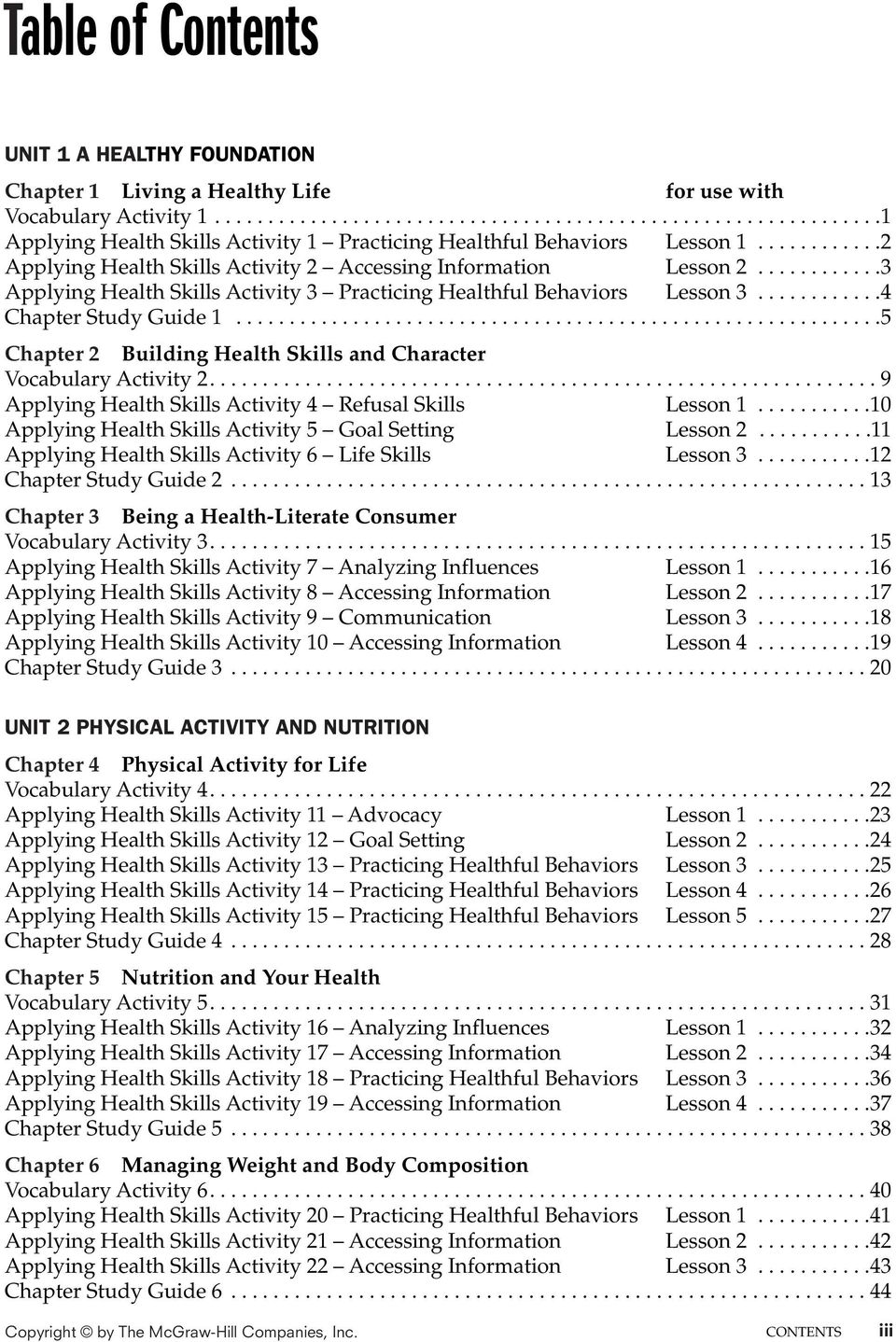
4 UNIT 3 MENTAL AND EMOTIONAL HEALTH Chapter 7 Achieving Good Mental Health for use with Vocabulary Activity Applying Health Skills Activity 23 Practicing Healthful Behaviors Lesson Applying Health Skills Activity 24 Practicing Healthful Behaviors Lesson Applying Health Skills Activity 25 Communication Skills Lesson Applying Health Skills Activity 26 Practicing Healthful Behaviors Lesson Chapter Study Guide Chapter 8 Managing Stress and Anxiety Vocabulary Activity Applying Health Skills Activity 27 Stress Management Lesson Applying Health Skills Activity 28 Stress Management Lesson Applying Health Skills Activity 29 Practicing Healthful Behaviors Lesson Applying Health Skills Activity 30 Practicing Healthful Behaviors Lesson Chapter Study Guide Chapter 9 Mental and Emotional Problems Vocabulary Activity Applying Health Skills Activity 31 Accessing Information Lesson Applying Health Skills Activity 32 Accessing Information Lesson Applying Health Skills Activity 33 Accessing Information Lesson Applying Health Skills Activity 34 Accessing Information Lesson Chapter Study Guide UNIT 4 SAFE AND HEALTHY RELATIONSHIPS Chapter 10 Skills for Healthy Relationships Vocabulary Activity Applying Health Skills Activity 35 Life Skills Lesson Applying Health Skills Activity 36 Communication Skills Lesson Applying Health Skills Activity 37 Conflict Resolution Lesson Chapter Study Guide Chapter 11 Family Relationships Vocabulary Activity Applying Health Skills Activity 38 Analyzing Influences Lesson Applying Health Skills Activity 39 Communication Skills Lesson Applying Health Skills Activity 40 Life Skills Lesson Applying Health Skills Activity 41 Accessing Information Lesson Chapter Study Guide Chapter 12 Peer Relationships Vocabulary Activity Applying Health Skills Activity 42 Accessing Information Lesson Applying Health Skills Activity 43 Communication Skills Lesson Applying Health Skills Activity 44 Advocacy Lesson Applying Health Skills Activity 45 Decision Making Lesson Chapter Study Guide iv CONTENTS Copyright by The McGraw-Hill Companies, Inc.

5 Chapter 13 Violence Prevention for use with Vocabulary Activity Applying Health Skills Activity 46 Advocacy Lesson Applying Health Skills Activity 47 Communication Skills Lesson Applying Health Skills Activity 48 Analyzing Influences Lesson Applying Health Skills Activity 49 Practicing Healthful Behaviors Lesson Chapter Study Guide UNIT 5 PERSONAL CARE AND BODY SYSTEMS Chapter 14 Personal Care and Healthy Behaviors Vocabulary Activity Applying Health Skills Activity 50 Analyzing Influences Lesson Applying Health Skills Activity 51 Practicing Healthful Behaviors Lesson Applying Health Skills Activity 52 Practicing Healthful Behaviors Lesson Applying Health Skills Activity 53 Accessing Information Lesson Chapter Study Guide Chapter 15 Skeletal, Muscular, and Nervous Systems Vocabulary Activity Applying Health Skills Activity 54 Life Skills Lesson Applying Health Skills Activity 55 Practicing Healthful Behaviors Lesson Applying Health Skills Activity 56 Life Skills Lesson Applying Health Skills Activity 57 Life Skills Lesson Applying Health Skills Activity 58 Advocacy Lesson Chapter Study Guide Chapter 16 Cardiovascular and Respiratory Systems Vocabulary Applying Health Skills Activity 59 Life Skills Lesson Applying Health Skills Activity 60 Life Skills Lesson Applying Health Skills Activity 61 Life Skills Lesson Applying Health Skills Activity 62 Communication Skills Lesson Chapter Study Guide Chapter 17 Digestive and Urinary Systems Vocabulary Applying Health Skills Activity 63 Life Skills Lesson Applying Health Skills Activity 64 Advocacy Lesson Applying Health Skills Activity 65 Life Skills Lesson Chapter Study Guide Chapter 18 Endocrine and Reproductive Systems Vocabulary Applying Health Skills Activity 66 Life Skills Lesson Applying Health Skills Activity 67 Life Skills Lesson Applying Health Skills Activity 68 Life Skills Lesson Chapter Study Guide Copyright by The McGraw-Hill Companies, Inc. CONTENTS v

6 UNIT 6 GROWTH AND DEVELOPMENT Chapter 19 Prenatal Development and Birth for use with Vocabulary Applying Health Skills Activity 69 Life Skills Lesson Applying Health Skills Activity 70 Practicing Healthful Behaviors Lesson Applying Health Skills Activity 71 Life Skills Lesson Applying Health Skills Activity 72 Life Skills Lesson Chapter Study Guide Chapter 20 Adolescence and the Life Cycle Vocabulary Applying Health Skills Activity 73 Life Skills Lesson Applying Health Skills Activity 74 Life Skills Lesson Applying Health Skills Activity 75 Accessing Information Lesson Applying Health Skills Activity 76 Practicing Healthful Behaviors Lesson Chapter Study Guide UNIT 7 TOBACCO, ALCOHOL, AND OTHER DRUGS Chapter 21 Tobacco Vocabulary Applying Health Skills Activity 77 Analyzing Influences Lesson Applying Health Skills Activity 78 Refusal Skills Lesson Applying Health Skills Activity 79 Life Skills Lesson Chapter Study Guide Chapter 22 Alcohol Vocabulary Applying Health Skills Activity 80 Life Skills Lesson Applying Health Skills Activity 81 Life Skills Lesson Applying Health Skills Activity 82 Life Skills Lesson Chapter Study Guide Chapter 23 Medicines and Drugs Vocabulary Applying Health Skills Activity 83 Accessing Information Lesson Applying Health Skills Activity 84 Accessing Information Lesson Applying Health Skills Activity 85 Life Skills Lesson Applying Health Skills Activity 86 Life Skills Lesson Applying Health Skills Activity 87 Advocacy Lesson Chapter Study Guide UNIT 8 DISEASES AND DISORDERS Chapter 24 Communicable Diseases Vocabulary Applying Health Skills Activity 88 Accessing Information Lesson Applying Health Skills Activity 89 Practicing Healthful Behaviors Lesson Applying Health Skills Activity 90 Accessing Information Lesson Chapter Study Guide vi CONTENTS Copyright by The McGraw-Hill Companies, Inc.

7 Chapter 25 Sexually Transmitted Diseases and HIV/AIDS for use with Vocabulary Applying Health Skills Activity 91 Communication Skills Lesson Applying Health Skills Activity 92 Life Skills Lesson Applying Health Skills Activity 93 Life Skills Lesson Applying Health Skills Activity 94 Accessing Information Lesson Chapter Study Guide Chapter 26 Noncommunicable Diseases and Disabilities Vocabulary Applying Health Skills Activity 95 Accessing Information Lesson Applying Health Skills Activity 96 Practicing Healthful Behaviors Lesson Applying Health Skills Activity 97 Accessing Information Lesson Applying Health Skills Activity 98 Accessing Information Lesson Chapter Study Guide UNIT 9 INJURY PREVENTION AND ENVIRONMENTAL HEALTH Chapter 27 Injury Prevention and Safe Behaviors Vocabulary Applying Health Skills Activity 99 Accessing Information Lesson Applying Health Skills Activity 100 Accessing Information Lesson Applying Health Skills Activity 101 Life Skills Lesson Applying Health Skills Activity 102 Life Skills Lesson Chapter Study Guide Chapter 28 First Aid and Emergencies Vocabulary Applying Health Skills Activity 103 Practicing Healthful Behaviors Lesson Applying Health Skills Activity 104 Practicing Healthful Behaviors Lesson Applying Health Skills Activity 105 Practicing Healthful Behaviors Lesson Applying Health Skills Activity 106 Practicing Healthful Behaviors Lesson Chapter Study Guide Chapter 29 Environmental Health Vocabulary Applying Health Skills Activity 107 Practicing Healthful Behaviors Lesson Applying Health Skills Activity 108 Practicing Healthful Behaviors Lesson Applying Health Skills Activity 109 Practicing Healthful Behaviors Lesson Chapter Study Guide Copyright by The McGraw-Hill Companies, Inc. CONTENTS vii

8

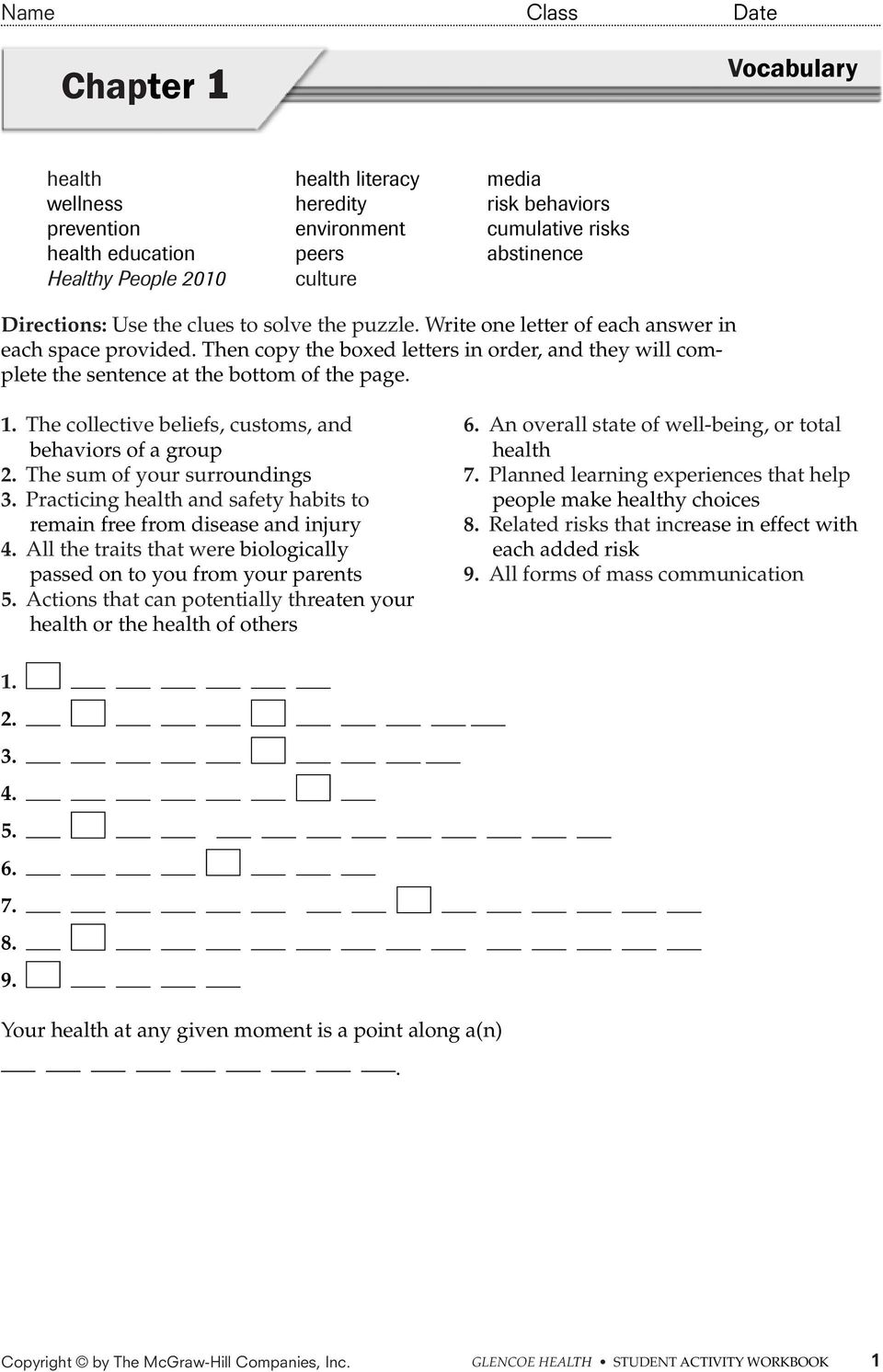
9 Chapter 1 Vocabulary health health literacy media wellness heredity risk behaviors prevention environment cumulative risks health education peers abstinence Healthy People 2010 culture Directions: Use the clues to solve the puzzle. Write one letter of each answer in each space provided. Then copy the boxed letters in order, and they will complete the sentence at the bottom of the page. 1. The collective beliefs, customs, and behaviors of a group 2. The sum of your surroundings 3. Practicing health and safety habits to remain free from disease and injury 4. All the traits that were biologically passed on to you from your parents 5. Actions that can potentially threaten your health or the health of others 6. An overall state of well-being, or total health 7. Planned learning experiences that help people make healthy choices 8. Related risks that increase in effect with each added risk 9. All forms of mass communication Your health at any given moment is a point along a(n). Copyright by The McGraw-Hill Companies, Inc. GLENCOE HEALTH STUDENT ACTIVITY WORKBOOK 1
10 Activity 1 Applying Health Skills FOR USE WITH CHAPTER 1, LESSON 1 Choices Make the Difference Directions: Read the following health situations and, using the information in your textbook as a guide, offer suggestions that would make a positive impact on the person s health. 1. Jim plays computer games to the exclusion of all physical activities. Lately, he s allowed his game playing time to cut into his sleep time. He s also eating his favorite snacks, usually chips and various types of cookies, while he plays. His friends complain that they never see him anymore. Health suggestions: 2. Audra recently moved and is attending a new school. In an effort to be accepted, she s been on a crash diet, hoping that being very thin will help her make friends. She was invited to join a group of kids known for having wild parties with alcohol and marijuana available. Audra is starting to think that hanging out with them would be better than doing nothing at all. Health suggestions: 3. LeBron has his sights set on getting a football scholarship to college. To prepare for the season, he s been working out twice a day during the summer. He also has a part-time job, leaving him little free time. Because LeBron is on such a tight schedule, he s been eating two of his daily meals at the fast food place. He gets home late and finds himself too wound up to sleep. Health suggestions: 2 GLENCOE HEALTH STUDENT ACTIVITY WORKBOOK Copyright by The McGraw-Hill Companies, Inc.

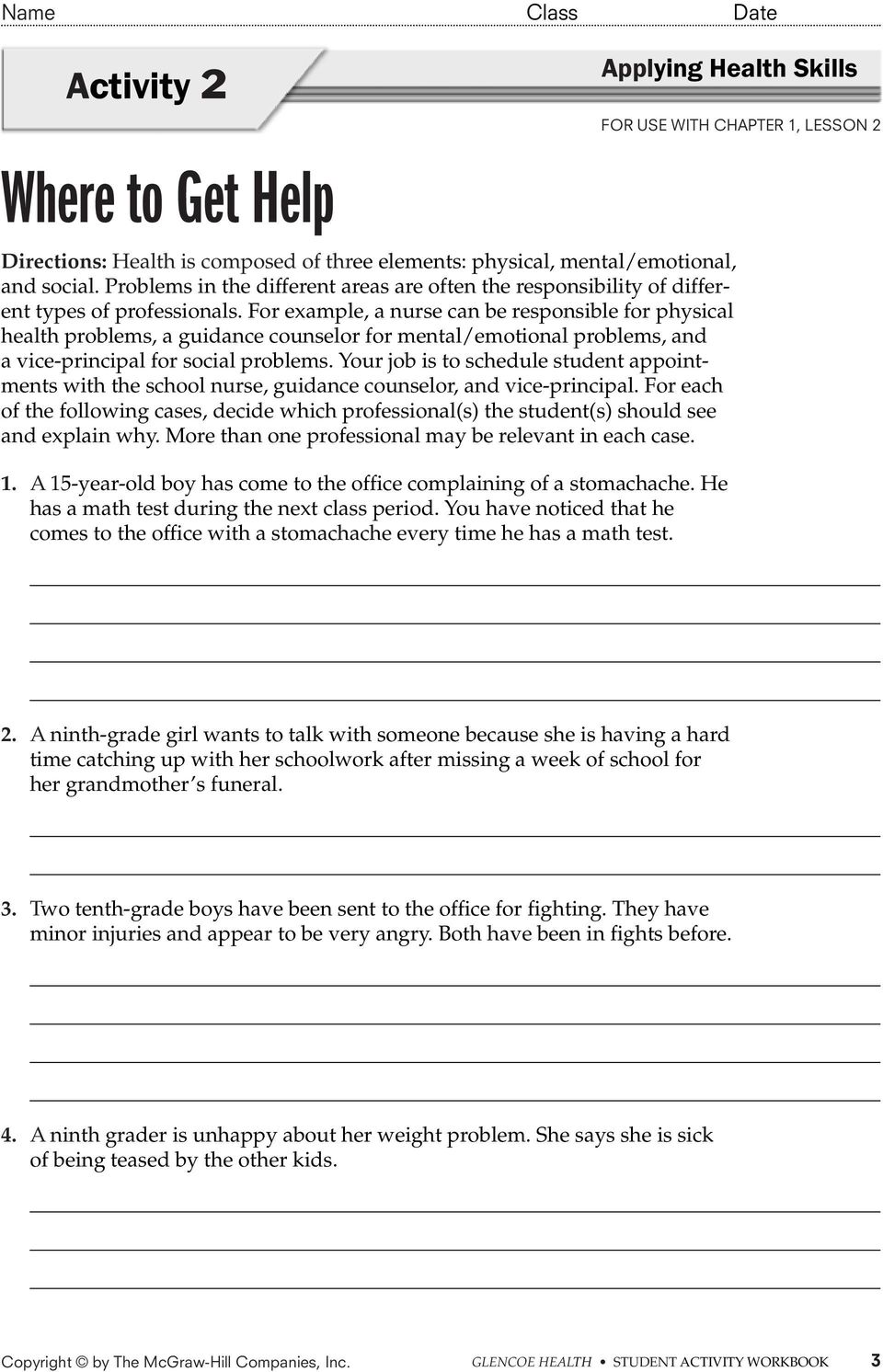
11 Activity 2 Applying Health Skills FOR USE WITH CHAPTER 1, LESSON 2 Where to Get Help Directions: Health is composed of three elements: physical, mental/emotional, and social. Problems in the different areas are often the responsibility of different types of professionals. For example, a nurse can be responsible for physical health problems, a guidance counselor for mental/emotional problems, and a vice-principal for social problems. Your job is to schedule student appointments with the school nurse, guidance counselor, and vice-principal. For each of the following cases, decide which professional(s) the student(s) should see and explain why. More than one professional may be relevant in each case. 1. A 15-year-old boy has come to the office complaining of a stomachache. He has a math test during the next class period. You have noticed that he comes to the office with a stomachache every time he has a math test. 2. A ninth-grade girl wants to talk with someone because she is having a hard time catching up with her schoolwork after missing a week of school for her grandmother s funeral. 3. Two tenth-grade boys have been sent to the office for fighting. They have minor injuries and appear to be very angry. Both have been in fights before. 4. A ninth grader is unhappy about her weight problem. She says she is sick of being teased by the other kids. Copyright by The McGraw-Hill Companies, Inc. GLENCOE HEALTH STUDENT ACTIVITY WORKBOOK 3
12 Activity 3 Applying Health Skills FOR USE WITH CHAPTER 1, LESSON 3 Risky Behaviors Directions: Read the following excerpts from journal entries written by teens. In each case, identify behaviors that are health risks. Then, rewrite each excerpt to eliminate the health risks and reflect a healthier lifestyle. 1. Devon picked me up after school today in his dad s car. It s an antique from the 1950s and doesn t even have safety belts! Devon drives really fast, but other than that he s a good driver. Health Risks Your Rewrite 2. We stopped at Hamburger Haven for lunch on the way home from shopping and ordered the jumbo shakes, burgers, and fries. After lunch, Tiara wanted me to go for a walk with her, but I was too tired from all the shopping. I took a nap instead. Health Risks Your Rewrite 3. I have finally been invited to a party at Nick s house. He s the most popular guy in school and has really cool parties. Everybody there will be drinking beer. I m going to go, I want to fit in. Health Risks Your Rewrite 4 GLENCOE HEALTH STUDENT ACTIVITY WORKBOOK Copyright by The McGraw-Hill Companies, Inc.

13 Chapter 1 Study Guide STUDY TIPS: Read You ll Learn To for each lesson. Look up the meaning of any unfamiliar vocabulary terms. Read the questions below before you read the chapter. Directions: As you read the chapter, answer the following questions. Later, you can use this guide to review the information in the chapter. Lesson 1 1. What is health? Why is good health important? 2. Give examples that show why health is dynamic. 3. What is wellness? How is it achieved? 4. List lifestyle factors that promote good health. Copyright by The McGraw-Hill Companies, Inc. GLENCOE HEALTH STUDENT ACTIVITY WORKBOOK 5

14 Study Guide, Chapter 1 (Continued) 5. Define prevention and give two examples of behaviors that help prevent illness or injury. 6. Compare and contrast health education and health literacy. 7. Describe Healthy People Lesson 2 8. Name the three elements of health in the health triangle. 9. What is physical health? Mental/emotional health? Social health? 6 GLENCOE HEALTH STUDENT ACTIVITY WORKBOOK Copyright by The McGraw-Hill Companies, Inc.

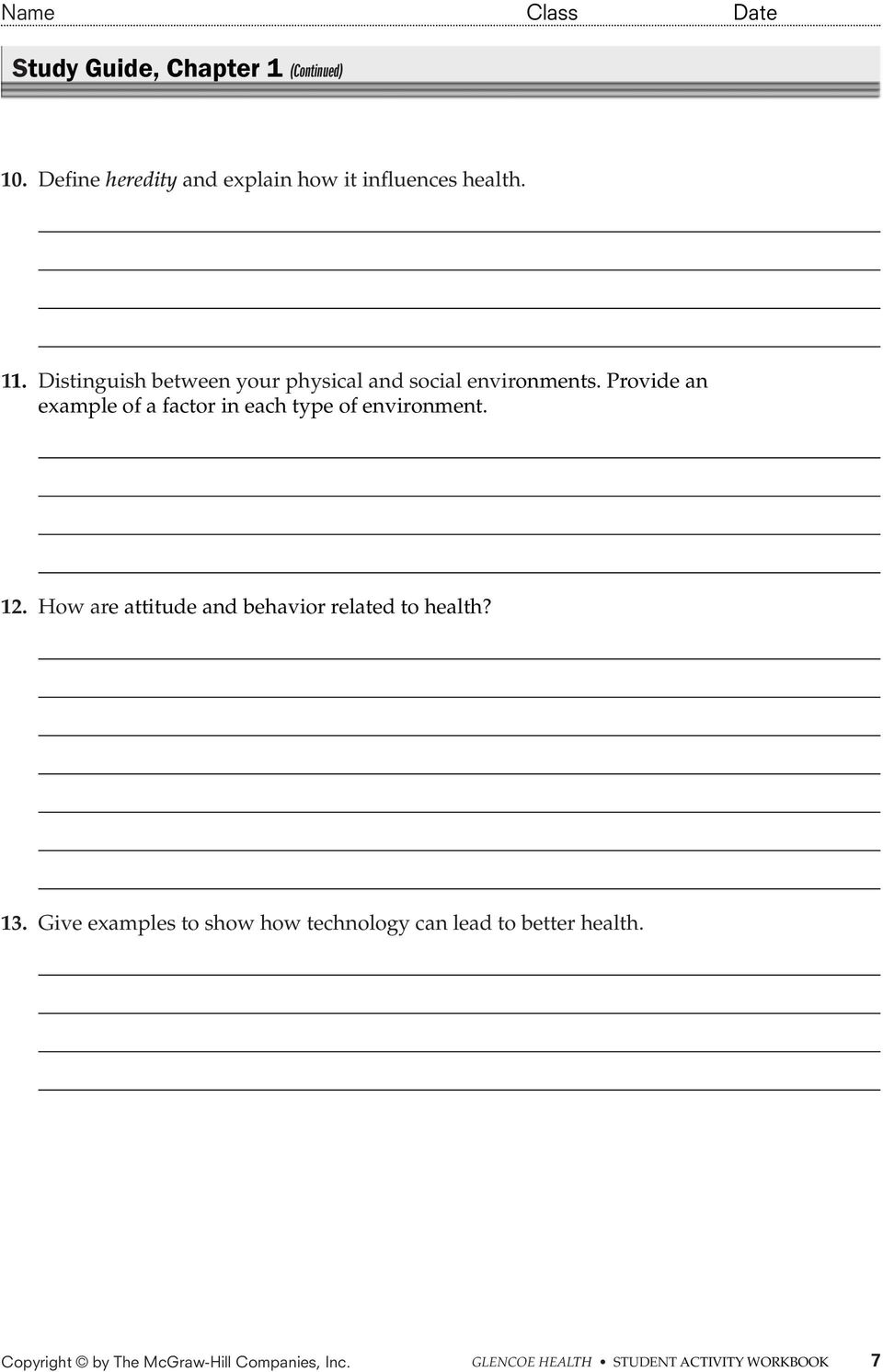
15 Study Guide, Chapter 1 (Continued) 10. Define heredity and explain how it influences health. 11. Distinguish between your physical and social environments. Provide an example of a factor in each type of environment. 12. How are attitude and behavior related to health? 13. Give examples to show how technology can lead to better health. Copyright by The McGraw-Hill Companies, Inc. GLENCOE HEALTH STUDENT ACTIVITY WORKBOOK 7
16 Study Guide, Chapter 1 (Continued) Lesson List six categories of teen risk behaviors that have negative effects on health. 15. Use an example to explain cumulative risks. 16. What is abstinence? Identify risk behaviors that are best avoided by practicing abstinence. 8 GLENCOE HEALTH STUDENT ACTIVITY WORKBOOK Copyright by The McGraw-Hill Companies, Inc.

17 Chapter 2 Vocabulary health skills advocacy long-term goal interpersonal communication decision-making skills action plan refusal skills values character conflict resolution goal role model stress management short-term goal I. Directions: Read the following passage. For each underlined phrase, write the term from the list above that can replace it. Some terms may be used more than once. How do you choose a personal (1) person whose success or behavior is an example to others? Begin by examining your (2) ideas, beliefs, and attitudes about what is important. Look for a person whose (3) distinctive qualities that describe how a person thinks, feels, and behaves demonstrates core ethical values. Perhaps you could be a(n) (4) person whose success or behavior is an example to others. This is an admirable (5) something you aim for that takes planning and work to set for yourself. This achievement requires excellent (6) strategies that can help you say no to behaviors that are unhealthful, unsafe, or against your values and (7) steps that enable you to make healthful decisions. (8) The exchange of thoughts, feelings, and beliefs between two or more people is also very important. You should develop a(n) (9) multistep strategy to achieve your goal to follow that will develop these qualities II. Directions: Answer the following question in the space provided. 10.The word advocacy contains the root voc, which is from the Latin word vox, meaning voice. How does the word voice relate to the meaning of the term advocacy? Copyright by The McGraw-Hill Companies, Inc. GLENCOE HEALTH STUDENT ACTIVITY WORKBOOK 9

18 Activity 4 Applying Health Skills FOR USE WITH CHAPTER 2, LESSON 1 In So Many Words Directions: Teens are often pressured by their friends to take part in risky behavior. Refusal skills, the strategies used to say no to unsafe behavior, are an important health tool for teens. Read the conversations below. In the space provided, identify the refusal strategy being used. Then make a suggestion of one other refusal strategy that may also be effective in this situation. 1. Justin: Come on! I ve asked you 12 times to watch the door so I can sneak a smoke. What s your problem? Mike: I m leaving now. You won t listen, and I m not discussing it any more. Refusal strategy: Possible suggestion: 2. Tasha: We re going to be late unless we take the shortcut on the train tracks. Let s go! Ebony: No. I don t want to take the risk of walking on the tracks. Refusal strategy: Possible suggestion: 3. Brad: It s just one drink, and it s only beer. Why won t you have some? Keiko: I don t drink alcohol. It s against the law and against my family s beliefs. Refusal strategy: Possible suggestion: 10 GLENCOE HEALTH STUDENT ACTIVITY WORKBOOK Copyright by The McGraw-Hill Companies, Inc.

19 Activity 5 Applying Health Skills FOR USE WITH CHAPTER 2, LESSON 2 The Long and Short of It Directions: What are your plans for your life? What are your plans for next week? Both long-term and short-term goals are important for a healthy life. An action plan can help you identify and achieve your goals. Use the blank action plans below to create one short-term goal and one long-term goal. Personal Action Plan Short-Term Goal 1. My goal: 2. Steps to reach this goal: 3. Sources of help and support: 4. Time frame for this goal: 5. Checkpoints for evaluation of progress: 6. Reward for achieving this goal: Personal Action Plan Long-Term Goal 7. My goal: 8. Steps to reach this goal: 9. Sources of help and support: 10. Time frame for this goal: 11. Checkpoints for evaluation of progress: 12. Reward for achieving this goal: Copyright by The McGraw-Hill Companies, Inc. GLENCOE HEALTH STUDENT ACTIVITY WORKBOOK 11

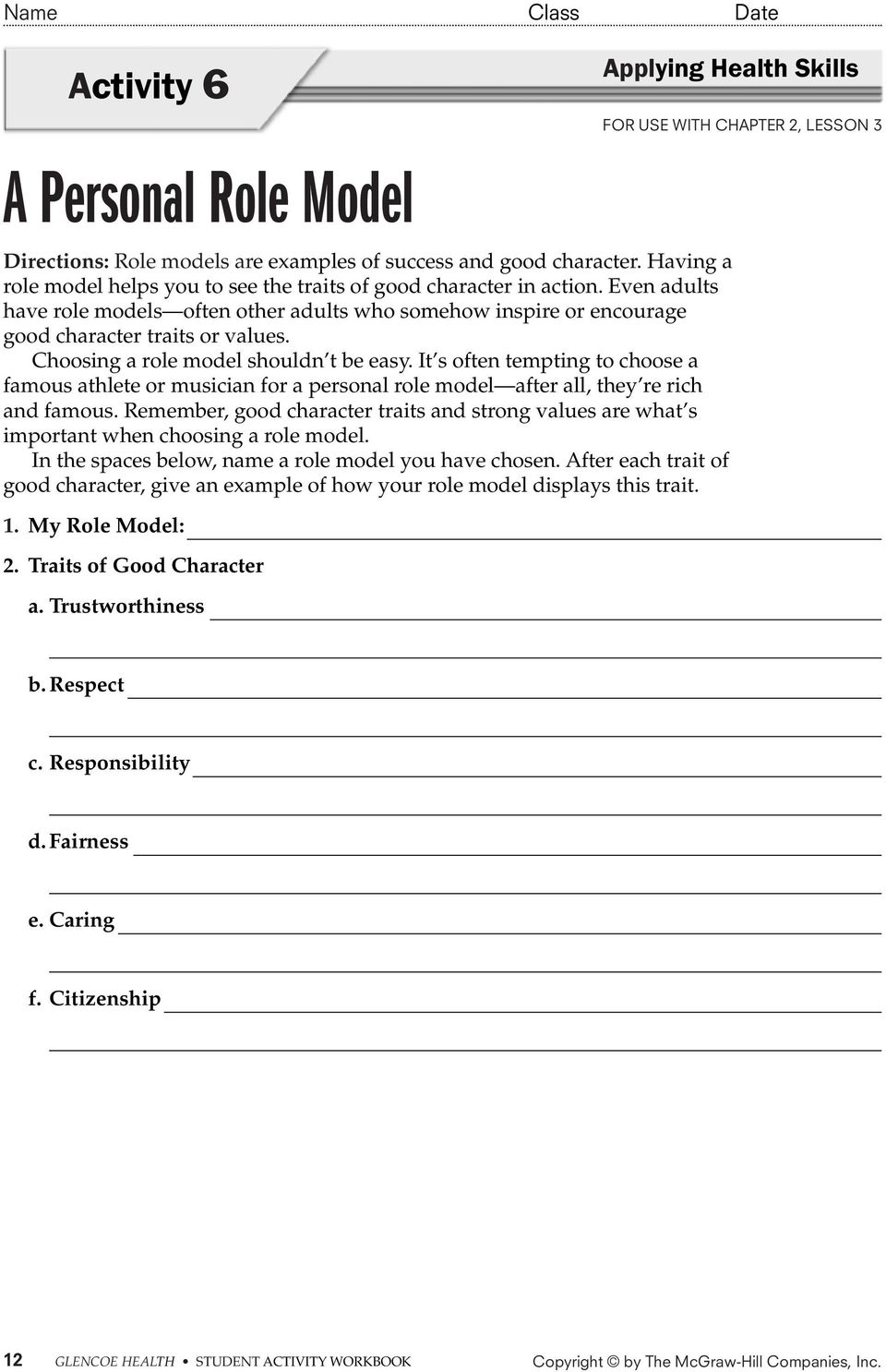
20 Activity 6 Applying Health Skills FOR USE WITH CHAPTER 2, LESSON 3 A Personal Role Model Directions: Role models are examples of success and good character. Having a role model helps you to see the traits of good character in action. Even adults have role models often other adults who somehow inspire or encourage good character traits or values. Choosing a role model shouldn t be easy. It s often tempting to choose a famous athlete or musician for a personal role model after all, they re rich and famous. Remember, good character traits and strong values are what s important when choosing a role model. In the spaces below, name a role model you have chosen. After each trait of good character, give an example of how your role model displays this trait. 1. My Role Model: 2. Traits of Good Character a. Trustworthiness b. Respect c. Responsibility d. Fairness e. Caring f. Citizenship 12 GLENCOE HEALTH STUDENT ACTIVITY WORKBOOK Copyright by The McGraw-Hill Companies, Inc.
21 Chapter 2 Study Guide STUDY TIPS: Read You ll Learn To for each lesson. Look up the meaning of any unfamiliar vocabulary terms. Read the questions below before you read the chapter. Directions: As you read the chapter, answer the following questions. Later, you can use this guide to review the information in the chapter. Lesson 1 1. Define interpersonal communication. 2. What are three steps to use when dealing with a conflict? a. b. c. 3. Name four strategies for managing stress. 4. What are three internal influences on your health? 5. What are three external influences on your health? Lesson 2 6. Define values. 7. Define goal. Give one example of a short-term goal and one example of a long-term goal. Copyright by The McGraw-Hill Companies, Inc. GLENCOE HEALTH STUDENT ACTIVITY WORKBOOK 13
22 Study Guide, Chapter 2 (Continued) 8. The acronym HELP can help you weigh the consequences of a decision. Identify the word each letter represents. Then, write a question about decision making that is based on each word. 9. What is the first step in the decision-making process? 10. Identify the final step in the decision-making process. Lesson List three examples of core ethical values. 12. Define role model. 13. Give two examples of how you can display the character trait of good citizenship. 14. Identify one way that demonstrating good character can make a positive difference at school. 15. List two ways in which you can take an active role in developing your character. 14 GLENCOE HEALTH STUDENT ACTIVITY WORKBOOK Copyright by The McGraw-Hill Companies, Inc.
23 Chapter 3 Vocabulary health consumer health care system fraud media primary care physician health fraud advertising specialist malpractice comparison shopping preventive care consumer advocates warranty health insurance public health online shopping medical history epidemiology Directions: Read the following passage. For each underlined phrase, write the term from the list above that can replace it. Making consumer choices can be a difficult process. Today, there are more forms of (1) written or spoken messages designed to interest consumers in purchasing a product or service than ever. It is especially important to make careful decisions about health products and services. (2) Judging the benefits of different products by comparing factors such as cost, features, and quality is one way to make careful choices. You should carefully avoid (3) the sale of worthless products or services claimed to prevent or cure health problems. Obtaining a(n) (4) written agreement to repair a product or replace a defective product can protect you from wasting money on defective products. When (5) using the internet to buy goods and services you should be a careful (6) person who purchases or uses health products or services. A(n) (7) person or group whose purpose is to address consumer issues can provide help if you have consumer problems. Choosing a health care provider is another important decision. The type of (8) private company or government program that pays for all or part of your medical costs you have may affect your choice of health care provider. Your provider can t effectively help you maintain your health unless you provide a(n) (9) complete and comprehensive information about your immunizations and any health problems you have had. Occasionally health care providers are guilty of (10) failure by a health care professional to meet accepted standards. You should contact the American Medical Association or the state s licensing board in these cases Copyright by The McGraw-Hill Companies, Inc. GLENCOE HEALTH STUDENT ACTIVITY WORKBOOK 15
24 Activity 7 Applying Health Skills FOR USE WITH CHAPTER 3, LESSON 1 It s Influential Directions: Many factors, both internal and external, influence your consumer choices. Advertising is an external influence that can profoundly affect you choice of products. Television, magazines, the Internet, and radio are some of the most effective ways for advertisers to reach potential customers. This activity will help you analyze how much advertising affects your thoughts about particular products. For each category of product listed, name the first brand of the product that comes to mind. Then, describe what you know about the product. In the last column, list the source of your information. At the end of the activity, answer the questions to analyze how advertising influenced your thoughts about these products. Knowledge about Source of Information Product Brand the Product about the Product Shampoo Body soap Toothpaste 1. For which of the products above was your information based on advertising? 2. For which of the products above was your information based on personal experience with the product? 3. Were any of the words or phrases you used to describe the product the same as the words and phrases used in an advertisement for the product? 4. Based on the activity and your answers to the questions, how much do you feel advertising affects you and your consumer choices? 16 GLENCOE HEALTH STUDENT ACTIVITY WORKBOOK Copyright by The McGraw-Hill Companies, Inc.
25 Activity 8 Applying Health Skills FOR USE WITH CHAPTER 3, LESSON 2 See the Specialist Directions: General health care is provided by primary care physicians, school nurses, and dentists. Often these are the first health professionals you see when you have a health problem. Primary care physicians and dentists can refer their patients to specialists for treatment of certain medical problems. Read the descriptions below. For each, name the specialist to which the person could be referred and provide a brief description of the types of problems handled by the specialist. 1. Matt has been suffering from acne for several months now. What started as a small problem has become severe, so he made an appointment with his primary care physician. 2. Juan visited his dentist for a check-up. The dentist noted that the position of Juan s permanent teeth has made it difficult for Juan to chew properly. Juan also feels embarrassed about his crooked teeth. 3. Hannah has had cold symptoms for a month now. Even though she has been taking cold medicine, she doesn t feel much better. Hannah made an appointment with her primary care physician, and at her appointment she described her symptoms: watery eyes and constant sneezing. 4. Erica made an appointment with her primary care physician to discuss the severity of her menstrual cramps. She misses several days of school each month, and wonders if there is a treatment that could alleviate her cramps. Copyright by The McGraw-Hill Companies, Inc. GLENCOE HEALTH STUDENT ACTIVITY WORKBOOK 17
26 Activity 9 Applying Health Skills FOR USE WITH CHAPTER 3, LESSON 3 Sandra s Suggestions Directions: Pretend you are Sandra, an online consumer advocate. Answer the following questions that have been submitted to your Web site. 1. Sandra: I m going to send my new hair dryer back. It just doesn t work! The store manager said to send it back to the manufacturer. How can I increase my chances of getting a refund? 2. Dear Sandra: The prescription my doctor gave me was for the wrong medicine, which landed me in the hospital. What can I do about my problem? 3. Dear Sandra: I tried to return some defective merchandise to a local store, and I was told that they wouldn t take returns. Since I had my receipt, and the merchandise was still in the original box, I thought they would take care of the problem. My neighbor said the same thing happened to her at that store. Who can help us out? 4. Sandra: I bought an exercise device I saw on TV. It was supposed to give results in less than a week. All I ve got to show for my week s work is sprained muscles and a big doctor bill. Any advice? 18 GLENCOE HEALTH STUDENT ACTIVITY WORKBOOK Copyright by The McGraw-Hill Companies, Inc.
27 Activity 10 Applying Health Skills FOR USE WITH CHAPTER 3, LESSON 4 Public Health in the World and in Your Community Directions: There are many organizations that advocate for public health. There are large multinational organizations. Other agencies are national. Still others are local organizations, which promote health in the cities and towns in which they are located. All of these organizations, regardless of size, depend on the efforts of individuals to succeed. Complete the worksheet below. Consider how you can make a difference in your town. 1. Name two international public-health agencies and describe their functions. 2. Name one national public-health organization. 3. Name one local public-health organization. 4. Research volunteer opportunities with this organization. Talk to someone at the organization and determine present volunteer opportunities, as well as new volunteer possibilities that require staffing. Find out how someone becomes a volunteer. Describe your findings here. 5. Which of the volunteer opportunities sounds the most interesting to you? Why? 6. If you decide to perform one of these volunteer opportunities, write a paragraph describing your volunteer work and share it with the class. Copyright by The McGraw-Hill Companies, Inc. GLENCOE HEALTH STUDENT ACTIVITY WORKBOOK 19
28 Chapter 3 Study Guide STUDY TIPS: Read You ll Learn To for each lesson. Look up the meaning of any unfamiliar vocabulary terms. Read the questions below before you read the chapter. Directions: As you read the chapter, answer the following questions. Later, you can use this guide to review the information in the chapter. Lesson 1 1. Define comparison shopping. 2. Describe two techniques used by advertisers to convey messages to consumers. 3. Name four factors you should consider when deciding between two consumer products. Lesson 2 4. Define medical history and explain why it is important for your health care provider. 5. Define health insurance. How are managed care plans different from conventional plans? 6. Define and give three examples of specialists. 20 GLENCOE HEALTH STUDENT ACTIVITY WORKBOOK Copyright by The McGraw-Hill Companies, Inc.
29 Study Guide, Chapter 3 (Continued) 7. Give three examples of types of health care professionals who provide general care. Lesson 3 8. Name two government agencies that protect consumers rights. 9. Describe health fraud, and mention two types of products that are particularly susceptible to health fraud. 10. Define malpractice. 11. What is small claims court, and how can it be used by consumers to resolve complaints? Lesson Identify three ways public health is overseen at the local level. 13. Define epidemiology. 14. What are three agencies that work at the national level to maintain health? Copyright by The McGraw-Hill Companies, Inc. GLENCOE HEALTH STUDENT ACTIVITY WORKBOOK 21
30 Chapter 4 Vocabulary physical activity anaerobic exercise anabolic steroids physical fitness overload health screening sedentary lifestyle progression overexertion osteoporosis specificity heat cramps cardiorespiratory endurance warm-up heat stroke muscular strength workout frostbite muscular endurance F.I.T.T. hypothermia flexibility cool-down muscle cramp body composition resting heart rate strain exercise training program sprain aerobic exercise hydration Directions: Words and phrases and the ideas they represent have similarities and differences. Words and phrases can be compared. A comparison tells the similarities of and differences between words or phrases. Words and phrases can be contrasted. A contrast focuses on the differences between words and phrases. Use this information to answer the questions that follow. 1. Contrast the phrases aerobic exercise and anaerobic exercise. 2. Compare and contrast the terms frostbite and hypothermia. 3. Compare and contrast the phrases muscular strength and muscular endurance. 4. Contrast the phrases sprain and strain. 22 GLENCOE HEALTH STUDENT ACTIVITY WORKBOOK Copyright by The McGraw-Hill Companies, Inc.
31 Activity 11 Applying Health Skills FOR USE WITH CHAPTER 4, LESSON 1 Voice an Opinion Directions: Most articles in newspapers are factual reports about news events, written by reporters. Newspapers also employ editorial writers: writers who offer their opinion of current news events. You have been asked to fill in for the editorial writer at the local newspaper. After each description of a current news event, write some notes for an editorial column concerning the issue. Decide what opinion your editorial will express, and list four facts you will use to support your opinion. Use your knowledge of physical fitness and information from the lesson when forming your opinion. 1. The state legislature voted today to decrease the amount of physical education required for high school graduation. The opinion I will express in my editorial: Supporting facts: 2. The mayor today announced support for construction of a physical fitness center open to all city residents. Construction of the center will require a tax increase. A traffic impact study will be required. The issue will be put to a public vote in the next election. Voter concerns about increased taxes will be addressed by the mayor at a town meeting Thursday evening. The opinion I will express in my editorial: Supporting facts: Copyright by The McGraw-Hill Companies, Inc. GLENCOE HEALTH STUDENT ACTIVITY WORKBOOK 23
32 Activity 12 Applying Health Skills FOR USE WITH CHAPTER 4, LESSON 2 Pump It Up! Directions: Cardiovascular disease is the number one cause of death in the United States. Heart attack and stroke are two of the cardiovascular diseases with which you may be familiar. Good cardiorespiratory endurance can reduce your risk of developing cardiovascular disease. Follow the steps below to plan ways to improve your cardiorespiratory health. Part 1: Measure your cardiorespiratory endurance by using the three-minute step test described in the lesson. Find your pulse rate on the chart in the text to determine your rating, and record it here: Part 2: Develop a plan to improve your cardiorespiratory endurance. If your rating is already excellent, develop a plan to maintain your cardiorespiratory endurance. While making your plan, consider which types of activities improve cardiorespiratory endurance. How can you incorporate these activities into your lifestyle? Your plan should include three specific examples of activities and the ways that you will make the activities a part of your life. 24 GLENCOE HEALTH STUDENT WORKBOOK Copyright by The McGraw-Hill Companies, Inc.
33 Activity 13 Applying Health Skills FOR USE WITH CHAPTER 4, LESSON 3 Pyramid Power Directions: Use this copy of the Physical Activity Pyramid to assess the variety and frequency of your physical activity over the course of a week. For seven consecutive days use tally marks to record your physical activities in the appropriate areas of the Physical Activity Pyramid. At the end of the week, evaluate how variety and frequency of your activities compare to the recommendations. Summary evaluation: Physical Activity Pyramid Sedentary Activities Recommended: infrequently Anaerobic Activities Recommended: 2 3 days per week Flexibility Activities Recommended: 2 or more days per week Aerobic Activities Recommended: 3 5 days per week, minutes per session Moderate-Intensity Physical Activities Recommended: every day, about 30 minutes Copyright by The McGraw-Hill Companies, Inc. GLENCOE HEALTH STUDENT ACTIVITY WORKBOOK 25
34 Activity 14 Applying Health Skills FOR USE WITH CHAPTER 4, LESSON 4 First Practice of the Season Directions: Jean-Luc, an experienced youth hockey player, eagerly anticipates his high school team s first practice of the season. He wants to be prepared to perform at his best in order to make varsity. He has two months to get himself into condition. He hopes to run, inline skate, or play ice hockey every day. He has decided to prepare checklists to ensure that his training program is safe and productive. What training and safety suggestions would you recommend for Jean-Luc? Write four for each activity. Hockey Running In-line skating 26 GLENCOE HEALTH STUDENT ACTIVITY WORKBOOK Copyright by The McGraw-Hill Companies, Inc.
35 Activity 15 Applying Health Skills FOR USE WITH CHAPTER 4, LESSON 5 What s the Plan? Directions: Read each description of an injury or illness resulting from physical activity. Then decide what type of injury or illness is probably occurring. What would be your plan of action for dealing with each of the illnesses or injuries? Explain what you would do if you were present in each of these situations. 1. Mario has been in-line skating for the past hour. It s 94 F outside, but he and his friends are having so much fun they decide to continue skating. After a while, Mario starts to feel dizzy and nauseous, and he has difficulty breathing. Type of Illness/Injury: Plan of Action: 2. Jenny slid into home plate at the championship game. Unfortunately, as she slid she hurt her shoulder, which made a horrible popping noise. She is now in extreme pain. Type of Illness/Injury: Plan of Action: 3. Yesterday, Latasha practiced hard at swimming practice to get ready for the all-city swim meet. Today her shoulder and leg muscles ache. Type of Illness/Injury: Plan of Action: Copyright by The McGraw-Hill Companies, Inc. GLENCOE HEALTH STUDENT ACTIVITY WORKBOOK 27
36 Chapter 4 Study Guide STUDY TIPS: Read You ll Learn To for each lesson. Look up the meaning of any unfamiliar vocabulary terms. Read the questions below before you read the chapter. Directions: As you read the chapter, answer the following questions. Later you can use this guide to review the information in the chapter. Lesson 1 1. List three benefits of physical activity for physical health. 2. List three benefits of physical activity for mental health. 3. List three benefits of physical activity for social health. 4. Identify four possible negative effects of a physically inactive lifestyle. Lesson 2 5. Describe each element of fitness. a. Cardiorespiratory endurance: b. Muscular strength: 28 GLENCOE HEALTH STUDENT ACTIVITY WORKBOOK Copyright by The McGraw-Hill Companies, Inc.
37 Study Guide, Chapter 4 (Continued) c. Muscular endurance: d. Flexibility: e. Body composition: 6. What category of exercise can improve cardiorespiratory endurance? 7. What category of exercise can improve muscular endurance and strength? Lesson 3 8. Identify three factors that influence your choice of physical activities. 9. Define the three principles of an effective fitness program. a. Overload: b. Progression: c. Specificity: 10. Explain each term in the F.I.T.T. formula. a. Frequency: b. Intensity: c. Time/duration: d. Type: Copyright by The McGraw-Hill Companies, Inc. GLENCOE HEALTH STUDENT ACTIVITY WORKBOOK 29
38 Study Guide, Chapter 4 (Continued) Lesson Define training program. 12. What is a health screening? Explain the importance of having a health screening before beginning any new activity. 13. Identify the amount of water that should be consumed before and during a workout. Lesson Identify two hot-weather health risks. 15. Identify two cold-weather health risks. 16. What are three minor injuries that might occur during physical activity? 17. What do each of the letters in the R.I.C.E. procedure stand for? 30 GLENCOE HEALTH STUDENT ACTIVITY WORKBOOK Copyright by The McGraw-Hill Companies, Inc.
39 Chapter 5 Vocabulary Directions: Below is a list of vocabulary words from this chapter. The letters of the words have been scrambled. Unscramble each word and match it with its correct meaning on the right. Write the letter of the correct meaning in the blank. 1. aleriocs 2. ugehrn 3. ofod elarlgy 4. aezptrinsuiato 5. ativnsmi 6. ttisnnure 7. eptiatpe 8. iidlp 9. iunrnitto 10. rnespoti 11. odfo eetioranlcn 12. ribfe a. a natural physical drive that protects you from starvation b. the process by which the body takes in and uses food c. a negative reaction to a food or part of food caused by a metabolic problem, such as the inability to digest parts of certain foods or food components d. the process of treating a substance with heat to destroy or slow the growth of pathogens e. the units of heat that measure the energy used by the body and the energy that foods supply to the body f. a desire, rather than a need, to eat g. a condition in which the body s immune system reacts to substances in some foods h. an indigestible complex carbohydrate i. a fatty substance that does not dissolve in water j. nutrients that help build and maintain body cells and tissues k. the substances in food that your body needs to grow, to repair itself, and to supply you with energy l. compounds that help regulate many vital body processes, including the digestion, absorption, and metabolism of other nutrients Copyright by The McGraw-Hill Companies, Inc. GLENCOE HEALTH STUDENT ACTIVITY WORKBOOK 31
40 Activity 16 Applying Health Skills FOR USE WITH CHAPTER 5, LESSON 1 What Influences Your Food Choices? Directions: As you learned in the lesson, many factors influence what foods you choose to eat. Examine the foods you ate for breakfast, lunch, dinner, and snacks in a recent one-day period. List the foods in the spaces provided in the chart. For each food, check the factor that most influenced your choice. Family, Cultural/ friends, Ethnic Schedules/ FOODS Hunger Appetite Emotions & peers Background Budgets Advertising Breakfast Lunch Dinner Snacks 32 GLENCOE HEALTH STUDENT ACTIVITY WORKBOOK Copyright by The McGraw-Hill Companies, Inc.
41 Applying Health Skills, Activity 16 (Continued) FOR USE WITH CHAPTER 5, LESSON 1 1. Analyze your food choices. For example, do you choose pizza because you really love it, or are you influenced by your friends? Is cost a factor when you eat out? 2. Based on the results in the chart, write a generalization that describes which factors most influence your food choices. Copyright by The McGraw-Hill Companies, Inc. GLENCOE HEALTH STUDENT ACTIVITY WORKBOOK 33
42 Activity 17 Applying Health Skills FOR USE WITH CHAPTER 5, LESSON 2 You Are What You Eat Directions: You have learned that in order to function properly, your body needs the nutrients found in food. Take on the role of a writer of a health column in a local newspaper. This week s column focuses on nutrients. Your job is to advise your readers about the nutrients necessary for healthful living. Read each situation below. Write your response in the blanks provided. 1. Sylvia writes: I keep reading about the importance of getting the proper nutrients in the food I eat. What exactly are the nutrients I need? 2. Jenna writes: I heard that eating foods rich in carbohydrates is recommended for healthful living. What are carbohydrates, and what do they do for the body? What foods should I eat to increase my intake of carbohydrates? 3. Joel writes: My doctor suggested that I increase my intake of protein. What foods would you suggest that I eat? 34 GLENCOE HEALTH STUDENT ACTIVITY WORKBOOK Copyright by The McGraw-Hill Companies, Inc.
43 Applying Health Skills, Activity 17 (Continued) FOR USE WITH CHAPTER 5, LESSON 2 4. Marty writes: I always thought that fat was bad for you. Now, I read that some fat is good for you. What are the facts? 5. Sam writes: I know I get vitamins and minerals from my food, but does the body store and use all vitamins in the same fashion? 6. Tess writes: Everyone says that you have to drink a lot of water every day. What is so important about water? Copyright by The McGraw-Hill Companies, Inc. GLENCOE HEALTH STUDENT ACTIVITY WORKBOOK 35
44 Activity 18 Applying Health Skills FOR USE WITH CHAPTER 5, LESSON 3 Guiding Your Food Choices Directions: You are determined to have a healthful eating plan. List a day s worth of meals and snacks based on a 2,000 calorie per day diet. Use MyPyramid to guide your choices from each food group. Also include the number of servings for each of the foods you choose. Refer to your completed chart. How well do your meal plans follow the recommended foods and number of servings suggested in MyPyramid? How can you adjust your food choices to better follow the recommendations? 36 GLENCOE HEALTH STUDENT ACTIVITY WORKBOOK Copyright by The McGraw-Hill Companies, Inc.
45 Activity 19 Applying Health Skills FOR USE WITH CHAPTER 5, LESSON 4 Knowing What You Eat Directions: As you have learned, the law requires that packaged and prepared foods include a Nutrition Facts panel. The information on this panel can help you determine the nutritional needs the food will meet. Choose a packaged food that you enjoy. Find the Nutrition Facts panel on the food and record the information listed on the panel in the diagram below. Nutrition Facts Serving size: Number of servings per container: Number of Calories per serving: Calories from fat per serving: Total Fat Grams: Saturated Fat: Trans Fat: Cholesterol: Sodium: Total carbohydrate: Dietary fiber: Sugars: Protein: Percentage of the Daily Value of vitamins and minerals: 1. What are the three main ingredients in the food product you chose? 2. How does the food product meet the body s nutritional needs? 3. How can using the Nutrition Facts panel help you maintain a healthful diet? Copyright by The McGraw-Hill Companies, Inc. GLENCOE HEALTH STUDENT ACTIVITY WORKBOOK 37
46 Chapter 5 Study Guide STUDY TIPS: Read You ll Learn To for each lesson. Look up the meaning of any unfamiliar vocabulary terms. Read the questions below before you read the chapter. Directions: As you read the chapter, answer the following questions. Later you can use this guide to review the information in the chapter. Lesson 1 1. Define nutrition. 2. Identify three reasons good nutrition is important. 3. What is the difference between hunger and appetite? 4. Describe three environmental factors that influence your food choices. Lesson 2 5. Identify the six groups of nutrients. 6. What kinds of foods are high in fiber? 7. Describe three things that proteins do. 8. What kinds of fats are high in saturated fatty acid? 9. Which type of vitamins can be stored in the body? 38 GLENCOE HEALTH STUDENT ACTIVITY WORKBOOK Copyright by The McGraw-Hill Companies, Inc.
47 Study Guide, Chapter 5 (Continued) Lesson What is the Dietary Guidelines for Americans? 11. What is MyPyramid? 12. From which food group should most of your daily servings come? 13. Explain why moderating your salt intake can benefit your health. 14. Identify the three factors that are the foundation of a healthful eating plan. Lesson How are a food s ingredients listed on most food labels? 16. Define food allergy and food intolerance. 17. Describe three ways of reducing the risk of foodborne illnesses. Copyright by The McGraw-Hill Companies, Inc. GLENCOE HEALTH STUDENT ACTIVITY WORKBOOK 39
48 Chapter 6 Vocabulary body image fad diets electrolytes body mass index (BMI) weight cycling rehydration overweight eating disorder vegetarian obesity anorexia nervosa vegan underweight bulimia nervosa dietary supplement nutrient-dense foods binge eating disorder megadose herbal supplement Directions: Words and phrases can be general or specific. A specific term describes a single idea. A general term describes a broad range of ideas or meanings. For example, eating disorder is a general term, while bulimia nervosa is a specific type of eating disorder. Some of the terms used in this chapter are general, others are specific. Define each of the general terms below. Then, in the provided space define a more specific term or terms related to the same concept or idea. 1. General term: Dietary supplement Specific term: 2. General term: Vegetarian Specific term: 3. General term: Eating disorder Specific term: 40 GLENCOE HEALTH STUDENT ACTIVITY WORKBOOK Copyright by The McGraw-Hill Companies, Inc.
49 Activity 20 Applying Health Skills FOR USE WITH CHAPTER 6, LESSON 1 Strategy Sessions Directions: Students in Mr. Jackson s health class have written paragraphs describing their weight, their BMI, and their physical activity. Read the paragraphs and identify health risks each student might be facing. Then, offer recommendations for healthy weight-management strategies for each student. 1. Celina: I am at an appropriate weight for my height and my BMI is 21. Since my weight and BMI are okay, I don t really pay attention to what or how much I eat. Usually my brother drives me to school. I work at the library checking out books, and then I go home and do my homework. Possible Health Risks: Recommendations: 2. Raphael: My BMI is 29, and I know I weigh too much. I play football in the fall, but now it s the off-season. I try to lift weights sometimes, too. In the fall I m in better shape, but the position I play requires me to be big. Possible Health Risks: Recommendations: 3. Jen: My weight is a bit below what it should be for my height, and my BMI is at 18. I work out every day sometimes I jog, other times I do aerobics, and I swim. Possible Health Risks: Recommendations: Copyright by The McGraw-Hill Companies, Inc. GLENCOE HEALTH STUDENT ACTIVITY WORKBOOK 41
50 Activity 21 Applying Health Skills FOR USE WITH CHAPTER 6, LESSON 2 Buyer Beware Directions: Look at the following advertisements for weight-management products, articles, and services. Draw a line through any claims for a fad diet or other risky weight-management strategy. Circle any statements that indicate a healthy weight-management plan. 42 GLENCOE HEALTH STUDENT ACTIVITY WORKBOOK Copyright by The McGraw-Hill Companies, Inc.
51 Activity 22 Applying Health Skills FOR USE WITH CHAPTER 6, LESSON 3 Nutrition Notes Directions: Christina is preparing a report that discusses proper nutrition at different stages of life. Unfortunately, her computer crashed while she was making the outline for the report. Reorganize Christina s notes by placing the statements from the list under the appropriate headings. Some statements may belong under more than one heading. Should increase intake of folate. Should follow the Dietary Guidelines and MyPyramid. Diet should include milk and a wide variety of foods. See a health-care professional for recommendations about dietary supplements. May need fewer calories to balance lower activity levels. Should increase intake of calcium. Breastfeeding is the best possible source of nutrition. Should increase intake of iron. May need assistance preparing and selecting food for proper nutrition. Formula is an alternative if breastfeeding isn t possible. Young Children Older Adults Pregnant Women Infants Copyright by The McGraw-Hill Companies, Inc. GLENCOE HEALTH STUDENT ACTIVITY WORKBOOK 43
52 Chapter 6 Study Guide STUDY TIPS: Read You ll Learn To for each lesson. Look up the meaning of any unfamiliar vocabulary terms. Read the questions below before you read the chapter. Directions: As you read the chapter, answer the following questions. Later you can use this guide to review the information in the chapter. Lesson 1 1. Define body composition, and explain why it is an important consideration when determining an individual s appropriate weight range. 2. Name three health risks for adults who are overweight. 3. List five strategies for beginning a weight-management plan. 4. Identify two strategies for healthy weight loss. 5. Identify two strategies for healthy weight gain. 6. Explain two ways in which physical activity can help with weight management. 44 GLENCOE HEALTH STUDENT ACTIVITY WORKBOOK Copyright by The McGraw-Hill Companies, Inc.
53 Study Guide, Chapter 6 (Continued) Lesson 2 7. Define fad diet, and list three characteristics that distinguish fad diets from healthy weight management. 8. Identify two possible side effects of taking diet pills. 9. Define eating disorder. 10. What are two physical consequences of anorexia nervosa? 11. What are two health consequences of bulimia nervosa? 12. What are two ways you could help a friend who has an eating disorder? Lesson Define rehydration. 14. Identify three possible side effects of taking anabolic steroids. 15. Describe the best types of foods to eat before a competition. Copyright by The McGraw-Hill Companies, Inc. GLENCOE HEALTH STUDENT ACTIVITY WORKBOOK 45
54 Study Guide, Chapter 6 (Continued) 16. Define vegetarian. 17. What are dietary supplements? 18. Describe a situation in which dietary supplements are an appropriate addition to a healthy diet. 19. Describe how dietary supplements can be dangerous. 20. Why is a healthful diet important during pregnancy? 46 GLENCOE HEALTH STUDENT ACTIVITY WORKBOOK Copyright by The McGraw-Hill Companies, Inc.
55 Chapter 7 Vocabulary mental/emotional health personal identity empathy hierarchy of needs developmental assets hostility self-actualization constructive criticism defense mechanisms personality emotions suppression modeling hormone Directions: Match the definition in the left column with the vocabulary term in the right column. Write the letter of the correct answer in the space provided. 1. the building blocks of development that help people become responsible, caring adults 2. the ability to imagine and understand how someone else feels 3. nonhostile comments that point out problems and encourage improvement 4. observing and learning from the behaviors of those around you 5. a chemical secreted by your glands that regulates the activities of different body cells 6. signals that tell your mind and body how to react a. modeling b. hormone c. emotion d. empathy e. development assests f. constructive criticism Directions: Answer the following questions about the vocabulary terms. 7. The terms personal identity and personality are similar, but they have important differences in meaning. Compare and contrast these two terms. 8. Define defense mechanism. Give one example of a defense mechanism that is found in the vocabulary list. Copyright by The McGraw-Hill Companies, Inc. GLENCOE HEALTH STUDENT ACTIVITY WORKBOOK 47
56 Activity 23 Applying Health Skills FOR USE WITH CHAPTER 7, LESSON 1 Dear Journal Directions: A teen wrote the following entry in her journal. In the spaces provided, identify statements that reflect traits she should change to increase her level of mental/emotional health and then rewrite the statements so they reflect better mental/emotional health. It s me again, diary. Not much to report today. As usual, I only got a C on my algebra quiz. I ll never get a B in that course! I can t decide if I should take math again next year or give it a rest. Mom says I should keep at it because I ll need more math to get into college, but I don t know if I even want to go to college. I have no idea what I want to do in life, so why plan ahead for college? But enough about school. Even though Taina is my best friend, you won t believe what she did today! She told me my hair looked bad, and that made me feel lousy all day. Why did she have to spoil my whole day like that? Then she expects me to want to go out for the cross country team with her next year! Running is okay, I guess, but I don t know if I m into it that much. I can t make up my mind if I should do cross country or not. I probably wouldn t be much good at running anyway, so what s the point? Well, I better go. Dad just said I have to get ready for bed. More tomorrow. Statements: Your rewrite: 48 GLENCOE HEALTH STUDENT ACTIVITY WORKBOOK Copyright by The McGraw-Hill Companies, Inc.
57 Activity 24 Applying Health Skills FOR USE WITH CHAPTER 7, LESSON 2 Teens in the News Directions: Below are excerpts from newspaper articles about teens in trouble. In the spaces provided, identify at least two developmental assets each teen seems to lack. Explain how the assets might have helped the teen avoid getting into trouble. 1. Teen Arrested for Underage Drinking Last night, a 15-year-old student from Jackson Township was arrested when police found him drinking beer behind a convenience store. According to the police report, the teen had used his older brother s ID to buy beer at the store earlier in the evening. When interviewed, the teen s father said he hadn t realized his son wasn t home, but boys will be boys. Developmental assets: Explanation: 2. Student Admits Vandalizing South High School A female student was questioned by authorities today about the minor vandalism that occurred recently at South High School. The student admitted painting graffiti on the lockers of three other girls. She said she did it because the girls had been mean to her earlier in the week and she was trying to get even. Developmental assets: Explanation: Copyright by The McGraw-Hill Companies, Inc. GLENCOE HEALTH STUDENT ACTIVITY WORKBOOK 49
58 Activity 25 Applying Health Skills FOR USE WITH CHAPTER 7, LESSON 3 Guilt Trip Directions: Assume that you are Gabby, the advice columnist for a high school newspaper. Lately, you have received several letters from students who are bothered by guilty feelings. In the spaces provided, write answers that will help the students deal with their guilt. 1. Dear Gabby: My mom and dad are getting divorced, and I think it s mostly my fault. If I behaved better, they wouldn t get so stressed out and have so much to fight about. As it is, they seem to be fighting all the time. I feel awful! What can I do? Signed, Guilty Gus. Dear Guilty Gus: 2. Dear Gabby: A friend keeps offering me a ride in her car, but my parents won t let me ride with inexperienced drivers. Last night, my mom had to make a special trip to bring me home. Now I feel guilty for being so much trouble. Should I just ride with my friend the next time? Signed, Undecided Rider. Dear Undecided Rider: 3. Dear Gabby: I accidentally broke a neighbor s window while I was playing ball. Nobody knows I did it, but I feel really guilty about it. I want to confess to my neighbor, but I feel that too much time has gone by. What should I do? Signed, Anonymous Neighbor. Dear Anonymous Neighbor: 50 GLENCOE HEALTH STUDENT ACTIVITY WORKBOOK Copyright by The McGraw-Hill Companies, Inc.
59 Activity 26 Applying Health Skills FOR USE WITH CHAPTER 7, LESSON 4 On the Defensive Directions: Assume you have been assigned to rewrite a story to make the main character, Benito, appear to have a more positive outlook and better mental/emotional health. In the spaces provided, copy statements from the excerpt below that suggest Benito is using defense mechanisms and identify the defense mechanisms that he appears to be using. Then, rewrite the statements to eliminate Benito s use of defense mechanisms so that he appears to have better mental/emotional health. Benito felt as though it had been the worst day of his life. That morning in chemistry lab he d made a stupid mistake that ruined the experiment. His lab partner didn t say anything to Benito about it, but Benito was sure his lab partner thought he was dumb. After all, his lab partner was a perfect student. He never made mistakes and deserved a better partner than Benito. Later in the day, Benito found out he hadn t made the basketball team. He d practiced some to improve his shooting, and he d tried pretty hard to impress the coach, but neither had helped. Benito reasoned that the coach had probably already picked out his favorites, so Benito was never seriously considered. Now that it was evening, Benito just wanted to forget the day had happened. He found a hand-held video game in his closet that he hadn t played in years. Within a few minutes, he was lost in an action-filled world of make-believe that made him feel like a happy-golucky 10-year-old boy. Statements and defense mechanisms: Students should identify some or all of the following statements and the defense mechanisms: Benito was sure his lab partner was thinking how dumb he was (projection); His lab partner was a perfect student... never made mistakes... and deserved a better partner than Benito (idealization); The coach had probably already picked out his favorites for the team, so Benito was never seriously considered (rationalization); Benito just wanted to forget the day had happened (suppression); He was lost in an action-filled world of make-believe that made him feel like a happy-go-lucky 10-year-old boy (regression). Your rewrites: Rewrites will vary but should demonstrate a more positive out look without the use of defense mechanisms. For example, the first two statements might be rewritten as Benito was glad his lab partner didn t seem to mind his mistake. His lab partner was a good student, but he made mistakes like everyone else and understood Benito s error. Benito realized he hadn t practiced to improve his basketball game enough to make the team. He decided to shoot baskets with his little brother. Copyright by The McGraw-Hill Companies, Inc. GLENCOE HEALTH STUDENT ACTIVITY WORKBOOK 51
60 Chapter 7 Study Guide STUDY TIPS: Read You ll Learn To for each lesson. Look up the meaning of any unfamiliar vocabulary terms. Read the questions below before you read the chapter. Directions: As you read the chapter, answer the following questions. Later you can use this guide to review the information in the chapter. Lesson 1 1. List five characteristics of people with good mental/emotional health. 2. Name the five levels of needs in Maslow s hierarchy and give an example of a need at each level. 3. What is self-actualization? 4. Define personality and identify the two main influences on personality. Lesson 2 5. What is personal identity? 6. List five aspects of personal identity. 7. Identify eight major developmental assets. 52 GLENCOE HEALTH STUDENT ACTIVITY WORKBOOK Copyright by The McGraw-Hill Companies, Inc.
61 Study Guide, Chapter 7 (Continued) Lesson 3 8. Define emotions and give examples of several different emotions. 9. What are hormones? How can they affect emotions? 10. Compare and contrast empathy and sympathy. 11. Distinguish between fear and phobia. Lesson Describe at least three healthful ways to manage difficult emotions. 13. What are defense mechanisms? 14. List eight common examples of defense mechanisms. 15. Define suppression. Copyright by The McGraw-Hill Companies, Inc. GLENCOE HEALTH STUDENT ACTIVITY WORKBOOK 53
62 Chapter 8 Vocabulary Directions: Life can be puzzling especially when you re feeling stressed! Match the vocabulary words in the list on the next page with the definitions in the clues to complete the crossword puzzle GLENCOE HEALTH STUDENT ACTIVITY WORKBOOK Copyright by The McGraw-Hill Companies, Inc.
63 Vocabulary, Chapter 8 (Continued) stress chronic stress depression perception stress-management skills resiliency stressor relaxation response protective factors psychosomatic response anxiety Across 5. skills that help you handle stress in a healthful, effective way 6. a condition characterized by prolonged feelings of helplessness, hopelessness, and sadness 9. anything that causes stress 11. the ability to adapt effectively and recover from disappointment, difficulty, or crisis Down 1. reaction of the body and mind to everyday challenges and demands 2. conditions that shield individuals from the negative consequences of exposure to risk 3. stress associated with long-term problems that are beyond a person s control 4. a state of calm that can be reached if one or more relaxation techniques are practiced regularly 7. a physical reaction that results from stress rather than from an injury or illness 8. the condition of feeling uneasy or worried about what may happen 10. the act of becoming aware through the senses Copyright by The McGraw-Hill Companies, Inc. GLENCOE HEALTH STUDENT ACTIVITY WORKBOOK 55
64 Activity 27 Applying Health Skills FOR USE WITH CHAPTER 8, LESSON 1 Is Question and Answer Your Forte? Directions: The editor of your school newspaper has decided to start an advice column in the school paper, focusing on stress related issues commonly experienced by students. The editor has appointed you the question and answer editor. Write four questions that represent stress-related concerns of students in your school. Provide an answer for each question that includes possible sources of the stress as well as suggestions about how it can be reduced. Use what you learned about stress in Lesson 1 as a guide. An example is given below. Q: I am a good student, but I get very anxious when I have to take a test. I seem to freeze up and don t do as well as I should. I have mid-year exams coming up and I m already beginning to feel the stress. What do you suggest? A: You seem to have high expectations. Are your grade goals realistic? If they are, then you need a way to reduce your test anxiety. Try getting a study partner, someone academically successful but also fun to be with. Start studying with the person well ahead of the exams, a little bit each day. You will be well prepared come exam time and will have had some fun along the way. Glance over your notes the night before the exams, but don t do any heavy studying. Do something you enjoy that evening and then get a good night s rest. You ll have studied just as hard, but in a less stressful manner. Your grades should show improvement, as you will face the tests with less anxiety. 56 GLENCOE HEALTH STUDENT ACTIVITY WORKBOOK Copyright by The McGraw-Hill Companies, Inc.
65 Activity 28 Applying Health Skills FOR USE WITH CHAPTER 8, LESSON 2 The Merits of Less Stress Directions: Below is a brief announcement of a new merit badge recently introduced by the Girls Scouts of America. Imagine that you have been assigned the task of describing the criteria for earning this badge. Drawing from the stress-management skills studied in Lesson 2, determine what stressmanagement activities would be required and what techniques would be recommended. Then explain the ways these techniques help manage stress. Selling Girl Scout cookies can lead to a lot of stress: sales goals, finding the time to sell them, collecting and counting money, delivery, and dealing with prospective customers, among other stressors. The Girl Scouts, who have been awarding merit badges since 1912, created a new merit badge designed to teach girls how to deal with such stress, and cope with all the pressures confronting children today. The Stress Less badge, officially sanctioned in September 2001, is awarded for finding ways to reduce life s everyday stresses. Required stress-management activities: Techniques recommended: Copyright by The McGraw-Hill Companies, Inc. GLENCOE HEALTH STUDENT ACTIVITY WORKBOOK 57
66 Activity 29 Applying Health Skills FOR USE WITH CHAPTER 8, LESSON 3 Advice for Anxiety and Depression Directions: You have three friends who seem to be exhibiting signs of anxiety or depression. Below are descriptions of their recent behaviors. Using what you learned from Lesson 3 as a guide, identify pertinent symptoms indicating reactions to stress. Then, conjecture whether the symptoms are linked to anxiety or depression, and offer helpful advice. Ashley: You ve noticed that Ashley seems distracted the last couple of days. She can t stay focused during conversations and has a hard time sitting still. Ashley complains to you that she sometimes feels lightheaded when she thinks about playing in Saturday s soccer game. She tells you she hopes Saturday doesn t come and that she wishes she could make her varsity debut without having her parents and all her friends in attendance. Symptoms: Anxiety or depression: Advice: Seamus: For the past week, Seamus has been irritable and disagreeable. He hasn t been hanging out with his friends or playing basketball at the park (one of his favorite pastimes). He looks tired and doesn t seem his usual confident self. You think his behavior has something to do with basketball cuts, which were last week. Symptoms: Anxiety or depression: Advice: 58 GLENCOE HEALTH STUDENT ACTIVITY WORKBOOK Copyright by The McGraw-Hill Companies, Inc.
67 Applying Health Skills, Activity 29 (Continued) FOR USE WITH CHAPTER 8, LESSON 3 Keesha: You haven t seen Keesha much after school for the past few months. She no longer works on the school yearbook or comes to school activities. She doesn t go to the movies with her old friends; she didn t even try out for the volleyball team this year. She seems to have lost weight and looks tired all the time. When you talk to her, she barely responds, usually keeping her conversation to one or two word answers. You ve tried to get her to do something fun on the weekends for several weeks, but she always declines and makes a negative remark about herself. She won t talk about whatever is troubling her. Symptoms: Anxiety or depression: Advice: Copyright by The McGraw-Hill Companies, Inc. GLENCOE HEALTH STUDENT ACTIVITY WORKBOOK 59
68 Activity 30 Applying Health Skills FOR USE WITH CHAPTER 8, LESSON 4 Building Resiliency Directions: Below are two scenarios involving students with low resiliency and an absence of protective factors. Using what you learned from Lesson 4 as a guide, identify some internal and external protective factors that would help the students develop their sense of self and build their resiliency. Although relatively small in stature, Johann played sports on a regular basis until he reached high school, where he found his lack of size made it difficult to compete against his larger peers for positions on school teams. He also used to talk about becoming a pilot, but when you ask him about it, he says, That s kid stuff. Johann no longer attends school events. Lately he s started hanging around a group of guys who seem to take pride in verbally abusing anyone who comes within their range. When you try to tell him that he s hurting people s feelings and that he s too good a guy to behave in such a way, he tells you, That s too bad for them. As for me, well, get used to the new Johann. Later he confides to you that he feels lost and wishes there were some way to change the direction of his life. What could Johann do to strengthen his protective factors and build his resiliency? 60 GLENCOE HEALTH STUDENT ACTIVITY WORKBOOK Copyright by The McGraw-Hill Companies, Inc.
69 Applying Health Skills, Activity 30 (Continued) FOR USE WITH CHAPTER 8, LESSON 4 Within the last couple of years, Sara has gradually shifted her focus from academics and athletics to dating. Her grades have fallen, and she has no interest in school activities, sports, or hanging out with her old friends. She dates many different guys, always looking for the perfect young man. Unfortunately, her relationships are brief and she spends much of her time trying to rebound from break-ups. Just recently she has told you that she feels lost and misses her friends and playing basketball on the school team. What advice would you give Sara that would strengthen her protective factors and build her resiliency? Copyright by The McGraw-Hill Companies, Inc. GLENCOE HEALTH STUDENT ACTIVITY WORKBOOK 61
70 Chapter 8 Study Guide STUDY TIPS: Read You ll Learn To for each lesson. Look up the meaning of any unfamiliar vocabulary terms. Read the questions below before you read the chapter. Directions: As you read the chapter, answer the following questions. Later you can use this guide to review the information in the chapter. Lesson 1 1. Define stress. 2. Give examples that are common to a teen s life from each of the five categories of stressors. Biological stressors: Environmental stressors: Cognitive stressors: Personal behavior stressors: Life situation stressors: 3. List and explain the three stages of your body s stress response. 4. Name four common psychosomatic responses. 62 GLENCOE HEALTH STUDENT ACTIVITY WORKBOOK Copyright by The McGraw-Hill Companies, Inc.
71 Study Guide, Chapter 8 (Continued) 5. Name three mental/emotional and social effects of stress. 6. List four strategies to help you control the effects of chronic stress in your life. Lesson 2 1. Fill in the blanks to list three steps in responding to stress. identify personal stressors, avoid the ones you can, or manage your response to those that are unavoidable. 2. List two examples of each of the following three categories of personal stressors. Life events: Physical stressors: Daily hassles: 3. Explain two ways you can avoid stress. 4. List three benefits of planning ahead. 5. List four benefits of getting eight to nine hours of sleep each night. 6. List three tips on eating nutritious food. Copyright by The McGraw-Hill Companies, Inc. GLENCOE HEALTH STUDENT ACTIVITY WORKBOOK 63
72 Study Guide, Chapter 8 (Continued) 7. List two reasons using alcohol, tobacco, or other drugs don t relieve stress. 8. What are stress-management skills? 9. List the four stress-management techniques in the order you would use them. Lesson 3 1. Define anxiety. 2. List four symptoms of anxiety. 3. Explain why striving for perfection can cause anxiety. 4. Define depression. 5. List and describe two types of depression. 6. List four common symptoms of teen depression. 64 GLENCOE HEALTH STUDENT ACTIVITY WORKBOOK Copyright by The McGraw-Hill Companies, Inc.
73 Study Guide, Chapter 8 (Continued) 7. What is the first step in getting help when you are feeling sad, anxious, or depressed? Lesson 4 1. Define resiliency. 2. List three examples of external factors. 3. Attitudes, perceptions, and behaviors are internal factors. Name four more. 4. List two benefits of having a commitment to learning. 5. List two benefits of having positive values. 6. List two benefits of having social competency. 7. List two benefits of having a positive identity. 8. Define protective factors. Copyright by The McGraw-Hill Companies, Inc. GLENCOE HEALTH STUDENT ACTIVITY WORKBOOK 65
74 Chapter 9 Vocabulary mental disorder suicide group therapy anxiety disorder cluster suicides biomedical therapy post-traumatic stress disorder psychotherapy coping mood disorder behavior therapy grief response conduct disorder cognitive therapy mourning alienation Directions: Use the clues to solve the puzzle. Write each letter of the answer in the spaces provided. Use the boxed letters, in order, to spell out a word that completes the sentence in number 13 below. 1. An ongoing dialogue between a patient and a mental health professional 2. A pattern of behavior in which the rights of others or basic social rules are violated 3. Dealing successfully with difficult changes in your life 4. An individual s total response to a major loss 5. Feeling isolated and separated from everyone else 6. The act of intentionally taking one s own life 7. An illness of the mind that can have either a physical cause or a psychological cause 8. A series of acts occurring within a short period of time and involving several people 9. An illness that involves mood extremes that interfere with everyday living 10. The act of showing sorrow or grief 11. An illness or a condition in which real or imagined fears are difficult to control 12. The use of certain medications to treat or reduce the symptoms of a mental disorder Some symptoms of mental illness require intervention by a mental health. 66 GLENCOE HEALTH STUDENT ACTIVITY WORKBOOK Copyright by The McGraw-Hill Companies, Inc.
75 Activity 31 Applying Health Skills FOR USE WITH CHAPTER 9, LESSON 1 What s the Diagnosis? Directions: Following are profiles of people with mental illnesses. From the description of the symptoms, in the space provided, identify and write the type of mental illness each person has. 1. Tom has difficulty getting along with others. He is in constant conflict with other people. He needs to be directed, but he resents being told what to do. He may forget to show up for an activity because he does not like to be controlled. He is uncooperative. 2. Alicia has difficulty keeping up with normal daily activities. She seems trapped in a pattern of repeated thoughts and behaviors that preoccupy her. In fact, she is urgent about them. When she is at home, she is constantly checking to make sure the doors are locked. 3. Janeen is an elementary school student. During recess one day, Janeen and her classmates witnessed an automobile accident in which one of the cars burst into flames. Ever since, Janeen has been having nightmares. She can t concentrate on her school work. She experiences flashbacks occasionally. 4. Juan experiences extreme mood changes. His friends can t figure him out. He s either very happy, even silly, or he is aggressive and angry. His energy levels also keep changing. Sometimes he s bored and can t concentrate. Other times, he sleeps little, and he still feels energetic. 5. Sue is afraid of heights. She will do anything in her power to avoid being in a tall building or on a mountain. The result is that she misses some meetings if she learns that the meeting is being held on an upper floor of a downtown building. She also misses some fun times because she won t go camping with her friends when they go to the mountains. She can t remember anything in her childhood that might have caused this irrational fear. She just knows that it is very real. Copyright by The McGraw-Hill Companies, Inc. GLENCOE HEALTH STUDENT ACTIVITY WORKBOOK 67
76 Activity 32 Applying Health Skills FOR USE WITH CHAPTER 9, LESSON 2 Some Misconceptions About Suicide Directions: Read each misconception and answer the questions. 1. People who talk about suicide don t go through with it. The truth is that most people who commit suicide have communicated their intent to someone. What should you do if someone talks about committing suicide, even if it is in a casual or humorous way? 2. Everyone who attempts suicide is suffering from depression. Depression, other mental disorders, and the abuse of alcohol and drugs are the leading causes of suicide. What are three other suicide risk factors? 3. The suicidal death of a person does not affect other people. Many people with suicidal thoughts believe this. They are so overwhelmed by their problems that they become withdrawn and do not realize that others care about them. What can you do to help someone who has these thoughts? 4. Suicides are isolated events. Actually, cluster suicides in the United States occur mainly among teens and young adults. Define cluster suicides and give three situations that often result in cluster suicides. 68 GLENCOE HEALTH STUDENT ACTIVITY WORKBOOK Copyright by The McGraw-Hill Companies, Inc.
77 Activity 33 Applying Health Skills FOR USE WITH CHAPTER 9, LESSON 3 Therapy Choices I. Directions: Fill in the descriptions of the following types of therapies. Psychotherapy Group Therapy Behavior Therapy Cognitive Therapy Biomedical Therapy II. Directions: Following are some feelings or behaviors that are signs that help is needed. Determine which kind(s) of therapy might be helpful in each case. 1. You worry all the time. 2. You are becoming increasingly aggressive, violent, or reckless. 3. You feel you can t face your problems alone. 4. You are becoming involved with alcohol or other drugs. Copyright by The McGraw-Hill Companies, Inc. GLENCOE HEALTH STUDENT ACTIVITY WORKBOOK 69
78 Activity 34 Applying Health Skills FOR USE WITH CHAPTER 9, LESSON 4 All Kinds of Grief Directions: Identify each person s stage of grief in the following descriptions. 1. Keisha s brother was killed in a car crash. The person who was driving the car was not injured. Keisha feels powerless. She misses her brother. She resents the fact that the driver continues to attend her school and seems unaffected by her brother s death. Stage: 2. Joe s father and mother have just divorced, and his father has moved to another state. Joe misses his father and feels isolated because he won t be seeing him very often. He thinks the situation is hopeless. Stage: 3. Manuel was the one to tell his little sister, Lisa, that her kitten ran into the street and was killed by a car. Lisa doesn t believe Manuel. She is sure that he is mistaken and that her kitten will come home when it gets hungry. Stage: 4. Carla misses her best friend, Julie. Julie moved away a month ago. Before Julie left, she and Carla had a silly disagreement about Rick, a boy at school whom they both liked. Julie wouldn t speak to Carla before she moved. Now Carla realizes that she doesn t like Rick at all, and she wishes she could see Julie and straighten things out. If she had the opportunity, she would apologize. She realizes now that Julie was a good friend and the disagreement was silly and stupid. Stage: 5. Pedro s sister Annette had a mental disorder, and Pedro often was impatient with her. Annette died unexpectedly a year ago. For a long time, it was very difficult for Pedro to even mention Annette s name. He had regrets about the way he had treated her. Remembering how impatient he was with her was painful. His family realized that Pedro was grieving and that eventually he would be able to talk about Annette. Pedro finally reached the point where he could remember Annette and talk about her without experiencing so much pain. Stage: 70 GLENCOE HEALTH STUDENT ACTIVITY WORKBOOK Copyright by The McGraw-Hill Companies, Inc.
79 Chapter 9 Study Guide STUDY TIPS: Read You ll Learn To for each lesson. Look up the meaning of any unfamiliar vocabulary terms. Read the questions below before you read the chapter. Directions: As you read the chapter, answer the following questions. Later you can use this guide to review the information in the chapter. Lesson 1 1. What is a mental disorder? 2. Name two classifications of mental disorders. 3. Name the six major types of mental disorders. 4. Which group of mental disorders is associated with real or imagined fears? 5. Name four types of anxiety disorders. 6. What is post-traumatic stress disorder? 7. Name two types of mood disorders. Lesson 2 8. A person who feels isolated and separated from everyone else is experiencing what? 9. What is suicide? 10. Name three risk factors of suicide. Copyright by The McGraw-Hill Companies, Inc. GLENCOE HEALTH STUDENT ACTIVITY WORKBOOK 71
80 Study Guide, Chapter 9 (Continued) 11. What are cluster suicides? Lesson List three signs that professional help dealing with problems is needed. 13. What is psychotherapy? 14. What is behavior therapy? 15. What is cognitive therapy? 16. What is group therapy? Lesson Define coping. 18. What is closure? 19. Name the eight stages in the grieving process. 20. List four effective coping measures to deal with disasters and crises. 72 GLENCOE HEALTH STUDENT ACTIVITY WORKBOOK Copyright by The McGraw-Hill Companies, Inc.
81 Chapter 10 Vocabulary relationship I message interpersonal conflict friendship active listening conflict resolution citizenship body language negotiation role prejudice mediation communication tolerance confidentiality cooperation constructive criticism peer mediators compromise conflict I. Directions: Complete the following sentences by writing a term from the list above in each blank. 1. You demonstrate citizenship by obeying rules, helping others, and doing your share to make your school and community clean and safe. 2. You demonstrate tolerance by accepting others differences and allowing them to be who they are without expressing disapproval. 3. You demonstrate active listening by paying close attention to what someone is saying and communicating. 4. You demonstrate cooperation by working together for the good of all. 5. You demonstrate conflict resolution by solving a disagreement through problem solving in a manner that satisfies everyone involved. 6. A process in which specially trained people help others resolve their conflicts peacefully is mediation. II. Directions: Read the following aggressive message. Then, for each vocabulary term below, write the definition and give an example of how to apply it to change the message to a positive, assertive communication. You lied to me! You said you would meet me after school all this week to work on my serve before the tennis tryouts. Instead, you ve been practicing guitar with Luis for your gig next week. Some friend you are! 1. Constructive criticism 2. Compromise Copyright by The McGraw-Hill Companies, Inc. GLENCOE HEALTH STUDENT ACTIVITY WORKBOOK 73
82 Activity 35 Applying Health Skills FOR USE WITH CHAPTER 10, LESSON 1 What s Going On? Directions: Read the following scenarios and answer the questions that follow in the space provided. 1. Jan s mother belongs to a club in their community. The club has planned a bake sale to raise money for a family in the community. Her mother asked Jan to help on the following Saturday, and Jan agreed. However, on Friday, Jan learned that her friends were all going to the beach on Saturday. Jan agreed to go with them. Then she remembered her promise to her mother. She stayed and helped her mother. What characteristic(s) of a healthy relationship did Jan demonstrate? What trait(s) of a good character did Jan demonstrate? 2. Bill belongs to a baseball team that is not having a good season. He is frustrated and wants to quit. However, there are a few games left on the schedule. The coach is aware of Bill s attitude, and after the next game, the coach talked with Bill. As the coach talked, Bill realized that he had been totally self-centered. He had not realized that the coach was also discouraged. Bill decided not to quit. In fact, he promised to work harder and to encourage others on the team. What skill(s) did the coach use? What trait(s) of good character did Bill demonstrate? 3. Tara and her sister Kim have chores to do at home. They usually take turns washing the dinner dishes, which is one of their chores. Now, Tara has an opportunity to get a part-time job three evenings a week. She really wants the job and wonders if she can make a deal with Kim so that she can take the job. She talks with Kim and offers to do Kim s chores plus her own for three of the days she would not be working. Kim thinks it over and agrees to the proposition. What skill(s) did Tara use? What trait(s) of good character did Tara demonstrate? 74 GLENCOE HEALTH STUDENT ACTIVITY WORKBOOK Copyright by The McGraw-Hill Companies, Inc.
83 Applying Health Skills, Activity 35 (Continued) FOR USE WITH CHAPTER 10, LESSON 1 4. Bud s neighbor, Amad, was in an automobile accident, and his leg was broken. Amad has after-school jobs mowing lawns around the neighborhood, and now he can t work. Bud realizes that several people will be expecting Amad, and they won t like to have to look for someone else to work for them temporarily. Bud calls some of his friends and explains the situation and asks them if they would be willing to help Amad until he gets the cast off his leg. They agree. Bud then went to the neighbors who had hired Amad and explained the situation. He asked if they would be willing to have their lawns mowed by someone else while Amad is recuperating. He promises that the jobs will be done well. The neighbors agree to the plan. What skill(s) did Bud use? What traits of good character did Bud demonstrate? Copyright by The McGraw-Hill Companies, Inc. GLENCOE HEALTH STUDENT ACTIVITY WORKBOOK 75
84 Activity 36 Applying Health Skills FOR USE WITH CHAPTER 10, LESSON 2 What s Your Style? Directions: Read each situation and answer the question(s) at the end of each one. 1. Angie always wants to do things with her friends. She agrees to go to the movies with them Saturday afternoon even though she knows she won t like the movie they have chosen. She is unwilling to express herself for fear of losing their friendship. What is Angie s communication style? What could she say to be more assertive? 2. Maria and Pedro are good friends. They like to do things together on the weekend. Last Saturday Pedro was really upset. He explained to Maria that he had lost his wallet. He had spent time looking for it and had not found it. Maria knew that she would be upset also if she lost her wallet. She offered to go with Pedro and help him look for the wallet. What active listening technique did Maria use? 3. Jose applied for a summer job. He knew he was not the only applicant. He knew he could do a good job, and he needed the money. He was called into the office for an interview. The first question was, Why should we hire you for this job? Jose had anticipated a question like that, and it took him just a few seconds to respond. He said, I m a good worker, and I m dependable and honest. I ve researched the company s needs, and I feel confident I can fill the position. I assure you that if you hire me for this job, you won t be disappointed. What is Jose s communication style? 76 GLENCOE HEALTH STUDENT ACTIVITY WORKBOOK Copyright by The McGraw-Hill Companies, Inc.
85 Applying Health Skills, Activity 36 (Continued) FOR USE WITH CHAPTER 10, LESSON 2 4. Jacob has a little sister, Shana, who follows him all around the house, begging him to play with her. He responds, Get lost, you little creep. I m tired of being pestered all the time! What is Jacob s communication style? What I message could Jacob use? 5. Julie disobeyed her mother. She figured that her mother was so busy that she would not find out that Julie had not come directly home from school that day. However, her mother knew and met Julie at the door to ask her why she had not come directly home. All Julie could do was stand there and look at the floor. She did not want to see the disappointment on her mother s face, so she just shook her head when her mother asked her for a reason. What type of communication did Julie use? Copyright by The McGraw-Hill Companies, Inc. GLENCOE HEALTH STUDENT ACTIVITY WORKBOOK 77
86 Activity 37 Applying Health Skills FOR USE WITH CHAPTER 10, LESSON 3 What s the Strategy? Directions: Read the following situations and answer the question(s) in the space provided. 1. Marcella and Kay haven t spoken to each other for a week. They both are unhappy and wish they could resolve their conflict. Marcella is determined to try. She telephones Kay and they agree to meet. What strategies might they choose in order to solve the disagreement? 2. Jack and Shawn are both really angry. Their problem with each other bothers their friends, who are tired of these two guys not getting along. One of their friends, Jamaal, decides to try to resolve the conflict. What is Jamaal s role? What strategy might Jamaal choose first? 3. Suki decided what movie she wanted to see on her next date with Cole. At the same time, Cole saw an ad for a movie that he thought would be great. He decided that it would be a good movie to see on his next date with Suki. When Cole called Suki to arrange their date, she suggested a movie she would like to see. It was not a movie that he wanted to see. What steps should they follow when negotiating? 78 GLENCOE HEALTH STUDENT ACTIVITY WORKBOOK Copyright by The McGraw-Hill Companies, Inc.
87 Applying Health Skills, Activity 37 (Continued) FOR USE WITH CHAPTER 10, LESSON 3 4. All week Lisa had been looking forward to spending Saturday night at Garnet s house. Lisa and her boyfriend had broken up, and a quiet night talking, listening to music, and watching movies was just what she needed. Friday at school, Carly suggested that a group of girls, including Lisa and Garnet, go shopping for prom dresses, order pizzas, and spend Saturday night at her house. Garnet thought it was a great idea and said she d go. Lisa didn t want to go shopping and felt hurt and angry that Garnet changed plans. What should Lisa do? Copyright by The McGraw-Hill Companies, Inc. GLENCOE HEALTH STUDENT ACTIVITY WORKBOOK 79
88 Chapter 10 Study Guide STUDY TIPS: Read You ll Learn To for each lesson. Look up the meaning of any unfamiliar vocabulary terms. Read the questions below before you read the chapter. Directions: As you read the chapter, answer the following questions. Later you can use this guide to review the information in the chapter. Lesson 1 1. List three types of relationships. 2. What are three essentials to forming a friendship? 3. List the Three Cs of a healthy relationship. 4. Define compromise. 5. List four characteristics of a healthy relationship. 6. What factor has the greatest influence on your relationship with others? 7. Name the six main traits of a good character Lesson 2 8. List the three basic skills needed for effective communication. 9. What are the three styles of communication? 10. Explain what assertive communication is. 11. What are I messages? 12. List four techniques that good listeners use. 80 GLENCOE HEALTH STUDENT ACTIVITY WORKBOOK Copyright by The McGraw-Hill Companies, Inc.
89 Study Guide, Chapter 10 (Continued) 13. Define body language. 14. List two obstacles to clear communication. 15. Define constructive criticism. 16. What is the importance of acknowledgements and compliments to a relationship? Lesson What is conflict? 18. List two common causes of conflict. 19. What is conflict resolution? 20. List the strategies for resolving conflicts. 21. What is negotiation? 22. List the steps to follow for effective negotiation. 23. Define mediation. 24. Who are peer mediators? Copyright by The McGraw-Hill Companies, Inc. GLENCOE HEALTH STUDENT ACTIVITY WORKBOOK 81
90 Chapter 11 Vocabulary family grief child abuse extended family resiliency neglect sibling domestic violence cycle of violence affirmation emotional abuse crisis center separation physical abuse foster care divorce sexual abuse family counseling custody spousal abuse mediator Directions: Use the clues to solve the puzzle. Write one letter of each answer in each space provided. Then copy the boxed letters in order, and they will complete the sentence at the bottom of the next page. 1. A legal decision about who has the right to make decisions affecting the children in a family 2. The basic unit of society 3. Any act of violence involving family members 4. A brother or sister 5. The failure to provide for a child s physical or emotional needs 6. A temporary arrangement in which a child is placed under the guidance and supervision of a family or adult who is not related to the child by birth 7. The sorrow caused by the loss of a loved one 8. A legal end to a marriage contract 9. The ability to adapt effectively and recover from disappointment, difficulty, or crisis 10. Domestic violence directed at a spouse or live-in partner 11. A pattern of behavior that attacks the emotional development and sense of worth of an individual 12. A person who helps others resolve issues to the satisfaction of both parties 13. Providing positive feedback that helps others feel appreciated and supported 14. A facility that handles emergencies and provides referrals to an individual needing help 15. A decision between married individuals to live apart from each other GLENCOE HEALTH STUDENT ACTIVITY WORKBOOK Copyright by The McGraw-Hill Companies, Inc.
91 Vocabulary, Chapter 11 (Continued) It is important to break the, which is the pattern of repeating violent or abusive behaviors from one generation to the next. Copyright by The McGraw-Hill Companies, Inc. GLENCOE HEALTH STUDENT ACTIVITY WORKBOOK 83
92 Activity 38 Applying Health Skills FOR USE WITH CHAPTER 11, LESSON 1 Families on the Screen Directions: Identify four current television programs or movies that deal with families. Choose one, and analyze the ways the family meets the members needs and the ways that members help to strengthen or weaken the family relationships. Name of TV program/movie: Ways family meets members emotional needs: Ways family meets members social needs: How members strengthen or weaken family relationships: Name of TV program/movie: Ways family meets members emotional needs: Ways family meets members social needs: How members strengthen or weaken family relationships: Name of TV program/movie: Ways family meets members emotional needs: Ways family meets members social needs: How members strengthen or weaken family relationships: Name of TV program/movie: Ways family meets members emotional needs: Ways family meets members social needs: How members strengthen or weaken family relationships: 84 GLENCOE HEALTH STUDENT ACTIVITY WORKBOOK Copyright by The McGraw-Hill Companies, Inc.
93 Activity 39 Applying Health Skills FOR USE WITH CHAPTER 11, LESSON 2 Dear Elinor Directions: Elinor writes an advice column for teens. Most of the letters she receives are from teens whose families are experiencing changes in structure or circumstance. Read the following letters. Then on the lines following each letter, write the advice that you think Elinor should provide. 1. Dear Elinor: My parents are getting a divorce. They ve been fighting a lot and have been arguing over custody of my sister and me. Sometimes I feel like I m a big reason they re getting divorced. All of this has really stressed me out. What should I do? Advice: 2. Dear Elinor: My dad died a few months ago. I miss him a lot. I try to talk to my friends about it. They try to be there for me, but I don t think they completely understand how I feel. It s getting hard for me to do the things I ve always done. I need some help. Advice: 3. Dear Elinor: My family has been experiencing some financial problems. My mom lost her job, and that makes it difficult enough for us to pay our bills, much less to buy the extras we sometimes want. Mom has been upset, and she and I fight a lot. I want to know what I can do to change things. Advice: Copyright by The McGraw-Hill Companies, Inc. GLENCOE HEALTH STUDENT ACTIVITY WORKBOOK 85
94 Activity 40 Applying Health Skills FOR USE WITH CHAPTER 11, LESSON 3 Crises on Elm Street Directions: Elm Street is a typical residential street in any American city. Elm Street in the past several months has experienced a number of family crises, several of which are described below. Read each description and identify the crisis. 1. Lucinda, age five, lives at 304 Elm Street with her mother and sister Rachel, age two. Lucinda hasn t seen her father in ten months. Lucinda s mother is so distraught that she ignores Lucinda and Rachel for days at a time. Crisis: 2. Neighbors have become suspicious of activities at 847 Elm Street. The one adult female in the house frequently emerges wearing sunglasses, and even the thick coating of makeup she applies fails to cover what appear to be bruises. Crisis: 3. People rarely see the children at 1300 Elm Street playing outside. Neighbors often hear the parents in the home yelling at the children and threatening them with physical harm. Crisis: 4. The teachers in the nearby school have observed that Jake, who lives at 1910 Elm Street, has little or no interaction with his peers. They have called his father to talk about Jake s withdrawn behavior. His father, however, has refused to discuss the problem. The teachers have noticed that when the father picks Jake up from school, he generally ignores Jake, barely acknowledging his presence. Crisis: 86 GLENCOE HEALTH STUDENT ACTIVITY WORKBOOK Copyright by The McGraw-Hill Companies, Inc.
95 Activity 41 Applying Health Skills FOR USE WITH CHAPTER 11, LESSON 4 Help Is on the Way I. Directions: Below are descriptions of family health crises that require community support services. Read each crisis and identify which community support service should be contacted. Use the descriptions of available social services in Lesson 4 as a guide. 1. Jimmy has a hard time dealing with his father s constant drinking. Jimmy knows his father wants to quit, but can t seem to stop. Jimmy is worried about his father losing his job and is concerned about the effect his father s drinking is having on Jimmy s mom and little brother. Recommended social service: 2. Juanita s parents are in the process of getting a divorce. They both want custody of Juanita, as well as possession of the family home. Recommended social service: 3. Shawn, age 13, and his brother, age 11, have a hard time getting along at home. At first, they just said mean things to each other and took each other s possessions. Recently, however, their disagreements have escalated into physical altercations. So far, their parents have been unable to find a solution to this problem. Recommended social service: II. Directions: Find out what services to assist families are available in your community. On the lines below, write the names of the agencies and a brief description of the types of services each agency provides. Copyright by The McGraw-Hill Companies, Inc. GLENCOE HEALTH STUDENT ACTIVITY WORKBOOK 87
96 Chapter 11 Study Guide STUDY TIPS: Read You ll Learn To for each lesson. Look up the meaning of any unfamiliar vocabulary terms. Read the questions below before you read the chapter. Directions: As you read the chapter, answer the following questions. Later you can use this guide to review the information in the chapter. Lesson 1 1. Describe three main roles of the family. 2. How does a family meet the mental/emotional needs of its members? 3. In what ways does a family help meet the social needs of its children? 4. Describe four ways in which you can help strengthen family relationships. Lesson 2 5. What two kinds of changes cause stress in families? 6. In what three ways can a family s structure change? 7. Describe four ways in which a family s circumstances can change. 88 GLENCOE HEALTH STUDENT ACTIVITY WORKBOOK Copyright by The McGraw-Hill Companies, Inc.
97 Study Guide, Chapter 11 (Continued) 8. What strategy do you think is the most effective for coping with family stress? Lesson 3 9. What is domestic violence? 10. Explain each of the following kinds of domestic violence. a. Physical abuse: b. Emotional abuse: c. Sexual abuse: d. Spousal abuse: e. Child abuse: 11. What is child neglect? 12. Define the cycle of violence. 13. What are the three Rs for helping to avoid or prevent domestic abuse? Explain each one. Lesson What is a crisis center? Copyright by The McGraw-Hill Companies, Inc. GLENCOE HEALTH STUDENT ACTIVITY WORKBOOK 89
98 Study Guide, Chapter 11 (Continued) 15. What community service is available for children whose basic needs are not met? 16. How do support groups help individuals? 17. How does family counseling help families address problems? 90 GLENCOE HEALTH STUDENT ACTIVITY WORKBOOK Copyright by The McGraw-Hill Companies, Inc.
99 Chapter 12 Vocabulary peers manipulation curfew friendship assertive abstinence platonic friendship refusal skills sexually transmitted clique passive diseases (STDs) stereotype aggressive priorities peer pressure infatuation self-control harassment affection Directions: Complete the word map by writing the term from the list above under its correct heading. Types of Relationships Ways to Limit or Avoid Risk Behaviors Peer Relationships Types of Negative Peer Pressure Ways to Address Negative Peer Pressure Copyright by The McGraw-Hill Companies, Inc. GLENCOE HEALTH STUDENT ACTIVITY WORKBOOK 91
100 Activity 42 Applying Health Skills FOR USE WITH CHAPTER 12, LESSON 1 Jackson High Directions: Below is a description of the relationships among the characters in a new television drama series. The new show involves teens at a typical high school. Read the description. Then answer the questions that follow. Brenda, the show s star, has many acquaintances, among them Felicia, who s on her tennis team, and Carly, who is in her French class. Brenda spends much of her time, however, with Maria and Carlos, who have been her best friends since elementary school. The three are able to share their deepest feelings, and in the first show, Maria is talking about how upset she is about her recent breakup with Ahmed. As the three sit talking during lunch in the cafeteria, Wendy, Adam, and their group enter. Adam tells the three in his typically superior way that the table they are sitting at is his group s and that not just anyone can sit at that table. 1. Which two characters have a platonic relationship? Explain what makes the relationship platonic. 2. What type of friendship do Brenda and Carly share? 3. What kind of relationship did Maria and Ahmed have? 4. What kind of relationship does Brenda have with Maria and Carlos? Explain. 5. What are groups like Wendy and Adam s called? What is the danger of such groups? 92 GLENCOE HEALTH STUDENT ACTIVITY WORKBOOK Copyright by The McGraw-Hill Companies, Inc.
101 Activity 43 Applying Health Skills FOR USE WITH CHAPTER 12, LESSON 2 Be Assertive! Directions: As you have learned in Lesson 2, people respond to negative peer pressure in three ways passive, aggressive, and assertive. Read each situation below. Then identify which way the teen has responded to the pressure. If the response was passive or aggressive, suggest an assertive response. 1. Some friends were watching TV at Micah s house when an ad for beer came on. Several people began to boast about drinking. When Craig remained silent, the group challenged him to drink one of the beers in Micah s family s refrigerator or admit he was a wimp. Craig knew that Micah s parents were not home. He also knew that he would never live down the teasing if he refused. Well, maybe..., he uttered weakly. Craig s response: Assertive response: 2. Jose just made the varsity basketball team. When one of the older members of the team offered him pills that would have him slam-dunking the ball in no time flat, Jose replied, Thanks, but no thanks. The coach wouldn t have chosen me unless he thought I had something to offer as I am. Jose s response: Assertive response: 3. Alyssa sat behind Elizabeth in algebra class. Tomorrow the class would be taking an exam that counted for a third of their grade. Alyssa begged Elizabeth to let her copy off her paper. Elizabeth told Alyssa, All I have to do is tell the principal about our little conversation, and you ll get kicked out of school so fast your head will spin. Now bug off! Elizabeth s response: Assertive response: 4. Trina is tired of her 19-year-old neighbor coming on to her all the time. When he suggested they take a ride in his new car, she replied, Get lost! Trina s response: Assertive response: Copyright by The McGraw-Hill Companies, Inc. GLENCOE HEALTH STUDENT ACTIVITY WORKBOOK 93
102 Activity 44 Applying Health Skills FOR USE WITH CHAPTER 12, LESSON 3 Dear Sammy Directions: You are the advice columnist in a teen magazine. The column deals with relationships. Below are three letters you received. Respond to each letter, using the information in Lesson Dear Sammy: I am 15 years old. I have a lot of friends, both boys and girls. Some of my friends have started dating, and lately they have been pushing me to do the same. I just don t feel ready to do it. My parents don t believe kids should begin dating until they are at least 16. I ve always figured that I wouldn t date until then, but I don t want to lose my friends. What should I do? Tony Dear Tony: 2. Dear Sammy: My boyfriend and I have been dating for about six months. I have a feeling that he thinks we should become sexually active. I m not sure how I feel about that, but I feel funny asking him about it. How should I handle this? Rebecca Dear Rebecca: 3. Dear Sammy: My parents are driving me crazy! I just started dating Neal, but with the way my parents are treating me, I don t know how long I ll be dating. They want to know everything where I m going, who will be there, etc. How can I get them off my back? Rayna Dear Rayna: 94 GLENCOE HEALTH STUDENT ACTIVITY WORKBOOK Copyright by The McGraw-Hill Companies, Inc.
103 Activity 45 Applying Health Skills FOR USE WITH CHAPTER 12, LESSON 4 Abstinence Makes the Heart Grow Fonder Directions: Practicing abstinence requires planning, preparation, and selfcontrol. The following six steps serve as a guide to help practice abstinence. For each situation below, decide if one of these steps was taken and, if not, what step could have been taken to help commit to abstinence. Establish your priorities. Set personal limits on how you express affection. Talk with a trusted adult. Do not use alcohol and other drugs. Avoid high-pressure situations. Share your feelings with your partner. 1. Andres and Zina have been dating for three months. Andres has started pressuring Zina to be sexually active. They decide to drive to a secluded, private spot to talk things over. Talking didn t happen. Did Andres and Zina follow one of the steps above? If yes, what step? If no, what step should they have taken? 2. Enrique and Jenny date and have committed to abstinence. They practice self-control and respect each other. Then they go to a party where alcohol is being served. They each drink a couple of beers. They are not feeling as clear-headed as usual. Did Enrique and Jenny follow one of the steps above? If yes, what step? If no, what step should they have taken? 3. Kelly believes she is falling in love with Justin. She s afraid and confused about her feelings. She knows their relationship has become serious, and she doesn t want to lose him. She doesn t know how to express her feelings of affection toward him. She makes an appointment with Mrs. Rosenthal, her school counselor, to discuss her situation. Did Kelly follow one of the steps above? If yes, what step? If no, what step should she have taken? Copyright by The McGraw-Hill Companies, Inc. GLENCOE HEALTH STUDENT ACTIVITY WORKBOOK 95
104 Applying Health Skills, Activity 45 (Continued) FOR USE WITH CHAPTER 12, LESSON 4 4. Kareem and Afi are dating and are considering becoming sexually active. Afi is a good student and grades are important to her. She hopes to go to college and then to medical school to become a pediatrician. Kareem also thinks school is important and hopes to become a teacher. They are both on track to receive merit scholarships. They decide to commit to abstinence because they don t want to do anything that could interfere with their education plans. Did Kareem and Afi follow one of the steps above? If yes, what step? If no, what step should they have taken? 5. Isaiah is very attracted to Emma, a cute and popular girl at school. Emma is very pleased by Isaiah s attention. She shows her appreciation with overt shows of hugging, kissing, and hanging on Isaiah. She often tries to arrange times when they can be alone at her house. All this makes Isaiah feel uncomfortable. He wants to practice abstinence, mainly because he isn t ready for a commitment; but, he s afraid that if he says something she ll lose interest. Did Isaiah follow one of the steps above? If yes, what step? If no, what step should he have taken? 96 GLENCOE HEALTH STUDENT ACTIVITY WORKBOOK Copyright by The McGraw-Hill Companies, Inc.
105 Chapter 12 Study Guide STUDY TIPS: Read You ll Learn To for each lesson. Look up the meaning of any unfamiliar vocabulary terms. Read the questions below before you read the chapter. Directions: As you read the chapter, answer the following questions. Later, you can use this guide to review the information in the chapter. Lesson 1 1. Who are your peers? 2. Describe three kinds of friendship. 3. Name two characteristics of close friendships. 4. What is a clique? 5. Identify three characteristics of positive friendships. Lesson 2 6. Define peer pressure. 7. What is positive peer pressure? Copyright by The McGraw-Hill Companies, Inc. GLENCOE HEALTH STUDENT ACTIVITY WORKBOOK 97
106 Study Guide, Chapter 12 (Continued) 8. What are two ways that peers can exert negative pressure? 9. What is the difference between passive and aggressive responses to peer pressure? 10. What is usually the best approach for dealing with negative peer pressure? Explain. 11. What are the three steps in effective refusal skills? Lesson Define infatuation. 13. What kinds of skills can dating relationships develop? 14. One way to set limits is by having a curfew. What does this mean? 15. What are three techniques for avoiding risk behaviors? 98 GLENCOE HEALTH STUDENT ACTIVITY WORKBOOK Copyright by The McGraw-Hill Companies, Inc.
107 Study Guide, Chapter 12 (Continued) Lesson Define abstinence. 17. What are STDs? 18. What are six steps you can take to help practice abstinence? 19. What effects on physical health can sexual activity have on teens? 20. What effects on emotional and social health can sexual activity have on teens? Copyright by The McGraw-Hill Companies, Inc. GLENCOE HEALTH STUDENT ACTIVITY WORKBOOK 99
108 Chapter 13 Vocabulary body language peer mediation sexual assault self-defense assailant rape assertive prejudice abuse violence assault physical abuse bullying random violence verbal abuse sexual harassment homicide stalking gang sexual violence date rape Directions: Match the word or phrase in the right column with the correct definition in the left column. 1. uninvited and unwelcome sexual contact 2. an unfair opinion or judgment of a particular group of people 3. any form of sexual intercourse that takes place against a person s will 4. threatened or actual use of physical force to harm a person or damage property 5. forced sexual intercourse within a dating relationship 6. the repeated following, harassment, or threatening of an individual 7. a person who commits a violent act against another 8. a group of people who associate for the purpose of taking part in criminal activity 9. nonverbal communication 10. the willful killing of one human being by another 11. violence committed for no particular reason 12. using words to mistreat another person a. verbal abuse b. random violence c. gang d. body language e. assailant f. date rape g. homicide h. rape i. sexual harassemnt j. prejudice k. stalking l. violence 100 GLENCOE HEALTH STUDENT ACTIVITY WORKBOOK Copyright by The McGraw-Hill Companies, Inc.
109 Activity 46 Applying Health Skills FOR USE WITH CHAPTER 13, LESSON 1 Staying Safe Directions: There are many common sense actions that can increase safety. Imagine that you have been hired to produce a safety brochure for the teens in your community. Your brochure will have a section about safety inside the home and a section about safety while out in the community. What safety tips would you include? Answer the following questions. After using this worksheet to organize your ideas, you may want to use your ideas to produce an actual brochure. 1. What tips to increase teens safety at home would you choose to include? List at least three tips appropriate for teens. 2. What is a slogan you could use to make the home safety tips memorable? 3. Name three or more tips you would include that could increase a teen s safety while out in the community. Remember, the brochure is for the teens in your community, so you can include locations and other specific information. 4. What is a slogan you could use to make the community safety tips memorable? 5. What art could you use to illustrate your brochure? Copyright by The McGraw-Hill Companies, Inc. GLENCOE HEALTH STUDENT ACTIVITY WORKBOOK 101
110 Activity 47 Applying Health Skills FOR USE WITH CHAPTER 13, LESSON 2 Dear Sadie Directions: Imagine you are Sadie, the advice columnist for the Westmont High School newspaper. Below are some letters to be answered in this week s edition. Answer each letter using the information in the lesson. 1. Dear Sadie, I don t know what to do! Every time I walk by Mark and Jamal, they make some kind of comment about my appearance. Their comments are suggestive and way too personal. I ve changed the route I take to class, but they find me anyway. Mark and Jamal haven t touched me, so my friends say they aren t guilty of anything. Am I just too sensitive? Uncomfortable Dear Uncomfortable, 2. Dear Sadie, It seems that every time I turn on the news, they are reporting another incidence of school violence. Are schools getting more dangerous every day? Scared Dear Scared, 3. Dear Sadie, I can t even walk down the halls anymore. I m not popular, and several kids have started knocking the books out of my hands every time they see me. This is happening every day, and it s making me angry! Mad at the World Dear Mad at the World, 102 GLENCOE HEALTH STUDENT ACTIVITY WORKBOOK Copyright by The McGraw-Hill Companies, Inc.
111 Activity 48 Applying Health Skills FOR USE WITH CHAPTER 13, LESSON 3 In the Headlines Directions: The table below lists reasons violence occurs, influences on violence, and types of violence. Look at the following newspaper headlines. For each, find at least five words or phrases from the table that apply to the headline. Your answer should include at least one word or phrase from each column. Reasons Violence Occurs Influences on Violence Types of Violence To deal with conflicts Weapons availability Assault Frustration about poverty Media messages Random violence Need to control others Substance abuse Homicide Way of expressing anger Mental/emotional issues Sexual harassment Prejudice Retaliation Sexual assault Rape Gang-related violence 1. Drive-By Shooting Blamed on Gangs 3 Injured 2. Husband Arrested for Beating Wife 3. Man Arrested for 2 Rapes 4. Student With Gun Arrested at School He Was Often a Victim of Bullying possible answers: way of expressing anger, retaliation, weapons availability, mental/emotional issues, assault, homicide Copyright by The McGraw-Hill Companies, Inc. GLENCOE HEALTH STUDENT ACTIVITY WORKBOOK 103
112 Activity 49 Applying Health Skills FOR USE WITH CHAPTER 13, LESSON 4 Dear Diary Directions: Read the following diary entries. Identify the type of abuse being described. Then, list actions the individuals involved should take to protect themselves from being abused or from being an abuser in the future. 1. Dear Diary, A boy at school, Ken, is beginning to bother me. Lately he has been watching me at school, and he has called me at home several times. This afternoon after school I saw him standing in front of my house. He is beginning to scare me; I don t know what to do. Stephanie Type of Abuse: Recommended Actions: 2. Dear Diary, Everything was going great with Michael until the night of the Homecoming Dance. We went to the beach afterward. Even though I told him no, he forced me to have sexual intercourse with him. He is my boyfriend, and we were on a date. Does that make it okay? Keesha Type of Abuse: Recommended Actions: 104 GLENCOE HEALTH STUDENT ACTIVITY WORKBOOK Copyright by The McGraw-Hill Companies, Inc.
113 Chapter 13 Study Guide STUDY TIPS: Read You ll Learn To for each lesson. Look up the meaning of any unfamiliar vocabulary terms. Read the questions below before you read the chapter. Directions: As you read the chapter, answer the following questions. Later, you can use this guide to review the information in the chapter. Lesson 1 1. List two safety precautions that can help prevent you from becoming a victim. 2. Define self-defense, and use it in a sentence. 3. List two safety precautions that can increase safety at home. 4. Explain how body language can communicate information. 5. List two strategies for making communities safer. Lesson 2 6. Define violence. Copyright by The McGraw-Hill Companies, Inc. GLENCOE HEALTH STUDENT ACTIVITY WORKBOOK 105
114 Study Guide, Chapter 13 (Continued) 7. Name two actions that are forms of bullying. 8. Define sexual harassment. 9. List three warning signs of violence. 10. Give two reasons peer mediation programs are often successful. 11. What effect does violence, or the threat of violence, have on the school environment? Lesson Name two causes of violence. 13. What are two strategies to reduce accidents and intentional injuries caused by firearms? 14. How do messages from the media influence violent behavior? 106 GLENCOE HEALTH STUDENT ACTIVITY WORKBOOK Copyright by The McGraw-Hill Companies, Inc.
115 Study Guide, Chapter 13 (Continued) 15. What are two ways that alcohol and other drugs contribute to violent behavior? 16. How do mental/emotional issues affect violent behavior? 17. What is random violence? 18. Define sexual violence. Lesson Define physical abuse and give examples. 20. Define stalking behavior and give examples. 21. What types of people are affected by abuse? 22. What actions should you take if you or someone you know is raped? 23. Explain how date rape drugs are used. Copyright by The McGraw-Hill Companies, Inc. GLENCOE HEALTH STUDENT ACTIVITY WORKBOOK 107
116 Chapter 14 Vocabulary epidermis periodontium choroid dermis pulp retina melanin plaque external auditory canal sebaceous glands periodontal disease auditory ossicles sweat glands tartar labyrinth melanoma lacrimal gland tinnitus hair follicle sclera dandruff cornea Directions: Use the clues to solve the puzzle. Write one letter of each answer in each space provided. Then copy the boxed letters in order, and they will complete the sentence at the bottom of the page. 1. The outer layer of skin 2. The white, outer part of the eye 3. The inner layer of the eyewall 4. A condition of ringing or buzzing in the ears 5. A passageway that leads to the eardrum 6. A condition also known as gum disease 7. A substance made of bacteria and particles that adheres to teeth A structure that surrounds the root of the hair 9. A gland that secretes tears 10. A pigment that gives hair, eyes, and skin their color 11. The inner ear 12. The layer of skin that contains blood vessels and nerves Eating a healthy diet, visiting the eye doctor and dentist, and protecting your eyes, ears, skin, and teeth from injury and disease are all parts of good. 108 GLENCOE HEALTH STUDENT ACTIVITY WORKBOOK Copyright by The McGraw-Hill Companies, Inc.
117 Activity 50 Applying Health Skills FOR USE WITH CHAPTER 14, LESSON 1 Three Points of View Directions: Your appearance is a part of your physical health. It is also important to your mental/emotional health. Decisions about hair and skin care can affect your relationships with others. Read the following descriptions of choices about hair and skin care. After each description, write a sentence describing the positive or negative effects these choices have on each area of health. For example, getting a tattoo might have a (temporary) positive effect on social health, and negative effects on physical and mental/emotional health. 1. Deciding to skip the tanning bed and to use sunscreen outside. Effect on a. Physical Health: b. Mental/Emotional Health: c. Social Health: 2. Deciding to skip the shower and sleep until 5 minutes before the bus arrives. Effect on a. Physical Health: b. Mental/Emotional Health: c. Social Health: 3. Deciding to get your eyebrow pierced since your friends did. Effect on a. Physical Health: b. Mental/Emotional Health: c. Social Health: Copyright by The McGraw-Hill Companies, Inc. GLENCOE HEALTH STUDENT ACTIVITY WORKBOOK 109
118 Activity 51 Applying Health Skills FOR USE WITH CHAPTER 14, LESSON 2 Terrific Teeth Directions: The following list gives suggestions for maintaining good dental health. Pick five of the items on the list. Compare your current habits with the suggested practices. Then decide how you could improve or change your habits to meet the suggested practice. a. brush your teeth twice daily b. brush for a full two minutes c. see your dentist regularly not just when you have a problem d. floss daily e. avoid sugary and sticky snacks f. avoid all tobacco products g. eat a well-balanced diet h. wear a mouth guard when participating in sports 1. Suggestion: Comparison to current habits: Ways I can improve: 2. Suggestion: Comparison to current habits: Ways I can improve: 3. Suggestion: Comparison to current habits: Ways I can improve: 4. Suggestion: Comparison to current habits: Ways I can improve: 5. Suggestion: Comparison to current habits: Ways I can improve: 110 GLENCOE HEALTH STUDENT ACTIVITY WORKBOOK Copyright by The McGraw-Hill Companies, Inc.
119 Activity 52 Applying Health Skills FOR USE WITH CHAPTER 14, LESSON 3 The Eyes Have It Directions: Read the conversations below. Using the information found in the lesson, identify the eye-health risks mentioned in each conversation. Then, make suggestions for better eye care. 1. Tasha: I can t believe how awesome your eyes look with those purpletinted contact lenses! Steph: Thanks! Here, I ll take them out, and you can wear them to our next class. Risk: Suggestions: 2. Kara: I forgot my safety goggles for wood shop again. I m going to have points taken off my grade again. Jackson: When I do projects at home, I never wear those goofy-looking things, and I ve never gotten hurt. Risk: Suggestions: 3. Tim: Hey, why do you get to leave school early? Mia: I ve got an eye exam. Call me tonight and let me know what the math assignment is, okay? Tim: What s an eye exam? I ve never had one, and I see just fine. Risk: Suggestions: 4. Pete: I m starved. I can t believe rehearsal is running late again tonight. Hannah: I can t remember the last time I ve eaten a regular meal. It s been candy from the vending machine every night, and it looks like tonight will be the same. Risk: Suggestions: Copyright by The McGraw-Hill Companies, Inc. GLENCOE HEALTH STUDENT ACTIVITY WORKBOOK 111
120 Activity 53 Applying Health Skills FOR USE WITH CHAPTER 14, LESSON 4 Hear Ye, Hear Ye Directions: The intensity, or energy, of sounds is measured by a unit called a decibel (db). The bar graph below shows the range of intensities the human ear can perceive. The threshold of audibility is the lowest intensity at which a human can detect any sound. The threshold of pain is a sound with a level of intensity high enough to cause severe damage to the human ear. DECIBLES Threshold of audibility Whispering Wind in leaves Waves on seashore Shouted conversation Vacuum cleaner Rock concert Jet engine Threshold of pain 1. A busy street has a sound intensity of about 80 decibels. Which bar on the graph shows an intensity of 80 decibels? 2. What is one sound you are exposed to on a daily basis? Compare the sound to the data on the graph. What would you estimate the decibel level of this sound to be? 3. The decibel scale is a logarithmic scale. That means for every increase of 10 decibels the intensity of the sound is multiplied by 10. So, a sound with an intensity of 20 decibels is 10 times more intense than a sound with an intensity of 10 decibels. How many times more intense is a sound with an intensity of 50 decibels than a sound with an intensity of 30 decibels? 4. Tinnitus can be caused by exposure to high-intensity sounds. What precautions can you take to limit damage to your ears? 112 GLENCOE HEALTH STUDENT ACTIVITY WORKBOOK Copyright by The McGraw-Hill Companies, Inc.
121 Chapter 14 Study Guide STUDY TIPS: Read You ll Learn To for each lesson. Look up the meaning of any unfamiliar vocabulary terms. Read the questions below before you read the chapter. Directions: As you read the chapter, answer the following questions. Later, you can use this guide to review the information in the chapter. Lesson 1 1. Describe three functions of skin. 2. What are the ABCDs of melanoma? List and explain what each letter stands for 3. List three behaviors that will help keep your skin healthy. 4. List three behaviors that will help keep your hair healthy. Lesson 2 5. What are the three main parts of a tooth? 6. What is plaque? How does plaque become tartar? 7. Describe how a cavity forms in a tooth. Copyright by The McGraw-Hill Companies, Inc. GLENCOE HEALTH STUDENT ACTIVITY WORKBOOK 113
122 Study Guide, Chapter 14 (Continued) 8. Define halitosis, and list three steps to help avoid it. Lesson 3 9. Describe the role of the rods and cones found in the retina. 10. List three behaviors that will help keep your eyes healthy. 11. Describe a symptom of cataracts. What is one treatment for cataracts? 12. What is the function of the optic nerve? It transmits nerve impulses from the eye to the brain. Lesson Describe the symptoms and causes of tinnitus. 14. What are three behaviors that can help keep your ears healthy? 15. What part of the ear is responsible for balance? 16. What structures are parts of the outer ear? 114 GLENCOE HEALTH STUDENT ACTIVITY WORKBOOK Copyright by The McGraw-Hill Companies, Inc.
123 Chapter 15 Vocabulary axial skeleton repetitive motion injury hernia appendicular skeleton smooth muscles neurons cartilage skeletal muscles cerebrum ossification flexors cerebellum ligament extensors brain stem tendon cardiac muscle reflex osteoporosis muscle tone epilepsy scoliosis tendonitis cerebral palsy Directions: Many of the words in the list above are related in some way. Look at the headings below. Then list the vocabulary words that fit under each heading. Disorders of the Problems of the Types of Muscles Parts of the Brain Nervous System Muscular System Copyright by The McGraw-Hill Companies, Inc. GLENCOE HEALTH STUDENT ACTIVITY WORKBOOK 115
124 Activity 54 Applying Health Skills FOR USE WITH CHAPTER 15, LESSON 1 Fabulous Functions Directions: The skeletal system serves five main functions in the human body. You have learned about these functions while reading the lesson. Read the paragraphs below. Which functions of the skeletal system are being discussed? On the spaces provided, list the function(s) of the human skeletal system that is(are) discussed in the paragraph. 1. Julie and her mom spent Saturday shopping. As they walked around the mall, they saw several friends and neighbors. At 3:00, Julie s mom mentioned they needed to leave so she would have time to take Julie home before she went to donate blood at the Red Cross. 2. Tia and Keyona are members of the track team. Both girls enjoy running the 100-meter dash. After practice they enjoy sitting down for dinner together at the sandwich shop. 3. Jeremy s dad fell while playing hockey. He was wearing his pads, but he still got pretty banged up. Some of his bruises were terrible! Luckily, he didn t receive any major injuries and was back to work two days later. 116 GLENCOE HEALTH STUDENT ACTIVITY WORKBOOK Copyright by The McGraw-Hill Companies, Inc.
125 Activity 55 Applying Health Skills FOR USE WITH CHAPTER 15, LESSON 2 Physician s Assistant Directions: The waiting room at the doctor s office is full. Can you assist the doctor? Review the notes below. For each patient, decide on a possible diagnosis. Then, suggest a treatment for the patient. 1. Juan, an office worker who does a lot of computer work, complains of tingling, pain, and weakness in his hands. Diagnosis: Treatment: 2. Stephanie, a sixth grade student, has been brought in by her mother. Stephanie s mother reports that Stephanie doesn t seem to stand up straight, in fact, one of Stephanie s shoulders appears to be higher than the other. Diagnosis: Treatment: 3. Maria limped in after a tennis match. She had twisted her knee and is complaining of severe pain. She s sure that the injury occurred while she was playing tennis. Diagnosis: Treatment: Copyright by The McGraw-Hill Companies, Inc. GLENCOE HEALTH STUDENT ACTIVITY WORKBOOK 117
126 Activity 56 Applying Health Skills FOR USE WITH CHAPTER 15, LESSON 3 Strong Words Directions: Imagine that the muscles in your body wanted to advertise their importance and their specific function in the body. What slogans might an advertising agency develop to advertise each of the three types of muscles in the human body? In the spaces below, help the advertising agency develop three slogans for each muscle type. Be creative, but make sure the slogans accurately describe the type of muscle or its function. 1. Cardiac Muscle 2. Skeletal Muscle 3. Smooth Muscle 118 GLENCOE HEALTH STUDENT ACTIVITY WORKBOOK Copyright by The McGraw-Hill Companies, Inc.
127 Activity 57 Applying Health Skills FOR USE WITH CHAPTER 15, LESSON 4 Act on Impulse Directions: Imagine that the nerve impulses in your body kept a travel journal. What would they describe? What sites would they see as they travel through your body? What destinations do they visit? On what type of neuron do they travel? Read the two situations below. Then, write a travel journal for the nerve impulses involved. 1. Latasha s hand comes in contact with the hot stove, then quickly jerks away. 2. Marcos is backstage at the piano recital, waiting for his turn to perform. His heart is beating quickly, and he is breathing rapidly. Copyright by The McGraw-Hill Companies, Inc. GLENCOE HEALTH STUDENT ACTIVITY WORKBOOK 119
128 Activity 58 Applying Health Skills FOR USE WITH CHAPTER 15, LESSON 5 Poster Project Directions: Paul and Michelle have decided to do a health-education project for middle school. As a part of their project they are making posters that illustrate ways to keep the nervous system healthy and protected from injury. Each poster will have a specific topic, an illustration, and a slogan. Help Paul and Michelle develop slogans for the following posters. Make sure the slogan tells how to protect the health of the nervous system in a catchy way. Make sure the slogans are short enough to fit on a poster. Poster 1: Topic Horseback Riding Poster 2: Topic Riding in a Car Poster 3: Topic In-Line Skating Poster 4: Topic Diving Poster 5: Topic Bike Riding Poster 6: Topic Playing Football Poster 7: Topic Playing Hockey Poster 8: Topic Hanging Out with Friends 120 GLENCOE HEALTH STUDENT ACTIVITY WORKBOOK Copyright by The McGraw-Hill Companies, Inc.
129 Chapter 15 Study Guide STUDY TIPS: Read You ll Learn To for each lesson. Look up the meaning of any unfamiliar vocabulary terms. Read the questions below before you read the chapter. Directions: As you read the chapter, answer the following questions. Later, you can use this guide to review the information in the chapter. Lesson 1 1. Name five functions of the skeletal system. 2. Identify four types of bones, and give an example of each. 3. Define ossification. Lesson 2 4. Describe three ways to care for your skeletal system. 5. Identify and describe two types of injuries to joints. 6. Define carpal tunnel syndrome. What type of injury is it? Lesson 3 7. Identify one body function performed by muscles under involuntary control. Copyright by The McGraw-Hill Companies, Inc. GLENCOE HEALTH STUDENT ACTIVITY WORKBOOK 121
130 Study Guide, Chapter 15 (Continued) 8. Identify and describe the three types of muscles. 9. Describe muscle strain and muscular dystrophy. 10. Define tendonitis. Lesson What is the function of sensory neurons? 12. Identify the two organs that make up the central nervous system. 13. What is the function of the sympathetic nervous system? Lesson Name three ways to avoid injury to the nervous system. 15. Name and describe two types of head injuries. 16. Describe cerebral palsy. 122 GLENCOE HEALTH STUDENT ACTIVITY WORKBOOK Copyright by The McGraw-Hill Companies, Inc.
131 Chapter 16 Vocabulary plasma congenital larynx hemoglobin anemia bronchitis arteries leukemia pneumonia capillaries Hodgkin s disease pleurisy veins respiration asthma platelets diaphragm sinusitis lymph pharynx tuberculosis lymphocytes trachea emphysema blood pressure bronchi I. Directions: Complete the paragraph by writing a term from the list above in each blank. The components of blood are the white blood cells; the red blood cells, which contain 1. hemoglobin ; and 2. plasma, the fluid in which the other parts of blood are suspended. Blood moves through the body in blood vessels. The 3. capillaries are small vessels that reach almost every body cell. These same vessels surround the alveoli in the lungs, allowing external 4. respiration to take place. If the alveoli swell and get clogged with mucus, 5. pneumonia can be the result. II. Directions: Match the term in the right column with the correct definition in the left column. 6. A condition in which the ability of the blood to carry oxygen is reduced 7. An inflammation of the tissues that line the sinuses 8. A disease that progressively destroys the walls of the alveoli 9. A type of cancer that affects the lymph tissue 10. A form of cancer that affects the white blood cells a. leukemia b. Hodgkin s disease c. emphysema d. anemia e. sinusitis Copyright by The McGraw-Hill Companies, Inc. GLENCOE HEALTH STUDENT ACTIVITY WORKBOOK 123
132 Activity 59 Applying Health Skills FOR USE WITH CHAPTER 16, LESSON 1 What s Going on Here? Directions: Our bodies carry out hundreds of different functions every day. We rarely stop to think about many of these. For each situation described below, write several sentences explaining what s going on here with the heart, blood vessels, or cells. 1. You fall off your skateboard and cut your arm. Later the cut stops bleeding. 2. You are sitting at the football game with your friends. As the sun goes down, the temperature falls and you begin to get cold. 3. You have come down with a cold just like everyone else in your family. After a few days, the cold symptoms go away and you feel better. 4. For warm-ups, you are running extra laps before tennis practice. 124 GLENCOE HEALTH STUDENT ACTIVITY WORKBOOK Copyright by The McGraw-Hill Companies, Inc.
133 Activity 60 Applying Health Skills FOR USE WITH CHAPTER 16, LESSON 2 The Case of the Missing Notes Directions: A medical student has misplaced some of her class notes. The missing notes are case studies of patients with cardiovascular or lymphatic problems. Help the student replace her lost notes by filling in the following case studies. Case Study 1 Patient: 78-year-old male Symptoms: unable to fight off infections, frequently ill Possible Diagnosis: System Involved: Case Study 2 Patient: 15-year-old female Symptoms: frequently tired, blood tests show low red blood cell count Possible Diagnosis: System Involved: Possible Treatment: Case Study 3 Patient: 39-year-old male Symptoms: none, blood pressure reading 160/100, 30 pounds overweight, smoker Possible Diagnosis: System Involved: Possible Treatment: Case Study 4 Patient: 39-year-old female Symptoms: severe pain in legs after long periods of standing Possible Diagnosis: System Involved: Possible Treatment: Copyright by The McGraw-Hill Companies, Inc. GLENCOE HEALTH STUDENT ACTIVITY WORKBOOK 125
134 Activity 61 Applying Health Skills FOR USE WITH CHAPTER 16, LESSON 3 What s My Line? Directions: See if you can guess the structures of the respiratory system that are being described below. For each structure, there is a series of clues. Use the clues to guess the structure, and write your answer in the space provided. 1. Clues: The site of gas exchange in the lungs Microscopic structures at the end of each bronchiole Thin-walled air sacs covered with capillaries Structure: 2. Clues: Connects the throat and the trachea Contains the vocal cords Allows you to speak and make sounds Structure: 3. Clues: Dome-shaped muscle The base of the chest cavity Causes chest cavity to expand and contract Structure: 4. Clues: Part of the upper respiratory system Lined with cilia Lined with cells that produce mucus Structure: 5. Clues: Air moves into the lungs through this Branches out into bronchi Also known as the windpipe Structure: 126 GLENCOE HEALTH STUDENT ACTIVITY WORKBOOK Copyright by The McGraw-Hill Companies, Inc.
135 Activity 62 Applying Health Skills FOR USE WITH CHAPTER 16, LESSON 4 Write a Letter Directions: Read each of the following situations. In each situation, a person is putting his or her health at risk. Use the information in the chapter and your knowledge of health to write a letter expressing your concern and suggesting ways the person could take better care of his or her health. 1. Your best friend Sasha has taken up smoking. Dear Sasha, Your friend, 2. Your cousin Josh has stopped exercising. Last time you played football in the yard, you noticed Josh fighting to catch his breath. Dear Josh, Your cousin, 3. Your little sister Jenna insists on playing with her friend s cat, even though she always has an asthma attack afterward. Dear Sis, Your sister, Copyright by The McGraw-Hill Companies, Inc. GLENCOE HEALTH STUDENT ACTIVITY WORKBOOK 127
136 Chapter 16 Study Guide STUDY TIPS: Read You ll Learn To for each lesson. Look up the meaning of any unfamiliar vocabulary terms. Read the questions below before you read the chapter. Directions: As you read the chapter, answer the following questions. Later, you can use this guide to review the information in the chapter. Lesson 1 1. What is the main function of the cardiovascular system? 2. List three structures found in the heart. 3. What is blood? 4. What is blood composed of? 5. What are two similarities of arteries and veins? 6. What are two differences between arteries and veins? 7. Describe two functions of the lymphatic system. 8. What is lymph? 9. What is the function of lymphocytes and name the two types. 128 GLENCOE HEALTH STUDENT ACTIVITY WORKBOOK Copyright by The McGraw-Hill Companies, Inc.
137 Study Guide, Chapter 16 (Continued) Lesson What three healthful behaviors can you practice to help avoid problems with your cardiovascular and lymphatic systems? 11. What does blood pressure measure? 12. Name two possible problems of the cardiovascular system. 13. Define anemia and describe one way to avoid this condition. 14. Name three problems that can affect the lymphatic system. Lesson Define each of the following: a. Internal respiration: b. External respiration: 16. Explain how the diaphragm allows breathing to occur. 17. How does gas exchange take place in the lungs? Copyright by The McGraw-Hill Companies, Inc. GLENCOE HEALTH STUDENT ACTIVITY WORKBOOK 129
138 Study Guide, Chapter 16 (Continued) 18. What is the role of cilia? 19. What is another name for a. pharynx b. trachea c. larynx Lesson What are two strategies you can use to maintain the health of your respiratory system? 21. Name two irritants that can cause bronchitis. 22. Describe pneumonia and name two causes of this disease. 23. Describe what happens during an asthma attack. 24. Describe the symptoms and treatment of tuberculosis. 130 GLENCOE HEALTH STUDENT ACTIVITY WORKBOOK Copyright by The McGraw-Hill Companies, Inc.
139 Chapter 17 Vocabulary digestion bile nephrons absorption indigestion ureters elimination heartburn bladder mastication hiatal hernia urethra peristalsis appendicitis cystitis gastric juices peptic ulcer urethritis chyme urine hemodialysis Directions: Many of the words in the list are related. Create headings under which the words can be grouped, then fill in the table. Use as many of the chapter vocabulary words as possible in your table. Functions of the Digestive System indigestion nephrons cystitis Copyright by The McGraw-Hill Companies, Inc. GLENCOE HEALTH STUDENT ACTIVITY WORKBOOK 131
140 Activity 63 Applying Health Skills FOR USE WITH CHAPTER 17, LESSON 1 Dinner s Destinations Directions: You and your family have just had a great dinner. Your dad made his famous green salad, and your mom made a veggie pizza. You also enjoyed a large glass of cold milk and some fruit for dessert. What happens to your dinner after it s been eaten? Through which organs does the food pass? What occurs in each of these organs? In the spaces provided below, describe the passage of food through your body. For each of the five numbered lines, describe the actions and process that occur in the organ listed. 1. Mouth: 2. Esophagus: 3. Stomach: 4. Small intestine: 5. Large intestine: \ 132 GLENCOE HEALTH STUDENT ACTIVITY WORKBOOK Copyright by The McGraw-Hill Companies, Inc.
141 Activity 64 Applying Health Skills FOR USE WITH CHAPTER 17, LESSON 2 Health Tips Directions: As a classroom project, your class is preparing a series of posters showing tips for keeping the digestive system healthy. Each poster lists one health behavior, and explains why that health behavior is important for maintaining a healthy digestive system. Unfortunately, the student who prepared the why section of each of the posters lost her work. Help your classmates by filling in the why section of each of the posters. 1. Wash Your Hands Before You Eat Why: 2. Chew Your Food Thoroughly Why: 3. Eat Plenty of Fiber Why: 4. Drink at Least Eight 8-ounce Glasses of Water a Day Why: Copyright by The McGraw-Hill Companies, Inc. GLENCOE HEALTH STUDENT ACTIVITY WORKBOOK 133
142 Activity 65 Applying Health Skills FOR USE WITH CHAPTER 17, LESSON 3 Doctor on Call Directions: A doctor received a list of phone messages after she returned from her lunch break. Read each of the following phone messages. For each patient, give a possible diagnosis and possible treatments. 1. The lab report for a 29-year-old male states that salts in his urine have crystallized. Possible Diagnosis: Possible Treatment: 2. A 39-year-old female complains of burning pain during urination and increased frequency of urination. Possible Diagnosis: Possible Treatment: 3. The hospital admitting department called to report that one of your patients has been admitted due to a decrease in blood filtration by the kidneys. Possible Diagnosis: Possible Treatment: 4. An 18-year-old male complains of fever and blood in his urine. Possible Diagnosis: Possible Treatment: 134 GLENCOE HEALTH STUDENT ACTIVITY WORKBOOK Copyright by The McGraw-Hill Companies, Inc.
143 Chapter 17 Study Guide STUDY TIPS: Read You ll Learn To for each lesson. Look up the meaning of any unfamiliar vocabulary terms. Read the questions below before you read the chapter. Directions: As you read the chapter, answer the following questions. Later, you can use this guide to review the information in the chapter. Lesson 1 1. List three functions of the digestive system. 2. What are three structures involved in ingestion? 3. What is peristalsis? Why is it essential to the process of digestion? 4. What are three functions of the stomach in the process of digestion? 5. What organ produces bile? What is the function of bile? 6. Explain the role of the small intestine in the digestive process. Lesson 2 7. Describe two behaviors that can help maintain the health of the digestive system. 8. Describe indigestion and name two causes of indigestion. Copyright by The McGraw-Hill Companies, Inc. GLENCOE HEALTH STUDENT ACTIVITY WORKBOOK 135
144 Study Guide, Chapter 17 (Continued) 9. Why should laxatives only be used when recommended by a health care provider? 10. What are the symptoms of appendicitis? What are the possible treatments? 11. What are the symptoms of a peptic ulcer? What are two of the causes of peptic ulcers? Lesson What are the main components of urine? 13. Describe the structure of a nephron. Where are nephrons found? 14. What are ureters? What is their function? 15. Describe the symptoms of urethritis. 16. Explain how hemodialysis can be used to treat kidney problems. 136 GLENCOE HEALTH STUDENT ACTIVITY WORKBOOK Copyright by The McGraw-Hill Companies, Inc.
145 Chapter 18 Vocabulary endocrine glands reproductive system ova hormones sperm uterus thyroid gland testosterone ovaries parathyroid glands testes ovulation pancreas scrotum fallopian tubes pituitary gland penis vagina gonads semen cervix adrenal glands sterility menstruation Directions: In the appropriate spaces in the box below, write the number of the term on the right that matches each definition on the left. When you are finished, the rows, columns, and diagonals should all add up to the same number. A. Chemical substances produced in glands B. Gland that serves the digestive and endocrine systems C. Gland that regulates bone growth and metabolism D. Sac of skin holding the testes E. Thick fluid containing sperm and other secretions F. Opening to the uterus G. Shedding of the uterine lining H. Muscular passageway from the uterus to the outside of the body I. Female reproductive cells 1. pancreas 2. menstruation 3. cervix 4. ova 5. semen 6. hormones 7. scrotum 8. thyroid gland 9. vagina A B C D E F G H I Copyright by The McGraw-Hill Companies, Inc. GLENCOE HEALTH STUDENT ACTIVITY WORKBOOK 137
146 Activity 66 Applying Health Skills FOR USE WITH CHAPTER 18, LESSON 1 Name That Gland Directions: Endocrine glands control a wide range of body functions. When a problem arises, the pituitary gland triggers the appropriate endocrine gland to release hormones. Sometimes, however, the various endocrine glands malfunction. The passages below are parts of conversations overheard in an endocrinology clinic waiting room. Analyze the conversations to identify each patient s symptoms and condition. Then identify the gland involved and explain what causes the symptoms. 1. Patient A: These new pants are too tight. I must have gained weight since I bought them last month. Do you think it s cold in here, or is it just me? It seems like I m always cold. I d walk around to warm up, but I feel too tired to leave my chair. By the way, have you noticed that I ve lost some of my hair? Analysis: 2. Patient B: Yeah, I broke my arm again. It s the third broken bone in the last six months. And, I m always covered with bruises. Every time I bump something I get huge bruises. Oh, I was wondering, do you think my face looks round? Analysis: 3. Patient C: They sure keep it hot in here. I hope the doctor sees me soon because I m too edgy to sit still much longer. My heart is racing. I also have to go to the bathroom, again. Remind me to tell the doctor that I ve lost weight. Analysis: 4. Patient D: I went to the bathroom before we left home, but I have to go again. If the nurse calls for me before I get back, ask her to get me a glass of water, because I m really thirsty. Geez, I m tired; maybe it s because I lost all that weight. Analysis: 138 GLENCOE HEALTH STUDENT ACTIVITY WORKBOOK Copyright by The McGraw-Hill Companies, Inc.
147 Activity 67 Applying Health Skills FOR USE WITH CHAPTER 18, LESSON 2 Mix and Match Directions: Carlos has a big health test tomorrow on the male reproductive system. During study hall, he made up a set of study cards with the names of various structures of the male reproductive system on one card and the role of that system on another card. On the way home from school, Carlos dropped the cards. One of the cards fell into a storm sewer and was washed away, and the others are now out of order. Help Carlos organize the cards so he can study for his test. Determine which cards go together and which one is missing. 1. produces secretions that neutralize acid in semen 2. stores sperm 3. prostate gland 4. produces fluid that nourishes sperm 5. testes 6. seminal vesicles 7. produces secretions that combine with sperm to form semen 8. Cowper s glands 9. vas deferens 10. propels sperm to urethra 11. produces sperm 12. Missing card Matching cards: Copyright by The McGraw-Hill Companies, Inc. GLENCOE HEALTH STUDENT ACTIVITY WORKBOOK 139
148 Activity 68 Applying Health Skills FOR USE WITH CHAPTER 18, LESSON 3 Problems of the Female Reproductive System Directions: Problems relating to the female reproductive system can range from temporary discomfort to life threatening illnesses. Read the descriptions below and identify the specific problems and treatments. 1. Symptoms: nervous tension, anxiety, irritability, bloating, weight gain, depression, mood swings, and fatigue Problem: Treatment: 2. Symptoms: vaginal infection, discharge, odor, pain, itching, and burning Problem: Treatment: 3. Symptoms: vomiting, diarrhea, sunburn-like rash, red eyes, dizziness, and muscle aches Problem: Treatment: 4. Symptoms: abdominal cramps, ranging from mild to severe Problem: Treatment: 5. Symptoms: painful and chronic abdominal or low back pain, painful menstruation, or sometimes there are no symptoms (tissue that lines uterus migrates and grows on nearby organs or reproductive components). Problem: Treatment: 140 GLENCOE HEALTH STUDENT ACTIVITY WORKBOOK Copyright by The McGraw-Hill Companies, Inc.
149 Chapter 18 Study Guide STUDY TIPS: Read You ll Learn To for each lesson. Look up the meaning of any unfamiliar vocabulary terms. Read the questions below before you read the chapter. Directions: As you read the chapter, answer the following questions. Later, you can use this guide to review the information in the chapter. Lesson 1 1. Why is the pituitary gland known as the master gland of the endocrine system? 2. What are the roles of the thyroid and parathyroid glands? 3. State two functions of the adrenal glands. 4. What is a goiter, and what causes it? Lesson 2 5. What are two purposes of testosterone in males? 6. What are the testes and scrotum, and how are they related? 7. List five ways of caring for the male reproductive system. Copyright by The McGraw-Hill Companies, Inc. GLENCOE HEALTH STUDENT ACTIVITY WORKBOOK 141
150 Study Guide, Chapter 18 (Continued) 8. How do the symptoms of gonorrhea and genital herpes differ in males? 9. What is sterility? What causes it in males? 10. Why is it important for males to do testicular self-exams? Lesson State the reproductive roles of the ovary, fallopian tube, and uterus. 12. What is menstruation? 13. When should breast self-exams be performed? 14. Name three health problems related to menstruation. 15. List three common causes of infertility in females. 142 GLENCOE HEALTH STUDENT ACTIVITY WORKBOOK Copyright by The McGraw-Hill Companies, Inc.
151 Chapter 19 Vocabulary fertilization prenatal care DNA implantation birthing center genetic disorder embryo fetal alcohol syndrome (FAS) amniocentesis fetus miscarriage CVS amniotic sac stillbirth gene therapy umbilical cord heredity developmental task placenta chromosomes autonomy labor genes scoliosis Directions: Use the clues to solve the puzzle. Write one letter of each answer in the space provided. Then unscramble the letters in boxes to complete the sentence at the bottom of the page. 1. Confidence that a person can control his or her own body, impulses, and environment 2. The spontaneous expulsion of a fetus before the twentieth week of pregnancy 3. The union of a male sperm cell and a female egg cell, also known as conception 4. The passing of traits such as eye color from parents to children 5. The name for an embryo after eight weeks of development 6. An abnormal sideways curvature of the spine that may begin in childhood 7. The thick, blood-rich tissue that lines the walls of the uterus during pregnancy and nourishes the embryo 8. Inserting normal genes into cells to correct genetic disorders 9. The zygote attaching to the uterine wall 10. Most body cells contain 23 pairs of these threadlike structures that carry the genetic code 11. Ropelike structure that connects the embryo and the mother s placenta 12. Procedure in which a syringe is inserted into the amniotic fluid to test for genetic disorders Regular examinations; proper nutrition; plenty of water; regular, moderate exercise; and avoidance of all harmful substances help ensure a(n). Copyright by The McGraw-Hill Companies, Inc. GLENCOE HEALTH STUDENT ACTIVITY WORKBOOK 143
152 Activity 69 Applying Health Skills FOR USE WITH CHAPTER 19, LESSON 1 It All Happens Before Birth Directions: Read the following list of events in the stages of embryonic and fetal development. Then fill in the chart by placing each event in the trimester when it usually occurs. 1. Fetus may dream 2. Heart begins beating 3. Fingers and toes form 4. Weight increases rapidly 5. Embryo becomes fetus 6. Fetus can hear conversations 7. Fetus passes water from the bladder 9. Nervous system responds to stimuli 10. Fetus weighs 6 to 9 pounds 11. Fetus has regular sleep/wake cycle 12. Fetus uses all five senses 13. Fetus develops human profile 14. Limbs reach full proportion 15. Fetus can kick 8. Baby is ready to be born First Trimester Second Trimester Third Trimester GLENCOE HEALTH STUDENT ACTIVITY WORKBOOK Copyright by The McGraw-Hill Companies, Inc.
153 Activity 70 Applying Health Skills FOR USE WITH CHAPTER 19, LESSON 2 Ask the Doctor Directions: Dr. Maybelle writes a daily newspaper column and welcomes questions from her audience of readers. Using information from Lesson 2, help the doctor by responding to each writer. 1. Dear Dr. Maybelle: Since I learned that I was pregnant, my husband has nagged me if I have a beer or a glass of wine. Why should I give up alcoholic drinks while I am pregnant? What is so urgent about that? 2. Dear Dr. Maybelle: This is my first pregnancy and I am concerned about proper nutrition for me and the baby. Are there certain foods I should be eating or not eating? 3. Dear Dr. Maybelle: Someone told me that now that I am pregnant, I have to be sure to eat plenty because, after all, I am eating for two people me and my baby. Is this true? I don t want to be too fat after the baby is born. Copyright by The McGraw-Hill Companies, Inc. GLENCOE HEALTH STUDENT ACTIVITY WORKBOOK 145
154 Activity 71 Applying Health Skills FOR USE WITH CHAPTER 19, LESSON 3 Early Tests I. Directions: It is important to diagnose genetic disorders early. Read the following scenarios and decide which genetic test, if any, would be appropriate. 1. Kaya is 27 years old. She is six weeks pregnant. Although she is perfectly healthy, she has just learned that she is a cystic fibrosis (CF) carrier and so is her husband. They want to test their baby for chromosome abnormalities as soon as possible. 2. Alison is 16 weeks pregnant. She is 42 years old and is concerned about chromosome abnormalities. Not only is her age an issue, but more important, she and her husband have four children, one with Down syndrome. They want to find out whether their next baby has Down syndrome. 3. Shani is 24 years old and is pregnant for the first time. Her mother wants to knit booties and hats and has to know whether the baby is a boy or a girl and needs an idea of size. Shani and her husband agree that buying clothes and decorating would be easier if they knew the baby s gender and size. II. Directions: Some of the following statements are true. Some are false. In the space provided, indicate if the statement is true or false. If the statement is false, restate it to make it true. 1. Scientists have identified 2,000 human genetic disorders. 2. If a person has poor nutrition, none of the inherited traits will be affected. 146 GLENCOE HEALTH STUDENT ACTIVITY WORKBOOK Copyright by The McGraw-Hill Companies, Inc.
155 Applying Health Skills, Activity 71 (Continued) FOR USE WITH CHAPTER 19, LESSON 3 3. In humans, gender is determined by two pairs of chromosomes. 4. DNA is composed of chemical compounds called bases. 5. Genetic engineering is a well-established tool that is used by the medical profession. 6. All cells in the human body contain 23 pairs of chromosomes. 7. All human traits are determined by a single pair of genes. 8. Genetic disorders are always evident at birth. 9. The Human Genome Project is an international effort to map all the genes on the human chromosomes. 10. Cells in your body use your genetic code to build glucose molecules. Copyright by The McGraw-Hill Companies, Inc. GLENCOE HEALTH STUDENT ACTIVITY WORKBOOK 147
156 Activity 72 Applying Health Skills FOR USE WITH CHAPTER 19, LESSON 4 Growth Means Changes Directions: Read the following descriptions of some developmental tasks. In the space provided, identify which stage of infancy and childhood is being described. 1. Damone is sorry that he lied to his mother. 2. Julia s mother is happy that Julia has developed self control. 3. Ceil has learned to control her emotions. 4. Jon depends on others for all his needs. 5. Ernesto is proud because he has learned to dress himself. 6. Jacob spends a lot of time working on his model airplane. 7. Brad starts talking in sentences. 8. Carlos has his own ideas about playing. He doesn t always want to do what Joey is doing. 9. Maria s weight has tripled. 10. Chun tells his uncle that his favorite subject in school is math. 11. Pam s mother says she has never known anyone who asks as many questions as Pam does. 12. Juyong develops a sense of trust in people. 13. Jose has learned to climb. 14. Susie s height has increased by 50 percent. 15. Rhondelle and her friends love to play make believe with their dolls. 16. Mike is especially pleased that his dad noticed the hard work he did to clean up the yard and put the fence back together after the storm. 148 GLENCOE HEALTH STUDENT ACTIVITY WORKBOOK Copyright by The McGraw-Hill Companies, Inc.
157 Chapter 19 Study Guide STUDY TIPS: Read You ll Learn To for each lesson. Look up the meaning of any unfamiliar vocabulary terms. Read the questions below before you read the chapter. Directions: As you read the chapter, answer the following questions. Later, you can use this guide to review the information in the chapter. Lesson 1 1. Explain how a zygote is formed. 2. What is implantation? 3. What is an embryo? 4. What is a fetus? 5. What is the relationship of the amniotic sac and the umbilical cord to the developing embryo? 6. How are the usual nine months of pregnancy divided? 7. What is labor? Lesson 2 8. Explain what prenatal care is. 9. What is involved during prenatal visits with an obstetrician or a certified nurse-midwife? 10. Explain fetal alcohol syndrome (FAS) and what causes it. Copyright by The McGraw-Hill Companies, Inc. GLENCOE HEALTH STUDENT ACTIVITY WORKBOOK 149
158 Study Guide, Chapter 19 (Continued) 11. How might the use of tobacco by a pregnant female affect her fetus and her child after birth? 12. What is the best policy for a pregnant female regarding medicines? 13. What are some possible effects if a pregnant female uses illegal drugs? 14. What are four environmental hazards that can affect a fetus? 15. Explain the difference between a miscarriage and a stillbirth. 16. What is an ectopic pregnancy? 17. What are symptoms of preeclampsia and why is it serious? Lesson Give three examples of hereditary traits in humans. 19. Explain the relationship between chromosomes and genes. 20. What is DNA? 150 GLENCOE HEALTH STUDENT ACTIVITY WORKBOOK Copyright by The McGraw-Hill Companies, Inc.
159 Study Guide, Chapter 19 (Continued) 21. What happens to chromosomes as the zygote continues to divide? 22. What is the difference between dominant and recessive genes? 23. What determines the sex of an individual? 24. What are genetic disorders? 25. What are two common procedures used to test for genetic disorders? 26. What is the Human Genome Project? 27. Explain what gene therapy is. Lesson How many developmental stages do individuals pass through during a lifetime? 29. What are developmental tasks? 30. What are the first four stages of development? 31. Explain what autonomy means. Copyright by The McGraw-Hill Companies, Inc. GLENCOE HEALTH STUDENT ACTIVITY WORKBOOK 151
160 Chapter 20 Vocabulary Directions: All of the chapter s vocabulary words fit horizontally into the chapter s theme: Lifecycle Changes. The vocabulary definitions are listed a p below. Match the correct definition to each vocabulary word, to discover where to place them on the word grid. a. b. c. d. e. f. g. h. i. j. k. l. m. n. o. p. L I F E C Y C L E C H A N G E S adolescence puberty hormones sex characteristics gametes cognition physical maturity emotional maturity emotional intimacy commitment marital adjustment self-directed unconditional love transitions empty-nest syndrome integrity a. The period from childhood to adulthood b. The ability to experience a caring, loving relationship with another person with whom you can share your innermost feelings c. Able to make correct decisions about behavior when adults are not present to enforce rules d. The feelings of sadness or loneliness that accompany children s leaving home and entering adulthood e. A promise or a pledge f. The state at which the physical body and all its organs are fully developed g. The ability to reason and think out abstract solutions h. How well a person adjusts to marriage and to his or her spouse i. The time when a person begins to develop certain traits of adults of his or her own gender j. Love without limitation or qualification k. Traits related to a person s gender l. The state at which the mental and emotional capabilities of a person are fully developed m. A firm adherence to a moral code n. Reproductive cells o. Chemicals that help regulate many of your body s functions p. Critical changes that occur at all stages of life 152 GLENCOE HEALTH STUDENT ACTIVITY WORKBOOK Copyright by The McGraw-Hill Companies, Inc.
161 Activity 73 Applying Health Skills FOR USE WITH CHAPTER 20, LESSON 1 Friendship Under the Microscope Directions: Even though Kate and Sasha are 15 and 17, and total opposites, they ve been best friends for ten years. Kate says that differences, like how she s a junior and Sasha is a freshman, don t matter when it comes to friendship. Our differences give us a chance to learn from each other, she says. I love dance, fashion, and am a terrible romantic. Sash is big on sports, lives for excitement, and takes life for what it is. She s the best person anyone could want as a friend, and that s all that counts. After reading the lesson on changes in adolescence, and learning the foundations most lasting friendships are built on, answer the following questions. 1. Do you think Kate and Sasha will remain close friends in the future? Why? Why not? 2. What about your close friendships? Explain the cement that holds you together. 3. Do you think future changes in your life will change the friendship? Why? Why not? Copyright by The McGraw-Hill Companies, Inc. GLENCOE HEALTH STUDENT ACTIVITY WORKBOOK 153
162 Activity 74 Applying Health Skills FOR USE WITH CHAPTER 20, LESSON 2 You Can Help Directions: As the scope of a devastating natural disaster is realized, a need to help seems to take over. People everywhere collect clothes, food, and money for relief workers and victims they want to make a difference. Lesson 2 lists learning to contribute to society as one of the tasks of young adulthood. Read the lesson, and answer the following questions. 1. Identify what needs exist in your neighborhood or community. 2. What can you do to help meet those needs? 3. Why would it be important to your development as a teen to do so? 154 GLENCOE HEALTH STUDENT ACTIVITY WORKBOOK Copyright by The McGraw-Hill Companies, Inc.
163 Activity 75 Applying Health Skills FOR USE WITH CHAPTER 20, LESSON 3 Marriage: It s All About Choices Directions: Read the following scenarios and, using the information from your book as a guide, identify the problem and offer helpful advice. Explain your reasoning. 1. Jamie and Brent have been dating for a year, seeing only each other. Now, as high school seniors, they have talked about marriage. Lately, Brent talks about their future as if they were already married; he refers to educational, housing, and financial quandaries all within the context of marrying immediately after school ends. He wants them both to find jobs, a small apartment, and go to a local community college. Jamie isn t so sure. She has a scholarship offer to study engineering at a prestigious out-of-state university. She feels she loves Brent, but finds the prospect of going away to school and a career in engineering alluring. Problem: Advice: 2. When Jessica and Eamon were first married, they had the same ambition: finish college and find good jobs. They met these goals together. Lately, however, there has been a growing friction between them. She complains he works too many hours. He says he does so because he wants to earn enough money to buy a house. Getting a house would allow them to start a family. Jessica, on the other hand, has her sights set on a new car and a European vacation. Eamon has also been unhappy with the amount of time she spends with her friends. Problem: Advice: Copyright by The McGraw-Hill Companies, Inc. GLENCOE HEALTH STUDENT ACTIVITY WORKBOOK 155
164 Activity 76 Applying Health Skills FOR USE WITH CHAPTER 20, LESSON 4 Transitions Directions: Read the following passage about a married couple and describe possible physical, mental, emotional, and social transitions facing them in the years to come. Then, offer suggestions to reduce the effects of these transitions. Sam and Linda have been married for 22 years. Sam is 48 and Linda is 45. They have two children, Maria and Richie, ages 18 and 16, respectively. Sam has been an architect for 26 years, while Linda has taught school for 24 years. Physical transitions: Suggestions: Mental transitions: Suggestions: Emotional: Suggestions: Social: Suggestions: 156 GLENCOE HEALTH STUDENT ACTIVITY WORKBOOK Copyright by The McGraw-Hill Companies, Inc.
165 Chapter 20 Study Guide STUDY TIPS: Read You ll Learn To for each lesson. Look up the meaning of any unfamiliar vocabulary terms. Read the questions below before you read the chapter. Directions: As you read the chapter, answer the following questions. Later, you can use this guide to review the information in the chapter. Lesson 1 1. What is adolescence? 2. What is puberty, and when is it experienced? 3. What are hormones, and what do they do? 4. Why are there such variations in size, shape, and maturity among adolescents of the same age? 5. What mental changes does adolescence bring about? 6. Define cognition. 7. Describe the emotional changes experienced in adolescence. 8. What are the five developmental tasks connected to the transition from adolescence to adulthood? Lesson 2 9. Define physical maturity. 10. Define emotional maturity. Copyright by The McGraw-Hill Companies, Inc. GLENCOE HEALTH STUDENT ACTIVITY WORKBOOK 157
166 Study Guide, Chapter 20 (Continued) 11. Define emotional intimacy. 12. List the four major aspects of life that impact a person s emotional balance. 13. List two ways a young person can begin to achieve self-actualization. 14. Name two things that can influence an adolescent s ideas about a career or occupation. Lesson Define commitment. 16. List three differences between a dating relationship and marriage. 17. Name three factors that impact marital adjustment. 18. Name seven issues that often cause problems in marriages. 19. Explain why 60% of teen marriages end in divorce. 158 GLENCOE HEALTH STUDENT ACTIVITY WORKBOOK Copyright by The McGraw-Hill Companies, Inc.
167 Study Guide, Chapter 20 (Continued) 20. Name the primary responsibilities of parenthood. 21. Explain why you think giving unconditional love is such an important part of parenting. Lesson Define transitions. 23. Name the major transitions of middle adulthood and give an example of how each affects a person. 24. Name methods to make each of the four transitions less severe. 25. Define integrity and explain its value in late adulthood. 26. What are some options for adults in late adulthood for remaining mentally and physically active? 27. Name two government programs that benefit older adults. Copyright by The McGraw-Hill Companies, Inc. GLENCOE HEALTH STUDENT ACTIVITY WORKBOOK 159
168 Chapter 21 Vocabulary addictive drug carbon monoxide nicotine substitutes nicotine smokeless tobacco environmental tobacco smoke (ETS) stimulant leukoplakia mainstream smoke carcinogen nicotine withdrawal sidestream smoke tar Directions: Use the clues to solve the puzzle. Write one letter of each answer in each space provided. Then copy the boxed letters in order, and they will complete the sentence at the bottom of the page. 1. Drug that increases the action of the central nervous system, the heart, and other organs 2. Poisonous gas found in cigarette smoke 3. Addictive drug found in tobacco leaves 4. Exhaled from the lungs of a smoker 5. Cancer-causing substance 6. Sticky, dark fluid that destroys the alveoli and lung tissue 7. Addictive substance that is sniffed, held in the mouth, or chewed 8. Process that occurs in the body when nicotine is no longer used 9. Smoke from the burning end of a cigarette, pipe, or cigar 10. White spots in the mouth, caused by smokeless tobacco, that can develop into oral cancer 11. Substance that causes physiological or psychological dependence 12. Products that deliver small amounts of nicotine into the body to help users give up the tobacco habit 13. Secondhand smoke air contaminated by tobacco smoke ( ) A reliable source that offers free counseling and materials to smokers who want to quit is the. 160 GLENCOE HEALTH STUDENT ACTIVITY WORKBOOK Copyright by The McGraw-Hill Companies, Inc.
169 Activity 77 Applying Health Skills FOR USE WITH CHAPTER 21, LESSON 1 Smoke Gets in Your Eyes Directions: Your sources of information about tobacco might include advertisements, teachers, news articles, and discussions with friends. Sometimes you can take this information at face value, but other times that information masks the truth. For example, friends who praise tobacco may really be trying to justify their own smoking habits. An informational pamphlet may be an advertisement published by a tobacco company. For this reason, it s very important to be able to separate the accurate information from misleading propaganda. Below are brief descriptions of several propaganda techniques. Study the table and then name the technique used in each example of the exercises. Explain your reasoning. Propaganda Techniques Technique Explanation Example Name-calling (or attacking Instead of addressing the issues, Calling an opponent in a debate the person) an opponent or idea is tagged arrogant, but failing to talk with an ugly label. about meaningful issues Glittering generality A catchy-sounding slogan is, in A candidate s slogan is, A vote fact, utterly meaningless. for me is a vote for a happy America. Euphemism (or mincing The opposite of name-calling, an An analyst calls a large crash in words) unpleasant or frightening idea is the stock market a market given a bland, or even vaguely adjustment. positive, label. Hasty generalization One example is used to make Your friend says, I met a guy broad generalizations. from the west side who was really self-centered. All those west-siders are self-centered. Symbols An idea or product is associated A politician gives a speech with positive symbols. from a podium draped in an American flag. Exercises 1. An industry spokesperson says, Sure smoking is risky, but we believe risktaking is a fundamental right of all adults. Copyright by The McGraw-Hill Companies, Inc. GLENCOE HEALTH STUDENT ACTIVITY WORKBOOK 161
170 Applying Health Skills, Activity 77 (Continued) FOR USE WITH CHAPTER 21, LESSON 1 2. A friend says, My great-aunt smoked until she was ninety-two, so I don t think smoking shortens your life. 3. An ad s slogan is, Smoke Enchant cigarettes and be transported. 4. A magazine ad for smokeless tobacco pictures a tin of tobacco with an eagle and a red, white, and blue color scheme. 5. A politician says that the move to restrict public smoking is an extremist attack on American freedoms. 6. An ad shows a tall, rugged man walking through the wilderness and smoking a cigarette. 162 GLENCOE HEALTH STUDENT ACTIVITY WORKBOOK Copyright by The McGraw-Hill Companies, Inc.
171 Activity 78 Applying Health Skills FOR USE WITH CHAPTER 21, LESSON 2 Under Pressure Directions: In the classroom you ve learned a lot about the dangers and harm of using tobacco, but outside the classroom you might encounter pressure to use tobacco or to view it in a positive way. It s easy to see some of the pressures in the everyday world, but other pressures are more difficult to see and understand. For example, if an acquaintance calls you a name because you refuse to try a cigarette, it s obvious what s going on. On the other hand, you might see a person smoking who appears to really enjoy it. In this case, it might be tougher to understand how the smoker s behavior can affect the attitude of others. In order to help transfer classroom knowledge to other situations, use the spaces below to anticipate and defend against the realworld pressures you might face in choosing a tobacco-free lifestyle. 1. Lists the benefits of a tobacco-free lifestyle. 2. Describe three real-world situations in which you might face pressure to use tobacco. Try to think of at least one obvious situation and one less obvious situation. You can include situations you have actually encountered and situations you feel you are likely to encounter in the future. 3. Develop a strategy for resisting the pressure in each situation you described above, including the consequences of tobacco use. Copyright by The McGraw-Hill Companies, Inc. GLENCOE HEALTH STUDENT ACTIVITY WORKBOOK 163
172 Activity 79 Applying Health Skills FOR USE WITH CHAPTER 21, LESSON 3 An Open-Ended Question Directions: In 1998, the attorneys general of 46 states signed the Master Settlement Agreement (MSA) with the largest tobacco producers in the United States. The MSA addressed issues relating to the damage tobacco causes society, including advertising aimed at teens and teen access to tobacco products. However, the MSA did not create any regulations specific to one important area the Internet. Imagine that you are working for the governor of your state. The governor has become increasingly concerned that the Internet represents an avenue of access to tobacco for teens. You have been assigned the task of designing a statewide program to address this problem. Complete the following outline by filling in ideas you think will help restrict illegal Internet access to tobacco products. I. Enforcement of existing laws II. Passing new laws III. Online advertising IV. Education 164 GLENCOE HEALTH STUDENT ACTIVITY WORKBOOK Copyright by The McGraw-Hill Companies, Inc.
173 Chapter 21 Study Guide STUDY TIPS: Read You ll Learn To for each lesson. Look up the meaning of any unfamiliar vocabulary terms. Read the questions below before you read the chapter. Directions: As you read the chapter, answer the following questions. Later, you can use this guide to review the information in the chapter. Lesson 1 1. What is the addictive drug in tobacco? How does it affect the body? 2. What effect does tar have on the body? What effect does carbon monoxide have? 3. How is leukoplakia related to cancer? Which cancers are more common among users of smokeless tobacco? 4. Describe the short-term effects of tobacco on respiration and heart rate. 5. Describe three long-term effects of tobacco use. Copyright by The McGraw-Hill Companies, Inc. GLENCOE HEALTH STUDENT ACTIVITY WORKBOOK 165
174 Study Guide, Chapter 21 (Continued) 6. What is the estimated yearly cost of tobacco use to society? Name two ways that tobacco use is an expense to society. Lesson 2 7. What are three factors that have contributed to the recent decline in teen smoking? 8. Give one physical, one mental or emotional, and one social benefit of a tobacco-free lifestyle. 9. What percentage of adult smokers start when they are teens? Give two strategies that can help you avoid tobacco use in your teen years. 10. How do nicotine substitutes help a person who genuinely wants to stop using tobacco? 11. What are three tips that can help a tobacco user who is trying to quit? 166 GLENCOE HEALTH STUDENT ACTIVITY WORKBOOK Copyright by The McGraw-Hill Companies, Inc.
175 Study Guide, Chapter 21 (Continued) Lesson How does environmental tobacco smoke (ETS) harm nonsmokers? 13. What are the consequences of tobacco smoke for infants? 14. Do you think laws can help promote a smoke-free society? Explain your answer. 15. What are three ways the effort to curb tobacco use in public places is gaining ground? 16. What are three steps that teens can take to help the program Healthy People 2010 reach its goal of reducing the number of people who use tobacco and the number of deaths associated with tobacco use? Copyright by The McGraw-Hill Companies, Inc. GLENCOE HEALTH STUDENT ACTIVITY WORKBOOK 167
176 Chapter 22 Vocabulary ethanol metabolism alcoholism fermentation blood alcohol concentration alcoholic depressant binge drinking recovery intoxication alcohol poisoning detoxification alcohol abuse fetal alcohol syndrome (FAS) sobriety I. Directions: Use the terms from the list above to fill in the crossword puzzle ACROSS 2 Living without alcohol 4 Addict who is dependent on alcohol 5 Drug, such as alcohol, that slows the central nervous system DOWN 1 Powerful drug that is a type of alcohol 2 Process of learning to live an alcohol-free life II. Directions: Fill in the term from the list above that matches the definition. 6. the amount of alcohol in a person s blood expressed as a percentage 7. state in which the body is poisoned by alcohol and physical and mental control is reduced 8. a disease in which a person has a physical or psychological dependence on drinks that contain alcohol 9. a process in which the body adjusts to functioning without alcohol 10. the process by which the body breaks down substances 168 GLENCOE HEALTH STUDENT ACTIVITY WORKBOOK Copyright by The McGraw-Hill Companies, Inc.
177 Activity 80 Applying Health Skills FOR USE WITH CHAPTER 22, LESSON 1 Good Advice Directions: You are a substance abuse counselor assigned to temporary duty at a local high school. Your job is to evaluate and counsel students who might have a drinking problem. The following are excerpts from interviews with two students. Read each excerpt. Note any comments in the interviews that contain misconceptions or myths regarding the use of alcohol. Then correct the misinformation. 1. Transcript: Sasha: I don t think I have any kind of problem with drinking alcohol. I mean, I have a beer once in a while with my friends, but an occasional drink is no big deal. Besides, I m 18 years old, so it s legal. I ve been to parties where some of the kids are drinking, but I usually don t. If they offer me a beer, I usually say no; but if they keep asking me and looking at me as if I m weird because I said no, then I ll give in and have at least one beer. If I m on a date, I sometimes have a drink, but I don t think alcohol has any effect on sexual activity. Misconceptions: Corrections: 2. Transcript: Joel: I admit that I drink sometimes, maybe even two or three times a week. My friends offer me alcohol and I drink it, but it doesn t seem to affect me at all. Depending on how you drink, alcohol can be harmless. Even after I have a few beers, I can drive as well as always. I know I m not drunk because I don t act drunk. Some of my friends drink a lot, but they don t get drunk. They act normal. Misconceptions: Corrections: Copyright by The McGraw-Hill Companies, Inc. GLENCOE HEALTH STUDENT ACTIVITY WORKBOOK 169
178 Activity 81 Applying Health Skills FOR USE WITH CHAPTER 22, LESSON 2 At the Movies Directions: You are one of several technical advisers for a movie that is being filmed in your city. Your job is to review several scenes to ensure that the action in the film relating to alcohol use is realistic and accurate. The film is a detective movie in which Sam Slade, a famous sleuth, tries to track down a group of professional thieves. Like Sherlock Holmes, Sam Slade is supposed to solve crimes by making remarkable observations and inferring facts from them. So every detail of the movie must be just right. Read the scenes below and decide whether they accurately reflect existing knowledge about alcohol use. If they do, place a plus (+) in the space provided. If they don t, write in the correct information. 1. Through the window in the kitchen door, Sam Slade watched two of the suspects as they had a few drinks at the bar. It was Roy and Evie. They had not eaten all day, but they ordered alcohol instead of food anyway. Evie was thin and no taller than five feet. Her companion was at least six feet tall. They drank steadily, throwing down one drink after another; but neither one seemed phased by the alcohol, even after about six drinks each. Finally Roy said, It s time. They both stood up and walked to the front door. They had just had a session of binge drinking, but their steps were as confident and as precise as always. 2. Sam watched from the corner as the police officer asked Roy and Evie to step out of the car. He gave them both a breathalyzer test. Roy s reading was You re okay, the officer told him. He looked at Evie and said, I won t test her. She looks sober enough. 170 GLENCOE HEALTH STUDENT ACTIVITY WORKBOOK Copyright by The McGraw-Hill Companies, Inc.
179 Applying Health Skills, Activity 81 (Continued) FOR USE WITH CHAPTER 22, LESSON 2 3. Sam retrieved the arrest record of 17-year-old Johnny Dunn, the suspect s son. He had one DWI on his record. He was arrested, spent a week in jail, and was given a heavy fine. His driver s license was also confiscated. Twelve months later, after he got his license back, he discovered that his insurance rates had tripled. Copyright by The McGraw-Hill Companies, Inc. GLENCOE HEALTH STUDENT ACTIVITY WORKBOOK 171
180 Activity 82 Applying Health Skills FOR USE WITH CHAPTER 22, LESSON 3 Drinking on the Job Directions: You are a medical adviser for a business in your town. Your job is to do the screening of all prospective employees. After the interviews, you must assign each person to one of the following categories: problem drinker, alcoholic, or unknown risk. The last category is reserved for alcohol users who are neither problem drinkers nor alcoholics but require further assessment. If anyone is thought to be an alcoholic, specify the probable stage of alcoholism. Interview 1: John, 23 years old, has two traffic tickets on record, one is a DWI. Drinks only occasionally, about every two weeks. Drinks three or four beers at a time. Admits to being late for work three times in the past year because of a hangover. No record of alcohol problems at previous job. Reports that most of his friends drink. His mother was an alcoholic. Evaluation: Interview 2: Taslima, 33 years old, has two DWI convictions on record. She reports regular drinking to deal with stress, consuming four to six drinks several days a week. Previous employee claims that Taslima has been drunk on the job a few times. She admits that after drinking she has no memory of anything she did while drunk. However, she still denies that she has a problem with alcohol. Evaluation: Interview 3: Titus, 43 years old, no DWI convictions, but he was fired from his last job for drunkenness and has not been able to hold a regular job for two years. Last employer had him evaluated by the company physician. The report says that he has a physical dependence on alcohol. Titus says that he drank because his boss was unreasonable. Evaluation: 172 GLENCOE HEALTH STUDENT ACTIVITY WORKBOOK Copyright by The McGraw-Hill Companies, Inc.
181 Chapter 22 Study Guide STUDY TIPS: Read You ll Learn To for each lesson. Look up the meaning of any unfamiliar vocabulary terms. Read the questions below before you read the chapter. Directions: As you read the chapter, answer the following questions. Later you can use this guide to review the information in the chapter. Lesson 1 1. Define ethanol. 2. What is peer pressure? 3. Identify three factors that can influence a teen s choice to use or not use alcohol. 4. Identify three questions that you can use to critically examine the content of alcohol advertising. 5. Identify three negative consequences for teens that can result from their use of alcohol. 6. Name three benefits of being alcohol free. Lesson 2 7. Identify three factors that can influence the onset and severity of alcohol s effects on you. Copyright by The McGraw-Hill Companies, Inc. GLENCOE HEALTH STUDENT ACTIVITY WORKBOOK 173
182 Study Guide, Chapter 22 (Continued) 8. Why do females become intoxicated faster and stay that way longer than males of comparable size? 9. Define each of the following: a. metabolism: b. blood alcohol concentration: c. binge drinking: 10. What is the multiplier effect? 11. What is the legal definition in most states of driving while intoxicated? 12. Identify four consequences for a teen caught driving while intoxicated. 13. Define alcohol poisoning. 14. Name five symptoms that indicate a person has alcohol poisoning. Lesson Define problem drinker. 174 GLENCOE HEALTH STUDENT ACTIVITY WORKBOOK Copyright by The McGraw-Hill Companies, Inc.
183 Study Guide, Chapter 22 (Continued) 16. Name three changes to the brain caused by long-term alcohol use. 17. Why do experts recommend that pregnant women not drink any alcohol at all during pregnancy? 18. Name five possible symptoms displayed by alcoholics. 19. Name the three stages of alcoholism. 20. What is the relationship between alcohol consumption and the four leading causes of accidental death (car accidents, falls, drownings, and house fires)? 21. Define recovery. 22. Define detoxification. Copyright by The McGraw-Hill Companies, Inc. GLENCOE HEALTH STUDENT ACTIVITY WORKBOOK 175
184 Chapter 23 Vocabulary medicines illicit drug use stimulants drugs overdose euphoria vaccine psychological dependence depressants analgesics physiological dependence narcotics side effects addiction hallucinogens additive interaction marijuana designer drugs synergistic effect inhalants drug-free school zone antagonistic interaction anabolic-androgenic steroids drug watches substance abuse paranoia illegal drugs psychoactive drugs Directions: Many of the words in the list above are related in some way. Look at the groups of words below. Then develop a heading for each category that illustrates how the words are related. For example, paranoia and euphoria might be grouped under the heading Effects of Substance Abuse. Add your headings to the chart below. vaccines additive interaction overdose stimulants drug-free analgesics synergistic effect psychological depressants school zones antagonistic dependence narcotics drug watches interaction physiological hallucinogens dependence 176 GLENCOE HEALTH STUDENT ACTIVITY WORKBOOK Copyright by The McGraw-Hill Companies, Inc.
185 Activity 83 Applying Health Skills FOR USE WITH CHAPTER 23, LESSON 1 The Importance of Labeling Directions: As you have learned, reading the product label on over-thecounter (OTC) medicines is important to your health and safety. This is particularly true because these medicines are taken without a doctor s prescription. The Food and Drug Administration (FDA) has ensured that labels on all OTC medicines have information listed in the same order and the same style as shown below. Examine the label below and answer the questions below. 1. What is the active ingredient in this medicine? How much of the ingredient is found in each tablet? 2. What two side effects may occur as a result of taking this medicine? 3. In what situations should people contact a doctor before taking this medicine? Drug Facts Active ingredient (in each tablet) Chlorpheniramine maleate 2 mg Purpose Antihistamine Uses temporarily relieves these symptoms due to hay fever or other upper respiratory allergies: sneezing runny nose itchy, watery eyes itchy throat Warnings Ask a doctor before use if you have glaucoma a breathing problem such as emphysema or chronic bronchitis trouble urinating due to an enlarged prostate gland Ask a doctor or pharmacist before use if you are taking tranquilizers or sedatives When using this product drowsiness may occur avoid alcoholic drinks alcohol, sedatives, and tranquilizers may increase drowsiness be careful when driving a motor vehicle or operating machinery excitability may occur, especially in children If pregnant or breast feeding, ask a health professional before use. Keep out of reach of children. In case of overdose, get medical help or contact a Poison Control Center right away. Directions adults and children 12 years and over children 6 years to under 12 years children under 6 years take 2 tablets every 4 to 6 hours: not more than 12 tablets in 24 hours take 1 tablet every 4 to 6 hours; not more than 6 tablets in 24 hours ask a doctor Drug Facts (continued) Other Information store at C (68-77 F) protect from excessive moisture Inactive Ingredients D&C yellow no. 10, lactose, magnesium stearate, microcrystalline cellulose, pregelatinized starch Copyright by The McGraw-Hill Companies, Inc. GLENCOE HEALTH STUDENT ACTIVITY WORKBOOK 177
186 Activity 84 Applying Health Skills FOR USE WITH CHAPTER 23, LESSON 2 Knowing the Trends Directions: As you have learned, substance abuse has consequences on various levels. The government has set up a national drug control program to help reduce the use of illicit drugs and drug-related health consequences. The government depends on a variety of data to help determine what efforts would best address the problems. Two pieces of data appear below. Examine the graphs and complete the activity that follows. Percent Using in Past Month Figure 2.3. Past Month Illicit Drug Use by Age: Source: Where are drug users most likely to reside? 20 Number of Respondents (N=20) 15 Rural Areas Suburbs Central City All Areas Marijuana Ecstasy Powder Cocaine Crack Heroin Sources: Epidemologic/ethnographic respondents Note: Some respondents list two areas per city Source: pulsechk/ 2001/marijuana.html 178 GLENCOE HEALTH STUDENT ACTIVITY WORKBOOK Copyright by The McGraw-Hill Companies, Inc.
187 Applying Health Skills, Activity 84 (Continued) FOR USE WITH CHAPTER 23, LESSON 2 1. According to the graphs, what three age groups are most likely to take part in illicit drug use? What age group is least likely to be involved? 2. In what areas would law enforcement agencies most likely deal with the use of club drugs such as Ecstasy? 3. Based on the data in the graphs, what generalization can government agencies make about where people who use crack and heroin are most likely to live? 4. How can having the kind of data shown in the graphs be helpful to government agencies? Copyright by The McGraw-Hill Companies, Inc. GLENCOE HEALTH STUDENT ACTIVITY WORKBOOK 179
188 Activity 85 Applying Health Skills FOR USE WITH CHAPTER 23, LESSON 3 At the Front Gate Directions: Ridgefield is a community that unfortunately, like so many others across the country has a drug problem. Below are come-ons from drug pushers that have been overheard near the front gate of Ridgefield High. Each contains misinformation. Using the facts presented in the lesson, correct the information in each. 1. Interested in making the football team the easy way? These steroids are your answer. There are no side effects. You just take them and get bigger and stronger; it s as easy as that. Don t worry about anyone finding out, either. They re strictly legal. You have my word. Corrected information: 2. Hey, you seem really stressed out. I ve got some weed that will get you high and kick the stress. It s so much safer than smoking cigarettes! Corrected information: 3. Hey, here s a way to get a great high just by sniffing something you can find in your house. It s a lot of fun and it s safe. Corrected information: 180 GLENCOE HEALTH STUDENT ACTIVITY WORKBOOK Copyright by The McGraw-Hill Companies, Inc.
189 Activity 86 Applying Health Skills FOR USE WITH CHAPTER 23, LESSON 4 More from Ridgefield High Directions: Below are more come-ons from drug pushers that have been overheard near the front gate of Ridgefield High. Each contains misinformation. Using the facts presented in the lesson, correct the information in each. 1. So, you got problems at home. Well, I ve got something that will help you escape. It s called crack. There s no dirty needle with this drug, no pills to stay in your system a long time. This drug you smoke. Best of all, you can t get hooked on it. When you decide you ve had enough, you just stop. Corrected information: 2. If you want some cheap and harmless thrills, I can score some cough medicine with codeine for you. All you need is a swig, and you ll be feeling mellow. The best part is that this stuff is prescribed by doctors so you know it has to be safe! Corrected information: 3. You know the problem with most drugs? They re illegal. That s why I sell only Ecstasy. This drug contains absolutely no illegal substances, and, true to its name, it will put you in a state of ecstasy. It s the perfect pick-me-up for those times when you re feeling bored and need a little lift. Corrected information: Copyright by The McGraw-Hill Companies, Inc. GLENCOE HEALTH STUDENT ACTIVITY WORKBOOK 181
190 Activity 87 Applying Health Skills FOR USE WITH CHAPTER 23, LESSON 5 Working to Be Drug Free Directions: You are asked to be part of a program to help younger children stay away from drugs. Your job is to work with a group of children to create slogans that point out the advantages to being drug free and that provide come-backs to those who urge others to try drugs. Think of catchy slogans and phrases that can be displayed around the school and community. 182 GLENCOE HEALTH STUDENT ACTIVITY WORKBOOK Copyright by The McGraw-Hill Companies, Inc.
191 Chapter 23 Study Guide STUDY TIPS: Read You ll Learn To for each lesson. Look up the meaning of any unfamiliar vocabulary terms. Read the questions below before you read the chapter. Directions: As you read the chapter, answer the following questions. Later, you can use this guide to review the information in the chapter. Lesson 1 1. What are the four categories in which medicines are classified? 2. Identify and describe three kinds of side effects that medicines can have on people. 3. What is the difference between prescription medicines and over-thecounter medicines? Lesson 2 4. Define substance abuse. 5. What are three physical and three mental consequences of substance abuse? Copyright by The McGraw-Hill Companies, Inc. GLENCOE HEALTH STUDENT ACTIVITY WORKBOOK 183
192 Study Guide, Chapter 23 (Continued) 6. What are the consequences of drug abuse on society? Lesson 3 7. How does marijuana affect the body? 8. How do inhalants affect the body? 9. What risks do teens face from using steroids? Lesson What are psychoactive drugs? 11. What are stimulants and depressants? Give two examples of each. 184 GLENCOE HEALTH STUDENT ACTIVITY WORKBOOK Copyright by The McGraw-Hill Companies, Inc.
193 Study Guide, Chapter 23 (Continued) 12. What are designer drugs and how do they affect the body? Lesson What are drug-free school zones? 14. What is the main focus of drug treatment centers? 15. Why are support groups a popular treatment for addiction? Copyright by The McGraw-Hill Companies, Inc. GLENCOE HEALTH STUDENT ACTIVITY WORKBOOK 185
194 Chapter 24 Vocabulary communicable disease inflammatory response antibody pathogen phagocyte vaccine infection antigen pneumonia toxin immunity jaundice vector lymphocyte emerging infection immune system Directions: Answer the following questions in the space provided. 1. Define communicable disease and list 8 ways to help reduce your risk of getting or spreading communicable diseases. 2. What is the relationship between pathogens and vectors? 3. How are phagocytes and lymphocytes similar and how are they different? 4. What are indications that you are experiencing an inflammatory response? 5. Describe the difference between an antigen and an antibody. 6. What is a significant difference between viral pneumonia and bacterial pneumonia? 7. State the reason Lyme disease is classified as an emerging infection. 186 GLENCOE HEALTH STUDENT ACTIVITY WORKBOOK Copyright by The McGraw-Hill Companies, Inc.
195 Activity 88 Applying Health Skills FOR USE WITH CHAPTER 24, LESSON 1 Get the Facts Directions: Several students are talking as they leave health class. Below are some of the statements that they made. Read the statements below. Then, using information from the lesson, correct any factual errors on the available lines. 1. I m not worried about communicable diseases because antibiotics cure everything these days. 2. I don t need to wash my hands before lunch I washed them earlier today. 3. You should have seen the great rare burger I got at the drive-thru last night. It smelled okay, and I love meat that is just slightly cooked. I m sure I won t get sick. 4. Scientists should find a way to kill all bacteria, since all they do is cause disease. 5. As long as no one sneezes or coughs on me, I won t get a communicable disease. 6. I ll share my brush and comb with someone in the restroom as long as they use it quickly. Copyright by The McGraw-Hill Companies, Inc. GLENCOE HEALTH STUDENT ACTIVITY WORKBOOK 187
196 Activity 89 Applying Health Skills FOR USE WITH CHAPTER 24, LESSON 2 Give Your Immune System a Fighting Chance Directions: Health behaviors have a direct effect on the functioning of the immune system. For each paragraph below, make one or more specific suggestions for changing health behaviors that would result in a better-functioning immune system. 1. Terrance: With college applications and SATs coming up, I can t seem to find enough time to do everything. In fact, I ve been up half the night studying each night this week. I haven t had time to play basketball or eat a decent meal for weeks. 2. Emily: Jeff and I went to the movies last night. Afterward, we went out for a spaghetti dinner that was loaded with garlic. Luckily he let me use his toothbrush to get rid of the smell of garlic on my breath. 3. James: Don t tell mom, but I skipped that doctor appointment last week. I didn t want to get those immunization shots. 4. Will: I can t believe I was cut from the basketball team! That s the last time I try to get in shape for something. The only good part is the coach won t be bugging me to quit smoking. 188 GLENCOE HEALTH STUDENT ACTIVITY WORKBOOK Copyright by The McGraw-Hill Companies, Inc.
197 Activity 90 Applying Health Skills FOR USE WITH CHAPTER 24, LESSON 3 Make the Diagnosis Directions: You are assisting the doctors making rounds at a local hospital. Below are charts of patients on the ward. Review each patient s symptoms. Using that information along with information from the lesson, complete each chart. Patient #1 Symptoms: runny nose, sneezing, sore throat Possible Diagnosis: Recommended Treatment: Patient #2 Symptoms: chills, fever, sore throat, fatigue, swollen lymph nodes Possible Diagnosis: Recommended Treatment: Patient #3 Symptoms: sore throat, fever, enlarged lymph nodes in the neck Possible Diagnosis: Recommended Treatment: Patient #4 Symptoms: fatigue, coughing up blood, fever, night sweats, weight loss Possible Diagnosis: Recommended Treatment: Patient #5 Symptoms: high fever, fatigue, headache, muscle aches, cough Possible Diagnosis: Recommended Treatment: Copyright by The McGraw-Hill Companies, Inc. GLENCOE HEALTH STUDENT ACTIVITY WORKBOOK 189
198 Chapter 24 Study Guide STUDY TIPS: Read You ll Learn To for each lesson. Look up the meaning of any unfamiliar vocabulary terms. Read the questions below before you read the chapter. Directions: As you read the chapter, answer the following questions. Later you can use this guide to review the information in the chapter. Lesson 1 1. What is a communicable disease? 2. What causes diseases? 3. What is an infection? 4. What happens if the body is not able to fight an infection? 5. Name three types of pathogens. 6. What are the three major ways diseases are spread? 7. Name four ways pathogens are spread by direct contact. 190 GLENCOE HEALTH STUDENT ACTIVITY WORKBOOK Copyright by The McGraw-Hill Companies, Inc.
199 Study Guide, Chapter 24 (Continued) 8. What is a vector? 9. Name two main sources of airborne transmission. 10. What is the single most effective way to prevent the spread of disease? 11. Name two ways to make sure food is handled properly. 12. List four strategies to help reduce the risk of getting or spreading a communicable disease. Lesson What is the immune system? 14. How do the two major defense strategies of the immune system differ? Copyright by The McGraw-Hill Companies, Inc. GLENCOE HEALTH STUDENT ACTIVITY WORKBOOK 191
200 Study Guide, Chapter 24 (Continued) 15. How do active and passive immunity differ? 16. What is a vaccine? Lesson What are three common respiratory infections? 18. How do hepatitis A and B differ from hepatitis C? 19. What is an emerging infection? 192 GLENCOE HEALTH STUDENT ACTIVITY WORKBOOK Copyright by The McGraw-Hill Companies, Inc.
201 Chapter 25 Vocabulary sexually transmitted disease (STD) sexually transmitted infection (STI) epidemic abstinence infertility human papillomavirus (HPV) chlamydia gonorrhea genital herpes trichomoniasis syphilis acquired immune deficiency syndrome (AIDS) human immunodeficiency virus (HIV) opportunistic infection asymptomatic stage symptomatic stage EIA Western blot pandemic Directions: In the appropriate spaces in the box below, write the number of the term on the right that matches each definition on the left. When you are finished, the rows, columns, and diagonals should all add up to the same number. A. Occurrence of diseases in which many people in the same place at the same time are affected B. Avoiding harmful behaviors C. Condition in which an individual is unable to conceive or has difficulty with conceiving a child D. Bacterial STD that usually affects mucous membranes E. STD caused by HSV F. Bacterial STD that attacks many parts of the body, caused by a bacterium called a spirochete G. Virus that attacks the immune system H. Disease in which the immune system of the patient is weakened I. A global outbreak of infectious disease 1. abstinence 2. HIV 3. syphilis 4. pandemic 5. genital herpes 6. epidemic 7. gonorrhea 8. infertility 9. AIDS A B C D E F G H I Copyright by The McGraw-Hill Companies, Inc. GLENCOE HEALTH STUDENT ACTIVITY WORKBOOK 193
202 Activity 91 Applying Health Skills FOR USE WITH CHAPTER 25, LESSON 1 Putting on the Pressure Directions: Many teens want to remain abstinent but are unprepared to deal with situations in which they may be pressured to engage in sexual activity. It helps to consider such situations in advance and think of ways to respond in order to avoid the pressure. The following exercises illustrate such situations. In the space provided, describe how each teen might respond to the situation in order to avoid being pressured into sexual activity. Explain your response in each case. Exercises 1. Kurt has invited his girlfriend Jennifer to go for a ride in the country in his new car. No one else is going. She doesn t know what to tell him. 2. Carrie keeps asking her boyfriend Tino to come over to her house when no one is home. He always makes up an excuse to get out of going because he doesn t want to hurt her feelings by just saying no. 3. Kuancheng wants to remain abstinent, but his friends keep bragging about their sexual activity and embarrassing him because of his lack of experience. He s wondering whether he should reconsider his decision to remain abstinent in order to get his friends to back off. 194 GLENCOE HEALTH STUDENT ACTIVITY WORKBOOK Copyright by The McGraw-Hill Companies, Inc.
203 Applying Health Skills, Activity 91 (Continued) FOR USE WITH CHAPTER 25, LESSON 1 4. At the beach, Yolanda runs into a group of the most popular teens in her class. They have a cooler full of alcoholic beverages and invite her to join them. Yolanda is thrilled about being asked to join the group but not about the drinking. She doesn t know what to say. 5. Whenever Ashleigh goes to a movie with her boyfriend Zach, he wants to become intimate. His behavior makes Ashleigh feel uncomfortable, so she tries to ignore it. She wishes he would get the message and stop trying so hard. Copyright by The McGraw-Hill Companies, Inc. GLENCOE HEALTH STUDENT ACTIVITY WORKBOOK 195
204 Activity 92 Applying Health Skills FOR USE WITH CHAPTER 25, LESSON 2 Disease Detective Directions: Some STDs have similar symptoms or no symptoms at all, so making a diagnosis requires further evaluation or testing. Other sexually transmitted diseases have fairly distinctive symptoms, making them easier to diagnose. Assume you are a physician s assistant and it is your job to make preliminary diagnoses and recommend testing, if necessary, to determine the causes of illness. In each of the following cases, the patient has an STD. Based on the patient s symptoms or circumstances, make a preliminary diagnosis. State how the diagnosis can be confirmed and how the disease can be treated. Cases 1. Patient A is a 21-year-old male. He is concerned about several small, pinkish bumps he has noticed on his penis. The tops of the bumps are cauliflower-like in appearance. 2. Patient B is a 21-year-old female. Her boyfriend told her that he has a discharge from his penis. She has no symptoms herself, but she is worried she might have an STD because they have had physical contact. 3. Patient C is a 19-year-old male who has found blisterlike sores on his genitals. The sores are painful, and they come and go. 196 GLENCOE HEALTH STUDENT ACTIVITY WORKBOOK Copyright by The McGraw-Hill Companies, Inc.
205 Applying Health Skills, Activity 92 (Continued) FOR USE WITH CHAPTER 25, LESSON 2 4. Patient D is a 23-year-old married female who has noticed a discharge and odor from her vagina, along with itching and irritation. Her husband has no symptoms, but both are concerned about an STD. 5. Patient E is a 27-year-old male who has had a skin rash, swollen lymph nodes, and fever for a week. When questioned about any other recent symptoms, he recalls having a painless reddish sore on his penis a few weeks earlier. The sore healed on its own, so he did not see the doctor about it at the time. Copyright by The McGraw-Hill Companies, Inc. GLENCOE HEALTH STUDENT ACTIVITY WORKBOOK 197
206 Activity 93 Applying Health Skills FOR USE WITH CHAPTER 25, LESSON 3 E-Expert Directions: Many people are confused about which behaviors and situations put them at risk of HIV infection. Pretend that you are an HIV/AIDS expert and you operate an Internet information service to answer teens questions about HIV. Read each of the following questions received from teens. Then, in the space provided, write a response based on what you have learned about HIV transmission. 1. I just found out that the new guy in my gym class was infected with HIV through a blood transfusion when he was a child. I asked the gym teacher if we could get HIV from the guy, and he said not if we avoid physical contact with him. Now, whenever we play basketball, I m afraid to get aggressive for fear of bumping into him. What should I do? 2. I heard you can get HIV through body fluids. Does this mean I can get it from the sweat of an infected person? Should I avoid going into the sauna at the health club in case someone with HIV has been sweating in there before me? 3. My parents said I can have my navel pierced, but I am worried about picking up HIV. Should I be worried? 198 GLENCOE HEALTH STUDENT ACTIVITY WORKBOOK Copyright by The McGraw-Hill Companies, Inc.
207 Applying Health Skills, Activity 93 (Continued) FOR USE WITH CHAPTER 25, LESSON 3 4. I live next door to a woman with AIDS. We have a lot of mosquitoes at this time of year, and I am afraid if one bites her and then bites me I could become infected with HIV. How likely is that? 5. Last week, I was introduced to an aunt I never met before, and she gave me a big hug. Later I found out that she is infected with HIV. Now I am worried that she may have transmitted the virus to me when she hugged me. What should I do? 6. My cousin has HIV. When I saw her a few days ago, she had a cold and accidentally sneezed on me. Today I woke up with a stuffy nose and sore throat. I think I caught her cold. Could I have caught her HIV as well? Copyright by The McGraw-Hill Companies, Inc. GLENCOE HEALTH STUDENT ACTIVITY WORKBOOK 199
208 Activity 94 Applying Health Skills FOR USE WITH CHAPTER 25, LESSON 4 Knowledge Is Power Directions: In the year 2001, there were 40 million people worldwide infected with HIV. One key strategy for reducing the number of new HIV infections is HIV/AIDS education. The table below, compiled by the Centers for Disease Control and Prevention, shows the percentage of students who are educated about HIV and AIDS at school. Use the information in the table to answer the following questions. Percent Taught Percent Taught Percent Taught about HIV/AIDS about HIV/AIDS about HIV/AIDS in Grade in School (1995) in School (1999) School (present day) Would you consider the effort to educate high school students about HIV and AIDS to be successful? Why or why not? 2. How do the percentages of students educated about HIV and AIDS at school compare for the years 1995 and 1999? 3. Take a survey of the students at your school to compare to the national survey. If possible, survey students in grades Record your results in the last column of the table above. 4. What might account for any differences between the national data and the data for the students at your school? 200 GLENCOE HEALTH STUDENT ACTIVITY WORKBOOK Copyright by The McGraw-Hill Companies, Inc.
209 Chapter 25 Study Guide STUDY TIPS: Read You ll Learn To for each lesson. Look up the meaning of any unfamiliar vocabulary terms. Read the questions below before you read the chapter. Directions: As you read the chapter, answer the following questions. Later, you can use this guide to review the information in the chapter. Lesson 1 1. Give three reasons why the spread of STDs has been called a hidden epidemic. 2. Why are teens as a group at particularly high risk for infection with STDs? 3. Identify possible health consequences of STDs. 4. What is abstinence? What role does it play in the prevention of STDs? 5. List strategies that can help teens avoid pressure to engage in sexual activity. Copyright by The McGraw-Hill Companies, Inc. GLENCOE HEALTH STUDENT ACTIVITY WORKBOOK 201
210 Study Guide, Chapter 25 (Continued) Lesson 2 6. What health problems can be caused by the human papillomavirus? 7. Identify serious health complications that can occur if chlamydia is not treated. 8. Why does gonorrhea often go undiagnosed in females? 9. What conditions are caused by the herpes simplex virus? 10. Briefly describe the stages of untreated syphilis. Lesson How does HIV affect the immune system? 202 GLENCOE HEALTH STUDENT ACTIVITY WORKBOOK Copyright by The McGraw-Hill Companies, Inc.
211 Study Guide, Chapter 25 (Continued) 12. What are opportunistic infections? 13. State the risk behaviors known to transmit HIV. 14. When can a pregnant female who is infected with HIV pass the virus to her baby? Lesson Name the stages of HIV infection. What are the features of each stage? 16. How is HIV detected? 17. Why is a cure for HIV infection so hard to find? 18. Why is HIV called pandemic? Copyright by The McGraw-Hill Companies, Inc. GLENCOE HEALTH STUDENT ACTIVITY WORKBOOK 203
212 Chapter 26 Vocabulary Directions: Complete the crossword puzzle using the clues below. noncommunicable disease malignant autoimmune disease cardiovascular disease (CVD) metastasis arthritis hypertension carcinogen osteoarthritis atherosclerosis biopsy rheumatoid arthritis angina pectoris remission disability arrhythmia allergy profound deafness cancer histamines mental retardation tumor asthma Americans with benign diabetes Disabilities Act GLENCOE HEALTH STUDENT ACTIVITY WORKBOOK Copyright by The McGraw-Hill Companies, Inc.
213 Chapter 26 Vocabulary Across 1. Noncancerous tumor 2. arthritis breaks down cartilage 4. Deafness that hearing aids can t help 7. Irregular heartbeats 8. Reaction to foreign and usually harmless substances 9. Disease that affects the heart or blood vessels (abbr.) 10. Causes joint pain 12. Abnormal cell growth 14. When cancer spreads 19. Disease not spread between people or the environment 20. Time with no cancer symptoms following treatment 21. Accumulated plaque on artery walls 22. immune disease 23. Impairment Down 1. A sample for testing 3. Below average, mental 5. Disease characterized by insufficient insulin 6. High blood pressure 7. with Disabilities Act 11. Causes cancer 13. Cancerous tumor 15. Causes breathing difficulties 16. arthritis destroys joints 17. Abnormal tissue mass 18. Cell chemicals released during certain allergic reactions Copyright by The McGraw-Hill Companies, Inc. GLENCOE HEALTH STUDENT ACTIVITY WORKBOOK 205
214 Activity 95 Applying Health Skills FOR USE WITH CHAPTER 26, LESSON 1 At the Heart of the Problem Directions: Read the patient profiles below. Each patient may be suffering from a cardiovascular disease. Using information from the lesson, complete each chart. 1. Patient 1: middle-aged male; overweight; family history of heart disease Symptoms Disease Cause Seriousness Mild chest pain that suddenly changed to intense chest pain Reduced or blocked blood flow to the heart, usually because of atherosclerosis 2. Patient 2: male, early thirties, occasional runner. Symptoms Disease Cause Seriousness Brief chest pain The heart is temporarily not during exercise, getting enough blood, usually lasting about due to atherosclerosis. The a minute lack of oxygen causes pain. 3. Patient 3: female, early seventies, history of high blood pressure and atherosclerosis. Symptoms Disease Cause Seriousness Often has no early stages lasting about a minute Excess weight, poor nutrition, not enough exercise 4. Patient 4: female, early twenties, college runner. Symptoms Disease Cause Seriousness Electrical impulses regulating heart rhythm become rapid or irregular Atrial fibrilation usually does not cause problems, if treated. Ventricular fibrillation can cause sudden cardiac arrest. 206 GLENCOE HEALTH STUDENT ACTIVITY WORKBOOK Copyright by The McGraw-Hill Companies, Inc.
215 Activity 96 Applying Health Skills FOR USE WITH CHAPTER 26, LESSON 2 Life Is About Choices Directions: Read the hypothetical situations below. Using the information in your textbook as a guide, offer appropriate cancer-related health care advice. Use health statistics when applicable and include methods of screening and early detection. 1. Your friend s older sister insists on being tan all year-round. She lays in the sun every day during the summer and early fall. When the weather restricts her routine, she goes to tanning salons a couple of times a week. What would you tell her? 2. Your mother has smoked cigarettes all her adult life. As she s grown older, she has become sedentary and put on a lot of weight. In the last decade, she has lost her mother, sister, and aunt to breast cancer. What health suggestions might you offer? 3. Your best friend has been smoking cigarettes for the past six months. He says it makes him feel older and more like one of the guys. Recently, he has also begun using chewing tobacco. What health advice might you offer him? Copyright by The McGraw-Hill Companies, Inc. GLENCOE HEALTH STUDENT ACTIVITY WORKBOOK 207
216 Activity 97 Applying Health Skills FOR USE WITH CHAPTER 26, LESSON 3 Connecting Behavior, Risk, and Disease Directions: Read the hypothetical case studies below. Using the information in your textbook as a guide, attempt to identify the noncommunicable disease for which the person described may be at risk. Explain how the behavior puts him or her at risk. Then make a suggestion as to possible ways to reduce the risk. 1. Case 1: Tim is an ardent skateboarder. While significantly overweight, he can perform some amazing tricks on his skateboard. His favorite tricks involve jumping stairs and ledges. As his skill has increased, so has the height at which he performs the stunts. Noncommunicable disease risk and explanation: Suggestions to reduce risk: 2. Case 2: Your uncle really likes to eat, and, having reached his fiftieth birthday, hasn t changed his eating habits. His diet is high in fat, calories, and cholesterol. Lately, he has been complaining of tingling in his hands and feet, excessive thirst, being hungrier than usual, and constantly getting infections. Noncommunicable disease risk and explanation: Suggestions to reduce risk: 208 GLENCOE HEALTH STUDENT ACTIVITY WORKBOOK Copyright by The McGraw-Hill Companies, Inc.
217 Applying Health Skills, Activity 97 (Continued) FOR USE WITH CHAPTER 26, LESSON 3 3. Case 3: Recently while playing varsity soccer games, you experience tightness in your chest and shortness of breath, and you begin to wheeze. Sometimes these symptoms gradually go away, and sometimes they last for hours. You find your game performance is markedly impaired, as breathing is so difficult. Noncommunicable disease risk and explanation: Suggestions to reduce risk: Copyright by The McGraw-Hill Companies, Inc. GLENCOE HEALTH STUDENT ACTIVITY WORKBOOK 209
218 Activity 98 Applying Health Skills FOR USE WITH CHAPTER 26, LESSON 4 Americans with Disabilities Directions: Read the following excerpts from the Americans with Disabilities Act of Explain how each section applies to your school. 1. The ADA prohibits discrimination on the basis of disability in employment... It prohibits discrimination in recruitment, hiring, promotions, pay, social activities, and other privileges of employment. 2. Public transportation services may not discriminate against people in the provision of their services... authorities... must comply with requirements for accessibility in new vehicles... or provide paratransit the portions of the [public] facility are readily accessible to and usable by individuals with disabilities, including individuals who use wheelchairs... the path of travel to the altered area and the bathrooms, telephones, and drinking fountains serving the altered area, are readily accessible to and usable by individuals with disabilities Requires public schools to make available to all eligible children with disabilities a free appropriate education in the least restrictive environment appropriate to their individual needs. 210 GLENCOE HEALTH STUDENT ACTIVITY WORKBOOK Copyright by The McGraw-Hill Companies, Inc.
219 Chapter 26 Study Guide STUDY TIPS: Read You ll Learn To for each lesson. Look up the meaning of any unfamiliar vocabulary terms. Read the questions below before you read the chapter. Directions: As you read the chapter, answer the following questions. Later, you can use this guide to review the information in the chapter. Lesson 1 1. Explain why high blood pressure is a threat to cardiovascular health. 2. Explain why some diseases are called silent killers. 3. What is the main cause of atherosclerosis? 4. Explain the difference between a heart attack and congestive heart failure. 5. Describe two conditions that can cause a stroke. 6. List six risk factors for cardiovascular diseases you can control. Lesson 2 7. List four major risk factors for cancer. Copyright by The McGraw-Hill Companies, Inc. GLENCOE HEALTH STUDENT ACTIVITY WORKBOOK 211
220 Study Guide, Chapter 26 (Continued) 8. List six practices that can reduce your risk of cancer. 9. List and describe four cancer treatments. 10. List the seven warning signs of cancer. Lesson List four symptoms of an allergic reaction. 12. List three serious health problems that can result from improper management of diabetes. 13. List two ways to reduce the risk of diabetes. 212 GLENCOE HEALTH STUDENT ACTIVITY WORKBOOK Copyright by The McGraw-Hill Companies, Inc.
221 Study Guide, Chapter 26 (Continued) 14. List three strategies for reducing risk of osteoarthritis. 15. Define rheumatoid arthritis. Lesson Define disability. 17. List four common causes of blindness. 18. List four genetic disorders that can cause mental retardation. 19. Name three possible causes of mental retardation among older children or adults. 20. Name the four sectors in which the Americans with Disabilities Act prohibits discrimination against people with physical or mental disabilities. Copyright by The McGraw-Hill Companies, Inc. GLENCOE HEALTH STUDENT ACTIVITY WORKBOOK 213
222 Chapter 27 Vocabulary unintentional injury hypothermia hurricane accident chain vehicular safety flash flood smoke alarm graduated driver s tornado fire extinguisher license blizzard Occupational Safety and road rage earthquake Health Administration (OSHA) defensive driver emergency survival kit heat exhaustion severe weather Directions: An analogy compares two words or ideas in a way that shows some similarity or relationship between them. An analogy sentence is an analogy in which one of the terms is missing and must be inferred. For example, in the analogy sentence accident is to injury as is to safety, the missing term, prevention, might be arrived at using the following logic: In just the way that accidents can lead to injury, so can prevention lead to safety. Complete each analogy sentence below by writing one of the words or phrases from the above list in the space provided. 1. A is to the home as a personal flotation device is to a boat. 2. An accident chain is to unintentional injury as uncontrolled emotions is to. 3. A funnel-shaped windstorm is to a as wind, rain, and lightning are to a thunderstorm. 4. Snow is to blizzard as rain is to. 5. is to the workplace as safety precautions are to the home. 6. Shade during hot weather is to as layered clothing is to. 7. Movement of the earth s plates is to as severe thunderstorms and heavy rainfall are to. 214 GLENCOE HEALTH STUDENT ACTIVITY WORKBOOK Copyright by The McGraw-Hill Companies, Inc.
223 Activity 99 Applying Health Skills FOR USE WITH CHAPTER 27, LESSON 1 Reducing Accidents Directions: According to the Centers for Disease Control and Prevention, there were 97,900 accident-related fatalities in Taking precautions can help break the accident chain. Review the statistics below, answer the questions, and offer suggestions to help reduce the chance of some of these types of accidents. Leading Causes of Unintentional-Injury Deaths Motor vehicles accidents 43,354 Falls 13,322 Poisoning and exposure to noxious substances 12,757 Choking 3,589 Drowning 3,482 Exposure to smoke, fire, and flames 3,377 Source: CDC; National Vital Statistics Report 2000; Leading causes of death 1. What percent of accidental deaths are fire related? 2. How might fire-related fatalities be reduced? 3. What two life-saving devices should be present in every home? 4. Falls are the second leading cause of accidental death. List three ways to prevent falls. Copyright by The McGraw-Hill Companies, Inc. GLENCOE HEALTH STUDENT ACTIVITY WORKBOOK 215
224 Applying Health Skills, Activity 99 (Continued) FOR USE WITH CHAPTER 27, LESSON 1 5. Ninety percent of poisonings occur in the home. How many deaths would that be? 6. About half of such poisonings involve children under six years of age. How many children, age six or less, are accidentally killed by poison? 7. List three ways to prevent poisonings. 216 GLENCOE HEALTH STUDENT ACTIVITY WORKBOOK Copyright by The McGraw-Hill Companies, Inc.
225 Activity 100 Applying Health Skills FOR USE WITH CHAPTER 27, LESSON 2 Common Sense and Recreational Safety Directions: Read the scenarios below. Using the information found in the lesson, identify aspects of each situation that should be amended to ensure recreational safety. 1. Alison was excited about her planned hike. Her family was playing cards near the campfire, giving her the rare opportunity to explore the nearby caves alone. Because it was warm, she wore shorts and sandals. She carried two water bottles in her backpack, as well as her cell phone. When she reached the caves, which were right off the path, she discovered they were hardly big enough to crawl into. Having heard of another set of caves, deeper into the woods and well away from the trail, Alison ventured off, content with exploring unknown areas. Safety suggestions: 2. There is nothing Tom enjoys more than cross-country skiing. On a visit to his grandparents, Tom decided to go on a long ski in the late afternoon. As the day was reasonably warm, Tom chose to wear his light jacket and lightest gloves, even though they were damp from his earlier run. As Tom had left his ski equipment at home, he elected to use a set of his grandfather s old skis that had been stored in the barn. Because his grandfather was busy, Tom went off alone, heading into the forest that bordered his grandfather s land. The temperature began to drop. Unconcerned, Tom pushed deeper into the woods, hoping to reach the frozen river before turning back. Safety suggestions: 3. Taking her powerboat out on the river was one of Alisha s passions. She always got a kick out of veering the boat in front of water-skiers and watching them try to ski through her boat s wake. She always promised her mom that she would wear her personal flotation device; but Alisha found the device too cumbersome, so she stored it in the compartment beneath her seat. Today, her allergies were really bothering her, so she took two allergy tablets; she had promised to take a couple of friends to the rock overhang and wasn t going to let her allergies ruin the day. Alisha had heard that there is a great diving spot near the overhang; today she would impress her friends by finding the highest overhang and jumping first. Safety suggestions: Copyright by The McGraw-Hill Companies, Inc. GLENCOE HEALTH STUDENT ACTIVITY WORKBOOK 217
226 Activity 101 Applying Health Skills FOR USE WITH CHAPTER 27, LESSON 3 Safety First Directions: Read the following questions and choose the appropriate response. Write the letter of the correct response in the space provided. 1. On the way to pick up your brother from football, you notice two drivers exchanging angry words from their vehicles. One driver accelerates away, making quick and repeated lane changes; the other driver follows and seems to be trying to force the first driver over to the side of the road. What should you do? a. Accelerate and try to run interference for the first driver. b. Get the vehicle license number of the second driver and report it to the police. c. Follow the drivers to see what happens. d. Ignore the situation. 2. As you get in a friend s vehicle, you notice he s eating a hamburger, his CD is blaring, and he s talking on his cell phone. What preventive safety suggestions might you offer? a. Don t eat while driving. b. Turn the cell phone off before driving. c. Turn the volume of the CD player down before driving. d. All of the above. 3. You decide to ride your bicycle over to a friend s house. It s getting fairly dark, so you wear reflective clothing, turn on your bicycle headlight, and set off. It s a short trip, so you don t wear a helmet. Riding against the traffic, you reach your friend s home quickly. Name two bicycle safety measures you failed to use. a. Never ride at night; obey all traffic rules. b. Always wear a helmet; ride with the traffic, not against it. c. Always wear a helmet; never ride at night. d. Always use hand signals; always ride against traffic. 4. List three preventive safety measures that apply to skateboarding and in-line skating. a. Ride with the traffic; wear safety equipment; skate only in approved parks. b. Wear protective equipment; attempt only tricks that you have completed before; watch your speed. 218 GLENCOE HEALTH STUDENT ACTIVITY WORKBOOK Copyright by The McGraw-Hill Companies, Inc.
227 Applying Health Skills, Chapter 27 (Continued) FOR USE WITH CHAPTER 27, LESSON 3 c. Watch for pedestrians; wear protective equipment; if you fall, curl and roll. d. Skate only in areas with no pedestrians; wear protective equipment; use proper hand signals for turns. 5. You are considering buying a moped, motorcycle, or ATV. Which of the following statements about them are true? a. Motorcycles and mopeds require a license; safety equipment, including helmet and eye protection, is essential for operating these vehicles; extra caution should be shown in wet weather. b. All these vehicles require a license; stunts using these vehicles are safe because of helmets and other safety measures; ATVs are also allowed on public roads. c. Mopeds and motorcycles are just as safe as automobiles; only motorcycles require a license; safety equipment, including helmet and eye protection, is essential for operating these vehicles. d. Caution in wet weather should always be shown; stunts should never be performed without experience, especially with ATVs; only motorcycles are subject to traffic laws. Copyright by The McGraw-Hill Companies, Inc. GLENCOE HEALTH STUDENT ACTIVITY WORKBOOK 219
228 Activity 102 Applying Health Skills FOR USE WITH CHAPTER 27, LESSON 4 Severe Weather Safety Precautions Directions: Following are safety precautions for severe weather, hurricanes, floods, thunderstorms, tornadoes, blizzards, and earthquakes. In the space provided, indicate which weather condition(s) would apply to each precaution. 1. Seek shelter inside a sturdy building or lie down in a ditch. 2. If outdoors, stay away from tall structures. 3. Bring in loose objects and board up windows or doors. 4. Stay inside or wear protective clothing if you must go outside. 5. Move to higher ground. 6. Evacuate if National Weather Service so instructs. 7. Choose a storm cellar, basement, or crawl space. 8. Stay in the building and crouch in a supported doorway. 9. Do not take shelter under trees. 10. If you are indoors, find an interior room or go to the basement and stay away from windows. 11. Moor boats or move them to a safe location. 12. Cover yourself with bulky clothing, a mattress, or a blanket. 13. Brace yourself in an inside corner of the building. 14. Listen to radio broadcasts. 15. Stay away from streams, creeks, or storm drains. 16. Do not use computers, telephones, or televisions. 17. Drink only bottled water. 18. Use landmarks to find your way. 19. Get under a heavy piece of furniture and hold on to it, preferably in a basement or interior room. 220 GLENCOE HEALTH STUDENT ACTIVITY WORKBOOK Copyright by The McGraw-Hill Companies, Inc.
229 Chapter 27 Study Guide STUDY TIPS: Read You ll Learn To for each lesson. Look up the meaning of any unfamiliar vocabulary terms. Read the questions below before you read the chapter. Directions: As you read the chapter, answer the following questions. Later, you can use this guide to review the information in the chapter. Lesson 1 1. What is an unintentional injury? 2. Name the five steps of the accident chain. 3. List three safety rules to avoid unintentional fire injuries. 4. What are two fire safety devices that should be present in a home? 5. What effect might keeping stairways well-lit, in good repair, free of clutter, and equipped with sturdy handrails and nonskid stair strips have? 6. Why should you check outlets and extension cords? 7. How should medications and other potentially poisonous substances be kept? 8. What are three recommendations for reducing the risk of injury from firearms? 9. Name three injuries related to extended computer or video game use 10. What do the letters OSHA stand for? Copyright by The McGraw-Hill Companies, Inc. GLENCOE HEALTH STUDENT ACTIVITY WORKBOOK 221
230 Study Guide, Chapter 27 (Continued) 11.What is OSHA s role? Lesson List three safety rules for recreational safety. 13. List three recommendations for staying safe when camping or hiking. 14. What is hypothermia? 15. What are three factors to help prevent injuries during winter sports? 16. What are four safety precautions to follow when swimming? 17. What is a recommended minimum water depth for safe diving? 18. What are PFDs? When should you wear one? 19. List two precautions for swimming in lakes, rivers, or the ocean. Lesson List five common sense safety tips when you are driving. 222 GLENCOE HEALTH STUDENT ACTIVITY WORKBOOK Copyright by The McGraw-Hill Companies, Inc.
231 Study Guide, Chapter 27 (Continued) 21. What is a graduated driver s license? 22. What is road rage? 23. Why is using alcohol and drugs when driving a risky behavior? 24. What is a guideline to protect your head when biking or skating? 25. Why should you be a defensive driver on a motorcycle, moped, or ATV? Lesson What is an emergency survival kit? 27. What is a hurricane? 28. What is a flash flood? 29. What is a tornado? 30. How does a blizzard differ from an ordinary snowstorm? 31. What is an earthquake? Copyright by The McGraw-Hill Companies, Inc. GLENCOE HEALTH STUDENT ACTIVITY WORKBOOK 223
232 Chapter 28 Vocabulary first aid universal precautions chain of survival defibrillator cardiopulmonary resuscitation (CPR) shock fracture unconsciousness concussion poison venom poison control center Directions: Read the following passage. For each underlined phrase, write the term from the list above that can replace it. Sometimes an injured individual may experience 1. a failure of the cardiovascular system to keep an adequate supply of blood circulating to the vital organs of the body. If this occurs, you should call 911 and then follow a series of steps, including elevating the legs about 12 inches. Some common emergencies involve muscle strains, sprains, or a(n) 2. break in a bone. Another common emergency is 3. a condition in which a person is not alert and aware of his or her surroundings. An injury can also involve a(n) 4. jarring injury to the brain, which affects normal brain function. If you suspect that an injured person has this condition, you should have him or her lie down until the condition improves. If a person takes in 5. any substance that causes injury, illness, or death when introduced into the body, you should find out what to do by calling a(n) hour hot line that provides emergency medical advice on treating poisoning victims. Learning how to provide 7. immediate, temporary care to an injured person until professional medical care arrives can help to save a life or prevent further injury. It is important to take 8. actions to prevent the spread of disease by treating all blood and other body fluids as if they contained pathogens when providing this care in order to minimize the risk of contracting a disease. If a victim is faced with a life-threatening emergency, you must begin a(n) 9. sequence of actions that maximize the victim s chances of survival. One of these actions uses a(n) 10. device that delivers an electric shock to the heart to restore its normal rhythm. This action is generally the responsibility of the emergency medical personnel. If a person s breathing or heartbeat has stopped, you might have to perform 11. a life-saving procedure that combines rescue breaths with chest compressions GLENCOE HEALTH STUDENT ACTIVITY WORKBOOK Copyright by The McGraw-Hill Companies, Inc.
233 Activity 103 Applying Health Skills FOR USE WITH CHAPTER 28, LESSON 1 When You re the Only One Who Can Help Directions: Provide step-by-step first-aid instruction for each case below. 1. You walk downstairs and find your younger brother holding his hand. It is bleeding heavily. The laceration is deep and runs across the palm of his hand. Through his tears, he tells you that he cut his hand on a piece of glass. No one else is home. Recommended first-aid procedures: 2. The eight-year-old boy you are babysitting comes in sobbing and holding his knee. He tells you he fell while skateboarding. After pulling his hands away from his knee, you discern that the wound is bleeding; fortunately, it appears only to be a mild abrasion. Recommended first-aid procedures: 3. Walking home from a friend s house, you hear an odd whooshing noise, then cries of pain coming from beside your neighbor s house. When you investigate, you find your neighbor on the ground near his grill. He is clearly in pain and his hands are red and partially covered with blisters. Flames are coming from his grill, reaching over a foot in height. No one is home at your house and you know your neighbor lives alone. Recommended first-aid procedures: Copyright by The McGraw-Hill Companies, Inc. GLENCOE HEALTH STUDENT ACTIVITY WORKBOOK 225
234 Activity 104 Applying Health Skills FOR USE WITH CHAPTER 28, LESSON 2 Handling Major Emergencies Directions: Read each situation below. Provide step-by-step instructions for first-aid care for each situation. 1. A four-year-old boy was playing near a pool when his mother went into the house to take a phone call. When the mother went back out, the boy was lying face down in the water. The boy is not moving, coughing, or breathing. First-aid care: 2. A man was involved in a car accident. He does not appear to be bleeding. He is very restless, nauseous, pale, and has a rapid pulse. He is in shock. First-aid care: 3. A woman at a food court in a shopping mall appears to be choking on a hamburger. She is turning blue in the face. First-aid care: 226 GLENCOE HEALTH STUDENT ACTIVITY WORKBOOK Copyright by The McGraw-Hill Companies, Inc.
235 Activity 105 Applying Health Skills FOR USE WITH CHAPTER 28, LESSON 3 Handling Common Emergencies Directions: You may be faced with situations in which a friend or relative experiences some minor injury. Knowing how to handle these situations can help to ease the victim s pain and prevent further complications. Read each situation below. Then describe what action you would take in handling the situation. 1. You and a friend are hiking in the woods. Your friend steps on a branch and twists his ankle. The ankle is painful and swollen. What kind of injury is your friend experiencing? What action should you take? 2. You are standing in a long line with your sister. It is hot and she faints. How will you help her? 3. You are babysitting the little girl next door. She is teasing your dog, and the dog bites her. There is a little bleeding, and the wound appears to be swollen. How should you handle this? Copyright by The McGraw-Hill Companies, Inc. GLENCOE HEALTH STUDENT ACTIVITY WORKBOOK 227
236 Activity 106 Applying Health Skills FOR USE WITH CHAPTER 28, LESSON 4 Poisonings: When Time Is Critical Directions: Describe proper first-aid treatment for each poisoning example below. 1. Swallowed poison First-aid treatment: 2. Poison in the eye First-aid treatment: 3. Insect sting First-aid treatment: 4. Poison ivy, oak, or sumac First-aid treatment: 5. Poisonous snakebite First-aid treatment: 228 GLENCOE HEALTH STUDENT ACTIVITY WORKBOOK Copyright by The McGraw-Hill Companies, Inc.
237 Chapter 28 Study Guide STUDY TIPS: Read You ll Learn To for each lesson. Look up the meaning of any unfamiliar vocabulary terms. Read the questions below before you read the chapter. Directions: As you read the chapter, answer the following questions. Later, you can use this guide to review the information in the chapter. Lesson 1 1. What is first aid? 2. Why is it important to use universal precautions when administering first aid? 3. What is the difference between an abrasion and a laceration? 4. What are the steps in controlling bleeding in an open wound? 5. Describe the three types of burns. Lesson 2 6. Describe the four links in the chain of survival. 7. What is CPR and when should it be used? Copyright by The McGraw-Hill Companies, Inc. GLENCOE HEALTH STUDENT ACTIVITY WORKBOOK 229
238 Study Guide, Chapter 28 (Continued) 8. What are the symptoms of shock? Lesson 3 9. What is the difference between a strain and a sprain? 10. What is a fracture? 11. What are the steps for treating an animal bite? 12. How should a nosebleed be treated? Lesson Define poison. 14. How should poison on the skin be treated? 15. Who needs immediate medical attention if stung by a bee? 230 GLENCOE HEALTH STUDENT ACTIVITY WORKBOOK Copyright by The McGraw-Hill Companies, Inc.
239 Chapter 29 Vocabulary air pollution decibel urban sprawl smog biodegradable wastewater air quality index (AQI) landfill conservation asbestos hazardous waste precycling radon deforestation recycling noise pollution Directions: Use the clues to solve the puzzle. Write one letter of each answer in each space provided. Then copy the boxed letters in order, and they will complete the sentence at the bottom of the page. 1. An odorless, radioactive gas 2. A fibrous material that has fireproof properties 3. Harmful, unwanted sound of sufficient intensity to damage hearing 4. A yellow-brown haze that forms when sunlight reacts with air pollution 5. A substance that is explosive, corrosive, highly reactive, or toxic 6. The contamination of earth s atmosphere 7. A unit that measures the intensity of sound 8. Reducing waste before it is generated 9. The spread of city development onto undeveloped land Understanding the causes of pollution and learning strategies to reduce waste can help protect the earth s natural. Copyright by The McGraw-Hill Companies, Inc. GLENCOE HEALTH STUDENT ACTIVITY WORKBOOK 231
240 Activity 107 Applying Health Skills FOR USE WITH CHAPTER 29, LESSON 1 Pollution Solutions Directions: When people hear the term air pollution, they often think of huge factory smokestacks billowing dirty waste into the air. While industry is responsible for some pollution, the leading sources of air pollution in the United States are forms of transportation: motor vehicles, trains, ships, and airplanes. These sources of air pollution are under our control. The same is true for furnaces, fireplaces, and heaters, as well as cleaning products and chemicals. Noise pollution, an increasingly common problem, is another type of pollution we can control. Listed below are some common objects. For each, list ways to reduce the air and noise pollution associated with its use. Sometimes the same strategy will reduce both air and noise pollution. 1. Lawn mowers Strategies to reduce air pollution: Strategies to reduce noise pollution: 2. Cars Strategies to reduce air pollution: Strategies to reduce noise pollution: 3. Leaf blowers/chain saws Strategies to reduce air pollution: Strategies to reduce noise pollution: 232 GLENCOE HEALTH STUDENT ACTIVITY WORKBOOK Copyright by The McGraw-Hill Companies, Inc.
241 Activity 108 Applying Health Skills FOR USE WITH CHAPTER 29, LESSON 2 Spread the Word Directions: Land and water resources are used by every person on earth. Human activity is often harmful to land and water resources. There are, however, many actions people can take to minimize their impact on both land and water. For each of the pollution sources listed below, identify related problems and suggest possible solutions 1. Solid waste disposal Problem: Solutions: 2. Hazardous waste Problem: Solutions: Copyright by The McGraw-Hill Companies, Inc. GLENCOE HEALTH STUDENT ACTIVITY WORKBOOK 233
242 Activity 109 Applying Health Skills FOR USE WITH CHAPTER 29, LESSON 3 What s Your Score? Directions: There are many actions you can take to conserve natural resources. Take the following quiz to see how well you practice conservation. Answer each question by checking the space labeled always, sometimes, or never. At the end of the quiz follow the instructions to add up your score. Always Sometimes Never 1. I wear layers rather than turning up the heat. 2. I turn off the lights when I leave the room. 3. I turn off the TV when no one is watching. 4. When possible, I use the microwave rather than the oven. 5. I recycle household waste. 6. I carry cloth bags for shopping, rather than using plastic. 7. I turn off the computer when it isn t being used. 8. I keep my windows shut when the heating or air conditioning is running. 9. I turn off the water when I brush my teeth. 10. I avoid long showers. Score 2 points for each time you answered always, 1 point for each time you answered sometimes, and 0 points for each time you answered never. Enter your total score: If you scored 15 20: Good work you often practice conservation strategies : You could improve try to remember the conservation strategies in the chapter. 0 10: Conservation is not a part of your daily habits review the chapter and make a plan to start conserving today! 234 GLENCOE HEALTH STUDENT ACTIVITY WORKBOOK Copyright by The McGraw-Hill Companies, Inc.
243 Chapter 29 Study Guide STUDY TIPS: Read You ll Learn To for each lesson. Look up the meaning of any unfamiliar vocabulary terms. Read the questions below before you read the chapter. Directions: As you read the chapter, answer the following questions. Later, you can use this guide to review the information in the chapter. Lesson 1 1. Define air pollution. 2. What does the abbreviation AQI stand for? What is its purpose? 3. List two actions you can take to reduce air pollution. 4. Name two sources of indoor air pollution. 5. What unit is used to measure the intensity of loudness of sound? 6. Name three sources of noise pollution. Lesson 2 7. Define biodegradable. 8. What is hazardous waste? Copyright by The McGraw-Hill Companies, Inc. GLENCOE HEALTH STUDENT ACTIVITY WORKBOOK 235
244 Study Guide, Chapter 29 (Continued) 9. What is urban sprawl? How does it affect air and water quality? 10. What is wastewater? Why is it an environmental concern? 11. List two strategies for reducing water pollution. 12. List two strategies for reducing land pollution. Lesson List two strategies for conserving resources in each of the following categories: heating and cooling, water, lighting and appliances. 14. Define precycling. 15. What are two ways to precycle? 236 GLENCOE HEALTH STUDENT ACTIVITY WORKBOOK Copyright by The McGraw-Hill Companies, Inc.
245 Study Guide, Chapter 29 (Continued) 16. Define recycling. 17. List three common household wastes that can be recycled. 18. What are two ways you can become involved in protecting the environment? Copyright by The McGraw-Hill Companies, Inc. GLENCOE HEALTH STUDENT ACTIVITY WORKBOOK 237
246 Notes
247 Notes
248 Notes
249 Notes
250 Notes
251 Notes
252 Notes
253 Notes
254 Notes
255 Notes
256
Chapter 4. Vocabulary. Name Class Date
 Chapter 4 Vocabulary physical activity anaerobic exercise anabolic steroids physical fitness overload health screening sedentary lifestyle progression overexertion osteoporosis specificity heat cramps
Chapter 1. Vocabulary. Name Class Date
 Chapter 1 Vocabulary health health literacy media wellness heredity risk behaviors prevention environment cumulative risks health education peers abstinence Healthy People 2010 culture Directions: se the
Georgia Quality Core Curriculum for Health Scope and Sequence for Grades K-5 DISEASE PREVENTION
 Scope and Sequence for Grades K-5 Page 1 of 6 ALCOHOL, TOBACCO AND OTHER DRUGS DISEASE PREVENTION FAMILY LIVING GROWTH AND DEVELOPMENT K 1. Medicine 2. Poison and unknown substances 3. Hand washing 4.
Grade K Health Education, Quarter 1, Unit 1 of 2. Mental and Emotional Health: You Think and Feel. Overview
 Grade K Health Education, Quarter 1, Unit 1 of 2 Mental and Emotional Health: You Think and Feel Overview Overall Days: 4-5 days (1 day = 30 minutes) Content to be learned Choose healthy behaviors. Identify
Learning Outcomes Framework
 Learning Outcomes Framework May 2004 Health/Personal Development and Relationships Grades 7 9 Learning Outcomes Framework Health/Personal Development and Relationships Grades 7 9 Draft DRAFT GRADE 7
HIV/AIDS: Influence of Alcohol & Other Drugs Grade 7, Lesson #22
 HIV/AIDS: Influence of Alcohol & Other Drugs Grade 7, Lesson #22 Time Needed One class period Student Learning Objectives To be able to 1. Describe the physical and emotional effects of alcohol and other
Assessing Health Education in Middle Schools
 404 405 409 At the middle school level, comprehensive health education: Includes functional knowledge and skills-based lessons on healthy eating and benefits of physical activity Is required in at least
Georgia Performance Standards. Health Education
 HIGH SCHOOL Students in high school demonstrate comprehensive health knowledge and skills. Their behaviors reflect a conceptual understanding of the issues associated with maintaining good personal health.
National Health Education Standards and Performance Indicators. Interpersonal Communication [4.12.1; 4.12.2; 4.12.3] Self Management [7.12.2; 7.12.
![National Health Education Standards and Performance Indicators. Interpersonal Communication [4.12.1; 4.12.2; 4.12.3] Self Management [7.12.2; 7.12.](/thumbs/27/9539429.jpg "National Health Education Standards and Performance Indicators. Interpersonal Communication [4.12.1; 4.12.2; 4.12.3] Self Management [7.12.2; 7.12.") LESSON 8 Interpersonal Communication and Self Management Student Learning Objectives Identify how interpersonal communication and self management are needed for healthy living. Expand on the definition
LESSON 8 Interpersonal Communication and Self Management Student Learning Objectives Identify how interpersonal communication and self management are needed for healthy living. Expand on the definition
9-12. Health and Wellness Curriculum Framework. Revised 2011
 9-12 Health and Wellness Curriculum Framework Revised 2011 Course Title: Health and Wellness Course/Unit Credit:.05 Course Number: 480000 Teacher Licensure: Please refer to the Course Code Management System
Grade. Lesson 12. Substance Abuse Prevention: Tobacco and Marijuana
 Substance Abuse Prevention: Tobacco and Marijuana Handout 12A: Facts About Tobacco Tobacco and Addiction Tobacco is as addictive as heroin or cocaine. 30 You can start feeling addicted after smoking only
Nurse Advice Line 1-877-813-1417
 Do you have a health question? Speak with a RN for free! Contact a registered nurse any time, day or night, for answers to your health questions. nurses can help when: You re unsure if you need to visit
Please DON T correct or give the answers to your class.
 4 th & 5 th Grade Dear Classroom Teacher, Thank you for inviting the Peer Educators, from the Peers with IMPACT program, to present information about alcohol, tobacco and other drug prevention to your
Caring for depression
 Caring for depression Aetna Health Connections SM Disease Management Program Get information. Get help. Get better. 21.05.300.1 B (6/08) Get back to being you How this guide can help you Having an ongoing
Are you feeling... Tired, Sad, Angry, Irritable, Hopeless?
 Are you feeling... Tired, Sad, Angry, Irritable, Hopeless? I feel tired and achy all the time. I can t concentrate and my body just doesn t feel right. Ray B. I don t want to get out of bed in the morning
Living With Congestive Heart Failure
 Living With Congestive Heart Failure Information for patients and their families Patient information developed by EPICORE Centre, Division of Cardiology, University of Alberta The REACT study: supported
DRUG AWARENESS & PREVENTION EDUCATION
 EARLY ELEMENTARY Yr. 6 DRUG AWARENESS & PREVENTION EDUCATION Teaching people of all ages to respect and take better care of themselves in order to live longer, healthier lives. NOTES TO THE TEACHER This
Marijuana: Download the Facts. Teaching Guide for Grades 7 12. Poster. Lesson Plans. Student Activity Reproducibles
 Grades 7 12 Aligns with National Standards Supplement to Scholastic Magazines. SCHOLASTIC and associated logos are trademarks and/or registered trademarks of Scholastic Inc. All rights reserved. 0-545-43680-X
High School. Health 1
 High School Health 1 Table Contents Page 1 Table of Contents Page 2 Oregon Health Education Content Standards Pages 3-4 Areas Pages 5-8 Health Alignment Pages 9-11 Unit 1 Wellness Pages 12 17 Unit 2 Physical
Bipolar Disorder. in Children and Teens. Does your child go through intense mood changes? Does your child have
 Bipolar Disorder in Children and Teens Does your child go through intense mood changes? Does your child have extreme behavior changes too? Does your child get too excited or silly sometimes? Do you notice
Integrated Skills in English ISE II
 Integrated Skills in English ISE II Reading & Writing exam Sample paper 2 Your full name: (BLOCK CAPITALS) Candidate number: Centre: Time allowed: 2 hours Instructions to candidates 1. Write your name,
Alcohol Awareness. When Does Alcohol Abuse Become Alcoholism?
 Alcohol Awareness When Does Alcohol Abuse Become Alcoholism? Heavy drinkers may appear to function day to day yet still be putting themselves and others at risk. Learn how to recognize problem drinking.
Health Education Standards of Learning
 Health Education Standards of Learning for Virginia Public Schools Board of Education Commonwealth of Virginia January 2008 INTRODUCTION The Health Education Standards of Learning for Virginia Public Schools
Raising Drug-Free Teens
 A Parent s Guide to Raising Drug-Free Teens Dear Parent, You are the single most important influence in keeping your children drug free. In fact, research shows that the number one reason teenagers don
Iowa Governor s Office of Drug Control Policy
 Talking to kids about {prescription drug abuse Iowa Governor s Office of Drug Control Policy Talking to kids about {prescription drug abuse As a parent you re concerned about your children s health and
Young Person s Guide to CFS/ME
 Young Person s Guide to CFS/ME The Royal College of Paediatrics and Child Health This leaflet has been developed as part of the Evidence based guideline for management of CFS/ME (Chronic Fatigue Syndrome
flight attendant lawyer journalist programmer sales clerk mechanic secretary / receptionist taxi driver waiter/waitress
 Work Choices UNIT 3 Getting Ready Discuss these questions with a partner. flight attendant lawyer journalist programmer sales clerk mechanic secretary / receptionist taxi driver waiter/waitress 1 Look
Related KidsHealth Links. Discussion Questions
 Grades 9 to 12 Personal Health Series KidsHealth.org/classroom Teacher s Guide This guide includes: Standards Related Links Discussion Questions Activities for Students Reproducible Materials Standards
Career Readiness Skills
 Interests, Aptitudes, and Abilities... 1 Entrepreneurship... 2 Taking an Interest Inventory... 3 TSA... 5 Keys to a Positive Attitude... 6 Teamwork... 7 Work Habits... 9 Personal Employability Traits...
Mental Health Role Plays
 Mental Health Role Plays Goals: To discuss various mental health issues and mental illnesses. To discuss stigma, support and treatment options surrounding mental health issues and mental illnesses. Requirements:
Georgia Performance Standards. Health Education
 FIRST GRADE Students in first grade learn about their body s systems and various health topics. They begin to understand how their decisions can impact their health and well-being now and in the future.
Eating Disorders. Symptoms and Warning Signs. Anorexia nervosa:
 Eating Disorders Eating disorders are serious conditions that can have life threatening effects on youth. A person with an eating disorder tends to have extreme emotions toward food and behaviors surrounding
From The Desk of Mrs. Samine Charles Pierre.. INTRODUCING YOUR SCHOOL COUNSELOR
 From The Desk of Mrs. Samine Charles Pierre.. INTRODUCING YOUR SCHOOL COUNSELOR What is a school counselor? Your school counselor is a person who is specially trained to help you realize your full potential
New Beginnings: Managing the Emotional Impact of Diabetes Module 1
 New Beginnings: Managing the Emotional Impact of Diabetes Module 1 ALEXIS (AW): Welcome to New Beginnings: Managing the Emotional Impact of Diabetes. MICHELLE (MOG): And I m Dr. Michelle Owens-Gary. AW:
Lesson 8 Setting Healthy Eating & Physical Activity Goals
 Lesson 8 Setting Healthy Eating & Physical Activity Goals Overview In this lesson, students learn about goal setting. They review the activity sheets they filled out earlier to log their eating and activity
Grade 8 Lesson Stress Management
 Grade 8 Lesson Stress Management Summary This lesson is one in a series of Grade 8 lessons. If you aren t able to teach all the lessons, try pairing this lesson with the Weighing Risks to Make Decisions,
Objective: Identify effects of stress on everyday issues and strategies to reduce or control stress.
 Lesson Plan: Dealing with Stress Objective: Identify effects of stress on everyday issues and strategies to reduce or control stress. Time: 45-60 minutes Structure: On-line homework before class (Stress
7-8 Health Pacing Guide
 The Health Pacing Guide is the recommended sequencing and concepts to teach in health education classes. The idea is to align the district health curriculum across the district with health educators teaching
Photocopy Masters. Learning for Life: Classroom Activities for HIV and AIDS Education
 Education International Internationale de l Education Internacional de la Educación Education International - Education Development Center - World Health Organization Learning for Life: Photocopy Masters
Alcohol use or abuse. Lesson 2
 Leaps and Lesson 2 Alcohol use or abuse SPECIFIC OUTCOMES W-6.1 Evaluate the need for balance and variety in daily activities that promote personal health W-6.7 Identify and communicate values and beliefs
Heads Up for Healthier Living
 Help for today. Hope for tomorrow... Heads Up for Healthier Living For people with Alzheimer s disease and their families Living with Alzheimer s disease can be challenging. Whether you have the disease
Goal Setting & Work. Shasta County Health and Human Services Agency Department of Social Services CalWORKs Employment Services Program
 What s in your tool kit? Goal Setting & Work Shasta County Health and Human Services Agency Department of Social Services CalWORKs Employment Services Program Goal Setting & Work 11/08 Goal Setting Action
Nutrition Education Competencies Aligned with the California Health Education Content Standards
 Nutrition Education Competencies Aligned with the California Health Education Content Standards Center for Nutrition in Schools Department of Nutrition University of California, Davis Project funded by
NEW YORK STATE TEACHER CERTIFICATION EXAMINATIONS
 NEW YORK STATE TEACHER CERTIFICATION EXAMINATIONS TEST DESIGN AND FRAMEWORK September 2014 Authorized for Distribution by the New York State Education Department This test design and framework document
The Children s Advertising Review Unit Presents: A Parent s Guide to Advertising and Your Child
 The Children s Advertising Review Unit Presents: A Parent s Guide to Advertising and Your Child Produced in collaboration with the Toy Industry Association A WORD TO PARENTS Advertising is all around us.
Young people and drugs
 Young people and drugs Many parents worry about whether their son or daughter is taking illegal drugs, how they can tell, and what to do about it. While there s a lot of concern about illegal drugs in
Lesson 2 Alcohol: What s the Truth?
 Lesson 2 Alcohol: What s the Truth? Overview This informational lesson helps students see how much they know about alcohol and teaches key facts about this drug. Students complete a True/False quiz about
DIABETES MELLITUS. By Tracey Steenkamp Biokineticist at the Institute for Sport Research, University of Pretoria
 DIABETES MELLITUS By Tracey Steenkamp Biokineticist at the Institute for Sport Research, University of Pretoria What is Diabetes Diabetes Mellitus (commonly referred to as diabetes ) is a chronic medical
Target Heart Rate and Estimated Maximum Heart Rate
 Target Heart Rate and Estimated Maximum Heart Rate One way of monitoring physical activity intensity is to determine whether a person's pulse or heart rate is within the target zone during physical activity.
MIGRAINE ADVICE FOR 7 TO 12 YEAR OLDS
 MIGRAINE ADVICE FOR 7 TO 12 YEAR OLDS You are not alone seven out of every ten children in your school will probably have had a headache at some time What is your headache like? If you are reading this
ESOL Customer Service Training: Unit 1 1: 1 Student Book. Unit 1: Talking With Your Customer
 ESOL Customer Service Training: Unit 1 1: 1 Unit 1: Talking With Your Customer ESOL Customer Service Training: Unit 1 1: 2 What are your goals? Note to Instructor: If you have permission, use Stand Out
Benefits of exercise:
 Exercise makes your blood sugar go down! Your body needs to be active! Exercise is a part of good diabetes care Benefits of exercise: Exercise makes your blood sugar go down Helps to keep your blood pressure
COMMUNITY HEALTH FORUMS FINAL REPORT. Summary of results from three community forums February through March, 2013
 COMMUNITY HEALTH FORUMS FINAL REPORT Summary of results from three community forums February through March, 2013 CONVENER CHRISTUS St. Vincent Regional Medical Center FACILITATOR New Mexico First Copyright
HEALTH AND PHYSICAL EDUCATION JUNIOR SCHOOL AVIATION HIGH
 HEALTH AND PHYSICAL EDUCATION JUNIOR SCHOOL AVIATION HIGH The Health and Physical Education (HPE) Key Learning Area promotes the development of student knowledge, processes, skills and attitudes necessary
Being a Healthy Adult:
 Being a Healthy Adult: How to Advocate for Your Health and Health Care Kathy Roberson, M.S.W. Being a Healthy Adult: How to Advocate for Your Health and Health Care Roberson, K. (2010). Being a healthy
Caring for the Client with Heart Failure
 Peak Development Resources, LLC P.O. Box 13267 Richmond, VA 23225 Phone: (804) 233-3707 Fax: (804) 233-3705 After reading the newsletter, the home health aide should be able to: 1. Define heart failure.
Young homeless people on healthcare. The views of the National Youth Reference Group
 Young homeless people on healthcare The views of the National Youth Reference Group Introduction The Queen s Nursing Institute s Homeless Health Project visited the St Basil s Charity in Birmingham in
Advance Health Care Planning: Making Your Wishes Known
 Page 1 of 26 Advance Health Care Planning: Making Your Wishes Known Page 2 of 26 What s Inside Why Health Care Planning Is Important... 2 What You Can Do... 4 Work through the advance health care planning
Parenting. Coping with A Parent s Problem Drug or Alcohol Use. For children. aged 6 to 12
 Parenting Positively Coping with A Parent s Problem Drug or Alcohol Use For children aged 6 to 12 The information in this booklet is meant to help children who are living with harmful parental drug or
March 10, 2015 CONFERENCE CALL DOCUMENTATION FOR C.N.A.s Presented by Dwana Jackson, CNA, AIPP Quality Specialist
 March 10, 2015 CONFERENCE CALL DOCUMENTATION FOR C.N.A.s Presented by Dwana Jackson, CNA, AIPP Quality Specialist Good morning everyone and welcome to today s conference call, our topic today is documentation
THE ANGLO-AMERICAN SCHOOL OF MOSCOW. K-12 Health Education
 THE ANGLO-AMERICAN SCHOOL OF MOSCOW K-12 Health Education The Physical Education curriculum is designed to encourage a commitment to a lifelong healthy lifestyle. Our program promotes personal, social,
Alcohol and drug abuse
 Alcohol and drug abuse This chapter explores how alcohol abuse affects our families, relationships, and communities, as well as the health risks associated with drug and alcohol abuse. 1. Alcohol abuse
Diabetes and Your Kidneys
 American Kidney Fund reaching out giving hope improving lives Diabetes and Your Kidneys reaching out giving hope improving lives Diabetes: The #1 Cause of Kidney Failure Your doctor told you that you have
1. How many children in America have an alcoholic parent? One in four people under 18 lives in a family hurt by alcoholism.
 Life with an Alcoholic Mom or Dad Grades 5-8 Objectives Students will learn about the common problems and feelings of youth living in families hurt by alcoholism. Students will learn important messages
Exercise. Good Weight A PT E R. Staying Healthy
 Eat Healthy Foods Keep at a Good Weight Exercise Don t Smoke Get Regular Checkups Take Care of Stress A PT E R CH Staying Healthy 6 81 How Can I Stay Healthy? You can do many things to prevent poor health
PREPARING FOR A CIVIL SERVICE EXAM HOW TO PREPARE FOR A CIVIL SERVICE EXAM (IN GENERAL)... DOING YOUR BEST
 PREPARING FOR A CIVIL SERVICE EXAM HOW TO PREPARE FOR A CIVIL SERVICE EXAM (IN GENERAL)... DOING YOUR BEST BEFORE YOU START TO STUDY: - Read the announcement. Somewhere on it will be the topics or items
Related KidsHealth Links
 Grades 9 to 12 Personal Health Series KidsHealth.org/classroom Teacher s Guide This guide includes: Standards Related Links Discussion Questions Activities for Students Reproducible Materials Standards
Three Hot Tactical War Room Strategies That Will Explode Your Sales
 Special Report $29.97 Three Hot Tactical War Room Strategies That Will Explode Your Sales Tactical Strategy No. 1. Emotions vs. Logic in Persuasion I am frequently asked whether emotion or logic is more
Advertisements and Specials
 Objectives In this lesson you will: learn about seven common types of advertising appeals calculate savings when buying goods or services on special Advertisements Advertisements can provide valuable information
Using Family History to Improve Your Health Web Quest Abstract
 Web Quest Abstract Students explore the Using Family History to Improve Your Health module on the Genetic Science Learning Center website to complete a web quest. Learning Objectives Chronic diseases such
Grade 8 Lesson Peer Influence
 Grade 8 Lesson Peer Influence Summary This lesson is one in a series of Grade 8 lessons. If you aren t able to teach all the lessons, try pairing this lesson with the Substance and Gambling Information,
PEER PRESSURE TEACHER S GUIDE:
 TEACHER S GUIDE: PEER PRESSURE LEARNING OBJECTIVES Students will be able to identify peer pressure as both a positive and negative force. Students will understand how peer pressure impacts everyone. Students
Tobacco Addiction. Why does it seem so hard to stop smoking? What's in cigarettes? What if I smoke just a few cigarettes a day?
 Tobacco Addiction Why does it seem so hard to stop smoking? Smoking causes changes in your body and in the way you act. The changes in your body are caused by an addiction to nicotine. The changes in the
Your guide to stopping smoking for good
 Your guide to stopping smoking for good Reading this is your first step to stopping smoking for good Help2Quit gives you advice and support to help stop smoking for good. Nicotine replacement therapy and
Brain Injury Association National Help Line: 1-800-444-6443 Brain Injury Association Web site: www.biausa.org Centers for Disease Control and
 Brain Injury Association National Help Line: 1-800-444-6443 Brain Injury Association Web site: www.biausa.org Centers for Disease Control and Prevention Web site: www.cdc.gov/ncipc/tbi Contents About Brain
Video Production of a Newscast
 LESSON PLAN Level: Grades 6 to 9 About the Author: This unit was created by Stephanie M. Rusnak, B.S.Ed, of Charleston, South Carolina, as part of a Media Production Course. Video Production of a Newscast
Living and succeeding with a gastric band. Practical advice for patients
 Living and succeeding with a gastric band Practical advice for patients page 2 Living and succeeding with a gastric band Bariatric surgery (weight loss surgery) is currently the most effective treatment
Connectedness and the Emotional Bank Account
 Connectedness and the Emotional Bank Account Directions This is a self-guided activity that can be completed by parents, teens or both. It contains five parts and should take about 45 minutes to complete.
Stay Healthy By Not Smoking
 Stay Healthy By Not Smoking Stay Healthy By Not Smoking ENGLISH ENGLISH This edition printed 2009 Published by Books of Hope LLC Sound element design and engineering copyright cc Books of Hope Visit our
HOW WOULD I KNOW? WHAT CAN I DO?
 HOW WOULD I KNOW? WHAT CAN I DO? How to help someone with dementia who is in pain or distress Help! 1 Unusual behaviour may be a sign of pain or distress If you are giving care or support to somebody with
MENTAL AND EMOTIONAL HEALTH
 North Carolina s North Carolina s Health Education- Grades 6 8 Note on Numbering: MEH-Mental and Emotional Health, PCH-Personal and Consumer Health, ICR-Interpersonal Communications and Relationships,
How To Be A Successful Customer Service Member At Walter'S Health Care Insurance
 TASK I: Communication and Cultural Competence Module A: Customer Service California WIC Training Manual 6/1/2010 Task I/Module A Page i TABLE OF CONTENTS OVERVIEW..... 1 What Is Customer Service?......
The Academic Language of Tests
 Teaching Your Secondary English Language Learners The Academic Language of Tests Focusing on English Language Arts Contents I. Introduction...1 II. Teaching the Language of the Reading-Objective Questions...3
Older Adults and Alcohol
 Older Adults and Alcohol You Can Get Help 5 What s Inside? Read this booklet to learn about alcohol and aging. Share this booklet with your friends and family. Use this booklet to start talking about how
Related KidsHealth Links
 PreK to Grade 2 Health Problems Series KidsHealth.org/classroom Teacher s Guide This guide includes: Standards Related Links Discussion Questions Activities for Students Reproducible Materials Standards
ALCOHOL, TOBACCO, & OTHER DRUGS. Standards & Benchmarks: 1:ALL; 2:1,2,3,4,6; 3:ALL; 6:1,3
 HEALTH MIDDLE SCHOOL ALCOHOL, TOBACCO, & OTHER DRUGS Standards & Benchmarks: 1:ALL; 2:1,2,3,4,6; 3:ALL; 6:1,3 Objective: = The students will explain the difference between responsible drug use and wrong
How to Get and Stay Healthy with Diabetes
 How to Get and Stay Healthy with Diabetes Target Audience: People with diabetes Objectives: Participants will be able to: 1. Recognize and treat high and low blood glucose levels. 2. Better control wide
KEY ENGLISH TEST for Schools
 KEY ENGLISH TEST for Schools PAPER 1 Reading and Writing Sample Paper Time 1 hour 10 minutes INSTRUCTIONS TO CANDIDATES Do not open this question paper until you are told to do so. Write your name, Centre
ARE YOU PREPARED TO HELP YOUR TEEN MAKE GOOD DECISIONS? STATS, FACTS & TALKING POINTS ABOUT ALCOHOL AND OTHER DRUGS PARENT ACTION PACK
 ARE YOU PREPARED TO HELP YOUR TEEN MAKE GOOD DECISIONS? STATS, FACTS & TALKING POINTS ABOUT ALCOHOL AND OTHER DRUGS PARENT ACTION PACK YOU ARE YOUR TEEN S MOST IMPORTANT INFLUENCE! You may feel like your
GASTRIC SLEEVE INSTRUCTIONS
 GASTRIC SLEEVE INSTRUCTIONS 3-6 months after surgery What you are likely to be experiencing Appetite you are probably getting hungry on most days, though not necessarily for 3 regular meals every day.
HEALTH RISK ASSESSMENT (HRS) QUESTIONNAIRE
 HEALTH RISK ASSESSMENT (HRS) QUESTIONNAIRE The Health Risk Assessment (HRA) questionnaire provides participants with an evaluation of their current health and quality of life. The assessment promotes health
Bipolar Disorder. Some people with these symptoms have bipolar disorder, a serious mental illness. Read this brochure to find out more.
 Bipolar Disorder Do you go through intense moods? Do you feel very happy and energized some days, and very sad and depressed on other days? Do these moods last for a week or more? Do your mood changes
associated with puberty for boys and girls.
 Lesson 5 Puberty Overview In this informational lesson, students learn about puberty. Small groups brainstorm physical, emotional and social changes they think occur The class discusses and evaluates the
Sometimes people live in homes where a parent or other family member drinks too
 Alcohol and Drugs What If I'm Concerned About Someone Else's Drinking? Sometimes people live in homes where a parent or other family member drinks too much. This may make you angry, scared, and depressed.
The Doctor-Patient Relationship
 The Doctor-Patient Relationship It s important to feel at ease with your doctor. How well you are able to talk with your doctor is a key part of getting the care that s best for you. It s also important
INJURY LAW ALERT WINTER 2006/2007 ISSUE WHAT IS MEDICAL MALPRACTICE?
 INJURY LAW ALERT WINTER 2006/2007 ISSUE WHAT IS MEDICAL MALPRACTICE? Medical malpractice is a broad term used to describe a number of different kinds of lawsuits brought against doctors and hospitals.
REDUCING SEXUAL RISK Lesson 1
 REDUCING SEXUAL RISK Lesson 1 GRADE 9 LEARNER OUTCOME 1 W-9.14: Develop strategies that address factors to prevent or reduce sexual risk; e.g., abstain from drugs and alcohol, date in groups, use assertive
What Is Medically. Supervised Detoxification? Chapter 13
 Chapter 13 What Is Medically Supervised Detoxification? T I have been a heroin addict for three years and am desperately trying to stop. As the withdrawal symptoms are very severe, the muscle cramps, shakes,
Manage cancer related fatigue:
 Manage cancer related fatigue: For People Affected by Cancer In this pamphlet: What can I do to manage fatigue? What is cancer related fatigue? What causes cancer related fatigue? How can my health care