
MACCS MONASH ALFRED CYCLIST CRASH STUDY
|
|
|
- Eustacia Warner
- 10 years ago
- Views:
Transcription
1 MACCS MONASH ALFRED CYCLIST CRASH STUDY by Paul Biegler Stuart Newstead Marilyn Johnson James Taylor Biswadev Mitra Sarah Bullen July, 2012 Report No. 311

2 MONASH UNIVERSITY ACCIDENT RESEARCH CENTRE REPORT DOCUMENTATION PAGE Report No. Date ISBN ISSN Pages 311 July (online) 61 Title and sub-title: Monash Alfred Cyclist Crash Study (MACCS) Authors: Biegler P, Newstead S, Johnson M, Taylor J, Mitra B, Bullen S Sponsoring Organisation(s): This project was funded by Monash University Accident Research Centre, Alfred Health, VicRoads, Bayside City Council and Kingston City Council. Abstract: Current primary data sources on mechanisms of Victorian bicycle crashes lack sufficient detail to draw clear conclusions on crash causation. Nor are these data adequate to link specific crash mechanisms to characteristic injury outcomes. The Monash Alfred Cycle Crash Study (MACCS) aimed to redress these data deficiencies through piloting an indepth crash investigation study focused on cyclists. In-depth data were collected from 158 patients presenting to The Alfred and Sandringham Hospital Emergency Departments who were riders of bicycles involved in a crash. Information collected covered pre-crash factors pertaining to environment and cyclist/driver behaviour, crash mechanism, and injury outcomes from hospital records. Analyses of these data provide insight on crash causation and associated injury burdens which can inform the development, prioritisation and targeting of effective countermeasures. Key Words: bicycle, crash, cyclist, injury, in-depth study Reproduction of this page is authorised Disclaimer This report is disseminated in the interest of information exchange. The views expressed here are those of the authors, and not necessarily those of Monash University. Monash University Accident Research Centre, Building 70, Clayton Campus, Victoria, 3800, Australia. Telephone: , Fax: ii MONASH UNIVERSITY ACCIDENT RESEARCH CENTRE & ALFRED HEALTH

3 MONASH ALFRED CYCLIST CRASH STUDY (MACCS) iii

4 STUDY TEAM DETAILS The MACCS team represents a collaboration between researchers from the Emergency Departments of the Alfred and Sandringham Hospitals, and Monash University Accident Research Centre (MUARC), all located in Melbourne, Australia. The research team is administered and managed by Alfred Health at its Sandringham Hospital site, 193 Bluff Road, Sandringham, Victoria, Australia, The team members are: Principal Investigator Dr Paul Biegler ([email protected]) Co-investigators (MUARC) Dr Stuart Newstead ([email protected]) Dr Marilyn Johnson ([email protected]) Co-investigators (Alfred Health) Dr James Taylor ([email protected]) Dr Biswadev Mitra ([email protected]) Research Nurse Ms Sarah Bullen ([email protected]) ACKNOWLEDGEMENTS The MACCS research team would like to thank all participants who generously gave their time, frequently in difficult circumstances, to make the study possible. Many participants made it clear that their strong interest in cycle safety had ultimately influenced their decision to become involved. The team sincerely hopes our debt of gratitude to participants can, at least in part, be paid by improvements to cycling safety that may flow from our findings. We also wish to thank staff in the Emergency Departments at the Alfred and Sandringham Hospitals for their efforts to assist in the study. Gratitude too is owed research assistants Jerome Le and Justin Carroll at MUARC for their excellent work during the final stages of data collation and analysis. We also thank the stakeholders for their support in this study. We thank the following organisations, VicRoads, Bayside City Council and Kingston City Council, for their financial support, expert advice and contribution to the study design and data analysis. We also thank Amy Gillett Foundation, Australian Bicycle Council, Beach Road Cyclists, Bicycle Network Victoria, Cyclesport Victoria, Department of Transport (Victoria), Jan Garrard (Deakin University), Julie Hatfield (University of New South Wales) and Triathlon Victoria for their contribution to the study design and support for the study. iv MONASH UNIVERSITY ACCIDENT RESEARCH CENTRE & ALFRED HEALTH

5 Contents EXECUTIVE SUMMARY... VIII 1. INTRODUCTION BACKGROUND THE MONASH ALFRED CYCLIST CRASH STUDY (MACCS) MACCS ENTRY CRITERIA THE MACCS PROCESS EXPECTED BENEFITS FROM MACCS ANALYSING MACCS CASES DATA COLLECTION ETHICS RECRUITMENT DATA COLLECTION FORMS Personal details Bicycle riding experience Bicycle and clothing in the crash Events leading up to the crash and the road environment Events of the crash Injury recording Alcohol reading INJURY CODING RESULTS RECRUITMENT REPORT CASE DEMOGRAPHIC CHARACTERISTICS BICYCLE RIDING EXPERIENCE BICYCLE AND CLOTHING WORN AT THE TIME OF CRASH EVENTS LEADING UP TO THE CRASH AND THE ROAD ENVIRONMENT EVENTS OF THE CRASH INJURY OUTCOMES CASE STUDIES OF CRASHES OCCURRING ON BEACH ROAD Beach Road case studies Beach Road case studies bunch riders SUMMARY OF ROUNDABOUT CRASHES MULTIVARIATE ANALYSES OF RISK FACTORS RELATED TO SPECIFIC OUTCOMES Safety Outcomes Modelled Risk Factors Considered in the Models Form of the Statistical Model Multivariate Modelling Results CONCLUSIONS REFERENCES APPENDIX A DEFINITIONS FOR CLASSIFYING ACCIDENTS (DCA) CHART MONASH ALFRED CYCLIST CRASH STUDY (MACCS) v

6 Figures FIGURE 1 LICENCE TYPES HELD BY CYCLISTS FIGURE 2 NUMBER OF YEARS RIDING IN AUSTRALIA BY NATIONALITY FIGURE 3 DAYS OF THE WEEK CYCLISTS USUALLY RODE THEIR BIKE FIGURE 4 CYCLIST DISTRIBUTION BY AVERAGE RIDING FREQUENCY IN PRECEDING 12 MONTHS FIGURE 5 AVERAGE WEEKLY KILOMETRES RIDDEN OVER PRECEDING 12 MONTHS FIGURE 6 PURPOSE OF THE MAJORITY OF RIDING FIGURE 7 TYPES OF BICYCLES CYCLISTS FELT COMPETENT TO RIDE FIGURE 8 CYCLIST DISTRIBUTION BY NUMBER OF BICYCLE CRASHES IN THE PAST FIVE YEARS FIGURE 9 BICYCLE TYPE CRASHED BY RIDER AGE AND GENDER FIGURE 10 TYPES OF SHOES CYCLISTS WERE WEARING AT TIME OF CRASH FIGURE 11 CYCLISTS TRIP PURPOSE FIGURE 12 CYCLIST DISTRIBUTION BY FREQUENCY OF RIDING AT CRASH SITE FIGURE 13 CYCLIST DISTRIBUTION BY ESTIMATED SPEED AT TIME OF CRASH FIGURE 14 ESTIMATED (INTENDED) TOTAL TRIP TIME FIGURE 15 EXPECTED TRIP DISTANCE FIGURE 16 CYCLIST CRASH DISTRIBUTION BY WEATHER CONDITIONS FIGURE 17 CYCLIST CRASH DISTRIBUTION BY LIGHT CONDITIONS FIGURE 18 CYCLIST CRASH DISTRIBUTION BY LIGHT CONDITIONS AND USE OF BICYCLE LIGHTS FIGURE 19 REFLECTORS FITTED TO THE BICYCLE FIGURE 20 SURFACE CONDITION BY LOCATION (ON-ROAD OR OFF-ROAD) FIGURE 21 NATURE OF VISUAL OBSTRUCTION BY CONTRIBUTION TO CRASH FIGURE 22 MAP OF VICTORIA, INCLUDES CRASH LOCATION FOR ALL PARTICIPANTS FIGURE 23 ENLARGED VIEW OF MAIN LOCATIONS OF CRASHES FIGURE 24 NUMBER OF CRASHES BY DAY OF THE WEEK FIGURE 25 NUMBER OF CRASHES BY TIME OF DAY FIGURE 26 DCA TYPES FOR CRASHES, ON-ROAD AND OFF-ROAD FIGURE 27 DCA TYPES FOR ALL CRASHES, CYCLIST-ONLY NON-COLLISION, AND CYCLIST-VEHICLE. 29 FIGURE 28 DISTANCE TO END OF TRIP FIGURE 29 TYPE OF CRASH (FIRST EVENT) FIGURE 30 SINGLE ROAD USER CRASH, OBJECT(S) HIT AND ORDER FIGURE 31 MULTIPLE VEHICLE CRASH, OBJECT(S) HIT AND ORDER FIGURE 32 CRASHES ON BEACH ROAD BY TIME AND DAY OF THE WEEK vi MONASH UNIVERSITY ACCIDENT RESEARCH CENTRE & ALFRED HEALTH

7 Tables TABLE 1 DISTRIBUTION OF NON-PARTICIPANTS AND PARTICIPANTS BY AGE... 8 TABLE 2 DISTRIBUTION OF NON-PARTICIPANTS AND PARTICIPANTS BY GENDER... 8 TABLE 3 DISTRIBUTION OF NON-PARTICIPANTS BY AGE AND GENDER... 9 TABLE 4 DISTRIBUTION OF REASONS FOR NON PARTICIPATION... 9 TABLE 5 CYCLIST AGE BY GENDER... 9 TABLE 6 CYCLIST HEIGHT BY GENDER TABLE 7 CYCLIST MASS BY GENDER TABLE 8 CYCLIST BODY MASS INDEX (BMI) BY GENDER TABLE 9 SUMMARY OF CYCLIST NATIONALITY TABLE 10 LICENCE TYPES HELD BY CYCLISTS AGED 18 YEARS AND OLDER TABLE 11 ATTITUDES TOWARDS ALCOHOL USE AND CYCLING TABLE 12 PREDOMINANT COLOUR OF CYCLIST CLOTHING ABOVE THE WAIST TABLE 13 TYPES OF EYEWEAR WORN BY CYCLISTS AT THE TIME OF CRASH TABLE 14 CYCLIST DISTRIBUTION BY NATURE OF CONTRIBUTORY ROAD USER TABLE 15 FACTORS THAT CONTRIBUTED TO THE CRASH (SELF-REPORTED) TABLE 16 MULTIPLE VEHICLE CRASH, MOVEMENT OF OTHER VEHICLE TABLE 17 INJURY SEVERITY SCORE (ISS) SUMMARY STATISTICS TABLE 18 ISS RANGE DISTRIBUTION BY GENDER TABLE 19 CYCLIST INJURY SEVERITY BY MAXIMUM AIS (ABBREVIATED INJURY SCALE) SEVERITY (MAIS) AND GENDER TABLE 20 DISTRIBUTION OF CYCLISTS BY AIS BODY REGION AND INJURY SEVERITY TABLE 21 RISK FACTORS AND THEIR STATUS AS CATEGORICAL OR CONTINUOUS TABLE 22 FACTORS PREDICTING INJURY SEVERITY TABLE 23 FACTORS PREDICTING HEAD INJURY TABLE 24 FACTORS PREDICTING MULTI VEHICLE CRASH RISK TABLE 25 FACTORS PREDICTING RISK OF OFF-ROAD CRASH MONASH ALFRED CYCLIST CRASH STUDY (MACCS) vii

8 EXECUTIVE SUMMARY MACCS (The Monash Alfred Cycle Crash Study) is a pilot collaborative research study of Alfred Health and Monash University Accident Research Centre (MUARC). Its objective is to provide an in-depth analysis of bicycle crash causation and injury outcome to inform the development of effective countermeasures. THE MACCS PROCESS Participants were patients presenting to the emergency departments of the Alfred and Sandringham Hospitals with injuries sustained from crashes while riding a bicycle. Participants were administered an in-depth questionnaire covering demographic details, prior health issues, cycling experience, bicycle and clothing used in the crash, events leading up to the crash and the road environment, and the events of the crash itself. Hospital records for the crash event were accessed and injury details retrieved and coded. All information was de-identified before collation in a database. DATA COLLECTION SUMMARY In the 12 months to November 2011, a total of 481 people were asked to participate, of whom 159 (33%) were successfully recruited. The most common reasons for nonrecruitment were failure to respond to initial telephone message, incorrect contact details, and lack of interest. MACCS DATA FINDINGS What follows is a summary of analyses of raw data and selected targeted analyses. Of note, MACCS did not include third party interviews, necessarily excluding fatal crashes. As a result, these data may not represent a complete cross section of bicycle crash severity, and should be interpreted with this in mind. Raw data analysis overview 74% of riders were male, of whom 64% were aged between 35 and 54. Of the 145 participants aged 18 or over nearly all (99%) held a car driver s licence. 81% of participants usually cycled at least 2-3 times per week, with 62% of participants cycling more than 3 times per week. 65% of participants cycled on average more than 50 kilometres weekly with 41% cycling more than 100 kilometres weekly. In the preceding 5 years 46% of participants had no crashes, 20% one crash, 13% two crashes, and 21% more than two crashes. The bicycle types most frequently involved in crashes were drop bar road bikes (44%), hybrids (25%), mountain bikes (14%) and flat bar road bikes (9%). viii MONASH UNIVERSITY ACCIDENT RESEARCH CENTRE & ALFRED HEALTH

9 Lesser visibility colours above the waist (i.e. black, blue, grey and dark ) were worn by 41% of participants. 3 riders (2%) wore high visibility fluoro yellow or green jerseys. At the time of the crash most participants were commuting (30%), riding for fitness (20%), or riding for recreation (19%). 93% of riders wore a helmet, of whom 45% sustained helmet damage as a result of a head strike during the crash. 57% of riders were travelling at 20 kilometres per hour or greater at the time of the crash. 18% of riders indicated there was debris on the road or path surface at the crash site. 44% of those who encountered debris thought it was a contributing factor in the crash. 18% were riding in a bunch at the time of the crash. 61 cyclists (39%) were involved in multi road user crashes with the most common collision partners being moving cars (21cases), other bicycles (16 cases), parked cars (11 cases) and stationary cars (5 cases). 94 cyclists (60%) were involved in single road user crashes, that is, the rider s bicycle was the only vehicle involved. The most common mechanism for all crashes was striking an object on a carriageway (20%), with the most common objects being tram tracks, potholes, grates and tree branches. 10 cyclists (6%) crashed after striking the opened doors of parked cars. In total, therefore, parked cars were involved in 21 (13%) crashes. 9 cyclists (6%) crashed as a result of a bicycle malfunction, most commonly a dropped or broken chain. 9 cyclists (6%) crashed after clipping the rear wheel of a cyclist in front. When the collision partner was a moving car (21 cases), the most common crash mechanisms were side swipe by a parallel left turning vehicle (5 cases); side swipe by a parallel vehicle from the same direction (4 cases); and being hit by cross traffic at intersection (4 cases). 96% of cyclists sustained injuries with an injury severity score of 9 or less. The most commonly injured body regions were upper extremity (80%), lower extremity (42%), face (19%), abdomen/pelvis (13%), head (10%) and chest (10%). MONASH ALFRED CYCLIST CRASH STUDY (MACCS) ix
10 Targeted Analyses Multivariate analyses were conducted to identify those factors associated with primary and intermediate outcomes that had sufficient variation to facilitate meaningful study. Relative injury severity and head injury risk amongst injured cyclists were the primary outcome measures examined. Number of vehicles involved in the crash (single bicycle versus multi vehicle) and crash location (on-road versus off-road) were the intermediate outcomes assessed. Bicycle light use and cloudy weather conditions were significantly associated with crash injury severity, with failure to use lights and the presence of cloudy weather associated with higher injury severity. Head injury risk was associated with bicycle speed before the crash, with higher bicycle speeds associated with greater head injury risk. Helmet use was also associated with lower head injury risk. This result was, however, not statistically significant due to high rates of helmet wearing in the study sample. Multiple vehicle crashes were associated with on-road crash location, familiarity with the crash site and separation from the bicycle during the crash. Off-road crash location was associated with off-road tyre use, the bicycle being the only vehicle involved, failure to use lights and low travel speed. While it is likely that other factors are associated with the outcomes examined, only those factors listed had statistically significant associations in the data sample. Results of the multivariate analyses suggest a number of areas of focus for improving rider safety. Increased bike light use by cyclists riding both on and off-road may have benefits in reducing crash severity. Off-road cyclists need to be conscious of environmental factors to avoid single vehicle (bicycle) crashes. Benefit may also follow review of the maintenance and physical design of off-road cycling facilities, for example, bike paths, to improve safety. Skills for on-road cyclists need to focus on reading and adapting to the traffic environment to avoid crashes with other road users. Additional education of drivers of motorised vehicles about road rules and other measures that encourage safe cyclist interactions may also prove beneficial. This aim would also be furthered by provision of road designs that assist safe driver-rider interaction. The utility of helmets in protecting against head injury is also a critical area of focus. Conclusions MACCS demonstrates the feasibility of conducting in-depth research that examines the cause and injury outcomes of bicycle crashes. The study s findings will both add to and complement existing cycle crash databases such as the Victorian Admitted Episodes Dataset (VAED), Victorian Emergency Minimum Dataset (VEMD) and CrashStats. MACCS provides a methodology that may be transferrable both Australia-wide and internationally and offers a cross sectional analysis at a particular point in time that enables future comparative analyses. Most importantly, the study s findings will inform those charged with the development and implementation of cycle safety countermeasures. Among its many findings, MACCS has shown the important role of bicycle light use in reducing crash injury severity, highlighting the safety issue of cyclist conspicuity. In addition, MACCS has demonstrated a relationship between increased bicycle speed and the risk of head injury, usefully informing the debate on the utility of helmet use. The issue of head protection is also raised by the trend towards helmet use militating against head x MONASH UNIVERSITY ACCIDENT RESEARCH CENTRE & ALFRED HEALTH
11 injury, and the 45% incidence of helmet damage among the 90% of participants wearing helmets. While it is hoped that the study findings will contribute to safer cycling it must be emphasised that many germane questions remain unanswered. For MACCS to deliver the greatest utility it should also act as a guide to and instigator of future related research. MONASH ALFRED CYCLIST CRASH STUDY (MACCS) xi

12

13 1. INTRODUCTION 1.1. BACKGROUND A central goal of the National Cycling Strategy (Austroads, 2010) is to increase cycling participation rates, a goal affirmed in Victoria s own cycling blueprint (Victorian Government, 2009). Melbourne s population, however, has increased by 19% in the last decade ensuring that competition for road space increases (Australian Bureau of Statistics 2011). Congestion pressures heighten the risk of cyclist crashes with motor vehicles, and intensify existing fears that cycling, while a desirable mode of transport in terms of fitness, cost, environmental benefit, and pleasure, remains dangerous. As a result, cyclist safety becomes an issue not just of injury prevention, but one that is a significant determinant of participation rates. Making cycling safer promises to reduce the physical and socioeconomic burden of injury, as well as enhancing the allure of cycling, generating community benefit on a range of levels. Locally, the region of South East Melbourne, and particularly the Beach Road Corridor (Metropolitan Route 33) between Port Melbourne and Mordialloc, is an extremely popular route for recreational, training and commuting cyclists. A recent count found over 9000 cyclists use this route each weekend (Bicycle Victoria 2009). The Beach Road Corridor strategy is an initiative of Bayside City Council, the Victorian Government, and VicRoads, with input from a Stakeholder Reference Group, aimed at improving amenity, including cyclist safety, along this route. Efforts to enhance cycling safety depend to a large extent on the successful introduction of countermeasures. Countermeasures fall into three overarching categories: educative, remediative, and legislative. Thus, road users can be educated to adopt safer behaviour, cycling infrastructure can be remediated or modified to allow a greater margin for operator error, and lawmaking can aim to reinforce risk-averse practices. Yet, elucidation of effective countermeasures relies on high quality data about crash causation, and prioritisation of countermeasures requires information about the burden of injury associated with given crash mechanisms. Existing databases provide some, but inadequate information for these purposes. CrashStats is an online database of Victoria crash statistics and maps administered by VicRoads, a statutory authority reporting to the Victorian Government Department of Transport. While CrashStats include statistics on cyclist crashes, it is limited in that crashes must be reported to Police for inclusion and there is no statutory requirement to report cyclist crashes. Moreover, it has been estimated that as few as 1 in 30 crashes are reported to Police (Harman 2007) suggesting that under-reporting seriously compromises the adequacy of this database. The Victorian Emergency Minimum Dataset is administered by the Victorian Government Department of Health. It collects information based on presentations to emergency departments of Victorian public hospitals. These data are generated by emergency department staff who code various aspects of a patient s presentation including the nature of the presenting problem. There is evidence, however, that a number of cyclist crashes are miscoded, for example, as falls, (Personal communication, Medical Records, Alfred Health) and may therefore be overlooked in cyclist-specific searches of the database. Finally, hospital records of bicycle crash patients can be retrieved from emergency departments. These records contain information recorded by ambulance officers and treating doctors and nurses, as well as the results of investigations such as blood tests and MONASH ALFRED CYCLIST CRASH STUDY (MACCS) 1

14 X-rays. Yet, medical staff members have no requirement, nor indeed any need to enter crash details except where directly relevant to the patient s emergency treatment. Such records contain, as a result, limited detail concerning crash causation and mechanism THE MONASH ALFRED CYCLIST CRASH STUDY (MACCS) The Monash Alfred Cycle Crash Study (MACCS) is a pilot study that aims to address the deficiencies in other cyclist crash databases and to inform effective countermeasures. MACCS adopts the Australian National Crash In-Depth Study (ANCIS) as its methodological template. A nationwide initiative of Monash University Accident Research Centre (MUARC) ANCIS involves focused in-depth analyses of motor vehicle crashes to determine causation and outcomes. ANCIS collects data to international standards enabling comparative analysis with parallel databases in other countries, for example, the United States, United Kingdom and Germany. By adopting the ANCIS methodology MACCS aims not only to create a unique, in-depth data base of bicycle crash causes and outcomes, but also to provide a template for similar future studies both in Australia and internationally. Regionally, MACCS aims to provide government at local and state levels with data to assist their development of cycle safety measures MACCS ENTRY CRITERIA Patients were asked to participate if they presented to the emergency departments of either The Alfred or Sandringham Hospital with injuries sustained as the rider of a bicycle involved in a crash. Instances included single vehicle crashes (the patient s bicycle was the only vehicle), crashes with single or multiple collision partners (including motor vehicles, motorcycles, other bicycles and pedestrians), and both on-road and off-road crashes. No age limits were applied. However, young children whose crashes were unwitnessed by parents were excluded if the interviewer deemed the report unreliable. Cyclists were excluded if they were using a motorised bicycle, or if they presented for medical reasons unrelated to the bicycle crash. Third party interviews were not conducted, necessarily excluding fatal crashes from the study. During the initial phase of data collection interviews were conducted face to face. For logistical reasons, participants who lived more than 20 kilometres from the Alfred or Sandringham Hospitals were excluded. Telephone interviews commenced after this initial phase making exclusion based on the participant s home address unnecessary. Because this targeted approach limited participants to those presenting at the Alfred or Sandringham Hospitals it is important to note that the sample may not be representative of the wider Melbourne or Victorian cyclist injury population. In addition, it should be noted that the Alfred is a major trauma and tertiary referral centre. As a result, it receives trauma patients state wide. By contrast, Sandringham is a smaller community hospital whose trauma caseload is, in consequence, more region-specific and of lesser severity THE MACCS PROCESS MACCS participants were administered an in-depth questionnaire covering demographic details, prior health issues, cycling experience, bicycle and clothing used in the crash, events leading up to the crash and the road environment, and the events of the crash itself. Hospital records for the crash instance were retrieved and injuries recorded and coded according to the Abbreviated Injury Scale and Injury Severity Score (see section 2.4), an international benchmark for trauma scoring. During the interview crash sites were 2 MONASH UNIVERSITY ACCIDENT RESEARCH CENTRE & ALFRED HEALTH
15 visualised using Google Street View facilitating clear comprehension of the crash circumstances EXPECTED BENEFITS FROM MACCS Anticipated benefits of MACCS include: More accurate targeting of countermeasures through the determination of common, region-specific cycle crash causes Prioritisation of countermeasure development via the identification of crash mechanisms associated with significant injury burden Provision of a pilot template for further in-depth cycle crash studies within Australia and internationally Provision of a time slice snapshot of cycle crash injuries to enable future comparative analyses after countermeasure implementation 1.6. ANALYSING MACCS CASES Data analysis falls within two categories. First, summary statistics of individual interview item responses are presented in a range of formats including in-text summaries, tables and charts. These statistics provide a snapshot of the study s raw data. Second, targeted regression analyses address a range of research questions including, for example, the relationship between injury outcome and; bicycle speed; on-road or off-road location; and helmet wearing. MONASH ALFRED CYCLIST CRASH STUDY (MACCS) 3

16 2. DATA COLLECTION 2.1. ETHICS The study was carried out in accordance with the National Health and Medical Research Council s National Statement on Ethical Conduct in Human Research (2007). All aspects of the study s execution were approved by the Human Research Ethics Committee of Alfred Health. When data analysis required additional resources at MUARC, the approval of that institution s Human Research Ethics Committee was also sought and obtained. The study s design raised a number of ethical issues. First, the broad scope of collected data emphasised the protection of participants privacy and the maintenance of confidentiality. To this end, all hard copy interviews were de-identified and only anonymous data were entered into the electronic database. Second, it was recognised that recalling a traumatic event could cause significant personal distress. Study procedure therefore included access to counselling should that be required. Finally, researchers strictly limited their search of participants hospital records to only those notes and investigation reports that were directly relevant to the crash encounter. This practice ensured that medical information extraneous to the crash encounter never came into the possession of the research team RECRUITMENT The MACCS team utilised a monthly reporting tool generated by the Clinical Performance Unit at Alfred Health. It listed all presentations to the Alfred and Sandringham Hospital Emergency Departments where the triage nurse had entered the word bike or bicycle in the description of the presenting problem. The MACCS research nurse reviewed the list weekly and excluded irrelevant cases, such as those where bike referred to motorcycle. Potential participants were contacted by telephone and a message left if the call was not answered. When contact was made, the study was briefly explained and, if the individual expressed an interest in participation, a plain language explanatory statement and consent form were mailed or ed to him or her. A date and time for interview were either scheduled at this point, or at follow up contact. Interviews were conducted after participants had been discharged from the emergency department. If participants were admitted to hospital, interviews were scheduled after hospital discharge, or during treatment at a secondary facility, such as a rehabilitation centre. There were two reasons for delaying interviews until participants had left the acute hospital setting. First, because the emergency department was the only site of hospital contact for many participants, there was potential for pain, emotional distress, and the sedating action of strong analgesics to work against timely and accurate information gathering. Second, interviews could take up to 45 minutes even without interruption. Frequent disruptions in the emergency department for urgent investigations and procedures could lead to prolonged and unworkable interviews DATA COLLECTION FORMS What follows is a summary of the categories of data collected during interviews and search of hospital records: 4 MONASH UNIVERSITY ACCIDENT RESEARCH CENTRE & ALFRED HEALTH
17 Personal details Gender Age Height Weight Nationality Duration of Australian residence Driver s licence Medical conditions Medications Visual or hearing impairment Physical impairment (e.g. difficulty turning head) Opinion on permissibility of drug or alcohol use while riding Bicycle riding experience Duration of riding experience Riding experience in other countries Days of week usually ridden Weekly frequency of riding Average weekly kilometres ridden Purpose of majority of riding (e.g. commuting, fitness) Categories of bicycle competent to ride (e.g. road, time trial, recumbent) Experience with pedals and shoes (e.g. cleats, toe clips) Membership of a cycling club Training undertaken in bunch riding Rider training courses undertaken Attitude to rider training courses Number of bicycle crashes in preceding five years Bicycle and clothing in the crash Bicycle make, model, year of manufacture Bicycle category (e.g. road, mountain, BMX) Bicycle tyres (e.g. road, mountain), brakes (e.g. hand, foot) Clothing (e.g. above waist, below waist, protective, reflective, footwear, eyewear) Helmet (e.g. if worn, compliance with Australian National Standard) Events leading up to the crash and the road environment Main purpose of trip (e.g. commuting, recreation) Frequency with which participant had ridden crash route in previous 12 months Speed immediately before crash Total expected trip time and distance Weather conditions at time of crash Rider opinion on contribution of weather conditions to crash Lighting conditions at time of crash Rider opinion on contribution of lighting conditions to crash Whether bicycle lights turned on and if so whether front or rear, their colour, whether flashing or solid Presence of bike reflectors MONASH ALFRED CYCLIST CRASH STUDY (MACCS) 5

18 If riding on-road, whether sealed, unsealed, presence of bike lane, speed limit If riding off-road whether bike path, shared or not shared with pedestrians, footpath, mountain bike trail Condition of road path surface (e.g. dry, slippery, gravel) Presence and nature of debris on-road or path surface Rider opinion on whether road or path surface contributed to crash Rider gaze direction before crash (e.g. at road ahead, at side road, at another bicycle rider) Whether vision obstructed, and if so by what, also rider opinion on whether obstructed vision contributed to crash Avoidance and braking action taken Rider opinion on whether bike malfunction or mechanical problem contributed to crash Whether another road user, and what type, contributed to crash Other contributory factors (e.g. being late, in a hurry, racing) Use of mobile phone or portable audio equipment at time of crash, in one or both ears, whether listening to music, and what volume Amount of sleep in preceding 24 hours Presence of stressful event in preceding or upcoming 24 hours Rider opinion on any other contributing factors not already discussed Events of the crash Location street, nearest corner, suburb, Melways reference Date Time of day Crash description recorded as a written paragraph and diagram, with the aid of Google street view Bicycle movement at time of crash (e.g. moving forward, stationary, cornering) Distance from end of trip at time of crash If bunch riding, number in bunch, participant s bunch riding experience, participant s familiarity with riders in bunch, whether sprinting, whether bunch travelling at speed faster than participant comfortable with Whether crash involved participant s bicycle only or included a collision partner Nature of collision partner (e.g. car, bicycle, pedestrian) What bicycle hit and in what order If bicycle-only crash whether low side (bike dropped and slid) or high side (catapulted over bars) If motor vehicle involved its movement at time of crash (e.g. stationary, moving forward, turning) Helmet whether it remained buckled and in position after crash and, if damaged, the location and dimensions of damage Injury recording From hospital notes and recorded on a diagram the nature of injury (e.g. abrasion, laceration, fracture) and site of injury (e.g. thigh, arm, torso) Injuries coded according to AIS/ISS (see section 2.4) Alcohol reading If taken, whether breath or blood, and level 6 MONASH UNIVERSITY ACCIDENT RESEARCH CENTRE & ALFRED HEALTH

19 2.4. INJURY CODING Injuries were coded according to the Abbreviated Injury Scale (AIS). The AIS is an internationally utilised trauma scoring system that codes injuries according to their site, nature and severity. The scale identifies nine body regions: head, face, neck, chest, abdomen/pelvis, spine, upper extremity, lower extremity and external. The scale also includes an injury severity number based on six injury grades: 1. minor 2. moderate 3. serious 4. severe 5. critical 6. untreatable There is, in addition, the option to code the injury as 9 if there is insufficient detail to classify it. The AIS is further used to derive the Injury Severity Score (ISS). The ISS is calculated by summing the squares of the three highest AIS injury severity numbers. For example, in someone with a serious (3) abdominal injury, severe (4) head injury, and minor (1) leg injury as the three most severe injuries, the ISS would be calculated as: 3 2 (9) (16) (1) = 26. ISS scores of 15 or above are deemed major trauma by the Victorian State Trauma Registry, a classification that assists in the triage and monitoring of serious trauma cases, as well as guiding data collection in this group. The Maximum Abbreviated Injury Scale (MAIS) is also utilised in this study and represents the highest injury severity number sustained by the participant. MONASH ALFRED CYCLIST CRASH STUDY (MACCS) 7

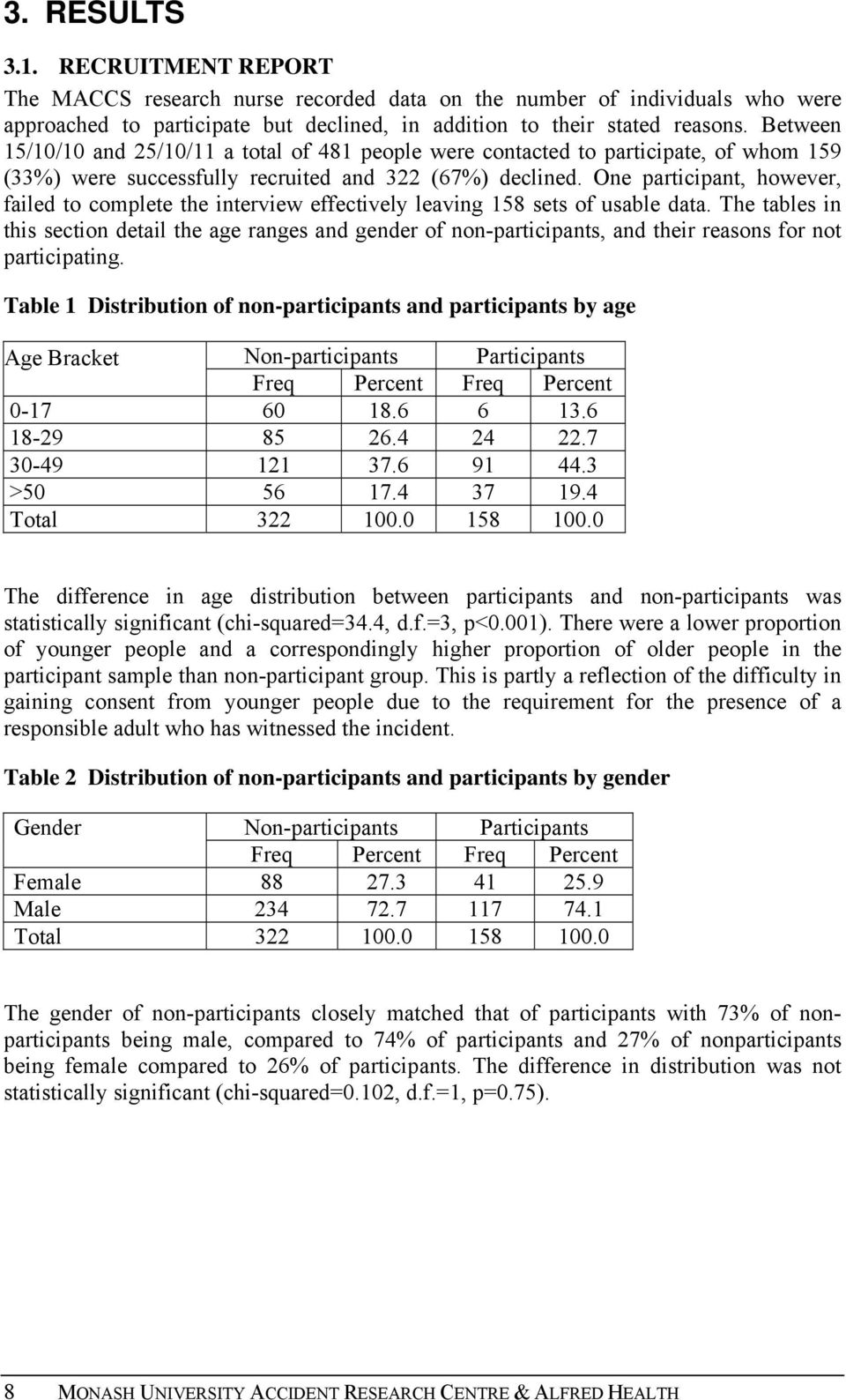
20 3. RESULTS 3.1. RECRUITMENT REPORT The MACCS research nurse recorded data on the number of individuals who were approached to participate but declined, in addition to their stated reasons. Between 15/10/10 and 25/10/11 a total of 481 people were contacted to participate, of whom 159 (33%) were successfully recruited and 322 (67%) declined. One participant, however, failed to complete the interview effectively leaving 158 sets of usable data. The tables in this section detail the age ranges and gender of non-participants, and their reasons for not participating. Table 1 Distribution of non-participants and participants by age Age Bracket Non-participants Participants Freq Percent Freq Percent > Total The difference in age distribution between participants and non-participants was statistically significant (chi-squared=34.4, d.f.=3, p<0.001). There were a lower proportion of younger people and a correspondingly higher proportion of older people in the participant sample than non-participant group. This is partly a reflection of the difficulty in gaining consent from younger people due to the requirement for the presence of a responsible adult who has witnessed the incident. Table 2 Distribution of non-participants and participants by gender Gender Non-participants Participants Freq Percent Freq Percent Female Male Total The gender of non-participants closely matched that of participants with 73% of nonparticipants being male, compared to 74% of participants and 27% of nonparticipants being female compared to 26% of participants. The difference in distribution was not statistically significant (chi-squared=0.102, d.f.=1, p=0.75). 8 MONASH UNIVERSITY ACCIDENT RESEARCH CENTRE & ALFRED HEALTH
21 Table 3 Distribution of non-participants by age and gender Gender Age range (years) Female Male Total Freq Percent Freq Percent Freq Percent > Total Table 4 Distribution of reasons for non participation Reason for non-participation Freq Percent Did not respond to phone message Did not answer phone/no phone number recorded/ wrong phone number Not interested/declined Excluded Minor with no adult present Other Outside catchment Minor with no adult witness to crash Unknown Parent declined on behalf of minor Did not respond to Total CASE DEMOGRAPHIC CHARACTERISTICS Table 5 Cyclist age by gender Age range (years) Gender Male Female Total Freq Percent Freq Percent Freq Percent 6-9 Nil Nil Nil Nil Total MONASH ALFRED CYCLIST CRASH STUDY (MACCS) 9
22 The distribution indicates that 74% of riders were male, of whom 64% were between the ages of 35 and 54. Table 6 Cyclist height by gender Height (cm) Gender Total Male Female Freq Percent Freq Percent Freq Percent Nil Nil > Nil Nil Total Table 7 Cyclist mass by gender Gender Mass (kg) Male Female Total Freq Percent Freq Percent Freq Percent Nil Nil Nil Nil Nil Nil Nil Nil Nil Nil Total Table 8 Cyclist Body Mass Index (BMI) by gender Gender BMI Male Female Total Freq Percent Freq Percent Freq Percent < > Total BMI is calculated by dividing weight in kilograms by height in metres squared. Individuals with a BMI between 25 and 30 are classed as overweight and those with a BMI of greater than 30 are classed as obese. The distribution indicates that 44% of male riders and 30% of female riders were overweight or obese. 10 MONASH UNIVERSITY ACCIDENT RESEARCH CENTRE & ALFRED HEALTH
23 79% of participants held Australian citizenship. Table 9 Summary of cyclist nationality Nationality Freq Percent Australian Other Total Cyclists were asked to indicate whether they held a licence to operate a car, truck or motorcycle. The distribution, shown in Figure 1 and Table 10, indicates that of the 145 participants aged 18 or over, nearly all (143/145=98.5%) held a car driver s licence. 160 Frequency Car Truck Motorcycle Other Licence type Figure 1 Licence types held by cyclists Table 10 Licence types held by cyclists aged 18 years and older Holds licence type Does not hold Licence type licence type Total Freq Percent Freq Percent Total Car Truck Motorcycle Other licence % of participants indicated they were free of a physical impairment that might increase crash risk, such as difficulty turning their head. 50% of participants suffered from a medical condition. Those conditions were diverse and of varying severity, including asthma, elevated cholesterol, hay fever, diabetes and depression. MONASH ALFRED CYCLIST CRASH STUDY (MACCS) 11
24 Participants were asked their opinion on whether alcohol use would negatively affect riding skills and what level of alcohol was acceptable to ride a bicycle. The results are summarised in Table 11. Table 11 Attitudes towards alcohol use and cycling What is an acceptable alcohol level Does alcohol use negatively to ride a bicycle? affect riding skills? None Under 0.05 Over 0.05 Total Yes No Unknown Total The results from Table 11 indicate that 97% (149/153) of those who responded to this question thought that alcohol negatively affects riding skills, and that 95% (145/153) of those who responded to the question thought that an alcohol level over 0.05% was unacceptable to ride a bicycle. Participants were asked how they would get home if impaired by alcohol, and were permitted to nominate more than one modality. 59% would take a taxi, 48% would use public transport and 9% percent indicated they would ride a bicycle. Participants were also asked whether the use of recreational or illegal drugs would negatively affect riding skills, to which 89% responded in the affirmative BICYCLE RIDING EXPERIENCE Proportion of cyclists Australian Other nationality Years riding Figure 2 Number of years riding in Australia by nationality Participants were asked to indicate the number of years they had ridden a bicycle in Australia. Figure 2 shows that 45% of riders holding Australian nationality had been riding between 15 and 34 years. Riders of non-australian nationality had less exposure to riding in Australia, reflecting their shorter periods of residence in Australia. 12 MONASH UNIVERSITY ACCIDENT RESEARCH CENTRE & ALFRED HEALTH
25 66% percent of participants had ridden in a country outside of Australia, with the United Kingdom (14%), France (6%) and New Zealand (6%) the most frequently cited countries. Locally, participants were asked to nominate the days of the week they usually rode. The responses are shown in Figure Number of cyclists Monday Tuesday Wednesday Thursday Friday Saturday Sunday Day of week Figure 3 Days of the week cyclists usually rode their bike Figure 4 depicts average riding frequency in the 12 months prior to the interview date. 81% of participants rode at least 2-3 times per week, with 62% of participants riding more than 3 times per week during that period Count Less than once a month Once a month Once a fortnight Weekly 2 3 times More than 3 per week times per week Frequency of riding Figure 4 Cyclist distribution by average riding frequency in preceding 12 months MONASH ALFRED CYCLIST CRASH STUDY (MACCS) 13
26 Over the preceding 12 months 65% of participants rode on average more than 50 kilometres weekly, with 41% riding more than 100 kilometres weekly. Figure 5 illustrates cyclist numbers for each distance category. Count km 31-50km km km 200km+ Unknown/can't remember Average distance ridden per week Figure 5 Average weekly kilometres ridden over preceding 12 months Participants were asked to indicate how they derived their estimate of weekly kilometres ridden. 56% of riders used an odometer while 42% used their own estimate. Asked the purpose of the majority of their riding (Figure 6), 42% nominated commuting, 27% fitness and 21% recreation. Count Recreation Commuting Fitness Training Other Figure 6 Purpose of the majority of riding Purpose of majority of riding 14 MONASH UNIVERSITY ACCIDENT RESEARCH CENTRE & ALFRED HEALTH
27 Count Road, drop bar Road, flat bar Time trial MTB Hybrid BMX Child's bike Other Bike types Figure 7 Types of bicycles cyclists felt competent to ride Participants were asked what categories of bicycle they felt competent to ride. The results, shown in Figure 7, indicate the top four responses to be mountain bikes, hybrids, flat bar road bikes and drop bar road bikes. 53% of riders indicated that they usually rode with clipless pedals, that is, pedals requiring a cleated shoe. 13% of riders belonged to a cycling club, which typically referred to an organisation that conducted regular road bike races or group rides. 32% of riders had received mentoring, either formal or informal, in bunch riding skills, a term that describes an understanding of safe riding practices when travelling on road bikes, in a group, at speed. 20% of riders had completed a rider training course, of whom 63% undertook the course at primary or secondary school. Just under half of riders (49%) believed that all riders should undertake a rider training course. Riders were asked how many crashes they had been involved in as a cyclist in the preceding five years (Figure 8). 46% had no crashes, 20% one crash, 13% two crashes and 21% more than two crashes during that period. MONASH ALFRED CYCLIST CRASH STUDY (MACCS) 15
28 Count None One Two More than two Number of crashes Figure 8 Cyclist distribution by number of bicycle crashes in the past five years 3.4. BICYCLE AND CLOTHING WORN AT THE TIME OF CRASH 63 different bicycle brands were represented among bicycles that crashed. The most frequent brands were Giant (26 bikes, 17% of total), Avanti (12 bikes, 8% of total) and Trek (8 bikes, 5% of total). The bicycle types most frequently involved in crashes were drop bar road bike (70 riders, 44%), hybrid (40 riders, 25%), mountain bikes (22 riders, 14%) and flat bar road bikes (14 riders, 9%). Figure 9 depicts the type of bicycle crashed by rider age and gender. The chart indicates that male riders in the age range who crashed on road bikes comprise 27% (43/159) of study participants. 16 MONASH UNIVERSITY ACCIDENT RESEARCH CENTRE & ALFRED HEALTH
29 Figure 9 Bicycle type crashed by rider age and gender Gender Bike Type Crashed Age Bracket 10% of bicycles were fixed wheel, that is, without gears or the capacity to freewheel. The remainder of bikes were geared. 53% of bicycles had narrow width road tyres (typically 23mm in diameter), 31% had mid-width hybrid tyres (typically around 35mm in diameter) and 14% had wide knobbly mountain bike tyres (typically greater than 50 mm in diameter). Only 1 bicycle was fitted with a foot brake, with the majority of bicycles fitted with front (96%) and rear (94%) hand brakes. 14% of bicycles lacked a top tube, that is, the frame tube connecting the seat tube (just below the seat post) to the stem (just below the handlebars). This feature has, in the past, been associated with bikes designed for females. The remainder, 86%, had top tubes. Riders were asked the main colour of their clothing from the waist up at the time of the crash. The distribution, shown in Table 12, indicates that lower visibility colours i.e. black, blue, grey and dark were worn by 41% (64/158) of participants. 3 riders (2%) wore high visibility fluoro yellow or green jerseys. High visibility colours are included in Table 12 in the rows labelled yellow and green respectively. MONASH ALFRED CYCLIST CRASH STUDY (MACCS) 17
30 Table 12 Predominant colour of cyclist clothing above the waist Colour above the waist Freq Percent Beige Black Blue Dark 1.6 Green Grey Light Maroon 1.6 Orange Pink Red White Yellow Total % of riders wore some form of reflective clothing, including reflective strips on jerseys, backpacks and shoes. Asked what they were wearing on their feet at the time of the crash, 47% indicated they were wearing cleated cycling shoes and 49% closed shoes, such as runners (Figure 10) Count Cleated cycling shoes Closed shoes Open shoes eg thongs Footwear Figure 10 Types of shoes cyclists were wearing at time of crash Other 18 MONASH UNIVERSITY ACCIDENT RESEARCH CENTRE & ALFRED HEALTH
31 Table 13 Types of eyewear worn by cyclists at the time of crash Eyewear type Frequency Percent Spectacles, prescription Contact lenses, prescription Clear glasses No eyewear Sunglasses Sunglasses with prescription lenses Other Combination, more than one response Total % of riders (147 out of 150) wore a helmet with none declining or unable to give their helmet wearing status. Only 2 of the 11 non-helmet wearing participants were female with the rest being male. Of the 9 male non-helmet wearing participants, 6 were in the age bracket years old. Of those wearing a helmet, 97% reported that the helmet met the Australian National Standard and 97% stated that it was buckled under their chin. Of those wearing a helmet 91% indicated that the helmet remained in position after the crash. 45% of those participants who were wearing helmets sustained helmet damage as a result of the crash. As a proportion of all study participants, 42% sustained helmet damage in the crash EVENTS LEADING UP TO THE CRASH AND THE ROAD ENVIRONMENT Participants were asked to indicate the main purpose of the trip they were making at the time of the crash. The results, illustrated in Figure 11, show that most riders were commuting (30%, 48/158), riding for fitness (20%, 32/158), or riding for recreation (19%, 30/158). MONASH ALFRED CYCLIST CRASH STUDY (MACCS) 19
32 Count Recreation Commuting Fitness Work related travel Trip purpose Social Training Other Figure 11 Cyclists trip purpose To assess familiarity with the crash site, riders were asked to indicate how frequently, on average over the preceding year, they had ridden on the road or path where the crash occurred. The results, illustrated in Figure 12, show that 27% (43/158) of riders had ridden at the crash site more than 3 times per week and that 17% (27/158) had ridden at the crash site between 2 and 3 times per week. Of all riders 60% (94/158) had ridden at the crash site once a week or more in the preceding year. 60 Count < once a month Once a month Once a fortnight Once a week 2-3 times a week > 3 times per week Riding frequency at crash site Figure 12 Cyclist distribution by frequency of riding at crash site Other Participants were asked to estimate their speed at the time of the crash. 63% (100/158) of riders based their response on their own estimate while 29% (45/158) based their response on a reading from their cycle odometer. The distribution, shown in Figure 13, indicates that 57% of riders were travelling at 20 kilometres per hour or greater at the time of the crash. 20 MONASH UNIVERSITY ACCIDENT RESEARCH CENTRE & ALFRED HEALTH
33 20 15 Percent Speed before crash Figure 13 Cyclist distribution by estimated speed at time of crash Participants were asked to estimate the expected travel time and distance for the trip on which the crash occurred. Distributions are show in Figures 14 and Count <=10mins 11 30mins 31mins 1hr 1 2hrs 2+hrs Trip time Figure 14 Estimated (intended) total trip time Count <2km 2 5km 6 10km 11 30km 31 49km 50+km Expected trip distance Figure 15 Expected trip distance MONASH ALFRED CYCLIST CRASH STUDY (MACCS) 21
34 Participants were asked the weather conditions at the time of the crash and their opinion on whether those conditions had contributed to the crash. Responses are shown in Figure Did not contribute Contributed 80 Count Clear Cloudy Blinding sunlight Light rain Heavy rain Strong Strong headwind crosswind Other Weather Figure 16 Cyclist crash distribution by weather conditions Participants were asked the lighting conditions at the time of the crash and their opinion on whether those conditions had contributed to the crash. Responses are shown in Figure Did not contribute Contributed 100 Count 50 0 Daylight Dusk Dawn Dark, street lights on Light conditions Figure 17 Cyclist crash distribution by light conditions 34% of riders indicated they had at least one bicycle light switched on at the time of the crash. Figure 18 shows the proportion of riders with lights on and off for crashes occurring in daylight, at dusk, at dawn and in the dark. 22 MONASH UNIVERSITY ACCIDENT RESEARCH CENTRE & ALFRED HEALTH
35 150 Lights off Lights on Count Daylight Dusk Dawn Dark, street lights on Light conditions Figure 18 Cyclist crash distribution by light conditions and use of bicycle lights Count None Front wheel Rear wheel Pedal Front frame Rear frame Other Bike reflector Figure 19 Reflectors fitted to the bicycle Participants were asked where they were riding and the surface conditions at the time of the crash. Seventy-four percent of riders were travelling on a road at the time of the crash. 13% of riders were travelling on a road in a bike lane, 55% of riders were on a road with no bike lane, and 5% of riders were on a road with a bike lane, but were not travelling in it. Twenty-five percent of riders were riding off-road (n=40). Of those, the off-road surfaces included bicycle paths shared (50.0%) and not shared with pedestrians (2.5%), footpaths (32.5%), mountain bike trails (5.0%), and other (10.0%). The surface conditions by on or off-road location are shown in Figure 20. MONASH ALFRED CYCLIST CRASH STUDY (MACCS) 23
36 Count Off road On road Dry Wet Muddy Bumpy Slippery Damp Gravel Other Surface condition Figure 20 Surface condition by location (on-road or off-road) 18% of riders indicated there was debris on the road or path surface at the crash site, with the most frequently cited debris being broken glass (3% of riders). 8% of riders, or 44% of those who encountered debris, thought that the debris was a contributing factor in their crash. At the time of the crash 41% of riders were looking at the road ahead, 5% were looking at the rear wheel of a cyclist in front, 3% at another rider and 42% other, which included, among others, cars, their own bicycle and a rear view mirror. Participants were asked if their vision was obstructed at the time of the crash, if so by what, and whether the visual obstruction had contributed to the crash. Responses are shown in Figure Did not contribute Contributed Count Vehicle Parked vehicle Building Vegetation Cyclist in front Pedestrians Bend in the road Visual obstruction Figure 21 Nature of visual obstruction by contribution to crash 51% of riders took no action to avoid the crash. A plausible assumption is that no avoidance action was possible due to a lack of awareness of the impending crash. 24 MONASH UNIVERSITY ACCIDENT RESEARCH CENTRE & ALFRED HEALTH
37 The most common avoidance actions taken were braking (26% of riders), swerving (14% of riders), steering left or right (14% of riders) and yelling (9% of riders). 9% of riders reported that a bicycle mechanical problem or malfunction contributed to the crash. A breakdown of these causes is included in section riders (42%) reported that another road user contributed to the crash occurring. The most frequent contributing road users were car drivers (39/158, 25%) and other cyclists (16/158, 10%). All frequencies are shown in Table 14. Table 14 Cyclist distribution by nature of contributory road user Road user type Freq Percent Driver Motorcyclist 1.6 Cyclist Pedestrian Other Driver & cyclist 1.6 Driver & other 1.6 Total Participants were asked to nominate whether any of a list of factors had contributed to their crash. Responses of are shown in Table 15. Table 15 Factors that contributed to the crash (self-reported) Contributing factors Freq Percent Late/in a hurry Racing Fatigued Sleepy Unwell Distracted Pressure from other road user Merging of bike lane with traffic Road works Tight corner Road layout was misleading Other Total Only 4 riders (3%) reported using a mobile phone at the time of the crash. 18 (11%) riders were using portable audio equipment at the time of the crash. 15 of those riders (10%) reported that they were listening to music at low volume. MONASH ALFRED CYCLIST CRASH STUDY (MACCS) 25
38 3.6. EVENTS OF THE CRASH The following maps show the location of the crashes for the 158 study participants Figure 22 Map of Victoria, includes crash location for all participants Figure 23 Enlarged view of main locations of crashes Figures 24 and 25 give the distribution of crashes by day of week and time of day. The data show crashes in the sample were more common on weekends and during commuting times. 26 MONASH UNIVERSITY ACCIDENT RESEARCH CENTRE & ALFRED HEALTH
39 Count Sunday Monday Tuesday Wednesday Thursday Friday Saturday Day of the week Figure 24 Number of crashes by day of the week Count am 1 2am 2 3am 3 4am 4 5am 5 6am 6 7am 7 8am 8 9am 9 10am 10 11am 11am 12pm 12 1pm 1 2pm 2 3pm 3 4pm 4 5pm 5 6pm 6 7pm 7 8pm 8 9pm 9 10pm 11pm 12am 23: Figure 25 Number of crashes by time of day Number of crashes by time of day Crash mechanisms were classified according to the Definition for Classifying Accidents (DCA) codes (see appendix). The most common crash mechanism was striking an object on a carriageway (31 riders, 20%, DCA code 166), followed by passenger and miscellaneous other (16 riders, 12%, DCA code 198), other manoeuvring (16 riders, 10%, DCA code 149), rear end collision (11 riders, 7%, DCA code 130), striking an opened car door (10 riders, 6%, DCA code 163), striking a permanent obstruction on a carriageway (7 riders, 4%, DCA code 164), losing control on a carriage way (7 riders, 4%, DCA code 174), side swipe by second parallel vehicle from same direction (6 riders, 4%, DCA code 133), hit by cross traffic at intersection (5 riders, 3%, DCA code 110) and side swipe by parallel left turning vehicle from same direction (5 riders, 3%, DCA code 137). Of the 31 riders who struck an object on a carriageway (DCA code 166), 15 struck tram tracks, 5 struck potholes, 3 struck grates, 3 struck tree branches, and one each struck another cyclist s wheel, a speed hump, a witch s hat, rubble and a lamp post base. Of the 16 crashes classified as passenger and miscellaneous other (DCA code 198), 9 were classed as bicycle malfunctions. Of the 9 bicycle malfunctions, 5 involved dropped or MONASH ALFRED CYCLIST CRASH STUDY (MACCS) 27
40 broken chains, 2 were tyre blow outs, one involved brake pads and one resulted from both front forks snapping. Of the remaining 7 crashes classified as DCA 198, 3 involved loss of balance while using cleated cycling shoes, one rider was hit by a motor vehicle while crossing a pedestrian crossing, one rider caught a wheel in tram tracks while avoiding a car doing a burnout, one rider had a bag hanging from handlebars that caught in the front wheel and one rider collided with another rider who was being pursued by police, also on bicycles, apparently for not wearing a helmet. Of the 16 crashes classified as other manoeuvring (DCA code 149), 8 lost balance, 3 were answering a mobile phone, and single riders were, respectively, attempting a mono, attempting a jump, doing a U turn and slipped on gravel, crossing an uneven footbridge and unseated after clipping a fence. Of the 11 crashes classified as rear end collision (DCA code 130), 9 riders crashed after clipping the rear wheel of a cyclist in front, one rider s bike struck that of another rider and one rider was thrown over the handlebars on braking suddenly to avoid the rear of a motor vehicle that merged and braked rapidly ahead. Of the 10 riders who struck the opened doors of parked vehicles (DCA code 163), one rider had successfully evaded a first door, but was brought down by a second door that was subsequently opened in a car ahead. Of the 7 riders who struck a permanent obstruction on a carriageway (DCA code 164), 4 struck kerbs, 2 struck speed humps and one hit a 10cm drop on a footpath. Of the 7 riders who lost control on a carriageway (DCA code 174), 4 lost balance, one s foot slipped of a wet pedal in the rain, one s sunglasses fell off causing sudden braking and loss of control and one was carrying a pilates mat that jammed between fork and wheel. Of the 6 riders side swiped by a second parallel vehicle from same direction (DCA code 133), 4 were struck by cars and 2 were struck by bicycles. Of the 5 riders hit by cross traffic at an intersection (DCA code 110), 2 were hit by cars in cross traffic, one was hit by a car at a T intersection, one was hit by a motorcycle at a T intersection and one was hit by a car at a roundabout. All five cyclists side swiped by parallel left turning vehicles from the same direction were struck by cars (DCA code 137). DCA types for on-road crashes, off-road crashes, cyclist only and cyclist-vehicle crashes are shown below. 28 MONASH UNIVERSITY ACCIDENT RESEARCH CENTRE & ALFRED HEALTH
41 Percent On road Off road DCA group Figure 26 DCA types for crashes, on-road and off-road Percent Non collision Motor vehicle DCA group Figure 27 DCA types for all crashes, cyclist-only non-collision, and cyclist-vehicle At the time of the crash, 81% of riders were moving forward, 8% of riders were cornering or turning left or right into a street and 6% or riders were swerving to avoid a collision. Participants were asked to estimate the remaining distance to the end of the intended trip at the time of the crash. Results are shown in Figure 28. MONASH ALFRED CYCLIST CRASH STUDY (MACCS) 29
42 40 30 Count <2km 2 5km 6 10km 11 30km 31 49km 50+km Distance to end of trip Figure 28 Distance to end of trip 28 riders (18%) were riding in a bunch at the time of the crash. In half of those crashes the bunch consisted of between 3 and 6 riders. Of those riding in a bunch, nearly all reported being experienced (20 riders, 71%), or having intermediate experience (7 riders, 25%) in bunch riding. 19 riders (68%) said they were familiar with most riders in the bunch, 16 riders (57%) said the lead rider was indicating hazards and 5 (18%) said a rider was changing his or her line at the time of the crash. Participants were asked to indicate the nature of the crash, that is, whether the first event involved a collision and if so, with what, and whether the collision was preceded by the cyclist losing control. A separate category allowed for loss of control with no collision. Responses are shown in Figure 29. Count Impact with object Impact with vehicle Impact with pedestrian Figure 29 Type of crash (first event) Impact with cyclist Type of crash Loss of control Loss of control, before collision no collision Other 94 cyclists (60%) were involved in single road user crashes, that is, the rider s bicycle was the only vehicle involved. 50 riders involved in single road user crashes (32% of all riders) had a low side crash in which the bicycle dropped and slid, while 27 riders involved in single vehicle crashes (17% of all riders) had a high side crash in which they were catapulted over the handlebars. Figure 30 shows whether an object was hit, and its nature, in single road user crashes. 30 MONASH UNIVERSITY ACCIDENT RESEARCH CENTRE & ALFRED HEALTH
43 50 40 Hit 1st Hit 2nd Count Nothing Curb Barrier Other Object hit Figure 30 Single road user crash, object(s) hit and order 61 cyclists (39%) were involved in multi road user crashes, which include crashes with cars, trucks, motorcycles (in all cases either moving or parked) and other bicycles. Figure 31 indicates the nature of the collision partner and the order in which it was hit by the cyclist Hit 1st Hit 2nd Count WD Bus Moving car Stationary car Parked car Cyclist Curb Other Object hit Figure 31 Multiple vehicle crash, object(s) hit and order When the participant was involved in a multi road user crash where the collision partner was a motor vehicle, a description of the movement of that vehicle was sought. The results are shown in Table 16. MONASH ALFRED CYCLIST CRASH STUDY (MACCS) 31
44 Table 16 Multiple vehicle crash, movement of other vehicle Multiple vehicle crash, movement of other vehicle Freq Percent Moving forward Accelerating in traffic lane Exiting parked position Entering parking position Turn right Turn left Merging Parked Stationary in traffic Starting from a rest position in traffic lane Overtaking vehicle Changing lanes Other Total riders had alcohol levels measured while in hospital, 22 having serum levels and 1 a breathalyser. 17 recorded a level of zero, with 3 riders recording a level of 0.05 or higher. 2 riders had missing blood alcohol levels INJURY OUTCOMES Table 17 Injury Severity Score (ISS) summary statistics ISS Gender Total Male Female Mean Median Minimum Maximum Number of cases Missing unknown Nil Nil Nil 32 MONASH UNIVERSITY ACCIDENT RESEARCH CENTRE & ALFRED HEALTH
45 Table 18 ISS range distribution by gender Gender Total ISS Range Male Female Freq Percent Freq Percent Freq Percent Nil Nil Nil Nil Nil Nil Total Table 19 Cyclist injury severity by maximum AIS (abbreviated injury scale) severity (MAIS) and gender MAIS Gender Total Male Female Freq Percent Freq Percent Freq Percent Minor (1) Moderate (2) Serious (3) Severe (4) Critical (5) Uncodeable (9) Total In total there were 11 uncodeable injuries ending in with a severity code of 9. Uncodeable injuries are excluded from this table. Table 20 Distribution of cyclists by AIS body region and injury severity AIS Body Region All AIS AIS3+ Freq Percent Freq Percent Head Face Neck Chest Abdomen/Pelvis Spine Upper Extremity Lower Extremity MONASH ALFRED CYCLIST CRASH STUDY (MACCS) 33
46 3.8. CASE STUDIES OF CRASHES OCCURRING ON BEACH ROAD As noted, Beach Road in Bayside Melbourne is used by up to recreational and training cyclists each weekend, making it one of the city s most popular cycling destinations. Its popularity and the interest that stakeholders have in ensuring safe cycling at this location, suggest utility in a focus on Beach Road crashes. Of 158 participants, 12 (8%) were involved in crashes that took place on Beach Road. Their time of day and day of the week are presented in Figure 32. Number of crashes am 5 9pm 0 Mon Tues Wed Thurs Sat Sun Day of the week Figure 32 Crashes on Beach Road by time and day of the week Below is a description of the location, mechanism, and injury outcome of the Beach Road crashes Beach Road case studies Beach Road Case Study #1 The crash involved an adult cyclist riding second in a single file group with three children on the Beach Road bike path near Tennyson Street. The rider accelerated causing his front wheel to clip the rear wheel of the rider in front. The rider crashed sustaining a fractured right collarbone, fractured right shoulder blade (scapula), fracture of the right second rib and abrasions to the right jaw region and right elbow. Beach Road Case Study #2 The rider was heading north on Beach Road near Love Street, Blackrock, was climbing and steered around a parked van. The rider then merged left but had his head down. The rider was then knocked unconscious after running into the rear of a second parked vehicle, with sufficient force to break its rear windscreen. The rider sustained a closed head injury, epistaxis (blood nose) and a chin laceration. Beach Road Case Study #3 The rider was heading north on the Beach Road bike path, approaching the South Road intersection, on a dark evening. The rider diverted through the adjacent car park, and then, on exiting, struck a curb that was difficult to see due to the lighting conditions. The rider was thrown over the handlebars, landing on outstretched hands and striking his face on a 34 MONASH UNIVERSITY ACCIDENT RESEARCH CENTRE & ALFRED HEALTH
47 concrete path. The rider sustained a laceration to the nose and abrasions to the forehead and both palms. Beach Road Case Study #4 The rider was heading south at 40kph on Beach Road approaching the South Road intersection adjacent to Milano s Restaurant. The rider was struck by a car, travelling in the opposite direction, which turned right across the rider s path to enter the Milano s car park. The rider made contact with both front and rear passenger side windows, breaking both. The rider sustained lacerations to the right shoulder, arm, and knee and abrasions to the left hand and calf Beach Road case studies bunch riders Beach Road Case Study #5 The rider was on the left in the fourth pair in a bunch of twelve cyclists riding two abreast. The bunch was heading south on Beach Road approaching the intersection with Hampton Street as the traffic lights changed from green to amber. A rear rider yelled rolling (indicating the bunch should continue through the intersection) while a front rider slowed to stop. The participant fell as the rider immediately in front fell to the left, crashing into the participant s front wheel. The participant sustained a dislocation of the right shoulder and abrasions to the right shoulder and elbow. Beach Road Case Study #6 The rider was on the right in the rear pair in a bunch of eight cyclists riding two abreast. The bunch was heading north on Beach Road, past Sims Street Sandringham, approaching the intersection with Bay Road. The traffic lights were red ahead and the bunch slowed without the rider hearing a warning. The rider was forced to brake suddenly to avoid a slowing cyclist in front, losing balance and falling as a result. The rider sustained a fracture of the left clavicle (collarbone) and abrasions to the left forearm and knee. Beach Road Case Study #7 The rider was to the left in the front pair of a bunch of fifteen cyclists riding two abreast travelling at approximately 40 kph. The bunch was heading south on Beach Road approximately one kilometre beyond the intersection with Balcombe Road. The rider s opposite in the front pair looked right and that rider s bike moved left simultaneously. The handlebars of the two riders bikes made contact and locked causing the rider to crash to the road surface and slide for approximately 10 metres. The rider sustained a fractured right collarbone and a laceration to the right elbow. Beach Road Case Study #8 The rider was the lead in a single file group of three approaching the Charman Road intersection bound away from the city. The road ascends slightly and so the rider rose from the saddle to power down on the pedals. The right shoe cleat was not fully engaged with the pedal causing that foot to slip from the pedal. The rider lost control, struck the curb to the left, then fell to the right striking his head on the road surface with a brief loss of consciousness. The rider sustained a closed head injury and abrasions to the right cheek, shoulder and hip. Beach Road Case Study #9 The rider was on the right in the third pair back of a bunch of twenty to thirty cyclists riding two abreast heading north near Red Bluff Street. The lead rider crashed as a result of MONASH ALFRED CYCLIST CRASH STUDY (MACCS) 35
48 a chain jamming during a gear change causing multiple riders to be brought down. The rider crashed after striking the rider in front who had also been brought down. The rider landed on head and right shoulder, with no loss of consciousness, sustaining a fracture of the right collarbone and abrasions to the right side of the face. Beach Road Case Study #10 The rider was in a bunch of eighteen heading north on Jacka Boulevard near the St Kilda Baths. The rider was at the rear as the bunch slowed without warning. The rider s front wheel clipped the rear wheel of the rider in front. The rider crashed sustaining abrasions to left shoulder and elbow. Beach Road Case Study #11 The rider was at the rear of a five-rider single file bunch heading away from the city approaching the Wells Road intersection. The rider was fatigued, struggling to keep pace and clipped the rear wheel of the rider in front. After crashing, the rider was hit by two riders from behind. The rider sustained a fracture to the left radial head (the radius is one of the two forearm bones contributing to the elbow joint) as well as abrasions to the left shoulder, right knee and both wrists. Beach Road Case Study #12 The rider was on the roundabout at the intersection of Beach Road and Nepean Highway, travelling in a bunch at 25kph. The rider lost control while attempting to discard a banana peel onto a nearby grass verge, striking the road surface. The rider sustained a fractured pelvis, fracture of eleven ribs on the left side with a flail segment, a left pneumothorax (punctured lung), left pulmonary contusions (bruised and bleeding lung tissue), fractured left clavicle, left cheek haematoma and bilateral knee abrasions. In summary, the mechanisms of those crashes taking place on Beach Road are diverse suggesting that a multifaceted approach to countermeasure development is appropriate. The preponderance of crashes involving bunch riders suggests this activity as an area of focus SUMMARY OF ROUNDABOUT CRASHES Stakeholders have indicated a particular interest in roundabout crashes whose details are not well described by DCA coding. Of 159 participants, 9 (6%) were involved in crashes at roundabouts. Of those participants: Two were struck by cars from the left while the rider was on the roundabout. Two were struck by cars from the left while the rider was exiting the roundabout. One caught a wheel in tram tracks while turning left on a roundabout. One lost balance travelling over a speed hump. One lost balancing attempting to disengage a cleat while stationary. One lost balance after taking both hands of the handlebars and being hit by a wind gust. 36 MONASH UNIVERSITY ACCIDENT RESEARCH CENTRE & ALFRED HEALTH
49 One was clipped by a car while crossing a pedestrian crossing adjacent to the roundabout MULTIVARIATE ANALYSES OF RISK FACTORS RELATED TO SPECIFIC OUTCOMES Safety outcomes are rarely influenced by single risk factors, but instead are generally determined by a range of factors. Multivariate regression analyses were undertaken to identify risk factors associated with a number of study outcome measures. Those outcome measures were chosen because they were of specific interest and proved amenable to analysis. To be judged amenable to analysis, an outcome variable had to have a reasonable range of responses across the cases collected. Similarly, risk factors included in the analysis also had to have a range of responses recorded within each outcome category for the analysis to produce meaningful results Safety Outcomes Modelled For convenience of analysis and to ensure a range of responses in each outcome category, safety outcomes considered in the study were dichotomised. The following safety outcome variables were considered with their dichotomised outcomes indicated: Injury severity (MAIS <2, MAIS 2+) Head injury (no head injury, head injury) Helmet use (not worn, worn) Crash type (single bicycle only, multiple vehicles) Crash location (on-road, off-road) The first two of these outcomes are considered primary outcomes because they represent the end outcome of the crash event. The other outcomes are considered intermediate as they are likely to relate to the end outcomes. The intermediate outcomes have also been included as risk factors in the models, which are described next Risk Factors Considered in the Models A range of possible risk factors was identified in the data as suitable to use in the multivariate analyses. Not all factors measured were suitable for consideration as risk factors. Those excluded had either a limited range of responses or too many missing values. Depending on the type of response, the risk factors included in the model were treated either as continuous (or scale) response variables or categorical, where a discrete set of responses was recorded. Continuous variables were re-coded as categorical where there was some expectation that the relationship with the outcome variable might be highly non-linear. The coding categories of some categorical variables were also combined in instances where categories were sparsely represented in the data and suited being collapsed together. The resulting set of variables and their status as continuous or categorical (with the categories used) are given in the Table 21. MONASH ALFRED CYCLIST CRASH STUDY (MACCS) 37
50 Table 21 Risk factors and their status as categorical or continuous Factors Variable Format Gender Categorical (Male, Female) Age bracket Categorical (<25, 25-44, 45+) Body Mass Index Continuous Nationality Categorical (Australian, Other) Cycling Experience (years) Continuous Has undertaken cycling training Categorical (Yes, No) course Type of pedals/shoes Categorical (Cleated, Other) Helmet use Categorical (Yes, No) Bicycle type crashed Categorical (road bike - drop bars; road bike flat bars; mountain bike; hybrid; other) Type of tyres Categorical (road, hybrid, knobbly, other) Trip purpose Categorical (recreation; commuting; fitness; other) Bicycle light use Categorical (Yes, No) Location of crash on/off-road Categorical (on-road, other) Riding frequency at crash site Categorical ( once a fortnight; twice a week; Other) Use of audio device Categorical (Yes, No) Cyclist s speed before crash Categorical (<20kmh; 20-29kmh; 30kmh) Expected total trip distance Categorical ( 15km, 16km) Time of crash Categorical (midnight - 6am; 6am - midday; midday - 6pm; 6pm midnight) Day of week Categorical (Sunday, Monday, etc) Separation from the bicycle Categorical (stayed with bike, other) High or low side crash Categorical (low side; high side; other) Bicycle only vehicle involved in Categorical (Yes, No) crash Weather Clear Categorical (Yes, No) Weather Cloudy Categorical (Yes, No) Form of the Statistical Model Reflecting the dichotomous nature of each of the safety outcomes analysed, multivariate logistic regression modelling was employed. The general form of the logistic model is: αβx In the model, p is the estimated probability of the outcome being modelled, for example, the probability of sustaining a head injury. The vector term βx is a linear combination of the factors included in the model where β is the vector of regression coefficients. For continuous variables in the model there will be one regression coefficient. For categorical variables there will be a regression coefficient for every level of the categorical variable except one, which is the reference level against which all others are compared. The exponent of the regression coefficient is known as the odds ratio. The odds ratio is the probability of observing the outcome being modelled divided by the probability of not observing the outcome. This is the measure of the effect of the factor in the model on the 38 MONASH UNIVERSITY ACCIDENT RESEARCH CENTRE & ALFRED HEALTH
51 outcome being modelled. The odds of the outcome related to each factor is the preferred measure of association, since it is invariant to the value of the other factors in the model, unlike the probability of the outcome itself related to the factor. Because of the large number of variables considered in each regression model, compared to the number of injured cyclist cases, it was not possible to include all the factors in each model. Instead, a forward inclusion model building process was employed. In this process each factor was considered sequentially in terms of how it improved the fit of the model based on the likelihood ratio statistic. Only factors that significantly improved the model fit were reported in the final model. Limited data also meant that only factor main effects were considered in the fitted models. Consideration of interactions between factors was generally beyond the capacity of the data Multivariate Modelling Results Injury Severity The first outcome modelled was injury severity. As outlined in section 3.4, injury severity was measured with the AIS which gauges the threat to life from each injury sustained in the crash on a 6 point scale ranging from 1 (low threat) up to 6 (virtually un-survivable). The maximum AIS (MAIS) value across all injuries was the summary measure used. Based on the distribution of MAIS in the data analysed, it was decided to dichotomise the outcome into MAIS 1 or less and MAIS 2 or greater. This gave a reasonable spread of data across the two outcomes, facilitating successful analysis. Due to the limited quantities of data on which the analysis was based, the entry criteria for factors in the forward inclusion model building process was set at 0.1 (i.e. the probability that including the factor in the model results in no real improvement in the fit of the model). This is a somewhat high value but allowed inclusion of those factors which showed some level of association with the outcome given the data quantities available. Outcomes of the model building process are summarised in Table 22. For each of the factors that was judged a significant predictor of the outcome variable it gives: the estimated model parameter and its standard error (1 for continuous factors, 1 less than the number of category levels for a categorical variable); the statistical significance of the parameter estimates (the probability the parameter is really zero given the observed data); and the exponent of the parameter along with its 95% confidence limits. As noted, the exponent of the parameter is the odds of the outcome at that variable category level relative to the reference category for that variable. Table 22 Factors predicting injury severity 95% C.I.for Model Parameter Relative EXP(B) Odds - B S.E. Sig. Exp(B) Lower Upper Bike Light Use (No vs. Yes) Weather Cloudy (No vs. Yes) Constant MONASH ALFRED CYCLIST CRASH STUDY (MACCS) 39
52 For the model of MAIS injury outcome, 2 factors were assessed as significant predictors; bike light use and the presence or otherwise of cloudy weather. Interpretation of the model parameters shows that the odds of an MAIS 2+ injury were 2.9 times greater when a bike light was not used compared to when a bike light was used. Similarly, the odds of an MAIS 2+ injury when the weather was not cloudy were 43% of that when the weather was cloudy. The bike light use factor was highly statistically significant whereas the cloudy factor was only marginally statistically significant. Assessment of model fit via the Hosmer-Lemeshow test showed the model to be an adequate fit to the data (chi-squared = 2.1, d.f.=2, p*=0.335). The model classification table also showed that 60.2% of actual injury classifications were correctly predicted by the model which is very high for a model with only 2 significant factors. Both significant factors in the model suggest cyclist visibility to be a primary determinant of injury severity in a crash since bike light use and absence of cloud are likely to increase visibility. There were insufficient numbers of cyclists wearing high visibility clothing to assess whether this aspect of cyclist visibility also affected injury severity. A limitation of the data is the absence of verification of the quality and luminance of the bike light used by the cyclist. Adequate bike light luminance may contribute to the efficacy of bike lights and cyclists conspicuity. There was some concern that the effects of bicycle light use estimated in the model might be confounded with time of day effects and location of crash effects (on versus off-road). Both these factors were forced into the model along with the two factors identified in the model building process. This did not change the parameter estimates associated with light use or cloudy weather, nor did it change the statistical significance values of these factors. There is, as a result, little evidence of confounding suggesting the result obtained for the two factors is robust. Head Injury Risk Factors associated with head injury risk were the next assessed using the multivariate logistic modelling approach. The outcome was again dichotomised into a simple indicator of whether the cyclist sustained a head injury in the crash (0 = no head injury, 1 = head injury sustained). The model was also constructed using a forward inclusion process with the entry probability criteria for significant factors set at 0.1. The results of the model fitting process are summarised in the Table 23 with results interpreted in the same manner as for the injury severity analysis. Table 23 Factors predicting head injury Relative Odds - 95% C.I.for EXP(B) B S.E. Sig. Exp(B) Lower Upper Speed Before Crash (20-29kph vs. <20kph) Speed Before Crash (30 + kph vs. <20kph) Constant MONASH UNIVERSITY ACCIDENT RESEARCH CENTRE & ALFRED HEALTH
53 Only a single factor, cyclist speed before the crash, proved to be a significant predictor of head injury risk from the modelling exercise. A cyclist travelling at 30kph or over prior to the crash was estimated to have nearly 5 times the odds of sustaining a head injury in the crash compared to a cyclist travelling below 20kph. This was statistically significant. Even cyclists travelling at 20-29kmh before the crash were estimated to have 2.7 times the risk of a head injury compared to those travelling below 20kph. Although this result was not statistically significant it suggests a trend to higher head injury risk with increasing travel speed. It should be remembered when interpreting these data, however, that the findings pertain to a group of cyclists with injuries of sufficient severity to warrant attendance at a hospital emergency department. It remains uncertain whether the findings generalise to the wider population of cyclists. It was somewhat surprising that helmet use did not emerge as a significant predictor of head injury risk in the constructed models. As a result, a separate model was fitted relating head injury risk to helmet use. This modelling showed the odds of an injured cyclist sustaining a head injury were 1.8 times higher when not wearing a helmet compared to when wearing a helmet. This result was not statistically significant due to the lack of power in the analysis caused by low rates of non helmet usage in the sample. The magnitude of the estimate suggests helmet usage might be highly effective in preventing head injury, highlighting the need for further future study of this risk factor. These results suggest that increased travel speed either changes the dynamic of the fall from the bicycle leading to a higher incidence of head strike, or that head strikes are harder and therefore more likely to cause injury. The findings suggest that head protection for cyclists becomes increasingly important with increased bicycle speed. Whether the design of bicycle helmets provides adequate protection in higher speed crashes is a fruitful avenue for further study. Helmet Use Given the suggestion of a protective effect of helmets in this study and the association between bicycle helmet wearing and injury risk observed in previous studies (Carr et al, 1995, Finch et al, 1993), the next analysis examined the factors associated with helmet usage. The low rates of non helmet use in the sample precluded, however, any meaningful analysis and so there are no results to report. Crash Type Single Bicycle versus Multi Vehicle Factors associated with single bicycle versus multi vehicle crashes (an intermediate outcome measure) were the next to be examined using multivariate modelling. Again, the outcome was dichotomised. Thus, 0=only a single bicycle involved and 1= multiple vehicles involved (including multiple bicycles) meaning the logistic regression analysis was modelling the risk of a multi vehicle crash. Table 24 presents the results of the model building process. MONASH ALFRED CYCLIST CRASH STUDY (MACCS) 41
54 Table 24 Factors predicting multi vehicle crash risk Where Riding (Off-road vs. on road) Trips At Crash Site ( Twice a week vs. Once a Fortnight) Trips At Crash Site (Other Response vs. Once Fortnight) Separated From Bike (Separated from Bike vs. Stayed With Bike) Relative 95% C.I.for Odds - EXP(B) B S.E. Sig. Exp(B) Lower Upper Constant Three factors were significant predictors of the risk of a multiple vehicle crash. The odds of a multiple vehicle crash when off-road were only 24% of that when on-road. In other words there are 4 times the odds that an on-road crash will involve multiple vehicles. The odds of a multiple vehicle crash were also 2.4 times higher when the rider separated from the bicycle compared to when he or she stayed with the bicycle. The last factor significantly associated with crash type was the number of trips made at the crash site. The odds of a multiple vehicle crash were 2.8 times higher when the cyclist rode at the crash site twice a week or more, against once a fortnight or less. Despite the model only including these three factors, the Hosmer-Lemeshow assessment of model fit showed the model of crash type to be an acceptable fit to the data (chisquared=1.99, d.f.=5, p=0.850). The classification table also showed the model correctly predicted 68% of crash types. Results of this analysis show that multiple vehicle crashes are strongly associated with onroad riding, on familiar routes, with the rider more likely to separate from the bicycle. The contribution of on-road riding is intuitive, given the greater potential for interaction with other vehicles, as is the tendency to separate from the bicycle when colliding with another vehicle. The greater odds of multi vehicle crashes on familiar routes suggest the possibility of cyclist complacency regarding unexpected actions of other road users. Those odds might also suggest that familiarity with the physical characteristics of a road lowers the risk of single vehicle crashes because the rider is better prepared to negotiate fixed hazards, such as potholes. On or Off-road Crash Location The final outcome studied using multivariate modelling was whether the crash occurred on or off-road. Logistic modelling to identify risk factors associated with crash location was similarly used with the outcome dichotomised as 0=on-road and 1=off-road. Hence, the 42 MONASH UNIVERSITY ACCIDENT RESEARCH CENTRE & ALFRED HEALTH
55 model was predicting the risk of an off-road crash. Results of the model building process are given in Table 25. Table 25 Factors predicting risk of off-road crash Relative 95% C.I.for Odds - EXP(B) B S.E. Sig. Exp(B) Lower Upper Tyre Type (Hybrid vs. Road Tyre) Tyre Type (Knobby vs. Road Tyre) Tyre Type (Other vs. Road Tyre) Lights On (No vs. Yes) Speed Before Crash (20-29kph vs. <20 kph) Speed Before Crash (>=30kph vs. <20 kph) Number Vehicles Involved (>=1 Other Vehicle vs. Only My Bike) Constant Four factors were statistically significant predictors of the probability of a crash occurring off road. The first was tyre type. Respectively, hybrid and knobby tyres had 3.4 and 2.1 times the odds of being associated with an off-road crash compared to road tyres. There were also 5.9 times the odds that a crash involving a cyclist not using lights would be off road. There were only 26% of the odds that an off-road bicycle crash would involve other vehicles compared to an on-road crash. The odds of the crash involving a travel speed above 20kph were over 80% lower for off-road crashes compared to those on-road. The resulting model was assessed to be a good fit to the data (chi-squared=6.4, d.f.=8, p=0.602) and correctly predicted 85.2% of the crash locations. In summary, factors associated with a cyclist crash occurring off-road were use of non road tyres, no bicycle lighting, and low travel speed. Off-road crashes were also 4 times as likely to involve only the cyclist and no other vehicle, including other bicycles. These factors suggest that off-road bicycle crashes involve cyclists predominantly using the correct tyres and are not the result of problematic interaction with other road users. Rather, they are likely the result of environmental factors such as poor surfaces or the inability of the cyclist to accommodate the prevailing conditions. In contrast, on-road crashes are much more likely to involve interactions with other road users. This finding signals that ability to read traffic and to accommodate the actions of other road users are potentially more important for improving on-road cyclist safety. The finding that failure to use lights was associated with off-road crash location and the fact that off-road location was more likely to involve only the cyclist, suggests the utility of light use off-road is to illuminate the environment rather than to enhance cyclist visibility. This conclusion can only be speculative however, as the survey instrument did not examine MONASH ALFRED CYCLIST CRASH STUDY (MACCS) 43
56 the properties of the lights used, that is, whether they were designed for illumination or enhancing cyclist visibility. An alternative explanation is that cyclists deem the relative paucity of other vehicles in off-road locations as reason to be less cautious about bicycle light use. 44 MONASH UNIVERSITY ACCIDENT RESEARCH CENTRE & ALFRED HEALTH
57 4. CONCLUSIONS MACCS demonstrates the feasibility of extending in-depth data gathering techniques, currently utilised in research on automotive safety, to investigate bicycle crash causation and outcomes. MACCS provides a template for cycle safety study design that, it is hoped, will contribute to a uniform approach in this domain across Australia and internationally. MACCS also offers a cross sectional snapshot of region specific data on cycle crashes at a point in time that will enable future comparative analyses. Most important, MACCS represents an additional resource for those charged with the design and implantation of measures to improve cycling safety. MACCS has generated a number of important findings. The use of bicycle lights was found to significantly predict lower injury severity resulting from a crash, independent of time of day. Absence of cloudy weather at the time of the crash also predicted lower injury severity. Together, these findings suggest that increased cyclist visibility plays a preeminent role in mitigating the gravity of injury outcomes from bicycle crashes. A plausible explanation is that, in multi user crashes, greater cyclist visibility allows more time for the various collision partners to take evasive action, such as braking or swerving, lessening impact severity. Increased cyclist speed was found to significantly predict greater incidence of head injury, particularly in those travelling above 30 kilometres per hour. The finding is intuitive in that higher speeds diminish opportunity for defensive measures, such as falling on outstretched arms. In addition, head strikes occur with greater force as speed increases. This observation is salient for the debate on the utility of helmet wearing, suggesting that helmet use gains increasing importance with greater cyclist speed. The trend for helmet use to predict lesser head injury incidence is also pertinent. The finding that 45% of helmet wearers (who comprised 90% of study participants) sustained helmet damage from a head strike reinforces the high frequency of this injury mechanism in the study population. Should future research generalise this finding to the wider cyclist population, the issue of head injury prevention presents as one for serious focus. Cyclists who rode at the crash site more than twice a week were significantly more likely to be involved in multi road user crashes than were those who rode at the location less than once a fortnight. This finding raises the possibility that cyclists who are familiar with particular routes may lower their guard in relation to the dangers of interaction with other road users. Safety messages emphasising the risks of cyclist complacency on familiar, heavier traffic routes may yield benefit. Other data trends within the study sample included a preponderance of male gender, middle age, road bike use, ride frequency at least 2-3 times weekly, and ride purpose of commuting, fitness or recreation. These characteristics may simply reflect the dominant traits of the broader cycling population within the study catchment. Alternatively, these factors may be over-represented in our study sample, a determination that awaits future study. In either case it may prove beneficial for future counter measure development to take these findings into account. While much of the included data represent trends rather than statistically significant findings MACCS provides a useful insight into the crash characteristics and injury outcomes of cyclists presenting at two inner suburban Melbourne emergency departments. These insights should both inform those charged with the design and implementation of MONASH ALFRED CYCLIST CRASH STUDY (MACCS) 45
58 bicycle safety countermeasures and act as a springboard for future research to examine the many pivotal questions that remain unanswered. 46 MONASH UNIVERSITY ACCIDENT RESEARCH CENTRE & ALFRED HEALTH
59 5. REFERENCES Australian Bureau of Statistics Regional Population Growth. Victoria [accessed 22 may 2012] Available at: es ?opendocument&tabname=summary&prodno=3218.0&issue= &num=&view=#paralink4 Austroads The Australian National Cycling Strategy Sydney: Austroads Ltd. Bicycle Victoria Beach Road Popularity Soars. [Accessed June ] Available at: Carr, D., Skalova, M. & Cameron, M Evaluation of the bicycle helmet wearing law in Victoria during its first four years, Monash University Accident Research Centre, Report No. 76 Harman, B Bicycle Safety and Law Enforcement. Australasian Road Safety Research Policing and Education Conference. Melbourne. Finch, C. F., Newstead, S. V., Cameron, M. H. & Vulcan, A. P Head Injury reductions in Victoria two years after introduction of mandatory bicycle helmet use, Monash University Accident Research Centre, Report No. 51 VicRoads "CrashStats user guide." [Accessed 19 June 2012] Available at: Victorian Government Department of Transport Victorian Cycling Strategy. Melbourne. MONASH ALFRED CYCLIST CRASH STUDY (MACCS) 47
60 6. APPENDIX A DEFINITIONS FOR CLASSIFYING ACCIDENTS (DCA) CHART Source: VicRoads (2008) 48 MONASH UNIVERSITY ACCIDENT RESEARCH CENTRE & ALFRED HEALTH
61 MONASH ALFRED CYCLIST CRASH STUDY (MACCS) 49
Characteristics of High Injury Severity Crashes on 80 110 km/h Rural Roads in South Australia
 Characteristics of High Injury Crashes on 80 110 km/h Rural Roads in South Australia, J. R. R. Centre for Automotive Safety Research, University of Adelaide, SOUTH AUSTRALIA, 5005 email: [email protected]
The State Government recognises. areas, and regulates bicycle
 cycling & THE LAW rules introduction for roads The State Government recognises The cycling South Australian as a legitimate Road Traffic form of Act including transport the Australian and an increasingly
a family guide to January 2009 Bike Ed
 a family guide to January 2009 Bike Ed Childhood Development e program was developed by ycle education instructor s of programs available visit: gresources/health VRPIN 02026 5.08 a bicycle education program
BIKE AND PEDESTRIAN CRASH SURVERY
 This survey includes questions regarding biking activity, accidents, and injuries, as well as the answer options provided by the Nashville MPO. Introduction 1. Have you ridden a bicycle within the past
Department of Transport. Cycling Rules
 Department of Transport Cycling Rules 2 Contents Definition of a bicycle Standard requirements Power-assisted pedal cycles Carrying or towing loads The rider, passenger and helmets Rules affecting cycling
Road Safety Authority Provisional Review of Road Crashes 2013
 A review of 2013 fatal collision statistics December 31 st 2013 The following report summarises the main trends that have emerged in 2013. This has been prepared by the Road Safety Authority following
Using statistical modelling to predict crash risks, injury outcomes and compensation costs in Victoria.
 Using statistical modelling to predict crash risks, injury outcomes and compensation costs in Victoria. Renee a, Michael Nieuwesteeg a, Amanda Northrop a, Cameron Lucas b, Daniel Smith b a. Transport Accident
Cycling Safety Action Plan 2014 2016
 Cycling Safety Action Plan 2014 2016 May 2014 CONTENTS 1. OVERVIEW OF CYCLING ROAD TRAUMA IN NSW LOCATION SERIOUS INJURIES WHEN TYPES OF CRASHES WHO HELMET USAGE SUMMARY OF NSW CYCLING ROAD TRAUMA 3 3
Bicycle Safety Quiz Answers Parental Responsibilities
 Bicycle riding is a great way to get into shape and enjoy the outdoors. To remain safe on Illinois roads, it is important to follow the same traffic safety laws that govern vehicle drivers. No amount of
ATSB RESEARCH AND ANALYSIS REPORT ROAD SAFETY. Characteristics of Fatal Road Crashes During National Holiday Periods
 ATSB RESEARCH AND ANALYSIS REPORT ROAD SAFETY Characteristics of Fatal Road Crashes During National Holiday Periods July 2006 ATSB RESEARCH AND ANALYSIS REPORT ROAD SAFETY Characteristics of Fatal Road
SAFE CYCLING GUIDE. 6th Edition
 SAFE CYCLING GUIDE 6th Edition BEFORE SETTING OUT A WELL-MAINTAINED BICYCLE is key A Check tire pressure B Check that the chain does not slip C Check the brakes D Check lights and reflectors: 3 4 1 5 2
Cycle Safety. Some tips on safer cycling. Údarás Um Shábháilteacht Ar Bhóithre Road Safety Authority
 Cycle Safety Some tips on safer cycling Údarás Um Shábháilteacht Ar Bhóithre Road Safety Authority Be safe For further information on safe cycling, please look at the Rules of the Road website at www.rulesoftheroad.ie
Bicycle riding is a great way to get into shape
 Bicycle riding is a great way to get into shape and have fun. To remain safe on Illinois roads, it is important to follow the same traffic safety laws that govern vehicle drivers. No amount of bicycle
A Guide to Safe Bicycling in Hawai i
 A Guide to Safe Bicycling in Hawai i Sharing the Road: A Guide to Safe Bicycling in Hawai i What Motorists & Bicyclists Should Know Everyone has the right to be safe on Hawai i s roads. Law of the Splintered
How To Know If A Cyclist Is Safe
 ATSB ROAD SAFETY REPORT July 2006 Deaths of cyclists due to road crashes ATSB ROAD SAFETY REPORT July 2006 Deaths of cyclists due to road crashes Published by: Australian Transport Safety Bureau Postal
SAFE CYCLING GUIDE. 7th Edition
 SAFE CYCLING GUIDE 7th Edition BEFORE SETTING OUT A Check tire pressure B Check that the chain does not slip C Check the brakes D Check lights and reflectors: 1 A WELL-MAINTAINED BICYCLE is key 3 4 5 Adjust
Accident configurations and injuries for bicyclists based on the German In-Depth Accident Study. Chiara Orsi
 Accident configurations and injuries for bicyclists based on the German In-Depth Accident Study Chiara Orsi Centre of Study and Research on Road Safety University of Pavia State of the art Vulnerable road
Deaths/injuries in motor vehicle crashes per million hours spent travelling, July 2008 June 2012 (All ages) Mode of travel
 Cyclists CRASH STATISTICS FOR THE YEAR ENDED 31 DECEMBER 212 Prepared by the Ministry of Transport CRASH FACTSHEET November 213 Cyclists have a number of risk factors that do not affect car drivers. The
Cycle safety. Monograph 17. Cycle safety: a national perspective. Cycle helmets
 Monograph 17 Cycle safety ISSN: 1444-3503 ISBN: 1 877071 85 4 Cycle safety: a national perspective Cycling is an important form of transport and recreation for many Australians. It is accessible to a wide
the Ministry of Transport is attributed as the source of the material
 Disclaimer All reasonable endeavours are made to ensure the accuracy of the information in this report. However, the information is provided without warranties of any kind including accuracy, completeness,
Speeding. Probability of death at different impact speeds
 Speeding CRASH FACTSHEET 2012 CRASH STATISTICS FOR THE YEAR ENDED 31 DECEMBER 2011 Prepared by the Ministry of Transport In this fact sheet speeding is defined as driving too fast for the conditions. The
Inquiry into Aspects of Road Safety in Australia
 27 February 2015 Inquiry into Aspects of Road Safety in Australia The Amy Gillett Foundation is pleased to provide you with our submission to the Inquiry into Aspects of Road Safety in Australia. Australia
PREDICTING THE USED CAR SAFETY RATINGS CRASHWORTHINESS RATING FROM ANCAP SCORES
 PREDICTING THE USED CAR SAFETY RATINGS CRASHWORTHINESS RATING FROM ANCAP SCORES by Stuart Newstead and Jim Scully April 2012 Report No. 309 Project Sponsored By The Vehicle Safety Research Group ii MONASH
Bicycle Safety Enforcement Action Guidelines
 Introduction Bicycle Safety Enforcement Action Guidelines People ride bicycles for many different reasons: fitness, recreation, or for transportation. Regardless of the reason for riding, bicyclists young
Bicycle Riding. WHAT ARE the. One Final Note... It is against the law to ride a bicycle under the influence of alcohol and/or drugs. (21200.
 One Final Note... It is against the law to ride a bicycle under the influence of alcohol and/or drugs. (21200.0 VC) Bicycle Riding WHAT ARE the CALIFORNIA HIGHWAY PATROL CHP 909 (12/11) OPI 013 94 75015
Fatality Claim Form. South Australia Compulsory Third Party (CTP)
 South Australia Compulsory Third Party (CTP) Fatality Claim Form This form is to be completed by any person who is claiming compensation as a result of a person s death in a motor vehicle accident (please
YOUR GUIDE TO INTRA-TOWN CYCLING
 YOUR GUIDE TO INTRA-TOWN CYCLING Content 04 Introduction 05 Attire Before you set off 06 Safety Checklist for Bicycle 07 Maintenance 08 Preventing Bicycle Theft What to look out for on the way 10 Signs
A Scientific Study "ETAC" European Truck Accident Causation
 A Scientific Study "ETAC" European Truck Accident Causation Executive Summary and Recommendations 1 Introduction 1.1 The project and its objectives Currently, only limited statistics are available regarding
TEST ON Driving Safely Among Bicyclists and Pedestrians
 TEST ON Driving Safely Among Bicyclists and Pedestrians Next you will take a 16 question test about driving safely among bicyclists and pedestrians. Please take out a sheet of paper to mark down and score
the Ministry of Transport is attributed as the source of the material
 Disclaimer All reasonable endeavours are made to ensure the accuracy of the information in this report. However, the information is provided without warranties of any kind including accuracy, completeness,
Investigation of bicycle accidents involving collisions with the opening door of parking vehicles and demands for a suitable driver assistance system.
 Investigation of bicycle accidents involving collisions with the opening door of parking vehicles and demands for a suitable driver assistance system. M. Jänsch, D. Otte, H. Johannsen Abstract Vulnerable
BMX bicycles: accident comparison with other models
 Archives of Emergency Medicine, 1985, 2, 209-213 BMX bicycles: accident comparison with other models J. WORRELL Senior Registrar, Accident and Emergency Department, Queen Alexandra Hospital, Portsmouth,
Young drivers where and when are they unsafe: analysis of road accidents in Great Britain 2000 2006
 Young drivers where and when are they unsafe: analysis of road accidents in Great Britain 2000 2006 Original research by Email: [email protected] August 2008 Copyright the IAM Motoring Trust Extracts
BIKE BASICS. The AAA Guide to a Great Ride
 BIKE BASICS The AAA Guide to a Great Ride FREEDOM ON WHEELS Bicycles can be considered symbols of independence and freedom. They are also fun, providing riders a greener, healthier form of transportation.
How To Know If A Motorcyclist Is Safe
 Motorcyclists CRASH FACTSHEET November 2013 CRASH STATISTICS FOR THE YEAR ENDED 31 DECEMBER 2012 Prepared by the Ministry of Transport In 2012, 50 motorcyclists 1 died and a further 1,138 were injured
How To Understand The Safety Of A Motorcycle
 Disclaimer All reasonable endeavours are made to ensure the accuracy of the information in this report. However, the information is provided without warranties of any kind including accuracy, completeness,
Maryland s Motorcycle Crash Picture
 Maryland s Motorcycle Crash Picture Cindy Burch University of Maryland, Baltimore National Study Center for Trauma and EMS Maryland Center for Traffic Safety Analysis Challenges Motorcycle safety is not
Contributory factors to road accidents
 Contributory factors to road accidents Jonathan Mosedale, Andrew Purdy and Eddie Clarkson, Transport Statistics: Road Safety, Department for Transport Introduction The STATS19 national system of collection
Accidents with Pedestrians and Cyclists in Germany Findings and Measures
 Accidents with Pedestrians and Cyclists in Germany Findings and Measures Siegfried Brockmann Unfallforschung der Versicherer (UDV) May 7th, Geneva 2 Content 2 Accident situation in Germany based on National
Pedestrian and Bicycle Crash Data Analysis: 2005-2010
 MICHIGAN DEPARTMENT OF TRANSPORTATION Pedestrian and Bicycle Crash Data Analysis: 2005-2010 FINAL REPORT Prepared by: T.Y. Lin International and Western Michigan University 4/3/2012 TABLE OF CONTENTS List
"The Hurt Report" (AKA "Motorcycle Accident Cause Factors and Identification of Countermeasures")
 "The Hurt Report" (AKA "Motorcycle Accident Cause Factors and Identification of Countermeasures") A brief summary of the findings is listed below. To order the full report, contact: National Technical
SAFETY PROCESS. Martin Small
 SAFETY PROCESS Martin Small With a broad transport policy background including extensive work in the maritime sector, Martin Small has been working in road safety for five years, in a variety of roles
TRANSPORTATION POLICY
 TRANSPORTATION POLICY Contents 1 NQS... 2 2 National Regulations... 2 3 Aim... 2 4 Related Policies... 2 5 Implementation... 2 6 General Transport Guidelines... 4 7 Guidelines for Seatbelts and Restraints...
New York Bicycling Pocket Guide
 New York Bicycling Pocket Guide Prepared by the New York Bicycling Coalition About This Guide Getting around by bike is good for one s health and wallet, and the environment. But many people aren t sure
New Hampshire State Laws Pertaining To Bicycles. CHAPTER 230 STATE HIGHWAYS Planning and Laying Out Bicycle Routes
 New Hampshire State Laws Pertaining To Bicycles Current as of April 21, 2009; most but not all laws mentioning bicycles are included below. For current laws, see http://www.gencourt.state.nh.us/rsa/. Compiled
ANCIS. The Australian National Crash In-depth Study. David Logan (MUARC)
 ANCIS The Australian National Crash In-depth Study David Logan (MUARC) What is ANCIS? Study of modern vehicle real world crash performance and occupant injuries Criteria: Occupants of crashed vehicles
How valid are Motorcycle Safety Data?
 How valid are Motorcycle Safety Data? Narelle Haworth 1 (Presenter) 1 Monash University Accident Research Centre Biography Dr Narelle Haworth began working at the Monash University Accident Research Centre
Riding Risk Assessment and Pre-Ride Preparation
 North Cheshire Clarion Generic Assessment Road Rides NCC Assessment Introduction Firstly, thank you very much for taking the time to read this document. It goes without saying that looking out for one
Level 2 Award in Safe Driving at Work
 Level 2 Award in Safe Driving at Work Student notes (sample) www.britsafe.org Membership Training Qualifications Audit and Consultancy Audit and Policy Consultancy and Opinion Policy Awards and Opinion
C Grade Licence Examination Written and Oral questions Study Master List
 C Grade Licence Examination Written and Oral questions Study Master List Prior to Examination: Candidates are encouraged to either view the live copy of the current Manual or obtain all amendments to the
Traffic Safety Basic Facts 2012
 Accident Causation National accident databases mostly focus on crash circumstances so in-depth investigations are required to provide a more detailed analysis of causation. This Fact Sheet presents basic
North Carolina. Bicycle Crash Facts 2008-2012. Prepared for
 North Carolina Bicycle Crash Facts 2008-2012 Prepared for The North Carolina Department of Transportation Division of Bicycle and Pedestrian Transportation Prepared by The University of North Carolina
ITARDAInstitute for Traffic Accident
 ITARDAInstitute for Traffic Accident Research and Data Analysis ( 財 ) 交 通 事 故 総 合 分 析 センター ITARDA INFORMATION No. 2011 88APRIL Fatality rate (%) 0 2 4 6 Head-on 0.70% Rear-end 4.7% Rear-end 0.70% Crossing
New Zealand all-age mandatory bicycle helmet law
 New Zealand all-age mandatory bicycle helmet law A public health and safety disaster New Zealand is one of only three countries in the world with national all-age mandatory bicycle helmet laws, the others
RISKS & THE LAW. October 2014. Trang Tran Senior Associate Mariese Bytschkow Senior Law Clerk
 RISKS & THE LAW October 2014 Trang Tran Senior Associate Mariese Bytschkow Senior Law Clerk OUR SERVICES Work Related Injuries Road Accident Injuries Medical Negligence Asbestos Diseases Superannuation
OREGON TRAFFIC ACCIDENT AND INSURANCE REPORT
 DMV OREGON TRAFFIC ACCIDENT AND INSURANCE REPORT Tear this sheet off your report, read and carefully follow the directions. ONLY drivers involved in an accident resulting in any of the following MUST file
Application for Benefits under the Motor Accidents (Compensation) Act
 Application for Benefits under the Motor Accidents (Compensation) Act Application for Benefits The MAC Act provides a wide range of benefits to compensate people injured in a motor vehicle accident for
TOTAL NUMBER OF DEATHS DUE TO LEVEL CROSSING ACCIDENTS
 LEVEL CROSSING ACCIDENT FATALITIES The purpose of this publication is to provide an overview of level crossing fatalities in Australia. The information provided is based on unpublished data obtained from
Accident risk, behaviour and habits of older cyclists
 Faculty of Science, Department of Psychology, Assessment and Intervention Accident risk, behaviour and habits of older cyclists Carmen Hagemeister Groningen, 29 th August, 2012 Overview Aim of the study
New Queensland motorcycle safety campaign Be aware. Take care. Survive.
 New Queensland motorcycle safety campaign Be aware. Take care. Survive. The Department of Transport and Main Roads is committed to addressing the safety of motorcyclists. Motorcycle riders and pillions
Motor Vehicle Collisions in Eastern Ontario. Supplement to the Eastern Ontario Health Unit Injury Report
 Motor Vehicle Collisions in Eastern Ontario Supplement to the Eastern Ontario Health Unit Injury Report September 8, 2009 For more information: Eastern Ontario Health Unit www.eohu.ca Bureau de santé de
Safety Evidence for Bicycling
 Photo: Boegh (Flickr) Cycling in Cities Research Program School of Population & Public Health The University of British Columbia Faculty of Health Sciences Simon Fraser University Driving near bicyclists
Reported road accidents involving young car drivers: Great Britain 2011
 Reported road accidents involving young car drivers: Great Britain 211 Road Accident Statistics Factsheet No. 1 August 212 Introduction This factsheet presents summary information relating to the casualties
A Guide to Accident Prevention on Motorcycles
 A Guide to Accident Prevention on Motorcycles SEE me now? Always ride with your dipped headlight on DAY AND NIGHT Avoiding the 5 most common motorcycle accidents... 1 Collisions at Junctions... These can
Motor Accident Personal Injury Claim Form
 Motor Accident Personal Injury Claim Form HAVE YOU BEEN INJURED IN A MOTOR VEHICLE ACCIDENT? If you have been injured in a motor vehicle accident in New South Wales, you may be able to access benefits
Community. Bike Law. A bike rider s guide to road rules in Victoria
 Community Bike Law A bike rider s guide to road rules in Victoria A bike rider s guide to road rules in Victoria This guide outlines the essential road rules you need to know as a bike rider. Whether you
V. Martínez Ruiz, E. Jiménez Mejías, C. Amezcua Prieto, J.D. Luna del Castillo, P. Lardelli Claret, J.J. Jiménez Moleón
 V. Martínez Ruiz, E. Jiménez Mejías, C. Amezcua Prieto, J.D. Luna del Castillo, P. Lardelli Claret, J.J. Jiménez Moleón Department of Preventive Medicine and Public Health University of Granada No conflict
Claim form Motor Vehicle
 Claim form Motor Vehicle The Company does not admit Liability by the issue of this Form. It is issued to enable the Insured to lodge their written statement of claim. CLAIM NUMBER OFFICE USE ONLY Claim
DMV. OREGON TRAFFIC ACCIDENT AND INSURANCE REPORT Tear this sheet off your report, read and carefully follow the directions.
 OREGON TRAFFIC ACCIDENT AND INSURANCE REPORT Tear this sheet off your report, read and carefully follow the directions. ONLY drivers involved in an accident resulting in any of the following MUST file
A Review of Serious Casualty Motorcycle Crashes in Tasmania
 A Review of Serious Casualty Motorcycle Crashes in Tasmania D epart ment of Infrastructure, Energy and Resources A Review of Serious Casualty Motorcycle Crashes in Tasmania Traffic and Infrastructure Branch
Operations ODO 27.0 Traffic Management
 SES OPERATIONS DOCTRINE OPERATIONAL DIRECTIVES Operations ODO 27.0 Traffic Management Valid from 28/01/2014 Version 3.0 1. PURPOSE To outline requirements relating to the conduct of traffic management
Oxfordshire Local Transport Plan 2011-2030 Revised April 2012. Objective 3 Reduce casualties and the dangers associated with travel
 6. Road Safety Objective 3 Reduce casualties and the dangers associated with travel Road safety continues to be a core priority both nationally and locally reflecting the very high human and other costs
Incident Form. Work Health and Safety
 Work Health and Safety Incident Form The form contained in this folder must be used to record all incidents which may have arisen from Australia Post operations when: any person (i.e., a worker, a member
Motorcycle Crash Patterns for Riders aged 17-25 in NSW. Christie, R., RCSC Services Pty Ltd, & Harrison, W., Eastern Professional Services Pty Ltd
 Motorcycle Crash Patterns for Riders aged 17-25 in NSW Christie, R., RCSC Services Pty Ltd, & Harrison, W., Eastern Professional Services Pty Ltd Abstract The Motor Accidents Authority of NSW (MAA) funded
MOTOR VEHICLE COLLISION/PERSONAL INJURY QUESTIONNAIRE
 MOTOR VEHICLE COLLISION/PERSONAL INJURY QUESTIONNAIRE Please answer all questions completely: 1. Your name and address: 2. Phone Number: 3. Please describe the collision in your own words: 4. Where did
Pilot Staff Bike Share Project. Induction Notes
 Pilot Staff Bike Share Project Induction Notes www.capetown.gov.za/travelsmart [email protected] Contents Contents... i Introduction.... 1 How do I get access to the bicycles?... 1 Location
Welsh Fire and Rescue Services Road Safety Strategy 2015-2020
 All Wales Call Challenge Welsh Fire and Rescue Services Road Safety Strategy 2015-2020 GWASANAETH TÂN AC ACHUB Canolbarth a Gorllewin Cymru Mid and West Wales FIRE AND RESCUE SERVICE 2 Contents Executive
Going SoloTM. A resource for parents of P-plate drivers
 Going SoloTM A resource for parents of P-plate drivers P Going Solo a resource for parents of P-plate drivers, has been produced by the Monash University Accident Research Centre (MUARC) with the support
The characteristics of fatal road accidents during the end of year festive period
 The characteristics of fatal road accidents during the end of year festive period 1994-2003 March 2004 Traffic Management and Road Safety Unit Ministry of Public Infrastructure, Land Transport and Shipping
Commentary Drive Assessment
 Commentary Drive Assessment Time start: Time finish: Candidate s Name: Candidate s Email: Date of Assessment: Location: Candidate s Supervisor: Supervisors Contact Number: Supervisors Email: Assessor s
THE CHARTERED INSTITUTE OF LEGAL EXECUTIVES UNIT 3 THE LAW AND PRACTICE RELATING TO ROAD TRAFFIC ACCIDENTS *
 15 January 2015 Level 4 THE LAW AND PRACTICE RELATING TO ROAD TRAFFIC ACCIDENTS Subject Code L4-3 THE CHARTERED INSTITUTE OF LEGAL EXECUTIVES UNIT 3 THE LAW AND PRACTICE RELATING TO ROAD TRAFFIC ACCIDENTS
Motorcycle and Scooter Safety Programs
 Motorcycle and Scooter Safety Programs Motorcycle and Scooter Safety Programs February 2011 Victorian Auditor-General s Report Telephone 61 3 8601 7000 Facsimile 61 3 8601 7010 www.audit.vic.gov.au 2010-11:21
1. Injured Persons Position in in Vehicle (PLEASE PRINT NEATLY USING CAPITAL LETTERS)
 Common Law Law Claim Claim Form Form Please answer all all questions and and tick tick boxes boxes where where appropriate. Leaving Leaving a question a question blank blank may may delay delay the processing
Trends and issues Lake Te Koutu walkway, Cambridge
 27 Trends and issues Lake Te Koutu walkway, Cambridge 3 Trends 3.1 Journey to work Over the past two to three decades there has been a significant increase in private vehicle ownership and usage and a
Child Cycling Injury Prevention
 Child Cycling Injury Prevention Simone Randle Injury Prevention Advisor [email protected] Cycling fatalities, 2003-07 All child cyclist deaths: 12 deaths: 11 boys, 1 girl 7 deaths amongst boys 10-14
FACT SHEET 5 Road Safety. Takapuna Grammar School International Department
 If you own a car, you should obtain at least third party insurance. A reminder that the roads outside of the main highways can be narrow and windy. You must drive really carefully. Takapuna Grammar School
1. The consultation seeks views on the vision, targets and measures for improving road safety in Great Britain for the period beyond 2010.
 Executive Summary 1. The consultation seeks views on the vision, targets and measures for improving road safety in Great Britain for the period beyond 2010. 2. We have made good progress in reducing road
 Think Before You Drive is a global road safety initiative of the FIA Foundation, Bridgestone Corporation and motoring clubs worldwide. FIA Foundation for the Automobile and Society www.fiafoundation.com
Road crashes involving bike riders in Victoria, 2002 2012: an Amy Gillett Foundation report
 Road crashes involving bike riders in Victoria, 2002 2012: an Amy Gillett Foundation report By Megan Garratt, Marilyn Johnson and Jacinta Cubis July 2015 Report Documentation Page Title: Road crashes involving
Make the right choice. Vehicle safety advice for older drivers
 Make the right choice Vehicle safety advice for older drivers Why is it important to buy a safe car? Older drivers are the most likely of all driver age groups to sustain serious or life threatening injuries