
Asbestos: The current situation in Europe
|
|
|
- Betty Williamson
- 10 years ago
- Views:
Transcription
1 1 Asbestos: The current situation in Europe Laura, Salvatori Tillinghast Towers Perrin 71 High Holborn London WC1V 6TH United Kingdom Tel no: Fax no.: Alessandro, Santoni Tillinghast Towers Perrin Via Boezio 6 Rome Italy Tel.no: Fax no: +39 (02) [email protected] Darren, Michaels Tillinghast Towers Perrin 71 High Holborn London WC1V 6TH United Kingdom Tel no: Fax no.: [email protected]
2 2 ABSTRACT: Although the worldwide insurance market is used to thinking of asbestos as a US problem, it was used widely around the world. It is clear that European-sourced asbestos costs are now emerging as social and insurance issues. There are increasing numbers of academic and governmental studies of the problem, as well as relevant legal developments, both within individual countries and for the European Union. We will concentrate our analysis on the following countries: UK, France, the Netherlands, Italy and Germany. Our analysis will focus on: source of claims, the legal environment, emergence (how many claims have been reported/paid to date), exposure statistics, what is indemnified, who is paying, and how much on average these claims cost. Where possible we have tried to provide comparable data. However, there are significant differences between the legal and data compilation systems of the various countries. Keywords: Latent claims, asbestos, occupational diseases, crocidolite, amosite, chrysolite, asbestosis, mesothelioma, pleura damages, Europe. INTRODUCTION Overview Asbestos is a natural occurring silicate that has often been referred to as the miracle mineral because of its flexibility, abundance, and resistance to fire and corrosion. It occurs naturally in 6 different varieties, the most common of which are crocidolite (blue asbestos), amosite (brown) and chrysolite (white). Approximately 90% of usage worldwide has been white asbestos. The word asbestos comes from the ancient Greek inextinguishable, unquenchable. Like its useful properties, asbestos dangers were recognised early: Plinius the Elder wrote about lung-related diseases among slaves working with asbestos. In more modern times, asbestos started to be recognised as a cause of occupational disease in the 1920s, but it was only in 1960 that a Welsh researcher studying mesothelioma cases among workers of an asbestos mine in South Africa, finally proved the direct link between asbestos and mesothelioma, now known to be a signature disease of asbestos (that is, it is presumed to occur only after exposure to asbestos).

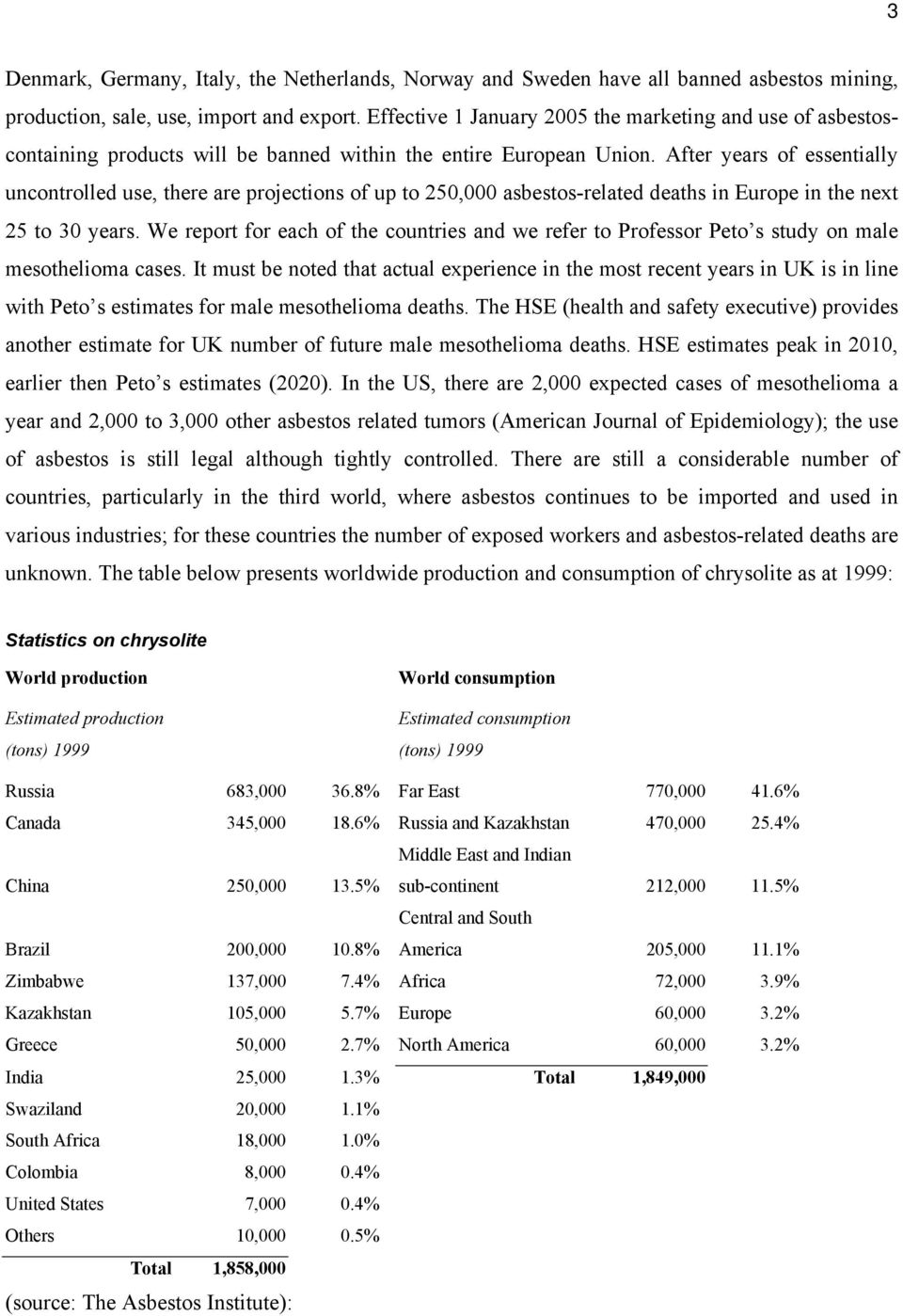
3 3 Denmark, Germany, Italy, the Netherlands, Norway and Sweden have all banned asbestos mining, production, sale, use, import and export. Effective 1 January 2005 the marketing and use of asbestoscontaining products will be banned within the entire European Union. After years of essentially uncontrolled use, there are projections of up to 250,000 asbestos-related deaths in Europe in the next 25 to 30 years. We report for each of the countries and we refer to Professor Peto s study on male mesothelioma cases. It must be noted that actual experience in the most recent years in UK is in line with Peto s estimates for male mesothelioma deaths. The HSE (health and safety executive) provides another estimate for UK number of future male mesothelioma deaths. HSE estimates peak in 2010, earlier then Peto s estimates (2020). In the US, there are 2,000 expected cases of mesothelioma a year and 2,000 to 3,000 other asbestos related tumors (American Journal of Epidemiology); the use of asbestos is still legal although tightly controlled. There are still a considerable number of countries, particularly in the third world, where asbestos continues to be imported and used in various industries; for these countries the number of exposed workers and asbestos-related deaths are unknown. The table below presents worldwide production and consumption of chrysolite as at 1999: Statistics on chrysolite World production Estimated production (tons) 1999 World consumption Estimated consumption (tons) 1999 Russia 683, % Far East 770, % Canada 345, % Russia and Kazakhstan 470, % China 250, % Middle East and Indian sub-continent 212, % Brazil 200, % Central and South America 205, % Zimbabwe 137, % Africa 72, % Kazakhstan 105, % Europe 60, % Greece 50, % North America 60, % India 25, % Total 1,849,000 Swaziland 20, % South Africa 18, % Colombia 8, % United States 7, % Others 10, % Total 1,858,000 (source: The Asbestos Institute):
4 4 Europe and US: differences and similarities The compensation systems for asbestos-related health issues in Europe are still evolving. Recent cases in France and UK (to be discussed in later sections) have brought asbestos problems to the attention of the public and the insurance industries. While the costs stayed within the various social security systems, there was little insurance involvement. However, there are indications that the number of asbestos-related lawsuits and insurance claims are increasing. This naturally leads to questions about the potential for a US-style asbestos tort explosion in Europe. In spite of the European evolution towards increased tort and insurance involvement, significant differences between the European and American situations still remain, the main ones being:! Indemnifiable diseases: In the US an increasing number of people with no manifested diseases are suing and receiving compensation. Based on the figures from Manville Trust, less than 10% of cases filed in recent years involved malignancies. At this time there are no European countries that recognise exposure only or minor pleural scarring as indemnifiable. As long as this is the case, the European situation is unlikely to develop into a US-like morass. In May 2003 a non work-related exposure claim was indemnified in The Netherlands. The exposure occurred in 1971 with construction-work at the property of the victims parents. The victim was exposed while cleaning the asbestos dust which was caused by processing asbestos cement. If these kind of claims continue, insurers may be confronted with a significant increase in claims.! Union involvement: The actions of US labour unions have brought plaintiffs into asbestos lawsuits. So far European unions have been less involved in similar actions; however, they are beginning to take a more active role, participating in conferences, informing members and sometimes providing legal support. Asbestos victims groups are seeking legislative changes and supporting actions of labour unions.! Consolidated trials: With this term we refer to the practice in the US of consolidation of multiple cases, frequently including the grouping of malignant and non-malignant cases. (These differ from class actions, which include absent plaintiffs.) The presence of malignant claims in the group is an incentive for defendants to settle all of the claims in order to avoid potentially damaging verdicts on the more serious cases. To the extent that the European laws do not allow this consolidation process, the development of litigation should be more controlled.
5 5! Forum shopping: Differences in the US judicial systems have encouraged lawyers to look for jurisdictions known to be favourable to plaintiffs because of jury tendencies or judicial outlook. The more cohesive legal system within each European country will prevent this.! Contingent fees: US law firms have invested in asbestos litigation, taking cases on a contingent fee basis. In general the various European legal systems do not allow contingent fees. Some limited forms of contingent fees are used in the UK, but generally are not allowed in the other countries covered in this study. This will be a deterrent to litigation for the less impaired plaintiffs but will not stop suits by the more severely injured if recovery becomes more certain. THE EUROPEAN ENVIRONMENT Compensation systems: Occupational diseases can be compensated through three general channels:! Workers compensation, (or social security system)! Employer s liability, or! Products liability. The first is a no-fault system, i.e., the injured worker does not need to prove that the employer was negligent or otherwise at fault. The latter two channels involve lawsuits where the injured party must prove that the employer or producer of the product was negligent. In some countries the social security system is entitled to subrogate against an insurance company. In the majority of systems, tort law remains a possibility for those who cannot recover from social security or workers' compensation (usually due to failing to meet the criteria for health damage). The potential sources of compensation differ not only in what must be proved but also in what damages they can/will compensate. In general, the no-fault system does not pay for non-economic losses, such as pain and suffering, while such recoveries tend to be at least theoretically available from the two tort processes. In the Netherlands victims of occupational diseases are compensated through various health and disability insurance programmes where both work related and non work related claims are covered. In addition they can sue their employers. In Germany workers compensation law excludes the liability of an employer (exceptions: gross negligence and intent). In Italy it is possible to claim workers compensation and sue the employer.
6 6 It is important to note that occupational diseases have legal/political components, as well as purely medical definitions. Thus, changes in legislation or political practice can influence which channel is used more frequently, as well as the number of claims that are filed. Where compensation through the social security systems is relatively generous, fewer claims will be filed through the tort system. The Insurance Environment Although the major multinational insurers have significant experience with US-source asbestos claims, to date, there has been relatively little insurance activity from European asbestos exposures. As a result, many insurance issues that have been litigated at length in the US have not been addressed in the various European countries. These include lost policies, trigger of coverage, allocation across triggered policies, application of exclusions (if any), treatment of uninsured periods (by intent or due to insolvency), drop-down of excess layers, and application of reinsurance. Problem with retroactive claims: The lengthy period between first exposure to asbestos and the manifestation of an asbestos-related disease, which can be up to 40 years, creates problems with respect to both the original request for compensation and, where relevant, the application of insurance. In general, the statutes of limitation for requests for compensation (through either no-fault or tort systems) do not start to run until the worker discovers that he has a compensable illness. However, as is noted later, this is not universally true, which is causing problems in some countries. If a worker requests compensation, which is ultimately paid by insurance, latency creates the additional issues of trigger and allocation, i.e., which of the many potentially exposed policies should pay and how much? Various solutions are possible. In most European jurisdictions, the last employment rule is predominant. Under such regimes, the last employer (and his insurer) bears the entire cost of an occupational disease.

7 7 UK Sources of Claims Asbestos was not mined in the UK, although it was very heavily used in a number of industries. Those occupations with the greatest risk of contracting mesothelioma are metal plate workers (including shipbuilding) and vehicle body builders (including rail vehicles). Both of these industries have over six times the national average death rate from mesothelioma. Other industries with an above average rate of mesothelioma deaths include plumbers and gas fitters (over four times the national average), carpenters (over three times the national average), electricians, construction workers, plasterers, builders and handymen, steel erectors, painters and decorators, sheet metal workers, scaffolders and welders. As might be expected those areas of the UK with the highest mesothelioma death rates are areas which traditionally had a large shipbuilding industry, such as Clydebank (ten times the national average the highest rate in the country), Tyne and Wear, Cleveland, Barrow-in-Furness, Portsmouth, Southampton, Gillingham and Rochester. Scotland, in particular, has a higher mesothelioma death rate than the national average, due to the high concentration of shipbuilding. Other areas with a high mesothelioma death rate include towns such as Crewe and York, which have traditionally been associated with railway construction. From an insurance perspective, most UK asbestos related claims are submitted under Employer s Liability ( EL ) coverages, although some are occasionally made under Public Liability coverages. Unlike the US, claims are not typically made under products liability coverages. Legislation Blue and brown asbestos were both banned in the UK with effect from 1 January 1986, however white asbestos was not banned until over thirteen years later, from late The Asbestos (Prohibitions) (Amendment) Regulations 1999, which came into force five years ahead of the EU deadline, forbids the import of crude fibre, flake, powder or waste chrysotile and the new use of asbestos cement, boards, panels, tiles and other products. Chrysotile-containing products installed prior to the introduction of the regulations are permitted to remain in place until they reach the end of their service life. Also forbidden is the sale of second-hand asbestos cement products and building materials covered with asbestos containing coatings.
8 8 The current laws governing the use of asbestos in the UK are the Control of Asbestos at Work Regulations 2002, which came in to force on 21 November 2002, with the exception of two regulations which will not come into force until The regulations build upon, strengthen and tighten the previous requirements under the 1987 regulations. Employers are required to prevent exposure to asbestos at work or, where this is not reasonably practicable, they are required to ensure that exposure is kept as low as practicably possible and in any case below certain limits. The Health and Safety Executive is responsible for enforcing the monitoring and compliance with the legislation. Also worth a mention is the Consumer Protection Act, the Road Vehicles (Brake Linings Safety) Regulations 1999 which prohibits the supply, exposure for supply, or fitting to a motor vehicle or trailer, of brake linings containing asbestos. The Pneumoconiosis etc (Workers' Compensation) Act of 1979 allows the Department of the Environment to pay compensation to sufferers of specified asbestos related diseases where their former employers are bankrupt or cannot have a court case brought against them for whatever reason. Asbestos-related claims paid under the act are usually significantly lower than corresponding court settlements and awards. Other considerations when considering UK legislation and court awards are the Ogden Tables, which are a set of actuarial multipliers used in the UK to determine lump-sum awards to cover loss of income and costs of care in compensation cases, the General Damages Reforms, which currently govern non-pecuniary loss (i.e. pain and suffering) awards, and the Woolf Reforms, which were introduced in April 1999 to streamline the UK compensation system. In terms of recent asbestos cases, the most notable is the Fairchild case. Arthur Fairchild was a carpenter who died of mesothelioma. He was exposed to asbestos at two different jobs during his life. Both employers admitted that they had negligently exposed Mr Fairchild to asbestos dust. However, they successfully argued in court that neither should be liable to compensate his widow because Mesothelioma is an indivisible disease and therefore theoretically caused by a single fibre. Since it could not be proved who employed Mr Fairchild when he inhaled the fatal fibre which ultimately caused his mesothelioma, the court agreed neither employer should be found liable. The court decision was upheld by the Court of Appeal, however the decision was subsequently overturned by the highest court in the UK, the House of Lords in May 2002.

9 9 Exposure Based on statistics from the Health and Safety Executive, the annual number of mesothelioma deaths in the UK has increased rapidly from around 150 in the late 1960 s to around 1,600 in the year By contrast, the annual number of asbestosis deaths has increased much less, from around 50 to just under 200 over the same period. As asbestos was not mined in the UK, one of the few available quantitative indicators of asbestos exposure in the UK is the amount imported over time. Asbestos imports to the UK peaked in the mid-1960 s. The peak incidence of imports varies by type. Brown asbestos imports peaked in the late 1950 s and were virtually eliminated by the end of the 1960 s. Imports of blue asbestos peaked in the mid-1960 s and continued through to the late 1970 s. White asbestos continued to be imported into the UK until the early 1990 s. Based on the Peto paper, the worst affected generation will be those born in the late 1940 s. Peto predicts that male mesothelioma deaths in the UK will peak around 2020 at about 1,750 per annum. This appears somewhat low considering that there were already around 1,600 deaths per annum in 2000, some 20 years before the predicted peak. What is Paid? Awards in the UK usually cover loss of income, costs of care, loss of dependency and pain and suffering (non-pecuniary loss). Unlike the US, typically only those claimants with a physical impairment receive compensation.

10 10 Who Pays? Someone suffering from an asbestos-related disease in the UK typically has one of three options open to them: 1. If the disease is one of the recognised prescribed diseases, they may be able to claim benefits from the Department of Work and Pensions; 2. They may be able to obtain compensation under the Pneumoconiosis Act if their former employer is bankrupt or cannot have a court case brought against them 3. Alternatively, they may be able to pursue compensation from their former employer(s) through the courts. If successful then the employer may be able to recover some or all of the costs from their EL coverages. However, EL was only made compulsory in the UK from 1 January 1972 and there is no guarantee that the employer purchased EL coverage before this date. Even if they did, they may not have maintained the necessary records. There have also been a number of high profile insolvencies of UK EL insurers (most noticeably Builders Accident and Chester Street). In the event that the employers insurer is insolvent then if the claim relates to a statutory type of insurance cover (eg EL post 1 January 1972) then compensation may be payable from the Financial Services Compensation Scheme ( FSCS ), the successor to the Policyholders Protection Board, under the Policyholders Protection Act. Also under third party rights, if the employer is now insolvent, the employee can present a claim directly against the insurer of the insolvent employer, provided of course, the employer took out EL cover and the insurer is known. If both the employer and the insurer are insolvent, then the employee can claim directly against the FSCS. Average Costs In the UK the average mesothelioma claim is for around 100,000. Asbestos-related lung cancer claims typically settle for around 60,000, with asbestosis claims settling for around 30,000. If compensated, Pleural Plaques and Pleural Thickening cases may receive around 10,000 each. To date the largest mesothelioma settlement has been for approximately 1.2 million.

11 11 FRANCE Sources of claims In France, the main source of claims are the manufacturers of products containing asbestos: currently over 1,000 such sites have been listed. This list is updated by decree each month, as people working at these listed sites are entitled to early retirement at age 50. Claims are also generated by companies using asbestos-containing materials, such as the state railways and the shipyards. There was also a mine in Corsica. Finally, claims are also generated by public and private sites where asbestos was used for insulation. The most famous example is Jussieu, Paris University, which had given rise to a total of 27 asbestos-related cases through have been indemnified by the Court of Appeal in Paris in February The amount of asbestos imported into France peaked in 1974 and decreased slowly afterwards. However, use of asbestos continued well into the 1990s. In 1995 alone, France imported approximately 30,000 tonnes of Canadian chrysolite, equivalent to about 3% of the world s output for the year. By comparison, in the UK, it peaked in 1965 at a similar level of tonnes. Geographically, the northwestern part of France is the most affected. Emergence to date As at 2000, 2,943 recognised cases of occupational diseases due to asbestos were indemnified by the main department of Social Security ("Régime Général de la Caisse Nationale d'assurance Maladie des Travailleurs Salariés"). The numbers have doubled between 1996 and The number of asbestos-related claims has increased significantly in recent years. Much of the increase is believed to be due to changes in the level of proof required for admission as occupational disease claim. Until 1975 the number of reported cases was limited by strict conditions for the recognition of occupational diseases. Then, in 1976, cancers were added to the occupational disease list (Group 30 bis). In 1985, stricter conditions were imposed, limiting the number of recognised occupational diseases; but these stricter requirements were declared illegal in 1994 by the Conseil d Etat. Recognition

12 12 requirements for asbestos-related occupational diseases were made less stringent in 1996, leading to significant increases. According to National Institute for Health and Medical Research (INSERM) sources, in comparing their data to those of the Social Security Health Insurance Agency, there appears to be a gap between the number of deaths by mesothelioma and the number of recognised cases. This implies that not all victims sought social security awards. According to these sources, 413 asbestos-related cancers were recognised as occupational diseases in However, an optimistic estimate of asbestos-related deaths would indicate about 1,950 cases in Rules and Legislation After one early regulation, there was no activity until recently:! 1945: asbestosis recognised as an occupational disease.! 1978: the use of spraying glue with more than 1% asbestos fibers is forbidden in houses.! 1994: the use of amphibole type of asbestos is forbidden.! 1996: Prohibition of the manufacturing, importation and selling of asbestos and asbestoscontaining materials, effective 1 January 1997.! 2002: Creation of the FIVA ("Fonds d'indemnisation des victimes del'amiante"), following the law n of 23 December 2000 and the decree n of 23 October 2001.! 2003: FIVA introduced a barème d'indemnisation, an indicative table of maims (awards) depending on age to be used as a starting point to determine the indemnity amount. In addition, in February 2002, the decision of the Supreme Court of Appeal against several large industries like Everite and Eternit made it easier to invoke inexcusable fault against employers who failed to provide a safe workplace. In its ruling, the supreme court of appeal stated that, as part of a contract of employment, the employer has an obligation to provide a safe workplace for employees, especially in relation to the products manufactured or used by the company. A failure under this obligation is considered as an inexcusable fault when the employer was aware or should have been aware of the danger to which the employees were exposed, and did not take necessary precautionary measures.
13 13 It is believed that the effect of this decision is likely to be a transfer of the ultimate financial responsibility from the social security system to employers and their insurers. Following quickly after the February decision, in June 2002, the Court of Appeal in Paris condemned the RATP ( the Paris public transport system) for inexcusable fault after five years of legal battles. On 16 October 2002 EDF (the French electricity company) was condemned to pay 250,000 to the widow and daughter of a former employee of a nuclear power station who died in 1999 for an asbestos related disease. In practice, courts tend to consider three factors in determining whether there was inexcusable fault negligence by the employer:! The company s activity: it is generally acknowledged by the courts that large companies specialising in asbestos products were the most likely to be aware of the risks incurred by their employees.! The exposure period: awareness of the dangers has been increasing since the 1970s. In France the first enacting text containing specific measures of hygiene relating to asbestos was introduced in 1977 and the use of asbestos was prohibited in However, in some cases, even exposure prior to 1977 can lead to a verdict of criminal negligence, based on a 1913 law which specified that employers should protect their workers against the inhalation of dust. In Italy too there is a similar situation.! The safety measures in place: inexcusable fault is established when specific, legally mandated safety measures were not in place after 1977, the date of the first prescriptions for such measures. However, a general rule that adequate safety measures should be in place is also invoked, particularly in cases of exposure prior to This is specifically the case when the company was warned of the dangers (by an employee, by the "inspection du travail" ) and failed to implement adequate worker protections. A court of appeal in Rennes ruled in June 2002 that, in accordance with the December 2001 Social Security Law, all statutes of limitation on asbestos-related occupational diseases are lifted provided that first medical observation occurred between 1 July 1947 and the 21 December 2001, Social Security Law decree publication date.

14 14 Exposure The main sources of information on French asbestos exposures are (1) the on-going census of all manufacturing sites (including past workers), and (2) the census of all public and private housing containing asbestos. As already mentioned, import of asbestos have peaked in 1974 (177,000) and decreased slowly afterwards. The import level of 1980 was similar to the level of the year 1968 ( tons) and the one of 1991 similar to the 1959 level ( tons). Considering the latency period of some asbestos related diseases (20 to 40 years) and the link between (a) the number of years of exposure to asbestos and (b) the propensity of disease manifestation, asbestos related claims should peak in , with the last cases emerging in This period might be longer than in other countries as the more dangerous asbestos fibres have only been banned in 1994 (against 1972 for crocidolite and 1980 for amosite in the UK, for example). Peto predicts 1,550 deaths per year in Who is going to pay and what is indemnified. There are two indemnified groups of asbestos-related occupational diseases: Group 30: Occupational diseases linked to asbestos dust inhalation ;! Asbestosis (35 years latency period, provided that 10 years exposure period can be proved).! Pleura damages (40 years, provided that 5 years exposure period can be proved)! Bronchopulmonary degeneration (35 years, provided that 5 years exposure period can be proved)! Mesothelioma (40 years, provided that 5 years exposure period can be proved)! Other pleura tumors (40 years, provided that 5 years exposure period can be proved). Group 30 bis: Bronchopulmonary cancer provoked by asbestos dust inhalation with 40 years latency period (provided that 10 years exposure period can be proved). Prior to the February 2002 court ruling, compensation for loss of income only (past and future) was automatic by the Social Security without having to seek who was at fault. However, after the ruling, claimants can now receive additional compensation for pain and suffering and punitive damages.

15 15 A 1898 law defines the benefit in case of industrial injury or occupational diseases as a percentage of the salary, depending on the degree of incapacity. Upon meeting the requirements, compensation from the social security system is automatic, without having to prove fault. In order to receive compensation in excess of that provided by the no-fault system, employees must prove inexcusable fault on the part of the employer. Inexcusable fault requires that the employer (a) had knowledge of the danger and (b) voluntarily exposed his employees to this danger. (Until recently, this was so serious that it was considered to be uninsurable.) In proving inexcusable fault, the burden of proof is on the claimant. Following the February 2002 ruling, in April the same year the Fonds d indemnisation des victimes de l amiante (FIVA) was created, with a budget of 552 million for The fund is financed 25% by the Ministere de l Emploi et de la Solidarite and the remaining 75% by the industrial accidents and occupational diseases branch of the Social Security. People affected by asbestos related disease can now apply to this fund. The FIVA compensation is in addition to that paid by the Social Security. This fund allows the victims to receive additional compensation (without using the legal system) in respect of the same types of damages (loss of income, pain and suffering and punitive damages) as would be the case for court awards. This no-fault benefit system was intended to provide prompt and automatic compensation not only to victims of occupational diseases, but also to those with diseases caused by non-occupational exposure, such as the wives and families of asbestos workers. An asbestos victim has the choice of seeking compensation from FIVA or filing a lawsuit against his employer. Double compensation is not allowed: if the victim chooses to accept payment from the fund, he or she is required to renounce any rights to file a lawsuit against the employer. Importantly, the FIVA is required to exercise subrogation against the employer. From information available from Association Nationale de Défense des Victimes de l'amiante (ANDEVA) it appears that indemnity amounts being paid by FIVA are much lower than those received in court settlements, a difference which is very controversial.

16 16 Commonly cited indemnity amounts are: FIVA: 4,000; Courts: 45,000; FFSA estimate: 50,000 to 200,000. It is worth noting that, in the latest RATP case, the court of appeal in Paris awarded 69,000 to a living claimant and 304,000 to the family of a victim, who died of lung cancer in June 1996 at the age of 48. It is reported that there are another 15 actions filed against RATP by asbestos victims. The significant differences between these amounts and the court judgements suggest that FIVA s payment schedules might still evolve. It is worth noting that as at March 2003, it appears that no victim has yet received any compensation from FIVA. Future developments for the insurance industry The French Federation of Insurers (FFSA) has forecasted that 100,000 to 200,000 asbestos-related claims will be made over the next 20 years, with an ultimate cost of 8 to 10 billion that will be shared between the social security system, employers and insurers. At the time of the Supreme Court of Appeal ruling, Jean-Philippe Thierry, chairman of French Insurer AGF (Allianz group) declared that this decision probably will push the insurers to create a specific third party policy for the inexcusable fault, which will be sold (and presumably priced) separately.

17 17 ITALY Sources of claims Mining. Historically, Italy was a major player in Europe for the mining and manufacturing of asbestos. The biggest mine in Europe, Amiantifera, was in Balangero near Turin; it was closed in Worth mentioning is also Biancavilla, a small town in Sicily built on asbestos bearing rocks. Production. One of the major sources of asbestos-related diseases in Italy is the Eternit factory in Casale Monferrato, which was shut in It had been the biggest manufacturer of asbestoscontaining construction material (cement mixed with asbestos) in Europe, with more than 2,000 workers in a city of 40,000 inhabitants. Other producers of asbestos products are Fibrocementi near Casal Monferrato and various other industries in the Emilia Romagna region. Shipbuilding. The biggest shipyards in Italy are in Monfalcone near Gorizia (in the northeast part of Italy) and in Genova (in the northwest). Asbestos as an insulation material has been widely and constantly used in the shipbuilding industry up to the end of Although asbestos is no longer used for the construction of new ships (in Italy and elsewhere), it is worth noting that the majority of the world wide fleet is more than 10 years old (and therefore potentially contains asbestos). Asbestos was used not only in the technical areas such as the engine room, but also in other areas commonly used by passengers and crew members. Other. Asbestos in Italy has also been widely used by train manufacturing companies, refineries and for building construction (public buildings in particular). Emergence to date Geographically the regions more affected by the emergence of asbestos-related tumours are Liguria (shipyards), Friuli (production and shipyards) and Lombardia. The transport industry is the most affected (79.4% of asbestos related claims filed as at 1999 with INAIL 1, followed by metallurgic (10.5%) and construction (5.0%). A research study conducted in 1987 in the Monferrato area (where an Eternit factory was located) has established that during the period between 1950 and 1985 there were in total 200 deaths in excess of what is normally expected, attributable to asbestosis and asbestos-related tumours other 1 Istituto nazionale assicurazioni infortuni sul lavoro, the state owned insurer that is the sole provider of employers liability coverage
18 18 than mesothelioma. Subsequent research, also taking mesothelioma into consideration, has found evidence of excess deaths within workers wives and the general population. More recently there have been mesothelioma cases a year, 2/3 of which relate to non workers. Asbestos related tumours represent 82% of the total tumours due to employment cause. 84% of asbestos related tumours are mesothelioma cases (data source INAIL). The cases filed with INAIL are increasing exponentially; this would also be due to the fact that since 1994 this type of disease is included in the table of occupational diseases. For Italy in total, based on extrapolation of the past death rate, Peto predicts 940 deaths per year in the period Legislation In Italy, awareness of the dangers of asbestos started to increase during the 1970s when stricter rules on security in the working environment were put in place. Despite this, asbestos-specific legislation in Italy is relatively recent:! Decree n.215 in 1988: forbids the use of certain types of materials containing asbestos.! Law n.257/92 in 1992 with effect in 1993: forbids the extraction, production and sale of products containing asbestos. This law also required the census of: all companies using asbestos, companies specialised in asbestos removal and of buildings containing asbestos with emphasis on public buildings. To date there is no law requiring the removal of manufactured goods containing asbestos. To prove the employer s responsibility for an alleged asbestos-related injury, it must be demonstrated that (1) he was aware of the dangers of asbestos, and (2) he did not implement the prescribed safety rules in the workplace. However, injured workers can also invoke a much earlier law on dangerous dust (303/1956) under which it is easier to prove violations by the employer, and therefore the employer s responsibility. An important trial, concluded at the end of 1997, involved Ferrovie dello Stato (the Italian railways) and some of its managers. The plaintiffs alleged that the use of asbestos in the rail cars insulation caused the deaths from mesothelioma of a number of workers and their wives, who washed their husbands work clothes. The court awarded an indemnity of 2.6 million for 11 victims. At that
19 19 time, Ferrovie dello Stato established a fund of. 6.7 million to pay other victims that might claim in the future. There has been no public clarification of the extent to which (if at all) the company s insurance policies will cover these liabilities. Who is going to pay and what is indemnified. Employer's liability insurance is provided by the social security scheme INAIL. Admissible asbestos-related diseases compensated by INAIL are Asbestosis, Pleura damages and Tumours. INAIL compensates injured workers for: loss of income, medical expenses and pain and suffering. The Italian law system does not allow for the US equivalent of punitive damages although higher than normal compensation could be granted in cases where the responsibility of the defendant has implication under the criminal law. This type of damage is often referred to as moral damages. The amounts granted in this regard are small compared to the overall compensation and far from US levels. Historically, INAIL covered all workers with asbestos-related diseases for only loss of income and medical expenses. However, since July 2000, INAIL has also paid pain and suffering as appropriate for cases occurred or reported on or after 23 Feb The INAIL coverage for pain and suffering is financed on a pay-as-you-go basis and, to date, the additional premium required to finance this new outgo has not yet been quantified. After INAIL it is possible that:! the worker or his/her family will sue the employer for pain and suffering (pre 2000) and moral damages; or! INAIL will subrogate against the employer seeking reimbursement of the amounts paid. In such cases, the employer may be able to claim under an insurance policy called RCO Responsabilità civile operai. These policies will respond in case of subrogation claims, however, for pre-2000 claims, the RCO policy will reimburse only pain and suffering awards. In addition, if the employee files a claim directly against the employer, the RCO policy will pay. The purchase of this cover, which is not compulsory, became more common during the 1970s, when the concept of pain and suffering was introduced into the Italian law system.
20 20 There have been a number of cases in which insurance companies have disputed the pain and suffering content of the policy. However, the Milan Tribunal (sentence 30/6/98) stated that the RCO cover includes responsibility for pain and suffering. In general RCO policy wordings cover the responsibility of the employer for all professional diseases covered by INAIL, including those discovered after the end of the cover period, which are a consequence of negligence occurred during the insurance cover period. However, the policies often exclude occupational diseases manifested more than six months after policy expiration. The use of aggregate limits in RCO was not common (if used at all), however there were per-claim limits of approximately ( 250 thousand). Historically, asbestosis and silicosis have both been explicitly excluded under the standard RCO wording. However, asbestos as a cause of other types of diseases is not explicitly excluded. (A similar situation occurred in the past in the US, where asbestosis was explicitly excluded, but other asbestos-related diseases were not mentioned and the courts have interpreted the wording to mean that other diseases are covered.) RCO insurers have disputed asbestos-related claims on the basis that: the effective cause of the disease has to be proven, and/or more than six months have passed since the policy expired. With regards to the first objection, courts have found that it is sufficient that the worker s claim has been accepted by INAIL, since this is presumed to confirm the direct relationship with the work activity. The effectiveness of the second objection will depend on the courts inclination to support the validity of such clauses in view of the long latency period of some asbestos-related diseases. Future developments for the insurance industry The key uncertainty for the Italian insurance industry is the willingness of the social security system to continue bearing the cost of asbestos claims alone, without subrogating against available insurance coverage. The market reports that, for the time being, INAIL has made little use of its subrogation rights against RCO policies for asbestos-related diseases.

21 21 In addition, some reinsurers of products liability coverage are reporting that they have started to exclude liabilities arising from any product containing asbestos (even in small amounts). This is in contrast to earlier exclusions, which affected only products composed mainly of asbestos. The question of which polices will respond is still open in Italy. According to the Italian civil code (codice civile), there should be a direct link between the time when the policy was written and the time when the disease was contracted. However, Italian courts have made few rulings regarding the allocation of claims to policies written in the past. There is speculation that, due to both difficulties in recovering old policy documents and disputes over when the disease was contracted, the courts might tend towards a manifestation trigger, i.e., providing coverage under the policy in force when the disease manifested. The effect of this would be to pay the claims under more recent policies. However, as noted above, such policies are more likely to include relevant exclusions.
22 22 THE NETHERLANDS Sources of claims An important producer of asbestos-containing products in the Netherlands is Eternit, a major manufacturer of construction materials (cement mixed with asbestos) with several factories. In 1982 the activity of one factory was moved to Belgium; in 1993 all other factories stopped producing all asbestos-containing products. The asbestos insulation-industry is another important source: between 1946 and 1965 there were approximately ten specialized factories producing insulation materials containing asbestos. Asbestos was also used in shipyards from Most of the Asbestos insulation in ships was sprayed, and therefore the asbestos-exposure was very high. Between 1943 and 1985 there were also three companies producing brakes for cars and trains. The brake blocks and disc-brakes contained asbestos. Finally, there was production of asbestos paper (cardboard and felt) between 1968 and These products were mainly used in carpet. The production process was relatively safe, because the asbestos was wet during the process, so there was little asbestos-dust. In the Netherlands there were approximately one hundred smaller companies that produced asbestos containing products such as paint, glue, synthetic products, and filter material. Very little is known about the exposure to asbestos in these companies. In 1980 approximately 200,000 tons of cement containing asbestos was used in construction, including the construction of waterworks where asbestos-tubes were used. The import levels of raw asbestos and asbestos products peaked in 1976 with almost 50,000 tons and quickly dropped in the early 80 s. At the end of 1994 the level was almost nil. Emergence so far There are three main sources of data: a report by A. Burdorf et al. published in 1998, the statistics by the CBS (Central Bureau for Statistics) for years 1996 to 2000 and a more recent article published
23 23 in March this year: Update of predictions of mortality from pleural mesothelioma in The Netherlands by Segura O, A Burdorf and CWN Looman. The mortality level for mesothelioma, measured in number of deaths per year, has moved from about 120 in 1970 to 385 in The latest figure is 389 in year However, the most recent figures from CBS seem to be monitored differently as the earlier figure for 1996 indicates 326 deaths. Legislation In 1951 the first law for silicosis was introduced. This law offered the opportunity for employers to protect their employees against diseases such as silicosis and asbestosis. Until the 1970 s however there was no agreement on what measures should be taken by the employers to protect their employees. In 1967 asbestos related bodily injury litigation cases began to appear. However, a thirty-year limitation period, combined with the long latency of asbestos related diseases meant that not many victims were compensated, until very recently. In 1977 the first law was passed prohibiting the use of blue asbestos (crocidolite) and the spraying of asbestos. It also prohibited the use of asbestos for acoustical and thermal insulation and for decorative and preserving purposes. In 1983 another law prohibited all uses and production of asbestos-containing paper, felt and textile. Asbestos was banned from construction and car manufacturing in 1989 and in 1991 a law was introduced which prescribes obligatory labeling of all work with asbestos. Finally in 1993 a law prescribed a complete prohibition for all public uses of asbestos. The private use of asbestos was banned in In 1990, following the Supreme Court verdict on Janssen v Nefabas, the number of asbestos cases increased dramatically.
24 24 Until recently the statute of limitation was 20 years; however, for a number of years the lower courts had based their decisions on a 30 years period. The point of view of the Supreme Court was not clear. Finally, in October 1998 the Supreme Court agreed with a 30-year period. However, on 28 April 2000 the Supreme Court decided that the 30-year statute of limitation is not valid in exceptional cases. An important element of the Supreme Court s consideration for asbestos claims is that in many cases it takes longer than the 30 years for mesothelioma to become apparent. On 14th of December 2000 the Parliament accepted a statute of limitation of 5 years after discovery of the disease when the liable party is identifiable. This statute of limitation only holds for cases in which the exposure was after the 14th of December For all those cases where the exposure stopped before the 14th of December 2000 the old statute of limitation of 30 years after the end of exposure applies. The Supreme Court is prepared to extend the 30-year statute of limitation for those cases where it could be considered unreasonable to apply the 30-year rule. The elements to be considered to arrive at a decision would be the following:! the nature of the claim! whether claims could be made against other parties, apart from the current defendants! whether the claimant could be considered partially responsible through carelessness, for example! whether the employer is aware of his liabilities! whether the employer would be able to defend the case! whether the liability is insured! whether the claim has been filed within a reasonable time from the discovery of the illness. Exposure Burdof s study estimates a build up of exposure, with a peak in the early sixties, then gradually coming down to almost nothing in the early nineties. The estimated total number of exposed should be around 380,000 people.
25 25 Peto s estimates predict 930 deaths per year, for a total of 25,300 death by The latest forecasts produced by Tillinghast indicate a lower number with a peak at 485 deaths in 2017 for mesothelioma among the male population. A portion of these deaths will lead to a claim. It is very important if and to what extent the statute of limitation will hold. If the statute of limitation holds completely, there will not be many claims after 2028; but there is already one case where the Supreme Court has overruled the statute of limitation. Insurers have to monitor future developments carefully, if the courts decide that the statute of limitation does not hold, liabilities could increase significantly. Who is going to pay and what is indemnified. Compensation can be paid in different ways. Back in the 90s employers and insurance companies chose to settle the majority of claims out of court, with no more than 15% of the cases progressing into court. A civil case can provide compensation up to about 68,000, which is low by comparison with other countries. Another option is through the Institute of Asbestos Victims (IAV). The IAV is an initiative of the committee of asbestos victims, employer-organisations, employee-organisations, the association of insurers and the Government. The IAV was set up in Jan 2000 to streamline and speed up the compensation process. It also agreed on the level of the indemnification with insurers and victim associations. Only mesothelioma cases with traceable employment exposure apply. Since January 2003 the IAV has been making advance lump sum payments of 15,000 within a few weeks from mesothelioma cases being made. There is no obligation for recipients to repay this money even in case of additional compensation being received in future. The Government will try to recoup its expenditure from negligent employers, but the claimant will be paid nonetheless. The rules for getting assistance from the Institute are:! the patient has to be alive on 6 June 1997! there is a diagnosis of malignant mesothelioma.! the patient already filed (or will file) a claim based on employers liability.
26 26 The role of the Institute is to check these conditions and whether the claim is valid; then advise on the claim amount is provided. The agreed compensation amount is about 55,000 and will be increased annually in line with a price index for consumer goods. All IAV applicants renounce the right to bring a civil action. If employer or claimant do not agree with the advice they can go to court. The IAV is incapable of dealing with all asbestos victims as its rules do not allow cases of asbestosis, lung cancer, and those mesothelioma victims who were exposed more than thirty years ago. For these cases, another option is through social security. The Government Asbestos Institute ( GAI ) pays awards for mesothelioma only when the victim can t sue their (former) employer for the damage nor is eligible to apply to IAV. The GAI award requires proof of mesothelioma and exposure to asbestos in the working environment. The indemnity amount in this case is only 15,882 and only for people alive on 6 June For other diseases such as asbestosis and lung cancer the outcome is much more uncertain. The government doesn t pay for these kind of diseases. It is possible to sue the employer, but for lung cancer it may be difficult to prove the link between the cancer and the exposure to asbestos. Most of the cases are paid by the insurer of the companies involved. Future developments for the insurance industry A key issue in the near future for the insurance industry is whether the statute of limitation of 30 years will hold. If not, this would have a significant impact on the expected losses that are claimed under employers' liability coverage. At this stage there is a high level of uncertainty. Given the special circumstances of the case in question where the statute of limitation was over-ruled by the Supreme Court, this would not automatically lead to similar outcomes in all future cases. Another important issue is whether more claims will be filed by individual claimants against the producers of asbestos containing products, which would be recoverable under product liability insurance. Insurance companies should monitor their claim experience very carefully by type of claim and origin to gain a better understanding of the development in their portfolio over time.
27 27 GERMANY Sources of claims Sources of claims are the same seen in other countries. It is estimated that during the 60 s and the 70 s in the western part of Germany there were approximately 200,000 tons of asbestos used in more than 3,000 different products. Asbestos consumption started to decrease in Western Germany during mid 80 s, while consumption in Eastern Germany remained at high levels up to the end of the 80 s due to trade agreements with the former Soviet Union. At the beginning of 2002, the German occupational health services (the Berufsgenossenschaften ) estimated that 460,000 workers had been exposed to asbestos. Emergence so far Until 1970, fewer than 130 asbestos-related claims were made annually to the occupational health services. In 1984, there were 790 reported claims. In 2001 the recognised deaths from asbestos exposure increased to 931. Since 1980, 11,000 people have died. During the 1990s the annual numbers of annuities awarded for asbestosis and mesothelioma were relatively constant, but there was a significant increase in the number of lung cancer cases. Peto projects 1,370 male fatalities for mesothelioma per year in Germany during the peak years of 2020 to 2025, for a total of 38,900 during the period 1995 to According to the latest forecasts, the number of claims will increase further, with a peak between 2005 and By 2020, more than 20,000 people are expected to have died from asbestos related diseases in Germany. Legislation Asbestos-related legislation began to be enacted relatively early in West Germany:! 1936/37: asbestosis recognised as an occupational disease! 1943: lung cancer caused by asbestos exposure recognised as an occupational disease! 1977: mesothelioma recognised as an occupational disease! 1990: legal ban significantly reduced the use of asbestos
28 28! 1993: ban on production, use and distribution of asbestos or material containing asbestos. Who is going to pay and what is indemnified The occupational health system recognises the following diseases as asbestos-related: Asbestosis, Lung cancer (caused by asbestos exposure), Mesothelioma. For those workers with past asbestos exposure suffering one of the diseases mentioned above, the system pays for:! Life annuity to victims or dependants (up to 2/3rds of annual salary/wage adjusted for inflation), or! Rehabilitation, plus! Temporary annuity during medical and/or professional rehabilitation There are no provisions for pain and suffering awards. In 2001 payments for medical treatments and payments to victims and estates were 290m. Future developments for the insurance industry Total payments for asbestos claims in Germany are expected to be in excess of 10b. We are not aware of punitive or pain and suffering awards arising from asbestos-related claims that have been reported in Germany. Thus, all asbestos-related costs to date have been paid by the occupational health system and there has been no insurance involvement.
29 29 BIBLIOGRAPHY Burdorf, A., Barendregt, J.J., Swuste, P.H.J.J., Heederik, D.J.J., Schattingen van asbestgerelateerde ziekten in de periode door beroepsmatige blootstelling in het verleden VUGA Uitgeverij B.V., Den Haag, Heederik, D., Kromhout, J., Burema, J., et.al., Occupational exposure and 25-year incidence rate of non-specific lung disease International Journal of Epidemiol 19, Jaarverslag 2000/2001 Instituut Asbestslachtoffers, Den Haag, Segura, O., Burdorf, A. en Looman, C., Update of predictions of mortality from pleural mesothelioma in the Netherlands, Occupational & Environmental Medicine, January Stallard, E., and Manton, K.G., Estimates and Projections of Asbestos-Related Diseases and Exposures among Manville Personal Injury Settlement Trust Claimants, , Center for Demographic Studies, Duke University, Durham, N.C., Stallard, E., and Manton, K.G., Projections of Asbestos-Related Personal Injury Claims Against The Manville Personal Injury Settlement Trust, Males , by Occupation, Date of First Exposure, and Type of Claim, Center for Demographic Studies, Duke University, Durham, N.C., Jean-Calude Zerbib: L Amiante en France: une interdiction trop tardive J Peto, A Decarli, C La Vecchia, F Levi, E Negri: The European mesothelioma epidemic 1999
30 30 Mealey s International Asbestos Liability Münich Re Group: "Occupational diseases How are they covered under workers' compensation system?" 2002
NHS Barking and Dagenham Briefing on disease linked to Asbestos in Barking & Dagenham
 APPENDIX 1 NHS Barking and Dagenham Briefing on disease linked to Asbestos in Barking & Dagenham 1. Background 1.1. Asbestos Asbestos is a general name given to several naturally occurring fibrous minerals
ASBESTOS DISEASES. Dr Alastair Robertson
 ASBESTOS DISEASES Dr Alastair Robertson Occupational Health Department University Hospital Birmingham Birmingham B29 6JF 01216278285 [email protected] Occupational Lung Disease Unit Birmingham
Trends in European Casualty insurance
 Trends in European Casualty insurance Case studies on Asbestos and Medical Malpractice Alessandro Santoni, FIA CAS Seminar on Reinsurance June 6, 2013 2013 Towers Watson. All rights reserved. Casualty
NISG Asbestos. Caroline Kirton
 NISG Asbestos Caroline Kirton 1 The Control of Asbestos Regulations 2012, Regulation 10 requires every employer to ensure that adequate information, instruction and training is given to their employees
WikiLeaks Document Release
 WikiLeaks Document Release February 2, 2009 Congressional Research Service Report RS20519 ASBESTOS COMPENSATION ACT OF 2000 Henry Cohen, American Law Division Updated April 13, 2000 Abstract. This report
Asbestos Disease Claims
 Asbestos Disease Claims A client s guide Spring 2007 Contents 2. Essential elements for a successful claim 3. What we will do 3. Funding the case 3. Preliminary investigations 4. What happens next? 4.
the compensation myth
 the compensation myth The Compensation Myth It is common to hear stories of the Compensation Culture or claims that Britain is becoming Risk Averse as a result of people claiming compensation. The truth
Asbestos Diseases Uncovered
 Asbestos Diseases Uncovered Your complete download & keep guide to asbestos-related diseases. Their symptoms, causes and potential compensation payable Contents What is Asbestos? What diseases are caused
US Asbestos Liability
 US Asbestos Liability Romy Comiter, Senior Director, Claims Consulting Team Regulated by the FSA www.axiomcc.com Agenda Current US Asbestos Environment Legislative Efforts in the US Evaluation Considerations
Skeletons in the Cupboard - Latent claim developments in General Insurance, Why they have happened and Possible inferences for healthcare
 Skeletons in the Cupboard - Latent claim developments in General Insurance, Why they have happened and Possible inferences for healthcare Camilla Bennett and Kenneth McGaughey, PricewaterhouseCoopers LLP
Asbestos and the diseases it causes
 Asbestos and the diseases it causes October 2013 Liz Darlison Mesothelioma UK University Hospitals of Leicester Contents What is asbestos Why is it such an issue in the UK Disease Statistics Asbestos Related
Asbestos Litigation: The Problem of Forum Shopping and Procedural Innovations, and Potential Solutions. By Michelle J. White
 Asbestos Litigation: The Problem of Forum Shopping and Procedural Innovations, and Potential Solutions By Michelle J. White Michelle J. White is a professor of economics at the University of California
Frequently Asked Questions. What is asbestos? 2. How is asbestos harmful? 2. What illnesses does asbestos cause? 3
 Duty to Manage Asbestos in Non-Domestic Premises Frequently Asked Questions Page What is asbestos? 2 How is asbestos harmful? 2 What illnesses does asbestos cause? 3 How many people die as a result of
Ms. Jennifer L. Biggs
 Testimony of Ms. Jennifer L. Biggs June 4, 2003 Committee on the Judiciary United States Senate Solving the Asbestos Litigation Crisis: S.1125, the Fairness in Asbestos Injury Resolution Act of 2003 June
Mesothelioma Act 2014 and the Diffuse Mesothelioma Payment Scheme
 www.fieldfisher.com/personalinjury Freephone 0800 358 3848 Mesothelioma Act 2014 and the Diffuse Mesothelioma Payment Scheme A guide for clients Head and shoulders above the rest in terms of skills, experience
Date: February 16, 2001
 ,QWHUQDO5HYHQXH6HUYLFH Number: 200121031 Release Date: 5/25/2001 Index No.: 104.03-00 Department of the Treasury Washington, DC 20224 Person to Contact: Telephone Number: Refer Reply To: CC:ITA:1 PLR-122136-00
Appendix I: Select Federal Legislative. Proposals Addressing Compensation for Asbestos-Related Harms or Death
 Appendix I: Select Legislative Appendix I: Select Federal Legislative is and Mesothelioma Benefits Act H.R. 6906, 93rd 1973). With respect to claims for benefits filed before December 31, 1974, would authorize
Emerging Liability Risks A Practical Accumulation Example
 Emerging Liability Risks A Practical Accumulation Example Emerging Liability Risks A Practical Accumulation Example Wilhelm Zeller, Rüschlikon, 4 November 2015 Sources incl.: Wikipedia, RAND, NERA. Emerging
FIGHTING FOR YOU. Asbestos and dust diseases
 FIGHTING FOR YOU Asbestos and dust diseases The sad legacy of years of exposure to asbestos, both in commercial and industrial situations, and at home, has left a terrible number of South Australians either
Justice Committee. Courts Reform (Scotland) Bill. Written submission from Clydeside Action on Asbestos
 Justice Committee Courts Reform (Scotland) Bill Written submission from Clydeside Action on Asbestos In our view, the Court of Session should deal only with most complex and important cases and that most
Asbestos Brochure. Jim Wyatt - [email protected] Stephen Ball - [email protected]. Freephone: 0800 591 999. www.hamers.com
 Jim Wyatt - [email protected] Stephen Ball - [email protected] Freephone: 0800 591 999 5 Earls Court, Priory Park East, Hull, HU4 7DY Tel: 01482 326666 Fax: 01482 324432 Aspect Court, 47 Park Square East,
Update from UK asbestos and deafness working parties Robert Brooks, Brian Gravelsons and Gabriela Macra
 Update from UK asbestos and deafness working parties Robert Brooks, Brian Gravelsons and Gabriela Macra 02 May 2013 Agenda Update from the UK asbestos working party Background and Introduction Recap on
CHAPTER 30: EMPLOYEE INJURIES
 CHAPTER 30: EMPLOYEE INJURIES INTRODUCTION TO JOB SAFETY Our legal system has developed three ways of handling employee injuries: A. NEGLIGENCE SUITS Was developed under common-law where the injured employee
M E S O T H E L I O M A Questions & Answers
 M E S O T H E L I O M A Questions & Answers A G U I D E F O R M E S O T H E L I O M A P A T I E N T S A N D T H E I R L O V E D O N E S MORGAN & MORGAN FORTHEPEOPLE.COM 877-667-4265 Mesothelioma Questions
Limitation of Liability
 Limitation of Liability Submission to the Attorney-General (Western Australia) July 2000 The Institution of Engineers, Australia Institution of Engineers, Australia 11 National Circuit, Barton, ACT, 2604
Asbestos Diseases. What Is Asbestos?
 1 Asbestos Diseases What Is Asbestos? Asbestos is a term applied to a group of minerals formed into rock and mined in a similar way to coal. In this form, asbestos is made up of strong, fine and flexible
FREEPHONE: 0800 059 9112 EMAIL: [email protected]. Asbestos Awareness. Toolbox Talk
 FREEPHONE: 0800 059 9112 EMAIL: [email protected] Asbestos Awareness Toolbox Talk ASBESTOS AWARENESS Why is it a Problem Asbestos was extensively used as a building material in the UK from the
ASBESTOS. Know what it is and how you can protect yourself. environmental affairs Department: Environmental Affairs REPUBLIC OF SOUTH AFRICA
 ASBESTOS Know what it is and how you can protect yourself environmental affairs Department: Environmental Affairs REPUBLIC OF SOUTH AFRICA 1 What is asbestos? The term asbestos designates a group of naturally
Supreme Court confirms that pleural plaques are actionable in Scotland
 Insurance and reinsurance litigation e-bulletin 27 October 2011 Supreme Court confirms that pleural plaques are actionable in Scotland In a decision which has important ramifications for the UK insurance
PUBLIC ENTITY RISK MANAGEMENT AUTHORITY MEMORANDUM OF WORKERS COMPENSATION AND EMPLOYERS LIABILITY COVERAGE
 PUBLIC ENTITY RISK MANAGEMENT AUTHORITY MEMORANDUM OF WORKERS COMPENSATION AND EMPLOYERS LIABILITY COVERAGE FOR THE PERIOD JULY 1, 2015 TO JUNE 30, 2016 EFFECTIVE: JULY 1, 2015 PUBLIC ENTITY RISK MANAGEMENT
Workers Compensation and Trust Fund Claims for Mesothelioma
 + Workers Compensation and Trust Fund Claims for Mesothelioma Alec Farquhar, Director, Office of the Worker Adviser Adam Freedman, CMF Board of Directors April 2, 2014 Estimated Asbestos Use in Canada
Supreme Court delivers judgment in the Employers' Liability Trigger Litigation
 Supreme Court delivers judgment in the Employers' Liability Trigger Litigation On 28th March 2012, the Supreme Court handed down judgment in BAI (Run Off) Limited v Durham [2012] UKSC 14, the test-cases
Damages (Asbestos-related Conditions) Bill
 Research and Library Service 13 January 2010 Damages (Asbestos-related Conditions) Bill NIAR 644-10 This paper provides an overview and discussion of the Damages (Asbestos-related Conditions) Bill. Paper
PERSONAL INJURY CLAIMS
 PERSONAL INJURY CLAIMS Frequently Asked Questions 1. Can I make a claim? If you have been injured because of the fault of someone else, you can claim financial compensation through the courts. The dependants
chemical poisoning. We work in a practical,
 Our specialist team has a wealth of experience in dealing with claims arising from asbestos and chemical poisoning. We work in a practical, supportive & clear way, dedicated to gaining the best possible
Disease/Illness GUIDE TO PLEURAL PLAQUES. What are Pleural Plaques? www.simpsonmillar.co.uk Telephone 0844 858 3200
 GUIDE TO PLEURAL PLAQUES What are Pleural Plaques? The most common injury caused by asbestos exposure is pleural plaques, which appear as white or yellow thickening on the pleura. They often appear frequently
CEPU Representatives Guidelines Australia Post Workers Compensation
 CEPU Representatives Guidelines Australia Post Workers Compensation Introduction This Union Representatives Guide provides information on the following rights and entitlements of workers' compensation
Compensation Claims. Contents
 Compensation Claims Contents Employers' duties What kind of claims may be made? The tort of negligence Tort of breach of statutory duty Civil liability exclusions Conditions to be met for breach of statutory
Specialists in asbestos litigation
 Specialists in asbestos litigation Patient information fact sheet about: Asbestos Compensation Claims Your guide and information pack to explain what financial help is available for those suffering from
Mesothelioma in Australia: Incidence (1982 to 2013) and Mortality (1997 to 2012)
 Mesothelioma in Australia: Incidence (1982 to 213) and Mortality (1997 to 212) 215 Disclaimer The information provided in this document can only assist you in the most general way. This document does not
Asbestos - Frequently Asked Questions
 Asbestos - Frequently Asked Questions 1. What is asbestos? Asbestos is the name given to a group of fibrous minerals which occur naturally in the earth. These are grouped into two mineral types known as
The Control of Asbestos Regulations 2006
 The Control of Asbestos Regulations 2006 A guide for safety representatives Asbestos has been the main cause of occupational ill health from about 1950 onwards and is still the greatest single work-related
NATIONAL INSURANCE BROKERS ASSOCIATION OF AUSTRALIA (NIBA) Submission to WorkCover Western Australia. Legislative Review 2013
 NATIONAL INSURANCE BROKERS ASSOCIATION OF AUSTRALIA (NIBA) ABOUT NIBA Submission to WorkCover Western Australia Legislative Review 2013 February 2014 NIBA is the peak body of the insurance broking profession
Workers' Compensation in Japan
 Table of Contents PL-5-02 Sugio Furuya Workers' Compensation in Japan Sugio Furuya Secretary General Japan Occupational Safety and Health Resource Center (JOSHRC) Abstract Each country has its own compensation
Accommodation Officers Information Booklet. Asbestos The Asbestos Abatement Programme and the Asbestos Management Policy
 Accommodation Officers Information Booklet Asbestos The Asbestos Abatement Programme and the Asbestos Management Policy This Guideline has been produced solely for use by State Authorities that come within
Glossary of Insurance Terms: (obtained from website: http://www.iii.org/individuals/glossary/alfa.l/)
 Glossary of Insurance Terms: (obtained from website: http://www.iii.org/individuals/glossary/alfa.l/) ACTUAL CASH VALUE A form of insurance that pays damages equal to the replacement value of damaged property
Williams v. University of Birmingham [2011] EWCA Civ 1242 Court of Appeal, 28 October 2011
![Williams v. University of Birmingham [2011] EWCA Civ 1242 Court of Appeal, 28 October 2011](/thumbs/25/6459370.jpg "Williams v. University of Birmingham [2011] EWCA Civ 1242 Court of Appeal, 28 October 2011") Williams v. University of Birmingham [2011] EWCA Civ 1242 Court of Appeal, 28 October 2011 Summary In a mesothelioma claim, the defendant was not in breach of duty in relation to exposure to asbestos for
Williams v. University of Birmingham [2011] EWCA Civ 1242 Court of Appeal, 28 October 2011 Summary In a mesothelioma claim, the defendant was not in breach of duty in relation to exposure to asbestos for
Concerning the Cap on Pain and Suffering Awards for Minor Injuries
 Discussion Paper Concerning the Cap on Pain and Suffering Awards for Minor Injuries Office of the Superintendent of Insurance January, 2010 Introduction The Province of Nova Scotia regulates automobile
How To Get Compensation For An Accident In India
 MODULE - 5 Public Liability Insurance Act 1991... 5 PUBLIC LIABILITY INSURANCE ACT 1991, AND WORKMEN COMPENSATION ACT 1923 AND MOTOR VEHICLE ACT 1988 5.0 INTRODUCTION In this chapter we will discuss various
Asbestos Lessons learned from the EU. Alexandra Caterbow, Coordinator Chemicals and Health Women in Europe for a Common Future
 Asbestos Lessons learned from the EU Alexandra Caterbow, Coordinator Chemicals and Health Women in Europe for a Common Future Ukrainian citizens believe their asbestos is safe WECF discovered with shock
A BILL for AN ACT. Serial 137 Personal Injuries (Civil Claims) Bill 2003 Dr Toyne
 Serial 137 Personal Injuries (Civil Claims) Bill 2003 Dr Toyne A BILL for AN ACT to provide for the economical and early resolution of claims for damages for personal injuries before proceedings are commenced,
EMPLOYMENT INJURY COMPENSATION: INTERNATIONAL TRENDS, CHALLENGES. Rationale for a Study on EI in Southern and Eastern Africa
 EMPLOYMENT INJURY COMPENSATION: INTERNATIONAL TRENDS, CHALLENGES Rationale for a Study on EI in Southern and Eastern Africa SUMMARY What is Employment Injury Social Insurance Trends and challenges of EI
INSTRUCTIONS FOR FILING A CLAIM WITH THE CELOTEX ASBESTOS SETTLEMENT TRUST
 INSTRUCTIONS FOR FILING A CLAIM WITH THE CELOTEX ASBESTOS SETTLEMENT TRUST The Celotex Asbestos Settlement Trust (Celotex Trust) was established as a result of the bankruptcy of the Celotex Corporation
Asbestos Awareness at the University of Toronto
 Asbestos Awareness at the University of Toronto What is Asbestos? Asbestos is a general term given to a group of naturally occurring mineral silicates that are made up of long thin fibres. These fibrous
COMPENSATION REGIMES APPLICABLE TO RADIATION WORKERS IN OECD COUNTRIES*
 COMPENSATION REGIMES APPLICABLE TO RADIATION WORKERS IN OECD COUNTRIES* The purpose of this Note is to consider the compensation regime in force in OECD Member countries for workers who may be exposed
ASBESTOS LITIGATION YOUR GUIDE TO THE LEGAL PROCESS
 ASBESTOS LITIGATION YOUR GUIDE TO THE LEGAL PROCESS INSIDE > About Simmons Hanly Conroy > Filing an Asbestos Lawsuit > Resources Hard at Work for You > Results That Matter > Legal FAQ > Taking the First
ASBESTOS AWARENESS. Environmental Health And Safety. www.uoguelph.ca/ehs MAINTENANCE CONTRACTORS
 ASBESTOS AWARENESS MAINTENANCE CONTRACTORS Environmental Health And Safety www.uoguelph.ca/ehs March 2007 ASBESTOS AWARENESS AT THE UNIVERSITY OF GUELPH What is Asbestos? The term asbestos refers to a
Mesothelioma and asbestos diseases
 Mesothelioma and asbestos diseases Claims guide for patients We are lawyers with 25 years experience in asbestos claims. We have helped thousands of patients and their families recover compensation. One
NEW MEXICO SELF-INSURERS' FUND WORKERS' COMPENSATION AND EMPLOYERS' LIABILITY PLAN
 NEW MEXICO SELF-INSURERS' FUND WORKERS' COMPENSATION AND EMPLOYERS' LIABILITY PLAN In return for the payment of the premium and subject to all terms of this Policy, we agree with you as follows. GENERAL
PERSONAL INJURIES PROCEEDINGS BILL 2002
 1 PERSONAL INJURIES PROCEEDINGS BILL 2002 EXPLANATORY NOTES General Outline Purpose of legislation The main purpose of this Act is to facilitate the ongoing affordability of insurance through appropriate
INJURY & NEGLIGENCE SPECIALISTS Illnesses. Asbestos Illnesses
 Asbestos Illnesses INJURY & NEGLIGENCE Asbestos SPECIALISTS Illnesses Injury & Negligence I was totally satisfied with my solicitors service, it was First Class. Quote about Pannone part of Slater & Gordon,
The Belgian Asbestos Fund
 The Belgian Asbestos Fund Dr. Marc Vandeweerdt Occupational Diseases Fund - Asbestos Fund 22 January 2011 Asbestos: history Asbestos consumption in Europe 1920: 39,276 T 1950: 369,738 T 1975: 1,410,394
Introduction to Directors and Offi cers Liability Insurance
 CHAPTER 1 Martin J. O Leary Introduction to Directors and Offi cers Liability Insurance The following is a brief, general overview of coverage afforded under the Directors and Officers Liability Insurance
Asbestos and mesothelioma: An introduction to claiming compensation
 Asbestos and mesothelioma: An introduction to claiming compensation We all felt we were in expert hands from the outset and it continued that way throughout. Mrs Pam Sunderland, widow of Ken Sunderland
Transcript for Asbestos Information for the Community
 Welcome to the lecture on asbestos and its health effects for the community. My name is Dr. Vik Kapil and I come to you from the Centers for Disease Control and Prevention, Agency for Toxic Substances
Construction Defect Action Reform Act
 COLORADO REVISED STATUTES Title 13. Courts and Court Procedure Damages Regulation of Actions and Proceedings Article 20. Actions Part 8. Construction Defect Actions for Property Loss and Damage Construction
H2 Opening Statement Asbestos
 H2 Opening Statement Asbestos Every year there are thousands of asbestos related deaths. Asbestos fibres accumulate in the lungs, therefore several diseases can occur, among these are two main types of
Management of Asbestos. Darren Arkins Senior Inspector Occupational Hygiene Unit Chemical Business Services Division
 Management of Asbestos Darren Arkins Senior Inspector Occupational Hygiene Unit Chemical Business Services Division Getting it Wrong! Asbestos What is it? With the Naked Eye! Naturally occurring silicates
10.4 The ICF and accident compensation in Australia
 10.4 The ICF and accident compensation in Australia John Walsh, Actuarial, PricewaterhouseCoopers Address for correspondence: [email protected] Abstract This paper briefly describes the Australian
Home Model Legislation Commerce, Insurance, and Economic Development. Consumer Choice Motor Vehicle Insurance Act
 Search GO LOGIN LOGOUT HOME JOIN ALEC CONTACT ABOUT MEMBERS EVENTS & MEETINGS MODEL LEGISLATION TASK FORCES ALEC INITIATIVES PUBLICATIONS NEWS Model Legislation Civil Justice Commerce, Insurance, and Economic
DRAFT MOTOR TRAFFIC (THIRD- PARTY INSURANCE) (COST RECOVERY) (JERSEY) REGULATIONS
 STATES OF JERSEY r DRAFT MOTOR TRAFFIC (THIRD- PARTY INSURANCE) (COST RECOVERY) (JERSEY) REGULATIONS 201- Lodged au Greffe on 13th December 2012 by the Minister for Health and Social Services STATES GREFFE
Changing Trends in Mesothelioma Incidence. Hans Weill, M.D. Professor of Medicine Emeritus Tulane University Medical Center
 Changing Trends in Mesothelioma Incidence Hans Weill, M.D. Professor of Medicine Emeritus Tulane University Medical Center International Conference on Chrysotile Montreal, May 23, 2006 Global Mesothelioma
Complementary Cancer Care Trust Information and Supportive Therapies For People with Life-affecting Illnesses Registered Charity 1083066
 Complementary Cancer Care Trust Information and Supportive Therapies For People with Life-affecting Illnesses Registered Charity 1083066 Serves the Borough of Bexley, South East London, And North Kent
No-Fault Automobile Insurance
 No-Fault Automobile Insurance By Margaret C. Jasper, Esq. Prior to the enactment of state no-fault insurance legislation, recovery for personal injuries sustained in an automobile accident were subject
Asbestos at work guide
 Asbestos at work guide Contents Introduction.... 2 Frequently asked questions.... 4 The Control of Asbestos Regulations 2006... 5 Types of asbestos survey.... 7 1 Introduction This document provides a
Workers Compensation: USA and California
 International Social Security Association Conference Seminar III: Respiratory Diseases in Asia - Reporting, Recording, Prevention and Rehabilitation Shenzhen, Peoples Republic of China September 2006 Workers
FOR PROPERTY LOSS AND DAMAGE 1
 13-20-801. Short title Colorado Revised Statutes Title 13; Article 20; Part 8: CONSTRUCTION DEFECT ACTIONS FOR PROPERTY LOSS AND DAMAGE 1 This part 8 shall be known and may be cited as the Construction
Mesothelioma Trends as Predictors of the Asbestos- Related Lung Cancer Burden
 Mesothelioma Trends as Predictors of the Asbestos- Related Lung Cancer Burden Valerie McCormack UICC World Cancer Congress Montreal August 2012 Outline Background Estimating the lung cancer mortality burden