
A LIFE COURSE PERSPECTIVE
|
|
|
- Meryl Robertson
- 10 years ago
- Views:
Transcription
1 01-Hutchison CLC qxd 7/31/ :37 AM Page 1 C H A P T E R 1 A LIFE COURSE PERSPECTIVE Elizabeth D. Hutchison Key Ideas 3 Case Study 1.1: David Sanchez s Search for Connections 4 Case Study 1.2: Mahdi Mahdi s Shared Journey 5 Case Study 1.3: The Suarez Family After September 11, A Definition of the Life Course Perspective 9 Theoretical Roots of the Life Course Perspective 11 Basic Concepts of the Life Course Perspective 11 Cohorts 11 Transitions 14 Trajectories 15 Life Events 15 Turning Points 18 Major Themes of the Life Course Perspective 19 Interplay of Human Lives and Historical Time 19 Timing of Lives 20 Dimensions of Age 21 Standardization in the Timing of Lives 22 Linked or Interdependent Lives 24 Links Between Family Members 24 Links With the Wider World 25 1

2 01-Hutchison CLC qxd 7/31/ :37 AM Page 2 2 THE CHANGING LIFE COURSE Human Agency in Making Choices 26 Diversity in Life Course Trajectories 27 Developmental Risk and Protection 30 Strengths and Limitations of the Life Course Perspective 33 Integration With a Multidimensional, Multitheoretical Approach 34 Implications for Social Work Practice 36 Key Terms 36 Active Learning 36 Web Resources 37

3 01-Hutchison CLC qxd 7/31/ :37 AM Page 3 Chapter 1 A Life Course Perspective 3 Why do social workers need to understand how people change from birth to death? What do social workers need to know about biological, psychological, social, and spiritual changes over the life course? Why do different people react to the same type of stressful life event in different ways? KEY IDEAS As you read this chapter, take note of these central ideas: 1. The life course perspective attempts to understand the continuities as well as the twists and turns in the paths of individual lives. 2. The life course perspective recognizes the influence of historical changes on human behavior. 3. The life course perspective recognizes the importance of timing of lives not just in terms of chronological age, but also in terms of biological age, psychological age, social age, and spiritual age. 4. The life course perspective emphasizes the ways in which humans are interdependent and gives special attention to the family as the primary arena for experiencing and interpreting the wider social world. 5. The life course perspective sees humans as capable of making choices and constructing their own life journeys, within systems of opportunities and constraints. 6. The life course perspective emphasizes diversity in life journeys and the many sources of that diversity. 7. The life course perspective recognizes the linkages between childhood and adolescent experiences and later experiences in adulthood.
4 01-Hutchison CLC qxd 7/31/ :37 AM Page 4 4 THE CHANGING LIFE COURSE Case Study 1.1 David Sanchez s Search for Connections David Sanchez has a Hispanic name, but he explains to his social worker, as he is readied for discharge from the hospital, that he is a member of the Navajo tribe. He has spent most of his life in New Mexico but came to Los Angeles to visit his son Marco, age 29, and his grandchildren. While he was visiting them, he was brought to the emergency room and then hospitalized for what has turned out to be a diabetic coma. He had been aware of losing weight during the past year, and felt ill at times, but thought these symptoms were just signs of getting older, or perhaps, the vestiges of his alcoholism from the ages of 20 to 43. Now in his 50s, although he has been sober for seven years, he is not surprised when his body reminds him how he abused it. The social worker suggests to Mr. Sanchez that he will need to follow-up in the outpatient clinic, but he indicates that he needs to return to New Mexico. There he is eligible because he is a Vietnam veteran for health services at the local VA hospital outpatient clinic. He also receives a disability check for a partial disability from the war. He has not been to the VA since his rehabilitation from alcohol abuse, but he is committed to seeing someone there as soon as he gets home. During recent visits with Marco and his family, David started to recognize how much his years of alcohol abuse hurt his son. After Mrs. Sanchez divorced David, he could never be relied on to visit Marco or to provide child support. Now that Marco has his own family, David hopes that by teaching his grandchildren the ways of the Navajo, he will pay Marco back a little for neglecting him. During the frequent visits of this past year, Marco has asked David to teach him and his son how to speak Navajo. This gesture has broken down some of the bad feelings between them. David has talked about his own childhood during recent visits, and Marco now realizes how much his father suffered as a child. David was raised by his maternal grandmother after his father was killed in a car accident when David was 7. His mother had been very ill since his birth and was too overwhelmed by her husband s death to take care of David. Just as David became attached to his grandmother, the Bureau of Indian Affairs (BIA) moved him to a boarding school. His hair was cut short with a tuft left at his forehead, which gave the teachers something to pull when he was being reprimanded. Like most Indian children, David suffered this harshness in silence. Now, he feels that it is important to break this silence. He has told his grandchildren about having his mouth washed out with soap for speaking Navajo. He jokes that he has been baptized in four different religions Mormon, Catholic, Lutheran, and Episcopalian because these were the religious groups running the boarding schools he attended. He also remembers the harsh beatings for not studying, or for committing other small infractions, before the BIA changed its policies for boarding homes and the harsh beatings diminished. David often spent holidays at the school, because his grandmother had no money for transportation. He remembers feeling so alone. When David did visit his grandmother, he realized he was forgetting his Navajo and saw that she was aging quickly. He joined the Marines when he was 18, like many high school graduates of that era, and his grandmother could not understand why he wanted to join the white man s war. David now recognizes why his grandmother questioned his decision to go to war. During his alcohol treatments, especially during the use of the Native sweat lodge, he often relived the horrible memories of the bombings and killings in Vietnam;

5 01-Hutchison CLC qxd 7/31/ :37 AM Page 5 Chapter 1 A Life Course Perspective 5 these were the memories he spent his adult life trying to silence with his alcohol abuse. Like many veterans, he ended up on the streets, homeless, seeking only the numbness his alcoholism provided. But the memories were always there. Sometimes his memories of the children in the Vietnam villages reminded him of the children from the boarding schools who had been so scared; some of the Vietnamese children even looked like his Indian friends. It was through the Indian medicine retreats during David s rehabilitation that he began to touch a softer reality. He began to believe in a higher order again. Although his father s funeral had been painful, David experienced his grandmother s funeral in a more spiritual way. It was as if she was there guiding him to enter his new role. David now realizes this was a turning point in his life. At his grandmother s funeral, David s great-uncle, a medicine man, asked him to come and live with him because he was getting too old to cut or carry wood. He also wanted to teach David age-old cures that would enable him to help others struggling with alcohol dependency, from Navajo as well as other tribes. Although David is still learning, his work with other alcoholics has been inspirational, and he finds he can make special connections to Vietnam veterans. Recently, David attended a conference where one of the First Nations speakers talked about the transgenerational trauma that families experienced because of the horrible beatings children encountered at the boarding schools. David is thankful that his son has broken the cycle of alcoholism and did not face the physical abuse to which he was subjected. But he is sad that his son was depressed for many years as a teen and young man. Now, both he and Marco are working to heal their relationship. They draw on the meaning and strength of their cultural and spiritual rituals. David s new role as spiritual and cultural teacher in his family has provided him with respect he never anticipated. Finally he is able to use his grandmother s wise teachings and his healing apprenticeship with his great-uncle to help his immediate family and his tribe. A social worker working a situation like this helping Mr. Sanchez with his discharge plans must be aware that discharge planning involves one life transition that is a part of a larger life trajectory. Maria E. Zuniga Case Study 1.2 Mahdi Mahdi s Shared Journey Social workers involved in refugee resettlement work are eager to learn all they can about the refugee experience. Social workers in these scenarios are learning from their clients, but they will also find it helpful to talk with other resettlement workers who have made a successful adjustment after entering the United States as a refugee. In this particular case, the social worker has been particularly grateful for what she has learned from conversations with Mahdi Mahdi. Mahdi works as an immigration specialist at Catholic Social Services in Phoenix, providing the kind of services that he could have used when he came to Phoenix as a refugee in (Continued)

6 01-Hutchison CLC qxd 7/31/ :37 AM Page 6 6 THE CHANGING LIFE COURSE (Continued) Mahdi was born in Baghdad, Iraq, in His father was a teacher, and his mother stayed at home to raise Mahdi and his four brothers and two sisters. Mahdi remembers the Baghdad of his childhood as a mix of old and new architecture and traditional and modern ways of life. Life in Baghdad was very good for him until about 1974, when political unrest and military control changed the quality of life. Mahdi and his wife were married after they graduated from Baghdad University with degrees in fine arts in Mahdi started teaching high school art when he graduated from college, but he was immediately drafted as an officer in the military to fight in the Iran-Iraq War. He was supposed to serve for only two years, but the war went on for eight years, and he was not able to leave the military until Mahdi recalls that many of his friends were killed in the war. By the end of the war, Mahdi and his wife had two daughters, and after the war Mahdi went back to teaching. He began to think, however, of moving to the United States, where two of his brothers had already immigrated. He began saving money and was hoping to emigrate in November But on August 2, 1990, Iraq invaded Kuwait, and war broke out once again. Mahdi was drafted again to fight in this war, but he refused to serve. According to the law in Iraq, anyone refusing the draft would be shot in front of his house. Mahdi had to go into hiding, and he remembers this as a very frightening time. After a few months, Mahdi took his wife, two children, and brother in a car and escaped from Baghdad. He approached the American army on the border of Iraq and Kuwait. The Americans took Mahdi and his family to a camp at Rafha in northern Saudi Arabia and left them there with the Saudi Arabian soldiers. Mahdi s wife and children were very unhappy in the camp. The sun was hot, there was nothing green to be seen, and the wind storms were frightening. Mahdi also reports that the Saudi soldiers treated the Iraqi refugees like animals, beating them with sticks. Mahdi and his family were in the refugee camp for about a year and a half. He was very frightened because he had heard that some members of the Saudi Arabian army had an unofficial agreement with the Iraqi army to drop any refugees that they wanted at the Iraq border. One day he asked a man who came into the camp to help him get a letter to one of his brothers. Mahdi also wrote to the U.S. Embassy. Mahdi s brother petitioned to have him removed from the camp, and Mahdi and his family were taken to the U.S. Embassy in Riyadh. Mahdi worked as a volunteer at the embassy for almost a month, and then he and his family flew to Switzerland, on to New York, and finally to Arizona. It was now September of Mahdi and his family lived with one of his brothers for about a month and a half, and then they moved into their own apartment. Mahdi worked as a cashier in a convenience store and took English classes at night. He wanted to be able to help his daughters with their schoolwork. Mahdi reports that although the culture was very different from what he and his family were accustomed to, it did not all come as a surprise. Iraq was the first Middle Eastern country to get television, and Mahdi knew a lot about the United States from the programs he saw. After a year and a half at the convenience store, Mahdi decided to open his own moving company, USA Moving Company. He also went to school half time to study physics and math. He kept the moving company for two years, but it was hard. Some customers didn t like his accent, and some of the people he hired didn t like to work for an Iraqi. After he gave up the moving company, Mahdi taught seventh grade fine arts in a public school for a couple of years. He did not enjoy this job, because the students were not respectful to him. For the past several years, Mahdi has worked as an immigration specialist for Catholic Social Services. He enjoys this work very much, and has assisted refugees and immigrants from many countries, including Somalia, Vietnam, and the Kosovo region of Yugoslavia. Mahdi has finished 20 credits toward a master s degree in art education, and he thinks he might go back to teaching someday.

7 01-Hutchison CLC qxd 7/31/ :37 AM Page 7 Chapter 1 A Life Course Perspective 7 Mahdi s father died in 1982 from a heart attack; Mahdi thinks that worrying about his sons safety killed his father. Mahdi s mother immigrated to Arizona in 1996 and lives about a mile from Mahdi and his family, next door to one of Mahdi s brothers. (Three of Mahdi s brothers are in Phoenix and one is in Canada. One sister is in Norway and the other is in Ukraine.) Mahdi s mother loves being near the grandchildren, but she does not speak English and thus has a hard time meeting new people. In 1994, Mahdi and his wife had a third daughter. About 11 months ago, Mahdi s mother- and father-in-law immigrated to the United States and came to live with Mahdi and his family. His wife now stays home to take care of them. Mahdi is sensitive to how hard it is for them to move to a new culture at their age. Mahdi and his family live in a neighborhood of Anglo Americans. His daughters friends are mostly Anglo Americans and Hispanic Americans. Although Mahdi and his family are Muslim, Mahdi says that he is not a very religious person. They do not go to mosque, and his wife does not wear a veil although his mother does. Mahdi says that his faith is a personal matter, and he does not like to draw attention to it. It is much better, he says, to keep it personal. This part of the conversation brings Mahdi to mention the aftermath of September 11, 2001, and what it is like living in the United States as an Iraqi American since the terrorist attack. He says that, overall, people have been very good to him, although he has had some bad experiences on the street a few times, when people have stopped him and pointed their fingers angrily in his face. His neighbors and colleagues at work have offered their support. Mahdi suggests that the social worker might want to talk with his daughter, Rusel, to get another view of the family s immigration experience. Rusel recently graduated from high school and is preparing to enroll at the University of Arizona to study civil engineering. When Rusel thinks of Baghdad, it is mostly the war that she remembers. She remembers the trip in the car that took her family away from Baghdad, and she remembers being confused about what was happening. Her memories of the refugee camp in Rafha are not pleasant. The physical environment was strange and frightening to her: no trees, hot sand, flies everywhere, no water for a shower, no way to get cool, living in a tent with the sound of sandstorms. When the Mahdi family left the camp, Rusel did not know where they were going, but she was glad to be leaving. Her memories of coming to the United States are very positive. She was happy to be living in a house instead of a tent and to be surrounded by uncles, aunts, and cousins. At first, it was very hard to communicate at school, but her teacher assigned another student, Nikki, to help Rusel adjust. Rusel is still grateful for the way that Nikki made her feel comfortable in her new surroundings. Rusel is also quick to add that she was in an English as a second language (ESL) program for three years, and she wants everybody to know how important ESL is for immigrant children. Certainly, she now speaks with remarkable English fluency. Rusel also is grateful that she had Aunt Sue, an American woman married to one of her uncles, who helped her whole family adjust. She knows that many immigrant families come to the United States without that kind of built-in assistance, and she is proud of the work her father does at the Catholic Social Services. Rusel is an exuberant young woman, full of excitement about her future. She turned somber, however, at the end of the conversation when she brought up the subject of September 11, She was very frightened then, and continues to be frightened, about how people in the United States view her and other Arabic people. She says, I would not hurt a fly, but she fears that people will make other assumptions about her. A social worker who will assist many refugee families has a lot to gain from learning stories like this about Mahdi Mahdi s preimmigration experience, migration journey, and resettlement adjustments. We must realize, however, that each immigration journey is unique. Story told June 2002
8 01-Hutchison CLC qxd 7/31/ :37 AM Page 8 8 THE CHANGING LIFE COURSE Case Study 1.3 The Suarez Family After September 11, 2001 Maria is a busy, active 7-year-old whose life was changed by the events of September 11, Her mother, Emma Suarez, worked at the World Trade Center and did not survive the attack. Emma was born in Puerto Rico and came to the mainland to live in the South Bronx when she was 5, along with her parents, a younger brother, two sisters, and an older brother. Emma s father, Carlos, worked hard to make a living for his family, sometimes working as many as three jobs at once.after the children were all in school, Emma s mother, Rosa, began to work as a domestic worker in the homes of a few wealthy families in Manhattan. Emma was a strong student from her first days in public school, and was often at the top of her class. Her younger brother, Juan, and the sister closest to her in age, Carmen, also were good students, but they were never the star pupils that Emma was. The elder brother, Jesus, and sister, Aida, struggled in school from the time they came to the South Bronx, and both dropped out before they finished high school. Jesus has returned to Puerto Rico to live on the farm with his grandparents. During her summer vacations from high school, Emma often cared for the children of some of the families for whom her mother worked. One employer was particularly impressed with Emma s quickness and pleasant temperament and took a special interest in her. She encouraged Emma to apply to colleges during her senior year in high school. Emma was accepted at City College and was planning to begin as a fulltime student after high school graduation. A month before Emma was to start school, however, her father had a stroke and was unable to return to work. Rosa and Aida rearranged their work schedules so that they could share the care of Carlos. Carmen had a husband and two young children of her own. Emma realized that she was now needed as an income earner. She took a position doing data entry in an office in the World Trade Center and took evening courses on a part-time basis. She was studying to be a teacher, because she loved learning and wanted to pass on that love to other students. And then Emma found herself pregnant. She knew that Alejandro Padilla, a young man in one of her classes at school, was the father. Alejandro said that he was not ready to marry, however. Emma returned to work a month after Maria was born, but she did not return to school. At first, Rosa and Aida were not happy that Emma was pregnant with no plans to marry, but once Maria was born, they fell hopelessly in love with her. They were happy to share the care of Maria, along with Carlos, while Emma worked. Emma cared for Maria and Carlos in the evenings so that Rosa and Aida could work. Maria was, indeed, an engaging baby, and she was thriving with the adoration of Rosa, Carlos, Aida, Juan, and Emma. Emma missed school, but she held on to her dreams to be a teacher someday. On the morning of September 11, 2001, Emma left early for work at her job on the 84th floor of the south tower of the World Trade Center, because she was nearing a deadline on a big project. Aida was bathing Carlos when Carmen called about a plane hitting the World Trade Center. Aida called Emma s number, but did not get through to her. The next few days, even weeks, are a blur to the Suarez family. Juan, Carmen, and Aida took turns going to the Family Assistance Center, but there was no news about Emma. At one point, because Juan was worried about Rosa, he brought her to the Red Cross Disaster Counseling Center where they met with a social worker who was specially trained for working in disaster situations. Rosa seemed to be near collapse.

9 01-Hutchison CLC qxd 7/31/ :37 AM Page 9 Chapter 1 A Life Course Perspective 9 Juan, Rosa, and Aida all missed a lot of work for a number of weeks, and the cash flow sometimes became problematic. They have been blessed with the generosity of their Catholic parish, employers, neighbors, and a large extended family; however, financial worries are not their greatest concerns at the moment. They are relieved that Maria will have access to money for a college education. But they miss Emma terribly and struggle to understand the horrific thing that happened to her. They all still have nightmares about planes hitting tall buildings. Maria is lucky to have such a close loving family, and she has quit asking for her mother. She seems keenly aware, however, that there is enormous sadness in her home, and her hugs don t seem to take away the pain. A social worker doing disaster relief must be aware of the large impact that disasters have on the multigenerational family, both in the present and for years to come. y A Definition of the Life Course Perspective One of the things that the stories of David Sanchez, Mahdi Mahdi, and the Suarez family have in common is that they unfolded over time, across multiple generations. We all have stories that unfold as we progress through life. A useful way to understand this relationship between time and human behavior is the life course perspective, which looks at how chronological age, relationships, common life transitions, and social change shape people s lives from birth to death. Of course, time is only one dimension of human behavior; characteristics of the person and the environment in which the person lives also play a part (see Exhibit 1.1). But it is common and sensible to try to understand a person by looking at the way that person has developed throughout different periods of life. Exhibit 1.1 The Relationship of Person, Environment, and Time Environment Constants, Trends, Cycles, Shifts Life Course Time Life Events Social Movements Communities Formal Organizations Small Groups Person Biological Psychological Spiritual Physical Environment Dyads Culture Social Institutions & Social Structure Families

10 01-Hutchison CLC qxd 7/31/ :37 AM Page THE CHANGING LIFE COURSE Photo 1.1 The life course perspective emphasizes ways in which humans are interdependent and gives special emphasis to the family as the primary arena for experiencing the world. You could think of the life course as a path. But note that it is not a straight path; it is a path with both continuities and twists and turns. Certainly, we see twists and turns in the life stories of David Sanchez, Mahdi Mahdi, and Emma Suarez. Think of your own life path. How straight has it been to date? If you want to understand a person s life, you might begin with an event history, or the sequence of significant events, experiences, and transitions in a person s life from birth to death. An event history for David Sanchez might include suffering his father s death as a child, moving to live with his grandmother, being removed to a boarding school, fighting in the Vietnam War, getting married, becoming a father, divorcing, being treated for substance abuse, participating in Indian medicine retreats, attending his grandmother s funeral, moving to live with his great-uncle, and reconnecting with Marco. Mahdi Mahdi s event history would most likely include the date he was drafted, the end of the Iran-Iraq War, escape from Baghdad, and resettlement in the United States. For little Maria Suarez, the events of September 11, 2001 will become a permanent part of her life story. You might also try to understand a person in terms of how that person s life has been synchronized with family members lives across time. David Sanchez has begun to have a clearer understanding of his linkages to his great-uncle, father, son, and grandchildren. Mahdi Mahdi tells his story in terms of family connections, and Maria s story is thoroughly entwined with that of her multigenerational family. Finally, you might view the life course in terms of how culture and social institutions shape the pattern of individual lives. David Sanchez s life course was shaped by cultural and institutional preferences for placing Indian children in boarding schools during middle childhood and adolescence and for recommending the military for youth and young adults.

11 01-Hutchison CLC qxd 7/31/ :37 AM Page 11 Chapter 1 A Life Course Perspective 11 Mahdi Mahdi s life course was also heavily influenced by cultural expectations about soldiering. The economic system is shaping Maria Suarez s life, through its influence on work opportunities for her family members. y Theoretical Roots of the Life Course Perspective The life course perspective is a theoretical model that has been emerging over the last 45 years, across several disciplines. Sociologists, anthropologists, social historians, demographers, and psychologists working independently and, more recently, collaboratively have all helped to give it shape. Glen Elder Jr., a sociologist, was one of the early authors to write about a life course perspective, and he continues to be one of the driving forces behind its development. In the early 1960s, he began to analyze data from three pioneering longitudinal studies of children that had been undertaken by the University of California, Berkeley. As he examined several decades of data, he was struck with the enormous impact of the Great Depression of the 1930s on individual and family pathways (Elder, 1974). He began to call for developmental theory and research that looked at the influence of historical forces on family, education, and work roles. At about the same time, social history emerged as a serious field. Social historians were particularly interested in retrieving the experiences of ordinary people, from their own vantage point, rather than telling the historical story from the vantage point of the wealthy and powerful. Tamara Hareven (1978, 1982b, 1996, 2000) has played a key role in developing the subdiscipline of the history of the family. She is particularly interested in how families change and adapt under changing historical conditions and how individuals and families synchronize their lives to accommodate to changing social conditions. As will become clearer later in the chapter, the life course perspective also draws on traditional theories of developmental psychology, which look at the events that typically occur in people s lives during different stages. The life course perspective differs from these psychological theories in one very important way, however. Developmental psychology looks for universal, predictable events and pathways, but the life course perspective calls attention to how historical time, social location, and culture affect the individual experience of each life stage. y Basic Concepts of the Life Course Perspective Scholars who write from a life course perspective and social workers who apply the life course perspective in their work rely on a handful of staple concepts: cohorts, transitions, trajectories, life events, and turning points (see Exhibit 1.2 for concise definitions). As you read about each concept, imagine how it applies to the lives of David Sanchez, Mahdi Mahdi, and Maria Suarez, as well as to your own life. Cohorts With their attention to the historical context of developmental pathways, life course scholars have found the concept of cohort to be very useful. In the life course perspective, a cohort is a group of persons who were born at the same historical time and who experience particular social changes within a given culture in the same sequence and at the same age (Alwin & McCammon, 2003; Newman, 2006; Settersten, 2003a; Settersten & Mayer, 1997).
12 01-Hutchison CLC qxd 7/31/ :37 AM Page THE CHANGING LIFE COURSE Exhibit 1.2 Basic Concepts of the Life Course Perspective Cohort: Group of persons who were born at the same historical time and who experience particular social changes within a given culture in the same sequence and at the same age Transition: Change in roles and statuses that represents a distinct departure from prior roles and statuses Trajectory: Long-term pattern of stability and change, which usually involves multiple transitions Life Event: Significant occurrence involving a relatively abrupt change that may produce serious and long-lasting effects Turning Point: Life event that produces a lasting shift in the life course trajectory Cohorts differ in size, and these differences affect opportunities for education, work, and family life. For example, the baby boom that followed World War II (born 1946 to 1964) in the United States produced a large cohort. When this large cohort entered the labor force, surplus labor drove wages down and unemployment up (Pearlin & Skaff, 1996; Uhlenberg, 1996). Similarly, the large baby boom echo cohort, sometimes called generation Y or the millennium generation (born 1980 to late 1990s), began competing for slots in prestigious universities at the beginning of the twenty-first century (Argetsinger, 2001). Some observers suggest that cohorts develop strategies for the special circumstances they face (Easterlin, Schaeffer, & Macunovich, 1993). They suggest that boomers responded to the economic challenges of their demographic bubble by delaying or avoiding marriage, postponing childbearing, having fewer children, and increasing the presence of mothers in the labor force. However, one study found that large cohorts in affluent countries have higher rates of suicide than smaller cohorts, suggesting that not all members of large cohorts can find positive strategies for coping with competition for limited resources (Stockard & O Brien, 2002). One way to visualize the configuration of cohorts in a given society is through the use of a population pyramid, a chart that depicts the proportion of the population in each age group. As Exhibit 1.3 demonstrates, different regions of the world have significantly different population pyramids. In nonindustrial and recently industrializing countries (in Africa, Southeast Asia, Latin America, India, and the Middle East), fertility rates are high and life expectancies are low, leading to a situation in which the majority of people are young. In these countries, young people tend to overwhelm labor markets and education systems, and national standards of living decline. Some of these countries, such as the Philippines, have developed policies that encourage out-migration while other countries, such as China, have developed policies to limit fertility. In affluent, late industrial countries (Europe, North America, Japan), fertility rates are low and life expectancy is high, resulting in large numbers of older adults and a declining youthful population. These countries are becoming increasingly dependent on immigration (typically more attractive to young adults) for a work force to support the aging population. In the United States, migration of legal and illegal immigrants accounted for more than one-fourth of the population growth in the 1980s and for about one-third of the growth in the 1990s (McFalls, 1998). High rates of immigration are continuing in the early part of the twenty-first century, but despite the economic necessity of immigrants, in the United States, as in many other affluent countries, there are strong anti-immigrant sentiments and angry calls to close the borders.

13 01-Hutchison CLC qxd 7/31/ :37 AM Page 13 Chapter 1 A Life Course Perspective 13 Photo 1.2 Marriage is a life transition, which is a significant occurrence with long-lasting effects. Exhibit 1.3 also shows the ratio of males to females in each population. A cohort s sex ratio is the number of males per 100 females. Sex ratios affect a cohort s marriage rates, childbearing practices, crime rates, and family stability. Although there are many challenges to getting reliable sex ratio data, it is estimated that there are 101 males for every 100 females in the world (Clarke & Craven, 2005). In most parts of the world, males are born for every 100 female births. However, in countries where there is a strong preference for male children, such as China, Taiwan, and South Korea, female abortion and female infanticide have led to sex ratios of 110 at birth (Clarke & Craven, 2005). As you can see in Exhibit 1.3, sex ratios decline across adulthood because males die at higher rates at every age. Again, there are exceptions to this trend in impoverished countries with strong male preference, where female children may be abandoned, neglected, given less food, or given up for foreign adoption (Newman, 2006). Sex ratios can be further unbalanced by war (which leads to greater male mortality) or high rates of either male or female out-migration or in-migration. For some time, sex ratios at birth have been lower for blacks than for whites in the United States, meaning that fewer black boy babies are born per 100 girl babies than is the case in the white population (see Ulizzi & Zonta, 1994). This disparity holds up across the life course, with a sex ratio of 81 men to 100 women among black adults over age 18 compared to 94 men to 100 women among white adults. When this difference in sex ratios is juxtaposed with a growing disadvantage of black men in the labor market and their increasing rates of incarceration, it is not surprising that a greater percentage of black adults (39%) than white adults (21%) had never been married in 1999 (U.S. Bureau of the Census, 2000).

14 01-Hutchison CLC qxd 7/31/ :37 AM Page THE CHANGING LIFE COURSE Exhibit 1.3 Population Pyramids in Less Developed and Developed Countries Less developed countries Developed countries Over 65 Age Group Under 15 Male Female Male Female 300, , , , ,000 50, , , , , , ,000 50,000 25, ,000 50,000 Thouands of People in Age Group Thousands of People in Age Group SOURCE: Newman, Transitions A life course perspective is stage-like because it proposes that each person experiences a number of transitions, or changes in roles and statuses that represent a distinct departure from prior roles and statuses (Elder & Kirkpatrick Johnson, 2003; George, 1993; Hagestad, 2003). Life is full of such transitions: starting school, entering puberty, leaving school, getting a first job, leaving home, retiring, and so on. Leaving his grandmother s home for boarding school and enrolling in the military were important transitions for David Sanchez. Rusel Mahdi is excited about the transition from high school to college.

15 01-Hutchison CLC qxd 7/31/ :37 AM Page 15 Many transitions relate to family life: marriages, births, divorces, remarriages, deaths (Carter & McGoldrick, 2005a; Hagestad, 2003). Each transition changes family statuses and roles and generally is accompanied by family members exits and entrances. We can see the dramatic effects of birth and death on the Suarez family as Maria entered and Emma exited the family circle. Transitions in collectivities other than the family, such as small groups, communities, and formal organizations, also involve exits and entrances of members, as well as changes in statuses and roles. In college, for example, students pass through in a steady stream. Some of them make the transition from undergraduate to graduate student, and in that new status they may take on the new role of teaching or research assistant. Trajectories Chapter 1 A Life Course Perspective 15 The changes involved in transitions are discrete and bounded; when they happen, an old phase of life ends and a new phase begins. In contrast, trajectories involve a longer view of long-term patterns of stability and change in a person s life, involving multiple transitions (Elder & Kirkpatrick Johnson, 2003; George, 2003; Heinz, 2003). We do not necessarily expect trajectories to be a straight line, but we do expect them to have some continuity of direction. For example, we assume that once David Sanchez became addicted to alcohol, he set forth on a path of increased use of alcohol and deteriorating ability to uphold his responsibilities, with multiple transitions involving family disruption and job instability. Because individuals and families live their lives in multiple spheres, their lives are made up of multiple, intersecting trajectories such as educational trajectories, family life trajectories, health trajectories, and work trajectories (Cooksey, Menaghan,& Jekielek, 1997; George, 2003; Heinz, 2003; Settersten & Mayer, 1997; Shanahan, Miech, & Elder, 1998). These interlocking trajectories can be presented visually on separate lifeline charts or as a single lifeline. See Exhibit 1.4 for instructions on completing a lifeline of interlocking trajectories. Exhibit 1.4 My Lifeline (Interlocking Trajectories) Age in years Assuming that you live until at least 80 years of age, chart how you think your life course trajectory will look. Write in major events and transitions at the appropriate ages. To get a picture of the interlocking trajectories of your lifeline, you may want to write family events and transitions in one color, educational events and transitions in another, occupational events and transitions in another, and health events and transitions in another. Life Events Specific events predominate in the stories of David Sanchez, Mahdi Mahdi, and Maria Suarez: death of a parent, escape from the homeland, terrorist attack. A life event is a significant occurrence involving a relatively abrupt change that may produce serious and long-lasting effects (Settersten, 2003a; Settersten & Mayer, 1997). The term refers to the

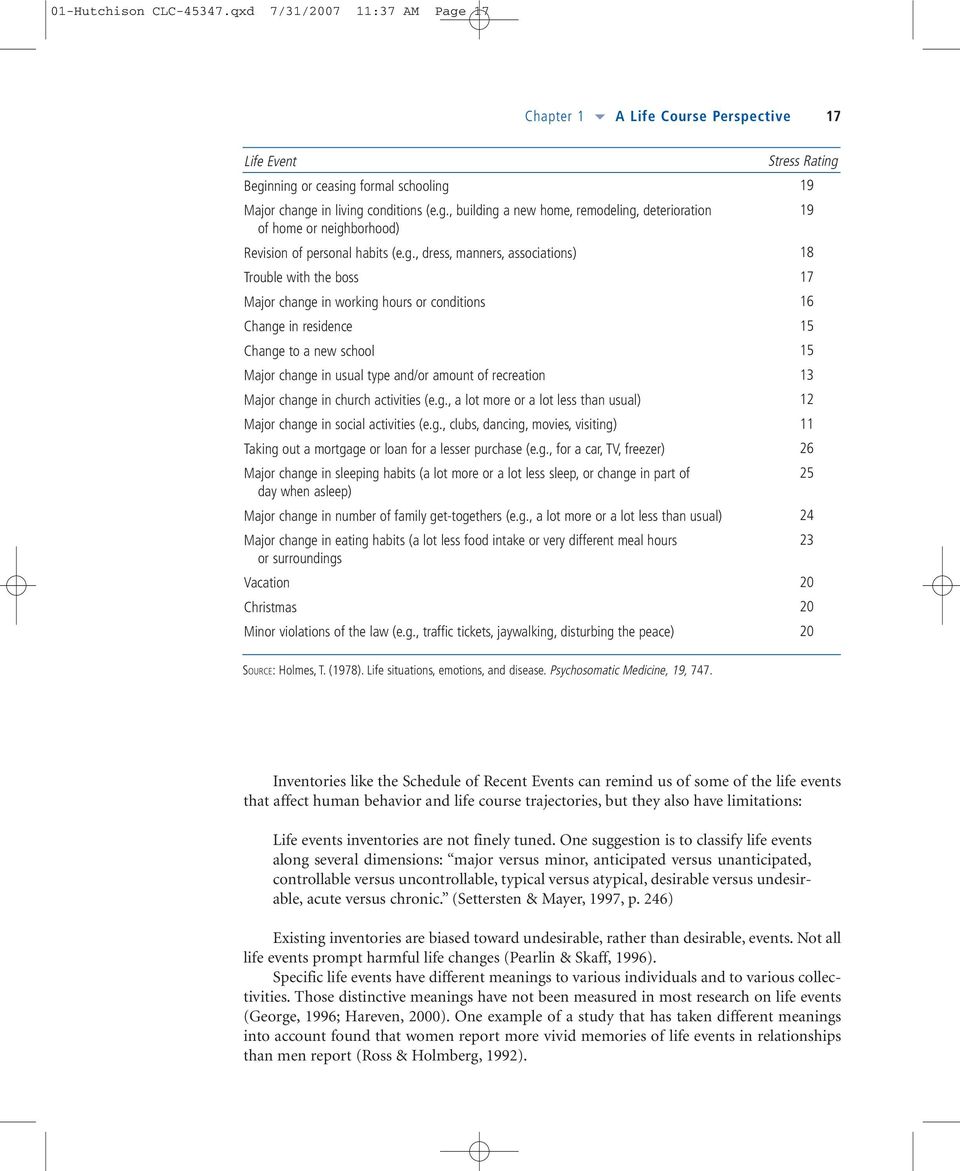
16 01-Hutchison CLC qxd 7/31/ :37 AM Page THE CHANGING LIFE COURSE happening itself and not to the transitions that will occur because of the happening. A transition is a more gradual change that occurs with a life event. One common method for evaluating the effect of such stressful events is Thomas Holmes & Richard Rahe s Schedule of Recent Events, also called the Social Readjustment Rating Scale (Holmes, 1978; Holmes & Rahe, 1967). The Schedule of Recent Events, along with the rating of the stress associated with each event, appears in Exhibit 1.5. Holmes and Rahe constructed their schedule of events by asking respondents to rate the relative degree of adjustment required for different life events. Exhibit 1.5 Life Event Life Change Events From the Holmes and Rahe Schedule of Recent Events Stress Rating Death of a spouse Divorce Marital separation from mate Detention in jail or other institutions Death of a close family member Major personal injury or illness Marriage Being fired at work Marital reconciliation with mate Retirement from work Major change in the health or behavior of a family member Pregnancy Sexual difficulties Gaining a new family member (e.g., through birth, adoption, elder moving in) Major business readjustment (e.g., merger, reorganization, bankruptcy) Major change in financial state (a lot worse off or a lot better off than usual) Death of a close friend Changing to a different line of work Major change in the number of arguments with spouse (more or less) Taking out a mortgage or loan for a major purchase Foreclosure on a mortgage or loan Major change in responsibilities at work (e.g., promotion, demotion, lateral transfer) Son or daughter leaving home Trouble with in-laws Outstanding personal achievement Wife beginning or ceasing work outside the home

17 01-Hutchison CLC qxd 7/31/ :37 AM Page 17 Chapter 1 A Life Course Perspective 17 Life Event Beginning or ceasing formal schooling Major change in living conditions (e.g., building a new home, remodeling, deterioration of home or neighborhood) Revision of personal habits (e.g., dress, manners, associations) Trouble with the boss Major change in working hours or conditions Change in residence Change to a new school Major change in usual type and/or amount of recreation Major change in church activities (e.g., a lot more or a lot less than usual) Major change in social activities (e.g., clubs, dancing, movies, visiting) Taking out a mortgage or loan for a lesser purchase (e.g., for a car, TV, freezer) Major change in sleeping habits (a lot more or a lot less sleep, or change in part of day when asleep) Major change in number of family get-togethers (e.g., a lot more or a lot less than usual) Major change in eating habits (a lot less food intake or very different meal hours or surroundings Vacation Christmas Minor violations of the law (e.g., traffic tickets, jaywalking, disturbing the peace) Stress Rating SOURCE: Holmes, T. (1978). Life situations, emotions, and disease. Psychosomatic Medicine, 19, 747. Inventories like the Schedule of Recent Events can remind us of some of the life events that affect human behavior and life course trajectories, but they also have limitations: Life events inventories are not finely tuned. One suggestion is to classify life events along several dimensions: major versus minor, anticipated versus unanticipated, controllable versus uncontrollable, typical versus atypical, desirable versus undesirable, acute versus chronic. (Settersten & Mayer, 1997, p. 246) Existing inventories are biased toward undesirable, rather than desirable, events. Not all life events prompt harmful life changes (Pearlin & Skaff, 1996). Specific life events have different meanings to various individuals and to various collectivities. Those distinctive meanings have not been measured in most research on life events (George, 1996; Hareven, 2000). One example of a study that has taken different meanings into account found that women report more vivid memories of life events in relationships than men report (Ross & Holmberg, 1992).
18 01-Hutchison CLC qxd 7/31/ :37 AM Page THE CHANGING LIFE COURSE Life events inventories are biased toward events more commonly experienced by certain groups of people: young adults, men, whites, and the middle-class (Settersten & Mayer, 1997, p. 246). In one small exploratory study that used a lifeline rather than an inventory of events in an attempt to correct for this bias, women reported a greater number of life events than men did (de Vries & Watt, 1996). Researchers have also developed a Children s Life Events Inventory, which has been used to study minority children and youth (Monaghan, Robinson, & Dodge, 1979) and an inventory to capture military events in the Chinese army (Hong-zheng, Zue-rong, & Mei-ying, 2004). Turning Points David Sanchez describes becoming an apprentice medicine man as a turning point in his life. For Mahdi Mahdi, the decision to refuse the draft was a turning point. Even though Maria Suarez was too young to think of September 11, 2001 as a turning point in her life, there is no doubt that the events of that day changed the course of her life. A turning point is a point in the life course that represents a substantial change or discontinuity in direction; it serves as a lasting change and not just a temporary detour (Rutter, 1996). As significant as they are to individuals lives, turning points usually become obvious only as time passes (Wheaton & Gotlib, 1997). Yet in one survey, more than 85% of the respondents reported that there had been turning points in their lives (Clausen, 1990, cited in Wheaton & Gotlib, 1997). According to traditional developmental theory, the developmental trajectory is more or less continuous, proceeding steadily from one phase to another. But life course trajectories are seldom so smooth and predictable. They involve many discontinuities, or sudden breaks, and some special life events become turning points that produce a lasting shift in the life course trajectory. Inertia tends to keep us on a particular trajectory, but turning points add twists and turns or even reversals to the life course (Wheaton & Gotlib, 1997). For example, we expect someone who is addicted to alcohol to continue to organize his or her life around that substance unless some event becomes a turning point for recovery (Schulenberg, Maggs, & O Malley, 2003). Longitudinal research indicates that three types of life events can serve as turning points (Rutter, 1996): 1. Life events that either close or open opportunities 2. Life events that make a lasting change on the person s environment 3. Life events that change a person s self-concept, beliefs, or expectations Some events, such as migration to a new country, are momentous because they qualify as all three types of events (Jasso, 2003). Migration, whether voluntary or involuntary, certainly makes a lasting change on the environment in which the person lives; it may also close and open opportunities and cause a change in self-concept and beliefs. Certainly, that seems to be the case with Mahdi Mahdi. Keep in mind, however, that individuals make subjective assessments of life events (George, 1996). The same type of life event may be a turning point for one individual, family, or other collectivity, but not for another. Less dramatic transitions may also become turning points, depending on the individual s assessment of its importance. An Australian study of women found a change in the nature of turning points in

19 01-Hutchison CLC qxd 7/31/ :37 AM Page 19 Chapter 1 A Life Course Perspective 19 midlife before midlife, turning points were likely to be related to role transitions; but after midlife, they were more likely to be related to personal growth (Leonard, 2006). A transition can become a turning point under five conditions (Hareven, 2000): 1. When the transition occurs simultaneously with a crisis or is followed by a crisis 2. When the transition involves family conflict over the needs and wants of individuals and the greater good of the family unit 3. When the transition is off-time, meaning that it does not occur at the typical stage in life 4. When the transition is followed by unforeseen negative consequences 5. When the transition requires exceptional social adjustments Loss of a parent is not always a turning point, but when such a loss occurs off-time, as it did with David Sanchez and Maria Suarez, it is often a turning point. Emma Suarez may not have thought of her decision to take a job in the World Trade Center as a turning point, because she could not foresee the events of September 11, Most life course pathways include multiple turning points, some that send life trajectories off track and others that bring life trajectories back on track (Wheaton & Gotlib, 1997). David Sanchez s Vietnam experience seems to have gotten him off track, and his grandmother s death seems to have gotten him back on track. In fact, we could say that the intent of many social work interventions is to get life course trajectories back on track. We sometimes do this when we work with a family that has gotten off track and on a path to divorce. We also do this when we plan interventions to precipitate a turning point toward recovery for a client with an addiction. Or, we may plan an intervention to help a deteriorating community reclaim its lost sense of community and spirit of pride. It is interesting to note that many social service organizations have taken Turning Point for their name. y Major Themes of the Life Course Perspective Over a decade ago, Glen Elder (1994) identified four dominant, and interrelated, themes in the life course approach: interplay of human lives and historical time, timing of lives, linked or interdependent lives, and human agency in making choices. The meaning of these themes is discussed below, along with the meaning of two other related themes that Elder (1998) and Michael Shanahan (2000) have recently identified as important: diversity in life course trajectories and developmental risk and protection. The meaning of these themes is summarized in Exhibit 1.6. Interplay of Human Lives and Historical Time As sociologists and social historians began to study individual and family life trajectories, they noted that persons born in different years face different historical worlds, with different options and constraints especially in rapidly changing societies, such as the United States at the beginning of the twenty-first century. They suggested that historical time may produce

20 01-Hutchison CLC qxd 7/31/ :37 AM Page THE CHANGING LIFE COURSE Exhibit 1.6 Major Themes of the Life Course Perspective Interplay of human lives and historical time: Individual and family development must be understood in historical context. Timing of lives: Particular roles and behaviors are associated with particular age groups, based on biological age, psychological age, social age, and spiritual age. Linked or interdependent lives: Human lives are interdependent, and the family is the primary arena for experiencing and interpreting wider historical, cultural, and social phenomena. Human agency in making choices: The individual life course is constructed by the choices and actions individuals take within the opportunities and constraints of history and social circumstances. Diversity in life course trajectories: There is much diversity in life course pathways, due to cohort variations, social class, culture, gender, and individual agency. Developmental risk and protection: Experiences with one life transition have an impact on subsequent transitions and events, and may either protect the life course trajectory or put it at risk. cohort effects when distinctive formative experiences are shared at the same point in the life course and have a lasting impact on a birth cohort (Alwin & McCammon, 2003). The same historical events may affect different cohorts in different ways. For example, Elder s (1974) research on children and the Great Depression found that the life course trajectories of the cohort that were young children at the time of the economic downturn were more seriously affected by family hardship than the cohort that were in middle childhood and late adolescence at the time. Analysis of large data sets by a number of researchers provides forceful evidence that changes in other social institutions impinge on family and individual life course trajectories (e.g., Cooksey et al., 1997; Elder, 1986; Rindfuss, Swicegood, & Rosenfeld, 1987; Shanahan et al., 1998). Tamara Hareven s historical analysis of family life (2000) documents the lag between social change and the development of public policy to respond to the new circumstances and the needs that arise with social change (see also Riley, 1996). One such lag today is the lag between trends in employment among mothers and public policy regarding child care during infancy and early childhood. Social work planners and administrators confront the results of such a lag in their work. Thus, they have some responsibility to keep the public informed about the impact of changing social conditions on individuals, families, communities, and formal organizations. Timing of Lives How old are you? You have probably been asked that question many times, and no doubt you find yourself curious about the age of new acquaintances. Every society appears to use age as an important variable, and many social institutions in advanced industrial societies are organized, in part, around age the age for starting school, the age of majority, retirement age, and so on (Settersten, 2003b; Settersten & Mayer, 1997). In the United States, our speech abounds with expressions related to age: terrible 2s, sweet 16, 20-something, life begins at 40, senior discounts, and lately 60 is the new 40. Age is also a prominent attribute in efforts by social scientists to bring order and predictability to our understanding of human behavior. Life course scholars are interested in the
21 01-Hutchison CLC qxd 7/31/ :37 AM Page 21 Chapter 1 A Life Course Perspective 21 age at which specific life events and transitions occur, which they refer to as the timing of lives. They may classify entrances and exits from particular statuses and roles as off-time or ontime, based on social norms or shared expectations about the timing of such transitions (George, 1993; Settersten, 2003b). For example, child labor and childbearing in adolescence are considered off-time in modern industrial countries, but in much of the world, such timing of roles is seen as a part of the natural order (Dannefer, 2003a, 2003b). Likewise, death in early or middle adulthood is considered off-time in modern industrial societies, but, due to the HIV/AIDS epidemic, has now become commonplace in much of Africa. Survivors grief is probably deeper in cases of premature loss (Pearlin & Skaff, 1996), which is perhaps why Emma Suarez s family keeps saying, She was so young; she had so much life left. Certainly, David Sanchez reacted differently to his father s and his grandmother s deaths. Dimensions of Age Chronological age itself is not the only factor involved in timing of lives. Age-graded differences in roles and behaviors are the result of biological, psychological, social, and spiritual processes. Thus, age is often considered from each of the perspectives that make up the biopsychosocial framework (e.g., Cavanaugh, 1996; Kimmel, 1990; Settersten & Mayer, 1997). Although life course scholars have not directly addressed the issue of spiritual age, it is an important perspective as well. Biological age indicates a person s level of biological development and physical health, as measured by the functioning of the various organ systems. It is the present position of the biological person in relation to the potential life cycle. There is no simple, straightforward way to measure biological age. Any method for calculating it has been altered by changes in life expectancy (Shanahan, 2000) and by changes in the main causes of death (Bartley, Blane, & Montgomery, 1997). With the development of modern medicine, the causes of death have shifted from infectious diseases to chronic diseases (National Center for Health Statistics, 2001a). Life course researchers need to collaborate with geneticists to understand the effect on biological age of late-emerging genetic factors and with endocrinologists to understand how social processes are related to biological aging (Shanahan, 2000). Psychological age has both behavioral and perceptual components. Behaviorally, psychological age refers to the capacities that people have and the skills they use to adapt to changing biological and environmental demands. Skills in memory, learning, intelligence, motivation, emotions, and so forth are all involved (Settersten & Mayer, 1997). Perceptually, psychological age is based on how old people perceive themselves to be. Life course researchers have explored the perceptual aspect of psychological age since the 1960s, sometimes with questions such as, Do you feel that you are young, middle-aged, old, or very old? (e.g., Barak & Stern, 1986; Markides & Boldt, 1983). Researchers have also used a more multifaceted way of exploring perceived age. Some have distinguished between feel-age, look-age, do-age, and interests-age (Henderson, Goldsmith, & Flynn, 1995). Anthropological examination of life transitions suggests that men and women attach different social meanings to age and use different guidelines for measuring how old they are (Hagestad, 1991), but empirical research on the role gender plays in self-perceived age is mixed. Culture is another factor in perceptions of age. In one study, the researchers found less discrepancy between chronological age and self-perceived age among a Finnish sample than among a U.S. sample, with the U.S. sample demonstrating a definite tendency to say they considered themselves more youthful than their chronological age (Uotinen, 1998).
22 01-Hutchison CLC qxd 7/31/ :37 AM Page THE CHANGING LIFE COURSE Social age refers to the age-graded roles and behaviors expected by society in other words, the socially constructed meaning of various ages. The concept of age norm is used to indicate the behaviors that are expected of people of a specific age in a given society at a particular point in time. Age norms may be informal expectations, or they may be encoded as formal rules and laws. For example, cultures have an informal age norm about the appropriate age to begin romantic dating, if romantic dating is the method used for mate selection. On the other hand, many countries have developed formal rules about the appropriate age for driving, drinking alcohol, and voting. Life course scholars suggest that age norms vary not only across historical time and across societies but also by gender, race, ethnicity, and social class within a given time and society (Chudacoff, 1989; Kertzer, 1989; Settersten, 2003b; Settersten & Mayer, 1997). Although biological age and psychological age are recognized in the life course perspective, social age receives special emphasis. For instance, life course scholars use life phases such as middle childhood and middle adulthood, which are based in large part on social age, to conceptualize human lives from birth to death. In this book, we talk about nine phases, from conception to very late adulthood. Keep in mind, however, that the number and nature of these life phases are socially constructed and have changed over time, with modernization and mass longevity leading to finer gradations in life phases and consequently a greater number of them (Settersten & Mayer, 1997). Such fine gradations do not exist in most preindustrial and newly industrializing countries (Dannefer, 2003a, 2003b). Spiritual age indicates the current position of a person in the ongoing search for meaning and morally fulfilling relationships (Canda, 1997, p. 302). David Sanchez is certainly at a different position in his search for life s meaning than he was when he came home from Vietnam. Although life course scholars have not paid much attention to spiritual age, it has been the subject of study by some developmental psychologists and other social scientists. In an exploration of the meaning of adulthood edited by Erik Erikson in 1978, several authors explored the markers of adulthood from the viewpoint of a number of spiritual and religious traditions, including Christianity, Hinduism, Islam, Buddhism, and Confucianism. Several themes emerged across the various traditions: contemplation, moral action, reason, selfdiscipline, character improvement, loving actions, and close community with others. All the authors noted that spirituality is typically seen as a process of growth, a process with no end. James Fowler (1981) has presented a theory of faith development, based on 359 indepth interviews, that strongly links it with chronological age. Ken Wilber s (1977, 1995) Full-Spectrum Model of Consciousness also proposes an association between age and spiritual development, but Wilbur does not suggest that spiritual development is strictly linear. He notes, as do the contributors to the Erikson book, that there can be regressions, temporary leaps, and turning points in a person s spiritual development. Standardization in the Timing of Lives Life course scholars debate whether the trend is toward greater standardization in age-graded social roles and statuses or toward greater diversification (Settersten, 2003b; Settersten & Lovegreen, 1998; Shanahan, 2000). Ironically, life patterns seem to be becoming, at the same time, more standardized and more diversified. The implication for social workers is that we must pay attention to the uniqueness of each person s life course trajectory, but we can use research about regularities in the timing of lives to develop social work interventions.
23 01-Hutchison CLC qxd 7/31/ :37 AM Page 23 Chapter 1 A Life Course Perspective 23 Many societies engage in age structuring, or standardizing of the ages at which social role transitions occur, by developing policies and laws that regulate the timing of these transitions. For example, in the United States there are laws and regulations about the ages for compulsory education, working (child labor), driving, drinking, being tried as an adult, marrying, holding public office, and receiving pensions and social insurance. However, countries vary considerably in the degree to which age norms are formalized (Settersten, 2003b; Settersten & Mayer, 1997; Shanahan, 2000). Some scholars suggest that formal age structuring becomes more prevalent as societies modernize (Buchmann, 1989; Meyer, 1986). European life course scholars suggest that U.S.-based life course scholars have underplayed the role of government in age structuring, suggesting that, in Europe, strong centralized governments play a larger role than in the United States in structuring the life course (Leisering, 2003; Marshall & Mueller, 2003). Formalized age structuring has created a couple of difficulties that affect social workers. One is that cultural lags often lead to a mismatch between changing circumstances and the age structuring in society (Foner, 1996). Consider the trend for corporations to offer early retirement, before the age of 65, in a time when people are living longer and with better health. This mismatch has implications both for public budgets and for individual lives. Another problem with the institutionalization of age norms is increasing age segregation; people are spending more of their time in groups consisting entirely of people their own age. Social work services are increasingly organized around the settings of these age-segregated groups: schools, the workplace, long-term care, and so forth. Some life course scholars argue, however, that modernization has allowed the life course to become more flexibly structured (Guillemard & van Gunsteren, 1991; Neugarten & Hagestad, 1976). Indeed, there is much diversity in the sequencing and timing of adult life course markers, such as completing an education, beginning work, leaving home, marrying, and becoming a parent (George & Gold, 1991). Trajectories in the family domain may be more flexible than work and educational trajectories (Elder, 1998; Settersten, 2003b; Settersten & Lovegreen, 1998). On the other hand, the landscape of work is changing, with less opportunity for continuous and stable employment, and this is creating greater diversity in work trajectories (Heinz, 2003). In addition, while educational trajectories remain standardized for the most well-off, who move smoothly from secondary to higher education, they are less structured for other members of society (Pallas, 2003). Life course trajectories also vary in significant ways by gender, race, ethnicity, and social class (Elder, 1998; Settersten & Lovegreen, 1998; Shanahan, 2000). This issue will be discussed further later in the chapter. To gain a better understanding of regularities and irregularities in life course trajectories, researchers have studied the order in which life events and transitions occur (George, 1993). Most of the research has been on the entrance into adulthood, focusing specifically on the completion of school, first full-time job, and first marriage (Hogan, 1978, 1981; Modell, Furstenberg, & Hershberg, 1976; Settersten, 1998; Shanahan et al., 1998). Life course scholars also are interested in the length of time that an individual, family, or other collectivity spends in a particular state, without changes in status or roles. In general, the longer we experience specific environments and conditions, the more likely it is that our behavior will be affected by them (George, 1996). The duration of Mahdi Mahdi s stays in various settings and statuses soldier, refugee, convenience store clerk, immigration specialist is important. Finally, life course scholars are studying the pace of transitions. Transitions into adult roles in young adulthood (such as completing school, leaving home,
24 01-Hutchison CLC qxd 7/31/ :37 AM Page THE CHANGING LIFE COURSE getting the first job, getting married, having the first child) appear to be more rapidly timed than transitions in middle and late adulthood (such as launching children, retiring, losing parents) (Hareven, 1978, 2000). Linked or Interdependent Lives The life course perspective emphasizes the interdependence of human lives and the ways in which relationships both support and control an individual s behavior. Social support, which is defined as help rendered by others that benefits an individual or collectivity, is an obvious element of interdependent lives. Relationships also control behavior through expectations, rewards, and punishments. In the United States, particular attention has been paid to the family as a source of support and control. In addition, the lives of family members are linked across generations, with both opportunity and misfortune having an intergenerational impact. The cases of David Sanchez, Mahdi Mahdi, and Maria Suarez are rich examples of lives linked across generations. But they are also rich examples of how people s lives are linked with those of people outside the family. Links Between Family Members Certainly, parents and children s lives are linked. Elder s longitudinal research of children raised during the Great Depression found that as parents experienced greater economic pressures, they faced a greater risk of depressed feelings and marital discord. Consequently, their ability to nurture their children was compromised, and their children were more likely Photo 1.3 Parents and children s lives are linked When parents experience stress or joy, so do children.
25 01-Hutchison CLC qxd 7/31/ :37 AM Page 25 Chapter 1 A Life Course Perspective 25 to exhibit emotional distress, academic trouble, and problem behavior (Elder, 1974). The connection between family hardship, family nurturance, and child behaviors is now well established (e.g., Conger, Elder, Lorenz, Simons, & Whitbeck, 1992; Conger et al., 1993). In addition to the economic connection between parents and children, parents provide social capital for their children, in terms of role models and networks of social support (Cooksey et al., 1997). It should also be noted that parents lives are influenced by the trajectories of their children s lives. For example, parents may need to alter their work trajectories to respond to the needs of a terminally ill child. Or parents may forgo early retirement to assist their young adult children with education expenses. Parents may be negatively affected by stressful situations that their children face. For instance, Mahdi Mahdi says that his father died from worrying about his sons. Older adults and their adult children are also interdependent. The pattern of mutual support between older adults and their adult children is formed by life events and transitions across the life course (Hareven, 1996). It is also fundamentally changed when families go through historical disruptions such as wars or major economic downturns. For example, the traditional pattern of intergenerational support parents supporting children is often disrupted when one generation migrates and another generation stays behind. It is also disrupted in immigrant families when the children pick up the new language and cultural norms faster than the adults in the family and take on the role of interpreter for their parents and grandparents (Hernandez & McGoldrick, 2005). What complicates matters is that family roles must often be synchronized across three or more generations at once. Sometimes this synchronization does not go smoothly. Divorce, remarriage, and discontinuities in parents work and educational trajectories may conflict with the needs of children (see, e.g., Ahrons, 2005; Cooksey et al., 1997). Similarly, the timing of adult children s educational, family, and work transitions often conflicts with the needs of aging parents (Hareven, 1996). The generation in the middle may have to make uncomfortable choices when allocating scarce economic and emotional resources. When a significant life event in one generation (such as death of a grandparent) is juxtaposed with a significant life event in another generation (such as birth of a child), families and individual family members are especially vulnerable (Carter & McGoldrick, 2005a). Links With the Wider World We know a lot more at this point about the ways that individuals and their multigenerational families are interdependent than about the interdependence between individuals and families and other groups and collectivities. However, we may at least note that work has a major effect on family transitions (George, 1993). In this vein, using data for 6- and 7-yearold children from the National Longitudinal Survey of Youth, researchers found that the children s depression and aggressive behavior were not associated with whether their mothers were employed but rather with the type of work those mothers did (Cooksey et al., 1997). Children whose mothers are in occupations requiring complex skills are less likely to be depressed and behave aggressively than children whose mothers are in less skilled work environments. Perhaps performing complex tasks at work enhances parenting skills. Or perhaps the mothers in more skilled occupations benefit emotionally from having greater control over their work environments. This finding would, of course, have meaning only in an
26 01-Hutchison CLC qxd 7/31/ :37 AM Page THE CHANGING LIFE COURSE advanced industrial society and would offer no insight about parenting skills in traditional societies. The family seems to have much more influence on child and adolescent behaviors than the neighborhood does (Elder, 1998; Furstenberg, Cook, Eccles, Elder, & Sameroff, 1999; Klebanov, Brooks-Gunn, Gordon, & Chase-Lansdale, 1997). More differences in the behavior of children and adolescents have been found among families within a given neighborhood than have been found when comparing the families in one neighborhood with families in other neighborhoods. There is evidence, however, that the neighborhood effects may be greater for children living in high-poverty areas, which are often marked by violence and environmental health hazards, than for children living in low-poverty neighborhoods (Katz, Kling, & Liebman, 1999, cited in Shonkoff & Phillips, 2000; Rosenbaum, 1991). It is important for social workers to remember that lives are also linked in systems of institutionalized privilege and oppression. The life trajectories of members of minority groups in the United States are marked by discrimination and lack of opportunity, which are experienced pervasively as daily insults and pressures. However, various cultural groups have devised unique systems of social support to cope with the mundane extreme environments in which they live (McAdoo, 1986). Examples include the extensive and intensive natural support systems of Hispanic families like the Suarez family (Falicov, 2005) and the special role of the church for African Americans (Billingsley, 1999). Others construct lives of desperation or resistance in response to limited opportunities. Dale Dannefer (2003a, 2003b) reminds us that, in the global economy, lives are linked around the world. The lifestyles of people in affluent countries depend on cheap labor and cheap raw products in Africa, South America, the Caribbean, parts of Asia, and other places. Children and women in impoverished countries labor long hours to make an increasing share of low-cost products consumed in affluent countries. Women migrate from impoverished countries to become the domestic laborers in affluent countries, allowing women in affluent countries to leave the home to take advantage of career opportunities, and allowing the domestic workers to send the money they make back home to support their own families (Parrenas, 2001). Human Agency in Making Choices Mahdi Mahdi made a decision to refuse the draft, and this decision had a momentous impact on his own life course as well as the trajectory of members of his extended family. Like all of us, he made choices that fundamentally changed his life (Elder, 1998). In other words, he participated in constructing his life course through the exercise of human agency, or the use of personal power to achieve one s goals. The emphasis on human agency may be one of the most positive contributions of the life course perspective (Hareven, 2000). A look at the discipline of social history might help to explain why considering human agency is so important to social workers. Social historians have attempted to correct the traditional focus on lives of elites by studying the lives of common people (Hareven, 2000). By doing so, they discovered that many groups once considered passive victims for example, working-class people and slaves actually took independent action to cope with the difficulties imposed by the rich and powerful. Historical research now shows that couples tried to limit the size of their families even in preindustrial societies (Wrigley, 1966), that slaves were often ingenious in their struggles to hold their families together (Gutman, 1976), and that
27 01-Hutchison CLC qxd 7/31/ :37 AM Page 27 factory workers used informal networks and kinship ties to manage, and sometimes resist, pressures for efficiency (Hareven, 1982a). These findings are consistent with social work approaches that focus on individual, family, and community strengths (Saleeby, 1996). Clearly, however, human agency has limits. Individuals choices are constrained by the structural and cultural arrangements of a given historical era. For example, Mahdi Mahdi s choices did not seem limitless to him; he faced the unfortunate choices of becoming a soldier again or refusing the draft. Unequal opportunities also give some members of society more options than others have. Elder (1998) notes that the emphasis on human agency in the life course perspective has been aided by Albert Bandura s (1986) work on the two concepts of self-efficacy, or sense of personal competence, and efficacy expectation, or expectation that one can personally accomplish a goal. It is important to remember, however, that Bandura (1986) makes specific note about how social inequalities can result in low selfefficacy and low efficacy expectations among members of oppressed groups. In his recent work, Bandura (2002) has suggested that there are three types of human agency: personal agency or use of personal power, proxy agency or actions of some on behalf of others, and collective agency accomplished through group action. The concepts of proxy agency and collective agency bring us back to linked and interdependent lives. These concepts add important dimensions to the discussion of human agency, and can serve to counter-balance the extreme individualism of U.S. society. Diversity in Life Course Trajectories Chapter 1 A Life Course Perspective 27 Life course researchers have long had strong evidence of diversity in individuals life patterns. Early research emphasized differences between cohorts, but increasing attention is being paid to variability within cohort groups. However, the life course research to date has been based on samples from affluent societies and fails to account for global diversity, particularly for the life course trajectories of the great majority of the world s people who live in nonindustrial or early industrializing countries (Dannefer, 2003a, 2003b). Consequently, the life course perspective has the potential to accommodate global diversity, but has not adequately done so to date. We also want to interject a word here about terminology and human diversity. As we attempted to uncover what is known about human diversity in life course trajectories, we struggled with terminology to define identity groups. We searched for consistent language to describe different groups, and we were dedicated to using language that identity groups would use to describe themselves. However, we ran into challenges endemic to our time related to the language of diversity. First, it is not the case that all members of a given identity group at any given time embrace the same terminology for their group. Second, as we reviewed literature from different historical moments, we recognized the shifting nature of terminology. In addition, even within a given historical era, we found that different researchers used different terms and had different decision rules about who comprises the membership of identity groups. So, in the end, you will find that we have not settled on fixed terminology that is used consistently to describe identity groups. Rather, we use the language of individual researchers when reporting their studies, because we want to avoid distorting their work. We hope that you will recognize that the ever-changing language of diversity has both constructive potential to find creative ways to affirm diversity and destructive potential to dichotomize diversity into the norm and the other.
28 01-Hutchison CLC qxd 7/31/ :37 AM Page THE CHANGING LIFE COURSE As we strive to provide a global context, we encounter current controversies about appropriate language to describe different sectors of the world. For a long time, many scholars have used the language of First World, Second World, and Third World to define global sectors. First World has been used to describe the nations that were the first to industrialize, urbanize, and modernize. Second World was used to describe nations that have industrialized but have not yet become central to the world economy. Third World has been used to refer to nonindustrialized nations that have few resources and are considered expendable in the global economy. This approach has lost favor in recent years (Leeder, 2004). Immanuel Wallerstein (1974, 1979) uses different language but makes a similar distinction; he refers to wealthy core countries, newly industrialized semiperiphery countries, and the poorest periphery countries. Other writers divide the world into developed and developing countries (McMichael, 2004), referring to the level of industrialization, urbanization, and modernization. Still others divide the world into the Global North and the Global South, calling attention to a history in which the Global North colonized and exploited the resources of the Global South. And, finally some writers talk about the West versus the East, where the distinctions are largely cultural. We recognize that such categories carry great symbolic meaning and can mask systems of power and exploitation. As with diversity, we attempted to find a respectful language that could be used consistently throughout the book. Again, we found that different researchers have used different language and different characteristics to describe categories of nations, and when reporting on their findings, we have used their own language to avoid misrepresenting their findings. It seems, in any case, that Elder s four themes of the life course perspective can be used to more completely recognize diversity in its many forms: 1. Interplay of human lives and historical time. Cohorts tend to have different life trajectories because of the unique historical events each cohort encounters. Mahdi Mahdi wanted his daughter to tell her story because he knew that he and she had experienced the war, escape, and resettlement very differently. But, the same birth cohort in different parts of the world face very different historical events. For example, the post-world War II era was very different for young adults in Germany than it was in the United States. And, the children of Darfur in 2006 face very different historical events from the children in Australia. 2. Timing of lives. Age norms change with time and place and culture. The life course perspective, developed in late industrial affluent countries, has paid little attention to such age norms as childhood marriage in Bangladesh, but it can be extended to accommodate a more global perspective (Chowdhury, 2004). Age norms also vary by social location, or place in the social structure of a given society, most notably by gender, race, ethnicity, and social class (Settersten, 2003a; Settersten & Mayer, 1997). These variables create differences from one cohort to another as well as differences among the individuals within a cohort. 3. Linked or independent lives. The differing patterns of social networks in which persons are embedded produce differences in life course experiences. Likewise, the different locations in the global economy produce very different life course trajectories. The intersection of multiple trajectories for example, the family lifeline, the educational lifeline, and the work lifeline introduces new possibilities for diversity in life course patterns. Like many midlife adults, Mahdi Mahdi must find a way to balance his family lifeline, educational lifeline, and work lifeline.
29 01-Hutchison CLC qxd 7/31/ :37 AM Page 29 Chapter 1 A Life Course Perspective Human agency in making choices. Human agency, particularly personal agency, allows for extensive individual differences in life course trajectories as individuals plan and make choices between options. It is not surprising, given these possibilities for unique experience, that the stories of individuals vary so much. It is also important to remember that proxy agency and collective agency can produce both individual and group-based differences in life course trajectories. A good indication of the diversity of life course trajectories is found in an often cited study by Ronald Rindfuss and colleagues (Rindfuss et al., 1987). They examined the sequencing of five roles work, education, homemaking, military, and other among 6,700 U.S. men and 7,000 U.S. women for the eight years following their high school graduation in The researchers found 1,100 different sequences of these five roles among the men and 1,800 different sequences among the women. This and other research on sequencing of life course transitions has called increasing attention to the heterogeneity of life course trajectories (Settersten, 1998, 2003a; Settersten & Lovegreen, 1998; Shanahan et al., 1998). These research results indicate that men s life course trajectories are more rigidly structured, with fewer discontinuities, than women s. One explanation for this gender difference is that women s lives have been more strongly interwoven with the family domain than men s, and the family domain operates on nonlinear time, with many irregularities (Settersten & Lovegreen, 1998). Men s lives are still more firmly rooted in domains outside the family, such as the paid work world, and these domains operate in linear time. Men s and women s life trajectories have started to become more similar, and it has been suggested that this convergence is primarily because women s schooling and employment patterns are moving closer to men s, and not because men have become more involved in the family domain (Settersten & Lovegreen, 1998). However, the recent decline in employment stability is also leading to greater discontinuity in the life course trajectories of men (Heinz, 2003). Life course trajectories also vary by social class. In impoverished societies, and in neighborhoods in affluent societies that are characterized by concentrated poverty, large numbers of youth drop out of school by the ninth grade (Dannefer, 2003a, 2003b; Kliman & Madsen, 2005). This was the case for Jesus and Aida Suarez. In contrast, youth in upper middle-class and upper-class families expect an extended period of education with parental subsidies. These social class differences in educational trajectories are associated with differences in family and work trajectories. Affluent youth go to school and postpone their entry into adult roles of work and family. Less affluent youth, however, often enter earlier into marriage, parenting, and employment. Research suggests that the family life trajectories in minority groups in the United States are different from the family life trajectories of whites. Minority youth tend to leave home to live independently later than white youth do, at least in part because of the high value put on kinkeeping in many minority cultures (Stack, 1974). However, in a random sample from a major urban U.S. city, minority respondents gave earlier deadlines for leaving home than white respondents when questioned about the appropriate age for leaving home even though the minority respondents actually left home at a later age than the white respondents (Settersten, 1998). This finding may reflect the bicultural conflict that complicates the lives of young adults in ethnic minority groups. It also reflects differences in financial resources for leaving home.
30 01-Hutchison CLC qxd 7/31/ :37 AM Page THE CHANGING LIFE COURSE Another source of diversity in a country with considerable immigration is the individual experience leading to the decision to immigrate, the journey itself, and the resettlement period (Devore & Schlesinger, 1999; Hernandez & McGoldrick, 2005). The individual s decision to immigrate may involve social, religious, or political persecution, and it increasingly involves a search for economic gain. Or, as in Mahdi Mahdi s case, it may involve war and a dangerous political environment. The transit experience is sometimes traumatic, and Mahdi Mahdi does not like to recall his escape in the middle of the night. The resettlement experience requires establishment of new social networks, may involve changes in socioeconomic status, and presents serious demands for acculturating to a new physical and social environment. Mahdi Mahdi speaks of the struggles in being a convenience store clerk with a college education. Gender, race, social class, and age all add layers of complexity to the migration experience. Family roles often have to be renegotiated as children outstrip older family members in learning the new language. Tensions can also develop over conflicting approaches to the acculturation process (Fabelo-Alcover, 2001). Just as they should investigate their clients educational trajectories, work trajectories, and family trajectories, social workers should be interested in the migration trajectories of their immigrant clients. Developmental Risk and Protection As the life course perspective has continued to evolve, it has more clearly emphasized the links between the life events and transitions of childhood, adolescence, and adulthood (McLeod & Almazan, 2003; Shanahan, 2000). Studies indicate that childhood events sometimes shape people s lives 40 or 50 years later (George, 1996). In fact, the long-term impact of developmental experiences was the subject of the earliest life course research, Glen Elder s (1974) examination of longitudinal data for children from the Great Depression. He compared a group of children (referred to as the Oakland children) who were born in 1920 and 1921 with a group of children (referred to as the Berkeley children) who were born in 1928 and The Oakland children experienced a relatively stable and secure childhood before they encountered the economic deprivations of the Great Depression during their adolescence. They also made the transition to adulthood after the worst of the economic downturn. The Berkeley children, on the other hand, experienced early childhood during the worst years of the Depression. When they reached adolescence, their parents were involved in World War II, with many fathers away in military roles and many mothers working long hours in essential industry. Although both groups experienced economic hardship and later difficulties in life transitions, the Berkeley children were more negatively affected than the Oakland children. Elder (1998) has recently, more clearly, enunciated the idea of developmental risk and protection as a major theme of the life course perspective this way, [T]he developmental impact of a succession of life transitions or events is contingent on when they occur in a person s life (p. 3). Other life course scholars have suggested that it is not simply the timing and sequencing of hardships but also their duration and spacing that provide risk for youth as they make the transition into adulthood. For instance, poverty alone is much less of a risk than extended poverty (Shanahan, 2000). Families are more vulnerable to getting off track when confronted simultaneously by multiple events and transitions (Carter & McGoldrick, 2005a). Life course scholars have borrowed the concepts of cumulative advantage and cumulative disadvantage from sociologist Robert Merton to explain inequality within cohorts across the life course (Bartley et al., 1997; O Rand, 1996; Settersten, 2003a). Merton (1968) found that in scientific
31 01-Hutchison CLC qxd 7/31/ :37 AM Page 31 Chapter 1 A Life Course Perspective 31 careers, large inequalities in productivity and recognition had accumulated. Scholarly productivity brings recognition, and recognition brings resources for further productivity, which of course brings further recognition and so on. Merton proposed that, in this way, scientists who are productive early in their careers accumulate advantage over time, whereas other scientists accumulate disadvantage. Sociologists propose that cumulative advantage and cumulative disadvantage are socially constructed; social institutions and societal structures develop mechanisms that ensure increasing advantage for those who succeed early in life and increasing disadvantage for those who struggle (Settersten & Lovegreen, 1998). Consider the effect of advantages in schooling. Young children with affluent parents attend enriched early childhood programs and well-equipped primary and secondary schools, which position them for successful college careers, which position them for occupations that pay well, which provide opportunities for good health maintenance, which position them for healthy, secure old age. This trajectory of unearned advantage is sometimes referred to as privilege (McIntosh, 1988). Children who do not come from affluent families are more likely to attend underequipped schools, experience school failure or dropout, begin work in low-paying sectors of the labor market, experience unemployment, and arrive at old age with compromised health and limited economic resources. Early deprivations and traumas do not inevitably lead to a trajectory of failure, but without intervention that reverses the trajectory, these early experiences are likely to lead to accumulation of disadvantage. Individual trajectories may be moderated not only by human agency but also by historical events and environmental supports. As one example of the positive impact of historical events, many children of the Great Depression were able to reverse disadvantages in their life trajectories through their military service in World War II (Elder, 1986). On the other hand, military service in wartime may involve traumatic stress, as we see with David Sanchez and Mahdi Mahdi. In terms of environmental support, governmental safety nets to support vulnerable families at key life transitions have been found to reduce the effects of deprivation and trauma on health (Bartley et al., 1997). For example, researchers have found that home nurse visitation during the first two years of a child s life can reduce the risk of child abuse and criminal behavior among low-income mothers (Olds et al., 1997). The life course perspective and the concept of cumulative disadvantage are beginning to influence community epidemiology, which studies the prevalence of disease across communities (e.g., Brunner, 1997; Kellam & Van Horn, 1997; Kuh & Ben-Sholomo, 2004). Researchers in this tradition are interested in social and geographical inequalities in the distribution of chronic disease. They suggest that risk for chronic disease gradually accumulates over a life course through episodes of illness, exposure to unfavorable environments, and unsafe behaviors. They are also interested in how some experiences in the life course can break the chain of risk. This approach to public health mirrors efforts in developmental psychology and other disciplines to understand developmental risk and protective factors (Fraser, 2004; Rutter, 1996; Werner & Smith, 2001). The study of risk and protection has led to an interest in the concept of resilience, which refers to the ability of some people to fare well in the face of risk factors. Researchers studying resilient children are examining the interplay of risk factors and protective factors in their lives. Although the study of protective factors lags behind the study of risk factors, researchers speculate that a cumulative effect will also be found for protective factors (Fraser, 2004; Luthar, 2003). Many scholars now recommend that we think of risk and protection as processes over time, which is very much like the way that life course scholars write about life trajectories. Exhibit 1.7 shows how phases of life are interwoven with various risks and protective factors.
32 01-Hutchison CLC qxd 7/31/ :37 AM Page THE CHANGING LIFE COURSE Exhibit 1.7 Risk and Protective Factors for Specific Life Course Phases Life Course Phase Infancy Infancy-Childhood Infancy-Adolescence Infancy-Adulthood Early Childhood Preschool-Adulthood Childhood-Adolescence Risk Factors Poverty Child abuse/neglect Parental mental illness Teenage motherhood Poverty Child abuse/neglect Divorce Parental substance abuse Poverty Child abuse/neglect Parental mental illness Parental substance abuse Teenage motherhood Divorce Poverty Child abuse/neglect Teenage motherhood Poverty Poverty Parental mental illness Parental substance abuse Divorce Poverty Child abuse/neglect Parental mental illness Parental substance abuse Divorce Protective Factors Active, alert, high vigor Sociability Small family size Easy, engaging temperament Maternal competence Close bond with primary caregiver (not necessarily biological parent) Supportive grandparents Low distress/low emotionality Mother s education Advanced self-help skills Supportive teachers Successful school experiences Internal locus of control Strong achievement motivation Special talents, hobbies Positive self-concept For girls: emphasis on autonomy with emotional support from primary caregiver For boys: structure and rules in household For both boys and girls: assigned chores Close, competent peer friends who are confidants Childhood-Adulthood Adolescence-Adulthood Poverty Child abuse/neglect Parental mental illness Parental substance abuse Divorce Teenage parenthood Poverty Average/above-average intelligence Ability to distance oneself Impulse control Strong religious faith Supportive siblings Mentors Planning, foresight SOURCE: Based on Werner, 2000, pp
33 01-Hutchison CLC qxd 7/31/ :37 AM Page 33 y Strengths and Limitations of the Life Course Perspective Chapter 1 A Life Course Perspective 33 As a framework for thinking about the aspect of time in human behavior, the life course perspective has several advantages over traditional theories of human development. It encourages greater attention to the impact of historical and social change on human behavior, which seems particularly important in a rapidly changing society such as ours. Because it attends to biological, psychological, and social processes in the timing of lives, it is a good fit with a biopsychosocial perspective. Its emphasis on linked lives shines a spotlight on intergenerational relationships and the interdependence of lives. At the same time, with its attention to human agency, the life course perspective is not as deterministic as some earlier theories, and acknowledges people s strengths and capacity for change. Life course researchers are also finding strong evidence for the malleability of risk factors and the possibilities for preventive interventions (Kellam & Van Horn, 1997). With attention to the diversity in life course trajectories, the life course perspective provides a good conceptual framework for culturally sensitive practice. And finally, the life course perspective lends itself well to research that looks at cumulative advantage and cumulative disadvantage, adding to our knowledge about the impact of power and privilege, and subsequently suggesting strategies for social justice. To answer questions about how people change and how they stay the same across a life course is no simple task, however. Take, for example, the question of whether there is an increased sense of generativity, or concern for others, in middle adulthood. Should the researcher study different groups of people at different ages (perhaps a group of 20-year-olds, a group of 30-year-olds, a group of 40-year-olds, a group of 50-year-olds, and a group of 60-year-olds) and compare their responses, in what is known as a cross-sectional design? Or should the researcher study the same people over time (perhaps at 10-year intervals from age 20 to age 60) and observe whether their responses stay the same or change over time, in what is known as a longitudinal design? I hope you are already raising the question, what happens to the cohort effect in a cross-sectional study? This question is, indeed, always a problem with studying change over time with a cross-sectional design. Suppose we find that 50-year-olds report a greater sense of generativity than those in younger age groups. Can we then say that generativity does, indeed, increase in middle adulthood? Or do we have to wonder if there was something in the social and historical contexts of this particular cohort of 50-year-olds that encouraged a greater sense of generativity? Because of the possibility of cohort effects, it is important to know whether research was based on a cross-sectional or longitudinal design. Although attention to diversity and heterogeneity may be the greatest strength of the life course perspective, heterogeneity may also be its biggest challenge. The life course perspective, like other behavioral science perspectives, searches for patterns of human behavior. But the current level of heterogeneity in countries such as the United States may well make discerning patterns impossible (George, 1993). Perhaps, instead of thinking in terms of patterns, we can think in terms of processes and mechanisms. Another challenge related to diversity perhaps a larger challenge is that the life course perspective has not been used to consider diversity of experiences on a global level. This failure has led some scholars to suggest that the life course perspective, as it currently stands, is a perspective that only applies to affluent, late industrial societies (Dannefer, 2003a, 2003b; Fry, 2003). I would suggest, however, that there is nothing inherent in either the basic conceptions
34 01-Hutchison CLC qxd 7/31/ :37 AM Page THE CHANGING LIFE COURSE or the major themes of the life course perspective that make it inappropriate for use to understand human behavior at a global level. This is particularly true if human agency is understood to include proxy agency and collective agency. Another possible limitation of the life course perspective is a failure to adequately link the micro world of individual and family lives to the macro world of social institutions and formal organizations (Dannefer, 2003a, 2003b; George, 1993; Leisering, 2003). Social and behavioral sciences have, historically, divided the social world up into micro and macro and studied them in isolation. The life course perspective was developed by scholars like Glen Elder Jr. and Tamara Hareven, who were trying to bring those worlds together. Sometimes, however, this effort is more successful than at other times, and this remains a challenge for the future. y Integration With a Multidimensional, Multitheoretical Approach A companion volume to this book, Dimensions of Human Behavior: Person and Environment, recommends a multidimensional, multitheoretical approach for understanding human behavior. This recommendation is completely compatible with the life course perspective presented in this volume. The life course perspective clearly recognizes the biological and psychological dimensions of the person and can accommodate the spiritual dimension. The life course emphasis on linked or interdependent lives is consistent with the idea of the unity of person and environment presented in Volume I of this book. It can also easily accommodate the multidimensional environment (physical environment, culture, social institutions and social structure, families, small groups, formal organizations, communities, and social movements) discussed in the companion volume. Likewise, the life course perspective is consistent with the multitheoretical approach presented in Volume I. The life course perspective has been developed by scholars across several disciplines, and they have increasingly engaged in cross-fertilization of ideas from a variety of theoretical perspectives (see, e.g., George, 1993, 1996; Kellam & Van Horn, 1997; O Rand, 1996; Pearlin & Skaff, 1996). Because the life course can be approached from the perspective of the individual, from the perspective of the family or other collectivities, or seen as a property of cultures and social institutions that shape the pattern of individual lives, it builds on both psychological and sociological theories. Exhibit 1.8 demonstrates the overlap between the life course perspective and the eight theoretical perspectives presented in Chapter 2, of Dimensions of Human Behavior: Person and Environment.
35 01-Hutchison CLC qxd 7/31/ :37 AM Page 35 Chapter 1 A Life Course Perspective 35 Exhibit 1.8 Overlap of the Life Course Perspective and Eight Theoretical Perspectives on Human Behavior Implications for Social Work Practice Theoretical Perspective Systems Perspective: Human behavior is the outcome of reciprocal interactions of persons operating within organized and integrated social systems. Conflict Perspective: Human behavior is driven by conflict, dominance, and oppression in social life. Rational Choice Perspective: Human behavior is based on self-interest and rational choices about effective ways to accomplish goals. Social Constructionist Perspective: Social reality is created when actors, in social interaction, develop a common understanding of their world. Psychodynamic Perspective: Internal processes such as needs, drives, and emotions motivate human behavior; early childhood experiences are central to problems of living throughout life. Developmental Perspective: Human behavior both changes and stays the same across the life cycle. Social Behavioral Perspective: Human behavior is learned when individuals interact with the environment; human behavior is influenced by personal expectations and meanings. Humanistic Perspective: Human behavior can be understood only from the internal frame of reference of the individual; human behavior is driven by a desire for growth and competence. Life Course Themes and Concepts Themes: Timing of Lives; Linked or Interdependent Lives Concepts: Biological Age, Psychological Age, Social Age, Spiritual Age Theme: Developmental Risk and Protection Concepts: Cumulative Advantage; Cumulative Disadvantage Theme: Human Agency in Making Choices Concepts: Choices; Opportunities; Constraints Themes: Timing of Lives; Diversity in Life Course Trajectories; Developmental Risk and Protection Concepts: Making Meaning of Life Events; Social Age; Age Norms; Age Structuring; Acculturation; Cumulative Advantage and Disadvantage Themes: Timing of Lives; Developmental Risk and Protection Concepts: Psychological Age; Capacities; Skills Themes: Interplay of Human Lives and Historical Times; Timing of Lives; Developmental Risk and Protection Concepts: Life Transitions; Biological Age, Psychological Age, Social Age, Spiritual Age; Sequencing Themes: Interplay of Human Lives and Historical Time; Human Agency in Making Choices; Diversity in Life Course Trajectories; Developmental Risk and Protection Concepts: Life Events; Human Agency Themes: Timing of Lives; Human Agency in Making Choices Concepts: Spiritual Age; Meaning of Life Events and Turning Points; Individual, Family, and Community Strengths
36 01-Hutchison CLC qxd 7/31/ :37 AM Page THE CHANGING LIFE COURSE IMPLICATIONS FOR SOCIAL WORK PRACTICE The life course perspective has many implications for social work practice, including the following: Help clients make sense of their unique life s journeys and to use that understanding to improve their current situations. Where appropriate, help them to construct a lifeline of interlocking trajectories. Try to understand the historical contexts of clients lives and the ways that important historical events have influenced their behavior. Where appropriate, use life event inventories to get a sense of the level of stress in a client s life. Be aware of the potential to develop social work interventions that can serve as turning points that help individuals, families, communities, and organizations to get back on track. Work with the media to keep the public informed about the impact of changing social conditions on individuals, families, communities, and formal organizations. Recognize the ways that the lives of family members are linked across generations and the impact of circumstances in one generation on other generations. Recognize the ways lives are linked in the global economy. Use existing research on risk, protection, and resilience to develop prevention programs. When working with recent immigrant and refugee families, be aware of the age norms in their countries of origin. Be aware of the unique systems of support developed by members of various cultural groups, and encourage the use of those supports in times of crisis. Support and help to develop clients sense of personal competence for making life choices. age norm age structuring biological age cohort cohort effects cumulative advantage cumulative disadvantage KEY TERMS event history human agency life course perspective life event population pyramid privilege psychological age resilience sex ratio social age social support spiritual age trajectories transitions turning point Active Learning 1. Prepare your own lifeline of interlocking trajectories (see Exhibit 1.4 for instructions). What patterns do you see? What shifts? How important are the different sectors of your life for example, family, education, work, health?
37 01-Hutchison CLC qxd 7/31/ :37 AM Page 37 Chapter 1 A Life Course Perspective One researcher found that 85% of respondents to a survey on turning points reported that there had been turning points in their lives. Interview five adults and ask whether there have been turning points in their lives. If they answer no, ask about whether they see their life as a straight path or a path with twists and turns. If they answer yes, ask about the nature of the turning point(s). Compare the events of your interviewees as well as the events in the lives of David Sanchez, Mahdi Mahdi, and Emma Suarez, with Rutter s three types of life events that can serve as turning points and Hareven s five conditions under which a transition can become a turning point. 3. Think of someone whom you think of as resilient, someone who has been successful against the odds. This may be you, a friend, coworker, family member, or a character from a book or movie. If the person is someone you know and to whom you have access, ask them to what they owe their success. If it is you or someone to whom you do not have access, speculate about the reasons for the success. How do their life journeys compare to the common risk and protective factors summarized in Exhibit 1.7? WEB RESOURCES Each chapter of this textbook contains a list of Internet resources and Web sites that may be useful to readers in their search for further information. Each site listing includes the address and a brief description of the contents of the site. Readers should be aware that the information contained in Web sites may not be truthful or reliable and should be confirmed before being used as a reference. Readers should also be aware that Internet addresses, or URLs, are constantly changing; therefore, the addresses listed may no longer be active or accurate. Many of the Internet sites listed in each chapter contain links to other Internet sites containing more information on the topic. Readers may use these links for further investigation. Information not included in the Web Resources sections of each chapter can be found by using one of the many Internet search engines provided free of charge on the Internet. These search engines enable you to search using keywords or phrases, or you can use the search engines topical listings. You should use several search engines when researching a topic, as each will retrieve different Internet sites. GOOGLE ASK YAHOO EXCITE LYCOS
38 01-Hutchison CLC qxd 7/31/ :37 AM Page THE CHANGING LIFE COURSE A number of Internet sites provide information on theory and research on the life course: Bronfenbrenner Life Course Center (BLCC) Site presented by the Bronfenbrenner Life Course Center at Cornell University contains information on the Center, current research, working papers, and links to work/family Web sites, demography Web sites, and gerontology Web sites. The Finnish Twin Cohort Study kate.pc.helsinki.fi/ Site presented by the Department of Public Health at the University of Helsinki contains information on an ongoing project begun in 1974 to study environmental and genetic factors in selected chronic diseases with links to other related resources. Michigan Study of Adolescent and Adult Life Transitions (MSALT) Site presented by the Michigan Study of Adolescent and Adult Life Transitions project contains information about the longitudinal study begun in 1983, publications on the project, and family-oriented Web resources. The German Life History Study (GLHS) Site presented by the Max Planck Institute for Human Development in Berlin, Germany, contains information on comprehensive research on social structure and the institutional contexts of the life course. Life Course Project lifecourse.anu.edu.au/ Site presented by the Life Course Project of the Australian National University contains information on a longitudinal study of gender roles. Project Resilience Site presented by Project Resilience, a private organization based in Washington, D.C., contains information on teaching materials, products, and training for professionals working in education, treatment, and prevention.
A Life Course Perspective
 CHAPTER 1 A Life Course Perspective Elizabeth D. Hutchison CHAPTER OUTLINE Key Ideas Case Study 1.1: David Sanchez s Search for Connections Case Study 1.2: Mahdi Mahdi s Shared Journey Case Study 1.3:
Appendix - 2. One of the most important sources of information for the psychologist is
 Appendix - One of the most important sources of information for the psychologist is the experiences which individuals undergo. I request you to help me in my work by sparing your valuable time to answer
Life Events Questionnaire (LEQ)
 Life Events Questionnaire (LEQ) Description of the LEQ The LEQ is an 82-item inventory-type questionnaire in which subjects mark the life events or changes which have occurred during the past year; indicate
Post Traumatic Stress Disorder and Substance Abuse. Impacts ALL LEVELS of Leadership
 Post Traumatic Stress Disorder and Substance Abuse Impacts ALL LEVELS of Leadership What IS Post Traumatic Stress Disorder (PTSD) PTSD is an illness which sometimes occurs after a traumatic event such
WHAT IS PTSD? A HANDOUT FROM THE NATIONAL CENTER FOR PTSD BY JESSICA HAMBLEN, PHD
 WHAT IS PTSD? A HANDOUT FROM THE NATIONAL CENTER FOR PTSD BY JESSICA HAMBLEN, PHD Posttraumatic Stress Disorder (PTSD) is an anxiety disorder that can occur following the experience or witnessing of a
How To Be A Women'S Pastor At Community Bible Church
 Pastor Spotlight Martha Fisher, CBC Women s Pastor Inspiration Martha Fisher, Women s Pastor at Community Bible Church, leads with a passion to reach, teach and help the women of our community for Jesus.
Trauma and the Family: Listening and learning from families impacted by psychological trauma. Focus Group Report
 Trauma and the Family: Listening and learning from families impacted by psychological trauma Focus Group Report A summary of reflections and remarks made by Baltimore City families impacted by trauma and
Are you feeling... Tired, Sad, Angry, Irritable, Hopeless?
 Are you feeling... Tired, Sad, Angry, Irritable, Hopeless? I feel tired and achy all the time. I can t concentrate and my body just doesn t feel right. Ray B. I don t want to get out of bed in the morning
Follow your family using census records
 Census records are one of the best ways to discover details about your family and how that family changed every 10 years. You ll discover names, addresses, what people did for a living, even which ancestor
BILET 2. AŞAMA ÖRNEK SINAV READING SECTION. Siblings Relationships: A Brief Analysis
 READING SECTION Siblings Relationships: A Brief Analysis 1 During childhood, sisters and brothers are a major part of each other s lives for better or for worse. As adults they may drift apart as they
Do you plan to attend college, vocational, or trade school when you graduate? (Circle one): (A) yes (B)no
 (PLEASE PRINT) Name (first & last): Connections: Relationships and Marriage Posttest Address (street) (city) (zip) Telephone: - - Date: / / Do you plan to attend college, vocational, or trade school when
Teenage Pregnancy in Inuit Communities: Issues and Perspectives
 Teenage Pregnancy in Inuit Communities: Issues and Perspectives Introduction The paper explores the many complex issues surrounding teenage pregnancy in Inuit communities. Fifty-three individuals participated
Demographic Analysis of the Salt River Pima-Maricopa Indian Community Using 2010 Census and 2010 American Community Survey Estimates
 Demographic Analysis of the Salt River Pima-Maricopa Indian Community Using 2010 Census and 2010 American Community Survey Estimates Completed for: Grants & Contract Office The Salt River Pima-Maricopa
Post-Traumatic Stress Disorder
 Post-Traumatic Stress Disorder It s natural to be afraid when you re in danger. It s natural to be upset when something bad happens to you or someone you know. But if you feel afraid and upset weeks or
Open Adoption: It s Your Choice
 Open Adoption: It s Your Choice If you re pregnant and thinking about placing your child for adoption (making an adoption plan for your child), you may want to consider open adoption. Ask yourself Read
Unplanned Pregnancy: Why People Choose Each of the Options
 Unplanned Pregnancy: Why People Choose Each of the Options Discussing pregnancy options in the classroom can elicit a range of student responses, such as confusion, anger, fear, etc. This appendix is designed
BİLET 2. Aşama Örnek Sınav
 BİLET 2. Aşama Örnek Sınav READING SECTION Siblings Relationships: A Brief Analysis 1 During childhood, sisters and brothers are a major part of each other s lives for better or for worse. As adults they
Opening Our Hearts, Transforming Our Losses
 Preface Alcoholism is a disease of many losses. For those of us who are the relatives and friends of alcoholics, these losses affect many aspects of our lives and remain with us over time, whether or not
Alcohol and drug abuse
 Alcohol and drug abuse This chapter explores how alcohol abuse affects our families, relationships, and communities, as well as the health risks associated with drug and alcohol abuse. 1. Alcohol abuse
Depression often coexists with other chronic conditions
 Depression A treatable disease PROPORTION OF PATIENTS WHO ARE DEPRESSED, BY CHRONIC CONDITION Diabetes 33% Parkinson s Disease % Recent Stroke % Hospitalized with Cancer 42% Recent Heart Attack 45% SOURCE:
Child s Legal Name: Date of Birth: Age: First, Middle, and Last Name. Nicknames: Social Security #: - - Current address: Apt #:
 Parent Questionnaire Child s Legal Name: Date of Birth: Age: First, Middle, and Last Name Nicknames: Social Security #: - - Current address: Apt #: City: State: Zip Code: Home Phone: Cell/Other #: Parent
PART I : NAVIGATING HEALTH CARE
 PART I : NAVIGATING HEALTH CARE SECTION ONE Hospitals, Clinical Trials & Ambulance Service 1. Should my dad just sign all those hospital consent forms or actually question them? 2. What is a hospital Patient
Parenting. Coping with DEATH. For children aged 6 to 12
 Parenting Positively Coping with DEATH For children aged 6 to 12 This booklet will help you to understand more about death and the feelings we all have when someone we care about, like a parent, a brother
Objectives for Class 24: The Business Cycle and Unemployment. Class 24 The Business Cycle and Unemployment (latest revision October 2004)
 1 Objectives for Class 24: The Business Cycle and Unemployment At the end of Class 24, you will be able to: 1. Define each of the phases of the business cycle: expansion, peak, recession, depression, trough,
Rock-a-bye baby: Quad-City couple fosters infants
 Home / Lifestyles Rock-a-bye baby: Quad-City couple fosters infants Story Discussion Kay Luna Posted: Monday, December 15, 2008 12:00 am (2) Comments Font Size: Default font size Larger font size Andrew
Ididn t think I was an alcoholic. I thought my
 (2) FEAR OF FEAR This lady was cautious. She decided she wouldn t let herself go in her drinking. And she would never, never take that morning drink! Ididn t think I was an alcoholic. I thought my problem
THE FORGIVING FATHER
 BOOK 1, PART 3, LESSON 4 THE FORGIVING FATHER THE BIBLE: Luke 15:11-32 THEME: We can discover what Jesus wants us to do and be by hearing the parables Jesus told. PREPARING FOR THE LESSON MAIN IDEA: Jesus
LINA AND HER NURSE. SUNDAY-SCHOOL UNI0 N, 200 MULBERRY-STREET, N. Y.
 LINA AND HER NURSE. SUNDAY-SCHOOL UNI0 N, 200 MULBERRY-STREET, N. Y. LINA AND HER NURSE. SUNDAY-SCHOOL UNION, 200 MULBERRY-STREET, NEW YORK. LINA AND HER NURSE. L INA lived away in that land of the East
HELPING YOUNG CHILDREN COPE WITH TRAUMA
 HELPING YOUNG CHILDREN COPE WITH TRAUMA Disasters are upsetting to everyone involved. Children, older people, and/or people with disabilities are especially at risk. For a child, his or her view of the
BOOKLET 8. A Guide To Remaining Smoke Free FOR PERSONAL USE ONLY. DO NOT DUPLICATE. Life Without Cigarettes
 BOOKLET 8 TM A Guide To Remaining Smoke Life Without Cigarettes Contents Urges 2 Benefits of Quitting 4 But What About My Weight? 7 If You Do Smoke 9 In Closing 10 This is the eighth and last booklet in
BLENDING GRIEF THERAPY WITH ADDICTION RECOVERY: WHAT TO DO WHEN YOUR CLIENT SUFFERS A LOSS IN RECOVERY
 BLENDING GRIEF THERAPY WITH ADDICTION RECOVERY: WHAT TO DO WHEN YOUR CLIENT SUFFERS A LOSS IN RECOVERY By MARK SANDERS, LCSW, CADC 3170 North Sheridan Road, Suite 618 Chicago, Illinois 60657 (773) 549-7914
USVH Disease of the Week #1: Posttraumatic Stress Disorder (PTSD)
 USVH Disease of the Week #1: Posttraumatic Stress Disorder (PTSD) Effects of Traumatic Experiences A National Center for PTSD Fact Sheet By: Eve B. Carlson, Ph.D. and Josef Ruzek, Ph.D. When people find
The Grieving Process. Lydia Snyder Fourth year Medical Student
 The Grieving Process Lydia Snyder Fourth year Medical Student What is Grief? The normal process of reacting to a loss Loss of loved one Sense of one s own nearing death Loss of familiar home environment
Poverty game: poverty and social inequality
 Social Work > Poverty Game Poverty game: poverty and social inequality Target group(s): Objective: Pupils from 7th school grade upwards Examination of poverty and other forms of social inequality Method:
THEME: God has a calling on the lives of every one of His children!
 Devotion NT298 CHILDREN S DEVOTIONS FOR THE WEEK OF: LESSON TITLE: Paul s First Missionary Journey THEME: God has a calling on the lives of every one of His children! SCRIPTURE: Acts 12:25 13:52 Dear Parents
Is My Baby Safe? Straight Talk to Teen Parents On Child Abuse and Neglect
 Is My Baby Safe? Straight Talk to Teen Parents On Child Abuse and Neglect 2013 Some Shocking Facts About Child Abuse Each year in the United States, child abuse and neglect kill about 2,000 infants and
THE BASICS Getting a Divorce in New York State
 THE BASICS Getting a Divorce in New York State Either the wife or the husband can ask a Court for a divorce. In this booklet, we say that the wife is the person who will go to Court to request a divorce
Connectedness and the Emotional Bank Account
 Connectedness and the Emotional Bank Account Directions This is a self-guided activity that can be completed by parents, teens or both. It contains five parts and should take about 45 minutes to complete.
Introduction to Veteran Treatment Court
 Justice for Vets Veterans Treatment Court Planning Initiative Introduction to Veteran Treatment Court Developed by: Justice for Vets Justice for Vets, 10 February 2015 The following presentation may not
Hope, Help & Healing. A guide to helping someone who might have a drug or alcohol problem. www.drugfree.org
 Hope, Help & Healing A guide to helping someone who might have a drug or alcohol problem www.drugfree.org Are you worried that someone you care about has a drug or alcohol problem? Or do you feel your
Head Start Annual Report
 Head Start Annual Report Children s Friend Early Head Start and Head Start provides a comprehensive child and family development program for low-income children birth to age five and their families, as
Listen, Protect, and Connect
 Page 1 Listen, Protect, and Connect PSYCHOLOGICAL FIRST AID FOR CHILDREN, PARENTS, AND OTHER CAREGIVERS AFTER NATURAL DISASTERS Helping you and your child in times of disaster. Page 2 As a parent or adult
STORIES FOR HOPE. http://www.storiesforhope.org ph: 734.678.5512 (US) / 0788260317 (RW) email: [email protected]
 STORIES FOR HOPE ph: 734.678.5512 (US) / 0788260317 (RW) email: [email protected] Transcript of an Audio-Recorded Conversation in Post-Conflict Rwanda Participants: Munganyinka Melaine Relation: Mother
BIBLE LESSON # 18 1.
 BIBLE LESSON 1. Jacob was on a long journey going to his father's home. Jacob had his wives and children with him and he had many cows and donkeys and sheep and camels as well. Jacob's twin brother Esau,
My name is Ana Maria Alvarez
 I had come to the United States dreaming of finding my mother but I ended up discovering so much more about myself. My name is Ana Maria Alvarez and I am 20 years old. I am from Guatemala I came to Mary
My friends, I am honored to be here with you this morning. This Rotary Club is such a distinguished group, such a historic organization.
 Immigration and the Next America Most Reverend José H. Gomez Archbishop of Los Angeles Rotary Club of Los Angeles Los Angeles, California January 10, 2013 My friends, I am honored to be here with you this
Post-Traumatic Stress Disorder (PTSD)
 Have you lived through a scary and dangerous event? A R E A L I L L N E S S Post-Traumatic Stress Disorder (PTSD) U S DEPARTMENT OF HEALTH AND HUMAN SERVICES NATIONAL INSTITUTES OF HEALTH II National Institute
Dean Wright. The wife of the secretary of the NYBCS was Melissa Russell, and she was a very strong, bright woman. She had been at the YWCA for
 Dean Wright n 1947 Bob Spike was associate minister at the Granville Baptist Church in Ohio. He had graduated from Colgate Rochester. I had raduated from Yale Divinity School and got a job working with
Use block letters for text and mark appropriate boxes with an X. Complete a separate form for each household member.
 Agency Name: CLARITY HMIS: HUD-COC INTAKE FORM Use block letters for text and mark appropriate boxes with an X. Complete a separate form for each household member. PROGRAM ENTRY DATE [All Clients] - -
World Population Growth
 3 World Population Growth Why is world population growing faster than ever before? Population dynamics are one of the key factors to consider when thinking about development. In the past years the world
Providing Support for Special Needs Children By The U.S. Department of Education, Office of Educational Research and Improvement. Posted June 1998.
 Providing Support for Special Needs Children By The U.S. Department of Education, Office of Educational Research and Improvement. Posted June 1998. All children can succeed with the right support. Being
Traumatic Stress. and Substance Use Problems
 Traumatic Stress and Substance Use Problems The relation between substance use and trauma Research demonstrates a strong link between exposure to traumatic events and substance use problems. Many people
Table of Contents. Please find below a table of contents of the materials required for applying to the MSW Program.
 Table of Contents Please find below a table of contents of the materials required for applying to the MSW Program. Pages 1, 2 & 3: Directions for completing Case study and Personal Essay Pages 4 & 5: Experience
DIVORCE LAW REFORM A SUMMARY OF THE LAW REFORM AND DEVELOPMENT COMMISSION PROPOSALS. Legal Assistance Centre 2005
 DIVORCE LAW REFORM A SUMMARY OF THE LAW REFORM AND DEVELOPMENT COMMISSION PROPOSALS Legal Assistance Centre 2005 This is a summary of a bill proposed by the Law Reform and Development Commission (LRDC).
LESSON TITLE: Jesus is the Way, the Truth, and the Life
 Devotion NT271 CHILDREN S DEVOTIONS FOR THE WEEK OF: LESSON TITLE: Jesus is the Way, the Truth, and the Life THEME: We can always trust Jesus. SCRIPTURE: John 14:1-6 Dear Parents Welcome to Bible Time
Mozambique Miracle Baby
 Mozambique Miracle Baby Reading Level 8 Years It was a miracle in the Mozambique floods. Above the waters, Sophia Pedro, pregnant, clung to life for three days before giving birth on a tree branch as the
NLSY79 Young Adult Selected Variables by Survey Year
 I. LABOR MARKET EXPERIENCE VARIABLES A. Current labor force and employment status Survey week labor force and employment status Hours worked in survey week Hours per week usually worked Job search activities
Talking to our children about Violence and Terrorism: Living in Anxious times
 Talking to our children about Violence and Terrorism: Living in Anxious times Living in Anxious Times: Introductory Remarks Since the September 11 attack America has changed. Children and adults alike
Substance Abuse Awareness Activity: Time of Truth
 1 Substance Abuse Awareness Activity: Time of Truth Length: 60 minutes Set up: Large circle of chairs Type: 10 to 30 adults Trainer Script: In this activity we re going to look at the Story of Jane and
Helping Families Deal with Stress Related to Disasters
 Helping Families Deal with Stress Related to Disasters Diana DelCampo, Ph.D., Child Development and Family Life Specialist [email protected] A disaster is an event that: Involves the destruction of property,
Essential Trauma Informed Practices in Schools. Shannon Cronn, N.C.S.P. Barb Iversen, M.C.
 Essential Trauma Informed Practices in Schools Shannon Cronn, N.C.S.P. Barb Iversen, M.C. Objectives: Participants attending this session will be able to: Define trauma Explain how trauma may impact child/teen
Dr. John Carosso, Psy.D Psychologist Autism Center of Pittsburgh
 Dr. John Carosso, Psy.D Psychologist Autism Center of Pittsburgh Evaluation Date: Client Information Child s Name: Date of Birth: Age: Male Female Eye Color Ethnicity: Insurance: Primary _ ID # Grp # Card
New Beginnings: Managing the Emotional Impact of Diabetes Module 1
 New Beginnings: Managing the Emotional Impact of Diabetes Module 1 ALEXIS (AW): Welcome to New Beginnings: Managing the Emotional Impact of Diabetes. MICHELLE (MOG): And I m Dr. Michelle Owens-Gary. AW:
The Story of Ruby Bridges
 The Story of Ruby Bridges Our Ruby taught us all a lot. She became someone who helped change our country. She was part of history, just like generals and presidents are part of history. They re leaders,
Hope, Help & Healing
 and Washington Hope, Help & Healing A guide to helping someone who might have a drug or alcohol problem www.drugfree.org 1-800-562-1240 YOU ARE NOT ALONE Are you worried that someone you care about has
Background Questionnaire for Diaconate Aspirants and Wives
 Background Questionnaire for Diaconate Aspirants and Wives After you submit this form, click on "Home" and then my website link to return to my website to complete more forms. General Information Date
A Guide for Childhood Sexual Abuse Survivors
 You are not alone. It was not your fault. You have courage. You have choices. You have power. We re here to help. A Guide for Childhood Sexual Abuse Survivors Breaking the silence. Raising Awareness. Fighting
Human rights in Alberta
 Human rights in Alberta Plain language information Alberta Human Rights Commissionm Let s talk about discrimination These people were discriminated against. Have you ever been discriminated against? Did
General Mental Health Issues: Mental Health Statistics
 Mental Health America of Franklin County 2323 W Fifth Ave Suite 160, Columbus, OH 43204 Telephone: (614) 221-1441 Fax: (614) 221-1491 info@mhafcorg wwwmhafcorg General Mental Health Issues: Mental Health
CHILD NEGLECT. Types of Neglect
 CHILD NEGLECT At 64%, child neglect is the most frequently identified type of child maltreatment in the United States. It is estimated at 917,200 cases or an estimated incidence rate of 14.6 per 1,000
Hope, Help & Healing. A guide to helping someone who might have a drug or alcohol problem. www.warecoveryhelpline.
 Hope, Help & Healing A guide to helping someone who might have a drug or alcohol problem www.warecoveryhelpline.org 1-866-789-1511 Are you worried that someone you care about has a drug or alcohol problem?
lean in DISCUSSION GUIDE FOR ALL AUDIENCES
 lean in DISCUSSION GUIDE FOR ALL AUDIENCES Introduction We are grateful for what we have. What did past generations have to deal with that we don t have to deal with? What are you most grateful for? Men
Ladies by Design Junior Debutante Course COORDINATOR CERTIFICATION Touching Tomorrow s Women Today
 Ladies by Design Junior Debutante Course COORDINATOR CERTIFICATION Touching Tomorrow s Women Today Module 2: All About Girls: Statistics and Facts African American girls and teens statistics National Girls
Parenting. Coping with A Parent s Problem Drug or Alcohol Use. For children. aged 6 to 12
 Parenting Positively Coping with A Parent s Problem Drug or Alcohol Use For children aged 6 to 12 The information in this booklet is meant to help children who are living with harmful parental drug or
101 Characteristics of Americans/American Culture
 101 Characteristics of Americans/American Culture To help you compare and contrast what you observe of American culture and your own, mark the similarities and differences between your culture and what
NEUROPSYCHOLOGY QUESTIONNAIRE. (Please fill this out prior to your appointment and bring it with you.) Name: Date of appointment: Home address:
 NEUROPSYCHOLOGY QUESTIONNAIRE (Please fill this out prior to your appointment and bring it with you.) Name: Date of appointment: Date of birth: Age: _ Home address: _ Home phone: Cell phone: Work phone:
Adult Retrospective Questionnaire
 Adult Retrospective Questionnaire These are questions about some things that might have happened during your childhood. Your childhood begins when you are born and continues through age 17. It might help
Drug Abuse and Addiction
 Drug Abuse and Addiction Introduction A drug is a chemical substance that can change how your body and mind work. People may abuse drugs to get high or change how they feel. Addiction is when a drug user
Campaign to Save $800,000 for Elder Abuse Services: Elder Abuse Hurts in Brooklyn
 Campaign to Save $800,000 for Elder Abuse Services: Elder Abuse Hurts in Brooklyn Brooklyn Council of Senior Centers and Services of New York City, Inc., April 2011. Document Coordinators: Kerry Sullivan
Self Assessment: Substance Abuse
 Self Assessment: Substance Abuse Please respond TRUE (T) or FALSE (F) to the following items as they apply to you. Part 1 I use or have used alcohol or drugs for recreational purposes. I use alcohol despite
WELCOME! to the Grassroots Wellbriety Curriculum (7 Trainings)
 1 WELCOME! to the Grassroots Wellbriety Curriculum (7 Trainings) White Bison is honored that you have decided to consider implementing the Grassroots Wellbriety Curriculum in your community. This document
Peer Educators Take Family Planning Messages to HIV-Positive Support Groups
 Family Planning for Healthy Living Project in Ghana : Stories of Peer Educators and Community Champions July 2008 Peer Educators Take Family Planning Messages to HIV-Positive Support Groups In Sub-Saharan
Introduction. Preparation DISCUSSION GUIDE
 Introduction Dr. A. Thomas McLellan, Executive Director of the Treatment Research Institute, notes that 13 is the age when most children begin to experiment with alcohol and other drugs. Ten thousand children
41. Name and address of your physician:
 Providence Biblical Counseling Ministry - Personal Data Inventory Identification Data: 1. Name: 2. Phone: 3. Date: 4. Address/City/Zip: 5. Occupation: 6. Business Phone: 7. Cell Phone: 8. Email: 9. Birth
A story of bipolar disorder
 A story of bipolar disorder (manic-depressive illness) Does this sound like you? D E P A R T M E N T O F H E A L T H A N D H U M A N S E R V I C E S P U B L I C H E A L T H S E R V I C E N A T I O N A
ONE DOLLAR AND EIGHTY-SEVEN CENTS.
 T h e G i f t o f t h e M a g i p T h e G i f t o f t h e M a g i ONE DOLLAR AND EIGHTY-SEVEN CENTS. That was all. She had put it aside, one cent and then another and then another, in her careful buying
get on the behavioral health path
 HUMAN SERVICES WORKER get on the behavioral health path Is this the job for me? Take this quick quiz to find out if human services worker is a good direction for you: Would you like to use your past experiences
UWM Counseling and Consultation Services Intake Form
 UWM Counseling and Consultation Services Intake Form Dear Student, Date Affix Label Here (Office Use Only) Thank you for giving us the opportunity to better serve you. Please help us by taking a few minutes
Mammon and the Archer
 O. H e n r y p Mammon and the Archer OLD ANTHONY ROCKWALL, WHO HAD MADE millions of dollars by making and selling Rockwall s soap, stood at a window of his large Fifth Avenue house. He was looking out
Probation officer helps build full, stable lives
 Probation officer helps build full, stable lives In a scandal-scarred agency, Edith Alexander helps probationers under her watch WENDY MAEDA/GLOBE STAFF Probation officer Edith Alexander (left) visited
The Difficult Transition from Military to Civilian Life
 1 By Rich Morin Military service is difficult, demanding and dangerous. But returning to civilian life also poses challenges for the men and women who have served in the armed forces, according to a recent
Iwas a 19-year veteran of the Air Force and the
 Frontlines is a collection of real life essays from Wayland Baptist University students, devoted to military life and service. Some have seen combat in Iraq and Afghanistan. Some support those missions.
Trauma FAQs. Content. 1. What is trauma? 2. What events are traumatic?
 Trauma FAQs Content 1. What is trauma? 2. What events are traumatic? 3. Who experiences trauma? 4. What are symptoms of trauma? 5. How can I help someone who may be experiencing trauma? 6. Where can people
ETHICAL ISSUES IN ESTATE PLANNING FOR THE ELDERLY OR IMPAIRED CLIENT CITATION MATERIALS
 Rule 3-110 Failing to Act Competently ETHICAL ISSUES IN ESTATE PLANNING FOR THE ELDERLY OR IMPAIRED CLIENT CITATION MATERIALS Rule 3-300 Avoiding Interests Adverse to a Client Rule 3-310 Avoiding the Representation
a threat made in school
 a threat made in school ADAM S BACKGROUND LEADING UP TO THE CRIME Adam, 15, is the youngest of four children. His parents are divorced. He lives with his mother, has regular contact with his father, and
The recession of 2007 2009, a
 Employment outlook: Labor force projections to : a more slowly growing workforce The projected labor force growth over the next 10 years will be affected by the aging of the baby-boom generation; as a
It s Not Right! Neighbours, Friends and Families for Older Adults. What You Can Do to Keep Yourself Safe From Abuse
 It s Not Right! Neighbours, Friends and Families for Older Adults What You Can Do to Keep Yourself Safe From Abuse Everyone has the right to be safe and free from abuse. No one should experience abuse.