
Online section of the
|
|
|
- Ashley Stephens
- 10 years ago
- Views:
Transcription
1 Online section of the 20 15

2 01 SECTION INTRODUCTION GEOGRAPHIC FOCUS 08 SECTOR FOCUS CHIEF EXECUTIVE OFFICER S LETTER PAGE SECTION YEAR UNDER REVIEW 24 KEY MEASURES 32 GOVERNANCE 78 PEOPLE 128 ENVIRONMENT PAGE SECTION ANNUAL FINANCIAL STATEMENTS This section is structured as a stand-alone part of the supplementary section of the integrated annual report and therefore again starts at page 1. STATEMENT OF RESPONSIBILITY BY 02 THE BOARD OF DIRECTORS 03 REPORT OF THE AUDIT COMMITTEE STATEMENT OF COMPLIANCE BY 04 THE COMPANY SECRETARY 05 DIRECTORS REPORT 11 INDEPENDENT AUDITOR S REPORT GROUP ANNUAL FINANCIAL 12 STATEMENTS 21 ACCOUNTING POLICIES NOTES TO THE ANNUAL FINANCIAL 32 STATEMENTS 68 GROUP SEGMENTAL ANALYSIS COMPANY ANNUAL FINANCIAL 73 STATEMENTS 75 INTEREST IN SUBSIDIARIES 77 INTEREST IN JOINT OPERATIONS 78 INVESTMENT IN JOINT VENTURES 81 INVESTMENT IN ASSOCIATES 85 ANALYSIS OF SHAREHOLDERS
3 Group Five is a leading African construction, concessions and manufacturing group with the capability to deliver across the full infrastructure lifecycle. Our offering includes project development, investment, design, construction, operations and maintenance, as well as manufacturing and supply of materials. We operate in the infrastructure, energy, resources and real estate sectors. Our operations are largely focused on South Africa and the rest of Africa, with operating experience in 26 countries. We also have established road concessions in Eastern Europe. 01

4 01 SECTION 02
5 INTRODUCTION PAGE 04 CHIEF EXECUTIVE OFFICER S MESSAGE PAGE 06 GEOGRAPHIC FOCUS PAGE 08 SECTOR FOCUS 03

6 Eric Vemer CHIEF EXECUTIVE OFFICER GROUP FIVE Online section of the integrated annual report 2015 CHIEF EXECUTIVE OFFICER S MESSAGE INTRODUCTION As outlined in the printed section of our integrated annual report, against a very disappointing performance, we examined what needs to be addressed in our business and established clear strategies to tackle the difficult issues head on, agree a common way forward and deliver on action plans. Actions taken have included increasing our team s responsibility, accountability and consequences for poor delivery. To ensure improved delivery, a simplified group structure was introduced. The group was restructured from four to three clusters, with the consolidation of all the Construction and Engineering functions and segments into one cluster, under one leadership team. This further enhanced the group s operating platform which positions us better for growth and higher quality of execution and client delivery. Our continuously improving approach to large multi-disciplinary contract delivery has provided us with the confidence and competitive advantage to grow our participation in these markets in future, whilst maintaining our prudent approach to risk. We paid specific attention to each of the group s loss-making contracts and evaluated these against the group s risk systems. Where necessary, the risk systems were updated and enhanced. In most cases the risk procedures themselves were sound, although on-site application of the procedures was inadequate, which led to an unacceptable level of contract losses. This has received significant attention. Procedures have been updated, training provided and monitoring controls implemented to reduce the risk of these errors repeating. As a result of our revised approach and renewed culture of accountability, we have experienced an increased energy and vigour within the group, which was further cemented with several senior management changes and new appointments made during the financial year, as outlined on pages 16 tot 19 in the printed section of the integrated annual report. 04

7 Our dedicated and passionate people are core to our current and future success. Our focus on the holistic well-being of our employees, the adoption of a strong set of values and a culture of delivery, operating through an aligned business platform, positions us favourably in the value offering we present to our clients. During the year, we also continued to focus on driving a culture of responsibility and living the group s embedded value. We are striving to create a more cohesive group that are measured through the delivery of strategy and remunerated against not only operational measures, but also on performance against our key values. Our focus on safety and quality, as well as operating responsibly in the communities where we operate, are key to our sustainability and ensuring an equitable balance between stakeholder interests and delivering strong value creation for our shareholders over the long term. Against this, we are extremely pleased to report no fatalities this year and an improved lost-time injury frequency rate from 0.17 to This improvement was achieved due to a focus on conducting internal audits to identify the underlying causes of injuries and quickly implementing corrective actions, as well as generating risk rankings for high and extreme risks with associated mitigating strategies. Safety, health and environment (SHE) measures are also now linked to management s key performance indicators to ensure strict measurement. We also implemented ad hoc site visits from senior management to work closely with sites on addressing improvements before incidents occur. We are confident that our renewed focus on zero harm in our operations will result in continued improvement. WE WELCOME FEEDBACK ON OUR REPORT Please contact us at [email protected] or STAKEHOLDER ENGAGEMENT During the year, we focused on a number of stakeholders, with a particular focus on employees, clients, shareholders, debt providers, governments and regulatory bodies. The negative growth and poor profitability experienced during the year resulted in a number of cost cuts and rationalisation initiatives which unfortunately necessitated a reduction in employee headcount and the associated employee engagement and support this required. Low levels of traction in public and private spend required improved engagement with clients in an attempt to develop alternative or improved product offerings. We increased our engagement with shareholders and debt providers following the recent poor performance to provide adequate disclosure on areas of concern. In addition, we increased our level of engagement with industry bodies following a significant level of attention on the construction industry during the year. Refer to pages 28 to 29 in the printed section of the integrated annual report. A programme developed during the year to engage with key public sector stakeholders will allow our group communications activities to be increasingly strategic and better co-ordinated. Improved alignment between the South African government and governments in other current and target countries is also being driven, with progress being made in this area under the leadership of our new exco member Themba Mosai. SCOPE AND BOUNDARY This section of the integrated annual report covers the activities of Group Five for the 12 months to 30 June Our report suite once again aims to provide concise, relevant and reliable information. This section of the integrated annual report provides additional information to that in the printed section and expands on individual stakeholder requirements. During the year, we continued to refine how we present information in this section of our report to improve ease of readability. The report has been compiled whilst considering the recommendations of the new Global Reporting Initiative (GRI G4), the King III Report on Corporate Governance (King III) for South African reports, as well as the new International Integrated Reporting Council. We have documented our assessment of the 75 King III principles in a register. The structure of this online section of the integrated annual report follows the recommendations of GRI G4, as we found that a very useful way to present information to our stakeholders. In line with GRI G4, we continued to add to the disclosure provided in previous years. Although we are not in a position to fully report against GRI G4, we outline a response table to certain of the new relevant GRI indicators. Both these can be found on our website, The printed section of the integrated annual report includes summarised audited consolidated annual financial statements on pages 138 to 159, which were extracted from the audited consolidated annual financial statements. The complete set of audited consolidated annual financial statements is available on our website. The audited consolidated annual financial statements comply with International Financial Reporting Standards (IFRS), JSE Listings Requirements and the South African Companies Act. 05

8 22 23 The group operates in South Africa, the rest of Africa and Eastern Europe. During the year, 27% of group revenue was generated outside South Africa EXPERIENCE IN REGION OPERATING IN REGION GROUP FIVE Online section of the integrated annual report 2015 FOCUS 3 4 MAJOR CONTRACTS: F2015 (2) F2016 (2) Zimbabwe roads rehabilitation Uranium plant upgrade in Namibia Revenue R million Number of employees SOUTHERN AFRICA COUNTRIES OF OPERATION 1 NAMIBIA* 2 BOTSWANA # 3 SOUTH AFRICA* 4 LESOTHO # 5 SWAZILAND # 6 MOZAMBIQUE* 7 ZIMBABWE* SEGMENTS WITHIN REGION Building & Housing* Civil Engineering* Projects* Energy* Investments & Concessions* Manufacturing* Private: public SECTOR: CONSTRUCTION WORKS % F : F : F2016 (1) n/a 54: Mining Industrial Power Oil and gas Water Real estate Transport 06
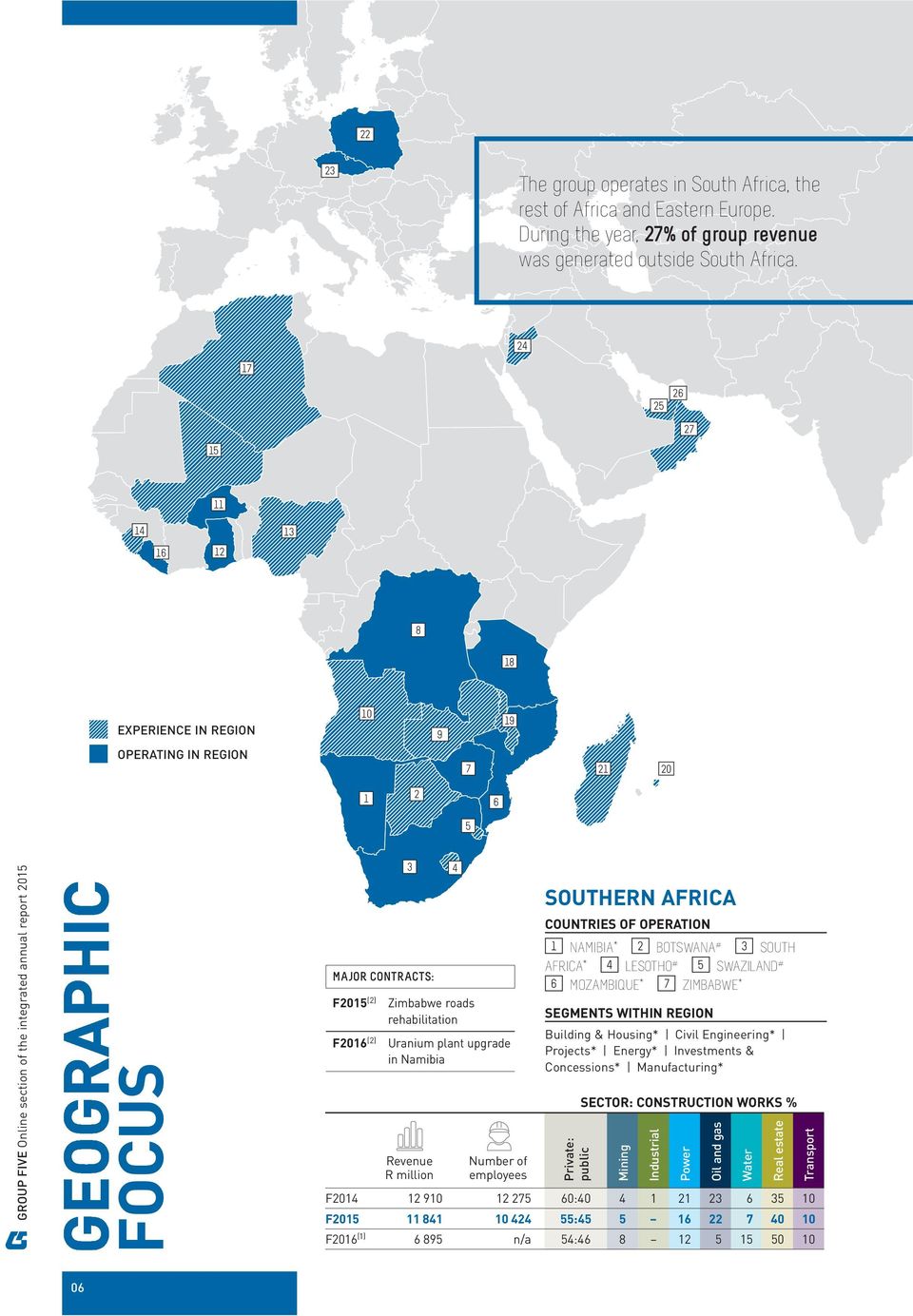
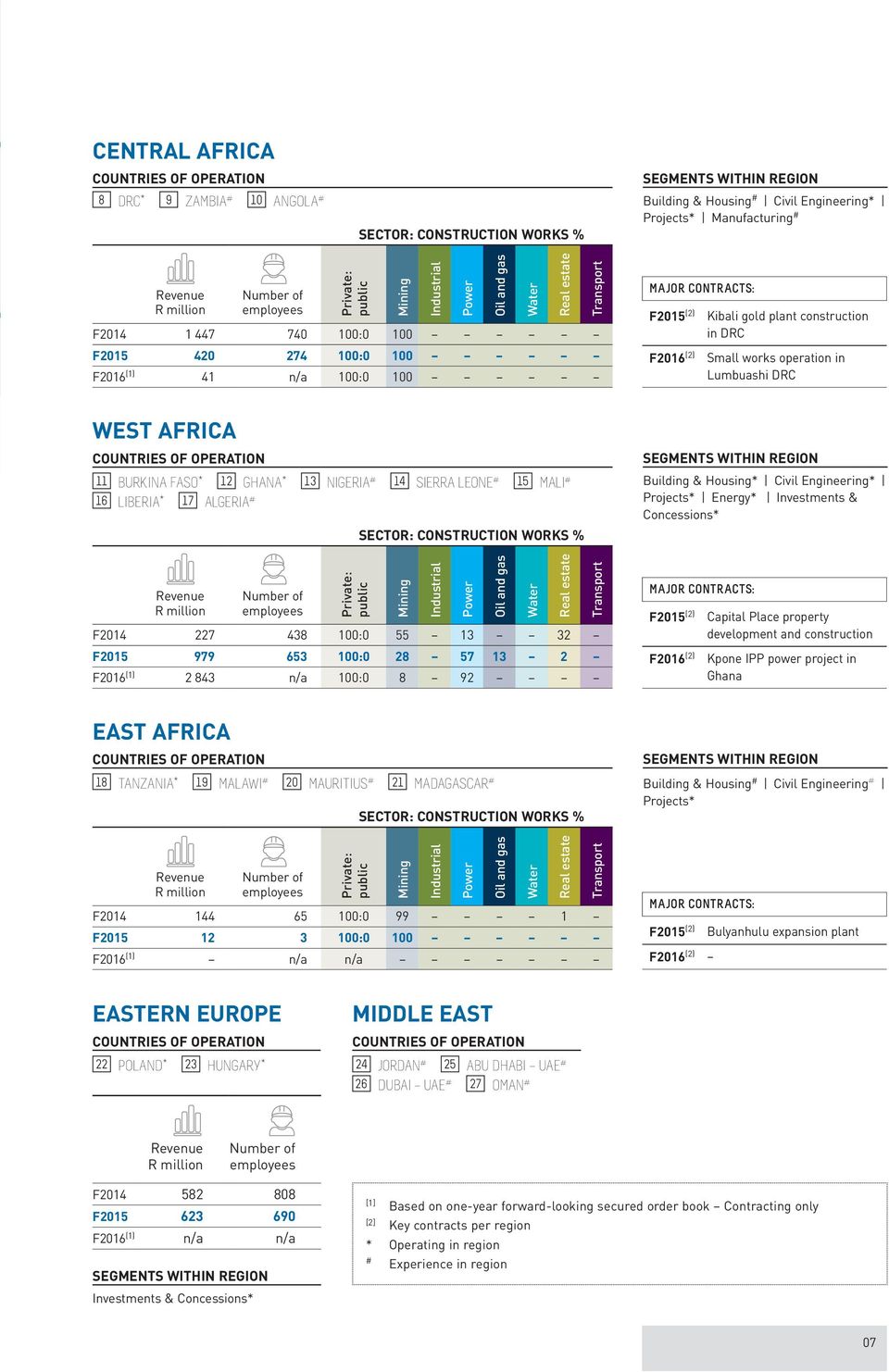
9 CENTRAL AFRICA COUNTRIES OF OPERATION 8 DRC* 9 ZAMBIA # 10 ANGOLA # SECTOR: CONSTRUCTION WORKS % SEGMENTS WITHIN REGION Building & Housing # Civil Engineering* Projects* Manufacturing # Revenue R million Number of employees Private: public F :0 100 F :0 100 F2016 (1) 41 n/a 100:0 100 Mining Industrial Power Oil and gas Water Real estate Transport MAJOR CONTRACTS: F2015 (2) F2016 (2) Kibali gold plant construction in DRC Small works operation in Lumbuashi DRC WEST AFRICA COUNTRIES OF OPERATION 11 BURKINA FASO* 12 GHANA* 13 NIGERIA # 14 SIERRA LEONE # 15 MALI # 16 LIBERIA* 17 ALGERIA # Revenue R million Number of employees Private: public SECTOR: CONSTRUCTION WORKS % F : F : F2016 (1) n/a 100: Mining Industrial Power Oil and gas Water Real estate Transport SEGMENTS WITHIN REGION Building & Housing* Civil Engineering* Projects* Energy* Investments & Concessions* MAJOR CONTRACTS: F2015 (2) F2016 (2) Capital Place property development and construction Kpone IPP power project in Ghana EAST AFRICA COUNTRIES OF OPERATION 18 TANZANIA* 19 MALAWI # 20 MAURITIUS # 21 MADAGASCAR # Revenue R million Number of employees Private: public SECTOR: CONSTRUCTION WORKS % F : F :0 100 F2016 (1) n/a n/a Mining Industrial Power Oil and gas Water Real estate Transport SEGMENTS WITHIN REGION Building & Housing # Civil Engineering # Projects* MAJOR CONTRACTS: F2015 (2) Bulyanhulu expansion plant F2016 (2) EASTERN EUROPE COUNTRIES OF OPERATION 22 POLAND* 23 HUNGARY* MIDDLE EAST COUNTRIES OF OPERATION 24 JORDAN # 25 ABU DHABI UAE # 26 DUBAI UAE # 27 OMAN # Revenue R million Number of employees F F F2016 (1) n/a n/a SEGMENTS WITHIN REGION Investments & Concessions* [1] Based on one-year forward-looking secured order book Contracting only [2] Key contracts per region * Operating in region # Experience in region 07
10 MINING INDUSTRIAL POWER OIL AND GAS WATER REAL ESTATE TRANSPORT MINING REGIONS SOUTHERN AFRICA CENTRAL AFRICA WEST AFRICA EAST AFRICA 9% OF GROUP REVENUE KEY COMPETENCIES Multi-disciplinary international mine and process plant constructor Consortium partner in EPC^ mine construction On-site services contractor Supply chain logistics to remote sites Design and build of construction camps and mine housing systems Mine maintenance Construction and operation of mining water treatment plants, including supply of water treatment chemicals ^ Engineer, procure and construct. GROUP FIVE Online section of the integrated annual report 2015 SECTOR FOCUS KEY DIFFERENTIATORS Experienced African mining and process plant constructor across 18 countries Strong repeat business client base Reputation for delivery of complex contracts in remote and difficult conditions Permanent in-country establishments with local plant and equipment Turnkey contract offering KEY CLIENTS ENGINEERS: DRA, MDM, Lycopodium, SNC Lavalin, Amec, Sedgman, Senet, Tenova Bateman MINING HOUSES: Randgold Resources, ENRC, Exxaro, Xstrata, Newmont, Barrick Africa, AngloGold Ashanti, African Minerals, Freeport-McMoRan, Jindal, Kalagadi Manganese, Rox Gold, Husab Uranium, Goldfields, Glencore, MMG, Metorex 08

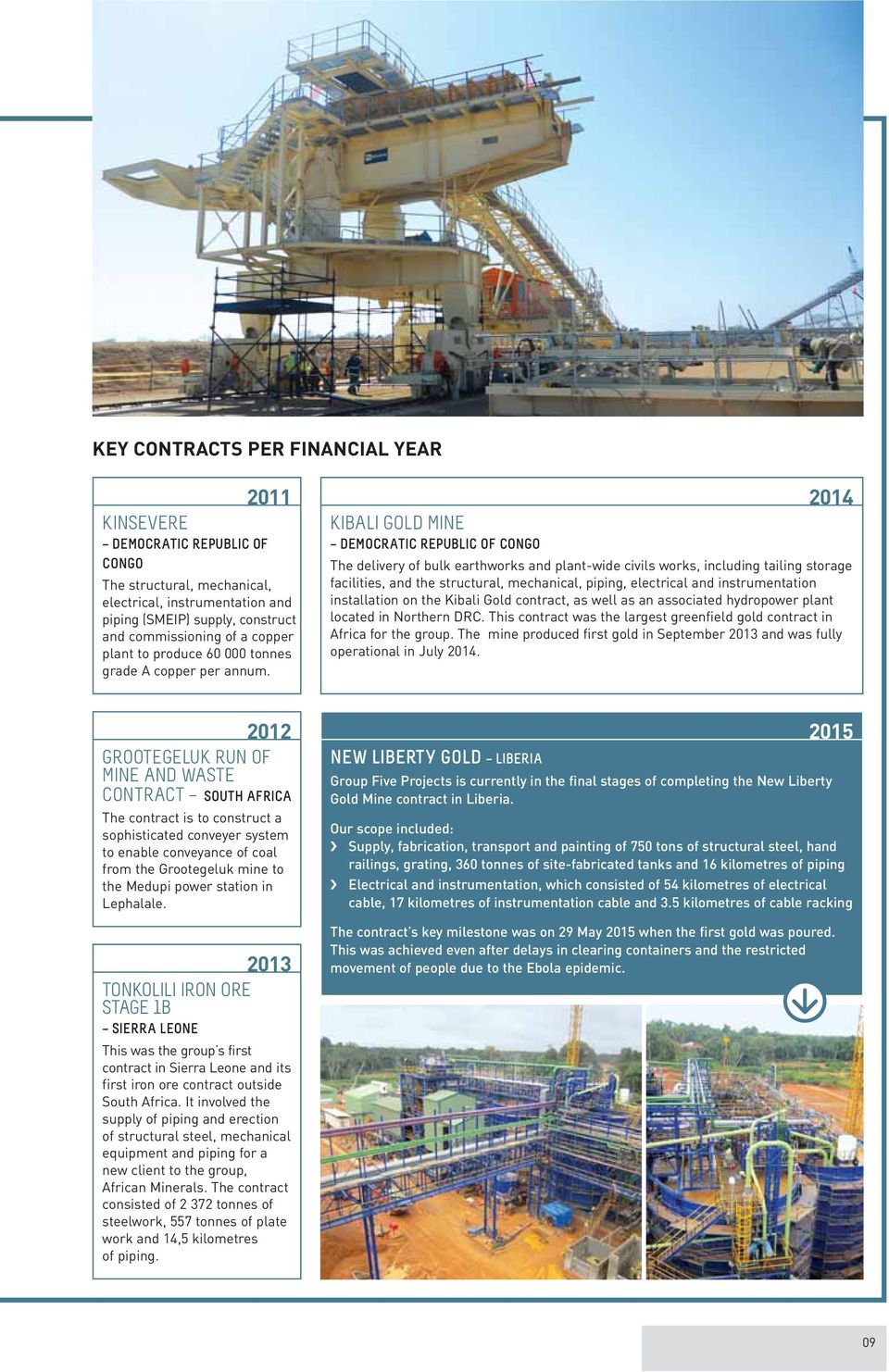
11 KEY CONTRACTS PER FINANCIAL YEAR 2011 KINSEVERE DEMOCRATIC REPUBLIC OF CONGO The structural, mechanical, electrical, instrumentation and piping (SMEIP) supply, construct and commissioning of a copper plant to produce tonnes grade A copper per annum. KIBALI GOLD MINE DEMOCRATIC REPUBLIC OF CONGO 2014 The delivery of bulk earthworks and plant-wide civils works, including tailing storage facilities, and the structural, mechanical, piping, electrical and instrumentation installation on the Kibali Gold contract, as well as an associated hydropower plant located in Northern DRC. This contract was the largest greenfield gold contract in Africa for the group. The mine produced first gold in September 2013 and was fully operational in July GROOTEGELUK RUN OF MINE AND WASTE CONTRACT SOUTH AFRICA The contract is to construct a sophisticated conveyer system to enable conveyance of coal from the Grootegeluk mine to the Medupi power station in Lephalale TONKOLILI IRON ORE STAGE 1B SIERRA LEONE This was the group s first contract in Sierra Leone and its first iron ore contract outside South Africa. It involved the supply of piping and erection of structural steel, mechanical equipment and piping for a new client to the group, African Minerals. The contract consisted of tonnes of steelwork, 557 tonnes of plate work and 14,5 kilometres of piping. NEW LIBERTY GOLD LIBERIA Group Five Projects is currently in the final stages of completing the New Liberty Gold Mine contract in Liberia Our scope included: Supply, fabrication, transport and painting of 750 tons of structural steel, hand railings, grating, 360 tonnes of site-fabricated tanks and 16 kilometres of piping Electrical and instrumentation, which consisted of 54 kilometres of electrical cable, 17 kilometres of instrumentation cable and 3.5 kilometres of cable racking The contract s key milestone was on 29 May 2015 when the first gold was poured. This was achieved even after delays in clearing containers and the restricted movement of people due to the Ebola epidemic. 09
12 MINING INDUSTRIAL SECTOR FOCUS continued POWER OIL AND GAS WATER REAL ESTATE TRANSPORT INDUSTRIAL REGIONS SOUTHERN AFRICA MIDDLE EAST OF GROUP REVENUE 1% KEY COMPETENCIES Multi-disciplinary industrial plant constructor Factory layout design and build Construction services, including civils, building, mechanical and electrical works Resident multi-disciplinary maintenance and shutdown services contractor Supply of construction steel and building cladding systems KEY DIFFERENTIATORS KEY CLIENTS GROUP FIVE Online section of the integrated annual report 2015 Track record in civils, heavy mechanical, electrical and piping construction and services Aluminium, steel, zinc, uranium, platinum, cobalt and gold smelting and minerals beneficiation Automotive Petrochemical Sugar Paper Cement Smelters Breweries Steel plants Hulamin, Huntsman Tioxide, Mondi, Toyota, Sappi, Volkswagen, Arcelor Mittal, Mercedes Benz, Anglo American, Taurus Minerals, SAB, Columbus Stainless, Saldanha Steel, Cementos 10
13 KEY CONTRACTS PER FINANCIAL YEAR 2011 SASOL FT WAX EXPANSION PHASE 1 SOUTH AFRICA Demolition of existing structures and the re-routing of services. Construction of bulk earthworks, access roads, underground drainage works, structural foundations and building extensions SAPPI TUGELA MILL SOUTH AFRICA Supply of boiler making, piping and mechanical fabrication and welding services to support the Sappi mill s engineering services and production maintenance units. This is an evergreen core contract that was established in December SASOL FT WAX EXPANSION PHASE 2 SOUTH AFRICA A typical brownfields petrochemical contract with very demanding safety standards. The scope included site preparation, relocation of existing services, earthworks, demolition, structural steel and concrete foundations for the FT wax expansion contract in Sasolburg. The contract included new civil structures, building works and infrastructure development for phases 1 and 2 of the expansion UPGRADE TO COPPER CONCENTRATE SMELTER IN TSUMEB NAMIBIA A Namibian brownfields contract for Ongoplolo Mining and Processing requiring an upgrade of existing plant to accommodate a planned increase in copper concentrate feed from tonnes per year to tonnes per year, as well as to reduce the overall pollution of the environment, particularly arsenic pollution. The scope of works included supply, fabrication, transportation and installation of structural steel, as well as mechanical, electrical and instrumentation installation. EFFLUENT PLANT GHANA The Accra Breweries Limited effluent water treatment plant in Ghana is a breakthrough for the group into the large Ghanaian industrial market. The scope involves: Demolishing an existing steel shed Removing an existing slab Earthworks and excavations Bases, bund walls and tanks A building for the plant and control room Connection of piping to the existing system The contract is scheduled for completion in January

14 MINING INDUSTRIAL SECTOR FOCUS continued POWER OIL AND GAS WATER REAL ESTATE TRANSPORT POWER REGIONS SOUTHERN AFRICA WEST AFRICA 17% OF GROUP REVENUE KEY COMPETENCIES Power plant co-developer, equity participant and turnkey design and build contractor EPC^ power plant contractor for thermal, liquid and gas-fuelled power plants and renewables in solar, wind and mini hydro technologies Nuclear construction and services contractor Renewables power plant operations and maintenance services ^ Engineer, procure and construct. KEY DIFFERENTIATORS KEY CLIENTS GROUP FIVE Online section of the integrated annual report 2015 Track record in EPC^ power plant delivery in South Africa and the rest of Africa Approved EPC^ contractor to OEM* majors and other technology providers Capability to co-develop contracts to bankability Operations and maintenance experience and systems * Original equipment manufacturers. ESKOM INDEPENDENT POWER PRODUCER DEVELOPERS: Cenpower, Kuvaninga, Geometric Power, Bio-Therm, Gestamp, Soitec, Solar Reserve LARGE MINING AND INDUSTRIAL GROUP: Tronox, Debswana, Goldfields, Anglo American, Sasol and others 12

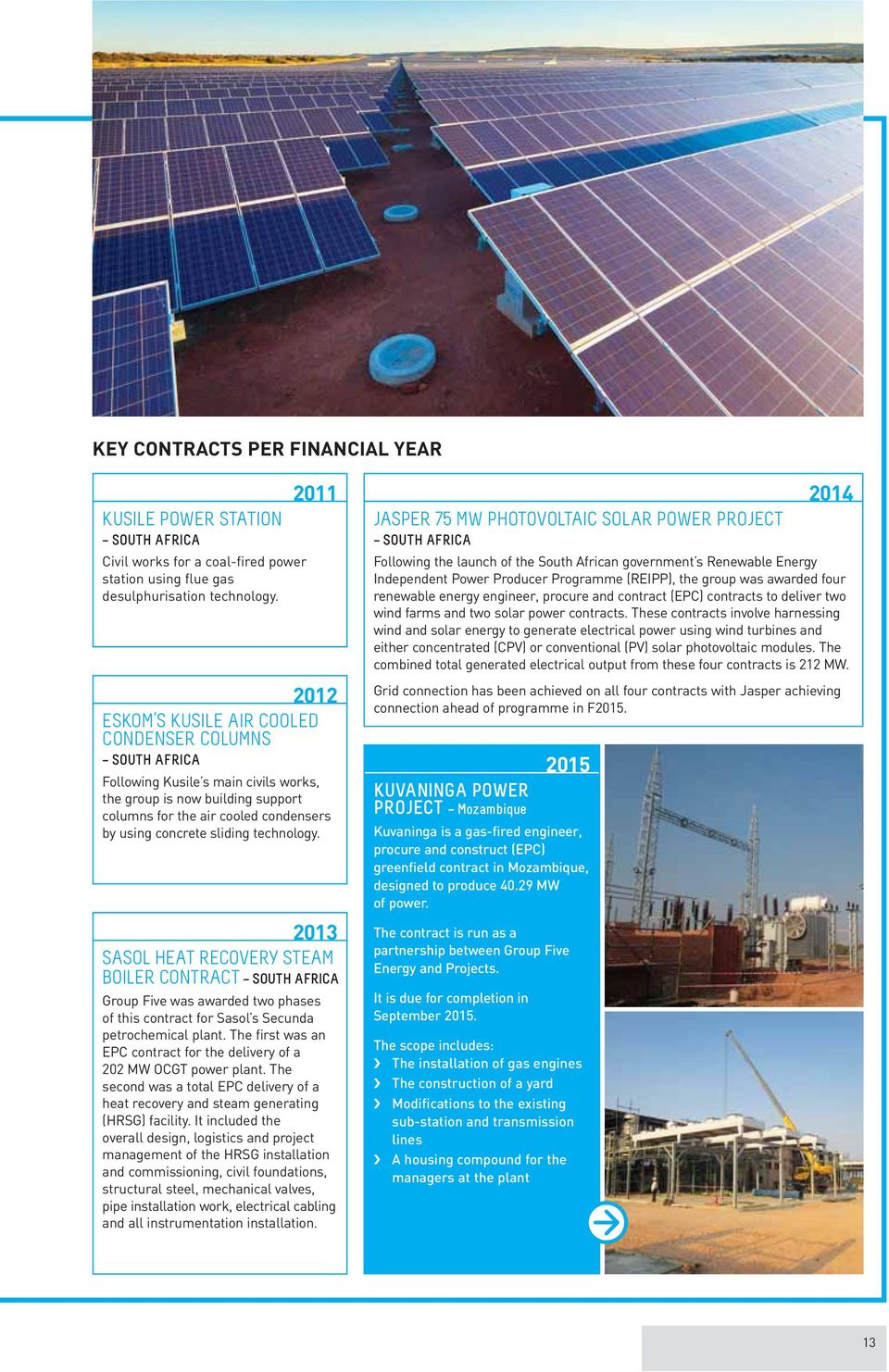
15 KEY CONTRACTS PER FINANCIAL YEAR KUSILE POWER STATION SOUTH AFRICA Civil works for a coal-fired power station using flue gas desulphurisation technology ESKOM S KUSILE AIR COOLED CONDENSER COLUMNS SOUTH AFRICA Following Kusile s main civils works, the group is now building support columns for the air cooled condensers by using concrete sliding technology SASOL HEAT RECOVERY STEAM BOILER CONTRACT SOUTH AFRICA Group Five was awarded two phases of this contract for Sasol s Secunda petrochemical plant. The first was an EPC contract for the delivery of a 202 MW OCGT power plant. The second was a total EPC delivery of a heat recovery and steam generating (HRSG) facility. It included the overall design, logistics and project management of the HRSG installation and commissioning, civil foundations, structural steel, mechanical valves, pipe installation work, electrical cabling and all instrumentation installation. JASPER 75 MW PHOTOVOLTAIC SOLAR POWER PROJECT SOUTH AFRICA KUVANINGA POWER PROJECT Mozambique 2015 Kuvaninga is a gas-fired engineer, procure and construct (EPC) greenfield contract in Mozambique, designed to produce MW of power. The contract is run as a partnership between Group Five Energy and Projects. It is due for completion in September The scope includes: The installation of gas engines The construction of a yard Modifications to the existing sub-station and transmission lines A housing compound for the managers at the plant 2014 Following the launch of the South African government s Renewable Energy Independent Power Producer Programme (REIPP), the group was awarded four renewable energy engineer, procure and contract (EPC) contracts to deliver two wind farms and two solar power contracts. These contracts involve harnessing wind and solar energy to generate electrical power using wind turbines and either concentrated (CPV) or conventional (PV) solar photovoltaic modules. The combined total generated electrical output from these four contracts is 212 MW. Grid connection has been achieved on all four contracts with Jasper achieving connection ahead of programme in F
16 MINING INDUSTRIAL SECTOR FOCUS continued POWER OIL AND GAS WATER REAL ESTATE TRANSPORT OIL AND GAS REGIONS SOUTHERN AFRICA CENTRAL AFRICA OF GROUP REVENUE 18% KEY COMPETENCIES Multi-disciplinary process plant and infrastructure constructor Resident multi-disciplinary services contractor Refinery shutdown and turnaround contractor Depots upgrade and services call centre Specialist tankage design and build contractor KEY DIFFERENTIATORS KEY CLIENTS GROUP FIVE Online section of the integrated annual report 2015 Established oil and gas business Experienced shutdown and maintenance contractor to all oil and petrochemical majors 24-hour service and maintenance contractor for fuel depots Piping and steel fabrication facilities in compliance with ISO 3834 Tankage and pipeline constructor and services contractor Transnet, SAPREF, Engen, Shell, Chevron, BP, Sasol, PetroSA 14

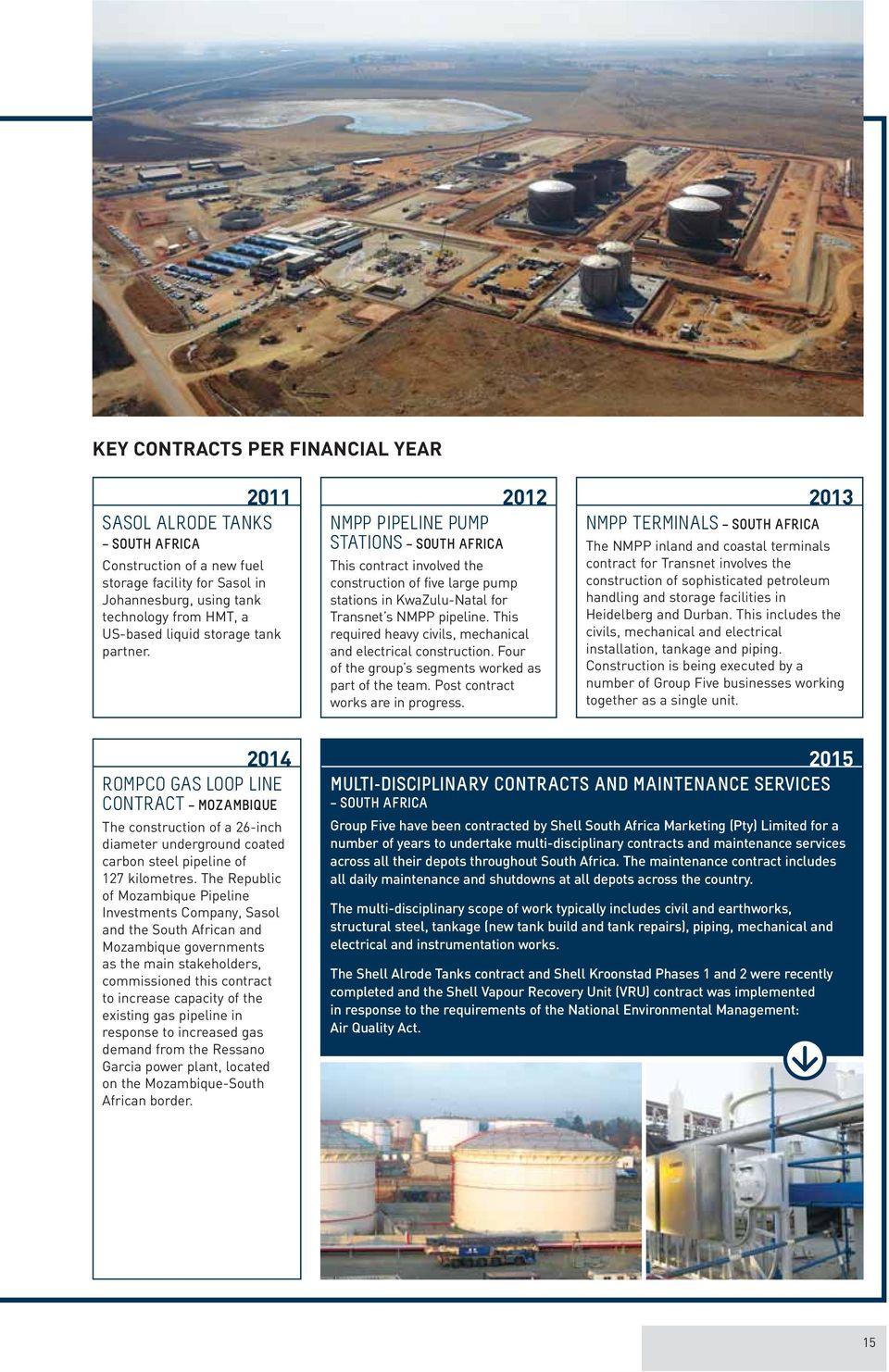
17 KEY CONTRACTS PER FINANCIAL YEAR 2011 SASOL ALRODE TANKS SOUTH AFRICA Construction of a new fuel storage facility for Sasol in Johannesburg, using tank technology from HMT, a US-based liquid storage tank partner NMPP PIPELINE PUMP STATIONS SOUTH AFRICA This contract involved the construction of five large pump stations in KwaZulu-Natal for Transnet s NMPP pipeline. This required heavy civils, mechanical and electrical construction. Four of the group s segments worked as part of the team. Post contract works are in progress NMPP TERMINALS SOUTH AFRICA The NMPP inland and coastal terminals contract for Transnet involves the construction of sophisticated petroleum handling and storage facilities in Heidelberg and Durban. This includes the civils, mechanical and electrical installation, tankage and piping. Construction is being executed by a number of Group Five businesses working together as a single unit ROMPCO GAS LOOP LINE CONTRACT MOZAMBIQUE The construction of a 26-inch diameter underground coated carbon steel pipeline of 127 kilometres. The Republic of Mozambique Pipeline Investments Company, Sasol and the South African and Mozambique governments as the main stakeholders, commissioned this contract to increase capacity of the existing gas pipeline in response to increased gas demand from the Ressano Garcia power plant, located on the Mozambique-South African border MULTI-DISCIPLINARY CONTRACTS AND MAINTENANCE SERVICES SOUTH AFRICA Group Five have been contracted by Shell South Africa Marketing (Pty) Limited for a number of years to undertake multi-disciplinary contracts and maintenance services across all their depots throughout South Africa. The maintenance contract includes all daily maintenance and shutdowns at all depots across the country. The multi-disciplinary scope of work typically includes civil and earthworks, structural steel, tankage (new tank build and tank repairs), piping, mechanical and electrical and instrumentation works. The Shell Alrode Tanks contract and Shell Kroonstad Phases 1 and 2 were recently completed and the Shell Vapour Recovery Unit (VRU) contract was implemented in response to the requirements of the National Environmental Management: Air Quality Act. 15
18 MINING INDUSTRIAL SECTOR FOCUS continued POWER OIL AND GAS WATER REAL ESTATE TRANSPORT WATER REGIONS SOUTHERN AFRICA EAST AFRICA MIDDLE EAST 6% OF GROUP REVENUE GROUP FIVE Online section of the integrated annual report 2015 KEY COMPETENCIES Multi-disciplinary constructor of bulk water transport, treatment and storage infrastructure, including reservoirs and dam systems EPC^ delivery of bulk water systems Coastal and sub-marine construction for ports, harbours, jetties and quayside materials handling Design and manufacture of large bore spiral-welded water pipes Supply of construction steel Supply of fibre cement pipe systems Abstraction and river diversion works KEY DIFFERENTIATORS More than 35 years track record of delivery in the water and marine civils sector, which includes some of the largest contracts in the SADC^ region Dedicated pipe manufacture Specialist experience in building pipelines and water treatment facilities * Southern African Development Community. KEY CLIENTS ^ Engineer, procure and construct. Transnet (ports), Department of Water Affairs (DWAF), Trans Caledon Tunnel Authority (TCTA), Umgeni Water, Rand Water, East Rand Water Company, Lepelle Northern Water, Municipalities, City Councils 16

19 KEY CONTRACTS PER FINANCIAL YEAR 2011 BG3 PIPELINE SOUTH AFRICA Group Five Pipe was awarded Rand Water s R124 million BG3 pipeline in It completed the manufacture, coating and lining of the entire pipeline. The pipes were the largest pipes with the thinnest walls ever to have been manufactured by the group, with new coating and lining technology used. SPRING GROVE DAM SOUTH AFRICA 2012 The Spring Grove dam in KwaZulu- Natal is being constructed by Group Five Civil Engineering and Coastal in joint venture with Pandev, one of the group s long-standing enterprise development partners. The contract was completed in SAND BYPASS CONTRACT SOUTH AFRICA Following the successful completion of the group s contract to widen the Durban harbour in 2010, we are currently constructing a sand bypass system that serves to preserve the natural movement of coastal sand. The facility will pump sand from a concrete storage hopper through a series of pump stations onto Durban s beaches. The 70-metre diameter concrete storage hopper is being constructed between two and four metres below the water table adjacent to an existing quay wall ACID MINE DRAINAGE (AMD) FACILITIES SOUTH AFRICA The Trans Caledon Tunnel Authority awarded the fast-track AMD Phase 1 Treatment Facilities contract to the group. This included earthworks, civil works, building, mechanical and electrical processes. Challenges during the civil construction included ensuring water tightness of all the concrete to contain infected water, with some of the structures up to nine metres high. At its peak, the contract employed more than 600 people with a solid safety track record and a focus on enterprise development. DARVILL WASTE WATER TREATMENT WORKS UPGRADE SOUTH AFRICA 2015 The group is currently executing the construction of the Darvill Waste Water Treatment Works upgrade in KwaZulu-Natal for Umgeni Water. The upgrade will increase the plant s current capacity from 60 mega litres to 100 mega litres per day. The scope of works include: Construction of various reinforced concrete tanks and pump stations The installation of steel and concrete pipelines Mechanical, electrical and control and instrumentation A challenging element of this contract is the construction of two new Eggshaped Anaerobic Digesters of 34 metres in height and 18 metres in diameter. Group Five sourced and imported a specialist formwork system from Austria due to the intricate nature of the construction works. 17

20 MINING INDUSTRIAL SECTOR FOCUS continued POWER OIL AND GAS WATER REAL ESTATE TRANSPORT REAL ESTATE REGIONS SOUTHERN AFRICA CENTRAL AFRICA WEST AFRICA EAST AFRICA MIDDLE EAST 34% OF GROUP REVENUE KEY COMPETENCIES Developer, equity participant and turnkey design and build contractor in real estate developments Large and high-rise building constructor Conventional and low-cost housing contractor Design to build contractor, with particular green building expertise Public private partnerships (PPPs) KEY DIFFERENTIATORS KEY CLIENTS GROUP FIVE Online section of the integrated annual report 2015 Design to build capability In-house financial structuring capability for PPP delivery Large building capacity and track record Specialist mine housing contractor Track record in large-scale, low-cost housing contracts International delivery capacity in Africa Five-star green building contractor High rise construction experience Logistical construction management capability LARGE PROPERTY DEVELOPERS: Atterbury Waterfall Investment Company, Investec Property Developments, Zenprop Property Holdings, Eris Property Holdings and Billion Property Developments DEPARTMENT OF PUBLIC WORKS (PROVINCIAL AND NATIONAL) AND LARGE METROS HEALTHCARE INDUSTRY: Public and private players, such as Netcare and Mediclinic, as well as national and provincial governments LARGE MINING GROUPS: Anglo American, AngloGold Ashanti, Anglo Platinum, Lonmin, Assmang, Sasol Mining, Kumba, MultiChoice Support Services, Municipalities and Town Councils 18

21 KEY CONTRACTS PER FINANCIAL YEAR 2011 KHAYELITSHA DISTRICT HOSPITAL SOUTH AFRICA Construction of a new 230-bed hospital in Cape Town for the Department of Public Works. BOPHELONG PSYCHIATRIC HOSPITAL SOUTH AFRICA 2014 This contract involved the construction of a new psychiatric hospital for the Department of Health consisting of various single storey buildings and infrastructure works for the forensic and government patient units. The hospital is on the outskirts of Mafikeng in the North West. The contract replaced the outdated facility in the Mafikeng area CRYSTAL PARK AFFORDABLE HOUSING SOUTH AFRICA A turnkey development of over housing units were secured by the group in Benoni in Gauteng. Group Five Motlekar is the developer and Group Five Housing the contractor. The first phase of the contract will be finalised by mid-2014, with the balance possibly continuing to MALL OF AFRICA SOUTH AFRICA 2015 Group Five Building, in joint venture, is constructing the largest single phase shopping centre development in Africa at Waterfall City in Johannesburg, with a total building area of m 2. More than 150 of the approximately 200 sub-contractors have been appointed and a production output of m 2 of concrete is cast per day. This requires careful management of the complex operational and commercial requirements. The Mall of Africa is scheduled for completion in April The shopping centre will consist of a trucking tunnel to alleviate delivery truck congestion, a fire escape tunnel, six levels of post-tension parking and four levels of retail area, 49 lifts and 22 escalators MASERU SHOPPING MALL LESOTHO The m 2 shopping mall is the largest in Lesotho and was the first Group Five Building contract in that country. The contract was completed on time to a high quality standard in just 14 months. 19
22 MINING INDUSTRIAL SECTOR FOCUS continued POWER OIL AND GAS WATER REAL ESTATE TRANSPORT TRANSPORT REGIONS SOUTHERN AFRICA EASTERN EUROPE MIDDLE EAST OF GROUP REVENUE 15% KEY COMPETENCIES Co-developer, equity participant and turnkey design and build contractor in transport concessions EPC^ delivery of transport infrastructure Multi-disciplinary constructor of roads, railways, ports, harbours and airports Post and pre-tension capability ^ Engineer, procure and construct. KEY DIFFERENTIATORS KEY CLIENTS GROUP FIVE Online section of the integrated annual report 2015 International experience across Africa, the Middle East and Europe Reputation for timeous and technically complex delivery Large contract capability EPC^ competence South African National Roads Agency (SANRAL), Department of Transport, Municipalities, Town Councils, Airports Company of South Africa (ACSA), Transnet, large metros and provincial government, Development Bank of South Africa, Zimbabwe Roads Agency, The Ministry of Infrastructure of the Government of Poland, The Ministry of Economy and Transport of Hungary 20
23 KEY CONTRACTS PER FINANCIAL YEAR 2011 GAUTENG FREEWAY IMPROVEMENT PROJECT PACKAGE E SOUTH AFRICA Extensive lane additions and improvements to interchanges as part of SANRAL s freeway improvements CHOTA MOTALA INTERCHANGE SOUTH AFRICA This contract in KwaZulu-Natal comprised an upgrade of the freeway from a four-lane carriage way to a six-lane free flowing and remodelled interchange. The interchange consisted of two major structures, including the demolition and the reconstruction of the grade separation bridge and an incrementally launched fly-over bridge, as well as all associated works NEW SHIP-TO-SHORE CRANES DURBAN HARBOUR SOUTH AFRICA Group Five constructed two 720-metre concrete quayside beams and installed crane rails, tie-down anchors and storm pins in the sea-side tunnels to facilitate the installation of new Transnet ship-to-shore (STS) cranes. The seven cranes are the first and largest STS cranes in Africa. The construction took place in the Durban container terminal, with the quay wall strengthened to facilitate off-loading the new large cranes UPGRADING OF KURUMAN TO VRYBURG ROAD SOUTH AFRICA The existing surfaced road between the towns of Kuruman and Vryburg in the Northern Cape was upgraded over a distance of 51 kilometres. The upgrading involved improving the existing drainage system, as well as widening the road to accommodate a 7,4-metre surfaced width with one metre shoulders. Bus bays were constructed along the route to improve the public transport system. The bitumen emulsion used was manufactured on site. The contract employed and trained local labour from adjacent communities and met all its goals set for labour participation, as well as the use of small businesses. VELDDRIF ROAD REHABILITATION SOUTH AFRICA This contract entails the rehabilitation and widening of 56 kilometres of the MR529 between Velddrif and Piketberg in the Western Cape. The contract is on track for completion in May The scope includes: Rehabilitation involving heavy recycling New base construction and resurfacing 2015 The contract stipulates a high-quality specification which required the use of new technology. Each work area has to allow a normal two-way traffic section to ensure minimal traffic impact during construction. Given the importance of job creation in the area, the contract involves local enterprises and the creation of a minimum of 100 new local jobs over the period of the contract. 21
24 02 SECTION PAGE 24 KEY MEASURES PAGE 78 PEOPLE PAGE 32 GOVERNANCE PAGE 128 ENVIRONMENT 22
25 YEAR UNDER REVIEW 23
26 KEY MEASURES TEN-YEAR REVIEW (R 000) GROUP INCOME STATEMENT* Revenue Operating profit Other expenses net (11 000) Share of equity accounted profit/(loss) Finance (cost)/income net (1 622) (1 779) (4 298) Profit before taxation Taxation ( ) ( ) ( ) Profit for the year GROUP FIVE Online section of the integrated annual report 2015 GROUP STATEMENT OF FINANCIAL POSITION Interest of equity holders of parent Non-controlling interest Total equity Non-current liabilities Liabilities associated with non-current assets classified as held for sale Current liabilities Total liabilities Non-current assets Non-current assets classified as held for sale Current assets Total assets * Restated for the application of IFRS 5 Non-current assets held for sale and discontinued operations, as a result of the decision to transfer the remaining business within the discontinued cluster of Construction Materials into continuing operations within the Manufacturing cluster. 24
27 ( ) ( ) ( ) (97 420) (69) 140 (11 242) (30 820) (81 727) (41 953) (30 329) ( ) (54 888) ( ) ( ) ( ) ( ) ( ) (62 754) ( ) ( )
28 KEY MEASURES continued KEY RATIOS GROUP PERFORMANCE INDICATORS R REVENUE* Engineering & Construction Building & Housing Civil Engineering Projects Energy Investments & Concessions Manufacturing Joint ventures equity accounted and joint ventures wholly consolidated (53 707) (56 739) (87 716) Total revenue OPERATING PROFIT* Engineering & Construction Building & Housing Civil Engineering (95 669) (33 197) Projects Energy Investments & Concessions Manufacturing Joint ventures equity accounted and joint ventures wholly consolidated (11 313) (9 138) (7 501) Total operating profit Total operating profit margin (%) Over-border revenue (%) Cash generated/(utilised) millions 469 (45) GROUP FIVE Online section of the integrated annual report 2015 SHAREHOLDER RETURNS Earnings/(loss) per share (R) 2,22 4,01 2,64 (2,88) Headline earnings per share (R) 2,05 4,07 2,83 1,16 Dividend per share (cents) 55,0 100,0 67,0 36,0 Net asset value per share (R) 28,96 25,99 21,65 18,72 MARKET INDICATORS Market price high (R) per share 43,40 45,65 38,04 32,00 Market price low (R) per share 21,00 36,17 22,05 21,80 Market price year end (R) per share 28,44 41,00 36,70 22,76 Market capitalisation year end (R millions) 3 191, , , ,2 Value of shares traded (R 000) Number traded (R 000) * Restated for the application of IFRS 5 Non-current assets held for sale and discontinued operations, as a result of the decision to transfer the remaining business within the discontinued cluster of Construction Materials into continuing operations within the Manufacturing cluster. 26
29 (778) (42 765) (871) (2,27) 2,80 5,44 4,47 2,91 0,72 3,26 6,14 5,68 4,70 2,83 0,69 72,0 137,0 130,0 105,0 72,0 56,0 22,38 26,08 25,09 21,41 17,45 9,22 41,00 45,20 58,25 73,80 59,50 32,50 24,40 31,50 26,70 42,00 27,26 15,20 29,90 34,50 34,70 44,90 54,40 28, , , , , , ,
30 KEY MEASURES continued GROUP SCORECARDS The group has reported against a number of scorecards for several years to allow readers to track our progress. JSE LIMITED SOCIALLY RESPONSIBLE INVESTMENT INDEX (SRI) SCORECARD The JSE Limited (JSE) rates companies annually in terms of sustainability measures. Our ratings are listed below: F2014* F2013 F2012 F2011 F2010 Overall result SRI participation** SRI participation** SRI participation** SRI participation** Best performer The JSE only provides an overall result, not a breakdown. * F2015 results will only be available post year end when the JSE releases its updated index. ** Although the group continues to operate and report in line with the JSE s required SRI criteria and qualified as an SRI participant, it was not eligible to be considered a best performer until the Competition Commission finalises its settlement with the group after its investigation of anti-competitive behaviour in the sector. BBBEE SCORECARD (GROUP FIVE LIMITED) Construction Charter scorecard Construction Charter scorecard Construction Charter scorecard Construction Charter scorecard Core components BBBEE elements Weighting points F % F % F % F % Direct empowerment Ownership GROUP FIVE Online section of the integrated annual report 2015 Management control Human resource Employment equity empowerment Skills development Indirect empowerment Preferential procurement Enterprise development Socio-economic development Total Empowerment level As audited by BEE Verification Agency cc for the year ended 30 June 2014 (the next audit will take place post the F2015 year end). 2 As audited by BEE Verification Agency cc for the year ended 30 June As audited by BEE Verification Agency cc for the year ended 30 June As audited by BEE Verification Agency cc for the year ended 30 June
31 EMPLOYMENT EQUITY SCORECARD Sustainability indicator F2015 F2014 F2013 F2012 F2011 F2010 Total employee headcount (all employees) ** * Number of unionised employees % of permanent employees on medical schemes % of employees over-border % of black employees within the South African permanent workforce % of black employees in Paterson grades F and E (executive and senior management) Number of black male bursary students As a % of total bursary students Number of black female bursary students As a % of total bursary students * The final headcount included 432 employees in the Construction Materials cluster. Although this was treated as a discontinued operation in the annual financial statements, these employees remained under the HR management of the group until finalisation of sales transactions. ** Excludes 60 employees in the Construction Materials cluster, as the business was in the last stages of being sold. SKILLS DEVELOPMENT Sustainability indicator F2015 F2014 F2013 F2012 F2011 F2010 a) Annual value spent on training and development programmes (R million) 40,2 45,1 37,1 32,3 37,9 31,5 i) Total number of training interventions* ii) Total number of training interventions semi-skilled and unskilled* b) Annual value incurred on bursary expenditure (R million) 8,4 7,2 5,1 4,6 6,6 6,0 i) Number of bursary students ii) Number of female bursary students c) Annual value spent on learnerships and apprenticeships (R million) 7,2 5,1 3,6 4,0 4,9 3,9 i) Learners on learnership and apprenticeship programmes ii) Unemployed learners registered on learnership and apprenticeship programmes d) Number of students on the Group Five Programme in Management Development (PMD) e) Total annual training spend black employees (R million) 15,5 19,3 15,4 13,9 18,1 14,7 * For employees. 29
32 KEY MEASURES / GROUP SCORECARDS continued PREFERENTIAL PROCUREMENT SCORECARD (GROUP FIVE LIMITED) ACHIEVEMENT AGAINST CONSTRUCTION SECTOR CHARTER PRINCIPLES Measurement principle Points Target per Construction Charter F2015 target Actual F Actual F Actual F Actual F Actual F Actual F Actual F Preferential spend with all suppliers 12 70% 71.0% 73.1% 70.1% 62.2% 52.8% 49.1% 45.1% Preferential spend with qualifying small and emerging microenterprises 3 15% 24.3% 23.3% 20.1% 28.1% 22.0% 11.4% 6.3% Preferential spend with enterprises that are more than 50% blackowned 3 12% 21.1% 18.2% 17.7% 20.9% 19.1% 9.2% 7.9% Preferential spend with enterprises that are more than 30% black women-owned 2 8% 5.6% 4.4% 9.5% 8.6% 3.1% 1.9% 0.1% Weighted score * Unaudited. 2 As audited by BEE Verification Agency cc for the year ended 30 June 2014 (Group Five). 3 As audited by BEE Verification Agency cc for the year ended 30 June 2013 (Group Five). 4 As audited by BEE Verification Agency cc for the year ended 30 June 2012 (Group Five). 5 As audited by BEE Verification Agency cc for the year ended 30 June 2011 (Group Five). 6 As audited by BEE Verification Agency cc for the year ended 30 June 2010 (Group Five). 7 As audited by BEE Verification Agency cc for the year ended 30 June 2009 (Group Five) 7 As audited by BEE Verification Agency cc for the year ended 30 June 2009 (Group Five Construction (Pty) Limited). * A weighted score is not done for targets. ENTERPRISE DEVELOPMENT SCORECARD Sustainability indicator F2015 F2014 F2013 F2012 F2011 F2010 Annual value of total direct costs incurred by the group (R million) 1,1 1,3 0,9 1,5 0,5 0,6 Value of funding provided by the group Total capital due to the group as at 30 June (R million) 7,5 8,8 9,8 11,5 14,1 12 Number of black-owned entities with which the group is engaging in significant joint venture partnerships* Number of formal enterprise development partnerships GROUP FIVE Online section of the integrated annual report 2015 Total value of contracts being executed with black-owned joint venture partners* (R billion) 1,0 3,1 5,9 4,9 2,0 7,8 Construction scorecard points obtained out of * Although not specifically qualifying for enterprise development in terms of the Construction Charter, Group Five has entered into a number of joint venture contracts with black-owned companies. 30
33 SOCIO-ECONOMIC DEVELOPMENT (SED) SCORECARD Sustainability indicator F2015 F2014 F2013 F2012 F2011 F2010 Targeted SED spend as a % of SA operations net profit after tax should exceed 1% no* yes yes yes yes yes Total annual spend on SED programmes (R million) 2,6 6,1 5,6 3,9 6,1 7,9 Number of unemployed people trained as part of the People at the Gate programme % of unemployed people securing positions after training Number of non-profit organisations benefiting from the group s SED programmes * Due to the tough market and operational conditions, this represented 0.9%. 31
34 GOVERNANCE VISION, VALUES AND ETHICS DELIVERY ON F2015 FOCUS AREAS: In the group s F2014 integrated annual report, we outlined a number of focus areas. Below we outline how we delivered against these: F2015 FOCUS AREAS Update compliance policies and procedures and entrenching these through the group. Embed an improved compliance culture. Continued progression in terms of ethics management, with a particular focus on ethics awareness training. Increase the profile and awareness of our Tip-offs Anonymous line. DELIVERY All compliance policies were updated A group compliance and ethics officer was appointed to ensure an increased focus on entrenching a compliance culture and implementing compliance initiatives Ethics management and training was brought in-house and new ethics training material was developed in line with our group ethics and values. An extensive roll out is planned for F2016 The Tip-offs Anonymous training was launched during the year and over 250 employees were trained INTRODUCTION The group s vision and values are: GROUP FIVE Online section of the integrated annual report 2015 PEOPLE We strive to be the employer of choice, attracting and retaining skilled people. EXCELLENCE We aim to continue to deliver quality and value in our chosen sectors through integrated solutions, products and services TRANSFORMATION We are working towards sustainable and relevant 03 company transformation. VISION & VALUES CLIENT FOCUS Drawing on Group Five s vast multi-disciplinary expertise, we deliver tailor-made solutions for our clients individual needs. PERFORMANCE We look to generate growth for shareholders through a clientcentric focus and superior technical and business solutions. INNOVATION We continuously seek to develop and implement new and improved ways to deliver our solutions, products and services. INTEGRITY Based on recognised codes of conduct and a system of accountable, transparent corporate governance, we aspire to maintain our high standards of business integrity. 32
35 ETHICS Integrity is one of the group s seven values. The group s ethics standards are set out in a code of conduct, which was updated in F2014. The code of conduct details the group s expectation of how employees, sub-contractors, suppliers and joint venture partners should engage whilst working with Group Five. The code of conduct covers the following areas: PEOPLE AND SAFETY THE ENVIRONMENT AND COMMUNITY ETHICAL BUSINESS PRACTICES USE OF GROUP FIVE ASSETS AND RESOURCES GOVERNMENT, MEDIA AND INVESTORS The code covers, amongst other things, a commitment to legal and regulatory compliance, prohibiting giving or receiving bribes or the facilitation of payments, as well as conflicts of interest. Separate policies dealing with the giving or receiving of gifts are also in place. The code is supported by several policies governing issues such as sexual harassment, equality and diversity, fraud and corruption, as well as anti-competitive behaviour. A policy to govern our relationships with business partners and agents who work with us in foreign countries to ensure alignment to regulations when they act or make representations on our behalf was implemented two years ago. The reporting of any violation of policies is facilitated by a Tip-offs Anonymous line, managed by an external party and governed by a specific policy that protects whistle-blowers. The group has a formal code of ethics and a Tip-offs Anonymous line. The number is: It is an independently managed service to ensure confidentiality. A quarterly report on all tip-offs, together with the outcome of findings and any subsequent disciplinary hearings, is reported to the board through the group compliance and ethics officer who takes responsibility for the group s ethics framework. The Group Five board has a directive in place that prohibits contributions to political parties. Management are acutely aware of the importance of having a practical and effective ethics regime throughout the group. The group, therefore, appointed a group compliance and ethics officer during the year. A new ethics programme called Ethics@G5 was also finalised and is currently being rolled out. The programme is a half-day course targeted at all employees and aims to train approximately 500 employees per year. Training is compulsory, with the subject choice of the training material consisting of case studies in the construction sector and finalised Tip-offs Anonymous investigations specific to Group Five. 33
36 GOVERNANCE / VISION, VALUES AND ETHICS continued NATURE OF BEHAVIOURS OF INCIDENTS REPORTED During the year, we implemented a new Tip-offs investigations process. The new procedure involves reinforcing the independence of the compliance and ethics function and the consolidation of all investigations within the group into one central function. In the year under review there was an increase in the number of reported cases involving fraud and theft due to increased reporting following the Tip-offs Anonymous training. F2015 F2014 F2013 F2012 F2011 Abuse of company time Bringing the company name into disrepute Conflicts of interest Fraud Gross negligence Governance 1 Misuse of company property HR-related complaints Non-compliance with policies and procedures Providing false information Theft Total GROUP FIVE Online section of the integrated annual report 2015 The incidents reported included: Falsifying of qualifications Conflict of interest Misuse of petrol fleet cards Improper recruitment practices The additional resources in the compliance and ethics department assisted in a higher number of cases being efficiently investigated and concluded. This resulted in 33 employees being dismissed after disciplinary hearings and 16 receiving written warnings. FOCUS GOING FORWARD GROUP MEMBERSHIP OF INDUSTRY INSTITUTIONS Group Five employees hold senior positions in the following organisations: Name of association The ethics and compliance office will be focusing on the following during F2016: Position in governing body Participates in committees or projects Bargaining Council for the Civil Engineering Industry Yes Yes South African Federation of Civil Engineering Contractors Yes Yes Engineering Construction and Risk Institute Yes Yes Construction Engineering Association Yes Yes Gauteng Building Voluntary Bargaining Forum Yes Black Business Council Built Environment Yes DEKRA Yes Rolling out competition law training and entrenching procedures through the group Compliance monitoring, which will involve a continued evaluation of the main pieces of legislation Group Five must comply with, as well as ensuring compliance Continued progression in terms of ethics management, with a particular focus on ethics awareness training Increasing the profile and awareness of our Tip-offs Anonymous line Embedding effective due diligence procedures within the group, especially when the group works with new joint venture partners and sub-contractors Continuing to align legal compliance risks to the future growth strategy of the group by identifying regulatory requirements in new jurisdictions the group might enter 34
37 REGULATORY ENVIRONMENT DELIVERY ON F2015 FOCUS AREAS: In the group s F2014 integrated annual report, we outlined a number of focus areas. Below we outline how we delivered against these: F2015 FOCUS AREAS Confirming the regulatory environment applicable to the group, embedding a continued high-compliance culture within the group with respect to legal compliance and updating compliance policies and procedures. Evaluation of procurement practices and regulation in key focus countries within Africa. DELIVERY The Group Five regulatory evaluation was finalised and signed off by the board Awareness of group policies continues to be raised through training initiatives The regulatory evaluation was completed, with a key focus on the rest of Africa and identifying the best practices to be followed by Group Five in all jurisdictions where we have a footprint INTRODUCTION The group focuses on compliance with legislation that has a direct impact on its licence to operate. During the year, key legislation continued to be prioritised according to probability and impact, taking into account the group s obligations and potential exposure to reputational risk, fines and penalties and other regulatory sanctions. During the year under review, no material non-compliances were identified. The group compliance and ethics officer was appointed to ensure compliance with material legislation. Compliance monitoring is continuously conducted across all major functions to determine whether there are any deficiencies that require immediate action to prevent reoccurrence. RESPONSIBILITIES Key resources to ensure compliance with material legislation are set out in the table below. Companies Act LEGISLATION Construction Industry Development Board Regulations RESPONSIBILITY Group company secretarial department Tax administration Group finance department Basic Conditions of Employment Act Labour Relations Act Broad-Based Black Economic Empowerment Act and Amendment Act Employment Equity Act Corporate and commercial procurement legislation Anti-bribery and Anti-corruption legislation Group HR department Group compliance and ethics officer Group compliance and ethics officer Safety, health and environment (SHE) legislation Group SHE manager 35
38 GOVERNANCE / REGULATORY ENVIRONMENT continued RELEVANT NEW LEGISLATION The following pieces of legislation are currently most relevant to the group. REGULATIONS TO THE EMPLOYMENT EQUITY ACT, NO 55 OF 1998 On 21 July 2014, the President signed the Employment Amendment Act, No 47 of This Amendment Act became effective on 1 August The Act aims to achieve equity in the workplace by promoting equal opportunity and fair treatment in employment through elimination of unfair discrimination and implementing affirmative action measures to redress the disadvantages in employment experienced by designated groups. Potential impact on Group Five: The impact on the group was minimal, as the group proactively conducted an audit to rectify any anomalies. AMENDMENT OF CONSTRUCTION INDUSTRY DEVELOPMENT REGULATIONS The Minister of Public Works has proposed amendments to the Construction Industry Development Regulations for comment in relation to the payment of sub-contractors. A proposed penalty for paying sub-contractors later than 30 days from date of receipt of their invoices has been suggested. The penalty will be calculated at repo rate +6% and finance will have to record late payment penalties in the balance sheet. Potential impact on Group Five: This will fundamentally change the way in which the entire construction industry manages sub-contractor relations. For example, if we intend to withhold payment to a sub-contractor for any reason we must communicate this to them within five days of receiving their invoice. The sub-contractor can refer the matter for adjudication. On referral, we would be precluded from withholding payment if a dispute with a sub-contractor is a legal/technical matter. To address this, we are currently involved in sector engagements to establish the best route to highlight the impact these amendments will have on the industry. LABOUR RELATIONS AMENDMENT ACT, NO 6 OF 2014 GROUP FIVE Online section of the integrated annual report 2015 The Labour Relations Amendment Act, No 6 of 2014 (Amendment Act) which came into effect on 1 January Amongst other things, the amendment: Extends the definition of who is presumed to be an employee Introduces more protection for persons employed on fixed term contracts and for persons who earn below the threshold Introduces a limitation on picketing rights Potential impact on Group Five: This impacts the drafting of long duration contracts. We have proactively addressed this to ensure that all affected contracts are in full compliance with the new legal requirements. In terms of organisational rights requirements, we have to recognise and award organisational rights to small trade unions. This, therefore, further increases the number of trade unions in the group, which will require additional time spent by management engaging with more union stakeholders. 36
39 UPDATE ON RELEVANT LEGISLATION REPORTED ON IN OUR F2014 INTEGRATED ANNUAL REPORT: INFRASTRUCTURE DEVELOPMENT ACT NO 23 OF 2014 The Act came into force in July Impact on Group Five: Since the Act came into force, the Council of the Presidential Infrastructure Coordinating Commission created by the Act has rolled out a number of contracts. This will benefit Group Five, as the industry has experienced delays and cancellations of some of the bigger infrastructure contracts in the last few years. SPECIAL ECONOMIC ZONES ACT, 2014 The Act aims to provide for the designation, promotion, development, operation and management of Special Economic Zones. Impact on Group Five: This Act will increase opportunities in the construction sector. Group Five is well placed to take advantage of these opportunities. BROAD-BASED BLACK ECONOMIC EMPOWERMENT (BBBEE) AMENDMENT BILL, 2014 The new BBBEE Generic Codes came into effect on 1 May The extent to which the Construction Sector Codes will differ from the Generic Codes are currently being discussed by established and emerging contractors under the auspices of the Construction Sector Charter Council and with guidance from the Department of Trade and Industry. Impact on Group Five: Group Five had its BBBEE verification audit in February 2015 and has a valid Level 2 certificate in place until February There is, therefore, no immediate change to Group Five s status. However, we are aware of the impact the proposed amendments might have on Group Five and the entire private sector. We are currently engaging with stakeholders. CARBON TAX POLICY PAPER, 2013 During the year under review, the Carbon Tax Policy Paper was expected to come into force. This was postponed to F2016. Impact on Group Five: The implementation of this Act has been postponed until F2016 to ensure increased alignment between the different departments within government. The group has quantified its expected carbon tax liability on implementation of the future carbon tax and, although there is an impact on profit due to this increased taxation, it is not material to the group s results. COMPLIANCE ENFORCEMENT: The South African Revenue Service has issued new monitoring requirements relating to the Tax Administration Act, 2011 to ensure that public officers, as the registered representatives for entities, are validated by SARS. This will ensure that all the tax affairs of the entity(ies) that the public officers represent are up to date and that the entity(ies) is/are tax compliant. Potential impact on Group Five: We are currently in discussions with SARS to confirm the impact. 37
40 GOVERNANCE / REGULATORY ENVIRONMENT continued ANTI-CORRUPTION In the year under review, there were no legal or criminal proceedings instituted against any member of the group arising from alleged violations of anti-corruption legislation applicable to the group. During the year, 226 employees received anticorruption training. The training focused on South African and international anti-corruption legislation, the Prevention and Combating of Corrupt Activities Act 2004, the United Kingdom s UK Bribery Act and the Unites States Foreign Corrupt Practises Act. These pieces of legislation have been incorporated into the group s training material to align to our business footprint and ensure the application of international best practice. ANTI-COMPETITION As outlined to the market before, Group Five has co-operated proactively with the Competition Commission of South Africa since 2009 in terms of their investigations into matters of collusion in the construction industry in South Africa. To date, the group has not reached settlement with the Commission on four contracts where Group Five Construction (Pty) Limited was implicated. Two matters were withdrawn by the Commission due to lack of evidence and two matters were referred to the Competition Tribunal. The group awaits the date of the hearing from the Competition Tribunal and will use this opportunity to clarify any issues under dispute and bring finality to this matter. FOCUS GOING FORWARD GROUP FIVE Online section of the integrated annual report 2015 During F2016, the regulatory team, together with the compliance and ethics office, will be focusing on continuing to update the current regulatory environment applicable to the group, embedding a continued high-compliance culture with respect to legal compliance and updating compliance policies and procedures to ensure their visibility and accessibility to employees and affected parties. A Group Five regulatory evaluation document was formulated and signed off in F2015. This evaluation of all the key relevant legislation to the group has informed key focus areas for the group to ensure legal compliance. The Group Five board also adopted a new Group Five Competition Law Policy, which encompasses new and more stringent controls that are in line with the group s zero tolerance policy to anti-competitive behaviour. The new policy is more comprehensive and covers all jurisdictions where Group Five has an operational footprint. Training on the new Competition Law Policy will be one of the key focus areas in F2016. New training material based on the policy was finalised and will be rolled out in all jurisdictions where Group Five has a footprint. Training will be mandatory. 38
41 RISK MANAGEMENT DELIVERY ON F2015 FOCUS AREAS: In the group s F2014 integrated annual report, we outlined a number of focus areas. Below we disclose how we delivered against these: F2015 FOCUS AREAS Realise the benefit from our various systems and processes through analysing the data and trends to assist management in making proactive and strategic decisions. Improving the risk maturity within the group. This will be undertaken through risk management training. DELIVERY Analysis of the trends in the performance of our contracts identified strengths and weaknesses in our risk and operational processes. This enabled us to mitigate areas of concern and implement improvements where required Various corrective actions were implemented following the analysis of our loss-making contracts Risk management training was conducted with all senior management within our business. Discussions regarding our combined assurance model, riskbearing capacity and risk appetite also formed part of this intervention Several employees were also sent on a risk management course hosted by the international Engineering and Construction Risk Institute. The detailed course was presented by an international facilitator who has more than 40 years of operational experience within engineering and construction fields. Additional employees will be sent on this training in F2016. Where relevant, best practice identified from the courses were incorporated into the group s risk policies and procedures INTRODUCTION The group s risk management philosophy focuses on the management of risk rather than the total elimination, as the very nature of our operations make total risk elimination unattainable. We focus on the identification, quantification and assessment of risks and apply risk mitigation measures to eliminate or mitigate any potential impact. We also attempt to balance our reward against the value of risk we take to ensure a sustainable business model. The management team is acutely aware that risk management is not an exact science and we continually adapt and enhance our risk management process to incorporate new learnings. RISK MANAGEMENT PROGRESSION Appointment of group risk officer Implemented project risk filter document Implemented Phase 1 Electronic risk management system Implemented an updated tender risk review Implemented Phase 2 Electronic risk management system Implementation of risk-bearing capacity Implementation of value at risk Introduction of group-wide lessons learnt workshops Introduction of mid-term review team Enhancement of new risk management system Introduced group and segment risk registers Introduction of combined assurance Implementation of project approval procedure Implementation of revised tender risk review process Introduction of combined assurance workgroup Introduction of mid-term reviews The above timeline refers to the progression of risk management within the group. Risk management procedures adopted before 2008 were manual. STARS, the group s electronic risk management system, was introduced in 2008 to automate the risk management system which continued to follow a contract lifecycle approach. 39
42 GOVERNANCE / RISK MANAGEMENT continued Phase 1 addressed the completion of individual tender risk assessments on the electronic risk management system and the consolidation of group and segment risks. Phase 2 saw an upgrade of the system with expanded functionality to allow site risk registers to be captured and consolidated onto the group s electronic risk management system. By moving onto an electronic risk management system, the group has been able to consolidate all risks onto a central database to allow a bird s eye view of all risks across the group. Further initiatives were included after F2012 and are discussed later in this section. These include: COMBINED ASSURANCE coverage to be achieved. The board risk committee approves this plan, together with any policies and procedures governing risk management in the group. Quarterly reports addressing safety statistics, together with key group risks of a strategic, operational, financial and Information Technology nature, are assessed by the board. In addition, the board is responsible for guiding the group s risk appetite, tolerance and risk-bearing capacity. The group s risk management framework is focused on managing risks at three levels. Strategic Operational Group Cluster/ segment RISK-BEARING CAPACITY VALUE AT RISK APPROVAL PROCEDURES Contract Site MID-TERM REVIEWS ENHANCEMENT OF RISK MANAGEMENT SYSTEM The board risk committee deals primarily with risk management across the group. The group risk officer presents a risk plan annually to the board which highlights key initiatives and ongoing risk management At the core of this framework is our combined assurance model which is designed around the philosophy of assuring both strategic and operational risks, as well as those business processes within our operating procedures that management deem key to the success of our organisation. PAGE Refer to pages 84 to 86 in the printed section of the integrated annual report. GROUP FIVE Online section of the integrated annual report 2015 THE COMBINED ASSURANCE MODEL The determination of risk is sourced initially through three approaches: 1The first is a bottom-up approach where risks identified at a contract and segment level are captured and consolidated at both cluster and group level. Material and/or recurring risks are extracted and prioritised 2 The second involves senior management s identification of key threats to the cluster and the group s strategy. This review is undertaken annually during the group s business planning and strategy setting process. Further risks identified during the year are also included into the group combined assurance risk plan through discussion and agreement at the combined assurance workgroup (CAW). 3 The executive committee reviews the consolidated findings of all the key risks and assesses the adequacy of this outcome in terms of the validity, accuracy and completeness of the risks included. This list is presented to the board for final review and approval. 40
43 The output from these three risk assessment processes is incorporated into our combined assurance model and provides input into both strategic and operational risks. Risk indicators are also included within the combined assurance model. These indicators are monitored to reflect the extent to which the controls implemented are successful in mitigating the risks identified. A combined assurance workgroup was established to monitor and review the combined assurance risk model and to identify key processes and relevant controls on a quarterly basis. Members of the workgroup include executive committee members responsible for each cluster and each discipline of business, such as human resources and finance. The combined assurance reporting pack is provided to the risk committee on a quarterly basis for their review and approval. Internal audit, together with other external assurance providers, reviews the risk mitigation strategies implemented and provides feedback to the board on their effectiveness. The group risk officer attends each segment s annual strategy setting session and provides input regarding risks that could affect the group and segment strategies. Actions in mitigation of risks are also interrogated to ensure their robustness. Our combined assurance model are supported by various additional risk management initiatives that focus on different segments of our business. A key area of focus is our construction contracts, which account for the majority of our risks within the group. During the year under review, management dedicated significant attention to the analysis of our contract under-performance, specifically loss-making contracts. The corrective action required and key controls identified during the year now form an integral part of our combined assurance focus areas. LOSS-MAKING RATIOS The year under review has been both challenging and disappointing for management. Although the vast majority of contracts performed in line with expectations, a higher than usual number of contracts under-performed and impacted our contract loss-/ profit-maker ratio* this year. Our contract loss-/profit-maker ratio for the year was 35%. One contract in particular contributed significantly to the total value of loss. Based on the significant impact of a few contracts on our overall financial performance, management conducted a detailed evaluation of the lessons learnt from under-performing contracts, as well as reviewed the risk management procedures to determine where these were lacking. In most cases the risk procedures themselves were sound, although on-site application of the procedures was inadequate, which led to an unacceptable level of contract losses. These lessons learnt have received significant attention. Procedures have been updated, training provided and monitoring controls implemented to reduce the risk of these errors repeating. A number of fundamental operational weaknesses were identified, which are discussed in this review. Contract loss-/profit-maker ratio (%) The Projects and Civil Engineering segments were impacted by a contract in the Eastern Cape. Execution risk remains the group s most material issue. Management conducted a detailed evaluation of the lessons learnt from under-performing contracts, including identification of causes for each loss. The table below discloses the more material issues identified within the group s loss-making contracts. A specific focus for F2016 is to ensure that all segments reduce loss-making contracts by at least one third of their current ratio. Initiatives to achieve these objectives are discussed in this section of the integrated annual report. Contract loss-/profit-maker ratio (%) Loss- versus profit-making contracts 35 F Value of profit-making contracts Value of loss-making contracts F2015 F2014 F2013 Contract loss-/profit-maker ratio* (%) * The contract loss-/profit-maker ratio is a key measure the group adopted to monitor its progress towards continuous improvement in contract execution. It is a ratio of loss-making versus profit-making active contracts, with a profit or loss greater than R for the year (measured by value). 41
44 GOVERNANCE / RISK MANAGEMENT continued LESSONS LEARNT Listed below are the problem areas identified from our loss-making contracts and actions taken to prevent reoccurrence. Problem areas Actions taken Skills shortages in project management, execution and assurance. The Group Five Academy training programmes are addressing the areas of weakness identified in project management All segments have been tasked to evaluate continuous improvement in terms of quality of personnel, use of new technology and training and development Inaccurate or incomplete monitoring and reporting of cost to contract completion. Contract reconciliations and cost to complete calculations are now interrogated monthly at contract cost report meetings by both the senior segment and cluster management An Academy training programme was implemented to ensure that employees are trained on the group methodology on finalising contract cost to complete Ineffective or unfocused risk identification and risk management at contract level. The contract risk register will be reviewed in detail at monthly cost report meetings by senior segment and cluster management to ensure that contract risks/opportunities and their impact on margins are constantly assessed The group has evaluated a new electronic risk management system, which will be implemented in the group in F2016. This system has enhanced functionality and integrates the group s compliance, SHE, internal audit and risk requirements Poor contractor and sub-contractor management or work quality, leading to contract schedule delay and additional cost. All Engineering & Construction segments safety, health, environment (SHE) and quality functions were split into SHE and quality to ensure an improved focus on quality A quality forum was established and is attended monthly by all quality managers and the Engineering & Construction executive committee member All segments have quality improvement as part of their respective strategies. This will be measured regularly, with accountability resting with segment management Group Five Academy training programmes have been amended to address identified areas of weakness Inadequate claims procedure/process leading to unsupported claims/scope changes Commercial teams on site are receiving additional training and closer support from the relevant segment head office Contract directors accountability has been increased, with more regular site meetings enforced GROUP FIVE Online section of the integrated annual report 2015 Risk of incorrectly estimating a bid for a contract. Regular site visits by the executive committee member of group risk, the group SHE manager and the Engineering & Construction cluster head are taking place Once the process of estimating on a bid is completed, it is compared to successfully completed contracts for an order of magnitude reference to ensure that the zero-based determined cost is reasonable All tender submissions are formally approved by the managing and financial directors of the segment, confirming accuracy and completeness and their ownership of the submission The commercial and legal terms and conditions are formally approved by the segment commercial director responsible for the contract Contract tenders must be resubmitted for approval to the group risk committee when more than six months have elapsed since initial approval was obtained The segment managing and commercial director ensure consistency between conditions approved at the risk review meeting and the final contract signed Contract close-out meetings have been made compulsory, with a focus on lessons learnt and feedback to the estimating department and bid process 42
45 Problem areas Actions taken Poor execution of contracts and a lack of appropriate monitoring and supervision to address problem areas result in margin erosion or losses. Site management and supervisory employees not adhering to the contract lifecycle procedures and making poor decisions during the start-up and execution phase of the contract. Accountability for key processes were also sometimes incorrectly allocated to junior employees who were inadequately trained. A formal, detailed and documented handover meeting between the estimation team and the project execution team prior to commencement of contracts on site are now enforced A compulsory contract start meeting has been put in place, which enforces attendance from all operational teams. This addresses the identification of risks on the contract and implementation of action plans to mitigate these risks and ensure a successful start to the contract Regular site visits by the cluster and group executive team have also been implemented to ensure improved supervision The contract director has been given increased accountability Additional site-based training programmes have been implemented to increase efficiency Labour volatility and productivity. An industrial relations (IR) development training programme is being implemented throughout the group for all IR practitioners and human resource managers who are leading site IR processes Problem areas continue to be identified and addressed early to prevent escalation PAGE Refer to pages 40 to 43 in the printed section of the integrated annual report for case studies on lessons learnt. CONTRACT TENDER APPROVAL PROCESS An updated risk-based contract tender approval procedure was finalised within the group in F2015 to address weaknesses identified within the tender and estimating phase of the contract lifecycle. This includes specific responsibility and accountability for the contract by the segment s managing director, including disclosure of how lessons learnt on previous contracts have been considered on each contract being presented for approval. The managing director of the segment presents the bid to the risk review committee. The members of the committee confirm the following: That the segment has sufficiently qualified resources available to undertake the contract and that they are available to start the bid presented on the estimated start date The effectiveness of the execution methodology to deliver the contract, together with the complexity of delivering the contract That the contract can be completed within the bid programme That the pricing of the bid has been reviewed to ensure that it is accurate and complete How lessons learnt on previous contracts have been incorporated into the bid RISK-BEARING CAPACITY Risk-bearing capacity (RBC) is one of the tools used in determining the group s risk appetite. The objective of the RBC is to ensure that management and the board do not commit to any transactions in excess of the group s operational and financial capacity. The group also has a value at risk (VAR) tool which calculates a contingent risk value in Rand, based on risks identified within the group. A material portion of the VAR is attributed to risks on contracts. All contracts recorded in the group s order book are, therefore, assessed. The contract element of the VAR matches the current order book to the performance history of each segment over the last five years and includes the following six criteria in the calculation, each with different risk profiles embedded in the calculation: Value of the contract Type of contract, e.g. lump sum, re-measurable and cost plus Region in which the contract is located Complexity of the contract Resources assigned to the contract Relationship with the client on previous contracts The difference between the RBC and the VAR indicates the group s capacity to assume additional risk. Management and the board use the indicators of risk appetite, risk tolerance levels, RBC and the VAR in guiding their decisions when approving contracts and implementing decisions of a strategic nature. Our VAR increased during the period under review due to: Award of larger EPC/multidisciplinary contracts which are more complex and, therefore, have a higher contribution to VAR. This demonstrates the group s conservative approach. By ensuring that a higher risk profile and thus a higher VAR is assigned to these type of contracts, the group adopts a prudent approach to the number, 43
46 GOVERNANCE / RISK MANAGEMENT continued size and type of contracts secured in the construction order book, thereby reducing concentration and over-trading risk Increases in the loss-making ratios which resulted in the model increasing our deemed VAR to take into account recent weakness in contract performance All aspects of current weak contract performance was assessed and incorporated into the group s riskbearing capacity. Management are comfortable that the group has sufficient RBC for the foreseeable future, given its current order book. PROTECTION OF ASSETS Key assets in the group are protected under a comprehensive insurance portfolio that is jointly managed by the CFO and the group risk officer. Cover for the different categories of insurance is assessed annually and adapted to business activities. We have not experienced inadequate insurance cover and believe that the nature and value of the group cover is adequate to safeguard our assets. The classes of insurance are outlined below. This excludes individual contract-specific cover which is required to be procured in terms of the group s prescribed policies for particular types of contracts. NO CATEGORY OF INSURANCE DESCRIPTION 01 ASSETS Group Five has all-risk insurance for property, machinery, stock in trade, as well as business interruption/loss of profit insurance for Manufacturing segments. 02 COMMERCIAL CRIME/ FIDELITY GUARANTEE Provides insurance to the group for the theft of money or loss incurred by collusion or fraud by employees. 03 PUBLIC LIABILITY General liability covering 14 classes of different types of public liability cover. 04 PROFESSIONAL INDEMNITY Provides insurance for errors and omissions in design and detailing by a suitably qualified professional. 05 PLANT ALL RISKS All risk cover for plant and equipment (excluding vehicles classified as motor) owned or hired by Group Five. 06 CONTRACT WORKS Covers the contract works of the contract. 07 MOTOR Own damage and third party liability insurance for all vehicles owned, leased or hired by Group Five. 08 DIRECTORS AND OFFICERS LIABILITY Protection of directors and officers in their personal capacity for wrongful acts on behalf of the group. GROUP FIVE Online section of the integrated annual report SASRIA Insurance against riots, public disorder and terrorism for the following classes of insurance: Assets Motor Plant Contract works Intangible assets are backed up at an off-site disaster recovery site. Our disaster recovery plan is governed by a specific group policy and service level agreement with the applicable service provider. This is tested annually, as it forms a key component of our business continuity programme. Following the relocation of the majority of Gauteng segments to an integrated central office during F2014, the group reviewed the appropriateness of the business continuity plan at a group and segment level. These are in the process of being amended to ensure that the group can continue operating in the event of the group head office at Waterfall being unavailable. 44
47 CURRENT KEY GROUP RISKS RISKS ACTIONS Community and workforce disruptions resulting in delays in completion of contracts and delays in the recognition of revenue and profits. An IR development programme will be developed and rolled out for all employees leading IR processes. Not meeting transformation objectives, which will result in a drop in the BBBEE rating. A senior management transformation director has been recruited to focus on the group s transformation targets. Not adhering to legislation and regulations, especially in over-border countries. Legal entity and taxation requirements are considered and applied. We receive independent confirmation from regulatory bodies in terms of the group s compliance status. Claims and litigation risks. Experienced commercial, contractual and legal resources will continue to work closely with the site operation employees to verify that the site management adequately manage claims and litigation processes. Commercial policies and procedures are being reviewed and updated based on lessons learnt to ensure that the recent experiences are adequately mitigated to decrease the likelihood of unpaid claims or possible litigation. Highly competitive markets. The group s internal efficiency programme focuses on lowering the group s cost base and enhancing its competitiveness in current market conditions. The group also has a focused strategy of expanding into sectors and regions which offer opportunities to the group. Poor execution of contracts that result in margin erosion and losses. This aspect includes the risk of poor quality control on site, which results in rework, increased costs and delayed delivery of contracts. Refer to lessons learnt on pages 42 to 43 of this section of the integrated annual report. Skills shortages in project management, execution and assurance. The group Academy refocused its training activities on skills development in critical areas. Managing relationships with stakeholders, in particular government following anti-competitive behaviour in the sector. We continue to work with stakeholders through either direct engagement or through our memberships at industry bodies to ensure that the industry in general and the group in particular are addressing past practices to move forward positively. Managing safety and environmental risk, especially within the context of cost and schedule pressures. Quality was split from safety and environment to ensure increased focus on all disciplines. The group focuses on ensuring zero harm in its operations. 45
48 GOVERNANCE / RISK MANAGEMENT continued SPECIFIC SOCIAL, ETHICAL AND ENVIRONMENTAL RISKS RISKS ACTIONS Community and workforce disruptions resulting in delays in completion of contracts and delays in the recognition of revenue and profits. An IR development programme will be developed and rolled out for all employees leading IR processes. Not meeting transformation objectives, which will result in a drop in the BBBEE rating. A senior management transformation director has been recruited to focus on the group s transformation targets. Managing safety and environmental risk, especially within the context of cost and schedule pressures. Quality was split from safety and environment to ensure increased focus on all disciplines. The group focuses on ensuring zero harm in its operations. Order book risk profile full Contracting order book by contract type and geography: The table illustrates the extent of contractual risk assumed by the group by region. Our home market of South Africa remains our most significant region of operations, contributing 61% of the Contracting order book. The group s presence in West Africa has increased with the award of the Kpone IPP contract in Ghana. This contract has materially contributed to the increase in EPC contracts in the order book to 33% in line with the group s focus and the increase in the contribution from the West African region to 34%. Re-measurable contracts, the group s traditional form of Contracting, remains high at 56% of the Contracting order book. Contract type R million Lump sum Remeasurable EPC Labour only Design and build Cost plus Total Central Africa East Africa Southern Africa West Africa Total FOCUS GOING FORWARD GROUP FIVE Online section of the integrated annual report 2015 As outlined in this section of the integrated report, the group has seen a deterioration in the loss-/profit-maker ratio this year. Outside of the focus areas and corrective action outlined in this review, the focus for F2016 will be for the risk department to assist in improving the group s performance through the: Management of the combined assurance process through the combined assurance workgroup Ongoing proactive review and questioning of risk management throughout the contract lifecycle, with direct support provided to the accountable segment/cluster in risk identification and mitigation strategies Implementation of the new electronic risk management system Roll out of the group s business continuity plan to all employees of the group Communication of lessons learnt and best practices to ensure that continuous improvement is undertaken within the group Analysis of data and trends to assist management in making proactive and strategic decisions Further risk training within the group to improve risk maturity 46
49 47
50 GOVERNANCE / RISK MANAGEMENT continued CORPORATE GOVERNANCE REVIEW INTRODUCTION Group Five remains committed to maintaining sound governance processes and high ethical standards in managing the affairs of the company. The board is ultimately responsible for ensuring that risks are adequately identified, measured, managed and monitored and that good governance is maintained. This responsibility is discharged through policies and frameworks supported by board committees and the executive management. Through various sub-committees, executive management maintains oversight of the business through a system of internal controls functioning throughout the group. This promotes an awareness of risk and good governance in every area of the business and instils a culture of compliance. The board functions within the ambit of an annually reviewed charter through which it maintains oversight on the management and control structure of the group that directs and executes the delivery of the strategy. The governance framework is structured to ensure compliance with laws, regulations and codes of best practice applicable in all countries within which the group operates, including the South African Companies Act 2008 (as amended), the JSE Listings Requirements and the requirements of King III. The board has identified the release of the draft King IV Report for public consultation and comment as a preliminary indicator of the scope of enhancements requiring attention. GOVERNANCE STRUCTURE GROUP BOARD BOARD COMMITTEES GROUP FIVE Online section of the integrated annual report 2015 Financial committee Audit Risk Remuneration Social and ethics Nominations Executive Group HR committee Construction quality form MANAGEMENT COMMITTEES Construction safety, health and environment forum Clearing house Group transformation steering committee Legal forum Information Technology steering committee 48
51 2015 KEY FOCUS AREAS 01 Improvements in organisational procedures The board of directors, together with executive management, continues to strive for improvement of governance and operational processes, including the mandates of its governance forums. Examples of improvements during the year include: Establishment of a group transformation steering committee to drive group strategy and formulate policies in this legislative discipline The reconstitution of the quality and safety, health and environment (SHE) forums at the Construction cluster level to increase the focus on quality execution Formulation and approval of a number of policies, including the group compliance policy, the competition legislation policy and the anti-money laundering and global sanctions compliance policy A review of the prevention of bribes and the granting and receiving of gifts and hospitality policy to align with the renewed group code of conduct. This involved stricter levels of disclosure for acceptance of gifts, including a disposal framework for gifts valued in excess of the parameters stipulated by the policy Review and approval of the group combined assurance model 02 Compliance with the Companies Act, No 71 of 2008 and Companies Regulations 2011 (the Companies Act) Compliance to the Companies Act remained a key focus area. Other than the areas that required attention, as reported on in the prior year, there were no further concerns identified in the period under review. An update on the areas of non-compliance from the prior year is presented below. SECTION REFERENCE NEW COMPANIES ACT AMENDMENT ACTIONS IN THE PROCESS OF ENSURING COMPLIANCE Section 45 Approval by shareholders through a special resolution for the provision of loans and other financial assistance to directors, prescribed officers, related and/or inter-related companies. If the board adopts a resolution, it is required to advise shareholders and trade unions within ten days. The group reaffirms that financial assistance is not provided to directors and prescribed officers. Financial assistance provided to related and inter-related companies is in full compliance with the provisions of section 45(2) of the Act. A SENS announcement notifying shareholders and all stakeholders of a board resolution adopted in terms of section 45 is released in compliance with the provisions of the Act. Section 61(10) Every shareholders meeting of a public company must be reasonably accessible within the Republic for electronic participation by shareholders in the manner contemplated in section 63(2), irrespective of whether the meeting is held in the Republic or elsewhere. A conference call facility will be made available to shareholders at annual general meetings of the company. The process of electing to use the facility is set out in the notice of meeting. Shareholders opting to attend meetings through this facility will not be entitled to vote through that platform and will be required to adhere to the attendance by proxy requirements. 49
52 GOVERNANCE / CORPORATE GOVERNANCE continued 03 Application of King Report on Governance for South Africa 2009 (King III) The table on pages 61 to 71 has been prepared to illustrate the application of the principles contained in the King Code of Governance for South Africa 2009 (King III) by the group. The information should be read in conjunction with the detailed narrative on the application of these principles, as contained in this review. As the identified non-compliance gaps relating to the implementation of King III have been satisfactorily addressed, a key focus area will now be the monitoring and maintaining of standards of compliance, as well as implementing enhancements where possible. 04 Board processes The board s mandate is premised on ensuring the long term sustainability and success of the group for the mutual benefit of all stakeholders. Its overall role is that of providing ethical and strategic leadership. This includes the setting, monitoring and review of strategic targets and objectives, the approval of capital expenditure, acquisition and disposals, as well as oversight of governance, internal controls and risk management. BOARD EVALUATION Board evaluations are conducted every second year. As a number of changes were made to the board in F2014, the board deemed it appropriate to reassess the performance of the new board later in the 2015 calendar year. During the period under review, the board conducted an internal evaluation of its members and is satisfied that all non-executive directors are independent. Further processes have been put in place to ensure that no director has unfettered authority over the board. ASSESSMENT OF INDEPENDENCE The independence of long-serving non-executive directors is reviewed annually by the nominations committee, as recommended by King lll. Based on the outcome of this review, the board is satisfied that these directors exercise independent judgement and act in an independent manner. The nine non-executive directors, including the chairperson, all met the independence criteria for the 2015 financial year. GROUP FIVE Online section of the integrated annual report Directors who have been in office for more than nine years are subject to a rigorous evaluation in relation to performance and independence. CHIEF FINANCIAL OFFICER EVALUATION The audit committee is satisfied that the expertise and experience of the chief financial officer, who is an executive director of the company, is appropriate to meet the responsibilities of the position. Board appointments Appointments to the board are on recommendation from the nominations committee and are considered by the board as a whole. A rigorous and transparent procedure is followed by the nominations committee in terms of the appointment of board and executive members. This process entails due consideration of several factors, such as prevailing legislative requirements, best practice recommendations, the qualifications and skills of the prospective candidates and required demographics. The recommendations of the nominations committee are presented to the board for consideration and approval. Newly appointed directors are subject to re-election by shareholders at the next annual general meeting (AGM) following their appointment. Directors do not have 50
53 fixed terms of appointment and non-executive directors are subject to retirement by rotation and re-election by shareholders. Non-executive directors derive no benefit from the group other than their fees and emoluments. The board presents the non-executive directors fee structure to the shareholders for approval at each AGM. Following the retirement of Mr MR Upton as chief executive officer (CEO) last year, the board, on recommendation from the nominations committee, approved the appointment of Eric Vemer as CEO with effect from 1 December Two new executives, namely the executive member Developments, Mr Themba Mosai, and executive member Investments & Concessions, Mr Jon Hillary, were appointed to the executive committee. Changes were also made to a number of Group Five operational boards Dealing in securities The group has a defined policy of conduct for directors and employees with regards to dealing in the company s securities. The policy was reviewed and approved by the board during the year under review. The company secretary informs the board and Group Five s employees of its closed and prohibited periods, during which trade in Group Five shares by directors, management, employees and restricted participants in the various share incentive schemes, is prohibited. Any period where the company is trading under a cautionary announcement is also classified as a closed and prohibited period. Directors and senior executives are further required to report any dealings in the company s securities by either themselves or their associates to the company secretary for public disclosure on the stock exchange news service, SENS. Conflicts of interest Directors are required to declare their interests annually and to disclose any conflicts of interest, if and when they arise, to determine whether there are any that conflict with their duties at Group Five. Once a conflict has been disclosed, it is managed by the board appropriately and in terms of a clearly defined policy. Executive management on the other hand, declare all interests that may relate to the group at monthly executive and operational board meetings. The group maintains a register of the declarations of conflict and/or personal financial interest that all directors, prescribed officers and segment directors are required to present to the group, where applicable. 08 Tip-offs Anonymous line Ethics continues to be a key business imperative for the group that entails the adherence to good business conduct aimed at maintaining a reputation of honesty, fairness and integrity with zero tolerance for illegal or unethical practices and conduct. Issues of fraud, bribery and corruption, conflicts of interest, gifts, hospitality and sponsorships, use of company assets, privacy and confidentiality, disclosures and insider trading are addressed in various boardapproved group policies. Continuous training and employee awareness programmes are delivered to ensure employee understanding and adherence. The group has a formal code of ethics and a Tip-offs Anonymous line. The number is: It is an independently managed service to ensure confidentiality. 51
54 GOVERNANCE / CORPORATE GOVERNANCE continued OPERATIONAL REVIEW The continued transformation of the legislative, regulatory and best practice standards in the corporate governance environment in South Africa obliges companies to regularly review policies and procedures to ensure adherence. This section outlines the processes implemented by the group to respond to these changes. GROUP FIVE Online section of the integrated annual report 2015 THE BOARD Group Five is governed by a unitary board. Its composition promotes the balance of power and authority and precludes any director from domineering decision making. During the period under review, the board comprised the chief executive officer (CEO) and the chief financial officer (CFO), as well as nine independent non-executive directors. The overriding role of the board is to ensure the group s long term sustainability and success for the mutual benefit of all stakeholders. The duties, responsibilities and powers of the board, the delegation of authority and matters reserved for its authority are all set out in a written charter, which is available on the company s website. The board charter is subject to the provisions of the Companies Act, the JSE Listings Requirements, the company s Memorandum of Incorporation (MoI) and all other applicable legislation. The committees of the board also operate in accordance to written terms of reference, which are reviewed by the board annually. The group s strategy is set by the board in conference with the executive committee (exco). At least two formal meetings are scheduled each year for the board with exco to deliberate upon and conclude the strategy of the group. The board is afforded the opportunity to formulate, review and agree on the group s strategic intent, as well as areas of focus and growth. The board has delegated the operational responsibility of the group to the executive which, under the stewardship of the CEO, is accountable for the ongoing management of the business. ROTATION AND ELECTION OF DIRECTORS In accordance with the company s MoI and the provisions of the Companies Act, at least one third of directors has to retire from the board each year. They may, however, offer themselves for re-election at the appropriate annual general meeting (AGM). In this reporting period, PM Mthethwa (nee Buthelezi), SG Morris and NJ Chinyanta will retire and offer themselves for re-election by shareholders at the 2015 AGM on 3 November CHAIRPERSON The chairperson leads the board and is responsible for ensuring its effectiveness in the discharge of its duties. The chairperson is reappointed annually in accordance with King III and the results of the performance evaluation guide this process. The board has continued to operate under the chairpersonship of Mrs Mthethwa in this reporting period. Mrs Mthethwa is an independent non-executive chairperson. The roles and responsibilities of Mrs Mthethwa are documented and approved by the board and are separate from those of the CEO. Mrs Mthethwa chairs the nominations committee, and is not a member of any other board committee. Through membership of the nominations committee, the chairperson is also responsible for the annual appraisal of the CEO s performance along with the lead independent non-executive director, as well as participating in the succession planning of executive directors. NON-EXECUTIVE DIRECTORS The non-executive directors of the group are PM Mthethwa, NJ Chinyanta, JL Job, W Louw, SG Morris, KK Mpinga, B Ngonyama, VM Rague and MR Thompson. SG Morris remains the lead independent non-executive director. Both KK Mpinga and SG Morris have served on the board for a period in excess of nine years. An internal evaluation of their independence, character and judgement was performed and the assessment confirmed them to have remained unimpaired. The group s non-executive directors are individuals of high calibre and credibility who make a significant contribution to the board s deliberations and decisions. The directors are diverse in their academic qualifications, industry knowledge and experience, race and gender. This diversity enables them to provide the board with the relevant judgement to work effectively when conducting and determining the business affairs of the company. Non-executive directors are required to devote sufficient time to the affairs of the group. While no limitations are imposed by the board charter, or otherwise, on the number of other appointments directors may accept, approval from the chairperson must be obtained prior to acceptance of additional commitments which may affect the time directors can devote to the group. PAGE CVs of the board members, detailing their value-add to the group, are provided on pages 12 to 15 of the printed section of the integrated annual report. For full CVs, refer to pages 74 to
55 CEO The board defines the group s levels of authority, reserving specific powers for the board, while delegating others to management. The group s CEO is responsible for the execution of the company s strategy and reports to the board. He chairs the executive committee that comprises eight members and is responsible for the daily management of the group s affairs. Mr Vemer is responsible for formulating and recommending strategies and policies to the board and plays a critical role in the operations and success of the company. The CEO is accountable to the board and consistently strives to achieve the group s goals within the framework of delegated authority. The nominations committee conducted the CEO s performance appraisal and referred award considerations to the remuneration committee. COMPANY SECRETARY The company secretary is responsible for developing, implementing and maintaining effective processes and procedures to support the board and its committees in the discharge of their duties and responsibilities. The company secretary is available to the directors, at all times, to provide assistance, guidance or advice in line with King III and the JSE Listings Requirements. The company secretary is not a director of the company and has an arm s length relationship with the board. She is responsible for the submission of the annual compliance certificate to the JSE Limited, the filing of statutory documents, as prescribed by legislation and for ensuring compliance with the Listings Requirements. She also administers the group s employee share schemes and is the secretary of all the board committees. The performance of the company secretary, as well as her relationship with the board, is assessed on an annual basis. The board, with the assistance of the nominations committee, has considered the competencies, qualifications and experience of the company secretary and also whether she maintains an arm s length relationship with the board. The board is satisfied that she is suitably qualified to fulfil the role. Further details of her qualifications are on page 15 of the printed section of the integrated annual report. BOARD COMMITTEES The board has five standing committees through which it operates. These are: 05 REMUNERATION COMMITTEE 04 01AUDIT COMMITTEE CORPORATE GOVERNANCE SOCIAL AND ETHICS COMMITTEE 03 NOMINATIONS COMMITTEE 02 RISK COMMITTEE The board has delegated specific responsibilities to committees to facilitate the discharge of duties through focused oversight on the respective specialist areas. The composition of each committee is determined by the board. Each committee is chaired by an independent non-executive director and is governed by terms of reference which are annually reviewed by the board. The respective chairpersons of the committees report formally to the main board after each committee meeting on all matters within the scope of its responsibilities, including recommendations on required action items. The minutes of committee meetings are also made available to the board for noting. The board is satisfied that the board committees are appropriately structured and competent to deal with both existing and emerging issues, and that they have effectively discharged their responsibilities during the year under review. 53
56 GOVERNANCE / CORPORATE GOVERNANCE continued BOARD MEETING ATTENDANCE P Mthethwa MR Upton ECJ Vemer CMF Teixeira NJ Chinyanta JL Job Director Period of service (Date of appointment) 8 years (04/07/07) 9 years, 1 months (17/11/06) 0 years, 8 months (01/10/14) 7 years, 1 month (01/06/08) 1 year, 3 months (01/04/14) 6 years, 8 months (01/11/08) Chairperson MB NC REM Member MB RC SEC MB RC SEC MB SEC MB REM RC MB AC RC Attendee AC AC REM AC REM AC RC Meeting date Jul 22, 2014 Jul 31, 2014 Aug 04, 2014 Aug 04, 2014 Aug 5, 2014 Aug 21, 2014 Sept 17, 2014 Meeting type ACS SEC AC RC MB REM REM Nov 04, 2014 AGM Nov 04, 2014 REM Nov 05, 2014 RC Nov 05, 2014 AC Nov 05, 2014 SEC GROUP FIVE Online section of the integrated annual report 2015 Nov 06, 2014 MBBM Nov 07, 2014 MB AC Audit committee ACS Audit committee special meeting AGM Annual general meeting MB Main board NC Nominations committee RC Risk committee RCS Risk committee special meeting REM Remuneration committee SEC Social and ethics committee MBBM Main board breakaway meeting A VC In attendance Not applicable Absent Present via videoconferencing or teleconference 54
57 W Louw SG Morris KK Mpinga B Ngonyama VM Rague MR Thompson Director Period of service (Date of appointment) 1 year, 3 months (01/04/14) 10 years (01/07/05) 15 years (01/07/02) 1 year, 3 months (01/04/14) 1 year, 3 months (01/04/14) 1 year, 3 months (01/04/14) Chairperson AC RC SEC Member MB RC SEC MB NC RC MB AC NC AC AC RC AC REM Attendee Meeting date Meeting type Jul 22, 2014 ACS A A A Jul 31, 2014 SEC Aug 04, 2014 AC Aug 04, 2014 RC Aug 5, 2014 MB Aug 21, 2014 REM Sept 17, 2014 REM Nov 04, 2014 AGM A A A A Nov 04, 2014 REM Nov 05, 2014 RC VC Nov 05, 2014 AC VC Nov 05, 2014 SEC Nov 06, 2014 MBBM VC Nov 07, 2014 MB VC 55
58 GOVERNANCE / CORPORATE GOVERNANCE continued P Mthethwa MR Upton ECJ Vemer CMF Teixeira NJ Chinyanta JL Job Director Period of service (Date of appointment) 8 years (04/07/07) 9 years, 1 months (17/11/06) 0 years, 8 months (01/10/14) 7 years, 1 month (01/06/08) 1 year, 3 months (01/04/14) 6 years, 8 months (01/11/08) Chairperson MB NC REM Member MB RC SEC MB RC SEC MB SEC MB REM RC MB AC RC Attendee AC AC REM AC REM AC RC Meeting date Meeting type Jan 20, 2015 RCS A Jan 26, 2015 RCS A Jan 26, 2015 ACS Feb 04, 2015 REM Feb 05, 2015 RC Feb 05, 2015 AC Feb 06, 2015 SEC Feb 06, 2015 MB Mar 09, 2015 RCS VC Mar 27, 2015 RCS VC VC May 04, 2015 RCS VC VC May 19, 2015 RC A GROUP FIVE Online section of the integrated annual report 2015 May 19, 2015 AC May 19, 2015 SEC May 20, 2015 MBBM A May 21, 2015 MB A Jun 08, 2015 RCS VC VC VC AC Audit committee ACS Audit committee special meeting AGM Annual general meeting MB Main board NC Nominations committee RC Risk committee In attendance RCS Risk committee special meeting Not applicable REM Remuneration committee SEC Social and ethics committee A Absent MBBM Main board breakaway meeting VC Present via videoconferencing or teleconference 56
59 W Louw SG Morris KK Mpinga B Ngonyama VM Rague MR Thompson Director Period of service (Date of appointment) 1 year, 3 months (01/04/14) 10 years (01/07/05) 15 years (01/07/02) 1 year, 3 months (01/04/14) 1 year, 3 months (01/04/14) 1 year, 3 months (01/04/14) Chairperson AC RC SEC Member MB RC SEC MB NC RC MB AC NC AC AC RC AC REM Attendee Meeting date Meeting type Jan 20, 2015 RCS A A Jan 26, 2015 RCS A A Jan 26, 2015 ACS A VC Feb 04, 2015 REM Feb 05, 2015 RC A Feb 05, 2015 AC A Feb 06, 2015 SEC Feb 06, 2015 MB A Mar 09, 2015 RCS A VC Mar 27, 2015 RCS A A VC May 04, 2015 RCS VC VC May 19, 2015 RC May 19, 2015 AC A May 19, 2015 SEC May 20, 2015 MBBM A May 21, 2015 MB A Jun 08, 2015 RCS VC A VC VC 57
60 GOVERNANCE / CORPORATE GOVERNANCE continued 01 AUDIT COMMITTEE PURPOSE Acts in terms of board-approved terms of reference and is responsible for: Reviewing the principles, policies and practices adopted in the preparation of the financial statements of the company and ensuring that the interim and annual financial statements of the group and any other formal announcements relating to the group s financial performance comply with statutory and regulatory requirements Maintaining oversight on stakeholders as they relate to the company s accounting, auditing, internal control and financial reporting practices Considering the continued independence of the current external auditor Recommending the appointment of external auditors, determining their fees and overseeing the results of the external audit process Setting principles for the use of the external auditors for non-audit services Assessing the experience of the finance function and the chief financial officer Going concern status Combined assurance Information Technology governance Group finance function monitoring QUORUM A majority of members present in person or via videoconferencing, closed circuit television or any other telecommunication facilities. MEETING FREQUENCY AND REPORTING Meets at least four times a year. 02 RISK COMMITTEE PURPOSE GROUP FIVE Online section of the integrated annual report 2015 Acts in terms of board-approved terms of reference to consider, evaluate and report on: Technical, operational and contract risk management Risk policy, framework and methodology Health, safety and environment Compliance QUORUM A majority of committee members, provided that at least two non-executive directors are present in person or via videoconferencing, closed circuit television or telecommunication facilities. MEETING FREQUENCY AND REPORTING Meets at least four times a year and as and when required to review major contracts. 58
61 03 REMUNERATION COMMITTEE PURPOSE Acts in terms of board-approved terms of reference to assist in the following: Setting and oversight of the remuneration policy of the group Annual review and approval of executive director remuneration packages, as well as determination and approval of annual bonuses, performance-based incentives and share incentive schemes Reviewing the ongoing appropriateness and relevance of the executive remuneration policy and other executive benefit programmes Approving management s recommendations for the average annual increase of all employees Making recommendations to the board on the remuneration of non-executive directors QUORUM A majority of committee members, provided that at least two non-executive directors are present in person or via videoconferencing, closed circuit television or telecommunication facilities. MEETING FREQUENCY AND REPORTING Meets at least four times a year and whenever it is necessary to make recommendations relating to the remuneration of executive managers, executive directors and non-executive fee structures. 04 SOCIAL AND ETHICS COMMITTEE PURPOSE Acts in terms of board-approved terms of reference to monitor the group s activities on: Social and economic development in terms of the Act Integrated and sustainability reporting Transformation Labour and employment Organisational integrity/ethics Legal compliance Corporate citizenship QUORUM A majority of committee members, with at least two non-executive directors being present in person or through videoconferencing, closed circuit television or telecommunication facilities. MEETING FREQUENCY AND REPORTING Meets at least four times a year. 59
62 GOVERNANCE / CORPORATE GOVERNANCE continued 05 NOMINATIONS COMMITTEE PURPOSE Acts in terms of board-approved terms of reference to: Make recommendations on the composition of the board in general and any adjustments that are deemed necessary, including the balance between executive, non-executive and independent non-executive directors Make recommendations on the skills required on the board Ensure that the directors are appointed through a formal process and that the appointment is formalised through an agreement between the company and the director Oversee the development of a formal induction programme for new directors Be responsible for succession planning, in particular for the chairperson and executive directors and senior management appointments Agree, and put in place, a performance contract with the chief executive officer Formalise the annual performance reviews of the board as a whole, the respective board committees and individual board members Address any other nominations committee matters that are formally delegated by the board to the committee from time to time QUORUM A majority of committee members, with at least two non-executive directors being present in person or through videoconferencing, closed circuit television or telecommunication facilities. MEETING FREQUENCY AND REPORTING Meets at least two times a year when required. GROUP FIVE Online section of the integrated annual report
63 The group has applied all the required King III guidelines, as outlined in the table. APPLICATION OF KING REPORT ON GOVERNANCE FOR SOUTH AFRICA 2009 (KING III) KING III PRINCIPLE COMMENTS 1 ETHICAL LEADERSHIP AND CORPORATE CITIZENSHIP 1.1 The board provides an effective leadership base on an ethical foundation. The board charter is the overarching policy document that defines its powers and operational parameters. It also provides for delegation of operational responsibilities to management and the board committees. The board charter was comprehensively reviewed, updated and approved by the board in May 2012 to incorporate the provisions of King III and the Companies Act. An annual review of the board charter and the terms of reference of board committees is conducted. The board s directors, including its chairperson, were recently evaluated as part of an internal board review process. The board was found to be leading the group effectively. The group continues to enforce the significance of integrity within the organisation, especially in light of the past issues of anti-competitive behaviour within the sector. 1.2 The board ensures that the company is and is seen to be a responsible corporate citizen. The board has mandated the social and ethics committee with the responsibility of carrying out the legislatively prescribed functions contemplated by Regulation 43(5) of the Companies Regulations 2011, which include, amongst other things, good corporate citizenship. The board has delegated the responsibility for proactive stakeholder engagement to management. Regular feedback is received from various stakeholders, including shareholders, clients, debt funders, media and employees. Refer to pages 28 to 29 of the printed section of the integrated annual report which discloses the group s focus on stakeholder engagement. Stakeholder engagement is a standing agenda item on the board s agenda. 1.3 The board ensures that the company ethics are managed effectively. The group is committed to good governance and ethics. Integrity has been formally identified as one of the group s seven core values. The board approved a revised code of ethics that outlines the ethical values and the conduct expected of its employees in this regard. A compliance and ethics officer was appointed by the group towards the end of the previous year to monitor ethics management systems and to deliver ethics training programmes. Ethics training is part of employee training offered by the group s Academy to ensure that all employees are adequately informed of the group s policy on ethics. 2 BOARD OF DIRECTORS 2.1 The board acts as the focal point for and custodian of corporate governance. The board has a formal charter and has full and effective control of the group, with an exclusive mandate over all material resolutions that have to be approved by the board. The board meets as often as is required to fulfil its duties, but at least four times a year. 2.2 The boards appreciates that strategy, risk, performance and sustainability are inseparable. The board and the executive committee formulate and direct group strategy. The group has over the last few years focused on ensuring the business operates on an integrated and sustainable basis. 2.3 The board should provide effective leadership based on an ethical foundation. Refer to
64 GOVERNANCE / CORPORATE GOVERNANCE continued APPLICATION OF KING REPORT ON GOVERNANCE FOR SOUTH AFRICA 2009 (KING III) KING III PRINCIPLE COMMENTS 2 BOARD OF DIRECTORS CONTINUED 2.4 The board should ensure that the company is and is seen to be a responsible corporate citizen. Refer to The board should ensure that the company s ethics are managed effectively. Refer to The board should ensure that the company has an effective and independent audit committee. The board has an audit committee in place. Its responsibilities are documented in written terms of reference. The audit committee is constituted fully by independent non-executive directors, the majority of which have a high standard of financial literacy. The audit committee also comprises of a good balance of economic, legal, corporate governance and technical expertise. The chairperson of the main board neither chairs nor is a member of the audit committee. However, a standard invitation is extended to the chairperson of the main board to attend meetings of the audit committee. A report on the activities, observations and recommendations of the audit committee is included in the integrated annual report. The chairperson attends the annual general meeting to respond to enquiries by the shareholders. 2.7 The board should be responsible for the governance of risk. The board is ultimately responsible for the group s risk management process and system of internal control. The board has a risk committee in place. Its mandate includes monitoring the technical, operational and contract risk management process of the group. 2.8 The board should be responsible for Information Technology (IT) governance. The board is ultimately responsible for the Information Technology (IT) governance processes. The board has delegated the responsibility of the group s IT governance processes to the audit committee. To assist it in the fulfilment of this mandate, the audit committee approved the establishment of an IT steering committee in F2012. IT is a standing audit committee agenda item. GROUP FIVE Online section of the integrated annual report The board should ensure that the company complies with applicable laws and considers adherence to non-binding rules, codes and standards The board should ensure that there is an effective risk-based internal audit. The board is ultimately responsible for the group s compliance to the legal and regulatory requirements. The board has delegated this responsibility to the social and ethics committee. The group monitors its compliance with prevailing legislation through its internal management system. A compliance and ethics officer was appointed towards the end of the previous year, to, inter alia, monitor compliance management systems. Each discipline head is responsible for compliance with the laws and regulations applicable to their area of responsibility. The CFO, group risk officer and HR director are responsible for reporting to the audit and the risk committee and ultimately to the board on the status of compliance with financial, safety, health, risk, environment and quality and human resources legislation. Through the audit committee, the board promotes the standing and value of the group s internal audit department, assesses the adequacy of its resources and the effectiveness of its work and engages with management to ensure audit plans are risk-based. 62
65 APPLICATION OF KING REPORT ON GOVERNANCE FOR SOUTH AFRICA 2009 (KING III) KING III PRINCIPLE COMMENTS 2 BOARD OF DIRECTORS CONTINUED 2.11 The board should appreciate that stakeholders perceptions affect the company s reputation. The board has delegated the responsibility of dealing with stakeholder relationships in a proactive and constructive manner to management, with a standing agenda point requiring feedback from the CEO and CFO on a quarterly basis The board should ensure the integrity of the company s integrated annual report. The board has delegated the responsibility of ensuring the integrity of the group s integrated annual report to the audit committee. The adequacy of the CFO, the financial team and the integrated annual report is assessed and formally recorded at the August audit committee meeting The board should report on the effectiveness of the company s system of internal controls. The board has delegated the responsibility of reporting on the effectiveness of the company s system of internal control to the audit committee. The audit committee relies on representation from management and feedback from the internal audit and the external auditors. The risk committee is responsible for the implementation of the combined assurance plan and provides the audit committee with regular updates on status and findings The board and its directors should act in the best interests of the company. The standard of conduct required of directors is confirmed by the board charter. In line with this, the board is required to act in the best interest of the company by ensuring that individual directors: adhere to legal standards of conduct are permitted to take independent professional advice at the group s expense in connection with their duties following an agreed procedure disclose real or perceived conflicts to the board and deal with them accordingly deal in securities only in accordance with the policy adopted by the board 2.15 The board should consider business rescue proceedings or other turnaround mechanisms as soon as the company is financially distressed, as defined in the Act. The board continuously monitors the solvency and liquidity of the group and considers its going concern status. The board is satisfied that it is astutely cognisant of the market conditions within which it operates and would, therefore, be readily able to apply business rescue procedures, should the group become financially distressed The board should elect a chairperson of the board who is an independent non-executive director. The CEO of the company should not also fulfil the role of chairperson of the board. An independent non-executive director is elected as the chairperson of the board on an annual basis. The CEO does not fulfil the role of chairperson The board should appoint the chief executive officer and establish a framework for the delegation of authority. The appointment of the CEO is a matter for consideration by the board as a whole. The board defines the group s levels of authority, reserving specific powers for the board, while delegating others to management. The collective responsibility of the executive management of the company s operations vests with the CEO, who regularly reports to the board on the group s objectives and strategy. 63
66 GOVERNANCE / CORPORATE GOVERNANCE continued APPLICATION OF KING REPORT ON GOVERNANCE FOR SOUTH AFRICA 2009 (KING III) KING III PRINCIPLE COMMENTS 2 BOARD OF DIRECTORS CONTINUED 2.18 The board should comprise a balance of power, with a majority of non-executive directors. The majority of non-executive directors should be independent. The size of the board is dictated by the MoI, which permits a maximum of 15 directors and prescribes a minimum of four directors. The board comprises a balance of executive and non-executive directors, with all non-executive directors independent. Each director has one vote on a matter before the board. A majority of the votes cast on a resolution is sufficient to approve that resolution. The chairperson may not have a deciding vote in addition to any deliberative vote Directors should be appointed through a formal process. The appointment of directors is a matter for consideration by the board as a whole on the recommendation of a formal recruitment process executed by the nominations committee. The appointment of the new CEO in the year under review was on the basis of this process The induction of and ongoing training and development of directors should be conducted through formal processes. The group has a formal induction programme in place. The induction programme was further augmented by engagements with select members of the executive team The board should be assisted by a competent, suitably qualified and experienced company secretary. The company secretary is a legally qualified individual who is not a director of the board. The board assessed the competence of the company secretary and is satisfied with her performance at a functional level The evaluation of the board, its committees and the individual directors should be performed every year. The board charter requires the board to conduct annual evaluations of its performance in terms of its roles and responsibilities, as well as that of individual directors. Each committee evaluates its own performance and reports the results to the board. The board is conscious of the fact that it has two non-executive directors who have served on the board for longer than nine years. An evaluation of their independence, character and judgement was performed and the assessment confirmed their independence. GROUP FIVE Online section of the integrated annual report The board should delegate certain functions to wellstructured committees but without abdicating its own responsibilities A governance framework should be agreed between the group and its subsidiary boards Companies should remunerate directors and executives fairly and responsibly. The board and committees operate under formal terms of reference, which are reviewed on an annual basis to ensure efficiencies within each committee. The chairperson of each committee reports back to the board at each board meeting and the minutes of all committee meetings are circulated to the board. The composition of each committee, as well as a description of its terms of reference, is disclosed in the integrated annual report. The board has formalised the respective responsibilities of the board and its subsidiaries with certain governance structures, such as the audit, remuneration and the social and ethics committees. The board believes that the group s remuneration policy and strategy are designed to ensure that executives are appropriately remunerated with an acceptable balance between guaranteed and performance-based elements, as well as between short and long term incentives. In the fulfilment of its mandate, the remuneration committee ensures that reward levels benchmark fairly against sector norms. 64
67 APPLICATION OF KING REPORT ON GOVERNANCE FOR SOUTH AFRICA 2009 (KING III) KING III PRINCIPLE COMMENTS 2 BOARD OF DIRECTORS CONTINUED 2.26 Companies should disclose the remuneration of each individual director and certain senior executives. The company discloses the remuneration of directors and prescribed officers in accordance with the requirements of the Companies Act (No 71 of 2008, as amended) and the JSE Listings Requirements in its integrated annual report. In addition, it supplements this disclosure with information on remuneration for senior management who are not prescribed officers Shareholders should approve the company s remuneration policy. The group s remuneration policy is set out in the remuneration report included in the printed section of the integrated annual report. The group s remuneration policy is tabled at each annual general meeting by way of a non-binding advisory vote. 3 AUDIT COMMITTEE 3.1 The board should ensure that the company has an effective and independent audit committee. The company s audit committee operates in terms of a written charter, performs the duties prescribed by the Companies Act (No 71 of 2008, as amended), meets quarterly, considers detailed reports from management and reports and makes recommendations in writing to the board. The audit committee chairperson regularly reviews the adequacy of the content of the committee agenda and work plan against developing trends in the market to ensure alignment with best practice. 3.2 Audit committee members should be suitably skilled and experienced independent non-executive directors. The audit committee constitutes independent non-executive directors, the majority of which have a high standard of financial literacy. The audit committee also comprises a good balance of economic, legal, corporate governance and technical expertise. The chairperson of the main board neither chairs nor is a member of the audit committee. However, a standard invitation is extended to the chairperson of the main board to attend meetings of the audit committee. 3.3 The audit committee should be chaired by an independent non-executive director. The audit committee is chaired by the lead independent director who is a nonexecutive director of the board. The chairperson of the main board neither chairs nor is a member of the audit committee. 3.4 The audit committee should oversee integrated reporting. The audit committee is responsible for considering and making recommendations to the board relating to the group s integrated annual report, the financial statements and any other reports (with reference to the financial affairs of the group) for external distribution or publication, including those required by any regulatory or statutory authority. 3.5 The audit committee should ensure that a combined assurance model is applied to provide a co-ordinated approach to all assurance activities. The audit committee ensures that it obtains regular and comprehensive assurance from the risk committee, external auditor, the internal audit department and/or management in relation to matters such as financial reporting, adequacy of internal controls and veracity of risk management processes. The group s audit committee is responsible for ensuring that a combined assurance model has been applied within the group which provides a co-ordinated approach to all assurance activities. The group risk officer provides the audit committee with annual feedback on the group s approach and plan with regard to combined assurance. 65
68 GOVERNANCE / CORPORATE GOVERNANCE continued APPLICATION OF KING REPORT ON GOVERNANCE FOR SOUTH AFRICA 2009 (KING III) KING III PRINCIPLE COMMENTS 3 AUDIT COMMITTEE CONTINUED 3.6 The audit committee should satisfy itself of the expertise, resources and experience of the company s finance function. The audit committee performs an annual review of the CFO and the group s finance function. Based on the review conducted during the year under review, the committee satisfied itself that the CFO has appropriate expertise, resources and experience and that the group s finance function is effective. 3.7 The audit committee should be responsible for overseeing of internal audit. The audit committee s mandate imposes an oversight role with regard to internal audit. The committee monitors internal audit resources, activities, findings and coverage plans through the comprehensive reports submitted by internal audit management at each committee meeting. 3.8 The audit committee should be an integral component of the risk management process. The board re-arranged the meeting schedule of its committees to enhance the flow of information between forums from an administrative perspective. Accordingly, meetings of the audit committee is preceded by those of the risk committee, with representations made by the group risk officer and the chairperson of the risk committee to the audit committee, which in turn considers the effectiveness of the risk management process on the group s financial reporting. The chairperson of the audit committee is a member of the risk committee. The risk committee has oversight responsibility for the group s risk management programme. 3.9 The audit committee is responsible for recommending the appointment of the external auditor and overseeing the external audit process. In terms of the audit committee s terms of reference, the audit committee is responsible for recommending the appointment of the external auditor to shareholders, overseeing the external audit process, including concluding on the terms of engagement and audit fees. The audit committee is also responsible for formulating the policy for non-audit services, reportable irregularities and the quality and effectiveness of the external auditor. It monitors the level of non-audit fees on a quarterly basis and formally reviews, evaluates and approves the audit fees each year The audit committee should report to the board and shareholders on how it discharged its duties. The audit committee provides feedback to the board at each board meeting. Reporting to shareholders occurs through the audit committee report in the integrated annual report. The chairperson of the audit committee also attends annual general meetings to report on the statutory duties, as required. GROUP FIVE Online section of the integrated annual report THE GOVERNANCE OF RISK 4.1 The board should be responsible for the governance of risk. 4.2 The board should determine the levels of risk tolerance. 4.3 The risk committee or audit committee should assist the board in carrying out its risk responsibilities. The board is ultimately accountable for the group s risk management process and system of internal control. The board has a risk committee in place. Its mandate includes monitoring the technical, operational and contract risk management process of the group. The board has adopted the levels of risk tolerance utilised by the risk committee and management in determining the group s risk management framework, its risk-bearing capacity and the methodology for rating risks in the group s risk registers. The charters of both the risk and audit committees require these forums to assist the board in carrying out its risk governance responsibilities. They provide this assistance by monitoring the group s risk management activities. Both the CFO and the group risk officer provide detailed accounts of the risks identified in the business to the risk and audit committees. 66
69 APPLICATION OF KING REPORT ON GOVERNANCE FOR SOUTH AFRICA 2009 (KING III) KING III PRINCIPLE COMMENTS 4 THE GOVERNANCE OF RISK CONTINUED 4.4 The board should delegate to management the responsibility to design, implement and monitor the risk management plan. The objective of risk management in the group is to establish an integrated and effective risk management framework where material risks are identified, quantified and managed to achieve an optimal risk/reward profile. An integrated approach ensures that risk management is incorporated into the day-to-day operational management processes. During the year under review, the risk committee endorsed and recommended a risk management plan and a revised combined assurance model. 4.5 The board should ensure that risk assessments are performed on a continual basis. The board ensures that effective and ongoing risk assessments are performed. A systematic, documented, formal risk assessment is conducted at least once a year. Risks are prioritised and ranked to focus on responses and interventions. A top-down approach is adopted in risk assessments without being limited to strategic and high-end risks only. The board regularly receives and reviews a register of the company s key risks. The risk assessment process involves the risks affecting the various income streams of the company, the critical dependencies of the business, its sustainability and the legitimate interests and expectations of stakeholders. In addition, a defined risk management process is in place, which is utilised on a daily basis to assess all risks on a contract through its lifecycle, which commences at pre-bid stage. 4.6 The board should ensure that frameworks and methodologies are implemented to increase the probability of anticipating unpredictable risks. This remains a focus area of the board and management. The management team continues to implement enhancements to the risk management process by, for example, standardising risk management processes and by implementing improvement and assurance controls at an earlier stage of contract assessments. 4.7 The board should ensure that management consider and implement appropriate risk responses. The management team identifies and notes the risk responses in the risk register. Risk registers are maintained at a contract and segment level. 4.8 The board should ensure continual risk monitoring by management. The management team identifies and notes the risk responses in the risk register. The board receives assurance from the risk committee and the group risk officer that the management team appropriately identifies, manages, transfers and mitigates risks facing the group. 4.9 The board should receive assurance regarding the effectiveness of the risk management process. The board receives assurance from the risk committee that it and management continually monitor risks facing the group The board should ensure that there are processes in place enabling complete, timely, relevant, accurate and assessable risk disclosure to stakeholders. All requested disclosures by the non-executive directors were made available by management. The board ensures that the integrated annual report, as well as its public announcements, where necessary, appropriately discloses risk-related information of importance to stakeholders. The release of the group s integrated annual report within two months of the group s financial year end ensures that the information remains timely and relevant. 67
70 GOVERNANCE / CORPORATE GOVERNANCE continued APPLICATION OF KING REPORT ON GOVERNANCE FOR SOUTH AFRICA 2009 (KING III) KING III PRINCIPLE COMMENTS 5 THE GOVERNANCE OF INFORMATION TECHNOLOGY 5.1 The board should be responsible for Information Technology (IT) governance. The board is ultimately responsible for the Information Technology (IT) governance processes. The board has delegated the responsibility of the group s IT governance processes to the audit committee. To assist the board in the fulfilment of this mandate, the audit committee approved the establishment of an IT steering committee in F2012. IT is a standing audit committee agenda item. 5.2 IT should be aligned with the performance and sustainability objectives of the company. The group s IT strategy is designed to support the group s business strategy, with the aim of ensuring that the group will operate effectively and remain sustainable. 5.3 The board should delegate to management the responsibility for the implementation of an IT governance framework. The board is ultimately responsible for the IT governance processes. The board has delegated the responsibility of the group s IT governance processes to the audit committee. To assist it in the fulfilment of this mandate, the audit committee approved the establishment of an IT steering committee in F2012. IT is a standing audit committee agenda item. 5.4 The board should monitor and evaluate significant IT investments and expenditure. The board monitors material IT investments through its consideration of the group s capital expenditure budget, and evaluates the return on investment through reports made by management to the audit committee. Good governance principles apply to all parties in the supply chain for the acquisition and disposal of IT goods or services. All capital expenditure requires prior approval from the CFO and investments or development costs must be evaluated against actual performance. 5.5 IT should form an integral part of the company s risk management. IT risks form an integral part of the company s risk management activities. The management team regularly demonstrates to the board that the company has adequate business resilience arrangements in place for disaster recovery. The board ensures that the company complies with IT laws and that IT-related rules, codes and standards are considered. GROUP FIVE Online section of the integrated annual report The board should ensure that information assets are managed effectively. 5.7 A risk committee and audit committee should assist the board in carrying out its IT responsibilities. The board ensures all personal information is treated by the company as an important business asset. The board ensured that an information security management system was developed, implemented and recorded to ensure security (confidentiality, integrity and availability of information). The risk committee assists the board in carrying out its IT governance responsibilities by ensuring that IT risks are adequately addressed through its risk management and monitoring processes. The audit committee assists the board in carrying out its IT governance responsibilities. The IT report forms part of the standing agenda items of the risk and audit committees, which results in the board being made aware of potential risks. 68
71 APPLICATION OF KING REPORT ON GOVERNANCE FOR SOUTH AFRICA 2009 (KING III) KING III PRINCIPLE COMMENTS 6 COMPLIANCE WITH LAWS, CODES RULES AND STANDARDS 6.1 The board should ensure that the company complies with applicable laws and consider adherence to non-binding rules, codes and standards. The board is ultimately responsible for the group s compliance with the legal and regulatory requirements. The board has delegated this responsibility to the social and ethics committee. The group monitors its compliance to prevailing legislation through its internal management system. A compliance and ethics officer was appointed towards the end of the previous year. His duties include monitoring compliance management systems. Each discipline head is responsible for compliance with the laws and regulations applicable to their area of responsibility. The CFO, group risk officer and HR director is responsible for reporting to the audit committee and the risk committee and ultimately to the board on the status of compliance with financial, safety, health, risk, environment and quality and human resources legislation. 6.2 The board and each individual director should have a working understanding of the effect of the applicable laws, rules and standards on the company and its business. The induction or ongoing training programmes of directors incorporate an overview of and changes to applicable laws, rules, codes and standards. 6.3 Compliance risk should form an integral part of the company s risk management process. The risk of non-compliance is identified, assessed and responded to through the risk management processes. Each discipline head is responsible for compliance with the laws and regulations applicable to their area of responsibility. The CFO, group risk officer and HR director are responsible for reporting to the audit committee and the risk committee and then ultimately to the board on the status of compliance to financial, safety, health, risk, environment and quality and human resources legislation. 6.4 The board should delegate to management the implementation of an effective compliance framework and processes. The board ensures that a legal compliance policy, approved by the board, has been implemented by management. The board receives assurance on the effectiveness of the controls around compliance with laws, rules, codes and standards. Compliance with laws, rules, codes and standards is incorporated in the code of conduct of the company. A compliance and ethics officer was appointed to monitor and drive compliance in the group. Material (or immaterial, but often repeated) regulatory penalties, sanctions or fines for contraventions or non-compliance with statutory obligations that were imposed on the company or any of its directors or officers or a statement that no such events took place are disclosed. Each discipline head is responsible for compliance with the laws and regulations applicable to their area of responsibility. The CFO, group risk officer and HR director are responsible for reporting to the audit committee and the risk committee and ultimately to the board on the status of compliance to financial, safety, health, risk, environment and quality and human resources legislation. 69
72 GOVERNANCE / CORPORATE GOVERNANCE continued APPLICATION OF KING REPORT ON GOVERNANCE FOR SOUTH AFRICA 2009 (KING III) KING III PRINCIPLE COMMENTS 7 INTERNAL AUDIT 7.1 The board should ensure that there is an effective risk-based internal audit. The company has established an internal audit function. This function evaluates the company s governance processes and performs an objective assessment of the effectiveness of risk management and the internal control framework. The internal audit function systematically analyses and evaluates business processes and associated controls. The internal audit function adheres to the Institute of Internal Auditors Standards and code of ethics. The internal audit function provides a source of information, as appropriate, regarding instances of fraud, corruption, unethical behaviour and irregularities. 7.2 Internal audit should follow a risk-based approach to its plan. The internal audit plan and approach are informed by the strategy and risks of the company. This is a risk-based programme. 7.3 Internal audit should provide a written assessment of the effectiveness of the company s system of internal control and risk management. Internal audit provides a written assessment of the system of internal control and risk management to the board. This is provided on a quarterly basis with the submission of the report to the audit committee. 7.4 The audit committee should be responsible for overseeing internal audit. The internal audit department reports on its work, findings and recommendations at each meeting of the audit committee and presents its coverage plan annually to the audit committee for approval. The head of internal audit periodically meets with the chairperson of the audit committee. 7.5 Internal audit should be strategically positioned to achieve its objectives. The internal audit function is independent and objective and reports functionally to the audit committee. The committee reviews the resources and skills of the function on an annual basis to ensure it is adequate to address risk and assurance requirements. 8 GOVERNING STAKEHOLDER RELATIONSHIPS GROUP FIVE Online section of the integrated annual report The board should appreciate that stakeholders perceptions affect a company s reputation. 8.2 The board should delegate to management to proactively deal with stakeholder relationships. The gap between stakeholder perceptions and the performance of the company is managed and measured to enhance or protect the company s reputation. The process for identification and taking into account the legitimate interests and expectations of stakeholders is reviewed at least once a year. The company s reputation and its linkage with stakeholder relationships is a regular board agenda item. Stakeholders which could materially affect the operations of the company are identified, assessed and dealt with as part of the risk management process. The management team develops a strategy and formulates policies for the management of relationships with each stakeholder grouping. The board oversees the establishment of mechanisms and processes that support stakeholders in constructive engagement with the company. The board encourages shareholders to attend the AGM. Categories of stakeholders are allocated to members of the executive committee who are responsible for ensuring effective engagement. 70
73 APPLICATION OF KING REPORT ON GOVERNANCE FOR SOUTH AFRICA 2009 (KING III) KING III PRINCIPLE COMMENTS 8 GOVERNING STAKEHOLDER RELATIONSHIPS CONTINUED 8.3 The board should strive to achieve the appropriate balance between its various stakeholder groupings, in the best interests of the company. The board takes into account the legitimate interests and expectations of its stakeholders in its decision-making in the best interests of the company. The group logs queries and concerns from stakeholders and ensures that the material matters are addressed. 8.4 Companies should ensure the equitable treatment of shareholders. There is equitable treatment of all holders of the same class of shares. The board ensures that minority shareholders are protected. 8.5 Transparent and effective communication to stakeholders is essential for building and maintaining their trust and confidence. The board has adopted communications guidelines that support a responsible communications programme. Complete, timely, relevant, accurate, honest and accessible information is provided by the company to its stakeholders, whilst having regard for legal and strategic considerations. The group issues its full integrated annual report, including audited financial statements, on the same day as it releases its year-end results. In addition, the group won the Award for Best Reporting and Communication in the industrial sector from the Investment Analysts Society, which represents shareholders and financial analysts, seven times. No requests for information in terms of the Promotion of Access to Information Act, 2000 have been lodged with the group in the period under review. 8.6 The board should ensure that disputes are resolved as effectively, efficiently and expeditiously as possible. The board has adopted formal dispute resolution processes for internal and external disputes. 9 INTEGRATED REPORTING AND DISCLOSURE 9.1 The board should ensure the integrity of the company s integrated annual report. The integrated annual report includes, amongst other matters, the performance and value creation through the value-added statement and other financial and non-financial performance indicators. Sufficient commentary on the financial performance is provided in the integrated annual report. The going concern status is also confirmed in the annual financial statements. 9.2 Sustainability reporting and disclosure should be integrated with the company s financial reporting. The board includes commentary on the company s financial results in the integrated annual report. The board discloses the group s going concern status. The board ensures that the integrated annual report portrays a balanced view of both the positive and negative impacts of the company s operations and future plans. The integrated annual report discloses the nature of the company s dealings with stakeholders and the outcomes of these dealings. 9.3 Sustainability reporting and disclosure should be independently assured. Independent external assurance is obtained. 71
74 GOVERNANCE / CORPORATE GOVERNANCE continued APPLICATION OF JSE CORPORATE GOVERNANCE LISTINGS REQUIREMENTS LEGISLATION COMMENTS The chairperson is an independent non-executive director or a lead independent director has been appointed. The chairperson is an independent non-executive director and a lead independent director has been appointed. The board appoints the CEO. The CEO is appointed by the board. The audit committee approves both the external auditor s terms of engagement and remuneration. The audit committee approves the external auditors terms of reference, their remuneration and the fees spent on non-audit functions. There is a board committee (either a risk committee or the audit committee) that assists the board in carrying out its risk responsibilities. There is a risk committee. There is a board remuneration committee. There is a remuneration committee. The nominations committee s terms of reference have been approved by the board and are reviewed every year. These are approved and reviewed annually. The company has an audit committee. There is an audit committee. There is a nominations committee consisting of board members. There is a nominations committee consisting of board members. The company secretary is empowered by the board to effectively perform his or her duties. The company secretary is empowered to perform her duties. Procedures for appointments to the board are all of the following: formally set out in a policy a matter for the board as a whole (although the board may be assisted by the nominations committee) These are formally set out and were applied in the appointment of all directors. The recent appointment of the CEO was effected on this basis. GROUP FIVE Online section of the integrated annual report 2015 The chairperson has not been the CEO of the company in the last three years. The board is entitled to both appoint and remove the company secretary. The company complies with the provisions of the Companies Act, 2008 in relation to the appointment and removal, and the duties allocated, to the company secretary. The audit committee monitors and reports on the external auditor s independence. The chairperson has not been the CEO and the CEO has not been the chairperson. The board may do so. The company complies. The committee assesses the independence of the external auditors on an annual basis. As the forum responsible for approving external audit fees, the committee further ensures that the extent of non-audit fees earned as a percentage of the total budget is reasonable. 72
75 LEGISLATION COMMENTS The role and function of the company secretary are clearly formulated in writing. Her role and function are clearly formulated. The audit committee has defined a policy for non-audit services provided by the external auditor. The committee evaluates the extent of non-audit fees earned as a percentage of total audit budget quarterly to ensure reasonableness and independence. A brief CV of each director standing for election or re-election at the annual general meeting (AGM) accompanies the notice of the AGM. Refer to pages 74 to 76 of this section of the integrated annual report. There is a policy addressing division of responsibilities at board level to ensure a balance of power and authority and that no individual has unfettered powers of decision-making. The board has a charter that clearly sets out its role and responsibilities, as well as the requirements for its composition and meeting procedures. In terms of this governance charter, each director has one vote on a matter before the board. A majority of the votes cast on a resolution is sufficient to approve that resolution. The integrated annual report classifies directors as executive, non-executive or independent and provides information about individual directors that shareholders may need to make their own assessments in regard to all of the following: Refer to pages 12 to 15 of the printed section of the integrated annual report and pages 74 to 76 of this section of the integrated annual report. independence education qualification and experience length of service and age significant other directorships political connections other relevant information The nominations committee comprises the board chairperson and non-executive directors. Refer to pages 54 to 57 and 60 of this section of the integrated annual report. The audit committee does both of the following: considers and satisfies itself of the suitability of the expertise and experience of the financial director every year reviews the finance function every year Refer to pages 54 to 57 and 58 of this section of the integrated annual report. Both of the following are disclosed in the integrated annual report regarding each board committee: Refer to pages 54 to 60 of this section of the integrated annual report. composition role and mandate The company discloses the number of meetings held each year by the board and: Refer to pages 54 to 57 of this section of the integrated annual report. each board committee and which meetings each director attended (as applicable) The audit committee recommends to shareholders the appointment, re-appointment and removal of the external auditor. Refer to page 58 of this section of the integrated annual report. 73
76 GOVERNANCE / CORPORATE GOVERNANCE continued BOARD OF DIRECTORS P (Philisiwe) Mthethwa (51) ECJ (Eric) Vemer (50) CHIEF EXECUTIVE OFFICER Executive committee member, member of risk committee, member of social and ethics committee BSc Eng (Civil) (Hons), MBA NJ (Justin) Chinyanta (55) (Zambian) INDEPENDENT NON-EXECUTIVE DIRECTOR Member of risk committee, member of remuneration committee Bachelor of Law Degree (Zambia), Fellow: Weatherhead Center for International Affairs (Harvard), Master of Law (Private International Law), Specialisation in International Business Transactions and Financial Law (Fletcher School, Tufts University) GROUP FIVE Online section of the integrated annual report 2015 INDEPENDENT CHAIRPERSON OF MAIN BOARD AND NOMINATIONS COMMITTEE BA Economics, MSC in Economics (University of Paris, Sorbonne), MBA (UK) Philisiwe was appointed CEO of the National Empowerment Fund (NEF) in July Prior to joining the NEF, Philisiwe worked for a French investment bank in London, was responsible for risk management control at the South African Reserve Bank and worked in the Treasury division at Standard Corporate and Merchant Bank. She was employed by the dti to promote European investment in South Africa. In 2002, she returned to South Africa to become the Chief Director of the black economic empowerment unit of the dti, which developed the government s broad-based black economic empowerment strategy, the BBBEE Act and the Codes of Good Practice. Philisiwe also serves on the boards of SANLAM Limited and SANLAM Life Insurance Limited and the Industrial Development Corporation. Amongst her recent accolades are: The Business Women Association s Corporate Business Woman: Year Award 2011, Africa s Business Woman of the Year 2011 by Africa Investor and being appointed Chevalier de la Legion d Honneur (Knight of the National Order of Merit) by the President of France, Nicolas Sarkozy, in recognition of her distinguished achievements. Eric has more than 25 years experience in business, spanning the financial, manufacturing, infrastructure and construction markets. He has a rare mix of experience covering mega projects, project financing and corporate mergers and acquisitions. This, combined with solid operational and financial experience, brings a unique value offering to the group. Eric is a strong team player who takes a hands-on approach in decisively dealing with matters. Since joining the group in 2005, Eric has proven his capability through the improvement, leadership and performance of the Investments & Concessions cluster, and through his contributions as an executive committee member, particularly covering strategy, transformation, financial partner relationships and mega-project development. CM (Cristina) Freitas Teixeira (42) EXECUTIVE DIRECTOR Executive committee member, member of social and ethics committee BCom, BCompt (Hons), CA(SA) Cristina joined Group Five in She was appointed to the board and as CFO in She was at PricewaterhouseCoopers until 2002 where she was a senior audit manager in the energy and mining group. At Group Five she has filled a number of positions in the group. She achieved the position of CFO within six years of joining the group after clearly demonstrating her ability to operate at a very senior level and to effectively manage numerous complicated business and financial issues. Cristina was awarded the Business Women Association s Corporate Business Woman: Year Award She is a non-executive director of digitalme (Pty) Limited. Justin is the founder and chairperson of the Loita Group (Loita Holdings Corporation Africa), a pan-african investment banking and ICT firm based in Mauritius. A lawyer by profession, Justin is a specialist in the financial markets of sub-saharan Africa with extensive experience in the commercial and investment banking industries in Africa. Justin was appointed as an independent non-executive director who brings strong commercial and project finance experience to the board and extensive pan-african business networks. Justin is a non-executive board member of Ecobank Malawi (chairperson of risk and credit committee) and chairs the boards of AAR Credit Kenya and Uganda. He is the non-executive vice chairperson of the Zambia Bond and Derivatives Exchange (BADEX), and vice president (Southern Africa) for the Africa Business Roundtable. He is a pioneer member of General Colin Powell and Ms Madeleine Albright s Initiative for Global Development Frontier 100 CEOs. In April 2013, he was appointed to the Duke of Edinburgh s Commonwealth Study Conference Leaders Forum. Prior to co-founding the Loita Group, Justin was a senior officer at Citibank and HSBC s Africa region offices. 74
77 Dr JL (John) Job (70) INDEPENDENT NON-EXECUTIVE DIRECTOR Chairperson of remuneration committee, member of audit committee, member of risk committee BSc (Hons), PhD in Physical Chemistry John was appointed in November 2008 as a non-executive director. John has significant experience in large capital projects and business strategy. He was the CEO of Sentrachem Limited from 1991 to 1998 and an executive director of Sappi Limited until his retirement in After that he served as a non-executive director on Sappi s board until 2006 and was chairperson of Global Forest Products from 2005 to He has served on a number of boards, including Telkom Limited, Armscor and Denel. He is a director of a number of unlisted private companies. W (Willem) Louw (61) INDEPENDENT NON-EXECUTIVE DIRECTOR Member of risk committee, member of social and ethics committee B Engineering (Civil) and M Engineering (Civil/Construction Management) (University of Stellenbosch), Graduate Development Programme (Project Management) (University of South Africa), Fellow of the South African Academy of Engineering (SAAE) Willem is a civil engineer with extensive project and technical and technology management (capital projects) skills, as well as new business development and integration management experience in the energy and chemical industry, both locally and over-border. Willem currently serves as a director of the Centre for Business Management of Projects with the University of Stellenbosch s Business School, the Executive Development (USB-ED) company. Willem was appointed as an independent non-executive director who brings relevant industrial and engineering and project management experience to the board. SG (Stuart) Morris (69) LEAD INDEPENDENT NON-EXECUTIVE DIRECTOR Chairperson of audit committee, member of nominations committee, member of risk committee BCom, CA(SA) Stuart was appointed in July 2005 as a non-executive director. Stuart practised at KPMG South Africa for over 30 years, ultimately as CEO. After KPMG, he became group financial director of Nedbank Group. Stuart s other non-executive directorships include City Lodge Holdings where he is chairperson of the audit committee and a member of the risk committee, Hudaco Industries where he is chairperson of the audit, risk and remuneration committees and a member of the nominations committees, Rolex Watch Company (South Africa) where he is the local director, Sasol Pension Fund where he is chairperson of the board and of the audit and risk and operations committees, Wits Donald Gordon Medical Centre where he is chairperson of the board, audit committee and of exco, and Zurich Insurance Company (South Africa) where he is chairperson of the audit and risk and remuneration committees. KK (Kalaa) Mpinga (54) (Congolese) INDEPENDENT NON-EXECUTIVE DIRECTOR Chairperson of risk committee, member of audit committee, member of nominations committee BSc Agricultural Economics, MSc International Agricultural Development Kalaa was appointed in July 2002 as a non-executive director. Kalaa worked at Bechtel Corporation in San Francisco before joining the LTA Group, a subsidiary of Anglo American Corporation in In 1995, he joined the new mining business of Anglo American where he was responsible for exploration and the acquisition of resources in Africa. He was appointed as an alternate director of Anglo American Corporation of South Africa in He left Anglo American in December 2001 and established Mwana Africa Holdings (Mwana) in The company has since listed on AIM. Kalaa is a director of Global Multi Trade and Mwana, a non-executive director of Freda Rebecca Gold Mine and chairperson of Bindura Nickel, both situated in Zimbabwe. B (Babalwa) Ngonyama (40) INDEPENDENT NON-EXECUTIVE DIRECTOR Chairperson of social and ethics committee, member of audit committee BCom, CA(SA) Babalwa is a chartered accountant with extensive experience in the auditing, finance and mining industries. She is the CEO of the Black Business Council. Babalwa also has several business interests and actively participates in numerous national forums on economic growth and development. She currently serves as a member of the boards and audit committees of Impala Platinum Holdings Limited and Barloworld Limited. Babalwa was appointed as an independent non-executive director and brings auditing and financial experience to the board. VM (Vincent) Rague (62) (Kenyan) INDEPENDENT NON-EXECUTIVE DIRECTOR Member of audit committee, member of risk committee BA (Hons) Economics and Stats, MBA (Darden) and EDP Harvard Vincent is the co-founder and director of Catalyst Principal Partners, a private equity group based in Nairobi, Kenya. His extensive experience in advisory services, investments, project and corporate finance, as well as banking, spans Latin America, Europe, Africa and Asia. He currently serves as an independent non-executive director of Kenya Airways, chairman of Financial Sector Deepening Africa (FSDA), and independent Trustee of the Pan Africa Infrastructure Development Fund (PAIDF). Vincent was appointed as an independent non-executive director who brings investment, project and corporate finance experience to the board. 75
78 GOVERNANCE / CORPORATE GOVERNANCE continued MR (Mark) Thompson (62) EXECUTIVE MANAGEMENT GROUP FIVE Online section of the integrated annual report 2015 INDEPENDENT NON-EXECUTIVE DIRECTOR Member of audit committee, member of remuneration committee BCom, BAcc, LLB, CA(SA) Mark is both a qualified lawyer and chartered accountant, with extensive international finance and general business experience amassed during his tenure as chief financial officer with Sappi Limited and prior career appointments and from his current other non-executive positions. Mark also serves as a non-executive member of Rand Merchant Bank s audit committee, the FirstRand Banking Group s corporate and investment banking credit committee and the board of the First Rand group s insurance services subsidiary where he is the chairman of the audit, risk and compliance committee. He also serves on the board of a large manufacturing company controlled by a Private Equity Fund and as a trustee and member of the Investment Committee of a substantial medical research foundation. Mark was appointed as an independent non-executive director and brings legal, accounting and corporate financial management experience to the board. WI (Willie) Zeelie (53) EXECUTIVE COMMITTEE MEMBER ENGINEERING & CONSTRUCTION (E+C) Member of risk committee Higher National Diploma Electrical Engineering, Pr Tech Eng, MSAIEE Willie joined Group Five in 2003 and was appointed to exco in Before joining Group Five, Willie spent 20 years in executive roles in the power industry with groups such as Alstom, Eskom, Reyrolle and ABB. He established Power Systems in 2005 and Group Five Energy in January He established Engineering & Construction Services in 2010 with a focus on the energy, power, oil & gas and water sectors. He assumed the role of Executive: Engineering & Construction during F2012. JW (Jon) Hillary (42) EXECUTIVE COMMITTEE MEMBER INVESTMENTS & CONCESSIONS BCompt Hons, CA(SA) Jon was appointed to exco during the financial year. Prior to this, Jon ran the successful business of Intertoll, comprising Eastern Europe and Africa for a number of years. Jon joined the group in 2004 as financial director of the Investments & Concessions cluster, before being appointed as the managing director of the Group Five properties business in Jon possesses a broad range of internationally-based finance and commercial experience. His focus on execution and delivery bodes well for the cluster going forward. Jon has a clear mandate to deliver on growth over the short to medium term. JA (John) Wallace (57) EXECUTIVE COMMITTEE MEMBER MANUFACTURING BCom, Hons Programme in Advanced Marketing and Executive Management Programme John joined Group Five in 2002 and was appointed to exco in He led the turnaround of Everite in the group. Prior to joining Group Five, he was managing director of several organisations involved with plastic packaging, chemicals and related fields where he repositioned and turned around poorly-performing entities. John has 20 years experience in strategy and the restructuring of businesses. ST (Themba) Mosai (39) EXECUTIVE COMMITTEE MEMBER DEVELOPMENTS BSc Electrical Engineering, MBA (Cum Laude) Themba was appointed to exco during the financial year to lead the developments team. Prior to joining exco, Themba was the Managing Director of Intertoll Africa, successfully having led the company for the previous seven years. During his time at Intertoll Africa, Themba was very successful in driving growth into new markets in Africa, including Zimbabwe. Themba is a strong relationship builder, and has a good ability to match client aspirations to the realities of developing, financing, constructing and operating infrastructure assets across Africa. Themba is technical and practical, supported by his Electrical Engineering qualification, as well as tactical, business-minded and strategic, supported by his MBA degree. Since taking on his new role he has already made great strides in further enhancing our position across target African geographies and our profile with both public sector and private sector clients, as well as securing new work and resolving legacy matters in key markets. 76
79 GD (Guy) Mottram (49) EXECUTIVE COMMITTEE MEMBER RISK Member of risk committee, member of social and ethics committee BCom, LLB Guy joined Group Five in 2001 and was appointed to exco in His focus area is group risk management. He is also responsible for group quality, risk, safety, health, environment and commercial, legal and regulatory compliance. Guy has more than ten years experience in his field. J (Jesse) Doorasamy (44) EXECUTIVE COMMITTEE MEMBER HUMAN RESOURCES Member of social and ethics committee BSoc Sci, BCom (Hons), PG DIP IR Jesse has eight years of in-depth experience in the group from both an operational and strategic perspective and held the role of Human Resources Director: Construction before his appointment as HR executive and a member of the executive committee. Prior to that, Jesse was the HR director of the Projects segment within Construction. Jesse s experience in the group allows him to bring strong operational knowledge to the group level. As he worked in the group s most internationally-focused division, he has a strong track record in managing human capital issues in the rest of Africa, something that is crucial to the group s continued expansion strategy. 77
80 PEOPLE LABOUR PRACTICES AND DECENT WORK ASPECT 3: 03 Health and safety 01 ASPECT 1: 04 ASPECT 4: Employment Training and education 02 ASPECT 2: 05 ASPECT 5: Diversity and equal Labour/management relations opportunity DELIVERY ON F2015 FOCUS AREAS: In the group s F2014 integrated annual report, we outlined a number of focus areas. The table outlines how we delivered against these: GROUP FIVE Online section of the integrated annual report 2015 F2015 FOCUS AREAS Develop a central resource centre to assist with the effective management of industrial action, including a library of standardised documents for use through the group. Standardise and reinforce best practice consultation on sites. Revise contracts in line with requirements to the amended Labour Relations Act (LRA). Proactively engage with various unions and other employee-related governing bodies. DELIVERY A group industrial relations leadership structure was launched during the second quarter. This is a group of the most experienced industrial relations practitioners in the business under the leadership of the group IR specialist. This team is deployed to potential conflict areas when required. We also created a resource centre on the group s intranet where all required documents can be sourced, which prevents duplicated effort. We launched a proactive communications alert process between site and head office on all sites, which allows for early detection and rapid escalation of IR issues as they arise. This has allowed us to intervene in a number of instances before tensions escalated into industrial action. All employment contracts have been amended to comply with the new LRA and best practice mitigation of perceived risk areas. The IR team and executive HR leadership proactively engage in all the employer forums represented at the major bargaining councils. This participation includes representation on all of the major negotiation forums. 78
81 F2015 FOCUS AREAS Recruit additional top talent to improve the depth and diversity of our teams and to ensure that we can take advantage of growth opportunities. Roll out our central talent management and manpower planning function to ensure a more co-ordinated approach to succession planning. Supervisor and management training will be intensified to enforce on-site adherence to group practices and procedures. DELIVERY We recruited a specialist transformation director and five key operational directors to ensure we have both the capacity and experience to improve our diversity A specialist team that co-ordinates talent management, workforce planning and recruitment was created to increase the standardisation of talent management and succession planning processes The group launched a number of major interventions to refresh our standard group practices and procedures. This includes in-depth training of employee and industrial relations processes, our contract lifecycle and our new code of conduct INTRODUCTION Group Five is cognisant of the fact that the quality of its employees is both the single largest risk and the most effective risk mitigation with respect to the successful delivery of its strategy. We are committed to the creation of a working environment and value proposition which is competitive and attractive to our employees and prospective employees to enable us to attract and retain the talent required to ensure the successful delivery of contracts and our sustainability. The group s employee value proposition consists of: QUALITY PEOPLE MANAGEMENT AND PEOPLE MANAGEMENT SYSTEMS CONTINUOUS DEVELOPMENT THROUGH OUR TRAINING PROGRAMMES COMPETITIVE REMUNERATION CAREER DEVELOPMENT OPPORTUNITIES TALENT MANAGEMENT A VALUES-BASED ORGANISATION 79
82 ANNEXURE 5 INVESTMENT IN JOINT VENTURES continued (R 000) AGGREGATE FINANCIAL INFORMATION continued STATEMENT OF CASH FLOW FOR THE YEAR ENDED 30 JUNE Group s proportionate share of cash flows Cash flow from operating activities (1 666) 502 Steel supply (4 051) 391 Property development Cash flow from investing activities (2 648) Steel supply Property development (3 009) Cash flow from financing activities (8 149) Steel supply Property development 466 (9 516) Net (decrease)/increase in cash and cash equivalents (3 160) Steel supply (3 002) Property development (158) (389) There are no additional contingent liabilities that the group is aware of that require disclosure which have not been disclosed in note 23. GROUP FIVE Online section of the integrated annual report
83 BENEFITS TO PERMANENT EMPLOYEES continued LONG SERVICE LEAVE After five years Additional three days per annum After ten years Additional two days per annum and once-off five days leave FLEXI-TIME Core hours 09:00 to 15:00 CRÉCHE FACILITY Up to Grade R GYM FACILITY Fully equipped with instructors CANTEEN FACILITY Providing full catering function TOLL SUBSIDY Integrated central office Integrated central office Integrated central office Integrated central office R450 per month Integrated central office TRAVEL ALLOWANCE Based on AA rates and individual requirement All qualifying employees The benefits apply to all monthly-paid employees (mostly employees in Paterson grade C1 and more senior and those not covered by a collective bargaining arrangement). The latest amendments to the Labour Relations Act make it necessary for both contract and permanent employees earning below the defined income threshold of R per annum, who are not covered by a collective agreement and who are working in South Africa, to enjoy equal benefits after three months of employment. However, all employees below this threshold are covered by one of the multiple collective bargaining arrangements applicable across the group. Whilst their benefits may, therefore, differ from the table above they are consistent within their ranks. 81
84 PEOPLE / LABOUR PRACTICES AND DECENT WORK continued 01 EMPLOYMENT continued EMPLOYEE ENGAGEMENT Over the last seven years, the group has conducted an employee engagement survey on an annual basis. We use the outcome of this survey to monitor both positive and negative trends in the level of employee engagement. Based on the outcomes, employees and management are consulted on the issues identified and corrective actions implemented to ensure continuous improvement in the delivery of our employee value proposition. As can be seen from the trends in the findings, this year the results reflect an unprecedented improvement. We believe this is largely due to the move of the majority of our Gauteng operations to one central office. This has improved internal engagement and interaction between segments. Pleasingly, we also continued to rank amongst the top employers in the Top Employers survey conducted by the Corporate Research Foundation. EMPLOYEE SURVEY RESULTS Results this year reflect significant improvements in all 12 dimensions. This year was the first year we surpassed the targeted 70% mark. Other significant improvements were in structure and human capital management, which we believe shows a resounding endorsement of our new management structures. A promising improvement in rewards and recognition reflects the benefits of a comprehensive information-sharing process aimed at ensuring full understanding of our remuneration strategy. Measure F2015 F2014 % change F2014 F2013 % change F2013 F2012 % change F2012 F2011 % change F2011 F2010 % change F2010 F2009 % change Overall (0.1) Communication Relationships and trust (0.4) Strategy and leadership (0.4) 69.8 (0.2) GROUP FIVE Online section of the integrated annual report 2015 Rewards, recognition and performance management (0.4) (0.05) Diversity (0.3) Culture and values (1.4) 70.7 (0.1) Structures (0.3) (0.6) Change and transformation (0.3) Human capital management (0.1) 67.2 (2.5) Management style (0.5) Internal brand awarenesss (0.7) 82.2 (0.1) new Job security* 70.2 World class (85%+) Top company (65% 84%) Middle class/average (52% 64%) Poor (0.0% 52%) * New dimension for F
85 DISCIPLINARY AND GRIEVANCE POLICY/ PROCEDURES The group has focused on providing comprehensive training in terms of both our code of conduct and our grievance and disciplinary codes to ensure that all line managers are well equipped to handle matters. The company s disciplinary policy and procedure provides clear guidance on how managers are expected to deal with cases of misconduct and unsatisfactory performance. The disciplinary code provides directives on how offences warrant progressive discipline and where more serious penalties such as dismissals are indicated. The group s grievance policy allows an employee to raise and express any dissatisfaction with management s conduct or treatment and also allows for conflict resolution between employees at the same level. If the grievance remains unresolved after the first engagement, the employee may escalate the grievance to senior management for a final ruling on the matter. Once management has ruled on a grievance, the employee has the right to refer disputes to the CCMA for final resolution. FORMAL PERFORMANCE MANAGEMENT SESSIONS Managers are required to provide their employees with formal appraisals of their performance at least once a year. Employees also participate in the development of a personalised training and development plan on an annual basis. Although this year s overall percentage completed increased to what has been the norm in previous years, more work is required to ensure consistency. Following training through our Group Five Academy on how to conduct more effective performance reviews, training needs and career path discussions are being more directly addressed at performance reviews % CURRENT EXECUTIVE AND SENIOR MANAGEMENT APPOINTMENT SPLIT As part of our employee value proposition, the group aspires to provide career and personal development opportunities to all our employees. A key measure of our success is the number of senior management appointments made from within the ranks of our employees. The table below reflects how many of our current senior managers (Paterson grade D upper and more senior) were promoted into their current positions compared to those who were appointed into positions from outside the group. 91 out of 109 (83%) of the current senior management positions are held by employees promoted from within the group. Category Female Male Black White Total Black White Total Total F2015 F2014 F2015 F2014 F2015 F2014 F2015 F2014 F2015 F2014 F2015 F2014 F2015 F2014 External appointment Internal appointment Total
86 PEOPLE / LABOUR PRACTICES AND DECENT WORK continued 01 EMPLOYMENT continued BREAKDOWN BY GEOGRAPHY AND GENDER (PERMANENT AND CONTRACT-SPECIFIC EMPLOYEES) The table below indicates the split of our workforce between permanent employees and those employed on a contract-specific or limited duration basis in South Africa and over-border. Of the 24% of our workforce outside of South Africa, 92% of these employees are employed on a contract-specific basis. This is consistent with our policy of utilising and developing local labour and reducing our dependence on expensive expatriate labour in all but specialised positions. In South Africa, the component of temporary employees is 58%, again consistent with our policy to provide permanent work where possible, but to retain contract-specific employment when warranted for operational requirements. Male Female Total Location F2015 % F2014 % F2015 % F2014 % F2015 % F2014 % International Contract-specific Permanent employees Local Contract specific Permanent employees Total VACANCY ANALYSIS Whilst still high at 2.2%, the year-on-year reduction in vacancies was due to our improved internal recruitment service and the slowdown in certain significant areas within the group. % F2015 F2014 F2013 F2012 F2011 F2010 F2009 F2008 F2007 Vacancy analysis <1 < GROUP FIVE Online section of the integrated annual report
87 02 ASPECT 2: LABOUR/MANAGEMENT RELATIONS INTRODUCTION The group s employee relations strategy is regulated and supported by best practice policies and procedures, underpinned by legislation in the territories where we operate. From an organisational perspective, the employee relations function is led by the group executive director of human resources (HR). He is supported at a corporate level by the HR director: operations and services and the group industrial relations specialist who is a qualified labour attorney. To ensure the consistent application of both policy and best practice, during the year we created a group industrial relations leadership structure. This is a central team comprising a number of senior employees representing the central office and senior representatives from within the business. This body serves as a sounding board for policy and practice development and a pool from which resources are drawn to deal with employee relations issues when they arise. Labour action in the group s home market of South Africa continued, with man days lost staying constant at in F2015 (F2014: ). The largest contributor to the days lost in the period (39%) was the strike called by NUMSA in support of the wage dispute that arose at the Mechanical and Engineering Industry Bargaining Council (MEIBC). The trend of unprotected strikes continued, with 63% of the man days lost attributable to unprotected industrial action. This trend was particularly prevalent on the group s Dedisa Peaking Power Plant in the Eastern Cape. This contract alone accounted for 29% of the group s total man days lost and 46% of the man days lost due to unprotected industrial action. Notwithstanding the increased volatility, the actual number of work stoppages and work interruptions declined again this year. This was mainly due to proactive and direct intervention by the group in potentially volatile labour situations and the increased use of community liaison officers. This improved our capacity to anticipate issues and resolve them before they escalate. The group is represented on all major industry negotiating forums. LEVEL OF UNIONISATION OF THE TOTAL WORKFORCE (BOTH LOCAL AND INTERNATIONAL (F2009 F2015)) The table below shows that whilst there has been a steady increase in the number of unionised employees since 2012, this trend seems to have stabilised at 17% of our South African workforce. In real terms union membership this year decreased to members compared to last year s members. This reduction can largely be attributed to the large-scale retrenchments in our Civil Engineering segment. Level of unionisation of the total workforce (both local and international (F2009 F2015)) F2015 F2014 F2013 F2012 F2011 F2010 F2009 Total employee headcount (all employees) Number of unionised employees Union membership as % of total workforce
88 PEOPLE / LABOUR PRACTICES AND DECENT WORK continued 02 LABOUR/MANAGEMENT RELATIONS continued CCMA CASES This year saw a 33% reduction in the number of CCMA referrals from 108 to 73. This reduction can be largely attributed to the rigorous retraining of our managers in the required processes and procedures and the consistent adherence to the legislated notice periods. We are, however, disappointed by the reduction in the number of cases won at arbitration from 98% to 88%. This decrease compared to last year appears to be based on inconsistent judgements made as a result of uncertainty around amendments promulgated to the Labour Relations Act (Act 66 of 1995), which was effective in January F2015 F2014 F2013 F2012 F2011 F2010 F2009 F2008 F2007 Referrals (number of cases) PROPORTIONAL UNION REPRESENTATION AS A PERCENTAGE OF THE SOUTH AFRICAN WORKFORCE The overall level of unionisation dropped during the year in both real and percentage terms, primarily as a result of the erosion of the membership in BCAWU, NUM and NUMSA. The only union that made substantial gains was AMCU with an increased membership from 1% to 2% of the national workforce, but more significantly from less than 1% to about 8% of the KwaZulu-Natal workforce. GROUP FIVE Online section of the integrated annual report 2015 % split AMCU BCAWU BWAWUSA GIWUSA NUM NUMSA SACWU SATAWU Total AMCU Allied Mining and Construction Union BCAWU Building Contractors and Allied Union Workers BWAWUSA Building, Wood and Allied Workers Union of South Africa GIWUSA General Industries Workers Union of South Africa NUM National Union of Mineworkers NUMSA National Union of Metalworkers SACWU SA Chemical Workers Union SATAWU South African Transport and Allied Workers Union 86
89 INCIDENCE AND IMPACT OF STRIKES The table below reflects the incidence and impact of strikes in man days lost across the group s clusters. As can be seen, 26 out of the 29 strikes were unprotected, which means it happened without employees and/or unions following CCMA dispute referral processes. Incidence and impact of strikes in man days lost across the group s clusters Business cluster Number of strikes Union Procedural strikes Total man days lost ENGINEERING & CONSTRUCTION Building 1 N/A 0 44 Housing 2 N/A Civil Engineering 9 NUM Oil & Gas 1 NUMSA Projects 14 NUMSA/AMCU MANUFACTURING BRI 1 NUMSA G5 Pipe 1 NUMSA Grand total NOTICE PERIODS REGARDING OPERATIONAL CHANGES The group has an early engagement policy to maintain employee morale and industrial harmony during site demobilisation and operational reorganisation. This is outlined below. LIMITED DURATION CONTRACT EMPLOYEES (LDCs) As our tendered contract-based workflow often makes it difficult to predict the precise number of employees required, the group makes extensive use of flexible LDCs. These employees are treated in the same manner as our permanent employees whilst they are in our employ. They are regularly informed of the duration and continuity of their employment to allow their planning in terms of contract completion times. 01 Limited duration contracts specify anticipated contractual termination date. 02 Employees are informed of programme changes as a result of delays and/or acceleration at weekly site/toolbox meetings. 03 Employees are given notice in compliance with the Basic Conditions of Employment Act based on the completion date of the contract. 87
90 PEOPLE / LABOUR PRACTICES AND DECENT WORK continued 02 LABOUR/MANAGEMENT RELATIONS continued PERMANENT EMPLOYEES NON-UNIONISED EMPLOYEES Employees are kept informed of organisational challenges through regular briefings, with a minimum of one month s notice given to allow employee input and consultation. Consultations in accordance with the Labour Relations Act (LRA) Section 189 and/or 189A take place over a prescribed minimum period of one and two months respectively. The purpose of these consultations is to attempt to avoid job losses and/or reach consensus on issues such as severance payment and timing of exit. Employees are paid in lieu of their contractual notice in accordance to the Basic Conditions of Employment Act (BCEA). GROUP FIVE Online section of the integrated annual report 2015 UNIONISED EMPLOYEES Collective bargaining agreements specify the processes to be followed in the instance of contemplated job losses due to operational requirements. The group forms part of agreements with the Steel and Engineering Industries Federation of South Africa (SEIFSA), the South African Forum of Civil Engineering Contractors (SAFCEC), the Bargaining Council of the Civil Engineering Industry, the Construction Industry Bargaining Council (CIBC), the Gauteng Building Voluntary Bargaining Forum (GBVBF) and various regional bargaining councils. Where the group operates outside the jurisdiction of a collective agreement or bargaining council, we enter into recognition and procedural agreements with organised labour to establish which processes should be followed. FOCUS GOING FORWARD The key focus going forward will be to further improve management and employee relationships and communication on our sites. In addition, in light of the increase in the incidence and number of unprotected strikes, we have decided to ensure that all employees understand that we will not tolerate unprotected strikes. This policy will entail the refusal to negotiate with employees whilst they are engaged in unprotected industrial action and the issuing of ultimatums with the potential for dismissal of striking workers should they not return to work in a reasonable time. To support a quality employee relations offering, we will continue recruiting top talent and developing and providing a series of training interventions to our practitioners to ensure a consistent and predictable approach. With the help of the group IR leadership structure we will further develop standardised policy and procedure documentation for use across the group. A key focus will remain compliance with the unfolding requirements of the revised labour law dispensation in the markets where we operate. We will continue to proactively engage with various unions and other employee-related governing bodies to ensure we can anticipate both trends and risks facing the group, while ensuring input into both debate and policy formation. 88
91 03 ASPECT 3: HEALTH AND SAFETY HEALTH This section covers both occupational and employee health issues. DELIVERY ON F2015 FOCUS AREAS: In the group s F2014 integrated annual report, we outlined a number of focus areas. Below we outline how we delivered against these: F2015 FOCUS AREAS Continued improvement of the implementation and management of health and safety in each segment. With the newly promulgated construction regulations released during the year, the group needs to continue focusing on the successful management of risk-based medicals. Basic health risk assessments per site to further govern focus per contract. DELIVERY The promotion of our integrated employee wellness programme resulted in a decrease in unfit and temporary fit cases. A central clinic was established to perform medicals for all relevant employees based in Gauteng. If successful, this will be expanded to other provinces to ensure a high standard across all contracts A programme of compiling individual work risk exposure profiles was rolled out. The management of Group Five s health programme by a specialist external provider has ensured a high standard of quality, cost savings and legal compliance Current risk assessments were refocused on relevant site-specific requirements rather than generic testing. This ensured more efficient management of personal work risk exposure profiles INTRODUCTION Group Five continues to work with an external industry leader in occupational health services to provide comprehensive and cost-effective healthcare solutions as part of the group s objective of zero harm. During the year, a new database was created where data collected from medical surveillance can be captured for analysis and reporting to ensure standardisation and group efficiencies. Group Five strives to obtain a return on investment for medical surveillance compliance and management of employees of concern. Following continued focus on improvements, we have experienced shorter return to work times for employees of concern* and a decrease in the impact of chronic illnesses on productivity. * Employees of concern are employees with medical conditions that increase the risk of injury or illness when exposed to health and safety risks on site. 89
92 PEOPLE / LABOUR PRACTICES AND DECENT WORK continued 03 HEALTH AND SAFETY continued MEDICAL SURVEILLANCE Group Five s medical surveillance programme is managed through site-based clinics and an accredited service provider network. To ensure a uniform standard across different segments, a new central clinic was established in Gauteng. It will have the ability to perform up to 100 medicals per day when it becomes fully operational by the end of calendar The clinic is run by the group s external health service provider. To support the group s expansion across Africa, our health service provider offers a network of leading services through their own national and international footprint. This offers Group Five access to services even in remote areas. This structure allows fast and effective management of chronic conditions and rehabilitation and specialist referrals for employees of concern. MEDICAL EXAMINATIONS The information on the next few pages outline the number of employee medicals conducted during the year, with the main issues identified. Hypertension continues to be the key issue for the group. To address this, all newly diagnosed cases are counselled on the condition, referred for management to their own medical practitioner or provincial clinic and a follow-up medical evaluation booked within ten days. The employee is only declared fit to work once the feedback report is received. MEDICAL EXAMINATIONS Preemployment medicals Periodical medicals Exit medicals Travel medicals F2014/ F2013/ F2012/ F2011/ F2010/ GROUP FIVE Online section of the integrated annual report
93 Medicals completed Number of medicals Pre-employment medicals 23 Periodic medicals 413 Exit medicals 39 Travel medicals 1 Main concerns Uncontrolled hypertension 02 INVESTMENTS & CONCESSIONS ENGINEERING & CONSTRUCTION MANUFACTURING Medicals completed Number of medicals Medicals completed Number of medicals Pre-employment medicals Periodic medicals Exit medicals Travel medicals 58 Main concerns Uncontrolled hypertension/possible noise-induced hearing loss Pre-employment medicals 76 Periodic medicals 566 Exit medicals 27 Travel medicals Main concerns Uncontrolled hypertension/diabetes 91
94 PEOPLE / LABOUR PRACTICES AND DECENT WORK continued 03 HEALTH AND SAFETY continued CLINICAL AND LIFESTYLE RISKS Mounting scientific evidence links employee wellness to their company s productivity. It is also estimated that approximately half of corporate healthcare spend is due to lifestyle risk factors. The workplace provides a unique setting to promote a holistic and supportive approach to health. The research outlined in this online section of the integrated annual report was gathered during the group s Wellness Days held between June and November PARTICIPATION DEMOGRAPHICS 473 employees attended the Wellness Days, with the average age being 40. Wellness day attendance is voluntary and takes place at the central office. The attendance this year was 2% higher than last year s attendance, which was already a high base. The breakdown by age and gender of these attendees is shown below: Age distribution (years) Lifestyle risk factors lead to clinical risk factors which strongly influence the likelihood of developing chronic diseases. This will remain a focus area for the group, as approximately 60% of deaths in the world today can be attributed to chronic diseases Number of attendees Males Females GROUP FIVE Online section of the integrated annual report 2015 LIFESTYLE RISKS OF EMPLOYEES The table below summarises each of the four lifestyle risk factors assessed during the group s Wellness Days, as well as the percentage of the workforce that is at risk in each of these four categories. A risk indicator (red, orange or green) provides a sense of the severity of each risk for employees. LIFESTYLE RISK Risk indicator % at risk Definition Smoking status 21 Employees who smoke Alcohol consumption 7 Employees who consume 3+ drinks per day Nutritional intake 83 Employees who have <5 vegetable and fruit servings per day Physical activity 60 Employees who exercise for <150 minutes per week Lifestyle score for the group LIFESTYLE SCORE Risk indicator Definition 1.7 Employees who smoke 92
95 Clinical risks of our employees LIFESTYLE RISK Risk indicator % at risk Definition Body mass index (BMI) 68 Employees with a non-normal BMI Waist circumference 32 Employees with a non-normal waist circumference Blood pressure 25 Hypertensive employees Cholesterol 40 Employees with a level >= 5.0 mmol/l Glucose 6 Employees with a level >= 7.8 mmol/l Chronic disease 26 Employees with at least one chronic disease Body mass index Clinical score for the group CLINICAL SCORE Risk indicator Definition 1.7 Average number of clinical risk factors per employee OVERALL RISKS OF OUR EMPLOYEES DISTRIBUTION OF RISK FACTORS (% OF EMPLOYEES) These four lifestyle risks and six clinical risks are combined to provide a distribution of the number of risk factors across our employee base. 41% of employees who attended the Wellness Days have three or four risk factors, whilst 19% have more than five risk factors. Distribution of risk factors (% of attendees) Number of risk factors 93
96 PEOPLE / LABOUR PRACTICES AND DECENT WORK continued 03 HEALTH AND SAFETY continued The average number of risk factors per employee (lifestyle and clinical risk factors combined) gives an overall risk score: OVERALL SCORE Risk indicator Definition 1.7 Average number of combined risk factors per employee The overall group score is lower than the industry average of 3.2 health risks per employee. GROUP FIVE Online section of the integrated annual report 2015 ACTIONS To further educate our employees on making healthy lifestyle choices, we created a group integrated wellness committee that disseminates important health and wellness messages through information campaigns down to site level across all our operations in South Africa and the rest of Africa. The committee comprises management and health and wellness experts. Further monitoring of employees across the group will continue. Group Five endeavours to empower our employees to make healthy lifestyle choices by providing the benefits of regular wellness days, gym facilities and access to on-site clinic services where possible. The company also contracted the services of an employee wellbeing company to provide support with financial, relationship, psychological and physical wellness of employees and their dependants. Induction sessions were rolled out across all segments between January 2015 and May This focused on creating awareness of services available and resulted in the following engagements: POINT OF CONTACT Number of employees % of cases % of total employees Telephone E-support SMS Training Meetings Website Wellness days Overall engagement refers to all the points of contact with beneficiaries of the Group Five employee assistance programme. Engagement levels are an indication of heightened awareness of the services, with 22.5% contact with employees. This is particularly pleasing after only four months since inception. HEALTH TRAINING The health and safety teams work with the group s internal university, the Group Five Academy, to offer specialist training programmes. The Academy partners with all disciplines in the group to identify training requirements. A specific requirement for health and safety training was recently identified. In conjunction with the SHE management team, improvements were made to ensure a focused training programme, as well as one training provider to deliver effective health and safety training throughout the group. In the last year, employees attended training. MALARIA MANAGEMENT There was a significant reduction in reported malaria cases since last year, mainly due to last year s base being particularly high due to increased operations in West Africa and the DRC. These areas are extremely remote and experience very high rainfall with scattered communities that have over the years become semi-immune to malaria infection. Our expatriate employees coming from protected environments are very susceptible to malaria infection. Number of malaria cases F2015 F2014 F2013 F2012 F2011 F2010 F2009 Number of malaria cases
97 We continue to implement site vector control and to educate employees on preventative measures. FOCUS GOING FORWARD Preventative measures include: Camp and recreational areas are treated, which includes spraying that is effective for three months Employees are issued with mosquito repellents Malaria prophylaxis tablets are provided to employees A policy that enforces only long trousers and long sleeve shirts on sites to protect against both malaria and skin cancer HIV AND AIDS AWARENESS & TRAINING Group Five adopted a holistic health and wellness model in F2013. The company has a policy on HIV/Aids which encourages ongoing training, awareness, counselling and testing. The policy also covers the important aspect of confidentiality of testing outcomes for all employees. No employee is unfairly discriminated against based on their HIV status. Treatment of those infected is facilitated either through medical aid or government health systems. The group implemented a 24-hour toll-free line available for professional counselling to employees and members of their families. HIV positive employees are supported to stay healthy and to lead productive lifestyles. Those who test negative are encouraged to maintain their negative status. The group s HIV/Aids awareness campaign, Know your Status continues to be driven through our more than 100 workplace peer educators (WPEs). These educators have been trained to counsel and facilitate the professional testing of employees within their respective segments and construction sites. HIV/AIDS TESTING The HIV and Aids awareness, counselling and testing (ACT) offering was included as an employee benefit under the group s human resources benefits in F employees were counselled in F2015, and were tested. The significant drop in numbers of employees trained and tested can be attributed to the winding down and closure of some of our mega-contract sites, as well as the downsizing of some of our segments during the course of the reporting year. However, it is pleasing to note that the prevalence rate is showing a decline compared to previous years. The table below summarises our training, testing and prevalence statistics: The focus in the coming year will be on increasing the number of employees who attend the new, central Gauteng clinic to improve the standard of medical surveillance and manage temporary disability cases to ensure early return to work. The new database will ensure the more efficient identification of health risk trends per contract and will allow the team to implement corrective action plans. During the coming year, we will further refine our testing of health risks by making them more relevant to each site or area to prevent cost wastage from generic testing. Number of employees trained (awareness provided) Number of employees counselled and tested Prevalence rate F2009/F % F2010/F % F2011/F % F2012/F % F2013/F % F2014/F % 95
98 PEOPLE / LABOUR PRACTICES AND DECENT WORK continued 03 HEALTH AND SAFETY continued SAFETY DELIVERY ON F2015 FOCUS AREAS: In the group s F2014 integrated annual report, we outlined a number of focus areas. Below we outline how we delivered against these: F2015 FOCUS AREAS Make safety performance a more onerous metric of management s variable pay. Drive executive accountability through investigation and corrective action by management teams and not only safety teams. Registration of safety practitioners. Restructure the safety organisational structure to ensure fully trained and competent individuals are deployed to sites. DELIVERY Safety performance is now included in the short term incentive calculation for all executives and managers Executive management are involved in all serious incident investigations (single and multiple fatalities) and are responsible for presenting the full investigation report to the board. Safety continues to be a key performance indicator for executives and senior management Registration and competence evaluation is well on track An improved safety structure is now in place and career paths were developed for all SHE professionals GROUP FIVE Online section of the integrated annual report 2015 INTRODUCTION The focus on implementing the group s zero harm campaign resulted in a very pleasing decrease in our lost-time injury frequency rate (LTIFR) from 0.17 to This, combined with no fatalities, is an outstanding achievement and very pleasing to the management team. The improvement was achieved due to a focus on conducting internal audits to identify the causes of injuries and implementing corrective actions, as well as generating mitigating strategies and risk rankings for high and extreme risks. zero FATALITIES LTIFR IMPROVED FROM 0.17 to
99 SAFETY GROUP CUMULATIVE SAFETY STATISTICS Cumulative from July 2014 to June 2015 F2015 Clusters/ segments Man hours Firstaid cases FAFR** Nonlosttime injury cases NLTIFR Losttime injury cases Occupational diseases reported Fatal injuries Current LTIFR # Environmental incidents reported Site inspections conducted Near misses ENGINEERING & CONSTRUCTION Building & Housing Building Building & Housing Housing Building & Housing Coastal Civil Engineering Projects Energy Power Energy Oil & Gas Energy Nuclear Cluster total INVESTMENTS & CONCESSIONS Transport (Intertoll) Real estate (Group Five Properties) Cluster total MANUFACTURING Everite Pipe BRI Cluster total CORPORATE OFFICE GROUP TOTAL Abbreviations: FAFR First-aid frequency rate LTIFR Lost-time injury frequency rate Occ dis Occupational diseases Site insp Site inspections NLTIFR Non-lost-time frequency rate Env inc Environmental incidents ** Number of first-aid cases for cluster x / total hours for the cluster. # Formula = total number of lost-time injury cases for cluster x /total hours for the cluster. 97
100 PEOPLE / LABOUR PRACTICES AND DECENT WORK continued 03 HEALTH AND SAFETY continued Lost-time injury frequency rate (LTIFR) refers to the rate of occurrence of incidents that resulted in an employee s inability to work the next full work day. In Group Five the figure is calculated per hours worked. First aid and near misses are managed on site and corrective actions are taken to prevent any lost-time injuries. GROUP FIVE Online section of the integrated annual report 2015 LTIFR EMPLOYEES AND SUB-CONTRACTORS (ROLLING 12 MONTHS) We are pleased with the improvement seen in both our operations and those of sub-contractors. This occurred after constant focus on safety awareness over the last few years and grouping both employees and sub-contractors under one central safety function to ensure consistent implementation of safety measures. Safety, health and environment (SHE) measures are also linked to management s key performance indicators to ensure strict measurement. We also implemented ad hoc site visits from senior management to work closely with sites to address improvements before incidents occur. % F2015 F2014 F2013 F2012 F2011 F2010 F2009 F2008 F2007 LTIFR (permanent employees)^ LTIFR (sub-contractors) Combined # ^ Employees in South Africa and the rest of Africa. # Total number of lost-time injury cases for the group x /total hours for the group. 98
101 Contract safety performance DATES AND SEGMENTS LTI-free hours DATES AND SEGMENTS LTI-free hours JULY OCTOBER Building & Housing: Building Building & Housing: Housing Building & Housing: Coastal Civil Engineering Plant & Formwork Projects Intertoll Africa Everite Pipe Barnes Reinforcing Industries AUGUST Building & Housing: Building Building & Housing: Housing Building & Housing: Coastal Civil Engineering Plant & Formwork Projects Intertoll Africa Everite Pipe Barnes Reinforcing Industries SEPTEMBER Building & Housing: Building Building & Housing: Housing Building & Housing: Coastal Civil Engineering Plant & Formwork Projects Intertoll Africa Everite Pipe Barnes Reinforcing Industries Building & Housing: Building Building & Housing: Housing Building & Housing: Coastal Civil Engineering Plant & Formwork Projects Intertoll Africa Everite Pipe Barnes Reinforcing Industries NOVEMBER Building & Housing: Building Building & Housing: Housing Building & Housing: Coastal Civil Engineering Plant & Formwork Projects Intertoll Africa Everite Pipe Barnes Reinforcing Industries DECEMBER Building & Housing: Building Building & Housing: Housing Building & Housing: Coastal Civil Engineering Plant & Formwork Projects Intertoll Africa Everite Pipe Barnes Reinforcing Industries
102 PEOPLE / LABOUR PRACTICES AND DECENT WORK continued 03 HEALTH AND SAFETY continued DATES AND SEGMENTS LTI-free hours DATES AND SEGMENTS LTI-free hours JANUARY? APRIL Building & Housing: Building Building & Housing: Housing Building & Housing: Coastal Civil Engineering Plant & Formwork Projects Intertoll Africa Everite Pipe Barnes Reinforcing Industries FEBRUARY Building & Housing: Building Building & Housing: Housing Building & Housing: Coastal Civil Engineering Plant & Formwork Projects Intertoll Africa Everite Pipe Barnes Reinforcing Industries ? MAY Building & Housing: Building Building & Housing: Housing Building & Housing: Coastal Civil Engineering Plant & Formwork Projects Intertoll Africa Everite Pipe Barnes Reinforcing Industries Building & Housing: Building Building & Housing: Housing Building & Housing: Coastal Civil Engineering Plant & Formwork Projects Everite Pipe Barnes Reinforcing Industries ? JUNE GROUP FIVE Online section of the integrated annual report 2015 MARCH Building & Housing: Building Building & Housing: Housing Building & Housing: Coastal Civil Engineering Plant & Formwork Projects Intertoll Africa Everite Pipe Barnes Reinforcing Industries Building & Housing: Building Building & Housing: Housing Building & Housing: Coastal Civil Engineering Plant & Formwork Projects Everite Pipe Barnes Reinforcing Industries
103 Safety awards received DATES AND SEGMENTS CONTRACTS AWARD JULY BUILDING & HOUSING: HOUSING AUGUST BUILDING & HOUSING: COASTAL SEPTEMBER Etwatwa New Multi-Product Pipeline (NMPP) Terminal Construction TM1 Reached hours LTI-free man hours LTI-free man hours. BUILDING & HOUSING: BUILDING 90 Rivonia Second place in the 2014 National Master Builders South Africa National Safety Competition for contracts between R300 million to R500 million. Novartis Multichoice head office A rating of 93.4% (Top Ten) in the 2014 Regional Master Builders Association South Africa National Safety Competition for contracts between R75 million to R150 million. Second place in the 2014 Regional Master Builders Association South Africa Safety Competition for contracts of R500 million and more. OCTOBER BUILDING & HOUSING: COASTAL NOVEMBER Department of Public Works Head Office Lower Thukela Bulk Water Supply New Multi-Product Pipeline (NMPP) Terminal Construction TM1 Second place in the KwaZulu-Natal MBA Regional Health and Safety Competition for contracts between R150 million to R300 million. First place for Civil Engineering in the KwaZulu-Natal MBA Regional Health and Safety Competition. Third place for Civil Engineering in the KwaZulu-Natal MBA Regional Health and Safety Competition. CIVIL ENGINEERING PS65 Sasol Secunda Global group Linde awarded Civil Engineering the Take Two Award for completing the 18-month contract without any LTIs or medical cases. BUILDING & HOUSING: HOUSING Dingleton Resettlement Project Reached LTI-free man hours. 101
104 PEOPLE / LABOUR PRACTICES AND DECENT WORK continued 03 HEALTH AND SAFETY continued DATES AND SEGMENTS CONTRACTS AWARD DECEMBER BUILDING & HOUSING: COASTAL JANUARY BUILDING & HOUSING: BUILDING New Multi-Product Pipeline (NMPP) Terminal Construction TM1 Mpumalanga High Court LTI-free man hours. Reached LTI-free man hours. FEBRUARY BUILDING & HOUSING: BUILDING? APRIL Multichoice site Venecia Underground Project Reached LTI-free man hours. Reached LTI-free man hours. BUILDING & HOUSING: COASTAL New Multi-Product Pipeline (NMPP) Terminal Construction TM LTI-free man hours.? JUNE BUILDING & HOUSING: COASTAL New Multi-Product Pipeline (NMPP) Terminal Construction TM LTI-free man hours. GROUP FIVE Online section of the integrated annual report
105 OHSAS 18001:2007 CERTIFICATION OCCUPATIONAL HEALTH AND SAFETY MANAGEMENT STANDARD All segments within the group continue to hold certification against the OHSAS 18001:2007 management standard. No major non-conformances were raised during the re-certification process this year. WORKFORCE REPRESENTED IN HEALTH AND SAFETY COMMITTEES In compliance with the Occupational Health and Safety Act, No 85 of 1993, management and employees continue to demonstrate their commitment towards the health and safety of employees, visitors and contractors by continuously improving the current health and safety workplace at site, segment, cluster and corporate level. This is achieved through various committees, including the health and safety committee. The members of this committee are equally represented by group, employee and trade union members. SIGNIFICANT RISKS Key safety risks across the group include: WORKING AT HEIGHTS ROAD SAFETY AND MOTOR VEHICLE ACCIDENTS, SPECIFICALLY LIGHT DUTY VEHICLES WORKING IN CONFINED SPACES OPERATING SURFACE MOBILE AND LIFTING EQUIPMENT EQUIPMENT SAFEGUARDING, SUCH AS TO PREVENT MOVING PARTS STRIKING SOMEONE ISOLATION OF ELECTRICAL EQUIPMENT To address these risks, the group continues to implement improvements. These include: Continual monitoring and measurement of compliance against national and international legislative and group standards Stop for Safety campaigns on a regular basis Safety-specific campaigns Visible leadership engagements Various inspections on site to evaluate the quality of service delivered Contractor safety, health and environmental plan reviews Daily toolbox talks Communication audits to ensure that risk assessments and assigned tasks are understood prior to the execution of tasks FOCUS GOING FORWARD The focus going forward to ensure improvements in safety, health and environmental management include: Incident management to eliminate reoccurrence of incidents by identifying the root causes Implement behaviour-based safety and fatal risk control protocols and leading risk indicators Improve communication on lessons learnt Increase site visibility by focusing on continued involvement and proactive management engagement on site Continued improvement of sub-contracting companies The reporting of near-miss incidents to be automated With newly promulgated construction regulations being released, we intensified our focus on the successful education of all affected parties throughout the business. These changes will benefit the whole industry, as the registration of safety professionals will be more stringent. The group welcomes these changes and has already started conducting workshops to ensure that the registration of our SHE professionals (agents, officers and management) meet statutory requirements. 103
106 PEOPLE / LABOUR PRACTICES AND DECENT WORK continued 04ASPECT 4: TRAINING AND EDUCATION TRAINING AND EDUCATION DELIVERY ON F2015 FOCUS AREAS: In the group s F2014 integrated annual report, we outlined a number of focus areas. Below we outline how we delivered against these: F2015 FOCUS AREAS DELIVERY To ensure depth of technical skill, leadership and a consistent approach in the group. Focus on business-critical training programmes: Safety Technical skills Growing competence from junior through to senior levels across core disciplines We revised the Academy training structure and model to support the requirement for stronger technical skills within the group The Academy developed and implemented the following technical in-house schools: Engineering school Quantity surveying school Foreman development school Contract lifecycle school INTRODUCTION The group s in-house corporate university, The Group Five Academy, was established in August It offers an integrated approach to human capital development and provides learning and development opportunities to all employees in the group. GROUP FIVE Online section of the integrated annual report 2015 The focus areas of the Academy are: Embedding the group s values and culture through learning interventions Providing learning that is forward-thinking Learning initiatives that directly support the group s strategy and that are customised to meet business segment needs The Academy model has four focus areas: TALENT PIPELINE (WITH A FOCUS ON YOUNG PROFESSIONALS) ORGANISATIONAL DEVELOPMENT LEADERSHIP DEVELOPMENT TECHNICAL CAPABILITY THROUGH THE CONSTRUCTION SKILLS TRAINING ACADEMY (CSTA) 104
107 OVERALL EXPENDITURE PER CATEGORY OF SPEND During the year, the overall training expenditure decreased by 13.5%, mainly due to a stronger focus on keeping costs low in the economic downturn by increasingly using internal training providers. Although the spend decreased due to more internally-driven training programmes, the overall number of employees on training interventions increased. As outlined on pages 16 to 19 in the printed section of the integrated annual report, there were significant changes in the senior management levels in the organisation during the year. A key focus area was, therefore, on formal leadership and management development programmes at those levels. Furthermore, to increase our talent pipeline through our bursary scheme, the spend in student management increased. Expenditure per category of spend Categories R million F2015 F2014 F2013 F2012 F2011 F2010 F2009 F2008 Skills development 8,9* 13,2* 8,2* 6,6* 6,9* 3,9 3,6 3,7 Technical and professional competence development 9,1 10,4 9,6 7,5 11,7 8,9 8,5 10,5 Leadership and management development 8,1 6,9 5,3 3,9 3,5 2,6 4,2 2,2 Student management (bursaries) 8,4 7,2 5,1 4,6 6,6 6,0 9,3 6,8 Training support costs 5,7 7,4 8,9 9,7 9,2 10,1 12,2 n/a Total 40,2 45,1 37,1 32,3 37,9 31,5 37,8 23,2 * These numbers include overheads for our Construction Skills Training Academies. This was not done prior to F2011 as the Development Bank of Southern Africa provided part funding. 105
108 PEOPLE / LABOUR PRACTICES AND DECENT WORK continued 04 TRAINING AND EDUCATION continued SPEND PER OCCUPATIONAL CATEGORY There was a key focus on management training programmes this year to further bridge the gap from middle to senior management levels. We also focused on development programmes for our skilled, semi-skilled and unskilled categories due to a continued focus on improving technical skills. F2015 F2014 F2013 F2012 Categories Number of training initiatives Annual spend R 000 Number of training initiatives Annual spend R 000 Number of training initiatives Annual spend R 000 Number of training initiatives Annual spend R 000 Top management Senior management Professional and mid-management Skilled Semi-skilled Unskilled Total AVERAGE ANNUAL HOURS OF TRAINING PER EMPLOYEE BY EMPLOYEE CATEGORY The slight drop in average annual hours of training interventions at senior level is mainly due to the type of training interventions attended. Although we had more interventions at senior and middle management, these were mainly conducted internally over shorter periods. At the skilled, semi-skilled and unskilled employee levels the focus was on the development of on-the-job skills at site level. Categories F2015 Average hours F2015 Average hours Female F2015 Average hours Male F2014 Average hours F2014 Average hours Female F2014 Average hours Male F2013 Average hours F2012 Average hours Top management Senior management GROUP FIVE Online section of the integrated annual report 2015 Professional and mid-management Skilled Semi-skilled Unskilled
109 SKILLS DEVELOPMENT SPEND ON LEARNERSHIPS AND APPRENTICESHIPS The Academy closely aligns with the business segments to provide a pool of well-trained individuals at the right time and in the right location. In light of the current volatile labour conditions around sites, skills development within the communities surrounding our construction contracts was a particular focus area during the year. This resulted in 130 community members being trained and employed on sites. The increase in spend and number of learners on learnerships and apprenticeships reflects the commitment to develop people in line with the technical requirements in the construction sector. Our business administration learnership that started during the previous financial year was completed and all 11 disabled individuals are currently employed at our various segments. F2015 F2014 F2013 F2012 F2011 F2010 F2009 Annual spend on learnerships and apprenticeships R million 7,2 5,1 3,6 4,0 4,6 3,9 3,6 Total number of learners on learnership and apprenticeship programmes and AET* Number of unemployed learners registered on learnership and apprenticeship programmes Number of employed learners registered on learnership and apprenticeship programmes and AET Number of disabled unemployed learners registered on learnership programmes n/a * AET was formerly known as ABET. We employ a large percentage of workers on limited duration contracts to meet deadlines. In most instances these employees are trained prior to employment through our People at the Gate (PAG) programme, as well as on-the-job training. With the nature of our business involving start to finish construction contracts, we are unable to take these unskilled/semi-skilled employees who completed the PAG programme to other contracts, as we have to provide the same opportunities to local communities within the vicinities of the new contracts. However, our training provided in each community area leaves permanent skills behind. We trained 118 people on various People at the Gate programmes during the year under review. Over and above our PAG programme we also offer learnerships to unemployed people. The skills acquired from our learnership programmes are transferable to other contracts. Therefore, 70% of those who have completed various learnership programmes have managed to secure site positions after completion of their training. 107
110 PEOPLE / LABOUR PRACTICES AND DECENT WORK continued 04 TRAINING AND EDUCATION continued LEARNERSHIP AND APPRENTICESHIP SCOPE AND DEMOGRAPHICS Although our learnerships include both employees and community members, during the year under review we targeted lower levels within our site-based employees to support demanding site requirements for effective execution. The requirement for increased numeracy and literacy skills for our unskilled and semi-skilled labour in our Intertoll and Manufacturing businesses placed a renewed focus on our adult education programmes. There was a pleasing increase in women attending these programmes. Learnerships NQF level Black White Male Female Male Female Employed Unemployed Total Business Admin (various segments) Warehouse and Stock Management Building and Civil Engineering (Coastal) Fitter (Oil & Gas) Welding (Projects) Community House Builder (Civil Engineering) Bricklaying (Coastal CT) AET NQF level Black White Male Female Male Female Employed Unemployed Total AET Everite Various levels AET Intertoll Communication level AET Intertoll Communication various levels Apprenticeships Black White Male Female Male Female Employed Unemployed Total GROUP FIVE Online section of the integrated annual report 2015 Welding (Projects) Unemployed Boilermaking (Apprenticeship Projects) Unemployed Fitter (Apprenticeship Projects) Unemployed Rigger (Apprenticeship Projects) Unemployed Boilermaking (Apprenticeship Projects) Unemployed Electrician (Apprenticeship Projects) Unemployed Earthmoving Mechanics (Apprenticeship Plant & Equipment) Unemployed Welding (Apprenticeship Oil & Gas) Unemployed Electrician (Apprenticeship Everite) Unemployed Fitter and Turner (Apprenticeship Everite) Unemployed Fitter (Apprenticeship Everite) Unemployed Instrument Mechanics (Apprenticeship Everite) Unemployed Total
111 CONSTRUCTION SKILLS TRAINING ACADEMY The demand for skills programmes to be delivered on site by our trainers, as well as the portfolio of programmes on offer, increased significantly. To address this, during the year we focused on further educating employees on health and safety, with working at heights the most addressed intervention. An increasing number of construction skills programmes are also now being delivered over-border. This is mainly focused on site-based employees due to the group s increasing number of major contracts in Africa. Black White Total Total F2015 F2014 F2013 F2012 F2015 F2014 F2013 F2012 F2015 F2014 F2013 F2012 F2015 Skills programmes M F M F M F M F M F M F M F M F M F M F M F M F Employed learners Unemployed learners Over-border employed learners Subcontractors Bursary students External entities Total M = Male F = Female TECHNICAL AND PROFESSIONAL COMPETENCE DEVELOPMENT The use of internal rather than external providers for our short technical competence building workshops decreased the overall spend on programmes aimed at growing technical and professional competence. The number of students on our project management programme increased due to a focus on ensuring sustainable project management skills within the organisation. Registration with the various professional bodies was a priority this year, with an additional focus on the registration of safety professionals. The employees on professional development programmes, therefore, increased. F2015 F2014 F2013 F2012 F2011 F2010 F2009 F2008 Total annual spend R million 9,1 10,4 9,6 7,5 11,7 8,9 8,5 10,5 Number of students on Programme for Project Management Number of students on Professional Registration Development programmes n/a Short technical workshop attendance
112 PEOPLE / LABOUR PRACTICES AND DECENT WORK continued 04 TRAINING AND EDUCATION continued DEMOGRAPHICS OF TECHNICAL AND PROFESSIONAL COMPETENCE DEVELOPMENT LEARNERS The Programme in Project Management is still our flagship technical development programme, with an increasing number of our employees attending this programme. This programme s focus is on developing project management skills across the group to ensure a unified Group Five way of dealing with our increasing number of contracts locally and over-border. A year-long customised in-house development programme was developed for our engineers which focuses on core competencies and skills required to fulfil the group s engineering functions and responsibilities. There are currently 105 people on the course. Skills programmes (F2015) Black Black White M F Total M F White Total Total Programme in Project Management Professional Registration Development programme Short technical workshops M = Male F = Female LEADERSHIP AND MANAGEMENT DEVELOPMENT Although the spend and number of employees on leadership and management development programmes increased, the supervisory and competence building workshop numbers declined as the group s focus shifted towards the development of our technical skills pipeline in our critical and scarce skills sets, especially in the engineering and commercial fields. F2015 F2014 F2013 F2012 F2011 F2010 F2009 F2008 Total annual spend R million 8,1 6,9 5,3 3,9 3,5 2,6 4,2 2,2 Number of students on Programme in Management Development Number of students on supervisory programmes n/a Number of competence building workshops GROUP FIVE Online section of the integrated annual report 2015 STUDENT MANAGEMENT SPEND ON BURSARIES Bursary students from both universities and universities of technology provide a pipeline of core competencies into the group. The group is committed to supporting this stream of young talent and increased both the spend and numbers of the bursary scheme. Students have also been allocated senior mentors within the group to ensure integration and full understanding of Group Five s business environment. Career development plans have been developed and is in the process of being implemented across all our businesses. F2015 F2014 F2013 F2012 F2011 F2010 F2009 F2008 Annual bursary expenditure R million 8,4 7,2 5,1 4,6 6,6 6,0 9,3 6,8 Number of bursary students
113 DEMOGRAPHICS OF BURSARY STUDENTS Against continued challenges to recruit young people who want to work in the construction sector, especially female candidates, we are pleased with an increase in both categories. The overall number of students increased by 18% in the last year, with 24% growth in the number of black students and 48% growth in female bursary students. This was achieved due to an active bursary recruitment drive involving senior level engagement at various university career fairs. Increased marketing activities are planned for the next recruitment cycle to continue driving improvements in this area. Black White Total Total F2015 F2014 F2015 F2014 F2015 F2014 F2015 F2014 M F M F M F M F M F M F Demographics of bursary students M = Male F = Female OVER-BORDER TRAINING In line with Group Five s expansion strategy in the rest of Africa, we are increasingly focused on providing training in a number of over-border countries. The largest training demand is in the areas of safety, construction skills and competence building. Our focus for the next year is to further expand our training capability with the assistance of our African offices in Mozambique and Ghana. Over-border training Country F2015 F2014 DRC Mozambique Liberia Total FOCUS GOING FORWARD In the coming year, the focus will continue to be on the core and critical skills sets, such as engineering, quantity surveying and commercial skills. The following focus areas will be addressed to ensure alignment between the Academy and our group strategy: A strong focus on mentorship to build technical experts in our various disciplines. This will be achieved by using retirees to run mentorship sessions with our engineers, quantity surveyors, estimators and planners To improve the effectiveness of teams on multi-disciplinary contracts, the Academy will be focusing on collaborative team interventions, with a strong coaching focus for the duration of the contracts In support of the group s strategy to expand into Africa, the Academy and our regional offices in Ghana and Mozambique will be expanding our learning and development function to support skills development in these regions 111
114 PEOPLE / LABOUR PRACTICES AND DECENT WORK continued GROUP FIVE Online section of the integrated annual report
115 05 ASPECT 5: DIVERSITY AND EQUAL OPPORTUNITY DELIVERY ON F2015 FOCUS AREAS: In the group s F2014 integrated annual report, we outlined a number of focus areas. Below we outline how we delivered against these: F2015 FOCUS AREAS Achieving greater levels of diversity, particularly in our senior levels through commissioned head hunting. DELIVERY Representation at executive level increased from 11% to 25%, from 25% to 28% at senior management level and from 28% to 31% at middle management level Whilst in the past we made substantial gains at the lower levels, this year marked pleasing improvement at the higher levels. This is mainly due to a CEO-driven intervention. We hope to maintain this momentum going forward through specific initiatives such as the incentivisation of management achievements in this area. African, Indian and Coloured junior management representation improved from to 76% to 78%, middle management from 29% to 30%, senior management from 25% to 28% and executive management from 11% to 25%. MANAGEMENT The growth in the number of African, Indian and Coloured employees during the year is indicative of the efforts being made to increase the proportional representation from designated groups. However, more work needs to be done to ensure that when appointments are made at a management level in the segments, focus is placed on recruiting black candidates in general and black female candidates in particular. In line with this, we established a dedicated talent management centre of excellence to assess, review and advise on the implementation of a talent pipeline supporting the continual equity demands of the group. This process includes a comprehensive talent nomination process followed by psychometric testing, individual coaching and detailed career path planning for the identified candidates. Total South African workforce F2015 Total South African workforce F2014 Variance (%) White AIC* Total AIC* % of total White AIC* Total AIC* % of total AIC* % of total Industry targets Executive (Paterson F-band) Executives and board Senior management (Paterson E-band) segment directors and group directors Middle management (Paterson D-band) segment directors and department heads and skilled professionals * African, Indian and Coloured. 113
116 PEOPLE / LABOUR PRACTICES AND DECENT WORK continued 05 DIVERSITY AND EQUAL OPPORTUNITY continued EMPLOYMENT EQUITY Whilst we are pleased with the transformation of our senior management levels, this will remain a key focus area in the new year. It is important to consider that it does take a long time to grow an experienced senior team that can effectively operate at top management levels. As the industry has not had many years of experienced black senior construction teams, fully transforming senior levels in the industry will take some time. DEMOGRAPHIC DISTRIBUTION AND COMPOSITION OF THE SOUTH AFRICAN WORKFORCE TOTAL SOUTH AFRICAN WORKFORCE The table below reflects the demographic distribution of our employees Total South African workforce F2015 White AIC* Total Total South African workforce F2014 AIC* % of total White AIC* Total AIC* % of total Variance (%) AIC* % of total Executive (Paterson F-band) Executives and board Senior management (Paterson E-band) segment directors and group directors Middle management (Paterson D-band) segment directors and department heads and skilled professionals Junior management/skilled (Paterson C-band) Semi-skilled (Paterson B-band) Unskilled (Paterson A-band) (0.12) Total (0.72) * African, Indian and Coloured. GROUP FIVE Online section of the integrated annual report 2015 Demographic distribution F2015 F2014 F2013 F2012 % % % % White African Coloured Indian Total Gender distribution F2015 F2014 F2013 F2012 % % % % Female Male
117 AGE AND GENDER DEMOGRAPHICS With the exception of the executive committee, the management team is evenly split between the age categories 31 to 50 and 51 to 65, which indicates that our recruitment processes have been effective. The challenge remains to establish the depth required in our succession planning to result in the required demographic transformation. Group Five is recognised as one of the transformed companies amongst the JSE-listed construction companies, with a Level 2 rating in terms of the Construction Charter. However, against this strong profile, the gender demographics of the company are still lagging, with women comprising only 16% of the entire workforce. Although this is an industry trend, we are committed to drive an improvement. In F2012, we launched the Basadi programme, a special initiative focusing on women empowerment, which is intended to highlight and address systemic barriers (policy, structural and cultural) that impede the attraction and retention of women. In F2012, the Group Five CEO signed the United Nations Global Compact on Women Empowerment Principles, committing to the development and empowerment of women. To date, more than 100 women in the group have been offered development as part of this programme. Women-owned companies within the construction sector are also supported financially as part of the company s supply chain development. The group has also been the main sponsor of the University of Johannesburg s (UJ) Women in Engineering and Built Environment (WIEBE) programme since The aim of the WIEBE programme is to attract and develop female students in the engineering and built environment fields and to strengthen the pipeline of women into the construction and engineering sectors. There has been an average increase of between 5% to 8% in female student enrolment in the engineering and built environment disciplines at UJ since the launch of the partnership. This year, Group Five signed a memorandum of understanding with Future of the African Daughter (FOTAD), a non-profit development project established for girls between the ages of 12 years to 19 years from previously disadvantaged areas in South Africa. The aim of the programme is to facilitate their exposure to the workplace, leadership training, career development and mentorship. Group Five has committed to a three-year sponsorship of 14 girls on the FOTAD programme. EXECUTIVE COMMITTEE AGE DIVERSITY Male Female All Age Able Disabled Total Able Disabled Total Total Age % 67% 11% 11% 78% Age % 22% 22% Total 89% 89% 11% 11% 100% MANAGING DIRECTORS AGE DIVERSITY Male Female All Age Able Disabled Total Able Disabled Total Total Age % 45% 9% 9% 54% Age % 46% 46% Total 91% 91% 9% 9% 100% 115
118 PEOPLE / LABOUR PRACTICES AND DECENT WORK continued 05 DIVERSITY AND EQUAL OPPORTUNITY continued SEGMENT DIRECTORS GENDER DIVERSITY Male Female All Age Able Disabled Total Able Disabled Total Total Age % 59% 12% 12% 71% Age % 27% 1% 1% 28% Age >65 1% 1% 1% Total 87% 87% 13% 13% 100% ALL EMPLOYEES GENDER DIVERSITY Male Female All Age Able Disabled Total Able Disabled Total Total Age % 0.0% 15.0% 5.3% 0.1% 5.4% 20.4% Age % 0.1% 42.3% 11.5% 0.1% 11.6% 53.9% Age % 0.1% 23.0% 2.6% 0.0% 2.6% 25.6% Age >65 0.1% 0.0% 0.1% 0.0% 0.0% 0.0% 0.1% Total 80.2% 0.2% 80.4% 19.4% 0.2% 19.6% 100.0% FOCUS GOING FORWARD We will focus on achieving greater levels of diversity, particularly in our senior levels through commissioned head hunting. To this end, we have launched a process of identifying black talent in the industry with a view to introducing these candidates into the group at various levels to enhance the prospects of these employees achieving senior management appointments in the short to medium term. GROUP FIVE Online section of the integrated annual report 2015 In addition, we started an excellerated development programme for our top talent aimed at ensuring these candidates are prepared to take up opportunities as may arise. 116
119 PREFERENTIAL PROCUREMENT DELIVERY ON F2015 FOCUS AREAS: In the group s F2014 integrated annual report, we outlined a number of focus areas. Below we outline how we delivered against these: F2015 FOCUS AREAS DELIVERY Restatement of preferential procurement targets to continue building a sustainable and transformed supplier base. Engagement with the supplier base to build awareness regarding revisions to the Codes of Good Practice. Supplier development interventions aimed at building capacity and access to black women-owned enterprises, whilst ensuring that investment in supplier development will provide a measurable return. The procurement targets were aligned to the objectives of the revised broadbased black economic empowerment (BBBEE) Codes of Good Practice. Group Five performed well and largely exceeds the targets defined in the Construction Charter. It is expected that the continued focus through target setting linked to an effective supplier development strategy will result in continued transformation of the supplier base An electronic procurement portal is being utilised to allow Group Five vendors to create and maintain vendor profile information. This is assisting with the awareness of vendor compliance as a minimum condition for doing business with Group Five The supplier development strategy is still a work in progress. However, Group Five is reviewing enterprise and supplier development interventions through a specific business development programme launched by the United Nations Development Programme aimed at supporting corporates in building a sustainable and transformed supply chain Although there has been slight growth in the procurement from black womenowned enterprises, the procurement targets have not yet been fully realised in this area INTRODUCTION The group continued with its commitment to transform its supplier base. This is reflected in the growth achieved in most areas. Although the overall weighted preferential procurement dropped from 73.1% to 71.0%, this was due to suppliers not having an updated BBBEE certificate available for the annual review. It is expected that this will be addressed ahead of the next audit. The alignment of the Construction Charter to the revised dti Codes of Good Practice is not yet complete. However, to ensure readiness, our planning in this area is being based on the expected alignment to the revised Codes. To ensure that transformation of the supply base continues at the committed level of performance, targets have been defined and are being integrated into procurement processes across the business. The automation of vendor profile updates, including compliance documentation, continues to be a key priority for the group to ensure that compliance relating to all aspects of vendor engagement is recognised as a condition of doing business with the group. 70% of vendors are now on the system, with a good level of compliance against the required standards. 117
120 PEOPLE / LABOUR PRACTICES AND DECENT WORK continued 05 DIVERSITY AND EQUAL OPPORTUNITY continued PREFERENTIAL PROCUREMENT SCORECARD Measurement principle Points Target per Construction Charter F2015 target Actual F Actual F Actual F Actual F Actual F Actual F Actual F Preferential spend with all suppliers 12 70% 71.0% 73.1% 70.1% 62.2% 52.8% 49.1% 45.1% Preferential spend with qualifying small and emerging micro-enterprises 3 15% 24.3% 23.3% 20.1% 28.1% 22.0% 11.4% 6.3% Preferential spend with enterprises that are more than 50% black-owned 3 12% 21.1% 18.2% 17.7% 20.9% 19.1% 9.2% 7.9% Preferential spend with enterprises that are more than 30% black women-owned 2 8% 5.6% 4.4% 9.5% 8.6% 3.1% 1.9% 0.1% Weighted score * Unaudited. 2 As audited by BEE Verification Agency cc for the year ended 30 June 2014 (Group Five). 3 As audited by BEE Verification Agency cc for the year ended 30 June 2013 (Group Five). 4 As audited by BEE Verification Agency cc for the year ended 30 June 2012 (Group Five). 5 As audited by BEE Verification Agency cc for the year ended 30 June 2011 (Group Five). 6 As audited by BEE Verification Agency cc for the year ended 30 June 2010 (Group Five). 7 As audited by BEE Verification Agency cc for the year ended 30 June 2009 (Group Five) 7 As audited by BEE Verification Agency cc for the year ended 30 June 2009 (Group Five Construction (Proprietary) Limited). * A weighted score is not done for targets. FOCUS GOING FORWARD GROUP FIVE Online section of the integrated annual report 2015 The continued growth in procurement from small and black-owned enterprises shows a clear commitment from the Group Five team to continue to transform its supply base. This also positions the group to pursue the deliverables of the revised Codes of Good Practice without significant changes to its exiting procurement strategies. Although procurement from black women-owned enterprises has not met the targets defined in the construction charter, a 27% increase was achieved. Our focus on women in construction will continue to support the growth objective in this area of procurement. The key aspects of the supply chain strategy have yielded good results over the period of review and existing strategies to be reinforced over the next two-year period will include: Review of the group procurement spend profile to establish high level strategies centred on leveraging savings, reducing risk, optimising procurement processes and transforming the supply base Specific procurement strategies to focus on capability, capacity, cost and empowerment to ensure that sustainability and transformation are the ultimate outcomes of the group procurement strategy Commodity strategies to eliminate inefficiencies and leverage economies of scale have already yielded good results. The team will identify the key areas of procurement for the next period to continue its improvement path aimed both at unlocking cost savings and transforming the supply chain Re-statement of preferential procurement targets in line with the new commitments defined in the revised Codes of Good Practice to continue building a sustainable and transformed supplier base Engagement with the supplier base to build awareness regarding revisions to the Codes of Good Practice Supplier development interventions aimed at building capacity and access to black women-owned enterprises, whilst ensuring that investment in supplier development will provide a measurable return 118
121 ENTERPRISE DEVELOPMENT INTRODUCTION The group s enterprise development strategy is to partner with majority black-owned companies that have the capacity to develop into strategic business partners, whilst achieving the objectives set out in the Construction Sector Scorecard. To this end, we place significant emphasis on facilitating the development and growth of these organisations, as measured by the Construction Industry Development Board (CIDB). The group recently appointed a group transformation director to increase the focus on its transformation initiatives and place particular attention on the enterprise development programme in line with the requirements of the revised BBBEE Codes. This year we met the full enterprise development requirement in terms of the Construction Sector Scorecard for the sixth year in a row. ENTERPRISE DEVELOPMENT PARTNERS The table below reflects the development of our partners from the time they were incorporated into our programme. Since inception of the group s enterprise development programme in 2008, six of our partners improved their Construction Industry Development Board (CIDB) registration during the period and four reached the targeted CIDB level 8. Enterprise development partners Black ownership Women ownership Date joined CIDB level on joining Current CIDB level BBBEE contributor level BL Williams (Pty) Limited 95% 48% GB PE 7 GB PE 3 ENZA Construction (Pty) Limited 93% 10% GB 8 GB & 8 CE 2 Enzani Technologies (Pty) Limited 80% 54% EP PE 7 EP PE 1 1 ME PE Inkanyeli Projects (Pty) Limited 100% 19% GB PE 7 GB PE 2 Pan African Development (Pty) Limited 100% 40% GB PE 7 GB PE 2 7 CE PE Siyakhula Engineering (CC) 100% EB EP 1 EB EP 3 UMSO Construction (Pty) Limited 89% CE PE 8 CE PE, 2 6 GB PE ENM CC 100% GB 8 GB 3 Uvuko Civils (Pty) Limited 100% 100% GB, 5 CE 8 GB PE, 3 7 CE PE Tsima Construction (Pty) Limited 91% 21% GB, 8 CE 7 GB, 8 CE 3 Bongi-M Construction (Pty) Limited 100% 100% GB, 6 PE 6 GB, 6 PE 2 CE Civil engineering EP Electrical engineering works (infrastructure) GB General building works ME Mechanical engineering works PE Potential emerging 119
122 PEOPLE / LABOUR PRACTICES AND DECENT WORK continued 05 DIVERSITY AND EQUAL OPPORTUNITY continued EMPOWERED JOINT VENTURES The table below outlines the significant joint venture projects entered into with emerging and empowered organisations during the year. PARTNER (P)/ DEVELOPMENT ENTITY (DE) NAME OF PARTNER/ DEVELOPMENT ENTITY CONTRACT/ DEVELOPMENT EFFECTIVE PARTNER % HOLDING IN VENTURE TOTAL VALUE OF CONTRACT (100%) R 000 COMMENCEMENT DATE OF CONTRACT ENGINEERING & CONSTRUCTION DE P Bhekimbeko Business Enterprise CC Pandev African Development (Pty) Limited Group Five GJ Crookes Joint Venture established to construct the GJ Crookes Hospital phases 2, 3 and 4 (New casualty, trauma and admissions departments) Eastern Cape 60% June 2011 DE Umsimbiti Civils (Pty) Limited Construction of Main Road P577 in Kwadebeka KwaZulu-Natal 15% Oct 2011 DE P Bhekimbeko Business Enterprise CC Pandev African Development (Pty) Limited Construction of the Pomeroy Community Health Centre KwaZulu-Natal 40% Mar 2012 DE P Bhekimbeko Business Enterprise CC Pandev African Development (Pty) Limited Repairing and renovations to Durban Central police station KwaZulu-Natal 50% Mar 2012 GROUP FIVE Online section of the integrated annual report 2015 P P P Pandev African Development (Pty) Limited ENZA Construction (Pty) Limited ENZA Construction (Pty) Limited Construction of the right of way to the Umngeni Viaduct, including all stations and structures Bus Rapid Transport and Integrated Rapid Transport contracts (phase 2) Gauteng Bus Rapid Transport and Integrated Rapid Transport prototype Hatfield P ENM CC Building of Bophelong Psychiatric Hospital North West P P DE Trencon Construction (Pty) Limited Imbani Construction (Pty) Limited Group Five Bongekile Joint Venture Construction of Tshwane House Gauteng Construction of Lonmin apartment blocks in Marikana (phase 1) North West 40% Mar % Oct % Jul % Nov ,25% Mar % Mar
123 PARTNER (P)/ DEVELOPMENT ENTITY (DE) NAME OF PARTNER/ DEVELOPMENT ENTITY CONTRACT/ DEVELOPMENT EFFECTIVE PARTNER % HOLDING IN VENTURE TOTAL VALUE OF CONTRACT (100%) R 000 COMMENCEMENT DATE OF CONTRACT INVESTMENTS & CONCESSIONS DE Kuvula Trade 12 (Pty) Limited Investment in The Beacon (Eastern Cape) 13% Jan 2008 DE Group Five Montagu Developments (Pty) Limited Investment in Decor on Zambezi Gauteng 13% Jan 2008 DE RFC Developments (Pty) Limited Investment in The Core Gauteng 13% Jan 2008 FOCUS GOING FORWARD The group will maintain its current enterprise development programme and engage new strategic partners in line with the requirement of the revised Construction Sector Codes when they come into effect after October The current relationships that have matured to higher CIDB levels will be exited to create opportunities for new partners who are aligned to the group s strategic objectives. Our enterprise development programme will remain focused on skills transfer to developing contractors in the construction industry to assist them to become independent and sustainable. During the coming year, we will formalise the mentoring process through more regular and focused interactions, as well as strengthening auditing processes around the development of each entity. Our programme will also place special emphasis on black women-owned small construction businesses. 121
124 PEOPLE / LABOUR PRACTICES AND DECENT WORK continued 05 DIVERSITY AND EQUAL OPPORTUNITY continued SOCIETY APPROACH TO COMMUNITIES As a large group, we believe it is important to act responsibly and contribute in a positive way to the communities, regions and countries where we operate. To ensure we understand the requirements of communities around our operations, we engage proactively with the community before implementing contracts. This is done in consultation with government departments, local authorities and community stakeholder groups. Through construction, which is the core business of the company, and appropriate community development programmes, Group Five does not only build infrastructure, but also contributes to the building of better lives in communities. On contracts close to local communities, the employment of local community members should be at least 60% of the total workforce. On each of our contracts, a portion of revenue is set aside during the implementation phase towards the upliftment of local communities in the form of SED and enterprise development. During the year, this represented R1,3 million and focused on construction skills development and community infrastructure development projects. These ranged from skills training on sites through our People at the Gate construction skills programme, to construction of classrooms and installation of water tanks, to the donation of furniture and equipment, including materials for local communities when contracts get completed. COMMUNITY INFRASTRUCTURE INVESTMENTS Group Five develops infrastructure. An important part of the group s socio-economic development is seeking opportunities to partner with governments to assist in either rehabilitating or constructing infrastructure in communities during the lifecycle of a contract. This infrastructure is typically in the form of schools or clinics that either get renovated or new ones built, surfacing of village roads and building of sporting facilities and installation of water facilities for easy access to water. LOCAL RECRUITMENT, CAPACITY BUILDING AND SKILLS DEVELOPMENT We source local labour from communities close to our construction sites. The sourcing process has to be carefully managed, as our limited duration employment requirements on sites do not often match the expectations and skills levels of local people. To address this, we engage with elected counsellors and the Department of Labour or equivalent bodies through our community liaison officers. These officers are trained to deal with the community in a transparent way to align all interest groups and to fully support the carefully crafted processes and procedures to ensure fair recruitment. Our community liaison officers receive regular training to ensure engagement is at the level required to offset the tensions often seen in communities. Successful engagement with local communities, as well as our trained community liaison officers and their effective relationships with community leaders, have assisted us to manage relationships on our construction contracts during the year. GROUP FIVE Online section of the integrated annual report 2015 A community liaison officer (CLO) is appointed on each of our key contracts to facilitate interactions with community leaders, local government officials and to facilitate efficient local recruitment. Below are some of the examples of areas where we have been successful in managing stakeholder relationships: Beneficiaries The Nelson Mandela Children s Hospital Trust Community/SED milestones Recruitment of local sub-contractors and employees on the contract and almost 50 local youth trained on the People at the Gate programme and employed on the contract Devland Soweto Campus Construction of the foundation for the campus building and skills transfer to foremen on the contract by experienced Group Five employees Mohau Care Centre Kalagadi local school and community Donation and construction of a classroom Water tanks for a school and the local community were donated and installed, a learnership programme implemented and the People at the Gate programme run in the community 122
125 Training of local people is an important part of our development strategy to ensure longer term skills transfer for when our contracts end. Another crucial part of our community programmes is supporting local businesses through procurement of a wide range of services and products. These range from catering to cleaning services. In terms of skills development, the group s People at the Gate training initiative was started in F2005 and focuses on the training of local people around our sites. This programme has resulted in more than community members from around our sites being trained since inception. Of these, 90% were employed on our sites. Most of the people who successfully complete training secure their first formal jobs on our contracts. In addition to the community skills and local business sourcing programmes directly supported by the group, many of our employees make valuable contributions to local communities through donations of clothing, food, time and expertise. For example, through the Group Five annual blanket challenge, our employees donate blankets to needy communities in winter. In F2015, over blankets were donated by employees. A number of key group community interventions were implemented this year. Two of these include: Continued sponsorship of mobile science laboratories for under-privileged schools in Bushbuckridge a project that has been running for five years We have entered into a three-year partnership with Future of the African Daughter (FOTAD), a non-profit organisation promoting leadership development, as well as mathematics and science for high school girls from disadvantaged communities. Group Five sponsors 15 learners under this initiative until they complete matric SOCIO-ECONOMIC DEVELOPMENT Group Five s socio-economic development has three key focus areas: Education and skills development Economic empowerment Social development Construction-related skills, mathematics, science, environmental science and technology education Promoting sustainable job creation and entrepreneurial projects, particularly within marginalised and unemployed groups, such as women and the youth Support grants (financial and in kind) to impoverished communities, such as orphanages, non-profit organisations that work with community programmes, HIV/Aids awareness programmes, and other cause-related initiatives 123
126 PEOPLE / LABOUR PRACTICES AND DECENT WORK continued 05 DIVERSITY AND EQUAL OPPORTUNITY continued OVERALL PERFORMANCE This year, we have again met our objective of realigning traditional social grants towards more sustainable initiatives that focus on skills development and economic empowerment. This was achieved despite very tough operational challenges and poor financial performance due to loss-making contracts in our Engineering & Construction cluster. Our spend, therefore, decreased to R2,6 million compared to R6 million last year. This represents 0.9% of our net profit after tax. We also adapted the split of our spend to focus more on education and training, as economic empowerment unfortunately requires significant funding which could not be met in the tough financial climate. Focus area F2015 Rand spend Actual % F2015 Target % F2014 Rand spend Education and skills development Economic empowerment Social development EDUCATION AND SKILLS DEVELOPMENT Education and skills development are the primary focus areas of the group s socio-economic programme. As outlined above, the majority of spend was focused in this area. Focus area F2015 target Achievement F2014 target Achievement F2013 target Achievement Development 55% 88% 55% 52% 55% 62% ECONOMIC EMPOWERMENT As outlined above, the spend was focused on education and skills development, with the spend in economic empowerment declining from last year. Focus area F2015 target Achievement F2014 target Achievement F2013 target Achievement Economic 35% 5% 35% 37% 35% 34% GROUP FIVE Online section of the integrated annual report 2015 SOCIAL DEVELOPMENT In line with our strategy, social grants were allocated a smaller budget as we believe that events or donations do not transform people s lives in the long term. Focus area F2015 target Achievement F2014 target Achievement F2013 target Achievement Social 10% 7% 10% 11% 10% 4% 124
127 125
128 PEOPLE / LABOUR PRACTICES AND DECENT WORK continued 05 DIVERSITY AND EQUAL OPPORTUNITY continued CLUSTER/SEGMENT SED SPEND A majority of our business segments were able to identify and implement various programmes in communities close to our contracts in line with our group SED strategy. The integrated group office continued to drive group initiatives. Below is the breakdown of this year s performance per cluster and segment. Clusters/segments ENGINEERING & CONSTRUCTION R 000 SED spend F2015 R 000 SED spend F2014 Building & Housing Building 433 Building & Housing Housing Building & Housing Coastal Civil Engineering Civil Engineering Plant and Equipment Projects Energy: Power 9 Energy: Oil & Gas Energy: Nuclear 10 Cluster total INVESTMENTS & CONCESSIONS Infrastructure Development Services 20 Transport (Intertoll) Real estate (Group Five Properties) 40 Cluster total GROUP FIVE Online section of the integrated annual report 2015 MANUFACTURING CORPORATE OFFICE GROUP TOTAL SED SPEND FOR THE YEAR Everite Pipe BRI Cluster total * * Group total SED spend for the year of R adjusted for joint ventures equally accounted and joint arrangements wholly consolidated. 126
129 OVER-BORDER SOCIO-ECONOMIC DEVELOPMENT Description Country Amount of spend R 000 Renovation of school: books and stationery for learners DRC 50 Furniture for a school in Kadoma Zimbabwe 88 Total 138 FOCUS GOING FORWARD The group continues to expand its presence in the rest of Africa. Our SED efforts on the continent will, therefore, continue to be increased in support of the group s African growth strategy, whilst at the same time sustaining momentum in our home country of South Africa. Effectively structured SED interventions are critical to the sustainability of our business and that of our communities. Going forward, we aim to continue focusing on the development of communities in the catchment areas of our operations. We will also integrate our SED initiatives towards a more cohesive strategy, with greater emphasis on communication of our initiatives as a way to improve engagement with our key stakeholders. 127
130 ENVIRONMENT DELIVERY ON F2015 FOCUS AREAS: In the group s F2014 integrated annual report, we outlined a number of focus areas. Below we outline how we delivered against these: F2015 FOCUS AREAS Continuing to strengthen and improve environmental reporting. Further reduce our carbon footprint. The introduction of a waste management company to ensure best pricing is obtained, documentation and records are received and recycling revenue is maximised. Electronic Carbon Disclosure Project data gathering to improve the quality of the data used to generate the group s carbon footprint, as well as to ensure that all emissions are captured and any associated tax is accurately calculated. DELIVERY Training of safety, health and environment employees on environmental reporting requirements were further improved. Internal auditing of sites was strengthened to ensure compliance with reporting procedures. A number of business segment head offices were consolidated at Waterfall Park, a five-star green-rated building. This lowered our footprint. Various energy efficiency initiatives were also implemented across the group to lower the use of natural resources. Private Sector Energy Efficiency (PSEE) audits are taking place to increase energy efficiency. A waste management company was appointed at Waterfall Park. The trial period was completed and the programme will be rolled out to the rest of the group over the coming year. A new green accounting module is operational and relevant employees have been trained on its use. The uptake of the module is increasing and it is expected that full use should be obtained within F2016 in readiness for the South African government s proposed carbon tax. GROUP FIVE Online section of the integrated annual report
131 INTRODUCTION For Group Five to effectively manage our impact on the environment, the group has implemented a top-down approach which involves the board setting the ethos that is driven by senior management into the group as a whole. The board has confirmed that a zero harm approach to the environment is not negotiable. The necessary resources have been made available to ensure that the group implements best practice to remain compliant with relevant legislation and all applicable standards. To mitigate our impact on the environment, all environmental plans and procedures are reviewed regularly. Group Five strives to reduce its use of natural resources, as well as any negative impact our operations may have on the environment. All sites and contracts adhere to applicable environmental impact assessment requirements. Environmental results are disclosed to the public through the required legislative channels and community interactions, as well as the Group Five website, our integrated annual report and our Carbon Disclosure Project report. Each fixed and contract site has a dedicated pollution prevention plan. To manage our waste effectively, each site has a waste management plan that is site-specific. GROUP FIVE S CARBON FOOTPRINT FOOTPRINT PER SCOPE SCOPE 1 emissions increased within the reporting period. As was the case last year, this was mainly due to the consumption of more than seven million litres of fuel on the Kibali contract in the Democratic Republic of Congo (DRC). Other large emission contributors to Scope 1 were the Republic of Mozambique Pipeline Investments Company loop line contract in Mozambique and the Zimbabwe roads contract, with a combined number of almost 2,5 million litres. A number of committees are in place to drive our environmental policies. These include safety, health and environment committees, the group s green committee and the social and ethics committee of the board. These committees produce plans to educate and inform employees, contractors, communities and other interested and affected parties. We remain committed to engaging with all stakeholders. CARBON DISCLOSURE PROJECT The group has voluntarily submitted information to the Carbon Disclosure Project (CDP) for a number of years. The carbon footprint data reported in this review is for the year ended 30 June The reporting, therefore, still follows the four-cluster structure as the restructuring to three clusters happened during this financial year. SCOPE 2 emissions remained largely unchanged. Large energy usage on various contracts such as the Metal Alloy Recovery Systems site in Mpumalanga was offset by the consolidation of our segment head offices into one building at Waterfall Park last year. This new group head office is a five-star green-rated building that incorporates various energy saving initiatives and other carbon saving technology. ISO 14001:2004 CERTIFICATION ENVIRONMENTAL MANAGEMENT All segments of the group remained certified against the ISO 14001:2004 standard. The focus during the year was on improving the integrated management system to ensure greater cohesion between the requirements of ISO 14001:2004, ISO 9001:2008 and OHSAS 18001:2007. This integrated system was successfully re-certified and the group remains fully committed to the ideals and standards of ISO 14001:2004. The future amendments to ISO 14001:2004 will be addressed when the new standard is published in late The current draft proposals indicate a greater emphasis on both upstream and downstream reporting. This will result in greater environmental accountability from our suppliers and/or service providers, as well as control of products supplied by Group Five. SCOPE 2 emissions decreased again, mainly due to the nature of the contracts undertaken, as well as various efficiency initiatives implemented across the group. These initiatives, combined with solid practices already implemented in previous years, ensured that emissions in this scope were tightly controlled where possible. 129
132 ENVIRONMENT continued GROUP FIVE S CARBON FOOTPRINT Footprint per scope F2014 (t CO 2 e) F2013 (t CO 2 e) F2012 (t CO 2 e) F2011 (t CO 2 e) F2010 (t CO 2 e) Emission factor % of total F2014 Scope 1 Diesel, petrol, coal, LPG, etc kg/litre 11 Scope 2 Purchased electricity kg CO 2 /kwh 8 Scope 3 Business travel, deliveries Total SCOPE 1 emissions are direct Group Five emissions only. SCOPE 2 emissions are indirect emissions from the generation of purchased electricity. SCOPE 3 emissions are other indirect emissions as a consequence of the activities of the group, but occur from sources not owned or controlled by the group, e.g. commuting, air travel for business activities, production and transportation of purchased goods, outsourced activities and contractor-owned vehicles. SCOPE 1 DIESEL, PETROL, COAL, LPG, ETC. EMISSIONS GROUP The group s total Scope 1 emissions are displayed per emission source in column one and then converted to the amount of energy these carbon emissions equate to t CO 2 e therefore equates to MWh of energy. Fuels (MWh) F2014* F2013* F2012* F2011* F2010* Gas/diesel oil CO 2 e Motor gasoline CO 2 e Bituminous coal CO 2 e Liquefied petroleum gas (LPG) 270 CO 2 e Sasol gas 404 CO 2 e Total CO 2 e GROUP FIVE Online section of the integrated annual report 2015 Carbon footprint reflects both the results as per the Carbon Disclosure Project and the results, excluding Construction Materials, as the group has largely disposed of this business. Included in the column 1 calculation is t CO 2 e of company vehicle fuel usage. * MWh of energy. Cluster Carbon footprint (t CO 2 e) PER CLUSTER AND CONTRACTS F2014 F2013 F2012 F2011 F2010 % of total Carbon footprint (t CO 2 e) % of total Carbon footprint (t CO 2 e) % of total Carbon footprint (t CO 2 e) % of total Carbon footprint (t CO 2 e) Investments & Concessions Engineering & Construction Manufacturing Construction Materials Construction Total % of total 130
133 SCOPE 2 PURCHASED ELECTRICITY EMISSIONS PER CLUSTER AND CONTRACTS F2014 F2013 F2012 F2011 F2010 Cluster Carbon footprint (t CO 2 e) % of total Carbon footprint (t CO 2 e) % of total Carbon footprint (t CO 2 e) % of total Carbon footprint (t CO 2 e) % of total Carbon footprint (t CO 2 e) % of total Investments & Concessions Engineering & Construction Manufacturing Construction Materials Construction Total SCOPE 3 INDIRECT EMISSIONS PER CLUSTER AND CONTRACTS Large variances are observed in the Scope 3 annual totals from the preceding year. Investments & Concessions reduced their Scope 3 emissions due to the use of lower emission products and processes, whilst Manufacturing emissions were more in line with previous years. The variances in the Engineering & Construction and the Construction clusters are due to the way in which we report our emissions. Several Engineering & Construction cluster contracts were undertaken where the internal joint venture partners were segments from the Construction cluster. As these segments purchased the goods and services, the associated emissions are apportioned to them and not the Engineering & Construction cluster. There is an overall continued trend of the group to lower their Scope 3 emissions. F2014 F2013 F2012 F2011 F2010 Cluster Carbon footprint (t CO 2 e) % of total Carbon footprint (t CO 2 e) % of total Carbon footprint (t CO 2 e) % of total Carbon footprint (t CO 2 e) % of total Carbon footprint (t CO 2 e) % of total Engineering & Construction 822 < < Investments & Concessions 464 < Manufacturing < Construction Materials* Construction Total * Carbon footprint reflects both the results as per the Carbon Disclosure Project and the results, excluding Construction Materials, as the group has largely disposed of this business. 131
134 ENVIRONMENT continued GROUP FIVE Online section of the integrated annual report 2015 EMISSION FACTORS The base year for the carbon footprint is F2010 due to the group s Carbon Disclosure Project having attained some maturity during that year. Emissions in the base year were t CO 2 e. This is substantially higher than the number for the current reporting year. This was due to the Construction Materials cluster, which produced large Scope 1 emissions, being largely disposed of. Construction Materials was also an extremely carbon-intensive division across all scopes. Scope 1 emissions are calculated using all emissions that are paid for by Group Five, as per our boundary statement. From the next reporting period, we will separate the emissions of our external joint venture partners from ours and restate our boundary. As per ISO/CDP requirements it is necessary to make joint venture partners aware of their reporting responsibilities for both carbon and tax purposes. SCOPE 1 EMISSION FACTORS Description Value Unit Diesel 2.67 kg CO 2 e per litre Petrol 2.30 kg CO 2 e per litre LPG 3.16 kg CO 2 e per kg Weighted vehicle average emission factor kg CO 2 e per km Paraffin 2.54 kg CO 2 e per litre Other bitumous coal 2.44 kg CO 2 e per tonne Natural gas t CO 2 e/gj Gases included in the calculation are CO 2 and LPG. Biogenic CO 2 emissions are not calculated. No ozone-depleting substances are produced, imported or exported by the group. 132
135 SCOPE 2 EMISSION FACTORS Description Value Unit South African Zimbabwe Namibia Tanzania Ghana Burkina Faso DRC Mozambique Poland grid Hungary grid SCOPE 3 EMISSION FACTORS Description Value Unit t CO 2 e per MWh Purchased goods and services Steel 2.03 kg CO 2 e per kg Water kg CO 2 e per kl Cement kg CO 2 e per kg Concrete kg CO 2 e per kg Bricks kg CO 2 e per kg Fuel- and energy-related activities (not included in Scope 1 or Scope 2) Diesel kg CO 2 e per litre Petrol kg CO 2 e per litre LPG kg CO 2 e per litre Coal kg CO 2 e per kg Upstream transportation and distribution Average heavy goods vehicle kg CO 2 e per tonne km Waste generated in operations Municipal solid waste t CO 2 e per tonne waste ENVIRONMENTAL FINES AND SANCTIONS No significant or mandatory reportable non-compliance to any laws or regulations took place within the reporting period. WATER WITHDRAWAL Group Five does not extract water from sources other than municipal water systems, client water provisions on sites and boreholes, when necessary. As stated in our environmental policy, we will not harm the communities in which we operate and, therefore, do not pollute nor significantly reduce the quality or quantity of water available to local communities. It is assumed that all municipal water is from sources that can cater not only for the site requirements, but also for the requirements of the local communities. Water obtained from boreholes is monitored in terms of strength of flow, as well as quantity extracted. Water pollution is prevented and managed on each site using the site water management plan. We are currently improving our disclosure around water aspects. This will allow us to report more information in our next Carbon Disclosure Project/ Footprint by using municipal accounts for fixed operations, as well as data sourced from all project sites. Total volume of water withdrawn from the following sources: 166 megalitres from the municipal water supplies or other water utilities Business travel Air travel (short haul) kg CO 2 e per pass km Average distance travelled (short haul) Km Downstream transportation and distribution Average heavy goods vehicle kg CO 2 e per tonne km 133
136 ENVIRONMENT continued CARBON DISCLOSURE PROJECT Several initiatives have been put in place to reduce our carbon footprint. The most significant has been the relocation of the majority of business segments to our new five-star greenrated building. Due to the complex nature of our business and the ever-changing complexities of our contracts we will limit the setting of reduction targets to our fixed operations, which include buildings and/or sites that are of a permanent nature such as head offices, manufacturing sites such as Everite or our Plant and Equipment yard. Targets have been established in our F2015 Carbon Disclosure Report with regard to CO 2 emissions. Waste reduction measures have been implemented at our central office at Waterfall Park and recycling separation bins have been placed throughout the building. To quantify our environmental impact and measure it against previous years in a way that is meaningful, we have described our impact as t CO 2 e/ employee. Carbon footprint per permanent employee for 2014 = 9.72 t CO 2 e/ permanent employee There was a slight increase from 9.44 t CO 2 e/permanent employee reported last year. Although several emission reduction initiatives were put in place, this increase was largely due to a reduction in employee numbers skewing the emission/ employee ratio. Group Five opts for green products where possible and strives to use products/raw materials that are sustainable or derived from sustainable sources (i.e. wooden pallets from sustainable forests). Each segment audits their suppliers/sub-contractors against ISO 14001:2004 requirements. Energy efficient buildings and products are manufactured by Everite. All buildings that Group Five constructs meet and/or exceed the minimum standard with regards to insulation. Group Five is a founding member of the Green Building Council of SA which uses the Green Star Rating Tool for buildings. The group also seeks to expand in the Green Star and the Leadership in Energy and Environmental Design segment of the market. GROUP FIVE Online section of the integrated annual report
137 GROUP FIVE S SERVICES DIRECTLY ENABLE GHG EMISSIONS TO BE AVOIDED BY A THIRD PARTY IN THREE WAYS: 01 CONSTRUCTION OF GREEN BUILDINGS Emissions are avoided by clients utilising the green buildings constructed by Group Five. On average, green buildings are expected to save between 30 50% of energy (and therefore emissions) through their lifetime when compared to conventional buildings. Group Five is a founding member of the Green Building Council of South Africa (GBCSA). GBCSA aims to play a leading role in the transformation of the South African property industry, which ensures that buildings are designed, built and operated in an environmentally sustainable way. Group Five has constructed the following certified green buildings over the last five years: Nedbank Phase 2 in Sandton (four-star) Waterfall Office Park (five-star) DStv City (four-star) Cell C Campus (five-star) When compared to conventional buildings, and assuming an average of 60 years lifetime for a building, the average avoided emissions of a new green office building over its lifetime is estimated to be ± t CO 2 e. This is calculated based on the assumption that each green building saves, on average, 50% of electricity compared to a conventional building. In South Africa, power is generated by means of coal-fired power stations which have a grid emission factor of 1.03 t CO 2 e/mwh. 02 SOLAR WATER HEATERS Group Five has a 25% share in Kayema, a solar energy system manufacturer which specialises in solar water heaters. Emissions are avoided by clients using solar water heaters instead of conventional electrical geysers. On average, solar water heaters save between 1 2 MWh of grid electricity. Assuming that each heater operates for four hours each day, and applying the South African grid emission factor of 1.03 t CO 2 e/ MWh, each solar water heater can save an average of t CO 2 e per annum. 03 RENEWABLE ENERGY PLANTS Group Five is also involved in the development of renewable energy projects. In consortium with Iberdrola, Group Five will build two wind farms and two photovoltaic plants in South Africa with a total project cost of 265 million. The facilities to be built are the Dassiesklip wind farm (26.19 MW), the Jeffrey s Bay wind farm ( MW), the De Aar photovoltaic plant (48.25 MW) and the Droogfontein photovoltaic plant (48.25 MW). The plants will have a combined power generation potential of 257 MW. For every 1 MWh of renewable energy generated, 1.03 t CO 2 e will be avoided by displacing an equivalent amount from the South African electricity grid. Assuming an average capacity factor for the wind and solar plants of 50%, these combined plants can achieve emission savings of 1.16 million t CO 2 e for every year of operation. 135
138 ENVIRONMENT continued CLIMATE CHANGE Group Five s business strategy is influenced by climate change on two levels: Sourcing new business and contracts from opportunities generated by both climate change mitigation (renewable energy, green buildings, etc. and by climate change adaptation (infrastructure contracts, etc.) Optimising existing contracts in respect of climate change responsibility (fuel efficiency on site, safeguarding sites against flash floods, etc.) Climate change is integrated into the business strategy and our values, with a specific focus on addressing the issues mentioned above. The group created a green committee a number of years ago, which is responsible for addressing and implementing climate-related issues on a group-wide basis. The group risk officer ensures that environmental issues are monitored as part of the group s risk management process. A comprehensive list of risks and opportunities is contained within the group s Carbon Disclosure Report. WEB Each environmental risk is discussed as to the potential impact, timeframe, whether it is a direct or indirect risk, the likelihood and the magnitude of the impact. The example illustrates the methodology applied to all risks identified. Refer to the Carbon Disclosure Project on the group s website, for the full list. CLIMATE CHANGE RISKS EXTRACT FROM CDP REPORT ID RISK DRIVER DESCRIPTION PR01 Changes in precipitation extremes and droughts Extreme weather events, excessive rain and droughts can impact our construction contracts and planning. The main risks to Group Five in this respect are: Increased costs on contracts More lost days than what was provided for in the contract Requirements to rework certain parts of a contract due to storm damage Logistical risks in the contracts with regard to supply of materials, water and energy POTENTIAL IMPACT TIME FRAME DIRECT/INDIRECT Reduced/disruption in production capacity Current Direct GROUP FIVE Online section of the integrated annual report 2015 LIKELIHOOD MAGNITUDE OF IMPACT Very likely Medium FOCUS GOING FORWARD The focus for the next financial year will be on continuing to strengthen and improve environmental reporting and seeking opportunities to further reduce our carbon footprint. Electricity usage and the associated resources are a global and national priority. With this in mind, we will be focusing on further energy reduction at both fixed and contract sites and making use of alternate technologies, where possible, to reduce our reliance on and use of electricity. Waste generation is currently monitored at a segment level. With the appointment of a waste management service provider we will be in a position to report on our waste in future. This will enable us to set targets for waste reduction and recycling. Another area of focus will be electronic Carbon Disclosure Report data gathering. This will ensure the improvement of our data capturing system to prepare us for the implementation of the coming carbon tax and to capture all carbon emissions effectively. 136
139 137
140 PAGE 02 STATEMENT OF RESPONSIBILITY BY THE BOARD OF DIRECTORS PAGE 03 REPORT OF THE AUDIT COMMITTEE 11 INDEPENDENT AUDITOR S REPORT GROUP ANNUAL FINANCIAL 12 STATEMENTS 21 ACCOUNTING POLICIES NOTES TO THE ANNUAL FINANCIAL 32 STATEMENTS 68 GROUP SEGMENTAL ANALYSIS COMPANY ANNUAL FINANCIAL 73 STATEMENTS 75 INTEREST IN SUBSIDIARIES 77 INTEREST IN JOINT OPERATIONS 78 INVESTMENT IN JOINT VENTURES 81 INVESTMENT IN ASSOCIATES 85 ANALYSIS OF SHAREHOLDERS 03 SECTION
141 PAGE 04 STATEMENT OF COMPLIANCE BY THE COMPANY SECRETARY PAGE 05 DIRECTORS REPORT ANNUAL FINANCIAL STATEMENTS 01
142 STATEMENT OF RESPONSIBILITY BY THE BOARD OF DIRECTORS for the year ended 30 June 2015 The directors are responsible for the maintenance of proper accounting records and the preparation, integrity and fair presentation of the annual financial statements and group annual financial statements of Group Five Limited and its subsidiaries. The annual financial statements, presented on pages 3 to 87 have been prepared in accordance with International Financial Reporting Standards (IFRS) and in the manner required by the Companies Act in South Africa and include amounts based on judgements and estimates made by management. The directors also prepared the other information included in the annual report and are responsible for both its accuracy and its consistency with the annual financial statements. The directors acknowledge that they are ultimately responsible for the process of risk management and the system of internal financial control established by the group and place considerable importance on maintaining a strong control environment. To enable the directors to meet these responsibilities, the board sets standards for internal control aimed at reducing the risk of error or loss in a cost-effective manner. These standards include the proper delegation of responsibilities within a clearly defined framework, effective accounting procedures and adequate segregation of duties to ensure an acceptable level of risk. The controls are monitored throughout the group and all employees are required to maintain the highest ethical standards in ensuring the group s business is conducted in a manner that in all reasonable circumstances is above reproach. The focus of risk management in the group is on identifying, assessing, managing and monitoring all known forms of risk across the group. While operating risk cannot be fully eliminated, the group endeavours to minimise it by ensuring that appropriate infrastructure, controls, systems and ethical behaviour are applied and managed within predetermined procedures and constraints. only reasonable, and not absolute assurance against material misstatement or loss. The going concern basis has been adopted in preparing the financial statements. The directors have no reason to believe that the group will not be a going concern in the foreseeable future based on forecasts and available cash resources. The viability of the group is supported by the financial statements. The financial statements have been audited by the independent accounting firm, PricewaterhouseCoopers Inc., which has been given unrestricted access to all financial records and related data, including minutes of all meetings of shareholders, the board of directors and committees of the board. The directors believe that all representations made to the independent auditors during their audit were valid and appropriate. PricewaterhouseCoopers Inc. s unmodified audit report is presented on page 11. The financial statements were prepared by the Chief Financial Officer CA(SA) and approved by the board of directors on 7 August 2015 and are signed on its behalf by: P (Philisiwe) Mthethwa Chairperson ECJ (Eric) Vemer Chief executive officer GROUP FIVE Online section of the integrated annual report 2015 The directors are of the opinion, based on the information and explanations given by management and the internal auditors that the system of internal control provides reasonable assurance that the financial records may be relied on for the preparation of the financial statements. However, any system of internal financial control can provide CM (Cristina) Freitas Teixeira Chief financial officer 7 August
143 REPORT OF THE AUDIT COMMITTEE for the year ended 30 June 2015 This report is provided by the Audit Committee in compliance with The Companies Act, No 71 of 2008 (South Africa) and as recommended by King III. MEMBERSHIP The Audit Committee for the year under review comprised SG Morris (chairman), JL Job, KK Mpinga, B Ngonyama, VM Rague and MR Thompson. All members are independent non-executive directors who have the requisite financial skills and experience to contribute to the committee s deliberations. The committee meets quarterly each year with ad hoc special meetings when required and the Chief Executive Officer, the Chief Financial Officer and representatives from external and internal audit, risk function and the Chairperson of the main board of directors attending each meeting by invitation. Full details on audit committee meetings held and the members attendance are disclosed in the corporate governance section of the online integrated annual report. MANDATE AND TERMS OF REFERENCE Further information with regards to the audit committee, including its terms of reference and procedures, is provided in the corporate governance section of the online integrated annual report. STATUTORY DUTIES The committee adopts a work plan annually in advance in order to manage the discharge of its responsibilities under the Companies Act, King III, its own charter and the JSE regulations. In addition, the audit committee pays particular attention to areas of significant judgement, including contract claims and profit recognition. The audit committee is satisfied that it considered, executed and discharged its responsibilities during the year in accordance with its mandate as described above. The external and internal auditors have unfettered access to the audit committee and its members, and both present formal reports to the committee. The chairman of the audit committee meets quarterly with the Head of Internal Audit and, at least annually, the external auditors meet independently with the committee. The committee has satisfied itself that the external auditor was independent of the company, as set out in section 94(8) of the Companies Act, No 71 of 2008, which includes consideration of compliance with criteria relating to independence or conflicts of interest as prescribed by the Independent Regulatory Board of Auditors. INTERNAL CONTROL Internal audit provides the board with assurance on the group s system of internal control, and its strategy is that of a risk based approach along with compliance to policies and procedures. All wholly owned subsidiaries and joint ventures managed by the group are subject to the group s policies and procedures and system of internal control. In limited instances where the group does not operate as the lead partner, management and internal audit are responsible for assessing the adequacy of the control environment of these entities. Refer to the governance section in the online integrated annual report for disclosure on fraud issues identified within the year and the actions taken by management. The Audit Committee has considered and approved the group s system of internal control. INTEGRATED REPORTING The integrated annual report comprises the: printed section of the integrated annual report the online section of the integrated annual report the consolidated annual financial statements Following our review, and having regard to all material factors and risks that may impact on the integrity of the integrated annual report, we accordingly recommend the integrated annual report and consolidated annual financial statements of Group Five Limited for the year ended 30 June 2015 to the board of directors for approval on 7 August SG (Stuart) Morris Chairperson of the audit committee 7 August
144 STATEMENT OF COMPLIANCE BY THE COMPANY SECRETARY for the year ended 30 June 2015 I certify that the company has lodged with the Registrar of Companies all such returns as are required of a public company in terms of the Companies Act, No 71 of 2008 (South Africa) in respect of the year ended 30 June 2015, and all such returns are true, correct and up-to-date. N (Nonqaba) Katamzi Company secretary 7 August 2015 GROUP FIVE Online section of the integrated annual report
145 DIRECTORS REPORT for the year ended 30 June 2015 NATURE OF BUSINESS Group Five Limited is an investment holding company with interests in the building, infrastructural and engineering sectors. The company does not trade and all of its activities are undertaken through its subsidiaries, joint arrangements and associates. The group operates in South Africa, rest of Africa, and Eastern Europe. The company has its primary listing on the JSE Limited. GROUP RESULTS Headline earnings per share (HEPS) of 205 cents represents a decrease of 49.7%, and fully diluted HEPS (FDHEPS) of 204 cents per share a decrease of 49.0%, compared to the HEPS and FDHEPS of 407 cents and 399 cents per share respectively for F2014. Earnings per share (EPS) of 222 cents and fully diluted EPS (FDEPS) of 221 cents per share represents a 44.7% and 43.9% decrease respectively over the 401 cents per share and 394 cents per share for F2014. The difference between earnings and headline earnings in the period is mainly as a result of a profit on a fair value adjustment of an investment property held by an associate company of R13,8 million (net of tax) and a net profit on disposal of an investment in associate including a reversal of an impairment of R2,6 million (net of tax). Group revenue decreased by 9.7% from R15,4* billion to R13,9 billion, as a result of the comparatively large order book traded in the prior period in the Energy and Civil Engineering segments. The group s core operating profit decreased by 46.4% from R650,2* million to R348,4 million as a result of weaker operating results from the Engineering & Construction cluster mostly due to contract losses within the Civil Engineering and Projects segments and the reduced rate of trade in the Civil Engineering and Energy segments, reducing the group s overall core operating margin from 4.2*% in the prior year to 2.5%. The group s total operating margin also reduced to 2.6% (F2014: 4.2%*). Most segments, other than the Civil Engineering and Projects segments, performed in line with the most recent margin guidance provided. The core operating profit does not include a surplus on the group s pension fund of R18,9 million (F2014: R6,9 million) as a result of an actuarial valuation assessment. This gain is included in total earnings. This gain was offset by a share-based payment expense of R8,1 million (F2014: R30,0 million) as a result of the group s BBBEE ownership transaction, which was approved by shareholders in F2013. Included in operating profit is fair value net upward adjustments of R115,7 million (F2014: R83,8 million) relating to the group s interests in Eastern European road transport concessions. This positively affected the group s results in the year. The financial statements on pages 12 to 87 set out fully the financial position, results of operations and cash flows for the group for the financial year ended 30 June Segmental information as approved by the directors relating to the business of the group is set out on pages 18 to 20. During the year, the group transferred the remaining business within its discontinued cluster of Construction Materials into continuing operations. This operation now trades within the Manufacturing cluster. In terms of IFRS 5 Non-current assets held for sale and discontinued operations, the group is required to restate its prior year reported income statement and statement of cash flow to reflect the result of the change. Financial performance The group delivered a disappointing result in F2015 as a result of the group s Engineering & Construction cluster under-performance. Firm action has been taken to address underlying contract challenges. The weak result was mainly as a result of: Significant losses incurred on a previously reported South African contract that impacted both the Civil Engineering and Projects segments Retrenchment and holding costs incurred in relation to the rightsizing of the Civil Engineering segment A weak performance in the Energy segment due to delayed new contract start-ups and lower revenues over the prior year The Building & Housing segment was the strongest performer in the Engineering & Construction cluster, delivering a steady result on the back of increased revenues compared to the prior year, underpinned by sturdy order intake in the South African private and public sector markets. As a result of incurring significant losses on a local contract, experiencing very low levels of new order intake, and having to implement a rightsizing and associated retrenchment programme, Civil Engineering delivered incredibly weak results. The actions taken during the year have placed the business on a more stable platform, and positioned it for recovery in F2016. * Restated for the application of IFRS 5 Non-current assets held for sale and discontinued operations as a result of the decision to transfer the remaining business within the discontinued cluster of Construction Materials into continuing operations within the Manufacturing cluster. 05
146 DIRECTORS REPORT continued GROUP FIVE Online section of the integrated annual report 2015 Projects reported a lower F2015 result, directly as a result of losses incurred on the same local contract that impacted Civil Engineering. Whilst Projects, core target market in mining and resources remains subdued, the business has been successful in securing new work, notably in the power sector. Revenue and earnings declined in the Energy segment off the comparatively high levels recorded in the prior year and impacted by delays in commencement of new projects. As previously disclosed, the finalisation costs incurred in H1 F2015 at completion of certain contracts also had a negative impact on full-year results. The Investments & Concessions cluster was the best performer for the group delivering a strong result. This cluster delivered a strong financial performance primarily due to an excellent result from the Eastern European operations of Infrastructure Concessions. The Manufacturing team was able to deliver an acceptable, albeit lower result despite a flat market, the negative business impact of power outages, and the rapid decline of steel prices which impacted our steel cluster operations particularly during the second half of the financial year. The team continues to innovate to drive production efficiencies and is selectively developing new traded products that are complementary to our core light-weight dry building materials markets. In line with expectations, group net finance costs of R1,6 million were recorded for the year compared to the net finance costs of R1,8* million in the prior year. The effective tax rate of 28% (F2014: 34%) is the same as the South African statutory tax rate. This was mainly due to a prudent approach adopted to the raising of deferred taxation assets and an increase in under-provided taxation from the past year which was offset by liabilities in jurisdictions with lower taxation rates. Financial position It is pleasing to note that the group s statement of financial position continues to be sound, with a nil net gearing ratio and an increase in the bank and cash balance to R3,4 billion as at 30 June 2015 (F2014: R2,9 billion and H1 F2015: R3,1 billion). Cash flow The group generated R425,1 million (F2014: R902,7* million) cash from operations before working capital enhancements of R118,9 million (F2014: R530,7* million absorbed). This resulted in a net cash inflow from operating activities of R238,1 million (F2014: R150,6 million) after settlement of taxation liabilities of R218,4 million (F2014: R139,5 million) and the dividend to shareholders of R85,7 million (F2014: R80,2 million). After a net cash investment of R69,7 million (F2014: R151,1 million) in plant and equipment and investment property and net borrowings raised of R145,5 million (F2014: net R68,5 million repaid), and net proceeds on repayment of service concessions loans of R153,2 million (F2014: R22,9 million), a net inflow of R468,8 million was realised (F2014: R44,9 million outflow). Capital expenditure Details on capital expenditure by segment are set out on page 20 of this report. SUBSIDIARIES, JOINT ARRANGEMENTS AND ASSOCIATES The interest in subsidiaries, joint arrangements and associated companies, are set out on pages 75 to 84 of this integrated annual report. BUSINESS COMBINATIONS There were no business combinations during the current reporting period. As previously communicated, approval from the Department of Mineral Resources (DMR) is awaited on the sale of two quarries to finally fulfil the sale conditions precedent. However, the sale agreements reached with the new owners allowed for the transfer of operational control immediately on concluding the sale agreements, including transfer of operating profits and losses. This was achieved on the two quarries sold in F2013. Proceeds on the sale of these businesses were received as expected. During the year, the group transferred the remaining business within its discontinued cluster of Construction Materials into continuing operations. This operation now trades within the Manufacturing cluster. STATED CAPITAL The movements in the number of shares during the year under review are summarised in the statement of changes in equity on page 16 to 17 of this group annual financial statements. The authorised and issued share capital is as follows: Authorised: ordinary shares of no par value. Issued: ordinary shares of no par value (F2014: ). * Restated for the application of IFRS 5 Non-current assets held for sale and discontinued operations as a result of the decision to transfer the remaining business within the discontinued cluster of Construction Materials into continuing operations within the Manufacturing cluster. 06
147 All shares have been fully paid up. The following movement in the number of shares took place in the year: Issue of shares in terms of share scheme: Date Price Number of shares September 2014 R41, October 2014 R12,55 R40, March 2015 R25,30 R25, May 2015 R31, shares (F2014: ) are held as treasury stock in terms of the trust deeds. The group s ownership transaction comprises two components, namely: A Black Professionals Staff Trust The Izakhiwo Imfundo Bursary Trust The implementation of the Black Professionals Staff Trust and Izakhiwo Imfundo Bursary Trust was approved by shareholders on 27 November The transaction was concluded on 16 January 2013 following the fulfilment of all conditions precedent. The share-based payment benefit provided to the Izakhiwo Imfundo Bursary Trust was recognised as a non-recurring equity-settled share-based payment. The full charge of R16,8 million (originally estimated at R12,7 million as per the circular to shareholders) was recognised fully on grant date in H2 F2013. The estimated share-based payment benefit with respect to the Black Professionals Staff Trust at period-end date was R86,4 million (June 2014: R149,9 million, December 2014: R87,0 million) and is recognised as a cash-settled share-based payment transaction over the life of the scheme from the effective date of this transaction to the assumed end date of November An amount of R8,1 million (F2014: R30,0 million) was charged to earnings in F2015. The implementation of the Izakhiwo Imfundo Bursary Trust portion of the revised transaction resulted in a two million share increase in prior years. The implementation of the Black Professionals Staff Trust at the effective date did not increase the weighted average number of shares in issue, as these remain anti dilutive at 30 June However, this is required to be reassessed at each reporting period. SPECIAL RESOLUTIONS Other than the authorisation to repurchase shares, approval of non-executive directors remuneration and authority to provide financial support to subsidiary companies, no special resolutions relating to the capital structure, borrowing powers or any other material matter that affects the understanding of the Group were passed. RELATED PARTY TRANSACTIONS Related parties to the group are identified as the group s directors, prescribed officers, senior management, subsidiaries, joint ventures and associates. Disclosure of transactions with these parties during the year is provided on pages 55 to 56 of the group annual financial statements. SHAREHOLDER SPREAD Details of shareholder categories are set out on page 85 of this report. DIVIDEND DECLARATION The group has previously disclosed that the company has adopted an approximate four times basic earnings per share dividend cover policy. This policy is subject to review on a semi-annual basis, prior to dividend declaration, as distributions will be influenced by business growth or movements in earnings as a result of fair value accounting adjustments. In line with this policy, on 7 August 2015, the directors declared a gross dividend of 25 cents per ordinary share (21.25 cents per ordinary share net of dividend tax) (H2 F2014: 55 cents). This brings the total dividend for the year to 55 cents (F2014: 100 cents). The dividend policy therefore remains unchanged, based on the medium term business outlook and the availability of liquid resources. The dividend has been declared from income reserves. In terms of the dividend tax the following additional information is disclosed: The dividend is subject to dividend tax at 15% (3.75 cents per share) The net dividend will therefore be cents per share for shareholders who are not exempt from dividends tax The amount of shares in issue at the date of this declaration is ( exclusive of treasury shares) and the company s tax reference number is 9625/077/71/5 07
148 DIRECTORS REPORT continued In order to comply with the requirements of Strate, the relevant details are: Event Date Last date to trade (cum dividend) Thursday, 17 September 2015 Shares to commence trading (ex-dividend) Friday, 18 September 2015 Record date (date shareholders recorded in books) Friday, 25 September 2015 Payment date Monday, 28 September 2015 In terms of the company s memorandum of incorporation, Ms PM Mthethwa (nee Buthelezi), Messrs NJ Chinyanta, and SG Morris are obliged to retire by rotation at this annual general meeting in accordance with the provisions of clause of the company s memorandum of incorporation. Having so retired and being eligible, Ms PM Mthethwa, Messrs NJ Chinyanta, and SG Morris offer themselves for re-election. The board of directors has assessed the performance of the directors standing for election and re-election, and has found them suitable for appointment and reappointment. Refer to pages 122 to 123 and 131 to 132 of Group Five s 2015 integrated annual report for disclosure on non-executive and executive directors remuneration. GROUP FIVE Online section of the integrated annual report 2015 No share certificates may be dematerialised or rematerialised between Friday, 18 September 2015 and Friday, 25 September 2015, both dates inclusive. DIRECTORS AND SECRETARY The names and brief CVs of the directors appear on pages 12 to 15 of Group Five s 2015 integrated annual report, and on pages 74 to 76 of the online section of the integrated annual report under the corporate governance review, available with the annual financial statements on the group s website. Further information on the directors, including their interest in the shares of the company and share-based remuneration schemes are provided on pages 122 to 123, 133 and 160 of Group Five s 2015 integrated annual report as well as Annexure 7 and note 22 of the annual financial statements. No contracts in which the directors share an interest were entered into. The policy detailing the procedures for appointment to the board is detailed within the review from the company secretary that can be found in the online section of the integrated annual report at Appointments to the board are recommended by the nominations committee and considered by the board as a whole. This involves evaluating the existing balance of skills and experience against the needs of the group. MR Upton, the group s previous chief executive officer, retired from the board of directors and from the group on 28 November We thank him for his hard work and valuable contribution over the years he was with us. DIRECTORS SHAREHOLDINGS At 30 June 2015, the number of ordinary shares held beneficially and non-beneficially by the current directors was and respectively (F2014: and respectively). There has been no material change in their holdings between the year end and the date of this report. Refer to Annexure 7 in the annual financial statements for additional disclosure. BORROWING POWERS In terms of the memorandum of incorporation, the company has unlimited borrowing powers. The revised memorandum of incorporation was approved by the shareholders at the previous annual general meeting held in November GOING CONCERN The directors believe that the group has adequate financial resources to continue in operation for the foreseeable future and accordingly, the financial statements have been prepared on a going concern basis. The board is not aware of any new material changes that may adversely impact the group. The board is not aware of any material non-compliance with statutory or regulatory requirements. The board is not aware of any pending changes in legislation in any of the major countries in which it operates that may affect the group. EVENTS AFTER REPORTING DATE Other than the declaration of the final dividend for the 2015 financial year on 7 August 2015, the board is not aware of any matter or circumstance arising since the end of the reporting period not otherwise dealt with in the 08
149 consolidated annual financial statements, which significantly affects the financial position of the group as at 30 June 2015 or the results of its operations or cash flows for the year then ended. INDUSTRY MATTERS Management have continued to engage with the Competition Commission of South Africa ( the Commission ) in an attempt to responsibly settle on any outstanding matters on reasonable terms, whilst conscious of its accountability to conclude this matter for the benefit of all its stakeholders. As reported previously, the group has secured conditional leniency from the Commission in terms of the Commission s Corporate Leniency Policy in return for full disclosure of all matters that the group was able to uncover during its internal investigation process. The group was implicated in four contracts which had not been detected through its internal investigation. During the year the Commission confirmed that its investigation into two of the four implicated contracts has been concluded, and the cases have been dropped. Settlement on the remaining two contracts has not been concluded due to a lack of evidence and factual discrepancies which remain. During the year, the Commission referred the alleged collusive tendering on these two remaining contracts to the Competition Tribunal. This was anticipated. The group continues to retain a co-operative stance with the Competition Authorities on these two long-outstanding matters so that it may be expeditiously concluded and in so doing bring certainty to shareholders, employees and all other stakeholders. Based on legal counsel assessment, any settlement or liability would be adequately covered by the provision raised in F2013. The group continues to drive industry transformation priorities through its own internal strategy and workplan, under the leadership of the CEO and a newly appointed dedicated senior transformation director. The group views addressing the issues of company and sector transformation as fundamental to re-aligning the interest of government with the priorities of the sector, as a precursor to, and in support of, the national agenda for the roll out of the much needed infrastructure programmes embodied in government s National Development Plan (NDP), and in support of our African focused growth plan. SHARE OPTION SCHEMES Details of the group s share option schemes are set out on page 52. BOND ISSUE UNDER THE BOND EXCHANGE OF SOUTH AFRICA (BESA) DOMESTIC MEDIUM TERM NOTES (DMTN) PROGRAMME The JSE Limited granted a listing to the group in respect of two senior unsecured notes issued under the group s R1 billion Domestic Medium Term Note Programme. Two unsecured bonds were issued on 11 April 2012 as follows: GFC03: R220 million, three-year, 7.87% floating (threemonth JIBAR) interest rate payable quarterly. The bond settlement due date was 10 April 2015 GFC04: R280 million, five-year, 9.485% fixed interest rate payable semi-annually. The settlement date for this bond is 11 April The primary application of these funds is intended to finance equity investments in power, transport, real estate opportunities and concessions The GFC03 bullet payment was settled in April Global Credit Ratings agency awarded the group a long term National A- credit rating and a short term National A1- credit rating. BORROWINGS During the year, in addition to trade asset-backed capital equipment finance leases and property-backed finance, the group entered into the following borrowing transactions: A revolving credit facility for USD20 million bearing a variable interest, linked to LIBOR, at year end of 2.03%. This loan is repayable in September A revolving credit facility for R250 million bearing a variable interest, linked to JIBAR, at year end of 8.6%. The revolving credit facility is available for a period of two years with the option to extend for one year with a intended settlement date of December This loan replaces the funding previously made available by the domestic medium term note which was settled in April
150 AUDITORS The policy with regard to the non-audit services provided by the external auditors is detailed within the review from the company secretary that can be found on the online section of the integrated annual report at co.za. It confirms that the approval of non-audit work to be carried out by the external auditors is the responsibility of the audit committee and this is included within the committee s terms of reference. PricewaterhouseCoopers Inc. will continue in office in accordance with section 90(6) of the Companies Act. At the annual general meeting shareholders will be requested to appoint PricewaterhouseCoopers Inc. as the group s auditors for the 2016 financial year and it is noted that M Naidoo will be the individual registered auditor who will undertake the audit. ANNUAL GENERAL MEETING (AGM) The AGM will be held at 11:00 on 3 November Refer to pages 162 to 166 of Group Five s 2015 integrated annual report for further details of the ordinary and special business for consideration at this meeting. DOMICILE, COUNTRY OF INCORPORATION AND REGISTERED OFFICE The company is incorporated in the Republic of South Africa, its domicile and registered offices are No 9 Country Estate Drive, Waterfall Business Estate, Jukskei View, Johannesburg GROUP FIVE Online section of the integrated annual report
151 INDEPENDENT AUDITORS REPORT for the year ended 30 June 2015 TO THE SHAREHOLDERS OF GROUP FIVE LIMITED We have audited the consolidated and separate financial statements of Group Five Limited set out on pages 12 to 84, which comprise the statements of financial position as at 30 June 2015, income statements and the statements of comprehensive income, statements of changes in equity and statements of cash flows for the year then ended, and the notes, comprising a summary of significant accounting policies and other explanatory information. DIRECTORS RESPONSIBILITY FOR THE FINANCIAL STATEMENTS The company s directors are responsible for the preparation and fair presentation of these consolidated and separate financial statements in accordance with International Financial Reporting Standards and the requirements of the Companies Act of South Africa, and for such internal control as the directors determine is necessary to enable the preparation of consolidated and separate financial statements that are free from material misstatements, whether due to fraud or error. AUDITOR S RESPONSIBILITY Our responsibility is to express an opinion on these consolidated and separate financial statements based on our audit. We conducted our audit in accordance with International Standards on Auditing. Those standards require that we comply with ethical requirements and plan and perform the audit to obtain reasonable assurance about whether the consolidated and separate financial statements are free from material misstatement. An audit involves performing procedures to obtain audit evidence about the amounts and disclosures in the financial statements. The procedures selected depend on the auditor s judgement, including the assessment of the risks of material misstatement of the financial statements, whether due to fraud or error. In making those risk assessments, the auditor considers internal control relevant to the entity s preparation and fair presentation of the financial statements in order to design audit procedures that are appropriate in the circumstances, but not for the purpose of expressing an opinion on the effectiveness of the entity s internal control. An audit also includes evaluating the appropriateness of accounting policies used and the reasonableness of accounting estimates made by management, as well as evaluating the overall presentation of the financial statements. We believe that the audit evidence we have obtained is sufficient and appropriate to provide a basis for our audit opinion. OPINION In our opinion, the consolidated and separate financial statements present fairly, in all material respects, the consolidated and separate financial position of Group Five Limited as at 30 June 2015, and its consolidated and separate financial performance and its consolidated and separate cash flows for the year then ended in accordance with International Financial Reporting Standards and the requirements of the Companies Act of South Africa. OTHER REPORTS REQUIRED BY THE COMPANIES ACT As part of our audit of the consolidated and separate financial statements for the year ended 30 June 2015, we have read the Directors Report, the Report of the Audit Committee and the Statement of Compliance by Company Secretary for the purpose of identifying whether there are material inconsistencies between these reports and the audited consolidated and separate financial statements. These reports are the responsibility of the respective preparers. Based on reading these reports we have not identified material inconsistencies between these reports and the audited consolidated and separate financial statements. However, we have not audited these reports and accordingly do not express an opinion on these reports. PricewaterhouseCoopers Inc. Director: AJ Rossouw Registered Auditor Sunninghill 14 August
152 GROUP INCOME STATEMENT for the year ended 30 June 2015 (R 000) GROUP AUDITED Notes Restated* Construction and related revenue Revenue from goods and services supplied Property sales and development fees Revenue GROUP FIVE Online section of the integrated annual report 2015 Cost of material ( ) ( ) Cost of subcontractors ( ) ( ) Direct payroll cost 4.1, 21.1 ( ) ( ) Other staff cost ( ) ( ) Depreciation 4.2, 8 ( ) ( ) Plant costs ( ) ( ) Manufacturing distribution cost ( ) ( ) Site administration costs ( ) ( ) Other administration cost ( ) ( ) Operating expenses ( ) ( ) Operating profit before fair value adjustments Fair value adjustment relating to investment in service concessions Operating profit Share of equity accounted profits Finance cost net 5 (1 622) (1 779) Finance cost (64 255) (66 504) Finance income Profit before taxation Taxation 6 ( ) ( ) Profit for the year Profit attributable to: Equity shareholders of Group Five Limited Non-controlling interest Earnings per share [Rand] 7.1 2,22 4,01 Fully diluted earnings per share [Rand] 7.2 2,21 3,94 * Restated for the application of IFRS 5 Non-current assets held for sale and discontinued operations as a result of the decision to transfer the remaining business within the discontinued cluster of Construction Materials into continuing operations within the Manufacturing cluster. 12
153 GROUP STATEMENT OF COMPREHENSIVE INCOME for the year ended 30 June 2015 GROUP AUDITED (R 000) Profit for the year Other comprehensive income Items that may be subsequently reclassified to profit or loss Exchange difference on translating foreign operations Items that will not be reclassified to profit or loss Re-measurements of pension fund Tax on re-measurement of pension fund (5 723) (14 981) Other comprehensive income for the year Total comprehensive income for the year Total comprehensive income attributable to: Equity shareholders of Group Five Limited Non-controlling interest Total comprehensive income for the year
154 GROUP STATEMENT OF FINANCIAL POSITION as at 30 June 2015 GROUP AUDITED (R 000) Notes Assets Non-current assets Property, plant and equipment Investment property Equity accounted investments Investments in service concessions Pension fund surplus Deferred taxation Non-current trade receivables Total non-current assets Current assets Inventories Contracts in progress Derivative financial instruments Trade and other receivables Cash and cash equivalents Total current assets Non-current assets classified as held for sale Total assets Equity and liabilities Equity attributable to equity holders of the parent Stated capital Retained earnings Foreign currency translation reserve GROUP FIVE Online section of the integrated annual report 2015 Equity shareholders Non-controlling interest Total equity Non-current liabilities Interest-bearing borrowings Provision for employment obligations Provision for environmental rehabilitation Deferred taxation Non-current trade payables Total non-current liabilities Current liabilities Excess billings over work Trade and other payables Contract-related provisions Current taxation payable Current portion of interest-bearing borrowings Short term borrowings Total current liabilities Liabilities associated with non-current assets classified as held for sale Total liabilities Total equity and liabilities
155 GROUP STATEMENT OF CASH FLOW for the year ended 30 June 2015 (R 000) Notes GROUP AUDITED Restated* Cash flow from operating activities Cash from operations before working capital changes Working capital changes ( ) Cash generated from operations Finance income received Finance costs paid 5 (64 255) (66 504) Taxation paid 27 ( ) ( ) Dividends paid 32 (85 756) (80 166) Cash effects of operating activities Cash flow from investing activities Acquisition of property, plant and equipment ( ) ( ) Acquisition of investment property and associates (1 841) (25 154) Proceeds on disposal of property, plant and equipment Cash effects of investing activities (69 749) ( ) Cash flow from financing activities Distribution to non-controlling interest (70 846) (36 461) Loans to equity accounted investments (14 990) (10 053) Proceeds on service concessions investments Interest-bearing borrowings raised Interest-bearing borrowings repaid ( ) (68 501) Net proceeds from share options Cash effects of financing activities (85 394) Effects of exchange rates on cash and cash equivalents Net increase/(decrease) in cash and cash equivalents (44 860) Cash and cash equivalents at beginning of year Cash and cash equivalents at end of year Included in cash and cash equivalents per statement of financial position Included in non-current assets classified as held for sale * Restated for the application of IFRS 5 Non-current assets held for sale and discontinued operations as a result of the decision to transfer the remaining business within the discontinued cluster of Construction Materials into continuing operations within the Manufacturing cluster. 15
156 GROUP STATEMENT OF CHANGES IN EQUITY for the year ended 30 June 2015 Number of ordinary shares issued Number of shares held by share trust Net shares issued to public Stated capital R 000 Foreign currency translation reserve R 000 Retained earnings R 000 Equity shareholders R 000 Noncontrolling interest R 000 Total R 000 Balance at 30 June ( ) (12 506) Issue of shares to share trust in terms of share scheme ( ) Issue of shares from share trust Share-based payment expense Total comprehensive income Profit for the year Pension fund remeasurement Tax on Pension fund re-measurement (14 981) (14 981) (14 981) Exchange differences arising from foreign operations Distribution to noncontrolling interests (36 461) (36 461) Acquisition of interest in subsidiary (3 677) (3 677) Dividends paid (80 166) (80 166) (80 166) Balance at 30 June ( ) GROUP FIVE Online section of the integrated annual report 2015 Issue of shares to share trust in terms of share scheme (i) ( ) Issue of shares from share trust Share-based payment expense Total comprehensive income Profit for the year Pension fund remeasurement Tax on Pension fund re-measurement (5 723) (5 723) (5 723) Exchange differences arising from foreign operations Distribution to noncontrolling interests (70 846) (70 846) Dividends paid (85 756) (85 756) (85 756) Balance at 30 June ( )
157 The following movement in the number of shares took place in the year: (i) Issue of shares in terms of share scheme: Date Price Number of shares September 2014 R41, October 2014 R12,55 R40, March 2015 R25,30 R25, May 2015 R31, Total Non-controlling interest Non-controlling interest mainly relates to profit share of controlled joint arrangements by the entity. Foreign currency translation reserve Non-distributable reserve arising from the translation of the assets and liabilities attributable to foreign operations to the presentation currency. 17
158 GROUP SEGMENTAL ANALYSIS for the year ended 30 June 2015 SEGMENT INFORMATION Operating segments reflect the management structure of the group for the period under review and the manner in which performance is evaluated and resources allocated as managed by the group s chief operating decision-maker, defined as the executive committee members (exco) of the group. These operating segments for the year under review are defined as: Operating segment Revenue source ENGINEERING & CONSTRUCTION Building & Housing Civil Engineering Projects Energy INVESTMENTS & CONCESSIONS MANUFACTURING Building and housing contractor for large real estate and related infrastructure contracts Civil engineering contractor for roads, ports, airports, pipelines and large structures in the mining and industrial sectors Engineering project contractor for structural, mechanical, piping and electrical engineering, as well as complete plant construction solutions Multi-disciplinary project delivery from feasibility through to supporting bankability and front-end design, as well as project management of contracts during execution to completion, with a focus on the energy sector, including power plant construction and nuclear construction services Industrial services contractor Equipment supply, operations and maintenance revenue in concession contract developments in the transport sector Rental and development sales of A-grade property assets generating development and investment returns Manufacture and sale of fibre cement products exterior and interior walling, ceiling boards, roof tiles and pipes, fibre cement-clad, steel-framed modular housing systems Manufacture and sale of steel products, including scaffolding, formwork and steel reinforcing for use in concrete structures, fabricated steel structures and large bore steel pipes The group is focused by discipline and each discipline is led by an executive committee member. GROUP FIVE Online section of the integrated annual report 2015 During the current year, the Construction cluster, which housed the Building & Housing, Civil Engineering and Projects segments, was consolidated with the previously named Engineering & Construction cluster, now named Energy, and renamed Engineering & Construction. The role of exco is to drive the strategic intent of the group per segment. The executive committee members meet monthly to review the group s performance. Of primary focus to exco is the revenue, operating profit, capital expenditure and current assets per segment. Exco assesses the performance of the operating segments based on a measure of adjusted operating profit. This measurement basis excludes the effects of non-operational income and expenditure from the operating segments such as pension fund re-measurement, profit/loss on sale or impairment of subsidiaries and re-measurement of employment obligations. Gains or losses on disposal of property, plant and equipment, as well as investment property and fair value adjustments on service concessions and investment property are not adjusted as these are deemed to be in the segments core operational control. The operating profit does not include any impairment adjustments. As exco reviews operating profit, the results of discontinued operations are not included in the measure of operating profit. Management do not believe that there are any additional segments that require separate reporting. The reportable operating segments derive their revenue as described above. The group is also considered by geographical segment due to the extensive geographic footprint maintained by the group. The geographies are grouped into regions for reporting purposes as the group moves towards establishing operational hubs for management of regions. The segmental information presented, includes the reconciliation of IFRS measures presented on the face of the income statement to non-ifrs measures, which are used by management to analyse the group s performance. 18
159 FINANCIAL PERFORMANCE: GROUP REVENUE AND OPERATING PROFIT REVENUE OPERATING PROFIT Note: Graphs represent F2015 values only (R 000) Gross revenue Internal revenue External revenue Operating profit Operational segments Engineering & Construction (92 124) Building & Housing (34 314) Civil Engineering (57 810) (96 263) Projects Energy Investments & Concessions Manufacturing ( ) ( ) Joint arrangements equity accounted and joint arrangements wholly consolidated (53 707) (11 313) Adjustment for non-operational items Pension fund valuation surplus Net profit on disposal of investment in associate and reversal of impairment of investment in associate Re-measurement of employment obligation Operating profit per income statement (R 000) Restated* Gross revenue Internal revenue External revenue Operating profit Operational segments Engineering & Construction ( ) Building & Housing (45 034) Civil Engineering ( ) Projects Energy Investments & Concessions Manufacturing ( ) ( ) Joint arrangements equity accounted and joint arrangements wholly consolidated (56 739) (9 138) Adjustment for non-operational transactions Pension fund valuation surplus Loss on impairment of investment in associate and loss on acquisition of interest in subsidiary (2 002) Re-measurement of employment obligation (3 020) Operating profit per income statement Sales between segments are carried out of arm s length and are reflected above. * Restated for the application of IFRS 5 Non-current assets held for sale and discontinued operations as a result of the decision to transfer the remaining business within the discontinued cluster of Construction Materials into continuing operations within the Manufacturing cluster. 19
160 GROUP SEGMENTAL ANALYSIS continued FINANCIAL POSITION: CURRENT ASSETS AND CAPITAL EXPENDITURE CURRENT ASSETS CAPITAL EXPENDITURE Note: Graphs represent F2015 values only. (R'000) Operational segments Engineering & Construction Building & Housing Civil Engineering Projects Energy Investments & Concessions Manufacturing Joint arrangements equity accounted and joint arrangements wholly consolidated (35 666) (3 993) (856) Bank balances and cash Total current assets per statement of financial position Property, plant and equipment additions (note 8) The measures of current assets and capital expenditure have been disclosed for each reportable segment as these are regularly provided to exco. GEOGRAPHICAL INFORMATION South Africa is regarded as the group s country of domicile. As described, the various geographies are monitored via operational hubs and thus disclosed as such below. REVENUE GROUP FIVE Online section of the integrated annual report 2015 Note: Graphs represent F2015 values only. (R'000) Restated* Geographical regions Eastern Europe Eastern Africa Southern Africa Central Africa Western Africa Joint arrangements equity accounted and joint arrangements wholly consolidated (53 707) (56 739) Per income statement An additional group segmental analysis has been included as Annexure 1 as, although exco does not review this information on a monthly basis in order to take strategic decisions, management deems this information to provide additional value-added disclosure to stakeholders. Refer to pages 68 to 72 for details. * Restated for the application of IFRS 5 Non-current assets held for sale and discontinued operations as a result of the decision to transfer the remaining business within the discontinued cluster of Construction Materials into continuing operations within the Manufacturing cluster. 20
161 ACCOUNTING POLICIES for the year ended 30 June PRINCIPAL ACCOUNTING POLICIES These consolidated and company financial statements are prepared in accordance with International Financial Reporting Standards (IFRS) of the International Accounting Standards Board and the IFRS Interpretations Committee (IFRS IC) applicable to companies reporting under IFRS, the JSE Listings Requirements, the Companies Act of South Africa and the SAICA Financial Reporting Guides as issued by the Accounting Practices Committee and Financial Reporting Pronouncement as issued by the Financial Reporting Standards Council. The accounting policies are consistent with those of the previous year except where indicated otherwise. The financial statements are prepared on the historical cost basis except that, as set out in the accounting policies below, certain items, including derivatives, investment in service concessions and investment property are stated at fair value. The financial statements are prepared on a going concern basis. Set out below are the principal accounting policies used consistently throughout the group. Investments in subsidiaries are carried at cost in the company financial statements. The consolidated financial statements include those of the holding company, its subsidiaries, joint arrangements and associates. During the year the group transferred the remaining business within its discontinued cluster of Construction Materials into continuing operations. This operation now trades within the Manufacturing cluster. In terms of IFRS 5 Non-current assets held for sale and discontinued operations, the group is required to restate its prior year reported income statement and statement of cash flow to reflect the changes. 1.1 BASIS OF CONSOLIDATION a) Business combinations The acquisition method of accounting is used to account for business combinations by the group. The consideration transferred for the acquisition of a business is the fair values of the assets transferred, the liabilities incurred and the equity interests issued by the group. The consideration transferred includes the fair value of any asset or liability resulting from a contingent consideration arrangement. Acquisition related costs are expensed as incurred. Identifiable assets acquired and liabilities and contingent liabilities assumed in a business combination are measured initially at their fair values at the acquisition date. On an acquisition-by-acquisition basis, the group recognises any non-controlling interest in the acquiree either at fair value or at the noncontrolling interest s proportionate share of the acquiree s net assets. Subsequently, the carrying amount of non-controlling interest is the amount of the interest at initial recognition plus the non-controlling interest s share of the subsequent changes in equity. Total comprehensive income is attributed to non-controlling interest even if this results in the non-controlling interest having a deficit balance. The excess of the consideration transferred, the amount of any non-controlling interest in the acquiree and the acquisition date fair value of any previous equity interest in the acquiree over the fair value of the identifiable net assets acquired is recorded as goodwill. If this is less than the fair value of the net assets of the subsidiary acquired in the case of a bargain purchase, the difference is recognised directly in the statement of comprehensive income. b) Subsidiaries Subsidiaries are all entities (including structured entities) over which the group has control. The group controls an entity when the group is exposed to, or has rights to, variable returns from its involvement with the entity and has the ability to affect those returns through its power over the entity. Subsidiaries are fully consolidated from the date on which control is transferred to the group. They are deconsolidated from the date that control ceases. c) Transactions and non-controlling interests The group treats transactions with noncontrolling interests as transactions with equity owners of the group. For purchases from non-controlling interests, the difference between any consideration paid and the relevant share acquired of the carrying value of net assets of the subsidiary is recorded in equity. Gains or losses on disposals to non-controlling interests are also recorded in equity. d) Joint arrangements The group has applied IFRS 11 to all joint arrangements as of 1 July Under IFRS 11, investments in joint arrangements are classified as either joint operations or joint ventures depending on the contractual rights and obligations of each investor. The group has assessed the nature of its joint arrangements and determined them to be joint ventures and joint operations. Joint ventures are accounted for using the equity method. Under the equity method of accounting, interests in joint ventures are initially recognised at cost and adjusted thereafter to recognise the group s share of the post-acquisition profits or losses and movements in other comprehensive income. When the group s share of losses in a 21
162 ACCOUNTING POLICIES continued joint venture equals or exceeds its interests in the joint ventures (which includes any long term interests that, in substance, form part of the group s net investment in the joint ventures), the group does not recognise further losses, unless it has incurred obligations or made payments on behalf of the joint ventures. Loans to joint ventures are included in equity accounted investment in the statement of financial position. Joint operations are those entities in which the group has joint control. The group accounts for its assets and liabilities, revenue and expenses, as well as its share of assets, liabilities, revenue and expenses of joint operations in the consolidated financial statements. The results of joint arrangements are included from the effective dates of acquisition and up to the effective dates of derecognition. 1.2 SEGMENT INFORMATION Operating segments are reported in a manner consistent with the internal reporting provided to the chief operating decision maker. The chief operating decision-maker, who is responsible for allocating resources and assessing performance of the operating segments, has been identified as exco which makes strategic decisions. The basis of segmental reporting is set out on page FOREIGN CURRENCY TRANSLATION a) Functional and presentation currency Items included in the financial statements of each of the group s entities are measured using the currency of the primary economic environment in which the entity operates (the functional currency). The consolidated financial statements are presented in Rand, which is the group s presentation currency. GROUP FIVE Online section of the integrated annual report 2015 Inter-company transactions, balances and unrealised gains on transactions between the group and its joint arrangements are eliminated on consolidation to the extent of the group s interest. Unrealised losses are eliminated and are also considered an impairment indicator of the asset transferred. e) Associates Associates are all entities over which the group has significant influence but not control, generally accompanying a shareholding of between 20% and 50% of the voting rights. Investments in associates are accounted for using the equity method of accounting and are initially recognised at cost. The group s investment in associates includes goodwill identified on acquisition, net of any accumulated impairment loss. The group s share of its associates postacquisition profits or losses is recognised in the income statement, and its share of post-acquisition movements in reserves is recognised in reserves. The cumulative post acquisition movements are adjusted against the carrying amount of the investment. When the group s share of losses in an associate equals or exceeds its interest in the associate, including any other unsecured receivables, the group does not recognise further losses, unless it has incurred obligations or made payments on behalf of the associate. The total carrying value of associates is evaluated when there is an indication/indicators for impairment. Unrealised gains on transactions between the group and its associates are eliminated to the extent of the group s interest in the associates. Unrealised losses are also eliminated unless the transaction provides evidence of an impairment of the asset transferred. Accounting policies of associates have been changed where necessary to ensure consistency with the policies adopted by the group. b) Transactions and balances Foreign currency transactions of a group entity are initially translated into its functional currency using the exchange rates prevailing at the dates of the transactions. Foreign exchange gains and losses resulting from the settlement of such transactions and from the subsequent translation at year-end exchange rates of monetary assets and liabilities denominated in foreign currencies are recognised in the income statement. Where appropriate, in order to minimise its exposure to foreign exchange risks, the group enters into forward exchange contracts. c) Group companies The results and financial position of all the group entities (none of which has the currency of a hyperinflationary economy) that have a functional currency different from the presentation currency are translated into the presentation currency as follows: assets and liabilities for each statement of financial position presented are translated at the closing rate at the date of that statement of financial position; income and expenses for each income statement are translated at average exchange rates (unless this average is not a reasonable approximation of the cumulative effect of the rates prevailing on the transaction dates, in which case income and expenses are translated at the rate on the dates of the transactions); and all resulting exchange differences are recognised as a separate component of equity in other comprehensive income. On consolidation, exchange differences arising from the translation of the net investment in foreign operations are also taken to shareholders equity. When a foreign operation is partially disposed of or sold, exchange differences that were recorded in equity are recognised in the income statement as part of the gain or loss on sale. 22
163 1.4 REVENUE RECOGNITION The group recognises revenue when the amount of revenue can be reliably measured, it is probable that future economic benefits will flow to the entity and when specific criteria have been met for each of the group s activities as described below. The group bases its estimates on historical results, taking into consideration the type of customer, the type of transaction and the specifics of each arrangement. Revenue relating to long term contracts are accounted for using the percentage of completion method and are measured at the fair value of the consideration received or receivable and include variations and claims; the stage of completion is measured by reference to the relationship of contract costs incurred or significant activity achieved to date for work performed relative to the estimated total costs or total significant activity of the contract. If circumstances arise that may change the original estimates of revenues, costs or extent of progress toward completion, estimates are revised. These revisions may result in increases or decreases in estimated revenues or costs and are reflected in income in the period in which the circumstances that give rise to the revision become known by management. Property sales are recognised when risks and rewards of ownership are transferred. Revenue from purchased, manufactured or mined products is recognised upon delivery of products and customer acceptance. Revenue from performance of services, including operations and maintenance services, is generally recognised in the period when the services are actually provided and is measured based on contractual rates. All revenues are stated net of value added taxes and trade discounts, if applicable. Inter-company revenues are eliminated on consolidation. Other income, which is not included in revenue, earned by the group is recognised on the following basis: interest income as it accrues (taking into account the effective yield on the asset); dividend income when the shareholder s right to receive payment is established; and investment property and investments in concessions fair value increases or decreases during the year. 1.5 OPERATING PROFIT Transactions such as fair value adjustments on service concessions, fair value adjustments on investment property, fair value adjustments on property developments and impairment adjustments are considered to be a part of operating profit but are separately disclosed for additional disclosure as they are transactions in addition to the underlying operating activities of the business units albeit still in the segments core operational control. 1.6 PROPERTY, PLANT AND EQUIPMENT Property, plant and equipment consist of the following categories: a) Properties Properties consist of the following: occupied property; investment property; and property development costs (disclosed as inventory and investment property). The accounting for each category of properties is as follows: company occupied property is carried at cost less accumulated depreciation and accumulated impairment, other than land, which is not depreciated. Depreciation is calculated to write off the cost of these properties over their expected useful lives on a straight-line basis to their residual value; generally, buildings are depreciated over 50 years; gains and losses on disposals are determined by comparing proceeds with the carrying amount and are included in net profit; and property development costs held as inventory and investment property are measured in accordance with accounting policies 1.7 and 1.13 respectively. b) Capital work in progress Property, plant and equipment under construction is stated at initial cost and is not depreciated. The cost of self-constructed assets includes expenditure on materials, direct labour, an allocated proportion of project overheads and related borrowing costs. Assets are transferred from capital work in progress to an appropriate category of property, plant and equipment when commissioned and ready for its intended use. c) Factory plant Factory plant, including capitalised leased assets, is stated at initial cost less subsequent accumulated depreciation and impairment. Depreciation is calculated to write off the cost of the factory plant to its estimated residual value on a straight-line basis over its expected useful life. Any remaining book value of a component replaced is written off immediately in the income statement. Other repair and maintenance expenditure is charged directly to the income statement as incurred. d) Mobile plant and vehicles Mobile plant and vehicles, including capitalised leased assets, are stated at initial cost less subsequent accumulated depreciation and impairment. Where mobile plant and vehicles comprise major components with different useful lives, these components are accounted for and depreciated as separate items and residual values are re-assessed annually. Depreciation is calculated to write off the value of mobile plant 23
164 ACCOUNTING POLICIES continued GROUP FIVE Online section of the integrated annual report 2015 and vehicles to their estimated residual values on a straight-line basis over their expected useful lives. The expected useful lives are generally three to ten years. The estimated useful lives and residual values are reviewed annually. e) Computerware and development costs Computer equipment, including capitalised leased assets, is stated at initial cost less subsequent accumulated depreciation and impairment. Depreciation is calculated to write off the cost of these assets to their estimated residual values on a straight-line basis over their expected useful lives on a component basis. The expected useful lives are generally three years. The estimated useful lives and residual values are reviewed annually. Development costs that enhance and extend the benefits of computer software programs are recognised as a capital improvement and added to the original cost of the software. These include purchased software and the direct costs associated with the customisation and installation thereof. Development costs recognised as assets are depreciated using the straight-line method over their useful lives, not exceeding a period of ten years. f) Furniture, fittings and other items Furniture, fittings and other items are stated at initial cost less subsequent accumulated depreciation and impairment. Depreciation is calculated to write off the cost of these assets to their estimated residual values on a straightline basis over their expected useful lives on a component basis. The expected useful lives are generally three to five years. The estimated useful lives and residual values are reviewed annually. g) Replacement and modification expenditure (relate to all categories) Expenditure incurred to replace or modify a significant component of property, plant and equipment is capitalised and any remaining book value of the component replaced is written off immediately in the income statement. Other repair and maintenance expenditure is charged directly to the income statement as incurred. h) Gains and losses Gains and losses on disposals are determined by comparing the proceeds with the carrying amount and are recognised within the income statement as appropriate. 1.7 INVESTMENT PROPERTY Investment property is property held to generate independent cash flows through rental or capital appreciation, and is carried at fair value with changes in fair value recognised in the income statement. 1.8 IMPAIRMENT ADJUSTMENTS a) Non-current non-financial assets Non-current non-financial assets are tested for impairment when there is an indication for impairment. An impairment loss is recognised for the amount by which the asset s carrying amount exceeds its recoverable amount. The recoverable amount is the higher of an asset s fair value less costs to sell and value in use. For the purposes of assessing impairment, assets are grouped at the lowest levels for which there are separately identifiable cash flows (cash generating units). Non-financial assets that suffered an impairment are reviewed for possible reversal of the impairment at each reporting date. b) Financial assets: assets carried at amortised cost The group assesses at the end of each reporting period whether there is objective evidence that a financial asset or group of financial assets is impaired. A financial asset or a group of financial assets is impaired and impairment losses are incurred only if there is objective evidence of impairment as a result of one or more events that occurred after the initial recognition of the asset (a loss event ) and that loss event (or events) has an impact on the estimated future cash flows of the financial asset or group of financial assets that can be reliably estimated. The criteria that the group uses to determine that there is objective evidence of an impairment loss include: significant financial difficulty of the issuer or obligor; a breach of contract, such as a default or delinquency in interest or principal payments; the group, for economic or legal reasons relating to the borrower s financial difficulty, granting to the borrower a concession that the lender would not otherwise consider; it becomes probable that the borrower will enter bankruptcy or other financial reorganisation; the disappearance of an active market for that financial asset because of financial difficulties; or observable data indicating that there is a measurable decrease in the estimated future cash flows from a portfolio of financial assets since the initial recognition of those assets, although the decrease cannot yet be identified with the individual financial assets in the portfolio, including: (i) adverse changes in the payment status of borrowers in the portfolio; and 24
165 (ii) national or local economic conditions that correlate with defaults on the assets in the portfolio. The group first assesses whether objective evidence of impairment exists. The amount of the loss is measured as the difference between the asset s carrying amount and the present value of estimated future cash flows (excluding future credit losses that have not been incurred) discounted at the financial asset s original effective interest rate. The carrying amount of the asset is reduced and the amount of the loss is recognised in the consolidated income statement. If a loan or held-to-maturity investment has a variable interest rate, the discount rate for measuring any impairment loss is the current effective interest rate determined under the contract. As a practical expedient, the group may measure impairment on the basis of an instrument s fair value using an observable market price. If, in a subsequent period, the amount of the impairment loss decreases and the decrease can be related objectively to an event occurring after the impairment was recognised (such as an improvement in the debtor s credit rating), the reversal of the previously recognised impairment loss is recognised in the income statement. 1.9 FINANCIAL ASSETS The group classifies its financial assets in the following categories; at fair value through profit and loss or loans and receivables. The classification depends on the purpose for which the financial assets were acquired. Management determines the classification of its financial assets at initial recognition. a) Financial assets at fair value through profit and loss Financial assets at fair value through profit and loss are financial assets held for trading or those designated as fair value through profit and loss on initial recognition. These assets are reflected in current and non-current assets respectively. Derivatives are classified as held for trading unless they are designated as hedges. Financial assets carried at fair value through profit and loss are initially recognised at fair value and subsequently carried at fair value. Gains and losses arising from changes in the fair value of the financial assets at fair value through profit and loss category are presented in the income statement in the period in which they arise. The method for estimation of fair value is described within the accounting policy for each financial asset and within the disclosure on judgements and estimates. b) Loans and receivables Loans and receivables are non-derivative financial assets with fixed or determinable payments that are not quoted in an active market. They are included in current assets, except for maturities greater than 12 months after the statement of financial position date. These are classified as non-current assets. Loans and receivables include trade and other receivables and cash and cash equivalents in the statement of financial position. Loans and receivables are initially recognised at fair value, plus transaction costs, and subsequently carried at amortised cost using the effective interest rate method INVESTMENTS IN SERVICE CONCESSIONS These investments consist of interests in service concessions over which the group has neither control nor significant influence. These investments are financial assets designated at fair value through profit and loss. They are initially recognised at fair value and subsequently measured at fair value with changes in fair value, recognised in the income statement FINANCIAL INSTRUMENTS Financial instruments carried on the statement of financial position include cash and cash equivalents (as defined), short term borrowings, investments in service concessions, investment in property development, trade and other receivables, contracts in progress, trade and other payables, interest-bearing borrowings and derivative financial instruments. The particular recognition methods adopted are disclosed in the individual policy statements or notes associated with each item DERIVATIVE FINANCIAL INSTRUMENTS AND HEDGING ACTIVITIES Derivatives are initially recognised at fair value on the date a derivative contract is entered into and are subsequently re measured at their fair value. The method of recognising the resulting gain or loss depends on whether the derivative is designated as a hedging instrument, and if so, the nature of the item being hedged. The group designates certain derivatives as either: a) hedges of the fair value of recognised fixed rate liabilities (fair value hedge); b) hedges of a particular risk associated with a recognised fixed rate liability (fair value hedge) or a highly probable forecast transaction (cash flow hedge); or c) hedges of a net investment in a foreign operation (net investment hedge). The group documents, at the inception of the transaction, the relationship between hedging 25
166 ACCOUNTING POLICIES continued GROUP FIVE Online section of the integrated annual report 2015 instruments and hedged items, as well as its risk management objectives and strategy for undertaking various hedging transactions. The group also documents its assessment, both at hedge inception and on an on-going basis, on whether the derivatives that are used in hedging transactions are highly effective in offsetting changes in fair values or cash flows of hedged items. The fair values of various derivative instruments used for hedging purposes are disclosed in note 17. The full fair value of a hedging derivative is classified as a non-current asset or liability when the remaining hedged item is more than 12 months; it is classified as a current asset or liability when the remaining maturity of the hedged item is less than 12 months. Trading derivatives are classified as a current asset or liability. a) Fair value hedges Changes in the fair value of derivatives that are designated and qualify as fair value hedges are recorded in the income statement, together with any changes in the fair value of the hedged asset or liability that are attributable to the hedged risk. The group applies fair value hedge accounting to hedge the fair value interest rate risk associated with fixed rate borrowings. The gain or loss relating to the effective portion of interest rate swaps hedging fixed rate borrowings is recognised in the income statement within finance costs. The gain or loss relating to the ineffective portion is recognised in the income statement within other operating expenses net. Changes in the fair value of the hedged fixed rate borrowings attributable to interest rate risk are recognised in the income statement within finance costs. If the hedging relationship no longer meets the criteria for hedge accounting, the adjustment to the carrying amount of a hedged item for which the effective interest method is used, is amortised to profit or loss over the period to maturity (pull to par). b) Derivatives at fair value through profit or loss Certain derivative instruments do not qualify for hedge accounting and are accounted for at fair value through profit or loss. Changes in the fair value of these derivative instruments that do not qualify for hedge accounting are recognised immediately in the income statement within other operating expenses INVENTORIES Materials, consumable stores, work in progress and finished goods are valued at the lower of cost and net realisable value. Net realisable value is the estimated selling price in the ordinary course of business, less the cost of completion and selling expenses. In general, cost is determined on a first-in-first-out basis and includes expenditure incurred in acquiring, manufacturing and transporting the inventory to its present location. The cost of manufactured goods includes direct expenditure and an appropriate proportion of manufacturing overheads. Provision is made for obsolete and slow moving inventory. Costs that are incurred in or benefit the construction materials process, are accumulated as stockpiles and consist of aggregates finished product. Stockpiles are verified via monthly surveys of estimated tonnes and are valued based on cost of production per tonne. Net realisable value tests are performed annually and represent the estimated future sales price of the product, based on prevailing prices, less estimated costs to completion and sale. Property development costs held as inventory, which is property held for development and resale, are valued at the lower of cost and net realisable value CONSTRUCTION CONTRACTS A construction contract is a contract specifically negotiated for the construction of an asset or a combination of assets that are closely interrelated or interdependent in terms of their design, technology, and functions, or their ultimate purpose or use. A group of contracts is treated as a single construction contract when the group of contracts is negotiated as a single package and the contracts are so interrelated that they are, in effect, part of a single project with an overall profit margin and are performed concurrently or in a continuous sequence. Contract costs are recognised when incurred. When the outcome of a construction contract cannot be estimated reliably, contract revenue is recognised only to the extent of contract costs incurred that are likely to be recoverable. When the outcome of a construction contract can be estimated reliably and it is probable that the contract will be profitable, contract revenue is recognised using the percentage of completion method. When it is probable that total contract costs will exceed total contract revenue, the expected loss is recognised as an expense immediately. The group uses the percentage of completion method to determine the appropriate revenue to recognise in a given period. The stage of completion is measured with reference to the contract costs or major activity incurred up to the statement of financial position date as a percentage of total estimated costs or major activity for each contract. Costs incurred in the year in connection with future activity on a contract are excluded from contract costs in determining the stage of completion and are presented as contracts in progress. The group also presents as contracts in progress the gross amount due from customers for contract work for all contracts in progress for which costs incurred plus recognised profits (less recognised losses) exceed progress billings. Progress billings not yet paid by customers and retention are included in trade and other receivables. 26
167 The group presents as a liability (excess billings over work done) the gross amount due to customers for contract work for all contracts in progress for which progress billings exceed costs incurred plus recognised profits (less recognised losses) TRADE AND OTHER RECEIVABLES Trade and other receivables are recognised initially at fair value and are subsequently measured at amortised cost using the effective interest method, less provision for impairment CASH AND CASH EQUIVALENTS For the purpose of the statement of cash flow, cash and cash equivalents comprise bank balances and cash with original maturities of three months or less and also include bank overdrafts repayable on demand. Cash and cash equivalents are reflected at year-end bank statement balance. Where bank overdrafts and cash balances are with the same financial institution and right of set-off exists, they are netted off for disclosure purposes NON-CURRENT ASSETS (OR DISPOSAL GROUPS) CLASSIFIED AS HELD FOR SALE Non-current assets (or disposal groups) are classified as assets held for sale and stated at the lower of carrying amount and fair value less costs to sell if their carrying amount is recovered principally through a sale transaction rather than through continued use STATED CAPITAL Ordinary shares are classified as equity. Issued share capital is stated in the statement of changes in equity at the amount of the proceeds received less directly attributable issue costs. Cost of share options issued after 7 November 2002 have been charged to stated capital as described in note 1.23(d) TRADE AND OTHER PAYABLES Trade and other payables are recognised initially at fair value and subsequently measured at amortised cost using the effective interest method BORROWINGS Borrowings are recognised initially at fair value, net of transaction costs incurred. Borrowings are subsequently stated at amortised cost; any difference between the proceeds (net of transaction costs) and the redemption value is recognised in the income statement over the period of the borrowings using the effective interest method. Where the fair value of the borrowings have been hedged, and qualify for hedge accounting, then the gain or loss on the hedged item attributable to the hedged risk is recognised in the income statement. Borrowings are classified as current liabilities unless the group has an unconditional right to defer settlement of the liability for at least 12 months after the statement of financial position date CAPITALISATION OF BORROWING COSTS Borrowing costs, incurred in respect of property developments, investment property, inventory or capital work in progress, that require a substantial period to prepare assets for their intended use, are capitalised up to the date that the development of the asset is ready for its intended use. The amount of direct borrowing costs eligible for capitalisation is the actual borrowing costs incurred on the borrowing during the period less any investment income on the temporary investment of these borrowings. Other borrowing costs are recognised directly in the income statement when incurred TAXATION The taxation expense represents the sum of the current taxation payable (local and international) and deferred taxation. The current taxation payable is based on the taxable income for the year. Taxable income differs from net income as reported in the income statement because it includes items of income and expense that are taxable or deductible in other periods and it further excludes items that are never taxable or deductible. The group s liability for current taxation uses relevant rates that have been enacted or substantively enacted by the statement of financial position date. Deferred taxation is accounted for using the balance sheet liability method in respect of temporary differences which arise from differences between the carrying amount of assets and liabilities in the financial statements and the corresponding taxation basis used in the computation of taxable income. Deferred taxation liabilities are recognised for all taxable temporary differences and deferred taxation assets are recognised to the extent that it is probable that taxable income will be available against which deductible temporary differences can be utilised. The carrying value of deferred taxation assets is reviewed at each statement of financial position date and reduced to the extent that it is no longer probable that sufficient taxable income will be available to allow part of the asset to be recovered. Current enacted taxation rates are used to determine deferred income taxation. The principal temporary differences arise from depreciation on property, plant and equipment, various provisions, contracting allowances and taxation losses carried forward EMPLOYEE BENEFITS The accounting policies relating to employee benefits can be categorised into five areas, as follows: a) Pension obligations The group participates in a group defined benefit plan, a number of group defined contribution plans and a number of multi employer industry plans. The pension plans are funded by payments from employees and by relevant group companies, taking account of the recommendations of independent qualified actuaries. All plans and their assets are managed in separate trustee administered funds. The plans are governed by the Pension Funds Act. 27
168 ACCOUNTING POLICIES continued a.i Pension obligations defined contribution plans The group s pension accounting costs for the defined contribution plans and multiemployer industry plans are limited to the annually determined contributions. For defined contribution plans, the group pays contributions to publicly or privately administered pension insurance plans on a mandatory, contractual or voluntary basis. The group has no further payment obligations once the contributions have been paid. The contributions are recognised as employee benefit expense when they are due. Prepaid contributions are recognised as an asset to the extent that a cash refund or a reduction in the future payments is available. a.ii Pension obligations defined benefit plans A defined benefit plan is a pension plan that is not a defined contribution plan. Typically defined benefit plans define an amount of pension benefit that an employee will receive on retirement, usually dependent on one or more factors such as age, years of service and compensation. The liability recognised in the statement of financial position in respect of defined benefit pension plans is the present value of the defined benefit obligation at the end of the reporting period less the fair value of plan assets. The defined benefit obligation is calculated annually by independent actuaries using the projected unit credit method. The present value of the defined benefit obligation is determined by discounting the estimated future cash outflows using interest rates of high-quality corporate bonds which has terms to maturity approximating to the terms of the related pension obligation. c) Leave pay Employee entitlements to annual leave are recognised when they accrue to employees. Full provision is made for the estimated liability for annual leave, as a result of services by employees, up to the statement of financial position date. d) Equity compensation benefits Share options and appreciation rights are granted to employees in terms of the schemes detailed in note The net cost of share options, issued after 7 November 2002, calculated as the difference between the fair value of such options at grant date and the price at which the options were granted, are expensed over their vesting periods on a straight-line basis. The fair value of the share options is measured using the Black-Scholes pricing model. These share options are not subsequently re-valued. Options exercised are equity settled through a fresh issue of shares or through a repurchase and re-issue of shares by the group. Cash-settled share-based payments are granted to beneficiaries of the Black Professionals Staff Trust, which Trust was approved by shareholders during the 2013 financial year and to participants eligible to receive bonus shares in terms of the group s long term incentive plan. The cost of these payments is recognised as a cash-settled share based payment transaction over the life of the schemes from the effective date of the transaction to vesting date. (Refer to note ) e) Profit sharing and bonus plans A liability for employee benefits, in the form of profit sharing and bonus plans, is recognised in trade and other payables when there is no realistic alternative but to settle the liability and if at least one of the following conditions is met: GROUP FIVE Online section of the integrated annual report 2015 Actuarial gains and losses arising from experience adjustments and changes in actuarial assumptions are charged or credited to equity in other comprehensive income in the period in which they arise. Past-service costs are recognised immediately in income. b) Post-employment obligations One group company provides post-employment medical costs for certain of its retirees. The expected costs of these benefits are accrued over the period of employment using a methodology similar to that of defined benefit plans. A valuation of this obligation is carried out on a periodic basis by professionally qualified independent actuaries. The post-employment obligations are not funded. there is a formal plan and the amounts to be paid are capable of being reliably estimated; or past practice has created a valid expectation by employees that they will receive a bonus/profit sharing and amounts can be determined before the time of issuing the financial statements PROVISIONS Provisions are recognised when the group has a present legal or constructive obligation as a result of past events, it is probable that an outflow of resources embodying economic benefits will be required to settle the obligation, and a reliable estimate of the amount of the obligation can be made. Provisions are measured at the present value of the expenditures expected to be required to settle the obligation using a pre-tax rate that reflects current 28
169 market assessments of the time value of money and the risks specific to the obligation. The increase in the provision due to passage of time is recognised as interest expense ENVIRONMENTAL REHABILITATION Estimated long term environmental obligations, comprising rehabilitation, mine and asbestos dump closure, are based on the group s environmental management plans in compliance with current technological, environmental and regulatory requirements. The net present value of expected rehabilitation cost estimates are recognised and provided for in full in the financial statements. The estimates are reviewed annually and are discounted using pre-tax rates that reflect inflation and the time value of money. Annual changes in the provision consist of finance costs relating to the change in the present value of the provision and inflationary increases in the provision estimate, as well as changes in estimates. The present value of environmental disturbances created are capitalised to mining assets against an increase in the rehabilitation provision. The rehabilitation asset is amortised as noted in the group s accounting policy. Rehabilitation projects undertaken, included in the estimates, are charged to the provision as incurred LEASED ASSETS Where assets are acquired under finance lease agreements that transfer to the group substantially all the risks and rewards of ownership, they are capitalised at the lower of the fair value of the leased asset or the present value of the minimum lease payments. The capital element of the leasing commitment is disclosed under current and noncurrent liabilities. Lease rentals are treated as consisting of capital and interest elements, using the effective interest rate method. Leased assets are depreciated over the shorter of their useful lives or lease term. The interest amount is charged to the income statement and the capital elements reduce the liability OPERATING LEASES Leases of assets under which all the risks and benefits of ownership are effectively retained by the lessor are classified as operating leases. Total rental obligations under operating leases are charged to the income statement on a straight-line basis over the period of the lease, irrespective of the payment terms DIVIDENDS PAID Dividend distribution to the company s shareholders is recognised as a liability in the group s financial statements in the period in which the dividends are approved by the company s directors EARNINGS PER SHARE a) Earnings per share is based on attributable profit for the year divided by the weighted average number of ordinary shares in issue during the year. Fully diluted earnings per share is presented when the inclusion of potential ordinary shares has a dilutive effect on earnings per share. b) Earnings per share from continuing operations is based on attributable profit for the year from continuing operations divided by the weighted average number of ordinary shares in issue during the year. Fully diluted earnings per share is presented when the inclusion of potential ordinary shares has a dilutive effect on earnings per share HEADLINE EARNINGS PER SHARE Headline earnings per share is based on the same calculation as in 1.29 above except that attributable profit specifically excludes items as set out in Circular 2/2013 Interpretation of Statement of Investment Practice No 1: Headline Earnings issued by the South African Institute of Chartered Accountants. Fully diluted headline earnings per share is presented when the inclusion of potential ordinary shares has a dilutive effect on headline earnings per share CONTINGENCIES AND COMMITMENTS A contingent liability is a possible obligation that arises from past events and whose existence will be confirmed only by the occurrence or non-occurrence of one or more uncertain future events not wholly within the control of the group, or a present obligation that arises from past events but is not recognised because it is not probable that an outflow of resources embodying economic benefits will be required to settle the obligation, or the amount of the obligation cannot be measured with sufficient reliability. Contingencies principally consist of contract specific third party obligations underwritten by banking institutions. Items are classified as commitments where the group commits itself to future transactions, particularly in the acquisition of property, plant and equipment RELATED PARTY TRANSACTIONS All subsidiaries, joint arrangements and associated companies of the group are related parties. A list of the major subsidiaries, joint arrangements and associated companies are included on pages 75 to 84 of this integrated annual report. All transactions entered into with subsidiaries and associated companies were under terms no more favourable than those with third parties and have been eliminated in the consolidated group accounts. Director and senior management emoluments, as well as transactions with other related parties, 29
170 ACCOUNTING POLICIES continued GROUP FIVE Online section of the integrated annual report 2015 are set out in note 22. There were no other material contracts with related parties DISCONTINUED OPERATIONS A discontinued operation is a component of an entity that either has been disposed of or is classified as held for sale and represents a separate major line of business or geographical area of operations; is part of a single co-ordinated plan to dispose of a separate major line of business or geographical area of operations; or is a subsidiary acquired exclusively with a view to resale. 2. CRITICAL ACCOUNTING ESTIMATES AND JUDGEMENTS USE OF ESTIMATES The preparation of the financial statements in conformity with International Financial Reporting Standards requires the group s management to make estimates and judgements concerning the future that affect the reported amounts of assets and liabilities and disclosure of contingent assets and liabilities at the date of the financial statements and the reported amounts of revenue and expenses during the reported period. The resulting accounting estimates and judgements can, by definition, only approximate the actual results. Estimates and judgements are continually evaluated and are based on historical experience and other factors, including expectations of future events that are believed to be reasonable under the circumstances. The areas involving a higher degree of judgement or complexity, or areas where assumptions and estimates are significant to the consolidated financial statements, are disclosed below. 2.1 ESTIMATES MADE IN DETERMINING CHANGES IN ESTIMATED USEFUL LIVES AND RESIDUAL VALUE OF MOBILE PLANT AND EQUIPMENT AND COMPUTER EQUIPMENT The group maintains a large fleet of mobile plant and equipment and computer equipment. Annual evaluations on estimated useful lives and residual values are performed. These are conducted with reference to external valuations and confirmations supporting the reasonableness of estimates made. 2.2 ESTIMATES REGARDING IMPAIRMENT OF PROPERTY, PLANT AND EQUIPMENT The group continually assesses the recoverability of property, plant and equipment. Assets were evaluated with reference to external valuations and confirmations to support the reasonableness of carrying values as part of the assets annual evaluation process. 2.3 FAIR VALUE OF INVESTMENT PROPERTIES, INVESTMENT IN SERVICE CONCESSIONS The fair value of these items, which are not traded in an active market, is determined by using valuation techniques. The group uses a variety of methods, including discounted cash flow analysis and makes a variety of assumptions that are mainly based on market conditions existing at statement of financial position date. (Refer to notes 9 and 11 for valuation methodology and significant assumptions used.) 2.4 CONSTRUCTION CONTRACT REVENUE RECOGNITION AND PROFIT TAKING The group uses the percentage-of-completion method in accounting for its construction contracts. Use of the percentage-of-completion method requires the group to estimate the cost of construction services and activities performed to date as a proportion of the total cost of services and activities to be performed. In addition, judgements are required when recognising and measuring any variations or claims on each contract. 2.5 ESTIMATE OF LEVEL OF PROVISION REQUIRED FOR OBSOLETE STOCK AND DOUBTFUL DEBTS The group estimates the level of provision required for obsolete stock and doubtful debts on an ongoing basis based on historical experience as well as other specific relevant factors. A comparison between provision and actual loss incurred is performed to assess reasonableness of provisioning methodology. (Refer to notes 13 and 15 for additional disclosure.) 2.6 ESTIMATE OF TAXATION The group is subject to income tax in numerous jurisdictions. Judgement is required in determining the worldwide provision for income taxes. Corporate and deferred taxation calculations have been determined on the basis of prior year assessed computation methodologies adjusted for changes in taxation legislation in the year. No significant new 30
171 transactions that require specific additional estimates or judgements have been entered into in the year. The group recognises the net future benefit related to deferred income tax assets to the extent that it is probable that the deductible temporary differences will reverse in the foreseeable future. Assessing the recoverability of the deferred income tax assets requires the group to make estimates related to expectations of future taxable income. Estimates of future taxable income are based on forecast cash flows from operations and the application of existing tax laws in each jurisdiction. To the extent that future cash flows and taxable income differ significantly from estimates, the ability of the group to realise the net deferred taxation assets recorded at the statement of financial position date could be impacted. Additionally, future changes in taxation laws in the jurisdictions in which the group operates could limit the ability of the group to obtain taxation deductions in future periods. Deferred taxation assets are only raised in jurisdictions where there is significant certainty on the probability that legislation on the use of the assets will remain unchanged. In addition, assets are only raised in jurisdictions where the group has secured signed future contracts or orders sufficient to utilise these losses. 2.7 ESTIMATE OF EMPLOYEE BENEFIT LIABILITIES An updated actuarial valuation is carried out at the end of each financial year for the defined benefit plan and post-employment liabilities of the group. Key assumptions used to determine the net assets and liabilities of these obligations and their sensitivities are set out in notes 21.2 and Where valuations are not performed at year end, a review of key assumptions used in the most recent valuation are performed at reporting date to ensure that no material changes in assumptions have occurred, valuations are performed annually. 2.8 FAIR VALUE OF SHARE-BASED COMPENSATION The fair value of employee share options and share appreciation rights granted are being determined using the Black-Scholes valuation model. The significant inputs into the model are: vesting period and conditions, risk free interest rate, volatility, share price and dividend yield. (Refer to note 21.4 for details on each of the share option schemes.) 2.9 ESTIMATE OF EXPOSURE AND LIABILITIES WITH REGARD TO REHABILITATION COSTS Estimated non-current environmental obligations, comprising rehabilitation, mine and asbestos dump closure, are based on the group s environmental management plans in compliance with current technological, environmental and regulatory requirements. Actual costs incurred in future periods could differ from estimates. Additionally, future changes to environmental laws and regulations, life of asset and discount rates could affect the carrying amount of their provisions. (Refer to note 18 for valuation methodology and significant assumptions used.) 2.10 ESTIMATES MADE OF CONTINGENT LIABILITIES By their nature, contingencies will only be resolved when one or more future events occur or fail to occur. The assessment of such contingencies inherently involves the exercise of significant judgement and estimates of the outcome of future events. Disclosure is made in note 23 of the contingent liabilities that the group is exposed to. As a global company, the group is exposed to legal risks. The outcome of any pending and future proceedings cannot be predicted with certainty. Thus, an adverse decision in a lawsuit could result in additional costs that are not covered, either wholly or partly, and that could influence the business and results of operations. Of particular relevance for the prior periods is that the group made provision for an estimated potential administrative penalty to be levied by the Competition Commission and the effects thereof is included in the 2013 reported results. Stakeholder attention is drawn to the contingent risk of civil claims possibly being lodged against the group, and all construction companies who have been allegedly party to the anti-competitive behaviour, following the Competition Commission release of its findings in June 2013 and the public interest reported in recent months. To date no claim has been instituted against the group. 31
172 NOTES TO THE FINANCIAL STATEMENTS 3. ADOPTION OF NEW ACCOUNTING STANDARDS, AMENDMENTS TO STANDARDS AND INTERPRETATIONS 3.1 NEW STANDARDS AND INTERPRETATIONS There were a number of new standards and interpretations effective and adopted in the current year, none of which have a significant impact on the Group. 3.2 STANDARDS AND INTERPRETATIONS ISSUED NOT YET EFFECTIVE There are a number of new standards and amendments to standards which will only be effective after the 2015 financial year. None of these are expected to have a significant impact on the Group except for IFRS 15 Revenue from contracts with customers and IFRS 9 Financial instruments. Accounting standards/interpretation Effective date Description IFRS 15 Revenue from contracts with customers 1 January 2018 The FASB and IASB issued their standard on revenue recognition on 29 May It is a single, comprehensive revenue recognition model for all contracts with customers to achieve greater consistency in the recognition and presentation of revenue. Revenue is recognised based on the satisfaction of performance obligations, which occurs when control of goods or services transfers to a customer. Impact: Reassessment of revenue and interest recognition specifically relating to long term contracts. Impacts timing of profit recognition on long term contracts within the income statement GROUP FIVE Online section of the integrated annual report 2015 IFRS 9 Financial Instruments (2009 & 2010) Financial liabilities Derecognition of financial instruments Financial assets General hedge accounting Amendment to IFRS 9 Financial instruments, on general hedge accounting 1 January 2018 This IFRS is part of the IASB s project to replace IAS 39. IFRS 9 addresses classification and measurement of financial assets and replaces the multiple classification and measurement models in IAS 39 with a single model that has only two classification categories: amortised cost and fair value. The IASB has updated IFRS 9 Financial instruments to include guidance on financial liabilities and derecognition of financial instruments. The accounting and presentation for financial liabilities and for derecognising financial instruments has been relocated from IAS 39 Financial instruments: Recognition and measurement, without change, except for financial liabilities that are designated at fair value through profit or loss Impact: No significant impact expected 1 January 2018 The IASB has amended IFRS 9 to align hedge accounting more closely with an entity s risk management. The revised standard also establishes a more principles-based approach to hedge accounting and addresses inconsistencies and weaknesses in the current model in IAS 39. Early adoption of the above requirements has specific transitional rules that need to be followed. Entities can elect to apply IFRS 9 for any of the following: The own credit risk requirements for financial liabilities. Classification and measurement (C&M) requirements for financial assets. C&M requirements for financial assets and financial liabilities. The full current version of IFRS 9 (that is, C&M requirements for financial assets and financial liabilities and hedge accounting). The transitional provisions described above are likely to change once the IASB completes all phases of IFRS 9. Impact: No significant impact expected 32
173 (R 000) GROUP AUDITED Restated* 4. OPERATING PROFIT Operating profit is stated after charging/(crediting): 4.1 Staff costs, including retirement and benefit contributions (see note 21.1) Depreciation Owner-occupied buildings Factory plant Mobile plant and vehicles purchased Mobile plant and vehicles leased Computerware and development costs purchased Computerware and development costs leased Furniture, fittings and other items purchased (Profit)/loss on disposal of property, plant and equipment (1 469) Foreign exchange (gains)/losses net (37 723) Fair value (gains)/losses on financial instruments Forward exchange contract (5 188) Rentals under operating leases Land and buildings Other equipment Remuneration other than to employees Management services Technical services Included in other site and administration cost Security Electricity and water Safety Communications * Restated for the application of IFRS 5 Non-current assets held for sale and discontinued operations as a result of the decision to transfer the remaining business within the discontinued cluster of Construction Materials into continuing operations within the Manufacturing cluster. 33
174 NOTES TO THE FINANCIAL STATEMENTS continued (R 000) GROUP AUDITED Restated* 5. FINANCE COST NET Finance income: Bank balances and cash Other finance income Finance cost: (64 255) (66 504) Unsecured borrowings (44 964) (45 592) Secured borrowings and other finance cost (19 291) (20 912) Total finance cost net (1 622) (1 779) Borrowing cost of R13,7 million (2014: R4,6 million) was capitalised in the current year at an average borrowing rate of 8.7% (2014: 8.5%). 6. TAXATION South African normal taxation Current taxation (36 939) (87 853) current year (27 615) (79 044) prior year (9 324) (8 809) Foreign taxation Current taxation (62 179) ( ) current year (59 412) ( ) prior year (2 767) (15 848) Deferred taxation (9 927) (18 748) current year (13 516) (31 335) prior year ( ) ( ) % % GROUP FIVE Online section of the integrated annual report 2015 Reconciliation of normal taxation rate South African normal taxation rate Adjusted for: Tax at rates in lower tax jurisdictions (5.5) (2.2) Deferred tax assets not raised Tax under-provided in respect of prior years Expenses not deductible for tax purposes Effective rate of taxation Estimated taxation losses available for set-off against future taxable income Potential taxation relief at current taxation rates (unrecognised deferred taxation assets) The deferred tax assets depend on sufficient taxable income being earned in future by the subsidiaries concerned. * Restated for the application of IFRS 5 Non-current assets held for sale and discontinued operations as a result of the decision to transfer the remaining business within the discontinued cluster of Construction Materials into continuing operations within the Manufacturing cluster. 34
175 GROUP AUDITED (R 000) EARNINGS PER SHARE 7.1 EARNINGS PER SHARE Earnings for the year attributable to shareholders Shares outstanding 1 July ( 000) Weighted average number of shares issued during the year ( 000) Weighted average number at end of year ( 000) Earnings per share (R) 2,22 4, FULLY DILUTED EARNINGS PER SHARE Earnings for the year income attributable to shareholders Weighted average number at end of year ( 000) Adjusted for: Inclusion of dilutive shares held by share trusts ( 000) Adjusted weighted average number of shares ( 000) Fully diluted earnings per share (R) 2,21 3, Gross pre-tax Net Gross pre-tax Net 7.3 HEADLINE EARNINGS PER SHARE Profit for the year Adjusted for: (21 046) (17 331) (Profit)/loss on disposal of property, plant and equipment (1 469) (918) Loss on impairment of associate and loss on acquisition of interest in subsidiary Profit on fair value adjustment on investment property held by associate company (16 951) (13 787) Net profit on disposal of investment in associate and reversal of impairment of investment in associate (2 626) (2 626) Headline earnings Weighted average number of shares ( 000) Headline earnings per share (R) 2,05 4, FULLY DILUTED HEADLINE EARNINGS PER SHARE Headline earnings Adjusted weighted average number of shares ( 000) Fully diluted headline earnings per share (R) 2,04 3,99 35
176 NOTES TO THE FINANCIAL STATEMENTS continued GROUP AUDITED (R 000) GROUP FIVE Online section of the integrated annual report PROPERTY, PLANT AND EQUIPMENT Total property, plant and equipment Cost At the beginning of the year Additions Acquisition of additional share of assets in jointly controlled entities Transfer from non-current assets classified as held for sale Disposals ( ) (95 017) At the end of the year Accumulated depreciation At the beginning of the year ( ) ( ) Current year charge ( ) ( ) Acquisition of additional share of assets in jointly controlled entities (6 565) Transfer from non-current assets classified as held for sale (27 843) Disposals At the end of the year ( ) ( ) Net book value Owner-occupied land and buildings Cost At the beginning of the year Additions Transfer from non-current assets classified as held for sale Disposals (2 400) (58) At the end of the year Accumulated depreciation At the beginning of the year (37 321) (35 259) Current year charge (2 725) (2 090) Transfer from non-current assets classified as held for sale (2 295) Disposals At the end of the year (42 101) (37 321) Net book value A full list of the group's land and buildings is maintained at the registered office. Capital work in progress Cost At the beginning of the year Additions Transfers (20 102) ( ) At the end of the year
177 GROUP AUDITED (R 000) PROPERTY, PLANT AND EQUIPMENT continued Factory plant Cost At the beginning of the year Additions Transfers Transfer from non-current assets classified as held for sale Disposals (25 164) At the end of the year Accumulated depreciation At the beginning of the year ( ) ( ) Current year charge (26 383) (19 094) Transfer from non-current assets classified as held for sale (16 379) Disposals At the end of the end ( ) ( ) Net book value Mobile plant and vehicles purchased Cost At the beginning of the year Additions Transfers Transfer from non-current assets classified as held for sale Disposals ( ) (78 359) Acquisition of additional share of assets in jointly controlled entities At the end of the year Accumulated depreciation At the beginning of the year ( ) ( ) Current year charge (87 287) ( ) Transfers (24 077) (63 375) Transfer from non-current assets classified as held for sale (5 580) Disposals Acquisition of additional share of assets in jointly controlled entities (6 565) At the end of the year ( ) ( ) Net book value
178 NOTES TO THE FINANCIAL STATEMENTS continued GROUP AUDITED (R 000) PROPERTY, PLANT AND EQUIPMENT continued Mobile plant and vehicles leased Cost At the beginning of the year Additions Transfers (35 966) ( ) Transfer from non-current assets classified as held for sale Disposals (5 146) At the end of the year Accumulated depreciation At the beginning of the year (43 978) (76 169) Current year charge (33 805) (31 184) Transfers Transfer from non-current assets classified as held for sale (2 327) Disposals At the end of the year (53 371) (43 978) Net book value Computerware and development costs purchased Cost At the beginning of the year Additions Transfers Transfer from non-current assets classified as held for sale 240 Disposals (3 176) (3 945) At the end of the year Accumulated depreciation At the beginning of the year ( ) (99 880) Current year charge (15 332) (20 361) Transfers (19 113) Transfer from non-current assets classified as held for sale (233) Disposals At the end of the year ( ) ( ) Net book value GROUP FIVE Online section of the integrated annual report
179 GROUP AUDITED (R 000) PROPERTY, PLANT AND EQUIPMENT continued Computerware and development costs leased Cost At the beginning of the year Additions Transfers (19 541) Disposals (66) At the end of the year Accumulated depreciation At the beginning of the year (4 686) (20 460) Current year charge (4 002) (3 405) Transfers Disposals 66 At the end of the year (8 688) (4 686) Net book value Furniture, fittings and other items purchased Cost At the beginning of the year Additions Transfers Transfer from non-current assets classified as held for sale Disposals (3 959) (12 589) At the end of the year Accumulated depreciation At the beginning of the year (34 038) (37 706) Current year charge (17 604) (8 617) Transfer from non-current assets classified as held for sale (1 029) Disposals At the end of the year (48 722) (34 038) Net book value Refer to note 16.5 for details on the total carrying amount of assets encumbered. 39
180 NOTES TO THE FINANCIAL STATEMENTS continued GROUP AUDITED (R 000) INVESTMENT PROPERTY Fair value at the beginning of the year Additions Acquisition cost Borrowing cost capitalised Development cost capitalised Fair value at end of year Investment properties held on the statement of financial position consist of the following: 30 June Name Description Initial cost R 000 R 000 The Angle on Oxford 100% owner of vacant land in Rosebank In assessing the fair value of investment property, valuations include consideration of the title deed information, town planning conditions, locality and improvements made to the property. Property vacancy rates in surrounding areas, realised yields on comparative sales as well as micro- and macro-economic conditions pertaining to commercial properties are considered. In the prior year, the group acquired approximately 1.4 hectares of land to be utilised for a proposed m 2 (GLA) commercial development including m 2 of retail space. The land is situated on the intersection between Oxford and Bompas Roads in the prime business district of Rosebank. Internal valuations were performed by management at 30 June 2015 on the vacant land investment property. In comparing the carrying value of investment property to the internal valuation performed, using applicable and available market-related information, no fair value adjustment was deemed necessary based on comparable market information. This is considered a level 3 valuation in terms of the fair value hierarchy. The analysis below depicts the effect on profit before taxation assuming changes in vacancy and capitalisation rates on the investment property. Increase/(decrease) in fair value and hence profit before taxation as assessed at 30 June GROUP FIVE Online section of the integrated annual report 2015 (R 000) % increase in 2% vacancy factor (1 037) (1 024) 10.00% decrease in 2% vacancy factor % increase in 8.9% capitalisation factor (24 193) (23 891) 5% decrease in 8.9% capitalisation factor
181 GROUP AUDITED (R 000) EQUITY ACCOUNTED INVESTMENTS Associates (note 10.1) Joint ventures (note 10.2) Total ASSOCIATES Investment in associates Unlisted associates Shares at cost Group s share of distributable reserves Total non-financial instruments Loans to associates Loans to associates Impairment (2 255) Total financial instruments Total The impairment in the prior year relates to associates for which the recoverability of investment will only be deemed probable once start-up of operations is complete and performance profitability established. Loans to associates bear interest at a rate of 13.0% (2014: 7.5%) and have no fixed repayment terms. The carrying value of the financial instruments approximates their fair values. The summarised financial information of the group s share in the assets and liabilities, income and expenditure and cash flows are reflected in Annexure 6 on page JOINT VENTURES Investment in joint ventures Unlisted joint ventures Shares at cost 6 6 Group s share of distributable reserves Total non-financial instruments Loans to joint ventures Loans to joint ventures Accumulated equity accounted losses (3 622) Total financial instruments Total Loans to joint ventures bear interest at an average borrowing rate of 9.25% (2014: 9.00%) with no fixed repayment terms. The carrying value of the financial instruments approximates their fair values. The summarised financial information of the joint ventures assets and liabilities, income and expenditure and cash flows are reflected in Annexure 5 on page
182 NOTES TO THE FINANCIAL STATEMENTS continued GROUP AUDITED (R 000) INVESTMENTS IN SERVICE CONCESSIONS At fair value The investments consist of the group s interest in foreign toll road concessions. Details of the investments at 30 June 2015 are as follows: Concession Current Name of road Country Km % interest period status A1 (Phase II) Poland years Operational A1 (Phase I) Poland years Operational M6 (Phase III) Hungary years Operational The movement in investment in service concessions may be summarised as follows: Opening balance at the beginning of the year Proceeds on investments in service concessions ( ) (22 961) Fair value adjustments through profit and loss Closing balance at the end of the year Investments in service concessions are made in targeted long term infrastructure projects where the group also has a development, construction and/or operating position. The successful execution of the group s responsibilities in such projects contributes to reducing the project risks so adding value to the project. Such investments typically take the form of equity and subordinated shareholder loans in geared special purpose vehicles formed to undertake the project, such that reductions in the project risk have a leveraged effect on the value of the investment. The group values its investments in service concessions at fair value at the time of investing or of making an irrevocable commitment to invest. Fair values are determined using the discounted cash flow method of valuation using anticipated future cash flows based on market-related exchange and inflation rates. These are discounted at appropriate discount rates that take into account the relevant market and project risks. Potential refinancing gains are not taken into account. In determining the appropriate discount rate, consideration is given to the stage of completion of the project lifecycle and to the nature of the project. The applicable risk free rate is adjusted by both market and project-specific risk premia in determining the applied discount rate. Market risk premia are determined with reference to the comparative term government bond yield of the country in which the infrastructure asset is located, and market liquidity. Project risk premia are sector and project specific, and decrease over time when the various design, construction, mobilisation, operations and maintenance, project revenue and project counterparty risks are successfully dealt with or are proven to be mitigated, or when their effects are known with certainty. GROUP FIVE Online section of the integrated annual report 2015 Fair values of investments in projects still under construction are considered to be the cost of the investment. Fair values of investments in projects where the effects of significant unmitigated project risks cannot be estimated with certainty (such as traffic risk on certain toll road concessions during early operating periods) are determined using the discounted cash flow method at appropriately high start-up phase risk premia. Where investments in service concessions are denominated in a currency other than Rand, the investments are translated at year end spot rates, being the valuation date. The investments in the A1 phase 1 & 2 road projects in Poland and M6 phase III project in Hungary are valued by using the discounted cash flow method on the underlying Euro-denominated project cash flows as operations have commenced on all these projects. Fair value measurement using: Observable input: Exchange rates ZAR:EUR 13,64 14,46 Unobservable input: Discount rate 9% 14% 9% 14% A basic sensitivity analysis, calculating the effect on investment valuation from differing exchange rates, on the fair value of investment in these service concessions was performed at 30 June The effect, when varying Euro-Rand exchange rates by 10% on fair values of these investments, is R38,4 million (2014: R42,1 million). Similarly, every 10% increase or decrease in the discount rates used in the discounted cash flow basis of valuation results in a decrease or increase in the valuation of between R37,1 million and R42,9 million (2014: R42,3 million and R49,1 million). 42
183 GROUP AUDITED (R 000) DEFERRED TAXATION Deferred taxation asset Deferred taxation liability (44 424) (34 750) Net deferred taxation (liability)/asset at year end (4 039) Balance at beginning of year Charge to the income statement (9 927) (18 748) Transfer from non-current assets classified as held for sale 420 Charge to other comprehensive income (5 723) (14 981) Balance at end of year (4 039) The closing balance deferred taxation (liability)/asset is attributable to the following items: Capital allowances (58 870) (57 598) Provisions Contract allowances (7 739) Estimated tax losses 180 Balance at end of year (4 039) : Deferred taxation reversal (R 000) Total deferred taxation (liability)/ asset Expected to reverse in 1 year 2 5 years >5 years Capital allowances (58 870) (7 655) (51 215) Provisions (54 653) Contract allowances Estimated tax losses (4 039) (51 215) (54 653) Total deferred Expected to reverse in 2014: Deferred taxation reversal (R 000) taxation asset/ (liability) 1 year 2 5 years >5 years Capital allowances (57 598) (13 450) (44 148) Provisions (21 715) Contract allowances (7 739) (7 739) Estimated tax losses (44 148) (21 715) GROUP AUDITED (R 000) INVENTORIES Property developments in progress Consumable stores Manufacturing finished goods Manufacturing work in progress Manufacturing materials Inventory obsolescence (Manufacturing) (deducted from carrying value of inventories above) Balance at end of year No inventories are encumbered. Borrowing cost of R7,6 million (2014: R1,2 million) was capitalised to property developments in progress. 43
184 NOTES TO THE FINANCIAL STATEMENTS continued GROUP AUDITED (R 000) CONTRACTS IN PROGRESS Costs incurred plus profits recognised, less estimated losses relating to contracts in progress at year end Progress billings ( ) ( ) TRADE AND OTHER RECEIVABLES Trade and other receivables include: Financial instruments Contract debtors Less provision for impairment of contract debtors (28 715) (23 829) Trade debtors Less provision for impairment of trade debtors (28 810) (22 898) Retention debtors Other receivables Amounts owing by joint venture partners Total financial instruments included in trade and other receivables Non-financial instruments Prepayments Total non-financial instruments included in trade and other receivables Total trade and other receivables The carrying value of the financial instruments approximates their fair value due to the short term nature of these instruments. (Refer to note 24 for details on credit, currency and interest rate risk). R210,2 million (2014: R195,6 million) of trade receivables that are subject to an expected repayment plan in excess of twelve months have been classified as non-current. All trade receivables and other receivables are recognised initially at fair value and subsequently measured at amortised cost. No contract and trade debtors are encumbered. Included in the group s contract and trade debtors balance are debtors with a carrying amount of R547 million (2014: R607 million) which are past due at the reporting date for which the group has not provided as there has not been a significant change in the credit quality and the amounts are still considered recoverable. The group does not hold collateral over these balances. GROUP FIVE Online section of the integrated annual report 2015 Analysis of the age of financial assets that are past due but not impaired Contract debtors One month past due Two months past due Three months past due Four months and greater past due Trade debtors One month past due Two months past due Three months past due Four months and greater past due Total
185 GROUP AUDITED (R 000) TRADE AND OTHER RECEIVABLES continued Analysis of the age of financial assets that are past due but not impaired by region Contract debtors Central Africa Eastern Africa Middle East Southern Africa Western Africa Trade debtors Eastern Europe Southern Africa Total In line with IFRS 7 par 6, the group discloses trade receivables that are past due but not impaired by region as management monitors the trade receivables on this basis. Reconciliation of the provision for impairment of trade receivables Opening balance Charges against the provision Transfer from non-current assets classified as held for sale Bad debts written off (11 484) (11 538) Closing balance Analysis of impaired trade receivables Included in the provision for impairment of trade receivables are individually impaired trade receivables with a balance of R58,4 million (2014: R50,7 million). The impairment recognised represents the difference between the carrying value of these trade receivables and the present value of any expected collections. All impairment amounts incurred during the year are charged to the income statement and recorded with operating costs. Gross value of trade receivables that have been individually impaired Less: impairment loss against these trade receivables (57 525) (46 727) Analysis of gross value of trade receivables that have been individually impaired by region Eastern Africa Western Africa Southern Africa Middle East 837 Central Africa In line with IFRS 7 par 6, the group discloses trade receivables that have been individually impaired by region as management monitors the trade receivables on this basis. Ageing of gross value of trade receivables that have been individually impaired One month past due Two months past due Three months past due Four months past due
186 NOTES TO THE FINANCIAL STATEMENTS continued GROUP AUDITED (R 000) TRADE AND OTHER RECEIVABLES continued Carrying amount per currency The carrying amounts of the group s trade and other receivables are denominated in the following currencies: South African Rand US Dollars United Arab Emirates Dirham Other BORROWINGS 16.1 INTEREST-BEARING BORROWINGS Unsecured bonds (note 16.3) Secured loans bearing variable interest at rates ranging from 7.0% (2014: 7.0%) to 9.75% (2014: 9.0%) per annum (note 16.5) Unsecured loans bearing variable interest linked to LIBOR ranging currently from USD 2.03% to 3.23% (2014: 2.95%) per annum and JIBAR at 8.66% per annum (note 16.4) Less: current portion disclosed on face of statement of financial position ( ) ( ) Capital repayable during the years ending 30 June FAIR VALUE OF BORROWINGS The carrying amount of current borrowings is a reasonable approximation of the fair value. The carrying amounts and fair value of the non-current borrowings are as follows: GROUP FIVE Online section of the integrated annual report 2015 Carrying amount Fair value Unsecured bonds Unsecured loans Secured loans Fair values are determined using the discounted cash flow method of valuation. These are discounted at appropriate discount rates ranging between 7.25% to 9.50% UNSECURED BONDS The JSE Limited granted a listing to the group in respect of two senior unsecured notes issued under the group s R1 billion Domestic Medium Term Note Programme. The two unsecured bonds were issued on 11 April 2012 as follows: GFC03: R220 million, three-year 7.87% (2014: 7.57%) floating (three-month JIBAR) interest rate payable quarterly. The bond was settled on 10 April GCF04: R280 million, five-year, 9.485% fixed interest rate payable semi-annually. The settlement date for this bond is 11 April 2017 and hence, the fair value of this bond is reflected within the long term portion of interest-bearing borrowings. 46
187 16. BORROWINGS continued 16.4 UNSECURED LOANS During the year the group entered into the following borrowing transactions: A revolving credit facility for USD20 million bearing a variable interest, linked to LIBOR, at year end of 2.03%. This loan is repayable in September A revolving credit facility for R250 million bearing a variable interest linked to JIBAR, at year end of 8.6%. The revolving credit facility is available for a period of two years with the option to extend. The loan replaces the funding previously made available by the domestic medium term note which was settled in April GROUP AUDITED (R 000) SECURED LOANS Secured loans are secured over: Mobile plant, vehicles and computer equipment with a net book value of Less than one year Between one and five years Total 2015 Minimum lease payments Lease finance charges (17 516) (34 254) (51 770) Minimum lease payments Lease finance charges (11 451) (49 427) (60 878) GROUP AUDITED (R 000) SHORT TERM BORROWINGS Property development borrowings bearing interest at 8.25% (2014: 8.0%) per annum for the year ended 30 June GROUP AUDITED (R 000) Assets Liabilities Assets Liabilities 17. DERIVATIVE FINANCIAL INSTRUMENTS Derivatives at fair value through profit and loss Total forward foreign exchange contracts Less: non-current portion: forward foreign exchange contracts Current portion: forward foreign exchange contracts (2014: Purchase of USD at a weighted average rate of R9,46.) 47
188 NOTES TO THE FINANCIAL STATEMENTS continued GROUP AUDITED (R 000) PROVISION FOR ENVIRONMENTAL REHABILITATION At 1 July Unwinding of discount Released from provisions (335) (280) Transfer from liabilities associated with non-current assets classified as held for sale At 30 June The environmental rehabilitation provision consists of R4 million (2014: R4 million) related to Everite and its costs associated with the close of asbestos waste dumps and R2,3 million relating to the closure costs of the Sky Sands Quarry. A risk free rate of 8.3% (2014: 7.8%) and an average inflation rate of 4.7% (2014: 6.2%) were used in the calculation of the estimated net present value of the rehabilitation liabilities. 19. TRADE AND OTHER PAYABLES Trade and other payables include: Financial instruments Accrued expenses Trade and other creditors Sub-contractor creditors Retention creditors Amounts owning to joint venture partners Total financial instruments included in trade and other payables Non-financial instruments Advance payments received Total non-financial instruments included in trade and other payables Total No trade and other payables with payment terms greater than one year disclosed under non-current payables (2014: R17,3 million). The carrying value of the financial instruments approximates their fair value due to the short term nature of their instruments. (Refer to note 24 for details on the currency and interest risk). (R 000) Contract provisions Sundry provisions Total GROUP FIVE Online section of the integrated annual report CONTRACT RELATED PROVISIONS Balance at 30 June Charged to the income statement Provision utilised (5 571) (2 202) (7 773) Balance at 30 June Charged to the income statement Provision utilised (5 833) (7 824) (13 657) Balance at 30 June Contract provisions: Contract provisions include amounts for sub-contractor estimated billings for which no certification has taken place. Sundry provisions: Sundry provisions relate to costs for contract maintenance periods. The provisions have been determined based on assessments and estimates by management. Actual results could differ from estimates and there is no certainty as to the timing of the cash flows relating to these provisions. 48
189 (R 000) GROUP AUDITED Restated* 21. EMPLOYEE BENEFITS 21.1 STAFF COSTS Wages, salaries and bonuses Retrenchment cost Cost of share options Pension costs defined contribution plans (including industry plans) Pension costs defined benefit plan income (10 128) 318 Service cost Net finance income (20 531) (12 488) Number^ Number^ Number of employees at 30 June: Full-time Part-time South Africa Over-border ^ Number of employees, including staff employed by joint ventures equity accounted is (2014: ) PENSION SCHEME 21.2(i) The latest actuarial valuation of the group s defined benefit plan was carried out in March 2015 and was considered by the actuaries to be in a sound financial condition. A summary of the valuation is presented below: Present value of funded obligations ( ) ( ) Fair value of plan assets Surplus Non-current assets Current assets included in trade and other receivables % % The principal assumptions used for accounting purposes were as follows: Mortality tables PA [90] PA [90] Discount rate Expected return on assets Future salary increases Future pension increases The group operates a defined benefit pension plan in South Africa under the regulatory requirements of the Pension fund Act, 1956 (and amendments). Members contribute at a fixed rate of their pensionable salary. The group contributes the balance of the cost at a rate determined by management and trustees based on advice of the actuary. At the normal retirement age (65 for all members with the exception of directors who retire at 60), a pension equal to 2% of the final salary for each year of pensionable service is payable. The legally required surplus apportionment exercise was carried out as at 29 February The rules of the fund stipulate that additional surplus arising after the surplus valuation date are for the account of the group as are any future deficits. A gain of R18,9 million was realised in the current year and has been credited to the income statement. During the prior year, a gain of R6,9 million was credited against the income statement. Based on the rules of the fund, the company is required to recognise the full asset. The trustees decided to outsource the fund s pensioners with effect from 1 March The entire assets in the fund attributable to pensioners as at 31 March 2009 has been utilised in this regard. The Section 14 transfer application to outsourcing active pensioners has been approved by the Financial Services Board and the pensioner assets and liabilities outsourced from the fund. * Restated for the application of IFRS 5 Non-current assets held for sale and discontinued operations as a result of the decision to transfer the remaining business within the discontinued cluster of Construction Materials into continuing operations within the Manufacturing cluster. 49
190 NOTES TO THE FINANCIAL STATEMENTS continued GROUP AUDITED (R 000) EMPLOYEE BENEFITS continued 21.2 PENSION SCHEME continued 21.2(ii) A reconciliation of the opening and closing balances of plan assets Opening value: 1 April Employee contributions Company contributions Benefit payments (44 470) (38 199) Return on plan assets 8.8% (2014: 7.4%) per annum Expenses (2 724) (3 850) Re-measurements (1) Closing value: 31 March (iii) Closing balance of plan assets is comprised as follows: Local assets Equity instruments Fixed instruments Listed property Cash and deposits International assets Equity instruments Closing value: 31 March (iv) Reconciliation of the opening and closing balances of defined benefit obligations Projected benefit obligation (PBO): 1 April Service cost Employee contributions Benefit payments (44 470) (38 199) Interest cost 8.8% (2014: 7.4%) per annum Expenses (2 724) (3 850) Re-measurements: (256) Loss due to change in salary increase assumption Loss/(gain) due to change in financial assumptions (9 878) (Gain)/loss other (1 875) GROUP FIVE Online section of the integrated annual report 2015 Closing value: 31 March (v) Plan assets and defined benefit obligation by category Assets Market value Active member liabilities: Active members Pensioner liabilities: Pensioners SAE surplus (surplus as at 29 February 2004 to be apportioned) Total liabilities Surplus Funding level 165.5% 156.9% 21.2(vi) Net periodic pension cost Service cost (net of employee contribution) Interest cost Return on plan assets (55 143) (41 792) Re-measurements (2) (20 440) (55 703) Net periodic pension gain (30 568) (55 385) (1) A re-measurement arose during the year mainly due to the actual investment return of 14.1% (2014: 16.9%) exceeding the expected investment return of 8.8% (2014: 7.4%) for the year ended 31 March (2) The company s policy is to recognise re-measurements in full as they arise. The actuarial gain of R28,8 million (2014: R55,4 million) on the assets and the re-measurement of R8,3 million (2014: R loss) on the liabilities gave rise to an overall re-measurement of R20,4 million (2014: R55,7 million) in the current year. 50
191 21. EMPLOYEE BENEFITS continued 21.2 PENSION SCHEME continued 21.2(vii) Sensitivity analysis The table below sets out the sensitivity of the valuation results to changes in the key financial assumptions as at 31 March (R 000) A decrease in the discount rate by 1% An increase in the discount rate of 1% Total assets Total liabilities Surplus Funding level 147% 184% Service cost (R 000) An increase in salary of 1% A decrease in salary of 1% Total assets Total liabilities Surplus Funding level 158% 173% Service cost (R 000) Pension increase of 1% Pension decrease of 1% Total assets Total liabilities Surplus Funding level 155% 175% Service cost The table below sets out the sensitivity of the valuation results to changes in the key financial assumptions as at 31 March (R 000) A decrease in the discount rate by 1% An increase in the discount rate of 1% Total assets Total liabilities ( ) ( ) Surplus Funding level 140% 174% Service cost (R 000) An increase in salary of 1% A decrease in salary of 1% Total assets Total liabilities ( ) ( ) Surplus Funding level 150% 163% Service cost (R 000) Pension increase of 1% Pension decrease of 1% Total assets Total liabilities ( ) ( ) Surplus Funding level 148% 166% Service cost
192 NOTES TO THE FINANCIAL STATEMENTS continued GROUP AUDITED (R 000) EMPLOYEE BENEFITS continued 21.3 PROVISION FOR EMPLOYMENT OBLIGATIONS Black Professionals Staff Trust and Bonus share scheme share-based payment liability Post-employment medical provision Black Professionals Staff Trust share-based payment liability The Black Professionals Staff Trust liability is the obligation recognised as a cash-settled share-based payment transaction following the implementation of a revised BBBEE ownership transaction approved by shareholders in November (Refer to note ) Key actuarial assumptions used were: Dividend yield % Volatility % Risk free interest rate % Share price R A sensitivity analysis has been performed to determine the effect of a change due to an increase in the share price on the share based payment liability. A 1% increase/(decrease) in the share price would have the effect of (decreasing)/ increasing net profit before taxation by R1,1 million (2014: R2,5 million) respectively Post-employment medical provision The group s accrual for post-employment medical provision of R36,9 million (R44,8 million) is based on assumptions used by the independent actuaries which includes appropriate mortality tables, long term estimates of increases in medical costs and appropriate discount rates. Key actuarial assumptions used were: Discount rate % Mortality table PA [90] PA [90] Future salary increases A sensitivity analysis has been performed to determine the effect of a change at which former employees are assumed to qualify for, and make an application for, post-employment medical benefits. A 10% increase/(decrease) would have the effect of (decreasing)/increasing net profit before taxation by R8,6 million (2014: R15,0 million). GROUP FIVE Online section of the integrated annual report EMPLOYEE SHARE OPTION SCHEMES The group issues equity-settled and cash-settled incentives to certain employees. Equity-settled payments are measured at fair value at date of grant. The fair value determined at the grant date of the equity-settled share-based payments is expensed over the vesting period The Black Management Scheme (equity-settled) The purpose of the scheme is to give effect to one of the group s broad-based black economic empowerment objectives, by encouraging black employees within the group, that are employed at management level (being Peromnes Grade 8 and higher or the equivalent from time to time), to remain in the employment of the group and to promote the continued growth of the group by giving such employees, including future employees, an opportunity to acquire shares. Group Five provided the Black Management Trust with a loan to enable the Black Management Trust to subscribe for Group Five shares at a price of R16,03 per share. Annual interest on the loan equates to the lesser of dividends received from Group Five shares and the South African prime overdraft rate. Allocations, at the discretion of the board remuneration committee, are made from time to time to earmarked black managers that do not participate in the Management Incentive Scheme. 52
193 21. EMPLOYEE BENEFITS continued 21.4 EMPLOYEE SHARE OPTION SCHEMES continued The Black Management Scheme (equity-settled) continued The Black Management Trust will utilise all the dividends received on the shares to settle any expenses (i.e. audit fees and bank charges) and to service any outstanding funding obligations owed to Group Five. To the extent that surplus cash exists in the Black Management Trust, the trustees will be entitled to distribute the surplus cash to the beneficiaries. The vesting of shares takes place on the following basis: on the second anniversary of the date on which shares were allocated to the beneficiary, 33.3% of the shares will vest; on the third anniversary of such date, so many additional shares as represent 33.3% of the shares, allocated to the beneficiary will vest; and on the fourth anniversary of such date, the balance of the shares will vest. A person will cease to be a beneficiary upon: ceasing to be an employee of the company within the group, either at all or at least at a management level, other than as a result of retrenchment, unlawful dismissal, constructive dismissal by the employer, disablement, death or retirement in accordance with normal retirement policies of the group; or share ownership vesting occurring in respect of such beneficiary s allocated shares; or share ownership vesting no longer being available in terms of the scheme in respect of any of such beneficiary s allocated shares. The initial beneficiaries have appointed two employee management trustees. In addition, an independent trustee has been appointed. The trustees will from time to time vote the allocated shares of a beneficiary in accordance with the directions of that beneficiary. Unallocated shares will be allocated by the trustees as they consider to be in the best interests of future beneficiaries Long term incentives plan (LTIP) (cash and equity settled) The long term incentive plan (LTIP) forms part of variable compensation and is used to attract, retain and motivate employees who influence the long term sustainability and strategic objectives of Group Five. The LTIP consists of three elements: a) Share Appreciation Rights (SAR) see b) Performance shares allocate full value of shares to employee (equity-settled). Allocation made to executives and managers in selected Patterson grades in terms of LTIP programme c) Bonus shares allocate full value of shares to employee (cash-settled). Allocation made to executives and managers in selected Patterson grades in terms of LTIP programme Management Incentive Scheme Share Appreciation Rights (SAR) (equity-settled) Under the Management Incentive Scheme, employees of the group are awarded rights to receive shares in the company based on the value of these awards. Annual allocations of share appreciation rights will be made to executives and managers in the selected Patterson grades in terms of the long term incentive programme. These rights to receive shares are equal to the value of the difference between the exercise price and the SAR grant price. The SAR grant price is equal to share price on grant date. After vesting, the SAR will become exercisable. Upon exercise by a beneficiary, the company will settle the value of the difference between the exercise price and the SAR grant price, by the delivery of Group Five shares. Group Five may withhold any amounts or make such arrangements as are necessary to meet any liability to taxation or any other liabilities in respect of the SAR grants. The arrangements may include the sale of shares on behalf of the beneficiaries and the use of the proceeds of the sale to meet such liability. The intention of the Management Incentive Scheme is to purchase Group Five shares in the market to settle the scheme s benefits, so the Management Incentive Scheme will not be as dilutive as normal share option schemes. The company will retain the right to issue new shares at its election, to mitigate the risk of sudden fluctuations in the share price, which could be disruptive to the orderly trade of Group Five shares in the market. The company will be limited to issuing no more than 15% of the company s shares in settlement of benefits of all company share schemes over any ten-year period. The sizing of the aggregate incentive schemes and their salient features, are set out in the table below: Management Incentive Scheme Maximum number of shares available to the scheme * Threshold as a percentage of current shares issued 15% Maximum number of unexercised shares available to individuals Discount to market value on date of option/sar Nil** Vesting period 3 years 33.3% 4 years 66.6% 5 years 100% Lapsing period 7 years * At no time will the aggregate number of shares available exceed ** Calculated at date of grant. 53
194 NOTES TO THE FINANCIAL STATEMENTS continued 21. EMPLOYEE BENEFITS continued 21.4 EMPLOYEE SHARE OPTION SCHEMES continued The Black Professionals Staff Trust (cash settled)(refer to ) Group Five believes its employees, particularly its professional staff are key to its success and future growth. In recognition of this it is believed that the introduction of the Black Professionals Staff Trust will entrench a sense of ownership amongst the Black Professionals Staff Trust beneficiaries as well as assist in the incentivasation and retention of these employees. The Black Professionals Staff Trust will be established to facilitate the participation of Black Professionals Staff Trust beneficiaries by holding the Black Professionals Staff Trust shares and distributing distributable income to the Black Professionals Staff Trust beneficiaries in terms of the Black Professionals Trust deed from time to time. Group Five provided the Black Professionals Staff Trust with a loan to enable the Black Professionals Staff Trust to subscribe for shares. Annual interest will accrue at a rate of 9% naca (nominal annual compounded annually) and be repayable, including accrued interest following the amended end date of 7 November Once the Black Professionals Staff Trust trustees have exercised their discretion to make a distribution in terms of the Black Professionals Staff Trust deed, the Black Professionals Staff Trust trustees shall distribute distributable income to the Black Professionals Staff Trust beneficiaries who are employed by the Group on the applicable distribution date in accordance with the allocation formula as fully described in the Black Professionals Staff Trust deed. The allocation formula takes into account the band and annual remuneration of each Black Professionals Staff Trust beneficiary and the total number of Black Professionals Staff beneficiaries and will determine the allocation based on a fixed factor allocation per band. Pursuant to this, Black Professionals Staff Trust beneficiaries in higher bands will receive a proportionally higher percentage of annual remuneration in comparison to those in lower bands. No obligations are imposed on Black Professionals Staff Trust beneficiaries in terms of the Black Professionals Staff Trust deed. Black Professionals Staff Trust beneficiaries may not sell, assign or in any way encumber his/her rights as a Black Professionals Staff Trust beneficiary Reconciliation of options issued: Management Incentive Scheme Number Price R Previous Share Option Scheme Number Price R Black Management Scheme Number Price R Balance at 30 June , , ,03 New shares granted and accepted ,73 16,03 Shares paid for ( ) 31,39 (40 000) 12,28 ( ) 16,03 Shares lapsed ( ) 45,66 (67 260) 16,03 Balance at 30 June , , ,03 GROUP FIVE Online section of the integrated annual report 2015 New shares granted and accepted , ,03 Shares paid for ( ) 31,97 (63 750) 12,55 ( ) 16,03 Shares lapsed ( ) 46,45 ( ) 16,03 Balance at 30 June , ,03 Number of shares vested and exercisable at 30 June , ,03 54
195 21. EMPLOYEE BENEFITS continued 21.4 EMPLOYEE SHARE OPTION SCHEMES continued Reconciliation of options issued continued (R 000) Total Management Incentive Scheme Black Management Scheme The Black Professionals Staff Trust Cost of share options year ended 30 June Cost of share options year ended 30 June The cost of equity-settled share appreciation rights issued during the year ended 30 June 2015 were costed using a Black-Scholes option model and the following factors: exercise price R share price volatility %* risk free interest rate % dividend yield % * Share price volatility is derived from the historical share price over the last twelve months. (R 000) GROUP AUDITED RELATED PARTY TRANSACTIONS 22.1 DIRECTORS AND SENIOR MANAGEMENT EMOLUMENTS Executive directors (for individual details refer to the table on page 132 of Group Five s 2015 integrated annual report available with the annual financial statements on the group s website) For management services, excluding incentives Performance incentives Retention award 722 Paid by subsidiaries (19 005) (16 178) Non-executive directors (for individual details refer to the table on page 131 of Group Five s 2015 integrated annual report available with the annual financial statements Directors fees, other fees and expenses Paid by subsidiaries (6 814) (4 690) Prescribed officers (exco) (excluding executive directors) (for individual details refer to the table on page 132 of Group Five s 2015 integrated annual report available with the annual financial statements on the group s website) For management services Performance incentives Retention award Paid by subsidiaries (34 721) (37 766) Senior management (excluding exco members) (for individual details refer to the table on page 132 of Group Five s 2015 integrated annual report available with the annual financial statements on the group s website) For management services Performance incentives Retention award Paid by subsidiaries (46 446) (55 372) Details of share options and share appreciation rights to executive directors and prescribed officers are disclosed on pages 133 to 136 of Group Five s 2015 integrated annual report available with the annual financial statements on the group s website. 55
196 NOTES TO THE FINANCIAL STATEMENTS continued 22. RELATED PARTY TRANSACTIONS continued 22.2 SUBSIDIARIES, JOINT ARRANGEMENTS AND ASSOCIATES For a list of related parties refer to Annexure 3 Interest in Subsidiaries, Annexure 4 Interest in Joint Operations, Annexure 5 Investment in Joint Ventures and Annexure 6 Investment in Associates. Construction related services to the value of R134 million (2014: R223 million) were provided to joint ventures and associates. Purchases from joint ventures amounted to R181 million (2014: R172 million). Apart from advances provided to joint venture partners, no other transaction exists that requires additional disclosure. Refer to notes 15 and 19 of the annual financial statements. GROUP AUDITED (R 000) COMMITMENTS AND CONTINGENCIES Fixed asset commitments Contracts placed Capital expenditure approved by directors but not placed at 30 June The above expenditure will be funded from existing resources and facilities. There are no fixed asset commitments relating to joint ventures GROUP FIVE Online section of the integrated annual report 2015 The following operating lease commitments mainly relate to building rentals, which consist of corporate office rental for the period 2016 to Operating lease commitments The future minimum lease payments under non-cancellable operating leases are as follows: Not later than one year Later than one year and not later than five years Later than five years Guarantees Total financial institution-backed guarantees provided to third parties on behalf of subsidiary companies amounted to R7 144 million (2014: R3 643 million). The directors do not believe any exposure to loss is likely. Total facilities in this regard amount to R million (2014: R million). Rm Rm The issued guarantees have the following expiry dates: Not later than one year Later than one year and not later than five years Later than five years Analysis of guarantees (at contractual amounts): Issued in lieu of advance payments received* Issued as a guarantee of performance Issued in lieu of retention monies received* Issued in support of tenders submitted Issued for non-contract-related activities * These financial guarantees relates to services already rendered or amounts recognised as payables in note 19. No additional fair value is attributable to the guarantees. 56
197 23. COMMITMENTS AND CONTINGENCIES continued OTHER The group is, from time to time, involved in various claims and legal proceedings arising in the ordinary course of business. The directors do not believe that adverse decisions in any pending proceedings or claims against the group will have a material adverse effect on the financial condition or future operations of the group. Stakeholders attention is drawn to the contingent risk of civil claims possibly being lodged against the group, and all construction companies who have been party to the anti-competitive behaviour, following the Competition Commission release of its findings in June 2013 and the public interest reported in recent months. To date, no claim has been instituted against the group. Refer to industry matters on page 9 for additional information. 24. FINANCIAL INSTRUMENTS Financial instruments carried on the statement of financial position include cash and cash equivalents (as defined), short term borrowings, investments in service concessions, trade and other receivables, contracts in progress, trade and other payables, interest-bearing borrowings and derivative financial instruments FINANCIAL RISK MANAGEMENT OBJECTIVES Introduction The group has a risk management and central treasury function that manages the financial risks relating to the group s operations. The group s liquidity, credit, foreign currency, price and interest rate risk are continuously monitored. The group has developed a comprehensive risk management process to facilitate, control and monitor these risks. This process includes formal documentation of policies, including limits, controls and reporting structures. The group s overall risk management programme focuses on the unpredictability of financial markets and seeks to minimise potential adverse effects on the group s financial performance. The group makes use of derivative financial instruments to hedge certain risk exposures in certain circumstances. In the course of the group s business operations it is exposed to financial risk relating to liquidity, credit, foreign currency, price and interest rate risk. Risk management relating to each of this risk is detailed below. Controlling risk in the group The executive committee (exco) and the management committee (manco) are responsible for risk management activities within the group. Exco meets monthly to review market trends and develop strategies. Treasury is responsible for monitoring currency, interest rate and liquidity risk under the policies approved by the board of directors. Group treasury identifies, evaluates and hedges financial risks in close co-operation with the group s operating business units. The board provides written principles for overall risk management, as well as written policies covering specific areas, such as foreign exchange risk, interest rate risk, and credit risk, use of derivative financial instruments and nonderivative financial instruments, and investments in excess liquidity CAPITAL RISK MANAGEMENT The group s objectives when managing capital are to safeguard the group s ability to continue as a going concern in order to provide returns for shareholders and benefits for other stakeholders and to maintain an optimal structure to reduce the cost of capital. In order to maintain or adjust the capital structure, the group may adjust the amount of dividends paid to shareholders, return capital to shareholders, issue new shares or sell assets to reduce debt. The group monitors capital on the basis of a gearing ratio. This ratio is calculated as net debt divided by total capital. Net debt is calculated as total interest-bearing borrowings less cash and cash equivalents. Total equity is as shown in the consolidated statement of financial position. During 2015, the group s strategy, which remains unchanged, is to maintain the gearing ratio below 33%. The gearing ratio at 30 June 2015 and 2014 was as follows: (R 000) Total interest-bearing borrowings, including bank overdrafts Cash on hand ( ) ( ) Net debt ( ) ( ) Total equity Gearing ratio Net ungeared Net ungeared 57
198 NOTES TO THE FINANCIAL STATEMENTS continued 24. FINANCIAL INSTRUMENTS continued 24.3 CATEGORIES OF FINANCIAL INSTRUMENTS In addition, the financial instruments carried at fair value are disclosed in accordance to a fair value hierarchy. The hierarchy has three levels that reflect the significance of the inputs used in measuring fair value. These are as follows: Level 1: Quoted prices unadjusted in active markets for identical assets and liabilities Level 2: Inputs other than quoted prices included within level 1 that are observable for the asset or liability either directly or indirectly derived from prices Level 3: Inputs for the assets or liability that are not based on observable market data 30 June 2015 (R 000) Notes Loans and receivables Financial assets at fair value through profit and loss designated as such Financial assets at fair value through profit and loss Other Total Level Assets as per the statement of financial position Loans to associates n/a Loans to joint ventures n/a Investments in service concessions Non-current trade receivables n/a Trade and other receivables n/a Cash and cash equivalents n/a Contracts in progress n/a June 2015 (R 000) Notes Financial liabilities at amortised cost Financial liabilities held for trading Other Total Level GROUP FIVE Online section of the integrated annual report 2015 Liabilities as per the statement of financial position Interest-bearing borrowings n/a Excess billings over work done n/a Trade and other payables n/a Current portion of interest bearing borrowings n/a Short term borrowings n/a
199 24. FINANCIAL INSTRUMENTS continued 24.3 CATEGORIES OF FINANCIAL INSTRUMENTS continued 30 June 2014 (R 000) Notes Loans and receivables Financial assets at fair value through profit and loss designated as such Financial assets at fair value through profit and loss Other Total Level Assets as per the statement of financial position Loans to associates n/a Loans to joint ventures n/a Investments in service concessions Derivative financial instruments Non-current trade receivables n/a Trade and other receivables n/a Cash and cash equivalents n/a Contracts in progress n/a Trade and other receivables HFSA* n/a Cash and cash equivalents HFSA* n/a June 2014 (R 000) Notes Financial liabilities at amortised cost Financial liabilities held for trading Other Total Level Liabilities as per the statement of financial position Interest-bearing borrowings n/a Excess billings over work done n/a Non-current trade payables n/a Trade and other payables n/a Current portion of interest bearing borrowings n/a Short term borrowings n/a Trade and other payables HFSA* n/a * Non-current assets classified as held for sale and liabilities associated with non-current assets classified as held for sale. 59
200 NOTES TO THE FINANCIAL STATEMENTS continued 24. FINANCIAL INSTRUMENTS continued 24.4 FINANCIAL RISK FACTORS Market risk Foreign exchange risk The group through foreign entities, conducts business in various foreign currencies. As a result, it is subject to the transaction exposure that arises from foreign exchange rate movements between the dates that currency other than functional currency are recorded (foreign sales and purchases) and the dates they are consummated (cash receipts and cash disbursements in foreign currencies). The group may, from time to time, hedge its foreign currency exposures for either purchase or sale transactions through the use of foreign currency forward exchange contracts. Foreign currency denominated construction contracts entered into are primarily US Dollar-based in terms of revenue and cost. Currency exposure arising from the net assets of the group s foreign operations is managed primarily through settling of liabilities in the relevant currencies. Limited foreign currency forward exchange contracts were entered into during the current year. No hedge accounting has been applied. The carrying amount of the group s foreign currency denominated monetary assets and liabilities at statement of financial position date is as follows: Foreign currency risk 30 June 2015 (R 000) Notes South African Rand US Dollar AED Other Total Assets as per the statement of financial position Loans to associate Loans to joint ventures Investments in service concessions* Non-current trade receivables Trade and other receivables Cash and cash equivalents Contracts in progress Liabilities as per the statement of financial position Interest-bearing borrowings Excess billings over work done Trade and other payables Current portion of interest-bearing borrowings Short term borrowings GROUP FIVE Online section of the integrated annual report 2015 Net exposure * Euro-denominated investments in service concessions. 60
201 24. FINANCIAL INSTRUMENTS continued 24.4 FINANCIAL RISK FACTORS continued Market risk continued Foreign exchange risk continued 30 June 2014 (R 000) Notes South African Rand US Dollar AED Other Total Assets as per the statement of financial position Loans to associate Loans to joint ventures Investments in service concessions** Derivative financial instruments Trade and other receivables long term portion Trade and other receivables Cash and cash equivalents Contracts in progress Trade and other receivables HFSA* Cash and cash equivalents HFSA* Liabilities as per the statement of financial position Interest-bearing borrowings Excess billings over work done Trade and other payables long term portion Trade and other payables Current portion of interest-bearing borrowings Short term borrowings Trade and other payables HFSA* Net exposure * Non-current assets classified as held for sale and liabilities associated with non-current assets classified as held for sale. ** Euro-denominated investments in service concessions. Sensitivity analyses have been performed to monitor the financial effect of changes in foreign exchange rates. The analysis below depicts the effect on profit before taxation should the exchange rate strengthen or weaken by 10% based on the assets and liabilities at reporting date. The exchange rates applicable to the group s primary functional currencies at the current and previous reporting year end are as follows: ZAR: USD 12,29 10,62 ZAR: AED 3,35 2,89 61
202 NOTES TO THE FINANCIAL STATEMENTS continued 24. FINANCIAL INSTRUMENTS continued 24.4 FINANCIAL RISK FACTORS continued Market risk continued Foreign exchange risk continued Change in exchange rate Weakening in functional currency resulting in an increase/ (decrease) in profit before taxation or reserves R 000 Strengthening in functional currency resulting in an increase/ (decrease) in profit before taxation or reserves R 000 As at 30 June 2015 Net movement ( ) Current assets Denominated functional currency ( ) ZAR: USD 10% ( ) ZAR: UAE 10% (25 107) ZAR: PLN; HUF; other 10% ( ) Current liabilities Denominated functional currency ( ) ZAR: USD 10% (74 530) ZAR: UAE 10% (16 613) ZAR: PLN; HUF; other 10% (17 235) As at 30 June 2014 Net movement ( ) Current assets Denominated functional currency ( ) ZAR: USD 10% ( ) ZAR: UAE 10% (32 649) ZAR: PLN; HUF; other 10% (91 533) Current liabilities Denominated functional currency ( ) ZAR: USD 10% ( ) ZAR: UAE 10% (20 937) ZAR: PLN; HUF; other 10% (9 934) GROUP FIVE Online section of the integrated annual report 2015 Cash flow and fair value interest rate risk Interest rate The group is exposed to interest rate risk through its cash and cash equivalents and interest-bearing short term and non-current liabilities. Short term interest rate exposure is monitored and managed by corporate treasury and may be hedged from time to time through the use of financial instruments. A sensitivity analysis has been performed to monitor the effect of changes in interest rates. 62
203 24. FINANCIAL INSTRUMENTS continued 24.4 FINANCIAL RISK FACTORS continued Cash flow and fair value interest rate risk continued Interest rate continued The analysis below depicts the effect on profit before taxation assuming changes in interest rates: Description (R 000) Decrease in rate resulting in an increase in profit before taxation Increase in rate resulting in a decrease in profit before taxation Assuming 1% movement in JIBAR rate (2 481) (5 000) Assuming 1% movement in LIBOR rate (2 959) (974) Assuming 1% movement in SA prime borrowing rate (2 329) (2 499) Credit risk Credit risk is the risk of suffering financial loss should any of the group s counterparties fail to fulfil their contractual obligations. Financial instruments which potentially subject the group to concentrations of credit risk are primarily cash and cash equivalents, trade receivables and loans provided to associates and joint arrangements. With regard to cash and cash equivalents, the group deals primarily with major financial institutions in South Africa and over-border. Loans provided to associate companies are of a short-term nature and repayments are governed by contractual arrangements. In determining the recoverability of a loan provided, the group considers frequency of repayment, financial performance of the associate and/or joint arrangement and contractual agreements. The group s customers are concentrated primarily in South Africa but also exist in the rest of Africa, Middle East and Eastern Europe. The majority of the customers are concentrated in the industrial, resource, financial institution and public sectors. The group establishes a provision for impairment based upon factors surrounding the credit risk of specific customers, historical trends and other information. For trade debtors, estimates are determined with reference to past default experience. Before accepting new trade debtors, use is made of local external credit agencies, where necessary, to assess the potential customer s credit quality. Credit limits are defined by trade debtor and are regularly reviewed. In determining the recoverability of a trade receivable, the group considers any change in the credit quality of the trade receivable from the date credit was granted up to the reporting date. The concentration of credit risk is limited due to the customer base being large and geographically diverse. Accordingly, the directors believe that there is no further credit provision required in excess of the allowed provision for impairment of trade receivable. Management do not expect a loss from fully performing financial assets. Where appropriate, the group obtains appropriate collateral to mitigate risk. The group did not hold any collateral at 30 June 2015 or 30 June The carrying amount of the financial assets represents the group s maximum exposure to credit risk without taking into consideration any collateral provided. The maximum exposure to credit risk in respect of guarantees issued is the maximum amount the group may need to pay under the guarantees, refer to note 23. The group has the following amounts due from top five debtors: Number of customers Value Rm % of trade and other receivables % of total revenue R848, R954, The group has the following credit risk per geographical segment: Region (R 000) Central Africa Eastern Africa Eastern Europe Middle East Southern Africa Western Africa Total trade and other receivables current
204 NOTES TO THE FINANCIAL STATEMENTS continued 24. FINANCIAL INSTRUMENTS continued 24.4 FINANCIAL RISK FACTORS continued Credit risk continued Central Africa: Zambia, DRC Eastern Africa: Mauritius, Tanzania Eastern Europe: Hungary, Poland Middle East: Jordan, UAE Southern Africa: South Africa, Lesotho, Namibia, Mozambique, Zimbabwe Western Africa: Nigeria, Ghana, Burkina Faso, Sierra Leone, Liberia The other classes within trade and other receivables do not contain impaired assets. The maximum exposure to credit risk at the reporting date is the carrying amount of each class of receivable mentioned above. The group does not hold any collateral as security. Liquidity risk Liquidity risk is the risk that the group will be unable to meet a financial commitment in any location or currency. The group manages its liquidity risk through its central treasury function. Cash flow forecasting is performed by the operating units of the group and consolidated by central treasury. Central treasury monitors the rolling forecasts of the group s liquidity requirements to ensure it has sufficient cash to meet operational needs. Such forecasting takes into consideration the group s covenant compliance, compliance with internal balance sheet ratio targets and, if applicable, external regulatory or legal requirements. The following table details the group s remaining contractual maturities for its financial assets and liabilities: 30 June 2015 (R 000) Notes Within 1 6 months Within 7 12 months Within 1 2 years Within 2 5 years Greater than 5 years Total Assets as per the statement of financial position Loans to associates Loans to joint ventures Investments in service concessions Non-current trade receivables Trade and other receivables Cash and cash equivalents Contracts in progress GROUP FIVE Online section of the integrated annual report 2015 Liabilities as per the statement of financial position Interest-bearing borrowings Excess billings over work done Trade and other payables Current portion of interest bearing borrowings Short term borrowings
205 24. FINANCIAL INSTRUMENTS continued 24.4 FINANCIAL RISK FACTORS continued Liquidity risk continued 30 June 2014 (R 000) Note Within 1 6 months Within 7 12 months Within 1 2 years Within 2 5 years Greater than 5 years Total Assets as per the statement of financial position Loans to associates Loans to joint ventures Investments in service concessions Derivative financial instruments Trade and other receivables long term portion Trade and other receivables Cash and cash equivalents Contracts in progress Trade and other receivables HFSA* Cash and cash equivalents HFSA* Liabilities as per the statement of financial position Interest-bearing borrowings Excess billings over work done Trade and other payables long term portion Trade and other payables Current portion of interest bearing borrowings Short term borrowings Trade and other payables HFSA* * Non-current assets classified as held for sale and liabilities associated with non-current assets classified as held for sale. 65
206 NOTES TO THE FINANCIAL STATEMENTS continued (R 000) Notes GROUP AUDITED Restated* GROUP FIVE Online section of the integrated annual report CASH FROM OPERATIONS BEFORE WORKING CAPITAL CHANGES Profit before taxation Adjustments for: Depreciation 4.2, Fair value adjustments 11 ( ) (83 840) Foreign exchange (profit)/loss (14 478) Loss on impairment of associate including loss on acquisition of subsidiaries Net profit on disposal of investment in associate including reversal of impairment of an investment in associate (2 626) (Profit)/loss on disposal of property, plant and equipment 4.3 (1 469) Share-based payment expense Finance cost net Fair value (gain)/loss on forward exchange contracts (5 188) Share of equity accounted profits (24 592) (28 095) Pension fund valuation surplus (18 874) (6 944) Movement in provisions (2 275) WORKING CAPITAL CHANGES Trade and other payables Trade and other receivables ( ) Contracts in progress ( ) ( ) Inventories (4 598) (38 326) ( ) 27. TAXATION PAID Taxation owing at the beginning of the year ( ) ( ) Charge per the income statement ( ) ( ) Movement in deferred taxation Transfer from liabilities associated with non-current assets classified as held for sale (4 113) Taxation owing at the end of the year CASH AND CASH EQUIVALENTS AT END OF YEAR ( ) ( ) Bank balances and cash Bank overdrafts Cash and cash equivalents at end of year CATEGORISATION OF CASH AND CASH EQUIVALENTS Cash and cash equivalents held by the group Cash and cash equivalents held by joint operations NON-CASH TRANSACTIONS CASH FLOW STATEMENT Excluded from the cash flow statement are additions to fixed assets and investment property amounting to R31 million (2014: R173 million) which were funded by finance leases * Restated for the application of IFRS 5 Non-current assets held for sale and discontinued operations as a result of the decision to transfer the remaining business within the discontinued cluster of Construction Materials into continuing operations within the Manufacturing cluster. 66
207 GROUP AUDITED (R 000) NON-CURRENT ASSETS AND ASSOCIATED LIABILITIES CLASSIFIED AS HELD FOR SALE AND DISCONTINUED OPERATIONS As previously communicated, approval from the Department of Mineral Resource (DMR) is awaited on the sale of the two quarries to finally fulfil the sale conditions precedent. However, the sale agreements reached with the new owners allowed for the transfer of the operational control immediately on concluding the sale agreements, including the transfer of operating profits and losses. This was achieved on the two quarries sold. Proceeds on the sale of these businesses were received in prior years as expected. The one business unsold (previously held as non-current asset classified as held for sale) has been fully integrated into the group s fibre cement business and provided quality raw material into its production process. As such, the group transferred the remaining business into the continuing operations within the Manufacturing cluster. Statement of financial position relating to the non-current assets held for sale: Non-current assets Property, plant and equipment Current assets Inventories Trade and other receivables Cash and cash equivalents Non-current assets classified as held for sale Non-current liabilities Provision for environmental rehabilitation Current liabilities Trade and other payables Current taxation payable Liabilities associated with non-current assets classified as held for sale Net assets DIVIDENDS PAID Final dividend paid: 55 cents (2013: 35 cents) per ordinary share Interim dividend paid: 30 cents (2014: 45 cents) per ordinary share These dividends are reflected on the group s statement of changes in equity On 7 August 2015, the directors proposed a final dividend of 25 cents per share in respect of the financial year ended 30 June 2015, which will absorb an estimated amount of R28.0 million of shareholders funds. The dividend will be paid on 28 September 2015 to shareholders registered on the shareholder register on 25 September This dividend is not reflected in the group s annual financial statements. The total dividend for the financial year will thus be 55 cents per share (2014: 100 cents per share). 67
208 ANNEXURE 1 GROUP SEGMENTAL ANALYSIS for the year ended 30 June 2015 Operating segments reflect the management structure of the group in the year under review and the manner in which performance is evaluated and resources allocated as managed by the group s chief operating decision-maker, defined as the executive committee members (exco) of the group. These operating segments for the year under review are listed below. Of primary focus to exco is the revenue, operating profit, capital expenditure and current assets per segment and revenue per geography. The required segmental reporting disclosures are provided on page 18 of this integrated annual report. In addition, although exco does not review the information included in this Annexure on a monthly basis in order to take strategic decisions, management provides this additional segmental reporting as it deems this information to constitute further valueadded disclosure to stakeholders. Statement of financial position Property, plant and equipment and investment property Other non-current assets (excluding non-current assets classified as held for sale and deferred taxation) Current assets (excluding cash and cash equivalents) Note: Graphs represent F2015 values only. (R 000) Engineering & Construction GROUP FIVE Online section of the integrated annual report 2015 Building & Housing Civil Engineering Projects Energy Investments & Concessions Manufacturing Total Joint arrangements equity accounted and joint arrangements wholly consolidated (14 774) (13 488) (35 666) Total A description of the products and/or services provided by the segments is disclosed under the operational and financial review of this integrated annual report. 68
209 Statement of financial position Total assets (excluding non-current assets classified as held for sale, deferred taxation, cash and cash equivalents) Non-current liabilities (excluding deferred taxation) Current liabilities (excluding current taxation payable) Total liabilities (excluding deferred taxation, current taxation payable and liabilities associated with non-current assets classified as held for sale) (1 115) (1 805) (15 040) (16 845)
210 ANNEXURE 1 GROUP SEGMENTAL ANALYSIS continued Income statement REVENUE OPERATING PROFIT Note: Graphs represent F2015 values only. (R 000) Restated* Restated* Engineering & Construction Building & Housing Civil Engineering (95 669) Projects Energy Investments & Concessions Manufacturing Total Joint arrangements equity accounted and joint arrangements wholly consolidated on adoption (53 707) (56 739) (11 313) (9 138) Total A description of the products and/or services provided by the segments is disclosed under the operational and financial review of this integrated annual report. * Restated for the application of IFRS 5 Non-current assets held for sale and discontinued operations as a result of the decision to transfer the remaining business within the discontinued cluster of Construction Materials into continuing operations within the Manufacturing cluster. GROUP FIVE Online section of the integrated annual report
211 Income statement DEPRECIATION CAPITAL EXPENDITURE NUMBER OF EMPLOYEES * (2 634) (2 126) (3 993) (856) (134) (177)
212 ANNEXURE 1 GROUP SEGMENTAL ANALYSIS continued Income statement Statement of financial position Revenue Total assets (excluding non-current assets classified as held for sale, deferred taxation and cash and cash equivalents) Capital expenditure Note: Graphs represent F2015 values only. (R 000) Restated* Geographical regions Eastern Europe Middle East Eastern Africa Southern Africa Central Africa Western Africa Joint arrangements equity accounted and joint arrangements wholly consolidated (53 707) (56 739) (3 993) (856) Total GROUP FIVE Online section of the integrated annual report 2015 * Restated for the application of IFRS 5 Non-current assets held for sale and discontinued operations as a result of the decision to transfer the remaining business within the discontinued cluster of Construction Materials into continuing operations within the Manufacturing cluster. 72
213 ANNEXURE 2 COMPANY FINANCIAL STATEMENTS at 30 June 2015 COMPANY AUDITED (R 000) INCOME STATEMENT (refer notes that follow) Dividends received from subsidiary Taxation Net profit for the year STATEMENT OF COMPREHENSIVE INCOME (refer notes that follow) Net profit for the year Other comprehensive income for the year net of taxation Total comprehensive income for the year STATEMENT OF FINANCIAL POSITION (refer notes that follow) Assets Investment in subsidiaries Total assets Equity and liabilities Stated capital Accumulated losses ( ) ( ) Total equity and liabilities STATEMENT OF CHANGES IN EQUITY (R 000) Number of ordinary shares issued Number of shares held by share trust Net shares issued to public Stated capital R 000 Distributable reserves R 000 Equity shareholders R 000 Balance at 30 June ( ) ( ) Issue of shares to share trust in terms of share scheme ( ) Issue of shares from share trust Share-based payment expense Dividends paid (80 166) (80 166) Balance at 30 June ( ) ( ) Issue of shares to share trust in terms of share scheme ( ) Issue of shares from share trust Share-based payment expense Dividends paid (85 756) (85 756) Balance at 30 June ( ) ( )
214 ANNEXURE 2 COMPANY FINANCIAL STATEMENTS continued (R 000) COMPANY AUDITED PRINCIPAL ACCOUNTING POLICIES These financial statements should be read together with the group financial statements set out on pages 3 to 87. The accounting policies adopted are set out on page INVESTMENT IN SUBSIDIARIES (refer to Annexure 3) Shares at cost Amounts owing by subsidiaries The amounts owing by subsidiaries are interest free, denominated in Rand and are not subject to any repayment terms. A fair value is thus not determinable. The investments in subsidiaries are carried at cost. 3. TAXATION No taxation has been provided as income received is in the form of dividends. 4. STATEMENT OF CASH FLOW No statement of cash flow has been prepared as there was no flow of funds during the year. The dividends and directors emoluments paid were funded by subsidiaries and the dividends received, interest received and the proceeds on the issue of shares were received by subsidiaries. 5. CONTINGENCIES The company provides financial institution-backed guarantees to third parties. Refer to page 56 for details on guarantees issued. The company also provides financial guarantees for certain exposures of its subsidiaries. The most significant relates to Group Five Construction Proprietary Limited with respect to an unsecured bond totalling R280 million and unsecured loans totalling R544 million. No fair value was attributed to these guarantees issued. GROUP FIVE Online section of the integrated annual report RELATED PARTIES Subsidiaries: Refer to Annexure 3 for subsidiaries and loans to subsidiaries. Joint operations: Refer to Annexure 4. Joint ventures: Refer to Annexure 5. Associates: Refer to Annexure 6. Key management: Refer to note 22 of the group financial statements. Apart from dividends received and loans granted to subsidiaries, there were no transactions with related parties. 74
215 ANNEXURE 3 INTEREST IN SUBSIDIARIES at 30 June 2015 Direct subsidiaries Issued ordinary share capital Percentage held Shares at cost Amounts owing by subsidiaries Group Five Construction (Proprietary) Limited Everite Limited Name Country Proportion of ordinary shares held by non-controlling interests (%) PRINCIPAL SUBSIDIARIES DIRECT AND INDIRECT Construction material supply: Cosmos Readymix and Concrete Products (Proprietary) Limited South Africa Manufacture of building products: Everite (Proprietary) Limited South Africa Everite Pipes (Proprietary) Limited South Africa Construction activities: Group Five (Botswana) (Proprietary) Limited Botswana Group Five Building (Proprietary) Limited South Africa Group Five Burkina Faso SARL Burkina Faso Group Five Civil Engineering (Proprietary) Limited South Africa Group Five Coastal (Proprietary) Limited South Africa Group Five Construction (Ghana) Limited Ghana Group Five Construction (Kenya) Limited Kenya Group Five Construction Limited (Malawi) Malawi Group Five Construction (Proprietary) Limited South Africa Group Five Construction (UK) Limited (Mauritius and Jordan) United Kingdom Group Five Contractors (Namibia) (Proprietary) Limited Namibia Group Five DRC SARL Democratic Republic of Congo Group Five Engineering and Construction (Proprietary) Limited South Africa Group Five Housing (Proprietary) Limited South Africa Group Five International Limited (Mauritius, Mozambique, Zimbabwe, Dubai) Mauritius Group Five International (Proprietary) Limited (Tanzania branch) Tanzania Group Five Lesotho (Proprietary) Limited Lesotho Group Five Liberia Limited Liberia Group Five (Mauritius) Limited Mauritius Group Five Motlekar (Proprietary) Limited South Africa 49.0 Group Five Nuclear Construction Services (Proprietary) Limited South Africa Group Five Oil & Gas (Proprietary) Limited South Africa Group Five Plant & Equipment (Proprietary) Limited South Africa G5 Power Project Limited Nigeria Group Five Power International (Proprietary) Limited South Africa Group Five Power International (Proprietary) Limited (Ghana Branch) Ghana Group Five Power (Proprietary) Limited South Africa Group Five Projects (Proprietary) Limited South Africa Group Five Sierra Leone Limited Sierra Leone Group Five Swaziland (Proprietary) Limited Swaziland Group Five Tanzania Limited Tanzania Group Five Western Cape (Proprietary) Limited South Africa Group Five (Zambia) Limited Zambia Infrastructure concessions: Intertoll (Africa) (Proprietary) Limited South Africa Intertoll (Proprietary) Limited South Africa Intertoll-Europe Consulting Close Limited Netherlands Intertoll Holdings (Proprietary) Limited South Africa 75
216 ANNEXURE 3 INTEREST IN SUBSIDIARIES continued Name Country Proportion of ordinary shares held by non-controlling interests (%) Infrastructure concessions (continued): Intertoll Infrastructure Developments B.V. Netherlands A-Way ITE Autopalya Zartkoreun Mukodo Reszvenytarsasag Hungary 50.0 Mecsek Autoplaya Uzemelteto Kartkoruen Mukodo Close Limited Hungary 50.0 Intertoll Zimbabwe (Proprietary) Limited (Zimbabwe Branch) Zimbabwe Intertoll Zimbabwe (Proprietary) Limited South Africa Infrastructure developments: Group Five Infrastructure Developments (Proprietary) Limited South Africa Property developments: Group Five Property Developments (Proprietary) Limited South Africa Duro Brick Company (Proprietary) Limited South Africa G5 Properties (Proprietary) Limited South Africa Ruby Mountain Trading 38 (Proprietary) Limited South Africa 33.0 Windfall 86 Properties (Proprietary) Limited South Africa CONTROLLED JOINT ARRANGEMENTS Construction activities: Paarden Eiland Joint Venture South Africa 25.0 ENM/Bophelong Psychiatric Hospital Joint Venture South Africa 30.0 Tsela Tshweu Construction Joint Venture South Africa 36.3 Group Five Bosasa Joint Venture South Africa 10.0 Group Five Pomeroy CHC Joint Venture South Africa 40.0 Group Five Pandev IRPTN Joint Venture South Africa 40.0 NATURE OF BUSINESS Acting as an agent for Group Five Construction (Proprietary) Limited: The group maintains a register of all subsidiaries and non-controlling joint operations available for inspection at the registered office of Group Five Limited The holding company s interest in the aggregate net profits earned by subsidiaries and joint ventures amounted to R223,9 million profit (2014: R401,4 million profit) respectively No part of the business of any subsidiary has been managed during the financial period by any third person Transactions with non-controlling interest relates to distributions to them and their share of profit. R GROUP FIVE Online section of the integrated annual report 2015 AGGREGATE FINANCIAL INFORMATION OF MATERIAL SUBSIDIARIES WITH A NON-CONTROLLING INTEREST Statement of consolidated financial position as at 30 June Assets Non-current assets Current assets Total assets Equity and liabilities Shareholders equity Non-current liabilities Current liabilities Total equity and liabilities Income statement for the year ended 30 June Revenue Profit before taxation Taxation (31 071) (13 661) Profit after taxation Dividends paid ( ) (42 684) Statement of cash flow for the year ended 30 June Cash flow from operating activities (1 142) Cash flow from investing activities (835) (32) Cash flow from financing activities Net (decrease)/increase in cash and cash equivalents (1 977)
217 ANNEXURE 4 INTEREST IN JOINT OPERATIONS at 30 June 2015 The total percentage holding by the group in the equity of significant joint arrangements is as follows: Joint venture Country Nature of business Proportion of shares held (%) Central Ashanti Gold Joint Venture Ghana Construction 50 GPS Joint Venture SARL DRC Construction 66 Group Five Al-Qahtani Construction Company Saudi Arabia Construction 65 Group Five Construction LLC UAE Construction 49 Group Five Iberdrola Joint Venture South Africa Engineering & Construction 50:75 Group Five Mid Contracting Joint Venture Jordan Construction 50 Group Five Pipe South Africa Pipe manufacturing 50 Group Five Pandev Joint Venture South Africa Construction 50 Mall of Africa Joint Venture South Africa Construction 50 Group Five SAPS Durban Central Joint Venture South Africa Construction 50 Group Five Motlekar Cape Joint Venture South Africa Construction 51 Kusile Civils Joint Venture South Africa Construction 25 Spiecapag Group Five Joint Venture South Africa Construction 50 Trotech Joint Venture South Africa Construction 50 The group maintains a register of all its joint operations for inspection at the registered office of Group Five Limited. 77
218 ANNEXURE 5 INVESTMENT IN JOINT VENTURES at 30 June 2015 The total percentage holding by the group in the equity of significant joint ventures is as follows: Joint venture Country Nature of business Number of shares issued Proportion of shares held (%) Barnes Reinforcing Industries (Proprietary) Limited South Africa Steel supply 50 ordinary shares of R1 each Group Five AP Investments South Africa Property 50 ordinary shares of (Proprietary) Limited development R1 each Group Five AP Developments South Africa Property 50 ordinary shares of (Proprietary) Limited development R1 each The investments are equity accounted as the group entered into a joint arrangement whereby the parties that have joint control of the arrangement have rights to the net assets of the arrangement. (R 000) AGGREGATE FINANCIAL INFORMATION STATEMENT OF CONSOLIDATED FINANCIAL POSITION AS AT 30 JUNE Group s proportionate share of assets and liabilities: Assets Non-current assets Steel supply Property development Current assets Steel supply Property development Total assets Equity and liabilities Shareholders equity (4 999) Steel supply Property development (5 402) (7 811) Non-current liabilities GROUP FIVE Online section of the integrated annual report 2015 Steel supply Property development Current liabilities Steel supply Property development Total equity and liabilities
219 (R 000) AGGREGATE FINANCIAL INFORMATION continued INCOME STATEMENT FOR THE YEAR ENDED 30 JUNE Group s proportionate share of income and expenditure Revenue Steel supply Property development Profit before taxation Steel supply Property development Taxation (4 064) (1 179) Steel supply (2 482) (1 575) Property development (1 582) 396 Profit after taxation Steel supply Property development Dividends paid Steel supply Property development 79
220 ANNEXURE 5 INVESTMENT IN JOINT VENTURES continued (R 000) AGGREGATE FINANCIAL INFORMATION continued STATEMENT OF CASH FLOW FOR THE YEAR ENDED 30 JUNE Group s proportionate share of cash flows Cash flow from operating activities (1 666) 502 Steel supply (4 051) 391 Property development Cash flow from investing activities (2 648) Steel supply Property development (3 009) Cash flow from financing activities (8 149) Steel supply Property development 466 (9 516) Net (decrease)/increase in cash and cash equivalents (3 160) Steel supply (3 002) Property development (158) (389) There are no additional contingent liabilities that the group is aware of that require disclosure which have not been disclosed in note 23. GROUP FIVE Online section of the integrated annual report
221 ANNEXURE 6 INVESTMENT IN ASSOCIATES at 30 June 2015 The total percentage holding by the group in the equity of significant associates is as follows: Associate Country Nature of business Number of shares issued Proportion of shares held (%) Carrying value 2015 R 000 Carrying value 2014 R 000 Amanz Abantu Services (Proprietary) Limited South Africa Water supply Jozi Power Limited South Africa Power supply Kalahari Village Mall (Proprietary) Limited Kayema Energy Solutions (Proprietary) Limited Enzani Technologies (Proprietary) Limited Lesedi Nuclear Services (Proprietary) Limited South Africa South Africa South Africa South Africa Capital Place Limited Ghana Tsela Tshweu Private Company (RF) (Proprietary) Limited South Africa Property development Power supply Power supply Power supply Property development Property Development 100 ordinary shares of R1 each shares of USD1 each ordinary shares of R1 each ordinary shares of R1 each ordinary shares of R1 each 15.0^ ordinary shares of R0,10 each 16.05^ ordinary shares of GHS1 each ordinary shares of R1 each ^ The investments are equity accounted as the group has the power to participate in the financial and operating policy decisions of the investee. All associate companies listed above are private companies and there are no quoted market prices available for their shares. 81
222 ANNEXURE 6 INVESTMENT IN ASSOCIATES continued (R 000) AGGREGATE FINANCIAL INFORMATION STATEMENT OF CONSOLIDATED FINANCIAL POSITION AS AT 30 JUNE Group s proportionate share of assets and liabilities Assets Non-current assets Power supply Property development Other Current assets Power supply Property development Other Total assets Equity and liabilities Shareholders equity Power supply Property development Other Non-current liabilities Power supply Property development Other Current liabilities Power supply Property development Other Total equity and liabilities GROUP FIVE Online section of the integrated annual report
223 (R 000) AGGREGATE FINANCIAL INFORMATION continued INCOME STATEMENT FOR THE YEAR ENDED 30 JUNE Group s proportionate share of income and expenditure Revenue Power supply Property development Other Profit before taxation Power supply Property development Other Taxation (7 906) (8 551) Power supply (3 364) (7 085) Property development (4 329) (765) Other (213) (701) Profit after taxation Power supply Property development Other Dividends paid Power supply Property development Other 83
224 ANNEXURE 6 INVESTMENT IN ASSOCIATES continued (R 000) AGGREGATE FINANCIAL INFORMATION continued STATEMENT OF CASH FLOW FOR THE YEAR ENDED 30 JUNE Group s proportionate share of cash flows Cash flow from operating activities Power supply (2 402) Property development Other (3 382) Cash flow from investing activities ( ) ( ) Power supply (10 376) Property development ( ) ( ) Other (124) Cash flow from financing activities (3 772) Power supply (8 068) Property development Other (1 067) 115 Net increase/(decrease) in cash and cash equivalents (5 985) Power supply (9 718) Property development Other 794 (520) There are no additional contingent liabilities that the group is aware of that require disclosure which have not been disclosed in note 23. GROUP FIVE Online section of the integrated annual report
225 ANNEXURE 7 ANALYSIS OF SHAREHOLDERS for the year ended 30 June 2015 No of shareholders % No of shares % 1. SHAREHOLDER SPREAD shares shares shares shares shares and over Totals DISTRIBUTION OF SHAREHOLDERS Banks Close corporations Empowerment Endowment funds Government Individuals Insurance companies Investment companies Medical schemes Mutual funds Other corporations Private companies Public companies Retirement funds Share trust Trusts Totals PUBLIC/NON-PUBLIC SHAREHOLDERS Non-public shareholders Directors of the company Executive committee members of the company Senior management of the company Empowerment trusts Share trusts Public shareholders Totals
226 ANNEXURE 7 ANALYSIS OF SHAREHOLDERS continued No of shares % 4. BENEFICIAL SHAREHOLDERS HOLDING 5% OR MORE Government Employees Pension Fund Group Five Limited Black Professionals Staff Trust Sanlam PSG Konsult Allan Gray Totals DIRECTORS OF THE COMPANY CMF Teixeira Totals EXECUTIVE COMMITTEE MEMBERS OF THE COMPANY J Doorasamy JW Hillary GD Mottram JA Wallace WI Zeelie Totals SENIOR MANAGEMENT OF THE COMPANY SRAL de la Motte PJ de Vries FH Enslin NM Humphreys NC Katamzi SH Ryninks Totals GROUP FIVE Online section of the integrated annual report EMPOWERMENT TRUSTS Group Five Limited Black Professionals Staff Trust Group Five Black Management Scheme Group Five Black Management Scheme exiting participants Totals SHARE TRUST Rivonia Share Scheme Services (Pty) Limited Totals
227 10. TOP 20 BENEFICIAL SHAREHOLDERS Rank Name of shareholder No of shares % 1 Government Employees Pension Fund Group Five Limited Black Professionals Staff Trust Sanlam PSG Konsult Allan Gray Investment Solutions Ellerine Brothers Mines Pension Fund Fidelity Prudential Transnet Pension Fund Public Service Pension Fund Vanguard Metal & Engineering Industries Coronation Fund Managers Old Mutual Telkom Retirement Fund Citadel Absa Group Pension Fund MMI Holdings Limited Totals TOP TEN COUNTRIES BASED ON BENEFICIAL SHAREHOLDERS Rank Name of country 1 South Africa USA UK Luxembourg Swaziland Sweden Namibia Netherlands Ireland Switzerland Totals
228 NOTICE OF THE ANNUAL GENERAL MEETING for the year ended 30 June 2015 GROUP FIVE LIMITED (Registration number 1969/000032/06) (Incorporated in the Republic of South Africa) Share code: GRF ISIN Code: ZAE ( Group Five or the company or the group ) The board of directors has assessed the performance of the directors standing for re-election and has found them suitable for reappointment. A brief CV in respect of each director standing for re-election appears on pages 12 to 15 of this integrated annual report, as well as in the online section of the integrated annual report. GROUP FIVE Online section of the integrated annual report 2015 NOTICE OF ANNUAL GENERAL MEETING Notice is hereby given that the annual general meeting of shareholders of the company will be held at the registered office of Group Five, No 9 Country Estate Drive, Waterfall Business Estate, Jukskei View, Johannesburg, on Tuesday, 3 November 2015 at 11:00, to consider and, if deemed fit, pass, with or without modification, the ordinary and special resolutions set out below and to deal with such other business as may be lawfully dealt with at the meeting. PRESENTATION TO SHAREHOLDERS OF: The consolidated annual financial statements of the company and its subsidiaries for the year ended 30 June 2015 Directors report Independent auditor s report Audit committee report Social and ethics committee report The complete annual financial statements are available on RESOLUTIONS FOR CONSIDERATION AND ADOPTION 1. ORDINARY RESOLUTION NUMBER 1: Re-election of directors Ms PM Mthethwa (nee Buthelezi), Messrs NJ Chinyanta, and SG Morris are obliged to retire by rotation at this annual general meeting in accordance with the provisions of clause of the company s memorandum of incorporation. Having so retired and being eligible, Ms PM Mthethwa, Messrs NJ Chinyanta, and SG Morris offer themselves for re-election. 1.1 ORDINARY RESOLUTION NUMBER 1.1 RESOLVED that PM Mthethwa be and is hereby re-elected as a director of the company with effect from 3 November ORDINARY RESOLUTION NUMBER 1.2 RESOLVED that NJ Chinyanta be and is hereby re-elected as a director of the company with effect from 3 November ORDINARY RESOLUTION NUMBER 1.3 RESOLVED that SG Morris be and is hereby re-elected as a director of the company with effect from 3 November ORDINARY RESOLUTION NUMBER 2: Election of group audit committee members subject, where necessary, to their reappointment as directors of the company in terms of the resolutions in paragraph 1 above. To elect by separate resolutions a group audit committee comprising independent non-executive directors, as provided in section 94(4) of the Companies Act and appointed in terms of section 94(2) of the Companies Act to hold office until the next annual general meeting to perform the duties and responsibilities stipulated in section 94(7) of the Companies Act and the King III Report on Governance for South Africa 2009 and to perform such other duties and responsibilities as may from time to time be delegated by the board of directors for the company and all subsidiary companies. 2.1 ORDINARY RESOLUTION NUMBER 2.1 RESOLVED that SG Morris be and is hereby elected as a member and chairperson of the group audit committee of the company with effect from 3 November ORDINARY RESOLUTION NUMBER 2.2 RESOLVED that JL Job be and is hereby elected as a member of the group audit committee of the company with effect from 3 November ORDINARY RESOLUTION NUMBER 2.3 RESOLVED that KK Mpinga be and is hereby elected as a member of the group audit committee of the company with effect from 3 November ORDINARY RESOLUTION NUMBER 2.4 RESOLVED that B Ngonyama be and is hereby elected as a member of the group audit committee of the company with effect from 3 November ORDINARY RESOLUTION NUMBER 2.5 RESOLVED that VM Rague be and is hereby elected as a member of the group audit committee of the company with effect from 3 November ORDINARY RESOLUTION NUMBER 2.6 RESOLVED that MR Thompson be and is hereby elected as a member of the group audit committee of the company with effect from 3 November
229 3. ORDINARY RESOLUTION NUMBER 3: Approval of remuneration policy RESOLVED through a non-binding advisory vote, the company s remuneration policy (excluding the remuneration of non-executive directors for their services as directors and members of the board or statutory committees) and its implementation, as set out in the remuneration report contained on pages 108 to 121 of this integrated annual report be and is hereby approved. This ordinary resolution is of an advisory nature only and although the board will take the outcome of the vote into consideration when determining the remuneration policy, failure to pass this resolution will not legally preclude the company from implementing the remuneration policy as contained in the integrated annual report. 4. ORDINARY RESOLUTION NUMBER 4: Re-appointment of auditors As set out in the group audit committee report on page 3 of the integrated annual report, the group audit committee has assessed PricewaterhouseCoopers Incorporated s performance, independence and suitability and has nominated them for reappointment as independent external auditors of the group, to hold office until the next annual general meeting. RESOLVED that PricewaterhouseCoopers Incorporated, with the designated audit partner being Megandra Naidoo, be and is hereby reappointed as independent external auditors of the group for the ensuing year. Further, that the term of engagement and fees be determined by the audit committee. 5. ORDINARY RESOLUTION NUMBER 5: Control of authorised but unissued shares RESOLVED that the authorised but unissued shares in the capital of the company be and are hereby placed under the control and authority of the directors of the company and that the directors of the company be and are hereby authorised and empowered to allot, issue and otherwise dispose of such shares to such person or persons on such terms and conditions and at such times as the directors of the company may from time to time and at their discretion deem fit, subject to the provisions of the Companies Act, the memorandum of incorporation of the company and the JSE Limited (JSE) Listings Requirements, when applicable. The issuing of shares granted under this authority will be limited to Group Five s existing contractual obligations to issue shares, including for purposes of the Group Five Share Appreciation Rights Scheme (SARS) approved on 13 October 2010, the Group Five Long Term Share Incentive Plan (LTIP) approved on 27 November 2012, any scrip dividend and/or capitalisation share award, and shares required to be issued for the purpose of carrying out the terms of the SARS and LTIP employee schemes. 6. ORDINARY RESOLUTION NUMBER 6: Authority to sign all documents required RESOLVED that any one of the directors and/or the group secretary be and is hereby authorised to do all such things and sign all documents and procure the doing of all such things and the signature of all such documents as may be necessary or incidental to give effect to all ordinary and special resolutions to be proposed at the annual general meeting at which this resolution will be proposed. 7. SPECIAL RESOLUTION NUMBER 1: Authorisation of non-executive directors remuneration RESOLVED that the proposed remuneration of non-executive directors for the year ended 30 June 2016 be approved as follows: F2015 (actual) F2016 (proposed) Main board chairperson R R Main board non-executive director R R Lead independent director R R Audit committee chairperson R R Audit committee member R R Remuneration committee chairperson R R Remuneration committee member R R Risk committee chairperson R R Risk committee member R R Nominations committee chairperson* R R Nominations committee member R R Social and ethics committee chairperson R R Social and ethics committee member R R Extraordinary services per hour R3 210 R3 500 * Included in chairperson s fee. 8. SPECIAL RESOLUTION NUMBER 2: General authority to repurchase shares RESOLVED that, subject to compliance with the JSE Listings Requirements, the Companies Act and the memorandum of incorporation of the company, the directors of the company be and are hereby authorised at their discretion to procure that the company or subsidiaries of the company acquire by repurchase on the JSE ordinary shares issued by the company provided that: the number of ordinary shares acquired in any one financial year shall not exceed 20% (twenty percent) of the ordinary shares in issue at the date on which this resolution is passed; 89
230 NOTICE OF THE ANNUAL GENERAL MEETING continued GROUP FIVE Online section of the integrated annual report 2015 this must be effected through the order book operated by the JSE trading system and done without any prior understanding or arrangement between the company and the counterparty; this authority shall lapse on the earlier of the date of the next annual general meeting of the company or 15 months after the date on which this resolution is passed; and the price paid per ordinary share may not be greater than 10% (ten percent) above the weighted average of the market value of the ordinary shares for the five business days immediately preceding the date on which a purchase is made. RATIONALE FOR THE AUTHORITY The rationale for this special resolution is to authorise the directors, if they deem it appropriate in the interests of the company, to procure that the company or subsidiaries of the company acquire or repurchase ordinary shares issued by the company subject to the restrictions contained in the above resolution. At the present time the directors have no specific intention with regard to the utilisation of this authority which will only be used if the circumstances are appropriate. The directors, after considering the effect of a repurchase of up to 20% (twenty percent) of the company s issued ordinary shares, are of the opinion that if such repurchase is implemented: the company and the group will be able to pay their debts in the ordinary course of business for a period of 12 months after the date of this notice; the recognised and measured assets of the company and the group in accordance with the accounting policies used in the latest audited annual group financial statements, will exceed the liabilities of the company and the group for a period of 12 months after the date of this notice; the ordinary capital and reserves of the company and the group will be adequate for the purposes of the business of the company and the group for a period of 12 months after the date of this notice; and the working capital of the company and the group will be adequate for the purposes of the business of the company and the group for a period of 12 months after the date of this notice. The directors undertake that: the company or the group will not repurchase securities during a prohibited period as defined in paragraph 3.67 of the JSE Listings Requirements unless the company has a repurchase programme in place where the dates and quantities of securities to be traded during the relevant prohibited period are fixed (not subject to any variation) and full details of the programme have been disclosed to the JSE prior to the commencement of the prohibited period; an announcement will be made when the company has cumulatively repurchased 3% (three percent) of the initial number of the relevant class of securities, and for each 3% (three percent) in aggregate of the initial number of that class acquired thereafter; the company will only appoint one agent to effect any repurchase(s) on its behalf; and prior to entering the market to repurchase the company s securities, a company resolution to authorise the repurchase will have been passed in accordance with the requirements of section 48 of the Companies Act, and stating that the board has acknowledged that it has applied the solvency and liquidity test as set out in section 4 of the Companies Act and has reasonably concluded that the company will satisfy the solvency and liquidity test immediately after completing the proposed distribution. DISCLOSURES REQUIRED IN TERMS OF THE JSE LISTINGS REQUIREMENTS The following information is provided in accordance with paragraph of the JSE Listings Requirements and relates to special resolution number 2 above. DIRECTORS RESPONSIBILITY STATEMENT The directors, whose names are given on page 12 to 15 of the integrated annual report, collectively and individually accept full responsibility for the accuracy of the information given in special resolution number 2, and certify that to the best of their knowledge and belief there are no facts that have been omitted which would make any statements false or misleading and that all reasonable enquiries to ascertain such facts have been made and that this resolution and additional disclosure in terms of paragraph of the JSE Listings Requirements pertaining thereto contain all information required by law and the JSE Listings Requirements. MATERIAL CHANGES Other than the facts and developments reported on in these annual financial statements, there have been no material changes in the affairs, financial or trading position of the group since the signature date of this integrated annual report and the posting date thereof. The following disclosures required in terms of the JSE Listings Requirements are set out in accordance with the reference pages in the integrated annual report of which this notice forms part: major shareholders of the company (pages 159 to 161); and share capital of the company (page 152). 9. SPECIAL RESOLUTION NUMBER 3: General authority to provide financial assistance to related and inter-related companies RESOLVED as a special resolution in terms of the Companies Act that the provision by the company of any direct or indirect financial assistance as contemplated in section 45 of the Companies Act to any 1 (one) or more related or inter-related companies of the company, be and is hereby approved, provided that: 1. (i) the specific recipient or recipients of such financial assistance; (ii) the form, nature and extent of such financial assistance; (iii) the terms and conditions under which such financial assistance is provided are determined by the board of directors of the company from time to time; 90
231 2. the board has satisfied the requirements of section 45 of the Companies Act in relation to the provision of any financial assistance; 3. such financial assistance to a recipient thereof is, in the opinion of the board of directors of the company, required for the purpose of: (i) (ii) (iii) meeting all or any of such recipient s operating expenses (including capital expenditure); and/or funding the growth, expansion, reorganisation or restructuring of the businesses or operations of such recipient; and/or any other purpose, which in the opinion of the board of directors of the company, is directly or indirectly in the interests of the company; and 4. the authority granted in terms of this special resolution shall end 2 (two) years from the date of adoption of this special resolution. RATIONALE FOR THE AUTHORITY The rationale for special resolution number 3 is to grant the directors of Group Five the authority to provide direct or indirect financial assistance through the lending of money, guaranteeing of a loan or other obligation and securing any debt or obligation, to its subsidiaries, associates and inter-related companies. 10. TO TRANSACT SUCH OTHER BUSINESS AS MAY BE TRANSACTED AT AN ANNUAL GENERAL MEETING. RECORD DATE The board of directors of the company have set Friday, 23 October 2015, as the record date for determining which shareholders are entitled to participate in and vote at the annual general meeting. IDENTIFICATION, VOTING AND PROXIES In terms of section 63(1) of the Companies Act, any person attending or participating in the annual general meeting must present reasonable satisfactory identification and the person presiding at the annual general meeting must be reasonably satisfied that the right of any person to participate in and vote (as shareholder or as proxy for a shareholder) has been reasonably verified. Suitable forms of identification will include valid identity documentation, driver s licences and passports. A form of proxy is attached for the convenience of any certificated or dematerialised Group Five shareholders with own-name registrations who cannot attend the annual general meeting, but wish to be represented. To be valid, completed forms of proxy must be received by the transfer secretaries of the company, Computershare Investor Services (Pty) Limited, Ground Floor, 70 Marshall Street, Johannesburg, 2001 (PO Box 61051, Marshalltown, 2107) by no later than 11:00 on Friday, 30 October All beneficial owners of Group Five shares who have dematerialised their shares through a central securities depository participant (CSDP) or broker, other than those with own-name registration, and all beneficial owners of shares who hold certificated shares through a nominee, must provide their CSDP, broker or nominee with their voting instructions, in accordance with the agreement between the beneficial owner and the CSDP, broker or nominee. Should such beneficial owners wish to attend the meeting in person, they must request their CSDP, broker or nominee to issue them with the appropriate letter of representation. Group Five does not accept responsibility and will not be held liable for any failure on the part of a CSDP or broker to notify such Group Five shareholder of the annual general meeting ELECTRONIC PARTICIPATION BY SHAREHOLDERS In compliance with the provisions of the Companies Act, Group Five intends to offer shareholders reasonable access, through electronic facilities, to participate in the annual general meeting by means of a conference call facility. Shareholders will be able to listen to the proceedings and raise questions should they wish to do so. Shareholders are invited to indicate their intention to make use of this facility by applying in writing (including details on how the shareholder or representative (including proxy) can be contacted) to the transfer secretaries, at the address above. The aforesaid application is to be received by the transfer secretaries at least 7 (seven) business days prior to the annual general meeting, namely Friday, 23 October The transfer secretaries will, by way of , provide information enabling participation to those shareholders who have made such application. Voting will not be possible via the electronic facility and shareholders wishing to exercise their voting rights at the annual general meeting are required to be represented at the meeting either in person, by proxy or by letter of representation as provided for in the notice of annual general meeting. The company reserves the right not to provide for electronic participation at the annual general meeting if it determines that it is not practical to do so, or an insufficient number of shareholders (or their representatives or proxies) request to participate in this manner. By order of the board N (Nonqaba) Katamzi Company secretary 7 August 2015 Registered office Transfer secretaries Group Five Limited Computershare Investor No 9 Country Estate Drive Services (Pty) Limited Waterfall Business Estate 70 Marshall Street Jukskei View Johannesburg 2001 Johannesburg 1662 Postnet Suite 500 PO Box Private Bag X26 Marshalltown Sunninghill
232 GROUP FIVE Online section of the integrated annual report
233 FORM OF PROXY GROUP FIVE LIMITED (Registration number 1969/000032/06) (Incorporated in the Republic of South Africa) Share code: GRF ISIN code: ZAE ( Group Five or the company or the group ) For use at the annual general meeting of the holders of ordinary shares in the company ( Group Five shareholders ) to be held at the registered office of Group Five, No 9 Country Estate Drive, Waterfall Business Estate, Jukskei View, Johannesburg on Tuesday, 3 November 2015 ( the annual general meeting ) at 11:00. Group Five shareholders who have dematerialised their Group Five shares through a CSDP or broker must not complete this form of proxy and must provide their CSDP or broker with their voting instructions, except for Group Five shareholders who have elected own-name registration in the sub-register through a CSDP or broker and certificated shareholders, which shareholders must complete this form of proxy and lodge it with the transfer secretaries. Holders of dematerialised Group Five shares wishing to attend the annual general meeting must inform their CSDP or broker of such intention and request their CSDP/broker to issue them with the relevant authorisation to attend. I/We of (address) being the registered holder(s) of ordinary shares in the capital of the company, hereby appoint (see note 1): 1. or, failing him/her 2. or, failing him/her 3. or, failing him/her the chairperson of the annual general meeting as my/our proxy to act for me/us at the annual general meeting for the purposes of considering and, if deemed fit, passing, with or without modification, the resolutions to be proposed thereat and at each adjournment thereof and to vote for and/or against the resolutions and/or abstain from voting in respect of the ordinary shares registered in my/our name(s) in accordance with the instructions/notes on the reverse side hereof. Proposed ordinary/special resolutions In favour Against Abstain Ordinary resolutions 1. Ordinary resolution number 1: Re-election of directors 1.1 Election of PM Mthethwa as a director 1.2 Election of NJ Chinyanta as a director 1.3 Election of SG Morris as a director 2. Ordinary resolution number 2: Election of group audit committee members 2.1 Election of SG Morris as member and chairperson of the group audit committee 2.2 Election of JL Job as member of the group audit committee 2.3 Election of KK Mpinga as member of the group audit committee 2.4 Election of B Ngonyama as member of the group audit committee 2.5 Election of VM Rague as member of the group audit committee 2.6 Election of MR Thompson as member of the group audit committee 3. Ordinary resolution number 3: Approval of remuneration policy, through a non-binding advisory vote 4. Ordinary resolution number 4: Re-appointment of auditors 5. Ordinary resolution number 5: Control of authorised but unissued shares 6. Ordinary resolution number 6: Authority to sign all documents required Special resolutions 7. Special resolution number 1: Authorisation of non-executive directors remuneration 8. Special resolution number 2: General authority to repurchase shares 9. Special resolution number 3: General authority to provide financial assistance to related or inter-related companies A member entitled to attend and vote at the annual general meeting may appoint one or more proxies to attend, vote, speak and act in his stead. A proxy need not be a member of the company. Signed at on 2015 Signature assisted by me (where applicable) (State capacity and full name) (see note 10). Please use block letters. Please read the notes on the reverse side hereof. 93
234 NOTES TO THE FORM OF PROXY 1. This form of proxy must only be used by certificated ordinary shareholders or dematerialised ordinary shareholders who hold dematerialised ordinary shares with own-name registrations. 2. Dematerialised ordinary shareholders are reminded that the onus is on them to communicate with their CSDP or broker. 3. A Group Five shareholder may insert the name of a proxy or the names of two alternative proxies of his/her choice in the spaces provided, with or without deleting the chairperson of the general meeting, but any such deletion must be initialled by the Group Five shareholder concerned. 4. If two or more proxies attend the meeting, then that person attending the meeting whose name appears first on the form of proxy, and whose name is not deleted, shall be regarded as the validly appointed proxy. 5. The authority of a person signing a form of proxy in a representative capacity must be attached to the form of proxy unless that authority has already been recorded by the company s transfer secretaries or waived by the chairperson of the annual general meeting. 6. In order to be effective, forms of proxy must reach the registered office of the company or the company s transfer secretaries at least 48 hours before the time appointed for holding the meeting (excluding Saturdays, Sundays and public holidays). 7. Any alteration or correction made to this form of proxy must be initialled by the signatory/(ies). 8. If this form of proxy is returned without any indication as to how the proxy should vote, the proxy will be entitled to vote or abstain from voting as he thinks fit. 9. The delivery of the duly completed form of proxy shall not preclude any member or his duly authorised representative from attending the meeting, speaking and voting instead of such duly appointed proxy. 10. A minor must be assisted by his/her parent or guardian unless the relevant documents establishing his/her legal capacity are produced or have been registered by the company. 11. Where there are joint holders of any shares: any one holder may sign this form of proxy; and the vote(s) of the senior shareholders (for that purpose seniority will be determined by the order in which the names of shareholders appear in the company s register of members) who tenders a vote (whether in person or by proxy) will be accepted to the exclusion of the vote(s) of the other joint shareholder(s). Registered office Transfer secretaries Group Five Limited Computershare Investor No 9 Country Estate Drive Services (Pty) Limited Waterfall Business Estate 70 Marshall Street Jukskei View Johannesburg 2001 Johannesburg 1662 GROUP FIVE Online section of the integrated annual report 2015 Postnet Suite 500 PO Box Private Bag X26 Marshalltown Sunninghill
235
236 No 9 Country Estate Drive Waterfall Business Estate Jukskei View Johannesburg 1662 Postnet Suite 500 Private Bag X26 Sunninghill 2157 South Africa Tel: Fax: [email protected]
Construction Services
 Construction Services Construction Turning innovative ideas into delivered solutions At Golder Associates we strive to be the most respected global company providing consulting, design, and construction
Since it was established in 1989, with a small manufacturing base in Qwa Qwa and a hire yard in Botswana, Uni-
 Since it was established in 1989, with a small manufacturing base in Qwa Qwa and a hire yard in Botswana, Uni- Span has grown to become one of the major players in the formwork and scaffolding industry
Our governance framework for sustainability Applying best practice in the interest of Sasol and its stakeholders
 Our governance framework for sustainability Applying best practice in the interest of Sasol and its stakeholders We began driving sustainable development as a group-wide strategic business objective in
consulting Company Profile Immigration, Relocation and Expat Support Services
 consulting Company Profile Immigration, Relocation and Expat Support Services Who are we? Expats On The Globe (EOG) is servicing beyond borders with a particular focus on Africa. Based in South Africa,
BUSINESS REVIEW MÉTIER MIXED CONCRETE
 BUSINESS REVIEW MÉTIER MIXED CONCRETE Company overview 36 Operating environment 36 Performance overview 36 Human capital 37 Health, safety and environmental management 39 Strategic outlook 39 COMPANY OVERVIEW
OVERVIEW OF H1 F16 FINANCIAL REVIEW SEGMENTAL REVIEW GROUP PROSPECTS
 OVERVIEW OF H1 F16 FINANCIAL REVIEW GROUP PROSPECTS 1 OVERVIEW OF H1 F16 Medtronics building Financial summary OVERVIEW OF H1 F16 H1 F2016 vs. H1 F2015 H1 F2016 H1 F2015 * H2 F2015 Revenue +5% 7 265 6
ESBI Carbon Solutions. Partnering with Countries to Achieve their Full Carbon Credit Potential
 ESBI Carbon Solutions Partnering with Countries to Achieve their Full Carbon Credit Potential ESB International ESB International (ESBI) is a growing international energy company and one of Europe s leading
Infrastructure Development Funding and Financing
 Infrastructure Development Funding and Financing 09 December 2013 2 Presentation outline 1. Role of infrastructure development 2. Public sector infrastructure investment 3. Funding options i. Recent airport
sustainability report
 sustainability report Sustainable development In the midst of turbulent macro-economic conditions adversely impacting the coal sector, we maintain our focus on building a business that has a viable, long-term
Reviewed Condensed. Consolidated Results
 Reviewed Condensed Consolidated Results for the six months ended 31 January 2013 Revenue PAT EPS HEPS Cash 45,5% 53,5% 38,7% 35,2% 37,0% Partner for life Best people Right 1st time Sustainable transformation
NEWS RELEASE ROXGOLD ANNOUNCES SECOND PROJECT FINANCE DRAWDOWN FOR THE YARAMOKO GOLD PROJECT & PROVIDES DEVELOPMENT UPDATE
 NEWS RELEASE ROXGOLD ANNOUNCES SECOND PROJECT FINANCE DRAWDOWN FOR THE YARAMOKO GOLD PROJECT & PROVIDES DEVELOPMENT UPDATE Toronto, Ontario December 10, 2015 Roxgold Inc. (the "Company" or "Roxgold ")
Passenger & Commercial Vehicle Division South Africa & Rest of Africa
 Passenger & Commercial Vehicle Division South Africa & Rest of Africa Presentation Objectives South Africa Overview of divisional structure Salient points Customers Global impact on economy Fleet management
Johannesburg South Africa
 7 118 ASSURANCE Gold Fields Internal Audit (GFIA) is an independent assurance provider to the Gold Fields Audit Committee on the effectiveness of the risk management, control and governance processes within
ENVIRONMENTAL IMPACT ASSESSMENT PROCESS PROPOSED PHASE 2 EXPANSION OF THE TRANSNET IRON ORE HANDLING FACILITY, SALDANHA
 ENVIRONMENTAL IMPACT ASSESSMENT PROCESS PROPOSED PHASE 2 EXPANSION OF THE TRANSNET IRON ORE HANDLING FACILITY, SALDANHA BACKGROUND INFORMATION DOCUMENT 1 BACKGROUND Transnet Limited s (Transnet) existing
A FOCUSED APPROACH. Industry Experience
 A FOCUSED APPROACH MDM Engineering is a minerals process engineering and project management company, operating from South Africa. We have a proven track record of more than 24 years experience and are
Investment Brief for the Electricity Sector in Ghana
 Investment Brief for the Electricity Sector in Ghana Overview Ghana s economy growth decelerated sharply to an estimated 4.2% in 2014, down from 7.4 % in 2013. Manufacturing and oil production from the
DRAFT. Anti-Bribery and Anti-Corruption Policy. Introduction. Scope. 1. Definitions
 DRAFT Change History: Anti-Bribery and Anti-Corruption Policy Control Risks Group Ltd Commercial in confidence Introduction This document defines Control Risks policy on the avoidance of bribery and corruption.
POWER & RENEWABLE ENERGY SERVICES
 POWER & RENEWABLE ENERGY SERVICES Siting - Assistance to permitting Environmental Impact Assessment Safety and environmental audits Construction code compliance and design review Supplier Technical Assessment
SRI INDEX. Background and Criteria. Page 1 of 15
 SRI INDEX Background and Criteria 2014 JSE Limited Reg No: 2005/022939/06 Member of the World Federation of Exchanges JSE Limited I 2014 Page 1 of 15 BACKGROUND AND PHILOSOPHY INTRODUCTION Key objectives
OLD MUTUAL S RESPONSIBLE INVESTMENT POLICY
 OLD MUTUAL S RESPONSIBLE INVESTMENT POLICY >> CONTENTS 1 OLD MUTUAL S RESPONSIBLE INVESTMENT POLICY 01 Our understanding of responsible investment Responsible investment compared to investment in sustainability
Domestic steel market overview
 Domestic steel market overview Chifipa Mhango Chief Economist: ArcelorMittal South Africa Investor Session: Cape Town & Johannesburg September 2011 The Economy in a nutshell Global overview Advanced economies
UNAUDITED CONDENSED CONSOLIDATED INTERIM RESULTS FOR THE SIX MONTHS ENDED 30 SEPTEMBER 2015
 WESCOAL HOLDINGS LIMITED Incorporated in the Republic of South Africa (Registration number 2005/006913/06) Share code: WSL ISIN: ZAE000069639 ( Wescoal or "the Company") UNAUDITED CONDENSED CONSOLIDATED
Section 1 Section 2 Section 3 Section 4
 UNAUDITED GROUP RESULTS for the six months ended 31 December 2014 2 Agenda 1 2 3 4 Section 1 Section 2 Section 3 Section 4 INTRODUCTION FINANCIAL REVIEW SEGMENTAL REVIEW AND PROSPECTS GROUP PROSPECTS 1
WORKING TOGETHER TO IMPROVE INDUSTRY PERFORMANCE
 WORKING TOGETHER TO IMPROVE INDUSTRY PERFORMANCE The Challenge for the Mining and Metals Industry Minerals and metals are essential for modern living. ICMM s goal is an industry that contributes to sustainable
Responsible Procurement Policy
 The Tata Steel vision & sustainability principles The Tata Steel vision is to be the world steel benchmark for value creation and corporate citizenship. In order to achieve this vision, we have implemented
Code of Conduct Sourcing & Supply Chain FAU-F-SPG-2400/EN
 Code of Conduct Sourcing & Supply Chain FAU-F-SPG-2400/EN Background Faurecia, a global automotive supplier, is committed to growth founded on socially-responsible actions and behaviors in all countries
Corporate Governance Guidelines
 Corporate Governance Guidelines 1. Introduction Entra ASA ( Entra ), and together with its subsidiaries, ( the group ) will be subject to the reporting requirements on corporate governance set out in 3
Location of significant gold and base metals drill results announced 2013
 Exploration, development and mining mining codes and their role in attracting long term investment ensuring a balanced participation in benefits IPAD 214 Location of significant gold and base metals drill
Presentation to the KZN Exporter Week
 Presentation to the KZN Exporter Week Chris Thirion Stakeholder Management & Marketing 17 November 2014 ECIC Environment Self-sustained state-owned public entity registered as a Schedule 3 (b) business
The role of institutional investors in sustainable investing
 The role of institutional investors in sustainable investing Linda Soga Mateza! Chief Investment Officer,! Eskom Pension & Provident Fund! [email protected]! ESKOM PENSION AND PROVIDENT FUND! Manage and
POWER & RENEWABLE ENERGY SERVICES
 POWER & RENEWABLE ENERGY SERVICES Nuclea Siting - Assistance to permitting Environmental Impact Assessment Safety and environmental audits Construction code compliance and design review Supplier Technical
Distance to frontier
 Doing Business 2013 Fact Sheet: Sub-Saharan Africa Of the 50 economies making the most improvement in business regulation for domestic firms since 2005, 17 are in Sub-Saharan Africa. From June 2011 to
Conduit hydropower: An alternative sustainable renewable energy source
 Conduit hydropower: An alternative sustainable renewable energy source Marco van Dijk A project of the University of Pretoria to investigate the potential of conduit hydropower development recently received
BARRICK GOLD CORPORATION
 BARRICK GOLD CORPORATION Code of Business Conduct and Ethics Introduction Barrick s success is built on a foundation of personal and professional integrity and commitment to excellence. As a company and
NATIONAL TREASURY STRATEGIC PLAN 2011/14
 NATIONAL TREASURY STRATEGIC PLAN 2011/14 PRESENTATION TO PARLIAMENTARY FINANCE COMMITTEES Presenter: Lungisa Fuzile Director General, National Treasury 31 May 2011 TREASURY AIMS AND OBJECTIVES Chapter
Department of Infrastructure and Planning: Governance Framework for Infrastructure Delivery Special Purpose Vehicles
 Department of Infrastructure and Planning: Governance Framework for Infrastructure Delivery Special Purpose Vehicles Governance Framework for Special Purpose Vehicles Table of Contents Executive Summary...3
CRITICALITY LEVEL: LOW MEDIUM HIGH RISK ASSESSMENT TYPE: INFORMAL/FORMAL TEAM/INDIVIDUAL BASED COMPILED BY DESIGNATION SIGNATURE DATE
 PREFERENTIAL PROCUREMENT POLICY POLICY FOR THE PREFERENTIAL PROCUREMENT OF GOODS, SERVICES AND EQUIPMENT IN SUPPORT OF LOCAL PROCUREMENT AND BLACK ECONOMIC EMPOWERMENT INITIATIVES CUSTODIAN : HEAD: SA
Kingfisher Global Reporting Initiative Index
 Kingfisher Global Reporting Initiative Index Our report contains some standard disclosures from the Global Reporting Initiative Sustainability Reporting Guidelines. This Index is intended to aid comparison
AURORA-RIETVLEI SOLAR POWER (PTY) LTD.
 AURORA-RIETVLEI SOLAR POWER (PTY) LTD. NERSA Public Hearing on the Application for a Generation License for Renewable Energy Power Plants 13 AUGUST 2012 Contents 1. Background and Project Company Structure
Fleet Services CORPORATE SERVICES. Branch Manager: Steve Rapanos 57 FLEET SERVICES 2016 2018 BUSINESS PLAN
 Fleet Services CORPORATE SERVICES Branch Manager: Steve Rapanos 57 FLEET SERVICES 2016 2018 BUSINESS PLAN Table of Contents INTRODUCTION Our Branch 60 CONTRIBUTION TO THE CITY S VISION The Way Ahead 62
Geneva, 17-19 March 2009 COUNTRY REPORT: MALAWI
 CONFÉRENCE DES NATIONS UNIES SUR LE COMMERCE ET LE DÉVELOPPEMENT UNITED NATIONS CONFERENCE ON TRADE AND DEVELOPMENT Multi-Year Expert Meeting on Services, Development and Trade: The Regulatory and Institutional
PRO FORMA FINANCIAL EFFECTS
 SIBANYE GOLD LIMITED (Incorporated in the Republic of South Africa) (Registration number 2002/031431/06) Share code: SGL ISIN: ZAE000173951 Issuer code: SGL ("Sibanye" or "the Company") WESTONARIA [15
Supply Chain Management
 118 Hitachi s Approach Growth in procurement from supply chains in emerging markets has increased the impact of corporate activities on the economy, environment, and societies of countries and regions
Professional Surveyors
 Professional Surveyors INITIO EARTH SCIENCES Unit 2 Rock Cottage Business Park Cnr John Vorster & Christiaan de Wet Roads Weltevreden Park, Gauteng South Africa Tel +27(0) 11 795 4007 Fax +27(0)11 795
Business Studies Exemplar
 Learning Channel (Pty) Ltd 3rd Floor, The Mills 66 Carr Street Newtown Johannesburg (011) 639-0179 Website: www.learn.co.za National Senior Certificate Grade 12 Business Studies Exemplar MEMORANDUM Other
Botswana Power Development! March 2015!
 Botswana Power Development! March 2015! Power development business overview! Strong regional power demand underpinning business strategy " Independent power producers (IPPʼs) required to build new capacity"
Operational perspective on the Electricity Distribution Industry (EDI) turnaround
 2008 Electricity Distribution Maintenance Summit Day 1: 9 June 2008 Operational perspective on the Electricity Distribution Industry (EDI) turnaround by Dr Willie de Beer, Chief Operations Officer, EDI
Autoliv Business Conduct and Ethics for Suppliers
 Autoliv Business Conduct and Ethics for Suppliers 2014 Ver 1.0 Autoliv, Inc. All Rights Reserved. / PUBLIC Objectives Communicate Autoliv s Vision, Mission and Values Explain why we care about how Our
Entrepreneurs Programme - Business Growth Grants
 Entrepreneurs Programme - Business Growth Grants Version: 15 July 2015 Contents 1 Purpose of this guide... 4 2 Programme overview... 4 2.1 Business Management overview... 4 3 Business Growth Grant... 5
African Barrick Gold. BMO Global Metals & Mining Conference February 2013
 African Barrick Gold BMO Global Metals & Mining Conference February 2013 Disclaimer Important Notice This presentation has been provided to you for information purposes only. It does not constitute an
A Green Sector Overview
 A Green Sector Overview Micro Hydro Electric Power Ontario's Waterpower Resources: Past and Present The first hydroelectric generator in Canada was installed near Ottawa, which was the first city in North
Business Principles September 2014
 Business Principles September 2014 1. INTRODUCTION 2. BUSINESS PRINCIPLES 2.1 Core Principle We behave honestly, fairly and with integrity 2.2 Overarching Principle We manage risk and seek to continually
AEGON N.V. Investment Policy
 the hague, november 2011 AEGON N.V. Responsible Investment Policy life insurance pensions asset management 1 / 7 Introduction AEGON N.V., through its member companies that are collectively referred to
HORIZON OIL LIMITED (ABN: 51 009 799 455)
 HORIZON OIL LIMITED (ABN: 51 009 799 455) CORPORATE CODE OF CONDUCT Corporate code of conduct Page 1 of 7 1 Introduction This is the corporate code of conduct ( Code ) for Horizon Oil Limited ( Horizon
Reviewed condensed consolidated interim financial results For the six months ended 31 August 2015
 Oakbay Resources and Energy Limited (Incorporated in the Republic of South Africa) (Registration number 2009/021537/06) Share code: ORL ISIN: ZAE 000196085 ("Oakbay Resources" or "the Group" or the Company
BUSINESS CODE OF CONDUCT
 BUSINESS CODE OF CONDUCT PREPARED FOR: ode March 2011 Page 1 Contents 1 BUSINESS CODE OF CONDUCT... 3 2 MISSION STATEMENT... 3 3 PRINCIPLES AND VALUES... 3 4 RELATIONSHIPS... 4 5 BRIBERY AND CORRUPTION...
Reviewed Condensed Consolidated Results
 Reviewed Condensed Consolidated Results for the year ended 31 July 2009 Revenue up 32,0% to R1 255,1 million PBT up 27,3% to R116,5 million EPS up 25,5% to 120,7 cents HEPS up 25,9% to 121,9 cents Cash
BIOPAMA - EASTERN AND SOUTHERN AFRICA TERMS OF REFERENCE: CONSULTANT, DEVELOPMENT OF DRAFT GUIDELINES FOR EI DEVELOPMENT IN THE SADC REGION
 BIOPAMA - EASTERN AND SOUTHERN AFRICA TERMS OF REFERENCE: CONSULTANT, DEVELOPMENT OF DRAFT GUIDELINES FOR EI DEVELOPMENT IN THE SADC REGION 1. BACKGROUND In line with the key action Develop guidelines
Page 1 of 24. To present the Asset Management Policy 2014 for Council adoption.
 Page 1 of 24 COMMUNITY AND SERVICES SPECIAL COMMITTEE REPORT 9 DECEMBER 2104 AGENDA ITEM 6.1 ASSET MANAGEMENT POLICY 2014 REVIEW Director: Manager: Ian Butterworth Director Infrastructure and Engineering
REPUBLISHED FINANCIAL AND SUPPLEMENTARY INFORMATION
 Company Secretariat 22 January 2014 BHP Billiton Limited BHP Billiton Plc 171 Collins Street Neathouse Place Melbourne Victoria 3000 Australia London SW1V 1LH UK GPO BOX 86 Tel +44 20 7802 4000 Melbourne
Interim results for the six months ended 31 December 2009
 Interim results for the six months ended 31 December 29 ARM s financial position continues to be robust with net debt to equity of 8.4%. We are pleased about the significant increase in headline earnings
Presentation of Grupo ACS. September 2009
 Presentation of Grupo ACS September 2009 Strategic vision A global leader in infrastructure development In the fields of civil and industrial engineering activities With sustainable and profitable growing
Pipeline development. Foreword
 Foreword 05 Pipeline development plan Pipeline networks form the infrastructure backbone for transporting large volumes of liquid petroleum and gas. The networks play a strategic role in the logistical
TRAFFIC MANAGEMENT PLAN
 TRAFFIC MANAGEMENT PLAN For: The construction and operation of a Photovoltaic (PV) Facility in Dabenoris, South Africa Prepared for: Alternative Energy Solutions (Pty) Ltd PO Box 4939 Tygervalley, South
Corporate governance Report
 Clicks Group corporate governance report 2015 Corporate governance Report Clicks Group aims to achieve high standards of corporate governance and adopts stringent compliance with legislation, regulation
Sustainability in Global Supply Chains Information and Guidance for Companies
 Sustainability in Global Supply Chains Information and Guidance for Companies econsense Discussion Paper Publisher/Editor: econsense Forum for Sustainable Development of German Business Oberwallstraße
UNAUDITED CONDENSED CONSOLIDATED INTERIM FINANCIAL STATEMENTS for the six month period ended 31 December 2015
 SILVERBRIDGE HOLDINGS LIMITED INCORPORATED IN THE REPUBLIC OF SOUTH AFRICA (REGISTRATION NUMBER 1995/006315/06) SHARE CODE: SVB ISIN: ZAE000086229 ( SILVERBRIDGE OR THE GROUP ) UNAUDITED CONDENSED CONSOLIDATED
Corporate Overview Creating Business Advantage
 Corporate Overview Creating Business Advantage 14 April 2013 Agenda The power of the group Our achievements Quick facts African regulatory environment Portfolio of offerings Creating value in Africa African
Results Presentation Jan-Sep 2014. November 25 th, 2014
 Results Presentation Jan-Sep 2014 November 25 th, 2014 Disclaimer This document has been prepared by Grupo Isolux Corsán, S.A.; therefore no part of it may be published, disclosed or distributed in any
BES 6001 Issue 3 Guidance Document
 BES 6001 Issue 3 Guidance Document This guide is intended to give an understanding of BES6001:2014 Framework Standard for Responsible Sourcing. It is not a controlled document. 3.2.1 Responsible Sourcing
About DRA Infrastructure
 INFRASTRUCTURE 1 About DRA DRA is a multi-disciplinary engineering group that delivers mining, minerals processing and infrastructure services from concept to commissioning, as well as comprehensive operations
Developing Power Projects in Southern Africa. Cape Town Presentation 8 th February 2016
 Developing Power Projects in Southern Africa Cape Town Presentation 8 th February 2016 Company Highlights AFR now participating in the development of three large-scale power projects in Botswana Completion
Title: Renewable Energy Policies in South Africa World Future Council Workshop in Accra, Ghana Theme: POWER KICK FOR AFRICA Renewable Energy Policies
 Title: Renewable Energy Policies in South Africa World Future Council Workshop in Accra, Ghana Theme: POWER KICK FOR AFRICA Renewable Energy Policies for Sustainable African Development Date: 22 June 2010
Principal risks and uncertainties
 Principal risks and uncertainties Our risk management approach We have a well-established risk management methodology which we use throughout the business to allow us to identify and manage the principal
Business Profile of ACORSER CORPORATE AND BUSINESS CONSULTING
 Business Profile of ACORSER CORPORATE AND BUSINESS CONSULTING This document basically gives an introduction to the firm Acorser Corporate and Business Consulting Pty Ltd. Section 1 gives a brief introduction
GRI Content Index (CSR Report 2005)
 GRI Content Index (CSR ) This report uses GRI Sustainability Reporting Guidelines 2002 as a reference. Toshiba requested Shinnihon Integrity Assurance Inc. (SIAI) to conduct an independent thirdparty review
SOLARRESERVE, KENSANI AND INTIKON COMPLETE $260 MILLION SOLAR PROJECT FINANCING WITH KEY INVESTMENT FROM GOOGLE AND THE PIC
 FOR IMMEDIATE RELEASE SOLARRESERVE, KENSANI AND INTIKON COMPLETE $260 MILLION SOLAR PROJECT FINANCING WITH KEY INVESTMENT FROM GOOGLE AND THE PIC Consortium will build, own and operate the 96 megawatt
SSE s criteria used for GHG emissions reporting
 SSE s criteria used for reporting 1 Introduction This document details the annual greenhouse gas emissions reporting approach used by SSE Plc to report the tonnes of carbon dioxide equivalent (CO2e) during
FY2015. Full Year Results
 2015 Full Year Results Create Build Operate Global Minerals 2015 RESULTS 2015 Highlights 315% 315% 10% 18% Increase in net profit after tax (reported) Increase in reported earnings per share Increase in
ETIHAD RAIL. Corporate Presentation
 ETIHAD RAIL Corporate Presentation The UAE - A Diversifying Economy Etihad Rail is in line with the objective for further diversification of the UAE s economy as set by the National Charter 2021 and the
Relationship Manager (Banking) Assessment Plan
 1. Introduction and Overview Relationship Manager (Banking) Assessment Plan The Relationship Manager (Banking) is an apprenticeship that takes 3-4 years to complete and is at a Level 6. It forms a key
Handbook for municipal finance officers Performance management Section J
 1. Introduction The Department of Provincial and Local Government (DPLG) defined performance management as a strategic approach to management, which equips leaders, managers, employees and stakeholders
ESBI Company Profile. ESB International. Bringing Energy Innovation to the World...
 ESBI Company Profile ESB International Bringing Energy Innovation to the World... ESB International ESBI is one of Europe s most progressive and commercially focused electricity consultancy firms with
2015 Third Quarter Results Webcast October 29, 2015
 2015 Third Quarter Results Webcast October 29, 2015 Speaker Randall Oliphant Executive Chairman 2 Cautionary statements ALL AMOUNTS IN U.S. DOLLARS UNLESS OTHERWISE STATED CAUTIONARY NOTE REGARDING FORWARD-LOOKING
Business Ethics Policy
 BUSINESS ETHICS POLICY Table of Content Page Content 1 Message from the Chief Executive Officer 2 Business Integrity 3 No Improper Advantage 4 Disclosure of Information 4 Intellectual Property 5 Fair Business,
PACIFIC ENERGY LIMITED POWER GENERATION
 PACIFIC ENERGY LIMITED POWER GENERATION 2015 RESULTS PRESENTATION August 2015 ASX: PEA Important Notice and Disclaimer This presentation has been prepared by (PEL) for information purposes only. This presentation
Annual Governance Statement
 Annual Governance Statement 2014/15 1 Fareham Borough Council Civic Offices, Civic Way, Fareham PO16 7AZ Scope of Responsibility Fareham Borough Council is responsible for ensuring that its business is
Las Bambas Project. Joe Albright, Project Director 4 October 2012
 Las Bambas Project j Joe Albright, Project Director 4 October 2012 Agenda Project Overview Highlights Challenges Initiatives Schedule Pictures Summary Assembly of the first two dozers that support the
15 Guiding Principles
 Health, Safety, Environment and Corporate Social Responsibility 15 Guiding Principles 2013 Message from President and CEO 0 New Gold has a complementary portfolio of assets in different countries and cultures
BUSINESS PRINCIPLES FOR COUNTERING BRIBERY A MULTI-STAKEHOLDER INITIATIVE LED BY TRANSPARENCY INTERNATIONAL
 BUSINESS PRINCIPLES FOR COUNTERING BRIBERY A MULTI-STAKEHOLDER INITIATIVE LED BY TRANSPARENCY INTERNATIONAL Transparency International is the global civil society organisation leading the fight against
General Corporate Social Responsibility Policy 20/10/15
 General Corporate Social Responsibility Policy 20/10/15 CONTENT GENERAL CORPORATE SOCIAL RESPONSIBILITY POLICY 3 OBJECTIVES 3 1. Objectives of the General Corporate Social Responsibility Policy 3 PRINCIPLES
Our financing of the energy sector
 RBS Sustainability Briefing Our financing of the energy sector rbs.com/sustainable RBS Sustainability Briefing About this document RBS is a UK-based banking and financial services company, headquartered
Company Income Tax and Other Taxes
 Company Income Tax and Other Taxes Company Taxation Arrangements The company tax rate (also known as the corporate) is 30%. The treatment of business expenditure for the mining and petroleum industries