
Information Technology R&D and U.S. Innovation
|
|
|
- Bernard Terry
- 10 years ago
- Views:
Transcription
1 Information Technology R&D and U.S. Innovation Peter Harsha Computing Research Association Ed Lazowska University of Washington Version 9: December 18, Peter Lee Carnegie Mellon University Advances in information technology are transforming all aspects of our lives: commerce, education, employment, health care, manufacturing, government, national security, communications, entertainment, science, and engineering. Advances in information technology also drive our economy both directly (the IT sector itself) and indirectly (all other sectors that are powered by advances in IT). Recent analysis suggests that the remarkable economic growth the U.S. experienced between 1995 and 2002 was spurred by an increase in productivity enabled almost completely by factors related to IT 2. The processes by which advances in information technology enable productivity growth, enable the economy to run at full capacity, enable goods and services to be allocated more efficiently, and enable the production of higher quality goods and services are now well understood 3. Advances in information technology enable innovation in all other fields. In business, advances in IT are giving researchers powerful new tools, enabling small firms to significantly expand R&D, boosting innovation by giving users more of a role, and letting organizations better manage the existing knowledge of its employees 2, pp In science and engineering, advances in IT are enabling discovery across every discipline from mapping the human brain to modeling climatic change. Researchers, faced with research problems that are ever more complex and interdisciplinary in nature, are using IT to collaborate across the globe, and to collect, manage, and explore massive amounts of data. Advances in information technology continue unabated. Worldwide, there has been no slowdown in the pace of innovation, the production of new ideas, the discovery of additional opportunities to advance products and services for society. Thus, leadership in information technology is essential to the nation, economically and socially. The future is full of opportunity. Several months ago, the National Academy of Engineering unveiled 14 Grand Challenges for Engineering for the 21 st century ( The majority of these the majority of the Grand 1 For the most current version of this essay, as well as related essays, visit 2 Jorgenson, Dale W., Mus S. Ho, and Kevin J. Stiroh. Productivity, Volume 3: Information Technology and the American Growth Resurgence. MIT Press Atkinson, Robert D., Andrew S. McKay. Digital Prosperity: Understanding the Economic Benefits of the Information Technology Revolution. Information Technology and Innovation Foundation

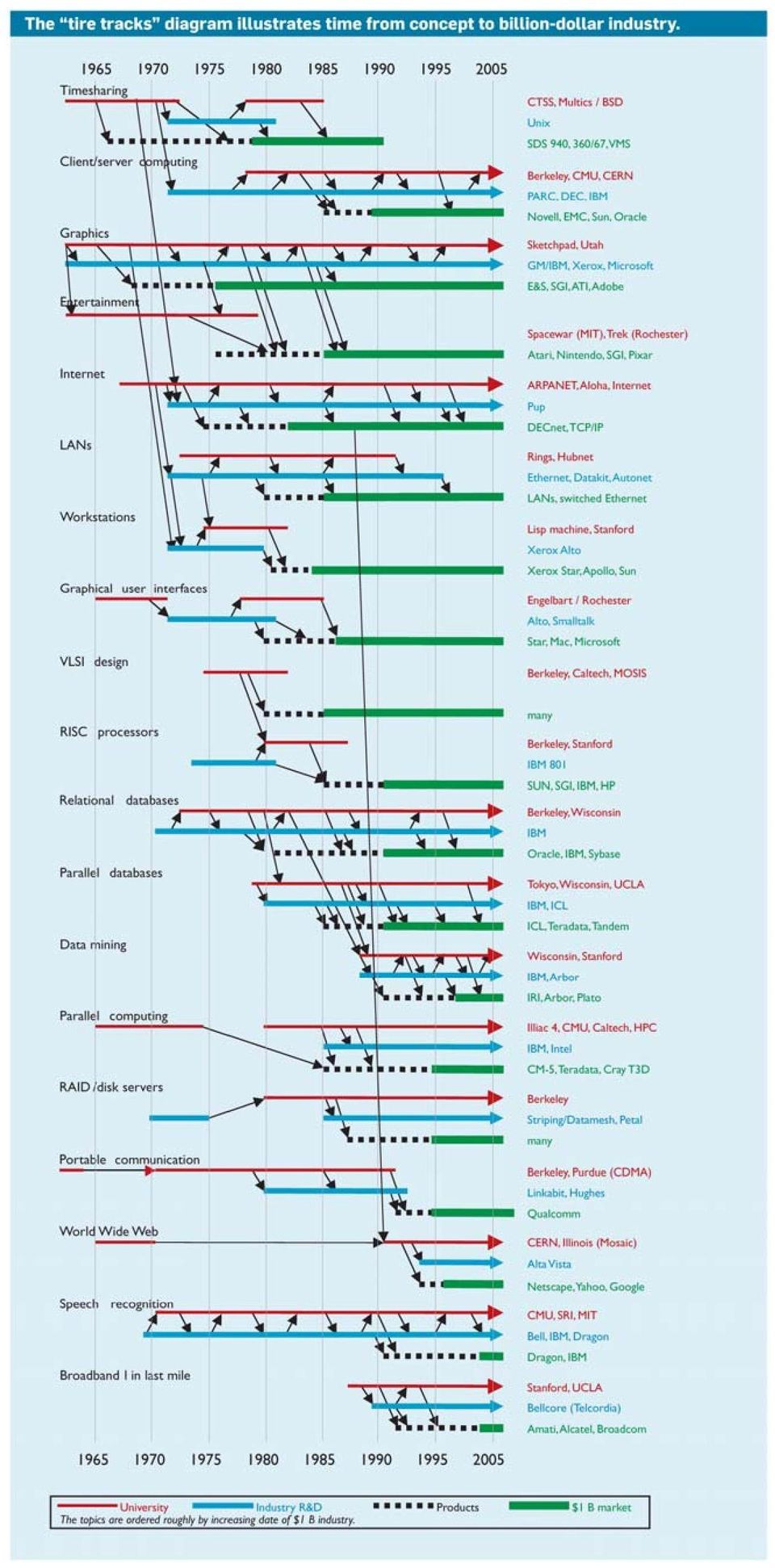
2 Challenges for all of engineering have either substantial or predominant information technology content: - Secure cyberspace - Enhance virtual reality - Advance health information systems - Advance personalized learning - Engineer better medicines - Engineer the tools of scientific discovery - Reverse-engineer the brain - Prevent nuclear terror (to a great extent a sensor network and data mining problem) And there are many more information technology challenges of equally high impact: - Create the future of networking - Empower the developing world through appropriate information and communication technology - Revolutionize transportation safety and efficiency - Build truly scalable computing systems, and devise algorithms for extracting knowledge from massive volumes of data - Engineer advanced robotic prosthetics and, more broadly, enhance people s quality of life - Instrument your body as thoroughly as your automobile - Engineer biology (synthetic biology) - Revolutionize our electrical energy infrastructure: generation, storage, transmission, and consumption - Achieve quantum computing It is impossible to imagine a field with greater opportunity to change the world. Federally sponsored research provides the foundation for progress. Key to the role that IT plays in enabling innovation is the role of the IT R&D ecosystem that enables innovation within IT. At the heart of this IT R&D ecosystem is federally sponsored research. A 1995 study by the National Research Council 4 describes the extraordinarily productive interplay of federally funded university research, federally and privately funded industrial research, and entrepreneurial companies founded and staffed by people who moved back and forth between universities and industry. That study, and a subsequent 1999 report by the President s Information Technology Advisory Committee 5, emphasized the spectacular return on the federal investment in long-term IT research and development. Indeed, a 2003 NRC study 6 identified 19 multibillion-dollar IT industries industries that are transforming our lives and driving our economy that were enabled by federally sponsored research. (See 4 National Research Council. Evolving the High Performance Computing and Communications Initiative to Support the Nation s Information Infrastructure. National Academies Press President s Information Technology Advisory Committee. Information Technology Research: Investing in Our Future National Research Council. Innovation in Information Technology. National Academies Press

3 The two dominant federal agencies in IT innovation have been the National Science Foundation (NSF) and the Defense Advanced Research Projects Agency (DARPA). The Networking and Information Technology Research and Development (NITRD) program, which coordinates the U.S. federal government s investments in IT R&D, includes 13 federal agencies ( Most NITRD agencies for example, the National Oceanic and Atmospheric Administration (NOAA), the National Aeronautics and Space Administration (NASA), the Department of Energy (DOE), and the National Institutes of Health (NIH) tend to invest in applications geared to their respective missions, leaving the support of broad-based innovation to NSF and DARPA. In general, a worrisome bias in the federal IT R&D portfolio towards short-term, application-oriented R&D has been noted, most recently in a 2007 review of the NITRD program by PCAST 7. Policy changes at DARPA have left NSF standing largely alone, jeopardizing a key element of the IT R&D ecosystem. Changes such as wider classification of programs, increased restrictions on the participation of foreign nationals, frequent go/no-go program reviews, and a general foreshortening of the research horizon have caused a significant reduction in university participation in DARPA programs in all fields, but have affected IT disproportionately because of the traditional role that DARPA has played in the field. Today, NSF provides 86% of the federal support for academic research in computer science 8, a far greater proportion than for any other field. (For example, NSF provides 40% of the support for the physical sciences, and 46% of the support for engineering.) To a significant extent, increases in NSF funding for IT research at the start of this decade merely offset decreased DARPA academic engagement, which diminished the transformative effect that had been anticipated. NITRD coordination has had limited effectiveness. This is starkly evident in the case of cybersecurity, as pointed out in a 2005 report from the President s Information Technology Advisory Committee 9. The classification of DARPA cybersecurity programs left a significant gap in what PITAC referred to as fundamental research on civilian cybersecurity. To first approximation, only NSF stepped up, and at a very modest level relative to the threats that the nation faces. Failure to act will jeopardize U.S. leadership in IT, and constrain the pace of U.S. innovation across the economy, imperiling many of the gains those innovations have enabled. PCAST s 2007 review of the NITRD program noted that the most critical need is to rebalance the NITRD investment portfolio to include more long-term, large-scale, multidisciplinary IT R&D. The review also found that changes are needed in IT education efforts, training the IT workforce, technical areas in which the NITRD program invests, the rate of technology transfer, and NITRD s own planning and assessment processes. One critical action is to launch a second Information Technology Research program in the NSF CISE Directorate. Between FY2000 and FY2004, the original ITR program added $218 7 President s Council of Advisors on Science and Technology. Leadership Under Challenge: Information Technology R&D in a Competitive World National Science Foundation. FY 2008 Budget Request to Congress President s Information Technology Advisory Committee. Cyber Security R&D: A Crisis of Prioritization

4 million to what is today (FY2008) an NSF CISE budget of $535 million which constitutes 86% of the federal support for academic research in computer science. (ITR also added $77 million to other Directorate s budgets.) ITR was managed as a distinct program, and had a particularly important impact in encouraging longer-term, larger-scale, multidisciplinary IT R&D focused on areas of particular opportunity. The impact would have been even greater had not DARPA s academic engagement decreased another issue that must be tackled. Today s research is tomorrow s infrastructure. When our nation faces immediate challenges, the feasible solutions depend upon the ideas, resources, and designs that are on the shelf, ready to deploy. Whether the challenge is restoring New Orleans, defeating improvised explosive devices, thwarting cybercrime and cyberterrorism, transforming the safety and efficiency of our transportation system, building a 21 st century electrical energy infrastructure, or revolutionizing our health care system, we can t get anything done quickly if we haven t already explored the solution space, tested the ideas, run the pilot projects, and had experience with solutions at scale. Without this preparation, we can spend vast amounts of money unwisely, and fail to achieve the results we need. So an important ingredient in infrastructure investment is to invest in the ideas, resources, and designs for tomorrow s infrastructure. Without a vigorous program of renewal of the infrastructure basics, we build the wrong thing, and the infrastructure degrades, sometimes rapidly. A wise program of infrastructure investment will build today s infrastructure and design tomorrow s infrastructure. Increasingly, information technology is the cornerstone of America s infrastructure. Information technology R&D is the cornerstone of tomorrow s infrastructure.

5
6

SECURE AND TRUSTWORTHY CYBERSPACE (SaTC)
 SECURE AND TRUSTWORTHY CYBERSPACE (SaTC) Overview The Secure and Trustworthy Cyberspace (SaTC) investment is aimed at building a cybersecure society and providing a strong competitive edge in the Nation
Preparing a 21 st Century Workforce
 Preparing a 21 st Century Workforce Science, Technology, Engineering, and Mathematics (STEM) Education in the 2014 Budget We ll reward schools that develop new partnerships with colleges and employers,
Good morning. It is a pleasure to be with you here today to talk about the value and promise of Big Data.
 Good morning. It is a pleasure to be with you here today to talk about the value and promise of Big Data. 1 Advances in information technologies are transforming the fabric of our society and data represent
CYBERINFRASTRUCTURE FRAMEWORK FOR 21 ST CENTURY SCIENCE, ENGINEERING, AND EDUCATION (CIF21)
 CYBERINFRASTRUCTURE FRAMEWORK FOR 21 ST CENTURY SCIENCE, ENGINEERING, AND EDUCATION (CIF21) Overview The Cyberinfrastructure Framework for 21 st Century Science, Engineering, and Education (CIF21) investment
Panel on Emerging Cyber Security Technologies. Robert F. Brammer, Ph.D., VP and CTO. Northrop Grumman Information Systems.
 Panel on Emerging Cyber Security Technologies Robert F. Brammer, Ph.D., VP and CTO Northrop Grumman Information Systems Panel Moderator 27 May 2010 Panel on Emerging Cyber Security Technologies Robert
National Big Data R&D Initiative
 National Big Data R&D Initiative Suzi Iacono, PhD National Science Foundation Co-chair NITRD Big Data Senior Steering Group for CASC Spring Meeting April 23, 2014 Why is Big Data Important? Transformative
Big Data R&D Initiative
 Big Data R&D Initiative Howard Wactlar CISE Directorate National Science Foundation NIST Big Data Meeting June, 2012 Image Credit: Exploratorium. The Landscape: Smart Sensing, Reasoning and Decision Environment
Position Statement on the National Aeronautics and Space Administration (NASA) FY 2014 Budget Request submitted by the
 Government Relations 1828 L Street NW, Suite 810 Washington, DC tel 1.202.785.3756 fax 1.202.429.9417 www.asme.org 20036-5104 U.S.A. Position Statement on the National Aeronautics and Space Administration
TOP SECRET//SI//REL TO USA, AUS, CAN, GBR, NZL TOP SECRET//SI//REL TO USA, AUS, CAN, GBR, NZL. (U) SIGINT Strategy. 2012-2016 23 February 2012
 (U) SIGINT Strategy 2012-2016 23 February 2012 (U) Vision (U) Ensure Signals Intelligence provides THE decisive edge in advancing the full spectrum of U.S. national security interests. (U) Mission (U)
CYBERINFRASTRUCTURE FRAMEWORK FOR 21 st CENTURY SCIENCE AND ENGINEERING (CIF21)
 CYBERINFRASTRUCTURE FRAMEWORK FOR 21 st CENTURY SCIENCE AND ENGINEERING (CIF21) Goal Develop and deploy comprehensive, integrated, sustainable, and secure cyberinfrastructure (CI) to accelerate research
EXECUTIVE ORDER 13702 - - - - - - - CREATING A NATIONAL STRATEGIC COMPUTING INITIATIVE. By the authority vested in me as President by the
 This document is scheduled to be published in the Federal Register on 08/03/2015 and available online at http://federalregister.gov/a/2015-19183, and on FDsys.gov EXECUTIVE ORDER 13702 - - - - - - - CREATING
COGNITIVE SCIENCE AND NEUROSCIENCE
 COGNITIVE SCIENCE AND NEUROSCIENCE Overview Cognitive Science and Neuroscience is a multi-year effort that includes NSF s participation in the Administration s Brain Research through Advancing Innovative
The 21st Century Energy Revolution: Challenges and Opportunities in the Electric Power and Energy Sector
 The 21st Century Energy Revolution: Challenges and Opportunities in the Electric Power and Energy Sector IEEE Region 2 Student Awards Banquet Morgantown WV April 20, 2013 Dr. Gregory Reed Director, Electric
Thank you for your very kind introduction.
 AMBASSADOR S REMARKS FOR CYBER SECURITY CONFERENCE ( NATIONAL SECURITY IN THE INFORMATION AGE ) AZERBAIJAN DIPLOMATIC ACADEMY (ADA) UNIVERSITY APRIL 13, 2015 AT 9:30AM Thank you for your very kind introduction.
How To Write A Book On Risk Management
 National Center for Risk and Economic Analysis of Terrorism Events CREATE FY2015 (Year 11) Call for White Papers CREATE, the DHS-sponsored Center of Excellence at the University of Southern California,
Education and Workforce Development in the High End Computing Community
 Education and Workforce Development in the High End Computing Community The position of NITRD s High End Computing Interagency Working Group (HEC-IWG) Overview High end computing (HEC) plays an important
CYBERINFRASTRUCTURE FRAMEWORK FOR 21 ST CENTURY SCIENCE, ENGINEERING, AND EDUCATION (CIF21) $100,070,000 -$32,350,000 / -24.43%
 CYBERINFRASTRUCTURE FRAMEWORK FOR 21 ST CENTURY SCIENCE, ENGINEERING, AND EDUCATION (CIF21) $100,070,000 -$32,350,000 / -24.43% Overview The Cyberinfrastructure Framework for 21 st Century Science, Engineering,
The Comprehensive National Cybersecurity Initiative
 The Comprehensive National Cybersecurity Initiative President Obama has identified cybersecurity as one of the most serious economic and national security challenges we face as a nation, but one that we
SECURE AND TRUSTWORTHY CYBERSPACE (SaTC) $124,250,000 +$1,500,000 / 1.2%
 SECURE AND TRUSTWORTHY CYBERSPACE (SaTC) $124,250,000 +$1,500,000 / 1.2% Overview The Secure and Trustworthy Cyberspace (SaTC) investment is aimed at building a cybersecure society and providing a strong
How To Support High Performance Computing
 1 of 12 One Hundred Second Congress of the United States of America AT THE FIRST SESSION Begun and held at the City of Washington on Thursday, the third day of January, one thousand nine hundred and ninety-one
Cybersecurity: Mission integration to protect your assets
 Cybersecurity: Mission integration to protect your assets C Y B E R S O L U T I O N S P O L I C Y O P E R AT I O N S P E O P L E T E C H N O L O G Y M A N A G E M E N T Ready for what s next Cyber solutions
Actions and Recommendations (A/R) Summary
 Actions and Recommendations (A/R) Summary Priority I: A National Cyberspace Security Response System A/R 1-1: DHS will create a single point-ofcontact for the federal government s interaction with industry
Part II: Agency R&D Budgets
 Part II: Agency R&D Budgets 5 Department of Defense Travis R. Doom Consortium for Science, Policy and Outcomes Highlights Department of Defense (DOD) R&D would continue its recent downward trend since
Computer and Network Security in Higher Education
 Mark Luker and Rodney Petersen Computer and Network Security in Higher Education Mark Luker and Rodney Petersen, Editors A Publication of EDUCAUSE Copyright 2003 Jossey-Bass Inc. Published by Jossey-Bass,
3TU MSc in Sustainable Energy Technology. Creating the sustainable energy specialists of the future
 3TU MSc in Sustainable Energy Technology Creating the sustainable energy specialists of the future The challenge of Sustainable Energy Technology The world is becoming acutely aware of the urgency of resolving
Cybersecurity on a Global Scale
 Cybersecurity on a Global Scale Time-tested Leadership A global leader for more than a century with customers in 80 nations supported by offices in 19 countries worldwide, Raytheon recognizes that shared
Purdue University Department of Computer Science West Lafayette, IN Strategic Plan 2010-2015
 Purdue University Department of Computer Science West Lafayette, IN Strategic Plan 2010-2015 Final Version 5.0: May 3, 2010 Computer science is a discipline that involves the understanding and design of
STEM Mathematics Major:
 STEM Mathematics Major: What is the Right Thing? Helen M. Roberts AMS Workshop for Department Chairs and Department Leaders January 8, 2013 Goals Mathematics Major Currently what is the goal for a mathematics
Sanjeev Kumar. contribute
 RESEARCH ISSUES IN DATAA MINING Sanjeev Kumar I.A.S.R.I., Library Avenue, Pusa, New Delhi-110012 [email protected] 1. Introduction The field of data mining and knowledgee discovery is emerging as a
Middle Class Economics: Cybersecurity Updated August 7, 2015
 Middle Class Economics: Cybersecurity Updated August 7, 2015 The President's 2016 Budget is designed to bring middle class economics into the 21st Century. This Budget shows what we can do if we invest
NC State Engineering. Research Overview. Richard F. Keltie Associate Dean, Graduate Programs and Research
 NC State Engineering Research Overview Richard F. Keltie Associate Dean, Graduate Programs and Research Engineering Academic Departments Biomedical Engineering (BME) Chemical and Biomolecular Engineering
REQUEST FOR PROPOSALS: CENTER FOR LONG-TERM CYBERSECURITY
 102 S Hall Rd Berkeley, CA 94720 510-664-7506 [email protected] REQUEST FOR PROPOSALS: CENTER FOR LONG-TERM CYBERSECURITY The University of California, Berkeley Center for Long-Term Cybersecurity (CLTC)
STATEMENT BY DAVID DEVRIES PRINCIPAL DEPUTY DEPARTMENT OF DEFENSE CHIEF INFORMATION OFFICER BEFORE THE
 STATEMENT BY DAVID DEVRIES PRINCIPAL DEPUTY DEPARTMENT OF DEFENSE CHIEF INFORMATION OFFICER BEFORE THE HOUSE OVERSIGHT AND GOVERNMENT REFORM COMMITTEE S INFORMATION TECHNOLOGY SUBCOMMITTEE AND THE VETERANS
Business Intelligence of the Future. kpmg.com
 Business Intelligence of the Future kpmg.com 1 Business Intelligence (BI) of the Future An Intelligent Enterprise What will Business Intelligence (BI) look like by year 2020? BI will become an innovation
Chairman Johnson, Ranking Member Carper, and Members of the committee:
 UNITED STATES OFFICE OF PERSONNEL MANAGEMENT STATEMENT OF THE HONORABLE KATHERINE ARCHULETA DIRECTOR U.S. OFFICE OF PERSONNEL MANAGEMENT before the COMMITTEE ON HOMELAND SECURITY AND GOVERNMENTAL AFFAIRS
Security is Not a Commodity: The Road Forward for Cybersecurity Research
 Security is Not a Commodity: The Road Forward for Cybersecurity Research Stefan Savage UC San Diego Fred B. Schneider Cornell University Version 4: February 3, 2009 1 Computers at Risk 2, a 1991 report
ECOLOGICAL RESTORATION A MEANS OF CONSERVING BIODIVERSITY AND SUSTAINING LIVELIHOODS
 ECOLOGICAL A MEANS OF CONSERVING BIODIVERSITY AND SUSTAINING LIVELIHOODS RESTORATION The Society for Ecological Restoration International (SER) is a non-profit organization infused with the energy of involved
NITRD and Big Data. George O. Strawn NITRD
 NITRD and Big Data George O. Strawn NITRD Caveat auditor The opinions expressed in this talk are those of the speaker, not the U.S. government Outline What is Big Data? Who is NITRD? NITRD's Big Data Research
strategic workforce planning: building blocks to success
 strategic workforce planning: building blocks to success Foreword by Tom Kaminsky The ability to attract and retain people with valuable skills that meet business objectives is vital for companies seeking
Developing and Enhancing Cyber Security Capabilities in the Region. Khaled Gamo Technology Advisor Ministry of communication and informatics
 Developing and Enhancing Cyber Security Capabilities in the Region Khaled Gamo Technology Advisor Ministry of communication and informatics 1 Content 1 2 3 Cyber Security Strategy and Key Requirement Efforts
The Computing Community Consortium
 The Computing Community Consortium Ed Lazowska, University of Washington, Chair CCC Bill Feiereisen to the e-infrastructure Reflection Group, Zurich, Switzerland April 25, 2008 Computing has changed the
WRITTEN TESTIMONY OF
 WRITTEN TESTIMONY OF KEVIN MANDIA CHIEF EXECUTIVE OFFICER MANDIANT CORPORATION BEFORE THE SUBCOMMITTEE ON CRIME AND TERRORISM JUDICIARY COMMITTEE UNITED STATES SENATE May 8, 2013 Introduction Thank you
NATIONAL NUCLEAR SECURITY ADMINISTRATION
 NATIONAL NUCLEAR SECURITY ADMINISTRATION (Discretionary dollars in thousands) FY 2013 FY 2014 FY 2015 FY 2015 vs. FY 2014 Current Enacted Request $ % National Nuclear Security Administration Weapons Activities
Preparing Americans with 21 st Century Skills
 Preparing Americans with 21 st Century Skills Science, Technology, Engineering, and Mathematics (STEM) Education in the 2015 Budget Teachers and principals in schools from Tennessee to Washington, D.C.,
Department of Homeland Security
 11 Department of Homeland Security Lynn J. Daniels and Gerald L. Epstein American Association for the Advancement of Science HIGHLIGHTS The Department of Homeland Security (DHS) research and development
Reach Higher, AMERICA OVERCOMING CRISIS IN THE U.S. WORKFORCE
 Reach Higher, AMERICA OVERCOMING CRISIS IN THE U.S. WORKFORCE EXECUTIVE SUMMARY Report of the National Commission on Adult Literacy June 2008 Council for Advancement of Adult Literacy EXECUTIVE SUMMARY
) ) ) ) COMMENTS OF THE TELECOMMUNICATIONS INDUSTRY ASSOCIATION. The Telecommunications Industry Association ( TIA ) 1 hereby submits its comments in
 Before the NATIONAL TELECOMMUNICATIONS AND INFORMATION ADMINISTRATION Washington, DC 20230 and the FEDERAL COMMUNICATIONS COMMISSION Washington, DC 20554 In the Matter of Model City for Demonstrating and
Stremtan Mircea-Emil Technical Consultant& Sales Manager S RO
 Stremtan Mircea-Emil Technical Consultant& Sales Manager S RO National Instruments Our Mission We equip engineers and scientists with tools that accelerate productivity, innovation, and discovery. Engineering
Moderator: Julian M. Goldman, MD, Harvard Medical School, MGH, Partners HealthCare
 Panel IV: Challenges: The Digital Health Platform (System of Systems) Moderator: Julian M. Goldman, MD, Harvard Medical School, MGH, Partners HealthCare Regulatory Ambiguity and Requirements for New Devices
SITUATIONAL AWARENESS MITIGATE CYBERTHREATS
 Gaining the SITUATIONAL AWARENESS needed to MITIGATE CYBERTHREATS Industry Perspective EXECUTIVE SUMMARY To become more resilient against cyberthreats, agencies must improve visibility and understand events
High Performance Computing Initiatives
 High Performance Computing Initiatives Eric Stahlberg September 1, 2015 DEPARTMENT OF HEALTH AND HUMAN SERVICES National Institutes of Health National Cancer Institute Frederick National Laboratory is
The Geospatial Approach to Cybersecurity: An Executive Overview. An Esri White Paper January 2014
 The Geospatial Approach to Cybersecurity: An Executive Overview An Esri White Paper January 2014 Copyright 2014 Esri All rights reserved. Printed in the United States of America. The information contained
Chapter 2 Planning, Resource Allocation, and Institutional Renewal
 Chapter 2 Planning, Resource Allocation, and Institutional Renewal An institution conducts ongoing planning and resource allocation based on its mission and utilizes the results of its assessment activities
Testimony of Elizabeth Rogan CEO The Optical Society House Commerce, Justice, and Science Subcommittee House Appropriations Committee March 22, 2012
 Testimony of Elizabeth Rogan CEO The Optical Society House Commerce, Justice, and Science Subcommittee House Appropriations Committee March 22, 2012 Good morning, Chairman Wolf and Ranking Member Fattah.
The Economic and Programmatic Impacts of the Maryland Technology Development Corporation on the Maryland Economy
 EXECUTIVE SUMMARY The Economic and Programmatic Impacts of the Maryland Technology Development Corporation on the Maryland Economy PREPARED BY: Battelle Technology Partnership Practice PREPARED FOR: The
University of Maryland University College. American Military University. Henley-Putnam University
 A P R I L 2 0 1 1 Table of Contents 2-3 UMUC: Training Tomorrow s Cybersecurity Leaders Today University of Maryland University College 4-5 Preparing Those Who Protect the Public American Military University
Internet of Things: Consumerisation of Technology. www.avasant.com
 : Consumerisation of Technology Technology democratization has weaved an ecosystem powered by intelligent systems, connectivity services, analytics, and technology infrastructure to deliver services. With
Big Data. George O. Strawn NITRD
 Big Data George O. Strawn NITRD Caveat auditor The opinions expressed in this talk are those of the speaker, not the U.S. government Outline What is Big Data? NITRD's Big Data Research Initiative Big Data
How To Write A National Cybersecurity Act
 ROCKEFELLER SNOWE CYBERSECURITY ACT SUBSTITUTE AMENDMENT FOR S.773 March 17, 2010 BACKGROUND & WHY THIS LEGISLATION IS IMPORTANT: Our nation is at risk. The networks that American families and businesses