
Emission Reductions Program Idea Note (ER-PIN) Republic of Congo
|
|
|
- Delphia Tyler
- 10 years ago
- Views:
Transcription
1 ER-Program Republic of Congo FCPF Carbon Fund ER-PIN Template v.4 August, March 2014 Emission Reductions Program Idea Note (ER-PIN) Republic of Congo Unity * Work * Progress Document rédigé avec le concours technique de CN-REDD Brazzaville, 14 March
2 Forest Carbon Partnership Facility (FCPF) Carbon Fund Emission Reductions Program Idea Note (ERPIN) Country: REPUBLIC OF CONGO ER Program Name: Republic of Congo Emission Reduction Program Date of Submission or Revision: 14 March

3 Disclaimer The World Bank does not guarantee the accuracy of the data included in the Emission Reductions Program Idea Note (ERPIN) submitted by a REDDREDD+ Country Participant and accepts no responsibility whatsoever for any consequence of their use. The boundaries, colors, denominations, and other information shown on any map in the ERPIN do not imply on the part of the World Bank any judgment on the legal status of any territory or the endorsement or acceptance of such boundaries. Guidelines: 1. The FCPF Carbon Fund will deliver Emission Reductions (ERs) from activities that reduce emissions from deforestation and forest degradation, conserve forests, promote the sustainable management of forests, and enhance forest carbon stocks in developing countries (REDD+REDD+) to the Carbon Fund Participants. 2. A REDDREDD+ Country Participant interested in proposing an ER Program to the Carbon Fund should refer to the selection criteria included in the Carbon Fund Issues Note available on the FCPF website ( and to further guidance that may be communicated by the FCPF Facility Management Team (FMT) over time. 3. ER Programs shall come from FCPF REDDREDD+ Country Participants that have signed their Readiness Preparation Grant Agreement, using this ER Program Idea Note ( ERPIN ) template. 4. The completed ERPIN should ideally not exceed 40 pages in length (including maps, data tables, etc.). If additional information is required, the FCPF FMT will request it.. 5. Please submit the completed ERPIN to: 1) the World Bank Country Director for your country; and 2) the FCPF FMT ([email protected]). 6. As per Resolution CFM/4/2012/1 the Carbon Fund Participants decision whether to include the ER PIN in the pipeline will be based on the following criteria: i. Progress towards Readiness: The Emission Reductions Program (ER Program) must be located in a REDD Country Participant that has signed a Readiness Preparation grant agreement (or the equivalent) with a Delivery Partner under the Readiness Fund, and that has prepared a reasonable and credible timeline to submit a Readiness Package to the Participants Committee; ii. Political commitment: The REDD Country Participant demonstrates a highlevel and crosssectoral political commitment to the ER Program, and to implementing REDD+; iii. Methodological Framework: The ER Program must be consistent with the emerging Methodological Framework, including the PC s guiding principles on the methodological framework; iv. Scale: The ER Program will be implemented either at the national level or at a significant subnational scale, and generate a large volume of Emission Reductions; v. Technical soundness: All the sections of the ERPIN template are adequately addressed; vi. Noncarbon benefits: The ER Program will generate substantial noncarbon benefits; and vii. Diversity and learning value: The ER Program contains innovative features, such that its inclusion in the portfolio would add diversity and generate learning value for the Carbon Fund. 3
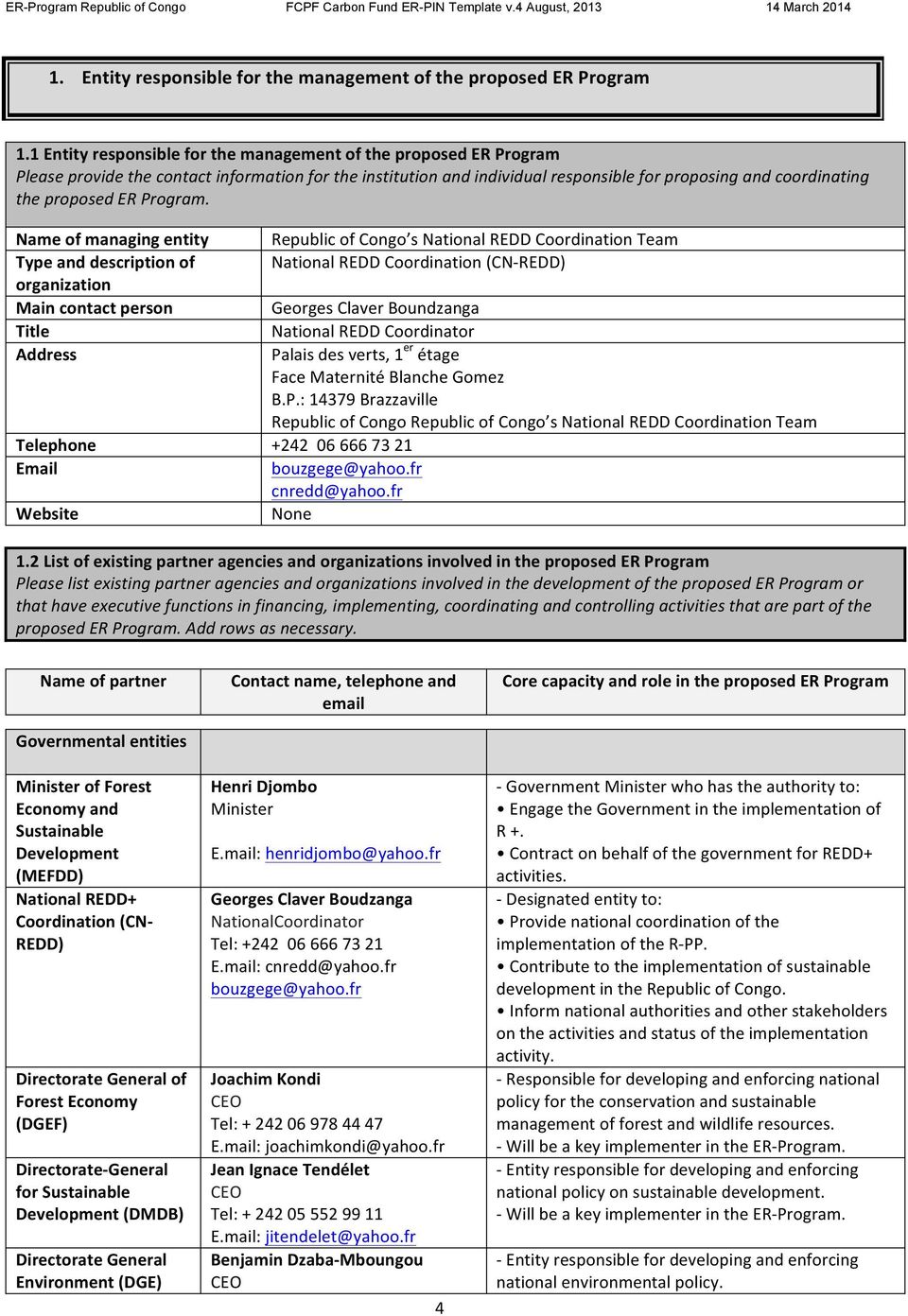
4 1. Entity responsible for the management of the proposed ER Program 1.1 Entity responsible for the management of the proposed ER Program Please provide the contact information for the institution and individual responsible for proposing and coordinating the proposed ER Program. Name of managing entity Type and description of organization Main contact person Title Address Telephone Website Republic of Congo s National REDD Coordination Team National REDD Coordination (CNREDD) Georges Claver Boundzanga National REDD Coordinator Palais des verts, 1 er étage Face Maternité Blanche Gomez B.P.: Brazzaville Republic of Congo Republic of Congo s National REDD Coordination Team [email protected] [email protected] None 1.2 List of existing partner agencies and organizations involved in the proposed ER Program Please list existing partner agencies and organizations involved in the development of the proposed ER Program or that have executive functions in financing, implementing, coordinating and controlling activities that are part of the proposed ER Program. Add rows as necessary. Name of partner Governmental entities Minister of Forest Economy and Sustainable Development (MEFDD) National REDD+ Coordination (CN REDD) Directorate General of Forest Economy (DGEF) DirectorateGeneral for Sustainable Development (DMDB) Directorate General Environment (DGE) Contact name, telephone and Henri Djombo Minister E.mail: [email protected] Georges Claver Boudzanga NationalCoordinator Tel: E.mail: [email protected] [email protected] Joachim Kondi CEO Tel: E.mail: [email protected] Jean Ignace Tendélet CEO Tel: E.mail: [email protected] Benjamin DzabaMboungou CEO 4 Core capacity and role in the proposed ER Program Government Minister who has the authority to: Engage the Government in the implementation of R +. Contract on behalf of the government for REDD+ activities. Designated entity to: Provide national coordination of the implementation of the RPP. Contribute to the implementation of sustainable development in the Republic of Congo. Inform national authorities and other stakeholders on the activities and status of the implementation activity. Responsible for developing and enforcing national policy for the conservation and sustainable management of forest and wildlife resources. Will be a key implementer in the ERProgram. Entity responsible for developing and enforcing national policy on sustainable development. Will be a key implementer in the ERProgram. Entity responsible for developing and enforcing national environmental policy.
5 National Inventory and Planning Center of Forest Resources and Fauna (CNIAF) National Afforestation and Reforestation Programme (PRONAR) Prefecture Sangha Prefecture Likouala National School of Agronomy and Forestry (SCSTA) / University Marien Ngouabi Civil Society Tel: E.mail: [email protected] Georges Claver Boudzanga Director Tel: E.mail: [email protected] Rosalie MATONDO coordinator Tel: / E.mail: [email protected] Adolphe ELEMBA Departmental Director of Forest Economy Tel: E.mail: [email protected] Gilbert DJOMBO BOMODZO Point Focal REDD Tel: AKOUANGO Paricce Point Focal REDD Tel: E.mail: [email protected] Will be a key implementer in the ERProgram. Designated entity for: Implementation of the national program for forest inventory and facilitation of forest and wildlife resources. Organization and operationalization of the REDD+ MRVcell. Its role will be instrumental in the establishment of the baseline scenario and MRV system of the ER Program. National designated body for: Providing national coordination of activities in the context of afforestation and reforestation Seeking technical and financial partners to support multistakeholder initiatives (public, private, populations) in the field of afforestation and reforestation. Will be a key implementer in the ERProgram in regards to afforestation, reforestation and agroforestry activities. Departmental entity responsible for developing and implementing policy and national strategy for sustainable development at the departmental level. Will be a key implementer in the ERProgram. Departmental entity responsible for developing and implementing policy and national strategy for sustainable development at the departmental level. Will be a key implementer in the ERProgram. Scientific and technical entity in the fields of forestry and agronomy. Will be a key implementer in the ERProgram. CACOREDD+/ Bureau National HANIMBA Maixent Facilitator Indigenous Populations Tel: E.mail: [email protected] 5 Platform of civil society responsible for coordinating the NGOs involved in the REDD+ + in the Republic of Congo. Will be a key implementer in the ERProgram. MOUSSELE Guy Facitateurother NGOs Tel: E.mail: [email protected] CACOREDD+/Bureau Sangha AMPIEH Calvin Departmental Coordinator Tel: E.mail: [email protected] Platform of civil society responsible for coordinating the NGOs involved in the REDD+ + Sangha. Will be a key implementer in the ERProgram in Sangha. CACOREDD+/Bureau NGOUAKA Emile Platform of civil society responsible for coordinating

6 Likouala Wildlife Conservation Society (WCS) Private Sector Congolese Industrielle des Bois (CIB) OLAM International Ltd (OLAM) GreenLaw International LLC (GLI) Company Tanry Congo (STC) Industrial Society Forest of Congo (SIFCO) Danzer Group (IFO) Congo Iron SA (Sundance Resource Group) Likouala Timber Departmental Coordinator Tel: +242 TIM Rayden REDD+ Program Lead Tel: E.mail: [email protected] Christian Schwartz CEO Tel: E.mail: christian.schwarz@olamnet com Darshan Raiyani Senior Vice President of Timber Tel: E.mail:[email protected] Ralph Strebel Director Tel: E.mail: [email protected] Séraphin BIKOUMOU HomologouscellAménagementl Tel: / René MABOUNDOU Homologouscell Aménagementl Tel: José QUARESNA General Director Tel: E.mail: [email protected] YOKA Aimé Emmanuel Country Manager / General Manager Tel: [email protected] BETITO Raphael ComptrollerGeneral Tel: E.mail: [email protected] Tel: the NGOs involved in REDD+ + in the Department of Likouala. Will be a key implementer in the ERProgram in Likouala. International NGO involved in the management of protected areas in the Republic of Congo having signed with MEFDD a Memorandum of Understanding (MoU) to support CNREDD+ in the REDD+ process. Will be a key implementer of the ERProgram in Sangha and Likouala. Forestry company that has significant certified forest concessions and has established a REDD+ project for the generation of carbon credits in UFE North Pikounda. Will be a key implementer in the ERProgram in Sangha and Likouala. Owner of CIB. Will be a key implementer in the ERProgram Sangha and Likouala. Consulting firm selected by the Republic of Congo to support the CNREDD+ in the development of ER Program and ERPIN of the Republic of Congo. Forestry company which manages forest concessions in Likouala Will be a key implementer in the ERProgram in Likouala. Forestry company that manages the UFA Tala Tala whose development plan in being finalized and committed to implement cogeneration. Will be a key implementer in the ERProgram in Sangha. Forestry company that manages the UFA INGOMBE whose is a Forest Steward Ship (FSC) certified concession committed to implement emission reductions activities. Will be a key implementer in the ERProgram in Sangha & Likouala. Forestry company in Likouala. Will be a key implementer in the ERProgram in Likouala.

7 Sponsors Forest Carbon Partnership Fund (FCPF) FAO UNDP COMIFAC Congo Basin Forest Partnership (CBFP) Laurent Valiergue Task Team Leader Tel: Saya Maba Head ofprogram Tel: E.mail : [email protected] Jean Félix Issang Head ofprogram Tel: E.mail : [email protected] Martin Tadoum Deputy Executive Secretary Tel: E.mail: [email protected] Clotilde Ngomba Coordinator The FCPF provides technical & financial support to the Republic of Congo in the REDD+ Readiness Preparation process. FAO will provide technical support to CNREDD in the implementation of strategic and technical tools for REDD+ and will have a key role in the implementation of ERP. The UNDP will provide technical support to CN REDD+ in the implementation of strategic and technical tools for REDD+ and will have a key role in the implementation of ERP. The Forests Commission (COMIFAC) that accompanies the Republic of Congo in the implementation of REDD+ projects, and will have a key role in the implementation of the ERP. The CBFP who financially supports CNIAF in achieving the national forest inventory and the development of the national land use plan, will have a key role in the implementation of ERP in Sangha and Likouala. 7

8 2. Authorization by the National REDD+ focal point Please provide the contact information for the institution and individual who serve as the national REDD Focal Point and endorses the proposed ER Program, or with whom discussions are underway Name of entity Main contact person Title Address Telephone Website Republic of Congo s National REDD Coordination Team Georges Claver Boundzanga National REDD Coordinator Palais des verts, 1 er étage, Face Maternité Blanche Gomez B.P.: Brazzaville, Republic of Congo [email protected] [email protected] None 2.1 Endorsement of the proposed ER Program by the national government Please provide the written approval for the proposed ER Program by the REDD Country Participant s authorized representative (to be attached to this ERPIN). Please explain if the national procedures for the endorsement of the Program by the national government REDD focal point and/or other relevant government agencies have been finalized or are still likely to change, and how this might affect the status of the attached written approval. ER Program) must be located in a REDD Country Participant that has signed a Readiness Preparation grant agreement (or the equivalent) with a Delivery Partner under the Readiness Fund, and that has prepared a reasonable and credible timeline to submit a Readiness Package to the Participants Committee The Republic of Congo (RoC) has been engaged in the REDD+ process since Evidence of this commitment is supported by: Participation Agreement with FCPF signed on 27 November 2008; Grant Agreement (USD $200,000) signed with the FCPF for the formulation of the Readiness Preparation Proposal signed on 21 July 2009; The adoption of the RPP in April 2010; Grant Agreement (USD $3,400,000) signed with the FCPF for the implementation of the Readiness Preparation Proposal on 11 January 2012 Convention (USD $4,000,000) with the UNREDD Programme in October 2013 The signing of a memorandum of understanding in May 2012 between the Government and CIBOLAM for the development of North Pikounda REDD+ (NPR+) pilot project; The letter from the MEFDD, authorizing CIBOLAM to commit funding for the development process finalizing the Emission Reduction Program Information Note (ERPIN); The formulation of TOR by the CNREDD to solicit financial support from the Forest Economic Diversification Project (PFDE) for the recruitment of a consultant to support the Republic of Congo in the development of the ERPIN; The letter from CNREDD+ and the MEFDD, authorizing CIBOLAM to commit funds for the development process of finalizing the ERPIN. Since the National Conference of 1991, which formalized the multiparty democracy in the RoC, the consensus process has become the way of adopting decisions. For example, the preparation of the RPP of the RoC was inspired by the consultation process for the preparation of the Strategic Document for Poverty Reduction (DSRP1 in 2008 and DSRP2 in 2012). It is also based on the achievements of AVP/FLEGT and the REDD+ process, during which many stakeholders were integrally involved. A letter from MEFDD, Minister H.Djombo, of formal support of the ERPIN is attached and included in Appendix 1. 8

9 2.2 Political commitment Please describe the political commitment to the ER Program, including the level of support within the government and whether a crosssectoral commitment exists to the ER Program and to REDD+ in general. The political commitment of the Republic of Congo to the ERProgram, which is one of sustainable development that is part of the larger Congo vision of a Green Economy, finds its basis in the broad concepts of conservation, sustainable management of natural ecosystems, participatory management and the fight against poverty. This is supported by: The National Forestry Action Plan (PFAN 1992); The National Action Plan for the Environment (PNAE 1994); The National Scheme for Rural Development (SNDR in 1997); The National Planning Scheme (SNAT in 2005); The Strategy Document for Poverty Reduction (DSRP 1 and DSRP 2 in 2008 and in 2012); The National Action Plan (PAN 2008); Voluntary Partnership Agreement (FLEGTVPA in 2009); and, REDD Preparation Proposal (RPP) approved in Plan de Développement du Secteur Agricole PDSA département SANGHA (2012) Plan de Développement du Secteur Agricole PDSA département Likouala (2012) National Development Plan of Congo DSCERP This is also reflected by the implementation of sustainable forest management process, which began in late 2000 and now has led to the development of five million hectares of forest concessions, 50% that are certified under the Forest Steward Council (FSC), independently verified certification scheme. Significant national efforts have also been made in terms of: Reforestation with 84,420 hectares of plantations and 12,450 hectares (ha) of degraded forest; and, Biodiversity conservation with nearly 4 million ha (12 % of the total surface area of Congo) classified as protected areas. The commitment of the Congo to the conservation and sustainable management of natural resources is also reflected in its membership in numerous international agreements, including but not limited to the United Nations Framework Convention on Climate Change (UNFCCC) and the establishment of the Treaty on conservation and sustainable management of forest ecosystems in Central Africa and establishing the Forests Commission (COMIFAC). 3. STRATEGIC CONTEXT AND RATIONALE FOR THE ER PROGRAM 3.1 Brief summary of major achievements of readiness activities in country thus far Please briefly provide an update on REDD readiness activities, using the component categories of the RPP as a guide. If public information is available on this progress, please refer to this information and provide a link. The REDD+ Readiness Process (implementation of the RPP, adopted in 2010) began with the signature of the Grant Agreement with the FCPF in 2012 and the signature of the convention of the UNREDD Program in Actual work for the process only began in January 2013 after the establishment of the National REDD+ Coordination (CNREDD) unit; The Civil Society platform on REDD+ (CACOREDD) and twelve REDD+ Focal Points in the Ministries. The establishment of the REDD+ National Committee (CONAREDD) and REDD+ Departmental Committees (CODEPAREDD) continue to be works in progress. 9

10 In the year 2013 the top priority was the alignment of both of the activities supported by the FCPF and the UNREDD Programme. As of today there is strong alignment between the activities in relation to the REDD+ process which will ensures a rapid finalization of the Readiness Package. In July 2013 the consultation and communication plan was validated paving the way toward a well structured consultation, communication and participatory process which covers all of the components of the REDD+ preparation proposal adopted in Seventeen workshops (Please see Appendix 3 for a complete list and scope of the workshops) have been undertaken to raise awareness of the REDD+ process with all of the stakeholders that are most likely to be impacted by the REDD+ activities and acquire a broad range of feedback. These were undertaken throughout the country from April 2013 through March Four of the seventeen were largely dedicated to the safeguards instrument process, with a focus on presenting the working methodology to be adopted, which aimed at producing the Social and Environmental Strategic Assessment (SESA) and its related frameworks. These took place in the départements of PointeNoire, Sibiti, Madingou, Dolisie. Three of the seventeen were related specifically to the ERProgram in order to raise awareness and acquire feedback from the stakeholders. They took place in Brazzaville and in Impfondo in Likouala Department. The remaining workshops of the seventeen were related to the promotion of the dissemination of the RPP in the local languages of Lingala and Kituba, and also undertook the promotion and general awareness raising of the REDD+. The consultations for the development of the national REDD+ strategy is well advanced. The key step were undertaking by the National Forum on Sustainable Development, which brought together more than 1,000 delegates from all appropriate national components Additional workshops were held with the Food and Agriculture Organization (FAO) in regards to the national reference level scenario, the MRV system, and the REDD+ pilot projects for further consolidation as a part of the national REDD+ strategy. Four major studies were identified for the REDD+ Readiness process: (i) (ii) (iii) (iv) Spatial Drivers of Deforestation and Forest Degradation with options for the national REDD+ Strategy This in depth study is ongoing and is being performed by the firms of BRL Ingénierie and C4 Ecosolutions. More specifically in Appendix 3 & 4 provides and extract of the interim report for both of the Départements of Sangha and Likouala, dated February Proposed Future Investments in the Départements of Likouala and Sangha Regarding the Reduction of Emissions from Deforestation and Forest Degradation. The contract with IDEA CONSULT INTERNATIONAL & AED CONSULT is currently under negotiation with an anticipated start date in May This study will be a major input for the ERProgram design phase. Options for Development of the implementation Framework of the National REDD+ framework The contract has been awarded to the firm AGRER and with an anticipated start date of the study in April Social Environment Strategic Assessment The contract for the study is under negotiation with the consortium of BRL Ingénierie and ONF International and the anticipated start is May For each of the major studies the firms that have been awarded proposed technical bids clarify the working methodology to produce the expected outputs in a timely manner. 3.2 Current status of the Readiness Package and estimated date of submission to the FCPF Participants Committee (including the REL/FRL, REDD Strategy, national REDD monitoring system and ESMF). 10

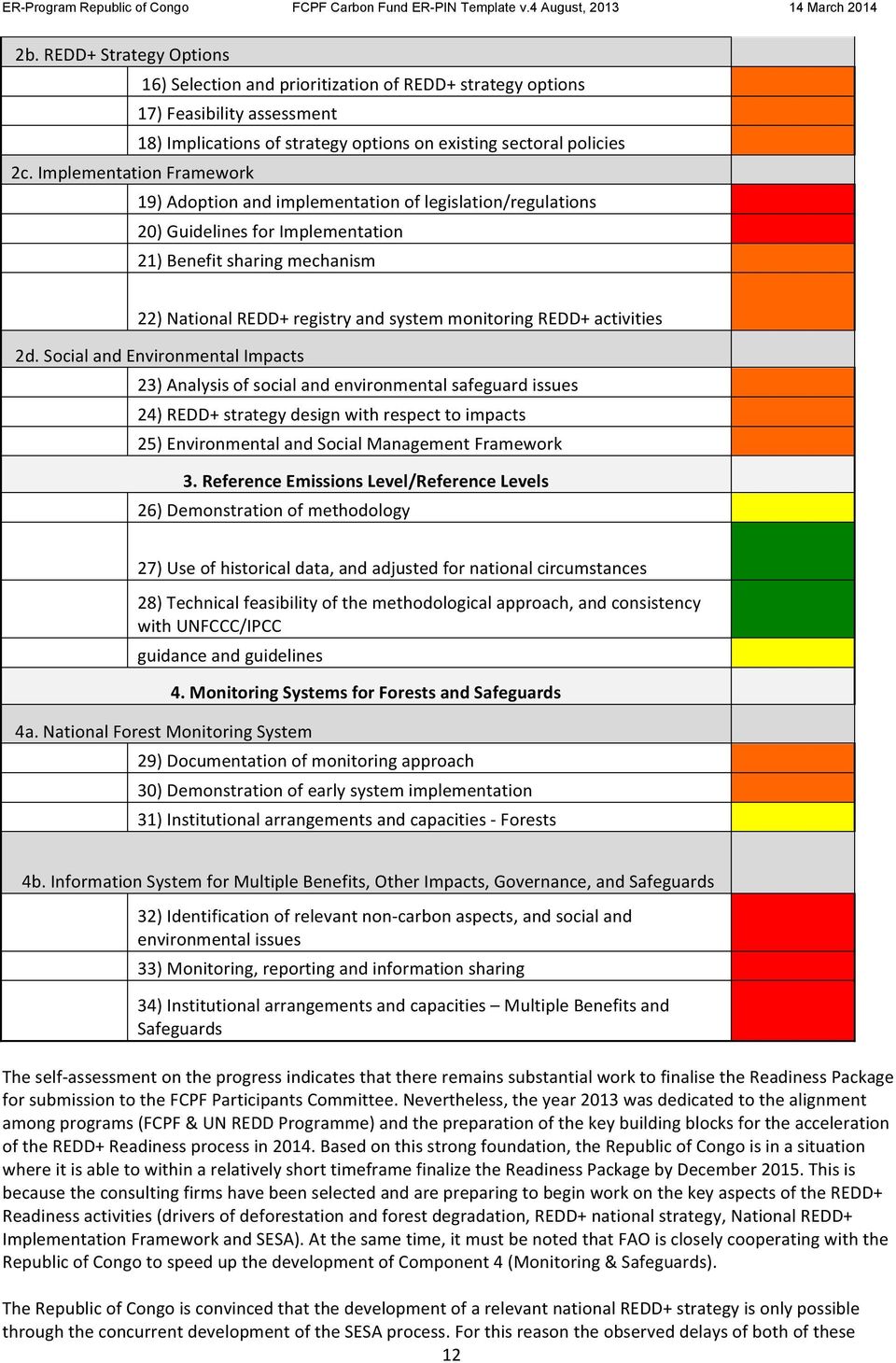
11 Currently, the REDD+ preparation proposal (RPP) is ontrack and is not facing any recognized significant challenges. The table set forth in Appendix 1 summarizes the anticipated dates of completion of each of the components identified in the RoC RPP. As part of the REDD+ process, a selfassessment using the FCPF Readiness Package Assessment Framework based on the 34 indicators established by the FMT Note rev: RPackage Assessment Framework has been completed in February 2014 and is presented below: i. Green: significant progress ii. Yellow: progressing well, further development required iii. Orange: further development required iv. Red: Not yet demonstrating progress Number Indicators Score 1. Readiness Organization and Consultation 1a. National REDD+ Management Arrangements 1) Accountability and transparency 2) Operating mandate and budget 1b. Consultation, Participation, and Outreach 3) Multisector coordination mechanisms and crosssector collaboration 4) Technical supervision capacity 5) Funds management capacity 6) Feedback and grievance redress mechanism 7) Participation and engagement of key stakeholders 8) Consultation processes 9) Information sharing and accessibility of information 10) Implementation and public disclosure of consultation outcomes 2. REDD+ Strategy Preparation 2a. Assessment of Land Use, LandUse Change Drivers, Forest Law, Policy and Governance 11) Assessment and analysis 12) Prioritization of direct and indirect drivers/barriers to forest enhancement 13) Links between drivers/barriers and REDD+ activities 14) Action plans to address natural resource rights, land tenure, governance 15) Implications for forest law and policy 11

12 2b. REDD+ Strategy Options 16) Selection and prioritization of REDD+ strategy options 17) Feasibility assessment 18) Implications of strategy options on existing sectoral policies 2c. Implementation Framework 19) Adoption and implementation of legislation/regulations 20) Guidelines for Implementation 21) Benefit sharing mechanism 22) National REDD+ registry and system monitoring REDD+ activities 2d. Social and Environmental Impacts 23) Analysis of social and environmental safeguard issues 24) REDD+ strategy design with respect to impacts 25) Environmental and Social Management Framework 3. Reference Emissions Level/Reference Levels 26) Demonstration of methodology 27) Use of historical data, and adjusted for national circumstances 28) Technical feasibility of the methodological approach, and consistency with UNFCCC/IPCC guidance and guidelines 4a. National Forest Monitoring System 4. Monitoring Systems for Forests and Safeguards 29) Documentation of monitoring approach 30) Demonstration of early system implementation 31) Institutional arrangements and capacities Forests 4b. Information System for Multiple Benefits, Other Impacts, Governance, and Safeguards 32) Identification of relevant noncarbon aspects, and social and environmental issues 33) Monitoring, reporting and information sharing 34) Institutional arrangements and capacities Multiple Benefits and Safeguards The selfassessment on the progress indicates that there remains substantial work to finalise the Readiness Package for submission to the FCPF Participants Committee. Nevertheless, the year 2013 was dedicated to the alignment among programs (FCPF & UN REDD Programme) and the preparation of the key building blocks for the acceleration of the REDD+ Readiness process in Based on this strong foundation, the Republic of Congo is in a situation where it is able to within a relatively short timeframe finalize the Readiness Package by December This is because the consulting firms have been selected and are preparing to begin work on the key aspects of the REDD+ Readiness activities (drivers of deforestation and forest degradation, REDD+ national strategy, National REDD+ Implementation Framework and SESA). At the same time, it must be noted that FAO is closely cooperating with the Republic of Congo to speed up the development of Component 4 (Monitoring & Safeguards). The Republic of Congo is convinced that the development of a relevant national REDD+ strategy is only possible through the concurrent development of the SESA process. For this reason the observed delays of both of these 12
13 studies will nonetheless be able to mutually inform each other as they are conducted in parallel. In fact, the Republic of Congo will be able to learn from the lessons that can be observed in the Democratic Republic of Congo to further speed its own process. 3.3 Consistency with national REDD strategy and other relevant policies Please describe: a) How the planned and ongoing activities in the proposed ER Program relate to the variety of proposed interventions in the (emerging) national REDD strategy. b) How the proposed ER Program is strategically relevant for the development and/or implementation of the (emerging) national REDD strategy (including policies, national management framework and legislation). c) How the activities in the proposed ER Program are consistent with national laws and development priorities. As stipulated in the above section 3.1, a major study on the Spatial Drivers of Deforestation and Forest Degradation with options for the national REDD+ Strategy is ongoing and the interim report that was completed in February 2014 has confirmed that options that were first adopted in the RoC RPP in 2010 remain relevant and will be the basis of the national REDD+ strategy expected to be validated in Q concurrently with the safeguard instruments. The table below is a summary of the strategic options that were presented at the national level. RoC RPP Strategic Options Sub Options Sub Option Activity Related ERProgram Activities (see section 5.3 below) Strategic Option 1: Strategic Option 2: Strategic Option 3: Strengthen security of land tenure Sustainable management of forest resources Improve agricultural production systems SO1.1 Establish a National Land Allocation Plan (PNAT) SO1.2 Strengthening the network of protected areas No direct link Conservation setaside areas. SO 2.1 Fight against illegal logging Strengthening of governance by enhanced Sustainable forest management activities. SO 2.2 Strengthening the sustainable management of production forests SO 2.3 Involvement of local communities and indigenous peoples in forest management Promotion of additional Reduced impact logging activities. Communities and indigenous peoples will be the key actors in the cocoa activities especially in concession s agricultural development zones. SO 2.4 Promotion of forest certification Strengthening of governance by enhanced Sustainable forest management activities SO 2.5 Improving techniques for exploitation and wood processing SO 3.1 Promote smallholder access to microcredit ; SO 3.2 Support the organization of the agricultural profession; Promotion of the Increased use Reduced impact logging and of the domestic use of secondary species Agriculture related carbon components (Cocoa & Biochar) will enhance financial livelihoods No direct link 13
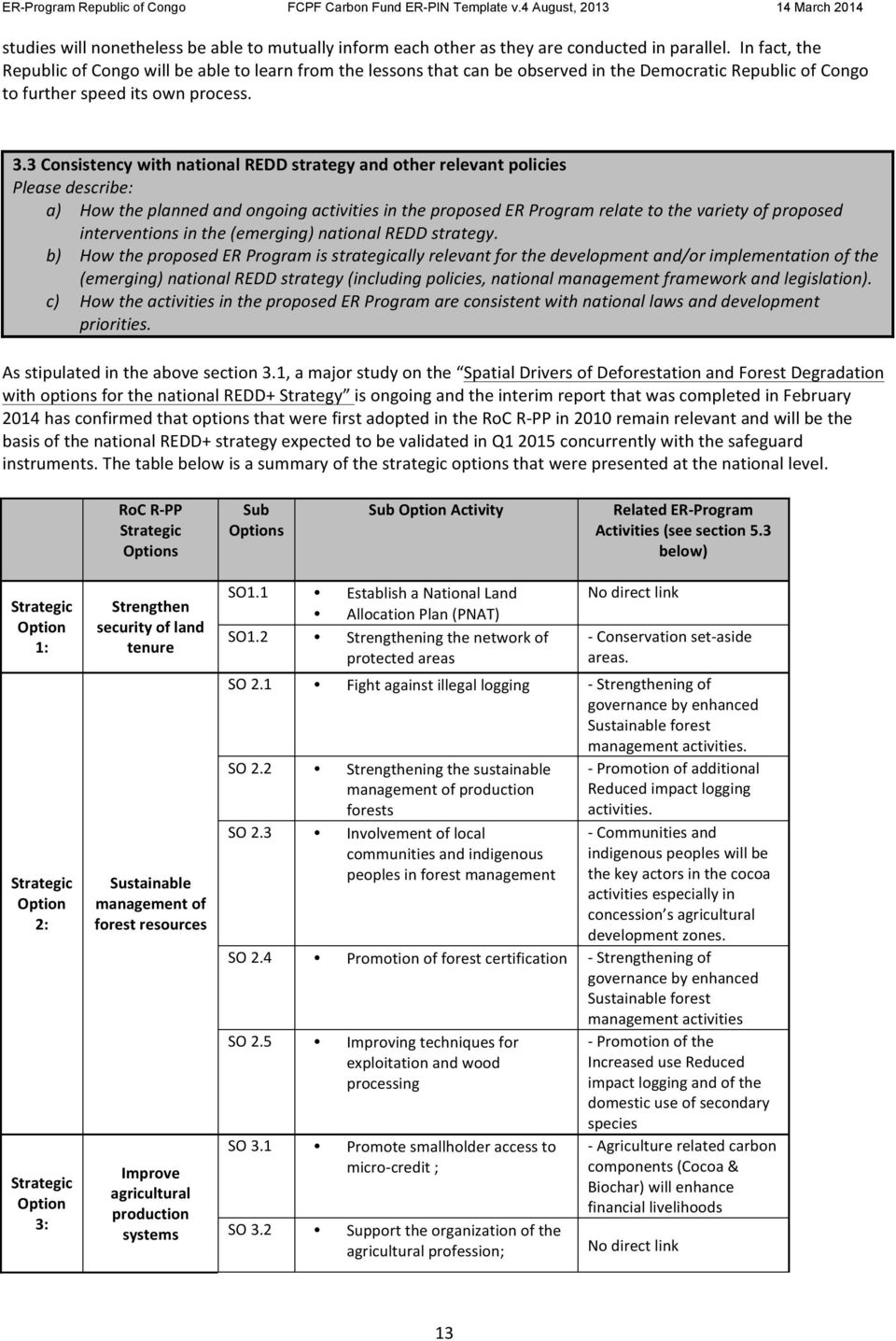
14 Strategic Option 4: Streamlining the production and use of wood energy SO 3.3 Strengthen agricultural research and extension; The Biochar component will allow a novel agriculture technique to be piloted SO 3.4 Promote agroforestry systems Community Agroforestry and cocoa plantations will support enhancement of carbon stocks SO 4.1 Improve the supply by structuring fuelwood and charcoal industries SO 4.2 Promote afforestation and reforestation, through PRONAR SO 4.3 Improving the efficiency of the use of wood energy High Efficiency Pyrolysis will reduce the amount of wood needed to produce the same amount of fuelwood Community Agroforestry will support enhancement of carbon stocks High Efficiency Cook Stoves and high efficiency pyrolysis will improve the efficiency of both production and use of wood energy. The ERProgram activities support all of the Strategic Options that have been identified, and almost all (except two) of the suboptions. The National REDD+ strategy is an evolving document that has to take into account lessons learned from pilot REDD+ activities and programs. As a result the variety of activities of the ERProgram relating to all of the strategic options will be an opportunity to amend and confirm the national REDD+ strategy during the course of the program implementation. The developing REDD+ strategy will be able to rely on the ERProgram activities to both support existing policies and assist with the ongoing development of the underlying management framework. All of the activities of the in the proposed ER Program (see Section 5.3), are consistent with national laws and development priorities of the Republic of Congo. They are also consistent with the current sectoral policies that have been taken into account in the Strategy Document for Poverty Reduction (DSRP I & II), and in the National Development Programme (PND). In relation to the forestry components of the ERProgram, the following forest related legislation will not only be adhered to, but the activities themselves are very much in the spirit of sustainable forest management and the protection of forest biodiversity: Law No of 20 November 2000 on the Forest Code; Law No of 23 April 1991 on the protection of the environment; Law No of 28 November 2008 on wildlife and protected areas; Enforcement Decree No of 31 December 2002 laying down the conditions for the management and use of forests; Order No. 5053/MEF/CAB of 19 June 2007 laying down national guidelines for sustainable management of natural forests in the Congo; Order No. 103 of 30 January 1984 laying down provisions for the export of wildlife products and wild flora; Act No. 114 of 24 June 1991 prohibiting the slaughter of elephants in the Republic of Congo; Order No of 12 August 1972 fixing the opening and closing of the hunting periods; Order No. 3863/MEF/SGEF/DCPP of 18 May 1984 laying down fully and partially protected animals protected under Law 48/83 of conservation and exploitation of wildlife; and, Order No of 18 November 1991 on the absolute protection of the elephant over the whole of the Republic of Congo. In relation to the validated development priorities of the Republic of Congo, the proposed project activities are in line with the sustainable development proposals that are set forth not only in the National Development Plan, but 14

15 also the Agricultural Sector Development Plan of Sangha and Likouala départements. These studies have identified the following recommendations: 1. Increased contribution of the forest and environmental sectors to GDP through Sustainable Forest Management, increased processing and transformation of wood, and an increase in the valuation of environmental goods and services (carbon sequestration, nontimber forest products, ecotourism, etc.); 2. Improved protection, conservation and management of forest, wildlife ecosystems, marine, coastal and inland waters and protected areas; 3. Involvement of rural and indigenous populations in resource management; and, 4. Development of ecologically viable agriculture, promotion of sedentary agriculture, agroforestry and community forestry. The ERProgram activities, both individually and collectively, strongly support the aboveidentified recommendations. 4. ER Program Location and Lifetime 4.1 Scale and Location of the Proposed ER Program Please present a description and map of the proposed ER Program location and surrounding areas, and its physiographic significance in relation to the country. Indicate location and boundaries of the proposed ER Program area, e.g., administrative jurisdiction(s). Description of the Project Area Départements of Sangha and Likouala The ERProgram boundary is composed of two administrative jurisdictions made up of the départements of Sangha and Likouala. (See map below) The Sangha covers an area of 5.78 million hectares, or 57,800 km 2, has an estimated total population in 2014 of about 109,000 persons (RGPH, 2007), mainly concentrated around the Département capital city of Ouesso. Forest covers 5,723,744 hectares or 99% (FACET, 2013) of the total area and is made up of: 6 forestry concessions (already granted to concessionaires); and Three protected areas: National Parks Nouabalé Ndoki, NtokouPikounda and Odzala Kokoua. The Department of Likouala which covers an area of about 6.57 million hectares to either km 2, has a total estimated population in 2014 of about 196,000 inhabitants (RGPH, 2007) i, mainly concentrated around the city of Impfondo, the capitol of the department. The forest area that covers 6,271,966 hectares or 95% (FACET, 2013) of the total area of the Department of Likouala is divided between: The 9 Forest Management Units (FMU) for industrial logging; The two protected areas namely: the Lac Télé Community Reserve and Nouabalé Ndoki National Park, part of which is in the Sangha. Thus, the program area covers an area of million hectares or 123,500 km 2 (FACET, 2013). 15

16 The project area is very rich in biodiversity and over 60 animal species continuing to thrive, including 13 protected large mammals that are known to be in the North of Congo (Poulsen and Clark, 2005), as set forth in Appendix 2. The climate in the Departments of Sangha and Likouala is equatorial characterized by: A rainfall of 1,500 with only 1 or 2 months of rainfall less than 50 mm (February and December); A monthly average temperature varies between 25 C and 38 C; and An average humidity of between 70% and 90%. The first rough estimates indicate that the two départements involved in the program, have higher than average carbon emissions in the area of forestry in the country. It is known that the exploitation of timber production is approximately: 4,801,000 m 3 of timber from in the Sangha; and, 3,291,000 m 3 of timber between 2000 and 2010 in Likouala The ERProgram will take place in the départements of Sangha and Likouala. 4.2 Expected Lifetime of the Proposed ER Program Please describe over how many months/years the proposed ER Program will be: a) prepared; and b) implemented (including expected start date of the proposed ER Program). The program is planned to begin in early 2015, the design phase of the project, which was to last 6 to 12 months and the process of generating credits could begin in late Thus, the first carbon credits could be available in These credits will be established on an annual basis from 2016 to the end of 2020, which is for 6 years or 72 months. The end of ER Program of the World Bank s Carbon Fund is set for 2020, unless extended by mutual agreement of the RoC and the Carbon Fund. For the Republic of Congo, the overall program to reduce emissions will last until Which establishes the duration of program for an additional 30 years or 432 additional months. It is recognized that the ERProgram of the World Bank may not be funded by the FCPF Carbon Fund beyond However in the interest of pursuing this initiative and contributing to the fight against climate change, economic growth and poverty reduction, the Republic of Congo would seek to continue this program until For this purpose, it is necessary to consider methodologies and standards that would promote the smooth operation of the program. The Program therefore could seek to follow VCS Jurisdictional National REDD+ guidelines and certification under that program in anticipation of a future transition to a regulated UNFCCC system in a post 2020 environment. In any case, the ERProgram will as a priority follow the Methodological Framework currently prescribed by the Carbon Fund, and taking into consideration any alterations or changes that may be agreed to in the future. Upon the success of the Program and post 2020, the program would through diplomatic measures and technical success seek inclusion of its offsets in another regulated GHG program (i.e. China or other regional GHG programs with a forestry component) so that the RoC could continue to have a ready market for its carbon credits in the future. 16

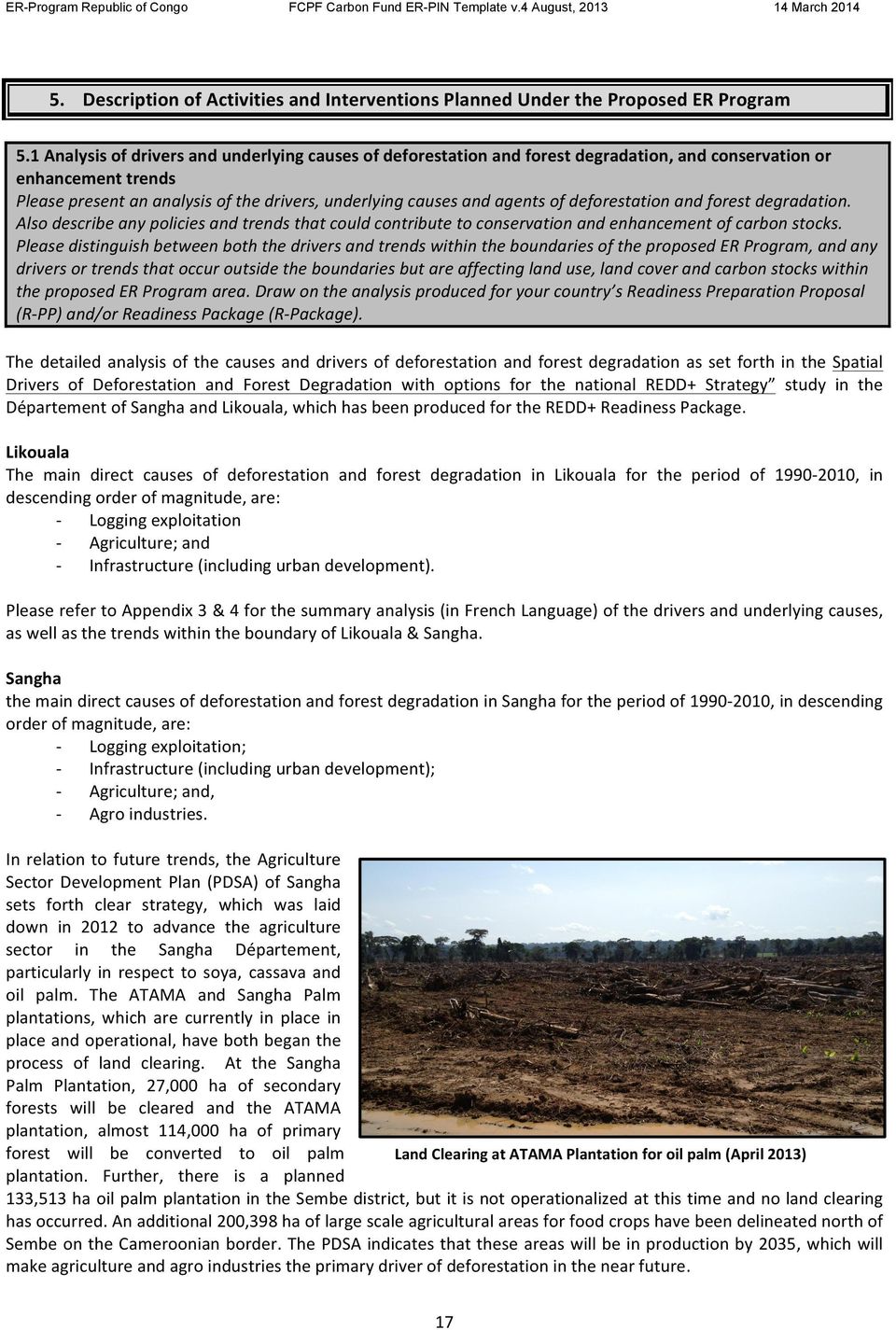
17 ER-Program Republic of Congo FCPF Carbon Fund ER-PIN Template v.4 August, March Description of Activities and Interventions Planned Under the Proposed ER Program 5.1 Analysis of drivers and underlying causes of deforestation and forest degradation, and conservation or enhancement trends Please present an analysis of the drivers, underlying causes and agents of deforestation and forest degradation. Also describe any policies and trends that could contribute to conservation and enhancement of carbon stocks. Please distinguish between both the drivers and trends within the boundaries of the proposed ER Program, and any drivers or trends that occur outside the boundaries but are affecting land use, land cover and carbon stocks within the proposed ER Program area. Draw on the analysis produced for your country s Readiness Preparation Proposal (RPP) and/or Readiness Package (RPackage). The detailed analysis of the causes and drivers of deforestation and forest degradation as set forth in the Spatial Drivers of Deforestation and Forest Degradation with options for the national REDD+ Strategy study in the Département of Sangha and Likouala, which has been produced for the REDD+ Readiness Package. Likouala The main direct causes of deforestation and forest degradation in Likouala for the period of , in descending order of magnitude, are: Logging exploitation Agriculture; and Infrastructure (including urban development). Please refer to Appendix 3 & 4 for the summary analysis (in French Language) of the drivers and underlying causes, as well as the trends within the boundary of Likouala & Sangha. Sangha the main direct causes of deforestation and forest degradation in Sangha for the period of , in descending order of magnitude, are: Logging exploitation; Infrastructure (including urban development); Agriculture; and, Agro industries. In relation to future trends, the Agriculture Sector Development Plan (PDSA) of Sangha sets forth clear strategy, which was laid down in 2012 to advance the agriculture sector in the Sangha Département, particularly in respect to soya, cassava and oil palm. The ATAMA and Sangha Palm plantations, which are currently in place in place and operational, have both began the process of land clearing. At the Sangha Palm Plantation, 27,000 ha of secondary forests will be cleared and the ATAMA plantation, almost 114,000 ha of primary forest will be converted to oil palm Land Clearing at ATAMA Plantation for oil palm (April 2013) plantation. Further, there is a planned 133,513 ha oil palm plantation in the Sembe district, but it is not operationalized at this time and no land clearing has occurred. An additional 200,398 ha of large scale agricultural areas for food crops have been delineated north of Sembe on the Cameroonian border. The PDSA indicates that these areas will be in production by 2035, which will make agriculture and agro industries the primary driver of deforestation in the near future. 17
18 Macro Agriculture and Palm Oil zones as set forth in PDSA, 2012) Additionally, the Congo Iron Nabeba project in the western part of Sangha is well advanced, and although no ground has been broken and extensive EIA has been undertaken and it is likely that the final permits required for largescale operations could be received and the project operationalized prior to The Congo Iron Nabeba project will consist of a USD $2 billion investment and is expected to produce 20 million tonnes of ore per year. It is expected that 3,000 ha, will be deforested for the Nabeba mine by Congo Iron. Mining will therefore in the future become an additional major driver. Please refer to Appendix 4 for the summary analysis (in French Language) of the drivers and underlying causes, as well as the trends within the boundary of Sangha. External conflict in neighboring counties, resulting in the flow of refugees to Likouala could become a significant driver in the future affecting land use, land cover and carbon stocks as these persons put additional pressure on native forests. In December 2013, according to the Comité National d Assistance aux Réfugiés (CENAR) data, the Bétu forestry concession counted 7,258 refugees coming from the Central African Republic, in addition to the 2,516 families normally residing there. These new CAR refugees are supplementing previous refugees that have arrived from DRC. 5.2 Assessment of the major barriers to REDD+ Please describe the major barriers that are currently preventing the drivers from being addressed, and/or preventing conservation and carbon stock enhancement from occurring. The main obstacles that currently prevent the identified drivers to be addressed, and / or prevent the conservation and enhancement of carbon stocks are: Barriers Linked to Logging Exploitation Weak enforcement of laws and regulations; Lack of adherence to reduced impact logging requirements; Barriers to Agriculture The standard of living or rural poverty: The poverty of most rural populations prevents them from investing in more sustainable ways and hinders risks taking related to changes in agricultural practices. Population growth: With 2.8% (RGPH, 2007) per year, the Congo is characterized by a rapid population growth. This increase in population has resulted in an increased demand for food products, which results 18

19 in increased the slash and burn agriculture (increased need for land and acreage) and / or the reduction of fallow period; Barriers Linked to Infrastructure Population growth: requiring new roads, town sites, etc; Logging exploitation: requirements for roads, log landings, skid trails, camps, etc. Barriers Linked to AgroIndustries Opportunity Costs: sustainable natural resource management does not generate sufficient income to match money flows from oil palm and the efficiencies of large scale agroindustries. 5.3 Description and justification of planned and ongoing activities under the proposed ER Program Please describe the proposed activities and policy interventions under the proposed ER Program, including those related to governance, and justify how these activities will address the drivers and underlying causes of deforestation and forest degradation and/or support carbon stock enhancement trends, to help overcome the barriers identified above (i.e., how will the ER Program contribute to reversing current less sustainable resource use and/or policy patterns?) The ERProgram in Sangha and Likouala has been designed to have the activities to relate to the inprogress National REDD+ strategy. The activities have been designed also to address the identified barriers of deforestation and Forestry Sector Increasing the amount of protected areas; Reduced Impact Logging ( RIL ) programs : optimization of the road network ; increasing logging diameters ; extending the rotation periods; and, Development of 2nd and 3rd transformations (wooden homes, furniture, etc.); and, Enhancing carbon stocks through sylviculture techniques and reforestation and agroforestry activity. Agriculture and Agroindustry: Revival of the cocoa culture; Development of afforestation and reforestation program through the National Afforestation and Reforestation Programme (PRONAR), which intends to establish a tenyear program for the establishment of one million hectares of forest and agroforestry plantations throughout the national territory; Community agroforestry plantations; Urban Development: High efficiency pyrolysis for charcoal production; Cogeneration from biowaste (operating forestry and agricultural waste, household waste and other);and High efficiency cook stoves. The specific identified Primary and Secondary Project Activities Primary and Secondary Project Activities Activity Code Primary Project Activities (PPA) 1. Cocoa production avoiding unplanned deforestation with sustainable agriculture PPA1 2. Improved charcoal production efficiency and utilization of biochar for enhanced soil fertility and carbon storage PPA2 3. Sustainable Forest Management: Reduced Impact Logging PPA3 19
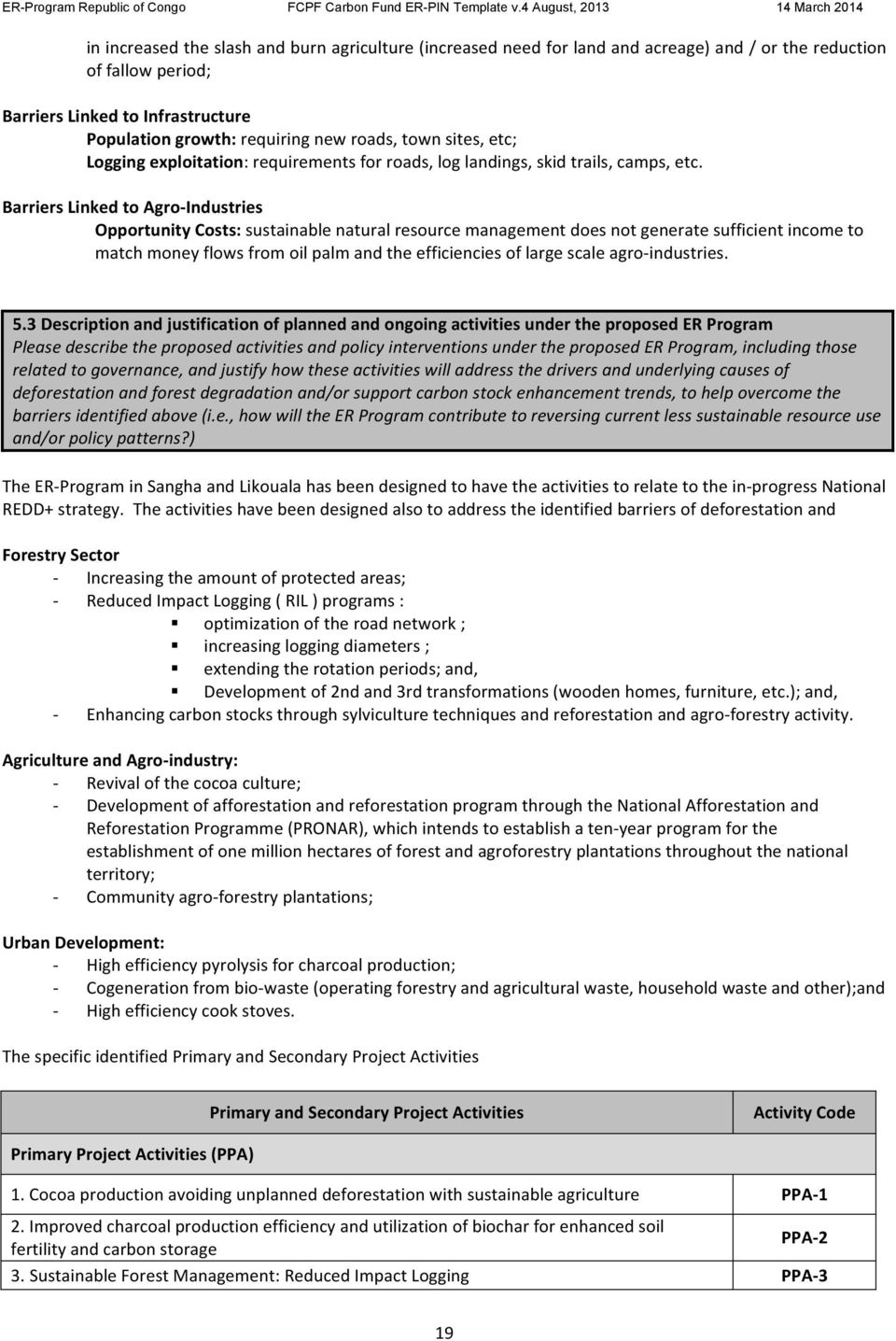
20 4. Sustainable Forest Management: Conversion of logged forests to protected forests PPA4 5. Afforestation/Reforestation (including community Agroforestry) PPA5 Secondary Project Activities (SPA) 1. High Efficiency Cook Stoves SPA1 2. Cogeneration (outside of the ERProgram) SPA2 3. Green Mining (protected areas, reduced impact mining with RIL standards, replanting) SPA Primary Project Activities (PPA) Primary Project Activity 1 (PPA1): Cocoa Production Reestablishment of the Cocoa sector in the north of Congo, Sangha and Likouala will avoid unplanned mosaic deforestation and degradation by providing an alternative livelihood of Cocoa production or other agroforestry and agriculture crops, i.e. coffee, citrus fruit, etc. These ER Program activities will reduce the need to conduct subsistence slash and burn agriculture in Sangha and Likouala. It will have substantial social impact because individual subsistence farmers will have direct access to the international cocoa market and potentially coffee, citrus, etc. As a result of the increase in financial gain, populations will be able to move away from reliance on subsistence shifting agriculture. The Carbon Production Project Activity began in 2013 when CIBOLAM partnered with the Ministry of Agriculture and the MEFDD to rehabilitate the cocoa market in Congo by harnessing OLAM s strategic market position in the global Cocoa Sector. The mitigation activity focuses on the following: Capacity building; Avoiding unplanned deforestation and degradation from shifting slash and burn agriculture; Introduction of high value cash crop as an alternative livelihood. Socialization and capacity enhancement has already begun where the local population has been informed of the cocoa opportunity and training sessions for growing cocoa have begun. Capacity enhancement and providing up- front financing for improved hybrid seedlings will provide farmers with the best chance of success of growing and producing quality cocoa that can be sold on the international market. Currently 350,000 seedlings have been prepared for distribution. The project will see thousands of families have direct access to a market economy product that is already culturally familiar. The RoC has provided CIBOLAM with exregime cocoa facilities in 6 separate districts in Sangha province to initiate the project. These facilities will be used as distribution, testing and monitoring hubs for the Cocoa & Carbon project. Appropriate facilities in Likouala will be accessed as well. The Project also anticipates being able to map the location of plantation activity within the various concession agro forestry areas, to be able to use that data as the basis of land use allocation activity to create recognizable property rights of the Projects participants. Additionally CIBOLAM has secured grant funding from the French Development Agency (USD $2040 million) to assist with the rehabilitation of the cocoa sector in Sangha and Likouala. Noncarbon benefits in the form of a viable alternative livelihood in the cocoa sector for individuals (cocoa pays about USD $1.4 per kg to a local farmer), but with the hybrid varieties that are being introduced, a farmer could earn between USD $980$1,120 per hectare per harvest Primary Project Activity 2 (PPA2): Improved charcoal production efficiency and utilization of biochar for enhanced soil fertility and carbon storage The Project Activity involves both the method of production of charcoal and its use as a soil additive as well as a carbon storage mechanism. 20
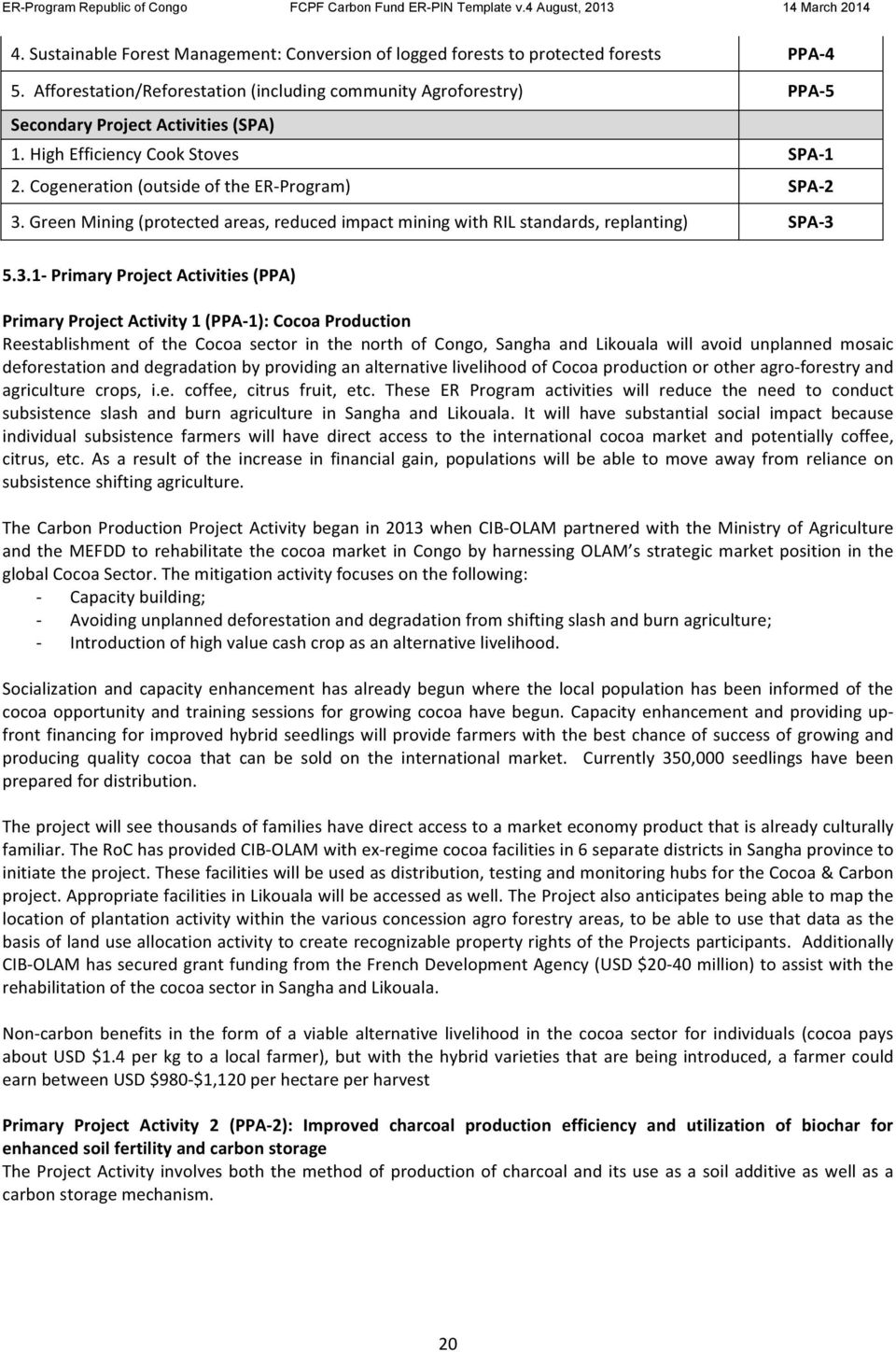
21 The first component is the introduction of high efficiency pyrolysis techniques to Sangha and Likouala that will decrease the amount of feedstock (i.e. wood) that would otherwise be needed to convert the wood to charcoal. It is estimated that pyrolysis efficiency rates could double from 1015% to 2530% so that only half the wood would be needed for charcoal production compared to the baseline. Feedstock would be sourced from waste wood and slash that would otherwise enter the atmosphere while decompose. The second component of PPA2 is the use of charcoal (i.e. biochar) as a soil additive for subsistence farmers in order to increase yields, but also in order to be used as a carbon storage mechanism. Introduction of biochar to the soil, when made from feedstock that is considered waste from the logging industry, will result substantially enhance yields providing a real incentive for subsistence farmers, indigenous peoples and local communities to shift to sedentary agriculture. From the agricultural perspective, the most important feature of biochar is its extremely high surface area that results from complex networks of pores of different diameter. One gram of biochar has approximately 850m2 (9,000 ft2) of surface area. The surface has a slight electrical charge, which draws other particles to itself). In turn these pores provide a wide range of secondary beneficial properties such as high water retention, ion exchange and absorption of nutrients. Tests around the world, including in Africa have shown that introduction of biochar at the rate of 5 to 20 tonnes per hectare increased crop weight by up to 50% which is comparative to adding organic and inorganic fertilizer to the soil. Higher efficiency in pyrolysis is easily achieved at low costs, as current charcoal production techniques in the Sangha and Likouala are rudimentary and highly inefficient. Sustainable Forest Management will be able to address logging exploitation as a driver in Sangha and Likouala. The project activities will be able to be conducted by any forest concession that is able to demonstrate the introduction of the Project Activity. Primary Project Activity 3: Sustainable Forest Management: Reduced Impact Logging (PPA3) Reduced impact logging will be able to be undertaken by any concessionaire that is able to show through the introduction of Reduced Impact Logging activities that the concessions has decreased its emissions as a result of the changed practices. Changed practices would include reduced stand damage through mores sustainable harvesting techniques. The mitigation activity focuses on the following: Capacity building Improved Forest Management Reduced Impact Logging techniques Strengthening forest governance and monitoring capability 21
22 Primary Project Activity 4 (PPA4): Sustainable Forest Management: Conversion of logged forests to protected forests The main goal of Primary Project Activity 4 is to preserve forest that would otherwise be harvested. The Project Activity is available to any concession in Sangha or Likouala that is willing to set aside some or all of a concession for emission reduction purposes. Instead of mechanized selective harvesting that would have occurred in a business as usual scenario, cessation of harvesting activities would take place. Stop logging activities are the simplest Emission Reductions Activity to apply, as a concession would set aside an area of a concession that it is able to harvest, a baseline of anticipated harvesting can be constructed from the forest management plan (FMP) in order to determine the carbon saving achieved and then monitoring would occur that would also be based on the establishment of permanent sample plots and the use of remotely sensed data. The mitigation activity focuses on the following: Capacity building Improved Forest Management Logged to Protected Forest Strengthening forest governance and monitoring capability Primary Project Activity 5 (PPA5): Afforestation/Reforestation (including community Agroforestry) The key goal of Afforestation/Reforestation and community agroforestry is to ensure the longterm access to sustainable wood for energy, charcoal production, and agriculture products. Additionally, as every concession has not just a community agriculture area, but also a community agroforestry area, replanting activity, especially on degraded lands could be conducted by local communities and indigenous peoples. The main carbon benefits are increased carbon stocks in the forest where the activity is implemented. Noncarbon benefits include sustainable access to fuelwood. Secondary Project Activity 1 (SPA1): HighEfficiency Cook Stoves The REDD+ERProgram will introduce to the population of Sangha and Likouala one or more high efficiency cook stoves, that will be able to be manufactured locally, distributed through local community organizations and which will use at a minimum 50% less wood or charcoal fuel then what would be used in conventional open fire cooking, the dominant cooking practice in RoC. The Project Activity would aim to reduce the deforestation and degradation pressure on local forest stock by decreasing the amount of fuelwood needed by the average domestic family. In addition to the carbon emission reduction benefits of each cook Stove, the noncarbon benefits would include lower long term household running costs and decreased exposure to wood smoke which corresponds to decreased risk of health conditions caused by constant exposure to cooking smoke. Secondary Project Activity 2: Cogeneration (SPA2) Secondary Project Activity 2 is cogeneration activity Emission reductions for this activity will be originated under a separate process (i.e. VCS or CDM). This would be a fuel substitution project where available wood biowaste from logging concession (or other biomass waste) would be substituted for electrical generation purposes. The cogeneration facilities would provide combined heat and power through the burning of biomass. Several of the forestry concession operators are interested in this type of activity and the RoC is keen to be able to support this as a carbon Emission Reductions Activity for the ERProgram. The concept of cogeneration is part of the broader Green Vision of the republic of Congo and it is thought that by increasing the availability of electricity to local populations where currently there is limited grid power could also reduce the need for wood energy in the local communities as they switch to electric power. Emission reductions from this activity are not anticipated to be part of the ERProgram. Secondary Project Activity 3 Green Mining (SPA3) Industrial mining activity will be conducted within the Sangha and Likouala, but actual extraction activity has not yet commenced. There are known deposits of Iron, diamonds, gold, titanium, etc. The Green Mining activity is in effect 22
23 Reduced Impact Mining and comparable to the use of sustainable forest management type activity, but for the mining sector. Specific activity that has been identified with Congo Iron, is an interest to offset their planned deforestation of 3,000 ha with the purchase of a nearby timber concession that could be set aside for conservation and carbon mitigation reasons. Further activity could include careful planning of any forest conversion; minimize the impact of road building, tailings, and other mining infrastructure. Additionally, where feasible replanting of forests that would be conducted in order to recover carbon stocks in the mining process. Noncarbon benefits of Green Mining would include a more sustainable mining industry with decreased impact on the natural landscape, a dedicated set aside area that would support the maintenance of existing biodiversity. ERProgram Reliance on insitu Systems & Technologies Because of the nature of the size and scale of concessions, the ERP will look to build REDD+ capacity and infrastructure upon existing and inplace systems when at all possible. REDD+ has substantial operational overlap with the commercial logging industry, in respects to inventory technique, mapping, monitoring, etc. This is especially the case of concessions that have or are currently seeking FSC certification. The North of the country was used for the initial application of the RoC Forestry Law 2002 (SFM) where overall there has been a more uniform application of the SFM laws and the development of Forest Management Plans; in the South of the Country management plans area not as common. In other words forestry governance levels in the two Northern départements are already quite high and the sector has already a capable framework of workers who understand forest inventory & monitoring techniques (i.e. sampling, GIS, remote sensing, landuse mapping, etc.) and with some additional carbon training, the ERProgram will facilitate the rapid deployment of large numbers of carbon inventory technicians and specialist Project Activities may be conducted through the social and environmental infrastructure that is established by each Forestry or Mining concession, or within a national park or protected area. Project activity may also be undertaken by a District or municipality within the Project Area but. All project will observe strict adherence to Standard Operating Procedures regarding double counting. 5.4 Risk/benefit analysis of the planned actions and interventions under the ER Program Please explain the choice and prioritization of the planned actions and interventions under the ER Program identified in 5.3 taking into account the implementation risks of the activities and their potential benefits, both in terms of emission reductions and other noncarbon benefits. Selecting and Prioritizing Actions and Interventions Provided The selection and prioritization of actions and interventions to promote within the ERProgram in the Departments of the Sangha and Likouala find their foundation and justification in the National Development Plan (PND) of the Republic of Congo as well as the Agricultural Sector Development Plan (PDSA) of Sangha and Likouala for It should be recalled that the PND takes into account sectoral strategies and policies of the Republic of Congo, in order to achieve the vision of the President of the Republic, contained in his program called "The Way of the Future". This program focuses on the modernization of Congolese society and industrialization of the national economy. The National Development Plan (PND) and PSDA clearly state that in the nonoil sector, the economy is expected to incur: Strong growth through the implementation of development strategies of sylviculture, logging, wood processing, agroindustry; Dynamism in agriculture (as a result of rural policies and agricultural development), mining, construction and services (tourism and hospitality, financial services). While in the agriculture sector the programs are oriented toward: Development of subsistence culture (cassava, maize, soy, potatoes, banana, yam, beans, rice, etc.) The revitalization of existing cultures for annuities and the development of new crops (cocoa, coffee, palm oil, cotton, sugar cane, tobacco, etc.); 23
24 Suppling farmers with improved seeds, the development of macroagro sites, training, and technical support; and Strengthening of a fund to support rural activity to enable small producers to overcome the difficulties in accessing bank financing; The Government, which intends to make every effort to exploit the vast agricultural and fisheries potential that is currently attracting large private investors to foreign capital, will promote the development of the agroindustrial complex and create the conditions for a rapid expansion of agricultural sector. The ERProgram is an ambitious program that integrates the fundamental concerns of the Government of the PND and PSDA, and allows the possibility to achieve mediumterm targets under the PND & PSDA and Management Plans series of Community Development (SDC), namely the fight against income poverty and improving the living conditions of indigenous and local communities. Each of the project activities has risks and benefits: Project Activity Risks Benefits Deforestation could increase if to Cocoa becomes to popular Food security risk as food production decrease because of the draw to a cash crop 1. Cocoa production avoiding unplanned deforestation with sustainable agriculture 2. Improved charcoal production efficiency and utilization of biochar for enhanced soil fertility and carbon storage. 3. Sustainable Forest Management: Reduced Impact Logging 4. Sustainable Forest Management: Conversion of logged forests to protected forests 5.Afforestation/Reforestation (including community Agroforestry) 1. High Efficiency Cook Stoves 2. Cogeneration 3. Green Mining (protected areas) Untested as an emission reduction activity if demand is too high could cause additional deforestation Requires complex training and skills Harvesting may shift to other locations Unauthorised access leading to wildlife poaching Expensive can be adopted at large scale requires initial investment by householders High investment costs Lack of capacity and staff High value crop (USD $1.4/kg) Cocoa does not require constant tending and can be harvested twice a year Population is familiar with cocoa Requires only minimal technology and capacity enhancement promotes sustainable and sedentary agriculture Promotes certification of operations improves sustainability of harvesting Increased amount of protected areas Can be used with intercropping Reduces reliance on natural forests local production can promote local jobs Sustainable energy, especially on a timber concession address the mining sectors role as a driver 6. Stakeholder Information Sharing, Consultation, and Participation 6.1 Stakeholder engagement to date on the proposed ER Program Please describe how key stakeholder groups have been involved in designing the proposed ER Program, and summarize issues raised by stakeholders, how these issues have been addressed in the ER Program to date, and potential next steps to address them. After the meetings of the FCPF Carbon Fund in April 2013 at Washington, national authorities instructed CNREDD to organize a series of consultations with stakeholders. Stakeholder consultations began in April 2013 and have continued through March 2014, and a table setting forth the details of these meetings can be found in Appendix 5. 24
25 Although all of the workshops since April were referring to the possibility of entering into an Emission reductions payment agreement, three specific ones were focused entirely on the design of the ERProgram. Technical meetings, focus groups and workshops were held in Brazzaville and Ouesso. These meetings were characterized by strong participation of departmental authorities (representatives of the Prefecture, County Council, the Municipal Council, the Departmental Directorates), civil society, local communities and indigenous peoples. The ERProgram and REDD+ concepts were recently presented at the 3rd edition of the International Forum of Indigenous Peoples of Central Africa (FIPAC) (March 3 to 7, 2014), but in fact REDD+ was a major focus of the meetings. FIPAC, which took place in the départemental capital of Likouala. They provided the CNREDD team the opportunity to conduct "Open Days", "focus group", "cultural activities", "workshops and technical meetings" Many concerns were raised by delegates. These concerns include: (i) the level of implementation of the Action Plan on REDD+ + in the Republic of Congo, (ii) the link between the REDD+ process and the FLEGTVPA process, (iii) the place of agriculture in the national REDD+, (iv) the problem of shifting cultivation, (v) the issue of training and sensitization of stakeholders, (vi) the contribution of forests to local development strategy (vii) the question of ownership of forest carbon, (viii) interest for forest economic operators, mining, agroforestry and others to join the REDD+ + process and promote forest carbon in general and get involved in ERProgram in particular, (ix) risks which may cause the ERProgram in relation to the difficulties of developing countries in the implementation of Structural Adjustment Program (SAPs) with the World Bank in the 80s. One specific issue raised by communities and indigenous peoples about the ERProgram and its project activities was that cacao or other plantation activity would mean that cocoa production would overtake food based agriculture, and that food security would become an even more serious issue. It should be noted that, the purpose of the proposed biochar component is specifically designed to increase subsistence agricultural output through enhanced yields. Additional concerns were raised about the benefit sharing mechanism, specifically in regards to the perception that it would be based upon cash payments as opposed to benefits that relate to actual community and indigenous peoples concerns, i.e. health care, education, capacity enhancement related to agriculture, etc. It was explained that the benefit sharing mechanism would be based on a consultative, transparent and participatory manner with communities, indigenous peoples and stakeholders. The result would be that the ERProgram would be able to address the requirements of monetary and nonmonetary benefits identified by communities and indigenous peoples while at the same time complying with national requirements or other binding obligations. The above explanations were found to be satisfactory to the consulted communities and indigenous peoples. 6.2 Planned outreach and consultation process Please describe how relevant stakeholder groups will participate in further design and implementation of the proposed ER Program and how free, prior and informed consultation leading to broad community support for the ER Program and key associated features, including the benefitsharing arrangement, will be ensured. Please describe how this process will respect the knowledge and rights of Indigenous Peoples and local communities, by taking into account relevant international obligations, national circumstances and laws. Once the ERProgram is selected in the pipeline of the FCPF Carbon Fund, the communication and consultation plan adopted in July 2013 will be upgraded to take into consideration the specific needs related to the design of the ER Program. These consultations will continue to bring together representatives of all stakeholders, including local communities, indigenous peoples, local government, but most importantly this will include the potential project actors who will be able to reduce emissions in the Sangha and Likouala. Up until now, the private sector and other potential project actors did not positively respond to their invitations to participate, as the potential monetary benefits were uncertain. The success of the ERProgram will depend on the ability of the RoC to be able to attract the necessary investment to undertake the project activities successfully. Consultations need to be near where project activity will be undertaken. It will consist of an initial meeting, at least two design phase meetings, and a final project activity validation meeting. Additional meetings may be needed in local languages (i.e. Lingula) if enough nonfrancophone community members or indigenous peoples are 25
26 participating. The goal of the consultations will be to encourage local participation in the design phase so that project activities can be tailored to local circumstances. Additional consultations will be conducted during implementation phase through the ERProgram Management Facility to seek ways to involve local communities and indigenous peoples as deeply into the project activities as possible. The consultations conducted will be able to answer important questions in the context of the development of ER Program to ensure that the interests of all stakeholders will be taken into account in regards to the ongoing design and implementation. The issues discussed in future consultation, will ensure that the consulted parties will first be informed so that they can be reassured that their interests are guaranteed before committing or refusing participation in the proposed concepts. Furthermore, there will be continued involvement of other organizations (governmental, civil society and private sector) so that a broad perspective will be reached in regards to the ER Program. In order to ensure transparency, minutes and written records will be maintained. Continued special attention will be paid to indigenous peoples and local communities. Further, all available tools and appropriate information and communication techniques, including the use of local languages, will be used, i.e. CDROMs, Tshirts, banners, newsletter, etc.). 7. Operational and Financial Planning 7.1 Institutional Arrangements Please describe the governance arrangements anticipated or in place to manage the proposed ER Program (committee, task force), and the institutional arrangements among ER Program stakeholders (i.e., who participates in this ER Program, and how, including the roles of civil society organizations and forest dependent communities). Governance ERP Follows in the Footsteps of the RPP The implementation of the REDD+ Preparation Proposal (RPP) is under the joint authority of the President of the RoC and the Ministry of Forest Economy and Sustainable Development (MEFDD). The legal framework for REDD+ will be enhanced by supplementing the law No. 003/91 of 23 April 1991 on the protection of the environment. These improvements will be made through amendments of the current framework of the environment and the introduction of the principles related to REDD+, to organize all aspects of the implementation of REDD+ activities in the country. In this context, an implementing decree issued by the Council of Ministers established, functions, composition and organization of implementing organs of REDD+ in the Republic of Congo namely: National REDD+ Committee REDD+(CONAREDD), 12 REDD+ Departmental committees (REDD+ CODEPA) representing the 12 departments of the country and the National REDD+ Coordination team. The functions of these bodies and their relationships between them are as follows: National REDD+ + Committee (CONAREDD): Determine the vision and strategic options of REDD+; Support the national REDD+ debate between platforms of public authorities, civil society and the private sector (see Component 1b); Arbitrate any potential conflicts between stakeholders in the REDD+process; and, Approve the program of work and budget of CNREDD. Decisions within the REDD+ + National Committee shall be taken by consensus. Departmental REDD+ Committees (REDD+ CODEPA) Facilitate the implementation of decisions of the National REDD+ Committee and the REDD+ process at the Départemental level; Support the REDD+ debate between départemental platforms of public authorities, civil society and the private sector (see Component 1b); Arbitrate any potential conflicts between stakeholders in regards to REDD+ at the départemental level; Formulate proposals for the REDD+ National Committee. 26
27 National REDD+ Coordination (CNREDD) Execute (directly or indirectly through subcontracting) actions of RCONAREDD+; Maintain contact with the various national and départemental platforms through consultations, (see part 1b); and, Prepare sessions for CONAREDD+. The above bodies will be responsible for the maintenance of the national REDD+ infrastructure, i.e. MRV, information systems on safeguards, registry, the feedback grievance redress mechanism, etc. which is necessary for any emission reductions payment agreement. The following additional national institutions will play a critical role in MRV activities. Institution or Body CNIAF CERGEC CNSEE Functions MRV MRV support MRV support The daily management of the ERProgram will be undertaken by the Emission Reductions Program Management Facility, which will be made up of the public private partnership led by CIBOLAM and the Republic of Congo. This would include management and support: Assist project implementers (communities, small holders, indigenous peoples, concessionaires, etc.) with project design; Compliance with safeguard (SESA) instruments; Implementation of the benefit sharing plan; Ensure adequacy of MRV requirements; Monitoring and evaluation of project activities; Management of financial flows; Etc. In order to ensure appropriate accountability, transparency and efficiency of the Emission Reductions Program Management Facility, a National REDD+ implementation board, as well as a Départemental REDD+ Implementation Board for both Sangha and Likouala will be established. It will be composed of members of civil society (i.e. CACO REDD+, community groups, indigenous peoples, women s groups, etc.), government officials and all other relevant stakeholders. The role of the boards will be to provide general oversight over the ERProgram and the implementation of its activities. Management practices and decisionmaking structures will be conducted in a transparent and inclusive process to ensure adequate due diligence procedures and the implementation of a comprehensive policy regarding conflict of interest. It is of critical importance that the structure of the governance systems ensures that the Management Facility can be transparently observed by the two oversight bodies, one at the national and the other at the local level. Furthermore, the oversight organs must be independent of both the Management Facility and of the larger National REDD+ infrastructure. 27
28 7.2 Linking Institutional Arrangements to National REDD+ Implementation Framework Please describe how the institutional arrangements for the proposed ER Program fit within the national REDD+ implementation framework. With the addition of the ERProgram Management Facility, the Republic of Congo will now have the required organs to manage and implement actual on the ground project activities. The describe management facility will be able to ensure the operationalization of REDD+ activities, via the ERP mechanism, such that the benefits of emission reductions activities can be equitably realized in Sangha and Likouala, by all of the concerned stakeholders. The management facility is designed to provide the on the ground support while at the same time being overseen by the existing institutional structures, as well as those that were initially (as part of RPP) envisioned in the Readiness process. The spirit of the ERProgram Management Facility is to leverage the skills and competencies of the private sector partner CIBOLAM, who have substantial management experience not only in the forestry sector as a leading FSC concessionaire in the region, but also as an original REDD+ implementer in the RoC. It should be further acknowledged that design of the REDD+ implementation framework is a work in progress, and that the opportunity to undertake the ERProgram concurrently will allow specific on the ground learning activities 28
29 to be able to feed into the REDD+ readiness process. It will be in the spirit of learning by doing at a phase of REDD+ preparation activities even though not all of the national REDD+ national implementation framework building blocks are fully developed. 7.3 Capacity of the agencies and organizations involved in implementing the proposed ER Program Please discuss how the partner agencies and organizations identified in section 3.1 have the capacity (both technical and financial) to implement the proposed ER Program Stakeholder Technical Capacity Financial Capacity Government Entities Minister of Forest Economy National Forestry management National Budget and Sustainable Development (MEFDD) National REDD+ Coordination REDD+ activities Management Dependent upon donor community (CNREDD) Directorate General of Forest Economy (DGEF) Oversight of forestry operations on a national level but with special emphasis in northern Congo National Budget DirectorateGeneral for Sustainable Development (DMDB) National Inventory and Planning Center of Forest Resources and Fauna (CNIAF) National Afforestation and Reforestation Programme (PRONAR) National School of Agronomy and Forestry (SCSTA) / University Marien Ngouabi Civil Society CACOREDD+/ Bureau National CACOREDD+/Bureau Sangha & Likoual WCS Private Sector Congolaise Industrielle des Bois (CIB) OLAM International Ltd (OLAM) Oversight of development issues on a national level but with special emphasis in northern Congo Forest and natural resource inventory and monitoring capacity Agroforestry and community forestry (nurseries, agronomists, project development and maintenance Agronomy and Forestry Strong links to a broad range of national stakeholders and ability to disseminate critical information Strong links to a broad range of départemental stakeholders and ability to disseminate critical information Biodiversity monitoring and conservation planning and enforcement management All aspects of FSC certified sustainable forest management Deep knowledge & experience of forestry management Extensive Global Management expertise Deep knowledge & experience in cocoa sector Expansive knowledge & 29 National Budget National Budget Dependent upon donor community & National Budget National Budget Dependent upon donor community Dependent upon donor community Dependent upon donor community Private sector with reliance on market conditions Private sector with reliance on market conditions
30 experience in small holder agriculture systems GreenLaw International LLC (GLI) Deep knowledge & experience of REDD+ project design and Private sector with reliance on market conditions implementation including within RoC Strategic REDD+ project design Company Thanry Congo (STC) Forestry management, GIS, cartography, etc. Private sector with reliance on market conditions Industrial Society Forest of Congo (SIFCO) Forestry management, GIS, cartography, etc. Private sector with reliance on market conditions Wood and veneers Lopola (BPL) Forestry management, GIS, cartography, etc. Private sector with reliance on market conditions Congo Iron SA Natural resource management, Private sector with reliance on market conditions Likouala Timber Forestry management, GIS, cartography, etc Private sector with reliance on market conditions Other Potential Project Investors Once the ERProgram has been selected by the FCPF Carbon Fund, new investors will be interested in joining the Congo ERProgram as they will be able to place a specific value on any emission reductions that would be originated under their investments. 7.4 Next steps to finalize the proposed ER Program implementation design (REL/FRL, ER Program monitoring system, financing, governance, etc.). Provide a rough timeline for these steps. 30
31 R6Package Benefit'Sharing'Mechanism Feedback,'Grievance'&'Redress'Mechanism Safeguards'instruments'(SESA,'ESMF,'frameworks) National'REDD+'Strategy National'REDD+'implementation'framework,'including'Registry'&'Information'System'on' safeguards MRV'systems'for'carbon'&'nonIcarbon'benefits ER6Program Feasibility'studies'for'investments Stakeholder'consultations,'including'benefit'sharing'plan'related'to'the'program Design'phase National'Validation Contractual%arrangements%with%the%FCPF Letter'of'Intent:'negotiation'up'to'signing ERPA:'negotiation'up'to'signing ERPA'signing Governance%arrangements Establishment'of'local'&'national'implementation'boards ERIProgram'management'facility:'Program'Implementation'Manual ERIProgram'management'facility:'settingIup Emission%Reductions Baseline'Forest'Map Leakage'Assessment' Buffer'mechanism'to'ensure'the'integrity'of'the'credit'generation'system Monitoring'implementation'manual Monitoring Management'of'the'program'by'the'ERIProgram'management'facility July%'14 Jan%'15 June%'15 Dec%'15 Jan%'
32 7.5 Financing plan (in US$ million) Please describe the financial arrangements of the proposed ER program including potential sources of funding. This should include both nearterm startup cost and longterm financing. If the proposed ER program builds on existing projects or programs that are financed through donors or multilateral development banks, provide details of these projects or programs, including their financing timeframe. Use the table in Annex I to provide a summary of the preliminary financial plan 32
33 Expected9Uses9of9Funds Program9Development9Costs Operational9&9Implementation9 Costs Financing9Costs Descriptions Breakdown9Per9Year Sub.Total Support'to'private'sector'to'be'part'of'the'programme'(feasibility'studies'for' investments) Stakeholder'Consultations Program'design Sub.Total National'REDD+'Implementation'Framework'Maintenance'Costs'(MRV,'registry,' information'system'on'safeguards','feedback'grievance'and'redress'mechanism,' etc.) Daily'management'of'the'ERNProgram'(support'to'project'implementers,' compliance'with'safeguards'instruments,'implementation'of'the'benefit'sharing' plan,'etc.) Oversight'of'the'program'by'the'national'and'local'implementation'boards SubNTotal'(fixed'costs) Investment'and'performance'based'payments'as'derived'from'the'benefit'sharing' plan SubNTotal'(variable'costs) Sub.Total interests'on'loans Loan'reimbursement' Other9Costs Marketing'(credit'sales) Total9Costs Expected9Sources9of9Funds Description Sub.Total Donor'community'(to'be'confirmed) Grants AFD'for'the'development'of'smallholder'cocoa'production'(to'be'confirmed) SubNtotal'grants Loans Republic'of'Congo FCPF'(payments'upon'delivery) Revenues9from9REDD+9Activities9 (Verified9Emission9Reductions)9 FCPF'(upfront'payment:'10%'of'the'nominal'ERPA'value'paid'in'3'instalments) $7.00 Other'markets SubNtotal'Carbon'revenues Total9expected9sources9of9funds Net9revenues
34 8. Reference Level and Expected Emission Reductions 8.1 Approach for establishing the Reference Emission Level (REL) and/or Forest Reference Level (FRL) Please briefly describe how the REL/FRL for the proposed ER Program has been or will be established. Describe how the approach for establishing the REL/FRL is consistent with UNFCCC guidance available to date and with the emerging Methodological Framework of the FCPF Carbon Fund, and with the (emerging) national REL/FRL (or with the national approach for establishing the REL/FRL). The Reference Emission Level (REL) for the Republic of Congo (RoC) is preliminary, as no formal REL has been adopted. The RoC has not yet undertaken a specific study to determine its specific REL for the purpose of the ER Program (ERP). This has necessitated that the preliminary REL for the ERPIN has sourced data from a number of studies conducted for the purpose of measuring forest cover change in the RoC. Corresponding carbon stock analyses have also not yet been conducted using field measurements. The preliminary carbon stock measurements for the ERPIN REL have been sourced from remote sensing studies conducted of RoC forests as well as in situ REDD+ project activity in the Sangha landscape. The RoC REL will follow a number of general design principles for the ERP REL: The REL will be based on historical analysis and supplemented with a perspective adjustment; The REL shall be designed to function seamlessly in the context of the RoC national MRV system Each administrative jurisdiction (i.e. départements) that are part of the ERP will use a consistent approach that is established at the national level Methodological Framework approved by the FCPF will be adhered to International GHG accounting norms and UNFCCC guiding principles will be adhered to, including: o Accuracy; o Consistency; o Completeness; o Environmental integrity; o Empirical basis; o Objectivity; and o Transparency. As a High Forest cover, Low Deforestation country, RoC will seek to adjusts its REL upwards to more accurately reflect what is believed to be consistent with its unique national circumstances. This is In accordance with the UNFCCC decision at COP 13 in Bali, Annex 2/CP.13, which states that reference levels should be based on historical emissions, taking into account national circumstances. (UNFCCC Document FCCC/CP/2007/6/Add.1). These circumstances are set forth in the National Development Plan as well as the Agriculture Sector Development Plan of Sangha and Likouala. The RoC envisions that as it develops its formal REL during the ERP design phase, that it will be able to integrate national inventory data to achieve Tier 3 level emissions factors for its GHG accounting. RoC will also include spatially explicit tracking of land use conversion to achieve Approach 3 level activity data Establishment of Historical Emissions Reference Period The RoC ERProgram will calculate historical average emissions based on deforestation rates within the Départements of Sangha and Likouala between the years of 2000 and Forest Definition A formal definition of a forest was agreed to in March 2013, and will be used for the purpose of the ERPIN. 34
35 Forest Definition of the RoC Item Minimum Crown Cover (%) Minimum Land Area (ha) Minimum Tree Height (m) Value 30% Classification of Forests The preliminary REL will stratify the forest classes for the purpose of the ERPIN in the following land cover types: Land Cover Types: Primary Forest Secondary Forests Wetland/ Swamp Forests NonForest As the ERP design phase proceeds, and more detailed REL work is undertaken and additional data becomes available, the classification of forest will be expanded. A formal classification for forests is expected by the end of The preliminary REL will also divide the landscape into four different types of Land use change activities that will be able to be overlaid over forest types and assist with a more detailed stratification of the ERP landscape in Sangha and Likouala. The land use change activities and their sources of data for the historical reference emission level are: Land Use Change Activity Unplanned Deforestation (REL UNDEF ) Planned Deforestation (REL PLDEF ) Unplanned Degradation (REL UNDEG ) Planned Degradation (REL PLDEG ) Source of Data FACET remote sensing data data will be extrapolated from available data and updated remotely sensed data will be acquired through 2013 for the ERP design phase data is acquired initially from national planning documents and then verified through on the ground verification and additional documentation. Remote Sensing can be used post deforestation to further verify. Not included at this time harvesting data submitted to the MEFDD for tax and compliance purposes data is extrapolated and will be updated and included during the ERP design phase. This stratification system for the preliminary REL will allow the RoC to provide sufficient detail to be able to understand what a realistic REL will look like while also being able to target locations for potential mitigation activity. Activity Data & Emission Factors To determine the historical GHG emissions that have resulted from, for example, the deforestation activity Land Cover Type being converted to nonforested area, activity data and emission factors needs to be developed and used. Activity Data Emission Factors FCPF Carbon Fund Methodological Framework Annex 2 Data on the magnitude of human activity (e.g., land use and land use changes related to forests) resulting in emissions or removals taking place during a given period of time A coefficient that quantifies the emissions or removals of a gas per unit activity. 35
36 The RoC, as part of the Congo Forest Basin, has sufficient research activities and studies conducted in regards to its forest ecosystems to be able to draw from a number of sources in order to identify potential activity data and emission factors. It should be noted, that there is variability in these data sources as most studies have generally taken slightly different methodological approaches to their individual research. This has resulted in some variability of data. For example, although a number of studies have been conducted as part of the REDD+ Readiness activity to determine forest carbon stock or land use cover change in the forests of the RoC and the Congo Basin area, because of the different approaches and lack of agreement on fundamental factors such as forest definition, how many land cover types were identified, etc., the results can only be understood within a range. However, as the ERPIN process moves forward in the RoC, it is expected that this variability will be reduced as forest definitions, allometric models, national inventories with permanent sample plots (PSPs), and forest classification are formalized and validated by the Ministry of Forest Economy and Sustainable Development (MEFDD). Furthermore it is anticipated that future REL studies, conducted during the ERP design and implementation phase will provide increased precision in relation to activity data and emission factors. The following Emission Factors for forest carbon biomass have been identifies from the scientific literature and available appropriate forest data within the RoC: Forest Cover Classification Source Emission Factor (tc/ha) Primary Forest Secondary Forest Wetland/Swamp Forest North Pikounda REDD+ (NPR+) VCS Program Document Inventory (AGB only) Saatchi et al 2011 (AGB+BGB) Zapfak et al 2013 (AGB only) Zapfak et al 2013 (AGB only) Zapfak et al 2013 (AGB only) The RoC ERProgramme, in its REL accounting, has chosen to only use above ground biomass (AGB) values. Below ground biomass (BGB) as a carbon pool was excluded not only because it is considered conservative to do so, but also because many current available AFOLU methodologies, only include AGB (this will not impact the biochar activity as it is accounted for through the deadwood pool and not the soil pool ). In regards to the choices for emission factors that were chosen for primary forest cover, secondary forest cover and wetland/swamp forest, values were chosen that can best represent the forests of the North of the Republic of Congo while also being conservative. Primary Forest Cover values provided in the literature, that is Saatchi et al 2011, was not chosen for the following reasons: 1. provides per hectare carbon values that included both AGB and BGB; 2. provides per hectare carbon values fundamentally based on remote sensing studies with limited to no inventory plots being used to substantiate the given values; 3. provides per hectare carbon stock values that are representative of the entire country of RoC which means that the forest structure of the south of the country (where the forests are not as dense) were included in the overall value. This produces a mean value for the entire country and is less representative of the départements of Sangha and Likouala. The values for above ground carbon stock in Zapfack et al 2013 were considered to be a viable option because they were values that were derived from actual in situ measurements. The forest structure of the Zapfack plots are the same geographical zones as the Sangha & Likouala landscape, that is: 36
37 1. the same rainfall zone as Sangha & Likouala (1,500 mm per year), 2. the same phytogeographic plan as the Sangha & Likouala department; it is a transitional forest between the evergreen forest of Dja and semi deciduous forest of Malvaceae and Ulmaceae (Letouzey, 1985); 3. is located in the Northwest of the Congolese basin slope, and is a part of the Congo basin; and 4. is not separated from the Sangha and Likouala landscape by any geographical barriers that would inhibit the ecological continuum. However, for the sake of transparency, it must be noted that Zapfack s Libongo project site, where each of the thirteen 2.5 km transects were established for sampling purposes, were across the border in Cameroon; however, none by more than 5km. It is therefore maintained that the AGB data acquired by Zapfack are scientifically representative of the Sangha and Likouala landscape. The ERPIN has also chosen to use AGB values from the VCS validated and verified North Pikounda REDD+ (NPR+) project as being representative of the Sangha and Likouala landscape. The North Pikounda forest can be considered to be representative of primary forests in the landscape as it is a terra firma mixed forest. The vegetation is arranged as a heterogeneous patchwork within the lowland semideciduous forests, (and) is widely extended in the Northern Republic of Congo (Gillet 2013). The NPR+ project undertook detailed carbon stock inventory activities validated not only by the RoC, but also passing third party scrutiny of the VCS independent verification process. The NPR+ forest is also understood to not be the densest of the Primary Forests of the CIB concessions in the Sangha and Likouala landscape, and therefore can be considered a conservative approximation of primary forests in the project landscape. The ERPIN therefore will use a mixture of NPR+ and Zapfack values for its emission factors to represent the landscape of the northern Congo in the preliminary REL for the ERPIN. Forest Cover Classification Source Emission Factor (tc/ha) Primary Forest Secondary Forest Wetland/Swamp Forest North Pikounda REDD+ (NPR+) Inventory (AGB only) Zapfak et al 2013 (AGB only) Zapfak et al 2013 (AGB only) The preliminary ERPIN REL has chosen to use data from the Forêts d'afrique Centrale Evaluées par Télédétection (FACET) project (Patapov, Turubanova, Hansen et al, 2012). The FACET project was led by Observatoire Satellital des Forêts d Afrique Centrale (OSFAC) in collaboration with South Dakota State University and the University of Maryland, and supported by USAID CARPE with additional support provided by World Resources Institute. The FACET project was established for determining landuse change between 2000 and Although, it may not be considered the optimal data set to use, in part because of its broad of a definition of secondary forest, which means that deforestation could be underestimated, and also because of its use of composite data sets. However, its use will lead to conservative estimations, which is desirable. The ERProgram may use a different data set in the establishment of the formal REL in the future. The ERProgram location in the Sangha and Likouala, as part of the FACET work was determined to have the following land area and forest cover: Total Land Area (ha) Percentage of Forest Cover (2010) Likouala 6,575,414 95% Sangha 5,787,675 99% Likouala & Sangha 12,363,089 97% 37
38 Forest Cover Loss Rate ( ) from FACET for the preliminary REL: Total Loss (ha) Loss Rate (%) Average Annual Loss (ha) Emission Factor (tc/ha) Annual Emissions (tc) Annual Emissions (tco2e) Likouala 30, , ,969 1,438,524 Primary Forest 17,276 1, , ,021 Secondary Forest 5, , ,573 Wetland/Swamp Forest 8, , ,931 Sangha 13, , , ,527 Primary Forest 7, , ,363 Secondary Forest 4, , ,297 Wetland/Swamp Forest 1, ,857 61,866 Totals 44,450 4, ,221 2,100,051 It is worth noting that there is a visible trend in the increase of forest cover loss in the measured periods between and 2005 and 2010 for both départements, such that the increase in forest loss is not linear but instead rises sharply during the two time periods within the reference period. Total Loss (ha) Loss Rate (%) Average Annual Loss (ha) Total Loss (ha) Loss Rate (%) Average Annual Loss (ha) Likouala 9, , , , Sangha 5, , , , As no remotely sensed data is available at this time for the period of , this period will be extrapolated. It is anticipated that the RoC would acquire remotely sensed data prior to and during the design phase (this data would also support the substantiation of historical planned deforestation activity as well) Reference Level Calculations The basic steps involved in calculating a REL are as follows, and shall be followed for the RoC ER Program. The Sangha and Likouala départements have been calculated separately as has deforestation and degradation, which is consistent with accepted GHG accounting practices as well as the FCPF Methodological Framework. They will be added together to yield a total adjusted REL for the entire ERProgram area. The calculating of the Congo historical REL in regards to unplanned deforestation (REL UPLDEF ) will be conducted in the following manner. 1. Application of the appropriate historical reference period ( ) as per the FCPF Methodological Framework; 2. Stratification of the ERP area according to appropriate landuse and landcover types; 3. Calculate historical emissions for each landcover type with data acquired from remote sensingbased land- use/landcover change detection systems (during design and implementation ground truthing will take 38
39 place with the establishment of PSPs); 4. Application of the chosen emission factors to each land cover type and calculate for CO 2 e per stratum 5. Aggregate CO 2 e emissions to achieve a single estimate for CO 2 e emissions throughout the historical reference period; 6. Calculate the average yearly CO 2 e emission by dividing the aggregate emissions by the number of years reference; 7. Calculate the adjustment to REL based on the guidance in the Methodological Framework. 8. Add the average yearly CO 2 e emissions to the adjustment of the REL to yield an adjusted REL for the ER Program. The calculation for the historical degradation portion of the ERProgram will be conducted in a similar manner as above but will also include stratification of the active forest concession areas, and will be modeled using official RoC timber harvesting data, including transformation rates, logs exported and the appropriate emission factors. RoC specific data will be used where possible, and IPCC default values only when necessary. All carbon values are for AGB only. The following historical activity data and emission factors were used in calculating the preliminary REL for historical planned degradation (REL PLDEG ) in the ERPIN. If more appropriate data becomes available in the future, the ER Program would utilize such data in its REL analysis during the design phase. Concessions of Sangha Owner Size (ha) Total Harvest Volumes (m 3 ) Pokola CIB 377,550 1,196,061 Pikounda Nord CIB 92,530 0 Ngombe IFO 1,351,600 2,179,971 Kabo CIB 267,048 1,034,230 TalaTala SIFCO 448, ,916 JuaIkie SEFYD 671, ,180 Total 3,208,064 4,801,358 Concessions of Likouala Owner Size (ha) Total Harvest Volumes (m 3 ) Betou Missa Likouala Timber Likouala Timber Historical Planned Deforestation and Degradation is deforestation or degradation on forestlands that are legally authorized and documented to be converted to nonforest land, and have already occurred. Historical Planned Degradation: This is selective logging activity that has happened in the past where a legally authorized Forest Management Plan (FMP) has been followed. This activity can be monitored through a number of means including documentation of exported logs and transformed sawnwood. Historical Planned Deforestation: This is activity that has been legally authorized (infrastructure development, oil palm plantations, macro- agriculture area, etc) and results in the clear felling of forest area to allow the planned activity to be undertaken. This activity can be monitored both by remote sensing and through other documented means. 525, ,401 MokabiDzanga Mokabi 370, ,154 Mimbeli ITBL 322, ,578 Lopola BPL 199, ,365 Ipendja Thanry Congo 461, ,937 EnyelleIbenga Not Active Not Active Not Active 39
40 Loundoungou Toukoulaka* CIB 552,676 1,085,253 Mobola Mbondo Bois Kassa 105,000 19,969 Total 2,536,372 3,812,657 Variable Value Unit Volume of extracted timber during the baseline period Wood density value BEF 7,764, m³ wood specific gravity dimensionless Default carbon fraction value 0.49 t/c Stand damage factor 0.7 tc / m3 extracted Total Area of timber concessions 5,744,436 ha Carbon to CO2e factor 3.67 Historical Baseline emissions logging ( ) Historical Baseline emissions Stand Damage ( ) 8,377,742 19,947,005 tco 2 e tco 2 e Total Historical Baseline emissions ,324,747 tco 2 e Annual Historical Baseline emissions (REL PLDEG )* 2,832,475 tco 2 e *This value will be used to extrapolate planned degradation for until the most recent harvesting data becomes available from the MEFDD for the years in question. Details of the calculations are provided in Appendix 6. The RoC did not conduct any calculations for the preliminary REL for unplanned degradation, as there is a lack of reliable data. In doing so, the overall REL will further remain conservative. Unplanned degradation could be included, if technically feasible, during the ERProgram design phase. The REL for historical planned deforestation looked at the two major components of planned deforestation in the Sangha and Likouala Départements, infrastructure development, which is primarily road construction and large- scale deforestation from the reestablishment of the oil palm sector. Historical planned deforestation for the ERP can be supported by formal evidence of planned deforestation, such as management plans, the National Development Plans, the Agriculture Sector Development Plans, and actual on the ground verification (e.g. see section 5.1, p 17 for photographic evidence of land clearing for oil palm). The RoC preliminary ERProgram REL estimates of historical planned deforestation (REL PLDEF ) are calculated as follows: 1. Application of the appropriate historical reference period as per the FCPF Methodological Framework 2. Estimate the land area for each infrastructure type to be deforested; 3. Calculate the planned area of deforestation by the appropriate emission factor; 4. Aggregate estimated emissions from the various sectors to provide total emissions from planned deforestation; and 5. Calculate the total emissions for the area to be deforested by the time period required for completion of the planned deforestation; 40
41 Oil Palm (ha) Sangha Palm 58,000 Secondary Forest ATAMA 189,489 Primary Forest Roads (km) Sangha 300 Primary Forest Likouala 200 Primary Forest The Government has contracted with the Malaysian company ATAMA Plantations, with a view to the largescale production of palm oil. An area of hectares has been granted to ATAMA, of which 189,489 are located in Sangha. Deforestation of both Sangha Palm and ATAMA have commenced and are expected to be complete prior to the end of The calculations supporting historic planned deforestation are set forth in Appendix 7. Uncertainty Calculations An uncertainty analysis, in accordance with Methodological Framework and accepted best practices will also be undertaken for all of the appropriate aspects of the REL accounting. REL Aggregation The preliminary REL components will be aggregated to achieve a single historical REL for the Sangha and Likouala Départements using the following formula: Preliminary ERProgram Historic REL = REL UNDEF + REL PLDEF + REL PLDEG Adjustment of the REL Future Deforestation and Degradation It is a well understood concept that there should be an adjustment of the reference emission level based on consideration of national circumstances as agreed to at COP 14 in Poznan where it was decided in Decision 4/CP.15: Recognizes that developing country Parties in establishing forest reference emission levels and forest reference levels should do so transparently taking into account historic data, and adjust for national circumstances UNFCCC Document FCCC/CP/2009/11/Add.1 For the below reasons, which cannot be captured in the historical forest based REL, the RoC requires that its REL for the ERProgram be adjusted upwards to capture the increased pressures that will be placed on the forests of Sangha and Likouala as a result of economic growth, population growth and expansion of the mining and agriculture sectors. The adjustment of the REL should by 0.1% of the forest carbon stock of 2010, which equals 5.11 million tonnes of CO 2 e per annum. As demonstrated below, this is in fact below what is actually anticipated to occur as set forth in the National Development Plan and the Agriculture Sector Development Plan (PDSA) for Sangha and Likouala. Strong Economic Growth With the end of Civil War and the ensuing peace, stability has come to the RoC as well as economic growth. In economic terms, achievements can be characterized by sustained growth of the order of 7.0 percent, while inflation is being kept within a reasonable standard (~3 percent). Economic expansion leapt to over 10% in 2013, as the country is racing economically forward. These achievements enabled the Republic of Congo to reach the HIPC Initiative completion point in January 2010, which led to the cancellation of approximately CFAF 3,000 billion of Congo s debt, or close to onethird of its GDP, which will further assist the rapid development of the country. Urban and Population Growth The Population of the Republic of Congo is growing rapidly and is estimated to be expanding at 3.5% (PND). 41
42 Year Likouala Sangha ,115 85, ,870 94, , , , , , , , ,112 This type of rapid population growth will have a substantial impact on the forests, as the population grows and the need to increase subsistence agriculture expands in parallel. Considering the current agriculture methods of slash and burn, and the near absolute lack of agriculture inputs, combined with the fact that in Sangha and Likouala, forests make up respectively 99% and 95% of the landscape, more and more forests can be expected to be converted to agriculture. This is further verified by the Agriculture Sector Development Plan (PDSA) of Sangha and Likouala that indicates that there will be need to substantially increase the areas dedicated to the subsistence cultivation of maize and cassava (the two major staple subsistence agriculture crops) to accommodate what is expected to be a doubling of the population in the early 2020 s. Expected Development of Mining Congo Iron project in the western part of Sangha is well advanced, and although no ground has been broken and extensive EIA has been undertaken and it is likely that the final permits required for largescale operations could be received and the project operationalized prior to The Nabeba project in Sangha will consist of a USD $2 billion investment and is expected to produce 20 million tonnes of ore per year. It is expected that 3,000 ha will be deforested for the Nabeba mine by Congo Iron Additional extensive mineral resources have been identified throughout Sangha and Likouala province as set forth below. Resources Location Iron Sangha Gold Sangha & Likouala Diamonds Sangha & Likouala Titanium Sangha In order to further boost the mining sector The Government has, by decree, established two new institutions that will be key actors in the management of the sector and that will make it possible to develop the Congo s geological and mining potential. The first is the Centre de Recherché Géologique et Minière (CRGM) (Geological and Mining Research Centre). It is tasked with conducting research to collect more data to improve knowledge of the subsoil and to develop maps in accordance with international standards. The CRGM will put in place the geological and metallogenic cartography of the Congo by using airborne geophysical and satellite techniques and will contribute to the development of the exploration results in view of the promotion and development of the mining sector. The Government has also established a Bureau d Expertise, d Evaluation et de Certification des Substances Minérales Précieuses (Office for the Expertise, Assessment and Certification of Precious Minerals). Its mission is to catalogue the mineral wealth of the country and to organize the certification process to develop and market this wealth (National Development Plan of Congo DSCERP ) As a result of the above known mining area, it is anticipated that this will result in an additional.991 million tonnes of CO 2 e being released between , over a three year period. 42
43 Expansion of the Agriculture Sector Including the Oil Palm Sector The government of the RoC have a clear strategy which was set forth in 2012 by the Agriculture Sector Development Plan (PDSA) to advance the agriculture sector in the Sangha Département, particularly in respect to soya, cassava and oil palm as is evidenced by the Agriculture Sector Development Plan (PDSA) of Sangha (see section 5.1 above). In addition to the current ATAMA and Sangha Palm plantations, a 133,513 ha plantation is planned in the Sembe district. While an additional 200,398 ha of macroagriculture zones have been delineated north of Sembe on the Cameroonian border. The PDSA indicates that these areas will be in production by However, as a new two lane high speed modern roadway has just been completed to link this area with the départemental and national capitols, this cold happen much sooner and possibly by As a result of the above oil palm and macroagriculture areas, it is anticipated that this will result in an additional 5.5 million tonnes of CO2e being released annually between The calculations supporting the Adjustment of the REL from deforestation in the agriculture and mining sector are set forth in Appendix Expected REL/FRL for the ER Program Please provide an estimate of the REL/FRL for the proposed ER Program area. Even a very preliminary estimate would be helpful. The Republic of Congo, as a high forest cover, low deforestation rate country, meaning that its longterm historical deforestation has been minimal across the entirety of the country and that at the same time high forest cover has been maintained. In the Sangha and Likouala départements, this is 99% and 95% respectively. However, as set forth in sections 5.1 & 8.1, national circumstances are changing rapidly and the actual rate of deforestation, if one were to use only the historical reference period, would not be accurate. As the reference period is limited to the period of , numerous planned realities are excluded: Expansion of subsistence cassava, soya and maize fields to accommodate population growth; The planned expansion of macro agriculture and oil palm plantations; The doubling of the population by 2035 from 2010; The expansion of the timber as a result of increased demand in a post2008 economy; and, The planned expansion of the mining sector. The Republic of Congo is entitled, according to the methodological framework of the FCPF, to adjust its annual historical emissions during the reference period by up to 0.1% of carbon stocks. In fact, looking at Sangha alone, and including just the expansion of the oil palm industry in the Sembe area, the macro agriculture zones in Sembe and the Congo Iron deforestation activity in Souanké, the adjustment would be 5.56 million tonnes per annum based on the same emission factors used for the historical reference period. Forest/Cover/Type/&/Related/Emission/Factors Percentage/of/ Forest/Cover Likouala Primary'Forest Secondary'Forest Wetland/Swamp'Forest Sangha Primary'Forest Secondary'Forest Wetland/Swamp'Forest Emission/ Factor/(tC/ha) 39% '''''''''''149.05' 1% '''''''''''118.16' 61% ''''''''''''88.49' 59% '''''''''''149.05' 2% '''''''''''118.16' 39% ''''''''''''88.49' 43
44 Sangha Forest.Cover. Loss Primary. Forest Mining Congo.Iron.*.(max.3. years.of.deforestation,. and.all.prior.to.2020) Agriculture - Macro.Agro.Zone.1 133,253 Macro.Agro.Zone.2 67,144 Secondary. Forest Swamp. Forest Total.C. Total.CO2e. until.2015a Annual.CO2e. Emissions.2015A 2035 $$$$$$$$$$$$$$$$$ 3,000 $$$$$$$$$$ 1,764 $$$$$$$$$$$$$$$ 51 $$$$$$$$$$ 1,185 $$$$$$$$$$$$ 270,270 $$$$$$$$$$$$ 991,890 $$$$$$$$$$$$$ 165,315 $$$$$$$$$$$$$$$$$$$$ - $$$$$$$$$$$$$$$$$$$$ - $$$$$$$$$$$$$$ $$$$$$$$$$$$$$$$$$$$ - $$$$$$$$$$$$$ $$$$$$$$ 78,370 $$$$$$$$$$ 2,261 $$$$$$$$ 52,622 $$$$$$$ 12,000,913 $$$$$$$ 44,043,351 $$$$ 2,202, $$$$$$$$$$$$$$$ $$$$$$$$ 39,489 $$$$$$$$$$ 1,139 $$$$$$$$ 26,515 $$$$$$$$$ 6,047,107 $$$$$$$ 22,192,883 $$$$ 1,109, $$$$$$$$$$$$$$$$$$$$ - $$$$$$$$$$$$$$$$$$$$ - Oil.Palm.Sembe $$$$$$$$$$$$$ 133,513 $$$$$$$$ 78,523 $$$$$$$$$$ 2,266 $$$$$$$$ 52,725 $$$$$$$ 12,024,329 $$$$$$$ 44,129,287 $$$$ 2,206, TOTALS , ,357, ,567, The départemental percentages of forest cover were used as a guide to determine the type and classification of forest cover in a corresponding ratio in order to determine the rationalization of the adjustment to the REL. It should be noted that Congo Iron is expected to deforest during the early years of the ERProgram and that the planned agriculture deforestation will happen over a longer time frame. See Appendix 7 for further details about the anticipated agriculture expansion. However, the maximum adjustment of the REL, of 0.1% of the forest carbon stock of 2010, equals 5.11 million tonnes of CO 2 e per annum. It must be remembered that this is without including any adjusted development rates for the Likouala département, which means the value provided is conservative. The Republic of Congo therefore will adjusts its baseline by 5.11 million tonnes of CO2e per year in addition to the historical baseline of 6.27 million tco 2 e per year. The aggregated REL with the upwards adjustment is 11, million tco 2 e per year Average Unplanned(Deforestation( (REL UPLDEF)( (( 2,100,051 (( 2,100,051 (( 2,100,051 (( 2,100,051 (( 2,100,051 (( 2,100,051 (( 2,100,051 (( 2,100,051 (( 2,100,051 (( 2,100,051 (( 2,100,051 (( 2,100,051 (( 2,100,051 (( 2,100,051 (( 2,100,051 Planned(Degradation((REL PLDEG)1 (( 2,832,475 (( 2,832,475 (( 2,832,475 (( 2,832,475 (( 2,832,475 (( 2,832,475 (( 2,832,475 (( 2,832,475 (( 2,832,475 (( 2,832,475 (( 2,832,475 (( 2,832,475 (( 2,832,475 (( 2,832,475 (( 2,832,475 Planned((Deforestation( (REL PLDEF)(Oil$Palm( ,367,936 8,367,936 1,287,375 Planned((Deforestation( (REL PLDEF)(Roads$ ((((( 273,507 ((((( 273,507 ((((( 273,507 ((((((( 58,609 Total 116,278,509 44
45 9. Forest Monitoring System 9.1 Description of approach and capacity for measurement and reporting on ERs Please describe the proposed approach for monitoring and reporting the emission reductions attributable to the proposed ER Program, including the capacity of the proposed ER Program entities to implement this approach. The MRV system ERProgram in the Sangha and Likouala will be developed in accordance with Decision 4/CP.15 Copenhagen on methodological recommendations for activities relating to reducing emissions from deforestation and forest degradation, the role of conservation, sustainable management of forests and increasing forest carbon stocks. The REDD+ National Coordination of the Republic of Congo will also follow: The Good Practice Guidelines established by the IPCC in 2003; 2006 IPCC Guidelines for National Greenhouse Gas Inventories; Technical recommendations made in 2009 by the Executive Secretariat of the UNFCCC; The guidelines set forth in the FCPF Carbon Fund Methodological Framework. The MRV system will meet the 5 key principles of the IPCC: consistency, accuracy, transparency, comparability and completeness. The MRV system will consist of three key components: 1. to collect on activity data from satellite land monitoring system; 2. to gather information for obtaining emission factors, through the national forest inventory; and 3. to provide emissions and removals estimates for the national GHG inventory. A definitive system for monitoring of forest cover, assignment of the forest cover changes and monitoring changes in carbon stocks in the various different forest carbon pools will be chosen in the design phase. The results will reflect and be determined by the continuing national process of formalization of the definition of forest classes, allometric equations, and other activity data and emissions factors. The Republic of Congo is part of the regional MRV program supported by the Congo Basin Forestry Fund (CBFF) and the World Bank, which aims at developing the national MRV system. FAO is supervising the overall implementation of the program. The National Institute for Space Research (INPE) of Brazil is a partner of this initiative and has already established a strong relationship with the Republic of Congo. As a result of the program the Republic of Congo is in a situation to have an operational MRV system by the time the ERProgram begins. The Republic of Congo is considering developing its own MRV system in close cooperation with INPE, which would be very similar to TerraCongo, developed in DRC. In case of delays of the operationalization of the MRV system, a fall back option would be to rely upon the capability of Observatoire Satellital des Forêts d Afrique Centrale (OSFAC) during a transition period. Within the CNREDD an expert is dedicated to the MRV component of the REDD+ process. This expert is in regular contact with the CBFF regional MRV program and is currently assessing the modalities of cooperation with the following organisations: Laboratory Geomatics of CNIAF; The Technical Unit of CNIAF; Decentralized CNREDD in three departments whose Sangha and Likouala cells; The Centre for Geographical Research and Cartography Production (CERGEC) under the Ministry in charge of Scientific Research; The Forest Trust Planning Cells of forestry companies; The Marien NGOUABI University where experts work in calculating biomass; The departmental authorities; Civil society (local and indigenous communities, national and international NGOs). 45
46 A critical aspect of the MRV system would be the strict adherence to a standard set of monitoring procedures that would be implemented across the entire REDD+ landscape. This would necessarily include welldefined standard operating procedures (SOPs) for not only the techniques of data collection in order to ensure consistency, but would also require rigorous quality assurance and quality control systems. The national system will combines remote sensing, and field verification with dedicated permanent sample plots (PSPs) in order to ensure Tier 3 accounting for national inventories. An ongoing World Bank program is supporting the development of allometric equations, which will be used for forest inventory purposes. 9.2 Describe how the proposed ER Program monitoring system is consistent with the (emerging) national REDD+ monitoring system. The ERProgram will rely on the national MRV system with specific requirements if needed especially for the implementation of the benefitsharing plan. It is expected that a stratified baseline and/or higher resolution imagery may be required in order to properly allocate monetary and nonmonetary benefits. 9.3 Describe how the proposed ER Program monitoring system is consistent with UNFCCC guidance available to date and with the emerging Methodological Framework of the FCPF Carbon Fund. As stipulated above, the ERProgram MRV system, which is in fact the national MRV system, will be designed during the design phase of the ERProgram and the Republic of Congo will ensure that the system will be consistent with the available guidelines of the UNFCCC and the Methodological Framework of the FCPF Carbon Fund. On the other hand, the Republic of Congo is considering conforming to the VCS Jurisdictional and Nested REDD+ standard, which is in full compliance with UNFCCC and IPCC guidelines. 9.4 Describe any potential role of Indigenous Peoples or local communities in the design or implementation of the proposed ER Program monitoring system. Monitoring efforts by the communities, especially the indigenous communities can provide a valuable source of information for the ERProgram s ongoing monitoring activity. With the introduction of mobile communication technology coupled with GPS systems, it is envisioned that the forest dwelling indigenous population can make a valuable contribution to the ERP monitoring systems, including the biodiversity monitoring activity that would be integrated into the Program. Smallholder farmers, and indigenous communities could be trained in the use of mobile transmission devices that would allow them to report hotspot areas of deforestation, and degradation. Today, even a basic smartphone can geo reference photos and log locations. With existing mobile networks, information can be transmitted in near real time to the central MRV systems for the ERProgram. (See Appendix 9) Indigenous groups and local communities could also play a role in the Program monitoring activities through more traditional means such as assisting with monitoring of PSP and project activity. This could include supporting forest inventory activity, biochar & pyrolysis monitoring activity and of course the use of high efficiency cook stoves and the subsequent required monitoring that would be required. 9.5 Describe if and how the proposed ER Program monitoring system would include information on multiple benefits like biodiversity conservation or enhanced rural livelihoods, governance indicators, etc. To the extent possible, the monitoring system would include the monitoring of noncarbon benefits and impacts of REDD+ activities. 46
47 In regards to social and environmental issues, the RoC MRV system will seek to be informed by the ongoing SESA process. The ERProgram benefitsharing plan, which will be the result of complex negotiations, may require specific requirements in the matter. Biodiversity monitoring, particularly in dedicated project areas sites would also be conducted, most likely by key conservation partners WCS who have long been involved in this activity and are expanding their monitoring activity particularly in respect to the ongoing REDD+ process in the RoC. 10. Displacement 10.1 Activities to address risks of reversal of greenhouse gas benefits Please describe major risks of anthropogenic and nonanthropogenic reversals of greenhouse gas benefits (from e.g., fire, agriculture expansion into forest, changes in commodity prices). Also describe any activities or design features in the proposed ER Program that are incorporated to minimize and/or mitigate the anthropogenic risks or reversals, and how these activities are consistent with the design features of the (emerging) national REDD+ strategy to address risks of reversal. Initial Displacement Assessment With any forest based carbon project, displacement is a risk, however one must always bear in mind that displacement is possible both negatively and positively. The approach of the ERProgram is to minimize negative risks and maximize the amount of positive leakage that could occur. As such, the ERProgram s project design sought out synergies between the drivers, the actors and the available markets to ensure that ERProgram s risks mitigation strategies, such as relate to leakage or displacement, were as much as possible built into the core of the ERProgram and designed to accommodate the landscape of the North of the Republic of Congo. Minimal Displacement Through Thoughtful Design ERProgram will ensure minimal reversals from displacement through sound project design and most critically by the Project Activities addressing the top three drivers of deforestation and degradation in Sangha and Likouala. Further, as very little of the Program s Project Activity will induce physical displacement of farmers or artisanal workers, activity shifting displacement should remain low. Those activities that could induce activity shifting displacement such as agroforestry plantations, will only be able conduct their activity on already degraded land, and when possible the use of a shade crop such as cocoa will be encouraged as well. The Project Activity of using Biochar as a carbon sink in agriculture systems, with its noncarbon benefit of substantial yield improvements will also assist with the risk of leakage as farmers will have not only the ability to, but also with an economic basis to transition to sedentary agriculture. The ERProgram will set up a leakage monitoring for each of the Project Activities, leakage zones outside of the Project Area can be established. Risks of Displacement from Project Activity Sustainable Forest Management (SFM) Project Activities will, so long as the logging Forest Management Plan is followed (and its approval followed RoC SFM norms), market based displacement will be minimal and continue to decline. This will occur as the MEFDD deepens its commitments to the FLEGTVPA, and makes progress to enhance its ability to monitor and enforce the RoC s SFM Forestry Code. As there is no risk of physical displacement of persons in the SFM Project Activities, no activity shifting leakage is anticipated. Furthermore, enhancement of land use rights of local farmer will further encourage sedentary agriculture that is part of a larger participatory land use planning process. Risk for displacement in Cocoa activity is low as there is a low population density and each concession has allocated ample space for agriculture and agroforestry. Off the concession, low population density also means that there is ample land for farmers. Additionally there is relatively low mobility within the farming population and the risk of any 47
48 type of activity shifting leakage is quite low. Mitigation activities that focus on land tenure and traceability of goods (this will also help achieve a fairtrade mark) will be incorporated as well. There is nonetheless a risk of the Cocoa sector seeing explosive growth at the risk of deforestation and degradation. This will be minimized by encouraging good practice (using already degraded land) and the need to maintain 30% forest cover. Leakage for Fuelwood and Biochar perhaps pose the greatest risk of marketbased displacement. The ability to produce the same amount of charcoal with substantially greater efficiency (with half the amount of wood that was used in the past) will potentially create a great interest in producing cheaper charcoal and large quantities of biochar. Mitigation strategies include the promotion of agroforestry for creation of fuelwood and local timber needs coupled with reliance on native fast growing secondary species. The ERProgram s initial Displacement Assessment is set forth in Appendix Reversals 11.1 Description of the potential risks of both domestic and international displacement of emissions (leakage) Please describe the potential risks of both domestic and international displacement of emissions from the proposed ER Program activities. Then also describe how the proposed ER Program activities will minimize the risk of domestic displacement and international displacement (if applicable), via the design of the proposed ER Program and the ER Program activities and the selection of locations. For subnational programs, pay special attention to identifying domestic risks of displacement of emissions, the proposed ER Program activities to mitigate these risks, which otherwise would contribute to fewer net emission reductions generated by the proposed ER Program, and how these activities are consistent with the design features of the (emerging) national REDD+ strategy to address risks of displacement. A major component of any REDD+ project, because of the nonpermanence of forests, is the requirement to undertake an appropriate risk analysis for each project activity in order to assess for future reversals. The ER Program will implement a pooled buffer account system for all projects across jurisdictions. Each Project will undergo a nonpermanence risk analysis in order determine how many credits would have to be set aside. Risk analysis would be conducted again at every origination event. Each of the Project Activities has been assessed in regards to anthropogenic and nonanthropogenic risks. Non- anthropogenic risks have been divided into three categories: Internal risks, external risks and natural risks. The following risks have been identified: NonAnthropogenic Risks Internal Risk 1 Project Management (includes governance) 2 Financial Viability 3 Project Longevity External Risk 1 Commodity Price Fluctuation 2 Land Tenure 3 Political Risk 4 Community Engagement Natural Risks 1 Fire 2 Disease or Pestilence 48
49 3 Extreme Weather 4 Geological Risk 5 other 1 Degradation of forests by cocoa growers Anthropogenic Risks 2 Increased degradation and deforestation if charcoal production becomes to large 3 Increased forest degradation as harvesting for secondary species intensifies 4 Increased Poaching in undisturbed areas 5 Introduction of nonnative species 6 Increased forest degradation as harvesting for secondary species intensifies Each Project Activity has been assessed against both anthropogenic and nonanthropogenic risks. Top Three Risks The initial risk assessment (See Appendix 11) shows that the greatest risk is in regards to Project Management, which includes governance, a well. The ERProgram will seek to minimize such risk be the project management assistance that will be provided by CIBOLAM as part of the PPP to operationalize the Program. Governance issues will be addressed by implementing further partnership with the FLEGT process, enhanced quality assurance systems as well as ensuring that World Bank Safeguards are adhered to. The second most prevalent nonanthropogenic risk was Political Risk. Building strong coalitions between the government stakeholders, such as the various ministries, départements, districtlevel authorities, as well as civil society and private business will mitigate this risk. The third most significant risk was of community engagement not been conducted in an appropriate way. An ongoing community consultation process will address this issue, even after the operationalization of the Program. Furthermore a grievance structure will be implemented into each Project Activity undertaken. 12. Expected emission reductions 12.1 Expected Emission Reductions (ERs) Please provide an estimate of the expected impact of the proposed ER Program on the REL/FRL (as percentage of emissions to be reduced). Based on this percentage, also estimate the volume of ERs, as expressed in tonnes of CO 2 e, that would be generated by the ER Program: a) up to December 31, 2020 (currently the end date of the FCPF) b) for a period of 10 years; and c) the lifetime of the proposed ER Program, if it is proposed to continue longer than 10 years. The below origination amounts are based on the assumption of the inclusion of three forestry concessions and one mining concession that will purchase and set aside an additional forest concession. As other concession or non- concession based project actors are identified, it is anticipated that mitigation activities would increase. It should be noted that although the activities will take place in concessions, the activities will be largely undertaken by communities through the planting through 2020 of at least: 6,400 hectares of community based cocoa; and 10,000 hectares of community based agroforestry. Introduction of biochar into the soil is estimated to be undertaken on at least 8,800 hectares of community agriculture land up until The volumes regarding all of the activities are divided between average, high and low. The low values represent a 30% reduction in credits in the events that there is limited success of the origination activities. The high amount represents a 30% increase in credits due to larger uptake of the activity. Cocoa production Avoiding unplanned deforestation 49
50 The average amount of reductions is assumed to be 8% against the baseline. What is actually expected to be originated based on the amount of hectares of slash and burn agriculture that is avoided multiplied by the amount of carbon stock in the forest that is saved. Success will depend on providing the necessary incentives to communities to avoid shifting agriculture and its corresponding deforestation. Biochar for enhanced soil fertility and carbon storage The average amount of reductions is assumed to be 3% against the baseline. Carbon origination amounts will be derived by the amount of the reduction in the deadwood pool that is effectively converted into stable carbon for storage. Additionally, during the project design phase, the ERProgram will analyse how many hectares of deforestation is avoided by the increase of sedentary agriculture as a result of the biochar activity (due to enhanced fertility after the introduction of biochar to the soils). Improved charcoal production efficiency The average amount of reductions is assumed to be 1.5% as compared to the baseline. Carbon origination amounts will be derived based on the reduction of wood biomass that would otherwise be needed to produce the same amount of charcoal. The technology being proposed is estimated to halve the amount of wood feedstock that would otherwise be needed thus decreasing the amount of deforestation by a corresponding amount. Sustainable Forest Management: Reduced Impact Logging This activity is not expected to produce significant origination amounts at this time. It is understood that RIL reduces total stand damage in the Congo basin between 3%7%; if there is sufficient uptake of RIL by concessionaires, then it will be included in the ERP. Sustainable Forest Management: Conversion of logged forests to protected forests The average amount of reductions is assumed to be 2.5% as compared to the baseline. The success of the avoiding planned degradation results largely in the ability of the ERProgram to convince the current range of logging companies to setaside a portion of their normal harvesting activities for conservation and carbon origination. A low value therefore represents less surface area then anticipated to be included in the project area as well as reduced uptake of additional sustainable forest management practices. Alternatively, the high value represents the success of increasing the amount of dedicated setasides. Green Mining (protected areas) The average amount of reductions is assumed to be 5.5% as compared to the baseline. The amount of carbon emission reductions originated from this activity will depend on the size of the concession that Congo Iron will purchase from the RoC to set aside for conservation purposes. Afforestation/Reforestation (including community Agroforestry) The average amount of reductions is assumed to be insignificant and is thus excluded. Afforestation/reforestation and agroforestry activity generally produced only small amounts of carbon origination in the early years of the activity. High Efficiency Cook Stoves At this time the average amount of reductions from this activity is assumed to be insignificant and is thus excluded. 50
51 Mitigation Activity Estimated Annual Emission Reductions (tco2e) Estimated Emissions as a percentage of the annual REL Estimated Emission Reductions until 2020 Avoiding Unplanned Deforestation & Degradation Average Low High Average Cocoa production avoiding unplanned deforestation 902, ,311 1,101, % 4,513, Biochar 361, , , % 1,805, Improved charcoal production efficiency 180,531 56, , % 902, Not Expected to be High Efficiency Cook Stoves significant Avoiding Planned Degradation SFM Reduced Impact Logging Not Expected to be significant SFM Conversion of logged forests to protected forests 270, , , % 1,353, Green Mining (protected areas) 631, , , % 3,159, Sinks Afforestation/Reforestation (including community Agroforestry) Not Expected to be significant Totals 2,346,902 1,518,217 2,819,546 11,734,512 All values are subject to change as the ERProgram develops and additional project proponents are included. 51
52 12.2 Volume proposed for the FCPF Carbon Fund Please explain the portion of the expected ERs that would be offered to the Carbon Fund, and if other carbon finance providers or buyers have been identified to date, the portions of the expected ERs that would be offered to them. The Republic of Congo anticipates that as that all of the originated emission reductions could be sold to the FCPF Carbon Fund through The RoC expects upfront payment form the FCPF Carbon Fund amounting to 10% of the nominal value of the ERPA to be paid in three installments over a threeyear period. Currently no other buyers of the credits have been identified, however this is as a result that no marketing efforts to date have been conducted as the ERPIN project has been only under formal development for less than one year. As noted in the ERPIN, the RoC would seek to create international linkages with other regional GHG programs in order to allow RoC carbon credits access to overseasregulated markets. Additionally, as the ERP will seek validation and verification under the VCS JNR program, additional voluntary buyers will be sought. 13. Preliminary assessment of the proposed ER Program in the context of the national Strategic Environmental and Social Assessment (SESA) and the Environmental and Social Management Framework (ESMF) Progress on SESA/ESMF Please describe the country's progress in the implementation of SESA and the development of the ESMF, and their contribution or relationship to the proposed ER Program. The CNREDD has hired a social development expert in July of 2013 responsible for the SESA process. His mission will be to coordinate all of the activities related to risk assessment and mitigation measures for REDD+ activities with an interest in producing the SESA, the ESMF and the five associated frameworks by June This expert will benefit from the support of an international firm whose contract is currently under negotiation. BRL Ingénierie and ONF International would normally be able to begin the initial mission in May The working methodology as proposed by the consultant firm combines analytical works, consultation and participation processes in the field. For each of the major milestones in the process, a separate validation will be conducted through participatory and inclusive workshops. On the other hand, the work will build on the experiences observed in the DRC. Since his recruitment, the social development expert for CNREDD regularly is meeting with his colleagues from the DRC Incorporation of SESA outputs and/or outcomes into the proposed ER Program Based on the progress outlined in 7.1, please describe how the proposed ER Program is expected to make use of the outputs and/or outcomes of the SESA process. Provide an analysis of the ways in which activities planned under the proposed ER Program will rely on the measures and procedures included or to be included in the ESMF. Are there likely to be any gaps or issues regarding the compliance of the proposed ER Program activities with applicable safeguard standards, including the UNFCCC safeguards? All of the safeguard instruments that will be derived from the SESA process will apply to all of the REDD+ activities under the ERProgram. The compliance with these instruments will be an eligibility criterion to be part of the benefitsharing plan of the ERProgram. 1 The SESA is the assessment process to be used in FCPF REDD+ countries during RPP implementation and REDD+ readiness preparation. The ESMF is an output of SESA that provides a framework to examine the issues and impacts associated with projects, activities, and/or policies/regulations that may occur in the future in connection with the implementation of the national REDD+ strategy but that are not known at the present time. 52
53 The Republic of Congo during the REDD+ readiness preparation phase will develop an information system on safeguards, which will be linked to the national registry. Indeed the Republic of Congo seeks to make all of the information related to REDD+ activities public. This includes the compliance of those activities to the national social and environmental standards to be developed under the SESA process. It is expected that all proposed activities within the ERProgram will be covered by the safeguard instruments to be produced under the SESA Process. No gaps or issues are foreseen regarding the compliance of the proposed ER Program activities with applicable safeguard standards, including the UNFCCC safeguards. This is because that none of the activities undertaken will have a significant impact on environmental and social aspects (reduced impact logging, protection of logged areas, community driven projects for agroforestry and the cocoa components, etc.) It is of critical importance to recall that the SESA process will be conducted in parallel with the finalization of the National REDD+ strategy. These processes will be able to feed each other. Each retained strategic option will have been screened by the safeguard filter Feedback and grievance redress mechanisms Please describe the mechanism(s) that are or will be put in place to resolve any disputes regarding the proposed ER Program. The feedback and grievance redress mechanism (FGRM) will be developed during the design of the ERProgram and will be funded by the existing REDD+ readiness preparation grants and conventions. It will build on the existing mechanisms, such as those that are found in the certified concessions in Sangha and Likouala Département. More then one mechanisms will be developed at the national level, but also at the local level in order to ensure that the more remote populations (especially the indigenous peoples) will be able to have a platform to voice concerns and feedback on any issues related to the ERProgram and its activities. The FGRMs will have to be developed no later then February 2015 in order to be operational during the design phase of the ERProgram and the negotiation of the benefitsharing plan, expected to be concluded by December The FRGMs will have to allow peoples to be able to reach the decision makers. During the design phase this will be CNREDD and upon the implementation of the ERProgram, it will be within the Emission Reductions Program Management Facility overseen by the local and national implementation boards. Grievance mechanisms will include specific procedures for receiving, documenting, following up, investigating and reporting each matter. In order to ensure compliance with safeguard instruments to be developed under the SESA process, a programme of enhancements of the concession based FGRMs will need to be undertaken to ensure a transparent process that will include: Predictable time periods for processing claims, A fully independent body Dedicated, resourced and trained staff Acting at a départemental level Consistency with national and international standards 14. Land and Resource Tenure 14.1 Rights to territories and land, and mitigation benefits Please describe the land use and land tenure context of the proposed ER Program, and if and how rights to territories and land and mitigation benefits from REDD+ are reflected in traditional practices and codified in legal and/or regulatory frameworks. The Congolese forestry domain consists of the state forest estate and the private forest estate (Forestry Code, Art. 3). The State forest estate is divided between the nonpermanent forest estate and the permanent forest estate. The permanent forest estate includes land allocated for forests and wildlife habitat (Article 5, Forestry Code ) and also 53
54 includes private state forest estates, municipal, local community or territorial forest estates and forest estates owned by legal persons(article 6, Forestry Code). Forests in the private domain of the State include gazetted forests for protection, natural forest conservation, recreational forests, experimental forests and production forests (Article 8, Forestry Code). The state permanent forest estate in RoC includes 30 Forest Management Units (FMU or UFA), which constitute the basic units for the execution of the tasks of planning, management, conservation, recovery and production. Some FMUs are subdivided into Forest Logging Units (FLU or UFE)). Some FMUs are listed as production forests and others as conservations areas. Under the Forestry Code, development plans must be prepared for FMUs. The assignees sign a convention with the MEDFF, which sets out the obligations of the contractor as well as the general specifications, including a development plan, industrial facilities, vocational training and social and logging infrastructure. Authorization for exploitation of natural forests in the permanent estate is obtained through the signing of an industrial processing convention (CTI or Convention de Transformation industrielle) or a management and processing convention (CAT or Convention d Amenagement et de Transformation) (Article 65, Forestry Code ). Both types of agreements include an obligation to prepare a management plan for the licensed area. Mining concessions are similar, but they must also prepare a comprehensive Environmental Impact Statement (EIS) prior to undertaking operations. Forest Concessions Dominate the North of Congo. The vast majority of the administrative départements of Sangha and Likouala have been divided up into largescale forestry concessions, typically concession are hundreds of thousands of hectares. The Map below shows the extent of how as of 2014 there are currently [number] of concessions in the two départements. They comprise 5.42 million ha. The Forest Concessions of Northern Congo (WRI 2006) The cartographic view of Sangha and Likouala both dominated by legal logging concessions and as a result the land use context in the North of the Republic of Congo is vastly dominated by the timber industries. Small Holder / Community Context After the forestry industry in the North, the economic landscape is the dominated by subsistence agriculture. But as a result of the fact that most of the northern forests are under control of a concession, almost all small holders are living on a concession and practice agriculture in designated agriculture zones. 54
55 Most small holders have small plots in size and shift their production to a new cleared area about every 3 years. Small holders do not generally hold legal title to the land they cultivate. Nor is there a cadastral system in place. The result is that formal title to land outside of the cities in Congo is uncommon. As citizens of the Republic of Congo, each have a legal right available to them to acquire a formal title to their land, but it is beyond the means of almost all small holders. Customary Rights Customary rights uses are recognized under Congolese law and the current above mentioned forestry laws. REDD+ Law In the RoC there currently is no formal REDD+ law, the RPP specifies the development and adoption of a REDD+ law consistent with other existing policies, including the abovementioned Forestry Codeii, and in accordance with the National REDD+ Strategy. The RoC will continue to make progress on a REDD+ law, and it will comply with all necessary components to ensure the ongoing legality of an ERPA such that the underlying carbon rights in any emission reductions are legally credible. 15. Benefit Sharing 15.1 Description of envisioned benefitsharing arrangement for the proposed ER Program. Please describe the benefitsharing arrangements that are envisioned to be used for this proposed ER Program. The Benefit sharing arrangements will be developed in accordance with the FCPF Methodological Framework criteria and will build upon successful similar mechanisms within the Republic of Congo (i.e. CIB, Congo Iron, etc.) General principles will be designed under the REDD+ preparation process with an expected completion date of in March The specific benefit sharing plan that will be designed for the ERProgram will build upon the general principles from the preparation process and will be completed prior to the signing of an ERPA, but no later then December Potential beneficiaries are all of the stakeholders having a role in the implementation of the ERProgram and its related activities. This would include: Governmental bodies in charge of the maintenance of the national REDD+ implementation framework, National and Local implementation boards responsible for the oversight of the ERProgram ERProgram Management Facility in charge of the daily management and operations of the program; Project Implementers, including communities as well as the concessionaires. Upon delivery of the verified emission reductions, a share of the proceeds will be retained by the government to cover the fixed costs related to the maintenance of the national REDD+ implementation framework, the oversight of the program and its ongoing daily management. In order to determine the further division of the monetary and nonmonetary benefits from the sale of the carbon credits to the FCPF Carbon Fund, there will be an initial level of negotiations (the negotiations will be between all of the potential beneficiaries, i.e. project actors and the government) to determine the level of net revenues allocated to the government and the remainder for actors in the field. In section 7 above, the Republic of Congo clearly has fixed the starting point of the anticipated negotiations by claiming net revenues over an 8 year period ( ) amounting to roughly USD $50 million or USD $6.25 million per annum. The remainder (estimated at USD $92 million over 8 years) will then be discussed between relevant beneficiaries undertaking and engaging in project activities. Discussions will be undertaken in a transparent and participatory manner appropriate to context of Sangha and Likouala. 55
56 Proceeds among the on the ground beneficiaries, i.e. indigenous peoples, local communities, women s groups, etc, will be either nonmonetary or monetary benefits. In the case of nonmonetary benefits it is expected to rely on the ERProgram Management Facility to implement the services (i.e. education, health, agriculture inputs, training, etc) that will result from the negotiations. Usually monetary and nonmonetary benefits will normally be delivered upon actual performance related to the observed decrease in emissions as measured against the Reference Level. However it is also necessary to consider investment incentives for the poorest of the beneficiaries to be able to enter into the cycle of monetary flows with prefinancing. When it comes to observed performance, different modalities of measurement and monitoring could be considered. For large project implementers, this could be through carbon measurements against stratified baselines and site- specific inventories. But for smaller project activities and actors proxies may be used, i.e. number of cocoa seedlings planted. Ongoing compliance with the safeguards instruments will be an eligibility criterion among others Link between the envisioned benefitsharing arrangement and the activities in the proposed ER Program. Please explain how these benefitsharing arrangements would support the activities identified in section 5.3 to address the drivers of deforestation and forest degradation. Identify, if possible at this stage, potential issues or constraints that may emerge in development of the ER Program that could need additional progress in order to effectively implement the benefitsharing mechanisms. The envisioned benefit sharing mechanism is initially focused on being able to support the communities in regards to sustainable agriculture. This includes enhanced extension services that support sedentary agriculture, micro- financing to be made available to small holders in order for them to be able to improve their access to agriculture implements and inputs. It could also include technical and financial support for the highefficiency pyrolysis techniques and biochar programs, as well as the highefficiency cook stove program. Additionally the benefit- sharing program could help educate the communities to alternatives to slash and burn, the dangers of deforestation and degradation. As the community consultations are an ongoing process, and can thus support the will of the communities to ensure that their voice and needs are heard, it is anticipated that the communities themselves will make proposals specific to their particular circumstances and needs Progress on benefitsharing arrangements Describe the progress made thus far in the discussion and preparation of the benefitsharing arrangements, and who has been participating in this process. Within CNREDD there is a rural development specialist who has been hired since November His mission is to develop and produce the general guiding principles for any future benefitsharing plan within the context of REDD+. The working methodology is under design. An international expert, financed by the UNREDD Programme, will assist with the development of such guidelines to be produced by March It is expected that these two experts will have to closely collaborate with the CNREDD expert responsible for the SESA process. The budget for this activity has been secured. 16. Non Carbon Benefits 16.1 Expected social and environmental benefits Please describe the environmental and social benefits, other than emission reductions, that the proposed ER Program is planning to achieve; and any other ways in which the ER Program would contribute to broader sustainable development. 56
57 The REDD+ Congo Emission Reduction Program will provide in addition to emission reductions, substantial non- carbon benefits designed to promote and assist with sustainable development issues. Non Carbon Benefits Biodiversity Conservation Governance & Rights Economic Benefits Local Communities (including indigenous peoples) Wildlife Protection Access to Non Timber Forest Product Access to Forest Medicinal Products Enhanced Direct Community Participation Strengthening of land tenure Democratization of forest resources Feedback, grievance redress mechanisms Enhanced agricultural yields Access to international markets for cocoa, coffee and other tradable commodities Increased jobs & income Enhancement of skill sets increased access to education & health care Government Beneficiaries Enhanced Wildlife Monitoring Strengthening of forest governance Increased Forest monitoring capabilities Reestablishment of cocoa sector Opportunity to rehabilitate Coffee sector Opportunity to enhance national agricultural output Diversification of agricultural economy Diversification of Forest Economy Private Sector Improved International Reputation Enhanced relations with local communities Integration with national land use planning efforts Access to new business opportunities Alternative income streams from existing business operations Improved international reputation Climate Change Adaptation Climate Change resistant agricultural techniques Greater knowledge of adaptation needs increased food security Increased access to climate change adaptation funding Climate Change resistant business strategies Community Benefits Increased equity in communities Enhanced benefit sharing structures Enhanced relations with communities Strengthening of community relations and partnerships 16.2 Diversity and Learning Value Please describe the innovative features of the proposed ER Program and what learning value the proposed ER Program would bring to the FCPF Carbon Fund. The Congo s ERProgram is not only a pilot jurisdictional REDD+ project, but it is a major component of the country s vision of a Green Economy which in turn is the basis for longterm sustainable development in the forestry and agricultural sectors. Partnerships with Private Sector 57
58 The Congo s ERProgram s most innovative feature is the partnership between the public and private sector in order to deal with climate change issues in a way that promotes the growth of the country, both in economic and social terms. By engaging with the private sector in REDD+, the Congo will be able to leverage existing mechanisms and capacity that are more prevalent in the private sector. This is especially true of the concessions in Sangha and Likouala where the private sector and the government will work together to seek solutions to climate change adaptation, mitigation and improvement of the livelihoods of both nonindigenous and indigenous communities through the ERProgram s activities. The FCPF will be able to learn from the outcomes of this close cooperation between the private and public sector in regards to enhanced sustainable forest management, sustainable agriculture and the reestablishment of cocoa and other agricultural commodities, as well as the introduction of new business sectors, i.e. NTFP, increased use of wood species for domestic consumption, etc. First large scale effort will demonstrate effectiveness of Biochar for carbon storage and agriculture yield enhancement The development of a biochar systems for the smallholders in Sangha and Likouala will be perhaps the first large- scale biochar effort to address the challenges associated with food insecurity and climate change. Because of the large amounts of wood waste that is normally associated with timber concessions (slash, stand damage, commercially unsuitable round logs, sawmill waste, etc.), and the fact that every concession in the Congo has dedicated agricultural zones, the biochar that the program produces will not only reduce the emissions associated with the deadwood pool but will be a valuable and easily accessible agricultural input. Furthermore, the program will be able to fund the biochar activities with the carbon revenues associated with the longterm storage capabilities of stable carbon in the soil. This will in turn provide smallholder agriculturists with the technology to limit or even eliminate the need for shifting agriculture practices. The learning value of this portion of the program will provide the international community valuable experience in the largescale deployment of this technology. REDD+ as a sustainable development tool The Congo ERProgram is planning to use a broad range of REDD+ emission reduction measures to tackle not just emission reductions, but more importantly to promote longterm sustainability within the agricultural, timber and even the mining sector. Agricultural yield enhancements through biochar, reduction of the amount of wood needed for charcoal, rehabilitation of the cocoa sector, more efficient cook stoves, the further expansion of SFM as the norm for the countries timber sector will all be part of the Green Economy. However, what is most important is that these efforts, while initially being funded with carbon financing, must be able to sustainably continue in the future with the possibility of limited to no additional carbon funding. 17. Progress on registries 17.1 National registry Please include a short description of the relationship of the proposed ER Program to national REDD+ activity management arrangements, and if the proposed ER Program will be part of any system to track REDD+ or other emissions reduction activities (e.g., a REDD+ registry). A National REDD+ Registry will be established in order to 1. Allow the state to identify national REDD+ activities; 2. Ensure that REDD+ funding does not overlap or, conversely; 3. Maintain consistency with the national REDD+ Strategy; and, 4. Ensure that the REDD+ + Registry would be either compatible or linked to the national MRV system. The current vision of the Republic of Congo is to have the National REDD+ Registry be a government managed database management system for all ERProgram projects in the country. The National REDD+ Registry will also ensure environmental integrity, accountability, transparency and efficiency. The key goal of the registry will be to prevent the double counting of ERProgram projects while at the same time ensuring transparency and coherency. The registry will be subject to third party auditing as needed. Key components of the National REDD+ Database will include: 58
59 1. Project approval process; 2. Up to date Project Activity Area maps; 3. Reference Levels; 4. MRV components; 5. Monitoring Reports; and, 6. Benefit Sharing Plans and Reports. It is considered to link the registry with the national information system on safeguards and the feedback, grievance redress mechanism(s). The National REDD+ Registry will be integrated with the National MRV system. This will be especially important in regards to Reference level and Project Activity monitoring requirements. In the event that an international REDD+ mechanism develops through the UNFCCC, the National REDD+ registry will also have to be able to be integrated into the larger international system as it is developed. Thus any registry that is developed needs to be scalable in the future and be able to interact in the future with other registries. Currently, there is a lack of technical capacity and practical experience to have the National REDD+ Registry be a transactional registry as well. As the RoC is intending to build a longer term REDD+ system that would be able to be part of a VCS or other standardized programme, there is not an immediate need to rely on a dedicated national transaction registry. Instead, and at least to begin with, the RoC will rely on a third party transactional registry to serialize and issue emission reduction credits. The third party transactional registry would also be able to account for nonpermanence risk management (risk buffer credits) issues and deal with the management of positions and settlements for credit transactions 18. List of Acronyms Used in the ER-PIN Please include an explanation of any institutional or other acronyms used. Add rows as necessary. Acronym AGB ARR ASD AUD BGB BPL CACOREDD+ CAT CBFP CERGEC CIB CNIAFF CNREDD CNSEE CODEPAREDD+ COMIFAC CONAREDD CRGM CTI DGE DGEF DMDB DSRP EIA EMAS ERPA Meaning Above Ground Biomass Afforestation / Reforestation Activity Shifting Displacement Avoiding Unplanned deforestation and degradation Below Ground Biomass Wood and Veneers Lopola Civil Society platform on REDD+ Convention d Amenagement et de Transformation Congo Basin Forest Partnership Centre for Geographical Research and Cartography Production Congolaise Industrielle des Bois Centre for Surveys and Forest and Fauna Resources Management National REDD+ Coordination Team National Centre for statistics and economic studies REDD+ Departmental Committees Central Africa and establishing the Forest Commission National REDD+ Committee Geological and Mining Research Center Convention de Transformation Industrielle Directorate General Environment Directorate General of Forest Economy Directorate General for Sustainable Development Strategic Document for Poverty Reduction Environmental Impact Statement Emissions and Removals Related to REDD+ Emission Reductions Payment Agreement 59
60 ERPIN ERs ESMF ESMF FCPF FGRM FIPAC FLEGT FLU or UFE FMP FMT FMU or UFA FRA FRA FRL FSC GEF GLI HIPC HWP ID IFO INPE JNR LIL LtHP MD MEFDD MoU NPR+ OLAM PAN PDSA PFAN PFDE PNAE PNAT PND PPA PPP PRODES PRONAR PRSPs PSP REDD+ CODEPA REL RIL RPackage RPP SCSTA SDC SESA SFM SIFCO Emission Reductions Program Idea Note Emission Reductions Environmental and Social Management Framework Environmental and Social Management Framework Forest Carbon Partnership Facility The feedback and grievance redress mechanism Forum of Indigenous Peoples of Central Africa Voluntary Partnership Agreement Forest Logging Units Forest Management Plan Facility Management Team Forest Management Units Forest Resource Assessment Forest Resource Assessment Forest Reference Level Forest Stewardship Certified Global Environmental Facility GreenLaw International Heavily Indebted Poor Countries Hard Wood Products International Displacement Danzer Group Brazilian Space Agency Jurisdictional and Nested REDD+ Low Impact Logging Low Productive to High Productive forests Market Displacement Ministry of Forest Economy and Sustainable Department Memorandum of Understanding North Pikounda REDD+ OLAM International Ltd The National Action Plan Agricultural Sector Development Plan The National Forestry Action Plan Forest Economic Diversification Project The National Action Plan for the Environment National Land Allocation Plan National Development Programme Primary Project Activities Public Private Partnership Particular Expertise in the Monitoring of Forest Cover Monitoring National Afforestation of Reforestation Programme Document Reduction Strategy Papers Permanent Sample Plots Départemental REDD+ Committee Reference Emission Level Reduced Impact Logging Readiness Package Readiness Preparation Proposal National School of Agronomy and Forestry Series of Community Development Strategic Environmental and Social Assessment Sustainable Forest Management Industrial Society Forest of Congo 60
61 SNAT SNDR SOPs SPA SREA STC SVEA UNFCCC VCS WCS The National Planning Team The National Scheme for Rural Development Standard Operating Procedures Secondary Project Activities Notification Reporting of Emissions Removals Related to REDD+ Societé Thanry Congo System of Verification of Emissions and Removals Related to REDD+ United Nations Framework Convention on Climate Change Verified Carbon Standards Wildlife Conservation Society 61
62 ER-Program Republic of Congo FCPF Carbon Fund ER-PIN Template v.4 August, March 2014 Bibliography Anonymous, 2011 : «Vers une stratégie de développement de l industrie de transformation du bois au Bassin de Congo : Enjeux, défis et perspectives pour la République du Congo» -colloque de Brazzaville- mars Anonymous, Code forestier du Congo. Anonymous, 2000 : L'etude prospective du secteur forestier en Afrique (FOSA) Anonymous, 2012 : Situation des forêts du monde. FAO Anonymous, 2012 : Synthèse des études sur les causes de la déforestation et de la dégradation des forêts en République Démocratique du Congo. MECNT, UN REDD Programme. 44p. Acharya K.P., Dangi R.B., Acharya M : Comprendre la dégradation des forêts au Népal Unasylva Vol. 62, 2011/2 pp Atlas interactif des forêts du Congo : éditions 2007 et 2013 Bassi A : Définition d un Cadre de Politique de l Economie Verte dans le Contexte de l Adaptation au Changement Climatique : République du Congo - Politique, Stratégie, Plan d'action, Programme d'investissement et Méthodologie. KnowlEdge Srl. 123 p. Bisiaux F., Peltier R., Muliele J.C : Plantations industrielles et agroforesterie au service des populations des plateaux Batéké, Mampu, en République démocratique du Congo. Bois et Forêts des Tropiques 301 : Bodart, C., Eva, H.D., Beuchle, R., Raši, R., Simonetti, D., Stibig, H.-J., Brink, A., Lindquist, E. et chard, F. (2011). Pre-processing of a sample of multi-scene and multidate Landsat imagery used to monitor forest cover changes over the tropics. ISPRS J.Photogram. Remote Sens. 66: Brown S. et al Impact of selective logging on the carbon stocks of tropical forests : Republic of Congo as a case study WINROCK 21p. CIB (2012) Bilan d'exploitation de l'unité forestière de production n 1, p. CN-REDD Congo, (2011). Proposition pour la preparation à la REDD+ (RPP) République du Congo. Vesion finale. 214 p. DDEF Niari (2012). Rapport annuel d'activité de la direction départementale de l'économie forestière du Niari, exercice p. + annexes Defourny P., Delhage C., Kibambe Lubamba J.P Analyse quantitative des causes de la déforestation et de la dégradation des forêts en république démocratique du Congo. FAO- RDC Coordination nationale REDD N UNJP/DRC /041/01/2009. UCL 105 p. Delloye C., Stephenne N., Ifo S., van Duren IC., Vrieling A., Mertens B., Mane L. (2013). Rapport sur les techniques existantes optimales de validation et d incertitude, sous-chapitre 2, Rapport intérmédiare2.1 Users requirement. Projet REDDiness, 29 p. Desclée B, Bogaert P, Defourny P (2006) Forest change detection by statistical objectbased method. Remote Sensing of Environment, 102, de Wasseige C., de Marcken P., Bayol N., Hiol Hiol F., Mayaux Ph., Desclée B., Nasi R., Billand A., Defourny P. et Eba a Atyi R Les forêts du bassin du Congo - État des forêts Luxembourg : Office des publications de l Union européenne. 280 p.
63 ER-Program Republic of Congo FCPF Carbon Fund ER-PIN Template v.4 August, March 2014 Doetinchem N., Megevand C : Dynamiques de déforestation dans le bassin du Congo ; Réconcilier la croissance économique et la protection de la forêt. Document de travail n 2 : Exploitation forestière. COMIFAC. 42p. Dubiez E., Vermeulen C., Tonneau J.-P., Yamba Yamba T., Mvolo B. et Larzillière A : Le paysage comme outil des aménagements des terroirs villageois. Bois et forêts des tropiques 315 : Durrieu de Madron L : Rapport d'inventaire 2010 des plantations d'eucalyptus EFC. TEREA/EFC. 21p. Durrieu de Madron L., Bauwens S. et al : Première approche de l impact des différents modes d exploitation forestière sur les stocks de carbone en Afrique centrale. Bois et Forêts des Tropiques 308, Durrieu de Madron L : Appui aux projets pilotes REDD+ et aménagement forestier durable au Cameroun FORAFAMA 3.1. : Développement d une approche méthodologique pour l estimation ex-ante et le suivi des réductions d émissions de GES du projet REDD+. TEREA 37 p. Ernst C, Mayaux P, Verhegghen A, Bodart C, Christophe M, Defourny P National forest cover change in Congo Basin: deforestation, reforestation, degradation and regeneration for the years 1990, 2000 and Glob. Change Biol. 19, ( ESA 2013 : Monographies départementales. CERAPE SOFRECO Estève J : La destruction du couvert forestier suite à l exploitation forestière en foret dense tropicale humide africaine ou américaine. Bois et Forêts des Tropiques 201 : FAO, 2009 : Vers une définition de la dégradation des forêts : analyse comparatives des definitions existantes par M. Simula. Évaluation des ressources forestières Document de travail n 154. Rome FAO, (2010). FRA2010, Évaluation des ressources forestières mondiales 2010 Rapport national République Démocratique du Congo. Rome, 2010, 43p. FAO 2010 : Foresterie urbaine et périurbaine en Afrique. Quelles perspectives pour le bois-énergie en Afrique Document de travail sur la forestierie péri urbaine n 4. FAO? 95 p. FAO, (2011). Assesssing forest degradation : towards the development of glabally applicable guidelines. Working paper. Rome. FAO, (2013). Changements d utilisation des terres forestières mondiales Etude FAO : Forêts p. Friedl, M. A., McIver, D. K., Hodges, J. C. F., Zhang, X. Y., Muchoney, D., Strahler, A. H., Woodcock, C. E., Gopal, S., Schneider, A., Cooper, A., Baccini, A., Gao, F., and Schaaf, C. : Global land cover mapping from MODIS: algorithms and early results, Remote Sensing of Environment, 83(1-2), , (2002). Geist HJ., Lambin EF., (2002). Proximate causes and underlying driving forces of tropical deforestation. BioScience, 52: GIEC, (2003) - Recommandations en matière de bonnes pratiques pour le secteur de l utilisation des terres, changements d affectation des terres et foresterie. Gally M. Bayol N : Situation de l aménagement et de la certification au Congo au 30 janvier PAGEF. 19p.
64 ER-Program Republic of Congo FCPF Carbon Fund ER-PIN Template v.4 August, March 2014 Giostra 2011 : Etat sur l industrialisation du secteur bois au sud Congo. Présentation à la conférence IFIA-ATIBT-FAO de Brazzaville ; vers une stratégie de développement de l'industrie du bois dans le bassin du Congo ; défis et perspectives pour la république du Congo mars Gond V., Fayolle A., Pennec A., Cornu G., Mayaux P., Camberlin P., Doumenge C., Fauvet N., Gourley-Fleury S. (2012). Vegetation structure and greenness in Central Africa from Modis multi-temporal data. Phil Trans R Soc B 368 Hamel O : Contraintes et opportunités des mécanismes finnciers liés au «carbone» dans le contexte des pays du bassin du Congo. CIRAD, 231 p. Hansen, M. C., Roy, D. P., Lindquist, E., Adusei, B., Justice, C. O., and Altstatt, A.: A method for integrating MODIS and Landsat data for systematic monitoring of forest cover and change in the Congo Basin, Remote Sens. Environ., 112, , (2008). Herold M., Román-Cuesta R.M. Mollicone D., Hirata Y. Van Laake P., Asner G., Souza C., Skutsch M., Avitabile V., MacDicken K : Options for monitoring and estimating historical carbon emissions from forest degradation in the context of REDD+. Carbon Balance and Management 2011, 6 :13. Karsenty, A., Ongolo S : Can Fragile States Decide to Reduce Their Deforestation? The Inappropriate use of the theory of incentives with respect to the REDD mechanism. Forest Policy and Economics 18 (2012) Karsenty A., Vogel A., Angerand S., Castellanet C : «Le mécanisme REDD+ et les Paiements pour Services Environnementaux permettront-ils de s attaquer aux causes sous-jacentes de la déforestation? Laporte N. et al : Une première estimation de la biomasse ligneuse aérienne d Afrique sur la base d images satellites et d inventaires forestiers. Proceedings of the conference on carbon stock and fluxes. COMIFAC Brazzaville march 2010 : pp Karsenty A. et Ongolo S : Can fragile states decide to reduce their deforestation? The inappropriate use of the theory of incentives with respect to the REDD mechanism. Forest Policy and Economics 18 (2012) Lescuyer, G., Yembe-Yembe, R. I. et Cerutti, P. O : Le marché domestique du sciage artisanal en République du Congo : Etat des lieux, opportunités et défis. Document Occasionnel 71. CIFOR, Bogor, Indonésie. Lewis S.L Increasing carbon storage in intact African tropical forests. Nature 457, Linard C, Gilbert M, Snow RW, Noor AM, Tatem AJ (2012) Population distribution, settlement patterns and accessibility across Africa in PLoS ONE, 7(2), e Mahonghol D : Analyse qualitative des causes et agents de la déforestation et de la dégradation des terres forestières dans une RDC post conflit (Rapport Technique) Données recueillies : Septembre 2009 à Octobre Evaluation Environementale post conflit (EEPC). RDC, UNEP. 53p. Maley J L histoire récente de la forêt dense humide africaine : essai sur le dynamisme de quelques formations forestières. In Paysages quaternaires de l Afrique centrale atlantique. ORSTOM pp Maley J Mise en évidence d une péjoration climatique entre 2500 et 2000 ans B.P. en Afrique tropicale humide. Bull. Soc. géol. France tome 163. n 3 pp Maley J Si la forêt m était contée. Canopée n 19 : 6-9 Malhi Y, Adu-Bredu S, Asare RA, Lewis SL, Mayaux P African rainforests: past, present and future. Phil Trans R Soc B 368:
65 ER-Program Republic of Congo FCPF Carbon Fund ER-PIN Template v.4 August, March 2014 Matota R. 2011, PME et groupements de petits entrepreneurs de bois en République du Congo Mayaux P, Pekel J-F, Descle e B, Donnay F, Lupi A, Achard F, Clerici M, Bodart C, Brink A, Nasi R, Belward A State and evolution of the African rainforests between 1990 and Phil Trans R Soc B 368: Megevand C : Dynamiques de déforestation dans le bassin du Congo - Réconcilier la croissance économique et la protection de la forêt. Banque mondiale. 201 p. Meoli M : Impact de l exploitation sur l écosystème forestier dans les concessions de la Congolaise Industrielle des Bois (CIB) 224p. Ministère des petites et moyennes entreprises et de l artisanat : Etude sur les opportunités de la filière bois. Groupement pour l Etude et la Conservation de la Biodiversité pour le Développement (GECOBIDE) 106p. Missamba lola A : Typologie et méthodes de réhabilitation des forêts secondaires et dégradées de Youbi (région du Kouilou Congo). Mémoire de maitrise de l université Marien Ngouabi UR2Pi. 85 p. Mbile, STRENGTHENING TRACEABILITY OF EMISSIONS FROM FOREST COVER CHANGE TO ALLEVIATE GOVERNANCE CONCERNS OF REDDPLUS (WRI) Unpublished Musampa Kamungandu C : Etudes de cas sur l évaluation de la dégradation des forêts - la dégradation des forêts en république démocratique du Congo. Document de travail n 169. FAO Rome. Ndoye O. et Chupezi Tieguhong J : Cameroun : Impact de l exploitation Forestière sur la disponibilité des produits forestiers non ligneux dans le bassin du Congo Cifor Ngoya-Kessy A : Etat des lieux de l industrie de transformation des bois dans le Bassin du Congo et en République du Congo. Nkoua M., Besse F., Matondo R. Hervé G : Trafic d approvisionnement en bois-énergie de la ville de Pointe-Noire : Rapport d enquête sur les flux du 13 au 26 juin UR2Pi. Republique du Congo. Nkoua, M., Besse, F., Matondo, R. et Hervé, G Approvisionnement en produits ligneux d usage local de la ville de Pointe Noire : Rapport d enquête flux du 13 au 26 juin Rapport interne, UR2PI, Pointe Noire Nonouka Gomat A : La réhabilitation forestière des zones forestières dégradées au Congo : cas de la forêt de Youbi. Mémoire de fin d étude AgroParisTech Montpellier 75p. OI-FLEG - République du Congo - Évolution du contrôle et des sanctions de l'exploitation forestière illégale en République du Congo. Rapport annuel janvier 2008 mars REM. 44p. OI FLEG République du Congo 2010 ; Rapport de synthèse avril 2009 septembre Forest Monitor/REM. 43p. OSFAC - Forêts d Afrique centrale évaluées par télédétection (FACET), (2010). Étendue et perte du couvert forestier en République démocratique du Congo de 2000 à Publié par l université d État du Dakota du Sud, Brookings, Dakota du Sud, États-Unis d Amérique Observatoire satellital des forêts d Afrique centrale, 2010 Paustian, K., Ravindranath, N.H. et van Amstel, A. (2006). Forest land. In H.S. Eggleston, L. Buendia, K. Miwa, T. Ngara et K. Tanabe, eds. IPCC guidelines for national greenhouse gas inventories, Volume 4. Hayama, Japon, Institute for Global Environmental Strategies (aussi disponible sur Patapov, Turubanova, Hansen et al, Quantifying forest cover loss in Democratic Republic of the Congo, , with Landsat ETM + data (2012)
66 ER-Program Republic of Congo FCPF Carbon Fund ER-PIN Template v.4 August, March 2014 PNUD FAO 2004 : Evaluation de la consommation en bois énergie et ses dérivés dans les villes de Brazzaville et Nkayi. 106 p. REDDiness, (2013) rapport sur les techniques existantes optimales de validation et d incertitude sous-chapitre 2 rapport intermédiaire 2.1 «Users requirement» 29p. Schure J, Marien J, de Wasseige C., Drigo R., Salbitano F., Dirou S. Nkoua M : Contribution du bois énergie à la satisfaction des besoins énergétiques des populations d Afrique centrale : perspectives pour une ressource durable d une ressource disponible. Chapitre 5 de l état des forêts OFAC. 14 p. Simula M : Vers une définition de la dégradation des forêts : analyse comparative des définitions existantes. FAO. Evaluation des ressources forestières. Document de travail n p. Soares Filho B.S., Nepstad D.C., Curan L.M., Cerqueira G.C., Garcia R.A., Ramos C.A., Voll E., Mac donald A. Lefebvre P. Schlesinger P : Modelling conservation in the Amazon basin. Nature Mar 23;440(7083): Taty P : Contribution à la co-élaboration d un plan simple de gestion à vocation de production de bois énergie dans un finage villageois cas du village Mabaya, département du Pool, Rep. du Congo. Mémoire de fin d études AgroParisTech. 110p. Unasylva, (2011) Mesurer la dégradation des forêts. FAO, Vol , 2011/2 Yembe-Yembe R : Organisation de la filière bois énergie en zones forestières au Congo. Etude du cas des villages de la périphérie du parc national de Conkouati Douli. mémoire de fin d études I.D.R Université Marien Ngouabi. 66p. Zapfack, et al (2013) Deforestation and Carbon Stocks in the Surroundings of Lobéké National Park (Cameroon) in the Congo Basin. Zhang, Q., Justice, C., Desanker, P., Townshend, J., Impacts of simulated shilfting cultivation on deforestation and the carbon stocks of the forests of Central Africa. Agriculture, Ecosystems & Environment, 90(2): Mbile, STRENGTHENING TRACEABILITY OF EMISSIONS FROM FOREST COVER CHANGE TO ALLEVIATE GOVERNANCE CONCERNS OF REDDPLUS (WRI) Unpublished
67 ER-Program Republic of Congo FCPF Carbon Fund ER-PIN Template v.4 August, March 2014 Appendix 1 Letter from the Ministery of Forest Economy and Sustainable Development
68 ER-Program Republic of Congo FCPF Carbon Fund ER-PIN Template v.4 August, March 2014
69 ER-Program Republic of Congo FCPF Carbon Fund ER-PIN Template v.4 August, March 2014 Appendix 2 - Protected Large Mammals Present in the North of Congo (Poulsen and Clark, 2005) Common Name Local name (Lingala) Scientific Name CITES Status IUCN Status2 Tragelaphus Not Listed NT Bongo Mbongo euryceros in Congo Water Mbenguén Hyenoschus LC Not Listed Chevrotain é aquaticus Hippopotam Hippopotamus Appendix VU Ngoubou us amphibius II Leopard Koyi Panthera pardus Appendix I NT Honey Mellivora Not Listed in LC Kwokwoto Badger capensis Congo Giant Appendix NT Kélépa Manis gigantea Pangolin II Agile Cercocebus LC Tamba Appendix I Mangabey galeritus agilis Robust EN Soumbou Pan troglodytes Appendix I Chimpanzee Guereza Uhehe Red Colobus Lowland Gorilla African Forest Elephant Kalou Colobus guereza Appendix II Niaou Colobus badius Not Listed Ebobo Njokou Gorilla gorilla gorilla Loxodonta cyclotis Appendix I Not listed but may be coverd under Appendix II Orycteropus Aardvark Kpigna Not Listed afer Protected Large Mammals Present in the North of Congo (Poulsen and Clark, 2005) LC EN CR VU LC 2 IUCN Red List of Threatened Species, Version
70 ER-Program Republic of Congo FCPF Carbon Fund ER-PIN Template v.4 August, March 2014 Appendix 3 Drivers of Deforestation in Département Likouala Département de la Likouala Superficie : km² Chef lieu : Impfondo Districts : Impfondo, Dongou, Epéna, Enyellé, Bétou, Bouanela et Liranga Population : hab. Densité : 2,5 hab./km². Taille moyenne des ménages ruraux : 6,3 pers. En décembre 2013, selon les données de CENAR (Comité National d Assistance aux Réfugiés), dans l'ufa Bétou, on compte actuellement 2516 familles et 7258 réfugiés de la République Centrafricaine, les réfugiés de la R.D.C sont en phase de rapatriement et les données exactes ne sont pas disponibles. Mais on estime à plus de les réfugiés dans l UFA Bétou (Matoko, présente mission). Les évènements de janvier 2014 en RCA, ont dû apporter un flot supplémentaire de réfugiés venant de Centrafrique. Accroissement annuel de la population 5,1 % (RGPH, 2007) Consommation énergétique Non connue Production agricole L agriculture est pratiquée dans tout le département, notamment dans les districts d Impfondo, de Dongou et d Epéna. La mécanisation est inconnue. L agriculture d autoconsommation est prédominante. L activité productive s effectue essentiellement en zone forestière. Les principales spéculations agricoles cultivées sont : le manioc, la banane plantain, le taro, l ananas, le cacao et le café. Le manioc est surtout utilisé pour l autoconsommation. Des tentatives d introduction de cultures d arachide, de pomme de terre, de maïs et de soja ont déjà été réalisées avec succès à Impfondo. La très grande majorité des ménages vit près de ses champs : 65% d entre eux sont à moins d un km. Cette proximité témoigne d une abondance de terres que l on ne retrouve pas dans les autres départements. 90% champs se trouvent à moins de 1 km de la route principale, ce qui facilite l accès aux champs et l évacuation des produits agricoles pour la vente (ESA, 2013). Les agriculteurs utilisent très rarement des intrants, si ce n est des semences. L absence de structures de vente d intrants agricoles freine la valorisation des immenses potentialités agricoles du département. 13 % des exploitants agricoles affirment avoir bénéficié de l assistance technique des services et institutions habilités (ESA, 2013). L activité agricole animée par les réfugiés de la R.D.C population très active par rapport à d autres populations présentes est très présente. Des plantations ont été observées à plus de 30 km de toute agglomération, en bord de route (Matoko, présente mission).
71 ER-Program Republic of Congo FCPF Carbon Fund ER-PIN Template v.4 August, March 2014 Des sciages artisanaux ont été observés le long de la rive droite de l Oubangui au niveau des camps des refugiés de la R.D.C. qui se sont installés sur l axe fluvial Boyélé Dongou, notamment les campements Talangaï et Goma. En dehors des plantations des particuliers sur le long des routes et pour la majorité autour de Bétou, le Ministère de l Agriculture et de l Elevage en partenariat avec la F.A.O, encadrent des projets agricoles, notamment le projet PRODER3, le projet PADI à Bétou et ses environs. En dehors, du ministère de l agriculture, l ONG AARREC qui travaille en partenariat avec UNHCR pour l assistance des réfugiés et leur intégration locale, vise à mettre sur pied un projet agricole pour les réfugiés. Ce projet vise la formation de cent groupements agricoles pour les cultures vivrières et quarante groupements pour les cultures maraîchères. Chaque groupement sera composé de dix personnes et à chaque groupement une superficie de 1 ha sera affectée soit 140 ha pour 140 groupements (Matoko, présente mission). L agriculture itinérante qui se fait souvent le long des routes publiques, les routes forestières d exploitation est la cause principale de la dégradation et de la déforestation dans la zone dite d étude. Couverture de forêt 95,06 % en 1990 et 94,66% en Cela correspondrait à ha de forêt en 1990 et ha en 2000, avec un seuil de 10 % de couvert. Types de peuplements 62 % du département sont couverts de forêts, 32,8 % de forêt inondable et 4,2 % par de la prairie aquatique. Concessions forestières Sociétés forestières UFA concédées Superficie UFA concédées (ha) LikoualaTimber Bétou Missa Mokabi S.A MokabiDzanga SCTB MimbeliIbenga BPL Lopola ThanryCongo Ipendja CIB LoundoungouToukoulaka Bois Kassa MobolaMbondo Les UFA EnyélléIbenga et OubanguiTanga ne sont pas encore en exploitation Par ailleurs en novembre 2010 a été créé l'ufe Doumanga, située dans l UFA OubanguiTanga, en précisant les modalités de sa gestion et de son exploitation : - l Unité Forestière d Exploitation Moungouma, d une superficie totale d environ hectares ; - l Unité Forestière d Exploitation Bonvouki, d une superficie totale d environ hectares ; - une zone de protection et de conservation est mise en place, sa superficie totale est d environ hectares. (ESA, 2013)
72 ER-Program Republic of Congo FCPF Carbon Fund ER-PIN Template v.4 August, March 2014 Aires protégées On compte la Réserve communautaire du Lac Télé et le Parc national de NouabaléNdoki. Projets agroindustriels Le cacao a été introduit vers 1935, dans le Sud du pays tout d abord, avant d être planté dans les départements du Nord : Sangha, Likouala, Kouilou et Cuvette. A la fin des années 80, il occupait environ ha dans la Likouala. Intrants, boutures et semences Tentatives d'augmentation de rendement par l'introduction de nouvelles boutures de manioc (variété EroukouOyemba) par le projet Congo Sécurité alimentaire et nutritionnelle (CongoSAN) et boutures saines (PRODER 3). L ONG Agence d assistance des rapatriés et des réfugiés au Congo (AARREC) appuie et assiste tous les maraîchers dominés par des étrangers, en particulier des rwandais,constitués en groupement d Impfondo et Bétou par la distribution de semences, produits phytosanitaires et en matériel aratoire. Dans le district de Dongou, le maraîchage commence à se développer avec l aide du PNUD/ FAO qui a permis de créer un groupement de maraîchers afin, entre autres, de diversifier l alimentation des populations (ESA, 2013). Café et cacao Les cultures de café et cacao qui, à l époque, faisaient la fierté des planteurs du département, en accroissant de manière substantielle leurs revenus ont été délaissées suite à l arrêt de la commercialisation par l Etat. Une seule société étrangère, Diamond International, est aujourd hui active dans ces filières. L irrégularité de la commercialisation du cacao a contraint les paysans du district d Epéna à transformer 154 ha de cacaoyers en champs de manioc et de bananes. Les cacaoyers abandonnés sont à l origine de la prolifération de la pourriture brune dans toutes les zones de production. A ce jour, rien n est entrepris au niveau des pouvoirs publics pour relancer cette culture. Certaines initiatives récentes et privées peuvent toutefois être interprétées comme les signes annonciateurs d une certaine reprise de la culture du cacao (ESA 2013). Palmier à huile Le constat est identique pour la culture du palmier à huile, quasiment arrêtée de nos jours ; un seul privé installé à Ibenga, Tasspalme, étant actif dans la filière. On note aujourd hui un engouement des cadres du département pour la création de palmeraies. Toutefois, le problème de dimensionnement et de gestion de cellesci par rapport aux moyens dont disposeraient les promoteurs se pose. Il est important de concevoir et de mettre en œuvre un plan départemental de développement pour soutenir ces initiatives des originaires du département (ESA, 2013). Projets de reboisement Le projet national de reboisement du Congo mené par la Société Nationale de Reboisement (SNR) touche également le département de la Likouala via des unités de production telles que : Mines - l Unité Pilote d'aménagement, de Reboisement et d'agroforesterie (UPARA. I.T.B.L) ; - une Station Forestière (STATION ENYELLE) constituée de plantation en forêt dense dont les principales essences sont le Sipo et le Sapelli. D'après le cadastre minier de la partie nord du Congo, remis à jour en juin 2011, le département de la Likouala n est couvert que de permis expirés, sans qu'il n'y ait eu d'activité notable (ESA, 2013). Déforestation observée
73 ER-Program Republic of Congo FCPF Carbon Fund ER-PIN Template v.4 August, March 2014 Déforestation brute entre 1990 et 2000 Déforestation brute entre 2000 et 2010 tendance Deforestation Nette (%) 0,42 0,33 baisse 0,43 Entre 2000 et 2010, avec une déforestation brute de 0,33 %, cela équivaudrait à une perte de ha de forêt (sans compter la reforestation). Cette déforestation a diminué lors de la dernière décennie. D'après les classes de changement d'affectation des terres et l'interprétation des raster des données du GAF, les changements d'affectation des terres sont de 39,6 % vers l'agriculture, pour 27,8 % vers des infrastructures et 19,2 % vers les prairiessavanes, entre 2000 et Dégradation forestière observée - Méthode Paysage Forestier Intact : on observe une baisse de 6,88 % de forêt non fractionnée, soit 6665 km² fractionnés. - Méthode buffer autour des routes et pistes forestières : augmentation de 0,92 % entre 2003 et Cela correspondrait à une dégradation de ha de forêt. Déforestation due à l'activité forestière ha déforestés ha dégradés (buffer) entre 2001 et 2010 (cependant trouées et pistes de débardage difficilement cartographiables). Déforestation due à l'activité forestière illégale/artisanale ha (estimation) Déforestation /dégradation due à l'approvisionnement en bois de feu/charbon La déforestation due à la production de charbon de bois est considérée comme négligeable, les centres urbains étant de taille trop modeste (Impfondo) ou trop éloignés (Brazzaville). Il est de notoriété publique que du bois de feu est exploité par des congolais de RDC, mais étant donné les défrichements produits par ces réfugiés, ce bois est très probablement issu des futurs champs ou des jachères. Déforestation/dégradation due aux activités minières Néant Déforestation/dégradation due aux activités agricoles La déforestation due à l'agriculture aurait une superficie de ha, d'après les classes de changement d'affectation des terres et l'interprétation des raster des données du GAF. Les projets d'aide à l'agriculture ne concernent pas de superficies significatives hormis un groupement sur 140 ha. Déforestation/dégradation due aux activités agro industrielles Néant car pas encore de véritable reprise de la culture de cacao ou de palmier à huile. Déforestation/dégradation due aux infrastructures La municipalisation a eu lieu dans ce département en D'après le traitement des données issues du GAF, 27,8 % de la déforestation est due aux infrastructures ce qui correspondrait à une superficie de ha. Ce chiffre peut comprendre un certain nombre de routes forestières.
74 ER-Program Republic of Congo FCPF Carbon Fund ER-PIN Template v.4 August, March 2014 Perspectives et interactions générales entre les différentes causes sous jacentes L'activité forestière est importante On peut simplement effectuer une hiérarchisation des causes de déforestation dans ce département : - l'exploitation forestière ; - l'agriculture ; - les infrastructures. La remise en état des plantation pérennes et la présence de réfugiés en nombre significatif risque de provoquer une déforestation relativement importante.
75 ER-Program Republic of Congo FCPF Carbon Fund ER-PIN Template v.4 August, March 2014 Appendix 4 - Drivers of Deforestation in Département Sangha Département de la Sangha Superficie : km² (calcul SIG) Chef lieu : Ouesso Districts : Ouesso, Mokéko, Sembé, Souanké, Pikounda, Ngbala Population : habitants (RGPH, 2007) ; Densité : 0,83 hab./km² Accroissement annuel de la population : 2,8 % (RGPH, 2007). Consommation énergétique Non connue Production agricole Un effort de développement est impulsé par la Société Congolaise Industrielle de Bois (CIB) et les organisations internationales et nationales. La CIB en est le maître d œuvre sur la base du Fonds de Développement Communautaire (FDC) qu elle a constitué à partir d une contribution de 200 FCFA par m³ de bois. La société forestière entreprend ainsi diverses réalisations communautaires au bénéfice des populations par la mise en œuvre des infrastructures de base. Un comité de gestion de ce Fond siège régulièrement pour accorder des financements aux groupements et aux ONG qui présentent des projets de développement. Les groupements de Ouesso et de la Communauté urbaine de Pokola, sont environ 50 et les programmes d activités sont orientés sur une pluralité de secteurs, notamment : l agriculture, l élevage, la pêche, la protection de l environnement, la conservation, le développement culturel, la gestion durable, le renforcement des capacités etc. D autres activités des groupements agricoles sont diversement appuyées par le PDARP et l Union Internationale pour la Conservation de la Nature (UICN). Le programme concerté Pluri Acteurs a sollicité des financements en faveur de plusieurs groupements de Pokola Le Programme de Développement Rural (PRODER) a fourni aux ménages de Kabo, des nouvelles boutures de manioc pour lutter contre la mosaïque du manioc. De même, la société IFO a initié le même type de fond de Développement Local en faveur des populations de l UFA Ngombé pour financer les microprojets communautaires dont en premier lieu l agriculture. IFO travaille avec les ONG locales (APETDS, SAM ), et internationales (WCS, WWF). En partenariat avec IFO, ces ONG organisent des séminaires sur le renforcement des capacités des communautés riveraines de l UFA Ngombé. Couverture de forêt 98,38 % en 1990 et 98,34 en Cela correspondrait à ha de forêt en 1990 et ha en 2000, avec un seuil de 10 % de couvert. Types de peuplements 82,9 % du département sont couverts de forêt dense humide et 11,5 % de forêts inondables et 5,2 % par du complexe rural (mélange culture et autres peuplements) (cf. tab. 2). Concessions forestières
76 ER-Program Republic of Congo FCPF Carbon Fund ER-PIN Template v.4 August, March 2014 Sociétés forestières CIB UFA concédées Kabo Pokola Superficie UFA concédées (ha) UFE concédées Superficie UFE concédées (ha) Pikounda Nord IFO Ngombé SIFCO TalaTala SEFYD JuaIkié Total Projets agroindustriels Cacao Devant la mauvaise qualité du cacao proposé et des difficultés de transport dans de bonnes conditions de conservation et du coût de ce transport vers Pointe Noire, les quantités de cacao ont progressivement chuté pour devenir très faibles. Aujourd hui, seuls un petit nombre d acheteurs camerounais achètent à bas prix des quantités assez faibles. On estime qu en 2004, la production de cacao, circonscrite au département de la Sangha (Sembé et Ngbala) aurait été de l ordre de 750 tonnes, alors qu elle était encore de tonnes en (ESA, 2013). Palmier à huile - Vers 2007, Sangha Palm avait ha de plantations, dont ha à Mokéko et ha à Kandéko (tous les deux situés dans le département de la Sangha). Mais ces plantations avait déjà été décrites en 2002 comme suit : Les palmeraies abandonnées se trouvent ainsi envahies totalement par le recru forestier, livrés aux incendies et aux dégradations de tout genre, en soulignant que le risque de manque d entretien était en train de transformer l huilerie de Mokéko en un simple dépôt de ferraille. Fermée en 1990 avant de réouvrir en 1994, la Sangha Palm a cessé encore ses activités en FRIEL GREEN, société italienne, associée avec RWE, a signé en 2008 un protocole d accord pour planter hade palmier à huile dans la Sangha. De plus, cette société devait également reprendre les actifs des deux sociétés Sangha palm et Régie nationale des palmeraies du Congo (RNPC). Mais la société italienne n a pas honoré ses engagements visà- vis de l État congolais. Par conséquent, le gouvernement a rompu le contrat. C'est EcoOil Énergie SA Congo qui a alors bénéficié le 11 juin 2013 d un contrat de concession avec le gouvernement, pour la reprise des activités des anciens complexes de Sangha Palm et de la RNPC 4. - La zone d implantation de la société ATAMA Plantations (Malaisie) se situe entre autre dans le département de la Sangha (district de Mokéko) avec hectares. La société agro- industrielle Atama Plantation prévoit d investir sur 15 ans environ 300 millions de dollars, soit l équivalent de 150 milliards de F CFA, pour mettre en valeur à terme hectares de terre dont hectares de palmeraies, pour une production totale estimée à tonnes d huile de palme par an. Ce complexe agroindustriel de palmiers à huile va permettre la création de emplois. La production serait exportée en grande majorité. Les ha de palmeraies seront répartis en deux concessions : ha dans la Cuvette ; ha dans la Sangha. Dans la Sangha, ATAMA est installée depuis juillet Dans la pratique, ATAMA n a obtenu une autorisation d exploitation que de ha dans la Sangha et ha dans la Cuvette. Dans la Sangha, on en est dans le premier bloc de ha. Au 30 octobre 2013, 554,5 ha ont été déboisés et occupés comme suit : 3 (source : ) 4
77 ER-Program Republic of Congo FCPF Carbon Fund ER-PIN Template v.4 August, March ,82 ha plantés en palmiers ; - 200,32 ha sont en opérations préparatoires à la mise en place des plants ; - 34,2 ha de plants en pépinière ; - 15,46 ha réservés à la scierie ; - 0,67 ha réservé à la construction des bureaux de douanes et services forestiers. Pour les cadres d'atama, il est difficile de faire une projection sur les dix années à venir. - La relance des cacaoyères par CIB : CIB a lancé en 2012 un programme de relance des cacaoyères dans trois départements : la Sangha, la Cuvette et la Likouala. Beaucoup de champs de cacaoyers se sont reforestés par abandon. La surface des plantations varie de 0,1 à 20,5 ha avec une superficie moyenne de 2,1 ha. On observe une faible qualité du cacao et faible capacité de production, avec un matériel végétal dépassé (la moyenne d âge des plantations de cacao est de 35 ans) et malade (plus de 80% des plantations). Les services techniques et le Ministère Agriculture n'ont pas d'action concrète. L objectif du programme de relance de la CIB en partenariat avec le Gouvernement est dans un premier temps de permettre le reboisement des anciennes plantations de cacao, puis dans un second temps de valoriser certaines jachères voir des terres agricoles à but spéculatif en travaillant avec les paysans qui déforestent continuellement avec le système de rotation d abattis brûlis. Certaines jachères vont pouvoir ainsi être reforestées en agroforêt à cacao avec du matériel génétique performant. Le cacaoyer sur un tiers de sa vie à besoin de 30% d ombrage. Ces surfaces sont aujourd hui encore majoritairement boisées. Avec une relance massive et non contrôlée il y a un risque de déforestation sur de nouvelle surfaces. Il s'agit en outre d accompagner le développement des séries de développement communautaire en proposant une activité génératrice de revenu «sédentaire» en complément/association avec d autres champs de culture vivrière Une difficulté majeure observée est le coût de transport mais une évolution favorable est attendue d'ici 23 ans vers le Cameroun. L augmentation des productions devrait permettre des économies d échelles et il y a possibilité d'intégrer le programme cacao à une initiative de faible émission de carbone. Le défi est de relancer la cacaoculture par une approche durable pour développer une marque cacao Congo en réponse à la demande internationale du marché. Une pépinière de m² a été aménagée à Pokola en mai Une distribution de matériels aratoires et des préfinancements ont été effectués en juin Des fèves de cacao hybrides ont été importés et le lancement de la pépinière a eu lieu en septembre On compte près de producteurs pour ha cultivés avec une production actuelle de t/an. La répartition des cacaoyères par département est de l ordre de 3500 ha (Sangha et nord de la Cuvette) et 1200 ha dans la Likouala. Mines Quatre sociétés opèrent dans le secteur minier dans la sangha. Il s agit de : - Congo Iron pour le site de Nabemba, - Congo Mining pour le site de Badondo, - Core Mining pour le site de Avima, - SEFYD pour le site de Yangadou.
78 ER-Program Republic of Congo FCPF Carbon Fund ER-PIN Template v.4 August, March 2014 Congo Iron : la société dispose de 2 Permis d exploitation : Ibenga (240 km²) et Nabemba (432 km²). Les infrastructures déja réalisées ont une superficie de 60 ha sans compter les voies secondaires selon les taxes de déboisement. Les surfaces à déboiser sont de 70 ha (rail, routes et annexes). La surface des mines à ouvrir reste à définir par l étude faisabilité. La société a finalisé les travaux d exploration et prévoit d investir 600 millions de dollars dans le développement du projet. La mine à ciel ouvert, dont les réserves sont estimées à 210 millions de tonnes de fer à haute teneur, produira environ 21 millions de tonnes par an à partir de Près de la frontière avec le Gabon, le projet Avima est conduit par Core Mining Congo, filiale de l australien Core Mining. L exploitation devrait démarrer en 2015, avec une production attendue de 20 millions de tonnes par an avec une cible d'exploitation de 690 millions de tonnes. Le projet Badondo est développé par l australien Equatorial Resources Ltd avec une cible d exploration de 1,3 à 2,2 milliards tonnes. Deux sociétés gèrent les carrières qui sont situées en milieu forestier dans le département : - CRBC gérant les carrières de Liouésso et Barrage ; - Sino Hydro gérant également deux carrières : Nzoulabouth et Biessi qui a déboisé 153 ha au cours des 4 dernières années selon les taxes de déboisement. Une déforestation de 25 ha (estimation a vue d'oeil) a eu lieu ces derniers temps sur le site du projet du barrage de Liouesso, sans qu aucune déclaration n ait été faite à la direction départementale de l Economie forestière. L impact des mines dans la dégradation des forêts de la Sangha est ainsi pour l'instant peu important car l extension de ces activités est très réduite : elle est uniquement représentée par Congo iron et une société des chinois qui n a pas d activité importante. Artisanat minier L artisanat minier semble s exercer autour de Elogo (district de Souanké). Une centaine d artisans s activeraient pour cette activité dont les sites détruisent 5 mètres de part et d autre des rivières. Des chinois sont suspectés également de procéder à l orpaillage. La direction départementale de l environnement déclare que les artisans étant dans l informel; ils sont non maîtrisables. Déforestation observée (GAF) Déforestation brute entre 1990 et 2000 Déforestation brute entre 2000 et 2010 Tendance Deforestation Nette (%) 0,25 0,18 baisse 0,03 Entre 2000 et 2010, avec une déforestation brute de 0,18 %, cela équivaudrait à une perte de ha de forêt (sans compter la reforestation). Cette déforestation a diminué lors de la dernière décennie. D'après les classes de changement d'affectation des terres et l'interprétation des données raster du GAF, les changements d'affectation des terres sont de 23,8 % vers l'agriculture, pour 66,15 % vers des infrastructures, entre 2000 et 2010 (cf. tab. 10b). Dégradation forestière observée - Méthode Paysage Forestier Intact : on observe une baisse de 8.5 % de forêt non fractionnée, soit km² fractionnés. - Méthode buffer autour des routes et pistes forestières : augmentation de 1,83 % entre 2003 et Cela correspondrait à une dégradation de ha de forêt.
79 ER-Program Republic of Congo FCPF Carbon Fund ER-PIN Template v.4 August, March 2014 Déforestation due à l'activité forestière ha déforestés ha dégradés (buffer) entre 2001 et 2010 (cependant trouées et pistes de débardage difficilement cartographiables, et dans le cas présent,). Déforestation due à l'activité forestière illégale/artisanale ha (estimation) Déforestation /dégradation due à l'approvisionnement en bois de feu/charbon Négligeable ; les scieries présentes à Ouesso et Pokola permettent à des groupements de charbonniers de récupérer les déchets et de les transformer en charbon de bois. Ce charbon sert essentiellement pour la consommation dans la région. Déforestation/dégradation due aux activités minières La déforestation due aux mines ou aux carrières est pour l'instant négligeable (quelques dizaines d'ha) mais le développement des mines de fer va provoquer la déforestation de vastes zones à court terme (des dizaines de milliers d'ha). Déforestation/dégradation due aux activités agricoles La déforestation due à l'agriculture aurait une superficie de ha, d'après les classes de changement d'affectation des terres et l'interprétation des données raster du GAF. Déforestation/dégradation due aux activités agro industrielles Cette déforestation concerne essentiellement les plantations ATAMA ; environ 550 ha ont été défrichés et environ ha de plantations sont prévues. Concernant les cacaoyères remises en état par la CIB, cela est très diffcile à estimer, car les superficies fournies par CIB ne sont pas fixées et l'état actuel des cacaoyères abandonnées est difficilement classable (forêt/complexe rural...). Déforestation/dégradation due aux infrastructures La municipalisation n'a pas encore eu lieu dans ce département. D'après l'interprétation des données raster du GAF: 66,15 % de la déforestation est due aux infrastructures, cela parait énorme en pourcentage sans que la municipalisation ait eu lieu, mais il faut rappeler que la déforestation brute reste modeste dans ce département (0,18 % entre 2000 et 2010) et que ce chiffre comprend des routes et des pistes forestières faites pour l'exploitation de la forêt. Le déboisement dû aux infrastructures représenterait ha. Perspectives et interactions générales entre les différentes causes sous jacentes Le secteur des mines n'a pas encore d'activité visible. L'activité forestière est très importante. On peut simplement effectuer une hiérarchisation des causes de déforestation dans ce département : - l'exploitation forestière ; - les infrastructures - l'agriculture ; - l'agro industrie. L'activité forestière est une grande créatrice de déforestation via ses infrastructures, les routes et pistes et les trouées d'abattage car ce département comporte les plus grandes sociétés d'exploitation et représente plus de la moitié de la production de grumes du Congo.
80 ER-Program Republic of Congo FCPF Carbon Fund ER-PIN Template v.4 August, March 2014 De grandes déforestations sont à prévoir que ce soit par les mines ou les plantations de palmier à huile.
81 ER-Program Republic of Congo FCPF Carbon Fund ER-PIN Template v.4 August, March 2014 Appendix 5 Summary of Various Consultations and Workshops Organized by CN-REDD between Name of the workshop Workshop of information and awareness for the students of the National School of Agronomy and forestry (ENSAF) Awereness workshop for the students of the faculty of Sciences, Marien Gouabi University Workshop for the validation of lingala and kituba versions of the RPP Awareness workshop for stakeholders of the Sangha region on the REDD+ in ROC Awareness workshop of the Ministry of Forest Economy and Sustainable Development on the REDD+ process Information workshop for the researchers and students of Marien Ngouabi University National Workshop for the validation of the strategy and communication plan for the REDD+ process in ROC Place Date Objectives Number of participants Brazzaville, ENSAF 19 April 2013 Sensitize ENSAF Around 100 (Marien Ngouabi students on the participants University) tools used by REDD+ process, especially on the patterns of deforestation in ROC Brazzaville, Faculty of Sciences, Marien Ngouabi University Brazzaville (CN REDD headquarters) Ouesso (in the Cuvette Region) Brazzaville (Ministry Conference room) 13 may 2013 Sensitize students of the faculty of sciences on REDD+ process tools, especially on the patterns of deforestation in ROC from 17 to 18 may 2013 Evaluation and adoption by stakeholders of lingala and kituba translationa (local languages) of RPP Around 80 participants 60 participants 24 may 2013 Awareness and consultation of Sangha stakeholders on the REDD+ process and the ERPA 60 participants 6 june 2013 Status of REDD+ 45 participants Brazzaville 7 june 2013 REDD+ process in the ROC Brazzaville (EFDD Ministry conference room) from 26 to 27 july 2013 Evaluation and validation of the communication strategy and plan by stakeholders of REDD+ 50 participants 90 participants
82 ER-Program Republic of Congo FCPF Carbon Fund ER-PIN Template v.4 August, March 2014 Awareness workshop for civil society organizations and indigenous people in the REDD+ process (CACO REDD) Awareness workshop for stakeholders of Pointe Noire (Pointe Noire Department) Awareness workshop for stakeholders of Sibiti (Lekoumou Department) Awareness workshop for stakeholders of Madingou (department of Bouenza) Awareness workshop for stakeholders of Dolisie (department of Niari) Sensitization workshop for REDD + focal point of key REDD + departments Consultation workshop and Brazzaville (CN REDD Conference Room) PointeNoire Sibiti Madingou Dolisie Brazzaville, Hôtel Saphir Brazzaville, Hôtel Saphir from 24 to 25 september 2013 from 24 to 26 november 2013 From 27 to 28 november 2013 From 29 to 30 november 2013 from 30 november to 2 december 2013 from 6 to 7 december january 2014 Provision of information on the evolution of REDD + in Congo Educate and consult stakeholders of the Department of PointeNoire on the REDD + process, including pilot projects, backups and status of REDD + Educate and consult with stakeholders of Lékoumou department on REDD + process, including pilot projects, backups and status of REDD + Educate and consult with stakeholders of Bouenza department on REDD + process, including pilot projects, backups and status of REDD + Educate and consult with stakeholders of Niari department on REDD + process, including pilot projects, backups and status of REDD + Create wareness for Focal REDD + Points of key REDD + process departments on the status of that process Present the project ERPIN to project 45 participants 45 participants 50 participants 49 participants 50 participants 45 participants 28 participants
83 ER-Program Republic of Congo FCPF Carbon Fund ER-PIN Template v.4 August, March 2014 awareness of staff of the Ministry of Forest Economy and Sustainable Development on ERPIN Civil society support in Congo s revitalization process and advocacy workshop to (1) influence the consideration of the rights of indigenous and local communities and REDD + in the political process, (2) finalize the development of the proposal of a program to reduce emissions (ERPIN) in the Republic of Congo. Consultation and awareness of indigenous representatives of the Likouala region Consultation and awareness of village leaders of the Likouala region Brazzaville, Hôtel Phoenix Impfondo (departement of Likouala) Impfondo (departement of Likouala) managers of the Ministry of Forest Economy and Sustainable Development for their critical look at the document 1 er march 2014 Advisory Objective: a position paper of CACOREDD must be produced, a draft of the CACO REDD 2014 action plan must be produced, a clear roadmap draft for the development of position papers or contribution of CACOREDD REDD + must produced. 5 march 2014 Share proposals with Indigenous peoples on emission reduction (ERPIN) program to gather critical look at the prospects of the fight against deforestation 7 march 2014 Educate village leaders on the REDD+ process and proposals of the emissions reduction program (ERPIN) to gather critical opinions on the prospects of the fight against deforestation 35 participants 20 participants 70 participants
84 ER-Program Republic of Congo FCPF Carbon Fund ER-PIN Template v.4 August, March 2014 Appendix 6 Details of the Planned Degradation Values used for the RELPLDEG Calculations Concession & Harvesting Volumes of Sangha Concessions(of(Sangha Owner Size((ha) Average(Harvesting( Volumes(2002>2010((m3)( Total(Harvesting(Volumes( 2002>2010((m3) Estimated( Total(Harvest(Volumes(( Harvesting(Volumes(( (m3) (m3) Pokola CIB 377, , , , ,510 Pikounda0Nord CIB 92, ; ; ; Ngombe IFO 1,351, , ,783, , ,179,971 Kabo CIB 267,048 94, , , ,118,527 Tala;Tala SIFCO 448,000 49, , , ,916 Jua;Ikie SEFYD 671,336 19, , , ,180 Total 3,208, ,030 ((((((((((((((((((((((((((2,983,044( ,060 (((((((((((((((((( 3,923,104 Concession & Harvesting Volumes of Likouala Concessions(of(Likoulala Owner Size((ha) Average(Harvesting( Betou Likouala+Timber Vollumes(2002@2010((m3)( Total(Harvesting(Volumes( 2002@2010((m3) Estimated( Total(Harvest(Volumes( Harvesting(Volumes( 2000@2010((m3) Missa Likouala+Timber 525,000 68, , ,401 Mokabi2Dzanga Mokabi 370,500 79, , ,154 Mimbeli ITBL , , , ,578 Lopola BPL 199,900 41, , ,365 Ipendja Thanry2Congo 461,296 32, , ,937 Enyelle2Ibenga Not+Active Not+Active Not+Active Loundoungou2Toukoulaka*CIB 552,676 61, ,085, ,085,253 Mobola+Mbondo Bois+Kassa 105,000 1, , ,969 Total 2,536, , ,291, (((((((((((((((((( 3,812,657 Variables and Factors used for Calculating historical REL PLDEG Variable Value Unit Volume of extracted timber during the baseline period 7,764,502 m³ Wood density value 0.6 wood specific gravity dimensionless BEF 3 Default carbon fraction value 0.49 t/c Stand damage factor 0.7 tc / m3 extracted Total Area of timber concessions 5,744,436 ha Carbon to CO2e factor 3.67
85 ER-Program Republic of Congo FCPF Carbon Fund ER-PIN Template v.4 August, March 2014 Historical Baseline emissions logging ( ) 8,377,742 tco2e Historical Baseline emissions Total Stand Damage ( ) 19,947,005 tco2e Total Historical Baseline emissions ,324,747 tco2e Annual Historical Baseline emissions (REL PLDEG )* 2,832,475 tco2e *This value will be used to extrapolate planned degradation for until the most recent harvesting data becomes available from the MEFDD for the years in question Harvested Volume and Stand Damage (Stand Damage includes branches, crowns, stumps, skid trails, roads, log landings, etc) Harvested Volume (m³) Total Stand Damage factor Stand damage (tc) Stand damage (tco2e) 7,764, ,435, ,947,004.85
86 ER-Program Republic of Congo FCPF Carbon Fund ER-PIN Template v.4 August, March 2014 Appendix 7 Details of the Planned Deforestation Values used for the REL PLDEf Calculations Activity Data for historical Planned Deforestation in Sangha & Likouala Oil$Palm$(ha)$ Sangha&Palm&& 58,000& Secondary&Forest& ATTAMA& 189,489& Primary&Forest& Roads$(km)$ Sangha&& 300& Primary&Forest& Likouala& 200& Primary&Forest& Activity Data and Emission Factors for historical Planned Deforestation in Sangha and Likouala Oil$Plam Concession$ Size Forest$ Classification Converted$ (ha) Emission$ Factor$ (tc/ha) Sangha&Palm 58,000 secondary& 27, &&&&&&&&&&&&&&&&&&&&&&&&&&&&&&& 3,202,200 &&&&&&&&& 11,752,074 Atama 189,489 primary 113, &&&&&&&&&&&&&&&&&&&&&&&&&&&&& 16,946,001 &&&& 62,191, Roads&(km) ha&of&deforestation&per&1&km &&&&&&&&&&&&&&&&&&&&&&&&&&&&&&&&&& 372,625 &&&&&& 1,367, TOTAL &&&&&&&&& 75,311,432 Annual&Mean&Loss&between& Carbon&to&CO2e&factor N2020 &&&&&& 8,367, tc tco2e The below graphs are reproduced from the PDSA département SANGHA and show the anticipated growth of the agriculture sector in Sangha until Evolution of the Increased need of Surface Area devoted to Maize and Soy Evolution of the Increased need of Surface Area devoted to Oil Palm
87 ER-Program Republic of Congo FCPF Carbon Fund ER-PIN Template v.4 August, March 2014 Le#RGPH(2007#(#Population#of#the#Départemnets# accessed#mar#2014#(# Likouala#Population#Estiamte Sangha#Population#Estiamte 2007 ))))) 154, , ))))) 159, , ))))) 165, Growth)Rate 3.50% ,845 Growth)Rate 3.50% 2010 ##### 170, , ))))) 176, , ))))) 183, , ))))) 189, , ))))) 196, , ##### 202, , ))))) 210, , ))))) 217, , ))))) 225, , ))))) 232, , ##### 241, , ))))) 249, , ))))) 258, , ))))) 267, , ))))) 276, , ##### 286, , ))))) 296, , ))))) 306, , ))))) 317, , ))))) 328, , ))))) 339, , ))))) 351, , ))))) 364, , ))))) 376, , ))))) 390, , ##### 403, , ))))) 417, , ))))) 432, , ))))) 447, , ))))) 463, , ))))) 479, , ))))) 496, , ))))) 513, , ))))) 531, , ))))) 550, , ))))) 569, , ))))) 589, , ))))) 610, , ))))) 631, , ))))) 653, , ##### 676, ,364
88 ER-Program Republic of Congo FCPF Carbon Fund ER-PIN Template v.4 August, March 2014 Appendix 8 Details of the Values used for the Adjustment of the REL Percentage of Forest Cover in Sangha & Likouala and Corresponding Emission Factors %,of,forest,cover,type,&,emission,factors Emission' Factor'(tC/ha) Likouala Primary,Forest 39%,,,,,,,,,,,149.05, Secondary,Forest 1%,,,,,,,,,,,118.16, Wetland/Swamp,Forest 61%,,,,,,,,,,,,88.49, Sangha Primary,Forest 59%,,,,,,,,,,,149.05, Secondary,Forest 2%,,,,,,,,,,,118.16, Wetland/Swamp,Forest 39%,,,,,,,,,,,,88.49, Forest Cover Loss and Annual Emission Reductions for Deforestation from areas identified in the Agricultural Sector Development Plan of Sangha Sangha Forest.Cover. Loss Primary. Forest Mining Congo.Iron.*.(max.3. years.of.deforestation,. and.all.prior.to.2020) Agriculture - Macro.Agro.Zone.1 133,253 Macro.Agro.Zone.2 67,144 Secondary. Forest Swamp. Forest Total.C. Total.CO2e. until.2015a Annual.CO2e. Emissions.2015A 2035 $$$$$$$$$$$$$$$$$ 3,000 $$$$$$$$$$ 1,764 $$$$$$$$$$$$$$$ 51 $$$$$$$$$$ 1,185 $$$$$$$$$$$$ 270,270 $$$$$$$$$$$$ 991,890 $$$$$$$$$$$$$ 165,315 $$$$$$$$$$$$$$$$$$$$ - $$$$$$$$$$$$$$$$$$$$ - $$$$$$$$$$$$$$ $$$$$$$$$$$$$$$$$$$$ - $$$$$$$$$$$$$$$$$$$$ - $$$$$$$$$$$$$ $$$$$$$$ 78,370 $$$$$$$$$$ 2,261 $$$$$$$$ 52,622 $$$$$$$ 12,000,913 $$$$$$$ 44,043,351 $$$$ 2,202, $$$$$$$$$$$$$$$ $$$$$$$$ 39,489 $$$$$$$$$$ 1,139 $$$$$$$$ 26,515 $$$$$$$$$ 6,047,107 $$$$$$$ 22,192,883 $$$$ 1,109, $$$$$$$$$$$$$$$$$$$$ - $$$$$$$$$$$$$$$$$$$$ - Oil.Palm.Sembe $$$$$$$$$$$$$ 133,513 $$$$$$$$ 78,523 $$$$$$$$$$ 2,266 $$$$$$$$ 52,725 $$$$$$$ 12,024,329 $$$$$$$ 44,129,287 $$$$ 2,206, $$$$$$$$$$$$$$$$$$$$- TOTALS , ,357, ,567,870.57
89 ER-Program Republic of Congo FCPF Carbon Fund ER-PIN Template v.4 August, March 2014 Appendix 9 - Preliminary Example of how Indigenous communities can take part in MRV Activities Mbile, STRENGTHENING TRACEABILITY OF EMISSIONS FROM FOREST COVER CHANGE TO ALLEVIATE GOVERNANCE CONCERNS OF REDDPLUS (WRI) Unpublished
90 Appendix 10 Displacement (Leakage) The REDD+ Congo Emission Reduction Program Initial Displacement Assessment The following is the initial displacement assessment conducted by the RoC in order to analyze the displacement risks, both positive and negative for the Primary and Secondary Project Activities. Domestic Displacement International Displacement (ID) Mitigation Approach Primary Project Activities (ERP Activities) Activity Shifting Displacement (ASD) International Displacement (ID) Mitigation Approach 1. Cocoa Production None Identified Market Displacement (MD) ID a. Displacement due to the intensification of cocoa plantations in neighboring Cameroon and Ghana. Results in degradation and deforestation. ID a. Only domestically sourced cocoa will be allowed to contribute to the ERP. Sellers will, through contracts and registration be known to the Program. Without being able to trace the location where the cocoa was grown, it can not be accepted into the Program. 90
91 MD a. Displacement due to the intensification of cocoa plantations from both local farmers and migratory farmers interested in undertaking cocoa activity. Results in degradation and deforestation. None Identified MD a. The Program will be able to promote sustainable cocoa production that does not include degrading or deforesting and will ensure that Cocoa that it purchases is traceable to a registered farmer. Registered farmers will be provided capacity building, access to inputs, ability to register their land claim, etc and so their is a benefit to being registered Mitigation Approach Activity Shifting Displacement (ASD) International Displacement (ID) 2. Improved charcoal production efficiency and utilization of biochar None Identified Market Displacement (MD) MD a. Displacement occurs due to intensification of charcoal production by locals and migrants due to the greater efficiencies and new demand for biochar. ID a. Displacement occurs due to intensification of charcoal production by individuals in nearby Ghana, Cameroon, CAR and DRC due to the new demand for biochar. None Identified ID a. International displacement in neighboring countries can be avoided by building in a simple charcoal traceability element into the Program in order to have a verification method of the origin of charcoal. MD a. The ERP will seek to include as much industrial logging wood waste as possible into the charcoal and biochar production chain in the north of Congo. 91
92 MD b. Displacement occurs as the result of increased forest clearance as local farmers clear more land due to the increased value they receive from crop intensification. Activity Shifting Displacement (ASD) MD b. Although expansive agriculture growth is possible, the Program will develop and promote additional sustain able agricultural techniques to limit the impact of any such displacement. International Displacement (ID) None Identified Mitigation Approach 3. SFM Reduced Impact Logging ASD a. intensification of harvesting to other areas within the Project Proponent s operations and/or under its management ASD b. shifting of harvesting to other areas within the Project Proponent s operations and/or under its management Because timber production rates will not necessarily decrease, International displacement is not anticipated but will be monitored None Identified ASD a. Harvesting intensity will be limited by FMP Improvements to Forest Governance will be undertaken (i.e. FLEGTVPA) Enhancement to MEFDD's ability to monitor FMPs ASD b. Harvesting intensity will be limited by FMP Improvements to Forest Governance will be undertaken (i.e. FLEGTVPA) Enhancement to MEFDD's ability to monitor FMPs Market Displacement (MD) 92
93 Because timber production rates will not necessarily decrease, market displacement is not anticipated but will nonetheless be monitored Activity Shifting Displacement (ASD) None Identified International Displacement (ID) None Identified Mitigation Approach 4. SFM Conversion of logged forests to protected forests 5. Afforestation/Reforestation (including community Agroforestry) ASD a. intensification of harvesting and/or shifting of harvesting to other areas within the Project Proponent s operations and/or under its management Market Displacement (MD) Because timber production rates will not necessarily decrease, market displacement is not anticipated but will nonetheless be monitored Activity Shifting Displacement (ASD) Because timber production rates will not necessarily decrease, International market displacement is not anticipated None Identified International Displacement (ID) ASD a. Harvesting intensity will be limited by FMP Improvements to Forest Governance will be undertaken (i.e. FLEGTVPA) Enhancement to MEFDD's ability to monitor FMPs None Identified Mitigation Approach None Identified None Identified None Identified Market Displacement (MD) 93
94 Secondary Project Activities (ER activities) 1. High efficiency Cook Stoves Because timber production rates will not necessarily decrease, market displacement is not anticipated but will nonetheless be monitored Activity Shifting Displacement (ASD) Because timber production rates will not necessarily decrease, International market displacement is not anticipated International Displacement (ID) None Identified Mitigation Approach None Identified None Identified None Identified Activity Shifting Displacement (ASD) International Displacement (ID) Mitigation Approach 2. Cogeneration 3. Green Mining (Protected Areas) ASD a. Intensification of slash and burn agriculture as community agroforestry areas compete for available space is not anticipated in the north of Congo Market Displacement (MD) Activity Shifting Displacement (ASD) None Identified International Displacement (ID) None Identified Mitigation Approach 94
95 None Identified ID a. Displacement to neighboring countries (Ghana, Cameroon) due to less onerous mining regulations then in RoC with Reduced Impact Logging. ID a. International displacement will be monitored Market Displacement (MD) None Identified None Identified None Identified 95
96 FCPF Carbon Fund ER-PIN Template v.4 August, 2013 Appendix 11 Section 11 Reversals (Non-Permanence Risk-Assessment) Primary and Secondary Project Activities Anthropogenic Risks NonAnthropogenic Risks Risk Mitigation Activity Primary Emission Reduction Activities Degradation of forests by cocoa growers Expansion of cocoa plantations shall only be in forest that has not been degraded for cocoa Internal Risk Project Management Appropriate oversight, QA/QC systems, Safeguards 1. Cocoa Production External Risk Commodity Price Fluctuation Land Tenure Community Engagement n/a Concession based micro zoning to clarify tenure Ongoing consultations & grievance mechanism Political Risk Coalition building between ministries and départements Natural Risks 2. Improved charcoal production efficiency and utilization of biochar Increased degradation and deforestation if charcoal production becomes to large Extreme Weather Disease or Pestilence Internal Risk Project Management n/a mixed variety of robust hybred species will be used Concessions will provide waste wood as needed Appropriate oversight, QA/QC systems, Safeguards External Risk 96
97 FCPF Carbon Fund ER-PIN Template v.4 August, 2013 Community Engagement ongoing consultations & grievance mechanism Political Risk Coalition building between ministries and départements Natural Risks None n/a Internal Risk Project Management Appropriate oversight, QA/QC systems, Safeguards Financial Viability Appropriate financial modeling 3. SFM Reduced Impact Logging None External Risk Community Engagement Ongoing consultations & grievance mechanism Political Risk Coalition building between ministries and départements Natural Risks Increased poaching in undisturbed areas None n/a Minimize access into protected area 4. SFM Conversion of Logged to protected forests Internal Risk Project Management Project Longevity Appropriate oversight, QA/QC systems, Safeguards FMP will be amended and extension of licenses can be granted for ER purposes External Risk Community Engagement Ongoing consultations & grievance mechanism Political Risk Coalition building between ministries and départements Natural Risks 97
98 FCPF Carbon Fund ER-PIN Template v.4 August, 2013 Introduction of non- native species None n/a Ensure use of native species only 5. SFM Afforestation/Reforestation (including community Agroforestry) Internal Risk Project Management Project Longevity Appropriate oversight, QA/QC systems, Safeguards FMP will be amended and extension of licenses can be granted for ER purposes External Risk Political Risk Coalition building between ministries and départements Natural Risks Secondary Emission Reduction Activities Extreme Weather Disease or Pestilence n/a FSC approved herbicides Internal Risk Project Management Appropriate oversight, QA/QC systems, Safeguards Financial Viability Appropriate financial modeling 1. High efficiency Cook Stoves None External Risk Community Engagement ongoing consultations & grievance mechanism Political Risk Coalition building between ministries and départements Natural Risks 2. Gogeneration Not an ERP project activity None n/a 3. Green Mining (protected areas) Increased poaching in undisturbed areas Internal Risk Minimize access into protected area 98
99 FCPF Carbon Fund ER-PIN Template v.4 August, 2013 Project Management Project Longevity External Risk Community Engagement Political Risk Internal Risk Project Management Project Longevity Appropriate oversight, QA/QC systems, Safeguards FMP will be amended and extension of licenses can be granted for ER purposes Ongoing consultations & grievance mechanism Coalition building between ministries and départements Minimize access into protected area Appropriate oversight, QA/QC systems, Safeguards FMP will be amended and extension of licenses can be granted for ER purposes 99
1) Stakeholder participation in ER-PIN planning and ERP design
 Grading for ER-PIN Assessments: Color Qualification Analysis Green The indicator is clearly addressed and supported by country stakeholders and other sources of evidence; Yellow The indicator is partially
1) Stakeholder participation in ER-PIN planning and ERP design
 Grading for ER-PIN Assessments: Color Qualification Analysis Green The indicator is clearly addressed and supported by country stakeholders and other sources of evidence; Reasons for attributed grade should
Forest Carbon Partnership Facility (FCPF)
 Forest Carbon Partnership Facility (FCPF) Readiness Mechanism Review and Assessment of Readiness Preparation Proposals DRAFT September 4, 2009 This Program Document updates Program Document FMT 2009-1-Rev.2
Tracking Tool for SFM/REDD- Plus Projects. Guidance Note v0.2
 Tracking Tool for SFM/REDD- Plus Projects Guidance Note v0.2 Introduction The SFM/REDD- plus tracking tool (TT) aims to measure progress in achieving the impacts and outcomes established at the portfolio
DEPARTMENT OF FORESTRY DRAFT REVISED NATIONAL FOREST POLICY OF MALAWI
 DEPARTMENT OF FORESTRY DRAFT REVISED NATIONAL FOREST POLICY OF MALAWI July, 2013 1. Foreword 2. Preface 3. Introduction 4. Policy linkages 5. Broad Policy Direction 6. Policy Priority Areas Provides the
Greening REDD+ Challenges and opportunities for forest biodiversity conservation. Workshop summary
 Greening REDD+ Challenges and opportunities for forest biodiversity conservation Workshop summary D. Benick 1 *, S. Entenmann 2 *, T. Pistorius 1, C.B. Schmitt 2 1 Institute of Forest and Environmental
July 7, 2009 DESIGN DOCUMENT FOR THE FOREST INVESTMENT PROGRAM, A TARGETED PROGRAM UNDER THE SCF TRUST FUND
 July 7, 2009 DESIGN DOCUMENT FOR THE FOREST INVESTMENT PROGRAM, A TARGETED PROGRAM UNDER THE SCF TRUST FUND 2 I. BACKGROUND 1. There is increasing consensus that addressing climate change is central to
REDD+ Inspiring Practices
 WWF Forest and Climate Programme FACTSHEET 2013 snapshot What» Community involvement in participatory land-use mapping as the basis for land-use management planning, conservation of natural resources and
Green Development Support Program. For BAPPENAS (Indonesia s Development Planning Ministry) World Bank March 2014
 Green Development Support Program For BAPPENAS (Indonesia s Development Planning Ministry) World Bank March 2014 Background: Bold initiatives of Indonesian Government 26-41% Voluntary emission reduction
GLOBAL ALLIANCE FOR CLIMATE-SMART AGRICULTURE (GACSA)
 GLOBAL ALLIANCE FOR CLIMATE-SMART AGRICULTURE (GACSA) FRAMEWORK DOCUMENT Version 01 :: 1 September 2014 I Vision 1. In today s world there is enough food produced for all to be well-fed, but one person
World Bank Safeguards as the Basis for Environmental and Social Risk Management
 Forest Carbon Partnership Facility World Bank Safeguards as the Basis for Environmental and Social Risk Management for the FCPF Kenn W. Rapp, FCPF Facility Management Team SBSTA Expert Meeting Panama City,
Mondelēz International Palm Oil Action Plan. Contents
 Mondelēz International Palm Oil Action Plan Contents 1. MDLZ principles and position for palm oil 2. Supplier engagement 3. Timeline to achieve a physical supply of sustainably sourced palm oil 4. Innovation
REDD+ in the UN Climate Regime. Prof. Dr. Christina Voigt International Climate Change and Energy Law
 REDD+ in the UN Climate Regime Prof. Dr. Christina Voigt International Climate Change and Energy Law REDD People Forests Climate Change From this video/presentation: 1. What is REDD+? 2. Who should be
Madagascar: Makira REDD+
 project focus Madagascar: Makira REDD+ Madagascar is considered to be one of the top five biodiversity hotspots in the world due to more than 75% of all animal and plant species being endemic while less
SFM FINANCING facts and challenges
 SFM FINANCING facts and challenges Republic of Indonesia By: YETTI RUSLI Senior Adviser to the Minister of Forestry 1 st Ad hoc Expert Group of The UNFF on Forest Financing, Nairobi 13-17 September 2010
INTENDED NATIONALLY DETERMINED CONTRIBUTIONS (INDCs)
 UNITED REPUBLIC OF TANZANIA INTENDED NATIONALLY DETERMINED CONTRIBUTIONS (INDCs) 1. Introduction The United Republic of Tanzania, which comprises of Tanzania Mainland and Zanzibar, brings forth her Intended
How To Help The World Coffee Sector
 ICC 105 19 Rev. 1 16 October 2012 Original: English E International Coffee Council 109 th Session 24 28 September 2012 London, United Kingdom Strategic action plan for the International Coffee Organization
Role of Civil Society Organisations in REDD Projects
 Role of Civil Society Organisations in REDD Projects A joint study by the Conservation Finance Alliance and PricewaterhouseCoopers Sergio Salas pwc Agenda/Contents Our work in ecosystems and biodiversity
Terms of Reference for
 REDD-Forestry and Climate Change Cell Ministry of Forests and Soil Conservation Terms of Reference for Developing a system of Feedback and Grievance Redress Mechanism (GRM) 1. Background Nepal is preparing
Building Drought Resilience through Land and Water Management
 Building Drought Resilience through Land and Water Management Request for Proposal for Development of strategic water infrastructure in selected sub-catchments of Lower Tana Basin, Kenya 1. Background
National Report to the Fifth Session of the United Nations Forum on Forests TURKEY
 National Report to the Fifth Session of the United Nations Forum on Forests TURKEY December 2004 1 I. Key Contacts Head of Forestry and UNFF national focal point for : Turkey Name: Ass. Prof. Dr. Nuri
WHY SHOULD THE DRAFT LAW ON FORESTRY AND WILDLIFE REGULATIONS BE ADOPTED? POSITION OF THE TRADITIONAL AUTHORITIES OF CAMEROON
 WHY SHOULD THE DRAFT LAW ON FORESTRY AND WILDLIFE REGULATIONS BE ADOPTED? POSITION OF THE TRADITIONAL AUTHORITIES OF CAMEROON A Proposal ratified during the brainstorming workshop by Traditional Rulers
10 S TEPS FOR C ARBON C REDIT S UPPORTED PROJECTS:
 10 S TEPS FOR C ARBON C REDIT S UPPORTED PROJECTS: Mercy Corps supports initiatives that fulfil our development mandate; where these also reduce greenhouse gas emissions we can look for financial support
United States-Peru Environmental Cooperation 2011-2014 Work Program
 United States-Peru Environmental Cooperation 2011-2014 Work Program The Environmental Cooperation Commission (ECC), established pursuant to Article III of the Environmental Cooperation Agreement (ECA)
Unilever Sustainable Palm Oil Sourcing Policy 2016
 Unilever Sustainable Palm Oil Sourcing Policy 2016 Unilever uses palm oil in food products as well as in a range of home and personal care products. Palm oil is a nutritious, versatile raw material, and
Sustainable Land Management in the Global Environment Facility. GEF Role as Financial Mechanism of the UNCCD
 Sustainable Land Management in the Global Environment Facility GEF Role as Financial Mechanism of the UNCCD GEF as Financial Mechanism of the UNCCD Land Degradation Focal Area as main GEF financing window
TERMINAL EVALUATION TERMS OF REFERENCE
 TERMINAL EVALUATION TERMS OF REFERENCE BASIC INFORMATON Location: Uganda Application Deadline: July 30 th, 2015 Type of Contract: Individual Contract Post Level: International Consultant Languages Required:
Regarding: Request for Inspection, the Development Forest Sector Management Project (Liberia)
 Sustainable Development Institute/ FoE Liberia September 24, 2010 The Inspection Panel 1818 H Street, NW Washington, D.C. 20433 USA Regarding: Request for Inspection, the Development Forest Sector Management
Source: Colombian Biennial Update Report, IDEAM 2015
 Pursuant to decisions 1/CP.19 and 1/CP.20 of the United Nations Framework Convention on Climate Change (UNFCCC), the Republic of Colombia is pleased to present its Intended Nationally Determined Contribution
Module EN: Developing a Reference Level for Carbon Stock Enhancements
 USAID LEAF TECHNICAL GUIDANCE SERIES FOR THE DEVELOPMENT OF A FOREST CARBON MONITORING SYSTEM FOR REDD+ Module EN: Developing a Reference Level for Carbon Stock Enhancements USAID LEAF TECHNICAL GUIDANCE
INDONESIA - LAW ON WATER RESOURCES,
 Environment and Development Journal Law LEAD INDONESIA - LAW ON WATER RESOURCES, 2004 VOLUME 2/1 LEAD Journal (Law, Environment and Development Journal) is a peer-reviewed academic publication based in
Burkina Faso Ministry of Environment and Sustainable Development. FOREST INVESTMENT PROGRAM (FIP Burkina Faso) Terms of reference
 Burkina Faso Ministry of Environment and Sustainable Development FOREST INVESTMENT PROGRAM (FIP Burkina Faso) Terms of reference Second joint mission 18-22 April 2011 - 2 - FOREST INVESTMENT PROGRAM (FIP/BURKINA
Goldman Sachs Environmental Policy Framework
 Goldman Sachs Environmental Policy Framework Goldman Sachs believes that a healthy environment is necessary for the well-being of society, our people and our business, and is the foundation for a sustainable
Position of the International Indigenous Peoples Forum on Climate Change (IIPFCC)* on current Climate Change negotiations. Bonn, Germany, June 2010
 Position of the International Indigenous Peoples Forum on Climate Change (IIPFCC)* on current Climate Change negotiations Bonn, Germany, June 2010 GENERAL PRINCIPLES The IIPFCC, gathered in Bonn on the
National Tiger Recovery Program INDONESIA
 MINISTRY OF FORESTRY OF REPUBLIC OF INDONESIA Global Tiger Initiative National Consultations the Road to the Tiger Summit National Tiger Recovery Program INDONESIA July, 10 Template to describe a Summary
Table 1 Response matrix to TAP final review
 Table 1 Response matrix to TAP final review TAP recommendation Explanation Revision text Component 1a (1) In connection to the community forestry evaluation study TAP has recommended in component 2b, it
1. What is a biodiversity offset?
 How can BBOP help companies? This document is intended for developers who are considering undertaking a biodiversity offset and may welcome help from the Business and Biodiversity Offsets Programme (BBOP).
FIRST NATIONAL CONFERENCE
 FIRST NATIONAL CONFERENCE 100 YEARS OF FORESTRY IN GHANA Mr. Samuel Afari Dartey Chief Executive, Forestry Commission Introduction Background Outline Trajectory of Forestry Initiatives Forest Protection/Reservation
GENERAL DESCRIPTION OF TASK(S) AND OBJECTIVES TO BE ACHIEVED
 TERMS OF REFERENCE Consultant: Monitoring and Evaluation Consultant Division / Department: FAO Sub-regional Office for Central Africa (SFC), Libreville, Gabon Programme / Project number: Sustainable Management
U.S. Submission on Elements of the 2015 Agreement Introduction
 U.S. Submission on Elements of the 2015 Agreement Introduction The United States is pleased to present its views on elements of the 2015 agreement. Before turning to specific elements, we would like to
Republic of South Sudan
 1 Page Republic of South Sudan Intended Nationally Determined Contribution (Draft) Introduction 1. The Republic of South Sudan gained its independence from Sudan on 9 July 2011 after more than 50 years
How To Manage Protected Areas
 ECHOES FROM BARILOCHE: Conclusions, Recommendations and Action Guidelines The Second Latin American Congress on National Parks and other Protected Areas aimed to asses, value and project the contribution
Key things to Know About Environment as a. Cross Cutting Issue In Early Recovery
 Key things to Know About Environment as a Cross Cutting Issue In Early Recovery This brief note provides an overview of key things to know about environment for early recovery actors, including Early Recovery
Indonesian Government Blue Carbon Priorities. Tonny Wagey
 Indonesian Government Blue Carbon Priorities 1) 2) Tonny Wagey 1) Blue Carbon Centre - MoMAF 2) Arafura and Timor Seas Ecosystem Action (ATSEA) Why is Blue Carbon Important for Indonesia? Total Area: 3.11
COMMITTEE ON FISHERIES
 May 2016 COFI/2016/Inf.15 E COMMITTEE ON FISHERIES Thirty-second Session Rome, 11-15 July 2016 ADVANCING KNOWLEDGE ON RIGHTS-BASED APPROACHES FOR FISHERIES: A GLOBAL WORK PROGRAMME FOR ENHANCING FOOD SECURITY
VOLUNTARY GUIDELINES ON THE GOVERNANCE OF TENURE. At a glance
 VOLUNTARY GUIDELINES ON THE GOVERNANCE OF TENURE At a glance VOLUNTARY GUIDELINES ON THE GOVERNANCE OF TENURE At a glance FOOD AND AGRICULTURE ORGANIZATION OF THE UNITED NATIONS Rome, 2012 The designations
PJ 24/12. 13 February 2012 English only. Projects Committee/ International Coffee Council 5 8 March 2012 London, United Kingdom
 PJ 24/12 13 February 2012 English only E Projects Committee/ International Coffee Council 5 8 March 2012 London, United Kingdom Enhancing competitiveness of African coffees through value chain strengthening
Expected Duration of Assignment : Final product to be submitted by March 18, 2016
 Consultancy to prepare a Funding Proposal for the Project Using natural ecosystems to help communities better mitigate and adapt to Climate Change in Cambodia. for the Green Climate Fund Location : Phnom
Terms of Reference for Rangeland Management Plan Preparation
 Terms of Reference for Rangeland Management Plan Preparation Organization Project Position Type Study/assessment Topic Position Location Duration Reporting to Working with Starting date Application deadline
CLIMATE CHANGE & FORESTS; STATUS OF SCIENCE, POLICY & RESEARCH. Prof. Ravindranath Indian Institute of Science Bangalore
 CLIMATE CHANGE & FORESTS; STATUS OF SCIENCE, POLICY & RESEARCH Prof. Ravindranath Indian Institute of Science Bangalore Forests and climate change 1. Deforestation and land use change contribute to CO
Improving Forest Governance for Climate Change Mitigation and Adaptation
 Improving Forest Governance for Climate Change Mitigation and Adaptation Six week training course 3rd June- 15th July 2013 Telford Campus, University of Wolverhampton, UK Centre for International Development
Summary of Evaluation Result
 Summary of Evaluation Result 1. Outline of the Project Country: Socialist Republic of Vietnam Issue/ Sector: Natural Environment Project Title: the project on the Villager Support for Sustainable Forest
How To Write A Listing Policy For A Species At Risk Act
 Fisheries and Oceans Canada Species at Risk Act Listing Policy and Directive for Do Not List Advice DFO SARA Listing Policy Preamble The Fisheries and Oceans Canada (DFO) Species at Risk Act (SARA) Listing
The current institutional and legal context for biodiversity conservation and management is characterised by the following features:
 National BiodiversityStrategyandActionPlan (NBSAP),St. Lucia page 8 Resource tenure and access Most agricultural lands, and a majority of forest lands, are privately owned. Two significant trends can be
Caspian Hyrcanian Forest Project GEFSEC PROJECT ID: 4470; GEF AGENCY ID: PIMS 4078; AWARD ID: 00071681
 CONSULTANT TOR FOR ENTREPRENEURSHIP & GREEN BUSINESS DEVELOPMENT IN CHFP PILOT SITES ( Forest Business consultant ) Brief Description: The project will conserve biodiversity in key landscapes within the
Technology For Adaptation. Forestry Conservation Management. Dr. Javier Aliaga Lordemann
 Technology For Adaptation. Forestry Conservation Management Dr. Javier Aliaga Lordemann Forests has more carbon store than the currently carbon free atmosphere. By contrast, are important sources of emissions
Tools for National Forest Monitoring Systems in the context of REDD+
 Tools for National Forest Monitoring Systems in the context of REDD+ Dr. Inge JONCKHEERE UN-REDD Team (FAO HQ Rome, Italy) INPE/FUNCATE Team (Sao Jose dos Campos, Brasil) ECOWAS GBEP REGIONAL BIOMASS RESOURCE
OVERVIEW of the ETHIOPIA S CLIMATE RESILENT GREEN ECONOMY STRATEGY
 FEDERAL DEMOCRATIC REPUBLIC OF ETHIOPIA OVERVIEW of the ETHIOPIA S CLIMATE RESILENT GREEN ECONOMY STRATEGY Wondwossen Tadesse 1. Introduction Like most countries,ethiopia is experiencing the effects of
Perspective. The Hanoi Communiqué
 The Hanoi Communiqué The Ministers, representatives of countries, practitioners, scientists, civil society, private sector, and all other participants present at the 2 nd Global Conference on Agriculture,
How To Be Sustainable With Tourism
 QUÉBEC DECLARATION ON ECOTOURISM In the framework of the UN International Year of Ecotourism, 2002, under the aegis of the United Nations Environment Programme (UNEP) and the World Tourism Organization
2. The proposal has been sent to the Virtual Screening Committee (VSC) for evaluation and will be examined by the Executive Board in September 2008.
 WP Board 1055/08 International Coffee Organization Organización Internacional del Café Organização Internacional do Café Organisation Internationale du Café 26 August 2008 Original: English Project/ Common
Sicirec Group. Making profit with nature conservation. Biodiversity preservation. Profitability. Poverty alleviation
 Making profit with nature conservation Profitability Biodiversity preservation Poverty alleviation Sicirec Group 1991: Sicirec founded Consumers organisation Investment Management Trading platform 2007:
UGANDA. Climate Change Case Studies
 UGANDA Climate Change Case Studies Introduction The Department of Meteorology, as National Focal Point for the UNFCCC has coordinated several climate change projects and programmes. Some, which we think
Intended Nationally Determined Contribution (INDC) of the Federal Democratic Republic of Ethiopia
 Intended Nationally Determined Contribution (INDC) of the Federal Democratic Republic of Ethiopia Ethiopia intends to limit its net greenhouse gas (GHG) emissions in 2030 to 145 Mt CO2e or lower. This
BioSynergy: Access to renewable energy and inclusive business promotion with sustainable biofuels in isolated communities of the Peruvian Amazon
 CASE STUDY 60 BioSynergy: Access to renewable energy and inclusive business promotion with sustainable biofuels in isolated communities of the Peruvian Amazon Authors/advisor names: Martijn Veen, Abel
Creating Green Jobs within the Environment and Culture sector.
 Creating Green Jobs within the Environment and Culture sector. Matilda Skosana Environmental Programmes (ILO Definition): 1. DEFINITION OF GREEN JOB. Jobs are green when they help reduce negative environmental
Achieving a high-productivity, sustainable palm oil sector in Indonesia: a landscape management approach
 Achieving a high-productivity, sustainable palm oil sector in Indonesia: a landscape management approach June 2015 Goal: A growing number of government, business and civil society, including Unilever and
Agriculture, Food Security and Climate Change A Triple Win?
 Agriculture, Food Security and Climate Change A Triple Win? Dr. Andrew Steer Special Envoy for Climate Change The World Bank Group Your Royal Highnesses, Excellencies, Ladies and Gentlemen, Let me begin
THE FIRST TEST September 2013
 THE FIRST TEST Performance milestones for customers and other stakeholders to assess the implementation of commitments made under Asia Pulp and Paper s Sustainability Roadmap Vision 2020 and Forest Conservation
REDD+ SOCIAL AND ENVIRONMENTAL PRINCIPLES AND CRITERIA
 REDD+ SOCIAL AND ENVIRONMENTAL PRINCIPLES AND CRITERIA For development and implementation of programs and projects in the Brazilian Amazon July 2010 This document is the product of a broad process that
Office of Climate Change, Energy Efficiency and Emissions Trading. Business Plan
 Office of Climate Change, Energy Efficiency and Emissions Trading Business Plan April 1, 2011 - March 31, 2014 Table of Contents Message from the Premier...3 1.0 OVERVIEW...4 2.0 MANDATE...5 3.0 LINES
Environmental Law Enforcement in Zimbabwe. Farai Michael Nyahwa
 Environmental Law Enforcement in Zimbabwe By Farai Michael Nyahwa Presentation Breakdown Institutional Arrangement for Environmental Law Enforcement in Zimbabwe Major Environmental Issues of Concern In
The Copenhagen Decisions. Submission on the outcome of the Ad Hoc Working Group on Long Term Cooperative Action under the Convention under item 3
 The Copenhagen Decisions Submission on the outcome of the Ad Hoc Working Group on Long Term Cooperative Action under the Convention under item 3 Proposal by the African Group Rev.1 (Copenhagen Denmark,
Research to improve the use and conservation of agricultural biodiversity for smallholder farmers
 Research to improve the use and conservation of agricultural biodiversity for smallholder farmers Agricultural biodiversity the variability of crops and their wild relatives, trees, animals, arthropods,
PRACTICAL STRATEGIES FOR IMMEDIATE PROGRESS ON CLIMATE CHANGE BUILDING BLOCKS FOR A GLOBAL AGREEMENT
 PRACTICAL STRATEGIES FOR IMMEDIATE PROGRESS ON CLIMATE CHANGE BUILDING BLOCKS FOR A GLOBAL AGREEMENT Forging an effective response to climate change is one of the international community s highest priorities.
FSC STANDARD FSC CONTROLLED WOOD STANDARD FOR FOREST MANAGEMENT ENTERPRISES. FSC-STD-30-010 (Version 2-0) EN
 FOREST STEWARDSHIP COUNCIL INTERNATIONAL CENTER FSC STANDARD FSC CONTROLLED WOOD STANDARD FOR FOREST MANAGEMENT ENTERPRISES FSC-STD-30-010 (Version 2-0) EN 2006 Forest Stewardship Council A.C. All rights
Threats to tropical forests
 Threats to tropical forests and what we can do about it Ryszard Laskowski Institute of Environmental Sciences Jagiellonian University www.eko.uj.edu.pl/laskowski 1/22 Human activities: dangers and hopes
Climate Change and Sri Lanka. Ajith Silva Director/ Policy and Planning Ministry of Environment and Natural Resources Sri Lanka
 Climate Change and Sri Lanka Ajith Silva Director/ Policy and Planning Ministry of Environment and Natural Resources Sri Lanka Asia Total Area: 65610 Km Land Area : 62705 Km Inland water : 2905 Km 2 Coastal
Norwegian Forests. Policy and Resources
 Norwegian Forests Policy and Resources 21 Forestry in Norway Norway has long traditions in forestry and forest management, and for using wood in construction and as a source of energy. Sawn wood and round
Green Infrastructure Case Study Template
 Green Infrastructure Case Study Template The aim of the exercise is to provide information on how the elements of the Green Infrastructure Strategy are implemented at national level and to provide case
864 653-7224 SFI INC. LAUNCHES NEW STANDARD LEADS FOREST CERTIFICATION FORWARD
 FOR IMMEDIATE RELEASE Contact: Rick Cantrell January 12, 2010 SFI Vice President and COO 864 653-7224 SFI INC. LAUNCHES NEW STANDARD LEADS FOREST CERTIFICATION FORWARD WASHINGTON Sustainable Forestry Initiative
Accounting firm: audit, tax and financial advice
 PwC Accounting firm: audit, tax and financial advice Advisory services related to Climate Change and Sustainability: - Due-Diligence for carbon investments - Design and implementation of voluntary emission
National Report to the Fourth Session of the United Nations Forum on Forests CYPRUS JANUARY 2004
 National Report to the Fourth Session of the United Nations Forum on Forests CYPRUS JANUARY 2004 Format for national reporting to UNFF4, 8 August 2003 1 I. Key Contacts Head of Forestry in Cyprus: Name:
Extension of Rural & Renewable Energy Fund (No.37)
 Extension of Rural & Renewable Energy Fund (No.37) EXECUTIVE ORDER N 37 CONTINUATION OF THE LIBERIA RURAL AND RENEWABLE ENERGY AGENCY AND THE RURAL ENERGY FUND Whereas, under Executive Order #23 dated
AN INNOVATIVE APPROACH TO CARBON OFFSETTING AND SUSTAINABLE DEVELOPMENT.
 LIVELIHOODS FUND AN INNOVATIVE APPROACH TO CARBON OFFSETTING AND SUSTAINABLE DEVELOPMENT. SINCE FOUNDING ITS FUND FOR NATURE IN 2008, DANONE HAS BEEN EXPERIMENTING WITH NEW APPROACHES TO THE CARBON ECONOMY,
National Forest Monitoring Systems: Monitoring and Measurement, Reporting and Verification (M & MRV) in the context of REDD+ Activities
 National Forest Monitoring Systems: Monitoring and Measurement, Reporting and Verification (M & MRV) in the context of REDD+ Activities Empowered lives. Resilient nations. Photo: Leonard G. Reyes Empowered