
UNIVERSITY CA TALOG. Volume 14 15, No. 2 January 2015
|
|
|
- Maude Hubbard
- 10 years ago
- Views:
Transcription
1 UNIVERSITY CA TALOG Volume 14 15, No. 2 January 2015

2 1.888.CAPELLA Volume 14 15, No. 2 Capella University University Catalog Volume 14 15, No. 2 January 2015 Undergraduate and Graduate Programs School of Undergraduate Studies School of Business and Technology School of Education School of Nursing and Health Sciences School of Public Service Leadership Harold Abel School of Social and Behavioral Sciences Capella Tower 225 South Sixth Street, Ninth Floor Minneapolis, MN toll-free CAPELLA ( ) fax Capella University. All rights reserved.

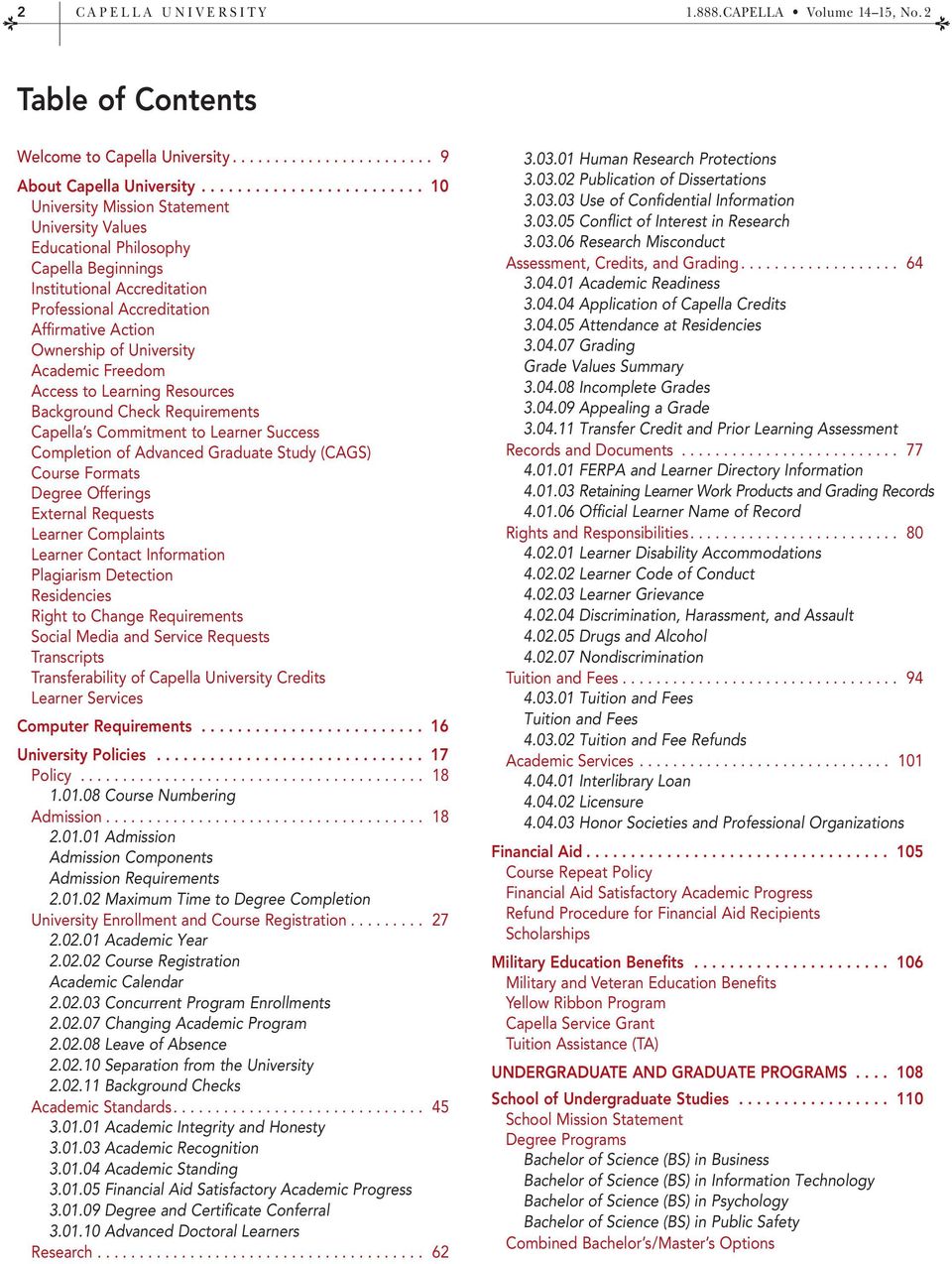
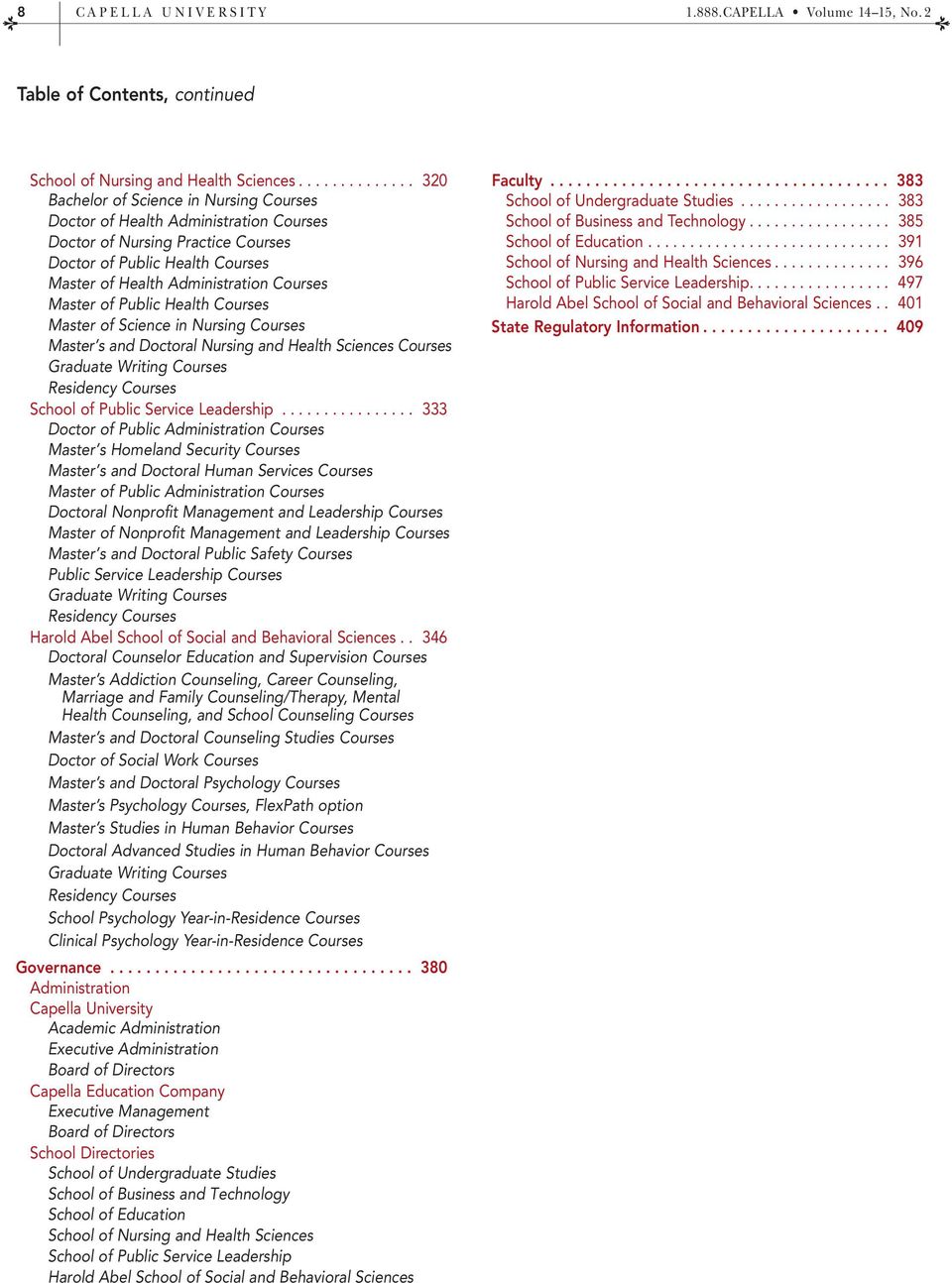
3 2 Capella University CAPELLA Volume 14 15, No. 2 Table of Contents Welcome to Capella University... 9 About Capella University University Mission Statement University Values Educational Philosophy Capella Beginnings Institutional Accreditation Professional Accreditation Affirmative Action Ownership of University Academic Freedom Access to Learning Resources Background Check Requirements Capella s Commitment to Learner Success Completion of Advanced Graduate Study (CAGS) Course Formats Degree Offerings External Requests Learner Complaints Learner Contact Information Plagiarism Detection Residencies Right to Change Requirements Social Media and Service Requests Transcripts Transferability of Capella University Credits Learner Services Computer Requirements University Policies Policy Course Numbering Admission Admission Admission Components Admission Requirements Maximum Time to Degree Completion University Enrollment and Course Registration Academic Year Course Registration Academic Calendar Concurrent Program Enrollments Changing Academic Program Leave of Absence Separation from the University Background Checks Academic Standards Academic Integrity and Honesty Academic Recognition Academic Standing Financial Aid Satisfactory Academic Progress Degree and Certificate Conferral Advanced Doctoral Learners Research Human Research Protections Publication of Dissertations Use of Confidential Information Conflict of Interest in Research Research Misconduct Assessment, Credits, and Grading Academic Readiness Application of Capella Credits Attendance at Residencies Grading Grade Values Summary Incomplete Grades Appealing a Grade Transfer Credit and Prior Learning Assessment Records and Documents FERPA and Learner Directory Information Retaining Learner Work Products and Grading Records Official Learner Name of Record Rights and Responsibilities Learner Disability Accommodations Learner Code of Conduct Learner Grievance Discrimination, Harassment, and Assault Drugs and Alcohol Nondiscrimination Tuition and Fees Tuition and Fees Tuition and Fees Tuition and Fee Refunds Academic Services Interlibrary Loan Licensure Honor Societies and Professional Organizations Financial Aid Course Repeat Policy Financial Aid Satisfactory Academic Progress Refund Procedure for Financial Aid Recipients Scholarships Military Education Benefits Military and Veteran Education Benefits Yellow Ribbon Program Capella Service Grant Tuition Assistance (TA) UndergradUATE and Graduate Programs School of Undergraduate Studies School Mission Statement Degree Programs Bachelor of Science (BS) in Business Bachelor of Science (BS) in Information Technology Bachelor of Science (BS) in Psychology Bachelor of Science (BS) in Public Safety Combined Bachelor s/master s Options
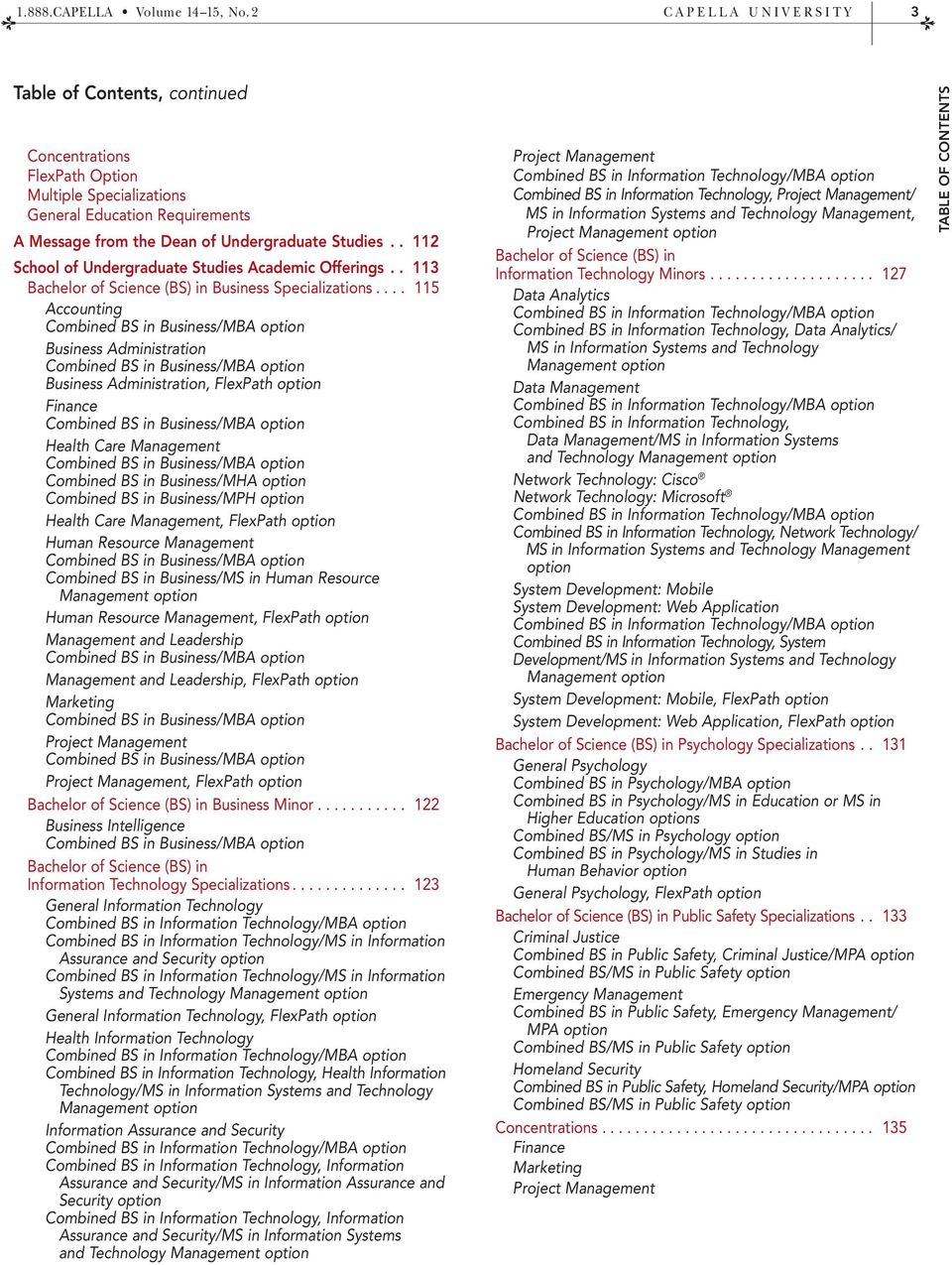
4 1.888.CAPELLA Volume 14 15, No. 2 Capella University 3 Table of Contents, continued Concentrations FlexPath Option Multiple Specializations General Education Requirements A Message from the Dean of Undergraduate Studies. 112 School of Undergraduate Studies Academic Offerings. 113 Bachelor of Science (BS) in Business Specializations Accounting Combined BS in Business/MBA option Business Administration Combined BS in Business/MBA option Business Administration, FlexPath option Finance Combined BS in Business/MBA option Health Care Management Combined BS in Business/MBA option Combined BS in Business/MHA option Combined BS in Business/MPH option Health Care Management, FlexPath option Human Resource Management Combined BS in Business/MBA option Combined BS in Business/MS in Human Resource Management option Human Resource Management, FlexPath option Management and Leadership Combined BS in Business/MBA option Management and Leadership, FlexPath option Marketing Combined BS in Business/MBA option Project Management Combined BS in Business/MBA option Project Management, FlexPath option Bachelor of Science (BS) in Business Minor Business Intelligence Combined BS in Business/MBA option Bachelor of Science (BS) in Information Technology Specializations General Information Technology Combined BS in Information Technology/MBA option Combined BS in Information Technology/MS in Information Assurance and Security option Combined BS in Information Technology/MS in Information Systems and Technology Management option General Information Technology, FlexPath option Health Information Technology Combined BS in Information Technology/MBA option Combined BS in Information Technology, Health Information Technology/MS in Information Systems and Technology Management option Information Assurance and Security Combined BS in Information Technology/MBA option Combined BS in Information Technology, Information Assurance and Security/MS in Information Assurance and Security option Combined BS in Information Technology, Information Assurance and Security/MS in Information Systems and Technology Management option Project Management Combined BS in Information Technology/MBA option Combined BS in Information Technology, Project Management/ MS in Information Systems and Technology Management, Project Management option Bachelor of Science (BS) in Information Technology Minors Data Analytics Combined BS in Information Technology/MBA option Combined BS in Information Technology, Data Analytics/ MS in Information Systems and Technology Management option Data Management Combined BS in Information Technology/MBA option Combined BS in Information Technology, Data Management/MS in Information Systems and Technology Management option Network Technology: Cisco Network Technology: Microsoft Combined BS in Information Technology/MBA option Combined BS in Information Technology, Network Technology/ MS in Information Systems and Technology Management option System Development: Mobile System Development: Web Application Combined BS in Information Technology/MBA option Combined BS in Information Technology, System Development/MS in Information Systems and Technology Management option System Development: Mobile, FlexPath option System Development: Web Application, FlexPath option Bachelor of Science (BS) in Psychology Specializations General Psychology Combined BS in Psychology/MBA option Combined BS in Psychology/MS in Education or MS in Higher Education options Combined BS/MS in Psychology option Combined BS in Psychology/MS in Studies in Human Behavior option General Psychology, FlexPath option Bachelor of Science (BS) in Public Safety Specializations Criminal Justice Combined BS in Public Safety, Criminal Justice/MPA option Combined BS/MS in Public Safety option Emergency Management Combined BS in Public Safety, Emergency Management/ MPA option Combined BS/MS in Public Safety option Homeland Security Combined BS in Public Safety, Homeland Security/MPA option Combined BS/MS in Public Safety option Concentrations Finance Marketing Project Management table of contents
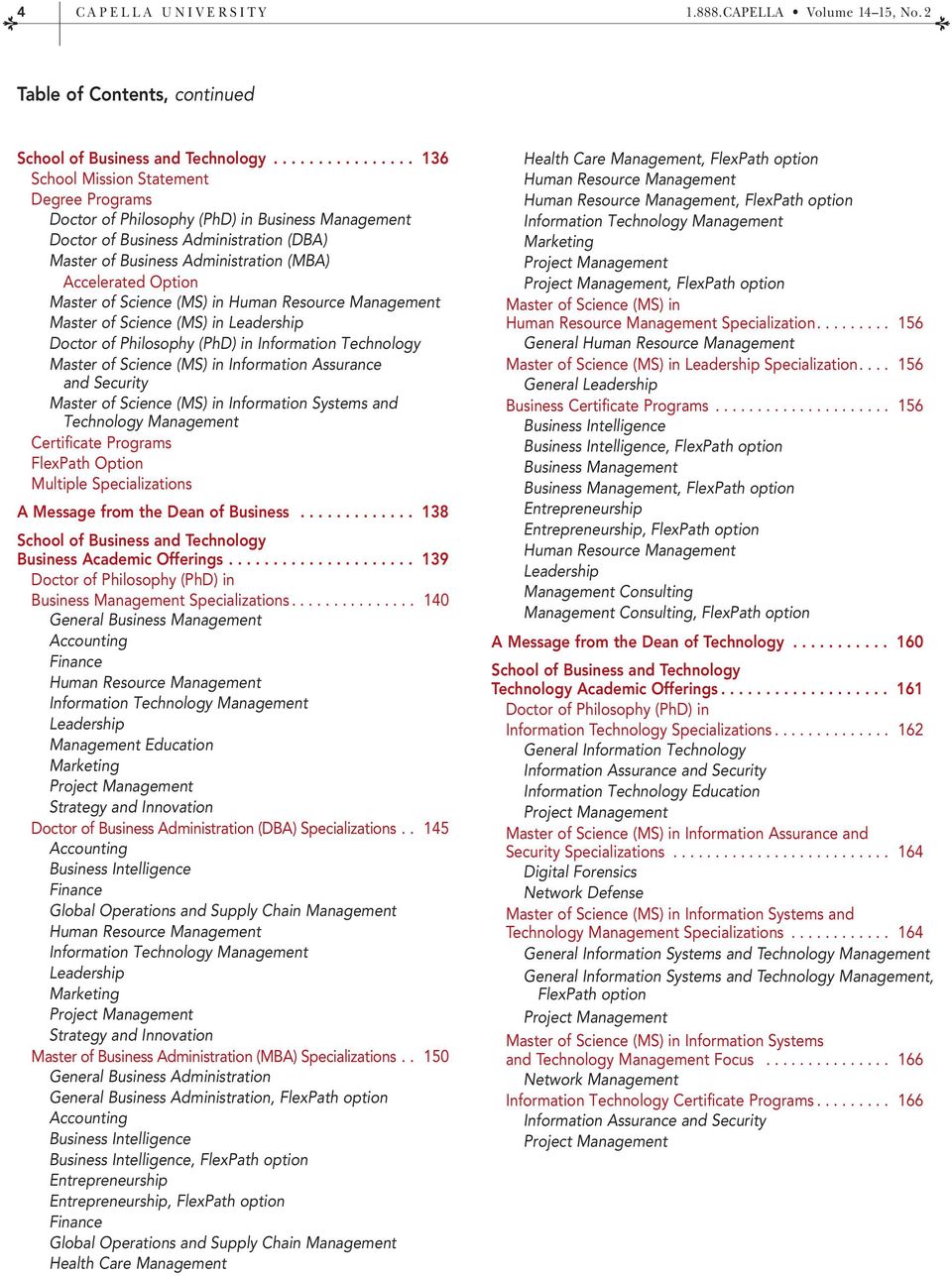
5 4 Capella University CAPELLA Volume 14 15, No. 2 Table of Contents, continued School of Business and Technology School Mission Statement Degree Programs Doctor of Philosophy (PhD) in Business Management Doctor of Business Administration (DBA) Master of Business Administration (MBA) Accelerated Option Master of Science (MS) in Human Resource Management Master of Science (MS) in Leadership Doctor of Philosophy (PhD) in Information Technology Master of Science (MS) in Information Assurance and Security Master of Science (MS) in Information Systems and Technology Management Certificate Programs FlexPath Option Multiple Specializations A Message from the Dean of Business School of Business and Technology Business Academic Offerings Doctor of Philosophy (PhD) in Business Management Specializations General Business Management Accounting Finance Human Resource Management Information Technology Management Leadership Management Education Marketing Project Management Strategy and Innovation Doctor of Business Administration (DBA) Specializations Accounting Business Intelligence Finance Global Operations and Supply Chain Management Human Resource Management Information Technology Management Leadership Marketing Project Management Strategy and Innovation Master of Business Administration (MBA) Specializations General Business Administration General Business Administration, FlexPath option Accounting Business Intelligence Business Intelligence, FlexPath option Entrepreneurship Entrepreneurship, FlexPath option Finance Global Operations and Supply Chain Management Health Care Management Health Care Management, FlexPath option Human Resource Management Human Resource Management, FlexPath option Information Technology Management Marketing Project Management Project Management, FlexPath option Master of Science (MS) in Human Resource Management Specialization General Human Resource Management Master of Science (MS) in Leadership Specialization General Leadership Business Certificate Programs Business Intelligence Business Intelligence, FlexPath option Business Management Business Management, FlexPath option Entrepreneurship Entrepreneurship, FlexPath option Human Resource Management Leadership Management Consulting Management Consulting, FlexPath option A Message from the Dean of Technology School of Business and Technology Technology Academic Offerings Doctor of Philosophy (PhD) in Information Technology Specializations General Information Technology Information Assurance and Security Information Technology Education Project Management Master of Science (MS) in Information Assurance and Security Specializations Digital Forensics Network Defense Master of Science (MS) in Information Systems and Technology Management Specializations General Information Systems and Technology Management General Information Systems and Technology Management, FlexPath option Project Management Master of Science (MS) in Information Systems and Technology Management Focus Network Management Information Technology Certificate Programs Information Assurance and Security Project Management
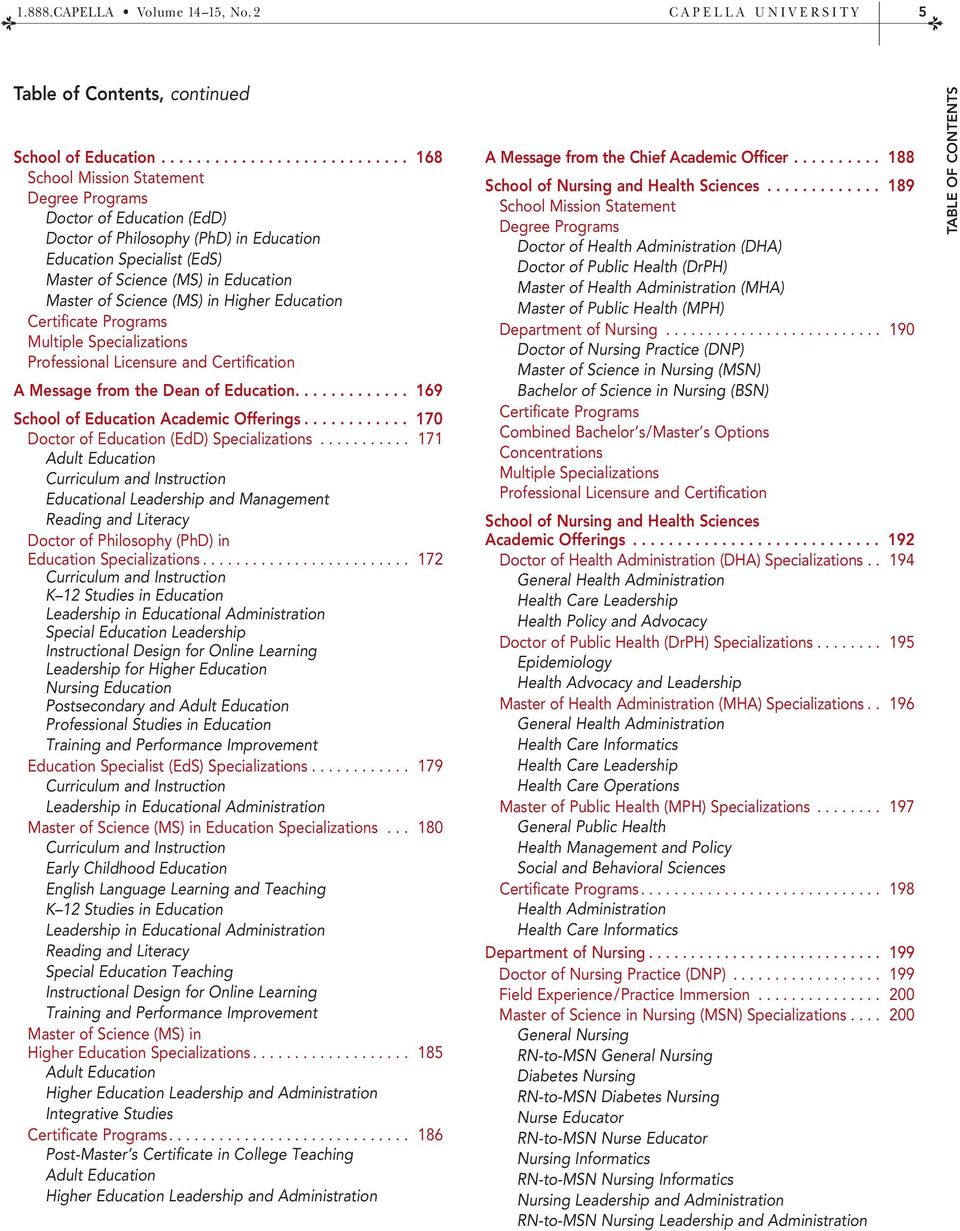
6 1.888.CAPELLA Volume 14 15, No. 2 Capella University 5 Table of Contents, continued School of Education School Mission Statement Degree Programs Doctor of Education (EdD) Doctor of Philosophy (PhD) in Education Education Specialist (EdS) Master of Science (MS) in Education Master of Science (MS) in Higher Education Certificate Programs Multiple Specializations Professional Licensure and Certification A Message from the Dean of Education School of Education Academic Offerings Doctor of Education (EdD) Specializations Adult Education Curriculum and Instruction Educational Leadership and Management Reading and Literacy Doctor of Philosophy (PhD) in Education Specializations Curriculum and Instruction K 12 Studies in Education Leadership in Educational Administration Special Education Leadership Instructional Design for Online Learning Leadership for Higher Education Nursing Education Postsecondary and Adult Education Professional Studies in Education Training and Performance Improvement Education Specialist (EdS) Specializations Curriculum and Instruction Leadership in Educational Administration Master of Science (MS) in Education Specializations Curriculum and Instruction Early Childhood Education English Language Learning and Teaching K 12 Studies in Education Leadership in Educational Administration Reading and Literacy Special Education Teaching Instructional Design for Online Learning Training and Performance Improvement Master of Science (MS) in Higher Education Specializations Adult Education Higher Education Leadership and Administration Integrative Studies Certificate Programs Post-Master s Certificate in College Teaching Adult Education Higher Education Leadership and Administration A Message from the Chief Academic Officer School of Nursing and Health Sciences School Mission Statement Degree Programs Doctor of Health Administration (DHA) Doctor of Public Health (DrPH) Master of Health Administration (MHA) Master of Public Health (MPH) Department of Nursing Doctor of Nursing Practice (DNP) Master of Science in Nursing (MSN) Bachelor of Science in Nursing (BSN) Certificate Programs Combined Bachelor s/master s Options Concentrations Multiple Specializations Professional Licensure and Certification School of Nursing and Health Sciences Academic Offerings Doctor of Health Administration (DHA) Specializations General Health Administration Health Care Leadership Health Policy and Advocacy Doctor of Public Health (DrPH) Specializations Epidemiology Health Advocacy and Leadership Master of Health Administration (MHA) Specializations General Health Administration Health Care Informatics Health Care Leadership Health Care Operations Master of Public Health (MPH) Specializations General Public Health Health Management and Policy Social and Behavioral Sciences Certificate Programs Health Administration Health Care Informatics Department of Nursing Doctor of Nursing Practice (DNP) Field Experience/Practice Immersion Master of Science in Nursing (MSN) Specializations General Nursing RN-to-MSN General Nursing Diabetes Nursing RN-to-MSN Diabetes Nursing Nurse Educator RN-to-MSN Nurse Educator Nursing Informatics RN-to-MSN Nursing Informatics Nursing Leadership and Administration RN-to-MSN Nursing Leadership and Administration table of contents
7 6 Capella University CAPELLA Volume 14 15, No. 2 Table of Contents, continued Field Experience/Practice Immersion Bachelor of Science in Nursing (BSN) Specialization RN-to-BSN Degree Completion Combined BSN/MSN option Nursing Certificate Programs Diabetes Nursing Nursing Informatics Nursing Leadership School of Public Service Leadership School Mission Statement Degree Programs Doctor of Philosophy (PhD) in Human Services Doctor of Philosophy (PhD) in Public Safety Doctor of Public Administration (DPA) Master of Science (MS) in Human Services Master of Science (MS) in Public Safety Master of Nonprofit Management and Leadership (MNML) Master of Public Administration (MPA) Certificate Programs Combined Bachelor s/master s Options Concentrations School of Public Service Leadership Academic Offerings Doctor of Philosophy (PhD) in Human Services Specializations Health Care Administration Multidisciplinary Human Services Nonprofit Management and Leadership Social and Community Services Doctor of Philosophy (PhD) in Public Safety Specializations Criminal Justice Emergency Management Doctor of Public Administration (DPA) Specialization General Public Administration Master of Science (MS) in Human Services Specializations. 214 Gerontology Multidisciplinary Human Services Social and Community Services Master of Science (MS) in Public Safety Specializations Criminal Justice Emergency Management Master of Nonprofit Management and Leadership (MNML) Master of Public Administration (MPA) Specialization General Public Administration Certificate Programs Criminal Justice Homeland Security Nonprofit Management and Leadership Social and Community Services Concentrations Forensics Health Policy and Management Homeland Security Nonprofit Management and Leadership Public Administration Public Health Public Policy Management and Collaborative Governance Public Safety Leadership Harold Abel School of Social and Behavioral Sciences. 220 School Mission Statement Department of Counseling, Human Behavior, and Social Work Counseling Degree Programs Doctor of Philosophy (PhD) in Counselor Education and Supervision Master of Science (MS) in Addiction Counseling Master of Science (MS) in Marriage and Family Counseling/Therapy Master of Science (MS) in Mental Health Counseling Master of Science (MS) in School Counseling Counseling Certificate Programs Human Behavior and Social Work Degree Programs Doctor of Philosophy (PhD) in Advanced Studies in Human Behavior Master of Science (MS) in Studies in Human Behavior Doctor of Social Work (DSW) Department of Psychology Psychology Degree Programs Doctor of Psychology (PsyD) Doctor of Psychology (PsyD) in School Psychology Doctor of Philosophy (PhD) in Psychology Master of Science (MS) in Psychology Psychology Certificate Programs Psychology Concentrations FlexPath Option Multiple Specializations Professional Licensure and Certification A Message from the Dean of Counseling, Human Behavior, and Social Work Harold Abel School of Social and Behavioral Sciences Counseling, Human Behavior, and Social Work Academic Offerings Department of Counseling, Human Behavior, and Social Work Doctor of Philosophy (PhD) in Counselor Education and Supervision Specialization General Counselor Education and Supervision Practicum/Internship Experience Master of Science (MS) in Addiction Counseling Specialization General Addiction Counseling Master of Science (MS) in Marriage and Family Counseling/Therapy Specialization General Marriage and Family Counseling/Therapy Master of Science (MS) in Mental Health Counseling Specialization General Mental Health Counseling

8 1.888.CAPELLA Volume 14 15, No. 2 Capella University 7 Table of Contents, continued Master of Science (MS) in School Counseling Specialization General School Counseling Residencies Practicum/Internship Experience Counseling Certificate Programs Contemporary Theory in Addictive Behavior Contemporary Theory in Couple and Family Systems Contemporary Theory in Mental Health Services Diversity Studies Doctor of Philosophy (PhD) in Advanced Studies in Human Behavior Specialization General Advanced Studies in Human Behavior Master of Science (MS) in Studies in Human Behavior Specialization General Studies in Human Behavior Doctor of Social Work (DSW) Specialization General Social Work A Message from the Dean of Psychology Harold Abel School of Social and Behavioral Sciences Psychology Academic Offerings Department of Psychology Doctor of Psychology (PsyD) Specialization Clinical Psychology PsyD Clinical Psychology Year-in-Residence PsyD Clinical Training Doctor of Psychology (PsyD) in School Psychology PsyD in School Psychology Residencies Doctor of Philosophy (PhD) in Psychology Specializations General Psychology Addiction Psychology Educational Psychology Industrial/Organizational Psychology PhD Psychology Residencies Master of Science (MS) in Psychology Specializations General Psychology General Psychology, FlexPath option Applied Behavior Analysis Child and Adolescent Development Educational Psychology Evaluation, Research, and Measurement Industrial/Organizational Psychology Industrial/Organizational Psychology, FlexPath option Leadership Coaching Psychology Sport Psychology Clinical Psychology Counseling Psychology School Psychology MS Psychology Residencies MS Psychology Clinical Training MS Psychology Year-in-Residence Psychology Certificate Programs Applied Behavior Analysis Play Therapy Specialist Certificate in School Psychology Specialist Certificate Year-in-Residence Specialist Certificate Clinical Training Psychology Concentrations Child and Adolescent Development Coaching Psychology Consultation Psychology Family Psychology Industrial Psychology Organizational Psychology Program Evaluation and Measurement Psychology Teaching and Instruction Course Descriptions School of Undergraduate Studies General Education Courses General Education Courses, FlexPath option Bachelor of Public Administration Courses Bachelor s Business Courses Bachelor s Business Courses, FlexPath option Bachelor s Information Technology Courses Bachelor s Information Technology Courses, FlexPath option Bachelor s Public Safety Courses Bachelor s Psychology Courses Bachelor s Psychology Courses, FlexPath option School of Business and Technology Doctoral Business Administration and Business Management Courses Master s Human Resource Management Courses Master s Leadership Courses Master of Business Administration Courses Master of Business Administration Courses, FlexPath option Doctoral Organization and Management Courses Master s Organizational Development Courses Master s Information Assurance and Security Courses Master s Information Systems and Technology Management Courses Master s Information Systems and Technology Management Courses, FlexPath option Master s and Doctoral Information Technology Courses Graduate Writing Courses Residency Courses School of Education Master s and Doctoral Education Courses Doctor of Education Courses Graduate Writing Courses Residency Courses table of contents

9 8 Capella University CAPELLA Volume 14 15, No. 2 Table of Contents, continued School of Nursing and Health Sciences Bachelor of Science in Nursing Courses Doctor of Health Administration Courses Doctor of Nursing Practice Courses Doctor of Public Health Courses Master of Health Administration Courses Master of Public Health Courses Master of Science in Nursing Courses Master s and Doctoral Nursing and Health Sciences Courses Graduate Writing Courses Residency Courses School of Public Service Leadership Doctor of Public Administration Courses Master s Homeland Security Courses Master s and Doctoral Human Services Courses Master of Public Administration Courses Doctoral Nonprofit Management and Leadership Courses Master of Nonprofit Management and Leadership Courses Master s and Doctoral Public Safety Courses Public Service Leadership Courses Graduate Writing Courses Residency Courses Harold Abel School of Social and Behavioral Sciences Doctoral Counselor Education and Supervision Courses Master s Addiction Counseling, Career Counseling, Marriage and Family Counseling/Therapy, Mental Health Counseling, and School Counseling Courses Master s and Doctoral Counseling Studies Courses Doctor of Social Work Courses Master s and Doctoral Psychology Courses Master s Psychology Courses, FlexPath option Master s Studies in Human Behavior Courses Doctoral Advanced Studies in Human Behavior Courses Graduate Writing Courses Residency Courses School Psychology Year-in-Residence Courses Clinical Psychology Year-in-Residence Courses Governance Administration Capella University Academic Administration Executive Administration Board of Directors Capella Education Company Executive Management Board of Directors School Directories School of Undergraduate Studies School of Business and Technology School of Education School of Nursing and Health Sciences School of Public Service Leadership Harold Abel School of Social and Behavioral Sciences Faculty School of Undergraduate Studies School of Business and Technology School of Education School of Nursing and Health Sciences School of Public Service Leadership Harold Abel School of Social and Behavioral Sciences State Regulatory Information
10 1.888.CAPELLA Volume 14 15, No. 2 Capella University 9 Welcome to Capella University A Message from the President Welcome to Capella University! You may have initially selected Capella University because it offers the accredited program you seek, or because of its convenient 24/7 availability, or because it came highly recommended by a friend or family member. But we ve found that after one course, our learners reasons for attending Capella University change. What our learners find in the courserooms is an active and engaging learning community that invites them to contribute their own knowledge and experiences while benefitting from the perspectives of their peers. Our learners tell us that this interaction with world-class faculty and with fellow learners from around the globe not only builds their skills and capabilities, but inspires them to make a difference in their own lives as well as in their work places and communities. welcome to capella university Scott L. Kinney, MBA Capella University President This catalog is a comprehensive resource that gives you a sense of the breadth and depth of Capella University. It contains detailed descriptions of our schools, programs, and courses, as well as helpful information about our learner-facing services, policies, and procedures. What the catalog cannot adequately convey is the power of the learning experience you will find here. During your time at Capella you will build strong relationships with faculty, fellow learners, and advisors, and you will engage in an academic program that is more rigorous and rewarding than you can imagine. I wish you the best of luck in your studies and for your future academic and professional success. Thanks for joining us. Best regards, Scott L. Kinney Capella University President

11 10 Capella University CAPELLA Volume 14 15, No. 2 About Capella University University Mission Statement The mission of Capella University is to extend access to high quality bachelor s, master s, specialist, doctoral, and certificate programs for adults who seek to maximize their personal and professional potential. This mission is fulfilled through innovative programs that are responsive to the needs of adult learners and involve active, engaging, challenging, and relevant learning experiences offered in a variety of delivery modes. University Values Capella University is a learning-centered community that values: Our learners. We foster the success and achievement of our learners by providing an academically rich, outcomes-based education and a value-added customer experience. Human potential. We honor the potential of each person. We believe in people, challenge them, and help them achieve their goals; we enable transformations. Achievement. The achievement of Capella learners is our measure of success. We re proud to take accountability for our individual and organizational results. Decisive collaboration. As a nimble organization, we foster a culture of decisiveness that is informed by practical collaboration. We empower each other to seek input and constructive debate, then make decisions and move forward. Innovation. We value innovation and entrepreneurial risk-taking. We strive for continuous improvement of both the learning experience and our business performance. Integrity. We live our values with transparency and high ethical standards. We honor our commitments. Educational Philosophy Capella University s educational philosophy focuses on developing scholar-practitioners through learning that incorporates both theoretical knowledge and relevant experience. Learners synthesize scholarship with practical application appropriate to their level as reflectivepractitioners at the baccalaureate level, as practitionerscholars at the master s level, and as scholar-practitioners at the doctoral level. Capella University faculty are themselves scholar-practitioners or as appropriate, practitioner-scholars. They guide and facilitate learner development through dissemination of knowledge and the formation of learning communities. They promote active learning, and they model what it means to be scholar-practitioners and life-long learners. Capella s philosophy also emphasizes collaboration: learners with their peers and learners with faculty. Learners and faculty reflect together on their experiences, build and apply knowledge, participate in communities of learning, and make theoretical and practical contributions in their fields. Capella Beginnings In 1992, Stephen Shank, former CEO of Tonka Corporation, provided the vision, leadership, and a portion of the initial funding for the incorporation of a distance-learning institution of higher education. Shank had observed that adults were underserved by traditional universities, partly because attending classes can be difficult for many working adults, and traditional curriculum may not correspond with the professional goals of mature adults. He envisioned a barrier-free university that people could attend remotely. The Graduate School of America (TGSA), which eventually became Capella University, was established. In 1993, Dr. Harold Abel, an experienced leader in higher education and a former president of three universities, joined Stephen Shank to serve as founding president and academic leader of The Graduate School of America. Dr. Abel assembled a premier faculty, built graduate curricula, and guided the university toward academic accreditation. In 1997, during the presidency of Dr. Bruce Francis, TGSA was accredited by the Higher Learning Commission and became a member of the North Central Association of Colleges and Schools (NCA). The university s accreditation was reaffirmed by the Higher Learning Commission in The Graduate School of America initially offered master s and doctoral degree programs in Education, Human Services, and Organization and Management. Two years after receiving accreditation, TGSA became Capella University and went on to establish the schools of Business, Education, Human Services, Technology, and the Harold Abel School of Psychology. The undergraduate learning experience was enhanced by a reorganization of schools in 2004 to form the School of Undergraduate Studies and the School of Business and Technology. In 2009, to better meet the professional needs of its learners in public service fields, Capella formed the School of Public Service Leadership. Capella s Harold Abel School of Social and Behavioral Sciences, was established in Programs from the two former schools, the School of Human
12 1.888.CAPELLA Volume 14 15, No. 2 Capella University 11 About Capella University, continued Services and the Harold Abel School of Psychology, moved into that school, which houses the Department of Counseling, the Department of Psychology, and the Department of Social Work. In 2014, Capella separated its nursing and health care programs from the remainder of the School of Public Service Leadership s portfolio in order to better serve its learners as they progress toward their professional goals. The newly formed School of Nursing and Health Sciences houses the Department of Nursing, as well as certificate, master s, and doctoral programs in health administration and public health. As part of its commitment to transparency, in 2009 Capella University launched a unique, award-winning website, dedicated to sharing learning and career outcomes information. The site includes data on demonstration of learning outcomes, student satisfaction, and career outcomes that reflect Capella graduates success. It also houses expense, completion, and career information related to Gainful Employment required disclosures. In 2013, the Higher Learning Commission approved two competency-based, direct assessment program options, called FlexPath, for the BS in Business, Business Administration specialization and the MBA, General Business Administration specialization. That same year, both offerings were also approved by the Department of Education for federal financial aid eligibility. Since that time, Capella has continued to expand its FlexPath portfolio. Institutional Accreditation Capella University is accredited by the Higher Learning Commission Professional Accreditation Select Capella University programs and specializations have received professional accreditations. Affirmative Action Capella University is an affirmative action employer. Ownership of University Capella University is wholly owned by Capella Education Company, a Minnesota corporation. Academic Freedom Capella University is committed to freedom of expression and inquiry and strives to promote an atmosphere in which rigorous academic dialogue is maintained, while respect for collegiality, civility, and diversity is embraced. Access to Learning Resources Capella University recognizes the need to provide limited access to the online courseroom, iguide, the Capella University Library, and other Capella University learning resources to persons other than Capella learners, alumni, faculty, and staff, as described below. Courseroom Access For regulatory, accreditation, and other purposes, the courseroom may be accessed and observed by persons other than Capella learners, faculty, and staff. Access to the courseroom will be authorized by the chief academic officer only after the review of such a request and the determination that access is necessary and appropriate, does not infringe on the activities of learners and faculty, and does not threaten the academic integrity of the courseroom. Although the courseroom is not open to public access upon demand, it is not a private or confidential domain; neither learners nor faculty should assume privacy within the courseroom. Library and iguide Access For regulatory, accreditation, and other purposes, access to the iguide, Capella University Library, and other Capella learning resources may be granted to persons other than Capella learners, alumni, faculty, and staff. Access to these resources will be authorized by the chief academic officer only after the review of such a request and the determination that access is necessary and appropriate and does not threaten the integrity of the university. Background Check Requirements Learners are responsible for understanding how their personal and criminal background may impact their ability to complete their degree program at Capella, earn a professional license, or secure employment. Learners may be required to pass fingerprint and/or background checks by a site or state licensing office in order to complete practica, internships, or field experiences. Learners are responsible for understanding and complying with any applicable background check requirements. Learners will not be able to complete their degree program at Capella if required practica, internships, or field experiences cannot be completed due to a failed background check. Additionally, fingerprint and/or background checks are required for most professional licenses and many professions. about CAPella University

13 12 Capella University CAPELLA Volume 14 15, No. 2 About Capella University, continued Capella s Commitment to Learner Success Capella University is committed to helping learners succeed. To that end, the university has developed a combination of course work and support services intended to facilitate a strong start for learners. New learners can expect the following support: Tthe University Orientation Seminar provides all new learners with the knowledge, skills, and advice they need to be successful in Capella s online learning environment. Learners navigate Capella s online courseroom, take a virtual tour of university support services, and engage in an online discussion with an orientation facilitator and other new learners. Learners begin their program with a first course that sets the stage for the rest of their studies. Completion of Advanced Graduate Study (CAGS) Recognizing Doctoral Learner Achievement Capella University s Completion of Advanced Graduate Study (CAGS) recognizes a learner s achievement of a significant doctoral milestone: successful completion of all requirements necessary to be considered as an advanced doctoral learner. The CAGS recognition marks a specific level of doctoral achievement; it is not an academic degree or credential. Eligibility To be eligible for Completion of Advanced Graduate Study (CAGS) recognition, a learner must currently be admitted to a doctoral program in any of Capella University s graduate schools and registered for doctoral course work. Eligible learners must have completed requirements and course work as outlined for their program by their school. This typically includes completion of core, specialization, and elective courses and relevant program and residency requirements, including field work, with a minimum cumulative grade point average of 3.0 on a 4.0 scale. Applying Doctoral learners at Capella University may apply for Completion of Advanced Graduate Study (CAGS) recognition once they have met all eligibility requirements (and any time thereafter prior to graduation) but may not receive more than one CAGS recognition. Any learner who is currently registered and active in courses at Capella University and who has completed all requirements for the CAGS recognition should visit iguide for contact information and CAGS application materials or call University Operations at CAPELLA ( ). Course Formats Courses are offered online and in directed study formats. Courses designated as directed study are available to doctoral learners in the schools of Business and Technology and Education and the Harold Abel School of Social and Behavioral Sciences. Directed study courses, in which learners work one-to-one with a faculty tutor, are offered quarterly. Additional details and requirements related to these course formats can be found in the University Policies section of this catalog and on iguide. Degree Offerings Capella University offers Bachelor of Science (BS), Bachelor of Science in Nursing (BSN), Master of Science (MS), Master of Science in Nursing (MSN), Master of Business Administration (MBA), Master of Health Administration (MHA), Master of Nonprofit Management and Leadership (MNML), Master of Public Administration (MPA), Master of Public Health (MPH), Education Specialist (EdS), Doctor of Philosophy (PhD), Doctor of Business Administration (DBA), Doctor of Education (EdD), Doctor of Health Administration (DHA), Doctor of Nursing Practice (DNP), Doctor of Public Administration (DPA), Doctor of Public Health (DrPH), Doctor of Psychology (PsyD), and Doctor of Social Work (DSW) degrees. External Requests The university maintains a record of external requests for learners education records, except for directory information, and of the disposition of the requests. The university may disclose education records to authorized agencies and appropriate institutions as specified in the FERPA policy located on iguide. Learner Complaints Learners who have complaints that have not otherwise been resolved through contact with Academic Advising, Enrollment Services, Financial Aid, University Operations Support, or Technical Support may submit their request to [email protected]. Learner Contact Information Learners are responsible for keeping their contact information accurate and current. Learner information may be updated at any time on iguide or via Learner Support. The primary form of official communication from Capella University is through . Learners are required to maintain active addresses. To ensure receipt of important communications, learners should make sure that spam filters are set to receive from Capella University.

14 1.888.CAPELLA Volume 14 15, No. 2 Capella University 13 About Capella University, continued Plagiarism Detection Capella University uses Turnitin for plagiarism detection both during admissions and in certain courses. Learners who take courses at Capella understand and agree that all required papers may be submitted to Turnitin for a textual similarity review. All submitted papers will then be included as source documents in the Turnitin reference database for the sole purpose of detecting plagiarism in future documents. Use of the Turnitin service is subject to the Terms and Conditions of Use posted on Residencies Most doctoral programs, clinically focused master s programs, and post-master s certificate programs require learners to attend residencies offered in various locations. Residencies provide opportunities for learners to become familiar with Capella University resources, develop or affirm academic skill sets, acquire clinical skill competencies, learn research methodologies, and prepare for the comprehensive examination and dissertation processes. Through these face-to-face experiences, learners extend participation in Capella s learning community by networking, focusing on academic success strategies, interacting with peers and faculty, and developing academic competencies that support program completion. Capella believes that the sense of community developed during residencies will endure throughout the program and become an essential part of a successful learner experience. Additional details regarding residency requirements can be found on iguide. Right to Change Requirements Neither the Capella University Catalog, nor any of the information and requirements contained herein, constitute a contract or create any contractual commitments between Capella University and any student, any prospective student, or any third party. The information and program requirements contained in the Capella University Catalog are regularly updated and are subject to change without notice. All updates to the catalog will be posted on Capella s website. Social Media and Service Requests Learner requests for enrollment and registration changes and other official actions must be communicated to Capella University via , telephone, or designated form. Requests made via social media platforms are not official and will not be processed. Transcripts Learners may request transcripts on iguide or by calling Learner Support at CAPELLA ( ). Capella University reserves the right to withhold the official transcripts of learners who are not in good financial standing with the institution. Transferability of Capella University Credits The transferability of Capella credits to another institution is solely at the discretion of that institution. Learner Services For day-to-day needs, Capella s learner support services are available online through iguide, via , and through tollfree calls within the United States. iguide iguide allows learners to access Capella s services in one convenient place. Learners can register for courses, apply for financial assistance, view an unofficial transcript, and access a variety of other convenient resources, including the Learner Handbook and University Catalog. For questions or concerns regarding enrollment and registration, courses, access, financial aid, billing, or technical problems that are not answered on iguide, learner support associates are available to assist learners at CAPELLA ( ) or [email protected]. Advisors Academic advisors help learners make a successful transition into their program and serve as an ongoing source of support throughout their education. Advisors communicate with learners on an ongoing basis, providing academic and personal strategies and support, clarifying university procedures, tracking and discussing academic progress, and providing information about any changes that may affect learners. Academic Records Learner Services and Operations maintains confidential, accurate academic records of learners as they progress through their program. Learners may request official transcripts and view and print their unofficial transcripts any time on iguide. Learners must submit a written request for release of their academic record to a third party. Unless otherwise specified, academic record information released to a third-party requestor includes any documents collected or created during the application process; documents or information related to academic program, including transcripts, test scores, grades, university advising records, financial aid information, and changes to enrollment status; and any official correspondence to or from a learner pertaining to his or her academic progress, advising, financial status, learning disability records, physical disability records, academic dishonesty records, and disciplinary and learner conduct records. about CAPella University
15 14 Capella University CAPELLA Volume 14 15, No. 2 About Capella University, continued Academic Success Resources Capella s academic success resources help learners maximize their personal and professional potential by offering engaging opportunities through a variety of delivery modes, including math, computer, and general study skills modules; free academic tutoring; motivation and time management strategies; effective online learning and degree planning tools; and additional academic skills resources on topics such as critical thinking and reading, scholarly writing, and academic honesty. Learners can access these resources any time on iguide. Alumni Association Alumni benefit from networking opportunities, professional and career services, alumni grants, selected use of library resources, alumni newsletters and communications, and other opportunities to stay involved as a graduate of Capella University. More information on the Capella University Alumni Association can be found on iguide. Bookstore Textbooks and software may be purchased through the bookstore, which is accessible on iguide. Career Center Career Center services are designed to help learners successfully navigate the career planning and development process as they pursue and complete their degree. Although the Career Center does not guarantee employment upon degree completion or provide placement services, it provides career counseling, job search advising, and career management support to all Capella learners and alumni. Career Center staff interacts with learners via and telephone to assist with career-related activities such as resume, CV, and cover letter development; interview preparation; effective job search strategy; and career advancement efforts. Career Center resources are helpful to learners in gathering occupational information and trends, accessing job postings, and viewing sample job search documents. For more information about these resources and services, visit the Career Center on iguide, and use the Ask a Career Counselor feature to connect with a counselor. Disability Services Capella University recognizes its obligations to accommodate the needs of learners with disabilities under the ADA Amendments Act of 2008, the Americans with Disabilities Act (ADA) of 1990, and the Rehabilitation Act of Capella is committed to providing reasonable accommodations to qualified learners with disabilities in university programs and activities. For more information, visit Disability Services on iguide or [email protected]. Enrollment Services Capella University s Enrollment Services team assists prospective learners from the point of initial inquiry through the application, admission, and enrollment phases. Call CAPELLA ( ) for assistance. Faculty and Mentors Learners work with faculty and mentors who assist them during important phases of their program. Faculty and mentor biographies by school can be found on iguide. Financial Aid Financial aid counselors help learners explore the options available for financing their education. Capella s online financial aid resources provide learners with information about federal loans, federal undergraduate grants, military tuition assistance, veteran s benefits, special aid programs, and employer tuition reimbursement. For more information, including the Capella Guide to Federal Financial Aid, visit Financial Aid on iguide, call Learner Support at CAPELLA ( ), or [email protected]. Human Research Protections Program (HRPP) Capella University is dedicated to safeguarding human research participants and promoting excellence in research through its commitment to ethical principles for the responsible conduct of research. Ensuring the highest standards of ethical conduct in research and the protection of the rights and welfare of human research participants is a shared responsibility between the Capella University research community and the HRPP. The HRPP promotes compliance with applicable local, state, and federal regulations and fosters ethical research through education, Institutional Review Board (IRB) review, quality assurance and improvement initiatives, and compliance monitoring. For more information, visit or [email protected]. Learner Accounts The Learner Accounts team is responsible for ensuring accurate, timely billing of learner accounts for tuition and fees, employer reimbursement, and financial aid disbursements. For questions about statements or billing, call Learner Support at CAPELLA ( ) or [email protected]. Library Capella provides a full range of academic library resources and services in an online environment. The Capella University Library website, accessible on iguide, provides access to thousands of full-text articles, citations, abstracts, technical reports, and electronic books (e-books). Learners may also request books, copies of articles, and other resources from university libraries nationwide. In addition, Capella reference librarians are available to assist learners and faculty with research questions, help learners use library databases effectively, and teach learners to successfully navigate the library website. Learners may contact a reference librarian by calling or ing [email protected].

16 1.888.CAPELLA Volume 14 15, No. 2 Capella University 15 About Capella University, continued Military Support Military Support services are available to Capella learners who are affiliated with the armed forces. Military Support team members assist learners who are experiencing an interruption in their program due to military obligations with military leave of absence requests and answer questions about military and veterans benefits. For more information about the resources and support available to servicemembers, veterans, and their families, visit Military Support on iguide. Additionally, existing learners may contact Military Support directly at Other interested parties may contact Military Support at New Learner Experience Team Capella University s New Learner Experience team provides support to new learners in adjusting to the Capella learning community and their degree program through the facilitation of the University Orientation Seminar. Learners may contact the New Learner Experience team by calling Learner Support at CAPELLA ( ) or by visiting iguide. Online Writing Center To help learners improve their written communication skills, Capella offers a variety of writing resources, including writing courses, online tutoring, writing self-assessment tools, and writing guidelines and references. The Online Writing Center, accessible on iguide, also offers face-to-face writing instruction at colloquia in school- and writing-focused sessions. about CAPella University

17 16 Capella University CAPELLA Volume 14 15, No. 2 Computer Requirements Review these requirements carefully; computer hardware, software, and an Internet connection are the primary means of participating in courses and thus are significant contributors to academic success. Capella provides learners with the opportunity to purchase Microsoft Office, Visio, and Project at a significant discount (see Software Discounts in the Bookstore for exact pricing). These requirements are subject to change. The most current requirements are published on iguide and are reflected in the Computer Check-Up tool, also available on iguide. Internet connection: Capella University s technical support staff strongly recommends a broadband (cable modem or DSL) Internet connection. Though not required, subscribing to a broadband connection may be the most important investment learners can make to improve their online learning experience. 56K Modem MINIMUM Word Processing application to save and open Microsoft Office formats (.docx,.xlsx,.pptx) Adobe Acrobat Reader to view PDF files Adobe Flash Player to view videos, tutorials, and other media content Java Plug-in (optional) for secondary Capella sites and tools Anti-Virus Software to scan files and s Mac OS 10.8 (Mountain Lion) Mac OS 10.9 (Maverick) Mac OS (Yosemite) One for the following internet browsers for accessing and navigating Capella sites: Safari Firefox Chrome Apple QuickTime Windows Vista Windows 7 Windows 8 One for the following internet browsers for accessing and navigating Capella sites: Internet Explorer Firefox Chrome Windows Media Player 1 GHz Processor 512MB of Memory (RAM) 20GB of free storage space RECOMMENDED Internet Connection* Broadband (Cable or DSL) 512kbps Download speed or higher Software Requirements Microsoft Office 2010 or higher (Word, Excel, PowerPoint) Adobe Acrobat Reader (Current Release) Adobe Flash (Current Release) Oracle Java 7 (Current Release) Mac Software Requirements With Current Software Updates Safari (Current Release) Firefox (Current Release) Chrome (Current Release) Apple QuickTime (Current Release) Windows Software Requirements With Current Windows Updates Internet Explorer 9 Internet Explorer 10 Firefox (Current Release) Chrome (Current Release) Windows Media Player (Current Release) Hardware Requirements 2 GHz Processor or higher 2GB or higher of Memory (RAM) 30GB or higher of free storage space * Courses requiring the use of a webcam or headset will require a broadband connection with a minimum speed of 256kbps upload and 512kbps download. Specific courses or programs may have additional requirements. Information technology courses also require: Windows is required for some required applications Mac users will need a Windows install or Windows set-up with Parallels Backup storage device Some MBA courses also require Windows Mac users will need a Windows install or Windows set-up with Parallels Capella recommends that new learners use or purchase a computer with the recommended standards listed above at the beginning of their program and review these technical standards on a regular basis. While other browsers and platforms may perform adequately, Capella cannot provide technical support for browsers other than those listed above. Browsers listed as recommended are Capella s primary choice for best performance within the Capella courseroom and other related sites. Adobe Acrobat and Flash Player are registered trademarks of Adobe Systems Incorporated in the United States and/or other countries. Mac, QuickTime, and Safari are registered trademarks of Apple Computer, Inc. Microsoft, PowerPoint, Project, Outlook, Visio, Media Player, Internet Explorer, and Windows are registered trademarks of Microsoft Corporation in the United States and/or other countries. Firefox is a registered trademark of Mozilla Corporation. Java is a registered trademark of Oracle.

18 1.888.CAPELLA Volume 14 15, No. 2 Capella University 17 University Policies Capella University policies apply to all Capella learners. Since some policies may be updated after publication, learners, faculty, and staff should refer to iguide for current policies and procedures. Learners are responsible for understanding and following the most current version of all Capella University policies. university policies POLICY Course Numbering ADMISSION Admission Maximum Time to Degree Completion UNIVERSITY ENROLLMENT AND COURSE REGISTRATION Academic Year Course Registration Concurrent Program Enrollments Changing Academic Program Leave of Absence separation from the University Background Checks ACADEMIC STANDARDS Academic Integrity and Honesty Academic Recognition Academic Standing Financial Aid Satisfactory Academic Progress Degree and Certificate Conferral Advanced Doctoral Learners RESEARCH Human Research Protections Publication of Dissertations Use of Confidential Information Conflict of Interest in Research Research Misconduct ASSESSMENT, CREDITS, AND GRADING Academic Readiness Application of Capella Credits Attendance at Residencies Grading incomplete Grades Appealing a Grade transfer Credit and Prior Learning Assessment RECORDS AND DOCUMENTS FERPA and Learner Directory Information Rretaining Learner Work Products and Grading Records Official Learner Name of Record RIGHTS AND RESPONSIBILITIES Learner Disability Accommodations Learner Code of Conduct Learner Grievance Discrimination, Harassment, and Assault Drugs and Alcohol Nondiscrimination TUITION AND FEES tuition and Fees tuition and Fee Refunds ACADEMIC SERVICES interlibrary Loan Licensure Honor Societies and Professional Organizations

19 18 Capella University CAPELLA Volume 14 15, No. 2 University Policies, continued Policy Course Numbering Each Capella University course is identified by a unique, twopart course number. The first part, the subject, consists of a prefix and, when necessary, a designator; both are alphabetic characters. The second part is the numeric catalog number. A subject area is no more than four characters in length and a catalog number is four characters in length. Course numbers are established by the Academic Offerings Steering Committee and maintained by the Learner Services and Operations department and reflect the general subject area of the course, a specific type of course (if necessary), and the level of the course. Catalog Number Each catalog number represents a unique course and is an indicator of the level of learning for that course, as follows: Numbers beginning with 1 and 2 represent lower-division undergraduate courses. Numbers beginning with 3 and 4 represent upper-division undergraduate courses. Numbers beginning with 5 and 6 represent master s-level graduate courses. Numbers beginning with 7 and 8 represent doctoral-level graduate courses. Numbers beginning with 9 represent comprehensive examination and dissertation courses. Admission Admission Capella University was founded with a commitment to extend access to high-quality higher education and is dedicated to the success of its learners. As a part of the admission process, the university seeks to assess an applicant s potential to succeed in its online environment. Applicants must meet the programspecific admission requirements outlined in the accompanying table to be offered admission to Capella University. Although particular emphasis is placed on the applicant s academic history, non-academic factors may also be considered when evaluating an application for admission. Therefore, additional information and/or application materials may be requested and considered on an individual basis. Exceptions to admission requirements may be granted by the school dean or designee. There are no exceptions to admission requirements for the Doctor of Psychology program. Learners are responsible for fulfilling the program requirements specified in the catalog in effect at the time they are enrolled. Learners seeking to take an individual course at Capella may be admitted to the university as non-degree seeking learners. Some courses may not be available to non-degree seeking learners. Non-degree seeking learners registered for a Capella course are subject to all applicable university rules and policies. International Applicants International applicants must have attended an internationally-recognized institution. All applicants are expected to understand, read, speak, and write fluently in English. Equal Opportunity and Nondiscrimination Capella University prohibits discriminatory practices and pledges to seek out and minimize all forms of discrimination in all of its activities and programs. The university supports federal and state legislation prohibiting discrimination against any person based on race, color, creed, religion, sex, national origin, age, marital status, disability, sexual orientation, or status with regard to public assistance. Further, it is the university s policy to assure equal opportunity to all persons with disabilities, disabled veterans, and veterans of the Vietnam era. The university complies with Title IX of the Education Amendments of 1972, Titles VI and VII of the Civil Rights Act of 1964 and regulations, Section 504 of the Rehabilitation Act of 1973, the Americans with Disabilities Act of 1990, and the ADA Amendments Act of PROCEDURES I. Application Materials A. Applicants must complete the admission application and submit all required programspecific documentation as detailed in the Admission Components table. B. Truth in Information if unexplained discrepancies appear between statements or documents provided to Capella University as a part of admission materials and information otherwise obtained, applicants may be rejected for admission, admission may be revoked, or learners may be dismissed. Continued on page 22

20 1.888.CAPELLA Volume 14 15, No. 2 Capella University 19 University Policies, continued School Undergraduate Studies Admission Components Business and Technology Education Nursing and Health Sciences Public Service Leadership Harold Abel School of Social and Behavioral Sciences Acknowledgment Agreement Official Transcript from Previous Institution* International Applicants: Proof of English Equivalency Licensure Disclosure & Responsibilities Acknowledgment Cohort Auto-Registration Form Letters of Recommendation Curriculum Vitae Extended Goal Statement Admission Essay/Writing Samples PhD in Psychology with specialization in Addiction Psychology License/Education Verification Form Faculty Interview Background Acknowledgment MS in Information Assurance and Security degree program (all specializations), MS in Information Systems and Technology Management degree program (all specializations), Network Management focus DSW General Social Work specialization PhD General Counselor Education and Supervision specialization; PsyD Clinical Psychology specialization; PsyD in School Psychology degree program; MS General Addiction Counseling, General Marriage and Family Counseling/Therapy, General Mental Health Counseling, and General School Counseling specializations; MS School Psychology specialization PhD General Counselor Education and Supervision specialization; PsyD Clinical Psychology specialization; PsyD in School Psychology degree program; MS General Addiction Counseling, General Marriage and Family Counseling/Therapy, General Mental Health Counseling, and General School Counseling specializations; MS School Psychology specialization PsyD Clinical Psychology specialization; PsyD in School Psychology degree program; Specialist Certificate in School Psychology PhD General Counselor Education and Supervision specialization; PsyD Clinical Psychology specialization; PsyD in School Psychology degree program; MS General Addiction Counseling, General Marriage and Family Counseling/Therapy, General Mental Health Counseling, General School Counseling, and School Psychology specializations; Specialist Certificate in School Psychology PhD Addiction Psychology specialization PsyD Clinical Psychology specialization; PsyD in School Psychology degree program; MS School Psychology specialization; Specialist Certificate in School Psychology university policies
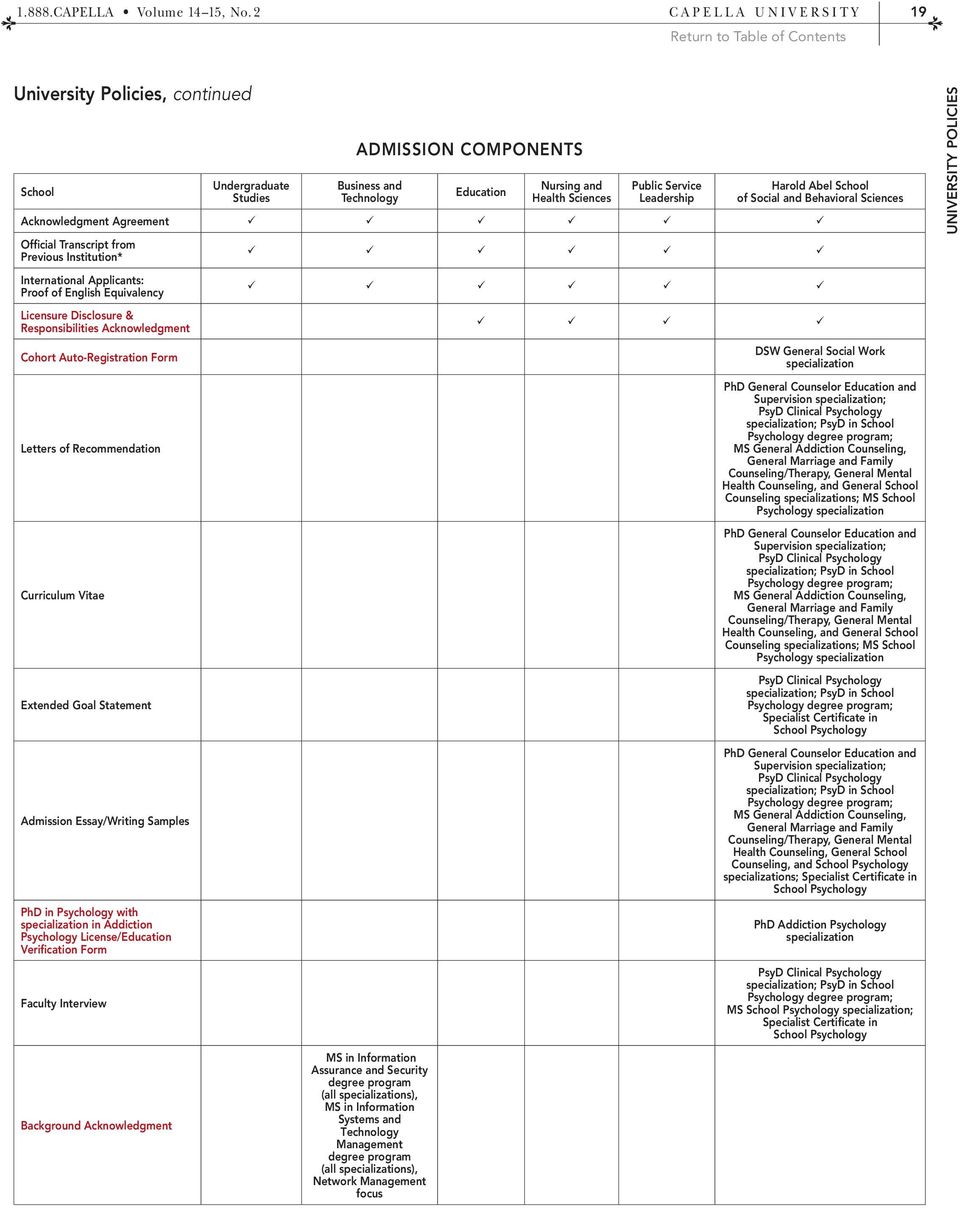
21 20 Capella University CAPELLA Volume 14 15, No. 2 University Policies, continued School DBA Course Registration Acknowledgment Teaching Experience Verification Form Teaching License Background Form Teaching License Information Form Pre-Screening Qualification Form Undergraduate Studies Admission Components, continued Business and Technology DBA Accounting, Business Intelligence, Finance, Global Operations and Supply Chain Management, Human Resource Management, Information Technology Management, Leadership, Marketing, Project Management, and Strategy and Innovation specializations Education PhD, EdS, and MS Leadership in Educational Administration specializations; PhD Special Education Leadership specialization MS Early Childhood Education and Reading and Literacy specializations MS Curriculum and Instruction, English Language Learning and Teaching, K 12 Studies in Education, and Special Education Teaching specializations EdS and PhD, Leadership in Educational Administration specializations Nursing and Health Sciences Public Service Leadership Harold Abel School of Social and Behavioral Sciences * Tennessee residents applying for admission to undergraduate degree programs must submit an official high school transcript as part of their application materials.
22 1.888.CAPELLA Volume 14 15, No. 2 Capella University 21 University Policies, continued Capella Academic Offering University Minimum Admission REQUIREMENTS Minimum Level of Education Completed; Post-Secondary Education from an Institution Accredited by a U.S. Department of Education-Recognized Accrediting Agency or an Internationally Recognized Institution Minimum Cumulative Grade Point Average (on a 4.0 scale) Programs with Additional Requirements university policies None (Non-Degree) Bachelor s-level course: high school diploma or equivalent. Master s-level course: bachelor s degree. Doctoral-level course: master s degree. None Counselor Education courses.* BS High school diploma or equivalent. None School of Undergraduate Studies BS in Business, BS in Information Technology, BS in Public Safety, and BS in Psychology degree programs.* BS, FlexPath option BSN High school diploma or equivalent and Capella s general education requirements. High school diploma or equivalent and a diploma or associate s degree in nursing School of Nursing and Health Sciences BSN degree program.* Post-Bachelor s Certificate Post-Bachelor s Certificate, FlexPath Option MS MBA MHA MNML MPA MPH MS, FlexPath option; MBA, FlexPath option Bachelor s degree 2.30 School of Nursing and Health Sciences Diabetes Nursing and Nursing Leadership certificates.* Harold Abel School of Social and Behavioral Sciences Applied Behavior Analysis and Play Therapy certificates.* Bachelor s degree 2.50 School of Business and Technology s Business Intelligence, Business Management, Entrepreneurship, and Management Consulting certificates, FlexPath option.* Bachelor s degree 2.30 School of Business and Technology s MS in Information Systems and Technology Management and MS in Information Assurance and Security degree program.* School of Business and Technology s MBA Accelerated option.* School of Education s MS Early Childhood Education, Leadership in Educational Administration, Reading and Literacy, and Special Education Teaching specializations.* Harold Abel School of Social and Behavioral Sciences MS in Addiction Counseling, MS in Marriage and Family Counseling/Therapy, MS in Mental Health Counseling, and MS in School Counseling degree programs, and its MS School Psychology specialization.* Bachelor s degree 3.00 School of Business and Technology s MS in Information Systems and Technology Management degree program, FlexPath option.* School of Business and Technology s MBA, FlexPath option.* MSN Bachelor s degree 3.00 School of Nursing and Health Sciences MSN degree program.* RN-to-MSN 135 Undergraduate credits 3.00 School of Nursing and Health Sciences RN-to-MSN degree program.* Post-Master s Certificate Master s degree 3.00 Harold Abel School of Social and Behavioral Sciences Specialist Certificate in School Psychology.* EdS Master s degree 3.00 School of Education s EdS Leadership in Educational Administration specialization.* PhD DBA EdD DHA DNP DPA DrPH DSW PsyD Master s degree 3.00 School of Education s PhD Leadership in Educational Administration, Nursing Education, and Special Education Leadership specializations.* School of Nursing and Health Sciences DNP degree program and DNP Preparatory Program.* Harold Abel School of Social and Behavioral Sciences PhD in Counselor Education and Supervision degree program.* Harold Abel School of Social and Behavioral Sciences PsyD in School Psychology degree program and its PsyD Clinical Psychology specialization.* Harold Abel School of Social and Behavioral Sciences DSW degree program.* BSN-to-DNP Bachelor s degree in nursing 3.00 School of Nursing and Health Sciences BSN-to-DNP degree program.* * select degree programs have higher GPA and/or additional admission requirements. Refer to procedures section II of this policy and Capella s University Catalog for more information.
23 22 Capella University CAPELLA Volume 14 15, No. 2 University Policies, continued Admission, continued II. Additional Admission Requirements the following degree programs and specializations have additional admission requirements related to accreditation, licensing, or other determining factors: A. Non-Degree Admission Non-degree-seeking learners planning to take a course related to counseling are required to submit a degreeconferred transcript for a bachelor s degree with a minimum GPA of 2.7. A rationale statement may also be required. B. School of Undergraduate Studies 1. Applicants to the BS degree program must be at least 24 years old. a. This age requirement may be waived for military applicants, veterans, and applicants with 24 or more transferable quarter credits of prior college/university course work. b. Transferable college course work and/or credentials that map to preapproved prior learning assessment opportunities may be considered toward the 24-credit minimum equivalency total. 2. Applicants who do not have any credits eligible for college/university transfer must successfully complete a university-approved examination. C. School of Business and Technology 1. Applicants to the MBA Accelerated option must have a conferred master s degree in nursing with a minimum 3.0 cumulative GPA. 2. Applicants to the MBA, FlexPath option must have a bachelor s degree in a business-related field, or a bachelor s degree in a non-business-related field and relevant business experience. 3. Applicants to the post-bachelor s certificates in Business Intelligence, FlexPath option; Business Management, FlexPath option; Entrepreneurship, FlexPath option; and Management Consulting, FlexPath option must have a bachelor s degree in a business-related field, or a bachelor s degree in a non-business-related field and relevant business experience. 4. Applicants to the MS in Information Assurance and Security degree program must have a bachelor s degree in information technology, information systems, a similar technology degree, or three years of relevant professional experience in information technology. 5. Applicants to the MS in Information Systems and Technology Management degree program must have a bachelor s degree in information technology, information systems, a similar technology degree, or eight years of relevant experience in a technology management field. Applicants who have not fulfilled these education or work requirements are required to complete ISTM5004, ISTM5006, and ISTM Applicants to the MS in Information Systems and Technology Management, FlexPath option must have a bachelor s degree in information technology, information systems, a similar technology degree, or eight years of relevant experience in a technology management field. D. School of Education 1. Applicants to the PhD, EdS, and MS Leadership in Educational Administration specializations must have three years of licensed teaching experience. Applicants to the Georgia Professional Standards Commission performance-based building-level leadership program, PhD and EdS Leadership in Educational Administration specializations, must hold a master s degree in educational leadership or other approved field, meet pre-service educational leadership requirements, serve in a leadership role or position in a partner district, and meet any other specific admission requirements outlined in a district partnership agreement. 2. Applicants to the PhD Nursing Education specialization must have a current, unrestricted RN license (or its equivalent) to practice in the United States and a master s degree in nursing. 3. Applicants to the PhD Special Education Leadership specialization must have a master s degree in education, a certification or license in special education, and three years of licensed teaching experience. E. School of Nursing and Health Sciences 1. Applicants to the BSN degree program must have a current, unrestricted RN license (or its equivalent) to practice in the United States. 2. Applicants to the BSN degree program who do not have any credits eligible for college/university transfer must successfully complete a universityapproved examination.
24 1.888.CAPELLA Volume 14 15, No. 2 Capella University 23 University Policies, continued 3. Applicants to the Diabetes Nursing, Nursing Informatics, and Nursing Leadership certificates must have a current, unrestricted RN license (or its equivalent) to practice in the United States, one year of licensed RN work experience or currently be employed as an RN, and a bachelor s degree in nursing with a minimum 3.0 cumulative GPA from an institution accredited by a U.S. Department of Education-recognized accrediting agency or an internationally recognized institution. 4. Applicants to the MSN General Nursing, Diabetes Nursing, Nurse Educator, Nursing Informatics, and Nursing Leadership and Administration specializations must have a current, unrestricted RN license (or its equivalent) to practice in the United States, one year of licensed RN work experience or currently be employed as an RN, and a bachelor s degree in nursing from an institution accredited by a U.S. Department of Educationrecognized accrediting agency or an internationally recognized institution. 5. Applicants to the RN-to-MSN General Nursing, Diabetes Nursing, Nurse Educator, Nursing Informatics, and Nursing Leadership and Administration specializations must have a current, unrestricted RN license (or its equivalent) to practice in the United States, one year of licensed RN work experience or currently be employed as an RN, and a minimum of 135 completed undergraduate credits. 6. Applicants to the DNP degree program must have a current, unrestricted RN license (or its equivalent) to practice in the United States, one year of licensed RN work experience or currently be employed as an RN, and a master s degree in nursing. 7. Applicants to the DNP Preparatory Program must have a current, unrestricted RN license (or its equivalent) to practice in the United States, one year of licensed RN work experience or currently be employed as an RN, and a bachelor s degree in nursing, and a master s degree. 8. Applicants to the BSN-to-DNP degree program must have a current, unrestricted RN license (or its equivalent) to practice in the United States, one year of licensed RN work experience or currently be employed as an RN, and a bachelor s degree in nursing. F. Harold Abel School of Social and Behavioral Sciences 1. Applicants to the Applied Behavior Analysis certificate must have a bachelor s degree in psychology, counseling, social work, education, medicine, engineering, occupational or speech therapy, or a related field. 2. Applicants to the Play Therapy certificate are required to have a minimum 3.0 cumulative GPA from a master s degree-granting institution and a master s degree in counseling or psychology. Active learners currently enrolled in a Capella University master s counseling or psychology degree program may be admitted to the Play Therapy certificate upon the successful completion of specific, predetermined courses within their degree program and/or specialization provided they have a minimum 3.0 cumulative GPA at the time of application. 3. Applicants to the MS in Addiction Counseling, MS in Marriage and Family Counseling/Therapy, MS in Mental Health Counseling, and MS in School Counseling degree programs are required to have a minimum 2.7 cumulative GPA from a bachelor s degree-granting institution. Applicants will also be assessed on professionalism and academic fit to the program as determined by the school. 4. Applicants to the MS School Psychology specialization are required to have a minimum 3.0 cumulative GPA from a bachelor s degree-granting institution. 5. Applicants to the Specialist Certificate in School Psychology must have a master s degree with a specialization in School Psychology from Capella University. 6. Applicants to the PhD in Counselor Education and Supervision degree program must have completed a master s degree program accredited by the Council for Accreditation of Counseling and Related Educational Programs (CACREP) or CACREP-curriculum equivalent, with a minimum 3.25 cumulative GPA. Applicants will also be assessed on professionalism and academic fit to the program as determined by the school. university policies
25 24 Capella University CAPELLA Volume 14 15, No. 2 University Policies, continued 7. Applicants to the PsyD Clinical Psychology specialization must have a master s degree in psychology or a related field with a minimum 3.0 cumulative GPA or a combined score of 1,000 on the GRE General Test. Applicants will also be assessed on professionalism and academic fit to the program as determined by the school. 8. Applicants to the PsyD School Psychology degree program will be assessed on professionalism and academic fit to the program as determined by the school. 9. Applicants to the DSW degree program must have a master s degree in social work from an institution accredited by the Council of Social Work Education (CSWE). III. International Applicants A. Transcript Evaluation 1. Applicants must have any international college or university transcripts evaluated and reviewed for eligibility for admission. 2. Applicants may elect to have their transcripts evaluated by an approved organization and sent to Capella or may choose to have Capella arrange a third-party evaluation for an additional, nonrefundable fee. Capella-facilitated evaluations are for the sole purpose of Capella admission review and may not be accepted by other academic institutions 3. transcript evaluation is not a guarantee of admission. B. English Proficiency 1. Applicants whose language of instruction is not English are required to take one of the following English proficiency tests and achieve the listed minimum score. a. Test of English as a Foreign Language (TOEFL) with a minimum acceptable score of 550 for the paper-based test or 79 for those completing the Internet-based examination. b. Michigan English Language Assessment Battery (MELAB) with a minimum acceptable score of 80. c. International English Language Testing System (IELTS) with a minimum acceptable score of 6.5. d. Pearson Test of English (PTE) with a minimum acceptable score of Applicants who have earned a postsecondary degree from a U.S.-accredited university are not required to take an English proficiency test. C. Student Visas Capella is an online university and does not issue I-20 forms (U.S. Department of Homeland Security Certificates of Eligibility for student visas). Capella cannot fulfill requests for student visas. Obtaining any necessary immigration authorizations for residencies, supervised field work, and any other non-online university events and activities is the sole responsibility of the learner. IV. Evaluation Process the submitted information, in addition to any previous academic work at Capella, is reviewed by Admissions in accordance with admission requirements for the requested program. Clinical programs may also require faculty interviews of applicants. The review of all application material results in one of the following recommendations: A. Applicant meets all admission requirements and is offered admission. B. Applicants who do not fully satisfy admission requirements may be considered as exceptions and may be asked to submit a resume, extended goal statement, and/or other relevant documents in addition to initial application materials. These applications are reviewed by the school for an admission decision. The decision is referred to Admissions for processing. C. Conditional Admission may be available to applicants for select programs. 1. Under conditional admission status, applicants who have not yet submitted all official transcripts and/or other required documentation may be granted permission to matriculate into their program while continuing the application process. 2. Learners granted conditional admission have until the end of the first full quarter following their program start date to submit all official transcripts and/or required documentation. Upon acceptance of their admission offer, learners under conditional admission status will be permitted to register for second quarter courses at the next quarter start. 3. Upon submission of all required materials, the application will be reviewed according to the evaluation process. 4. Learners under conditional admission status are ineligible to have financial aid disbursed until they have been fully admitted. Learners are encouraged to contact a financial aid counselor for more information.
26 1.888.CAPELLA Volume 14 15, No. 2 Capella University 25 University Policies, continued 5. Learners who fail to complete the application, submit all official transcripts and/or other required documentation, or meet admission requirements will be administratively withdrawn from the university. D. The applicant does not meet admission requirements. Admission is denied. 1. Conditionally admitted learners who are denied full admission are allowed to complete any course work in progress at the time of the denial and will remain registered in their current course(s) unless they initiate a course drop or withdrawal pursuant to university policy Course Registration. 2. Learners are financially responsible for any tuition and fees related to their course(s) in accordance with policy Tuition and Fee Refunds. V. Field Experiences/Practice Immersions, Internships, or Practica to ensure availability, appropriate supervision, and an equivalent experience in field experiences/practice immersions internships, or practica, all individuals admitted to School of Nursing and Health Sciences, School of Public Service Leadership, and Harold Abel School of Social and Behavioral Sciences programs with any required, elective, or optional field experiences must be eligible to work within the United States, Canada, Guam, Puerto Rico, or the U.S. Virgin Islands at the time of the internship or practicum, and must agree that this experience will be completed within the United States, Canada, Guam, Puerto Rico, or the U.S. Virgin Islands. Note: Capella University is not able to offer visas or other types of work permits; therefore, obtaining any necessary authorization is the sole responsibility of the learner. All individuals admitted to the above specializations must be eligible to work within the United States, Canada, Guam, Puerto Rico, or the U.S. Virgin Islands at the time of the internship or practicum and must agree that this experience will be completed within the United States, Canada, Guam, Puerto Rico, or the U.S. Virgin Islands. VI. Returning after separation A. Learners who have been separated from the university through discontinuation or administrative withdrawal may be required to reapply for admission. B. Reapplication for admission is subject to review by the school dean or designee. The decision of the school dean or designee is final and not subject to appeal. C. Learners who do not register for courses for four consecutive quarters will be administratively withdrawn from the university and must reapply for admission. Admitted learners must meet the program-specific admission requirements effective in the catalog current at the time of admission. D. Alumni applicants seeking admission to a degree program at the same level as a conferred Capella degree will be ineligible for admission when that program is identical, equivalent, or has substantive course overlap to the individual s previously-earned degree, as defined by the Admissions and Transfer Office Maximum Time to Degree Completion Capella University requires learners to complete all degree or certificate program requirements within specific time limits in order to be eligible to graduate. Learners who do not complete their degree or certificate program within required time limits, which are based on their degree or certificate level, will be administratively withdrawn from the university. These time limits are the outside dates for completion and do not supersede the obligation to maintain satisfactory academic progress throughout the learner s program of study. Time limits for degree and certificate programs are outlined in this policy. Time limits for Capella University degree and certificate programs are as follows: Degrees and Certificates Bachelor s Degree Master s Degree* Education Specialist Degree Doctoral Degree Graduate Certificate Maximum Time from Program start Date to Completion 8 years 4 years 4 years 7 years 3 years * learners enrolled in the Master of Science in Education with a specialization in Special Education Teaching have a maximum of six years to complete their degree program. * learners enrolled in the Master of Science in Addiction Counseling, Master of Science in Marriage and Family Counseling/Therapy, Master of Science in Mental Health Counseling, or Master of Science in School Counseling have a maximum of six years to complete their degree program. * learners enrolled in the Master of Science in Nursing have a maximum of six years to complete their degree program. * learners enrolled in the Master of Health Administration have a maximum of five years to complete their degree program. * learners enrolled in the Master of Science in Information Systems and Technology Management degree program have a maximum of five years to complete their degree program. * learners enrolled in the Master of Public Health have a maximum of five years to complete their degree program. * learners enrolled in a master s joint degree program have a maximum of seven years to complete their degree program. learners enrolled in the Specialist Certificate in School Psychology have a maximum of four years to complete their certificate program. university policies
27 26 Capella University CAPELLA Volume 14 15, No. 2 University Policies, continued PROCEDURES I. Federal Financial Aid Impact This is a university policy separate from financial aid policies. Therefore, the listed time limits may not align with financial aid eligibility requirements. For further information, contact a financial aid counselor or see the financial aid policies located on iguide. II. Failure to Meet Maximum Time to Completion A. Learners will be notified via one quarter prior to the last date of eligibility for maximum time to completion that they will be administratively withdrawn from the university unless they have a signed Degree Extension Form (DEF), granting them an exception that extends their maximum time to completion deadline. B. Learners will be notified via that they have been administratively withdrawn from the university effective as of the last date of their maximum time to completion. III. Maximum Time to Completion Extensions A. Extension Criteria 1. Extensions requested due to change of specialization or extenuating circumstances may be approved by the faculty chair and validated by the Learner Services and Operations department. Extensions are generally limited to between two and four quarters, unless the learner s circumstance warrants a longer period, as approved by the dean or dean s designee. 2. Extenuating circumstance a. A leave of absence may qualify as an extenuating circumstance. b. Time spent during a military leave of absence does not count toward maximum time to completion. B. Extension Application Process Bachelor s, master s, specialist, doctoral, and certificate learners may apply for an extension by contacting Academic Advising to discuss their status. 1. Learners consult with Academic Advising to identify their remaining degree or certificate program requirements, propose a new time frame for completion if necessary, and discuss any potential financial aid impact. 2. Learners complete the Degree Extension Form (DEF) located on iguide that reflects the new completion date based on the proposed extension. 3. Learners and their academic advisors sign the DEF and submit it to the dean s designee for review, along with appropriate academic rationale. C. Extension Approvals 1. The dean s designee reviews the proposed DEF and rationale and determines if they meet the criteria for approval. 2. If the extension request is approved, the decision and rationale are filed in the learner s official academic record. 3. If the extension request is not approved, the learner is notified that he or she will be administratively withdrawn from the university when the maximum time to completion deadline has expired. 4. The decision of the dean s designee is final. D. Failure to Meet DEF Terms Learners who cannot complete their degree or certificate program within the time frame of their DEF will be administratively withdrawn from the university, with no option to appeal. IV. Change of Degree or Certificate Program and Maximum Time to Completion Learners who change their degree or certificate program are assigned a new program start date and catalog, which institutes a new maximum time to completion. V. Readmission and Maximum Time to Completion A. Readmission Eligibility 1. Learners who have discontinued from the university or who have been administratively withdrawn after four consecutive quarters of inactivity may apply for readmission at any time. 2. Administrative Withdrawal a. Bachelor s- and master s-level learners who have been administratively withdrawn from the university as a result of not completing their degree or certificate program before the maximum time to completion deadline may reapply for admission to Capella University. b. Doctoral-level learners who have been administratively withdrawn from the university as a result of not completing their degree program before the maximum time to completion deadline are not eligible for readmission to that program, or for admission to any doctoral program at Capella University.
28 1.888.CAPELLA Volume 14 15, No. 2 Capella University 27 University Policies, continued B. Readmission Program Start Date Learners who are readmitted are assigned a new program start date and catalog, which institutes a new maximum time to completion. VI. Administrative Withdrawal Appeals Process for Doctoral Learners A. Learners must appeal an administrative withdrawal decision within seven calendar days of being sent notification of the decision. B. Learners must complete and submit the Max Time Administrative Withdrawal Appeal Form. C. Learners must include an explanation of the extenuating circumstances surrounding their administrative withdrawal and the impact of those circumstances on the learner s academic progress. The case decision is based on documentation/evidence supplied by the learner. D. Learners must indicate their plan for future academic progress and success. E. Learners are not permitted to register for any Capella course (including non-credit courses, residencies, etc.) while the outcome of their appeal is pending. F. A president s designee reviews the appeal and makes a determination. 1. Within 10 calendar days of receiving the appeal and all supporting documentation, the president s designee will the learner to notify him or her of the decision. 2. the decision of the president s designee is final. University Enrollment and Course registration Academic Year Capella University operates on a July 1 through June 30 calendar. Four quarters of course offerings are scheduled each year. See Academic Calendar on pages Course Registration Learners university enrollment status is based on course registration. Upon course registration, learners agree to pay tuition and fees to Capella University as stated in university policy Tuition and Fees. Learners may not register for more than three concurrent courses. Doctoral learners engaged in the comprehensive examination and dissertation phases of their program may only register for courses in the comprehensive examination and dissertation course sequence. Learners are allowed one opportunity to repeat a course they have completed for which they have been assigned a grade. Learners who wish to cancel their course registration must adhere to the deadlines outlined in the academic calendar. Learners may drop a course during the first 12 calendar days of the course without academic penalty. Learners may withdraw from a course on or after the 13th calendar day of the course through the last day to withdraw from a course, as defined in this policy. DEFINITION Course Census Day Course census day refers to the 12th calendar day of a course at 11:59 p.m. Central Time. PROCEDURES I. Registration A. Learners register for courses, including residencies, using iguide s online course registration process. Some courses require a more specific registration process, as follows: 1. Pre-registration/auto-registration a. Learners work with appropriate Capella University staff to create an academic plan. During this process, learners may consent to be pre-registered for their courses. b. Once learners have been registered for their courses, they will be sent an automated confirming their registration has been completed. 2. special Topics, Practicum, and Internship Registrations a. special topics course registration requires the consent of the appropriate school and may require a written course learning plan. Learners must submit their request for the special topics course through advising for school review. b. special topics courses may be repeatable for credit with a different topic at the school s discretion. c. Practicum and internship registrations require the consent of the appropriate school and may require a written course learning plan or application. Learners must submit their request for practicum and internship registrations through Academic Advising for school review. university policies Continued on page 32
29 28 Capella University CAPELLA Volume 14 15, No. 2 University Policies, continued Academic Calendar winter and spring 2015 WINTER QUARTER 2015 SPRING QUARTER 2015 ACADEMIC DEADLINES January February Mid- February March April May Mid-May June Course Registration Begins Quarterly and Monthly Start Courses Begin Quarterly and Monthly Start Registration Ends Last Day to Drop Course Without W MBA Program MBA Program MBA Program MBA Program Midquarter Courses Begin * Midquarter Course Registration Ends * Last Day to Drop Midquarter Course Without W * Last Day to Drop Midquarter Course With W * Midquarter Courses End * Last Day to Drop Course With W End of Quarter MBA Program MBA Program * NOT Applicable to MBA Programs FINANCIAL DEADLINES Last Day to Drop Quarter and Monthly Start Courses With 100% Refund MBA Program Last Day to Drop Quarter and Monthly Start Courses With 75% Refund MBA Program Last Day to Drop Midquarter Course With 100% Refund * Last Day to Drop Midquarter Course With 75% Refund * * NOT Applicable to MBA Programs 2015 Holiday Schedule Capella will observe the following holiday schedule in The office switchboard will be closed on the following dates: New Year s Day Thursday, January 1, 2015 Martin Luther King Jr. Day Monday, January 19, 2015 Memorial Day Monday, May 25, 2015 Independence Day (observed) Friday, July 3, 2015 Labor Day Monday, September 7, 2015 Thanksgiving Day Thursday, November 26, 2015 Day after Thanksgiving Friday, November 27, 2015 Christmas Eve Day Thursday, December 24, 2015 Christmas Day Friday, December 25, 2015
30 1.888.CAPELLA Volume 14 15, No. 2 Capella University 29 University Policies, continued FlexPath Academic Calendar winter 2015* university policies JANUARY 2015 FEBRUARY 2015 MARCH 2015 ACADEMIC DEADLINES Jan 12 Jan 19 Jan 26 Feb 2 Feb 9 Feb 16 Feb 23 Mar 2 Mar 9 Courses Begin (8:00 am CST) Last Day to Drop Without a Grade (by 11:59 pm CST) Last Day to Drop With a W Grade (by 11:59 pm CST) Courses End for FlexPath Courses (by 5:00 pm CST) Online Final Grades Due for a FlexPath Course * FlexPath first courses begin each month. Learners may start all subsequent FlexPath courses on a daily basis. Academic deadlines vary in accordance with a learner s course start date. FlexPath Academic Calendar spring 2015* april 2015 MAY 2015 JUNE 2015 ACADEMIC DEADLINES Apr 13 Apr 20 Apr 27 May 4 May 11 May 18 May 25 Jun 1 Jun 8 Courses Begin (8:00 am CST) Last Day to Drop Without a Grade (by 11:59 pm CST) Last Day to Drop With a W Grade (by 11:59 pm CST) Courses End for FlexPath Courses (by 5:00 pm CST) Online Final Grades Due for a FlexPath Course * FlexPath first courses begin each month. Learners may start all subsequent FlexPath courses on a daily basis. Academic deadlines vary in accordance with a learner s course start date.
31 30 Capella University CAPELLA Volume 14 15, No. 2 University Policies, continued Academic Calendar summer and fall 2015 SUMMER QUARTER 2015 FALL QUARTER 2015 ACADEMIC DEADLINES July August Mid- August September October November Mid- November December Course Registration Begins Quarterly and Monthly Start Courses Begin Quarterly and Monthly Start Registration Ends Last Day to Drop Course Without W MBA Program MBA Program MBA Program MBA Program Midquarter Courses Begin * Midquarter Course Registration Ends * Last Day to Drop Midquarter Course Without W * Last Day to Drop Midquarter Course With W * Midquarter Courses End * Last Day to Drop Course With W End of Quarter MBA Program MBA Program * NOT Applicable to MBA Programs FINANCIAL DEADLINES Last Day to Drop Quarter and Monthly Start Courses With 100% Refund MBA Program Last Day to Drop Quarter and Monthly Start Courses With 75% Refund MBA Program Last Day to Drop Midquarter Course With 100% Refund * Last Day to Drop Midquarter Course With 75% Refund * * NOT Applicable to MBA Programs
32 1.888.CAPELLA Volume 14 15, No. 2 Capella University 31 University Policies, continued FlexPath Academic Calendar SUMMER 2015* university policies JULY 2015 AUGUST 2015 SEPTEMBER 2015 ACADEMIC DEADLINES Jul 13 Jul 20 Jul 27 Aug 3 Aug 10 Aug 17 Aug 24 Aug 31 Sept 7 Courses Begin (8:00 am CST) Last Day to Drop Without a Grade (by 11:59 pm CST) Last Day to Drop With a W Grade (by 11:59 pm CST) Courses End for FlexPath Courses (by 5:00 pm CST) Online Final Grades Due for a FlexPath Course * FlexPath first courses begin each month. Learners may start all subsequent FlexPath courses on a daily basis. Academic deadlines vary in accordance with a learner s course start date. FlexPath Academic Calendar FALL 2015* OCTOBER 2015 NOVEMBER 2015 DECEMBER 2015 ACADEMIC DEADLINES Oct 12 Oct 19 Oct 26 Nov 2 Nov 9 Nov 16 Nov 23 Nov 30 Dec 7 Courses Begin (8:00 am CST) Last Day to Drop Without a Grade (by 11:59 pm CST) Last Day to Drop With a W Grade (by 11:59 pm CST) Courses End for FlexPath Courses (by 5:00 pm CST) Online Final Grades Due for a FlexPath Course * FlexPath first courses begin each month. Learners may start all subsequent FlexPath courses on a daily basis. Academic deadlines vary in accordance with a learner s course start date.
33 32 Capella University CAPELLA Volume 14 15, No. 2 University Policies, continued Course Registration, continued B. Upon course registration, learners agree to pay tuition and fees to Capella University as stated in university policy Tuition and Fees. C. Learners should refer to the current academic calendar available on iguide for course registration dates and deadlines. II. Course Load A. Learners may not register for more than three concurrent courses. B. FlexPath learners may not be registered for more than two concurrent courses. C. Non-credit bearing residency registration will not be included in a learner s course load. III. Concurrent Course Registration for Comprehensive Examination and Dissertation Learners A. Doctoral learners registered for comprehensive examination and dissertation courses may only be registered for courses in the comprehensive examination and dissertation course sequence. B. Doctoral learners registered for courses outside of the comprehensive examination and dissertation course sequence, with the exception of practica and internships, will be dropped from their other courses by school administrative staff. Learners will be informed of the administrative course drop via . C. Doctoral learners may request an exception from their school allowing them to take a course outside of the comprehensive examination and dissertation course sequence. IV. Repeating Courses A. Learners are allowed one opportunity to repeat a course they have completed and for which they have been assigned a grade. B. Courses from which learners withdraw and receive a Withdrawal ( W ) grade on their transcript are not considered completed courses; therefore, the single repeat restriction does not apply. C. In exceptional circumstances, learners who wish to repeat a course more than once may request an exception to this policy. Learners must obtain written approval for the exception from the school dean or designee prior to course registration. D. Financial Aid Implications 1. For undergraduate learners financial aid may be used to cover the cost of the first repeat of a failed course, and for the first repeat of a course for which the learner received a passing grade. Learners approved to repeat a course beyond this may not use financial aid to cover the cost of the additional course repeats. 2. For graduate learners financial aid may be used to cover the cost of the first repeat of a course for which they failed. For graduate learners financial aid is not available to cover the costs of repeated courses for which the learner received a passing grade (C and above or S). This rule does not impact graduate learners in the comprehensive examination or dissertation courses. 3. Repeat course credits ineligible for financial aid are not included in course load calculations for financial aid purposes. E. When a course is repeated, the grade considered for credit and grade point average (GPA) calculations will be the highest grade earned. 1. Each attempt at the course appears on the transcript, and all attempts are used to evaluate the learner s completion percentage for evaluation of financial aid satisfactory academic progress (FASAP). 2. Only one course attempt is included in the GPA calculation. F. For a course to be considered a repeat of a previous course, the learner must complete the same course, as defined by the title and course number. If a new course has been designated by the school as the original course s equivalent, it will be considered an identical course for purposes of this policy. If a course is retired, it will no longer be possible to repeat the course. G. The school may approve course substitutions in lieu of repeating a course to fulfill graduation requirements for the content area, but the credit and GPA calculations for both courses are included in the cumulative statistics. H. Special topics courses may not be repeated. I. Dissertation courses will not be subject to repeat course procedures V. Enrollment Status Based on Course Registration A. Undergraduate Learners 1. Undergraduate learners registered for 12 or more credits of Capella courses each quarter are considered to be enrolled on a full-time basis.
34 1.888.CAPELLA Volume 14 15, No. 2 Capella University 33 University Policies, continued 2. Undergraduate learners registered for six or more but fewer than 12 credits of Capella courses each quarter are considered to be enrolled on a halftime basis. B. Graduate Learners 1. Graduate learners registered for six or more credits of Capella courses each quarter are considered to be enrolled on a full-time basis. 2. Graduate learners registered for three or more but fewer than six credits of Capella courses each quarter are considered to be enrolled on a halftime basis. 3. Doctoral learners registered for comprehensive examination and dissertation courses are certified as full time. VI. Late Course Registration A. Learners must request and receive permission from the appropriate school to register for a course between the end of open course registration and the eighth calendar day of the course. B. Late Course Registration Process 1. Learners may request permission to register for a course between the end of open course registration and the eighth calendar day of the course by contacting their advisor. 2. The request is reviewed by the Learner Services and Operations department and the school in which the learner requests the late course registration. 3. If approved, Capella registers the learner for the course, and the learner receives a course registration confirmation via . VII. Course Drop or Withdrawal Course Drop Course Withdrawal Unable to Withdraw Period Period (Late Withdrawal) 3-week days course session calendar days calendar days end of session 5-week days course session calendar days calendar days end of session 6-week days course session calendar days calendar days end of session 10-week days course session calendar days calendar days end of session A. Learners canceling, dropping, or withdrawing from their course(s) are encouraged to refer to university policy Tuition and Fee Refunds to determine the financial implications of their actions. B. Advanced Doctoral Learners Advanced doctoral learners should refer to the Capella University Doctoral Manual for details pertaining to their programs. C. Course Drop 1. Learners may drop a course during the first 12 calendar days of the course without academic penalty. A course drop during this time does not appear on the learner s transcript and does not affect grade point average (GPA). 2. Learners may be impacted financially should they drop a course after the first five calendar days of the course. Learners are responsible for fully understanding the financial implications of a course drop. Learners should refer to university policy Tuition and Fee Refunds to determine the financial implications of a course drop. 3. Learners who receive financial aid should discuss the potential financial implications of a course drop, including the return of financial aid funds, with a financial aid counselor. 4. To drop a course, learners must either contact a designated Enrollment Services or Advising representative or complete and submit an online course drop request via the course drop functionality in iguide s Student Center. a. Learners are responsible for clearly expressing their intention to drop a course by using language that indicates that intention through a specific request for institutional action. Course drop requests must include: i. Learner name and verifiable contact information ii. Course number and title iii. Quarter/term/year b. Learners may not use any other means to officially express their intention to drop a course, including verbal or written communication with faculty, discussion posts, or social media platforms. 5. Learners receive confirmation that the course drop request has been processed via iguide s Student Center or . Learners are responsible for checking their course registration status in iguide s Student Center. university policies
35 34 Capella University CAPELLA Volume 14 15, No. 2 University Policies, continued 6. Learners who drop a course after the open course registration deadline will not be able to reverse the drop. D. Course Withdrawal 1. Learners may withdraw from a course from the 13th calendar day of the course through the official last day to withdraw. 2. Learners may be impacted financially should they withdraw from a course. Learners are responsible for fully understanding the financial implications of a course withdrawal. Learners should refer to university policy Tuition and Fee Refunds to determine the financial implications of a course withdrawal. 3. Learners who receive financial aid should discuss the potential financial implications of a course withdrawal, including the return of financial aid funds, with a financial aid counselor. 4. to withdraw from a course, learners must either contact a designated Enrollment Services or Advising representative or complete and submit an online course withdrawal request via the course withdrawal functionality in iguide s Student Center. a. Learners are responsible for clearly expressing their intention to withdraw from a course by using language that indicates that intention through a specific request for institutional action. Course withdrawal requests must include: i. Learner name and verifiable contact information ii. Course number and title iii. Quarter/term/year b. Learners may not use any other means to officially express their intention to withdraw from a course, including verbal or written communication with faculty, discussion posts, or social media platforms. 5. Learners receive confirmation of receipt of the course withdrawal request via iguide s Student Center or . Learners are responsible for checking their course registration status in iguide s Student Center. 6. Learners who withdraw from a course after the course registration deadline will not be able to reverse the withdrawal. 7. the following consequences apply to a learner who withdraws from a course from the 13th calendar day of the course through the last day to withdraw: a. The learner receives a grade of W for the course. b. The grade of W appears on the learner s transcript. c. The grade of W does not affect GPA, but course credits are included in attempted credits when monitoring financial aid satisfactory academic progress, as described in university policy Financial Aid Satisfactory Academic Progress. 8. Once the course has been in session past the official last day to withdraw, this option is no longer available to learners. Should unforeseen extenuating circumstances arise after the deadline to withdraw from a course has passed, learners may refer to section VIII of this policy for recourse. VIII. Late Course Withdrawal A. If unforeseen extenuating circumstances require learners to withdraw from their course(s) following the official last day to withdraw, learners may petition for a late course withdrawal to receive a Withdrawal ( W ) grade on their academic record for the course(s) by providing proper documentation of the circumstance. Such requests must be submitted prior to the end of the course. If the extenuating circumstance does not allow the learner to submit the request by the deadline, third-party documentation demonstrating this fact must be provided. B. Learners are encouraged to discuss the situation with their instructor to determine, given the circumstances of the need for late course withdrawal, if a course withdrawal or an Incomplete ( I ) grade request best suits the situation. In instances when I grades are requested and approved, learners have no longer than the last day of the 10-week course of the next academic quarter (or sooner, if so noted by the instructor) to complete their course work in compliance with university policy Incomplete Grades. C. If it is determined that the learner needs to request a late course withdrawal, the learner should contact his or her advisor, who will initiate the request. D. Learners who receive financial aid should discuss the potential financial implications of a late course withdrawal, including the return of financial aid funds, with a financial aid counselor.
36 1.888.CAPELLA Volume 14 15, No. 2 Capella University 35 University Policies, continued E. Extenuating circumstances may include but are not limited to the death of a family member, jobrequired relocation, or severe physical injury or illness. Documentation of the circumstance must be provided by parties other than the learner; for example, a death certificate, a letter from the learner s supervisor, or a letter from the learner s physician must accompany the request. F. To be considered for a late course withdrawal accommodation, learners must be able to demonstrate ongoing participation in the course(s) in question up to the time of their documented extenuating circumstance. The case is determined based on the documentation/evidence supplied by the learner. G. The school s designee will review and approve or deny the request. The decision and rationale will be forwarded to the Learner Services and Operations department for validation. H. Advising will contact learners to notify them of the denial decision. The Learner Services and Operations department will learners to notify them of the approval decision, copying their instructors and advisors. I. Military learners called to active duty should refer to university policy Leave of Absence. J. University policy Tuition and Fee Refunds remains in effect and does not provide any financial accommodation for late course withdrawals. K. No grades can be changed to a W for any previous terms. IX. Appealing a Denied Late Course Withdrawal A. To request an appeal of a late course withdrawal denial decision, learners must contact their advisor and provide the appropriate academic rationale. B. The learner s advisor will forward the appeal request to the learner s school, where it will be referred to the dean or dean s designee. C. Within 14 calendar days of receiving the appeal request, the dean or dean s designee will review the request and issue a decision. D. The decision of the dean or dean s designee is final. E. The decision and academic rationale will be forwarded to the Learner Services and Operations department for validation. F. In cases of a denial decision, learners advisors will contact the learner to notify him or her of the appeal denial decision. The Learner Services and Operations department will also contact the learner via to notify him or her of either an appeal approval or denial decision, copying the learner s instructors and advisors. X. Course Participation A. Initial Course Participation 1. Learners who submit a grade-eligible courseroom activity before the end of course census day have satisfied the requirement for initial course participation. 2. Learners who have satisfied the requirement for initial course participation agree to pay the applicable course tuition. 3. Learners who have satisfied the requirement for initial course participation but who wish to drop or withdraw from the course may initiate a request pursuant to section VII of this policy. Learners who have satisfied the requirement for initial course participation and who drop or withdraw from the course will be held to the refund schedule described in university policy Tuition and Fee Refunds. 4. Learners who do not satisfy the requirement for initial course participation will be dropped from the course. 5. A course drop due to failing to meet the requirement for initial course participation is not noted on the learner s transcript and does not affect the learner s grade point average (GPA). 6. Learners who are dropped from a course for failing to satisfy the requirement for initial course participation will be refunded 100 percent of the course tuition. 7. Learners who are dropped from a course for failing to satisfy the requirement for initial course participation may request a late course registration pursuant to section VI of this policy. If the request is approved, the learner will be charged the applicable tuition and fees. 8. Learners who request a course drop or withdrawal as described in section VII of this policy and who have not satisfied the requirement for initial course participation will be refunded 100 percent of the course tuition. university policies
37 36 Capella University CAPELLA Volume 14 15, No. 2 University Policies, continued 9. Learners registered for residencies, practica, or internships; or laboratory, comprehensive examination, or dissertation courses will not be dropped from their course(s) for failing to satisfy the requirement for initial course participation, but they will be subject to any financial aid award disbursement participation requirements. B. Ongoing Course Participation 1. Learners who continuously submit and complete grade-eligible courseroom activities are satisfying the requirement for ongoing course participation. Learners must continuously participate in their courses to successfully complete the course. 2. Learners who do not participate in a course for 14 or more consecutive days are not satisfying the requirement for ongoing course participation. 3. Learners who do not satisfy the requirement for ongoing course participation will be notified by Within 14 calendar days of receiving notification that they are not satisfying the requirement for ongoing course participation, the learner must resume participation in the course. 5. Learners who do not resume participation in the course will be administratively withdrawn from the course and will be held to the refund schedule described in university policy Tuition and Fee Refunds. 6. If the learner is administratively withdrawn from the course during the acceptable course withdrawal period, the learner will receive a grade of W for the course. If the learner is administratively withdrawn from the course after the acceptable course withdrawal period, the learner will receive a grade of F for the course. The grade will be noted on the learner s transcript and will affect the learner s GPA. 7. Learners registered for practica, internships, field experiences, or residencies; or comprehensive examination, dissertation, or directed study courses will not be administratively withdrawn from their course(s) for failing to satisfy the requirement for ongoing course participation, but they will be subject to any financial aid award disbursement participation requirements. C. FlexPath Engagement 1. Learners who regularly submit and complete pre-determined FlexPath activities are satisfying the requirement for FlexPath engagement. Learners must regularly satisfy engagement requirements to successfully complete a FlexPath course. 2. Learners who do not complete pre-determined FlexPath activities for 14 or more consecutive days are not satisfying the requirement for FlexPath engagement and will be notified by Learners who do not satisfy the FlexPath engagement requirement for 21 or more consecutive days will be contacted by their FlexPath coach to discuss the consequences of non-engagement. 4. Learners who do not resume engagement in their FlexPath course within 28 days will be administratively withdrawn from the course and may be responsible for tuition and fees as described in university policy Tuition and Fee Refunds. 5. Learners who are administratively withdrawn from a course for failing to meet the FlexPath engagement requirement will receive a competency evaluation of Non-Performance for the course. The competency evaluation will be noted on the learner s transcript. 6. FlexPath learners who are administratively withdrawn from a course and are not registered in any active courses will not be able to register for courses until the following quarter Concurrent Program Enrollments Learners may not be enrolled in more than one Capella University degree program concurrently. Learners enrolled in specific bachelor s or master s degree programs may pursue multiple specializations within a single degree program concurrently, pursuant to the procedures described in this policy. Learners enrolled in specific bachelor s, master s, or doctoral degree programs may pursue multiple concentrations concurrently. Learners enrolled in select programs that require an emphasis may pursue multiple emphases concurrently. Learners may pursue a certificate program concurrently with a degree program. PROCEDURES I. FlexPath Option Learners enrolled in the FlexPath option may not concurrently pursue a certificate program outside the FlexPath option. II. Requesting Multiple Specializations A. Information about degree programs that allow multiple specialization enrollments is available in Capella s University Catalog.
38 1.888.CAPELLA Volume 14 15, No. 2 Capella University 37 University Policies, continued B. New Learners 1. New learners may request enrollment in multiple specializations at the time of admission. 2. Learners may only request enrollment in multiple specializations within a single degree program (i.e., the degree program for which they are seeking admission). 3. Learners who request enrollment in multiple specializations must meet the admission requirements for each requested specialization. 4. Learners who do not meet the admission requirements for each requested specialization will only be enrolled in the specialization(s) for which they meet the admission requirements. C. Current Learners 1. Current learners may request enrollment in an additional specialization(s) at any point during their program. 2. Learners may only request enrollment in an additional specialization(s) within the degree program in which they are currently enrolled. 3. Learners may request a change to a new degree program and enrollment in one or more additional specializations within their new degree program. For further information, see university policy Changing Academic Program. 4. Learners who request enrollment in one or more additional specializations within their degree program must meet admission requirements for each requested additional specialization. 5. Learners who request enrollment in one or more additional specializations within their degree program must meet the program requirements for the additional specialization(s) listed in the University Catalog in effect at the time they are admitted to the additional specialization(s). 6. Learners may request to add, change, or drop a specialization by completing and submitting the Change Program, Specialization, Concentration, and Emphasis Form located on iguide. D. Three or More Specializations 1. New learners may request enrollment in three or more specializations at the time of admission. 2. Current learners may request enrollment in three or more specializations within their degree program at any point during their program. 3. Requests for enrollment in three or more specializations are reviewed and approved or denied by the school dean or designee. E. Requirements and Restrictions 1. Learners must meet the program requirements of their specialization(s) listed in the University Catalog in effect at the time they were admitted to the university. For each specialization added to their degree program, learners must meet the program requirements listed in the University Catalog in effect at the time they are admitted to the additional specialization(s). 2. Learners who add specialization(s) to their degree program must complete the capstone course for each specialization should the degree program require a specialization-specific (rather than program-specific) capstone course. 3. Learners who add one or more specializations to their degree program may share no more than 25 percent of the combined total required specialization credits. Only full courses will be accepted toward the 25 percent limit. 4. Learners may have multiple specializations listed on their official academic transcript at the time of degree conferral. 5. Enrolling in multiple specializations does not increase the learner s maximum time to degree completion pursuant to university policy Maximum Time to Degree Completion. 6. Specializations cannot be added to a conferred degree. III. Concentrations A. Learners must be enrolled in a degree program to be eligible to earn a concentration. B. Learners may pursue multiple concentrations concurrently. C. New learners may request enrollment in a concentration(s) at the time of admission. D. Current learners may request enrollment in a concentration(s) at any point during their program. E. Learners may request to add, change, or drop a concentration(s) by completing and submitting the Change Program, Specialization, Concentration, and Emphasis Form located on iguide. F. Learners who add one or more concentrations to their degree program may only apply one course taken as part of the requirements for one concentration to a subsequent concentration. university policies
39 38 Capella University CAPELLA Volume 14 15, No. 2 University Policies, continued G. Learners may have multiple concentrations listed on their official academic transcript at the time of degree conferral. H. Enrolling in multiple concentrations does not increase the learner s maximum time to degree completion pursuant to university policy Maximum Time to Degree Completion. IV. Emphases A. Learners must be enrolled in a specific degree program that requires an emphasis to be eligible to earn additional emphases. B. Learners may pursue multiple emphases concurrently. C. New learners enrolled in a program that requires an emphasis and who want to pursue an additional emphasis must request enrollment in the additional emphasis at the time of admission. D. Learners may request to add, change, or drop an emphasis by completing and submitting the Change Program, Specialization, Concentration, and Emphasis Form located on iguide. E. Learners who add one or more emphases to their degree program may only apply one course taken as part of the requirements for one emphasis to the requirements for a subsequent emphasis. F. Learners may have multiple emphases listed on their official academic transcript at the time of degree conferral. G. Enrolling in multiple emphases does not increase the learner s maximum time to degree completion pursuant to university policy Maximum Time to Degree Completion. V. Minors A. Learners must be enrolled in a degree program to be eligible to earn a minor. B. Learners may pursue multiple minors concurrently. C. Requests for enrollment in three or more minors are reviewed and approved or denied by the school dean or designee. D. Learners may request to add, change, or drop minors by completing and submitting the Change Program, Specialization, Concentration, and Emphasis Form located on iguide. E. Learners who add one or more minors to their degree program may share no more than 25 percent of the combined total required minor credits. Only full courses can fulfill the 25 percent limit. F. Learners may have multiple minors listed on their official academic transcript at the time of degree conferral. G. Enrolling in multiple minors does not increase the learner s maximum time to degree completion pursuant to university policy Maximum Time to Degree Completion. H. Minors cannot be added to conferred degrees Changing Academic Program Capella University learners may apply to change their academic program at any point in their studies pursuant to the procedures established to support this policy. If accepted, the change becomes effective at the start of the next academic quarter except for a change of catalog which becomes effective immediately. A change of academic program results in changing the learner s current program requirements to those in the University Catalog or addendum that is in effect at the time of the change (the catalog of record). Learners are responsible for fulfilling the program requirements specified in their new catalog of record. Doctoral learners may not enroll in more than one Capella degree program or specialization concurrently. PROCEDURES I. Change of Academic Program A. Standards 1. Prior to initiating an academic program change, learners are encouraged to consult with Academic Advising to discuss options and considerations for the change. 2. Learners may not pursue more than one degree program concurrently. 3. Doctoral learners may not pursue more than one specialization concurrently. 4. If accepted, learners begin the new academic program at the start of the next academic quarter. B. Current Course Registration Learners remain registered for their current course(s) unless they initiate a course drop or withdrawal. The course withdrawal process is governed by university policy Course Registration. C. Change of Academic Program Process 1. For all academic program changes, learners must request a change to the new academic program (and new school, if necessary) using the Change Program, Specialization, Concentration, and Emphasis Form on iguide.
40 1.888.CAPELLA Volume 14 15, No. 2 Capella University 39 University Policies, continued 2. Application fees are waived for academic program changes. 3. Learners who are approved for a change of academic program must meet the academic program requirements listed in the University Catalog in effect at the time they are admitted to the new academic program. 4. Learners are expected to take the first course affiliated with their new academic program. 5. A change of academic program requires a new transfer credit evaluation. Learners are responsible for understanding their new degree plan. II. Combined Options Learners currently enrolled in select Capella bachelor s degree programs may request to be enrolled in a combined option. A combined option change includes the same procedures as an academic program change, with the addition of the following: A. Combined Option Standards 1. Learners may not pursue more than one combined option concurrently. 2. After successfully completing the requirements for the bachelor s degree program, combined option learners apply for the master s degree program that corresponds to their chosen combined option. 3. Learners admitted into the corresponding master s degree program within one year of completing their bachelor s degree are held to the program requirements of the catalog in effect the quarter they successfully completed their first master s course while in their undergraduate program. 4. Change requests from learners whose intended combined option master s program has been retired prior to their entering the master s program will be reviewed on a case-by-case basis to determine appropriate program requirements. 5. Learners admitted to a master s degree program not corresponding with their bachelor s degree program are held to the program requirements of the catalog in effect the quarter they are admitted into the master s degree program. Any previously completed master s courses will be reviewed for application to their program requirements. 6. Learners admitted into any master s program more than one year after completing their bachelor s program are held to the program requirements of the catalog in effect the quarter they are admitted into the master s degree program. Any previously completed master s courses will be reviewed for application to their program requirements. 7. Upon successful completion of the remaining master s degree program requirements, learners will be awarded a master s degree. B. Change of Combined Option Process 1. For all combined option changes, learners must request a change to the new combined option using the Combined Option Request Form on iguide. III. Change of Catalog A. Learner Catalog of Record 1. Learners are assigned their initial catalog of record upon their admission to Capella University. a. Learners who begin their programs in winter or spring quarter are assigned to the January catalog and the April addendum respectively. b. Learners who begin their programs in summer or fall quarter are assigned to the July catalog and the October addendum respectively. c. Subsequent changes or additions to a learner s academic program may result in new catalog requirements. See university policy Concurrent Program Enrollments for details. B. Change of Catalog Process 1. Prior to initiating a change of catalog, learners are encouraged to consult with Academic Advising to discuss options and related considerations. 2. Learners may request a change to the current catalog in order to complete a different set of program requirements, provided that the academic program is available in the current catalog. If the learner s request is approved, the learner must fulfill all program requirements specified in his or her new catalog of record. 3. A change of catalog requires a new transfer credit evaluation. Learners are responsible for understanding their new degree plan. university policies
41 40 Capella University CAPELLA Volume 14 15, No. 2 University Policies, continued Leave of Absence Capella University learners may request a planned leave of absence from their academic program when medical conditions, active military service, active military service of a spouse, or national emergencies prevent their active registration and engagement in their course(s). Under extreme circumstances, a leave of absence from an academic program may be granted for reasons other than medical conditions, active military service, or national emergencies. Learners with loan obligations are advised to contact their lender(s) to discuss their circumstances and loan repayment status during their leave of absence. PROCEDURES I. All Leave of Absence Categories A. Access to Services During a leave of absence, learners have access to Academic Advising services. However, learners will not have access to other academic services, including academic or mentoring support and the Capella University Library. B. Academic Standing and Financial Aid Satisfactory Academic Progress Status Learners on academic probation per university policy Academic Standing or financial aid probation per university policy Financial Aid Satisfactory Academic Progress at the time a leave of absence was granted will remain at the same status upon returning from the leave of absence. C. Catalog Upon returning from a leave of absence, learners will remain under the same catalog that was in effect at the time the leave of absence was granted. D. Last Day of Attendance if learners do not register in their courses upon returning from a leave of absence, the last day of the quarter in which the learner was registered in one or more courses is designated as the last date of attendance. E. Failure to Return from a Leave of Absence it is the learner s responsibility to contact his or her financial aid lender when taking a leave of absence, as it may affect their federal loan grace period. Learners who fail to return from a leave of absence will be reported to their financial aid lender. II. Medical Leave of Absence A. Criteria 1. Learners may request a planned medical leave of absence for circumstances protected under the Family Medical Leave Act (FMLA). 2. Learners must be registered in a course(s) when requesting a medical leave of absence. 3. A medical leave of absence status cannot be granted retroactively. B. Requesting a Medical Leave of Absence 1. To request a medical leave of absence, learners must complete and submit the Leave of Absence Request Form located on iguide. Learners must indicate the beginning date of the leave of absence and the anticipated date of return. Learners must submit the Leave of Absence Request Form by the close of course registration for the quarter in which they are requesting the leave. The start and end dates of the request must coincide with the start and end dates of the quarter. 2. Learners must also submit documentation from a medical provider certifying the need for the leave. The request will not be considered until documentation is submitted. 3. Learners may not request a medical leave of absence for more than a total of 180 calendar days in any 12-month period. C. Approving a Medical Leave of Absence Upon receipt of the request, the Learner Services and Operations department will review the request, issue a decision, and notify the learner via . Learners granted a medical leave of absence will be dropped from any courses and/or residencies in which they were registered during the leave of absence, and Capella will report their leave status to the National Student Clearinghouse. D. Medical Leave of Absence and Incomplete Grades Learners who have been issued Incomplete ( I ) grades in their courses must contact their course instructors prior to the start of a medical leave of absence. When deemed appropriate by the instructors, Capella will accommodate an incomplete grade extension for learners who are granted a medical leave of absence. Documentation for the incomplete grade extension must be completed and submitted prior to the start of the leave. If an incomplete grade extension is not requested and granted, the I grade will be
42 1.888.CAPELLA Volume 14 15, No. 2 Capella University 41 University Policies, continued converted to either a Failing ( F ) or Not Satisfactory ( NS ) grade (depending on the learner s grading option) after the end of the following academic quarter. E. Returning from a Medical Leave of Absence Learners returning from a medical leave of absence may resume courses only at the beginning of a quarter. III. Military Leave of Absence A. Members of the United States military, including reserve forces, may be eligible for a military leave of absence. This policy follows the guidelines established in the HEROES Act of 2003 in determining appropriate accommodations for military servicemembers who are responding to a war, national emergency, or other military operation. B. In accordance with the HEROES Act, Capella University provides the following accommodations to learners who experience a disruption in their program due to active military service: 1. Learners who are granted a military leave of absence will be given the option of withdrawing from all their courses, resulting in a grade of Military Withdrawal ( MW )for each course, or requesting an Incomplete ( I ) grade for any courses in which they were registered when granted the leave. Learners who withdraw from their courses as a result of active military service will be given the option of a tuition credit or appropriate refund for the courses they were unable to complete. Learners who request an I grade must get approval from all their course instructors and be able to complete the required assignments independently, outside of the courseroom. Learners who request an I grade are not issued a tuition credit. a. Learners who are granted a military leave of absence are not required to meet financial obligations to Capella while on leave. b. Time spent on a military leave of absence does not count toward the learner s maximum time to degree completion. c. Faculty will be flexible and offer accommodations for academic deadlines for learners on a military leave of absence. d. Capella will provide flexibility and accommodations for administrative deadlines for learners on a military leave of absence. e. MW grades do not impact a learner s GPA or course completion ratio. 2. Learners must coordinate the military leave of absence process through Military Support. C. Requesting a Military Leave of Absence 1. To request a formal military leave of absence, learners must complete and submit the Military Leave of Absence Request Form located on iguide and the required documentation prior to the start of their military leave. Learners must indicate the beginning date of the leave of absence and the anticipated date of return. Learners can also request a military leave of absence by calling Military Support. 2. Learners must also submit one of the following pieces of documentation to Military Support at their earliest convenience: a. Deployment or mobilization orders, including dates the learner will be affected. b. An official letter from a commanding officer, including dates the learner will be affected. 3. Upon receipt of the request, Military Support will review the request, issue a decision, and notify the learner via If the learner is granted a military leave of absence, Capella will report their leave status to the National Student Clearinghouse. D. Returning from a Military Leave of Absence 1. Military Support will track learners anticipated dates of return and contact them before they resume their program. 2. Upon returning from a military leave of absence, learners are responsible for completing and submitting the Returning from a Military Leave of Absence Form located on iguide. Learners can also request their return from a military leave of absence by calling Military Support. 3. Military Support will work with learners to determine the next steps for resuming their program. 4. Learners returning from a military leave of absence may resume courses the quarter after their leave of absence has ended. university policies
43 42 Capella University CAPELLA Volume 14 15, No. 2 University Policies, continued IV. Military Spouse Leave of Absence A. Criteria 1. Spouses of members of the United States military, including reserve forces, may be eligible for a military spouse leave of absence. To qualify for a military spouse leave of absence a learner must be legally married to the military servicemember. 2. Capella University provides the following accommodations to learners who experience a disruption in their program due to active military service of a spouse: a. Learners who are granted a military spouse leave of absence will be given the option of withdrawing from all their courses, resulting in a grade of Withdrawn ( W ) for each course, or requesting an Incomplete ( I ) grade for all courses in which they were registered when granted the leave. Learners who withdraw from their courses as a result of a military spouse leave of absence will be given the option of a tuition credit or appropriate refund for the courses they were unable to complete. Learners who request an I grade must get approval from their course instructor and be able to complete the required assignments independently, outside of the courseroom. Learners who request an I grade are not issued a tuition credit. b. Learners who are granted a military spouse leave of absence are not required to meet financial obligations to Capella while on leave. c. Time spent during a military spouse leave of absence does not count toward the learner s maximum time to degree completion. 3. Learners must coordinate the military spouse leave of absence process through Military Support. B. Requesting a Military Spouse Leave of Absence 1. To request a military spouse leave of absence, learners must complete and submit the Military Spouse Leave of Absence Request Form located on iguide. Learners must indicate the reason for their request, the beginning date of the leave of absence, and the anticipated date of return. Learners may also submit the request by calling Military Support. 2. Learners must also submit one of the following pieces of documentation to Military Support at their earliest convenience: a. Deployment or mobilization orders for the servicemember, including dates the learner will be affected. b. An official letter from the servicemember s commanding officer, including dates the learner will be affected. c. Additional documentation upon request. 3. Upon receipt of the request, Military Support will review the request, issue a decision, and notify the learner via If the learner is granted a military spouse leave of absence, Capella will report their leave status to the National Student Clearinghouse. 5. Learners may not request a military spouse leave of absence for more than two consecutive quarters, or 180 total days in any 12-month period. C. Returning from a Military Spouse Leave of Absence 1. Military Support will track learners anticipated dates of return and contact them before they resume their program. 2. Upon returning from a military spouse leave of absence, learners are responsible for completing and submitting the Returning from a Military Spouse Leave of Absence Form located on iguide. Learners can also request their return by contacting Military Support. 3. Military Support will work with learners to determine the next steps for resuming their program. 4. Learners returning from a military spouse leave of absence may resume courses only at the beginning of a quarter. V. National Emergency Leave of Absence A. The U.S. Department of Education directs schools to provide educational and financial accommodations to learners affected by national emergencies, both at the time of the event and upon reintegration. Capella University is committed to providing appropriate educational and financial accommodations to learners impacted by a national emergency. B. Learners impacted by national emergencies may be given the option of withdrawing from their courses, resulting in a grade of Withdrawn ( W ) for each course, or requesting an Incomplete ( I ) grade for any courses in which they were registered. Learners who request an I grade must get approval from their course instructor and be able to complete the required assignments independently, outside of the courseroom.
44 1.888.CAPELLA Volume 14 15, No. 2 Capella University 43 University Policies, continued C. National Emergency Leave of Absence Accommodations. Capella University provides the following accommodations to learners who experience a disruption in their program due to a federally declared national emergency and are granted national emergency leave of absence: 1. Learners who are granted a national emergency leave of absence will be given the option of withdrawing from their courses, resulting in a grade of W for each course, or requesting an I grade for courses in which they were registered when granted the leave. Learners who request an I grade must get approval from their course instructor and be able to complete the required assignments independently, outside of the courseroom. 2. Time spent during a national emergency leave of absence does not count toward the learner s maximum time to degree completion. 3. Faculty will be flexible and offer appropriate accommodations to academic deadlines for learners on a national emergency leave of absence. 4. Capella will provide flexibility and appropriate accommodations to administrative deadlines for learners on a national emergency leave of absence. D. Requesting a National Emergency Leave of Absence Learners are encouraged to contact Capella University as soon as possible. To request a national emergency leave of absence, learners must contact Academic Advising. Learners must indicate the beginning date of the leave of absence and the anticipated date of return. The start and end dates of the request must coincide with the start and end dates of the quarter for which they are requesting the leave. If the learner is granted a national emergency leave of absence, Capella will report their leave status to the National Student Clearinghouse. E. returning from a National Emergency Leave of Absence 1. On an annual basis, Capella will contact learners on national emergency leave of absence to discuss their academic plans for the future. 2. Academic Advising will work with learners to address any incomplete courses, if applicable, and determine the next steps in reintegrating them into their program. 3. Learners returning from a national emergency leave of absence may resume courses the following quarter, after their leave has ended. VI. Leave of Absence Due to Other Circumstances Capella learners requesting a leave of absence from their academic program for any circumstances other than medical conditions, active military service, active military service of a spouse, or national emergency should follow the procedures outlined for requesting a medical leave of absence Separation from the University Learners may be separated from Capella University through discontinuation, administrative withdrawal, suspension, or dismissal. Separations may result from learner choice, administrative reasons, or violations of university policy. The specific procedures and conditions for separation are described in each relevant policy, as referenced in the procedure section of this policy. Learners may request a discontinuation from the university per the procedures described in this policy. Learners who request and are granted a discontinuation from the university may be eligible for re-enrollment or readmission. Learners who are administratively withdrawn from the university may be eligible for readmission when stated conditions have been met. Learners who are suspended from the university may be eligible for re-enrollment or readmission when stated conditions have been met. Learners who are dismissed from the university are not eligible for readmission. All actions are taken as a result of a final decision, as more specifically addressed in each policy. DEFINITIONS Administrative Withdrawal Administrative withdrawal is a university-initiated separation of a learner from the university. Discontinuation Discontinuation is a learner-initiated separation from the university. Dismissal Dismissal is a university-initiated permanent separation of a learner from the university. Suspension Suspension is a university-initiated temporary status during which a learner is denied access to the courseroom and prohibited from engaging in university activities until stated conditions have been met. university policies
45 44 Capella University CAPELLA Volume 14 15, No. 2 University Policies, continued PROCEDURES I. Relationship to Other Policies The specific procedures and conditions for discontinuation, administrative withdrawal, suspension, or dismissal are described in the following policies: A. Discontinuation Maximum Time to Degree Completion B. Administrative Withdrawal Admission Maximum Time to Degree Completion Academic Standing Academic Readiness Learner Code of Conduct Discrimination, Harassment, and Assault Drugs and Alcohol Tuition and Fees Tuition and Fee Refunds C. Suspension Academic Standing Learner Code of Conduct D. Dismissal Academic Integrity and Honesty Academic Standing Financial Aid Satisfactory Academic Progress Learner Code of Conduct Learner Grievance Discrimination, Harassment, and Assault Drugs and Alcohol II. Discontinuation A. Learners may request an immediate or delayed discontinuation from the university by completing and submitting the Discontinuation Request Form located on iguide. B. Learners enrolled in the FlexPath delivery model are only eligible for immediate discontinuation from the university, as indicated in the Discontinuation Request Form. C. Learners who request an immediate discontinuation from the university will be removed from all courses and subject to university policy Tuition and Fee Refunds. An immediate discontinuation is effective the date of the request. D. Learners who request a delayed discontinuation from the university will remain registered for all courses until the requested date of discontinuation, unless they initiate a course drop or withdrawal per university policy Course Registration. Learners removed from courses at the requested date of discontinuation are subject to university policy Tuition and Fee Refunds. Delayed discontinuations are effective the last date of the quarter Background Checks Capella University requires that learners pursuing degrees in specific programs successfully complete and pass a criminal background check prior to course registration. Additionally, in order to retain the ability to register for courses in specific programs learners may need to complete an annual criminal background check. Failure to complete and/or pass a background check may result in administrative withdrawal from the university. PROCEDURES I. Background Checks A. Learners in specific programs requiring background checks must complete the background check through Capella University s approved provider. B. Learners in specific programs requiring background checks will be unable to register for courses until they have successfully completed and passed the background check. C. Learners are responsible for any fees required to complete the background check through Capella s approved provider. D. Capella University is unable to accept background checks completed for other purposes, including requirements for other educational institutions or vocational needs, as substitutions for the background check requirement. E. Capella University s approved provider will supply the results of the required background check directly to the learner and Capella University. F. Learners may review the results of their background check through Capella University s approved provider. G. Learners who are approved to change their Capella University program to one requiring a background check must complete a new background check to satisfy the new program s requirements.
46 1.888.CAPELLA Volume 14 15, No. 2 Capella University 45 University Policies, continued H. Ongoing Review 1. Learners in specific programs may be required to pass additional background checks or submit updated materials on an annual basis to remain eligible to register in courses. 2. Learners wishing to complete field experiences/ practice immersions, internships, or practica may be required to complete and pass a background check administered by the site or state where the supervised experience is completed. II. Background Check Results A. Specific criteria for evaluating criminal convictions are determined by program. Learners should consult their program handbook for program-specific criteria. B. Learners who pass the background check requirements for their program will be eligible to register for courses in that program. C. Background Check Failure 1. Learners whose background checks reveal specific criminal convictions as indicated by their program handbook will be unable to register in courses and are not subject to review. 2. Learners whose background checks reveal prior criminal convictions may be subject to review by the school designee to determine if the learner can register for courses as indicated by their program handbook. 3. Learners may provide evidence of extenuating circumstances to the school designee at the time of school review indicating the reasons they should be allowed to register for courses despite the results of the background check. 4. Learners wishing to contest the results of a background check must contact Capella s approved provider to request changes or resolution to their records. 5. Learners not approved to register for courses have 10 calendar days to submit a request to change to a new program. Learners who do not request a change to a new program will be administratively withdrawn from Capella University. III. Administrative Withdrawal Appeals A. Learners must complete and submit appeals to the school designee within 10 calendar days of being sent notification of the decision. B. Learners must include an explanation of the extenuating circumstances surrounding their administrative withdrawal and their plan for future academic success. C. Learners are not permitted to register for any Capella course (including non-credit courses, residencies, etc.) pending the outcome of their appeal. D. The dean or dean s designee reviews the appeal and makes a determination. E. The decision of the dean or dean s designee is final. Academic Standards Academic Integrity and Honesty Capella University is committed to providing learners with the competencies and skills associated with academic integrity and honesty. Capella learners are expected to act with integrity and honesty in all their interactions as associated with their academic endeavors pursuant to this policy. Learners are expected to be the sole authors of their work and to acknowledge the authorship of others work through proper citation and reference. Use of another person s ideas, including another learner s, without proper reference or citation constitutes plagiarism and academic dishonesty and is prohibited conduct. Capella extends the concept of plagiarism to include issues of copyright and trademark infringement. Re-submission of prior course work is prohibited unless explicitly permitted by the course instructor. Collaboration in the completion of course work is prohibited unless explicitly permitted by the course instructor. Where such collaboration is permitted by the course instructor, learners must acknowledge any collaboration and its extent in all submitted course work. The disciplinary consequences of failing to uphold this policy are determined on a case-by-case basis and may include but are not limited to one or more of the following faculty and university sanctions: non-acceptance of submitted course work, failing grade on an assignment, lower grade in a course, failing grade in a course, written warning, suspension from the university, removal from the program, administrative withdrawal or dismissal from the university, and cancellation of previously awarded course credits or degrees. Capella University learners, faculty, and staff share the responsibility for promptly reporting any alleged violation of this policy. university policies
47 46 Capella University CAPELLA Volume 14 15, No. 2 University Policies, continued DEFINITIONS Academic Dishonesty Academic dishonesty refers to either intellectual property produced by the work of others that has not been given the appropriate recognition or the intentional misuse of quantitative or qualitative data. Academic Honesty Academic honesty refers to intellectual property produced by the work of others that has been given appropriate recognition. Plagiarism Plagiarism is presenting someone else s ideas or work as one s own. Plagiarism also includes copying verbatim or rephrasing ideas without properly acknowledging the source by author, date, and publication medium. Learners must take great care, whether in a draft or final version of a paper or project, to distinguish their own ideas and language from information acquired from other sources. Sources include published primary and secondary materials, electronic media, unpublished materials, and information and ideas gained through other people. The re-submission of one s prior academic work without the permission of the course instructor may be considered self-plagiarism. Sanction A sanction is a disciplinary consequence that may be issued by faculty or the university due to a learner committing an act of academic dishonesty. Disciplinary consequences may include but are not limited to one or more of the following: non-acceptance of submitted course work, failing grade on an assignment, lower grade in a course, failing grade in a course, written warning, suspension from the university, removal from the program, administrative withdrawal or dismissal from the university, and cancellation of previously awarded course credits or degrees. This list is not exhaustive, and Capella University reserves the right to issue sanctions on a case-bycase basis. PROCEDURES I. Academic Resources A. iguide offers resources to learners to aid in their success at Capella, such as the Writing Program, Academic Tutoring, Turnitin, Reading Strategies, and more. B. The Publication Manual of the American Psychological Association (APA) is a required tool to help learners identify work that must be referenced and determine how it must be cited. To avoid any instances that may be construed as plagiarism, learners should consult the APA style guide to apply the proper citation format. However, where this policy and the APA style guide diverge, this policy will take precedence. C. If a learner is uncertain if the work they have submitted or are considering submitting is selfplagiarized, they are encouraged to ask their course instructor, program advisor, or FlexPath coach. II. Reporting Allegations of Academic Dishonesty A. Anyone may report an allegation of academic dishonesty. B. The allegation should be reported verbally or in writing to the faculty member or university official responsible for supervising the course or activity during which the allegation occurred. C. The individual receiving the report of the allegation will bring it to the attention of the faculty member or university official directly associated with the course or activity during which the alleged academic dishonesty occurred, should the report be made to someone other than this faculty member or university official. III. Resolution of Allegations of Academic Dishonesty Whenever possible, allegations of academic dishonesty will be resolved by the faculty member or university official directly associated with the course or activity during which the alleged academic dishonesty occurred. A. The faculty member or university official will contact the learner to notify him or her of the alleged academic dishonesty. B. The faculty member or university official responsible for the course or activity during which the alleged academic dishonesty occurred will review the circumstances surrounding the allegation with the learner. The learner will be given the opportunity to explain or refute the allegation. C. If the faculty member or university official determines that the allegation was accurately identified as academic dishonesty, the faculty member or university official will typically give the learner the opportunity to demonstrate academic integrity should this be the learner s first offense. D. The faculty member or university official may decide to conduct a teaching/learning experience with the learner to work on improving his or her academic integrity competencies and skills. The faculty member or university official may conduct as many teaching/ learning experiences as he or she feels necessary. E. A record of the faculty member s or university official s teaching/learning experience will become part of the learner s official academic record, including first-time offenses.
48 1.888.CAPELLA Volume 14 15, No. 2 Capella University 47 University Policies, continued F. Although first-time offenses typically result in a teaching/learning experience that the faculty member or university official conducts with the learner, the faculty member or university official may also choose to issue the learner a sanction appropriate to the course or activity. IV. Academic Dishonesty Sanctions A. if a faculty member or university official decides to issue a learner a sanction for an academic dishonesty offense, the learner will be notified in writing of the decision, with an associated rationale. The faculty member or university official will forward a copy of the notification and any evidence of the offense to the appropriate university staff member to be filed in the learner s official academic record. B. Multiple or egregious offenses of academic dishonesty may result in more severe sanctions. However, there is no requirement of progressive discipline, and a single instance of academic dishonesty may result in severe sanctions, depending on the offense. C. A failing course grade sanction can be issued at any time. Learners who receive a failing grade as a sanction for a course are prohibited from dropping or withdrawing from that course. D. Learners have the right to appeal faculty or university official-issued sanctions pursuant to section IV. V. Appealing a Faculty or University Official-Issued Sanction A. Review by Independent University Panel 1. Under this policy, an independent university panel may be convened at the university s discretion or due to a learner appeal request. a. At its own discretion and without prompting from a faculty member, university official, or learner, the university may refer allegations of academic dishonesty to an independent university panel, which will convene to review the evidence associated with the allegation in conjunction with the learner s complete academic integrity history. b. Upon receipt of a learner appeal request, the panel will convene to review the appeal and issue a decision. 2. Regardless of whether the panel is convened at the university s discretion or due to a learner appeal request, the panel will: a. Conduct a full review of the learner, including his or her complete history of academic integrity. The panel will not be limited to reviewing the faculty-issued sanction for a specific academic dishonesty offense. b. Maintain the right to issue the appropriate sanction, if deemed necessary. The panel s sanction may be more or less severe than any prior sanction issued to the learner. B. Independent University Panel Review Process 1. Upon receipt of the appeal request, the panel designee will acknowledge the request and inform all involved parties that an appeal has been initiated. 2. The panel will convene to review the sanction and evidence and issue a decision as soon as practicable. a. All involved parties will be given the opportunity to submit written statements and any other evidence supporting their respective positions. b. All involved parties will be given the opportunity to present their respective positions to the panel via telephone conference. c. Upon review of the evidence, the panel will make a decision and if deemed appropriate, issue a sanction. d. The panel designee will report the panel s decision and associated sanction to all involved parties as soon as practicable. A record of the panel s decision and sanction will become part of the learner s official academic record. C. Both parties have the right to appeal the panel s decision pursuant to procedure V. VI. Appealing an Independent University Panel Decision A. If either party chooses to appeal the panel s decision, he or she must submit a written appeal request to the president s designee. The appeal must be submitted via certified mail or and within 10 calendar days of being sent notification of the panel s decision. B. Upon receipt of the appeal request, the president s designee will acknowledge the request and inform all involved parties that an appeal has been initiated. C. The president s designee will review all prior evidence, records, and faculty and panel decisions associated with the academic dishonesty offense. At his or her discretion, the president s designee may accept or reject any evidence not previously presented. university policies
49 48 Capella University CAPELLA Volume 14 15, No. 2 University Policies, continued D. Following the review, the president s designee will issue a decision and report it to all involved individuals as soon as practicable. The decision will either a) uphold the panel s decision, b) reverse the panel s decision, c) direct the panel to provide additional information, or d) alter the panel s decision. In the event the president s designee requests additional information from the panel, the involved parties will be notified of a revised time frame for the determination of the appeal. E. The decision of the president s designee is final. Matters that have been reviewed and have received a final decision under this policy are not eligible for further review under another policy. F. A record of the final decision and all related materials will become part of the learner s official academic record and upon request, will be made available to all Capella boards and any appropriate regulatory bodies. VII. Copyright A. Faculty, staff, and learners must comply with federal copyright and trademark laws, such as the Digital Millennium Copyright Act. B. No one may use Capella information resources and other information technology tools for unauthorized file sharing, posting of copyrighted materials as one s own, or other copyright violations. C. In addition to Capella University sanctions, under the Digital Millennium Copyright Act, copyright infringement can result in civil and criminal liabilities for unauthorized distribution of copyrighted materials including but not limited to: 1. Payment of money to the copyright holder in a lawsuit between $750 and $30,000 for each file, and up to $150,000 for each file if the infringement was willful. 2. Payment of copyright holder s costs and attorney fees to bring the lawsuit. 3. Payment of criminal fines of up to $250,000, and up to 10 years jail time. 4. Seizure and destruction of infringing files Academic Recognition Capella University acknowledges the academic accomplishments of its learners through the academic recognitions described in this policy. Learners may be eligible to be awarded academic achievement recognitions based on minimum cumulative grade point average (GPA) and other academic requirements established in this policy and procedures. PROCEDURES I. Dean s List A. Academic Requirements 1. Term GPA of 3.5 to No Incomplete ( I ) grades within the quarter 3. No repeat courses within the quarter B. Eligibility 1. Learners are eligible for the Dean s List in their third quarter of registration. The learner must complete at least one credit-bearing course in the term for which the honor is awarded. 2. Undergraduate learners are eligible for the Dean s List. 3. Graduate learners are not eligible for the Dean s List. 4. FlexPath learners are not eligible for the Dean s List. C. Dean s List Calculation the Dean s List is calculated quarterly. II. President s List A. Academic Requirements 1. Cumulative GPA of No Incomplete ( I ) grades within the quarter 3. No repeat courses within the quarter B. Eligibility 1. Learners are eligible for the President s List in their fifth quarter of registration. The learner must complete at least one credit-bearing course in the term for which the honor is awarded. 2. Undergraduate and graduate learners are eligible for the President s List. 3. FlexPath learners are not eligible for the President s List. 4. Learners who have failed the comprehensive examination or dissertation are not eligible for the President s List. C. President s List Calculation the President s List is calculated quarterly. III. Graduation with Honors A. Undergraduate Academic Requirements 1. GPA Requirements a. Graduation with Honors Cum Laude: b. Graduation with High Honors Magna Cum Laude: c. Graduation with Highest Honors Summa Cum Laude: or higher
50 1.888.CAPELLA Volume 14 15, No. 2 Capella University 49 University Policies, continued 2. No credit-bearing course may be taken under the Satisfactory/Not Satisfactory ( S / NS ) option except COM No Incomplete ( I ) grades may be considered. 4. No grade may be lower than a C. 5. No course may be repeated. B. Graduate Academic Requirements 1. GPA Requirements Graduation with Distinction: or higher 2. No Incomplete ( I ) grades may be considered. 3. No grade may be lower than a B. 4. No NS grades may be awarded. 5. No course may be repeated. C. Eligibility 1. Learners are eligible for Graduation with Honors at the time of their graduation. 2. FlexPath learners are not eligible for Graduation with Honors D. Academic Honors Calculation Graduation with Honors will be determined at the time of graduation and will only include academic work completed at Capella. E. Academic Honors Notation this distinction will be noted on the learner s official transcript and diploma Academic Standing Capella University requires that all learners maintain good academic standing in order to remain enrolled at the university. Academic standing is determined by academic performance and is measured by both the cumulative grade point average (GPA) and program-specific requirements listed in the University Catalog. Failure to maintain good academic standing may result in probation, administrative withdrawal, or dismissal. Learners may appeal an administrative withdrawal or dismissal decision pursuant to this policy and its procedures. Requirements Undergraduate learners are required to maintain a cumulative GPA of 2.0 or higher. Graduate learners are required to maintain a cumulative GPA of 3.0 or higher. Cumulative GPA is calculated separately for undergraduate and graduate course work. DEFINITIONS Administrative Withdrawal Administrative withdrawal is a university-initiated separation of a learner from the university. Dean s Designee A dean s designee is an individual designated by the dean to act on his or her behalf. The designee must be in a leadership position equivalent to or above a faculty chair (e.g., an associate or assistant dean). Dismissal Dismissal is a university-initiated permanent separation of a learner from the university. Program-Specific Requirements Program-specific requirements refer to the requirements listed in the University Catalog that are necessary for the conferral of a degree or certificate. Readmission Readmission is the process by which learners reapply for admission to the university after at least four quarters of academic inactivity or after being placed on an academic status that requires readmission. Re-Enrollment Re-enrollment is the process by which separated learners register for courses without having to complete the readmission process. Learners may register for courses after at least one but fewer than four quarters of academic inactivity unless otherwise prohibited by policy. PROCEDURES I. Academic Standing Requirements A. Academic standing requirements consist of two major components: 1. Cumulative grade point average (GPA) 2. Program-specific requirements B. To maintain good academic standing, learners must meet all of the requirements in each area. C. These requirements are described further in sections II and III. II. Cumulative Grade Point Average (GPA) Requirements A. Undergraduate learners are required to maintain a cumulative GPA of 2.0 or higher. Graduate learners are required to maintain a cumulative GPA of 3.0 or higher. university policies Learners must meet the program-specific requirements listed in the University Catalog pursuant to this policy and its procedures.
51 50 Capella University CAPELLA Volume 14 15, No. 2 University Policies, continued B. Grades Impacting Academic Standing No Grade ( NG ), Withdrawal ( W ), Incomplete ( I ), In Progress ( IP ), Satisfactory ( S ), and Not Satisfactory ( NS ) grades are included in the course completion ratio but do not impact the learner s cumulative GPA. C. Repeated Courses When a course is repeated, the grade considered for the credit and GPA calculations will be the higher of the two grades earned. Each attempt will be used in evaluating the course completion ratio. Refer to university policies Maximum Time to Degree Completion, Course Registration, Financial Aid Satisfactory Academic Progress, Grading, and Incomplete Grades for more information. D. Graduate-Level Credit and Cumulative GPA 1. Graduate-level credit completed as part of the requirements for an undergraduate degree program will be included in the learner s undergraduate cumulative GPA. 2. Graduate-level credit completed as part of the requirements for an undergraduate degree program and subsequently applied to a graduate degree program will not be included in the learner s graduate cumulative GPA. E. Measuring Academic Standing for GPA 1. Academic standing is measured at the end of each academic quarter. 2. Academic standing is first measured after the first full quarter of academic activity. Examples: Learners who register for courses during a monthly start are measured at the end of quarter two based on academic activity from their initial start date through the end of quarter two. Learners who register for courses at the beginning of a quarter are measured at the end of quarter one based on academic activity from their initial start date through the end of quarter one. 3. Learners academic standing is measured only following quarters in which they are registered for one or more credit-bearing courses. Learners academic standing does not change following a quarter of academic inactivity. 4. Learners who fail to meet the minimum cumulative GPA requirement for their undergraduate or graduate course work are placed on probation or dismissal status. 5. Learners receive an notification when they have been placed on probation or dismissal status. However, it is the learner s responsibility to know these standards, and failure to receive the notification does not nullify the academic status. 6. Learners current academic status remains on their official record until there is academic activity for evaluation. 7. Learners return to the university at the same academic status as when they departed. F. Probation Due to GPA 1. Criteria/Notification a. Learners are placed on probation status when they fail to meet the minimum cumulative GPA requirement for their undergraduate or graduate course work. b. Learners receive an notification when they have been placed on probation stages one, two, three, four, or five. A record of the notification will become part of the learner s official academic record. c. Probation status cannot be appealed. 2. Probation stages one and two a. Learners placed on probation stages one or two will be directed to tools to use in developing a plan for their return to good academic standing and future academic success. b. Learners placed on probation stages one or two are encouraged to work with Academic Advising in developing their plan to return to good academic standing and future academic success. 3. Probation stage three a. Learners placed on probation stage three must work with Academic Advising in developing a Learner Support Plan (LSP) for their return to good academic standing and future academic success. b. Learners must complete and submit the LSP to Academic Advising. c. Learners placed on probation stage three will be required to have an Academic Advisingapproved LSP before they are permitted to register for any future courses.
52 1.888.CAPELLA Volume 14 15, No. 2 Capella University 51 University Policies, continued d. Learners placed on probation stage three will be permitted to complete the courses for the quarter for which they are currently registered. 4. Probation stages four and five a. Learners placed on probation stage four or five must contact Academic Advising to review and/or revise their LSP before they are permitted to register for any future courses. b. Learners placed on probation stage four or five will be permitted to complete the courses for the quarter for which they are currently registered. 5. Academic standing and LSP extensions a. In some circumstances, learners may be granted an LSP extension beyond probation stage five to return to good academic standing. b. LSP extension criteria i. Learners must show quarterly GPA improvement. ii. Learners must meet the following minimum cumulative quarterly GPA standards: 1) 2.0 cumulative quarterly GPA for undergraduate learners. 2) 3.0 cumulative quarterly GPA for graduate learners. c. Learners must meet both criteria to be granted an LSP extension. 6. Reinstatement to good academic standing a. Learners placed on probation status are removed from probation when their GPA meets the requirement for their undergraduate or graduate course work. b. Learners receive an notification when they have been removed from probation status. c. A record of the notification will become part of the learner s official academic record. G. Dismissal 1. Criteria/Notification Learners are dismissed from the university when they fail to meet the terms of the school-approved Learner Support Plan (LSP) extension after probation stage five. Learners dismissed from the university are ineligible to register for any Capella course (including non-credit courses, residencies, etc.) and are ineligible for readmission to any Capella University program at any time in the future. 2. Dismissal appeal Learners have the option to appeal an administrative withdrawal or dismissal decision pursuant to section V of this policy. III. Program-Specific Requirements A. Program-specific requirements include professional standards requirements and other requirements unique to individual programs, and are listed in the University Catalog and program-specific manual, if applicable. B. Assessing Academic Standing and Program-Specific Requirements 1. Academic standing is assessed at the end of each academic quarter. 2. Academic standing is first assessed after the first full quarter of academic activity. 3. Learners must meet the established criteria for each requirement. 4. Learners who do not meet the established criteria for each requirement are no longer considered to be in good academic standing and may not be able to continue their program until they successfully complete each requirement. 5. Learners who do not meet the established criteria for each requirement on their first attempt are given a second opportunity to successfully complete the requirements. 6. Learners who do not meet the established criteria for each requirement after a second attempt may be administratively withdrawn from their program. 7. Learners receive an notification when they fail to complete their program-specific requirements on their first attempt. Learners receive an notification of administrative withdrawal status when they fail to complete their program-specific requirements on their second attempt. However, it is the learner s responsibility to know these standards, and failure to receive the notification does not nullify the learner s academic status. 8. Learners current academic status remains on their official record until there is academic activity for evaluation. 9. Learners return to the university at the same academic status as when they departed. university policies
53 52 Capella University CAPELLA Volume 14 15, No. 2 University Policies, continued 10. Doctoral-level learners who have been administratively withdrawn from the university as a result of failing to meet program-specific requirements are not eligible for readmission to that program, or for admission to any doctoral program at Capella University. 11. Learners may appeal an administrative withdrawal decision pursuant to section V. C. Assessing Academic Standing and Professional Standards Requirements 1. Academic standing is assessed on an ongoing basis throughout the course of the learner s program. 2. Learners must meet the established criteria for their program s professional standards requirements at all times. D. Review of Suspected Failure to Meet Program Professional Standards Requirements 1. Learners who are alleged to have failed to meet the established criteria for their program s professional standards requirements are sent notification of the allegation and provided the opportunity to refute or resolve the allegation. 2. The matter will be referred to an independent review panel. In the event an allegation of failing to meet the established criteria for professional standards requirements also involves an alleged violation of another university policy, the panel will review these allegations as part of the professional standards review. 3. Following referral of the matter, the panel will convene to issue a decision as soon as practicable. 4. The panel will provide opportunity to hear from all involved parties and for each party to state his or her respective case in writing. Upon request, either party will be provided the opportunity to appear before the panel, either in person or via telephone. 5. The panel will determine the appropriate sanction, which may include a written warning, course withdrawal, course retake, counseling, or administrative withdrawal. 6. The panel designee will report the panel s decision to the learner as soon as practicable. A record of the panel s decision and sanction will become part of the learner s official academic record. 7. Learners who are determined to have failed to meet established criteria for their program s professional standards requirements are no longer considered to be in good academic standing and may be administratively withdrawn from the university. 8. Learners may appeal an administrative withdrawal decision pursuant to section V. IV. FlexPath Requirements A. Learners who are enrolled in a FlexPath option are required to successfully complete every competency. B. Assessing Academic Standing for FlexPath 1. Academic standing is assessed at the end of each academic quarter. 2. Academic standing is first assessed after the first full quarter of academic activity. 3. FlexPath learners must meet the minimum performance level for their career level: a. Undergraduate learners whose performance is below Basic on one or more competencies within a course will have failed to meet minimum requirements for good academic standing for that course. b. Graduate learners whose performance is below Proficient on one or more competencies within a course will have failed to meet minimum requirements for good academic standing for that course. 4. Learners whose records reflect failure to meet minimum requirements for good academic standing in two courses will be removed from the FlexPath option and placed into the traditional delivery model for their degree program. 5. Learners are not allowed to return to the FlexPath option at their degree level once they have been removed for failure to meet minimum FlexPath performance requirements. 6. Learners may appeal their removal from the FlexPath option pursuant to section V of this policy. C. Repeating Courses When repeating a course in the FlexPath option, the course in which the learner demonstrates all competencies at a level required for degree conferral will be used to determine completion of FlexPath requirements. 1. Each course attempt appears on the transcript. 2. All course attempts are used to evaluate the learner s completion percentage, per university policy Financial Aid Satisfactory Academic Progress. V. Administrative Withdrawal and Dismissal Appeals A. Learners must appeal an administrative withdrawal or dismissal decision within seven calendar days of being sent notification of the decision.
54 1.888.CAPELLA Volume 14 15, No. 2 Capella University 53 University Policies, continued B. Learners must complete and submit the Academic Standing Appeal Form. C. Learners must include an explanation of the extenuating circumstances surrounding their administrative withdrawal or dismissal and the impact they had on their academic progress. The case is determined by the documentation/evidence supplied by the learner. D. Learners must indicate their plan for future academic success. E. Learners are not permitted to register for any Capella course (including non-credit courses, residencies, etc.) pending the outcome of their appeal. F. The president s designee (and a dean s designee in cases involving professional standards requirements) reviews the appeal and makes a determination. 1. Within 21 calendar days of the receiving the appeal and all supporting documentation, the president s designee or dean s designee will the learner to notify him or her of the decision. 2. The decision of the president s designee or dean s designee is final. Matters that have been reviewed and have received a final decision under this policy are not eligible for further review under another policy. VI. Recording Academic Standing Probation, administrative withdrawal, and dismissal are official academic statuses. Dismissal is noted on the learner s official academic transcript Financial Aid Satisfactory Academic Progress Federal regulations require that all learners who receive financial aid maintain financial aid satisfactory academic progress (FASAP). Learners must meet minimum FASAP requirements to qualify for financial aid, as described in the program requirements sections of this policy and related procedures. Failure to maintain FASAP may result in financial aid warning, financial aid probation, or financial aid ineligibility. Learners who Capella determines are able to meet the minimum FASAP requirements by the end of their program may appeal financial aid ineligibility pursuant to the procedures described in this policy. Undergraduate Degree Program Requirements Undergraduate learners are required to maintain a cumulative grade point average (GPA) of 2.0 or higher and complete a minimum of two out of every three attempted credits (course completion ratio of 67 percent of cumulative attempted credits), regardless of payment source. Additionally, undergraduate learners will not be eligible for federal financial aid for any attempted credits that exceed 150 percent of the undergraduate degree requirements described in their catalog. Graduate Degree Program Requirements Graduate learners are required to maintain a cumulative grade point average (GPA) of 3.0 or higher and complete a minimum of one out of every two total attempted credits (course completion ratio of 50 percent of cumulative attempted credits), regardless of payment source. Additionally, graduate learners will not be eligible for federal financial aid for any attempted credits that exceed 200 percent of the graduate degree requirements described in their catalog. Doctoral learners engaged in the comprehensive examination and dissertation phases of their program must meet additional requirements described in the procedures section of this policy. PROCEDURES I. Factors Impacting Financial Aid Satisfactory Academic Progress (FASAP) A. Grades No Grade ( NG ), Withdrawal ( W ), Incomplete ( I ), In Progress ( IP ), Satisfactory ( S ), and Not Satisfactory ( NS ) grades are included in the course completion ratio but do not impact the learner s grade point average (GPA). B. Repeated Courses When a course is repeated, the grade considered for the credit and GPA calculations will be the higher of the two grades earned. Each attempt will be used in evaluating course completion ratios. Refer to university policies Course Registration, Grading, and Incomplete Grades for more information. II. Minimum Financial Aid Satisfactory Academic Progress (FASAP) Requirements FASAP is measured for all learners who receive federal financial aid. In addition to minimum FASAP requirements, there are undergraduate- and graduatespecific requirements, as described in sections II.B and II.C. A. FASAP Requirements for All Learners 1. FASAP is evaluated only following quarters during which the learner is registered for one or more courses. A learner s financial aid eligibility will not change following a quarter of academic inactivity. 2. A learner s current FASAP status remains on record until there is academic activity for evaluation. university policies
55 54 Capella University CAPELLA Volume 14 15, No. 2 University Policies, continued 3. The initial evaluation begins after the first full quarter of academic activity. Examples: Learners who initially register during a monthly start will be measured at the end of quarter two based on activity from their initial start date through the end of quarter two. Learners who register at the beginning of a quarter will be measured at the end of quarter one based on activity from their initial start date through the end of quarter one. 4. All requirements are thereafter evaluated each quarter there is academic activity. 5. the minimum FASAP requirements are grade point average (GPA) and course completion ratio. The undergraduate- and graduate-specific GPA and ratio requirements are described in sections II.B and II.C. 6. Transfer credits a. Transfer credits applied toward a learner s degree program reduce the number of credits required for the completion of that degree program. Transfer credit that is not accepted cannot be applied toward the completion ratio of a learner s degree program. b. The number of transfer credits applied toward a learner s degree program affects the cumulative attempted credits in the learner s course completion ratio. Transfer credits count toward both earned and attempted credits when calculating the course completion ratio. c. The number of transfer credits affects the learner s maximum limit of earned credits required, as follows: i. Example: BS requires 180 earned credits; the learner transfers in 70 credits, resulting in 110 credits remaining. ii. In the above example, the degree program requirements are based on the number of earned credits remaining for a learner to complete his or her degree program; in this case, 110 earned credits. iii. The number of earned credits remaining is the basis for the maximum attempted credits calculation, as defined in sections ii.d.2 and II.E.2. B. Learners whose total number of attempted credits exceeds the limit for their degree or certificate program will become ineligible for financial aid for all future quarters. C. Notification of financial aid status Learners will receive an notification from the Financial Aid Office when they have been placed on financial aid warning or probation or become ineligible for financial aid. However, it is the learner s responsibility to know these requirements, and failure to receive the notification does not nullify the financial aid status. D. Undergraduate Learners FASAP for undergraduate learners is evaluated on two requirements. Learners must meet both to maintain FASAP. 1. FASAP requirements a. Minimum cumulative GPA i. Undergraduate learners must maintain a minimum cumulative GPA of 2.0 or higher. ii. the cumulative GPA is calculated for all undergraduate activity. b. Minimum course completion ratio i. Undergraduate learners must complete a minimum of two out of every three attempted credits (course completion ratio of 67 percent of cumulative attempted credits). ii. the course completion ratio is calculated for all undergraduate activity. A learner s earned and attempted credits include any transfer credits applied toward their Capella program. iii. Example: A learner transfers in 25 credits to their Capella program and has completed 10 out of 60 attempted credits of Capella courses. This means he or she has attempted 85 credits and earned a cumulative total of 35 credits. Since the number of earned credits divided by the attempted credits is less than 67 percent (35/85 = 41 percent), the learner does not meet the course completion ratio requirement. Learners will be notified by the Financial Aid Office when their course completion ratio is between percent.
56 1.888.CAPELLA Volume 14 15, No. 2 Capella University 55 University Policies, continued 2. Maximum attempted credits Undergraduate learners are not eligible for federal financial aid for any attempted credits that exceed 150 percent of the undergraduate degree program requirements. a. Example: If the number of earned credits required to meet degree program requirements (after applied transfer credits) is 110, the maximum number of attempted credits allowed is 165 (110 x 150 percent). b. Learners will be notified by the Financial Aid Office when they are within 18 to 24 credits of exceeding the 150 percent rule. c. Learners will become immediately ineligible for financial aid once they have exceeded the 150 percent rule. E. Graduate Learners FASAP for graduate learners is evaluated on two requirements. Learners must meet both to maintain FASAP. In addition, doctoral learners engaged in the comprehensive examination and dissertation phases of their program must meet additional requirements related to timely completion of their comprehensive examination and dissertation requirements as noted in the Capella University Doctoral Manual. 1. FASAP requirements a. Minimum cumulative GPA i. Learners must maintain a minimum cumulative GPA of 3.0 or higher. ii. the cumulative GPA is calculated for all graduate activity. b. Minimum course completion ratio i. Graduate learners must complete a minimum of one out of every two attempted credits (course completion ratio of 50 percent of cumulative attempted credits). ii. the course completion ratio is calculated for all graduate activity. A learner s earned and attempted credits include any transfer credits they have applied toward their Capella program. iii. Example: A learner transfers in 25 credits toward their Capella program and has completed 10 out of 60 attempted credits of Capella courses. This means he or she has attempted 85 credits and earned a cumulative of 35 credits. Since the number of earned credits divided by the number of attempted credits is less than 50 percent (35/85 = 41 percent), the learner does not meet the course completion ratio requirement. Learners will be notified by the Financial Aid Office when their course completion ratio is between percent. 2. Maximum attempted credits Graduate learners are not eligible for federal financial aid for any attempted credits that exceed 200 percent of the graduate degree program requirements. a. Example: If the number of earned credits required to meet degree program requirements (after applied transfer credits) is 110, the maximum number of attempted credits allowed is 220 (110 x 200 percent). b. Learners will be notified by the Financial Aid Office when they are within 12 to 16 credits of exceeding the 200 percent rule. c. Learners will become immediately ineligible for financial aid once they have exceeded the 200 percent rule. F. Comprehensive Examination Learners 1. Learners who are engaged in the comprehensive examination phase of their program are considered in compliance with this policy. 2. FASAP for learners engaged in the comprehensive examination phase of their program is evaluated by the successful completion of the comprehensive examination requirements within the prescribed deadlines described in the Capella University Doctoral Manual. G. Dissertation Learners 1. Learners who are engaged in the dissertation phase of their program are considered in compliance with this policy. 2. FASAP for learners engaged in the dissertation phase of their program is evaluated by the successful completion of the dissertation requirements within the prescribed deadlines described in the Capella University Doctoral Manual. H. FlexPath Learners Financial Aid Satisfactory Academic Progress (FASAP) is measured at the end of each quarter for all FlexPath learners who receive federal financial aid. FlexPath learners must meet the minimum requirements for their career level as described in section H.1. university policies
57 56 Capella University CAPELLA Volume 14 15, No. 2 University Policies, continued 1. FASAP requirements for FlexPath a. Learners who are enrolled in the FlexPath option are required to successfully complete every competency within each course. Learners who fall below the minimum standard of performance for their career level on one course competency will be placed on financial aid warning. Failure to meet the minimum standard for two course competencies will result in financial aid ineligibility. Refer to section IV of this policy for more information. i. Undergraduate learners are required to perform at a minimum standard of Basic for every competency within a course. ii. Graduate learners are required to perform at a minimum standard of Proficient for every competency within a course. b. Learners enrolled in FlexPath will be required to meet the competency completion ratios outlined below: i. Undergraduate learners must complete a minimum of two out of every three program points attempted (competency completion ratio of 67 percent of cumulative attempted program points). ii. Graduate learners must complete a minimum of one out of every two program points attempted (competency completion ratio of 50 percent of cumulative attempted program points). 2. Maximum attempted program points a. Graduate learners are not eligible for federal financial aid for any attempted program points that exceed 200 percent of the graduate degree program requirements. b. Undergraduate learners are not eligible for federal financial aid for any attempted program points that exceed 150 percent of the undergraduate degree program requirements. 3. Repeating courses When a learner repeats a FlexPath course, the course in which the learner demonstrates all competencies at a level required for conferral will be the one used to determine completion of FlexPath option requirements. a. Each course attempt appears on the transcript. b. All attempts are used to evaluate the learner s completion percentage for evaluation of FASAP. Refer to university policies Course Registration, Grading, and Incomplete Grades for more information. 4. Changing from the FlexPath option to the traditional delivery model a. When learners change from FlexPath to the traditional model, performance evaluations for courses taken through the FlexPath option will be converted to the equivalent traditional grades. b. Program points attempted and earned in the FlexPath option will be converted into credits (1:2 ratio) to allow for completion rate review and maximum attempted credits to be calculated. c. Transfer credits will be converted from program points to credits for both attempted and completed courses. d. Courses repeated will fall under the repeating courses procedures outlined in university policy Course Registration. 5. Changing from the traditional program delivery model to the FlexPath option a. Any current or former learner must meet the admission requirements for FlexPath and be in good standing for both Financial Aid Satisfactory Academic Progress and Academic Standing to request a change to the FlexPath option. b. Credits attempted and earned in the traditional model will be converted into program points (2:1 ratio). This will allow for completion rate and maximum attempted credits to be calculated in FlexPath. c. Transfer credits will be converted from credits to program points for both attempted and completed courses. d. Information about repeating courses is outlined in section II.H.3. III. Failure to Maintain Financial Aid Satisfactory Academic Progress (FASAP) this section does not apply to doctoral learners engaged in the comprehensive examination and dissertation phases of their program. Doctoral learners engaged in the comprehensive examination and dissertation phases of their program should refer to section IV.
58 1.888.CAPELLA Volume 14 15, No. 2 Capella University 57 University Policies, continued A. Financial Aid Warning 1. Criteria/Notification a. Learners will be placed on financial aid warning status when they fail to maintain the minimum FASAP requirements described in section II. b. Learners will receive an notification from the Financial Aid Office when they have been placed on financial aid warning status. 2. Removal of FASAP warning status a. Learners will be removed from financial aid warning status upon meeting the minimum FASAP requirements described in section II. b. Learners will receive an notification from the Financial Aid Office when they have been removed from financial aid warning status. B. Financial Aid Ineligibility 1. Criteria/Notification a. Learners will be placed on financial aid ineligibility status when they fail to maintain the minimum FASAP requirements described in section II after two consecutive quarters. b. Learners will receive an notification from the Financial Aid Office when they have been placed on financial aid ineligibility status. 2. Appeal of financial aid ineligibility a. Learners who Capella determines are able to meet the minimum FASAP requirements by the end of their program or who Capella believes have had an administrative error made on their record may appeal their financial aid ineligibility. b. Learners may also appeal their financial aid ineligibility due to extenuating circumstances. i. Extenuating circumstances may include but are not limited to the death of a family member, job-required relocation, or severe physical injury or illness. Documentation of the circumstance must be provided by parties other than the learner; for example, a death certificate, a letter from the learner s supervisor, or a letter from the learner s physician must accompany the request. ii. Learners must include an explanation of the extenuating circumstances surrounding their financial aid ineligibility and the impact they had on their academic progress. Learners must also indicate the steps they will take to meet the minimum FASAP requirements. The case will be determined on the documentation/evidence supplied by the learner. c. To appeal their financial aid ineligibility, learners must complete and submit the Financial Aid Satisfactory Academic Progress Appeal Form. d. Learners have 10 calendar days from the date the notification of their financial aid ineligibility was sent to submit their appeal. Learners who do not meet this deadline will remain ineligible for financial aid until they are able to meet the minimum FASAP requirements. e. The Financial Aid Satisfactory Academic Progress Appeals Committee will review the appeal and make a determination. i. Within 10 calendar days of receipt of the appeal and any requested supporting documentation, the committee will review the appeal and issue a decision. ii. Learners will receive an notification of the committee s decision and appeal results. iii. The committee s decision is final. f. Appeal results i. Learners whose appeals are approved will be required to adhere to a Financial Aid Satisfactory Academic Progress Plan developed by the committee that, when followed, will ensure the learner will be able to meet the minimum FASAP requirements by an established date. ii. Learners who meet the conditions of their Financial Aid Satisfactory Academic Progress Plan will be eligible for financial aid. iii. Learners who fail to meet the conditions of their Financial Aid Satisfactory Academic Progress Plan will remain ineligible for financial aid until they are able to meet the minimum FASAP requirements. iv. Learners whose appeals are approved will be placed on financial aid probation and will remain eligible for financial aid for the current quarter. At the end of the quarter, learners will be re-evaluated to see whether they are able to meet the minimum FASAP requirements. university policies
59 58 Capella University CAPELLA Volume 14 15, No. 2 University Policies, continued v. Learners whose appeals are denied will remain ineligible for financial aid until they are able to meet the minimum FASAP requirements. Learners whose appeals are denied must pay all outstanding charges within seven calendar days of being sent notification of their appeal denial. Learners who do not pay all outstanding charges will be withdrawn from all courses for which they are currently registered, and tuition charges for the quarter will be reversed. 3. Removal of FASAP probation or ineligibility status Learners will be removed from financial aid probation or ineligibility status upon meeting the minimum FASAP requirements described in section II. 4. Learners will receive an notification from the Financial Aid Office when they have been removed from financial aid probation or ineligibility status. IV. Failure to Maintain Financial Aid Satisfactory Academic Progress (FASAP), FlexPath Learners Only Learners in the FlexPath option will receive an notification from the Financial Aid Office when they have been placed on financial aid warning or become ineligible for financial aid for failure to meet the minimum requirements for their career level as outlined in section II.H. FlexPath learners may appeal their financial aid ineligibility as described in section III.B.2. V. Failure to Maintain Financial Aid Satisfactory Academic Progress (FASAP) Comprehensive Examination and Dissertation Phase Learners Only Learners who fail to maintain FASAP as defined in sections II.F and II.G will be considered out of compliance with this policy and will be administratively withdrawn from the university pursuant to university policy Academic Standing Degree and Certificate Conferral Capella University learners are eligible for degree or certificate conferral upon successful completion of all degree or certificate program requirements as described in Capella s University Catalog and pursuant to this policy. Successful completion is determined by a degree audit conducted by the Learner Services and Operations department. DEFINITIONS Commencement Commencement is a voluntary ceremony that recognizes the conferral of a learner s degree. Participation in a commencement ceremony assumes the learner has completed all degree program requirements or is successfully progressing toward conferral, but it does not assume degree conferral has occurred. Degrees are not issued at commencement events. Conferral Conferral is the issuance of a degree or certificate by Capella University. Conferral Date Conferral date is the date upon which a learner s degree or certificate is formally issued. Credit Residence Requirement The credit residence requirement is the minimum number of quarter credits earned at Capella University that are applied toward the conferral of a unique Capella degree. Graduation Graduation is the successful completion of a learner s degree or certificate program with the conferral of a degree from Capella University. University Catalog Capella s University Catalog is the official record of requirements for the university s academic offerings. Learners are assigned their initial catalog of record upon their admission to Capella University. Learners who begin their programs in the winter or spring quarters are assigned to the January catalog and the April addendum, and learners who begin their programs in summer or fall quarters are assigned to the July catalog and the October addendum. PROCEDURES I. Degree and Certificate Conferral Requirements A. Learners must complete all degree or certificate program requirements, including course work, residencies, practica, internships, and any other components such as cumulative grade point average (GPA) and credit totals as described in their University Catalog of record. 1. Learners should refer to university policies Changing Academic Program and University Catalog for information about catalog and catalog changes. 2. Learners are encouraged to contact Academic Advising should they have questions about their current catalog requirements.
60 1.888.CAPELLA Volume 14 15, No. 2 Capella University 59 University Policies, continued B. Learners must also meet the minimum university credit residence requirements for their degree or certificate level. Any credits above the university minimum may be fulfilled by transfer and/or prior learning assessment (PLA) credit. C. To qualify for conferral in their degree program, learners must register for and complete a minimum of one course that will be applied to their program requirements after admission. Advanced doctoral learners are exempt from this requirement. D. Learners must complete and submit the Graduation Application located on iguide. II. Degree and Certificate Conferral A. Learners requesting consideration for degree or certificate conferral must complete and submit the Graduation Application located on iguide. B. Upon receipt of the Graduation Application, the Learner Services and Operations department will conduct a degree audit of the learner s record. C. Upon completion of the degree audit, the Learner Services and Operations department will notify the learner of the status of his or her graduation application. D. Upon confirmation by the Learner Services and Operations department that the learner has met all degree or certificate program requirements, the learner will be conferred his or her degree or certificate. E. Degrees and certificates are conferred on the last day of the month in which it is confirmed that the degree or certificate program requirements were met. F. Learners who have one or more required courses to complete at the time of graduation application and who are not registered for those remaining required courses will be asked to reapply for graduation at a later time. G. Changes cannot be made in any form including GPA, quarter credit totals, or specializations to conferred degrees. III. Commencement A. Approval for Commencement 1. Learners who have applied for graduation, who are registered for but have not yet completed any remaining course requirements, and/or who have any Incomplete ( I ) grades to resolve will be approved to participate in commencement. 2. Learners enrolled in doctoral programs that require a dissertation must have completed dissertation milestone 8 to be approved to participate in commencement. B. Academic progress will be monitored for approved applicants until they have successfully completed their remaining requirements. These learners do not need to reapply for graduation. C. Additional commencement information is located on iguide. Minimum University Credit Residence Requirements by Degree Level Degree Level Bachelor s Credit Minimum Earned at Capella University* 45 quarter credits of total required credits Additional Requirements Minimum quarter credits includes courses that cannot be fulfilled by transfer as stated in the course descriptions in Capella s University Catalog. The 45 quarter credit requirement must be earned in core and specialization courses. Of the final 90 quarter credits earned for the bachelor s degree, a minimum of 45 quarter credits must be earned at Capella University. Learners enrolled in the BS in Business FlexPath degree program must complete a minimum of 22.5 program points at Capella University. The 22.5 program point requirement must be earned in the core and specialization courses. Of the final 45 program points earned for the BS in Business FlexPath program, a minimum of 22.5 program points must be earned at Capella University. university policies
61 60 Capella University CAPELLA Volume 14 15, No. 2 University Policies, continued Minimum University Credit Residence Requirements by Degree Level, continued Degree Level Credit Minimum Earned at Capella University* Additional Requirements Degree Level Credit Minimum Earned at Capella University* Additional Requirements Master s 33 quarter credits of total required credits Minimum quarter credits includes courses that cannot be fulfilled by transfer as stated in the course descriptions in Capella s University Catalog. Learners enrolled in the MS in Human Resource Management and the MS in Information Systems and Technology Management degree programs must earn a minimum of 28 quarter credits at Capella University. Of the remaining 20 quarter credits, learners may apply a maximum of 12 quarter credits of transfer credit and a maximum of 20 quarter credits of prior learning credit toward their degree program. The total number of combined transfer credits and prior learning credits may not exceed 20 quarter credits. Learners enrolled in an MBA degree program must earn a minimum of 33 quarter credits at Capella University. Of the remaining 15 quarter credits, learners may apply a maximum of 12 quarter credits of transfer credit and 15 quarter credits of prior learning credit toward their degree program. The total number of combined transfer credits and prior learning credits cannot exceed 15 quarter credits. Learners enrolled in the MBA FlexPath degree program must complete a minimum of 16.5 program points at Capella University. Doctoral 72 quarter credits of total required credits Minimum quarter credits includes courses that cannot be fulfilled by transfer as stated in the course descriptions in Capella s University Catalog. Learners enrolled in the DBA degree program must earn a minimum of 70 quarter credits at Capella University Learners enrolled in the PhD in Psychology degree program must earn a minimum of 70 quarter credits at Capella University. Learners enrolled in the PhD in Advanced Studies in Human Behavior degree program must earn a minimum of 68 quarter credits at Capella University. Learners enrolled in the Doctor of Nursing Practice degree program must earn a minimum of 52 quarter credits at Capella University. Learners enrolled in the Doctor of Social Work degree program must earn a minimum of 64 quarter credits at Capella University. Education Specialist 36 quarter credits of total required credits Minimum quarter credits includes courses that cannot be fulfilled by transfer as stated in the course descriptions in Capella s University Catalog. Graduate Certificate 16 quarter credits of total required credits Minimum quarter credits includes courses that cannot be fulfilled by transfer as stated in the course descriptions in Capella s University Catalog. Learners enrolled in the Business Intelligence, Business Management, Entrepreneurship, and Management Consulting certificates must earn a minimum of 15 quarter credits at Capella University. * individual programs may have additional/greater credit residence requirements.
62 1.888.CAPELLA Volume 14 15, No. 2 Capella University 61 University Policies, continued Advanced Doctoral Learners Capella University requires that all doctoral learners enrolled in degree programs that require a comprehensive examination successfully complete all course work, colloquia, and comprehensive examination courses prior to advancing to the dissertation. Completion of the comprehensive examination is also required for degree conferral. Capella University requires that all doctoral learners enrolled in degree programs that require a dissertation successfully complete the dissertation phase of their program for degree conferral. The dissertation phase is considered complete when learners successfully meet all of the designated milestones within the time frames established by the university. Learners are required to maintain good academic standing as defined in university policy Academic Standing. All doctoral learners are expected to remain continuously registered once they begin the comprehensive examination and dissertation phases of their program, registering every quarter for the appropriate course in accordance with the comprehensive examination and dissertation course sequence. Doctoral learners must complete the requirements for their program listed in Capella s University Catalog and the Capella University Doctoral Manual. DEFINITIONS Dissertation Milestones Dissertation milestones are sequenced steps in the successful production of a doctoral research project at Capella University. Inactivity A learner is considered inactive during any academic quarter in which he or she is not registered for any Capella course (including non-credit courses, residencies, etc.). PROCEDURES I. Comprehensive Examination Requirements A. It is expected that learners will require no more than one quarter to complete their comprehensive examination course requirements. B. A comprehensive examination course is considered complete when learners successfully complete all of its requirements and they have been reported complete by the assigned faculty member. C. Failure to successfully complete the comprehensive examination within the stated time frame will result in a Not Satisfactory ( NS ) grade. D. An NS grade indicates failure of the comprehensive examination and failure to maintain good academic standing, and may result in a comprehensive examination retake or administrative withdrawal from the university. Learners should refer to the Capella University Doctoral Manual and university policy Academic Standing for additional information. II. Dissertation Requirements A. The university has established reasonable time periods for completing each of the dissertation milestones. B. The dissertation phase is considered complete when learners successfully complete all of the designated milestones within the time frames established by the university. C. An NS grade indicates failure of the dissertation and failure to maintain good academic standing, and may result in administrative withdrawal from the university. Learners should refer to the Capella University Doctoral Manual, Dissertation Manual, and university policy Academic Standing for additional information. III. PhD Learners Change of Program Options A. Prior to initiating a degree program change, PhD learners are encouraged to consult with an academic advisor to discuss options and considerations for the change. B. PhD learners at the Comprehensive Examination Phase: 1. PhD learners who have not begun or completed their comprehensive examination requirements may request a change of degree under university policies Changing Academic Program and Academic Standing. 2. PhD learners who fail to complete their comprehensive examination requirements but are otherwise in good standing with Capella University may request a change of degree to a pre-determined, aligned master s degree program, through the change of degree process described in university policies Changing Academic Program and Academic Standing. PhD learners who elect to change to the predetermined master s degree option will be required to complete the master s-level capstone(s) to be eligible for conferral of the master s degree. 3. PhD learners who request a change of degree to the pre-determined, aligned master s degree program are not eligible for readmission to any doctoral program at Capella University. university policies
63 62 Capella University CAPELLA Volume 14 15, No. 2 University Policies, continued C. PhD Learners at the Dissertation Phase: 1. PhD learners who have not begun or completed their dissertation requirements may request a change of degree under university policies Changing Academic Program and Academic Standing. 2. PhD learners who fail to complete their dissertation requirements but are otherwise in good standing with Capella University may request a change of degree to a pre-determined, aligned master s degree program, through the change of degree process, under university policies Changing Academic Program and Academic Standing. Learners who elect to change to the predetermined option may be eligible for conferral of the master s degree. 3. PhD learners who request a change of degree to the pre-determined, aligned master s degree program are not eligible for readmission to any doctoral program at Capella University. D. PhD learners with a conferred master s degree from Capella University may not request a change of degree to a conferred master s degree program. Learners who have previously earned a Capella University master s degree from Capella University will be ineligible for conferral of a duplicate second degree. IV. Inactivity and Advanced Doctoral Learners A. Doctoral learners do not have access to their dissertation courseroom during quarters in which they are not registered in a dissertation course. B. Doctoral learners may access support services such as Academic Advising, Financial Aid, Disability Services, the Dissertation Support Center, and Military Support during quarters in which they are not registered in a dissertation course. C. Doctoral learners who have not registered in a dissertation course for two quarters may have their mentor reassigned by the school and may need to request a new mentor. D. IRB approval will be suspended during quarters in which learners are not registered in dissertation courses; therefore, learners are not permitted to engage in recruitment activities, direct interaction with participants, data collection, or analysis of identifiable data. E. Doctoral learners must be registered in dissertation courses until their final conference call is concluded and any practice immersion hours are validated. Research Human Research Protections All learners conducting academic research under the program requirements at Capella University, including all doctoral learners conducting dissertation research and all employees or agents conducting academic research pursuant to institutionally designated authority or responsibility of Capella, are required to obtain Institutional Review Board (IRB) approval prior to beginning research-related interactions with human participants/subjects and/or their records. They are also required to comply with the policies and procedures outlined in Capella University s Human Research Protections (HRP) Standard Operating Procedures (SOPs). All employees or agents conducting academic research pursuant to institutionally designated authority or responsibility of Capella; researchers unaffiliated with Capella who are conducting academic research involving Capella learners, alumni, faculty, staff, and/or their records; and all research supervisors who are overseeing research activities are also required to comply with the policies and procedures outlined in the SOPs. Academic research conducted outside the purview of Capella as described above is not governed by Capella s IRB. In the review and conduct of academic research involving human participants and/or their records, Capella University s IRB is guided by the ethical principles established in the Title 45 Code of Federal Regulations, Part 46 (45 CFR 46), Nuremberg Code, the Declaration of Helsinki, and The Belmont Report. In addition, Capella s IRB must review all research proposals in accordance with the policies and procedures outlined in Capella University s Human Research Protections (HRP) Standard Operating Procedures (SOPs) Publication of Dissertations Capella University requires all doctoral learners to publish a dissertation written in partial fulfillment of their doctoral degree. In relation to learner dissertations, Capella University has perpetual, royalty-free rights to the following: copying and distributing dissertations as part of Capella University s normal dissertation review process; placing copies of dissertations on Capella University s website or archiving them with the Capella-approved website; making the dissertations available to accrediting bodies, regulators, and other external groups who ask to review the dissertations for purposes of Capella s business operations status; and performing any other action with respect to dissertations that is required by law, accreditation, or regulation. Further, Capella University has the right to publish dissertations, subject to learners advance
64 1.888.CAPELLA Volume 14 15, No. 2 Capella University 63 University Policies, continued approval; that approval must not be unreasonably withheld or delayed. The use of publication embargoes or restrictions is not permitted under this policy. Capella University strongly encourages learners to include a copyright notice on their dissertations and to register their dissertations with the United States Copyright Office Use of Confidential Information Capella University faculty and staff members will not accept information from learners under an obligation of confidentiality, except as described in this policy s procedures. Information that could be subject to confidentiality requirements includes but is not limited to information obtained from an employer, unpatented inventions, and information obtained pursuant to a nondisclosure agreement. Information that is subject to an obligation of confidentiality and may not be used in any part of Capella University s learning process includes but is not limited to web postings, materials prepared for a course, comprehensive examinations, and dissertations. PROCEDURES Disclosure of Confidential Information Faculty and staff members do not have authority to modify this policy. Therefore, Capella University recommends that learners complete the following steps prior to disclosing any information to faculty members: A. Apply for patent protection for any patentable inventions and advise the faculty or staff member or committee to whom information is disclosed of the patent application and the scope thereof. B. Obtain a release for any information that could be considered proprietary by any third party and submit this release to the faculty or staff member or committee prior to the time of the disclosure Conflict of Interest in Research All learners conducting academic research under the program requirements at Capella University, including all doctoral learners conducting dissertation research and all employees or agents conducting academic research pursuant to institutionally designated authority or responsibility of Capella, are required to ensure that tangible and intangible conflicts of interest do not compromise the objectivity with which their research is designed, conducted, and reported. They are also required to comply with the policies and procedures outlined in Capella University s Human Research Protections (HRP) Standard Operating Procedures (SOPs). All employees or agents conducting academic research pursuant to institutionally designated authority or responsibility of Capella; researchers unaffiliated with Capella who are conducting academic research involving Capella learners, alumni, faculty, staff, and/or their records; and all research supervisors who are overseeing research activities are also required to comply with the policies and procedures outlined in the SOPs. Institutional Review Board (IRB) committee members are also subject to the policies and procedures outlined in the SOPs in the review of research protocols with which they have a conflict of interest in accordance with Title 45 Code of Federal Regulations, Part 46 (45 CFR 46), with the exception of providing information requested by the IRB Research Misconduct Capella University strives to promote a climate of honesty in research and is committed to fostering research that is both sound and ethical. Capella University expects that research will be conducted with integrity, and that individuals engaged in research review this policy and otherwise make themselves aware of what constitutes ethical and responsible conduct in research. Capella University researchers, including employees, learners, and others engaged in academic research as part of their employment or educational responsibilities, are expected to refrain from research misconduct. Research misconduct is defined in this policy, and may include falsification, fabrication, plagiarism, misappropriation, or other practices that deviate from those that are commonly accepted within the academic community for proposing, conducting, or reviewing research, or in reporting research results. Research supervisors and others in positions of responsibility for the conduct of research activity are expected to exercise reasonable supervision of those under their direction to ensure the integrity of the research being conducted. Capella University employees and learners share the responsibility to promptly report any suspected research misconduct. The university assumes primary responsibility for investigating and resolving allegations of research misconduct made against its employees or learners. The consequences of research misconduct may include but are not limited to non-acceptance of submitted course work, failing grade on an assignment, lower grade in a course, failing grade in a course, written warning, loss of IRB approval, suspension from the university, removal from the program, administrative withdrawal or dismissal from the university, or cancellation of previously awarded course credits or degrees. The university recognizes the importance of open debate regarding correct methodologies and protocols and that honest errors are an inevitable part of the research process. university policies
65 64 Capella University CAPELLA Volume 14 15, No. 2 University Policies, continued Assessment, Credits, and Grading Academic Readiness To participate in Capella University programs, all learners must demonstrate academic readiness by successfully completing Capella s first course. In addition, undergraduate learners must demonstrate fundamental writing skills and logical reasoning competence as described in the procedures contained within this policy. DEFINITIONS Administrative Withdrawal Administrative withdrawal is a university-initiated separation of a learner from the university. Concurrent Course A concurrent course is a course that runs simultaneously, either in its entirety or partially, with another course, including first course. First Course First course is the learner s initial course, which provides the disciplinary foundation of each program. It is required for all learners in degree programs and some certificate programs and is designed to ensure learners demonstrate sufficient academic readiness for subsequent Capella courses. PROCEDURES I. First Course Registration A. At the time of admission, enrollment counselors register learners for their required first course and discuss with them the importance of its successful completion. B. School of Undergraduate Studies learners who do not have any credits eligible for college/university transfer will not be allowed to register for any courses that begin at the same time as their first course. 1. School of Undergraduate Studies learners who begin their first course in the second month of a quarter and who have a midterm grade of C or higher may register for additional course(s) beginning at the next quarter start. 2. school of Undergraduate Studies learners who begin their first course in the third month of a quarter and who have a midterm grade of C or higher may register for additional course(s) beginning at the second half session of the next quarter. II. Successful Completion of First Course A. Undergraduate learners must receive a passing grade in first course, which requires successful completion of the Writing and Logical Reasoning assessments. B. Learners who successfully complete first course may register for the next course(s) of their programs. III. Failure to Meet Academic Readiness Standards A. Learners who earn a grade of F in first course have not demonstrated the standards of academic readiness. They will be connected with academic readiness tools and will work with their academic coach to develop a plan to strengthen areas in need of improvement. Learners will remain registered in their concurrent course(s) unless they initiate a course drop or withdrawal. They will not be allowed to register for any additional courses or continue their program until they successfully complete first course. B. Learners who receive an Incomplete ( I ) grade in first course have not demonstrated the standards of academic readiness. They will be connected with academic readiness tools and will work with their academic coach to develop a plan to strengthen areas in need of improvement. Learners will remain registered in their concurrent course(s) unless they initiate a course drop or withdrawal. They will not be allowed to register for any additional courses or continue their program until they successfully complete first course in compliance with university policy Incomplete Grades. C. Learners who drop first course have not demonstrated the standards of academic readiness. They will not be allowed to complete courses in which they are concurrently registered at the time of the first course drop. They will not be allowed to register for any additional courses or continue their program until they successfully complete first course. D. Learners who withdraw from first course have not demonstrated the standards of academic readiness. They will be connected with academic readiness tools and will work with their academic coach to develop a plan to strengthen areas in need of improvement. Learners will remain registered in their concurrent course(s) unless they initiate a course drop or withdrawal. They will not be allowed to register for any additional courses or continue their program until they successfully complete first course. E. University policy Tuition and Fee Refunds remains in effect and does not provide any financial accommodation for first course failure.
66 1.888.CAPELLA Volume 14 15, No. 2 Capella University 65 University Policies, continued IV. Second First Course Attempt A. Learners who fail first course on their initial attempt are allowed a second first course attempt at the beginning of a quarter at their discretion. B. School of Undergraduate Studies learners who fail first course on their initial attempt must request and obtain approval for a second attempt from the School of Undergraduate Studies. C. Learners who drop or withdraw from first course are allowed to register for first course at the beginning of a quarter at their discretion. D. Learners who register for a second first course attempt will not be allowed to register for any concurrent course(s). E. Learners register for their second first course attempt by contacting their academic coach. F. Learners who change programs must complete the first course affiliated with their new school and/or program. G. Learners who fail first course on their second attempt will be administratively withdrawn from the university. H. Learners are responsible for meeting the guidelines of all university policies to be eligible to register for a second first course attempt. V. Administrative Withdrawal Appeal Due to Extenuating Circumstances A. Within seven calendar days of the administrative withdrawal notice being sent to the learner, he or she may appeal the administrative withdrawal decision due to extenuating circumstances occurring during the quarter of first course failure. B. Extenuating circumstances may include but are not limited to the death of a family member, jobrequired relocation, or severe physical injury or illness. Documentation of the circumstance must be provided by parties other than the learner; for example, a death certificate, a letter from the learner s supervisor, or a letter from the learner s physician must accompany the request. C. Learners must be able to demonstrate satisfactory, ongoing participation in the first course up to the time the extenuating circumstances occurred. D. Upon receipt of the appeal and all supporting documentation, the school dean or designee will review the appeal and issue a decision. The dean s decision is final. E. If the appeal is approved, the learner may only register for first course. Learners will not be allowed to register for any additional courses or continue their program until they successfully complete first course. F. Readmission Learners administratively withdrawn from the university under any provision of the academic readiness policy and procedures may reapply to the university Application of Capella Credits Course credits previously earned at Capella University are evaluated and applied when appropriate to new degree or certificate programs, specializations, or concentrations, pursuant to the procedures established to support this policy. PROCEDURES I. Applying Capella Credits Earned as Non-Program Learners Learners may apply credits from no more than three Capella courses toward a subsequent degree or certificate program. II. Applying Capella Credits Earned as Certificate Learners A. Certificate learners changing their certificate program may apply previously earned Capella credits to their new certificate program provided that the credits satisfy the requirements for the new certificate program. B. Learners who have been conferred a Capella certificate may apply a previously earned Capella first course toward an additional certificate program, provided that the course satisfies the requirements for the new certificate program. C. Learners who have been conferred a Capella certificate may apply credits earned as part of the requirements for that certificate program toward a subsequent degree program provided that the credits satisfy the requirements for the degree program. III. Applying Capella Credits Earned as Bachelor s Learners A. Bachelor s learners changing their degree program or specialization may apply previously earned Capella undergraduate credits to their new degree program or specialization, provided that the credits satisfy the requirements for the new degree program or specialization. B. Learners who have been conferred a Capella bachelor s degree may not apply any of the credits earned as part of the requirements for that degree program toward a second bachelor s degree program, even if they satisfy the requirements for the second bachelor s degree program. university policies
67 66 Capella University CAPELLA Volume 14 15, No. 2 University Policies, continued IV. Applying Capella Credits Earned as Master s Learners A. Master s learners changing their degree program or specialization may apply previously earned Capella graduate credits to their new degree program or specialization, provided that the credits satisfy the requirements for the new degree program or specialization. B. Learners who have been conferred a Capella master s degree may apply credits earned as part of the requirements for that degree program toward a subsequent master s degree program, provided that the credits satisfy the requirements for the subsequent master s degree program. 1. Learners may apply a maximum of 12 quarter credits toward a subsequent master s degree program in the schools of Business and Technology, Education, Nursing and Health Sciences, and Public Service Leadership or a subsequent nonpsychology master s degree program in the Harold Abel School of Social and Behavioral Sciences. 2. Learners may apply a maximum of 15 quarter credits toward a subsequent master s degree in psychology in the Harold Abel School of Social and Behavioral Sciences. 3. Learners enrolled in the MBA Accelerated option may apply their first course from a previously earned Capella degree in addition to 12 quarter credits toward their other MBA requirements. C. Learners who have been conferred a Capella master s degree may apply credits earned as part of the requirements for that degree program toward a subsequent doctoral degree program provided that the credits satisfy the requirements for the doctoral degree program. V. Applying Capella Credits Earned as EdS Learners A. EdS learners changing their degree program or specialization may apply previously earned Capella graduate credits to their new degree program or specialization provided that the credits satisfy the requirements for the new degree program or specialization. B. Learners who have been conferred a Capella EdS degree may not apply any of the credits earned as part of the requirements for that degree program toward a second EdS degree program, even if they satisfy the requirements for the second EdS degree program. C. Learners who have been conferred a Capella EdS degree may apply credits earned as part of the requirements for that degree program toward a subsequent doctoral degree or certificate program provided that the credits satisfy the requirements for the doctoral degree or certificate program. VI. Applying Capella Credits Earned as Doctoral Learners A. Doctoral learners changing their degree program or specialization may apply previously earned Capella graduate credits to their new degree program or specialization provided that the credits satisfy the requirements for the new degree program or specialization. B. Learners who have been conferred a Capella doctoral degree may not apply any of the credits earned as part of the requirements for that degree program toward any subsequent degree program or specialization, even if they satisfy the requirements for another degree program or specialization. VII. Applying Capella Credit Earned as Combined Option Learners Learners who have earned graduate course credit as part of the requirements for a Capella bachelor s degree program in a recognized combined bachelor s/master s option may apply the graduate course credits toward the corresponding master s degree program. A. A maximum of 12 quarter credits of graduate course credit may be applied toward the corresponding nonpsychology master s degree program. B. A maximum of 15 quarter credits of graduate course credit may be applied toward the corresponding psychology master s degree program. VIII. Applying Capella Credit Toward Multiple Specializations A. Learners enrolled in multiple specializations may apply no more than 25 percent of the credits earned as part of the requirements for their primary specialization toward a subsequent specialization(s). The 25 percent calculation is based on the total number of primary specialization credits that are applied toward the subsequent specialization(s). Learners should refer to university policy Concurrent Program Enrollments for more information about multiple specializations. B. Learners enrolled in multiple specializations may use a single course to satisfy multiple specialization requirements, should the specializations require the same course. The credits earned for that single course may only be applied toward the total number of required credits for one specialization.
68 1.888.CAPELLA Volume 14 15, No. 2 Capella University 67 University Policies, continued IX. Applying Capella Courses Toward Multiple Concentrations Learners who add an additional concentration to their degree program may only apply one course taken as part of the requirements for the first concentration toward a subsequent concentration Attendance at Residencies Capella University requires full attendance at and completion of residencies for learners enrolled in programs that require them as described in the University Catalog. Learners must attend each required residency in its entirety in order to successfully complete their degree requirements and be eligible for graduation. Residency requirements must be completed prior to registering for the final integrative project course (master s learners) or comprehensive examination course (doctoral learners). This policy will be carried out under the authority of the deans or their designees. PROCEDURES I. Residency Requirements by Degree Program and Specialization Learners must complete the residency requirements for their degree program and specialization as listed in Capella s University Catalog. II. Residency Completion Requirements A. Doctoral Learners Doctoral learners with a program start date of July 1, 2005, or later are required to complete all of their residency requirements prior to entering the comprehensive examination and dissertation phases of their doctoral program. In unusual circumstances, an exception to register may be granted by the chief academic officer upon the recommendation of the school dean. B. Master s Learners Master s learners with a program start date of July 1, 2005, or later are required to complete all of their residency requirements prior to registering for the final integrative project course(s) in their master s program. In unusual circumstances, an exception to register may be granted by the chief academic officer upon recommendation of the school dean. III. Attendance A. Residency Requirements Learners are required to complete all residency requirements, which may include online course work, assessments, and attendance at a face-to-face experience. These requirements vary by program as listed in Capella s University Catalog. 1. Learners must log in to courserooms and check in to onsite events at the start times published in their residency schedules. 2. Learners must meet participation requirements for all residency components. 3. Learners must check out at the published check-out times for onsite events. 4. After attending onsite events, learners may be required to successfully complete an assessment and/or receive a passing grade to fulfill a program s residency requirement. B. Exceptions 1. Exception criteria a. in unexpected medical and family emergency situations, learners may be allowed to arrive late or depart early from a residency experience. b. Failure to make appropriate travel arrangements does not constitute an emergency situation. 2. Requesting an exception a. To request an exception, learners may contact Academic Advising prior to the event or contact staff at the residency information desk during the event. b. Learners may be required to provide third party documentation that supports an exception request. c. Requests for exceptions are reviewed by the school dean or designee on a case-by-case basis. d. The school dean or designee will determine whether the learner must complete an additional assignment to receive credit for the residency experience. IV. Tuition and Fees A. Tuition is charged separately for each residency (see iguide for the current fee schedule). In addition, learners are responsible for the cost of their travel, accommodations, food, and other expenses associated with residencies. B. Learners canceling their residency registration may be charged a cancellation fee for the full tuition of the residency, depending on when the cancellation is made. Learners who need to cancel a residency registration must complete and submit the Colloquium/Residency Cancellation Request Form on iguide. See the Residencies section of iguide for details on registration and cancellation fees. university policies
69 68 Capella University CAPELLA Volume 14 15, No. 2 University Policies, continued V. Educational Accommodations for Learners with Disabilities A. Capella University is dedicated to providing accommodations and services to qualified learners with disabilities so that they may achieve their full academic potential. The type of accommodation provided is dependent on a learner s disability and limitations. Learners with disabilities who require academic accommodations should contact the disabilities coordinator at [email protected]. B. Disability Accommodation Fees Learners are not charged additional fees for disability accommodations. However, the university reserves the right to use external service agencies to provide the necessary accommodations. Examples of accommodations include but are not limited to sign language interpreters, mobility services, and real-time captionists. C. Disability Accommodation Cancellation Fee A learner who is unable to attend an event for which accommodations have been contracted must cancel these accommodations at least seven calendar days prior to the start of the event. Learners canceling less than seven calendar days prior to the event will be required to pay all cancellation fees incurred by the university for arranging disability accommodation services Grading Grades are awarded for all courses taken at Capella University. As a competency-based educational institution, Capella University expects the grade to reflect the degree to which the learner has demonstrated the specific competencies taught and assessed within a course. Matters that affect demonstration of course competencies can be factored into the grade only to the extent that they inhibit or interfere with demonstration of the published competencies. DEFINITIONS Competency A competency is the knowledge, skills, abilities, and professional attributes required to successfully perform a task in a given context. At Capella University, courses are designed based on the competencies necessary to demonstrate a program s learning outcomes. PROCEDURES I. Letter grades are the default grading option for most courses. When stated in Capella s University Catalog, learners may choose to be graded on a Satisfactory/ Not Satisfactory ( S / NS ) grading scale. Learners who elect that option must request it within the first 12 calendar days of the course start. Once the 12th calendar day deadline has passed, the grading option cannot be changed. Grading scales for each course are predetermined by the school s administration. A grade of A is earned for course work that demonstrates mastery of the published competencies at a Distinguished level of performance and exceeds course expectations as defined in the course syllabus or course learning plan. A grade of A earns four (4) quality points toward the learner s grade point average (GPA). A grade of B is earned for course work that demonstrates mastery of the published competencies at a Proficient level of performance and meets course expectations as defined in the course syllabus or course learning plan. A grade of B earns three (3) quality points toward the learner s GPA. A grade of C is earned for course work that demonstrates published competencies at a Basic level of performance and minimally meets course expectations as defined in the course syllabus or course learning plan. A grade of C earns two (2) quality points toward the learner s GPA. A grade of D is earned for undergraduate course work that demonstrates published competencies at a marginal level of performance as defined in the course syllabus or course learning plan. A grade of D earns one (1) quality point toward the learner s GPA. A grade of D is for undergraduate courses only and may not be awarded for graduate course work. A grade of F is earned for course work that demonstrates published competencies at the Non-performance level and does not meet course expectations as described in the course syllabus or course learning plan. It is also used for learners who had been assigned a grade of I but did not meet all of the course requirements by the end of the following quarter. Learners who do not participate in their course(s) will receive a grade of F. A grade of F earns zero (0) quality points and affects the learner s GPA. It counts toward attempted credits but not earned credits. A grade of I (Incomplete) may be granted by the instructor. Final work must be completed by the end of the following quarter or earlier, if so directed by the instructor. A grade of I does not earn quality points and is not included in the learner s GPA. It counts
70 1.888.CAPELLA Volume 14 15, No. 2 Capella University 69 University Policies, continued toward attempted credits but not earned credits. When the learner completes the final necessary course work prior to the stated deadline, the learner will receive the appropriate grade and will earn the corresponding quality points. If the final course work is not completed prior to the stated deadline, the learner will receive a failing grade for the course. A grade of I may also be granted in cases of military leave of absence and national emergency leave of absence. A grade of S (Satisfactory) is earned for course work that demonstrates mastery of the published competencies in a manner that meets course expectations as defined in the course syllabus or course learning plan for those courses in which the learner has received approval to be graded on the S / NS scale. A grade of S is equivalent to a letter grade of B or better at the graduate level and C or better at the undergraduate level. It does not earn quality points and is not included in the learner s GPA. It counts toward attempted credits and earned credits. A grade of NS (Not Satisfactory) is earned for course work that does not demonstrate mastery of the published competencies or does not meet course expectations as defined in the course syllabus or course learning plan for those courses in which the learner has received approval to be graded on the S / NS scale. It is also used for learners who have received a grade of IS but did not meet all of the course requirements by the end of the following quarter. A grade of NS does not earn quality points and is not included in the learner s GPA. It counts toward attempted credits but not earned credits. A grade of IS (Incomplete S / NS scale) may be granted for those courses in which the learner has received approval to be graded on the S / NS scale. Final work must be completed by the end of the following quarter or earlier, if so directed by the instructor. A grade of IS does not earn quality points and is not included in the learner s GPA. It counts toward attempted credits but not earned credits. When the learner satisfactorily completes the final necessary course work by the stated deadline, the learner will receive a final grade of S. If the final course work is not completed by the stated deadline, the learner will receive a final grade of NS. A grade of IS may also be granted in cases of military leave of absence and national emergency leave of absence. A grade of IP (In Progress) is assigned for select courses for which a learner is currently registered and actively participating. A grade of IP does not earn quality points and is not included in the learner s GPA. It counts toward attempted credits but not earned credits. When a learner completes, or fails to complete, all course requirements, the learner will receive a final grade of S, NS, or the appropriate letter grade. A grade of R (Required) indicates that a course is required. A grade of R does not earn quality points and is not included in the learner s GPA. It counts toward attempted credits and earned credits. A grade of NG (No Grade) is assigned for select internship and practicum courses for all continuing course registrations (subsequent to the initial course registration) or to course registrations for which the Learner Services and Operations department has determined that, due to university curricular changes, NG is the appropriate final grade. A grade of NG does not earn quality points and is not included in the learner s GPA. It counts toward attempted credits but not earned credits. A grade of W (Withdrawal) is assigned when a learner drops a course prior to the final date learners may drop courses without academic consequences as defined in university policy Course Registration. A grade of W does not earn quality points and is not included in the learner s GPA. It counts toward attempted credits but not earned credits. A grade of MW (Military Withdrawal) is assigned when a military learner drops a course after census but prior to the final date learners may drop courses without academic consequences. A grade of MW does not earn quality points and is not included in the learner s GPA. It does not count toward attempted credits or earned credits. A grade of PC (Petition for Credit) is assigned when a learner earns credit by prior learning assessment and competencies gained through previous work or educational experience. A grade of PC does not earn quality points and is not included in the learner s GPA. It counts toward attempted credits and earned credits. A grade of CC (Credential Credit) is assigned for credit awarded through a prior learning assessment of select, externally recognized credentials. An externally recognized credential reflects learning and competencies gained by previous work or educational experience that has been evaluated by a Capella faculty subject matter expert. A grade of CC does not earn quality points and is not included in the learner s GPA. It counts toward attempted and earned credits. university policies
71 70 Capella University CAPELLA Volume 14 15, No. 2 University Policies, continued A grade of T (Transfer) is assigned for courses that are taken at another institution and are accepted for credit at Capella University. A grade of T does not earn quality points and is not included in the learner s GPA. It does not count toward attempted credits or earned credits and only affects the earned credits on the transcript. A grade of NR (No Grade Report Received) is assigned for courses for which Capella University has not received a grade report from the course instructor. A grade of NR does not earn quality points and is not included in the learner s GPA. It counts toward attempted credits but not earned credits. Retired grades: The grades NC (No Credit) and NP (Non- Participation) were assigned to courses prior to April 1, NC and NP grades do not earn quality points and are not included in the learner s GPA. They count toward attempted credits but not earned credits. The grade VR was assigned to residency courses for which learners met attendance requirements prior to October 1, A VR grade does not earn quality points and is not included in the learner s GPA. It does not count toward attempted credits or earned credits. The grades HM and HD were assigned to courses prior to January 1, HM and HD grades do not earn quality points and are not included in the learner s GPA. They do not count toward attempted credits or earned credits. II. Grade Values Summary A. Standard Courses Grade Values Summary Quality Attempted Earned defaults Grade Points Credits Credits GPA To A 4 Y Y Y B 3 Y Y Y C 2 Y Y Y D 1 Y Y Y F 0 Y N Y I Y N N F S Y Y N NS Y N N IS Y N N NS IP Y N N R Y Y N NG Y N N W Y N N MW N N N PC Y Y N CC Y Y N T N N N NR Y N N B. FlexPath Courses Grade Values Summary Competency Attempted Earned Defaults Evaluation Credits Credits To Distinguished Y Y Proficient Y Y Basic Y Y Non-performance Y N Incomplete Y B Non-performance MW N N N W Y N
72 1.888.CAPELLA Volume 14 15, No. 2 Capella University 71 University Policies, continued III. Requesting Satisfactory/Not Satisfactory ( S / NS ) Grading A. In order to be graded on the S / NS scale for a course in which such grading is permitted, learners must request that option by selecting Edit a Course in the Student Center on iguide. B. The S / NS grading scale must be requested no later than the 12th calendar day of the course. After the 12th calendar day has passed, the grading scale cannot be modified. IV. FlexPath Programs A. Learners enrolled in FlexPath programs receive competency evaluations in lieu of traditional letter grades. B. FlexPath learners may request a transcript which translates their evaluation into traditional letter grades and quarter credits. V. Matters Affecting Demonstration of Competencies A. Faculty are responsible for deciding which matters affect demonstration of course competencies. B. Matters that affect demonstration of the course competencies can be factored into the grade only to the extent that they inhibit or interfere with the demonstration of the published competencies. C. Matters that affect demonstration of published competencies include but are not limited to: 1. Deadlines 2. Spelling 3. Grammar 4. Style guidelines VI. Final Grade Submission A. Grades are submitted by the faculty within nine calendar days after the final day of the course. B. Grades are scheduled for posting to iguide 10 calendar days after the final day of the course. C. Learners access their grades through the Student Center on iguide. D. Inquiries about grades that have not been posted to iguide within the 10 calendar day time frame should be directed to the course instructor Incomplete Grades In the event that a learner is unable to complete the course requirements by the published course end date due to unavoidable and unforeseen circumstances, the learner must request an Incomplete ( I ) grade from the instructor. The instructor may choose to grant a grade of I only if the learner can complete the remaining assignments independently (i.e., the learner only has assignments and not discussions to complete). A grade of I is not awarded quality points and is not included in a learner s grade point average (GPA). Incompletes are included as attempted credits but not as earned credits. When a learner completes the final paper or project prior to the stated deadline, the I grade will be changed to the appropriate grade ( A, B, etc., or S ) and will earn the corresponding quality points. If the course work is not completed by the stated deadline, the learner will be awarded a final Failing ( F ) or Not Satisfactory ( NS ) grade. PROCEDURES I. FlexPath Learners FlexPath learners must contact their FlexPath coach to discuss options when they expect that a course may not be completed in the expected timeframe. II. Requesting an Incomplete ( I ) Grade Learners must request an I grade by contacting the instructor no later than the last day of the course. III. Incomplete Grade Request Process A. Incomplete Grade Request to request an Incomplete ( I ) grade, the learner must complete and submit an Incomplete Grade Request form to his or her instructor. The Incomplete Grade Request Form is located in the Student Center on iguide. 1. The web form generates an that notifies the instructor of the request. 2. The request will contain a list of work products the learner must complete and submit to his or her instructor by a proposed deadline. 3. the instructor will accept, reject, or revise the terms of the request, including the deadline, through If the request is accepted, the instructor will assign the learner a grade of I. B. Deadlines 1. If the I grade request is not received by the last day of the course, the learner will be graded based on the work that he or she submitted through the last day of the course. 2. The deadline for completing any remaining course work is not to exceed the end of the following academic quarter. university policies
73 72 Capella University CAPELLA Volume 14 15, No. 2 University Policies, continued 3. No extensions will be granted for completing any remaining course work after the end of the following academic quarter. 4. Learners who have applied to graduate and are awaiting the resolution of an incomplete grade are conferred as of the month in which the requirements are evident as being met according to the learner s transcript. This would be the last day of the month in which the final passing grade is recorded, as described in university policy Degree and Certificate Conferral. IV. Completion of Work When the remaining course work is completed by the deadline established in the Incomplete Grade Request form, the instructor will submit the learner s final grade by completing a Faculty Grade Change Request form. V. Failure to Complete Work A. If the remaining course work is not completed and submitted by the deadline established in the Incomplete Grade Request form, the instructor will submit a Faculty Grade Change Request form to the Learner Services and Operations department issuing a grade for the work the learner submitted up until the deadline. B. If a Faculty Grade Change Request form is not completed and submitted, the Incomplete ( I ) grade will be converted to either a Failing ( F ) or Not Satisfactory ( NS ) grade, depending on the learner s grading option after the end of the following academic quarter. Note: This procedure is completed through the Blank/ Incomplete Grade Conversion process Appealing a Grade Capella University learners may appeal a grade, or competency evaluation in the FlexPath delivery model, that they believe has been assigned as a result of instructor error or capriciousness. Learners may appeal within 30 calendar days following the posting of the course grade or competency evaluation. DEFINITIONS Capricious Grading Capricious grading is defined as: Tthe assignment of a grade or competency evaluation to a particular learner on some basis other than performance in the course. Tthe assignment of a grade or competency evaluation to a particular learner by more exacting or demanding standards than those applied to other learners in that course. Tthe assignment of a grade or competency evaluation that is a substantial departure from the faculty member s established criteria as stated in the course syllabus. Faculty Faculty members include core faculty, adjunct faculty, and other Capella employees that serve in an instructional capacity (e.g., independent contractors). Instructor Error An instructor error refers to any mathematical, data entry, or other error made by the instructor resulting in the incorrect reporting of a learner s grade or competency evaluation. PROCEDURES I. Initial Resolution Process A. If a learner believes that a grade has been assigned capriciously or erroneously, the learner must first confer with the faculty member or FlexPath coach. The aim of such a conference is to reach a mutual understanding about the grade, the process by which it was assigned, and to correct errors, if any, in the grade. B. Learners should refer to university policy Grading for specific grading procedures. C. If the problem cannot be resolved, the learner has the right to appeal the grade, as described in section II. II. Formal Resolution Process A. If the learner chooses to appeal the grade, he or she must complete and submit the Grade Appeal Request Form located on iguide no later than 30 calendar days following the posting of the course grade. Failure to receive notification of the grade report does not alter the amount of time the learner has to appeal. B. The learner must include a request for review of the grade and provide evidence that the grade is either incorrect or capricious as defined in this policy. C. The learner must provide a comprehensive statement that fully describes and documents all evidence that supports his or her claim. D. Upon receiving the learner s appeal request, a university designee will notify all involved parties that a formal resolution process has been initiated and that the appeal is being referred to an independent review panel.
74 1.888.CAPELLA Volume 14 15, No. 2 Capella University 73 University Policies, continued 1. The panel designee will collect all information to be considered by the panel for the learner s appeal. The panel designee will request the faculty member involved in the appeal to submit a written response to the learner s appeal. 2. The panel designee will convene the panel once all materials regarding the appeal have been received. The panel designee must provide the panel with the following information: a. The faculty member(s) against whom the appeal is directed. b. A brief narrative of the circumstances surrounding the appeal, including the date(s), time(s), and place(s). c. Any efforts to resolve the matter during the initial resolution process. d. The corrective action the learner is seeking. 3. Following referral of the matter, the panel will convene to review the materials and issue a decision as soon as practicable. a. The panel will investigate all evidence supporting and/or refuting the validity of the grade appeal, the learner s complete academic record, and any further issues surrounding the grade appeal. b. The panel will provide adequate opportunity to hear from all involved parties and for each party to state his or her respective case in writing. c. Upon evaluation of the evidence and hearing from all involved parties, the panel will issue a decision and set forth a resolution to be implemented. d. The panel designee will report the panel s decision to all involved parties as soon as practicable. A record of the panel s decision will become part of the learner s official academic record. e. Both parties have the right to appeal the panel s decision, as described in section III. E. Duration of Process the duration of the formal resolution process is dependent on the timing and complexities of the individual circumstance. Learners will be notified of the status of their grade appeal as soon as practicable upon submitting their Grade Appeal Request Form. III. Formal Appeal Process If either party chooses to appeal the panel s decision, he or she must submit a formal, written appeal request to the president s designee. The appeal request must be submitted via mail or and within 10 calendar days of them being sent notification of the panel s decision. A. Upon receiving the appeal request, the president s designee will acknowledge receipt of the request and inform all involved parties that a formal appeal process has been initiated. B. The president s designee will receive and review all evidence, records, evaluations, and faculty member and panel decisions. C. Following the review, the president s designee will issue a decision and report it to all involved parties as soon as practicable. The decision will do one of the following: a) uphold the findings of the panel, b) reverse the findings of the panel, c) direct the panel to provide additional information, or d) the president s designee will determine his or her own findings. In the event the president s designee requests additional information from the panel, the involved parties will be notified of a revised time frame for the determination of the grievance. D. The decision of the president s designee is final. Matters that have been reviewed and have received a final decision under this policy are not eligible for further review under another policy. E. A record of the final decision and all related materials will become part of the learner s official academic record and upon request, will be made available to all Capella boards and any appropriate regulatory bodies. F. Duration of Process the duration of the formal appeal process is dependent on the timing and complexities of the individual circumstance. Learners will be notified of the status of their formal appeal as soon as practicable upon submitting their appeal in writing via mail or . IV. FlexPath Competency Evaluations FlexPath competency evaluations can be appealed in the same way course grades would be appealed. Only competency evaluations appearing on the learner s transcript may be appealed. university policies
75 74 Capella University CAPELLA Volume 14 15, No. 2 University Policies, continued Transfer Credit and Prior Learning Assessment Capella University recognizes relevant external learning that may be acceptable for credit toward a Capella degree or certificate program, including academic credit earned at other accredited institutions, credit based on nationally recognized examination programs, and credit based on prior learning. Capella evaluates official transcripts from regionally accredited or internationally recognized institutions to determine acceptance of transfer credit. Capella may accept transfer credit from some non-regionally accredited institutions or programs on a case-by-case basis. Capella also awards credit for acquired learning external to the university, based on nationally recognized examination programs such as the College-Level Examination Program (CLEP) and DANTES Subject Standardized Tests (DSST), and American Council on Education (ACE)-recommended credits for learning, including business-related certifications and corporate and military training. As a competency-based institution, Capella allows learners to document their prior learning through prior learning assessment (PLA), which demonstrates that they have mastered the competencies of one or more specific Capella courses. If mastery of the competencies is successfully demonstrated, learners are awarded credit for the Capella course(s) as described in this policy and its related procedures. Capella reserves the right to limit the number of external and PLA credits accepted toward the requirements of specific degree and certificate programs, in conjunction with the minimum residence requirements described in university policy Degree and Certificate Conferral. PROCEDURES I. Transfer Credit Requirements A. To be considered for transfer credit, course work must have been completed at an academic institution or program that was accredited prior to the learner s withdrawal from the institution. Transfer credit will be considered if an institution or program had provisional accreditation at the time the learner withdrew from the institution. B. Courses eligible for transfer will be evaluated using criteria such as the course credit total, department, title, level, and description of course content. In order for an external course to apply as a Capella course, it must be evaluated as having significant shared content. C. Credit awarded by other institutions through processes such as transfer, petition for credit, portfolio assessments, or credit by examination will not be accepted for transfer credit at Capella. D. Not all courses for which Capella may award transfer credit are offered by Capella University, but may be allowed to transfer in as general elective credit to programs that offer electives. E. In order to award transfer credit, some programs at Capella may require that the original course work was taken as part of a program holding specific program accreditation, such as CACREP, NCATE, NLNAC, or CCNE. F. Some Capella courses are not eligible for fulfillment through transfer credit as noted in the University Catalog course descriptions. G. Undergraduate Transfer Credit 1. Minimum Grade Requirement Applicants with previous undergraduate course work from institutions meeting Capella s qualifications for transfer credit may only be awarded transfer credit for course work completed with a grade of C (or equivalent) or better. 2. Vocational Courses a. Capella will review vocational courses from technical colleges and programs for transfer credit, provided the institution holds appropriate accreditation, as described in section I of this policy. b. Capella will accept a maximum of 18 quarter credits of approved vocational course work as transfer credit; these credits may only be applied to Capella elective courses. c. Some programs may offer courses that apply specifically to a program of study. Any such vocational transfer credit used toward program requirements will be included in the 18-credit transfer maximum. 3. Developmental or remedial course work will not be awarded undergraduate transfer credit. 4. Associate of Arts (AA) Requirements for Transfer Credit a. An Associate of Arts (AA) degree from a Minnesota Transfer Curriculum institution may satisfy Capella s 45 quarter credit general education requirement provided that: i. The degree was granted in 1994 or later. ii. Tthe degree was granted with a cumulative GPA of 2.0 or higher. iii. Tthe degree included at least 90 earned quarter credits. iv. Each course meets the criteria for transfer as articulated in this policy.
76 1.888.CAPELLA Volume 14 15, No. 2 Capella University 75 University Policies, continued b. Applicants who do not meet all of these criteria will receive a course-by-course transfer credit evaluation to determine credit that will fulfill their general education requirements, and may be required to complete additional general education course work. H. Graduate Learners 1. Applicants with previous graduate course work from institutions meeting Capella s qualifications for transfer credit may only be awarded transfer credit for course work completed with a grade of B (or equivalent) or better. 2. Graduate-level courses applied toward a previous undergraduate degree will not be awarded graduate-level transfer credit. 3. Undergraduate-level courses applied toward a graduate degree program are not evaluated for graduate credit unless specified on the transcript key. 4. Only courses that meet the Council for Accreditation of Counseling and Related Educational Programs (CACREP) Standards will be accepted for transfer to the PhD in Counselor Education and Supervision degree program. 5. Courses that were completed 10 years prior to the date of application to Capella University will not be accepted for transfer credit to psychology programs within the Harold Abel School of Social and Behavioral Sciences. 6. Development, vocational, or remedial course work will not be awarded graduate transfer credit. I. Transfer credit can be applied to select Capella certificate programs as determined by the school. II. International Transfer Credit international courses may be awarded transfer credit depending on the review by a Capella-approved third-party evaluator who will assess their equivalency to U.S. courses or degree programs. Both an official transcript (or its equivalent) and a diploma (if a degree has been awarded) must be submitted to complete the evaluation process. III. Transfer Credit Evaluation A. Applicants seeking transfer credit from each previously attended external institution must submit official transcripts from the awarding institution(s) in sealed envelopes or through secure electronic transfer. B. The Learner Services and Operations (LSO) department reviews applicant transcripts and evaluates them against the criteria of the associated academic program and this policy. The transfer credit evaluation includes a summary of the courses that have been accepted for transfer and awarded transfer credit toward the applicant s academic program; transfer credit is awarded for those courses. C. Official transfer credit evaluations will be processed after the LSO department receives all official transcripts from each external institution or, for those entering undergraduate programs, after the end of the applicant s first academic quarter, whichever comes first. D. Change Requests 1. Learners may request a change of catalog, degree or certificate program, specialization, concentration, or emphasis by submitting the Change Program, Specialization, Concentration and Emphasis Form located on iguide. Learners considering such changes should refer to university policy Changing Academic Program. 2. Learners who make a change will have their previously awarded transfer credit re-evaluated and, if necessary, an advising team that specializes in the learner s new degree program will be assigned. The advising team will assist the learner in completing a new academic plan. IV. Appeal of Transfer Credit Evaluation A. Learners and applicants have the right to appeal their transfer credit evaluation. 1. To appeal the results of the transfer credit evaluation, applicants or learners must submit a formal appeal request to the Learner Services and Operations (LSO) department by completing and submitting the Transfer Credit Appeal located on iguide. Learners must submit additional information, including an extended course description and course syllabus. 2. The LSO department will review all records from prior transfer credit evaluations and may consult with appropriate academic leadership in reviewing the appeal. 3. Following review of the appeal and records of prior transfer credit evaluations, the LSO department will issue a decision and report it to the learner or applicant as soon as practicable. 4. the duration of the transfer credit evaluation appeal review process is determined by the complexities of the case, but is not to exceed 90 calendar days. B. The decision of the LSO department is final. university policies
77 76 Capella University CAPELLA Volume 14 15, No. 2 University Policies, continued V. External Learning Assessments A. The following nationally recognized examination programs will be considered for transfer credit toward a Capella bachelor s degree program: 1. Advanced Placement (AP) examinations transfer credit is awarded for the successful completion of AP examinations as outlined by the American Council on Education (ACE) recommendations. When applicable, these credits are counted toward the completion of general education requirements and/or electives. If there is no ACE recommendation for the examination, scores of 3 or higher will be awarded six quarter credits. 2. International Baccalaureate (IB) examinations Learners who have earned an IB diploma with composite scores of 30 or higher are awarded 12 quarter credits for each higher-level examination and three quarter credits for each standard-level examination. Learners who participated in an IB program but did not receive an IB diploma, or received a composite score lower than 30, are awarded 12 quarter credits for each higher-level examination on which they scored 5 or higher. 3. College-Level Examination Program (CLEP) transfer credit is awarded for the successful completion of CLEP examinations as outlined by ACE recommendations. 4. DANTES Subject Standardized Tests (DSST) transfer credit is awarded for successful completion of DSST examinations as outlined by ACE recommendations. B. ACE-recommended credits 1. Capella awards credit for knowledge obtained through learning experiences such as military training, corporate training, and business-related certifications that have been reviewed and recommended for credit by ACE. 2. All eligible ACE credit recommendations are considered for credit and are applied as appropriate to Capella s academic programs. VI. Prior Learning Assessment (PLA) A. PLA is a process by which learners demonstrate that they have mastered the competencies of one or more specific Capella courses. If mastery of the course competencies is successfully demonstrated, learners are awarded credit for the Capella course. PLA does not fulfill Capella s credit residence requirements as described in university policy Degree and Certificate Conferral. B. PLA Eligibility Capella currently awards credit for prior learning for a limited number of courses at the bachelor s and master s levels. Learners should refer to the Prior Learning Assessment Center located on iguide. To request credit for prior learning through the PLA process, a learner must: 1. Be admitted to an approved Capella program. 2. Verify with his or her advising team that the courses for which PLA credit is being requested apply to the requirements outlined in his or her academic plan. 3. Verify with his or her advising team that the credits for the courses for which PLA credit is being requested are in alignment with Capella s credit residence requirements described in university policy Degree and Certificate Conferral. C. Whether a request for PLA credit is approved or denied, Capella PLA fees are nonrefundable. Fees per credit are listed in the tuition and fees schedule located on iguide. D. Any certification presented for PLA credit may only be applied to one degree level per learner. E. Submission of PLA Request Timing Learners are encouraged to submit PLA requests as early as possible. Delaying submission of a PLA request until the final quarters of a degree program may result in the loss of potential PLA credit. Learners should plan their PLA requests carefully to ensure compliance with minimum university credit residence requirements as described in university policy Degree and Certificate Conferral. residents of Washington may receive credit for prior learning by these means only in the bachelor s and MBA programs.
78 1.888.CAPELLA Volume 14 15, No. 2 Capella University 77 University Policies, continued Records and Documents FERPA and Learner Directory Information Capella University complies with the provisions of the 1974 Family Educational Rights and Privacy Act (FERPA), which regulates the confidentiality of data in learner education records and the terms for its disclosure. A copy of the act is on file in the Learner Services and Operations department. The admissions and transfer officer and the legal department are the officials responsible for ensuring compliance with the act and creating relevant policies and procedures regarding the release of learner education records and related information under the act. DEFINITIONS Education Records Education records as defined by Section 99.3 of FERPA are (1) directly related to a student; and (2) maintained by an educational agency or institution or by a party acting for the agency or institution. PROCEDURES I. Policy Scope A. The scope of FERPA as outlined in Section 99.3 of FERPA is any individual who is or has been in attendance at an educational agency or institution and regarding whom the agency or institution maintains education records. B. For purposes of Capella University, this policy pertains to all individuals who have been admitted to Capella University or have otherwise engaged in academic or professional development course work offered by Capella University, including those enrolled as non-degree learners or within non-credit continuing education offerings. II. Education Records A. At Capella University, education records include records that are directly related to a learner which are maintained by Capella University, including but not limited to the following documents, whether in electronic or any other format: 1. Documents collected or created during the application process, including but not limited to the university application, professional history, and transcripts. 2. Documents collected or created during the course of an academic program, including but not limited to transcripts, test scores, grades, university advising records, financial aid information, academic dishonesty records, learner conduct files, and records of educational services provided to the learner. 3. Official correspondence to or from a learner pertaining to his or her academic progress, advising, financial status, learning disability records, physical disability records, academic dishonesty records, and disciplinary and learner conduct records. B. Education records do not include the following: 1. Records that are kept in the sole possession of the maker, are used only as a personal memory aid, and are not accessible or revealed to any other person except a temporary substitute for the maker of the record. 2. Records related to individuals employed by the institution that are made and maintained in the normal course of business, that are related to individuals exclusively in their capacity as employees, and that are not used for any other purpose. 3. Records relating to a learner that are 1) originated or maintained by a physician, psychiatrist, psychologist, or other recognized professional or paraprofessional acting in his or her professional capacity or assisting in a paraprofessional capacity; 2) made, maintained, or used solely in connection with providing treatment to the learner; and 3) not disclosed to anyone other than individuals providing such treatment. Treatment in this context does not include remedial educational activities or activities that are part of the program of instruction at the institution. 4. Records created or received by Capella University after a learner is no longer a learner and that are not directly related to the former learner s attendance as a learner. 5. records such as course syllabi which are intended for general use and hold no personal learner information. III. Notification of Rights under the Family Educational Rights and Privacy Act (FERPA) FERPA provides learners certain rights with respect to their education records. The rights include: A. The right to inspect and review the learner s education records within 45 days of the university receiving a request for access. Learners must submit a written request to the Learner Services and Operations department identifying the record(s) they wish to review. The Learner Services and Operations department will make arrangements for access and notify the learner of procedures for records access and inspection. university policies
79 78 Capella University CAPELLA Volume 14 15, No. 2 University Policies, continued B. The right to request the amendment of the learner s education records where the learner believes information is inaccurate or misleading. Learners may ask the university to amend a record they believe is inaccurate or misleading. To do so, learners must submit a written request to the Learner Services and Operations department clearly identifying the part of the record they want changed, specifying why the record is inaccurate or misleading. If the university decides not to amend the record as requested by the learner, the university will notify the learner of the decision and advise the learner of his or her right to a hearing regarding the request for amendment. Additional information regarding the hearing procedures will be provided to the learner when he or she is notified of the right to a hearing. C. The right to provide written consent before the university discloses personally identifiable information contained in education records, except to the extent that FERPA authorizes disclosure without consent. The university discloses education records without a student s prior consent under the FERPA exception for disclosure to school officials with legitimate educational interests. A school official is a person employed by the university in an administrative, supervisory, academic or research, or support staff position (including law enforcement personnel and health staff); a person or company with whom the university has contracted (such as an attorney, auditor, or collection agent); a person serving on the Capella University Board of Directors; or a learner serving on an official committee, such as a disciplinary or grievance committee, or assisting another school official in performing his or her tasks. A school official has a legitimate educational interest if an education record must be reviewed in order to fulfill his or her professional responsibility. Upon request, the university may disclose education records without consent to officials of another school in which a learner seeks or intends to enroll. D. The right to file a complaint with the U.S. Department of Education alleging failures by the university to comply with the requirements of FERPA. The name and address of the office that administers FERPA is: Family Policy Compliance Office U.S. Department of Education 400 Maryland Ave. SW Washington, DC Phone: Fax: Learners receive notification of their rights under FERPA annually. IV. Right to Withhold Copies of Official Documents The university reserves the right to deny copies of official transcripts or other records (not including records required to be made available under FERPA) if the learner has past-due financial obligations to the university, or references for which the learner has waived their right of review, or if there is an unresolved disciplinary or academic dishonesty action against the learner. V. Disclosure of Learner Information A. Information contained in a learner s education record that generally would not be considered harmful or an invasion of privacy if disclosed to outside organizations is considered directory information. Directory information may be released without prior learner consent upon request by any individual or agency. At Capella University, directory information is defined as the following: 1. Learner name 2. State or country of residence 3. address 4. Primary phone number 5. School affiliation 6. Program 7. Field of study 8. Class level (freshman, sophomore, junior, senior, graduate, or year in program) 9. Enrollment status (full time or part time) 10. Certificates or degrees received, and dates conferred 11. Dates of attendance 12. Photographs (individual photographs posted by learners in the courseroom or group photographs taken at public events; this does not include photographs to be used for marketing materials) 13. Anticipated graduation date 14. Honors and awards B. Capella University reserves the right to not release pieces of directory information through phone, , or iguide. C. Withholding Consent for Disclosure 1. FERPA provides learners the right to withhold disclosure of their directory information. Learners are encouraged to carefully consider the ramifications of withholding directory information. Without subsequent written consent from the learner, withholding the disclosure of directory
80 1.888.CAPELLA Volume 14 15, No. 2 Capella University 79 University Policies, continued information will prohibit the university from publishing the learner s name in commencement programs, completing employer verifications, and complying with other common requests for directory information. 2. Learners who want to withhold consent for the disclosure of their directory information may do so on iguide. Learner Services and Operations staff will identify the records of these learners, and their directory information will not be released. D. FERPA generally requires prior written consent from the learner before an educational agency or institution may disclose personally identifiable, non-directory information from education records to a third party. However, the law contains exceptions to this general rule. Exceptions that permit the release of personally identifiable information without the learner s prior written consent are set forth in federal regulations at 34 CFR Retaining Learner Work Products and Grading Records Capella University requires faculty and learners to retain learner work products and grading records according to this policy and its related definitions and procedures. Faculty members are required to retain all grading records and learner correspondence related to a learner s final course grade for one calendar year from the end of the quarter during which the course was offered. Final work products are returned to the learner at the end of the quarter during which the learner completed a course. Faculty members retain copies of all such work products for one quarter. Faculty members do not permanently retain copies of learner work products, nor does the university provide learners with archived course materials. Faculty members who take an unplanned leave of absence during the quarter or who leave the university are responsible for forwarding all grading records and active correspondence with learners to the appropriate program s faculty chair. In the courseroom, each learner has access to a personal file area called My Files. Learners are responsible for maintaining the files in their My Files folder. Learners may not maintain more than 20 megabytes (MB) of files in the My Files area. The university reserves the right to restrict the amount of data learners may upload if they have more than 20MB stored in the My Files area. Files with a Last Modified date older than the beginning of the previous quarter are automatically removed from the My Files folder. Learners are also responsible for removing files created prior to the beginning of the previous quarter from their My Files folder. The File Manager function in the courseroom displays the Last Modified date. PROCEDURES I. Learner Responsibilities A. Learners are strongly advised to retain all courserelated work and faculty correspondence related to final course grades in their own electronic files. B. My Files Storage 1. In the courseroom, each learner has access to a personal file area called My Files. My Files is a temporary storage area. Any time files are uploaded to the courseroom, a copy of the uploaded file is placed in My Files. Learners may also create and edit text and HTML files, upload and download files, create directories, and move files into this space. Files added to My Files automatically or by the learner are stored as part of the courseroom and are not identified by course. 2. Learners are responsible for maintaining the files in their My Files folder. Learners may not maintain more than 20 megabytes (MB) of files in the My Files area. The university reserves the right to restrict the amount of data learners may upload if they have more than 20MB stored in the My Files area. 3. Files with a Last Modified date older than the beginning of the previous quarter are automatically removed from the My Files folder. Learners are also responsible for removing files created prior to the beginning of the previous quarter from their My Files folder. The File Manager function in the courseroom displays the Last Modified date. 4. Only learners registered in online courses may access the courseroom and My Files folder Official Learner Name of Record Capella University uses a learner s legal name, as associated with the learner s government-issued identification. This name is used in learner records; on transcripts, diplomas, and certificates; and in official university documentation. PROCEDURES I. Initial Documentation of Learner Name Applicants to Capella University provide Capella with their legal name of record at the time of admission application. university policies
81 80 Capella University CAPELLA Volume 14 15, No. 2 University Policies, continued II. Changing Learner Name in Learner Record A. Changing a learner name in Capella University systems and on transcripts and diplomas requires official documentation. Examples of acceptable documentation include: 1. For U.S. residents and permit residents, government-issued documentation such as a Social Security card, passport, or driver s license 2. For international learners, a government-issued ID from the country of residency B. Once documentation has been received via fax or mail, the Learner Services and Operations department will process the name change and send a confirmation to the learner. C. Capella University will not honor requests to use any name other than the learner s legal name of record on any official university document. Rights and Responsibilities Learner Disability Accommodations Capella University is committed to extending educational access to adult learners and is dedicated to providing accommodations and services to qualified learners with disabilities so that they may achieve their full academic potential. Capella University recognizes and fulfills its reasonable accommodations obligations under the Rehabilitation Act of 1973, the Americans with Disabilities Act of 1990 (ADA), the ADA Amendments Act of 2008, and similar state laws. The type of accommodation provided is dependent on a learner s disability and limitations. Learners are not charged additional fees for disability accommodations. The university reserves the right to utilize external service agencies to provide the necessary accommodations. Section 504 of the Rehabilitation Act of 1973 requires that all services, benefits, and programs provided by the university be accessible to any learner with a documented disability. The law is a guide that cannot and does not address all possible situations. It is essential for all parties to understand that there may be a variety of accommodations and that there may be differences regarding which services are appropriate in a given situation. Section 504 requires the university to publish a grievance procedure whereby disputes may be addressed in an impartial and efficient manner. The appeal procedures are used only in situations for which appropriate physician documentation is submitted to Disability Services and one or both of the following circumstances apply: 1. Accommodations requested were denied; or 2. Alternative accommodations, if any, were not considered sufficient by the learner. PROCEDURES I. Requesting Disability Accommodations A. To request a disability accommodation, learners must: 1. Complete and submit the Accommodations for Learners with Disabilities Form located on iguide. 2. Provide required documentation of the disability from an appropriate professional, such as a medical doctor, psychologist, or psychiatrist. Documentation should be current (within the last three years), on professional letterhead, and contain the following information: a. Diagnosis of disability b. The effect the disability s impairments have on a learner s learning/major life activities c. recommendations for academic adjustments that would enable the learner to compensate for those limitations with respect to the educational program. All documentation must be submitted to: Capella University Capella Tower ATTN: Disability Services 225 South Sixth Street, Ninth Floor Minneapolis, MN B. Documentation and accommodation requests must be received at least 21 calendar days prior to the start of a course, residency, or event to allow adequate time to process the request. Late requests will be considered, but there is a risk the request cannot be reasonably evaluated or implemented before the course, residency, or event begins. C. Upon receipt of all documentation, a disability services specialist will contact the learner to determine the appropriate accommodations. II. Appealing a Disability Accommodation Learners are encouraged to exhaust all informal procedures before beginning the formal appeal process. A learner may pursue the formal process if he or she is not satisfied with the results of the informal procedure. A. Informal process The university encourages the use of informal processes to resolve any disagreements regarding academic accommodations related to a documented disability. The goal of the informal appeal process is to achieve an appropriate resolution
82 1.888.CAPELLA Volume 14 15, No. 2 Capella University 81 University Policies, continued as quickly as possible. The informal process begins with the learner conferring with a disability services specialist in a good faith effort to achieve a reasonable resolution of the complaint. B. Formal process The formal process is more involved and requires a greater level of documentation than the informal process. This process serves as a vehicle for appealing a decision or resolving any impasse that may have occurred during the informal process. 1. The learner must submit the request to initiate the formal process within seven calendar days after the disability services specialist notifies him or her of a decision or the inability to reach a decision. Reasons for the request must be limited to one or more of the following: a. to determine whether the denial of accommodations was appropriate and whether alternative accommodations if any were provided were sufficient. b. to consider new evidence or facts that may be sufficient enough to alter a decision and that were not introduced in the original request because such evidence or facts were not known or available through reasonable inquiry at the time of the decision. 2. The duration of the formal process is determined by the complexity of the case but typically does not exceed 30 calendar days. 3. A learner begins the formal process by taking the following steps: a. the learner shall submit a written appeal to the manager of Disability Services or designee, noting specific objections to the decision rendered during the informal process and providing any materials he or she feels are relevant to those objections. The appeal must include the following components: i. A summary of the original request for accommodations and the resulting decisions and actions. ii. A detailed statement of the circumstances and any documentation relating to the complaint. iii. A statement that explains why the learner disagrees with the decisions or actions of the informal process or why no decision was able to be reached, if such was the case. iv. the resolution the learner is seeking. b. Within seven calendar days of receiving the formal appeal, the manager of Disability Services or designee will acknowledge receipt of the request. c. the manager of Disability Services or designee receives and reviews all evidence and records of prior discussions and deliberations. d. Following the investigation, the manager of Disability Services or designee will render a decision regarding the matter and communicate it to the learner, all associated parties, and any other appropriate individuals as necessary. e. A full report of the incident, appeal, and all related materials will be kept in the Office of Disability Services records and upon request, will be made available to all Capella University boards and any appropriate regulatory bodies. C. Appeal process If a learner wishes to appeal the decision of the manager of Disability Services, he or she must submit a formal request to the Chief Academic Officer within seven calendar days of being notified of the decision by the manager of Disability Services. 1. The duration of the university-level process is determined by the complexities of the case but is not to exceed 30 calendar days. 2. The appeal process involves the following steps: a. The learner shall submit a written appeal to the Chief Academic Officer, noting specific objections to the decision rendered during the formal process and providing any materials he or she feels are relevant to those objections. The appeal must include the following components: i. A summary of the original request for accommodations and the resulting decisions and actions. ii. A detailed statement of the circumstances and any documentation relating to the complaint. iii. A statement explaining why the learner disagrees with the decisions or actions of the formal process and the decision of the manager of Disability Services. iv. The resolution the learner is seeking. b. Within seven calendar days of receiving the appeal request, the Chief Academic Officer will notify the learner, Disability Services, and the manager of Disability Services that a universitylevel review process will take place. university policies
83 82 Capella University CAPELLA Volume 14 15, No. 2 University Policies, continued c. the Chief Academic Officer receives and reviews all evidence and records of prior discussions and deliberations. The Chief Academic Officer may also ask for an independent investigation of the evidence and circumstances of the case. d. Following the investigation, the Chief Academic Officer will render a decision regarding the matter and communicate it to the learner, all associated parties, and any other appropriate individuals as necessary. e. A full report of the incident, appeal, and all related materials will be kept in the Office of Disability Services records and upon request, will be made available to all Capella University boards and any appropriate regulatory bodies. 3. The decision of the Chief Academic Officer is final. III. Canceling a Disability Accommodation Learners who are unable to attend a residency or any other event for which the university has contracted a disability accommodation on their behalf must cancel these accommodations at least seven calendar days prior to the start of the event. Learners canceling accommodations less than seven calendar days prior to the event may be required to pay all cancellation fees incurred by the university in arranging for the service. To cancel a disability accommodation, learners must submit a written cancellation notification to the disability services specialist at [email protected] Learner Code of Conduct Capella University learners are expected to conduct themselves in a manner guided by respect, collegiality, honesty, and ethical behavior as part of their academic development. Learner conduct that infringes on the quality of such an educational experience is not acceptable. This policy describes the types of conduct that are deemed prohibited and unacceptable. (Separate university policies address academic honesty and discrimination, harassment, and assault. For further details, see university policies Academic Integrity and Honesty and Discrimination, Harassment, and Assault.) This policy also serves as Capella s tool to combat impersonation, identity theft, text mining, and/or creation of fictitious identities in an effort to secure access to federal funds. Prohibited learner conduct includes but is not limited to the following: complicity, dishonesty, disruptive conduct, disrespect, document forgery, illegal activity, impersonation, text mining, and theft, as described in the definitions section of this policy. DEFINITIONS Complicity Complicity is helping, procuring, encouraging, and/or cooperating with another person in the commission of a violation of the learner code of conduct. Dishonesty Dishonesty is intentionally providing false information or forging, altering, or falsifying university documents. Learners may not misrepresent their academic record or status (which includes referring to oneself publicly as doctor prior to the conferral of an earned doctoral degree). Disrespect Disrespect is harassing, threatening, or embarrassing others. Learners may not post, transmit, communicate, promote, or distribute content that is racially, religiously, or ethnically offensive or is harmful, abusive, vulgar, sexually explicit, or otherwise offensive or discriminatory. Learners are expected to behave in an appropriate manner and treat other learners and university faculty, staff, and administrators with respect at all times. Disruptive Conduct Disruptive conduct is engaging or participating in an activity that interferes with teaching, administration, and other university functions, whether in the online course environment or at a university-sponsored event (e.g., colloquium, residency, commencement). Examples of disruptive conduct include, but are not limited to: 1. Tthreatening or belligerent language, posturing, physical acts, or gestures; 2. Vulgar or offensive language or gestures; 3. Bullying or cyber-bullying; 4. Disturbance of public peace; 5. Lewd or indecent language or behavior; 6. Inciting others to engage in disruptive conduct. This list of examples of disruptive conduct is not exhaustive, and Capella reserves the right to determine whether behavior constitutes disruptive conduct on a case-by-case basis. Document Forgery Forging documents is falsifying any document or evidence required for admission to the university, completion of a course or examination, or receipt of any other universityrelated privilege or benefit, whether in print or electronic form. Illegal Activity Illegal activity is any behavior that results in a criminal conviction.
84 1.888.CAPELLA Volume 14 15, No. 2 Capella University 83 University Policies, continued Impersonation Impersonation is assuming the identity of another. Prohibited Conduct Prohibited conduct includes but is not limited to complicity, dishonesty, disruptive conduct, disrespect, document forgery, illegal activity, impersonation, text mining, or theft. Sanction A sanction is disciplinary action that may result from prohibited conduct. Disciplinary action may include one or more of the following: non-acceptance of work submitted; receiving a failing grade on an assignment; lowering a grade for a course; receiving a failing grade in a course; formal, written warning; suspension from the university; dismissal from the university; and cancellation of a previously-awarded academic credit or degree. This list of possible sanctions is not exhaustive, and Capella University reserves the right to assign sanctions on a case-by-case basis. Summary Suspension Summary suspension is the immediate suspension of a learner in cases involving egregious violation of the learner code of conduct. Summary suspension is a temporary status during which a learner is denied access to the courseroom and prohibited from engaging in university activities while an evaluation of the prohibited conduct is being completed. Suspension Suspension is a university-initiated temporary status during which a learner is denied access to the courseroom and prohibited from engaging in university activities until stated conditions have been met. Text Mining Text mining is analyzing and then synthesizing information from electronic documents, messages, and other free-form text written by others as a way to create summary content of written work that is presented as one s own for the express purpose of seeking an advantage in completing one s academic assignment and/or work. Theft Theft is taking property that is not one s own, or posting, transmitting, promoting, or distributing content that violates copyright or other protected intellectual property rights. Unauthorized use of university property is prohibited. Theft and abuse of computer resources is prohibited. Written Warning A written warning may result from engaging in prohibited conduct; it describes certain conditions learners must meet to continue to have access to the courseroom. PROCEDURES I. Reporting Suspected Prohibited Conduct A. Anyone may report an instance of alleged prohibited conduct. B. The alleged prohibited conduct should be reported verbally or in writing to any member of the university s faculty, staff, or administration. C. The university faculty, staff, or administration member will report the alleged prohibited conduct verbally or in writing to his or her supervisor. Should the alleged prohibited conduct occur during a universitysponsored activity or event (e.g., residency), the faculty, staff, or administration member will have the authority to report it to the event manager directly associated with the activity or event. D. The individual receiving the report of the alleged prohibited conduct will bring it to the attention of the university official directly associated with the activity or event. II. Initial Resolution Process Whenever possible, instances of alleged prohibited conduct should be resolved at the discretion of the university official directly associated with the activity or event during which the alleged prohibited conduct occurred. A. The university official responsible for the activity or event during which the alleged prohibited conduct occurred will review the circumstances surrounding the alleged prohibited conduct to determine the appropriate action for the situation. 1. The university official will contact the learner to notify him or her of the alleged prohibited conduct. 2. The learner will be given the opportunity to explain or refute the alleged prohibited conduct. 3. The university official will issue a decision. a. If no further action is required, the university official will notify the learner via of his or her decision and indicate that the matter is resolved. b. If further action is required, the university official will notify the learner of the next steps in the process and include copies of any relevant university policies. university policies
85 84 Capella University CAPELLA Volume 14 15, No. 2 University Policies, continued B. The university official will forward a copy of the decision notification and any evidence of the prohibited conduct to the appropriate school designee to be filed in the learner s official academic record. C. The learner has the right to appeal the university official s decision, as described in section IV. III. Summary Suspension A. In cases of an allegation of an egregious act of prohibited conduct; or in the case of prohibited conduct that suggests a threat of danger to any Capella faculty, staff, employee, contractor, or learner; a learner may be immediately suspended through this summary suspension process if it appears that the allegation of prohibited conduct is substantiated. The university official directly associated with the course, activity, or event in which the prohibited conduct occurs has the discretion to determine, consistent with this section, when summary suspension is appropriate. B. If a summary suspension is issued, the university official directly associated with the activity or event during which the alleged prohibited conduct occurred should promptly notify the learner of his or her summary suspension and his or her right to be heard by submitting a written response and/or responding by telephone within seven calendar days from the date said notification is issued. C. The university official directly associated with the activity or event during which the prohibited conduct occurred will complete the procedures described in sections II.A and II.B of this policy within 10 calendar days of issuing the notification of summary suspension. D. The learner may submit a written request for extension of time for his or her written or telephone response beyond the seven calendar day deadline described in section III.B of this policy. These extensions will automatically be granted for up to a maximum of 30 calendar days. However, in the event the learner exercises his or her right to an extension, the deadline for the university official s decision described in section III.C of this policy will be extended for the same duration as the learner s extension, with the summary suspension remaining in effect the entire time. E. Outcome 1. In the event that the university official determines that prohibited conduct occurred, the process continues as described in section II of this policy, with the suspension remaining in place unless and until a review panel or the president s designee overturns the suspension as described in sections IV and V of this policy. 2. In the event that the university official finds no prohibited conduct, or in the event that no decision is issued by the university official within the time constraints described in sections III.C and III.D of this policy, the summary suspension will expire and the learner will return to his or her status previous to the summary suspension. a. In this instance, the learner will have an opportunity to complete the missed course work within 10 calendar days of returning to the courseroom without penalty. b. If the learner was in the last two weeks of the course, he or she has the option of receiving an Incomplete; in that case, the course work must be completed and submitted no later than two weeks after the course ends; or c. The learner may choose to withdraw from the course and retake the course without financial penalty or any penalty for reusing work previously submitted to fulfill assignments for that specific course. IV. Code of Conduct Review A. Review by Independent Panel 1. The university convenes independent panels for two distinct purposes under this policy: a. Of its own accord and without prompting from faculty or a learner, the university may elect to review reports of prohibited conduct through an independent university panel that will convene to review evidence related to the report of prohibited conduct beyond a single course; and b. Upon a learner s appeal from a decision described in sections II.B or III.C of this policy, a university panel will convene to consider the appeal. The procedures for this appeal are described in section IV.B of this policy. 2. Regardless of whether the panel is convened under section IV.A.1.a or IV.A.1.b of this policy, the panel: a. Will undertake a full investigation and review of the learner, including his or her history and prior conduct. In all cases, and even in the event of a proceeding under section IV.A.1.b of this policy, the panel shall not be limited to the specific conduct at issue in any faculty s decision to sanction; and
86 1.888.CAPELLA Volume 14 15, No. 2 Capella University 85 University Policies, continued b. Maintains the right to determine the appropriate sanction, if any. In all cases, and even in the event of a proceeding under section IV.A.1.b of this policy, a panel s sanction may be more or less severe than any prior sanction assessed to the learner, at the panel s discretion. 3. Upon initiation of the code of conduct review described in section IV.A.1.a or IV.A.1.b of this policy, the panel designee will acknowledge receipt of the request and inform all involved parties that a review by an independent panel has been initiated. B. Within 10 calendar days of being sent notification that a formal resolution process has been initiated, all involved parties must submit information regarding the matter to the panel designee. This information must include: 1. The individual(s) against whom the alleged prohibited conduct is directed. 2. A brief description of the alleged prohibited conduct, including the date(s), time(s), and place(s). 3. Any efforts to resolve the matter during the initial resolution process. 4. The corrective action the learner is seeking. C. Following referral of the matter, the panel will convene to review the materials and issue a decision as soon as practicable. 1. The panel will investigate all evidence supporting and/or refuting the alleged prohibited conduct, the learner s complete academic record, any further issues surrounding the alleged prohibited conduct, and the school s response. 2. The panel will provide adequate opportunity to hear from all involved parties and for each party to state his or her respective case in writing. Upon request, either party will be provided the opportunity to appear before the panel, either in person or via telephone. 3. Upon evaluation of the evidence and hearing from all involved parties, the panel will issue a decision and deliver the resolution for implementation. 4 In cases of policy violation, the panel will determine the appropriate sanction, which may include a written warning, suspension, or in cases of serious and/or repeated prohibited conduct, dismissal from the university. 5. The panel designee will report the panel s decision to all involved parties as soon as practicable. A record of the panel s decision and sanction will become part of the learner s official academic record. 6. Both parties have the right to appeal the panel s decision, as described in section V. V. Formal Appeal Process if either party chooses to appeal the panel s decision, he or she must submit a formal, written appeal request to the president s designee. The appeal request must be submitted via mail or and within 10 calendar days of being sent notification of the panel s decision. A. Upon receiving the appeal request, the president s designee will acknowledge receipt of the request and inform all involved parties that a formal appeal process has been initiated. B. The president s designee will receive and review the record developed during the formal resolution process. In addition, at his or her sole discretion, the president s designee may accept or reject any evidence not presented at the formal resolution process stage. C. Following the review, the president s designee will issue a decision and report it to all involved parties as soon as practicable. The decision will do one of the following: a) uphold the findings of the panel, b) reverse the findings of the panel, c) direct the panel to provide additional information, or d) the president s designee will determine his or her own findings. In the event the president s designee requests additional information from the panel, the involved parties will be notified of a revised time frame for the determination of the grievance. D. In the event the president s designee reverses the findings of the panel: 1. The learner will have an opportunity to complete the missed course work within 10 calendar days of returning to the courseroom, without penalty. 2 if the learner was in the last two weeks of the course, he or she has the option of receiving an Incomplete and must complete and submit the course work no later than two weeks after the course ends; or 3. the learner may choose to withdraw from the course and retake the course without financial penalty or any penalty for reusing work previously submitted to fulfill assignments for that specific course. university policies
87 86 Capella University CAPELLA Volume 14 15, No. 2 University Policies, continued E. The decision of the president s designee is final. Matters that have been reviewed and have received a final decision under this policy are not eligible for further review under another policy. F. A record of the final decision and all related materials will become part of the learner s official academic record and upon request, will be made available to all Capella University boards and any appropriate regulatory bodies Learner Grievance This policy provides a structured process for resolving problems, complaints, or grievances relating to the execution of institutional policies or procedures. Capella University ensures that learners will not be subject to unfair actions as a result of their initiation of a grievance proceeding. DEFINITIONS Designee of the President A designee of the president officer is an individual designated by the university president to act on his or her behalf. Faculty Faculty members include core faculty, adjunct faculty, and other Capella employees that serve in an instructional capacity (e.g., independent contractors). Grievance A grievance is a complaint against an individual based on specific facts that there has been a misinterpretation, misapplication, discriminatory application, or violation of a university policy or procedure that may or may not include a violation of rights as set forth in university policy Learner Code of Conduct. The intent of the grievance process is to resolve a complaint by informal and if necessary, formal means. Grievance Review Panel (GRP) A Grievance Review Panel is an independent review panel to which all learner grievances are referred during the formal resolution process. The GRP is appointed by the Learner Affairs department. Learner A learner is someone who is enrolled in a degree or certificate program or is enrolled as a course learner at the time during which the alleged grievance occurred. Many members of the university have dual-constituency status (e.g., a staff member registered for academic course work who is also a learner). For the purposes of this policy, the constituency affected will dictate the policy and procedure to be invoked. Staff Staff members are any university employees other than faculty. PROCEDURES I. Policy Scope this policy and procedure applies under all circumstances except the following: A. Learners grievances against other learners. These will be processed according to the provisions described in university policy Learner Code of Conduct. B. Claims of harassment and/or discrimination. These will be processed according to the provisions described in university policy Discrimination, Harassment, and Assault. C. Personnel matters occurring outside the academic experience. D. Matters that are addressed under another university policy. E. Matters that have been reviewed and have received a final decision under another university policy. II. Initial Resolution Process A. Before filing a formal, written grievance, the aggrieved party is encouraged to first make a good faith effort to confer with the party against whom he or she has a grievance. This represents an effort to achieve a fair and reasonable resolution to the grievance by informal means. B. The aggrieved party may contact the Learner Affairs Office for assistance in the resolution effort. III. Formal Resolution Process if the aggrieved party does not receive an adequate resolution to the grievance, he or she may submit a formal, written grievance to the Learner Affairs department. A. Upon receiving the grievance, the Learner Affairs department will acknowledge receipt of the grievance and inform all involved parties that a formal resolution process has been initiated and that the grievance is being referred to a Grievance Review Panel (GRP). B. Within 10 calendar days of being sent notification that a formal resolution process has been initiated, all involved parties must submit information regarding the matter to the GRP designee. This information must include: 1. The individual(s) or department(s) against whom the grievance is directed. 2. A brief description of the grievance, including the date(s), time(s), and place(s). 3. Any efforts to resolve the matter during the initial resolution process. 4. The corrective action the grievant is seeking.
88 1.888.CAPELLA Volume 14 15, No. 2 Capella University 87 University Policies, continued C. Following referral of the matter, the GRP will convene to review the materials and issue a decision as soon as practicable. 1. the GRP will investigate all evidence supporting and/or refuting the grievance, and any further issues surrounding the grievance. 2. the GRP will provide adequate opportunity to hear from all involved parties and for each party to state his or her respective case in writing. Upon request, either party will be provided the opportunity to appear before the panel, either in person or via telephone. 3. Upon evaluation of the evidence and hearing from all involved parties, the GRP will issue a decision and set forth a resolution to be implemented. 4. the GRP designee will report the GRP s decision to all involved parties as soon as practicable. A record of the GRP s decision will become part of the learner s official academic record. 5. Both parties have the right to appeal the GRP s decision, as described in section IV. IV. Formal Appeal Process If either party chooses to appeal the Grievance Review Panel s (GRP) decision, he or she must submit a formal, written appeal request to the president s designee. The appeal request must be submitted via mail or and within 10 calendar days of being sent notification of the GRP s decision. A. Upon receiving the appeal request, the president s designee will acknowledge receipt of the request and inform all involved parties that a formal appeal process has been initiated. B. the president s designee will receive and review all prior evidence, records, evaluations, and GRP decisions associated with the grievance. C. Following the review, the president s designee will issue a decision and report it to all involved parties as soon as practicable. The decision will do one of the following: a) uphold the findings of the GRP, b) reverse the findings of the GRP, c) direct the GRP to provide additional information, or d) the president s designee will determine his or her own findings. In the event the president s designee requests additional information from the GRP, the involved parties will be notified of a revised time frame for the determination of the grievance. D. the decision of the president s designee is final. E. A record of the final decision and all related materials will become part of the learner s official academic record and upon request, will be made available to all Capella University boards and any appropriate regulatory bodies. V. External Resolution Process for Arizona, Arkansas, Florida, Georgia, Maryland, New Mexico, Ohio, South Carolina, Tennessee, and Wisconsin Learners A. For Arizona Learners If the complaint cannot be resolved after exhausting the institution s learner grievance procedure, the learner may file a complaint with the Arizona State Board for Private Postsecondary Education; W. Washington; Room 260; Phoenix, AZ 85007; Learners must contact the state board for further details. B. For Arkansas Learners Schools of Undergraduate Studies and Business and Technology If a complaint cannot be resolved after exhausting the institution s learner grievance procedure, the learner may file a complaint with the Arkansas Higher Education Coordinating Board; 423 Main Street, Suite 400; Little Rock, AR 72201; C. For Florida Learners If a complaint cannot be resolved after exhausting the institution s learner grievance procedure, the learner may file a complaint with the Florida Commission for Independent Education; 325 W. Gaines St.; Suite 1414; Tallahassee, FL 32399; Learners must contact the commission for further details. D. For Georgia Learners If the complaint cannot be resolved after exhausting the institution s learner grievance procedure, the learner may file a complaint with the Georgia Nonpublic Postsecondary Education Commission; 2082 East Exchange Place, Suite 220; Tucker, GA 30084; Learners must contact the state board for further details. E. For Maryland Learners If a complaint cannot be resolved after exhausting the institution s learner grievance procedure, the learner may file a complaint with the Office of the Attorney General of the Maryland Higher Education Commission: complaint.htm university policies
89 88 Capella University CAPELLA Volume 14 15, No. 2 University Policies, continued F. For New Mexico Learners If the complaint cannot be resolved after exhausting the institution s learner grievance procedure, the learner may file a complaint with the New Mexico Higher Education Department; state.nm.us/students/complaints.aspx. Learners must contact the department for further details. G. For Ohio Learners School of Undergraduate Studies and master s degree programs in the schools of Business and Technology (including MBA), Education, Nursing and Health Sciences, Public Service Leadership, and Harold Abel School of Social and Behavioral Sciences. If a complaint cannot be resolved after exhausting the institution s learner grievance procedure, the learner may file a complaint with the Ohio Board of Regents; 30 E. Broad St.; 36th Floor; Columbus, OH 43215; H. For Ohio Certificate Learners If a complaint cannot be resolved after exhausting the institution s learner grievance procedure, the learner may file a complaint with the Ohio State Board of Career Colleges and Schools; 30 East Broad Street, Suite 2481; Columbus, OH 43215; Registration No T. Learners must contact the state board for further details. I. For South Carolina Learners If a complaint cannot be resolved after exhausting the institution s learner grievance procedure, the learner may file a complaint with the South Carolina Commission on Higher Education; 1122 Lady Street, Suite 300; Columbia, SC 29201; J. For Tennessee Learners If a complaint cannot be resolved after exhausting the institution s learner grievance procedure, the learner may file a complaint with the Tennessee Higher Education Commission; 404 James Robertson Parkway, Suite 1900; Nashville, TN 37423; K. For Wisconsin Learners If a complaint cannot be resolved after exhausting the institution s learner grievance procedure, the learner may file a complaint with the Wisconsin Educational Approval Board; 201 W. Washington Avenue, 3rd Floor; PO Box 8696; Madison, WI 53708; Discrimination, Harassment, and Assault Capella University prohibits the discrimination, harassment, or assault of any members of the university community and any retaliatory behavior related to reports of such conduct. This policy applies to alleged discrimination, harassment, consensual relationships, assault, or related retaliation against learners. Alleged discrimination, harassment, assault, or retaliation against Capella employees are covered separately under the Sexual and Other Unlawful Harassment policy located on Stella and in the Employee Handbook. DEFINITIONS Assault Assault is the commission of an act with the intent to cause fear in another of immediate bodily harm or death, or the intentional infliction or attempt to inflict bodily harm upon another. Sexual assault is forced sexual activity without the expressed consent of both parties, or against a person incapable of giving consent, and includes but is not limited to threat of sexual assault, sexual battery, forced oral copulation, forced sodomy, rape, acquaintance rape, and rape by a foreign object. Domestic violence, dating violence, and stalking also constitute sexual assault. Community Community includes all Capella learners, faculty, administrators, staff, contracted workers, and others who participate in university activities. Consensual Relationship A consensual relationship is a voluntary romantic or sexual relationship between a learner and a Capella employee or agent who is in a position of authority with respect to the learner. Dating Violence Dating violence is violence committed by a person who is or has been in a social relationship of a romantic or intimate nature with the victim. The existence of such a relationship is determined based on the length of the relationship, the type of relationship, and the frequency of interaction between the persons involved in the relationship. Discrimination Discrimination is the segregation, separation, or disparate treatment of individuals based on gender, age, race, creed, national origin, religion, disability, sexual orientation, marital status, or status with regard to public assistance. Discriminatory practices include any instances of treatment or behavior that interfere with an individual s full participation in the university community, such as discouraging course participation or other activities designed to inhibit progress in a program of study.
90 1.888.CAPELLA Volume 14 15, No. 2 Capella University 89 University Policies, continued Domestic Violence Domestic violence is any felony or misdemeanor crime(s) of violence committed by a current or former spouse or intimate partner of the victim, by a person with whom the victim shares a child in common, by a person who is cohabitating with or has cohabitated with the victim as a spouse or intimate partner, by a person similarly situated to a spouse of the victim under domestic or family violence laws, or by any other person against an adult or youth victim who is protected from that person s acts under domestic or family violence laws. Harassment Harassment encompasses any unwanted behavior that results in a hostile environment. Prohibited Conduct Prohibited conduct includes: consensual relationship, dating violence, domestic violence, discrimination, harassment, sexual harassment, stalking, and retaliation, as defined in this policy, provided that conduct either: a) occurs at a Capella University facility, office, internet courseroom, or vehicle; b) occurs at or in connection with a course or other university-sponsored event; or c) is alleged to have created a hostile environment in a courseroom or other university-sponsored event. Respondent The respondent is the person alleged to have engaged in prohibited conduct. Retaliation Retaliation is an adverse action taken in retribution for one s reporting or supporting an allegation of prohibited conduct, where the allegation is made in good faith. Sanction A sanction is a disciplinary action that may result from prohibited conduct. Disciplinary action against learners may include one or more of the following: a) formal written warning; b) mandated remedial activity; c) suspension from the university; d) dismissal from a program; e) dismissal from the university; f) cancellation of a previously-awarded academic credit or degree; or g) in cases where the prohibited conduct relates to the offending learner s academic submission: i) nonacceptance of work submitted; ii) failing an assignment; iii) lowering a grade for a course; or iv) failing a course. This list of possible sanctions is neither progressive nor exhaustive, and Capella University reserves the right to assess sanctions on a case-by-case basis. Disciplinary action against Capella employees related to alleged prohibited conduct committed against learners shall be determined according to Capella s Human Resources policies, located on Stella and in the Employee Handbook. Sexual Harassment Sexual harassment includes unwelcome sexual advances, sexual assault, requests for sexual favors, and other verbal or physical conduct of a sexual nature, including but not limited to the following: Conduct that interferes with an individual s academic performance or creates an intimidating, hostile, or offensive academic environment. Unwelcome, unnecessary, or coerced touching, kissing, grabbing, hugging, cornering, or other physical contact that is of a sexual nature or is sexually motivated. Unwanted sexual compliments or comments. Demand for sexual favors accompanied by implied or overt threats concerning employment, grades, compensation, tangible benefits, or recommendations. Unequal academic or employment performance standards, discipline, or work regulations because of sex. Deliberate or careless use of offensive or demeaning language that has a sexual connotation. Deliberate or careless dissemination of materials such as cartoons, articles, pictures, or graffiti that have sexual content, which are not necessary for the academic environment, and which are offensive to learners or employees. Stalking Stalking is engaging in a course of conduct directed at a specific person that would cause a reasonable person to fear for his or her safety or the safety of others or suffer substantial emotional distress. Summary Suspension Summary suspension is the immediate suspension of a learner. Summary suspension is a temporary status during which a learner is prohibited from engaging identified in university activities while an evaluation of the prohibited conduct is being completed. Suspension Suspension is a university-initiated temporary status during which a learner is denied access to the courseroom and prohibited from engaging in university activities until stated conditions have been met. University Administrator A university administrator is a university employee who holds a position of responsibility at a supervisory or managerial level, or higher. For purposes of faculty, university administrator refers to a faculty member holding the position of faculty chair or higher. university policies
91 90 Capella University CAPELLA Volume 14 15, No. 2 University Policies, continued University Statutory Designee The university statutory designee is the person or persons designated under Title IX of the Education Amendments of 1972, Section 504 of the Rehabilitation Act, and the Age Discrimination Act as the employee(s) primarily responsible for coordinating Capella University s efforts to comply with said statutes. Unless otherwise indicated by Capella University, the university statutory designee shall be the university s compliance analyst. PROCEDURES I. Reporting of Suspected Prohibited Conduct A. Anyone may report an instance of alleged prohibited conduct to 1. The faculty member or official directly associated with the activity or event 2. A university administrator 3. The university statutory designee B. Upon receipt of an allegation, a faculty member, official, administrator, or statutory designee will notify Learner Affairs. C. An allegation of prohibited conduct under this policy must include 1. The individual(s) against whom the alleged prohibited conduct is directed 2. A brief description of the alleged prohibited conduct, including the date(s), time(s), and place(s) 3. The corrective action the learner is seeking D. In the event of a factual dispute at any stage of these procedures, and which follows the report of alleged prohibited conduct, the burden is on the alleged victim to establish that his or her version of the events in question is more likely true than not true. E. If at any stage of these procedures the alleged victim requests that the complaint not be pursued, that request will be honored. F. If at any stage of these procedures the alleged victim requests anonymity, good faith efforts will be undertaken to act consistent with that request. However, the learner is advised that the ability to maintain anonymity while pursuing a claim under this policy is limited. G. The alleged victim maintains the right to notify law enforcement, including local police, at any time or to refrain from contacting such authorities. The alleged victim also maintains the right to seek an order of protection, no-contact order, restraining order, or similar lawful order from any court with jurisdiction. Upon the alleged victim s request, Capella will assist the alleged victim(s) in notifying law enforcement authorities. Capella at all times retains the right to notify law enforcement, at its discretion, to protect its learners and/or employees. II. Initial Resolution Process A. The Initial Resolution Process shall be administered by Learner Affairs. Learner Affairs will consult with Human Resources when a faculty member or employee is involved. B. Upon receipt of an allegation, Learner Affairs will determine whether the allegation as stated constitutes an allegation of prohibited conduct under this policy. In the event Learner Affairs determines that the allegation does not contain alleged prohibited conduct under this policy, there will be no further proceedings under this policy. C. Learner Affairs may attempt to informally bring the matter to resolution, except in allegations involving alleged sexual assault, dating violence, domestic violence, or stalking. However, the alleged victim at all times retains the right to refuse informal resolution. D. If an informal resolution is not reached, the allegation will be sent to an independent review panel or Human Resources for investigation and review. III. Investigation and Review A. Allegations of prohibited conduct under this policy will be investigated by an independent review panel if the respondent is a learner and if, by Capella University s Human Resources Department definition, the respondent is an employee or contractor. Allegations will receive a prompt, fair, and impartial investigation and resolution. This process will be conducted by school officials who receive annual training under this policy, which includes but is not limited to training on issues related to domestic violence, dating violence, sexual assault, and stalking, and how to conduct an investigation and hearing process that protects the safety of the victims and promotes accountability. B. Investigations of alleged prohibited conduct will include: 1. Notification to the respondent of the allegation of prohibited conduct. 2. An opportunity for both the alleged victim and the respondent to submit any writing, information, evidence, and/or witnesses supporting or refuting the allegation.
92 1.888.CAPELLA Volume 14 15, No. 2 Capella University 91 University Policies, continued 3. An opportunity for both the alleged victim and the respondent to be heard via teleconference. C. Both the alleged victim and the respondent will be entitled to have the same opportunities to have others present on the teleconference, including the opportunity to be accompanied on the call by an advisor of their choice. D. Following the investigation, the independent review panel and/or Human Resources will consider the alleged victim s and respondent s submissions, any teleconference statements, and any other evidence found during the course of the investigation. E. The independent review panel and/or Human Resources will determine whether prohibited conduct has occurred and will issue a decision, including sanctions, if any, no later than 60 days after receipt of the matter from Learner Affairs, unless the alleged victim requests extension, or circumstances beyond Capella University s control require extension. F. Learner Affairs facilitates communication between the independent review panel or Human Resources and the parties. Once a determination is reached, Learner Affairs will report the decision and any appeal opportunities to the alleged victim and the respondent in writing, simultaneously. G. The alleged victim and the respondent have the right to appeal the decision as described in section V. IV. Summary Suspension A. Where the respondent is a learner and the alleged prohibited conduct are deemed to be egregious or give rise to a perceived threat of danger or hostile environment for any Capella faculty, staff, employee, contractor, or learner, a respondent may be immediately suspended by use of this summary suspension process if it initially appears that the allegation of prohibited conduct is substantiated. The university administrator directly associated with the course, activity, or event in which the prohibited conduct occurs will have the discretion to determine, consistent with this section, when summary suspension is appropriate. B. If summary suspension is issued, the university administrator directly associated with the activity or event during which the alleged prohibited conduct occurred will promptly notify the respondent of his or her summary suspension and his or her right and opportunity to be heard by submitting a written response and/or appearing by telephone within seven calendar days from the date said notification is issued. C. The university administrator directly associated with the activity or event during which the prohibited conduct occurred will complete the procedures set forth in section III within 10 calendar days of the date of issuance of the notification of summary suspension. D. The respondent may submit a written request for extension of time for his or her written response or appearance by telephone beyond the seven calendar day deadline set forth in section IV.B. Such extensions shall be automatically granted up to a maximum of 30 calendar days. However, in the event the respondent should exercise this right to an extension, the deadline for the university official s decision under section III will be extended by the length of the learner s extension, with the summary suspension remaining in effect the entire time. E. Outcome 1. In the event that the university administrator finds that the summary suspension was justified, the process continues as described in section III, with the suspension remaining in place unless and until reversed on appeal. 2. In the event that the university administrator finds that the evidence reviewed does not justify the summary suspension, or in the event that no decision is issued by the university administrator within the time constraints described in sections IV.C and IV.D, the summary suspension will expire. The process will continue as described in section III, but the respondent will return to the status previous to the summary suspension: a. In this instance, the respondent will have an opportunity to complete the missed course work within 10 calendar days of returning to the courseroom without penalty. b. If the respondent was in the last two weeks of the course, he or she has the option of receiving an Incomplete; in that case, the course work must be completed and submitted no later than two weeks after the course ends; or c. The respondent may choose to withdraw from the course and retake the course without financial penalty or any penalty for reusing work previously submitted to fulfill assignments for that specific course. university policies
93 92 Capella University CAPELLA Volume 14 15, No. 2 University Policies, continued V. Appeal Process if either party chooses to appeal the initial decision, he or she must submit a formal, written appeal request to Learner Affairs. The appeal request must be submitted via mail or and within 10 calendar days of being sent notification of the panel s decision. A. the president or president designee will receive and review the record developed at the investigation and review stage. In addition, at his or her sole discretion, the president or president designee may accept or reject any evidence not presented at the investigation and review stage of the appeal process. B. Following the review, the president or president designee will issue a decision and report it to the alleged victim and the respondent as soon as practicable. Decisions shall be issued no later than 60 calendar days after receipt of appeal, unless the alleged victim requests extension or circumstances beyond the university s control require extension. The president or president s designee may affirm or reverse the panel s decision, in whole or in part, or may issue a new decision. C. The decision of the president or president designee is final and will be communicated in writing to the alleged victim and respondent simultaneously. D. A record of the final decision and all related materials will become part of the respondent s official academic record and upon request, will be made available to all Capella University boards and any appropriate regulatory bodies. VI. Additional Procedures for Reporting a Consensual Relationship A. Any reported cases of a consensual relationship involving an employee will be reported to Human Resources. B. If Capella determines a prohibited consensual relationship exists, the employee s position of authority with respect to the specific learner at issue will be adjusted to eliminate the existence of the prohibited consensual relationship. Resolution of any discrimination, harassment, or assault resulting from the consensual relationship will be handled according to the procedures in sections II V Drugs and Alcohol Capella University is committed to providing an environment free of alcohol and other drugs, including prescription medication and substances causing impaired performance. The unlawful possession, use, or distribution of drugs or alcohol on property owned, leased, or rented by Capella University, or as part of any of the activities of the university, is strictly prohibited. Use of alcohol at Capella events other than those where alcohol is offered is discouraged. Any impairment caused by drugs or alcohol that prevents the completion of event activities or interferes with the enjoyment of others will result in dismissal from the event. Prohibited conduct is subject to the sanctions and rights contained in this policy and other related policies and procedures. PROCEDURES I. Standards of Conduct A. The unlawful possession, consumption, manufacture, sale, and/or distribution of drugs or alcohol by learners, faculty, or staff are prohibited by Capella University whether on Capella University property or at a university activity. B. In addition to Capella University sanctions, learners, faculty and staff who violate this policy may be subject to criminal prosecution under local, state, and federal law. Criminal penalties may include but are not limited to: 1. A federal fine of $1000 and one year imprisonment for simple possession to a $2,000,000 fine and life imprisonment for continuing criminal enterprise, forfeiture of real and personal property, denial of federal benefits, and denial of federally-provided or supported professional and commercial licensure, as described in the Federal Controlled Substances Act, 21 U.S.C 801, and the DEA Federal Trafficking Penalties charts. 2. Controlled substance and misuse of alcohol laws vary by state and will apply based on where the violation occurs. II. Reporting a Violation to report a violation, contact a university administrator or events staff member III. Sanctions A. Staff and Faculty 1. Prohibited conduct by Capella University staff and faculty members may result in disciplinary action up to and including immediate termination of
94 1.888.CAPELLA Volume 14 15, No. 2 Capella University 93 University Policies, continued employment as described in the Capella University Employee Handbook. Such violations may also have legal consequences. 2. Staff and faculty members may be required to participate in a substance abuse rehabilitation or treatment program. B. Learners 1. Prohibited conduct by Capella University learners will result in sanctions pursuant to university policy Learner Code of Conduct, up to and including dismissal from the university. Such violations may also have legal consequences. 2. Learners may be required to complete an evaluation as a condition of continued enrollment. The cost of this evaluation, as well as any treatment costs, will be the responsibility of the learner. IV. Reporting Learners who violate the law will be reported to the appropriate law enforcement officials. V. Prevention, Education, and Support Resources A. Health risks The excessive use of alcohol, improper use of controlled substances, and use of illicit drugs pose significant health risks to individuals including addiction, permanent injury, and death. To make informed choices about drug and alcohol use, learners, faculty, and staff should educate themselves about the serious health consequences of the use, misuse, and abuse of alcohol and other drugs. B. Resources 1. Employee resources: Capella University faculty and staff should consult the Capella University Employee Handbook for Capella s employee drug and alcohol policy and for related resources. 2. Learner resources a. Capella learners may be eligible for LifeWorks. LifeWorks is a program providing free, confidential help and resources for personal and work-related issues including but not limited to addiction and recovery. Learners should contact Academic Advising for more information. b. There are a variety of community organizations available to help individuals with substance abuse problems. Programs are listed in local telephone directories and on the Internet as well as in the resource table in this policy. National Resources for Drug and Alcohol Abuse Prevention, Education, and Support Organization Name Description Website Degree Level Alcoholics Anonymous Al-Anon Family Group Narcotics Anonymous Substance Abuse and Mental Health Services Administration LifeWorks Support for people who want to achieve sobriety Support and help for families and friends of problem drinkers Support in a recovery environment for people who abuse substances U.S. Department of Health and Human Services agency that leads public health efforts to advance the behavioral health of the nation.and whose mission is to reduce the impact of substance abuse and mental illness on America s communities. Free and confidential support service for Capella learners Nondiscrimination Capella University does not discriminate on the basis of gender, age, race, creed, national origin, religion, disability, sexual orientation, marital status, status with regard to public assistance, or in its admission, enrollment, registration, or employment policies or practices. PROCEDURES Learners who feel that they have been discriminated against in any way should follow the procedures described in university policy Learner Grievance. university policies
95 94 Capella University CAPELLA Volume 14 15, No. 2 University Policies, continued Tuition and Fees See Tuition and Fees table on pages Tuition and Fees Capella University s executive leadership is authorized to establish a tuition and fees structure for all university programs and activities. Tuition and fees are listed in the tuition and fees schedule published in Capella s University Catalog and on the university website. Learners are responsible for payment of their tuition and fees according to the schedule and this policy and its related procedures. PROCEDURES I. Tuition Structure A. Course Tuition Tuition charges are structured in multiple ways, including flat-rate quarterly, tiered quarterly, and percredit tuition as outlined in the tuition and fees table. Learners in all programs pay tuition based on the program and/or courses for which they are registered and according to the tuition and fees table. B. Residency Tuition 1. Residency tuition and fees a. Learners pay tuition for each residency they attend. b. Learners are responsible for the cost of their travel, accommodations, food, and other expenses associated with residencies. 2. Residency cancellation fee Learners canceling their residency registration may be charged a cancellation fee or may be ineligible for a tuition refund, depending on when the cancellation is made. See university policy Attendance at Residencies for details on residency requirements, tuition, and cancellation fees. C. Payment of Tuition and Fees 1. American Express, Discover, MasterCard, Visa, wire transfer, paper check, and e-check payments are accepted. 2. Payment is due prior to the start of the quarter or prior to the start of the course or residency for those courses or residencies beginning mid-quarter. 3. Payments received will be counted toward learners current and outstanding tuition and fees. Non-financial aid refunds will only be issued to learners whose accounts do not have current and outstanding tuition and fee balances. II. Other Fees A. Admission Application Fees 1. A credit card or U.S. bank account (e-check) payment is required with the online admission application. 2. The amount of the admission application fee is automatically determined based on the information provided during the admission process. 3. Refer to the tuition and fees schedule on the Capella University website for application and international transcript evaluation fees. B. Instructional Technology Fee 1. The School of Business and Technology charges a quarterly flat fee for the Bachelor of Science in Information Technology degree program s FlexPath option. 2. The instructional technology fee will be assessed at the start of each quarter following standard tuition due dates. C. Official Transcript Fee 1. Capella University charges for official transcripts. 2. The university also reserves the right to withhold the official transcripts of learners who are not in good financial standing with the institution. D. Prior Learning Assessment Evaluation Fee 1. Capella University requires learners seeking credit for prior learning to pay an evaluation fee for each evaluation. 2. Refer to the tuition and fees schedule on the Capella University website for the prior learning assessment evaluation fee. *Accepted Payment Methods Credit Card Visa, MasterCard, Discover, and American Express are accepted. To pay via credit card, contact Financial Aid at CAPELLA ( ) Check Check payments may be sent to the address below. Please include learner ID on the check. Capella University Inc. Learner Payments Collections Center Drive Chicago, IL Domestic Wire Payment Direct wire payments within the United States using the information below. Include learner name and ID. Bank of America, New York, NY Account Name: Capella University, Inc. Account Number: ABA: International Wire Payment Direct wire payments from outside the United States using the information below. Include learner name and ID. The originating bank may deduct a fee from the submitted payment amount. Bank of America, New York, NY Swift Code BOFAUS3N Account Name: Capella University, Inc. Account Number: ABA: Continued on page 98
96 1.888.CAPELLA Volume 14 15, No. 2 Capella University 95 University Policies, continued Tuition and Fees All Schools (nonrefundable) Undergraduate Graduate Application fee $50 $50 International transcript evaluation fee $100 $100 Learner ID card replacement fee $15 $15 Prior Learning Assessment petition evaluation fee per credit $75 $125 Prior Learning Assessment documented credit evaluation fee* $50 $50 university policies *The Prior Learning Assessment documented credit evaluation fee is assessed once per quarter of submission for the evaluation of all eligible certifications. School of Undergraduate Studies (SOUS) Tuition (Per Upper-Division Credit) Tuition (Per Lower-Division Credit) Tuition (Per Graduate Credit for Combined Option) Bachelor of Science (BS) in Business $371 $321 $371 Bachelor of Science (BS) in Information Technology $371 $321 $371 Bachelor of Science (BS) in Psychology $371 $321 $371 Bachelor of Science (BS) in Public Safety $371 $321 $371 Tuition (Per Session) Bachelor of Science (BS) in Business, FlexPath options $2,000 Technology Fee (Per Session) Bachelor of Science (BS) in Information Technology, FlexPath option $2,000 $100 Bachelor of Science (BS) in Psychology, FlexPath option $2,000 School of BUSINESS AND TECHNOLOGY (sobt) Tuition (Per Credit) Technology Fee (Per Quarter) Quarterly Tuition (Flat Rate) Quarterly Tuition (Comprehensive Examination and Dissertation) Colloquium* Doctor of Philosophy (PhD) in Business Management $4,665 $4,175 $1,495 Doctor of Business Administration (DBA) $4,416 Master of Business Administration (MBA) $735 Master of Science (MS) in Human Resource Management $643 Master of Science (MS) in Leadership $643 Business Intelligence certificate $735 Business Management certificate $735 Entrepreneurship certificate $735 Human Resource Management certificate $643 Leadership certificate $643 Management Consulting certificate $735 Doctor of Philosophy (PhD) in Information Technology $4,665 $4,175 $1,495 Master of Science (MS) in Information Assurance and Security $643 $125 Master of Science (MS) in Information Systems and Technology Management $643 Information Assurance and Security certificate $643 Project Management certificate $643 Tuition (Per Quarter) Master of Business Administration (MBA), FlexPath options $2,200 Business Intelligence certificate, FlexPath option $2,200 Business Management certificate, FlexPath option $2,200 Entrepreneurship certificate, FlexPath option $2,200 Management Consulting certificate, FlexPath option $2,200 Master of Science (MS) in Information Systems and Technology Management, FlexPath option $2,200 * Learners are responsible for the cost of their travel, accommodations, food, and other expenses associated with residencies. See university policy Attendance at Residencies and the Residencies page on iguide. Learners who cancel their residency registration more than 30 days prior to the start of the residency will not be assessed a cancellation fee. Learners who cancel their residency registration 7 30 days prior to the start of the residency will be assessed a $150 cancellation fee. Learners who cancel their residency registration 0 7 days prior to the start of the residency will be assessed the entire residency fee.
97 96 Capella University CAPELLA Volume 14 15, No. 2 University Policies, continued Tuition and Fees, continued School of Education (SOE) Tuition (Per Credit) Quarterly Tuition (Flat Rate) Quarterly Tuition (Comprehensive Examination and Dissertation) Doctor of Education (EdD) $630 $3,780 Colloquium* Doctor of Philosophy (PhD) in Education $4,698 $4,175 $1,495 Education Specialist (EdS) $4,698 $1,495 Master of Science (MS) in Education $436 Master of Science (MS) in Higher Education $398 Adult Education certificate $398 Higher Education Leadership and Administration certificate $398 Post-Master s Certificate in College Teaching $4,698 * Learners are responsible for the cost of their travel, accommodations, food, and other expenses associated with residencies. See university policy Attendance at Residencies and the Residencies page on iguide. Learners who cancel their residency registration more than 30 days prior to the start of the residency will not be assessed a cancellation fee. Learners who cancel their residency registration 7 30 days prior to the start of the residency will be assessed a $150 cancellation fee. Learners who cancel their residency registration 0 7 days prior to the start of the residency will be assessed the entire residency fee. DBA colloquia are included in the cost of tuition. School of Nursing and Health Sciences (SONHS) Tuition (Per Credit) Tuition (Per Upper-Division Credit) Tuition (Per Lower-Division Credit) Tuition (Per Graduate Credit for Combined Option) Quarterly Tuition (Comprehensive Examination and Dissertation) Colloquium* Doctor of Health Administration (DHA) $655 $3,225 $1,495 Doctor of Public Health (DrPH) $728 $3,225 $1,495 Master of Health Administration (MHA) $480 Master of Public Health (MPH) $480 Health Administration certificate $480 Health Care Informatics certificate $480 Doctor of Nursing Practice (DNP) $775 Master of Science in Nursing (MSN) $387 Bachelor of Science in Nursing (BSN) $325 $315 $325 Diabetes Nursing certificate $387 Nursing Leadership certificate $387 Nursing Informatics certificate $387 * Learners are responsible for the cost of their travel, accommodations, food, and other expenses associated with residencies. See university policy Attendance at Residencies and the Residencies page on iguide. Learners who cancel their residency registration more than 30 days prior to the start of the residency will not be assessed a cancellation fee. Learners who cancel their residency registration 7 30 days prior to the start of the residency will be assessed a $150 cancellation fee. Learners who cancel their residency registration 0 7 days prior to the start of the residency will be assessed the entire residency fee. School of Public Service Leadership (sopsl) Tuition (Per Credit) Quarterly Tuition Quarterly Tuition (Comprehensive Examination and Dissertation) Colloquium* Doctor of Philosophy (PhD) in Human Services $3,780/$4,698/$5,177 $4,175 $1,495 Doctor of Philosophy (PhD) in Public Safety $4,698 $4,175 $1,495 Doctor of Public Administration (DPA) $672 $3,225 $1,495 Master of Science (MS) in Human Services $488 Master of Science (MS) in Public Safety $488 Master of Nonprofit Management and Leadership (MNML) $475 Master of Public Administration (MPA) $488 Criminal Justice certificate $488 Homeland Security certificate $488 Nonprofit Management and Leadership certificate $475 Social and Community Services certificate $488 * Learners are responsible for the cost of their travel, accommodations, food, and other expenses associated with residencies. See university policy Attendance at Residencies and the Residencies page on iguide. Learners who cancel their residency registration more than 30 days prior to the start of the residency will not be assessed a cancellation fee. Learners who cancel their residency registration 7 30 days prior to the start of the residency will be assessed a $150 cancellation fee. Learners who cancel their residency registration 0 7 days prior to the start of the residency will be assessed the entire residency fee. The tiered tuition rates are as follows for learners enrolled in the Doctor of Philosophy (PhD) in Human Services degree program: $3,780 for learners registered in 1 5 quarter credits; $4,698 for learners registered in 6 10 quarter credits; and $5,177 for learners registered in quarter credits. Learners enrolled in this degree program have the option to take PSL8002, the first required course, at a discounted tuition rate of $3,524 if the course is taken alone in the initial quarter of a learner s degree program.
98 1.888.CAPELLA Volume 14 15, No. 2 Capella University 97 University Policies, continued Tuition and Fees, continued Harold Abel School of Social and Behavioral Sciences (SOSBS) Tuition (Per Credit) Tuition (Per Credit for Practicum Course Work) Quarterly Tuition Quarterly Tuition (Comprehensive Examination and Dissertation) Colloquium* Year-in- Residence* (Weekend-in- Residence) Year-in- Residence* (Week-in- Residence) Year-in- Residence* (Extended Seminar) university policies Doctor of Philosophy (PhD) in Counselor Education and Supervision $2,800/$4,698/ $4,175 $1,495 $5100 Master of Science (MS) in Addiction Counseling $487 $1,495 Master of Science (MS) in Marriage and Family Counseling/Therapy $487 $1,495 Master of Science (MS) in Mental Health Counseling $487 $1,495 Master of Science (MS) in School Counseling $487 $1,495 Contemporary Theory in Addictive Behavior certificate $487 Contemporary Theory in Couple and Family Systems certificate $487 Contemporary Theory in Mental Health Services certificate $487 Diversity Studies certificate $487 Doctor of Philosophy (PhD) in Advanced Studies in Human Behavior $4,698 $4,175 $1,495 Master of Science (MS) in Studies in Human Behavior $495 Doctor of Social Work (DSW) $4,296 Doctor of Philosophy (PhD) in Psychology $510 $2,780 $1,495 Doctor of Psychology (PsyD) $510 $2,780 $275 $3,265 Doctor of Psychology (PsyD) in School Psychology $510 $2,780 $1,495 Master of Science (MS) in Psychology $458 $1,495 $275 $1,495 $2,990 Applied Behavior Analysis certificate $458 Play Therapy certificate $458 Specialist Certificate in School Psychology $458 $495 $275 $1,495 $2,990 Master of Science (MS) in Psychology, FlexPath option Tuition (Per Session) $2,200 * Learners are responsible for the cost of their travel, accommodations, food, and other expenses associated with residencies. See university policy Attendance at Residencies and the Residencies page on iguide. Learners who cancel their residency registration more than 30 days prior to the start of the residency will not be assessed a cancellation fee. Learners who cancel their residency registration 7 30 days prior to the start of the residency will be assessed a $150 cancellation fee. Learners who cancel their residency registration 0 7 days prior to the start of the residency will be assessed the entire residency fee. The tiered tuition rates are as follows for learners enrolled in the Doctor of Philosophy (PhD) in Counselor Education and Supervision degree program: $2,800 for learners registered in 1 5 quarter credits; $4,698 for learners registered in 6 10 quarter credits; and $5,100 for learners registered in quarter credits. The Professional Dissertation Writer s Retreat is included in the quarterly rate for the Doctor of Social Work (DSW). Includes weekend-in-residence.
99 98 Capella University CAPELLA Volume 14 15, No. 2 University Policies, continued Tuition and Fees, continued 3. Prior learning assessment evaluation fees are nonrefundable, regardless of outcome. E. Non-Sufficient Funds (NSF) 1. If a check or e-check is returned to Capella due to non-sufficient funds, closed accounts, or any other reason, an NSF fee will be charged to the learner s account. 2. A fee will be charged for each check or e-check that is returned, reversed, or stopped payment. F. All fees are due upon assessment. III. Reimbursements and Discounts A. Employer Reimbursements 1. Learners receiving employer tuition assistance must arrange for payment to Capella prior to the start of their course(s). 2. This policy does not affect learners receiving veterans or vocational rehabilitation assistance, active armed forces learners, or learners whose employers arrange to receive an invoice directly from Capella. B. Direct Bills 1. Direct bills and tuition assistance vouchers are only an option when no specific grade is required by the learner s employer or third party as a condition of reimbursement. Learners must complete and submit direct bills or tuition assistance vouchers prior to the start of the course. 2. Direct bill invoices are created and sent after census. 3. The learner will be responsible for paying any amount remaining from refusal or inability of employer or third party to pay. C. Employer, Military, or Educational Institution Affiliation Discounts 1. Learners may be eligible for an affiliation tuition discount due to an arrangement between Capella University and the learner s employer or a military or educational institution. 2. Affiliation discounts are contingent on an ongoing agreement between Capella University and the employer or military or educational institution. 3. It is the eligible learner s responsibility to request the applicable discount. 4. Capella University will not retroactively apply a discount. 5. Capella University reserves the right to validate the affiliation status of all learners offered a tuition discount prior to and after applying the discount. 6. Learners must maintain the applicable affiliation in order to continue to receive the discount. Learners may be subject to yearly verification of their affiliation. 7. If a learner qualifies for more than one affiliation discount, the most favorable discount to the learner applies. 8. If the learner provides evidence of the affiliation status after the requested time frame, the discount will be applied to future quarters only. 9. Tuition discounts do not apply to residency tuition. IV. Scholarships and Grants A. Learners may be eligible for Capella University grants based upon application and proof of fulfillment of predetermined criteria. B. Learners may be considered for Capella University scholarships by completing an application and any requested documents. Scholarship application and fulfillment of requirements does not imply that a scholarship will be awarded. C. Scholarships and grants may be used for tuition and fees for courses, residencies, or other academic requirements as stated in the description and details for each scholarship or grant. D. Award of a scholarship or grant may impact financial aid, employer tuition, and Veterans Affairs benefits. V. Special Business Office Hold (SBOH) A. All learners with an outstanding balance may be placed on SBOH. B. While on SBOH, learners are not granted access to university activities or academic personnel or services, including advising, mentors, courses, or the library. C. Access to the courseroom may be regained upon resolution of the account balance within the time lines communicated to affected learners. D. Learners who do not pay their outstanding account balance while on SBOH may be administratively withdrawn from the university. E. Learners who are administratively withdrawn for SBOH will be sent to a third party collection agency and/or reported to a credit bureau.
100 1.888.CAPELLA Volume 14 15, No. 2 Capella University 99 University Policies, continued VI. Three-Day Cancellation Learners providing written notice of cancellation within three days (excluding Saturday, Sunday, and federal and state holidays) of paying any fee are entitled to a refund of all monies paid. No later than 30 days after receiving the notice of cancellation, Capella University will provide a 100 percent refund. VII. Collection Agency/Credit Reporting Learners who refuse or are unable to pay an outstanding past-due balance may have their account sent to a collection agency and/or reported to a credit bureau Tuition and Fee Refunds Capella University s executive leadership is authorized to establish a tuition and fees refund structure and schedule for all university programs and activities as specified in this policy and its related procedures and schedules. Individual states may require a separate tuition refund schedule. PROCEDURES I. Tuition Structure and Fees A. Course Tuition tuition charges are structured in multiple ways, including flat-rate quarterly, tiered quarterly, and percredit tuition as outlined in the tuition and fees table. Learners in all programs pay tuition based on the program and/or courses for which they are registered and according to the tuition and fees table. B. Fees 1. Capella University does not provide refunds for books, supplies, or other listed fees unless noted. 2. instructional Technology Fee Refund The instructional technology fee will be refundable through the fifth calendar day of the quarter. Note: No refund is given for tuition paid on a quarterly basis if a learner remains registered in one or more courses. For more information about course drops and withdrawals, refer to university policy Course Registration. II. Tuition Refund Schedule A. Initial Course Participation 1. Learners who are dropped from a course for failing to satisfy the requirement for initial course participation will be refunded 100 percent of the tuition for that course. 2. Learners who request a course drop or withdrawal as described in section VII of university policy Course Registration and who have not satisfied the requirement for initial course participation will be refunded 100 percent of the tuition for that course. B. Ongoing Course Participation Learners who are administratively withdrawn from a course for failing to satisfy the requirement for ongoing course participation will be responsible for tuition based on the date of their withdrawal. C. FlexPath Engagement Learners who are administratively withdrawn from a course for failing to satisfy the requirement for FlexPath engagement will be responsible for tuition based on the date of their withdrawal. D. The following schedule applies to learners residing in locations other than Georgia, Iowa, Maryland, North Dakota, South Carolina, and Wisconsin: Withdrawal or Drop Date Tuition From the Class Start Date Refund Through fifth calendar day 100% 6 12 calendar days 75% Remainder of the term No refund E. Georgia Residents Refund Policy 1. The refund policy applicable to Georgia learners is the Capella University institutional refund policy or the following minimum refund policy as stipulated by Georgia law, whichever is more favorable to the learner. If a Georgia applicant requests a refund within three business days after making a payment to Capella University, the applicant will receive a full refund, provided that the class start date has not passed. 2. Georgia learners who withdraw or are administratively withdrawn after the start date of a course but before 50 percent of the course term has passed are entitled to a pro rata refund as follows. (All percentages are based on the total number of calendar days in the course.) % of Tuition Calendar Days Refund 1 day 5% 95% 6% 10% 90% 11% 25% 75% 26% 50% 50% 51% + No refund As part of this policy, Capella University may retain an administrative fee of no more than $150. This administrative cost may be in addition to the percentage of tuition, which may be retained by the institution as provided above. university policies
101 100 Capella University CAPELLA Volume 14 15, No. 2 University Policies, continued 3. Georgia learners should notify Capella if they wish to withdraw from a program or drop a course. Refunds are calculated using the date provided by the learner, unless the learner immediately contacts Capella requesting an earlier withdrawal date and provides acceptable verification that no academic interaction occurred after the requested date. Capella University issues the appropriate refund in full to the learner within a maximum of 30 calendar days of receiving the notification. All or a portion of the refund will be used to pay grants, loans, scholarships, or other financial aid in adherence with federal and state laws. F. Iowa Residents Refund Policy 1. Iowa regulations require Capella University to apply a separate refund policy to Iowa learners. Refund credits will be processed in two steps. Each may be reflected on separate days and/or separate monthly statements. Capella s refund will be recorded first, and Iowa s refund (if applicable) will be recorded as a second line item. All refunds will be applied within 40 calendar days of the withdrawal date. 2. Iowa learners will receive a full refund of all tuition money paid if they withdraw from a course within a three-business-day cancellation period from the course start date. % of Tuition Calendar Days Refund 4th day 9% 90% 10% 19% 80% 20% 29% 70% 30% 39% 60% 40% 49% 50% 50% 59% 40% 60% + No refund 3. Iowa learners who withdraw or are administratively withdrawn after the start date of a course but before 60 percent of the course term has passed are entitled to a pro rata refund as follows. (All percentages are based on the total number of calendar days in the course.) 4. Learners will receive the tuition credit within 40 calendar days of the withdrawal date. Learners must notify the institution of their intention to withdraw from courses either by telephone or in writing. The effective date of the withdrawal will be the date the institutions receive the proper notification. G. Maryland Residents Refund Policy 1. Maryland regulations require Capella University to apply a separate refund policy to Maryland learners. 2. the minimum refund that an institution shall pay to a Maryland student who withdraws or is terminated after completing only a portion of a course, program, or term within the applicable billing period is as follows: Proportion of total Course, Program, or Term Completed as of Date of Tuition Withdrawal or Termination Refund Less than 10% 90% 10% up to but not including 20% 80% 20% up to but not including 30% 60% 30% up to but not including 40% 40% 40% up to but not including 60% 20% More than 60% No refund 3. A refund due to a Maryland learner shall be based on the date of withdrawal or termination and paid within 60 days from the date of withdrawal or termination. H. North Dakota Residents Refund Policy 1. North Dakota regulations require Capella University to apply a separate refund policy to North Dakota learners when written notice of cancellation is given by the learner in accordance with the following schedule. 2. When notice is received prior to or within 30 calendar days after completion of the first day of instruction, or prior to the completion of onefourth of the educational services, all tuition and other charges except 25 percent thereof must be refunded to the learner. 3. When notice is received upon or after completion of one-fourth of the educational services, but prior to the completion of one-half of the educational services, all tuition and other charges except 50 percent thereof must be refunded to the learner. 4. When notice is received upon or after the completion of 50 percent of the educational services, no tuition or other charges may be refunded to the learner. Withdrawal or Drop Date Tuition From the Class Start Date Refund 0 7 calendar days 100% 8 30 calendar days after course start or prior to completion of one-fourth of the course 75% One-fourth to one-half of the course 50% Later than 50% No refund
102 1.888.CAPELLA Volume 14 15, No. 2 Capella University 101 University Policies, continued I. South Carolina Residents Refund Policy 1. South Carolina regulations require Capella University to apply a separate refund policy to South Carolina learners. Refund credits will be processed in two steps. Each may be reflected on separate day and/or separate monthly statements. Capella s refund will be recorded first, and South Carolina s refund (if applicable) will be recorded as a second line item. All refunds will be applied within 40 calendar days of the withdrawal date. 2. South Carolina learners will receive a full refund of all tuition paid if they withdraw from a course within a three-business-day cancellation period from the course start date. 3. South Carolina learners who withdraw or are administratively withdrawn after the start date of a course but before 60 percent of the course term has passed are entitled to a pro rata refund as follows. (All percentages are based on the total number of calendar days in the course.) % of Tuition Calendar Days Refund 4th day 9% 90% 10% 19% 80% 20% 29% 70% 30% 39% 60% 40% 49% 50% 50% 59% 40% 60% + No refund As part of the percentage breakdown, Capella may retain a one-time administrative fee of no more than $100. Learners will receive the tuition credit within 40 calendar days of the withdrawal date. 4. Learners pay tuition for each residency they attend. Learners are responsible for the cost of their travel, accommodations, food, and other expenses associated with residencies. Federal financial aid may not cover these costs, so it is the learner s responsibility to budget for these expenses. Payment is due prior to the start of each residency. J. Wisconsin Residents Refund Policy 1. Wisconsin regulations require Capella University to apply a separate refund policy to Wisconsin learners. Refund credits will be processed in two steps. Each may be reflected on separate day and/ or separate monthly statements. Capella s refund will be recorded first, and Wisconsin s refund (if applicable) will be recorded as a second line item. All refunds will be applied within 40 calendar days of the withdrawal date. 2. Wisconsin learners will receive a full refund of all tuition paid if they withdraw from a course within a three-business-day cancellation period from the course start date. 3. Wisconsin learners who withdraw or are administratively withdrawn after the start date of a course but before 60 percent of the course term has passed are entitled to a pro rata refund as follows. (All percentages are based on the total number of calendar days in the course.) % of Tuition Calendar Days Refund 4th day 9% 90% 10% 19% 80% 20% 29% 70% 30% 39% 60% 40% 49% 50% 50% 59% 40% 60% + No refund As part of the percentage breakdown, Capella may retain a one-time administrative fee of no more than $100. Learners will receive the tuition credit within 40 calendar days of the withdrawal date. Learners must notify the institution of their intention to withdraw from courses either by telephone or in writing. The effective date of the withdrawal will be the date the institutions receive the proper notification. All or a portion of the refund will be used to pay grants, loans, scholarships, or other financial aid in adherence with federal and state laws. Academic Services Interlibrary Loan Capella University Library (CUL) utilizes printed materials from other libraries for use by current Capella University learners, faculty, and staff, at their request. Borrowers are limited to 25 interlibrary items per quarter. The loan period is determined by the lending library. CUL will notify borrowers of due dates. Interlibrary loan materials must be returned promptly according to specified due dates to avoid penalties. Charges incurred because of overdue or lost items will be charged to learners university accounts. Interlibrary loans are administered through this policy s procedures. university policies
103 102 Capella University CAPELLA Volume 14 15, No. 2 University Policies, continued PROCEDURES I. Loan Period the loan period is determined by the lending library. Capella University does not control the loan period. Interlibrary loan materials must be returned promptly according to specified due dates. II. Restrictions A. The following items are not available through interlibrary loan: 1. Required textbooks 2. Dissertations 3. Materials available in Capella University Library (CUL) resources 4. Reference books 5. Entire issues or several articles from the same journal 6. Non-academic related items (e.g., books on a best-seller list or books on hobbies) 7. Media (e.g., videos, films, CDs) B. Borrowers are limited to 25 interlibrary loan items of standard cost per quarter. If the cost to CUL for a request exceeds $56, the request will be canceled. Faculty and doctoral borrowers will be asked if they want to continue with the request at a charge of two requests toward their 25-item limit. C. Interlibrary loan requests submitted by learners outside of the continental United States and Canada can be fulfilled electronically only. Requests from Canada residents are handled on a case-by-case basis. CUL can provide a table of contents of the book for review, and specific chapters may be requested in lieu of sending the book. D. Post office boxes will not be accepted as deliverable addresses for interlibrary loan requests. Learners must provide a current street address for all interlibrary loan requests. III. Overdue Items A. The Capella University Library (CUL) reserves the right to limit or refuse interlibrary loan service to borrowers who repeatedly lose or return items late. B. Overdue notices are courtesy notices only. Failure to receive overdue notices will not be accepted as grounds to cancel fines. Items that are not returned or renewed by the due date will be assessed a fine at the rates described in section III.D. C. If an item is returned at any time between seven and 30 days past the due date, accumulated charges will be applied. All charges are irreversible. D. All interlibrary loan users will be subject to the following penalties for overdue and lost interlibrary loan materials: 1. Seven calendar days overdue: Fine of $1/day applied from due date. 2. Thirty calendar days overdue: a. The item is considered lost. b. In addition to the accumulated fine, a $30 processing fee will be assessed on the 30th calendar day. c. Future interlibrary loan requests will not be processed until the item is returned or payment is received. d. Replacement charges as determined by the lending library will also be assessed. e. Charges will be applied to the learner s account. E. If an overdue item is returned after the learner has been billed, the replacement fee will be removed from the learner s account upon receipt of the item and processing of the return by CUL. IV. Book Recalls A. On occasion, a lending library will recall a book from Capella in order to sufficiently meet demand for materials. If a book is recalled, it must be returned immediately even if the original loan period has not yet expired. B. If a book is returned at any time between seven and 30 days past the recall notice, appropriate charges will be applied. All charges are irreversible. C. The following penalties will be applied for recalled books that are not returned promptly: 1. Seven calendar days following recall notice: Fine of $1/day applied from due date. 2. Thirty calendar days following recall notice: a. The book is considered lost. b. In addition to the accumulated fine, a $30 processing fee will be assessed on the 30th calendar day. c. Future interlibrary loan requests will not be processed until the book is returned or payment is received. d. Replacement charges as determined by the lending library will be assessed. e. Charges will be applied to the learner s account.
104 1.888.CAPELLA Volume 14 15, No. 2 Capella University 103 University Policies, continued D. If a recalled book is returned after the learner has been billed, the replacement fee will be removed from the learner s account upon receipt of the book and processing of the return by CUL Licensure Capella University offers academic programs leading toward advanced degrees in a number of fields for which professional practice requires licensure or certification by state, local, or professional boards. Capella University makes no representation, warranty, or guarantee that successful completion of the course of study will result in the learner obtaining the necessary licensure or certification. Learners may not enroll in a Capella University degree program for which licensure or certification may ultimately be required without signing a statement of agreement acknowledging that compliance with state or professional licensure or certification requirements is the learner s sole responsibility. As with all programs involving endorsement, licensure, or certification, individual states have varying requirements. Capella University cannot guarantee that licensure, endorsement, or certification will be granted. For this reason, it is important that learners interested in these programs contact the appropriate authorities in their state Honor Societies and Professional Organizations Capella University provides support for institutionally approved chapters of national honor societies and professional organizations that are related to the university s academic offerings. The Center for Academic and Learner Support department facilitates the approval of and coordinates the support for Capella University chapters of honor societies and professional organizations. DEFINITIONS Honor Societies and Professional Organizations Honor societies and professional organizations are Capella University-approved and supported chapters of national honor societies and professional organizations that are related to the university s academic offerings. PROCEDURES I. Honor Society and Professional Organization Request, Approval, and Renewal A. Honor Society and Professional Organization Request 1. To establish a new Capella University chapter of an honor society or professional organization, the faculty sponsor of the new chapter must complete the Honor Society and Professional Organization Chapter Request Form located on iguide and submit it to the Center for Academic and Learner Support department. 2. The Center for Academic and Learner Support department schedules review of the request by the Honor Society and Professional Organization Review Panel. B. Honor Society and Professional Organization Chapter Approval 1. The Honor Society and Professional Organization Review Panel reviews and approves the request. 2. Honor society and professional organization chapter approval criteria a. Chapters must be affiliated with a national honor society or professional organization. b. Chapters must relate to a minimum of one of the university s academic offerings. c. Chapters must be advised by a dean-approved faculty sponsor. d. Chapters must designate a learner as chapter president. e. Chapters must have a minimum of one chapter officer. f. Chapters must have completed an Honor Society and Professional Organization Request Form and had it approved by the Honor Society and Professional Organization Review Panel. g. The faculty sponsor must have completed a Faculty Acknowledgment Agreement located on iguide and submitted it to the Center for Academic and Learner Support department. C. Honor Society and Professional Organization Chapter Renewal 1. Chapters must be renewed on an annual basis. 2. To be renewed, chapters must complete an Honor Society and Professional Organization Annual Review Form and submit it to the Center for Academic and Learner Support department, along with the following documents: a. Current chapter officer list b. Current chapter membership list c. Annual report 3. Chapters that are not renewed on an annual basis will be dissolved. university policies
105 104 Capella University CAPELLA Volume 14 15, No. 2 University Policies, continued II. Honor Society and Professional Organization Chapter Support and Responsibilities A. Honor Society and Professional Organization Chapter Support 1. Member eligibility verification processes: a. The Center for Academic and Learner Support department verifies the eligibility of potential chapter members on behalf of the chapter. b. On a quarterly basis, the chapter s faculty sponsor must provide the Center for Academic and Learner Support department with a current chapter membership list. c. The Center for Academic and Learner Support department uses the chapter membership list to coordinate invitations of new chapter members on behalf of the chapter. 2. Capella University provides the following information technology resources for chapters to use as appropriate: a. iguide Micro site b. account c. SharePoint access (for faculty sponsors) B. Honor Society and Professional Organization Chapter Responsibilities 1. Faculty sponsor responsibilities: a. The faculty sponsor must be actively involved in the chapter. b. The faculty sponsor is the chapter s designated contact person for internal university staff and the chapter s national governing organization, unless the responsibility is delegated to a learner chapter member. 2. Chapter president responsibilities: a. Chapters must designate a learner as chapter president. b. The chapter president is the chapter s designated learner contact for internal university staff and the chapter s national governing organization, unless the responsibility is delegated to a different chapter member. 3. Chapter finance responsibilities: a. The faculty sponsor serves as the primary or secondary signatory on a bank account established specifically for the purpose of collecting dues and other expenses associated with the operations of the chapter. b. Chapters must designate a chapter officer(s) to facilitate and maintain the chapter s financial activities. c. Chapters are responsible for any liability associated with the chapter s financial activities. 4. Learners participating in chapter activities must maintain compliance with all university policies, including Learner Code of Conduct, Discrimination, Harassment, and Assault, Drugs and Alcohol, and Nondiscrimination. 5. Capella University is not responsible for chapter activities, financial or otherwise.
106 1.888.CAPELLA Volume 14 15, No. 2 Capella University 105 Financial Aid Capella University offers assistance to learners who would like to secure educational funding to help finance their academic program. Learners can find out more about financial aid by calling CAPELLA ( ) or on iguide at Support Services, Financial Aid Resources, Financing Your Education. Course Repeat Policy Undergraduate Financial aid may be used to cover the cost of the first repeat of a failed course and for the first repeat of a course for which the learner received a passing grade. Learners approved to repeat a course beyond this may not use financial aid to cover the cost of the additional course repeats. Graduate Financial aid may be used to cover the cost of the first repeat of a course for which they failed. For graduate learners financial aid is not available to cover the costs of repeated courses for which the learner received a passing grade (C and above or S). This rule does not impact graduate learners in the comprehensive examination or dissertation courses. Repeat course credits ineligible for financial aid are not included in course load calculations for financial aid purposes. Financial Aid Satisfactory Academic Progress Federal and state laws require learners to maintain satisfactory academic progress during their period of enrollment to remain eligible for financial aid. In compliance with federal and state regulations, Capella University has established policies for all learners regarding financial aid satisfactory academic progress, financial aid warning, financial aid probation, and the financial aid appeals process. These policies are described in detail on iguide at Resources, Policies and Administration, University Policies. Refund Procedure for Financial Aid Recipients Learners receiving financial aid should contact the Financial Aid Office before canceling course registration and requesting a refund. They may be required to pay back all or part of the financial aid award prior to receiving any refund from Capella University. Financial aid recipients who completely withdraw from their program or drop all of their courses prior to the 60 percent point of a term are subject to the Federal Return of Title IV Funds policy regulations for any federal aid not earned. Details of actual refund calculations are available upon request from the Financial Aid Office. Financial aid funds will be returned to the appropriate agency in the following order: Unsubsidized Federal Stafford Loans Subsidized Federal Stafford Loans Financial aid eligibility is in direct correlation with course participation. If learners withdraw from Capella and have received financial aid, specific procedures will be followed, which can be found in the Tuition and Fee Refunds policy located on iguide. Scholarships Capella offers many scholarship options, including three internal scholarships the Helene Krivosha School of Education Scholarship, the Robert C. Ford Scholarship, and the Scott Sathers Memorial Scholarship. Learners are also encouraged to apply for external scholarships that are offered specifically to Capella learners. These scholarships vary and are updated regularly on iguide. Free scholarship search engines are also available on iguide. university policies
107 106 Capella University CAPELLA Volume 14 15, No. 2 Military Education Benefits Military and Veteran Education Benefits Capella University is approved by the Minnesota State Approving Agency to grant veterans education benefits. Learners may determine their eligibility for veterans benefits by visiting or contacting the Department of Veterans Affairs (VA) at Learners can find more information about veterans education benefits on the Military Support page on iguide. Capella honors the following military and veterans education benefits: Post-9/11 GI Bill (Chapter 33) Tuition Assistance (TA) Capella University accepts Tuition Assistance (TA) vouchers from each branch of the United States military, as well as the National Guard, Reserve, and Department of Defense (DoD). Capella is also a partner institution with GoArmyEd. Capella University has signed the Department of Defense Memorandum of Understanding, which took effect in September Capella University has submitted its intent to comply with executive order 13607, Principles of Excellence. To learn more about any military or veteran benefits, please visit the Military Support page on iguide. Montgomery GI Bill (Chapter 30 and Chapter 1606) reserve Educational Assistance Program (REAP) (Chapter 1607) survivors and Dependents Educational Assistance (DEA) (Chapter 35) Veterans Educational Assistance Program (VEAP) (Chapter 32) Vocational Rehabilitation and Employment (Chapter 31) Tuition Assistance and Top-Up Minnesota GI Bill Yellow Ribbon Program In partnership with the Department of Veterans Affairs (VA), Capella University is a part of the Yellow Ribbon Program, a provision of the Post-9/11 GI Bill. Learners can find more information on the Yellow Ribbon Program on the Military Support page on iguide. Capella Service Grant Because only veterans are eligible for the Yellow Ribbon Program, Capella offers a grant program for active duty service members (and their dependents) who are eligible for the Post-9/11 GI Bill at the 100 percent level. If tuition and fees exceed the Post-9/11 GI Bill s annual benefit limit, the Capella Service Grant will cover the unmet cost. Learners can find more information about this program on the Military Support page on iguide.
108
109 Undergraduate School of and Undergraduate Graduate Programs Studies School of Undergraduate Studies School of Business and Technology School of Education School of Nursing and Health Sciences School of Public Service Leadership Harold Abel School of Social and Behavioral Sciences
110
111 110 Capella University CAPELLA Volume 14 15, No. 2 School of Undergraduate Studies School Mission Statement The mission of the School of Undergraduate Studies is to create competency-based, online degree programs that serve a collaborative community of learners. Capella University provides an invigorating and challenging educational experience for adult working professionals and is dedicated to the development of learners knowledge, values, and skills. The programs in the School of Undergraduate Studies have an immediate and long-term impact on learners lives and careers as they demonstrate increased leadership, scholarship, and service. Degree Programs Bachelor of Science (BS) in Business The Bachelor of Science in Business degree program integrates the mastery of business fundamentals with practical application in a rich, interactive learning environment that enhances learners personal and organizational effectiveness in their chosen field of study. The curriculum provides an integrated approach to complex organizational systems, preparing learners to work in collaboration with diverse work groups and functional areas. Learners may pursue a specialization in Accounting, Business Administration, Finance, Health Care Management, Human Resource Management, Management and Leadership, Marketing, or Project Management. Bachelor of Science (BS) in Information Technology The ABET-accredited Bachelor of Science in Information Technology degree program integrates technology skill development with the business enterprise knowledge needed in today s rapidly changing, global workplace. The curriculum focuses on key elements of the IT lifecycle, including requirements analysis, architecture, software construction, and support and maintenance. Learners develop a fundamental understanding of software, hardware, networks, databases, human-computer interaction, project management, and security and gain knowledge of both theory and practice that are required of today s IT professional. Building on all of these concepts and skills, learners then specialize in fields that prepare them for specific IT careers. Learners may pursue a specialization in General Information Technology, Health Information Technology, Information Assurance and Security, or Project Management, or a minor in Data Analytics, Data Management, Network Technology: Cisco, Network Technology: Microsoft, System Development: Mobile, or System Development: Web Application. Bachelor of Science (BS) in Psychology The Bachelor of Science in Psychology degree program provides undergraduate learners with instruction across the broad science of psychology. The curriculum emphasizes the knowledge, skills, and values identified by the American Psychological Association (APA) as fundamental in the undergraduate study of psychology and is designed to foster understanding of the complexities of human behavior and thought and the development of the analytical, quantitative, and communication skills associated with psychology study. Successful graduates of this program are prepared to continue their studies at the graduate level or pursue careers in a variety of public and private employment settings in which psychology knowledge and skills are used to promote human welfare. Bachelor of Science (BS) in Public Safety The Bachelor of Science in Public Safety degree program provides undergraduate learners with knowledge of the processes and procedures involved in public safety. Learners may pursue a specialization in Criminal Justice, Homeland Security, or Emergency Management. Successful graduates of this program are prepared to pursue careers in the field of public safety such as border patrol agent, central intelligence analyst/officer, detective, law enforcement officer, intelligence analyst, public safety director, U.S. marshal, juvenile detention officer, emergency response specialist, anti-terrorism task force coordinator, corporate security manager, and mediation specialist. Combined Bachelor s/master s Options Combined bachelor s/master s options are designated bachelor s and master s offerings with a set of shared master slevel courses that are applied to the requirements for both a bachelor s degree and a master s degree. To qualify for a combined option, learners must enroll in an eligible bachelor s degree program and earn a minimum 3.0 cumulative grade point average (GPA) while completing the first 100 quarter credits of bachelor s-level course work, which includes a minimum of 18 quarter credits earned at Capella University (first course and 12 quarter credits of core and/or specialization or minor courses). After completing 100 quarter credits of bachelor s-level course work, learners may request to be enrolled in an eligible combined option during which they complete quarter credits of master s-level course work. Learners must earn a minimum 3.0 GPA in each of the master s-level courses and maintain an overall cumulative GPA of 3.0 to remain enrolled in their chosen combined option. Once learners have successfully completed the requirements for their bachelor s degree program and their degree has been awarded, they may apply for the master s degree program that corresponds to their chosen combined option. Learners are encouraged to enroll in their master s degree program within one year of graduating from their bachelor s degree program to ensure all
112 1.888.CAPELLA Volume 14 15, No. 2 Capella University 111 School of Undergraduate Studies, continued master s-level courses are relevant and applicable to the graduate program s degree requirements. The quarter credits of master s-level course work completed as part of the requirements for their bachelor s degree program will be applied toward those for their master s degree program. Concentrations Concentrations are designed to provide learners with deeper knowledge in a specific subject area. They include a specific set of courses in a narrowly defined field of study that is taken either to fulfill a degree program requirement or add to a degree program requirement. Learners enrolled in an eligible degree program that does not include a concentration as part of its requirements may request to be enrolled in eligible concentration at any point during their program. The degree and concentration are awarded simultaneously upon completion of the program and concentration requirements. FlexPath Option The FlexPath option is designed to provide learners with the opportunity to earn a Capella degree by allowing them to demonstrate competencies in a direct assessment model of learning. Learners demonstrate mastery of all course competencies by completing authentic assessments at their own pace. The degree and its specialization are awarded upon completion of the FlexPath program requirements. Multiple Specializations Multiple specializations are designed to provide learners with knowledge in more than one course of study within an eligible degree program. They lead to the award of a single degree with two or more specializations. Learners enrolled in an eligible degree program may request to be enrolled in additional eligible specializations at any point during their program. The degree and its specializations are awarded simultaneously upon completion of the program requirements for each specialization. General Education Requirements General education courses develop the knowledge, skills, and abilities foundational to a baccalaureate degree and advanced study. Capella University s general education curriculum works in concert with the course work in a learner s field of study to develop reflective-practitioners at the bachelor s level. Reflective-practitioners learn to use analytical and relational skills to improve their professional practices through action, reflection, and adaptation. At Capella University, the general education curriculum is structured around the development of knowledge and skills within four major categories. 1. Communication: Capella learners develop the communication skills necessary to effectively use the English language to communicate both verbally and in written form. They develop the thinking skills necessary to critically evaluate information, integrate differing points of view, and establish a reasoned course of action for effectively solving problems. These critical thinking skills are reinforced throughout the program and through reading, writing, speaking, and listening. 2. Humanities: Capella learners develop an understanding of the arts and humanities as an expression of human culture, and through the critical analysis of works of art, literature, and philosophy, they develop the ability to form their own aesthetic judgments. Through reflection on their own values and positions, as well as those of others, they learn what it means to be a socially responsible citizen in today s world and develop the ability to appropriately exercise that citizenship. 3. Natural Science and Mathematics: Capella learners develop an understanding of the scientific methods used to study the natural sciences phenomena and an appreciation of the role scientific inquiry plays in addressing the critical issues facing today s world. They develop an understanding of mathematical and logical reasoning and the ability to use mathematics and logic to address problems in their personal and professional lives. 4. Social Science: Capella learners develop an understanding of the scientific methods used to study human behavior and interaction and acquire knowledge of the predominant social science theories. school of undergraduate studies
113 112 Capella University CAPELLA Volume 14 15, No. 2 A Message from the Dean of Undergraduate Studies Welcome to Capella University s School of Undergraduate Studies. Capella is dedicated to providing high quality academic programs for adult learners beginning or continuing a baccalaureate degree. No matter what profession you may choose, you will likely be tasked with solving real-world issues that require reflective thinking and effective communication. A well-constructed competencybased curriculum is essential to developing your ability to critically assess and respond to the complex, constantly changing world in which we live. The goal of our programs is to connect, in an explicit way, what is learned in your course experiences to life beyond the courseroom. Genevieve Feliu, MA Dean of Undergraduate Studies Capella s Bachelor of Science (BS) in Business degree program is managed by the School of Business and Technology s dean of business. The BS in Information Technology is managed by the School of Business and Technology s dean of technology. The BS in Psychology and Public Safety degree programs and all general education courses are the responsibility of the dean of undergraduate studies. This structure integrates a broad-based curriculum with the focused academic requirements for a career in a specific field and provides an exceptional learning experience. Our faculty members are scholar-practitioners with a wealth of knowledge and experience accumulated from years of scholarly investigation and practical experience. They are passionate about teaching and genuinely interested in helping learners understand the links between theory and practice. Further, the undergraduate faculty will challenge you to appreciate the complexities of the world and to use your growing scholarly insights to identify, address, and assess the challenges the larger society faces. You have chosen to take advantage of a wonderful opportunity filled with challenges and rewards. There will be tough days, but remember, we are here to support you in the journey toward your academic and professional goals. I look forward to the day I can extend my personal congratulations on successfully completing your program of study. Genevieve Feliu, MA Dean of Undergraduate Studies
114 1.888.CAPELLA Volume 14 15, No. 2 Capella University 113 School of Undergraduate Studies Academic Offerings Degree Program Bachelor of Science (BS) in Business Specializations Minors Combined BS/MBA option Combined Bachelor s/master s Options Combined BS/MHA option Combined BS/MPH option Combined BS/MS in Human Resource Finance Management option Concentrations Marketing Project Management Multiple Specializations (must be within the same degree program) Accounting Business Administration Business Administration, FlexPath option Finance Health Care Management Health Care Management, FlexPath option Human Resource Management Human Resource Management, FlexPath option Management and Leadership Management Leadership, FlexPath option Marketing school of undergraduate studies Project Management Project Management, FlexPath option Business Intelligence Degree Program Bachelor of Science (BS) in Information Technology Specializations General Information Technology General Information Technology, FlexPath option Health Information Technology Information Assurance and Security Project Management Minors Combined Bachelor s/master s Options Combined BS/MBA option Combined BS/MS in Information Systems and Technology Management option Finance Concentrations Marketing Project Management Multiple Specializations (must be within the same degree program) Data Analytics Data Management Network Technology Cisco 1 Network Technology Microsoft 1 System Development Mobile 1 System Development Web Application 1 System Development Mobile, FlexPath option System Development Web Application, FlexPath option
115 114 Capella University CAPELLA Volume 14 15, No. 2 School of Undergraduate Studies Academic Offerings, continued Combined Bachelor s/master s Options Concentrations Degree Program Specializations Combined BS/MBA option Combined BS/MS in Education or MS in Higher Education options Combined BS/MS in Psychology option Combined BS/MS in Studies in Human Behavior option Finance Marketing Project Management Multiple Specializations (must be within the same degree program) Bachelor of Science (BS) in Psychology General Psychology 2 3 General Psychology, FlexPath option Degree Program Bachelor of Science (BS) in Public Safety Specializations Combined Bachelor s/master s Options Concentrations Multiple Combined BS/MPA option Combined BS/MS in Public Safety option Finance Marketing Project Management Specializations (must be within the same degree program) Criminal Justice Emergency Management Homeland Security 1. The Combined BS/MS in Information Systems and Technology Management option is specialization- and minor-specific. See the Combined Bachelor s/master s Options section and the program requirements for each bachelor s Information Technology specialization or minor for details. 2. The Combined BS/MS in Education or MS in Higher Education options are available only for select master s Education specializations. See the Combined Bachelor s/master s Options section for details. 3. The Combined BS/MS in Psychology option affects the number of required and elective credits for the bachelor s General Psychology specialization. See the Combined Bachelor s/master s Options section and the program requirements for the bachelor s General Psychology specialization for details. General Education Courses Choose 45 quarter credits with a minimum of 6 quarter credits from each category. Communication ENG1000 1,2 English Composition ENG2000 Research Writing ENG3300 Business and Technical Writing COM1000 Public Speaking COM2000 Intercultural Communication COM2050 Visual Design in Communications COM3200 Leadership, Gender, and Communication COM3700 Conflict Resolution COM4100 Media and Culture Humanities ART2000 Art History Survey HUM1000 Introduction to the Humanities HUM1055 Approaches to Studying Religions HUM3300 Global Multiculturalism and World Religions LIT2001 Introduction to Literature: Short Stories LIT2100 Women s Literature PHI1000 Introduction to Philosophy PHI Ethics PHI2050 Human Nature and Ethics PHI2100 Introduction to Logic PHI3200 Ethics in Health Care Natural Science and Mathematics BIO Human Biology BIO1050 Biology and Society BIO2000 Environmental Health CHM1000 Chemistry for Changing Times CHM1050 Chemistry and the Environment PHY1000 Introduction to Astronomy MAT1050 College Algebra MAT1051 Pre-Calculus MAT Statistical Reasoning MAT Statistical Literacy MAT * Discrete Mathematics Social Science ECO1050 Microeconomics ECO1051 Macroeconomics HIS1000 Immigrants in the American City HIS3200 History of Health Care in America HIS4100 Critical Aspects of American History POL1000 The Politics of American Government POL2000 Globalization PSYC Introduction to Psychology PSYC2200 Educational Psychology PSYC2300 Introduction to Addiction Theories PSYC2700 Child Development PSYC2720 Adolescent Psychology PSYC2740 Adult Development and Aging PSYC2800 Introduction to Human Sexuality SOC1000 Introduction to Human Society SOC2000 Cultural Diversity SOC3400 Social Deviance In addition, choose 21 quarter credits of additional undergraduate courses from general education courses above. Arkansas residents must complete Arkansas general education requirements. 1 Required for General Psychology specialization. 2 Strongly recommended for learners who have not satisfied the communications requirement. 3 Required for Accounting, Finance, Marketing, Project Management (Business), and General Psychology specializations. 4 Required for Criminal Justice, Emergency Management, and Homeland Security specializations. 5 Required for all Information Technology specializations. This course includes required live web conferencing activities and/or learner audio/ video recordings. Learners who require assistive technology or alternative communication methods to participate in these activities should contact Disability Services to request accommodations. * Denotes courses that have prerequisite(s). Refer to the descriptions for further details. Traditional courses and FlexPath courses fulfill the program requirements and prerequisites for each delivery model.
116 1.888.CAPELLA Volume 14 15, No. 2 Capella University 115 School of Undergraduate Studies Academic Offerings, continued General Education Courses, FlexPath option Communication COM-FP2050 Visual Design in Communications (1.5 program points) COM-FP3200 Leadership, Gender, and Communication (3 program points) ENG-FP1000 1,2 English Composition (3 program points) Humanities HUM-FP1000 PHI-FP PHI-FP2050 Introduction to the Humanities (3 program points) Ethics (3 program points) Human Nature and Ethics (1.5 program points) Natural Science and Mathematics BIO-FP Human Biology (3 program points) BIO-FP2000 Environmental Health (3 program points) MAT-FP1050 College Algebra (3 program points) MAT-FP Statistical Reasoning (3 program points) MAT-FP2051* Discrete Mathematics (3 program points) Social Science HIS-FP4100 POL-FP2000 Critical Aspects of American History (3 program points) Globalization (3 program points) PSYC-FP Introduction to Psychology (3 program points) Arkansas residents must complete Arkansas general education requirements. 1 Required for General Psychology, FlexPath option specialization. 2 Strongly recommended for learners who have not satisfied the communications requirement. Bachelor of Science (BS) in Business Specializations Accounting Accounting professionals design, examine, and manage accurate financial recording and reporting procedures for financial and business transactions. Undergraduate learners in the Accounting specialization acquire and apply various methods of ethically maintaining accurate and up-to-date records. The specialization provides learners with an understanding of a wide array of accountingrelated services, including budget analysis, financial and investment planning, and financial statement and internal control auditing. These skills prepare graduates for a profession in financial, managerial, or government accounting. In addition to accounting expertise, learners in this specialization demonstrate the interpersonal and communication skills required to present information to both internal and external clients, influencing organizational effectiveness at all levels of their organization. This specialization is not designed to prepare learners for a CPA exam. General Education Requirements Choose 45 quarter credits with a minimum of 6 quarter credits from each category; see General Education Courses. Required course: MAT2001 Statistical Reasoning Additional Program Requirements BUS1003 Developing Business Thinking Core courses - 42 quarter credits BUS3003 Developing a Business Perspective OR BUS3004 Developing a Business Perspective OR BUS3007 Developing a Business Perspective BUS3011 Fundamentals of Management BUS3012 Fundamentals of Leadership BUS3021 Fundamentals of Business Law BUS3022 Fundamentals of Supply Chain Management BUS3030 Fundamentals of Marketing and Sales BUS3040 Fundamentals of Human Resource Management BUS3050 Fundamentals of Organizational Communication BUS3061 Fundamentals of Accounting BUS3062 Fundamentals of Finance Specialization courses - 48 quarter credits BUS4060 * Financial Accounting Principles BUS4061 * Managerial Accounting Principles BUS4062 * Intermediate Financial Accounting Topics and Trends BUS4063 * Advanced Financial Accounting Topics and Trends BUS4064 * Cost Accounting for Planning and Control BUS4065 * Income Tax Concepts and Strategies BUS4066 * Contemporary Auditing: An Ethical Perspective BUS4070 * Foundations in Finance Elective courses - 39 quarter credits Choose 39 quarter credits of additional undergraduate courses. Capstone course - 6 quarter credits Taken during the learner s final quarter: BUS4993 Business Capstone Project 180 quarter credits Combined BS in Business/MBA option Learners enrolled in the Combined BS in Business/MBA option complete the following master s-level courses. Master s-level courses - 12 quarter credits MBA6004 Foundational Skills for Business Leaders MBA6006 * Leading Innovation in the Global Organization MBA6008 Global Economic Environment MBA6012 Integrated Global Marketing These courses are taken in addition to the general education, core, and specialization courses and may be applied toward learners elective requirements. 180 quarter credits Arkansas residents must complete Arkansas general education requirements. Learners who are determined to need additional support developing academic and professional writing and reading skills based on academic assessment must take BUS1003 during their first quarter. Learners who have completed BUS1003 are required to take BUS3003. Learners who are not required to take BUS1003 are placed in BUS3004 or BUS3007. Learners who have completed BUS1003 choose 33 quarter credits of additional undergraduate courses. school of undergraduate studies * denotes courses that have prerequisite(s). Refer to the descriptions for further details. Traditional courses and FlexPath courses fulfill the program requirements and prerequisites for each delivery model.
117 116 Capella University CAPELLA Volume 14 15, No. 2 School of Undergraduate Studies Academic Offerings, continued BS in Business Specializations, continued Business Administration Undergraduate learners in the Business Administration specialization develop the business, interpersonal, and professional thinking skills to impact organizational effectiveness across all functional levels of organizations in manufacturing, service, professional, and government arenas. Learners select elective courses based on their individual professional needs. General Education Requirements Choose 45 quarter credits with a minimum of 6 quarter credits from each category; see General Education Courses. Additional Program Requirements BUS1003 Developing Business Thinking Core courses - 42 quarter credits BUS3003 Developing a Business Perspective OR BUS3004 Developing a Business Perspective OR BUS3007 Developing a Business Perspective OR BUS3011 Fundamentals of Management BUS3012 Fundamentals of Leadership BUS3021 Fundamentals of Business Law BUS3022 Fundamentals of Supply Chain Management BUS3030 Fundamentals of Marketing and Sales BUS3040 Fundamentals of Human Resource Management BUS3050 Fundamentals of Organizational Communication BUS3061 Fundamentals of Accounting BUS3062 Fundamentals of Finance Specialization courses - 36 quarter credits Required course: BUS4801 Ethics and Enterprise In addition, choose 30 quarter credits of upperdivision Business courses. Elective courses - 51 quarter credits Choose 51 quarter credits of additional undergraduate courses. Capstone course - 6 quarter credits Taken during the learner s final quarter: BUS4993 Business Capstone Project 180 quarter credits Combined BS in Business/MBA option Learners enrolled in the Combined BS in Business/MBA option complete the following master s-level courses. Master s-level courses - 12 quarter credits MBA6004 Foundational Skills for Business Leaders MBA6006 * Leading Innovation in the Global Organization MBA6008 Global Economic Environment MBA6012 Integrated Global Marketing These courses are taken in addition to the general education, core, and specialization courses and may be applied toward learners specialization elective requirements. 180 quarter credits Arkansas residents must complete Arkansas general education requirements. Learners who are determined to need additional support developing academic and professional writing and reading skills based on academic assessment must take BUS1003 during their first quarter. Learners who have completed BUS1003 are required to take BUS3003. Learners who are not required to take BUS1003 are placed in BUS3004 or BUS3007. Learners who have completed BUS1003 choose 45 quarter credits of additional undergraduate courses. Business Administration, FlexPath option The BS Business Administration specialization provides learners with opportunities to develop and demonstrate the business, interpersonal, and professional knowledge, skills, and abilities needed to contribute to organizational effectiveness across all functional levels in manufacturing, service, professional, and government arenas. Learners who pursue this specialization through the FlexPath option earn a BS in Business through self-paced demonstrations of competencies General Education Requirements A minimum of 22.5 program points Additional Program Requirements Core courses - 21 program points BUS-FP3004 Developing a Business Perspective (3 program points) BUS-FP3011 Fundamentals of Management (1.5 program points) BUS-FP3012 Fundamentals of Leadership (1.5 program points) BUS-FP3021 Fundamentals of Business Law (1.5 program points) BUS-FP3022 Fundamentals of Supply Chain Management (1.5 program points) BUS-FP3030 Fundamentals of Marketing and Sales (3 program points) BUS-FP3040 Fundamentals of Human Resource Management (3 program points) BUS-FP3050 Fundamentals of Organizational Communication (3 program points) BUS-FP3061 Fundamentals of Accounting (1.5 program points) BUS-FP3062 Fundamentals of Finance (1.5 program points) Specialization courses - 18 program points Required course: BUS-FP4801 Ethics and Enterprise (3 program points) In addition, 15 program points of upper-division business courses, excluding courses applied toward the General Education Requirements. Elective courses program points Choose additional FlexPath undergraduate courses to fulfill total program points. Learners may not repeat courses that were used to satisfy specialization requirements. Capstone course - 3 program points Taken during the learner s final quarter: BUS-FP4993 Business Capstone Project (3 program points) At least 90 program points Arkansas residents must complete Arkansas general education requirements. * Denotes courses that have prerequisite(s). Refer to the descriptions for further details. Traditional courses and FlexPath courses fulfill the program requirements and prerequisites for each delivery model.
118 1.888.CAPELLA Volume 14 15, No. 2 Capella University 117 School of Undergraduate Studies Academic Offerings, continued BS in Business Specializations, continued Finance Finance professionals help organizations find and manage the resources needed to grow, make investments and acquisitions, plan for the future, and manage existing assets. Undergraduate learners in the Finance specialization build the finance knowledge and skills needed to advance in the financial services industry or as a finance professional within a public or private organization. In addition to finance expertise, learners demonstrate the management, interpersonal, and professional thinking skills needed to impact effectiveness across all levels of their organization. Learners select elective courses based on their individual professional needs. General Education Requirements Choose 45 quarter credits with a minimum of 6 quarter credits from each category; see General Education Courses. Required course: MAT2001 Statistical Reasoning Additional Program Requirements BUS1003 Developing Business Thinking Core courses - 42 quarter credits BUS3003 Developing a Business Perspective OR BUS3004 Developing a Business Perspective OR BUS3007 Developing a Business Perspective BUS3011 Fundamentals of Management BUS3012 Fundamentals of Leadership BUS3021 Fundamentals of Business Law BUS3022 Fundamentals of Supply Chain Management BUS3030 Fundamentals of Marketing and Sales BUS3040 Fundamentals of Human Resource Management BUS3050 Fundamentals of Organizational Communication BUS3061 Fundamentals of Accounting BUS3062 Fundamentals of Finance Specialization courses - 48 quarter credits BUS4070 * Foundations in Finance BUS4071 * Financial Markets and Institutions BUS4072 * Analysis for Financial Management BUS4073 * Investments and Portfolio Management BUS4801 Ethics and Enterprise In addition, choose 18 quarter credits from the following courses: BUS4074 * Entrepreneurial Finance BUS4075 * Public and Nonprofit Finance BUS4076 * Issues in International Finance BUS4077 * Risk Management Strategies BUS4078 * Financial Institution Management BUS4079 * Real Estate Finance Elective courses - 39 quarter credits Choose 39 quarter credits of additional undergraduate courses. Capstone course - 6 quarter credits Taken during the learner s final quarter: BUS4993 Business Capstone Project 180 quarter credits Combined BS in Business/MBA option Learners enrolled in the Combined BS in Business/MBA option complete the following master s-level courses. Master s-level courses - 12 quarter credits MBA6004 Foundational Skills for Business Leaders MBA6006 * Leading Innovation in the Global Organization MBA6008 Global Economic Environment MBA6012 Integrated Global Marketing These courses are taken in addition to the general education, core, and specialization courses and may be applied toward learners elective requirements. 180 quarter credits Arkansas residents must complete Arkansas general education requirements. Learners who are determined to need additional support developing academic and professional writing and reading skills based on academic assessment must take BUS1003 during their first quarter. Learners who have completed BUS1003 are required to take BUS3003. Learners who are not required to take BUS1003 are placed in BUS3004 or BUS3007. Learners who have completed BUS1003 choose 33 quarter credits of additional undergraduate courses Health Care Management The bachelor s Health Care Management specialization is designed to provide learners with a broad understanding of basic health care business functions, including accounting, finance, human resources, communications, and marketing, as well as a more focused understanding of quality assurance, risk management, and health care operations. Other specialization topics include health care laws and regulations, leadership, and ethics. Successful graduates of this specialization are prepared to pursue leadership or management roles in today s challenging health care environment. General Education Requirements Choose 45 quarter credits with a minimum of 6 quarter credits from each category; see General Education Courses. Additional Program Requirements Core courses - 42 quarter credits BUS3006 Developing a Health Care Management Perspective BUS3011 Fundamentals of Management BUS3012 Fundamentals of Leadership BUS3025 Introduction to Health Care, Wellness, and Disease BUS3030 Fundamentals of Marketing and Sales BUS3040 Fundamentals of Human Resource Management BUS3050 Fundamentals of Organizational Communication BUS3061 Fundamentals of Accounting BUS3062 Fundamentals of Finance Specialization courses - 48 quarter credits BUS4121 * Ethics and Decision Making in Health Care BUS4122 * Health Care Economics BUS4123 * Quality Assurance and Risk Management BUS4124 * Health Care Marketing and Strategic Planning BUS4125 * Legal Aspects of Health Care Management BUS4126 * Health Care Information Management BUS4127 * Evidence-Based Health Care Management BUS4128 * Cultural Competence in Health Care school of undergraduate studies * Denotes courses that have prerequisite(s). Refer to the descriptions for further details. Traditional courses and FlexPath courses fulfill the program requirements and prerequisites for each delivery model.
119 118 Capella University CAPELLA Volume 14 15, No. 2 School of Undergraduate Studies Academic Offerings, continued BS in Business Specializations, continued Elective courses - 39 quarter credits Choose 39 quarter credits of additional undergraduate courses. Capstone course - 6 quarter credits Taken during the learner s final quarter: BUS4993 Business Capstone Project 180 quarter credits Combined BS in Business/MBA option Learners enrolled in the Combined BS in Business/MBA option complete the following master s-level courses. Master s-level courses - 12 quarter credits MBA6004 Foundational Skills for Business Leaders MBA6006 * Leading Innovation in the Global Organization MBA6008 Global Economic Environment MBA6012 Integrated Global Marketing These courses are taken in addition to the general education, core, and specialization courses and may be applied toward learners elective requirements. 180 quarter credits Combined BS in Business/MHA option Learners enrolled in the Combined BS in Business/MHA option complete the following master s-level courses. Master s-level courses - 12 quarter credits NHS5004 Collaboration, Communication, and Case Analysis for Health Care Master s Learners MHA5008 * Health Care Economics and Decision Making MHA5010 * Strategic Health Care Planning These courses are taken in addition to the general education, core, and specialization courses and may be applied toward learners elective requirements. 180 quarter credits Combined BS in Business/MPH option Learners enrolled in the Combined BS in Business/MPH option complete the following master s-level courses. Master s-level courses - 12 quarter credits NHS5004 Collaboration, Communication, and Case Analysis for Health Care Master s Learners MPH5500 Introduction to Public Health Administrative Systems MPH5503 Environmental Health Concepts in Public Health These courses are taken in addition to the general education, core, and specialization courses and may be applied toward learners elective requirements. 180 quarter credits Arkansas residents must complete Arkansas general education requirements. Health Care Management, FlexPath option The bachelor s Health Care Management specialization provides learners with an opportunity to demonstrate their understanding of basic health care business functions, including accounting, finance, human resources, communications, and marketing, as well as more focused functions such as quality assurance, risk management, and health care operations. Other specialization topics include health care laws and regulations, leadership, and ethics. Successful graduates of this specialization are prepared to pursue leadership or management roles in today s challenging health care environment. Learners who pursue this specialization through the FlexPath option earn a BS in Business through self-paced demonstrations of competencies. General Education Requirements A minimum of 22.5 program points Additional Program Requirements Core courses - 21 program points BUS-FP3006 Developing a Health Care Management Perspective (3 program points) BUS-FP3011 Fundamentals of Management (1.5 program points) BUS-FP3012 Fundamentals of Leadership (1.5 program points) BUS-FP3025 Introduction to Health Care, Wellness, and Disease (3 program points) BUS-FP3030 Fundamentals of Marketing and Sales (3 program points) BUS-FP3040 Fundamentals of Human Resource Management (3 program points) BUS-FP3050 Fundamentals of Organizational Communication (3 program points) BUS-FP3061 Fundamentals of Accounting (1.5 program points) BUS-FP3062 Fundamentals of Finance (1.5 program points) Specialization courses - 24 program points BUS-FP4121 * Ethics and Decision Making in Health Care (3 program points) BUS-FP4121 * Ethics and Decision Making in Health Care (3 program points) BUS-FP4122 * Health Care Economics (3 program points) BUS-FP4123 * Quality Assurance and Risk Management (3 program points) BUS-FP4124 * Health Care Marketing and Strategic Planning (3 program points) BUS-FP4125 * Legal Aspects of Health Care Management (3 program points) BUS-FP4126 * Health Care Information Management (3 program points) BUS-FP4127 * Evidence-Based Health Care Management (3 program points) BUS-FP4128 * Cultural Competence in Health Care (3 program points) Elective courses program points Choose courses to fulfill total program points. This requirement may be fulfilled through application of Capella credits, transfer, PLA, or FlexPath undergraduate courses. Capstone course - 3 program points Taken during the learner s final quarter: BUS-FP4993 Business Capstone Project (3 program points) 90 program points Arkansas residents must complete Arkansas general education requirements. Human Resource Management The human resource professional wears many hats, and his or her specific duties depend upon the nature and size of the organization. Typical responsibilities may include staffing the organization, training and developing employees at all levels, maintaining a fair and equitable compensation system, developing personnel policies and procedures, and developing strategies to meet the HR needs for the organization s future. Undergraduate learners in the Human Resource Management specialization develop the human resource management, interpersonal, and professional thinking skills needed to manage talent, develop intellectual capital, work in networked relationships, deal with continuous change, and impact organizational effectiveness as HR leaders and managers at all levels of their organizations. General Education Requirements Choose 45 quarter credits with a minimum of 6 quarter credits from each category; see General Education Courses. Additional Program Requirements BUS1003 Developing Business Thinking Core courses - 42 quarter credits BUS3003 Developing a Business Perspective OR BUS3004 Developing a Business Perspective OR BUS3007 Developing a Business Perspective BUS3011 Fundamentals of Management BUS3012 Fundamentals of Leadership BUS3021 Fundamentals of Business Law BUS3022 Fundamentals of Supply Chain Management * Denotes courses that have prerequisite(s). Refer to the descriptions for further details. Traditional courses and FlexPath courses fulfill the program requirements and prerequisites for each delivery model.
120 1.888.CAPELLA Volume 14 15, No. 2 Capella University 119 School of Undergraduate Studies Academic Offerings, continued BS in Business Specializations, continued BUS3030 BUS3040 BUS3050 BUS3061 BUS3062 Fundamentals of Marketing and Sales Fundamentals of Human Resource Management Fundamentals of Organizational Communication Fundamentals of Accounting Fundamentals of Finance Specialization courses - 48 quarter credits BUS4043 * Compensation and Benefits Management BUS4044 * Legal Issues in Human Resource Management BUS4045 * Recruiting, Retention, and Development BUS4046 * Employee and Labor Relations BUS4047 * Employee Training and Development BUS4048 * International Human Resource Management Issues BUS4801 Ethics and Enterprise BUS4802 Change Management Elective courses - 39 quarter credits Choose 39 quarter credits of additional undergraduate courses. Capstone course - 6 quarter credits Taken during the learner s final quarter: BUS4993 Business Capstone Project 180 quarter credits Combined BS in Business/MBA option Learners enrolled in the Combined BS in Business/MBA option complete the following master s-level courses. Master s-level courses - 12 quarter credits MBA6004 Foundational Skills for Business Leaders MBA6006 * Leading Innovation in the Global Organization MBA6008 Global Economic Environment MBA6012 Integrated Global Marketing These courses are taken in addition to the general education, core, and specialization courses and may be applied toward learners elective requirements. 180 quarter credits Combined BS in Business/MS in Human Resource Management option Learners enrolled in the Combined BS in Business/MS in Human Resource Management option complete the following master s-level courses in lieu of BUS4043 and BUS4047. Master s-level courses - 12 quarter credits HRM5015 * Leading and Managing Workplace Learning HRM5045 * Enterprise-Aligned Human Resource Management Strategy HRM5055 * Comprehensive Reward Systems These courses are taken in addition to the general education, core, and specialization courses and may be applied toward learners elective requirements. 180 quarter credits Arkansas residents must complete Arkansas general education requirements. Learners who are determined to need additional support developing academic and professional writing and reading skills based on academic assessment must take BUS1003 during their first quarter. Learners who have completed BUS1003 are required to take BUS3003. Learners who are not required to take BUS1003 are placed in BUS3004 or BUS3007. Learners who have completed BUS1003 choose 33 quarter credits of additional undergraduate courses. Human Resource Management, FlexPath option Learners in the bachelor s Human Resource Management specialization build the human resource management, interpersonal, and professional thinking skills needed to manage talent, develop intellectual capital, deal with continuous change, and impact organizational effectiveness as HR leaders and managers at all levels of their organizations. Learners gain and demonstrate a working knowledge of how to staff an organization, train and develop employees, maintain a fair and equitable compensation system, establish human resource policies and procedures, and institute strategies to meet the HR needs for the organization s future. Learners who pursue this specialization through the FlexPath option earn a BS in Business through self-paced demonstrations of competencies. General Education Requirements A minimum of 22.5 program points Additional Program Requirements Core courses - 21 program points BUS-FP3004 Developing a Business Perspective (3 program points) BUS-FP3011 Fundamentals of Management (1.5 program points) BUS-FP3012 Fundamentals of Leadership (1.5 program points) BUS-FP3021 Fundamentals of Business Law (1.5 program points) BUS-FP3022 Fundamentals of Supply Chain Management (1.5 program points) BUS-FP3030 Fundamentals of Marketing and Sales (3 program points) BUS-FP3040 Fundamentals of Human Resource Management (3 program points) BUS-FP3050 Fundamentals of Organizational Communication (3 program points) BUS-FP3061 Fundamentals of Accounting (1.5 program points) BUS-FP3062 Fundamentals of Finance (1.5 program points) Specialization courses - 24 program points BUS-FP4043 * Compensation and Benefits Management (3 program points) BUS-FP4044 * Legal Issues in Human Resource Management (3 program points) BUS-FP4045 * Recruiting, Retention, and Development (3 program points) BUS-FP4046 * Employee and Labor Relations (3 program points) BUS-FP4047 * Employee Training and Development (3 program points) BUS-FP4048 * International Human Resource Management Issues (3 program points) BUS-FP4801 Ethics and Enterprise (3 program points) BUS-FP4802 Change Management (3 program points) Elective courses program points Choose courses to fulfill total program points. This requirement may be fulfilled through application of Capella credits, transfer, PLA, or FlexPath undergraduate courses. Capstone course - 3 program points Taken during the learner s final quarter: BUS-FP4993 Business Capstone Project (3 program points) 90 program points Arkansas residents must complete Arkansas general education requirements. school of undergraduate studies * Denotes courses that have prerequisite(s). Refer to the descriptions for further details. Traditional courses and FlexPath courses fulfill the program requirements and prerequisites for each delivery model.
121 120 Capella University CAPELLA Volume 14 15, No. 2 School of Undergraduate Studies Academic Offerings, continued BS in Business Specializations, continued Management and Leadership The focus of the Management and Leadership specialization is to develop individuals who have the skills and competencies necessary to successfully lead people and manage organizations in a dynamic, global environment. Undergraduate learners in this specialization demonstrate the management, interpersonal, and professional thinking skills needed to impact organizational effectiveness as leaders and managers at all levels of their organizations. General Education Requirements Choose 45 quarter credits with a minimum of 6 quarter credits from each category; see General Education Courses. Additional Program Requirements BUS1003 Developing Business Thinking Core courses - 42 quarter credits BUS3003 Developing a Business Perspective OR BUS3004 Developing a Business Perspective OR BUS3007 Developing a Business Perspective BUS3011 Fundamentals of Management BUS3012 Fundamentals of Leadership BUS3021 Fundamentals of Business Law BUS3022 Fundamentals of Supply Chain Management BUS3030 Fundamentals of Marketing and Sales BUS3040 Fundamentals of Human Resource Management BUS3050 Fundamentals of Organizational Communication BUS3061 Fundamentals of Accounting BUS3062 Fundamentals of Finance Specialization courses - 48 quarter credits BUS4011 * Virtual Team Collaboration BUS4012 * Leadership in Organizations BUS4013 * Organizational Structure, Learning, and Performance BUS4014 * Operations Management for Competitive Advantage BUS4015 * Strategic Planning and Implementation BUS4016 * Global Business Relationships BUS4801 Ethics and Enterprise BUS4802 Change Management Elective courses - 39 quarter credits Choose 39 quarter credits of additional undergraduate courses. Capstone course - 6 quarter credits Taken during the learner s final quarter: BUS4993 Business Capstone Project 180 quarter credits Combined BS in Business/MBA option Learners enrolled in the Combined BS in Business/MBA option complete the following master s-level courses. Master s-level courses - 12 quarter credits MBA6004 Foundational Skills for Business Leaders MBA6006 * Leading Innovation in the Global Organization MBA6008 Global Economic Environment MBA6012 Integrated Global Marketing These courses are taken in addition to the general education, core, and specialization courses and may be applied toward learners elective requirements. 180 quarter credits Arkansas residents must complete Arkansas general education requirements. Learners who are determined to need additional support developing academic and professional writing and reading skills based on academic assessment must take BUS1003 during their first quarter. Learners who have completed BUS1003 are required to take BUS3003. Learners who are not required to take BUS1003 are placed in BUS3004 or BUS3007. Learners who have completed BUS1003 choose 33 quarter credits of additional undergraduate courses. Management and Leadership, FlexPath option Learners in the bachelor s Management and Leadership specialization develop and apply the skills and competencies necessary to successfully coordinate, implement, promote, supervise, and lead people in a dynamic, global environment. Throughout the specialization, learners demonstrate the management, interpersonal, and professional thinking skills needed to impact organizational effectiveness as leaders and managers at all levels of their organizations. Learners who pursue this specialization through the FlexPath option earn a BS in Business through self-paced demonstrations of competencies. General Education Requirements A minimum of 22.5 program points Additional Program Requirements Core courses - 21 program points BUS-FP3004 Developing a Business Perspective (3 program points) BUS-FP3004 Developing a Business Perspective (3 program points) BUS-FP3011 Fundamentals of Management (1.5 program points) BUS-FP3012 Fundamentals of Leadership (1.5 program points) BUS-FP3021 Fundamentals of Business Law (1.5 program points) BUS-FP3022 Fundamentals of Supply Chain Management (1.5 program points) BUS-FP3030 Fundamentals of Marketing and Sales (3 program points) BUS-FP3040 Fundamentals of Human Resource Management (3 program points) BUS-FP3050 Fundamentals of Organizational Communication (3 program points) BUS-FP3061 Fundamentals of Accounting (1.5 program points) BUS-FP3062 Fundamentals of Finance (1.5 program points) Specialization courses - 24 program points BUS-FP4011 * Virtual Team Collaboration (3 program points) BUS-FP4012 * Leadership in Organizations (3 program points) BUS-FP4013 * Organizational Structure, Learning, and Performance (3 program points) BUS-FP4014 * Operations Management for Competitive Advantage (3 program points) BUS-FP4015 * Strategic Planning and Implementation (3 program points) BUS-FP4016 * Global Business Relationships (3 program points) BUS-FP4801 Ethics and Enterprise (3 program points) BUS-FP4802 Change Management (3 program points) Elective courses program points Choose courses to fulfill total program points. This requirement may be fulfilled through application of Capella credits, transfer, PLA, or FlexPath undergraduate courses. Capstone course - 3 program points Taken during the learner s final quarter: BUS-FP4993 Business Capstone Project (3 program points) 90 program points Arkansas residents must complete Arkansas general education requirements. * Denotes courses that have prerequisite(s). Refer to the descriptions for further details. Traditional courses and FlexPath courses fulfill the program requirements and prerequisites for each delivery model.
122 1.888.CAPELLA Volume 14 15, No. 2 Capella University 121 School of Undergraduate Studies Academic Offerings, continued BS in Business Specializations, continued Marketing The undergraduate Marketing specialization provides learners with fundamental business knowledge and emphasizes marketing research; sales, marketing, and channel management processes; brand identity and marketing communications; change management; and business ethics. Learners may choose to focus on the fundamentals of sales and marketing or broaden their study to include a stronger emphasis on marketing strategy, international marketing, customer behavior, services marketing, or public relations. Upon successful completion of this specialization, learners have gained the marketing expertise and the management, interpersonal, and professional thinking skills needed to increase organizational effectiveness. General Education Requirements Choose 45 quarter credits with a minimum of 6 quarter credits from each category; see General Education Courses. Required course: MAT2001 Statistical Reasoning Additional Program Requirements BUS1003 Developing Business Thinking Core courses - 42 quarter credits BUS3003 Developing a Business Perspective OR BUS3004 Developing a Business Perspective OR BUS3007 Developing a Business Perspective BUS3011 Fundamentals of Management BUS3012 Fundamentals of Leadership BUS3021 Fundamentals of Business Law BUS3022 Fundamentals of Supply Chain Management BUS3030 Fundamentals of Marketing and Sales BUS3040 Fundamentals of Human Resource Management BUS3050 Fundamentals of Organizational Communication BUS3061 Fundamentals of Accounting BUS3062 Fundamentals of Finance Specialization courses - 48 quarter credits BUS4022 * E-Business Sourcing, Marketing, and Sales BUS4031 * Marketing, Sales, and Channel Management BUS4033 * Brand Identity and Marketing Communications BUS4036 * Marketing Research BUS4801 Ethics and Enterprise BUS4802 Change Management In addition, choose 12 quarter credits from the following courses: BUS4024 * Customer Behavior BUS4025 * Sales and Sales Management BUS4026 * Services Marketing BUS4027 * Public Relations BUS4034 * Marketing Strategy BUS4035 * Marketing Across Borders Elective courses - 39 quarter credits Choose 39 quarter credits of additional undergraduate courses. Capstone course - 6 quarter credits Taken during the learner s final quarter: BUS4993 Business Capstone Project 180 quarter credits Combined BS in Business/MBA option Learners enrolled in the Combined BS in Business/MBA option complete the following master s-level courses. Master s-level courses - 12 quarter credits MBA6004 Foundational Skills for Business Leaders MBA6006 * Leading Innovation in the Global Organization MBA6008 Global Economic Environment MBA6012 Integrated Global Marketing These courses are taken in addition to the general education, core, and specialization courses and may be applied toward learners elective requirements. 180 quarter credits Arkansas residents must complete Arkansas general education requirements. Learners who are determined to need additional support developing academic and professional writing and reading skills based on academic assessment must take BUS1003 during their first quarter. Learners who have completed BUS1003 are required to take BUS3003. Learners who are not required to take BUS1003 are placed in BUS3004 or BUS3007. Learners who have completed BUS1003 choose 33 quarter credits of additional undergraduate courses. Project Management The Project Management specialization provides undergraduate learners with a foundational education in the processes, procedures, tools, and techniques of coordinating and managing projects in an organizational setting. The curriculum focuses on the basics of project management, resource allocation, risk assessment, and teamwork. Learners examine the role of project manager as a change agent working with others to create value for an organization. Successful graduates of this specialization are prepared to pursue careers as project coordinators, project managers, business analysts, and program managers. General Education Requirements Choose 45 quarter credits with a minimum of 6 quarter credits from each category; see General Education Courses. Required course: MAT2001 Statistical Reasoning Additional Program Requirements BUS1003 Developing Business Thinking Core courses - 42 quarter credits BUS3003 Developing a Business Perspective OR BUS3004 Developing a Business Perspective OR BUS3007 Developing a Business Perspective BUS3011 Fundamentals of Management BUS3012 Fundamentals of Leadership BUS3021 Fundamentals of Business Law BUS3022 Fundamentals of Supply Chain Management BUS3030 Fundamentals of Marketing and Sales BUS3040 Fundamentals of Human Resource Management BUS3050 Fundamentals of Organizational Communication BUS3061 Fundamentals of Accounting BUS3062 Fundamentals of Finance Specialization courses - 48 quarter credits BUS4090 Introduction to Project Management BUS4091 * Project Management 1 BUS4092 * Project Management 2 BUS4093 * Contracts and Procurement BUS4094 * Managing Project Risk BUS4095 * Motivating Project Teams BUS4801 Ethics and Enterprise BUS4802 Change Management * Denotes courses that have prerequisite(s). Refer to the descriptions for further details. Traditional courses and FlexPath courses fulfill the program requirements and prerequisites for each delivery model. school of undergraduate studies
123 122 Capella University CAPELLA Volume 14 15, No. 2 School of Undergraduate Studies Academic Offerings, continued BS in Business Specializations, continued Elective courses - 39 quarter credits Choose 39 quarter credits of additional undergraduate courses. Capstone course - 6 quarter credits Taken during the learner s final quarter: BUS4993 Business Capstone Project 180 quarter credits Combined BS in Business/MBA option Learners enrolled in the Combined BS in Business/MBA option complete the following master s-level courses. Master s-level courses - 12 quarter credits MBA6004 Foundational Skills for Business Leaders MBA6006 * Leading Innovation in the Global Organization MBA6008 Global Economic Environment MBA6012 Integrated Global Marketing These courses are taken in addition to the general education, core, and specialization courses and fmay be applied toward learners elective requirements. 180 quarter credits Arkansas residents must complete Arkansas general education requirements. Learners who are determined to need additional support developing academic and professional writing and reading skills based on academic assessment must take BUS1003 during their first quarter. Learners who have completed BUS1003 are required to take BUS3003. Learners who are not required to take BUS1003 are placed in BUS3004 or BUS3007. Learners who have completed BUS1003 choose 33 quarter credits of additional undergraduate courses. Project Management, FlexPath option The Project Management specialization provides undergraduate learners with a foundational education in the processes, procedures, tools, and techniques of coordinating and managing projects in an organizational setting. The curriculum focuses on the basics of project management, resource allocation, risk assessment, and teamwork. Learners build and apply a working knowledge of the role of project manager as a change agent and the importance of collaborating with others to create value for an organization. Successful graduates of this specialization are prepared to pursue careers as project coordinators, project managers, business analysts, and program managers. Learners who pursue this specialization through the FlexPath option earn a BS in Business through self-paced demonstrations of competencies. General Education Requirements A minimum of 22.5 program points Additional Program Requirements Core courses - 21 program points BUS-FP3004 Developing a Business Perspective (3 program points) BUS-FP3011 Fundamentals of Management (1.5 program points) BUS-FP3012 Fundamentals of Leadership (1.5 program points) BUS-FP3021 Fundamentals of Business Law (1.5 program points) BUS-FP3022 Fundamentals of Supply Chain Management (1.5 program points) BUS-FP3030 Fundamentals of Marketing and Sales (3 program points) BUS-FP3040 Fundamentals of Human Resource Management (3 program points) BUS-FP3050 Fundamentals of Organizational Communication (3 program points) BUS-FP3061 Fundamentals of Accounting (1.5 program points) BUS-FP3062 Fundamentals of Finance (1.5 program points) Specialization courses - 24 program points BUS-FP4090 * Introduction to Project Management (3 program points) BUS-FP4091 * Project Management 1 (3 program points) BUS-FP4092 * Project Management 2 (3 program points) BUS-FP4093 * Contracts and Procurement (3 program points) BUS-FP4094 * Managing Project Risk (3 program points) BUS-FP4095 * Motivating Project Teams (3 program points) BUS-FP4801 Ethics and Enterprise (3 program points) BUS-FP4802 Change Management (3 program points) Elective courses program points Choose courses to fulfill total program points. This requirement may be fulfilled through application of Capella credits, transfer, PLA, or FlexPath undergraduate courses. Capstone course - 3 program points Taken during the learner s final quarter: BUS-FP4993 Business Capstone Project (3 program points) 90 program points Arkansas residents must complete Arkansas general education requirements. Bachelor of Science (BS) in Business Minor Business Intelligence The Business Intelligence minor is designed to provide learners with knowledge, skills, and abilities necessary to collect and interpret business data in a field of advancing information technology. The curriculum addresses evaluation, synthesis, and application of business intelligence in business environments and enables learners to successfully conduct analysis in a data-intensive environment. Learners obtain understanding of data collection and its use in making operational, tactical, and strategic business decisions. Learners acquire quantitative and technical skills, and gain understanding in assessing and resolving real-life organizational problems. Topics include methodology, technology, practice, and management. Upon successful completion of this minor, learners are prepared to pursue careers as business analysts, data analysts, financial analysts, marketing analysts, risk analysts, security analysts, and consultants; or to pursue graduate course work in business, business intelligence, and information technology. General Education Requirements Choose 45 quarter credits with a minimum of 6 quarter credits from each category; see General Education Courses. Required course: MAT2001 Statistical Reasoning Additional Program Requirements BUS1003 Developing Business Thinking Core courses - 42 quarter credits BUS3003 Developing a Business Perspective OR BUS3004 Developing a Business Perspective OR BUS3007 Developing a Business Perspective BUS3011 Fundamentals of Management BUS3012 Fundamentals of Leadership BUS3021 Fundamentals of Business Law BUS3022 Fundamentals of Supply Chain Management BUS3030 Fundamentals of Marketing and Sales BUS3040 Fundamentals of Human Resource Management BUS3050 Fundamentals of Organizational Communication BUS3061 Fundamentals of Accounting BUS3062 Fundamentals of Finance * Denotes courses that have prerequisite(s). Refer to the descriptions for further details. Traditional courses and FlexPath courses fulfill the program requirements and prerequisites for each delivery model.
124 1.888.CAPELLA Volume 14 15, No. 2 Capella University 123 School of Undergraduate Studies Academic Offerings, continued (BS) in Business Minor, continued Minor courses - 24 quarter credits IT4200 Data Governance and Stewardship BUS4200 Identifying Core Business Processes and Master Data BUS4210 Data Identification and Collection Strategies BUS4220 Data Mining and Analysis in Business BUS4230 Data Modeling Strategies and Tools in Business BUS4240 * Data Interpretation and Statistical Analysis in Business BUS4250 * Advanced Data Interpretation and Statistical Analysis in Business IT4350 Information Solutions and Delivery Strategies Elective courses - 63 quarter credits Choose 63 quarter credits of additional undergraduate courses. Capstone course - 6 quarter credits Taken during the learner s final quarter: BUS4993 Business Capstone Project 180 quarter credits Combined BS in Business/MBA option Learners enrolled in the Combined BS in Business/MBA option complete the following master s-level courses. Master s-level courses - 12 quarter credits MBA6004 Foundational Skills for Business Leaders MBA6006 * Leading Innovation in the Global Organization MBA6008 Global Economic Environment MBA6012 Integrated Global Marketing These courses are taken in addition to the general education, core, and specialization courses and may be applied toward learners elective requirements. 180 quarter credits Arkansas residents must complete Arkansas general education requirements. Learners who are determined to need additional support developing academic and professional writing and reading skills based on academic assessment must take BUS1003 during their first quarter. Learners who have completed BUS1003 are required to take BUS3003. Learners who are not required to take BUS1003 are placed in BUS3004 or BUS3007. Learners who have completed BUS1003 choose 33 quarter credits of additional undergraduate courses. Bachelor of Science (BS) in Information Technology Specializations General Information Technology In the General Information Technology specialization, undergraduate learners explore a range of information technology topics. This specialization consists of a set of core courses that cover the fundamental IT domains of networking, database, web development, systems analysis and design, and project management. Learners have an opportunity to select a variety of more advanced IT courses that allow them to develop deeper and broader knowledge and skills in IT topics including web development, networking, project management, and graphics and multimedia. General Education Requirements Choose 45 quarter credits with a minimum of 6 quarter credits from each category; see General Education Courses. Required courses: MAT1050 College Algebra MAT2051 * Discrete Mathematics Additional Program Requirements Core courses - 54 quarter credits IT3006 Communication Strategies for the Information Technology Professional IT2230 Introduction to Database Systems IT2240 Introduction to Programming IT2250 Introduction to Network Technology IT3125 Introduction to Information Technology Project Management IT3165 Ethics for the Information Technology Professional IT3210 Web Systems and Technologies IT3225 Business Goals for the Information Technology Professional IT3300 * Human-Computer Interaction IT3315 * Hardware and Operating Systems IT3318 * Systems Administration IT3345 * Software Architecture IT3348 * Intermediate Programming IT3355 * Network Architecture IT3358 * Information Security Concepts for the Information Technology Professional Specialization courses - 30 quarter credits Choose 30 quarter credits of upper-division information technology courses, excluding courses applied toward the General Education Requirements. Elective courses - 45 quarter credits Choose 45 quarter credits of additional undergraduate courses. Learners with limited information technology knowledge may need to take IT1000 as part of their elective courses. IT1000 Introduction to Information Technology Capstone course - 6 quarter credits Taken during the learner s final quarter: IT4990 Information Technology Capstone Project 180 quarter credits Combined BS in Information Technology/MBA option Learners enrolled in the Combined BS in Information Technology/MBA option complete the following master s-level courses Master s-level courses - 12 quarter credits MBA6004 Foundational Skills for Business Leaders MBA6006 * Leading Innovation in the Global Organization MBA6008 Global Economic Environment MBA6012 Integrated Global Marketing These courses are taken in addition to the general education, core, and specialization courses and may be applied toward learners elective requirements. 180 quarter credits Combined BS in Information Technology/MS in Information Assurance and Security option Learners enrolled in the Combined BS in Information Technology/MS in Information Assurance and Security option complete the following master s-level courses Master s-level courses - 12 quarter credits IAS5002 Communication Skills for Today s Information Security Professional IAS5010 Information Technology Security Fundamentals IAS5015 Network Security Fundamentals and Cryptography These courses are taken in addition to the general education, core, and specialization courses and may be applied toward learners elective requirements. 180 quarter credits school of undergraduate studies * Denotes courses that have prerequisite(s). Refer to the descriptions for further details. Traditional courses and FlexPath courses fulfill the program requirements and prerequisites for each delivery model.
125 124 Capella University CAPELLA Volume 14 15, No. 2 School of Undergraduate Studies Academic Offerings, continued BS in Information Technology Specializations, continued Combined BS in Information Technology/MS in Information Systems and Technology Management option Learners enrolled in the Combined BS in Information Technology/MS in Information Systems and Technology Management option complete the following master s-level courses. Master s-level courses - 12 quarter credits ISTM5002 Communication Skills for Today s Information Technology Leader ISTM5010 Integration of Information Technology and Business ISTM5015 Complex Information Technology Global Enterprise Systems: Planning and Management These courses are taken in addition to the general education, core, and specialization courses and may be applied toward learners elective requirements. 180 quarter credits Arkansas residents must complete Arkansas general education requirements. General Information Technology, FlexPath option In the General Information Technology specialization, FlexPath option, undergraduate learners develop their knowledge and skills in courses that cover the fundamental IT domains of networking, database, web development, systems analysis and design, and project management. Learners may also select more advanced IT courses that allow them to develop deeper and broader knowledge and skills in IT topics including web development, networking, project management, and graphics and multimedia. Learners who pursue this specialization through the FlexPath option earn a BS in IT through selfpaced demonstrations of competencies. General Education Requirements A minimum of 22.5 program points Additional Program Requirements Core courses - 27 program points IT-FP3006 Communication Strategies for the Information Technology Professional (3 program points) IT-FP2230 Introduction to Database Systems (1.5 program points) IT-FP2240 Introduction to Programming (1.5 program points) IT-FP2250 Introduction to Network Technology (1.5 program points) IT-FP3125 Introduction to Information Technology Project Management (1.5 program points) IT-FP3165 Ethics for the Information Technology Professional (1.5 program points) IT-FP3210 Web Systems and Technologies (3 program points) IT-FP3225 Business Goals for the Information Technology Professional (1.5 program points) IT-FP3300 * Human-Computer Interaction (3 program points) IT-FP3315 * Hardware and Operating Systems (1.5 program points) IT-FP3318 * Systems Administration (1.5 program points) IT-FP3345 * Software Architecture (1.5 program points) IT-FP3348 * Intermediate Programming (1.5 program points) IT-FP3355 * Network Architecture (1.5 program points) IT-FP3358 * Information Security Concepts for the IT Professional (1.5 program points) Specialization courses - 15 program points In addition, 15 program points of upper-division information technology courses, excluding courses applied toward the General Education Requirements. Elective courses program points Complete at least 22.5 program points of additional undergraduate courses. Capstone course - 3 program points Taken during the learner s final quarter: IT-FP4990 Information Technology Capstone Project (3 program points) At least 90 program points Arkansas residents must complete Arkansas general education requirements. Health Information Technology Health information technology professionals design, implement, test, deploy, and maintain clinical applications and networks in health care environments. The Health Information Technology specialization allows undergraduate learners to acquire and apply various processes, tools, technologies, and methods used to support clinicians who gather, store, and manipulate clinical data. Specialization topics include anatomical and medical terminology, electronic medical records and other clinical data systems, data management, statistical analysis, and information security. Learners evaluate methods of designing clinical data systems to support data extraction and manipulation by clinical researchers and examine the organizational and market-based issues of the health care industry. Upon successful completion of this specialization, learners have gained the skills necessary to be successful in health care information technology and informatics environments. The Health Information Technology specialization prepares learners for possible careers as clinical systems architects, software developers, data architects, database administrators, and network administrators in health care settings. General Education Requirements Choose 45 quarter credits with a minimum of 6 quarter credits from each category; see General Education Courses. Required courses: MAT1050 College Algebra MAT2051 * Discrete Mathematics Additional Program Requirements Core courses - 54 quarter credits IT3006 Communication Strategies for the Information Technology Professional IT2230 Introduction to Database Systems IT2240 Introduction to Programming IT2250 Introduction to Network Technology IT3125 Introduction to Information Technology Project Management IT3165 Ethics for the Information Technology Professional IT3210 Web Systems and Technologies IT3225 Business Goals for the Information Technology Professional IT3300 * Human-Computer Interaction IT3315 * Hardware and Operating Systems IT3318 * Systems Administration IT3345 * Software Architecture IT3348 * Intermediate Programming IT3355 * IT3358 * Network Architecture Information Security Concepts for the Information Technology Professional Specialization courses - 42 quarter credits IT4610 Anatomical and Medical Terminology IT4620 * Managing Data in Multiple System Environments IT4630 * Statistical Analysis for Health Care IT4640 * Electronic Health Records/Clinical Systems IT4650 * Decision Support/Quality Management IT4660 * Information Security and Privacy in Health Care IT4670 * Health Care Organization and Management * Denotes courses that have prerequisite(s). Refer to the descriptions for further details. Traditional courses and FlexPath courses fulfill the program requirements and prerequisites for each delivery model.
126 1.888.CAPELLA Volume 14 15, No. 2 Capella University 125 School of Undergraduate Studies Academic Offerings, continued BS in Information Technology Specializations, continued Elective courses - 33 quarter credits Choose 33 quarter credits of additional undergraduate courses. Learners with limited information technology knowledge may need to take IT1000 as part of their elective courses. IT1000 Introduction to Information Technology Capstone course - 6 quarter credits Taken during the learner s final quarter: IT4990 Information Technology Capstone Project 180 quarter credits Combined BS in Information Technology/MBA option Learners enrolled in the Combined BS in Information Technology/MBA option complete the following master s-level courses. Master s-level courses - 12 quarter credits MBA6004 Foundational Skills for Business Leaders MBA6006 * Leading Innovation in the Global Organization MBA6008 Global Economic Environment MBA6012 Integrated Global Marketing These courses are taken in addition to the general education, core, and specialization courses and may be applied toward learners elective requirements. 180 quarter credits Combined BS in Information Technology, Health Information Technology/MS in Information Systems and Technology Management option Learners enrolled in the Combined BS in Information Technology, Health Information Technology/MS in Information Systems and Technology Management option complete the following master s-level courses. Master s-level courses - 12 quarter credits ISTM5002 Communication Skills for Today s Information Technology Leader ISTM5010 Integration of Information Technology and Business ISTM5015 Complex Information Technology Global Enterprise Systems: Planning and Management These courses are taken in addition to the general education, core, and specialization courses and may be applied toward learners elective requirements. 180 quarter credits Arkansas residents must complete Arkansas general education requirements. Information Assurance and Security Information assurance and security professionals design, install, configure, manage, and troubleshoot an organization s security policies, processes, network, hardware, and software infrastructure. They apply tools and technologies to ensure that the organization is secure. The Information Assurance and Security specialization allows undergraduate learners to acquire and apply various processes, tools, technologies, and methods of securing an enterprise, including security policies, social engineering, access control, authentication, perimeter security, disaster recovery and business continuity, risk management, incident response, viruses, malware, spam, encryption, and other infrastructure security techniques. In addition to information assurance and security expertise, learners in this specialization demonstrate the business, interpersonal, and communication skills required to influence internal decision making and overall organizational effectiveness. General Education Requirements Choose 45 quarter credits with a minimum of 6 quarter credits from each category; see General Education Courses. Required courses: MAT1050 College Algebra MAT2051 * Discrete Mathematics Additional Program Requirements Core courses - 54 quarter credits IT3006 Communication Strategies for the Information Technology Professional IT2230 Introduction to Database Systems IT2240 Introduction to Programming IT2250 Introduction to Network Technology IT3125 Introduction to Information Technology Project Management IT3165 Ethics for the Information Technology Professional IT3210 Web Systems and Technologies IT3225 Business Goals for the Information Technology Professional (3 quarter credits) IT3300 * Human-Computer Interaction IT3315 * Hardware and Operating Systems IT3318 * Systems Administration IT3345 * Software Architecture IT3348 * Intermediate Programming IT3355 * Network Architecture IT3358 * Information Security Concepts for the Information Technology Professional Specialization courses - 48 quarter credits IT4803 * System Assurance Security IT4070 * Cyber Defense and Countermeasures IT4071 * Cyber Attacks and Ethical Hacking IT4073 * Organizational Security IT4075 * Computer Forensics IT4076 * Security Management and Policies IT4079 * Python Scripting IT4080 * Operating Systems and Application Security Elective courses - 27 quarter credits Choose 27 quarter credits of additional undergraduate courses. Learners with limited information technology knowledge may need to take IT1000 as part of their elective courses. IT1000 Introduction to Information Technology Capstone course - 6 quarter credits Taken during the learner s final quarter: IT4990 Information Technology Capstone Project 180 quarter credits Combined BS in Information Technology/MBA option Learners enrolled in the Combined BS in Information Technology/MBA option complete the following master s-level courses. Master s-level courses - 12 quarter credits MBA6004 Foundational Skills for Business Leaders MBA6006 * Leading Innovation in the Global Organization MBA6008 Global Economic Environment MBA6012 Integrated Global Marketing These courses are taken in addition to the general education, core, and specialization courses and may be applied toward learners elective requirements. 180 quarter credits * Denotes courses that have prerequisite(s). Refer to the descriptions for further details. Traditional courses and FlexPath courses fulfill the program requirements and prerequisites for each delivery model. school of undergraduate studies
127 126 Capella University CAPELLA Volume 14 15, No. 2 School of Undergraduate Studies Academic Offerings, continued BS in Information Technology Specializations, continued Combined BS in Information Technology, Information Assurance and Security/MS in Information Assurance and Security option These courses are taken in addition to the general education, core, and specialization courses and may be applied toward learners elective requirements. Master s-level courses - 12 quarter credits IAS5002 Communication Skills for Today s Information Security Professional IAS5010 Information Technology Security Fundamentals IAS5015 Network Security Fundamentals and Cryptography These courses are taken in addition to the general education, core, and specialization courses and may be applied toward learners elective requirements. 180 quarter credits Combined BS in Information Technology, Information Assurance and Security/MS in Information Systems and Technology Management option Learners enrolled in the Combined BS in Information Technology, Information Assurance and Security/MS in Information Systems and Technology Management option complete the following master s-level courses Master s-level courses - 12 quarter credits ISTM5002 Communication Skills for Today s Information Technology Leader ISTM5010 Integration of Information Technology and Business ISTM5015 Complex Information Technology Global Enterprise Systems: Planning and Management These courses are taken in addition to the general education, core, and specialization courses and may be applied toward learners elective requirements. 180 quarter credits Arkansas residents must complete Arkansas general education requirements. Project Management The Project Management specialization focuses on developing the skills required to effectively lead and manage a complex information technology project, including IT, business, and human interaction skills. Undergraduate learners are introduced to a variety of topics, including assessing product requirements; establishing configuration management; understanding the impact of evolving legal and regulatory issues on a project; understanding team dynamics; and using tools for project planning, estimation, budgeting, and risk management. Learners ultimately integrate IT fundamentals, professional practice, and specialization course work in an integrated action learning project. General Education Requirements Choose 45 quarter credits with a minimum of 6 quarter credits from each category; see General Education Courses. Required courses: MAT1050 College Algebra MAT2051 * Discrete Mathematics Additional Program Requirements Core courses - 54 quarter credits IT3006 Communication Strategies for the Information Technology Professional IT2230 Introduction to Database Systems IT2240 Introduction to Programming IT2250 Introduction to Network Technology IT3125 Introduction to Information Technology Project Management IT3165 Ethics for the Information Technology Professional IT3210 Web Systems and Technologies IT3225 Business Goals for the Information Technology Professional IT3300 * Human-Computer Interaction IT3315 * Hardware and Operating Systems IT3318 * Systems Administration IT3345 * Software Architecture IT3348 * Intermediate Programming IT3355 * Network Architecture IT3358 * Information Security Concepts for the Information Technology Professional Specialization courses - 42 quarter credits IT4030 * Project Estimation and Budgeting IT4031 * Risk Management in Information System Development IT4063 * Project Integration and Scope Management IT4064 * Project Communications IT4065 * Project Human Resources Management IT4067 * Project Quality Assurance IT4068 * Project Procurement Management Elective courses - 33 quarter credits Choose 33 quarter credits of additional undergraduate courses. Learners with limited information technology knowledge may need to take IT1000 as part of their elective courses. IT1000 Introduction to Information Technology Capstone course - 6 quarter credits Taken during the learner s final quarter: IT4990 Information Technology Capstone Project 180 quarter credits Combined BS in Information Technology/MBA option Learners enrolled in the Combined BS in Information Technology/MBA option complete the following master s-level courses. Master s-level courses - 12 quarter credits MBA6004 Foundational Skills for Business Leaders MBA6006 * Leading Innovation in the Global Organization MBA6008 Global Economic Environment MBA6012 Integrated Global Marketing These courses are taken in addition to the general education, core, and specialization courses and may be applied toward learners elective requirements. 180 quarter credits Combined BS in Information Technology, Project Management/MS in Information Systems and Technology Management, Project Management option Learners enrolled in the Combined BS in Information Technology, Project Management/MS in Information Systems and Technology Management option complete the following master s-level courses. Master s-level courses - 12 quarter credits ISTM5002 Communication Skills for Today s Information Technology Leader (4 quarter credits) ISTM5010 Integration of Information Technology and Business ISTM5015 Complex Information Technology Global Enterprise Systems: Planning and Management These courses are taken in addition to the general education, core, and specialization courses and may be applied toward learners elective requirements. 180 quarter credits Arkansas residents must complete Arkansas general education requirements. * Denotes courses that have prerequisite(s). Refer to the descriptions for further details. Traditional courses and FlexPath courses fulfill the program requirements and prerequisites for each delivery model.
128 1.888.CAPELLA Volume 14 15, No. 2 Capella University 127 School of Undergraduate Studies Academic Offerings, continued Bachelor of Science (BS) in Information Technology Minors Data Analytics The Data Analytics minor is designed to provide learners with the knowledge, skills, and abilities necessary to examine data in a variety of applications and settings. The curriculum addresses the range of process and workflow concepts and activities that comprise data analytics within an IT environment. Specific topics include data identification and collection as well as data cleansing and quality measurement. These topics are applied to data mining and analytics projects involving data transformation, manipulation, analysis, and presentation. This minor prepares learners to successfully solve IT problems using a variety of data analytics tools and techniques. Learners acquire an understanding of the roles of data governance and management as factors that impact data analytics with data preparation. Learners gain knowledge of transformation and manipulation in order to prepare datasets for business analysts and to create business solutions specific to the IT environment. This minor provides foundational information for learners with an interest in pursuing SAS certifications. General Education Requirements Choose 45 quarter credits with a minimum of 6 quarter credits from each category; see General Education Courses. Required courses: MAT1050 College Algebra MAT2051 * Discrete Mathematics Additional Program Requirements Core courses - 54 quarter credits IT3006 Communication Strategies for the Information Technology Professional IT2230 Introduction to Database Systems IT2240 Introduction to Programming IT2250 Introduction to Network Technology IT3125 Introduction to Information Technology Project Management IT3165 Ethics for the Information Technology Professional IT3210 Web Systems and Technologies IT3225 Business Goals for the Information Technology Professional IT3300 * Human-Computer Interaction IT3315 * Hardware and Operating Systems IT3318 * IT3345 * IT3348 * IT3355 * IT3358 * Systems Administration Software Architecture Intermediate Programming Network Architecture Information Security Concepts for the Information Technology Professional Minor courses - 24 quarter credits IT4200 Data Governance and Stewardship IT4300 Data Storage Strategies IT4310 Data Integration IT4320 ETL and Data Transformation IT4330 Data Mining and Analysis in Information Technology IT4340 Data Interpretation and Statistical Analysis in Information Technology IT4350 Information Solutions and Delivery Strategies IT4460 Data Distribution and Virtualization Elective courses - 51 quarter credits Choose 51 quarter credits of additional undergraduate courses. Learners with limited information technology knowledge may need to take IT1000 as part of their elective courses. IT1000 Introduction to Information Technology Capstone course - 6 quarter credits Taken during the learner s final quarter: IT4990 Information Technology Capstone Project 180 quarter credits Combined BS in Information Technology/MBA option Learners enrolled in the Combined BS in Information Technology/MBA option complete the following master s-level courses. Master s-level courses - 12 quarter credits MBA6004 Foundational Skills for Business Leaders MBA6006 * Leading Innovation in the Global Organization MBA6008 Global Economic Environment MBA6012 Integrated Global Marketing These courses are taken in addition to the general education, core, and specialization courses and may be applied toward learners elective requirements. 180 quarter credits Combined BS in Information Technology, Data Analytics/MS in Information Systems and Technology Management option Learners enrolled in the Combined BS in Information Technology, Data Analytics/MS in Information Systems and Technology Management option complete the following master s-level courses. Master s-level courses - 12 quarter credits ISTM5002 Communication Skills for Today s Information Technology Leader ISTM5010 Integration of Information Technology and Business ISTM5015 Complex Information Technology Global Enterprise Systems: Planning and Management These courses are taken in addition to the general education, core, and specialization courses and may be applied toward learners elective requirements. 180 quarter credits Arkansas residents must complete Arkansas general education requirements. Data Management The Data Management minor is designed to provide learners with the knowledge, skills, and abilities necessary to support an effective data management program in a variety of settings. The curriculum addresses the range of process and workflow concepts and activities specific to effective management of organizational data assets. Specific topics include data governance, architecture, design and integration, database administration, data modeling and standards, and strategies and techniques in traditional, distributed, and virtual environments. Learners integrate recognized concepts in business process, data architecture and design, and database development with best practices used in real-world situations, in order to excel as practitioners in their chosen careers. Upon successful completion of this minor, learners are prepared to effectively solve business challenges using a variety of data management processes. This minor provides foundational information for learners with an interest in pursuing Certified Data Management Professional (CDMP) certification offered by Data Management Association (DAMA). General Education Requirements Choose 45 quarter credits with a minimum of 6 quarter credits from each category; see General Education Courses. * Denotes courses that have prerequisite(s). Refer to the descriptions for further details. Traditional courses and FlexPath courses fulfill the program requirements and prerequisites for each delivery model. school of undergraduate studies
129 128 Capella University CAPELLA Volume 14 15, No. 2 School of Undergraduate Studies Academic Offerings, continued BS in Information Technology Minors, continued Required courses: MAT1050 College Algebra MAT2051 * Discrete Mathematics Additional Program Requirements Core courses - 54 quarter credits IT3006 Communication Strategies for the Information Technology Professional IT2230 Introduction to Database Systems IT2240 Introduction to Programming IT2250 Introduction to Network Technology IT3125 Introduction to Information Technology Project Management IT3165 Ethics for the Information Technology Professional IT3210 Web Systems and Technologies IT3225 Business Goals for the Information Technology Professional IT3300 * Human-Computer Interaction IT3315 * Hardware and Operating Systems IT3318 * Systems Administration IT3345 * Software Architecture IT3348 * Intermediate Programming IT3355 * Network Architecture IT3358 * Information Security Concepts for the Information Technology Professional Minor courses - 24 quarter credits IT4200 Data Governance and Stewardship BUS4200 Identifying Core Business Processes and Master Data IT4210 Data Architecture and Design IT4220 Database Administration IT4230 Managing Data Integration IT4240 Data Quality Management IT4450 Data Modeling Standards and Techniques IT4460 Data Distribution and Virtualization Elective courses - 51 quarter credits Choose 51 quarter credits of additional undergraduate courses. Learners with limited information technology knowledge may need to take IT1000 as part of their elective courses. IT1000 Introduction to Information Technology Capstone course - 6 quarter credits Taken during the learner s final quarter: IT4990 Information Technology Capstone Project 180 quarter credits Combined BS in Information Technology/MBA option Learners enrolled in the Combined BS in Information Technology/MBA option complete the following master s-level courses. Master s-level courses - 12 quarter credits MBA6004 Foundational Skills for Business Leaders MBA6006 * Leading Innovation in the Global Organization MBA6008 Global Economic Environment MBA6012 Integrated Global Marketing These courses are taken in addition to the general education, core, and specialization courses and may be applied toward learners elective requirements. 180 quarter credits Combined BS in Information Technology, Data Management/MS in Information Systems and Technology Management option Learners enrolled in the Combined BS in Information Technology, Data Management/MS in Information Systems and Technology Management option complete the following master s-level courses. Master s-level courses - 12 quarter credits ISTM5002 Communication Skills for Today s Information Technology Leader ISTM5010 Integration of Information Technology and Business ISTM5015 Complex Information Technology Global Enterprise Systems: Planning and Management These courses are taken in addition to the general education, core, and specialization courses and may be applied toward learners elective requirements. 180 quarter credits Arkansas residents must complete Arkansas general education requirements. Network Technology: Cisco The Network Technology: Cisco minor is designed to provide learners with the knowledge and skills needed to administer Cisco networks in a variety of environments. The curriculum addresses planning, designing, configuring, and troubleshooting Cisco networks in environments ranging from small, local networks to enterprisewide integrated networks. Specific topics include cloud computing, security, wireless networks, and RFID architectures. Upon successful completion of this minor, learners are prepared to pursue careers as network analysts, administrators, security engineers, support engineers, and consultants, or to pursue associated network technology industry certifications. Network Technology: Microsoft The Network Technology: Microsoft minor is designed to provide learners with the knowledge and skills needed to administer Microsoft networks in a variety of environments. The curriculum addresses planning, designing, configuring, and troubleshooting Microsoft networks in environments ranging from small, local networks to enterprise-wide integrated networks. Specific topics include cloud computing, security, wireless networks, virtualizations, Active Directory, and RFID architectures. Upon successful completion of this minor, learners are prepared to pursue careers as network analysts, administrators, security engineers, support engineers, and consultants, or to pursue associated network technology industry certifications. General Education Requirements Choose 45 quarter credits with a minimum of 6 quarter credits from each category; see General Education Courses. Required courses: MAT1050 College Algebra MAT2051 * Discrete Mathematics Additional Program Requirements Core courses - 54 quarter credits IT3006 Communication Strategies for the Information Technology Professional IT2230 Introduction to Database Systems IT2240 Introduction to Programming IT2250 Introduction to Network Technology IT3125 Introduction to Information Technology Project Management IT3165 Ethics for the Information Technology Professional IT3210 Web Systems and Technologies IT3225 Business Goals for the Information Technology Professional IT3300 * Human-Computer Interaction IT3315 * Hardware and Operating Systems IT3318 * Systems Administration IT3345 * Software Architecture IT3348 * Intermediate Programming IT3355 * Network Architecture IT3358 * Information Security Concepts for the Information Technology Professional * Denotes courses that have prerequisite(s). Refer to the descriptions for further details. Traditional courses and FlexPath courses fulfill the program requirements and prerequisites for each delivery model.
130 1.888.CAPELLA Volume 14 15, No. 2 Capella University 129 School of Undergraduate Studies Academic Offerings, continued BS in Information Technology Minors, continued Minor courses - 24 quarter credits Choose at least one of the following minors: For a Network Technology: Cisco minor: IT4150 * Internetworking Architectures 1 IT4155 * Internetworking Architectures 2 IT4160 * Internetwork Analysis and Design IT4165 * Internetwork System Assurance and Security IT4170 * Wireless Networks IT4560 * Converging Technologies and Telecommunications IT4570 * Network Operating Systems IT4580 * RFID Technologies For a Network Technology: Microsoft minor: IT4510 * Network Infrastructures Administration IT4520 * Advanced Network Infrastructures Administration IT4530 * Enterprise Administration IT4540 * Active Directory Administration IT4550 * Virtualization IT4560 * Converging Technologies and Telecommunications IT4570 * Network Operating Systems IT4580 * RFID Technologies Elective courses - 51 quarter credits Choose 51 quarter credits of additional undergraduate courses. Learners with limited information technology knowledge may need to take IT1000 as part of their elective courses. IT1000 Introduction to Information Technology Capstone course - 6 quarter credits Taken during the learner s final quarter: IT4990 Information Technology Capstone Project 180 quarter credits Combined BS in Information Technology/MBA option Learners enrolled in the Combined BS in Information Technology/MBA option complete the following master s-level courses. Master s-level courses - 12 quarter credits MBA6004 Foundational Skills for Business Leaders MBA6006 * Leading Innovation in the Global Organization MBA6008 Global Economic Environment MBA6012 Integrated Global Marketing These courses are taken in addition to the general education, core, and specialization courses and may be applied toward learners elective requirements. 180 quarter credits Combined BS in Information Technology, Network Technology/MS in Information Systems and Technology Management option Learners enrolled in the Combined BS in Information Technology, Network Technology/MS in Information Systems and Technology Management option completes the following master s-level courses. Master s-level courses - 12 quarter credits ISTM5002 Communication Skills for Today s Information Technology Leader ISTM5010 Integration of Information Technology and Business ISTM5015 Complex Information Technology Global Enterprise Systems: Planning and Management These courses are taken in addition to the general education, core, and specialization courses and may be applied toward learners elective requirements. 180 quarter credits Arkansas residents must complete Arkansas general education requirements. System Development: Mobile The System Development: Mobile minor is designed to provide learners with the knowledge and skills needed to develop applications designed for use in mobile environments. The curriculum addresses planning, evaluating, designing, and managing mobile applications in environments from single user to complex enterprise. Learners focus on Apple ios development and/or application development for other modern mobile devices such as those using the Android OS. Special topics include managing data and effective requirements analysis. Upon successful completion of this minor, learners are prepared to pursue careers as mobile application developers, software engineers, technical analysts, and consultants, or to pursue associated mobile application development industry certifications. System Development: Web Application The System Development: Web Application minor is designed to provide learners with the knowledge and skills needed to develop web applications designed for use in Internet environments. The curriculum addresses planning, evaluating, designing, and managing web applications in environments from single user to complex enterprise. Learners focus on developing websites that meet fundamental design standards. Special topics include implementing multimedia, application services, databases, and servlets. Upon successful completion of this minor, learners are prepared to pursue careers as web application developers, software engineers, technical analysts, and consultants, or to pursue associated web application development industry certifications. General Education Requirements Choose 45 quarter credits with a minimum of 6 quarter credits from each category; see General Education Courses. Required courses: MAT1050 College Algebra MAT2051 * Discrete Mathematics Additional Program Requirements Core courses - 54 quarter credits IT3006 Communication Strategies for the Information Technology Professional IT2230 Introduction to Database Systems IT2240 Introduction to Programming IT2250 Introduction to Network Technology IT3125 Introduction to Information Technology Project Management IT3165 Ethics for the Information Technology Professional IT3210 Web Systems and Technologies IT3225 Business Goals for the Information Technology Professional IT3300 * Human-Computer Interaction IT3315 * Hardware and Operating Systems IT3318 * Systems Administration IT3345 * Software Architecture IT3348 * Intermediate Programming IT3355 * Network Architecture IT3358 * Information Security Concepts for the Information Technology Professional Minor courses - 24 quarter credits Choose at least one of the following minors: For a System Development: Mobile minor: IT4711 * Software Requirements IT4731 * Database Development IT4733 * Advanced Database Development IT4772 * Software Design and Modeling IT4781 * Introduction to iphone/ipad App Development IT4783 * Advanced iphone/ipad App Development IT4785 * Application Development for Modern Devices 1 IT4787 * Application Development for Modern Devices 2 * Denotes courses that have prerequisite(s). Refer to the descriptions for further details. Traditional courses and FlexPath courses fulfill the program requirements and prerequisites for each delivery model. school of undergraduate studies
131 130 Capella University CAPELLA Volume 14 15, No. 2 School of Undergraduate Studies Academic Offerings, continued BS in Information Technology Minors, continued For a System Development: Web Application minor: IT4711 * Software Requirements IT4731 * Database Development IT4733 * Advanced Database Development IT4772 * Software Design and Modeling IT4791 * Fundamentals of Website Design IT4793 * Advanced Website Design IT4795 * Web Application Development IT4797 * Advanced Web Application Development Elective courses - 51 quarter credits Choose 51 quarter credits of additional undergraduate courses. Learners with limited information technology knowledge may need to take IT1000 as part of their elective courses. IT1000 Introduction to Information Technology Capstone course - 6 quarter credits Taken during the learner s final quarter: IT4990 Information Technology Capstone Project 180 quarter credits Combined BS in Information Technology/MBA option Learners enrolled in the Combined BS in Information Technology/MBA option complete the following master s-level courses. Master s-level courses - 12 quarter credits MBA6004 Foundational Skills for Business Leaders MBA6006 * Leading Innovation in the Global Organization MBA6008 Global Economic Environment MBA6012 Integrated Global Marketing These courses are taken in addition to the general education, core, and specialization courses and may be applied toward learners elective requirements. 180 quarter credits Combined BS in Information Technology, System Development/MS in Information Systems and Technology Management option Learners enrolled in the Combined BS in Information Technology, System Development/MS in Information Systems and Technology Management option complete the following master s-level courses. Master s-level courses - 12 quarter credits ISTM5002 Communication Skills for Today s Information Technology Leader ISTM5010 Integration of Information Technology and Business ISTM5015 Complex Information Technology Global Enterprise Systems: Planning and Management These courses are taken in addition to the general education, core, and specialization courses and may be applied toward learners elective requirements. 180 quarter credits Arkansas residents must complete Arkansas general education requirements. System Development: Mobile, FlexPath option The System Development: Mobile minor is designed to provide learners with the knowledge, skills, and abilities needed to develop applications designed for use in mobile environments. The minor addresses planning, evaluating, designing, and managing mobile applications in environments from single user to complex enterprise. Learners gain and demonstrate an understanding of Apple ios development and/ or application development for other modern mobile devices such as those using the Android OS. Special topics include managing data and effective requirements analysis. Upon successful completion of this minor, learners are prepared to pursue careers as mobile application developers, software engineers, technical analysts, and consultants, or to seek associated mobile application development industry certifications. Learners who pursue this specialization through the FlexPath option earn a BS in IT through selfpaced demonstrations of competencies. System Development: Web Application, FlexPath option In the System Development: Web Application minor, learners acquire the knowledge, skills, and abilities needed to develop web applications designed for use in Internet environments. The curriculum addresses planning, evaluating, designing, and managing web applications in environments from single user to complex enterprise. Learners in this minor apply a working comprehension of developing websites that meet fundamental design standards. Special topics include implementing multimedia, application services, databases, and servlets. Upon successful completion of this minor, learners are prepared to pursue careers as web application developers, software engineers, technical analysts, and consultants, or to seek associated web application development industry certifications. Learners who pursue this specialization through the FlexPath option earn a BS in IT through self-paced demonstrations of competencies. General Education Requirements A minimum of 22.5 program points Additional Program Requirements Core courses - 27 program points IT-FP3006 Communication Strategies for the Information Technology Professional (3 program points) IT-FP2230 Introduction to Database Systems (1.5 program points) IT-FP2240 Introduction to Programming (1.5 program points) IT-FP2250 Introduction to Network Technology (1.5 program points) IT-FP3125 Introduction to Information Technology Project Management (1.5 program points) IT-FP3165 Ethics for the Information Technology Professional (1.5 program points) IT-FP3210 Web Systems and Technologies (3 program points) IT-FP3225 Business Goals for the Information Technology Professional (1.5 program points) IT-FP3300 * Human-Computer Interaction (3 program points) IT-FP3315 * Hardware and Operating Systems (1.5 program points) IT-FP3318 * Systems Administration (1.5 program points) IT-FP3345 * Software Architecture (1.5 program points) IT-FP3348 * Intermediate Programming (1.5 program points) IT-FP3355 * Network Architecture (1.5 program points) IT-FP3358 * Information Security Concepts for the IT Professional (1.5 program points) * Denotes courses that have prerequisite(s). Refer to the descriptions for further details. Traditional courses and FlexPath courses fulfill the program requirements and prerequisites for each delivery model.
132 1.888.CAPELLA Volume 14 15, No. 2 Capella University 131 School of Undergraduate Studies Academic Offerings, continued BS in Information Technology Minors, continued Minor courses - 12 program points Choose at least one of the following minors: For a System Development: Mobile minor: IT-FP4711 * Software Requirements (1.5 program points) IT-FP4731 * Database Development (1.5 program points) IT-FP4733 * Advanced Database Development (1.5 program points) IT-FP4772 * Software Design and Modeling (1.5 program points) IT-FP4781 * Introduction to iphone/ipad App Development (1.5 program points) IT-FP4783 * Advanced iphone/ipad App Development (1.5 program points) IT-FP4785 * Application Development for Modern Devices 1 (1.5 program points) IT-FP4787 * Application Development for Modern Devices 2 (1.5 program points) For a System Development: Web Application minor: IT-FP4711 * Software Requirements (1.5 program points) IT-FP4731 * Database Development (1.5 program points) IT-FP4733 * Advanced Database Development (1.5 program points) IT-FP4772 * Software Design and Modeling (1.5 program points) IT-FP4791 * Fundamentals of Website Design (1.5 program points) IT-FP4793 * Advanced Website Design (1.5 program points) IT-FP4795 * Web Application Development (1.5 program points) IT-FP4797 * Advanced Web Application Development (1.5 program points) Elective courses program points Capstone course - 3 program points Taken during the learner s final quarter: IT-FP4990 Information Technology Capstone Project (3 program points) At least 90 program points Arkansas residents must complete Arkansas general education requirements. Bachelor of Science (BS) in Psychology Specializations General Psychology Undergraduate learners in the General Psychology specialization integrate psychology knowledge with associated skills by engaging in a curriculum that presents fundamental psychological concepts, theories, empirical findings, and historical trends. In particular, learners focus on social, abnormal, positive, and biological psychology and lifespan development, motivation and performance, learning and cognition, research methodology, culture and diversity, and ethics. Successful graduates of this specialization are prepared to build on their knowledge and skills at the graduate level or pursue careers in a variety of settings, including education, public service, law enforcement and corrections, business, human development, and rehabilitation and mental health. General Education Requirements Choose 45 quarter credits with a minimum of 6 quarter credits from each category; see General Education Courses. Required courses: BIO1000 Human Biology ENG1000 English Composition MAT2001 Statistical Reasoning PHI2000 Ethics PSYC1000 Introduction to Psychology Additional Program Requirements PSYC1003 Developing Psychology Thinking Core courses - 66 quarter credits PSYC3003 Developing a Psychology Perspective OR PSYC3002 Developing a Psychology Perspective PSYC3210 * Human Lifespan Development PSYC3500 * Learning and Cognition PSYC3520 * Introduction to Social Psychology PSYC3540 * Culture, Ethnicity, and Diversity PSYC4100 * History and Modern Systems of Psychology PSYC4310 * Biological Psychology PSYC4600 * Research Methods in Psychology PSYC4700 * Statistics for the Behavioral Sciences In addition, choose 12 quarter credits of undergraduate psychology courses, excluding courses applied toward the General Education Requirements. Elective courses - 63 quarter credits Choose 63 quarter credits of additional undergraduate courses. Capstone course - 6 quarter credits Taken during the learner s final quarter: PSYC4900 Psychology Capstone Project 180 quarter credits Combined BS in Psychology/MBA option Learners enrolled in the Combined BS in Psychology/ MBA option complete the following master s-level courses. Master s-level courses - 12 quarter credits MBA6004 Foundational Skills for Business Leaders MBA6006 * Leading Innovation in the Global Organization MBA6008 Global Economic Environment MBA6012 Integrated Global Marketing These courses are taken in addition to the general education, core, and specialization courses and may be applied toward fulfill learners elective requirements. 180 quarter credits Combined BS in Psychology/MS in Education or MS in Higher Education options Learners enrolled in the Combined BS in Psychology/ MS in Education or MS in Higher Education option complete the following master s-level courses. Master s-level courses - 12 quarter credits ED5009 Foundational Skills for Master s Studies ED5006 Survey of Research Methodology ED5012 * Overview of Higher Education These courses are taken in addition to the general education, core, and specialization courses and may be applied toward learners elective requirements 180 quarter credits Learners completing the BS in Psychology/ MS in Education or MS in Higher Education combined option may pursue master s Education specializations in Instructional Design for Online Learning or Training and Performance Improvement, or any master s Higher Education specialization school of undergraduate studies * Denotes courses that have prerequisite(s). Refer to the descriptions for further details. Traditional courses and FlexPath courses fulfill the program requirements and prerequisites for each delivery model.
133 132 Capella University CAPELLA Volume 14 15, No. 2 School of Undergraduate Studies Academic Offerings, continued BS in Psychology Specializations, continued Combined BS/MS in Psychology option Learners enrolled in the Combined BS/MS in Psychology option complete the following master slevel courses in lieu of PSYC4600 and PSYC4700. Master s-level courses - 15 quarter credits PSY7610 Tests and Measurements PSY7620 Inferential Statistics PSY7650 Research Methods OR PSY7653 Research Methods These courses are taken in addition to the general education, core, and specialization courses and may be applied toward learners elective requirements. 180 quarter credits Combined BS in Psychology/MS in Studies in Human Behavior option Learners enrolled in the Combined BS in Psychology/ MS in Studies in Human Behavior option complete the following master s-level courses in lieu of PSYC3540 and PSYC4600. Master s-level courses - 12 quarter credits SHB5003 Survey of Research in Human Development and Behavior SHB5008 Research Methodology in Human Behavior SHB5443 Human Behavior and Diversity These requirements are in addition to the general education, remaining core, and specialization courses. 180 quarter credits Arkansas residents must complete Arkansas general education requirements. Learners who are determined to need additional support developing academic and professional writing and reading skills based on academic assessment must take PSYC1003 during their first quarter. Learners who have completed PSYC1003 are required to take PSYC3003. Learners who are not required to take PSYC1003 are placed in PSYC3002. Learners who have completed PSYC1003 choose 57 quarter credits of additional undergraduate elective courses. General Psychology, FlexPath option Undergraduate learners in the General Psychology specialization integrate psychology knowledge with associated skills by engaging in a curriculum that presents fundamental psychological concepts, theories, empirical findings, and historical trends. In particular, learners focus on social, abnormal, positive, and biological psychology and lifespan development, motivation and performance, learning and cognition, research methodology, culture and diversity, and ethics. Successful graduates of this specialization are prepared to build on their knowledge and skills at the graduate level or pursue careers in a variety of settings, including education, public service, law enforcement and corrections, business, human development, and rehabilitation and mental health. Learners who pursue this specialization through the FlexPath option earn a BS in Psychology through selfpaced demonstrations of competencies. General Education Requirements A minimum of 22.5 program points Required courses: BIO-FP1000 Human Biology (3 program points) ENG-FP1000 English Composition (3 program points) MAT-FP2001 Statistical Reasoning (3 program points) PHI-FP2000 Ethics (3 program points) PSYC-FP1000 Introduction to Psychology (3 program points) Additional Program Requirements Core courses - 33 program points PSYC-FP3002 Developing a Psychology Perspective (3 program points) PSYC-FP3210 * Human Lifespan Development (3 program points) PSYC-FP3500 * Learning and Cognition (3 program points) PSYC-FP3520 * Introduction to Social Psychology (3 program points) PSYC-FP3540 * Culture, Ethnicity, and Diversity (3 program points) PSYC-FP4100 * History and Modern Systems of Psychology (3 program points) PSYC-FP4310 * Biological Psychology (3 program points) PSYC-FP4600 * Research Methods in Psychology (3 program points) PSYC-FP4700 * Statistics for the Behavioral Sciences (3 program points) In addition, choose 6 program points of undergraduate psychology courses, excluding courses applied toward the General Education Requirements. Elective courses program points Complete at least 31.5 program points of additional undergraduate courses. Capstone course - 3 program points Taken during the learner s final quarter: PSYC-FP4900 Psychology Capstone Project (3 program points) At least 90 program points Arkansas residents must complete Arkansas general education requirements. * Denotes courses that have prerequisite(s). Refer to the descriptions for further details. Traditional courses and FlexPath courses fulfill the program requirements and prerequisites for each delivery model.
134 1.888.CAPELLA Volume 14 15, No. 2 Capella University 133 School of Undergraduate Studies Academic Offerings, continued Bachelor of Science (BS) in Public Safety Specializations Criminal Justice The Criminal Justice specialization provides undergraduate learners with knowledge of the processes and procedures related to the criminal justice profession. Learners examine the criminal justice system and the relationships among private, local, state, and federal law enforcement organizations. Learners also analyze crime investigation techniques and law enforcement principles. Upon successful completion of this specialization, learners are prepared for entrylevel public safety careers such as U.S. Postal Service Inspectors and U.S. marshals; agents of the Drug Enforcement Administration; Internal Revenue Service; Bureau of Alcohol, Tobacco, and Firearms; United States Customs Service; Immigration and Naturalization Service; Department of the Treasury; Bureau of Engraving and Printing; and other local and state law enforcement agencies. General Education Requirements Choose 45 quarter credits with a minimum of 6 quarter credits from each category; see General Education Courses. Required course: MAT2050 Statistical Literacy Additional Program Requirements Core courses quarter credits PS3004 Communication Strategies for the Public Safety Professional PS2100 Introduction to Corrections PS2200 Criminal Investigation PS2300 Introduction to Juvenile Justice PS2400 Introduction to Criminal Law PS3100 Introduction to Criminal Justice (4.5 quarter credits) PS3200 Introduction to Emergency Management (4.5 quarter credits) PS3400 Introduction to Homeland Security (4.5 quarter credits) PS3700 Justice, Crime, and Ethics (4.5 quarter credits) PS3900 History of Violence in the U.S. Society (4.5 quarter credits) PS3955 * Introduction to Public Safety Research PS3960 * Introduction to Public Safety Statistics Specialization courses - 44 quarter credits PS4105 * White Collar and Organized Crime Investigations PS4110 * Corrections, Probation, and Parole PS4115 * Juvenile Justice Practice PS4120 * Police-Community Relations PS4125 * Policing in the U.S. Society PS4135 * Race, Crime, and Criminal Justice PS4140 * Criminal Law and the Legal Process PS4145 * Criminal Law PS4150 * History of Drug Control PS4155 * Police Administration PS4160 * Criminal Procedure and Evidence Elective courses quarter credits Choose 36.5 quarter credits of additional undergraduate courses. Capstone course - 6 quarter credits Taken during the learner s final quarter: PS4990 Public Safety Capstone Project 180 quarter credits Combined BS in Public Safety, Criminal Justice/MPA option Learners enrolled in the Combined BS in Public Safety, Criminal Justice/MPA option complete the following master s-level courses. Master s-level courses - 12 quarter credits PSL5002 Collaboration, Communication, and Case Analysis for Master s Learners MPA5400 Public Administration Theory MPA5404 Public Administration Organizational Leadership and Theory These courses are taken in addition to the general education, core, and specialization courses and may be applied toward learners elective requirements. 180 quarter credits Combined BS/MS in Public Safety option Learners enrolled in the Combined BS/MS in Public Safety option complete the following master s-level courses. Master s-level courses - 12 quarter credits PSL5002 Collaboration, Communication, and Case Analysis for Master s Learners PSF5007 Introduction to Research Methodology PSF5334 Public Safety Ethnic and Cultural Awareness These courses are taken in addition to the general education, core, and specialization courses and may be applied toward learners elective requirements. 180 quarter credits Arkansas residents must complete Arkansas general education requirements. Emergency Management The Emergency Management specialization focuses on providing undergraduate learners with the knowledge and skills needed for effective emergency and disaster management. Specialization topics include emergency preparedness and planning, disaster response and recovery, hazard mitigation, and public safety. Upon successful completion of this specialization, learners are prepared to pursue careers in emergency management, emergency services coordination, response and recovery team management, hazard mitigation, emergency preparedness, and risk assessment. General Education Requirements Choose 45 quarter credits with a minimum of 6 quarter credits from each category; see General Education Courses. Required course: MAT2050 Statistical Literacy Additional Program Requirements Core courses quarter credits PS3004 Communication Strategies for the Public Safety Professional PS2100 Introduction to Corrections PS2200 Criminal Investigation PS2300 Introduction to Juvenile Justice PS2400 Introduction to Criminal Law PS3100 Introduction to Criminal Justice (4.5 quarter credits) PS3200 Introduction to Emergency Management (4.5 quarter credits) school of undergraduate studies * Denotes courses that have prerequisite(s). Refer to the descriptions for further details. Traditional courses and FlexPath courses fulfill the program requirements and prerequisites for each delivery model.
135 134 Capella University CAPELLA Volume 14 15, No. 2 School of Undergraduate Studies Academic Offerings, continued BS in Public Safety Specializations, continued PS3400 PS3700 PS3900 PS3955 * PS3960 * Introduction to Homeland Security (4.5 quarter credits) Justice, Crime, and Ethics (4.5 quarter credits) History of Violence in the U.S. Society (4.5 quarter credits) Introduction to Public Safety Research Introduction to Public Safety Statistics Specialization courses - 44 quarter credits PS4210 * Principles of Emergency Management PS4220 Emergency Planning PS4225 Emergency Management and Homeland Security PS4230 Leadership in Emergency Management PS4240 Technology in Emergency Management PS4250 Decision Management in Critical Incidents PS4260 Hazard Identification and Vulnerability PS4265 * Hazard Mitigation and Preparedness PS4270 Disaster Response Operations and Management PS4280 * Disaster Recovery PS4290 Social Dimensions of Disaster Elective courses quarter credits Choose 36.5 quarter credits of additional undergraduate courses. Capstone course - 6 quarter credits Taken during the learner s final quarter: PS4990 Public Safety Capstone Project 180 quarter credits Combined BS in Public Safety, Emergency Management/MPA option Learners enrolled in the Combined BS in Public Safety, Emergency Management/MPA option complete the following master s-level courses. Master s-level courses - 12 quarter credits PSL5002 Collaboration, Communication, and Case Analysis for Master s Learners MPA5400 Public Administration Theory MPA5404 Public Administration Organizational Leadership and Theory These courses are taken in addition to the general education, core, and specialization courses and may be applied toward learners elective requirements. 180 quarter credits Combined BS/MS in Public Safety option Learners enrolled in the Combined BS/MS in Public Safety option complete the following master s-level courses. Master s-level courses - 12 quarter credits PSL5002 Collaboration, Communication, and Case Analysis for Master s Learners PSF5007 Introduction to Research Methodology PSF5334 Public Safety Ethnic and Cultural Awareness These courses are taken in addition to the general education, core, and specialization courses and may be applied toward learners elective requirements. 180 quarter credits Arkansas residents must complete Arkansas general education requirements. Homeland Security Undergraduate learners in the Homeland Security specialization examine the fundamentals of the homeland security profession and acquire knowledge and skills needed to manage public security in conjunction with federal resources. Specialization topics include world conflict and the geopolitical roots of terrorism, terroristic threat analysis, domestic and international terrorism, and the role of diplomacy and intelligence in homeland security. Successful graduates of this specialization are prepared to pursue careers as Immigration and Customs Enforcement officers, Federal Emergency Management Agency (FEMA) program specialists, Department of Homeland Security policy analysts or criminal investigators, or U.S. Department of Transportation security screening analysts. General Education Requirements Choose 45 quarter credits with a minimum of 6 quarter credits from each category; see General Education Courses. Required course: MAT2050 Statistical Literacy Additional Program Requirements Core courses quarter credits PS3004 Communication Strategies for the Public Safety Professional PS2100 Introduction to Corrections PS2200 Criminal Investigation PS2300 Introduction to Juvenile Justice PS2400 Introduction to Criminal Law PS3100 Introduction to Criminal Justice (4.5 quarter credits) PS3200 Introduction to Emergency Management (4.5 quarter credits) PS3400 PS3700 PS3900 PS3955 * PS3960 * Introduction to Homeland Security (4.5 quarter credits) Justice, Crime, and Ethics (4.5 quarter credits) History of Violence in the U.S. Society (4.5 quarter credits) Introduction to Public Safety Research Introduction to Public Safety Statistics Specialization courses - 44 quarter credits PS4310 * Homeland Security in the 21st Century PS4320 Homeland Security and Multijurisdictional Coordination PS4325 Homeland Security and Emergency Management PS4330 Leadership in Homeland Security PS4340 Technology and Homeland Security PS4350 Government, Media, and Civil Liberties PS4360 Domestic and International Terrorism PS4365 * World Conflict PS4370 Diplomatic Approaches to National Security PS4380 Intelligence Role in Homeland Security PS4390 Multijurisdictional Approaches to Investigations Elective courses quarter credits Choose 36.5 quarter credits of additional undergraduate courses. Capstone course - 6 quarter credits Taken during the learner s final quarter: PS4990 Public Safety Capstone Project 180 quarter credits Combined BS in Public Safety, Homeland Security/ MPA option Learners enrolled in the Combined BS in Public Safety, Homeland Security/MPA option complete the following master s-level courses. Master s-level courses - 12 quarter credits PSL5002 Collaboration, Communication, and Case Analysis for Master s Learners MPA5400 Public Administration Theory MPA5404 Public Administration Organizational Leadership and Theory These courses are taken in addition to the general education, core, and specialization courses and may be applied toward learners elective requirements. 180 quarter credits * Denotes courses that have prerequisite(s). Refer to the descriptions for further details. Traditional courses and FlexPath courses fulfill the program requirements and prerequisites for each delivery model.
136 1.888.CAPELLA Volume 14 15, No. 2 Capella University 135 School of Undergraduate Studies Academic Offerings, continued BS in Public Safety Specializations, continued Combined BS/MS in Public Safety option Learners enrolled in the Combined BS/MS in Public Safety option complete the following master s-level courses. Master s-level courses - 12 quarter credits PSL5002 Collaboration, Communication, and Case Analysis for Master s Learners PSF5007 Introduction to Research Methodology PSF5334 Public Safety Ethnic and Cultural Awareness These courses are taken in addition to the general education, core, and specialization courses and may be applied toward learners elective requirements. 180 quarter credits Arkansas residents must complete Arkansas general education requirements. Concentrations Finance The Finance concentration presents finance fundamentals and emphasizes financial decisionmaking principles, financial analysis, and the evaluation of financial information. The concentration is designed to prepare learners to engage in meaningful dialogue about the financial health of organizations and use financial information to make ethical and effective business decisions. Four Required Courses 21 quarter credits BUS3062 Fundamentals of Finance BUS4070 * Foundations in Finance BUS4072 * Analysis for Financial Management BUS4073 * Investments and Portfolio Management school of undergraduate studies 21 quarter credits Marketing The Marketing concentration presents marketing fundamentals and emphasizes the 4 P s of marketing: product, price, place, and promotion. The curriculum also addresses sales and channel processes, brand identity, and marketing and research communications approaches. The concentration is designed to prepare learners to effectively contribute to the planning and execution of marketing activities in organizations. Four Required Courses 24 quarter credits BUS3030 Fundamentals of Marketing and Sales BUS4031 * Marketing, Sales, and Channel Management BUS4033 * Brand Identity and Marketing Communications BUS4036 * Marketing Research 24 quarter credits Project Management The Project Management concentration presents the fundamentals of project management, including the skills, tools, and techniques used to initiate, plan, execute, control, and close projects; negotiate and collaborate with stakeholders; and manage projects in organizational and personal settings. The concentration is designed to prepare learners to understand and apply globally recognized project management best practices and methodologies to professional and personal projects. Three Required Courses 18 quarter credits BUS4090 Introduction to Project Management BUS4091 * Project Management 1 BUS4092 * Project Management 2 18 quarter credits * Denotes courses that have prerequisite(s). Refer to the descriptions for further details. Traditional courses and FlexPath courses fulfill the program requirements and prerequisites for each delivery model.
137 136 Capella University CAPELLA Volume 14 15, No. 2 School of Business and Technology School Mission Statement Our mission is to educate adult learners using highly relevant curriculum and exceptional instruction to deliver competency-based learning. Our learners educational experiences provide immediate impact to their jobs as well as lay the foundation for addressing challenges throughout their professional careers. Our learners participate in powerful, faculty-guided learning communities that support the sharing of experience and knowledge across industries, professions, and geographies. The School of Business and Technology is committed to continual integration of relevant theory with effective practice. In our own work and in the education of our learners, we provide and develop the necessary framework to drive meaningful solutions to complex problems. Through the development of business, research, and information technology knowledge, our learners are uniquely equipped to be exceptional problem-solvers who make a positive impact in their organizations and society. Degree Programs Doctor of Philosophy (PhD) in Business Management The Doctor of Philosophy (PhD) in Business Management degree program blends theory and practice and is designed to provide learners with the business knowledge and skills needed to lead 21st-century organizations in global, uncertain, and rapidly changing environments. Throughout the program, learners develop and apply foundational, interdisciplinary business knowledge and critical- and systems-thinking skills. Learners engage in a curriculum in which they integrate research, theory, and personal reflection with practice; evaluate the wisdom and practicality of organizational theories, structures, and systems; and explore other related topics, including accounting, finance, and marketing; global micro- and macroeconomics; strategy; leadership; ethics; and research. Upon successful completion of this degree program, learners are prepared to apply business knowledge and skills in research, teaching, consulting, or management. Learners may pursue a general program of study or specialize in Accounting, Finance, Human Resource Management, Information Technology Management, Leadership, Marketing, Project Management, or Strategy and Innovation. Doctor of Business Administration (DBA) The Doctor of Business Administration (DBA) degree program is designed for experienced professionals seeking to advance in their careers as senior business managers, consultants, researchers, or teachers. Throughout the program, learners integrate business theory and research with strategic practice and develop expertise in functional areas, such as marketing, finance and accounting, and operations, or cross-functional disciplines, such as strategy, business intelligence, and leadership. Successful completion of this degree program prepares learners to develop ethical and collaborative approaches to make business decisions and solve business problems. Learners may pursue a DBA specialization in Accounting, Business Intelligence, Finance, Global Operations and Supply Chain Management, Human Resource Management, Information Technology Management, Leadership, Marketing, Project Management, or Strategy and Innovation. Master of Business Administration (MBA) The Master of Business Administration (MBA) degree program is a rigorous and supportive program that is designed to provide working professionals with the knowledge and skills necessary for achieving their professional and personal goals and advancing their careers. It provides broad exposure to core business disciplines and the values guiding those disciplines and the opportunity to increase the depth of competency in specific areas of specialization. Learners engage in a curriculum that presents practical and relevant content integrated across functional business areas and emphasizes developing a holistic and values-based approach to business and organizational leadership. Upon successful completion of this degree program, learners have gained knowledge and skills in foundational business areas, including leadership, business communication, critical thinking, problem solving, and collaboration and are prepared to pursue advanced business careers managing today s complex, culturally diverse, global organizations. Learners may pursue MBA specializations in General Business Administration, Accounting, Business Intelligence, Entrepreneurship, Finance, Global Operations and Supply Chain Management, Health Care Management, Human Resource Management, Information Technology Management, Marketing, or Project Management. Accelerated Option The Accelerated option is designed to provide MBA learners who have a master s degree in a specific field of study with the opportunity to fulfill their elective requirement using previously earned course work. The MBA degree is awarded upon completion of the program requirements. Master of Science (MS) in Human Resource Management The Master of Science in Human Resource Management degree program provides learners with the knowledge and skills needed to lead and manage strategic and operational human resources management functions in organizations. Learners develop deep knowledge of the HRM disciplines within the context of aligning HR strategy and practice with organizational goals. In addition learners develop skills to effectively lead the practice of human resources within organizations through development of partnerships with leadership, consultation, and change management. The curriculum emphasizes the development of HRM competencies, critical thinking, professional expertise,
138 1.888.CAPELLA Volume 14 15, No. 2 Capella University 137 School of Business and Technology, continued and the development of business acumen. Learners develop their ability to effectively address real-world HRM challenges from a business perspective and translate strategic plans into workplace practices that deliver business results. The program helps position learners for careers as strategic business partners or HRM leaders. Master of Science (MS) in Leadership The Master of Science in Leadership degree program emphasizes the development of the leader as an evolving, responsible, and strategic force within organizations. Learners engage in a curriculum that highlights areas of current and emerging thinking associated with developing talent and relationships and managing and leading in complex and dynamic environments, collaborative and virtual environments, and adaptive systems in a sustainable and responsible manner. Learners also participate in personal development and coaching activities that assist them with career positioning for the future. Upon successful completion of this degree program, learners are prepared to pursue careers as managers or leaders in organizational settings that require adaptive and strategic skills. Doctor of Philosophy (PhD) in Information Technology The Doctor of Philosophy in Information Technology provides learners with advanced information technology knowledge and skills, and assists them in developing solid research and scholarly writing abilities. Doctoral learners may pursue a general program of study or specialize in Information Technology Education, Information Assurance and Security, or Project Management. The program culminates in a dissertation that adds to the existing body of IT knowledge. The PhD in Information Technology prepares learners to pursue careers in organizations or in consulting and/or teaching. Master of Science (MS) in Information Assurance and Security The Master of Science in Information Assurance and Security degree program prepares information security professionals to assess information security risks and develop and implement solutions to safeguard the information assets and enterprise IT infrastructures of organizations. Learners examine the technical and managerial controls critical to the success of an information assurance program, including security fundamentals, network, operating system and application security, information security ethics, laws and regulations, risk assessment and management and planning. Upon successful completion of this degree program, learners are prepared to pursue careers as information and security specialists. Master of Science (MS) in Information Systems and Technology Management Capella University s Master of Science in Information Systems and Technology Management degree program is designed for IT professionals who seek to become leaders across technology functions in a global organization. This master s program focuses on the specific business and management skills needed for a career in IT management. Throughout this program, learners develop the communication, leadership, problem-solving, and innovation skills needed in today s fast-changing IT organizations. The program presents IT as both a product and a service within organizations and enables learners to understand and manage both. The program s content is guided by surveys completed on a continuing basis that increase understanding of real-world chief information officers (CIOs) and their workplace needs. Successful completion of this degree program, combined with work experience in the field, prepares learners to pursue senior- to director-level management positions such as enterprise architect, regional technology manager, divisional technology manager, director of IT, senior risk officer, senior security officer, and leading to executive-level positions such as chief technology officer or chief information officer. Certificate Programs The School of Business and Technology certificate programs provide business professionals with the opportunity to pursue new knowledge and skills through completion of a concentrated graduatelevel program of study. Learners may pursue certificate programs in Human Resource Management, Information Assurance and Security, Leadership, and Project Management. FlexPath Option The FlexPath option is designed to provide learners with the opportunity to earn a Capella degree by allowing them to demonstrate competencies in a direct assessment model of learning. Learners demonstrate mastery of all course competencies by completing authentic assessments at their own pace. The degree and its specialization are awarded upon completion of the FlexPath program requirements. Multiple Specializations Multiple specializations are designed to provide learners with knowledge in more than one course of study within an eligible degree program. They lead to the award of a single degree with two or more specializations. Learners enrolled in an eligible degree program may request to be enrolled in additional eligible specializations at any point during their program. The degree and its specializations are awarded simultaneously upon completion of the program requirements for each specialization. school of business and technology
139 138 Capella University CAPELLA Volume 14 15, No. 2 A Message from the Dean of Business Welcome to the School of Business and Technology at Capella University. We offer doctoral, master s, and bachelor s degrees and certificate programs. These academic offerings emphasize contemporary issues in business and reflect the competitive and rapidly changing global enterprise environment. Within each program, a range of specialized and current, profession-relevant curricula provide you with opportunities to build knowledge and expand your skills. Barbara Butts Williams, PhD Dean of Business Degree Offerings The PhD in Business Management is designed to develop scholar-practitioners who have the ability to make significant contributions in a variety of organizational, technological, and academic settings. The DBA degree program supports learners who desire a solid doctoral program that focuses on practical application of theory and practice. The MS in Human Resource Management and MS in Leadership provide solid academic and professional preparation for the workplace in those fields. The MBA program offers a high-impact curriculum focused on core business and professional skills that are essential for long-term results, including data analysis, critical and strategic thinking, problem solving, decision making, and global business leadership. The BS in Business integrates the mastery of business fundamentals with their practical applications and relates them to current issues to help develop core business and professional knowledge and skills Faculty Our faculty s academic credentials and passion for teaching, deep knowledge of their subject area, and relevant industry experience help you link theory and practice and apply what you are learning in the courseroom to the workplace. Whether you are at the beginning, middle, or peak of your career, our faculty supports your professional goals and development. Again, welcome to Capella University s School of Business and Technology. We are committed to providing a rich and rewarding learning experience and look forward to your academic success. Barbara Butts Williams, PhD Dean of Business
140 1.888.CAPELLA Volume 14 15, No. 2 Capella University 139 School of Business and Technology Academic Offerings Business Academic Offerings Degree Programs Specializations Certificate Programs Doctor of Philosophy (PhD) in Business Management Doctor of Business Administration (DBA) Master of Business Administration (MBA) Master of Science (MS) in Human Resource Management General Business Management Accounting Finance Human Resource Management Information Technology Management Leadership Management Education Marketing Project Management Strategy and Innovation Accounting Business Intelligence Finance Global Operations and Supply Chain Management Human Resource Management Information Technology Management Leadership Marketing Project Management Strategy and Innovation General Business Administration General Business Administration, FlexPath option Accounting Business Intelligence Business Intelligence, FlexPath option Entrepreneurship Entrepreneurship, FlexPath option Finance Global Operations and Supply Chain Management Health Care Management Health Care Management, FlexPath option Human Resource Management Human Resource Management, FlexPath option Information Technology Management Marketing Project Management Project Management, FlexPath option General Human Resource Management Multiple Specializations (must be within the same degree program) Master of Science (MS) in Leadership General Leadership Business Intelligence* Business Intelligence, FlexPath option Business Management* Business Management, FlexPath option Entrepreneurship* Entrepreneurship, FlexPath option Human Resource Management Leadership Management Consulting Management Consulting, FlexPath option * Review of this certificate program is pending in Florida.
141 140 Capella University CAPELLA Volume 14 15, No. 2 School of Business and Technology Academic Offerings, continued Doctor of Philosophy (PhD) in Business Management Specializations Learners in the PhD in Business Management degree program should carefully assess their ability to write and think critically and from a scholarly perspective. BMGT7088 and BMGT7091 are specifically designed to help learners develop their critical thinking and writing skills. General Business Management The doctoral specialization in General Business Management provides learners with a deep understanding of business theory, research, and practice. The curriculum focuses on business systems and leadership, financial management, accounting, economics, strategy, and social responsibility. In addition, core courses will also equip learners with a strong global, ethical, and inter-disciplinary perspective. In addition to the core curriculum, learners gain advanced knowledge and skills in research design and application. Successful completion of the General Business Management specialization prepares learners to lead, consult, or teach in the field of business management with a theoretical and pragmatic perspective, creating practical solutions to real-world problems. Residency Requirement(s): Three four-day colloquia. See university policy Attendance at Residencies and the Residencies page on iguide for more information. Also see each graduate school s residency courses. BMGT-R8921 PhD Colloquium Track 1 (non-credit) BMGT-R8922* PhD Colloquium Track 2 (non-credit) BMGT-R8923* PhD Colloquium Track 3 (non-credit) Sixteen Required Courses 68 quarter credits BMGT8004 Theory and Practice in Business Management BMGT7086 Developing an Academic Writing Process BMGT8006 * Business Principles and Practices BMGT8008 * Ethics and Leadership in Global Environments BMGT8010 * Economics in Global Environments OR BMGT8014 * Accounting and Finance Principles and Practice BMGT8012 * Marketing Principles and Practice OR BMGT8016 * Strategic Management and Practice BMGT8018 * The 21st-Century Organization BMGT8030 Management Theory Creation BMGT8032 * Survey of Applied Research Methods BMGT8034 * Quantitative Research Techniques BMGT8040 * Advanced Qualitative Research OR BMGT8042 * Applied Multivariate Modeling Upon completion of all required course work: BMGT9919 * Doctoral Comprehensive Examination Learners must register for BMGT9960 a minimum of four times to fulfill their specialization requirements. BMGT9960 * Dissertation Courseroom (5 quarter credits each) Thirteen Elective Courses Choose any graduate course(s). 52 quarter credits 120 quarter credits Accounting The PhD in Business Management specialization in Accounting is designed for accounting faculty, accounting professionals such as certified public accountants and certified and chartered management accountants, or those with a Master of Accountancy or equivalent degree. The specialization provides learners with the opportunity to develop advanced knowledge of accounting research, practice, and education and strengthen the skills needed to think critically about and formulate appropriate solutions to accounting problems in the global era. Throughout the specialization, learners evaluate advanced theoretical constructs, standards, and techniques of accounting practice; analyze strategic implications of accounting issues; and conduct scholarly research that contributes to the field of accounting. Successful completion of this specialization prepares learners to pursue advancement in accounting research, practice, teaching, management, or consulting. Residency Requirement(s): Three four-day colloquia. See university policy Attendance at Residencies and the Residencies page on iguide for more information. Also see each graduate school s residency courses. BMGT-R8921 PhD Colloquium Track 1 (non-credit) BMGT-R8922* PhD Colloquium Track 2 (non-credit) BMGT-R8923* PhD Colloquium Track 3 (non-credit) Twenty-One Required Courses 88 quarter credits Core courses: BMGT8004 Theory and Practice in Business Management BMGT7086 Developing an Academic Writing Process BMGT8006 * Business Principles and Practices BMGT8008 * Ethics and Leadership in Global Environments BMGT8010 * Economics in Global Environments OR BMGT8014 * Accounting and Finance Principles and Practice BMGT8012 * Marketing Principles and Practice OR BMGT8016 * Strategic Management and Practice BMGT8018 * The 21st-Century Organization BMGT8030 Management Theory Creation BMGT8032 * Survey of Applied Research Methods BMGT8034 * Quantitative Research Techniques BMGT8040 * Advanced Qualitative Research OR BMGT8042 * Applied Multivariate Modeling Specialization courses: BMGT8110 * Advanced Research in Accounting BMGT8112 * Financial Reporting BMGT8114 * Accounting in the Global Era BMGT8116 * Forensic Accounting BMGT8118 * Advancing Accounting Theory Upon completion of all required course work: BMGT9919 * Doctoral Comprehensive Examination Learners must register for BMGT9960 a minimum of four times to fulfill their specialization requirements. BMGT9960 * Dissertation Courseroom (5 quarter credits each) Eight Elective Courses Choose any graduate course(s). 32 quarter credits 120 quarter credits Finance The PhD Finance specialization provides learners with advanced knowledge of finance theory and practice and seeks to enable learners to identify and solve finance problems within financial systems and institutions. The curriculum emphasizes current and emerging theory in financial systems and institutions management, the economic foundation of financial systems and institutions, financial reporting, investments and portfolio management, and derivatives and commodities. Successful completion of this specialization prepares learners to lead, consult, or teach in the area of finance. * denotes courses that have prerequisite(s). Refer to the descriptions for further details. Traditional courses and FlexPath courses fulfill the program requirements and prerequisites for each delivery model.
142 1.888.CAPELLA Volume 14 15, No. 2 Capella University 141 School of Business and Technology Academic Offerings, continued PhD in Business Management Specializations, continued Residency Requirement(s): Three four-day colloquia. See university policy Attendance at Residencies and the Residencies page on iguide for more information. Also see each graduate school s residency courses. BMGT-R8921 PhD Colloquium Track 1 (non-credit) BMGT-R8922* PhD Colloquium Track 2 (non-credit) BMGT-R8923* PhD Colloquium Track 3 (non-credit) Twenty-One Required Courses 88 quarter credits Core courses: BMGT8004 Theory and Practice in Business Management BMGT7086 Developing an Academic Writing Process BMGT8006 * Business Principles and Practices BMGT8008 * Ethics and Leadership in Global Environments BMGT8010 * Economics in Global Environments OR BMGT8014 * Accounting and Finance Principles and Practice BMGT8012 * Marketing Principles and Practice OR BMGT8016 * Strategic Management and Practice BMGT8018 * The 21st-Century Organization BMGT8030 Management Theory Creation BMGT8032 * Survey of Applied Research Methods BMGT8034 * Quantitative Research Techniques BMGT8040 * Advanced Qualitative Research OR BMGT8042 * Applied Multivariate Modeling Specialization courses: BMGT8230 * Financial Institutions and Markets BMGT8232 * Corporate Finance BMGT8234 * Investment and Portfolio Analysis and Management BMGT8236 * Global Finance BMGT8238 * Derivatives and Commodities Upon completion of all required course work: BMGT9919 * Doctoral Comprehensive Examination Learners must register for BMGT9960 a minimum of four times to fulfill their specialization requirements. BMGT9960 * Dissertation Courseroom (5 quarter credits each) Eight Elective Courses Choose any graduate course(s). 32 quarter credits 120 quarter credits Human Resource Management The PhD Human Resource Management specialization focuses on knowledge and skills needed to teach, consult, lead, practice, and conduct research in the field of human resource management. Learners evaluate multidisciplinary theories and human resource management strategies and practices for creating flexible and innovative settings in the 21st century s global workplace. The specialization focuses on key issues related to attracting, developing, and retaining a global workforce. The course work addresses diverse demographic and cultural perspectives, the influence of new technologies on the workplace, and the impact of the dynamic external work environment on human resource management practices. Residency Requirement(s): Three four-day colloquia. See university policy Attendance at Residencies and the Residencies page on iguide for more information. Also see each graduate school s residency courses. BMGT-R8921 PhD Colloquium Track 1 (non-credit) BMGT-R8922* PhD Colloquium Track 2 (non-credit) BMGT-R8923* PhD Colloquium Track 3 (non-credit) Twenty-One Required Courses 88 quarter credits Core courses: BMGT8004 Theory and Practice in Business Management BMGT7086 Developing an Academic Writing Process BMGT8006 * Business Principles and Practices BMGT8008 * Ethics and Leadership in Global Environments BMGT8010 * Economics in Global Environments OR BMGT8014 * Accounting and Finance Principles and Practice BMGT8012 * Marketing Principles and Practice OR BMGT8016 * Strategic Management and Practice BMGT8018 * The 21st-Century Organization BMGT8030 Management Theory Creation BMGT8032 * Survey of Applied Research Methods BMGT8034 * Quantitative Research Techniques BMGT8040 * Advanced Qualitative Research OR BMGT8042 * Applied Multivariate Modeling Specialization courses: BMGT8410 * Foundations of Human Resource Theory and Practice BMGT8412 * Creating Adaptive, Innovative Workplaces BMGT8414 * Attracting and Retaining Talent BMGT8416 * Human Resource Practices for Developing Talent BMGT8418 * Research Paradigms in Human Resource Management Upon completion of all required course work: BMGT9919 * Doctoral Comprehensive Examination Learners must register for BMGT9960 a minimum of four times to fulfill their specialization requirements. BMGT9960 * Dissertation Courseroom (5 quarter credits each) Eight Elective Courses Choose any graduate course(s). 32 quarter credits 120 quarter credits Information Technology Management The PhD in Business Management specialization in Information Technology Management is designed for mid- and senior-level IT professionals and practicing IT executives, individuals with senior business management experience, or those with a master s degree in a related field. The specialization focuses on emerging trends, technological influences, and multidisciplinary research to advance the theory and practice of leading IT strategic planning and management in complex environments, including diverse organizational and global cultural contexts. Learners evaluate collaborative relationships among IT and other leaders in the organization in pursuit of organizational goals; strategies for fostering an organizational culture that integrates technological innovation within the context of changing business needs; and the ethical and legal issues that influence the theory and practice of IT management. The specialization prepares learners to lead, consult, or teach in the field of IT management from an informed, strategic viewpoint, creating practical solutions to emerging real-world problems encountered as organizations compete in the global marketplace. Residency Requirement(s): Three four-day colloquia. See university policy Attendance at Residencies and the Residencies page on iguide for more information. Also see each graduate school s residency courses. BMGT-R8921 PhD Colloquium Track 1 (non-credit) BMGT-R8922* PhD Colloquium Track 2 (non-credit) BMGT-R8923* PhD Colloquium Track 3 (non-credit) * denotes courses that have prerequisite(s). Refer to the descriptions for further details. Traditional courses and FlexPath courses fulfill the program requirements and prerequisites for each delivery model. school of business and technology
143 142 Capella University CAPELLA Volume 14 15, No. 2 School of Business and Technology Academic Offerings, continued PhD in Business Management Specializations, continued Twenty-One Required Courses Core courses: BMGT quarter credits Theory and Practice in Business Management BMGT7086 Developing an Academic Writing Process BMGT8006 * Business Principles and Practices BMGT8008 * Ethics and Leadership in Global Environments BMGT8010 * Economics in Global Environments OR BMGT8014 * Accounting and Finance Principles and Practice BMGT8012 * Marketing Principles and Practice OR BMGT8016 * Strategic Management and Practice BMGT8018 * The 21st-Century Organization BMGT8030 Management Theory Creation BMGT8032 * Survey of Applied Research Methods BMGT8034 * Quantitative Research Techniques BMGT8040 * Advanced Qualitative Research OR BMGT8042 * Applied Multivariate Modeling Specialization courses: BMGT8210 * Information Technology Leaders as Partners in Organizational Strategic Planning BMGT8212 * Leading Information Technology Strategic Planning in Complex and Global Environments BMGT8214 * Guiding the Implementation of Information Technology Policies and Processes BMGT8216 * Information Technology Life Cycle Management Processes in a Changing Environment BMGT8218 * Advancing Research in Information Technology Management Upon completion of all required course work: BMGT9919 * Doctoral Comprehensive Examination Learners must register for BMGT9960 a minimum of four times to fulfill their specialization requirements. BMGT9960 * Dissertation Courseroom (5 quarter credits each) Eight Elective Courses Choose any graduate course(s). 32 quarter credits 120 quarter credits Leadership The PhD Leadership specialization emphasizes multi-disciplinary scholarly literature and emerging trends in the leadership field, advancing the theory or practice of leadership to meet the challenges of leading in a dynamic global business environment. The specialization helps learners develop leadership qualities that support integrating multiple perspectives by building the skills in systems thinking, critical thinking, creative thinking, reflective thinking, and statistical thinking that enable leaders to build productive relationships and strengthen an organization s viability. The specialization focuses on helping leaders become aware of and shift their beliefs and behaviors as leaders enabling them to more effectively influence and impact the organization and its external environment. Residency Requirement(s): Three four-day colloquia. See university policy Attendance at Residencies and the Residencies page on iguide for more information. Also see each graduate school s residency courses. BMGT-R8921 PhD Colloquium Track 1 (non-credit) BMGT-R8922* PhD Colloquium Track 2 (non-credit) BMGT-R8923* PhD Colloquium Track 3 (non-credit) Twenty-One Required Courses 88 quarter credits Core courses: BMGT8004 Theory and Practice in Business Management BMGT7086 Developing an Academic Writing Process BMGT8006 * Business Principles and Practices BMGT8008 * Ethics and Leadership in Global Environments BMGT8010 * Economics in Global Environments OR BMGT8014 * Accounting and Finance Principles and Practice BMGT8012 * Marketing Principles and Practice OR BMGT8016 * Strategic Management and Practice BMGT8018 * The 21st-Century Organization BMGT8030 Management Theory Creation BMGT8032 * Survey of Applied Research Methods BMGT8034 * Quantitative Research Techniques BMGT8040 * Advanced Qualitative Research OR BMGT8042 * Applied Multivariate Modeling Specialization courses: BMGT8610 * Leadership Theory and Practice in a Global Environment BMGT8612 * Leadership as Personal Practice BMGT8614 * Leading the Organizational System BMGT8616 * Leading Dynamic Systems with Multi-Dimensional Thinking BMGT8618 * Advancing Leadership Theory Upon completion of all required course work: BMGT9919 * Doctoral Comprehensive Examination Learners must register for BMGT9960 a minimum of four times to fulfill their specialization requirements. BMGT9960 * Dissertation Courseroom (5 quarter credits each) Eight Elective Courses Choose any graduate course(s). 32 quarter credits 120 quarter credits Management Education The Management Education specialization prepares doctoral learners to teach business management courses at the postsecondary level. This specialization combines advanced business knowledge and skills with management education literature analysis, teaching practice, learning and instructional design, learning theory and educational processes, classroom assessment, and course design and development. The Management Education specialization offers a terminal degree option for learners who want to excel in postsecondary business management instruction either in a university or corporate environment, allowing them to develop solid research skills and culminating in a dissertation that advances the body of knowledge of management education. Learners in the Management Education specialization may also enroll, concurrently, in the School of Education s Post-Masters Certificate in College Teaching. Residency Requirement(s): Three four-day colloquia. See university policy Attendance at Residencies and the Residencies page on iguide for more information. Also see each graduate school s residency courses. BMGT-R8921 PhD Colloquium Track 1 (non-credit) BMGT-R8922* PhD Colloquium Track 2 (non-credit) BMGT-R8923* PhD Colloquium Track 3 (non-credit) * denotes courses that have prerequisite(s). Refer to the descriptions for further details. Traditional courses and FlexPath courses fulfill the program requirements and prerequisites for each delivery model.
144 1.888.CAPELLA Volume 14 15, No. 2 Capella University 143 School of Business and Technology Academic Offerings, continued PhD in Business Management Specializations, continued Twenty-One Required Courses 88 quarter credits Core courses: BMGT8004 Theory and Practice in Business Management BMGT7086 Developing an Academic Writing Process BMGT8006 * Business Principles and Practices BMGT8008 * Ethics and Leadership in Global Environments BMGT8010 * Economics in Global Environments OR BMGT8014 * Accounting and Finance Principles and Practice BMGT8012 * Marketing Principles and Practice OR BMGT8016 * Strategic Management and Practice BMGT8018 * The 21st-Century Organization BMGT8030 Management Theory Creation BMGT8032 * Survey of Applied Research Methods BMGT8034 * Quantitative Research Techniques BMGT8040 * Advanced Qualitative Research OR BMGT8042 * Applied Multivariate Modeling Specialization courses: ED7311 Theory and Methods of Educating Adults ED7312 Teaching Adults ED7712 Classroom Assessment in Education ED8446 Curriculum Development and Teaching Strategies for Adult Learning OR ED8601 Online Course Design, Facilitation, and Assessment BMGT8810 * Management Education and the Practice of Teaching Upon completion of all required course work: BMGT9919 * Doctoral Comprehensive Examination Learners must register for BMGT9960 a minimum of four times to fulfill their specialization requirements. BMGT9960 * Dissertation Courseroom (5 quarter credits each) Eight Elective Courses Choose any graduate course(s). 32 quarter credits 120 quarter credits Learners may not transfer in more than two education courses to fulfill their specialization requirements. Marketing The PhD Marketing specialization is designed for learners who want to develop advanced knowledge of marketing science concepts, theories, and research through real-world application. The specialization curriculum emphasizes the global nature of business, the integration of media and technology in marketing strategy and execution, the influence of culture in consumer marketing, and the development and evaluation of marketing theory. Successful completion of this specialization prepares learners to lead, consult, or teach in the area of marketing. Residency Requirement(s): Three four-day colloquia. See university policy Attendance at Residencies and the Residencies page on iguide for more information. Also see each graduate school s residency courses. BMGT-R8921 PhD Colloquium Track 1 (non-credit) BMGT-R8922* PhD Colloquium Track 2 (non-credit) BMGT-R8923* PhD Colloquium Track 3 (non-credit) Twenty-One Required Courses 88 quarter credits Core courses: BMGT8004 Theory and Practice in Business Management BMGT7086 Developing an Academic Writing Process BMGT8006 * Business Principles and Practices BMGT8008 * Ethics and Leadership in Global Environments BMGT8010 * Economics in Global Environments OR BMGT8014 * Accounting and Finance Principles and Practice BMGT8012 * Marketing Principles and Practice OR BMGT8016 * Strategic Management and Practice BMGT8018 * The 21st-Century Organization BMGT8030 Management Theory Creation BMGT8032 * Survey of Applied Research Methods BMGT8034 * Quantitative Research Techniques BMGT8040 * Advanced Qualitative Research OR BMGT8042 * Applied Multivariate Modeling Specialization courses: BMGT8530 * Advanced Marketing Research BMGT8532 * Consumer Marketing in a Global Environment BMGT8534 * Integrating Distribution and Customers BMGT8536 * Media in a Global Environment BMGT8538 * Development and Evaluation of Marketing Theory Upon completion of all required course work: BMGT9919 * Doctoral Comprehensive Examination Learners must register for BMGT9960 a minimum of four times to fulfill their specialization requirements. BMGT9960 * Dissertation Courseroom (5 quarter credits each) Eight Elective Courses Choose any graduate course(s). 32 quarter credits 120 quarter credits Project Management The PhD in Business Management specialization in Project Management is designed for learners with a working knowledge of project management, for example those with a Project Management Professional (PMP ) certification or at least one master s-level project management course. The specialization focuses on current and emerging methodologies and frameworks; contemporary leadership theories and practices; communications approaches; social networking theories; and complexity theories for improving project and program results. Learners investigate and acquire the knowledge, skills, tools, and techniques necessary to effectively lead projects and programs in a variety of settings, and to conduct appropriate research to improve project management practices. Topics include advanced project and program management methodologies, risk management, portfolio optimization, and leadership. Successful completion of this specialization prepares learners to lead, consult, perform research, or teach in the field of project management from an informed, strategic perspective. Residency Requirement(s): Three four-day colloquia. See university policy Attendance at Residencies and the Residencies page on iguide for more information. Also see each graduate school s residency courses. BMGT-R8921 PhD Colloquium Track 1 (non-credit) BMGT-R8922* PhD Colloquium Track 2 (non-credit) BMGT-R8923* PhD Colloquium Track 3 (non-credit) Twenty-One Required Courses 88 quarter credits Core courses: BMGT8004 Theory and Practice in Business Management BMGT7086 Developing an Academic Writing Process BMGT8006 * Business Principles and Practices * denotes courses that have prerequisite(s). Refer to the descriptions for further details. Traditional courses and FlexPath courses fulfill the program requirements and prerequisites for each delivery model. school of business and technology
145 144 Capella University CAPELLA Volume 14 15, No. 2 School of Business and Technology Academic Offerings, continued PhD in Business Management Specializations, continued BMGT8008 * Ethics and Leadership in Global Environments BMGT8010 * Economics in Global Environments OR BMGT8014 * Accounting and Finance Principles and Practice BMGT8012 * Marketing Principles and Practice OR BMGT8016 * Strategic Management and Practice BMGT8018 * The 21st-Century Organization BMGT8030 Management Theory Creation BMGT8032 * Survey of Applied Research Methods BMGT8034 * Quantitative Research Techniques BMGT8040 * Advanced Qualitative Research OR BMGT8042 * Applied Multivariate Modeling Specialization courses: BMGT8430 * Advanced Concepts of Project Management Methodologies BMGT8432 * Projects as Complex Adaptive Systems BMGT8434 * Advanced Risk Management Systems and Research BMGT8436 * Dynamics of Program and Portfolio Management BMGT8438 * Emerging Trends, Research, and Theories for Successful Project Management Upon completion of all required course work: BMGT9919 * Doctoral Comprehensive Examination Learners must register for BMGT9960 a minimum of four times to fulfill their specialization requirements. BMGT9960 * Dissertation Courseroom (5 quarter credits each) Eight Elective Courses Choose any graduate course(s). 32 quarter credits 120 quarter credits Strategy and Innovation The PhD Strategy and Innovation specialization provides learners with a theoretical and practical orientation to the strategies organizations use to create and sustain innovations and compete in today s business environment. The curriculum emphasizes evidence-based, multi-disciplined research; practices for analyzing global trends and competitive information; seeking innovation opportunities; developing breakthrough strategies; and creating an organizational environment that enables innovation and change. Learners explore trend analysis and foresight planning; processes for identifying risks and innovation opportunities; and strategies for building continued organizational innovation, sustainability, and adaptation. Successful completion of this specialization prepares learners to lead, consult, research, or teach in the area of organizational strategy. Residency Requirement(s): Three four-day colloquia. See university policy Attendance at Residencies and the Residencies page on iguide for more information. Also see each graduate school s residency courses. BMGT-R8921 PhD Colloquium Track 1 (non-credit) BMGT-R8922* PhD Colloquium Track 2 (non-credit) BMGT-R8923* PhD Colloquium Track 3 (non-credit) Twenty-One Required Courses 88 quarter credits Core courses: BMGT8004 Theory and Practice in Business Management BMGT7086 Developing an Academic Writing Process BMGT8006 * Business Principles and Practices BMGT8008 * Ethics and Leadership in Global Environments BMGT8010 * Economics in Global Environments OR BMGT8014 * Accounting and Finance Principles and Practice BMGT8012 * Marketing Principles and Practice OR BMGT8016 * Strategic Management and Practice BMGT8018 * The 21st-Century Organization BMGT8030 Management Theory Creation BMGT8032 * Survey of Applied Research Methods BMGT8034 * Quantitative Research Techniques BMGT8040 * Advanced Qualitative Research OR BMGT8042 * Applied Multivariate Modeling Specialization courses: BMGT8130 * Foresight: Anticipating the Future BMGT8132 * Identifying Opportunities for Innovation BMGT8134 * Competing with Disruptive Innovation BMGT8136 * Building an Innovation Strategy BMGT8138 * Advancing Research Paradigms in Strategy and Innovation Theory Upon completion of all required course work: BMGT9919 * Doctoral Comprehensive Examination Learners must register for BMGT9960 a minimum of four times to fulfill their specialization requirements. BMGT9960 * Dissertation Courseroom (5 quarter credits each) Eight Elective Courses Choose any graduate course(s). 32 quarter credits 120 quarter credits * denotes courses that have prerequisite(s). Refer to the descriptions for further details. Traditional courses and FlexPath courses fulfill the program requirements and prerequisites for each delivery model.
146 1.888.CAPELLA Volume 14 15, No. 2 Capella University 145 School of Business and Technology Academic Offerings, continued Doctor of Business Administration (DBA) Specializations Accounting The DBA Accounting specialization is designed for accounting faculty, accounting professionals such as certified public accountants and certified and chartered management accountants, or those with a Master of Accountancy or equivalent degree. The specialization provides learners with the opportunity to develop advanced knowledge of accounting research, practice, and education and strengthen the skills needed to think critically about and formulate appropriate solutions to accounting problems in the global era. Throughout the specialization, learners evaluate advanced theoretical constructs, standards, and techniques of accounting practice; analyze strategic implications of accounting issues; and conduct scholarly research that contributes to the field of accounting. Successful completion of this specialization prepares learners to pursue advancement in accounting research, practice, teaching, management, or consulting. Residency Requirement(s): Three four-day colloquia. See university policy Attendance at Residencies and the Residencies page on iguide for more information. Also see each graduate school s residency courses. Seventeen Required Courses 82 quarter credits All courses taken in a prescribed sequence. Core courses: DB8004 Strategic Thinking and Innovation DB-R8921 DBA Colloquium Track 1 (2 quarter credits) DB9940 * DBA Mentor Courseroom (non-credit) DB8010 * Leadership with Integrated Coaching DB8020 * Research Foundations DB8030 * Global Operations DB8040 * Financial Decision Making DB-R8922 * DBA Colloquium Track 2 (2 quarter credits) DB8050 * Applied Research Techniques DB8060 * Exploring Opportunities for Social Responsibility and Sustainability DB8070 * Market Innovation DB-R8923 * DBA Colloquium Track 3 (2 quarter credits) Specialization courses: BMGT8110 * Advanced Research in Accounting BMGT8112 * Financial Reporting DB9904 * Dissertation Mentor Courseroom 4 (non-credit) BMGT8114 * Accounting in the Global Era BMGT8116 * Forensic Accounting DB9908 * Dissertation Mentor Courseroom 8 (non-credit) Upon completion of all required course work: DB9921 * Dissertation with Project Mentoring 1 DB9922 * Dissertation with Project Mentoring 2 82 quarter credits Admission to the DBA Accounting specialization requires learners to complete and submit the DBA Course Registration Acknowledgment. Learners are responsible for the cost of their travel, accommodations, food, and other expenses associated with this course. Learners must register for DB9940 a minimum of eight times to fulfill their program requirements. Learners who receive an NS (Not Satisfactory) grade in DB9940 are required to register for DB9940 concurrently with DB9950, in their next quarter of registration. Learners are not able to register in any course other than DB9940 while registered in DB9950. Learners must complete these two courses concurrently, prior to progressing to the next sequenced course in the program. Business Intelligence The DBA Business Intelligence specialization is designed to provide learners with the knowledge and skills needed to lead strategic and tactical decision making within organizations. The curriculum emphasizes internal and external sources of information; techniques for identifying, gathering, managing, analyzing, and integrating organizational information used to make evidence-based decisions; data presentation tools and strategies; and ethical considerations associated with data acquisition and use. Successful completion of this specialization prepares learners to lead, consult, or teach in the area of business intelligence. Residency Requirement(s): Three four-day colloquia. See university policy Attendance at Residencies and the Residencies page on iguide for more information. Also see each graduate school s residency courses. Seventeen Required Courses 82 quarter credits All courses taken in a prescribed sequence. Core courses: DB8004 Strategic Thinking and Innovation DB-R8921 DBA Colloquium Track 1 (2 quarter credits) DB9940 * DBA Mentor Courseroom (non-credit) DB8010 * Leadership with Integrated Coaching DB8020 * Research Foundations DB8030 * Global Operations DB8040 * Financial Decision Making DB-R8922 * DBA Colloquium Track 2 (2 quarter credits) DB8050 * Applied Research Techniques DB8060 * Exploring Opportunities for Social Responsibility and Sustainability DB8070 * Market Innovation DB-R8923 * DBA Colloquium Track 3 (2 quarter credits) Specialization courses: DB8310 * Organizational Data Management DB8312 * Business Information Sources and Services DB9904 * Dissertation Mentor Courseroom 4 (non-credit) DB8314 * Data Warehousing and Mining DB8316 * Decision Support Analysis and Presentation DB9908 * Dissertation Mentor Courseroom 8 (non-credit) Upon completion of all required course work: DB9921 * Dissertation with Project Mentoring 1 DB9922 * Dissertation with Project Mentoring 2 82 quarter credits Admission to the DBA Business Intelligence specialization requires learners to complete and submit the DBA Course Registration Acknowledgment. Learners are responsible for the cost of their travel, accommodations, food, and other expenses associated with this course. Learners must register for DB9940 a minimum of eight times to fulfill their program requirements. Learners who receive an NS (Not Satisfactory) grade in DB9940 are required to register for DB9940 concurrently with DB9950, in their next quarter of registration. Learners are not able to register in any course other than DB9940 while registered in DB9950. Learners must complete these two courses concurrently, prior to progressing to the next sequenced course in the program. * denotes courses that have prerequisite(s). Refer to the descriptions for further details. Traditional courses and FlexPath courses fulfill the program requirements and prerequisites for each delivery model. school of business and technology
147 146 Capella University CAPELLA Volume 14 15, No. 2 School of Business and Technology Academic Offerings, continued DBA Specializations, continued Finance The DBA Finance specialization provides learners with advanced knowledge of finance theory and practice and presents the academic venues in which to apply this knowledge to solve real-world problems. Learners engage in a comprehensive core curriculum that highlights research, strategy, leadership, and ethics and social responsibility. The specialization curriculum emphasizes current and emerging global finance theory, financial institutions, financial reporting, and investment and portfolio management. Successful completion of this specialization prepares learners to lead, consult, or teach in the area of finance. Residency Requirement(s): Three four-day colloquia. See university policy Attendance at Residencies and the Residencies page on iguide for more information. Also see each graduate school s residency courses. Seventeen Required Courses 82 quarter credits All courses taken in a prescribed sequence. Core courses: DB8004 Strategic Thinking and Innovation DB-R8921 DBA Colloquium Track 1 (2 quarter credits) DB9940 * DBA Mentor Courseroom (non-credit) DB8010 * Leadership with Integrated Coaching DB8020 * Research Foundations DB8030 * Global Operations DB8040 * Financial Decision Making DB-R8922 * DBA Colloquium Track 2 (2 quarter credits) DB8050 * Applied Research Techniques DB8060 * Exploring Opportunities for Social Responsibility and Sustainability DB8070 * Market Innovation DB-R8923 * DBA Colloquium Track 3 (2 quarter credits) Specialization courses: BMGT8230 * Financial Institutions and Markets BMGT8232 * Corporate Finance DB9904 * Dissertation Mentor Courseroom 4 (non-credit) BMGT8234 * Investment and Portfolio Analysis and Management BMGT8236 * Global Finance DB9908 * Dissertation Mentor Courseroom 8 (non-credit) Upon completion of all required course work: DB9921 * Dissertation with Project Mentoring 1 DB9922 * Dissertation with Project Mentoring 2 82 quarter credits Admission to the DBA Finance specialization requires learners to complete and submit the DBA Course Registration Acknowledgment. Learners are responsible for the cost of their travel, accommodations, food, and other expenses associated with this course. Learners must register for DB9940 a minimum of eight times to fulfill their program requirements. Learners who receive an NS (Not Satisfactory) grade in DB9940 are required to register for DB9940 concurrently with DB9950, in their next quarter of registration. Learners are not able to register in any course other than DB9940 while registered in DB9950. Learners must complete these two courses concurrently, prior to progressing to the next sequenced course in the program. Global Operations and Supply Chain Management The DBA Global Operations and Supply Chain Management specialization provides learners with advanced theory and practice of organizational operations in domestic and global environments and focuses on leveraging the effects of the supply chain to increase organizational performance. The curriculum emphasizes global environment assessment; global supply chain management strategy; demand forecasting; process orientation; and global supply chain management functions associated with marketing and sales, product and inventory, integrated logistics, and personnel and customer service. Learners also engage in a comprehensive core curriculum that highlights quantitative and qualitative research methodologies, strategy, marketing innovation, and ethics and social responsibility in global operations. Learners also conduct professional research focused on contemporary global operations and supply chain management problems. Residency Requirement(s): Three four-day colloquia. See university policy Attendance at Residencies and the Residencies page on iguide for more information. Also see each graduate school s residency courses. Seventeen Required Courses 82 quarter credits All courses taken in a prescribed sequence. Core courses: DB8004 Strategic Thinking and Innovation DB-R8921 DBA Colloquium Track 1 (2 quarter credits) DB9940 * DBA Mentor Courseroom (non-credit) DB8010 * Leadership with Integrated Coaching DB8020 * Research Foundations DB8030 * Global Operations DB8040 * Financial Decision Making DB-R8922 * DBA Colloquium Track 2 (2 quarter credits) DB8050 * Applied Research Techniques DB8060 * Exploring Opportunities for Social Responsibility and Sustainability DB8070 * Market Innovation DB-R8923 * DBA Colloquium Track 3 (2 quarter credits) Specialization courses: DB8320 * Supply Chain Management DB8322 * Design and Management of Global Supply Chains DB9904 * Dissertation Mentor Courseroom 4 (non-credit) DB8324 * Global Logistics DB8326 * Building Global Supply Chains DB9908 * Dissertation Mentor Courseroom 8 (non-credit) Upon completion of all required course work: DB9921 * Dissertation with Project Mentoring 1 DB9922 * Dissertation with Project Mentoring 2 82 quarter credits Admission to the DBA Global Operations and Supply Chain Management specialization requires learners to complete and submit the DBA Course Registration Acknowledgment. Learners are responsible for the cost of their travel, accommodations, food, and other expenses associated with this course. Learners must register for DB9940 a minimum of eight times to fulfill their program requirements. Learners who receive an NS (Not Satisfactory) grade in DB9940 are required to register for DB9940 concurrently with DB9950, in their next quarter of registration. Learners are not able to register in any course other than DB9940 while registered in DB9950. Learners must complete these two courses concurrently, prior to progressing to the next sequenced course in the program. * Denotes courses that have prerequisite(s). Refer to the descriptions for further details. Traditional courses and FlexPath courses fulfill the program requirements and prerequisites for each delivery model.
148 1.888.CAPELLA Volume 14 15, No. 2 Capella University 147 School of Business and Technology Academic Offerings, continued DBA Specializations, continued Human Resource Management The DBA Human Resource Management specialization focuses on knowledge and skills needed to teach, consult, lead, practice, and conduct research in the field of human resource management. Learners evaluate multidisciplinary theories and human resource management strategies and practices for creating flexible and innovative settings in the 21st century s global workplace. The specialization focuses on key issues related to attracting, developing, and retaining a global workforce, and the course work addresses diverse demographic and cultural perspectives, the influence of new technologies on the workplace, and the impact of the dynamic external work environment on human resource management practices. Residency Requirement(s): Three four-day colloquia. See university policy Attendance at Residencies and the Residencies page on iguide for more information. Also see each graduate school s residency courses. Seventeen Required Courses 82 quarter credits All courses taken in a prescribed sequence. Core courses: DB8004 Strategic Thinking and Innovation DB-R8921 DBA Colloquium Track 1 (2 quarter credits) DB9940 * DBA Mentor Courseroom (non-credit) DB8010 * Leadership with Integrated Coaching DB8020 * Research Foundations DB8030 * Global Operations DB8040 * Financial Decision Making DB-R8922 * DBA Colloquium Track 2 (2 quarter credits) DB8050 * Applied Research Techniques DB8060 * Exploring Opportunities for Social Responsibility and Sustainability DB8070 * Market Innovation DB-R8923 * DBA Colloquium Track 3 (2 quarter credits) Specialization courses: BMGT8410 * Foundations of Human Resource Theory and Practice BMGT8412 * Creating Adaptive, Innovative Workplaces DB9904 * Dissertation Mentor Courseroom 4 (non-credit) BMGT8414 * Attracting and Retaining Talent BMGT8416 * Human Resource Practices for Developing Talent DB9908 * Dissertation Mentor Courseroom 8 (non-credit) Upon completion of all required course work: DB9921 * Dissertation with Project Mentoring 1 DB9922 * Dissertation with Project Mentoring 2 82 quarter credits Admission to the DBA Human Resource Management specialization requires learners to complete and submit the DBA Course Registration Acknowledgment. Learners are responsible for the cost of their travel, accommodations, food, and other expenses associated with this course. Learners must register for DB9940 a minimum of eight times to fulfill their program requirements. Learners who receive an NS (Not Satisfactory) grade in DB9940 are required to register for DB9940 concurrently with DB9950, in their next quarter of registration. Learners are not able to register in any course other than DB9940 while registered in DB9950. Learners must complete these two courses concurrently, prior to progressing to the next sequenced course in the program. Information Technology Management The DBA Information Technology Management specialization is designed for mid- and seniorlevel IT professionals and practicing IT executives, individuals with senior business management experience, or those with a master s degree in a related field. The specialization focuses on emerging trends, technological influences, and multidisciplinary research to advance the theory and practice of leading IT strategic planning and management in complex environments, including diverse organizational and global cultural contexts. Learners evaluate collaborative relationships among IT and other leaders in the organization in pursuit of organizational goals; strategies for fostering an organizational culture that integrates technological innovation within the context of changing business needs; and the ethical and legal issues that influence the theory and practice of IT management. The specialization prepares learners to lead, consult, or teach in the field of IT management from an informed, strategic viewpoint, creating practical solutions to emerging real-world problems encountered as organizations compete in the global marketplace. Residency Requirement(s): Three four-day colloquia. See university policy Attendance at Residencies and the Residencies page on iguide for more information. Also see each graduate school s residency courses. Seventeen Required Courses 82 quarter credits All courses taken in a prescribed sequence. Core courses: DB8004 Strategic Thinking and Innovation DB-R8921 DBA Colloquium Track 1 (2 quarter credits) DB9940 * DBA Mentor Courseroom (non-credit) DB8010 * Leadership with Integrated Coaching DB8020 * Research Foundations DB8030 * Global Operations DB8040 * Financial Decision Making DB-R8922 * DBA Colloquium Track 2 (2 quarter credits) DB8050 * Applied Research Techniques DB8060 * Exploring Opportunities for Social Responsibility and Sustainability DB8070 * Market Innovation DB-R8923 * DBA Colloquium Track 3 (2 quarter credits) Specialization courses: BMGT8210 * Information Technology Leaders as Partners in Organizational Strategic Planning BMGT8212 * Leading Information Technology Strategic Planning in Complex and Global Environments DB9904 * Dissertation Mentor Courseroom 4 (non-credit) BMGT8214 * Guiding the Implementation of Information Technology Policies and Processes BMGT8216 * Innovating Information Technology Life Cycle Management Processes in a Changing Environment DB9908 * Dissertation Mentor Courseroom 8 (non-credit) Upon completion of all required course work: DB9921 * Dissertation with Project Mentoring 1 DB9922 * Dissertation with Project Mentoring 2 82 quarter credits Admission to the DBA Information Technology Management specialization requires learners to complete and submit the DBA Course Registration Acknowledgment. Learners are responsible for the cost of their travel, accommodations, food, and other expenses associated with this course. Learners must register for DB9940 a minimum of eight times to fulfill their program requirements. Learners who receive an NS (Not Satisfactory) grade in DB9940 are required to register for DB9940 concurrently with DB9950, in their next quarter of registration. Learners are not able to register in any course other than DB9940 while registered in DB9950. Learners must complete these two courses concurrently, prior to progressing to the next sequenced course in the program. * denotes courses that have prerequisite(s). Refer to the descriptions for further details. Traditional courses and FlexPath courses fulfill the program requirements and prerequisites for each delivery model. school of business and technology
149 148 Capella University CAPELLA Volume 14 15, No. 2 School of Business and Technology Academic Offerings, continued DBA Specializations, continued Leadership The DBA Leadership specialization emphasizes multi-disciplinary scholarly literature and emerging trends in the leadership field, advancing the theory or practice of leadership to meet the challenges of leading in a dynamic global business environment. The specialization helps learners develop leadership qualities that support integrating multiple perspectives by building the skills in systems thinking, critical thinking, creative thinking, reflective thinking, and statistical thinking that enable leaders to build productive relationships and strengthen an organization s viability. The specialization focuses on helping leaders become aware of and shift their beliefs and behaviors as leaders enabling them to more effectively influence and impact the organization and its external environment. Residency Requirement(s): Three four-day colloquia. See university policy Attendance at Residencies and the Residencies page on iguide for more information. Also see each graduate school s residency courses. Seventeen Required Courses 82 quarter credits All courses taken in a prescribed sequence. Core courses: DB8004 Strategic Thinking and Innovation DB-R8921 DBA Colloquium Track 1 (2 quarter credits) DB9940 * DBA Mentor Courseroom (non-credit) DB8010 * Leadership with Integrated Coaching DB8020 * Research Foundations DB8030 * Global Operations DB8040 * Financial Decision Making DB-R8922 * DBA Colloquium Track 2 (2 quarter credits) DB8050 * Applied Research Techniques DB8060 * Exploring Opportunities for Social Responsibility and Sustainability DB8070 * Market Innovation DB-R8923 * DBA Colloquium Track 3 (2 quarter credits) DB-R8922 * DBA Colloquium Track 2 (2 quarter credits) DB9906 * Dissertation Mentor Courseroom 6 (non-credit) DB8050 * Applied Research Techniques DB9907 * Dissertation Mentor Courseroom 7 (non-credit) DB8060 * Exploring Opportunities for Social Responsibility and Sustainability DB9909 * Dissertation Mentor Courseroom 9 (non-credit) DB8070 * Market Innovation DB-R8923 * DBA Colloquium Track 3 (2 quarter credits) DB9910 * Dissertation Mentor Courseroom 10 (non-credit) Specialization courses: BMGT8610 * Leadership Theory and Practice in a Global Environment BMGT8612 * Leadership as Personal Practice DB9904 * Dissertation Mentor Courseroom 4 (non-credit) BMGT8614 * Leading the Organizational System BMGT8616 * Leading Dynamic Systems with Multi- Dimensional Thinking DB9908 * Dissertation Mentor Courseroom 8 (non-credit) Upon completion of all required course work: DB9921 * Dissertation with Project Mentoring 1 DB9922 * Dissertation with Project Mentoring 2 82 quarter credits Admission to the DBA Leadership specialization requires learners to complete and submit the DBA Course Registration Acknowledgment. Learners are responsible for the cost of their travel, accommodations, food, and other expenses associated with this course. Learners must register for DB9940 a minimum of eight times to fulfill their program requirements. Learners who receive an NS (Not Satisfactory) grade in DB9940 are required to register for DB9940 concurrently with DB9950, in their next quarter of registration. Learners are not able to register in any course other than DB9940 while registered in DB9950. Learners must complete these two courses concurrently, prior to progressing to the next sequenced course in the program. Marketing The DBA Marketing specialization is designed for learners who want to develop advanced knowledge of marketing science concepts, theories, and research through real-world application. Learners engage in a comprehensive core curriculum that highlights research, strategy, leadership, and ethics and social responsibility. The specialization curriculum emphasizes the global nature of business, the integration of media and technology in marketing strategy and execution, and the influence of culture in consumer marketing. Successful completion of this specialization prepares learners to lead, consult, or teach in the area of marketing. Residency Requirement(s): Three four-day colloquia. See university policy Attendance at Residencies and the Residencies page on iguide for more information. Also see each graduate school s residency courses. Seventeen Required Courses 82 quarter credits All courses taken in a prescribed sequence. Core courses: DB8004 Strategic Thinking and Innovation DB-R8921 DBA Colloquium Track 1 (2 quarter credits) DB9940 * DBA Mentor Courseroom (non-credit) DB8010 * Leadership with Integrated Coaching DB8020 * Research Foundations DB8030 * Global Operations DB8040 * Financial Decision Making DB-R8922 * DBA Colloquium Track 2 (2 quarter credits) DB8050 * Applied Research Techniques DB8060 * Exploring Opportunities for Social Responsibility and Sustainability DB8070 * Market Innovation DB-R8923 * DBA Colloquium Track 3 (2 quarter credits) Specialization courses: BMGT8530 * Advanced Marketing Research BMGT8532 * Consumer Marketing in a Global Environment DB9904 * Dissertation Mentor Courseroom 4 (non-credit) BMGT8534 * Integrating Distribution and Customers BMGT8536 * Media in a Global Environment DB9908 * Dissertation Mentor Courseroom 8 (non-credit) Upon completion of all required course work: DB9921 * Dissertation with Project Mentoring 1 DB9922 * Dissertation with Project Mentoring 2 82 quarter credits Admission to the DBA Marketing specialization requires learners to complete and submit the DBA Course Registration Acknowledgment. Learners are responsible for the cost of their travel, accommodations, food, and other expenses associated with this course. Learners must register for DB9940 a minimum of eight times to fulfill their program requirements. Learners who receive an NS (Not Satisfactory) grade in DB9940 are required to register for DB9940 concurrently with DB9950, in their next quarter of registration. Learners are not able to register in any course other than DB9940 while registered in DB9950. Learners must complete these two courses concurrently, prior to progressing to the next sequenced course in the program. * denotes courses that have prerequisite(s). Refer to the descriptions for further details. Traditional courses and FlexPath courses fulfill the program requirements and prerequisites for each delivery model.
150 1.888.CAPELLA Volume 14 15, No. 2 Capella University 149 School of Business and Technology Academic Offerings, continued DBA Specializations, continued Project Management The DBA Project Management specialization is designed for learners with a working knowledge of project management, for example those with a Project Management Professional (PMP ) certification or at least one master s-level project management course. The specialization focuses on current and emerging methodologies and frameworks; contemporary leadership theories and practices; communications approaches; social networking theories; and complexity theories for improving project and program results. Learners investigate and acquire the knowledge, skills, tools, and techniques necessary to effectively lead projects and programs in a variety of settings, and to conduct appropriate research to improve project management practices. Topics include advanced project and program management methodologies, risk management, portfolio optimization, and leadership. Successful completion of this specialization prepares learners to lead, consult, or teach in the field of project management from an informed, strategic perspective. Residency Requirement(s): Three four-day colloquia. See university policy Attendance at Residencies and the Residencies page on iguide for more information. Also see each graduate school s residency courses. Seventeen Required Courses 82 quarter credits All courses taken in a prescribed sequence. Core courses: DB8004 Strategic Thinking and Innovation DB-R8921 DBA Colloquium Track 1 (2 quarter credits) DB9940 * DBA Mentor Courseroom (non-credit) DB8010 * Leadership with Integrated Coaching DB8020 * Research Foundations DB8030 * Global Operations DB8040 * Financial Decision Making DB-R8922 * DBA Colloquium Track 2 (2 quarter credits) DB8050 * Applied Research Techniques DB8060 * Exploring Opportunities for Social Responsibility and Sustainability DB8070 * Market Innovation DB-R8923 * DBA Colloquium Track 3 (2 quarter credits) Specialization courses: BMGT8430 * Advanced Concepts of Project Management Methodologies BMGT8432 * Projects as Complex Adaptive Systems DB9904 * Dissertation Mentor Courseroom 4 (non-credit) BMGT8434 * Advanced Risk Management Systems and Research BMGT8436 * Dynamics of Program and Portfolio Management DB9908 * Dissertation Mentor Courseroom 8 (non-credit) Upon completion of all required course work: DB9921 * Dissertation with Project Mentoring 1 DB9922 * Dissertation with Project Mentoring 2 82 quarter credits Admission to the DBA Project Management specialization requires learners to complete and submit the DBA Course Registration Acknowledgment. Learners are responsible for the cost of their travel, accommodations, food, and other expenses associated with this course. Learners must register for DB9940 a minimum of eight times to fulfill their program requirements. Learners who receive an NS (Not Satisfactory) grade in DB9940 are required to register for DB9940 concurrently with DB9950, in their next quarter of registration. Learners are not able to register in any course other than DB9940 while registered in DB9950. Learners must complete these two courses concurrently, prior to progressing to the next sequenced course in the program. Strategy and Innovation The DBA Strategy and Innovation specialization provides learners with a theoretical and practical orientation to the strategies organizations use to create and sustain innovations and compete in today s business environment. The curriculum emphasizes evidence-based practices for analyzing global trends and competitive information, seeking innovation opportunities, developing breakthrough strategies, and creating an organizational environment that enables innovation and change. Learners explore trend analysis and foresight planning; processes for identifying risks and innovation opportunities; and strategies for building continued organizational innovation, sustainability, and adaptation. Successful completion of this specialization prepares learners to lead, consult, or teach in the area of organizational strategy. Residency Requirement(s): Three four-day colloquia. See university policy Attendance at Residencies and the Residencies page on iguide for more information. Also see each graduate school s residency courses. Seventeen Required Courses 82 quarter credits All courses taken in a prescribed sequence. Core courses: DB8004 * Strategic Thinking and Innovation DB-R8921 * DBA Colloquium Track 1 (2 quarter credits) DB9940 * DBA Mentor Courseroom (non-credit) DB8010 * Leadership with Integrated Coaching DB8020 * Research Foundations DB8030 * Global Operations DB8040 * Financial Decision Making DB-R8922 * DBA Colloquium Track 2 (2 quarter credits) DB8050 * Applied Research Techniques DB8060 * Exploring Opportunities for Social Responsibility and Sustainability DB8070 * Market Innovation DB-R8923 * DBA Colloquium Track 3 (2 quarter credits) Specialization courses: BMGT8130 * Foresight: Anticipating the Future BMGT8132 * Identifying Opportunities for Innovation DB9904 * Dissertation Mentor Courseroom 4 (non-credit) BMGT8134 * Competing with Disruptive Innovation BMGT8136 * Building an Innovation Strategy DB9908 * Dissertation Mentor Courseroom 8 (non-credit) Upon completion of all required course work: DB9921 * Dissertation with Project Mentoring 1 DB9922 * Dissertation with Project Mentoring 2 82 quarter credits Admission to the DBA Strategy and Innovation specialization requires learners to complete and submit the DBA Course Registration Acknowledgment. Learners are responsible for the cost of their travel, accommodations, food, and other expenses associated with this course. Learners must register for DB9940 a minimum of eight times to fulfill their program requirements. Learners who receive an NS (Not Satisfactory) grade in DB9940 are required to register for DB9940 concurrently with DB9950, in their next quarter of registration. Learners are not able to register in any course other than DB9940 while registered in DB9950. Learners must complete these two courses concurrently, prior to progressing to the next sequenced course in the program. * denotes courses that have prerequisite(s). Refer to the descriptions for further details. Traditional courses and FlexPath courses fulfill the program requirements and prerequisites for each delivery model. school of business and technology
151 150 Capella University CAPELLA Volume 14 15, No. 2 School of Business and Technology Academic Offerings, continued Master of Business Administration (MBA) Specializations Only learners enrolled in the FlexPath MBA degree program or the FlexPath MS in Information Systems and Technology Management degree program may take FlexPath MBA courses. MBA learners may not take courses associated with any other program within the School of Business and Technology or any other school at Capella University while they are enrolled in the FlexPath MBA degree program. General Business Administration The MBA General Business Administration specialization presents a thorough introduction to traditional business disciplines such as accounting, finance, marketing, operations, strategy, and data analytics. This solid business foundation is supplemented with the opportunity to choose elective courses from any of the program s designated specializations, providing learners with knowledge in several areas of interest. The combination of the foundational core curriculum and interdisciplinary elective curriculum prepares successful graduates to excel in a variety of business settings. Twelve Required Courses 36 quarter credits MBA6004 Foundational Skills for Business Leaders MBA6006 * Leading Innovation in the Global Organization MBA6008 Global Economic Environment MBA6012 Integrated Global Marketing MBA6014 Financial Accounting MBA6016 * Finance and Value Creation MBA6018 Data Analysis for Business Decisions MBA6022 Strategic Operations Management MBA6024 * Organizational Strategy MBA6026 The Global Leader MBA6028 * Business Integration Skills Taken during the learner s final quarter: MBA6900 * MBA Capstone Four Elective Courses 12 quarter credits Choose four MBA courses. Learners with four previously earned graduate-level courses from within a single, non-business area of study (totaling a minimum of 12 quarter credits), may be able to use this block of four courses to fulfill their elective course requirements, with MBA faculty chair approval. Learners in the MBA Accelerated option are recognized for their previously conferred master s degree in nursing with the granting of a block of 12 quarter credits toward satisfying the program s specialization elective requirement. Learners in the MBA Accelerated option may not apply additional transfer work or PLA toward their requirements beyond these 12 quarter credits. 48 quarter credits General Business Administration, FlexPath option The MBA General Business Administration specialization provides a thorough introduction to traditional business disciplines such as accounting, finance, marketing, operations, strategy, and data analytics. The combination of foundational core and interdisciplinary curriculum prepares successful graduates to excel in a variety of business settings. Learners who pursue this specialization through the FlexPath option earn an MBA through self-paced demonstrations of competencies. Twelve Required Courses Core courses: MBA-FP program points Foundational Skills for Business Leaders (1.5 program points) MBA-FP6006 * Leading Innovation in the Global Organization (1.5 program points) MBA-FP6008 Global Economic Environment (1.5 program points) MBA-FP6012 Integrated Global Marketing (1.5 program points) MBA-FP6014 Financial Accounting (1.5 program points) MBA-FP6016 * Finance and Value Creation (1.5 program points) MBA-FP6018 Data Analysis for Business Decisions (1.5 program points) MBA-FP6022 Strategic Operations Management (1.5 program points) MBA-FP6024 * Organizational Strategy (1.5 program points) MBA-FP6026 The Global Leader (1.5 program points) MBA-FP6028 * Business Integration Skills (1.5 program points) Taken during the learner s final quarter: MBA-FP6900 * MBA Capstone (1.5 program points) Four Elective Courses At least four graduate-level business courses totaling a minimum of 6 program points MBA-FP6120 Sales and Customer Relationship Management (1.5 program points) MBA-FP6182 Impact of Advances in Information Technology (1.5 program points) MBA-FP6231 * Project Planning, Management, and Financial Control (1.5 program points) MBA-FP6241 * Human Resource Management in the 21st-Century Knowledge Organization (1.5 program points) OR Learners with four previously earned graduate-level courses from within a single, non-business area of study (totaling a minimum of 6 program points) may be able to use that block of four courses to fulfill their elective course requirements, with MBA faculty chair approval. At least 24 program points Accounting The MBA Accounting specialization presents the conceptual framework of accounting theory and practice and emphasizes accounting applications with respect to the nature, function, and scope of business operations. The specialization curriculum is designed to cultivate knowledge and skills associated with organizational budget planning and control, accounting information systems audit and control, and accounting decision making. Learners also focus on the processes of transactional identification, measurement, documentation, and financial reporting. Upon successful completion of this specialization, learners are prepared to pursue middle- or seniorlevel accounting positions. The requirements for this specialization are not designed to prepare graduates for licensure as accountants. Sixteen Required Courses 48 quarter credits Core courses: MBA6004 Foundational Skills for Business Leaders MBA6006 * Leading Innovation in the Global Organization MBA6008 Global Economic Environment MBA6012 Integrated Global Marketing MBA6014 Financial Accounting MBA6016 * Finance and Value Creation MBA6018 Data Analysis for Business Decisions MBA6022 Strategic Operations Management MBA6024 * Organizational Strategy MBA6026 The Global Leader MBA6028 * Business Integration Skills Specialization courses: MBA6152 * Advanced Accounting MBA6154 * Budget Planning and Control MBA6156 * Audit and Control of Accounting Information Systems MBA6158 * Accounting Information for Decision Making Taken during the learner s final quarter: MBA6900 * MBA Capstone 48 quarter credits * denotes courses that have prerequisite(s). Refer to the descriptions for further details. Traditional courses and FlexPath courses fulfill the program requirements and prerequisites for each delivery model.
152 1.888.CAPELLA Volume 14 15, No. 2 Capella University 151 School of Business and Technology Academic Offerings, continued MBA Specializations, continued Business Intelligence The MBA Business Intelligence specialization is designed to provide learners with a thorough understanding of the tools, techniques, and methods of data acquisition, analysis, and reporting used to support strategic business decision making. The specialization curriculum emphasizes information sources, strategies for identifying and collecting internal computerized data and primary data (both qualitative and quantitative), statistical and modeling tools and techniques, approaches to effective presentation of information analyses, and ethical considerations associated with the acquisition and use of information. Upon successful completion of this specialization, learners are prepared to provide business intelligence expertise to inform decision making in organizations and pursue positions as business or data analysts or managers or directors of business information and business intelligence. Sixteen Required Courses 48 quarter credits Core courses: MBA6004 Foundational Skills for Business Leaders MBA6006 * Leading Innovation in the Global Organization MBA6008 Global Economic Environment MBA6012 Integrated Global Marketing MBA6014 Financial Accounting MBA6016 * Finance and Value Creation MBA6018 Data Analysis for Business Decisions MBA6022 Strategic Operations Management MBA6024 * Organizational Strategy MBA6026 The Global Leader MBA6028 * Business Integration Skills Specialization courses: MBA6131 * Statistical Methods MBA6133 * Management Decision Methods MBA6135 * Data Mining and Reporting MBA6137 * Primary Data Collection Taken during the learner s final quarter: MBA6900 * MBA Capstone 48 quarter credits Business Intelligence, FlexPath option The MBA Business Intelligence specialization is designed to provide learners with an understanding of the tools, techniques, and methods of data acquisition, analysis, and reporting used to support strategic business decision making. The specialization curriculum emphasizes information sources, strategies for identifying and collecting internal computerized data and primary data (both qualitative and quantitative), statistical and modeling tools and techniques, approaches to effective presentation of information analyses, and ethical considerations associated with the acquisition and use of information. Upon successful completion of this specialization, learners are prepared to provide business intelligence expertise to inform decision making in organizations and pursue positions as business or data analysts or managers or directors of business information and business intelligence. Learners who pursue this specialization through the FlexPath option earn an MBA through selfpaced demonstrations of competencies. Sixteen Required Courses Core courses: MBA-FP program points Foundational Skills for Business Leaders (1.5 program points) MBA-FP6006 * Leading Innovation in the Global Organization (1.5 program points) MBA-FP6008 Global Economic Environment (1.5 program points) MBA-FP6012 Integrated Global Marketing (1.5 program points) MBA-FP6014 Financial Accounting (1.5 program points) MBA-FP6016 * Finance and Value Creation (1.5 program points) MBA-FP6018 Data Analysis for Business Decisions (1.5 program points) MBA-FP6022 Strategic Operations Management (1.5 program points) MBA-FP6024 * Organizational Strategy (1.5 program points) MBA-FP6026 The Global Leader (1.5 program points) MBA-FP6028 * Business Integration Skills (1.5 program points) Specialization courses: MBA-FP6131 * Statistical Methods (1.5 program points) MBA-FP6133 * Management Decision Methods (1.5 program points) MBA-FP6135 * Data Mining and Reporting (1.5 program points) MBA-FP6137 * Primary Data Collection (1.5 program points) Taken during the learner s final quarter: MBA-FP6900 * MBA Capstone (1.5 program points) Entrepreneurship The MBA Entrepreneurship specialization is designed to provide learners with the fundamental and advanced entrepreneurial knowledge, skills, and tools needed to identify, research, assess, manage, and lead entrepreneurial ventures in an increasingly complex global business environment. The specialization curriculum emphasizes fundamental entrepreneurial topics, including venture feasibility, research, and planning; entrepreneurial strategy; entrepreneurial funding and financing; entrepreneurship and social responsibility; and the role of the leader in pursuing entrepreneurial ventures. Upon successful completion of this specialization, learners are prepared to apply this knowledge to entrepreneurial or intrapreneurial pursuits or advise entrepreneurs who are pursuing their own ventures. Sixteen Required Courses 48 quarter credits Core courses: MBA6004 Foundational Skills for Business Leaders MBA6006 * Leading Innovation in the Global Organization MBA6008 Global Economic Environment MBA6012 Integrated Global Marketing MBA6014 Financial Accounting MBA6016 * Finance and Value Creation MBA6018 Data Analysis for Business Decisions MBA6022 Strategic Operations Management MBA6024 * Organizational Strategy MBA6026 The Global Leader MBA6028 * Business Integration Skills Specialization courses: MBA6141 * Entrepreneurial Ventures MBA6143 * Entrepreneurial Leadership MBA6145 * Venture Financing MBA6147 * Entrepreneurial Strategy Taken during the learner s final quarter: MBA6900 * MBA Capstone 48 quarter credits school of business and technology 24 program points * denotes courses that have prerequisite(s). Refer to the descriptions for further details. Traditional courses and FlexPath courses fulfill the program requirements and prerequisites for each delivery model.
153 152 Capella University CAPELLA Volume 14 15, No. 2 School of Business and Technology Academic Offerings, continued MBA Specializations, continued Entrepreneurship, FlexPath option The MBA Entrepreneurship specialization provides learners with opportunities to develop and demonstrate the entrepreneurial knowledge, skills, and tools needed to identify, research, assess, manage, and lead entrepreneurial ventures in an increasingly complex global business environment. The specialization curriculum emphasizes entrepreneurial topics, including venture feasibility, research, and planning; entrepreneurial strategy; entrepreneurial funding and financing; entrepreneurship and social responsibility; and the role of the leader in pursuing entrepreneurial ventures. Upon successful completion of this specialization, learners are prepared to apply this knowledge to entrepreneurial or intrapreneurial pursuits or advise entrepreneurs who are pursuing their own ventures. Learners who pursue this specialization through the FlexPath option earn an MBA through self-paced demonstrations of competencies. Sixteen Required Courses Core courses: MBA-FP program points Foundational Skills for Business Leaders (1.5 program points) MBA-FP6006 * Leading Innovation in the Global Organization (1.5 program points) MBA-FP6008 Global Economic Environment (1.5 program points) MBA-FP6012 Integrated Global Marketing (1.5 program points) MBA-FP6014 Financial Accounting (1.5 program points) MBA-FP6016 * Finance and Value Creation (1.5 program points) MBA-FP6018 Data Analysis for Business Decisions (1.5 program points) MBA-FP6022 Strategic Operations Management (1.5 program points) MBA-FP6024 * Organizational Strategy (1.5 program points) MBA-FP6026 The Global Leader (1.5 program points) MBA-FP6028 * Business Integration Skills (1.5 program points) Specialization courses: MBA-FP6141 * Entrepreneurial Ventures (1.5 program points) MBA-FP6143 * Entrepreneurial Leadership (1.5 program points) MBA-FP6145 * Venture Financing (1.5 program points) MBA-FP6147 * Entrepreneurial Strategy (1.5 program points) Taken during the learner s final quarter: MBA-FP6900 * MBA Capstone (1.5 program points) Finance The MBA Finance specialization presents current and emerging financial analysis theories and decision-making practices. The specialization curriculum is designed to cultivate knowledge and skills associated with financial markets and institutions, investment and portfolio management, risk management, corporate finance, and international finance. Upon successful completion of this specialization, learners are prepared to pursue middle- or senior-level finance management positions. Sixteen Required Courses 48 quarter credits Core courses: MBA6004 Foundational Skills for Business Leaders MBA6006 * Leading Innovation in the Global Organization MBA6008 Global Economic Environment MBA6012 Integrated Global Marketing MBA6014 Financial Accounting MBA6016 * Finance and Value Creation MBA6018 Data Analysis for Business Decisions MBA6022 Strategic Operations Management MBA6024 * Organizational Strategy MBA6026 The Global Leader MBA6028 * Business Integration Skills Specialization courses: Choose four from the following courses: MBA6161 * Financial Markets and Institutions MBA6162 * Advanced Finance MBA6163 * Bank Management MBA6164 * International Financial Management MBA6166 * Investment and Portfolio Management MBA6167 * Risk Management MBA6168 * Corporate Finance Analysis and Decisions Taken during the learner s final quarter: MBA6900 * MBA Capstone 48 quarter credits Global Operations and Supply Chain Management The MBA Global Operations and Supply Chain Management specialization provides learners with a foundational understanding of company operations from a global perspective and emphasizes the leveraging effects of the supply chain on organizational performance. The curriculum presents field-related theories, paradigms, and best practices and focuses on global environment assessment; global supply chain management strategy; demand forecasting; process orientation; and global supply chain management functions associated with marketing and sales, product and inventory, integrated logistics, and personnel and customer service. Upon successful completion of this specialization, learners are prepared to pursue careers as general and operations managers, industrial production managers, supply chain managers, or management analysts. Sixteen Required Courses 48 quarter credits Core courses: MBA6004 Foundational Skills for Business Leaders MBA6006 * Leading Innovation in the Global Organization MBA6008 Global Economic Environment MBA6012 Integrated Global Marketing MBA6014 Financial Accounting MBA6016 * Finance and Value Creation MBA6018 Data Analysis for Business Decisions MBA6022 Strategic Operations Management MBA6024 * Organizational Strategy MBA6026 The Global Leader MBA6028 * Business Integration Skills Specialization courses: MBA6121 Foundations of Supply Chain Management MBA6123 * Supply Chain Design and Management MBA6125 Logistics MBA6127 Effective Global Strategic Sourcing Taken during the learner s final quarter: MBA6900 * MBA Capstone 48 quarter credits 24 program points * denotes courses that have prerequisite(s). Refer to the descriptions for further details. Traditional courses and FlexPath courses fulfill the program requirements and prerequisites for each delivery model.
154 1.888.CAPELLA Volume 14 15, No. 2 Capella University 153 School of Business and Technology Academic Offerings, continued MBA Specializations, continued Health Care Management The MBA Health Care Management specialization is designed to enhance the management and business skills learners need to function effectively within the health care industry. Learners engage in a curriculum that emphasizes business models and analytics that are applicable to the health care field, including medical device product development, health care financial management, clinical research methodologies, medical sales, information technology benefits programs, and health care e-business consulting. Upon successful completion of this specialization, learners have developed the knowledge and skills needed to pursue middle- or senior-level positions within health care organizations or organizations that serve the health care industry. Sixteen Required Courses 48 quarter credits Core courses: MBA6004 Foundational Skills for Business Leaders MBA6006 * Leading Innovation in the Global Organization MBA6008 Global Economic Environment MBA6012 Integrated Global Marketing MBA6014 Financial Accounting MBA6016 * Finance and Value Creation MBA6018 Data Analysis for Business Decisions MBA6022 Strategic Operations Management MBA6024 * Organizational Strategy MBA6026 The Global Leader MBA6028 * Business Integration Skills Specialization courses: MBA6271 * Strategic Management of Health Care Systems MBA6273 * Health Care Financial Management MBA6275 * Health Care Policy Analysis and Decision Making MBA6277 * Ethical and Legal Considerations in Health Care Taken during the learner s final quarter: MBA6900 * MBA Capstone 48 quarter credits Health Care Management, FlexPath option The MBA Health Care Management specialization is designed to enhance the management and business knowledge, skills, and abilities learners need to function effectively within the health care industry. Learners engage in a curriculum that emphasizes business models and analytics that are applicable to the health care field, including medical device product development, health care financial management, clinical research methodologies, medical sales, information technology benefits programs, and health care e-business consulting. Upon successful completion of this specialization, learners have developed the knowledge and skills needed to pursue middle- or senior-level positions within health care organizations or organizations that serve the health care industry. Learners who pursue this specialization through the FlexPath option earn an MBA through self-paced demonstrations of competencies. Sixteen Required Courses Core courses: MBA-FP program points Foundational Skills for Business Leaders (1.5 program points) MBA-FP6006 * Leading Innovation in the Global Organization (1.5 program points) MBA-FP6008 Global Economic Environment (1.5 program points) MBA-FP6012 Integrated Global Marketing (1.5 program points) MBA-FP6014 Financial Accounting (1.5 program points) MBA-FP6016 * Finance and Value Creation (1.5 program points) MBA-FP6018 Data Analysis for Business Decisions (1.5 program points) MBA-FP6022 Strategic Operations Management (1.5 program points) MBA-FP6024 * Organizational Strategy (1.5 program points) MBA-FP6026 The Global Leader (1.5 program points) MBA-FP6028 * Business Integration Skills (1.5 program points) Specialization courses: MBA-FP6271 * Strategic Management of Health Care Systems (1.5 program points) MBA-FP6273 * Health Care Financial Management (1.5 program points) MBA-FP6275 * Health Care Policy Analysis and Decision Making (1.5 program points) MBA-FP6277 * Ethical and Legal Considerations in Health Care (1.5 program points) Taken during the learner s final quarter: MBA-FP6900 * MBA Capstone (1.5 program points) Human Resource Management The MBA Human Resource Management specialization emphasizes current and emerging business and human resource management theories and best practices and the integration of business and human resource functions within organizations. Learners focus on developing the knowledge and skills needed to synthesize business and HRM theory with best practice and make informed and practitioner-based decisions that result in increased professional development, organizational growth, and enterprise sustainability. Upon successful completion of this specialization, learners are prepared to pursue middle- to senior-level HR positions. Sixteen Required Courses 48 quarter credits Core courses: MBA6004 Foundational Skills for Business Leaders MBA6006 * Leading Innovation in the Global Organization MBA6008 Global Economic Environment MBA6012 Integrated Global Marketing MBA6014 Financial Accounting MBA6016 * Finance and Value Creation MBA6018 Data Analysis for Business Decisions MBA6022 Strategic Operations Management MBA6024 * Organizational Strategy MBA6026 The Global Leader MBA6028 * Business Integration Skills Specialization courses: MBA6241 * Human Resource Management in the 21st-Century Knowledge Organization MBA6242 * Building Organizational Effectiveness MBA6247 * Human Capital Management MBA6249 * Organizations, Governance, and the Law Taken during the learner s final quarter: MBA6900 * MBA Capstone 48 quarter credits school of business and technology 24 program points * denotes courses that have prerequisite(s). Refer to the descriptions for further details. Traditional courses and FlexPath courses fulfill the program requirements and prerequisites for each delivery model.
155 154 Capella University CAPELLA Volume 14 15, No. 2 School of Business and Technology Academic Offerings, continued MBA Specializations, continued Human Resource Management, FlexPath option The MBA Human Resource Management specialization emphasizes current and emerging business and human resource management theories and best practices and the integration of business and human resource functions within organizations. Learners focus on developing the knowledge and skills needed to synthesize business and HRM theory with best practice and make informed and practitioner-based decisions that result in increased professional development, organizational growth, and enterprise sustainability. Upon successful completion of this specialization, learners are prepared to pursue middle- to senior-level HR positions. Learners who pursue this specialization through the FlexPath option earn an MBA through self-paced demonstrations of competencies. Sixteen Required Courses 24 program points Core courses: MBA-FP6004 Foundational Skills for Business Leaders (1.5 program points) MBA-FP6006 * Leading Innovation in the Global Organization (1.5 program points) MBA-FP6008 Global Economic Environment (1.5 program points) MBA-FP6012 Integrated Global Marketing (1.5 program points) MBA-FP6014 Financial Accounting (1.5 program points) MBA-FP6016 * Finance and Value Creation (1.5 program points) MBA-FP6018 Data Analysis for Business Decisions (1.5 program points) MBA-FP6022 Strategic Operations Management (1.5 program points) MBA-FP6024 * Organizational Strategy (1.5 program points) MBA-FP6026 The Global Leader (1.5 program points) MBA-FP6028 * Business Integration Skills (1.5 program points) Specialization courses: MBA-FP6241 * Human Resource Management in the 21st-Century Knowledge Organization (1.5 program points) MBA-FP6242 * Building Organizational Effectiveness (1.5 program points) MBA-FP6247 * Human Capital Management (1.5 program points) MBA-FP6249 * Organizations, Governance, and the Law (1.5 program points) Taken during the learner s final quarter: MBA-FP6900 * MBA Capstone (1.5 program points) Information Technology Management The MBA Information Technology Management specialization is designed to provide learners with the comprehensive business perspectives and skills needed to lead and manage others within the broader organization. The specialization curriculum emphasizes assessing the impact of information technology advances on business and leveraging those advances to enhance business competitiveness and optimize business management. Learners also focus on developing skills in evaluating and selecting the appropriate leadership style for managing various IT functions, projects, and staff to deliver the intended value of IT to the organization. Upon successful completion of this specialization, learners are prepared to pursue middle- or senior-level management positions within information technology organizations. Sixteen Required Courses 48 quarter credits Core courses: MBA6004 Foundational Skills for Business Leaders MBA6006 * Leading Innovation in the Global Organization MBA6008 Global Economic Environment MBA6012 Integrated Global Marketing MBA6014 Financial Accounting MBA6016 * Finance and Value Creation MBA6018 Data Analysis for Business Decisions MBA6022 Strategic Operations Management MBA6024 * Organizational Strategy MBA6026 The Global Leader MBA6028 * Business Integration Skills Specialization courses: MBA6182 Impact of Advances in Information Technology MBA6184 Techniques for Managing Information Technology Professionals MBA6186 * Strategic Information System Planning MBA6231 * Project Planning, Management, and Financial Control Taken during the learner s final quarter: MBA6900 * MBA Capstone 48 quarter credits Marketing The MBA Marketing specialization presents the theories and techniques used by marketers in today s competitive environment and provides learners with a strong understanding of current and emerging marketing issues and the ways firms use marketing in a contemporary context. The specialization curriculum is designed to cultivate competency in market research, consumer behavior, new product design and development, and customer relationship management. Learners also focus on the processes of market analysis, planning, execution, and evaluation using current and emerging technology platforms. Upon successful completion of this specialization, learners are prepared to pursue middle- or seniorlevel marketing management positions. Sixteen Required Courses 48 quarter credits Core courses: MBA6004 Foundational Skills for Business Leaders MBA6006 * Leading Innovation in the Global Organization MBA6008 Global Economic Environment MBA6012 Integrated Global Marketing MBA6014 Financial Accounting MBA6016 * Finance and Value Creation MBA6018 Data Analysis for Business Decisions MBA6022 Strategic Operations Management MBA6024 * Organizational Strategy MBA6026 The Global Leader MBA6028 * Business Integration Skills Specialization courses: Choose four from the following courses: MBA6112 * Market Research MBA6114 * Consumer Behavior MBA6116 * New Product Design and Development MBA6118 * International Marketing MBA6120 Sales and Customer Relationship Management Taken during the learner s final quarter: MBA6900 * MBA Capstone 48 quarter credits 24 program points * denotes courses that have prerequisite(s). Refer to the descriptions for further details. Traditional courses and FlexPath courses fulfill the program requirements and prerequisites for each delivery model.
156 1.888.CAPELLA Volume 14 15, No. 2 Capella University 155 School of Business and Technology Academic Offerings, continued MBA Specializations, continued Project Management The MBA Project Management specialization is aligned with the Project Management Institute s (PMI) national standards. It is designed to provide learners with knowledge and skills associated with project procurement, solicitation, planning, management, and control and to cultivate the competencies needed to assess and mitigate risks to ensure project success. Learners also focus on developing decision-making skills and the ability to reflect on the impact of their judgment in dynamic project situations. Upon successful completion of this specialization, learners are prepared to pursue advanced project management positions in global enterprises or entrepreneurial start-ups. Sixteen Required Courses 48 quarter credits Core courses: MBA6004 Foundational Skills for Business Leaders MBA6006 * Leading Innovation in the Global Organization MBA6008 Global Economic Environment MBA6012 Integrated Global Marketing MBA6014 Financial Accounting MBA6016 * Finance and Value Creation MBA6018 Data Analysis for Business Decisions MBA6022 Strategic Operations Management MBA6024 * Organizational Strategy MBA6026 The Global Leader MBA6028 * Business Integration Skills Specialization courses: MBA6231 * Project Planning, Management, and Financial Control MBA6233 * Assessing and Mitigating Risk MBA6235 * Project Procurement and Solicitation MBA6237 * Advanced Project Management Techniques Taken during the learner s final quarter: MBA6900 * MBA Capstone 48 quarter credits Project Management, FlexPath option The MBA Project Management specialization is aligned with the Project Management Institute s (PMI) national standards. It is designed to provide learners with knowledge and skills associated with project procurement, solicitation, planning, management, and control and to cultivate the competencies needed to assess and mitigate risks to ensure project success. Learners also focus on developing decision-making skills and the ability to reflect on the impact of their judgment in dynamic project situations. Upon successful completion of this specialization, learners are prepared to pursue advanced project management positions in global enterprises or entrepreneurial start-ups. Learners who pursue this specialization through the FlexPath option earn an MBA through self-paced demonstrations of competencies. Sixteen Required Courses 24 program points Core courses: MBA-FP6004 Foundational Skills for Business Leaders (1.5 program points) MBA-FP6006 * Leading Innovation in the Global Organization (1.5 program points) MBA-FP6008 Global Economic Environment (1.5 program points) MBA-FP6012 Integrated Global Marketing (1.5 program points) MBA-FP6014 Financial Accounting (1.5 program points) MBA-FP6016 * Finance and Value Creation (1.5 program points) MBA-FP6018 Data Analysis for Business Decisions (1.5 program points) MBA-FP6022 Strategic Operations Management (1.5 program points) MBA-FP6024 * Organizational Strategy (1.5 program points) MBA-FP6026 The Global Leader (1.5 program points) MBA-FP6028 * Business Integration Skills (1.5 program points) Specialization courses: MBA-FP6231 * Project Planning, Management, and Financial Control (1.5 program points) MBA-FP6233 * Assessing and Mitigating Risk (1.5 program points) MBA-FP6235 * Project Procurement and Solicitation (1.5 program points) MBA-FP6237 * Advanced Project Management Techniques (1.5 program points) Taken during the learner s final quarter: MBA-FP6900 * MBA Capstone (1.5 program points) 24 program points Master of Science (MS) in Human Resource Management Specialization General Human Resource Management The Master of Science in General Human Resource Management specialization provides learners with the knowledge and skills needed to lead and manage strategic and operational human resources management functions in organizations. Learners gain knowledge of the discipline and profession of HRM, and applied experience in specific HRM areas of practice and develop the critical-thinking skills needed to make informed decisions in collaborative, global work environments. In addition learners develop skills to effectively lead the practice of human resources within organizations through knowledge of business acumen, partnerships with business leadership, consultation, and effective communication. The program prepares learners for a career as a human resources generalist and specialist. Twelve Required Courses 48 quarter credits Core courses: HRM5002 Survey of Human Resource Management in Practice HRM5015 * Leading and Managing Workplace Learning HRM5025 * Talent Acquisition and Workforce Planning HRM5035 * Analytics, Metrics, and Decision Making for Human Resource Management HRM5045 * Enterprise-Aligned Human Resource Management Strategy HRM5055 * Comprehensive Reward Systems HRM5065 * Employment Law in the Successful Workplace HRM5075 * Leading and Influencing for the Human Resource Practitioner In addition, choose three from the following courses AND the capstone course: HRM5110 Enhancing Business Acumen for Human Resource Management Professionals HRM5112 Certification Examination Preparation for the PHR and SPHR Designations HRM5114 Certification Examination Preparation for the GPHR Designation HRM5116 Human Resource Professionals as Internal Consultants HRM5118 * Human Resource Legal Challenges and Solutions HRM5120 * Global Human Resource Practice HRM5122 Developing an Effective Workplace LEAD5210 * Leading Global and Diverse Cultures LEAD5220 * Leader as Change Agent Taken during the learner s final quarter: HRM5900 * HRM Capstone: Creating an Effective Human Resource Practice 48 quarter credits school of business and technology * denotes courses that have prerequisite(s). Refer to the descriptions for further details. Traditional courses and FlexPath courses fulfill the program requirements and prerequisites for each delivery model.
157 156 Capella University CAPELLA Volume 14 15, No. 2 School of Business and Technology Academic Offerings, continued Master of Science (MS) in Leadership Specialization Leadership Coaching At strategic points in the MS in Leadership degree program, learners work with an executive coach who helps them assess and develop their leadership skills, facilitate the transfer of their academic knowledge into workplace settings, and prepare for leadership longevity. With the assistance of an executive coach, learners have the opportunity to reflect on their own leadership styles and develop leadership competencies specific to their backgrounds and interests. General Leadership The master s General Leadership specialization is intended for learners seeking to advance to higher levels within their organizations or those who wish to position themselves for greater visibility and responsibility as organizational leaders. The curriculum emphasizes current and emerging business-based leadership theories, best practices, skills, and tools used to enable organizational innovation, creativity, and change in contemporary and future environments. Learners focus on enterprisewide engagement through collaboration and cooperation; virtual environments and new media; talent development; sustainability; and ethics and social responsibility while developing a sense of authenticity and preparing for leadership longevity. Successful completion of this specialization prepares learners to pursue upper- or middle-level leadership positions within organizations. Twelve Required Courses 48 quarter credits Core courses: LEAD5004 Leading for the Future LEAD5110 * Managing and Leading in Dynamic Environments LEAD5120 * Developing as a Leader LEAD5130 * Leading and Developing Others LEAD5140 * Leading Collaboratively LEAD5150 * Leading Adaptive Organizational Systems LEAD5160 * Developing Innovative Organizations LEAD5170 * Strategies for Sustainability Specialization courses: Choose three from the following courses AND the capstone course: LEAD5210 * Leading Global and Diverse Cultures LEAD5220 * Leader as Change Agent LEAD5230 * Leadership Communication and New Media LEAD5240 * Leading in Social and Community- Based Organizations LEAD5250 * Leadership in Family Business LEAD5260 * Social Entrepreneurship Taken during the learner s final quarter: LEAD5300 * Contemporary Leadership Opportunities Capstone 48 quarter credit Business Certificate Programs Business Intelligence The Business Intelligence certificate provides learners with a thorough understanding of the tools, techniques, and methods of data acquisition, analysis, and reporting used to support strategic business decision making. The certificate emphasizes information sources, strategies for identifying and collecting internal, computerized and primary data (both qualitative and quantitative), statistical and modeling tools and techniques, approaches to effective presentation of information analyses, and ethical considerations associated with the acquisition and use of information. Upon successful completion of the certificate, learners are prepared to provide expertise to inform decision making in organizations. Five Required Courses 15 quarter credits MBA6018 Data Analysis for Business Decisions MBA6131 * Statistical Methods MBA6133 * Management Decision Methods MBA6135 * Data Mining and Reporting MBA6137 * Primary Data Collection 15 quarter credits Review of this certificate program is pending in Florida. Business Intelligence, FlexPath option The Business Intelligence certificate provides learners with a thorough understanding of the tools, techniques, and methods of data acquisition, analysis, and reporting used to support strategic business decision making. The certificate emphasizes information sources, strategies for identifying and collecting internal, computerized and primary data (both qualitative and quantitative), statistical and modeling tools and techniques, approaches to effective presentation of information analyses, and ethical considerations associated with the acquisition and use of information. Upon successful completion of the certificate, learners are prepared to provide expertise to inform decision making in organizations. Learners who pursue this certificate through the FlexPath option earn a Business Intelligence certificate through self-paced demonstrations of competencies. * denotes courses that have prerequisite(s). Refer to the descriptions for further details. Traditional courses and FlexPath courses fulfill the program requirements and prerequisites for each delivery model.
158 1.888.CAPELLA Volume 14 15, No. 2 Capella University 157 School of Business and Technology Academic Offerings, continued Business Certificate Programs, continued Five Required Courses 7.5 program points MBA-FP6018 Data Analysis for Business Decisions (1.5 program points) MBA-FP6131 * Statistical Methods (1.5 program points) MBA-FP6133 * Management Decision Methods (1.5 program points) MBA-FP6135 * Data Mining and Reporting (1.5 program points) MBA-FP6137 * Primary Data Collection (1.5 program points) 7.5 program points Review of this certificate program is pending in Florida. Business Management The Business Management certificate provides learners with a thorough exposure to traditional business disciplines including accounting, finance, marketing, operations, and strategy. Learners gain an understanding of leadership principles as well as insights regarding their own personal leadership acumen. This certificate emphasizes fundamental business knowledge, skills and abilities necessary for achieving professional and personal goals, and career advancement. Upon successful completion of this certificate, learners are prepared with a strong foundational understanding of business management, enhanced skills in leadership, business communication, critical thinking, problem solving, and are ready to apply these skills to opportunities in diverse organizations. Five Required Courses 15 quarter credits Choose one from the following courses: MBA6006 Leading Innovation in the Global Organization MBA6026 The Global Leader AND Choose four from the following courses: MBA6012 Integrated Global Marketing MBA6014 Financial Accounting MBA6016 * Finance and Value Creation MBA6022 Strategic Operations Management MBA6024 Organizational Strategy Business Management, FlexPath option The Business Management certificate includes exposure to traditional business disciplines including accounting, finance, marketing, operations, and strategy. Learners strengthen their understanding and demonstrate knowledge of leadership principles as well as insights regarding their own personal leadership acumen. This certificate emphasizes fundamental business knowledge, skills and abilities necessary for achieving professional and personal goals, and career advancement. Upon successful completion of this certificate, learners are prepared with a strong foundational understanding of business management, enhanced skills in leadership, business communication, critical thinking, problem solving, and are ready to apply these skills to opportunities in diverse organizations. Learners who pursue this certificate through the FlexPath option earn a Business Management certificate through self-paced demonstrations of competencies. Five Required Courses 7.5 program points Choose one from the following courses: MBA-FP6006 Leading Innovation in the Global Organization (1.5 program points) MBA-FP6026 The Global Leader (1.5 program points) AND Choose four from the following courses: MBA-FP6012 Integrated Global Marketing (1.5 program points) MBA-FP6014 Financial Accounting (1.5 program points) MBA-FP6016 * Finance and Value Creation (1.5 program points) MBA-FP6022 Strategic Operations Management (1.5 program points) MBA-FP6024 Organizational Strategy (1.5 program points) 7.5 program points Review of this certificate program is pending in Florida. Entrepreneurship The Entrepreneurship certificate provides learners with fundamental and advanced entrepreneurial knowledge, skills, and tools needed to identify, research, assess, manage, and lead entrepreneurial ventures in an increasingly complex global business environment. The certificate emphasizes fundamental entrepreneurial topics including venture feasibility, research, and planning; entrepreneurial strategy; the role of the leader in pursuing entrepreneurial ventures; and foundational business management skills. Upon successful completion of this certificate, learners are prepared to apply this knowledge to entrepreneurial or intrapreneurial pursuits or advise entrepreneurs who are pursuing their own ventures. Five Required Courses 15 quarter credits MBA6141 Entrepreneurial Ventures MBA6143 Entrepreneurial Leadership MBA6147 Entrepreneurial Strategy AND Choose two from the following courses: MBA6012 Integrated Global Marketing MBA6014 Financial Accounting MBA6016 * Finance and Value Creation MBA6145 Venture Financing 15 quarter credits Review of this certificate program is pending in Florida. school of business and technology 15 quarter credits Review of this certificate program is pending in Florida. * Denotes courses that have prerequisite(s). Refer to the descriptions for further details. Traditional courses and FlexPath courses fulfill the program requirements and prerequisites for each delivery model.
159 158 Capella University CAPELLA Volume 14 15, No. 2 School of Business and Technology Academic Offerings, continued Business Certificate Programs, continued Entrepreneurship, FlexPath option The Entrepreneurship certificate provides learners with the opportunity to build the entrepreneurial knowledge, skills, and tools needed to identify, research, assess, manage, and lead entrepreneurial ventures in an increasingly complex global business environment. The certificate emphasizes entrepreneurial topics including venture feasibility, research, and planning; entrepreneurial strategy; the role of the leader in pursuing entrepreneurial ventures; and foundational business management skills. Upon successful completion of this certificate, learners are prepared to apply this knowledge to entrepreneurial or intrapreneurial pursuits or advise entrepreneurs who are pursuing their own ventures. Learners who pursue this certificate through the FlexPath option earn an Entrepreneurship certificate through self-paced demonstrations of competencies. Five Required Courses 7.5 program points MBA-FP6141 Entrepreneurial Ventures (1.5 program points) MBA-FP6143 Entrepreneurial Leadership (1.5 program points) MBA-FP6147 Entrepreneurial Strategy (1.5 program points) AND Choose two from the following courses: MBA-FP6012 Integrated Global Marketing (1.5 program points) MBA-FP6014 Financial Accounting (1.5 program points) MBA-FP6016 * Finance and Value Creation (1.5 program points) MBA-FP6145 Venture Financing (1.5 program points) 7.5 program points Review of this certificate program is pending in Florida. Human Resource Management The Human Resource Management certificate helps professionals increase their expertise in the principles and practices of the human resource function. The certificate provides the opportunity to enhance skills, knowledge, and abilities through the development of HR competencies. By providing learners a better understanding of various HR disciplines, the certificate prepares participants for the challenges and demands faced by HR professionals. Four Required Courses 16 quarter credits Choose four from the following courses: HRM5015 Leading and Managing Workplace Learning HRM5025 Talent Acquisition and Workforce Planning HRM5035 Analytics, Metrics, and Decision Making for Human Resource Management HRM5045 Enterprise-Aligned Human Resource Management Strategy HRM5055 Comprehensive Reward Systems HRM5065 Employment Law in the Successful Workplace HRM5075 Leading and Influencing for the Human Resource Practitioner HRM5120 Global Human Resource Practice 16 quarter credits Leadership The Leadership certificate is designed to prepare learners to serve in leadership roles or expand their horizons as future leaders within their current organizations. Learners gain considerable insight into the challenges and complexities of leading in today s environment and reflect on their own leadership styles and focus on developing specific leadership competencies. Four Required Courses 16 quarter credits LEAD5004 Leading for the Future LEAD5110 * Managing and Leading in Dynamic Environments LEAD5120 * Developing as a Leader AND Choose one graduate LEAD course. Management Consulting The Management Consulting certificate is designed to prepare learners to pursue the Charted Management Consultant (ChMC) designation from the Chartered Institute of Management Consultants. Learners focus on developing competencies associated with the Common Body of Knowledge in Management Consulting and gain knowledge and skills to tackle the complex management challenges facing organizations today. Five Required Courses 15 quarter credits Choose five from the following courses: MBA6006 Leading Innovation in the Global Organization MBA6014 Financial Accounting MBA6016 * Finance and Value Creation MBA6018 Data Analysis for Business Decisions MBA6024 Organizational Strategy OR MBA6147 Entrepreneurial Strategy MBA6231 Project Planning, Management, and Financial Control 15 quarter credits Capella University cannot guarantee certification, other professional credential, or salary advancement. It is each learner s responsibility to understand and comply with requirements for certification, including consulting experience. For more information see Chartered Institute of Management Consultant s website www. cimcglobal.org/certification.html. 16 quarter credits * denotes courses that have prerequisite(s). Refer to the descriptions for further details. Traditional courses and FlexPath courses fulfill the program requirements and prerequisites for each delivery model.
160 1.888.CAPELLA Volume 14 15, No. 2 Capella University 159 School of Business and Technology Academic Offerings, continued Business Certificate Programs, continued Management Consulting, FlexPath option The Management Consulting certificate is designed to prepare learners to pursue the Charted Management Consultant (ChMC) designation from the Chartered Institute of Management Consultants. Learners focus on developing and demonstrating competencies associated with the Common Body of Knowledge in Management Consulting, and gain and apply knowledge, skills, and abilities to tackle the complex management challenges facing organizations today. Learners who pursue this certificate through the FlexPath option earn a Management Consulting certificate through selfpaced demonstrations of competencies. Five Required Courses 7.5 program points Choose five from the following courses: MBA-FP6006 Leading Innovation in the Global Organization (1.5 program points) MBA-FP6014 Financial Accounting (1.5 program points) MBA-FP6016 * Finance and Value Creation (1.5 program points) MBA-FP6018 Data Analysis for Business Decisions (1.5 program points) MBA-FP6024 Organizational Strategy (1.5 program points) OR MBA-FP6147 Entrepreneurial Strategy (1.5 program points) MBA-FP6231 Project Planning, Management, and Financial Control (1.5 program points) school of business and technology 7.5 program points Capella University cannot guarantee certification, other professional credential, or salary advancement. It is each learner s responsibility to understand and comply with requirements for certification, including consulting experience. For more information see Chartered Institute of Management Consultant s website www. cimcglobal.org/certification.html. * Denotes courses that have prerequisite(s). Refer to the descriptions for further details. Traditional courses and FlexPath courses fulfill the program requirements and prerequisites for each delivery model.
161 160 Capella University CAPELLA Volume 14 15, No. 2 A Message from the Dean of Technology Welcome to the School of Business and Technology. Capella University offers doctoral, master s, and bachelor s information technology (IT) degree programs that prepare you to lead teams, advance your career, and impact your organization s strategy. The PhD in IT is designed to develop scholar-practitioners who link theory with practice in fundamentally new ways in the workplace, or as IT educators. The MS in Information Systems and Technology Management (ISTM) was designed in collaboration with Capella s IT Advisory Council to ensure that you understand the unique challenges facing IT managers in today s global economy. If you are new to the field, you can earn an MS in ISTM through a unique track designed to help you become conversant with the fundamentals of technology before you begin the program s core courses. Sue Talley, EdD Dean of Technology The MS in Information Assurance and Security (IAS) is aligned to standards set by the National Security Agency (NSA) and the Department of Homeland Security. Given recent security threats to our government and our commerce, the need for even more specialized skills has become apparent. To meet these challenges, you may specialize in either Digital Forensics or Network Defense. The BS in IT offers specializations in Information Assurance and Security, Project Management, and Health Information Technology Management, as well as minors in Network Technology (Microsoft or Cisco ), System Development (web or mobile), Data Management, or Data Analysis. Both the BS in IT and the MS in ISTM specializations in Project Management are accredited by the Project Management Institute (PMI) Global Accreditation Center (GAC), and the BS in IT degree program is accredited by the Computing Accreditation Commission (CAC) of ABET. Capella University has been designated as a National Center of Academic Excellence in Information Assurance Education by the National Security Agency (NSA) and the Department of Homeland Security. Capella s faculty members are both academics and practitioners with many years of experience teaching online. Their academic credentials and passion for teaching, deep knowledge of their subject areas, and relevant industry experience help you apply the theory and practice you learn in the courseroom to your workplace. Whether you are at the beginning, middle, or peak of your career, our faculty supports your professional goals and development. Capella s technologically advanced learning platform includes a virtual environment simulations in which you use tools you will need as an IT professional. We also recognize the knowledge and experience you bring to your studies. Learners with certifications such as a CISSP or PMP may be able to earn credit for their prior learning. We are pleased to welcome you to Capella University s School of Business and Technology. We are committed to helping advance your career and providing you with the knowledge, skills, and abilities to be successful. Sue Talley, EdD Dean of Technology
162 1.888.CAPELLA Volume 14 15, No. 2 Capella University 161 School of Business and Technology Academic Offerings, continued Technology Academic Offerings Degree Programs Specializations Focus Certificate Programs Doctor of Philosophy (PhD) in Information Technology General Information Technology Information Assurance and Security Information Technology Education Project Management Multiple Specializations (must be within the same degree program) school of business and technology Master of Science (MS) in Information Assurance and Security Master of Science (MS) in Information Systems and Technology Management Digital Forensics* Network Defense* General Information Systems and Technology Management General Information Systems and Technology Management, FlexPath option Project Management Network Management Information Assurance and Security Project Management * Review of this specialization is pending in FL, KS, and SC.
163 162 Capella University CAPELLA Volume 14 15, No. 2 School of Business and Technology Academic Offerings, continued Doctor of Philosophy (PhD) in Information Technology Specializations Learners in the PhD in Information Technology degree program should carefully assess their ability to write and think critically and from a scholarly perspective. BMGT7086 and BMGT7088 are specifically designed to help learners develop their critical thinking and writing skills. General Information Technology Learners in the doctoral General Information Technology specialization may select courses from one or more specializations, provided that they meet all general specialization requirements and any course prerequisites. Learners are expected to choose electives that provide a coherent foundation for research in one or more areas of information technology. Successfully completing the General Information Technology specialization prepares learners to lead, consult, or teach in the field of IT. Residency Requirement(s): Three four-day colloquia. See university policy Attendance at Residencies and the Residencies page on iguide for more information. Also see each graduate school s residency courses. BMGT-R8921 PhD Colloquium Track 1 (non-credit) BMGT-R8922* PhD Colloquium Track 2 (non-credit) BMGT-R8923* PhD Colloquium Track 3 (non-credit) Sixteen Required Courses 68 quarter credits TS8004 Information Technology Research and Practice BMGT7086 Developing an Academic Writing Process BMGT8030 Management Theory Creation BMGT8032 Survey of Applied Research Methods BMGT8034 Quantitative Research Techniques BMGT8040 * Advanced Qualitative Research OR BMGT8042 * Applied Multivariate Modeling BMGT8212 Leading Information Technology Strategic Planning in Complex and Global Environments BMGT8214 Guiding the Implementation of Information Technology Policies and Processes BMGT8216 Innovating Information Technology Life Cycle Management Processes in a Changing Environment BMGT8218 * Advancing Research in Information Technology Management TS8940 * Information Technology Consulting Practice Seminar OR TS8950 * Teaching Practice Seminar in Information Technology Education Upon completion of all required course work: TS9919 * Doctoral Comprehensive Examination Learners must register for TS9960 a minimum of four times to fulfill their specialization requirements. TS9960 * Dissertation Courseroom (5 quarter credits each) Thirteen Elective Courses Choose any graduate course(s). 52 quarter credits 120 quarter credits Information Assurance and Security The doctoral Information Assurance and Security specialization offers a terminal degree option for information security professionals in the information technology field and IT professionals who have a master s degree in computer science or a related field. Specialization topics include information confidentiality, integrity, and availability. This specialization provides learners with advanced research, scholarly writing, and information security skills, and culminates in a dissertation that advances the body of information security knowledge. Successful graduates of this specialization are prepared to pursue careers as information security consultants, managers, or educators. Residency Requirement(s): Three four-day colloquia. See university policy Attendance at Residencies and the Residencies page on iguide for more information. Also see each graduate school s residency courses. BMGT-R8921 PhD Colloquium Track 1 (non-credit) BMGT-R8922* PhD Colloquium Track 2 (non-credit) BMGT-R8923* PhD Colloquium Track 3 (non-credit) Twenty-One Required Courses 88 quarter credits Core courses: TS8004 Information Technology Research and Practice BMGT7086 Developing an Academic Writing Process BMGT8030 Management Theory Creation BMGT8032 Survey of Applied Research Methods BMGT8034 Quantitative Research Techniques BMGT8040 * Advanced Qualitative Research OR BMGT8042 * Applied Multivariate Modeling BMGT8212 Leading Information Technology Strategic Planning in Complex and Global Environments BMGT8214 Guiding the Implementation of Information Technology Policies and Processes BMGT8216 Innovating Information Technology Life Cycle Management Processes in a Changing Environment BMGT8218 * Advancing Research in Information Technology Management TS8940 * Information Technology Consulting Practice Seminar OR TS8950 * Teaching Practice Seminar in Information Technology Education Specialization courses: TS8531 Network Security Advances TS8533 Enterprise Security Risk Management TS8535 System and Application Security Advances TS8537 Assurance Controls and Compliance Management TS8539 Security Governance and Management Upon completion of all required course work: TS9919 * Doctoral Comprehensive Examination Learners must register for TS9960 a minimum of four times to fulfill their specialization requirements. TS9960 * Dissertation Courseroom (5 quarter credits each) Eight Elective Courses Choose any graduate course(s). 32 quarter credits 120 quarter credits Information Technology Education The Information Technology Education specialization is intended for information technology professionals who have earned a master s degree in computer science or a related field. This specialization provides doctoral learners with advanced IT knowledge and skills, and assists them in developing solid research, scholarly writing, and advanced teaching abilities. This specialization culminates in a dissertation that adds to the existing body of IT knowledge and prepares learners to pursue IT faculty positions in higher education settings. Residency Requirement(s): Three four-day colloquia. See university policy Attendance at Residencies and the Residencies page on iguide for more information. Also see each graduate school s residency courses. BMGT-R8921 PhD Colloquium Track 1 (non-credit) BMGT-R8922* PhD Colloquium Track 2 (non-credit) BMGT-R8923* PhD Colloquium Track 3 (non-credit) * denotes courses that have prerequisite(s). Refer to the descriptions for further details. Traditional courses and FlexPath courses fulfill the program requirements and prerequisites for each delivery model.
164 1.888.CAPELLA Volume 14 15, No. 2 Capella University 163 School of Business and Technology Academic Offerings, continued PhD in Information Technology Specializations, continued Twenty-One Required Courses 88 quarter credits Core courses: TS8004 Information Technology Research and Practice BMGT7086 Developing an Academic Writing Process BMGT8030 Management Theory Creation BMGT8032 Survey of Applied Research Methods BMGT8034 Quantitative Research Techniques BMGT8040 * Advanced Qualitative Research OR BMGT8042 * Applied Multivariate Modeling BMGT8212 Leading Information Technology Strategic Planning in Complex and Global Environments BMGT8214 Guiding the Implementation of Information Technology Policies and Processes BMGT8216 Innovating Information Technology Life Cycle Management Processes in a Changing Environment BMGT8218 * Advancing Research in Information Technology Management TS8950 * Teaching Practice Seminar in Information Technology Education Specialization courses: TS8951 Survey of Research Literature in Information Technology Education ED7311 Theory and Methods of Educating Adults ED7312 Teaching Adults ED7712 Classroom Assessment in Education ED8446 Curriculum Development and Teaching Strategies for Adult Learning OR ED8601 Online Course Design, Facilitation, and Assessment Upon completion of all required course work: TS9919 * Doctoral Comprehensive Examination Learners must register for TS9960 a minimum of four times to fulfill their specialization requirements. TS9960 * Dissertation Courseroom (5 quarter credits each) Eight Elective Courses Choose any graduate course(s). 32 quarter credits 120 quarter credits Learners may not transfer in more than two education courses to fulfill their specialization requirements. Project Management The doctoral Project Management specialization offers a terminal degree option for information technology project management professionals and IT professionals who have a master s degree in computer science or a related field. Specialization topics include project and program management, risk management, project governance, and portfolio optimization. This specialization provides learners with advanced research, scholarly writing, and IT project management skills, and culminates in a dissertation that advances the body of IT project management knowledge. Upon successful completion of this specialization, learners are prepared to pursue careers as IT project management consultants, managers, or educators. Residency Requirement(s): Three four-day colloquia. See university policy Attendance at Residencies and the Residencies page on iguide for more information. Also see each graduate school s residency courses. BMGT-R8921 PhD Colloquium Track 1 (non-credit) BMGT-R8922* PhD Colloquium Track 2 (non-credit) BMGT-R8923* PhD Colloquium Track 3 (non-credit) Twenty-One Required Courses 88 quarter credits Core courses: TS8004 Information Technology Research and Practice BMGT7086 Developing an Academic Writing Process BMGT8030 Management Theory Creation BMGT8032 Survey of Applied Research Methods BMGT8034 Quantitative Research Techniques BMGT8040 * Advanced Qualitative Research OR BMGT8042 * Applied Multivariate Modeling BMGT8212 Leading Information Technology Strategic Planning in Complex and Global Environments BMGT8214 Guiding the Implementation of Information Technology Policies and Processes BMGT8216 Innovating Information Technology Life Cycle Management Processes in a Changing Environment BMGT8218 * Advancing Research in Information Technology Management TS8940 * Information Technology Consulting Practice Seminar OR TS8950 * Teaching Practice Seminar in Information Technology Education Specialization courses: BMGT8430 Advanced Concepts of Project Management Methodologies BMGT8432 Projects as Complex Adaptive Systems BMGT8434 Advanced Risk Management Systems and Research BMGT8436 Dynamics of Program and Portfolio Management BMGT8438 * Emerging Trends, Research, and Theories for Successful Project Management Upon completion of all required course work: TS9919 * Doctoral Comprehensive Examination Learners must register for TS9960 a minimum of four times to fulfill their specialization requirements. TS9960 * Dissertation Courseroom (5 quarter credits each) Eight Elective Courses Choose any graduate course(s). 32 quarter credits 120 quarter credits school of business and technology * denotes courses that have prerequisite(s). Refer to the descriptions for further details. Traditional courses and FlexPath courses fulfill the program requirements and prerequisites for each delivery model.
165 164 Capella University CAPELLA Volume 14 15, No. 2 School of Business and Technology Academic Offerings, continued Master of Science (MS) in Information Assurance and Security Specializations Digital Forensics The Digital Forensics master s specialization prepares information security professionals for successful performance-effective computer forensics and the legal challenges associated with conducting computer forensics investigations. Learners examine the ways data can be hidden on a computer, evaluate computer forensics investigation tools and procedures, apply methods of handling and transporting uncovered data, and create the reports necessary for presentation of digital forensic evidence at trial. Twelve Required Courses 48 quarter credits Core courses: IAS5002 Communication Skills for Today s Information Security Professional IAS5010 Information Technology Security Fundamentals IAS5015 Network Security Fundamentals and Cryptography IAS5020 Information Security Regulatory and Legal Environment IAS5025 Network and Operating System Defense IAS5030 Identifying and Managing Risk Specialization courses: IAS5100 Data Engineering IAS5110 Digital Forensics Processes IAS5120 Digital Forensics Tools IAS5130 Programming for Security Professionals IAS5200 Network Architecture and Cyberoperations Capstone course - 4 quarter credits Taken during the learner s final quarter: IAS5900 * Information Assurance and Security Capstone 48 quarter credits Review of this specialization is pending in Florida, Kansas, and South Carolina. Network Defense The Network Defense master s specialization prepares information security professionals to assess, develop, and implement solutions to safeguard the information assets and enterprise IT infrastructures of an organization. Learners examine the technical and managerial controls critical to the success of a network defense specialization, including network security controls and testing, telecommunication, cryptography, penetration testing, visualization, risk assessment, and information security regulation standards. Twelve Required Courses 48 quarter credits Core courses: IAS5002 Communication Skills for Today s Information Security Professional IAS5010 Information Technology Security Fundamentals IAS5015 Network Security Fundamentals and Cryptography IAS5020 Information Security Regulatory and Legal Environment IAS5025 Network and Operating System Defense IAS5030 Identifying and Managing Risk Specialization courses: IAS5210 Data Communications IAS5220 Network Security Controls and Testing IAS5230 Secure Network Design and Engineering IAS5130 Programming for Security Professionals IAS5200 Network Architecture and Cyberoperations Capstone course - 4 quarter credits Taken during the learner s final quarter: IAS5900 * Information Assurance and Security Capstone 48 quarter credits Review of this specialization is pending in Florida, Kansas, and South Carolina. Master of Science (MS) in Information Systems and Technology Management Specializations Learners in the MS in Information Systems and Technology Management degree program who do not have a bachelor s degree in Information Technology, Information Systems, Computer Science, or a similar technology degree are required to complete ISTM5004, ISTM5006, and ISTM5008 before registering for any course other than ISTM5002. This requirement may be waived for learners without the necessary bachelor s degree(s) who have at least eight years of relevant experience in a technology management field. ISTM5004, ISTM5006, and ISTM5008 are not available to learners enrolled in the MS in Information Systems and Technology Management, General Information Systems and Technology Management, FlexPath option specialization. General Information Systems and Technology Management Capella University s Master of Science in Information Systems and Technology Management degree program helps working information technology professionals acquire the intellectual capital and technical skills needed to make significant, far-reaching contributions to their organizations. It is also ideal for those with bachelor s degrees in other fields looking to enter the IT industry at a senior contributor or managerial level. The General Information Systems and Technology Management specialization provides an understanding of information technology topics by providing flexibility in selecting courses of special importance to the learner. In conjunction with the IT foundation provided by the core curriculum, the General Information Systems and Technology Management specialization allows learners to ensure their program matches their personal experience and unique professional needs. Three Foundational Courses 12 quarter credits ISTM5004 Fundamentals of Information Systems ISTM5006 Databases and Programming ISTM5008 Networking Fundamentals Seven Required Courses 28 quarter credits ISTM5002 Communication Skills for Today s Information Technology Leader * Denotes courses that have prerequisite(s). Refer to the descriptions for further details. Traditional courses and FlexPath courses fulfill the program requirements and prerequisites for each delivery model.
166 1.888.CAPELLA Volume 14 15, No. 2 Capella University 165 School of Business and Technology Academic Offerings, continued MS in Information Systems and Technology Management Specializations, continued ISTM5010 Integration of Information Technology and Business (4 quarter credits) ISTM5015 Complex Information Technology Global Enterprise Systems: Planning and Management ISTM5020 Leading a Global Information Technology Enterprise: Systems and Security ISTM5025 Analytics, Data Management, and Knowledge Management ISTM5030 Innovation, Leadership, and Ethics Taken during the learner s final quarter: ISTM5900 * Information Systems and Technology Management Capstone Five Elective Courses 20 quarter credits Choose five 5000-level Information Systems and Technology Management or Information Technology courses. with foundational courses 48 quarter credits 60 quarter credits Admission to the MS General Information Systems and Technology Management specialization requires learners to complete and submit the Background Acknowledgment Form. General Information Systems and Technology Management, FlexPath option Capella University s Master of Science in Information Systems and Technology Management (ISTM) degree program helps working information technology professionals acquire the intellectual capital and technical skills needed to make significant, far-reaching contributions to their organizations. It is also ideal for those with bachelor s degrees in other fields looking to enter the IT industry at a senior contributor or managerial level. The General ISTM specialization provides an understanding of information technology topics by providing flexibility in selecting courses of special importance to the learner. In conjunction with the IT foundation provided by the core curriculum, the General ISTM specialization allows learners to ensure their program matches their personal experience and unique professional needs. Learners who pursue this specialization through the FlexPath option earn an MS in ISTM through self-paced demonstrations of competencies. Seven Required Courses 14 program points ISTM-FP5002 Communication Skills for Today s Information Technology Leader (2 program points) ISTM-FP5010 Integration of Information Technology and Business (2 program points) ISTM-FP5015 Complex Information Technology Global Enterprise Systems: Planning and Management (2 program points) ISTM-FP5020 Leading a Global Information Technology Enterprise: Systems and Security (2 program points) ISTM-FP5025 Analytics, Data Management, and Knowledge Management (2 program points) ISTM-FP5030 Innovation, Leadership, and Ethics (2 program points) Taken during the learner s final quarter: ISTM-FP5900 * Information Systems and Technology Management Capstone (2 program points) Five Elective Courses At least five courses totaling a minimum of 10 program points ISTM-FP5112 Global Network Policy, Regulation, and Governance (2 program points) TS-FP5331 Project Management Fundamentals (2 program points) TS-FP5335 Project Leadership and Management (2 program points) MBA-FP6026 The Global Leader (1.5 program points) MBA-FP6182 Impact of Advances in Information Technology (1.5 program points) OR Choose 5000-level Information Systems and Technology Management or Information Technology courses totaling a minimum of 10 program points. at least 24 program points Admission to the MS General Information Systems and Technology Management, FlexPath option specialization requires learners to complete and submit the Background Acknowledgment Form. Project Management In the master s Project Management specialization, information technology professionals assess the current state of technology, including its organizational, legal, ethical, and professional influences, and examine the fundamentals of project management. Specialization topics include the processes, techniques, and tools used to plan, initiate, execute, control, and close projects; project budgeting, procurement, and quality; project plan development; project risk management; and project leadership management. Successful graduates of this specialization gain the skills needed to manage technology projects that meet quality, scope, time, and cost goals. Three Foundational Courses 12 quarter credits ISTM5004 Fundamentals of Information Systems ISTM5006 Databases and Programming ISTM5008 Networking Fundamentals Twelve Required Courses 48 quarter credits Core courses: ISTM5002 Communication Skills for Today s Information Technology Leader ISTM5010 Integration of Information Technology and Business ISTM5015 Complex Information Technology Global Enterprise Systems: Planning and Management ISTM5020 Leading a Global Information Technology Enterprise: Systems and Security ISTM5025 Analytics, Data Management, and Knowledge Management ISTM5030 Innovation, Leadership, and Ethics Specialization courses: TS5331 Project Management Fundamentals TS5332 Project Management Planning, Execution, and Control TS5333 Project Budgeting, Procurement, and Quality TS5334 Project Risk Assessment and Control TS5335 Project Leadership and Management Taken during the learner s final quarter: ISTM5900 * Information Systems and Technology Management Capstone with foundational courses 48 quarter credits 60 quarter credits Admission to the MS Project Management specialization requires learners to complete and submit the Background Acknowledgment Form. * Denotes courses that have prerequisite(s). Refer to the descriptions for further details. Traditional courses and FlexPath courses fulfill the program requirements and prerequisites for each delivery model. school of business and technology
167 166 Capella University CAPELLA Volume 14 15, No. 2 School of Business and Technology Academic Offerings, continued Master of Science (MS) in Information Systems and Technology Management Focus Network Management The Network Management focus familiarizes learners with current network management trends and issues. Learners strengthen their knowledge of current hardware and software trends and explore the ramifications increasingly complex networks have on the related areas of security and privacy. Topics include the impacts of regulation and laws on the governance of networks, and the cost-benefit of various network architecture options. Successful completion of this focus prepares learners to seek senior management positions such as network/infrastructure manager, director of network operations, or network architect. Three Foundational Courses 12 quarter credits ISTM5004 Fundamentals of Information Systems ISTM5006 Databases and Programming ISTM5008 Networking Fundamentals Ten Required Courses 40 quarter credits Core courses: ISTM5002 Communication Skills for Today s Information Technology Leader ISTM5010 Integration of Information Technology and Business ISTM5015 Complex Information Technology Global Enterprise Systems: Planning and Management ISTM5020 Leading a Global Information Technology Enterprise: Systems and Security ISTM5025 Analytics, Data Management, and Knowledge Management ISTM5030 Innovation, Leadership, and Ethics Focus courses: ISTM5110 Strategic Management of Network Technology ISTM5112 Global Network Policy, Regulation, and Governance ISTM5114 Enterprise Network Analysis, Architecture, and Design Taken during the learner s final quarter: ISTM5900 * Information Systems and Technology Management Capstone Two Elective Courses 8 quarter credits Choose two 5000-level Information Systems and Technology Management or Information Technology courses. with foundational courses 48 quarter credits 60 quarter credits Admission to the MS Network Management focus requires learners to complete and submit the Background Acknowledgment Form. Information Technology Certificate Programs Information Assurance and Security This certificate is designed to prepare learners to manage a large organization s enterprise security based on the 10 domains of the Certified Information Systems Security Professional (CISSP) certification from International Information Systems Security Certification Consortium, Inc. (ISC) 2. Learners focus on developing competencies associated with the CISSP certification from (ISC) 2 and gaining information security knowledge and experience through practice and interaction Five Required Courses 20 quarter credits IAS5010 Information Technology Security Fundamentals IAS5015 Network Security Fundamentals and Cryptography IAS5020 Information Security Regulatory and Legal Environment IAS5025 Network and Operating System Defense IAS5030 Identifying and Managing Risk 20 quarter credits Project Management This certificate is designed to prepare learners to manage larger projects using methodology based on A Guide to the Project Management Body of Knowledge (PMBOK ) Guide from the Project Management Institute (PMI). Learners focus on developing competencies associated with the Project Management Professional (PMP ) certification from the PMI and gaining project management knowledge and experience through practice and interaction. Five Required Courses 20 quarter credits TS5331 Project Management Fundamentals TS5332 Project Management Planning, Execution, and Control (4 quarter credits) TS5333 Project Budgeting, Procurement, and Quality TS5334 Project Risk Assessment and Control TS5335 Project Leadership and Management 20 quarter credits * denotes courses that have prerequisite(s). Refer to the descriptions for further details. Traditional courses and FlexPath courses fulfill the program requirements and prerequisites for each delivery model.
168
169 168 Capella University CAPELLA Volume 14 15, No. 2 School of Education School Mission Statement The mission of the School of Education is to provide relevant and competency-based learning experiences that have immediate professional impact and that empower learners to distinguish themselves through their contributions to the organizations they serve. School of Education learners prepare for the challenges, opportunities, and demands of contemporary education by engaging in rigorous and relevant programs where learner progress is assessed against recognized, respected professional standards. Degree Programs Doctor of Education (EdD) The School of Education s Doctor of Education (EdD) degree program provides practicing professionals the opportunity to further develop their skills and demonstrate proficiency in the essential competency areas of their discipline. The program emphasizes creative and critical thinking and practical application of inquiry, research, leadership, and management skills and prepares successful graduates to excel as effective strategists, problem solvers, and change managers in their chosen fields. Learners may pursue a specialization in Educational Leadership and Management, Adult Education, Curriculum and Instruction, or Reading and Literacy. Doctor of Philosophy (PhD) in Education The School of Education s Doctor of Philosophy degree program expands previous learning within a discipline and fosters the critical thinking, research, and problem-solving skills that practicing professionals need to excel as scholarpractitioners and emboldened leaders in a global society. Education Specialist (EdS) The School of Education s Education Specialist degree program serves learners seeking a post-master s graduate experience that emphasizes both practice and scholarship. The EdS degree assists practitioners by moving them toward the scholarly focus of the doctoral experience. Master of Science (MS) in Education The School of Education s Master of Science degree program integrates recognized theory and best practices with practical application in a collaborative environment in order to enhance learners abilities to excel as practitioners in their chosen specializations. Master of Science (MS) in Higher Education The School of Education s Master of Science in Higher Education degree program integrates recognized theory and best practices with practical application in a collaborative environment in order to enhance learners abilities to excel as practitioners in their chosen field. The degree program focuses on acquisition and application of relevant learning theory, leadership and administration, the needs of diverse learners, 21st-century trends, innovation in various fields of postsecondary education, the use of technologies, and assessment and learning. Learners document career and program achievements through an integrated career portfolio. Certificate Programs The School of Education s certificate programs provide learners with recognized, relevant competencies that have an immediate, positive impact on their professional lives. Multiple Specializations Multiple specializations are designed to provide learners with knowledge in more than one course of study within an eligible degree program. They lead to the award of a single degree with two or more specializations. Learners enrolled in an eligible degree program may request to be enrolled in additional eligible specializations at any point during their program. The degree and its specializations are awarded simultaneously upon completion of the program requirements for each specialization. Professional Licensure and Certification Capella University offers academic programs leading to advanced degrees in a number of fields for which professional practice requires licensure or certification by state, local, or professional boards. However, because licensing or certification standards vary, Capella University makes no representation, warranty, or guarantee that successful completion of the degree or certificate program will permit the learner to obtain licensure or certification. Learners who enroll in a Capella University degree program in a field for which professional practice requires any type of licensure or certification are solely responsible for determining and complying with state, local, or professional licensure and certification requirements. These learners are also responsible for taking the steps necessary to satisfy those requirements. As part of the admission process, Capella University requires all learners in these programs to sign the Licensure Disclosure & Responsibilities Acknowledgment in which they agree that it is their responsibility to understand and comply with licensing and certification laws and regulations. Additional information on professional licensure and certification can be found on iguide.
170 1.888.CAPELLA Volume 14 15, No. 2 Capella University 169 A Message from the Dean of Education I am pleased to extend to you a warm welcome to the School of Education at Capella University. Our programs are designed for individuals who want to pursue master s, specialist, or doctoral degrees focused on P 12 education, higher education leadership, training and performance improvement, or instructional design for the online environment. Capella s School of Education degree and certificate programs offer a unique blend of practice and scholarship and provide an exceptional learning environment that fosters the development of relevant content knowledge and skills in your chosen area of study. school of education James A. Wold, PhD Interim Dean of Education Capella s P 12 education specializations are designed to deliver the practical skills needed to be more successful in today s diverse schools and prepare individuals to assume important roles serving children and adolescents. In fall 2010, Capella s Professional Education Unit (PEU) was accredited by the National Council for Accreditation of Teacher Education (NCATE) since renamed the Council for the Accreditation of Educator Preparation (CAEP). This accreditation covers 14 advanced educator preparation programs at Capella University. Additionally, Capella has received national recognition and special program approvals for our Early Childhood Education specialization from the National Association for the Education of Young Children (NAEYC), our Special Education Leadership specialization from the Council for Exceptional Children (CEC), and our Leadership in Educational Administration (P 12) specialization from the Educational Leadership Constituent Council (ELCC). We consider each of these recognitions evidence of our commitment to the professions and excellence. Capella s Higher Education Leadership and Training specializations are designed to provide learners with the requirements educators need to work in adult learning environments. Learners gain competencies associated with research and practices in community colleges, four-year colleges, and other organizations that serve adult learners. The MS in Higher Education degree program specializations in Adult Education, Higher Education Leadership and Administration, and Integrative Studies are designed around recognized professional standards and emphasize reflective practice, current theory, and best practices. At Capella University, we strive to prepare educators for the opportunities and challenges of contemporary society by engaging them in rigorous and relevant programs where progress is assessed against nationally recognized professional standards. Our academic leadership team, faculty, and staff are committed to delivering a superior learning experience that helps our learners have immediate impact and achieve long-term success. The faculty and staff of the School of Education are committed to assisting you on your journey toward achieving your personal and professional goals and they join me in welcoming you. We are delighted that you have joined Capella s School of Education. James A. Wold, PhD Interim Dean of Education
171 170 Capella University CAPELLA Volume 14 15, No. 2 School of Education Academic Offerings Degree Programs General Specializations Higher Education and Training P 12 Certificate Programs District Leadership School Leadership Standards- Based English Language Arts Emphases Standards- Based Math Standards- Based Science Multiple Specializations Standards- (must be within Based Social the same degree Studies program) Adult Education* Doctor of Education (EdD) Curriculum and Instruction* Educational Leadership and Management Reading and Literacy Curriculum and Instruction K 12 Studies in Education Leadership in Educational Administration Doctor of Philosophy (PhD) in Education Instructional Design for Online Learning Leadership for Higher Education Special Education Leadership Nursing Education Postsecondary and Adult Education Professional Studies in Education Training and Performance Improvement Education Specialist (EdS) Curriculum and Instruction Leadership in Educational Administration Curriculum and Instruction Early Childhood Education English Language Learning and Teaching Master of Science (MS) in Education K 12 Studies in Education Leadership in Educational Administration Reading and Literacy Special Education Teaching Instructional Design for Online Learning Training and Performance Improvement Master of Science (MS) in Higher Education Adult Education Higher Education Leadership and Administration Integrative Studies Post-Master s Certificate in College Teaching Adult Education Higher Education and Leadership Administration
172 1.888.CAPELLA Volume 14 15, No. 2 Capella University 171 School of Education Academic Offerings, continued Doctor of Education (EdD) Specializations Adult Education The Doctor of Education (EdD) specialization in Adult Education is designed to prepare professionals to provide effective leadership in a variety of adult education settings, including colleges, universities, corporations, nonprofit and governmental educational organizations. Throughout the specialization, learners focus on the leadership and management competencies successful educational professionals should demonstrate. The curriculum is based on current industry knowledge and standards and provides learners with the opportunity to strengthen their inquiry, analysis, communication, decision-making, and leadership skills and then use them to address critical, real-world problems. Twelve Required Courses 72 quarter credits All courses taken in a prescribed sequence. EDD8300 Leadership through Personal and Professional Development EDD8302 * Becoming a Critical Consumer of Action Research EDD8304 * The How-To of Becoming an Action Researcher EDD8306 * Systems and Theories of Organizational Dynamics and Change EDD8330 * Adult Learning Theory and Practice EDD8332 * Program Planning and Evaluation in Adult Learning Settings EDD8334 * Leading and Managing in Adult Learning Settings and Contexts EDD8336 * Current Issues and Challenges in Adult Learning and Development Capstone Learners must register for EDD9960 a minimum of four times to fulfill their specialization requirements. EDD9960 * Dissertation Courseroom (6 quarter credits each) 72 quarter credits This specialization does not satisfy licensure requirements for P 12 public school teachers or administrators. State regulations vary regarding salary benefits. It is the learner s responsibility to understand and comply with requirements for their state. Where applicable, teachers are advised to contact their school districts as to whether a program may qualify for salary advancement. Curriculum and Instruction Learners in the EdD in Curriculum and Instruction specialization develop and demonstrate the research-based knowledge, skills, and attitudes necessary for effective classroom, building, district-level, university-level and corporatelevel curriculum and instruction leadership. The specialization is designed for teachers and administrators interested in leadership careers as building or district-level administrators, or as teacher-leaders guiding curriculum and instructional improvement initiatives supported by current theory and research in curriculum design, instructional models, and assessment strategies focused in increasing student achievement. Learners participate in course discussions and activities that provide practical experiences and projects that demonstrate innovative and timely theory, research, and practice. Twelve Required Courses 72 quarter credits All courses taken in a prescribed sequence. EDD8300 Leadership through Personal and Professional Development EDD8302 * Becoming a Critical Consumer of Action Research EDD8304 * The How-To of Becoming an Action Researcher EDD8306 * Systems and Theories of Organizational Dynamics and Change EDD8340 * Supervision and Evaluation of Curriculum, Instruction, and Assessment Programs EDD8342 * Collaboration for the Improvement of Curriculum, Instruction, and Assessment EDD8344 * Applying Research to the Improvement of Curriculum, Instruction, and Assessment EDD8346 * Curriculum, Instruction, and Assessment: Program Evaluation Capstone Learners must register for EDD9960 a minimum of four times to fulfill their specialization requirements. EDD9960 * Dissertation Courseroom (6 quarter credits each) 72 quarter credits This specialization does not satisfy licensure requirements for P 12 public school teachers or administrators. State regulations vary regarding salary benefits. It is the learner s responsibility to understand and comply with requirements for their state. Where applicable, teachers are advised to contact their school districts as to whether a program may qualify for salary advancement. This specialization has not been reviewed or approved by the Kentucky Education Professional Standards Board (EPSB); KY residents are not eligible for certification, endorsement, rank change, licensure, renewal, etc. by the EPSB. Educational Leadership and Management The EdD in Educational Leadership and Management specialization is designed to prepare practicing professionals to lead colleges, universities, P 12 schools as well as corporate, governmental and non-governmental education organizations. Throughout the specialization, learners focus on the leadership and management competencies of successful educational professionals. The curriculum is based on current professional knowledge and standards and provides learners with the opportunity to strengthen their inquiry, analysis, communication, decision-making, and leadership skills and use them to address critical, real-world problems. Twelve Required Courses 72 quarter credits All courses taken in a prescribed sequence. EDD8300 Leadership through Personal and Professional Development EDD8302 * Becoming a Critical Consumer of Action Research EDD8304 * The How-To of Becoming an Action Researcher EDD8306 * Systems and Theories of Organizational Dynamics and Change EDD8320 * Collaboration in Leading and Managing a Culture of Learning EDD8322 * Leading and Managing Change EDD8324 * Leading and Managing the Application of Organizational Theory EDD8326 * Educational Leadership and Management Capstone Learners must register for EDD9960 a minimum of four times to fulfill their specialization requirements. EDD9960 * Dissertation Courseroom (6 quarter credits each) 72 quarter credits This specialization does not satisfy licensure requirements for P 12 public school teachers or administrators. State regulations vary regarding salary benefits. It is the learner s responsibility to understand and comply with requirements for their state. Where applicable, teachers are advised to contact their school districts as to whether a program may qualify for salary advancement. This specialization has not been reviewed or approved by the Kentucky Education Professional Standards Board (EPSB); KY residents are not eligible for certification, endorsement, rank change, licensure, renewal, etc. by the EPSB. school of education * denotes courses that have prerequisite(s). Refer to the descriptions for further details. Traditional courses and FlexPath courses fulfill the program requirements and prerequisites for each delivery model.
173 172 Capella University CAPELLA Volume 14 15, No. 2 School of Education Academic Offerings, continued EdD Specializations, continued Reading and Literacy The EdD specialization in Reading and Literacy, structured as a cohort, is designed to prepare learners to become leaders in the field of literacy who create and manage long-term professional development processes that support field-based best practices and advocate for systematic change in educational settings. Throughout the specialization, learners focus on developing the knowledge and skills needed to work with diverse populations, engage in a research cycle that results in data-informed decisions, and lead and manage in various P 12 and adult educational contexts, including literacy program operations and professional development. Successful graduates of this specialization are prepared to work as reading specialists, reading or literacy coaches, or supervisors or coordinators of reading/literacy programs. The EdD Reading and Literacy specialization is structured using a cohort model. Beginning in their first quarter, learners register for their courses in a prescribed sequence, progressing through their program with the same group of learners. Earning the EdD as part of a cohort enhances opportunities to gain skills and knowledge and develop professional relationships with other learners. Thirteen Required Courses 78 quarter credits All courses taken in a prescribed sequence. EDD8200 Theoretical Models and Processes of Literacy EDD8202 * Foundations of Reading and Literacy EDD8204 * Reading and Literacy Assessment and Evaluation EDD8208 * Leading and Managing Literacy Programs EDD8210 * Data-Driven Decision Making in Literacy Programs EDD8212 * Grant Writing and Policy for Reading and Literacy Programs EDD8216 * Literacy in School and Community Contexts EDD8218 * Leading and Managing Professional Development EDD8222 * Reading and Literacy Internship Learners must register for EDD9960 a minimum of four times to fulfill their specialization requirements. EDD9960 * Dissertation Courseroom (6 quarter credits each) 78 quarter credits North Carolina residents are currently not eligible to enroll in this specialization. Admission to the EdD Reading and Literature specialization requires learners to complete and submit the Cohort Auto-Registration Form. This specialization does not satisfy licensure requirements for P 12 public school teachers or administrators. State regulations vary regarding salary benefits. It is the learner s responsibility to understand and comply with requirements for their state. Where applicable, teachers are advised to contact their school districts as to whether a program may qualify for salary advancement. This specialization has not been reviewed or approved by the Kentucky Education Professional Standards Board (EPSB); KY residents are not eligible for certification, endorsement, rank change, licensure, renewal, etc. by the EPSB. Learners are responsible for the cost of their travel, accommodations, food, and other expenses associated with this course. Doctor of Philosophy (PhD) in Education Specializations To fulfill the School of Education s graduation requirements, PhD learners must complete a minimum of 24 quarter credits of approved doctoral-level Capella course work after matriculation into the PhD degree program, not including the required comprehensive examination and dissertation courses. Learners must complete 24 quarter credits regardless of the number or type of credits completed prior to matriculating into the PhD degree program. This requirement does not apply to learners who have completed the Education Specialist (EdS) degree program at Capella. Learners entering the PhD degree program after having successfully completed the EdS degree program at Capella must complete a minimum of 16 quarter credits of approved doctoral-level Capella course work after matriculation into the PhD degree program, not including comprehensive examination and dissertation courses. Curriculum and Instruction Learners in the doctoral Curriculum and Instruction specialization develop and demonstrate the research-based knowledge, skills, and attitudes necessary for effective classroom, building, and district-level leadership in curriculum and instruction. The specialization is designed for teachers and administrators interested in leadership careers as building or district-level administrators, or as teacher-leaders guiding curriculum and instructional improvement initiatives supported by current theory and research in curriculum design, instructional models, and assessment strategies focused on increasing student achievement. Learners participate in course discussions and activities that provide practical experiences and projects that demonstrate innovative and timely theory, research, and practice. Residency Requirement(s): Three four-day colloquia. See university policy Attendance at Residencies and the Residencies page on iguide for more information. Also see each graduate school s residency courses. ED-R8921 PhD Colloquium Track 1 (non-credit) ED-R8922 * PhD Colloquium Track 2 (non-credit) ED-R8923 * PhD Colloquium Track 3 (non-credit) * denotes courses that have prerequisite(s). Refer to the descriptions for further details. Traditional courses and FlexPath courses fulfill the program requirements and prerequisites for each delivery model.
174 1.888.CAPELLA Volume 14 15, No. 2 Capella University 173 School of Education Academic Offerings, continued PhD in Education Specializations, continued Nineteen Required Courses 80 quarter credits Core courses: ED8009 Education: Purpose, Theory, and Practice ED8112 Educational Research Methods ED8102 * Introduction to Qualitative Research ED8122 * Statistics for Educational Research 1 Specialization courses: ED7108 Imperatives for Educational Leaders ED7820 Principles of Educational Administration ED7822 The Funding of Educational Institutions ED8533 Advanced Curriculum Mapping: Reflection and Practice ED8534 Advanced Instruction and Assessment: Theory and Practice ED8535 Advanced Collaboration for the Improvement of Curriculum and Instruction ED8536 Advanced Application of Research for the Improvement of Curriculum and Instruction ED8538 Advanced Curriculum and Instruction: Program Evaluation ED8550 * Curriculum and Instruction Internship 1 ED8551 * Curriculum and Instruction Internship 2 Upon completion of all required course work: ED9919 * Doctoral Comprehensive Examination Learners must register for ED9960 a minimum of four times to fulfill their specialization requirements. ED9960 * Dissertation Courseroom (5 quarter credits each) Ten Elective Courses 40 quarter credits Recommended elective courses: ED5500 Standards-Based Curriculum, Instruction, and Assessment ED5501 Assessment and Improvement of Instruction ED5504 Strategies for Eliminating the Achievement Gap ED7014 Leading Diverse Schools ED7016 * Technology Integration in Schools ED7106 Curriculum Development ED7537 Emerging Technology and Multimedia for Curriculum and Instruction ED7541 Teacher Supervision and Evaluation ED7542 * The Politics of P 12 Education ED7823 Education and the Law ED7857 Personnel Administration ED8111 The Historical and Social Foundations of Education ED8123 * Statistics for Educational Research 2 ED8812 The Governance of Educational Institutions OR Choose any graduate course(s). 120 quarter credits North Carolina residents are currently not eligible to enroll in this specialization. This specialization has not been reviewed or approved by the Kentucky Education Professional Standards Board (EPSB); KY residents are not eligible for certification, endorsement, rank change, licensure, renewal, etc. by the EPSB. Learners in the PhD Curriculum and Instruction specialization are required to take and pass the Praxis II Series Educational Leadership: Administration and Supervision (0411 or 5411) test with a score of 145 to successfully complete their program. Learners must submit their scores during ED8551. Learners are responsible for any costs associated with this assessment. K 12 Studies in Education The doctoral K 12 Studies in Education specialization is designed for K 12 career-oriented professionals who wish to excel as scholarpractitioners. The specialization delivers researchbased competencies focused on current issues in education including such broad topics as school governance and leadership and such focused topics as math instruction, science instruction, virtual school teaching, and teacher leadership. The specialization s flexibility permits learners to create an individualized doctoral program whatever their K 12 research interests. Residency Requirement(s): Three four-day colloquia. See university policy Attendance at Residencies and the Residencies page on iguide for more information. Also see each graduate school s residency courses. ED-R8921 PhD Colloquium Track 1 (non-credit) ED-R8922 * PhD Colloquium Track 2 (non-credit) ED-R8923 * PhD Colloquium Track 3 (non-credit) Sixteen Required Courses 68 quarter credits Core courses: ED8009 Education: Purpose, Theory, and Practice ED8112 Educational Research Methods ED8102 * Introduction to Qualitative Research ED8515 Advanced Action Research for Teacher- Leaders ED8122 * Statistics for Educational Research 1 Specialization courses: ED7310 Evaluating the Effectiveness of the Educational Process ED7542 The Politics of P 12 Education ED7701 Educational Philosophy and Change ED7818 The Future of Teaching and Learning: Issues for the Educational Leader ED8111 The Historical and Social Foundations of Education ED8502 Advanced Learning Theory and Instructional Practice Upon completion of all required course work: ED9919 * Doctoral Comprehensive Examination Learners must register for ED9960 a minimum of four times to fulfill their specialization requirements. ED9960 * Dissertation Courseroom (5 quarter credits each) Thirteen Elective Courses 52 quarter credits Recommended elective courses: ED5516 Adult Learning and Professional Development ED5523 Inquiry-Based Curriculum and Resources for Elementary Science Teachers ED5508 Research and Best Practices in Mathematics Instruction ED5513 Middle-Level Issues ED5528 Technology Skills for the Virtual School Teacher ED5511 Teaching Algebra for Understanding ED5514 Educational Leadership for Teacher- Leaders ED5522 The Art of Planning Science Instruction: Creating the Engaged Science Student ED5524 Inquiry-Based Curriculum and Resources for Secondary Science Teachers ED5526 Student Assessment and Work Analysis in Science Instruction ED5506 Standards and the K 12 Mathematics Curriculum ED5507 The Art of Planning Mathematics Instruction ED5529 Instructional Strategies for the Virtual School Teacher ED5530 Assessment Strategies for the Virtual School Teacher ED5533 Curriculum Mapping: Reflection and Practice * denotes courses that have prerequisite(s). Refer to the descriptions for further details. Traditional courses and FlexPath courses fulfill the program requirements and prerequisites for each delivery model. school of education
175 174 Capella University CAPELLA Volume 14 15, No. 2 School of Education Academic Offerings, continued PhD in Education Specializations, continued ED8123 * Statistics for Educational Research 2 OR Choose any graduate course(s). 120 quarter credits This specialization has not been reviewed or approved by the Kentucky Education Professional Standards Board (EPSB); KY residents are not eligible for certification, endorsement, rank change, licensure, renewal, etc. by the EPSB. Leadership in Educational Administration The doctoral Leadership in Educational Administration specialization is aligned with nationally recognized leadership standards and is designed to help learners develop and strengthen the knowledge, skills, attributes, and dispositions needed to successfully meet the challenges of an ever-changing educational system as ethical and innovative leaders. The curriculum provides learners the opportunity to pursue emphases in School Leadership or District Leadership, both of which offer focused exploration of the research, leadership, management, and problem-solving skills the current student achievement-focused P 12 environment requires of its principals and superintendents. Upon successful completion of this specialization, learners have the knowledge and skills necessary for providing school or district leadership and are prepared to pursue licensure as P 12 principals or superintendents in most states. School Leadership emphasis The School Leadership emphasis is intended for learners who want to build their knowledge and skills as school principals who provide vision, guidance, and oversight within a school. The curriculum focuses on the principal s role in articulating, developing, and implementing a school vision that aligns with and supports district priorities. Learners assess issues associated with procuring and managing school funds; evaluate research-based approaches for supervising and evaluating teachers and managing the school learning environment, school operations, and resources; examine the role of technology in supporting instructional programs and school operations; and apply best practices for communicating and collaborating with school stakeholders. District Leadership emphasis The District Leadership emphasis is intended for learners who want to build their knowledge and skills as superintendents who provide vision, guidance, and oversight across a district. Learners evaluate the cultural, social, economic, political, and legal contexts of district leadership; assess the strategic planning and processes associated with managing district operations and resources; explore ways to leverage data to make informed district decisions; and apply best practices for communicating and collaborating with district stakeholders. Residency Requirement(s): Three four-day colloquia. See university policy Attendance at Residencies and the Residencies page on iguide for more information. Also see each graduate school s residency courses. ED-R8921 PhD Colloquium Track 1 (non-credit) ED-R8922 * PhD Colloquium Track 2 (non-credit) ED-R8923 * PhD Colloquium Track 3 (non-credit) Twenty Required Courses 84 quarter credits Core courses: ED8009 Education: Purpose, Theory, and Practice ED8112 Educational Research Methods ED8102 * Introduction to Qualitative Research ED8122 * Statistics for Educational Research 1 Specialization courses: ED7820 Principles of Educational Administration ED7014 Leading Diverse Schools ED7545 * Special Education Administration ED7823 * Education and the Law Upon completion of all required course work: ED9919 * Doctoral Comprehensive Examination Learners must register for ED9960 a minimum of four times to fulfill their specialization requirements. ED9960 * Dissertation Courseroom (5 quarter credits each) In addition, choose one of the following emphases: For a School Leadership emphasis: ED7016 * Technology Integration in Schools ED7541 * Teacher Supervision and Evaluation ED7822 * The Funding of Educational Institutions ED7852 * P 12 Principalship ED7901 * Educational Administration Internship 1 ED7902 * Educational Administration Internship 2 ED8322 * School Improvement for P 12 School Leaders For a District Leadership emphasis: ED7108 * Imperatives for Educational Leaders ED7542 * The Politics of P 12 Education ED7543 * The Superintendency ED7544 * Introduction to School Business Administration ED8812 * The Governance of Educational Institutions ED7903 * Superintendency Internship 1 ED7904 * Superintendency Internship 2 Nine Elective Courses 36 quarter credits Recommended elective courses: ED7106 Curriculum Development ED7108 Imperatives for Educational Leaders ED7310 Evaluating the Effectiveness of the Educational Process ED7818 The Future of Teaching and Learning: Issues for the Educational Leader ED7857 Personnel Administration ED8123 * Statistics for Educational Research 2 HS5334 Ethnic and Cultural Awareness OR Choose any graduate course(s). 120 quarter credits Applicants seeking Georgia performance-based leadership certification are currently not eligible to enroll in this specialization. North Carolina residents are currently not eligible to enroll in this specialization. Admission to the PhD Leadership in Educational Administration specialization requires learners to complete and submit the Teaching Experience Verification form. Capella University cannot guarantee licensure, certification, or endorsement. State regulations vary regarding professional licensure and salary benefits. It is each learner s responsibility to understand and comply with requirements for his or her state. Where applicable, teachers are advised to contact their school districts as to whether a program may qualify for salary advancement. (Washington state learners are advised to go to outofstate for more information). In Minnesota, learners who wish to add endorsements to existing administrative licenses must complete additional field work. To expand an elementary or secondary license to K 12, learners must complete a second 200-hour internship. To add a principal endorsement to a superintendent endorsement in Minnesota (or vice versa), the internship is 320 hours (MR, , Subp 3). Learners seeking licensure in Arizona must secure a Structured English Immersion endorsement (SEI). Capella University has an alliance with Rio Salado College regarding course work for the SEI endorsement. Learners needing this endorsement should contact academicadvisement@mail. riosalado.edu to discuss the necessary courses and the application process at Rio Salado College. This specialization has not been reviewed or approved by Pennsylvania; Pennsylvania residents will have to apply and meet requirements for certification as out-of-state candidates. * denotes courses that have prerequisite(s). Refer to the descriptions for further details. Traditional courses and FlexPath courses fulfill the program requirements and prerequisites for each delivery model.
176 1.888.CAPELLA Volume 14 15, No. 2 Capella University 175 School of Education Academic Offerings, continued PhD in Education Specializations, continued The School Leadership emphasis holds buildinglevel developmental provisional approval from the Georgia Professional Standards Commission. The Minnesota Board of School Administrators and Arizona Department of Education have approved the School Leadership emphasis for principal preparation and District Leadership emphasis for superintendent preparation. Learners in the School Leadership emphasis are required to take and pass the School Leaders Licensure Assessment with a score of 163 to successfully complete their program. Learners must submit their scores during ED7902. Learners are responsible for any costs associated with this assessment. In addition, the Georgia Professional Standards Commission requires learners in the School Leadership emphasis to take the Georgia Assessment of the Certification of Educators (Educational Leadership test) to be recommended for licensure. Learners must complete the program before they are granted eligibility to complete the assessment. Learners are responsible for any costs associated with this assessment. In addition, the Arizona Department of Education requires learners in the School Leadership emphasis who are pursuing licensure in Arizona to take and pass the Arizona Educator Proficiency Assessment (Principal). Learners are responsible for any costs associated with this assessment. Learners in the District Leadership emphasis are required to take and pass the School Superintendent Assessment with a score of 160 to successfully complete their program. Learners must take and submit the assessment scores by the end of ED7904. Learners are responsible for any costs associated with this assessment. In addition, the Arizona Department of Education requires learners in the District Leadership emphasis who are pursuing licensure in Arizona to take and pass the Arizona Educator Proficiency Assessment (Superintendent) to be recommended for licensure. Learners are responsible for any costs associated with this assessment. The Iowa Board of Educational Examiners requires graduates to first earn a Minnesota license and (if applicable) endorsement prior to applying for an Iowa license or endorsement. Capella assists learners seeking an Iowa license with understanding the Minnesota requirements and contacting state educator licensing offices. An Iowa resident seeking subsequent licensure from the Iowa Board of Education Examiners must contact that Board for licensure requirements in Iowa. See the education licensure site at capella.edu/web/school-of-education/licensure for contact information. This specialization has not been reviewed or approved by the Kentucky Education Professional Standards Board (EPSB); KY residents are not eligible for certification, endorsement, rank change, licensure, renewal, etc. by the EPSB. Special Education Leadership The doctoral Special Education Leadership specialization focuses on P 12 special education leadership skills, including knowledge of laws and regulations, curriculum and instruction, financial resources, and community and family collaboration. Applicants must hold a master s degree in education and a certification or license in special education. The course work, internship, and colloquia competencies are based on Interstate School Leaders Licensure Consortium (ISLLC) national standards. Upon successful completion of this specialization, learners are prepared to pursue leadership roles at the school, district, state, or higher education levels. Residency Requirement(s): Three four-day colloquia. See university policy Attendance at Residencies and the Residencies page on iguide for more information. Also see each graduate school s residency courses. ED-R8921 PhD Colloquium Track 1 (non-credit) ED-R8922 * PhD Colloquium Track 2 (non-credit) ED-R8923 * PhD Colloquium Track 3 (non-credit) Twenty Required Courses 84 quarter credits Core courses: ED8009 Education: Purpose, Theory, and Practice ED8112 Educational Research Methods ED8102 * Introduction to Qualitative Research ED8122 * Statistics for Educational Research 1 Specialization courses: ED7541 Teacher Supervision and Evaluation ED7545 * Special Education Administration ED7550 * Leadership for Director of Special Education ED7551 * Special Education Curriculum and Instructional Strategies ED7552 * Special Education Law and Finance ED7554 * Internship for Director of Special Education 1 ED7555 * Internship for Director of Special Education 2 ED7108 Imperatives for Educational Leaders ED7820 Principles of Educational Administration ED7822 The Funding of Educational Institutions ED7823 Education and the Law Upon completion of all required course work: ED9919 * Doctoral Comprehensive Examination Learners must register for ED9960 a minimum of four times to fulfill their specialization requirements. ED9960 * Dissertation Courseroom (5 quarter credits each) Nine Elective Courses 36 quarter credits Recommended elective courses: ED7014 Leading Diverse Schools ED7106 Curriculum Development ED7542 The Politics of P 12 Education ED7543 The Superintendency ED7544 Introduction to School Business Administration ED7852 P 12 Principalship ED8123 * Statistics for Educational Research 2 ED8812 The Governance of Educational Institutions OR Choose any graduate course(s). 120 quarter credits North Carolina residents are currently not eligible to enroll in this specialization. Admission to the PhD Special Education Leadership specialization requires learners to complete and submit the Teaching Experience Verification form. Capella University cannot guarantee licensure, certification, or endorsement. State regulations vary regarding professional licensure and salary benefits. It is each learner s responsibility to understand and comply with requirements for his or her state. Where applicable, teachers are advised to contact their school districts as to whether a program may qualify for salary advancement. (Washington state learners are advised to go to outofstate for more information). This specialization has not been reviewed or approved by Pennsylvania; Pennsylvania residents will have to apply and meet requirements for certification as out-of-state candidates. Learners in the PhD Special Education Leadership specialization are required to take and pass the Praxis II Series Educational Leadership: Administration and Supervision (0411 or 5411) test with a score of 145 to successfully complete their program. Learners must submit their scores during ED7555. Learners are responsible for any costs associated with this assessment. The Iowa Board of Educational Examiners requires graduates to first earn a Minnesota license and (if applicable) endorsement prior to applying for an Iowa license or endorsement. Capella assists learners seeking an Iowa license with understanding the Minnesota requirements and contacting state educator licensing offices. An Iowa resident seeking subsequent licensure from the Iowa Board of Education Examiners must contact that Board for licensure requirements in Iowa. See the education licensure site at capella.edu/web/school-of-education/licensure for contact information. This specialization has not been reviewed or approved by the Kentucky Education Professional Standards Board (EPSB); KY residents are not eligible for certification, endorsement, rank change, licensure, renewal, etc. by the EPSB. * denotes courses that have prerequisite(s). Refer to the descriptions for further details. Traditional courses and FlexPath courses fulfill the program requirements and prerequisites for each delivery model. school of education
177 176 Capella University CAPELLA Volume 14 15, No. 2 School of Education Academic Offerings, continued PhD in Education Specializations, continued Instructional Design for Online Learning The doctoral specialization in Instructional Design for Online Learning is designed to prepare professionals to lead and manage instructional design challenges in a variety of traditional and online settings in educational institutions, corporations, health care and government agencies, and the military. The curriculum emphasizes research and leadership in the instructional design, development, and implementation of educational interventions. Successful graduates of this specialization are prepared to pursue leadership roles in producing and applying research in instructional design and development. Residency Requirement(s): Three four-day colloquia. See university policy Attendance at Residencies and the Residencies page on iguide for more information. Also see each graduate school s residency courses. ED-R8921 PhD Colloquium Track 1 (non-credit) ED-R8922 * PhD Colloquium Track 2 (non-credit) ED-R8923 * PhD Colloquium Track 3 (non-credit) Nineteen Required Courses 80 quarter credits Core courses: ED8002 Foundations of Theory and Practice in Doctoral Studies ED8112 Educational Research Methods ED8102 * Introduction to Qualitative Research ED8122 * Statistics for Educational Research 1 Specialization courses: ED5802 Principles of Instructional Design ED5803 * Processes of Instructional Design ED7624 * Theories of Learning and Instruction ED7620 * Theoretical Basis of Instructional Design ED8810 * Ethics and Social Responsibility in Distance Education ED7496 * Advanced Instructional Design ED7504 * Leadership for Instructional Design ED8829 * Research in Instructional Design and Development ED8831 * Theoretical Constructs for Evaluation and Assessment of Instructional Design ED8841 * Leading Instructional Design Initiatives Upon completion of all required course work: ED9919 * Doctoral Comprehensive Examination Learners must register for ED9960 a minimum of four times to fulfill their specialization requirements. ED9960 * Dissertation Courseroom (5 quarter credits each) Ten Elective Courses 40 quarter credits Recommended elective courses: ED6895 * Instructional Design for Online Learning Internship ED7086 Developing an Academic Writing Process ED7088 * Applying Research in an Academic Writing Process ED7212 Administration and Leadership of Distance Education Programs ED7673 The Future of Corporate and Technical Training: Issues and Trends ED7631 Introduction to Training and Performance Systems ED7641 Needs Assessment: Models and Procedures ED7672 Delivery Systems for Training and Performance Improvement ED7830 Coaching for High Performance ED8123 * Statistics for Educational Research 2 The following elective is available as directed study: ED8895 * Special Topics in Instructional Design for Online Learning OR Choose any graduate course(s). 120 quarter credits North Carolina learners are currently not eligible to register for this course. This specialization has not been reviewed or approved by the Kentucky Education Professional Standards Board (EPSB); KY residents are not eligible for certification, endorsement, rank change, licensure, renewal, etc. by the EPSB. Leadership for Higher Education The doctoral Leadership for Higher Education specialization integrates current, recognized theory and best practices with practical application. Learners engage in a curriculum that emphasizes leadership theories and models; higher education history, politics, law, assessment, funding and financing, human resource management and administration; and the future of teaching and learning. Throughout the specialization, learners focus on developing the research and problem-solving skills needed to meet leadership challenges in higher education and guide traditional and distance education programs. Successful graduates of this specialization are prepared to pursue academic or executive leadership positions at community colleges; universities; or other public, private, or for-profit postsecondary educational institutions. Residency Requirement(s): Three four-day colloquia. See university policy Attendance at Residencies and the Residencies page on iguide for more information. Also see each graduate school s residency courses. ED-R8921 PhD Colloquium Track 1 (non-credit) ED-R8922 * PhD Colloquium Track 2 (non-credit) ED-R8923 * PhD Colloquium Track 3 (non-credit) Nineteen Required Courses 80 quarter credits Core courses: ED8002 Foundations of Theory and Practice in Doctoral Studies ED8112 Educational Research Methods ED8102 * Introduction to Qualitative Research ED8122 * Statistics for Educational Research 1 Specialization courses: ED7540 Leadership in Higher Education ED7546 Human Resources in Higher Education ED7547 Assessment in Higher Education ED7818 The Future of Teaching and Learning: Issues for the Educational Leader ED7212 Administration and Leadership of Distance Education Programs ED7834 Higher Education and the Law ED8447 Advanced Funding and Managing Education Enterprises ED7840 The Politics of Higher Education ED7841 The History of Higher Education ED7855 Higher Education Administration Upon completion of all required course work: ED9919 * Doctoral Comprehensive Examination Learners must register for ED9960 a minimum of four times to fulfill their specialization requirements. ED9960 * Dissertation Courseroom (5 quarter credits each) Ten Elective Courses 40 quarter credits Recommended elective courses: ED7106 Curriculum Development ED7703 Student Development Challenges and Successes ED7713 Student Advising and Retention ED7800 Grant Writing for Higher Education ED8111 The Historical and Social Foundations of Education ED8123 * Statistics for Educational Research 2 OR Choose any graduate course(s). 120 quarter credits * denotes courses that have prerequisite(s). Refer to the descriptions for further details. Traditional courses and FlexPath courses fulfill the program requirements and prerequisites for each delivery model.
178 1.888.CAPELLA Volume 14 15, No. 2 Capella University 177 School of Education Academic Offerings, continued PhD in Education Specializations, continued Nursing Education The doctoral Nursing Education specialization is designed to prepare nurses for advanced roles as nurse educators in higher and adult education. The curriculum presents nursing concepts and theories and provides learners with essential knowledge and skills in curriculum development and evaluation, teaching strategy, and scholarship. The Nursing Education specialization trains learners to design, deliver, evaluate, assess, and lead nursing education programs and function as effective nursing educators. Residency Requirement(s): Three four-day colloquia. See university policy Attendance at Residencies and the Residencies page on iguide for more information. Also see each graduate school s residency courses. ED-R8921 PhD Colloquium Track 1 (non-credit) ED-R8922 * PhD Colloquium Track 2 (non-credit) ED-R8923 * PhD Colloquium Track 3 (non-credit) Eighteen Required Courses 76 quarter credits Core courses: ED8002 Foundations of Theory and Practice in Doctoral Studies ED8112 Educational Research Methods ED8102 * Introduction to Qualitative Research ED8122 * Statistics for Educational Research 1 Specialization courses: ED7311 Theory and Methods of Educating Adults ED7314 International and Multicultural Perspectives in Postsecondary and Adult Education ED7712 Classroom Assessment in Education ED7310 Evaluating the Effectiveness of the Educational Process ED8350 Advanced Nursing Theory and Concepts ED8355 Curriculum Design and Evaluation in Nursing Education ED8360 The Nurse Educator: Faculty Roles and Responsibilities ED8365 Teaching Strategies in Nursing Education ED8370 Nursing Leadership and Professional Practice Upon completion of all required course work: ED9919 * Doctoral Comprehensive Examination Learners must register for ED9960 a minimum of four times to fulfill their specialization requirements. ED9960 * Dissertation Courseroom (5 quarter credits each) Eleven Elective Courses 44 quarter credits Recommended elective courses: ED7818 The Future of Teaching and Learning: Issues for the Educational Leader ED5317 Foundations of Adult Education ED5311 The Collaborative Nature of Adult Education ED5804 The Delivery of Distance Education ED7212 Administration and Leadership of Distance Education Programs ED7590 Critical Thinking in Adult Education ED7700 Learning Theory and the Educational Process ED7540 Leadership in Higher Education ED7547 Assessment in Higher Education ED7716 Faculty Leadership ED7800 Grant Writing for Higher Education ED8446 Curriculum Development and Teaching Strategies for Adult Learning ED8601 Online Course Design, Facilitation, and Assessment HS8505 Ethics and Decision Making in Health Care HS8300 Diversity in the Workplace OR Choose any graduate course(s). 120 quarter credits Postsecondary and Adult Education The doctoral Postsecondary and Adult Education specialization is designed to enhance learners qualifications in adult education and college teaching. The curriculum emphasizes major theories of adult learning, the needs of the multicultural adult learner, the development of effective learning communities and environments, critical analysis, program and curricular evaluation, and best practices in postsecondary instruction. Learners who successfully complete this specialization are prepared to pursue instructional leadership positions in a variety of postsecondary education settings, including adult education, distance education, continuing higher education, health care education, community development, and military education. Residency Requirement(s): Three four-day colloquia. See university policy Attendance at Residencies and the Residencies page on iguide for more information. Also see each graduate school s residency courses. ED-R8921 PhD Colloquium Track 1 (non-credit) ED-R8922 * PhD Colloquium Track 2 (non-credit) ED-R8923 * PhD Colloquium Track 3 (non-credit) Seventeen Required Courses 72 quarter credits Core courses: ED8002 Foundations of Theory and Practice in Doctoral Studies ED8112 Educational Research Methods ED8102 * Introduction to Qualitative Research ED8122 * Statistics for Educational Research 1 Specialization courses: ED7311 Theory and Methods of Educating Adults ED7312 Teaching Adults ED7712 Classroom Assessment in Education ED7590 Critical Thinking in Adult Education ED7314 International and Multicultural Perspectives in Postsecondary and Adult Education ED7310 Evaluating the Effectiveness of the Educational Process ED7716 Faculty Leadership ED8446 Curriculum Development and Teaching Strategies for Adult Learning Upon completion of all required course work: ED9919 * Doctoral Comprehensive Examination Learners must register for ED9960 a minimum of four times to fulfill their specialization requirements. ED9960 * Dissertation Courseroom (5 quarter credits each) Twelve Elective Courses 48 quarter credits Recommended elective courses: ED7700 Learning Theory and the Educational Process ED7703 Student Development, Challenges, and Successes ED7713 Student Advising and Retention ED8111 The Historical and Social Foundations of Education ED7800 Grant Writing for Higher Education ED5317 Foundations of Adult Education ED8123 * Statistics for Educational Research 2 ED8601 Online Course Design, Facilitation, and Assessment OR Choose any graduate course(s). 120 quarter credits * denotes courses that have prerequisite(s). Refer to the descriptions for further details. Traditional courses and FlexPath courses fulfill the program requirements and prerequisites for each delivery model. school of education
179 178 Capella University CAPELLA Volume 14 15, No. 2 School of Education Academic Offerings, continued PhD in Education Specializations, continued Professional Studies in Education The doctoral Professional Studies in Education specialization is designed for experienced career professionals in a variety of teaching and/or education training situations. Learners may come from areas of P 12, alternative programs, adult education, allied health care, military, higher education, government, or other occupations and professions, but are united by the motivation to excel as educators and leaders. Professional studies learners seek this specialization whether they want to remain in their current profession or be prepared to change professions. The Professional Studies in Education specialization provides optimal opportunity to customize a program of study that meets the unique needs of a diverse group of learners. The entire doctoral experience is designed to create scholar-practitioners with advanced skills in critical thinking, problem solving, and research. Residency Requirement(s): Three four-day colloquia. See university policy Attendance at Residencies and the Residencies page on iguide for more information. Also see each graduate school s residency courses. ED-R8921 PhD Colloquium Track 1 (non-credit) ED-R8922 * PhD Colloquium Track 2 (non-credit) ED-R8923 * PhD Colloquium Track 3 (non-credit) Thirteen Required Courses 56 quarter credits Core courses: ED8002 Foundations of Theory and Practice in Doctoral Studies ED8112 Educational Research Methods ED8102 * Introduction to Qualitative Research ED8122 * Statistics for Educational Research 1 Specialization courses: ED7311 Theory and Methods of Educating Adults OR ED7700 Learning Theory and the Educational Process ED7701 Educational Philosophy and Change ED7818 The Future of Teaching and Learning: Issues for the Educational Leader ED8222 Professionalism in the 21st Century Upon completion of all required course work: ED9919 * Doctoral Comprehensive Examination Learners must register for ED9960 a minimum of four times to fulfill their specialization requirements. ED9960 * Dissertation Courseroom (5 quarter credits each) Sixteen Elective Courses 64 quarter credits Recommended elective course: ED8123 * Statistics for Educational Research 2 OR Choose any graduate course(s). 120 quarter credits This specialization has not been reviewed or approved by the Kentucky Education Professional Standards Board (EPSB); KY residents are not eligible for certification, endorsement, rank change, licensure, renewal, etc. by the EPSB. Training and Performance Improvement The doctoral Training and Performance Improvement specialization is designed for experienced career professionals who wish to advance to leadership roles such as chief learning officer, training director, professor, or manager of learning and performance improvement. Required courses broaden and deepen the learner s understanding of both strategic and tactical issues that are important to the success of any performance improvement intervention. The entire doctoral experience is designed to help create reflective scholar-practitioners and innovative thinkers with advanced skills in critical thinking, research, and problem solving. The curriculum is based on American Society for Training & Development s (ASTD) Human Performance Improvement model. Residency Requirement(s): Three four-day colloquia. See university policy Attendance at Residencies and the Residencies page on iguide for more information. Also see each graduate school s residency courses. ED-R8921 PhD Colloquium Track 1 (non-credit) ED-R8922 * PhD Colloquium Track 2 (non-credit) ED-R8923 * PhD Colloquium Track 3 (non-credit) Nineteen Required Courses 80 quarter credits Core courses: ED8002 Foundations of Theory and Practice in Doctoral Studies ED8112 Educational Research Methods ED8102 * Introduction to Qualitative Research ED8122 * Statistics for Educational Research 1 Specialization courses: ED7631 Introduction to Training and Performance Systems ED7641 Needs Assessment: Models and Procedures ED7662 Designing Training and Performance Solutions ED7672 Delivery Systems for Training and Performance Improvement ED7652 Evaluating Training and Performance Improvement Systems ED7675 * Return on Investment in Training and Performance Improvement ED7677 Survey of Training and Performance Improvement Research Upon completion of all required course work: ED9919 * Doctoral Comprehensive Examination Learners must register for ED9960 a minimum of four times to fulfill their specialization requirements. ED9960 * Dissertation Courseroom (5 quarter credits each) In addition, choose three from the following courses: ED7830 Coaching for High Performance ED5802 Principles of Instructional Design ED5804 The Delivery of Distance Education ED7673 The Future of Corporate and Technical Training: Issues and Trends ED8111 The Historical and Social Foundations of Education Ten Elective Courses 40 quarter credits Recommended elective course: ED8123 * Statistics for Educational Research 2 OR Choose any graduate course(s). 120 quarter credits * denotes courses that have prerequisite(s). Refer to the descriptions for further details. Traditional courses and FlexPath courses fulfill the program requirements and prerequisites for each delivery model.
180 1.888.CAPELLA Volume 14 15, No. 2 Capella University 179 School of Education Academic Offerings, continued Education Specialist (EdS) Specializations Curriculum and Instruction The Education Specialist (EdS) with a specialization in Curriculum and Instruction helps learners develop and demonstrate the research based knowledge, skills, and attitudes necessary for effective classroom, school, and district level leadership in curriculum and instruction. Learners study theory, practice and assessment, reflection, collaboration, and leadership, and gain the practical experience needed to foster and guide improvement initiatives at the local and district levels. The Curriculum and Instruction specialization is designed around national standards and is for educators and administrators who have completed a master s degree and are interested in pursuing leadership careers such as school or district-level administrator, director of assessment, director of instruction, district curriculum director, curriculum specialist, or educator-leaders guiding curriculum and instructional improvement initiatives to increase student achievement. Equivalent course work taken as part of the requirements for the EdS degree program may be applied toward the requirements for a subsequent Capella PhD degree program. Twelve Required Courses 48 quarter credits Core courses: ED8009 Education: Purpose, Theory, and Practice ED8112 Educational Research Methods Specialization courses: ED7108 Imperatives for Educational Leaders ED7820 Principles of Educational Administration ED7822 The Funding of Educational Institutions ED8533 Advanced Curriculum Mapping: Reflection and Practice ED8534 Advanced Instruction and Assessment: Theory and Practice ED8535 Advanced Collaboration for the Improvement of Curriculum and Instruction ED8536 Advanced Application of Research for the Improvement of Curriculum and Instruction ED8538 Advanced Curriculum and Instruction: Program Evaluation ED8550 * Curriculum and Instruction Internship 1 ED8551 * Curriculum and Instruction Internship 2 48 quarter credits Learners in the EdS in Curriculum and Instruction specialization are required to take and pass the Praxis II Series Educational Leadership: Administration and Supervision (0411 or 5411) test with a score of 145 to successfully complete their program. Learners must submit their scores during ED8551. Learners are responsible for any costs associated with this assessment. This specialization does not provide advanced teacher licensure nor does it necessarily qualify candidates for advancements in pay in North Carolina. Candidates should contact their local school administrative offices and the North Carolina Department of Public Instruction ( regarding specific advanced licensure and pay requirements in their program areas. This specialization has not been reviewed or approved by the Kentucky Education Professional Standards Board (EPSB); KY residents are not eligible for certification, endorsement, rank change, licensure, renewal, etc. by the EPSB. Leadership in Educational Administration The EdS Leadership in Educational Administration specialization is aligned with nationally recognized leadership standards and is designed to help learners who have already earned a master s degree develop and strengthen the knowledge, skills, attributes, and dispositions needed to successfully meet the challenges of an everchanging educational system as ethical and innovative leaders. The curriculum provides learners the opportunity to pursue emphases in School Leadership or District Leadership, both of which offer focused exploration of the research, leadership, management, and problem-solving skills the current student achievement-focused P 12 environment requires of its principals and superintendents. Upon successful completion of this specialization, learners have the knowledge and skills necessary for providing school or district leadership and are prepared to pursue licensure as P 12 principals or superintendents in most states. School Leadership emphasis The School Leadership emphasis is intended for learners who want to build their knowledge and skills as school principals who provide vision, guidance, and oversight within a school. The curriculum focuses on the principal s role in articulating, developing, and implementing a school vision that aligns with and supports district priorities. Learners assess issues associated with procuring and managing school funds; evaluate research-based approaches for supervising and evaluating teachers and managing the school learning environment, school operations, and resources; examine the role of technology in supporting instructional programs and school operations; and apply best practices for communicating and collaborating with school stakeholders. District Leadership emphasis The District Leadership emphasis is intended for learners who want to build their knowledge and skills as superintendents who provide vision, guidance, and oversight across a district. Learners evaluate the cultural, social, economic, political, and legal contexts of district leadership; assess the strategic planning and processes associated with managing district operations and resources; explore ways to leverage data to make informed district decisions; and apply best practices for communicating and collaborating with district stakeholders. Twelve Required Courses 48 quarter credits Core courses: ED8009 Education: Purpose, Theory, and Practice ED8112 Educational Research Methods Specialization courses: ED7820 Principles of Educational Administration ED7014 Leading Diverse Schools ED7545 * Special Education Administration ED7823 * Education and the Law ) In addition, choose one of the following emphases: For a School Leadership emphasis: ED7016 * Technology Integration in Schools ED7541 * Teacher Supervision and Evaluation ED7822 * The Funding of Educational Institutions ED7852 * P 12 Principalship ED7901 * Educational Administration Internship 1 ED7902 * Educational Administration Internship 2 For a District Leadership emphasis: ED7542 * The Politics of P 12 Education ED7543 * The Superintendency ED7544 * Introduction to School Business Administration ED8812 * The Governance of Educational Institutions ED7903 * Superintendency Internship 1 ED7904 * Superintendency Internship 2 48 quarter credits Applicants seeking Georgia performance-based leadership certification are currently not eligible to enroll in this specialization. Admission to the EdS Leadership in Educational Administration specialization requires learners to complete and submit the Teaching Experience Verification form. Capella University cannot guarantee licensure, certification, or endorsement. State regulations vary regarding professional licensure and salary benefits. It is each learner s responsibility to understand and comply with requirements for his or her state. Where applicable, teachers are advised to contact their school districts as to whether a program may qualify for salary advancement. (Washington state learners are advised to go to outofstate for more information). * denotes courses that have prerequisite(s). Refer to the descriptions for further details. Traditional courses and FlexPath courses fulfill the program requirements and prerequisites for each delivery model. school of education
181 180 Capella University CAPELLA Volume 14 15, No. 2 School of Education Academic Offerings, continued EdS Specializations, continued In Minnesota, learners who wish to add endorsements to existing administrative licenses must complete additional field work. To expand an elementary or secondary license to K 12, learners must complete a second 200-hour internship. To add a principal endorsement to a superintendent endorsement in Minnesota (or vice versa), the internship is 320 hours (MR, , Subp 3). This specialization has not been reviewed or approved by Pennsylvania; Pennsylvania residents will have to apply and meet requirements for certification as out-of-state candidates. The School Leadership emphasis holds buildinglevel developmental provisional approval from the Georgia Professional Standards Commission. The Minnesota Board of School Administrators has approved the School Leadership emphasis for principal preparation and District Leadership emphasis for superintendent preparation. Learners in the School Leadership emphasis are required to take and pass the School Leaders Licensure Assessment with a score of 163 to successfully complete their program. Learners must submit their scores during ED7902. Learners are responsible for any costs associated with this assessment. In addition, the Georgia Professional Standards Commission requires learners in the School Leadership emphasis to take and pass the Georgia Assessment of the Certification of Educators (Educational Leadership test). Learners must complete the program before they are granted eligibility to complete the assessment. Learners are responsible for any costs associated with this assessment. Learners in the District Leadership emphasis are required to take and pass the School Superintendent Assessment with a score of 160 to successfully complete their program. Learners must take and submit the assessment scores by the end of ED7904. Learners are responsible for any costs associated with this assessment. The Iowa Board of Educational Examiners requires graduates to first earn a Minnesota license and (if applicable) endorsement prior to applying for an Iowa license or endorsement. Capella assists learners seeking an Iowa license with understanding the Minnesota requirements and contacting state educator licensing offices. An Iowa resident seeking subsequent licensure from the Iowa Board of Education Examiners must contact that Board for licensure requirements in Iowa. See the education licensure site at capella.edu/web/school-of-education/licensure for contact information. This specialization has not been reviewed or approved by the Kentucky Education Professional Standards Board (EPSB); KY residents are not eligible for certification, endorsement, rank change, licensure, renewal, etc. by the EPSB. Learners seeking licensure in Arizona must secure a Structured English Immersion endorsement (SEI). Capella University has an alliance with Rio Salado College regarding course work for the SEI endorsement. Learners needing this endorsement should contact academicadvisement@mail. riosalado.edu to discuss the necessary courses and the application process at Rio Salado College. Master of Science (MS) in Education Specializations Curriculum and Instruction Learners in the master s Curriculum and Instruction specialization develop and demonstrate the research-based knowledge, skills, and attitudes necessary for effective classroom, building, and district-level leadership in curriculum and instruction. The specialization is designed for teachers interested in teaching-improvement initiatives supported by current theory and research in curriculum design and instructional models, and assessment strategies focused on increasing student achievement. Teachers participate in course discussions and activities that provide practical experiences and projects that demonstrate innovative and timely theory, research, and practice. Eleven Required Courses 46 quarter credits Core courses: ED5007 Foundations of Educational Leadership ED5501 Assessment and Improvement of Instruction ED5500 Standards-Based Curriculum, Instruction, and Assessment ED5503 Classroom Management Strategies ED5504 Strategies for Eliminating the Achievement Gap ED5006 Survey of Research Methodology Specialization courses: ED5533 Curriculum Mapping: Reflection and Practice ED5534 Instruction and Assessment: Theory and Practice ED5535 Collaboration for the Improvement of Curriculum and Instruction ED5538 Program Evaluation of Curriculum and Instruction ED5546 * Curriculum and Instruction Practicum for Master s Learners 46 quarter credits Kentucky residents are currently not eligible to enroll in this specialization. Admission to the MS Curriculum and Instruction specialization requires learners to complete and submit the Teaching License Information form. Capella University cannot guarantee licensure, certification, or endorsement. State regulations vary regarding professional licensure and salary benefits. It is each learner s responsibility to understand and comply with requirements for his or her state. Where applicable, teachers are advised to contact their school districts as to whether a program may qualify for salary advancement. (Washington state learners are advised to go to outofstate for more information). This specialization does not provide advanced teacher licensure nor does it necessarily qualify candidates for advancements in pay in North Carolina. Candidates should contact their local school administrative offices and the North Carolina Department of Public Instruction ( regarding specific advanced licensure and pay requirements in their program areas. Early Childhood Education The Early Childhood Education specialization offers master s learners the opportunity to expand their knowledge and improve their teaching skills and ability to help young children learn. This specialization prepares learners for professional instructional roles in the field of early childhood education through relevant learning experiences that incorporate personal knowledge, critical dialogue with peers, faculty expertise, researchbased curriculum, and interdisciplinary instruction. Learners evaluate early childhood education theory, research, and curriculum, and examine the learning styles of young children, the educational needs of exceptional children, and the role of family relationships in childhood education. The curriculum reflects nationally recognized standards, including the National Board of Professional Teaching Standards (NBPTS). Eleven Required Courses 46 quarter credits Core courses: ED5007 Foundations of Educational Leadership ED5500 Standards-Based Curriculum, Instruction, and Assessment ED5501 Assessment and Improvement of Instruction ED5503 Classroom Management Strategies ED5006 Survey of Research Methodology ED5420 * Exceptional Children in the Early Childhood Setting Specialization courses: ED5405 Infant and Child Development ED5410 * The Early Childhood Learning Environment ED5430 * Children, Families, and Society ED5440 Early Childhood Reading and Literacy Instruction ED5450 * Early Childhood Education Practicum 46 quarter credits Kentucky residents are currently not eligible to enroll in this specialization. * Denotes courses that have prerequisite(s). Refer to the descriptions for further details. Traditional courses and FlexPath courses fulfill the program requirements and prerequisites for each delivery model.
182 1.888.CAPELLA Volume 14 15, No. 2 Capella University 181 School of Education Academic Offerings, continued MS in Education Specializations, continued Admission to the MS Early Childhood Education specialization requires learners to complete and submit the Teaching License Background form. Capella University cannot guarantee licensure, certification, or endorsement. State regulations vary regarding professional licensure and salary benefits. It is each learner s responsibility to understand and comply with requirements for his or her state. Where applicable, teachers are advised to contact their school districts as to whether a program may qualify for salary advancement. (Washington state learners are advised to go to outofstate for more information). Kansas regulations require that Kansas residents must first be granted a license for early childhood education in Minnesota before applying for a Kansas license. They can then apply to add Early Childhood, Prekindergarten through grade three (general education only no special education), as an endorsement on their Kansas license. This specialization has not been reviewed or approved by Pennsylvania; Pennsylvania residents will have to apply and meet requirements for certification as out-of-state candidates. Learners are required to pass the Minnesota Teacher Licensure Examinations (MTLE) prior to registering for ED5450. Learners are responsible for any costs associated with these examinations. The Iowa Board of Educational Examiners requires graduates to first earn a Minnesota license and (if applicable) endorsement prior to applying for an Iowa license or endorsement. Capella assists learners seeking an Iowa license with understanding the Minnesota requirements and contacting state educator licensing offices. An Iowa resident seeking subsequent licensure from the Iowa Board of Education Examiners must contact that Board for licensure requirements in Iowa. See the education licensure site at capella.edu/web/school-of-education/licensure for contact information. English Language Learning and Teaching The master s specialization in English Language Learning and Teaching is designed to prepare licensed P 12 teachers to provide effective instruction to English Language Learners (ELLs); work collaboratively with other administrators, teachers, school guidance staff, and families to ensure the success of every student; and provide curricular leadership to schools and school systems. The curriculum, based on standards in the field, provides a practical, relevant exploration of current practices and emerging trends that can be used to contribute to the success of ELLs. Upon successful completion of this specialization, learners are prepared to contribute to instruction planning and implementation decisions in the English language learning environment at the school and district levels. Eleven Required Courses 46 quarter credits Core courses: ED5007 Foundations of Educational Leadership ED5006 Survey of Research Methodology ED5500 Standards-Based Curriculum, Instruction, and Assessment ED5503 Classroom Management Strategies ED5720 Assessment and Instruction of English Language Learners ED5722 Strategies for Eliminating the Achievement Gap for English Language Learners Specialization courses: ED5724 Applied Linguistics ED5726 * Second Language Acquisition ED5728 * Methods, Curriculum, and Materials for English Language Learners ED5730 Culture, Society, and Language ED5699 Master s Capstone in English Language Learning and Teaching 46 quarter credits Wisconsin residents are currently not eligible to enroll in this specialization. Admission to the MS English Language Learning and Teaching specialization requires learners to complete and submit the Teaching License Information form. This specialization does not provide advanced teacher licensure nor does it necessarily qualify candidates for advancements in pay in North Carolina. Candidates should contact their local school administrative offices and the North Carolina Department of Public Instruction ( regarding specific advanced licensure and pay requirements in their program areas. This specialization does not satisfy licensure requirements for P 12 public school teachers or administrators. State regulations vary regarding salary benefits. It is the learner s responsibility to understand and comply with requirements for their state. Where applicable, teachers are advised to contact their school districts as to whether a program may qualify for salary advancement. This specialization has not been reviewed or approved by the Kentucky Education Professional Standards Board (EPSB); KY residents are not eligible for certification, endorsement, rank change, licensure, renewal, etc. by the EPSB. K 12 Studies in Education Learners in the master s K 12 Studies in Education specialization demonstrate the research-based knowledge, skills, and attitudes of exceptional elementary and secondary classroom teachers. The curriculum reflects nationally recognized teaching standards and is designed to prepare learners to produce significant improvements in student achievement. Learners in this specialization customize their programs by selecting an area of emphasis that meets their educational, personal, professional, and school site needs. Emphases include Standards-Based English Language Arts, Standards-Based Math, Standards-Based Science, and Standards-Based Social Studies. The following courses have been designed for licensed teachers and may require K 12 classroom access. Standards-Based English Language Arts emphasis The Standards-Based English Language Arts emphasis is intended for learners who want to focus on the language arts of oral, print, media, and digital presentations. Learners design curriculum, instruction, and assessments based on state, national, and professional standards, with particular emphasis on technology, diversity, and research. Throughout their courses, learners apply the multiple literacies of language arts to grade-level-specific lesson planning and instructional practice and participate in collaborative planning with parents, colleagues, and administrators. Standards-Based Math emphasis The Standards-Based Math emphasis is intended for learners who want to explore the development and implementation of standards-based, researchsupported curriculum, instruction, and assessment in K 12 mathematics. In this emphasis, learners create instruction in the areas of numbers and operations, algebra, geometry, and data analysis and probability using hands-on lessons, technology, and differentiated instruction to meet the diverse needs of students. Standards-Based Science emphasis The Standards-Based Science emphasis is intended for learners who want to explore the many facets of inquiry in science education. Learners in this emphasis create an inquiry-based learning environment by analyzing the relationship among inquiry; content; and state, national, and professional standards. Learners evaluate science curriculum materials and resources in order to discover the ways in which they can integrate literacy and technology into their science lessons to enhance both critical and creative thinking skills. Standards-Based Social Studies emphasis The Standards-Based Social Studies emphasis is intended for learners who want to focus on teaching and learning in the areas of social sciences and humanities, with particular emphasis on best practices for learning and assessing student achievement. Learners in this emphasis develop curriculum and instruction that promotes the intellectual skills and critical thinking abilities required for students to become active participants in public life. Throughout their courses, learners study the ways in which they can effectively teach diverse audiences, incorporate the latest research in social studies, and integrate technology in meaningful ways that promote learning. * denotes courses that have prerequisite(s). Refer to the descriptions for further details. Traditional courses and FlexPath courses fulfill the program requirements and prerequisites for each delivery model. school of education
183 182 Capella University CAPELLA Volume 14 15, No. 2 School of Education Academic Offerings, continued MS in Education Specializations, continued Nine Required Courses 38 quarter credits Core courses: ED5007 Foundations of Educational Leadership ED5500 Standards-Based Curriculum, Instruction, and Assessment ED5501 Assessment and Improvement of Instruction ED5503 Classroom Management Strategies ED5504 Strategies for Eliminating the Achievement Gap Specialization course: ED5542 Master s Capstone in K 12 Studies in Education In addition, learners have the option to choose one of the following emphases: For a Standards Based English Language Arts emphasis: ED5580 English Language Arts: Standards-Based Instruction ED5582 English Language Arts: Instruction and Assessment ED5584 English Language Arts: Research and Collaboration For a Standards Based Math emphasis: ED5506 Standards and the K 12 Mathematics Curriculum ED5507 The Art of Planning Mathematics Instruction ED5508 Research and Best Practices in Mathematics Instruction For a Standards Based Science emphasis: ED5522 The Art of Planning Science Instruction: Creating the Engaged Science Student ED5625 Inquiry-Based Curriculum and Resources for Science Teachers ED5526 Student Assessment and Work Analysis in Science Instruction For a Standards Based Social Studies emphasis: ED5600 Integrated Social Studies Aligned to Standards ED5602 Methods for Teaching and Assessing History and Geography ED5604 Best Practices in Teaching Civic Education and Economics Two Elective Courses 8 quarter credits Recommended elective courses: ED5514 Educational Leadership for Teacher- Leaders AND ED5515 Action Research for Teacher-Leaders OR ED5528 Technology Skills for the Virtual School Teacher AND ED5530 Assessment Strategies for the Virtual School Teacher OR ED5536 Applying Research to the Improvement of Curriculum and Instruction AND ED5538 Program Evaluation of Curriculum and Instruction OR Choose any graduate course(s). 46 quarter credits Admission to the MS K 12 Studies in Education specialization requires learners to complete and submit the Teaching License Information form. This specialization does not provide advanced teacher licensure, nor does it necessarily qualify candidates for advancements in pay in North Carolina. Candidates should contact their local school administrative offices and the North Carolina Department of Public Instruction ( state.nc.us/) regarding specific advanced licensure and pay requirements in their program areas. This specialization does not satisfy licensure requirements for P 12 public school teachers or administrators. State regulations vary regarding salary benefits. It is the learner s responsibility to understand and comply with requirements for their state. Where applicable, teachers are advised to contact their school districts as to whether a program may qualify for salary advancement. Leadership in Educational Administration The master s Leadership in Educational Administration specialization is aligned with nationally recognized leadership standards and is designed to help learners develop and strengthen the knowledge and skills needed to successfully meet the challenges of an ever-changing educational system as ethical and innovative leaders. The curriculum focuses on translating theory into effective leadership practice and includes an emphasis in School Leadership, which offers focused exploration of the leadership, management, and problem-solving skills the current student achievement-focused P 12 environment requires of school leaders. Upon successful completion of this specialization, learners have developed the knowledge and skills necessary for providing school leadership within P 12 institutions. School Leadership emphasis The School Leadership emphasis is intended for learners who want to build school-level leadership knowledge and skills. The curriculum focuses on the principal s role in articulating, developing, and implementing a school vision that aligns with and supports district priorities. Learners examine the leadership skills needed to evaluate the systems and processes for continuous school improvement; protect the interests of school and community stakeholders; and integrate their personal expertise with current best practices and legal and ethical standards to promote school achievement. Twelve Required Courses 46 quarter credits Core courses: ED5007 Foundations of Educational Leadership ED5006 Survey of Research Methodology ED5501 Assessment and Improvement of Instruction ED5504 Strategies for Eliminating the Achievement Gap Specialization courses: ED5320 School Leadership and Management Practices ED5322 * School Leadership: Data, Decision- Making, and School Improvement ED7823 * Education and the Law School Leadership emphasis courses: ED7822 * The Funding of Educational Institutions ED7852 * P 12 Principalship ED7857 * Personnel Administration ED5901 * Leadership in Educational Administration Internship 1 ED5902 * Leadership in Educational Administration Internship 2 46 quarter credits Kentucky residents are currently not eligible to enroll in this specialization. Admission to the MS Leadership in Educational Administration specialization requires learners to complete and submit the Teaching Experience Verification form. Capella University cannot guarantee licensure, certification, or endorsement. State regulations vary regarding professional licensure and salary benefits. It is each learner s responsibility to understand and comply with requirements for his or her state. Where applicable, teachers are advised to contact their school districts as to whether a program may qualify for salary advancement. (Washington state learners are advised to go to outofstate for more information). Learners seeking licensure in Arizona must secure a Structured English Immersion endorsement (SEI). Capella University has an alliance with Rio Salado College regarding course work for the SEI endorsement. Learners needing this endorsement should contact academicadvisement@mail. riosalado.edu to discuss the necessary courses and the application process at Rio Salado College. Kansas residents are advised that state regulations require a special review process for state licensure. Graduates of this master s specialization need to be granted an administrator license in Arizona first, and then apply for a Kansas license through a review by the licensure committee. This review process cannot guarantee a license will be issued. * denotes courses that have prerequisite(s). Refer to the descriptions for further details. Traditional courses and FlexPath courses fulfill the program requirements and prerequisites for each delivery model.
184 1.888.CAPELLA Volume 14 15, No. 2 Capella University 183 School of Education Academic Offerings, continued MS in Education Specializations, continued This specialization has not been reviewed or approved by Pennsylvania; Pennsylvania residents will have to apply and meet requirements for certification as out-of-state candidates. Learners in the School Leadership emphasis are required to take and pass the School Leaders Licensure Assessment with a score of 163 to successfully complete their program. Learners must submit their scores during ED5902. Learners are responsible for any costs associated with this assessment. In addition, the Arizona Department of Education requires learners in the School Leadership emphasis who are pursuing licensure in Arizona to take and pass Arizona Educator Proficiency Assessment (Principal) to be recommended for licensure. Learners are responsible for any costs associated with this assessment. The Iowa Board of Educational Examiners requires graduates to first earn a Arizona license and (if applicable) endorsement prior to applying for an Iowa license or endorsement. Capella assists learners seeking an Iowa license with understanding the Arizona requirements and contacting state educator licensing offices. An Iowa resident seeking subsequent licensure from the Iowa Board of Education Examiners must contact that Board for licensure requirements in Iowa. See the education licensure site at capella.edu/web/school-of-education/licensure for contact information. Reading and Literacy The master s specialization in Reading and Literacy provides reading classroom teachers the opportunity to gain research-based knowledge, skills, and attitudes necessary for effective K 12 classroom reading and literacy instruction. Learners study theory, practice and assessment, reflection, and collaboration, and complete onsite clinical experiences and classroom observations in K 12 educational settings. The competencies taught in the course work and field experiences reflect state and national standards. The Reading and Literacy specialization is state-approved by the Minnesota Board of Teaching using the Standards of Effective Practice and the Teachers of Reading standards. Twelve Required Courses 45 quarter credits Core courses: ED5007 Foundations of Educational Leadership ED5501 Assessment and Improvement of Instruction ED5500 Standards-Based Curriculum, Instruction, and Assessment ED5503 Classroom Management Strategies ED5504 Strategies for Eliminating the Achievement Gap ED5006 Survey of Research Methodology Specialization courses: ED5551 Developing Fluent Readers ED5552 Teaching Comprehension Strategies ED5553 Assessment-Based Reading Instruction ED5554 Sociocultural Context of Reading Instruction ED5555 Foundational Theories in Reading Instruction ED5559 * Reading and Literacy Practicum 45 quarter credits Kentucky residents are currently not eligible to enroll in this specialization. Admission to the MS Reading and Literacy specialization requires learners to complete and submit the Teaching License Background form. Capella University cannot guarantee licensure, certification, or endorsement. State regulations vary regarding professional licensure and salary benefits. It is each learner s responsibility to understand and comply with requirements for his or her state. Where applicable, teachers are advised to contact their school districts as to whether a program may qualify for salary advancement. (Washington state learners are advised to go to outofstate for more information). The Iowa Board of Educational Examiners requires graduates to first earn a Minnesota license and (if applicable) endorsement prior to applying for an Iowa license or endorsement. Capella assists learners seeking an Iowa license with understanding the Minnesota requirements and contacting state educator licensing offices. An Iowa resident seeking subsequent licensure from the Iowa Board of Education Examiners must contact that Board for licensure requirements in Iowa. See the education licensure site at capella.edu/web/school-of-education/licensure for contact information. Learners seeking Minnesota Teacher(s) of Reading endorsement upon completion of the MS in Education specialization in Reading and Literacy must document having completed a minimum of 25 percent of their clinical field work experiences at the elementary level (grades 1 6), the middle level (grades 5 8), and secondary level (grades 9 12). Access to active educational settings is required for all reading and literacy course work. Applicants in KY and WI are advised that the Reading and Literacy specialization is not preapproved for specialist endorsement/licensure and should verify home state and local district requirements prior to enrollment. Individuals seeking endorsement must perform a transcript review with their state upon completion of their program. This specialization has not been reviewed or approved by Pennsylvania; Pennsylvania residents will have to apply and meet requirements for certification as out-of-state candidates. Learners are required to pass the Minnesota Teacher Licensure Examinations (MTLE) prior to registering for ED5559. Learners are responsible for any costs associated with these examinations. Special Education Teaching The master s Special Education Teaching specialization is intended for teachers who want to help students with learning disabilities (LD) and special needs achieve academic success. The curriculum, developed around national special education standards, is designed to help teachers effectively instruct the increasingly diverse populations of children with learning disabilities and special needs. Learners study current and emerging instruction practices, strategies, and techniques for teaching children with learning disabilities, and gain experience that is applicable and relevant to their current work. The Special Education Teaching specialization incorporates the advanced Council for Exceptional Children (CEC) standards to assure that individuals with exceptionalities have well-prepared, careeroriented special educators. Applicants who have a special education teaching license and a degree from an institution accredited by the National Council for Accreditation of Teacher Education (NCATE) are eligible to receive credit for ED5700, ED5701, and ED5702. Fourteen Required Courses 58 quarter credits Core courses: ED5006 Survey of Research Methodology ED5007 Foundations of Educational Leadership ED5500 Standards-Based Curriculum, Instruction, and Assessment ED5501 Assessment and Improvement of Instruction ED5503 Classroom Management Strategies ED5504 Strategies for Eliminating the Achievement Gap Specialization courses: ED5700 Foundations of Special Education ED5701 Assessment and Planning for Special Education Students ED5702 Instruction for Special Education Students ED5712 Communication, Consultation, and Collaboration for Special Education ED5714 * Programming and Leadership for Diverse Groups Capstone * denotes courses that have prerequisite(s). Refer to the descriptions for further details. Traditional courses and FlexPath courses fulfill the program requirements and prerequisites for each delivery model. school of education
185 184 Capella University CAPELLA Volume 14 15, No. 2 School of Education Academic Offerings, continued MS in Education Specializations, continued Learning disabilities (LD) courses: ED5705 Instruction for Learning Disabled Students ED5715 Foundations of Learning Disabilities ED5716 Assessment Practices and Programming for Students with Learning Disabilities 58 quarter credits Admission to the MS Special Education Teaching specialization requires learners to complete and submit the Teaching License Information form. This specialization does not satisfy licensure requirements for P 12 public school teachers or administrators. State regulations vary regarding salary benefits. It is the learner s responsibility to understand and comply with requirements for their state. Where applicable, teachers are advised to contact their school districts as to whether a program may qualify for salary advancement. For more information on licensure, please see the Licensure section on the school s website. This specialization has not been reviewed or approved by the Kentucky Education Professional Standards Board (EPSB); KY residents are not eligible for certification, endorsement, rank change, licensure, renewal, etc. by the EPSB. Instructional Design for Online Learning The master s specialization in Instructional Design for Online Learning is designed to provide professionals working in a variety of traditional and online settings in educational institutions, corporations, health care and government agencies, and the military with the instructional design and development competence needed to advance their careers and serve their organizations. The curriculum focuses on preparing instructional design practitioners to design and develop educational interventions based on theory and practice in the field. Ten Required Courses 40 quarter credits Core courses: ED5009 Foundational Skills for Master s Studies ED5006 Survey of Research Methodology Specialization courses: ED5802 Principles of Instructional Design ED5803 * Processes of Instructional Design ED5807 Design of Instructional Media ED5810 Project Management for e-learning Development ED7484 * Application of Learning Theories to Instructional Design ED7505 * Evaluation and Assessment of Instructional Design ED6895 * Instructional Design for Online Learning Internship OR ED5992 Instructional Design for Online Learning Capstone In addition, choose one from the following courses: ED5804 The Delivery of Distance Education ED7503 Instructional Media Tools ED7814 * Interface Design Two Elective Courses 8 quarter credits Recommended elective courses: ED7311 Theory and Methods of Educating Adults ED7641 Needs Assessment: Models and Procedures OR Choose any graduate course(s). 48 quarter credits Kentucky residents are currently not eligible to enroll in this specialization. North Carolina learners completing this specialization may not be qualified for licensure in Educational Technology (concentration in Computer Specialist-077). This specialization does not provide advanced teacher licensure nor does it necessarily qualify candidates for advancements in pay in North Carolina. Candidates should contact their local school administrative offices and the North Carolina Department of Public Instruction ( regarding specific advanced licensure and pay requirements in their program areas. Training and Performance Improvement The master s Training and Performance Improvement specialization is intended for professionals in roles that include training specialists, career counselors, instructional designers, sales trainers, adult educators, and performance improvement consultants. Through courses such as Needs Assessment: Models and Procedures, learners obtain an in-depth understanding of and ability to apply human performance technology in order to improve organizational productivity. The curriculum helps learners clarify and define their career purpose and professional strengths. Frequent interactions with experienced faculty and peer professionals deepen learners grasp of recognized theory and best practices while preparing them for more challenging job responsibilities. The curriculum is based on the American Society for Training & Development s (ASTD) Human Performance Improvement model. Ten Required Courses 40 quarter credits Core courses: ED5009 Foundational Skills for Master s Studies ED5006 Survey of Research Methodology Specialization courses: ED7631 Introduction to Training and Performance Systems ED7641 Needs Assessment: Models and Procedures ED7662 Designing Training and Performance Solutions ED7672 Delivery Systems for Training and Performance Improvement ED7652 Evaluating Training and Performance Improvement Systems ED7675 * Return on Investment in Training and Performance Improvement ED5994 * Training and Performance Improvement Capstone In addition, choose one from the following courses: ED7677 Survey of Training and Performance Improvement Research ED5804 The Delivery of Distance Education ED7673 The Future of Corporate and Technical Training: Issues and Trends ED5317 Foundations of Adult Education ED7830 Coaching for High Performance Two Elective Courses Choose any graduate course(s). 8 quarter credits 48 quarter credits This specialization does not provide advanced teacher licensure nor does it necessarily qualify candidates for advancements in pay in North Carolina. Candidates should contact their local school administrative offices and the North Carolina Department of Public Instruction ( regarding specific advanced licensure and pay requirements in their program areas. This specialization has not been reviewed or approved by the Kentucky Education Professional Standards Board (EPSB); KY residents are not eligible for certification, endorsement, rank change, licensure, renewal, etc. by the EPSB. * denotes courses that have prerequisite(s). Refer to the descriptions for further details. Traditional courses and FlexPath courses fulfill the program requirements and prerequisites for each delivery model.
186 1.888.CAPELLA Volume 14 15, No. 2 Capella University 185 School of Education Academic Offerings, continued Master of Science (MS) in Higher Education Specializations Adult Education The master s Adult Education specialization is designed to enhance learners qualifications in adult education and college teaching. The curriculum emphasizes reflective practice within adult education settings and integration of current theory with best practices in adult learning and teaching. Learners focus on the learning styles of individuals from various backgrounds, collaborative learning, and program development for the adult learner. Learners who successfully complete this specialization are prepared to pursue careers as educators in community college, distance education, college, university, corporate, or other adult education settings. Twelve Required Courses 48 quarter credits Core courses: ED5009 Foundational Skills for Master s Studies ED5006 Survey of Research Methodology ED5012 * Overview of Higher Education ED5016 Foundations of Higher Education Assessment and Evaluation Specialization courses: ED5317 Foundations of Adult Education ED5340 * Theories and Principles of Adult Learning ED5342 Multicultural Perspectives in Adult Education ED5344 * Strategies and Best Practices for Teaching and Learning ED5346 * Assessment of Learning and Teaching in Adult Education ED5348 * Adult Education Program Development ED5390 * Adult Education Capstone In addition, choose one of the following: ED5311 Collaborative Nature of Adult Education ED7703 Student Development, Challenges, and Successes ED7713 Student Advising and Retention ED7716 Faculty Leadership ED8601 Online Course Design, Facilitation, and Assessment 48 quarter credits This specialization does not satisfy licensure requirements for P 12 public school teachers or administrators. State regulations vary regarding salary benefits. It is the learner s responsibility to understand and comply with requirements for their state. Where applicable, teachers are advised to contact their school districts as to whether a program may qualify for salary advancement. Higher Education Leadership and Administration The master s Higher Education Leadership and Administration specialization integrates current, recognized theory and best practices with practical application. Learners may choose from two emphases: Higher Education Program Administration or Community College Leadership. Learners engage in a curriculum that emphasizes history, politics and public policy, law and governance, finance and development, and program administration. Successful graduates of this specialization are prepared to pursue leadership positions at community colleges; universities; or other public, private, or for-profit postsecondary educational institutions. Community College Leadership emphasis The Community College Leadership emphasis is designed to prepare community college educators for leadership roles. Learners are introduced to the philosophy, culture, leadership attributes, and issues and trends of the comprehensive community college. Higher Education Program Administration emphasis The Higher Education Program Administration emphasis is designed for learners who desire flexibility in their higher education careers. Learners are introduced to the major divisions of higher education institutions and to related topics including law and internal governance. In addition, learners apply theory to common, practical challenges faced by leaders in higher education. Twelve Required Courses 48 quarter credits Core courses: ED5009 Foundational Skills for Master s Studies ED5006 Survey of Research Methodology ED5012 * Overview of Higher Education ED5016 Foundations of Higher Education Assessment and Evaluation Specialization courses: ED5570 History, Issues, and Trends in Higher Education ED5572 * Politics and Public Policy in Higher Education ED5574 * Financial Management and Institutional Development ED7540 * Leadership in Higher Education ED5890 * Higher Education Leadership and Administration Capstone In addition, choose one of the following emphases: For a Community College Leadership emphasis: ED6562 * Comprehensive Community Colleges ED6564 * Governance and Politics in Community Colleges ED6566 * Issues and Trends in Community Colleges For a Higher Education Program Administration emphasis: ED6572 * Organization and Functions of Higher Education Programs ED6574 * Law and Governance in Higher Education ED6576 * Higher Education Program Administration 48 quarter credits This specialization does not satisfy licensure requirements for P 12 public school teachers or administrators. State regulations vary regarding salary benefits. It is the learner s responsibility to understand and comply with requirements for their state. Where applicable, teachers are advised to contact their school districts as to whether a program may qualify for salary advancement. Integrative Studies The master s Integrative Studies specialization is designed for mid-career professionals and leaders in a variety of settings, including adult and higher education, alternative educational programs, allied health care, military, and for-profit and nonprofit organizations. Learners engage in a curriculum that emphasizes a customized program of study that fits the unique needs of a diverse group of professionals in changing educational environments, culminating in a final professional portfolio. Integrative Studies learners seek this specialization whether they want to remain in their current profession or be prepared to change professions. Upon successful completion of the master s specialization in Integrative Studies, learners are prepared to pursue a variety of teaching or educational roles. Six Required Courses 24 quarter credits Core courses: ED5009 Foundational Skills for Master s Studies ED5006 Survey of Research Methodology ED5012 * Overview of Higher Education ED5016 Foundations of Higher Education Assessment and Evaluation Specialization courses: ED5414 * Introduction to Integrative Studies ED5490 * Capstone in Integrative Studies Six Elective Courses 24 quarter credits * denotes courses that have prerequisite(s). Refer to the descriptions for further details. Traditional courses and FlexPath courses fulfill the program requirements and prerequisites for each delivery model. school of education
187 186 Capella University CAPELLA Volume 14 15, No. 2 School of Education Academic Offerings, continued MS in Higher Education Specializations, continued Recommended elective courses: ED5340 Theories and Principles of Adult Learning ED5342 Multicultural Perspectives in Adult Education ED5344 Strategies and Best Practices for Teaching and Learning ED5515 Action Research for Teacher-Leaders ED5804 The Delivery of Distance Education ED6088 Mastering Scholarly Writing ED7106 Curriculum Development ED7540 Leadership in Higher Education ED7590 Critical Thinking in Adult Education ED7641 Needs Assessment: Models and Procedures ED7701 Educational Philosophy and Change ED7818 The Future of Teaching and Learning: Issues for the Educational Leader ED7830 Coaching for High Performance ED8111 The Historical and Social Foundations of Education ED8446 Curriculum Development and Teaching Strategies for Adult Learning OR Choose any graduate course(s). 48 quarter credits This specialization does not satisfy licensure requirements for P 12 public school teachers or administrators. State regulations vary regarding salary benefits. It is the learner s responsibility to understand and comply with requirements for their state. Where applicable, teachers are advised to contact their school districts as to whether a program may qualify for salary advancement. Certificate Programs Post-Master s Certificate in College Teaching The Post-Master s Certificate in College Teaching is designed to assist learners in mastering academic instructional skills, including the ability to teach effectively online. Successful completion of this certificate, which includes courses that address learning theory, educational philosophy, classroom assessment, and curriculum development, prepares non-teaching learners to pursue college-level faculty positions and allows teaching learners to excel as instructors. The courses in the Post-Master s Certificate in College Teaching articulate with the Postsecondary and Adult Education and Professional Studies in Education PhD specializations and are directly applicable to those degrees. Five Required Courses 20 quarter credits ED7311 Theory and Methods of Educating Adults ED7312 Teaching Adults ED7712 Classroom Assessment in Education ED8446 Curriculum Development and Teaching Strategies for Adult Learning OR ED8601 Online Course Design, Facilitation, and Assessment ED8320 * Practicum in College Teaching 20 quarter credits Adult Education The Adult Education certificate supplements previous undergraduate or graduate educational experiences and provides learners with a foundational knowledge of major competency areas in the field of adult education. The curriculum focuses on the characteristics of adult learners and the adult education profession, as well as adult education settings, philosophies, principles, and theories. Upon successful completion of this certificate, learners are prepared to advance the practice of learning and teaching within the field of adult education; apply adult education principles and theories to instruction, program development, and enhancement of learning; adapt strategies and methods to address the characteristics of adult learners; and apply reflective strategies that lead to improved personal and professional practice. Five Required Courses 20 quarter credits ED5009 Foundational Skills for Master s Studies ED5012 * Overview of Higher Education ED5317 Foundations of Adult Education ED5340 * Theories and Principles of Adult Learning ED5344 * Strategies and Best Practices for Teaching and Learning OR ED5348 * Adult Education Program Development 20 quarter credits Capella University cannot guarantee licensure, certification, or endorsement. State regulations vary regarding professional licensure and salary benefits. It is each learner s responsibility to understand and comply with requirements for his or her state. Where applicable, teachers are advised to contact their individual school districts as to whether a program may qualify for salary advancement. (Washington state learners are advised to go to outofstate for more information). * Denotes courses that have prerequisite(s). Refer to the descriptions for further details. Traditional courses and FlexPath courses fulfill the program requirements and prerequisites for each delivery model.
188 1.888.CAPELLA Volume 14 15, No. 2 Capella University 187 School of Education Academic Offerings, continued MS in Higher Education Specializations, continued Higher Education Leadership and Administration The Higher Education Leadership and Administration certificate supplements previous undergraduate or graduate educational experiences and provides learners with foundational knowledge of major competency areas in the field of higher education. The certificate curriculum provides an overview of the scope and functions of higher education, its history, current issues and trends, and leadership theory. Learners create an action plan for professional development and an e-portfolio, and engage in a curriculum that emphasizes scholarly inquiry, critical thinking, and communication within the context of higher education. Upon successful completion of this certificate, learners are prepared to make sound decisions based on best practices in higher education leadership through an application of theory that is grounded in an understanding of the roles and functions of institutional divisions, as well as the culture and politics of four-year and community colleges. Learners who intend to pursue the master s Higher Education Leadership and Administration specialization are encouraged to take the course that corresponds with their emphasis: Community College Leadership or Program Administration. school of education Five Required Courses 20 quarter credits ED5009 Foundational Skills for Master s Studies ED5012 * Overview of Higher Education ED5570 History, Issues, and Trends in Higher Education ED7540 Leadership in Higher Education ED6562 * Comprehensive Community Colleges OR ED6572 * Organization and Functions of Higher Education Programs 20 quarter credits * denotes courses that have prerequisite(s). Refer to the descriptions for further details. Traditional courses and FlexPath courses fulfill the program requirements and prerequisites for each delivery model.
189 188 Capella University CAPELLA Volume 14 15, No. 2 School of Nursing and Health Sciences and School of Public Service Leadership A Message from the Chief Academic Officer Welcome to the new School of Nursing and Health Sciences and the newly restructured School of Public Service Leadership. The School of Public Service Leadership has, for many years, housed Capella s programs in Nursing, Health Care, Public Health, Public Safety, Human Services, and Public Administration. Due to an increase in our breadth and depth of degree and non-degree offerings, we have decided to divide these offerings into two distinct schools, effective Q Having two schools will positively impact learners by creating awareness of our offerings within the market, and will better align Capella s resources to each individual program s needs. Deborah Bushway, PhD, LP Capella University Chief Academic Officer, Vice President of Academic Affairs and Academic Innovation The School of Nursing and Health Sciences offers certificates, bachelor s, master s and doctoral degree programs in Nursing, Health Care, and Public Health, as well as many health care-related specializations and concentrations, including General Health Administration, General Public Health, Health Care Leadership, Epidemiology, Health Care Informatics, Health Care Operations, Health Management and Policy, Social and Behavioral Sciences, Diabetes Nursing, Nursing Informatics, and Nursing Leadership and Administration. Our BSN, MSN, and DNP degree programs are accredited by the Commission on Collegiate Nursing Education. Building on Capella s reputation as a national leader in competency-based education, the School of Nursing and Health Sciences will provide health care professionals with knowledge, competencies, research, evidence-based best practices, and skills to meet the challenges and opportunities within the current global nursing, health care, and interprofessional environments. Each degree program is structured to help you achieve learning outcomes that reflect the best, most current academic and professional thought and practices in these fields. The School of Public Service Leadership will continue to offer master s and doctoral degree programs and certificate programs in Human Services, Public Administration, and Public Safety, as well as many public service-related specializations and concentrations, including Criminal Justice, Emergency Management, Forensics, Gerontology, Social and Community Services, and Public Policy Management and Collaborative Governance. The School of Public Service Leadership s curricula are designed, developed, and taught exclusively by faculty who hold doctoral degrees and many who bring extensive professional experience to the courseroom. School faculty have tackled challenging public service issues and have worked with regional, national, and international public service organizations such as the FBI; the U.S. Department of Health and Human Services; the U.S. Army; the World Health Organization; and major hospital systems, emergency response agencies, and police departments. As with all Capella schools and programs, the School of Nursing and Health Sciences and the School of Public Service Leadership remain committed to finding the most direct path for you to achieve your personal and professional goals through professionally aligned, engaging, online experiences that have immediate and applicable value to your career. We are delighted to have you join us! Deborah Bushway, PhD, LP Capella University Chief Academic Officer, Vice President of Academic Affairs and Academic Innovation
190 1.888.CAPELLA Volume 14 15, No. 2 Capella University 189 School of Nursing and Health Sciences School Mission Statement The mission of the School of Nursing and Health Sciences is to be a leader in providing quality undergraduate and graduate nursing and health care education with distinction in scholarship and practice for health care practitioners and leaders seeking to maximize their personal and professional potential, preparing them for a lifetime of learning, service, leadership, and contribution. This mission is fulfilled through innovative programs responsive to needs of adult learners and an online environment. The program provides the nursing and health care professional with the knowledge, competencies, research, evidence-based best practices, and skills to meet the challenges and opportunities within current and global nursing, health care, public health, and interprofessional environments. Graduates are prepared to apply culturally competent, evidence-based professional practices to improve the outcomes of both diverse populations and health care organizations. Degree Programs Doctor of Health Administration (DHA) The Doctor of Health Administration (DHA) degree program is designed to develop and strengthen the knowledge, skills, and attitudes health care administrators need to lead in today s complex and dynamic health care delivery environment. Learners focus on developing a strategic orientation to approaching health administration problems and issues, innovative thinking skills that produce effective solutions, and a results-oriented leadership style that is grounded in performance measurement and management. Throughout the program, learners apply evidence-based leadership and management strategies, analyze the challenges and opportunities associated with health policy development and implementation, and evaluate emerging trends and innovations in health administration. Building on these skills, learners conduct an action research project that is designed to improve the performance of a health care delivery system and contribute new information to the field. Upon successful completion of this degree program, learners are prepared to pursue advanced health administration leadership roles in academic, organizational, consulting, or policy making settings. Learners may pursue DHA specializations in General Health Administration, Health Care Leadership, or Health Policy and Advocacy. Doctor of Public Health (DrPH) The Doctor of Public Health degree program is designed to strengthen the knowledge and skills public health professionals need to protect and improve the health of diverse populations. Learners evaluate the theories, research, and ethical parameters guiding public health practice; analyze various factors that cause population-based health disparities; and assess the efficacy of national and global public health programs and practices. Building on this knowledge, learners focus on analyzing, applying, and conducting participatory action research; developing and leading collaborative, evidence-based public health solutions that mitigate health disparities and meet the needs of diverse populations; and implementing sustainable public health policies and programs that promote individual and population health and quality health care access. Upon successful completion of this degree program, learners have gained knowledge and skills in systems thinking, epidemiological research, collaborative leadership, and community advocacy and are prepared to advance in their careers and assume greater leadership responsibilities in public or private public health organizations, or pursue academic careers. Master of Health Administration (MHA) The Master of Health Administration (MHA) degree program prepares learners to assume roles as health care administrators or managers who meet the industry s need for master sprepared health care administrators. The curriculum includes focused, practice-based explorations of health care systems and technology; policy and law; health care finance; economics and decision making; strategic health care planning; organizational leadership and governance; quality, risk, and regulatory compliance; health care information systems and informatics; research methodology; and ethical and professional standards of practice. The curriculum includes focused, practice-based explorations of health care systems; policy and law; health care finance; economics and decision making; strategic health care planning; organizational leadership and governance; quality, risk, and regulatory compliance; information systems; research methodology; and ethical and professional standards of practice. Throughout the program, learners engage in collaborative group experiences that help them develop and strengthen the communication, collaboration, problem-solving, and decision-making skills needed to lead and manage complex health care organizations. Successful graduates of this degree program are prepared to apply culturally competent, evidencebased professional health care administration practices across national and global environments. Learners may pursue MHA specializations in General Health Administration, Health Care Informatics, Health Care Leadership, or Health Care Operations. school of Nursing and Health Sciences
191 190 Capella University CAPELLA Volume 14 15, No. 2 School of Nursing and Health Sciences, continued Master of Public Health (MPH) The Master of Public Health (MPH) degree program focuses on preparing health professionals to protect and improve the health of communities and populations through research and education; promotion of healthy lifestyles and environments; prevention of injuries, disease, and epidemics; identification of environmental hazards; and disaster response. The program emphasizes the role of the public health professional in assessing health status; mitigating health disparities; analyzing the epidemiology of specific diseases; developing, implementing, and sustaining public health programs; managing administrative functions; conducting program evaluation and outcomes research; developing publicprivate partnerships to meet the health needs of diverse populations; and assuring the quality of public health services and products. Upon completion of this program, learners have gained knowledge and skills in health management, population-based research, and the community public health practice. Successful graduates are prepared to assume positions in government, private, or communitybased public health organizations. DEPARTMENT OF NURSING Doctor of Nursing Practice (DNP) The CCNE-accredited Doctor of Nursing Practice (DNP) degree program is designed for advanced practice nurses who want to move into administrative positions, nurse administrators who want to expand their leadership responsibilities, or nurse leaders who want to design and implement health care delivery programs. The curriculum emphasizes effective health care delivery; patient advocacy; and health care policy development, implementation, and reform. Throughout the program, learners gain competency in assessing and applying theory, building therapeutic relationships, designing and implementing therapeutic interventions, and leading and managing in the health care environment. Upon successful completion of this degree program, learners are prepared to apply the knowledge and skills needed to meet diverse patient needs and improve health care delivery. The DNP degree program is not a clinical degree program and is not designed to prepare advanced practice registered nurses for roles as nurse practitioners, clinical nurse specialists, certified nurse midwives, or certified nurse anesthetists. Registered nurses who have a master s degree in nursing, as well as those with a master s degree in a field other than nursing may pursue Capella s DNP. Master of Science in Nursing (MSN) The CCNE-accredited Master of Science in Nursing (MSN) degree program is designed to prepare registered nurses to assume roles as nurse educators, diabetes nurse specialists, or nurse executives in a variety of health care delivery settings. The core curriculum presents advanced nursing concepts, theories, research, and practices and includes a focused exploration of health care policy and regulations; health care information systems and technology; leadership and management in professional nursing practice; and field-related ethical and legal standards. Throughout the program, learners explore culturally competent, evidence-based professional nursing practices and the ways they can be applied to foster health care promotion and disease management and prevention in individuals and diverse populations. Learners may pursue an MSN specialization in General Nursing, Diabetes Nursing, Nursing Informatics, Nursing Leadership and Administration, Nurse Educator, RN-to-MSN General Nursing, RN-to-MSN Diabetes Nursing, RN-to-MSN Nursing Informatics, RN-to MSN Nursing Leadership and Administration, or RN-to-MSN Nurse Educator. The Master of Science in Nursing degree program will not lead to American Nurses Credentialing Center (ANCC) certification. Bachelor of Science in Nursing (BSN) The CCNE-accredited Bachelor of Science in Nursing (BSN) degree program provides licensed registered nurses with the additional knowledge, skills, and complex decision-making proficiencies required of bachelor sprepared nurse generalists. The curriculum incorporates the Essentials of Baccalaureate Education for Professional Nursing Practice established by the American Association of Colleges of Nursing (AACN) and is designed to expand learners knowledge of health care systems and policies, patient education, health promotion, and technology integration. Throughout the program, learners explore culturally competent, evidence-based professional nursing practices and the ways they can be applied to foster health care promotion and disease management and prevention in individuals and diverse populations. Certificate Programs The Capella University School of Nursing and Health Sciences certificate program mission is to provide concentrated, discipline-specific knowledge that is directly applicable to public service professionals. Combined Bachelor s/master s Options Combined bachelor s/master s options are designated bachelor s and master s offerings with a set of shared master slevel courses that are applied to the requirements for both a bachelor s degree and a master s degree. To qualify for a combined option, learners must enroll in an eligible bachelor s degree program and earn a minimum 3.0 cumulative grade point average (GPA) while completing the first 100 quarter
192 1.888.CAPELLA Volume 14 15, No. 2 Capella University 191 School of Nursing and Health Sciences, continued credits of bachelor s-level course work, which includes a minimum of 18 quarter credits earned at Capella University (first course and 12 quarter credits of core and/or specialization or minor courses). After completing 100 quarter credits of bachelor s-level course work, learners may request to be enrolled in an eligible combined option during which they complete quarter credits of master s-level course work. Learners must earn a minimum 3.0 GPA in each of the master s-level courses and maintain an overall cumulative GPA of 3.0 to remain enrolled in their chosen combined option. Once learners have successfully completed the requirements for their bachelor s degree program and their degree has been awarded, they may apply for the master s degree program that corresponds to their chosen combined option. Learners are encouraged to enroll in their master s degree program within one year of graduating from their bachelor s degree program to ensure all master s-level courses are relevant and applicable to the graduate program s degree requirements. The quarter credits of master s-level course work completed as part of the requirements for their bachelor s degree program will be applied toward those for their master s degree program. Concentrations Concentrations are designed to provide learners with deeper knowledge in a specific subject area. They include a specific set of courses in a narrowly defined field of study that is taken either to fulfill a degree program requirement or add to a degree program requirement. Learners enrolled in an eligible degree program that does not include a concentration as part of its requirements may request to be enrolled in eligible concentrations at any point during their program. The degree and concentration are awarded simultaneously upon completion of the program and concentration requirements. Multiple Specializations Multiple specializations are designed to provide learners with knowledge in more than one course of study within an eligible degree program. They lead to the award of a single degree with two or more specializations. Learners enrolled in an eligible degree program may request to be enrolled in additional eligible specializations at any point during their program. The degree and its specializations are awarded simultaneously upon completion of the program requirements for each specialization. Professional Licensure and Certification Capella University offers academic programs leading to advanced degrees in a number of fields for which professional practice requires licensure or certification by state, local, or professional boards. However, because licensing or certification standards vary, Capella University makes no representation, warranty, or guarantee that successful completion of the degree or certificate program will permit the learner to obtain licensure or certification. Learners who enroll in a Capella University degree program in a field for which professional practice requires any type of licensure or certification are solely responsible for determining and complying with state, local, or professional licensure and certification requirements. These learners are also responsible for taking the steps necessary to satisfy those requirements. As part of the admission process, Capella University requires all learners in these programs to sign the Licensure Disclosure & Responsibilities Acknowledgment in which they agree that it is their responsibility to understand and comply with licensing and certification laws and regulations. school of Nursing and Health Sciences
193 192 Capella University CAPELLA Volume 14 15, No. 2 School of Nursing and Health Sciences Academic Offerings Degree Programs Doctor of Health Administration (DHA) Doctor of Public Health (DrPH) Master of Health Administration (MHA) Master of Public Health (MPH) Specializations General Health Administration Health Care Leadership Health Policy and Advocacy Epidemiology Health Advocacy and Leadership General Health Administration Certificate Programs Forensics Health Policy and Management Homeland Security Concentrations Nonprofit Management and Leadership Public Administration Public Health Public Policy Management and Public Safety Collaborative Leadership Governance Multiple Specializations (must be within the same degree program) Health Care Informatics* Health Care Leadership Health Care Operations General Public Health Health Management and Policy Social and Behavioral Sciences Health Administration Health Care Informatics * Review of this specialization is pending in AL, FL, KS, KY, IA, LA, SC, and WA. The program requirements for all concentrations appear within the School of Public Service Leadership.
194 1.888.CAPELLA Volume 14 15, No. 2 Capella University 193 School of Nursing and Health Sciences Academic Offerings, continued Degree Programs Department of Nursing Doctor of Nursing Practice (DNP) Specializations Certificate Programs Forensics Health Policy and Management Homeland Security Nonprofit Management and Leadership Concentrations Public Administration Public Health Public Policy Management and Collaborative Governance Public Safety Leadership Combined Bachelor s/ Master s Option Combined BSN/MSN Option Multiple Specializations (must be within the same degree program) school of Nursing and Health Sciences General Nursing RN-to-MSN General Nursing Diabetes Nursing Master of Science in Nursing (MSN) Bachelor of Science in Nursing (BSN) RN-to-MSN Diabetes Nursing Nurse Educator Nursing Informatics* RN-to-MSN Nursing Informatics* RN-to-MSN Nurse Educator Nursing Leadership and Administration RN-to-MSN Nursing Leadership and Administration RN-to-BSN Degree Completion Diabetes Nursing Nursing Informatics Nursing Leadership *Review of these specializations are pending in AL, FL, KS, KY, IA, LA, SC, and WA. The program requirements for all concentrations appear within the School of Nursing and Health Sciences.
195 194 Capella University CAPELLA Volume 14 15, No. 2 School of Nursing and Health Sciences Academic Offerings, continued Doctor of Health Administration (DHA) Specializations General Health Administration The DHA General Health Administration specialization is designed for health administration practitioners who want to develop applied research and leadership competencies in health administration. The curriculum presents a breadth of health administration topics, including contemporary leadership roles, strategic vision and planning, evidence-based leadership, national and global perspectives of health policy, and policy advocacy and analysis. Upon successful completion of this specialization, learners are prepared to pursue senior-level leadership and management positions in the health care industry. Residency Requirement(s): One five-day colloquia. See university policy Attendance at Residencies and the Residencies page on iguide for more information. Also see each graduate school s residency courses. Fourteen Required Courses 80 quarter credits Core courses: NHS8004 Collaboration, Communication, and Case Analysis for Health Care Doctoral Learners DHA8004 Innovative Business Practices in Health Care DHA8007 Strategic Financial Management in Health Care DHA8008 Health Care Policy Processes DHA8011 Evidence-Based Research Methods in Health Administration DHA8013 Action Research in Health Administration 1 DHA8015 Action Research in Health Administration 2 DHA9920 * Dissertation Courseroom (non-credit) DHA9921 * Dissertation Research 1 DHA9922 * Dissertation Research 2 PSL-R8900 * Professional Doctorate Colloquium (non-credit) DHA9923 * Dissertation Research 3 DHA9924 * Dissertation Research 4 Specialization courses: Choose three from the following courses: DHA8020 Health Policy in the United States DHA8022 Global Health Policy DHA8024 Policy Advocacy and Analysis DHA8030 Contemporary Leadership Roles in Health Care DHA8032 Strategic Vision and Planning in Health Care DHA8034 Evidence-Based Leadership in Health Care Two or Three Elective Courses Choose any graduate course(s). 12 quarter credits 92 quarter credits Learners are responsible for the cost of their travel, accommodations, food, and other expenses associated with this course. Learners must choose the number of elective courses that will fulfill the 12 quarter credit requirement. Health Care Leadership The DHA Health Care Leadership specialization promotes synthesis of advanced-level leadership concepts, theories, and techniques into professional practice. The curriculum emphasizes evidence-based leadership and management, with particular focus on contemporary leadership roles, strategic vision and planning, and performance measurement and management. Upon successful completion of this specialization, learners are prepared to pursue senior-level leadership and management positions in the health care industry, such as health administration chief operating officer, executive officer, or department director. Residency Requirement(s): One five-day colloquia. See university policy Attendance at Residencies and the Residencies page on iguide for more information. Also see each graduate school s residency courses. Fourteen Required Courses 80 quarter credits Core courses: NHS8004 Collaboration, Communication, and Case Analysis for Health Care Doctoral Learners DHA8004 Innovative Business Practices in Health Care DHA8007 Strategic Financial Management in Health Care DHA8008 Health Care Policy Processes DHA8011 Evidence-Based Research Methods in Health Administration DHA8013 Action Research in Health Administration 1 DHA8015 Action Research in Health Administration 2 DHA9920 * Dissertation Courseroom (non-credit) DHA9921 * Dissertation Research 1 DHA9922 * Dissertation Research 2 PSL-R8900 * Professional Doctorate Colloquium (non-credit) DHA9923 * Dissertation Research 3 DHA9924 * Dissertation Research 4 Specialization courses: DHA8030 Contemporary Leadership Roles in Health Care DHA8032 Strategic Vision and Planning in Health Care DHA8034 Evidence-Based Leadership in Health Care Two or Three Elective Courses Choose any graduate course(s). 12 quarter credits 92 quarter credits Learners are responsible for the cost of their travel, accommodations, food, and other expenses associated with this course. Learners must choose the number of elective courses that will fulfill the 12 quarter credit requirement. Health Policy and Advocacy The DHA Health Policy and Advocacy specialization promotes synthesis of advancedlevel health policy advocacy concepts, theories, and techniques into professional practice. The curriculum emphasizes national and global perspectives of health policy and policy advocacy and analysis, with particular focus on evidence-based strategies for promoting positive community-oriented health outcomes and influencing health policy change. Upon successful completion of this specialization, learners are prepared to pursue senior-level positions in national or international health advocacy. Residency Requirement(s): One five-day colloquia. See university policy Attendance at Residencies and the Residencies page on iguide for more information. Also see each graduate school s residency courses. Fourteen Required Courses 80 quarter credits Core courses: NHS8004 Collaboration, Communication, and Case Analysis for Health Care Doctoral Learners DHA8004 Innovative Business Practices in Health Care DHA8007 Strategic Financial Management in Health Care DHA8008 Health Care Policy Processes DHA8011 Evidence-Based Research Methods in Health Administration DHA8013 Action Research in Health Administration 1 DHA8015 Action Research in Health Administration 2 DHA9920 * Dissertation Courseroom (non-credit) DHA9921 * Dissertation Research 1 DHA9922 * Dissertation Research 2 * denotes courses that have prerequisite(s). Refer to the descriptions for further details. Traditional courses and FlexPath courses fulfill the program requirements and prerequisites for each delivery model.
196 1.888.CAPELLA Volume 14 15, No. 2 Capella University 195 School of Nursing and Health Sciences Academic Offerings, continued DHA Specializations, continued PSL-R8900 * Professional Doctorate Colloquium (non-credit) DHA9923 * Dissertation Research 3 DHA9924 * Dissertation Research 4 Specialization courses: DHA8020 Health Policy in the United States DHA8022 Global Health Policy DHA8024 Policy Advocacy and Analysis Two or Three Elective Courses Choose any graduate course(s). 12 quarter credits 92 quarter credits Learners are responsible for the cost of their travel, accommodations, food, and other expenses associated with this course. Learners must choose the number of elective courses that will fulfill the 12 quarter credit requirement. Doctor of Public Health (DrPH) Specializations Epidemiology The DrPH Epidemiology specialization presents learners with theories, research, and evidencebased practices that guide epidemiological practice and the methods used to develop an epidemiological research project and apply epidemiological data to public health policy and practice. The curriculum emphasizes the biogenetic, environmental, psychosocial, and occupational factors that contribute to national and global population-based health disparities and the epidemiological practices associated with infectious disease investigation, surveillance, prevention, and control and quality assurance in public health environments. Upon successful completion of this specialization, learners have gained the knowledge and skills needed to conduct ethical epidemiological research, analyze epidemiological data, and develop and lead evidence-based public health solutions. Residency Requirement(s): One five-day colloquia. See university policy Attendance at Residencies and the Residencies page on iguide for more information. Also see each graduate school s residency courses. Fourteen Required Courses 80 quarter credits Core courses: NHS8004 Collaboration, Communication, and Case Analysis for Health Care Doctoral Learners DRPH8110 History and Theory of Public Health DRPH8120 Domestic and International Public Health Policy Action DRPH8170 Advanced Practice in Epidemiology DRPH8180 Advanced Action Research Methods DRPH8190 Experiential Project DRPH9920 * Dissertation Courseroom (non-credit) DRPH9921 * Dissertation Research 1 DRPH9922 * Dissertation Research 2 PSL-R8900 * Professional Doctorate Colloquium (non-credit) DRPH9923 * Dissertation Research 3 DRPH9924 * Dissertation Research 4 Specialization courses: DRPH8400 Epidemiological Issues in Urban and Rural Health DRPH8404 Fundamentals of Epidemiological Research DRPH8408 Chronic and Infectious Diseases in Epidemiology DRPH8412 Biogenetics in Epidemiology 80 quarter credits Learners are responsible for the cost of their travel, accommodations, food, and other expenses associated with this course. Health Advocacy and Leadership The DrPH Health Advocacy and Leadership specialization presents learners with the advocacy and leadership theories and principles central to effective public health program and policy planning, implementation, and evaluation. The curriculum emphasizes the physical, environmental, and psychosocial factors that contribute to national and global populationbased health disparities and the communication, collaborative, and advocacy and leadership strategies used to address public health issues. Upon successful completion of this specialization, learners have gained the knowledge and skills needed to advocate for public health policies and programs that mitigate health disparities; conduct ethical public health research; analyze public health and epidemiological data and apply it to policy and program planning and evaluation; and develop and lead evidence-based public health solutions using systems thinking. Residency Requirement(s): One five-day colloquia. See university policy Attendance at Residencies and the Residencies page on iguide for more information. Also see each graduate school s residency courses. Fourteen Required Courses 80 quarter credits Core courses: NHS8004 Collaboration, Communication, and Case Analysis for Health Care Doctoral Learners DRPH8110 History and Theory of Public Health DRPH8120 Domestic and International Public Health Policy Action DRPH8170 Advanced Practice in Epidemiology DRPH8180 Advanced Action Research Methods DRPH8190 Experiential Project DRPH9920 * Dissertation Courseroom (non-credit) school of Nursing and Health Sciences * Denotes courses that have prerequisite(s). Refer to the descriptions for further details. Traditional courses and FlexPath courses fulfill the program requirements and prerequisites for each delivery model.
197 196 Capella University CAPELLA Volume 14 15, No. 2 School of Nursing and Health Sciences Academic Offerings, continued DrPH Specializations, continued DRPH9921 * Dissertation Research 1 DRPH9922 * Dissertation Research 2 PSL-R8900 * Professional Doctorate Colloquium (non-credit) DRPH9923 * Dissertation Research 3 DRPH9924 * Dissertation Research 4 Specialization courses: DRPH8200 Critical Issues in Urban and Rural Health DRPH8204 Fundamentals of Public Health Research DRPH8208 Leading Public Health Institutions DRPH8212 Design and Implementation of Public Health Strategies 80 quarter credits Learners are responsible for the cost of their travel, accommodations, food, and other expenses associated with this course. Master of Health Administration (MHA) Specializations General Health Administration The MHA General Health Administration specialization synthesizes the fundamental concepts, principles, and processes presented in the core curriculum with the concepts, principles, and processes associated with general health administration and process improvement. The specialization curriculum includes practice-based explorations and collaborative group experiences in a choice of health administration specialization topics, including human capital management, health care consumerism and marketing, facilities and capital asset management, comparative models of global health systems, health care policy drivers, and policy and legislative development processes. Upon successful completion of this specialization, learners are prepared to pursue careers as supervisors, managers, and directors in various health care settings, such as health clinics, hospitals, and ambulatory care health facilities, with an emphasis on general health administration. Twelve Required Courses 48 quarter credits Core courses: NHS5004 Collaboration, Communication, and Case Analysis for Health Care Master s Learners MHA5004 * Health Care Policy and Law MHA5006 Health Care Finance and Reimbursement MHA5008 Health Care Economics and Decision Making MHA5010 Strategic Health Care Planning MHA5012 * Organizational Leadership and Governance MHA5019 * Project Management and Team Leadership MHA5020 * Health Administration Capstone Specialization courses: MHA5014 * Health Care Quality, Risk, and Regulatory Compliance MHA5016 * Introduction to Health Information Systems In addition, choose two from the following courses: MHA5021 * Health Administration Field Experience MHA5022 * Human Capital Management in Health Care MHA5024 * Health Care Consumerism and Marketing MHA5026 * Facilities and Capital Asset Management MHA5028 * Comparative Models of Global Health Systems MHA5030 * Health Care Policy Drivers MHA5032 * Policy and Legislative Development Processes 48 quarter credits Learners are responsible for the cost of their travel, accommodations, food, and other expenses associated with this course. Maryland residents are currently not eligible to register for this course. Health Care Informatics The MHA Health Care Informatics specialization focuses on the impact of information technology within the ever-changing health care industry. The specialization immerses learners into the world of health informatics and explores the depth and breadth of health information systems and how they influence strategic planning, decision making, and daily operations. The specialization curriculum emphasizes best practices in health informatics essentials, including electronic medical records, workflow, meaningful use, change management, and information technology alignment with regard to clinical operations. Upon successful completion of this specialization, learners are prepared to pursue director-level and leadership positions in a wide range of health care settings and organizations that utilize various health information technologies. Twelve Required Courses 48 quarter credits Core courses: NHS5004 Collaboration, Communication, and Case Analysis for Health Care Master s Learners MHA5004 * Health Care Policy and Law MHA5006 Health Care Finance and Reimbursement MHA5008 Health Care Economics and Decision Making MHA5010 Strategic Health Care Planning MHA5012 * Organizational Leadership and Governance MHA5019 * Project Management and Team Leadership MHA5020 * Health Administration Capstone (4 quarter credits) Specialization courses: MHA5062 * Health Care Delivery: New Environments in Health Informatics MHA5064 * Health Care Information Systems Analysis and Design for Administrators * denotes courses that have prerequisite(s). Refer to the descriptions for further details. Traditional courses and FlexPath courses fulfill the program requirements and prerequisites for each delivery model.
198 1.888.CAPELLA Volume 14 15, No. 2 Capella University 197 School of Nursing and Health Sciences Academic Offerings, continued MHA Specializations, continued MHA5066 * Cornerstones of Heath Informatics for Organizational Operations MHA5068 * Leadership, Management, and Meaningful Use of Health Care Technology 48 quarter credits Review of this specialization is pending in AL, FL, KS, KY, IA, LA, SC, and WA. Health Care Leadership The MHA Health Care Leadership specialization focuses on effective change management and the development of high-performance teams in complex, dynamic health care environments. The specialization curriculum emphasizes evidencebased best practices for change leadership, coaching, team collaboration, and professional development that build a continuous learning system for sustainable health care delivery. Upon successful completion of this specialization, learners are prepared to pursue director-level and leadership positions in a wide range of health care settings. Twelve Required Courses 48 quarter credits Core courses: NHS5004 Collaboration, Communication, and Case Analysis for Health Care Master s Learners MHA5004 * Health Care Policy and Law MHA5006 Health Care Finance and Reimbursement MHA5008 Health Care Economics and Decision Making MHA5010 Strategic Health Care Planning MHA5012 * Organizational Leadership and Governance MHA5019 * Project Management and Team Leadership MHA5020 * Health Administration Capstone Specialization courses: MHA5014 * Health Care Quality, Risk, and Regulatory Compliance MHA5016 * Introduction to Health Information Systems MHA5040 * Health Administration Change Leadership MHA5042 * Team Development and Personal Leadership in Health Care Settings Health Care Operations The MHA Health Care Operations specialization synthesizes the fundamental concepts, principles, and processes presented in the core curriculum with the concepts, principles, and processes associated with effective health care operations and process improvement. The specialization curriculum emphasizes strategic leadership and management and is designed to prepare learners to lead operational solutions in all aspects of health care operations, including human capital management, health care consumerism and marketing in health care, and facilities and capital asset management. Upon successful completion of this specialization, learners are prepared to pursue director-level positions in health care operations supervising multiple health carerelated departments. Twelve Required Courses 48 quarter credits Core courses: NHS5004 Collaboration, Communication, and Case Analysis for Health Care Master s Learner MHA5004 * Health Care Policy and Law MHA5006 Health Care Finance and Reimbursement MHA5008 Health Care Economics and Decision Making MHA5010 Strategic Health Care Planning MHA5012 * Organizational Leadership and Governance MHA5019 * Project Management and Team Leadership MHA5020 * Health Administration Capstone Specialization courses: MHA5014 * Health Care Quality, Risk, and Regulatory Compliance MHA5016 * Introduction to Health Information Systems MHA5022 * Human Capital Management in Health Care MHA5026 * Facilities and Capital Asset Management 48 quarter credits Master of Public Health (MPH) Specializations General Public Health The General Public Health MPH specialization provides learners with knowledge of fundamental public health concepts, theories, and practices. The core curriculum is based on a multidisciplinary approach and emphasizes environmental public health concepts; psychological, behavioral, and social factors influencing population-based health disparities; principles of epidemiology and biostatistics; public health administration systems and processes; and economics. Learners have the opportunity to define their specialization curriculum and choose courses from other MPH specializations specific to their respective discipline and interest. Successful graduates of this specialization are prepared to pursue careers in environmental health, prevention and promotion, health care, or public administration at the local, state, or national level. Twelve Required Courses 48 quarter credits Core courses: NHS5004 Collaboration, Communication, and Case Analysis for Health Care Master s Learners MPH5500 Introduction to Public Health Administrative Systems MPH5503 Environmental Health Concepts in Public Health MPH5506 Psychological, Behavioral, and Social Issues in Public Health MPH5509 Principles of Biostatistics MPH5512 * Principles of Epidemiology MPH5993 * Public Health Integrative Project MPH5999 * Public Health Professional Collaborative Project Specialization courses: Choose four MPH courses. 48 quarter credits school of Nursing and Health Sciences 48 quarter credits * denotes courses that have prerequisite(s). Refer to the descriptions for further details. Traditional courses and FlexPath courses fulfill the program requirements and prerequisites for each delivery model.
199 198 Capella University CAPELLA Volume 14 15, No. 2 School of Nursing and Health Sciences Academic Offerings, continued MPH Specializations, continued Health Management and Policy The Health Management and Policy MPH specialization provides a comprehensive examination of the topics and issues within the public health discipline and the service delivery model. The curriculum is based on a multidisciplinary approach that combines management sciences knowledge, organizational and financial theory and practice, public administration, and economics. The Health Management and Policy specialization is focused on preparing learners to influence local, national, and global public health policy, work with diverse populations to address health disparities, foster community-based promotion and disease prevention programs, and lead public health efforts to improve community and population health. Successful graduates of this specialization are prepared to pursue careers in environmental health, health care administration, prevention and promotion, or public administration at the local, state, or national level. Twelve Required Courses 48 quarter credits Core courses: NHS5004 Collaboration, Communication, and Case Analysis for Health Care Master s Learners MPH5500 Introduction to Public Health Administrative Systems MPH5503 Environmental Health Concepts in Public Health MPH5506 Psychological, Behavioral, and Social Issues in Public Health MPH5509 Principles of Biostatistics MPH5512 * Principles of Epidemiology MPH5993 * Public Health Integrative Project MPH5999 * Public Health Professional Collaborative Project Specialization courses: Choose four from the following courses: MPH5100 * Management of Health Service Organizations MPH5104 * Fundamentals of Health Care Finance MPH5108 * Public Health Communication Strategies MPH5112 * Health Economics MPH5116 * Strategic Planning and Operations Management MPH5120 * Evidence-Based Management of Public Health Programs MPH5124 * Public Health Leadership and Politics Social and Behavioral Sciences The Social and Behavioral Sciences MPH specialization provides a comprehensive examination of the behavioral, psychological, and social factors that influence community and population health status across national and international settings. Specialization topics include health disparities and inequalities, cultural health determinants, social and behavioral health interventions, health care availability and access, and the information needs of diverse populations. Successful graduates of this specialization are prepared to pursue careers in health care organizations, public agencies, or social welfare organizations that facilitate research, community assessment, and program development and evaluation. Twelve Required Courses 48 quarter credits Core courses: NHS5004 Collaboration, Communication, and Case Analysis for Health Care Master s Learners MPH5500 Introduction to Public Health Administrative Systems MPH5503 Environmental Health Concepts in Public Health MPH5506 Psychological, Behavioral, and Social Issues in Public Health MPH5509 Principles of Biostatistics MPH5512 * Principles of Epidemiology MPH5993 * Public Health Integrative Project MPH5999 * Public Health Professional Collaborative Project Specialization courses: Choose four from the following courses: MPH5200 * Social and Behavioral Research Methods MPH5204 * Theories of Social and Behavioral Sciences MPH5208 * Public Health Program Planning and Evaluation MPH5212 * Assessment and Surveillance in Public Health MPH5216 * Public Health Information for Diverse Populations MPH5220 * Health Disparities in the United States MPH5224 * International Public Health 48 quarter credits Certificate Programs Health Administration The Health Administration certificate is designed for professionals who want to increase their knowledge in the administrative, economic, and political aspects of health care administration, including strategic planning, organizational leadership and governance, and regulatory compliance. Four Required Courses 16 quarter credits MHA5008 Health Care Economics and Decision Making MHA5010 Strategic Health Care Planning MHA5012 * Organizational Leadership and Governance MHA5014 * Health Care Quality, Risk, and Regulatory Compliance 16 quarter credits Health Care Informatics The Health Care Informatics certificate is designed for professionals who want to increase their knowledge in managing and leading the delivery of quality health care using health care technology and the many components that comprise health informatics. Using an evidencebased approach, learners address how health information systems influence strategic planning, decision making, and daily operations. Four Required Courses 16 quarter credits MHA5062 Health Care Delivery: New Environments in Health Informatics MHA5064 * Health Care Information Systems Analysis & Design for Administrators MHA5066 * Cornerstones of Heath Informatics for Organizational Operations MHA5068 * Leadership, Management, and Meaningful Use of Health Care Technology 16 quarter credits 48 quarter credits * denotes courses that have prerequisite(s). Refer to the descriptions for further details. Traditional courses and FlexPath courses fulfill the program requirements and prerequisites for each delivery model.
200 1.888.CAPELLA Volume 14 15, No. 2 Capella University 199 School of Nursing and Health Sciences Academic Offerings, continued Department of Nursing Doctor of Nursing Practice (DNP) Capella University offers a DNP Preparatory Program for registered nurses who have a master s degree in a field other than nursing. An MSN degree will not be conferred as part of that offering. Capella University offers a BSN-to-DNP pathway for registered nurses who currently have a BSN degree. An MSN degree will not be conferred as part of that offering. The CCNE-accredited Doctor of Nursing Practice (DNP) degree program is designed for advanced practice nurses who want to move into administrative positions, nurse administrators who want to expand their leadership responsibilities, or nurse leaders who want to design and implement health care delivery programs. The curriculum emphasizes effective health care delivery; patient advocacy; and health care policy development, implementation, and reform. Throughout the program, learners gain competency in assessing and applying theory, building therapeutic relationships, designing and implementing therapeutic interventions, and leading and managing in the health care environment. Upon successful completion of this degree program, learners are prepared to apply the knowledge and skills needed to meet diverse patient needs and improve health care delivery. The DNP degree program is not a clinical degree program and is not designed to prepare advanced practice registered nurses for roles as nurse practitioners, clinical nurse specialists, certified nurse midwives, or certified nurse anesthetists. Registered nurses who have a master s degree in nursing, those who have a master s degree in a field other than nursing, and those who have a BSN degree may pursue Capella s DNP. DNP Preparatory Program The DNP Preparatory Program provides registered nurses who have a Bachelor s of Science in Nursing (BSN) and a master s degree in an unrelated field the opportunity to pursue a Doctor of Nursing Practice (DNP). The DNP Preparatory Program curriculum incorporates the Essentials of Master s Education for Advanced Practice Nursing established by the American Association of Colleges of Nursing (AACN) and is designed to expand learners knowledge of nursing theory, advanced nursing practice, evidence-based practice, quality improvement, informatics, and leadership concepts in order to help them develop a practice framework that supports change and informs decision making in a complex health care environment. In addition, learners assess various factors that impact the delivery of culturally competent health care. Upon successful completion of the DNP Preparatory Program courses, learners pursue the program requirements for the Doctor of Nursing Practice (DNP) degree program. A Master of Science in Nursing (MSN) degree will not be conferred. BSN-to-DNP The BSN-to-DNP pathway provides registered nurses who have a Bachelor of Science in Nursing (BSN) the opportunity to pursue a Doctor of Nursing Practice (DNP). The DNP curriculum follows the Essentials of Doctoral Education for Advanced Practice Nursing established by the American Association of Colleges of Nursing (AACN) and is designed to cultivate learners knowledge of nursing theory, advanced nursing practice, evidence-based practice, quality improvement, informatics, and leadership concepts in order to help them develop a practice framework that supports change and informs decision making in a complex health care environment. In addition, learners assess various factors that impact the delivery of culturally competent health care. This pathway does not prepare learners for an advanced clinical practice (i.e. nurse practitioner) role. Upon successful completion of required BSN-to-DNP courses learners complete the program requirements for the Doctor of Nursing Practice (DNP) degree program. A Master of Science in Nursing (MSN) degree will not be conferred. Field Experience/Practice Immersion Requirement(s): Minimum of 1,000 bachelor s practice immersion hours. See the following section, Field Experience/Practice Immersion, for more information. DNP Preparatory Program Sixteen Required Courses 64 quarter credits DNP Preparatory Program courses: MSN6013 * Principles of Advanced Nursing Practice MSN6014 * Advanced Leadership for Contemporary Nursing MSN6015 * Nursing Technology and Evidence-Based Practice BSN-to-DNP Seventeen Required Courses 68 quarter credits Required courses: MSN6000 * Orientation to Graduate Nursing Study MSN6013 * Principles of Advanced Nursing Practice MSN6014 * Advanced Leadership for Contemporary Nursing MSN6015 * Nursing Technology and Evidence-Based Practice Thirteen Required Courses 52 quarter credits All courses taken in the following sequence: DNP8000 * Foundations and Applications for the DNP DNP8002 * Contemporary Issues in Advanced Nursing Practice DNP8004 * Investigation, Discovery, and Integration DNP8006 * Policy and Advocacy in Advanced Nursing Practice DNP8008 * Executive Leadership and Ethics in Health Care DNP8010 * Management in Advanced Contemporary Nursing DNP8012 * Nursing Technology and Health Care Information Systems DNP8014 * Global Population Health Learners must register for DNP8020 a minimum of five times to fulfill their program requirements. DNP8020 * DNP Practice Immersion DNP DNP Preparatory Program BSN-to-DNP 52 quarter credits 64 quarter credits 68 quarter credits North Carolina residents are currently not eligible to enroll in this program. Learners enrolled in the DNP degree program are required to maintain a current, unrestricted RN license throughout their program. This program is not designed to prepare graduates for entry-level or advanced practice licensure as a nurse. school of Nursing and Health Sciences * denotes courses that have prerequisite(s). Refer to the descriptions for further details. Traditional courses and FlexPath courses fulfill the program requirements and prerequisites for each delivery model.
201 200 Capella University CAPELLA Volume 14 15, No. 2 School of Nursing and Health Sciences Academic Offerings, continued Field Experience/Practice Immersion Learners enrolled in the Doctor of Nursing Practice degree program must have 1,000 documented hours of post-bachelor s, handson practice immersion experience as a requirement of their program. The practice immersion experience requires learners to synthesize and expand the knowledge and skills acquired throughout the program by applying evidence-based methods to practice. Learners are responsible for finding an appropriate preceptor to oversee the practice immersion experience. With their preceptors, learners then engage in in-depth work within a practice environment that is the focus of their final project. The environment for the practice immersion experience is a professional site at which learners, with the support of program faculty and their on-site preceptors, design and participate in a practice change initiative such as a pilot study, program evaluation, quality improvement project, evaluation of a new practice model, or consulting project. Learners use the practice immersion experience to help them achieve the DNP program outcomes and competencies and the learning objectives related to the American Association of Colleges of Nursing s The Essentials of Doctoral Education for Advanced Nursing Practice. Master of Science in Nursing (MSN) Specializations General Nursing The CCNE-accredited MSN General Nursing specialization provides licensed registered nurses the opportunity to expand their knowledge of health care systems and policies, patient education, health promotion, and technology integration. Learners have the flexibility to choose an emphasis based on their level of interest and professional and personal goals. The curriculum incorporates The Essentials of Master s Education for Advanced Practice Nursing established by the American Association of Colleges of Nursing (AACN) and focuses on theories, research, and evidence-based nursing practices. Successful graduates of this specialization are prepared to pursue roles as nurse educators, diabetes specialists, or nurse executives in a variety of health care delivery settings. RN-to-MSN General Nursing The RN-to-MSN General Nursing specialization provides licensed registered nurses who have completed 135 quarter credits of undergraduate course work the opportunity to pursue a Master of Science in Nursing (MSN). Learners have the flexibility to choose specialization courses based on their level of interest and professional and personal goals. The bridge curriculum incorporates the Essentials of Baccalaureate Education for Professional Nursing Practice established by the American Association of Colleges of Nursing (AACN) and is designed to expand learners knowledge of health care systems and policies, patient education, health promotion, and technology integration. Upon successful completion of the bridge courses, learners select specialization courses that align to their chosen emphasis. Nursing Leadership and Administration and Nurse Educator emphasis The Nursing Leadership and Administration and Nurse Educator emphasis is intended for learners who want to build their knowledge and skills as leaders, managers, or administrators in departments or institutions that provide professional education. The curriculum focuses on theories, research, and best practices in leadership and nursing education. Learners assess issues associated with health care challenges and trends, information technology, and instructional design. Nurse Educator and Diabetes Nursing emphasis The Nurse Educator and Diabetes Nursing emphasis is intended for learners who want to build their knowledge and skills as diabetes specialists in departments or institutions that provide professional or patient education. The curriculum focuses on advanced theories and evidence-based practices in diabetes care, curriculum design, and instructional delivery. Learners evaluate issues associated with the interface between education and patient care. Nursing Leadership and Administration and Diabetes Nursing emphasis The Nursing Leadership and Administration and Diabetes Nursing emphasis is intended for learners who want to build their knowledge and skills as leaders, managers, or administrators in departments or institutions that provide diabetes care. The curriculum focuses on theories, research, and best practices in leadership and diabetes nursing. Learners assess issues associated with health care challenges and trends, information technology, and evidence-based diabetes care. Field Experience/Practice Immersion Requirement(s): Minimum of 100 field experience hours. See the following section, Field Experience/Practice Immersion, for more information. RN-to-MSN General Nursing Twenty-One Required Courses 84 quarter credits Bridge courses: MSN5000 Introduction to Nursing Concepts MSN5002 * Health Assessment, Communication, and Collaboration for Quality Outcomes MSN5004 * Introduction to Nursing Research and Technology MSN5006 * Policy, Law, Ethics, and Regulations MSN5008 * Organizational and Systems Leadership for Nursing Practice MSN5010 * Health Promotion and Disease Prevention in Vulnerable and Diverse Populations MSN5012 * Nursing Leadership and Management MSN5020 * Nursing Bridge Integrative Project * Denotes courses that have prerequisite(s). Refer to the descriptions for further details. Traditional courses and FlexPath courses fulfill the program requirements and prerequisites for each delivery model.
202 1.888.CAPELLA Volume 14 15, No. 2 Capella University 201 School of Nursing and Health Sciences Academic Offerings, continued MSN Specializations, continued Required courses: MSN6005 * Advanced Physical Assessment for Nurses MSN6007 * Advanced Physiology and Pathophysiology MSN6009 * Advanced Pharmacology for the Nurse Professional MSN6013 * Principles of Advanced Nursing Practice MSN6014 * Advanced Leadership for Contemporary Nursing MSN6015 * Nursing Technology and Evidence-Based Practice MSN6025 * MSN Practice Immersion MSN6020 * Nursing Capstone Project Fourteen Required Courses 56 quarter credits Required courses: MSN6000 Orientation to Graduate Nursing Study MSN6005 * Advanced Physical Assessment for Nurses MSN6007 * Advanced Physiology and Pathophysiology MSN6009 * Advanced Pharmacology for the Nurse Professional MSN6013 * Principles of Advanced Nursing Practice MSN6014 * Advanced Leadership for Contemporary Nursing MSN6015 * Nursing Technology and Evidence-Based Practice MSN6025 * MSN Practice Immersion MSN6020 * Nursing Capstone Project In addition, choose one of the following emphases: For a Nursing Leadership and Administration and Nurse Educator emphasis: MSN6210 * Leadership and Management for Nurse Executives MSN6212 * Health Care Quality and Safety Management MSN6214 * Health Care Informatics and Technology MSN6102 * Role of the Nurse Educator MSN6104 * Teaching and Learning Strategies For a Nurse Educator and Diabetes Nursing emphasis: MSN6102 * Role of the Nurse Educator MSN6104 * Teaching and Learning Strategies MSN6106 * Curriculum Theory, Frameworks, and Design MSN6310 * Diabetes Pathophysiology and Assessment MSN6312 * Evidence-Based Education, Planning, and Outcomes for Diabetes Care For a Nursing Leadership and Administration and Diabetes Nursing emphasis: MSN6210 * Leadership and Management for Nurse Executives MSN6212 * Health Care Quality and Safety Management MSN6214 * Health Care Informatics and Technology MSN6310 * Diabetes Pathophysiology and Assessment MSN6312 * Evidence-Based Education, Planning, and Outcomes for Diabetes Care MSN General Nursing 56 quarter credits RN-to-MSN General Nursing 84 quarter credits Learners enrolled in the MSN General Nursing and RN-to-MSN General Nursing specializations are required to maintain a current, unrestricted RN license throughout their program. These specializations are not designed to prepare graduates for entry-level or advanced practice licensure as a nurse. North Carolina learners must be certified by the National League of Nursing as nurse educators or complete nine graduate credit hours of educational content course work before they can teach. Diabetes Nursing The CCNE-accredited MSN Diabetes Nursing specialization presents advanced theories, research, and evidence-based practices of caring for the needs of individuals, groups, communities, and diverse populations with diabetes and its related conditions across the lifespan. Learners explore the advanced diabetesspecific pathophysiology needed to conduct physical and psychosocial assessments that inform diagnoses and help prioritize the needs and problems of diabetes patients. Learners collaborate with interdisciplinary teams to develop and implement education plans and outcomesbased care plans that effectively and safely treat and manage diabetes in patients. The curriculum also emphasizes the advanced professional nurse s role in coaching, leading, consulting, educating, researching, evaluating, practicing, and serving as a change agent. Successful graduates of this specialization are prepared to pursue advanced roles as practitioner-scholars or diabetes specialists in a variety of research, education, or clinical settings to meet individual, community, population, organization, or system needs. RN-to-MSN Diabetes Nursing The RN-to-MSN Diabetes Nursing specialization provides licensed registered nurses who have completed 135 quarter credits of undergraduate course work the opportunity to pursue a Master of Science in Nursing (MSN). The bridge curriculum incorporates the Essentials of Baccalaureate Education for Professional Nursing Practice established by the American Association of Colleges of Nursing (AACN) and is designed to expand learners knowledge of health care systems and policies, patient education, health promotion, and technology integration. Upon successful completion of the bridge and core courses, learners pursue the specialization course requirements for the MSN Diabetes Nursing specialization. Field Experience/Practice Immersion Requirement(s): Minimum of 100 field experience hours. See the following section, Field Experience/Practice Immersion, for more information. RN-to-MSN Diabetes Nursing Twenty-One Required Courses 84 quarter credits Bridge courses: MSN5000 Introduction to Nursing Concepts MSN5002 * Health Assessment, Communication, and Collaboration for Quality Outcomes MSN5004 * Introduction to Nursing Research and Technology MSN5006 * Policy, Law, Ethics, and Regulations MSN5008 * Organizational and Systems Leadership for Nursing Practice MSN5010 * Health Promotion and Disease Prevention in Vulnerable and Diverse Populations MSN5012 * Nursing Leadership and Management MSN5020 * Nursing Bridge Integrative Project Core courses: MSN6005 * Advanced Physical Assessment for Nurses MSN6007 * Advanced Physiology and Pathophysiology MSN6009 * Advanced Pharmacology for the Nurse Professional MSN6013 * Principles of Advanced Nursing Practice MSN6014 * Advanced Leadership for Contemporary Nursing MSN6015 * Nursing Technology and Evidence-Based Practice MSN6025 * MSN Practice Immersion MSN6020 * Nursing Capstone Project * denotes courses that have prerequisite(s). Refer to the descriptions for further details. Traditional courses and FlexPath courses fulfill the program requirements and prerequisites for each delivery model. school of Nursing and Health Sciences
203 202 Capella University CAPELLA Volume 14 15, No. 2 School of Nursing and Health Sciences Academic Offerings, continued MSN Specializations, continued Fourteen Required Courses 56 quarter credits Core courses: MSN6000 Orientation to Graduate Nursing Study MSN6005 * Advanced Physical Assessment for Nurses MSN6007 * Advanced Physiology and Pathophysiology MSN6009 * Advanced Pharmacology for the Nurse Professional MSN6013 * Principles of Advanced Nursing Practice MSN6014 * Advanced Leadership for Contemporary Nursing MSN6015 * Nursing Technology and Evidence-Based Practice MSN6025 * MSN Practice Immersion MSN6020 * Nursing Capstone Project Specialization courses: MSN6310 * Diabetes Pathophysiology and Assessment MSN6312 * Evidence-Based Education, Planning, and Outcomes for Diabetes Care MSN6314 * Nonpharmacologic Interventions for Diabetes Care MSN6316 * Pharmacologic Interventions for Diabetes Care MSN6318 * Data Evaluation and Program Development in Diabetes Care MSN Diabetes Nursing 56 quarter credits RN-to-MSN Diabetes Nursing 84 quarter credits Learners enrolled in the MSN Diabetes Nursing and RN-to-MSN Diabetes Nursing specializations are required to maintain a current, unrestricted RN license throughout their program. These specializations are not designed to prepare graduates for entry-level or advanced practice licensure as a nurse. North Carolina learners must be certified by the National League of Nursing as nurse educators or complete nine graduate credit hours of educational content course work before they can teach. Nurse Educator The CCNE-accredited MSN Nurse Educator specialization presents theories, research, and best practices of nursing education. Learners explore program design, delivery, assessment, and evaluation; teaching strategies for diverse student populations and environments; and ways to integrate theory with professional practice. Successful graduates of this specialization are prepared to pursue advanced roles as nurse educators and clinical nurse leaders in community colleges, universities, nursing schools, integrated and non-integrated health care systems, nonprofit and for-profit health care organizations, and the military. RN-to-MSN Nurse Educator The RN-to-MSN Nurse Educator specialization provides licensed registered nurses who have completed 135 quarter credits of undergraduate course work the opportunity to pursue a Master of Science in Nursing (MSN). The bridge curriculum incorporates the Essentials of Baccalaureate Education for Professional Nursing Practice established by the American Association of Colleges of Nursing (AACN) and is designed to expand learners knowledge of health care systems and policies, patient education, health promotion, and technology integration. Upon successful completion of the bridge and core courses, learners pursue the specialization course requirements for the MSN Nurse Educator specialization. Field Experience/Practice Immersion Requirement(s): Minimum of 100 field experience hours. See the following section, Field Experience/Practice Immersion, for more information. RN-to-MSN Nurse Educator Twenty-One Required Courses 84 quarter credits Bridge courses: MSN5000 Introduction to Nursing Concepts MSN5002 * Health Assessment, Communication, and Collaboration for Quality Outcomes MSN5004 * Introduction to Nursing Research and Technology MSN5006 * Policy, Law, Ethics, and Regulations MSN5008 * Organizational and Systems Leadership for Nursing Practice MSN5010 * Health Promotion and Disease Prevention in Vulnerable and Diverse Populations MSN5012 * Nursing Leadership and Management MSN5020 * Nursing Bridge Integrative Project Core courses: MSN6005 * Advanced Physical Assessment for Nurses MSN6007 * Advanced Physiology and Pathophysiology MSN6009 * Advanced Pharmacology for the Nurse Professional MSN6013 * Principles of Advanced Nursing Practice MSN6014 * Advanced Leadership for Contemporary Nursing MSN6015 * Nursing Technology and Evidence-Based Practice MSN6025 * MSN Practice Immersion MSN6020 * Nursing Capstone Project Fourteen Required Courses 56 quarter credits Core courses: MSN6000 Orientation to Graduate Nursing Study MSN6005 * Advanced Physical Assessment for Nurses MSN6007 * Advanced Physiology and Pathophysiology MSN6009 * Advanced Pharmacology for the Nurse Professional MSN6013 * Principles of Advanced Nursing Practice MSN6014 * Advanced Leadership for Contemporary Nursing MSN6015 * Nursing Technology and Evidence-Based Practice MSN6025 * MSN Practice Immersion MSN6020 * Nursing Capstone Project Specialization courses: MSN6102 Role of the Nurse Educator MSN6104 Teaching and Learning Strategies MSN6106 Curriculum Theory, Frameworks, and Design MSN6108 * Information Systems for Nurse Educators MSN6110 * Assessment and Evaluation in Health Education MSN Nurse Educator 56 quarter credits RN-to-MSN Nurse Educator 84 quarter credits These specializations is not designed to prepare graduates for entry-level or advanced practice licensure as a nurse. North Carolina learners must be certified by the National League of Nursing as nurse educators or complete nine graduate credit hours of educational content course work before they can teach. * denotes courses that have prerequisite(s). Refer to the descriptions for further details. Traditional courses and FlexPath courses fulfill the program requirements and prerequisites for each delivery model.
204 1.888.CAPELLA Volume 14 15, No. 2 Capella University 203 School of Nursing and Health Sciences Academic Offerings, continued MSN Specializations, continued Nursing Informatics The MSN Nursing Informatics specialization presents contemporary models, theories, research, and best practices for providing nursing care across the lifespan using various health care technologies. The specialization immerses learners into the world of health informatics and explores the depth and breadth of health information systems and how they influence strategic planning, decision making, and clinical project management. The specialization curriculum emphasizes best practices in health informatics essentials, including patient safety, electronic medical records, workflow, meaningful use, change management, and the health information system life cycle. RN-to-MSN Nursing Informatics The RN-to-MSN Nursing Informatics specialization provides licensed registered nurses who have completed 135 quarter credits of undergraduate course work the opportunity to pursue a Master of Science in Nursing (MSN). The bridge curriculum incorporates the Essentials of Baccalaureate Education for Professional Nursing Practice established by the American Association of Colleges of Nursing (AACN) and is designed to expand learners knowledge of health care systems and policies, patient education, health promotion, and technology integration. Upon successful completion of the bridge and core courses, learners pursue the specialization course requirements for the MSN Nursing Informatics specialization. Field Experience/Practice Immersion Requirement(s): Minimum of 200 field experience hours. See the following section, Field Experience/Practice Immersion, for more information. RN-to-MSN Nursing Informatics Twenty-One Required Courses 84 quarter credits Bridge courses: MSN5000 Introduction to Nursing Concepts MSN5002 * Health Assessment, Communication, and Collaboration for Quality Outcomes MSN5004 * Introduction to Nursing Research and Technology MSN5006 * Policy, Law, Ethics, and Regulations MSN5008 * Organizational and Systems Leadership for Nursing Practice MSN5010 * Health Promotion and Disease Prevention in Vulnerable and Diverse Populations MSN5012 * Nursing Leadership and Management MSN5020 * Nursing Bridge Integrative Project Core courses: MSN6003 Professional Nursing Practice Framework, Scope, and Role MSN6004 * Policy, Regulations, and Ethics in Advanced Nursing Practice MSN6006 * Diversity and Advocacy in Professional Nursing Practice MSN6008 * Research and Information Systems in Health Care MSN6010 * Advanced Nursing Leadership and Management MSN6012 * Evidence-Based Practice in Health Promotion and Disease Management and Prevention Learners must register for MSN6025 a minimum of two times to fulfill their specialization requirements. MSN6025 * MSN Practice Immersion MSN6020 * Nursing Capstone Project Fourteen Required Courses 56 quarter credits Core courses: MSN6000 Orientation to Graduate Nursing Study MSN6003 Professional Nursing Practice Framework, Scope, and Role MSN6004 * Policy, Regulations, and Ethics in Advanced Nursing Practice MSN6006 * Diversity and Advocacy in Professional Nursing Practice MSN6008 * Research and Information Systems in Health Care MSN6010 * Advanced Nursing Leadership and Management MSN6012 * Evidence-Based Practice in Health Promotion and Disease Management and Prevention Learners must register for MSN6025 a minimum of two times to fulfill their specialization requirements. MSN6025 * MSN Practice Immersion MSN6020 * Nursing Capstone Project Specialization courses: MSN6410 * Principles of Nursing Informatics MSN6412 * Health Informatics Systems Planning, Analysis, Design, and Build for Nursing MSN6414 * Data Management and Health Care Technology MSN6416 * Managing the Nursing Informatics Life Cycle Nursing Informatics 56 quarter credits RN-to-MSN Nursing Informatics 84 quarter credits Review of these specializations are pending in AL, FL, KS, KY, IA, LA, SC, and WA. These specializations are not designed to prepare graduates for entry-level or advanced practice licensure as a nurse. North Carolina learners must be certified by the National League of Nursing as nurse educators or complete nine graduate credit hours of educational content course work before they can teach. Nursing Leadership and Administration The CCNE-accredited MSN Nursing Leadership and Administration specialization presents advanced theories, research, and evidencebased practices of nurse executive leadership and administration. Learners explore the knowledge and skills nurse executives need to manage health care quality and safety, manage the finance and operations of the health care organization, lead health care innovations, and respond to health care challenges and trends. Throughout the specialization, learners also assess and further strengthen their characteristics as ethical, culturally aware health care leaders, visionaries, and risk takers. Successful graduates of this specialization are prepared to pursue roles as nurse executives in a variety of health care delivery settings. RN-to-MSN Nursing Leadership and Administration The RN-to-MSN Nursing Leadership and Administration specialization provides licensed registered nurses who have completed 135 quarter credits of undergraduate course work the opportunity to pursue a Master of Science in Nursing (MSN). The bridge curriculum incorporates the Essentials of Baccalaureate Education for Professional Nursing Practice established by the American Association of Colleges of Nursing (AACN) and is designed to expand learners knowledge of health care systems and policies, patient education, health promotion, and technology integration. Upon successful completion of the bridge and core courses, learners pursue the specialization course requirements for the MSN Nursing Leadership and Administration specialization. Field Experience/Practice Immersion Requirement(s): Minimum of 100 field experience hours. See the following section, Field Experience/Practice Immersion, for more information. RN-to-MSN Nursing Leadership and Administration Twenty-One Required Courses 84 quarter credits Bridge courses: MSN5000 Introduction to Nursing Concepts MSN5002 * Health Assessment, Communication, and Collaboration for Quality Outcomes * denotes courses that have prerequisite(s). Refer to the descriptions for further details. Traditional courses and FlexPath courses fulfill the program requirements and prerequisites for each delivery model. school of Nursing and Health Sciences
205 204 Capella University CAPELLA Volume 14 15, No. 2 School of Nursing and Health Sciences Academic Offerings, continued MSN Specializations, continued MSN5004 * Introduction to Nursing Research and Technology MSN5006 * Policy, Law, Ethics, and Regulations MSN5008 * Organizational and Systems Leadership for Nursing Practice MSN5010 * Health Promotion and Disease Prevention in Vulnerable and Diverse Populations MSN5012 * Nursing Leadership and Management MSN5020 * Nursing Bridge Integrative Project Core courses: MSN6003 Professional Nursing Practice Framework, Scope, and Role MSN6004 * Policy, Regulations, and Ethics in Advanced Nursing Practice MSN6006 * Diversity and Advocacy in Professional Nursing Practice MSN6008 * Research and Information Systems in Health Care MSN6010 * Advanced Nursing Leadership and Management MSN6012 * Evidence-Based Practice in Health Promotion and Disease Management and Prevention MSN6025 * MSN Practice Immersion MSN6020 * Nursing Capstone Project Fourteen Required Courses 56 quarter credits Core courses: MSN6000 Orientation to Graduate Nursing Study MSN6003 Professional Nursing Practice Framework, Scope, and Role MSN6004 * Policy, Regulations, and Ethics in Advanced Nursing Practice MSN6006 * Diversity and Advocacy in Professional Nursing Practice MSN6008 * Research and Information Systems in Health Care MSN6010 * Advanced Nursing Leadership and Management MSN6012 * Evidence-Based Practice in Health Promotion and Disease Management and Prevention MSN6025 * MSN Practice Immersion MSN6020 * Nursing Capstone Project Specialization courses: MSN6210 * Leadership and Management for Nurse Executives MSN6212 * Health Care Quality and Safety Management MSN6214 * Health Care Informatics and Technology MSN6216 * Advanced Finance and Operations Management MSN6218 * Leading the Future of Health Care MSN Nursing Leadership and Administration 56 quarter credits RN-to-MSN Nursing Leadership and Administration 84 quarter credits Learners enrolled in the MSN Nursing Leadership and Administration and RN-to-MSN Nursing Leadership and Administration specializations are required to maintain a current, unrestricted RN license throughout their program. These specializations are not designed to prepare graduates for entry-level or advanced practice licensure as a nurse. North Carolina learners must be certified by the National League of Nursing as nurse educators or complete nine graduate credit hours of educational content course work before they can teach. Field Experience/Practice Immersion Learners enrolled in the Master of Science in Nursing (MSN) degree program with a specialization in General Nursing, RN-to-MSN General Nursing, Diabetes Nursing, RN-to-MSN Diabetes Nursing, Nurse Educator, RN-to- MSN Nurse Educator, Nursing Leadership and Administration, or RN-to-MSN Nursing Leadership and Administration are required to complete 100 documented hours of handson practice immersion experience. Learners enrolled in the Master of Science in Nursing (MSN) degree program with a specialization in Nursing Informatics or RN-to-MSN Informatics are required to complete 200 documented hours of hands-on practice immersion experience. The practice immersion experience requires learners to synthesize and expand the knowledge and skills acquired throughout the program by applying evidence-based methods to practice. Learners are responsible for finding an appropriate preceptor to oversee the practice immersion experience. With their preceptors, learners engage in in-depth work within a practice environment that reflects course outcomes. The practice immersion experiences offer learners an environment in which to apply their knowledge and skills. Practice immersion takes place at a professional site at which learners, with the support of program faculty and their on-site preceptors, participate in advanced practice initiatives. These could include program evaluation, quality improvement, and advanced practice techniques. Learners use the practice immersion experience to help them achieve the MSN program outcomes and competencies and the learning objectives related to the American Association of Colleges of Nursing s the Essentials of Master s Education for Advanced Practice Nursing. Additionally, learners are required to document their practice immersion experience in associated online field experience course work. The associated field experience courses provide systematic opportunities for feedback and reflection. * denotes courses that have prerequisite(s). Refer to the descriptions for further details. Traditional courses and FlexPath courses fulfill the program requirements and prerequisites for each delivery model.
206 1.888.CAPELLA Volume 14 15, No. 2 Capella University 205 School of Nursing and Health Sciences Academic Offerings, continued Bachelor of Science in Nursing (BSN) Specialization RN-to-BSN Degree Completion In the CCNE-accredited RN-to-BSN Degree Completion specialization, undergraduate learners focus on acquiring the health assessment knowledge, communication and collaboration skills, and leadership proficiencies needed to become effective nurse generalists. The curriculum emphasizes health promotion and disease prevention in multicultural and vulnerable populations; associated global wellness strategies; pharmacology and patient safety; patient care technology; collaborative nursing group processes; quality individual, organizational, and systems leadership and management; and policy, law, ethics, and regulations in professional nursing practice. Upon successful completion of this specialization, learners are prepared to apply evidence-based professional nursing theories, research, and best practices from a global community and public service perspective. General Education Requirements Choose 45 quarter credits with a minimum of 6 quarter credits from each category; see General Education Courses. Additional Program Requirements Foundational nursing courses - 30 quarter credits Undergraduate nursing skills course work totaling 30 quarter credits. Core courses - 42 quarter credits BSN4001 Orientation to Baccalaureate Nursing BSN4002 * Assessment, Communication, and Collaboration BSN4004 * Nursing Research and Informatics BSN4006 * Policy, Law, Ethics, and Regulations BSN4008 * Organizational and Systems Management for Quality Outcomes BSN4010 * Health Promotion and Disease Prevention in Vulnerable and Diverse Populations BSN4012 * Nursing Leadership and Management Specialization courses - 18 quarter credits BSN4014 * Global Perspectives of Community and Public Service BSN4016 * Pharmacology for Patient Safety BSN4017 * Collaborative Group Process for Nursing Professionals Elective courses - 39 quarter credits Choose 39 quarter credits of additional undergraduate courses. Capstone course - 6 quarter credits Taken during the learner s final quarter: BSN4020 Nursing Capstone Project 180 quarter credits Combined BSN/MSN option Learners enrolled in the Combined BSN/MSN Nursing option complete the following master s-level courses in lieu of BSN4004 and BSN4006. Master s-level courses - 12 quarter credits MSN6000 Orientation to Graduate Nursing Study MSN6013 * Principles of Advanced Nursing Practice MSN6015 * Nursing Technology and Evidence-Based Practice These courses are taken in addition to the general education and remaining core and specialization courses. 180 quarter credits Admission to the Combined BSN/MSN option requires learners to have a current, unrestricted RN license. MSN6013 and MSN6015 will replace MSN6003 and MSN6008, respectively, within the core course requirements for learners who pursue the MSN Nursing Informatics and MSN Nursing Leadership and Administration specializations. Washington residents are currently not eligible to enroll in this specialization. Arkansas residents must complete Arkansas general education requirements. The RN-to-BSN Degree Completion specialization requires learners to maintain a current, unrestricted RN license throughout their program. Nursing Certificate Programs Diabetes Nursing The Diabetes Nursing certificate is designed for nursing professionals who want to increase their knowledge in the care of people with diabetes or people at risk for diabetes and related metabolic conditions. Using an evidence-based approach, learners address advanced diabetes-specific pathophysiology, lifestyle education and coaching, and pharmacologic therapies. Five Required Courses 20 quarter credits MSN6310 Diabetes Pathophysiology and Assessment MSN6312 Evidence-Based Education, Planning, and Outcomes for Diabetes Care MSN6314 Nonpharmacologic Interventions for Diabetes Care MSN6316 Pharmacologic Interventions for Diabetes Care MSN6318 Data Evaluation and Program Development in Diabetes Care 20 quarter credits This certificate is not designed to prepare graduates for entry-level or advanced practice licensure as a nurse. Nursing Informatics The Nursing Informatics certificate is designed for nursing professionals who want to increase their knowledge in delivering quality nursing care using health care technology and the many components that comprise health informatics. Using an evidence-based approach, learners address how health information systems influence strategic planning, decision making, and clinical project management. Five Required Courses 20 quarter credits MSN6008 Research and Information Systems in Health Care MSN6410 * Principles of Nursing Informatics MSN6412 * Health Informatics Systems Planning, Analysis, Design, and Build for Nursing MSN6414 * Data Management and Health Care Technology MSN6416 * Managing the Nursing Informatics Life Cycle 20 quarter credits school of Nursing and Health Sciences * denotes courses that have prerequisite(s). Refer to the descriptions for further details. Traditional courses and FlexPath courses fulfill the program requirements and prerequisites for each delivery model.
207 206 Capella University CAPELLA Volume 14 15, No. 2 School of Nursing and Health Sciences Academic Offerings, continued Nursing Certificate Programs, continued Nursing Leadership The Nursing Leadership certificate is designed for nursing professionals who want to increase their knowledge in health care management and leadership. Using an evidence-based approach, learners address health care quality and safety, management of finance and health care operations, organizational leadership, and health care challenges and trends. Five Required Courses 20 quarter credits MSN6210 Leadership and Management for Nurse Executives MSN6212 Health Care Quality and Safety Management MSN6214 Health Care Informatics and Technology MSN6216 Advanced Finance and Operations Management MSN6218 Leading the Future of Health Care 20 quarter credits This certificate is not designed to prepare graduates for entry-level or advanced practice licensure as a nurse. * Denotes courses that have prerequisite(s). Refer to the descriptions for further details. Traditional courses and FlexPath courses fulfill the program requirements and prerequisites for each delivery model.
208
209 208 Capella University CAPELLA Volume 14 15, No. 2 School of Public Service Leadership School Mission Statement The mission of the School of Public Service Leadership is to educate public service leaders to most effectively address increasingly complex needs in the public sector. To accomplish this mission, the school provides an educational platform of outcomes-based degree programs and certificates; expert national and international faculty; experienced, global learners; and advanced learning technologies, delivering an academic experience that ensures multidisciplinary connectivity and collaboration. Graduates of the School of Public Service Leadership programs implement this mission by applying knowledge and expertise that impact the public in a variety of institutional, agency, community, educational, and related settings. Degree Programs Doctor of Philosophy (PhD) in Human Services The Doctor of Philosophy (PhD) in Human Services degree program uses the scholar-practitioner model and is designed to guide learners toward the acquisition and application of the advanced theory and leadership competencies needed to effect social change. Upon successful completion of this degree program, learners are prepared to conduct valid, reliable, and ethical human services research. Learners may pursue specializations in Health Care Administration, Multidisciplinary Human Services, Nonprofit Management and Leadership, or Social and Community Services. Doctor of Philosophy (PhD) in Public Safety The Doctor of Philosophy in Public Safety degree program provides an in-depth examination of relevant theory and research common to the fields of law enforcement, criminal justice, corrections, probation and parole, fire services, emergency management, emergency communications, Emergency Medical Services (EMS), and other protective and corporate security professions. The PhD in Public Safety focuses on emergency management and preparedness, and security management at the local, state, and national levels. Doctoral level course work based on Capella s scholar-practitioner philosophy prepares learners to understand and apply public safety research and theory to pertinent issues in public safety settings. This program also prepares professionals to effectively assess and address the complex issues that surround managing and leading public safety and emergency services organizations in the post-9/11 environment. Doctoral learners may pursue Public Safety specializations in Criminal Justice or Emergency Management. Doctor of Public Administration (DPA) The Doctor of Public Administration (DPA) degree program is designed to enhance the public administration leader s knowledge and application of original research and theory to address multidisciplinary public service issues. Throughout the program, learners strengthen their knowledge and skills in using human, technological, information, financial, and networking resources; apply analysis, evaluations, policy, and politics to address societal issues; collaborate with community stakeholders in the development and implementation of policy and regulations; create systems and approaches that embrace diversity; and exhibit ethics and integrity representative of professionals in the public sector. Successful graduates of this degree program are prepared to use their knowledge and skills in public administration theory, public sector organization design, leadership, effective bureaucracy, and program evaluation to create and enhance public value. Master of Science (MS) in Human Services The Master of Science in Human Services degree program prepares learners to assume leadership positions and influence social change as they build professional expertise. Throughout the program, learners engage in a dynamic, interactive, and collaborative learning environment, and gain insight from the diverse professional experiences brought to the program by their peers. Learners may pursue specializations in Gerontology, Multidisciplinary Human Services, or Social and Community Services. Master of Science (MS) in Public Safety The Master of Science in Public Safety degree program provides focused explorations of topics and issues within the fields of emergency management and criminal justice in a range of public safety settings. The curriculum prepares learners to think critically when assessing and addressing the complex issues of managing and leading public safety and emergency services organizations in the post-9/11 environment. The MS Public Safety degree program, based on Capella s practitioner-scholar philosophy, focuses on emergency management and preparedness, and security management at the local, state, and national levels. Successful graduates of this program are prepared for careers in law enforcement, criminal justice, corrections, probation and parole, fire services, emergency management, emergency communications, Emergency Medical Services (EMS), and other protective and corporate security professions. Master s learners may pursue Public Safety specializations in Criminal Justice or Emergency Management.
210 1.888.CAPELLA Volume 14 15, No. 2 Capella University 209 School of Public Service Leadership, continued Master of Nonprofit Management and Leadership (MNML) The Master of Nonprofit Management and Leadership (MNML) degree program engages learners in an interdisciplinary curriculum that presents a theoretical and practical foundation of the nonprofit industry and advanced study in program evaluation, strategic planning, collaboration, nonprofit governance, fund development, grant management, grant writing, advocacy, nonprofit ethics and stewardship, and social entrepreneurship. The curriculum prepares learners to think critically about the complex issues and challenges associated with managing and leading today s nonprofit sector. Successful graduates of this degree program will develop the knowledge and skills needed to collaborate with diverse populations of public, private, and other nonprofit entities; cultivate innovation within nonprofit organizations that reflect local and global economic trends; undertake planning in the areas of philanthropy and fund raising; and maintain high levels of ethical conduct at individual and organizational levels. Master of Public Administration (MPA) The Master of Public Administration (MPA) degree program is based on Capella s practitioner-scholar model and engages learners in an interdisciplinary curriculum that presents a theoretical and practical foundation of the field and competencies in policy development and analysis and regulatory oversight. Successful graduates of this degree program develop the knowledge and skills needed to collaborate with diverse populations; manage human, technological, information, financial, political, and networking resources; analyze and formulate appropriate responses to public administration, public health, and public safety issues; communicate clearly and effectively; and maintain professional ethics and integrity. Certificate Programs The Capella University School of Public Service Leadership certificate program mission is to provide concentrated, discipline-specific knowledge that is directly applicable to public service professionals. Combined Bachelor s/master s Options Combined bachelor s/master s options are designated bachelor s and master s offerings with a set of shared master slevel courses that are applied to the requirements for both a bachelor s degree and a master s degree. To qualify for a combined option, learners must enroll in an eligible bachelor s degree program and earn a minimum 3.0 cumulative grade point average (GPA) while completing the first 100 quarter credits of bachelor s-level course work, which includes a minimum of 18 quarter credits earned at Capella University (first course and 12 quarter credits of core and/or specialization or minor courses). After completing 100 quarter credits of bachelor s-level course work, learners may request to be enrolled in an eligible combined option during which they complete quarter credits of master s-level course work. Learners must earn a minimum 3.0 GPA in each of the master s-level courses and maintain an overall cumulative GPA of 3.0 to remain enrolled in their chosen combined option. Once learners have successfully completed the requirements for their bachelor s degree program and their degree has been awarded, they may apply for the master s degree program that corresponds to their chosen combined option. Learners are encouraged to enroll in their master s degree program within one year of graduating from their bachelor s degree program to ensure all master s-level courses are relevant and applicable to the graduate program s degree requirements. The quarter credits of master s-level course work completed as part of the requirements for their bachelor s degree program will be applied toward those for their master s degree program. Concentrations Concentrations are designed to provide learners with deeper knowledge in a specific subject area. They include a specific set of courses in a narrowly defined field of study that is taken either to fulfill a degree program requirement or add to a degree program requirement. Learners enrolled in an eligible degree program that does not include a concentration as part of its requirements may request to be enrolled in eligible concentrations at any point during their program. The degree and concentration are awarded simultaneously upon completion of the program and concentration requirements. As part of the admission process, Capella University requires all learners in these programs to sign the Licensure Disclosure & Responsibilities Acknowledgment in which they agree that it is their responsibility to understand and comply with licensing and certification laws and regulations. school of public service leadership
211 210 Capella University CAPELLA Volume 14 15, No. 2 School of Public Service Leadership Academic Offerings Degree Programs Specializations Certificate Programs Forensics Health Policy and Management Homeland Security Concentrations Nonprofit Management and Leadership Public Administration Public Health Public Policy Management and Public Safety Collaborative Leadership Governance Multiple Specializations (must be within the same degree program) Health Care Administration Doctor of Philosophy (PhD) in Human Services Multidisciplinary Human Services Nonprofit Management and Leadership Social and Community Services Doctor of Philosophy (PhD) in Public Safety Criminal Justice Emergency Management Doctor of Public Administration (DPA) General Public Administration Master of Science (MS) in Human Services Master of Science (MS) in Public Safety Master of Nonprofit Management and Leadership (MNML) Gerontology Multidisciplinary Human Services Social and Community Services Criminal Justice Emergency Management Master of Public Administration (MPA) General Public Administration Criminal Justice Homeland Security* Nonprofit Management and Leadership Social and Community Services * Review of this certificate program is pending in Florida.
212 1.888.CAPELLA Volume 14 15, No. 2 Capella University 211 School of Public Service Leadership Academic Offerings, continued Doctor of Philosophy (PhD) in Human Services Specializations Health Care Administration The Health Care Administration specialization includes advanced course work and research that is based on the scholar-practitioner model emphasizing critical analysis of theory, research, and practice within the health care field. Designed for experienced professionals with a master s degree in health care services, business, public administration, or a related field, this PhD specialization is ideal for learners who seek doctoral preparation for roles as researchers, educators, administrators, or consultants. Residency Requirement(s): Three four-day colloquia. See university policy Attendance at Residencies and the Residencies page on iguide for more information. Also see each graduate school s residency courses. PSL-R8921 PhD Colloquium Track 1 (non-credit) PSL-R8922* PhD Colloquium Track 2 (non-credit) PSL-R8923* PhD Colloquium Track 3 (non-credit) Twenty-One Required Courses 88 quarter credits Core courses: PSL8002 Collaboration, Communication, and Case Analysis for Doctoral Learners PSL8106 Epistemology of Practice Knowledge PSL8100 * Fundamentals of Social Science Research PSL8122 * Quantitative Research Methods in Public Service PSL8123 * Advanced Qualitative Research Methods in Public Service PSL8124 * Advanced Study in Research Methods in Public Service Specialization courses: HS7500 Quality Improvement and Organizational Performance in Health Care HS8114 Operations in Health Care Systems HS8115 Managing Human Capital in Health Care Environments HS8116 Financial Analysis in Health Care Systems HS8117 Strategic Management of Health Care Reimbursement Systems HS8118 Health Policies Analysis and Strategy HS8502 Health Care Strategic Planning and Management HS8504 Law and Health Care Administration HS8505 Ethics and Decision Making in Health Care HS8506 Leading Organizational Change in Health Care Systems Upon completion of all required course work: HS9919 * Doctoral Comprehensive Examination Learners must register for HS9960 a minimum of four times to fulfill their specialization requirements. HS9960 * Dissertation Courseroom (5 quarter credits each) Eight Elective Courses 32 quarter credits Recommended elective course: HS8503 Health Systems Analysis and Evaluation OR Choose any graduate course(s). 120 quarter credits Multidisciplinary Human Services The doctoral Multidisciplinary Human Services specialization is designed to help learners develop as human services leaders that use a multidisciplinary approach to solve complex social problems, create innovative solutions, and facilitate change that incorporates research and practice. Learners engage in a curriculum that focuses on leading change, program development and management, strategic planning, research, and ethics. Learners also have the opportunity to choose their elective curriculum, providing them with the flexibility to develop a program of study that reflects their professional goals and interests. Successful graduates of this specialization are prepared to apply multidisciplinary knowledge and skills in a variety of leadership roles and settings. Residency Requirement(s): Three four-day colloquia. See university policy Attendance at Residencies and the Residencies page on iguide for more information. Also see each graduate school s residency courses. PSL-R8921 PhD Colloquium Track 1 (non-credit) PSL-R8922* PhD Colloquium Track 2 (non-credit) PSL-R8923* PhD Colloquium Track 3 (non-credit) Fifteen Required Courses 64 quarter credits PSL8002 Collaboration, Communication, and Case Analysis for Doctoral Learners PSL8100 Fundamentals of Social Science Research PSL8122 * Quantitative Research Methods in Public Service PSL8123 * Advanced Qualitative Research Methods in Public Service PSL8124 * Advanced Study in Research Methods in Public Service HS8204 Public Service Leadership HS8213 Program Development and Management HS8216 Strategic Planning and Organizational Effectiveness HS8515 Ethics and Decision Making in Human Services HS8604 * Advanced Communication Skills for the Human Services Leader Upon completion of all required course work: HS9919 * Doctoral Comprehensive Examination Learners must register for HS9960 a minimum of four times to fulfill their specialization requirements. HS9960 * Dissertation Courseroom (5 quarter credits each) Fourteen Elective Courses 56 quarter credits Recommended elective course: HS8126 * Action Research Methodology OR Choose any graduate course(s). * denotes courses that have prerequisite(s). Refer to the descriptions for further details. 120 quarter credits Nonprofit Management and Leadership The doctoral Nonprofit Management and Leadership specialization is designed for professionals with a master s degree in business, administration, human services, counseling, or a related field, who want to teach in higher education, develop innovative solutions to address social problems, or contribute to the nonprofit management and leadership body of knowledge through research. The curriculum focuses on leadership, organizational and community collaboration, nonprofit culture and cultural context, management strategies, and global nongovernmental organizations (NGOs). Learners engage in a curriculum that employs simulations, group problem solving, and real-time coaching to gain knowledge of fund development, public policy, program evaluation, and performance improvement in the nonprofit sector. Upon successful completion of this specialization, learners are prepared to pursue advanced positions as nonprofit leaders or consultants. Residency Requirement(s): Three four-day colloquia. See university policy Attendance at Residencies and the Residencies page on iguide for more information. Also see each graduate school s residency courses. PSL-R8921 PhD Colloquium Track 1 (non-credit) PSL-R8922* PhD Colloquium Track 2 (non-credit) PSL-R8923* PhD Colloquium Track 3 (non-credit) Twenty-Three Required Courses 96 quarter credits Core courses: PSL8002 Collaboration, Communication, and Case Analysis for Doctoral Learners HS8300 Diversity in the Workplace PSL8106 Epistemology of Practice Knowledge (4 quarter credits) PSL8100 * Fundamentals of Social Science Research Traditional courses and FlexPath courses fulfill the program requirements and prerequisites for each delivery model. school of public service leadership
213 212 Capella University CAPELLA Volume 14 15, No. 2 School of Public Service Leadership Academic Offerings, continued PhD in Human Services Specializations, continued PSL8122 * Quantitative Research Methods in Public Service PSL8123 * Advanced Qualitative Research Methods in Public Service PSL8124 * Advanced Study in Research Methods in Public Service Specialization courses: NPL7104 Leadership, Governance, and Ethics NPL7208 Strategic Fund Development NPL8208 * Advanced Fund Development Philosophy and Practice NPL7304 Financial Analysis and Reporting for Nonprofit Leaders NPL7308 Leading Resource Performance in Nonprofit Organizations NPL7608 Nonprofit Marketing, Public Policy, and Advocacy NPL8304 Collaboration, Coalitions, and Public Relations NPL8308 Nonprofit Legal Issues NPL8312 Program Evaluation and Research Application in the Nonprofit Sector NPL7704 Strategy and Performance in Nonprofit Organizations NPL8704 Innovation and Future Trends in the Social Sector Upon completion of all required course work: HS9919 * Doctoral Comprehensive Examination Learners must register for HS9960 a minimum of four times to fulfill their specialization requirements. HS9960 * Dissertation Courseroom (5 quarter credits each) Six Elective Courses 24 quarter credits Recommended elective course: NPL8404 Global and Societal Interaction OR Choose any graduate course(s). 120 quarter credits Social and Community Services The doctoral Social and Community Services specialization is designed for individuals who have a master s degree in sociology, social work, or a related field. Learners may be licensed clinical social workers or licensed professional counselors who wish to teach, pursue advanced research, administer programs, or supervise clinicians. This specialization provides advanced study of contemporary issues impacting social work and community services as well as preparation to assume leadership roles as social change agents at community, state, and national levels. Successful graduates of this specialization are prepared to teach, engage in research, and provide consultation services within the field. This specialization is not designed to meet licensure requirements for the social work professions. Residency Requirement(s): Three four-day colloquia. See university policy Attendance at Residencies and the Residencies page on iguide for more information. Also see each graduate school s residency courses. PSL-R8921 PhD Colloquium Track 1 (non-credit) PSL-R8922* PhD Colloquium Track 2 (non-credit) PSL-R8923* PhD Colloquium Track 3 (non-credit) Twenty Required Courses 80 quarter credits Core courses: PSL8002 Collaboration, Communication, and Case Analysis for Doctoral Learners HS8300 Diversity in the Workplace HS8415 Advanced Professional Scientific Ethics PSL8106 Epistemology of Practice Knowledge (4 quarter credits) PSL8100 * Fundamentals of Social Science Research PSL8122 * Quantitative Research Methods in Public Service PSL8123 * Advanced Qualitative Research Methods in Public Service PSL8124 * Advanced Study in Research Methods in Public Service Specialization courses: HS8103 Principles and Practices of Social Work HS8413 Social Influences of Behavior HS8453 Prevention and Causes of Child Abuse HS8476 Methods of Family Research HS8478 The Family in Social Context HS8745 Grief and Bereavement Counseling HS8764 Contemporary Issues in Compulsive and Addictive Behavior Treatment Upon completion of all required course work: HS9919 * Doctoral Comprehensive Examination Learners must register for HS9960 a minimum of four times to fulfill their specialization requirements. HS9960 * Dissertation Courseroom (5 quarter credits each) Nine Elective Courses 36 quarter credits Recommended elective course: HS8447 Applied/Clinical Sociology OR Choose any graduate course(s). 120 quarter credits Doctor of Philosophy (PhD) in Public Safety Specializations Criminal Justice The doctoral Criminal Justice specialization prepares learners to understand and effectively address the complex issues surrounding criminal behavior prevention, intervention programming, and development of public policy strategies at the community, state, and national levels. Designed for professionals with a master s degree in human services, psychology, or a related social sciences field, the Criminal Justice specialization provides learners with opportunities for advanced study and research in the field that support career advancement to academic, supervisory, or administrative levels. Graduates are prepared for leadership, research, and consulting positions that have a positive impact on criminal justice systems. Residency Requirement(s): Three four-day colloquia. See university policy Attendance at Residencies and the Residencies page on iguide for more information. Also see each graduate school s residency courses. PSL-R8921 PhD Colloquium Track 1 (non-credit) PSL-R8922* PhD Colloquium Track 2 (non-credit) PSL-R8923* PhD Colloquium Track 3 (non-credit) Twenty-One Required Courses 88 quarter credits Core courses: PSL8002 Collaboration, Communication, and Case Analysis for Doctoral Learners PSF8601 Contemporary Public Safety Leadership PSF8603 Management and Leadership Theory PSF8604 Interagency Collaboration on Significant Events PSF8606 Diversity Issues in Public Safety PSL8106 Epistemology of Practice Knowledge PSL8100 * Fundamentals of Social Science Research PSL8122 * Quantitative Research Methods in Public Service PSL8123 * Advanced Qualitative Research Methods in Public Service PSL8124 * Advanced Study in Research Methods in Public Service Specialization courses: PSF8350 Sociological Theories of Crime PSF8358 Law and Legal Foundations PSF8362 Criminal Justice Policy Analysis * Denotes courses that have prerequisite(s). Refer to the descriptions for further details. Traditional courses and FlexPath courses fulfill the program requirements and prerequisites for each delivery model.
214 1.888.CAPELLA Volume 14 15, No. 2 Capella University 213 School of Public Service Leadership Academic Offerings, continued PhD in Public Safety Specializations, continued PSF8374 PSF8376 PSF8377 Current Research on Violent Behavior Correlates of Crime The Penal System: Its Role in U.S. Society Upon completion of all required course work: PSF9919 * Doctoral Comprehensive Examination Learners must register for PSF9960 a minimum of four times to fulfill their specialization requirements. PSF9960 * Dissertation Courseroom (5 quarter credits each) Eight Elective Courses 32 quarter credits Recommended elective course: PSF8354 Psychological and Biological Theories of Criminal Behavior OR Choose any graduate course(s). 120 quarter credits Emergency Management The doctoral Emergency Management specialization emphasizes crisis and disaster preparedness, response, recovery, and mitigation. Throughout the specialization, learners examine the dynamic nature of critical incidents; historical, social, and demographic disaster management issues; and current disaster management theory, research, and practice. Designed for current leaders or those aspiring to become leaders or managers in the public safety or emergency management field, this specialization provides learners with the opportunity to strengthen the professionalism and leadership skills needed to promote crisis intervention and disaster resilience. Successful graduates of this specialization demonstrate the ability to critically analyze all phases of emergency management and are prepared to pursue leadership or managerial careers or operational, policy, or consulting positions in a public safety organization or within an emergency management field. Residency Requirement(s): Three four-day colloquia. See university policy Attendance at Residencies and the Residencies page on iguide for more information. Also see each graduate school s residency courses. PSL-R8921 PhD Colloquium Track 1 (non-credit) PSL-R8922* PhD Colloquium Track 2 (non-credit) PSL-R8923* PhD Colloquium Track 3 (non-credit) Twenty Required Courses 84 quarter credits Core courses: PSL8002 Collaboration, Communication, and Case Analysis for Doctoral Learners PSF8601 Contemporary Public Safety Leadership PSF8603 Management and Leadership Theory PSF8604 Interagency Collaboration on Significant Events PSF8606 Diversity Issues in Public Safety PSL8106 Epistemology of Practice Knowledge PSL8100 * Fundamentals of Social Science Research PSL8122 * Quantitative Research Methods in Public Service PSL8123 * Advanced Qualitative Research Methods in Public Service PSL8124 * Advanced Study in Research Methods in Public Service Specialization courses: PSF8620 Principles of Organization Theory and Practice PSF8631 Case Studies in Critical Incident Management PSF8635 Theoretical Constructs of Emergency Management PSF8609 Disaster Preparedness and Mitigation PSF8612 Emergency Management Operations Upon completion of all required course work: PSF9919 * Doctoral Comprehensive Examination Learners must register for PSF9960 a minimum of four times to fulfill their specialization requirements. PSF9960 * Dissertation Courseroom (5 quarter credits each) Nine Elective Courses 36 quarter credits Recommended elective courses: PSF8615 Global Issues of Disaster Management PSF8630 Critical Incident Stress PSF8638 Business Continuity for Emergency Management OR Choose any graduate course(s). 120 quarter credits Doctor of Public Administration (DPA) Specialization General Public Administration The DPA General Public Administration specialization provides learners with opportunities for interdisciplinary experience, decision-making, and network development. The curriculum emphasizes the ways in which public policies and practices enhance public value. Courses prepare learners to integrate theoretical approaches to policy development, ethics, diversity, collaboration, leadership, organizational analysis, and program evaluation in conjunction with practical methods. Learners develop research competencies that support practical, complex, site-based, and profession-based problem solving resulting in participatory action research specific to the field. Upon successful completion of this specialization, learners are prepared to manage public or nonprofit agencies or work in the realms of policy and program management. Seventeen Required Courses 72 quarter credits PSL8002 Collaboration, Communication, and Case Analysis for Doctoral Learners DPA8400 Theories of Leadership and Public Administration DPA8404 Principles of Organization Theory and Practice DPA8408 Ethics and Social Responsibility DPA8412 Global and Diverse Societies DPA8416 Public Administration and Community Collaboration DPA8420 Public Policy Analysis and Advocacy DPA8424 Theories and Practices of Public Human Resource Management DPA8428 Public Needs Assessment and Planning DPA8100 Fundamentals of Public Administration Research DPA8103 Theory Development in Public Administration Research DPA8106 Program Evaluation and Participatory Research DPA8432 * Public Administration Topic Exploration and Analysis PSL-R8900 * Professional Doctorate Colloquium (non-credit) DPA9920 * Action Research Dissertation Courseroom (non-credit) DPA9921 * Action Research Dissertation Research 1 * Denotes courses that have prerequisite(s). Refer to the descriptions for further details. Traditional courses and FlexPath courses fulfill the program requirements and prerequisites for each delivery model. school of public service leadership
215 214 Capella University CAPELLA Volume 14 15, No. 2 School of Public Service Leadership Academic Offerings, continued DPA Specializations, continued DPA9922 * Action Research Dissertation Research 2 DPA9923 * Action Research Dissertation Research 3 DPA9924 * Action Research Dissertation Research 4 Three Elective Courses Choose any graduate course(s). 12 quarter credits 84 quarter credits Learners are responsible for the cost of their travel, accommodations, food, and other expenses associated with this course. Master of Science (MS) in Human Services Specializations Gerontology The master s Gerontology specialization provides a comprehensive examination of the impact of aging on individuals, families, and communities. Specialization topics include the biological, epidemiological, psychological, and social changes caused by the aging process; cultural and social attitudes toward the aging population; the continuum of care and supportive services that promote productive aging; the older family and multigenerational relationships; and the impact of an increasingly older population demographic on public policy. Successful graduates of this specialization are prepared to pursue careers in community-based organizations, public agencies, long-term health care facilities, and social support services focused on the older adult population. Eleven Required Courses 44 quarter credits Core courses: PSL5002 Collaboration, Communication, and Case Analysis for Master s Learners PSL5007 Introduction to Research Methodology (4 quarter credit) HS5597 * Human Service Professional Development HS5993 * Human Services Integrative Project Specialization courses: HS5510 Survey of Current Issues in Gerontology HS5514 Social and Cultural Aspects of Aging HS5518 Biological and Health Aspects of Aging HS5522 Psychology of Development and Aging HS5526 The Family in Later Life (4 quarter credits) HS5531 Community Advocacy for Aging Populations HS5534 Leading Across the Continuum of Care One Elective Course 4 quarter credits Recommended elective course: HS6001 * Practicum 1: Short-Term Supervised Field Experience OR Choose any graduate course(s). Multidisciplinary Human Services The master s Multidisciplinary Human Services specialization is designed to help learners apply a multidisciplinary approach for solving complex social problems. Learners engage in a curriculum that focuses on multidisciplinary human services theory, research, practice, skills, and ethics. Learners also have the opportunity to choose their elective curriculum, providing them with the flexibility to develop a program of study that reflects their personal and professional interests and goals. Successful graduates of this specialization are prepared to apply a multidisciplinary knowledge and skills in their work serving individuals, communities, and agencies. Seven Required Courses 28 quarter credits PSL5002 Collaboration, Communication, and Case Analysis for Master s Learners PSL5007 Introduction to Research Methodology (4 quarter credit) HS5204 Human Services Theory and Application HS5320 Professional Ethics in Human Services HS5330 * Introduction to Multidisciplinary Practice HS5390 * Skills for Human Services Professionals HS5993 * Human Services Integrative Project Five Elective Courses 20 quarter credits Recommended elective courses: HS6001 * Practicum 1: Short-Term Supervised Field Experience HS6003 * Practicum 2: Short-Term Supervised Field Experience OR Choose any graduate course(s). 48 quarter credits Maryland residents are currently not eligible to register for this course. 48 quarter credits Maryland residents are currently not eligible to register for this course. * Denotes courses that have prerequisite(s). Refer to the descriptions for further details. Traditional courses and FlexPath courses fulfill the program requirements and prerequisites for each delivery model.
216 1.888.CAPELLA Volume 14 15, No. 2 Capella University 215 School of Public Service Leadership Academic Offerings, continued MS in Human Services Specializations continued Social and Community Services The master s Social and Community Services specialization is designed for entry-level professionals in the human services field who wish to advance their careers. Successful graduates of this specialization are prepared to assume leadership roles in social and community service agencies in both private and publicly funded agencies and organizations. This specialization is not designed to meet licensure requirements for the social work professions. Nine Required Courses 36 quarter credits Core courses: PSL5002 Collaboration, Communication, and Case Analysis for Master s Learners PSL5007 Introduction to Research Methodology (4 quarter credit) HS5318 Scope of Human Services HS5334 Ethnic and Cultural Awareness HS5993 * Human Services Integrative Project Specialization courses: HS5401 History of Social Welfare HS5402 Social Change and Public Policy HS5423 Philosophy of Social Work HS5436 Utilization of Community Resources Three Elective Courses 12 quarter credits HS6001 * Practicum 1: Short-Term Supervised Field Experience HS6003 * Practicum 2: Short-Term Supervised Field Experience OR Choose any graduate course(s). 48 quarter credits Maryland residents are currently not eligible to register for this course. Master of Science (MS) in Public Safety Specializations Criminal Justice The master s Criminal Justice specialization prepares learners to understand and effectively address the complex issues surrounding criminal behavior. This specialization supports learners who are currently caseworkers, probation and parole officers, juvenile specialists, law enforcement professionals, and federal government agents as they advance their careers in corrections, criminal justice, or the judicial system. The Criminal Justice curriculum emphasizes acquisition of knowledge, leadership, and research that prepares learners to facilitate positive changes in criminal justice fields. Nine Required Courses 36 quarter credits Core courses: PSL5002 Collaboration, Communication, and Case Analysis for Master s Learners PSL5007 Introduction to Research Methodology (4 quarter credit) PSF5334 Public Safety Ethnic and Cultural Awareness Specialization courses: PSF5371 Practices of Probation, Parole, and Community Corrections PSF5373 The Juvenile Justice System PSF5377 Criminal Justice Policy Analysis and Social Change PSF5380 Law Enforcement: Intelligence-Led Policing PSF5385 Psychopathy and Criminal Profiling PSF5991 * Integrative Project for Public Safety Learners Three Elective Courses Choose any graduate course(s). 12 quarter credits 48 quarter credits Emergency Management The master s Emergency Management specialization presents learners with comprehensive emergency management research and best practices and focuses on crisis and disaster preparedness, response, recovery, and mitigation from a multijurisdictional perspective. Throughout the specialization, learners evaluate the roles and responsibilities of emergency manager stakeholders and examine effective applications of critical incident management policies and procedures in today s post-9/11 environment. Upon successful completion of this specialization, learners are prepared to pursue positions in private, public, or nonprofit emergency management organizations. Ten Required Courses 40 quarter credits Core courses: PSL5002 Collaboration, Communication, and Case Analysis for Master s Learners PSL5007 Introduction to Research Methodology (4 quarter credit) PSF5334 Public Safety Ethnic and Cultural Awareness Specialization courses: PSF5003 Foundations of Emergency Management PSF5604 Public Safety Leadership PSF5605 Coordinating a Modern Emergency Management Program PSF5606 Comprehensive Emergency Management: Response and Recovery PSF5622 The Science Behind National Incident Management Systems PSF5607 Comprehensive Emergency Management: Mitigation and Preparedness PSF5991 * Integrative Project for Public Safety Learners Two Elective Courses Choose any graduate course(s). 8 quarter credits 48 quarter credits school of public service leadership * Denotes courses that have prerequisite(s). Refer to the descriptions for further details. Traditional courses and FlexPath courses fulfill the program requirements and prerequisites for each delivery model.
217 216 Capella University CAPELLA Volume 14 15, No. 2 School of Public Service Leadership Academic Offerings, continued Master of Nonprofit Management and Leadership (MNML) The Master of Nonprofit Management and Leadership (MNML) degree program engages learners in an interdisciplinary curriculum that presents a theoretical and practical foundation of the nonprofit industry and advanced study in program evaluation, strategic planning, collaboration, nonprofit governance, fund development, grant management, grant writing, advocacy, nonprofit ethics and stewardship, and social entrepreneurship. The curriculum prepares learners to think critically about the complex issues and challenges associated with managing and leading today s nonprofit sector. Successful graduates of this degree program will develop the knowledge and skills needed to collaborate with diverse populations of public, private, and other nonprofit entities; cultivate innovation within nonprofit organizations that reflect local and global economic trends; undertake planning in the areas of philanthropy and fund raising; and maintain high levels of ethical conduct at individual and organizational levels. Ten Required Courses 40 quarter credits PSL5002 Collaboration, Communication, and Case Analysis for Master s Learners NPM5006 Organizational Theory and Development NPM5010 Nonprofit Governance and Accountability NPM5014 Nonprofit Organizational Performance and Program Evaluation NPM5018 Fund Development and Management NPM5022 Nonprofit Financial Management NPM6008 Nonprofit Strategic and Operational Planning NPM6104 Nonprofit Marketing, Communication, and Advocacy NPM6108 Culture, Collaboration, and Globalization of the Nonprofit Sector NPM5993 * Nonprofit Management and Leadership Integrative Project Two Elective Courses 8 quarter credits Recommended elective courses: NPM6004 Stewardship of Human Resources NPM6012 Nonprofit Social Entrepreneurship OR Choose any graduate course(s). Master of Public Administration (MPA) Specialization General Public Administration The MPA General Public Administration specialization focuses on the knowledge and skills public administration professionals need to manage and lead organizations in the public services domain. The curriculum is designed to provide learners with a theoretical understanding of the evolution of the field and equip them with the skills needed to determine, assess, and analyze practical responses to public administration issues and challenges across a variety of fields within public services, such as public health and public safety. Learners explore enhancing public value; fostering collaborative networks with diverse populations; promoting ethical performance standards; and developing innovative solutions to public policy and governance challenges. Successful graduates of this specialization are prepared to pursue positions managing or leading public or nonprofit organizations or community networks in a variety of settings. Nine Required Courses 36 quarter credits PSL5002 Collaboration, Communication, and Case Analysis for Master s Learners MPA5400 Public Administration Theory MPA5404 Public Administration Organizational Leadership and Theory MPA5408 Finance and Accounting in Public Administration MPA5410 Strategic Management and Planning MPA5412 Ethics and Personal Leadership Development MPA5420 Leadership and Human Resource Management in Public Services MPA5424 Policy Analysis and Research MPA5428 * Integrative Public Administration Project Three Elective Courses 12 quarter credits Recommended elective course: MPA5416 Quantitative and Qualitative Research OR Choose any graduate course(s). 48 quarter credits Certificate Programs Criminal Justice The Criminal Justice certificate is designed for professionals who want to increase their knowledge in public safety as it relates to law enforcement and the criminal justice system. This graduate certificate addresses key issues and concepts in policy analysis, social change, juvenile justice, profiling, addictive behavior, and a new paradigm for law enforcement intelligence-led policing. Four Required Courses 16 quarter credits PSF5373 The Juvenile Justice System PSF5377 Criminal Justice Policy Analysis and Social Change PSF5380 Law Enforcement: Intelligence-Led Policing PSF5385 Psychopathy and Criminal Profiling 16 quarter credits Homeland Security The Homeland Security certificate focuses on the multidisciplinary nature and inherent complexities of public safety leadership in the field of homeland security. This certificate presents the historical context of homeland protection and includes course work in the causes of terrorism, threat and vulnerability analysis, information and intelligence sharing, weapons of mass effect, the use of technology in collecting intelligence for proactive and reactive homeland security initiatives, and collaborative partnerships in homeland security. Four Required Courses 16 quarter credits HLS5004 Threats to the Homeland HLS5008 National Security and Intelligence HLS5010 Critical Infrastructure and Cyber Security PSF5604 Public Safety Leadership 16 quarter credits Review of this certificate program is pending in Florida. 48 quarter credits * Denotes courses that have prerequisite(s). Refer to the descriptions for further details. Traditional courses and FlexPath courses fulfill the program requirements and prerequisites for each delivery model.
218 1.888.CAPELLA Volume 14 15, No. 2 Capella University 217 School of Public Service Leadership Academic Offerings, continued Certificate Programs, continued Nonprofit Management and Leadership The Nonprofit Management and Leadership certificate is designed for professionals who want to increase their knowledge of the nonprofit sector as it relates to nature, role, and societal impact from local and global perspectives. This certificate addresses fundamental concepts and issues in nonprofit governance, strategic planning, program evaluation, fund development, fund management, and crosssector collaboration. Four Required Courses 16 quarter credits NPM5010 Nonprofit Governance and Accountability NPM5014 Nonprofit Organizational Performance and Program Evaluation NPM5018 Fund Development and Management NPM6008 Nonprofit Strategic and Operational Planning 16 quarter credits Social and Community Services The Social and Community Services certificate is designed for professionals who desire greater knowledge in the fundamentals of social and community services. The Social and Community Services certificate is not designed to meet licensure requirements for the social work professions. Four Required Courses 16 quarter credits HS5401 History of Social Welfare HS5423 Philosophy of Social Work HS5436 Utilization of Community Resources HS8478 The Family in Social Context 16 quarter credits Concentrations Forensics The Forensics concentration presents a multidisciplinary view of the forensics field, emphasizing its foundations in the physical and social sciences and law. The course work includes explorations of the role of varied disciplines in determining the etiology and subsequent alternative solutions to societal problems, the professional and legal standards guiding forensics practice, and the current and emerging sciences and technology fields that contribute to the dynamic, evolving nature of forensics. Three Required Courses 12 quarter credits PSF7631 Introduction to Forensics PSL5020 Forensics Mental Health PSF7635 Proactive Approaches to Forensics 12 quarter credits Health Policy and Management The Health Policy and Management concentration builds the knowledge and professional skills of learners from a variety of disciplines in both private and public sectors to effectively develop, implement, and manage health care policies. The concentration curriculum focuses on the issues influencing the direction of health care policy, the political processes that inform health care policy development and change, and the ways strategic planning and operations acknowledge the goals and mandates of health policy. Three Required Courses 12 quarter credits MHA5030 Health Care Policy Drivers MHA5032 Policy and Legislative Development Processes MHA5028 Comparative Models of Global Health Systems Homeland Security The Homeland Security concentration provides an overview of the systems and processes used to protect the homeland. The concentration includes course work in leadership, ethics, threat and vulnerability analysis, information and intelligence sharing, and collaborative partnerships in homeland security. Three Required Courses 12 quarter credits HLS5004 Threats to the Homeland HLS5008 National Security and Intelligence HLS5010 Critical Infrastructure and Cyber Security 12 quarter credits Nonprofit Management and Leadership The Nonprofit Management and Leadership concentration presents a theoretical and practical foundation of the nonprofit field and includes course work in theory, governance, accountability, fund development, and fund management. The concentration is designed to strengthen the knowledge and skills needed to evaluate and apply nonprofit management theory to nonprofit leadership practice to enhance the lives and conditions of nonprofit stakeholders, communities, and the general public. Three Required Courses 12 quarter credits NPM5010 Nonprofit Governance and Accountability NPM5014 Nonprofit Organizational Performance and Program Evaluation NPM5018 Fund Development and Management 12 quarter credits school of public service leadership 12 quarter credits * Denotes courses that have prerequisite(s). Refer to the descriptions for further details. Traditional courses and FlexPath courses fulfill the program requirements and prerequisites for each delivery model.
219 218 Capella University CAPELLA Volume 14 15, No. 2 School of Public Service Leadership Academic Offerings, continued Concentrations, continued Public Administration The Public Administration concentration presents a theoretical and practical foundation of the public administration field and includes course work in public administration theory, finance, and policy development and analysis. The concentration is designed to strengthen the knowledge and skills needed to evaluate and apply public policy theory specific to the practice of public administration, assess public funding alternatives and budgetary options, and foster cross-sector collaborations that enhance the lives of individuals and communities. Three Required Courses 12 quarter credits MPA5400 Public Administration Theory MPA5408 Finance and Accounting in Public Administration MPA5424 Policy Analysis and Research 12 quarter credits Public Health The Public Health concentration introduces learners to public health concepts and includes course work in public health administrative systems; epidemiological research and analysis; and the psychological, behavioral, and social factors affecting individual and population health. The concentration is designed to enhance the knowledge and professional skills of learners from other disciplines to collaborate with public health professionals to meet public health challenges and better serve local, national, and international populations. Three Required Courses 12 quarter credits MPH5500 Introduction to Public Health Administrative Systems MPH5506 Psychological, Behavioral, and Social Issues in Public Health MPH5512 Principles of Epidemiology Public Policy Management and Collaborative Governance The Public Policy Management and Collaborative Governance concentration builds the knowledge and professional skills of learners from a variety of disciplines in both private and public sectors to effectively engage in and foster cross-sector collaborations for creating, implementing, and assessing public policy initiatives. The concentration curriculum focuses on models and tools of public policy making; the ways strategic planning can be used to meet community needs and public values; strategies for initiating and supporting ongoing collaboration among public and private entities involved in public policy implementation; and methods of measuring the quality of collaborative outcomes. Three Required Courses 12 quarter credits MPA5410 Strategic Management and Planning MPA5424 Policy Analysis and Research MPA5450 Implementation of Collaborative Governance 12 quarter credits Public Safety Leadership The Public Safety Leadership concentration is an overview of the multidisciplinary nature and inherent complexities of leadership within the fields of public safety. This concentration addresses needs assessment theories, models, and procedures that facilitate the analysis and diagnosis of public service organizational strengths and deficiencies. Three Required Courses 12 quarter credits PSF5604 Public Safety Leadership PSF8628 Needs Assessment Foundations PSF8629 Needs Assessment Design and Implementation 12 quarter credits 12 quarter credits * Denotes courses that have prerequisite(s). Refer to the descriptions for further details. Traditional courses and FlexPath courses fulfill the program requirements and prerequisites for each delivery model.
220
221 220 Capella University CAPELLA Volume 14 15, No. 2 Harold Abel School of Social and Behavioral Sciences School Mission Statement The Harold Abel School of Social and Behavioral Sciences aspires to establish high quality learning communities within each of its departments and across the school as a whole. We promote the scholarship and professional achievement of our learners and graduates, through competency-based education and training and innovative programming, in order to improve social systems and individuals. Department of Counseling, Human Behavior, and Social Work Counseling Degree Programs Doctor of Philosophy (PhD) in Counselor Education and Supervision The Doctor of Philosophy in Counselor Education and Supervision degree program offers doctoral preparation for counseling/therapy professionals seeking career advancement within the counseling profession or leadership positions in academic, clinical, and consultative settings. Learners in this degree program develop expertise in graduate-level instruction, clinical supervision, and advanced clinical practice. Successful graduates of this degree program are prepared to pursue positions as counselor educators, supervisors, researchers, and advanced practitioners in academic and clinical settings. Master of Science (MS) in Addiction Counseling The Master of Science in Addiction Counseling degree program is designed to prepare learners to pursue careers in mental health counseling or addiction counseling, treatment, and prevention. The program seeks to deliver its curriculum through a dynamic, interactive, and collaborative learning environment and provides learners with a strong theoretical foundation in the field of addiction counseling and knowledge and skills in associated areas of wellness theory and research, relationship building, assessment and treatment, cultural competence, and ethical practice. Master of Science (MS) in Marriage and Family Counseling/Therapy The COAMFTE- and CACREPaccredited Master of Science in Marriage and Family Counseling/ Therapy degree program is designed to prepare learners to serve as marriage and family counselors/ therapists for a diverse population of clients in various therapeutic settings. The program seeks to deliver its curriculum through a dynamic, interactive, and collaborative learning environment. Learners receive preparation in systemic case conceptualization and theories, family developmental dynamics, and clinical training designed to instill high standards for professional practice based on ethical standards and sensitivity to the complex family systems needs of a multicultural and ethnically diverse society. The primary goal of this program is to develop the ability to apply systems-based theory to clinical services, integrating wellness approaches and relevant research through assessment and intervention with individuals, groups, couples, and families. Master of Science (MS) in Mental Health Counseling The CACREP-accredited Master of Science in Mental Health Counseling degree program is designed to prepare learners to serve as mental health counselors for a diverse population of clients in various therapeutic settings. The program seeks to deliver its curriculum through a dynamic, interactive, and collaborative learning environment and provides learners with a strong theoretical foundation in the field of mental health counseling and knowledge and skills in associated areas of wellness theory and research, relationship building, assessment and treatment, cultural competence, and ethical practice. Master of Science (MS) in School Counseling The CACREP-accredited Master of Science in School Counseling degree program is designed to prepare learners to serve as school counselors and leaders who advocate for the academic, career, personal, and social needs of students. The program seeks to deliver its curriculum through a dynamic, interactive, and collaborative learning environment and provides learners with a strong theoretical foundation in the field of school counseling and knowledge and skills in associated areas of wellness theory and research, advocacy and change, leadership, assessment and treatment, cultural competence, and ethical practice. Counseling Certificate Programs The counseling certificate programs provide concentrated, discipline-specific knowledge that is directly applicable to human services professionals. Learners may pursue certificate programs in Contemporary Theory in Addictive Behavior, Contemporary Theory in Couple and Family Systems, Contemporary Theory in Mental Health Services, and Diversity Studies. Human Behavior and Social Work Degree Programs Doctor of Philosophy (PhD) in Advanced Studies in Human Behavior The Doctor of Philosophy in Advanced Studies in Human Behavior degree program is designed for learners pursuing advanced educational, consultative, or leadership roles in institutional, public, or private settings. Learners engage in a curriculum that emphasizes advanced research and interdisciplinary leadership theory, program development and evaluation, and social influences on the field of human behavior. This degree program is not designed to meet licensure requirements for the counseling, psychology, or social work professions.
222 1.888.CAPELLA Volume 14 15, No. 2 Capella University 221 Harold Abel School of Social and Behavioral Sciences, continued Master of Science (MS) in Studies in Human Behavior The Master of Science in Studies in Human Behavior degree program is designed for behavioral sciences, education, psychology, or social services professionals seeking to advance in their field and those pursuing careers serving public or private social and behavioral services settings. The program emphasizes ethical and multicultural considerations and presents a range of individual and community-based issues associated with human behavior and the advocacy, education, and leadership knowledge and skills to use to address them. This degree program is not designed to meet licensure requirements for the counseling, psychology, or social work professions. Doctor of Social Work (DSW) The Doctor of Social Work degree program is structured as a cohort, and it offers experienced practitioners the opportunity to use the latest technological advancements to develop the knowledge and skills needed to advance their professional practice and contribute to the profession as scholars, teachers, and administrators. The curriculum includes online course work and face-to-face learning experiences and emphasizes critical thinking and action research and encourages learners to incorporate theoretical knowledge with relevant experience. Upon successful completion of this degree program, learners are prepared to advance social well-being and social justice as scholar-practitioners, applying increased knowledge and skills in professional practice, teaching, and administration. Successful graduates of this degree program are prepared to continue in their practice or pursue career opportunities in administration, research, or teaching. The Doctor of Social Work is structured using a cohort model. Beginning in their first quarter, learners register for their courses in a prescribed sequence, progressing through their program with the same group of learners. Earning the DSW as part of a cohort enhances opportunities to gain skills and knowledge and develop professional relationships with other learners. Department of Psychology Degree Programs Doctor of Psychology (PsyD) The Doctor of Psychology (PsyD) degree program is designed to prepare learners for professional psychology practice. Learners pursue a Clinical Psychology specialization during which they engage in a competency-based, scholarpractitioner curriculum that provides them with advanced practice preparation emphasizing the incorporation of scientific knowledge and inquiry into the development, application, and evaluation of ethical and culturally sensitive psychological assessments and interventions. The specialization course work, residency experiences, clinical training, and research are sequential, developmental, and graded in complexity to ensure that successful graduates gain the knowledge, skills, and attitudes needed to form effective professional relationships; conduct appropriate psychological assessments; successfully implement evidence-based interventions; evaluate the outcomes of programs and therapeutic interventions; and engage in supervision, consultation, and advocacy related to the practice of clinical psychology. Doctor of Psychology (PsyD) in School Psychology The Doctor of Psychology (PsyD) in School Psychology degree program familiarizes learners with psychology as a practical discipline, including psychological and neuropsychological assessment, clinical supervision and consultation, psychopathology of children and adolescents, child and adolescent development, and consultation and collaboration in the schools. The curriculum provides the theoretical tools and skills-based training needed to assess students, consult with school personnel, and supervise other school psychologists. Learners enrolled in this degree program may seek supervisory positions in their school district. Other successful graduates pursue careers in college and university teaching, program administration, or consulting. Doctor of Philosophy (PhD) in Psychology The Doctor of Philosophy (PhD) in Psychology degree program provides learners with advanced academic preparation with an emphasis on research and scholarship. Learners pursue a specialization in General Psychology, Addiction Psychology, Educational Psychology, or Industrial/ Organizational Psychology during which they engage in a competency-based, scholar-practitioner curriculum that can be applied in a range of fields, including psychology, mental health, education, business, and public policy. Successful graduates of this degree program are prepared to apply psychological principles in areas such as teaching, administration, research, consultation, coaching, management, and leadership. Master of Science (MS) in Psychology The Master of Science (MS) in Psychology degree program is designed for individuals seeking entry into the profession of psychology. Learners begin their socialization into the profession by engaging in a competency-based, practitioner-scholar curriculum that emphasizes application of psychological theories, research methods, and ethical principles. Learners may pursue specializations in General Psychology; Applied Behavior Analysis; Child and Adolescent Development; Educational Psychology; Evaluation, Research, and Measurement; Industrial/ Organizational Psychology; Leadership HAROLD ABEL school of social and behavioral sciences
223 222 Capella University CAPELLA Volume 14 15, No. 2 Harold Abel School of Social and Behavioral Sciences, continued Coaching Psychology; Sport Psychology; Clinical Psychology; and Counseling Psychology. Successful graduates of this degree program are prepared to apply psychological and ethical principles in practice or pursue doctoral-level graduate study. Psychology Certificate Programs The Department of Psychology offers three certificate programs, a Specialist Certificate in School Psychology and post-bachelor s certificates in Applied Behavior Analysis and Play Therapy. The Specialist Certificate in School Psychology is offered in combination with the master s School Psychology specialization and is designed to prepare successful graduates for certification as school psychologists. The Applied Behavior Analysis certificate supplements previous undergraduate or graduate educational experiences and provides learners with a foundational knowledge of major competency areas in the behavior analytic field. The Play Therapy certificate is designed for mental health professionals from a variety of backgrounds and specialties who are seeking the academic preparation needed to pursue certification as play therapists. Psychology Concentrations Concentrations are designed to provide learners with deeper knowledge in a specific subject area. They include a specific set of courses in a narrowly defined field of study that is taken either to fulfill a degree program requirement or add to a degree program requirement. Learners enrolled in an eligible degree program that does not include a concentration as part of its requirements may request to be enrolled in eligible concentrations at any point during their program. The degree and concentration are awarded simultaneously upon completion of the program and concentration requirements. FlexPath Option The FlexPath option is designed to provide learners with the opportunity to earn a Capella degree by allowing them to demonstrate competencies in a direct assessment model of learning. Learners demonstrate mastery of all course competencies by completing authentic assessments at their own pace. The degree and its specialization are awarded upon completion of the FlexPath program requirements. Multiple Specializations Multiple specializations are designed to provide learners with knowledge in more than one course of study within an eligible degree program. They lead to the award of a single degree with two or more specializations. Learners enrolled in an eligible degree program may request to be enrolled in additional eligible specializations at any point during their program. The degree and its specializations are awarded simultaneously upon completion of the program requirements for each specialization. Professional Licensure and Certification Capella University offers advanced degrees in a number of fields for which professional practice requires licensure or certification by state, local, or professional boards. However, because licensing or certification standards vary, Capella University makes no representation, warranty, or guarantee that successful completion of the degree or certificate program will permit the learner to obtain licensure or certification. Learners who enroll in a Capella University degree program in a field for which professional practice requires any type of licensure or certification are solely responsible for determining and complying with state, local, or professional licensure and certification requirements. These learners are also responsible for taking the steps necessary to satisfy those requirements. As part of the admission process, Capella University requires all learners in these programs to sign the Licensure Disclosure & Responsibilities Acknowledgment in which they agree that it is their responsibility to understand and comply with licensing and certification laws and regulations. Additional information on professional licensure and certification can be found on iguide.
224 1.888.CAPELLA Volume 14 15, No. 2 Capella University 223 Anna Hultquist, PhD, LMFT Dean of Counseling, Human Behavior, and Social Work A Message from the Dean of Counseling, Human Behavior, and Social Work Welcome to the Harold Abel School of Social and Behavioral Sciences Department of Counseling, Human Behavior, and Social Work. The Department of Counseling, Human Behavior, and Social Work offers advanced programs that provide the academic study and real-world preparation required of today s counseling, human behavior, and social work professionals. The counseling unit includes a doctoral-level Counselor Education and Supervision degree program. It also includes three master s-level counseling degree programs that are accredited by the Council for Accreditation of Counseling and Related Educational Programs (CACREP): Marriage and Family Counseling/Therapy, Mental Health Counseling, and School Counseling, as well as an additional master s-level degree program in Addiction Counseling. The Marriage and Family Counseling/Therapy program is also accredited by the Commission on Accreditation for Marriage and Family Therapy Education (COAMFTE). HAROLD ABEL school of social and behavioral sciences The human behavior unit includes master s-level and doctoral-level degree programs designed to prepare leaders in mental health and social service fields. These graduate programs provide learners with a strong blend of knowledge and skills in designing, evaluating, and administering community-based programs in a wide range of settings. The social work unit offers the Doctor of Social Work, a degree program that provides experienced practitioners the opportunity to develop the skills and knowledge needed to advance their professional practice and contribute to the social work profession as scholars, teachers, and administrators. The program s emphasis on critical thinking and action research helps prepare its graduates to become scholar-practitioners who integrate theoretical knowledge with relevant experience. As a Capella learner engaged in graduate studies in the Department of Counseling, Human Behavior, and Social Work, you are part of a group of talented colleagues preparing to make a difference in their communities. We are delighted to partner with you as you embark on this phase of your educational journey. Anna Hultquist, PhD, LMFT Dean of Counseling, Human Behavior, and Social Work
225 224 Capella University CAPELLA Volume 14 15, No. 2 Harold Abel School of Social and Behavioral Sciences Academic Offerings Counseling, Human Behavior, and Social Work Academic Offerings Degree Programs Specializations Certificate Programs Doctor of Philosophy (PhD) in Counselor Education and Supervision Master of Science (MS) in Addiction Counseling Master of Science (MS) in Marriage and Family Counseling/Therapy Master of Science (MS) in Mental Health Counseling Master of Science (MS) in School Counseling General Counselor Education and Supervision General Addiction Counseling General Marriage and Family Counseling/Therapy General Mental Health Counseling General School Counseling Contemporary Theory in Addictive Behavior Contemporary Theory in Couple and Family Systems Contemporary Theory in Mental Health Services Diversity Studies Doctor of Philosophy (PhD) in Advanced Studies in Human Behavior Master of Science (MS) in Studies in Human Behavior Doctor of Social Work (DSW) General Advanced Studies in Human Behavior General Studies in Human Behavior General Social Work
226 1.888.CAPELLA Volume 14 15, No. 2 Capella University 225 Harold Abel School of Social and Behavioral Sciences Academic Offerings, continued Department of Counseling, Human Behavior, and Social Work Doctor of Philosophy (PhD) in Counselor Education and Supervision Specialization General Counselor Education and Supervision The General Counselor Education and Supervision doctoral specialization is designed to provide counseling professionals with clinical, teaching, and supervisory skills. Learners build their skills in multiple methods of graduate-level instructional delivery in counseling/therapy, clinical mental health supervision, and leadership and advocacy. Successful graduates are prepared to work as counselor educators, supervisors, researchers, and advanced practitioners in academic and clinical settings. This specialization requires course work and clinical experience. Personal Suitability and Fitness for the Profession Capella embraces the principles and guidelines set forth by the American Counseling Association (ACA) related to professional counseling programs in that the faculty, training staff, supervisors, and administrators within the General Counselor Education and Supervision specialization have a professional, ethical, and potentially legal obligation to ensure, insofar as possible, that all learners have the competence to manage professional relationships in an effective and appropriate manner and that they possess the emotional maturity, interpersonal stability, and intellectual judgment required to work with vulnerable populations. Personal suitability and fitness for the profession includes but is not limited to demonstration of sufficient interpersonal and professional competence; selfawareness, self-reflection, and self-evaluation; openness to processes of supervision; and resolution of issues or problems that interfere with professional development or functioning in a satisfactory manner. Throughout the graduate training of each learner, faculty and staff are responsible for educating and assessing learners with regard to their personal suitability and fitness for the profession. Residency Requirement(s): Three four-day colloquia. See university policy Attendance at Residencies and the Residencies page on iguide for more information. Also see each graduate school s residency courses. CES-R8921 PhD Colloquium Track 1 (non-credit) CES-R8922 * PhD Colloquium Track 2 (non-credit) CES-R8923 * PhD Colloquium Track 3 (non-credit) Practicum/Internship Experience Requirement(s): Minimum of 100 practicum hours and 600 internship hours. See the following section, Practicum/Internship Experience, for more information. Twenty Required Courses 84 quarter credits CES8004 Advanced Research in Human Development CES8756 Advanced Counseling Theories CES8760 * Advanced Clinical Practice CES8121 * Statistical Analysis for Counselor Education Research CES8768 * Counselor Education Teaching and Practice CES8772 * Counselor Supervision CES8776 Leadership and Advocacy in Counseling CES8110 * Foundations of Advanced Social Science Research and Design CES8108 Epistemology of Theory in Counseling CES8111 * Quantitative Research Methods in the Human Services CES8112 * Advanced Qualitative Research Methods CES8113 * Advanced Study in Research Methods The three courses listed below are 10-week online courses. Each includes specific clinical experiences. Learners must complete prerequisites and clinical experience requirements to be eligible to complete each course in the sequence. CES8780 * Counselor Education and Supervision Practicum CES8784 * Counselor Education and Supervision Internship 1 CES8785 * Counselor Education and Supervision Internship 2 CES9919 * Doctoral Comprehensive Examination Learners must register for CES9960 a minimum of four times to fulfill their specialization requirements. CES9960 * Dissertation Courseroom (5 quarter credits each) Additional Required Courses 60 quarter credits Graduate course work totaling 60 quarter credits from a CACREP-accredited or CACREP curriculum equivalent master s degree program. 144 quarter credits North Carolina residents are currently not eligible to enroll in this degree program. Practicum/Internship Experience Learners enrolled in the Doctor of Philosophy in Counselor Education and Supervision degree program complete professional practice courses as a requirement of their program. The practicum and internship experiences consist of the following online courses and supervised laboratory practice/client interactions: The practicum (CES8780) is an online course that requires a 100-hour clinical experience. Learners apply the skills developed throughout the course of the program in a counselor education and supervision setting where the practicum is completed. The internships (CES8784 and CES8785) are two online courses that require 600 total hours of hands-on field experience at an agency/program that provides agreed-upon clinical supervisory/ teaching opportunities. Learners may register for a third internship course (CES8786) should they need additional time or need to meet additional requirements for state licensure. The internships represent a significant time of learning and applying clinical supervisory/teaching proficiencies that are critical to the provision of counselor education, supervision, and advanced clinical practice. Learners should consult the PhD in Counselor Education and Supervision Learner Handbook for details about the practicum/internship experience. harold abel school of social and behavioral sciences * denotes courses that have prerequisite(s). Refer to the descriptions for further details. Traditional courses and FlexPath courses fulfill the program requirements and prerequisites for each delivery model.
227 226 Capella University CAPELLA Volume 14 15, No. 2 Harold Abel School of Social and Behavioral Sciences Academic Offerings, continued Master of Science (MS) in Addiction Counseling Specialization General Addiction Counseling The master s General Addiction Counseling specialization is designed to prepare learners to assume positions in addiction counseling, substance abuse treatment and prevention, and general clinical settings. Built on national standards, the curriculum emphasizes principles of psychopathology and personality disorders; addictive and compulsive behavior assessment, diagnosis, and treatment; intervention; and individual and group counseling. Learners engage in academic study and clinical training during which they demonstrate the established standards and ethics of professional counseling practice, including awareness and sensitivity to the complex mental health needs of a multicultural society. This specialization requires course work and clinical experience. Personal Suitability and Fitness for the Profession Capella embraces the principles and guidelines set forth by the Council of Chairs of Training Councils (CCTC) related to professional psychology programs in that the faculty, training staff, supervisors, and administrators within the General Addiction Counseling specialization have a professional, ethical, and potentially legal obligation to ensure, insofar as possible, that all learners have the competence to manage professional relationships in an effective and appropriate manner and that they possess the emotional maturity, interpersonal stability, and intellectual judgment required to work with vulnerable populations. Personal suitability and fitness for the profession includes but is not limited to demonstration of sufficient interpersonal and professional competence; selfawareness, self-reflection, and self-evaluation; openness to processes of supervision; and resolution of issues or problems that interfere with professional development or functioning in a satisfactory manner. Throughout the graduate training of each learner, faculty and staff are responsible for educating and assessing learners with regard to their personal suitability and fitness for the profession. Residency Requirement(s): Two six-day residential colloquia. See university policy Attendance at Residencies, the Residencies page on iguide, and the Residencies section for more information. Also see each graduate school s residency courses. Practicum/Internship Experience Requirement(s): Minimum of 100 practicum hours and 600 internship hours. See the following section, Practicum/Internship Experience, for more information. Twenty-Three Required Courses 92 quarter credits Core courses: COUN5004 Survey of Research in Human Development for Professional Counselors COUN5006 Survey of Research Methodology COUN5106 Assessment, Tests, and Measures COUN5107 * Principles of Psychopathology: Diagnosis and Treatment COUN5214 Theories of Personality COUN5217 Ethical and Legal Issues in Professional Counseling COUN5223 Introduction to Clinical Mental Health Counseling COUN5239 Theories of Psychotherapy COUN5241 * Group Counseling and Psychotherapy COUN5279 Life Planning and Career Development COUN5336 Counseling and Advocacy with Diverse Populations All academic courses listed below include specific residential colloquia, practice, or clinical experiences. Learners must complete prerequisites to be eligible to complete each course in the sequence. COUN5940 * Addiction Counseling Pre-Practicum Course 1 AND COUN-R5940 * Addiction Counseling Residential Colloquium Track 1 (non-credit) COUN5941 * Addiction Counseling Pre-Practicum Course 2 AND COUN-R5941* Addiction Counseling Residential Colloquium Track 2 (non-credit) COUN6402 * Addiction Counseling Clinical Practicum COUN6431 * Addiction Counseling Clinical Internship 1 COUN6432 * Addiction Counseling Clinical Internship 2 Specialization courses: COUN5108 * Foundations of Addiction and Addictive Behavior COUN5225 Human Sexuality COUN5258 Group Therapy and Treatment of Compulsive and Addictive Behaviors COUN5260 Theories and Models for the Treatment of Addictive and Compulsive Behaviors COUN5262 Interventions with Substance Abuse and Dependence COUN5264 Current Issues in Compulsive and Addictive Behavior Treatment COUN6945 * Addiction Counseling Integrative Project 92 quarter credits Capella University cannot guarantee licensure, endorsement, certification, authorization, other professional credential, or salary advancement. State regulations and professional credential standards vary. It is each learner s responsibility to understand and comply with requirements for his or her state and professional associations. This course includes required live web conferencing activities and/or learner audio/ video recordings. Learners who require assistive technology or alternative communication methods to participate in these activities should contact Disability Services to request accommodations. * denotes courses that have prerequisite(s). Refer to the descriptions for further details. Traditional courses and FlexPath courses fulfill the program requirements and prerequisites for each delivery model.
228 1.888.CAPELLA Volume 14 15, No. 2 Capella University 227 Harold Abel School of Social and Behavioral Sciences Academic Offerings, continued Master of Science (MS) in Marriage and Family Counseling/ Therapy Specialization Learners in the MS in Marriage and Family Counseling/Therapy specialization who need to enhance their knowledge in the area of psychopharmacology for licensure purposes may register for PSY7330. This course is in addition to the specialization requirements. General Marriage and Family Counseling/Therapy The COAMFTE- and CACREP-accredited master s General Marriage and Family Counseling/ Therapy specialization is designed to prepare learners to assume positions as marriage and family counselors/therapists serving individuals, couples, and families in institutional, public, or private practice settings. The curriculum is built on CACREP counseling standards as well as the core principles of Marriage and Family Therapy education, which include the AAMFT code of ethics; the AAMFT core competencies; and the AMFTRB examination domains, task statements, and knowledge statements. The curriculum emphasizes lifecycle and family system dynamics; assessment, diagnosis, and treatment; intervention; and systemic perspectives of working with individuals, couples, and families. Learners engage in academic study and clinical training during which they demonstrate the established standards and ethics of professional counseling practice, including awareness and sensitivity to the complex individual, couple, and family systems needs of a multicultural society. This specialization requires course work and clinical experience. Personal Suitability and Fitness for the Profession Capella embraces the principles and guidelines set forth by the Council of Chairs of Training Councils (CCTC) related to professional psychology programs in that the faculty, training staff, supervisors, and administrators within the Marriage and Family Counseling/Therapy specialization have a professional, ethical, and potentially legal obligation to ensure, insofar as possible, that all learners have the competence to manage professional relationships in an effective and appropriate manner and that they possess the emotional maturity, interpersonal stability, and intellectual judgment required to work with vulnerable populations. Personal suitability and fitness for the profession includes but is not limited to demonstration of sufficient interpersonal and professional competence; selfawareness, self-reflection, and self-evaluation; openness to processes of supervision; and resolution of issues or problems that interfere with professional development or functioning in a satisfactory manner. Throughout the graduate training of each learner, faculty and staff are responsible for educating and assessing learners with regard to their personal suitability and fitness for the profession. Residency Requirement(s): Two six-day residential colloquia. See university policy Attendance at Residencies, the Residencies page on iguide, and the Residencies section for more information. Also see each graduate school s residency courses. Practicum/Internship Experience Requirement(s): Minimum of 100 practicum hours and 600 internship hours. See the following section, Practicum/Internship Experience, for more information. Twenty-Three Required Courses 92 quarter credits Core courses: COUN5004 Survey of Research in Human Development for Professional Counselors COUN5106 Assessment, Tests, and Measures COUN5107 Principles of Psychopathology: Diagnosis and Treatment COUN5108 * Foundations of Addiction and Addictive Behavior COUN5214 Theories of Personality COUN5220 Introduction to Marriage and Family Counseling/Therapy COUN5222 Professional Ethics in Marriage and Family Counseling/Therapy COUN5239 Theories of Psychotherapy COUN5241 * Group Counseling and Psychotherapy COUN5279 Life Planning and Career Development COUN5336 Counseling and Advocacy with Diverse Populations COUN5876 Methods of Family Research All academic courses listed below are 10-week online courses. Each includes specific residential colloquia or clinical experiences. Learners must complete prerequisites and residency and clinical experience requirements to be eligible to complete each course in the sequence. COUN5920 * Marriage and Family Counseling/ Therapy Pre-Practicum Course 1 AND COUN-R5920 * Marriage and Family Counseling/ Therapy Residential Colloquium Track 1 (non-credit) COUN5921 * Marriage and Family Counseling/ Therapy Pre-Practicum Course 2 AND COUN-R5921 * Marriage and Family Counseling/ Therapy Residential Colloquium Track 2 (non-credit) COUN6202 * Marriage and Family Counseling/ Therapy Clinical Practicum COUN6231 * Marriage and Family Counseling/ Therapy Clinical Internship 1 COUN6232 * Marriage and Family Counseling/ Therapy Clinical Internship 2 Specialization courses: COUN5232 * Systemic Approaches to Gender and Sexuality COUN5270 Family Therapy Theory and Methods COUN5271 Marriage and Family Systems COUN5273 * Couple and Marital Therapy COUN5275 * Utilizing Systemic Approaches: Infancy Through Adolescence COUN6925 * Marriage and Family Counseling/ Therapy Integrative Project 92 quarter credits Capella University cannot guarantee licensure, endorsement, certification, authorization, other professional credential, or salary advancement. State regulations and professional credential standards vary. It is each learner s responsibility to understand and comply with requirements for his or her state and professional associations. Graduates of this specialization are not eligible for licensure in South Carolina. Learners residing in South Carolina should check with the state licensing agency for specific requirements for professional licensure. This course includes required live web conferencing activities and/or learner audio/ video recordings. Learners who require assistive technology or alternative communication methods to participate in these activities should contact Disability Services to request accommodations. * denotes courses that have prerequisite(s). Refer to the descriptions for further details. Traditional courses and FlexPath courses fulfill the program requirements and prerequisites for each delivery model. harold abel school of social and behavioral sciences
229 228 Capella University CAPELLA Volume 14 15, No. 2 Harold Abel School of Social and Behavioral Sciences Academic Offerings, continued Master of Science (MS) in Mental Health Counseling Specialization Learners in the MS in Mental Health Counseling specialization who need to enhance their knowledge in the area of psychopharmacology for licensure purposes may register for PSY7330. This course is in addition to the specialization requirements. General Mental Health Counseling The CACREP-accredited master s General Mental Health Counseling specialization is designed to prepare learners to assume positions as mental health counselors serving individuals and groups in institutional, public, or private practice settings. Built on CACREP counseling standards, the curriculum emphasizes assessment, diagnosis, and treatment; intervention; and systemic perspectives of working with children and adolescents, couples, and families. Learners engage in academic study and clinical training during which they demonstrate the established standards and ethics of professional counseling practice, including awareness and sensitivity to the complex mental health needs of a multicultural society. This specialization requires course work and clinical experience. Personal Suitability and Fitness for the Profession Capella embraces the principles and guidelines set forth by the Council of Chairs of Training Councils (CCTC) related to professional psychology programs in that the faculty, training staff, supervisors, and administrators within the General Mental Health Counseling specialization have a professional, ethical, and potentially legal obligation to ensure, insofar as possible, that all learners have the competence to manage professional relationships in an effective and appropriate manner and that they possess the emotional maturity, interpersonal stability, and intellectual judgment required to work with vulnerable populations. Personal suitability and fitness for the profession includes but is not limited to demonstration of sufficient interpersonal and professional competence; selfawareness, self-reflection, and self-evaluation; openness to processes of supervision; and resolution of issues or problems that interfere with professional development or functioning in a satisfactory manner. Throughout the graduate training of each learner, faculty and staff are responsible for educating and assessing learners with regard to their personal suitability and fitness for the profession. Residency Requirement(s): Two six-day residential colloquia. See university policy Attendance at Residencies, the Residencies page on iguide, and the Residencies section for more information. Also see each graduate school s residency courses. Practicum/Internship Requirement(s): Minimum of 100 practicum hours and 600 internship hours. See the following section, Practicum/Internship Experience, for more information. Twenty-Three Required Courses 92 quarter credits Core courses: COUN5004 Survey of Research in Human Development for Professional Counselors COUN5006 Survey of Research Methodology COUN5106 Assessment, Tests, and Measures COUN5107 * Principles of Psychopathology: Diagnosis and Treatment COUN5214 Theories of Personality COUN5217 Ethical and Legal Issues in Professional Counseling COUN5223 Introduction to Clinical Mental Health Counseling COUN5238 Crisis Assessment and Intervention COUN5239 Theories of Psychotherapy COUN5241 * Group Counseling and Psychotherapy COUN5252 Introspective and Personal Growth Seminar COUN5279 Life Planning and Career Development COUN5336 Counseling and Advocacy with Diverse Populations All academic courses listed below are 10-week online courses. Each includes specific residential colloquia or clinical experiences. Learners must complete prerequisites and residency and clinical experience requirements to be eligible to complete each course in the sequence. COUN5930 * Mental Health Counseling Pre-Practicum Course 1 AND COUN-R5930 * Mental Health Counseling Residential Colloquium Track 1 (non-credit) COUN5931 * Mental Health Counseling Pre-Practicum Course 2 AND COUN-R5931 * Mental Health Counseling Residential Colloquium Track 2 (non-credit) COUN6302 * Mental Health Counseling Clinical Practicum COUN6331 * Mental Health Counseling Clinical Internship 1 COUN6332 * Mental Health Counseling Clinical Internship 2 Specialization courses: COUN5108 * Foundations of Addiction and Addictive Behavior COUN5225 Human Sexuality COUN5254 * Child and Adolescent Counseling COUN5271 Marriage and Family Systems COUN6965 * Applied Research and Evaluation in Mental Health Counseling 92 quarter credits Capella University cannot guarantee licensure, endorsement, certification, authorization, other professional credential, or salary advancement. State regulations and professional credential standards vary. It is each learner s responsibility to understand and comply with requirements for his or her state and professional associations. Graduates of this specialization are not eligible for licensure in South Carolina. Learners residing in South Carolina should check with the state licensing agency for specific requirements for professional licensure. This course includes required live web conferencing activities and/or learner audio/ video recordings. Learners who require assistive technology or alternative communication methods to participate in these activities should contact Disability Services to request accommodations. * denotes courses that have prerequisite(s). Refer to the descriptions for further details. Traditional courses and FlexPath courses fulfill the program requirements and prerequisites for each delivery model.
230 1.888.CAPELLA Volume 14 15, No. 2 Capella University 229 Harold Abel School of Social and Behavioral Sciences Academic Offerings, continued Master of Science (MS) in School Counseling Specialization General School Counseling The CACREP-accredited master s General School Counseling specialization is designed to prepare learners to assume positions as school counselors serving a diverse population of students in public or private elementary, middle, and high school settings. Built on national standards and models, the curriculum offers a comprehensive approach to effectively deliver and manage contemporary school counseling programs and emphasizes assessment; intervention; individual and group counseling; classroom guidance; consultation and collaboration with teachers, parents, and the community; and advocacy of systemic change in the P 12 environment. Learners engage in academic study and skills training during which they demonstrate various counseling approaches for working with P 12 children and adolescents. This specialization requires course work and clinical experience. Personal Suitability and Fitness for the Profession Capella embraces the principles and guidelines set forth by the Council of Chairs of Training Councils (CCTC) related to professional psychology programs in that the faculty, training staff, supervisors, and administrators within the General School Counseling specialization have a professional, ethical, and potentially legal obligation to ensure, insofar as possible, that all learners have the competence to manage professional relationships in an effective and appropriate manner and that they possess the emotional maturity, interpersonal stability, and intellectual judgment required to work with vulnerable populations. Personal suitability and fitness for the profession includes but is not limited to demonstration of sufficient interpersonal and professional competence; self-awareness, self-reflection, and self-evaluation; openness to processes of supervision; and resolution of issues or problems that interfere with professional development or functioning in a satisfactory manner. Throughout the graduate training of each learner, faculty and staff are responsible for educating and assessing learners with regard to their personal suitability and fitness for the profession. Residency Requirement(s): Two six-day residential colloquia. See university policy Attendance at Residencies, the Residencies page on iguide, and the Residencies section for more information. Also see each graduate school s residency courses. Practicum/Internship Experience Requirement(s): Minimum of 100 practicum hours and 600 internship hours. See the following section, Practicum/Internship Experience, for more information. Eighteen Required Courses Core courses: COUN5004 COUN5006 COUN5106 COUN5217 COUN5241 * COUN5279 COUN quarter credits Survey of Research in Human Development for Professional Counselors Survey of Research Methodology Assessment, Tests, and Measures Ethical and Legal Issues in Professional Counseling Group Counseling and Psychotherapy Life Planning and Career Development Counseling and Advocacy with Diverse Populations All academic courses listed below include specific residential colloquia, practice, or counseling skills experiences. Learners must complete prerequisites to be eligible to complete each course in the sequence. COUN5910 * School Counseling Pre-Practicum Course 1 AND COUN-R5910 * School Counseling Residential Colloquium Track 1 (non-credit) COUN5911 * School Counseling Pre-Practicum Course 2 AND COUN-R5911 * School Counseling Residential Colloquium Track 2 (non-credit) COUN6102 * School Counseling Practicum COUN6131 * School Counseling Internship 1 COUN6132 * School Counseling Internship 2 Specialization courses: COUN5240 Theories of Counseling and Guidance for Children and Adolescents COUN5246 * Contemporary Issues in School Counseling COUN5280 Introduction to School Counseling COUN5282 Developmental School Counseling and Student Services COUN5338 Crisis Intervention and Emergency Management COUN6915 * School Counseling Integrative Project 72 quarter credits Kentucky residents are currently not eligible to enroll in this degree program. Capella University cannot guarantee licensure, certification, or endorsement. State regulations vary regarding professional licensure and salary benefits. It is each learner s responsibility to understand and comply with requirements for his or her state. Where applicable, teachers are advised to contact their school districts as to whether a program may qualify for salary advancement. (Washington state learners are advised to go to outofstate for more information). This specialization has not been reviewed or approved by Pennsylvania; Pennsylvania residents will have to apply and meet requirements for certification as out-of-state candidates. The Iowa Board of Educational Examiners requires graduates to first earn a Minnesota license and (if applicable) endorsement prior to applying for an Iowa license or endorsement. Capella assists learners seeking an Iowa license with understanding the Minnesota requirements and contacting state educator licensing offices. An Iowa resident seeking subsequent licensure from the Iowa Board of Education Examiners must contact that Board for licensure requirements in Iowa. See the education licensure site at campus.capella.edu/web/harold-abel-school-ofsocial-and-behavioral-sciences/licensure for contact information. This course includes required live web conferencing activities and/or learner audio/ video recordings. Learners who require assistive technology or alternative communication methods to participate in these activities should contact Disability Services to request accommodations. * denotes courses that have prerequisite(s). Refer to the descriptions for further details. Traditional courses and FlexPath courses fulfill the program requirements and prerequisites for each delivery model. harold abel school of social and behavioral sciences
231 230 Capella University CAPELLA Volume 14 15, No. 2 Harold Abel School of Social and Behavioral Sciences Academic Offerings, continued Residencies The residency requirement for the Master of Science in Addiction Counseling, Master of Science in Marriage and Family Counseling/ Therapy, Master of Science in Mental Health Counseling, and Master of Science in School Counseling degree programs is satisfied by completion of two six-day colloquia and corresponding pre-practicum laboratories (COUN5940, COUN-R5940, COUN5941, and COUN-R5941 for Addiction Counseling; COUN5920, COUN-R5920, COUN5921, and COUN-R5921 for Marriage and Family Counseling/Therapy; COUN5930, COUN-R5930, COUN5931, and COUN-R5931 for Mental Health Counseling; and COUN5910, COUN-R5910, COUN5911, and COUN-R5911 for School Counseling). Learners must have completed the residency requirement prior to starting their practicum (COUN6402 for Addiction Counseling; COUN6202 for Marriage and Family Counseling/Therapy; COUN6302 for Mental Health Counseling, and COUN6102 for School Counseling) or final integrative project (COUN6945 for Addiction Counseling, COUN6925 for Marriage and Family Counseling/Therapy, COUN6965 for Mental Health Counseling, and COUN6915 for School Counseling). The residential colloquia for the Master of Science in Addiction Counseling, Master of Science in Marriage and Family Counseling/Therapy, Master of Science in Mental Health Counseling, and Master of Science in School Counseling degree programs address skills training and practice in the areas of interventions, assessment, diversity, culture-specific issues, and ethics. Learners should consult the Counselor Education Clinical Manual for details about the clinical experience. Practicum/Internship Experience Learners enrolled in the Master of Science in Addiction Counseling, Marriage and Family Counseling/Therapy, Mental Health Counseling, and School Counseling degree programs complete supervised onsite counseling experiences as a requirement of their respective program. The practicum and internship experiences consist of the following online courses and supervised field work: The practicum (COUN6402 for Addiction Counseling, COUN6202 for Marriage and Family Counseling/Therapy, COUN6302 for Mental Health Counseling, and COUN6102 for School Counseling) is an online course that requires completion of 100 hours of supervised counseling experience performed at an approved fieldwork site. Learners apply the skills developed throughout the course of their program while working in a school, clinic, agency, or other setting that provides counseling services. The internships (COUN6431 and COUN6432 for Addiction Counseling, COUN6231 and COUN6232 for Marriage and Family Counseling/Therapy, COUN6331 and COUN6332 for Mental Health Counseling, and COUN6131 and COUN6132 for School Counseling) are two online courses that require 600 total hours of experience completed under supervision at an approved fieldwork site. Learners may register for a third or fourth internship course (COUN6333 and COUN6334) should they need additional time or need to meet additional requirements for state licensure. The internships include a more intensive experience at the fieldwork site where learners continue to demonstrate the counseling competencies and proficiencies required in their programs. Learners should consult the Counselor Education Clinical Manual for a full description of the practicum/internship experience and all fieldwork requirements. Counseling Certificate Programs Contemporary Theory in Addictive Behavior The Contemporary Theory in Addictive Behavior certificate is designed for professionals who want to increase their knowledge of substance abuse, addiction, and compulsive behaviors. This certificate is not designed to meet licensure requirements for the counseling professions. Five Required Courses 20 quarter credits COUN5004 Survey of Research in Human Development for Professional Counselors COUN5258 Group Therapy and Treatment of Compulsive and Addictive Behaviors COUN5260 Theories and Models for the Treatment of Addictive and Compulsive Behaviors COUN5262 Interventions with Substance Abuse and Dependence COUN5264 Current Issues in Compulsive and Addictive Behavior Treatment 20 quarter credits Contemporary Theory in Couple and Family Systems The Contemporary Theory in Couple and Family Systems certificate is designed for professionals who want to increase their knowledge of couple and family therapy. This certificate is not designed to meet licensure requirements for the counseling professions. Five Required Courses 20 quarter credits COUN5004 Survey of Research in Human Development for Professional Counselors COUN5270 Family Therapy Theory and Methods COUN5271 Marriage and Family Systems COUN5273 * Couple and Marital Therapy COUN5876 Methods of Family Research 20 quarter credits * denotes courses that have prerequisite(s). Refer to the descriptions for further details. Traditional courses and FlexPath courses fulfill the program requirements and prerequisites for each delivery model.
232 1.888.CAPELLA Volume 14 15, No. 2 Capella University 231 Harold Abel School of Social and Behavioral Sciences Academic Offerings, continued Counseling Certificate Programs, continued Contemporary Theory in Mental Health Services The Contemporary Theory in Mental Health Services certificate is designed for professionals who want to increase their knowledge of assessment and treatment of mental health issues. This certificate is not designed to meet licensure requirements for the counseling professions. Five Required Courses 20 quarter credits COUN5004 Survey of Research in Human Development for Professional Counselors COUN5107 Principles of Psychopathology: Diagnosis and Treatment COUN5214 Theories of Personality COUN5217 Ethical and Legal Issues in Professional Counseling COUN5223 Introduction to Clinical Mental Health Counseling 20 quarter credits Diversity Studies The Diversity Studies certificate is designed for professionals who desire greater understanding of ethnic, gender, cultural, and multicultural issues and applications in order to practice in industry, schools, the military, government, and other sectors of American society. Four Required Courses 16 quarter credits CST5237 Counseling and Guidance in Diverse Populations CST5304 Ethnic and Linguistic Minorities in the Workplace CST5500 Multicultural Issues in Health Care CST8300 Diversity in the Workplace 16 quarter credits Doctor of Philosophy (PhD) in Advanced Studies in Human Behavior Specialization General Advanced Studies in Human Behavior The PhD General Advanced Studies in Human Behavior specialization is designed for learners pursuing advanced educational, consultative, or leadership roles in institutional, public, or private settings. Throughout the specialization, learners develop breadth and depth of knowledge in contemporary issues in human behavior, including issues specific to children and adolescents, families, eating disturbances, addictive behaviors, and aging and grief. Learners also focus on the significance of ethics in working with diverse populations in social and behavioral settings. This specialization is not designed to meet licensure requirements for the counseling, psychology, or social work professions. Residency Requirement(s): Three four-day colloquia. See university policy Attendance at Residencies and the Residencies page on iguide for more information. Also see each graduate school s residency courses. SHB-R8921 PhD Colloquium Track 1 (non-credit) SHB-R8922 * PhD Colloquium Track 2 (non-credit) SHB-R8923 * PhD Colloquium Track 3 (non-credit) Twenty-Two Required Courses Core courses: SHB8002 SHB8108 SHB8101 SHB8100 * SHB8111 * SHB8112 * SHB8113 * SHB8315 SHB quarter credits Advanced Research in Adult Human Development and Behavior Epistemology of Knowledge and Theory Interdisciplinary Leadership in Social and Behavioral Sciences Fundamentals of Social Science Research Quantitative Research Methods in the Human Services Advanced Qualitative Research Methods Advanced Study in Research Methods Advanced Program Design Advanced Program Evaluation Specialization courses: SHB8331 Advanced Child and Adolescent Studies SHB8441 Advanced Ethics and Leadership in Studies in Human Behavior SHB8478 The Family in Social Context SHB8551 Advanced Contemporary Issues in Studies in Human Behavior SHB8661 Risk and Resiliency in Diverse Populations SHB8775 Issues in Aging, Grief, and Bereavement SHB8810 Advanced Issues in Eating Disturbances SHB8811 Advanced Issues in Addictive Behaviors Upon completion of all required course work: SHB9919 * Doctoral Comprehensive Examination Learners must register for SHB9960 a minimum of four times to fulfill their specialization requirements. SHB9960 * Dissertation Courseroom (5 quarter credits each) Five Elective Courses 20 quarter credits Choose any graduate courses related to human behavior within the fields of psychology, counseling, social work, human services, health care, public administration, education, or business. 112 quarter credits harold abel school of social and behavioral sciences * denotes courses that have prerequisite(s). Refer to the descriptions for further details. Traditional courses and FlexPath courses fulfill the program requirements and prerequisites for each delivery model.
233 232 Capella University CAPELLA Volume 14 15, No. 2 Harold Abel School of Social and Behavioral Sciences Academic Offerings, continued Master of Science (MS) in Studies in Human Behavior Specialization General Studies in Human Behavior The master s General Studies in Human Behavior specialization is designed for behavioral sciences, education, psychology, or social services professionals seeking to advance in their field and those pursuing leadership, management, or consulting positions in public or private social and behavioral sciences settings. Throughout the specialization, learners apply relevant, contemporary human behavior theory and research to the development, evaluation, and leadership of social and behavioral studies programs; employ strategies for critical thinking and writing in the human behavior discipline; develop approaches to providing ethnically and culturally sensitive service, advocacy, and leadership to individuals, groups, and organizations; and demonstrate the established standards and ethics related to professional behavior and service in the human behavior discipline. This specialization is not designed to meet licensure requirements for the counseling, psychology, or social work professions. Ten Required Courses 40 quarter credits Core courses: SHB5003 SHB5008 SHB5315 SHB5318 SHB5443 Survey of Research in Human Development and Behavior Research Methodology in Human Behavior Ethics and Leadership in Studies in Human Behavior Scope of Studies in Human Behavior Human Behavior and Diversity Specialization courses: SHB5109 Scope of Addictive Behaviors and Eating Disturbances SHB5314 Program Development and Evaluation SHB5337 Child and Adolescent Studies SHB5501 Contemporary Issues in Studies in Human Behavior SHB5990 * Studies in Human Behavior Integrative Project Two Elective Courses Choose any graduate course(s). 8 quarter credits 48 quarter credits Doctor of Social Work (DSW) Specialization General Social Work The DSW General Social Work specialization, structured as a cohort, expands learners fundamental social work knowledge and skills and allows them the opportunity to define an interdisciplinary curriculum in which they choose courses from other specializations specific to their respective discipline and interest. Learners engage in online course work and face-to-face learning experiences during which they explore the radical changes in the ways people network, form relationships, communicate, and view themselves and capitalize on connecting with their clients by using new and evolving technologies. Successful graduates of this specialization are prepared to lead social service programs, effectively and ethically advocate for social justice for diverse populations of clients in a variety of settings, and share advanced knowledge with future social workers. The DSW General Social Work specialization is structured using a cohort model. Beginning in their first quarter, learners register for their courses in a prescribed sequence, progressing through their program with the same group of learners. Earning the DSW as part of a cohort enhances opportunities to gain skills and knowledge and develop professional relationships with other learners. Ten Required Courses 56 quarter credits All courses taken in a prescribed sequence. DSW8002 Advanced Knowledge of Social Work DSW8120 * Contemporary Issues in Social Work DSW8130 * Leadership in Social Work DSW8140 * Technology in Social Work DSW8150 * Methods of Inquiry in Action Research DSW8160 * Applying Action Research DW-R8001 * Professional Dissertation Writer s Retreat (non-credit) DSW9920 * Action Research Dissertation Courseroom (non-credit) DSW9921 * Action Research Dissertation 1 DSW9922 * Action Research Dissertation 2 DSW9923 * Action Research Dissertation 3 DSW9924 * Action Research Dissertation 4 Four or Five Elective Courses Choose any graduate courses. 18 quarter credits 74 quarter credits Admission to the DSW General Social Work specialization requires learners to complete and submit the Cohort Auto-Registration Form. This course includes required live web conferencing activities and/or learner audio/ video recordings. Learners who require assistive technology or alternative communication methods to participate in these activities should contact Disability Services to request accommodations. Learners are responsible for the cost of their travel, accommodations, food, and other expenses associated with this course. Learners must choose the number of elective courses that will fulfill the 18 quarter credit requirement. * denotes courses that have prerequisite(s). Refer to the descriptions for further details. Traditional courses and FlexPath courses fulfill the program requirements and prerequisites for each delivery model.
234 1.888.CAPELLA Volume 14 15, No. 2 Capella University 233 Curtis Brant, PhD Dean of Psychology A Message from the Dean of Psychology Welcome to the Harold Abel School of Social and Behavioral Sciences Department of Psychology at Capella University. Our programs provide advanced education in the science and profession of psychology and prepare learners for employment at the master s and doctoral levels. Over the last 20 years, graduates of our competency-based programs have combined attaining their personal goals with contributing to their communities and success in their chosen professions and occupations. Learners interested in a career leading to professional practice in psychology may choose to complete course work in applied behavior analysis, clinical psychology, counseling psychology, school psychology, and play therapy. Capella offers both specializations and certificate programs in these areas. Learners interested in applying the science of psychology to a wide variety of social and occupational settings may choose to pursue a master s specialization in Child and Adolescent Development; Educational Psychology; Evaluation, Research, and Measurement; General Psychology; Industrial/Organizational Psychology; Leadership Coaching Psychology; and Sport Psychology. For learners interested in a doctoral degree, Capella offers PhD specializations in Addiction Psychology, Educational Psychology, General Psychology, and Industrial/Organizational Psychology; a PsyD Clinical Psychology specialization; and a PsyD in School Psychology degree program. HAROLD ABEL school of social and behavioral sciences Capella University is one of the few universities that has successfully implemented a fully functioning and expertly supported competency-based curriculum. This helps ensure that you, as a learner, will know what you are expected to learn and how well you have learned it. We know you are making a significant personal and financial commitment by entering graduate school and are committed to offering you a challenging, efficient, and supportive path to achieve your goals. We are delighted to have you join the Harold Abel School of Social and Behavioral Sciences Department of Psychology! Curtis Brant, PhD Dean of Psychology
235 234 Capella University CAPELLA Volume 14 15, No. 2 Harold Abel School of Social and Behavioral Sciences Academic Offerings, continued Psychology Academic Offerings Degree Programs Doctor of Psychology (PsyD) Doctor of Psychology (PsyD) in School Psychology Specializations Clinical Psychology Certificate Programs Child and Adolescent Development Coaching Consultation Psychology Psychology Family Psychology Concentrations Industrial Organizational Psychology Psychology Program Evaluation and Measurement Psychology Teaching and Instruction Multiple Specializations (must be within the same degree program) Doctor of Philosophy (PhD) in Psychology Master of Science (MS) in Psychology General Psychology Addiction Psychology Educational Psychology Industrial/ Organizational Psychology General Psychology General Psychology, FlexPath option Applied Behavior Analysis Child and Adolescent Development Educational Psychology Evaluation, Research, and Measurement Industrial/ Organizational Psychology Industrial/ Organizational Psychology, FlexPath option Leadership Coaching Psychology Sport Psychology Clinical Psychology Counseling Psychology School Psychology Applied Behavior Analysis Play Therapy Specialist Certificate in School Psychology
236 1.888.CAPELLA Volume 14 15, No. 2 Capella University 235 Harold Abel School of Social and Behavioral Sciences Academic Offerings, continued Department of Psychology Doctor of Psychology (PsyD) Specialization Clinical Psychology The PsyD Clinical Psychology specialization provides learners with comprehensive clinical training based on theoretical and scientific foundations of psychology, including psychological assessment and intervention. This specialization is designed to prepare graduates to be eligible to apply for clinical psychologist licensure in many states. The curriculum provides both online course work and face-to-face residencies that focus on ethics, multicultural perspectives, supervision, clinical interviewing skills, cognitive and personality assessment, diagnosis and psychopathology, psychotherapy theory and treatment, and psychological report writing. Learners also engage in traditional clinical training experiences and complete a clinically relevant research project. Learners who choose this specialization typically pursue careers as licensed clinical psychologists, who may provide services in psychotherapy, psychological testing, mental health consulting, research, and higher education teaching. Personal Suitability and Fitness for the Profession Capella embraces the principles and guidelines set forth by the Council of Chairs of Training Councils (CCTC) related to professional psychology programs in that the faculty, training staff, supervisors, and administrators in the PsyD Clinical Psychology specialization have a professional, ethical, and potentially legal obligation to ensure, insofar as possible, that all learners have the competence to manage professional relationships in an effective and appropriate manner and that they possess the emotional maturity, interpersonal stability, and intellectual judgment required to work with vulnerable populations. Personal suitability and fitness for the profession includes but is not limited to demonstration of sufficient interpersonal and professional competence; self-awareness, self-reflection, and self-evaluation; openness to processes of supervision; and resolution of issues or problems that interfere with professional development or functioning in a satisfactory manner. Throughout the graduate training of each learner, faculty and staff are responsible for educating and assessing learners with regard to their personal suitability and fitness for the profession. Degree Requirement(s): Learners start the PsyD program on an annual basis by registering for PSY8001 in the fall. This course must be completed before registering for other courses. Learners may transfer a maximum of 15 quarter credits (three courses) toward a PsyD. Learners must complete three academic years of full-time enrollment (at least nine quarters during which learners are registered for 10 or more quarter credits of course work, exclusive of internship and dissertation courses). Learners must complete a minimum of 15 quarter credits at Capella University prior to beginning the year-in-residence. Learners must maintain full-time enrollment status during the year-in-residence, completing a minimum of 40 quarter credits during the five quarters of the year-in-residence. Learners must register for PSY7110, PSY8220, PSY8230, PSY8240, PSY8310, PSY8316, PSY8330, and PSY8371 during the year-in-residence, in the quarter specified. Learners should refer to the Clinical PsyD Program Manual for general sequencing guidelines. Learners must demonstrate readiness for clinical training by completing all year-in-residence course work and requirements, including passing the Practicum Readiness Evaluation. Learners must complete a supervised, site-based practicum and associated course work. Learners must pass the Clinical Competency Examination. Learners must complete a clinical dissertation and associated course work. Learners must complete a supervised, site-based internship and associated course work. Residency Requirement(s): Clinical Psychology year-in-residence. See university policy Attendance at Residencies and the Residencies page on iguide for more information. Also see the following section, PsyD Year-in-Residence, and the Clinical Psychology year-in-residence courses. PSY-R8301 Professional Issues in Clinical Psychology (non-credit) PSY-R8302 Intervention: Building Effective Relationships (non-credit) PSY-R8303 Professional Development and Socialization (non-credit) PSY-R8304 Assessment: Introduction to Psychological Testing (non-credit) PSY-R8305 Intervention: Diagnostic Interviewing (non-credit) PSY-R8306 Intervention: Case Formulation (non-credit) PSY-R8307 Intervention: Treatment Planning (non-credit) PSY-R8308 Intervention: Crisis Intervention and Risk Assessment (non-credit) PSY-R8309 Assessment: Adult Cognitive, Achievement, and Adaptive Functioning (non-credit) PSY-R8310 Assessment: Child Cognitive, Achievement, and Adaptive Functioning (non-credit) PSY-R8311 Assessment: Personality (non-credit) PSY-R8312 Assessment: Integrated Report Writing and Case Discussion (non-credit) PSY-R8313 Assessment: Measuring Treatment and Program Effectiveness (non-credit) PSY-R8314 Intervention: The Practice of Psychotherapy (non-credit) PSY-R8315 Practicum Readiness Evaluation (non-credit) PSY-R8316 Residency Capstone: Preparing for Practicum Training (non-credit) Clinical Training Requirement(s): Minimum of 1,000 practicum hours and 2,000 pre-doctoral internship hours. See the following section, PsyD Clinical Training, for more information. Twenty-Five Required Courses 125 quarter credits Core courses: PSY8001 Orientation to Professional Psychology PSY7110 History and Systems of Psychology PSY7210 Lifespan Development PSY7320 ** Advanced Biological Psychology PSY7421 Cognitive/Affective Psychology PSY7520 Social Psychology PSY7540 Multicultural Perspectives in Human Behavior PSY8501** Advanced Research Methods and Statistics for Professional Psychology PSY8502 ** Program Development and Theory Application for Professional Psychology Specialization courses: PSY8220 ** Advanced Psychopathology PSY8230 ** Psychological Testing (5 quarter credits) PSY8240 * Advanced Psychological Testing PSY8310 Theories of Psychotherapy PSY8316 Evidence-Based Practice in Psychology PSY8330 Ethics and Standards of Professional Practice PSY8371 Strategies of Clinical Supervision and Consultation In addition, choose a minimum of three doctoral practicum series courses: PSY8951 * Doctoral Practicum Series PSY8952 * Doctoral Practicum Series PSY8953 * Doctoral Practicum Series PSY8954 * Doctoral Practicum Series PSY8955 * Doctoral Practicum Series PSY8956 * Doctoral Practicum Series PSY8957 * Doctoral Practicum Series PSY8958 * Doctoral Practicum Series * denotes courses that have prerequisite(s). Refer to the descriptions for further details. Traditional courses and FlexPath courses fulfill the program requirements and prerequisites for each delivery model. harold abel school of social and behavioral sciences
237 236 Capella University CAPELLA Volume 14 15, No. 2 Harold Abel School of Social and Behavioral Sciences Academic Offerings, continued PsyD Specialization, continued In addition, choose a minimum of two clinical dissertation series courses: PSY9911 * Clinical Dissertation Series PSY9912 * Clinical Dissertation Series PSY9913 * Clinical Dissertation Series PSY9914 * Clinical Dissertation Series PSY9915 * Clinical Dissertation Series PSY9916 * Clinical Dissertation Series PSY9917 * Clinical Dissertation Series PSY9918 * Clinical Dissertation Series In addition, choose a minimum of four doctoral internship series courses: PSY8971 * Doctoral Internship Series PSY8972 * Doctoral Internship Series PSY8973 * Doctoral Internship Series PSY8974 * Doctoral Internship Series PSY8975 * Doctoral Internship Series PSY8976 * Doctoral Internship Series PSY8977 * Doctoral Internship Series PSY8978 * Doctoral Internship Series Four Elective Courses 20 quarter credits Choose any graduate courses, excluding introductory and special topics courses, lectures, seminars, practica, internships, and any Capella-designated first course. 145 quarter credits Iowa and North Carolina residents are currently not eligible to enroll in this specialization. ** This course has a prerequisite that is not listed as a required course, which may increase the total number of courses needed to complete this specialization. See course descriptions for additional course prerequisites. Courses without a PSY designation may be worth fewer than five quarter credits. Learners must carefully plan their elective courses to ensure that total credit requirements for the degree are met. Special topics courses in the Harold Abel School of Social and Behavioral Sciences can be used as an option to complete the total required credits needed for graduation. Check state licensure requirements. The license to practice as a professional psychologist is regulated independently in each state or province. Learners who intend to seek licensure or certification should check the program requirements in the state or province in which they hope to practice. This program is not accredited by the American Psychological Association (APA). PsyD Clinical Psychology Year-in-Residence The residency requirement for the PsyD Clinical Psychology specialization is satisfied by completion of the Clinical Psychology yearin-residence. The year-in-residence provides opportunities for learners to develop clinical skills and to strengthen their socialization into the profession of psychology, and for faculty to assess learners clinical skills and evaluate their fitness for the field of professional psychology. All residencies are taught by Clinical PsyD faculty and occur in a face-to-face format, with faculty and learners both onsite. The Clinical Psychology year-in-residence requires the following: Learners must complete a minimum of 15 quarter credits at Capella University prior to beginning the year-in-residence. Learners must maintain full-time, continuous enrollment status during the year-in-residence, registering for at least 10 quarter credits of course work during at least three quarters and completing a minimum of 40 quarter credits during the five quarters of the year-in-residence. Learners must register for PSY7110, PSY8220, PSY8230, PSY8240, PSY8310, PSY8316, PSY8330, and PSY8371 during the year-inresidence, in the quarter specified. Learners should refer to the Clinical PsyD Program Manual for general sequencing guidelines. Learners must demonstrate readiness for clinical training by completing all year-in-residence course work and requirements, including passing the Practicum Readiness Evaluation. The Clinical Psychology year-in-residence includes the following activities: A. Learners complete at least 500 hours of formally scheduled face-to-face instruction and professional socialization with PsyD Clinical Psychology specialization faculty and learners during the five quarters of the year-in-residence. All learners are required to be physically present at each residency experience. These formally scheduled residency experiences take place over a period not to exceed 13 months and are associated with specific online courses, and include the following components, taken in sequence: Learners begin the Clinical Psychology year-in-residence with the first two-week extended seminar (PSY-R8301 PSY-R8304), typically scheduled in June. Learners complete eight consecutive weekends-in-residence (PSY-R8305 PSY-R8312), typically scheduled August through March. Learners complete the Clinical Psychology year-in-residence with the final two-week extended seminar (PSY-R8313 PSY-R8316), typically scheduled in June. B. Learners complete at least 100 hours of participation in professional activities. These activities must be completed during the year-in-residence but extend beyond the year-in-residence requirements described above. Activities include participation in local, state, and national professional organizations, and engaging in scholarly activities commonly associated with doctoral professional psychology training. These hours are documented in the learner s Professional Portfolio. The Clinical Psychology year-in-residence has three fundamental objectives. 1. Learners develop clinical skills and demonstrate readiness for clinical training by engaging in face-to-face training and practice opportunities for skills development. Learners develop and demonstrate competency in relationship building; diagnostic interviewing; case formulation; treatment planning; crisis intervention and risk assessment; adult and child cognitive, achievement, and adaptive functioning assessment; personality assessment; report writing and case discussion; measuring treatment and program effectiveness; and implementing psychotherapy. 2. Learners develop and demonstrate the professional and personal competencies required for appropriate socialization into the profession of psychology, including suitability and fitness for the profession. Learners develop these competencies by working closely with faculty and other learners, engaging in professional training and scholarship, and participating in social and intellectual discussions with faculty and peers to acquire the habits, skills, and insights necessary for the professional practice of psychology. Learners acquire the ability to manage professional relationships in an effective and appropriate manner; exhibit the emotional maturity, interpersonal stability, and intellectual judgment required to work with vulnerable populations; demonstrate selfawareness, self-reflection, self-evaluation, and ethical responsibility; demonstrate openness to processes of supervision and a commitment * denotes courses that have prerequisite(s). Refer to the descriptions for further details. Traditional courses and FlexPath courses fulfill the program requirements and prerequisites for each delivery model.
238 1.888.CAPELLA Volume 14 15, No. 2 Capella University 237 Harold Abel School of Social and Behavioral Sciences Academic Offerings, continued PsyD Clinical Psychology Year-in-Residence, continued to lifelong learning; and satisfactorily resolve issues or problems that interfere with professional development or functioning. 3. Faculty evaluate learners clinical skills and fitness for the profession, thereby satisfying their professional and ethical obligations to ensure that all learners have the competence necessary to progress to clinical training and that they demonstrate personal suitability and fitness for the profession of psychology. Faculty evaluate learners readiness for clinical training and fitness for the profession formatively throughout the year-in-residence and summatively in the Practicum Readiness Evaluation at the conclusion of the year-inresidence. For more detailed information on residencies, learners should refer to the Clinical PsyD Program Manual. PsyD Clinical Training Overview of Practicum The practicum is a training experience that occurs in the second or third year of the program and provides the opportunity for learners to receive professional clinical training. Practicum is a parttime, on-site commitment that takes place over a minimum period of nine months, and includes registration for the accompanying practicum courses. All practicum learners must follow the practicum application process and completion guidelines stated in the Clinical PsyD Program Manual, available on iguide. The director of clinical training works closely with learners to identify potential practicum sites in their local community that meet the criteria outlined by the clinical training department. All practicum placements must be approved by the director of clinical training. internship sites that will provide an APPIC equivalent internship. All internships must be approved by the director of clinical training. Internship Requirements Learner demonstrates readiness for internship. Approved internship application. Full-time site placement with a minimum of 2,000 hours, completed sequentially over a one-year period, or part-time site, two-year placement with a minimum of 2,000 hours, at least 20 hours per week, not to exceed eight sequential quarters, and a minimum of four Doctoral Internship Series courses (PSY8971 PSY8978). These courses must be completed sequentially for the duration of the internship. Clinical training hours and supervisor credential requirements for licensure or certification vary across states and Canadian provinces. Learners are responsible for determining the specific licensing requirements for any state or province in which they plan to seek licensure. harold abel school of social and behavioral sciences Practicum Requirements Approved practicum application. Part-time site placement with a minimum of 1,000 hours and course work in a minimum of three quarters of the Doctoral Practicum Series (PSY8951 PSY8958). These courses must be completed sequentially for the duration of the practicum. Overview of Internship The pre-doctoral internship is the last opportunity for learners to gain professional clinical experience prior to the granting of the degree. The internship requires a full-time (one year) or part-time (two years) on-site commitment of a minimum of 2,000 hours, and includes registration for the accompanying internship courses. The pre-doctoral internship is viewed critically by licensing boards and future employers. All PsyD Clinical Psychology specialization learners are required to apply for internship through the Association of Psychology Postdoctoral and Internship Centers (APPIC). APPIC is not an accrediting body, but it is widely recognized as an organization that establishes minimum standards of internship training in areas including but not limited to: supervision, didactic training, and staffing. Obtaining an internship through the APPIC match is a competitive process that may involve relocating for the year of the internship. Additional information about the APPIC process can be found at All internship learners must follow the internship application process and completion guidelines stated in the Clinical PsyD Program Manual, available on iguide. The director of clinical training works closely with learners who do not match in the APPIC process to identify potential * denotes courses that have prerequisite(s). Refer to the descriptions for further details. Traditional courses and FlexPath courses fulfill the program requirements and prerequisites for each delivery model.
239 238 Capella University CAPELLA Volume 14 15, No. 2 Harold Abel School of Social and Behavioral Sciences Academic Offerings, continued Doctor of Psychology (PsyD) in School Psychology The Doctor of Psychology (PsyD) in School Psychology degree program familiarizes learners with psychology as a practical discipline, including psychological and neuropsychological assessment, clinical supervision and consultation, psychopathology of children and adolescents, child and adolescent development, and consultation and collaboration in the schools. The curriculum provides the theoretical tools and skills-based training needed to assess students, consult with school personnel, and supervise other school psychologists. Learners enrolled in this degree program may seek supervisory positions in their school district. Other successful graduates pursue careers in college and university teaching, program administration, or consulting. Personal Suitability and Fitness for the Profession Capella embraces the principles and guidelines set forth by the Council of Chairs of Training Councils (CCTC) related to professional psychology programs in that the faculty, training staff, supervisors, and administrators within the PsyD in School Psychology degree program have a professional, ethical, and potentially legal obligation to ensure, insofar as possible, that all learners have the competence to manage professional relationships in an effective and appropriate manner and that they possess the emotional maturity, interpersonal stability, and intellectual judgment required to work with vulnerable populations. Personal suitability and fitness for the profession includes but is not limited to demonstration of sufficient interpersonal and professional competence; selfawareness, self-reflection, and self-evaluation; openness to processes of supervision; and resolution of issues or problems that interfere with professional development or functioning in a satisfactory manner. Throughout the graduate training of each learner, faculty and staff are responsible for educating and assessing learners with regard to their personal suitability and fitness for the profession. Residency Requirement(s): Six face-to-face residencies. See university policy Attendance at Residencies and the Residencies page on iguide for more information. Also see the following section, PsyD in School Psychology Residencies. PSY-R8591 Graduate Teaching Instructor Training 1 (non-credit) PSY-R8592 Graduate Teaching Instructor Training 2 (non-credit) PSY-R8593 Graduate Teaching Instructor Training 3 (non-credit) PSY-R8594 Graduate Teaching Instructor Training 4 (non-credit) PSY-R8595 Graduate Teaching Instructor Training 5 (non-credit) PSY-R8596 Graduate Teaching Instructor Training 6 (non-credit) Practicum and Internship: Minimum of 400 hours for practicum and 1500 hours for internship. See the practicum and internship course descriptions for more information. Twenty-Nine Required Courses 145 quarter credits Required courses: PSY8001 Orientation to Professional Psychology PSY7110 History and Systems of Psychology PSY8335 Consultation and Collaboration in the School PSY8338 Child and Adolescent Development for School Psychologists PSY7320 Advanced Biological Psychology PSY7421 Cognitive/Affective Psychology PSY8332 Advanced Methods in School Psychology PSY7540 Multicultural Perspectives in Human Behavior PSY8220 Advanced Psychopathology PSY8212 Childhood Mental Health, Counseling, and Crisis Intervention/ Prevention PSY7610 Tests and Measurements PSY8233 * Psychological Assessments for School Psychologists 1 PSY8234 * Psychological Assessments for School Psychologists 2 PSY8235 * Psychological Assessments for School Psychologists 3 PSY8230 * Psychological Testing PSY8251 Neuropsychological Assessments PSY8337 Legal and Ethical Issues in the School PSY8371 Strategies of Clinical Supervision and Consultation PSY8375 Professional Development and Supervision of School Psychologists PSY8501** Advanced Research Methods and Statistics for Professional Psychology PSY8960 * School Psychology PsyD Practicum 1 PSY8961 * School Psychology PsyD Practicum 2 PSY8962 * School Psychology PsyD Internship 1 PSY8963 * School Psychology PsyD Internship 2 PSY8964 * School Psychology PsyD Internship 3 PSY8965 * School Psychology PsyD Internship 4 PSY9965 * PSY9970 * School Psychology Doctoral Learner Comprehensive Examination Doctoral School Psychology Integrative Project In addition, choose one of the following courses: PSY5244 Play Therapy 1: The History and Systems of Play Therapy (5 quarter credits) PSY6095 Theories of Counseling and Psychotherapy PSY7701 Basic Principles of Applied Behavior Analysis PSY7330 Psychopharmacology PSY8110 Teaching Psychology 145 quarter credits Maryland and North Carolina residents are currently not eligible to enroll in this program. This program has not been reviewed or approved by Pennsylvania; Pennsylvania residents will have to apply and meet requirements for certification as out-of-state candidates. Capella University cannot guarantee licensure, certification, or endorsement. State regulations vary regarding professional licensure and salary benefits. It is each learner s responsibility to understand and comply with requirements for his or her state. Where applicable, teachers are advised to contact their school districts as to whether a program may qualify for salary advancement. (Washington state learners are advised to go to outofstate for more information). ** This course has a prerequisite that is not listed as a required course, which may increase the total number of courses needed to complete this specialization. See course descriptions for additional course prerequisites. Learners are required to take the Praxis Series tests concurrently with PSY8963. Learners are responsible for any costs associated with these examinations. This specialization has not been reviewed or approved by the Kentucky Education Professional Standards Board (EPSB); KY residents are not eligible for certification, endorsement, rank change, licensure, renewal, etc. by the EPSB. * denotes courses that have prerequisite(s). Refer to the descriptions for further details. Traditional courses and FlexPath courses fulfill the program requirements and prerequisites for each delivery model.
240 1.888.CAPELLA Volume 14 15, No. 2 Capella University 239 Harold Abel School of Social and Behavioral Sciences Academic Offerings, continued PsyD in School Psychology Residencies Doctoral learners in School Psychology assist school psychology faculty in teaching at least two of the School Psychology Master s and Certificate Year-in-Residencies each year for three years (six face-to-face residencies). Each residency is 55 hours; PsyD learners in School Psychology earn 330 total hours of face-to-face residency teaching experience. See the Graduate Teaching Instructor Training course descriptions for more information. Doctor of Philosophy (PhD) in Psychology Specializations General Psychology The doctoral General Psychology specialization is for learners who want flexibility in designing a program based on their professional interests. Learners may use their electives to design an individualized area of psychology study or design an interdisciplinary area of study that blends psychology with education or business. In addition, learners are eligible to choose concentrations within their elective courses. Concentrations include Child and Adolescent Development, Coaching Psychology, Consultation Psychology, Industrial Psychology, Organizational Psychology, Program Evaluation and Measurement, and Psychology Teaching and Instruction. Upon successful completion of this specialization, learners are prepared to pursue careers as university professors, researchers, consultants, or program administrators. The requirements for this specialization are not designed to prepare graduates for licensure as professional counselors or psychologists. Residency Requirement(s): Three four-day colloquia. See university policy Attendance at Residencies and the Residencies page on iguide for more information. Also see the following section, PhD Psychology Residencies, and each graduate school s residency courses. PSY-R8921 PhD Colloquium Track 1 (non-credit) PSY-R8922 * PhD Colloquium Track 2 (non-credit) PSY-R8923 * PhD Colloquium Track 3 (non-credit) Seventeen Required Courses 85 quarter credits Core courses: PSY8002 Foundations of Theory and Practice for Doctoral Psychology Learners PSY7110 History and Systems of Psychology PSY7210 Lifespan Development PSY7615 Data Analysis with IBM SPSS PSY7520 Social Psychology PSY7543 * Ethics and Multicultural Issues in Psychology PSY7610 Tests and Measurements PSY7625 ** Advanced Inferential Statistics PSY7630 Qualitative Analysis PSY7658 ** Quantitative Research Methods in Psychology Specialization courses: PSY7635 * Advanced Qualitative Analysis PSY7626 * Multivariate Statistics: Theory and Application Upon completion of all required course work: PSY9919 * Doctoral Comprehensive Examination Learners must register for PSY9960 a minimum of four times to fulfill their specialization requirements. PSY9960 * Dissertation Courseroom (5 quarter credits each) Seven Elective Courses 35 quarter credits Choose any graduate courses, excluding introductory and special topics courses, lectures, seminars, practica, internships, and any Capella-designated first course. 120 quarter credits ** This course has a prerequisite that is not listed as a required course, which may increase the total number of courses needed to complete this specialization. See course descriptions for additional course prerequisites. Courses without a PSY designation may be worth fewer than five quarter credits. Learners must carefully plan their elective courses to ensure that total credit requirements for the degree are met. Special topics courses in the Harold Abel School of Social and Behavioral Sciences can be used as an option to complete the total required credits needed for graduation. Addiction Psychology The doctoral Addiction Psychology specialization is designed for experienced professionals seeking to serve as academic, research, or administrative leaders in the addiction psychology field. Learners integrate addiction theory and research with practice and focus on developing expertise in functional areas, including addiction research, prevention and treatment, and program design and evaluation. Upon successful completion of this specialization, learners are prepared to pursue advanced careers as teachers; researchers; program developers, managers, or evaluators; supervisors; or consultants within the field of addiction psychology. The requirements for this specialization are not designed to prepare graduates for licensure as professional counselors or psychologists. Learners have the option to choose concentrations in addition to their degree program requirements. Concentrations include Child and Adolescent Development, Coaching Psychology, Consultation Psychology, Industrial Psychology, Organizational Psychology, Program Evaluation and Measurement, and Psychology Teaching and Instruction. harold abel school of social and behavioral sciences * denotes courses that have prerequisite(s). Refer to the descriptions for further details. Traditional courses and FlexPath courses fulfill the program requirements and prerequisites for each delivery model.
241 240 Capella University CAPELLA Volume 14 15, No. 2 Harold Abel School of Social and Behavioral Sciences Academic Offerings, continued PhD in Psychology Specializations, continued Residency Requirement(s): Three four-day colloquia. See university policy Attendance at Residencies and the Residencies page on iguide for more information. Also see the following section, PhD Psychology Residencies, and each graduate school s residency courses. PSY-R8921 PhD Colloquium Track 1 (non-credit) PSY-R8922 * PhD Colloquium Track 2 (non-credit) PSY-R8923 * PhD Colloquium Track 3 (non-credit) Twenty-Two Required Courses 110 quarter credits Core courses: PSY8002 Foundations of Theory and Practice for Doctoral Psychology Learners PSY7110 History and Systems of Psychology PSY7210 Lifespan Development PSY7411 Learning Theories in Psychology PSY7543 * Ethics and Multicultural Issues in Psychology PSY7615 Data Analysis with IBM SPSS PSY7625 ** Advanced Inferential Statistics PSY7635 ** Advanced Qualitative Analysis PSY7658 ** Quantitative Research Methods in Psychology Specialization courses: PSY8405 ** Practical Psychopharmacology in Addiction Treatment PSY8415 ** Substance-Use Program Design PSY8420 * Multicultural Issues in Addiction PSY8430 Issues and Trends in Addiction-Related Treatments PSY8445 * Addiction Research PSY8465 ** Addiction Programs for Complex Cases PSY8475 Systems Approaches to Addiction Prevention and Treatment PSY8485 Behaviors with Addictive Features Upon completion of all required course work: PSY9919 * Doctoral Comprehensive Examination Learners must register for PSY9960 a minimum of four times to fulfill their specialization requirements. PSY9960 * Dissertation Courseroom (5 quarter credits each) Two Elective Courses 10 quarter credits Recommended elective courses: PSY7626 * Multivariate Statistics: Theory and Application PSY7660 ** Survey Construction and Administration PSY8330 Ethics and Standards of Professional Practice PSY8750 PSY8763 * Managing Psychological Services Program Evaluation OR Choose any graduate courses, excluding introductory and special topics courses, lectures, seminars, practica, internships, and any Capella-designated first course. 120 quarter credits Admission to the PhD Addiction Psychology specialization requires learners to complete and submit the PhD in Psychology with specialization in Addiction Psychology License/Education Verification Form. ** This course has a prerequisite that is not listed as a required course, which may increase the total number of courses needed to complete this specialization. See course descriptions for additional course prerequisites. Educational Psychology Doctoral learners in this specialization acquire a broad base of knowledge associated with learning, cognition, instruction, development, and research. Core course work provides a foundation of the science of psychology, and specialization course work provides depth within the discipline of educational psychology. Learners are eligible to choose a concentration within their specialization courses. Concentrations include Child and Adolescent Development, Program Evaluation and Measurement, and Psychology Teaching and Instruction. Learners also have the option to choose concentrations in addition to their degree program requirements. Additional concentrations include Coaching Psychology, Consultation Psychology, Industrial Psychology, and Organizational Psychology. Successful graduates of this specialization are prepared to pursue careers in teaching and instruction; higher education; corporate and military educational training; child, adolescent, and adult development; instructional technology; test construction; learning evaluation; program evaluation; or research. These specialization requirements are not intended to prepare graduates for licensure as a professional counselor or licensed psychologist. Residency Requirement(s): Three four-day colloquia. See university policy Attendance at Residencies and the Residencies page on iguide for more information. Also see the following section, PhD Psychology Residencies, and each graduate school s residency courses. PSY-R8921 PhD Colloquium Track 1 (non-credit) PSY-R8922 * PhD Colloquium Track 2 (non-credit) PSY-R8923 * PhD Colloquium Track 3 (non-credit) Twenty-Two Required Courses 110 quarter credits Core courses: PSY8002 Foundations of Theory and Practice for Doctoral Psychology Learners PSY7110 History and Systems of Psychology PSY7210 Lifespan Development PSY7411 Learning Theories in Psychology PSY7543 * Ethics and Multicultural Issues in Psychology PSY7615 Data Analysis with IBM SPSS PSY7625 ** Advanced Inferential Statistics PSY7658 ** Quantitative Research Methods in Psychology Specialization courses: PSY7421 Cognitive/Affective Psychology PSY7626 * Multivariate Statistics: Theory and Application PSY7630 Qualitative Analysis PSY7635 * Advanced Qualitative Analysis PSY8100 * Principles of Educational Psychology Upon completion of all required course work: PSY9919 * Doctoral Comprehensive Examination Learners must register for PSY9960 a minimum of four times to fulfill their specialization requirements. PSY9960 * Dissertation Courseroom (5 quarter credits each) In addition, choose one of the following recommended Educational Psychology concentrations or any four of the following listed courses: For a Program Evaluation and Measurement concentration: PSY7610 Tests and Measurements PSY7660 ** Survey Construction and Administration PSY8763 * Program Evaluation PSY8765 * Testing and Assessment in Workplace Psychology For a Psychology Teaching and Instruction concentration: PSY8110 Teaching Psychology PSY8170 * Principles of Instructional Design PSY8130 Adult Learner in the Classroom PSY8361 * Online Teaching in Psychology Practicum * denotes courses that have prerequisite(s). Refer to the descriptions for further details. Traditional courses and FlexPath courses fulfill the program requirements and prerequisites for each delivery model.
242 1.888.CAPELLA Volume 14 15, No. 2 Capella University 241 Harold Abel School of Social and Behavioral Sciences Academic Offerings, continued PhD in Psychology Specializations, continued For a Child and Adolescent Development concentration: PSY6010 Human Prenatal Development PSY6020 * Topics in Child and Adolescent Development PSY7220 Child Psychology PSY7230 Adolescent Psychology Or, choose four from the following courses: PSY6010 Human Prenatal Development PSY6020 * Topics in Child and Adolescent Development PSY7220 Child Psychology PSY7230 Adolescent Psychology PSY7610 Tests and Measurements PSY7660 ** Survey Construction and Administration PSY8110 Teaching Psychology PSY8121 Cognitive Load Theory and e-learning PSY8130 Adult Learner in the Classroom PSY8170 Principles of Instructional Design PSY8361 * Online Teaching in Psychology Practicum PSY8763 * Program Evaluation PSY8765 * Testing and Assessment in Workplace Psychology Two Elective Courses 10 quarter credits Choose any graduate courses, excluding introductory and special topics courses, lectures, seminars, practica, internships, and any Capella-designated first course. 120 quarter credits ** This course has a prerequisite that is not listed as a required course, which may increase the total number of courses needed to complete this specialization. See course descriptions for additional course prerequisites. Courses without a PSY designation may be worth fewer than five quarter credits. Learners must carefully plan their elective courses to ensure that total credit requirements for the degree are met. Special topics courses in the Harold Abel School of Social and Behavioral Sciences can be used as an option to complete the total required credits needed for graduation. Industrial/Organizational Psychology The doctoral specialization in Industrial/ Organizational Psychology is for learners interested in the structure of psychology in the workplace and other organizational settings. Learners are eligible to choose a concentration within their specialization courses. Concentrations include Coaching Psychology, Consultation Psychology, Industrial Psychology, and Organizational Psychology. Learners also have the option to choose concentrations in addition to their degree program requirements. Additional concentrations include Child and Adolescent Development, Program Evaluation and Measurement, and Psychology Teaching and Instruction. Learners in this specialization are interested in leader development, coaching psychology, group and team dynamics, organizational change management, systems planning, industrial/organizational assessment, employee motivation/performance improvement, strategic planning, professional development, and administrative and human resource management (including employee support services). Doctoral graduates typically pursue positions as consultants to organizations, including government, higher education, and scientific research. These specialization requirements are not intended to prepare graduates for licensure as a professional counselor or psychologist. Residency Requirement(s): Three four-day colloquia. See university policy Attendance at Residencies and the Residencies page on iguide for more information. Also see the following section, PhD Psychology Residencies, and each graduate school s residency courses. PSY-R8921 PhD Colloquium Track 1 (non-credit) PSY-R8922 * PhD Colloquium Track 2 (non-credit) PSY-R8923 * PhD Colloquium Track 3 (non-credit) Twenty-Four Required Courses 120 quarter credits Core courses: PSY8002 Foundations of Theory and Practice for Doctoral Psychology Learners PSY7110 History and Systems of Psychology PSY7210 Lifespan Development PSY7520 Social Psychology PSY7543 * Ethics and Multicultural Issues in Psychology PSY7610 Tests and Measurements PSY7625 ** Advanced Inferential Statistics PSY7630 Qualitative Analysis PSY7658 ** Quantitative Research Methods in Psychology Specialization courses: PSY7615 Data Analysis with IBM and SPSS PSY7626 * Multivariate Statistics: Theory and Application PSY7635 * Advanced Qualitative Analysis PSY8711 Principles of Industrial/Organizational Psychology PSY8720 Psychology of Leadership PSY8740 Psychology Practices in Personnel and Human Resource Management Upon completion of all required course work: PSY9919 * Doctoral Comprehensive Examination Learners must register for PSY9960 a minimum of four times to fulfill their specialization requirements. PSY9960 * Dissertation Courseroom (5 quarter credits each) In addition, choose one of the following recommended Industrial/Organizational Psychology concentrations, any four of the following listed courses, or any four graduate courses from the School of Business and Technology, excluding introductory and special topics courses, lectures, seminars, practica, internships, and any Capelladesignated first course: For an Industrial Psychology concentration: PSY7670 * Psychological Principles of Strategic Planning PSY8721 * Introduction to Business Practices for Psychologists PSY8765 * Testing and Assessment in Workplace Psychology PSY8795 Psychology of Health and Stress in Organizations For an Organizational Psychology concentration: PSY7530 Psychology of Group Dynamics PSY7550 * Process of Professional Development PSY8721 * Introduction to Business Practices for Psychologists PSY8770 Psychology of Motivation and Performance For a Coaching Psychology concentration: PSY7510 Psychology of Personality PSY8721 * Introduction to Business Practices for Psychologists PSY8768 Theory and Practice of Psychological Coaching PSY8770 Psychology of Motivation and Performance harold abel school of social and behavioral sciences * denotes courses that have prerequisite(s). Refer to the descriptions for further details. Traditional courses and FlexPath courses fulfill the program requirements and prerequisites for each delivery model.
243 242 Capella University CAPELLA Volume 14 15, No. 2 Harold Abel School of Social and Behavioral Sciences Academic Offerings, continued PhD in Psychology Specializations, continued For a Consultation Psychology concentration: PSY7670 * Psychological Principles of Strategic Planning PSY8721 * Introduction to Business Practices for Psychologists PSY8730 Consultation Psychology PSY8770 Psychology of Motivation and Performance Or, choose four from the following courses: PSY7510 Psychology of Personality PSY7530 Psychology of Group Dynamics PSY7550 * Process of Professional Development PSY7670 * Psychological Principles of Strategic Planning PSY8162 Career Counseling Theory PSY8721 * Introduction to Business Practices for Psychologists PSY8730 Consultation Psychology PSY8765 * Testing and Assessment in Workplace Psychology PSY8768 Theory and Practice of Psychological Coaching PSY8770 Psychology of Motivation and Performance PSY8795 Psychology of Health and Stress in Organizations PSY8990 Independent Readings PSY8991 Special Topics in Psychology (1 quarter credit) PSY8992 Special Topics in Psychology (2 quarter credits) PSY8993 Special Topics in Psychology Or, choose any four graduate courses from the School of Business and Technology, excluding introductory and special topics courses, lectures, seminars, practica, internships, and any Capelladesignated first course. 120 quarter credits ** This course has a prerequisite that is not listed as a required course, which may increase the total number of courses needed to complete this specialization. See course descriptions for additional course prerequisites. Courses without a PSY designation may be worth fewer than five quarter credits. Learners must carefully plan their elective courses to ensure that total credit requirements for the degree are met. Special topics courses in the Harold Abel School of Social and Behavioral Sciences can be used as an option to complete the total required credits needed for graduation. PhD Psychology Residencies The residency requirement for the PhD psychology specializations is satisfied by completion of three four-day colloquia (Track 1, Track 2, and Track 3). Learners are required to complete one colloquium each year for the first three years of their program. The following content areas are covered at each of the PhD colloquia: Area 1: Development of scholar-practitioners Area 2: Critical analysis skills Area 3: Research skills Area 4: Professional communication skills Area 5: Development of learning communities Area 6: Psychology-specific content and offerings These content areas offer sequenced workshops, with Track 1 offering foundational labs in the six areas, Track 2 offering intermediate labs in the six areas, and Track 3 offering advanced labs in the six areas. School-specific topics addressed at colloquia include critical thinking and analysis, quantitative and qualitative analysis, research design, research ethics, the product and process of the comprehensive examination and dissertation, and trends in psychology. Through PhD colloquia, learners gain a stronger sense of academic community by networking and discussing research, course work, and projects face-to-face with fellow learners and faculty. This experience provides a learning environment that fosters the application of critical thinking and integrated knowledge to professional and research issues. For more detailed information on PhD colloquia, learners should refer to their specialization manual. Master of Science (MS) in Psychology Specializations General Psychology The General Psychology specialization provides master s learners with a solid foundation of the principles of psychology. It is designed for professionals interested in pursuing careers in research, teaching, or program administration in human services organizations. The requirements for this specialization are not intended to prepare graduates for licensure as professional counselors or psychologists. Ten Required Courses 50 quarter credits Core courses: PSY5002 Foundations of Theory and Practice for Master s Psychology Learners OR PSY5005 Foundations of Theory and Practice for Master s Psychology Learners PSY7610 Tests and Measurements PSY7620 Inferential Statistics PSY7650 Research Methods OR PSY7653 Research Methods Specialization courses: PSY7210 Lifespan Development PSY7411 Learning Theories in Psychology PSY7421 Cognitive/Affective Psychology PSY7520 Social Psychology PSY7543 * Ethics and Multicultural Issues in Psychology Taken during the learner s final quarter: PSY5201 * Integrative Project for Master s Degree in Psychology 50 quarter credits Learners who may need additional support developing graduate-level academic and professional writing skills are placed in PSY5005. * denotes courses that have prerequisite(s). Refer to the descriptions for further details. Traditional courses and FlexPath courses fulfill the program requirements and prerequisites for each delivery model.
244 1.888.CAPELLA Volume 14 15, No. 2 Capella University 243 Harold Abel School of Social and Behavioral Sciences Academic Offerings, continued MS in Psychology Specializations, continued General Psychology, FlexPath option The General Psychology specialization provides master s learners with solid foundational knowledge of psychology principles. It is designed for professionals interested in pursuing careers in research, teaching, or program administration in human services organizations. Learners who pursue this specialization through the FlexPath option earn an MS in Psychology through selfpaced demonstrations of competencies. The requirements for this specialization are not intended to prepare graduates for licensure as professional counselors or psychologists. Ten Required Courses 25 program points Core courses: PSY-FP5002 Foundations of Theory and Practice for Master s Psychology Learners (2.5 program points) PSY-FP7610 Tests and Measurements (2.5 program points) PSY-FP7620 Inferential Statistics (2.5 program points) PSY-FP7650 Research Methods (2.5 program points) Specialization courses: PSY-FP7210 Lifespan Development (2.5 program points) PSY-FP7411 Learning Theories in Psychology (2.5 program points) PSY-FP7421 Cognitive/Affective Psychology (2.5 program points) PSY-FP7520 Social Psychology (2.5 program points) PSY-FP7543 * Ethics and Multicultural Issues in Psychology (2.5 program points) Taken during the learner s final quarter: PSY-FP5201 * Integrative Project for Master s Degree in Psychology (2.5 program points) 25 program points Applied Behavior Analysis The master s Applied Behavior Analysis specialization combines advanced psychology course work with foundational knowledge of major competency areas in the behavior analytic field. The curriculum focuses on ethical and professional conduct; behavior analysis concepts, principles, and research methods; and applied behavior analysis techniques. Upon successful completion of this specialization, learners are prepared to identify behavioral problems through assessment; design, implement, and manage culturally appropriate interventions and treatments; perform effective behavior supervision; and bring about positive change for diverse individuals in a variety of settings. Eleven Required Courses 55 quarter credits Core courses: PSY5002 Foundations of Theory and Practice for Master s Psychology Learners OR PSY5005 Foundations of Theory and Practice for Master s Psychology Learners PSY7610 Tests and Measurements PSY7620 Inferential Statistics PSY7650 Research Methods OR PSY7653 Research Methods Specialization courses: PSY7701 Basic Principles of Applied Behavior Analysis PSY7702 * Techniques in Applied Behavior Analysis PSY7703 * Applied Behavior Analysis Research and Application PSY7704 * Applied Behavior Analysis Treatment of Autism PSY7705 * Ethics for Applied Behavior Analysis PSY7706 * Issues in Assessment, Intervention Support, and Related Systems PSY5201 * Integrative Project for Master s Degree in Psychology 55 quarter credits Learners who may need additional support developing graduate-level academic and professional writing skills are placed in PSY5005. This course includes required live web conferencing activities and/or learner audio/ video recordings. Learners who require assistive technology or alternative communication methods to participate in these activities should contact Disability Services to request accommodations. Check state licensure requirements. The license to practice as a professional psychologist or counselor is regulated independently in each state or province. Learners who intend to seek licensure or certification should check the program requirements in the state or province in which they hope to practice. This specialization is not accredited by the American Psychological Association (APA) or by the Council for Accreditation of Counseling and Related Educational Programs (CACREP). Child and Adolescent Development The master s Child and Adolescent Development specialization provides learners with the knowledge, theory, and best practices needed to promote and support the growth and development of children and adolescents. Specialization topics include prenatal, child, and adolescent development; physical and mental health; and social and educational issues related to child and adolescent development. Upon successful completion of this specialization, learners are prepared to pursue careers in education, human services, health care, social services, or other settings in which knowledge of child and adolescent development would be an asset or job prerequisite. The requirements for this specialization are not designed to prepare graduates for licensure as professional counselors or psychologists. Eleven Required Courses 55 quarter credits Core courses: PSY5002 Foundations of Theory and Practice for Master s Psychology Learners OR PSY5005 Foundations of Theory and Practice for Master s Psychology Learners PSY7610 Tests and Measurements PSY7620 Inferential Statistics PSY7650 Research Methods OR PSY7653 Research Methods Specialization courses: PSY6010 Human Prenatal Development PSY6020 * Topics in Child and Adolescent Development PSY7210 Lifespan Development PSY7220 Child Psychology PSY7230 Adolescent Psychology PSY7543 * Ethics and Multicultural Issues in Psychology Taken during the learner s final quarter: PSY5201 * Integrative Project for Master s Degree in Psychology 55 quarter credits Learners who may need additional support developing graduate-level academic and professional writing skills are placed in PSY5005. * denotes courses that have prerequisite(s). Refer to the descriptions for further details. Traditional courses and FlexPath courses fulfill the program requirements and prerequisites for each delivery model. harold abel school of social and behavioral sciences
245 244 Capella University CAPELLA Volume 14 15, No. 2 Harold Abel School of Social and Behavioral Sciences Academic Offerings, continued MS in Psychology Specializations, continued Educational Psychology The master s Educational Psychology specialization offers learners the opportunity to strengthen their credentials needed to pursue careers in public education and instruction, lifespan development from early childhood through late adulthood, educational technology, and prepare for doctoral study in psychology and other related disciplines. Specialization outcomes allow learners to gain knowledge and skills in the application of learning, human development and socialization, educational psychology, ethics, tests and measurements, and basic statistics and research methods. These specialization requirements are not intended to prepare graduates for licensure as a professional counselor or psychologist. Ten Required Courses 50 quarter credits Core courses: PSY5002 Foundations of Theory and Practice for Master s Psychology Learners OR PSY5005 Foundations of Theory and Practice for Master s Psychology Learners PSY7610 Tests and Measurements PSY7620 Inferential Statistics PSY7650 Research Methods OR PSY7653 Research Methods Specialization courses: PSY6100 * Introduction to Educational Psychology PSY7210 Lifespan Development PSY7411 Learning Theories in Psychology PSY7543 * Ethics and Multicultural Issues in Psychology PSY7615 Data Analysis with IBM SPSS Taken during the learner s final quarter: PSY5201 * Integrative Project for Master s Degree in Psychology 50 quarter credits Learners who may need additional support developing graduate-level academic and professional writing skills are placed in PSY5005. Evaluation, Research, and Measurement The master s specialization in Evaluation, Research, and Measurement facilitates the development of learners as professionals who assist individuals and organizations with planning and decision making. Specialization topics include program evaluation, statistics, research methodology, and tests and measurements. Upon successful completion of this specialization, learners are prepared to pursue careers in program evaluation, research, measurement, test construction, or data collection and analysis in a variety of organizations, including research and assessment, and credentialing and accreditation agencies. The requirements for this specialization are not designed to prepare graduates for licensure as professional counselors or psychologists. Twelve Required Courses 60 quarter credits Core courses: PSY5002 Foundations of Theory and Practice for Master s Psychology Learners OR PSY5005 Foundations of Theory and Practice for Master s Psychology Learners PSY7610 Tests and Measurements PSY7620 Inferential Statistics PSY7650 Research Methods OR PSY7653 Research Methods Specialization courses: PSY7543 * Ethics and Multicultural Issues in Psychology PSY7615 Data Analysis with IBM SPSS PSY7625 * Advanced Inferential Statistics PSY7626 * Multivariate Statistics: Theory and Application PSY7657 * Advanced Quantitative Research Methods for Professional Psychology PSY7660 * Survey Construction and Administration PSY8763 * Program Evaluation Taken during the learner s final quarter: PSY5201 * Integrative Project for Master s Degree in Psychology 60 quarter credits Industrial/Organizational Psychology The master s Industrial/Organizational Psychology specialization is for learners who are interested in the application of industrial/organizational behavior principles and research found in the workplace and other organizational settings. Learners practice the application of leadership theories, group development, motivation and workplace performance, conflict resolution, and organizational processes in pursuit of entrylevel to mid-management positions in business services, consulting, human resources, teaching, training and development, and organizational administration. The requirements for this specialization are not intended to prepare graduates for licensure as professional counselors or psychologists. Eleven Required Courses 55 quarter credits Core courses: PSY5002 Foundations of Theory and Practice for Master s Psychology Learners OR PSY5005 Foundations of Theory and Practice for Master s Psychology Learners PSY7610 Tests and Measurements PSY7620 * Inferential Statistics PSY7650 Research Methods OR PSY7653 Research Methods Specialization courses: PSY7210 Lifespan Development PSY7543 * Ethics and Multicultural Issues in Psychology PSY8711 Principles of Industrial/Organizational Psychology PSY8720 Psychology of Leadership PSY8730 Consultation Psychology PSY8740 Psychology Practices in Personnel and Human Resource Management Taken during the learner s final quarter: PSY5201 * Integrative Project for Master s Degree in Psychology 55 quarter credits Learners who may need additional support developing graduate-level academic and professional writing skills are placed in PSY5005. Learners who may need additional support developing graduate-level academic and professional writing skills are placed in PSY5005. * denotes courses that have prerequisite(s). Refer to the descriptions for further details. Traditional courses and FlexPath courses fulfill the program requirements and prerequisites for each delivery model.
246 1.888.CAPELLA Volume 14 15, No. 2 Capella University 245 Harold Abel School of Social and Behavioral Sciences Academic Offerings, continued MS in Psychology Specializations, continued Industrial/Organizational Psychology, FlexPath option The master s Industrial/Organizational Psychology, FlexPath option specialization is for learners who are interested in the application of industrial/ organizational behavior principles and research found in the workplace and other organizational settings. Learners practice the application of leadership theories, group development, motivation and workplace performance, conflict resolution, and organizational processes in pursuit of entry-level to mid-management positions in business services, consulting, human resources, teaching, training and development, and organizational administration. Learners who pursue this specialization through the FlexPath option earn an MS in Psychology through selfpaced demonstrations of competencies. The requirements for this specialization are not intended to prepare graduates for licensure as professional counselors or psychologists. Eleven Required Courses 27.5 program points Core courses: PSY-FP5002 Foundations of Theory and Practice for Master s Psychology Learners (2.5 program points) PSY-FP7610 Tests and Measurements (2.5 program points) PSY-FP7620 * Inferential Statistics (2.5 program points) PSY-FP7650 * Research Methods (2.5 program points) Specialization courses: PSY-FP7210 Lifespan Development (2.5 program points) PSY-FP7543 * Ethics and Multicultural Issues in Psychology (2.5 program points) PSY-FP8711 Principles of Industrial/Organizational Psychology (2.5 program points) PSY-FP8720 Psychology of Leadership (2.5 program points) PSY-FP8730 Consultation Psychology (2.5 program points) PSY-FP8740 Psychology Practices in Personnel and Human Resource Management (2.5 program points) Taken during the learner s final quarter: PSY-FP5201 * Integrative Project for Master s Degree in Psychology (2.5 program points) 27.5 program points Leadership Coaching Psychology The Leadership Coaching Psychology specialization prepares master s learners to coach organizational leaders based on fundamental psychological principles and models including personality theory, the dynamics of group process, multicultural influences and perspectives, and ethical reasoning. This specialization provides learners with the education and training necessary to develop effective coaching relationships with organizational leaders, helping them achieve their personal and professional potential. Leadership coaches may provide internal or external assistance to executives, managers, and leaders of small or large organizations. The requirements for this specialization are not designed to prepare graduates for licensure as professional counselors or psychologists. Eleven Required Courses 55 quarter credits Core courses: PSY5002 Foundations of Theory and Practice for Master s Psychology Learners OR PSY5005 Foundations of Theory and Practice for Master s Psychology Learners PSY7610 Tests and Measurements PSY7620 * Inferential Statistics PSY7650 Research Methods OR PSY7653 Research Methods Specialization courses: PSY7510 Psychology of Personality PSY7530 Psychology of Group Dynamics PSY7543 * Ethics and Multicultural Issues in Psychology PSY8720 Psychology of Leadership PSY8765 * Testing and Assessment in Workplace Psychology PSY8768 * Theory and Practice of Psychological Coaching Taken during the learner s final quarter: PSY5201 * Integrative Project for Master s Degree in Psychology 55 quarter credits Learners who may need additional support developing graduate-level academic and professional writing skills are placed in PSY5005. Sport Psychology Master s learners in this specialization are frequently school-based coaches, physical education teachers, or individuals working in parks and recreation departments who wish to gain current theory and research knowledge associated with performance enhancement, individual and team motivation, injury recovery, and stress management as it applies to amateur athletes. Some learners plan to apply these principles to settings such as fitness/health clubs, sports camps, and resort-based wellness programs. These specialization requirements are not intended to prepare graduates for licensure as a professional counselor or psychologist. Twelve Required Courses 60 quarter credits Core courses: PSY5002 Foundations of Theory and Practice for Master s Psychology Learners OR PSY5005 Foundations of Theory and Practice for Master s Psychology Learners PSY7610 Tests and Measurements PSY7620 Inferential Statistics PSY7650 Research Methods OR PSY7653 Research Methods Specialization courses: PSY7310 Biological Basis of Behavior PSY7411 Learning Theories in Psychology PSY7543 * Ethics and Multicultural Issues in Psychology PSY8840 * Principles of Sport Psychology PSY8841 * Performance Enhancement in Sports PSY8842 * Applied Sport Psychology PSY8845 * Current Issues in Sport Psychology Taken during the learner s final quarter: PSY5201 * Integrative Project for Master s Degree in Psychology 60 quarter credits Learners who may need additional support developing graduate-level academic and professional writing skills are placed in PSY5005. harold abel school of social and behavioral sciences * denotes courses that have prerequisite(s). Refer to the descriptions for further details. Traditional courses and FlexPath courses fulfill the program requirements and prerequisites for each delivery model.
247 246 Capella University CAPELLA Volume 14 15, No. 2 Harold Abel School of Social and Behavioral Sciences Academic Offerings, continued MS in Psychology Specializations, continued Learners in the MS Clinical Psychology specialization who are seeking a professional counselor license in North Carolina must complete at least one 5 quarter credit practicum course and at least one 5 quarter credit internship course in order to satisfy that state s requirements. Capella University has designed PSY6400 PSY6409 to fulfill the internship requirement for these learners. Clinical Psychology The master s Clinical Psychology specialization trains learners in the foundational scientific theories and practices of clinical psychology. Learners admitted to this specialization typically intend to pursue a doctoral degree in clinical psychology. This specialization introduces learners to clinical interviewing and interventions, testing and assessment, research methods, psychopathology, and diagnosis. Personal Suitability and Fitness for the Profession Capella embraces the principles and guidelines set forth by the Council of Chairs of Training Councils (CCTC) related to professional psychology programs in that the faculty, training staff, supervisors, and administrators in the MS Clinical Psychology specialization have a professional, ethical, and potentially legal obligation to ensure, insofar as possible, that all learners have the competence to manage professional relationships in an effective and appropriate manner and that they possess the emotional maturity, interpersonal stability, and intellectual judgment required to work with vulnerable populations. Personal suitability and fitness for the profession includes but is not limited to demonstration of sufficient interpersonal and professional competence; selfawareness, self-reflection, and self-evaluation; openness to processes of supervision; and resolution of issues or problems that interfere with professional development or functioning in a satisfactory manner. Throughout the graduate training of each learner, faculty and staff are responsible for educating and assessing learners with regard to their personal suitability and fitness for the profession. Residency Requirement(s): Three six-day colloquia. See university policy Attendance at Residencies and the Residencies page on iguide for more information. Also see the following section, MS Psychology Residencies, and each graduate school s residency courses. PSY-R6171 MS Clinical Psychology Colloquium Track 1 (non-credit) PSY-R6172 * MS Clinical Psychology Colloquium Track 2 (non-credit) PSY-R6173 * MS Clinical Psychology Colloquium Track 3 (non-credit) Clinical Training Requirement(s): Minimum of 600 total practicum hours. See the following section, MS Psychology Clinical Training, for more information. Fourteen Required Courses 70 quarter credits Core courses: PSY5002 Foundations of Theory and Practice for Master s Psychology Learners OR PSY5005 Foundations of Theory and Practice for Master s Psychology Learners PSY7610 Tests and Measurements PSY7620 Inferential Statistics PSY7650 Research Methods (5 quarter credits OR PSY7653 Research Methods Specialization courses: PSY6095 Theories of Counseling and Psychotherapy PSY6210 Introduction to Psychopathology PSY6230 * Introduction to Psychological Testing PSY6312 * Clinical Interventions PSY6391 * Master s Practicum 1 PSY6393 * Master s Practicum 2 PSY7210 Lifespan Development PSY7310 Biological Basis of Behavior PSY7543 * Ethics and Multicultural Issues in Psychology Taken during the learner s final quarter: PSY5201 * Integrative Project for Master s Degree in Psychology 70 quarter credits Learners who may need additional support developing graduate-level academic and professional writing skills are placed in PSY5005. Check state licensure requirements. The license to practice as a professional psychologist or counselor is regulated independently in each state or province. Learners who intend to seek licensure or certification should check the program requirements in the state or province in which they hope to practice. This specialization is not accredited by the American Psychological Association (APA) or by the Council for Accreditation of Counseling and Related Educational Programs (CACREP). Learners who are seeking a professional counselor license in North Carolina may substitute PSY6400 PSY6409 for PSY6393 to fulfill their program requirements. Learners in the MS Counseling Psychology specialization who are seeking a professional counselor license in North Carolina must complete at least one 5 quarter credit practicum course and at least one 5 quarter credit internship course in order to satisfy that state s requirements. Capella University has designed PSY6400 PSY6409 to fulfill the internship requirement for these learners. Counseling Psychology The master s Counseling Psychology specialization trains learners in the basic theories, practices, and research methods of the counseling psychology profession. Learners admitted to this specialization typically intend to pursue doctoral degrees in counseling psychology or in counseling-related fields such as human services, counselor education, community counseling, or clinical psychology. This specialization introduces learners to individual and group counseling interventions, testing and assessment, research methods, and counseling diagnosis. Personal Suitability and Fitness for the Profession Capella embraces the principles and guidelines set forth by the Council of Chairs of Training Councils (CCTC) related to professional psychology programs in that the faculty, training staff, supervisors, and administrators in the MS Counseling Psychology specialization have a professional, ethical, and potentially legal obligation to ensure, insofar as possible, that all learners have the competence to manage professional relationships in an effective and appropriate manner and that they possess the emotional maturity, interpersonal stability, and intellectual judgment required to work with vulnerable populations. Personal suitability and fitness for the profession includes but is not limited to demonstration of sufficient interpersonal and professional competence; selfawareness, self-reflection, and self-evaluation; openness to processes of supervision; and resolution of issues or problems that interfere with professional development or functioning in a satisfactory manner. Throughout the graduate training of each learner, faculty and staff are responsible for educating and assessing learners with regard to their personal suitability and fitness for the profession. * denotes courses that have prerequisite(s). Refer to the descriptions for further details. Traditional courses and FlexPath courses fulfill the program requirements and prerequisites for each delivery model.
248 1.888.CAPELLA Volume 14 15, No. 2 Capella University 247 Harold Abel School of Social and Behavioral Sciences Academic Offerings, continued MS in Psychology Specializations, continued Residency Requirement(s): Three six-day colloquia. See university policy Attendance at Residencies and the Residencies page on iguide for more information. Also see the following section, MS Psychology Residencies, and each graduate school s residency courses. PSY-R6181 MS Counseling Psychology Colloquium Track 1 (non-credit) PSY-R6182 * MS Counseling Psychology Colloquium Track 2 (non-credit) PSY-R6183 * MS Counseling Psychology Colloquium Track 3 (non-credit) Clinical Training Requirement(s): None required. Learners have the option to gain practicum experience through a two-course series. See elective options below. Should this option be selected, see the following section, MS Psychology Clinical Training, for more information. Twelve Required Courses 60 quarter credits Core courses: PSY5002 Foundations of Theory and Practice for Master s Psychology Learners OR PSY5005 Foundations of Theory and Practice for Master s Psychology Learners PSY7610 Tests and Measurements PSY7620 Inferential Statistics PSY7650 Research Methods OR PSY7653 Research Methods Specialization courses: PSY6091 * Group Counseling PSY6092 * Counseling Skills and Procedures PSY6095 Theories of Counseling and Psychotherapy PSY6210 Introduction to Psychopathology PSY6230 * Introduction to Psychological Testing PSY7210 Lifespan Development PSY7543 * Ethics and Multicultural Issues in Psychology Taken during the learner s final quarter: PSY5201 * Integrative Project for Master s Degree in Psychology Two Elective Courses 10 quarter credits Recommended elective courses: PSY6505 * Principles of Family Psychology PSY6510 Family Systems Theories PSY6545 Couples within Family Psychology PSY7225 Child and Adolescent Psychology (5 quarter credits) PSY7310 Biological Basis of Behavior PSY8162 Career Counseling Theory For learners interested in gaining practicum experience, the following two-course sequence is available. Both courses must be taken to complete the practicum experience: PSY6391 * Master s Practicum 1 PSY6393 * Master s Practicum 2 OR Choose any graduate courses, excluding introductory and special topics courses, lectures, seminars, practica, internships, and any Capella-designated first course. 70 quarter credits Learners who may need additional support developing graduate-level academic and professional writing skills are placed in PSY5005. Check state licensure requirements. The license to practice as a professional psychologist or counselor is regulated independently in each state or province. Learners who intend to seek licensure or certification should check the program requirements in the state or province in which they hope to practice. This specialization is not accredited by the American Psychological Association (APA) or by the Council for Accreditation of Counseling and Related Educational Programs (CACREP). Learners who are seeking a professional counselor license in North Carolina may substitute PSY6400 PSY6409 for PSY6393 to fulfill their program requirements. School Psychology Master s learners in the School Psychology specialization are typically interested in practicing as school psychologists in public and private settings. Learners who are interested in preparing to apply for state or national certification as a school psychologist must complete the MS School Psychology specialization followed by the Specialist Certificate in School Psychology. Completion of the School Psychology master s specialization alone does not adequately prepare learners to be eligible to sit for a licensure or certification exam as a school psychologist. Learners also need to know their specific state licensing requirements to ensure these programs meet those requirements. Personal Suitability and Fitness for the Profession Capella embraces the principles and guidelines set forth by the Council of Chairs of Training Councils (CCTC) related to professional psychology programs in that the faculty, training staff, supervisors, and administrators in the MS School Psychology specialization have a professional, ethical, and potentially legal obligation to ensure, insofar as possible, that all learners have the competence to manage professional relationships in an effective and appropriate manner and that they possess the emotional maturity, interpersonal stability, and intellectual judgment required to work with vulnerable populations. Personal suitability and fitness for the profession includes but is not limited to demonstration of sufficient interpersonal and professional competence; self-awareness, self-reflection, and self-evaluation; openness to processes of supervision; and resolution of issues or problems that interfere with professional development or functioning in a satisfactory manner. Throughout the graduate training of each learner, faculty and staff are responsible for educating and assessing learners with regard to their personal suitability and fitness for the profession. Degree Requirement(s): Learners start the master s degree program on an annual basis by registering for PSY5004 in the fall. This course must be completed before registering for other courses. Learners may transfer a maximum of 15 quarter credits (three courses) toward the master s degree in psychology. Learners must complete PSY7610 in their second quarter and PSY8233 in their third quarter, prior to beginning or concurrently with the year-inresidence, part 1. Learners must pass the final portfolio review. Residency Requirement(s): School Psychology year-in-residence, part 1. See university policy Attendance at Residencies and the Residencies page on iguide for more information. Also see the following section, MS Psychology Year-in-Residence, and the School Psychology year-in-residence courses. PSY-R6590 * Orientation and Professional Issues (non-credit) PSY-R6591 * Assessment (non-credit) PSY-R6592 * Interventions and Response to Interventions (non-credit) PSY-R6593 * Assessments: Nonverbal (non-credit) PSY-R6594 * Counseling (non-credit) * denotes courses that have prerequisite(s). Refer to the descriptions for further details. Traditional courses and FlexPath courses fulfill the program requirements and prerequisites for each delivery model. harold abel school of social and behavioral sciences
249 248 Capella University CAPELLA Volume 14 15, No. 2 Harold Abel School of Social and Behavioral Sciences Academic Offerings, continued Fourteen Required Courses 70 quarter credits Core courses: PSY5004 Orientation to Graduate Learning in Psychology, School Psychology PSY7610 Tests and Measurements PSY7620 Inferential Statistics PSY7650 Research Methods OR PSY7653 Research Methods Specialization courses: PSY7225 Child and Adolescent Psychology PSY7421 Cognitive/Affective Psychology PSY7540 Multicultural Perspectives in Human Behavior PSY7612 * Functional Behavioral Assessment PSY8233 * Psychological Assessments for School Psychologists 1 PSY8234 * Psychological Assessments for School Psychologists 2 PSY8331 Principles of School Psychology PSY8335 Consultation and Collaboration in the School PSY8337 Legal and Ethical Issues in the School PSY5202 * Master s Integrative Project, School Psychology 70 quarter credits Maryland residents are currently not eligible to enroll in this specialization. Capella University cannot guarantee licensure, certification, or endorsement. State regulations vary regarding professional licensure and salary benefits. It is each learner s responsibility to understand and comply with requirements for his or her state. Where applicable, teachers are advised to contact their school districts as to whether a program may qualify for salary advancement. (Washington state learners are advised to go to outofstate for more information). This specialization has not been reviewed or approved by Pennsylvania; Pennsylvania residents will have to apply and meet requirements for certification as out-of-state candidates. MS Psychology Residencies The residency requirement for the MS Psychology specializations is satisfied by completion of three six-day colloquia (Track 1, Track 2, and Track 3). The school recommends that all learners register for Track 1 within the first two quarters of enrollment, Track 2 between 20 and 40 quarter credits, and Track 3 prior to completing 60 quarter credits. Learners must have completed all three tracks prior to starting their practicum (PSY6391) or final integrative project (PSY5201). The MS Psychology colloquia address skills training and practice in areas of interventions, assessment, diversity, culture-specific issues, and ethics. The three tracks are cumulative rather than sequential, allowing learners to receive a minimum of 120 total hours of training and practice in the above skill areas. At all MS Psychology colloquia, in addition to formal instruction and practice, learners participate in cohort group sessions that allow faculty and learners to interact as a community of scholars; individual advising sessions with faculty to support their degree completion plans and assess academic progress; and specialization networking opportunities with other learners and faculty. Through MS Psychology colloquia, learners gain a stronger sense of academic community by networking and discussing research, course work, and projects face-to-face with fellow learners and faculty. This experience provides a learning environment that fosters the application of critical thinking and integrated knowledge to professional and research issues. For more detailed information on MS Psychology colloquia, learners should refer to their specialization manual. MS Psychology Clinical Training Overview of Practicum The practicum is a training experience that occurs in the second or third year of the program and provides the opportunity for learners to receive professional clinical training. Practicum is a parttime, on-site commitment that takes place over six months to one calendar year and includes registration for the accompanying practicum courses. All practicum learners, including those in the master s Counseling Psychology specialization who choose to complete the practicum, must follow the practicum application process and completion guidelines stated in the most current manual, available on iguide. Learners are also required to locate and arrange their own practicum sites, which must be approved by the director of clinical training. Practicum Requirements Approved practicum application. Part-time site placement and a minimum of 600 hours and course work in PSY6391 and PSY6393. These courses must be completed sequentially over a six-month to one-year period. MS Counseling Psychology specialization learners who choose to take the practicum must also meet these requirements. Clinical training hours and supervisor credential requirements for licensure or certification vary across states and Canadian provinces. Learners are responsible for determining the specific licensing requirements for any state or province in which they plan to seek licensure. * denotes courses that have prerequisite(s). Refer to the descriptions for further details. Traditional courses and FlexPath courses fulfill the program requirements and prerequisites for each delivery model.
250 1.888.CAPELLA Volume 14 15, No. 2 Capella University 249 Harold Abel School of Social and Behavioral Sciences Academic Offerings, continued MS Psychology Year-in-Residence The residency requirement for the MS School Psychology specialization is satisfied by completion of part 1 of the School Psychology year-in-residence. Learners seeking licensure as school psychologists typically earn both the master s degree and the specialist certificate, which means they take both part 1 and part 2 of the School Psychology year-in-residence. The year-in-residence is the first face-to-face component of the Harold Abel School of Social and Behavioral Sciences training in school psychology. During the year, learners develop the attitudes, behaviors, and knowledge exemplary of the school psychologist with competency in assessment, intervention, counseling, interviewing, personality and behavior assessment, consultation and supervision, report writing, profile analysis, treatment planning, and ethics and diversity. Part I of the School Psychology year-in-residence requires the following: Learners complete at least 240 hours of face-toface contact with School Psychology faculty and learners over a six-month period (typically June through December), including attendance at the following residencies: Learners begin the School Psychology yearin-residence with the opening weekend-inresidence and the first two-week extended seminar (PSY-R6590 PSY-R6592), typically scheduled in June. Following the opening weekend-in-residence and two-week extended seminar, learners take two weeks-in-residence (PSY-R6593 and PSY-R6594), typically scheduled August through November. Learners must complete all outcome documentation and obtain approval from the chair of the School Psychology specialization and their mentor. The School Psychology year-in-residence has three fundamental objectives. 1. Learners experience face-to-face training and practice opportunities for skills development needed to demonstrate readiness for clinical training and independent practice. Learners develop competency in relationship building, assessment, intervention, systematic evaluation (outcome- and evaluation-related research), consultation and supervision, ethics and diversity, reflective practice, and the roles of the school psychologist. The demonstration of competency is linked to a determination of the learner s readiness for clinical training, which is evaluated throughout the year-in-residence. 2. Learners develop a network of relationships within the community of school psychology that promotes their identification with the profession of psychology and development of an attitude of lifelong learning and reflective practice. By preparing and giving presentations, participating in workshop activities in informal social and intellectual discussions with other learners and faculty, and by creating advising and mentoring opportunities with resident faculty members, learners participate in the range of academic and intellectual activities common to departmental life in all programs in psychology. 3. Learners demonstrate the attitudes, behaviors, knowledge, and ethical characteristics congruent with the role and identity of the professional psychologist. For more detailed information on residencies, learners should refer to their specialization manual. Psychology Certificate Programs Effective January 1, 2016, learners who are seeking BACB certification, must hold a master s degree in psychology, education, or applied behavior analysis or have a conferred degree with a BACB-approved course sequence. Applied Behavior Analysis The Applied Behavior Analysis certificate supplements previous undergraduate or graduate educational experiences and provides learners with a foundational knowledge of major competency areas in the behavior analytic field. The curriculum focuses on ethical and professional conduct; behavior analysis concepts, principles, and research methods; and applied behavior analysis techniques. Upon successful completion of this certificate, learners are prepared to identify behavioral problems through assessment; design, implement, and manage culturally appropriate interventions and treatments; perform effective behavior supervision; and bring about positive change for diverse individuals in a variety of settings. Six Required Courses 30 quarter credits PSY7701 Basic Principles of Applied Behavior Analysis PSY7702 * Techniques in Applied Behavior Analysis PSY7703 * Applied Behavior Analysis Research and Application PSY7704 * Applied Behavior Analysis Treatment of Autism PSY7705 * Ethics for Applied Behavior Analysis PSY7706 * Issues in Assessment, Intervention Support, and Related Systems 30 quarter credits This course includes required live web conferencing activities and/or learner audio/ video recordings. Learners who require assistive technology or alternative communication methods to participate in these activities should contact Disability Services to request accommodations. Check state licensure requirements. The license to practice as a professional psychologist or counselor is regulated independently in each state or province. Learners who intend to seek licensure or certification should check the program requirements in the state or province in which they hope to practice. This specialization is not accredited by the American Psychological Association (APA) or by the Council for Accreditation of Counseling and Related Educational Programs (CACREP). harold abel school of social and behavioral sciences * denotes courses that have prerequisite(s). Refer to the descriptions for further details. Traditional courses and FlexPath courses fulfill the program requirements and prerequisites for each delivery model.
251 250 Capella University CAPELLA Volume 14 15, No. 2 Harold Abel School of Social and Behavioral Sciences Academic Offerings, continued Psychology Certificate Programs, continued Play Therapy The Play Therapy certificate is designed for mental health professionals from a variety of backgrounds and specialties. Learners explore the evolution and core systems of play therapy; play therapy techniques, models, and applications; and experientially based supervision practices in filial play therapy and individual and group play therapy. The curriculum also emphasizes developmental and multicultural considerations and ethical and legal issues associated with providing therapy for diverse populations. Current Capella learners must complete an eligible master s degree program before the certificate can be conferred. Licensure and additional professional and supervised clinical hours are required by the Association for Play Therapy to earn its Registered Play Therapist credential. Five Required Courses 25 quarter credits PSY5244 Play Therapy 1: The History and Systems of Play Therapy PSY5246 * Play Therapy 2: Theories and Practices of Play Therapy PSY5248 * Filial Play Therapy PSY5250 * Play Therapy Supervision Practices PSY5252 * Applications of Play Therapy 25 quarter credits Specialist Certificate in School Psychology This certificate is designed for master s degree graduates with a specialization in School Psychology from Capella University. Those who earn the specialist certificate typically are preparing to apply for a license or a certificate to practice as a school psychologist. The 50 quarter credits required for the specialist certificate are intended to complement the master s specialization in School Psychology. Therefore, learners who complete both the MS and the Specialist Certificate in School Psychology from Capella University will have completed 120 quarter credits of study. Personal Suitability and Fitness for the Profession Capella embraces the principles and guidelines set forth by the Council of Chairs of Training Councils (CCTC) related to professional psychology programs in that the faculty, training staff, supervisors, and administrators in the Specialist Certificate in School Psychology have a professional, ethical, and potentially legal obligation to ensure, insofar as possible, that all learners have the competence to manage professional relationships in an effective and appropriate manner and that they possess the emotional maturity, interpersonal stability, and intellectual judgment required to work with vulnerable populations. Personal suitability and fitness for the profession includes but is not limited to demonstration of sufficient interpersonal and professional competence; selfawareness, self-reflection, and self-evaluation; openness to processes of supervision; and resolution of issues or problems that interfere with professional development or functioning in a satisfactory manner. Throughout the graduate training of each learner, faculty and staff are responsible for educating and assessing learners with regard to their personal suitability and fitness for the profession. Certificate Requirement(s): Learners must complete the master s degree in Psychology with specialization in School Psychology from Capella University. Learners must start the specialist certificate program in the first month of the quarter. Learners must pass the comprehensive learner assessment during the year-in-residence, part 2. Learners must complete PSY8150, PSY8235, and PSY8332 prior to beginning the practicum. Learners must complete all course work, residencies, and the initial portfolio review prior to beginning the internship. Learners must pass the final portfolio review. Residency Requirement(s): School Psychology year-in-residence, part 2. See university policy Attendance at Residencies and the Residencies page on iguide for more information. Also see the following section, Specialist Certificate Year-in-Residence, and the School Psychology year-in-residence courses. PSY-R6595 * Functional Behavioral Assessment and Assessment Reviews (non-credit) PSY-R6596 * Personality and Behavior Assessment (non-credit) PSY-R6597 * Report Writing and Behavior Interventions (non-credit) PSY-R6598 * Comprehensive Learner Assessment (non-credit) PSY-R6599 * Treatment Planning and Recommendations (non-credit) Clinical Training Requirement(s): Minimum of 350 practicum hours and 1,200 internship hours. See the following section, Specialist Certificate Clinical Training, for more information. Eleven Required Courses 50 quarter credits PSY7310 Biological Basis of Behavior PSY8150 Exceptional Children in the Classroom PSY8212 Childhood Mental Health, Counseling, and Crisis Intervention/Prevention PSY8235 * Psychological Assessments for School Psychologists 3 PSY8332 Advanced Methods in School Psychology PSY8336 Organization and Operation of the School PSY8377 School Psychology Practicum 1 PSY8378 * School Psychology Practicum 2 (2 quarter credits) PSY8385 * School Psychology Internship 1 PSY8386 * School Psychology Internship 2 PSY8387 * School Psychology Internship 3 50 quarter credits Kentucky and Maryland residents are currently not eligible to enroll in this program. Capella University cannot guarantee licensure, certification, or endorsement. State regulations vary regarding professional licensure and salary benefits. It is each learner s responsibility to understand and comply with requirements for his or her state. Where applicable, teachers are advised to contact their school districts as to whether a program may qualify for salary advancement. (Washington state learners are advised to go to outofstate for more information). This program has not been reviewed or approved by Pennsylvania; Pennsylvania residents will have to apply and meet requirements for certification as out-of-state candidates. Learners are required to take the Praxis Series tests concurrently with PSY8385. Learners are responsible for any costs associated with these examinations. The Iowa Board of Educational Examiners requires graduates to first earn a Minnesota license and (if applicable) endorsement prior to applying for an Iowa license or endorsement. Capella assists learners seeking an Iowa license with understanding the Minnesota requirements and contacting state educator licensing offices. An Iowa resident seeking subsequent licensure from the Iowa Board of Education Examiners must contact that Board for licensure requirements in Iowa. See the education licensure site at campus.capella.edu/web/harold-abel-school-ofsocial-and-behavioral-sciences/licensure for contact information. * denotes courses that have prerequisite(s). Refer to the descriptions for further details. Traditional courses and FlexPath courses fulfill the program requirements and prerequisites for each delivery model.
252 1.888.CAPELLA Volume 14 15, No. 2 Capella University 251 Harold Abel School of Social and Behavioral Sciences Academic Offerings, continued Specialist Certificate Year-in-Residence The residency requirement for the Specialist Certificate in School Psychology is satisfied by completion of part 2 of the School Psychology year-in-residence. Learners seeking licensure as school psychologists typically earn both the master s degree and the specialist certificate, which means they take both part 1 and part 2 of the School Psychology year-in-residence. The year-in-residence is the first face-to-face component of the Harold Abel School of Social and Behavioral Sciences training in school psychology. During the year, learners develop the attitudes, behaviors, and knowledge exemplary of the school psychologist with competency in assessment, intervention, counseling, interviewing, personality and behavior assessment, consultation and supervision, report writing, profile analysis, treatment planning, and ethics and diversity. Part 2 of the School Psychology year-in-residence requires the following: Learners must complete at least 210 hours of face-to-face contact with School Psychology specialization faculty and learners over a sixmonth period (typically between January and June), including attendance at the following residencies: Learners begin the School Psychology year-inresidence with an opening week-in-residence (PSY-R6595), typically scheduled during spring quarter. Following the opening week-in-residence, learners take the weekend-in-residence (PSY-R6596), typically scheduled in June. Learners end the year-in-residence with a final two-week extended seminar (PSY-R6597 and PSY-R6599), typically scheduled in June. Learners must pass the comprehensive learner assessment (PSY-R6598) during the final twoweek extended seminar. Learners must complete all outcome documentation and obtain approval from the director of clinical training, the chair of the School Psychology specialization, and their mentor. The School Psychology year-in-residence has three fundamental objectives. 1. Learners experience face-to-face training and practice opportunities for skills development needed to demonstrate readiness for clinical training and independent practice. Learners develop competency in relationship building, assessment, intervention, systematic evaluation (outcome- and evaluation-related research), consultation and supervision, ethics and diversity, reflective practice, and the roles of the school psychologist. The demonstration of competency is linked to a determination of the learner s readiness for clinical training, which is evaluated throughout the year-in-residence. 2. Learners develop a network of relationships within the community of school psychology that promotes their identification with the profession of psychology and development of an attitude of lifelong learning and reflective practice. By preparing and giving presentations, participating in workshop activities in informal social and intellectual discussions with other learners and faculty, and by creating advising and mentoring opportunities with resident faculty members, learners participate in the range of academic and intellectual activities common to departmental life in all programs in psychology. 3. Learners demonstrate the attitudes, behaviors, knowledge, and ethical characteristics congruent with the role and identity of the professional psychologist. For more detailed information on residencies, learners should refer to their specialization manual. Specialist Certificate Clinical Training Overview of Practicum The practicum is a training experience that occurs in the second or third year of the program and provides the opportunity for learners to receive professional clinical training. Practicum is a parttime, on-site commitment that takes place over six months to one calendar year and includes registration for the accompanying practicum courses. All practicum learners must follow the practicum application process and completion guidelines stated in the most current manual, available on iguide. Learners are also required to locate and arrange their own practicum sites, which must be approved by the director of clinical training. Practicum Requirements Approved practicum application. Part-time site placement with a minimum of 350 hours and course work in PSY8377 and PSY8378. These courses must be completed sequentially over a six-month to one-year period. Overview of Internship The internship occurs after all course work for the certificate has been completed and is the last opportunity for learners to gain professional clinical experience prior to the granting of the specialist certificate. Internship is a full-time, on-site commitment (1,200 hours) that takes place over one academic year and includes registration for the accompanying internship courses. All internship learners must follow the internship application process and completion guidelines stated in the most current manual, available on iguide. Learners are also required to locate and arrange their own internship sites, which must be approved by the director of clinical training. Internship Requirements Learner demonstrates readiness for internship. Approved internship application. Full-time site placement with a minimum of 1,200 hours and course work in PSY8385, PSY8386, and PSY8387. These courses must be completed sequentially over a one-year period. Clinical training hours and supervisor credential requirements for licensure or certification vary across states and Canadian provinces. Learners are responsible for determining the specific licensing requirements for any state or province in which they plan to seek licensure. * denotes courses that have prerequisite(s). Refer to the descriptions for further details. Traditional courses and FlexPath courses fulfill the program requirements and prerequisites for each delivery model. harold abel school of social and behavioral sciences
253 252 Capella University CAPELLA Volume 14 15, No. 2 Harold Abel School of Social and Behavioral Sciences Academic Offerings, continued Psychology Concentrations Child and Adolescent Development The Child and Adolescent Development concentration is appropriate for learners interested in the theories and research associated with child and adolescent development, from conception through puberty. Learners focus on physical, cognitive, psychosocial, and moral development in infants, children, and adolescents and the roles those developments relate to families, society, education, social services, and public policy. Four Required Courses 20 quarter credits PSY6010 Human Prenatal Development PSY6020 * Topics in Child and Adolescent Development PSY7220 Child Psychology PSY7230 Adolescent Psychology 20 quarter credits Coaching Psychology The Coaching Psychology concentration emphasizes application of coaching psychology theories and research. Learners examine various approaches to coaching psychology and focus on integrating theory with research when applying them. Four Required Courses 20 quarter credits PSY7510 Psychology of Personality PSY8721 * Introduction to Business Practices for Psychologists PSY8768 Theory and Practice of Psychological Coaching PSY8770 Psychology of Motivation and Performance 20 quarter credits Consultation Psychology The Consultation Psychology concentration emphasizes application of consultation psychology theories and research. Learners assess and apply appropriate industrial/organizational interventions and consulting skills in the workplace and explore the ethical and cultural components of consultation. Four Required Courses 20 quarter credits PSY7670 * Psychological Principles of Strategic Planning PSY8721 * Introduction to Business Practices for Psychologists PSY8730 Consultation Psychology PSY8770 Psychology of Motivation and Performance 20 quarter credits Family Psychology The Family Psychology concentration emphasizes the family development process and the historical role of the family through an exploration of family systems theory and current family psychology research. Learners examine the thoughts, emotions, and behaviors of individuals; couples; and nuclear, extended, and non-traditional families in relationships and the broader environments in which they function. Three Required Courses 15 quarter credits PSY6505 * Principles of Family Psychology AND Choose two from the following courses: PSY6510 Family Systems Theories PSY6540 Current Issues and Methods in Family Research PSY6545 Couples Within Family Psychology 15 quarter credits Industrial Psychology The Industrial Psychology concentration emphasizes application of psychological principles and constructs in the workplace and other organizational settings. Learners examine selection, evaluation, performance appraisal, and human factors. Four Required Courses 20 quarter credits PSY7670 * Psychological Principles of Strategic Planning PSY8721 * Introduction to Business Practices for Psychologists PSY8765 * Testing and Assessment in Workplace Psychology PSY8795 Psychology of Health and Stress in Organizations 20 quarter credits Organizational Psychology The Organizational Psychology concentration emphasizes application of psychological principles and constructs in the workplace and other organizational settings. Learners examine coaching, leadership, motivation, group processes, organizational development, and organizational performance. Four Required Courses 20 quarter credits PSY7530 Psychology of Group Dynamics PSY7550 * Process of Professional Development PSY8721 * Introduction to Business Practices for Psychologists PSY8770 Psychology of Motivation and Performance 20 quarter credits Program Evaluation and Measurement The Program Evaluation and Measurement concentration is appropriate for learners interested in the systematic evaluation of public and private organizations, including their members, programs, projects, and policies. Learners focus on the methods used to plan reliable, valid, and ethical program evaluations and ways to create and select appropriate data collection instruments, gather and analyze data, and effectively communicate results to organization members and other stakeholders. Four Required Courses 20 quarter credits PSY7610 Tests and Measurements PSY7660 ** Survey Construction and Administration PSY8763 * Program Evaluation PSY8765 * Testing and Assessment in Workplace Psychology 20 quarter credits ** This course has a prerequisite that is not listed as a required course, which may increase the total number of courses needed to complete this concentration. See course descriptions for additional course prerequisites. Psychology Teaching and Instruction The Psychology Teaching and Instruction concentration is appropriate for learners interested in teaching educational psychology in traditional and online postsecondary environments. Learners focus on the content parameters, theoretical foundations, research practices, and professional applications necessary for effective teaching in the field. Four Required Courses 20 quarter credits PSY8110 Teaching Psychology PSY8170 * Principles of Instructional Design PSY8130 Adult Learner in the Classroom PSY8361 * Online Teaching in Psychology Practicum 20 quarter credits * denotes courses that have prerequisite(s). Refer to the descriptions for further details. Traditional courses and FlexPath courses fulfill the program requirements and prerequisites for each delivery model.
254
255 Course Descriptions
256
257 256 Capella University CAPELLA Volume 14 15, No. 2 Course Descriptions By School and in Alphabetical and Numerical Order by Program Prefix The following course list is correct as of the date this catalog was prepared. These descriptions indicate the general content and topics typically covered in the course. Capella University retains the right to withdraw, modify, or add courses to the existing list without prior notice. School of Undergraduate Studies COM Professional Communication and Development. This course provides an introduction to the elements of career advancement and professional communications goals. Through a series of interactive studies and activities, learners develop an academic and career plan. In addition, learners expand their career potential through developing advanced professional skills in communication, technology, and leadership. This course does not fulfill general education requirements. General Education Courses Communication COM Public Speaking. In this course, learners study and apply speech organization methods, effective delivery skills, and strategies for minimizing speech anxieties. Learners prepare, rehearse, and deliver a series of short speeches demonstrating different styles and strategies of public speaking. COM Intercultural Communication. Learners in this course explore cultural differences associated with values, norms, social interaction, and code systems and examine the effects those differences have on inter- and cross-cultural communication. COM Visual Design in Communications. This course is an introduction to visual design in communication. Learners apply the principles of visual design, explain various visual design methods, and evaluate their influences on communication. COM Leadership, Gender, and Communication. This course focuses on the challenges associated with communication and the impact of gender on leadership positions. Learners critically analyze communication differences between men and women in a variety of contexts, including home, work, and community groups, and evaluate methods of increasing leadership potential within those settings. Learners also identify and examine fundamental gender-specific communication theories and practices. COM Conflict Resolution (6 quarter credits). In this course, learners gain an understanding of the factors that promote conflict and examine and practice applying the fundamental skills and tools used to resolve conflict in personal and professional situations. COM Media and Culture (3 quarter credits). This course is an examination of mass media within cultural, social, and personal contexts. Learners explore the economics of mass media, violence in media, children as a special audience, and the effects of media on the individual and on society. Learners also develop a personal strategy for acquiring media literacy and examine the ethical issues associated with creating and consuming media. ENG English Composition (6 quarter credits). This course is an introduction to writing research techniques and various forms of writing, including expository writing. Learners strengthen and demonstrate their ability to think critically; to develop and organize writing topics; and to revise their writing for clarity of purpose, readability, and style. ENG Research Writing. Learners in the course gain familiarity with evaluating and interpreting information provided by others and writing using source material. Learners focus on developing the skills needed to critically assess sources and incorporate them appropriately into professional or academic writing. ENG Business and Technical Writing. In this course, learners write common business genres for a variety of purposes and audiences. Learners focus on principles of ethical, group, and supervisory written communication in the 21st century workplace. Humanities ART Art History Survey. In this course, learners survey art of the Western world from prehistoric to modern times. Learners explore museum and gallery art exhibits, analyze buildings and architecture, and examine art in everyday life. HUM Introduction to the Humanities. This course focuses on a variety of humanities-associated fields, including arts, philosophy, and religion. Learners develop and demonstrate an understanding of the uniqueness and interrelatedness of these fields. Learners also examine the ways the humanities significantly shape the cultures in which they are found and assess the cultural values and vision of the human condition. HUM Approaches to Studying Religions. In this course, learners apply analytical concepts to discuss the subject of religion. Learners examine terminology related to the study of religions, examine the characteristics of different religions, and explore the function of religion in peoples lives. This course provides a foundation for HUM3300. HUM Global Multiculturalism and World Religions. In this course, learners develop foundational knowledge of the three families of contemporary world religions: Western Asian, East Asian, and South Asian. Learners examine religion from a cultural perspective, exploring the ways world religions interact with other global cultures. LIT Introduction to Literature: Short Stories. Learners in this course examine the relationship between the individual and society in short stories. Learners examine fundamental literary terms and concepts and strengthen their critical-thinking and academic writing skills. LIT Women s Literature. In this course, learners use women s literature to explore the range of women s thought and voice concerning gender differences in communication. Learners also examine women s roles, gender issues, and feminine identity and experience and evaluate women s historical influence and significance. PHI Introduction to Philosophy. This course focuses on the nature of philosophy and logic. Learners explore historical philosophical issues, including the existence of God, the meaning of human existence, the nature of knowledge, and the question of right and wrong. Learners also analyze the main problems of philosophical inquiry and applied ethics. PHI Ethics. Learners in this course explore major philosophical approaches to evaluating moral actions and apply them to contemporary issues. Learners reflect on their own moral beliefs and the ways these beliefs influence and inform their moral judgments and behavior. PHI Human Nature and Ethics. Learners in this course gain and demonstrate knowledge of primary Western conceptions of human nature from the ancient Greek period to the 21st century. Learners examine the ways various perspectives on human nature and ethics influence people s understanding of themselves, others, and the human condition. PHI Introduction to Logic. In this course, learners study the relationship between language and logic and practice sound deductive and inductive reasoning. Learners develop the skills used to draw sound conclusions from available evidence and construct and present reasonable cases to support them. Learners also distinguish fact from judgment and identify formal and informal fallacies of language and thought, becoming more adept at recognizing poor reasoning they encounter in their personal and professional lives.
258 1.888.CAPELLA Volume 14 15, No. 2 Capella University 257 Course Descriptions, continued PHI Ethics in Health Care. Learners in this course gain a better understanding of the ethical issues associated with the health care profession and the conceptual framework health care professionals use to make ethical decisions. Learners examine current and emerging ethical health care issues related to the various stages of the lifecycle and the quality of life. Learners also explore ethical issues associated with patient care from the perspectives of various health care professionals, including physicians, nurses, and administrators. Natural Science and Mathematics BIO Human Biology. In this course, learners develop and demonstrate their knowledge of fundamental biological principles as they relate to human beings. Course topics include the molecular and cellular basis of life, genetics, organ systems, and the impact of nutrition and exercise on human health. The course also includes lab experience. BIO Biology and Society (3 quarter credits). In this course, learners build an awareness of the environmental issues that shape the world in which we live. Learners explore the relationship between society and the environment, identify the causes of environmental stress and degradation, and study the initiatives being developed to address those causes. BIO Environmental Health. In this course, learners use a multidisciplinary approach to identify and describe the environmental factors impacting individual and community health. Learners analyze the effects of various physical, biological, and chemical agents on the body and identify strategies to minimize the negative effects. Learners also assess and apply ways to protect and promote health and positively influence the quality of the environment. CHM Chemistry for Changing Times. In this course, learners explore fundamental chemistry concepts, principles, and risk analysis and develop an understanding of the impact of chemistry on society. Learners apply chemistry concepts to health, medical, environmental, ecological, and nuclear concerns. CHM Chemistry and the Environment. This course introduces learners to the major environmental issues of the planet. Learners examine the scientific data for and against the existence of global warming and the greenhouse effect. Learners also explore the chemistry of environmental pollutants and examine the effects these issues have on the quality of water, food, and air. Learners assess their own impact on the environment, examine the role of personal responsibility in the current environmental crisis, and develop an action plan to minimize further environmental damage. MAT College Algebra. Learners in this course evaluate and perform linear, exponential, logarithmic, and other mathematical functions that include algebraic, graphic, and numeric properties. Learners then apply these concepts to the social and natural sciences, business, and everyday life. MAT Pre-Calculus. In this course, learners use technology; modeling; and algebraic, graphical, and numerical methods to solve polynomial, exponential, logarithmic, and trigonometric problems. Learners also use trigonometric formulas, polar coordinates, and vectors to solve plane geometry problems and explore the ways linear equations are used to model and solve complex, real-world problems. This course provides a bridge to further study in calculus and other fields, including business, economics, biology, chemistry, physics, natural and social sciences, and computer science. Prior to registering for this course, completion of MAT1050 is strongly recommended. MAT Statistical Reasoning (6 quarter credits). This course introduces fundamental concepts of elementary statistics, including descriptive statistics, methods of counting, probability distributions, approximations, estimation, and hypothesis testing. Learners use these concepts to apply and interpret statistical results. MAT Statistical Literacy. This course emphasizes the learner as a consumer of statistics rather than a producer of statistical calculations. Learners apply critical-thinking skills to arguments involving statistics and interpret and evaluate statistics used in real-world situations. MAT Discrete Mathematics. This course presents an overview of mathematical analysis techniques. Learners apply number logic and set theory, functions and sequences, relations equivalence, partial order, digraphs, recurrence relations, counting techniques, logic and techniques of proof, graphs, and algorithms to the fields of business and information technology. Prerequisite(s): MAT1050 or MAT-FP1050. PHY Introduction to Astronomy (6 quarter credits). Learners in this course explore the major concepts associated with understanding the universe and why objects in the universe behave the way they do. In particular, learners examine the history of astronomy and science; the concepts of modern astronomy and cosmology; the earth and the solar system; the sun, stars, and stellar evolution; galaxies and similar objects; and the Big Bang Theory and the origin of the universe. Learners also consider life on earth and the probability of life elsewhere in the universe. Social Science ECO Microeconomics. Learners in this course examine the optimizing behavior of individual consumers and firms, the coordination of individual decisions through markets, and the evaluation of market outcomes in terms of efficiency and fairness. Learners apply microeconomic principles to real-world situations. ECO Macroeconomics. This course provides an introduction to fundamental macroeconomics topics, including national income analysis, unemployment and price stability, the business cycle, monetary and fiscal policy, and international trade. Learners study the behaviors of whole systems and economies and apply macroeconomic principles of economic theory to real-world situations. HIS Immigrants in the American City. In this course, learners study the short- and long-term historical experiences of immigrants moving to and living in the United States and the ways these experiences affect immigrants living in the United States today. Learners also explore the historical and current challenges associated with working as an immigrant in the United States. HIS History of Health Care in America. In this course, learners trace the evolution of the American health care system from the 19th century to the present. Learners assess issues related to health care access, utilization, resource allocation, and the role of insurance and gain knowledge of current medical treatment in the United States. HIS Critical Aspects of American History. In this course, learners examine and explain how numerous formative historical periods throughout United States history influenced the country s character and development. Learners assess how various wars in America s history shaped the country, and evaluate historical and contemporary components of U.S. culture to determine their overall impact on current American life. POL The Politics of American Government. Learners in this course study the fundamental workings of the American political system. Learners examine the ways constitutional structure shapes American politics and the ways political institutions and processes connect individuals to the larger political system. POL Globalization. Learners in this course identify and examine the benefits expanding international economics and politics have provided individual countries and groups of nation-states. Learners also evaluate the forces guiding free market competition and rapid technological change and apply an understanding of the conflicts they generate concerning international environmental, national sovereignty, human rights, and citizenship issues. course descriptions
259 258 Capella University CAPELLA Volume 14 15, No. 2 Course Descriptions, continued PSYC Introduction to Psychology (6 quarter credits). This course is an introduction to the basic principles of psychology and the scientific methods that psychologists employ. Learners build their understanding of the brain, learning and memory, personality, social influence, child and lifespan development, and psychopathology and apply concepts they ve learned to everyday situations. SOC Introduction to Human Society. In this course, learners use sociological theory and concepts to explore everyday life and gain knowledge of the ways individuals and society as a whole understand their collective social realities. As they examine cultural ideologies, learners are introduced to ways of objectively examining their personal perspectives on social issues. SOC Cultural Diversity. Learners in this course study cultural diversity from a sociological perspective and gain an understanding of the ways the societal structure affects micro-level experience. Learners evaluate theories that explain the cultural foundations of prejudice and discrimination, examine the differences between majority and minority groups and racial and ethnic groups, and explore the role of power in creating and supporting these differences at the structural level. Learners also assess the relationship between race, gender, and economics by examining past and current experiences of American minority groups. SOC Social Deviance. In this course, learners explore the fundamental concepts and theories of the sociological study of deviance. Learners evaluate deviant behavior from historical and social perspectives and reflect on contemporary issues involving deviance. General Education Courses, FlexPath option Communication COM-FP Visual Design in Communications. This course is an introduction to visual design in communication. Learners apply the principles of visual design, explain various visual design methods, and evaluate their influences on communication. COM-FP Leadership, Gender, and Communication. This course focuses on the challenges associated with communication and the impact of gender on leadership positions. Learners critically analyze communication differences between men and women in a variety of contexts, including home, work, and community groups, and evaluate methods of increasing leadership potential within those settings. Learners also identify and examine fundamental gender-specific communication theories and practices. ENG-FP English Composition. This course is an introduction to writing research techniques and various forms of writing, including expository writing. Learners strengthen and demonstrate their ability to think critically; to develop and organize writing topics; and to revise their writing for clarity of purpose, readability, and style. Humanities HUM-FP Introduction to the Humanities. This course focuses on a variety of humanitiesassociated fields, including arts, philosophy, and religion. Learners develop and demonstrate an understanding of the uniqueness and interrelatedness of these fields. Learners also examine the ways the humanities significantly shape the cultures in which they are found and assess the cultural values and vision of the human condition. PHI-FP Ethics. Learners in this course explore major philosophical approaches to evaluating moral actions and apply them to contemporary issues. Learners reflect on their own moral beliefs and the ways these beliefs influence and inform their moral judgments and behavior. PHI-FP Human Nature and Ethics. Learners in this course gain and demonstrate knowledge of primary Western conceptions of human nature from the ancient Greek period to the 21st century. Learners examine the ways various perspectives on human nature and ethics influence people s understanding of themselves, others, and the human condition. Natural Science and Mathematics BIO-FP Human Biology. In this course, learners develop and demonstrate their knowledge of fundamental biological principles as they relate to human beings. Course topics include the molecular and cellular basis of life, genetics, organ systems, and the impact of nutrition and exercise on human health. The course also includes lab experience. BIO-FP Environmental Health. In this course, learners use a multidisciplinary approach to identify and describe the environmental factors impacting individual and community health. Learners analyze the effects of various physical, biological, and chemical agents on the body and identify strategies to minimize the negative effects. Learners also assess and apply ways to protect and promote health and positively influence the quality of the environment. MAT-FP College Algebra. Learners in this course evaluate and perform linear, exponential, logarithmic, and other mathematical functions that include algebraic, graphic, and numeric properties. Learners then apply these concepts to the social and natural sciences, business, and everyday life. MAT-FP Statistical Reasoning. This course introduces fundamental concepts of elementary statistics, including descriptive statistics, methods of counting, probability distributions, approximations, estimation, and hypothesis testing. Learners use these concepts to apply and interpret statistical results. MAT-FP Discrete Mathematics. This course presents an overview of mathematical analysis techniques. Learners apply number logic and set theory, functions and sequences, relations equivalence, partial order, digraphs, recurrence relations, counting techniques, logic and techniques of proof, graphs, and algorithms to the fields of business and information technology. Prerequisite(s): MAT1050 or MAT-FP1050. Social Science HIS-FP Critical Aspects of American History. In this course, learners examine and explain how numerous formative historical periods throughout United States history influenced the country s character and development. Learners assess how various wars in America s history shaped the country, and evaluate historical and contemporary components of U.S. culture to determine their overall impact on current American life. POL-FP Globalization. Learners in this course identify and examine the benefits expanding international economics and politics have provided individual countries and groups of nation-states. Learners also evaluate the forces guiding free market competition and rapid technological change and apply an understanding of the conflicts they generate concerning international environmental, national sovereignty, human rights, and citizenship issues. PSYC-FP Introduction to Psychology. This course is an introduction to the basic principles of psychology and the scientific methods that psychologists employ. Learners build their understanding of the brain, learning and memory, personality, social influence, child and lifespan development, and psychopathology and apply concepts they ve learned to everyday situations.
260 1.888.CAPELLA Volume 14 15, No. 2 Capella University 259 Course Descriptions, continued Bachelor of Public Administration Courses BPA Resource Management in the Public Sector. In this course, learners evaluate management strategies for efficiently and equitably allocating public resources. Learners compare legislative and public administration resource management and oversight functions and review the human capital and financial resources under the purview of the public administrator. Learners also examine the ways the greater community scrutinizes the use of public resources and evaluate strategies for measuring the effective use of existing and future public assets. Prerequisite(s): BPA3065, BPA4101. BPA The Political and Administrative System. In this course, learners analyze the application of systems theory in the public sector; evaluate the impact of political influence and lobbying on the public administrator s decision-making authority; and examine methods of improving political, legislative, and administrative systems and interactions. Learners also analyze the link between policy and regulations and the impact of administrative decision making on policy interpretation and implementation to gain an understanding of the political-administrative dichotomy. Prerequisite(s): BPA4101. BPA Privatization of Government Services. Learners in this course evaluate government services privatization initiatives and their associated opportunities; challenges; and political, legislative, and administrative implementation processes. Learners also examine the fiscal and quality impact of and public and private concerns with privatized service delivery and explore the role of the public administrator in privatization oversight. Prerequisite(s): BPA4101. BPA Special Topics in Public Administration. In this course, learners propose and conduct a study of a special topic in public administration. Learners create an individual learning plan and complete course work in an area of study that complements past experience and learning objectives. Special permission is required for registration. BPA Public Administration Capstone Project. The capstone project is the culmination of the bachelor s degree program in Public Administration and is intended to demonstrate the technical and applied public administration knowledge and the critical-thinking and communication skills learners gain during their program. Learners formulate ideas for a new public administration product or service, create a vision, and develop a strategic plan that describes how to implement their concept. For BPA learners only. Must be taken during the learner s final quarter. Cannot be fulfilled by transfer or prior learning assessment. Bachelor s Business Courses BUS Introduction to Business Fundamentals. In this course, an introduction to the fundamentals of business knowledge and practices, learners examine the primary functions that help businesses operate successfully, develop an understanding of how businesses are organized, and demonstrate competencies in these and other aspects of business including basic business functions, processes, techniques, and organizational methods. BUS Developing Business Thinking. Learners in this course begin to develop foundational knowledge, skills, and abilities needed to succeed in their program and the workplace. In addition, learners engage in interactive activities that help them cultivate business thinking and Internet research skills as a business professional. Learners also build an early understanding of business ethics, team behaviors, and writing for business audiences. For BS in Business learners only. Learners who are determined to need additional support developing academic and professional writing and reading skills based on academic assessment must take BUS1003 during their first quarter. Cannot be fulfilled by transfer or prior learning assessment. BUS Developing a Business Perspective. In this course, learners build and strengthen the knowledge, skills, and abilities needed to succeed in their program and the workplace. Learners engage in interactive activities that help them develop and demonstrate a business perspective and expand their organizational, research, critical-thinking, and problem-solving skills. Other topics include ethics, team relationships, project creation, and writing effectively for business. For BS in Business learners only. Learners may only earn credit for BUS3003 or BUS3004 or BUS-FP3004 or BUS3006 or BUS-FP3006 or BUS3007 or BUS3008. Prerequisite(s): BUS1003. Cannot be fulfilled by transfer or prior learning assessment. BUS Developing a Business Perspective. In this course, learners build and strengthen the knowledge, skills, and abilities needed to succeed in their program and the workplace. Learners engage in interactive activities that help them develop and demonstrate a business perspective and expand their organizational, research, critical-thinking, and problem-solving skills. Other topics include ethics, team relationships, project creation, and writing effectively for business. For BS in Business learners only. Learners may only earn credit for BUS3003 or BUS3004 or BUS-FP3004 or BUS3006 or BUS-FP3006 or BUS3007 or BUS3008. Must be taken during the learner s first quarter. Cannot be fulfilled by transfer or prior learning assessment. BUS Developing a Health Care Management Perspective. Learners in this course acquire and demonstrate the knowledge, skills, and abilities needed to succeed in their program and the workplace. Learners engage in activities that help them cultivate and employ a health care management perspective and expand their organizational, research, critical-thinking, and problem-solving skills. Other topics include teamwork and ethics. For BS Health Care Management learners only. Learners may only earn credit for BUS3003 or BUS3004 or BUS-FP3004 or BUS3006 or BUS-FP3006 or BUS3007 or BUS3008. Must be taken during the learner s first quarter. Cannot be fulfilled by transfer or prior learning assessment. BUS Developing a Business Perspective. In this course, learners build and strengthen the knowledge, skills, and abilities needed to succeed in their program and the workplace. Learners engage in interactive activities that help them develop and demonstrate a business perspective and expand their organizational, research, critical-thinking, and problem-solving skills. Other topics include ethics, team relationships, project creation, and writing effectively for business. For BS in Business learners only. Learners may only earn credit for BUS3003 or BUS3004 or BUS-FP3004 or BUS3006 or BUS-FP3006 or BUS3007 or BUS3008. Must be taken during the learner s first quarter. Cannot be fulfilled by transfer or prior learning assessment. BUS Fundamentals of Management. In this course, learners acquire and demonstrate fundamental principles of management and their relevance to organizations. Learners analyze how planning, organizing, controlling, and leading influence managerial roles. Learners also integrate current management practices and future trends and determine ways to apply management skills to all businesses and professions. Learners who have received credit for BUS3010 may not take BUS3011 or BUS-FP3011. BUS Fundamentals of Leadership.This course is an introduction to principles and theories of leadership behavior and their application in business and community settings. Learners develop and demonstrate awareness of the characteristics, styles, and practices necessary for effective leadership. Learners who have received credit for BUS3010 may not take BUS3012 or BUS-FP3012. BUS Fundamentals of Business Law. In this course, learners explore and articulate the influences on businesses of statutory, contract, and legal entity law. Learners evaluate the historical underpinnings and origins of the court system s ability to adjudicate commercial disputes. Learners also develop and demonstrate their legal vocabulary, an understanding of core legal concepts, and basic legal research skills. course descriptions
261 260 Capella University CAPELLA Volume 14 15, No. 2 Course Descriptions, continued BUS Fundamentals of Supply Chain Management. This course is an introduction to modern concepts and practices of efficient supply chain management. Learners build their knowledge of and demonstrate the relevance of supply chain design in support of organizational strategy and explore ways to manage an effective supply chain. Through the use of case studies, learners also analyze existing supply chain systems and recommend improvements. BUS Introduction to Health Care, Wellness, and Disease. In this course, learners develop and demonstrate an understanding of the responsibilities of the health care manager in and at a variety of organizational settings and levels and the management approaches used to meet them. Learners analyze interdisciplinary relationships in a variety of health care settings and identify trends in the health care field, particularly those associated with the promotion of wellness. Learners also evaluate the components of health care delivery systems, including acute- and long-term care facilities and specialty health care organizations, and the illnesses treated in each setting. BUS Fundamentals of Marketing and Sales. In this course, learners focus on the fundamentals of marketing and sales, including market research and planning, product differentiation and positioning, marketing communications, differences between consumer and business markets, and relational marketing and sales strategy. Learners demonstrate course competencies by preparing and presenting a marketing and sales plan and a corresponding marketing and sales strategy for a simple product offering. BUS Fundamentals of Human Resource Management. This course is a survey of the human resources management (HRM) field and its function and role in the organization. Learners develop their knowledge of fundamental HRM principles and demonstrate competencies in areas such as compensation and benefits, legal requirements, and training and development. BUS Fundamentals of Organizational Communication. This course helps learners develop and demonstrate competence in their understanding and application of the fundamentals of organizational communication; the interrelationship of organizational communication, symbols, culture, and performance; effective communication practices in relationships internal and external to the enterprise; and ways these factors contribute to successful organizational performance. Learners also analyze ways organizational communication factors are interrelated and function in an enterprise. BUS Fundamentals of Accounting. This course is an introduction to the accounting function in modern business organizations. Learners define accounting terminology and explore its application to accounting principles. Learners also apply accounting cycle strategies to business financial events and prepare financial statements from accounting system data. Learners who have received credit for BUS3060 may not take BUS3061 or BUS-FP3061. BUS Fundamentals of Finance (3 quarter credits). In this course, learners gain and apply finance basics including the time value of money concepts, stock and bond valuation techniques, and capital budgeting processes. Learners also demonstrate ways the relationship of domestic and global financial environments affect financial markets. Learners who have received credit for BUS3060 may not take BUS3062 or BUS-FP3062. BUS Virtual Team Collaboration. Learners gain knowledge of and examine practical communication and collaboration skills necessary for effective participation in and leadership of teams in a virtual networked context. Learners also analyze various forms of collaborative leadership and participate in collaborative leadership experiences within a virtual networked organizational setting. Prerequisite(s): BUS3010 or (BUS3011 or BUS-FP3011; BUS3012 or BUS-FP3012). BUS Leadership in Organizations. In this course, learners create effective theories of leadership in the networked enterprise at different organizational levels and from different perspectives. Learners develop and demonstrate their knowledge of the skills that support personal characteristics of effective leaders, such as coaching strategies, personal integrity, trustworthiness, courage and generosity, and an ability to encourage others to participate in leadership. Prerequisite(s): BUS3010 or (BUS3011 or BUS-FP3011; BUS3012 or BUS-FP3012). BUS Organizational Structure, Learning, and Performance. Learners in this course analyze organizational structures and their influence on organizational intelligence, learning ability, and the practical performance of an enterprise. The course includes an emphasis on the adaptive and responsive organization and its relationship to enterprise stakeholders and environment. Learners evaluate a case study that illustrates the interrelatedness of organizational structure, learning, and performance in order to create a model of a high-performance organization. Prerequisite(s): BUS3010 or (BUS3011 or BUS-FP3011; BUS3012 or BUS-FP3012). BUS Operations Management for Competitive Advantage. This course is a survey of operations management. Learners analyze strategic product and service design, major capacity and location decisionmaking processes, and process and control system operations. Learners use case studies to build a working knowledge of the important concepts and decision-making tools. Prerequisite(s): BUS3010 or (BUS3011 or BUS-FP3011; BUS3012 or BUS-FP3012). BUS Strategic Planning and Implementation. Learners develop their understanding of strategic planning and implementation using case studies and simulations of various business planning processes and by exploring the unpredictable dimension of strategic business planning. Learners show how integrating unplanned developments into existing strategy is an important part of real-world strategic planning. Prerequisite(s): BUS3010 or (BUS3011 or BUS-FP3011; BUS3012 or BUS-FP3012). BUS Global Business Relationships. Within an international business research framework, learners use selected case studies and complementary theory to build and demonstrate a broad understanding of international business. Learners analyze multiple dimensions of international business including cultural; business structure; finance and trade; technology and communications; and political, economic, and legal perspectives to determine patterns and hierarchies in international business cultures. Prerequisite(s): BUS3010 or (BUS3011 or BUS-FP3011; BUS3012 or BUS-FP3012). BUS E-Business Sourcing, Marketing, and Sales. Through participation in a case study, learners examine the integrated and interrelated factors involved in e-business sourcing, marketing, and sales for a new e-business initiative and create a new e-business enterprise model. Other topics include supply chain and logistics enabled by e-business, marketing operations and strategy, and sales cycle and management. Learners prepare an e-business sourcing, marketing, and sales plan for an enterprise. Prerequisite(s): BUS3030. BUS Customer Behavior (6 quarter credits). Learners in this course demonstrate their knowledge of ways customers acquire, consume, and dispose of products and services. Learners analyze the buyer behavior of individual consumers, businesses, and governments and evaluate the influence demographics, popular culture, and subcultures have on buyer behavior. Learners also assess the managerial application of consumer behavior concepts, including current issues associated with ethics, law, and regulation. Prerequisite(s): BUS3030 or BUS-FP3030.
262 1.888.CAPELLA Volume 14 15, No. 2 Capella University 261 Course Descriptions, continued BUS Sales and Sales Management. The focus of this course is on sales and sales management as professional areas distinct from marketing. Learners examine the sales process, the role of sales in lead generation and qualification, and effective approaches to managing sales professionals. Learners also analyze methods of creating long-term customer relationships, including those related to after-sales support and repeat business. Prerequisite(s): BUS3030. BUS Services Marketing. In this course, learners examine the role of services in the current business world and identify different types of services marketed by modern enterprises. Learners compare marketing services with marketing products, study the classic productoriented marketing mix (product, place, price, and promotion) in the context of marketing services, and consider current trends in services marketing, such as outsourcing. Prerequisite(s): BUS3030. BUS Public Relations. In this course, learners analyze the similarities and differences between public relations and marketing and differentiate between a target audience and a target market. Learners examine the interactions of public relations and its associated stakeholders, including current and new customers; shareholders; the media; financial and industry analysts; and other parts of the enterprise, such as senior management and marketing, finance, and human resources departments. Learners also examine the function of public relations in non-corporate environments. Prerequisite(s): BUS3030. BUS Marketing, Sales, and Channel Management. In this course, learners develop an understanding of marketing, sales, and channel management as an integrated and interrelated process. Learners examine case studies illustrating the mutual interdependencies of marketing, sales, and channel management to gain an understanding of their strategic and operational functions and the ways in which they contribute to a successful new product launch. Learners also prepare and present a marketing, sales, and channel management plan for a new product offering. Prerequisite(s): BUS3030. BUS Brand Identity and Marketing Communications. Learners in this course explore multiple forms of marketing communications media and messages, including word-of-mouth marketing and the Internet. Learners consider the communication-saturated nature of the marketplace and its practical significance in focusing brand identity and selecting marketing communications. Prerequisite(s): BUS3030. BUS Marketing Strategy (6 quarter credits). This course introduces and illustrates major concepts and strategies that help learners connect concepts to real-world marketing strategy situations and problems. Learners analyze the kinds of marketing information available, learn about the tools and procedures used to gather and evaluate this information, and develop an understanding of the growing role of the Internet in market opportunities. Other topics include advances in information technology and the role these advances play in affecting environmental, competitive, and customer information. Prerequisite(s): BUS3030. BUS Marketing Across Borders. This course presents an accurate picture of events in the global marketplace without overemphasizing current issues and includes discussion of the negative side of global business especially relevant to recent world events. Course topics progress from marketing an existing product outside the domestic market and developing a new product for specific local markets to broader issues in marketing and managing topics from a global managerial perspective. Legal, regulatory, political, and cultural issues are discussed as appropriate throughout the course. Prerequisite(s): BUS3030. BUS Marketing Research (6 quarter credits). In this course, learners evaluate marketing research and examine the tools and techniques used to conduct real-world marketing research applicable to a variety of business situations. Learners analyze a potential market, conduct marketing research using both primary and secondary data, and interpret the results. Learners also explore ways to apply marketing research results to managerial decision making and identify prominent marketing research trends, such as the increased use of the Internet and other forms of technology. Prerequisite(s): BUS3030. BUS Compensation and Benefits Management. In this course, learners focus on theories related to compensation and reward systems in organizations and the practices used to create and maintain these systems. Course competencies include creating a base benefit plan, evaluating incentive programs, and analyzing the effects of laws and regulatory agencies on compensation and benefits strategies. Learners also demonstrate a working knowledge of social and legal issues pertaining to compensation and of the skills organizations need to maintain competitive HR functions. Prerequisite(s): BUS3040 or BUS-FP3040. BUS Legal Issues in Human Resource Management. In this course, learners identify the scope and purpose of the legal framework of an enterprise. Learners analyze the effects of legal issues on an organization s human resource management function. Learners also create strategies for managing legal issues and identify ways to implement them. Prerequisite(s): BUS3040 or BUS-FP3040. BUS Recruiting, Retention, and Development. This course focuses on strategies for attracting and selecting the best employees, maintaining engagement, and retaining talent. Learners examine talent acquisition and management best practices and develop a recruitment, selection, and onboarding plan. Prerequisite(s): BUS3040 or BUS-FP3040. BUS Employee and Labor Relations. This course focuses on the dynamics of creating a mutually beneficial relationship between employer and employee. Topics include maintaining legal compliance and cultivating positive employee morale. Learners analyze and explain factors that affect the relationships between employees and organizations and how workplace policies can influence ethically and legally sound human resource management practices. Learners also examine and describe the impact of labor unions on the organization. Prerequisite(s): BUS3040 or BUS-FP3040; BUS4045 or BUS-FP3045. BUS Employee Training and Development. In this course, learners assess and apply strategies of building effective training solutions that support an organization s human resource management goals. Learners identify business strategies that lead to measurable and meaningful performance results, and gain and practice a deeper understanding of learning organizations. Prerequisite(s): BUS3040 or BUS-FP3040. BUS International Human Resource Management Issues. This course is an introduction to human resource management (HRM) in multinational corporations. Learners evaluate knowledge transfer and global issues in HRM. Learners also develop and demonstrate an understanding of the factors that drive HRM practices around the globe, the ways companies decide to expand internationally, and the role of culture and its influence on cross-cultural communications in HRM. Prerequisite(s): BUS3040 or BUS-FP3040. BUS Financial Accounting Principles. This course focuses on financial accounting principles and ways accounting information is used to assess an organization s financial performance. Learners evaluate the relationship between business events and accounting systems and analyze an organization s financial structure. Prerequisite(s): BUS3060 or BUS3061 or BUS-FP3061. BUS Managerial Accounting Principles. In this course, learners identify the role of accounting as it relates to managing an organization, then analyze accounting systems and financial statements. Learners also apply sound budgeting and time value of money principles from a managerial perspective. Prerequisite(s): BUS4060 or BUS-FP4060. course descriptions
263 262 Capella University CAPELLA Volume 14 15, No. 2 Course Descriptions, continued BUS Intermediate Financial Accounting Topics and Trends. This course is an in-depth study of financial accounting theory and practice using Generally Accepted Accounting Principles (GAAP) and Financial Accounting Standards Board (FASB) pronouncements. Learners study financial reporting and apply financial statement conceptual frameworks to prepare financial statements. Prerequisite(s): BUS4060. BUS Advanced Financial Accounting Topics and Trends. Learners in this course analyze and apply advanced financial accounting concepts and consolidated financial statement information. Learners also evaluate the influence of global money markets and examine partnership and corporate accounting issues and governmental entities. Prerequisite(s): BUS4062. BUS Cost Accounting for Planning and Control. This course emphasizes the role of cost and managerial accounting in the planning, control, and performance evaluation of business, government, and nonprofit organizations. Learners examine the theory and practice of business control and give particular attention to strategic aspects within business decision cycles. Prerequisite(s): BUS4061. BUS Income Tax Concepts and Strategies. In this course, learners study fundamental concepts of individual, partnership, and corporate income taxation and tax-related transactions. Learners examine events that affect tax decisions, apply tax guidelines, and analyze tax forms. Prerequisite(s): BUS4060. BUS Contemporary Auditing: An Ethical Perspective. This course presents the nature and economic purpose of auditing by emphasizing the philosophy and current environment of the auditing profession. Learners study the stages and issues involved in planning and conducting a financial audit on various transaction cycles. Learners also examine the code of professional ethics as defined by the American Institute Certified Public Accountants (AICPA) and its influence on the auditing process. Prerequisite(s): BUS4063. BUS Foundations in Finance (6 quarter credits). Learners in this course analyze principles of financial decision making and ways global economic conditions affect financial theory and decision-making processes. Learners also evaluate and apply finance principles using financial tools. Prerequisite(s): BUS3060 or BUS3062 or BUS-FP3062. BUS Financial Markets and Institutions. In this course, learners build a conceptual framework of financial markets and examine their roles in the global financial environment. Learners also evaluate the macroeconomic variables and monetary policies that affect financial markets and assess the role of the central bank and banking system in the financial environment. Prerequisite(s): BUS4070. BUS Analysis for Financial Management. This course provides learners with a framework for using financial statement data in various business analysis and valuation contexts. Learners examine financial statements as the basis for a variety of business analyses and evaluate the ways organizations use these statements to make business decisions. Prerequisite(s): BUS4070. BUS Investments and Portfolio Management. In this course, learners study valuation principles and use them to evaluate various investment instruments. Learners also practice applying financial theory to real-world situations and develop a practical approach to investments. Prerequisites(s): BUS4070. BUS Entrepreneurial Finance (6 quarter credits). In this course, learners analyze small business financial concepts. Learners examine the personal financial concepts related to business and the entrepreneurial enterprise and evaluate the components of a small business plan. Prerequisite(s): BUS4070. BUS Public and Nonprofit Finance. This course presents an overview of nonprofit corporate finance practices, techniques, and concepts. Learners examine public finance principles at local and governmental levels and apply financial information to business decisions of nonprofit organizations. Prerequisite(s): BUS4070. BUS Issues in International Finance. In this course, learners examine business strategy and the fundamentals of international finance management. Learners explore the global financial environments in which multinational firms operate and apply corporate financial principles in a global context. Prerequisite(s): BUS4070. BUS Risk Management Strategies. In this course, learners study financial risk management and examine various risk management strategies applicable to both personal and business environments. Learners identify, analyze, and manage risk using insurance and alternative tools and techniques. Prerequisite(s): BUS4070. BUS Financial Institution Management. The focus of this course is managing risk and return in contemporary financial institutions. Learners examine the risks faced by financial institutions and evaluate the methods through which these risks are managed. Prerequisite(s): BUS4070. BUS Real Estate Finance. Learners in this course develop an understanding of real estate partnerships, secondary mortgage markets, fixed and adjustable rate mortgages, and real estate construction and land development. Learners apply principles of real estate finance and examine the underlying factors that affect property values. Prerequisite(s): BUS4070. BUS Fundamentals of Retail Management. This course provides learners with the necessary foundation to begin Retail Management specialization courses. Learners explore several aspects of the retail management environment, including operations, compliance issues, and planning. Course topics include a wide range of retail management issues that are addressed in greater detail in the remainder of the specialization courses. Prerequisite(s): BUS3010 or BUS3011; BUS3030. BUS Brand Building and Channel Development. This course presents an in-depth investigation of brands. Learners gain understanding of ways that an organization s brand provides a broad definition of its purpose, uniqueness, and its package of products and services. Course topics include merchandising, marketing, channel development, and establishing and delivering the brand promise. Prerequisite(s): BUS4080. BUS Marketing, Merchandising, and Advertising. This course defines the marketing, promotion, merchandising, and advertising aspects of managing a retail operation. Learners examine the responsibilities of retail managers, including creating awareness, organizing merchandise, and promoting their products. This course provides a foundation for defining and reaching a client base using product knowledge, market analyses, and strategic planning design. Prerequisite(s): BUS4080. BUS Retailing Analytical Tools and Techniques. Learners in this course gain practical experience using financial analysis tools to calculate metrics and apply them in the managerial decision-making process. Course topics include product, department, and operation performance, inventory management, and comparative analysis. Prerequisite(s): BUS4080. BUS Pricing Management (6 quarter credits). This course covers fundamental concepts of establishing product pricing. Learners analyze the various factors that determine a product s price point and learn how to set product prices. Course topics include product knowledge, local and ethnic marketing, regional mix, target audience, and competitive pricing. Prerequisite(s): BUS4080. BUS Management and Operational Issues in Retail. In this course, learners study retail management proficiencies including effective planning, organizing, leading, and controlling. This course covers managerial responsibilities in a practical, applied setting, providing learners with an opportunity to combine their personal and professional experiences with course content in real-world scenarios. Prerequisite(s): BUS4080.
264 1.888.CAPELLA Volume 14 15, No. 2 Capella University 263 Course Descriptions, continued BUS Introduction to Project Management. This course is an introduction to the project management field and its role within organizations. Learners examine the responsibilities associated with managing and leading business and organizational projects and develop a project plan. Learners also assess examples of project successes and failures and identify the reasons for both. BUS Project Management 1 (6 quarter credits). Learners in this course examine the first three phases of project development and execution: initiating, planning, and executing a project. Learners gain and apply knowledge and skills needed to gather, assess, and integrate budget resources and schedules; identify and negotiate with stakeholders; define appropriate team performance measures; determine key cultural opportunities and constraints; and prepare a cost and resource estimate of a project. Prerequisite(s): BUS4090 or BUS-FP4090. BUS Project Management 2 (6 quarter credits). Learners in this course examine the last two phases of project development and execution: controlling and closing a project. Learners acquire and demonstrate knowledge and skills needed to apply data collection techniques, employ risk management tools and methods, lead the project inspection process, record project results, prepare closing documents, and create project implementation procedures. Learners also explore other related project management responsibilities, including developing interpersonal skills, making continuous improvements, and fostering diversity and ethics. Prerequisite(s): BUS4091 or BUS-FP4091. BUS Contracts and Procurement. Learners in this course evaluate the significance of contracts and the procurement process in project management. Learners analyze various types of contracts and develop and practice an understanding of contract negotiation, administration, closure, and enforcement. This course provides an explanation of the procurement process, including defining requirements, finalizing requisition and solicitation parameters, and establishing appropriate selection criteria. Prerequisite(s): BUS4092 or BUS-FP4092. BUS Managing Project Risk. This course provides an overview of proven risk management techniques that project managers and project leaders use to better meet their project estimates. Learners develop and apply the skills necessary to systematically manage project risks using readings, practical exercises, and computer-based tools. Prerequisite(s): BUS4092 or BUS-FP4092. BUS Motivating Project Teams. In this course, learners analyze strategies for improving creativity, teamwork, and job satisfaction within a project team. Learners examine the strengths and weaknesses of organizational development in supporting employee growth and evaluate case studies in order to gain and demonstrate knowledge of how to effectively motivate project teams. Prerequisite(s): BUS4092 or BUS-FP4092. BUS Ethics and Decision Making in Health Care. This course focuses on the use of ethics in the health care field. Learners analyze and define various ethical dilemmas encountered in the operation of a health care organization, particularly those associated with health care access, patient care and safety, transparency, finance, reimbursement, human resources, and legal and regulatory constraints. Learners also examine personal ethics and assess the ways a personal ethical perspective may influence a health care administrator s decision making. Prerequisite(s): BUS3025 or BUS-FP3025. BUS Health Care Economics (6 quarter credits). Learners in this course use historical perspectives and current trends in the health care industry to analyze its unique economic structure. Learners gain and demonstrate knowledge of hospital, physician, third-party, state, and federal payer reimbursement systems as well as cash pay and alternative economic reimbursement systems, including those based outside of the United States. Learners also identify the strengths and weaknesses of current political and private funding trends and their impacts on the health care organization. Prerequisite(s): BUS3025 or BUS-FP3025; BUS3060, or (BUS3061 or BUS-FP3061; BUS3062 or BUS-FP3062). BUS Quality Assurance and Risk Management. In this course, learners research the interconnected functions of quality assurance and risk management in the health care field and show how these factors are used to increase the quality of patient care and decrease the risk of litigation. Learners strategically analyze key components of quality assurance and risk management functions, quality indicators, and valid and reliable sources of decision-making information. Learners also use quality assurance assessment and evaluation to demonstrate how to continually meet an organization s educational needs. Prerequisite(s): BUS3025 or BUS-FP3025. BUS Health Care Marketing and Strategic Planning. Learners in this course build and apply a working knowledge of marketing and strategic planning in the health care field. Learners analyze external and internal marketing data, investigate industry competitive forces and marketing trends, and examine quality indicators and sources of consumer-driven information that are vital to the development of a marketing plan. Learners also use surveys and focus groups to assess consumer wants and demands. This course emphasizes the critical role of marketing in the health care organization s overall strategic plan and the associated significance of aligning marketing and strategic plan goals. Prerequisite(s): BUS3025 or BUS-FP3025; BUS3030 or BUS-FP3030. BUS Legal Aspects of Health Care Management. In this course, learners gauge the impact of laws and regulations in various health care organization contexts. Learners analyze local, state, and federal health care laws and evaluate their applicability and effect on patient rights, care, and confidentiality; human resources; and organizational and professional licensure. Learners also research and examine common health care contractual arrangements and strategize organizational procedures that assist with managing potential legal risks associated with referral practices, employee and patient safety, and medical error. Prerequisite(s): BUS3025 or BUS-FP3025. BUS Health Care Information Management. This course focuses on effective information management in the health care field. Learners explore and report on the ways information is managed and leveraged in the areas of daily operations; patient care, confidentiality, and safety; billing, finance, and cost-benefits analysis; and strategic planning. Learners also build and demonstrate competence using software and hardware systems and their associated clinical and administration applications. Prerequisite(s): BUS3025 or BUS-FP3025. BUS Evidence-Based Health Care Management. Learners in this course develop and apply an understanding of the origin, concept, and practice of evidence-based management relative to the health care field. Learners analyze the credibility and validity of evidence sources and identify potential evidence sources to use in health care management decision making. Learners also synthesize information from variety of evidence-based sources to support leadership decisions from an operational and strategic perspective. Prerequisite(s): BUS3025 or BUS-FP3025. BUS Cultural Competence in Health Care. In this course, learners gain and apply knowledge of various health disparities and their sociocultural, environmental, and economic causes. Learners examine measures of organizational cultural competence to assess the cultural competence of the health care organization and develop a plan to achieve organizational cultural competence. Learners also identify cultural communication barriers and explore techniques for improving them. Prerequisite(s): BUS3025 or BUS-FP3025. course descriptions
265 264 Capella University CAPELLA Volume 14 15, No. 2 Course Descriptions, continued BUS Identifying Core Business Processes and Master Data. Learners in this course study the role that core business processes and the master data that is used to support those business processes plays in developing effective data-related procedures. Topics include tools and strategies available to support mapping core business processes and master data, as well as the role of data structure and quality and how these factors impact the ability to apply master data. BUS Data Identification and Collection Strategies. This course presents material specific to the activities of identifying and collecting data that is required to accomplish business intelligence and data analytics projects. Learners examine factors used to identify and collect accurate data within the right context and for the right audience and purposes. Topics include strategies for minimizing errors and biases and managing limitations in data collection. Learners apply these factors in order to identify and collect data for business intelligence and data analytics projects. BUS Data Mining and Analysis in Business. Learners in this course use a specific data mining project to demonstrate how data management processes and workflows impact the work of data analytics. Learners identify, evaluate, and prepare data appropriate for the project. In addition, learners gain and apply knowledge of Excel spreadsheets and pivot tables to analyze data and complete an accurate and effective data mining project. Prerequisite(s): Completion of or concurrent registration in BUS4230. BUS Data Modeling Strategies and Tools in Business. In this course, learners explore the role data structures, standards, and rules play in the creation of data models that are used to support data analytics. Learners use data modeling tools to determine the factors that make a particular tool most appropriate to employ in order to solve particular problems using data analytics. Topics include tool selection factors such as impact of the size of datasets and the degree of complexity of the problem being analyzed. BUS Data Interpretation and Statistical Analysis in Business. Learners in this course use a business intelligence and data analytics project to strengthen their understanding of the role statistical analysis and quantitative methods play in solving business problems. Learners gain knowledge of statistical software and apply advanced quantitative concepts to the problem to complete the project. Prerequisite(s): BUS4220. BUS Advanced Data Interpretation and Statistical Analysis in Business. This course is designed to demonstrate the process and workflow of business intelligence and data analytics from data identification and collection through data analysis and interpretation. Learners use statistical software and apply advanced quantitative methods to solve business problems. Prerequisite(s): BUS4240. BUS Ethics and Enterprise (6 quarter credits). The focus of this course is on the economic, social, and environmental effects of business decisions and policies. Learners identify significant ethical issues affecting today s multicultural business environment and evaluate how businesses have responded to them through policy development. Through case studies and examples of current business practices, learners analyze successful and unsuccessful strategies for establishing ethical standards and corporate social responsibility. BUS Change Management (6 quarter credits). In this course, learners acquire and demonstrate change management competencies by exploring change dynamics and identifying ways to facilitate change. In addition, learners identify knowledge and skills required to lead, facilitate, and support change management. Case studies help learners gain an understanding of the unfolding dynamics of planned and unplanned change in organizations from the multiple perspectives of various stakeholders. Trust building, fear containment, and broad participation in the change process receive special attention. BUS Special Topics in Business (6 quarter credits). In this course, learners propose and conduct a study of a special topic in business. Learners create an individual learning plan and complete course work in an area of study that complements past experience and learning objectives. Special permission is required for registration. BUS Business Capstone Project. The capstone project is the culmination of the BS in Business; learners demonstrate their technical and applied business knowledge and competencies along with criticalthinking and communication skills. Learners formulate ideas for a new business product or service, create a vision, and develop a strategic plan that describes how to implement their concept. For BS in Business learners only. Must be taken during the learner s final quarter. Cannot be fulfilled by transfer or prior learning assessment. Bachelor s Business Courses, FlexPath option BUS-FP Introduction to Business Fundamentals. In this course, an introduction to the fundamentals of business knowledge and practices, learners examine the primary functions that help businesses operate successfully, develop an understanding of how businesses are organized, and demonstrate competencies in these and other aspects of business including basic business functions, processes, techniques, and organizational methods. BUS-FP Developing a Business Perspective. In this course, learners build and strengthen the knowledge, skills, and abilities needed to succeed in their program and the workplace. Learners engage in interactive activities that help them develop and demonstrate a business perspective and expand their organizational, research, critical-thinking, and problem-solving skills. Other topics include ethics, team relationships, project creation, and writing effectively for business. For BS in Business learners only. Learners may only earn credit for BUS3003 or BUS3004 or BUS-FP3004 or BUS3006 or BUS-FP3006 or BUS3007 or BUS3008. Must be taken during the learner s first quarter. Cannot be fulfilled by transfer or prior learning assessment. BUS-FP Developing a Health Care Management Perspective. Learners in this course acquire and demonstrate the knowledge, skills, and abilities needed to succeed in their program and the workplace. Learners engage in activities that help them cultivate and employ a health care management perspective and expand their organizational, research, criticalthinking, and problem-solving skills. Other topics include teamwork and ethics. For BS Health Care Management learners only. Learners may only earn credit for BUS3003 or BUS3004 or BUS- FP3004 or BUS3006 or BUS-FP3006 or BUS3007 or BUS3008. Must be taken during the learner s first quarter. Cannot be fulfilled by transfer or prior learning assessment. BUS-FP Fundamentals of Management. In this course, learners acquire and demonstrate fundamental principles of management and their relevance to organizations. Learners analyze how planning, organizing, controlling, and leading influence managerial roles. Learners also integrate current management practices and future trends and determine ways to apply management skills to all businesses and professions. Learners who have received credit for BUS3010 may not take BUS3011 or BUS-FP3011. BUS-FP Fundamentals of Leadership. This course is an introduction to principles and theories of leadership behavior and their application in business and community settings. Learners develop and demonstrate awareness of the characteristics, styles, and practices necessary for effective leadership. Learners who have received credit for BUS3010 may not take BUS3012 or BUS-FP3012. BUS-FP Fundamentals of Business Law. In this course, learners explore and articulate the influences on businesses of statutory, contract, and legal entity law. Learners evaluate the historical underpinnings and origins of the court
266 1.888.CAPELLA Volume 14 15, No. 2 Capella University 265 Course Descriptions, continued system s ability to adjudicate commercial disputes. Learners also develop and demonstrate their legal vocabulary, an understanding of core legal concepts, and basic legal research skills. BUS-FP Fundamentals of Supply Chain Management. This course is an introduction to modern concepts and practices of efficient supply chain management. Learners build their knowledge of and demonstrate the relevance of supply chain design in support of organizational strategy and explore ways to manage an effective supply chain. Through the use of case studies, learners also analyze existing supply chain systems and recommend improvements. BUS-FP Introduction to Health Care, Wellness, and Disease. In this course, learners develop and demonstrate an understanding of the responsibilities of the health care manager in and at a variety of organizational settings and levels and the management approaches used to meet them. Learners analyze interdisciplinary relationships in a variety of health care settings and identify trends in the health care field, particularly those associated with the promotion of wellness. Learners also evaluate the components of health care delivery systems, including acute- and long-term care facilities and specialty health care organizations, and the illnesses treated in each setting. BUS-FP Fundamentals of Marketing and Sales. In this course, learners focus on the fundamentals of marketing and sales, including market research and planning, product differentiation and positioning, marketing communications, differences between consumer and business markets, and relational marketing and sales strategy. Learners demonstrate course competencies by preparing and presenting a marketing and sales plan and a corresponding marketing and sales strategy for a simple product offering. BUS-FP Fundamentals of Human Resource Management. This course is a survey of the human resources management (HRM) field and its function and role in the organization. Learners develop their knowledge of fundamental HRM principles and demonstrate competencies in areas such as compensation and benefits, legal requirements, and training and development. BUS-FP Fundamentals of Organizational Communication. This course helps learners develop and demonstrate competence in their understanding and application of the fundamentals of organizational communication; the interrelationship of organizational communication, symbols, culture, and performance; effective communication practices in relationships internal and external to the enterprise; and ways these factors contribute to successful organizational performance. Learners also analyze ways organizational communication factors are interrelated and function in an enterprise. BUS-FP Fundamentals of Accounting. This course is an introduction to the accounting function in modern business organizations. Learners define accounting terminology and explore its application to accounting principles. Learners also apply accounting cycle strategies to business financial events and prepare financial statements from accounting system data. Learners who have received credit for BUS3060 may not take BUS3061 or BUS-FP3061. BUS-FP Fundamentals of Finance. In this course, learners gain and apply finance basics including the time value of money concepts, stock and bond valuation techniques, and capital budgeting processes. Learners also demonstrate ways the relationship of domestic and global financial environments affect financial markets. Learners who have received credit for BUS3060 may not take BUS3062 or BUS-FP3062. BUS-FP Virtual Team Collaboration. Learners gain knowledge of and examine practical communication and collaboration skills necessary for effective participation in and leadership of teams in a virtual networked context. Learners also analyze various forms of collaborative leadership and participate in collaborative leadership experiences within a virtual networked organizational setting. Prerequisite(s): BUS3010 or (BUS3011 or BUS-FP3011; BUS3012 or BUS-FP3012). BUS-FP Leadership in Organizations. In this course, learners create effective theories of leadership in the networked enterprise at different organizational levels and from different perspectives. Learners develop and demonstrate their knowledge of the skills that support personal characteristics of effective leaders, such as coaching strategies, personal integrity, trustworthiness, courage and generosity, and an ability to encourage others to participate in leadership. Prerequisite(s): BUS3010 or (BUS3011 or BUS-FP3011; BUS3012 or BUS-FP3012). BUS-FP Organizational Structure, Learning, and Performance. Learners in this course analyze organizational structures and their influence on organizational intelligence, learning ability, and the practical performance of an enterprise. The course includes an emphasis on the adaptive and responsive organization and its relationship to enterprise stakeholders and environment. Learners evaluate a case study that illustrates the interrelatedness of organizational structure, learning, and performance in order to create a model of a high-performance organization. Prerequisite(s): BUS3010 or (BUS3011 or BUS-FP3011; BUS3012 or BUS-FP3012). BUS-FP Operations Management for Competitive Advantage. This course is a survey of operations management. Learners analyze strategic product and service design, major capacity and location decision-making processes, and process and control system operations. Learners use case studies to build a working knowledge of the important concepts and decision-making tools. Prerequisite(s): BUS3010 or (BUS3011 or BUS-FP3011; BUS3012 or BUS-FP3012). BUS-FP Strategic Planning and Implementation. Learners develop their understanding of strategic planning and implementation using case studies and simulations of various business planning processes and by exploring the unpredictable dimension of strategic business planning. Learners show how integrating unplanned developments into existing strategy is an important part of real-world strategic planning. Prerequisite(s): BUS3010 or (BUS3011 or BUS-FP3011; BUS3012 or BUS-FP3012). BUS-FP Global Business Relationships. Within an international business research framework, learners use selected case studies and complementary theory to build and demonstrate a broad understanding of international business. Learners analyze multiple dimensions of international business including cultural; business structure; finance and trade; technology and communications; and political, economic, and legal perspectives to determine patterns and hierarchies in international business cultures. Prerequisite(s): BUS3010 or (BUS3011 or BUS-FP3011; BUS3012 or BUS-FP3012). BUS-FP Customer Behavior. Learners in this course demonstrate their knowledge of ways customers acquire, consume, and dispose of products and services. Learners analyze the buyer behavior of individual consumers, businesses, and governments and evaluate the influence demographics, popular culture, and subcultures have on buyer behavior. Learners also assess the managerial application of consumer behavior concepts, including current issues associated with ethics, law, and regulation. Prerequisite(s): BUS3030 or BUS-FP3030. BUS-FP Compensation and Benefits Management. In this course, learners focus on theories related to compensation and reward systems in organizations and the practices used to create and maintain these systems. Course competencies include creating a base benefit plan, evaluating incentive programs, and analyzing the effects of laws and regulatory agencies on compensation and benefits strategies. Learners also demonstrate a working knowledge of social and legal issues pertaining to compensation and of the skills organizations need to maintain competitive HR functions. Prerequisite(s): BUS3040 or BUS-FP3040. BUS-FP Legal Issues in Human Resource Management. In this course, learners identify the scope and purpose of the legal framework of an enterprise. Learners analyze the effects of legal issues on an organization s human resource management function. Learners also create strategies for managing legal issues and identify ways to implement them. Prerequisite(s): BUS3040 or BUS-FP3040. course descriptions
267 266 Capella University CAPELLA Volume 14 15, No. 2 Course Descriptions, continued BUS-FP Recruiting, Retention, and Development. This course focuses on strategies for attracting and selecting the best employees, maintaining engagement, and retaining talent. Learners examine talent acquisition and management best practices and develop a recruitment, selection, and onboarding plan. Prerequisite(s): BUS3040 or BUS-FP3040. BUS-FP Employee and Labor Relations. This course focuses on the dynamics of creating a mutually beneficial relationship between employer and employee. Topics include maintaining legal compliance and cultivating positive employee morale. Learners analyze and explain factors that affect the relationships between employees and organizations and how workplace policies can influence ethically and legally sound human resource management practices. Learners also examine and describe the impact of labor unions on the organization. Prerequisite(s): BUS3040 or BUS-FP3040; BUS4045 or BUS-FP3045. BUS-FP Employee Training and Development. In this course, learners assess and apply strategies of building effective training solutions that support an organization s human resource management goals. Learners identify business strategies that lead to measurable and meaningful performance results, and gain and practice a deeper understanding of learning organizations. Prerequisite(s): BUS3040 or BUS-FP3040. BUS-FP International Human Resource Management Issues. This course is an introduction to human resource management (HRM) in multinational corporations. Learners evaluate knowledge transfer and global issues in HRM. Learners also develop and demonstrate an understanding of the factors that drive HRM practices around the globe, the ways companies decide to expand internationally, and the role of culture and its influence on cross-cultural communications in HRM. Prerequisite(s): BUS3040 or BUS-FP3040. BUS-FP Financial Accounting Principles. This course focuses on financial accounting principles and ways accounting information is used to assess an organization s financial performance. Learners evaluate the relationship between business events and accounting systems and analyze an organization s financial structure. Prerequisite(s): BUS3060 or BUS3061 or BUS-FP3061. BUS-FP Managerial Accounting Principles. In this course, learners identify the role of accounting as it relates to managing an organization, then analyze accounting systems and financial statements. Learners also apply sound budgeting and time value of money principles from a managerial perspective. Prerequisite(s): BUS4060 or BUS-FP4060. BUS-FP Foundations in Finance. Learners in this course analyze principles of financial decision making and ways global economic conditions affect financial theory and decision-making processes. Learners also evaluate and apply finance principles using financial tools. Prerequisite(s): BUS3060 or BUS3062 or BUS-FP3062. BUS-FP Introduction to Project Management. This course is an introduction to the project management field and its role within organizations. Learners examine the responsibilities associated with managing and leading business and organizational projects and develop a project plan. Learners also assess examples of project successes and failures and identify the reasons for both. BUS-FP Project Management 1. Learners in this course examine the first three phases of project development and execution: initiating, planning, and executing a project. Learners gain and apply knowledge and skills needed to gather, assess, and integrate budget resources and schedules; identify and negotiate with stakeholders; define appropriate team performance measures; determine key cultural opportunities and constraints; and prepare a cost and resource estimate of a project. Prerequisite(s): BUS4090 or BUS-FP4090. BUS-FP Project Management 2. Learners in this course examine the last two phases of project development and execution: controlling and closing a project. Learners acquire and demonstrate knowledge and skills needed to apply data collection techniques, employ risk management tools and methods, lead the project inspection process, record project results, prepare closing documents, and create project implementation procedures. Learners also explore other related project management responsibilities, including developing interpersonal skills, making continuous improvements, and fostering diversity and ethics. Prerequisite(s): BUS4091 or BUS-FP4091. BUS-FP Contracts and Procurement. Learners in this course evaluate the significance of contracts and the procurement process in project management. Learners analyze various types of contracts and develop and practice an understanding of contract negotiation, administration, closure, and enforcement. This course provides an explanation of the procurement process, including defining requirements, finalizing requisition and solicitation parameters, and establishing appropriate selection criteria. Prerequisite(s): BUS4092 or BUS-FP4092. BUS-FP Managing Project Risk. This course provides an overview of proven risk management techniques that project managers and project leaders use to better meet their project estimates. Learners develop and apply the skills necessary to systematically manage project risks using readings, practical exercises, and computer-based tools. Prerequisite(s): BUS4092 or BUS-FP4092. BUS-FP Motivating Project Teams. In this course, learners analyze strategies for improving creativity, teamwork, and job satisfaction within a project team. Learners examine the strengths and weaknesses of organizational development in supporting employee growth and evaluate case studies in order to gain and demonstrate knowledge of how to effectively motivate project teams. Prerequisite(s): BUS4092 or BUS-FP4092. BUS-FP Ethics and Decision Making in Health Care. This course focuses on the use of ethics in the health care field. Learners analyze and define various ethical dilemmas encountered in the operation of a health care organization, particularly those associated with health care access, patient care and safety, transparency, finance, reimbursement, human resources, and legal and regulatory constraints. Learners also examine personal ethics and assess the ways a personal ethical perspective may influence a health care administrator s decision making. Prerequisite(s): BUS3025 or BUS-FP3025. BUS-FP Health Care Economics. Learners in this course use historical perspectives and current trends in the health care industry to analyze its unique economic structure. Learners gain and demonstrate knowledge of hospital, physician, third-party, state, and federal payer reimbursement systems as well as cash pay and alternative economic reimbursement systems, including those based outside of the United States. Learners also identify the strengths and weaknesses of current political and private funding trends and their impacts on the health care organization. Prerequisite(s): BUS3025 or BUS-FP3025; BUS3060, or (BUS3061 or BUS-FP3061; BUS3062 or BUS-FP3062). BUS-FP Quality Assurance and Risk Management. In this course, learners research the interconnected functions of quality assurance and risk management in the health care field and show how these factors are used to increase the quality of patient care and decrease the risk of litigation. Learners strategically analyze key components of quality assurance and risk management functions, quality indicators, and valid and reliable sources of decision-making information. Learners also use quality assurance assessment and evaluation to demonstrate how to continually meet an organization s educational needs. Prerequisite(s): BUS3025 or BUS-FP3025. BUS-FP Health Care Marketing and Strategic Planning. Learners in this course build and apply a working knowledge of marketing and strategic planning in the health care field. Learners analyze external and internal marketing data, investigate industry competitive forces and marketing trends, and examine quality indicators and sources of consumer-driven information that are vital to the development of a marketing plan. Learners also use surveys and focus groups to
268 1.888.CAPELLA Volume 14 15, No. 2 Capella University 267 Course Descriptions, continued assess consumer wants and demands. This course emphasizes the critical role of marketing in the health care organization s overall strategic plan and the associated significance of aligning marketing and strategic plan goals. Prerequisite(s): BUS3025 or BUS-FP3025; BUS3030 or BUS-FP3030. BUS-FP Legal Aspects of Health Care Management. In this course, learners gauge the impact of laws and regulations in various health care organization contexts. Learners analyze local, state, and federal health care laws and evaluate their applicability and effect on patient rights, care, and confidentiality; human resources; and organizational and professional licensure. Learners also research and examine common health care contractual arrangements and strategize organizational procedures that assist with managing potential legal risks associated with referral practices, employee and patient safety, and medical error. Prerequisite(s): BUS3025 or BUS-FP3025. BUS-FP Health Care Information Management. This course focuses on effective information management in the health care field. Learners explore and report on the ways information is managed and leveraged in the areas of daily operations; patient care, confidentiality, and safety; billing, finance, and cost-benefits analysis; and strategic planning. Learners also build and demonstrate competence using software and hardware systems and their associated clinical and administration applications. Prerequisite(s): BUS3025 or BUS-FP3025. BUS-FP Evidence-Based Health Care Management. Learners in this course develop and apply an understanding of the origin, concept, and practice of evidence-based management relative to the health care field. Learners analyze the credibility and validity of evidence sources and identify potential evidence sources to use in health care management decision making. Learners also synthesize information from variety of evidencebased sources to support leadership decisions from an operational and strategic perspective. Prerequisite(s): BUS3025 or BUS-FP3025. BUS-FP Cultural Competence in Health Care. In this course, learners gain and apply knowledge of various health disparities and their sociocultural, environmental, and economic causes. Learners examine measures of organizational cultural competence to assess the cultural competence of the health care organization and develop a plan to achieve organizational cultural competence. Learners also identify cultural communication barriers and explore techniques for improving them. Prerequisite(s): BUS3025 or BUS-FP3025. BUS-FP Ethics and Enterprise. The focus of this course is on the economic, social, and environmental effects of business decisions and policies. Learners identify significant ethical issues affecting today s multicultural business environment and evaluate how businesses have responded to them through policy development. Through case studies and examples of current business practices, learners analyze successful and unsuccessful strategies for establishing ethical standards and corporate social responsibility. BUS-FP Change Management. In this course, learners acquire and demonstrate change management competencies by exploring change dynamics and identifying ways to facilitate change. In addition, learners identify knowledge and skills required to lead, facilitate, and support change management. Case studies help learners gain an understanding of the unfolding dynamics of planned and unplanned change in organizations from the multiple perspectives of various stakeholders. Trust building, fear containment, and broad participation in the change process receive special attention. BUS-FP Business Capstone Project. The capstone project is the culmination of the BS in Business; learners demonstrate their technical and applied business knowledge and competencies along with critical-thinking and communication skills. Learners formulate ideas for a new business product or service, create a vision, and develop a strategic plan that describes how to implement their concept. For BS in Business learners only. Must be taken during the learner s final quarter. Cannot be fulfilled by transfer or prior learning assessment. Bachelor s Information Technology Courses IT Introduction to Information Technology. This course provides an introduction to the concepts and theoretical operations of information technology. Learners explore the hardware and software used in typical organizational and personal settings, the history and impact of technology on society, and the careers available for IT professionals. IT Introduction to Database Systems. This course is an introduction to the fundamental concepts of databases and database management systems (DBMS). Learners demonstrate vocabulary, component requirements, sorting and querying, and maintenance of simple databases using the fundamentals of database manipulation. Learners also apply Structured Query Language (SQL) and MS Access. IT Introduction to Programming. This course is an introduction to the fundamental concepts, design, and logic of information technology programming languages. Learners use specific criteria to plan, code, employ, test, and produce information technology programming processes. IT Introduction to Network Technology. In this course, an introduction to the basic concepts of network technology, learners manipulate the open systems interconnection (OSI) model, local area networks (LANs), metropolitan area networks (MANs), wide area networks (WANs), network devices, and network wiring standards. Learners also apply security architecture, construct network designs, build network operating systems, and validate ways networks function in order to support organizations. IT Communication Strategies for the Information Technology Professional. In this course, learners develop an information technology perspective and expand their organizational, research, critical-thinking, and problem-solving knowledge and abilities. Learners build and demonstrate skills related to teamwork, ethics, project creation, and professional, written communication. For BS in Information Technology learners only. Must be taken during the learner s first quarter. Cannot be fulfilled by transfer or prior learning assessment. IT Introduction to Information Technology Project Management. This course requires learners to demonstrate their basic understanding of the project management discipline from an IT perspective. Learners develop the skills to create documentation and show their understanding of major application tools and the ramifications of work with team members and stakeholders to deliver a high-quality product or service in a finite amount of time, at or below cost estimates. Learners who have received credit for IT3120 may not take IT3125 or IT-FP3125. IT Ethics for the Information Technology Professional. Learners in this course identify and apply their knowledge of inherent ethical concerns in the information technology profession to cultural and human interaction in global and domestic issues. Learners also show evidence of their understanding of ethical codes related to web technologies, intellectual property, and cybercrime. Learners who have received credit for IT3160 may not take IT3165 or IT-FP3165. IT Web Systems and Technologies. This course is an introduction to web site planning, design, and creation. Learners develop and apply fundamental web site design skills. Learners also gain an understanding of HTML semantics, structure, and validation and examine how to separate content from design using CSS. In addition, learners acquire and demonstrate knowledge of the processes by which websites are designed and developed to solve business problems or perform business functions. course descriptions
269 268 Capella University CAPELLA Volume 14 15, No. 2 Course Descriptions, continued IT Business Goals for the Information Technology Professional. This course focuses on core enterprise organizations, business processes, and information technology infrastructures. Learners display their understanding of the value of information technology in achieving organizational maturity. Learners in this course apply their knowledge of the relationship that exists between an enterprise organization s business and information technology goals with operational models. Learners who have received credit for IT3200 may not take IT3225 or IT-FP3225. IT Human-Computer Interaction. Learners in this course analyze the cognitive and affective dynamics of humancomputer interaction. Learners also identify the impact of user-centric guidelines on the design cycle of technological products and evaluate the usability of device interfaces and computer applications. Prerequisite(s): IT3200 or IT3225 or IT-FP3225. IT Hardware and Operating Systems. In this course, learners demonstrate their knowledge of hardware and operating systems, focusing on peripherals and file management. Learners use modern operating systems, including Windows, Linux and MacOS to demonstrate their skill with hardware and operating systems. Learners who have received credit for IT3310 may not take IT3315 or IT-FP3315. Prerequisite(s): IT3200 or IT3225 or IT-FP3225. IT Systems Administration (3 quarter credits). Learners demonstrate their knowledge and skills in system administration and synthesize their understanding of systems administration to plan for a division of administrative tasks typical of organizations of different sizes. Learners who have received credit for IT3310 may not take IT3318 or IT-FP3318. Prerequisite(s): IT3200 or IT3225 or IT-FP3225. IT Software Architecture (3 quarter credits). Learners in this course demonstrate their knowledge and skills with the fundamentals of software and database architecture using UML diagrams. Learners synthesize this knowledge in order to conduct a requirements analysis and to design a network architecture. They also demonstrate the other steps in the software development life cycle (SDLC). Learners who have received credit for IT3340 may not take IT3345 or IT-FP3345. Prerequisite(s): IT2230 or IT-FP2230; IT3200 or IT3225 or IT-FP3225. IT Intermediate Programming (3 quarter credits). In this course, learners use C++ to demonstrate their knowledge and skills with programming. Learners apply their knowledge and skill with the programming language to demonstrate common programming concepts such as design patterns, data abstraction, inheritance, polymorphism, data structures, algorithms, and recursion. Learners who have received credit for IT3340 may not take IT3348 or IT-FP3348, with the exception of those learners who are enrolled in the BS Information Assurance and Security specialization or the BS System Development: Mobile minor. Prerequisite(s): IT2240 or IT-FP2240; IT3200 or IT3225 or IT-FP3225. IT Network Architecture (3 quarter credits). Learners in this course demonstrate their knowledge and skills with the fundamentals of network architecture. Learners apply knowledge of network characteristics and network topologies to develop a scope document for a proposed network architecture. Learners who have received credit for IT3350 may not take IT3355 or IT-FP3355. Prerequisite(s): IT2250 or IT-FP2250; IT3200 or IT3225 or IT-FP3225. IT Information Security Concepts for the Information Technology Professional (3 quarter credits). Learners in this course demonstrate their knowledge of information security fundamentals. Learners apply their understanding of the concepts of confidentiality, integrity, and availability to the basics of access control and network security measures. Learners who have received credit for IT3350 may not take IT3358 or IT-FP3358. Prerequisite(s): IT3200 or IT3225 or IT-FP3225. IT Project Estimation and Budgeting. This course focuses on the critical aspects of planning an information technology project, including the project costs, scheduling, time management, and effort necessary to assure an expected quality outcome. Learners develop and provide evidence of their ability to estimate and budget projects. Prerequisite(s): IT3120 or IT3125 or IT-FP3125. IT Risk Management in Information System Development. This course is an overview of proven risk management techniques that information technology project managers and project leaders use to better meet their project estimates. Learners synthesize their knowledge and develop skills to systematically manage project risks. Prerequisite(s): IT3120 or IT3125 or IT-FP3125. IT Project Integration and Scope Management. In this course, learners apply project integration and scope management principles to information technology projects. Course topics include project charter development, project and product scope management, and scope planning, definition, and verification processes. Prerequisite(s): IT3120 or IT3125. IT Project Communications (6 quarter credits). This course focuses on project communication in an information technology project management context. Topics include the timely and correct generation, compilation, distribution, storage, and administration of IT project information. Learners study communications preparation, information allocation, performance reporting, and the organization of stakeholders IT project management procedures. Prerequisite(s): IT3120 or IT3125. IT Project Human Resources Management. Managing human resource activities is an integral part of the project management field. This course introduces concepts and practices related to project human resources planning, developing, acquiring, and managing. Through readings, assignments, case study analysis, and online discussion, learners gain an understanding of how to effectively manage human resources during a project. Prerequisite(s): IT3120 or IT3125. IT Project Quality Assurance (6 quarter credits). This course focuses on project quality management in an information technology project context. Learners study quality management processes, including quality planning, quality assurance, and quality control. Learners also monitor project results to evaluate compliance with quality standards and gain an understanding of the steps involved in planning, performing, and controlling the quality of a project. Prerequisite(s): IT3120 or IT3125. IT Project Procurement Management. This course covers product and services purchasing and acquisition and the contract administration processes required to oversee contracts and complete projects. Learners examine case studies that provide knowledge of project procurement and contracting issues from both consumer and vendor perspectives. Learners also study the functions of the project procurement process, from making purchasing and contracting plans to selecting the appropriate sellers and administering and closing contracts. Prerequisite(s): IT3120 or IT3125. IT Cyber Defense and Countermeasures. This course provides an in-depth coverage of the design, implementation, and troubleshooting of security infrastructure. Learners explore and apply the principles of cyber defense in-depth techniques utilizing cryptography, encryption, Public Key Infrastructure (PKI), digital signatures, and perimeter security techniques. Prerequisite(s): IT3350, or IT3355 and IT3358; IT4803. IT Cyber Attacks and Ethical Hacking. This course covers ways that computers and networks are attacked by hackers using techniques and common utilities. Learners explore security threats and ways that system vulnerabilities are exploited to attack systems. Topics include Intrusion Detection Systems (IDS), ethical hacking techniques, sniffers, protocols, social engineering, vulnerability analysis, and penetration testing to ensure infrastructure security. Prerequisite(s): IT3350, or IT3355 and IT3358; IT4803.
270 1.888.CAPELLA Volume 14 15, No. 2 Capella University 269 Course Descriptions, continued IT Organizational Security (6 quarter credits). This course covers the people and process aspect of information assurance and security, which is the most widely ignored part of the information technology industry. Topics include security life cycle, certification and accreditation, configuration management, employment practices, and security awareness. The course covers best practices of policy development along with industry-specific standards. Industry-specific laws and regulations such as Health Insurance Portability and Accountability Act (HIPAA), Sarbanes-Oxley (SARBOX), and National Institute of Standards and Technology (NIST), are explored. Privacy issues in computing, personnel, and physical security are discussed along with biometrics. Prerequisite(s): IT3350, or IT3355 and IT3358; IT4803. IT Computer Forensics. Learners in this course examine computer forensics as a discipline that supports law enforcement professionals in investigating white collar crime. Learners explore computer forensics tools and techniques, crime investigations, incident response and handling, and legal issues. Prerequisite(s): BS in Information Technology learners must complete IT4803; IT3350, or IT3355 and IT3358. IT Security Management and Policies. In this course, learners increase their knowledge of hands-on security management practices by analyzing security policies and procedures, risk management, and business continuity planning. Topics include security and business need trade-offs, risk assessments, designing security policies and procedures and a business continuity plan, and enforcement of security policies and procedures. Prerequisite(s): IT3350 or (IT3355 or IT-FP3355; IT3358 or IT-FP3358); IT4803 or IT-FP4803. IT Python Scripting. This course focuses on the role scripting plays in information security. Learners gain and demonstrate knowledge of the fundamentals of Python scripting by developing a range of securityrelated scripts. Prerequisite(s): IT2240, IT4803. IT Operating Systems and Application Security. This course addresses securing operating systems and applications by identifying areas of vulnerability and the technologies that are available to mitigate those vulnerabilities. The course covers all classes of applications including mobile, , databases, and web applications. Prerequisite(s): IT4803. IT Internetworking Architectures 1. Learners in this course develop their understanding of the design and integration of multi-protocol networks (local area networks and wide area networks) to form an enterprise network. Learners design intranets/internets, virtual local area networks (VLANs), and firewalls using different internetworking devices and media. Learners gain the skills needed to configure Cisco equipment, and analyze issues associated with designing enterprise networks including cost, compatibility, expandability, security, and future requirements. Prerequisite(s): IT3350 or (IT3355 or IT-FP3355; IT3358 or IT-FP3358). IT Internetworking Architectures 2. This course focuses on the architectural methodologies used in the design and development of computer networks, including the physical structure of internal components of network devices and their interactions in local area networks (LANs) and wide area networks (WANs). Learners study the planning, methods, procedures, and tools necessary to prevent vulnerabilities in networked systems, and examine the procedures used to validate and restore network services following an incident. Topics also include the management, operation, and maintenance of networked and managed systems as well as linked systems and peripherals. Prerequisite(s): Completion of or concurrent registration in IT4150. IT Internetwork Analysis and Design. In this course, learners explore the internetworking concepts for analyzing, planning, designing, and securing an enterprise network, including a top-down approach to network design, modular hierarchies, enterprise network considerations, IPv4 and IPv6 addressing, wireless network architectures, and internetworking security lifecycle. Prerequisite(s): IT4155. IT Internetwork System Assurance and Security. This course introduces learners to information assurance and security for Cisco IOS, providing an overview for network professionals who must develop security infrastructures, recognize threats, identify vulnerabilities, and protect an organization from exposure to online dangers. Topics include helping network designers incorporate security-conscious designs using Cisco hardware and software, and strategies to guard against hackers and viruses. Learners investigate strategies for recognizing and mitigating threats, and identifying common layer 2 attacks. Learners also explore hardware filtering, site-to-site VPNs, and authentication and encryption techniques. Prerequisite(s): IT4155. IT Wireless Networks. Learners explore fundamental wireless networking concepts and tools for planning, installing, configuring, optimizing, securing, and troubleshooting wireless local area networks (WLANs). This course provides an overview of wireless-related technologies, standards, and topologies for network professionals who must design and implement secure wireless network infrastructures. Prerequisite(s): IT3350, or IT3355 and IT3358. IT Data Governance and Stewardship. This course covers legal and ethical issues pertaining to information security and privacy. Learners demonstrate an understanding of core organizational processes and workflows and how these factors impact core data processes. IT Data Architecture and Design. In this course learners identify the role data architects play in data and metadata design and management. Learners explore tools and strategies used by data architects and the importance of data storage solutions to the support of data management. IT Database Administration (3 quarter credits). This course focuses on the roles and responsibilities of database administrators and explores how they contribute to data management. Learners determine how database design, administration, regulations, and standards impact effective data management processes. Learners also explore the tools and strategies that allow a database administrator to support data management. IT Managing Data Integration. Learners in this course study data integration and the role it plays in data management. Topics include evaluation of legal and ethical environments that dictate the strategies and tools available for data integration within the data management context. Learners explore methodologies, tools, and strategies that enhance the ability for data integration to support data management. IT Data Quality Management (3 quarter credits). This course focuses on the role data quality plays in the creation of effective data management processes and workflows. Learners research and apply methodologies, strategies, and tools that play a role in measuring and applying data quality and data cleansing as part of an effective data management program. IT Data Storage Strategies (3 quarter credits). Learners in this course explore data storage technologies used within the IT industry, and the impact those technology selections have on data analytics. Topics include the impact of data storage technologies on secondary use of data and how data security and privacy controls within storage technologies constrain or support access to that data. Learners apply data storage technologies and tools to determine how they impact data analytics at a granular level. course descriptions
271 270 Capella University CAPELLA Volume 14 15, No. 2 Course Descriptions, continued IT Data Integration. This course covers the impact data integration has on data analytics and how that impact is managed across the spectrum of data management and data analytics. Learners research technologies common to the IT industry that are used to integrate data from multiple resources. Learners gain an understanding of those data integration tools and techniques and apply them to data analysis. IT ETL and Data Transformation (3 quarter credits). Learners in this course focus on the extraction, transformation, and loading (ETL) process, which is used to prepare and provide data that supports the work of data analytics. Learners study how ETL is used to identify, clean, transform, and serve the most effective data for data analytics projects. Learners apply tools and technologies specific to these activities in order to gain an understanding of the alternatives and applications appropriate within different contexts. IT Data Mining and Analysis in Information Technology. In this course, learners use a data mining project to identify, evaluate, and prepare data appropriate for the project. Learners use Excel spreadsheets and pivot tables to complete an accurate and effective data mining project. IT Data Interpretation and Statistical Analysis in Information Technology (3 quarter credits). This course presents an advanced look at the role of statistical analysis in completing effective data analytics projects. Learners apply SAS to a data analytics project to strengthen their experience with Excel spreadsheets and pivot tables. Prerequisite(s): Completion of or concurrent registration in IT4330. IT Information Solutions and Delivery Strategies. Learners in this course examine the final phase of an effective data analytics project when the results of the project are shared with the appropriate audience, using the best timing and approach. Learners explore the various options and technologies available as tools to share data with a variety of types of audiences. Topics include factors that influence how to effectively present data using particular tools in a data analytics project. IT Data Modeling Standards and Techniques. In this course, learners evaluate the role data models, standards, and techniques plays in an effective data management program. Topics include exploration of data structure options and how those options impact the creation of data models. Learners apply tools and techniques to demonstrate how they support data management. IT Data Distribution and Virtualization. Learners in this course explore the role that distributed, cloud-based, and virtualized environments play on processes and workflows related to the management and analysis of core data. The course focuses on the research and application of tools and strategies that allow effective data management and analysis of core data within the constraints of distributed and virtualized environments. Learners study the impact that subjects of core data projects have on security and privacy. IT Network Infrastructures Administration. In this course, learners explore fundamental network administration concepts using the latest network operating system (NOS) tools for planning, installing, configuring, optimizing, securing, printing, and troubleshooting an enterprise network. Topics include IPv6, DHCP, DNS, group policy, SNMP, and print services. Prerequisite(s): IT3350 or (IT3355 or IT-FP3355; IT3358 or IT-FP3358). IT Advanced Network Infrastructures Administration. In this course, learners examine advanced network administration concepts using the latest network operating system s (NOS) tools for deploying servers and configuring remote access, web services, and network application services within an enterprise network. Learners explore virtual machines, integrated services, cluster failover, load balancing, RAID, IIS, SMTP, SAN, and SSL. Prerequisite(s): Completion of or concurrent registration in IT4510. IT Enterprise Administration (3 quarter credits). Learners explore administration concepts related to enterprise networks using the latest network operating system s (NOS) tools for deploying servers and configuring network application services within an enterprise network. This course expands on previous course work, requiring learners to apply concepts such as IP addressing, name resolution, remote access, Terminal Services, Active Directory, authentication, and data security to large enterprise networks. Prerequisite(s): IT4520. IT Active Directory Administration. Learners in this course investigate Active Directory using the latest network operating system (NOS) for analyzing, planning, designing, and securing the directory structure of an enterprise network. Topics include DNS for Active Directory, DNS zones, forests and domain trusts, sites, replication, global catalog, Active Directory roles, RODC, federation services, GPO, and AD backup and recovery. Prerequisite(s): IT4520. IT Virtualization. In this course, learners gain an understanding of the fundamental concepts of virtualization and the tools for planning, installing, configuring, optimizing, monitoring, and troubleshooting virtual enterprise networks. Topics include remote desktop, VLAN security, hyper-v, physical to virtual migration (p2v), virtual to virtual migration (v2v), desktop virtualization environments, and application virtualization. Prerequisite(s): IT3350, or IT3355 and IT3358. IT Converging Technologies and Telecommunications. This course is an introduction to the essentials of network sharing, the convergence of content and media networks, advancements in the telecom landscape, the new evolution of IP, and access technologies. Learners identify the importance of transport technologies and the newest IP and mobile wireless standards. In addition, learners evaluate the current convergence of telecom, IT, and media industries and the future of network infrastructure throughout the world. Prerequisite(s): IT3350 or IT3355. IT Network Operating Systems (3 quarter credits). Learners in this course are introduced to the fundamental concepts in operating systems. Topics include main memory management, virtual memory, I/O and device drivers, secondary storage management, and file systems. Learners gain an understanding of operating system design, file structure, and inter-process communication. Prerequisite(s): IT3350, or IT3355 and IT3358. IT RFID Technologies. In this course, learners explore the fundamentals of RFID technologies and take a hands-on approach to surveying the tools for planning, installing, configuring, optimizing, monitoring, and troubleshooting RFID within a network environment. Topics include interrogation zones, tag classification, RF propagation, standards and regulations, and RF infrastructure design. Prerequisite(s): IT3350, or IT3355 and IT3358. IT Anatomical and Medical Terminology. This course presents medical terminology and abbreviations used in various specialty areas within the health care field. Learners study the roots, prefixes, and suffixes of common word configurations and practice correctly pronouncing, spelling, and using medical terms and abbreviations in the appropriate contexts. IT Managing Data in Multiple System Environments. This course covers the operational and financial principles of managing health data from multiple source systems. Learners study various data integration tools and techniques used to support a clinical viewing system, including data warehousing, batch processing, interface engines, and clinical presentation viewers. Learners also examine network and database design and architecture and their effects on source system development. Prerequisite(s): IT4610. IT Statistical Analysis for Health Care. In this course, learners study basic statistical strategies and tools used to analyze and interpret health care data, including pattern recognition, data classification, and data mining, modeling and sampling. Learners also evaluate the resources that provide health care information and support health informatics research. Prerequisite(s): IT4610.
272 1.888.CAPELLA Volume 14 15, No. 2 Capella University 271 Course Descriptions, continued IT Electronic Health Records/Clinical Systems. Learners in this course build their knowledge of health data management history and the role of the electronic health record (EHR) in health care organizations. Learners identify the characteristics of the EHR and other clinical systems and evaluate the standards being developed to encourage EHR interoperability and data sharing. Prerequisite(s): IT4610. IT Decision Support/Quality Management. This course focuses on decision-support practices and qualitymanagement techniques used to improve the quality of health care. Learners apply decisionmodeling techniques that incorporate comparative analysis, simulation, optimization, and decision analysis and design quantitative and qualitative support models. Learners also evaluate the impact of Computerized Provider Order Entry (CPOE) on the quality, safety, and efficiency of health care data. Prerequisite(s): IT4610. IT Information Security and Privacy in Health Care. This course covers the legal landscape of the health information industry, including the role of the Health Information Portability and Accountability Act (HIPAA). Learners analyze security and privacy issues related to gathering and sharing health data and examine the legal constraints of transmitting data outside the parameters of treatment, payment, and health operations. Prerequisite(s): IT4610. IT Health Care Organization and Management. This course provides an analysis of the impact of managed health care and other market-based health care delivery systems on health informatics. Learners examine organizational relationships, business associations, and market forces that affect the health care industry. Learners also analyze strategic planning processes and develop strategies that support quality health care without compromising productivity or efficiency. Prerequisite(s): IT4610. IT Software Requirements (3 quarter credits). This course introduces software requirements architecture. Using their knowledge of stakeholder roles, learners demonstrate their ability to use appropriate tools and techniques for requirements gathering and data modeling in the analysis and requirements phases of the architecture development process. Using a real-world scenario, learners strengthen their requirements-gathering skills. Prerequisite(s): IT3340 or (IT3345 or IT-FP3345; IT3348 or IT-FP3348). IT Database Development (3 quarter credits). This course focuses on managing database development and data requirements and modeling. Learners study and assess database design and implementation principles, and use the Structured Query Language (SQL) to create tables, views, and queries. Topics also include storage procedures and various uses of databases in contemporary web, traditional, and mobile applications. This course presents learners with a real-world scenario in which they design and deploy data storage strategies. Prerequisite(s): IT3340 or (IT3345 or IT-FP3345; IT3348 or IT-FP3348). IIT Advanced Database Development (3 quarter credits). This course focuses on the data access layer of an application. Learners evaluate the interactions of application objects with an assortment of databases and data repositories, and develop data modeling, connections, queries, and data manipulation for contemporary web, traditional, and mobile applications. Prerequisite(s): Completion of or concurrent registration in IT4731 or IT-FP4731. IT Software Design and Modeling. In this course, learners study and apply object-oriented analysis and design concepts using Unified Modeling Language (UML) and a high-level compiled programming language. Learners demonstrate techniques for designing, modeling, constructing, testing, and debugging object-oriented software applications. This course also presents learners with a real-world scenario which they use to employ and strengthen their data-modeling and analysis skills. Prerequisite(s): IT3340, or (IT3345 or IT-FP3345; IT3348 or IT-FP3348). IT Introduction to iphone/ipad App Development. Learners in this course focus on developing mobile applications for an Apple iphone and ipad. Using an Integrated Development Environment (IDE), learners apply secure object-oriented software designs and programming tools including emulators, simulators, graphical debuggers, and developer library packages and classes to create applications for iphones, including iphone mobile applications that interact with data storage and sharing systems. This course requires access to a Macintosh computer. Prerequisite(s): IT4731 or IT-FP4731. IT Advanced iphone/ipad App Development. Extending previous course work, learners use advanced features, libraries, and platforms; including design patterns, web services, database connectivity, and complex user interfaces to create secure applications for Apple devices. Throughout this course, learners create advanced iphone or ipad mobile applications that interact with complex data storage and sharing environments. This course requires access to a Macintosh computer. Prerequisite(s): Completion of or concurrent registration in IT4781 or IT-FP4781. IT Application Development for Modern Devices 1. Learners in this course focus on developing applications for modern handheld and pocket-sized devices. Using an Integrated Development Environment (IDE), learners apply secure object-oriented software designs and programming tools that include emulators and simulators, graphical debuggers, and developer library packages to create innovative applications for modern devices. Throughout this course, learners create mobile applications that interact with data storage and sharing systems. Prerequisite(s): IT4731 or IT-FP4731. IT Application Development for Modern Devices 2. Extending previous course work, learners develop complex applications for handheld and pocketsized devices. Learners use advanced mobile development features, libraries, and platforms to create secure applications for modern devices and demonstrate their knowledge of design patterns, web services, database connectivity, and complex user interfaces. Throughout this course, learners create advanced applications for modern mobile devices that interact with complex data storage and sharing environments. Prerequisite(s): Completion of or concurrent registration in IT4785 or IT-FP4785. IT Fundamentals of Website Design. This course covers the development and design of user-centered websites. Learners demonstrate their understanding of web-based languages such as extensible HyperText Markup Language (XHTML), Cascading Style Sheets (CSS), and Javascript. Learners evaluate web design editing tools while creating websites that are effective and functional across a variety of different platforms and browsers. Prerequisites(s): IT4731 or IT-FP4731. IT Advanced Website Design (3 quarter credits). This course focuses on advanced features of website construction. Learners apply advanced client-side scripting and programming principles to create interactive and complex web pages. Learners employ a variety of sophisticated editing and development tools to aid in the development of complex sites and multimedia components. Prerequisite(s): Completion of or concurrent registration in IT4791 or IT-FP4791. IT Web Application Development. This course focuses on developing web applications using an Integrated Development Environment (IDE). Learners apply object-oriented software design and programming tools, and create object-oriented software solutions using a Web 2.0 frontend and a database backend. Learners demonstrate their knowledge of dynamic Internet scripting, standard library packages, AJAX interface elements, dynamic scripting algorithms, and database access algorithms. Prerequisite(s): IT4731 or IT-FP4731. course descriptions
273 272 Capella University CAPELLA Volume 14 15, No. 2 Course Descriptions, continued IT Advanced Web Application Development. Expanding on previous course work, learners apply advanced object-oriented development and dynamic Internet programming principles to create advanced, secure, webbased and interface-based applications, data structures, and software solutions. Prerequisite(s): Completion of or concurrent registration in IT4795 or IT-FP4795. IT System Assurance Security (6 quarter credits). This course is an overview of information assurance and security topics for network administrators who must implement security strategies to protect their organization from exposure to the Internet; network designers also create security-conscious designs. Learners identify and apply strategies to guard against hackers and forms of viruses, use firewalls and gateways, and build authentication skills and encryption techniques. Learners identify methods for attacking a network system and validate defense against them. Upon successful completion of this course, learners are prepared to take the exam for the Security+ certification. Prerequisite(s): IT3350 or (IT3355 or IT-FP3355; IT3358 or IT-FP3358). I T Special Topics in Web Technology.In this course, learners propose and conduct a study of a special topic in web technology. Learners create an individual learning plan and complete course work in an area of study that complements past experience and learning objectives. Special permission is required for registration. IT Special Topics in Mobile Technology. In this course, learners propose and conduct a study of a special topic in mobile technology. Learners create an individual learning plan and complete course work in an area of study that complements past experience and learning objectives. Special permission is required for registration. IT Special Topics in Network Technology. In this course, learners propose and conduct a study of a special topic in network technology. Learners create an individual learning plan and complete course work in an area of study that complements past experience and learning objectives. Special permission is required for registration. IT Special Topics in Information Technology. In this course, learners propose and conduct a study of a special topic in information technology. Learners create an individual learning plan and complete course work in an area of study that complements past experience and learning objectives. Special permission is required for registration. IT Special Topics in Information Technology. In this course, learners propose and conduct a study of a special topic in information technology. Learners create an individual learning plan and complete course work in an area of study that complements past experience and learning objectives. Special permission is required for registration. IT Information Technology Capstone Project. In this course, learners apply knowledge and skills from other courses as they develop a project that benefits an organization, community, or industry. Learners prepare a proposal that includes a project description, deliverables, completion dates, and associated learning. Upon approval from the instructor, learners execute the proposal, record their progress weekly using a project tracking website, and produce a final project report. For BS in Information Technology learners only. Must be taken during the learner s final quarter. Cannot be fulfilled by transfer or prior learning assessment. Bachelor s Information Technology Courses, FlexPath option IT-FP Introduction to Database Systems. This course is an introduction to the fundamental concepts of databases and database management systems (DBMS). Learners demonstrate vocabulary, component requirements, sorting and querying, and maintenance of simple databases using the fundamentals of database manipulation. Learners also apply Structured Query Language (SQL) and MS Access. IT-FP Introduction to Programming. This course is an introduction to the fundamental concepts, design, and logic of information technology programming languages. Learners use specific criteria to plan, code, employ, test, and produce information technology programming processes. IT-FP Introduction to Network Technology. In this course, an introduction to the basic concepts of network technology, learners manipulate the open systems interconnection (OSI) model, local area networks (LANs), metropolitan area networks (MANs), wide area networks (WANs), network devices, and network wiring standards. Learners also apply security architecture, construct network designs, build network operating systems, and validate ways networks function in order to support organizations. IT-FP Communication Strategies for the Information Technology Professional. In this course, learners develop an information technology perspective and expand their organizational, research, critical-thinking, and problem-solving knowledge and abilities. Learners build and demonstrate skills related to teamwork, ethics, project creation, and professional, written communication. For BS in Information Technology learners only. Must be taken during the learner s first quarter. Cannot be fulfilled by transfer or prior learning assessment. IT-FP Introduction to Information Technology Project Management. This course requires learners to demonstrate their basic understanding of the project management discipline from an IT perspective. Learners develop the skills to create documentation and show their understanding of major application tools and the ramifications of work with team members and stakeholders to deliver a high-quality product or service in a finite amount of time, at or below cost estimates. Learners who have received credit for IT3120 may not take IT3125 or IT-FP3125. IT-FP Ethics for the Information Technology Professional. Learners in this course identify and apply their knowledge of inherent ethical concerns in the information technology profession to cultural and human interaction in global and domestic issues. Learners also show evidence of their understanding of ethical codes related to web technologies, intellectual property, and cybercrime. Learners who have received credit for IT3160 may not take IT3165 or IT-FP3165. IT-FP Web Systems and Technologies. This course is an introduction to web site planning, design, and creation. Learners develop and apply fundamental web site design skills. Learners also gain an understanding of HTML semantics, structure, and validation and examine how to separate content from design using CSS. In addition, learners acquire and demonstrate knowledge of the processes by which websites are designed and developed to solve business problems or perform business functions. IT-FP Business Goals for the Information Technology Professional. This course focuses on core enterprise organizations, business processes, and information technology infrastructures. Learners display their understanding of the value of information technology in achieving organizational maturity. Learners in this course apply their knowledge of the relationship that exists between an enterprise organization s business and information technology goals with operational models. Learners who have received credit for IT3200 may not take IT3225 or IT-FP3225. IT-FP Human-Computer Interaction. Learners in this course analyze the cognitive and affective dynamics of human-computer interaction. Learners also identify the impact of user-centric guidelines on the design cycle of technological products and evaluate the usability of device interfaces and computer applications. Prerequisite(s): IT3200 or IT3225 or IT-FP3225. IT-FP Hardware and Operating Systems. In this course, learners demonstrate their knowledge of hardware and operating systems, focusing on peripherals and file management. Learners use modern operating systems, including Windows, Linux and MacOS to demonstrate their skill with hardware and operating systems. Learners who have received credit for IT3310 may not take IT3315 or IT-FP3315. Prerequisite(s): IT3200 or IT3225 or IT-FP3225.
274 1.888.CAPELLA Volume 14 15, No. 2 Capella University 273 Course Descriptions, continued IT-FP Systems Administration. Learners demonstrate their knowledge and skills in system administration and synthesize their understanding of systems administration to plan for a division of administrative tasks typical of organizations of different sizes. Learners who have received credit for IT3310 may not take IT3318 or IT-FP3318. Prerequisite(s): IT3200 or IT3225 or IT-FP3225. IT-FP Software Architecture. Learners in this course demonstrate their knowledge and skills with the fundamentals of software and database architecture using UML diagrams. Learners synthesize this knowledge in order to conduct a requirements analysis and to design a network architecture. They also demonstrate the other steps in the software development life cycle (SDLC). Learners who have received credit for IT3340 may not take IT3345 or IT-FP3345. Prerequisite(s): IT2230 or IT-FP2230; IT3200 or IT3225 or IT-FP3225. IT-FP Intermediate Programming. In this course, learners use C++ to demonstrate their knowledge and skills with programming. Learners apply their knowledge and skill with the programming language to demonstrate common programming concepts such as design patterns, data abstraction, inheritance, polymorphism, data structures, algorithms, and recursion. Learners who have received credit for IT3340 may not take IT3348 or IT-FP3348, with the exception of those learners who are enrolled in the BS Information Assurance and Security specialization or the BS System Development: Mobile minor. Prerequisite(s): IT2240 or IT-FP2240; IT3200 or IT3225 or IT-FP3225. IT-FP Network Architecture. Learners in this course demonstrate their knowledge and skills with the fundamentals of network architecture. Learners apply knowledge of network characteristics and network topologies to develop a scope document for a proposed network architecture. Learners who have received credit for IT3350 may not take IT3355 or IT-FP3355. Prerequisite(s): IT2250 or IT-FP2250; IT3200 or IT3225 or IT-FP3225. IT-FP Information Security Concepts for the Information Technology Professional. Learners in this course demonstrate their knowledge of information security fundamentals. Learners apply their understanding of the concepts of confidentiality, integrity, and availability to the basics of access control and network security measures. Learners who have received credit for IT3350 may not take IT3358 or IT-FP3358. Prerequisite(s): IT3200 or IT3225 or IT-FP3225. IT-FP Project Estimation and Budgeting. This course focuses on the critical aspects of planning an information technology project, including the project costs, scheduling, time management, and effort necessary to assure an expected quality outcome. Learners develop and provide evidence of their ability to estimate and budget projects. Prerequisite(s): IT3120 or IT3125 or IT-FP3125. IT-FP Risk Management in Information System Development. This course is an overview of proven risk management techniques that information technology project managers and project leaders use to better meet their project estimates. Learners synthesize their knowledge and develop skills to systematically manage project risks. Prerequisite(s): IT3120 or IT3125 or IT-FP3125. IT-FP Security Management and Policies. In this course, learners increase their knowledge of hands-on security management practices by analyzing security policies and procedures, risk management, and business continuity planning. Topics include security and business need tradeoffs, risk assessments, designing security policies and procedures and a business continuity plan, and enforcement of security policies and procedures. Prerequisite(s): IT3350 or (IT3355 or IT-FP3355; IT3358 or IT-FP3358); IT4803 or IT-FP4803. IT-FP Internetworking Architectures 1. Learners in this course develop their understanding of the design and integration of multi-protocol networks (local area networks and wide area networks) to form an enterprise network. Learners design intranets/internets, virtual local area networks (VLANs), and firewalls using different internetworking devices and media. Learners gain the skills needed to configure Cisco equipment, and analyze issues associated with designing enterprise networks including cost, compatibility, expandability, security, and future requirements. Prerequisite(s): IT3350 or (IT3355 or IT-FP3355; IT3358 or IT-FP3358). IT-FP Network Infrastructures Administration. In this course, learners explore fundamental network administration concepts using the latest network operating system (NOS) tools for planning, installing, configuring, optimizing, securing, printing, and troubleshooting an enterprise network. Topics include IPv6, DHCP, DNS, group policy, SNMP, and print services. Prerequisite(s): IT3350 or (IT3355 or IT-FP3355; IT3358 or IT-FP3358). IT-FP Electronic Health Records/Clinical Systems. Learners in this course build their knowledge of health data management history and the role of the electronic health record (EHR) in health care organizations. Learners identify the characteristics of the EHR and other clinical systems and evaluate the standards being developed to encourage EHR interoperability and data sharing. IT-FP Software Requirements. This course introduces software requirements architecture. Using their knowledge of stakeholder roles, learners demonstrate their ability to use appropriate tools and techniques for requirements gathering and data modeling in the analysis and requirements phases of the architecture development process. Using a real-world scenario, learners strengthen their requirements-gathering skills. Prerequisite(s): IT3340 or (IT3345 or IT-FP3345; IT3348 or IT-FP3348). IT-FP Database Development (3 quarter credits). This course focuses on managing database development and data requirements and modeling. Learners study and assess database design and implementation principles, and use the Structured Query Language (SQL) to create tables, views, and queries. Topics also include storage procedures and various uses of databases in contemporary web, traditional, and mobile applications. This course presents learners with a real-world scenario in which they design and deploy data storage strategies. Prerequisite(s): IT3340 or (IT3345 or IT-FP3345; IT3348 or IT-FP3348). IT-FP Advanced Database Development. This course focuses on the data access layer of an application. Learners evaluate the interactions of application objects with an assortment of databases and data repositories, and develop data modeling, connections, queries, and data manipulation for contemporary web, traditional, and mobile applications. Prerequisite(s): Completion of or concurrent registration in IT4731 or IT-FP4731. IT-FP Software Design and Modeling. In this course, learners study and apply objectoriented analysis and design concepts using Unified Modeling Language (UML) and a highlevel compiled programming language. Learners demonstrate techniques for designing, modeling, constructing, testing, and debugging objectoriented software applications. This course also presents learners with a real-world scenario which they use to employ and strengthen their data-modeling and analysis skills. Prerequisite(s): IT3340, or (IT3345 or IT-FP3345; IT3348 or IT-FP3348). IT-FP Introduction to iphone/ipad App Development. Learners in this course focus on developing mobile applications for an Apple iphone and ipad. Using an Integrated Development Environment (IDE), learners apply secure objectoriented software designs and programming tools including emulators, simulators, graphical debuggers, and developer library packages and classes to create applications for iphones, including iphone mobile applications that interact with data storage and sharing systems. This course requires access to a Macintosh computer. Prerequisite(s): IT4731 or IT-FP4731. IT-FP Advanced iphone/ipad App Development. Extending previous course work, learners use advanced features, libraries, and platforms; including design patterns, web services, database connectivity, and complex user interfaces to create secure applications for Apple devices. Throughout this course, learners create advanced iphone or ipad mobile applications that interact with complex data storage and sharing environments. This course requires access to a Macintosh computer. Prerequisite(s): Completion of or concurrent registration in IT4781 or IT-FP4781. course descriptions
275 274 Capella University CAPELLA Volume 14 15, No. 2 Course Descriptions, continued IT-FP Application Development for Modern Devices 1. Learners in this course focus on developing applications for modern handheld and pocket-sized devices. Using an Integrated Development Environment (IDE), learners apply secure object-oriented software designs and programming tools that include emulators and simulators, graphical debuggers, and developer library packages to create innovative applications for modern devices. Throughout this course, learners create mobile applications that interact with data storage and sharing systems. Prerequisite(s): IT4731 or IT-FP4731. IT-FP Application Development for Modern Devices 2. Extending previous course work, learners develop complex applications for handheld and pocket-sized devices. Learners use advanced mobile development features, libraries, and platforms to create secure applications for modern devices and demonstrate their knowledge of design patterns, web services, database connectivity, and complex user interfaces. Throughout this course, learners create advanced applications for modern mobile devices that interact with complex data storage and sharing environments. Prerequisite(s): Completion of or concurrent registration in IT4785 or IT-FP4785. IT-FP Fundamentals of Website Design. This course covers the development and design of user-centered websites. Learners demonstrate their understanding of web-based languages such as extensible HyperText Markup Language (XHTML), Cascading Style Sheets (CSS), and Javascript. Learners evaluate web design editing tools while creating websites that are effective and functional across a variety of different platforms and browsers. Prerequisites(s): IT4731 or IT-FP4731. IT-FP Advanced Website Design. This course focuses on advanced features of website construction. Learners apply advanced client-side scripting and programming principles to create interactive and complex web pages. Learners employ a variety of sophisticated editing and development tools to aid in the development of complex sites and multimedia components. Prerequisite(s): Completion of or concurrent registration in IT4791 or IT-FP4791. IT-FP Web Application Development. This course focuses on developing web applications using an Integrated Development Environment (IDE). Learners apply object-oriented software design and programming tools, and create object-oriented software solutions using a Web 2.0 frontend and a database backend. Learners demonatrate their knowledge of dynamic Internet scripting, standard library packages, AJAX interface elements, dynamic scripting algorithms, and database access algorithms. Prerequisite(s): IT4731 or IT-FP4731. IT-FP Advanced Web Application Development. Expanding on previous course work, learners apply advanced object-oriented development and dynamic Internet programming principles to create advanced, secure, webbased and interface-based applications, data structures, and software solutions. Prerequisite(s): Completion of or concurrent registration in IT4795 or IT-FP4795. IT-FP System Assurance Security. This course is an overview of information assurance and security topics for network administrators who must implement security strategies to protect their organization from exposure to the Internet; network designers also create security-conscious designs. Learners identify and apply strategies to guard against hackers and forms of viruses, use firewalls and gateways, and build authentication skills and encryption techniques. Learners identify methods for attacking a network system and validate defense against them. Upon successful completion of this course, learners are prepared to take the exam for the Security+ certification. Prerequisite(s): IT3350 or (IT3355 or IT-FP3355; IT3358 or IT-FP3358). IT-FP Information Technology Capstone Project. In this course, learners apply knowledge and skills from other courses as they develop a project that benefits an organization, community, or industry. Learners prepare a proposal that includes a project description, deliverables, completion dates, and associated learning. Upon approval from the instructor, learners execute the proposal, record their progress weekly using a project tracking website, and produce a final project report. For BS in Information Technology learners only. Must be taken during the learner s final quarter.cannot be fulfilled by transfer or prior learning assessment. Bachelor s Public Safety Courses PS Introduction to Corrections (4 quarter credits). This course provides an introduction to corrections relating to the justice system. Learners study the historical development of corrections; various forms of criminal sanctions and corrections, including jails and prisons; and male, female, and juvenile criminal offenders. PS Criminal Investigation. In this course, learners examine fundamental criminal investigation procedures. In particular, learners explore techniques used to conduct crime scene investigations, identify and collect evidence, interview and interrogate suspects, and prepare and present evidence in court. PS Introduction to Juvenile Justice. Learners in this course study the juvenile justice system and its associated philosophy and process. Learners examine the social and legal ways in which the police, courts, corrections, and private agencies control juvenile delinquency and analyze the differences between the adult criminal and juvenile justice systems. PS Introduction to Criminal Law (3 quarter credits). Learners in this course examine the foundations of criminal law and the evolution of those laws into modern criminal law in today s criminal justice system. Learners examine cases that provide them with an understanding of court interpretation of statutory law and apply the knowledge gained from those cases in a criminal justice context. PS Communication Strategies for the Public Safety Professional. In this course, learners build and strengthen the skills needed to succeed in their program and the workplace. Learners engage in interactive activities that help them develop a public safety perspective and expand their organizational, research, criticalthinking, and problem-solving skills. Learners also participate in building a learning community, share talents and resources with courseroom peers, and prepare professional written communications. Other topics include teamwork, ethics, and project creation. For BS in Public Safety learners only. Must be taken during the learner s first quarter. Cannot be fulfilled by transfer or prior learning assessment. PS Introduction to Criminal Justice (4.5 quarter credits). In this course, learners examine the characteristics of the U.S. criminal justice system and its evolution in response to the continually changing forces that influence crime control. Learners gain an understanding of criminal justice theory and its relation to criminality, the criminal justice system, and the principles of the adjudication process. PS Introduction to Emergency Management (4.5 quarter credits). This course provides an introduction to the growing field of emergency management. Learners study various hazard threats and examine strategies for determining and reducing vulnerability. Learners also analyze disaster response and recovery behaviors and activities. Course topics include local, state, and federal emergency management organizations and the impact of various stakeholders, including non-governmental organizations, on the emergency management process. PS Introduction to Homeland Security (4.5 quarter credits). This course provides an overview of the essential concepts of the emerging field of homeland security. Learners study a range of threats to U.S. security, including specialty weapons, cyber attacks, and smuggling. Learners also examine current issues related to large-scale refugee flow and civil liberties, and evaluate homeland security domains, including strategy, fear management, and crisis communications. This course helps learners build a foundational vernacular upon which to critically analyze homeland security. PS Justice, Crime, and Ethics (4.5 quarter credits). Learners in this course analyze the ethical dimension of law enforcement practice
276 1.888.CAPELLA Volume 14 15, No. 2 Capella University 275 Course Descriptions, continued and acquire the critical knowledge and skills that support ethical, on-the-job decision making. Learners examine major ethical problems such as discrimination, corruption, deception, racial profiling, and excessive force using material drawn from commissions of inquiry, internal affairs investigations, published literature, human rights documentation, and observed policecommunity relations. Learners explore the bases for developing personal and professional ethics, guided by professional codes of practice and human rights standards. PS History of Violence in the U.S. Society (4.5 quarter credits). In this course, learners review the history of violence in U.S. society, focusing on war, terrorism, hostility, and conquest. Course content emphasizes the roles of local, state, and federal public safety agencies in addressing violence issues in the post-9/11 era. PS Introduction to Public Safety Research. This course is an introduction to the use of research in public safety. Learners evaluate the primary steps in conducting research and examine the ethical expectations related to research in the public safety context. Learners who have received credit for PS3800 may not take PS3955. Prerequisite(s): MAT2050. PS Introduction to Public Safety Statistics. This course is an introduction to basic statistical techniques relevant to public safety. Learners discuss public safety professionals use of statistical data to benefit communities and agencies. Learners also practice basic data manipulation and interpretation skills necessary for identifying and evaluating datasets commonly used in public safety contexts. Learners who have received credit for PS3950 may not take PS3960. Prerequisite(s): PS3800 or PS3955. PS White Collar and Organized Crime Investigations. In this course, learners focus on the principles, parameters, and procedures of white collar and organized crime investigations. Learners study ways to apply best practice techniques of criminal investigation pursuant to current statutes and legal precedents. Prerequisite(s): PS3100. PS Corrections, Probation, and Parole. This course introduces learners to the fields of penology and corrections. Learners analyze the evolution of corrections, probation, and parole processes and the effects associated with corrections and reform movements. Learners also examine criminal behavior assessments that help determine offender placement and incarceration alternatives. Prerequisite(s): PS3100. PS Juvenile Justice Practice (4 quarter credits). In this course, learners examine the philosophy of the juvenile justice system. Learners examine the principles of juvenile law and current juvenile justice system practices and processes. Learners also analyze methods of dealing with youthful offenders. Prerequisite(s): PS3100. PS Police-Community Relations. Learners in this course study the philosophies, responsibilities, and limitations of police forces. Learners analyze formal social control processes in the U.S. and examine the effects of police training, education, and career development on community relations. Prerequisite(s): PS3100. PS Policing in the U.S. Society (4 quarter credits). This course provides a broad overview of the historical development, organizational structure, responsibilities, and work performed in U.S. law enforcement agencies at the municipal, county, state, and federal levels. Learners analyze the relationships between local police agencies and the various levels of government charged with law enforcement responsibilities. Prerequisite(s): PS3100. PS Race, Crime, and Criminal Justice. In this course, learners analyze the relationship between criminological theory and practice and study the history, evolution, and operation of the criminal justice system, with an emphasis on race. Learners examine criminal justice ethics and the implications of race on definitions of crime, criminological theory, and crime victimization. Prerequisite(s): PS3100. PS Criminal Law and the Legal Process. In this course, learners explore criminal law and its application in the legal system. Learners analyze the legal principles used to resolve legal disputes and assess the relevance and potential impacts of legal decisions. Prerequisite(s): PS3100. PS Criminal Law. Learners in this course examine the historical development of criminal law and the rules of criminal procedure that govern its application. Learners distinguish between the social and legal definitions of crime and dissect the various elements of crimes. Prerequisite(s): PS3100. PS History of Drug Control (4 quarter credits). Learners in this course focus on the origin, history, and impact of drug control. Learners examine drug law enforcement, drug regulation trends and developments, and the evolution of drug treatment. Learners also analyze the local, state, and federal laws governing drug treatment. Prerequisite(s): PS3100. PS Police Administration (4 quarter credits). In this course, learners evaluate police administration concepts. Learners examine communication principles and decision-making, leadership, and human resource management skills used in contemporary law enforcement environments. Learners also analyze individual and group behavior and ethics within police organizations. Prerequisite(s): PS3100. PS Criminal Procedure and Evidence. This course provides learners with an understanding of the formal rules for obtaining, qualifying, and admitting evidence for criminal investigation and prosecution. Learners examine case studies to analyze and apply the rules of criminal procedure. Prerequisite(s): PS3100. PS Principles of Emergency Management. This course introduces learners to concepts and problems associated with crisis and emergency management. Learners examine emergencies, crises, and disasters, and explore the need to develop crisis and contingency plans. Other course topics include the National Response and National Contingency plans; organizing, preparing, and managing a response organization in a turbulent environment; and effective crisis incident decision making and communication. Prerequisite(s): PS3200. PS Emergency Planning (4 quarter credits). This course presents the strategies and skills required for successful emergency planning. Learners study the components of an effective emergency plan and the principles and resources that guide the planning process. Learners examine federal requirements governing emergency management and emergency planning structures, including Emergency Operations Centers (EOCs), the National Incident Management System (NIMS), the Incident Command System (ICS), and Mutual Aid Agreements. Learners also analyze the effect of disasters on physical and psychological health. PS Emergency Management and Homeland Security. Learners in this course assess the factors that influence how emergency and homeland security leaders respond to and manage an emergency situation. Learners examine the assessment and deployment of emergency management assets and identify the differences between various law enforcement agencies and the resources they use to respond to critical incidents. PS Leadership in Emergency Management. In this course, learners examine and apply leadership theories and strategies used in crisis environments. Learners study the fundamentals of human resource management and evaluate the tools needed to build effective teams. PS Technology in Emergency Management. This course focuses on the role of information technology in crisis and response management. Learners examine disaster and crisis information requirements and determine appropriate uses of technology during emergency situations. Learners also study the causes and effects of information breakdowns during emergency situations. PS Decision Management in Critical Incidents. Learners in this course develop the critical thinking and analytical skills needed to make effective decisions in critical environments. Learners gain an understanding of the tactical, practical, and political decisions made in the emergency management field, and analyze potential responses to those decisions. course descriptions
277 276 Capella University CAPELLA Volume 14 15, No. 2 Course Descriptions, continued PS Hazard Identification and Vulnerability. In this course, learners examine the basic structure of hazard identification and evaluate the methods used to make environmental and structural vulnerability assessments. Learners also evaluate retrospective and predictive approaches to properly identify and prepare for man-made and natural disasters. PS Hazard Mitigation and Preparedness. In this course, learners examine various hazard mitigation strategies, tools, and techniques used to reduce vulnerability. Learners also explore the mitigation and preparedness functions of emergency managers; the role of politics in hazard mitigation policy at the local, state, and federal levels; and the private sector s potential contributions to managing development in hazardous areas. Prerequisite(s): PS4260. PS Disaster Response Operations and Management. This course provides learners with an understanding of incident management operations, from threat detection to post-incident analysis. Learners assess the challenges associated with responding effectively to terrorist situations and evaluate the effect of stress on incident management. PS Disaster Recovery. In this course, learners analyze recovery strategies applied to disasters and evaluate the effectiveness of recovery efforts. Learners also examine the different ways in which various agencies work together as part of the longer-term recovery process. Prerequisite(s): PS4270. PS Social Dimensions of Disaster (4 quarter credits). Learners in this course identify how events of crisis affect people. Learners develop an awareness of the effect of human influence and behavior on disaster response and recovery. PS Homeland Security in the 21st Century. This course is an introduction to the responsibilities of the Department of Homeland Security. Learners examine the roles and jurisdictions of the 22 federal agencies within the Department of Homeland Security and their relationships with local, county, and state agencies. Learners also identify the economic challenges associated with ensuring homeland security. Prerequisite(s): PS3400. PS Homeland Security and Multijurisdictional Coordination (4 quarter credits). Learners in this course focus on nationally recognized and accepted multijurisdictional emergency operations systems. Learners examine the National Incident Management System (NIMS) and the Incident Command System (ICS) as foundations for modeling and coordinating effective crisis command and communication management systems. Learners also evaluate proper techniques for managing rumor control and disseminating information during times of crisis. PS Homeland Security and Emergency Management. This course presents the fundamentals of risk and asset analysis in the field of homeland security and emergency management. Learners examine physical, operational, economic, legal, and asset security risks and establish appropriate levels of preparedness for an operational system. Learners also study gap analysis measures and develop corrective action plans for both political and Incident Command systems. PS Leadership in Homeland Security. This course provides an overview of homeland security leadership strategies, including best practices for achieving leadership success. Learners study the organizational structure of the homeland security field and gain an understanding of leadership constraints and leadership autonomy. PS Technology and Homeland Security. In this course, learners study integrative technology systems and application techniques used in the homeland security field. Learners examine technological resources and their applications in securing mission-critical data. Other course topics include data networking, data mining, intelligence gathering, forecasting models, and planning for tabletop exercises using conventional and virtual simulations. PS Government, Media, and Civil Liberties. Learners in this course evaluate the effects laws such as the Antiterrorism and Effective Death Penalty Act (AEDPA) and the USA PATRIOT Act have on individuals, organizations, and governments. Learners evaluate information affecting individual civil liberties, constitutionally protected freedoms, and ethnic relations. Learners also examine the consequences of detainment, internment, interrogation, and torture. PS Domestic and International Terrorism. The focus of this course is on the mission of protecting the United States from domestic or international threats. Learners identify and interpret social, cultural, and psychological threats and stressors that can result in terrorist acts. Other course topics include terrorist organizations, political threats, and regional conflicts. PS World Conflict. In this course, learners identify and evaluate the causes of world conflict. Learners examine and interpret social, cultural, and psychological threats and stressors that can result in global fear and world conflict. Other course topics include the historical evolution of terrorism; geopolitical threats; and past, current, and potential regional and world conflicts. Prerequisite(s): PS4360. PS Diplomatic Approaches to National Security. This course addresses the issues involved with maintaining national security while respecting citizens individual freedoms. Learners study the art of diplomacy and examine other nations approaches to democracy and their relationships with the U.S. PS Intelligence Role in Homeland Security. Learners in this course evaluate threats to homeland security and identify the intelligence-gathering methods used to address them. Learners also use the intelligence process model to assess and properly allocate the resources needed to maintain homeland security. PS Multijurisdictional Approaches to Investigations. In this course, learners examine the intricacies of conducting successful multijurisdictional investigations. Learners study crime scene evaluation and preservation practices, crime-specific investigation strategies, and the different investigation standards of various federal agencies. PS Special Topics in Public Safety (3 quarter credits). In this course, learners propose and conduct a study of a special topic in public safety. Learners create an individual learning plan and complete course work in an area of study that complements past experience and learning objectives. Special permission is required for registration. PS Special Topics in Public Safety (6 quarter credits). In this course, learners propose and conduct a study of a special topic in public safety. Learners create an individual learning plan and complete course work in an area of study that complements past experience and learning objectives. Special permission is required for registration. PS Special Topics in Public Safety (4 quarter credits). In this course, learners propose and conduct a study of a special topic in public safety. Learners create an individual learning plan and complete course work in an area of study that complements past experience and learning objectives. Special permission is required for registration. PS Public Safety Capstone Project. The capstone project is the culmination of the bachelor s degree program in Public Safety and is intended to demonstrate the technical and applied public safety knowledge and the critical-thinking and communication skills learners gain during their program. Learners formulate ideas for a new public safety approach, create a vision, and develop a strategic plan that describes how to implement their concept. For BS in Public Safety learners only. Must be taken during the learner s final quarter. Cannot be fulfilled by transfer or prior learning assessment.
278 1.888.CAPELLA Volume 14 15, No. 2 Capella University 277 Course Descriptions, continued Bachelor s Psychology Courses PSYC Developing Psychology Thinking (6 quarter credits). Learners in this course begin to build psychology-related skills needed to succeed in their program. The course introduces learners to critical-thinking, information literacy, and academic writing and research skills in order to develop psychology thinking. Learners explore evidencebased work, APA style, and fundamental principles in psychology. For BS in Psychology learners only. Learners who are determined to need additional support developing academic and professional writing and reading skills based on academic assessment must take PSYC1003 during their first quarter. Cannot be fulfilled by transfer or prior learning assessment. PSYC Educational Psychology (3 quarter credits). Learners in this course gain knowledge of and explain psychology theories and research as applied to development and learning in educational contexts, including behavioral, cognitive, and constructivist theories. Learners analyze the role of motivation in learning, and through a case study and practice approach, apply their knowledge in educational settings. PSYC Introduction to Addiction Theories. Learners in this course examine biological, psychological, and social aspects of addictive behavior and explore causes, prevention, and treatment of addiction. Topics include disease models, relapse prevention, family systems, behavioral addictions, harm reduction, and how to promote motivation for change. Learners also describe how social attitudes and personal perspectives influence their professional development. PSYC Child Development (3 quarter credits). In this course, learners analyze theory and research on cognitive, social, and physical human development from birth through 11 years of age, as well as how cultural and societal contexts shape growth and development. Learners also compare career options in pediatric psychology and related fields. PSYC Adolescent Psychology (3 quarter credits). This course focuses on the scientific study of the biological, psychological, cognitive, emotional, personality, and social changes that occur during adolescence. Using major theories and research findings, learners evaluate the effects of physical growth, genetics, culture, gender roles, sexuality, and family relationships on adolescent development, and analyze education and vocational factors to build a deeper understanding of adolescent development. Learners also examine how culture and mental health issues can influence values and beliefs about adolescents. PSYC Adult Development and Aging. This course focuses on aging in the final development period of the human lifespan. Learners examine the experiences of elders in a variety of cultures and identify myths and stereotypes. In addition, learners apply a systemic study to explore the aging process and adult development period from an interdisciplinary perspective, with particular emphasis on the interaction of psychological, socio-cultural, and biological aspects. Learners also explore diversity and inequality in the aging experience around the world. PSYC Introduction to Human Sexuality. In this course, learners analyze the physical, cognitive, and social-emotional aspects of human sexuality as they relate to current and historical perspectives. Learners evaluate social and biological foundations of human sexuality and develop their understanding of sexuality in individuals and their relationships. Learners apply theory and historical perspectives to their study of human reproduction, contraception and abortion, sexuality and social policy, and sexual behavior and contemporary society. Learners also demonstrate ways theory and research in human sexuality guide professional behavior. PSYC Introduction to Psychology of Personality. In this introductory course, learners gain and demonstrate knowledge of theories of personality psychology. Learners apply these theories to human traits, behaviors, and emotional issues within the field of psychology. Prerequisite(s): PSYC1000 or PSYC-FP1000. PSYC Developing a Psychology Perspective. In this course, learners build and strengthen psychology-related skills needed to succeed in their program and the workplace. Learners expand their critical-thinking, organizational, problem-solving, and research skills in order to demonstrate and apply a psychology perspective. Learners also communicate effectively and exhibit ethical behavior. For BS in Psychology learners only. Learners may only earn credit for PSYC3002 or PSYC-FP3002 or PSYC3003. Must be taken during the learner s first quarter. Cannot be fulfilled by transfer or prior learning assessment. PSYC Developing a Psychology Perspective. In this course, learners build and strengthen psychology-related skills needed to succeed in their program and the workplace. Learners expand their critical-thinking, organizational, problem-solving, and research skills in order to demonstrate and apply a psychology perspective. Learners also communicate effectively and exhibit ethical behavior. For BS in Psychology learners only. Learners may only earn credit for PSYC3002 or PSYC-FP3002 or PSYC3003. Prerequisite(s): PSYC1003. Cannot be fulfilled by transfer or prior learning assessment. PSYC Abnormal Psychology (6 quarter credits). This course focuses on abnormal behavior using the framework of mental pathology. Learners evaluate scientific, empirically based analyses of mental disorders and deviant behavior; examine and assess the range of psychological disorders and their biological, psychological, social consequences; and demonstrate their knowledge of the evolution of abnormal psychology treatment methods. Prerequisite(s): PSYC1000 or PSYC-FP1000. PSYC Human Lifespan Development. This course is a comprehensive survey of classical and contemporary theory and research related to physical, cognitive, emotional, and social development throughout the human lifespan. Learners analyze the methods used to study human development and apply stage and non-stage human development theories. Learners also analyze the interaction between heredity and the environment; assess milestones of physical, cognitive, and emotional growth; and evaluate personal issues associated with human development and aging. Prerequisite(s): PSYC1000 or PSYC-FP1000. PSYC Learning and Cognition (6 quarter credits). Learners in this course apply theories, research, and methods of human learning and cognition to lifelong learning and development. Learners gain and demonstrate their knowledge of classical and operant learning, perception, attention, memory systems, and encoding and retrieval processes and the role of reasoning, knowledge, and language in learning and cognition. Prerequisite(s): PSYC1000 or PSYC-FP1000. PSYC Introduction to Social Psychology. This course is an introduction to the scientific study of the social context on an individual s thoughts, feelings, and behaviors and the three areas of social perception, interaction, and influence in particular. Learners gain and demonstrate knowledge of social cognition; the social self; interpersonal relationships; helping behavior; group behavior; attitude formation; aggression; conformity; obedience; and social perceptions related to gender, race, and culture. Prerequisite(s): PSYC1000 or PSYC-FP1000. PSYC Culture, Ethnicity, and Diversity. In this course, learners integrate their knowledge of theories and research of culture, ethnicity, diversity, and social interaction with current trends and challenges associated with cultural diversity. Learners analyze social issues related to gender, age, race, religion, sexual orientation, and mental and physical disability and assess the effects of prejudice, discrimination, and institutional racism. Prerequisite(s): PSYC1000 or PSYC-FP1000. course descriptions
279 278 Capella University CAPELLA Volume 14 15, No. 2 Course Descriptions, continued PSYC Psychology of Human Motivation and Performance. This course presents psychological concepts, principles, and theories associated with motivation. Learners evaluate the motivational factors influencing personal and professional performance, success, and satisfaction and identify, assess, and apply motivational strategies and models of performance enhancement. Prerequisite(s): PSYC1000 or PSYC-FP1000. PSYC History and Modern Systems of Psychology. Learners in this course build and demonstrate their knowledge of the history of psychology as an academic discipline, with an emphasis on the lives of various significant psychologists and the historical and social events that shaped the development of the field as a science. Learners also identify the evolution of the field s ideas of the mind, paradigmatic approaches influencing the discipline, and various psychology systems that have developed as a result of rapid social and technological change. Prerequisite(s): PSYC1000 or PSYC-FP1000. PSYC Positive Psychology (6 quarter credits). In this course, learners apply the theories, research, and best practices of the scientific study of optimal human functioning. Learners evaluate institutions that facilitate the development of positive experiences and traits such as happiness, self-esteem, empathy, friendship, love, achievement, optimism, spirituality, wisdom, creativity, and humor. Learners integrate their values and personal and professional aspirations into a framework of strengths-based character, positive emotions, and communication. Prerequisite(s): PSYC1000 or PSYC-FP1000. PSYC Foundations of Industrial and Organizational Psychology. In this course, learners gain and demonstrate foundational knowledge of industrial and organizational psychology and human behavior in the workplace. Learners identify and evaluate influences on individual and team workplace behavior. Learners also analyze individual differences, employee attitudes and motivation, job analysis and performance, training and development, and leadership as they affect an organization. Prerequisite(s): PSYC1000 or PSYC-FP1000. PSYC Cyberpsychology. In this course, an introduction to the fundamentals of cyberpsychology, learners apply their knowledge of the evolution and theory of cyberpsychology to cognition, perception, emotion, motivation, and human behavior. Learners also evaluate the physical and psychosocial impacts of cyberpsychology and identify the procedures, methods, and techniques used to conduct empirical cyberpsychological research. PSYC Biological Psychology (6 quarter credits). In this course, learners synthesize theories of mind-body connection with the biological bases of behavior. Learners demonstrate their knowledge of the structure and functions of the nervous system; brain evolution and plasticity; methodology of physiological psychology; and the neurological bases of sensation, perception, motivation, emotion, and higher cortical functions. Prerequisite(s): BIO1000 or BIO-FP1000; PSYC1000 or PSYC-FP1000. PSYC Research Methods in Psychology. Learners in this course demonstrate their knowledge of fundamental research methods and tools used in psychology. Learners use research methods and designs to show how the scientific method can be applied to the study of human behavior and thought, including ethical considerations for conducting research with human participants. Prerequisite(s): PSYC1000 or PSYC-FP1000; PSYC4700 or PSYC- FP4700. Cannot be fulfilled by transfer or prior learning assessment. PSYC Statistics for the Behavioral Sciences. In this course, learners gain and demonstrate their understanding of fundamental statistical reasoning and systematic quantitative data analysis. Topics include statistical sampling, statistical assumptions and requirements, tests of statistical differences between and among groups, correlation, effect size and confidence intervals, practical and statistical significance, and visual analysis and display of data. Learners also examine and apply effective statistical data organization, reporting, and interpretation and evaluate contentions and arguments putatively based on statistics. This course requires the use of statistical software. Prerequisite(s): MAT2001 or MAT-FP2001; PSYC1000 or PSYC-FP1000. Cannot be fulfilled by transfer or prior learning assessment. PSYC Special Topics in Psychology. In this course, learners propose and conduct a study of a special topic in psychology. Learners either conduct a literature review of current psychology research, write a paper that applies current psychology theory and research to field-related work or experience, or write a paper that describes their involvement and participation in conducting psychological research. Special permission is required for registration. PSYC Psychology Capstone Project. The capstone project allows learners to demonstrate technical and applied psychology knowledge and critical-thinking, problem solving, and communication skills. Learners identify a particular psychology-related issue and synthesize and apply psychological principles and skills to formulate an appropriate solution. For BS in Psychology learners only. Must be taken during the learner s final quarter. Cannot be fulfilled by transfer or prior learning assessment. Bachelor s Psychology Courses, FlexPath option PSYC-FP Educational Psychology. Learners in this course gain knowledge of and explain psychology theories and research as applied to development and learning in educational contexts, including behavioral, cognitive, and constructivist theories. Learners analyze the role of motivation in learning, and through a case study and practice approach, apply their knowledge in educational settings. PSYC-FP Child Development. In this course, learners analyze theory and research on cognitive, social, and physical human development from birth through 11 years of age, as well as how cultural and societal contexts shape growth and development. Learners also compare career options in pediatric psychology and related fields. PSYC-FP Introduction to Human Sexuality. In this course, learners analyze the physical, cognitive, and social-emotional aspects of human sexuality as they relate to current and historical perspectives. Learners evaluate social and biological foundations of human sexuality and develop their understanding of sexuality in individuals and their relationships. Learners apply theory and historical perspectives to their study of human reproduction, contraception and abortion, sexuality and social policy, and sexual behavior and contemporary society. Learners also demonstrate ways theory and research in human sexuality guide professional behavior. PSYC-FP Introduction to Psychology of Personality. In this introductory course, learners gain and demonstrate knowledge of theories of personality psychology. Learners apply these theories to human traits, behaviors, and emotional issues within the field of psychology. Prerequisite(s): PSYC1000 or PSYC-FP1000. PSYC-FP Developing a Psychology Perspective. In this course, learners build and strengthen psychology-related skills needed to succeed in their program and the workplace. Learners expand their critical-thinking, organizational, problem-solving, and research skills in order to demonstrate and apply a psychology perspective. Learners also communicate effectively and exhibit ethical behavior. For BS in Psychology learners only. Learners may only earn credit for PSYC3002 or PSYC-FP3002 or PSYC3003. Must be taken during the learner s first quarter. Cannot be fulfilled by transfer or prior learning assessment. PSYC-FP Abnormal Psychology. This course focuses on abnormal behavior using the framework of mental pathology. Learners evaluate scientific, empirically based analyses of mental disorders and deviant behavior; examine and assess the range of psychological disorders and their biological, psychological, social consequences;
280 1.888.CAPELLA Volume 14 15, No. 2 Capella University 279 Course Descriptions, continued and demonstrate their knowledge of the evolution of abnormal psychology treatment methods. Prerequisite(s): PSYC1000 or PSYC-FP1000. PSYC-FP Human Lifespan Development. This course is a comprehensive survey of classical and contemporary theory and research related to physical, cognitive, emotional, and social development throughout the human lifespan. Learners analyze the methods used to study human development and apply stage and nonstage human development theories. Learners also analyze the interaction between heredity and the environment; assess milestones of physical, cognitive, and emotional growth; and evaluate personal issues associated with human development and aging. Prerequisite(s): PSYC1000 or PSYC-FP1000. PSYC-FP Learning and Cognition. Learners in this course apply theories, research, and methods of human learning and cognition to lifelong learning and development. Learners gain and demonstrate their knowledge of classical and operant learning, perception, attention, memory systems, and encoding and retrieval processes and the role of reasoning, knowledge, and language in learning and cognition. Prerequisite(s): PSYC1000 or PSYC-FP1000. PSYC-FP Introduction to Social Psychology. This course is an introduction to the scientific study of the social context on an individual s thoughts, feelings, and behaviors and the three areas of social perception, interaction, and influence in particular. Learners gain and demonstrate knowledge of social cognition; the social self; interpersonal relationships; helping behavior; group behavior; attitude formation; aggression; conformity; obedience; and social perceptions related to gender, race, and culture. Prerequisite(s): PSYC1000 or PSYC-FP1000. PSYC-FP Culture, Ethnicity, and Diversity. I In this course, learners integrate their knowledge of theories and research of culture, ethnicity, diversity, and social interaction with current trends and challenges associated with cultural diversity. Learners analyze social issues related to gender, age, race, religion, sexual orientation, and mental and physical disability and assess the effects of prejudice, discrimination, and institutional racism. Prerequisite(s): PSYC1000 or PSYC-FP1000. PSYC-FP Psychology of Human Motivation and Performance. This course presents psychological concepts, principles, and theories associated with motivation. Learners evaluate the motivational factors influencing personal and professional performance, success, and satisfaction and identify, assess, and apply motivational strategies and models of performance enhancement. Prerequisite(s): PSYC1000 or PSYC-FP1000. PSYC-FP History and Modern Systems of Psychology. Learners in this course build and demonstrate their knowledge of the history of psychology as an academic discipline, with an emphasis on the lives of various significant psychologists and the historical and social events that shaped the development of the field as a science. Learners also identify the evolution of the field s ideas of the mind, paradigmatic approaches influencing the discipline, and various psychology systems that have developed as a result of rapid social and technological change. Prerequisite(s): PSYC1000 or PSYC-FP1000. PSYC-FP Positive Psychology. In this course, learners apply the theories, research, and best practices of the scientific study of optimal human functioning. Learners evaluate institutions that facilitate the development of positive experiences and traits such as happiness, selfesteem, empathy, friendship, love, achievement, optimism, spirituality, wisdom, creativity, and humor. Learners integrate their values and personal and professional aspirations into a framework of strengths-based character, positive emotions, and communication. Prerequisite(s): PSYC1000 or PSYC-FP1000. PSYC-FP Foundations of Industrial and Organizational Psychology. In this course, learners gain and demonstrate foundational knowledge of industrial and organizational psychology and human behavior in the workplace. Learners identify and evaluate influences on individual and team workplace behavior. Learners also analyze individual differences, employee attitudes and motivation, job analysis and performance, training and development, and leadership as they affect an organization. Prerequisite(s): PSYC1000 or PSYC-FP1000. PSYC-FP4210 -Cyberpsychology. In this course, an introduction to the fundamentals of cyberpsychology, learners apply their knowledge of the evolution and theory of cyberpsychology to cognition, perception, emotion, motivation, and human behavior. Learners also evaluate the physical and psychosocial impacts of cyberpsychology and identify the procedures, methods, and techniques used to conduct empirical cyberpsychological research. PSYC-FP Biological Psychology. In this course, learners synthesize theories of mind-body connection with the biological bases of behavior. Learners demonstrate their knowledge of the structure and functions of the nervous system; brain evolution and plasticity; methodology of physiological psychology; and the neurological bases of sensation, perception, motivation, emotion, and higher cortical functions. Prerequisite(s): BIO1000 or BIO-FP1000; PSYC1000 or PSYC-FP1000. PSYC-FP Research Methods in Psychology. Learners in this course demonstrate their knowledge of fundamental research methods and tools used in psychology. Learners use research methods and designs to show how the scientific method can be applied to the study of human behavior and thought, including ethical considerations for conducting research with human participants. Prerequisite(s): PSYC1000 or PSYC-FP1000; PSYC4700 or PSYC-FP4700. Cannot be fulfilled by transfer or prior learning assessment. PSYC-FP Statistics for the Behavioral Sciences. In this course, learners gain and demonstrate their understanding of fundamental statistical reasoning and systematic quantitative data analysis. Topics include statistical sampling, statistical assumptions and requirements, tests of statistical differences between and among groups, correlation, effect size and confidence intervals, practical and statistical significance, and visual analysis and display of data. Learners also examine and apply effective statistical data organization, reporting, and interpretation and evaluate contentions and arguments putatively based on statistics. This course requires the use of statistical software. Prerequisite(s): MAT2001 or MAT-FP2001; PSYC1000 or PSYC-FP1000. Cannot be fulfilled by transfer or prior learning assessment. PSYC-FP Psychology Capstone Project. The capstone project allows learners to demonstrate technical and applied psychology knowledge and critical-thinking, problem solving, and communication skills. Learners identify a particular psychology-related issue and synthesize and apply psychological principles and skills to formulate an appropriate solution. For BS in Psychology learners only. Must be taken during the learner s final quarter. Cannot be fulfilled by transfer or prior learning assessment. School of Business and Technology Doctoral Business Administration and Business Management Courses BMGT Theory and Practice in Business Management. Learners in this course explore business theories, research, and practice. In particular, learners study the challenges of conducting scholarly research and the practice of leading and managing a business enterprise. Learners explore the depth and breadth of business research, the research methodologies used to conduct it, and potential business research topic areas. Learners also focus on strengthening their critical-thinking and scholarly writing skills. Must be taken during the learner s first quarter. Cannot be fulfilled by transfer. course descriptions
281 280 Capella University CAPELLA Volume 14 15, No. 2 Course Descriptions, continued BMGT Business Principles and Practices. Learners in this course apply theories of organization to critically analyze the organization as an arrangement of systems to develop a holistic understanding of its interrelated, interdependent functions. Prerequisite(s): BMGT7086. Cannot be fulfilled by transfer. BMGT Ethics and Leadership in Global Environments. In this course, learners examine ethics theory and practice, ethical decision making, and the leader s role in creating an ethical environment in global business. Learners also explore the ways cultural intelligence fosters multicultural and ethical thinking. Prerequisite(s): PhD in Business Management learners must have completed BMGT7086. BMGT Economics in Global Environments. Learners in this course examine micro- and macroeconomics from local and global perspectives; evaluate the operation of global markets in using a systems approach in the allocation of scarce resources; and explore current literature in applying economic theory to financial decision making at the individual and organizational level. Prerequisite(s): PhD in Business Management learners must have completed BMGT7086, BMGT8030. BMGT Marketing Principles and Practice. This course presents marketing principles and best practices. Learners analyze the factors influencing marketing strategy and explore ways to use marketing theory to identify market opportunities and segments. Learners then formulate appropriate marketing strategies to pursue those opportunities and markets from cultural, virtual, and global perspectives. Prerequisite(s): PhD in Business Management learners must have completed BMGT7086, BMGT8030. BMGT Accounting and Finance Principles and Practice. In this course, learners study the principles and practices of accounting and financial management and the ways they inform business decision making. Learners also explore the impacts of various accounting and financial decisions on organizations. Prerequisite(s): PhD in Business Management learners must have completed BMGT7086, BMGT8030. BMGT Strategic Management and Practice. Learners in this course examine theories associated with effective strategy development, integration, and implementation across all functional areas of business operations. Learners study the skills required of strategic thinkers and leaders in today s complex global business environment and practice applying them to solve contemporary business issues. Prerequisite(s): PhD in Business Management learners must have completed BMGT7086, BMGT8030. BMGT The 21st-Century Organization. In this course, learners explore the breadth and depth of thinking required to make decisions within, adapt to, and lead the 21st-century organization. Learners conduct research on ways to apply various organization and systems theories and the theories of their chosen specialization to identify potential solutions to organizational issues. Prerequisite(s): PhD in Business Management learners must have completed BMGT7086, BMGT8006, BMGT8030. Cannot be fulfilled by transfer. BMGT Management Theory Creation. Learners in this course examine the philosophical, scientific, and methodological approaches underlying business management theory and research and explore the role of the scholar-practitioner as social and behavioral scientist and purveyor of evidence-based management. Learners analyze the elements of a scientific study and evaluate the ontological, epistemological, and axiological assumptions underlying qualitative, quantitative, and mixedmethods studies. Learners also identify the strengths and limitations of various methodological approaches and provide recommendations for future research based on a review of current and emerging research literature. Cannot be fulfilled by transfer. BMGT Survey of Applied Research Methods. This course focuses on qualitative, quantitative, mixed-methods, and applied business management and information technology research designs. Learners move beyond conducting literature reviews at the methodological level and focus on research design specific to reliability and threats to validity and on developing their own research proposal. Learners explore the meaning of content and process gaps, problems, and opportunities uncovered during the literature review process. Learners also develop an understanding of research ethics and the role of the Institutional Review Board (IRB). Prerequisite(s): BMGT8030. Cannot be fulfilled by transfer. BMGT Quantitative Research Techniques. Learners in this course explore the fundamental concepts needed to conduct doctoral-level quantitative research. Learners examine quantitative research techniques; appropriate applications of quantitative research; research design, measurement, and analysis and their associated interdependencies; variable types and levels of measurement; sampling; descriptive and inferential statistics; and hypothesis testing. Prerequisite(s): PhD in Business Management learners must have completed BMGT8032. Cannot be fulfilled by transfer. BMGT Advanced Qualitative Research. Learners in this course investigate qualitative inquiry and various qualitative research designs based on social constructivist, interpretive, and critical-theory/ transformative traditions appropriate for conducting business management research. Learners explore data collection and bounding, data analysis and coding, visual mapping and portrayal, drawing and verification of data conclusions, and qualitative research presentation. Learners also gain hands-on experience using qualitative software. This course is recommended for learners who intend to conduct qualitative or mixed-methods dissertation research. Prerequisite(s): BMGT8034. Cannot be fulfilled by transfer. BMGT Applied Multivariate Modeling. Learners in this course review, critique, and apply selected multivariate models appropriate to business management and information technology research designs. Topics include exploratory data analysis, multiple regression, factorial ANOVA, MANOVA, discriminant analysis, factor analysis, structural equation modeling and emerging multivariate data analytical techniques. This course requires the use of analytical software. Prerequisite(s): BMGT8034. Cannot be fulfilled by transfer. BMGT Advanced Research in Accounting. This course advances learners skills in multidisciplinary research in accounting. Learners develop their skills by using LexisNexis and other research tools to efficiently and effectively conduct research across a broad range of accounting topics, including legal and regulatory guidance and social perspectives. Learners analyze, synthesize, evaluate, and report their research findings to develop decision frameworks and practice in accounting. Prerequisite(s): PhD in Business Management learners must have completed BMGT7086, BMGT8006, BMGT8030. Cannot be fulfilled by transfer. BMGT Financial Reporting (4 quarter credits). Learners in this course study financial accounting standards and practices and associated legal, regulatory, and reporting issues. Learners focus on the relationship between financial accounting research and practice and explore related emerging trends, technologies, and societal implications. Prerequisite(s): PhD in Business Management learners must have completed BMGT7086, BMGT8006, BMGT8030. Cannot be fulfilled by transfer. BMGT Accounting in the Global Era. In this course, learners study international accounting standards and the evolving process of harmonization. U.S.-based Generally Accepted Accounting Principles (GAAP) are compared with those of other countries. The influence of cultures, globalization, and technology on accounting standards is also examined. Learners focus on research and practice while exploring emerging trends in the profession and society. Prerequisite(s): DBA learners must
282 1.888.CAPELLA Volume 14 15, No. 2 Capella University 281 Course Descriptions, continued have completed BMGT8110, BMGT8112. PhD in Business Management learners must have completed BMGT7086, BMGT8006, BMGT8030. Cannot be fulfilled by transfer. BMGT Forensic Accounting (4 quarter credits). Learners in this course study the requirements, processes, and techniques used to present accounting and financial information in the legal environment. Learners focus on the relationship between forensic accounting research and practice and explore related emerging trends, technologies, and societal implications. Prerequisite(s): DBA learners must have completed BMGT8110, BMGT8112. PhD in Business Management learners must have completed BMGT7086, BMGT8006, BMGT8030. Cannot be fulfilled by transfer. BMGT Advancing Accounting Theory. This course is designed to help learners develop as independent researchers and theorists while constructing research questions, synthesizing literature, and selecting appropriate methodologies. Learners focus on analyzing scholarly literature and emerging research trends and theory in accounting. For PhD in Business and PhD in Business Management learners only. Prerequisite(s): PhD in Business Management learners must have completed BMGT8110, BMGT8112, BMGT8114. Cannot be fulfilled by transfer. BMGT Foresight: Anticipating the Future. Learners in this course study the ways organizations proactively anticipate and plan for future growth opportunities. Learners examine the scanning tools and technologies organizations use to develop meaningful information about the future environment; models for understanding and analyzing global trends; and new lenses for scanning, synthesizing, and analyzing strategic and competitive data. Prerequisite(s): PhD in Business Management learners must have completed BMGT7086, BMGT8006, BMGT8030. Cannot be fulfilled by transfer. BMGT Identifying Opportunities for Innovation. In this course, learners examine the methods and collaborative processes organizations use to identify opportunities for innovation, including scenario planning and future visualization techniques. Learners also explore ways to identify risk, develop contingency plans in light of disruptive change, and communicate and disseminate those risks and plans. Prerequisite(s): PhD in Business Management learners must have completed BMGT7086, BMGT8006, BMGT8030. Cannot be fulfilled by transfer. BMGT Competing with Disruptive Innovation. This course presents the disruptive innovation strategies organizations use to lead the competition. Learners examine ways to reinvent industry competition and move beyond the concept of competitive strategy to developing breakthrough strategies and value innovation. Prerequisite(s): DBA learners must have completed DB8130 and DB8132, or BMGT8130 and BMGT8132. PhD in Business Management learners must have completed BMGT7086, BMGT8006, BMGT8030. Cannot be fulfilled by transfer. BMGT Building an Innovation Strategy. In this course, learners examine the ways organizations build innovation strategies to enhance organizational sustainability and adaptation. Learners analyze the organizational elements that support a culture of innovation and change and the development of idea-generation systems, flexible processes, governance structures, and evaluation metrics. Prerequisite(s): DBA learners must have completed DB8130 and DB8132, or BMGT8130 and BMGT8132. PhD in Business Management learners must have completed BMGT7086, BMGT8006, BMGT8030. Cannot be fulfilled by transfer. BMGT Advancing Research Paradigms in Strategy and Innovation Theory (4 quarter credits). Learners in this course focus on analyzing scholarly literature and emerging research trends for the purpose of advancing research in strategy and innovation. The course is designed to help learners refine and develop critical thinking skills as they evaluate, synthesize, and integrate strategy and innovation constructs. As part of this process, learners construct strategy and innovation research questions, synthesize literature, and select appropriate methodologies. For PhD in Business Management and PhD in Organization and Management learners only. Prerequisite(s): BMGT8130, BMGT8132, BMGT8134. Cannot be fulfilled by transfer. BMGT Information Technology Leaders as Partners in Organizational Strategic Planning. This course focuses on the information technology leader s collaborative roles working with an organization s non-it senior leadership, including aligning business strategy with IT strategy, acting as an equal contributor to the formation of organizational strategy, and integrating ethical policies and practices into an organization. Learners evaluate multidisciplinary research and practices related to leadership, organizational structures, and culture. Through the lens of complexity/chaos and change theories, learners analyze information technology s role in contributing to organizational resiliency. Prerequisite(s): PhD in Business Management learners must have completed BMGT7086, BMGT8006, BMGT8030. Cannot be fulfilled by transfer. BMGT Leading Information Technology Strategic Planning in Complex and Global Environments. In this course, learners examine processes by which senior information technology leadership must evaluate different IT governance models from a global perspective, including decision models, management structures, business engagement processes, leadership theories, and risk assessment processes. Learners evaluate methods of performance measurement and control, and assess the relevance and effect of social responsibility issues and strategic partnering on IT strategic planning. Prerequisite(s): PhD in Business Management learners must have completed BMGT7086, BMGT8006, BMGT8030. Cannot be fulfilled by transfer. BMGT Guiding the Implementation of Information Technology Policies and Processes. This course presents key issues related to the implementation of information technology policies and processes as day-to-day operations, including consideration of ethical, cultural, and global issues, and potential effects on internal and external stakeholder needs. Learners evaluate strategies for implementing different governance models and assess the ways in which those models relate to change management processes and organizational innovation. Prerequisite(s): DBA learners must have completed BMGT8210, BMGT8212. PhD in Business Management learners must have completed BMGT7086, BMGT8006, BMGT8030. Cannot be fulfilled by transfer. BMGT Innovating Information Technology Life Cycle Management Processes in a Changing Environment. In this course, learners evaluate evolving theories and practices that inform decisions related to the information technology system development life cycle. Learners assess different development models and examine the IT leader s role in IT enterprise portfolio management against the backdrop of changing workforce considerations, including offshore, contract, multicultural, and multigenerational workers in global enterprises. Prerequisite(s): DBA learners must have completed BMGT8210, BMGT8212. PhD in Business Management learners must have completed BMGT7086, BMGT8006, BMGT8030. Cannot be fulfilled by transfer. BMGT Advancing Research in Information Technology Management. This course focuses on emerging research trends in information technology management. Learners develop independent research skills while constructing research questions, synthesizing literature, and selecting appropriate methodologies. For PhD in Business Management, PhD in Information Technology, and PhD in Organization and Management learners only. Prerequisite(s): PhD in Business Management learners must have completed BMGT8210, BMGT8212, BMGT8214. Cannot be fulfilled by transfer. course descriptions
283 282 Capella University CAPELLA Volume 14 15, No. 2 Course Descriptions, continued BMGT Financial Institutions and Markets. In this course, learners explore the roles of financial institutions and markets. In particular, learners focus on the ways banks and other financial institutions react to changes in interest rates, money supply, and open market operations. Prerequisite(s): PhD in Business Management learners must have completed BMGT7086, BMGT8006, BMGT8030. Cannot be fulfilled by transfer. BMGT Corporate Finance (4 quarter credits). Learners in this course study corporate financial management theories and literature. In particular, learners explore value creation, valuation measurement, capital structure and budgeting, management compensation, and agency theory. Prerequisite(s): PhD in Business Management learners must have completed BMGT7086, BMGT8006, BMGT8030. Cannot be fulfilled by transfer. BMGT Investment and Portfolio Analysis and Management. Learners in this course study investment and portfolio analysis and management, asset pricing models, and option pricing models. Learners also explore current research and literature associated with asset pricing, efficient markets, hedging, and mergers and acquisitions. Prerequisite(s): DBA learners must have completed BMGT8230, BMGT8232. PhD in Business Management learners must have completed BMGT7086, BMGT8006, BMGT8030. Cannot be fulfilled by transfer. BMGT Global Finance. This course is an examination of international finance theory and practice, including the use of foreign exchange contracts and options to manage foreign exchange risks resulting from transactional, economic, and translation exposure. Learners focus on international financial management and the purposes and effects of governmental policies and interventions in financial markets. Prerequisite(s): DBA learners must have completed BMGT8230, BMGT8232. PhD in Business Management learners must have completed BMGT7086, BMGT8006, BMGT8030. Cannot be fulfilled by transfer. BMGT Derivatives and Commodities. Learners in this course study the theories, tools, and techniques for developing and trading in derivative and commodity markets. They evaluate the quantitative, qualitative, regulatory, legal, and ethical dimensions of derivative and commodity markets and analyze emerging trends and environmental influences on derivatives and commodity markets. For PhD in Business Management and PhD in Organization and Management learners only. Prerequisite(s): PhD in Business Management learners must have completed BMGT8230, BMGT8232, BMGT8234. Cannot be fulfilled by transfer. BMGT Foundations of Human Resource Theory and Practice. This course presents some of the social changes that have transformed human resource management s role in organizations. Learners are challenged to investigate the traditional theories on which human resource practices have been built to determine their relevance in the 21st-century, information-age workplace. In addition, learners analyze historical events that led to the proliferation of labor laws and regulations. Prerequisite(s): PhD in Business Management learners must have completed BMGT7086, BMGT8006, BMGT8030. Cannot be fulfilled by transfer. BMGT Creating Adaptive, Innovative Workplaces. In this course, learners evaluate the evolution of the 21st-century workplace in order to design strategic human resource plans that create flexible, innovative work environments able to respond to changing global needs. Learners examine ways that human resource professionals can meet the needs for flexibility, integration of new technologies, employee engagement, and alternative forms of work in everchanging global work environments that include virtual work and forms of communication such as social networking. Prerequisite(s): PhD in Business Management learners must have completed BMGT7086, BMGT8006, BMGT8030. Cannot be fulfilled by transfer. BMGT Attracting and Retaining Talent. Learners in this course evaluate human resource management theories, practices, trends, and ethical frameworks for their relevance and effectiveness in attracting and retaining members of the global workforce in the 21st century. Learners assess ways in which workforce diversity, competition for talent, succession planning, and other practices support the organization in creating an engaging work environment. Prerequisite(s): DBA learners must have completed BMGT8410, BMGT8412. PhD in Business Management learners must have completed BMGT7086, BMGT8006, BMGT8030. Cannot be fulfilled by transfer. BMGT Human Resource Practices for Developing Talent. In this course, learners explore human resources management s role in developing talent and evaluate human resource management theories and ethical frameworks associated with individual adult learning, human resource development, succession planning, mentoring, coaching, and performance management. This course emphasizes the theoretical basis of development, compensation, rewards, and motivation in order to better serve organizations and to contribute to the knowledge base in the human resource management field. The course also stresses the importance of evaluating and critiquing current workforce development trends in support of innovative workplace environments. Prerequisite(s): DBA learners must have completed BMGT8410, BMGT8412. PhD in Business Management learners must have completed BMGT7086, BMGT8006, BMGT8030. Cannot be fulfilled by transfer. BMGT Research Paradigms in Human Resource Management. In this course learners examine models, theories, and research from multiple disciplines that inform human resource practices. Learners assess key research approaches and methodologies in business and the social sciences. The course helps learners develop critical thinking skills as they evaluate, synthesize, and integrate human resource management constructs and hone their ability to communicate in a scholarly manner. For PhD in Business Management and PhD in Organization and Management learners only. Prerequisite(s): PhD in Business Management learners must have completed BMGT8410, BMGT8412, BMGT8414. Cannot be fulfilled by transfer. BMGT Advanced Concepts of Project Management Methodologies. In this course, learners research literature to identify best practices and evaluate appropriate methodologies leading to successful outcomes for projects and programs ranging from simple to complex. The course emphasizes appropriate methods, tools, and techniques for the Project Management Institute s (PMI) Initiating and Planning processes based on organizational environments, cultural diversity, and global influences. Learners also evaluate expected project outcomes to assure alignment with strategic goals and objectives. Prerequisite(s): PhD in Business Management learners must have completed BMGT7086, BMGT8006, BMGT8030. Cannot be fulfilled by transfer. BMGT Projects as Complex Adaptive Systems. Learners in this course examine both seminal and current literature, such as complexity theory, to evaluate the successes and failures of projects and programs in complex and ambiguous environments. This course emphasizes Executing, Monitoring, and Controlling projects and programs based on multidisciplinary theories and applications as defined by the Project Management Institute s (PMI) A Guide to the Project Management Body of Knowledge (PMBOK Guide). Learners develop their professional, consultative, and leadership skills for successful project and program outcomes. Prerequisite(s): PhD in Business Management learners must have completed BMGT7086, BMGT8006, BMGT8030. Cannot be fulfilled by transfer. BMGT Advanced Risk Management Systems and Research. In this course, learners evaluate and synthesize the use of multidisciplinary theories based on the research and practice of project and program risk
284 1.888.CAPELLA Volume 14 15, No. 2 Capella University 283 Course Descriptions, continued management. Learners explore emerging trends, concepts, and methods of project and program risk management systems and research. Topics include evaluating integrated approaches to identifying, analyzing, mitigating, and managing project risks, and identifying strengths, weaknesses, and gaps in project risk management research. Prerequisite(s): DBA learners must have completed BMGT8430, BMGT8432. PhD in Business Management learners must have completed BMGT7086, BMGT8006, BMGT8030. Cannot be fulfilled by transfer. BMGT Dynamics of Program and Portfolio Management. Learners in this course examine emerging trends, concepts, and methods for evaluating and applying program integration and portfolio management techniques and methods used to optimize their overall value. Topics include ethical approaches to program and portfolio management in alignment with business strategic goals and objectives within a global context. Prerequisite(s): DBA learners must have completed BMGT8430, BMGT8432. PhD in Business Management learners must have completed BMGT7086, BMGT8006, BMGT8030. Cannot be fulfilled by transfer. BMGT Emerging Trends, Research, and Theories for Successful Project Management. In this course, learners evaluate leadership approaches and communication dynamics between diverse stakeholder groups to facilitate successful project and program outcomes. Topics include emerging theories and research on leadership, communication, and social networks as conduits for effectiveness in complex project and program environments. Learners develop as independent researchers, constructing research questions, synthesizing literature, and selecting appropriate methodologies to advance the body of knowledge and practice in project management. For PhD in Business Management, PhD in Information Technology, and PhD in Organization and Management learners only. Prerequisite(s): PhD in Business Management must have completed BMGT8430, BMGT8432, BMGT8434. Cannot be fulfilled by transfer. BMGT Advanced Marketing Research. This course is a study of the concepts, theories, and techniques that marketers use to collect, analyze, and evaluate marketing research in organizations. Learners focus on selecting the appropriate methodology (e.g., quantitative, qualitative, mixed-methods) with which to conduct marketing research that is used to identify markets and develop products and services. Prerequisite(s): PhD in Business Management learners must have completed BMGT7086, BMGT8006, BMGT8030. Cannot be fulfilled by transfer. BMGT Consumer Marketing in a Global Environment. Learners in this course focus on developing the skills needed to assess marketing strategy in a complex and multicultural world. Learners explore the opportunities and challenges shifting population trends, the emergence of new economic powers, and the Internet have created for companies that market consumer goods and services. Learners also gain an understanding of different cultures and the ways they impact a company s brand strategy. Prerequisite(s): PhD in Business Management learners must have completed BMGT7086, BMGT8006, BMGT8030. Cannot be fulfilled by transfer. BMGT Integrating Distribution and Customers. This course presents topics associated with selecting distribution channels and designing effective customer-facing organizations. Learners explore the ways marketers develop and connect to global markets while integrating partners throughout the distribution system. Learners identify the competitive advantages of influencing partners at different levels of the distribution channel, such as increasing sales, reducing the cost of delivering products, and building strong customer relationships. Prerequisite(s): DBA learners must have completed BMGT8530, BMGT8532. PhD in Business Management learners must have completed BMGT7086, BMGT8006, BMGT8030. Cannot be fulfilled by transfer. BMGT Media in a Global Environment. In this course, learners evaluate marketing communications strategies in organizations and the tools marketers use to execute them. Learners identify the ways technology has diversified the manner in which consumers receive messages and explore the skills marketers need to capitalize on the increase in buying power created by technology, including evaluating data analytics and integrating data mining techniques into the overall marketing communications strategy. Prerequisite(s): DBA learners must have completed BMGT8530, BMGT8532. PhD in Business Management learners must have completed BMGT7086, BMGT8006, BMGT8030. Cannot be fulfilled by transfer. BMGT Development and Evaluation of Marketing Theory. This course is an examination of theory development in marketing. Learners study foundational readings in theory development and marketing theory that support current thought leadership in the field. From this knowledge base, learners complete and then expand a literature review. For PhD in Business Management and PhD in Organization and Management learners only. Prerequisite(s): PhD in Business Management learners must have completed BMGT8530, BMGT8532, BMGT8534. Cannot be fulfilled by transfer. BMGT Leadership Theory and Practice in a Global Environment. Learners in this course evaluate leadership theories and practices in diverse cultures from a historical and theoretical basis using a multidisciplinary lens. Learners also develop expanded leadership perspectives and practices, enabling them to assure the viability of their organizations in a dynamic global business environment. Prerequisite(s): PhD in Business Management learners must have completed BMGT7086, BMGT8006, BMGT8030. Cannot be fulfilled by transfer. BMGT Leadership as Personal Practice. Learners in this course develop an understanding of aspects of leadership that rely on self reflection and awareness and that provide purpose, meaning, and direction for organizations and constituents. Learners employ multiple strategies for mastering personal leadership practices that help ensure improved leadership capacity and foster productive relationships that contribute to an organization s viability. Prerequisite(s): PhD in Business Management learners must have completed BMGT7086, BMGT8006, BMGT8030. Cannot be fulfilled by transfer. BMGT Leading the Organizational System. In this course, learners use multiple world views to analyze leadership within the framework of the organization as a system. In particular, learners gain an understanding of how leadership and organizational structure impact complexity and performance within an organization. The course also sheds light on the ways relationships within the system affect organizational capability and strategy. Prerequisite(s): DBA learners must have completed BMGT8610, BMGT8612. PhD in Business Management learners must have completed BMGT7086, BMGT8006, BMGT8030. Cannot be fulfilled by transfer. BMGT Leading Dynamic Systems with Multi-Dimensional Thinking. Learners in this course synthesize multiple ways of thinking to support effective leadership decision making. By integrating critical, creative, reflective, systems, and statistical thinking, learners develop leadership qualities that allow them to apply their insights to current models and perspectives in order to envision a future with improved organizational patterns and outcomes. Prerequisite(s): DBA learners must have completed BMGT8610, BMGT8612. PhD in Business Management learners must have completed BMGT7086, BMGT8006, BMGT8030. Cannot be fulfilled by transfer. course descriptions
285 284 Capella University CAPELLA Volume 14 15, No. 2 Course Descriptions, continued BMGT Advancing Leadership Theory. Learners in this course focus on analyzing scholarly literature and emerging research trends in leadership. The course is designed to help learners develop as independent researchers while constructing research questions, synthesizing literature, and selecting appropriate methodologies. For PhD in Business Management and PhD in Organization and Management learners only. Prerequisite(s): PhD in Business Management learners must have completed BMGT8610, BMGT8612, BMGT8614. Cannot be fulfilled by transfer. BMGT Management Education and thepractice of Teaching. In this course, learners examine management education as a science while developing postsecondary curricula for teaching adult learners in university or corporate environments. Learners develop their research and evaluation skills by determining the quality of management education research, identifying knowledge gaps in the field, and analyzing global trends. Learners also evaluate instructional strategies, determining which are most effective in their classroom delivery both from a theoretical and a personal perspective. Ultimately, course work populates an e-portfolio that demonstrates proficiency of program competencies. Prerequisite(s): BMGT7086, BMGT8030. Cannot be fulfilled by transfer. BMGT Doctoral Comprehensive Examination. This course includes an overview of the comprehensive examination process, the university s expectations of academic honesty and integrity, the three core themes of the examination, and the evaluation criteria. The courseroom mentor provides three questions addressing the core themes. Learners write answers to the comprehensive examination questions. Answers are evaluated by faculty readers using point-scale scoring rubrics. Upon passing the comprehensive examination, learners are eligible to register for the first dissertation course. Grading for this course is S/NS. Prerequisite(s): Completion of all required and elective course work with a cumulative GPA of 3.0 or better. Completion of practicum courses, if applicable. Fulfillment of all residency requirements. Cannot be fulfilled by transfer. BMGT Dissertation Courseroom (5 quarter credits each). This course provides learners with resources, guidance, and peer and mentor support during each dissertation course as they complete the required milestones. Grading for this course is S/NS. Learners must register for this course a minimum of four times to fulfill their specialization requirements. Prerequisite(s): BMGT9919 or OM9919 or PHB9919. Cannot be fulfilled by transfer. DB Strategic Thinking and Innovation. In this course, learners study ways to develop and implement ethical and sustainable business strategies that create innovative futures for the global business environment. Learners also focus on strategic management models, evaluate the alignment of those models to solve business challenges, and develop a strategic plan that capitalizes on the opportunities for disruptive innovation. For DBA learners only. Must be taken during the learner s first quarter. Cannot be fulfilled by transfer. DB Leadership with Integrated Coaching. This course presents learners with the leadership, self development, and coaching theories and practices needed to enhance personal and organizational systems leadership. Learners analyze organizations as systems and evaluate the ways they affect the organization in terms of ethical leadership, innovation, and talent development. Learners also continue to take an active role in their evolution as leaders. For DBA learners only. Prerequisite(s): DB8060, DB-R8922. DB Research Foundations (6 quarter credits). Learners in this course study research designs used to conduct qualitative, quantitative, mixed-methods, and applied research. Learners move beyond conducting scholarly reviews of research literature and focus on identifying and applying the appropriate research method for conducting research specific to a real-world business problem or innovation opportunity. For DBA learners only. Prerequisite(s): DB8004, DB-R8921. Cannot be fulfilled by transfer. DB Global Operations. This course presents a global perspective of company operations and the field-related and academic theories, paradigms, and best practices associated with the current global operations environment. Learners examine integrated global operations functions, including design, logistics, quality, technology, access to customers, human resources, and supply chain management. This course offers an international experience option that encourages learners to gain firsthand experience in the business environment of another culture. For DBA learners only. Prerequisite(s): DB8050. Cannot be fulfilled by transfer. DB Financial Decision Making (6 quarter credits). This course presents the ways financial theory and practice can be applied to increase the quality of an organization s strategic financial decision making. Learners focus on the strategic leverage that financial decision making has on an organization s financial performance and explore emerging trends, technologies, and societal implications of accounting and finance in organizational decision making. For DBA learners only. Prerequisite(s): DB8030. Cannot be fulfilled by transfer. DB Applied Research Techniques. In this course, learners examine statistical and data analysis methods useful for analyzing qualitative and quantitative data gathered for the dissertation, including descriptive, graphical, summary, and inferential methodologies. Learners also become familiar with quantitative and qualitative software. For DBA learners only. Prerequisite(s): DB8020, DB-R8921. Cannot be fulfilled by transfer. DB Exploring Opportunities for Social Responsibility and Sustainability (6 quarter credits). Learners in this course examine the need for business professionals to understand, integrate, comply with, and support global business initiatives, trade and business requirements, and governmental regulations to increase the effectiveness of organizational performance and expand strategic opportunities. Learners also explore the efforts of organizations to maintain business social responsibility and sustainability while simultaneously complying with government regulations and international standards and practices. For DBA learners only. Prerequisite(s): DB8070, DB-R8922. DB Market Innovation. This course presents the theoretical foundations of innovation and change and the internal and external changes organizations must adapt to as markets, cultures, and diverse talent pipelines evolve. Learners analyze organizations as systems with an emphasis on intrapreneurship and evaluate the ways they influence ethical and sustainable innovation and change. Learners also examine ways to proactively capitalize on the evolution of markets and internal strengths. For DBA learners only. Prerequisite(s): DB8040. Cannot be fulfilled by transfer. DB Organizational Data Management. In this course, learners examine operational database design and implementation. Learners evaluate the efficiency of organizations approaches to storing internal data and examine methods of retrieving available organizational data. Learners also explore query and report-writing tools and the ways they can be used to obtain internal data needed to support evidence-based decision making. For DBA Business Intelligence learners only. Cannot be fulfilled by transfer. DB Business Information Sources and Services. The focus of this course is the identification, evaluation, and use of organizational information and reference sources other than internal files and databases. Learners examine electronic and primary information search, retrieval, and gathering techniques and explore ways to supplement data from internally maintained databases with external or original data to support evidence-based decision making. For DBA Business Intelligence learners only. Cannot be fulfilled by transfer.
286 1.888.CAPELLA Volume 14 15, No. 2 Capella University 285 Course Descriptions, continued DB Data Warehousing and Mining. This course presents data warehouse design and development concepts and data mining techniques. Learners study dimensional modeling; the extract, transform, and load (ETL) process; and current methodologies for creating online analytical processing (OLAP) databases. Learners also examine techniques for processing and browsing data cubes to produce internal information needed to support evidencebased decision making. For DBA Business Intelligence learners only. Prerequisite(s): DB8310, DB8312. Cannot be fulfilled by transfer. DB Decision Support Analysis and Presentation. In this course, learners study the design and implementation of data analysis strategies used to support evidencebased decision making. Learners examine case studies and participate in exercises to gain a practical understanding of the approaches used to formulate a problem, select an analysis strategy, identify and organize data needed to support the analysis, perform the analysis, and communicate results and recommendations. Learners also explore ways to apply data-gathering and analysis skills to support decision making in a logical and defensible manner. For DBA Business Intelligence learners only. Prerequisite(s): DB8310, DB8312. Cannot be fulfilled by transfer. DB Supply Chain Management. This course provides learners with the fundamental concepts of supply chain management from a systems theory and scholarly research perspective. Learners discuss changes in the scope and scale of globalization, identify the resulting changes in business practices, and use this knowledge to develop an understanding of supply chain management best practices. Learners also examine current and emerging research in the supply chain management field. For DBA Global Operations and Supply Chain Management learners only. Cannot be fulfilled by transfer. DB Design and Management of Global Supply Chains. In this course, learners examine supply chain management as a logistics network that provides a strategic advantage to global leaders and managers and analyze relevant research linking effective supply chain processes to planning, logistics, and management. Learners also study the need for effective partnerships and alliances between customer and suppliers and evaluate the impact of customer relationship management on effective supply chain operations. For DBA Global Operations and Supply Chain Management learners only. Cannot be fulfilled by transfer. DB Global Logistics. Learners in this course examine the traditional logistics of the delivery of goods in global business environments and analyze current research associated with logistics and its influence on supply chains. Learners identify cost components of the supply chain, including indicators of efficiency and effectiveness in employing a logistics system, and evaluate the impact of individual and collective efforts on overall organizational performance. For DBA Global Operations and Supply Chain Management learners only. Prerequisite(s): DB8320, DB8322. Cannot be fulfilled by transfer. DB Building Global Supply Chains. This course covers global supply chain design and management. Learners identify ways to use global resources to achieve consistent quality and market share growth and examine the importance of managing relationships with global suppliers, establishing consistent quality benchmarks, and pursuing consistent ethical standards. For DBA Global Operations and Supply Chain Management learners only. Prerequisite(s): DB8320, DB8322. Cannot be fulfilled by transfer. DB Dissertation with Project Mentoring 1. Learners complete the required dissertation milestones and prepare their dissertation for publication. Prerequisite(s): DB8010, DB-R8923. Cannot be fulfilled by transfer. DB Dissertation with Project Mentoring 2. Learners complete the required dissertation milestones and prepare their dissertation for publication. Grading for this course is R/NS. Prerequisite(s): DB9921. Cannot be fulfilled by transfer. DB Dissertation with Project Mentoring 3. Learners complete the required dissertation milestones and prepare their dissertation for publication. Grading for this course is R/NS. Prerequisite(s): DB9922. Cannot be fulfilled by transfer. DB Dissertation Mentor Courseroom (non-credit). This course provides objectives and content topics that assist learners in developing a five-chapter DBA dissertation proposal that meets the 8 10-quarter completion guideline. Learners engage with their mentors through structured discussion topics and virtual and live conferences to begin the process of selecting a dissertation topic, review the DBA program, and prepare for the colloquium and writing assessment assignment that demonstrates research writing proficiency. For DBA learners only. Grading for this course is S/NS. Learners must register for this course a minimum of eight times to fulfill their program requirements. Cannot be fulfilled by transfer. DB Dissertation Competency Development. This course provides assistance to learners experiencing difficulty in achieving milestone success as they approach approval of their dissertation proposal. Learners, their mentor, and the course faculty member use a focused competency assessment to create a development plan that informs and supports an agreement describing the course activities and outcomes necessary to complete this course and satisfy specific scholarly competencies. For DBA learners only. Special permission is required for registration. Grading for this course is S/NS. May be repeated for credit. Cannot be fulfilled by transfer. Master s Human Resource Management Courses HRM Survey of Human Resource Management in Practice (4 quarter credits). Learners in this first course acquire a comprehensive understanding of the key functions of human resource management. Learners gain the tools and knowledge to understand the strategic contributions made by HRM as a partner in the organization s success. The course also addresses the different roles that HRM professionals perform in maintaining a strong ethical environment for all members of the organization. For MS in Human Resource Management and Human Resource Management Certificate learners only. Must be taken during the learner s first quarter. Cannot be fulfilled by transfer or prior learning assessment. HRM Marketing and Sales (4 quarter credits). This course introduces learners to theories, models, and strategies used to create internal and external organizational marketing systems. Learners explore ways to apply general marketing and sales knowledge to developing and sustaining the credibility of an organization s human resource management function. Learners also study current marketing and sales models to develop an internal HRM marketing plan. HRM Leading and Managing Workplace Learning. In this course, learners focus on the theories and application of training to include needs assessment, program design and implementation, and the evaluation of training programs, including return on investment. Learners also study career planning and succession planning. Finally, learners review the strategic role of development in the long term functioning of the organization. Prerequisite(s): HRM5002. Prerequisites do not apply to Human Resource Management certificate learners. HRM Talent Acquisition and Workforce Planning. In this course, learners examine methods for forecasting staffing needs, and attracting and retaining talent. Learners then examine the metrics used to measure the effectiveness of both recruiting and staffing needs and processes. Learners also examine the staffing process from a legal perspective and the impact of technology on the planning and staffing process. Prerequisite(s): HRM5002. Prerequisites do not apply to Human Resource Management certificate learners. course descriptions
287 286 Capella University CAPELLA Volume 14 15, No. 2 Course Descriptions, continued HRM Analytics, Metrics, and Decision Making for Human Resource Management. In this course, learners gain an understanding of the role of measurements and metrics in making informed decisions and aligning HRM strategies with business objectives. Learners examine Human Resource Management Systems (HRMS), performance management, and HRM Analytics, and the ways in which the HRM professional can utilize these tools to effectively contribute to their organizations. Prerequisite(s): HRM5002. Prerequisites do not apply to Human Resource Management certificate learners. HRM Enterprise-Aligned Human Resource Management Strategy. Learners in this course explore and examine the value of strategic HRM for organizational success and competitive advantage. Learners analyze models of business strategy and their alignment with HR strategy. Learners evaluate the connection between HRM strategy and organizational strategy in the global environment. Finally, learners assess the importance of HRM strategy to organizational sustainability and specific firm initiatives. Prerequisite(s): HRM5002. Prerequisites do not apply to Human Resource Management certificate learners. HRM Comprehensive Reward Systems. In this course, learners examine compensation models and their application in organizations, which includes both direct and indirect rewards. Learners also discuss compensation strategies and their link to designing an effective organization. Learners further explore how compensation structures are developed and applied as well as the different strategic roles of rewards in developing an effective workforce. Prerequisite(s): HRM5002. Prerequisites do not apply to Human Resource Management certificate learners. HRM Employment Law in the Successful Workplace. In this course, learners gain an understanding of the application of U.S. law and legislation to human resource management theory and practice in the modern workplace. Learners evaluate historical perspectives on law and labor relations and the impact of context on practice. Learners focus on the value of aligning organizational mission, legal compliance, and ethical practices. Learners also assess methods by which the HRM professional can resolve conflict and defuse or mitigate potentially litigious situations while enhancing productivity. Prerequisite(s): HRM5002. Prerequisites do not apply to Human Resource Management certificate learners. HRM Leading and Influencing for the Human Resource Practitioner. In this course, learners acquire an overview of the field of organizational behavior and leadership, and focus on ways in which leaders influence individuals, teams, and organizations. Learners analyze behavior at both the individual and organization levels and explore ways in which leaders can design organizations and create effective organizational change. Prerequisite(s): HRM5002. Prerequisites do not apply to Human Resource Management certificate learners. HRM Enhancing Business Acumen for Human Resource Management Professionals. In this course, learners develop an understanding of the business principles, functions, and operations of an organization to develop business acumen. Learners analyze case studies and apply business principles and practices to understand the interaction of HRM within an organization. Learners also focus on the HRM business partner role, and how this role functions within a larger organization. HRM Certification Examination Preparation for the PHR and SPHR Designations. In this course, learners review the current body of knowledge in the HR management field and prepare for the PHR and SPHR certification exams. Learners apply their critical thinking skills to scenario-based questions, and develop test-taking strategies for passing these exams. Cannot be fulfilled by transfer or prior learning assessment. HRM Certification Examination Preparation for the GPHR Designation (4 quarter credits). In this course, learners review the current body of knowledge in the HR management field and prepare for the GPHR certification exam. Learners apply critical thinking skills to address scenario-based questions, and develop testtaking strategies for passing the exam. Cannot be fulfilled by transfer or prior learning assessment. HRM Human Resource Professionals as Internal Consultants. Learners are introduced to the concept of building consultative relationships with clients through the examination of the theories, models, and tools of organization development and consultation. Learners apply methods for working with clients, which support organizational development, employee engagement, and organizational effectiveness. The course emphasizes ways in which organization development and process consultation strategies can increase organizational performance and productivity. HRM Human Resource Legal Challenges and Solutions. This is an advanced course designed for HR professionals who seek to prepare themselves for the complex challenges of legal employment issues in the workplace. Learners study the nature of and strategies for addressing workplace legal actions in order to create a legally compliant workplace. Learners focus on developing action plans and management strategies for minimizing risk. Prerequisite(s): HRM5065. HRM Global Human Resource Practice. In this course, learners navigate the global legal and regulatory environments and their application to HR practices. Learners apply HR principles and models to multiple contexts within the global environment. Learners develop an awareness of global cultures and best practices for working across cultures. Prerequisite(s): HRM5002. Prerequisites do not apply to Human Resource Management certificate learners. HRM Developing an Effective Workplace. In this course, learners focus on the role of the HR professional in creating effective workplaces that support the needs of a diverse workforce and contribute to alignment with strategy. Learners examine the elements of the organization which contribute to leading and managing an inclusive and diverse workforce, and learn the essential skills for nurturing organizational commitment and facilitating employee engagement in the workplace. HRM HRM Capstone: Creating an Effective Human Resource Practice. This is an integrative course for learners in the MS in Human Resource Management degree program. Learners synthesize and integrate the knowledge, competencies, and skills acquired throughout the program by developing and implementing a final project that demonstrates critical thinking, creativity, and practical application of program content. Learners create and customize project plans and strategies to achieve desired project outcomes. Cannot be fulfilled by transfer or prior learning assessment. HRM Human Resource Management Capstone. This is an integrative course for learners in the MS in Human Resource Management degree program. Learners synthesize and integrate the knowledge, competencies, and skills acquired throughout the program by developing and implementing a final project that demonstrates critical thinking, creativity, and practical application of program content. Learners create and customize project plans and strategies to achieve desired project outcomes. For MS in Human Resource Management learners only. Must be taken during the learner s final quarter. Prerequisite(s): Completion of all required course work. Cannot be fulfilled by transfer or prior learning assessment. Master s Leadership Courses LEAD Leading for the Future (4 quarter credits). In this course, learners explore, analyze, and apply tools and techniques to gain knowledge of leadership environment trends. Learners examine the leader s role in innovation and change as part of establishing a foundation of leading for the future. For MS in Leadership and Leadership Certificate learners only. Must be taken during the learner s first quarter. Cannot be fulfilled by transfer.
288 1.888.CAPELLA Volume 14 15, No. 2 Capella University 287 Course Descriptions, continued LEAD Managing and Leading in Dynamic Environments. This course introduces learners to theory and practice of leading and managing in complex environments. Learners apply leadership best practices to their own leadership experience and explore the value and impact of coaching, assessment, and feedback as leadership tools. Prerequisite(s): Completion of or concurrent registration in LEAD5004. Cannot be fulfilled by transfer. LEAD Developing as a Leader. This course provides learners the opportunity to develop their leadership abilities by exploring their inner landscape and the perceptions of those they lead. Learners create a personal leadership development plan based on self-reflection, peer feedback, and leadership goals. This course includes an integrated one-on-one leadership coaching experience. Prerequisite(s): LEAD5110. LEAD Leading and Developing Others. This course presents an appreciative and strengths-based approach to building relationships. Learners explore the role of leader as coach and the impact of coaching on relationship building in organizations. This course includes an integrated one-on-one leadership coaching experience. Prerequisite(s): LEAD5110. LEAD Leading Collaboratively (4 quarter credits). This course presents a view of leadership that goes beyond the traditional organizational boundaries and emphasizes the concepts of collaboration and cooperation. Learners study multi-party relationships and leadership in virtual environments to develop skills in shared leadership and strategic partnerships. Prerequisite(s): LEAD5110. LEAD Leading Adaptive Organizational Systems. In this course, learners investigate emerging theories of leadership in complex, adaptive, and future systems, including non-linear and multi-minded systems. Learners assess the impact of organic and nonlinear activities on organizational operations. Prerequisite(s): LEAD5110. LEAD Developing Innovative Organizations. Learners in this course explore the elements of organization design and change. Learners evaluate design and change theories, the leader s influence on drivers of innovation, and the tools needed to lead for future growth. Prerequisite(s): LEAD5110. LEAD Strategies for Sustainability. The focus of this course is the role of the leader as an ethical strategist for sustainable and responsible business practices that embrace the organization and its broader communities. Learners examine sustainability from multiple perspectives to inform responsible strategies of growth, innovation, and change. Prerequisite(s): LEAD5110. LEAD Leading Global and Diverse Cultures. In this course, learners explore aspects of leading and working in global and diverse environments. Learners gain an understanding of the personal and professional role of leadership in diverse cultures and the strategies used to lead more effectively within those cultures. Prerequisite(s): MS in Human Resource Management learners must have completed HRM5075. MS in Leadership learners must have completed LEAD5110. LEAD Leader as Change Agent (4 quarter credits). In this course, learners focus on leaders as architects of change in organizations and environments. Learners study the nature of leadership in complex and dynamic settings; theories of change at the individual, group, and organizational level, and leadership practices that guide and sustain complex change. Prerequisite(s): MS in Human Resource Management learners must have completed HRM5075. MS in Leadership learners must have completed LEAD5110. LEAD Leadership Communication and New Media. In this course, learners evaluate the ways leaders use professional communication channels to effectively influence strategic dialogue, change, and innovation. Learners assess their leadership communication skills and create new media leadership communication examples. Prerequisite(s): LEAD5110. LEAD Leading in Social and Community- Based Organizations. This course familiarizes learners with the unique expressions of leadership in social and communitybased organizations. Learners identify the capacities of various types of leaders and the constituents necessary for continuous leadership and organizational development. Prerequisite(s): LEAD5110. LEAD Leadership in Family Business. Learners in this course identify and analyze the dynamics involved in leading family businesses throughout the business lifecycle. By gaining knowledge of the unique aspects of strategy and leadership in family business, learners identify the skills needed to lead, govern, and plan for succession in family businesses. Prerequisite(s): LEAD5110. LEAD Social Entrepreneurship. In this course, learners examine applications of social entrepreneurship to organize, create, and lead social change ventures. Learners explore and assess the ways social entrepreneurs work collaboratively with nonprofit organizations and citizen groups in both private and governmental sectors to influence social change. Prerequisite(s): LEAD5110. LEAD Contemporary Leadership Opportunities Capstone. In this course, learners synthesize and integrate the knowledge, competencies, and skills acquired throughout the program by developing and implementing a final project that demonstrates critical thinking, creativity, and practical application of program content. Learners create and customize project plans and strategies to achieve desired project outcomes, focusing on their area of specialization. This course includes an integrated one-on-one leadership coaching experience. For MS in Leadership learners only. Must be taken during the learner s final quarter. Prerequisite(s): Completion of all required master s course work. Cannot be fulfilled by transfer. Master of Business Administration Courses Only learners enrolled in the MBA degree program may take MBA courses. MBA learners may not take courses associated with any other program within the School of Business and Technology or any other school at Capella University while they are enrolled in the MBA degree program. MBA Foundational Skills for Business Leaders. This course is an introduction to the MBA program and its theoretical and applied approach. Learners focus on developing and applying the knowledge, skills, and abilities associated with analytical and critical thinking, problem solving, communication, argumentation, and presentation. Learners also become familiar with the case study method, explore ethical and legal issues, and establish their own personal program and career goals. Must be taken during the learner s first quarter. Cannot be fulfilled by transfer or prior learning assessment. MBA Leading Innovation in the Global Organization. In this course, learners research the global leadership models and practices that drive innovation and enhance competitive advantage in complex and diverse environments. Learners also explore and assess the ways global leaders work to shape organizational culture and processes that support innovation and change. Prerequisite(s): MBA-FP6004 or completion of or concurrent registration in MBA6004. Prerequisite does not apply to Business Management and Management Consulting certificate learners. course descriptions
289 288 Capella University CAPELLA Volume 14 15, No. 2 Course Descriptions, continued MBA Global Economic Environment. This course covers microeconomic and macroeconomic principles, theories, and tools and their applications in business. Learners analyze the national economy, global economy, and comparative advantage; factor inputs used to create value in different industry and market structures; and the tools employed by the Federal Reserve System and the federal government to create and implement fiscal and monetary policies. Learners also develop and demonstrate their knowledge of theories of the firm and the ways in which individuals and firms make economic decisions. MBA Integrated Global Marketing. Learners examine tools, techniques, methods, and emerging marketing thought employed by organizations that market goods, services, and ideas in local and global environments. Topics include fundamental marketing principles, marketing models and practices, marketing information sources and their associated uses, and the integration of marketing with other organizational functions. Learners also explore the link between marketing and business objectives; the environment beyond the firm; and the role of objectives, strategies, and tactics in marketing and demonstrate their competence in understanding and applying marketing concepts. MBA Financial Accounting (3 quarter credits). This course covers the tools, techniques, and methods of financial accounting and their applications in business. In particular, learners explore appropriate techniques for applying financial tools in support of business decisions across local and global organizations. Learners also develop their skills and knowledge of financial statement development, analysis, and control, and the tax, ethical, and legal implications of various accounting decisions. MBA Finance and Value Creation. This course addresses the tools, techniques, and methods of finance and their applications in business. In particular, learners examine the financial tools and methods used to create firm value across local and global organizations. Learners also explore and demonstrate competencies related to the financial structures of firms; global financial markets; and the tax, ethical, and legal implications of various finance decisions. Prerequisite(s): MBA6014 or MBA-FP6014. MBA Data Analysis for Business Decisions. Learners in this course analyze ways that data analysis informs business decisions and practice applying tools and techniques for converting raw qualitative and quantitative data into information that supports organizational decision making. Other course topics include data acquisition and organization, descriptive and basic inferential statistics, and content analysis. MBA Strategic Operations Management. In this course, learners explore and apply the tools, techniques, and methods used to manage systems that produce the organization s products. In particular, learners develop the ability to apply process design; quality, capacity, and inventory management; and strategic considerations to operations management. Learners also evaluate the decisions for which operations managers are held accountable; the methods used to make those decisions; and the effects of those decisions on an organization s productivity, effectiveness, and efficiency. MBA Organizational Strategy (3 quarter credits). In this course, learners integrate the theories, practices, and models of strategy with foundational global business knowledge. Learners examine the competitive local and global business environment, evaluate the core business functions of various organizations, and analyze the information that derives from those functions. Learners then synthesize this information into a comprehensive strategic review that is designed to enhance organizational decision making and leadership. Prerequisite(s): MBA6008 or MBA-FP6008 or MBA6180; MBA6014 or MBA-FP6014; MBA6016 or MBA-FP6016; MBA6018 or MBA-FP6018 or MBA6140. Prerequisites do not apply to Business Management and Management Consulting certificate learners. Cannot be fulfilled by transfer or prior learning assessment. MBA The Global Leader. This course addresses the purpose, function, and responsibility of leaders in complex global business environments. Learners develop and demonstrate best practices for increasing self-awareness and establishing personal and professional ways to grow in a competitive, complex workplace. Learners also analyze future concerns and challenges related to global leadership. MBA Business Integration Skills. Learners in this course synthesize the theories, practices, and models of foundational business disciplines by participating in a comprehensive business scenario experience. Learners identify, analyze, and apply principles of organizational strategy to a business situation using critical thinking, problem solving, competitive analysis, and the foundational skills learned in previous course work. Learners gain and demonstrate knowledge of the ethical implications and communication issues inherent in making a variety of complex business decisions. MBA6028 or MBA-FP6028, and MBA6900 or MBA-FP6900 must be taken in sequence. Prerequisite(s): MBA6004 or MBA-FP6004 or MBA6010; MBA6006 or MBA-FP6006 or MBA6020; MBA6008 or MBA-FP6008; MBA6012 or MBA-FP6012; MBA6014 or MBA-FP6014; MBA6016 or MBA-FP6016; MBA6018 or MBA-FP6018 or MBA6140; MBA6022 or MBA-FP6022; MBA6024 or MBA-FP6024; MBA6026 or MBA-FP6026. Cannot be fulfilled by transfer or prior learning assessment. MBA Market Research. This course addresses survey research techniques, research design, secondary/primary data collection, data analysis, and ethical implications of marketing research activities. Learners examine methods for gathering and analyzing data and learn how to apply techniques to contemporary marketing problems, market research projects, and effective decision making. Prerequisite(s): MBA6012; MBA6018 or MBA6140. MBA Consumer Behavior (3 quarter credits). This course explores critical contemporary issues related to consumer buying behavior. Learners focus on the ever-changing consumer perceptions, influences, and motivation with an eye on developing successful marketing strategies in a global economy. They examine key trends of consumer behavior that are central to marketing planning and implementation, such as social media and emerging technologies. Finally, learners discuss the ethical implications of decisions related to consumer behavior and apply them to key aspects of marketing leadership. Prerequisite(s): MBA6012, MBA6112. MBA New Product Design and Development. This course provides a framework for product planning, implementation, and evaluation and for new product introductions. The course addresses the new product development process from idea generation to commercialization. Learners are introduced to basic concepts and tools to help them understand this process from a managerial perspective. The course emphasizes the process as it relates to the manager in his or her role as a product manager. Prerequisite(s): MBA6012. MBA International Marketing (3 quarter credits). This course addresses the marketing challenges related to selling products or services in foreign markets. Topics include the impact of cultural differences; variations in market structure; methods of distribution; and issues related to the adaptation of products, pricing, and communications strategy. Learners examine the ethical implications of decisions, identify and synthesize the forces that shape the global business/marketing environment, examine the unique challenges of marketing products and services internationally, and identify issues in a specific organization or industry. Prerequisite(s): MBA6012. MBA Sales and Customer Relationship Management. This course focuses on the theory and practice of strategic selling, including the design of evidence-based, sustainable solutions for sales and marketing challenges. Learners identify opportunities for leadership and ways to incorporate technology in
290 1.888.CAPELLA Volume 14 15, No. 2 Capella University 289 Course Descriptions, continued a competitive, global sales environment. As they design strategies for sales force development and customer relationship management, learners synthesize concepts and theories with life experiences. Finally, learners develop a personal sales and sales leadership philosophy associated with middle- or senior-level sales management positions. MBA Foundations of Supply Chain Management. Learners in this course study the fundamental concepts of supply chain management from a systems theory perspective and examine the changes in scope and scale that globalization has brought to internal business processes. Learners use this knowledge to develop a broad understanding of management best practices in global markets. MBA Supply Chain Design and Management. In this course, learners examine supply chain management as a logistics network that provides strategic advantage to global managers. Learners also study customer relationship management and its effect on the overall supply chain. Learners use online computer simulations to gain hands-on experience in managing distribution and risk. Prerequisite(s): MBA6121. MBA Logistics. Learners in this course examine the traditional logistics of the delivery of goods in today s businessto-business environment. Learners identify the cost components of the supply chain, including an efficient and effective logistics system, and analyze their individual and collective effects on organizational performance. Learners also explore five disciplines for top-performing logistics networks. MBA Effective Global Strategic Sourcing. This course emphasizes fully integrating the supply chain to position quality as a strategic competitive advantage. Learners identify ways to use strategic resourcing to achieve consistent quality, thus enabling market share growth and preventing market share erosion. Learners also examine the importance of managing relationships with global suppliers and establishing consistent quality benchmarks. MBA Knowledge Management Systems. This course covers knowledge management and its associated functions in social, cultural, and professional disciplines. Learners explore ways to establish knowledge management systems in support of logistics, supply chain management, and quality to achieve long-term strategic goals. Learners also identify ways to use effective knowledge management to differentiate their organizations and dominate their markets. MBA Statistical Methods (3 quarter credits). Learners in this course strengthen their understanding and demonstrate knowledge of the statistics and statistical methods used in business analytics. In particular, learners examine exploratory data analysis, multiple linear regression, analysis of variance (ANOVA) and analysis of covariance (ANCOVA), cluster analysis, and survey data analysis. Prerequisite(s): MBA6018 or MBA-FP6018 or MBA6140. MBA Management Decision Methods. In this course, learners examine and demonstrate their knowledge of analytical modeling tools and techniques and their associated practical applications in business. Learners examine managerial decision theory and analyze business decisions made under conditions of uncertainty. Other course topics include regression analysis, decision trees, linear programming, and simulation. Prerequisite(s): MBA6018 or MBA-FP6018 or MBA6140. MBA Data Mining and Reporting. This course covers the processes and methods of extracting information from internal databases to support strategic business decision making. Learners focus on developing and applying the skills needed to use industry-standard business analytic tools for data access and management, cleaning, mining, and reporting. Prerequisite(s): MBA6018 or MBA-FP6018 or MBA6140. MBA Primary Data Collection (3 quarter credits). This course covers processes and methods of collecting primary qualitative and quantitative data to support business decision making. Learners examine and demonstrate knowledge of various data collection strategies and tools; the process of collecting data using case studies, focus groups, questionnaires, and in-depth interviews; and fundamental qualitative data analysis techniques. Prerequisite(s): MBA6018 or MBA-FP6018 or MBA6140. MBA Entrepreneurial Ventures. This course is an introduction to historic, current, and emerging thought in entrepreneurial venture feasibility, research, and planning. Learners investigate various legal forms of entrepreneurial ventures and the factors that influence the selection of one over another, and conduct research to determine and support the feasibility of a business idea, customer base, and market. Learners then apply this knowledge to establish a general strategy and plan for an entrepreneurial venture. Prerequisite(s): MBA6012 or MBA-FP6012. Prerequisite does not apply to Entrepreneurship and Management Consulting certificate learners. MBA Entrepreneurial Leadership. This course focuses on human involvement in entrepreneurial ventures. Learners examine entrepreneurial fact and fiction and consider their suitability as entrepreneurs. Learners also examine the various roles of entrepreneurial leaders and the opportunities and challenges associated with leading and managing entrepreneurial ventures, including work-life balance and risk. Prerequisite(s): MBA6006 or MBA-FP6006 or MBA6020; MBA-FP6141 or completion of or concurrent registration in MBA6141. Prerequisites do not apply to Entrepreneurship certificate learners. MBA Venture Financing (3 quarter credits). In this course, learners analyze various entrepreneurial venture funding options, including the use of outside partners such as venture capital firms and investors. Learners evaluate and compare the risks and rewards of various funding options and determine their suitability to different business situations, scopes, goals. Prerequisite(s): MBA6016 or MBA-FP6016; MBA6141 or MBA-FP6141. Prerequisites do not apply to Entrepreneurship certificate learners. MBA Entrepreneurial Strategy. In this course, learners research various strategies used in local and global entrepreneurial ventures. Learners analyze how these strategies help facilitate the sustainability of the venture, as well as how different strategies can be administered at different times of the venture s lifecycle. Other course topics include entrepreneurial exit strategies and current topics associated with entrepreneurial social responsibility, including green /environmental considerations. Prerequisite(s): MBA6024 or MBA-FP6024; MBA6141 or MBA-FP6141. Prerequisites do not apply to Entrepreneurship and Management Consulting certificate learners. MBA Advanced Accounting (3 quarter credits). In this course, learners examine accounting applications with respect to the nature and scope of business operations. Topics include parent and subsidiary accounting in multinational operations, partnership accounting, accounting for mergers and acquisitions, and accounting for branches and agencies of business entities. Prerequisite(s): MBA6014. MBA Budget Planning and Control. In this course, learners cultivate their ability to apply a system approach to planning and controlling organizational budgets. Learners become familiar with preparing budgets, accounting, and performance reports. Other topics include analyzing the impact of budgets on an organization, the function of budgetary systems in organizational planning, and control. Prerequisite(s): MBA6152. MBA Audit and Control of Accounting Information Systems. This course teaches learners to audit and evaluate the control of computerized accounting information systems. Learners analyze auditing and evaluation standards and the effects of auditing on information technology in business operations. The course also covers statistical analyses of accounting control systems. Prerequisite(s): MBA6152. course descriptions
291 290 Capella University CAPELLA Volume 14 15, No. 2 Course Descriptions, continued MBA Accounting Information for Decision Making. In this course, learners gain knowledge of the nature and function of accounting information in the decision-making process. They examine strategies for integrating accounting systems with financial information from managers and other professionals in order to make better decisions. Learners also explore the uses of accounting information in functional areas such as finance, management, and marketing. Prerequisite(s): MBA6152. MBA Financial Markets and Institutions. This course provides learners with a theoretical foundation for examining the nature and role, structure, and management of financial institutions in financial markets. Learners study the reactions of banks to changes in interest rates, money supply, and open-market operations. Learners also develop an understanding of identifying and managing financial institution risk and return, such as ethical and regulatory issues, confronting financial institutions, and concepts and principles to fill a variety of functions in the financial sector. This course bridges the gap between financial theory and market practice, reflecting the relationship between the conceptual framework and the management behavior of practitioners. Prerequisite(s): MBA6016. MBA Advanced Finance. This course extends the competencies developed in MBA6160: basic theories and techniques related to acquisition of, accounting for, and allocation of an organization s financial resources. Learners in this course examine existing theories and emerging topics in the field in more depth and gain additional insights and techniques for examining financial risk, return, and the capital asset pricing model; dividend policy; financing flexibility; valuation of securities; derivatives and risk management; and capital structure. Learners apply their knowledge to real-world business concerns and issues within their work environment. Prerequisite(s): MBA6016. MBA Bank Management (3 quarter credits). This course begins with an overview of the commercial banking and financial services industries. Topics include bank evaluation and performance; asset and liability management; organizational structure; loan services to businesses and consumers; financial derivatives and tools; capital, profitability, and bank market structure; and regulations, hedging, interest rate risk, and credit risk management. The course covers a growth trend in commercial banking that includes financial services such as investment banking and security underwriting services, e-banking, and e-commerce. Course topics also include ethical behavior. Prerequisite(s): MBA6016. MBA International Financial Management. In this course, learners are exposed to international financial management and reporting techniques. The course emphasizes international financial statement analysis (an overview) and detailed case analysis and interpretation. Learners examine a multinational capital budgeting process and review cost of capital and long-term financing strategies including assessment of financial markets used by international firms. Other topics include exchange rate systems, methods of government intervention, direct foreign investment, country risk analysis, and global strategy in the context of international finance. Learners apply their knowledge in realistic business situations and synthesize relevant techniques into sound recommendations and conclusions. Prerequisite(s): MBA6008, MBA6016. MBA Investment and Portfolio Management. In this course, learners examine the securities market, various types of investment securities, and the risk-return characteristic of each. The course emphasizes tools used by professional money managers for managing investment alternatives including global opportunities. Learners apply investment theories to the management of corporate portfolios; evaluate corporate investment and portfolio management strategies; analyze and evaluate methods of portfolio construction; and analyze current theories, strategies, and methods for their applicability to global opportunities. Learners analyze the issue of international diversification not encountered in domestic markets, such as the presence of exchange rate risk, restrictions on capital flows, and political risk. Prerequisite(s): MBA6016. MBA Risk Management (3 quarter credits). This course exposes learners to practical and theoretical aspects of managing risks in the insurance service industry. Learners study a range of industry risks: insurance risk, market risk, liquidity risk, and asset and liability management risks. The course provides learners with sophisticated tools and analytical techniques to minimize these risks and learn how management of these risks can create shareholder value. Prerequisite(s): MBA6016. MBA Corporate Finance Analysis and Decisions. Learners in this course examine the principles of financial administration with applications to problems of financial analysis and control, and planning by firms under changing economic conditions. Learners conduct financial analyses, evaluate a corporation s financial planning and control functions, and assess the ability of corporations to create wealth. Learners discuss the impact of financing decisions on real asset valuation; managerial incentives; and corporate strategy including mergers/acquisitions, corporate restructuring, real options, and the use of derivatives and other financing tools on deal structure. Prerequisite(s): MBA6016. MBA Impact of Advances in Information Technology. Learners in this course examine emerging advances in information technology and select a technological advance to investigate and evaluate for incorporation into an organization. Learners demonstrate ways that the advance helps to solve a business-related problem, build a formal case for justifying introduction of the advance into the organization, and present the case to the organization s management. MBA Techniques for Managing Information Technology Professionals. Learners in this course explore the issues associated with managing information technology professionals (e.g., analysts, developers, technical specialists, project managers, and infrastructure support personnel) responsible for various IT functions, including planning, delivery, and maintenance. Learners also examine contemporary management practices and techniques for IT staff acquisition, development, motivation, retention, and assessment and identify the challenges of organizing effective virtual IT work teams within a global economy. MBA Strategic Information System Planning. Learners in this course choose an organization and identify opportunities to improve the alignment of its business strategies with its IT strategies. Learners then create a plan for improving alignment to systematically support the effectiveness of overall business performance in rapidly changing, increasingly complex environments. Learners also examine ways to build IT capabilities that support and enable business strategies and corresponding IT strategies and other topics, including environmental scanning, strategic alignment, and governance models. Prerequisite(s): Completion of or concurrent registration in MBA6024. MBA Building Relationships (3 quarter credits). This course presents tools and techniques to help learners influence others, build relationships, inspire trust, and manage conflict. By building positive relationships, leaders develop and sustain strategic alignments within the organization. In this course, learners examine various tools and techniques to motivate and inspire others and ways to recognize and use important interpersonal skills to expand their circle of influence and manage conflict. MBA Developing and Coaching Others. In this course, learners evaluate various coaching methods and apply coaching as a tool to enable and engage leadership action in others. Learners create a personal coaching and development action plan and examine ways to use coaching and development skills that focus on both individual and organizational results. MBA Leading Teams. In this course, learners explore techniques and models for building and leading effective teams.
292 1.888.CAPELLA Volume 14 15, No. 2 Capella University 291 Course Descriptions, continued Learners develop a conceptual grounding in team dynamics theory and application and examine what makes teams effective at the individual, group, and organizational levels. Topics include the development of team collaboration skills, synthesis of team theory, assessment of an organization s use of teams, and the overall effectiveness of team support systems. Learners research and recommend strategies and best practices to better align a critical team organizational support system and practice problem-solving, decision-making, project management, and conflict management in a virtual environment. MBA Project Planning, Management, and Financial Control. This course focuses on defining management techniques for planning, estimating, and facilitating successful enterprise projects. Learners define a project, develop work breakdown structures, prepare project schedules, and determine ways to coordinate the various resources. Techniques are introduced to help keep projects on track and enhance team motivation. In addition, learners explore and demonstrate planning, time management, and risk management skills that support them throughout their program and professional career. Prerequisite(s): MBA6016 or MBA-FP6016. Prerequisite does not apply to Management Consulting certificate learners. MBA Assessing and Mitigating Risk. This course addresses the important elements of risk management, such as risk management planning, risk identification, risk analysis, development of appropriate responses, and risk monitoring and control. Learners demonstrate their knowledge of the process of identifying, analyzing, and appropriately responding to project risk by implementing a risk management plan. Prerequisite(s): MBA6231 or MBA-FP6231. MBA Project Procurement and Solicitation. This course covers the major processes used in project procurement management including planning, solicitation, source selection, contract administration, and contract closeout. Learners analyze and explain the impact of project assumptions and constraints on procurement management, and apply their knowledge of tools and techniques by developing a procurement management plan based on current best practices. Prerequisite(s): MBA6231 or MBA- FP6231. MBA Advanced Project Management Techniques. This course focuses on advanced project management topics and techniques. Learners examine techniques for balancing scope, time, cost, and quality in managing a project and implement planning, monitoring, and controlling techniques in a project. Learners evaluate the importance of applying quality standards and best practices in developing project management strategies. Prerequisite(s): MBA6231 or MBA-FP6231. MBA Facilitating Change (3 quarter credits). This course presents theories and models for leading and facilitating organizational change. Learners explore ways to recognize and translate theory into practice by identifying and applying effective change management techniques. Learners develop collaborative processes that support forward movement within their work environment, thus helping themselves and their employees make transitions more effective for the organization. MBA Human Resource Management in the 21st-Century Knowledge Organization. This course provides a global perspective on the human resource management field. Learners examine and analyze traditional HRM functions such as human capital recruitment, development, and retention. Learners compare strategic and tactical approaches to human resource management and evaluate communication, influence, and strategic practices in global organizations. Prerequisite(s): (MBA6010, MBA6020) or (MBA6004 or MBA-FP6004; MBA6006 or MBA-FP6006). MBA Building Organizational Effectiveness. In this course, learners gain an understanding of ways in which human resource management practices and programs contribute to organizational effectiveness. Learners examine the impact of HRM practices and programs on increasing employee engagement and commitment, supporting cultural diversity, and complying with laws and regulations. Learners also explore best practices of contemporary organizations for supporting organizational effectiveness and employee engagement. Prerequisite(s): MBA6241 or MBA-FP6241. MBA Human Capital Management (3 quarter credits). This course introduces learners to the fundamental practices of human capital management. Learners assess and apply practices associated with workforce development and workforce management from a global perspective. Learners also synthesize and apply the principles and concepts of human capital management to an organization. Prerequisite(s): MBA6241 or MBA- FP6241. MBA Organizations, Governance, and the Law. This course covers the foundational elements of legal thinking, practice, and application needed to understand the role and influence of the organizational laws and legal practices. Learners examine the roles and influence of law in the workplace, and study legal theories, practices, and strategies used by attorneys to develop workplace policies and address other employment-related issues. Finally, learners demonstrate their legal knowledge, thought, and practice through experiential activities. Prerequisite(s): MBA6241 or MBA-FP6241. MBA Leveraging Workplace Diversity. In this course, learners explore the models and tools for creating an effective and respectful work environment. This course emphasizes the importance of encouraging the expression of diverse people and their ideas. Learners explore ways to use models and tools to promote ethical and respectful interpersonal relationships that support the free flow of ideas. Learners develop practical skills and handson techniques to effectively support and manage diversity, recognize the importance of organizational diversity and why it is inextricably linked to business success, and establish a framework to promote an ongoing and respectful exchange of information. MBA Negotiating for Results (3 quarter credits). In this course, learners explore ways to create effective negotiations with employees, customers, and partners. The course offers learners a practical exploration of the major concepts and theories of bargaining and negotiation and a forum for examining the dynamics of interpersonal and inter-group conflict and its resolution. The course is designed to be relevant to the broad spectrum of problems faced by managers and professionals. Learners explore their own negotiating preferences and the consequences of the choices they make. In addition, learners are asked to accept and offer feedback on the negotiation behavior that they demonstrate, observe and formulate their own perspectives about negotiation, and extract insights from their own experiences to guide them in future negotiations. MBA Regulatory and Ethical Environment of Business. In this course, learners examine the key components of the business environment and ethical choices with regard to corporate decisions. The emphasis in this course is on current regulatory environments and their impact on organizational directions. Learners analyze and discuss how current trends in business ethics can help them make socially responsible and strategically sound decisions. MBA Strategic Management of Health Care Systems. Learners in this course use strategic management frameworks to analyze the mission, vision, core values, and goals of the industry and make recommendations based on their analysis. Learners demonstrate an understanding of the strategic planning process in health care by identifying its operational and financial components and by assessing its impact on the internal and external health care environment. Learners also scrutinize the impact of interdependent actors within the health care system, the consequences of various health care decisions, and decision-making strategies that maximize revenues while providing quality patient care. Prerequisite(s): MBA6016 or MBA-FP6016. course descriptions
293 292 Capella University CAPELLA Volume 14 15, No. 2 Course Descriptions, continued MBA Health Care Financial Management. Learners in this course focus on demonstrating the knowledge and skills required to conduct advanced strategic financial analyses of a health care organization. Learners use financial techniques specific to health care analysis and planning and apply those principles to analyze current health care budgeting and capital and funding decisions. Learners also review frameworks for conducting advanced strategic financial analyses and make innovative organizational recommendations based on those financial analyses. Prerequisite(s): MBA6271 or MBA-FP6271. MBA Health Care Policy Analysis and Decision Making. Learners in this course analyze the development and implementation of policy in the health care field and its unique role in the industry. Learners articulate the importance of examining health care policies not only from sociological, political, and ethical frameworks but from an economic perspective as well. The course allows learners to apply alternative methods of policy analysis including matrix analysis, decision trees, and costbenefit analysis. Learners explore ways to make decisions in a health care setting and examine the consequences of decisions in the clinical, policy, and management arenas. Prerequisite(s): MBA6271 or MBA-FP6271. MBA Ethical and Legal Considerations in Health Care. This course introduces ethical principles that managers can apply to understand, analyze, and resolve ethical problems in the health care field. Learners explore ethical dilemmas in the health care industry from several perspectives managerial, organizational, and economic. Learners analyze the impact of law on the way health care is delivered in the U.S. and examine the major legal principles and issues relevant to health care administration. Prerequisite(s): MBA6271 or MBA-FP6271. MBA MBA Capstone: Judgment, Planning, and Action. This course is a capstone MBA impact project. The course focuses on the implementation of a project that incorporates the skills necessary for analyzing issues, thinking creatively and strategically, using sound judgment, and establishing and executing plans. Prerequisite(s): Completion of all required MBA course work. Cannot be fulfilled by transfer or prior learning assessment. MBA Marketing Capstone: Judgment, Planning, and Action. This is an integrative course for learners completing the MBA Marketing specialization. The outcome is for learners to synthesize and integrate their learning experiences and to evaluate the research and current topics relative to this specialization. This course focuses on the implementation of a project that incorporates the skills necessary for analyzing issues, thinking creatively and strategically, using sound judgment, and establishing plans. Techniques used to accomplish these goals may vary. Prerequisite(s): Completion of all required MBA course work. Cannot be fulfilled by transfer or prior learning assessment. MBA Global Operations and Supply Chain Management Capstone: Judgment, Planning, and Action. This is an integrative course for learners completing the MBA Global Operations and Supply Chain Management specialization. Learners synthesize and integrate knowledge and skills gained from specialization course work with collateral knowledge acquired during the MBA experience. The course uses an online simulation that allows learners to demonstrate their capacity for high-level management in the strategic global marketplace. Prerequisite(s): Completion of all required MBA course work. Cannot be fulfilled by transfer or prior learning assessment. MBA Project Management Capstone: Judgment, Planning, and Action (3 quarter credits). This is an integrative course for learners completing the MBA Project Management specialization. Learners synthesize and integrate the learning experiences acquired in project management and evaluate the research and current topics relative to this specialization. In this course, learners complete a project that incorporates the skills necessary for analyzing issues, thinking creatively and strategically, using sound judgment, and establishing plans. Prerequisite(s): Completion of all required MBA course work. Cannot be fulfilled by transfer or prior learning assessment. MBA Human Resource Management Capstone: Judgment, Planning, and Action. This is an integrative course for learners completing the MBA Human Resource Management specialization. Learners synthesize and apply human resource management knowledge, and evaluate current research and topics relative to this specialization. Learners complete a project that incorporates the skills necessary for analyzing HRM issues, thinking creatively and strategically, using sound judgment, and establishing plans. Prerequisite(s): Completion of all required MBA course work. Cannot be fulfilled by transfer or prior learning assessment. MBA Accounting Capstone: Judgment, Planning, and Action. This is an integrative course for learners completing the MBA Accounting specialization. The outcome is for learners to synthesize and integrate the learning experiences acquired in accounting and to evaluate the research and current topics relative to this specialization. This course focuses on the implementation of a project that incorporates the skills necessary for analyzing issues, thinking creatively and strategically, using sound judgment, and establishing plans. Prerequisite(s): Completion of all required MBA course work. Cannot be fulfilled by transfer or prior learning assessment. MBA Finance Capstone: Judgment, Planning, and Action. This is an integrative course for learners completing the MBA Finance specialization. The outcome is for learners to synthesize and integrate the learning experiences acquired in finance and to evaluate the research and current topics relative to this specialization. This course focuses on the implementation of a project that incorporates the skills necessary for analyzing issues, thinking creatively and strategically, using sound judgment, and establishing plans. Techniques used to accomplish these goals may vary. Prerequisite(s): Completion of all required MBA course work. Cannot be fulfilled by transfer or prior learning assessment. MBA Health Care Management Capstone: Judgment, Planning, and Action (3 quarter credits). This is an integrative course for learners completing the MBA Health Care Management specialization. Learners synthesize and integrate the learning experiences acquired in health care management and evaluate the research and current topics relative to this specialization. In this course, learners complete a project that incorporates the skills necessary for analyzing issues, thinking creatively and strategically, using sound judgment, and establishing plans. Prerequisite(s): Completion of all required MBA course work. Cannot be fulfilled by transfer or prior learning assessment. MBA Information Technology Management Capstone: Judgment, Planning, and Action. This is an integrative course for learners completing the MBA Information Technology Management specialization. Learners synthesize and integrate the learning experiences acquired in Information Technology Management and evaluate the research and current topics relative to this specialization. In this course, learners complete a project that incorporates the skills necessary for analyzing issues, thinking creatively and strategically, using sound judgment, and establishing plans. Prerequisite(s): Completion of all required MBA course work. Cannot be fulfilled by transfer or prior learning assessment. MBA MBA Capstone. In this course, learners integrate the foundational knowledge and skills gained during the MBA program in an application-based business project. Learners propose, plan, and implement a major project that allows them to demonstrate competencies in ethics, business strategy, marketing, communications, collaboration, and more. Their final projects allow learners to demonstrate their overall ability to identify and
294 1.888.CAPELLA Volume 14 15, No. 2 Capella University 293 Course Descriptions, continued recommend evidence-based solutions to business challenges and opportunities. MBA6900 or MBA-FP6900 must be taken immediately following MBA6028 or MBA-FP6028. Prerequisite(s): All required and elective course work. Cannot be fulfilled by transfer or prior learning assessment. Master of Business Administration Courses, FlexPath option Only learners enrolled in the FlexPath MBA degree program or the FlexPath MS in Information Systems and Technology Management degree program may take FlexPath MBA courses. MBA learners may not take courses associated with any other program within the School of Business and Technology or any other school at Capella University while they are enrolled in the FlexPath MBA degree program. MBA-FP Foundational Skills for Business Leaders. This course is an introduction to the MBA program and its theoretical and applied approach. Learners focus on developing and applying the knowledge, skills, and abilities associated with analytical and critical thinking, problem solving, communication, argumentation, and presentation. Learners also become familiar with the case study method, explore ethical and legal issues, and establish their own personal program and career goals. Must be taken during the learner s first quarter. Cannot be fulfilled by transfer or prior learning assessment. MBA-FP Leading Innovation in the Global Organization. In this course, learners research the global leadership models and practices that drive innovation and enhance competitive advantage in complex and diverse environments. Learners also explore and assess the ways global leaders work to shape organizational culture and processes that support innovation and change. Prerequisite(s): MBA6004 or completion of or concurrent registration in MBA-FP6004. Prerequisite does not apply to Business Management and Management Consulting certificate learners. MBA-FP Global Economic Environment. This course covers microeconomic and macroeconomic principles, theories, and tools and their applications in business. Learners analyze the national economy, global economy, and comparative advantage; factor inputs used to create value in different industry and market structures; and the tools employed by the Federal Reserve System and the federal government to create and implement fiscal and monetary policies. Learners also develop and demonstrate their knowledge of theories of the firm and the ways in which individuals and firms make economic decisions. MBA-FP Integrated Global Marketing. Learners examine tools, techniques, methods, and emerging marketing thought employed by organizations that market goods, services, and ideas in local and global environments. Topics include fundamental marketing principles, marketing models and practices, marketing information sources and their associated uses, and the integration of marketing with other organizational functions. Learners also explore the link between marketing and business objectives; the environment beyond the firm; and the role of objectives, strategies, and tactics in marketing and demonstrate their competence in understanding and applying marketing concepts. MBA-FP Financial Accounting. This course covers the tools, techniques, and methods of financial accounting and their applications in business. In particular, learners explore appropriate techniques for applying financial tools in support of business decisions across local and global organizations. Learners also develop their skills and knowledge of financial statement development, analysis, and control, and the tax, ethical, and legal implications of various accounting decisions. MBA-FP Finance and Value Creation. This course addresses the tools, techniques, and methods of finance and their applications in business. In particular, learners examine the financial tools and methods used to create firm value across local and global organizations. Learners also explore and demonstrate competencies related to the financial structures of firms; global financial markets; and the tax, ethical, and legal implications of various finance decisions. Prerequisite(s): MBA6014 or MBA-FP6014. MBA-FP Data Analysis for Business Decisions. Learners in this course analyze ways that data analysis informs business decisions and practice applying tools and techniques for converting raw qualitative and quantitative data into information that supports organizational decision making. Other course topics include data acquisition and organization, descriptive and basic inferential statistics, and content analysis. MBA-FP Strategic Operations Management. In this course, learners explore and apply the tools, techniques, and methods used to manage systems that produce the organization s products. In particular, learners develop the ability to apply process design; quality, capacity, and inventory management; and strategic considerations to operations management. Learners also evaluate the decisions for which operations managers are held accountable; the methods used to make those decisions; and the effects of those decisions on an organization s productivity, effectiveness, and efficiency. MBA-FP Organizational Strategy. In this course, learners integrate the theories, practices, and models of strategy with foundational global business knowledge. Learners examine the competitive local and global business environment, evaluate the core business functions of various organizations, and analyze the information that derives from those functions. Learners then synthesize this information into a comprehensive strategic review that is designed to enhance organizational decision making and leadership. Prerequisite(s): MBA6008 or MBA-FP6008 or MBA6180; MBA6014 or MBA-FP6014; MBA6016 or MBA-FP6016; MBA6018 or MBA-FP6018 or MBA6140. Prerequisites do not apply to Business Management and Management Consulting certificate learners. Cannot be fulfilled by transfer or prior learning assessment. MBA-FP The Global Leader. This course addresses the purpose, function, and responsibility of leaders in complex global business environments. Learners develop and demonstrate best practices for increasing self-awareness and establishing personal and professional ways to grow in a competitive, complex workplace. Learners also analyze future concerns and challenges related to global leadership. MBA-FP Business Integration Skills. Learners in this course synthesize the theories, practices, and models of foundational business disciplines by participating in a comprehensive business scenario experience. Learners identify, analyze, and apply principles of organizational strategy to a business situation using critical thinking, problem solving, competitive analysis, and the foundational skills learned in previous course work. Learners gain and demonstrate knowledge of the ethical implications and communication issues inherent in making a variety of complex business decisions. MBA6028 or MBA-FP6028, and MBA6900 or MBA-FP6900 must be taken in sequence. Prerequisite(s): MBA6004 or MBA-FP6004 or MBA6010; MBA6006 or MBA-FP6006 or MBA6020; MBA6008 or MBA-FP6008; MBA6012 or MBA-FP6012; MBA6014 or MBA-FP6014; MBA6016 or MBA-FP6016; MBA6018 or MBA-FP6018 or MBA6140; MBA6022 or MBA-FP6022; MBA6024 or MBA-FP6024; MBA6026 or MBA-FP6026. Cannot be fulfilled by transfer or prior learning assessment. MBA-FP Sales and Customer Relationship Management. This course focuses on the theory and practice of strategic selling, including the design of evidence-based, sustainable solutions for sales and marketing challenges. Learners identify opportunities for leadership and ways to incorporate technology in a competitive, global sales environment. As they design strategies for sales force development and customer relationship management, learners synthesize concepts and theories with life experiences. Finally, learners develop a personal sales and sales leadership philosophy associated with middle- or senior-level sales management positions. course descriptions
295 294 Capella University CAPELLA Volume 14 15, No. 2 Course Descriptions, continued MBA-FP Statistical Methods. Learners in this course strengthen their understanding and demonstrate knowledge of the statistics and statistical methods used in business analytics. In particular, learners examine exploratory data analysis, multiple linear regression, analysis of variance (ANOVA) and analysis of covariance (ANCOVA), cluster analysis, and survey data analysis. Prerequisite(s): MBA6018 or MBA-FP6018 or MBA6140. MBA-FP Management Decision Methods. In this course, learners examine and demonstrate their knowledge of analytical modeling tools and techniques and their associated practical applications in business. Learners examine managerial decision theory and analyze business decisions made under conditions of uncertainty. Other course topics include regression analysis, decision trees, linear programming, and simulation. Prerequisite(s): MBA6018 or MBA-FP6018 or MBA6140. MBA-FP Data Mining and Reporting. This course covers the processes and methods of extracting information from internal databases to support strategic business decision making. Learners focus on developing and applying the skills needed to use industry-standard business analytic tools for data access and management, cleaning, mining, and reporting. Prerequisite(s): MBA6018 or MBA-FP6018 or MBA6140. MBA-FP Primary Data Collection. This course covers processes and methods of collecting primary qualitative and quantitative data to support business decision making. Learners examine and demonstrate knowledge of various data collection strategies and tools; the process of collecting data using case studies, focus groups, questionnaires, and in-depth interviews; and fundamental qualitative data analysis techniques. Prerequisite(s): MBA6018 or MBA-FP6018 or MBA6140. MBA-FP Entrepreneurial Ventures. This course is an introduction to historic, current, and emerging thought in entrepreneurial venture feasibility, research, and planning. Learners investigate various legal forms of entrepreneurial ventures and the factors that influence the selection of one over another, and conduct research to determine and support the feasibility of a business idea, customer base, and market. Learners then apply this knowledge to establish a general strategy and plan for an entrepreneurial venture. Prerequisite(s): MBA6012 or MBA-FP6012. Prerequisite does not apply to Entrepreneurship and Management Consulting certificate learners. MBA-FP Entrepreneurial Leadership. This course focuses on human involvement in entrepreneurial ventures. Learners examine entrepreneurial fact and fiction and consider their suitability as entrepreneurs. Learners also examine the various roles of entrepreneurial leaders and the opportunities and challenges associated with leading and managing entrepreneurial ventures, including work-life balance and risk. Prerequisite(s): MBA6006 or MBA-FP6006 or MBA6020; MBA6141 or completion of or concurrent registration in MBA-FP6141. Prerequisites do not apply to Entrepreneurship certificate learners. MBA-FP Venture Financing. In this course, learners analyze various entrepreneurial venture funding options, including the use of outside partners such as venture capital firms and investors. Learners evaluate and compare the risks and rewards of various funding options and determine their suitability to different business situations, scopes, goals. Prerequisite(s): MBA6016 or MBA-FP6016; MBA6141 or MBA-FP6141. Prerequisites do not apply to Entrepreneurship certificate learners. MBA-FP Entrepreneurial Strategy. In this course, learners research various strategies used in local and global entrepreneurial ventures. Learners analyze how these strategies help facilitate the sustainability of the venture, as well as how different strategies can be administered at different times of the venture s lifecycle. Other course topics include entrepreneurial exit strategies and current topics associated with entrepreneurial social responsibility, including green /environmental considerations. Prerequisite(s): MBA6024 or MBA-FP6024; MBA6141 or MBA-FP6141. Prerequisites do not apply to Entrepreneurship and Management Consulting certificate learners. MBA-FP Impact of Advances in Information Technology. Learners in this course examine emerging advances in information technology and select a technological advance to investigate and evaluate for incorporation into an organization. Learners demonstrate ways that the advance helps to solve a business-related problem, build a formal case for justifying introduction of the advance into the organization, and present the case to the organization s management. MBA-FP Project Planning, Management, and Financial Control. This course focuses on defining management techniques for planning, estimating, and facilitating successful enterprise projects. Learners define a project, develop work breakdown structures, prepare project schedules, and determine ways to coordinate the various resources. Techniques are introduced to help keep projects on track and enhance team motivation. In addition, learners explore and demonstrate planning, time management, and risk management skills that support them throughout their program and professional career. Prerequisite(s): MBA6016 or MBA-FP6016. Prerequisite does not apply to Management Consulting certificate learners. MBA-FP Assessing and Mitigating Risk. This course addresses the important elements of risk management, such as risk management planning, risk identification, risk analysis, development of appropriate responses, and risk monitoring and control. Learners demonstrate their knowledge of the process of identifying, analyzing, and appropriately responding to project risk by implementing a risk management plan. Prerequisite(s): MBA6231 or MBA-FP6231. MBA-FP Project Procurement and Solicitation. This course covers the major processes used in project procurement management including planning, solicitation, source selection, contract administration, and contract closeout. Learners analyze and explain the impact of project assumptions and constraints on procurement management, and apply their knowledge of tools and techniques by developing a procurement management plan based on current best practices. Prerequisite(s): MBA6231 or MBA-FP6231. MBA-FP Advanced Project Management Techniques. This course focuses on advanced project management topics and techniques. Learners examine techniques for balancing scope, time, cost, and quality in managing a project and implement planning, monitoring, and controlling techniques in a project. Learners evaluate the importance of applying quality standards and best practices in developing project management strategies. Prerequisite(s): MBA6231 or MBA-FP6231. MBA-FP Human Resource Management in the 21st-Century Knowledge Organization. This course provides a global perspective on the human resource management field. Learners examine and analyze traditional HRM functions such as human capital recruitment, development, and retention. Learners compare strategic and tactical approaches to human resource management and evaluate communication, influence, and strategic practices in global organizations. Prerequisite(s): (MBA6010, MBA6020) or (MBA6004 or MBA-FP6004; MBA6006 or MBA FP6006). MBA-FP Building Organizational Effectiveness. In this course, learners gain an understanding of ways in which human resource management practices and programs contribute to organizational effectiveness. Learners examine the impact of HRM practices and programs on increasing employee engagement and commitment, supporting cultural diversity, and complying with laws and regulations. Learners also explore best practices of contemporary organizations for supporting organizational effectiveness and employee engagement. Prerequisite(s): MBA6241 or MBA-FP6241.
296 1.888.CAPELLA Volume 14 15, No. 2 Capella University 295 Course Descriptions, continued MBA-FP Human Capital Management. This course introduces learners to the fundamental practices of human capital management. Learners analyze and assess practices associated with workforce development and workforce management from a global perspective. Learners also synthesize and apply the principles and concepts of human capital management to an organization. Prerequisite(s): MBA6241 or MBA-FP6241. MBA-FP Organizations, Governance, and the Law. This course covers the foundational elements of legal thinking, practice, and application needed to understand the role and influence of the organizational laws and legal practices. Learners examine the roles and influence of law in the workplace, and study legal theories, practices, and strategies used by attorneys to develop workplace policies and address other employment-related issues. Finally, learners demonstrate their legal knowledge, thought, and practice through experiential activities. Prerequisite(s): MBA6241 or MBA-FP6241. MBA-FP Strategic Management of Health Care Systems. Learners in this course use strategic management frameworks to analyze the mission, vision, core values, and goals of the industry and make recommendations based on their analysis. Learners demonstrate an understanding of the strategic planning process in health care by identifying its operational and financial components and by assessing its impact on the internal and external health care environment. Learners also scrutinize the impact of interdependent actors within the health care system, the consequences of various health care decisions, and decision-making strategies that maximize revenues while providing quality patient care. Prerequisite(s): MBA6016 or MBA-FP6016. MBA-FP Health Care Financial Management. Learners in this course focus on demonstrating the knowledge and skills required to conduct advanced strategic financial analyses of a health care organization. Learners use financial techniques specific to health care analysis and planning and apply those principles to analyze current health care budgeting and capital and funding decisions. Learners also review frameworks for conducting advanced strategic financial analyses and make innovative organizational recommendations based on those financial analyses. Prerequisite(s): MBA6271 or MBA-FP6271. MBA-FP Health Care Policy Analysis and Decision Making. Learners in this course analyze the development and implementation of policy in the health care field and its unique role in the industry. Learners articulate the importance of examining health care policies not only from sociological, political, and ethical frameworks but from an economic perspective as well. The course allows learners to apply alternative methods of policy analysis including matrix analysis, decision trees, and cost-benefit analysis. Learners explore ways to make decisions in a health care setting and examine the consequences of decisions in the clinical, policy, and management arenas. Prerequisite(s): MBA6271 or MBA-FP6271. MBA-FP Ethical and Legal Considerations in Health Care. This course introduces ethical principles that managers can apply to understand, analyze, and resolve ethical problems in the health care field. Learners explore ethical dilemmas in the health care industry from several perspectives managerial, organizational, and economic. Learners analyze the impact of law on the way health care is delivered in the United States and examine the major legal principles and issues relevant to health care administration. Prerequisite(s): MBA6271 or MBA-FP6271. MBA-FP MBA Capstone. In this course, learners integrate the foundational knowledge and skills gained during the MBA program in an application-based business project. Learners propose, plan, and implement a major project that allows them to demonstrate competencies in ethics, business strategy, marketing, communications, collaboration, and more. Their final projects allow learners to demonstrate their overall ability to identify and recommend evidencebased solutions to business challenges and opportunities. MBA6900 or MBA-FP6900 must be taken immediately following MBA6028 or MBA- FP6028. Prerequisite(s): All required and elective course work. Cannot be fulfilled by transfer or prior learning assessment. Doctoral Organization and Management Courses OM Leadership Practice Seminar. Learners in this seminar examine the practice fundamentals needed to prepare themselves for an executive leadership role. Learners review theories and models of leadership from a scholar-practitioner perspective and gain an understanding of the leadership responsibilities required by today s complex and diverse organizations. Prerequisite(s): Completion of all core course work. Cannot be fulfilled by transfer. OM Consulting Practice Seminar. Learners in this seminar examine the fundamentals necessary for building and establishing a management consulting business or preparing themselves for possible careers in consulting or management. Learners review the various roles of the consultant and assess their own consulting experience, skills, and abilities. Learners also evaluate and apply marketing principles to a consulting business, examine the legal aspects of establishing their own consulting business, and explore the role of ethics in being a successful consultant. Prerequisite(s): Completion of all core course work. Cannot be fulfilled by transfer. Master s Organizational Development Courses ORD Process Consultation (4 quarter credits). This course introduces learners to the concept of building consultative relationships with clients through the examination of the theories, models, and tools of organization development consultation, including the process facilitation method developed by Dr. Edgar Schein. Learners apply client engagement methods and develop critical thought and action relative to enabling organizational development, growth, and sustainability. In particular, learners focus on developing strategies for implementing key theories and best practices of organization development and process consultation in order to increase organizational performance and productivity. Prerequisite(s): ORD5510. ORD General Organizational Development Capstone. This is an integrative course for learners in the MS in Organizational Development degree program. Learners synthesize and integrate the knowledge, competencies, and skills acquired throughout the program by developing and implementing a final project that demonstrates critical thinking, creativity, and practical application of program content. Learners create and customize project plans and strategies to achieve desired project outcomes. For MS in Organizational Development learners only. Must be taken during the learner s final quarter. Prerequisite(s): Completion of all required course work. Cannot be fulfilled by transfer or prior learning assessment. Master s Information Assurance and Security Courses IAS Communication Skills for Today s Information Security Professional (4 quarter credits). In this course, learners develop the skills needed to communicate across the many functions within the modern information security profession. The course focuses on oral and written communication skills for communicating information security principles in diverse environments, from small business to global corporations. Learners also develop an understanding of the needs of stakeholders and how to vary their communication method based on that need, and communicating research findings. Must be taken during the learner s first quarter. Cannot be fulfilled by transfer or prior learning assessment. course descriptions
297 296 Capella University CAPELLA Volume 14 15, No. 2 Course Descriptions, continued IAS IT Security Fundamentals (4 quarter credits). In this course, learners analyze the technology life cycle and identify the security principles that apply throughout system and product life cycles. Learners examine the basic and network components in an information technology system, how they interact, and their role in system operation. Learners explore the basic role and function of network devices including routers, switches, firewalls, VPNs, and intrusion detection, and the underlying protocols and controls that contribute to their operation. Learners demonstrate skill using network security tools including operating system installation and setup and network mapping through the use of hands-on activities. IAS Network Security Fundamentals and Cryptography. Learners review the foundational concepts of cyber-defense and information assurance to select the appropriate information security policies, procedures, and controls. Learners assess specific points of vulnerability that are mitigated through the use of information security tools and policies. Finally, learners analyze and evaluate the mathematical theory behind cryptography and the range of information security controls and methods that use cryptography or encryption as a factor in how they function. IAS Information Security Regulatory and Legal Environment. Learners apply cyber-defense and information assurance controls in context of the rules and guidelines that influence them and with an understanding of the security standards, responsibilities, rules, regulations, and issues that impact a particular organization. Learners identify laws and policies related to cyber-defense and how they relate to the storage and transmission of data. Learners also study basic concepts of audit, evidence collection, and chain of custody rules. IAS Network and Operating System Defense. Learners identify the basic security issues in operating system (OS) design and implementation. Learners articulate the steps necessary for hardening the OS with respect to various applications and describe the various concepts in network defense. Finally, learners demonstrate network security defense techniques through hands-on activities. IAS Identifying and Managing Risk. Learners identify common information security risk analysis methodologies, their characteristics, pros and cons, and applications by selecting an appropriate methodology to apply to a specific organization. Learners examine the qualities, characteristics, and motivation of hackers and cyber-criminals and their attacks on information assets, with an emphasis on malware. Learners also identify vulnerabilities in hardware, software, locations, and procedures that provide an opening to criminals and create risk to organizations that collect and store data. Learners demonstrate risk assessment techniques through hands-on application of software vulnerability testing tools. IAS Data Engineering. Learners in this course gain an understanding of basic abstract data types and associated database operations by applying them to the solution of information security problems and performing reverse engineering of hardware components to determine their functionality, inputs, outputs, and stored data. IAS Digital Forensics Processes (4 quarter credits). Learners in this course apply forensics techniques to respond to and investigate financial incidents, and investigate and analyze devices on a variety of operating systems. IAS Digital Forensics Tools (4 quarter credits). Learners apply forensics techniques to investigate and analyze digital devices and constructs, including personal digital devices, network hosts, network traffic, various types of media such as thumb drives or other removable storage devices. IAS Programming for Security Professionals. Learners in this course create scripts and programs to automate and perform simple operations, including basic security practices. Learners develop and demonstrate the skills necessary to program low level languages, perform low level operations, and develop complex, low level software, typically in the C or assembly programming language. Learners apply these skills by programming and testing assembly-based, stand-alone, secure network management tools. IAS Network Architecture and Cyberoperations. Learners in this course study common security architectures to help identify potential vulnerabilities in architectures, and learn to design secure architectures. Learners identify issues related to the design and implementation of operating system concepts, components and interfaces, and design and implement significant architectural changes to an existing operating system. Learners also examine the authorities, roles, and steps associated with cyber operations, and develop a working knowledge regarding the security issues associated with building complex systems out of third-party components of unknown origin. IAS Data Communications (4 quarter credits). Learners examine architecture and issues associated with analog communication systems, as well as the protocols and methodologies used in modern digital communication systems. Learners also develop a working knowledge of the hardware, communications, management, and programming environments associated with mobile technologies, as well as a basic understanding of radio frequency communications. IAS Network Security Controls and Testing. Learners study cryptographic algorithms, protocols, and how they protect information in various states. Learners apply methodology to detect, analyze, and mitigate vulnerabilities and threats within a network environment, and examine the latest network technologies and security issues involved in network communications. Finally, learners identify and demonstrate ways of exploiting vulnerabilities to gain access to a system through penetration testing and network forensics techniques. IAS Secure Network Design and Engineering. Learners study abstract data types and how to apply them in solving cyber security problems related to network design and engineering. Learners also acquire knowledge of the processes and regulations associated with the analysis and evaluation of operational systems, and identify the authorities and processes needed for the approval of their operation. Finally, learners articulate how virtualization is implemented, deployed, and used, and describe the implications that interfaces between major components of virtualized systems have on security. IAS IAS Capstone. Learners demonstrate their mastery of the program and specialization objectives through application of information security and assurance tools and methodologies. For MS in Information Assurance and Security learners only. Must be taken during the learner s final quarter. Prerequisite(s): Completion of all required course work. Cannot be fulfilled by transfer or prior learning assessment. Master s Information Systems and Technology Management Courses ISTM Communication Skills for Today s Information Technology Leader. In this course, learners create communications using different media across the many functions within a technology enterprise, with a focus on organizations with employees in diverse geographical locations. Learners demonstrate competence in developing different formats for communicating with stakeholders. Learners also create academic communication formats that demonstrate their abilities to communicate research findings. For MS in Information Systems and Technology Management learners only. Must be taken during the learner s first quarter. Cannot be fulfilled by transfer or prior learning assessment. ISTM Fundamentals of Information Systems. This course familiarizes learners with the basic concepts of information systems. Learners strengthen their knowledge of the component pieces of these systems: hardware and software. Learners explore
298 1.888.CAPELLA Volume 14 15, No. 2 Capella University 297 Course Descriptions, continued the computer-program-execution process and the role of the CPU, RAM, external storage, and network connections. In addition, learners examine different types of software such as operating systems and application software. Learners without the required IT background must have completed ISTM5004, ISTM5006, ISTM5008 prior to registering for any ISTM course other than ISTM5002. Cannot be fulfilled by transfer. ISTM Databases and Programming. This course focuses on the basic principles of databases, and how users, through application programs or direct database queries, are able to store and retrieve information. Learners develop a conceptual understanding of how administrators configure databases so information may be accessed efficiently and securely. Learners will also examine the computerprogram-development process, examining how programmers use a programming language to specify the instructions a program executes to accomplish a specific task. Learners without the required IT background must have completed ISTM5004, ISTM5006, ISTM5008 prior to registering for any ISTM course other than ISTM5002. Cannot be fulfilled by transfer. ISTM Network Fundamentals (4 quarter credits). In this course, learners develop a conceptual understanding of computer networks and how they function. Learners strengthen their understanding of the concepts of network design, network hardware, network configuration, and the basic architecture of local area networks (LANs) and wide area networks (WANs). Learners also explore the ways network administrators construct and configure networks to support user access to the Internet. Learners without the required IT background must have completed ISTM5004, ISTM5006, ISTM5008 prior to registering for any ISTM course other than ISTM5002. Cannot be fulfilled by transfer. ISTM Integration of Information Technology and Business. This course addresses the importance of aligning IT goals and business goals. Learners develop processes used to identify stakeholders, define core processes, and identify and align IT goals with business goals. Learners also demonstrate the necessary skills for partnering with other functional units and communicating the vision necessary to create this alignment in their organizations. Prerequisite(s): Learners without the required IT background must have completed ISTM5004, ITSM5006, ISTM5008. ISTM Complex Information Technology Global Enterprise Systems: Planning and Management. Learners in this course examine and apply management processes used for complex project management in today s rapidly changing technology environments. Learners also develop a plan for an enterprise system and analyze the impact of multiculturalism and diversity on planning and management. ISTM Leading a Global Information Technology Enterprise: Systems and Security. In this course, learners build their knowledge of and identify the complexities of managing the integration of hardware and software, focusing on risk management across enterprise systems. Learners analyze the decision-making processes behind buying versus developing the component parts of these systems. ISTM Analytics, Data Management, and Knowledge Management (4 quarter credits). In this course, learners explore and demonstrate how to better use data as part of the decision-making processes in business. Learners synthesize concepts of data collection, usability, and accessibility in order to identify ways data becomes part of the broader concepts of business intelligence and knowledge management. Topics also include the importance of visualization in the presentation of data to a variety of stakeholders. ISTM Innovation, Leadership, and Ethics. In this course, learners apply their understanding of leadership theory and ethical frameworks to complex business cases that reflect the need for innovative technology solutions in today s workplace. Learners demonstrate the skills needed to leverage the best in their technology operations, understand the need to collaborate with partners, transform the thinking in their organization, and envision ways IT can enable new business strategy. ISTM Strategic Management of Network Technology. In this course, learners focus on corporate network management issues. Learners analyze emerging network technology and trends, especially on the security issues encountered while managing networks. Learners also plan for sourcing and procuring enterprise network technology. ISTM Global Network Policy, Regulation, and Governance. This course focuses on the impact of laws, policy, and regulations on network operations. Learners analyze methods of aligning network policies that mitigate risk with business needs within the context of policies, laws, and regulations. Learners also create a contingency plan template for responding to possible policy and regulatory changes. ISTM Enterprise Network Analysis, Architecture, and Design. This course familiarizes learners with trends in network architecture and design, enabling learners to better align network architectures to support business processes. Learners in this course compare and contrast various network design solutions, including those for a variety of enterprises, and determine the cost-benefit of the various architecture options. ISTM Information Systems and Technology Management Capstone. In this course, learners demonstrate proficiency in information systems and technology management by developing and executing a project plan that includes a proposed topic, the associated skills and competencies to be exhibited in the project, and an outline of the project deliverables with completion dates. For MS in Information Systems and Technology Management learners only. Must be taken during the learner s final quarter. Prerequisite(s): Completion of all required course work. Cannot be fulfilled by transfer or prior learning assessment. Master s Information Systems and Technology Management Courses, FlexPath option IAS-FP IT Security Fundamentals. In this course, learners analyze the technology life cycle and identify the security principles that apply throughout system and product life cycles. Learners examine the basic and network components in an information technology system, how they interact, and their role in system operation. Learners explore the basic role and function of network devices including routers, switches, firewalls, VPNs, and intrusion detection, and the underlying protocols and controls that contribute to their operation. Learners demonstrate skill using network security tools including operating system installation and setup and network mapping through the use of hands-on activities. IAS-FP Network Security Fundamentals and Cryptography. Learners review the foundational concepts of cyber-defense and information assurance to select the appropriate information security policies, procedures, and controls. Learners assess specific points of vulnerability that are mitigated through the use of information security tools and policies. Finally, learners analyze and evaluate the mathematical theory behind cryptography and the range of information security controls and methods that use cryptography or encryption as a factor in how they function. ISTM-FP Communication Skills for Today s Information Technology Leader. In this course, learners create communications using different media across the many functions within a technology enterprise, with a focus on organizations with employees in diverse geographical locations. Learners demonstrate competence in developing different formats for communicating with stakeholders. Learners also create academic communication formats that demonstrate their abilities to communicate research findings. For MS in Information Systems and Technology Management learners only. Must be taken during the learner s first quarter. Cannot be fulfilled by transfer or prior learning assessment. course descriptions
299 298 Capella University CAPELLA Volume 14 15, No. 2 Course Descriptions, continued ISTM-FP Integration of Information Technology and Business. This course addresses the importance of aligning IT goals and business goals. Learners develop processes used to identify stakeholders, define core processes, and identify and align IT goals with business goals. Learners also demonstrate the necessary skills for partnering with other functional units and communicating the vision necessary to create this alignment in their organizations. ISTM-FP Complex Information Technology Global Enterprise Systems: Planning and Management. Learners in this course examine and apply management processes used for complex project management in today s rapidly changing technology environments. Learners also develop a plan for an enterprise system and analyze the impact of multiculturalism and diversity on planning and management. ISTM-FP Leading a Global Information Technology Enterprise: Systems and Security. In this course, learners build their knowledge of and identify the complexities of managing the integration of hardware and software, focusing on risk management across enterprise systems. Learners analyze the decision-making processes behind buying versus developing the component parts of these systems. ISTM-FP Analytics, Data Management, and Knowledge Management. In this course, learners explore and demonstrate how to better use data as part of the decision-making processes in business. Learners synthesize concepts of data collection, usability, and accessibility in order to identify ways data becomes part of the broader concepts of business intelligence and knowledge management. Topics also include the importance of visualization in the presentation of data to a variety of stakeholders. ISTM-FP Innovation, Leadership, and Ethics. In this course, learners apply their understanding of leadership theory and ethical frameworks to complex business cases that reflect the need for innovative technology solutions in today s workplace. Learners demonstrate the skills needed to leverage the best in their technology operations, understand the need to collaborate with partners, transform the thinking in their organization, and envision ways IT can enable new business strategy. ISTM-FP Global Network Policy, Regulation, and Governance. This course focuses on the impact of laws, policy, and regulations on network operations. Learners analyze methods of aligning network policies that mitigate risk with business needs within the context of policies, laws, and regulations. Learners also create a contingency plan template for responding to possible policy and regulatory changes. ISTM-FP Information Systems and Technology Management Capstone. In this course, learners demonstrate proficiency in information systems and technology management by developing and executing a project plan that includes a proposed topic, the associated skills and competencies to be exhibited in the project, and an outline of the project deliverables with completion dates. For MS in Information Systems and Technology Management learners only. Must be taken during the learner s final quarter. Prerequisite(s): Completion of all required course work. Cannot be fulfilled by transfer or prior learning assessment. TS-FP Project Management Fundamentals. This course focuses on the processes and knowledge areas found in the project management profession. Learners develop and demonstrate their understanding of the project management concepts as defined by the Project Management Institute s (PMI) A Guide to the Project Management Body of Knowledge (PMBOK Guide), which includes knowledge of the nine project management knowledge areas, including the domains of initiating, planning, executing, controlling, closing projects, and professionalism and ethics. TS-FP Project Leadership and Management. In this course, learners examine the role and skills required of project leaders across organizations by exploring a wide range of leadership roles, including manager, problem solver, facilitator, trainer, communicator, and advocate. Learners analyze how each of these roles affects the ability to create a cohesive project team, and synthesize a step-by-step approach to leadership and team-building. Finally, learners demonstrate an understanding of leadership ethics, leadership and project strategy, and the relationship between leadership and project management politics. Master s and Doctoral Information Technology Courses TS Project Management Fundamentals. This course focuses on the processes and knowledge areas found in the project management profession. Learners develop and demonstrate their understanding of the project management concepts as defined by the Project Management Institute s (PMI) A Guide to the Project Management Body of Knowledge (PMBOK Guide), which includes knowledge of the nine project management knowledge areas, including the domains of initiating, planning, executing, controlling, closing projects, and professionalism and ethics. TS Project Management Planning, Execution, and Control. This course emphasizes the elements of project management, including project planning, executing, monitoring, and controlling tools and techniques. Learners identify project requirements and develop a project plan that considers project scope, time, and cost in managing competing project requirements. Learners also examine the elements of work breakdown structures and their importance in developing a project schedule that accurately reflects the work effort required and the assignment of appropriately skilled resources needed to complete each activity. TS Project Budgeting, Procurement, and Quality. In this course, learners study the fundamental concepts and principles of cost estimation and budgeting; quality planning, management, and control; and procurement life cycle activities as they relate to projects. Learners evaluate tools and techniques used in planning, monitoring, reporting, controlling, and managing project cost and explore the concept of earned value management. Other topics include procurement aspects from planning to acquisition, contracting, and closure. TS Project Risk Assessment and Control. Learners in this course examine the important elements of risk management, including planning for, identifying, quantifying, analyzing, and controlling risk. Learners gain an understanding of the systematic process of identifying, analyzing, and appropriately responding to project risk. Learners also apply qualitative and quantitative risk analysis techniques and assess the negative consequences of failing to perform a proper risk analysis. TS Project Leadership and Management. In this course, learners examine the role and skills required of project leaders across organizations by exploring a wide range of leadership roles, including manager, problem solver, facilitator, trainer, communicator, and advocate. Learners analyze how each of these roles affects the ability to create a cohesive project team, and synthesize a step-by-step approach to leadership and team-building. Finally, learners demonstrate an understanding of leadership ethics, leadership and project strategy, and the relationship between leadership and project management politics. TS Requirements Discovery and Documentation. Learners in this course examine the responsibilities of determining, organizing, and communicating requirements for an information technology solution; driving support for the solution; and providing the background needed for solution development. Learners study requirementgathering processes and ways to document the interrelationship of requirement elements. Learners also explore requirement-modeling development techniques that can be used to communicate requirements to IT project stakeholders and sponsors.
300 1.888.CAPELLA Volume 14 15, No. 2 Capella University 299 Course Descriptions, continued TS Solution Analysis and Modeling. In this course, learners examine the responsibilities of analyzing and clarifying business requirements, and developing solutions that meet the business needs of an organization. Learners explore system-modeling techniques, the various levels of requirements modeling, and solution implementation models. TS Business Solution Assessment and Validation. This course focuses on the business analyst s role in determining whether an information technology solution can deliver its intended value to an organization. Learners analyze IT solutions to ensure that they satisfy the business requirements of an organization. Learners also examine the effects of various implemented solutions and evaluate quality assurance methods during the solution development process to ensure the end product will meet the specified requirements. TS Strategic Business Analysis (4 quarter credits). Learners in this course study the importance of aligning proposed information technology solutions with business goals and strategies. Learners develop a business architecture to support an organization s strategic goals and analyze the cost and benefit of potential IT solutions. Learners also refine their ability to communicate the value of proposed IT initiatives and solutions to various stakeholders to build enterprise-wide consensus and approval. TS Business Modeling. In this course, learners focus on business operations modeling to analyze the strategic value and functional requirements of an information technology solution. Learners examine businessmodeling methods and processes and ways to analyze the effectiveness and efficiencies of business operations. Learners also evaluate methods for process benchmarking and process improvement using IT solutions. TS System Security in Health Care Environments. In this course, learners focus on securing systems and networks in health care environments and explore the legal and ethical ramifications of health care systems development and deployment. Learners identify the requirements for privacy and security in health care organizations and explore systems and communications theory as they relate to ensuring secure information systems. Learners also study HIPAA and other security-related standards as they apply to the design of secure heath care systems. TS Data Analysis and Decision Support for Health Information Technology Practitioners. In this course, learners identify major health care policies, analyze and develop health care technology policies, and practice process modeling that allows information technology to be used to critically analyze solutions to health care management and delivery problems. Learners also explore ways in which decision analysis is used daily in health care practitioner settings, along with ways to facilitate executive communications through the use of IT. TS Strategic Management of Information Technology in Health Organizations (4 quarter credits). Learners in this course explore strategies fundamental to successful deployment and use of systems in health care practitioner settings. The course focuses on leadership theories and their relationship to the successful management of information technology in health care organizations. Learners are introduced to statistical techniques that support biomedical research and learn to identify and use analysis techniques that support the management of executive decisions. Learners discover ways to integrate knowledge management techniques in order to operate health care companies more effectively and efficiently, especially in a patient-focused environment. Learners are encouraged to develop methods for strategic management and resource planning based on their understanding of the role of IT in health care enterprises. TS Information Technology Research and Practice. Learners in this course focus on the technical foundations of information technology research and practice. Learners examine current and emerging research and practice technologies, processes, and methods; compare quantitative and qualitative methodologies; and identify the research methodologies commonly used in IT research. This course prepares PhD learners for doctoral research related to IT literature and theory. For PhD in Information Technology learners only. Must be taken during the learner s first quarter. Cannot be fulfilled by transfer. TS Network Security Advances. This course presents advances in information assurance and the ways they help decision makers accurately gauge, estimate, and examine the impact of implementing various network security protection mechanisms. Learners evaluate emerging information security protection research and identify the potential advantages and disadvantages of protecting the security of the network. Cannot be fulfilled by transfer. TS Enterprise Security Risk Management. Learners in this course examine research in information security risk management. Learners review scholarly literature in the field as it relates to risk modeling, assessment, and management. Other course topics include outsourcing and the legal and technological changes that affect risk management. Cannot be fulfilled by transfer. TS System and Application Security Advances. This course presents advances in ensuring system and application security and the ways they help decision makers accurately gauge, estimate, and examine the impact of implementing various system and application security protection mechanisms. Learners evaluate emerging information security protection research and identify the potential advantages and disadvantages of protecting system and application security. Cannot be fulfilled by transfer. TS Assurance Controls and Compliance Management. This course provides an overview of the management processes and organizational controls needed to ensure data protection. Learners review federal, state, and other governmental and industry standards that companies must follow to be compliant in safeguarding data. Learners analyze the depth and breadth of compliance management research and investigate different approaches to data protection control and compliance. Cannot be fulfilled by transfer. TS Security Governance and Management. The focus of this course is on the strategic security planning organizations need to implement and manage security programs. Learners examine governance principles and the ways they are applied to information security management to ensure that security programs are aligned with the organization s long-term strategic direction. Cannot be fulfilled by transfer. TS Information Technology Consulting Practice Seminar. In this seminar, learners examine the project management and contracting skills necessary to become an effective information technology consultant. Course topics include organizational assessment, planning, execution, and measurement. Prerequisite(s): Completion of all core course work. Cannot be fulfilled by transfer. TS Teaching Practice Seminar in Information Technology Education (4 quarter credits). This seminar covers the practice fundamentals learners need to prepare themselves for a career in information technology education. Learners examine syllabus and course development, online and classroom instruction, and the fundamentals of human development in the classroom. Prerequisite(s): Completion of all core course work. Cannot be fulfilled by transfer. TS Survey of Research Literature in Information Technology Education (4 quarter credits). Learners in this doctoral seminar review information technology research literature that focuses on studies related to improving the effectiveness of IT instruction, developing IT curricula and courses, and using IT in the classroom. Course content emphasizes IT education and includes computer science, computer engineering, and other related disciplines. Cannot be fulfilled by transfer. course descriptions
301 300 Capella University CAPELLA Volume 14 15, No. 2 Course Descriptions, continued TS Doctoral Comprehensive Examination. This course includes an overview of the comprehensive examination process, the university s expectations of academic honesty and integrity, the three core themes of the examination, and the evaluation criteria. The courseroom mentor provides three questions addressing the core themes. Learners write answers to the comprehensive examination questions. Answers are evaluated by faculty readers using point-scale scoring rubrics. Upon passing the comprehensive examination, learners are eligible to register for the first dissertation course. Grading for this course is S/NS. Prerequisite(s): Completion of all required and elective course work with a cumulative GPA of 3.0 or better. Completion of practicum courses, if applicable. Fulfillment of all residency requirements. Cannot be fulfilled by transfer. TS Dissertation Courseroom (5 quarter credits each). This course provides learners with resources, guidance, and peer and mentor support during each dissertation course as they complete the required milestones. Grading for this course is S/NS. Learners must register for this course a minimum of four times to fulfill their specialization requirements. Prerequisite(s): TS9919. Cannot be fulfilled by transfer. Graduate Writing Courses OM Mastering Scholarly Writing (4 quarter credits). Learners in this course develop and strengthen their scholarly writing and research skills. In particular, learners practice reading, drafting, revising, editing, and polishing their work to meet academic writing process standards. Learners also explore the application of rhetoric and the role of analysis in the writing process. Learners may only earn credit for OM6088 or ED6088 or NHS6088 or PSF6088 or PSL6088 or PSY6088 or SHB6088. Prerequisite(s): Psychology learners must take PSY6088 concurrently with PSY6089. BMGT Developing an Academic Writing Process. In this course, learners focus on developing a process for enhancing and improving their academic writing. Learners assess their individual writing strengths and needs and receive feedback on their writing from courseroom instructors. Using the feedback and appropriate information literacy skills, learners develop and implement a plan for the research, writing, and revision of a specific piece of academic writing. Learners may only earn credit for BMGT7086 or ED7086 or NHS7086 or PSF7086 or PSL7086 or PSY7086 or SHB7086. Prerequisite(s): Psychology learners must take PSY7086 concurrently with PSY7087. BMGT Applying Research in an Academic Writing Process. In this course, learners develop and practice the writing and research skills exemplary of an academic scholar. Learners apply their skills in the academic writing process and write a paper that incorporates the necessary research elements. Learners may only earn credit for BMGT7088 or ED7088 or NHS7088 or PSF7088 or PSL7088 or PSY7088 or SHB7088. Prerequisite(s): BMGT7086 or ED7086 or NHS7086 or PSF7086 or PSL7086 or PSY7086 or SHB7086. Psychology learners must have also completed PSY7087 and must take PSY7088 concurrently with PSY7089. BMGT Writing for Academic Publication. In this course, learners examine relevant themes and publication standards of leading scholarly journals in their respective fields. Learners also examine the structure of literature reviews and the associated research methods used to develop them. Using faculty and tutor feedback and peer review, learners define a topic for publication, draft a submission, and create a corresponding publication time line and plan. Learners may only earn credit for BMGT7091 or ED7091 or NHS7091 or PSF7091 or PSL7091 or SHB7091. Residency Courses BMGT-R PhD Colloquium Track 1 (non-credit). The Track 1 colloquium includes an online courseroom, a weekend experience, and a final assessment. Learners interact with peers and faculty as they participate in online courseroom and weekend experience activities that emphasize assessment and practice of academic and intellectual skill sets essential to progressing through doctoral program course work. Learners also engage in self-reflection exercises and participate in learning experiences that address the doctoral research, critical-thinking, and professional communication competencies associated with becoming a scholar-practitioner. Following the weekend experience, learners complete a final assessment that demonstrates Track 1 learning outcomes. Learners must register for the colloquium that corresponds with their program. Cannot be fulfilled by transfer. BMGT-R PhD Colloquium Track 2 (non-credit). The Track 2 colloquium includes an online courseroom, a weekend experience, and a final assessment. Learners interact with peers and faculty as they participate in online courseroom and weekend experience activities that emphasize applying the research process to their chosen discipline. Learners also expand their intellectual applications and analysis skills and the doctoral research, critical-thinking, and professional communication competencies associated with becoming a scholar-practitioner. Following the weekend experience, learners complete a final assessment that demonstrates Track 2 learning outcomes. Learners must register for the colloquium that corresponds with their program. Prerequisite(s): BMGT-R8921 or COL-R8921 or ED-R8921 or PSL-R8921 or CES-R8921 or CST-R8921 or PSY-R8921 or SHB-R8921. Cannot be fulfilled by transfer. BMGT-R PhD Colloquium Track 3 (non-credit). The Track 3 colloquium includes an online courseroom, a weekend experience, and a final assessment. Learners interact with peers and faculty as they participate in online courseroom and weekend experience activities that emphasize expanding and applying doctoral competencies to the independent research phase of the program in preparation for the comprehensive examination and dissertation. Learners also continue to strengthen the doctoral research, critical-thinking, and professional communication competencies associated with becoming a scholar-practitioner and focus on using intellectual and academic skill sets to synthesize and analyze theory and research as leaders in the discipline. Following the weekend experience, learners complete a final assessment that demonstrates Track 3 learning outcomes. Learners must register for the colloquium that corresponds with their program. Learners must complete Track 3 prior to beginning the comprehensive examination phase of the program. Prerequisite(s): BMGT-R8922 or COL-R8922 or ED-R8922 or PSL-R8922 or CES-R8922 or CST-R8922 or PSY-R8922 or SHB-R8922. Cannot be fulfilled by transfer. DB-R DBA Colloquium Track 1 (2 quarter credits). In the first colloquium, learners review the DBA program and dissertation processes associated with learner competencies, milestone achievements, mentor facilitation, and university policies and procedures. Learners also examine the scholarly writing skills needed for the dissertation and participate in writing skills assessments and skill development exercises. For DBA learners only. Cannot be fulfilled by transfer. DB-R DBA Colloquium Track 2 (2 quarter credits). In the second colloquium, learners review the school guidelines for developing and writing Chapters 1 and 2 of the dissertation, identify and discuss common problems and practices of mentor approval, and examine various research methods appropriate to use in gathering data for their proposed topic. Learners assess their progress in constructing Chapters 1 and 2 and develop a strategy for completion. Prerequisite(s): DB8050, DB-R8921. Cannot be fulfilled by transfer. DB-R DBA Colloquium Track 3 (2 quarter credits). In the third colloquium, learners review the school guidelines for developing and writing Chapters 3, 4, and 5 of the dissertation and identify and discuss best practices for completion. Learners assess their progress in constructing Chapters 3, 4, and 5 and developing Chapter 3 into a final dissertation proposal. For DBA learners only. Prerequisite(s): DB8040, DB-R8922. Cannot be fulfilled by transfer.
302 1.888.CAPELLA Volume 14 15, No. 2 Capella University 301 Course Descriptions, continued DRP-R Dissertation Research Plan Retreat (non-credit). The Dissertation Research Plan Retreat includes both an online courseroom and an intensive, face-to-face residency experience. During the courseroom phase, research faculty, IRB specialists, information literacy specialists, and writing faculty guide learners through the dissertation research planning and design process. Learners focus on completing a school-specific research plan in order to obtain mentor and committee approval and to meet scientific merit requirements. School of Education Master s and Doctoral Education Courses ED Survey of Research Methodology. This course is an overview of graduate research methodology. Learners examine fundamental research methodologies and their respective quantitative and qualitative approaches to rigorous scholarly inquiry. ED Foundations of Educational Leadership. This is a foundational course for learners in P 12 specializations. Learners are introduced to action research and how it can improve their professional practice and contribute to their field. Throughout the course, learners integrate reflective strategies to assess their current competencies and develop a vision and goals for their professional practice. They also have the opportunity to consider individual differences and needs of their audience and adapt practices to fit the diversity of their target population. Finally, learners focus on developing scholarly and professional communication skills for a variety of audiences using technological tools. Must be taken during the learner s first quarter. Cannot be fulfilled by transfer. ED Foundational Skills for Master s Studies. This is a foundational course for learners in higher education, training and performance improvement, and instructional design for online learning. Learners are introduced to discipline-specific topics and begin to put into practice the academic, developmental, and behavioral competencies they are expected to master during their degree program. Learners engage in scholarly inquiry, research, critical thinking, and communication within the context of their specialization. The Capella e-portfolio and action plan for professional development are introduced within this course and developed in stages throughout the program for higher education learners. ED5009 must be taken by MS in Higher Education degree program, MS Instructional Design for Online Learning and MS Training and Performance Improvement specialization, and Adult Education and Higher Education Leadership and Administration certificate program learners in their first quarter. Cannot be fulfilled by transfer. ED Overview of Higher Education. Learners in this course study the history of higher education, examine the structure and scope of higher education institutions, and analyze the role of history and theory on current and future practices within the field. The course also includes a review of current higher education literature, issues, and trends. Learners continue to develop the Capella e-portfolio and career action plan. Prerequisite(s): ED5001 or ED5002 or ED5007 or ED5009. Cannot be fulfilled by transfer. ED Foundations of Higher Education Assessment and Evaluation. This course provides an overview of the development of assessment strategies as well as theory and research in assessment in higher education. Learners examine student learning assessment both in and out of the classroom and program, department, and institutional practices that promote continuous quality improvement. ED st-Century Instruction (2 quarter credits). Learners in this course investigate the use of instructional technology tools in K 12 classrooms, and examine the Technological Pedagogical Content Knowledge model, Marzano s Teacher Evaluation model, and Shulman s model of Pedagogical Reasoning and Action. Learners consider all these structures to help them develop classroom digital learning experiences that enhance teaching and learning. Learners also apply the SAMR framework, Digital Bloom s, and backward design in planning for effective teaching with technology. For non-degree seeking learners only. ED st-Century Classroom (2 quarter credits). Learners in this course investigate the variety of ways that one-to-one computing can be utilized in the classroom, as framed by the Online Learning Theoretical Framework. Leaners explore how to implement Bring Your Own Device (BYOD) in the classroom, as well as blended learning, in which typical classroom instruction is blended with online learning using a constructivist, problembased learning approach, with emphasis placed on the flipped classroom model. For non-degree seeking learners only. ED Digital Citizenship (1 quarter credit). In this course, learners evaluate the ways that students and teachers can become responsible digital citizens as framed by the Children s Internet Safety Act, Children s Online Protection Act and ISTE standards. Learners gain understanding on how to teach students how to responsibly access, evaluate, and use online resources and social media. In addition, learners focus on the nine elements of digital citizenship, cyber-safety, and cyber-bullying. For non-degree seeking learners only. ED Standards-Based Digital Instruction (1 quarter credit). Learners in this course evaluate the ways that teachers align lessons, objectives, and outcomes to ISTE standards and subject area standards, including CCSS and NGSS. Using the Marzano framework, learners build proficiency scales to guide students and evaluate their work, and learn how to implement standards-based digital instruction that incorporates best practices from the Charlotte Danielson Framework, National Board Teacher Standards, and Professional Teacher Standards. For non-degree seeking learners only. ED Technologies and Routines (2 quarter credits). In this course, learners explore structures and systems used in managing a variety of devices and instructional time in a one-to-one learning environment. Learners also examine how institute routines increase student achievement and motivation. Finally, learners explore how to select and create a secure digital learning environment for students. For non-degree seeking learners only. ED Personalized Learning (2 quarter credits). In this course, learners evaluate the ways that teachers create personalized lessons and assessments to engage, motivate, and empower students. Learners develop competency-based and problem-based learning activities, explore and evaluate adaptive learning technologies, and analyze the potential for gamification to motivate and engage learners in a personalized environment. For non-degree seeking learners only. ED Adaptive Learning ( 2 quarter credits). In this course, learners apply adaptive learning methods to meet the diverse learning needs of all students, including students with disabilities, English language learners, and students who are gifted or talented. Learners explore how to incorporate computers and other digital devices to present educational materials based on the student s need, and utilize the Universal Design for Learning and other frameworks to construct lessons that allow for multiple means of representation, action, and engagement. For nondegree seeking learners only. ED Collaborative Teaching and Learning (2 quarter credits). Learners in this course explore structures and systems that can be implemented to leverage technology to provide opportunities for collaborative learning. Learners gain an understanding on how to create secure digital learning environments for student group work and collaboration, and examine professional learning communities and how they can enhance teacher effectiveness and improve student performance. For non-degree seeking learners only. course descriptions
303 302 Capella University CAPELLA Volume 14 15, No. 2 Course Descriptions, continued ED One-to-One Environment in Action (2 quarter credits). This course makes the connection between theory and practice, where learners integrate the theories and models into a cohesive unit of study that incorporates the elements of learning environment, routines and structures, digital citizenship, competency based instructional strategy, personalization, and differentiation. For non-degree seeking learners only. ED Understanding Competency-Based Curriculum (2 quarter credits). This course provides an understanding of the differences between standards, outcomes and competencies and how they can be integrated into the curriculum. Learners build on this understanding and learn to map competencies to outcomes and how to align standards to competencies and outcomes. For non-degree seeking learners only. ED Understanding Competency-Based Instruction (2 quarter credits). In this course, learners explore how to covert a competency based curriculum into appropriately implemented competency-based teaching approaches. Learners also explore how to manage a competency based classroom. For non-degree seeking learners only. ED Personalized Learning: Instruction (2 quarter credits). Learners in this course explore how to personalize instruction in a blended environment. Learners explore a variety of instructional formats that can be used in personalized instruction and review their role as coach and advisor in this environment. For non-degree seeking learners only. ED Personalized Learning: Assessments (2 quarter credits). Learners in this course explore formative and summative assessments that can be used to personalize learning. Learners also examine how students can use assessment feedback to improve their learning. For non-degree seeking learners only. ED The Collaborative Nature of Adult Education. Learners in this course explore the various approaches to collaborating in adult education. Learners examine the ways race, ethnicity, class, gender, and ability impact collaboration processes and identify the challenges of collaborating in a changing global environment. Learners also analyze best practices of designing collaborative processes and assessing collaborative learning and develop a collaboration action plan that combines theory, strategy, and best practice. ED Foundations of Adult Education. In this course, learners study the ways in which adults learn and explore strategies for enhancing adult education programs. Learners identify ways to incorporate best practices in teaching and learning into programs in various settings, including one-on-one mentoring, college classrooms, corporate training, and Adult Basic Education (ABE). The course helps learners explore ways of working with diverse groups and gain an understanding of the global nature of adult education by considering the impact of gender, race, culture, and personal experience on learning. Topics also include the influence of the economy, politics, and technology on adult education practice. ED School Leadership and Management Practices. This course is an introduction to the fundamental principles of school leadership and management and the six Educational Leadership Constituents Council (ELCC) standards and their applications in the school environment. Learners examine business and public administration models and explore theoretical constructs from various disciplines. This course requires access to a P 12 classroom and/or educational stakeholders in a P 12 school or district. Cannot be fulfilled by transfer. ED School Leadership: Data, Decision- Making, and School Improvement (4 quarter credits). Learners in this course focus on improving P 12 schools by emphasizing the use of data to inform ethical decisions about teaching and learning. Topics include instructional strategies to support a diverse student population, technology integration, and Professional Education Unit (PEU) dispositions. Learners also interact with practicing school administrators to gain direct insight into the field of school leadership. Prerequisite(s): ED5007, ED5320. May be taken concurrently with ED7823. ED Theories and Principles of Adult Learning. This course focuses on learning theories, models, and principles and their application to instructional processes for adult learners. Learners analyze the instructor s role in enhancing adult learning and evaluate their personal philosophy, dispositions, and ethics relative to teaching adult learners. Prerequisite(s): ED5012. ED Multicultural Perspectives in Adult Education. In this course, learners focus on cultural diversity in adult education settings. Topics include cultural selfawareness, demographic changes and projections, problems and issues in intercultural educational settings, theoretical perspectives on multicultural adult education, and strategies for handling diversity in a variety of adult education settings. ED Strategies and Best Practices for Teaching and Learning. Learners in this course focus on effective ways to enhance adult learning in a variety of postsecondary settings. Topics include the theories and characteristics of adult growth and development, changes experienced in adulthood and their implications for adult instruction and learning, and issues and trends in adult teaching and learning. Prerequisite(s): ED5012. ED Assessment of Learning and Teaching in Adult Education. This course focuses on skills for effectively assessing adult learning in a variety of postsecondary and training environments. Topics include classroom assessment techniques, training evaluation models such as formative and summative tests and authentic assessments, and ways in which assessment data can be used to improve adult instruction and learning. Prerequisite(s): ED5012, ED5016. ED Adult Education Program Development. In this course, learners focus on developing educational programs for adults in a variety of postsecondary settings. Topics include theoretical foundations, policies, evaluation models, and methods and materials for program planning. Learners also explore instructional approaches, engagement strategies, and management of instructional environments. Prerequisite(s): ED5012. ED Adult Education Capstone (4 quarter credits). In the capstone course, learners demonstrate proficiency in the program s competencies by integrating learning from required courses to complete a final project. For MS Adult Education learners only. Must be taken during the learner s final quarter. Prerequisite(s): ED5006; ED5317 or ED5315; ED5016 or ED7547; ED5340 or ED7311; ED5342 or ED7314; ED5344 or ED7312; ED5346 or ED7712; ED5348. Cannot be fulfilled by transfer. ED Infant and Child Development. This course addresses the developmental stages of children from the prenatal period to age eight years. Learners examine how children develop physically, emotionally, socially, and intellectually; and evaluate the influences family, society, and culture have on infant, toddler, and K grade three child development. Learners also assess children s evolving needs and apply theory and research to recommend appropriate responses to those needs. ED The Early Childhood Learning Environment. This course covers the early childhood environment and its effects on growth and learning. Learners evaluate the physical environment, the role of the caregivers and teachers, and the interaction among children, and identify methods of increasing child engagement, effective communication, and learning. Learners explore ways to create supportive and nurturing learning environments and how to monitor, reflect, and adjust them to best meet the needs of young children. Learners also become familiar with the responsibilities associated with working in the early childhood learning field. This course requires access to a P 12 classroom and/or educational stakeholders in a P 12 school or district. Prerequisite(s): MS Early Childhood Education learners must have
304 1.888.CAPELLA Volume 14 15, No. 2 Capella University 303 Course Descriptions, continued completed ED5405 or PSY7220. Cannot be fulfilled by transfer except by course work from Minnesota schools with approved licensure programs. ED Introduction to Integrative Studies. This course provides a critical review of topics and theories that support learners professional growth and career development including self-efficacy, motivation, and retention. Learners engage in scholarly inquiry and critical and self-reflection resulting in an individualized program of study that supports professional growth and leadership in a variety of educational settings. Prerequisite(s): ED5012. Cannot be fulfilled by transfer. ED Exceptional Children in the Early Childhood Setting. In this course, learners gain the skills and knowledge needed to meet the needs of young learners in an inclusive environment. The course deals specifically with emotionally, mentally, and physically challenged children, including those who receive special education services in the P 12 system. Learners develop authentic curriculum and learning assessment strategies that are meaningful and understandable to children with various needs. This course requires access to a P 12 classroom and/or educational stakeholders in a P 12 school or district. Prerequisite(s): MS Early Childhood Education learners must have completed ED5405 or PSY7220. ED Children, Families, and Society. Learners in this course examine the importance of actively engaging families in the education and care of children. The course takes an ecological approach to children s relationships with parents, caregivers, and the broader community. Learners study the characteristics, lifestyles, and contributions associated with various racial, cultural, and economic groups to gain an understanding of the impact of human behavior on children s growth and development. This course requires access to a P 12 classroom and/ or educational stakeholders in a P 12 school or district. Prerequisite(s): MS Early Childhood Education learners must have completed ED5405 or PSY7220. Cannot be fulfilled by transfer except by course work from Minnesota schools with approved licensure programs. ED Early Childhood Reading and Literacy Instruction. This course provides learners with a comprehensive overview of strategies and practices for teaching reading and promoting literacy in children. Learners examine the factors significant to literacy development in children, including the classroom environment, family and community connections, and best practices in reading faculty development. Learners also work with children on improving their reading and literacy ability and demonstrate the knowledge, skills, and dispositions associated with excellence in reading and literacy curriculum development, instruction, and assessment. This course requires access to a P 12 classroom and/or educational stakeholders in a P 12 school or district. Cannot be fulfilled by transfer except by course work from Minnesota schools with approved licensure programs. ED Early Childhood Education Practicum. The practicum is the capstone course for all learners in the Early Childhood Education specialization. Learners complete a directed study experience at an early childhood learning center or student teach in a P 3 school classroom. Learners also prepare a portfolio that demonstrates their mastery of Early Childhood Education specialization outcomes. For MS Early Childhood Education learners only. Must be taken during the learner s final quarter. Prerequisite(s): A cumulative GPA of 3.0 or better and the completion, submission, and approval of School of Education Clinical Practice Application. ED5006; ED5500; ED5501; ED5503; ED5504 or ED5420; ED5410; ED5430; ED5440. Cannot be fulfilled by transfer. ED Capstone in Integrative Studies. The capstone course is required for learners in the master s Integrative Studies specialization and is taken after completing all required and elective course work. Learners demonstrate proficiency in integrating learning from required and elective courses by completing a final project. For MS Integrative Studies learners only. Must be taken during the learner s final quarter. Prerequisite(s): ED5006, ED5016, ED5414, completion of all elective course work. Cannot be fulfilled by transfer. ED Standards-Based Curriculum, Instruction, and Assessment. Learners in this course examine the impact of national and state learning performance standards on curriculum planning, instruction, and assessment. Learners also design curriculum using a research-based curriculum planning and instructional model, and identify and demonstrate the disposition and skills expected of a professional educator and self-directed learner. ED Assessment and Improvement of Instruction. In this course, learners examine instruction and learning improvement strategies and collaborate with students families, the community, and other professionals for the purpose of improving instruction. Learners also evaluate instruction to determine how well it promotes professional teaching standards and dispositions. This course requires access to a P 12 classroom and/or educational stakeholders in a P 12 school or district. ED Learning Theory and Instructional Practice. In this course, learners study learning theory and research associated with cognition, emotion, and the brain and examine their effects on instructional practice. Learners implement strategies for recognizing learning differences among students, including giftedness, and meeting student needs through differentiated instruction. Learners who have taken ED8502 should not take ED5502. Rather, they should choose any other graduate-level course in the School of Education to fulfill their specialization requirements. ED Classroom Management Strategies. Learners in this course apply strategies for managing diverse and challenging student behaviors and develop the skills needed to create classroom environments that maximize the opportunity for each student to learn. This course emphasizes the roles, rights, and responsibilities of teachers, students, and families under The Individuals with Disabilities Education Act (IDEA), The Americans with Disabilities Act (ADA), and Section 504 legislation. This course requires access to a P 12 classroom and/or educational stakeholders in a P 12 school or district. ED Strategies for Eliminating the Achievement Gap. Learners in this course examine the origins and complexities of student achievement gaps within the contexts of gender, race, culture, ethnicity, socioeconomic status, and language difference. Learners also explore current student achievement research and best practices and identify instructional strategies most likely to eliminate achievement disparities. This course requires access to a P 12 classroom and/or educational stakeholders in a P 12 school or district. ED Standards and the K 12 Mathematics Curriculum. This course covers the national, state, and local standards that shape mathematics curriculum and instruction in the K 12 classroom. Learners identify, describe, classify, and differentiate these standards and demonstrate their use in planning and implementing instruction and assessment. ED The Art of Planning Mathematics Instruction. In this course, learners analyze national and state standards in order to develop and implement mathematics lessons that are content-rich and characterized by research-based instructional strategies. Learners explore a variety of instructional tools, methods, and materials they can use to address special learning needs and to further develop students mathematical understanding. In addition, learners investigate ways to involve parents and families in the learning process. course descriptions
305 304 Capella University CAPELLA Volume 14 15, No. 2 Course Descriptions, continued ED Research and Best Practices in Mathematics Instruction. In this course, learners use research-based best practices to improve the development and delivery of mathematics instruction. Throughout the course, learners review academic literature, analyze mathematics instructional videos, and reflect on their own instructional practice and knowledge of content in order to gain a better understanding of empirically-based best practices. ED Teaching Algebra for Understanding. Learners in this P 12 course review the algebra and algebraic functions content area, research best practices in teaching algebra, and assess and analyze student work samples. Using a variety of resources and student data, learners gain skills in planning instruction, assessments, and rubrics. ED Middle-Level Issues. This course is designed for P 12 teachers and administrators interested in examining current research and best practices regarding middlelevel organization, curriculum, and instruction. Specifically, learners explore the tension between the need to balance middle-level students developmental and social needs with new and increasingly demanding state achievement standards. ED Educational Leadership for Teacher- Leaders. This course, for master s and doctoral P 12 teachers and administrators, provides an overview of the teacher leadership skills essential for engaging in successful school change and improvement efforts. Topics include school culture, learning communities, master teaching, management of change processes, and developing skills that inspire others to higher levels of performance. ED Action Research for Teacher-Leaders. Learners in this course examine action research associated with classroom and school improvement. Learners focus on developing the skills needed to define and resolve problems that create barriers to student learning and engage in individual and collaborative research to improve student learning outcomes. Learners who have taken ED8515 should not take ED5515. Rather, they should choose any other graduate-level course in the School of Education to fulfill their specialization requirements. ED Adult Learning and Professional Development. This course for educators focuses on developing the skills learners need for effective professional development. Learners use their skills as practitioner-scholars to integrate adult learning theory and current research-based best practices to plan professional development programs. ED The Art of Planning Science Instruction: Creating the Engaged Science Student (4 quarter credits). Learners in this P 12 course examine the key components of planning science learning experiences that are informed by deep knowledge of students and content-related pedagogy. This course introduces a lesson study and a system for examining teaching as a research-based model for learners as they co-plan and document actual classroom science lessons. ED Inquiry-Based Curriculum and Resources for Elementary Science Teachers. Learners in this course explore the many facets of inquiry in elementary science education, the relationship of inquiry and content standards, and the collaborative nature of science, math, and technology. Learners also critique current elementary texts and programs using National Science Foundation guidelines and explore the array of resources available to the educator-scientist. ED Inquiry-Based Curriculum and Resources for Secondary Science Teachers. In this course, learners explore the many facets of inquiry in secondary science education, the relationship of inquiry and content standards, and the collaborative nature of science, math, and technology. Learners also critique current secondary texts and programs using National Science Foundation guidelines and explore the array of resources available to the educator-scientist. ED Student Assessment and Work Analysis in Science Instruction. Learners in this P 12 course develop multiple types of science assessments with appropriate accompanying rubrics. Learners apply protocols for examining student work in collegial groups and analyze data from a variety of sources to plan for future instruction and school improvement. ED Technology Skills for the Virtual School Teacher. Learners in this course study effective online P 12 instruction technologies and their associated applications. In particular, learners investigate the ways different instruction technologies can be used to provide effective learning environments for diverse student populations and the ways software, virtual technologies, and information management systems are used in course facilitation and student assessment and reporting. Learners also use one or more technologies to complete a project designed to improve online instruction, student learning or productivity, or professional practice. Other course topics include the creation of an online community, the unique needs of online students, and ethical considerations in the virtual classroom. ED Instructional Strategies for the Virtual School Teacher. This course for P 12 teachers and administrators focuses on the identification, examination, and application of the instructional strategies of particular interest to virtual school teachers. Learners identify strategies to personalize the student experience, motivate, create community, teach to higher order thinking, and attend to the diverse learning styles and needs of all learners in a virtual environment. ED Assessment Strategies for the Virtual School Teacher. Learners in this course examine assessment challenges the P 12 virtual school teacher faces in today s performancebased P 12 environment. Topics include the use of rubrics, alternative assessment strategies, student choices, feedback, and re-submission opportunities. ED Communication Skills and the Virtual School Teacher. Learners in this course examine the unique communication challenges of the P 12 virtual school teacher. Topics include the demands of an environment both asynchronous and synchronous, the need for feedback, the management of and phone contacts, the needs for personalization and collaboration, and the importance of interactivity. ED Social Issues and Virtual School Teaching. Learners in this course explore the social and legal issues challenging the P 12 virtual school teacher. The legal focus is on copyright, , privacy, and security issues. The social focus is on the culture of the online courseroom, academic integrity, and health and safety issues. ED Curriculum Mapping: Reflection and Practice. Learners in this course formulate a research-based professional vision for curriculum design and develop a curriculum for a specific content and grade-level application using computer-based curriculum mapping applications. Learners who have taken ED8533 should not take ED5533. Rather, they should choose any other graduate-level course in the School of Education to fulfill their specialization requirements. ED Instruction and Assessment: Theory and Practice. In this course, learners focus on designing instructional models and assessment strategies that meet the diverse needs of P 12 students. Learners examine the theory and research supporting innovative instructional models and assessment strategies and use them to develop specific content area and grade-level applications. Learners also discuss current and emerging issues and trends related to instructional models and assessment strategies. Learners who have taken ED8534 should not take ED5534. Rather, they should choose any other graduate-level course in the School of Education to fulfill their specialization requirements. ED Collaboration for the Improvement of Curriculum and Instruction (4 quarter credits). In this course, learners collaborate to develop curriculum that improves student achievement. Learners participate in collaborative skill development activities, including coaching
306 1.888.CAPELLA Volume 14 15, No. 2 Capella University 305 Course Descriptions, continued and mentoring, team building, and developing communities of practice. Learners also engage in simulated case studies to complement the practical experience they gain during the course. Learners who have taken ED8535 should not take ED5535. Rather, they should choose any other graduate-level course in the School of Education to fulfill their specialization requirements. This course requires access to a P 12 classroom and/or educational stakeholders in a P 12 school or district. ED Applying Research to the Improvement of Curriculum and Instruction. Learners in this course examine current research as a basis for data-driven decision making and develop research designs that contribute to data-driven decision making at the school or district level. Learners who have taken ED8536 should not take ED5536. Rather, they should choose any other graduate-level course in the School of Education to fulfill their specialization requirements. ED Program Evaluation of Curriculum and Instruction. Learners in this course examine theories, concepts, definitions, and models associated with the improvement of curriculum and instruction. Learners collect and organize research, analyze and report data, and complete a program evaluation that demonstrates the integral role of program evaluation in curriculum and instruction improvement. This course requires access to a P 12 classroom and/or educational stakeholders in a P 12 school or district. ED Master s Capstone in K 12 Studies in Education. This course is the required capstone course for all learners in the K 12 Studies in Education specialization and is taken after completing all required course work. In this course, learners demonstrate proficiency in integrating learning from their course work at Capella through a literature-based project and the completion and submission of their K 12 master s portfolio. Learners prepare a project plan that includes a proposed topic area, the associated skills and competencies exhibited in the project, and deliverables with completion dates. Upon approval from their instructor, learners execute their project plans. This course is not available as an elective to learners outside the MS K 12 Studies in Education specialization. Must be taken during the learner s final quarter. Cannot be fulfilled by transfer. ED Master s Practicum in K 12 Studies in Education. The practicum is the capstone course for all learners in the K 12 Studies in Education specialization who have access to a P 12 classroom. Learners select a school and a site supervisor who has experience and expertise in their academic interest area. The site supervisor, a Capella instructor, and the learner develop a plan that allows the learner to gain the substantive experience necessary to complete and present a professional portfolio, the culminating activity in this 45-hour practicum. For MS K 12 Studies in Education learners only. Must be taken during the learner s final quarter. Prerequisite(s): A cumulative GPA of 3.0 or better and the completion, submission, and approval of School of Education Clinical Practice Application. ED5501 or ED7541; ED5500; ED5503 or ED5502; ED5504; ED5506. Cannot be fulfilled by transfer. ED Curriculum and Instruction Practicum for Master s Learners. This course serves as the capstone course for the Curriculum and Instruction specialization and constitutes the last course in the Curriculum and Instruction master s program. The purpose of this capstone course is to consolidate and link content and concepts from various courses in the Curriculum and Instruction specialization. Learners serve 125 practicum hours in a fieldbased setting, demonstrating their proficiency by designing a project which incorporates the five course competencies. Throughout the course, learners maintain a reflection journal and activity log to document progress and challenges in their practicum. Learners also populate and organize their Professional Showcase Portfolio. For MS Curriculum and Instruction learners only. This course requires access to a P 12 classroom and/or educational stakeholders in a P 12 school or district. Prerequisite(s): A cumulative GPA of 3.0 or better and the completion, submission, and approval of School of Education Clinical Practice Application. ED5007, ED5501, ED5500, ED5503, ED5504, ED5006, ED5533, ED5534, ED5535, ED5538. Cannot be fulfilled by transfer. ED Developing Fluent Readers (3 quarter credits). Learners in this course for P 12 classroom teachers analyze educational principles relevant to the physical, social, emotional, moral, and cognitive development of P 12 students. Learners examine ways to foster development of fluency and prosody skills, including word recognition, vocabulary, and comprehension. This course requires access to a P 12 classroom and/or educational stakeholders in a P 12 school or district. Cannot be fulfilled by transfer except by course work from Minnesota schools with approved licensure programs. ED Teaching Comprehension Strategies. In this course for P 12 classroom teachers, learners develop strategies to improve the reading comprehension skills of both struggling and exceptional readers for a variety of texts and content areas. Learners integrate writing with technology to develop deeper comprehension aptitudes, including thinking independently, withholding judgment, recognizing point of view and bias, and considering multiple solutions. This course requires access to a P 12 classroom and/ or educational stakeholders in a P 12 school or district. Cannot be fulfilled by transfer except by course work from Minnesota schools with approved licensure programs. ED Assessment-Based Reading Instruction. This course for P 12 classroom teachers focuses on the application of individual and group reading assessment strategies. Learners evaluate a district-wide reading program and determine the ways in which data-driven assessments inform the reading and literacy curriculum. Using quantitative and qualitative assessment data, learners select best practice strategies and instruction methods and materials for students with diverse reading backgrounds and skills. This course requires access to a P 12 classroom and/or educational stakeholders in a P 12 school or district. Cannot be fulfilled by transfer except by course work from Minnesota schools with approved licensure programs. ED Sociocultural Context of Reading Instruction. The focus of this course for P 12 teachers is to create a community in which student literacy extends beyond the classroom and includes family and society. Learners develop reading curriculum, strategies, and materials to use in a variety of sociocultural contexts that will enhance P 12 students comprehension of and appreciation for narrative and expository texts. This course requires access to a P 12 classroom and/or educational stakeholders in a P 12 school or district. Cannot be fulfilled by transfer except by course work from Minnesota schools with approved licensure programs. ED Foundational Theories in Reading Instruction. In this course for P 12 classroom teachers, learners develop a case study based on an analysis of how effectively their school or district s literacy program meets the needs of their diverse population of students. Using reading theory, research, best practices and resources provided by professional organizations, learners make recommendations for ways to teach literacy reading and writing across the curriculum. Learners also develop a year-long professional development plan as part of their research. Cannot be fulfilled by transfer except by course work from Minnesota schools with approved licensure programs. course descriptions
307 306 Capella University CAPELLA Volume 14 15, No. 2 Course Descriptions, continued ED Reading and Literacy Practicum. This course is the required capstone course for learners in the master s Reading and Literacy specialization and is taken after completing all required course work. Learners complete a 45-hour practicum and review the master s P 12 Professional Education Unit (PEU) outcomes and state-approved reading standards in preparation for developing a final portfolio that demonstrates proficiency in reading and literacy. This course requires access to a P 12 classroom and/or educational stakeholders in a P 12 school or district. Prerequisite(s): A cumulative GPA of 3.0 or better and the completion, submission, and approval of School of Education Clinical Practice Application. ED5501, ED5500, ED5503, ED5504, ED5006, ED5551, ED5552, ED5553, ED5554, ED5555. Cannot be fulfilled by transfer. ED Human Relations Within Teaching and Learning. Learners in this course explore the contributions of various racial, cultural, and economic groups within our society. Learners pay particular attention to how these contributions impact the principles and practices of teaching and learning. This course is designed to meet the required human relations component for Minnesota teacher licensure and may meet similar requirements in other states. ED History, Issues, and Trends in Higher Education. Learners gain an understanding of the evolution of colleges, universities, and other postsecondary institutions. Learners focus on the cultural, societal, and economic influences that have shaped the development of higher education curricula, culture, practices, and governance. Learners also relate historical events and milestones to current issues and trends in higher education. ED Politics and Public Policy in Higher Education. In this course, learners examine the politics of competition for resources, the expectations of consumers and providers, and the role of state and local government in higher education institutions. Learners explore change theory and ethical implications for public policy. Prerequisite(s): ED5012. ED Financial Management and Institutional Development. In this course, learners examine higher education revenue sources and review expenses and cost drivers associated with institution management. Primary topics include tuition and fee revenue, government appropriations, gifts and grants, and investment income. Learners also study the growing expense of faculty and staff compensation, technology upgrades, and long-term debt service obligations. Other topics include the complexities of financial aid, institutional budget planning, and program management. Prerequisite(s): ED5012. ED English Language Arts: Standards- Based Instruction. Learners in this course practice the process of standards alignment and curriculum mapping in preparation for instructional and assessment planning. Using current professional and national English Language Arts standards, learners design curriculum maps for the multiple literacies of English Language Arts, including oral, print, media, and digital presentations, and propose a plan for improved student achievement in the English Language Arts, with particular focus on technology, diversity, and research. ED English Language Arts: Instruction and Assessment. The focus of this course is instructional and assessment planning for a specific grade level using current English Language Arts standards. Learners in this course engage in collaborative discussions to share research-based instructional and assessment strategies that contribute to lesson design and assessment planning. In addition, learners analyze the integration of technology, diversity, and research within a grade-specific curriculum. ED English Language Arts: Research and Collaboration. Learners in this course engage in action research that leads to data-based decision making for improving and advancing English Language Arts curriculum for greater student achievement within a specific grade level. Throughout the course, learners gain an understanding of the process of action research planning and reporting through interactive discussions with colleagues, administrators, and stakeholders. Learners also focus on the role of an English Language Arts teacher as a professional educator. ED Integrated Social Studies Aligned to Standards. This course presents the ways in which social studies can be integrated into content areas such as literature and the arts. Learners develop standards-aligned social studies curriculum that helps students gain a better understanding of complex issues in history and how those issues may be applied to current events. Throughout the course, learners explore opportunities for making social studies interactive and relevant in order to promote a meaningful learning environment in which their students develop competence in critical thinking and problem solving in the social sciences. Particular attention is paid to diversity, technology integration, and research. ED Methods for Teaching and Assessing History and Geography. This course focuses on developing standardaligned instructional units on the topics of United States history, world history, and geography. Learners apply best practices that promote critical thinking, problem solving, and decision making in order to create lessons embedded in field experience. These include cross-curricular lessons designed to support multiple perspectives for diverse audiences, integration of various technologies, and reflection on current research. Throughout the course, learners also examine and establish relevant assessment processes for measuring student achievement. ED Best Practices in Teaching Civic Education and Economics. Learners in this course research and apply proven practices for developing civic and economic education curriculum that is designed to help students become active participants in public life. Throughout the course, learners explore ways to engage their students in the learning process, such as by integrating research, digital media, and technology into their lessons, and also examine and establish relevant assessment processes for measuring student achievement. ED Inquiry-Based Curriculum and Resources for Science Teachers (4 quarter credits). In this course, learners explore the many facets of inquiry in science education, the relationship of inquiry and content standards, and the collaborative nature of science, math, and technology. Learners also critique current science texts and programs using National Science Foundation guidelines and explore the array of resources available to the educator-scientist. ED Master s Capstone in English Language Learning and Teaching. In the capstone course, learners demonstrate their proficiency in the program s competencies by integrating learning from course work to complete a literature-based project and complete and submit their e-portfolio. Learners prepare a project plan that includes a proposed topic area that directly relates to English Language Learners (ELLs), the associated skills and competencies exhibited in the project, and deliverables with completion dates. Upon approval from their instructor, learners execute their project plans. Prerequisite(s): For MS in English Language Learning and Teaching learners only. Must be taken during the learner s final quarter. Cannot be fulfilled by transfer. ED Foundations of Special Education. This course provides an overview of the historical, conceptual, and cultural foundations of special education. Learners examine current issues relevant to the education of special needs students and analyze students individual learning differences. Learners also develop the personal philosophy, dispositions, and ethical decision-making framework needed in the field. ED Assessment and Planning for Special Education Students. Learners in this course study referral, assessment, placement, and planning procedures for special education students. Learners evaluate the use of formal and informal assessments, design individual education plans, and examine appropriate
308 1.888.CAPELLA Volume 14 15, No. 2 Capella University 307 Course Descriptions, continued methods of communicating with all stakeholders. This course requires access to a P 12 classroom and/or educational stakeholders in a P 12 school or district. ED Instruction for Special Education Students. This course prepares learners to plan effective and appropriate learning environments that meet the needs of special education students. Learners apply researchbased instructional strategies to teach academics, communication, reasoning, problem-solving, and coping skills. Learners also examine methods of managing the social, emotional, behavioral, and transitional needs of special education students. This course requires access to a P 12 classroom and/or educational stakeholders in a P 12 school or district. ED Instruction for Learning Disabled Students. In this course, learners study ways to plan and differentiate academic instruction (e.g., reading, writing, calculation, or mathematical reasoning). Learners examine how research-based instruction can support students with mild, moderate, severe, and profound learning disabilities. Learners also study methods for using and applying data to improve academic and behavioral instruction. This course requires access to a P 12 classroom and/or educational stakeholders in a P 12 school or district. ED Communication, Consultation, and Collaboration for Special Education (4 quarter credits). This course focuses on communication and interaction among children, families, teachers, and the community to support the learning and well-being of students with diverse learning needs. Learners examine methods of consulting and collaborating with teachers, agencies, support personnel, and other professionals to provide effective special educational services. Learners study culturally responsive collaboration and communication practices that improve programs, services, and outcomes for diverse learners. ED Programming and Leadership for Diverse Groups Capstone. The capstone course is taken after completing all required and elective course work. Learners apply their knowledge of policies, practices, programs, and services for diverse learners. Learners complete a leadership project in which they evaluate a program for diverse learners in their school system and demonstrate proficiency of specialization and program outcomes by developing an eportfolio. For MS Special Education Teaching learners only. This course requires access to a P 12 classroom and/or educational stakeholders in a P 12 school or district. Must be taken during the learner s final quarter. Cannot be fulfilled by transfer. ED Foundations of Learning Disabilities. This course provides an overview of the historical, conceptual, and cultural foundations of learning disabilities (LD). Learners examine current issues relevant to the education, programming, and policies of students with LD and analyze the relationship between LD and other conditions. Learners also develop the personal philosophy, dispositions, and ethical decisionmaking framework needed in the field. ED Assessment Practices and Programming for Students with Learning Disabilities. Learners in this course study referral, assessment, placement, and planning procedures for students with learning disabilities (LD). Learners evaluate the use of formal and informal assessments to minimize bias, design individual education plans, and develop effective programs. ED Assessment and Instruction of English Language Learners. In this course, learners examine instruction and learning strategies for English Language Learners (ELLs) and collaborate with ELLs, their families, the community, and other stakeholders for the purpose of improving instruction. Learners also evaluate instruction to determine how well it promotes professional teaching standards and dispositions. ED Strategies for Eliminating the Achievement Gap for English Language Learners. In this course, learners examine the origins and complexities of student achievement gaps between English Language Learners (ELLs) and their mainstream peers within the contexts of race, culture, ethnicity, gender, socioeconomic status, and linguistic difference. Learners also explore current student achievement research and best practices and identify instructional strategies most likely to eliminate achievement disparities. ED Applied Linguistics. Learners in this course examine the fundamental concepts and elements of applied linguistics, including meta-language; and explore the ways they are used to plan and deliver instruction to English Language Learners (ELLs); and identify techniques for collaborating with other administrators, teachers, school guidance staff, families, and other stakeholders to ensure the success of ELLs. ED Second Language Acquisition (4 quarter credits). In this course, learners study the processes by which P 12 English Language Learners (ELLs) develop proficiency in a second language. Learners also explore the developmental stages of first and second language acquisition and evaluate the impact of first language literacy on second language acquisition. Prerequisite(s): ED5724. ED Methods, Curriculum, and Materials for English Language Learners. This course presents ways in which the theoretical model of communicative competence guides the instruction of English Language Learners (ELLs). Learners examine and apply various differentiation strategies in the planning and delivery of appropriate instruction to ELLs and evaluate ways to use instructional technology in the teaching, learning, and assessment of ELLs. Prerequisite(s): ED5726. ED Culture, Society, and Language. Learners in this course explore the fundamental components of human culture, the characteristics of individual cultures, the ways in which society and language interact, and the processes by which individuals manage cultural adaptation. Learners use their understanding of these elements to enhance their own cultural competence and pedagogical effectiveness. ED Principles of Instructional Design. In this course, learners gain an understanding of the instructional design process and associated instructional design principles and strategies. Learners focus on the decisions that instructional designers make, the principles and concepts that drive those decisions, and the ways the decisions are interrelated. Cannot be fulfilled by transfer. ED Processes of Instructional Design. This course emphasizes the process of instructional design and provides learners the opportunity to apply the instructional design principles studied in ED5802 in the design, development, and evaluation of instructional materials. Learners examine the systematic and iterative process of addressing the needs of the student, structuring the content, and applying principles of learning and instruction to create effective instructional solutions. Prerequisite(s): ED5802. Cannot be fulfilled by transfer. ED The Delivery of Distance Education. In this course, learners gain an understanding of current distance education delivery systems, including print, recorded audio and video, and Internet technologies. Learners also examine the ways delivery technologies inform and constrain design decisions. ED Design of Instructional Media. Learners in this course examine instructional design, budgeting, communication, project management, and legal and ethical issues. Learners apply evidence-based practice to instructional design and development and focus on developing the skills needed to make decisions about the design of instructional components using various forms of instructional media and technologies. course descriptions
309 308 Capella University CAPELLA Volume 14 15, No. 2 Course Descriptions, continued ED Project Management for e-learning Development. This course presents project management topics and techniques specific to e-learning development. Learners examine the tools, methods, and processes used to effectively budget, implement, and manage e-learning development projects. ED Higher Education Leadership and Administration Capstone. In the capstone course, learners demonstrate proficiency in the program s competencies by integrating learning from required courses to complete a final project. Must be taken during the learner s final quarter. Prerequisite(s): ED5006; ED5016 or ED7547; ED5570 or ED7841; ED5572 or ED7840; ED5574 or ED7837; ED7540; completion of all emphasis courses. Cannot be fulfilled by transfer. ED Leadership in Educational Administration Internship 1. This course is the first of two consecutive internship courses that serve as the capstone courses for the master s Leadership in Educational Administration School Leadership emphasis. It provides learners with the academic and field experiences that are prerequisites for principal or administrative licensure in most states. Learners assess their leadership in educational administration competencies and demonstrate proficiency. They serve the first 125 hours of a 250-hour internship during which they create, sign, and fulfill a competency-based contract with their educational administration site supervisor and Capella University supervisor. Throughout the course, learners maintain a log of their experiences and develop a final portfolio as part of their contract materials. This course requires access to a P 12 classroom and/or educational stakeholders in a P 12 school or district. Prerequisite(s): A cumulative GPA of 3.0 or better and the completion, submission, and approval of School of Education Clinical Practice Application. ED5320, ED5322, ED7822, ED7823, ED7852, ED7857. Cannot be fulfilled by transfer. ED Leadership in Educational Administration Internship 2. This master s capstone course is the second of two consecutive internship courses that serve as the capstone courses for the MS Leadership in Educational Administration School Leadership emphasis. It provides learners with the academic and field experiences that are prerequisites for principal or administrative licensure in most states. Learners assess their leadership in educational administration competencies and demonstrate proficiency. They serve the second 125 hours of a 250-hour internship during which they create, sign, and fulfill a competency-based contract with their educational administration site supervisor and Capella University supervisor. Throughout the course, learners maintain a log of their experiences and develop a final portfolio as part of their contract materials. For MS Leadership in Educational Administration learners only. This course requires access to a P 12 classroom and/ or educational stakeholders in a P 12 school or district. ED5901 and ED5902 must be taken in sequence and during the learner s final two quarters. Prerequisite(s): ED5901. Cannot be fulfilled by transfer. ED Instructional Design for Online Learning Capstone. The capstone course is taken after completing all required and elective course work. Learners demonstrate proficiency in integrating learning from required and elective courses by completing a final project. For MS Instructional Design for Online Learning learners only. Must be taken during the learner s final quarter. Cannot be fulfilled by transfer. ED Training and Performance Improvement Capstone. The capstone course is required for learners in the master s Training and Performance Improvement specialization and is taken after completing all required and elective course work. Learners demonstrate proficiency in integrating learning from required and elective courses by completing a final project. For MS Training and Performance Improvement learners only. Must be taken during the learner s final quarter. Prerequisite(s): ED7675. Cannot be fulfilled by transfer. ED Postsecondary and Adult Education Capstone. The capstone course is required for learners in the master s Postsecondary and Adult Education specialization and is taken after completing all required and elective course work. Learners demonstrate proficiency in integrating learning from required and elective courses by completing a final project. For MS Postsecondary and Adult Education learners only. Must be taken during the learner s final quarter. Cannot be fulfilled by transfer. ED Professional Studies in Education Capstone. The capstone course is required for learners in the master s Professional Studies in Education specialization and is taken after completing all required and elective course work. Learners demonstrate proficiency in integrating learning from required and elective courses by completing a final project. For MS Professional Studies in Education learners only. Must be taken during the learner s final quarter. Cannot be fulfilled by transfer. ED Leadership for Higher Education Capstone. The capstone course is required for learners in the master s Leadership for Higher Education specialization and is taken after completing all required course work. Learners demonstrate proficiency in integrating learning from required and elective courses by completing a final project. For MS Leadership for Higher Education learners only. Must be taken during the learner s final quarter. Cannot be fulfilled by transfer. ED Comprehensive Community Colleges. This course provides an overview of comprehensive community colleges, including the values, mission, programs, and functions that make them unique. The course also emphasizes historical, social, cultural, and philosophical elements that have driven the growth and expansion of the community college movement. Prerequisite(s): Learners in the Community College Leadership emphasis must have completed ED5570. ED Governance and Politics in Community Colleges. Learners in this course examine state and local governance structures and political dynamics that influence policy decisions and resource allocations at community colleges. The course includes a focus on the relationships and responsibilities of governing boards, administration, faculty, staff, and students in politics and the governance of community colleges, with particular emphasis on related ethical issues. Prerequisite(s): ED5572. ED Issues and Trends in Community Colleges. In this course, learners explore global, social, technological, political, economic, and lifestyle trends that affect program offerings in the comprehensive community college. The course emphasizes the impact those trends may have on community colleges in the future. Prerequisite(s): Learners in the Community College Leadership emphasis must have completed ED7540. ED Organization and Functions of Higher Education Programs. This course exposes learners to the organizational structures and functions within higher education institutions, including the operational roles that each division plays. Within this context, learners explore student services, academic affairs, financial affairs, institutional advancement, and enrollment management. Prerequisite(s): ED5570. ED Law and Governance in Higher Education. This course helps learners develop an understanding of the shared governance structures of colleges and universities. Learners analyze ways the legal system affects the operations of higher education institutions. Topics also include the roles leaders play in managing legal issues and legal implications of technology. Prerequisite(s): ED5570, ED5572. ED Higher Education Program Administration. In this course, learners explore the distinctions between leadership and management and identify the knowledge and skills needed to address higher education administrative challenges. Learners determine communication skills necessary at personal and organizational levels and strategies
310 1.888.CAPELLA Volume 14 15, No. 2 Capella University 309 Course Descriptions, continued for articulating a shared vision. Topics also include current best practices in human resources leadership and management and their connections with ethical practices. Prerequisite(s): ED7540. ED Instructional Design for Health Care Programs. Learners in this course explore various instructional design methods used in health care programs and the theoretical frameworks upon which they are based. For PhD in Education learners only. Directed study; special permission is required for registration. Prerequisite(s): ED5802, ED5803. ED Instructional Design for Online Learning Internship. This course provides learners with the opportunity to gain experience in the instructional design for online learning field and may serve as the capstone course for the master s Instructional Design for Online Learning specialization. Learners engage in a supervised internship during which they apply the instructional design competencies gained during the program and document their experience by completing a final project that includes an action plan, field notes, and other written documentation. For PhD and MS Instructional Design for Online Learning learners only. North Carolina residents enrolled in the PhD Instructional Design for Online Learning specialization are currently not eligible to register for this course. Prerequisite(s): ED5802, ED5803. Cannot be fulfilled by transfer. ED Leading Diverse Schools (4 quarter credits). In this course, learners evaluate approaches to creating an inclusive school environment that demonstrates respect and value for diverse staff and student populations. Learners assess communication and collaboration strategies that leverage the strengths of diversity to create an effective learning environment and examine the institutional, political, and legal factors that influence the ways schools address diversity issues. This course requires access to a P 12 classroom and/or educational stakeholders in a P 12 school or district. ED Technology Integration in Schools. This course addresses the principal s role in integrating technology in schools to improve the effectiveness of instructional programs and school operations. Learners assess strategies for supporting school administrators, teachers, staff, and students in appropriately leveraging technology to maximize learning. Learners also explore the ways they can use technology to support their own work as leaders. This course requires access to a P 12 classroom and/or educational stakeholders in a P 12 school or district. Prerequisite(s): ED7820. ED Curriculum Development (4 quarter credits). In this course, learners explore curriculum and instruction design, organization, implementation, and evaluation and its impact on teaching and learning. This course requires access to a P 12 classroom and/or educational stakeholders in a P 12 school or district. ED Imperatives for Educational Leaders. In this course, learners explore the scope of diversity and the various categories of diversity found among students, (including ethnicity, race, socioeconomic status, gender, exceptionalities, language, religion, sexual orientation, and geographical area). Learners identify teaching, learning, and leadership principles and practices, and examine strategies to create fair, equitable, and inclusive learning environments that ensure the opportunity for all students to reach their potential. This course requires access to a P 12 classroom and/or educational stakeholders in a P 12 school or district. ED Administration and Leadership of Distance Education Programs. This course focuses on personal and program leadership topics related to leading distance learning programs and examining issues specific to distance learning transformations in the 21st century. Learners study issues related to personal leadership style, institutional vision and perspective on distance education, and current and emerging developments in areas related to distance education. Finally, learners analyze organizational issues and determine solutions for leading an organization s distance learning program. ED Evaluating the Effectiveness of the Educational Process. The focus of this course is on higher education program evaluation. Learners analyze various program evaluation models used to assess the effectiveness of college and university education programs. Learners also design appropriate and effective program evaluation models and use them to conduct an evaluation of a simulated program. ED Theory and Methods of Educating Adults. In this course, learners study adult learning theory and learning styles and preferences. Course topics include adult education theories, principles of adult learning, and methodology for best practice in adult education. Learners also reflect on their personal educational philosophy and practice. ED Teaching Adults. This course presents best practices of higher education teaching. Learners evaluate multiple teaching models and strategies and their underlying theoretical and research bases. Learners also examine cultural influences on teaching and learning; identify ways to incorporate technology into the teaching-learning process; and assess their teaching dispositions and educational philosophy. ED International and Multicultural Perspectives in Postsecondary and Adult Education. In this course, learners develop the international and multicultural skills and understandings necessary to become culturally competent adult educators in their specialization. Learners define cultural competence for their professional role, learn to address the needs of diverse learners, foster intercultural learning in the classroom or other educational settings, and develop strategies for incorporating relevant international and multicultural perspectives into their curriculum, instructional activities, and assessments. ED Application of Learning Theories to Instructional Design. This course presents theories of learning and instruction providing empirical guidance for designing effective instructional solutions that target specific learning outcomes. Learners engage in a variety of readings, activities, discussions, and assignments to further develop an understanding of the foundational theories of learning and instruction and their applications to instructional design. Prerequisite(s): ED5802, ED5803. ED Advanced Instructional Design. This course focuses on practical applications of instructional design in various work settings. Learners explore and evaluate current and emerging instructional interventions and identify ways to apply these approaches in education and industry settings. Prerequisite(s): ED5802, ED5803, ED7624, ED7620. ED Instructional Media Tools (4 quarter credits). In this course, learners examine software tools that developers and instructional designers use to create innovative e-learning experiences. Learners also apply theories and principles of cognitive learning to instructional media design. ED Leadership for Instructional Design. Learners in this course gain an understanding of the leadership and management skills necessary for the effective design and delivery of web-based instruction. Learners develop a professional portfolio that demonstrates competencies in collaborative team planning, decision making, problem solving, and change management. Prerequisite(s): ED5802, ED5803, ED7624, ED7620. ED Evaluation and Assessment of Instructional Design. In this course, learners examine the guidelines used to evaluate and assess learning. Learners analyze tools and methods for assessing learning outcomes and evaluating instructional effectiveness, and practice designing new assessment and evaluation tools. Prerequisite(s): ED5802, ED5803. course descriptions
311 310 Capella University CAPELLA Volume 14 15, No. 2 Course Descriptions, continued ED Emerging Technology and Multimedia for Curriculum and Instruction. Through an examination of research and literature, learners discuss current trends and issues related to the impact of technology and multimedia on P 12 student learning. Based on a review of the literature, learners develop course projects that include the design of curriculum, instruction, and assessments enhanced through innovative technology and multimedia applications. This elective is recommended for learners in the Curriculum and Instruction specialization who are interested in integrating instructional technology with curriculum and instruction. ED Leadership in Higher Education. Learners in this course examine the leadership philosophies, theories, and decision-making structures associated with higher education administration. Learners explore the nature and function of leadership; leadership roles; and institutional history, vision, culture, politics, and organizational structure. Prerequisite(s): MS in Higher Education learners must have completed ED5012. ED Teacher Supervision and Evaluation. Learners in this course examine current theories and best practices of teacher supervision and evaluation. In particular, learners focus on instructional leadership and professional development as part of a systemic plan to improve student learning. This course requires access to a P 12 classroom and/or educational stakeholders in a P 12 school or district. Prerequisite(s): ED7820. Prerequisite does not apply to MS K 12 Studies in Education learners. Cannot be fulfilled by transfer. ED The Politics of P 12 Education. This course provides learners with a theoretical foundation of education policy and presents the basic analytical categories of political science as they apply to education. Topics include the influence of local, state, and federal governments in school finance, school policy making, school and community relations, privatization and choice, decentralization, desegregation, affirmative action, bilingual education, technology, and teacher empowerment. This course requires access to a P 12 classroom and/or educational stakeholders in a P 12 school or district. Prerequisite(s): PhD and EdS Leadership in Educational Administration learners must have completed ED7820. ED The Superintendency (4 quarter credits). In this course, learners explore the complex and challenging position of the school superintendent. Learners acquire knowledge and skills related to superintendent roles and responsibilities, material and human resource management, school board relationships, and school district organization and culture. This course requires access to a P 12 classroom and/or educational stakeholders in a P 12 school or district. Prerequisite(s): ED7820. Cannot be fulfilled by transfer. ED Introduction to School Business Administration. In this course, learners examine the fundamentals of school business administration. Topics include accounting and budgeting, facilities planning and construction, purchasing and warehousing, staffing, maintenance and operations, risk management, information technology, nutrition services, and transportation. Learners also explore the legal requirements associated with school business administration. This course requires access to a P 12 classroom and/or educational stakeholders in a P 12 school or district. Prerequisite(s): ED7820. ED Special Education Administration. This course provides an overview of special education administration functions and services. Learners identify the human and material resource responsibilities, activities, and challenges associated with integrating students with disabilities into educational programs. Learners also examine the ethical, legal, and financial roles administrators have to staff, students, and families in administering special education programs and services. This course requires access to a P 12 classroom and/or educational stakeholders in a P 12 school or district. Prerequisite(s): ED7820. Cannot be fulfilled by transfer. ED Human Resources in Higher Education. The focus of this course is human resource management in colleges, universities, and other postsecondary institutions. Learners investigate compensation, selection, training, development, collective bargaining, retention, tenure, and termination. ED Assessment in Higher Education. This course provides an examination of assessment from the perspective of leaders in higher education as institutions strive to achieve institutional effectiveness and meet accreditation requirements. Learners study the rationale for assessment, the processes for establishing a culture of assessment, and strategies for utilizing assessment results for program, department, or institutional improvement. ED Leadership for Director of Special Education. Learners in this course examine the leadership skills needed to lead and manage special education programs. The focus of the course is on developing a shared vision, respecting and advocating for the needs of exceptional children, leading the change process, and collaborating with families, school personnel, stakeholder organizations, and the community. This course requires access to a P 12 classroom and/or educational stakeholders in a P 12 school or district. Prerequisite(s): ED7545, ED7820. ED Special Education Curriculum and Instructional Strategies. This course focuses on planning, implementing, assessing, and evaluating special education curriculum and instruction programs and services for students with diverse educational needs. Learners examine current differentiation and universal design instructional practices used to effectively provide special education services in general and special education environments and apply them in practice. This course requires access to a P 12 classroom and/or educational stakeholders in a P 12 school or district. Prerequisite(s): ED7545. ED Special Education Law and Finance. Learners in this course study the legal and financial considerations of special education programs and services. In particular, learners examine historical and current case law; federal and state regulations, including the policies and procedures that monitor special education programs and services; the political and ethical considerations that affect the education of students with disabilities and their families; and human resource and finance issues. This course requires access to a P 12 classroom and/or educational stakeholders in a P 12 school or district. Prerequisite(s): ED7545, ED7822, ED7823. ED Internship for Director of Special Education 1. This course is the first of two consecutive internship courses that serve as the capstone courses for the PhD Special Education Leadership specialization. Learners assess their special education leadership competencies and demonstrate proficiency. They serve the first 160 hours of a 320-hour internship during which they create, sign, and fulfill a competency-based contract with their special education site supervisor and Capella University supervisor. Throughout the course, learners maintain a log of their experiences and develop a portfolio as part of their contract materials. For PhD Special Education Leadership learners only. This course requires access to a P 12 classroom and/or educational stakeholders in a P 12 school or district. ED7554 and ED7555 must be taken in sequence and prior to the comprehensive examination. Prerequisite(s): A cumulative GPA of 3.0 or better and the completion, submission, and approval of School of Education Clinical Practice Application. ED7820, ED7545, ED7823. Cannot be fulfilled by transfer. ED Internship for Director of Special Education 2. This course is the second of two consecutive internship courses that serve as the capstone courses for the PhD Special Education Leadership specialization. Learners assess their special education leadership competencies and demonstrate proficiency. They serve the second 160 hours of a 320-hour internship during which they create, sign, and fulfill
312 1.888.CAPELLA Volume 14 15, No. 2 Capella University 311 Course Descriptions, continued a competency-based contract with their special education site supervisor and Capella University supervisor. Throughout the course, learners maintain a log of their experiences and develop a portfolio as part of their contract materials. For PhD Special Education Leadership learners only. This course requires access to a P 12 classroom and/or educational stakeholders in a P 12 school or district. ED7554 and ED7555 must be taken in sequence and prior to the comprehensive examination. Prerequisite(s): ED7554. Cannot be fulfilled by transfer. ED Critical Thinking in Adult Education. This course provides learners with a framework for critical inquiry and reflection. Learners examine models and best practices of thinking, reading, and acting critically in adult education. Learners apply key principles of critical thinking in personal and professional situations. ED Theoretical Basis of Instructional Design. This course provides learners with an understanding of the theories that form the foundation of instructional design and development. Learners examine the fundamental instructional design theories and models associated with training and education and apply these theories to create an instructional design model that meets the current or projected needs of an organization. Learners also formulate a rationale that supports their design model. Prerequisite(s): ED5802, ED5803, ED7624. ED Theories of Learning and Instruction. Learners in this course explore various theories and research associated with learning and instruction, from behaviorist to constructivist. In particular, learners focus on the theories that attempt to explain how and why people learn and the ways those theories inform instruction design. Prerequisite(s): ED5802. ED Introduction to Training and Performance Systems. This course is an overview of training and human performance improvement (HPI). Learners review the evolution of HPI through the introduction of associated theories, concepts and processes. Learners experience the power and value of HPI in organizations by reviewing and assessing real world projects that include business, performance, gap and cause analyses, intervention selection and implementation, and change and evaluation plans. ED Needs Assessment: Models and Procedures. This course is a survey of the needs assessment models and procedures used to diagnose the causes of workplace performance problems. Learners design and develop needs assessment instruments and collect and diagnose data to differentiate workplace performance issues that require training solutions from those that require non-training interventions. ED Evaluating Training and Performance Improvement Systems. Learners explore reasons that evaluation is essential: so that courses or performance solutions can be improved and so that it can be clearly shown how a particular training intervention can improve both personal and organizational performance. This course provides learners with an understanding of measurement and evaluation theory, principles, and procedures. Topics include quantitative and qualitative measures, performance objectives, Kirkpatrick s five levels, and reporting strategies. ED Designing Training and Performance Solutions. Learners in this course explore various training and performance gaps and solutions associated with information, resources, incentives, knowledge, and capacity. Learners examine theoretical models used to match performance gaps with potential solutions and identify the factors needed to enhance the success of a performance improvement intervention. Learners then select a performance gap to address using an intervention selection tool. ED Delivery Systems for Training and Performance Improvement. This course provides learners with an in-depth, application-based overview of methods for implementing training and performance improvement interventions. Learners develop techniques for administering training, feedback, incentive interventions, and learn about change management strategies. ED The Future of Corporate and Technical Training: Issues and Trends. In this course, learners study theories and methods of performance improvement consultation and explore the influences that shape corporate and technical training, including performance improvement methodologies, emerging technologies, and economic and cultural trends. Learners then use these theories, methods, and influences to create a strategic plan for an organization. ED Return on Investment in Training and Performance Improvement (4 quarter credits). In this course, learners apply a relevant return-on-investment (ROI) methodology to their organization and complete an ROI proposal that reflects ROI Institute methodologies. Learners also study evaluation planning, data collection and analysis, and reporting procedures. Prerequisite(s): ED7631, ED7641, ED7662. Cannot be fulfilled by transfer. ED Survey of Training and Performance Improvement Research. In this course, learners explore the purposes, values, processes, and methods of training and performance improvement research. In particular, learners focus on identifying the ways theory and research can be used as practical tools to solve various training and performance improvement challenges. For PhD and MS Training and Performance Improvement learners only. ED Learning Theory and the Educational Process. In this course, learners explore major learning theories such as behaviorism, social cognitivism, and constructivism to gain an understanding of their importance in a wide array of educational settings. Learners examine trends and changes in learning theory research, along with the associated concepts of memory and motivation. Learners then apply these theories and concepts to educational settings and develop skills in identifying the relationships between theories and practical educational strategies. ED Educational Philosophy and Change. Learners in this course examine the philosophical foundations, ideologies, and theories that have influenced the development of educational philosophy and practices in the U.S. Learners examine, articulate, clarify, and refine basic assumptions and beliefs underlying their personal educational philosophy and practice. ED Student Development, Challenges, and Successes. In this course, learners examine the theoretical and research literature related to successful student development, developmental issues, and challenges facing U.S. college students. Learners also explore the constructive-developmental theoretical claim that the epistemological, intrapersonal, and interpersonal aspects of student development are interrelated and essential for higher education. ED Classroom Assessment in Education. Learners in this course explore evidence-based classroom assessment and evaluation practices and apply a variety of tools and strategies to assess and evaluate learning. Learners also develop appropriate formative and summative classroom assessment techniques that address intended learning outcomes and promote learning in a global society. ED Student Advising and Retention. This course presents theories, research, and practices of student advising and associated retention efforts in higher education. Learners examine advising programs and their impact on student persistence and evaluate the role of faculty and administration in effective student advising and retention. ED Faculty Leadership (4 quarter credits). Learners in this course assess the role of educational leadership in higher education. Learners examine faculty leadership, explore ways to build effective relationships and lead ethically, and assess leadership effectiveness based on theory and self-reflection. course descriptions
313 312 Capella University CAPELLA Volume 14 15, No. 2 Course Descriptions, continued ED Grant Writing for Higher Education. This course offers a comprehensive examination of the process of writing grant proposals and managing grant awards for programs or projects in higher education institutions. Learners research grant opportunities, align the program or project goals to be funded with the purposes of the funder, develop effective communication with prospective funders, analyze components of successful grant proposals, develop a fundable proposal, and plan for evaluation of the grant funding. Learners also justify their decisions related to the grant search, the grant writing process, and communication during and after the submission of their grant proposal. ED Interface Design. In this course, learners examine current interface design practices and the research informing the effective interface design of various learning applications and environments. Learners also explore ways to design interfaces applicable to a diverse range of communication devices. Prerequisite(s): ED5802, ED5803. ED The Future of Teaching and Learning: Issues for the Educational Leader (4 quarter credits). In this course, learners explore and analyze the issues shaping higher education. Learners use futuring methods to examine the ways history, technology, trends, and change affect the future of higher education. ED Principles of Educational Administration. This course presents an overview of the basic principles of administrative theory and practice and the six Educational Leadership Constituents Council (ELCC) standards. Learners examine business and public administration models and explore theoretical constructs from various disciplines. This course requires access to a P 12 classroom and/or educational stakeholders in a P 12 school or district. May be taken concurrently with ED7014. Cannot be fulfilled by transfer. ED The Funding of Educational Institutions. Learners in this course examine a variety of public education funding issues. In particular, learners examine the effect of litigation and politics on present and future funding patterns and school finance reform. Learners also identify the ways politics have affected the allocation of resources at all levels of government. This course requires access to a P 12 classroom and/or educational stakeholders in a P 12 school or district. Prerequisite(s): PhD and EdS Leadership in Educational Administration learners must have completed or be concurrently registered in ED7820. MS Leadership in Educational Administration learners must have completed or be concurrently registered in ED5320 or ED7820. ED Education and the Law (4 quarter credits). In this course, learners analyze the laws and legal issues affecting P 12 school systems and their constituents and study the tools and methods used to prevent and resolve legal problems. This course requires access to a P 12 classroom and/or educational stakeholders in a P 12 school or district. Prerequisite(s): PhD and EdS Leadership in Educational Administration learners must have completed or be concurrently registered in ED7820. MS Leadership in Educational Administration learners must have completed or be concurrently registered in ED5320 or ED7820. ED Coaching for High Performance. In this course, learners study theories and practices used to coach individuals to improved learning, decision making, and performance. Learners explore theoretical coaching approaches and models; client needs assessment; the coaching knowledge, skills, and attitudes necessary for supporting clients through personal and professional change; and the role of coaching in organizational performance systems. Learners focus on becoming confident and effective mediators of people seeking to improve the quality of their personal and professional lives. ED Higher Education and the Law. In this course, learners evaluate constitutional, statutory, and case law as related to higher education. Learners review federal and state legislation and their implications for both public and private higher education institutions. ED Funding and Managing Education Enterprises. In this course, learners examine public and private funding patterns and fundraising plans of higher education enterprises. Learners also explore the integration of personnel matters into the management function and the evaluation methods used to ensure quality and accountability. ED The Politics of Higher Education. This course focuses on the changing perceptions of the role of higher education in the United States. Learners examine the politics of competition for resources, the expectations of consumers and providers, and the role of state and local government in higher education institutions. ED The History of Higher Education. In this course, learners explore the evolution of colleges, universities, and other postsecondary institutions. Learners focus on the societal, cultural, and economic influences that have shaped the development of higher education curricula, culture, practices, and governance. ED P 12 Principalship. Learners in this course gain an understanding of the responsibilities and issues associated with the role of the 21st-century P 12 principal. Topics include effective P 12 school leadership and management, curriculum and instruction planning and assessment, and collaboration with stakeholders. This course requires access to a P 12 classroom and/or educational stakeholders in a P 12 school or district. Prerequisite(s): PhD and EdS Leadership in Educational Administration learners must have completed ED7820 and ED7014. MS Leadership in Educational Administration learners must have completed ED5320 or ED7820. Cannot be fulfilled by transfer. ED Higher Education Administration. Learners in this course analyze the theories, policies, and procedures involved in administering higher education institutions. Learners distinguish between leadership and management and examine the knowledge and skills needed to address higher education administrative challenges. ED Personnel Administration (4 quarter credits). Learners in this course study school policy making, staffing assignment, salary negotiation, grievance procedures, records, supervision, and the evaluation of professional and non-professional employees. This course requires access to a P 12 classroom and/or educational stakeholders in a P 12 school or district. Prerequisite(s): MS Leadership in Educational Administration learners must have completed ED5320. ED Educational Administration Internship 1. This course is the first of two consecutive principal internship courses that serve as the capstone courses for the PhD and EdS Leadership in Educational Administration School Leadership emphasis. It provides learners with the academic and field experiences that are prerequisites for principal or administrative licensure in most states. Learners assess their leadership in educational administration competencies and demonstrate proficiency. They serve the first 160 hours of a 320-hour internship during which they create, sign, and fulfill a competency-based contract with their educational administration site supervisor and Capella University supervisor. Throughout the course, learners maintain a log of their experiences and develop a final portfolio as part of their contract materials. For PhD and EdS Leadership in Educational Administration learners only. This course requires access to a P 12 classroom and/or educational stakeholders in a P 12 school or district. ED7901, ED7902 must be taken in sequence and prior to the comprehensive examination for PhD learners and during the final two quarters for EdS learners. Prerequisite(s): A cumulative GPA of 3.0 or better and the completion, submission, and approval of School of Education Clinical Practice Application. ED7820, ED7545, ED7823, ED7014, ED7545, ED7823, ED7016, ED7541, ED7822, ED7852, ED8322. Cannot be fulfilled by transfer. ED Educational Administration Internship 2. This course is the second of two consecutive principal internship courses that serve as the capstone courses for the PhD and EdS Leadership in Educational Administration School Leadership emphasis. It provides learners with the academic and field experiences that
314 1.888.CAPELLA Volume 14 15, No. 2 Capella University 313 Course Descriptions, continued are prerequisites for principal or administrative licensure in most states. Learners assess their leadership in educational administration competencies and demonstrate proficiency. They serve the second 160 hours of a 320-hour internship during which they create, sign, and fulfill a competency-based contract with their educational administration site supervisor and Capella University supervisor. Throughout the course, learners maintain a log of their experiences and develop a final portfolio as part of their contract materials. For PhD and EdS Leadership in Educational Administration learners only. This course requires access to a P 12 classroom and/ or educational stakeholders in a P 12 school or district. ED7901 and ED7902 must be taken in sequence and prior to the comprehensive examination for PhD learners and during the final two quarters for EdS learners. Prerequisite(s): ED7901. Cannot be fulfilled by transfer. ED Superintendency Internship 1. This course is the first of two consecutive superintendent internship courses that serve as the capstone courses for the PhD and EdS Leadership in Educational Administration District Leadership emphasis. It provides learners with the academic and field experiences that are prerequisites for superintendent licensure in most states. Learners assess their leadership in educational administration competencies and demonstrate proficiency. They serve the first 160 hours of a 320-hour internship during which they create, sign, and fulfill a competency-based contract with their educational administration site supervisor and Capella University supervisor. Throughout the course, learners maintain a log of their experiences and develop a final portfolio as part of their contract materials. For PhD and EdS Leadership in Educational Administration learners only. This course requires access to a P 12 classroom and/or educational stakeholders in a P 12 school or district. ED7903 and ED7904 must be taken in sequence and prior to the comprehensive examination for PhD learners and during the final two quarters for EdS learners. Prerequisite(s): A cumulative GPA of 3.0 or better and completion, submission, and approval of School of Education Clinical Practice Application. ED7014, ED7108, ED7542, ED7543, ED7544, ED7545, ED7820, ED7823, ED8812. Cannot be fulfilled by transfer. ED Superintendency Internship 2. This course is the second of two consecutive superintendent internship courses that serve as the capstone courses for the PhD and EdS Leadership in Educational Administration District Leadership emphasis. It provides learners with the academic and field experiences that are prerequisites for superintendent licensure in most states. Learners assess their leadership in educational administration competencies and demonstrate proficiency. They serve the second 160 hours of a 320-hour internship during which they create, sign, and fulfill a competency-based contract with their educational administration site supervisor and Capella University supervisor. Throughout the course, learners maintain a log of their experiences and develop a final portfolio as part of their contract materials. For PhD and EdS Leadership in Educational Administration learners only. This course requires access to a P 12 classroom and/or educational stakeholders in a P 12 school or district. ED7903 and ED7904 must be taken in sequence and prior to the comprehensive examination for PhD learners and during the final two quarters for EdS learners. Prerequisite(s): ED7903. Cannot be fulfilled by transfer. ED Foundations of Theory and Practice in Doctoral Studies. This is a foundational course for learners in higher education and training specializations. Learners are introduced to discipline-specific topics and begin to put into practice the academic developmental and behavioral competencies they are expected to master during their degree program. Learners engage in scholarly inquiry, research, critical thinking, and communication within the context of their specialization. ED8002 must be taken by PhD learners in their first quarter. Cannot be fulfilled by transfer. ED Education: Purpose, Theory, and Practice. This is a foundational course for learners in P 12 specializations. Learners are introduced to discipline-specific topics and begin to put into practice the academic developmental and behavioral competencies they are expected to master during their degree program. In particular, learners develop and refine a purpose statement; establish how their specialization can help them achieve their purpose; become familiar with theories that are foundational to their specialization; consider how instructional practices, collaboration, and methods of engaging diverse populations can promote the success of all students; and reflect on how to integrate integrity, fairness, honesty, and ethical behavior in all professional interactions and decision making. Learners also engage in scholarly inquiry, library research, critical thinking, and communication within the context of their specialization. Must be taken during the learner s first quarter. Cannot be fulfilled by transfer. ED Special Topics in Leadership in Educational Administration. This course provides learners with the opportunity to explore a specific area of interest within the Leadership in Educational Administration specialization. Learners propose, develop, and study topics that supplement their specialization course work. For PhD in Education learners only. Directed study; special permission is required for registration. ED Special Topics in Training and Performance Improvement. This course provides learners with the opportunity to explore a specific area of interest within the Training and Performance Improvement specialization. Learners propose, develop, and study topics that supplement their specialization course work. For PhD in Education learners only. Directed study; special permission is required for registration. ED Introduction to Qualitative Research. In this course, learners focus on the salient characteristics and appropriate use of several qualitative research designs. Learners explore the feasibility and ethical concerns of conducting qualitative research and gain handson experience in interviewing, data analysis, and reporting findings. Prerequisite(s): ED8112. Cannot be fulfilled by transfer. ED The Historical and Social Foundations of Education. In this course, learners study the historical and social foundations of education to gain an awareness of and a context for its evolving practice. Learners explore the ways educational institutions have emerged and developed, particularly in relation to societal functions and expectations. Learners also develop the knowledge, skills, and points of view needed to understand the evolution of education as a whole and its contributing sociocultural forces. ED Educational Research Methods. This course is an exploration of the quantitative and qualitative research methodologies often used in educational research. Learners analyze and evaluate the characteristics, strengths, and weaknesses of specific quantitative and qualitative research methodologies and designs and examine strategies for designing specific, appropriate, and feasible research questions. Cannot be fulfilled by transfer. ED Institutional Research (4 quarter credits). This course provides learners with an overview of institutional research within the context of higher education. Learners examine the processes of compiling data (e.g., enrollment, degrees conferred, and retention), conducting ad hoc research studies, and managing institutional systems (e.g., faculty evaluation and alumni surveys). Learners also evaluate the impact of institutional research on both internal and external accountability and explore national, organizational, administrative, political, and ethical issues in institutional research. Prerequisite(s): ED8112. course descriptions
315 314 Capella University CAPELLA Volume 14 15, No. 2 Course Descriptions, continued ED Tests and Measurements for Educational Research. In this course, learners develop and apply tests and measurement instruments, including surveys, achievement, aptitude, and personality tests. Learners study how to collect and analyze data from these instruments, and examine Institutional Review Board (IRB) guidelines and ways of using various test instruments in the context of doing empirical research, such as a dissertation. Prerequisite(s): ED8112. ED Statistics for Educational Research 1. Learners in this course apply statistical analyses appropriate to different research contexts using SPSS, a statistical software package. Learners examine statistical concepts, including descriptive statistics, normal distribution, sampling probability, and sampling distribution and demonstrate different hypothesis testing techniques. Prerequisite(s): ED8112. Cannot be fulfilled by transfer. ED Statistics for Educational Research 2. Learners in this course apply statistical analyses appropriate to different research contexts using SPSS, a statistical software package. Learners examine statistical concepts, including analysis of variance (ANOVA), analysis of covariance (ANCOVA), correlation, regression, chi square, factor analysis, and post hoc and demonstrate different hypothesis testing techniques. Prerequisite(s): ED8122. ED Fundamentals of Research Planning. In this course, learners continue to develop and refine their research plans that they began developing in their colloquia residencies. The course supplements and enhances the development of a preliminary research plan. Learners demonstrate appropriate application of research planning skills and clear and concise writing skills. Prerequisite(s): ED8112, ED-R8921. Cannot be fulfilled by transfer. ED Professionalism in the 21st Century. In this course, learners develop foundational understanding and skills that help them determine what it means to be a professional in the 21st century. Learners examine major historical, ethical, sociocultural, and theoretical perspectives that have contributed to current multidisciplinary models and definitions of professionalism. Learners in this course identify and analyze critical issues in the professional world (such as ethics, social structure, collective social mobility, esoteric knowledge, and status) that impact contemporary professionals and professionalism. Hands-on exercises and practical applications of core concepts help learners develop and apply the terms professional and professionalism within a hierarchy of elite and non-elite members. The course also highlights the progression of professionalism across various disciplines in the current century. ED Practicum in College Teaching. This practicum provides learners with an experience that fosters professional growth and development in the role of college or university instructor. Under the supervision of a Capella faculty member, learners observe and assist in the instruction of an online course at Capella University. Learners respond to unit discussions, read and grade assignments, and meet regularly with their supervising faculty member for developmental feedback and support. This course is not available as an elective to learners outside the Post-Master's Certificate in College Teaching. Prerequisite(s): ED7311, ED7312, ED7712. ED School Improvement for P 12 School Leaders. This course is an overview of the school leader s role in supporting school improvement. Learners examine specific strategies and processes to assess a school s current state and needs, followed by strategic data collection, disaggregation of formative and summative data, and examination of school improvement plans. Learners also explore the continuous process of viable school improvement through climate surveys, research-based instruction, and enhanced teacher capacity, which leads to improved school climate, curriculum, instruction, and, ultimately, student outcomes. Finally, learners interact with practicing school administrators to gain insight into the field of school leadership. Prerequisite(s): ED7820, ED8009. May be taken concurrently with ED7823. ED Advanced Nursing Theory and Concepts. In this course, learners analyze historical and current nursing concepts and theories. Topics include nursing philosophy, curriculum development, clinical practice, and future trends in the health care system. ED Curriculum Design and Evaluation in Nursing Education. In this course, learners develop curricula and explore appropriate evaluation models to assess curriculum design. Learners evaluate the influence of accreditation requirements on curriculum development and the accreditation evaluation process. ED The Nurse Educator: Faculty Roles and Responsibilities. This course presents the history of higher education nursing programs and the roles and responsibilities of nurse educators in higher education and clinical settings. Topics include clinical site responsibilities, professional and staff development, the importance of student preceptors and mentors, educational program requirements and evaluation, and legal and ethical issues. ED Teaching Strategies in Nursing Education. In this course, learners examine nursing education teaching and learning theories, and analyze teaching strategies in classroom and clinical settings, including use of simulations. Learners also analyze instructional strategies for teaching in face-to-face and online environments. ED Nursing Leadership and Professional Practice. Learners in this course explore scholarship in nursing education. Learners investigate professional organizations and legislative issues, and engage in publication, presentation, and grant writing opportunities and activities. ED Higher Education Curriculum Development and Teaching Strategies (4 quarter credits). The focus of this course is on curriculum development in higher education. Learners review the evolution of curriculum design and examine the impact of various design models on instructional frameworks and strategies. Learners analyze curricula that use face-to-face, online, and hybrid instructional platforms and develop curricula that meet diverse individual and cultural needs. ED Curriculum Development and Teaching Strategies for Adult Learning (4 quarter credits). This course focuses on the evaluation and development of curriculum for adult learners. Learners in this course incorporate trends, theories, models, various instructional strategies, and technology as employed in designing 21st-century learning. ED Advanced Funding and Managing Education Enterprises. In this course, learners explore and analyze the financing and fundraising plans of higher education enterprises. Learners explore current political and finance issues associated with higher education institution funding and management with an emphasis on endowments, public and private funding models, and intellectual property rights. ED Advanced Learning Theory and Instructional Practice. In this course, learners study advanced learning theory and research associated with cognition, emotion, and the brain and examine their effects on instructional practice. Learners implement strategies for recognizing learning differences among students, including giftedness, and meeting student needs through differentiated instruction. Learners who have taken ED5502 should not take ED8502. Rather, they should choose any other PhD-level course in the School of Education to fulfill their specialization requirements. ED Advanced Action Research for Teacher- Leaders. Learners in this course examine advanced action research associated with classroom and school improvement. Learners focus on developing the skills needed to define and resolve problems that create barriers to student learning and engage in individual and collaborative research to improve student learning outcomes. Learners who have taken ED5502 should not take ED8515. Rather, they should choose any other PhD-level course in the School of Education to fulfill their specialization requirements.
316 1.888.CAPELLA Volume 14 15, No. 2 Capella University 315 Course Descriptions, continued ED Advanced Curriculum Mapping: Reflection and Practice. Learners in this course formulate a research-based professional vision for curriculum design and develop a curriculum for a specific content and grade-level application using advanced computerbased curriculum mapping applications. Learners who have taken ED5533 should not take ED8533. Rather, they should choose any other PhD-level course in the School of Education to fulfill their specialization requirements. This course requires access to a P 12 classroom and/or educational stakeholders in a P 12 school or district. ED Advanced Instruction and Assessment: Theory and Practice. In this course, learners focus on designing advanced instructional models and assessment strategies that meet the diverse needs of P 12 students. Learners examine theory and research supporting innovative instructional models and assessment strategies and use them to develop specific content-area and grade-level applications. Learners also discuss current and emerging issues and trends related to instructional models and assessment strategies. Learners who have taken ED5534 should not take ED8534. Rather, they should choose any other PhD-level course in the School of Education to fulfill their specialization requirements. This course requires access to a P 12 classroom and/or educational stakeholders in a P 12 school or district. ED Advanced Collaboration for the Improvement of Curriculum and Instruction. In this course, learners examine student learning achievement theories and practices and apply them in their own professional settings. Learners also develop collaborative activities focused on improving student learning achievement, including coaching and mentoring, team building, and developing communities of practice. Learners also analyze case studies of current collaborative learning programs to complement the practical experience gained during the course. Learners who have taken ED5535 should not take ED8535. Rather, they should choose any other PhD-level course in the School of Education to fulfill their specialization requirements. This course requires access to a P 12 classroom and/or educational stakeholders in a P 12 school or district. ED Advanced Application of Research for the Improvement of Curriculum and Instruction. Learners in this course examine current research as a basis for data-driven decision making and develop advanced research designs that contribute to data-driven decision making at the school or district level. Learners who have taken ED5536 should not take ED8536. Rather, they should choose any other PhD-level course in the School of Education to fulfill their specialization requirements. This course requires access to a P 12 classroom and/or educational stakeholders in a P 12 school or district. ED Advanced Curriculum and Instruction: Program Evaluation. Learners in this course develop the skills, knowledge, and attitudes necessary for effective program evaluation. The course focuses on trends, issues, and initiatives related to data-based decision making, which is one of the desired outcomes of program evaluation. Through the process of reflection and practical application, learners become familiar with the integral role program evaluation plays in the improvement of curriculum, instruction, and assessment. Learners who have taken ED5538 should not take ED8538. Rather, they should choose any other PhD-level course in the School of Education to fulfill their specialization requirements. This course requires access to a P 12 classroom and/or educational stakeholders in a P 12 school or district. ED Curriculum and Instruction Internship 1. This course is the first of two consecutive internship courses that serve as the capstone courses for the PhD and EdS Curriculum and Instruction specializations. Learners assess their curriculum and instruction competencies and demonstrate proficiency. They engage in a 160-hour internship experience during which they create, sign, and fulfill a competency-based contract with their curriculum and instruction site supervisor and Capella University supervisor. Throughout the course, learners maintain a log of their experiences and develop a portfolio as part of their contract materials. For PhD and EdS Curriculum and Instruction learners only. This course requires access to a P 12 classroom and/ or educational stakeholders in a P 12 school or district. ED8550 and ED8551 must be taken in sequence and prior to the comprehensive examination for PhD learners and during the final two quarters for EdS learners. For purposes of licensure endorsement, the two courses constitute a single 320-hour internship experience. Prerequisite(s): A cumulative GPA of 3.0 or better and the completion, submission, and approval of School of Education Clinical Practice Application. ED7820, ED8538, completion of or concurrent registration in ED8535. Cannot be fulfilled by transfer. ED Curriculum and Instruction Internship 2. This course is the second of two consecutive internship courses that serve as the capstone courses for the PhD and EdS Curriculum and Instruction specializations. Learners assess their curriculum and instruction competencies and demonstrate proficiency. They engage in a 160-hour internship experience during which they create, sign, and fulfill a competencybased contract with their curriculum and instruction site supervisor and Capella University supervisor. Throughout the course, learners maintain a log of their experiences and develop a portfolio as part of their contract materials. For PhD and EdS Curriculum and Instruction learners only. This course requires access to a P 12 classroom and/ or educational stakeholders in a P 12 school or district. ED8550 and ED8551 must be taken in sequence and prior to the comprehensive examination for PhD learners and during the final two quarters for EdS learners. For purposes of licensure endorsement, the two courses constitute a single 320-hour internship experience. Prerequisite(s): ED8550. Cannot be fulfilled by transfer. ED Online Course Design, Facilitation, and Assessment. In this course, learners examine online pedagogy from both a theoretical and a practical perspective. Learners gain an understanding of the tools available in learning management systems and learn how to use them to apply concepts of adult learning theory to improve the online learning experience and participant satisfaction. Finally, learners design, facilitate, and assess their own online class. ED Ethics and Social Responsibility in Distance Education. Learners in this course analyze the influence of law and ethics on course ownership, privacy, intellectual property, freedom of speech, and social responsibility. Through an examination of ethical assumptions, attitudes, and values, learners develop a foundation for understanding and supporting distance education from an ethical perspective. Prerequisite(s): ED5802, ED5803, ED7624. ED The Governance of Educational Institutions. Learners in this course examine the typical P 12 public school governance model, focusing on the environment as an organic learning space designed to induce and support continuous learning among stakeholders and within the organizational structure itself. Learners also explore the current practices, issues, and challenges associated with this model of governance. This course requires access to a P 12 classroom and/or educational stakeholders in a P 12 school or district. Prerequisite(s): ED7820. ED Research in Instructional Design and Development. This course builds upon previous research courses and encourages learners to begin thinking like scholars engaging in instructional design and development research. Learners explore the fundamental elements of research in instructional design and development, generate potential dissertation research topics relevant to the Instructional Design and Development specialization, and discuss their potential to contribute to the body of instructional design and development knowledge. Prerequisite(s): ED5802, ED5803, ED7624, ED7620, ED8112. course descriptions
317 316 Capella University CAPELLA Volume 14 15, No. 2 Course Descriptions, continued ED Theoretical Constructs for Evaluation and Assessment of Instructional Design. Learners in this course engage in an in-depth exploration of theories and principles of instructional design evaluation and assessment. Learners reflect on evaluation and assessment practices associated with individuals, organizations, and society to gain an understanding of the ways they inform overall evidence-based practice. Prerequisite(s): ED5802, ED5803. ED Leading Instructional Design Initiatives. In this course, learners integrate the competencies of the Instructional Design and Development specialization with the leadership, innovative thinking, and communication skills needed to become leaders within their organizations. Learners practice applying these skills and focus on extending their ability to advance the performance goals and vision of their organization. Prerequisite(s): ED5802, ED5803. ED Special Topics in Instructional Design for Online Learning. This course provides learners with the opportunity to explore a specific area of interest within the Instructional Design for Online Learning specialization. Learners propose, develop, and study topics that supplement their specialization course work. For PhD in Education learners only. Directed study; special permission is required for registration. Prerequisite(s): ED5802, ED5803. ED Doctoral Comprehensive Examination. This course includes an overview of the comprehensive examination process, the university s expectations of academic honesty and integrity, the three core themes of the examination, and the evaluation criteria. The courseroom mentor provides three questions addressing the core themes. Learners write answers to the comprehensive examination questions. Answers are evaluated by faculty readers using point-scale scoring rubrics. Upon passing the comprehensive examination, learners are eligible to register for the first dissertation course. Grading for this course is S/NS. Prerequisite(s): Completion of all required and elective course work with a cumulative GPA of 3.0 or better. Completion of practicum courses, if applicable. Fulfillment of all residency requirements. Cannot be fulfilled by transfer. ED Dissertation Courseroom (5 quarter credits each). This course provides learners with resources, guidance, and peer and mentor support during each dissertation course as they complete the required milestones. Grading for this course is S/NS. Learners must register for this course a minimum of four times to fulfill their specialization requirements. Prerequisite(s): ED9919. Cannot be fulfilled by transfer. Doctor of Education Courses Only learners enrolled in the EdD degree program may take EDD courses. EDD Foundations of Educational Leadership and Management 1 (6 quarter credits). This course is the first of two consecutive introductory courses for all learners in the EdD Educational Leadership and Management specialization. It provides an overview of the specialization s structure, competencies, and requirements and presents the fundamental principles and skills of leadership and management. Learners study the leader s role in achieving organizational objectives and developing shared mission, vision, and values. Learners also explore methods of effective financial, human resource, and operations management and examine principles of inquiry and systems thinking. For EdD Educational Leadership and Management learners only. Cannot be fulfilled by transfer. EDD Foundations of Educational Leadership and Management 2 (6 quarter credits). This course is the second of two consecutive introductory courses for all learners in the EdD Educational Leadership and Management specialization. Learners build on the knowledge gained during EDD8100 and continue their study of fundamental leadership and management principles and skills. For EdD Educational Leadership and Management learners only. Prerequisite(s): EDD8100. Cannot be fulfilled by transfer. EDD Leadership Through Personal and Professional Development. In this course, learners analyze the personal, relational, and metacognitive dimensions of leadership. Learners reflect on personal values and behaviors and use metacognitive skills to examine their own learning and growth. Learners also employ the language and tools of various systems models to frame and solve problems and examine ways to negotiate and influence outcomes within organizations. For EdD Educational Leadership and Management learners only. Prerequisite(s): EDD8102. Cannot be fulfilled by transfer. EDD Creating a Culture of Learning. Learners in this course identify the leadership and management skills needed to develop an assessment-, knowledge-, learning-, and community-centered culture. Learners explore ways to advocate for students and institutions; lead continuous and data-driven curriculum and instruction improvement processes; and promote academic excellence and cultural competence. For EdD Educational Leadership and Management learners only. Prerequisite(s): EDD8104. Cannot be fulfilled by transfer. EDD Data-Informed Decision Making for Educational Leaders. In this course, learners examine the use of data in the planning, execution, and assessment of educational decision making. Learners consider research, multiple perspectives, laws and regulations, organizational resources, and ethics to make data-informed decisions using a variety of decision-making strategies, models, and tools. For EdD Educational Leadership and Management learners only. Prerequisite(s): EDD8106. Cannot be fulfilled by transfer. EDD Leading and Managing Change 1. This is the first of two consecutive courses in which learners apply the leadership and management competencies gained from previous course work to real-world situations. Learners identify and demonstrate the inquiry, analysis, communication, decision making, and leadership skills needed to address and solve problems; plan, implement, and evaluate change; improve processes; and demonstrate cultural competence. For EdD Educational Leadership and Management learners only. Prerequisite(s): EDD8108. Cannot be fulfilled by transfer. EDD Leading and Managing Change 2. This is the second of two consecutive courses in which learners apply the leadership and management competencies gained from previous course work to real-world situations. Learners continue to identify and demonstrate the skills exhibited during EDD8110. For EdD Educational Leadership and Management learners only. Prerequisite(s): EDD8110. Cannot be fulfilled by transfer. EDD Educational Leadership and Management Capstone. The capstone is the final course prior to the dissertation course sequence. Learners complete a portfolio that includes documentation of the professional growth plan activities they have completed throughout the program, documentation demonstrating specialization competencies, and a dissertation prospectus. The course culminates in a final professional portfolio review that determines entry into the program s dissertation course sequence. For EdD Educational Leadership and Management learners only. Prerequisite(s): EDD8112. Cannot be fulfilled by transfer. EDD Theoretical Models and Processes of Literacy. This course provides an overview of the specialization s structure, competencies, and requirements and presents the psychological, sociological, and linguistic foundations of reading and writing processes and their instructional applications in various educational contexts. Learners also focus on developing writing skills and building the research competencies needed to be successful throughout their course of study. For EdD Reading and Literacy and EdD Reading and Literacy Bridge learners only. Cannot be fulfilled by transfer.
318 1.888.CAPELLA Volume 14 15, No. 2 Capella University 317 Course Descriptions, continued EDD Foundations of Reading and Literacy. This course presents the fundamental components required of leaders in the reading and literacy field and the ways those leaders advocate for technology as an integral component of a literacy philosophy. Learners synthesize knowledge, research, and theoretical components of reading and explore their instructional applications in various educational contexts. Learners also model authentic reading and writing strategies for their students. For EdD Reading and Literacy and EdD Reading and Literacy Bridge learners only. Prerequisite(s): EDD8200. EdD Reading and Literacy Bridge learners must have also completed ED5551, ED5552, ED5553, ED5554, and ED5555. Cannot be fulfilled by transfer. EDD Reading and Literacy Assessment and Evaluation. In this course, learners examine ways to apply formal and informal reading and literacy assessments to improve student achievement. Learners analyze reading and literacy assessment data, communicate assessment results to various stakeholders, and develop appropriate instruction plans to meet the needs of students. Learners also focus on providing leadership in creating effective instructional assessment models in diverse school settings. For EdD Reading and Literacy and EdD Reading and Literacy Bridge learners only. Prerequisite(s): EDD8202. Cannot be fulfilled by transfer. EDD Leading and Managing Literacy Programs. In this course, learners focus on developing the ability to lead and manage literacy program operations and resources. Learners also gain knowledge in leading continuous and data-informed curriculum, instruction, and assessment improvement processes and making legal and ethical decisions. For EdD Reading and Literacy and EdD Reading and Literacy Bridge learners only. Prerequisite(s): EDD8204. Cannot be fulfilled by transfer. EDD Data-Driven Decision Making in Literacy Programs. Learners in this course examine the ways data is used to make decisions associated with reading and literacy programs. Learners prepare themselves to develop a research plan, implement the plan, analyze and evaluate the resulting data and outcomes, and communicate results to stakeholders. For EdD Reading and Literacy and EdD Reading and Literacy Bridge learners only. Prerequisite(s): EDD8208. Cannot be fulfilled by transfer. EDD Grant Writing and Policy for Reading and Literacy Programs. In this course, learners examine and research the implications of local, state, and federal policy on reading and literacy programs. Learners focus on developing the skills needed to effectively write grants and prepare presentations for different audiences. Learners also continue to strengthen their professional research skills. For EdD Reading and Literacy and EdD Reading and Literacy Bridge learners only. Prerequisite(s): EDD8210. Cannot be fulfilled by transfer. EDD Reading and Literacy Field Experience 2 (1 quarter credit). In this course, learners engage in a field experience during which they apply research skills to promote a school- or district-wide literacy philosophy that integrates technology into the literacy environment. Learners define a research problem, develop an associated research plan and reflect on the next steps associated with the research planning stage. For EdD Reading and Literacy and EdD Reading and Literacy Bridge learners only. Prerequisite(s): Concurrent registration in EDD8208 or EDD8210 or EDD8212. Cannot be fulfilled by transfer. EDD Literacy in School and Community Contexts. This course emphasizes advocating for a philosophy of literary instruction that is supported by theory and research and using it to develop and maintain a culture of literacy in school, district, and community settings. Learners explore the role of leadership in making decisions related to intervention models and demonstrate the belief that all children can learn at high levels. For EdD Reading and Literacy and EdD Reading and Literacy Bridge learners only. Prerequisite(s): EDD8212. Cannot be fulfilled by transfer. EDD Leading and Managing Professional Development. Learners in this course examine theories and research of adult learning to explore the fundamental characteristics of effective literacy team collaboration. Learners also focus on developing the professional knowledge, skills, and dispositions associated with committing to reflective practice and lifelong learning and needed to coach and enhance the professional development of teachers and other education professionals. For EdD Reading and Literacy and EdD Reading and Literacy Bridge learners only. Prerequisite(s): EDD8216. Cannot be fulfilled by transfer. EDD Reading and Literacy Field Experience 3 (1 quarter credit). In this course, learners engage in a field experience during which they research a literacy challenge or opportunity associated with leading and managing professional development in literacy. Learners complete the steps of the research cycle, including planning a research study, conducting and implementing the research, and evaluating and reflecting on the research outcomes. For EdD Reading and Literacy and EdD Reading and Literacy Bridge learners only. Prerequisite(s): Concurrent registration in EDD8216 or EDD8218. Cannot be fulfilled by transfer. EDD Reading and Literacy Internship. In this course, learners engage in an internship experience during which they participate in professional development exercises, including coaching, supporting teachers, and reflecting on the professional development process. For EdD Reading and Literacy and EdD Reading and Literacy Bridge learners only. Prerequisite(s): EDD8218 with a cumulative GPA of 3.0 or better and the completion, submission, and approval of School of Education Clinical Practice Application. Cannot be fulfilled by transfer. EDD Leadership through Personal and Professional Development (6 quarter credits). This course provides an overview of the degree program's structure, competencies, and requirements and presents the fundamental principles and skills of leadership in educational organizations. Learners analyze the personal, relational, and metacognitive dimensions of leadership. Learners reflect on personal values and behaviors and use metacognitive skills to examine their own learning and growth. Learners also employ the language and tools of various systems models to frame and solve problems and examine ways to negotiate and influence outcomes within organizations. For EdD Adult Education, EdD Curriculum and Instruction, and EdD Educational Leadership and Management learners only. Cannot be fulfilled by transfer. EDD Becoming a Critical Consumer of Action Research. In this course, learners are introduced to the method of action research, its conceptual and theoretical foundations, and the ways in which it brings about improvement in the policies, processes, and practices of educational organizations. Learners acquire the knowledge necessary to become critical consumers of action research. Learners develop an understanding of multiple perspectives, laws and regulations, organizational resources, and ethics through examining published reports of data-informed decisions using a variety of decision-making strategies, models, and tools. Learners develop competence in diagnosing the organizational dynamics of selected research sites and situations, identifying alternative approaches to bringing about organizational improvement, and in applying principles of critical thinking to assessing the cycles and the outcomes of published action projects in their specialization. For EdD Adult Education, EdD Curriculum and Instruction, and EdD Educational Leadership and Management learners only. Prerequisite(s): EDD8300. Cannot be fulfilled by transfer. course descriptions
319 318 Capella University CAPELLA Volume 14 15, No. 2 Course Descriptions, continued EDD The How-To of Becoming an Action Researcher. In this second research course, learners develop and demonstrate skill in using data for planning, executing, and assessing the action research process. Learners demonstrate competence in understanding the dynamics of the organizational situation, collaborating with stakeholders to develop and implement an intervention for organizational improvement, collecting, analyzing, and interpreting both qualitative and quantitative data to assess the intervention and its effects, and sharing that information with stakeholders to bring about change. For EdD Adult Education, EdD Curriculum and Instruction, and EdD Educational Leadership and Management learners only. Prerequisite(s): EDD8300, EDD8302. Cannot be fulfilled by transfer. EDD Systems and Theories of Organizational Dynamics and Change (6 quarter credits). Learners build on and continue their study of fundamental leadership and management principles and skills as they build the foundations of organizational dynamics including systems theory, action science, and change theory. Topics include implications of globalization and consideration of laws, regulations, and ethical implications of decision-making. For EdD Adult Education, EdD Curriculum and Instruction, and EdD Educational Leadership and Management learners only. Prerequisite(s): EDD8300, EDD8302, EDD8304. Cannot be fulfilled by transfer. EDD Collaboration in Leading and Managing a Culture of Learning (6 quarter credits). Learners in this course identify the leadership and management skills needed to develop an assessment-, knowledge-, learning-, and community-centered culture. Learners explore ways to advocate for students and institutions, lead continuous and data driven improvement processes, and promote academic excellence and cultural competence. For EdD Educational Leadership and Management learners only. Prerequisite(s): EDD8300, EDD8302, EDD8304, EDD8306. Cannot be fulfilled by transfer. EDD Leading and Managing Change. Learners identify and demonstrate the inquiry, analysis, communication, decision-making, and leadership skills to work with the organization s stakeholders to identify problems, discuss alternative interventions, and develop a collaborative working process. Learners work as part of a collaborative team at their research sites to decide on an appropriate intervention to bring about improvement and to develop a plan for their action research project. For EdD Educational Leadership and Management learners only. Prerequisite(s): EDD8300, EDD8302, EDD8304, EDD8306, EDD8320. Cannot be fulfilled by transfer. EDD Leading and Managing the Application of Organizational Theory (6 quarter credits). In this course, learners apply the leadership and management competencies gained from previous course work as they analyze the organizational dynamics of their research site. Learners build a deep understanding of the organizational context of their site and use it to lay the foundations of the improvement process that their action project intends. Finally, learners compile and organize the components of their portfolios. For EdD Educational Leadership and Management learners only. Prerequisite(s): EDD8300, EDD8302, EDD8304, EDD8306 EDD8320, EDD8322. Cannot be fulfilled by transfer. EDD Educational Leadership and Management Capstone. The capstone is the final course prior to the final project course sequence. Learners prepare a completed draft of their project plan. Learners also complete a portfolio that includes documentation demonstrating specialization competencies. The course culminates in a final professional portfolio review that determines entry into the program's final project sequence. For EdD Educational Leadership and Management learners only. Prerequisite(s): EDD8300, EDD8302, EDD8304, EDD8306 EDD8320, EDD8322, EDD8324. Cannot be fulfilled by transfer. EDD Adult Learning Theory and Practice. This course provides an overview of learning theories, models, and principles and their application to instructional processes for adult learners. Learners explore the social contexts in which adults learn and develop, and the influences of race, class, gender, and culture. Learners also study the nature of adult development; issues and trends in the field; theories of adult growth and development; changes in young, middle, and older adulthood; and implications for instruction and learning of adults. For EdD Adult Education learners only. Prerequisite(s): EDD8300, EDD8302, EDD8304, EDD8306. Cannot be fulfilled by transfer. EDD Program Planning and Evaluation in Adult Learning Settings. This course presents underlying theories, current practices, and techniques for developing and evaluating educational programs for learners in a variety of adult education settings. Learners identify and assess needs, establish objectives, and design and evaluate programs in adult education. Learners also examine their practice to help develop an informed, insightful, and reflective practice for effective adult program development and evaluation. For EdD Adult Education learners only. Prerequisite(s): EDD8300, EDD8302, EDD8304, EDD8306, EDD8330. Cannot be fulfilled by transfer. EDD Leading and Managing in Adult Learning Settings and Contexts (6 quarter credits). This course explores the concept of leadership in contemporary adult education settings, with specific focus on the connections between leadership and adult learning and development. Learners analyze theory and practices in effective leadership and administration in adult education settings. Finally, learners examine managerial activities such as program planning and development, leadership, organizational change, and evaluation. For EdD Adult Education learners only. Prerequisite(s): EDD8300, EDD8302, EDD8304, EDD8306, EDD8330, EDD8332. Cannot be fulfilled by transfer. EDD Current Issues and Challenges in Adult Learning and Development Capstone. In this course, learners examine and reflect on the political, economic, and sociocultural forces that impact and shape their current or future roles as adult education professionals. Learners examine critical issues and controversies surrounding professional work within adult education organizations and settings. Finally, learners integrate adult education theory and practice in an applied project related to the student's professional goals. For EdD Adult Education learners only. Prerequisite(s): EDD8300, EDD8302, EDD8304, EDD8306, EDD8330, EDD8332, EDD8334. Cannot be fulfilled by transfer. EDD Supervision and Evaluation of Curriculum, Instruction, and Assessment Programs. In this course, learners examine current theories and best practices of supervision and evaluation of curriculum, assessment and instruction programs at the K 12, higher education, and corporate levels. Learners focus on instructional leadership, program effectiveness and professional development of professional teaching staff as part of a systemic plan to improve student learning. Learners continue to use action research methods to evaluate curricular programs, identify problems, and evaluate performance. For EdD Curriculum and Instruction learners only. Prerequisite(s): EDD8300, EDD8302, EDD8304, EDD8306. Cannot be fulfilled by transfer. EDD Collaboration for the Improvement of Curriculum, Instruction, and Assessment. Learners focus on developing a professional and collaborative approach to leading and managing the design of curriculum, instruction, and assessment. Following an analysis of curriculum development, learners apply concepts of curriculum mapping and analyze the use of technology as a tool. Learners utilize collaboration and reflective practices to support the development of a personal curriculum development philosophy. For EdD Curriculum
320 1.888.CAPELLA Volume 14 15, No. 2 Capella University 319 Course Descriptions, continued and Instruction learners only. Prerequisite(s): EDD8300, EDD8302, EDD8304, EDD8306, EDD8340. Cannot be fulfilled by transfer. EDD Applying Research to the Improvement of Curriculum, Instruction, and Assessment. Learners in this course focus on the design and evaluation of instructional models and assessment strategies to meet the diverse needs of students. Learners analyze theory and research support, innovative instructional models, and assessment strategies to develop specific content-area and grade-level applications for improved student achievement. Learners also examine issues and trends related to new and emerging instructional models and assessment strategies. For EdD Curriculum and Instruction learners only. Prerequisite(s): EDD8300, EDD8302, EDD8304, EDD8306, EDD8340, EDD8342. Cannot be fulfilled by transfer. EDD Curriculum, Instruction, and Assessment: Program Evaluation Capstone. Learners examine student learning achievement theories and practices and apply them in their own professional settings. Learners develop collaborative activities focused on improving student learning achievement including coaching and mentoring, team building, and developing communities of practice. Learners also analyze case studies of current collaborative learning programs to complement the practical experience gained during the course. For EdD Curriculum and Instruction learners only. Prerequisite(s): EDD8300, EDD8302, EDD8304, EDD8306, EDD8340, EDD8342, EDD8344. Cannot be fulfilled by transfer. EDD Dissertation Courseroom (4 quarter credits each). This course provides learners with resources, guidance, and peer and mentor support during each dissertation course as they complete the required milestones. Grading for this course is S/NS. Learners must register for this course a minimum of four times to fulfill their specialization requirements. Prerequisite(s): EdD Educational Leadership and Management learners must have completed EDD8114 or EDD8326. EdD Adult Education learners must have completed EDD8336. EdD Curriculum and Instruction learners must have completed EDD8346. EdD Reading and Literacy learners must have completed EDD8222. Cannot be fulfilled by transfer. Graduate Writing Courses ED Mastering Scholarly Writing (4 quarter credits). Learners in this course develop and strengthen their scholarly writing and research skills. In particular, learners practice reading, drafting, revising, editing, and polishing their work to meet academic writing process standards. Learners also explore the application of rhetoric and the role of analysis in the writing process. Learners may only earn credit for OM6088 or ED6088 or NHS6088 or PSF6088 or PSL6088 or PSY6088 or SHB6088. Prerequisite(s): Psychology learners must take PSY6088 concurrently with PSY6089. ED Developing an Academic Writing Process. In this course, learners focus on developing a process for enhancing and improving their academic writing. Learners assess their individual writing strengths and needs and receive feedback on their writing from courseroom instructors. Using the feedback and appropriate information literacy skills, learners develop and implement a plan for the research, writing, and revision of a specific piece of academic writing. Learners may only earn credit for BMGT7086 or ED7086 or NHS7086 or PSF7086 or PSL7086 or PSY7086 or SHB7086. Prerequisite(s): Psychology learners must take PSY7086 concurrently with PSY7087. ED Applying Research in an Academic Writing Process. In this course, learners develop and practice the writing and research skills exemplary of an academic scholar. Learners apply their skills in the academic writing process and write a paper that incorporates the necessary research elements. Learners may only earn credit for BMGT7088 or ED7088 or NHS7088 or PSF7088 or PSL7088 or PSY7088 or SHB7088. Prerequisite(s): BMGT7086 or ED7086 or NHS7086 or PSF7086 or PSL7086 or PSY7086 or SHB7086. Psychology learners must have also completed PSY7087 and must take PSY7088 concurrently with PSY7089. ED Writing for Academic Publication. In this course, learners examine relevant themes and publication standards of leading scholarly journals in their respective fields. Learners also examine the structure of literature reviews and the associated research methods used to develop them. Using faculty and tutor feedback and peer review, learners define a topic for publication, draft a submission, and create a corresponding publication time line and plan. Learners may only earn credit for BMGT7091 or ED7091 or NHS7091 or PSF7091 or PSL7091 or SHB7091. Residency Courses ED-R PhD Colloquium Track 1 (non-credit). The Track 1 colloquium includes an online courseroom, a weekend experience, and a final assessment. Learners interact with peers and faculty as they participate in online courseroom and weekend experience activities that emphasize assessment and practice of academic and intellectual skill sets essential to progressing through doctoral program course work. Learners also engage in self-reflection exercises and participate in learning experiences that address the doctoral research, critical-thinking, and professional communication competencies associated with becoming a scholar-practitioner. Following the weekend experience, learners complete a final assessment that demonstrates Track 1 learning outcomes. Learners must register for the colloquium that corresponds with their program. Cannot be fulfilled by transfer. ED-R PhD Colloquium Track 2 (non-credit). The Track 2 colloquium includes an online courseroom, a weekend experience, and a final assessment. Learners interact with peers and faculty as they participate in online courseroom and weekend experience activities that emphasize applying the research process to their chosen discipline. Learners also expand their intellectual applications and analysis skills and the doctoral research, critical-thinking, and professional communication competencies associated with becoming a scholar-practitioner. Following the weekend experience, learners complete a final assessment that demonstrates Track 2 learning outcomes. Learners must register for the colloquium that corresponds with their program. Prerequisite(s): BMGT-R8921 or COL-R8921 or ED-R8921 or PSL-R8921 or CES-R8921 or CST-R8921 or PSY-R8921 or SHB-R8921. Cannot be fulfilled by transfer. ED-R PhD Colloquium Track 3 (non-credit). The Track 3 colloquium includes an online courseroom, a weekend experience, and a final assessment. Learners interact with peers and faculty as they participate in online courseroom and weekend experience activities that emphasize expanding and applying doctoral competencies to the independent research phase of the program in preparation for the comprehensive examination and dissertation. Learners also continue to strengthen the doctoral research, critical-thinking, and professional communication competencies associated with becoming a scholar-practitioner and focus on using intellectual and academic skill sets to synthesize and analyze theory and research as leaders in the discipline. Following the weekend experience, learners complete a final assessment that demonstrates Track 3 learning outcomes. Learners must register for the colloquium that corresponds with their program. Learners must complete Track 3 prior to beginning the comprehensive examination phase of the program. Prerequisite(s): BMGT-R8922 or COL-R8922 or ED-R8922 or PSL-R8922 or CES-R8922 or CST-R8922 or PSY-R8922 or SHB-R8922. Cannot be fulfilled by transfer. course descriptions
321 320 Capella University CAPELLA Volume 14 15, No. 2 Course Descriptions, continued DRP-R Dissertation Research Plan Retreat (non-credit). The Dissertation Research Plan Retreat includes both an online courseroom and an intensive, face-to-face residency experience. During the courseroom phase, research faculty, IRB specialists, information literacy specialists, and writing faculty guide learners through the dissertation research planning and design process. Learners focus on completing a school-specific research plan in order to obtain mentor and committee approval and to meet scientific merit requirements. School of Nursing and Health Sciences Bachelor of Science in Nursing Courses Only learners enrolled in the BSN degree program may take BSN courses. BSN Orientation to Baccalaureate Nursing. This course is an introduction to the role of the bachelor s-prepared nurse. Learners analyze the role and expectations of the professional nurse leader within the health care delivery system and explain ways to promote safe, quality, evidence-based care to diverse populations and communities in health care environments. Learners also investigate current health care systems and create evidence-based plans for health promotion and disease prevention among underserved and at-risk populations. For BSN learners only. Must be taken during the learner s first quarter. Cannot be fulfilled by transfer or prior learning assessment. BSN Assessment, Communication, and Collaboration. In this course, learners analyze effective health assessment methods, communication strategies, and interdisciplinary collaboration techniques used in a variety of health care settings. Learners conduct comprehensive evidence-based health assessments encompassing environmental, genetic, multicultural, ethnic, and socioeconomic factors and consider the skills members of collaborative interdisciplinary teams need to promote evidence-based quality care for individuals, groups, communities, and diverse populations. Learners also practice ways of adapting their communication style to meet the specific needs of their audience. Prerequisite(s): BSN4012. BSN Nursing Research and Informatics. This course is an introduction to the application of research and information technology in the nursing profession. Learners identify the ways information systems and patient care technologies have contributed to improved patient outcomes; demonstrate competence in incorporatingsafeguards, secure practices, and ethical standards needed to promote and support data security, patient confidentiality, and regulatory requirements; and analyze effective use of patient care technologies, communication systems, and information systems across the health-illness continuum. Learners also examine ethics in nursing research and scholarship and the relationships among theory, research, and behavior in the application of evidence-based nursing practice. Prerequisite(s): Completion of or concurrent registration in BSN4012. BSN Policy, Law, Ethics, and Regulations. Learners in this course examine the role of health care policy and legal, regulatory, and quality control in ethical decision making in professional nursing practice. Learners develop and demonstrate their knowledge of concepts and principles of health care policy, legal control, ethical conduct, and regulatory environments and their application to the health care environment and the nursing profession. Learners analyze the impact of health care policy and multicultural, socioeconomic, political, legal, and regulatory factors on health care access disparities and practice articulating the needs of individuals, communities, and vulnerable populations to consumers and appropriate officials. Learners also focus on the importance of cultural competence and ethical decision making in professional nursing practice. Prerequisite(s): Completion of or concurrent registration in BSN4012. BSN Organizational and Systems Management for Quality Outcomes (6 quarter credits). In this course, learners acquire and demonstrate the fundamental concepts and principles of individual and organizational leadership necessary for successful nursing practice in integrated and nonintegrated health care systems and environments. Learners develop and demonstrate awareness of nursing leadership concepts, research, and models and evaluate best practices of organizational and systems leadership to apply to professional nursing practice. Learners integrate the concept of quality improvement with patient safety and examine the influence of complex organizational and leadership system issues on quality and patient safety initiatives. Learners also analyze techniques for monitoring individual and organizational performance in promoting safe and caring patient-centered environments. Prerequisite(s): Completion of or concurrent registration in BSN4001. BSN Health Promotion and Disease Prevention in Vulnerable and Diverse Populations. Learners in this course develop and demonstrate competence in their understanding of concepts, frameworks, and models used to foster health promotion and disease prevention, particularly in multicultural and vulnerable populations. Learners evaluate the health care needs of individuals and populations from multicultural, ethnic, traditional, and spiritual perspectives and examine factors that cause wellness disparities among people in vulnerable populations. Learners analyze the ways health care access barriers are created and identify evidencebased best practices for developing a populationfocused approach to health promotion and disease prevention. Learners also explore cultural competence and show how it can be applied to professional nursing practice. Prerequisite(s): Completion of or concurrent registration in BSN4008. BSN Nursing Leadership and Management. In this course, learners examine theoretical concepts of leadership and management for the professional nurse, particularly those associated with health care finance, human resources, and materials allocation. Learners build and apply a working knowledge of evidence-based best practices and behaviors that support effective nursing leadership in a variety of health care settings and analyze strategies for developing effective skills in coordination, delegation, collaboration, negotiation, conflict management, goal setting, performance improvement, and lifelong learning. Throughout the course, learners also integrate ethical interpersonal communication skills necessary for positive interdisciplinary working relationships. Prerequisite(s): Completion of or concurrent registration in BSN4010. BSN Global Perspectives of Community and Public Service. In this course, learners develop the knowledge, skills, and techniques needed to function as effective team members in public- or community service-based health care settings. Learners apply collaborative and innovative strategies for enhancing and improving current health care system approaches based on national and global holistic needs assessments and identify ways to advocate for quality patient and community outcomes and apply tribal, community, and global wellness strategies to professional practice. Prerequisite(s): Completion of or concurrent registration in BSN4012. BSN Pharmacology for Patient Safety (6 quarter credits). Learners in this course enhance their current pharmacology knowledge, skills, and techniques as they apply to nursing practice. Learners demonstrate an understanding of general and autonomic pharmacology and the categories of drugs impacting patient safety in a variety of health care settings. Learners also develop a multicultural and patient-centered perspective that addresses pharmacology, teamwork, and patient safety processes and initiatives. Prerequisite(s): Completion of or concurrent registration in BSN4012.
322 1.888.CAPELLA Volume 14 15, No. 2 Capella University 321 Course Descriptions, continued BSN Collaborative Group Process for Nursing Professionals. In this course, learners build and strengthen the knowledge, skills, and techniques needed to initiate, lead, and function in collaborative group processes for the purpose of enhancing the health and wellness of individuals, groups, communities, and populations. Learners review and articulate the evolution of various groups and examine their associated concepts, processes, goals, and dynamics as they apply to the clinical setting. Learners also identify group process barriers and interventions, particularly those associated with special and vulnerable populations and community and national directives. Prerequisite(s): Completion of or concurrent registration in BSN4012. BSN Nursing Capstone Project. Learners in this course focus on synthesizing and applying the nursing knowledge and skills gained during their program. Learners demonstrate proficiency by integrating nursing theories, research, and best practices into a single practice model of health promotion or disease prevention for a specific community or population group. Learners create and customize an evidence-based project plan and develop and implement strategies for achieving desired project outcomes. For BSN learners only. Must be taken during the learner s final quarter. Prerequisite(s): Completion of or concurrent registration in BSN4012. Cannot be fulfilled by transfer or prior learning assessment. Doctor of Health Administration Courses Only learners enrolled in the DHA degree program may take DHA courses. DHA Innovative Business Practices in Health Care. Learners in this course examine various innovative health care practices, including creating a culture of accountability for personal, departmental, and organizational performance. Learners evaluate their abilities as change leaders and assess their readiness to accept responsibility for their organizational performance. Learners also demonstrate the skills needed to communicate effectively, take initiative, and reflect industry standards in the workplace. Cannot be fulfilled by transfer. DHA Strategic Financial Management in Health Care. The focus of this course is appropriate use of financial information in the health care organization s decision making process. Learners examine fundamental components of organizational stewardship, including information management; short- and long-term investment planning; and ethical, professional, and social accountability. Learners also demonstrate the skills needed to develop and implement short- and long-term organizational projects in the health care environment and garner the stakeholder support necessary for achieving the financial goals and objectives of the health care organization. Cannot be fulfilled by transfer. DHA Health Care Policy Processes. In this course, learners develop an understanding of health care policy processes and examine the ways health care policy can affect organizational and community wellness; the ways interpersonal and professional skills, policy-related relationships, and credible sources of evidence can influence health care policy decisions and change; and the ways appropriate use of health care ethics create equitable solutions to disparities in health care policy. Cannot be fulfilled by transfer. DHA Evidence-Based Research Methods in Health Administration. In this course, learners examine and apply various research methods used by senior-level organizational leaders. Learners explore effective evidence-based research methods, identify credible research sources, and examine the ways research can be applied in health administration practice and used to address various health administration issues. Cannot be fulfilled by transfer. DHA Action Research in Health Administration 1. In this course, learners focus on action research as a methodological framework and the ways health care and other industries use it to inform organizational decision making and practice and improve performance. Building on this knowledge, learners prepare an action research proposal that is designed to address a particular health care problem or issue, which may become the focus of their dissertation research. The action research proposal delineates the research questions, data collection methods, processes for collaboration between participants and the researcher, and alignment with organizational goals and objectives. Cannot be fulfilled by transfer. DHA Action Research in Health Administration 2. In this course, learners continue developing their skills in applying the action research methodological framework to a specific health care problem. Learners work with organizational partners to refine their action research proposal, position their proposal for success within the organization, and develop a research plan and supporting documentation they will use to move their proposal forward as an action research dissertation project. Though this course requires communication and collaboration with stakeholders in an organization, it is a learner-driven experience that does not involve on-site supervision. Cannot be fulfilled by transfer. DHA Health Policy in the United States. In this course, learners evaluate the impact of and connection between U.S. health policy and services delivered from a results-based, community impact perspective. Learners examine innovations in and challenges and opportunities associated with U.S. health policy development and implementation, including those related to assessing community needs; building coalitions; and measuring the success of evidence-based, health care policy solutions. Learners also study ethics and social accountability relative to domestic health policy. Cannot be fulfilled by transfer. DHA Global Health Policy (6 quarter credits). In this course, learners evaluate global health policy from a results-based, sociopolitical perspective. Learners examine innovations in and challenges and opportunities associated with global health policy development and implementation, the importance of global industry models in global health policy, and the strategic communication skills needed to influence global health care policy change. Learners also study ethics and social accountability relative to global health policy. Cannot be fulfilled by transfer. DHA Policy Advocacy and Analysis. This course focuses on health care policy development and analysis from an advocacy perspective. Learners examine the respective influences of health care advocacy and health care policy and the ways each influences the other. Learners also develop an understanding of the importance of adopting a community orientation and demonstrate the skills needed to build coalitions to advance health care policy agendas, evaluate the short- and long-term policy objectives of the health care environment, and align health care policies with specific organizational priorities to improve the overall health care environment. Cannot be fulfilled by transfer. DHA Contemporary Leadership Roles in Health Care. In this course, learners focus on developing the skills strategic health care leaders need to lead change, improve organizational performance, and drive accountability through results. In particular, learners explore the health care leader s role in developing professional relationships, leading teams, evaluating community impacts, and promoting personal and professional standards of excellence within the health care environment. Learners also examine the importance of aligning their behavior with organizational and community values. Cannot be fulfilled by transfer. course descriptions
323 322 Capella University CAPELLA Volume 14 15, No. 2 Course Descriptions, continued DHA Strategic Vision and Planning in Health Care. Learners in this course focus on developing a strategic orientation to evaluate short- and long-term operational and organizational performance goals. Learners analyze organizational systems, processes, and designs from a strategic perspective and examine various methods of strategic planning, including the use and upgrading of information management systems as a means of improving organizational outcomes within the health care environment. Learners also demonstrate the interpersonal communication and strategic decision-making skills health care administrators use to influence and optimize results. Cannot be fulfilled by transfer. DHA Evidence-Based Leadership in Health Care. In this course, learners demonstrate the evidence-based leadership skills needed to apply health care management research to organizational processes to derive practical solutions to health care leadership issues. Learners examine the formal and informal influence strategies used to change individual and organizational behavior and the leadership strategies used to promote collaboration, optimize workforce performance, and promote positive health care organizational outcomes. Cannot be fulfilled by transfer. DHA Dissertation Courseroom (non-credit). This course provides learners with resources, guidance, and peer and mentor support during each dissertation course as they complete the required milestones. Grading for this course is R/NS. Cannot be fulfilled by transfer. DHA9921 DHA Dissertation Research 1 Dissertation Research 30 (5 quarter credits each). Learners complete the required dissertation milestones and prepare their dissertation for publication. Grading for these courses is R/NS. Prerequisite(s): Concurrent registration in DHA9920. Learners must complete PSL-R8900 prior to registering for DHA9923. Cannot be fulfilled by transfer. Doctor of Nursing Practice Courses Only learners enrolled in the DNP degree program may take DNP courses. DNP Foundations and Applications for the DNP. In this course, learners build the advanced practice leadership skills demonstrated by DNP-educated nurses within the scholar-practitioner framework. Topics include practice models for the advanced practice nurse; the role the DNP plays in education, clinical practice, and leadership; and collaboration in a multidisciplinary and inter-professional setting. Learners also consider an area of interest for a scholarly inquiry project and its relevance to current nursing knowledge, practice, and changes in the health care environment. Must be taken by DNP learners in their first quarter. Cannot be fulfilled by transfer. DNP Contemporary Issues in Advanced Nursing Practice. This course introduces learners to evidence-based practice and the role of the DNP leader in systems and organizations. Learners explore the fundamentals of systems thinking in preparation for identifying a clinical issue, the process of analyzing evidencebased practice based upon contemporary models of analysis, and facilitating change in an organization. Learners then apply an evidencebased model of analysis to a clinical problem, conduct a stakeholder analysis, and construct an evidence table in their area of interest. Prerequisite(s): DNP8000. Cannot be fulfilled by transfer. DNP Investigation, Discovery, and Integration. Learners in this course use current evidence to determine the appropriate processes for evaluating and implementing best practices that meet both current and future patient needs. They then apply the steps of scientific investigation and discovery to develop a practice change project. Prerequisite(s): DNP8002. Cannot be fulfilled by transfer. DNP Policy and Advocacy in Advanced Nursing Practice. Learners in this course critically analyze health policies and practices from a health care stakeholder perspective. Learners consider the ethical ramifications of current health policy and examine ways to promote social justice and equity; advocate for effective health care delivery and program outcomes; and influence, lead, and implement new practice patterns that best serve patient needs and assist in health care policy development and reform. Prerequisite(s): DNP8002. Cannot be fulfilled by transfer. DNP Executive Leadership and Ethics in Health Care. In this course, learners analyze the executive leadership and communication skills used to facilitate and foster group consensus and develop and maintain the therapeutic relationships and partnerships needed to promote optimal health care outcomes. Learners develop and evaluate ethical practice strategies for promoting patient safety and managing issues generated by health disparities. Learners also focus on developing the skills needed to guide, mentor, and support other nurses in their effort to achieve excellence in nursing practice. Prerequisite(s): DNP8002, DNP8004. Cannot be fulfilled by transfer. DNP Management in Advanced Contemporary Nursing. The focus of this course is on the management skills needed to create valuable, proactive change in health care settings and within complex health care delivery systems. Learners use conceptual and analytical skills to evaluate the links among practice, organizational, population, fiscal, and policy issues and apply this knowledge to professional practice. Prerequisite(s): Completion of or concurrent registration in DNP8004. DNP Nursing Technology and Health Care Information Systems. Learners in this course apply information technology and research methods used within the health care environment. In particular, learners evaluate the use of technology in health care information systems for the purposes of monitoring outcomes of care and assessing quality improvement. Prerequisite(s): Completion of or concurrent registration in DNP8004. DNP Global Population Health. In this course, learners analyze epidemiological, biostatistical, occupational, and environmental data and use it to develop, implement, and evaluate health promotion and disease prevention efforts in global populations. Learners also evaluate the accuracy of consumer health information sources and focus on preparing themselves to lead the development and implementation of institutional, local, state, national, or international health care policy. Prerequisite(s): DNP8010. Cannot be fulfilled by transfer. DNP DNP Practice Immersion (4 quarter credits). In this course, learners demonstrate synthesis of The Essentials of Doctoral Education for Advanced Nursing Practice, program course work, and practice immersion experiences in a final project. Learners focus on their writing and critical-thinking skills, assess and reflect on their own progress in relation to the program outcomes, integrate faculty and preceptor feedback, and synthesize these insights as inputs into the final DNP project. Learners also develop and maintain an electronic portfolio that includes course work products, demonstrations of competency and outcome achievement, and practice experience documentation (number of hours, preceptor evaluations, achievement of objectives, and contributions to the organization). The field experience and associated courses provide the foundation and framework for the final DNP project. Prerequisite(s): DNP8002. Doctor of Public Health Courses DRPH History and Theory of Public Health. Learners in this course engage in an extensive critique and analysis of the philosophical orientations influencing public health practice, including communications, leadership, systems, chaos, public administration, social justice, and epidemiology theories. Learners review historical developments in the field and evaluate the ways they contributed to current public health policy and decision making. Cannot be fulfilled by transfer.
324 1.888.CAPELLA Volume 14 15, No. 2 Capella University 323 Course Descriptions, continued DRPH Domestic and International Public Health Policy Action. In this course, learners explore public health policy planning and implementation from domestic and global perspectives. Learners analyze the public health policy development cycle and review the public and private agencies and institutions that drive public health policy on local, national, and international levels. Learners also evaluate the role and function of advocacy in public health and the cultural and socioeconomic factors contributing to structural inequalities that require a public health policy response. Cannot be fulfilled by transfer. DRPH Advanced Practice in Epidemiology. Learners in this course explore epidemiological action research and intervention strategies and evaluate the effects of interventions on the translation of clinical trial findings into public health practice. Learners also examine the etiology of diseases and interpret measures of disease frequency, prevalence, and association between risk factors and confounding variables. Cannot be fulfilled by transfer. DRPH Advanced Action Research Methods. In this course, learners examine participatory action research methods in the planning of a public health and epidemiological research project. Learners design an action research project using critical theory, ethical parameters, and a range of qualitative and quantitative research methods. As part of the research project plan, learners prepare an action research proposal that delineates the research topic, data collection methods, and decision making model on what action to pursue as a result of the research findings. Learners also explore effective communication skills and collaborative approaches associated with the relationship between the researcher and participant. Cannot be fulfilled by transfer. DRPH Experiential Project (6 quarter credits). Learners in this course integrate the theory, research, and practice knowledge gained during the program in a final experiential project and corresponding white paper. Learners attend a recognized professional fellowship, advocate for a public health program or policy, or design a work project that meets the needs of a recognized public health organization and develop a white paper. The white paper, which incorporates the tenets of action research and follows the publication standards of an appropriate peer-reviewed journal, includes an evaluation of the project topic and provides specific recommendations for action. Though this course requires communication and collaboration with stakeholders in an organization, it is a learner-driven experience that does not involve on-site supervision. Cannot be fulfilled by transfer. DRPH Critical Issues in Urban and Rural Health. In this course, learners evaluate critical issues in urban and rural populations from a public health advocacy and leadership perspective. Learners analyze the physical, environmental, and psychosocial factors that are unique to urban and rural areas and evaluate communication and collaboration strategies used to effectively allocate resources and plan for the health needs of geographically diverse populations. Cannot be fulfilled by transfer. DRPH Fundamentals of Public Health Research. This course provides an overview of the fundamentals of developing and applying action research strategies to effectively address public health policy and practice issues. Learners study the theories, practices, and ethical parameters that guide the acquisition of public health research data; analyze the methods used to plan, develop, implement, evaluate, and revise public health action research studies; and examine public health research principles, including disease occurrence measurements and effective health promotion and intervention. Cannot be fulfilled by transfer. DRPH Leading Public Health Institutions. Learners in this course explore the requirements and responsibilities of leadership in the public health field. Learners review management and leadership principles and discuss the importance of creating a leadership vision, developing a motivated workforce, engaging stakeholders, and modeling ethical behavior. Other course topics include the requirements for financing a public health mission, appropriate responses to public health crises, and legal and regulatory public health concerns. Cannot be fulfilled by transfer. DRPH Design and Implementation of Public Health Strategies. Learners in this course explore methods for designing and implementing effective public health strategies. Learners formulate and evaluate short and long-term solutions to public health problems and epidemiological issues using systems thinking and research methodologies that are collaborative, ethical, and culturally responsive. Cannot be fulfilled by transfer. DRPH Epidemiological Issues in Urban and Rural Health. In this course, learners evaluate critical issues in urban and rural health from an epidemiological perspective. Learners examine epidemiological research and associated research methodologies and practices and use them to identify the determinants of health disparities in urban and rural populations. Learners also analyze the physical, environmental, psychosocial, and occupational factors unique to urban and rural areas and evaluate communication and collaborative strategies used to effectively allocate resources and plan for the health needs of geographically diverse populations. Cannot be fulfilled by transfer. DRPH Fundamentals of Epidemiological Research. This course provides an overview of the fundamentals of epidemiological research development and conduct. Learners study the theories, practices, and ethical parameters that guide the acquisition of epidemiological data; analyze the methods used to plan, develop, implement, evaluate, and revise epidemiological research studies; and examine epidemiological research principles, including disease occurrence measurements and risk calculation. Cannot be fulfilled by transfer. DRPH Chronic and Infectious Diseases in Epidemiology. Learners in this course study chronic and infectious disease case studies to gain a better understanding of disease syndromes, their causes, and associated prevention strategies. Learners analyze the genetic, biological, molecular, environmental, psychosocial, and occupational factors that contribute to chronic and infectious disease prevalence across diverse populations and the collaborative strategies used to create public health solutions that address those factors. Learners also examine research methodologies and evidence-based practices for conducting outbreak investigations, developing diseases surveillance systems, evaluating transmission patterns, assessing intervention strategies, and using technology and multimedia to organize and present research findings. Cannot be fulfilled by transfer. DRPH Biogenetics in Epidemiology. This course presents principles of biogenetic epidemiology and includes an investigation of gene structure and hormone and protein synthesis. Learners analyze the genetic, biological, molecular, environmental, psychosocial, and occupational factors that contribute to disease prevalence across diverse populations and the collaborative strategies used to create public health solutions that address those factors. Learners also examine the application of systems thinking, animal testing, and genetic engineering in biogenetic research and public health solution design and implementation. Cannot be fulfilled by transfer. DRPH Dissertation Courseroom (non-credit). This course provides learners with resources, guidance, and peer and mentor support during each dissertation course as they complete the required milestones. Grading for this course is R/NS. Cannot be fulfilled by transfer. DRPH9921 DRPH Dissertation Research 1 Dissertation Research 30 (5 quarter credits each). Learners complete the required dissertation milestones and prepare their dissertation for publication. Grading for these courses is R/NS. Prerequisite(s): Concurrent registration in DPRH9920. Learners must complete PSL-R8900 prior to registering for DRPH9923. Cannot be fulfilled by transfer. course descriptions
325 324 Capella University CAPELLA Volume 14 15, No. 2 Course Descriptions, continued Master of Health Administration Courses MHA Health Care Policy and Law. In this course, learners examine the political, legal, and regulatory issues impacting health care organizations and environments. Learners focus on the effects of health care policy on health care practice and service delivery, with particular emphasis on process management and monitoring to maintain legal and regulatory compliance. Learners also identify and apply health care policy and law concepts to organizational improvement and participate in collaborative group experiences to gain an understanding of effective health care organization problem-solving processes as they relate to health care policy and law. Prerequisite(s): Completion of or concurrent registration in HS5002 or MHA5002 or NHS5004 or PSL5002. MHA Health Care Finance and Reimbursement. Learners in this course study financial management concepts, principles, and processes and their applications in health care organizations. Learners examine accounting, financial statements and ratios, budgeting, capitalization, cost allocation, reimbursement methodologies and processes, and the impact of varying reimbursement structures on health care practice and service delivery. Learners also design, prepare, and manage health care budgets; analyze short- and long-term health care investment decisions; and participate in collaborative group experiences to gain an understanding of effective health care finance and accounting processes and the ways used to present operational and strategic financial information to organizational stakeholders. MHA Health Care Economics and Decision Making. This course focuses on concepts, principles, issues, and trends in health care economics and the economic decision-making practices employed in the health care environment. Learners analyze the political, legal, regulatory, organizational, demographical, and multicultural implications of business decisions on health care economics; explore the ways economic and stakeholder influences affect operational planning and decision making; and practice applying performance monitoring and process management measures as part of the decision-making process. Learners also examine cost-effective problem solving; community- and population-based orientation; and effective use of health care market research, analysis, and assessment. MHA Strategic Health Care Planning. In this course, learners examine strategic orientation, planning, and decision making in health care organizations and environments. Learners consider the political, legal, regulatory, organizational, demographical, and multicultural implications of strategic planning decisions and the ways they impact communities and populations, define best practices for health care organization staff development, and prioritize organizational and regulatory needs with feasible cost-effective solutions. Learners also develop a long-term strategic health care plan that includes information human resource requirements, technology needs, and financial implications. MHA Organizational Leadership and Governance. Learners in this course study the fundamental concepts and principles of health care organization management and leadership, including governance, costeffective decision making, and managing and leading stakeholders and capital assets. Learners also identify best practices for mobilizing, managing, and improving employee, organization, stakeholder, and community commitment and for creating employee-centered organizations that foster professional and organizational accountability. Learners also develop an organizational leadership structure and governance plan in which they apply team leadership skills and conduct financial analyses. Prerequisite(s): MHA5004; MHA5006 or HS5101; MHA5008; completion of or concurrent registration in MHA5010. Prerequisites do not apply to Health Administration certificate learners. MHA Health Care Quality, Risk, and Regulatory Compliance. This course focuses on concepts, principles, processes, and issues associated with health care quality, risk, and regulatory compliance. Learners examine performance measures associated with quality of care, patient safety, risk management, regulatory standards and compliance, and patient and stakeholder satisfaction and conduct a costbenefit analysis based on these factors. Learners also address the impact of regulatory demands on health care organizations and environments and integrate health care market analysis and scorecard results into formal and informal designs for process improvement and organizational fitness. Prerequisite(s): MHA5004; MHA5006 or HS5101; MHA5008; MHA5010. Prerequisites do not apply to Health Administration certificate learners. MHA Introduction to Health Information Systems. In this course, learners examine the knowledge and skills needed to effectively use health information systems and technology in health care organizations and environments. Learners differentiate between administrative, clinical, management, and decisionsupport information technology tools; design and evaluate short-and long-term IT management projects; and analyze the budgetary and financial concerns associated with implementing IT management projects. Learners also incorporate best practices and industry standards of health information systems management into professional practice, with an emphasis on effective staff management and organizational performance. Prerequisite(s): MHA5004; MHA5006 or HS5101; MHA5008; MHA5010. MHA Project Management and Team Leadership. Learners in this course practice applying the project management and team leadership skills necessary for managing a major health care-related project initiative, including communication, collaboration, and interpersonal understanding. Learners actively engage in a project scenario, addressing issues associated with project planning and performance; resource allocation; risk management, reporting, and problem solving; and financing and returnon-investment (ROI). Prerequisite(s): MHA5004; MHA5006 or HS5101; MHA5008; MHA5010; MHA5012 or HS5100. MHA Health Administration Capstone. In this course, learners demonstrate proficiency in their specialization area by applying learning from required and elective courses to complete an analysis of a health administration organization or system or to propose a new application in their professional field. Learners analyze a relevant health care problem, develop an intervention that addresses the problem, and prepare a project plan to execute during their field experience course. For MHA learners only. Prerequisite(s): Completion of all required and elective course work. May be taken concurrently with MHA5019. Cannot be fulfilled by transfer. MHA Health Administration Field Experience. In this course, learners execute their project plans during a field experience in a health care organization or health environment. Learners focus on implementing operational or strategic change that directly impacts the quality of care or financial position of their chosen health administration organization. Learners also analyze the impact measures both prior to and after project implementation and prepare a report that includes the field experience focus, goals, and outcomes. Though this course requires communication and collaboration with stakeholders in an organization, it is a learner-driven experience that does not involve on-site supervision. For MHA learners only. Maryland residents are currently not eligible to register for this course. Prerequisite(s): MHA5020. Cannot be fulfilled by transfer. MHA Human Capital Management in Health Care. In this course, learners examine concepts, principles, and processes for creating employee-centered health care organizations. In particular, learners study employee recruitment and retention, influence and accountability, staff development and workforce optimization, human capital management and regulations, and collaborative group communication and problem solving. Prerequisite(s): MHA5004; MHA5006 or HS5101; MHA5008; MHA5010.
326 1.888.CAPELLA Volume 14 15, No. 2 Capella University 325 Course Descriptions, continued MHA Health Care Consumerism and Marketing. Learners in this course examine consumerism and marketing concepts and processes used to optimize interactions with stakeholders and meet community needs. Learners differentiate between consumer and business markets; analyze the influence of social networking in consumer satisfaction and market share acquisition; synthesize health care market research, analysis, and assessment; study marketing communication processes; and design a marketing plan targeting identified health consumer needs. Prerequisite(s): MHA5004; MHA5006 or HS5101; MHA5008; MHA5010. MHA Facilities and Capital Asset Management. In this course, learners examine and apply concepts and processes used to optimize facilities and capital asset management in health care organizations. Learners analyze obsolescence and routine maintenance in facility operations; synthesize formal and informal decision-making structures and power relationships; plan, execute, and evaluate short- and long-term capital projects; and identify ways to incorporate research, communication, and collaboration into professional practice with an emphasis on targeting the capital needs, including financing of capital and capital budgeting for the health care organization. Prerequisite(s): MHA5004; MHA5006 or HS5101; MHA5008; MHA5010. MHA Comparative Models of Global Health Systems. In this course, learners analyze concepts and models of health in first, second, and third world countries. Learners also integrate organizational goals with the needs and values of the global community, synthesize formal and informal decision-making structures, and identify global health challenges and opportunities. Prerequisite(s): MHA5004; MHA5006 or HS5101; MHA5008; MHA5010. MHA Health Care Policy Drivers (4 quarter credits). Learners in this course examine the issues driving health care policy. In particular, learners focus on the connection between health care policy and operational health objectives and the ways health care policy creates barriers to meeting those objectives. Learners also study the impact of policymaking and industry-specific strategic groups and forums on competitive positioning; political structures and motivators; and long-term health and wellness developments and trends. Prerequisite(s): MHA5004; MHA5006 or HS5101; MHA5008; MHA5010. MHA Policy and Legislative Development Processes. Learners in this course analyze the health care policy development process from a political perspective. In particular, learners focus on the legislative processes that can lead to the development of various health care policies; the political and legislative barriers impeding changes in the health care environment; and advocacy group motivators and their impact on health care policy development. Prerequisite(s): MHA5004; MHA5006 or HS5101; MHA5008; MHA5010. MHA Health Administration Change Leadership. Learners in this course examine evidence-based approaches to change leadership, process management, and organizational design in complex, dynamic health care environments. Learners apply analytical and innovative thinking to complex problems related to guiding change by using knowledge of theory and past trends to develop effective solutions. Learners reflect on their own ability to manage change and identify stretch goals for their future development in change leadership. Prerequisite(s): MHA5004; MHA5006 or HS5101; MHA5008; MHA5010. MHA Team Development and Personal Leadership in Health Care Settings (4 quarter credits). In this course, learners develop highperforming teams through coaching, talent development, team leadership, professionalism, and interpersonal understanding in health care organizations. Learners also evaluate their own leadership skills through introspective investigation, reflection, and coaching to build their personal leadership plans. Prerequisite(s): MHA5004; MHA5006 or HS5101; MHA5008; MHA5010. MHA Health Care Delivery: New Environments in Health Informatics (4 quarter credits). Learners in this course investigate the changing technological environment facing today s hospital leaders. Throughout the course, learners explore the many health information systems and applications now used by health care organizations, as well as examine the myriad rules, regulations, and government influences paramount to health informatics. Prerequisite(s): NHS5004 or PSL5002. Prerequisite does not apply to Health Care Informatics certificate learners. MHA Health Care Information Systems Analysis and Design for Administrators (4 quarter credits). In this course, learners examine the many aspects of health care information systems, including project management, data, and database concepts as components of systems analysis and design. Learners evaluate, analyze, and classify various systems in order to gain a better understanding of their inner workings. Learners also research and apply current trends in health care informatics. Prerequisite(s): MHA5062. MHA Cornerstones of Heath Informatics for Organizational Operations (4 quarter credits). In this course, learners examine cornerstones of health informatics, including security, confidentiality, and the maximization of organizational operational efficiency, for health care administrators. Course topics include workflow, implementation, go-live support, and information management. Prerequisite(s): MHA5062. MHA Leadership, Management, and Meaningful Use of Health Care Technology. This course provides learners with the leadership and management principles used in health informatics. Learners examine the alignment of information technology with clinical operations, as well as the meaningful use of health care technology in effective organizational communications. In addition, learners identify and articulate ethical and legal policies and procedures for end users. Prerequisite(s): MHA5062. Master of Public Health Courses MPH Management of Health Service Organizations. This course provides an overview of organizational and managerial principles and practices. Learners study organizational theory and behavior, principles of evidence-based decision making, health problem analysis, intervention strategies, and monitoring and evaluation. This course emphasizes the systems approach to management, building organizational teams that foster crossfunctional efficiencies and organizational and system integration. Prerequisite(s): NHS5004 or MPH5002 or PSL5002; MPH5500; MPH5503; MPH5506; MPH5509; completion of or concurrent registration in MPH5512. MPH Fundamentals of Health Care Finance. In this course, learners analyze the basic theories and principles of finance as applied in public health and review the fundamentals of accounting needed to prepare and analyze financial statements. Learners examine the development, utility, and interpretation of accounting information used to make managerial decisions, and identify and compare governmental financial compliance and reimbursement standards and strategies. Prerequisite(s): NHS5004 or MPH5002 or PSL5002; MPH5500; MPH5503; MPH5506; MPH5509; completion of or concurrent registration in MPH5512. MPH Public Health Communication Strategies. Learners in this course study communication theories and strategies, focusing on the development of cogent and persuasive written and oral media messages. The course emphasizes building skills needed to create consumer-oriented public health intervention and advocacy efforts, such as formative research, audience segmentation, and channel analysis. Learners also examine crisis communication strategies and advanced technologies, media, and community networks used to disseminate information. Prerequisite(s): NHS5004 or MPH5002 or PSL5002; MPH5500; MPH5503; MPH5506; MPH5509; completion of or concurrent registration in MPH5512. course descriptions
327 326 Capella University CAPELLA Volume 14 15, No. 2 Course Descriptions, continued MPH Health Economics (4 quarter credits). This course addresses allocation of scarce resources to meet public health needs. It provides an overview of theories, tools, and methods of economic analysis and the role of health economics in the public policy decision-making process. Learners analyze national income theories and price theories, evaluate the behavior of organizations under varying economic conditions, and assess the economic roles of public health organizations, governments, and households. Prerequisite(s): NHS5004 or MPH5002 or PSL5002; MPH5500; MPH5503; MPH5506; MPH5509; completion of or concurrent registration in MPH5512. MPH Strategic Planning and Operations Management. In this course, learners examine the concepts, tools, and evidence-based best practices needed to plan, implement, and manage public health programs. The course provides an overview of the theories and approaches used in strategic and operational planning, including administration and evaluation, quality assurance, information systems integration, budgeting, and compliance. Prerequisite(s): NHS5004 or MPH5002 or PSL5002; MPH5500; MPH5503; MPH5506; MPH5509; completion of or concurrent registration in MPH5512. Prerequisites do not apply to MPA or MPA/MS in Public Safety joint degree program learners. MPH Evidence-Based Management of Public Health Programs. Learners in this course evaluate evidence-based public health programs and policies, and identify guidelines on how to select, administer, and evaluate them. Learners study and apply the tools and practices of evidence-based decision making, including using scientific evidence to develop guidelines and intervention strategies. Prerequisite(s): NHS5004 or MPH5002 or PSL5002; MPH5500; MPH5503; MPH5506; MPH5509; completion of or concurrent registration in MPH5512. Prerequisites do not apply to MPA or MPA/MS in Public Safety joint degree program learners. MPH Public Health Leadership and Politics. This course presents significant issues affecting U.S. health policy. Learners evaluate public administration theories and their application to the public health system. Learners examine the health policy development process and analyze the factors affecting health policy initiatives and their limitations on policy and regulatory implementation. Learners also formulate leadership strategies to create political compromise. Prerequisite(s): NHS5004 or MPH5002 or PSL5002; MPH5500; MPH5503; MPH5506; MPH5509; completion of or concurrent registration in MPH5512. MPH Social and Behavioral Research Methods. This course provides an overview of social and behavioral sciences research within the context of public health. Learners examine social and behavioral factors that impact health status, and analyze health risk indicators and long-term trends in morbidity and mortality. Learners analyze theories that explain health disparities across populations and study and apply quantitative, qualitative, and evaluation research methods and research ethics. Prerequisite(s): NHS5004 or MPH5002 or PSL5002; MPH5500; MPH5503; MPH5506; MPH5509; completion of or concurrent registration in MPH5512. MPH Theories of Social and Behavioral Sciences. Learners in this course examine social and behavioral theories applied in public health research and practice, and evaluate how these theoretical constructs identify community health needs and address health inequalities. The course presents theories from an interdisciplinary perspective, and building on these theoretical bases, recommends practical problem-solving approaches to promote health in individuals, communities, and populations. Prerequisite(s): NHS5004 or MPH5002 or PSL5002; MPH5500; MPH5503; MPH5506; MPH5509; completion of or concurrent registration in MPH5512. MPH Public Health Program Planning and Evaluation. In this course, learners study the core functions of public health program planning and evaluation, including assessment, policy development, programmatic intervention, and quality assurance. Learners identify social and behavioral determinants associated with public health issues, and examine and evaluate programs and their impact on the health of individuals, organizations, communities, and nations. Prerequisite(s): NHS5004 or MPH5002 or PSL5002; MPH5500; MPH5503; MPH5506; MPH5509; completion of or concurrent registration in MPH5512. MPH Assessment and Surveillance in Public Health. This course presents the knowledge and skills needed to develop community assessment and surveillance strategies, and design programs and services that positively impact community and population health. Learners explore approaches to early disease detection, assessment, surveillance, and intervention. Prerequisite(s): NHS5004 or MPH5002 or PSL5002; MPH5500; MPH5503; MPH5506; MPH5509; completion of or concurrent registration in MPH5512. Prerequisites do not apply to MPA or MPA/MS in Public Safety joint degree program learners. MPH Public Health Information for Diverse Populations. The focus of this course is the social and behavioral context of health communication and its effect on the success of health outreach efforts. Learners study the elements of health information messages, the process by which they are created, and how they are understood and heeded by diverse populations. Learners analyze communication theory and evaluate effective public information campaigns. Prerequisite(s): NHS5004 or MPH5002 or PSL5002; MPH5500; MPH5503; MPH5506; MPH5509; completion of or concurrent registration in MPH5512. MPH Health Disparities in the United States. Learners in this course explore the social factors contributing to racial, ethnic, socioeconomic, and gender disparities in health and health care. Learners examine health disparities on a local, regional, and national basis, calculating their impact on overall health status and health service use. Learners also develop community-based intervention strategies to address identified disparities. Prerequisite(s): NHS5004 or MPH5002 or PSL5002; MPH5500; MPH5503; MPH5506; MPH5509; completion of or concurrent registration in MPH5512. MPH International Public Health (4 quarter credits). This course focuses on the spread and control of disease and presents public health policy and program design, implementation, and evaluation from an international perspective. Learners explore the determinants of health and evaluate the quality of life of rural, urban, and ethnically diverse populations. Learners also compare the public health policies of established and developing countries and interpret how they impact disease control and promote health. Prerequisite(s): NHS5004 or MPH5002 or PSL5002; MPH5500; MPH5503; MPH5506; MPH5509; completion of or concurrent registration in MPH5512. MPH Introduction to Public Health Administrative Systems. This course provides an overview of the elements of the public health system and reviews the administrative processes that foster integration and managerial effectiveness across the system. Learners study the organizational, financial, and managerial structure and function of the public health system and analyze the impact of health policy on administrative systems, including health insurance and reimbursement policy. MPH Environmental Health Concepts in Public Health. This course surveys the major issues related to environmental and occupational health and health hazards. Learners identify the sources of biological, chemical, and physical agents found in the environment and analyze their effects on water, food, and land resources in community and occupational settings. Learners also examine the legal framework, policies, and practices associated with controlling environmental and occupational hazards.
328 1.888.CAPELLA Volume 14 15, No. 2 Capella University 327 Course Descriptions, continued MPH Psychological, Behavioral, and Social Issues in Public Health. Learners in this course explore psychological, social, and behavioral science theories and concepts applied throughout the health-illness spectrum. Learners identify the health concerns of individuals, organizations, and communities and examine the resources needed to develop social and behavioral policy and public health interventions. Learners also evaluate the efficient use of scarce health care resources and the participation of communities in adopting healthy self-care practices and developing programs to enhance the quality of life. MPH Principles of Biostatistics (4 quarter credits). This course provides an introduction to the objectives, principles, and methods of biostatistics for health sciences. Topics include statistical vocabulary; methods for descriptive data analysis; fundamentals of probability and sampling distribution; methods for statistical inference and hypothesis testing; and data analysis and linear regression for continuous, binary, and survival data. MPH Principles of Epidemiology. This course provides an overview of epidemiology, including an evaluation of the nature of disease; the interaction among agent, host, and environment; and the chain of transmission. Learners examine epidemiological research methods for identifying and describing variables, determining key data sources, and formulating interventions to control disease occurrence and transmission. Prerequisite(s): MPH5509. Prerequisites do not apply to Public Health concentration learners. MPH Public Health Integrative Project. In this course, learners demonstrate proficiency in their specialization area by applying learning from all required courses to complete an analysis of a public health organization or system, or propose a new application in their professional field. For MPH learners only. Prerequisite(s): NHS5004 or MPH5002 or PSL5002; MPH5500; MPH5503; MPH5506; MPH5509; MPH5512. Cannot be fulfilled by transfer. MPH Public Health Professional Collaborative Project. In this course, learners participate in a collaborative project within a public health organization or community health program and demonstrate proficiency in public health competencies. Learners prepare a report of the outcome of the collaborative work for publication in a nationally recognized peer-reviewed public health journal. Though this course requires communication and collaboration with stakeholders in an organization, it is a learner-driven experience that does not involve on-site supervision. Prerequisite(s): MPH5993. Cannot be fulfilled by transfer. Master of Science in Nursing Courses MSN Introduction to Nursing Concepts. Learners in this course examine the role of the professional nurse and the scope of nursing practice in a variety of settings (e.g., acute, chronic, ambulatory, and end-of-life care and community health services). Learners evaluate the influence of effective clinical judgment, communication, and interdisciplinary collaboration on direct and indirect patient care across the lifespan. Learners also explore the relationships among culture, traditions, ethics, beliefs, and alternative and complementary medical practices that may influence the wellness of individuals, groups, communities, and diverse populations. For MSN learners only. RN-to-MSN learners must take MSN5000 in their first quarter. Cannot be fulfilled by transfer. MSN Health Assessment, Communication, and Collaboration for Quality Outcomes. In this course, learners analyze effective health assessment methods, communication strategies, and interdisciplinary collaboration techniques used in a variety of health care settings. Learners conduct comprehensive evidence-based health assessments encompassing environmental, genetic, multicultural, ethnic, and socioeconomic factors and consider the skills members of collaborative interdisciplinary teams need to promote evidence-based quality care for individuals, groups, communities, and diverse populations. Learners also explore ways of adapting their communication style to meet the specific needs of their audience. For MSN learners only. Prerequisite(s): Completion of or concurrent registration in MSN5000. MSN Introduction to Nursing Research and Technology. This course introduces learners to the application of research and information technology in the nursing profession. Learners identify the ways information systems and patient care technologies have contributed to improved patient outcomes; evaluate the safeguards, secure practices, and ethical standards needed to promote and support data security, patient confidentiality, and regulatory requirements; and explore effective use of patient care technologies, communication systems, and information systems across the health-illness continuum. Learners also examine ethics in nursing research and scholarship and the relationships among theory, research, and behavior in the application of evidence-based nursing practice. Prerequisite(s): Completion of or concurrent registration in MSN5002. MSN Policy, Law, Ethics, and Regulations. Learners in this course examine the role of health care policy and legal, regulatory, and quality control in ethical decision making in professional nursing practice. Learners explore concepts and principles of health care policy, legal control, ethical conduct, and regulatory environments and their application to the health care environment and the nursing profession. Learners evaluate the impact of health care policy and multicultural, socioeconomic, political, legal, and regulatory factors on health care access disparities and examine ways to articulate the needs of individuals, communities, and vulnerable populations to consumers and appropriate officials. Learners also focus on the importance of cultural competence and ethical decision making in professional nursing practice. Prerequisite(s): Completion of or concurrent registration in MSN5004. MSN Organizational and Systems Leadership for Nursing Practice (4 quarter credits). This course presents the fundamental concepts and principles of individual and organizational leadership necessary for successful nursing practice in integrated and non-integrated health care systems and environments. Learners examine and evaluate nursing leadership concepts, research, and models and explore best practices of organizational and systems leadership to apply to professional nursing practice. Learners integrate the concept of quality improvement with patient safety and examine the influence of complex organizational and leadership system issues on quality and patient safety initiatives. Learners also analyze techniques for monitoring individual and organizational performance in promoting safe and caring patient-centered environments. Prerequisite(s): Completion of or concurrent registration in MSN5006. MSN Health Promotion and Disease Prevention in Vulnerable and Diverse Populations. This course presents concepts, frameworks, and models used to foster health promotion and disease prevention, particularly in multicultural and vulnerable populations. Learners explore the wellness of individuals and populations from multicultural, ethnic, traditional, and spiritual perspectives and examine factors that cause wellness disparities among people in vulnerable populations. Learners consider the ways health care access barriers are created and identify evidence-based best practices for developing a population-focused approach to health promotion and disease prevention. Learners also explore cultural competence and ways of applying it to professional nursing practice. Prerequisite(s): Completion of or concurrent registration in MSN5008. course descriptions
329 328 Capella University CAPELLA Volume 14 15, No. 2 Course Descriptions, continued MSN Nursing Leadership and Management. In this course, learners examine theoretical concepts of leadership and management for the professional nurse, particularly those associated with health care finance, human resources, and materials allocation. Learners consider evidence-based best practices and behaviors that support effective nursing leadership in a variety of health care settings and analyze strategies for developing effective skills in coordination, delegation, collaboration, negotiation, conflict management, goal setting, and performance improvement. Learners also explore ethical interpersonal communication as an essential component of positive interdisciplinary working relationships. Prerequisite(s): Completion of or concurrent registration in MSN5010. MSN Nursing Bridge Integrative Project. This course is for learners completing the RN-to-MSN Nurse Educator and Nurse Educator Bridge specializations. Learners demonstrate proficiency by integrating nursing theories, research, and best practices into a single practice model of health promotion or disease prevention for a specific community or population group. Learners create and customize an evidencebased project plan and develop and implement strategies for achieving desired project outcomes. Prerequisite(s): Completion of or concurrent registration in MSN5012. Cannot be fulfilled by transfer. MSN Orientation to Graduate Nursing Study. This course provides an overview of foundational nursing academic content that helps learners prepare for master s level course work. Learners study nursing concepts, principles, and research; critical-thinking and problem-solving techniques; evidence-based plans of care; and practices used to promote patient safety and quality outcomes. MSN General Nursing, MSN Nurse Educator, MSN Nursing Informatics, and MSN Nursing Leadership and Administration learners must take MSN6000 in their first quarter. Cannot be fulfilled by transfer. MSN Role of the Professional Practice Nurse. This course provides an introduction to the role and scope of practice for the graduate-level nurse. Learners explore the ways theoretical frameworks can be effectively applied in nursing practice and the ways technology and information systems can be used to enhance health care practice. Learners also focus on developing the skills needed to apply evidence-based practice to individuals and groups and analyze the institutional, social, political, and economic forces that impact health care delivery. Prerequisite(s): Nurse Educator learners must have completed or be concurrently registered in MSN6000. RN-to-MSN Nurse Educator and Nurse Educator Bridge learners must have completed MSN5000, MSN5002, MSN5004, MSN5006, MSN5008, MSN5010, MSN5012, MSN5020. MSN Foundations and Frameworks for Professional Nursing Practice (4 quarter credits). In this course, learners focus on using advanced nursing concepts, theories, research, best practices, and materials to enhance nursing practice while maintaining the ethical requirements of the profession. Learners consolidate theories and evaluate emerging challenges, opportunities, trends, and needs applicable to specific health care situations. Learners also practice using effective oral, written, virtual, and technological communication strategies. Prerequisite(s): Completion of or concurrent registration in MSN6001. MSN Professional Nursing Practice Framework, Scope, and Role. This course presents the framework of professional nursing practice and its changing scope and role due to institutional, social, political, and economic forces and dynamics. Learners examine the cultural, ethical, and legal expectations of professional nurses as they apply evidence-based practice to individuals, groups, communities, and diverse populations and explore the ways technology and information systems can be used to enhance health care practice. MSN Policy, Regulations, and Ethics in Advanced Nursing Practice (4 quarter credits). The focus of this course is regulatory control, quality control, and policy as a basis for ethical decision making in professional nursing practice. Learners evaluate the impact of health policy, politics, and trends in clinical practice and health care delivery; articulate health care concerns affecting the needs of individuals, groups, communities, and diverse populations to appropriate officials and consumers; and identify clinical practice improvement areas in response to health care policy. Learners also incorporate ethical decision making and cultural competence in personal and professional nursing practice while analyzing common ethical dilemmas in the health care environment. Prerequisite(s): Completion of or concurrent registration in MSN6002 or MSN6003. MSN Advanced Physical Assessment for Nurses. This course prepares learners in all nursing specializations to conduct a best practices-based advanced physical assessment and to apply data to establish clinical pathways and improve patient outcomes. Learners examine the practices for and ethical implications of using current and emerging technology for conducting and managing health assessments, data, and communications. Topics include professional, collaborative, and interpersonal communications skills for diagnosis; formulating a care plan; and patient education. MSN Diversity and Advocacy in Professional Nursing Practice. This course presents a variety of theories and factors impacting cultural competence in health care delivery. Learners explore health variants, including physiological variations in a wide range of age, gender, racial, cultural, and ethnic groups and evaluate the ways these variants may influence assessment and plan of care. Learners also build advanced skills in practicing in a diverse environment to meet the needs of individuals, groups, communities, and diverse populations and address their own assumptions and beliefs associated with culture and diversity in professional nursing practice. Prerequisite(s): Completion of or concurrent registration in MSN6004. MSN Advanced Physiology and Pathophysiology. This course provides learners in any nursing specialization with advanced knowledge of physiology and pathophysiology, related to body systems, age, and gender. Learners evaluate and interpret changes in body functions that are indicative of illness and develop an evidence-based tri-level treatment plan for a specific age group. MSN Research and Information Systems in Health Care. Learners in this course study advanced skills associated with research and the use of technology and information systems in health care environments. Learners differentiate between various types of research methodologies and examine ways to evaluate research, its sources and credibility, and its applications in professional nursing practice. Throughout the course, learners explore current and emerging technology and information systems and apply available evidence-based data to optimize health outcomes. Prerequisite(s): Completion of or concurrent registration in MSN6006. Prerequisite does not apply to Nursing Informatics certificate learners. MSN Advanced Pharmacology for the Nurse Professional. This course provides learners in any nursing specialization with best practices-based foundational knowledge of pharmacotherapies, pharmacokinetics, and pharmacodynamics. Learners apply this knowledge to assess, diagnose, and manage medicationrelated health problems, identify or prevent drug interactions, and manage medication therapy for vulnerable populations. MSN Advanced Nursing Leadership and Management. In this course, learners study advanced skills associated with health care system management, leadership, finance, and cost-effective decision making. Learners explore what it means to be a leader in today s global health care environment; evidencebased leadership practices in health care decision making; policies and regulations affecting health care delivery; and planning strategies for promoting health and disease management. Learners also apply appropriate leadership and management theory to professional nursing practice. Prerequisite(s): Completion of or concurrent registration in MSN6008.
330 1.888.CAPELLA Volume 14 15, No. 2 Capella University 329 Course Descriptions, continued MSN Evidence-Based Practice in Health Promotion and Disease Management and Prevention. This course presents a multidisciplinary approach to using strategic planning and resource allocation to foster population-based health care promotion and disease management and prevention. Learners explore the causes of various health disparities; the influences of and barriers to health care access; and the theories, research, and evidence-based best practices used to promote and preserve health and healthy lifestyles in populations. Learners also study advanced skills in writing comprehensive, holistic care plans that both address the health care promotion and disease prevention needs of populations and incorporate data into a model of health care promotion and disease management and prevention. Prerequisite(s): Completion of or concurrent registration in MSN6010. MSN Principles of Advanced Nursing Practice. In this course, learners explore the various roles and practice credentials of advanced practice nursing. Learners gain insight into the value of collaboration and interdisciplinary practices when developing a culturally competent approach to health care. Learners also explore the ethical and legal aspects of evidence-based advanced nursing practices as conducted in a variety of health care settings. Prerequisite(s): MSN6000 or MSN5012. Prerequisites do not apply to DNP Preparatory Program learners. Cannot be fulfilled by transfer. MSN Advanced Leadership for Contemporary Nursing. In this course, learners explore the leadership components necessary to lead in evolving, contemporary health care systems. Leadership skills include addressing the needs of diverse communities, quality improvement, resource management, team building, and strategic planning. Learners evaluate the leadership styles vital to effecting change in a health care system during times of complexity and rapid cycle change. Learners also explore the underlying ethical and legal aspects of nursing leadership. Prerequisite(s): MSN6013. Cannot be fulfilled by transfer. MSN Nursing Technology and Evidence- Based Practice. In this course, learners explore the role of informatics in evidencebased nursing practice and health care information systems. Responsible practices include ethical data integrity and patient privacy, as well as striving for consistent use of nursing terminology within clinical information systems. Learners explore how to integrate technology into evidence-based practices as a way to improve nursing practice and organizational effectiveness. Prerequisite(s): MSN6013. Cannot be fulfilled by transfer. MSN Nursing Capstone Project. In this course, learners synthesize and apply theories, knowledge, and best practices of nursing and related disciplines in a final project that is intended to affect the well-being of diverse populations. Learners demonstrate the ability to apply evidencebased practices of health care promotion, disease prevention, and disease management; management and leadership concepts; effective communication skills using information systems and technology; cultural competence; and ethical and legal standards of professional nursing practice. The final project is designed to present a single practice model for fostering health care promotion, disease prevention, and disease management for individuals, groups, communities, and diverse populations. Prerequisite(s): Completion of all required course work. MSN Nurse Educator, RN-to-MSN Nurse Educator, and Nurse Educator Bridge learners may take MSN6020 concurrently with MSN6110. Cannot be fulfilled by transfer. MSN MSN Practice Immersion (4 quarter credits). Learners in this course develop their critical thinking skills and gain advanced nursing knowledge in preparation for master s-level nursing practice in a designated specialization. Learners create and implement a personalized practice immersion experience under the supervision of a preceptor at a field site of their choice and demonstrate synthesis of professional and academic growth and practice by participating in a community of collaboration, sharing resources, experiences, and practice tips with their fellow learners. Throughout the practice immersion, learners also develop and maintain an electronic portfolio that includes course work products, demonstrations of competency and outcome achievement, and practice experience documentation (number of hours, preceptor evaluations, achievement of objectives, and contributions to the organization). Grading for this course is S/NS. Prerequisite(s): MSN General Nursing and RN-to-MSN General Nursing learners must have completed or be concurrently registered in MSN6104 or MSN6312. MSN Diabetes Nursing and RN-to-MSN Diabetes Nursing learners must have completed or be concurrently registered in MSN6318. MSN Nurse Educator and RN-to-MSN Nurse Educator learners must have completed or be concurrently registered in MSN6110. MSN Nursing Informatics and RN-to-MSN Nursing Informatics learners must have completed or be concurrently registered in MSN6416. MSN Nursing Leadership and Administration and RN-to-MSN Nursing Leadership and Administration learners must have completed or be concurrently registered in MSN6218. MSN Role of the Nurse Educator. In this course, learners examine the history of education, nursing, and clinical education; explore the role of the nurse educator from personal, professional, and ethical perspectives; and develop a personal nursing education philosophy. Learners evaluate the responsibilities of the nurse educator and integrate the practices and behaviors of the professional nurse educator into professional practice. Learners also practice cultural competence and personal and professional development in nursing education. MSN Teaching and Learning Strategies. This course covers instructional frameworks, learning environments, and classroom and student management and motivation techniques. Learners explore theories associated with optimizing the teaching experience and student outcomes and gain an understanding of the teaching, learning, communication, and motivation strategies used for specific learning situations and student populations. Learners identify various learning barriers and formulate appropriate teaching strategies to address them, including acknowledging and using emotional intelligence. As part of this course, learners are required to teach in an online courseroom. Prerequisite(s): Completion of or concurrent registration in MSN6102. MSN Curriculum Theory, Frameworks, and Design. In this course, learners explore various curriculum frameworks and models and study the skills needed to design effective nursing and health-related curricula for diverse learning populations and environments. Learners integrate health care knowledge and technology into the curriculum planning and design phase and examine the importance of building an ongoing evaluation process into the curriculum design phase to promote quality instruction and meet student needs. Prerequisite(s): Completion of or concurrent registration in MSN6104 and concurrent registration in MSN6123. The concurrent registration in MSN6123 requirement does not apply to MSN Nurse Educator and RN-to-MSN Nurse Educator learners. MSN Information Systems for Nurse Educators. Learners in this course build on current knowledge of technology and information systems from a nurse educator perspective. Learners explore health care technology systems, data collection systems, distance- and e-learning environments, and the use of simulations in the classroom setting. Learners also consider the effect of multimedia on diverse student critical thinking, knowledge acquisition, and motivation and develop effective instructional strategies for integrating technology into nursing curriculum design. Prerequisite(s): Completion of or concurrent registration in MSN6106. course descriptions
331 330 Capella University CAPELLA Volume 14 15, No. 2 Course Descriptions, continued MSN Assessment and Evaluation in Health Education. In this course, learners study the skills needed to effectively assess, evaluate, and revise nursing and healthrelated curricula to meet the diverse learning needs of individuals, groups, communities, and populations. Learners differentiate between assessment and evaluation in the education process and apply strategies to assess and evaluate student achievement and program effectiveness. Learners also use evaluation results to revise curricula to meet program outcomes and incorporate the concept of ongoing assessment and evaluation in health education programs to promote high-quality clinical and academic achievement and continued process improvement. Prerequisite(s): Completion of or concurrent registration in MSN6108. MSN Leadership and Management for Nurse Executives. Learners in this course examine contemporary leadership and management concepts and theories relevant to a variety of health care delivery settings and explore the leadership and management skills nurse executives need to collaborate with stakeholders and constituencies, determine priorities in health care organizations, lead initiatives and innovations in health care organizations, and apply technology in a way that supports organizational and patient care outcomes. Learners also evaluate the effects of health care laws and policies on health care practice and identify the cultural and ethical behaviors required of a nurse leader. Prerequisite(s): MSN6003. Prerequisite does not apply to Nursing Leadership certificate learners. MSN Health Care Quality and Safety Management. Learners in this course examine the role of the nurse executive in managing nurse leaders in effectively integrating quality and safety principles to inform change within health care delivery systems; measuring health care quality and safety using the appropriate tools, methods and processes; using technology as a tool to monitor and assess patient safety outcomes; developing a transparent system for identifying and resolving medical errors and adverse patient outcomes; and use data to monitor and improve patient care and outcomes. Learners also explore ways to support the development and improvement professional and non-professional staff within health care organizations and evaluate the necessity for integrating laws and policies into health care quality and safety. Prerequisite(s): MSN6210. Prerequisite does not apply to Nursing Leadership certificate learners. MSN Health Care Informatics and Technology. Learners in this course examine the knowledge and skills nurse executives need to use technology to evaluate patient data and inform patient diagnoses and outcomes; manage the use of technology in enhancing patient care; manage technological change within the health care environment; and model ethical behaviors associated with patient privacy and confidentiality. Prerequisite(s): MSN6212. Prerequisite does not apply to Nursing Leadership certificate learners. MSN Advanced Finance and Operations Management. Learners in this course examine the role of the nurse executive in establishing and managing an operations and capital budget, managing the labor force within the parameters of the budget, overseeing the availability and appropriate use of equipment and supplies; applying finance principles to achieve an organization s fiscal goals; and developing a strategic plan for profitability. Prerequisite(s): MSN6214. Prerequisite does not apply to Nursing Leadership certificate learners. MSN Leading the Future of Health Care. Learners in this course examine the role of the nurse executive in evaluating and responding to health care trends and challenges, developing proactive strategies to drive and lead health care, integrating evidence-based decision making into the culture of the health care organization, and integrating change theories into the evolving health care paradigm. Learners also focus on developing the critical-thinking and communication skills needed to positively influence health care redesign, and assess the characteristics of visionaries and risk-takers in the field. Prerequisite(s): Completion of or concurrent registration in MSN6012 or MSN6216. Prerequisites do not apply to Nursing Leadership certificate learners. MSN Diabetes Pathophysiology and Assessment. In this course, learners explore the aspects of pathophysiology that support comprehensive physical and psychosocial assessments unique to diabetes and its related conditions. Learners also study evidence-based strategies for evaluating data to establish a working diagnosis and prioritizing the needs and problems of patients with diabetes and examine the clinical and critical-thinking skills significant to the process of assessing and diagnosing patients across the lifespan. Prerequisite(s): MSN6003 or MSN6013. Prerequisites do not apply to Diabetes Nursing certificate learners. MSN Evidence-Based Education, Planning, and Outcomes for Diabetes Care (4 quarter credits). In this course, learners explore the advanced coaching and communication skills needed to collaborate with diabetes patients, their families, and interdisciplinary teams to develop diabetes education and care plans with desired, measurable outcomes. Learners also study national standards of diabetes care and strategies for integrating evidence-based health promotion and disease prevention practices into diabetes education and care. Prerequisite(s): MSN6310. Prerequisite does not apply to Diabetes Nursing certificate learners. MSN Nonpharmacologic Interventions for Diabetes Care. In this course, learners integrate evidence-based, nonpharmacologic preventative and therapeutic interventions into teaching and clinical practice. Learners explore the advanced coaching and communication skills needed to facilitate and maintain patient lifestyle behaviors that promote diabetes management, quality of life changes, and future planning. Learners also study strategies for coordinating and adjusting nonpharmacologic therapies in the care of diabetes patients. Prerequisite(s): MSN6312. Prerequisite does not apply to Diabetes Nursing certificate learners. MSN Pharmacologic Interventions for Diabetes Care. In this course, learners integrate evidence-based, pharmacologic preventative and therapeutic interventions into teaching and clinical practice. Learners explore the advanced coaching and communication skills needed to facilitate and maintain patient adherence and persistence behaviors associated with pharmacologic therapies in the management of diabetes, its comorbidities, and its complications. Learners also study the pharmacologic and pharmacokinetic properties of diabetes medications and the contemporary technologies used to deliver diabetes medications. Prerequisite(s): MSN6314. Prerequisite does not apply to Diabetes Nursing certificate learners. MSN Data Evaluation and Program Development in Diabetes Care (4 quarter credits). In this course, learners use a quality improvement model to address a diabetesrelated issue at the community, population, organization, or system level. Learners collect, evaluate, and interpret data as they define and develop treatment goals for patients with diabetes and its related conditions. Learners also focus on developing skills needed to pursue and maintain accreditation for diabetes education programs based on national standards and criteria. Prerequisite(s): Completion of or concurrent registration in MSN6015 or MSN6316. Prerequisites do not apply to Diabetes Nursing certificate learners. MSN Principles of Nursing Informatics. This course provides the framework for nursing professionals who are interested in entering the field of health informatics and acquiring the skills and knowledge necessary for certification. Throughout the course, learners explore the roles, theories, and standards of nursing informatics practice, as well as examine the rules, regulations, and current trends that govern professionals in the field. Prerequisite(s): MSN6000. Prerequisite does not apply to Nursing Informatics certificate learners.
332 1.888.CAPELLA Volume 14 15, No. 2 Capella University 331 Course Descriptions, continued MSN Health Informatics Systems Planning, Analysis, Design, and Build for Nursing. In this course, learners analyze and synthesize the various aspects of health/ clinical information systems used by nurses to deliver quality health care. In particular, learners acquire the knowledge and skills needed to effectively plan, design, build, and implement health/clinical information systems within nursing practice. Course topics include electronic medical records and the importance of accurate workflow application. Prerequisite(s): MSN6410. MSN Data Management and Health Care Technology. Learners in this course analyze the use of data and databases as key drivers in nursing informatics. Throughout the course, learners demonstrate competence in managing and interpreting data in such a way that enhances their roles and decision-making capabilities in today s health care technology environments. Prerequisite(s): MSN6410. MSN Managing the Nursing Informatics Life Cycle. In this course, learners explore the typical life cycle of implementation, testing, evaluating, and supporting both hardware and software applications. Learners also study project and change management principles in relation to the life cycle of a health care information system. Prerequisite(s): MSN6410 and MSN6412. MSN Gerontology Nursing Field Experience 1: Physical Aspects of the Aging (1 quarter credit). Learners in this course engage in a 100-hour field experience during which they demonstrate evidence-based practice as they conduct comprehensive physical health assessments of aging clients in multiple clinical settings and differentiate normal body systems changes from abnormal body systems changes. Learners educate and collaborate with aging clients, their families, and interdisciplinary teams to develop, communicate, and implement care plans that utilize pharmacologic and nonpharmacologic treatments. Grading for this course is S/NS. Prerequisite(s): MSN6003 or MSN6013, and concurrent registration in MSN6510. Cannot be fulfilled by transfer. MSN Gerontology Nursing Field Experience 2: Psychological and Psychopathological Care for the Aging (1 quarter credit). Learners in this course engage in a 100-hour field experience during which they apply various behavior, communication, and environmental-modification strategies and adaptive techniques to manage cognitive, emotional, and mental health disorders of aging clients. Learners collaborate with aging clients, their families, and interdisciplinary teams to evaluate their cognitive, emotional, and mental health disorders; establish appropriate diagnoses; develop care plans, and administer treatments. Grading for this course is S/NS. Prerequisite(s): MSN6510, MSN6501, concurrent registration in MSN6512. Cannot be fulfilled by transfer. MSN Gerontology Nursing Field Experience 3: Caring for the Aging Across the Lifespan (1 quarter credit). Learners in this course engage in a 100-hour field experience during which they integrate evidence-based best practice, pharmacologic and nonpharmacologic interventions, and technology into the care of aging clients with varying acute and chronic conditions. Learners focus on gerontological care across the lifespan, including promoting health and wellness, establishing appropriate diagnoses, ensuring patient safety, and supporting end-of-life care. Grading for this course is S/NS. Prerequisite(s): MSN6512, MSN6502, concurrent registration in MSN6514. Cannot be fulfilled by transfer. MSN Gerontology Nursing Field Experience 4: Social, Ethical, and Legal Issues in Aging (1 quarter credit). Learners in this course engage in a 100-hour field experience during which they integrate ethical evidence-based practice, decision-making processes, and technology into the care of aging clients. Learners also apply their individual strengths and knowledge of health care laws and policies to gerontological care, ensuring the social, ethical, and legal care of aging clients. Grading for this course is S/NS. Prerequisite(s): MSN6514, MSN6503, concurrent registration in MSN6516. Cannot be fulfilled by transfer. MSN Gerontology Nursing Field Experience 5: Behaviors and Quality of Life of the Aging (1 quarter credit). Learners in this course engage in a 100-hour field experience during which they apply a variety of aging theories and behavior strategies to enhance the quality of life of the aging client. Learners collaborate with aging clients, their families, and interdisciplinary teams to develop care plans that support their needs of and address symptoms of atypical behavior. Grading for this course is S/NS. Prerequisite(s): MSN6516, MSN6504, concurrent registration in MSN6518. Cannot be fulfilled by transfer. MSN Physical Aspects of the Aging. In this course, learners explore theoretical and experiential knowledge associated with physical aspects of the gerontological population, including theories that identify variances between normal and abnormal body systems changes in the aging and evidencebased practices for conducting physical health assessments of aging clients. Learners also focus on developing the skills needed to educate and collaborate with aging clients, their families, and interdisciplinary teams to develop, communicate, and implement care plans that utilize pharmacologic and nonpharmacologic treatments. Prerequisite(s): MSN6003 or MSN6013, and concurrent registration in MSN6501. MSN Psychological and Psychopathological Care for the Aging. In this course, learners explore theoretical and experiential knowledge associated with the psychology and psychopathy of the gerontological population. Learners examine factors that inhibit healthy aging; identify cognitive, emotional, and mental health disorders common to the gerontological population; and assess their associated risk factors and behavioral influences. Learners also focus on developing the skills needed to collaborate with aging clients, their families, and interdisciplinary teams to evaluate their cognitive, emotional, and mental health disorders; establish appropriate diagnoses; develop care plans; and administer treatments. Prerequisite(s): MSN6510, MSN6501, concurrent registration in MSN6502. MSN Caring for the Aging Across the Lifespan. In this course, learners explore theoretical and experiential knowledge associated with gerontological care across the lifespan, including strategies for integrating evidence-based best practice, pharmacologic and nonpharmacologic interventions, and technology into the care of aging clients. Learners also study the factors influencing health and wellness in the gerontological population, the effective management of various acute and chronic conditions, patient safety, and end-of-life care. Prerequisite(s): MSN6512, MSN6502, concurrent registration in MSN6503. MSN Social, Ethical, and Legal Issues in Aging. In this course, learners explore theoretical and experiential knowledge associated with the social, ethical, and legal care of the gerontological population and strategies for integrating ethical evidence-based practice, decision-making processes, and technology into the care of aging clients. Learners evaluate the ways their individual strengths support the social, ethical, and legal care of the aging client and the effect of health care laws and policies on gerontological care. Prerequisite(s): MSN6514, MSN6503, concurrent registration in MSN6504. MSN Behaviors and Quality of Life of the Aging. In this course, learners explore theoretical and experiential knowledge associated with behaviors of the aging client and behavior strategies for enhancing the quality of life of the gerontological population. Learners also study the advanced coaching and communication skills needed to collaborate with aging clients, their families, and interdisciplinary teams to develop care plans that support their needs and address their symptoms of atypical behavior. Prerequisite(s): Completion of or concurrent registration in MSN6012 or MSN6015; MSN6516; MSN6504; concurrent registration in MSN6505. course descriptions
333 332 Capella University CAPELLA Volume 14 15, No. 2 Course Descriptions, continued Master s and Doctoral Nursing and Health Sciences Courses NHS Collaboration, Communication, and Case Analysis for Health Care Master s Learners. This course provides learners with foundational health science content that helps prepare them for course work in their chosen School of Nursing and Health Science specialization. Through case study analysis, learners identify the key foundational areas of the School of Nursing and Health Sciences multidisciplinary programs and examine the connectivity and collaboration between individuals, organizations, and society to create public value in health science. Must be taken during the learner s first quarter. Cannot be fulfilled by transfer. NHS Collaboration, Communication, and Case Analysis for Health Care Doctoral Learners. Learners in this course examine various innovative health care practices, including creating a culture of accountability for personal, departmental, and organizational performance. Learners evaluate their abilities as change leaders and assess their readiness to accept responsibility for their organizational performance. Learners also demonstrate the skills needed to communicate effectively, take initiative, and reflect industry standards in the workplace. Must be taken during the learner s first quarter. Cannot be fulfilled by transfer. Graduate Writing Courses NHS Mastering Scholarly Writing (4 quarter credits). Learners in this course develop and strengthen their scholarly writing and research skills. In particular, learners practice reading, drafting, revising, editing, and polishing their work to meet academic writing process standards. Learners also explore the application of rhetoric and the role of analysis in the writing process. Learners may only earn credit for OM6088 or ED6088 or NHS6088 or PSF6088 or PSL6088 or PSY6088 or SHB6088. Prerequisite(s): Psychology learners must take PSY6088 concurrently with PSY6089. NHS Developing an Academic Writing Process. In this course, learners focus on developing a process for enhancing and improving their academic writing. Learners assess their individual writing strengths and needs and receive feedback on their writing from courseroom instructors. Using the feedback and appropriate information literacy skills, learners develop and implement a plan for the research, writing, and revision of a specific piece of academic writing. Learners may only earn credit for BMGT7086 or ED7086 or NHS7086 or PSF7086 or PSL7086 or PSY7086 or SHB7086. Prerequisite(s): Psychology learners must take PSY7086 concurrently with PSY7087. NHS Applying Research in an Academic Writing Process. In this course, learners develop and practice the writing and research skills exemplary of an academic scholar. Learners apply their skills in the academic writing process and write a paper that incorporates the necessary research elements. Learners may only earn credit for BMGT7088 or ED7088 or NHS7088 or PSF7088 or PSL7088 or PSY7088 or SHB7088. Prerequisite(s): BMGT7086 or ED7086 or NHS7086 or PSF7086 or PSL7086 or PSY7086 or SHB7086. Psychology learners must have also completed PSY7087 and must take PSY7088 concurrently with PSY7089. NHS Writing for Academic Publication (4 quarter credits). In this course, learners examine relevant themes and publication standards of leading scholarly journals in their respective fields. Learners also examine the structure of literature reviews and the associated research methods used to develop them. Using faculty and tutor feedback and peer review, learners define a topic for publication, draft a submission, and create a corresponding publication time line and plan. Learners may only earn credit for BMGT7091 or ED7091 or NHS7091 or PSF7091 or PSL7091 or SHB7091. Residency Courses DRP-R Dissertation Research Plan Retreat (non-credit). The Dissertation Research Plan Retreat includes both an online courseroom and an intensive, face-to-face residency experience. During the courseroom phase, research faculty, IRB specialists, information literacy specialists, and writing faculty guide learners through the dissertation research planning and design process. Learners focus on completing a school-specific research plan in order to obtain mentor and committee approval and to meet scientific merit requirements. DW-R Dissertation Writer s Retreat (non-credit). This week-long, intensive writing experience supports doctoral learners in completing their dissertation. Learners focus on writing in an environment that provides them with the academic experts and writing resources they need to personalize their experience and further develop their dissertation. PSL-R Professional Doctorate Colloquium (non-credit). The Professional Doctorate Colloquium is a five-day program during which learners collaborate with peers, faculty, and Capella staff to further develop, refine, and share their dissertation research proposal. Learners focus on the major facets of action research, and on understanding the learner s role as a principal investigator and clarifying the role of research committee members in the dissertation proposal process. Learners also work to complete the Scientific Merit Action Research Template (SMART) Form and become familiar with IRB processes and Capella s resources. For DHA, DPA, and DrPH learners only. Grading for this course is S/NS. Prerequisite(s): DHA8015 or DPA8424 or DrPH8190. PSL-R PhD Colloquium Track 1 (non-credit). The Track 1 colloquium includes an online courseroom, a weekend experience, and a final assessment. Learners interact with peers and faculty as they participate in online courseroom and weekend experience activities that emphasize assessment and practice of academic and intellectual skill sets essential to progressing through doctoral program course work. Learners also engage in self-reflection exercises and participate in learning experiences that address the doctoral research, critical-thinking, and professional communication competencies associated with becoming a scholar-practitioner. Following the weekend experience, learners complete a final assessment that demonstrates Track 1 learning outcomes. Learners must register for the colloquium that corresponds with their program. Cannot be fulfilled by transfer. PSL-R PhD Colloquium Track 2 (non-credit). The Track 2 colloquium includes an online courseroom, a weekend experience, and a final assessment. Learners interact with peers and faculty as they participate in online courseroom and weekend experience activities that emphasize applying the research process to their chosen discipline. Learners also expand their intellectual applications and analysis skills and the doctoral research, critical-thinking, and professional communication competencies associated with becoming a scholar-practitioner. Following the weekend experience, learners complete a final assessment that demonstrates Track 2 learning outcomes. Learners must register for the colloquium that corresponds with their program. Prerequisite(s): BMGT-R8921 or COL-R8921 or ED-R8921 or PSL-R8921 or CES-R8921 or CST-R8921 or PSY-R8921 or SHB-R8921. Cannot be fulfilled by transfer. PSL-R PhD Colloquium Track 3 (non-credit). The Track 3 colloquium includes an online courseroom, a weekend experience, and a final assessment. Learners interact with peers and faculty as they participate in online courseroom and weekend experience activities that emphasize expanding and applying doctoral competencies to the independent research phase of the program in preparation for the comprehensive examination and dissertation. Learners also continue to strengthen the doctoral research, critical-thinking, and professional communication competencies associated with becoming a scholar-practitioner and focus on using intellectual and academic skill sets to synthesize and analyze theory and research as leaders in the discipline. Following the weekend
334 1.888.CAPELLA Volume 14 15, No. 2 Capella University 333 Course Descriptions, continued experience, learners complete a final assessment that demonstrates Track 3 learning outcomes. Learners must register for the colloquium that corresponds with their program. Learners must complete Track 3 prior to beginning the comprehensive examination phase of the program. Prerequisite(s): BMGT-R8922 or COL- R8922 or ED-R8922 or PSL-R8922 or CES-R8922 or CST-R8922 or PSY-R8922 or SHB-R8922. Cannot be fulfilled by transfer. School of Public Service Leadership Doctor of Public Administration Courses DPA Fundamentals of Public Administration Research. Learners in this course examine theories that guide the acquisition of knowledge within the public administration profession. Learners analyze and evaluate the methods used to develop theories, link theory to research, evaluate published research, and apply research findings to practice. Learners also complete the Collaborative Institutional Training Initiative (CITI) module required for academic research. For DPA learners only. Cannot be fulfilled by transfer. DPA Theory Development in Public Administration Research. In this course, learners analyze current and emerging public administration theories, the circumstances surrounding their development, and their applications in the field. Learners delineate the links between theory and practice and identify future public administration implications and trends. Learners also conduct a comprehensive literature review, synthesize the literature, and develop and evaluate the theoretical constructs guiding their participatory action research proposal in preparation for their dissertation. For DPA learners only. Prerequisite(s): Completion of or concurrent registration in DPA8100. Cannot be fulfilled by transfer. DPA Program Evaluation and Participatory Research. Learners in this course analyze the theories and methods of participatory action research and conduct a program evaluation in which they focus on the application of this research methodology. Topics include planning and sampling, measurement, statistical and qualitative analytic models, analysis and interpretation of results, and ethical considerations. Learners conceptualize, plan, and design a participatory action proposal for doctoral research. For DPA learners only. Prerequisite(s): Completion of or concurrent registration in DPA8103. Cannot be fulfilled by transfer. DPA Theories of Leadership and Public Administration. Learners in this course build theoretical and practical knowledge of human behavior, coalition building, communications, and the influences of various leadership styles. Learners examine the ways in which public administration leadership is unique in its representative nature, structure, balance of power, and systems perspective and focus on improvements leaders can implement to enhance public value within their sphere of influence. Other topics include interactions with political leaders and lobbyists, strategies for motivating a civil service-protected workforce, and skills for effectively communicating at various levels. Cannot be fulfilled by transfer. DPA Principles of Organization Theory and Practice. This course presents the ways organizational behavior is influenced by individual differences, group processes and interactions, and organizational processes. Learners examine motivation, productivity, diversity, group development, team building, collaboration, coordination with outside contractors, decision-making and communication processes, power and politics, and organizational culture. Learners also focus on developing the skills and abilities essential for effective management in changing organizational contexts. Cannot be fulfilled by transfer. DPA Ethics and Social Responsibility. In this course, learners study the ways in which creating and maintaining public value and mission-specific leadership provides the foundations for ethical behavior. Learners analyze case studies that illustrate ethical dilemmas in order to develop intelligence, planning, operations, command, interagency coordination, communication, and technology solutions applicable to a variety of public agencies and situations. Cannot be fulfilled by transfer. DPA Global and Diverse Societies. Learners in this course explore the cultural values and styles of communicating, reasoning, and decision making necessary to cross cultural boundaries effectively. Learners examine the challenges of working cross-culturally to create and enhance public value, equitable solutions, and effective public administration systems and policies that improve process and practice. Cannot be fulfilled by transfer. DPA Public Administration and Community Collaboration. Learners in this course study theories of participative government, community development, and change management as they relate to collaboration between government and communities. Topics include community collaboration through education, communication, participation, and advocacy at all levels of government. Cannot be fulfilled by transfer. DPA Public Policy Analysis and Advocacy. This course focuses on the role of policy development in areas of public safety, health care, immigration, social services, transportation, housing, labor, arts, and the environment. Learners study the craft of public policy making as it is applied at legislative and administrative sites and at all levels of the public sector. Other topics include the policy process, agenda setting, advocacy, analysis, political process management, policy implementation, and evaluation and feedback in the public policy arena. Cannot be fulfilled by transfer. DPA Theories and Practices of Public Human Resource Management (4 quarter credits). This course is a survey of philosophies, approaches, and systems of managing people in government organizations and includes historical developments, personnel management practices and behaviors, and current issues. Learners examine recruitment, classification, compensation, training, evaluation, labor-management relations functions, and the use of outside contractors. Cannot be fulfilled by transfer. DPA Public Needs Assessment and Planning. This course provides learners with an introduction to the needs-based planning tools used to evaluate the impact of legislation, regulations, programs, and processes and develop plans for systems changes. Topics include selecting programs for evaluation, crafting program descriptions, identifying stakeholders and their interests, developing logic models for decision making, framing evaluation questions, applying quantitative and qualitative tools of analysis, and formulating evaluation reports and feedback for decision makers. Cannot be fulfilled by transfer. DPA Public Administration Topic Exploration and Analysis. In this course, learners focus on a topic of interest in the field of public administration. They then apply a multidisciplinary approach to develop a comprehensive analysis of the topic, which may serve as the foundation for their dissertation course work. For DPA learners only. Cannot be fulfilled by transfer. DPA Finance Policies and Practices in Public Administration. Learners in this course examine the methods of using budgeting, taxing, and public funding mechanisms to finance public policies and programs. Learners assess the budgetary assumptions and expenditure controls that influence public sector financial decision making; evaluate the public finance methods the government uses to raise funds for specific policies and legislation; and synthesize public sector financing theory and practice in the development of a financial plan for an organization. Learners also focus on the public finance tactics employed during periods of scarcity and surplus. Prerequisite(s): DPA learners must have completed DPA8103. Cannot be fulfilled by transfer. course descriptions
335 334 Capella University CAPELLA Volume 14 15, No. 2 Course Descriptions, continued DPA Field Experience I: Conference Preparation. In this case study course, learners focus on integrating theory with practice. Learners prepare to attend a public administration annual professional conference and develop the initial portions of a white paper based on the key focus areas of the conference. The white paper includes an evaluation of the policy or issue discussed; a review of policy implications for public leaders; and recommendations for policy implementation or actions that enhance public value, citizen involvement, and collaboration. Learners must have completed DPA8480 prior to attending a public administration annual professional conference. For DPA learners only. Prerequisite(s): Completion of or concurrent registration in PSL8002 or DPA8002. May be taken concurrently with DPA8400. Cannot be fulfilled by transfer. DPA Field Experience 2: Legislative Interaction. The focus of this case study course is legislation, policy evaluation, and cost-benefit analysis. Learners determine an issue related to their focus area and discuss the issue with local, state, and federal public service leaders, interest groups, and key lobbyists. Learners conduct interviews with selected public service and interest group representatives and develop a white paper. The white paper includes recommendations for specific leadership approaches to modifying, evaluating, and expanding governmental policies, regulations, and actions. Learners must have attended the American Society for Public Administration s annual professional conference prior to registering for DPA8484. For DPA learners only. May be taken concurrently with DPA8428. Cannot be fulfilled by transfer. DPA Action Research Dissertation Courseroom (non-credit). The DPA dissertation is a participatory action research project undertaken by learners in their field of specialization. This course provides learners with resources, guidance, and peer and mentor support during each dissertation course as they complete the required milestones in their research. Grading for this course is R/NS. Prerequisite(s): All required and elective course work. Cannot be fulfilled by transfer. DPA9921 DPA Action Research Dissertation 1 Action Research Dissertation 30 (5 quarter credits each). The DPA dissertation is a participatory action research project undertaken by learners in their field of specialization. Learners complete the required dissertation milestones and prepare their dissertation for publication. Grading for these courses is R/NS. Courses must be taken in sequence. Prerequisite(s): PSL-R8900, all required and elective course work, concurrent registration in DPA9920. Cannot be fulfilled by transfer. Master s Homeland Security Courses HLS Threats to the Homeland (4 quarter credits). In this course, learners evaluate illicit transnational threats to people and property; articulate solutions to address those threats; and analyze the effects of technological differences, psychological behaviors, social networks, and the prevalence of internal and foreign players on homeland security. Learners also focus on the importance of communication and sharing information to homeland safety and security. HLS Survey of Research in Homeland Security. In this course, learners build foundational knowledge of homeland security research by exploring the research tools and methods used to produce extant literature in the field. Learners also strengthen the critical analysis and information literacy skills needed to analyze homeland security literature. Cannot be fulfilled by transfer. HLS National Security and Intelligence. Learners in this course analyze the history and functions of the intelligence agencies mandated to protect the United States from overt and covert threats. Learners examine the relationships between intelligence agencies and their associated intelligence functions at the local, state, federal, and global level and explore the evolution and use of technology in collecting intelligence for proactive and reactive homeland security initiatives. HLS Critical Infrastructure and Cyber Security. The focus of this course is the evolution of critical infrastructure and the role of U.S. homeland security agencies and the private sector in protecting critical infrastructure, including cyber security. Learners examine the primary sectors of critical infrastructure and explore various government initiatives being developed to protect them. Learners also discuss the importance of allocating resources to protect the most vulnerable critical infrastructures. HLS Border Security. Learners in this course explore the challenges associated with protecting and monitoring the United States coastlines and ports. Learners examine the evolution of government agencies within the Department of Homeland Security, including the Transportation Security Administration (TSA) and Immigration and Customs Enforcement (ICE), and their roles in implementing homeland security initiatives. HLS Comparative and International Security. Learners in this course explore homeland security from a global perspective and examine comparative public safety systems. In particular, learners evaluate global public safety coordination efforts and the ways various countries proactively and reactively respond to homeland security initiatives within their rule of law. HLS Communication and Media in Homeland Security. In this course, learners examine the significance of communication within the homeland security field. Learners explore ways of managing information, assess the effects of media on homeland security practices and policies, and determine best practices for partnering with the media to communicate critical information. HLS Psychology of Homeland Security. Learners in this course discuss role and applications of psychology within homeland security. Learners explore psychological topics specific to the field, such as the effects of public fear, and discuss the ways those topics and the perceptions of those topics affect homeland security policy. Master s and Doctoral Human Services Courses HS Human Services Theory and Application. In this course, learners examine human service theories and delivery models to gain a broad understanding of the human services profession. Learners also explore various contemporary social problems relevant to the human services field and practice applying professional expectations associated with ethics, culture, and diversity to address them. HS Ethnic and Linguistic Minorities in the Workplace. This course provides an overview of ethnic and linguistic minorities found in the American workplace. Learners synthesize current theories, methods, and research related to diversity and cross-cultural awareness and apply them to linguistic and ethnic minorities in the workplace. Learners examine employer codes of ethics and the ways minorities have been able to achieve success despite barriers. Learners also analyze the influence ethnic and linguistic minorities have on the success of individuals, organizations, and the labor industry. Learners may earn credit for either CST5304 or HS5304, but not both. HS Professional and Scientific Ethics. Learners in this course examine the evolution of professional ethics and analyze the effect of ethics on education, psychotherapy, law, and institutional guidelines protecting human subjects in research. Learners also identify current ethical issues in the human services field and explore methods used to effectively address them. Learners may earn credit for either CST5315 or HS5315, but not both. HS Social Systems. Learners in this course review basic features and factors of social systems theory as it applies to groups, families, agencies, institutions or corporations, and government entities. The course addresses problems inherent in the operation of these systems and explores resolution of these
336 1.888.CAPELLA Volume 14 15, No. 2 Capella University 335 Course Descriptions, continued problems from a systemic viewpoint. Additionally, learners in the course study issues of social policy making and decision making that affect conditions of social change. HS Scope of Human Services. This course presents learners with contemporary social problems addressed by human service professionals in the field. Learners examine theories of human service delivery, management, culture, and diversity to gain a broad understanding of the human services profession in diverse delivery settings. Learners also use the knowledge, skills, and methods acquired during the course to address a contemporary social problem. Learners may earn credit for either CST5318 or HS5318, but not both. HS Professional Ethics in Human Services. Learners in this course analyze the ethical standards and expectations required of human services professionals in research and practice. Learners apply an ethical problem-solving framework to solve a variety of ethical dilemmas and issues relevant to the human services field. HS Introduction to Multidisciplinary Practice. Learners in this course explore a multidisciplinary approach to human services practice and the ways it can be used to address contemporary social problems. Learners consider their understanding of the people and settings associated with effective multidisciplinary teams and focus on developing the skills needed to collaborate with multiple stakeholders in a variety of settings to solve problems and make decisions. Prerequisite(s): HS5204. Cannot be fulfilled by transfer. HS Ethnic and Cultural Awareness. This course is a survey of theories, research, and concepts that highlight the importance of race, culture, and ethnicity in individual and group experience. Learners consider the effects of gender, social class, religion, and disability on experience and evaluate the role of the human service and educational professional in addressing the multicultural needs of clients and colleagues in the workforce. Learners also examine cross-cultural issues and practice applying a variety of theoretical approaches and methodologies to real-life scenarios. Learners may only earn credit for COUN5334 or CST5334 or HS5334 or SHB5334. HS Skills for Human Services Professionals. In this course, learners focus on developing the fundamental professional communication, collaboration, and problemsolving skills necessary for working with individuals, communities, and agencies. Learners also explore techniques for gathering information about client needs, helping clients develop goals, and recommending strategies to assist clients in achieving those goals. Prerequisite(s): HS5204; HS5315 or HS5320. Cannot be fulfilled by transfer. HS History of Social Welfare. This course is an advanced historical survey of social services, public policies, social welfare, and the profession of social work in the U.S. from the colonial era to the present. Learners in the course explore the historical social welfare experience of different groups, including women, Asian-Americans, African-Americans, Native Americans, Hispanics, citizens with disabilities, gays and lesbians, and others in the U.S. Some comparisons are made to other social welfare systems, particularly those of England, which greatly influenced early U.S. poor laws. HS Social Change and Public Policy. Learners in this course are introduced to social welfare policies and programs that are designed to improve the well-being and quality of people s lives. Learners explore the process of development and implementation of programs targeted to poverty, mental illness, HIV/ AIDS, children and families, the elderly, ethnic minorities, and other social problems and groups. Learners also begin to acquire skills in policy and program formation, change, and evaluation. Learners become familiar with ways that social welfare policies affect the direct practice of human service professionals and social workers, the professional role of affecting change at the public policy level, and policy at the agency level. HS Philosophy of Social Work. Learners in this course review the history, development, and intervention methods of contemporary social work within the framework of social work philosophy. Learners examine issues related to a wide range of families, communities, and systems by conducting analyses of social welfare systems with the objective of improving social conditions. HS Utilization of Community Resources. Learners in this course investigate the influence of larger social systems on human behavior and various methods of organizing and utilizing community resources. The course addresses specific topics such as theories of social organization, community organizing, self-help organizations, use of volunteers, and the use of social policy to influence human behavior. HS Health Informatics. This course provides a management perspective of information technology and ways for health care administrators to use information technology to maximize organizational performance. Topics include fundamental principles of information technology and data management and their implications for health care administrators. Learners explore the use of technology, data bases, and other analytical tools to construct, analyze, and present information related to health care management and problem solving as well as strategic information systems planning, systems analysis, system design, evaluation, and selection. In addition, learners examine current applications, such as patient care, administrative and strategic decision support, managed health, health information networks, and the Internet to determine how they may be used to meet the challenges facing health care administrators today and in the future. HS Long-Term Care. In this course, learners examine how their profession relates to long-term care and the management of personal, social, and medical services needed by people who can no longer care for themselves. While learners explore areas of home care and assisted living facilities, the primary focus of the course is on skilled nursing facilities and the crisis facing this industry today. Topics include changes in long-term care, institutional versus non-institutional care; system financing, public reimbursement, balancing cost and quality, staffing, licensure, certification, inspection, and review; and the levels of care including the role of hospice. Learners acquire a basic understanding of both the social and medical models along this continuum of care. HS Survey of Current Issues in Gerontology. This course provides an overview of the major theories and concepts of gerontology. Learners study the behavioral, psychological, and social effects of aging and their impact on individuals, families, communities, and public policy. Learners also evaluate current research on aging, advocacy, public policy, and continuum of care. HS Social and Cultural Aspects of Aging. The focus of this course is on the social, cultural, and ecological influences of aging and the experiences of individuals across the aging spectrum. Learners evaluate the perceptions and treatment of the elderly from a cultural perspective and identify cultural biases toward the aging population. Learners also examine the effects of socioeconomic status, rapid social change, ethnicity, and gender on individual and community perception and treatment of elders. HS Biological and Health Aspects of Aging. Learners in this course review the biological and epidemiological effects of aging. Learners examine the functional changes that accompany the normal aging process, and those associated with disease. This course focuses on the relationship between changes in physical function, environment, and quality of life, and includes a review of the theoretical perspectives of aging. course descriptions
337 336 Capella University CAPELLA Volume 14 15, No. 2 Course Descriptions, continued HS Psychology of Development and Aging. In this course, learners distinguish between primary and secondary aging by identifying age-related changes in cognitive functions, personality, and interpersonal relationships. Learners study the effects of normal age-related physiological changes on an older adult s psychosocial functioning and the impact of various psychological changes upon the daily functioning of the aging individual. Learners also examine the psychological processes involved in death and grieving, and the relationship between formal and informal support services and the psychological well-being of older adults. HS The Family in Later Life (4 quarter credits). This course provides an examination of the evolution of the role of the family within a social context. Learners explore family diversity from a cultural, gender, and socioeconomic perspective. Course topics include family rules, family member roles and functions; intergenerational family relationships; the effects of economic, political, and social policy on family life; and supportive resources for older families. HS Community Advocacy for Aging Populations. The focus of this course is on programs and services for the aging demographic. Learners study the principles, practices, and ethical considerations used to foster community advocacy for diverse populations, and formulate empowerment strategies to increase older adult involvement in program planning and implementation. Other course topics include social planning, social and community action, program advocacy, and community intervention. HS Leading Across the Continuum of Care. Learners in this course discuss the history and context of the current long-term care continuum. Learners evaluate theories and frameworks for developing and implementing effective organizational policies and practices, and examine strategies used to manage and lead long-term care organizations. Other course topics include the regulatory, political, and social issues affecting care organization managers and leaders, financial and budgeting principles, and reimbursement strategies and regulations. HS Human Service Professional Development. In this course, master s learners demonstrate proficiency by applying learning from required and specialization courses to the professional human services discipline. Professional development activities include preparing the integrative project for publication in a nationally recognized peer-reviewed human services journal, presenting at a national human services conference, participating in a community human services program or intervention, or preparing for professional licensure or certification. Prerequisite(s): HS5990 or HS5993. Cannot be fulfilled by transfer. HS Human Services Integrative Project. In this course, learners demonstrate proficiency in their specialization area by applying learning from required and elective courses to complete an analysis of a human services organization or system or to propose a new application in their professional field. For MS in Human Services learners only. Prerequisite(s): All required and elective course work. Cannot be fulfilled by transfer. HS Practicum 1: Short-Term Supervised Field Experience. Learners in this course participate in a supervised, professional experience at a human services agency during which they focus on developing first-hand knowledge and skills in their discipline. For PhD and MS learners in the School of Public Service Leadership and DSW learners in the Harold Abel School of Social and Behavioral Sciences only. Maryland residents are currently not eligible to register for this course. Prerequisite(s): MS in Human Services learners must have completed HS5320 or HS5334 or HS5514. MS in Public Safety learners must have completed PSF5334. PhD in Human Services learners must have completed HS8515 or HS8505 or HS8415. Cannot be fulfilled by transfer. HS Practicum 2: Short-Term Supervised Field Experience. Learners in this course continue to participate in a supervised, professional experience at a human services agency during which they focus on developing first-hand knowledge and skills in their discipline. For PhD and MS learners in the School of Public Service Leadership and DSW learners in the Harold Abel School of Social and Behavioral Sciences only. Maryland residents are currently not eligible to register for this course. Prerequisite(s): HS6001. Cannot be fulfilled by transfer. HS Quality Improvement and Organizational Performance in Health Care. Learners in this course analyze the concept of quality and its application in a variety of health care arenas. The course addresses methods for measuring, benchmarking, and assessing organizational performance along dimensions such as financial results, clinical services, utilization, productivity, and the health of the community. Learners in this course also evaluate public and private quality review mechanisms, including the Joint Commission on Accreditation of Health Care Organizations, Professional Review Organizations, and Accreditation Council for Graduate Medical Education, and quality control mechanisms in managed care plans, including the National Committee for Quality Assurance. HS Special Topics in Health Care Administration. This course provides an opportunity for PhD learners to engage in an in-depth study of the theory, research, and application of subject matter not included in the Health Care Administration curriculum. Using the special topics course format, elements of this directed study course are focused on the specific subject matter that the learner identifies and the program chair approves. HS Special Topics in General Human Services. This course provides an opportunity for PhD learners to engage in an in-depth study of the theory, research, and application of subject matter that is not included in the General Human Services curriculum. Using the special topics course format, elements of this directed study course are focused on the specific subject matter that the learner identifies and the program chair approves. HS Special Topics in Management of Nonprofit Agencies. This course provides an opportunity for PhD learners to engage in an in-depth study of the theory, research, and application of subject matter that is not included in the Management of Nonprofit Agencies curriculum. Using the special topics course format, the elements of this directed study course are focused on specific subject matter that the learner identifies and the program chair approves. HS Special Topics in Social and Community Services. This course provides an opportunity for PhD learners to engage in an in-depth study of the theory, research, and application of subject matter that is not included in the Social and Community Services curriculum. Using the special topics course format, the elements of this directed study course are focused on the specific subject matter that the learner identifies and the program chair approves. HS Principles and Practice of Social Work. In this course, learners examine theories, current methods, and practice models that guide the acquisition of knowledge within the social work profession. Learners explore the elaboration of underlying assumptions, intervention methods, and social change in working with clients, families, groups, and communities. Learners also consider factors in effective practice and research, including social worker-client process issues, treatment outcomes, social work interventions and related current research, and ethical issues. HS Statistics and Quantitative Data Analysis for Human Services. This course supports learners taking their first course in statistical research and provides advanced learners the opportunity to enhance their research, statistical, and data analysis skills using the latest version of SPSS. During the course, learners receive step-by-step instruction through a combination of demonstrations and exercises emphasizing practical research skills and gain
338 1.888.CAPELLA Volume 14 15, No. 2 Capella University 337 Course Descriptions, continued practical experience interpreting basic statistics using SPSS. Topics include frequency distributions; measurement scales; measures of central tendency and dispersion; the normal curve and z scores; hypothesis formation; inferential statistics such as t, F, and X2 ; effect size, power, and correlation; and bivariate regression. HS Operations in Health Care Systems. Learners in this course apply principles from the field of operations management to the health care industry. Topics include formulating a competitive strategy and management decision making, strategic planning, process design, quality control, and service delivery. Learners in the course explore and assess organizational technology and structure as well as operations and models for organizing work such as the matrix structure. In addition, learners become familiar with tools of Continuous Quality Improvement (CQI) and selected quantitative techniques such as forecasting, queuing, inventory analysis, and linear programming that support efficient management of health care delivery. HS Managing Human Capital in Health Care Environments. This course addresses the complex theories, concepts, practices, and strategies for human resources management in health care organizations. Learners examine strategic workforce planning, hiring, training, personnel evaluation, and compensation as carried out from the unit level through the executive level. Topics include recruitment, interviewing, and selection; retention (including compensation and benefits); diversity; performance management; and career development. Other topics include laws and regulations that frame HRM including employment law and OSHA, fair employment practices, wrongful termination and privacy, National Labor Relations Act (and unions), and strikes and boycotts. HS Financial Analysis in Health Care Systems. This course focuses on the knowledge and skills required to conduct advanced strategic financial analyses of an organization s external environment, mergers and acquisitions, capital budgeting and sources of capital, and debt and investment. Learners analyze high-uncertainty, high-impact trends and events of importance to health care organizations and investigate current issues in fraud and abuse in the health care environment. Topics include frameworks for conducting advanced strategic financial analyses and related innovative organizational recommendations, scenarios of possible futures, assessment of the outcomes of trends and events, and identification of possible management responses. HS Strategic Management of Health Care Reimbursement Systems. This course presents an in-depth examination and analysis of current health care reimbursement policies and practices. Topics include research and analysis of health insurance as a concept, major federal insurance programs (e.g., Medicare Parts A D), state-sponsored health care programs (e.g., Medicaid), and various health care cost control strategies. Learners explore current legislative changes in these reimbursement programs and consider the organizational level data that drives the reimbursement process. Learners also examine the health care reimbursement spectrum from the individual provider/hospital level to the federal level with regard to revenue impact and explore strategies that both maximize revenue and provide patients with quality care. HS Health Policies Analysis and Strategy. In this course, learners analyze selected existing and proposed health policies from the perspectives of economic, sociological, and political theory; methodology; and models. Learners gain an understanding of how health care executives participate effectively in the development and analysis of policy and in the political processes within which they take place. Learners in the course evaluate health care issues, strategies, and programs that are the subject of comparative analysis for public and quasipublic sector decision making. Topics include alternative methods of policy analysis such as matrix analysis, decision trees, and cost-benefit analysis. Additionally, learners examine the ethical dilemmas that arise in policy making and analysis. HS Families, Systems, and Health Care. The focus of this course is on issues surrounding children with health care needs and their families. The importance of family-centered care is emphasized. Learners discuss the use of collaborative, interdisciplinary, multidisciplinary, and transdisciplinary practice as well as the contributions of different health care professionals, including occupational therapists, physical therapists, speech language pathologists, social workers, dieticians, psychologists, nurses, developmental pediatricians, dentists, and health care administrators. Learners in the course also explore legislative and policy issues such as Individuals with Disability Act, section 504 of the Rehabilitation Act, the Olmstead Decision, the Americans with Disability Act, and communitybased care. HS Action Research Methodology. This course focuses on the principles, practices, and applications of action research in the field of human services. Learners evaluate action research literature and identify ways action research can be used to address a variety of human services needs and problems. Must be taken prior to the comprehensive examination. Prerequisite(s): HS8113 or HS8124. Cannot be fulfilled by transfer. HS Public Service Leadership (4 quarter credits). In this course, learners analyze public service leadership theory and best practice and apply this knowledge in the field. Learners also examine the ways leaders use the multidisciplinary approach to solve complex social problems; assess their individual leadership styles; and identify leadership opportunities in the field. HS Program Development and Management. This course presents research-based evaluation protocols used to improve performance within organizations. Learners focus on developing the skills needed to collect and evaluate information and use it to make data-driven decisions that guide program development. Learners also identify funding opportunities that support organizational goals and initiatives. HS Strategic Planning and Organizational Effectiveness. The focus of this course is increasing organizational effectiveness through strategic planning. Learners study the ways an organization s effectiveness is evaluated and use this knowledge to guide strategic planning efforts in such organizational areas as advocacy, fund development, and policy development. Learners also develop an understanding of strategic planning from a leadership perspective. Cannot be fulfilled by transfer. HS Diversity in the Workplace (4 quarter credits). In this course, learners review and analyze contemporary issues of diversity in the workplace. Learners compare and contrast inclusion policies; search for relevant research findings; synthesize and apply best practices for a diverse workplace; and integrate professional and ethical codes, standards, and laws in the human services work setting. Learners may earn credit for either CST8300 or HS8300, but not both. HS Stress Management in the Workplace. Learners in this course study academic research concerning stress in the workplace and apply theory to workplace situations. Learners examine stress management and focus on related techniques used to enhance work performance, particularly in high-stress situations. Other topics include the psychological and physical effects of stress, stress reduction methods, and individual and organizational stress prevention strategies. HS Social Influences of Behavior (4 quarter credits). Learners in this course explore behavior that is influenced by the presence of others, or behavior that is under the control of society. Topics include culture and society, large and small group behavior, cross-cultural factors, and interpersonal relationships. Learners in this course review the social psychology of decision making, attitude formation, and social attribution and their application to contemporary issues. course descriptions
339 338 Capella University CAPELLA Volume 14 15, No. 2 Course Descriptions, continued HS Advanced Professional Scientific Ethics. This course explores professional and scientific ethics in human services with an emphasis on social and community services. Doctoral learners analyze the role and function of ethics in decision making, social systems, policy, process, procedures, reality testing to ethical existential dilemmas, and communicative competence. This course prepares learners to better understand the ethical nature of professionalization. HS Applied/Clinical Sociology (4 quarter credits). This course emphasizes multidisciplinary and interdisciplinary perspectives of sociological theory and practice and provides learners with a solid grounding in applying sociological knowledge, theory, and research to strategic interventions. Learners explore different human services contexts and design interventions to improve the productivity and performance of public and private organizations. HS Prevention and Causes of Child Abuse. This course provides an overview of the etiology of and differences between child abuse and neglect and associated prevention efforts in the United States. Learners analyze various signs, symptoms, and forms of child abuse and neglect; explore the role of the human service practitioner in child abuse and neglect assessment, prevention, intervention, and reporting; and identify the ways professional ethics and cultural beliefs may conflict in handling cases of child abuse and neglect. Learners also evaluate the influence of research, literature, and media on the professional practice of working with abused and neglected children and their families. HS Methods of Family Research. Learners in this course explore the measurement of family variables and the complexities of family research design, data collection, and analysis. Topics include scales of measurement, validity and reliability, experimental and non-experimental designs, and approaches to integrating clinical research with practice. Learners may earn credit for either COUN8476 or HS8476, but not both. HS The Family in Social Context (4 quarter credits). Learners in this course examine families from a systems perspective and explore the dynamics and systems influencing family structures. Learners also identify the skills needed to work with diverse family groups and the challenges faced by human service professionals. Learners may only earn credit for HS8478 or SHB8478. HS Health Care Strategic Planning and Management. Learners in this course focus on strategic analysis of the mission and goals of an institution; its governance, services, operational and fiscal components, market, and clients. Learners evaluate these elements within a strategic management framework that links planning to operations. In addition, learners examine the role of strategic thinking and planning in enhancing organizational effectiveness in the context of increased competition for health care dollars and the wide range of challenging issues requiring solutions. HS Health Systems Analysis and Evaluation. The focus of this course is on the structure, process, and outcomes of health care systems in the U.S. and select international settings at the micro and macro level. Learners analyze health care systems and services research and related evaluation measurements. Learners explore critical issues facing health systems and examine the function, financing, and management of relationships among providers, payers, and patients. Learners also evaluate the impact of various independent actors on health care systems and the effects of decisions on the clinical, policy, and management health care arenas. HS Law and Health Care Administration. Learners in the course focus on analyzing the impact of law on the way health care is delivered in the U.S. Learners also examine the major legal principles and issues relevant to health care administration such as those that affect the operational decisions of health care providers, payors, and managers, and others that affect development of markets for health care products and services. Other topics include legal and regulatory constraints imposed on the health care industry, the liability of health care providers, the rights of patients, labor relations, and administrative law for health care organizations. In addition, the course covers legal issues related to admission and discharge, emergency treatment, medical records, and mental health treatment. HS Ethics and Decision Making in Health Care. In this course, learners focus on substantive ethical principles and procedural methodologies by which managers can understand, analyze, and resolve ethical problems. Learners explore issues in medical ethics with an emphasis on their impact on administrative policies in health care delivery organizations, including the personal and moral dilemmas they may raise for administrators. Topics include business ethics versus health care ethics, organizational philosophy and mission statements, professional codes of ethics, conflicts of interest, ethical committees, the allocation of scarce resources, informed consent, confidentiality, human experimentation, determination of death, euthanasia, suicide, abortion, the ethics of managed care, and HIV disease. HS Leading Organizational Change in Health Care Systems. This course is a thorough examination of the complex, dynamic, and rapidly changing health care system in the U.S. In this course, learners explore the health care system s major components and their characteristics with an emphasis on current policy issues, performance challenges, and program solutions. Learners also trace the social, economic, and political forces that have shaped and continue to influence the health care system. Other topics include policy innovations designed to address performance gaps for federal, state, and private sector programs; potential lessons from international health care systems; and prospects for the future of U.S. health care. HS Ethics for Nonprofit Executives. Learners in this course examine the principles and methodologies by which nonprofit executives can understand, analyze, and resolve ethical issues. Learners explore conceptual and practical ethical questions and value dilemmas encountered by executives in various types of contemporary nonprofit organizations. Topics include personal codes of ethics, organizational philosophy and goals, conflicts of interest, ethics committees of the board, and allocation of scarce resources. HS Ethics and Decision Making in Human Services. Learners in this course analyze ethical practices and procedures relevant to the human services field and the ways they guide decision making. Learners also develop an ethical decision-making framework to assist them in addressing complex human services issues and dilemmas. HS Advanced Communication Skills for the Human Services Leader (4 quarter credits). In this course, learners analyze the ways communication promotes human services practice and the importance of effective oral, written, and presentation skills to the role of human services leader. Learners focus on developing and strengthening these communication skills and demonstrate their ability to communicate to multiple audiences using a variety of methods. Prerequisite(s): HS8204, HS8515. HS Grief and Bereavement Counseling. Learners in this course investigate research on death and dying. Topics include the psychological stages of bereavement, the symptomatology of grief, death trajectory, hospice model of treatment, and techniques for coping with losses of all types, including death in the family. Learners explore case consultations with dying children and their parents that use drawing therapy and storytelling as a means to elicit psychological material. Learners may earn credit for either CST8745 or HS8745, but not both. HS Contemporary Issues in Compulsive and Addictive Behavior Treatment (4 quarter credits). In this course, learners review current research and trends within the compulsive and addictive behavior treatment field. Topics include developments in the psychopharmacologic treatment of compulsive and addictive behaviors; the influences of ethics, culture, and managed care on treatment; the use of Internet resources in the field; and the changing role of the counselor.
340 1.888.CAPELLA Volume 14 15, No. 2 Capella University 339 Course Descriptions, continued HS Doctoral Comprehensive Examination. This course includes an overview of the comprehensive examination process, the university s expectations of academic honesty and integrity, the three core themes of the examination, and the evaluation criteria. The courseroom mentor provides three questions addressing the core themes. Learners write answers to the comprehensive examination questions. Answers are evaluated by faculty readers using point-scale scoring rubrics. Upon passing the comprehensive examination, learners are eligible to register for the first dissertation course. Grading for this course is S/NS. Prerequisite(s): Completion of all required and elective course work with a cumulative GPA of 3.0 or better. Completion of practicum courses, if applicable. Fulfillment of all residency requirements. Cannot be fulfilled by transfer. HS Dissertation Courseroom (5 quarter credits each). This course provides learners with resources, guidance, and peer and mentor support during each dissertation course as they complete the required milestones. Grading for this course is S/NS. Learners must register for this course a minimum of four times to fulfill their specialization requirements. Prerequisite(s): HS9919. Cannot be fulfilled by transfer. Master of Public Administration Courses MPA Public Administration Theory. Learners in this course explore the history, foundations, and theories of public administration and its underlying political, social, and economic contexts. Learners examine organizational public policy environments and develop an understanding of public administration theory bases that provide a foundation for subsequent course work. MPA Public Administration Organizational Leadership and Theory. In this course, learners examine the roles of public administration leaders and managers and explore change management, systems theories, and organizational behavior and culture from an applied, theoretical perspective. In particular, learners focus on local, state, federal, elected, appointed, and employed government structures and officials and analyze their respective leadership requirements. MPA Finance and Accounting in Public Administration. Learners in this course examine finance, accounting, and budgeting concepts in the field of public administration. Learners explore the policies and practices associated with public organizations, as well as the fiscal climate within which those organizations operate. In addition, learners evaluate the skills needed to construct and evaluate budget documents and assess the fiscal status of public organizations. MPA Strategic Management and Planning. Learners in this course explore strategic management and planning concepts and processes, including collaboration, cooperation, and coordination within and among organizations. Learners apply these concepts to real-life situations and organizations, examining their internal and external environments, allocation of resources, and translation of strategic plans into tactical operations. MPA Ethics and Personal Leadership Development. In this course, learners evaluate the associations between ethics and social justice and economic disparity, power, and privilege. Learners use demographic data and current social trends and themes to identify and address ethical and social justice issues affecting global service delivery. MPA Quantitative and Qualitative Research. This course presents quantitative and qualitative research and evaluation methods used in the public sector. Learners examine models, metrics, and methodological tools used to evaluate programs and policies. Learners also study legal and ethical issues associated with research and evaluation and identify the strengths, limitations, and threats to the validity and reliability of research. MPA Leadership and Human Resource Management in Public Services (4 quarter credits). This course presents theories, approaches, and systems of employee acquisition, management, development, and retention in government organizations. Learners review case studies to explore public services topics associated with law and ethics, diversity, performance and conflict management, use of outside contractors, and policy development and implementation. MPA Policy Analysis and Research. In this course, learners examine the concepts, principles, and stages of public policy analysis and development. Learners study the models and tools used by policymakers and policy analysts to evaluate the effect of programs and projects on societal problems. Topics include political, legal, economic, and social institutions and processes; the impact of policy on public value; policy assessment; and global complications of policy processes. MPA Integrative Public Administration Project. In this course, learners demonstrate proficiency in their specialization area by applying learning from required and elective courses to complete an analysis of a public administration organization or system, or propose a new application in their professional field. For MPA and MPA/MS in Public Safety joint degree program learners only. Prerequisite(s): Completion of all required and elective course work. Cannot be fulfilled by transfer. MPA Implementation of Collaborative Governance. This course presents issues associated with initiating and supporting ongoing collaboration among public and private entities involved in public policy implementation. Learners examine the operational capacity of collaborative organizations, including resource allocation, the scope and availability of discretionary and non-discretionary program resources, and knowledge sharing. Learners also assess the ways various aspects of the collaborative governance structure, such as performance measurements, leadership approaches, and transparent communication with the public, enable collaborations to meet or exceed program initiative goals and objectives. Doctoral Nonprofit Management and Leadership Courses NPL Leadership, Governance, and Ethics. Learners in this course integrate theories and practices of leadership and governance with the mission, vision, and values of the nonprofit organization in the context of today s complex society. Learners evaluate the relevance of leadership theories to practice, the importance of a cultural and global perspective, and ethical considerations present in a highly technological and diverse society. NPL Strategic Fund Development. This course is an introduction to the relationship between organizational philosophy and the resources necessary for fulfilling a nonprofit s goals and objectives. Learners examine the engagement of stakeholder groups, fund raising strategies, and innovative revenue development as means to fund nonprofit organizations. NPL Financial Analysis and Reporting for Nonprofit Leaders. In this course, learners investigate strategies, controls, reporting, and other requirements necessary for securing a nonprofit s financial position. Learners identify the financial analysis and reporting theories and practices employed by effective nonprofit leaders and discuss financial decision-making processes. Other course topics include collaboration with tax and legal advisors, technology use in financial analysis, and communication of an organization s financial position to stakeholders and the community. course descriptions
341 340 Capella University CAPELLA Volume 14 15, No. 2 Course Descriptions, continued NPL Leading Resource Performance in Nonprofit Organizations. Learners in this course analyze the application, contribution and value of resources, human capital, and volunteerism within the nonprofit sector. Learners evaluate employee diversity, training, engagement, benefits, well-being, and succession as components of the organization s mission, vision, and values. Learners also investigate the influence of policies and practices on the environment and culture of nonprofit organizations. NPL Nonprofit Marketing, Public Policy, and Advocacy. Learners in this course discuss public policy, marketing, and advocacy in relation to the mission, vision, and values of an individual organization and within the larger nonprofit sector. Learners determine how the nonprofit organization promotes its values within diverse communities and society as a whole. Learners also evaluate opportunities for inter-organization and inter-sector collaboration to promote social justice and social change. NPL Strategy and Performance in Nonprofit Organizations. In this course, learners study strategic thinking and planning in nonprofit organizations. Learners examine the impact of environment, economics, technology, culture, structure, and function on organizational performance and the policies, practices, and tactics used to support an organization s mission and objectives. Learners also investigate and present innovative and creative solutions for organizational outcomes and performance improvement. NPL Advanced Fund Development Philosophy and Practice. In this course, learners gain an understanding of fundraising strategies and tactics by considering social value exchange and its influence on charity and philanthropy. Learners examine issues of communication, economics, technology, society, and cultural and global perspectives as they relate to fund development. Prerequisite(s): NPL7208. NPL Collaboration, Coalitions, and Public Relations. In this course, learners evaluate opportunities for advancing social justice in relationships among business, government, religious, and nonprofit organizations. Learners explore the ways in which collaborative governance, negotiation, and communication can be applied to the growth of the nonprofit sector in today s diverse and global environment. NPL Nonprofit Legal Issues (4 quarter credits). This course covers regulatory issues, tax implications, and ethics in the nonprofit sector. Learners analyze the historical and current influence of government on nonprofit organizations; the legal issues associated with business, diversity, technology, and globalization as they interact with the nonprofit sector; and the impact of recent and pending legislation on education, health care, and other public service entities. NPL Program Evaluation and Research Application in the Nonprofit Sector (4 quarter credits). This course provides an overview of the research methodologies and program evaluation tools used to determine outcomes for service recipients and organizational impact on the community. In particular, learners develop effective evaluation methods for investigating organizational accountability and communicating the value of program accomplishments to stakeholders and the community. Learners also explore the ways in which technology can be used to gather data, develop information, and evaluate performance as means to garner organizational support, advance social justice, or support societal change. NPL Global and Societal Interaction. Learners in this course focus on the implications of the nonprofit sector s increasingly diverse and global perspective. Learners explore the global environment in which the nonprofit sector operates, analyze the ways organizational behavior can be interpreted by various cultures, and assess how the nonprofit sector can lead global societal change. Learners also study the work of both international and foreign national non-governmental organizations (NGOs). NPL Innovation and Future Trends in the Social Sector. This course presents current and predicted issues, trends, and challenges associated with the future of the nonprofit sector. Learners identify the societal changes that influence the balance of power among business, government, religious, and nonprofit organizations; the impact of technology and innovation on organizational mission; and the changing role of the nonprofit leader. Master of Nonprofit Management and Leadership Courses NPM Organizational Theory and Development. This course provides an overview of the roles and responsibilities of an organization s board of directors. Learners study situation-based decision making and its influence on organizational culture. Learners also analyze organizational development and leadership concepts, theories, and techniques used to improve overall organizational performance. Other course topics include employee burnout and morale. NPM Nonprofit Governance and Accountability. In this course, learners gain an in-depth understanding of the roles and responsibilities of the nonprofit board of directors, the impact of an active board on organizational performance, and its system of governance. Learners examine the legal, tax, and contractual compliance obligations of the nonprofit organization and apply ethical obligations consistent with organizational transparency and public accountability. Learners also gain an understanding of salient data modeling approaches associated with organizational innovation and management. NPM Nonprofit Organizational Performance and Program Evaluation (4 quarter credits). This course presents performance measurement techniques and the methods used to manage organizational performance. In particular, learners examine qualitative, quantitative, and mixed-methods research and evaluation techniques to assess the relationship between program impact and organizational performance. Learners also analyze the ethical and legal implications of data use, collection, evaluation, and integration from internal and external organizational perspectives. NPM Fund Development and Management. Learners in this course explore the role of fund development in nonprofit governance. Learners apply methods and techniques to the areas of philanthropic support, fundraising, grant writing, and grant management. Learners also investigate ethical and legal issues associated with fundraising and donor relations behaviors and activities. Other course topics include data integrity, collection, and retention systems. NPM Nonprofit Financial Management. In this course, learners investigate the nonprofit financial management techniques and analytical tools used to establish, grow, and sustain diverse revenue streams driven by organizational mission and program portfolio. Learners determine the impact of ethics on financial management functions and explore fiscal control requirements from legal, accountability, and organizational performance perspectives. Learners also formulate effective, professional approaches for communicating with stakeholders about financial position, fiscal policies, and financial reporting. NPM Nonprofit Management and Leadership Integrative Project. In this course, learners demonstrate proficiency in their program by applying learning from required and elective course work to complete an analysis of a nonprofit organization or system or to propose a new application in their professional field. For MNML learners only. Prerequisite(s): Completion of all required and elective course work. May be taken concurrently with NPM5995. Cannot be fulfilled by transfer.
342 1.888.CAPELLA Volume 14 15, No. 2 Capella University 341 Course Descriptions, continued NPM Nonprofit Management and Leadership Collaborative Project (4 quarter credits). Learners in this course participate in a professional experience at a nonprofit organization during which they focus on further developing the knowledge and skills gained during their program. For MNML learners only. Prerequisite(s): NPM6008, NPM6104, NPM6108. Cannot be fulfilled by transfer. NPM Stewardship of Human Resources. This course presents the current theories, approaches, and systems of employee acquisition, compensation, management, development, and retention in nonprofit organizations. Other course topics include law and ethics, diversity, performance, conflict management, and policy development and implementation. NPM Nonprofit Strategic and Operational Planning. Learners in this course evaluate opportunities for program advancement and revenue enhancement in local and global economic contexts. Learners employ fund development techniques to define the strategic planning process for future nonprofit growth as driven by organizational mission and vision. NPM Nonprofit Social Entrepreneurship. In this course, learners investigate opportunities for applying social entrepreneurship intervention methods in nonprofit organizations. Learners analyze the business practices and exemplars exhibited in local and global environments and evaluate those techniques from cultural and organizational perspectives. Learners also identify marketing and co-branding strategies used to maximize social enterprise prospects. NPM Nonprofit Marketing, Communication, and Advocacy (4 quarter credits). The focus of this course is the analytical and communicative techniques used in the nonprofit sector to meet ethical transparency and accountability requirements. Learners evaluate marketing plans used to maximize organizational performance and apply effective collaborative and citizen-engagement techniques to advance an organization s mission. NPM Culture, Collaboration, and Globalization of the Nonprofit Sector. Learners in this course formulate collaborative strategies in response to complex challenges leaders and managers encounter in today s nonprofit sector. Learners apply cultural competency techniques within a collaborative environment and examine the impact those techniques have on local and global economic trends. Master s and Doctoral Public Safety Courses PSF Foundations of Emergency Management. This course provides learners with an overview of the research, theories, and principles that encompass emergency management. Learners study core emergency management principles from an all-hazard comprehensive perspective and are introduced to the key concepts, terminology, and modeling tools utilized in the application of the profession. Cannot be fulfilled by transfer. PSF Public Safety Ethnic and Cultural Awareness. Learners in this course examine the salience of race, ethnicity, and culture in public safety and the ways public safety addresses the diverse needs of multicultural citizens. Learners analyze cultural experiences from gender, social class, religion, and disabled-status perspectives, and study and apply theoretical approaches for addressing cross-culturalism. PSF Juvenile Delinquency (4 quarter credits). Learners in this course investigate the etiology, nature and extent, and treatment of juvenile delinquency in contemporary society. The course allows learners to review various theories and apply current theory and research in order to understand the dynamics of juvenile delinquency and current methods of intervention. PSF Practices of Probation, Parole, and Community Corrections. This course is an investigation of historical and current community-based correctional practices. Learners examine trends in practice and policy that govern community supervision programs and explore issues surrounding offender rehabilitation and re-entry. PSF The Juvenile Justice System (4 quarter credits). This course offers an intensive study of the juvenile justice system and process. In particular, learners examine theories and practices of the juvenile justice system in relation to recidivism rates, treatment, education, job placement, and community re-entry. In addition, learners review the types of responses that have been developed to address juvenile crime and violence in the United States, with an emphasis on innovative interventions such as drug court and restorative justice. PSF Criminal Justice Policy Analysis and Social Change. In this course, learners evaluate criminal justice policies and programs, the processes by which they are developed, and their effects on social change. Topics include intelligence-led policing, immigration and policing, the USA PATRIOT Act, and socioeconomic correlates of crime. Learners identify a current public safety problem and formulate a solution using criminal justice and public safety practices and policies. PSF Law Enforcement: Intelligence-Led Policing. This course focuses on the planning, operations, and methods used to gather law enforcement intelligence in an ethical manner. Learners examine problemand community-oriented policing, data-driven accountability, crime analysis, and crime prevention as means to enhance the effectiveness of intelligence gathering practices within a collaborative law enforcement model. In addition, learners use information collected from case studies to integrate theory and best practice into the development of more effective, non-discriminatory policing. PSF Psychopathy and Criminal Profiling. Learners in this course explore criminal psychopathy research and theory to determine how it relates to criminal behavior. Learners examine the methods of criminal profiling, along with its legal and ethical parameters; study the different types of forensic evaluation; and analyze forensic victimology and predatory behaviors based on crime scene evidence. PSF Personal Leadership Development. In this course, learners examine their personal leadership attributes, characteristics, and behaviors within the context of the type and level of the organizations they serve. Learners also evaluate various leadership practices and their respective applications. PSF Leadership and Human Resource Management. This course focuses on organizational planning, which includes staff acquisition; team development; assigning project roles, responsibilities, and reporting relationships; motivation and leadership; and conflict resolution. Learners gain an understanding of the relationship between human resource management and project management and the processes required to make effective use of people and resources on a project in particular. Learners also participate in self-assessment exercises to determine their competence in applying techniques associated with interfacing and communicating with project stakeholders; designing effective organizational structures; and managing and resolving change, conflict, and stress. PSF Public Safety Leadership. In this course, learners explore the multidisciplinary nature and inherent complexities of public safety leadership. Topics include traditional and contemporary leadership models and theories. Learners also develop effective leadership skills related to major organizational functions and the techniques needed to influence public safety processes. course descriptions
343 342 Capella University CAPELLA Volume 14 15, No. 2 Course Descriptions, continued PSF Coordinating a Modern Emergency Management Program. In this course, learners evaluate the multidisciplinary theories and models that influence an emergency management program. Topics include classic program management principles and practices, organizational management strategies, and methods to engage the public. Learners will also evaluate which methods best integrate these principles and strategies into the emergency management profession. Cannot be fulfilled by transfer or prior learning assessment. PSF Comprehensive Emergency Management: Response and Recovery (4 quarter credits). In this course, learners evaluate the role of a modern emergency manager during the recovery and response phases of the emergency management cycle. Learners develop the skills needed to adapt to a crisis situation and practices that emergency managers employ as the event transitions from response to recovery. Learners are also introduced to the theoretical and practical applications of a community s emergency response and disaster recovery processes. PSF Comprehensive Emergency Management: Mitigation and Preparedness. In this course, learners evaluate the role a modern emergency manager plays during the mitigation and preparedness phases of the emergency management cycle. Learners develop the skills and techniques used to prepare for disaster, raise hazard awareness, manage hazards, and reduce the potential impact of disasters. Learners also evaluate the role of policy in emergency management and the principles employed for building a resilient and sustainable community. PSF Managing Training and Performance Improvement. Learners in this course explore the ways Internet-based learning and the emergence of performance management in the human resource development field have increased the complexity and accountability of the public safety training manager. Learners study the responsibilities required of effective public safety training managers, including determining priorities, assessing needs, creating missions and goals, developing budgets and marketing strategies, planning programs and performance interventions, conducting evaluations, hiring and managing personnel, and providing leadership. PSF The Science Behind National Incident Management Systems. In this course, learners examine the fragmented structure of public safety agencies, emerging threats to public safety, and the formation and development of the National Incident Management System (NIMS) and Incident Command System (ICS). Course topics include chemical, biological, radiological/nuclear, and explosive (CBRNE) incidents and threats, and a variety of integrated best practices and standards for handling weapons of mass destruction (WMD) and protecting critical infrastructures. PSF Integrative Project for Public Safety Learners. In this course, learners demonstrate proficiency in their specialization area by applying learning from required and elective courses to complete an analysis of a public safety organization or system, or propose a new application in their professional field. For MS in Public Safety and MPA/MS in Public Safety joint degree program learners only. Prerequisite(s): Completion of all required and elective course work. Cannot be fulfilled by transfer or prior learning assessment. PSF Introduction to Forensics (4 quarter credits). In this course, learners analyze the multidisciplinary nature of forensics as the blending of the physical and social sciences and law. Learners explore the role of forensics in determining the etiology of societal problems and administering justice, the legal parameters and professional standards that govern and guide forensic activity, and the importance of effectively communicating with the public to correct social misunderstandings of forensics practice. PSF Proactive Approaches to Forensics. Learners in this course evaluate the effectiveness of multidisciplinary coalitions in addressing significant societal problems. In particular, learners assess the role of coalitions in gathering forensic data, identifying the etiology of societal problems, assessing the efficacy of existing programs designed to address those problems, analyzing community demographics, and developing appropriate intervention strategies. Learners also determine levels of successful coalition outcomes and formulate professional recommendations for forensic policy, procedure, and legislation. PSF Special Topics in Public Safety. This course provides PhD learners with an opportunity to engage in an in-depth study of the theory, research, and application of subject matter not included in the Public Safety curriculum. Using the special topics course format, elements of this directed study course are focused on the specific subject matter that the learner identifies and the program chair approves. PSF Sociological Theories of Crime. In this course, learners examine the sociological theories that explain crime causation from the early 19th century to the present. Topics include the ways the environment contributes to criminal behavior, specifically, the effects of association, informal and formal social control mechanism, and location on crime causation. Learners also study original theorist writings to help them develop a high level of theoretical synthesis and application. PSF Psychological and Biological Theories of Criminal Behavior. In this course, learners develop an understanding of the psychological and biological factors that affect criminal behavior. Learners study the work of theorists and researchers that identify and analyze essential psychological and biological theories, empirical findings, and projections that attempt to explain criminality and further illuminate the criminal mind. PSF Law and Legal Foundations (4 quarter credits). This course presents a historical overview of the U.S. legal framework and the ways in which it has established legal policy and operational guidelines for public safety personnel and the criminal justice system as a whole. Learners focus on the Fourth, Fifth, and Sixth Amendments and their interpretative case laws, and analyze them according to how well they maintain the balance between civil liberties and public safety. PSF Criminal Justice Policy Analysis. Learners in this course analyze the ways criminal justice policies are implemented, administered, and evaluated. Learners examine the actual and perceived effects of implemented policies on both the criminal justice agencies responsible for implementing them and the criminal justice system as a whole. Learners also review case study examples to analyze the ways in which political agendas, organizational initiatives, accepted operational practices, and legislation have affected the criminal justice system and administration of justice. Case study examples include the Kansas City Preventive Patrol Experiment; Broken Windows, the police and neighborhood safety study; plea bargaining; federal sentencing guidelines; mandatory sentencing and truth-in-sentencing legislation; and abolishment of parole. PSF Understanding Criminology. This course is for learners who are interested in understanding crime as it relates to the field of criminology and focuses on defining crime. Topics include developing a better understanding of reasons that people break the law; ways that society responds to offenders; and comparisons of the ways that criminologists and criminals define crime and view its effects. PSF Current Research on Violent Behavior. Through an examination of sociological and psychological perspectives in current research, learners in this course develop a coherent approach to understanding violent behavior. The course also focuses on the ways in which violence is defined by the criminal justice system. Learners practice using the vocabulary of criminal justice practitioners in writing.
344 1.888.CAPELLA Volume 14 15, No. 2 Capella University 343 Course Descriptions, continued PSF Correlates of Crime. In this course, learners explore one of the most perplexing problems faced by any person with a basic knowledge of statistics: the confusion of correlation with cause. Learners in this course examine social class, race, sex, and gender as correlates of crime to determine if patterns exist for understanding their development. PSF The Penal System: Its Role in U.S. Society. Learners in this course develop research strategies for analyzing the social and historical foundation of the U.S. correctional institution. Throughout the course, learners research issues related to the structure and social processes of institutions of confinement and to problems of treatment and rehabilitation. Course topics include recidivism, general and specific deterrence, rehabilitation, incapacitation, and retribution. PSF Contemporary Public Safety Leadership. Learners in this course apply analytical frameworks and assessment tools to the study of leadership within organizational contexts at all levels of the public safety domain. Throughout the course, learners develop research strategies and change agendas for exploring effective leadership of public safety agencies. In particular, learners research and analyze emerging issues, challenges, and assumptions regarding leadership in the public safety field and evaluate the impact of public safety paradigms on the leadership process in an era of complex, rapid, and constant change. PSF Management and Leadership Theory. In this course, learners analyze relevant theories of leadership in public safety. Learners adapt theories to practice and evaluate the characteristics of an effective leader. Learners also explore how to advance and improve the public safety field as a leader, communicator, and researcher. PSF Interagency Collaboration on Significant Events. Learners in this course analyze the political, social, economic, and legal factors that influence roles across the fields of criminal justice, emergency management, and public safety leadership, as well as examine public service professionals response to significant events. Learners study the history of the Incident Command System (ICS) and discuss ways outside factors have impacted its evolution. Learners also examine approaches that address the needs of the public while navigating the challenges of interorganizational collaborations. Cannot be fulfilled by transfer. PSF Diversity Issues in Public Safety. This course focuses on the impact of increased diversity in our communities and the heightened need to understand and address how racial, ethnic, and cultural pluralism affect human behavior. Topics include ways in which public safety organizations must reflect changes in social attitudes, practices, policies, and concepts such as transparency, diversity, and inclusion within public safety organizations. PSF Disaster Preparedness and Mitigation. This course provides an overview of the theoretical approaches and strategies used for U.S. disaster preparedness and mitigation. Learners analyze the roles of stakeholders within emergency management and assess the importance of national mitigation policies. Learners also explore disaster preparedness and mitigation concepts from an allhazards perspective and develop theories that can be applied to emergency management. PSF Emergency Management Operations. This course provides learners with a theoretical and operational overview of disaster response that is scalable, flexible, and adaptable. Learners analyze the incident command and management structures, roles, and responsibilities of tribal, local, state, and federal agencies and the private sector from an all-hazards perspective. Learners also explore critical functions of emergency operations, incident command, and unified command centers during responses to various emergency events including floods, hazardous materials, pandemics, and terrorist attacks. PSF Global Issues of Disaster Management. In this course, learners analyze disaster preparedness, response, recovery, and mitigation from an international perspective and examine a multidisciplinary approach to disaster management and humanitarian assistance. Learners evaluate the importance of building partnerships with nations, non-governmental organizations (NGOs), and other disaster management organizations to promote collective awareness and understanding of complex international emergencies. Learners also use disaster management theories and case studies to identify best practices of multijurisdictional communication and coordination during real-world disaster events. PSF Principles of Organization Theory and Practice. Learners in this course analyze organizational theory and design, specifically with regard to public safety organizations. Throughout the course, learners focus on organizational structure, management, and effectiveness. This course includes written and presentation components, which are designed to connect the various elements of organizational theory to the public safety field. PSF Theories of Executive Human Resource Management. This doctoral seminar course presents current trends in human resource research and the numerous theories of human resource management. Research articles compare and contrast theories for their impact on the human asset management of the organization. Learners who take PSF8621 may not also earn credit for the equivalent course, OM8201. PSF Legal Systems, Labor Relations, and Regulatory Practices. Learners in this doctoral course examine key components of domestic and international legal systems, labor relations, and regulatory practices as they relate to public safety organizational structure, public sector business activities, and human capital management in government settings. Topics include law making, enforcement agencies, labor relations, legal processes, and litigation reduction and management. Cannot be fulfilled by transfer. PSF Grant Writing. This course provides a comprehensive overview of grant writing. Learners research and evaluate the types and sources of grant funding, formulate strategies for working with grant funders and external stakeholders, and analyze and apply grant writing skills. Learners also examine the relationship of grant writing to institutional missions and plans. PSF Stress Management in Public Safety Organizations. Learners in this course study an integrated approach to assessing and managing stress in public safety organizations. Learners analyze various stress-assessment tools and stress prevention, intervention, and management strategies for public safety personnel. Learners also examine psychological and physiological approaches to identifying and managing stress, lifestyle-change stress reduction methods, and behavioral and organizational strategies for managing high levels of stress. PSF Needs Assessment Foundations. This course presents needs assessment theories, models, and procedures that facilitate the diagnosis and analysis of public service organizational strengths and deficiencies. Learners propose a needs assessment process and strategy to inform the development of assessment instruments and design methodology. Topics covered emphasize learners ability to understand the basic concepts of needs assessment, instrument construction, sampling, and data collection. PSF Needs Assessment Design and Implementation. In this course, learners review learning theories, design a systems needs assessment methodology, and integrate such a methodology to improve organizational systems while applying the ethical practices required within diverse organizations. The needs assessment design process culminates in the learner facilitating performance improvement based on the incorporated design methodology. Prerequisite: PSF8628 or PSF8623. course descriptions
345 344 Capella University CAPELLA Volume 14 15, No. 2 Course Descriptions, continued PSF Critical Incident Stress (4 quarter credits). Critical incident stress can be debilitating to first responders. Learners in this course analyze the dynamics of critical incident stress and evaluate psychological and physiological disorders such as Critical Incident Stress Disorder (CISD) and Post-Traumatic Stress Disorder (PTSD). Learners develop a hypothesis that supports a proposal for a comprehensive approach to Critical Incident Stress Management (CISM). PSF Case Studies in Critical Incident Management. This course focuses on case studies in critical incident management connected with chemical, biological, radiological/nuclear, and explosive (CBRNE) incidents in order to understand best practices in emergency event management. Learners evaluate the National Incident Management System (NIMS) for its effectiveness during CBRNE events and explore topics such as how NIMS could best coordinate interagency responses to weapons of mass destruction (WMD) events. PSF Theoretical Constructs of Emergency Management. Learners in this course analyze emergency management theories and best practices and their foundations in the comprehensive emergency management model that includes preparedness, response, recovery, and mitigation. Learners also strategically examine natural disasters and disasters compelled by human action and identify ways to integrate the comprehensive emergency management model with best practice. Cannot be fulfilled by transfer. PSF Business Continuity for Emergency Management. In this course, learners study the business continuity planning (BCP) process and develop a business continuity plan. Learners explore best practices for design, development, and implementation during all phases of emergency management. This course highlights the need for proactive continuity planning and preparedness in information technology and communications networks. PSF Doctoral Comprehensive Examination. This course includes an overview of the comprehensive examination process, the university s expectations of academic honesty and integrity, the three core themes of the examination, and the evaluation criteria. The courseroom mentor provides three questions addressing the core themes. Learners write answers to the comprehensive examination questions. Answers are evaluated by faculty readers using point-scale scoring rubrics. Upon passing the comprehensive examination, learners are eligible to register for the first dissertation course. Grading for this course is S/NS. Prerequisite(s): Completion of all required and elective course work with a cumulative GPA of 3.0 or better. Completion of practicum courses, if applicable. Fulfillment of all residency requirements. Cannot be fulfilled by transfer. PSF Dissertation Courseroom (5 quarter credits each). This course provides learners with resources, guidance, and peer and mentor support during each dissertation course as they complete the required milestones. Grading for this course is S/NS. Learners must register for this course a minimum of four times to fulfill their specialization requirements. Prerequisite(s): PSF9919. Cannot be fulfilled by transfer. Public Service Leadership Courses PSL Collaboration, Communication, and Case Analysis for Master s Learners (4 quarter credits). This course provides learners with foundational public service and leadership content that helps prepare them for course work in their chosen Public Service Leadership specialization. Through case study analysis, learners identify the key foundational areas of the School of Public Service Leadership s multidisciplinary programs and examine the connectivity and collaboration between individuals, organizations, and society to create public value in public services. Must be taken during the learner s first quarter. Cannot be fulfilled by transfer. PSL Introduction to Research Methodology. In this course, learners are introduced to the component elements of research. Learners examine existing literature to help them formulate researchable questions and apply sound research methods. Learners also gain insight on becoming intelligent consumers of research and discerning critics and supporters of data within the workplace. PSL Forensics Mental Health (4 quarter credits). In this course, learners apply knowledge of the mental health field to a variety of criminal and civil proceedings. Learners examine the ways common mental health practices and procedures are integrated in the legal system, including use of the Diagnostic and Statistical Manual of Mental Disorders (DSM), competency evaluation, and courtroom testimony. PSL Collaboration, Communication, and Case Analysis for Doctoral Learners (4 quarter credits). In this course, learners examine the roles, responsibilities, and professional skills of public service leaders. Within the framework of advanced research and case study analysis, learners identify the key foundational areas of the School of Public Service Leadership s multidisciplinary programs and examine the connection between individuals, organizations, and society to construct public value in public services. For PhD in Human Services, PhD in Public Safety, and DPA degree program learners only. Must be taken during the learner s first quarter. Cannot be fulfilled by transfer. PSL Fundamentals of Social Science Research. This course introduces learners to social science research, particularly in the context of human services. Learners focus on becoming educated consumers of research and examine major concepts and techniques of social science research, including problem formulation, identification of variables, literature review, research design, sampling, definition and measurement of study variables, instrument construction, and data collection and analysis. Learners also critically evaluate published research, apply research findings to professional practice, and practice designing research studies in their field of interest. Learners may only earn credit for CES8100 or HS8100 or PSF8100 or SHB8100. Prerequisite(s): CES8106 or HS8106 or PSF8106 or PSL8106 or SHB8106. Prerequisite does not apply to PhD Multidisciplinary Human Services learners. Cannot be fulfilled by transfer. PSL Epistemology of Practice Knowledge. Learners in this course examine theories that guide the acquisition of knowledge within human services professions. Learners critically analyze and evaluate the methods used to develop social science theory as a precursor to examining and applying the scientific method. Learners also study theory derivation, the link between research methods and theory, and the ways scholar-practitioners apply the scientific method. Throughout the course learners enhance their research, statistical, and data analysis skills using the latest version of Statistical Package for the Social Sciences (SPSS) software. Learners may only earn credit for CES8106 or HS8106 or PSF8106 or SHB8106. Cannot be fulfilled by transfer. PSL Quantitative Research Methods in Public Service. In this course, learners evaluate the process of defining a research problem, purpose, and related research question(s) and apply the stages of the quantitative research design process. Topics include instrument selection, data collection and management, measurement, quantitative data analysis, and human subjects protection. Learners also analyze the ways data is used in quantitative studies and explore ethical issues associated with conducting quantitative research. Prerequisite(s): HS8100 or PSF5007 or PSF8100 or PSL8100. Cannot be fulfilled by transfer. PSL Advanced Qualitative Research Methods in Public Service. In this course, learners evaluate qualitative research methods and designs. Learners focus on developing the skills used to synthesize information related to qualitative research methodology and examine ethical issues associated with the qualitative research process. Prerequisite(s): HS8122 or PSF8122 or PSL8122 or HS8111 or PSF8111. Cannot be fulfilled by transfer.
346 1.888.CAPELLA Volume 14 15, No. 2 Capella University 345 Course Descriptions, continued PSL Advanced Study in Research Methods in Public Service. Learners in this course analyze the relevance and appropriateness of specific research methodologies in preparation for using them in the dissertation. The course emphasizes conceptualizing, planning, and designing a doctoral research proposal and includes topics such as planning and sampling; measurement; statistical and qualitative analytic models; results planning, analysis, and interpretation; and ethical considerations. Prerequisite(s): HS8123 or PSF8123 or PSL8123 or HS8112 or PSF8112. Cannot be fulfilled by transfer. Graduate Writing Courses PSF Mastering Scholarly Writing (4 quarter credits). Learners in this course develop and strengthen their scholarly writing and research skills. In particular, learners practice reading, drafting, revising, editing, and polishing their work to meet academic writing process standards. Learners also explore the application of rhetoric and the role of analysis in the writing process. Learners may only earn credit for OM6088 or ED6088 or NHS6088 or PSF6088 or PSL6088 or PSY6088 or SHB6088. Prerequisite(s): Psychology learners must take PSY6088 concurrently with PSY6089. PSF Developing an Academic Writing Process. In this course, learners focus on developing a process for enhancing and improving their academic writing. Learners assess their individual writing strengths and needs and receive feedback on their writing from courseroom instructors. Using the feedback and appropriate information literacy skills, learners develop and implement a plan for the research, writing, and revision of a specific piece of academic writing. Learners may only earn credit for BMGT7086 or ED7086 or NHS7086 or PSF7086 or PSL7086 or PSY7086 or SHB7086. Prerequisite(s): Psychology learners must take PSY7086 concurrently with PSY7087. PSF Applying Research in an Academic Writing Process. In this course, learners develop and practice the writing and research skills exemplary of an academic scholar. Learners apply their skills in the academic writing process and write a paper that incorporates the necessary research elements. Learners may only earn credit for BMGT7088 or ED7088 or NHS7088 or PSF7088 or PSL7088 or PSY7088 or SHB7088. Prerequisite(s): BMGT7086 or ED7086 or NHS7086 or PSF7086 or PSL7086 or PSY7086 or SHB7086. Psychology learners must have also completed PSY7087 and must take PSY7088 concurrently with PSY7089. PSF Writing for Academic Publication. In this course, learners examine relevant themes and publication standards of leading scholarly journals in their respective fields. Learners also examine the structure of literature reviews and the associated research methods used to develop them. Using faculty and tutor feedback and peer review, learners define a topic for publication, draft a submission, and create a corresponding publication time line and plan. Learners may only earn credit for BMGT7091 or ED7091 or NHS7091 or PSF7091 or PSL7091 or SHB7091. PSL Mastering Scholarly Writing (4 quarter credits). Learners in this course develop and strengthen their scholarly writing and research skills. In particular, learners practice reading, drafting, revising, editing, and polishing their work to meet academic writing process standards. Learners also explore the application of rhetoric and the role of analysis in the writing process. Learners may only earn credit for OM6088 or ED6088 or NHS6088 or PSF6088 or PSL6088 or PSY6088 or SHB6088. Prerequisite(s): Psychology learners must take PSY6088 concurrently with PSY6089. PSL Developing an Academic Writing Process. In this course, learners focus on developing a process for enhancing and improving their academic writing. Learners assess their individual writing strengths and needs and receive feedback on their writing from courseroom instructors. Using the feedback and appropriate information literacy skills, learners develop and implement a plan for the research, writing, and revision of a specific piece of academic writing. Learners may only earn credit for BMGT7086 or ED7086 or NHS7086 or PSF7086 or PSL7086 or PSY7086 or SHB7086. Prerequisite(s): Psychology learners must take PSY7086 concurrently with PSY7087. PSL Applying Research in an Academic Writing Process. In this course, learners develop and practice the writing and research skills exemplary of an academic scholar. Learners apply their skills in the academic writing process and write a paper that incorporates the necessary research elements. Learners may only earn credit for BMGT7088 or ED7088 or NHS7088 or PSF7088 or PSL7088 or PSY7088 or SHB7088. Prerequisite(s): BMGT7086 or ED7086 or NHS7086 or PSL7086 or PSL7086 or PSY7086 or SHB7086. Psychology learners must have also completed PSY7087 and must take PSY7088 concurrently with PSY7089. PSL Writing for Academic Publication. In this course, learners examine relevant themes and publication standards of leading scholarly journals in their respective fields. Learners also examine the structure of literature reviews and the associated research methods used to develop them. Using faculty and tutor feedback and peer review, learners define a topic for publication, draft a submission, and create a corresponding publication time line and plan. Learners may only earn credit for BMGT7091 or ED7091 or NHS7091 or PSF7091 or PSL7091 or SHB7091. Residency Courses DRP-R Dissertation Research Plan Retreat (non-credit). The Dissertation Research Plan Retreat includes both an online courseroom and an intensive, face-to-face residency experience. During the courseroom phase, research faculty, IRB specialists, information literacy specialists, and writing faculty guide learners through the dissertation research planning and design process. Learners focus on completing a school-specific research plan in order to obtain mentor and committee approval and to meet scientific merit requirements. DW-R Dissertation Writer s Retreat (non-credit). This week-long, intensive writing experience supports doctoral learners in completing their dissertation. Learners focus on writing in an environment that provides them with the academic experts and writing resources they need to personalize their experience and further develop their dissertation. PSL-R Professional Doctorate Colloquium (non-credit). The Professional Doctorate Colloquium is a five-day program during which learners collaborate with peers, faculty, and Capella staff to further develop, refine, and share their dissertation research proposal. Learners focus on the major facets of action research, and on understanding the learner s role as a principal investigator and clarifying the role of research committee members in the dissertation proposal process. Learners also work to complete the Scientific Merit Action Research Template (SMART) Form and become familiar with IRB processes and Capella s resources. For DHA, DPA, and DrPH learners only. Grading for this course is S/NS. Prerequisite(s): DHA8015 or DPA8424 or DrPH8190. PSL-R PhD Colloquium Track 1 (non-credit). The Track 1 colloquium includes an online courseroom, a weekend experience, and a final assessment. Learners interact with peers and faculty as they participate in online courseroom and weekend experience activities that emphasize assessment and practice of academic and intellectual skill sets essential to progressing through doctoral program course work. Learners also engage in self-reflection exercises and participate in learning experiences that address the doctoral research, critical-thinking, and professional communication competencies associated with becoming a scholar-practitioner. Following the weekend experience, learners complete a final assessment that demonstrates Track 1 learning outcomes. Learners must register for the colloquium that corresponds with their program. Cannot be fulfilled by transfer. course descriptions
347 346 Capella University CAPELLA Volume 14 15, No. 2 Course Descriptions, continued PSL-R PhD Colloquium Track 2 (non-credit). The Track 2 colloquium includes an online courseroom, a weekend experience, and a final assessment. Learners interact with peers and faculty as they participate in online courseroom and weekend experience activities that emphasize applying the research process to their chosen discipline. Learners also expand their intellectual applications and analysis skills and the doctoral research, critical-thinking, and professional communication competencies associated with becoming a scholar-practitioner. Following the weekend experience, learners complete a final assessment that demonstrates Track 2 learning outcomes. Learners must register for the colloquium that corresponds with their program. Prerequisite(s): BMGT-R8921 or COL-R8921 or ED-R8921 or PSL-R8921 or CES-R8921 or CST-R8921 or PSY-R8921 or SHB-R8921. Cannot be fulfilled by transfer. PSL-R PhD Colloquium Track 3 (non-credit). The Track 3 colloquium includes an online courseroom, a weekend experience, and a final assessment. Learners interact with peers and faculty as they participate in online courseroom and weekend experience activities that emphasize expanding and applying doctoral competencies to the independent research phase of the program in preparation for the comprehensive examination and dissertation. Learners also continue to strengthen the doctoral research, critical-thinking, and professional communication competencies associated with becoming a scholar-practitioner and focus on using intellectual and academic skill sets to synthesize and analyze theory and research as leaders in the discipline. Following the weekend experience, learners complete a final assessment that demonstrates Track 3 learning outcomes. Learners must register for the colloquium that corresponds with their program. Learners must complete Track 3 prior to beginning the comprehensive examination phase of the program. Prerequisite(s): BMGT-R8922 or COL- R8922 or ED-R8922 or PSL-R8922 or CES-R8922 or CST-R8922 or PSY-R8922 or SHB-R8922. Cannot be fulfilled by transfer. Harold Abel School of Social and Behavioral Sciences Doctoral Counselor Education and Supervision Courses Only learners enrolled in the PhD in Counselor Education and Supervision degree program may take CES courses. CES Advanced Research in Human Development. Learners in this course critically analyze theory and research in adult development and behavior with an emphasis on contemporary research and application issues. In addition, learners study adult development from biological, psychological, social, and multicultural perspectives and apply principles of adult development to professional practice. Must be taken by PhD learners in their first quarter. Cannot be fulfilled by transfer. CES Epistemology of Theory in Counseling. Learners in this course examine theories that guide the acquisition of knowledge within human services professions. Learners critically analyze and evaluate the methods used to develop social science theory as a precursor to examining and applying the scientific method. Learners also study theory derivation, the link between research methods and theory, and the ways scholar-practitioners apply the scientific method. Cannot be fulfilled by transfer. CES Foundations of Advanced Social Science Research and Design. This course introduces learners to social science research, particularly in the context of human services. Learners focus on becoming educated consumers of research and examine major concepts and techniques of social science research, including problem formulation, identification of variables, literature review, research design, sampling, definition and measurement of study variables, instrument construction, and data collection and analysis. Learners also critically evaluate published research, apply research findings to professional practice, and practice designing research studies in their field of interest. Prerequisite(s): CES8106 or CES8108 or HS8106 or PSF8106 or SHB8106. Cannot be fulfilled by transfer. CES Quantitative Research Methods in the Human Services. Learners in this course examine the research methods and designs human service professionals use to solve specific social problems. Topics include human subjects protection, measurement, development of instruments, data collection and management, and initial phases of data analysis. Learners also consider methodological adaptations when conducting research with vulnerable and diverse populations. Learners may only earn credit for CES8111 or SHB8111. Prerequisite(s): CES8100 or CES8110 or HS8100 or PSF8100 or SHB8100. Cannot be fulfilled by transfer. CES Advanced Qualitative Research Methods. In this course, learners evaluate qualitative research methods and designs. Learners focus on developing the skills used to synthesize information related to qualitative research methodology and examine ethical issues associated with the qualitative research process. Learners may only earn credit for CES8112 or SHB8112. Prerequisite(s): CES8100 or CES8110 or HS8100 or PSF8100 or SHB8100. Cannot be fulfilled by transfer. CES Advanced Study in Research Methods. Learners in this course analyze the relevance and appropriateness of specific research methodologies in preparation for using them in the dissertation. The course emphasizes conceptualizing, planning, and designing a doctoral research proposal and includes topics such as planning and sampling; measurement; statistical and qualitative analytic models; results planning, analysis, and interpretation; and ethical considerations. Must be taken prior to the comprehensive examination. Learners may only earn credit for CES8113 or SHB8113. Prerequisite(s): CES8111 or HS8111 or PSF8111 or SHB8111, and CES8112 or HS8112 or PSF8112 or SHB8112. Cannot be fulfilled by transfer. CES Statistical Analysis for Counselor Education Research. In this course, learners evaluate the relationship between quantitative research designs and appropriate statistical methods and measure their effectiveness in counselor education research. Learners examine univariate and multivariate research methods and designs, including the principles of probability theory, multiple regression analysis, analysis of variance (ANOVA), analysis of covariance (ANCOVA), and multivariate analysis of variance (MANOVA). In addition, learners apply advanced statistical techniques to social science research and interpret the results of statistical analyses. Prerequisite(s): CES8111. CES Advanced Counseling Theories. This course presents an overview of major counseling theories and the current professional literature and research supporting them. Learners analyze key concepts of counseling and evaluate various theories, approaches, and interventions that can be applied to a diverse population of clients, issues, and settings. Learners also consider the legal and ethical implications of applying theory to practice and examine methods of demonstrating counseling effectiveness. CES Advanced Clinical Practice. In this course, learners demonstrate advanced clinical practice skills that promote greater social skills and respect for diversity while expanding and refining the therapeutic skills they developed through prior course work and practice. Learners examine the strengths and limitations of various counseling techniques; apply therapeutic models to a variety of contemporary client populations and issues; and develop a personal theoretical orientation to counseling. Learners also conceptualize a clinical case and develop a treatment plan that is consistent with their theoretical preference and diverse client needs. Prerequisite(s): CES8756. CES Counselor Education Teaching and Practice. This course provides an overview of the major roles, responsibilities, and
348 1.888.CAPELLA Volume 14 15, No. 2 Capella University 347 Course Descriptions, continued activities of counselor educators. Learners study instructional theory and methodology, as well as the integration of ethical, legal, and multicultural issues associated with counselor preparation training. Learners develop a philosophy of teaching and learning; examine procedures for engaging students and assessing student needs; and gain an understanding of the effective course design, delivery, and evaluation methods needed to develop competent counselors. Prerequisite(s): CES8760. CES Counselor Supervision (4 quarter credits). Learners in this course examine critical literature in counselor education, including history, standards, multicultural concerns, and legal and ethical issues. Learners analyze theories, techniques, and models of counselor supervision and develop a personal supervision model. Learners also study the major dimensions of supervisions and the roles and relationships associated with them. Prerequisite(s): CES8760. CES Leadership and Advocacy in Counseling. This course presents the historical and philosophical foundations of counselor education and supervision practice, including professional identity and values, leadership styles, client diversity issues, ethical issues, and social advocacy processes. Learners evaluate leadership theories and their applications and examine the roles of counselor educators and leaders in public and private policy processes, including professional advocacy. CES Counselor Education and Supervision Practicum. Learners in this course engage in a clinical advanced counseling practice experience during which they articulate, synthesize, and demonstrate a range of counseling skills and knowledge bases. Learners apply major counseling theories and their associated approaches to working with individuals, groups, and systems; explore course delivery and evaluation methods for educating counseling students; strengthen their clinical supervision, case conceptualization, assessment, diagnosis, and treatment skills; and demonstrate the ability to develop ethical, therapeutic relationships with a diverse population of clients. Learners also establish short- and long-term goals and synthesize a comprehensive theoretical basis for counseling practice that is informed by evidence-based practice, professional skills, and personal meaning. This course requires 100 hours of clinical experience and no less than 40 hours of direct client contact. Grading for this course is S/NS. Prerequisite(s): CES9919. Cannot be fulfilled by transfer. CES Counselor Education and Supervision Internship 1. This is the first course in a sequence of two required internship courses. By the end of the internship courses learners will have completed 600 required supervised hours. Learners apply skills in counseling teaching, supervision, and research in a field setting relevant to their chosen field and engage in supervised teaching practice during a master s-level residency. This course requires no fewer than 200 hours of supervised practice. Grading for this course is S/NS. Prerequisite(s): CES8780. Cannot be fulfilled by transfer CES Counselor Education and Supervision Internship 2. This is the second course in a sequence of two required internship courses. By the end of the internship courses learners will have completed 600 required supervised hours. Learners refine the skills they developed in CES8784. This course requires no fewer than 200 hours of supervised practice. Grading for this course is S/NS. Prerequisite(s): CES8784. Cannot be fulfilled by transfer. CES Counselor Education and Supervision Internship 3. Learners in the PhD in Counselor Education and Supervision degree program may take this internship course to complete their 600 required supervised hours. During this internship, learners continue to refine the skills they developed in CES8784 and CES8785. This course requires no fewer than 100 hours of supervised practice. Grading for this course is S/NS. Prerequisite(s): CES8785. Special permission is required for registration. Cannot be fulfilled by transfer. CES Doctoral Comprehensive Examination. This course includes an overview of the comprehensive examination process, the university s expectations of academic honesty and integrity, the three core themes of the examination, and the evaluation criteria. The courseroom mentor provides three questions addressing the core themes. Learners write answers to the comprehensive examination questions. Answers are evaluated by faculty readers using point-scale scoring rubrics. Upon passing the comprehensive examination, learners are eligible to register for the first dissertation course. Grading for this course is S/NS. Prerequisite(s): CES8002 or CES8004; CES8100 or CES8110; CES8106;CES8111; CES8112; CES8113; CES8756; CES8760; CES8764 or CES8121; CES8768; CES8772; CES8776; CES-R8921; CES-R8922; CES-R8923 with a cumulative GPA of 3.0 or better. Cannot be fulfilled by transfer. CES Dissertation Courseroom (5 quarter credits each). This course provides learners with resources, guidance, and peer and mentor support during each dissertation course as they complete the required milestones. Grading for this course is S/NS. Learners must register for this course a minimum of four times to fulfill their specialization requirements. Prerequisite(s): CES9919, CES8780, CES8784, CES8785, and CES-R8923 with a cumulative GPA of 3.0 or better. Cannot be fulfilled by transfer. Master s Addiction Counseling, Career Counseling, Marriage and Family Counseling/Therapy, Mental Health Counseling, and School Counseling Courses Only learners enrolled in the MS in Addiction Counseling, MS in Career Counseling, MS in Marriage and Family Counseling/Therapy, MS in Mental Health Counseling, or MS in School Counseling degree programs or the Addiction Counseling, Marriage and Family Therapy, Professional Counseling, Contemporary Theory in Addictive Behavior, Contemporary Theory in Couple and Family Systems, or Contemporary Theory in Mental Health Services certificate programs may take COUN courses. COUN Survey of Research in Human Development for Professional Counselors. This course presents theories of human development and behavior throughout the lifecycle. Learners examine approaches for researching human development, including personality and moral development theory. Learners also focus on the developing person using the theoretical lenses of disciplines such as psychology, anthropology, and biology. Must be taken during the learner s first quarter. Cannot be fulfilled by transfer. COUN Survey of Research Methodology. This course provides an overview of graduate-level approaches to research methodology. Learners study major research methodologies and quantitative and qualitative approaches to needs assessment, program evaluation, and program design. Learners may only earn credit for COUN5006 or CST5006 or HS5006 or SHB5006. COUN Assessment, Tests, and Measures. Learners in this course examine the assessment process and the use of tests and measures in counseling. Learners also explore the evolution of assessment methods, testing strategies and interpretation, and fundamental measurement constructs. COUN Principles of Psychopathology: Diagnosis and Treatment. Learners in this course examine psychopathology principles, professional literature, and current issues associated with assessing and treating mental disorders. Learners critically evaluate diagnostic models, methods, and approaches used in diagnosing and treating individuals, couples, and families. Learners also explore the current DSM classifications and diagnostic issues associated with multicultural populations. Prerequisite(s): Addiction Counseling learners must have completed COUN5940 and COUN-R5940. Mental Health Counseling learners must have completed COUN5930 and COUN-R5930. School Counseling learners must have completed COUN5910 and COUN-R5910. course descriptions
349 348 Capella University CAPELLA Volume 14 15, No. 2 Course Descriptions, continued COUN Foundations of Addiction and Addictive Behavior. This course provides learners with fundamental knowledge of addiction from its historical roots through contemporary issues. Learners examine theory and research that guides treatment for substance use disorders and related addictive behaviors, including the diagnosis and treatment of co-occurring mental health issues. In addition, learners review empirically supported interventions for individuals, families, groups, and diverse populations, as well as emerging issues in the field based upon current research. Learners may earn credit for either COUN5108 or CST5108, but not both. Prerequisite(s): Addiction Counseling learners must have completed COUN5940 and COUN-R5940. Marriage and Family Counseling/Therapy learners must have completed COUN5920 and COUN-R5920. Mental Health Counseling learners must have completed COUN5930 and COUN-R5930. School Counseling learners must have completed COUN5910 and COUN-R5910. COUN Theories of Personality (4 quarter credits). In this course, learners examine the main constructs of personality by analyzing personcentered, trait, behavioral, psychodynamic, and social-cognitive personality theories. Learners also study biological, social, and cultural influences on personality and the development of personality throughout the lifecycle. Learners may earn credit for either COUN5214 or CST5214, but not both. COUN Ethical and Legal Issues in Professional Counseling. In this course, learners evaluate current legal and ethical guidelines used in the counseling profession. Learners apply decision-making models and formulate effective collaboration strategies used to resolve legal and ethical issues that arise when working with children, adults, couples, and families. Learners also analyze how personal belief systems influence counselors responses to those issues. COUN Introduction to Marriage and Family Counseling/Therapy. This course provides an introduction to the profession of marriage and family counseling/ therapy and its underlying systemic theoretical framework. Learners evaluate systems theories from a historical perspective and distinguish them from those of other individual-based mental health disciplines. Learners also review the history, philosophy, and clinical practice theories of marital and family counseling/therapy and examine the fundamental therapeutic concepts and skills needed to work with couples and families. COUN Professional Ethics in Marriage and Family Counseling/Therapy (4 quarter credits). Learners in this course examine the ethical and legal responsibilities framing marriage and family counseling/therapy and related counseling professions and review the criteria for licensure in their state. Learners also analyze the impact of a therapist s values, culture, and ethnicity on his or her practice; explore approaches to protecting clients from one s own potential biases; and assess the role of advocacy in marriage and family counseling/therapy. COUN Introduction to Clinical Mental Health Counseling. This course is an introduction to the historical and philosophical foundations of the clinical mental health counseling profession. Learners examine professional counselors roles in providing prevention, intervention, supervision, and consultation services to clients from diverse backgrounds. Learners analyze effective program management and evaluate the effects of public policy on the practice of clinical mental health counseling, as well as explain how advocacy methods and strategies are used by clinical mental health counselors across multiple mental health delivery systems. COUN Human Sexuality. Learners in this course study sexuality within the broad context of human experience. Learners examine a systemic psychosexual approach to development across the lifespan and evaluate the functionality of sexual behavior in individuals, couples, and families. In addition, learners explore theory, assessment, treatments, and interventions for various issues associated with sexuality, as well as sexuality-related concerns of diverse populations. Throughout the course, learners are challenged to expand personal awareness of limitations and biases that could impact the therapeutic relationship. COUN Sexual Issues in Couple and Family Therapy (1 quarter credit). In this course, learners examine topics of sexual normality, sexual functioning, and sexual orientation as they relate to systemic counseling interventions with couples and families. Learners also evaluate differing cultural attitudes and values about human sexuality. COUN Systemic Approaches to Gender and Sexuality. This course presents historical and contemporary perspectives of gender and sexuality and their cultural influences. Learners develop a systemic view of gender and sexuality and apply it to the assessment and intervention process with individuals, couples, and families. Learners also explore and challenge their personal beliefs, attitudes, and values associated with gender and sexuality and the ways they may impact the therapeutic process. Prerequisite(s): COUN5220, COUN5270, COUN5920. COUN Crisis Assessment and Intervention. This course presents crisis intervention and emergency management models and strategies used in the counseling field. Learners focus on developing the crisis intervention skills needed to provide counseling services in mental health settings in a timely, effective, and ethical manner. Learners also explore other related topics, including working with situational crises, assessing suicide and other risks, and supporting the implementation of emergency management plans. COUN Theories of Psychotherapy. This course presents various theories of psychotherapy and their respective philosophical principles and assumptions. Learners evaluate the theoretical concepts and evidence-based practices of psychotherapy and examine appropriate application of theories and interventions to a diverse client population. COUN Theories of Counseling and Guidance for Children and Adolescents. Learners in this course review current theories, research, and methods of counseling and guidance of children and adolescents. Topics include childhood abuse and trauma, the effect of family relationships on children and adolescents, methods of parent education, school counseling issues, and specialized techniques for working with challenging children and adolescents. For MS in School Counseling learners only. COUN Group Counseling and Psychotherapy. Learners in this course examine the theoretical components and developmental aspects of groups. Topics include types of groups, group dynamics and processes, group leadership and membership roles, ethical awareness in relation to groups, and crisis management within groups. Prerequisite(s): Addiction Counseling learners must have completed COUN5940 and COUN-R5940. Career Counseling learners must have completed COUN5950 and COUN-R5950. Marriage and Family Counseling/Therapy learners must have completed COUN5920 and COUN-R5920. Mental Health Counseling learners must have completed COUN5930 and COUN-R5930. School Counseling learners must have completed COUN5910 and COUN-R5910. COUN Contemporary Issues in School Counseling. In this course, learners gain an understanding of current global and systemic issues in the field of professional school counseling and explore career needs, addiction, and associated ways of supporting increasingly diverse student populations. Learners evaluate the effectiveness of preventative programs and interventions based on current school counseling trends and best practices; enhance their knowledge and skills in developing and implementing preventative programs and designing interventions that are proactive and responsive to student needs. Learners also develop a deeper understanding of the role of leadership and advocacy in their future as professional school counselors. Prerequisite(s): Completion of or concurrent registration in COUN5910.
350 1.888.CAPELLA Volume 14 15, No. 2 Capella University 349 Course Descriptions, continued COUN Introspective and Personal Growth Seminar. This course helps learners identify aspects of their history and personality that are relevant to professional clinical work. Learners examine methods of introspective work that facilitate the self-assessment process, including journaling, personal psychotherapy, selfexpressive artwork, dream work, and specialized readings. The course emphasizes identifying personal strengths and limitations and the ways they may influence clinical effectiveness. COUN Child and Adolescent Counseling. This course presents major theories and research of adolescent and child development. Learners examine biological and psychosocial development factors and evaluate the influence of family, community, society, and trauma on development. Prerequisite(s): Marriage and Family Counseling/Therapy learners must have completed COUN5920 and COUN-R5920. Mental Health Counseling learners must have completed COUN5930 and COUN-R5930. COUN Group Therapy and Treatment of Compulsive and Addictive Behaviors (4 quarter credits). In this course, learners analyze theory and research of compulsive and addictive behavior treatment. Learners study the group therapy process and apply clinical theories, research, and skills to their clinical setting. Topics include group therapy development, leadership styles, and critical incident management in group therapy, including members acting out (e.g., relapsing), intergroup conflict, and group member transference with leaders. Learners also consider ethics, managed care, and culture and their influences on compulsive and addictive behavior treatment. COUN Theories and Models for the Treatment of Addictive and Compulsive Behaviors. Learners in this course investigate the nature of addictive and compulsive behavior problems and study various addiction models and their tenets to evaluate the validity and efficacy of associated treatment approaches. Learners also explore alternatives to addiction models, including cognitive behavior therapy and the psycho-dynamic compulsive behavior model. COUN Interventions with Substance Abuse and Dependence. Learners in this course evaluate traditional and non-traditional treatment approaches of substance abuse, addiction, and recovery and relapse. Topics include inpatient and outpatient treatment programming; self-help groups; and the use of alternative treatment approaches, community resources, and individual, group, and family psychotherapy in the treatment of compulsive and addictive behaviors. The course also addresses current trends in service delivery related to ongoing changes in the health care delivery system, including managed care. COUN Current Issues in Compulsive and Addictive Behavior Treatment. In this course, learners gain a comprehensive understanding of treatment processes throughout the treatment continuum from intake to continuing care and community and family support. Course topics include a review of addiction treatment and trends, current research on effective treatment models, evidence-based treatment, and ethics. Learners also consider the significance of the client engagement process and the role of the addiction counselor from a variety of perspectives, along with issues such as the impact the client and community s culture has on treatment. COUN Introduction to Psychopharmacology for Counselors (1 quarter credit). Learners in this course examine psychopharmacology from a non-medical, mental health perspective. Learners identify the mechanisms and actions of commonly used psychoactive drugs and explore the therapeutic use of drugs for the treatment of mental disorders. COUN Family Therapy Theory and Methods. This course is a comparative study of the prominent schools of thought within the field of marriage and family counseling/therapy: their tenets, therapeutic strategies, and techniques. Learners also discuss structural, strategic, transgenerational, behavioral, communication, and analytical approaches to marriage and family counseling/therapy. COUN Marriage and Family Systems. Learners in this course study families as systems from theoretical, clinical, and research perspectives. The course emphasizes family development, transitions, assessment, and intervention. Learners also explore systemsoriented assessment models and strategies for initial interviews, hypothesis formulation, designing a strategy for intervention, and the process of termination. COUN Couple and Marital Therapy. In this course, learners study systems-based couples counseling theories, methods, and practices and focus on therapeutic treatment planning and intervention. Learners also examine and interpret marriage counseling/ therapy literature and examine ways to apply it to clinical practice. Prerequisite(s): COUN5270. MS Marriage and Family Counseling/Therapy learners must have completed COUN5220, COUN5920, COUN-R5920. COUN Couples Therapy Models: Contemporary Issues 1. In this course, learners strengthen their knowledge of the concepts, research, and assumptions associated with two theoretical models of couples counseling solution-focused therapy and emotionally focused therapy. Learners compare and contrast the two models and use them to evaluate a contemporary couples counseling issue, with an emphasis on case conceptualization, assessment, intervention, and the application of evidence-based research. Learners also reflect on their philosophy of therapy and its place within their personal values and the assumptions of the two counseling models. COUN Utilizing Systemic Approaches: Infancy Through Adolescence (4 quarter credits). This course is a comprehensive overview of the systemic theories and methods used to identify and resolve problems associated with the development and well-being of infants, toddlers, children, and adolescents. Learners examine the significance of contextual and systemic dynamics (e.g., gender, age, socioeconomic status, culture, race, ethnicity, sexual orientation, spirituality, religion, family make-up, larger systems, and social context) on the development and well-being of infants, toddlers, children and adolescents and study recent developments in neuroscience that provide evidence of the influence of relationships on the brain, mind, and overall development. Learners also examine standard assessment and diagnostic practices and models; practice applying developmentally sensitive practices such as play therapy, experiential role-enactment, and family of origin exploration to various cases; and review the legal requirements and limitations of working with vulnerable populations of minors. Prerequisite(s): COUN5220. COUN Couples Therapy Models: Contemporary Issues 2. In this course, learners strengthen their knowledge of the concepts, research, and assumptions associated with two theoretical models of couples counseling cognitive-behavioral couples therapy and narrative therapy. Learners compare and contrast the two models and use them to evaluate a contemporary couples counseling issue, with an emphasis on case conceptualization, assessment, intervention, and the application of evidencebased research. Learners also reflect on their philosophy of therapy and its place within their personal values and the assumptions of the two counseling models. COUN Assessment Techniques in Career Planning (1 quarter credit). Learners in this course focus on career planning and career assessment best practices. Learners review the theoretical foundation of career assessment and examine tools to use in planning appropriate assessments for individual clients. Learners also practice administering career assessment tools to gain a better understanding of career assessment analysis and interpretation. course descriptions
351 350 Capella University CAPELLA Volume 14 15, No. 2 Course Descriptions, continued COUN Life Planning and Career Development. In this course, learners develop foundational career counseling knowledge and skills and engage in professional career counseling activities. Learners examine the major models of career development and the ways clients interests, aptitudes, lifestyle preferences, social interests, familial responsibilities, and life transitions may impact the career development process. Learners also discuss legal and ethical issues associated with career counseling practice. COUN Introduction to School Counseling. This course introduces learners to the role and functions of the professional school counselor from academic, career, personal, and social perspectives. Learners analyze the history and current trends of school counseling programs and design leadership strategies to improve school environments across P 12 curriculum. Learners also study models of prevention and intervention in school settings and the American School Counselor Association (ASCA) National Model as a professional framework for practice. Other course topics include community, environmental, and institutional factors that enhance or impede student success, and the role of racial, ethnic, and cultural issues in school counseling. COUN Developmental School Counseling and Student Services. This course provides a comprehensive, developmental approach to establishing and delivering school counseling programs and services, and the management, evaluation, and accountability needed to sustain them. Learners study the needs, structure, specialized areas, and evaluation functions of school counseling programs. Learners also examine comprehensive models of guidance using the American School Counselor Association (ASCA) National Model and the role of the school counselor as an advocate for social justice. COUN Career Assessment and Evaluation. Learners in this course explore assessments used to determine an individual s personal, social, and career-related characteristics. Learners study a variety of standardized career counseling assessment instruments; analyze the strengths, limitations, and potential biases of these instruments; and focus on developing the skills needed to administer, score, and interpret career assessments. Prerequisite(s): COUN5279. COUN Career Counseling Methods. This course focuses on the clinical skills required of career counseling professionals. Learners explore the roles and responsibilities of career counselors and develop an understanding of specific counseling techniques associated with those roles. Learners also practice integrating the personal, social, and career-related characteristics and goals of the client with conditions of the work environment to develop appropriate career plans. Prerequisite(s): COUN5290. COUN Contextual Dimensions of Career Counseling and Development. Learners in this course explore the sociocultural, socioeconomic, and sociopolitical conditions and trends that affect career development and employment. Learners examine methods of assisting clients in evaluating their job skills and employability and focus on their role as career counselors in advocating for clients. Prerequisite(s): COUN5291. COUN Organization and Administration in Career Counseling and Development. In this course, learners explore the leadership, organization, and administration skills needed to successfully develop, manage, and evaluate career counseling and development programs. Learners study the components of a career counseling program and examine ways to integrate these components into a holistic career development program. Learners also discuss the program evaluation process and identify techniques and strategies for using evaluation results to improve career counseling and development programs and services. Prerequisite(s): COUN5292. COUN Counseling and Advocacy with Diverse Populations. This course introduces theory and research related to culturally competent counseling and social justice advocacy. Learners consider the characteristics and concerns of diverse populations as they inform counseling and advocacy practices that promote optimal wellness and growth for individuals, couples, families, and groups. Learners also assess the influence of their own characteristics, attitudes, and beliefs on the counseling process; examine their roles in promoting social justice at multiple levels; and evaluate approaches for prevention of mental health issues in a multicultural society. COUN Crisis Intervention and Emergency Management. This course presents crisis intervention and emergency management strategies used in the counseling profession. Learners examine crisis intervention skills applicable to school, mental health, and other counseling settings and explore other related topics, including working with situational crises, developing crisis intervention and prevention plans, assessing suicide and other risks, and creating and implementing emergency management plans. For MS in School Counseling learners only. COUN Special Topics in Counseling (1 quarter credit). Learners in this course investigate a specific topic in counseling to enhance their understanding of theory, practice, and research in the counseling profession. Directed study; special permission is required for registration. COUN Advanced Topics in Human Development and Behavior (1 quarter credit). This course is a supplement to COUN5003 or COUN5004. Learners explore the foundational issues that influence prenatal and postnatal human development, behavioral development, and lifelong learning. In particular, learners examine the effects of genetics, prenatal and postnatal care, attachment, early learning experiences, and environmental influences on human development and behavior. Prerequisite(s): Completion of or concurrent registration in COUN5003 or COUN5004. COUN Family Law and Ethics (1 quarter credit). This evidence-based research course is a supplement to COUN5215, COUN5217, and COUN5222. Learners explore divorce; arbitration and mitigation; blended families; children s issues, including neglect, abuse, truancy, foster care, and adoption; emancipation of minors; and the juvenile justice system. Learners explore the ethical codes of the American Counseling Association (ACA) and the American Association for Marriage and Family Therapy (AAMFT) and complete a final project that demonstrates competence in the areas of family law and ethics. Prerequisite(s): Completion of or concurrent registration in COUN5215 or COUN5217 or COUN5222. COUN Assessment and Appraisal (1 quarter credit). This course is a supplement to COUN5106 and provides an introduction to appraisal instruments used with children, adults, and families, with an emphasis on professional ethics in testing and measurement. Learners evaluate various assessment instruments for their reliability, applicability to specific populations, and clinical utility. Learners also self-administer counselor-in-training assessments to evaluate their counseling skills and readiness, compassion fatigue level, and cultural competence in working with diverse populations. Prerequisite(s): Completion of or concurrent registration in COUN5106. COUN Alcohol and Drug Counseling (1 quarter credit). This course is a supplement to COUN5108 and provides a conceptual and experiential introduction to alcohol and drug counseling approaches and models. Learners explore leadership techniques used at various stages of the group process, alcohol and drug therapy best practices, and cultural and ethical issues associated with alcohol and drug counseling. Learners observe an addiction group in progress; research best practices for providing individual, group, and family therapy to that particular population; and complete a final project related to changing addictive behavior. Prerequisite(s): Completion of or concurrent registration in COUN5108. COUN Diagnosis and Psychopathology (1 quarter credit). This course is a supplement to COUN5107. Learners practice using DSM-IV-TR decision trees, differentiate between similar diagnoses, and develop the skills used to determine accurate multiaxial diagnoses of
352 1.888.CAPELLA Volume 14 15, No. 2 Capella University 351 Course Descriptions, continued psychopathology. Learners also develop skills in gathering the necessary information for making accurate diagnoses, interviewing clients, reporting diagnoses, and responding to cultural differences and maintaining ethical compliance in client diagnosis. Prerequisite(s): COUN5107. COUN Group Dynamics Processing and Counseling (1 quarter credit). This course is a supplement to COUN5241 and provides a conceptual and experiential introduction to group formation and facilitation, orientation of members, group dynamics, group counseling approaches, and roles and styles of group leadership. Learners explore leadership techniques used at various stages of the group process, group therapy best practices, and cultural and ethical issues associated with group counseling. Learners observe two groups in progress, research best practices for providing group therapy to a particular population, and complete a final project. Prerequisite(s): Completion of or concurrent registration in COUN5241. COUN Legal and Ethical Responsibilities in Counseling (1 quarter credit). This evidencedbased research course is a supplement to COUN5215, COUN5217, and COUN5222. Learners explore the counselor s legal and ethical responsibilities associated with professional disclosure and managing emergency situations. Learners also review the ethical and legal codes of various professional counseling associations, such as the American Counseling Association (ACA), the American Association for Marriage and Family Therapy (AAMFT), and the American School Counselor Association (ASCA) and complete a final project that demonstrates ethical and legal competence in their area of specialization. Prerequisite(s): Completion of or concurrent registration in COUN5215, COUN5217, or COUN5222. COUN Treatment of Mental and Emotional Disorders (1 quarter credit). This advanced course focuses on the current approaches used by professional counselors for the treatment of mental and emotional disorders. Learners study the formulation of comprehensive treatment plans, investigate the use of evidence-based interventions, evaluate counseling progress and effectiveness, and explore appropriate use of community resources. Prerequisite(s): COUN5107, COUN5239. COUN Methods of Family Research. Learners in this course explore the measurement of family variables and the complexities of family research design, data collection, and analysis. Topics include scales of measurement, validity and reliability, experimental and non-experimental designs, and approaches to integrating clinical research with practice. COUN School Counseling Pre-Practicum Course 1. This online course reinforces the school counseling skills developed in COUN-R5910, including building relationships; performing academic, career, personal, and social assessments of P 12 children; consulting with teachers and parents; and applying ethical and legal standards of practice. Learners also explore the identity, role, and function of the school counselor, evaluate consultation processes, and continue to integrate school counseling theories and methods with counseling practice. COUN5910 must be taken the quarter immediately following COUN-R5910. Prerequisite(s): COUN-R5910; COUN5003 or COUN5004; COUN5215 or COUN5217; COUN5280; COUN5334 or COUN5336; COUN5338. Cannot be fulfilled by transfer. COUN School Counseling Pre-Practicum Course 2. This online course reinforces the advanced clinical school counseling skills developed in COUN-R5911, including building a range of therapeutic relationships; applying theory-based individual and group therapy techniques to P 12 children, families, and communities; and performing substance abuse assessments. Learners also explore techniques for counseling individuals and groups of different cultures, races, and ethnicities and continue to integrate school counseling theories and methods with clinical practice. COUN5911 must be taken the quarter immediately following COUN-R5911. Prerequisite(s): COUN5910, COUN-R5910, COUN-R5911, COUN5006, COUN5106, COUN5240, COUN5241, COUN5282. Cannot be fulfilled by transfer. COUN Marriage and Family Counseling/ Therapy Pre-Practicum Course 1 (4 quarter credits). This online course reinforces the clinical marriage and family counseling/therapy skills developed in COUN-R5920, including building therapeutic relationships, performing therapeutic assessments, and applying ethical and legal standards of practice. Learners continue to integrate marriage and family counseling/ therapy theories and methods with clinical practice. COUN5920 must be taken the quarter immediately following COUN-R5920. Prerequisite(s): COUN-R5920; COUN5003 or COUN5004; COUN5107; COUN5215 or COUN5222; COUN5220; COUN5239; COUN5270; COUN5271; COUN5334 or COUN5336. Cannot be fulfilled by transfer. COUN Marriage and Family Counseling/ Therapy Pre-Practicum Course 2 (4 quarter credits). This online course reinforces the advanced clinical marriage and family counseling/therapy skills developed in COUN-R5921, including building a range of therapeutic relationships; applying theory-based therapy techniques to individuals, couples, and family groups; and individual and relational diagnosis and treatment planning. Learners also explore group psychotherapy techniques for unrelated individuals and systems-oriented therapies for couples and family groups and continue to integrate marriage and family counseling/therapy theories and methods with clinical practice. COUN5921 must be taken the quarter immediately following COUN-R5921. Prerequisite(s): COUN5920; COUN-R5920; COUN-R5921; COUN5108; COUN5214; COUN5225 or COUN5232; COUN5241; COUN5254 or COUN5275; COUN5273. Cannot be fulfilled by transfer. COUN Mental Health Counseling Pre-Practicum Course 1. This online course reinforces the clinical mental health counseling skills developed in COUN-R5930, including building therapeutic relationships, performing therapeutic assessments, and applying ethical and legal standards of practice. Learners continue to integrate mental health counseling theories and methods with clinical practice. COUN5930 must be taken the quarter immediately following COUN-R5930. Prerequisite(s): COUN-R5930; COUN5003 or COUN5004; COUN5214; COUN5215 or COUN5217; COUN5221 or COUN5223; COUN5238; COUN5239; COUN5252; COUN5334 or COUN5336. Cannot be fulfilled by transfer. COUN Mental Health Counseling Pre-Practicum Course 2. This online course reinforces the advanced clinical mental health counseling skills developed in COUN-R5931, including building a range of therapeutic relationships, applying theory-based individual and group therapy techniques, and performing crisis assessments. Learners continue to integrate mental health counseling theories and methods with clinical practice. COUN5931 must be taken the quarter immediately following COUN-R5931. Prerequisite(s): COUN5930, COUN-R5930, COUN-R5931, COUN5006, COUN5106, COUN5107, COUN5108, COUN5241, COUN5271. Cannot be fulfilled by transfer. COUN Addiction Counseling Pre-Practicum Course 1. This online course reinforces the clinical addiction counseling skills developed in COUN-R5940, including building therapeutic relationships, performing therapeutic assessments, and applying ethical and legal standards of practice. Learners continue to integrate addiction counseling theories and methods with clinical practice. COUN5940 must be taken the quarter immediately following COUN-R5940. Prerequisite(s): COUN-R5940; COUN5003 or COUN5004; COUN5214; COUN5215 or COUN5217; COUN5221 or COUN5223; COUN5239; COUN5334 or COUN5336. Cannot be fulfilled by transfer. course descriptions
353 352 Capella University CAPELLA Volume 14 15, No. 2 Course Descriptions, continued COUN Addiction Counseling Pre-Practicum Course 2. This online course reinforces the advanced clinical addiction counseling skills developed in COUN-R5941, including building a range of therapeutic relationships, applying theory-based individual and group therapy techniques, and assessing and treating addictive and compulsive behaviors. Learners also explore individual psychotherapy techniques for Axis-I behaviorally disordered clients, group psychotherapy techniques for unrelated individuals, and systems-oriented therapies for couples and family groups and continue to integrate addition counseling theories and methods with clinical practice. COUN5941 must be taken the quarter immediately following COUN-R5941. Prerequisite(s): COUN5940, COUN-R5940, COUN-R5941, COUN5006, COUN5106, COUN5107, COUN5108, COUN5225, COUN5241. Cannot be fulfilled by transfer. COUN Career Counseling Pre-Practicum Course 1. This online course reinforces the clinical career counseling skills developed in COUN-R5950, including building therapeutic relationships, performing therapeutic assessments, and applying ethical and legal standards of practice. Learners continue to integrate career counseling theories and methods with clinical and career development practice. COUN5950 must be taken the quarter immediately following COUN-R5950. Prerequisite(s): COUN-R5950; COUN5003 or COUN5004; COUN5106; COUN5215 or COUN5217; COUN5239; COUN5279; COUN5334 or COUN5336. Cannot be fulfilled by transfer. COUN Career Counseling Pre-Practicum Course 2. This online course reinforces the advanced clinical career counseling skills developed in COUN-R5951, including building a range of therapeutic relationships, applying career assessment instruments in an appropriate and effective manner, and developing career plans for a diverse client population. Learners also explore group career counseling techniques and continue to integrate career counseling theories and methods with current labor and employment trends. COUN5951 must be taken the quarter immediately following COUN-R5951. Prerequisite(s): COUN5950, COUN-R5950, COUN-R5951, COUN5241, COUN5291, COUN5292. Cannot be fulfilled by transfer. COUN School Counseling Practicum. The school counseling practicum is a supervised experience during which learners practice specific counseling skills, including interviewing, assessment, intervention, documentation, and consultation in a school counseling setting. Learners use fundamental communication and interviewing counseling approaches that promote student and school success. This course requires 100 hours of practicum experience, which must consist of no less than 40 hours of direct student contact, and no less than 12 hours of face-to-face individual and/or triadic supervision with site supervisors. It is the learner s responsibility to research and comply with the specific practicum and licensing or credentialing requirements of their states. Prerequisite(s): COUN5279, COUN5910, COUN5911 with a cumulative GPA of 3.0 or better. Cannot be fulfilled by transfer. COUN School Counseling Internship 1. This is the first course in a sequence of two required school counseling internship courses during which learners engage in the comprehensive work experience of a professional school counselor. Learners complete 600 total required contact hours comprised of a minimum of 240 hours of direct service contact with students, families, and other stakeholders and 24 hours of face-to-face individual and/or triadic supervision with site supervisors. Throughout this internship, learners develop and apply a broad spectrum of counseling skills in a school setting. In particular, learners create and deliver programs that address students academic, social, emotional, career, and developmental needs to assist students and parents during all phases of the educational process. The internship provides opportunities for learners to become familiar with a variety of professional activities and resources, including record keeping, assessment instruments, supervision, consultation, information, referral, in-service training, and staff meetings. Grading for this course is S/NS. It is the learner s responsibility to research and comply with the specific practicum and licensing or credentialing requirements of their states. Prerequisite(s): COUN6102, COUN6915 with a cumulative GPA of 3.0 or better. Cannot be fulfilled by transfer. COUN School Counseling Internship 2. This is the second course in a sequence of two required school counseling internship courses during which learners engage in the comprehensive work experience of a professional school counselor. Learners complete 600 total required contact hours comprised of a minimum of 240 hours of direct service contact with students, families, and other stakeholders and 24 hours of face-to-face individual and/or triadic supervision with site supervisors. Throughout this internship, learners develop and apply a broad spectrum of counseling skills in a school setting. In particular, learners create and deliver programs that address students academic, social, emotional, career, and developmental needs to assist students and parents during all phases of the educational process. The internship provides opportunities for learners to become familiar with a variety of professional activities and resources, including record keeping, assessment instruments, supervision, consultation, information, referral, in-service training, and staff meetings. Grading for this course is S/NS. It is the learner s responsibility to research and comply with the specific practicum and licensing or credentialing requirements of their states. Prerequisite(s): COUN6131, COUN6915 with a cumulative GPA of 3.0 or better. Cannot be fulfilled by transfer. COUN Marriage and Family Counseling/ Therapy Clinical Practicum (4 quarter credits). The clinical practicum is an onlinedirected, supervised field experience during which learners practice specific clinical skills, including interviewing, assessment, intervention, documentation, and consultation in a marriage and family counseling/therapy field setting. Learners use fundamental communication and interviewing principles and perform initial assessments with individuals, couples, families, and groups. This course requires 100 hours of clinical field experience, which must consist of no less than 40 hours of direct client contact. Of those 40 hours, 20 hours must be with couples and families. Learners also must complete no less than one hour of weekly face-to-face contact with field supervisors, totaling a minimum of 12 hours of contact upon completion of this course. It is the learner s responsibility to research and comply with the specific clinical experience requirements of their states. Prerequisite(s): COUN5920, COUN5921 with a cumulative GPA of 3.0 or better. Cannot be fulfilled by transfer. COUN Marriage and Family Counseling/ Therapy Clinical Internship 1. This is the first course in a sequence of two clinical internship courses during which learners fulfill 600 total required contact hours. Of the 600 total hours, learners must complete a minimum of 360 hours of direct client contact. Of those 360 hours, a minimum of 180 hours must be with couples or families. For each internship, learners must complete no less than one hour of weekly faceto-face contact with field supervisors, totaling a minimum of 12 hours of contact upon completion of this course. The internship provides learners with specific clinical skills in interviewing, assessment, intervention, documentation, and consultation in a field setting relevant to the learner s chosen field of counseling or therapy. Grading for this course is S/NS. It is the learner s responsibility to research and comply with the specific clinical experience requirements of their states. Prerequisite(s): COUN6202, COUN6925 with a cumulative GPA of 3.0 or better. Cannot be fulfilled by transfer. COUN Marriage and Family Counseling/ Therapy Clinical Internship 2. This is the second course in a sequence of two clinical internship courses during which learners fulfill 600 total required contact hours. Of the 600 total hours, learners must complete a minimum
354 1.888.CAPELLA Volume 14 15, No. 2 Capella University 353 Course Descriptions, continued of 360 hours of direct client contact. Of those 360 hours, a minimum of 180 hours must be with couples or families. For each internship, learners must complete no less than one hour of weekly face-to-face contact with field supervisors, totaling a minimum of 12 hours of contact upon completion of this course. The internship provides learners with specific clinical skills in interviewing, assessment, intervention, documentation, and consultation in a field setting relevant to the learner s chosen field of counseling or therapy. Grading for this course is S/NS. It is the learner s responsibility to research and comply with the specific clinical experience requirements of their states. Prerequisite(s): COUN6231 with a cumulative GPA of 3.0 or better. Cannot be fulfilled by transfer. COUN Mental Health Counseling Clinical Practicum. The clinical practicum is an online-directed, supervised field experience in a mental health counseling field setting during which learners practice specific clinical skills, including interviewing, assessment, intervention, documentation, and consultation. Learners use fundamental communication and interviewing principles and perform initial assessments with individuals, couples, and/or families. This course requires 100 hours of clinical field experience, which must consist of no less than 40 hours of direct client contact, and no less than 12 hours of face-to-face contact with field supervisors. It is the learner s responsibility to research and comply with the specific clinical experience requirements of their states. Prerequisite(s): COUN5930, COUN5931 with a cumulative GPA of 3.0 or better. Cannot be fulfilled by transfer. COUN Mental Health Counseling Clinical Internship 1. This is the first course in a sequence of two clinical internship courses during which learners fulfill 600 total required contact hours in a mental health counseling setting. Of the 600 total hours, learners must complete 240 hours of direct client contact and a minimum of 24 hours of face-to-face contact with field supervisors. The internship provides learners with specific clinical skills in interviewing, assessment, intervention, documentation, and consultation with individuals, couples, and/or families. Grading for this course is S/NS. It is the learner s responsibility to research and comply with the specific clinical experience requirements of their states. Prerequisite(s): COUN6302; COUN6935 or COUN6965 with a cumulative GPA of 3.0 or better. Cannot be fulfilled by transfer. COUN Mental Health Counseling Clinical Internship 2. This is the second course in a sequence of two clinical internship courses during which learners fulfill 600 total required contact hours. Of the 600 total hours, learners must complete 240 hours of direct client contact and a minimum of 24 hours of face-to-face contact with field supervisors. The internship provides learners with specific clinical skills in interviewing, assessment, intervention, documentation, and consultation with individuals, couples, and/or families. Grading for this course is S/NS. It is the learner s responsibility to research and comply with the specific clinical experience requirements of their states. Prerequisite(s): COUN6331 with a cumulative GPA of 3.0 or better. Cannot be fulfilled by transfer. COUN Counselor Education Clinical Internship 3. Learners take this clinical or school counseling internship course to complete the required contact hours needed to fulfill graduation and/or state licensure requirements. It provides additional hours of clinical or school field experience. It is the learner s responsibility to research and comply with the specific clinical or school experience requirements of their states. Prerequisite(s): COUN6132 or COUN6232 or COUN6332 or COUN6432 or COUN6532 with a cumulative GPA of 3.0 or better. Cannot be fulfilled by transfer. COUN Counselor Education Clinical Internship 4. Learners take this clinical internship course to complete the required contact hours needed to fulfill graduation and/or state licensure requirements. It provides additional hours of clinical field experience. Grading for this course is S/NS. It is the learner s responsibility to research and comply with the specific clinical experience requirements of their states. Prerequisite(s): COUN6333 with a cumulative GPA of 3.0 or better. Cannot be fulfilled by transfer. COUN Addiction Counseling Clinical Practicum. The clinical practicum is an online-directed, supervised field experience during which learners practice specific clinical skills in interviewing, assessment, intervention, documentation, and consultation in an addiction counseling field setting. This course requires 100 hours of clinical field experience, which must consist of no less than 40 hours of direct client contact. Of those 40 hours, 20 hours must be substance-abuse related. Learners must also complete no less than 12 hours of face-to-face contact with field supervisors. It is the learner s responsibility to research and comply with the specific clinical experience requirements of their states. Prerequisite(s): COUN5940, COUN5941 with a cumulative GPA of 3.0 or better. Cannot be fulfilled by transfer. COUN Addiction Counseling Clinical Internship 1. This is the first course in a sequence of two clinical internship courses during which learners fulfill 600 total required contact hours. Of the 600 total hours, learners must complete 240 hours of direct client contact. Of those 240 hours, 120 must be substance abuse-related. Learners must also complete 24 hours of face-to-face contact with field supervisors. The internship provides learners with specific clinical skills in interviewing, assessment, intervention, documentation, and consultation in a field setting relevant to the learner s chosen field of addiction counseling or therapy. Grading for this course is S/NS. It is the learner s responsibility to research and comply with the specific clinical experience requirements of their states. Prerequisite(s): COUN6402, COUN6945 with a cumulative GPA of 3.0 or better. Cannot be fulfilled by transfer. COUN Addiction Counseling Clinical Internship 2. This is the second course in a sequence of two clinical internship courses during which learners fulfill 600 total required contact hours. Of the 600 total hours, learners must complete 240 hours of direct client contact. Of those 240 hours, 120 must be substance abuse-related. Learners must also complete 24 hours of face-to-face contact with field supervisors. The internship provides learners with specific clinical skills in interviewing, assessment, intervention, documentation, and consultation in a field setting relevant to the learner s chosen field of addiction counseling or therapy. Grading for this course is S/NS. It is the learner s responsibility to research and comply with the specific clinical experience requirements of their states. Prerequisite(s): COUN6431 with a cumulative GPA of 3.0 or better. Cannot be fulfilled by transfer. COUN Career Counseling Clinical Practicum. The clinical practicum is an online-directed, supervised field experience during which learners practice specific clinical skills, including interviewing, assessment, intervention, documentation, and consultation in a career counseling field setting. Learners use fundamental communication and interviewing principles and design individual and small-group career counseling and development approaches that promote client success. This course requires 100 hours of clinical field experience, which must consist of no less than 40 hours of direct client contact, and no less than 12 hours of face-to-face contact with field supervisors. It is the learner s responsibility to research and comply with the specific clinical experience requirements of their states. Prerequisite(s): COUN5950, COUN5951 with a cumulative GPA of 3.0 or better. Cannot be fulfilled by transfer. course descriptions
355 354 Capella University CAPELLA Volume 14 15, No. 2 Course Descriptions, continued COUN Career Counseling Clinical Internship 1. This is the first course in a sequence of two clinical internship courses during which learners fulfill 600 total required contact hours. Of the 600 total hours, learners must complete 240 hours of direct client contact and 24 hours of face-to-face contact with field supervisors. Learners apply counseling skills in a career counseling field setting, assisting and addressing the needs of clients during all phases of career counseling and development. The internship provides learners with specific clinical skills in interviewing, assessment, intervention, documentation, and consultation in a field setting relevant to career counseling. Grading for this course is S/NS. It is the learner s responsibility to research and comply with the specific clinical experience requirements of their states. Prerequisite(s): COUN6502, COUN6955 with a cumulative GPA of 3.0 or better. Cannot be fulfilled by transfer. COUN Career Counseling Clinical Internship 2. This is the second course in a sequence of two clinical internship courses during which learners fulfill 600 total required contact hours. Of the 600 total hours, learners must complete 240 hours of direct client contact and 24 hours of face-to-face contact with field supervisors. Learners apply counseling skills and prevention and crisis intervention strategies in a career counseling field setting. Learners also design approaches to assist clients with career development and build teams that promote career counseling program objectives and facilitate client success. The internship provides learners with specific clinical skills in interviewing, assessment, intervention, documentation, and consultation in a field setting relevant to career counseling. Grading for this course is S/NS. It is the learner s responsibility to research and comply with the specific clinical experience requirements of their states. Prerequisite(s): COUN6531 with a cumulative GPA of 3.0 or better. Cannot be fulfilled by transfer. COUN School Counseling Integrative Project. In this course, learners demonstrate proficiency in school counseling by applying learning from required courses to complete an analysis of a school counseling organization or system or to propose a new application in the professional school counseling field. Prerequisite(s): COUN5246. Cannot be fulfilled by transfer. COUN Marriage and Family Counseling/ Therapy Integrative Project. In this course, learners demonstrate proficiency in marriage and family counseling/therapy by applying learning from required courses to complete an analysis of a marriage and family counseling/therapy organization or system or topropose a new application in the professional marriage and family therapy field. Prerequisite(s): COUN5006 or COUN5876; COUN5106; COUN5254 or COUN5275; COUN5273; COUN5279. Cannot be fulfilled by transfer. COUN Addiction Counseling Integrative Project. In this course, learners demonstrate proficiency in addiction counseling by applying learning from required courses to complete an analysis of an addiction counseling organization or system or to propose a new application in the professional addiction counseling field. Prerequisite(s): COUN5258, COUN5262, COUN5264. Cannot be fulfilled by transfer. COUN Career Counseling Integrative Project. In this course, learners demonstrate proficiency in career counseling by applying learning from required courses to complete an analysis of a career counseling organization or system or to propose a new application in the professional career counseling field. Prerequisite(s): COUN5006, COUN5290, COUN5293. Cannot be fulfilled by transfer. COUN Applied Research and Evaluation in Mental Health Counseling In this course, learners demonstrate proficiency in mental health counseling by applying learning from required courses to create a program evaluation proposal in which they examine a theory-based mental health application. Learners select appropriate research methods to assess client needs and evaluate outcomes in counseling interventions and programs. Learners also demonstrate their understanding of using ethical and culturally relevant strategies for conducting, interpreting, and reporting results. Prerequisite(s): COUN5225, COUN5254, COUN5279. Cannot be fulfilled by transfer. Master s and Doctoral Counseling Studies Courses CST Counseling and Guidance in Diverse Populations. Learners in this course examine substantive and theoretical issues concerning guidance and counseling in a variety of culturally diverse populations. Topics include the role of culture-specific programming, special issues and needs of cultural subgroups, and therapeutic approaches to working with culture-specific issues. Learners also apply current theory and research to specific clinical issues. CST Ethnic and Linguistic Minorities in the Workplace. This course provides an overview of ethnic and linguistic minorities found in the American workplace. Learners synthesize current theories, methods, and research related to diversity and cross-cultural awareness and apply them to linguistic and ethnic minorities in the workplace. Learners examine employer codes of ethics and the ways minorities have been able to achieve success despite barriers. Learners also analyze the influence ethnic and linguistic minorities have on the success of individuals, organizations, and the labor industry. Learners may earn credit for either CST5304 or HS5304, but not both. CST Multicultural Issues in Health Care. Learners in this course examine multicultural issues in health care from a community and organizational perspective. Learners analyze various solutions used to address multicultural health care disparities and develop an implementation plan to better meet the diverse health care needs of the local community. Learners may earn credit for either CST5500 or HS5500, but not both. CST Counseling Studies Integrative Project. In this course, learners demonstrate proficiency in counseling studies by applying learning from required and elective courses to complete an analysis of a counseling or educational organization/system or to propose a new application in the field of counseling or education. Prerequisite(s): All required and elective course work. Cannot be fulfilled by transfer. CST Diversity in the Workplace. In this course, learners analyze contemporary theories of diversity in the workplace. Learners compare and contrast inclusion theories, research and apply best practices for a diverse workplace, and integrate professional and ethical codes, standards, and laws in the human services work setting. Learners may earn credit for either CST8300 or HS8300, but not both. CST Doctoral Comprehensive Examination. This course includes an overview of the comprehensive examination process, the university s expectations of academic honesty and integrity, the three core themes of the examination, and the evaluation criteria. The courseroom mentor provides three questions addressing the core themes. Learners write answers to the comprehensive examination questions. Answers are evaluated by faculty readers using point-scale scoring rubrics. Upon passing the comprehensive examination, learners are eligible to register for the first dissertation course. Grading for this course is S/NS. Prerequisite(s): Completion of all required and elective course work with a cumulative GPA of 3.0 or better. Completion of practicum courses, if applicable. Fulfillment of all residency requirements. Cannot be fulfilled by transfer. CST Dissertation Courseroom (5 quarter credits each). This course provides learners with resources, guidance, and peer and mentor support during each dissertation course as they complete the required milestones. Grading for this course is S/NS. Learners must register for this course a minimum of four times to fulfill their specialization requirements. Prerequisite(s): CST9919. Cannot be fulfilled by transfer.
356 1.888.CAPELLA Volume 14 15, No. 2 Capella University 355 Course Descriptions, continued Doctor of Social Work Courses DSW Advanced Knowledge of Social Work. In this course, learners review and expand their knowledge of social work. In particular, learners focus on community-related research, social policy, human behavior, and clinical practice. DSW8002 must be taken by DSW learners in their first quarter. Cannot be fulfilled by transfer. DSW Contemporary Issues in Social Work. In this course, learners explore current and emerging administrative, behavioral, and educational theories and interventions within the field of social work. Learners examine complementary and alternative methods of research and medicine and evaluate ethical issues associated with clients, organizations, and communities. Prerequisite(s): DSW8002. Cannot be fulfilled by transfer. DSW Leadership in Social Work (6 quarter credits). Learners in this course explore ways to advance the role of social workers as leaders in public and nonprofit social agencies who improve the quality of social services. Learners apply leadership theories to professional practice and articulate the ways leaders in social work impact domestic, global, and environmental issues. Prerequisite(s): DSW8120. Cannot be fulfilled by transfer. DSW Technology in Social Work (6 quarter credits). In this course, learners evaluate the contribution of technology to the social work profession and focus on developing the skills needed to use technology to promote innovation within the field and to increase global understanding of social work issues. Prerequisite(s): DSW8130. Cannot be fulfilled by transfer. DSW Methods of Inquiry in Action Research. The focus of this course is application of action research as a research methodology. Learners explore action research literature and articulate the ways action research can be used within a specific topic of study. Learners also prepare a time line for an action research project. Special permission is required for registration. Prerequisite(s): DSW8140 and all elective course work. Cannot be fulfilled by transfer. DSW Applying Action Research. The focus on this course is applying action research methodology to an action research project. Learners spend the quarter engaging in a face-to-face research experience at a site where they intend to conduct their action research dissertation project. Learners solidify their research topic, present an outline of their dissertation proposal, and plan the steps for completing and implementing the project in preparation for the dissertation. Prerequisite(s): DSW8150. Cannot be fulfilled by transfer. DSW Action Research Dissertation Courseroom (non-credit). The DSW dissertation is a participatory action research project undertaken by learners in their area of interest within the field of social work. This course provides learners with resources and guidance as they complete the required milestones in their dissertation research. Grading for this course is R/NS. Prerequisite(s): DSW8160. Cannot be fulfilled by transfer. DSW9921 DSW Action Research Dissertation 1 Action Research Dissertation 30 (5 quarter credits each). Learners complete the required dissertation milestones and prepare their dissertation for publication. Grading for these courses is R/NS. Courses must be taken in sequence. Prerequisite(s): DSW8160 and concurrent registration in DSW9920. Learners must complete DW-R8001 prior to registering for DSW9923. Cannot be fulfilled by transfer. Master s and Doctoral Psychology Courses PSY Foundations of Theory and Practice for Master s Psychology Learners (5 quarter credits). In this course, learners acquire the ability to navigate the Capella courseroom and use the resources that support academic success, including the library and writing center. Learners identify and practice the academic requirements (including APA style and formatting) necessary to successfully complete the master s degree program in their chosen specialization; review their specialization s requirements, associated professional roles and organizations, and ethics and professional standards; and articulate a professional identity based on master s-level psychology training. For MS in Psychology learners only. Must be taken during the learner s first quarter. Cannot be fulfilled by transfer. PSY Orientation to Graduate Learning in Psychology, School Psychology (5 quarter credits). This course is an orientation to the master s School Psychology specialization and the standards developed for the field by the National Association of School Psychologists (NASP). Learners review the specialization s course and residency requirements; clinical training, certification, and licensure requirements information; and ethics and professional standards, including academic honesty and the NASP practice domains. Learners also assess and further develop their critical-thinking, writing, research analysis, and school psychology skills; identify networking opportunities; and begin to develop a professional portfolio. For MS School Psychology learners only. Must be taken during the learner s first quarter. Cannot be fulfilled by transfer. PSY Foundations of Theory and Practice for Master s Psychology Learners (5 quarter credits). In this course, learners improve their ability to navigate the virtual campus and become familiar with the resources that support academic success, including the library and writing center. Learners identify the educational steps and requirements (including APA style and formatting) necessary for successfully completing the master s degree program in their chosen specialization; review their specialization s requirements, associated professional roles and organizations, and ethics and professional standards; and articulate a professional identity based on master slevel psychology training. For MS in Psychology learners only. Must be taken during the learner s first quarter. Cannot be fulfilled by transfer. PSY Integrative Project for Master s Degree in Psychology. In this course, learners demonstrate mastery of knowledge, scholarship, and research proficiency in their chosen specialization. Learners apply ethical principles to academic and professional activities and effectively articulate psychology concepts using the discipline s standards. For MS in Psychology learners only. Must be taken during the learner s final quarter. Prerequisite(s): All required and elective course work. Cannot be fulfilled by transfer. PSY Master s Integrative Project, School Psychology. This course is required for learners enrolled in the master s School Psychology specialization and is taken after completing all required course work. Learners synthesize the knowledge, competencies, and skills gained throughout the program and demonstrate mastery of knowledge, scholarship, and research proficiencies as identified by the National Association of School Psychologists (NASP) practice domains. For MS School Psychology learners only. Must be taken during the learner s final quarter. Prerequisite(s): All required course work. Cannot be fulfilled by transfer. PSY Play Therapy 1: The History and Systems of Play Therapy. In this course, learners examine the historical origins of and rationale for integrating play into the practice of therapy and discuss the core systems of and approaches to play therapy. Learners also review the contributions of play to child development and well being throughout the lifespan. Cannot be fulfilled by transfer. PSY Play Therapy 2: Theories and Practices of Play Therapy. This course focuses on the major theories and techniques that inform the applications of play in therapy using an interdisciplinary approach and emphasizing related research. Topics include play materials, developmental and multicultural considerations, ethical and legal issues, and play therapy for all ages and populations. Prerequisite(s): PSY5244. Cannot be fulfilled by transfer. course descriptions
357 356 Capella University CAPELLA Volume 14 15, No. 2 Course Descriptions, continued PSY Filial Play Therapy. Learners in this course study the history, theoretical foundations, research, and practical applications of filial play therapy. In particular, learners examine the techniques and models caregivers use to provide treatment for their children, including the Guerney and Landreth models and various supervision and coaching and attachment and self-regulation models. Learners also evaluate filial therapy from a family systems perspective, exploring outcomes research that emphasizes the ways in which parents who are attuned to and understand their children are more easily able to engage relationally with them in ways that promote the well being of the family as a whole. Prerequisite(s): PSY5244, PSY5246. PSY Play Therapy Supervision Practices. This course is an introduction to the principles, models, and processes employed by supervising play therapists. Learners focus on developing a theoretical approach to supervision that is conducive to play therapy practice and a clear sense of self-awareness that is grounded in a strong legal and ethical position. Learners also explore experientially based supervision practices in filial play therapy and individual and group play therapy that are appropriate for working with special populations and sensitive to the developmental progression of knowledge bases and skills. Prerequisite(s): PSY5244, PSY5246. PSY Applications of Play Therapy. Learners in this course study the theoretical foundations, research, and practical applications of play therapy in various environments, including schools, groups, and families. Learners also examine play therapy with special populations and explore associated adaptations of the playroom, therapeutic play therapy models, and play therapy outcomes research. Prerequisite(s): PSY5244, PSY5246. PSY Human Prenatal Development. This course provides learners with an overview of prenatal and postnatal development through the first three months of life. Learners analyze genetic and reproductive technology and its impact on families and society. Learners study the stages of prenatal development (embryonic and fetal), focusing specifically on brain development and fetal life, and examine various prenatal illnesses and physical problems resulting from birth complications. The course presents research, theory, and best practices related to promoting healthy newborn and infant development. PSY Topics in Child and Adolescent Development. Learners in this course apply Bronfenbrenner s systems theory framework to child and adolescent development issues. Learners analyze the impact of public policy and legislation involving education, health, mental health, the military, and the economy on the lives of children and adolescents. Learners also consider selected topics related to family, school, and social relationships from theoretical systems and public policy perspectives. Prerequisite(s): PSY6010, PSY7220, PSY7230. PSY Group Counseling. In this course, learners explore group counseling theories and techniques, the dynamics of group facilitation and development, and therapeutic movement within groups. Other course topics include the use of groups across the intervention spectrum (prevention to tertiary), various group-specific issues, and the integration of developmental theory within group counseling and co-facilitation. For MS Counseling Psychology learners only. Prerequisite(s): PSY-R6181 or PSY-R6171. PSY Counseling Skills and Procedures. This course provides an introduction to the fundamental skills and core conditions associated with effective counseling practice, from development of the therapeutic alliance through termination. For MS Counseling Psychology learners only. Prerequisite(s): PSY-R6181 or PSY-R6171. PSY Theories of Counseling and Psychotherapy. This course provides an overview of foundational counseling and psychotherapy theories and research-based practice. Throughout the course, learners examine various schools of therapeutic intervention; their underlying theoretical assumptions; and their historical, cultural, and ethical context, with an emphasis on the application of current theory in a variety of clinical populations. PSY Introduction to Educational Psychology. This course is an introduction to the principles of learning, motivation, and assessment necessary to teach educational psychology. Throughout the course, learners examine specific strategies used to enhance pedagogy, curriculum design and adaptation, and learner performance. Prerequisite(s): PSY5002 or PSY5005 or PSY8002. PSY Introduction to Psychopathology. In this course, learners examine the assessment, diagnosis, and treatment of various forms of psychopathology throughout the lifespan. Learners review the etiology of psychopathology; examine theories and research of psychopathology; and explore current methods of psychological interviewing, assessment, diagnosis, and treatment. Learners also discuss the politics of mental disorders, emerging diagnoses, and ethical and multicultural issues associated with psychopathology. PSY Introduction to Psychological Testing. Learners in this course study the common psychological instruments (e.g., psychological tests, checklists, and rating scales) used to assess intelligence, achievement, vocational interests, adaptive and neuropsychological functioning, addiction, and personality traits, and their uses in professional practice. In particular, learners study psychological testing instruments appropriate for their level of training and examine effective methods of making referrals to licensed psychologists. Other course topics include ethical and legal considerations of testing and the various levels of qualifications needed to administer, score, and interpret psychological tests. For MS Clinical Psychology and MS Counseling Psychology learners only. Test kits are required and are available for rental at [email protected]. Prerequisite(s): MS Clinical Psychology learners must have completed PSY7610; PSY-R6172 or PSY-R6182. MS Counseling Psychology learners must have completed PSY7610, PSY-R6182. Cannot be fulfilled by transfer. PSY Clinical Interventions (5 quarter credits). Learners in this course explore and practice the foundational skills used to apply clinical interventions, including establishing the therapeutic alliance, conducting clinical interviews, applying psychotherapeutic techniques, planning treatments, and providing feedback. Learners also examine other related course topics, including psychopathology assessment and the implications of cultural competency and ethics on clinical work. For MS Clinical Psychology and MS Counseling Psychology learners only. Prerequisite(s): PSY6090 or PSY6095 or PSY6310 or PSY8310. PSY Master s Practicum 1 (5 quarter credits). This is the first course in a sequence of two required practicum courses during which learners fulfill 600 required practicum hours. Learners receive supervised master s-level training in psychological testing, interviewing, assessment, intervention, consultation, and applied research in a setting chosen by the learner. Learners focus on psychological assessment using the DSM-IV- TR, treatment planning, case documentation, working with specific clinical populations, and their clinical strengths and limitations. For MS Clinical Psychology and MS Counseling Psychology learners only. Prerequisite(s): MS Clinical Psychology learners must have completed PSY5002 or PSY5005; PSY6230 or PSY8230; PSY6095 or PSY6310 or PSY8310; PSY7210; PSY7543; PSY7610; PSY6210; PSY6312; PSY-R6171; PSY-R6172; PSY-R6173 with a cumulative GPA of 3.0 or better. MS Counseling Psychology learners must have completed PSY5002 or PSY5005; PSY6230 or PSY8230; PSY7210; PSY7543; PSY7610; PSY6090 or PSY6095; PSY6092; PSY6210; PSY-R6181; PSY- R6182; PSY-R6183 with a cumulative GPA of 3.0 or better. Approval of practicum application. All application materials must be received by the first day of the quarter preceding the quarter of the proposed start date. Refer to the current manual for further details. Cannot be fulfilled by transfer.
358 1.888.CAPELLA Volume 14 15, No. 2 Capella University 357 Course Descriptions, continued PSY Master s Practicum 2 (5 quarter credits). This is the second course in a sequence of two required practicum courses during which learners fulfill 600 required practicum hours. It provides continued supervised training in professional psychology with particular emphasis on DSM-IV-TR Axis I conditions and supplements learners field experience with an in-depth, master s-level examination of various psychopathological conditions. For MS Clinical Psychology and MS Counseling Psychology learners only. Prerequisite(s): MS Clinical Psychology learners must have completed PSY6312, PSY6391 with a cumulative GPA of 3.0 or better. MS Counseling Psychology learners must have completed PSY6091, PSY6391 with a cumulative GPA of 3.0 or better. Cannot be fulfilled by transfer. PSY Advanced Master s Practicum. This course is designed for learners who want to extend their field training or for learners whose state regulatory or licensure boards require more than two academic quarters of practicum. The course provides continued supervised training in professional psychology and supplements learners field experience with an in-depth, master s-level examination of various psychopathological conditions and treatments. Throughout the course, learners continue to strengthen their knowledge of recent research and practice literature. For MS Clinical Psychology and MS Counseling Psychology learners only. Prerequisite(s): PSY6393 with a cumulative GPA of 3.0 or better. Cannot be fulfilled by transfer. PSY Advanced Master s Practicum. This course is designed for learners who want to extend their field training or for learners whose state regulatory or licensure boards require more than two academic quarters of practicum. The course provides continued supervised training in professional psychology and supplements learners field experience with an in-depth, master s-level examination of various psychopathological conditions and treatments. Throughout the course, learners continue to strengthen their knowledge of recent research and practice literature. For MS Clinical Psychology and MS Counseling Psychology learners only. Prerequisite(s): PSY6393 with a cumulative GPA of 3.0 or better. Cannot be fulfilled by transfer. PSY Advanced Master s Practicum. This course is designed for learners who want to extend their field training or for learners whose state regulatory or licensure boards require more than two academic quarters of practicum. The course provides continued supervised training in professional psychology and supplements learners field experience with an in-depth, master s-level examination of various psychopathological conditions and treatments. Throughout the course, learners continue to strengthen their knowledge of recent research and practice literature. For MS Clinical Psychology and MS Counseling Psychology learners only. Prerequisite(s): PSY6393 with a cumulative GPA of 3.0 or better. Cannot be fulfilled by transfer. PSY Advanced Master s Practicum. This course is designed for learners who want to extend their field training or for learners whose state regulatory or licensure boards require more than two academic quarters of practicum. The course provides continued supervised training in professional psychology and supplements learners field experience with an in-depth, master s-level examination of various psychopathological conditions and treatments. Throughout the course, learners continue to strengthen their knowledge of recent research and practice literature. For MS Clinical Psychology and MS Counseling Psychology learners only. Prerequisite(s): PSY6393 with a cumulative GPA of 3.0 or better. Cannot be fulfilled by transfer. PSY6400 PSY Master s Internship Series (5 quarter credits each). The master s internship series is a series of courses learners take to continue fulfilling the minimum of 600 onsite hours of clinical training required of learners in the MS Clinical Psychology and MS Counseling Psychology specializations. Learners receive supervised, master s-level professional psychology training at an internship site and engage in concurrent online course activities that monitor their internship experience. Throughout the course, learners engage in an in-depth examination of various psychological disorders, mental health concerns, and treatments and continue to strengthen their knowledge of recent research and practice literature, with particular emphasis on the current Diagnostic and Statistical Manual of Mental Disorders. For MS Clinical Psychology and MS Counseling Psychology learners only. Prerequisites(s): MS Clinical Psychology learners must have completed PSY6312 and PSY6391 with a cumulative GPA of 3.0 or better. MS Counseling Psychology learners must have completed PSY6091 and PSY6391 with a cumulative GPA of 3.0 or better. Approval of practicum and internship application. All application materials must be received by the first day of the quarter preceding the learner s proposed start date. Refer to the current manual for additional requirements and further details. Cannot be fulfilled by transfer. PSY Learner Annual Review, School Psychology (non-credit). This annual review course assists learners as they progress through the MS specialization or Specialist Certificate in School Psychology. Learners conduct their own skills assessments and receive skills-assessment reviews from two instructors. These reviews provide constructive feedback about the areas in which learners need to improve their skills and those in which their skills are well-developed. PSY Principles of Family Psychology. This course is an exploration of family psychology focused on family systems theory, research, and models. Learners examine the emotions, thoughts, and behaviors of individual family members and the structure and function of the family system as a whole. Learners also study styles of family interaction, family boundaries, family roles, and the family lifecycle. Prerequisite(s): PhD and MS in Psychology learners must have completed PSY7210. PSY Family Systems Theories. Learners in this course study family systems from theoretical and research perspectives, examining theoretical models and current research of family development and family transitions. Learners demonstrate an understanding of the different theoretical models of family functioning and the evidence supporting those models, and consider areas for future research in family psychology. PSY Current Issues and Methods in Family Research. In this course, learners examine family variables and the complexities of family research design, data collection, and analysis. In particular, learners explore current scales of measurement, validity, and reliability; experimental, non-experimental, and qualitative research designs; and approaches to integrating clinical research with practice. For MS in Psychology learners only. PSY Couples Within Family Psychology. Learners in this course study theory and research of marriage and couple relationships in contemporary society. Topics include relationship development, maintenance, adjustment, and termination; the role of communication styles, culture, and conflict in couple relationships; and gender roles and issues. PSY History and Systems of Psychology. Learners in this course explore the historical and contemporary schools of psychology and gain an understanding of what constitutes the profession of psychology and their chosen specialization in particular. Learners critique primary source material to develop an in-depth understanding of the evolution of various psychological theories and their implications for professional practice. For PhD and PsyD learners only. Cannot be fulfilled by transfer. PSY Lifespan Development (5 quarter credits). In this course, learners gain and apply knowledge of lifespan development from infancy through adulthood, including human development processes and milestones. Learners evaluate theories and approaches for examining human development and analyze human development processes related to their specialization. course descriptions
359 358 Capella University CAPELLA Volume 14 15, No. 2 Course Descriptions, continued PSY Child Psychology. This course addresses the developmental stages of children from the prenatal period to adolescence. Learners examine how children develop physically, emotionally, socially, and intellectually, and evaluate the influences of family, society, and culture on child and adolescent development. Learners also assess children s evolving needs and apply theory and research to recommend appropriate responses to those needs. PSY Child and Adolescent Psychology. This course focuses on the study of children and adolescents from infancy through adolescence. Learners apply in-depth knowledge of the physical, cognitive, and psychosocial development of this age group to school-related functioning. Learners examine all major stages of life from prenatal to adolescence, focusing on development as the progressive reorganization of psychological functioning. These developmental factors are examined within the context of a child s home, school, culture, and community. Learners integrate cognitive, emotional, and social processes within these developmental stages. PSY Adolescent Psychology (5 quarter credits). This course is an overview of major theories and current research in adolescent behavior and development. Learners examine the physical, psychosocial, emotional, sexual, moral, and cognitive changes associated with adolescent development and analyze these changes in the contexts of family, school, work, and social relationships. Learners also study the nature of adolescent society and the influences of gender, socioeconomic status, health, ethnicity, and culture on adolescents. PSY Adult Psychology. This course is an analysis of major contemporary theories and research on continuity and change during the period of maturity, from the end of the dependency of childhood to the beginning of the dependency of old age. Learners explore the application of current theory and research to the workplace, family and social relationships, and psychological changes to the self. PSY Biological Basis of Behavior (5 quarter credits). This course provides learners with an introduction to physiological psychology and associated topics, including genetics, functional neuroanatomy, and physiology. Learners explore brain functioning; sensory systems; attention, memory, perception, and language mechanisms; and effects of neurotransmitters on human behavior. Learners also focus on the relationship between brain functions and behavioral disorders and examine current physiological psychology research, ethics, and the implications of culture and diversity on field-related issues. PSY Advanced Biological Psychology. Learners in this course examine the biological factors related to psychopathology. The course emphasizes research problems and methods currently being explored in biological psychology. Topics include the role of genetic factors in psychopathology, the influence of physical and emotional trauma on brain function, biological considerations in treatment planning, addictive phenomena, and other clinically relevant subjects. Prerequisite(s): PSY7310. Prerequisite does not apply to PsyD in School Psychology learners. Cannot be fulfilled by transfer. PSY Psychopharmacology (5 quarter credits). Learners in this course explore the behavioral and therapeutic effects of psychoactive drugs. Course topics include synaptic transmission, behavioral role of specific neuromodulatory systems, pharmacological treatment of mental and neurological disorders, addiction, and the various side effects of psychoactive drugs. Drug effects on learning, creativity, memory, sleep, perception, and sexual functioning receive special attention. Learners also examine the efficacy of treating patients with a combination of psychotherapy and psychotropic medications for a number of diagnosed mental disorders including depression, bipolar disorder, anxiety, obsessive compulsive behavior, schizophrenia, and childhood disorders. Prerequisite(s): PSY7310. Prerequisite does not apply to MS in Marriage and Family Counseling/ Therapy and MS in Mental Health Counseling learners. PSY Human Sexuality. This course is an exploration of sexuality within the larger context of human experience, emphasizing physical and psychosexual development, cultural diversity, health-related issues, and the application of scientific information to sexual topics and issues. Current issues include sexual deviation, sexual inadequacy, treatment of sexual problems, trauma, sexual identity, gender identity, and reproductive health care. Learners examine scholarly literature related to the implications of these issues and research evidence-based interventions in human sexuality. PSY Learning Theories in Psychology. This course focuses on the concepts and principles of learning theory and its sub-processes, especially those associated with cognition. Learners evaluate and articulate major learning theories, practice applying these learning theories and their associated processes to teaching, and analyze the effects of various behavioral and cognitive sub-processes on learning. PSY Treating Substance Use Disorders: An Overview. This course provides an overview of treatment for substance use disorders, including basic assessment and diagnostic issues. Learners study individual, group, and family-based treatments, as well as triage issues related to the use of inpatient, outpatient, and self-help approaches. Learners also examine ways the community and other resources can address substance-related behavior and analyze current trends and changes in service delivery. Prerequisite(s): PSY6210, PSY7330. PSY Cognitive/Affective Psychology. Learners in this course apply knowledge of historical and theoretical foundations and the basic principles and models of cognitive/ affective psychology to mental processes, such as how individuals acquire, process, and store information; and how they think, perceive, remember, and learn. Learners also demonstrate ways in which the integration of cognitive and affective information guides and influences an individual s behavior. PSY Motivation. In this course, learners study major motivation theories, principles, and research findings in order to understand the complexities of motivational processes. Learners then use examples of motivational processes as applied in educational settings to propose ways of facilitating motivation within those settings. Learners also examine the role their beliefs, cognitions, emotions, and values play in achievement situations. PSY Psychology of Personality (5 quarter credits). This course is an examination of personality development from the perspective of several theoretical orientations: psychodynamic, humanistic/existential, dispositional, and learning theory. Learners analyze and evaluate these theories and consider how other factors such as culture and gender contribute to personality development. This course also allows learners to apply personality theory to their professional practice. PSY Social Psychology (5 quarter credits). This course provides an overview of how behavior is shaped and influenced within a social context. Within this framework, learners analyze interpersonal relationships, social cognition, social inference, emotion, and personality. Learners review and demonstrate their knowledge of the social psychology of decision making, attitude formation, and social attribution as they relate to contemporary issues. Learners also apply social psychological theory and research to various clinical, educational, and organizational settings. PSY Psychology of Group Dynamics. This course provides a foundational understanding of group development, processes, and behaviors. Learners evaluate current group psychology theory and research and identify the elements of effective groups to gain an understanding of the psychology of group dynamics. Topics include group formation and structure, power and influence, performance and decision making, leadership, followership, and conflict in group dynamics.
360 1.888.CAPELLA Volume 14 15, No. 2 Capella University 359 Course Descriptions, continued PSY Multicultural Perspectives in Human Behavior. This course is an examination of substantive and theoretical issues concerning the cultural differences of individuals and groups and their influence on the practice of professional psychology. Learners explore the role of culture-specific programming, the needs and values of cultural subgroups, and approaches to providing psychological services to culturally diverse populations. Learners also critically analyze the interactions of multiple dimensions of diversity to better understand the ways in which individual differences contribute to professional psychological practice. PSY Ethics and Multicultural Issues in Psychology. In this course, learners analyze multicultural perspectives and factors such as ethnicity, socioeconomic status, and gender, and their influences on the ethical behavior of psychology professionals. Learners evaluate and articulate multicultural issues within the context of different settings and practice applying ethical reasoning principles and standards within their profession. Prerequisite(s): PSY5002 or PSY-FP5002 or PSY5005 or PSY8002. PSY Process of Professional Development. Learners in this course address developmental theories and research, and important issues related to the process of professional development. Topics include biological, cognitive, social, cultural, and multicultural factors across adult professional development, including leader development. The process by which these factors come together to create and maintain professional development is the focus of this course, integrating interpersonal and intrapersonal factors to create a context for development and applications within psychology specializations. Prerequisite(s): PSY7543. PSY Tests and Measurements (5 quarter credits). This course is an introduction to the subject of mental measurement in psychology. Course topics include techniques for correctly interpreting test scores such as percentiles, standard errors of measurement, standard scores, and validity and reliability. Learners acquire and demonstrate knowledge of measuring devices used in the fields of intelligence, interests, personality, and special aptitudes, and identify professional standards of test development and use. The course also includes analysis of the psychometric procedures used to develop and validate educational and psychological instruments and requires learners to present appropriate applications for each type of methodology. MS School Psychology learners must take this course during their second quarter, immediately following PSY5004. PSY Functional Behavioral Assessment. This course provides an overview of the functional behavioral assessment process. Learners study ways of working collaboratively with other school personnel to design strategies to help students who exhibit challenging behaviors become more successful in school. Learners also gain a working knowledge of positive behavior support/behavior education programs and school-wide prevention and intervention programs. Prerequisite(s): PSY7610. PSY Data Analysis with IBM SPSS. Learners in this course examine the fundamental procedures for using IBM SPSS statistical software to transform and analyze data acquired from psychological research. Course topics include file structures and manipulation, graphical and descriptive functions, variable transformation and recoding, and syntax. Learners create a syntax program in IBM SPSS that performs sophisticated merge and transformation operations on provided data files, including computing new variables derived from the provided data. PSY Inferential Statistics (5 quarter credits). Learners in this course demonstrate their foundational skills in quantitative psychological research involving descriptive and inferential statistics. Using SPSS, learners explore the strengths and limitations of descriptive statistics, analyze the quantitative scales of measurement, and review the logic of probability and null hypothesis testing. In addition, learners work with SPSS to answer research questions with inferential statistics, including chi-square, correlation, t-tests, one-way analysis of variance (ANOVA), and estimates of effect size. Prerequisite(s): PhD and MS Industrial/Organizational Psychology; MS Industrial/Organizational Psychology, FlexPath option; and MS Leadership Coaching Psychology learners must have completed PSY7610 or PSY-FP7610. PhD in Psychology; MS Educational Psychology; and MS Evaluation, Research, and Measurement learners must have completed PSY7615. PSY Advanced Inferential Statistics. Learners in this advanced course examine a variety of statistical analyses, including statistical power and effect size in research design, factorial and repeated measures of analysis of variance (ANOVA), analysis of covariance (ANCOVA), selected nonparametric analyses, and bivariate and multiple regression. Learners are expected to have proficiency in the use of statistical software appropriate to dissertation-level research. Prerequisite(s): PSY7615, PSY7620. Cannot be fulfilled by transfer. PSY Multivariate Statistics: Theory and Application. This course focuses on the theory and application of multivariate statistics, including discriminant analysis, factor (components) analysis, multiple analysis of variance (MANOVA), and logistic regression. Using SPSS, learners perform and interpret the results of these analyses. Learners also apply multivariate analysis, read and understand research results in peer-reviewed psychology journals, and utilize SPSS to produce output consistent with the correct parameters and assumptions of specific multivariate procedures. In addition, learners have the option of exploring the mathematical aspects of multivariate and inferential statistics theory and application. Prerequisite(s): PSY7625. PSY Qualitative Analysis (5 quarter credits). This course covers qualitative methods appropriate for phenomenological, observational, and ethnological content in research. The course emphasizes methods such as data analysis techniques for qualitative data. For PsyD and PhD in Psychology learners only. Cannot be fulfilled by transfer. PSY Advanced Qualitative Analysis. This course extends the topics covered in PSY7630 by further exploring the philosophical underpinnings of qualitative research and inquiry and emphasizes effective execution of the six school-approved dissertation research methodologies: ethnography, case study, grounded-theory phenomenology, heuristics, and generic qualitative research. Learners examine primary source references, books, and journal articles written by the developers of the six methodologies and gain an understanding of their nuances and applications. This course is designed to prepare learners to develop and conduct their own qualitative study for a dissertation. Prerequisite(s): PSY7630. PSY Research Methods. In this course, learners read critically and evaluate research to gain an understanding of the scientific methods of inquiry and the ethical considerations of research. Learners develop and use their research design skills to analyze and apply research methodologies, validity, reliability, and other components of scientific research. Prerequisite(s): PhD and MS Industrial/Organizational Psychology; MS Industrial/Organizational Psychology, FlexPath option; and MS Leadership Coaching Psychology learners must have completed PSY7620 or PSY-FP7620. PSY Research Methods. In this course, learners read critically and evaluate research to gain an understanding of the scientific methods of inquiry and the ethical considerations of research. Learners develop and use their research design skills to analyze and apply research methodologies, validity, reliability, and other components of scientific research. Prerequisite(s): PhD and MS Industrial/Organizational Psychology and MS Leadership Coaching Psychology learners must have completed PSY7620. course descriptions
361 360 Capella University CAPELLA Volume 14 15, No. 2 Course Descriptions, continued PSY Advanced Quantitative Research Methods for Professional Psychology. In this course, learners develop advanced knowledge of quantitative research design methodology by studying the foundations, strategies, and practice of research in the field of professional psychology. Learners engage in the scholarly critical analysis of current quantitative research, construct their own quantitative research proposals, and exchange critical, constructive project feedback with their peers. Research designs developed in this course may form the basis for learners dissertation proposals. Prerequisite(s): PSY7624 or PSY7625 or PSY8501; PSY7650 or PSY7653. Prerequisites do not apply to PsyD in School Psychology learners. Cannot be fulfilled by transfer. PSY Quantitative Research Methods in Psychology. In this course, learners synthesize knowledge of quantitative research methodology and use it to develop a quantitative research design that may form the basis of their dissertation research project. Learners compare their quantitative research design to a previously developed qualitative design on a similar topic and identify and justify the methodology most appropriate for investigating their research topic. For PsyD and PhD in Psychology learners only. Prerequisite(s): PSY7630; PSY7650 or PSY7653. Cannot be fulfilled by transfer. PSY Survey Construction and Administration. Learners in this course explore the conceptual and applied aspects of survey construction and administration processes. Course topics include comparative study designs (cross-sections versus panels); sampling techniques; data collection procedures and methods (face-to-face, telephone, paper, and Internet); survey question design that accurately measures behavior, attitude, and personality; data processing and analysis; results reporting; ethics of surveys; causal inference; and survey critiques. Prerequisite(s): PSY7615, PSY7620. PSY Psychological Principles of Strategic Planning. In this course, learners examine the process of strategic planning, including developing organizational missions, visions, and values. Learners study strategic planning models and identify leader responsibilities at the various stages of strategic plan development. Other course topics include integrating multicultural and multinational perspectives into strategic intent, establishing accountability for and evaluating the effectiveness of strategic plans, and the process of assessing, diagnosing, and implementing strategic plans. Prerequisite(s): PSY5002 or PSY5005; PSY7210; PSY7543; PSY7610; PSY7620; PSY7650 or PSY7653. PSY Leading Organizational Change. Learners in this course study and apply organizational change theories, models, and practices. Course topics include change and transition, systemic and incremental change, and organizational culture and multicultural influences on change. Learners also examine the ethical issues that change agents face. Prerequisite(s): PSY7670. PSY Basic Principles of Applied Behavior Analysis. This introductory course provides learners with a foundational knowledge of the history, concepts, principles, and philosophical assumptions associated with behavior analysis. Learners study applied behavior analysis terminology and explore the various dimensions of applied behavior analysis used for developing and evaluating interventions. PSY Techniques in Applied Behavior Analysis. Learners in this course extend their knowledge of applied behavior analysis techniques for functional assessment and behavior modification. Throughout the course, learners develop approaches for assisting clients with increasing skill deficits and decreasing behavioral excesses. Other course topics include measurement methods, research analysis, and identification and assessment of reinforcers. Prerequisite(s): Completion of or concurrent registration in PSY7701. PSY Applied Behavior Analysis Research and Application. Learners in this course demonstrate proficiency in singlesubject experimental designs, identifying functional relationships, and selecting appropriate treatment designs. Learners evaluate methods for observing, recording, and displaying data; making decisions based upon data interpretation and visual analysis of data; and understanding the reliability, validity, and experimental integrity of data collection. Learners also perform literature reviews to supplement their knowledge of research-based practices. Prerequisite(s): PSY7701, completion of or concurrent registration in PSY7702. PSY Applied Behavior Analysis Treatment of Autism. This course includes an introduction to the causes and diagnosis of autism. Learners explore scientific validation of interventions, applied behavior analysis treatments, and related ethical conduct guidelines. Learners also gain an understanding of how to write functional objectives, select appropriate instructional curricula, develop intensive individualized teaching procedures, implement reinforcement-based procedures, and design measurement systems in order to develop Behavior Intervention Plans, Individualized Family Service Plans, Individualized Program Plans, and Individualized Education Plans. Prerequisite(s): PSY7701, PSY7702, completion of or concurrent registration in PSY7703. PSY Ethics for Applied Behavior Analysis. In this course, learners study the ethical guidelines required for conducting applied behavior analysis in a professional manner. Learners gain an understanding of the importance of multiple conduct guidelines such as practicing within one s competency limits, obtaining consent, utilizing research-based methods, and protecting confidentiality as it relates to the behavior analytic field. Learners also examine essential methods for protecting a client s dignity, health, and safety. Prerequisite(s): PSY7701, PSY7702, PSY7703, completion of or concurrent registration in PSY7704. PSY Issues in Assessment, Intervention Support, and Related Systems. In this course, learners expand their foundational knowledge about the concepts, principles, and applications of behavior analysis. Course topics include data-based decision making, intervention selection, behavior change methods and systems, and supervision issues. Prerequisite(s): PSY7701, PSY7702, PSY7703, PSY7704, completion of or concurrent registration in PSY7705. PSY Principles of Positive Psychology. In this course, learners analyze the theories, research, and best practices of the scientific study of optimal human functioning. Learners integrate concepts of thriving and flourishing, gratitude and wisdom, and the science of happiness, as well as apply tools from strengthsbased development. In addition, learners explore interventions based on positive psychology and their application in clinical, counseling, educational, industrial, and organizational settings. PSY Orientation to Professional Psychology. In this course, learners improve their ability to navigate the virtual campus and become familiar with library, career center, and writing center resources. Learners identify the educational steps necessary for successfully completing the doctoral degree program; review their specialization s requirements, associated professional roles and organizations, and ethics and professional standards; and articulate a professional identity based on doctoral-level psychology training. For PsyD learners only. Must be taken during the learner s first quarter. Cannot be fulfilled by transfer. PSY Foundations of Theory and Practice for Doctoral Psychology Learners (5 quarter credits). In this course, learners improve their ability to navigate the virtual campus and become familiar with library, career center, and writing center resources. Learners identify the educational steps and requirements necessary for successfully completing the doctoral degree program in their chosen specialization; review their specialization s requirements, associated professional roles and organizations, and ethics and professional
362 1.888.CAPELLA Volume 14 15, No. 2 Capella University 361 Course Descriptions, continued standards; and articulate a professional identity based on doctoral-level psychology training. For PhD in Psychology learners only. Must be taken during the learner s first quarter. Cannot be fulfilled by transfer. PSY Principles of Educational Psychology. This course is an examination of current issues, theories, models, and research design methods in the educational psychology field. Throughout the course, learners evaluate principles of learning, motivation, and assessment design strategies used to create curriculum that is designed to enhance pedagogy, adaptation, and learner performance. Prerequisite(s): PSY5002 or PSY5005 or PSY8002. PSY Teaching Psychology (5 quarter credits). Learners in this course examine instructional decision-making processes consistent with the effective postsecondary psychology instruction in traditional and online learning environments. Topics include selecting and organizing course content, transforming content into instructional goals and objectives, selecting and designing effective teaching and assessment strategies, managing traditional and online learning environments, and reflecting on the effectiveness of instructional decisions. PSY Cognitive Load Theory and e-learning. This course focuses on cognitive load theory and applications of computer-mediated instruction. Throughout the course, learners examine computer-based training and other online learning techniques, as well as available online instructional resources, within the context of developing learning for the 21st century. Learners evaluate the ways in which people learn, including what enhances or inhibits learning, and apply appropriate cognitive load principles and research strategies to identify and develop engaging and effective learning activities. PSY Adult Learner in the Classroom. This course is a critical appraisal of the theories, research, and fundamental tenets associated with the education of adult learners. In particular, learners examine adult learning theories associated with cognition, intelligence, and motivation; the influences of technology, culture, community, and society on adult learners; effective instructional and assessment methodologies appropriate for adult learners in traditional, distance, and hybrid environments; and strategies for effectively communicating and building positive professional relationships with adult learners. PSY Mentoring Psychological Research. This course covers the psychologist s role in teaching research design including execution, analysis of data, and interpretation of results. The course addresses the necessity of writing skills for preparing publication-ready manuscripts and emphasizes the collaborative and consultative roles necessary for successful adult learning. PSY Exceptional Children in the Classroom. In this course, learners examine different disabling conditions in children and adolescents and study their theoretical perspectives, characteristics, etiology, assessment, and remediation. Learners also explore recent trends in the field, research-based interventions, and the predominant special education law that impacts the practice of school psychology. PSY Career Counseling Theory (5 quarter credits). This course presents a survey of the history of career counseling, the development of career counseling theory, and the basic tenets of current vocational psychology. It covers theories of career development, the relationship between training and vocation, and the application of career counseling interventions in various settings and among diverse populations. Learners are encouraged to participate in experiential exercises and discussion topics that may include disclosing information that is personal. PSY Instructional Design Principles (5 Quarter Credits). This course presents core concepts of instructional design based on research in the learning sciences and methods of instructional design for developing and assessing the effectiveness of instructional design processes. Learners examine research on educational programs and determine the purpose of instructional design based on cognitive principles. Learners also evaluate an educational program based on instructional design principles. Finally, learners synthesize knowledge and skills by designing and presenting an educational program derived from these research-based concepts of instructional design. Prerequisite(s): Psychology Teaching and Instruction concentration learners must have completed PSY8110. PSY Childhood Mental Health, Counseling, and Crisis Intervention/Prevention (5 quarter credits). This course introduces learners to the diagnostic schema used with children and adolescents in mental health and school psychology professions. Learners examine the DSM-5, focusing on developing mastery of diagnostic criteria for childhood disorders and applying this criteria to case studies, methodology, research, historical, and political aspects of diagnosis. Learners consider alternatives to the current diagnostic system in order to develop comprehensive counseling plans, and identify crisis prevention and intervention models used within the educational setting. PSY Advanced Psychopathology (5 quarter credits). In this course, learners examine theory and research associated with major psychological disorders, from the most common diagnostic concerns to dual diagnoses, comorbidity, and psycho-medical issues. Learners examine the concepts of psychopathology throughout the lifespan, then transition from studying DSM-5 concepts and terminology to evaluating clinical assessment and treatment situations. In particular, learners familiarize themselves with ways to apply theoretical concepts in a professional clinical setting while displaying sensitivity to ethical and diversity issues. Other course topics include the issues of empirically validated versus evidence based practice, the interaction of social and biological factors in etiology and treatment, and the interaction between complex Axis I and II disorders. For PsyD, MS Clinical Psychology, and MS Counseling Psychology learners only. There is a residency requirement associated with this course for PsyD Clinical Psychology learners. Prerequisite(s): PSY6210. Prerequisite does not apply to PsyD in School Psychology learners. PSY Psychological Testing (5 quarter credits). Learners in this course apply theories and models of psychological testing to assessment of cognitive, achievement, and adaptive functioning. Learners use clinical interviews and mental status exams; administer, score, and interpret tests of cognitive, achievement, and adaptive functioning; and develop integrated assessment reports. Learners also examine issues of diversity and ethics in cognitive, achievement, and adaptive functioning assessment. For PsyD learners only. Test kits are required and are available for rental at [email protected]. There is a residency requirement associated with this course for PsyD Clinical Psychology learners. Prerequisite(s): PSY7610. PsyD in School Psychology learners must also have completed PSY8235. Cannot be fulfilled by transfer. PSY Psychological Assessments for School Psychologists 1. In this course, learners develop the skills needed to correctly administer, score, and interpret norm referenced intelligence tests (verbal and non-verbal) while simultaneously considering various diagnostic issues present within multiculturally diverse school populations and reflecting the established standards of educational and psychological testing. Learners examine measurement and measurement tools, including instruments used to assess cognitive function and intelligence; synthesize norm-referenced assessments with observational assessments to develop recommendations for research-supported interventions; and create audience-appropriate psychological reports. For PsyD in School Psychology and MS School Psychology learners only. Test kits are required and are available for rental at [email protected]. Prerequisite(s): PSY7610. course descriptions
363 362 Capella University CAPELLA Volume 14 15, No. 2 Course Descriptions, continued PSY Psychological Assessments for School Psychologists 2. In this course, learners further develop the skills needed to correctly administer, score, and interpret norm-referenced intelligence tests (verbal and non-verbal), achievement tests, and adaptive functioning while simultaneously considering various diagnostic issues present within multiculturally diverse school populations and reflecting the established standards of educational and psychological testing. Learners examine measurement and measurement tools, including instruments used to assess cognitive function and intelligence, achievement, and adaptive functioning; synthesize norm-referenced assessments with observational assessments to develop recommendations for research-supported interventions; and create audience-appropriate psychological reports. For PsyD in School Psychology and MS School Psychology learners only. Test kits are required and are available for rental at [email protected]. Prerequisite(s): PSY8233, PSY-R6591. PSY-R6591 prerequisite does not apply to PsyD in School Psychology learners. PSY Psychological Assessments for School Psychologists 3. Learners in this course demonstrate mastery of the diagnostic skills needed to assess the social emotional functioning and personality of a multiculturally diverse population of school-age children. Learners conduct clinical interviews and behavioral observations; assess data from teachers, students, and parents; score and interpret assessment results into synthesized, written intervention recommendations and psychological reports; and self-report behavior rating scales and objective and projective techniques. For PsyD in School Psychology and Specialist Certificate in School Psychology learners only. Test kits are required and are available for rental at [email protected]. Prerequisite(s): PSY8234. PSY Advanced Psychological Testing. Learners in this course apply theories and models of psychological testing to personality dynamics and psychopathology assessment. In particular, learners focus on the administration, scoring, and interpretation of measures of personality functioning, with an emphasis on the MMPI-2. Learners create integrated reports that include information gathered from interviews and cognitive, achievement, and personality testing; determine diagnoses; and develop treatment plans. Learners also examine issues of diversity and ethics in psychological testing and personality assessment. For PsyD learners only. Test kits are required and are available for rental at [email protected]. There is a residency requirement associated with this course for PsyD Clinical Psychology learners. Prerequisite(s): PSY7610, PSY8230. Cannot be fulfilled by transfer. PSY Neuropsychological Assessment. In this course, learners study current theories, research, and methods used in the neuropsychological assessment of various mental disorders. Learners review various neuropsychological screening and assessment instruments, clinical interviewing methods, and neuropsychological test batteries that are commonly used in the evaluation and assessment of neuropsychological disorders. Learners are introduced to functional neuroanatomy and neurophysiology, as well as to common syndromes and disease processes that can impair the human brain and central nervous system functioning. In addition, learners investigate the role of emotional functioning and effort within the context of the overall neuropsychological assessment process and gain an understanding of how to write a neuropsychological report. For PsyD learners only. Prerequisite(s): PSY8230. PSY Theories of Psychotherapy. Learners in this course critically analyze the clinical techniques and intervention methods associated with major psychotherapy approaches. Learners examine the historical context, underlying assumptions, and appropriate applications of each approach and investigate current research associated with the therapeutic effectiveness of psychotherapy. Learners also synthesize course concepts to create an integrated model of psychotherapy and explore legal considerations, empirical support, and personal beliefs and attitudes regarding issues of diversity. For PsyD and PhD in Psychology learners only. There is a residency requirement associated with this course for PsyD Clinical Psychology learners. PSY Evidence-Based Practice in Psychology. In this course, learners examine historical issues and controversies surrounding the development of evidence-based practice in psychology. Learners locate and critically evaluate research defining evidence-based practices, including review of best available research, clinical expertise, and patient preferences and values to identify and adopt effective psychological treatments and are introduced to various research designs and methods in psychotherapy research. Learners then explore the ways in which these strategies are incorporated in case conceptualization, treatment planning, and ongoing assessment. Learners also study ethical, legal, and financial issues associated with evidence-based practice. Other course topics include diversity, special populations, and culturally sensitive psychotherapies. There is a residency requirement associated with this course for PsyD Clinical Psychology learners. PSY Ethics and Standards of Professional Practice. In this course, learners critically analyze the ways the psychology profession relates to and is influenced by ethical principles and codes of conduct and the ways psychologists deliver various aspects of professional services, including psychotherapy, assessment, supervision, consulting, research, and teaching, in adherence to these principles and codes. Learners evaluate the current APA Ethical Principles of Psychologists and Code of Conduct, and other relevant guidelines, policies, and laws that affect professional psychology practice, including those impacting the provision of services to special populations. Learners also explore current ethical issues in professional psychology and identify effective methods for addressing ethical dilemmas. There is a residency requirement associated with this course for PsyD Clinical Psychology learners. PSY Principles of School Psychology. This course is an examination of the history and practice of school psychology and its current and evolving trends. Learners review the roles and functions of school psychologists, employment contexts, and professional evaluation and accountability. Learners also explore the practice of school psychology from an international perspective and examine the laws and regulations guiding the future of the profession. PSY Advanced Methods in School Psychology. Learners in this course explore the ways in which school psychologists work with teachers, students, and families and the role of school psychologists in enhancing school-family partnerships. Learners also examine state and federal laws governing school psychology practice, including the Individuals with Disabilities Education Act (IDEA). In particular, learners study the criteria established by IDEA for how to appropriately diagnose, classify, and develop effective programming for students with disabilities; analyze the 13 disability categories identified by IDEA; and discuss the classification of students presented for diagnosis. For PsyD in School Psychology and Specialist Certificate in School Psychology learners only. PSY Consultation and Collaboration in the School. In this course, learners examine approaches for effective consultation and collaboration within the school setting and develop an understanding of assessment outcomes and intervention implementation. Learners review and interpret results of assessments and formulate effective ways to communicate with teachers, school administrators, parents, and other support service providers. PSY Organization and Operation of the School. Learners in this course focus on mastering the general education, special education, and other educational and related skills school psychologists need to be effective in their schools. Learners conduct a systems analysis of schools and other settings to determine how best to collaborate with individuals and groups in developing and maintaining policies and practices that foster effective, supportive, and safe learning environments.
364 1.888.CAPELLA Volume 14 15, No. 2 Capella University 363 Course Descriptions, continued PSY Legal and Ethical Issues in the School. In this course, learners apply professional codes of conduct to the practice of school psychology. Learners study federal laws governing school psychology practice and examine legal and ethical considerations of psycho-educational assessments, school-related interventions, and testing. Course topics include privacy, confidentiality, informed consent, duty to inform, and record keeping. PSY Child and Adolescent Development for School Psychologists. This course focuses on the development of children and adolescents from infancy through adolescence. Learners apply a developmental framework to the process of designing, evaluating, and monitoring interventions to address complex school needs and apply information about developmental skills to evidence-based school- and district-level interventions. In addition, learners analyze the impact of multiple complex and challenging family issues on student development and apply an understanding of types of diversity along a developmental continuum to student needs at the school and district level. PSY Psychology and the Law (5 quarter credits). This course emphasizes the fundamental theoretical, empirical, and ethical bases of forensic psychology and prepares learners for the advanced practical training covered in PSY8350 and PSY8360. Learners focus on developing forensic assessment methodology skills and study psychology s role in the judicial system, the differences between clinical and forensic psychological practice, and parameters of ethical practice in forensic psychology. Other topics include basic functions of forensic practice in civil, criminal, juvenile, and family law contexts and basic principles of testimony. Prerequisite(s): PSY6210, PSY8230, PSY8240, PSY8330. PSY Techniques of Forensic Practice. The primary focus of PSY8350 is on the methodology and mechanics for performing different forensic activities including training in methodology. The course also focuses on practical applications and skill-building in different forensic practice areas. The course introduces forensic evaluation methodologies including competency to stand trial, insanity defense, child custody, fitness to parent, mitigating defenses, and recidivism. Evaluating malingering and understanding the guidelines for ethical practice are emphasized throughout the course. Prerequisite(s): PSY8340. PSY Current Issues and Trends in Forensic Practice. Learners in this course analyze current forensic psychology issues and examine appropriate application of scientific methods to forensic situations. Topics include eye-witness identification, legal decision making, forensic assessment and reporting, criminal defenses, profiling, polygraphy, risk assessment, jury composition, scientific jury selection, and other selected topics of interest to both the psychology and legal fields. Prerequisite(s): PSY6210, PSY8230, PSY8240, PSY8340, PSY8350. PSY Online Teaching in Psychology Practicum. Learners in this course develop a pedagogical orientation to online teaching in psychology, including an understanding of academic scholarship. Learners participate in a supervised online teaching experience during which they demonstrate pedagogical, instructional, and academic engagement skills, strategies, and best practices. This course provides learners with the opportunity to develop an assessment of their professional and instructional competencies and an accompanying career-path plan. Prerequisite(s): PSY8110; PSY8121 or PSY8170; PSY8130. Cannot be fulfilled by transfer. PSY Strategies of Clinical Supervision and Consultation. This course provides an overview of the theories, functions, and methods of clinical supervision, consultation, and advocacy. In particular, learners examine various styles of supervision, consultation, and advocacy; supervisory, consultative, and advocacy relationships; contractual issues; and ethical and legal issues associated with providing these services. Learners also review supervision, consultation, and advocacy research; apply their findings to relevant service delivery topics; and develop their own theories and approaches to clinical supervision. For PsyD learners only. There is a residency requirement associated with this course for PsyD Clinical Psychology learners. PSY Professional Development and Supervision of School Psychologists (5 quarter credits). In this course, learners develop the professional development and supervision skills needed to successfully supervise other school psychologists. Learners evaluate models of supervision and consultation, learn how to assess supervisees practice to ensure it falls within the profession s ethical and legal standards, identify supervisees awareness of multicultural issues and promote the need to engage in culturally competent practice, develop a method to observe and evaluate supervisees, and promote ongoing professional development for supervisees to improve and update their skills. Cannot be fulfilled by transfer. PSY School Psychology Practicum 1. This is the first course in a sequence of two practicum courses during which learners fulfill 350 required practicum hours in a supervised school setting during two academic quarters. Under the guidance of an experienced school psychologist supervisor, learners observe and participate in the daily life of a school setting. Learners apply the academic and clinical knowledge and skills gained during the program, analyze their experiences, and compare them to best practices in the field. Learners also identify their school setting s strengths and weaknesses, the challenges associated with meeting the needs of the students and families it serves, and ways in which their school setting ensures comprehensive service delivery. For Specialist Certificate learners in School Psychology only. Prerequisite(s): Approval of practicum application. All application materials must be received by the first day of the quarter preceding the quarter of the proposed start date. Refer to the current manual for further details. Cannot be fulfilled by transfer. PSY School Psychology Practicum 2 (2 quarter credits). This is the second course in a sequence of two practicum courses during which learners fulfill 350 required practicum hours in a supervised school setting during two academic quarters. Learners spend less time observing their supervisor and more time practicing their skills under close supervision and continue applying the academic and clinical skills gained during the program in their work with teachers, students, and parents. For Specialist Certificate learners in School Psychology only. Prerequisite(s): PSY8150, PSY8235, PSY8332, PSY8337, PSY8377. Cannot be fulfilled by transfer. PSY School Psychology Internship 1. This is the first course in a sequence of three internship courses during which learners fulfill 1,200 required internship hours in a supervised school setting during one academic year. Learners integrate and apply knowledge and skills that reflect professional field standards and participate in formative and summative performance-based evaluations of their work. Successful completion of the internship is contingent upon passing the final portfolio review that demonstrates proficiency of program competencies. For Specialist Certificate in School Psychology learners only. Prerequisite(s): Completion of all required course work and residency requirements. Approval of internship application. All application materials must be received by the first day of the quarter preceding the quarter of the proposed start date. Refer to the current manual for further details. Cannot be fulfilled by transfer. course descriptions
365 364 Capella University CAPELLA Volume 14 15, No. 2 Course Descriptions, continued PSY School Psychology Internship 2. This is the second course in a sequence of three internship courses during which learners fulfill 1,200 required internship hours in a supervised school setting during one academic year. Learners integrate and apply knowledge and skills that reflect professional field standards and participate in formative and summative performance-based evaluations of their work. Successful completion of the internship is contingent upon passing the final portfolio review that demonstrates proficiency of program competencies. For Specialist Certificate in School Psychology learners only. Prerequisite(s): PSY8385. Cannot be fulfilled by transfer. PSY School Psychology Internship 3. This is the third course in a sequence of three internship courses during which learners fulfill 1,200 required internship hours in a supervised school setting during one academic year. Learners integrate and apply knowledge and skills that reflect professional field standards and participate in formative and summative performance-based evaluations of their work. Successful completion of the internship is contingent upon passing the final portfolio review that demonstrates proficiency of program competencies. For Specialist Certificate in School Psychology learners only. Prerequisite(s): PSY8386. Cannot be fulfilled by transfer. PSY Practical Psychopharmacology in Addiction Treatment. This course focuses on psychoactive drugs used to treat addiction problems and their behavioral and therapeutic effects. Learners study specific pharmacological addiction treatments and their various side effects, effective use of pharmacologic consultants, safety issues and contraindications, and ways to coordinate care among diverse professionals who are providing adjunctive addiction treatment. Prerequisite(s): PSY7330. Prerequisite does not apply to learners who have a clinical background or those with a schoolapproved license. Cannot be fulfilled by transfer. PSY Substance-Use Program Design. This course presents an overview of various substance-related treatment approaches, including assessment and diagnostic methods, and the ways these methods conform to the criteria that define substance use programs and client placement. Learners also discuss substancerelated treatment issues associated with training, staff credentials, working with multidisciplinary staff, and ethics from research and administration perspectives. Prerequisite(s): PSY7415. Prerequisite does not apply to learners who have a clinical background or those with a schoolapproved license. Cannot be fulfilled by transfer. PSY Multicultural Issues in Addiction. In this course, learners examine the ethnic and cultural issues that influence the etiology, perception, and treatment of compulsive and addictive behavior from traditional therapistclient, research, and administration perspectives. Learners also study the impact of racial identity on both client and professional self-perception, various treatment needs of diverse populations, culture-specific treatment methods, and the need for specialized training in treating diverse populations. This course emphasizes applying scientific research and theory to professional practice. Prerequisite(s): PSY7543. PSY Issues and Trends in Addiction- Related Treatments. This course presents current addiction research, clinical trends, and substantive field-related issues. Learners use evidence-based practice and practicebased evidence to examine ways of identifying and defining substance-related problems and behaviors with addictive features and to explore pharmacologic and other emerging treatment approaches. Other course topics include managed care, mental health parity, Internet resources used in addiction training and treatment, and the changing role of the counselor in the addiction field. PSY Addiction Research (5 quarter credits). In this course, learners review various methods used to conduct contemporary addiction research. In particular, learners examine the emerging research practices and perspectives that inform addiction psychology theory and common paradigms for evaluating substancerelated treatment programs. Learners also discuss ethical issues unique to addictions research. Prerequisite(s): PSY7650 or PSY7653. Cannot be fulfilled by transfer. PSY Dual Diagnosis. This course addresses the complexities of comorbidity, diagnosis, and treatment of clients with various substance-related disorders and other mental illnesses, and emphasizes application of scientific research in clinical and programmatic settings. Learners review current research and theory on the etiology, psychodynamics, and treatment of individuals with comorbid disorders and examine specific methods of psychotherapy and the role of pharmacotherapy in their treatment. Learners also evaluate case studies to develop applications skills needed to work with individuals with comorbid features in research and other face-to-face settings. Prerequisite(s): PSY6210, PSY7415. PSY Addiction Programs for Complex Cases. This course addresses the theoretical and practical complexities associated with identifying, studying, and treating clients with combinations of substance-related disorders and other mental illnesses. Learners review various etiological models of complex cases and explore practical research and clinical applications used to study and treat such cases. Prerequisite(s): PSY8460. Prerequisite does not apply to learners who have a clinical background or those with a school-approved license. Cannot be fulfilled by transfer. PSY Systems Approaches to Addiction Prevention and Treatment. Learners in this course examine current theory and research on the systems that may affect the prevention and treatment of addictive behavior. Learners discuss family and social systems from etiological, prevention, and treatment perspectives and explore the ethical and legal issues associated with systems intervention. PSY Behaviors with Addictive Features. This course presents contemporary examples of professionally recognized behaviors with addictive features, including those exemplifying process addictions, compulsions, and pathology. Learners examine the theories explaining these behaviors and their associated treatments and identify the ways in which behaviors with addictive features differ from classic addictions. PSY Advanced Research Methods and Statistics for Professional Psychology (5 quarter credits). In this course, learners expand their knowledge of quantitative and qualitative research design methodology by studying the foundations, strategies, and practices of ethical research in the field of professional psychology. Learners engage in scholarly critical analysis and synthesis of current quantitative and qualitative research and construct their own informal quantitative and qualitative research proposals. Learners apply advanced statistical concepts and interpretation of statistical analyses to the evaluation and design of quantitative research and exchange critical, constructive project feedback with their peers. Research designs developed during this course may form the basis for the learner s dissertation or School Psychology specialty topic proposal. For PsyD learners only. Prerequisite(s): PSY7620, PSY7650. PSY Program Development and Theory Application for Professional Psychology. In this course, learners continue to acquire the knowledge and skills necessary to integrate science and theory into the practice of professional psychology. Learners critically analyze a variety of theories, tools, and techniques used in the design and development of clinical programs and interventions, with particular emphasis on community needs assessments, program design models, and program evaluation. Learners also practice applying a logic model to program design and evaluation and propose theoretical applications that address diversity issues in the evidence-based practice of psychology. Research designs developed during both this course and PSY8501 may form the basis for the learner s dissertation. For PsyD Clinical Psychology learners only. Prerequisite(s): PSY8501.
366 1.888.CAPELLA Volume 14 15, No. 2 Capella University 365 Course Descriptions, continued PSY Bereavement and Loss Therapy. This course covers the process of dealing with expected and traumatic losses as well as the impediments to that process. Topics include phases of bereavement, special issues related to suicide survivorship, coping with loss following chronic illness, the role of emotion in the grief process, and the clinical methods of bereavement treatment. Current theory, relevant research, and application to clinical, educational, and organizational settings are considered in this course. PSY Principles of Health Psychology. This course is a review of behavioral and biomedical theory and research with the objective of understanding the contributions of psychological factors to the prevention, diagnosis, and treatment of disease and illness. Topics include psychosocial factors contributing to health and disease, health promotion, mind-body relationships, and psychological approaches to the prevention and treatment of physical illness. Cognitive and behavioral interventions for health-related problems and the collaborative roles of medical specialists and psychologists are emphasized. PSY Coping with Chronic Physical Illness. This course examines the psychological impact of a variety of medical conditions and their bio-psycho-social etiologies and treatments. Emphasis is placed on the role of the interdisciplinary team in treatment planning and implementation. Medical conditions addressed in the course include pain syndromes such as headaches, back pain, gastrointestinal disorders, auto-immune, and other chronic diseases. PSY Cognitive, Affective, and Behavioral Bases of Physical Illness. This course emphasizes the assessment and treatment of physical illness from a cognitive, affective, and behavioral perspective. Learners examine the ways that cognitive theory, assessment, and interventions are applied to patients with acute and chronic conditions in both inpatient and outpatient treatment settings. In addition, learners study the application of self-instruction strategies, relaxation and stress management techniques, imagery, meditation, and hypnosis. PSY Principles of Industrial/Organizational Psychology. In this course, learners identify and confirm theories and research of industrial/organizational psychology. Learners examine and explain the various psychological constructs affecting individuals, groups, teams, and organizations in the workplace and assess diversity and ethical principles as they relate to decisionmaking processes. Learners also evaluate the differences between industrial and organizational psychology and implement various assessment methods, models, and interventions applicable across workplace settings. PSY Psychology of Leadership (5 quarter credits). This course provides a comprehensive review of leadership theories and factors, including leader development, leadership styles, and multicultural issues relevant to leadership in various settings. Learners research and evaluate leadership principles and apply leadership theory to clinical, counseling, educational, organizational, and sports settings. Learners examine case studies; investigate and evaluate the processes and best practices of leader development; analyze their own leadership strengths; and relate this knowledge to their professional practice. PSY Introduction to Business Practices for Psychologists. In this course, learners develop an understanding of organizations as systems and the ways psychology is relevant to the performance of a business and its employees. Learners apply theoretical and research approaches from psychology to organizational settings in order to enhance business effectiveness and competitiveness. Learners gain knowledge in how to use macro-systems (cultural, leadership, and workforce diversity) and micro-systems (group dynamics and teams; conflict management; motivation and production; decision-making; selection and performance; and negotiation) to manage learning and change within organizations. In addition, learners apply psychological tool sets and methods of study within real-world organizational contexts that include government, for-profit, and nonprofit settings. PSY Consultation Psychology (5 quarter credits). Learners in this course evaluate current theories of psychological consultation and analyze the variety of roles and interventions that engage psychological consultants in an applied setting. Learners examine psychological consultants contributions to clinical, educational, industrial, and organizational settings and demonstrate the competencies required to evaluate and conduct psychological consultative services through applied case work, practice, and self-appraisal. Other course topics include consultation ethics, models of consultation research, and the dynamics of the consultant-client relationship. PSY Psychology Practices in Personnel and Human Resource Management (5 quarter credits). This course provides an overview of psychologically based methods, tools, and practices used in personnel psychology and human resource management, including needs assessment, personnel selection, job analysis, performance management and appraisal, organizational effectiveness, motivation, training and development, competency development, and quality management. Learners identify the underlying psychological theories and approaches applicable to personnel and HRM practice and synthesize these theories to develop enhanced application and scholarship. PSY Managing Psychological Services. This course addresses the current challenges of managing psychological services and is designed to assist learners with the business components and professional standards of establishing a practice. Learners examine the theories, models, and practices used in the consultation process and explore practical psychological services issues, such as marketing a practice, developing proposals, and managing risk. Learners also evaluate various psychological processes and services that can be applied in organizational, educational, and clinical settings and the cultural and ethical issues associated with developing psychological services. PSY Vocational Psychology (5 quarter credits). This course is a comprehensive review of major theories and research in vocational psychology and implications for the work of the counseling and consulting psychologist. In this course, learners study an individual s occupational behavior, occupational choice, and motivational development surrounding work choice patterns. Industrial/organizational practitioners, psychologists, and career counselors are the primary audiences for this course, which combines industrial/organizational psychology with vocational counseling. PSY Program Evaluation (5 quarter credits). This course provides an examination of the theories, techniques, methods, and processes of program evaluation. Learners synthesize the knowledge and skills gained from prior course work to design, implement, and communicate the results of a simulated program evaluation. Prerequisite(s): PSY7620. PSY Testing and Assessment in Workplace Psychology. Learners in this course review relevant theories and research methods of workplace psychology, coaching, and consultation assessment. Learners study the assessment process, identify assessment tools and their applications, and examine ways to evaluate and deliver assessment feedback. Topics include individual, group, and organizational assessment; psychometric testing; quantitative/qualitative principles and research methods; and ethical and multicultural issues associated with assessment. Prerequisite(s): PSY7610. PSY Theory and Practice of Psychological Coaching. Learners in this course study the psychological underpinnings, theoretical framework, and foundational elements of evidence-based coaching. Learners explore the stages of the coaching relationship and determine effective coaching frameworks to apply in different contexts, including positive, humanistic, individual, group, multidimensional, behavioral, developmental, cognitive, psychoanalytic, and systems-based perspectives. Learners also identify ethical and multicultural issues related to evidencebased coaching. Prerequisite(s): PSY7610. course descriptions
367 366 Capella University CAPELLA Volume 14 15, No. 2 Course Descriptions, continued PSY Psychology of Motivation and Performance. In this course, learners explore various psychological theories, concepts, and principles of motivation. Learners evaluate the factors of motivation that influence personal and professional performance, success, and satisfaction. Learners also synthesize research in order to identify, assess, and integrate motivational strategies and apply models of performance enhancement. PSY Psychology of Health and Stress in Organizations. This course provides learners with an overview of the fundamental psychological elements that contribute to a healthy work environment and promote wellness. Learners examine the elements and impact of stress on the workplace; individuals varying degrees of resistance to work stressors and the ways an individual s personality traits affect stress; and strategies organizations can employ to promote a more healthy working environment. Other course topics include the historical perspective of stress, sociocultural sources of stress, and the distinction between personal and professional job stress. Learners explore their own stress response mechanisms and develop methods for managing stress from personal and organizational perspectives. PSY Professional Internship (5 quarter credits). This course provides learners with an optional, experiential opportunity to complete up to 400 hours of applied service in an industrial/organizational work-related setting of their choosing. Learners may engage in many industrial/organization psychology roles, including consultation, coaching, assessment, selection processes, training and development, team dynamics, leader development, employee performance improvement, strategic planning, and organizational change management. Throughout the course, learners receive supervised training at a pre-approved internship site and engage in concurrent online courseroom activities that emphasize increased self-awareness, selfreflection, and self-evaluation on identified skills; application of evidenced-based practice; competence to practice within diverse populations; and practice within professional and ethical standards. For PhD and MS Industrial/ Organizational Psychology learners only. North Carolina residents are currently not eligible to register for this course. Grading for this course is S/NS. May be repeated for credit. Prerequisite(s): PSY8711, PSY8720, PSY8740. Approval of internship application. All application materials must be received by the first day of the quarter preceding the quarter of the proposed start date. Refer to the current manual for further details. Cannot be fulfilled by transfer. PSY Principles of Sport Psychology. Learners in this course gain a comprehensive understanding of sport psychology by exploring the ways in which they can meet the unique needs of diverse participants through customized coaching strategies. In particular, learners study personality, attention, anxiety, arousal and arousal adjustment strategies, cognitive-behavioral intervention, causal attribution, motivation, and self confidence. Prerequisite(s): PSY7411. PSY Performance Enhancement in Sports. Learners in this course examine the mechanisms athletes use to exceed their perceived physical and mental limitations. Learners also begin to apply performance enhancement theories and techniques to help clients improve athletic performance. Topics include strategies such as visualization, meditation, hypnosis, autogenic training, biofeedback, and progressive relaxation. Prerequisite(s): PSY8840. PSY Applied Sport Psychology (5 quarter credits). Learners in this course explore methods of applying fundamental sport psychology concepts to their chosen profession. Learners consider ethical issues, their personal approach to sport psychology practice, and ways to use research to inform their work. Learners also examine the significance of working with diverse populations and expanding their areas of expertise. Prerequisite(s): PSY8841. PSY Current Issues in Sport Psychology. In this course, learners critically analyze the research, theories, and practices of sport psychology. Learners examine current issues in sports and explore ways to ethically and professionally apply sport psychology practices to educate sports participants and improve the performance of athletes. Prerequisite(s): PSY8842. PSY PSY Doctoral Practicum Series (5 quarter credits each). The doctoral practicum series is a series of courses learners take to fulfill 1,000 required practicum hours. Learners work with their mentors and the director of clinical training to develop goals for the practicum experience that may include assessment, intervention, consultation, diagnosis, case conceptualization, research and evaluation, supervision, teaching, management, and administration. Learners then receive supervised, doctoral-level training at a practicum site and engage in concurrent online course activities that emphasize selfawareness, self-reflection, and self-evaluation; knowledge and application of evidence-based practice; competence to practice with diverse populations; and ethical and legal professional psychology standards. Work completed during this course will lead to the student s Clinical Competency Examination. For PsyD learners only. Prerequisite(s): PSY8001, PSY7110, PSY7210, PSY7540, PSY8316, PSY8371, PSY8220, PSY8230, PSY8240, PSY8330, and all residency requirements. Approval of practicum application. All application materials must be received by the first day of the quarter preceding the quarter of the proposed start date. Refer to the current manual for further details. Cannot be fulfilled by transfer. PSY School Psychology PsyD Practicum 1. The School Psychology Practicum for PsyD learners is the first clinical training experience in their program of studies. Learners complete 400 hours of service in the schools, working 20 hours per week for two 10-week quarters. Learners receive one hour of individual, face-to-face supervision from their on-site supervisor(s) each week. Supervisors and sites are approved by the university through the application process before learners are allowed to begin on-site services. During practicum, learners engage in many school psychologist roles, including conducting assessments (standardized, norm-referenced, curriculum based, and functional behavioral); assisting in the development, implementation, monitoring, and evaluation of interventions designed to address concerns with academics, mental health, and behavioral/social skills; participating in the school s data-based decision making process through collaboration and consultation; and write reports related to cases. School Psychology practicum learners engage in services related to the NASP standards and NCATE expectations. Prerequisite(s): PSY8001; PSY7110; PSY7225; PSY7320; PSY7421; PSY7540; PSY7610; PSY7624 or PSY8501; PSY7657; PSY8212; PSY8230; PSY8233; PSY8234; PSY8235; PSY8332; PSY8335; PSY8337; PSY8375. Cannot be fulfilled by transfer. PSY School Psychology PsyD Practicum 2. The School Psychology Practicum for PsyD learners is the first clinical training experience in their program of studies. Learners complete 400 hours of service in the schools, working 20 hours per week for two 10-week quarters. Learners receive one hour of individual, face-to-face supervision from their on-site supervisor(s) each week. Supervisors and sites are approved by the university through the application process before learners are allowed to begin on-site services. During practicum, learners engage in many school psychologist roles, including conducting assessments (standardized, norm-referenced, curriculum based, and functional behavioral); assisting in the development, implementation, monitoring, and evaluation of interventions designed to address concerns with academics, mental health, and behavioral/social skills; participating in the school s data-based decision making process through collaboration and consultation; and write reports related to cases. School psychology practicum learners engage in services related to the NASP standards and NCATE expectations. Learners complete practicum ready to engage in internship, which is the next phase of training. Prerequisite(s): PSY8960. Cannot be fulfilled by transfer.
368 1.888.CAPELLA Volume 14 15, No. 2 Capella University 367 Course Descriptions, continued PSY School Psychology PsyD Internship 1. The School Psychology Internship for PsyD learners is the final clinical training experience in their specialization. Learners in internship complete 1500 hours (internship courses 1 4) of service if they have not already completed a school psychology internship approved by the program chair, or 750 hours (internship courses 3 and 4) if they have already completed an approved school psychology internship. While internship 1 and 2 courses must be completed within a school setting, internship courses 3 and 4 can be completed in a setting other than a school system. Learners in internship work 40 hours per week for each 10-week quarter of training. Supervisors and sites are approved by the university through the application process before learners are allowed to begin on-site services. Each week, learners receive two hours of individual, face-to-face supervision from their on-site supervisors and during internship engage in many school psychologist roles related to NASP standards and NCATE expectations. Learners exhibit leadership skills and an ability to participate in the supervision process of others, display a positive impact on students, write comprehensive psychological reports integrating various forms of data collected from many sources, such as assessment instruments, assessment interviews, and observations; engage in developing, implementing, monitoring, and evaluating interventions to be applied school- and districtwide; interact with school system leaders, families, and community members; and actively lead the school system s data-based decision making process. Upon successful completion of internship, learners are ready to engage in independent practice as a leader in a system designed to meet the psycho-educational needs of students. Prerequisite(s): PSY8961. PSY School Psychology PsyD Internship 2. The School Psychology Internship for PsyD learners is the final clinical training experience in their specialization. Learners in internship complete 1500 hours (courses 1 4) of service if they have not already completed a school psychology internship approved by the program chair, or 750 hours (internship courses 3 and 4) if they have already completed an approved school psychology internship. While internship 1 and 2 courses must be completed within a school setting, internship courses 3 and 4 can be completed in a setting other than a school system. Learners in internship work 40 hours per week for each 10-week quarter of training. Supervisors and sites are approved by the university through the application process before learners are allowed to begin on-site services. Each week, learners receive two hours of individual, face-to-face supervision from their on-site supervisors and during internship engage in many school psychologist roles related to NASP standards and NCATE expectations. Learners exhibit leadership skills and an ability to participate in the supervision process of others, display a positive impact on students, write comprehensive psychological reports integrating various forms of data collected from many sources, such as assessment instruments, assessment interviews, and observations; engage in developing, implementing, monitoring, and evaluating interventions to be applied school- and district-wide; interact with school system leaders, families and community members; and actively lead the school system s data-based decision making process. Upon successful completion of internship, learners are ready to engage in independent practice as a leader in system designed to meet the psycho-educational needs of students. Prerequisite(s): PSY8962. PSY School Psychology PsyD Internship 3. The School Psychology Internship for PsyD learners is the final clinical training experience in their specialization. Learners in internship complete 1500 hours (internship courses 1 4) of service if they have not already completed a school psychology internship approved by the program chair, or 750 hours (internship courses 3 and 4) if they have already completed an approved school psychology internship. While internship 1 and 2 courses must be completed within a school setting, internship courses 3 and 4 can be completed in a setting other than a school system. Learners in internship work 40 hours per week for each 10-week quarter of training. Supervisors and sites are approved by the university through the application process before learners are allowed to begin on-site services. Each week, learners receive two hours of individual, face-to-face supervision from their on-site supervisors, and during internship engage in many school psychologist roles related to NASP standards and NCATE expectations. Learners exhibit leadership skills and an ability to participate in the supervision process of others, display a positive impact on students, write comprehensive psychological reports integrating various forms of data collected from many sources, such as assessment instruments, assessment interviews, and observations; engage in developing, implementing, monitoring, and evaluating interventions to be applied school- and district-wide; interact with school system leaders, families and community members; and actively lead the school system s data-based decision making process. Upon successful completion of internship, learners are ready to engage in independent practice as a leader in a system designed to meet the psycho-educational needs of students. Prerequisite(s): PSY8963. Learners who have completed a program chair-approved school psychology internship may request to have this prerequisite waived. Cannot be fulfilled by transfer. PSY School Psychology PsyD Internship 4. The School Psychology Internship for PsyD learners is the final clinical training experience in their specialization. Learners in internship complete 1500 hours (internship courses 1 4) of service if they have not already completed a school psychology internship approved by the program chair, or 750 hours (internship courses 3 and 4) if they have already completed an approved school psychology internship. While internship 1 and 2 courses must be completed within a school setting, internship courses 3 and 4 can be completed in a setting other than a school system. Learners in internship work 40 hours per week for each 10-week quarter of training. Supervisors and sites are approved by the university through the application process before learners are allowed to begin on-site services. Each week, learners receive two hours of individual, face-to-face supervision from their on-site supervisors and during internship engage in many school psychologist roles related to NASP standards and NCATE expectations. Learners exhibit leadership skills and an ability to participate in the supervision process of others, display a positive impact on students, write comprehensive psychological reports integrating various forms of data collected from many sources, such as assessment instruments, assessment interviews, and observations; engage in developing, implementing, monitoring, and evaluating interventions to be applied school- and districtwide; interact with school system leaders, families and community members; and actively lead the school system s data-based decision making process. Upon successful completion of internship, learners are ready to engage in independent practice as a leader in a system designed to meet the psycho-educational needs of students. Prerequisite(s): PSY8964. Cannot be fulfilled by transfer. PSY8971 PSY Doctoral Internship Series (5 quarter credits each). The doctoral internship series is a series of courses learners take to fulfill a minimum of 2,000 required post-practicum internship hours. Learners receive supervised, doctoral-level professional psychology training at an internship site and engage in concurrent online course activities that monitor their internship experience; emphasize self-awareness, selfreflection, and self-evaluation; support knowledge and application of evidence-based practice; develop competence to practice with diverse populations; and emphasize ethical and legal professional psychology standards. For PsyD Clinical Psychology learners only. Prerequisite(s): Completion of all doctoral practicum requirements. Approval of internship application. All learners are required to participate in the APPIC match process for internship. Refer to the current manual for additional requirements and further details. Cannot be fulfilled by transfer. course descriptions
369 368 Capella University CAPELLA Volume 14 15, No. 2 Course Descriptions, continued PSY Independent Readings (5 quarter credits). This course provides learners with a deeper understanding of applied psychology in a learner-relevant context. Throughout the course, learners conduct in-depth readings and critical analyses of a selected topic or area in applied psychology, with guidance from their instructor. Learners then synthesize and apply acquired psychology knowledge to create a chosen project. Special permission is required for registration. PSY Selected Topics in Psychology (1 quarter credit). This course is intended to be taken concurrently with one four-credit elective course outside of the Psychology program. Learners select a topic from the four-credit course and develop it for further study. Using theory, research, and professional literature, learners develop a project that demonstrates the relevance of the selected topic to their specialization. Special permission is required for registration. May be repeated for credit. PSY Selected Topics in Psychology (2 quarter credits). This course focuses on the synthesis and integration of psychological theories and concepts with another discipline of the learner s choosing. Learners in this course use course work completed outside their chosen psychology discipline to develop projects that demonstrate the relevance of the selected topics to their specialization. Learners demonstrate how integrating theories from both disciplines can be used to solve practical problems. Special permission is required for registration. May be repeated for credit. PSY Selected Topics in Psychology. This course is intended to be taken concurrently with three four-credit elective courses outside of the Psychology program. Learners select a topic from each of the four-credit courses and develop it for further study. Using theory, research, and professional literature, learners develop projects that demonstrate the relevance of the selected topics to their specialization. Special permission is required for registration. May be repeated for credit. PSY Doctoral Research Seminar for Psychology. Learners in this doctoral seminar engage in advanced study and research of a specialization-specific topic. Throughout the course, learners apply research, professional, and academic ethics through individual and group research tasks. The course includes participation in a faculty-directed research project. Prerequisite(s): Completion of or concurrent registration in PSY7658. PSY9911 PSY Clinical Dissertation Series (5 quarter credits each). The clinical dissertation series is a series of courses during which learners integrate scholarly work associated with the goals and competencies of the PsyD Clinical Psychology specialization and demonstrate proficiency in the established accreditation standards for doctoral study in the field of psychology. Dissertations that meet requirements include an applied product or program that is relevant to professional psychology, qualitative research, quantitative research, theoretical development, and program consultation such as a needs assessment. For PsyD Clinical Psychology learners only. Grading for these courses is R/NS. Courses must be taken in sequence. Learners may take PSY9911 PSY9918 concurrently with or prior to PSY8971 PSY8978. Prerequisite(s): Completion of all course work, excluding internship courses. Cannot be fulfilled by transfer. PSY Doctoral Comprehensive Examination. This course includes an overview of the comprehensive examination process, the university s expectations of academic honesty and integrity, the three core themes of the examination, and the evaluation criteria. The courseroom mentor provides three questions addressing the core themes. PsyD Clinical Psychology and PhD in Psychology learners write answers to the comprehensive examination questions. Answers are evaluated by faculty readers using point-scale scoring rubrics. PsyD in School Psychology learners complete a multiple choice examination and a presentation. Upon passing the comprehensive examination, learners are eligible to register for the first dissertation course. Grading for this course is S/NS. Prerequisite(s): PsyD Clinical Psychology and PhD in Psychology learners must have completed all required and elective course work with a cumulative GPA of 3.0 or better. Completion of practicum courses, if applicable. Fulfillment of all residency requirements. PsyD in School Psychology learners must have completed PSY7421; PSY7540; PSY7610; PSY7624 or PSY8501; PSY8001; PSY8212; PSY8230; PSY8233; PSY8234; PSY8235; PSY8332; PSY8335; PSY8337; PSY8338; PSY8375. Cannot be fulfilled by transfer. PSY Dissertation Courseroom (5 quarter credits each). This course provides learners with resources, guidance, and peer and mentor support during each dissertation course as they complete the required milestones. Grading for this course is S/NS. Learners must register for this course a minimum of four times to fulfill their specialization requirements. Prerequisite(s): PSY9919. Cannot be fulfilled by transfer. PSY School Psychology Doctoral Learner Comprehensive Examination (5 quarter credits). This course includes an overview of the comprehensive examination process, including the university s expectations of academic honesty and integrity, and provides PsyD in School Psychology learners with the opportunity to work with a mentor to develop an applied research specialty topic paper that integrates content across all ten National Association of School Psychologists (NASP) practice domains. Upon completion of the paper, learners develop an initial presentation that fulfills their Oral Specialty Topic Examination requirement. Using feedback received from their mentors, learners then refine their presentations in preparation for the Professional Presentation Examination, which takes place during the learner s sixth residency. For PsyD in School Psychology learners only. Grading for this course is S/NS. Prerequisite(s): PSY7421, PSY7540, PSY7610, PSY8001, PSY8501, PSY8212, PSY8230, PSY8233, PSY8234, PSY8235, PSY8332, PSY8335, PSY8337, PSY8338, PSY8375. PSY Doctoral School Psychology Integrative Project. The School Psychology Integrative Project is the final requirement for the PsyD in School Psychology. This course focuses on the expectations of regulators in the field; in particular, NASP (National Association of School Psychologists) and NCATE (National Council for Accreditation of Teacher Education), and learners integrate their knowledge of interventions, supervision skills, assessment information interpretation, and problem solving. During this course, learners focus on three major projects in which they connect focus topics from their program: the development of a professional portfolio aligned with the NASP domains, a supervision plan for school psychologists in a school district, and a case study requiring several interventions. Course activities provide learners with opportunities to display a variety of skills essential for professional practice at the doctoral level. Prerequisite(s): Completion of all required and elective course work. May be taken concurrently with the learner s fourth doctoral internship series course. Fulfillment of all residency requirements. Cannot be fulfilled by transfer. Master s Psychology Courses, FlexPath option PSY-FP Foundations of Theory and Practice for Master s Psychology Learners. In this course, learners acquire the ability to navigate the Capella courseroom and use the resources that support academic success, including the library and writing center. Learners identify and practice the academic requirements (including APA style and formatting) necessary to successfully complete the master s degree program in their chosen specialization; review their specialization s requirements, associated professional roles and organizations, and ethics and professional standards; and articulate a professional identity based on master slevel psychology training. For MS in Psychology learners only. Must be taken during the learner s first quarter. Cannot be fulfilled by transfer.
370 1.888.CAPELLA Volume 14 15, No. 2 Capella University 369 Course Descriptions, continued PSY-FP Integrative Project for Master s Degree in Psychology. In this course, learners demonstrate mastery of knowledge, scholarship, and research proficiency in their chosen specialization. Learners apply ethical principles to academic and professional activities and effectively articulate psychology concepts using the discipline s standards. For MS in Psychology learners only. Must be taken during the learner s final quarter. Prerequisite(s): All required and elective course work. Cannot be fulfilled by transfer. PSY-FP Lifespan Development. In this course, learners gain and apply knowledge of lifespan development from infancy through adulthood, including human development processes and milestones. Learners evaluate theories and approaches for examining human development and analyze human development processes related to their specialization. PSY-FP Learning Theories in Psychology. This course focuses on the concepts and principles of learning theory and its sub-processes, especially those associated with cognition. Learners evaluate and articulate major learning theories, practice applying these learning theories and their associated processes to teaching, and analyze the effects of various behavioral and cognitive sub-processes on learning. PSY-FP Cognitive/Affective Psychology. Learners in this course apply knowledge of historical and theoretical foundations and the basic principles and models of cognitive/affective psychology to mental processes, such as how individuals acquire, process, and store information; and how they think, perceive, remember, and learn. Learners also demonstrate ways in which the integration of cognitive and affective information guides and influences an individual s behavior. PSY-FP Social Psychology. This course provides an overview of how behavior is shaped and influenced within a social context. Within this framework, learners analyze interpersonal relationships, social cognition, social inference, emotion, and personality. Learners review and demonstrate their knowledge of the social psychology of decision making, attitude formation, and social attribution as they relate to contemporary issues. Learners also apply social psychological theory and research to various clinical, educational, and organizational settings. PSY-FP Ethics and Multicultural Issues in Psychology. In this course, learners analyze multicultural perspectives and factors such as ethnicity, socioeconomic status, and gender, and their influences on the ethical behavior of psychology professionals. Learners evaluate and articulate multicultural issues within the context of different settings and practice applying ethical reasoning principles and standards within their profession. Prerequisite(s): PSY5002 or PSY-FP5002 or PSY5005 or PSY8002. PSY-FP Tests and Measurements. This course is an introduction to the subject of mental measurement in psychology. Course topics include techniques for correctly interpreting test scores such as percentiles, standard errors of measurement, standard scores, and validity and reliability. Learners acquire and demonstrate knowledge of measuring devices used in the fields of intelligence, interests, personality, and special aptitudes, and identify professional standards of test development and use. The course also includes analysis of the psychometric procedures used to develop and validate educational and psychological instruments and requires learners to present appropriate applications for each type of methodology. MS School Psychology learners must take this course during their second quarter, immediately following PSY5004. PSY-FP Inferential Statistics. Learners in this course demonstrate their foundational skills in quantitative psychological research involving descriptive and inferential statistics. Using SPSS, learners explore the strengths and limitations of descriptive statistics, analyze the quantitative scales of measurement, and review the logic of probability and null hypothesis testing. In addition, learners work with SPSS to answer research questions with inferential statistics, including chi-square, correlation, t-tests, one-way analysis of variance (ANOVA), and estimates of effect size. Prerequisite(s): PhD and MS Industrial/ Organizational Psychology; MS Industrial/ Organizational Psychology, FlexPath option; and MS Leadership Coaching Psychology learners must have completed PSY7610 or PSY-FP7610. PhD in Psychology; MS Educational Psychology; and MS Evaluation, Research, and Measurement learners must have completed PSY7615. PSY-FP Research Methods. In this course, learners read critically and evaluate research to gain an understanding of the scientific methods of inquiry and the ethical considerations of research. Learners develop and use their research design skills to analyze and apply research methodologies, validity, reliability, and other components of scientific research. Prerequisite(s): PhD and MS Industrial/Organizational Psychology; MS Industrial/Organizational Psychology, FlexPath option; and MS Leadership Coaching Psychology learners must have completed PSY7620 or PSY-FP7620. PSY-FP Principles of Industrial/ Organizational Psychology. In this course, learners identify and confirm theories and research of industrial/organizational psychology. Learners examine and explain the various psychological constructs affecting individuals, groups, teams, and organizations in the workplace and assess diversity and ethical principles as they relate to decisionmaking processes. Learners also evaluate the differences between industrial and organizational psychology and implement various assessment methods, models, and interventions applicable across workplace settings. PSY-FP Psychology of Leadership. This course provides a comprehensive review of leadership theories and factors, including leader development, leadership styles, and multicultural issues relevant to leadership in various settings. Learners research and evaluate leadership principles and apply leadership theory to clinical, counseling, educational, organizational, and sports settings. Learners examine case studies; investigate and evaluate the processes and best practices of leader development; analyze their own leadership strengths; and relate this knowledge to their professional practice. PSY-FP Consultation Psychology. Learners in this course evaluate current theories of psychological consultation and analyze the variety of roles and interventions that engage psychological consultants in an applied setting. Learners examine psychological consultants contributions to clinical, educational, industrial, and organizational settings and demonstrate the competencies required to evaluate and conduct psychological consultative services through applied case work, practice, and self-appraisal. Other course topics include consultation ethics, models of consultation research, and the dynamics of the consultant-client relationship. PSY-FP Psychology Practices in Personnel and Human Resource Management. This course provides an overview of psychologically based methods, tools, and practices used in personnel psychology and human resource management, including needs assessment, personnel selection, job analysis, performance management and appraisal, organizational effectiveness, motivation, training and development, competency development, and quality management. Learners identify the underlying psychological theories and approaches applicable to personnel and HRM practice and synthesize these theories to develop enhanced application and scholarship. Master s Studies in Human Behavior Courses SHB Survey of Research in Human Development and Behavior (4 quarter credits). This course presents theories of human development and behavior throughout the lifecycle. Learners examine approaches for researching human development, including personality and moral development theory. Learners also focus on the developing person using the theoretical lenses of disciplines such as psychology, anthropology, and biology. Must be taken during the learner s first quarter. Learners may only earn credit for COUN5003 or HS5002 or NHS5004 or PSL5002 or SHB5003. Cannot be fulfilled by transfer. course descriptions
371 370 Capella University CAPELLA Volume 14 15, No. 2 Course Descriptions, continued SHB Survey of Research Methodology. This course provides an overview of graduate-level approaches to research methodology. Learners study major research methodologies and quantitative and qualitative approaches to needs assessment, program evaluation, and program design. Learners may only earn credit for COUN5006 or CST5006 or HS5006 or SHB5006. SHB Research Methodology in Human Behavior. This course provides an overview of graduate-level quantitative and qualitative approaches to research methodology in the field of human behavior. Throughout the course, learners examine major concepts and techniques of social science research, including needs assessment procedures, program evaluation, and program design. SHB Scope of Addictive Behaviors and Eating Disturbances. In this course, learners explore the theories, research, and social policies guiding the study of addictive behaviors and eating disturbances and use this knowledge to design informational and advocacy models that promote effective addictive behavior and eating disturbance services. Learners also examine historical and contemporary concepts of addictive behaviors and eating disturbances; analyze addictive behaviors and eating disturbances within the context of ethnic and cultural diversity; and identify ethical, legal, and social considerations associated with addictive behavior and eating disturbance services. SHB Program Development and Evaluation. In this course, learners examine needs assessment, program development, and program evaluation as fundamental tools in institutional, public, or private organizations. In particular, learners explore ways of evaluating needs of specific populations, using research-based models and best practices to inform program development and evaluation, communicating effectively with internal and external stakeholders, and addressing ethical implications of various approaches to program development and evaluation. SHB Ethics and Leadership in Studies in Human Behavior. Learners in this course examine professional ethical roles and responsibilities in providing direct and indirect client and community services in public and private settings in the fields of education and social and behavioral sciences. Learners explore professional codes of ethics, identify their personal ethical standards, and assess their ability to lead ethically and apply ethical principles in research. SHB Scope of Studies in Human Behavior. This course presents learners with an overview of topics in human behavior addressed by professionals in the field of social and behavioral sciences. In particular, learners examine human behavior theory and the impact of education, motivation, ethics, diversity, social structures, and community support systems on human behavior. Learners use the knowledge, skills, and methods acquired during the course to address a contemporary social issue through research. SHB Child and Adolescent Studies. Learners in this course examine and apply research-based best practices in advocating and providing services for children and adolescents. In particular, learners examine the significant issues and needs of diverse populations of children and adolescents, the ways communities and society respond to those issues and needs, and methods of using advocacy when working with children and adolescents in various professional settings. Learners also study biological, cultural, and social influences on children and adolescents and legal and ethical issues associated with working with these populations. SHB Human Behavior and Diversity. This course is a survey of concepts, theories, and research that highlight the presence of diversity in human behavior. Learners investigate the relationship between human behavior and gender, social class, religion, and/ or disability and evaluate the role of the social and behavioral sciences professional in meeting the needs of diverse populations. Learners also examine cross-cultural issues and practice applying a variety of theoretical approaches and methodologies to address them. SHB Contemporary Issues in Studies in Human Behavior. In this course, learners analyze a range of contemporary social and behavioral issues and study the ways leadership and advocacy can be used to address them. Learners also explore professional development strategies for building interdisciplinary knowledge. SHB Studies in Human Behavior Integrative Project. In this course, learners demonstrate proficiency in studies in human behavior by applying learning from required and elective courses to complete an analysis of a public or private setting in the field of education or social and behavioral sciences or to propose a new application in the field of education or social and behavioral sciences. Prerequisite(s): All required and elective course work. Cannot be fulfilled by transfer. Doctoral Advanced Studies in Human Behavior Courses SHB Advanced Research in Adult Human Development and Behavior. Learners in this course critically analyze theory and research in adult development and behavior with an emphasis on contemporary research and application issues. In addition, learners study adult development from biological, psychological, social, and multicultural perspectives and apply principles of adult development to professional practice. Must be taken by PhD learners in their first quarter. Learners may only earn credit for CES8002 or CST8002 or HS8002 or SHB8002. Cannot be fulfilled by transfer. SHB Fundamentals of Social Science Research. This course introduces learners to social science research, particularly in the context of human services. Learners focus on becoming educated consumers of research and examine major concepts and techniques of social science research, including problem formulation, identification of variables, literature review, research design, sampling, definition and measurement of study variables, instrument construction, and data collection and analysis. Learners also critically evaluate published research, apply research findings to professional practice, and practice designing research studies in their field of interest. Learners may only earn credit for CES8100 or HS8100 or SHB8100 or PSF8100. Prerequisite(s): CES8106 or HS8106 or PSF8106 or SHB8106 or SHB8108. Prerequisite does not apply to PhD Multidisciplinary Human Services learners. Cannot be fulfilled by transfer. SHB Interdisciplinary Leadership in Social and Behavioral Sciences. In this course, learners evaluate historical, current, and emerging theories of interdisciplinary leadership that apply in social and behavioral sciences contexts. Learners assess the role and influence of leaders in complex and dynamic interdisciplinary environments and organizations that address human behavior issues. Learners also focus on developing doctoral-level skills in evaluating and synthesizing leadership research. Cannot be fulfilled by transfer. SHB Epistemology of Knowledge and Theory. In this course, learners examine the nature of research and the philosophical assumptions of knowledge acquisition. Learners also critically analyze and evaluate the ways in which social science theories form the foundation for research methods and how scholar-practitioners apply the scientific method. Cannot be fulfilled by transfer. SHB Quantitative Research Methods in the Human Services. Learners in this course examine the research methods and designs human service professionals use to solve specific social problems. Topics include human subjects protection, measurement, development of instruments, data collection and management, and initial phases of data analysis. Learners also consider methodological adaptations when conducting research with vulnerable and diverse populations. Learners may only earn credit for CES8111 or SHB8111. Prerequisite(s): CES8100 or CES8110 or HS8100 or PSF8100 or SHB8100. Cannot be fulfilled by transfer.
372 1.888.CAPELLA Volume 14 15, No. 2 Capella University 371 Course Descriptions, continued SHB Advanced Qualitative Research Methods. In this course, learners evaluate qualitative research methods and designs. Learners focus on developing the skills used to synthesize information related to qualitative research methodology and examine ethical issues associated with the qualitative research process. Learners may only earn credit for CES8112 or SHB8112. Prerequisite(s): CES8100 or CES8110 or HS8100 or PSF8100 or SHB8100. Cannot be fulfilled by transfer. SHB Advanced Study in Research Methods. Learners in this course analyze the relevance and appropriateness of specific research methodologies in preparation for the dissertation. Learners examine planning and sampling, measurement, statistical and qualitative analytic models, results analysis and interpretation, and ethical considerations. Learners also conceptualize, plan, and design a doctoral research proposal. Must be taken prior to the comprehensive examination. Learners may only earn credit for CES8113 or SHB8113. Prerequisite(s): CES8111 or HS8111 or PSF8111 or SHB8111, and CES8112 or HS8112 or PSF8112 or SHB8112. Cannot be fulfilled by transfer. SHB Advanced Program Design (4 quarter credits). The focus of this course is program design in the fields of education and social and behavioral sciences. In particular, learners evaluate needsbased program design approaches and the models that inform those approaches. Learners also explore ways of effectively communicating with internal and external stakeholders and addressing ethical implications of various approaches to program design. SHB Advanced Program Evaluation. Learners in this course examine needs assessment and program evaluation as fundamental tools in institutional, public, or private organizations. Learners assess the needs assessment strategies used to evaluate the needs of specific populations in various social and behavioral sciences settings. Learners also explore research-based program evaluation models and focus on developing skills in evaluating program effectiveness. SHB Advanced Child and Adolescent Studies. Learners in this course synthesize and apply research-based best practices to improve the interactions among the school, community, and social systems that influence and serve children and adolescents. Learners also evaluate the issues and needs of children and adolescents, develop innovative leadership and advocacy approaches to address those issues and needs, and consider the legal and ethical issues associated with working with diverse populations of children and adolescents. SHB Advanced Ethics and Leadership in Studies in Human Behavior. The focus of this course is the ethical and leadership responsibilities of human behavior professionals. Learners synthesize ethical principles with leadership roles in public and private settings and evaluate the ways professionals apply ethics and leadership in their work with diverse client populations in the fields of education and social and behavioral sciences. SHB The Family in Social Context. Learners in this course examine families from a systems perspective and explore the dynamics and systems influencing family structures. Learners also identify the skills needed to work with diverse family groups and the challenges faced by human services professionals. Learners may only earn credit for HS8478 or SHB8478. SHB Advanced Contemporary Issues in Studies in Human Behavior. In this course, learners analyze a range of contemporary social and behavioral issues and conduct participatory action research on an issue of their choice, using various leadership and advocacy approaches to address the chosen issue. Learners also employ professional development strategies to build interdisciplinary knowledge in the fields of education and social and behavioral sciences. SHB Risk and Resiliency in Diverse Populations. In this course, learners demonstrate proficiency in human behavior studies through research-based application of theoretical and practical risk and resiliency concepts to multiple populations. Learners focus on concepts of resilience in response to risks caused by psychosocial and environmental stressors. Learners also develop an individual approach to addressing personal risk factors, emphasizing the need to generate informed decisions for successful collaboration with multiple providers and various populations. SHB Issues in Aging, Grief, and Bereavement. This course is an examination of aging and loss from biological, psychological, social, and cultural perspectives. In particular, learners evaluate contemporary research relevant to family life, caregivers, community and institutional care, ethnic and sociocultural differences, and urbanization and assess the service delivery needs of aging populations within the context of specific life events. Learners also explore the ways their own attitudes toward aging and loss may impact their effectiveness as professionals working in social and behavioral services settings. SHB Advanced Issues in Eating Disturbances. In this course, learners focus on issues associated with various eating disturbances, including anorexia, bulimia, obesity, overeating, and body image disturbances. Using evidence-based literature, learners evaluate historical and contemporary paradigms of eating disturbances and their physical, psychological, and social effects. Learners also assess service delivery models and the cultural, ethnic, legal, and ethical considerations associated with working with diverse populations of people with eating disturbances. SHB Advanced Issues in Addictive Behaviors. In this course, learners focus on issues associated with various addictive behaviors, including legal and illicit psychoactive drug use. Using evidence-based literature, learners evaluate historical and contemporary paradigms of addictive behaviors and their physical, psychological, and social effects. Learners also assess service delivery models and the cultural, ethnic, legal, and ethical considerations associated with working with diverse populations of people with addictive behaviors. SHB Doctoral Comprehensive Examination. This course includes an overview of the comprehensive examination process, the university s expectations of academic honesty and integrity, the three core themes of the examination, and the evaluation criteria. The courseroom mentor provides three questions addressing the core themes. Learners write answers to the comprehensive examination questions. Answers are evaluated by faculty readers using point-scale scoring rubrics. Upon passing the comprehensive examination, learners are eligible to register for the first dissertation course. Grading for this course is S/NS. Prerequisite(s): Completion of all required and elective course work with a cumulative GPA of 3.0 or better. Completion of practicum courses, if applicable. Fulfillment of all residency requirements. Cannot be fulfilled by transfer. SHB Dissertation Courseroom (5 quarter credits each). This course provides learners with resources, guidance, and peer and mentor support during each dissertation course as they complete the required milestones. Grading for this course is S/NS. Learners must register for this course a minimum of four times to fulfill their specialization requirements. Prerequisite(s): SHB9919. Cannot be fulfilled by transfer. course descriptions
373 372 Capella University CAPELLA Volume 14 15, No. 2 Course Descriptions, continued Graduate Writing Courses COUN Academic and Clinical Writing for Counseling. Learners in this course develop and improve the clinical and academic writing skills needed in the counseling field. Learners assess the purpose, audience, and format of various clinical and academic documents, and develop the skills used to plan, write, revise, and edit academic and clinical papers that exhibit critical thinking and appropriate use of external sources. PSY Mastering Scholarly Writing (4 quarter credits). Learners in this course develop and strengthen their scholarly writing and research skills. In particular, learners practice reading, drafting, revising, editing, and polishing their work to meet academic writing process standards. Learners also explore the application of rhetoric and the role of analysis in the writing process. Learners may only earn credit for OM6088 or ED6088 or NHS6088 or PSF6088 or PSL6088 or PSY6088 or SHB6088. Prerequisite(s): Psychology learners must take PSY6088 concurrently with PSY6089. PSY Mastering Scholarly Writing Lab (1 quarter credit). In this lab, learners compile and submit writing assignments completed during PSY6088 and working with a tutor, review them and use the feedback to develop the writing skills needed to become successful academic and scholarly writers. In particular, learners focus on reading, drafting, revising, editing, and applying APA style and formatting to their work. Learners may only earn credit for BMGT7086 or ED7086 or NHS7086 or PSL7086 or PSY7086 or SHB7086. Prerequisite(s): Psychology learners must take PSY7086 concurrently with PSY7087. PSY Developing an Academic Writing Process. In this course, learners focus on developing a process for enhancing and improving their academic writing. Learners assess their individual writing strengths and needs and receive feedback on their writing from courseroom instructors. Using the feedback and appropriate information literacy skills, learners develop and implement a plan for the research, writing, and revision of a specific piece of academic writing. Learners may only earn credit for BMGT7086 or ED7086 or NHS7086 or PSL7086 or PSY7086 or SHB7086. Prerequisite(s): Psychology learners must take PSY7086 concurrently with PSY7087. PSY Professional Communications Lab 1 (1 quarter credit). In this lab, learners compile and submit writing assignments completed during PSY7086 and working with a tutor, review them and use the feedback to develop the writing skills needed to become successful academic and scholarly writers. In particular, learners focus on development, organization, grammar, syntax, academic voice and style, appropriate source attribution, and proper use of APA style and formatting. Prerequisite(s): Concurrent registration in PSY7086. PSY Applying Research in an Academic Writing Process. In this course, learners develop and practice the writing and research skills exemplary of an academic scholar. Learners apply their skills in the academic writing process and write a paper that incorporates the necessary research elements. Learners may only earn credit for BMGT7088 or ED7088 or NHS7088 or PSL7088 or PSY7088 or SHB7088. Prerequisite(s): BMGT7086 or ED7086 or NHS7086 or PSL7086 or PSY7086 or SHB7086. Psychology learners must have also completed PSY7087 and must take PSY7088 concurrently with PSY7089. PSY Professional Communications Lab 2 (1 quarter credit). In this lab, learners compile and submit writing assignments completed during PSY7088 and working with a tutor, review them and use the feedback to develop the writing skills needed to become successful academic and scholarly writers. In particular, learners focus on development, organization, grammar, syntax, academic voice and style, appropriate source attribution, and proper use of APA style and formatting. Prerequisite(s): Concurrent registration in PSY7088. SHB Mastering Scholarly Writing. Learners in this course develop and strengthen their scholarly writing and research skills. In particular, learners practice reading, drafting, revising, editing, and polishing their work to meet academic writing process standards. Learners also explore the application of rhetoric and the role of analysis in the writing process. Learners may only earn credit for OM6088 or ED6088 or NHS6088 or PSF6088 or PSL6088 or PSY6088 or SHB6088. Prerequisite(s): Psychology learners must take PSY6088 concurrently with PSY6089. SHB Developing an Academic Writing Process. In this course, learners focus on developing a process for enhancing and improving their academic writing. Learners assess their individual writing strengths and needs and receive feedback on their writing from courseroom instructors. Using the feedback and appropriate information literacy skills, learners develop and implement a plan for the research, writing, and revision of a specific piece of academic writing. Learners may only earn credit for BMGT7086 or ED7086 or NHS7086 or PSL7086 or PSY7086 or SHB7086. Prerequisite(s): Psychology learners must take PSY7086 concurrently with PSY7087. SHB Applying Research in an Academic Writing Process. In this course, learners develop and practice the writing and research skills exemplary of an academic scholar. Learners apply their skills in the academic writing process and write a paper that incorporates the necessary research elements. Learners may only earn credit for BMGT7088 or ED7088 or NHS7088 or PSL7088 or PSY7088 or SHB7088. Prerequisite(s): BMGT7086 or ED7086 or NHS7086 or PSL7086 or PSY7086 or SHB7086. Psychology learners must have also completed PSY7087 and must take PSY7088 concurrently with PSY7089. SHB Writing for Academic Publication. In this course, learners examine relevant themes and publication standards of leading scholarly journals in their respective fields. Learners also examine the structure of literature reviews and the associated research methods used to develop them. Using faculty and tutor feedback and peer review, learners define a topic for publication, draft a submission, and create a corresponding publication time line and plan. Learners may only earn credit for BMGT7091 or ED7091 or NHS7091 or PSL7091 or SHB7091. Residency Courses CES-R PhD Colloquium Track 1 (non-credit). The Track 1 colloquium includes an online courseroom, a weekend experience, and a final assessment. Learners interact with peers and faculty as they participate in online courseroom and weekend experience activities that emphasize assessment and practice of academic and intellectual skill sets essential to progressing through doctoral program course work. Learners also engage in self-reflection exercises and participate in learning experiences that address the doctoral research, critical-thinking, and professional communication competencies associated with becoming a scholar-practitioner. Following the weekend experience, learners complete a final assessment that demonstrates Track 1 learning outcomes. Learners must register for the colloquium that corresponds with their program. Cannot be fulfilled by transfer. CES-R PhD Colloquium Track 2 (non-credit). The Track 2 colloquium includes an online courseroom, a weekend experience, and a final assessment. Learners interact with peers and faculty as they participate in online courseroom and weekend experience activities that emphasize applying the research process to their chosen discipline. Learners also expand their intellectual applications and analysis skills and the doctoral research, critical-thinking, and professional communication competencies associated with becoming a scholar-practitioner. Following the weekend experience, learners complete a final assessment that demonstrates Track 2 learning outcomes. Learners must register for the colloquium that corresponds with their program. Prerequisite(s): BMGT-R8921 or COL-R8921 or
374 1.888.CAPELLA Volume 14 15, No. 2 Capella University 373 Course Descriptions, continued ED-R8921 or PSL-R8921 or CES-R8921 or CST-R8921 or PSY-R8921 or SHB-R8921. Cannot be fulfilled by transfer. CES-R PhD Colloquium Track 3 (non-credit). The Track 3 colloquium includes an online courseroom, a weekend experience, and a final assessment. Learners interact with peers and faculty as they participate in online courseroom and weekend experience activities that emphasize expanding and applying doctoral competencies to the independent research phase of the program in preparation for the comprehensive examination and dissertation. Learners also continue to strengthen the doctoral research, critical-thinking, and professional communication competencies associated with becoming a scholar-practitioner and focus on using intellectual and academic skill sets to synthesize and analyze theory and research as leaders in the discipline. Following the weekend experience, learners complete a final assessment that demonstrates Track 3 learning outcomes. Learners must register for the colloquium that corresponds with their program. Learners must complete Track 3 prior to beginning the comprehensive examination phase of the program. Prerequisite(s): BMGT-R8922 or COL-R8922 or ED-R8922 or PSL-R8922 or CES-R8922 or CST-R8922 or PSY-R8922 or SHB-R8922. Cannot be fulfilled by transfer. COUN-R School Counseling Residential Colloquium Track 1 (non-credit). The first residential colloquium includes a preparatory online courseroom and a residency experience. Learners engage in preparatory online courseroom activities to prepare themselves for the residency experience and focus on developing school counseling skills, including building relationships; performing academic, career, personal, and social assessments of P 12 children; consulting with teachers and parents; and applying ethical and legal standards of practice. Learners then engage in a face-to-face residency experience that guides them as they integrate school counseling theories and methods with counseling practice. COUN5910 must be taken the quarter immediately following COUN-R5910. Prerequisite(s): COUN5003 or COUN5004; COUN5215 or COUN5217; COUN5280; COUN5334 or COUN5336; COUN5338. Cannot be fulfilled by transfer. COUN-R School Counseling Residential Colloquium Track 2 (non-credit). The second residential colloquium includes a preparatory online courseroom and a residency experience. Learners engage in preparatory online courseroom activities to prepare themselves for the residency experience and focus on developing advanced clinical school counseling skills, including building a range of therapeutic relationships; applying theorybased individual and group counseling techniques to P 12 children, families, and communities; and performing substance abuse assessments. Learners then engage in a face-to-face residency experience that guides them as they integrate school counseling theories and methods with counseling practice. This residential colloquium provides 10 hours of group experience. COUN5911 must be taken the quarter immediately following COUN-R5911. Prerequisite(s): COUN-R5910, COUN5910, COUN5006, COUN5106, COUN5240, COUN5241, COUN5282. Cannot be fulfilled by transfer. COUN-R Marriage and Family Counseling/ Therapy Residential Colloquium Track 1 (noncredit). The first residential colloquium includes a preparatory online courseroom and a residency experience. Learners engage in preparatory online courseroom activities to prepare themselves for the residency experience and focus on developing clinical marriage and family counseling/therapy skills, including building therapeutic relationships, performing therapeutic assessments, and applying ethical and legal standards of practice. Learners then engage in a face-to-face residency experience that guides them as they integrate marriage and family counseling/therapy theories and methods with clinical practice. COUN5920 must be taken the quarter immediately following COUN-R5920. Prerequisite(s): COUN5003 or COUN5004; COUN5107; COUN5215 or COUN5222; COUN5220; COUN5239; COUN5270; COUN5271; COUN5334 or COUN5336. Cannot be fulfilled by transfer. COUN-R Marriage and Family Counseling/ Therapy Residential Colloquium Track 2 (non-credit). The second residential colloquium includes a preparatory online courseroom and a residency experience. Learners engage in preparatory online courseroom activities to prepare themselves for the residency experience and focus on developing advanced clinical marriage and family counseling/therapy skills, including building a range of therapeutic relationships; applying theory-based therapy techniques to individuals, couples, and family groups; and individual and relational diagnosis and treatment planning. Learners then engage in a face-to-face residency experience that guides them as they integrate marriage and family counseling/therapy theories and methods with clinical practice. This residential colloquium provides 10 hours of group experience. COUN5921 must be taken the quarter immediately following COUN-R5921. Prerequisite(s): COUN-R5920; COUN5920; COUN5108; COUN5214; COUN5225 or COUN5232; COUN5241; COUN5254 or COUN5275; COUN5273. Cannot be fulfilled by transfer. COUN-R Mental Health Counseling Residential Colloquium Track 1 (non-credit). The first residential colloquium includes a preparatory online courseroom and a residency experience. Learners engage in preparatory online courseroom activities to prepare themselves for the residency experience and focus on developing clinical mental health counseling skills, including building therapeutic relationships, performing therapeutic assessments, and applying ethical and legal standards of practice. Learners then engage in a face-to-face residency experience that guides them as they integrate mental health counseling theories and methods with clinical practice. COUN5930 must be taken the quarter immediately following COUN-R5930. Prerequisite(s): COUN5003 or COUN5004; COUN5214; COUN5215 or COUN5217; COUN5221 or COUN5223; COUN5238; COUN5239; COUN5252; COUN5334 or COUN5336. Cannot be fulfilled by transfer. COUN-R Mental Health Counseling Residential Colloquium Track 2 (non-credit). The second residential colloquium includes a preparatory online courseroom and a residency experience. Learners engage in preparatory online courseroom activities to prepare themselves for the residency experience and focus on developing advanced clinical mental health counseling skills, including building a range of therapeutic relationships, applying theory-based individual and group therapy techniques, and performing crisis assessments. Learners then engage in a face-to-face residency experience that guides them as they integrate mental health counseling theories and methods with clinical practice. This residential colloquium provides 10 hours of group therapy experience. COUN5931 must be taken the quarter immediately following COUN-R5931. Prerequisite(s): COUN-R5930, COUN5930, COUN5006, COUN5106, COUN5107, COUN5108, COUN5241, COUN5271. Cannot be fulfilled by transfer. COUN-R Addiction Counseling Residential Colloquium Track 1 (non-credit). The first residential colloquium includes a preparatory online courseroom and a residency experience. Learners engage in preparatory online courseroom activities to prepare themselves for the residency experience and focus on developing clinical addiction counseling skills, including building therapeutic relationships, performing therapeutic assessments, and applying ethical and legal standards of practice. Learners then engage in a face-to-face residency experience that guides them as they integrate addiction counseling theories and methods with clinical practice. COUN5940 must be taken the quarter immediately following COUN-R5940. Prerequisite(s): COUN5003 or COUN5004; COUN5214; COUN5215 or COUN5217; COUN5221 or COUN5223; COUN5239; COUN5334 or COUN5336. Cannot be fulfilled by transfer. course descriptions
375 374 Capella University CAPELLA Volume 14 15, No. 2 Course Descriptions, continued COUN-R Addiction Counseling Residential Colloquium Track 2 (non-credit). The second residential colloquium includes a preparatory online courseroom and a residency experience. Learners engage in preparatory online courseroom activities to prepare themselves for the residency experience and focus on developing advanced clinical addiction counseling skills, including building a range of therapeutic relationships, applying theory-based individual and group therapy techniques, and assessing and treating addictive and compulsive behaviors. Learners then engage in a face-to-face residency experience that guides them as they integrate addiction counseling theories and methods with clinical practice. This residential colloquium provides 10 hours of group therapy experience. COUN5941 must be taken the quarter immediately following COUN-R5941. Prerequisite(s): COUN-R5940, COUN5940, COUN5006, COUN5106, COUN5107, COUN5108, COUN5225, COUN5241. Cannot be fulfilled by transfer. COUN-R Career Counseling Residential Colloquium Track 1 (non-credit). The first residential colloquium includes a preparatory online courseroom and a residency experience. Learners engage in preparatory online courseroom activities to prepare themselves for the residency experience and focus on developing clinical career counseling skills, including building therapeutic relationships, performing therapeutic assessments, and applying ethical and legal standards of practice. Learners then engage in a face-to-face residency experience that guides them as they integrate career counseling theories and methods with career development practice. COUN5950 must be taken the quarter immediately following COUN-R5950. Prerequisite(s): COUN5003 or COUN5004; COUN5215 or COUN5217; COUN5239; COUN5279; COUN5106; COUN5334 or COUN5336. Cannot be fulfilled by transfer. COUN-R Career Counseling Residential Colloquium Track 2 (non-credit). The second residential colloquium includes a preparatory online courseroom and a residency experience. Learners engage in preparatory online courseroom activities to prepare themselves for the residency experience and focus on developing advanced clinical career counseling skills, including building a range of therapeutic relationships, applying career assessment instruments in an appropriate and effective manner, and developing career plans for a diverse client population. Learners then engage in a face-to-face residency experience that guides them as they integrate career counseling theories and methods with current labor and employment trends. This residential colloquium provides 10 hours of group therapy experience. COUN5951 must be taken the quarter immediately following COUN-R5951. Prerequisite(s):COUN-R5950, COUN5950, COUN5241, COUN5291, COUN5292. Cannot be fulfilled by transfer. CST-R PhD Colloquium Track 2 (non-credit). The Track 2 colloquium includes an online courseroom, a weekend experience, and a final assessment. Learners interact with peers and faculty as they participate in online courseroom and weekend experience activities that emphasize applying the research process to their chosen discipline. Learners also expand their intellectual applications and analysis skills and the doctoral research, critical-thinking, and professional communication competencies associated with becoming a scholar-practitioner. Following the weekend experience, learners complete a final assessment that demonstrates Track 2 learning outcomes. Learners must register for the colloquium that corresponds with their program. Prerequisite(s): BMGT-R8921 or COL-R8921 or ED-R8921 or PSL-R8921 or CES-R8921 or CST-R8921 or PSY-R8921 or SHB-R8921. Cannot be fulfilled by transfer. CST-R PhD Colloquium Track 3 (non-credit). The Track 3 colloquium includes an online courseroom, a weekend experience, and a final assessment. Learners interact with peers and faculty as they participate in online courseroom and weekend experience activities that emphasize expanding and applying doctoral competencies to the independent research phase of the program in preparation for the comprehensive examination and dissertation. Learners also continue to strengthen the doctoral research, critical-thinking, and professional communication competencies associated with becoming a scholar-practitioner and focus on using intellectual and academic skill sets to synthesize and analyze theory and research as leaders in the discipline. Following the weekend experience, learners complete a final assessment that demonstrates Track 3 learning outcomes. Learners must register for the colloquium that corresponds with their program. Learners must complete Track 3 prior to beginning the comprehensive examination phase of the program. Prerequisite(s): BMGT-R8922 or COL-R8922 or ED-R8922 or PSL-R8922 or CES-R8922 or CST-R8922 or PSY-R8922 or SHB-R8922. Cannot be fulfilled by transfer. DRP-R Dissertation Research Plan Retreat (non-credit). The Dissertation Research Plan Retreat includes both an online courseroom and an intensive, face-to-face residency experience. During the courseroom phase, research faculty, IRB specialists, information literacy specialists, and writing faculty guide learners through the dissertation research planning and design process. Learners focus on completing a school-specific research plan in order to obtain mentor and committee approval and to meet scientific merit requirements. DW-R Dissertation Writer s Retreat (non-credit). This week-long, intensive writing experience supports doctoral learners in completing their dissertation. Learners focus on writing in an environment that provides them with the academic experts and writing resources they need to personalize their experience and further develop their dissertation. DW-R Professional Dissertation Writer s Retreat (non-credit). This week-long, intensive writing experience supports doctoral learners in completing their dissertation. Learners focus on writing in an environment that provides them with the academic experts and writing resources they need to personalize their experience and further develop their dissertation. For DSW learners only. Grading for this course is S/NS. Prerequisite(s): DSW8160. PSY-R MS Clinical Psychology Colloquium Track 1 (non-credit). Through colloquia, learners gain a strong sense of academic and professional community by engaging in discussion, networking, and learning activities in a face-to-face setting with fellow learners and faculty. In the Track 1 colloquium, learners develop the knowledge, attitudes, and behaviors necessary for professional psychology practice and build competency in clinical relationship building, interviewing, and intervention. For MS Clinical Psychology learners only. PSY-R MS Clinical Psychology Colloquium Track 2 (non-credit). Through colloquia, learners gain a strong sense of academic and professional community by engaging in discussion, networking and learning activities in a face-to-face setting with fellow learners and faculty. In the Track 2 colloquium, learners continue to develop the knowledge, attitudes, and behaviors necessary for professional psychology practice and build competency in psychological assessment. For MS Clinical Psychology learners only. PSY-R MS Clinical Psychology Colloquium Track 3 (non-credit). Through colloquia, learners gain a strong sense of academic and professional community by engaging in discussion, networking, and learning activities in a face-to-face setting with fellow learners and faculty. In the Track 3 colloquium, learners continue to develop the knowledge, attitudes, and behaviors necessary for professional psychology practice and build competency in applying cultural competence and ethical principles to psychological interventions. For MS Clinical Psychology learners only. PSY-R MS Counseling Psychology Colloquium Track 1 (non-credit). Through colloquia, learners gain a strong sense of academic and professional community by engaging in discussion, networking, and learning activities in a face-to-face setting with fellow learners and faculty. In the Track 1 colloquium, learners develop the knowledge, attitudes, and behaviors necessary for professional psychology practice and build foundational competency in psychological
376 1.888.CAPELLA Volume 14 15, No. 2 Capella University 375 Course Descriptions, continued assessment, psychological intervention, ethics and cultural diversity, research and theory integration, professional communication, and professional identity. For MS Counseling Psychology learners only. PSY-R MS Counseling Psychology Colloquium Track 2 (non-credit). Through colloquia, learners gain a strong sense of academic and professional community by engaging in discussion, networking, and learning activities in a face-to-face setting with fellow learners and faculty. In the Track 2 colloquium, learners continue to develop the knowledge, attitudes, and behaviors necessary for professional psychology practice and build intermediate competency in psychological assessment, psychological intervention, ethics and cultural diversity, research and theory integration, professional communication, and professional identity. For MS Counseling Psychology learners only. PSY-R MS Counseling Psychology Colloquium Track 3 (non-credit). Through colloquia, learners gain a strong sense of academic and professional community by engaging in discussion, networking, and learning activities in a face-to-face setting with fellow learners and faculty. In the Track 3 colloquium, learners continue to develop the knowledge, attitudes, and behaviors necessary for professional psychology practice and build advanced competency in psychological assessment, psychological intervention, ethics and cultural diversity, research and theory integration, professional communication, and professional identity. For MS Counseling Psychology learners only. PSY-R Graduate Teaching Instructor Training 1 (non-credit). During each of the six PsyD School Psychology residencies, doctoral learners act as graduate teaching instructors at the MS in School Psychology and Specialist Certificate in School Psychology Year-in-Residence. The Yearin-Residence training experiences provide labs and workshops in the basic practice proficiencies of the school psychologist (assessment, ethics, intervention, interviewing, consultation, counseling, report writing, profile analysis, treatment planning, and supervision skills). The residencies also help master s and certificate learners experience interactive support and build camaraderie and professional development in the attitudes and behaviors appropriate for school psychologists and practitioner-scholars. The PsyD School Psychology graduate teaching instructors assist school psychology faculty in teaching at least two of the School Psychology Master s and Certificate Year-in-Residences each year for three years for a total of six face-to-face residencies that are each 55 hours. PsyD in School Psychology learners earn 330 total hours of face-to-face residency teaching experience. PSY-R Graduate Teaching Instructor Training 2 (non-credit). During each of the six PsyD School Psychology residencies, doctoral learners act as graduate teaching instructors at the MS in School Psychology and Specialist Certificate in School Psychology Year-in-Residence. The Yearin- Residence training experiences provide labs and workshops in the basic practice proficiencies of the school psychologist (assessment, ethics, intervention, interviewing, consultation, counseling, report writing, profile analysis, treatment planning, and supervision skills). The residencies also help master s and certificate learners experience interactive support and build camaraderie and professional development in the attitudes and behaviors appropriate for school psychologists and practitioner-scholars. The PsyD School Psychology graduate teaching instructors assist school psychology faculty in teaching at least two of the School Psychology Master s and Certificate Year-in-Residences each year for three years for a total of six face-to-face residencies that are each 55 hours. PsyD in School Psychology learners earn 330 total hours of face-to-face residency teaching experience. PSY-R Graduate Teaching Instructor Training 3 (non-credit). During each of the six PsyD School Psychology residencies, doctoral learners act as graduate teaching instructors at the MS in School Psychology and Specialist Certificate in School Psychology Year-in-Residence. The Yearin-Residence training experiences provide labs and workshops in the basic practice proficiencies of the school psychologist (assessment, ethics, intervention, interviewing, consultation, counseling, report writing, profile analysis, treatment planning, and supervision skills). The residencies also help master s and certificate learners experience interactive support and build camaraderie and professional development in the attitudes and behaviors appropriate for school psychologists and practitioner-scholars. The PsyD School Psychology graduate teaching instructors assist school psychology faculty in teaching at least two of the School Psychology Master s and Certificate Year-in-Residences each year for three years for a total of six face-to-face residencies that are each 55 hours. PsyD in School Psychology learners earn 330 total hours of face-to-face residency teaching experience. PSY-R Graduate Teaching Instructor Training 4 (non-credit). During each of the six PsyD School Psychology residencies, doctoral learners act as graduate teaching instructors at the MS in School Psychology and Specialist Certificate in School Psychology Year-in-Residence. The Yearin-Residence training experiences provide labs and workshops in the basic practice proficiencies of the school psychologist (assessment, ethics, intervention, interviewing, consultation, counseling, report writing, profile analysis, treatment planning, and supervision skills). The residencies also help master s and certificate learners experience interactive support and build camaraderie and professional development in the attitudes and behaviors appropriate for school psychologists and practitioner-scholars. The PsyD School Psychology graduate teaching instructors assist school psychology faculty in teaching at least two of the School Psychology Master s and Certificate Year-in-Residences each year for three years for a total of six face-to-face residencies that are each 55 hours. PsyD in School Psychology learners earn 330 total hours of face-to-face residency teaching experience. PSY-R Graduate Teaching Instructor Training 5 (non-credit). During each of the six PsyD School Psychology residencies, doctoral learners act as graduate teaching instructors at the MS in School Psychology and Specialist Certificate in School Psychology Year-in-Residence. The Yearin-Residence training experiences provide labs and workshops in the basic practice proficiencies of the school psychologist (assessment, ethics, intervention, interviewing, consultation, counseling, report writing, profile analysis, treatment planning, and supervision skills). The residencies also help master s and certificate learners experience interactive support and build camaraderie and professional development in the attitudes and behaviors appropriate for school psychologists and practitioner-scholars. The PsyD School Psychology graduate teaching instructors assist school psychology faculty in teaching at least two of the School Psychology Master s and Certificate Year-in-Residences each year for three years for a total of six face-to-face residencies that are each 55 hours. PsyD in School Psychology learners earn 330 total hours of face-to-face residency teaching experience. PSY-R Graduate Teaching Instructor Training 6 (non-credit). During each of the six PsyD School Psychology residencies, doctoral learners act as graduate teaching instructors at the MS in School Psychology and Specialist Certificate in School Psychology Year-in-Residence. The Yearin-Residence training experiences provide labs and workshops in the basic practice proficiencies of the school psychologist (assessment, ethics, intervention, interviewing, consultation, counseling, report writing, profile analysis, treatment planning, and supervision skills). The residencies also help master s and certificate learners experience interactive support and build camaraderie and professional development in the attitudes and behaviors appropriate for school psychologists and practitioner-scholars. The PsyD School Psychology graduate teaching instructors assist school psychology faculty in teaching at least two of the School Psychology Master s and Certificate Year-in-Residences each year for three years for a total of six face-to-face residencies that are each 55 hours. PsyD in School Psychology learners earn 330 total hours of face-to-face residency teaching experience. course descriptions
377 376 Capella University CAPELLA Volume 14 15, No. 2 Course Descriptions, continued PSY-R PhD Colloquium Track 1 (non-credit). The Track 1 colloquium includes an online courseroom, a weekend experience, and a final assessment. Learners interact with peers and faculty as they participate in online courseroom and weekend experience activities that emphasize assessment and practice of academic and intellectual skill sets essential to progressing through doctoral program course work. Learners also engage in self-reflection exercises and participate in learning experiences that address the doctoral research, critical-thinking, and professional communication competencies associated with becoming a scholarpractitioner. Following the weekend experience, learners complete a final assessment that demonstrates Track 1 learning outcomes. Learners must register for the colloquium that corresponds with their program. Cannot be fulfilled by transfer. PSY-R PhD Colloquium Track 2 (non-credit). The Track 2 colloquium includes an online courseroom, a weekend experience, and a final assessment. Learners interact with peers and faculty as they participate in online courseroom and weekend experience activities that emphasize applying the research process to their chosen discipline. Learners also expand their intellectual applications and analysis skills and the doctoral research, critical-thinking, and professional communication competencies associated with becoming a scholar-practitioner. Following the weekend experience, learners complete a final assessment that demonstrates Track 2 learning outcomes. Learners must register for the colloquium that corresponds with their program. Prerequisite(s): BMGT-R8921 or COL-R8921 or ED-R8921 or PSL-R8921 or CES-R8921 or CST-R8921 or PSY-R8921 or SHB-R8921. Cannot be fulfilled by transfer. PSY-R PhD Colloquium Track 3 (non-credit). The Track 3 colloquium includes an online courseroom, a weekend experience, and a final assessment. Learners interact with peers and faculty as they participate in online courseroom and weekend experience activities that emphasize expanding and applying doctoral competencies to the independent research phase of the program in preparation for the comprehensive examination and dissertation. Learners also continue to strengthen the doctoral research, critical-thinking, and professional communication competencies associated with becoming a scholar-practitioner and focus on using intellectual and academic skill sets to synthesize and analyze theory and research as leaders in the discipline. Following the weekend experience, learners complete a final assessment that demonstrates Track 3 learning outcomes. Learners must register for the colloquium that corresponds with their program. Learners must complete Track 3 prior to beginning the comprehensive examination phase of the program. Prerequisite(s): BMGT-R8922 or COL-R8922 or ED-R8922 or PSL-R8922 or CES-R8922 or CST-R8922 or PSY-R8922 or SHB-R8922. Cannot be fulfilled by transfer. SHB-R PhD Colloquium Track 1 (non-credit). The Track 1 colloquium includes an online courseroom, a weekend experience, and a final assessment. Learners interact with peers and faculty as they participate in online courseroom and weekend experience activities that emphasize assessment and practice of academic and intellectual skill sets essential to progressing through doctoral program course work. Learners also engage in self-reflection exercises and participate in learning experiences that address the doctoral research, critical-thinking, and professional communication competencies associated with becoming a scholar-practitioner. Following the weekend experience, learners complete a final assessment that demonstrates Track 1 learning outcomes. Learners must register for the colloquium that corresponds with their program. Cannot be fulfilled by transfer. SHB-R PhD Colloquium Track 2 (non-credit). The Track 2 colloquium includes an online courseroom, a weekend experience, and a final assessment. Learners interact with peers and faculty as they participate in online courseroom and weekend experience activities that emphasize applying the research process to their chosen discipline. Learners also expand their intellectual applications and analysis skills and the doctoral research, critical-thinking, and professional communication competencies associated with becoming a scholarpractitioner. Following the weekend experience, learners complete a final assessment that demonstrates Track 2 learning outcomes. Learners must register for the colloquium that corresponds with their program. Prerequisite(s): BMGT-R8921 or COL-R8921 or ED-R8921 or PSL-R8921 or CES-R8921 or CST-R8921 or PSY-R8921 or SHB-R8921. Cannot be fulfilled by transfer. SHB-R PhD Colloquium Track 3 (non-credit). The Track 3 colloquium includes an online courseroom, a weekend experience, and a final assessment. Learners interact with peers and faculty as they participate in online courseroom and weekend experience activities that emphasize expanding and applying doctoral competencies to the independent research phase of the program in preparation for the comprehensive examination and dissertation. Learners also continue to strengthen the doctoral research, critical-thinking, and professional communication competencies associated with becoming a scholar-practitioner and focus on using intellectual and academic skill sets to synthesize and analyze theory and research as leaders in the discipline. Following the weekend experience, learners complete a final assessment that demonstrates Track 3 learning outcomes. Learners must register for the colloquium that corresponds with their program. Learners must complete Track 3 prior to beginning the comprehensive examination phase of the program. Prerequisite(s): BMGT-R8922 or COL-R8922 or ED-R8922 or PSL-R8922 or CES-R8922 or CST-R8922 or PSY-R8922 or SHB-R8922. Cannot be fulfilled by transfer. School Psychology Year-in-Residence Courses PSY-R Orientation and Professional Issues (non-credit). This residency is the opening weekend of the School Psychology year-inresidence. It initiates the process of cohort formation and group cohesion and orients learners to year-in-residence activities, requirements, and logistics. Learners study a variety of concepts and participate in activities aimed at developing their professional identity as psychologists and scholarpractitioners. For MS School Psychology learners only. Prerequisite(s): PSY7610 and completion of or concurrent registration in PSY8233. This prerequisite applies only to MS School Psychology learners who matriculated in July 2005 or later. PSY-R Assessment (non-credit). Learners in this residency observe testing sessions, score test results, take notes from faculty presentations, and engage in mock testing sessions. Learners develop skills in conducting standardized academic and intellectual assessments and scoring and interpreting test results. Learners also study the ethical principles associated with the practice of school psychology. For MS School Psychology learners only. Prerequisite(s): PSY7610, PSY-R6590, completion of or concurrent registration in PSY8233. This prerequisite applies only to MS School Psychology learners who matriculated in July 2005 or later. PSY-R Interventions and Response to Interventions (non-credit). In this residency, learners explore the skills school psychologists need to coordinate and consolidate school-wide efforts that ultimately help children progress behaviorally and academically. Learners gain skills in developing and implementing academic interventions with fidelity, using data-based decision making to monitor student progress, and applying the three-tier intervention model as outlined by federal guidelines. Learners also analyze ways teachers and parents can collaborate to provide support for students and ways to assist in developing behavior intervention strategies that reflect the response to intervention (RTI) model. For MS School Psychology learners only. Prerequisite(s): PSY-R6590, PSY-R6591. PSY-R Assessments: Nonverbal (non-credit). In this residency, learners review previously taught test batteries and report writing skills and engage in mock testing and supervised observation activities to develop skills in administering standardized assessment instruments. Learners demonstrate the ability to follow the administration procedures presented in each test manual, appropriately handle the test materials, maintain a neutral test environment, and encourage full testee cooperation during testing sessions. Learners also explore and practice the fundamental skills needed to interpret and communicate assessment results to teachers,
378 1.888.CAPELLA Volume 14 15, No. 2 Capella University 377 Course Descriptions, continued parents, and other professionals and study the ethical principles associated with the practice of school psychology. For MS School Psychology learners only. Prerequisite(s): PSY7610, PSY-R6590, PSY-R6591, PSY-R6592, completion of or concurrent registration in PSY8233. PSY-R Counseling (non-credit). Learners in this residency engage in demonstration and role-play activities to develop and strengthen the skills needed to effectively counsel P 12 children and adolescents, including listening empathically, asking clear and relevant questions, responding in a non-judgmental manner, appropriately summarizing issues, maintaining appropriate records, and establishing and guiding individual and group counseling sessions. Learners also explore ways to determine a child s level of risk for harming himself or others, appropriately identify parties (e.g., parents, fellow educators) should disclosure be necessary, and respond to various crisis situations. This course includes a review of the ethical implications of providing school psychology services from federal and professional perspectives, with emphasis on ensuring respect for both the child and the parent as the child s consenting authority. For MS School Psychology learners only. Prerequisite(s): PSY-R6590, PSY-R6591, PSY-R6592, PSY-R6593. PSY-R Functional Behavioral Assessment and Assessment Reviews (non-credit). In this residency, learners examine the components of functional behavioral assessments (FBAs) and behavior intervention plans (BIPs) and identify the circumstances under which they are conducted. Learners review the standardized assessment measures administered to children and adolescents and work in pairs to complete FBA and BIP forms. Learners also develop skills in synthesizing, interpreting, integrating, summarizing, and presenting case study data to provide important feedback to school personnel about a student s behavior. This residency includes a review of administration and scoring procedures for the Wechsler Intelligence Scale for Children - Fourth Edition (WISC-IV), Woodcock-Johnson III Tests of Cognitive Abilities (WJ III COG), and Woodcock- Johnson III Tests of Achievement (WJ III ACH). For Specialist Certificate in School Psychology learners only. Prerequisite(s): PSY8235. PSY-R Personality and Behavior Assessment (non-credit). In this residency, learners administer, score, and interpret individual measures of behavior, focusing on the Behavior Assessment System for Children - Second Edition (BASC-2); Achenbach System of Empirically Based Assessment (ASEBA), including the Child Behavior Checklist (CBCL) and the Teacher Report Form (TRF); Conners Third Edition (Conners 3); Kinetic Drawing System for Family and School (KDSFS); House-Tree-Person (H-T-P); Roberts-2; and sentence completion tests (SCTs). Learners work in pairs to administer, score and interpret measures of behavior and demonstrate the results in oral case study presentations and written interpretations. Learners also develop skills in synthesizing and interpreting data from teacher, parent, and self-report behavior rating scales and projective techniques as well as scoring, interpreting, integrating, summarizing, and presenting test results. For Specialist Certificate in School Psychology learners only. Prerequisite(s): PSY-R6595. PSY-R Report Writing and Behavior Interventions (non-credit). The focus of this residency is report writing, assessment review, and behavior intervention and includes an analysis of Individualized Education Programs (IEPs) and special education identifications. Learners explore the various sections and characteristics of psychological/psycho-educational reports; examine the principles and skills used write reports; and engage in report writing practice sessions, individually with the instructor and in small groups. Learners gain experience developing interventions for students with internalizing and externalizing disorders, social skills training programs for preschool and adolescent students, and a training curriculum designed to assist parents in managing their children s problem behavior. Learners also study the ethical principles associated with the practice of school psychology. For Specialist Certificate in School Psychology learners only. Prerequisite(s): PSY-R6595, PSY-R6596. PSY-R Comprehensive Learner Assessment (non-credit). This residency includes the portfolio review, an assessment demonstration of the Wechsler Intelligence Scale for Children - Fourth Edition (WISC-IV) and the Woodcock-Johnson Third Edition (WJ III), and the comprehensive examination of the National Association of School Psychologists (NASP) practice domains. For Specialist Certificate in School Psychology learners only. Prerequisite(s): PSY-R6595, PSY-R6596, PSY-R6597. PSY-R Treatment Planning and Recommendations (non-credit). In this residency, learners discuss treatment plan formats and case examples in groups and work on cases individually. Learners examine and practice school-appropriate supervision skills and develop the communication and assertiveness skills needed to facilitate efficient resolution of individual (i.e., student), group (i.e., class), and school challenges. Learners also explore Individualized Education Programs (IEPs) and 504 Plans and special education identifications. For Specialist Certificate in School Psychology learners only. Prerequisite(s): PSY-R6595, PSY-R6596, PSY-R6597, PSY-R6598. Clinical Psychology Year-in-Residence Courses PSY-R Professional Issues in Clinical Psychology (non-credit). This face-to-face residency course is the first in a series designed to complement online courses and provides learners with the knowledge, skills, and attitudes necessary to begin doctoral-level practicum training. Learners focus on the logistics and progression of the year-in-residence, the importance of time management and effective support, and the necessity of group cohesion and teamwork for the successful completion of the year. Learners also discuss current issues and trends in professional psychology; identify their individual strengths and weaknesses; anticipate potential barriers to completing the residency; and develop a plan, both as individuals and as a group, for successfully progressing to practicum training. This residency requirement is associated with PSY8330. PSY-R Intervention: Building Effective Relationships (non-credit). This face-to-face residency course is focused on the therapeutic relationship and methods of building trust and rapport with clients. Through case discussions, role-plays, and group exercises, learners examine skills associated with relationship building and practice establishing ongoing working alliances with clients. Learners also explore diversity and ethical principles as they relate to the foundational components of an effective clinical interview. This residency requirement is associated with PSY8310. PSY-R Professional Development and Socialization (non-credit). This face-to-face residency course is focused on the learner s development as a psychologist-in-training and socialization into the profession of psychology. Learners develop an understanding of program components and requirements; examine appropriate use of program resources to successfully complete the year; explore professional organizations to facilitate their professional growth; begin developing a professional portfolio; and identify and embrace the attitudes and language of professional psychology. This residency requirement is associated with PSY8330. PSY-R Assessment: Introduction to Psychological Testing (non-credit). This faceto-face residency course is the first in a series of assessment-focused courses. Learners explore test selection, psychometric properties such as reliability and validity, and target populations within the context of ethical and effective assessment procedures. Learners also practice administering and scoring commonly used psychological tests. This residency requirement is associated with PSY8230. course descriptions
379 378 Capella University CAPELLA Volume 14 15, No. 2 Course Descriptions, continued PSY-R Intervention: Diagnostic Interviewing (non-credit). This face-to-face residency course is focused on diagnostic interviewing and use of the current versions of the Diagnostic and Statistical Manual of Mental Disorders (DSM) and the International Classification of Diseases (ICD). Learners examine trust and relationship building as a foundation for gathering the information needed to formulate diagnostic impressions and identify differential diagnoses. Learners also engage in case discussions, roleplays, and group exercises with particular attention given to methods of gathering client information and communicating diagnostic conclusions. This residency requirement is associated with PSY8220. PSY-R Intervention: Case Formulation (non-credit). This face-to-face residency course is focused on forming case conceptualizations using various theoretical approaches. Learners apply theory to better understand a client s current issues and identify how these issues developed and are sustained. Learners also discuss the strengths and limitations of the various theories when applied to a diverse set of clients and client issues. This residency requirement is associated with PSY8310. PSY-R Intervention: Treatment Planning (non-credit). This face-to-face residency course builds on previous intervention courses, leading to the development of client treatment plans. Learners participate in case discussions, role-plays, and group exercises associated with effective treatment planning and develop treatment plans using empirically supported treatments, knowledge of treatment ethics, and respect for individual differences. Learners also practice presenting and supporting their treatment plans in small and large group settings. This residency requirement is associated with PSY8310. PSY-R Intervention: Crisis Intervention and Risk Assessment (non-credit). This face-to-face residency course is focused on risk assessment and effective crisis intervention, with particular emphasis on single session treatment and evaluation approaches. Through case discussions, role-plays, and group exercises, learners develop the skills necessary to establish trust and rapport with clients in crisis and effectively gather the information necessary to assess a client s risk for dangerous behavior. Learners also identify common crisis situations, discuss and practice different approaches to crisis intervention, and incorporate diversity and ethics into their work with clients in crisis. This residency requirement is associated with PSY8316. PSY-R Assessment: Adult Cognitive, Achievement, and Adaptive Functioning (non-credit). This face-to-face residency course is focused on the administration, scoring, and interpretation of adult cognitive, achievement, and adaptive functioning tests in professional psychology, with particular emphasis on the use of the WAIS-IV. Learners identify commonly used assessments in adult cognitive, achievement, and adaptive functioning evaluations and explore the applicability, strengths, and limitations of each. Learners also administer several adult cognitive, achievement, and adaptive functioning assessments; demonstrate the ability to accurately score and interpret those assessments with respect for individual differences; and support their conclusions at a level appropriate for a beginning practicum student. This residency requirement is associated with PSY8230. PSY-R Assessment: Child Cognitive, Achievement, and Adaptive Functioning (non-credit). This face-to-face residency course is focused on the administration, scoring, and interpretation of child cognitive, achievement, and adaptive functioning tests in professional psychology, with particular emphasis on the use of the WISC-IV. Learners identify commonly used assessments in child cognitive, achievement, and adaptive functioning evaluations and explore the applicability, strengths, and limitations of each. Learners also administer several child cognitive, achievement, and adaptive functioning assessments; demonstrate the ability to accurately score and interpret those assessments with respect for individual differences; and support their conclusions at a level appropriate for a beginning practicum student. This residency requirement is associated with PSY8230. PSY-R Assessment: Personality (non-credit). This face-to-face residency course is focused on the administration, scoring, and interpretation of personality tests in professional psychology, with particular emphasis on the MMPI-2. Learners administer several personality assessments, demonstrate the ability to accurately score and interpret those assessments, and support their conclusions at a level appropriate for a beginning practicum student. This residency requirement is associated with PSY8240. PSY-R Assessment: Integrated Report Writing and Case Discussion (non-credit). This face-to-face residency course is the culmination of previous residency courses and is focused on how information gathered through clinical activities is used to build an integrated psychological report. Learners incorporate client information, assessment results, theory, and research into written psychological reports; discuss their findings and support their conclusions with peers; and practice presenting in a group setting. This residency requirement is associated with PSY8240. PSY-R Assessment: Measuring Treatment and Program Effectiveness (non-credit). This face-to-face residency course focuses on assessment planning for both individual clients and mental health programs. Learners review psychological tests covered during the residency year and explore additional assessment and evaluation methods. Through case discussions, role-plays, and group exercises, learners approach assessment as both an initial and an ongoing process for determining treatment needs, evaluating treatment progress, and assessing treatment outcome at the client and program level. Learners also explore ethical, legal, and diversity issues associated with developing the most appropriate methods of evaluation. This residency requirement is associated with PSY8316. PSY-R Intervention: The Practice of Psychotherapy (non-credit). This face-to-face residency course synthesizes learners intervention and assessment skills that provide the foundation for the practice of psychotherapy. Learners practice gathering information and assessing clients treatment needs. In preparation for the practicum experience, learners also begin practicing psychotherapy techniques using various theoretical approaches and common treatment modalities, including individual, couples, family, and group. This residency requirement is associated with PSY8316. PSY-R Practicum Readiness Evaluation (non-credit). This face-to-face residency experience marks the progression from prepracticum training to practicum readiness and includes the Clinical Skills Demonstration, Clinical Knowledge Assessment, and Professional Portfolio Review. By passing all three parts of this evaluation, learners demonstrate the skills, knowledge, and attitudes necessary for beginning practicum training. This residency requirement is associated with PSY8371. PSY-R Residency Capstone: Preparing for Practicum Training (non-credit). This capstone residency course is the culmination of previous online and residency courses and highlights the supporting skills and knowledge necessary for successful completion of practicum training. Learners participate in case discussions, role-plays, and group exercises related to supervision, client consultation, and client advocacy; develop a plan for incorporating ethical, legal, and culturally sensitive evidence-based practice into their work with clients; assess their individual strengths and weaknesses; and establish appropriate goals for the practicum experience. This residency requirement is associated with PSY8371.
380
381 380 Capella University CAPELLA Volume 14 15, No. 2 Governance Administration The administration of Capella University is committed to excellence in all aspects of the institution. Along with an enthusiasm for working with adult learners, Capella s administrators bring many years of experience to designing and delivering higher education programs. Capella University Academic Administration Scott Kinney, MBA President Deborah Bushway, PhD, LP Chief Academic Officer and Vice President of Academic Affairs and Innovation James Wold, PhD Executive Director College of Professional Studies and Interim Dean School of Education Curtis Brant, PhD Dean of Psychology Harold Abel School of Social and Behavioral Sciences Barbara Butts Williams, PhD Dean of Business School of Business and Technology Anna Hultquist, PhD Dean of Counseling, Human Behavior, and Social Work Harold Abel School of Social and Behavioral Sciences Genevieve Feliu, MA Dean School of Undergraduate Studies Sue Talley, EdD Dean of Technology School of Business and Technology Executive Administration Mary Miller Senior Vice President and Chief Marketing Officer Suzanne Montella Vice President Doctoral Programs Mani Ratnam Vice President Learner Success and Strategic Analytics Jeff Shelstad Vice President College of Professional Studies Tonia Teasley Vice President Learner Services and Operations Andrew Watt Vice President College of Business, Technology and Undergraduate Studies Board of Directors The board of directors provides oversight and guidance regarding Capella University s policies and programs. Marcia Ballinger, PhD (Board Chair) Sally Chial, MA Carmen Coballes-Vega, PhD Melissa Crane, MS Robert Fox, JD Eric Jolly, PhD Christopher King, PhD Scott Kinney, MBA Charlotte Redden, PhD Harry Williams, PhD Capella Education Company Executive Management Kevin Gilligan Chairman and Chief Executive Officer Loren Brown Senior Vice President and Chief Information Officer Steven Polacek Senior Vice President and Chief Financial Officer Sarah Strehl Vice President Human Resources Gregory Thom Senior Vice President and General Counsel Board of Directors Kevin Gilligan (Board Chair) Michael Linton Michael Lomax Jody Miller Stephen Shank David Smith Jeffrey Taylor Darrell Tukua School Directories School of Undergraduate Studies Dean Genevieve Feliu, MA Faculty Chairs Andrea Miller, PhD Interim Faculty Chair Jennifer Herrera, MBA Core Faculty Libby Barland, MS Steven Brancazio, MS Sheryl Crelin, MA Julie Johnson, PhD Garth Kemerling, PhD Sharlen Krause, EdD Kevin Krier, MBA Julia Krummen, MS Holly McCracken, MA John Padgett, MEd Susan Perry, PhD Casey Price, PhDDarcy Schultz, PhD Philip Sherwood, EdD Laura Sullivan, MS Melissa Weaver, MA Jan Wentz, MA
382 1.888.CAPELLA Volume 14 15, No. 2 Capella University 381 Governance, continued School of Business and Technology Dean of Business Barbara Butts-Williams, PhD Dean of Technology Sue Talley, EdD Faculty Chairs Cheryl Bann, PhD Brian Barton, MBA Mary Brown, MS William Burkett, PhD Tsun Chow, PhD Maudie Holm, PhD Garvey House, PhD Shelley Robbins, PhD Shailendra Shaily Verma, PhD Melissa Zgola, MS, MA Core Faculty Robert Bigelow, JD Steven Brown, DBA Ervin Caraballo, DBA Alan Chmura, PhD James Chrisman, MBA John Devillier, MA Mary Evans Kasala, PhD Gregory Farfsing, PhD Joseph Forte, MS Stephanie Fraser-Beekman, PhD Sheila Fry, MBA Paul Gold, MS Jean Gordon, DBA Adolfo Gorriaran, DBA Werner Don Gottwald, PhD Kenneth Granberry, DBA Gregory Gull, PhD John Hart, MBA Martha Hollis, PhD William Huber, DBA Kris Jamsa, PhD Steven Jeddeloh, PhD Joe Johnson, MBA Joseph LeVesque, DBA Sharha Mansour, MS William McKibbin, PhD Gregory McLaughlin, DBA Brett Miller, PhD James Morgan, PhD Marc Muchnick, PhD David Odett, PhD Samuel Palmeri, PhD Christopher Rose, DBA Janet Salmons, PhD Laura Sankovich, PhD Stephen Schneider, PhD Bernard Sharum, PhD Rebecca Snarski, PhD Cyd Strickland, PhD Linda Terry, PhD Loran Walker, MS Scott Yorkovich, DSL School of Education Interim Dean James A. Wold, PhD Faculty Chair Research/Dissertation/Colloquia Adell Newman-Lee, EdD Faculty Chairs Jamie Barron, EdD Kathryn Campbell, EdD Melissa McIntyre, PhD Kim Spoor, PhD Senior Faculty Emeritus Pamela Patrick, PhD Senior Core Faculty Jerry Halverson, PhD John Francis, PhD Core Faculty Judy Akin Palmer, PhD Ann Armstrong, EdD Jackson Beazley, EdD Phil Corkill, EdD Vernon Czelusniak, PhD Douglas DeWitt, PhD Cheryl Doran, PhD Suzanne Dunn, PhD Grace Gao, PhD Kevin Freer, PhD Katherine Green, PhD Jerome Halverson, PhD Pamela Hanfelt, PhD Paul Hardt, EdD Cynthia Howell, EdD Elena Kays, PhD Barbara Keener, EdD Molly Lane, PhD Phyllis Misite, PhD Carmen Myers, PhD Maria Orlando, EdD Catherine Pulkinen, EdD Theodore Ray, EdD Charlotte Redden, PhD Larry Reynolds, PhD Leone Snyder, PhD Hongzhuan Song, PhD William Tetu, EdD Stacy Tyler, PhD Harry Walling, EdD Feranda Williamson, EdD Michael Worthington, PhD School of Nursing and Health Sciences Director of Nursing Christy Davidson, DNP Faculty Chairs Patricia Talbert, PhD Core Faculty Marylee Bressie, DNP JoAnna Fairley, PhD Jo Ann Runewicz, PhD Catherine Suttle, PhD Hector Antunez, DrPH Darlene Barnard, DHA School of Public Service Leadership Faculty Chairs Dana Gonzales, PhD Micheal Kemp, PhD Charles Lorbeer, PhD Interim Faculty Chair Fabio D Angelo, PhD Senior Faculty Charles Tiffin, PhD Core Faculty Carolyn Allen, PhD Ray Borges, DHSc Janice Clarkson, EdD Andrea Daines, PhD Peace Ezeogba-Odoemena, DM Suzanne Holmes, DPA Antonio Johnson, DBA Joyce Johnson, PhD Paige Krabill, PsyD Mee-Gaik Lim, PhD Edward Muldrow, PhD Ayn O Reilly, PhD Joseph Pascarella, PhD Ellen Peterson, PhD Thomas Poulin, PhD Mary Rockey, PhD Michael Webb, PhD Lonnie Wederski, PhD Robert Wright, DPA governance
383 382 Capella University CAPELLA Volume 14 15, No. 2 Governance, continued Harold Abel School of Social and Behavioral Sciences Department of Counseling, Human Behavior, and Social Work Dean Anna Hultquist, PhD Faculty Chairs Mia Holland, EdD Lisa McKenna, PhD Courtney Gulbro, EdD Lucinda West, PhD Debra White, PhD Core Faculty Samuel Abbott, PhD William Attridge, PhD Roxanne Bamond, PhD Angela Banks Johnson, PhD Jeri Bearce, EdD Linda Beeler, PhD Erin Berry, PhD Richard Bishop, PhD Michael Block, PhD Stephanie Brooke, PhD Andy Brown, EdD Anne Cabanilla, PsyD Karla Carmichael, PhD Rebekah Cole, PhD Joan Comeau, PhD Barbara Cooper, PhD Rebecca Cowan, PhD Christian Dean, PhD Angelia Dickens, PhD Neil Duchac, PhD Doreen Erickson, PhD Robert Eubanks, PhD Ronald Everson, PhD Connie Fickenscher, PhD Vicki Foster, PhD Robert Graham, EdD Laurie Grocholski, PhD Leslie Guditis, PhD Doris Hann-Morrison, PhD Melinda Heher, PhD Deborah Hickey, PhD SaDohl Jones, PhD Kyle Killian, PhD Sola Kippers, PhD Konja Klepper, PhD Leslie Korn, PhD Kerri-Lynn Kriz, PhD Amber Lange, PhD Jamison Law, EdD Maureen Lutterman, PhD Megan Mahon, PhD Paul Maione, PhD Amie Manis, PhD Dinah Manns, EdD JoEllen McAdams-Radzin, PhD Sherri McIntyre, PhD Carol Messmore, PhD Katherine Miley, PsyD Kathryn Miller, PhD Marilyn Montgomery, PhD James Morris, PhD Ron Muchnick, PhD Crystal Neal, PhD Mary Neal, PhD Benjamin Noah, PhD Rosanne Nunnery, PhD Eileen O Mara, EdD Matthew Pace, PhD George Pate, PhD Susan Perry, EdD James Ruby, PhD Paulette Schenck, PhD AnnaLynn Schooley, PhD Holly Scott, PhD Jocelyn Sherman, PhD Lee Shilts, PhD Sharon Silverberg, PhD Albert Smith, EdD Sarah Spencer, PhD Jannette Sturm-Mexic, PhD Catherine Stower, PhD Mercedes ter Maat, PhD Gerald Thauberger, DM William Utesch, PhD Kathryn VanAsselt, PhD Charles Walker, PhD Stephanie Warren, PhD Raymond Watson DMIN Dale Wayman, PhD Alyssa Weiss-Quittner, PhD Jana Whiddon, PhD William Whittinghill, PhD Bradley Willis, PhD Todd Workman Jesness, PhD Rosalyn Young, PhD Heather Zeng, PhD Department of Psychology Dean Curtis Brant, PhD Faculty Chair Clinical Training Jody Neuman-Aamlie, PhD Faculty Chair Research Elizabeth Harper, PhD Director of Residency Training Bethany Lohr, PhD, LP Director of Clinical Training Rebecca Rodriguez, PhD, LO Director of Clinical Training Issac Martinez, PhD, LP Academic Director of Residency Randy Johnson, EdD Faculty Chairs Hilda Glazer, EdD Chris Heffner, PsyD Rebecca Loehrer, PhD Robert Schnedler, PhD Laren Winter, EdD Interim Faculty Chairs Bethany Lohr, PhD, LP Core Faculty Justin Anderson, PsyD Victor Astacio, PhD, PsyD Julie Baumberger, EdD Rojeanne Bostic, PhD Angela Bruch, PhD Alan Brue, PhD William Cameron, PhD Tsuey-Hwa Chen, PhD Carlos Contreras, PhD Theresa Crawford, PsyD Amy Donovan, PhD Jessica Emick-Seibert, PhD Loren Faibisch, EdD Bruce Fischer, PhD, LP, LMFT Victoria Gamber, PhD Cheryll Gilman, PhD Malcolm Gray, PhD Alexander Henderson, PhD Robert Jacobs, PsyD Louis Kavar, PhD Richard Klein, PhD Kim Kostere, PhD Adrienne Leslie-Toogood, PhD Antanas Levinskas, PhD Nancy Longo, PhD Suzanne Manning, PhD Marilyn Marks-Frey, PhD, ABPP Isaac Martinez, PhD Elizabeth McEvoy-Rumbo, PhD Susan Myers, PhD Irene Nicolet, PhD James Oyler, PhD Shana Pack, PhD Nancy Piotrowski, PhD, LP Linda Reed, PhD Rebecca Rodriguez, PhD David Sarnoff, PhD, ABPP Steven Schneider, PhD Jacquelyn St. Germaine, PhD James Stacks, PhD Barry Trunk, PhD Deborah Vogele-Welch, PhD Rodney Williamson, PhD Mark Zwingelberg, PsyD
384 1.888.CAPELLA Volume 14 15, No. 2 Capella University 383 Faculty faculty School of Undergraduate Studies A Adams, Katherine, BA, St. Olaf College; MS, Winona State University Airapetian, Vladimir, BS, Yerevan State University Armenia; MS, Yerevan State University Armenia; PhD, Byurakan Astrophysical Observatory Armenia Alitto, Julianna, BA, Northern Illinois University; MA, Northern Illinois University; PhD, Northern Illinois University Andrus, Sonja, BA, Hardin Simmons University; MA, Hardin Simmons University; PhD, Texas A&M University Archbold, Nataly, BS, University of Florida; MFA, Savannah College of Art and Design; PhD, New Mexico State University B Barland, Libby, BA, Lynn University; MS, Lynn University Benjamin, Doreen, BS, Illinois State University; MA, Argosy University; PsyD, Argosy University Benson, John, BA, Augsburg College; BD, Luther Seminary; MA, Columbia University; PhD, Columbia University Bishop, Francesca, BA, University of California Los Angeles; MA, California State University Fullerton Bodor, Garon, BA, University of North Carolina at Wilmington; BS, University of North Carolina at Wilmington; MS, California State University, Long Beach Bolton, Jeremy, BS, University of Florida; MEng, University of Florida; PhD, University of Florida Brancazio, Steven, BS, Lynn University; MS, Kaplan University Breyer, David, BS, Pennsylvania State University; MBA, Pennsylvania State University; PhD, University of Pittsburgh Brown, Curtis, BS, Arkansas Tech University; MS University of Missouri Rolla Brown, Harryette, BA, Southern Methodist University; MA, Southern Methodist University; PhD, Texas Woman s University C Cariaga, Lenore, BA, University of Hawaii at Manoa; ND, Bastyr University Carlino, James, BA, Saint Leo University; MS, Saint Leo University Carter, Stephen, BA, Oliv et Nazarene University; MA, DePaul University; PhD, DePaul University Champion, John, BS, Central Michigan University; MS, Walsh College Chappell, Kelley, BA, University of South Carolina; MA, University of South Carolina; PhD, University of South Carolina Chilton, Katherine, BA, University of London; MA, University of Sussex; MA, Carnegie Mellon University; PhD, Carnegie Mellon University Clearfield, Tammi, BA, Florida Atlantic University; MS, Florida International University; JD, University of Miami Coito, Deborah, BA, Humboldt State; MFA, California Institute of the Arts Coleman, Karen, BA, Southeastern Oklahoma State University; MBS, Southeastern Oklahoma State University Crelin, Sheryl, BS, Southern Connecticut State University; MA, University of Phoenix Crozat, Elliott, BA, San Diego State University; MA, California State University, Dominguez Hills D Daniel, Elycia, BA, Auburn University; MA, Clark Atlanta University Davis, Stephen, BS, Appalachian State University; MS, Appalachian State University Davis, Tannon, BBA, Rochester College; MBA, Baker College Day, Kristine, BA, University of California, Irvine; MA, Texas Tech University; PhD, Texas Tech University Devaney, John, BBA, Pace University; MS, Lynn University; MBA, Lynn University DiCarlo, John, BA, Indiana University of Pennsylvania; MS, Lynn University Dollens-Smith, Penny, BS, Ball State University; MA, Ball State University Doss, Helen, BA, University of Minnesota; MA, University of California, Santa Cruz; PhD, University of California, Santa Cruz Durr, James, BBA, Northwood University; MS, Lynn University E Edwards, Anne, BA, Wells College; MA, University of Oklahoma; PhD, University of Oklahoma Exum-Calhoun, Robin, BA, Dartmouth College; MA, New York University; PsyD, New York University F Fasolino, Babette, BA, California State University, Long Beach; MA, Marist College Feliu, Genevieve, BA, University of North Carolina at Asheville; MA, East Carolina University Fenton, Diana, BS, North Dakota State University; MA, University of Minnesota; MA, St. Cloud State University Fok, Mathias, BS, California Polytechnic State University, San Luis Obispo Ford, Tasha, BA, Wilberforce University; MSW, Cleveland State University; PsyD, Walden University Foroozan, Farshad, BA, Rutgers University; MA, City University of New York Graduate Center ; PhD, University of Maryland College Park Fournier, Susan, BA, Northeastern Illinois University; PhD, University of Minnesota Fox, Susan, BA, University of Wisconsin Madison; MA, Binghamton University; PhD, Binghamton University France, Paul, BA, University of Wisconsin Madison; MA, Naval Postgraduate School Frantz, William, BS, Pennsylvania State University University Park; MA, University of Wisconsin Frantz, William, BS, Pennsylvania State University; MA, University of Wisconsin Madison Fuszner, Michael, BS, University of Missouri Columbia; MS, Capella University G Garcia, Patricia, BA, Tufts University; MEd, Harvard University; PhD, Stanford University Gasaway, Richard, BS, West Virginia University; MBA, University of Dayton; PhD, Capella University Gates, Ami, BA, Florida Atlantic University; MS, Nova Southeastern University; MS, University of Florida; PhD, University of Florida Gerber, Lisa, BA, University of New Mexico; MA, University of Montana; PhD, University of New Mexico Gilston, Alyssa, BA, Fairleigh Dickinson University; MA, Fairleigh Dickinson University; MA, Argosy University; PsyD, Argosy University Glazer, Margaret, BES, St. Cloud State University; MS, St. Cloud State University; MBA, Minnesota School of Business Gloag, Anne, BS, Old Dominion University; PhD, Northwestern University Gray-Singh, Danielle, BS, Xavier University of Louisiana; PhD, Tulane University Grimes, Nancy, BS, Barry University; MPA, Troy State University H Harms, Tiara, BS, Nebraska Wesleyan University; MS, University of Nebraska Lincoln Hegedus, Michael, BA, Indiana University Bloomington; MA, The George Washington University Herrera, Jennifer, BBS, Dallas Baptist University; MBA, Dallas Baptist University Hewitt, Lavell, BS, Morris Brown College; MS, University of Phoenix Hill, Celeste, BA, University of Alabama; MA, University of Alabama; MS, University of Alabama; PhD, University of Alabama Hoensch, Ulrich, BS, Technische Hochschule Darmstadt Germany; MS, Technische Hochschule Darmstadt Germany; PhD, Michigan State University Horton, Kelly, BA, Unknown; MA, Alliant International University; PsyD, Alliant International University
385 384 Capella University CAPELLA Volume 13 14, 14 15, No. 12 Faculty, continued School of Undergraduate Studies, continued Hudson, Sharon, BA, Governors State University; MA, Governors State University; EdD, Northern Illinois University Hughes, Kathleen, BA, Rutgers University; MA, Fairleigh Dickinson University; PhD, Capella University Hurley-O Hara, Jennifer, BS, Saint Mary s University of Minnesota; MS, University of Northern Iowa J Johnson, Julie, BA, University of Minnesota; MS, Walden University; PhD, Walden University Johnson, Todd, BS, Cardinal Stritch University; MA, University of St. Thomas K Kemerling, Garth, BA, Milligan College; MA, University of Iowa; PhD, University of Iowa Khan, Abdul, MS, University of Nebraska - Lincoln; PhD, University of Nebraska - Lincoln Khan, Lorrinda, BA, The Ohio State University; MFA, Goddard College King, Heidi, BA, University of Pennsylvania; MA, University of Florida Gainesville; PhD, University of Florida Gainesville King, Thomas, BA, University South Florida Tampa; MA, University South Florida Tampa; PhD, University South Florida Tampa; Koziol, Brian, BA, Baker College; MBA, Baker College Kraus, Neil, BA, LeMoyne College; MA, State University of New York at Albany; PhD, State University of New York at Albany Krause, Sharlen, BA, Mount Marty College; MA, University of South Dakota; MA, University of South Dakota (second); EdD, University of South Dakota Krier, Kevin, BA, Marquette University; MBA, Cardinal Stritch University Krummen, Julia, BA, University of Houston; MS, University of Tennessee, Knoxville Kvam, David, BA, Bellevue University; MA, University of St. Thomas L Landoll, Richard, BSE, Bowling Green State University; JD, Case Western Reserve University; MA, Bowling Green State University Lane, Jill, BA, University of North Carolina at Greensboro; MA, North Carolina State University Langlois, Ricky, BS, Texas A&M University; MS, Lynn University Lauer, David, BS, University of Illinois; MBA, DePaul University Louton, Kathryn, BA, University of Arkansas Fayetteville; MA, University of Arkansas Fayetteville; MAT, Webster University Lulejian, Jerry, BA, California State University, Long Beach; JD, Southwestern University School of Law M MacBeth, Lynn, BA, Chatham College; JD, University of Pittsburgh Martin, Donald, BS, Virginia Commonwealth University; MS, Virginia Commonwealth University Matthews, Elizabeth, BA, New York University; MA, Columbia University; MPhil, The Graduate School and University Center City University of New York; PhD, The Graduate School and University Center City University of New York McBride, Daniel, BS, Kent State University; MS, University of Alabama at Birmingham McCracken, Holly, BA, Illinois Wesleyan University; MA, University of Illinois at Springfield McInnes, Nicole, BA, University of California, Santa Cruz; MA, Northern Arizona University McIntyre, John, BA, Stetson University; MA, Stetson University Miller, Andrea, BA, University of Michigan Ann Arbor; PhD, Texas Woman s University Moody, Marcia, BA, University of Michigan Ann Arbor; MEd, University of Maryland; PhD, University of Wisconsin Madison Muchnick, Kim, BA, University of Colorado at Colorado Springs; MA, University of San Diego; PhD, Capella University Mulberry, Greig, BA, Miami University; MA, Virginia Polytechnic Institute and State University; PhD, University of Kentucky Murphy, John, BS, Metropolitan State University; MS, Touro University International N Neal, Thomas, BS. Oakland University; MBA, Oakland University Nugent, William, BA, University of Florida; MA, University of Florida O O Neill, Christine, BA, Albion College; MA, Colorado State University, Fort Collins; PhD, Colorado State University, Fort Collins Orgill, Kenneth, BA, Brigham Young University; MS, Brigham Young University Ott, Lee, BS, Wittenberg University; MS, Wright State University; PhD, Indiana University P Padgett, John, BBA, Brenau University; MEd, Troy State University Paloski, Lynn, BS, University of Wisconsin Oshkosh; MSEd, University of Wisconsin Oshkosh Parise, Megan, BS, Northern Illinois University; MA, Northern Illinois University Paul, Sanjay, BA, Indiana University Bloomington; MA, Golden Gate University Pavel, Daniela, BBA, University of Bucharest; MBA, Fayetteville State University Pepmiller, Elizabeth, BA, San Jose State University; MA, Lindenwood University Perry, Susan, BA, Hastings College; MA, University of Nebraska Kearney; PhD, Texas Woman s University Phronebarger, Andrea, BS, College of Charleston; MA, University of North Carolina at Charlotte Pope, James, BS, Columbus State University; MS, Troy State University; MPA, Columbus State University Post, Carl, BA, Long Island University; MA, University of Kentucky; PhD, University of Kentucky Powers, Richard, BA, University of West Florida; JD, Florida State University Price, Casey, BS, Grand Valley State University; MS, North Dakota State University; PhD, University of North Dakota R Reagle, Barbara, BS, Slippery Rock University; MEd, Slippery Rock University; PhD, University of Pittsburgh Redlin, Jennifer, BS, North Dakota State University; MS, North Dakota State University Reynolds, Summer, MS, University of Phoenix Robbins, Mary, BA, University of Dallas; MS, University of North Texas; MBA, University of Dallas; PhD, University of North Texas Roth-Davies, Mary, BS, Charter Oak State College; MA, American International University United Kingdom Ryan, Melissa, BA, St. Cloud State University; MA, Roosevelt University S Salyer, Greg, BA, King College; MA, Western Kentucky University; PhD, Emory University Sands, Richard, BS, Pepperdine University; MBA, Pepperdine University Schultz, Darcy, BS, Central Missouri State University; MA, University of Nebraska Kearney; PhD, University of Nebraska Lincoln Schurino, Thomas, BBA, Western Michigan University; MS, California State University, Long Beach Schwabe, Oliver, BS, The New School; MS, Keller Graduate School of Management Scott, David, BA, University of Colorado; MA, University of Colorado; MBA, University of Colorado Scranton, Melissa, BA, Drury University; MSEd, Missouri State University Seay, Steven, BS, University of San Francisco; MBA, Stanford University; PhD, Walden University Sharha, Mansour, BS, La Roche College; MS, University of Pittsburgh Sherwood, Philip, BA, Lipscomb University; MBA, University of Hawaii at Manoa; PhD, Indiana University
386 1.888.CAPELLA Volume 14 15, No. 2 Capella University 385 Faculty, continued School of Undergraduate Studies, continued faculty Shoaf, Cathy, BA, University of Wisconsin Milwaukee; MS, Indiana Wesleyan University Simmons, Stephen, BS, Central Connecticut State University; MBA, Florida Metropolitan University; MS, Capella University Snyder, Diane, BA, San Diego State University; MA, National University Spedding, Ben, BA, Albright College; MA, Trenton State College Stone, Eric, BBA, Georgia Southwestern State University; MBA, Georgia Southern University Stone, Sherri, BS, Georgia Southwestern State University; MEd, Troy State University Stout, Brian, BS, United States Merchant Marine Academy; MA, City University of New York; MPhil, City University of New York; PhD, City University of New York Straub, Jennifer, BS, Hofstra University; MS, University of Rochester; PhD, University of Rochester Sullivan, John, BPS, Lynn University; MS, National Louis University; PhD, National Louis University Sullivan, Laura, BA, Purdue University; MS, Butler University T Taksey, Christopher, BA, Florida Atlantic University; MA, Asford University Tanner, Amanda, BS, Lake Superior State University; MBA, Lake Superior State University Tanner, Gary, BS, Remington College Mobile Campus; MS, Strayer University Teuber, Hollace, BS, University of Wisconsin Superior; MA, University of Wisconsin Superior; PhD, University of Pennsylvania Tittle, Matthew, BA, University of South Carolina - Columbia; MA, Naval Postgraduate School; MAT, University of Illinois - Urbana; PhD, University of Illinois - Urbana U Uldall, Brian, BA, University of California, Santa Barbara; MA, The Ohio State University; PhD, The Ohio State University V VanDiver, Shawn, BS, National University; MS, National University W Wallace, Patricia, BS, Old Dominion University; MS, Chaminade University Ward, Patrick, BS, University of Wisconsin La Crosse; MA, University of Kentucky Weaver, Melissa, BA, University of Tennessee, Knoxville; MA, University of Tennessee, Knoxville Wentworth, Catherine, BLS, University of Hawaii; BA, The Way College; DDS, Marquette University Wentz, Jan, BA, Gettysburg College; MA, Northern Illinois University Whale, Robert, BA, Brigham Young University; MBA, Loyola Marymount University; MS, Brigham Young University Williams, Travis, BFA, California Institute of the Arts; MBA, University of Phoenix Winter, ML, BA, University of Denver; MA, University of Northern Colorado Wojciehowski, Adam, BS, Bemidji State University; MA, University of St. Thomas Worley, Jennifer, BA, The Ohio State University; MA, University of Cincinnati Wright, Michelle, BS, University of Central Florida; MS, Auburn University; PhD, DePaul University Z Zeidan, Henry, BSc, Cairo University; MSc, Fairleigh Dickinson University; PhD, University of Hawaii Ziola-Pardell, Kristine, BBA, Baker College; MBA, Baker College; DBA, University of Phoenix School of Business and Technology A Abdulhaqq, Hassan, BS, Adelphi University; MBA, Long Island University; DBA, University of Phoenix Achilles, Wendy, BS, East Carolina University; MS, East Carolina University; PhD, Virginia Commonwealth University Adebiaye, Richmond, BS, Lagos State University Nigeria; MS, Lewis University; DSc, Robert Morris University Adkins, Randy, BS, College of Charleston; MS, College of Charleston Agboto, Vincent, BS, Universite de Lome, Lome, Togo; MS, University of Minnesota; PhD, University of Minnesota Akins, William, BA, San Francisco State University; MS, Kansas State University Ali, Azad, BBA, University of Baghdad; MPH, University of Pittsburgh; MBA, Indiana University of Pennsylvania; DSc, Robert Morris University Aloi, Susan, BS, Kean University; MPA, New Your University Allen, Robert, BS, State University of New York at Buffalo; MBA, State University of New York at Buffalo; PhD, State University of New York at Buffalo Allour, Kathleen, BS, Lawrence Technological University; MBA, Lawrence Technological University; DM, Lawrence Technological University Ansoorian, Andrew, BS, James Madison University; MS, California State University, San Bernardino Atkinson, James, BA, University of Washington; MS, University of Phoenix; MS, Johnson & Wales University; MBA, Johnson & Wales University; DBA, University of Phoenix Avella, Joseph, BS, Rensselaer Polytechnic Institute; MA, The Catholic University of America; MBA, Capella University; PhD, The Catholic University of America B Babb, Danielle, BS, University of California, Riverside; MBA, University of Redlands; PhD, Capella University Bailey, Barbara, BBA, Georgia State University; MS, Georgia State University; PhD, Georgia State University Balaban, Michael, BIT, American InterContinental University; MBA, American InterContinental University Bammel, Karen, BS, University of South Florida; MBA, University of South Florida; PhD, Walden University Banescu, Chris B., BS, New York University; JD, Southwestern University School of Law Bann, Cheryl, BA, University of Minnesota; BS, University of Minnesota; MBA, University of St. Thomas; MS, Capella University; PhD, Capella University
387 386 Capella University CAPELLA Volume 13 14, 14 15, No. 12 Faculty, continued Barton, Brian, BSE, University of Michigan Ann Arbor; MBA, University of Michigan Ann Arbor Basta, Alfred, BS, Alexandria University Egypt; MS, Alexandria University Egypt; PhD, Alexandria University Egypt Berete, Moussa, MBA, American InterContinental University Bigelow, Robert, BA, University of New Mexico; JD, Georgetown University Blagg, Michael, BS, Eastern Illinois University; MBA, Eastern Illinois University Blando, Judy, BS, Chadwick University; BS, University of Phoenix; MA, University of Phoenix; DM, University of Phoenix Blessinger, Patrick, BS, Auburn University; MS, Georgia Institute of Technology Bobowski, Kenneth, BFA, The School of the Art Institute of Chicago; MBA, University of St. Thomas Borchers, Andrew, BSB, Kettering University; MBA, Vanderbilt University; DBA, Nova Southeastern University Borda, Owen, BFA, Long Island University; MMus, Kent State University; PhD, Union Institute & University Born, Apiwan, BS, Chulalongkorn University Bangkok, Thailand; MS, Mississippi State University; MBA, Mississippi State University; PhD, Southern Illinois University Bottomly, Glenn, BS, University of Minnesota; MBA, University of Minnesota; PhD, Walden University Boudreau, Brock, BA, University of Texas at San Antonio; MS, Texas A&M University; PhD, Texas A&M University Boyd, Michael, BA, Jacksonville University; MBA, University of North Florida Braga, David, BS, San Jose State University; MBA, University of Phoenix; EdD, Pepperdine University Braxton-Lieber, Sherri, BS, Wake Forest University; MS, North Carolina State University; ScD, The George Washington University Braye, Rubye, BA, Hollins University; MS, Boston University; PhD, Walden University Brewer, Connie, BS, Missouri State University; MBA, Colorado State University; PhD, Northcentral University Brewer, Jackie, BA, Ottawa University; MA, Ottawa University; PhD, Capella University Brown, Casey, BS, Southeastern Oklahoma State University; MEd, University of Oklahoma Norman Campus; PhD, University of Oklahoma Norman Campus Brown, Mary, BS, Metropolitan State University; MS, Capella University Brown, Steven, BS, The City College of New York; MBA, Pace University; DBA, Nova Southeastern University Brugger, S. Terry, BS, Purdue University; PhD, University of California, Davis Buck, Douglas, BS, Wright State University; MS, American University; DPA, Nova Southeastern University Buffkin, Sally, BSBA, University of Wisconsin Eau Claire; MBA, University of Central Florida Burkett, William, BS, Palm Beach Atlantic University; MS, Nova Southeastern University; PhD, Nova Southeastern University Butler, Clifford, BS, California State Polytechnic University; MBA, Golden Gate University; DBA, Nova Southeastern University Butts Williams, Barbara, BA, Morgan State University; MA, Hamline University; MA, Fielding Graduate University; PhD, Fielding Graduate University C Callender, Stephen, BA, Davidson College; MS, Virginia Polytechnic Institute and State University; EdD, Virginia Polytechnic Institute and State University Caraballo, Ervin, BA, Inter American University of Puerto Rico; MBA, Webster University; DBA, Nova Southeastern University Carew, Claudine, BS, Nova Southeastern University; MBA, Nova Southeastern University; DBA, University of Phoenix Cattapan, Mary, BS, University of Illinois - Chicago; MBA, Depaul University Cauley, Natasha, BS, University of Alabama at Birmingham; MPH, University of Alabama at Birmingham Chicone, Rhonda, BS, Youngstown State University; MTec, Kent State University; PhD, Northcentral University Chmura, Alan, BA, College of Wooster; MS, Case Western Reserve University; PhD, University of Southern California Chow, Tsun, BS, University of California, Los Angeles; PhD, University of California, Berkeley Chrisman, James, BS, Eastern Kentucky University; MBA, University of Phoenix Clark, Ronald, BS, Florida A&M University; MPA, Troy State University; PhD, Howard University Cohen, Reuven, BA, University of Michigan Ann Arbor; MS, Nova Southeastern University; DO, Midwestern University Costello, Richard, BS, North Carolina State University Raleigh; MA, North Carolina State University Raleigh Cox, Carol, BS, Northern Michigan University; MA, Northern Michigan University Crooker, Karen, BS, Atlantic Union College; BA, Atlantic Union College; MBA, Andrews University; PhD, Indiana University Bloomington Cunat, Patricia, BA, University of Wisconsin Eau Claire; MBA, University of St. Thomas D Daniels, Richard, BA, The City College of New York; MA, New York University; MPS, New York University; MA, Fielding Graduate University; PhD, Fielding Graduate University Davis, Phillip, BS, Texas A&M University Corpus Christi; MS, Texas A&M University Corpus Christi; EdD, Nova Southeastern University DeCaro, Frank, BBA, St. Francis College; MBA, Long Island University; PhD, New York University DeFazio, Vincent, BS, The Ohio State University; MBA, Jacksonville State University; DM, University of Phoenix Dell Osso, Linda, BS, California State Polytechnic University; MS, California State Polytechnic University; PhD, Claremont Graduate University Devillier, John, BS, Florida State University; MA, California State University, Dominguez Hills; MA, The George Washington University Dew, Katherine, BA, Colby College; MBA, Babson College; PhD, Walden University Ducharme, Julie, BA, San Diego Christian College; MBA, National University; DBA, University of Phoenix Duff, Susan, BFA, Illinois Institute of Arts; MA, University of Phoenix Dunfee, Charlene, BS, William Jewell College; MBA, Baker University; DM, University of Phoenix; PhD, Capella University E Eggleston, Margaret, BS, Wayne State University; MS, Madonna University; PhD, Virginia Polytechnic Institute and State University Elazier, Tracy, BS, University of Colorado; MBA, Roosevelt University; PhD, Benedictine University Erickson, Robert, BS, Embry-Riddle Aeronautical University; MBA, Baker College; PhD, Regent University Evans, Trellany, BS, South Carolina State University, MBA, Pfeiffer University; MHA, Pfeiffer University; DBA, Northcentral University Evans Kasala, Mary, BA, University of Connecticut; MBA, Syracuse University; PhD, Syracuse University F Fairley, Mary Jane, BS, University of Mississippi; MS, University of Mississippi; MS, Georgia Institute of Technology; PhD, Georgia Institute of Technology Farfsing, Gregory, BS, Xavier University; MBA, Xavier University; PhD, Union Institute & University Ferreira, Gail, BS, National University; MS, National University; DM, University of Phoenix Fisher, Ray, BIT, American InterContinental University; MIT, American InterContinental University Flanders, Gordon, BA, Augsburg College; MBA, University of Minnesota Carlson School of Management
388 1.888.CAPELLA Volume 14 15, No. 2 Capella University 387 Faculty, continued School of Business and Technology, continued faculty Forbes, Judith, BA, California State University, Fullerton; MS, California State University, Fullerton; MBA, University of Southern California; PhD, Claremont Graduate University Forest, Truman, BME, Eastern Michigan University; MPA, Western Michigan University; EdD, Western Michigan University Forte, Anne, BS, Wayne State University; MS, Wayne State University Forte, Joseph, BS, University of Detroit; MS, Walsh College Framan, Theodore, BS, University of Southern California; MBA, University of Texas at Austin Franklin, Mitchell, BS, Syracuse University; MS, Syracuse University; PhD, Walden University Franklin, Paul, BS, Rockhurst University; MS, University of Missouri Kansas City; MBA, Keller Graduate School of Management Fraser-Beekman, Stephanie, BS, Indiana University; MA, Fielding Graduate University; PhD, Fielding Graduate University Fry, Sheila, BBA, Davenport University; MBA, Baker College of Flint G Gabelmann, Fredrick, BS, Capella University; MS, Arizona State University Gagnon, Sharon, BS, University of Maryland; MS, University of Maryland; PhD, Capella University Garsombke, Henry, BS, California State University, Los Angeles; MBA, University of California, Los Angeles; PhD, University of California, Los Angeles Gaze, John, BBA, Tampa College; BS, Excelsior College; MBA, City University of Seattle; MEd, Pennsylvania State University; MS, Boston University; PhD, Touro University International Geppert, Cynthia, BS, Thomas Edison State College; MBA, University of Maryland Gibbons, Susan, BS, University of Phoenix; MA, Chapman University; DSL, Regent University Gibson, Jane, BA, Fairleigh Dickinson University; MS, Nova Southeastern University; DBA, Nova Southeastern University Gleich, James, BS, University of Illinois Chicago; MBA, Depaul University; Gold, Paul, BA, Metropolitan State University; MS, Saint Mary s University of Minnesota Gold, Stuart, BS, Northeastern Illinois University; MBA, Loyola University; PhD, Northcentral University Goldberg, Edward, BS, University of New Haven; MBA, University of New Haven; DM, University of Phoenix Goldwasser, Robert, BA, University of North Carolina at Chapel Hill; MBA, University of Phoenix; DBA, Grenoble Ecole de Management France Goolgar-Barber, Janielle, BA, St. Thomas University; MS, Nova Southeastern University Gordon, Jean, BS, University of Miami; MS, Nova Southeastern University; DBA, Nova Southeastern University Gorriaran, Adolfo, BA, California State University, Chico; MBA, Webster University; MPA, Troy State University; MS, Keller Graduate School of Management; DBA, Nova Southeastern University Gotches, Gregory, BS, University of Illinois at Chicago; MA, University of Illinois at Chicago; MS, Benedictine University Gottwald, Werner Don, BBA, Northwood University; MS, Central Michigan University; PhD, Wayne State University Granberry, Kenneth, BS, Florida State University; MS, University of Miami; DBA, Nova Southeastern University Grant, Carissa, BS, Mount Olive College; MBA, Nova Southeastern University; MPH, Emory University Grant, Gayle, BA, Rutgers State University; MA, Kean University; DM, University of Phoenix Green, Tiffany, BBA, University of Michigan; MS, Northwestern University; PhD, Northwestern University Greer, Tomika, BA, North Carolina State University; MEd, Texas Tech University; PhD, Texas A&M University Greif, Toni, BA, Fairfield University; MBA, University of Connecticut; MA, Fielding Graduate University; PhD, Fielding Graduate University Griffith, Stephen, BSE, Purdue University; MBA, The University of South Dakota; MA, Indiana Wesleyan University; EdD, Indiana Wesleyan University Grillo, John, BS, Troy State University; MA, Webster University; DBA, Northcentral University Gull, Gregory, BS, West Chester University of Pennsylvania; MS, Pennsylvania State University; PhD, Union Institute & University H Haan, Perry, BS, The Ohio State University; MBA, Xavier University; DBA, University of Sarasota Hadley, Mari, BBA, Davenport University Dearborn; MBA, Davenport University Dearborn; PhD, Walden University Hadsell, Lester, BA, State University of New York at Albany; MA, State University of New York at Albany; PhD, Rensselaer Polytechnic Institute Hagedorn, Rodney, BS, Minnesota State University, Mankato; MBA, Drake University; MS, Iowa State University Halawi, Leila, BS, Lebanese American University Lebanon; MS, Lebanese American University Lebanon; DBA, Nova Southeastern University Halwani, Nasser, BS, University of Southern California; MS, California State University, Los Angeles Halstead, John, BS, University of Connecticut; MS, Boston College; PhD, University of Connecticut Hannon, John, BIE, University of Dayton; MBA, University of Dayton; DBA, Nova Southeastern University Hargiss, Kathleen, BS, University of Illinois at Chicago; MA, Northwestern University; MBA, University of Miami; PhD, University of South Florida Harper, Brenda, BS, Athens State University; MBA, Florida Institute of Technology; EdD, Nova Southeastern University Harrington, Suzanne, BSN, Angelo State University; MS, California College for Health Sciences; DNP, Rush University Harris, Marilyn, BA, University of Michigan; MA, University of Michigan; PhD, University of Michigan Harris, Robert, BA, The Ohio State University; MS, Roosevelt University Hart, John, BS, The Ohio State University; MBA, Central Michigan University Hashmi, Ali, BS, University of Maryland; MS, The George Washington University; MBA, Carnegie Mellon University Hawes, John, BA, University of California, Santa Barbara; MIM, Thunderbird, The American Graduate School of International Management Helwig, Steven, BS, University of Phoenix; MS, Capella University; MBA, Salem International University Herr, John, BS, Elizabethtown College; MS, American University; MA, Fielding Graduate University; PhD, Fielding Graduate University Hinrichs, Virginia, BA, Miami University Ohio; BS, St. Ambrose University; MM, Northwestern University; MS, Benedictine University; PhD, Benedictine University Hockin, Robert, BA, Moravian College; MA, University of Minnesota; PhD, University of Minnesota Hoehn, Lilburn, BSE, University of Missouri Columbia; MEd, University of Missouri Columbia; PhD, Michigan State University Hoekstra, Perry, BS, Minnesota State University, Mankato; MS, University of St. Thomas Hollis, Martha, BA, The College of William & Mary; MS, The George Washington University; MS, Capella University; PhD, Arizona State University Holm, Maudie, BA, Cleveland State University; MEd, Cleveland State University; PhD, Cleveland State University Horne, John, BS, University at Albany; MSAD, Central Michigan University; DBA, Nova Southeastern University House, Garvey, BS, Texas Christian University; MS, Texas A&M University Commerce; PhD, Texas A&M University Commerce House, Randy, BS, University of Missouri Rolla; MS, University of Missouri Rolla; PhD, University of Missouri Rolla Howard, Caroline, BA, Farleigh Dickenson University; MBA, The Wharton School of the University of Pennsylvania; PhD, University of California, Irvine Huang, Zhimin, BS, The Beijing University of Aeronautics and Astronautics; MS, Renmin University of China; PhD, University of Texas at Austin
389 388 Capella University CAPELLA Volume 13 14, 14 15, No. 12 Faculty, continued School of Business and Technology, continued Huber, William, BA, State University of New York at Buffalo; BS, State University of New York at Buffalo; JD, State University of New York at Buffalo; MBA, State University of New York at Buffalo; MA, State University of New York at Buffalo; MS, State University of New York at Buffalo; MEd, State University of New York at Buffalo; DBA, University of Sarasota Huff, Gerald, BS, Chapman University; MA, University of Phoenix; MS, The George Washington University I Isakovic, Adrienne, BA, University of South Florida; MS, Florida State University; MS, Capella University; PhD, Capella University J Jalinous, Alidad, BA, University of Colorado at Boulder; MS, University of Colorado at Boulder Jamsa, Kris, BS, United States Air Force Academy; MEd, Aspen University; MS, University of Nevada, Las Vegas; MBA, San Diego State University; PhD, Arizona State University; PhD, Capella University Jeddeloh, Steven, BS, Minnesota State University, Mankato; MEd, University of Minnesota St. Paul; MA, Fielding Graduate University; PhD, Fielding Graduate University Jess, Donald, MBA, Roosevelt University; DBA, Argosy University - Twin Cities Jin, Zhenhu, BA, Shanghai Teachers University; MA, University of Houston; MBA, University of Houston; PhD, University of Houston Johnson, Joseph, BS, University of Wisconsin Stevens Point; MBA, University of Minnesota Johnson, Susan, BA, Brown University; MBA, University of North Carolina at Chapel Hill; PhD, University of North Carolina at Chapel Hill Judson, George, BA, Lafayette College; MA, Lehigh University K Keel, Kim, BS, DeVry University; MISM, Keller Graduate School of Management Kieu, Hung, BA, Trinity Christian College; MS, Wichita State University; DM, University of Phoenix King, Paula, BA, University of Minnesota; MS, Minnesota State University Mankato; PhD, University of Minnesota Kinzler, Carol, BA, Indiana University of Pennsylvania; MA, Indiana University of Pennsylvania; EdS, Nova Southeastern University Klingaman, Stephen, BA, Syracuse University; MS; Syracuse University; MS, State University of New York at Morrisville Klocinski, John, BBA, University of Toledo; MEd, University of Toledo; EdS, University of Toledo; PhD, University of Toledo Knauf, Fred, BS, John Carroll University; MBA, Cleveland State University; MLIR, Cleveland State University Knight, Matthew, BS, University of New Hampshire at Durham; MBA, Plymouth State University; DBA, Argosy University Sarasota Kozak, Andrew, BS, US Naval Academy; MBA, Nichols College Kreeger, Lisa, BSN, DePaul University; MBA, Seattle University; PhD, Antioch University Midwest Krolik, James, BS, Eastern Michigan University; MA, Eastern Michigan University; PhD, University of Michigan Kuzmak, Barbara, BS, Cornell University; MS, Kansas State University; PhD, Virginia Polytechnic Institute and State University Kwagyan, John, BS, Kwame Nkrumah University Science and Technology Ghana; MS, Hampton University; MS, Temple University; PhD, Temple University L Laendner, Geoffrey, BS, New York University; MA, The New School; PhD, New York University Landry, Melvin, BS, Southern University at Baton Rouge; MS, University of Arkansas, Fayetteville; MBA, University of New Orleans Latham, John, BS, Wayland Baptist University; MBA, Chapman University; PhD, Walden University Lathan, Calvin, BS, State University of New York at Albany; MA, Webster University; EdD, University of Southern California Laviolette, Bruce, BS, University at Albany; MS, Golden Gate University; PhD, Union Institute & University Leary, Margaret, BS, University of Phoenix; MBA, University of Phoenix; PhD, Capella University Leinaweaver, Jeffrey, BA, University of Arizona; MA, University of Surrey United Kingdom; MA, Fielding Graduate University; PhD, Fielding Graduate University Leitschuh, Cheryl, MEd, South Dakota State University; EdD, The University of South Dakota Lennox, Susan, BA, Douglass College at Rutgers University; JD, Harvard Law School; MA, Fielding Graduate University; PhD, Fielding Graduate University Lepervanche, Jose, BS, Venezuelan Naval Academy; MS, Massachusetts Institute of Technology; PhD, Capella University LeVesque, Joseph, BA, Our Lady of the Lake University; MBA, University of Dallas; DBA, University of Sarasota Levith, Earl, BSE, Tulane University; MEng, Rensselaer Polytechnic Institute; MBA, Rensselaer Polytechnic Institute; DBA, University of Phoenix Lewis, Mileia, BSM, University of Houston; MS, Columbus State University Li, Susan, BS, Renmin University of China; PhD, University of Texas at Austin Lind, Mary, BS, Duke University; MBA, North Carolina State University; PhD, University of North Carolina at Chapel Hill Livingood, Richard, BS, Bob Jones University; MA, Liberty University; PhD, Capella University Lokkesmoe, Karen, BA, Augsburg College; MPAF, University of Minnesota; PhD, University of Minnesota Lucarelli, Christopher, BS, University of Wisconsin Madison; MBA, Russell Sage College; MS, Rensselaer Polytechnic Institute; PhD, Rensselaer Polytechnic Institute Lum, Jason, BA, Washington University in St. Louis; MPP, Harvard University; JD, University of California, Berkeley Lum, Kymberly, BA, Brandeis University; MS, Johns Hopkins University Luo, Wenbin, BS, Fudan University China; MS, Fudan University China; MS, University of New Mexico Albuquerque; PhD, University of New Mexico Albuquerque M Machnic, John, BA, Niagara University; MA, Ball State University; PhD, Virginia Polytechnic Institute and State University Manderscheid, Steven, BS, St. Cloud State University; MEd, University of Minnesota; EdD, University of St. Thomas Marbury, Raymond, BA, Hampton University; MPA, Troy State University; DBA, Walden University Markos, Laura, BA, North Central College; MBA, Northern Illinois University; MA, Fielding Graduate University; PhD, Fielding Graduate University Martin, Gillian, BS, University of Phoenix; MM, University of Phoenix; DBA, Argosy University Mason, Edward, BS, Texas Southern University; MS, Texas Southern University; PhD University of Houston Central Matias, Anthony, BA, Immaculate Conception College; MBA, Boston College Graduate School of Business; DBA, Nova Southeastern University Matias, Haziel, BA, Stella Maris College Manila, Philippines; MBA, University of St. Thomas Mays, Daniel, BA, Kent State University; MS, MCP Hahnemann University; PsyD, Rutgers State University Mays, Laura, BS, Kent State University; MEd, Rowan University; EdD, Rutgers State University McClain, Charles, BS, California State University, Fresno; MSAD, California State University, Bakersfield; PhD, Capella University McConnaughey, Cheryl, BA, Rollins College; MS, University of Central Florida; EdD, University of Central Florida McGivern, Michael, BS, Central Connecticut State University; MS, Ransselaer Polytechnic Institute; PhD, Walden University McKibbin, William, BA, Temple University; MA, Georgetown University; PhD, Capella University McLaughlin, Gregory, BS, Florida State University; MS, Florida State University; DBA, Nova Southeastern University
390 1.888.CAPELLA Volume 14 15, No. 2 Capella University 389 Faculty, continued School of Business and Technology, continued Mikell, Teddy, BS, Mississippi State University; MBA, Amberton University; MM, The University of Dallas; PhD, Nova Southeastern University Miller, Brett, BS, Park University; MS, The George Washington University; MS, Capitol College; MS, United States Army War College; PhD, Northcentral University Miller, Susan, BA, The College of William & Mary; MSAD, The George Washington University; EdD, The George Washington University Miner, Robert, BS, Florida State University; MBA, Jones International University; DBA, Jones International University Montero, Marcos, BS, Universidad Tecnologica del Centro Venezuela; MA, Hamline University; DPA, Hamline University Morgan, James, BBA, University of Wisconsin Milwaukee; MBA, University of Wisconsin Madison; PhD, Capella University Morneau, Keith, BS, Florida Institute of Technology; MS, George Mason University; EdD, Pepperdine University Morris, Johnny, BBA, University of Miami; MBA, Nova Southeastern University; PhD, Capella University Morrissette, Scott, BS, Palm Beach Atlantic College; MBA, Nova Southeastern University Muchnick, Marc, BA, University of Texas at Austin; MA, California School of Professional Psychology; PhD, California School of Professional Psychology N Narjes, Shayne, BS, Mankato State University; MBA, University of St. Thomas; MS, Minnesota State University, Mankato Nelson, Ann, BA, Grand Canyon University; MBA, Northcentral University; PhD, Northcentral University Ness, Lawrence, BS, California State University, Dominguez Hills; MBA, California State University, Dominguez Hills; PhD, Northcentral University Neuhauser, Charlotte, BA, DePauw University; MEd, Wayne State University; PhD, Wayne State University Neumann, Crystal, BBA, American InterContinental University; MBA, American InterContinental University Nieves, Jose, BS, Cornell University; MEA, The George Washington University; PhD, George Mason University Nowill, Donald, BS, Northeastern University; MS, University of Houston Clear Lake; MBA, University of Houston Clear Lake; MA, Fielding Graduate University; PhD, Fielding Graduate University O Odett, David, BA, Madonna University; MA, Central Michigan University; MBA, University of Notre Dame; PhD, Wayne State University Othman, Hany, MSAD, Central Michigan University; DCS, Colorado Technical University Odett, Nancy, BS, Walsh College; MBA, University of Notre Dame P Palmeri, Samuel, BBA, Villanova University; MSM Eastern Michigan University; PhD, Capella University Pandya, Shardul, BE, Bangalore University India; MS, Colorado State University Fort Collins; PhD, Old Dominion University Parham, Patricia, BA, Smith College; PhD, University of Texas at Austin Parrell, Daniel, BS, Wayne State University; MS, University of Phoenix; PhD, Walden University Parry, Robin, BA, University of California, Santa Barbara; MBA, Simmons College; PhD, Claremont Graduate University Pavone, Theresa, BS, Eastern Michigan University; MA, University of Phoenix; PhD, Capella University Pellettiere, Vincent, BBA, Loyola University; MLIR, Loyola University; MBA, Lake Forest Graduate School of Management; PhD, Benedictine University Petersen, Carolyn, MS, Oregon Health & Sciences University Petkovich, Michael, BS, University of Pittsburgh; MA, Michigan State University; MS, University of Nevada; PhD, University of Minnesota Petrick, Jane, BA, Barnard College; MA, Columbia University; MS, State University of New York at Albany; PhD, Saybrook Institute Pevoto, Allan, BS, University of Houston; MEd, University of Houston; PhD, Texas A&M University Phillips, Tracy, BA, Temple University; MS, Chestnut Hill College; JD, University of Pittsburgh Pizur, Anthony, BA, Canisius College; MA, Brown University; PhD, International University of Kyrgyzstan Poirier, John, BS, Bryant University; MBA, Bryant University; MS, American University; EdD, Nova Southeastern University Polak, Rhonda, BS, Palm Beach Atlantic University; MBA, Nova Southeastern University; MEd, University of Phoenix; DBA, Nova Southeastern University Polakoff, Michael, BA, State University of New York at Binghamton; MBA, State University of New York at Binghamton; PhD, State University of New York at Binghamton Pollack, Bary, BS, Massachusetts Institute of Technology; MS, Stanford University; PhD, Stanford University Preble, Edward, BA, Wesleyan University; MBA, University of Pennsylvania Price, Tim, BS, Pennsylvania State University; MBA, University of South Florida; PhD, University of South Florida Q Queensberry, Jo-Rene, BA, Eckerd College; MA, Florida Institute Technology; DBA, Argosy University R Radford, Russell, MBA, University of Otago-New Zealand; DBA, Harvard University Rahman, Syed, BS, Bangladesh University Dhaka; MS, North Dakota State University; PhD, North Dakota State University Randall, Phillip, BS, Youngstown State University; MS, University of Michigan; PhD, University of Akron Reed, David, BS, University at Albany; MBA, Heriot Watt University-United Kingdom; PhD, University of Sunderland United Kingdom Reed, William, BS, Thomas Edison State College; MS, Thomas Edison State College; PhD, Union Institute & University Reinke, Gary, BS, University of Wisconsin La Crosse; MS, Central Michigan University Richards, Thomas, BA, San Jose State University; MA, San Jose State University; PhD, University of Massachusetts Richins, Suzanne, BS, St. Joseph s College; MBA, Utah State University; DHA, Medical University of South Carolina Ring, Monique, BS, Southern New Hampshire University; MBA, Southern New Hampshire University; DBA, Argosy University, Sarasota Ritter, Jeff, BBA, Baruch College City University of New York; MBA, Long Island University; DBA, Nova Southeastern University Ritter, Wallace, BA, California State Polytechnic University, Pomona; MBA, California State Polytechnic University, Pomona; PhD, Claremont Graduate University Rivera, Luis, BA, St John s University; MA, The New School for Social Research; PhD, The New School for Social Research Robbani, Mohammad, BS, University of Dhaka Bangladesh; MS, University of Dhaka Bangladesh; MBA, University of Massachusetts Amherst; PhD, Florida International University Robbins, Shelley, BS, University of Illinois - Urbana; MBA, University of Chicago; PhD, Northwestern University Robertson, Robert, BS, East Tennessee State University; MA, Eastern Kentucky University; MPA, Dalhousie University Canada; MS, Vermont Law School; PhD, University of Stirling United Kingdom Robinson, Gary, BA, Southern Illinois University; PhD, Case Western Reserve University Rone-Adams, Shari, BS, University of Miami; MS, Nova Southeastern University; DBA, Nova Southeastern University Rose, Christopher, BS, Florida International University; MS, Nova Southeastern University; MBA, Nova Southeastern University; DBA, Nova Southeastern University Rowden, Robert, BS, Thomas Edison State College; MBA, Brenau University; PhD, Georgia State University faculty
391 390 Capella University CAPELLA Volume 13 14, 14 15, No. 12 Faculty, continued School of Business and Technology, continued Rueda-de-Leon, Rolando, BS, California Polytechnic State University; MS, Nova Southeastern University; PhD, Nova Southeastern University Runyon, Nicole, BA, The Ohio State University; MS, Central Michigan University; PhD, Walden University Rusnak, John, BS, Massachusetts Institute of Technology; MEng, Massachusetts Institute of Technology; MS, Harvard University; PhD, Harvard University S Sahlin, Julie, BBA, Campbell University; MS, Central Michigan University Salinas, Alberto, BS, New Mexico State University; MBA, Harvard University Salmons, Janet, BS, Cornell University; MA, Empire State College; PhD, Union Institute & University Sankovich, Laura, BA, DePaul University; MBA, Webster University Schaefer, Thomas, BS, University of South Florida; MBA, Argosy University; DBA, Argosy University Schmitz, Sheila, BA, George Williams College; MSW, University of Illinois at Chicago; PhD, Northcentral University Schneider, Stephen, BA, University of Maryland; BS, University of Maryland; BS, Rollins College; MBA, University of Maryland; MA, Webster University; PhD, Northcentral University Schwabe, Oliver, BSc, The New School for Social Research; MBA, Keller Graduate School of Management Scott, Jennifer, BS, Park University; MA, University of Phoenix; PhD, Capella University Seay, Steven, BS, University of San Francisco; MBA, Stanford University; PhD, Walden University Seyed, Javad, BS, Petroleum University of Technology Iran; MS, The George Washington University; PhD, North Carolina State University Sharum, Bernard, BS, University of Arkansas; MS, University of Arkansas; PhD, George Mason University Shaw, May, BA, University of Oregon; MA, University of Wisconsin Madison; PhD, University of Wisconsin Madison Shelton, James, BS, University of Maryland; MACC, Virginia Polytechnic Institute and State University; PhD, Virginia Commonwealth University Sherbert, Edward, BS, Southern Polytechnic State University; MBA, Berry College; DBA, Nova Southeastern University Sholtis, Leonard, BSE, University of Michigan Ann Arbor; MBA, Eastern Michigan University Siganoff, Diana, EdD, Argosy University Singh, Raj, BS, University of Allahabad India; MEng, Asian Institute of Technology Thailand; ESE, University of Southern California; MS, University of Southern California; PhD, University of Southern California Smith, Douglas, BBA, Western Michigan University; MBA, Nova Southeastern University; DBA, Nova Southeastern University Snarski, Rebecca, BA, University of Alaska; MS, Capella University; PhD, Capella University Solberg-Tapper, Pamela, BS, University of Wisconsin Superior; MS, University of St. Francis Spector, Kathleen, BS, Charter Oak State College; PhD, Union Institute & University Stanford, Naomi, BA, University of Sheffield United Kingdom; MEd, University of Newcastle United Kingdom; MSc, South Bank University United Kingdom; PhD, University of Warwick United Kingdom Stauber, Randall, MS, Capitol College; DC, Palmer College of Chiropractic Stein, David, BA, SUNY at Buffalo; MS, University of Cincinnati; EdS, University of Rochester; PhD, University of Michigan, Ann Arbor Steinhagen, Thomas, BS, University of Cincinnati; MBA, Nova Southeastern University; MDE, Athabasca University Canada; DBA, Nova Southeastern University Steinwall, Maureen, BS, University of Minnesota; MBA, University of Minnesota; OPM, Harvard University; PhD, Capella University Stork, Diana, BA, Oberlin College; MA, Oberlin College; MBA, Boston University; MPhil, Columbia University; PhD, Columbia University Stottlemyer, Diane, BGS, Indiana University; MS, California State University, Dominguez Hills; MBA, Northcentral University; MM, American Public University System; MEd, Northcentral University; PhD, Northcentral University Strickland, Cyd, BA, Antioch University; MA, Fielding Graduate Institute; PhD, Fielding Graduate Institute Struckman, Christina, BS, George Mason University; MS, Golden Gate University; PhD, State University of New York Binghamton Swain, Marni, BA, Florida State University; MA, University of South Florida; EdD, North Carolina State University Szostek, Lynn, BA, Missouri Valley College; MA, Antioch University; PhD, Union Institute & University T Talley, Sue, BA, Macalester College; MA, Pepperdine University; EdD, Pepperdine University Taylor, Sharon, BS, University of Colorado at Boulder; MBA, Regis University; PhD, Capella University Taylor, Timothy, BS, Michigan State University; MM, Aquinas College; DM, University of Phoenix Teneyuca, David, BBA, Our Lady of the Lake University; MBA, Our Lady of the Lake University; MS, St. Mary s University; PhD, Our Lady of the Lake University Terry, Linda, BA, Goddard College; MA, Goddard College; MA, Fielding Graduate University; PhD, Fielding Graduate University Tetteh, Edem, BS, North Carolina A&T State University; MS, North Carolina A&T State University; PhD, Purdue University Therrian, Michael, BBA, Walsh College; MBA, Walsh College Thomas, Jerry, BBA, Mississippi College; MBA, Mississippi College Tidwell, Steven, BBA, Northwood University; MBA, Amberton University; DBA, Argosy University, Sarasota Tovbin, Paul, BS, Lvov University; MBA, Fordham University; PhD, Institute of World Economy Tran, Vincent, BS, Florida Atlantic University; MS, Florida Atlantic University Tran, Vu, EdD, Pepperdine University Tucker, Lewis, BS, Pennsylvania State University University Park; MBA, Columbia College; PhD, Pennsylvania State University University Park Tunwall, Craig, BBA, The University of Iowa; MA, The University of Iowa; PhD, The University of Iowa Tvorik, Stephen, BS, Ohio University; BFA, Ohio University; MA, New Mexico State University; MBA, University of La Verne; PhD, Walden University U Udechukwu, Ikwukananne, BS, Park University; MPA, Valdosta State University; DBA, Nova Southeastern University V VanderPal, Geoffrey, BSBA, Columbia College; MBA, Webster University; DBA, Nova Southeastern University Vega, Robert, BS, Loma Linda University; MA, University of Redlands; MBA, Chaminade University; DM, University of Phoenix Verma, Shailendra, BA, University of Delhi India; MA, University of New Orleans; MBA, Northern Kentucky University; PhD, University of New Orleans Vucetic, Jelena, BS, University of Belgrade; MS, University of Belgrade; MBA, University of Phoenix; PhD, University of Belgrade Vynne, Adrienne, BA, University of North Carolina at Chapel Hill; MS, University of Miami; EdD, Nova Southeastern University W Wagner, Richard, BS, Union College; MBA, Gonzaga University; PhD, Indiana University Bloomington Walker, Loran, BA, University of Michigan; MA, Oakland University; MS, Lawrence Technological University; DMIT, Lawrence Technological University Walker, Terry, BS, Florida State University; PhD, University of Alabama, Tuscaloosa Walsh, Vicky, BS, Iowa State University; MA, University of Minnesota; PhD, University of Minnesota Watson, Robert, BS, Brigham Young University; MBA, Indiana University
392 1.888.CAPELLA Volume 14 15, No. 2 Capella University 391 Faculty, continued School of Business and Technology, continued faculty Weaver, Zachary, BA, Rust College; MPA, Clark Atlanta University Weinstein, Dianne, BA, New York University; MBA, Hofstra University; PhD, Hofstra University Weiss, Meredith, BS, University of Delaware; MIS, North Carolina Central University; MBA, North Carolina Central University; PhD, University of North Carolina at Chapel Hill West, James, BSBA, University of South Carolina Columbia; DM, University of Phoenix White, Lori, BS, Indiana University Bloomington; MBA, Butler University White Thunder, Joanne, BS, Oglala Lakota College; MS, University of South Dakota; EdD, University of South Dakota Whitman, Mary, BA, University of Minnesota Duluth; MSW, University of Minnesota Duluth; DBA, University of Sarasota Wibbeke, Eileen, BA, Loyola Marymount University; MBA, American Graduate School of International Management; DM, University of Phoenix Wickersham-Fish, Leah, BS, Sul Ross State University; MS, Tarleton State University; PhD, Texas A&M University Wilkins, Nancy, BS, St. Cloud State University; MS, Mercy College Williams, Michael, BME, New England Conservatory of Music; MMus, New England Conservatory of Music; MS, Fordham University; MBA, DeVry University; MS, Rutgers University; PhD, Fordham University Williamson, Jocelyn, BA, University of Central Florida; MBA, Southeastern University Wolfe, David, BS, University of Central Florida; MBA, Stetson University; MS, University of New Orleans; PhD, University of New Orleans Woosley, John, BS, Louisiana Technical College Baton Rouge; MS, Louisiana Technical College Baton Rouge; MS, Louisiana Technical College Baton Rouge (second); PhD, Louisiana Technical College Baton Rouge Wormley, Wayne, BA, Amherst College; MBA, Stanford University; MA, Stanford University; PhD, Stanford University Y Yellen, Richard, BS, San Jose State University; MBA, University of California, Los Angeles; PhD, University of Arizona Yorkovich, Scott, BS, North Dakota State University; MA, Regent University; DSL, Regent University Z Zgola, Melissa, BA, West Virginia University; MA, West Virginia University; MS, University of Pittsburgh School of Education Senior Faculty Emeritus Patrick, Pamela, BS, University of Hawaii at Manoa; MA, University of Hawaii at Manoa; PhD, University of Hawaii at Manoa Distinguished Senior Faculty Francis, John, BA, University of Detroit; MA, University of Detroit; PhD, University of Michigan Ann Arbor Senior Faculty Halverson, Jerome, BA, Saint Mary s University of Minnesota; MA, Saint Louis University; MEd, Saint Mary s University of Minnesota; PhD, Michigan State University Core, Part-Time, and Adjunct Faculty A Adams, Candace, BA, Arizona State University; MEd, Arizona State University; EdD, Arizona State University Adelman, Deborah, BSN, University of Illinois Chicago; MS, University of Illinois Chicago; PhD, University of Illinois Urbana Adkins, Roger, BA, Heritage Christian University; MA, Regions University; MDiv, Regions University; EdD, Auburn University Albert, Angela, MA, Webster University; EdD, University of Central Florida Armstrong, Ann, BA, Randolph-Macon Woman s College; MA, University of Cincinnati; MA, Fairfield University; MEd, Columbia University; EdD, Columbia University Askew, Jessalyn, BA, The University of Georgia; MEd, Brenau University; EdS, Brenau University; EdD, Clark Atlanta University Augustus, Mary, BS, McNeese State University; MEd, McNeese State University; PhD, Union Institute & University Auten, Anne, BA, Michigan State University; MEd, University of Illinois at Urbana-Champaign; PhD, University of Minnesota Twin Cities B Balch, David, BS, California State University, Los Angeles; MBA, Pepperdine University; PhD, Alliant International University Barker, Dorothy, BSN, Texas Woman s University; MS, University of Maryland; PhD, University of Maryland Barnes, Yvonne, BS, Barton College; MAEd, East Carolina University; EdD, University of Phoenix Barron, Jamie, BS, University of Pittsburgh; MEd, Indiana University of Pennsylvania; EdD, Indiana University of Pennsylvania Bartelme, Lois, BA, Mt. Holyoke College; MA, University of Alabama; PhD, University of Iowa Bartleson, Eric, BS, Mankato State University; MS, Mankato State University; PhD, University of Minnesota Bartlett, Cheryl, BA, University of Arizona; MA, University of Arizona; PhD, University of Arizona Bassett, Caroline, BA, Tufts University; MA, University of Vermont; PhD, University of Iowa Baworowsky, John, BS, Loyola University Chicago; MS, University of Miami; PhD, Saint Louis University Beazley, Jackson, BS, University of Maryland; MA, Chapman University; EdD, Arizona State University Benson, Ella, BA, Norfolk State University; MS, Old Dominion University; EdD, University of Virginia Berg, Marla, BME, University of Wisconsin Eau Claire; MS, Educn, University of Wisconsin River Falls; EdS,, University of Minnesota; PhD, University of Minnesota Berg-O Toole, Carol, BS, North Dakota State University; MA, University of Minnesota Twin Cities; PhD, University of Minnesota Twin Cities; JD, University of Minnesota Twin Cities Black, Joshua, BA, Lee University; MA, Malone College; EdD, Nova Southeastern University Boston, Marchell, BS, Morgan State University; MS, Fort Valley State University; EdS, Jacksonville State University; EdD, Argosy University, Atlanta Boyce, Claire, BS, Lincoln University; MA, Governors State University; PhD, Saint Louis University Boyd, Sandy, BA, California State University, Sacramento; MA, Sonoma State University; EdD, University of San Francisco Brady, JaneEllen, BS, University of Georgia; MEd, University of Washington; PhD, Washington State University Brandly, Ronald, BS, Southern Illinois University, Edwardsville; MA, Central Michigan University; EdS, University of Missouri Columbia; EdD, University of Missouri Columbia Brizuela, Francisco, BS, Sam Houston State University; MEd, Prairie View A&M University; EdD, Nova Southeastern University Bronner, Julia, BSN, College of St. Teresa; MS, Winona State University; PhD, Capella University Brown, William, BBA, Eastern Kentucky University; BA, University of Kentucky Lexington; MA, Eastern Kentucky University; EdD, Nova Southeastern University Bruch, Elizabeth, BA, Elmhurst College; MS, Indiana University-Purdue University Indianapolis; PhD, University of Wisconsin Madison Buckenmeyer, Janet, BEd, Bowling Green State University; MEd, University of Toledo; PhD, University of Toledo Bulik, Robert, MEd, Alliant University San Diego; PhD, University of Wisconsin Madison Bullock, Cheryl, BA, Sangamon State University; MA, University of Illinois at Urbana-Champaign; PhD, University of Illinois at Urbana-Champaign
393 392 Capella University CAPELLA Volume 13 14, 14 15, No. 12 Faculty, continued School of Education, continued Burner, Kerry, BA, San Francisco State University; MA, University of South Florida; PhD, Florida State University Burnworth, Carole, BEd, University of Toledo; MEd, Bowling Green State University; PhD, University of Toledo C Cage, Cheryl, BA, Coe College, MSE, DePaul University; EdD, Illinois State University Campbell, Kathryn, BA, University of California, Los Angeles; MS, Dominican University of California; EdD, University of the Pacific Carpenter, Andrew, BA, Amherst College; BPhil, University of Oxford; PhD, University of California, Berkeley Chase, Charlotte, BS, Oakland University; MA, Oakland University; PhD, Wayne State University Cisewski, Shannon, BS, Winona State University; MBA, University of Wisconsin La Crosse; EdD, Saint Mary s University of Minnesota Claflin, Vickie, BFA, Louisiana State University; MA, Louisiana State University; EdD, University of Arkansas, Fayetteville Clayton, Phyllis, BS, Pittsburg State University; MS, Pittsburg State University; EdS, Pittsburg State University; EdD, University of Arkansas Cleghorn, Dana, BS, University of North Alabama; MS, Syracuse University; PhD, University of Alabama Corkill, Philip, BA, Wesleyan University; MAEd, Northern Illinois University; EdD, Northern Illinois University Corman, Laura, BS, Vanderbilt University; MEd, University of Texas at Austin; PhD, University of Texas at Austin Covington, Marsha, BA, California State University, Sacramento; MEd, Montana State University Bozeman; EdD, Montana State University Bozeman Coxon, Valerie, BSN, University of Washington; MNur, University of Washington; PhD, University of Washington Czelusniak, Vernon, BA, St. Leo College; MS, Florida International University; PhD, Nova Southeastern University D Dereshiwsky, Mary, BS, Southern Connecticut State University; MS, University of New Haven; PhD, University of Massachusetts Amherst Derrick, Marcia, MAEd, George Washington University; EdD, George Washington University Dickey, Corinne, BA, University of Minnesota; MA, University of Minnesota; PhD, University of Minnesota Doherty, John, BS, University of Massachusetts Lowell; MEd, University of Massachusetts Lowell; EdD, Seton Hall University Dolley, Frances, BA, Eastern Michigan University; MEd, Wayne State University; MA, University of Detroit Mercy; EdD, Wayne State University Donaldson, Joe, BS, University of Tennessee, Knoxville; MS, University of Tennessee, Knoxville; PhD, University of Wisconsin Madison Dooley, Gwendolyn, BS, Jackson State University; MPA, Jackson State University; EdD, Nova Southeastern University Doran, Cheryl, BA, Sonoma State University; BBA, Boise State University; MS, Capella University; PhD, Capella University Dunn, Suzanne, BA, Texas Tech University; MS, University of North Texas; PhD, University of North Texas E Elineema, Jennifer, BA, Bridgewater State College; MAT, Bridgewater State College; EdD, University of Massachusetts Lowell Elmore, Robert, BM, Eastern Illinois University; MS, University of Illinois at Urbana-Champaign; PhD, University of Minnesota Twin Cities Emmons, Katherine, BA, University of California, Santa Cruz; MA, University of California, Santa Barbara; PhD, University of California, Santa Barbara Enns, Beverly, BA, Bemidji State University; MS, Bemidji State University; EdS, University of St. Thomas; EdD, University of St. Thomas F Felix, Dionne, BA, Oakwood College; MA, University of Alabama - Huntsville; PhD, Capella University Fitzgerald, Shawn, BA Lebanon Valley College; MEd, University of Toledo; PhD, University of Toledo Flood, Dennis, BS, University of Nebraska Omaha; MS, University of Nebraska Omaha; PhD, University of Nebraska Lincoln Flood, LaDonna, BS, Concordia Teacher s College; MEd, Concordia Teacher s College; PhD, University of Nebraska Lincoln Flores, Paul, BA, Brown University; MS, Nova Southeastern University; MS, University of Central Florida; EdD, University of Central Florida; PhD, University of Central Florida Ford, Thomas, BS, Widener University; MBA, Widener University; EdD, Widener University Forrest, Sandy, BSN, Florida International University; MS, Florida International University; MS, University of Miami; PhD, University of Texas at Austin Fowler, Dale, BA, Cornerstone University; MBA, Western Michigan University; EdD, Argosy University Sarasota Francis, John, BA, University of Detroit Mercy; MA, University of Detroit Mercy; PhD, University of Michigan Ann Arbor Freer, Kevin, BA, Le Moyne College; MS, Syracuse University; PhD, Florida State University Freitas, David, BMus, Boston Conservatory; MEd, Boston University; EdD, Boston University G Gable, Karla, BA, Arizona State University; MAEd Arizona State University; MC, Arizona State University; EdD, Capella University Gaddy, Stephanie, BS, Illinois State University; MSEd, Illinois State University; EdD, Illinois State University Garcia, Lisa, BS, University of Tennessee, Knoxville; MSA, Florida International University; EdD, University of Phoenix Garrity, Collette, BA, College of St. Catherine; MBA, University of St. Thomas; EdD, University of St. Thomas Gaskins, Amy, BS, Texas Tech University; MEd, East Central University; EdD, University of Nevada, Las Vegas Gibbs, Johnie, BS, University of Alabama; MS, University of Alabama; PhD, University of Alabama Gibson, Adrienne, BA, Rutgers University; MSN, Arizona State University; ScEdD, Curtin University Australia Gibson, Linda, BA, Cleveland State University; BSE, Cleveland State University; MEd, Ashland University; PhD, University of Dayton Gilbert, Deborah, BA, State University of New York at Oswego; MA, University of Phoenix; EdD, Nova Southeastern University Giraud, Gerald, BS, Regents College; MA, University of Nebraska Lincoln; PhD, University of Nebraska Lincoln Girdley, Angela, BME, University of Louisville; MA, University of Louisville; MDiv, Southern Baptist Theological Seminary; PhD, University of Louisville Gould, Edward, BA, California State University; MS, San Diego State University; EdD, University of Nevada, Reno Graham, DeArmas, BS, Florida A&M University; MS, Nova Southeastern University; EdD, Nova Southeastern University Graham, Gordon, BEd, University of Calgary; BA, Ambassador University; MCE, University of Calgary; PhD, University of Calgary Grebouski, Thomas, BA, Long Island University; MA, Hofstra University; PhD, Hofstra University Green, Katherine, BA, State University of New York at Albany; MS, Troy State University; PhD, University of Tennessee Greer, Trina, BS, George Mason University; MBA, Howard University; PhD, Walden University Guerrazzi, Elaine R., BS, Illinois State University; MA, The Ohio State University; PhD, The Ohio State University Guillory, Patricia, BA, University of West Georgia; MEd, University of West Georgia; EdS, Georgia State University; PhD, Georgia State University
394 1.888.CAPELLA Volume 14 15, No. 2 Capella University 393 Faculty, continued School of Education, continued faculty H Haas, Nancy, BA, Arizona State University; MEd, Arizona State University; PhD, Arizona State University Haddy, Lana, BS, University of Iowa; MSE, Northern Illinois University; EdD, Northern Illinois University Hanfelt, Pamela, BA, Ottawa University Phoenix; MA, Ottawa University Phoenix; PhD, Capella University Hanrahan, Patricia, BA, Bob Jones University; MA, Goddard College; MS, Embry Riddle Aeronautical University; EdD, University of Central Florida Hardt, Paul, BS, University of Minnesota; EdD, University of Minnesota Hartshorn, Jeanette, BA, University of Illinois at Chicago; BSN, Medical University of South Carolina; MNur, University of South Carolina Columbia; PhD, University of Texas at Austin Hauger, Donna, BS, Minnesota State University Moorhead; MA, Saint Mary s University of Minnesota Hinshaw, Steven, BA, Indiana University Bloomington; MS, Central Michigan University; PhD, University of Dayton Holland-Johnson, Alicia, BA, Northwestern State University; MEd, Northwestern State University; EdD, Nova Southeastern University Hollinger, Jay, BA, The Ohio State University; BS, The Ohio State University; MA, The Ohio State University; EdD, University of Texas Pan American Holtz, Jennifer, BA, Newman University; MA, Wichita State University; PhD, Kansas State University Holzberg, Carol, BA, McGill University Canada; MA, University of Iowa; PhD, Boston University Hooper, Herbert, BS, Tarleton State University; MS, Tarleton State University; EdD, Texas A&M University Horgen, Jerold, BS, Minnesota State University, Mankato; BS, Minnesota State University, Mankato (second); MS, Minnesota State University, Mankato; EdS, Minnesota State University, Mankato; EdD, University of North Dakota Howell, Cynthia, BA, The College of William & Mary; MA, Western Washington University; EdD, Northern Arizona University Hruskocy, Carole, BA, Purdue University; MS, Purdue University; PhD, Purdue University Hughes, Gail, BS, University of Minnesota Twin Cities; MA, University of Minnesota Twin Cities; PhD, University of Minnesota Twin Cities Humphreys, Richard, BA, Cleveland State University; JD, Cleveland State University I Iacona, Carla, BA, Saint Mary of the Woods College; MA, University of Notre Dame; EdD, Indiana University Bloomington Ibarra, David, BS, Bowling Green State University; MA, The Ohio State University; JD, University of Toledo Ingman, Ann, BA, California State University, Long Beach; MA, Alliant International University Irvine; EdD, Alliant International University San Diego Irlbeck, Sonja, BS, Montana State University Bozeman; MA, University of Minnesota Twin Cities; EdD, University of Minnesota Twin Cities J Jackson, Ruthenia, BS, West Chester University of Pennsylvania; MA, Antioch University; EdD, Nova Southeastern University Jackson, Sherion, BS, University of Central Florida; MA, University of Central Florida; EdD, Arizona State University Jacobs, Howard, BA, Fairleigh Dickinson University; MA, Montclair State University; PhD, Walden University Jax, Christine, BA, University of Minnesota; MA, Hamline University; PhD, University of Minnesota Jazzar, Michael, BA, Western Michigan University; MA, Western Michigan University; EdS, Michigan State University; PhD, Michigan State University Jenkins, Cassandra, BS, Claflin University; MEd, South Carolina State University; EdD, Nova Southeastern University Johansen, Keith, BS, University of Minnesota; MS, Queens College City University of New York; MA, The New School; PhD, University of Minnesota Johnson, Diane, BA, Mercer University; MS, Nova Southeastern University; EdD Nova Southeastern University K Kaczmarek, Eve, BS, University of Missouri St. Louis; MS, Cardinal Stritch University; PhD, University of Wisconsin Madison Kanai, Therese, BA, University of Hawaii at Manoa; MEd, Heritage College; PhD, Walden University Kareck, Thomas, MA, University of Nevada, Reno; PhD, University of Nevada, Reno Kays, Elena, BFA, Centenary College; MA, East Stroudsburg University; PhD, Capella University Keener, Barbara, BA, Colorado College; MS, Miami University Ohio; MA, University of Wyoming; EdD, University of Florida Kelley, Lisa, BS, Spalding University; MEd, University of Nevada, Las Vegas; EdS, University of Georgia Klein, David, BA, Colorado State University; MA, Colorado State University; PhD, University of Iowa Klimoski, Victor, BA, Saint John s University; MA, Saint John s University; MS, St. Cloud State University; PhD, University of Minnesota Koelln, Rebecca, BA, Augsburg College; MA, Augsburg College; PhD, University of Minnesota Korth, Sharon, BS, Miami University Oxford; MEd, Miami University Oxford; EdD, University of Cincinnati Kozoll, Charles, BS, University of Michigan; MA, Boston University; EdD, Columbia University Krebs, Tyler, BA, University of St. Thomas; MA, College of St. Scholastica; PhD, Capella University Kuo-Newhouse, Amy M., BA, National Kaohsung Normal University; ME-PD, University of Wisconsin River Falls; PhD, University of Minnesota Twin Cities L Lane, Carla, BS, Washington University; MA, Webster University; EdD, University of Missouri St. Louis Lane, Molly, BA, Purdue University; MS, Purdue University; PhD, Purdue University Lang, Lucille, BS, University of Hartford; MA, Nova Southeastern University; EdD, Argosy University, Sarasota Larson, Mark, BA, St. Cloud State University; MS, St. Cloud State University; PhD, University of Minnesota Lawrence, Dennis, BA, Rockhurst University; MA, University of Kansas; EdD, University of Kansas Laws, Lynea, BBA, University of Mary Hardin Baylor; MEd, Tarleton State University; PhD, Capella University LeBlanc, Alyce, BMus, Oberlin College; MS, University of Southern California; PhD, Old Dominion University Ledford, Alice, BA, University of North Carolina at Chapel Hill; BS, University of North Carolina at Chapel Hill; MEd, University of North Carolina Greensboro; EdD, Regent University Lee, Tyjaun, BSS, Ohio University; MEd, Ohio University; PhD, Ohio University Leggett, Emily, BS, University of Texas Medical Branch; MS, Oklahoma State University Stillwater; EdD, Oklahoma State University Stillwater Leialoha-Hartstack, Shelly, BS, Northwest Missouri State University; MEd, Graceland University; PhD, Walden University Lessner, Janet, BA, University of Michigan; MA, University of Iowa; PhD, University of Iowa Lewis, Barbara, BCJ, New Mexico State University; BA, New Mexico State University; MBA, State University of New York at Oswego; MSM, State University of New York at Oswego; PhD, Syracuse University Ligeikis, Kelli, BS, Clarkson University; MA, State University of New York at Binghamton; EdD, University of Phoenix Lopez-Molina, Generosa, BA, Northeastern Illinois University; MA, Northeastern Illinois University; PhD, Capella University Luxenburg, Sherman, BA, McGill University Canada; MEd, Virginia Commonwealth University; EdD, Virginia Commonwealth University M Marin, Patricia, BEd, University of British Columbia; BS, University of Toronto; MA University of British Columbia; EdD, University of British Columbia Matthews-Somerville, Rochelle, BS, Bowie State University; MS, University of Kansas; PhD, University of Nebraska Lincoln
395 394 Capella University CAPELLA Volume 13 14, 14 15, No. 12 Faculty, continued School of Education, continued Mayberry, Raymond, BS, Northern Illinois University; MA, Northern Illinois University; EdD, Northern Illinois University McBride, Lisa, BA, McNeese State University; MEd, McNeese State University; PhD, Louisiana State University McClendon, Cristie, BS, Texas Tech University; MA, University of Texas at San Antonio; PhD, University of Texas at Austin McCollum, Walter, BS, State University of New York College; MA, Webster University; PhD, Walden University McCoy, Douglas, BS, Illinois State University; MS, Illinois State University; EdD, Northern Illinois University McDaniel, Gary, BS, Florida Southern College; MEd, Rollins College; EdS, Nova Southeastern University; EdD, Nova Southeastern University McDaniel, Heather, BS, Florida Southern College; MS, Nova Southeastern University; EdD, Nova Southeastern University McDermott, James, BS, North Dakota State University; MS, University of Texas at Tyler; EdD, Texas A&M University McGlynn, Maureen, BA, Immaculate Heart College; MA, Pacific Oaks College; PhD, Capella University McIntyre, Melissa, BS, University of Central Texas; MA, University of Phoenix; MAEd, University of Phoenix; MAOM, University of Phoenix; PhD, Capella University McLenighan, Harry, BA, University of Minnesota Twin Cities; MA, University of St. Thomas; EdD, University of St. Thomas McNealy, Tara, BSW, University of Georgia; MEd, Campbell University; MS, Troy State University; PhD, University of Arizona McNeil, Teronda, BA, Methodist College; MS, Central Michigan University; PhD, Capella University Medley, Gale, BA, Harding University Graduate School of Religion; MAT, University of Memphis; EdD, University of Memphis Medley, Michael, BS, University of Phoenix; MBA, University of Phoenix; EdD, Pepperdine University Menzel, Lydia, BA, University of Connecticut; MA, University of Connecticut; EdD, Harvard University Merrill, Herbert, BA, State University of New York at Buffalo; MEd, State University of New York at Buffalo; MS, State University of New York at Buffalo; EdD, Columbia University Michael-Chadwell, Sharon, BA, University of Texas at San Antonio; MA, Webster University; MBA, Webster University; EdD, University of Phoenix Mikutel, Douglas, BA, Virginia Polytechnic Institute & State; University; MPA, University of North Florida; MS, University of North Florida; MS, Florida State University; PhD, Florida State University Minchella, Karen, BS, Mercy College of Detroit; MEd, Wayne State University; PhD, Wayne State University Misite, Phyllis, BS, Framingham State College; MA, Boston College; PhD, Boston College Moller, Leslie, BA, Loyola University Chicago; MS, Loyola University Chicago; PhD, Purdue University Mondell, Kathleen, BS, Ohio University; MEd, University of Toledo; PhD, University of Toledo Monroe, Lee, BA, Shaw University; MEd, University of Cincinnati; EdD, Virginia Polytechnic Institute and State University Morgan, Debra, BA, Southwest State University, MS, Bemidji State University, PhD, Capella University Mosley-Jenkins, Shirlan, BA, Arizona State University; MEd, University of Southwestern Louisiana; EdS, South Carolina State University; EdD, South Carolina State University Mottaz, Carole, BA, University of Lancaster United Kingdom; BS, University of Wisconsin River Falls; MS, University of Wisconsin River Falls; EdD, University of St. Thomas Musial, Diann, BA, Rosary College; MA, Roosevelt University; CAS, University of Chicago; EdD, Northern Illinois University Myers, Carmen, BA, University of South Florida; MEd, North Carolina State University; PhD, Florida State University N Newman-Lee, Adell, BA, Western Illinois University; MA, Western Illinois University; EdD, Northern Illinois University Newton, Janet, Teaching certificate, Durham University United Kingdom; BS, Regents College; MA, California State University, San Bernardino; PhD, Walden University Nies, John, BA, Hastings College; MA, University of Nebraska Lincoln; PhD, University of Nebraska Lincoln O O Brien, J. Stephen, BA, St. Mary s Seminary and University; MEd, University of Virginia; MEd, Virginia Commonwealth University; EdD, Virginia Tech O Day, Shannon, BA, University of California, Berkeley; MS, California State University, Fullerton; PhD, Georgia State University O Donnel, Lorraine, BSE, University of Texas at El Paso; MEd, University of Texas at El Paso; EdD, New Mexico State University Onderdonk, James C., BA, The College of William & Mary; MS, Old Dominion University; PhD, Old Dominion University Orizondo-Harding, Yolanda, BA, University of Central Florida; MS, Nova Southeastern University; EdD, Nova Southeastern University Orlando, Maria, BA, Lindenwood University; MA, Lindenwood University; EdD, Maryville University of St. Louis Owens-Kristenson, Jodi, BS, University of Minnesota; ELM, Mankato State University; MS, Mankato State University; EdD, Walden University P Parks, Eric, BA, University of California, Los Angeles; MS, University of Southern California; PhD, University of Southern California Pasanen, Carol J., BS, Bemidji State University; MA, University of St. Thomas; EdD, University of St. Thomas Patrick, Pamela, BS, University of Hawaii Manoa; MA, University of Hawaii Manoa; PhD, University of Hawaii Manoa Payne, Lois, BSN, Georgia Health Sciences University; MSN, University of Alabama, Birmingham; PhD, University of Texas at Austin Perez, Carolina, BA, University of Texas Pan American; MEd, University of Texas Pan American; EdD, Texas A&M University Kingsville Persky, Barry, BA, Brooklyn College City University of New York; MS, Brooklyn College City University of New York; MS, Bank Street College; PhD, New York University Phelps, Marsha, BSEd, Chicago Teachers College; MBA, University of Chicago; EdD, Northern Illinois University Pickens, Lisset, BS, Georgia Southern University; MEd, Mercer University; MEd, University of West Alabama; EdD, Nova Southeastern University Pilcher, Jobeth, BSN, Baylor University; MS, California College for Health; EdD, Northcentral University Pohl, Robert, BA, University of Notre Dame; MEd, University of Southern California; EdD, Boston University Polding, Carl, BA, Crown College; MA, Wheaton College; PhD, Michigan State University Pride, Sheldon, BS, North Carolina State University; MS, University of Virginia; PhD, University of Virginia Pulkinen, Catherine, BS, University of Wisconsin Stout; MSE, University of Wisconsin Superior; EdD, University of Minnesota Twin Cities R Rasmussen, Christopher, BA, Gustavus Adolphus College; MS, Minnesota State University, Mankato; PhD, University of Michigan Ann Arbor Ray, Forrest, BS, University of North Carolina at Pembroke; MA, University of North Carolina at Pembroke; EdD, Nova Southeastern University Reams, Paula, BS, University of Cincinnati; MS, Wright State University; PhD, University of Dayton Reason, Lisa, BEd, University of Toledo; MEd, Bowling Green State University; PhD, Capella University Rector, Jeffrey, BA, Tennessee Temple University; MEd, University of Tennessee Chattanooga; EdD, University of Tennessee Chattanooga Redden, Charlotte, BA, Indiana State University; MA, University of Denver; MA, University of Colorado; PhD, University of Denver
396 1.888.CAPELLA Volume 14 15, No. 2 Capella University 395 Faculty, continued School of Education, continued faculty Reynolds, Larry, BS, Washington University in St. Louis; MA, Washington University in St. Louis; PhD, University of Oregon Eugene Rice-Crenshaw, Mary, BA, Voorhees College; MAT, University of South Carolina; EdS, South Carolina State University; EdD, South Carolina State University Riskedal, Lynn, BS, University of Illinois at Urbana- Champaign; MEd, University of Illinois at Urbana- Champaign; PhD, University of Minnesota Robinson, Pamela, BA, University of Georgia; MA, Ball State University; PhD, Capella University Rodriguez, Alma, BS, University of Texas Pan American; MA, University of Texas Pan American; PhD, Capella University Ronneberg, Jeffrey, BA, Augsburg College; MS, Minnesota State University, Mankato; EdD, University of Minnesota Twin Cities Ross, Tara, BA, University of Florida; MA, Ohio University; PhD, Keiser University Rossman, Mark, BA, New York University; MS, University of Bridgeport; EdD, University of Massachusetts Amherst Rossman, Maxine, BS, New York University; MS, University of Bridgeport; EdD, University of Massachusetts Amherst Rowland, Ann, BS, The University of Iowa; MEd, Colorado State University, Fort Collins; PhD, University of Arizona Ruhe Marsh, Linda, BS, Governors State University; MAEd, Governors State University; EdD, University of Phoenix Ryan, Patricia, BA, University of Pittsburgh; MPA, University of Pittsburgh; PhD, Pennsylvania State University S Sabet, Behrooz, BS, Tehran College of Economics; MEd, State University of New York at Buffalo; EdD, State University of New York at Buffalo Sampson, Randall, BS, The Ohio State University; MEd, The Ohio State University; PhD, Capella University Sanders, Michael, BFA, University of Tennessee Knoxville; MS, University of Tennessee Knoxville; PhD, University of Tennessee Knoxville Scheifele, Tamara, BS, Florida State University; MA, University of Northern Colorado; PhD, University of Denver Schreiner, Deborah, BS, University of Wisconsin Stevens Point; MEd, University of Arizona; EdD, University of Arizona Senteney, Hua, BA, Beijing Finance & Commerce University; MA, Ohio University; MS, Ohio University; PhD, Ohio University Sharpe, LaTanya, BS, Rochester Institute of Technology; MS, City University; MEd, Georgia State University; PhD, Georgia State University Shibley, Ralph, BS, The Ohio State University; MA, The Ohio State University; PhD, The Ohio State University Silvers, Esther, BA, Roosevelt University; MA, Northeastern Illinois University; MEd, University of Wisconsin La Crosse; PhD, University of Wisconsin Madison Singletary, Irene, BA, Voorhees College, MEd, South Carolina State University; EdS, South Carolina State University; EdD, South Carolina State University Skaruppa, Cindy, BSED, The Ohio State University; MA, The Ohio State University; EdD, University of Miami Skelton, Jillian, BA, The University of Georgia; MAT, University of Alabama- Tuscaloosa; EdD, University of Alabama - Tuscaloosa Slater, Susan, BS, Gustavus Adolphus College; MEd, University of Minnesota Twin Cities; EdD, University of St. Thomas Smith, Robert, BS, Baptist College at Charleston; MA, Webster University; MS, Troy State University; EdS, University of West Florida; EdD, University of West Florida Smith, Traci, BSEd, Clarion University of Pennsylvania; MEd, Shippensburg University; EdD, Wilmington University Smith, William, BS, Western Michigan University; MEd, Arizona State University; EdD, Arizona State University Smulsky, Nancy, AAS, Hudson Valley Community College; BS, SUNY Institute of Technology; MS, Excelsior College; EdD, Argosy University, Phoenix Snyder, Leonard, BA, Metropolitan State University; MA, University of Minnesota Twin Cities; MA, Adler Graduate School Snyder, Leone, BS, University of Minnesota Twin Cities; MEd, University of Minnesota Twin Cities; PhD, Capella University Song, Hongzhuan, BA, Anqing Teachers College China; MA, Fresno Pacific University; PhD, University of Minnesota Twin Cities Southerland, Wallace, BS, University of Bridgeport; MS, University of Bridgeport; PhD, University of Maryland College Park Spoor, Kimberly, BA, College of St. Scholastica; MEd, Harvard Graduate School of Education; PhD, Capella University Stabile, Christopher, BS, Nova Southeastern University; MA, Nova Southeastern University; EdD, Nova Southeastern University Stanley, Laurel, BBA, Eastern New Mexico University; MEd, Eastern New Mexico University; EdD, University of North Florida Stephens, Valerie, BA, Rutgers State University New Jersey New Brunswick; MSW, Rutgers State University New Jersey Camden; EdD, Rutgers State University New Jersey Camden Stroud, Kathleen, BS, University of Missouri St. Louis; MEd, University of Missouri St. Louis; EdD, Maryville University of St. Louis Swenk, Jean, BA, Pitzer College; MA, University of California, Davis; MA, Stanford University; PhD, Stanford University T Taliaferro, James, BME, Wichita State University; MMUS, Wichita State University; MEd, West Texas A&M University; EdD, Texas Tech University Tetu, William, BS, United States Military Academy; MMA, School of Advanced Military Studies; MBA, Boston University; MS, University of Kansas, Lawrence; EdD, Argosy University Thogmartin, Mark, BA, University of Kentucky; MA, The Ohio State University; PhD, Andrews University Thompson, Cesarina, BSN, University of Bridgeport; MS, University of Connecticut; PhD, University of Connecticut Thomson, Wendy, BSBA, University of Florida; BS, Barry University; MS, Florida Atlantic University; EdD, Nova Southeastern University Trujillo-Jenks, Laura, BS, University of Texas at Austin; MA, Austin Peay State University; PhD, University of Texas at Austin Tucker, Tami, MEd, University of North Texas; PhD, University of North Texas Tyler, Stacy, BA, University of Kentucky; MA, Western Kentucky University; PhD, Kansas State University V Van Rekom, Petti, BA, University of California, Los Angeles; MA, California State University; EdD, University of Southern California Van Tiem, Darlene, BA, Albion College; MSAD, Central Michigan University; MEd, Marygrove College; MA, Michigan State University; PhD, Wayne State University W Wait, Dan, BS, Western Carolina University; MAEd, East Carolina University; EdS, East Carolina University; EdD, University of Wyoming Waller, Edna, BS, University of Montevallo; MA, William Carey University; PhD, University of Southern Mississippi Walling, Harry, BS, Hobart & William Smith Colls; MS, University at Albany SUNY; EdD, University at Albany SUNY Wang, Chun Xue, BA, Dalian Foreign Language Institute China; MS, Pittsburg State University; EdS, Pittsburg State University; EdD, University of Arkansas; MEd, University of Arkansas Ward, Jason, BA, Florida State University; MA, University of Phoenix; EdD, Nova Southeastern University Warren, Elizabeth, BA, University of South Carolina Columbia; MLIS, University of South Carolina Columbia; JD, University of South Carolina Columbia; PhD, University of South Carolina Columbia Watson, Ora, BS, Ball State University; MS, Purdue University; PhD, Purdue University Watts, Rebecca, BS, Louisiana Tech University; MEd, University of Louisiana at Monroe; EdD, University of Louisiana at Monroe
397 396 Capella University CAPELLA Volume 13 14, 14 15, No. 12 Faculty, continued School of Education, continued Wellington, Eric, BA, Youngstown State University; MA, West Chester University of Pennsylvania; PhD, Capella University Welstead, Callie, BA, Fordham University; MEd, Beaver College; PhD, Walden University Wencel, Janice, BA, Elmira College; MS, Florida State University; PhD, Florida State University White, Mary, BA, Purdue University; MA, Purdue University Calumet; MEd, University of Phoenix; EdD, Texas Southern University White, Ronald, BA University of Georgia, MEd, University of Georgia; EdD, University of Georgia White-Johnson, Adair, BA, Daemen College; MEd, State University of New York at Buffalo; PhD, State University of New York at Buffalo Wilcox, Bonita, BS, Edinboro State College; MEd, Edinboro University of Pennsylvania; PhD, University of Pittsburgh Wilkins, Sheri, BS, University of Utah; MA, California State University, San Bernardino; PhD, University of California, Riverside Williams, Cindy, BS, State University of New York at Cortland; MS, State University of New York at Cortland; EdD, Nova Southeastern University Williamson, Amy, BA, Valdosta State University; MEd, American InterContinental University; EdD, Baylor University Williamson, Feranda, BS, Northern Illinois University; MA, Roosevelt University; EdD, Nova Southeastern University Wilson, Donna, BA, The Ohio State University; MA, The Ohio State University; EdD, University of Massachusetts Amherst Wilson, Phyllis, BS, Southern Illinois University Carbondale; MA, Roosevelt University, Chicago; PhD, The Ohio State University Wold, William, BA, Saint Mary s College; MA, College of St. Thomas; MA, Saint Mary s University of Minnesota; EdD, Saint Mary s University of Minnesota Worthington, Michael, BS, Campbell University; MSE, University of Wisconsin Superior; PhD, Capella University Y Young, Lynn, BS, Southern Methodist University; MS, Texas A&M University; EdD, Texas A&M University Z Zender, Wendy, BA, York University Canada; BEd, University of Toronto; MEd, Arizona State University; PhD, University of Southern California Zepeda, JoAnn, BS, The College if Scholastica; MEd, Loyola University of Chicago; PhD, Loyola University of Chicago Zerwekh, JoAnn, BSN, University of Arizona; MSN, University of Texas at Arlington; EdD, Texas A&M University Commerce Zuba, Marge, BS, Saint Mary-of-the-Woods College; MSW, University of Illinois at Chicago; EdD, Northern Illinois University School of Nursing and Health Sciences A Aagard, Magdeline, BA, Augustana College; MBA, University of St. Thomas; EdD, University of St. Thomas Aboul-Enein, Faisal, MSN, University of North Texas Health Science Center; MPH, University of North Texas Health Science Center; DrPH, University of North Texas Health Science Center Allis, Donna, BSN, University of Arizona; MSN, Indiana University-Purdue University Indianapolis; PhD, University of Arizona Andrews, Courtney, BA, University of Missouri St. Louis; MPA, University of Missouri St. Louis; PhD, University of Missouri St. Louis Antunez, Hector, MPH, Tulane University; DPH, Tulane University Axley, Lawrette, BS, Union University; MS, University of Tennessee Health Science Center; PhD, University of Tennessee Health Science Center B Balke, Janet, BSN, University of Kansas Medical Center; MBA, University of Houston; MHA, University of Houston; PhD, Capella University Barnard, Darleen, BS, University of Maryland University College; MBA, University of Phoenix; DHA, University of Phoenix Beaumaster, Suzanne, BBA, Ohio University; MPA, Northern Kentucky University; PhD, Virginia Polytechnic Institute and State University Beauvais, Brad, BS, Colorado State University; MA, University of Oklahoma; MBA, Colorado State University; PhD, Pennsylvania State University Black, Vicki, BSN, Brenau University; MSN, Georgia State University; PhD, The University of Georgia Bressie, Marylee, BSN, University of South Alabama; MSN, University of South Alabama; DNP, Samford University Butler, Tonia, AAS, Northwest Shoals Community College; ADN, Northwest Shoals Community College; BSN, University of North Alabama; MSN, University of Alabama; DNP, University of Alabama C Cimineri, Christy, BSN, Clemson University; MSN, University of Phoenix; DNP, University of South Carolina Columbia Crouch, Laura, BSN, University of Phoenix; MS, University of Phoenix; EdD, Northern Arizona University D Davidson, Christy, BSN, University of Mobile; MSN, University of Mobile; DNP, University of South Alabama Dean-Ousley, Tyra, BSN, Olivet Nazarene University; MSN, Olivet Nazarene University; EdD, Northcentral University Diede, Jill, BSN, Medical College of Virginia; MSN, University of Colorado at Colorado Springs; DNP, University of Colorado at Colorado Springs DiGiovanni, Michelle, BSN, University of Louisville; MS, Arizona State University; PhD, University of Wisconsin Milwaukee Donnelli, Amber, BSN, University of Phoenix; MSN, University of Phoenix; PhD, University of Nevada Las Vegas Douthit, Paul, BS, University of Houston; MA, University of Houston; PhD, Nova Southeastern University P Putterman, Ilene, BA, Emory University; MSW, University of Houston; EdD, University of Houston F Fairley, JoAnna, BS, University of Southern Mississippi; MS, University of Southern Mississippi; PhD, Walden University Forsythe, Lydia, BA, Marquette University; MSN, University of Phoenix; MA, Fielding Graduate University; PhD, Fielding Graduate University H Hayhurst, Janet, BS, Molloy College; MS, Adelphi University; EdD, St. John s University Heisler, Jacqueline, BS, Indiana University of Pennsylvania; MPH, University of Pittsburgh; PhD, Capella University K Kumar, Vibha, MBBS, University of Delhi; MPhil, University of the West Indies; MD, Nagpur University Kramer, Joan, BSN, Towson University: MSN, University of Maryland Baltimore; MBA, Loyola College; PhD, University of Maryland Baltimore L Laraway, Jacqueline, BA, University of South Alabama; BSN, University of Mobile; MSN, University of South Alabama; DNP, University of South Alabama Layton, Susan, BSN, Medical College of Georgia; MSN, Medical College of Georgia; EdD, The University of Georgia Lazar, Bruce, BA, Arizona State University; MBA, University of Phoenix; DM, University of Phoenix Leibold, Nancyruth, BS, Nebraska Wesleyan University; MS, Creighton University; EdD, College of Saint Mary M Manty, JoAnn, BSN, University of Wisconsin Milwaukee; MSN, Northern Michigan University; DNP, Oakland University Marzilli, Colleen, BSN, University of Texas at Tyler; MSN, University of Texas at Tyler; MSN, University of Texas at Tyler; DNP, University of Tennessee Health Science Center
398 1.888.CAPELLA Volume 14 15, No. 2 Capella University 397 Faculty, continued faculty Matheson, Linda, BS, Alverno College; MS, University of Illinois - Chicago; PhD, Marquette University Mathur, Neil, BA, Carleton University; MEd, Cambridge College; PhD, Union Institute & University McNicholas, Camille, BS, University of Connecticut; MS, Southern Connecticut State University; PhD, Walden University Menton, Catherine, BSN, University of South Alabama; MSN, University of South Alabama; DNP, University of South Alabama Mueller, Dale, BA, University of California, Los Angeles; MS, California State University, Long Beach; MSN, Saint Joseph s College of Maine; EdD, Pepperdine University N Nogueras, Debra, BSN, Barry University; MSN, Barry University; PhD, Barry University P Pape, Theresa, BSN, University of Texas at Austin; MSN, University of Texas at Austin; PhD, Texas Woman s University Prive, Alice, BSN, San Jose State University; MS, University of CA San Francisco; MA, University of Southern California; PhD, University of Southern California R Runewicz, Jo Ann, BSN, Gwynedd Mercy College; MSN, Gwynedd Mercy College; EdD, Nova Southeastern University S Schreiner, Barbara, BS, University of South Florida; MNur, University of Florida; PhD, Capella University Schwarz, Laura, BSN, Minnesota State University Mankato; MSN, University of Minnesota; DNP, Minnesota State University Mankato Sheppard, Kathryn, BSN, University of Mobile; MSN, University of South Alabama; MA, University of Mobile; PhD, University of Alabama - Birmingham Simpson, Cari, BA, Cedarville University; MS, Indiana University of Pennsylvania; DNP, Chatham University Sniffen, Kimberly, BA, Sweet Briar College; BS, Johns Hopkins University; MS, Old Dominion University; DNP, Frontier Nursing University Spinolo, Julia, BSN, Georgia State University; MSN, Kennesaw State University; DNP, Georgia Health Sciences University Stechschulte, Paula, BS, Eastern Michigan University; BSN, Eastern Michigan University; MS, Central Michigan University; PhD, Capella University Suttle, Catherine, BS, University of South Florida; MSN, Belmont University; PhD, Capella University T Treschuk, Judith, BSN, University of Connecticut; MSN, University of Connecticut; PhD, University of Rhode Island V Vogel, Connie, BSN, The University of Iowa; MA, The University of Iowa; PhD, Iowa State University W Weissman, Georgann, BS, New York University; MSN, Pace University; DNP, Case Western Reserve University Wyse, Lakesha, BSN, Mount Carmel College of Nursing; MSN, University of Phoenix; DNP, Duquesne University Y Yanos, Ruth, BSN, Widener Univeristy; MSN, Widener Univeristy; PhD, University of Maryland College Park School of Public Service Leadership A Allen, Carolyn, BA, Pennsylvania State University; MSS, Bryn Mawr College; MA, Temple University; PhD, Temple University Allen, Craig, BS, Brigham Young University; MS, Brigham Young University; PhD, University of New Hampshire Anderson, Cheryl, BAPT, College of St. Scholastica; MBA, University of St. Thomas; PhD, Walden University Arnason, Phyllis, BS, Virginia Commonwealth University; MS, University of North Carolina at Chapel Hill; EdD, The George Washington University Ary, Misty, BS, University of Alabama; MPH, St. George s University Grenada; MD, St. George s University Grenada B Beaver, Kevin, BA, The Ohio State University; MS, University of Cincinnati; PhD, University of Cincinnati Becker, Carol, BA, University of Minnesota; MPA, University of Minnesota; DPA, Hamline University Bird, Douglas, BS, University of Wisconsin Madison; MS, Gannon University; PhD, Capella University Blackman-Siddall, Lisa, BA, The Johns Hopkins University; PhD, Northwestern University Bordner, Bruce, BA, Claremont McKenna College; MA, Claremont Graduate University; PhD, University of Virginia Borges, Ray, BS, Wayland Baptist University; MA, Texas Tech University; MBA, Wayland Baptist University; DHSc, Nova Southeastern University Brehm, William, BA, State University of New York at Albany; MS, Springfield College; PhD, Walden University Brezinski, Paul, BS, United States Air Force Academy; MBA, Arizona State University; MHA, Arizona State University; PhD, University of Iowa Brooks, Matthew, BS, Kennesaw State University; MPH, Virginia Commonwealth University; PhD, University of South Carolina Columbia Brown, Gina, BS, Oakwood College; MSA, Central Michigan University; PhD, George Mason University Brown, Terrence, BS, Ohio University; MHSA, Ohio University; PhD, Ohio University Butler, Tonia, BSN, University of North Alabama; MSN, University of Alabama - Huntsville; DNP, University of Alabama - Tuscaloosa Byous, Rosslynn, BA, University of California, Santa Barbara; MS, University of La Verne; DPA, University of La Verne C Carter, Kay, BA, Wichita State University; MS, Case Western Reserve University; PhD, University of Idaho Cash, Haley, BS, Long Island University; MPH, Brown University; PhD, Brown University Cauthen, Delores, BS, University of South Carolina; MEd, University of South Carolina; PhD, Walden University Clarkson Janice, BS, University of New Hampshire; MEd, Salem State College; EdD, Salem State College Cohen, Harold, BS, Towson University; MS, University of Maryland; PhD, Walden University Collins, Matthew, BGS, Virginia Commonwealth University; MPA, Virginia Commonwealth University; PhD, Virginia Polytechnological Institute and State University Conis, Pete, BS, Iowa State University; MS, Iowa State University; PhD, Iowa State University Cummins, Linda, BES, Thomas More College; MSW, The Ohio State University; PhD, The Ohio State University Cupp, Orville, BS, Virginia Institute of Technology; MS, Virginia Institute of Technology; MMAS, US Army Command and General Staff College; PhD, Kansas State University D Daines, Andrea, BA, Utah State University; MS, Utah State University; PhD, Utah State University D Angelo, Fabio, BS, University of Hawaii; PhD, Union Institute & University Darland, John, BA, Hamline University; MPP, University of Minnesota; PsyD, Argosy University Darnell, Jolee, BA, University of Wisconsin Madison; MSW, University of Wisconsin Milwaukee; PhD, University of Minnesota Twin Cities Dawson, Beverly, BA, Hunter College; MSW, University of Michigan Ann Arbor; PhD, University of Michigan Ann Arbor Dayson, Diane, BA, State University of New York at Cortland; MS, New York University; PhD, Walden University DeLisi, Matthew, BA, Syracuse University; PhD, University of Colorado at Boulder
399 398 Capella University CAPELLA Volume 13 14, 14 15, No. 12 Faculty, continued School of Public Service Leadership, continued De Paris, Richard, BPA, National University; MPA, National University; MBA, National University; DPA, University of LaVerne Disch, William, BA, California State University, San Marcos; MA, University of Rhode Island; PhD, University of Rhode Island Dobbert, Duane, BA, Albion College; MA, Michigan State University; PhD, Capella University Dowd, Ronald, BS, University of Southern California; MSPA, University of Southern California; MPH, University of California Los Angeles; DrPH, University of California Los Angeles Driver, Thomas, BS, Park College; MPA, Golden Gate University; MA, Liberty University; DMin, Trinity Theological University; PhD, Walden University Durante, Joan, BA, Florida Atlantic University; MSW, Barry University; PhD, Barry University E Esmail, Ashraf, BA, Louisiana State University Baton Rouge; MA, Georgia State University; EdD, Union Institute & University Ezeogba-Odoemena, Peace, BS, Texas Woman s University; MA, Texas Christian University; DM, University of Phoenix F Fahoum, Yousef, BS, Arkansas State University; MHSC, University of Arkansas Little Rock; DrPH, University of Arkansas for Medical Science Failey, JoAnna, BS, University of Southern Mississippi; MS, University of Southern Mississippi; PhD, Walden University Fandl, Kevin, BA, Lock Haven University of Pennsylvania; MA, American University; JD, American University Fox, Jeffrey, BLS, University of Mary Washington; MBA, Northcentral University; PhD, Northcentral University Franks, George, BA, University of Alabama; MPA, University of Arkansas at Little Rock; PhD, Texas A&M University Fuchs, Jeanne, BA, CUNY Queens College; MA, CUNY Queens College; PhD, Graduate School and University Center CUNY G Gaffrey, Arthur, BS, California Polytechnic State University; MS, Oregon State University; DPA, University of La Verne Gambone, James, BA, Duquesne University; MA, University of New Mexico; PhD, University of New Mexico Gangl, Amy, BA, University of Wisconsin Madison; PhD, University of Minnesota Twin Cities Gangluff, Deborah, BS, University of Central Arkansas; MS, University of Central Arkansas; DSc, Tulane University Giardino, Angelo, BA, Temple University; MSE, University of Pennsylvania; MD, University of Pennsylvania; MPH, University of Massachusetts Amherst; PhD, University of Pennsylvania Gonzales, Dana, BS, University of Central Arkansas; MS, University of Arkansas at Little Rock; PhD, University of Arkansas Green, Jeffrey, BS, Virginia Commonwealth University; MS, Virginia Commonwealth University; PhD, Capella University Grohman, Kerry, BA, State University of New York at Buffalo; PhD, State University of New York at Buffalo Gulish Beckham, Laurel, BA, University of California, Davis; MA, Syracuse University; PhD, University of Georgia H Hacegaba, Noel, BA, University of Southern California; BS, University of Southern California; MPL, University of Southern California; MA, University of Southern California; DPA, University of LaVerne Hackstaff, Lynn, BS, Adelphi University; MS, Columbia University; PhD, Capella University Hamlett, Tiffany, BA, University of Texas at Austin; MS, Texas Woman s University; PhD, Texas Woman s University Hanser, Robert, BS, Sam Houston State University; MA, Sam Houston State University; PhD, Sam Houston State University Hawkins, Stephanie, BA, Pennsylvania State University; MA, Goucher College; PhD, Union Institute & University Henderson, Howard, BS, Middle Tennessee State University; MCJ, Tennessee State University; PhD, Sam Houston State University Hertenstein, Matthew, BA, Luther College; MA, University of California, Berkeley; PhD, University of California, Berkeley Hilliman, Charlyn, BS, John Jay College of Criminal Justice City University of New York; MPA, John Jay College of Criminal Justice City University of New York; MPhil, The Graduate School and University Center City University of New York; PhD, The Graduate School and University Center City University of New York Hinds, Denise, BS, Columbia Union College; MPH, Loma Linda University; DrPH, Loma Linda University Holmes, Suzanne, BA, University of California; MA, The George Washington University; DPA, University of La Verne Hope Kearns, Ellen, BS, New York Institute of Technology; MS, State University of New York at Stony Brook; PhD, University of Central Lancashire Hottinger, John, JD, Georgetown University Huang, Wei, BA, Guangxi Institute for Nationalities; MA, Bradford University; MEd, Millersville University; PhD, Kent State University Hurd, Debra, BA, University of Arkansas; MPA, University of Arkansas; PhD, University of Arkansas J Jackson, Carlenia, BA, Hampton University; MA, Hampton University; PhD, Capella University James, Susan, BA, Sarah Lawrence University; PhD, New York University Jennings, Sheara, BS, Southern University at Baton Rouge; MSW, Louisiana State University: PhD, University of North Carolina at Chapel Hill; Johnson, Antonio, BBA, University of Louisiana at Monroe; MS, Chicago State University; MBA, Saint Xavier University; DBA, Argosy University Johnson, Joyce, BA, University of Memphis; MS, University of Memphis; PhD, Andrews University Johnson, Kathleen, BA, College of New Rochelle; MAT, Manhattanville College; MEd, Florida Atlantic University; PhD, Barry University Johnson, Richard, BA, University of California Los Angeles; MA, California State University Chico; MA, Fuller Theological Seminary; PhD, Oxford Centre for Mission Studies Jones, Lynn K., BA, Drew University; MSW, Yeshiva University; DSW, Yeshiva University K Karjalainen, Terry, BS, University of Michigan Flint; MPA, University of Michigan Flint; PhD, Capella University Kavanaugh, Franklin, BA, Lake Forest University; PhD, Union Institute & University Keefer, Autumn, BA, Pennsylvania State University; MS, Indiana State University; PhD, Indiana State University Kemp, Micheal, BS, Minot State University; MS, Minot State University; MS, North Dakota State University; PhD, North Dakota State University Kennedy, Bernice, BSN, University of South Carolina; MS, University of South Carolina; PhD, Walden University Kerwood, Scott, BS, Oklahoma State University; MPA, University of Oklahoma; PhD, Walden University Kill, Misti, BA, Minnesota State University Moorhead; MS, North Dakota State University; PhD, North Dakota State University Kilmnick, David, BFA, Long Island University; MSW, Stony Brook University; PhD, CUNY New York City College of Technology Kilroy, Lisa, BA, Ottawa University; MS, Capella University; PhD, Capella University Klein, Steven, BA, Yale University; MA, University of North Carolina at Chapel Hill; LLM, Temple University; JD, University of North Carolina at Chapel Hill; PhD, University of North Carolina at Chapel Hill; PhD, University of North Carolina at Chapel Hill (second) Klem, Pamela, BA, Eastern Washington University; BS, Eastern Washington University; MEd, Washington State University; EdD, Nova Southeastern University Klotz, Marilyn, BA, Swarthmore College; PhD, Indiana University Bloomington Krabill, Paige, BA, Central Connecticut State University; MS, Miami Institute of Psychology; PsyD, Miami Institute of Psychology
400 1.888.CAPELLA Volume 14 15, No. 2 Capella University 399 Faculty, continued School of Public Service Leadership, continued L Laraway, Jacqueline, BA, University of South Alabama; BSN, University of Mobile; MSN, University of South Alabama; DNP, University of South Alabama Larson, Dean, BS, Purdue University; MS, Naval Postgraduate School; MA, Purdue University Calumet; PhD, Purdue University Laverdure-McDougall, Betsy, BS, University of North Dakota; MS, University of North Dakota; PhD, University of North Dakota Leerburger, Marian, BA, Colby College; MA, American University; MS, Georgetown University; PhD, University of Maryland Lehmann, IIana, BS, Missouri State University; MS, Missouri State University; PhD, Southern Illinois University Lester, Cherri, BS, University of Wyoming; MS, University of Wyoming; PhD, University of Wyoming Lim, Mee-Gaik, BS, University of Montevallo; MA, Southwestern Baptist Seminary; PhD, Texas Woman s University London, Ray, BS, Weber State College; MSW, University of Southern California; MBA, University of Southern California; PhD, University of Southern California Lorbeer, Charles, BA, Florida State University; MSW, Florida State University; PhD, Walden University Love, Ashley, BA, Barnard College; MS, Columbia University; MPH, Columbia University; DPH, Columbia University M Martin, Daniel, BS, University of Dayton; MA, American Military University; PhD, North Dakota State University Martin, Magy, BS, Colorado State University; MEd, Colorado State University; MEd, Colorado State University; EdD, University of Tulsa Matoesian, Gregory, BS, Southern Illinois University Edwardsville; MA, University of Missouri Columbia; PhD, University of Missouri Columbia Mays, Mary, BS, Stephen F. Austin State University; MS, Texas Tech University; MBA, Our Lady of the Lake University; MPH, University of Texas San Antonio; PhD, Texas Tech University McClintoc, Scott, BA, University of Pittsburg; MA, Texas University of Tulsa; MA, University of California Irvine; MPH, PhD, University of California Irvine McCurdy, Rodney, MHA, Baylor University; PhD, University of California Berkeley McKoy, Kathy, BA, Sojourner-Douglass College; MA, Sojourner-Douglass College; PhD, Capella University Mentor, Kenneth, BAA, Central Michigan University; MA, Central Michigan University; JD, Syracuse University College of Law; PhD, Syracuse University Meredith, Ellena, BA, University of North Carolina at Chapel Hill MA, Western University; PhD, University of South Florida Tampa Miller, Christopher, BS, Barry University; MS, St. Thomas University; DHS, Nova Southeastern University Miller, Heather, BS, Washington State University; MS, Oregon State University; PhD, University of Northern Colorado Minelli, Mark, BS, Central Michigan University; MA, Central Michigan University; MPA, Western Michigan University; PhD, Union Institute & University Mink, Mark, BA, SUNY College at Oneonta; PhD, SUNY College of Buffalo Mire, Scott, BA, University of Louisiana at Monroe; MA, University of Louisiana at Monroe; PhD, Sam Houston State Universi Moone, Rajean, BA, The College of St. Scholastica; MS, St. Cloud State University; PhD, University of Minnesota Moore, Cherise, BA, University of California, Los Angeles; MA, University of California, Los Angeles; MEd, Arizona State University; PhD, Arizona State Unversity Moore, Julia, BS, University of Houston; MS, University of Houston; MS, University of Houston (second); PhD, Mississippi State University Moran, Nathan, BS, Midwestern State University; MA, Sam Houston State University; PhD, Sam Houston State University Moretz, Dana, BS, Appalachian State University; MS, United States Sports Academy; ScD, Tulane University Morgan-Gardner, Inglish, BS, Morgan State University; MS, Capella University; PhD, Capella University Morton, Roger, BA, Claremont McKenna College; MPA, California State University, Fullerton; PhD, University of California, Irvine Mosser, Marian, BA, Thiel College; MS, Youngstown State University; MS, Command and General Staff College; PhD, Walden University Muldrow, Edward, BA, Philander Smith College; MHA, Governors State University; MSW, University of Houston; PhD, University of Houston O O Connor, Michael, BBA, Ohio University; MBA, Ohio University; EdD, University of Akron O Dell, Susan, BSN, Bowling Green State University; MSN, Medical University of Ohio; PhD, University of Northern Colorado O Hare, Marion, BA, St Joseph s College; BS, State University of New York at Stony Brook; MS, Long Island University; MSN, Sacred Heart University; PhD, Adelphi University Ojo, David, BS, Ahmadu Bello University Nigeria; MBA, National University; MS, Indiana State University; PhD, Union Institute & University Oppel, Wayne, BS, State University of New York at Albany; MA, Webster University; DSL, Regent University O Reilly, Ayn, BS, University of Pittsburgh; BA, University of Pittsburgh; MA, Edinboro University of Pennsylvania; PhD, Indiana University of Pennsylvania Orleans, Myron, BA, City College of New York; MA, The New School; PhD, The New School Owens, David, BA, West Virginia University; MS, West Virginia University; PhD, University of Pittsburgh P Pak, Charles, BS, Pennsylvania State University University Park; MS, Capitol College; PhD, Nova Southeastern University Paluch, Edward, BA, New York Univeristy; MA, Columbia University in the City of New York; MBA, Duke University; PhD, Columbia University in the City of New York Pascarella, Joseph, BA, Rowan University; MA, John Jay College of Criminal Justice City University of New York; MPhil, City University of New York; PhD, City University of New York Pelletier, Rosemarie, BA, George Mason University; MPA, George Mason University; DPA, University of Baltimore Peterson, Ellen, BA, State University of New York College at Oneonta; PhD, University at Buffalo Peters, Mark, BA, SUNY College of Fredonia; MA, SUNY at Buffalo; PhD, SUNY at Buffalo Piccolino, Adam, BA, University of Minnesota Twin Cities; MA, Minnesota School of Professional Psychology; PsyD, Minnesota School of Professional Psychology Piccolino, Joy, BA, Hamline University; PsyD, Argosy University - Twin Cities Pomeroy, Nancy, BA, University of Minnesota Twin Cities; MS, University of Houston; PhD, University of Texas at Houston Poulin, Thomas, BA, Saint Leo University; MS, Troy State University; PhD, Old Dominion University Powell, David, BA, Baldwin Wallace College; MA, Ohio University, Zanesville; PhD, Miami University Priore, Richard, MA, University of Maryland College; MHA, Baylor University; DSc, Tulane University R Rasmus, Scott, BS, Eastern Connecticut State University; MS, Stetson University; PhD, University of Central Florida Raymer, Mary, BS, University of Nebraska Lincoln; MA, Chadron State College; PhD, Capella University Rice, Stephen, BA, Rollins College; MA, University of Illinois at Urbana Champaign; PhD, University of Illinois at Urbana-Champaign Ring, Robyn, BA, University of Houston Clear Lake; MA, University of Houston Clear Lake; PhD, University of Southern Mississippi Robinson, Kathleen, BA, University of South Florida Tampa; MA, University of South Florida Tampa faculty
401 400 Capella University CAPELLA Volume 13 14, 14 15, No. 12 Faculty, continued School of Public Service Leadership, continued Rockey, Mary, BS, Edinboro University of Pennsylvania; MEd, Edinboro University of Pennsylvania; PhD, Walden University Roquemore, Robert, BA, Chapman University; MA, Pepperdine University; EdD, University of Memphis Roseburr, Linda, BS, California State Polytechnic University, Pomona; MPA, California State University, Northridge; EdD, Nova Southeastern University Ross, William, BA, Luther College; MA, Northern Arizona University; EdD, Texas Southern University Rounds-Bryant, Jennifer, BS, Northern Illinois University; MA, University of North Carolina; PhD, University of North Carolina Rush, Jeffrey, BS, University of Alabama at Birmingham; MA, University of Alabama at Birmingham; MS, University of Alabama at Birmingham; DPA, University of Alabama Russo, Charles, BA, University of Central Florida; MA, University of Central Florida; MS, University of Central Florida; PhD, University of Central Florida Russ-Trent, Lana, BA, Florida Atlantic University; MS, Nova Southeastern University; PhD, Nova Southeastern University Ryser, Rudolph, BA, Washington State University; PhD, Union Institute & University S Samuel, Linda, BS, South Carolina State University; MSW, University of South Carolina Columbia; PhD, Clark Atlantic University Sanderson, Larry, BA, Michigan State University; MS, Purdue University; EdD, University of New Mexico, Los Alamos Santin, Claudia, BA, Trenton State University; MA, Trenton State University; EdD, Nova Southeastern University Saye, Lisa, BA, McNeese State University; MS, Troy State University; DPA, University of Alabama Schneider, Jeffrey, BA, Gannon University; MS, Mercyhurst College; EdD, University of Pittsburgh Shearer, William, BS, East Carolina University; MA, Kean University; MBA, Pepperdine University; MPH, Loma Linda University; EdD, University of Tennessee; PhD, Columbia Pacific University Shreve, Barry, BA, Millersville University; MA, Appalachian State University; PhD, University of Tennessee Silvestro, Kenneth, BS, University of Rhode Island; MS, University of Rhode Island; PhD, University of Connecticut Sipiora, Phillip, BA, University of Illinois; MA, Northeastern Illinois University; PhD, University of Texas - Austin Smith, Mary-Katherine, BA, Texas A&M University; MPH, Texas A&M University; PhD, University of North Texas Solomon, Abida, BA, University of Ghana; BSN, University of Texas at Austin; MSN, University of Texas at Austin; PhD, University of Texas Health Science Center at Houston Stika, Nita, BA, Concordia University; MS, Cardinal Stritch University; PhD, Capella University Strouse, Heather, BA, Capital University; MA, University of Phoenix; DM, University of Phoenix Suarez, Zulema, BA, Herbert H. Lehman College City University of New York; MSW, New York University; PhD, University of Chicago T Talbert, Patricia, BA, Metropolitan State University; MPH, Walden University; MS, St. Cloud State University; PhD, Walden University Tetteh, Emmanuel, BPS, Metropolitan College of New York; MS, Metropolitan College of New York; PhD, Walden University Tiffin, Charles, BS, Guilford College; MA, Duke University; PhD, Union Institute & University Tirrito, Teresa, BA, Queens College City University of New York; MSW, Adelphi University; PhD, Fordham University Tucker, Saran, BS, University of California Riverside; MPH, Loma Linda University; PhD, University of California Irvine U Umeh, Ogwo, BBA, Fort Valley State University; MBA, Jackson State University; PhD, Texas Tech University V Vaillancourt, Kourtney, BS, New Mexico State University; MS, New Mexico State University; PhD, Virginia Tech Vermillion, Joan, BA, Pennsylvania State University; MEd, Pennsylvania State University; MBA, Keller Graduate School of Management; PhD, University of Florida W Walker, Moneque, BA, University of Miami; JD, University of Florida; PhD, University of Miami Walker, Roblena, BS, South Carolina State University; PhD, Walden University Walker Marciano, Alisha, BA, Randolph-Macon Woman s College; MA, Marshall University; MS, Pennsylvania State University University Park; PhD, Pennsylvania State University University Park Ward, Roger, BA, John Jay College of Criminal Justice City University of New York; MPA, John Jay College of Criminal Justice City University of New York; JD, New York Law School; EdD, University of Pennsylvania Ward-Murray, Eudeen, BSN, Medgar Evers College City University of New York; MA, Columbia University; MEd, Columbia University; EdD, Columbia University Warthen, Lawanda, BA, North Carolina Wesleyan College; MS, Columbus State University; PhD, Walden University Washington, Tracee, BA, University of Michigan Ann Arbor; MA, The College of William & Mary; MA, University of Michigan Ann Arbor; PhD, University of Michigan Ann Arbor Webb, Michael, BA, Bellevue University; MS, Mercy College; PhD, Walden University Wederski, Lonnie, BA, Ottawa University; MBA, University of Phoenix; PhD, Walden University White, JanVinita, BS, Fort Hays State University; MLibS, Fort Hays State University; PhD, Capella University Whitright, Audrey, BBA, Texas Woman s University; MBA, Texas Woman s University; PhD, Texas Woman s University Wiese, Paul, BS, Andrews University; MS, Eastern Michigan University; PhD, Andrews University Wiggins, Kathleen, MBA, University of Phoenix; DHA, University of Phoenix Williams, Janice, BA, University of Rochester; MPH, University of North Carolina; PhD, University of Maryland College Park Williams, Susan, BS, Indiana University Bloomington; JD, Emory University Williams, Yolanda, BA, The Claremont Colleges Pomona; MPH, University of California, Los Angeles; EdD, Argosy University Witt, David, BS, Missouri Southern State College; MA, Central Michigan University; PhD, Capella University Witty, Cathie, BA, University of California, Berkeley; MS, Nova Southeastern University; MPA, Harvard University; MA, University of California, Berkeley; PhD, University of California, Berkeley Wong, Herbert, BA, San Francisco State University; MA, University of Michigan - Ann Arbor; PhD, University of Michigan - Ann Arbor Woods, Manuel, BA, University of Minnesota; MEd, University of Hartford; PhD, University of Minnesota Wright, Robert, BA, University of Chicago; MPA, Suffolk University; DPA, University of LaVerne Y Yeager, Bonnie, BS, Fairleigh Dickinson University; MADS, Fairleigh Dickinson University; DM, University of Phoenix Z Zerwekh, Jason, BA, Texas Tech University; MPH, University of Texas Health Science Center; DPH, University of Texas Health Science Center
402 1.888.CAPELLA Volume 14 15, No. 2 Capella University 401 Faculty, continued faculty Harold Abel School of Social and Behavioral Sciences Department of Counseling, Human Behavior, and Social Work A Abbott, Samuel, BA, Arizona State University; MEd, Northern Arizona University; PhD, Walden University Acheampong, Cassandra, BA, University of North Carolina; MEd, East Carolina University; MCOUN, East Carolina University; PhD, North Carolina State University Adkins, Donna, BA, Drake University; MS, Iowa State University; EdD, Drake University Andrews, Feriland, BS, Valdosta State University; MS, Valdosta State University; MS, Valdosta State University (second); EdD, Nova Southeastern University Armenioux, Leslie, BA, Clemson University; MCAT, Hahnemann Medical College; PhD, University of North Carolina at Greensboro Ashby, Hope, MA, New York University; MSW, New York University Attridge, William, BS, Texas State University; MS, Texas A&M University Commerce; MS, Texas A&M University Commerce (second); PhD, Texas A&M University Commerce Auxier, Clarence, BA, Graceland College; MS, Central Missouri State University; MA, Adams State College; PhD, Idaho State University B Bamond, Roxanne, BA, University of Florida; MS, Nova Southeastern University; PhD, Nova Southeastern University Banks-Johnson, Angela, BS, University of North Carolina at Greensboro; MS, Western Carolina University; PhD, University of Virginia Bartoli, Paul, BS, Pennsylvania State University University Park; MA, Marywood University; PhD, Walden University Bearce, Jeri, BA, Wesleyan College; MA, University of Cincinnati; EdD, University of Cincinnati Becerra, Michael, AAS, Wade College; BS, University of Texas Southwestern Medical Center; MS, Texas Tech University Health Sciences Center; PhD, Texas A&M University Commerce Beeler, Linda, BS, Colorado State University; MEd, Colorado State University; PhD, University of Northern Colorado Bell, Edward, BA, North Carolina Central University; MA, Liberty University; EdD, Liberty University Berry, Erin, BA, George Mason University; MEd, Virginia Commonwealth University; PhD, University of Virginia Bertram, Dale, BA, Eastern New Mexico University; MA, Eastern New Mexico University; MEd, Albertson College of Idaho; Phd, Nova Southeastern University Bishop, Michael, BA, Lubbock Christian University; MS, East Texas State University; PhD, Texas Woman s University Blaydes, Kathy, BA, Western Kentucky University; MA, Western Kentucky University; EdD, Argosy University Block, Michael, BSEd, Northern State University; MSE, Northern State University; PhD, Walden University Borda, Charmaine, BS, Nova Southeastern University; MS, Nova Southeastern University; PhD, Nova Southeastern University Bradley, Nicole, BS, Baldwin Wallace College - Berea Ohio; MS.Ed, Youngstown State University; PhD, Kent State University Brandt, Rhett, MA, University of Alabama - Tuscaloosa; PhD, University of Alabama - Tuscaloosa Brooke, Stephanie, BA, Moravian College; MS, North Carolina State University; PhD, Walden University Brown, Andy, BA, Campbell University; BS, Campbell University; MS, United States Sports Academy; EdD, Argosy University Bryant, Rhonda, BA, University of Virginia; MEd, University of Virginia; PhD, University of Virginia Burgess, Stephen, BA, Wake Forest University; MA, Hollins University; PhD, Florida State University C Cabanilla, Anne, BS, University of California, Davis; MS, Chaminade University; PsyD, University of Northern Colorado Carbone, Holly, BS, New York University; MA, Pepperdine University; PhD, Nova Southeastern University Carey, Veronica, BA, University of Delaware; MHS, Lincoln University; PhD, Capella University Carmichael, Karla, BS, University of North Texas; MEd, University of North Texas; PhD, University of North Texas Chance, Gary, BS, Abilene Christian University; MS, Texas Tech University; EdD, Texas A&M University Commerce Christenson, Brian, BSW, Lewis Clark State College; MSW, Eastern Washington University; PhD, University of Idaho Clow, Charles, BS, University of Mobile; MCOUN, University of Mobile; PhD, Auburn University Cole, Rebekah, BA, The College of William & Mary Virginia; MEd, The College of William & Mary Virginia; PhD, Old Dominion University Comeau, Joan, BS, Iowa State University; MA, Chapman University; PhD, University of Minnesota Conrad, Damaris, BA, Thomas Edison State College; MS, National University; MA, National University; PhD, Capella University Cooper, Barbara, BA, New Mexico State University; MA, Nicholls State University; PhD, Saint Mary s University of Minnesota Cooper, Mary Ellen, BA, Augusta College; BA, Augusta College (second); MA, Liberty University; MBA, Brenau University; PhD, Walden University Cotton, Jeffrey, BS, Troy State University; MS, Troy State University - Montgomery; PhD, Nova Southeastern University Cowan, Rebecca, BS, Old Dominion University; MA, Regent University; PhD, Old Dominion University Crawford, Cynthia, BA, Lipscomb University; MS, University of Tennessee Chattanooga; EdS, University of West Georgia; PhD, University of Tennessee Knoxville Crosslin, Shannon, BA, Southern University A&M; MS, Troy State University; EdD, Argosy University, Sarasota D Daneker, Darlene, BA, Eastern Washington University - Cheney; MS, Eastern Washington University - Cheney; PhD, University of North Carolina Greensboro de la Paz, Michelle, BA, University of New Orleans; MEd, University of New Orleans; PhD, University of New Orleans Dean, Christian, BA, University of New Orleans; MEd, University of New Orleans; PhD, University of New Orleans DeLong Hamilton, Tobi, BSW, Florida Atlantic University; MS, Florida International University; PhD, Colorado State University - Fort Collins Desmond, Kimberly, BA, Edinboro University of Pennsylvania; MEd, Indiana University of Pennsylvania; PhD, Kent State University Dickens, Angelia, BA, Christopher Newport University; MA, Regent University; PhD, Regent University Donaldson, Carla, BS, Northern Arizona University; MS, Oregon State University; PhD, Oregon State University Dozier-Madison, Norma, BA, Wayne State University; MA, Wayne State University; PsyD, Michigan School of Professional Psychology Duchac, Neil, BS, University of Dayton; MSEd, University of Dayton; PhD, University of Toledo Duffy, Jean, BA, Mercyhurst College; MA, Edinboro University of Pennsylvania; EdD, Pennsylvania State University E Erickson, Doreen, BS, University of Phoenix; MEd, Colorado State University; PhD, Colorado State University Eubanks, Robert, BA, University of Mobile; MA, University of Mobile; PhD, Nova Southeastern University Everson, Ronald, BS, Valdosta Technical College; MS, Valdosta Technical College; PhD, Florida State University
403 402 Capella University CAPELLA Volume 13 14, 14 15, No. 12 Faculty, continued Harold Abel School of Social and Behavioral Sciences, continued F Farrel, Dorothy, BS, Colorado State University; MSW, Colorado State University; DM, University of Phoenix Fickenscher, Connie, BA, University of Nebraska; BA, University of Nebraska (second); MS, University of Nebraska; PhD, Texas Woman s University Flora, Amanda, BS, James Madison University; MS, Radford University; PhD, University of Virginia Foster, Vicki, BA, California State University, Long Beach; MA, John F. Kennedy University; PhD, Walden University Frederick-Holton, Sara, BA, Longwood University; MSW, University of Connecticut; PhD, Walden University G Garris, William, BS, Wofford College; MA, Reformed Theological Seminary; PhD, Iowa State University Gillig, Pamela, BA, University of Toledo; MEd, University of Toledo; PhD, University of Toledo Gordon, Timothy, BS, Ball State University; MSEd, Indiana University Bloomington; PhD, Ball State University Graham, Robert, BS, Buffalo State College; MS, Canisius College; EdD, University of Sarasota Gray, Jonathan, BA, Lehman College; MS, Bank Street College; PhD, Walden University Green, Mary, MS, Iowa State University; PhD, Iowa State University Grocholski, Laurie McClurg, BS, Virginia Polytechnic Institute and State University; MEd, George Mason University; PhD, University of Virginia Guditis, Leslie, BBA, University of Houston Clear Lake; MS, Texas Woman s University; PhD, Texas Woman s University Gulbro, Courtney, BS, University of Maryland University College; MEd, University of Maryland; EdD, Argosy University, Sarasota H Hale, David, BS, University of Southern Mississippi; MS, Nova University; PhD, Nova University Hamilton, Charlotte, BA, Appalachian State University; MA, Appalachian State University; PhD, University of Virginia Hanna, Suzanne, BS, Brigham Young University; MS, University of Utah; PhD, Brigham Young University Hanner, Tanya, MEd, University of Southern Mississippi; EdD, Argosy University - Nashville Hann-Morrison, Doris, BS, College of Charleston; MA, Webster University; MA, Webster University (second); PhD, Capella University Harms, Brenda, BS, University of South Dakota; MA, University of South Dakota; PhD, Capella University Harmon, Dana, MSW, Loyola University Chicago; PhD, University of Alabama at Birmingham Hayes, Michael, BS, Tennessee Tech University; MS, University of Tennessee, Knoxville; EdD, Argosy University, Sarasota Heenan, Kelly, BA, The University of Montana Western; MS, Texas Woman s University; PhD, Texas Woman s University Heher, Melinda, BA, Kent State University; MA, Indiana University of Pennsylvania; PhD, Duquesne University Henfield, Malik, BS, Francis Marion University; MEd, University of South Carolina; EdS, University of South Carolina; PhD, The Ohio State University Herndon, James, BS, Old Dominion University, MA, Pepperdine University; PhD, Old Dominion University; EdD, Argosy University, Sarasota Hickey, Deborah, BA, Chapman University; MA, Chapman University; MA, Chapman University (second); PhD, Alliant International University Hilgenkamp, Kathryn, BS, University of Nebraska Lincoln; MS, Southern Illinois University Carbondale; EdD, University of Nebraska Lincoln Holland, Mia, BA, University of Massachusetts Dartmouth; MEd, Bridgewater State College; EdD, Nova Southeastern University Holt, Edgar, BA, Oklahoma Baptist College and Institute; MA, Southwestern Baptist Theological Seminary; EdD, Southwestern Baptist Theological Seminary Hotaling, Marjorie, BA, Allegheny College; MEd, Kuntztown University; EdS, Ball State University; EdD, Ball State University Hultquist, Anna, BS, Framingham State College; MS, University of Rhode Island; PhD, University of Connecticut I Ingram, Connie, BS, Palm Beach Atlantic University; MA, Palm Beach Atlantic University; MA, Liberty University; PhD, Regent University J Johnson, Sophia, MCOUN, Albany State University; MEd, Albany State University; EdD, Argosy University; PhD, Argosy University Jones, SaDohl, BA, Clark Atlanta University; MA, Clark Atlanta University; PhD, The University of Iowa K Kalill, Paul, BA, Norwich University; MEd, Springfield College; JD, Suffolk University; PhD, Union Institute & University Killam, Wendy, BA, Baylor University; MS, Texas A&M University Commerce; MBA, University of Phoenix; PhD, University of Arkansas Killan, Kyle, BA, Miami University; MA, Syracuse University; PhD, Syracuse University Kippers, Sola, BGS, University of New Orleans; MEd, University of New Orleans; PhD, University of New Orleans Kladopoulos, Chris, BA, State University of New York at Stony Brook; MA, Queens College City University of New York; MPhil, The Graduate School and University Center City University of New York; PhD, The Graduate School and University Center City University of New York Klepper, Konja, BA, California State University Northridge; MA, Western Michigan University; PhD, University of Wyoming Korn, Leslie, MA, Lesley University; MPH, Harvard University; PhD, Union Institute & University Krell, Raina, BA, University of California, Los Angeles; MS, University of Southern California; PhD, University of Southern California Kriz, Kerri-Lynn, BA, Brown University; MEd, The College of William & Mary; EdS, The College of William & Mary; PhD, Virginia Polytechnic Institute and State University Kushner, Jason, BA, University of South Florida; MA, University of South Florida; PhD, University of Arkansas L Lam, Brian, BA, California State University, Fullerton; MSW, California State University, Long Beach; MS, Columbia University of New York; MPHIL, Columbia University of New York; PhD, Columbia University of New York Lambert, Serena, BA, Linfield College; MA, The University of Montana Missoula; PhD, Idaho State University Lange, Amber, BA, University of Toledo; MA, Spring Arbor University; PhD, University of Toledo Law, Jamison, BS, Brigham Young University; MS, University of Phoenix; EdD, Argosy University Denver Lewis, Lindy, BASW, Salisbury University; MSW, University of Maryland - Baltimore; PhD, University of Maryland - Baltimore Lifrak, Stephen, BA, University of Rhode Island; MS, University of Rhode Island; PhD, University of Rhode Island Linton, Jeremy, BA, University of Michigan, Ann Arbor; MA, Valparaiso University; PhD, Western Michigan University Lohman, Brenda, BA, Augustana College; MS, Illinois State University; PhD, The Ohio State University Loos, Michael, BA, Parsons College; MEd, Springfield College; PhD, University of Arkansas, Fayetteville Lopez, Belinda, BA, Texas A&M University Kingsville; MS, Texas A&M University Corpus Christi; PhD, Texas A&M University Corpus Christi Lutterman, Maureen, BS, South Dakota State University; MEd, South Dakota State University; PhD, University of Wyoming M Mahon, Megan, BA, University of Michigan, Ann Arbor; MCOUN, Heidelberg College; PhD, University of Toledo Maione, Paul, BA, State University of New York; MA, Hofstra University; PhD, Nova Southeastern University Maldonado, Jose, BA, East Stroudsburg University; MEd, Lehigh University; MS, Wilkes University; PhD, University of Arkansas
404 1.888.CAPELLA Volume 14 15, No. 2 Capella University 403 Faculty, continued Harold Abel School of Social and Behavioral Sciences, continued faculty Mancuso, Leah, BA, California State University, Fresno; MA, Alliant International University; PhD, Alliant International University Manis, Amie, BA, Harvard University; MA, Virginia Polytechnic Institute and State University; PhD, University of Virginia Manns, Dinah, BA, The College of William & Mary; MA, Oral Roberts University; EdD, Oklahoma State University Martin, Robert, PhED, University of Southern California Mason, Kimberly, BA, University of New Orleans; MEd, University of New Orleans; PhD, University of New Orleans Maurino, James, BA, SUNY at Buffalo; MSW, SUNY at Buffalo; PhD, Walden University McAdams-Radzin, JoEllen, BA, Stephens College; MEd, University of Arizona; MEd, Frostburg State University; PhD, Iowa State University McIntyre, Cheryl, BA, University of West Florida; MA, University of West Florida; PhD, University of Florida McKenna, Lisa, BA, Florida International University; MS, Florida International University; PhD, Florida International University Messmore, Carol, BA, Florida Atlantic University; MS, Nova Southeastern University; PhD, Nova Southeastern University Miley, Katherine, BBA, University of Iowa; MA, University of Iowa; PsyD, Adler School of Professional Psychology Miller, Kathryn, BA, University of Texas at San Antonio; MS, St. Mary s University; PhD, St. Mary s University Mills, Bethany, BA, Mount Vernon Nazarene University; MS, Indiana University Bloomington; PsyD, Spalding University Montgomery, Marilyn, BS, Abilene Christian University; MEd, University of Houston Central; MEd, Texas Tech University; PhD, Texas Tech University Moore, Deborah, BA, York College; MSEd, Fordham University; PhD, Capella University Moore, Justin, BA, Harding University; MS, Harding University; PhD, University of Louisiana Monroe Morgan, Carla, BSEd, Indiana University Bloomington; MSE, Indiana University Bloomington; PhD, Indiana University Bloomington Morris, James, BME, McMurry University; MS, Texas Tech University; PhD, Texas Tech University Muchnick, Ron, BS, University of Missouri; MA, Lindenwood College; MS, Nova Southeastern University; PhD, Nova Southeastern University Muchnick, Sherri, BA, University of Missouri; MS, University of Missouri; PhD, St. Louis University Mullen, Michael, BA, University of West Florida; MA, Pepperdine University; PhD, Alliant International University Muro, Joel, BA, Austin College; MA, University of North Texas; PhD, University of North Texas N Neal, Crystal, BA, Grambling State University; MA, Argosy University; PhD, Walden University Neal, Mary, BA, University of North Carolina at Charlotte; MA, Lenoir-Rhyne College; PhD, Nova Southeastern University Nguyen, Trent, BS, University of Texas at Arlington; MA, Catholic Theological Union; MA, Dallas Baptist University; PhD, University of Texas at Arlington Noah, Benjamin, BS, State University of New York at Albany; MS, Eastern Washington University; PhD, Walden University Nunnery, Rosanne, BA, Millsaps College; MS, Mississippi State University; PhD, Mississippi State University O O Malley, Angeline, BS, Purdue University; MA, Montclair State University; PhD, Oklahoma State University O Mara, Eileen, BS, New York University; MS, California State University, Los Angeles; EdD, Fairleigh Dickinson University P Pace, Matthew, BA, Le Moyne College; MA, Syracuse University; PhD, Syracuse University Page, Thomas, BA, Thomas Edison State College; MSM, Thomas Edison State College; PhD, Capella University Palloff, Rena, BA, University of Wisconsin Madison; MSW, University of Wisconsin Milwaukee; MA, Fielding Graduate University; PhD, Fielding Graduate University Parker, Leanne, MA, University of Montana Missoula; MEd,; University of Idaho; PhD, University of Montana Missoula Pate, George, BA, Stephen F. Austin State University; MA, Stephen F. Austin State University; PhD, Texas Woman s University Pennington, Lawrence, BA, Indiana University of Pennsylvania; BA, Indiana University of Pennsylvania (second); MA, St. Francis University; MEd, Indiana University of Pennsylvania; EdD, Indiana University of Pennsylvania Perry, Susan, BA, Washington College; MS, Southern Illinois University; EdD, Texas A&M University Pilkington, Cyndra, BS, Armstrong Atlantic State University; MS, Georgia Southern University; MHSc, Armstrong Atlantic State University; MA, Fielding Graduate University; PhD, Fielding Graduate University Popcak, Gregory, BA, Franciscan University; MSW, University of Pittsburgh; PhD, Capella University Porter, Lawrence, MS, Seattle Pacific University; PhD, Texas Technical University Preston, Susanne, BS, Virginia Polytechnic Institute & State University; MS, Chaminade University; EdS, Old Dominion University; PhD, Old Dominion University R Randlett, Mary, BA, University of Toledo; MA, University of Missouri Columbia; PhD, Iowa State University Ravachi, Regina, BA, Universidad del Norte; MS, Nova Southeastern University; PhD, Nova Southeastern University Reed, Mary, BA, Hamline University; MA, The University of Montana Missoula; PhD, Texas Woman s University Reisinger, Wendy, BS, Shippensburg University; MEd, Shippensburg University; EdD, Widener University Riley, Lesley, MEd, University of South Carolina Columbia; PhD, University of South Carolina Columbia Riolo, John, BA, Fordham University; MSW, Fordham University; PhD, Fordham University Rogers-Larke, Christie, BA, Converse College; MA, Webster University; EdD, Argosy University, Sarasota Ruby, James, BA, Western Kentucky University; MDiv, Southern Baptist Theological Seminary; MA, Northeastern Illinois University; PhD, Loyola University Rullo, Diane, BA, Montclair State University; MA, Montclair State University; MSW, Fordham University; PhD, Fordham University Rye, Carrie, BA, University of Arkansas - Little Rock; MEd University of Arkansas - Little Rock; PhD, University of Arkansas - Little Rock S Sadik, Suhad, BA, University of South Carolina; MA, University of South Carolina; MEd, University of South Carolina; EdS, University of South Carolina; PhD, University of South Carolina Schenck, Paulette, BS, South Dakota State University; MEd, South Dakota State University; PhD, Colorado State University Schoen, Eva, BA, University of Regensburg; MA, University of Northern Iowa; MA, University of Northern Iowa (second); PhD, Ball State University Schooley, AnnaLynn, BA, Western Illinois University; MS, Nova Southeastern University; PhD, Nova Southeastern University Schreck, Richard, BA, Illinois State University; MA, University of Illinois - Urbana; PhD, University of Illinois - UrbanaScott, Holly, BA, Otterbein College; MSE, University of Dayton; PhD, Ohio University Shaler, Laurel, BS, College of Charleston; MSW, Florida State University; PhD, Regent University Shannon, Patrick, BA, SUNY at Buffalo; MSW, SUNY at Buffalo; PhD, Virginia Commonwealth University Shelton, Dawn, BA, Gordon College; MS, Nova Southeastern University; PhD, Nova Southeastern University Sherman, Jocelyn, BS, Slippery Rock University; MS, Shippensburg University; PhD, Capella University Sherman, Thomas, BS, Saint Mary s College; MEd, Lehigh University; PhD, University of Virginia
405 404 Capella University CAPELLA Volume 13 14, 14 15, No. 12 Faculty, continued Harold Abel School of Social and Behavioral Sciences, continued Shilts, Lee, BS, University of Wisconsin Eau Claire; MSEd, University of Wisconsin Stout; PhD, Virginia Polytechnic Institute and State University Shortridge, Barbara, BA, University of Kentucky; MSW, University of South Carolina Columbia; PhD, Capella University Silitsky, Cindy, BA, Florida Atlantic University; MSW, Barry University; PhD, Nova Southeastern University Silverberg, Sharon, BS, Old Dominion University; MA, University of New Haven; PhD, Old Dominion University Smith, Albert, BA, Baylor University; MA, Southwestern Baptist Theological Seminary; EdD, Southwestern Baptist Theological Seminary Smith, Kenneth, BA, Texas State University San Marcos; MS, University of Texas at Austin; PhD, Florida State University Smith, Rita, BA, Morgan State University; MA, University of Maryland; PhD, University of Maryland Smith, Teresa, BS, University of North Carolina at Chapel Hill; MA, North Carolina Central University; MBA, Elon University EdD, Liberty University Smith, Gregory, MSW, Our lady of the Lake University; EdD, Argosy University - Phoenix Sneed, Katti, BS, Purdue University; MSW, Indiana University; PhD, Capella University Souza, John, BS, Metropolitan State University; MA, Argosy University Twin Cities; DMFT, Argosy University Twin Cities Sparks, Cathy, BS, Wofford College; MEd, University of South Carolina Columbia; EdS, University of South Carolina Columbia; EdS, Converse College; EdD, Liberty University Sparks, Misti, MS, Texas Women s University; PhD, Texas Women s University Spencer, Sarah, BA, Flagler College; MA, Regent University; PhD, Regent University Stanley, Joshua, BS, Austin Peay State University; MS, Austin Peay State University; PhD, Argosy State University Sternberg, Martina, BS, Park University; MEd, Northern Arizona University; PhD, University of Texas at San Antonio Stevens, Patricia, BGS, Spring Hill College; MA, University of Alabama, Birmingham; PhD, Mississippi State University Stower, Catherine, BA, Louisiana Tech University; MA, Louisiana Tech University; PhD, Virginia Polytechnic Institute and State University Sturm-Mexic, Jannette, BFA, Tulane University; MEd, University of New Orleans; PhD, University of New Orleans T ter Maat, Mercedes, BA, University of North Carolina at Chapel Hill; MA, George Washington University; MAEd, Virginia Polytechnological Institute & State Univiversity; PhD, Virginia Polytechnological Institute & State Univiversity Thauberger, Gerald, BA, University of California, Berkeley; MS, California State University, Hayward; DM, University of Phoenix Thomas, Kaisha, BFA, The Juilliard School; MS, CUNY Hunter College; MS, Nova Southeastern University; PhD, Nova Southeastern University Thompson, Jill, BA, Nicholls State University; MEd, Nicholls State University; EdD, Grambling State University Tinsley, Vasanne, BA, Spelman College; MA, Clark Atlanta University; EdD, Clark Atlanta University U Utesch, William, BA, Eastern Illinois University; MEd, Eastern Illinois University; PhD, Purdue University V Van Asselt, Kathryn, BS, University of New Mexico Albuquerque; MEd, Western Carolina University; PhD, University of Northern Colorado VanCleave, Diane, BA, University of Evansville; MS, University of Louisville; PhD, Capella University VanMeter, Carrie, BS, Heidelberg College; MCOUN, Heidelberg College; PhD, University of Toledo Vela, Robert, BA, Texas A&M University; MS, Texas A&M University; EdD, Texas A&M University W Walker, Charles, BA, California State University, Northridge; MA, Phillips Graduate Institute; PhD, Pacifica Graduate Institute Warren, Stephanie, BA, Duke University; MS, University of Pittsburgh; PhD, University of Pittsburgh Washington, Gia, BA, Spelman College; MS, Saint Louis University; PhD, Saint Louis University Watson, Raymond, BA, Northwest University; DMin, Fuller Theological Seminary Waugh, Catherine, BS, Old Dominion University; MS, Georgia State University; PhD, University of Maryland College Park Wayman, Dale, BS, Southern Nazarene University; MS, Western Washington University; PhD, Ohio University Wehrman, Joseph, BS, Montana State University; MS, St. Cloud State University; PhD, University of South Dakota Weiss-Quittner, Alyssa, BA, Brandeis University; MS, University of Miami; PhD, Nova Southeastern University West, Lucinda, BA, Warner Southern College; MA, East Tennessee State University; PhD, Regent University Whiddon, Jana, BS, Florida Southern College; MS, Troy State University Florida; PhD, Barry University White, Debra, BA, University of California, Los Angeles; MS, California State University; MA, Alliant International University; PhD, University of California, Santa Barbara Willingham, Heath, BS, Auburn University; MA, Lipscomb University; MS, University of South Alabama; PhD, Auburn University Willis, Bradley, BA, Southeastern Bible College; MEd, University of Montevallo; PhD, University of Alabama Winer, Ayala, BS, Nova Southeastern University; DMFT, Nova Southeastern University Wood, Sara, BS, Gardener-Webb University; MA, Regent University - Virginia; PhD, Regent University - Virginia Woods, Judith, BS, Winona State University; MS, Walden University; PhD, Walden University Workman Jesness, Todd, BA, University of Wisconsin Stout; MS, University of Wisconsin Stout; PhD, Syracuse University Y Young, Rosalyn, BS, The Ohio State University; MA, University of Missouri St. Louis; PhD, St. Louis University Z Zeng, Heather, BA, Loyola University New Orleans; MS, Troy State University; PhD, Colorado State University Fort Collins Department of Psychology Core, Part-Time, and Adjunct Faculty A Acadia, Phyllis, BA, The City College of Liberal Arts and Science; MS, The City College of New York; MA, Fielding Graduate University; PhD, Fielding Graduate University Adler, Debora, BA, University of California, Los Angeles; MA, University of California, Riverside; EdD, University of California, Los Angeles Akiba, Daisuke, BA, Boston University; MS, Tufts University; MA, Brown University; PhD, Brown University Akin Little, Karen Angeleque, BA, San Francisco State University; MA, University of Southern Mississippi; PhD, University of Southern Mississippi Anderson, Justin, BA, University of Minnesota Duluth; MEd, Boston University; PhD, University of St. Thomas Aragon, Nancy, BA, University of Michigan Ann Arbor; MA, George Mason University; PhD, George Mason University Astacio, Victor, BA, Central Bible College; MS, Miami Institute of Psychology; PsyD; Carlos Albizu University; PhD, Carlos Albizu University Astin, John, BA, Hampshire College; MA, San Jose State University; PhD, University of California, Irvine
406 1.888.CAPELLA Volume 14 15, No. 2 Capella University 405 Faculty, continued Harold Abel School of Social and Behavioral Sciences, continued faculty B Bangert, Arthur, BA, Kent State University; MS, Youngstown State University; EdD, University of South Dakota; EdS, University of Nebraska Kearney Bar-Navon, Donna, BS, Purdue University; MS, Nova Southeastern University; MS, Florida Institute of Technology; MBA, Regis University; PsyD, Florida Institute of Technology Barrial, Josely, BA, University of Havana; MS, Carlos Albizu University Miami; PsyD, Carlos Albizu University Miami Baumberger, Julie, BS, Dakota State University; MEd, South Dakota State University; EdD, University of South Dakota Benton, Frances, BS, University of Texas at Dallas; MA, University of Houston Clear Lake; PhD, Texas A&M University Bethel, Brian, AAS, Ohio University; BA, Ohio University; MEd, Ohio Universityt Bieger, George, BS, United States Naval Academy; MA, University of West Florida; MA, University of West Florida (second); MS, Cornell University; PhD, Cornell University Boglarsky, Cheryl, BA, University of Michigan Dearborn; MA, Wayne State University; PhD, Wayne State University Bolme-Lake, Tawnyea, BA, University of Minnesota Duluth; MSE, University of Wisconsin Superior; EdS, University of Wisconsin Superior; PhD, Capella University Bostain, Nancy, BA, University of Cincinnati; MS, New Mexico Highlands University; PhD, Walden University Bostic, Rojeanne, BA, Florida International University; MS, Florida International University; EdS, Florida International University; PhD, Union Institute & University Boyer, Elizabeth, BS, University of Washington; MEd, Boston University; PhD, University of North Texas Brant, Curtis, BA, Kent State University; MA, Bowling Green State University; PhD, Bowling Green State University Brown, James, BA, University of Arkansas at Little Rock; MA, University of Tulsa; PhD, Benedictine University Brown Bryant, Jean, BA, West Virginia University; MA, Hampton University; PhD, Walden University Bruch, Angela, BA, Valparaiso University; MEd, Loyola University Chicago; MA, DePaul University; PhD, DePaul University Brue, Alan, BA, State University of New York at New Paltz; MAEd, University of Florida; EdS, University of Florida; PhD, University of Florida Bryan, Herbert, BS, James Madison University; MA, University of The District of Columbia; EdD, The George Washington University Bujack, Lynette, BGS, Indiana University; BS, Southern Utah University; MSEd, Indiana University; PhD, Capella University C Cable, Lynda, BA, University of Virginia; MA, Kent State University; PhD, Kent State University Caccavale, Tracie, BA, University of Washington; MS, Pacific Graduate School of Psychology; PhD, Pacific Graduate School of Psychology Caffaro, John, BA, Long Island University; MA, United States International University; PhD, Fielding Graduate University Cameron, William, BA, California State University, Sacramento; MA, California State University, Sacramento; PhD, Texas Christian University Carter, La Keita, BA, Temple University; MS, Loyola College; PsyD, Loyola College Carter-McWoodson, Charletta, BA, Trinity College; MA, Towson State University; PhD, Union Institute & University Chen, Tsuey-Hwa, BA, National Taiwan University; PhD, University of Minnesota Cohn, Tracy, BA, University of Kansas; MS, University of Kansas; PhD, University of Kansas Collier, Cherry, BA, Spelman College; MS, University of Georgia; PhD, University of Georgia Contreras, Carlos, BA, University of Texas at Austin; MA, University of Texas at Austin; PhD, University of Texas at Austin Cooper, Mark, BS, Youngstown State University; MA, Towson State University; PhD, Kent State University Crawford, Theresa, BS, The Ohio State University; MS, The Ohio State University; PsyD, University of Denver Cree, Lisa, BA, Southern Illinois University; MA, Roosevelt University; PhD, California School of Professional Psychology Crews, Catherine, BA, Tulane University; MA, University of Kentucky; PhD, University of Kentucky D Damiani, Joseph, BA, Ohio Northern University; MSW, University of Michigan - Ann Arbor; PsyS, Michigan School of Professional Psychology; PhD, Union Institute & University Dill, Jody, BS, University of Alabama at Birmingham; MA, University of Missouri Columbia; PhD, University of Missouri Columbia DiMatteo, Donna, BA, University of San Diego; MS, California School of Professional Psychology San Diego; MS, California School of Professional Psychology San Diego (second); PhD, California School of Professional Psychology San Diego Donovan, Amy, BA, St. Olaf College; MA, University of Minnesota; PhD, University of Minnesota Doogan, Mike, MA, Sofia University; MAT, Concordia University; PhD, Sofia University Doyle, Anesa, BS, The Ohio State University; MEd, The Ohio State University E Eckstein, Donna, BS, Presbyterian College; MEd, Georgia State University; PhD, Alliant International University San Diego Edwards, Weston, BS, North Dakota State University; MA, University of St. Thomas; MA, University of St Thomas (second); MDiv, University of St Thomas; MBA, Walden University; PhD, University of Minnesota Eiter, Brianna, BA, Lehigh University; MA, State University of New York at Binghamton; PhD, State University of New York at Binghamton Emick-Seibert, Jessica, BA, University of Toledo; MA, University of Northern Colorado; PhD, University of Maryland Enright, Mary, BA, University of Wisconsin Madison; MA, University of Wisconsin Madison; PhD, University of Wisconsin Madison F Faibisch, Loren, BA, Barnard College; MEd, Harvard University; EdD, Harvard University Favero-Puckett, Domenica, BS, The College of William & Mary; PsyD, Old Dominion University Fenwick, Ricky, BS, Ball State University; MS, Ball State University; PhD, Union Institute & University Fernandez, Loraine, BS, McNeese State University; MA, McNeese State University; PhD, Georgia Institute of Technology Fero, Howard, BA, Hofstra University; MS, Baruch College City University New York; PhD, Claremont Graduate University Fischer, Bruce, BA, University of Minnesota; MA, University of Minnesota; PhD, University of Minnesota Fisher, Deborah, BA, Boise State University; MA, Idaho State University; PsyD, University of Northern Colorado Flynn, John, BS, State University of New York at Cortland; MS, Indiana University; EdD, Indiana University Fremont, Paula, BA, University of Miami; MA, University of Missouri Kansas City; PhD, Walden University Fricko, Mary Ann, BA, University of Michigan Ann Arbor; PsyD, Central Michigan University G Gamber, Victoria, BA, University of Oklahoma; PhD, University of Pittsburgh Gibson, William, BA, Gannon University; MA, The New School for Social Research; PhD, St. John s University Gillies, Bruce, BS, State University of New York at Albany; MA, United States International University San Diego; MS, United States International University San Diego; PsyD, Alliant International University San Diego Gilman, Cheryll, BA, Macalester College; MA, The Ohio State University; EdS, University of Minnesota; PhD, University of Minnesota
407 406 Capella University CAPELLA Volume 13 14, 14 15, No. 12 Faculty, continued Harold Abel School of Social and Behavioral Sciences, continued Glazer, Hilda, BA, Beaver College; MS, University of North Texas; EdM, Rutgers University; EdD, Rutgers University Glidewell, Reba, BA, Arkansas Tech University; MS, University of Southern Mississippi; PhD, University of Southern Mississippi Gontarz, Michael, BA, University of Dallas; MSEd, University of Wisconsin La Crosse; EdD, Indiana University of Pennsylvania Gonzalez, Cesar, BA, University of Arizona; MA, Alliant International University; PhD, Alliant International University Goodwin, Beverly, BA, Pitzer College; MS, University of Pittsburgh; PhD, University of Pittsburgh Gray, Malcolm, BA, Oklahoma State University; MS, Oklahoma State University; MA, University of Colorado at Boulder; PhD, University of Colorado at Boulder H Hale, Nancy, BS, Southern Connecticut State University; MS, Southern Connecticut State University; PhD, Syracuse University Harper, Elizabeth, BA, Chapman University; MA, Southern Methodist University; PhD, Southern Methodist University Harris-Britt, April, BA, University of North Carolina at Chapel Hill; MA, University of North Carolina at Chapel Hill; PhD, University of North Carolina at Chapel Hill Hauser, Herbert, BA, State University of New York at Binghamton; MS, Rutgers University; PhD, Rutgers University Heffner, Christopher, BA, Malone College; MS, Nova Southeastern University; PsyD, Nova Southeastern University Heller, Karen, BA, University of Michigan Flint; MA, New York University; EdD, Nova Southeastern University Henderson, Alexander, BA, The University of Georgia; MSW, University of South Carolina - Columbia; PhD, University of Memphis Hinton, Patricia, BA, University of Tennessee, Knoxville; PhD, University of Tennessee, Knoxville Hoffman, Bobby, BA, Fairleigh Dickinson University; MA, Fairleigh Dickinson University; PhD, University of Nevada, Las Vegas Huang, Jiafen, MEd, Shanghai Teachers University; PhD, University of Iowa Hudson, Scott, BA, University of Minnesota Duluth; MS, University of Wisconsin-Stout; PsyD, Argosy University Twin Cities Huenefeld, Nancy, BA, University of Arizona; MSEd, University of Kentucky Lexington; PhD, Pennsylvania State University Huitt, William, BS, University of South Alabama; MEd, University of Florida; PhD, University of Florida Husenits, Kimberely, BA, Indiana University of Pennsylvania; MA, Indiana University of Pennsylvania; PsyD, Indiana University of Pennsylvania I Inserto, Fathiah, Diploma, University of Singapore; MA, Fielding Graduate University; PhD, Fielding Graduate University J Jacobs, Robert, BA, William Paterson College; MA, University of Southern California; MA, United States International University; PsyD, United States International University Jacobson, Rebecca, BS, Auburn University at Montgomery; MS, Auburn University at Montgomery; PhD, Auburn University James, Catherine, BA, Metropolitan State College; MA, University of Colorado; PhD, Walden University Jarvis, Sara, BA, University of Florida; MEd, University of Florida; EdS, University of Florida; PhD, Union Institute & University Jiang, Mei, BA, Sichuan Normal University China; MPAcc, Texas A&M University; MS, Texas A&M University; PhD, Texas A&M University Jones, Lynn, BA, University of Michigan Ann Arbor; BA, University of Michigan Flint; MA, Oakland University; PhD, Temple University Jordan, Caren, BS, Boston College; BA, Boston College; MA, New York University; PhD, University of Florida Jung, Nicole, BS, Florida State University; MS, Florida Institute of Technology; PsyD, Florida Institute of Technology K Kavar, Louis, BA, Dusquesne University; MA, Dusquesne University; PhD, University of Pittsburgh King, Carolyn, BA, Southern State College; MA, University of Michigan; PhD, University of Michigan Klein, Richard, BA, The Ohio State University; MA, Kent State University; PhD, Kent State University Koman, Elizabeth, BA, California State Polytechnic University, Pomona; MA, Claremont Graduate University; PhD, Case Western Reserve University Kostere, Kim, BA, Mercy College; MA, Center for Humanistic Studies; PsyS, Center for Humanistic Studies; PhD, Union Institute & University Kostere, Sandra, BA, Madonna College; MA, Center for Humanistic Studies; PsyS, Center for Humanistic Studies; PhD, Union Institute & University Kramer, Thomas, BS, University of Massachusetts; MA, Long Island University C.W. Post Campus; MPhil, The Graduate School and University Center City University of New York; MPH, Columbia University; PhD, The Graduate School and University Center City University of New York Krebs, Krista, BA, University of Nebraska; MS, Iowa State University; PhD, Iowa State University L Lasley, Julianne, BA, Western Michigan University; MA, University of Nevada, Reno Leslie-Toogood, Adrienne, BA, University of Manitoba; MA, University of Manitoba; PhD, University of Manitoba Levinskas, Antanas, BA, Governors State University; MA, Arizona State University; PhD, Arizona State University Loehrer, Rebecca, BA, Baylor University; MS, Radford University; PhD, Texas A&M University Lohr, Bethany, BS, University of Alabama; MS, University Georgia; PhD, University of Georgia Longo, Nancy, BA, University of Southern California; MEd, University of Southern California; PhD, University of Southern California Lorenz, Amanda, BS, University of Illinois; MS, University of Wisconsin Madison; PhD, University of Wisconsin Madison M Maestas, Michael, BS, McPherson College; MA, University of Nebraska Lincoln; PhD, University of Nebraska Lincoln Malpass, Diane, BA, California State University; MA, Pepperdine University; PhD, Pepperdine University Malpass, John, BS, United States Military Academy; MS, Indiana University; MA, Central Michigan University; MS, West Coast University; MBA, Pepperdine University; PhD, University of Southern California Mankoff, Robert, BA, Wesleyan University; MA, Georgia State University; PhD, Georgia State University Manning, Suzanne, BS, University of Texas at Arlington; MA, Southern Methodist University; MS, University of North Texas; PhD, University of North Texas Marks-Frey, Marilyn, BA, Roosevelt University; MS, Illinois Institute of Technology; PhD, Illinois Institute of Technology Martinez, Isaac, BA, University of Texas at Austin; MS, Oklahoma State Stillwater; PhD, Oklahoma State Stillwater Martyn, Marial, BGS, University of Kansas; MSW, University of Kansas; PhD, Capella University McEvoy-Rumbo, Elizabeth, BS, Arizona State University; MEd, Northern Arizona University; PhD, Walden University Mehrotra, Chandra, BSc, Agra University; MEd, Gorakhpur University; PhD, The Ohio State University Mends-Cole, Saydee, BA, Southern Illinois University; MS, Rochester Institute of Technology; MEd, Southern Illinois University; EdD, Wayne State University Mihalache, Gabriela, BA, Indiana University; MA, University of Notre Dame; PhD, Institute of Transpersonal Psychology
408 1.888.CAPELLA Volume 14 15, No. 2 Capella University 407 Faculty, continued Harold Abel School of Social and Behavioral Sciences, continued faculty Moeller, Keisha, BA, California State University Northridge; MS, California State University Northridge; CERT, The Chicago School of Professional Psychology Moore, John, BS, Columbia Southern University; MA, Northcentral University; PhD, Northcentral University Morrison, Leslie, MA, University of Kansas; PhD, Simmons College Myers, Susan, BA, Lindenwood University; MS, Saint Louis University; PhD, University of Missouri St. Louis N Narveson, Ray, BA, Concordia University; MA, University of Minnesota; PhD, University of Minnesota Nassen, Lana, BS, Southern Illinois University, Carbondale; BA, Southern Illinois University, Carbondale; MAEd, University of Akron; PhD, University Northern Colorado Nicolet, Irene, BA, Saint Mary s University of Minnesota; MA, Northern Arizona University; PhD, Capella University Nocita, Andrew, BA, Michigan State University; MA, Miami University; PhD, Miami University Nosov, Lakisha, BA, Creighton University; MA, Arizona State University; PhD, Arizona State University Nunez, Pierre, BA, Roosevelt University; MA, University of Wisconsin Madison; PhD, Northwestern University O Ottomanelli, Gennaro, BS, Manhattan College; MS, Fordham University; PhD, New York University Overman, Rick, BA, Indiana University Bloomington; MA, Indiana University Bloomington; PsyD, Argosy University, Chicago Oyler, James, BS, University of Utah; MA, University of Arizona; PhD, University of Arizona P Pack, Shana, BA, Transylvania University; MS, University of Kentucky Lexington; PhD, University of Kentucky Lexington Pannell, Erin, BA, University of Texas at Austin; MEd, Texas State University - San Marcos; EdD, Argosy University, Sarasota Parks, Kizzy, BA, Alfred University; MS, Florida Institute of Technology; PhD, Florida Institute of Technology Percy, William, BA, St. John s College; MA, Goddard College; PhD, Union Institute & University Pimpinelli, Angelo, BA, University of South Florida; MS, Nova Southeastern University; PhD, Union Institute & University Pinnow, Eleni, BA, St. Olaf College; MA, State University of New York at Binghamton; PhD, State University of New York at Binghamton Piotrowski, Nancy, BA, Rice University; MA, University of Houston University Park; PhD, University of Houston University Park Preussler, Donald, BA, Pillsbury College; BA, University of Minnesota; MS, University of Texas at Dallas; PhD, University of North Dakota R Raphael, Michael, BA, University of Massachusetts Amherst; MA, Western Michigan University; PhD, University of Akron Reddout, Jeffrey, BS, Cornell University; MS, Syracuse University; PhD, Syracuse University Reynolds, Susanna, BA, New York University; MS, Massachusetts Institute of Technology; MA, Princeton University; PhD, Princeton University Rich, Jonathan, BA, University of California, San Diego; MA, San Diego State University; PhD, California School of Professional Psychology Riggins Sampson, Lana, BA, Fisk University; MA, Columbia University; MS, Alliant International University Alameda; PhD, Alliant International University Alameda Roberts, Roseanne, BA, DeSales University; MEd, Lehigh University; Phd, Capella University Robinson, Linda, BS, Southern Illinois University, Carbondale; MA, Governors State University; PsyD, Argosy University Chicago Rodriguez, Rebecca, BA, Gustavus Adolphus College; MDiv, Moravian Theological Seminary; MSE, University of Wisconsin; PhD, Walden University Russell, Donna, BA, Webster University; MEd, University of Missouri Columbia; PhD, University of Missouri St. Louis S Sabato, Lisa, BS, Pennsylvania State University University Park; MS, Capella University Sailor, Joanni, BA, Midwestern State University; MA, Midwestern State University; PhD, Capella University Sarnoff, David, BA, Harvard University; MS, University of Kentucky; PhD, University of Kentucky Schatzman, Bard, BA, Westminster College; MS, Central Missouri State University; PhD, University of Missouri Columbia Schnedler, Robert, BA, Florida State University; MS, Washington State University; PhD, Washington State University Schneider, Steven, BA, Southern Illinois University; MS, Southern Illinois University; PhD, University of Wisconsin Madison Scotti, Joseph, BA, Syracuse University; MA, Bradley University; PhD, State University of New York - Binghamton Secrest, Wayland, BA, University of California, Santa Cruz; MA, University of Oregon; PhD, University of Oregon Seward, Janet, BS, Hobart and William Smith Colleges; MEd, University of Massachusetts Boston; PsyD, Argosy University, Chicago Shelton, Dana, BA, University of Tulsa; MA, University of Tulsa; PhD, Walden University Shen, Ji, BS, Soochow University China; MS, St. John s University; PhD, St. John s University Small, Linwood, BA, Wesleyan University; MA, University of Florida; PhD, University of Florida Spielmans, Glen, BS, Westminster College; MS, University of Utah; PhD, Utah State University St. Germaine, Jacquelyn, BS, Old Dominion University; MSEd, Old Dominion University; MA, Pepperdine University; PhD, University of Arizona Stacks, James, BS, East Texas State University; MS, Texas A&M University; PhD, Texas A&M University Starrett, Dawn, BS, University of Nevada Las Vegas; MS, University of Nevada Las Vegas; PhD, United States International University Styles, Deborah, BFA, Emerson College; MFA, University of San Diego; MA, California Institute of Integral Studies; PsyD, California School of Professional Psychology Styles, Douglas, BA, University of California, Santa Cruz; MA, California Institute of Integral Studies; PsyD, California School of Professional Psychology Alameda Sutton, Carlton, MA, Teachers College Columbia University; PhD, Capella University T Taylor, Patti, BSN, University of Central Oklahoma; MA, Northern Arizona University; EdD, Northerm Arizona University Terlizzi, Charlene, BA, Mundelein College; MA, Adler School of Professional Psychology; PsyD, Adler School of Professional Psychology Trunk, Barry, BA, University of California, Los Angeles; MA, California State University, Long Beach; PhD, The Ohio State University Turner, Daniel, BA, Georgia State University; MA, University of Phoenix; EdD, Nova Southeastern University Turner, Lynne, MA, Western Michigan University; PhD, Western Michigan University V Vail, Thomas, BS, Florida State University; MTh, Harding Graduate School of Theology; MSST, United States Army War College; PhD, Saybrook Institute Van Haveren, Richard, BS, Carroll College; MSEd, University of Miami; PhD, Oklahoma State University Vogele Welch, Deborah, BA, Hawaii Pacific University; MA, Professional School of Psychological Studies; PhD, Union Institute & University W Wallis, Steven, BA, Sonoma State University; MA, Sonoma State University; MA, Fielding Graduate University; PhD, Fielding Graduate University Weber, Barbara, BA, California State University, Los Angeles; MA, California State University, Los Angeles; PhD, University of Southern California
409 408 Capella University CAPELLA Volume 13 14, 14 15, No. 12 Faculty, continued Harold Abel School of Social and Behavioral Sciences, continued Weigand, Patricia, BS, College of New Rochelle; MS, CUNY Hunter College Westlake, Laurie, BA, University of Arizona; MA, University of Arizona; PhD, University of Arizona Wicks, Keisha, BS, Louisiana State University; MS, University of Tennessee at Chattanooga; PhD, University of Central Florida Widzer, Joel, BS, Pepperdine University; PsyD, Alliant International University San Diego Wilkinson, Lee, BA, Syracuse University; MS, State University of New York; EdS, Nova Southeastern University; EdD, University of Sarasota; PhD, University of Newcastle Upon Tyne United Kingdom Williams, Janette, BA, Governors State University; MA, Argosy University Chicago; PsyD, Argosy University Chicago Williams, Seth, BA, University of Virginia; MA, Minnesota School of Professional Psychology; PsyD, Minnesota School of Professional Psychology Williamson, Rodney, BA, University of Portland; MS, Portland State University; PhD, University of Maryland Wilmshurst, Linda, BA, University of Windsor; BA, University of Windsor (second); MA, University of Windsor; MA, University of Windsor (second); PhD, University of Toronto Winter, Laren, BS, Kansas State University; MS, Kansas State University; MDiv, University of South Sewanee; EdD, University of Northern Colorado Wowra, Scott, BA, North Carolina State University; MA, Wake Forest University; PhD, University of Florida Y Yu, Chong Ho, BS, Bemidji State University; BA, Bemidji State University; MHR, University of Oklahoma; MEd, University of Oklahoma; PhD, Arizona State University Z Zax, Brian, BA, University of California, Los Angeles; MA, The Ohio State University; PhD, The Ohio State University Zwingelberg, Mark, BS, University of Minnesota Twin Cities; MS, University of Wisconsin Madison; PsyD, Florida Institute of Technology
410 1.888.CAPELLA Volume 14 15, No. 2 Capella University 409 State Regulatory Information Capella learners reside in all 50 states. Capella University is licensed, registered, authorized, or certified in the following states: Alabama Commission on Higher Education 100 N. Union St. P.O. Box Montgomery, AL Alabama Department of Postsecondary Education P.O. Box Montgomery, AL Arizona Department of Education 1535 W. Jefferson St. Phoenix, AZ The Doctor of Psychology in School Psychology degree program, the Master of Science in School Counseling degree program, the Doctor of Philosophy in Education, Leadership in Educational Administration specialization, the Master of Science in Education, Leadership in Educational Administration specialization and and the Master of Science in Psychology, School Psychology specializations are approved by the Arizona Department of Education. Arizona State Board for Private Postsecondary Education 1400 W. Washington St., Room 260 Phoenix, AZ Arkansas Higher Education Coordinating Board 423 Main Street, Suite 400 Little Rock, AR Arkansas Higher Education Coordinating Board certification does not constitute an endorsement of any institution or program. Such certification merely indicates that certain minimum standards have been met under the rules and regulations implementing institutional certification as defined in Arkansas Code The Doctor of Philosophy in Organization and Management does not meet requirements for teacher or administrator licensure in Arkansas. Florida Commission for Independent Education 325 W. Gaines St., Suite 1414 Tallahassee, FL License # Georgia Nonpublic Postsecondary Education Commission 2082 E. Exchange Place, Suite 220 Tucker, GA The Indiana Board for Proprietary Education 101 W. Ohio Street, Suite 670 Indianapolis, IN Iowa College Student Aid Commission 603 E. 12th St. FL 5th Des Moines, IA Kansas Board of Regents Private Postsecondary Education Department 1000 SW Jackson, Suite 520 Topeka, KS Kentucky Council on Postsecondary Education 1024 Capital Center Drive, Suite 320 Frankfort, KY The School of Education specializations for P 12 teachers may not be recognized by the Kentucky Education Professional Standards Board. Louisiana Board of Regents P.O. Box 3677 Baton Rouge, LA Capella University is currently licensed by the Board of Regents of the State of Louisiana. Licenses are renewed by the State Board of Regents every two years. Licensed institutions have met minimal operational standards set forth by the state, but licensure does not constitute accreditation, guarantee the transferability of credit, nor signify that programs are certifiable by any professional agency or organization. Maryland Higher Education Commission 6 N. Liberty Street, 10th Floor Baltimore, Maryland Minnesota Office of Higher Education 1450 Energy Park Drive, Suite 350 St. Paul, MN Capella University is registered as a private institution with the Minnesota Office of Higher Education pursuant to sections 136A.61 to 136A.71. Registration is not an endorsement of the institution. Credits earned at the institution may not transfer to all other institutions. Nevada Commission on Postsecondary Education 1820 E. Sahara Ave., Suite 111 Las Vegas, NV University of North Carolina Board of Governors University of North Carolina Office of the President 910 Raleigh Road Chapel Hill, NC Capella University tuition guaranty bond is on file with the Board of Governors for the University of North Carolina and may be viewed by contacting the Regulatory Department at Capella University. Capella University is authorized to conduct postsecondary activity in North Carolina for specific programs based on approval from the Board of Governors under North Carolina general statute Prior to enrollment, North Carolina learners are advised to contact their local school administrative offices and the North Carolina Department of Public Instruction for specific advanced licensure and payment requirements in their program areas. The North Carolina Department of Public Instruction is located at Ohio Board of Regents 30 E. Broad St., 36th Floor Columbus, OH The following degree programs are authorized by the Ohio Board of Regents: Bachelor of Science in Business, Bachelor of Science in Information Technology, Master of Science in Information Technology, Master of Business Administration, Master of Science in Education, and the Clinical Psychology, Counseling Psychology, and General Psychology specializations in the Master of Science in Psychology degree program. Ohio State Board of Career Colleges and Schools 35 E. Gay St., Suite 403 Columbus, OH Capella University is registered with the Ohio State Board of Career Colleges and Schools, and three graduate certificate programs have program authorization under the provisions of Chapter 3332 of the Ohio Revised Code and the standards, rules and regulations of the Ohio State Board of Career Colleges and Schools. Registration No T. Pennsylvania Department of Education 333 Market St. Harrisburg, PA Capella University has been granted a Certificate of Authority for marketing and recruitment purposes only in Pennsylvania. In addition, practica and internships are permitted in this state. state regulatory information
411 410 Capella University CAPELLA Volume 13 14, 14 15, No. 12 State Regulatory Information, continued South Carolina Commission on Higher Education 1122 Lady St., Suite 300 Columbia, SC Licensure indicates only that minimum standards have been met; it is not an endorsement or guarantee of quality. Licensure is not equivalent to or synonymous with accreditation by an accrediting agency recognized by the U.S. Department of Education. Tennessee Higher Education Commission 404 James Robertson Parkway, Suite 1900 Nashville, TN Capella University is authorized by the Tennessee Higher Education Commission. This authorization must be renewed each year and is based on an evaluation by minimum standards concerning quality of education, ethical business practices, health and safety, and fiscal responsibility. Washington State Nursing Care Quality Assurance Commission (NCQAC) Capella University is approved by the Washington State Nursing Care Quality Assurance Commission to provide practice experiences in the state of Washington for DNP and MSN programs. For more information go to this website link: NursingCommission/NursingPrograms.aspx Washington Student Achievement Council P.O. Box Olympia, WA Capella University is authorized by the Washington Student Achievement Council and meets the requirements and minimum educational standards established for degree-granting institutions under the Degree-Granting Institutions Act. This authorization is subject to periodic review and authorizes Capella University to offer specific degree programs. The Council may be contacted for a list of currently authorized programs. Authorization by the Council does not carry with it an endorsement by the Council of the institution or its programs. Any person desiring information about the requirements of the act or the applicability of those requirements to the institution may contact the Council at P.O. Box 43430, Olympia, WA West Virginia Higher Education Policy Commission 1018 Kanawha Boulevard East, Suite 700 Charleston, WV Wisconsin Educational Approval Board 201 W. Washington Avenue, 3rd Floor P.O. Box 8696 Madison, WI Wyoming Department of Education Hathaway Building, Second Floor 2300 Capitol Ave. Cheyenne, WY
412 telephone toll-free CAPELLA fax web Capella Tower 225 South Sixth Street, Ninth Floor Minneapolis, MN 55402
2015 UNIVERSITY CATALOG. Volume 15 16, No. 1 July 2015
 2015 UNIVERSITY CATALOG Volume 15 16, No. 1 July 2015 1.888.CAPELLA Volume 15 16, No. 1 Capella University 1 2015 University Catalog Volume 15 16, No. 1 July 2015 Undergraduate and Graduate Programs School
HANDBOOK FOR GRADUATE NURSING STUDENTS Supplement to the Ferris State University Code of Student Community Standards
 FERRIS STATE UNIVERSITY COLLEGE OF HEALTH PROFESSIONS SCHOOL OF NURSING HANDBOOK FOR GRADUATE NURSING STUDENTS Supplement to the Ferris State University Code of Student Community Standards JULY 2015 TABLE
HANDBOOK FOR GRADUATE NURSING STUDENTS Supplement to the Ferris State University Code of Student Community Standards
 FERRIS STATE UNIVERSITY COLLEGE OF HEALTH PROFESSIONS SCHOOL OF NURSING HANDBOOK FOR GRADUATE NURSING STUDENTS Supplement to the Ferris State University Code of Student Community Standards JULY 2012 TABLE
Capella University Canella Tower, 225 South Sixth Street, Ninth Floor Minneapolis, MN 55402
 COUNSELOR EDUCATION AND SUPERVISION MARRIAGE AND FAMILY COUNSELING/THERAPY MENTAL HEALTH COUNSELING SCHOOL COUNSELING Capella University Canella Tower, 225 South Sixth Street, Ninth Floor Minneapolis,
REHABILITATION COUNSELING PROGRAM
 REHABILITATION COUNSELING PROGRAM The Rehabilitation Counseling Program prepares students for careers in a variety of counseling settings with the primary goal of acquiring and applying the specialized
Certificate Requirements
 University Policy 3.01.08 Policy Approval Date: August 14, 2015 Policy Effective Date: January 1, 2015 Procedure Approval Date: August 14, 2015 Procedure Effective Date: January 1, 2016 Academic Degree
School of Nursing Graduate Program Frequently Asked Questions for Prospective DNP Students. 1. What is the Doctor of Nursing Practice (DNP) program?
 School of Nursing Graduate Program Frequently Asked Questions for Prospective DNP Students 1. What is the Doctor of Nursing Practice (DNP) program? The DNP is a practice-oriented doctoral program designed
On line Graduate Certificate in Interdisciplinary Qualitative Studies. Graduate Handbook
 On line Graduate Certificate in Interdisciplinary Qualitative Studies Graduate Handbook Department of Lifelong Education, Administration, and Policy College of Education Last updated February 17, 2014
CAN YOU DO THIS. Master of Science in Human Resources and Organization Development. About UofL Online Learning. uonline Program Info
 Organizational Leadership and Learning Master of Science in Human Resources and Organization Development Quick Links u About UofL Online Learning YOU CAN DO THIS uonline Program Info uonline Curriculum
DOCTOR OF PROFESSIONAL COUNSELING OF PROFESSIONAL COUNSELING
 DOCTOR OF PROFESSIONAL COUNSELING OF PROFESSIONAL COUNSELING DOCTOR Introduction The Doctor of Professional Counseling (DPC) is a clinical doctorate designed to meet the career advancement goals of professional
kaplan University to help you Succeed
 kaplan University Real-World Knowledge and Skills to help you Succeed LETTER FROM THE PRESIDENT CELEBRATING 75 YEARS: A LEGACY OF INNOVATION IN HIGHER EDUCATION In 1937, the founding campus of Kaplan University
Index. A Academic Consistency 64. Art Education (B.F.A.) 108. Art and Design, Department of 107. Academic Honesty 18. Arts Management (B.F.A.
 A Academic Consistency 64 Academic Honesty 18 Academic Honors graduation 64 Merit list/dean s list 62 Academic Information and Programs 68 Academic Standing graduate 261 undergraduate 62 Academy Administration
BAKER COLLEGE SCHOOL OF NURSING
 BAKER COLLEGE SCHOOL OF NURSING Graduate Nursing Handbook OVERVIEW MISSION, PHILOSOPHY AND PROGRAM OUTCOMES School of Nursing Mission The mission of the Baker College School of Nursing is to prepare graduates
Graduate School. take your career to the next level. Health Administration. Buffalo New York
 Graduate School take your career to the next level Health Administration Buffalo New York Graduate Admissions Office 320 Porter Avenue Buffalo, NY 14201 D Youville Academic Center, Room 117 716.829.8400
The following information from the U.S. Department of Education (USDE) shows student loan default rates at Saint Leo University.
 In 2006, the Commission licensed Saint Leo to offer in Sumter its first programs off a South Carolina military installation. The institution now offers programs leading to the A.A. degree in Liberal Arts,
GRADUATE SCHOOL OF EDUCATION AND HUMAN DEVELOPMENT
 GRADUATE SCHOOL OF EDUCATION AND HUMAN DEVELOPMENT Dean M.J. Feuer Senior Associate Dean C.A. Kochhar-Bryant Associate Dean for Research and External Relations M.B. Freund Administrative Dean and Chief
The University of Alabama Rehabilitation Counselor Education. Information for Prospective Students
 The University of Alabama Rehabilitation Counselor Education Information for Prospective Students Thank you for your interest in the Rehabilitation Counselor Education (RCE) program at The University of
MASTER OF SCIENCE IN EDUCATION AND CERTIFICATION OPTIONS
 Overview MASTER OF SCIENCE IN EDUCATION (INSTRUCTIONAL LEADERSHIP) AND CERTIFICATION OPTIONS Neumann University s graduate program leading to the Master of Science in Education: Instructional Leadership
PHD NURSING PROGRAM INFORMATION
 PHD NURSING PROGRAM INFORMATION INTRODUCTION The PhD Program is designed for MSN or BSN graduates who are interested in earning a doctoral degree in nursing. The primary focus of the PhD Program is scientific
Master of Public Administration
 Master of Public Administration About Southern Utah University Online Master of Public Administration Admission Requirements How to Apply Tuition and Financial Aid FAQs Southern Utah University Admissions
Guidelines for Massachusetts Early Educator Preparation Programs Participating in the Early Childhood Educator Scholarships Program.
 Guidelines for Massachusetts Early Educator Preparation Programs Participating in the Early Childhood Educator Scholarships Program Background The Departments of Higher Education and Early Education and
COPPIN STATE COLLEGE REHABILITATION COUNSELING PROGRAM STUDENT HANDBOOK
 COPPIN STATE COLLEGE REHABILITATION COUNSELING PROGRAM STUDENT HANDBOOK Available in Alternative Formats 2500 West North Avenue, Baltimore, Maryland 21216-9978 (410) 951-3510 (Voice/TTY) * (410) 951-3511
Time limits for Capella University degree and certificate programs are as follows: Maximum Time from Program Start Date to Completion 8 years.
 University Policy 2.01.02 Policy Revision Approval Date: March 27, 2007 Policy Revision Effective Date: July 1, 2007 Procedure Approval Date: May 13, 2014 Procedure Effective Date: June 1, 2014 Maximum
Prior Learning Assessment
 University Policy 3.04.11 Policy Approval Date: March 11, 2011 Policy Effective Date: July 1, 2011 Procedure Approval Date: October 28, 2015 Procedure Effective Date: November 1, 2015 Transfer Credit and
Master of Arts in Higher Education (both concentrations)
 Higher Education Dickinson Hall, Room 419 (501) 569-3267 Master of Arts and Doctor of Education The Master of Arts in Higher Education is designed for those individuals who are interested in entering or
Online Degree Programs Comparison Guide
 Use this guide to help you evaluate another school according to the criteria listed -- and then compare it to Saint Leo University. #1 Accreditation Many employers want students who have graduated from
SUMMARY OF VISIT OF TEAM OF EXAMINERS FOR CAPELLA UNIVERSITY BACKGROUND INFORMATION
 SUMMARY OF VISIT OF TEAM OF EXAMINERS FOR CAPELLA UNIVERSITY BACKGROUND INFORMATION Capella University, an online, for-profit university, is a wholly-owned subsidiary of Capella Education Company and is
Accessible Innovative Accredited. Achieve more with a graduate degree from
 Accessible Innovative Accredited Achieve more with a graduate degree from Achieve More Niagara University, recognized nationally for its academic excellence and commitment to the community, is also a
Graduate School. take your career to the next level. Educational Leadership. Doctoral Program. Buffalo New York
 Graduate School take your career to the next level Educational Leadership Doctoral Program Buffalo New York Graduate Admissions Office 320 Porter Avenue Buffalo, NY 14201 D Youville Academic Center, Room
DOCTORATE IN in EDUCATIONAL LEADERSHIP
 1 DOCTORATE IN in EDUCATIONAL LEADERSHIP Cabrini College s Doctor of Education (Ed.D) in Educational Leadership program is a 60-credit post-master s program that continues Cabrini s dedication to academic
Quick Start Guide to Becoming a Student. 2008 University of Phoenix, Inc. All rights reserved. AK6011
 Quick Start Guide to Becoming a Student 2008 University of Phoenix, Inc. All rights reserved. AK6011 Table of Contents Welcome to University of Phoenix...1 Overview of University of Phoenix...2 Learning
Introduction to BS- IHS Online Bachelor s Completion Program
 Introduction to BS- IHS Online Bachelor s Completion Program Program Description W elcome to the on- line version of the Bachelor of Science in Interdisciplinary Health Services Program, an academic program
Graduate Programs in Education and Human Development
 Graduate Programs in Education and Human Development Department of Curriculum and Instruction Two master s degree options and a doctorate degree are offered in Curriculum and Instruction. The Master of
2014-15 Revised September 2014
 2014-15 Revised September 2014 Master of Arts in Counseling Degree Program Handbook And Certificates of Graduate Study School of Psychology & Counseling 1000 Regent University Drive Virginia Beach, VA
2014-15 Spring 2015. Master of Arts in counseling degree programs Handbook. And Certificates of Graduate Study
 2014-15 Spring 2015 Master of Arts in counseling degree programs Handbook And Certificates of Graduate Study School of Psychology & Counseling 1000 Regent University Drive Virginia Beach, VA 23464 regent.edu/acad/schcou
ADMINISTRATION OF HUMAN SERVICES
 ADMINISTRATION OF HUMAN SERVICES Department of Sociology, Criminal Justice and Human Services Program Contact Information Graduate Program Coordinator: Barbara Hogan, Ph.D., Dean of the School of Graduate
PA State System of Higher Education Board of Governors
 PA State System of Higher Education Board of Governors Effective: October 18, 1990 Page 1 of 5 Policy 1990-06-A: Academic Degrees See Also: Adopted: October 18, 1990 Amended: July 18, 1991, April 11, 2002,
NATIONAL UNIVERSITY www. NU. edu
 Founded in 1971, National University is the second largest private, nonprofit institution of higher education in California. National has built a rich history of preparing tomorrow s leaders by making
Doctorate in Occupational Therapy (OTD) Program Program Guide
 V1.5 July 8, 2013 Doctorate in Occupational Therapy (OTD) Program Program Guide A.T. Still University Home of the world s first osteopathic medical school, established in 1892, A.T. Still University is
Counselor Education COLLEGE OF EDUCATION AND HUMAN SERVICES. Master of Science in Education. 136 / Graduate Catalog 2015-2016 Chapter 2
 136 / Graduate Catalog 2015-2016 Chapter 2 Counselor Education http://epse.ehs.siu.edu/ COLLEGE OF EDUCATION AND HUMAN SERVICES Graduate Faculty: Asner-Self, Kimberly K., Associate Professor, Ed.D., George
Master of Library and Information Science (MLIS)
 St. Catherine University 1 Master of Library and Information Science (MLIS) Mission The Master of Library and Information Science (MLIS) program at St. Catherine educates students in the principles, practices
ABHE Programmatic Accreditation Standards. Conditions of Eligibility
 www.abhe.org ABHE Programmatic Accreditation Standards Adopted by the ABHE Delegate Assembly February 20, 2015 Conditions of Eligibility To be considered for programmatic accreditation, an institution
College of Management and Technology
 College of Management and Technology Advisory Committee Handbook 100 Washington Avenue South, Suite 900 Minneapolis, MN 55401 TO: All Advisory Committee Members SUBJECT: Advisory Board Committee Dear Advisory
Student Handbook for Online Learning
 Student Handbook for Online Learning Updated 2/2015 Effective Fall 2011 Welcome Fletcher Technical Community College offers several online courses designed to conveniently assist students in earning credits
Program in Rehabilitation Counseling
 Program in Rehabilitation Counseling The RC Profession Work and working are highly valued in our society. Rehabilitation Counselors provide and coordinate services for individuals with a range of physical,
2014-2015 ACADEMIC CATALOG ILLINOIS
 2014-2015 ACADEMIC CATALOG ILLINOIS MISSION Rasmussen College is an institution of higher learning dedicated to global enrichment and meeting the evolving needs of our diverse communities. With an emphasis
Nursing (M.S.N.) and Certificate Programs
 Seattle Pacific University 2005 2006 Graduate Catalog 83 SCHOOL OF HEALTH SCIENCES MARSTON HALL 206.281.2233 [email protected] WWW.SPU.EDU/DEPTS/HSC Nursing (M.S.N.) and Certificate Programs At a time of
The Masters of Arts Program in Politics The Wilf Family Department of Politics Graduate School of Arts & Science New York University.
 The Masters of Arts Program in Politics The Wilf Family Department of Politics Graduate School of Arts & Science New York University Student Handbook Last Revised August 2014 Welcome to the Wilf Family
MSN Nursing Informatics
 MSN Nursing Informatics NKU Presenters Dr. Marilyn Schleyer Faculty, Advanced Nursing Studies [email protected] Sarah Dill Academic Advisor, Advanced Nursing Studies [email protected] 2 About online learning
Kaplan University School of Nursing
 Kaplan University School of Nursing 2013 School Overview healthcare.kaplan.edu Contents Who We Are... 5 Our Goal... 5 Kaplan University History... 6 School of Nursing Mission... 6 School of Nursing Philosophy...
UMUC FED Program. Online Open House July 22, 2015
 UMUC FED Program Online Open House July 22, 2015 Corporate Learning Solutions Shelby Byrd Senior Account Manager Danielle Haynes Account Manager 1-855-CLS-5300 or [email protected] www.umuc.edu/fedgov 2 UMUC
Kaplan University School of Nursing
 Kaplan University School of Nursing 2013 2014 School Overview healthcare.kaplan.edu 866.583.6765 (Toll Free) healthcare.kaplan.edu 2 Contents Our Goal... 5 Kaplan University History... 6 School of Nursing
Graduate Program Goals Statements School of Social Work College of Education and Human Development
 Graduate Program Goals Statements School of Social Work College of Education and Human Development December 12, 2014 Program Youth Development Leadership (MEd) Master of Social Work (MSW) Doctorate in
OKLAHOMA STATE UNIVERSITY STILLWATER SCHOOL OF APPLIED HEALTH AND EDUCATIONAL PSYCHOLOGY
 Strategic Planning View Plans OSU System Home System at a Glance System News Administration School of Applied Health and Educational Psychology This is the School of Applied Health and Educational Psychology
Postsecondary Reading and Learning Certificate Program Frequently Asked Questions
 Postsecondary Reading and Learning Certificate Program Frequently Asked Questions Q. What are the specific courses and the total number of units for this certificate? A. This certificate consists of four
Accreditation Standards
 Introduction 1 ACCREDITING COMMISSION FOR COMMUNITY AND JUNIOR COLLEGES Western Association of Schools and Colleges Accreditation Standards (Adopted June 2014) The primary purpose of an ACCJC accredited
MASTER OF SCIENCE IN EDUCATION AND CERTIFICATION OPTIONS
 Overview MASTER OF SCIENCE IN EDUCATION (INSTRUCTIONAL LEADERSHIP) AND CERTIFICATION OPTIONS Neumann University s graduate program leading to the Master of Science in Education: Instructional Leadership
COLLEGE OF HEALTH & HUMAN SERVICES
 COLLEGE OF HEALTH AND HUMAN SERVICES 159 COLLEGE OF HEALTH & HUMAN SERVICES Degree Program Dothan Campus Montgomery Campus The College of Health and Human Services provides quality education for professional
Southwest Baptist University
 Doctoral Program in Educational Leadership Application Packet Southwest Baptist University College of Education and Social Sciences Department of Graduate Studies in Education Page 1 Overview of Program
Master of Arts in Psychology
 Master of Arts in Psychology Introduction This handbook describes the major milestones, program regulations and requirements that students will encounter as they complete the Master s program in Psychology
Doctor of Nursing Practice (DNP)
 REQUEST FOR NEW PROGRAM APPROVAL Catalog Copy for New Program Doctor of Nursing Practice (DNP) The doctor of nursing practice (DNP) degree prepares nurses with a blend of clinical, organizational, economic,
This Academic Advising Syllabus details important information regarding your ACADEMIC SUCCESS!
 Mountain View College Academic Advising Syllabus YOUR KEY TO SUCCESS! Welcome to Mountain View College! This Academic Advising Syllabus details important information regarding your ACADEMIC SUCCESS! Following
(BACHELOR) BS In Political Science And Public Admin
 (BACHELOR) BS In Accounting (BACHELOR) BS In Business Administration (BACHELOR) BS In Business Communication (BACHELOR) BS In Child Development (BACHELOR) BS In Computer Information Systems (BACHELOR)
Program includes National Certification & a Clinical Externship Opportunity Mentor Supported
 Columbia Southern University Dept. of Continuing Education 21982 University Lane Orange Beach, AL 36561 http://www.columbiasouthern.edu/ Contact: Laurie Coleman 800.977.8449 x1840 [email protected]
SCHOOL PSYCHOLOGY FIELD TRAINING APPLICATION Harold Abel School of Psychology Capella University
 Form L SCHOOL PSYCHOLOGY FIELD TRAINING APPLICATION Harold Abel School of Psychology Capella University Directions: Complete this application, as well as all other requested documentation, and submit to
The University of New Mexico College of Nursing. University of New Mexico College of Nursing Doctor of Philosophy Admission Advisement Guide
 The University of New Mexico College of Nursing University of New Mexico College of Nursing Doctor of Philosophy Admission Advisement Guide Summer 2016 Application Cycle- Updated 9/11/15 July 30- November
JACKSON STATE UNIVERSITY DEPARTMENT OF SCHOOL, COMMUNITY AND REHABILITATION REHABILITATION COUNSELING PROGRAM
 JACKSON STATE UNIVERSITY DEPARTMENT OF SCHOOL, COMMUNITY AND REHABILITATION REHABILITATION COUNSELING PROGRAM NATURE AND SCOPE Jackson State University in cooperation with the U.S. Department of Education,
Information and Informed Consent to Participate in the Admissions Screening, Evaluation, and Interview Process Conducted by the Admissions Committee
 Information and Informed Consent to Participate in the Admissions Screening, Evaluation, and Interview Process Conducted by the Admissions Committee I. PROGRAM PHILOSOPHY We embrace the cognitive-behavioral
Thank you once again for the opportunity to introduce Capella University. I am happy to address any questions you may have.
 Prepared Remarks for The Committee on Higher Education of the New York State Board of Regents New York, New York By Kimberly F. Stephan On behalf of Capella University November 29, 2012 Thank you members
Adult Accelerated Evening or Weekend Undergraduate Business Degree Programs
 Adult Accelerated Evening or Weekend Undergraduate Business Degree Programs Accredited by the Higher Learning Commission of the North Central Association of Colleges and Schools Benedictine University
Master of Science in Nursing Degree Program Family Nurse Practitioner (MSN/FNP) Specialty Track Practicum Handbook
 CHAMBERLAIN COLLEGE of NURSING Master of Science in Nursing Degree Program Family Nurse Practitioner (MSN/FNP) Specialty Track Practicum Handbook Welcome to your MSN/FNP practicum experience. In the five
How To Become A Counselor At Walter Wilson College
 shaping compassionate professionals CHD Counseling and Human Development CHD 1 WALSH UNIVERSITY MASTER OF ARTS IN COUNSELING AND HUMAN DEVELOPMENT Walsh University Master s program in Counseling and Human
JACKSON STATE UNIVERSITY DEPARTMENT OF SCHOOL, COMMUNITY AND REHABILITATION REHABILITATION COUNSELING PROGRAM
 JACKSON STATE UNIVERSITY DEPARTMENT OF SCHOOL, COMMUNITY AND REHABILITATION REHABILITATION COUNSELING PROGRAM NATURE AND SCOPE Jackson State University in cooperation with the U.S. Department of Education,
School Psychology PsyD Program Information for Applicants
 School Psychology PsyD Program Information for Applicants PROGRAM OVERVIEW William James College offers a doctoral degree (PsyD) in school psychology that prepares practitioners to assume leadership roles
ORGL 3322 Ethics, Behavior & Leadership I COURSE SYLLABUS COURSE INFORMATION
 ORGL 3322 Ethics, Behavior & Leadership I COURSE SYLLABUS Instructor: Mike Akin Office Location: Online Office Hours: Online or By Appointment University Email Address: [email protected] COURSE INFORMATION
NLNAC STANDARDS AND CRITERIA BACCALAUREATE DEGREE PROGRAMS
 NLNAC STANDARDS AND CRITERIA BACCALAUREATE DEGREE PROGRAMS I. Mission and Governance There are clear and publicly stated mission and/or philosophy and purposes appropriate to postsecondary or higher education
Education & Training Plan Physicians Office Assistant with Electronic Health Records Management Certificate Program with Clinical Externship
 Testing Services and Programs 1200 N. DuPont Highway Dover, DE 19901 http://www.desu.edu/academics/university-testing-services-and-programs Contact: Amystique Harris-Church 302.857.6143 [email protected]
As an added value, you ll be able to take advantage of our reasonable NYS tuition rates.
 1. SUNY Empire State College s RN to BSN program prides itself on seeing our students as individuals. We recognize that everyone s needs and goals are different, and we respect those differences. ------------------------------
OKLAHOMA STATE UNIVERSITY. School of Applied Health and Educational Psychology. Ed.S. in Education Specialist in School Psychology Program
 OKLAHOMA STATE UNIVERSITY School of Applied Health and Educational Psychology Ed.S. in Education Specialist in School Psychology Program Introduction Thank you for your interest in the School Psychology
SUNY Empire State College Information Presentation
 At SUNY Empire State College, we pride ourselves on seeing our students as individuals. We recognize that everyone s needs and goals are different, and we respect those differences. 10/10/2014 1 Working
Assumed Practices. Policy Changes Proposed on First Reading
 Assumed Practices Policy Changes Proposed on First Reading Background Adjustments to the Criteria for Accreditation or Assumed Practices are considered by the Board annually, usually with first reading
California State University Dominguez Hills. College of Business Administration & Public Policy 2014-2015. Program website: http://mpa.csudh.
 California State University Dominguez Hills College of Business Administration & Public Policy 2014-2015 Program website: http://mpa.csudh.edu Master of Public Administration Student Handbook Program policies
The University of Louisiana at Monroe
 i The University of Louisiana at Monroe Online Doctoral Program in Marriage and Family Therapy: Concentration in Creative Systemic Studies Doctor of Philosophy Degree Program Handbook Policies and Procedures
ESSENTIAL DUTIES AND RESPONSIBILITIES. Program Duties and Responsibilities:
 An Invitation to Apply: Simmons College School of Nursing and Health Sciences: Department of Nursing Director of the Doctor of Nursing Practice (DNP) Program THE SEARCH Simmons College School of Nursing
New Student Orientation Master of Science in Management and Leadership
 Master of Science in Management and Leadership Page 1 New Student Orientation Master of Science in Management and Leadership Contents: Welcome Academic Catalog, Courses, Registration Attendance, Admin
Student Handbook for Online Learning
 Student Handbook for Online Learning Updated 1/2013 Effective Fall 2011 Welcome Fletcher Technical Community College offers several online courses designed to conveniently assist students in earning credits
College of NURSING. Mary H. Mundt, DEAN UNDERGRADUATE PROGRAM
 College of NURSING Mary H. Mundt, DEAN The nursing profession is committed to the promotion of health through the provision of high quality nursing care within the health care system. Nursing encompasses
SED 528 Philosophy of Education COURSE SYLLABUS
 SED 528 Philosophy of Education COURSE SYLLABUS Instructor: Dr. Joyce E. Kyle Miller Office Location: Metroplex Center, Office 105 Office Hours: 12 noon 4pm Office Phone: 972-882-7527 Office Fax: 972-613-7566
Extended Learning Department
 Extended Learning Department Office for Instruction 1410 University Ave Williston, ND 58801 701-774- 4200 Student elearning Handbook August 2015 July 2016 Table of Contents Williston State College Mission,
SITE SUPERVISOR MANUAL
 SITE SUPERVISOR MANUAL Psychological and Counseling Services Program Department of Educational Psychology and Learning Systems College of Education, 3210 Stone Building Tallahassee, Florida 32306 4813
An Introduction to Online Learning. Is Online Learning Right for You? Learn how to be successful in an online degree program.
 An Introduction to Online Learning Is Online Learning Right for You? Learn how to be successful in an online degree program. Table of Contents Pursue Your Passion & Advance Your Career Why Should I Earn