
Literacy and numeracy catch-up strategies
|
|
|
- Madlyn Sherman
- 10 years ago
- Views:
Transcription
1 Literacy and numeracy catch-up strategies November 2012

2 Contents Introduction 3 Definition of low attainment 3 Who are the low attainers? 3 Key findings 4 Literacy interventions 4 Numeracy interventions 5 Generic strategies which are beneficial for low attainers 6 Transfer and transition 7 Literacy interventions 8 Literacy interventions for primary school pupils 8 Literacy interventions for secondary school pupils 11 Numeracy interventions 15 Overarching features of effective numeracy teaching 15 Interventions across primary and secondary schools 16 Numeracy interventions for primary school pupils 17 Numbers Count (NC) 19 Numeracy interventions for secondary school pupils 21 Generic strategies which are beneficial for low attainers 22 Transfer and transition from primary to secondary school 25 Principle 1: Maintain collaboration before and after transfer 25 Principle 2: Facilitate effective communication 25 Principle 3: Prioritise and invest in school visits and induction programmes 26 Principle 4: Develop practices for particular types of pupils 27 Principle 5: Ensure schools have clear roles and responsibilities that are supported by senior management 27 Principle 6: Disseminating good practice 28 References 29 2

3 Introduction This paper examines catch-up strategies and interventions which are specifically aimed at pupils who are behind in literacy and numeracy. The paper looks at strategies used in both primary schools and secondary schools, as some interventions aimed at primary school pupils may be applicable and work with older pupils too (Singleton, 2009). It also includes some generic strategies which can be beneficial to low attainers. Finally, the paper looks at effective practice during transfer and transition from primary to secondary schools. Definition of low attainment Low attainment is defined as attainment below age-related expectations in a particular curriculum subject or skill. This includes basic skills such as literacy and numeracy, and higher order or conceptual skills. Who are the low attainers? There are groups of consistent low attainers across the Key Stages, including: boys, pupils eligible for Free School Meals (FSM), some ethnic minority groups, pupils with English as an Additional Language (EAL), pupils with Special Educational Needs (SEN), pupils with high rates of mobility between schools, and Looked After Children (LAC). These characteristics often interact and place a pupil at increased likelihood of underachievement. Low attainment is often due to complex interactions of a variety of social/demographic factors. 3
4 Key findings Literacy interventions Having no intervention does not enable pupils with literacy difficulties to catch up (Brooks, 2002, 2007); Many effective literacy intervention programmes have cooperative learning at their core (Slavin and Lake, 2008); The key elements of effective teaching approaches for low attainers in literacy include: early intervention, one to one and/or small group support and personalisation (Brooks, 2002); and, There are fewer interventions to help pupils struggling with reading in secondary education in comparison to a wide range of interventions designed to help primary pupils (Brooks 2002, 2007). However, some interventions that are primarily intended for use in primary schools could be used at any time between the ages of 6 and 14 (Singleton, 2009). Literacy interventions in primary schools Paired reading and Reading Recovery have been found to make a difference for low attainers (Smith and Ellis, 2005; Brooks, 2002); An evaluation of the Every Child a Reader (ECaR) initiative (Tanner et al., 2011) reports finding strong evidence of the impact of the ECaR programme and Reading Recovery in relation to its central aim of improving pupils reading at Key Stage 1. ECaR was found to have had an overall positive impact on school level reading and writing attainment; An evaluation of the Catch Up Programme found that the programme had a statistically significant impact on low attainers, and also showed that increased pupil-teacher contact time impacts on improvements in attainment (Clipson- Boyles, 2000); and, Whole school approaches, which address multiple elements of school provision, can produce substantial improvements in academic outcomes (e.g. Sharples et al., 2011). 4
5 Literacy interventions in secondary schools Secondary school age pupils' literacy problems can be effectively targeted by direct, explicit and systematic fluency, vocabulary and comprehension instruction in one-to-one (Houge et al., 2008); Although one-to-one literacy programmes for this age group have not been widely employed, three key features of successful programmes have been identified: monitoring and evaluation of the quality of construction; planning and structuring of the tutoring session; and tutor training (Houge et al., 2008); Fluency is a critical element for many older pupils with reading difficulties, since it is necessary for comprehension; however, it can be hard to influence through intervention. Nevertheless, evaluations of fluency interventions have reported moderate to large effect sizes on speed of reading (although improved comprehension did not always result from improved fluency) (Wexler et al., 2007); Vocabulary as well as fluency deficits are hard to remediate in older readers: interventions focusing on these elements of reading may also need to encourage pupils to increase the amount and range of their personal reading support their development (Tunmer, 2008); Brooks (2007) noted that there is much less evidence on reading interventions at secondary level, and none on writing interventions. He also identified a range of effective reading interventions used in secondary schools in the UK, concluding that this represents evidence of useful to remarkable effectiveness for some schemes; and, Slavin et al. (2008) conducted a systematic review of methods of improving reading in middle and high school pupils (11-18 year olds) in the US. They concluded that programmes designed to change daily teaching practices and which had cooperative learning at their core were the most effective. Numeracy interventions Numeracy interventions across primary and secondary schools Slavin et al. (2009) found that the most successful mathematics programmes focused on changing daily teaching practices, particularly the use of cooperative learning methods, classroom management, and motivation programmes. The most successful mathematics programmes encouraged pupil interaction. 5
6 Numeracy interventions in primary schools The evidence base on numeracy intervention is patchy, and less developed than the evidence base on literacy interventions, in particular in terms of comparing levels of improvement between different mathematics intervention schemes Dowker (2009); Interventions can be more effective if introduced at an early stage: this can help to reduce mathematics anxiety (Dowker, 2004, 2009); Low attainers in mathematics benefit from detailed assessment of their learning needs, and interventions work best when they are targeted on an individual child s weakness (Dowker, 2004); As with literacy, cooperative learning, paired work and group collaboration have been found to have positive effects for low attainers (Slavin and Lake, 2008; Dowker, 2004); and, Numbers Count in the UK clearly has a short-term impact on individual pupils, however, it is relatively expensive, and Torgerson et al. s (2011) evaluation was unable to derive strong conclusions of the medium-term impact of ECC and NC on pupils and schools, although it was considered to be well designed and received strong support from participating schools. Numeracy interventions in secondary schools There is little evidence on numeracy interventions for secondary school pupils; and, A US study found that pupils using standards-based mathematics programmes in elementary and middle schools significantly outperformed their matched peers from schools using a mix of traditional programmes and curricular (Riordan and Noyce, 2001). Generic strategies which are beneficial for low attainers Early intervention; monitoring of pupils progress; tailoring teaching to the appropriate needs of individual pupils; coaching teachers/teaching assistants in specific teaching strategies such as cooperative learning; cognitive approaches, based on mental processes; one-to-one tuition; peer-to-peer support; aspects of the home-school relationship; and study support. 6
7 Transfer and transition Support for pupils from deprived backgrounds who may lack the emotional resilience at times of transition has been shown to be effective. Six key principles of effective practice are: maintaining collaboration before and after transfer; facilitating effective communication; prioritising and investing in school visits and induction programmes; developing practices for particular types of pupils; ensuring schools have clear roles and responsibilities that are supported by senior management; and disseminating good practice. 7

8 Literacy interventions Research examining literacy interventions has highlighted that: Having no intervention does not enable pupils with literacy difficulties to catch up (Brooks, 2002, ); Many effective literacy intervention programmes have cooperative learning at their core (Slavin and Lake, 2008); and, The key elements of effective teaching approaches for low attainers in literacy include: early intervention, one to one and/or small group support and personalisation (Brooks, 2002). In addition, research has identified that there are fewer interventions to help pupils struggling with reading in secondary education in comparison to a wide range of interventions designed to help primary pupils (Brooks 2002, 2007). However, although Catch Up and Sound Linkage are both intended primarily for use in Years 1-3, they could be used at any time between the ages of 6 and 14 and hence might be regarded as secondary or even tertiary interventions according to the children involved (Singleton, 2009, p. 55). This paper thus begins by looking at strategies used in primary schools, then examines evidence on strategies focusing on pupils in secondary schools. Literacy interventions for primary school pupils Research examining literacy interventions for primary school pupils has found that: Paired reading and Reading Recovery have been found to make a difference for low attainers (Smith and Ellis, 2005; Brooks, 2002); An evaluation of the Every Child a Reader (ECaR) initiative (Tanner et al., 2011) reports finding strong evidence of the impact of the ECaR programme and Reading Recovery in relation to its central aim of improving pupils reading at Key Stage 1. ECaR was found to have had an overall positive impact on school level reading and writing attainment; An evaluation of the Catch Up Programme found that the programme had a statistically significant impact on low attainers, and also showed that increased pupil-teacher contact time impacts on improvements in attainment (Clipson- Boyles, 2000); and, 1 Brooks is currently (2012) preparing a 4 th edition of his What Works for Pupils with Literacy Difficulties, with the intention of filling evidence gaps such as writing, secondary schools and primary/secondary transfer 8
9 Whole school approaches, which address multiple elements of school provision, can produce substantial improvements in academic outcomes (e.g. Sharples et al., 2011). Paired reading Paired reading is a scaffolding approach in which the tutor and pupil begin reading aloud together, then the tutor gradually withdraws letting the pupil read aloud alone, while giving the pupil support, praise and encouragement as necessary. In a review of the research literature in the area, Smith and Ellis (2005) cite the work of Topping (2002) to show how in the context of reading, mixed ability pairings benefit both tutors and tutees. On the basis of several studies, Smith and Ellis (2005) conclude that through mixed ability pairings, reading accuracy for pupils can increase at four times the usual rate and that gains do not diminish over time. In addition, Brooks (2002, p. 15) writes that the best-known partnership approach is Paired Reading and the effectiveness of this approach has been fully demonstrated. The Peer Assisted Learning Strategy (PALS) is a US based peer tutoring approach that reorganises the classroom so that, for part of the day, pupils work cooperatively with each other. Teachers pair lower and high-performing pupils, and the partners work on different activities that address the skills that they are struggling with. The pairs are changed regularly, giving all pupils the opportunity to act as coaches and players. PALS reading promotes phonological awareness, sound letter correspondence, decoding and fluency for beginning readers. PALS has been found to be very effective in several US studies involving pupils from deprived homes (e.g. Calhoon et al. 2007). In the UK, an evaluation of PALS took place in Fife, Scotland, showing a positive impact on reading (Tymms et al., 2009, cited in Sharples et al., 2011). A cooperative learning approach emphasising systematic phonics called Reading and Integrated Literacy Strategies (RAILS) was also found to be very effective in a US study involving mostly white pupils living in a deprived area of Pennsylvania (Sharples et al., 2011). Shapiro and Solity (2008) found strong positive effects of an Early Reading Programme (ERP) in which teachers were given extensive professional development in structured, systematic methods of teaching phonemic awareness, phonics, fluency, comprehension and oral reading. Six schools using ERP obtained much better outcomes that did schools using ordinary National Literacy Strategy lessons. After a two year follow-up pupils in the ERP programme still scored higher than the comparison group. Reading Recovery and Every Child a Reader (ECaR) The Reading Recovery programme used in the Every Child a Reader (ECaR) initiative provides strong evidence of improving pupil s reading at Key Stage 1 (Tanner et al., 2011). For example, ECaR was found to have had an overall positive impact on school level reading and writing attainment: 9
10 In the second year of its operation, ECaR improved school level reading attainment at Key Stage 1 by between two and six percentage points; and, School level writing attainment at Key Stage 1 was improved by between four and six percentage points in ECaR s second and third years of operation. Reading Recovery was found to have had a positive impact on reading; at the end of Year 1, Reading Recovery had an impact of 26 percentage points on pupils reaching Level 1 or above in their reading as assessed by class teachers. Reading Recovery had a similar level of impact (23 percentage points) on pupils being assessed as good or very good at decoding text. Reading Recovery had smaller positive impacts on reading related attitudes and behaviours, for example, significant positive impacts were found on pupils always or sometimes : enjoying silent reading (17 percentage points), confidence in tackling a new book (12 percentage points) and voluntarily choosing extra books to take home (12 percentage points), as assessed by class teachers. Reading Recovery was also found to have wider benefits for pupils. For example, Reading Recovery had an impact of 17 percentage points on parents encouraging the child to think that reading is important, as assessed by class teachers, and an impact of 18 percentage points on the ability of pupils to initiate ideas and activities (Tanner et al., 2011). Pupils on the Reading Recovery programme were disproportionately disadvantaged, with 46% registered for FSM, compared to a national average of 19%. However, the evaluation found that being eligible for FSM was associated with a lesser likelihood of a positive outcome from Reading Recovery compared to pupils who were not eligible (Tanner et al., 2011). Catch Up Programme Clipson-Boyles (2000) demonstrated the impact of a tailored intervention in an evaluation of the Catch Up Programme for pupils with literacy problems. The Catch Up Programme was recommended by the then DfES for pupils identified as requiring SEN intervention in literacy. In the programme, pupils attitudes to reading and reading skills were assessed and the correct level of text chosen for each pupil. A ten minute session was delivered to the pupil once or twice a week to work on a particular skill. Pupils who participated in the programme made an average gain of 8.6 months after ten weeks, compared to 3.5 months gain in the pupils in the alternative treatment group (the same amount of pupil-teacher contact time, but they did not follow the Catch Up Programme) and the 1.1 months gain in pupils in the control group, who received no additional intervention. This showed that the programme had a statistically significant impact on low attainers; however, it also shows that increased pupil-teacher contact time also impacts on improvements in attainment. 10
11 Whole school approaches Success for all is an approach which works with the whole school, and provides tutoring to individual pupils who are not succeeding in reading. This has been found to be an effective method for improving reading for pupils from deprived homes. It provides extensive professional development to primary teachers in co-operative learning, systematic phonics, and parent involvement. Staff members attend to issues such as attendance and behaviour. Numerous US studies, including a large-scale randomised evaluation by Borman et al. (2007), have found substantial positive effects for pupils reading performance, particularly those for the lowest achieving 25%. In the UK Success for all has been found to have positive outcomes particularly in deprived areas (Chambers et al.,2010; Slavin et al., 2005 cited in Sharples et al., 2011). Slavin et al. (2010) evaluated a number of whole class teaching approaches involving pupils in Years 1-6. Co-operative Integrated Reading and composition (CIRC) and Power Teaching Reading, both used in the UK, had positive effects in several studies including white working class boys (Bramlett, 1994; Stevens and Slavin, 1995 a and b; both cited in Sharples et al., 2011). Direct Instruction is a school wide approach which emphasises phonics. This has been found to have a positive impact in deprived schools (Stockard, 2008; cited in Sharples et al., 2011). Literacy interventions for secondary school pupils Overall, the available evidence suggests that there are fewer interventions to help pupils struggling with reading in secondary education in comparison to a wide range of interventions designed to help primary pupils. This section begins with an overview of findings on international literacy interventions, then looks at a comprehensive review of literacy interventions in schools in the UK (Brooks, 2002, 2007), and Slavin et al. s (2008) review of reading interventions in middle and high schools in the US. Overarching findings on international literacy interventions There is a growing body of evidence that secondary school age pupils' literacy problems can be effectively targeted by direct, explicit and systematic fluency, vocabulary and comprehension instruction in one-to-one (Houge et al.,2008); Although one-to-one literacy programmes for this age group have not been widely employed, three key features of successful programmes are identifiable from the literature: monitoring and evaluation of the quality of construction; planning and structuring of the tutoring session; and tutor training (Houge et al., 2008); Fluency is a critical element for many older pupils with reading difficulties, since it is necessary for comprehension; however, it can be hard to influence through 11
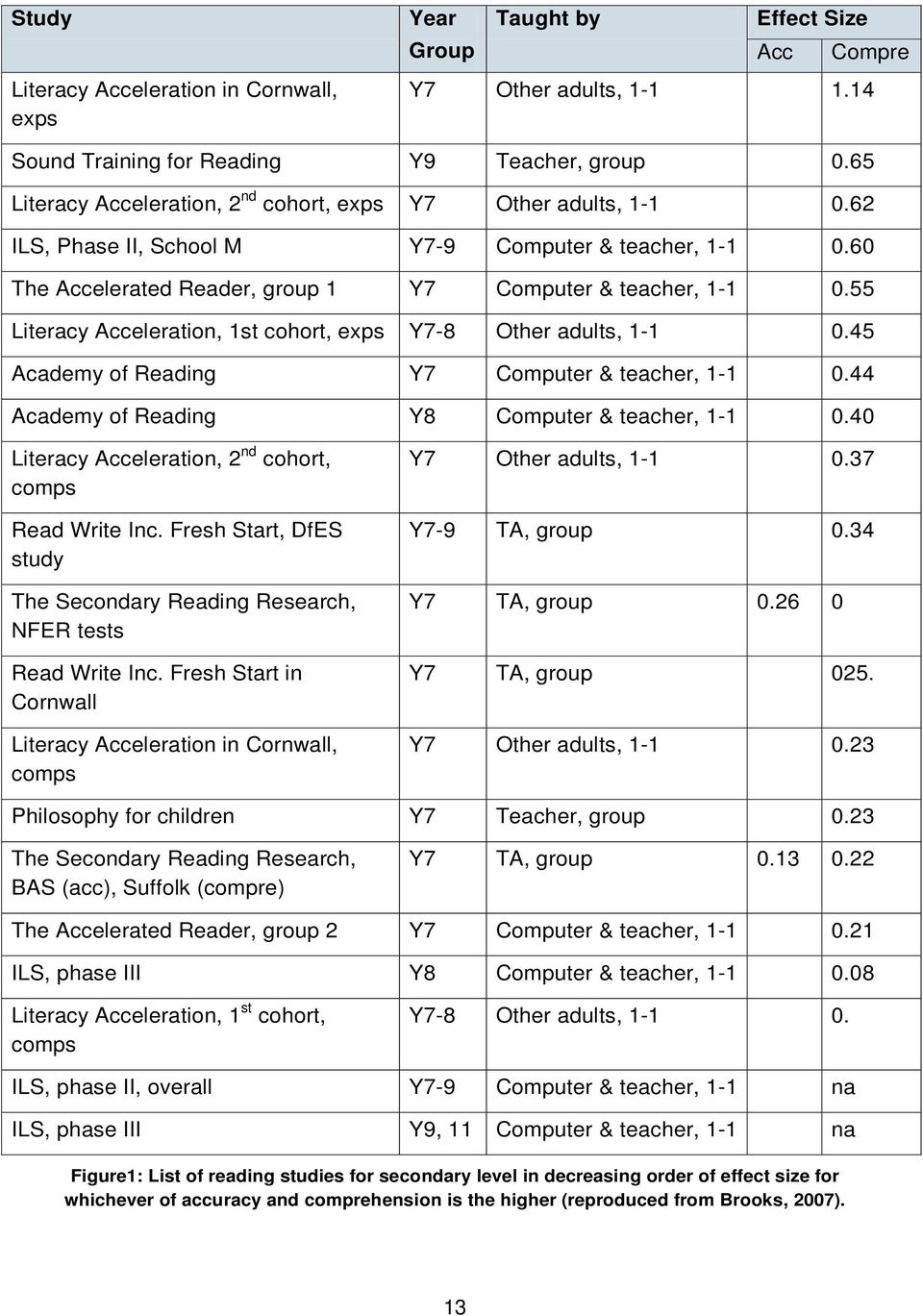
12 intervention. Nevertheless, evaluations of fluency interventions have reported moderate to large effect sizes on speed of reading (although improved comprehension did not always result from improved fluency) (Wexler et al., 2007); and, Vocabulary as well as fluency deficits are hard to remediate in older readers: interventions focusing on these elements of reading may also need to encourage pupils to increase the amount and range of their personal reading support their development (Tunmer, 2008). Interventions in the UK Brooks (2007) looked at the effectiveness of intervention schemes used in the UK to target the reading, spelling or writing attainment of low-achieving pupils in Years He noted that there is much less evidence on reading interventions at secondary level, and none on writing interventions. The studies identified by Brooks that focused on interventions in secondary schools are listed in Figure 1 below. The studies are listed in decreasing order of effect size 2, with Brooks (2007) concluding that this represents evidence of useful to remarkable effectiveness 3 for schemes such as Academy of Reading, Literacy Acceleration, Read Write Inc. Fresh Start, and Sound Training. Brooks (2007) concluded overall that: Large-scale schemes, though expensive, can give good value for money; Where reading partners are available and can be given appropriate training and support, partnership approaches can be very effective; Success with some pupils with the most severe problems is elusive, and this reinforces the need for skilled, intensive, one-to-one intervention for these pupils; Interventions longer than one term may produce proportionally further benefits but the gains need to be carefully monitored; Good impact sufficient to at least double the standard rate of progress can be achieved, and it is reasonable to expect it; and, Most of the schemes which incorporated follow-up studies showed that the pupils maintained their gains or even made further gains. 2 An effect size is a statistical measure of the impact that an intervention has on particular outcomes, compared to no intervention or an alternative intervention. It can be positive or negative. 3 Brooks (2002) judges an effect size of or more to represent a satisfactory impact, and an effect size of +0.5 or more to represent a good to excellent impact. 12

13 Study Literacy Acceleration in Cornwall, exps Year Taught by Effect Size Group Acc Compre Y7 Other adults, Sound Training for Reading Y9 Teacher, group 0.65 Literacy Acceleration, 2 nd cohort, exps Y7 Other adults, ILS, Phase II, School M Y7-9 Computer & teacher, The Accelerated Reader, group 1 Y7 Computer & teacher, Literacy Acceleration, 1st cohort, exps Y7-8 Other adults, Academy of Reading Y7 Computer & teacher, Academy of Reading Y8 Computer & teacher, Literacy Acceleration, 2 nd cohort, comps Read Write Inc. Fresh Start, DfES study The Secondary Reading Research, NFER tests Read Write Inc. Fresh Start in Cornwall Literacy Acceleration in Cornwall, comps Y7 Other adults, Y7-9 TA, group 0.34 Y7 TA, group Y7 TA, group 025. Y7 Other adults, Philosophy for children Y7 Teacher, group 0.23 The Secondary Reading Research, BAS (acc), Suffolk (compre) Y7 TA, group The Accelerated Reader, group 2 Y7 Computer & teacher, ILS, phase III Y8 Computer & teacher, Literacy Acceleration, 1 st cohort, comps Y7-8 Other adults, ILS, phase II, overall Y7-9 Computer & teacher, 1-1 na ILS, phase III Y9, 11 Computer & teacher, 1-1 na Figure1: List of reading studies for secondary level in decreasing order of effect size for whichever of accuracy and comprehension is the higher (reproduced from Brooks, 2007). 13
14 Interventions in the US Slavin et al. (2008) conducted a systematic review of methods of improving reading in middle and high school pupils (11-18 year olds) in the US. The review looked at the available evidence on four types of approaches and concluded that: There is a lack of evaluation studies on the effectiveness of reading curricula, including textbooks; There are positive effects of mixed-method models which combine small and large-group instruction with computer-assisted instruction; There is a very small effect of computer-assisted instruction; and, There are three main groups of instructional-process programmes: cooperative learning, strategy instruction and comprehensive school reform. These programmes focus on providing high quality professional development for teachers so that they can use these specific instruction programmes in the classrooms. Slavin et al. (2008) concluded that programmes designed to change daily teaching practices and which had cooperative learning at their core were found to be most effective. Cooperative learning involves pupils working in small groups to help one another master reading skills and the success of the team depends on the individual learning of each team member. A secondary school programme called Read 180 which combines co-operative learning with ICT, has been found to be effective in deprived areas of the US (Woods, 2007; Nave, 2007; cited in Sharples et al., 2011). The programme is designed for pupils whose reading achievement is below the proficient level. The aim is to address gaps in pupils skills through the use of a computer programme, literature, and direct instruction in reading skills. The software component aims to track and adapt each pupils progress (US Department for Education, 2009). It should be noted however, that generally research has shown the use of ICT in reading has had minimal impact on reading outcomes at secondary level (Sharples et al., 2011). The National Reading Panel (NRP, 2000) evaluated the existing research about reading. They determined that guided repeated oral reading has a significant and positive impact on word recognition, reading fluency, and comprehension for pupils of all ages. However, they could not conclude that silent reading independently, without another type of reading instruction, improves reading fluency (NRP, 2000). 14

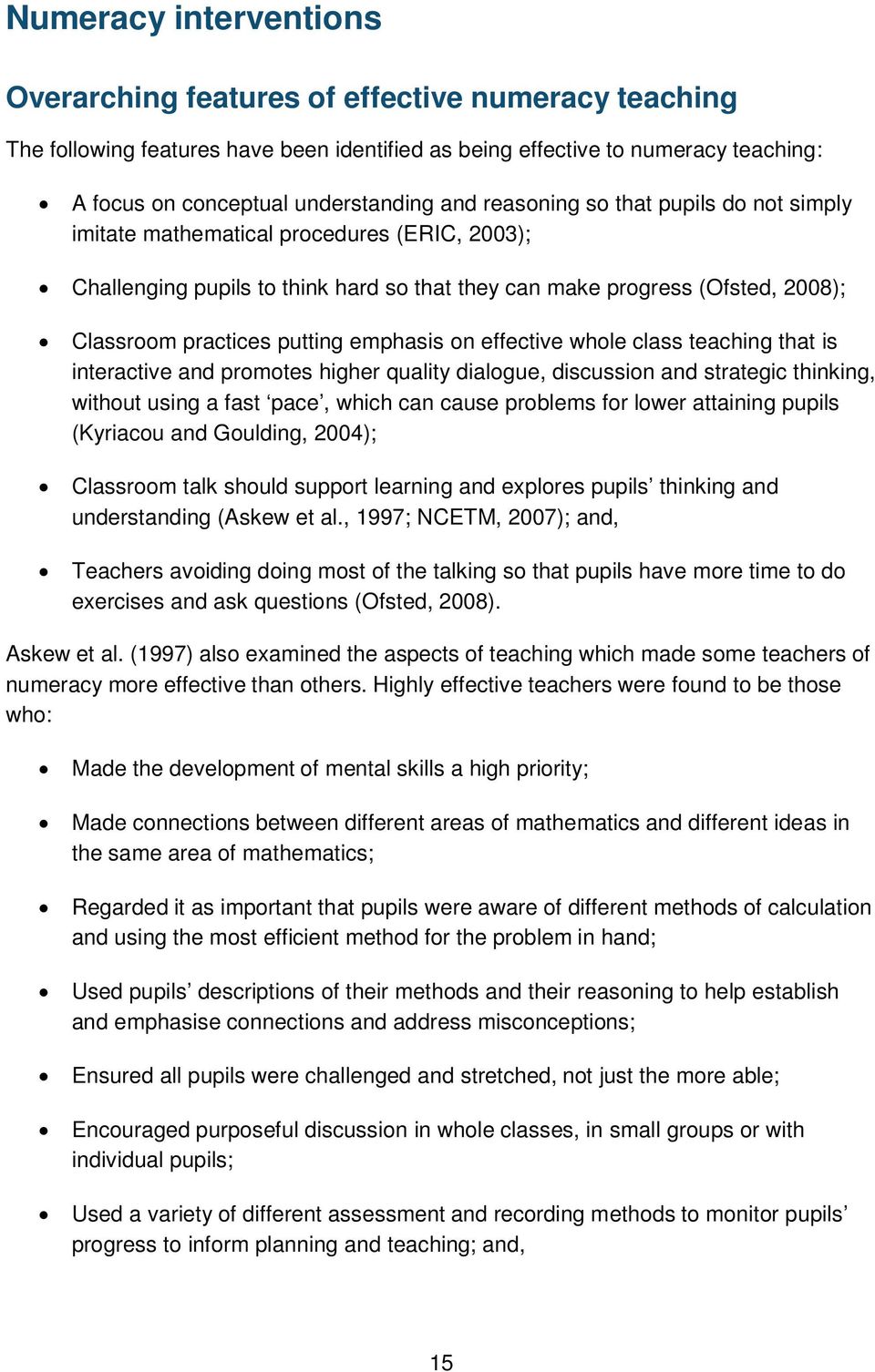
15 Numeracy interventions Overarching features of effective numeracy teaching The following features have been identified as being effective to numeracy teaching: A focus on conceptual understanding and reasoning so that pupils do not simply imitate mathematical procedures (ERIC, 2003); Challenging pupils to think hard so that they can make progress (Ofsted, 2008); Classroom practices putting emphasis on effective whole class teaching that is interactive and promotes higher quality dialogue, discussion and strategic thinking, without using a fast pace, which can cause problems for lower attaining pupils (Kyriacou and Goulding, 2004); Classroom talk should support learning and explores pupils thinking and understanding (Askew et al., 1997; NCETM, 2007); and, Teachers avoiding doing most of the talking so that pupils have more time to do exercises and ask questions (Ofsted, 2008). Askew et al. (1997) also examined the aspects of teaching which made some teachers of numeracy more effective than others. Highly effective teachers were found to be those who: Made the development of mental skills a high priority; Made connections between different areas of mathematics and different ideas in the same area of mathematics; Regarded it as important that pupils were aware of different methods of calculation and using the most efficient method for the problem in hand; Used pupils descriptions of their methods and their reasoning to help establish and emphasise connections and address misconceptions; Ensured all pupils were challenged and stretched, not just the more able; Encouraged purposeful discussion in whole classes, in small groups or with individual pupils; Used a variety of different assessment and recording methods to monitor pupils progress to inform planning and teaching; and, 15
16 Had a good subject knowledge gained from extended mathematics-focused Continuing Professional Development (CPD). Interventions across primary and secondary schools Slavin et al. (2009) reviewed 189 studies on teaching strategies in mathematics across primary and secondary education. They found that the most successful mathematics programmes focused on changing daily teaching practices, particularly the use of cooperative learning methods, classroom management, and motivation programmes. The most successful mathematics programmes encouraged pupil interaction. Mathematics interventions were categorised into: mathematics curricula, ICT and teaching strategies. Mathematics curricula Slavin et al. (2009) identified 13 studies of primary mathematics curricula and 40 of secondary mathematics curricula. The curricula included: Innovative strategies focusing on problem solving, alternative solutions and conceptual understanding; Traditional commercial textbooks; and, Back-to-basics textbook emphasising a step-by-step approach. Overall, they found no evidence to recommend one type of curriculum over another. ICT Slavin et al. (2009) identified 38 studies in primary schools and 40 in secondary schools. In primary schools, most studies showed positive effects of ICT on mathematics, although there was not enough evidence to recommend one programme over another. On the other hand, in secondary schools there was little evidence on the effectiveness of ICT. Teaching strategies Slavin et al. (2009) identified 36 studies in primary schools and 22 in secondary schools. They found that professional development programmes had the strongest evidence of effectiveness, with cooperative learning being particularly strong across primary and secondary schools. Sconiers et al. (2003; cited in Sharples et al., 2011) evaluated innovative constructivist programmes in schools throughout the US. They found very modest differences for pupils in primary schools on constructivist programmes such as Everyday Mathematics, Math 16

17 Trailblazers and Investigations in Number, Data, and Space. Similarly in secondary schools, studies of constructivist curricula, emphasising problem solving, and concept development have not been found to be effective in increasing performance (Sharples et al., 2011). Numeracy interventions for primary school pupils Interventions in the UK A review by Dowker (2009) used literature searches and contact with local authorities to identify numeracy intervention used in primary schools in the UK, and any evaluation evidence on them, building on Dowker s previous review in Overall, Dowker (2009) found that the evidence base on numeracy intervention is patchy, and less developed than the evidence base on literacy interventions, in particular in terms of comparing levels of improvement between different mathematics intervention schemes. Dowker (2009) highlighted that: Interventions for numeracy are increasingly widely used in schools in the UK; Schools and local authorities report positive effects of numeracy interventions for both attainment and attitudes; Where available, before and after test scores have also indicated positive effects on attainment; Individually targeted interventions appear worthwhile and should be continued and further developed; There is no evidence that any one programme is best for most or all pupils; The success of intervention schemes depends significantly on effective management and training; The use of suitable assessments as part of the intervention is important, as is provision of adequate guidance on assessment to teachers; The use of structured apparatus and multisensory teaching can be helpful and effective in interventions, especially with pupils who have language difficulties; and, There is as yet no evidence on the possible role of ICT to support teacher led interventions. The review by Dowker (2004) included international studies and explored the literature on mathematical interventions in more depth, highlighting that: 17

18 The quality of teaching assistants' interventions for pupils with mathematical difficulty is positively impacted by training; Peer tuition and group collaboration approaches (e.g. older pupils teaching younger pupils; more able classmates teaching less able classmates; collaborative learning between pupils of similar abilities) can be effective, but are unlikely to be a complete substitute for adult intervention, particularly for those with more severe needs; Training in formal operations (the manipulation of symbols and abstractions) can positively impact on the mathematical development of older children and adolescents; Training in metacognitive skills has been shown to be effective in some cases, but more research is needed on exactly which aspects of metacognition are important; In many cases, interventions do not need to be very time-consuming or intensive to be effective; Pupils arithmetical difficulties are highly susceptible to intervention; It is desirable that interventions should take place at an early stage to reduce the likelihood of pupils developing mathematics anxiety. Anxiety about mathematics can be distressing in itself and inhibit further progress; and, Low attainers in mathematics benefit from detailed assessment of their learning needs, and interventions work best when they are targeted on an individual pupil s weakness. Individualised intervention focuses on diagnosing the learning needs of each pupil and tailoring teaching to meet those needs. Evidence on this strategy includes work by Dowker (2004) who found that: The Oxford based Numeracy Recovery Programme aims to address arithmetical difficulty in young pupils (typically aged six to seven) and uses a componential approach based on cognitive theories of arithmetic. The programme was piloted with pupils who were identified by their teachers as having problems with arithmetic. During the programme, the pupils were assessed and then received an individual 30 minute session focusing on their difficulties each week, for approximately 30 weeks. The results of 146 pupils in the intervention group showed significant improvement over those in the control group. 101 pupils from the intervention group were retested over the course of a year, and maintained their improvement. Sammons et al. (2006), in an analysis of teaching practice in 125 Year 5 primary schools, found moderately significant associations between the quality of teaching and Key Stage 18

19 2 results. In mathematics, four aspects of pedagogy were moderately associated with outcome at Key Stage 2: Good classroom routines; Use of maths analyses (pupils were given opportunities to construct original ways to solve mathematics problems and allowed to make conjectures with justifications); Depth of knowledge (i.e. the extent to which mathematics knowledge is treated deeply in class. This was demonstrated by teachers who structured their lessons so that most pupils were engaged in at least one of the following: demonstrating their understanding of the problematic nature of information or ideas, demonstrating complex understandings by arriving at a reasoned, supported conclusion or explain how they solved a complex problem); and, Locus of maths authority (the extent to which the teacher and the pupil hold each other accountable for convincing themselves and each other that their reasoning is sound. In these classrooms the teacher often answers a question with a question or offers instrumental help (good scaffolding), pushing pupils to make their own decisions). Numbers Count (NC) Numbers Count (NC) provides an intensive one-to-one intervention for those pupils identified as lowest achievers in Wave 3 (see waves outlined below). In practice it aims to raise their level of performance so that they achieve Level 2C or higher, and wherever possible Level 2B or higher by the end of Key Stage 1 in effect putting them on a par with their peers, and enabling them to continue to progress in mathematics in the normal mainstream class setting. The Every Child Counts (ECC) 4 initiative develops mathematics interventions for Year 2 pupils within the following three waves: Wave 1 Quality classroom teaching for all pupils; Wave 2 Small group additional intervention for pupils just below national expectations; and, 4 The main aim of ECC is to develop and support an intervention for the lowest achieving 5% of KS1 pupils, with a subsidiary aim of impacting on standards more widely by influencing classroom practice and supporting less intensive (teaching assistant led) interventions for the low achieving 5-10% group. 19
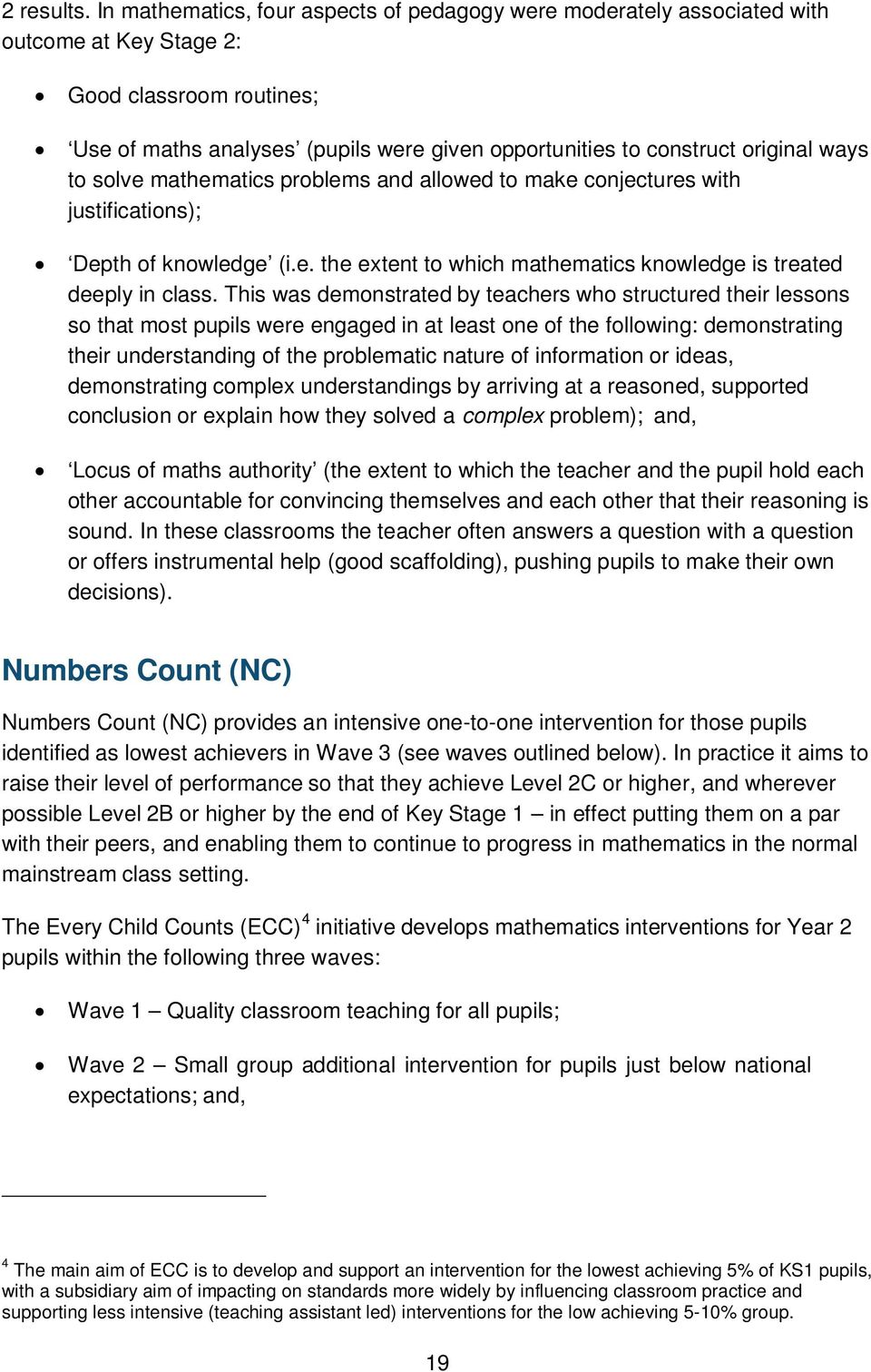
20 Wave 3 Individual or very small group intervention with a trained and supported teaching assistant for pupils who are struggling, and additional intervention on an individual and/or very small group basis with a trained specialist teacher. Torgerson et al., (2011) evaluated the short-term impacts of NC, an adapted version of NC for small groups and normal classroom teaching (without the intervention) using randomized controlled trials. The evaluation investigated the attainment of pupils who received NC (intervention group) in addition to normal classroom teaching compared with pupils who received normal classroom teaching only (control group). It also investigated the attainment of pupils who received NC individually compared with pupils who received adapted NC in small groups of pairs or triplets. All pupils continued to receive normal classroom teaching in mathematics. Pupils were withdrawn from a range of classroom activities to receive NC. Torgerson et al. (2011) found that: Pupils who received NC achieved higher average (mean) progress in mathematics (PIM 6) test scores immediately after they had received the intervention, compared with an equivalent group of pupils who did not receive NC. This result was statistically significant; the effect size was This is the equivalent to seven additional weeks improvement for pupils who received NC compared with pupils who did not receive NC; There were no statistically significant differences in the mean PIM 6 mathematics test scores between the pupils who received NC individually and the pupils who received adapted NC in pairs, immediately after they had received the intervention, revealing that adapted NC delivered in pairs was as effective in raising performance in mathematics immediately after the intervention as individual NC. The sample size was small, and so the results should not be the basis of strong generalisations; Secondary analyses investigating the short- and medium-term impact of the EEC programme on schools by making comparisons with schools that did not receive the programme produced inconclusive results overall: the researchers were unable to detect an effect on mathematics that could be attributed to ECC, rather than to a general increase in scores. This is not to say with certainty that there was no effect but rather, using a quasi- experimental approach, no acceptably reliable evidence of an effect was found; and, NC led to an extra 9% of pupils working at the equivalent of Key Stage 1 Level 2C immediately after receiving NC in January, five or six months before the normal assessment time at Key Stage 1. NC delivered to pairs of pupils was found to be more cost-effective than NC delivered to individual pupils: 20
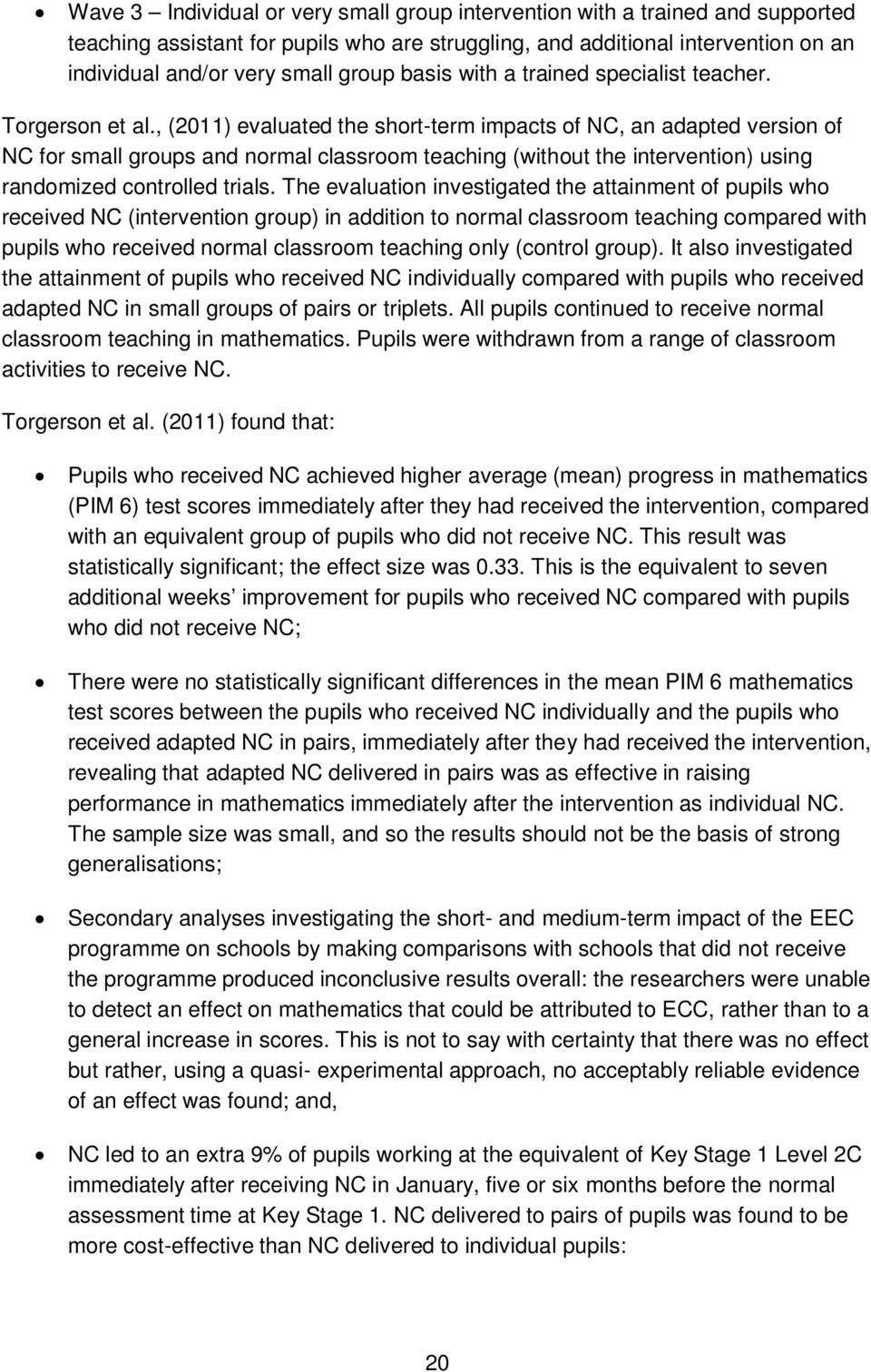
21 o The cost per additional pupil working at the equivalent of a Key Stage 1 Level 2C or above on the PIM 6 test is approximately 5,000 for adapted NC delivered to pairs of pupils compared with usual teaching. The cost is approximately 15,000 for NC delivered individually compared with usual teaching. o The cost per extra numeracy week gained by individual delivery of NC is approximately 193 for each child. Torgerson et al. (2011) concluded that NC clearly has a short-term impact on individual pupils, however, it is relatively expensive, and the evaluation was unable to derive strong conclusions of the medium-term impact of ECC and NC on pupils and schools. NC was considered to be well designed and it received strong support from the participating schools. Numbers Count 2, aimed at Years 4 to 6, is currently being trialled. In the trials, pupils have increased their average Number Age by over 14 months after 42 lessons. Training for existing Numbers Count Teachers will be available from November 2012, with training for new Numbers Count Teachers available from January Numeracy interventions for secondary school pupils There is little evidence on numeracy interventions for secondary school pupils. A US study examined the impact of standards-based mathematics programmes used in elementary and middle schools, compared to traditional curricula (Riordan and Noyce, 2001). The research used comparison groups to robustly determine the impact of the programme on pupils achievement. The standards-based approach recommends that the curriculum should place an emphasis on problem solving, and making connections between mathematics topics. This approach also encourages the teaching of mathematical concepts (such as algebra and probability). Compared to the mathematics instructions approach which is commonly used in the US, the standards-based programme places less emphasis on memorisation and less time is devoted exclusively to skills development. The research found that fourth grade and eighth grade pupils using the two standards- based programmes (Everyday Mathematics and Connected Mathematics) significantly outperformed their matched peers from schools using a mix of traditional programmes and curricula. 5 Visit the Every Child Counts website for more information. 21
22 Generic strategies which are beneficial for low attainers There are a range of strategies which are beneficial for low attainers. These include: early intervention, direct, targeted instruction from the teacher, clear learning goals, constructive feedback and well planned pair and group work (Sammons et al., 2006). Early intervention is needed to prevent low attainers developing further problems (Brooks, 2002; Dowker, 2004). This can have positive effects on standards in English and mathematics (Dowker, 2009; Brooks, 2007); Monitoring pupils progress is important so that pupils who need it most are identified and receive targeted intervention (e.g. Sharples et al., 2011); An effective learning experience is tailoring teaching to the appropriate needs of individual pupils, particularly low attainers, and personalising the curriculum for pupils has been found to be effective (Dunne et al., 2007); Coaching teachers/teaching assistants in specific teaching strategies significantly raises outcomes for children living in poverty. Evidence-based approaches include cooperative learning (structured groupwork), frequent assessment and learning to learn strategies (Sharples et al., 2011). Cooperative learning can also be particularly effective in increasing the attainment of low ability pupils (Slavin, 1995); Many studies have found that cognitive approaches (based on mental processes) can help low attainers develop higher order skills and basic skills (Higgins et al., 2004; Lubben et al., 2005; Barley et al., 2002; Topping and Bryce, 2004); One-to-one tuition can be an effective form of instruction (Cohen et al., 1982). This has a greater effect if delivered by teachers themselves rather than teaching assistants or volunteers (Brown et al., 2005; Ehri et al., 2007), but it can be difficult to conclude whether success is due to the tutoring, or to a wider programme which the tutoring may be part of (Strayhorn and Bickel, 2003); Peer-to-peer support can have a positive impact on pupils. Low attaining pupils can be successfully targeted through effective group and pair work (Topping and Bryce, 2004); Two aspects of the home-school relationship are significant predictors of pupil outcomes: where teachers reported that their school was in active communication with parents, pupils made better academic progress and showed better selfreglation; and where teachers reported strong parental support, pupils made better progress in reading and pro-social behaviour (Sammons et al., 2007); 22
23 There is robust evidence showing a substantial impact of study support on pupil s attainment, school attendance and attitudes towards learning (e.g. MacBeath et al., 2001). In addition, Higgins et al. (2012) prepared a Teaching and Learning Toolkit for the Sutton Trust, examining: potential gain of a variety of approaches; cost; strength of research evidence; and applicability across Primary/Secondary and for mathematics/english/science. A summary of their findings is reproduced in Figure two. 23
24 Approach Potential Gain Cost Applicability Evidence Summary Feedback 9 months Pri, Sec, Maths, Eng, Science Very high impact for low cost Metacognition 8 months Pri, Sec, Maths, Eng, Science High impact for low cost Peer tutoring 6 months Pri, Sec, Maths, Eng High impact for low cost Early years intervention 6 months Sec, Maths, Eng High impact for very high cost One-to-one 5 months Pri, Sec, Maths, Eng Moderate impact for very high cost Homework 5 months Pri, Sec, Maths, Eng, Science Moderate impact for very low or no cost ICT 4 months Pri, Sec, All subjects Moderate impact for high cost Phonics 4 months Pri, Eng, Moderate impact for very low cost Parental involvement 3 months Pri, Sec, Maths, Eng, Science Moderate impact for moderate cost Sports participation 3 months Pri, Sec, Maths, Eng, Science Moderate impact for moderate cost Summer schools 3 months Pri, Sec, Maths, Eng Moderate impact for moderate cost Reducing class sizes 3 months Pri, Sec, Maths, Eng Moderate impact for very high cost After-school programmes 2 months Pri, Sec, Maths, Eng, Science Low impact for high cost Individualised instruction 2 months Pri, Sec, Maths, Eng, Science Low impact for low cost Learning styles 2 months Pri, Sec, All subjects Low impact for very low or no cost Arts participation 1 month Pri, Sec, Maths, Eng, Science Very low impact for low cost Performance pay 0 months Pri, Sec, Maths, Eng, Science Very low/no impact for moderate cost Teaching assistants 0 months Pri, Sec, Maths, Eng, Science Very low/no impact for high cost Ability grouping ±1 month Pri, Sec, Maths, Eng, Science Very low or negative impact for Block scheduling School uniforms ±1 month Pri, Sec, Maths, Eng, Science ±1 month Pri, Sec, Maths, Eng, Science very low or no cost Very low or negative impact for very low or no cost Very low or negative impact for very low or no cost Figure 2: Gain, Cost and Applicability of approaches used in schools in the UK. 24
25 Transfer and transition from primary to secondary school An important time in a pupils schooling is the transition or transfer from primary to secondary school. Support for pupils from deprived backgrounds who may lack the emotional resilience at times of transition has been shown to be effective. Six key principles of effective practice at times of transfer and transition have been identified from the literature. Principle 1: Maintain collaboration before and after transfer Evidence shows that collaboration before and after transfer is an important facilitator of effective transfers. DCSF (2008) undertook action research across seven local authorities and 47 primary and secondary maintained schools (including some special schools) to explore what can strengthen transfer and transition practices. The report concludes that effective transfer does not involve one Key Stage doing transfer to the next, but an equal partnership that has professionally developed all stakeholders. Similarly, Galton et al. (1999, 2003) highlight the importance of bridging units (projects which are begun in Year 6 and completed in Year 7) to help inform and personalise the pupil transfer experience. Effective practice includes: The establishment of cross-phase (i.e. primary and secondary) working processes within and between children s services (DCSF, 2008); Planning schemes of work that promote continuity of curriculum and of teaching and learning styles (DCSF, 2008); The facilitation and support of local cross-phase networking meetings of families of schools to jointly plan for strengthening transfer (DCSF, 2008); and, The planning of bridging units which include joint working between teachers in different Key Stages to promote an understanding of pupils abilities and levels of knowledge. The work included within the bridging units should be jointly planned to maximise personalisation (Galton et al., 1999, 2003). Principle 2: Facilitate effective communication Effective communication between teachers, parents/carers and pupils is one of the most effective practices for improving transition to both primary and secondary school. Effective practice includes: Visits by teachers to each other s schools which include lesson observations and discussions of the curriculum to develop greater integration and understanding of each other s work (Bryan et al., 2007); 25
26 Organising conferences and forums to enable professional dialogue, the dissemination of research findings and the sharing of good practice (DCSF, 2008); Establishing clear systems and structures that facilitate collaboration with partner schools (DCSF, 2008); Involving parents/carers in the preparation for transition and developing their understanding of the culture of the new school and what to expect. This includes promoting and enhancing the role of parent/carer partnerships (e.g. through Parent/Carer Advisers) (Greenhough et al., 2007; DCSF, 2008); The use of pupil and parent/carer voice systems to monitor and evaluate practice in relation to transfers and transitions (DCSF, 2008); Providing parents/carers with sufficient information about transition including what will be expected of their children, so they can help them to prepare (Sanders et al., 2005); and, Ensuring that pupils are involved in the transition process at all stages, and are well informed of what to expect in their new school (Schulting et al., 2005; LoCasale-Crouch et al., 2008; DCSF, 2008). Principle 3: Prioritise and invest in school visits and induction programmes Evidence shows that school visits and induction programmes can improve social and academic outcomes provided they are well planned and resourced. Effective practice includes: Planning and promoting school visits before transfer to give pupils and parents/carers a good understanding of the new school (DfES, 2005; Schulting et al., 2005; LoCasale-Crouch et al., 2008); Providing teachers with adequate training and detailed briefings on how to deliver well structured induction programmes (Galton et al., 2003); Involving core departments (notably English and mathematics) in the planning and administration of secondary induction programmes (Galton et al., 2003); Encouraging the regular use of secondary school facilities by Year 6 pupils (Galton et al., 2003); Setting up after school clubs run by the secondary school for pupils from feeder primaries (Galton et al., 2003); and, 26
27 Ensuring that pupils from Years 6 and 7 have the opportunity to work together during day visits (Galton et al., 2003). Principle 4: Develop practices for particular types of pupils Evidence suggests that transfer and transition experiences differ for different types of pupils and that different support mechanisms for these pupils can help facilitate effective transfer/transition. Effective practice includes (Taverner et al., 2001): The identification of at risk pupils and the implementation of specific activities to understand the issues that they may face during transfer. This could include asking pupils what they expect at a new secondary school, what their concerns are, and what their actions would be if faced by particular problems; Modifying approaches for pupils with Special Educational Needs (SEN) by consulting educational psychologists (where needed) and planning particular transfer strategies based on informed advice; Raising the performance of low attainers at the end of Key Stage 2 through summer schools; and, Identifying drops in attainment during transitions and developing strategies to address these at the start of a new school year. Principle 5: Ensure schools have clear roles and responsibilities that are supported by senior management Effective transition is reliant on a whole school approach where school staff have clear roles and responsibilities, senior staff are engaged and the use of progression data is promoted to monitor effectiveness. Effective practice includes: Secure the backing of the Headteacher and Senior Leadership Team (SLT). This includes securing a leader with the status to give importance to transfer and transition and who is able to align these processes with wider school improvement priorities (DfES, 2005; DCSF, 2008); Ensure that staff have defined responsibilities. For example, having a named person responsible for: o meeting parents/carers who would like to drop in and discuss issues; o managing data on new pupils (including prior attainment at Key Stages 1 and 2 and teacher assessment judgements); 27
28 o listening and responding to pastoral issues amongst new pupils (DfES, 2005); Allocate experienced teachers to Year 7 and, where possible, teaching assistants for the first half term after transfer. These staff can contribute to assessment, support pupils with SEN, provide insights into the needs of individuals and maintain established routines when they change classes with individual pupils (Ofsted, 2004); Ensure that high quality data are available for every pupil joining a new school (DfES, 2005; Kirkup et al., 2005); Establish a clear strategic vision for strengthening transfers and transitions through the work of the governing body, self-evaluation and the school improvement plan (DCSF, 2008); Develop a transfer and transitions policy that aligns with the school improvement plan and contributes to raising standards and closing attainment gaps between identified groups (DCSF, 2008); and, Engage with and contribute to LA plans to share effective practice and develop consistency (DCSF, 2008). Principle 6: Disseminating good practice The transfer process can be improved when good transition is initiated and facilitated and examples of good practice are identified and disseminated: Schools engage with national and local documentary evidence about various aspects of transfer in need of further development and school-based initiatives address these areas (Taverner et al., 2001); CPD for senior leaders, teachers and other adults who work with pupils and/or their families (DCSF, 2008); Identifying and disseminating examples of good practice with local schools (Taverner et al., 2001); Collating and combining individual schools documents and reproducing them as guidance materials (Taverner et al., 2001; DCSF, 2008); and, Building capacity and sustainability for ongoing improvement by involving pupils and parents/carers in the monitoring, reviewing and planning process and strategically sharing effective practice, (DCSF, 2008). 28
29 References Askew, M., Brown, M., Rhodes, V., Wiliam, D. & Johnson, D. (1997) Effective teachers of numeracy. Final report. London: King s College. Barley, Z., Lauer, P., Arens, S., Apthorp, H., Englert, K., Snow, D. and Akiba, M. (2002) Helping At-Risk Students Meet Standards: A synthesis of evidence-based classroom practices. Mid-Continent Research for Education and Learning. Borman, G., Slavin, R.E., Cheung, A., Chamberlain, A., Madden, N.A., & Chambers, B. (2007) Final reading outcomes of the national randomized field trial of Success for All. American Educational Research Journal, 44(3) Brooks, G. (2002) What works for children with literacy difficulties? Effectiveness of intervention schemes. DfES Research Report 380 Brooks, G. (2007) What works for pupils with literacy difficulties? The effectiveness of intervention schemes. Third edition. DCSF Brown, K., Morris, D. and Fields, M. (2005) Intervention after grade 1: serving increased numbers of struggling readers effectively, Journal of literacy research, vol 37, no 1, pp Bryan, R. and Treanor, M. with Hill, M. (2007) Evaluation of pilots to improve primary and secondary school transitions, Edinburgh: Scottish Executive. Calhoon, M., Al Otaiba, S., Cihak, D., King, A. and Avalos, A. (2007) The effects of a peer-mediated program on reading skill acquisition for two-way bilingual first-grade classrooms, Learning disability quarterly, vol 30, no 3, pp Chambers, B., Cheung, A., Slavin, R.E., Smith, D. and Laurenzano, M. (2010) Effective early childhood education programs: a systematic review, Baltimore, MD: Center for Research and Reform in Education, Johns Hopkins University. Clipson-Boyles, S. (2000) The Catch Up Project: a reading intervention in Year 3 for Level 1 readers. Journal of Research in Reading, 23, 1, Cohen P.A., Kulik, J.A. and Kulik C.L.C. (1982) Educational outcomes of tutoring: A meta-analysis of findings. American Educational Research Journal, 19, DCSF (2008). Strengthening transfers and transitions: partnerships for progress. London: DCSF. DfES (2005) Key Stage 2 to Key Stage 3 Transition Project. London: DfES Dowker, A.D. (2004) What works for Children with Mathematical Difficulties? London: DfES RR554 29
30 Dowker, A.D. (2009) What works for Children with Mathematical Difficulties? The effectiveness of intervention schemes. London: DCSF Dunne, M., Humphreys, S., Sebba, J., Dyson, A., Gallannaugh, F. and Mujis, D. (2007) Effective teaching and learning for pupils in low attaining groups. London: DCSF RR011 Ehri, L., Dreyer, L., Flugman, B. and Gross, A. (2007) Reading rescue: an effective tutoring intervention model for language-minority students who are struggling readers in first grade, American educational research journal, vol 44, no 2, pp ERIC (2003) Providing Highly Mobile Students with an Effective Education. ERIC Digest: ED Galton et al (1999). Impact of School Transitions and Transfers on Pupil Progress and Attainment. DfES Research Report 131. Galton et al (2003). Transfer and Transitions in the Middle Years of Schooling (7-14): Continuities and Discontinuities in Learning. DfES Research Report 443. Greenhough, P., Hughes, M., Andrews, J., Goldstein, H., McNess, E., Osborn, M., Pollard, A., Stinchcombe, V. and Yee, W.-C. (2007) What effect does involving parents in knowledge exchange activities during transfer from key stage 2 to key stage 3 have on children s attainment and learning dispositions?, paper presented at the British Educational Research Association Annual Conference, Institute of Education, University of London, 5 8 September. Higgins, S., Baumfield, V., Lin, M., Moseley, D., Butterworth, M., Downey, G., Gregson, M., Oberski, I., Rockett, M. and Thacker, D (2004) Thinking skills approaches to effective teaching and learning: what is the evidence for impact on learners. In: Research Evidence in Education Library. London: EPPI-Centre, Social Science Research Unit, Institute of Education Higgins, S., Kokotsaki, D., and Coe, R. (2012). The Teaching and Learning Toolkit. Education Endowment Foundation and The Sutton Trust. Houge, Geier and Peyton (2008) Targeting adolescents' literacy skills using one-to- one instruction with research-based practices. Journal of Adolescent and Adult Literacy, 51:8, May 2008, pp Kirkup, C., Sizmur, J., Sturman, L. and Lewis, K. (2005) Schools Use of Data in Teaching and Learning. DfES Research Report 671. Kyriacou, C. and Goulding, M (2004) A systematic review of the impact of the Daily Mathematics Lesson in enhancing pupil confidence and competence in early mathematics. In Research Evidence in Education Library. London: EPPI-Centre, Social Science Research Unit, Institute of Education, University of London. 30
31 LoCasale-Crouch, J., Mashburn, A.J., Downer, J.T. and Pianta, R.C. (2008) Prekindergarten teachers use of transition practices and children s adjustment to kindergarten, Early childhood research quarterly, 23 (1), pp Lubben, F., Bennett, J., Hogarth, S. and Robinson, A. (2005) A systematic review of the effects of context-based and Science-Technology-Society (STS) approaches in the teaching of secondary science on boys and girls, and on lower-ability pupils. In: Research Evidence in Education Library. London: EPPI-Centre, Social Science Research Unit, Institute of Education, University of London. MacBeath, J., Kirwan, T., Myers, K., Smith, I., McCall, J., and McKay, E. with Sharp, C., Bhabra, S., and Pocklington, K. and Weindling D. (2001). The Impact of Study Support. DfES RR273. National Reading Panel (2000). Teaching Children to Read: An evidence-based assessment of the scientific research literature on reading and its implications for reading instruction. NCETM (2007) Evidence Bulletin: How can you use research evidence to enhance your mathematics teaching? Ofsted (2004) Transition from the Reception Year to Year 1. An evaluation by HMI. London: Ofsted. Ofsted (2008). Mathematics: understanding the score. Messages from inspection evidence (Reference no: ). Riordan, J., and Noyce, P.E. (2001). The Impact of Two Standards Based Mathematical Curricula on Student Achievement in Massachusetts. Journal for Research in Mathematics Education 32. Sammons, P., Sylva, K., Melhuish, E., Siraj-Blatchford, I., Taggart, B., Barreau, S. and Grabbe, Y. (2007). EPPE 3-11: The Influence of school and teaching quality on children s progress in primary school. DCSF RB028. Sammons, P., Taggart, B., Siraj-Blatchford, I., Sylva, K., Melhuish, E., Barreau, S. and Manni, L. (2006) EPPE: Summary report: variations in Teacher and Pupil Behaviours in Year 5 classes. DfES RR817. Sanders, D., White, G., Burge, B., Sharp, C., Eames, A., McEune, R. and Grayson, H. (2005). A Study of the Transition from the Foundation Stage to Key Stage 1. London: DfES Schulting, A.B.; Malone, P.S. and Dodge, K.A. (2005). The effect of school-based kindergarten transition policies and practices on child academic outcomes. Developmental Psychology, 41 (6). Pp
32 Shapiro, L.R. and Solity, J. (2008) Delivering phonological and phonics training within whole class teaching, British Journal of Educational Psychology, vol 78, no 4, pp Sharples, J., Slavin, R., Chambers, B. and Sharp, C. (2011) Effective classroom strategies for closing the gap in educational achievement for children and young people living in poverty, including white working-class boys: Schools and Communities Research Review 4: C4EO Slavin, R. (1995) Research on co-operative learning and achievement: what we know, what we need to know. Baltimore: John Hopkins University. Slavin, R.E., Cheung, A., Groff, C., and Lake, C. (2008). Effective Reading Programs for Middle and High Schools: A Best-Evidence Synthesis. Reading Research Quarterly, 43(3), Slavin, R.E., and Lake, C. (2008) Effective programs in elementary mathematics: A best evidence synthesis. Review of Educational Research, 78(3), Slavin, R.E., Lake, C., Davis, S. and Madden, N. (2010) Effective programmes for struggling readers: a best-evidence synthesis, Educational research review, Slavin, R., Lake, C., and Groff, C (2009). What works in teaching maths? Report summary. Institute for effective education and University of York Smith, V. and Ellis, S. (2005) A Curriculum for Excellence: Review of Research Literature. Language and Literacy. University of Strathclyde. Strayhorn J.M. and Bickel D.D.P. (2003) A randomised trial of individual tutoring for elementary school children with reading and behaviour difficulties. Psychological Reports, 92, Tanner, E., Brown, A., Day, N., Kotecha, M., Low, N., Morrell, G., Turczuk, O., Brown, V., Collingwood, A., Chowdry, H., Greaves, E., Harrison, C., Johnson, G. and Purdon, S. (2011) Evaluation of Every Child a Reader (ECaR) DfE Research Report 114 Taverner, S., Baumfield, V., Clark, J., Fisher, P.,Hall, I., Mei Lin., Smith, P. and Todd, L. (2001) Transition between Key Stages in Schools, Final Report for the Department of Local Government, Transport and the Regions (DLTR), Department of Education, University of Newcastle upon Tyne. Topping, K. and Bryce, A. (2004) Cross-age peer tutoring of reading and thinking: influence on thinking skills. In: Educational Psychology, 24(5), pp Tunmer (2008) Recent developments in reading intervention research: introduction to the special issue. Reading and Writing, June 2008, Vol. 21 Issue: Number 4 p
33 Wexler, Vaughn, Edmonds and Reutebuch (2007) A synthesis of fluency interventions for secondary struggling readers. Reading and Writing, June 2008, Vol. 21 Issue: Number 4 p
34 Crown copyright 2012 You may re-use this document/publication (not including logos) free of charge in any format or medium, under the terms of the Open Government Licence v2.0. To view this licence, visit or Where we have identified any third party copyright information you will need to obtain permission from the copyright holders concerned. Any enquiries regarding this publication should be sent to us at This document is available for download at Reference: DFE
1. Basic information about the school s special educational provision
 KNOTTINGLEY HIGH SCHOOL & SPORTS COLLEGE SPECIAL EDUCATION NEEDS POLICY Reviewed and Revised: September 2009 1. Basic information about the school s special educational provision a) Objectives To enable
Pakeman Pupil Premium Grant Expenditure: Report: 2013/14
 Pakeman Pupil Premium Grant Expenditure: Report: 2013/14 Context of School Pakeman Primary School is a one and a half form entry school in Islington. We have a Nursery and provide extended provision from
Mastery approaches to mathematics and the new national curriculum
 October 2014 Mastery approaches to mathematics and the new national curriculum Mastery in high performing countries The content and principles underpinning the 2014 mathematics curriculum reflect those
Toolkit of Strategies to Improve Learning
 Toolkit of Strategies to Improve Learning Summary for Schools Spending the Pupil Premium By Professor Steve Higgins, Durham University Dr Dimitra Kokotsaki and Professor Robert Coe, CEM Centre, Durham
The Importance of Phonics: Securing Confident Reading
 The Importance of Phonics: Securing Confident Reading 1. Literacy levels in England: what s happening now? After seven years of primary education, one in six 11 year olds still struggles to read. The 2011
Hillocks Primary and Nursery School
 Hillocks Primary and Nursery School Policy for Assessment, recording and reporting. 1 POLICY FOR ASSESSMENT, RECORDING AND REPORTING Introduction At Hillocks, the key purpose for assessment is to move
National Literacy Programme
 National Literacy Programme National Literacy Programme Audience Lead members for education, regional consortia, local authority directors of education, local authority advisers, headteachers and schools
Wave 3 Intervention Guide Intervention Briefing Sheets plus Examples of Intervention Monitoring Templates
 Wave 3 Guide Briefing Sheets plus Examples of Monitoring Templates Moving On Reading and Writing AcceleRead, AcceleWrite Direct Phonics Speed Challenge Fresh Start Programme Read, Write Inc. Rapid Reading
Longridge Primary SCHOOL IMPROVEMENT PLAN DATA LABEL-PUBLIC 1
 Longridge Primary SCHOOL IMPROVEMENT PLAN DATA LABEL-PUBLIC 1 Nurtured Safe Active 2015-2016 Healthy Successful Learner Achieving Confident Individual Included Respected Responsibl e Responsibl e Citizen
AfL with APP: developing collaborative schoolbased. Guidance for senior leaders
 AfL with APP: developing collaborative schoolbased approaches AfL with APP: developing collaborative school-based approaches First published in 2009 Ref:00824-2009PDF-EN-01 Disclaimer The Department for
Keir Hardie Primary School. Assessment and Marking Policy
 Keir Hardie Primary School Assessment and Marking Policy Assessment and Marking Policy Rationale At Keir Hardie Primary School we believe that assessment and marking form the basis of effective teaching
Ryburn Valley High School
 Ryburn Valley High School Assessment, Recording & Reporting Policy Date of Issue: February 2015 Strive to Excel Page 1 Contents Page Introduction Rationale 3 Aims and Objectives 3 Definitions 4 Development
Your child, your schools, our future:
 A commitment from The Children s Plan Your child, your schools, our future: building a 21st century schools system SUMMARY Building a 21st century schools system Summary 1 Summary Chapter 1 Our ambition
Great Hockham Primary School
 School report Great Hockham Primary School Watton Road, Great Hockham, Thetford, IP24 1PB Inspection dates 13 14 November 2013 Overall effectiveness Previous inspection: Satisfactory 3 This inspection:
Reading Policy. Contents. 1. Our aim 2. Reading procedures 3. Assessment of reading 4. Phonics 5. Layered approach 6. Guided reading 7.
 Reading Policy Policy Data Sheet Policy Name: Document Reference: Reading Policy BLSch026 Version Number: 1 Ratified By Principal: Chair of Governing Body Ratified Date: Board approval needed? Board Ratified
Our Ofsted rating? Overall Grade: Requires Improvement. The school has the following strengths
 St Ignatius College HOW WE SUPPORT CHILDREN/YOUNG PEOPLE WITH SPECIAL EDUCATIONAL NEEDS OR DISABILITIES What is the school s vision and mission statement? At St Ignatius College, we aim to find God in
Practical strategies to support the whole-school development of AfL with APP (Primary)
 Practical strategies to support the whole-school development of AfL with APP 1 of 11 The National Strategies Primary Practical strategies to support the whole-school development of AfL with APP This document
Damers First School Teaching & Learning Policy
 Damers First School Teaching & Learning Policy DAMERS FIRST SCHOOL HAPPY CHILDREN & HIGH QUALITY OHANA! In our family NO ONE GETS LEFT BEHIND Because we believe CHILDREN ARE OUR FUTURE. TEACH THEM WELL
Ensuring the attainment of more advanced learners of English as an additional language (EAL)
 1 of 36 The National Strategies Secondary Ensuring the attainment of more advanced learners of English as an additional language (EAL) CPDM 1 Senior leader briefing: leading change for more advanced EAL
School Strategic Plan for Highvale Secondary College 7918 2016-2019
 School Strategic Plan for Highvale Secondary College 7918 2016-2019 Endorsement by School Principal Signed Name Ian Watkins Date 15 September 2015 Endorsement by School Council Signed Name Fred Butcher
Salary The postholder will be paid on the appropriate point of the pay scale with the addition of the TLR 2B.
 JOB DESCRIPTION ASSISTANT CURRICULUM LEADER FOR SCIENCE (TLR 2B) Salary The postholder will be paid on the appropriate point of the pay scale with the addition of the TLR 2B. Line of Responsibility The
Minsthorpe Community College Local Offer
 Minsthorpe Community College Local Offer Vision / mission statement Minsthorpe Community College is an inclusive school with a strong belief that all students needs should be met as fully as possible irrespective
qwertyuiopasdfghjklzxcvbnmqwerty uiopasdfghjklzxcvbnmqwertyuiopas dfghjklzxcvbnmqwertyuiopasdfghjkl zxcvbnmqwertyuiopasdfghjklzxcvbn
 qwertyuiopasdfghjklzxcvbnmqwerty uiopasdfghjklzxcvbnmqwertyuiopas dfghjklzxcvbnmqwertyuiopasdfghjkl Reading by Six How the best schools do it St Stephen and All Martyrs CE Primary zxcvbnmqwertyuiopasdfghjklzxcvbn
An assumed proportionate share of the cost of an Assistant Principal overseeing the achievement of the target cohort and raising standards ( 40.
 Pupil Premium Funding Allocation (2015-16) Updated November 2015 Context 1. This paper provides details on the Academy s pupil premium allocation for 2015-16. The paper will be updated at the year-end
Regina Coeli Catholic Primary School. Mathematics Action Plan 2013-14
 Regina Coeli Catholic Primary School Mathematics Action Plan 2013-14 MATHEMATICS ACTION PLAN Ensure improved and consistent progress for all pupils of all ages and abilities across the school with particular
What is independent learning and what are the benefits for students?
 What is independent learning and what are the benefits for students? Author(s): Bill Meyer, Naomi Haywood, Darshan Sachdev and Sally Faraday Publisher: London: Department for Children, Schools and Families
Friars Primary Foundation School
 Friars Primary Foundation School Webber Street, London, SE1 0RF Inspection dates 13 14 June 2013 Overall effectiveness Previous inspection: Outstanding 1 This inspection: Requires improvement 3 Achievement
Mathematics Policy. Michael Sobell Sinai School
 Mathematics Policy 2014 Mathematics Policy Section 1: Introduction Mathematics is a creative and highly inter-connected discipline that has been developed over centuries, providing the solution to some
St George Catholic College. SEN Information Report 2015-2016
 St George Catholic College SEN Information Report 2015-2016 The SEN Information Report complies with section 69(2) of the Children and Family Act 2014, regulations 51 and schedule 1 of the Special Needs
Literacy Action Plan. An Action Plan to Improve Literacy in Scotland
 Literacy Action Plan An Action Plan to Improve Literacy in Scotland Literacy Action Plan An Action Plan to Improve Literacy in Scotland The Scottish Government, Edinburgh, 2010 Crown copyright 2010 ISBN:
A Framework for Governance: A flexible guide to strategic planning
 Improving governance for schools A Framework for Governance: A flexible guide to strategic planning January 2015 Improving School Governance 2 Improving governance for schools Why a Framework for Governance
Ss John Fisher, Thomas More High School Assessment, Reporting and Recording Policy
 Ss John Fisher, Thomas More High School Assessment, Reporting and Recording Policy Compiled by: CHA (members of SLT) Approved by: Curriculum Committee Date: May 2015 Revision Date: May 2016 Introduction
A Pupil Premium Handbook for Cambridgeshire Schools
 A Pupil Premium Handbook for Cambridgeshire Schools www.cambridgeshire.gov.uk 2 Contents 5 Foreword 6 Introduction 8 Teaching approaches which Close the Gap. 9 Effective feedback 10 Meta-cognition and
Improving schools. A guide to recent Ofsted reports to support school improvement
 A guide to recent Ofsted reports to support school improvement Foreword by Her Majesty s Chief Inspector Contents Foreword 3 Introduction 5 Getting to good 6 Moving English forward 8 Mathematics: made
AND LEARNING 21st Century Teaching and Learning
 21ST CENTURY TEACHING AND LEARNING 21st Century Teaching and Learning Dr. Grace Surdovel, Director of Master's Programs/Faculty of Practice The Master of Science in Education with a major in 21st Century
IDS data identified several schools across the County with low CVA/conversions according to the septiles (1 to 7 grading) at KS4.
 Delivering Intervention in Mathematics and English (DIME) Jane Moreton 8/9/2008 Introduction What were your reasons for doing this type of development work? IDS data identified several schools across the
Duncombe School Special Educational Needs and Inclusion Policy
 Duncombe School Special Educational Needs and Inclusion Policy Date Policy Reviewed Policy Reviewed By Reason/Outcome Next Review Due April 2013 Sue Howes Review Spring 2014 March 2014 Sue Howes Review
Fleetwood High School
 School report Fleetwood High School Broadway, Fleetwood, Lancashire, FY7 8HE Inspection dates 12 13 June 2014 Overall effectiveness Previous inspection: Inadequate 4 This inspection: Requires improvement
Personalised Learning A Practical Guide
 Personalised Learning A Practical Guide Personalised Learning A Practical Guide 1 Foreword The Children s Plan set out our vision of world class schools providing excellent, personalised teaching and learning,
Maths Non-negotiables
 Maths Non-negotiables Arithmetic must be taught on a daily basis. Its focus should be developing mental strategies fluency. Times tables should be a key mental maths focus in year 3 4. The new curriculum
PEDMORE TECHNOLOGY COLLEGE & COMMUNITY SCHOOL
 PEDMORE TECHNOLOGY COLLEGE & COMMUNITY SCHOOL ASSESSMENT, RECORDING, REPORTING, MARKING & TARGET SETTING POLICY July 2006 Updated October 2008 Reviewed January 2009 Updated May 2010 Updated September 2010
Skegness Grammar School
 School report Skegness Grammar School Vernon Road, Skegness, PE25 2QS Inspection dates 13 14 May 2014 Overall effectiveness Previous inspection: Not previously inspected This inspection: Good 2 Achievement
Vernon Park Primary School. Teaching and Learning Policy
 Vernon Park Primary School Teaching and Learning Policy The school s approach to teaching and learning is based upon the school vision: At Vernon Park Primary School we aim to provide all children, parents,
Learning Support Assistant
 Learning Support Assistant Reviewed: February 2014. Reports to: Lead / Principle Teaching Assistant. Purpose of Role: To work under the direct instruction of teaching staff, usually in the classroom with
Additional Educational Needs and Inclusion Policy and Procedures
 Additional Educational Needs and Inclusion Policy and Procedures Date of issue: February 2013 Review date: February 2014 This policy was discussed, agreed and formally accepted on 5 February 2013 by the
Making Best Use of Teaching Assistants Guidance Report
 Making Best Use of Teaching Assistants Guidance Report Jonathan Sharples Rob Webster Peter Blatchford I II V I II About the authors: 3 Doctor Jonathan Sharples is a senior researcher at the, on secondment
Looked after children good practice in schools
 Looked after children good practice in schools This is a short report based on a small-scale survey of good practice in schools in relation to looked after children. It does not cover all aspects of looked
Christ's College, Guildford Larch Avenue, Guildford, GU1 1JY
 Christ's College, Guildford Larch Avenue, Guildford, GU1 1JY Inspection dates 5 6 February 2013 Overall effectiveness Previous inspection: Satisfactory 3 This inspection: Good 2 Achievement of pupils Good
Reffley Community School
 School report Reffley Community School Reffley Lane, King's Lynn, PE30 3SF Inspection dates 3 4 July 2014 Overall effectiveness Previous inspection: Requires improvement 3 This inspection: Good 2 Achievement
Pages 9-16 Show the amount of pupil premium we have received this year and the specific strategies that we intend to utilise.
 What is it? Schools receive a payment, or Pupil Premium for any child who: who have been in receipt of free school meals at any point in the past 6 years or who have been continuously looked after the
Literacy catch-up programme
 Literacy catch-up programme Fischer Family Trust Wave 3 Summary Target audience Evidence of impact Method of delivery Practitioner support Learners aged six and seven who are reading and writing at a low
The Assessment for Learning Strategy
 The Assessment for Learning Strategy Foreword The Children s Plan set out our aim of a world-class education system for all, and personalised teaching and learning are at the heart of making this aim a
National Centre for Excellence in the Teaching of Mathematics. Supporting teachers to implement effective mathematics intervention strategies
 National Centre for Excellence in the Teaching of Supporting teachers to implement effective mathematics intervention strategies Introduction Teachers implementing any form of mathematical intervention
The importance of supporting children and young people s communication skills and what The Communication Trust does to enable this Shona Crichton,
 The importance of supporting children and young people s communication skills and what The Communication Trust does to enable this Shona Crichton, Professional Advisor, The Communication Trust Our vision......is
Trinity Catholic High School
 School report Trinity Catholic High School Mornington Road, Woodford Green, IG8 0TP Inspection dates 18-19 March 2015 Overall effectiveness Previous inspection: Outstanding 1 This inspection: Outstanding
WHAT MAKES GREAT TEACHING AND LEARNING? A DISCUSSION PAPER ABOUT INTERNATIONAL RESEARCH APPLIED TO VOCATIONAL CONTEXTS
 WHAT MAKES GREAT TEACHING AND LEARNING? A DISCUSSION PAPER ABOUT INTERNATIONAL RESEARCH APPLIED TO VOCATIONAL CONTEXTS Background Good teaching is the core driver of high quality learning. Linked with
Generic grade descriptors and supplementary subjectspecific guidance for inspectors on making judgements during visits to schools
 Religious education Generic grade descriptors and supplementary subjectspecific guidance for inspectors on making judgements during visits to schools Inspectors visit 150 schools each year to inform Ofsted
LEARNING SUPPORT POLICY 2015 to 2016 THE INTERNATIONAL SCHOOL OF LONDON - LONDON
 Last reviewed Wednesday 25 th November 2015 Mission Statement Diversity Passion Identity Understanding LEARNING SUPPORT POLICY 2015 to 2016 THE INTERNATIONAL SCHOOL OF LONDON - LONDON The International
Curriculum design, personalisation and raising standards
 Curriculum design, personalisation and raising standards Evidence from Ofsted Robin Hammerton HMI National Adviser - Personalisation 5 July 2010 Redbridge Firstly, define personalisation Departmental definition?
Evidence for Teachers Standards - Guidance
 An example list of suitable evidence against the Teachers' Standards (2012) 1. Set high expectations which inspire, motivate and challenge pupils a) Establish a safe and stimulating environment for pupils,
Assessment Policy. 1 Introduction. 2 Background
 Assessment Policy 1 Introduction This document has been written by the National Foundation for Educational Research (NFER) to provide policy makers, researchers, teacher educators and practitioners with
Inspection of schools: an update
 Raising standards, improving lives Inspection of schools: an update David Brown HMI National Lead for ICT Wednesday 22 January 2014 Inspections in 2012-13 Children now have the best chance they have ever
READING WITH. Reading with Pennsylvania Reading Specialist Certificate
 READING WITH PENNSYLVANIA READING SPECIALIST CERTIFICATE Reading with Pennsylvania Reading Specialist Certificate Program Coordinator: Ms. Anne Butler The Master of Science degree in Education with a concentration
South Axholme Community School
 School report South Axholme Community School Burnham Road, Epworth, Doncaster, DN9 1BY Inspection dates 30 31 January 2013 Overall effectiveness Previous inspection: Not previously inspected This inspection:
Teaching Reading. A Guide to the Report and Recommendations for Parents and Carers
 Teaching Reading A Guide to the Report and Recommendations for Parents and Carers National Inquiry into the Teaching of Literacy December 2005 Commonwealth of Australia 2005 This work is copyright. It
St Mary s College Crosby. Special Educational Needs and Disability Policy (P46) Date of Policy September 2014. Date of Review September 2015
 St Mary s College Crosby Special Educational Needs and Disability Policy (P46) Date of Policy September 2014 Date of Review September 2015 Introduction The College is committed to giving all pupils the
THE POLICY AND PROVISION FOR PUPILS FOR WHOM ENGLISH IS AN ADDITIONAL LANGUAGE
 ROSSALL SCHOOL THE POLICY AND PROVISION FOR PUPILS FOR WHOM ENGLISH IS AN ADDITIONAL LANGUAGE Statement of Aims The school is committed to making appropriate provision of teaching and resources for pupils
Understanding the Standards-based Individualized Education Program (IEP)
 Understanding the Standards-based Individualized Education Program (IEP) Many states and local school districts are embracing a new approach to developing Individualized Education Programs (IEPs) for students
Managing Pupil Mobility
 O F F I C E F O R S T A N D A R D S I N E D U C A T I O N Managing Pupil Mobility Reference number HMI 403 March 2002 Contents Managing Pupil Mobility...4 Introduction...4 Main findings...4 Data on mobility
Flipped Learning Evaluation Institute for Effective Education (University of York) Peter Rudd, PhD
 Evaluation Summary Age range Year 5 (9-10) Number of pupils Average 60 pupils per school Number of schools 12 treatment and 12 control schools Design Randomised Controlled Trial with Delayed Treatment
3. Name, qualifications and contact details for the Dartmoor Federation Special Educational Needs Coordinators (Senco)
 Dartmoor Federation Special Educational Needs and Disability Report 2014-15 1. The Kinds of SEND for which provision is made within the Dartmoor Federation: Dartmoor Federation will do its best to ensure
SWANMORE COLLEGE SEN (Special Educational Needs) Policy
 SWANMORE COLLEGE SEN (Special Educational Needs) Policy Policy Date: Dec 2013 Governor Committee: Pupil Wellbeing Governor Ratification Date: Jan 2014 Date of next Review: July 2014 In accordance with
Ashleigh C OF E (VC) Primary School Maintained
 TITLE: S.E.N.D. POLICY DATE ADOPTED: 21 st March 2016 REVIEW SCHEDULE: ANNUAL DATE OF NEXT REVIEW: MARCH 2017 Ashleigh C OF E (VC) Primary School Maintained Special Educational Needs & Disabilities (SEND)
Educational aspirations: how English schools can work with
 Educational aspirations: how English schools can work with parents to keep them on track Loic Menzies Schools and policy-makers in England put a lot of effort into raising aspirations to increase achievement
January 2015 Special Educational Needs Report/ Local Offer
 January 2015 Special Educational Needs Report/ Local Offer How will school / college staff support my child? Peacehaven Community School (PCS) is an inclusive school with a strong commitment to meeting
WHAT DO THEY KNOW? A summary of India s National Achievement Survey, Class V, Cycle 3, 2010/11. Supported by SSA TECHNICAL COOPERATION FUND
 WHAT DO THEY KNOW? A summary of India s National Achievement Survey, Class V, Cycle 3, 2010/11 Supported by SSA TECHNICAL COOPERATION FUND Contents Introduction 3 States of change why we evaluate 4 The
Special Educational Needs Policy
 Hayle Community School Special Educational Needs Policy Ref: SEND Code of Practice 0-25 years Contents: Page 1. Aims and Objectives 1 2. Definition of Special Educational Need 2 3. Responsible Persons
INVESTORS IN PEOPLE REVIEW REPORT
 INVESTORS IN PEOPLE REVIEW REPORT Lower Farm Primary School Page: 1 of 13 CONTENTS Key Information 3 Assessor Decision 3 Milestone Dates 3 Introduction 4 Assessment Objectives 4 Feedback Against the Assessment
Guided Writing as a means of Precise Intervention at Wave One
 Guided Writing as a means of Precise Intervention at Wave One Kirsten French 25/7/2008 Introduction What were your reasons for doing this type of development work? Wave One intervention is intervention
Da Vinci Community School
 School report Da Vinci Community School St Andrew's View, Breadsall, Derby, DE21 4ET Inspection dates 5 6 November 2014 Overall effectiveness Previous inspection: Requires improvement 3 This inspection:
8710.4725 TEACHERS OF READING.
 1 REVISOR 8710.4725 8710.4725 TEACHERS OF READING. Subpart 1. Scope of practice. A teacher of reading is authorized to facilitate and provide for kindergarten through grade 12 students instruction that
Darton College. Summary of key findings for parents and pupils. School report. Inspection dates 5 6 June 2013
 School report Darton College Ballfield Lane, Darton, Barnsley, South Yorkshire, S75 5EF Inspection dates 5 6 June 2013 Overall effectiveness Previous inspection: Satisfactory 3 This inspection: Good 2
YOUNG FIVES PROGRAM 2009-2012 THREE-YEAR SINGLE PLAN FOR STUDENT ACHIEVEMENT. Palo Alto Unified School District
 YOUNG FIVES PROGRAM THREE-YEAR SINGLE PLAN FOR STUDENT ACHIEVEMENT 2009-2012 Palo Alto Unified School District DISTRICT GOAL: Create an exceptional learning environment that engages, challenges, and supports
Learning Support Assistant Oasis Academy John Williams
 Learning Support Assistant Oasis Academy John Williams Welcome to Oasis Academy John Williams! It is an exciting time to be part of Oasis Academy John Williams; we moved into our brand new state of the
Hurworth School Assessment, Recording and Reporting Policy
 Hurworth School Assessment, Recording and Reporting Policy Accepted by: Board of Directors May 2010 Leadership Team Lead Reviewer: Assistant Head Teacher (Raising Achievement) Review Cycle: 2 Years Last
SENCo (Special Education Needs Coordinator):
 Special Educational Needs and Disabilities (SEND) Offer At St Columba's Head Teacher: SENCo (Special Education Needs Coordinator): Mr N Fisher Mrs K Kallend The following is a summary of the changes to
Assessment, Recording and Reporting Policy
 St Peter s CE (VA) Infants School Assessment, Recording and Reporting Policy Philosophy Assessment is essential for the promotion of effective learning and teaching. It enables the teacher to deliver an
The Kingswood School Inspection report
 The Kingswood School Inspection report Unique Reference Number Local Authority Inspection number Inspection dates Reporting inspector 1115 Northamptonshire 1419 67 September 007 Alan Clamp HMI This inspection
WiggleWorks Aligns to Title I, Part A
 WiggleWorks Aligns to Title I, Part A The purpose of Title I, Part A Improving Basic Programs is to ensure that children in high-poverty schools meet challenging State academic content and student achievement
What Does Work for Mathematical Difficulties Appendix 3
 What Does Work for Mathematical Difficulties Appendix 3 The information provided here refers to advice given in What Works for Children with Mathematical Difficulties? Ann Dowker [2004] and the William