
enexis.nl Visibly into the future
|
|
|
- Justin Hart
- 10 years ago
- Views:
Transcription
1 enexis.nl Visibly into the future Annual Report 2011
2

3 Visibly into the future Annual Report 2011

4 Just look at everything Gas and electricity; a single concept, one word even, for many people. They re always there, they always work. We don t need to worry about how they reach our homes. Like milk from a carton or eggs in a box, gas comes from a gas tap and electricity out of a wall socket. Enexis supplies them. How? That s usually invisible. But not a secret.
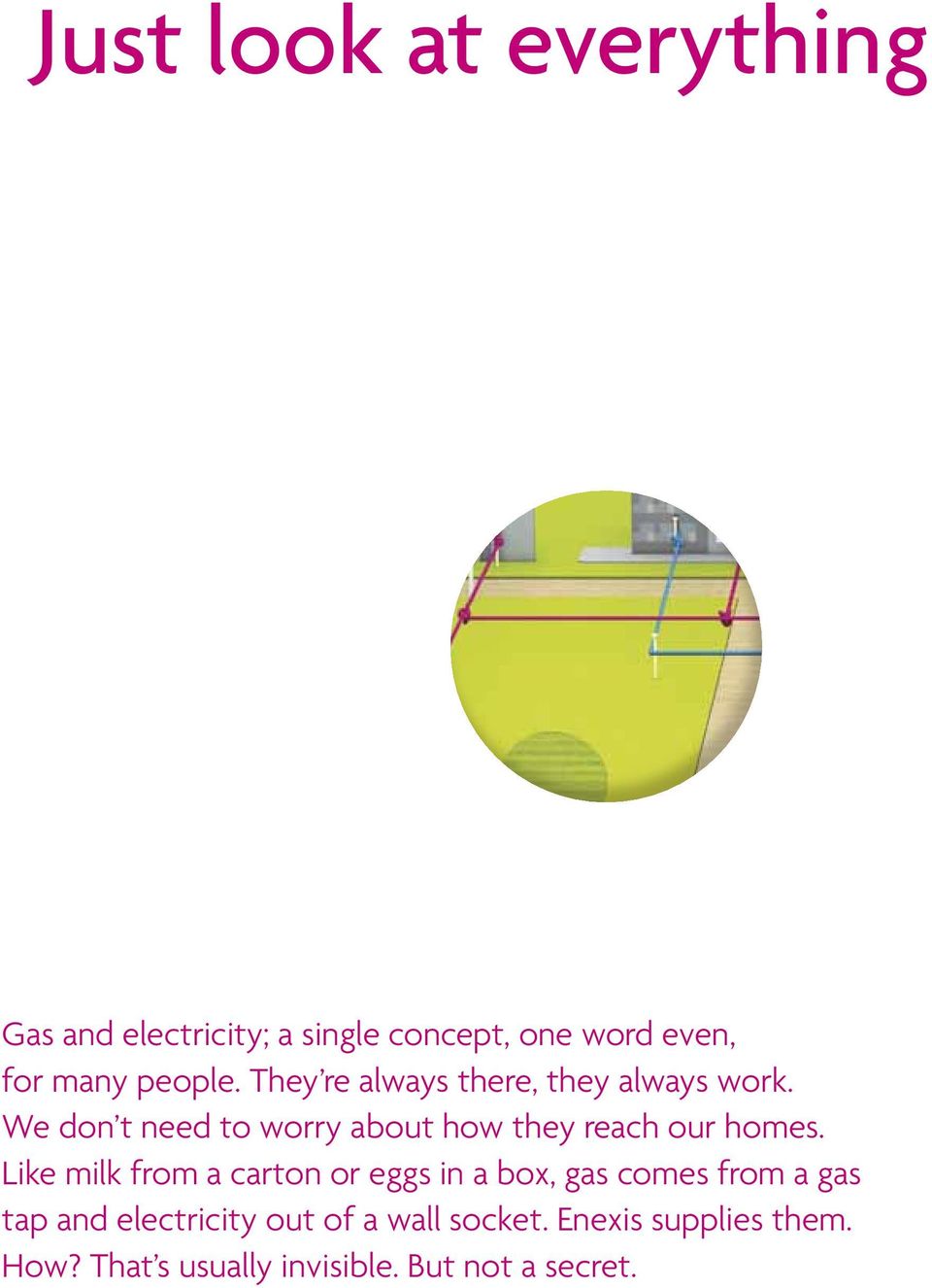
5 you can t see Join us as we take a look at the world behind the meter box, below the street lighting and underneath the industrial estate. We expose the exciting world of energy distribution with its many kilometres of cables and pipelines. But also the worlds of advanced ICT, futuristic and sustainable projects, and above all of dedicated people. People who want to provide their customers with the best in the field of energy.

6 electricity 35,079 million kw electricity customers 2.6 million

7 electricity cables 133,000 km gas pipelines 44,600 km

8 employees 14,101 gas and electricity stations 80,000 gas customers 2 million

9 gas more than 2 billion m 3

10 The original Dutch version of this Annual Report is available at The Dutch printed version takes precedence.

11 Table of contents Foreword 9 Report of the Supervisory Board 1 6 Report of the Shareholder Committee 1 9 Strategic targets 2 1 Key figures 23 Our customers 27 Our grids 35 Sustainability and energy transition 44 CO 2 footprint 54 Our employees 56 Working safely 64 Company-wide risk management 66 Significant risks 66 In control statement 68 Corporate Governance 69 Organisational profile 78 Financial results 80 Full financial statements 83 Table of contents 84 Consolidated financial statements Consolidated income statement 87 Consolidated statement of the total income 88 Consolidated balance sheet 89 Consolidated cash flow statement 90 Consolidated statement of changes in equity 91 Information on the consolidated financial statements 92 Segmentation 102 Notes to the consolidated financial statements 103 Company financial statements Company income statement 145 Company statement of the total income 146 Company balance sheet 147 Information on the company financial statements 148 Notes to the company financial statements 149 Other information 156 Corporate Social Responsibility 162 GRI index 168 Personal details 1 72 Appendix 177 Credits 180
12 8 Annual Report and full financial statements 2011
13 Foreword Enexis is unmistakably developing towards its targeted position as the leading distribution network operator. A lot of hard work was done on this in Our customers see this in the high reliability of our grids and a clearly improved service level. The expansion of the organisation by the acquisition of Intergas, a gas distributor in the West Brabant region, where Enexis was already active in the distribution of electricity, was also tangible. That represents a strengthening of Enexis, but most of all benefits our customers who profit from the combined services and low tariffs. But just as our grids are largely underground and invisible, many developments also remain unseen by the outside world. For example the energy of our organisation, which translated in 2011 into numerous improvements and efficiency increases, developments which arose in many cases within the organisation itself, from the ground up, from everyday working practice. Transparency As a public organisation without competition, we believe that it is our duty to report clearly on the way in which we use public funds. In this integrated report we intend to show, in text and pictures, what often remains unseen from day to day, including both the tangible and intangible aspects. That s why in our social role, as well as an annual report, this publication is also a move towards the transparency we strive for. This is the first time that not only the financial statements have been audited, but the report itself has also been assessed by an independent auditor. We are proud of what we have achieved in 2011, and we want that to be clearly seen. Financial room The 2011 financial results were good. We ended the year with a net profit of million, 35.7 million higher than in This is the result of on the one hand raising tariffs within the regulated limits, and on the other hand further increases in efficiency and cost controls. Taking into account a reasonable investment return, we still have enough financial margin to limit tariff increases in This is one way in which an improved organisation directly benefits our customers. At the end of 2011 the sound financial position of Enexis was also the reason for an increase in our ratings. Annual Report and full financial statements
14 Customer focus For Enexis the focus in this financial year was on the customer. We need to have a strong customer focus as an organisation, precisely because customers expectations are changing, but our contact with customers is minimal. We have listened to what customers are telling us more than ever before and we have approached them and asked them where and how they think our services can be improved. We have been able to translate a lot of what they told us into practical improvements, both in the direct contact with customers and in the supporting organisation. By improving our customer processes, we have been able to strengthen our reputation among our customers as a reliable partner. We will continue this work in Towards tomorrow s network Enexis invested around 360 million in maintenance, renewal and expansion of its gas and electricity networks in This represents a significant increase on These investments enable Enexis to carry out its primary task ensuring safe and uninterrupted distribution of gas and electricity in an excellent way. But at the same time, it means we are anticipating the demands of the future. A future with built-in intelligence in grids, so that energy flows can be remotely controlled and managed, with two-way traffic: transmitting and receiving, and with big changes in the use of energy by our customers. We are helping to shape that future by enabling and promoting new developments in energy saving and increasing sustainability. With pilots in neighbourhoods with smart energy meters and charging points for electric cars, we are showing what can be achieved. But at the same time we are investigating the effects of these developments, so we can include them in the new requirements for our networks. Good employer As an independent distribution network operator, Enexis is a young organisation with plenty of room for further development. That calls for a working approach that offers ample freedom to take initiative and responsibility and which focuses on professionalism. This clearly defined Enexis Way of Working formed the basic principle in 2011 for changes and new developments throughout the organisation. Together with a wide range of training facilities, good flexible employment conditions and a high level of attention to safety make Enexis a company for which people like to work. This is underlined by a number of best employers in the Netherlands surveys. It ain t for nothing that today s trend towards flexible working is a natural development at Enexis. As a good employer Enexis also follows an age-aware personnel policy. This was put into practice in 2011 by removing excessive pressure of work on older employees, particularly in field service functions. This is an area where pressure is expected to increase in the coming years because of the retirement of older employees and a slowdown in entries into technical education. To deal with the threat of a shortage of trained technicians, Enexis has since 2010 set up its own in-company technical schools, where 24 VMBO (pre-vocational secondary education) students were trained as technicians at MBO (intermediate vocational education) level in Annual Report and full financial statements 2011
15 Looking to the future We can be satisfied with the results in 2011, but the challenges for 2012 and beyond are great and mean we cannot afford to stand still. Enexis remains committed to its ambition of being the leading distribution network operator in the Netherlands. This means that we will have to operate at the highest level on all fronts. In our social role we will in the first place do all it takes to maintain our position as a reliable energy distributor. We will continue to improve our performance further as regards our customers in both the private and business markets. Sustainability has developed into a central factor in our organisation. As regards Dutch society, we will continue to work on the tasks which we have taken on together with the other distribution network operators under the Green Deals and which are relevant to us in order to achieve the energy transition. As part of those tasks we are also setting a good example in our operational management by using economical vehicles with a growing fleet of electric or biogas-powered vehicles and energy-efficient buildings. As an employer we are developing into one of the most modern companies in the Netherlands. To do that, flexible working pilots are being extended further and the Enexis Way of Working continues to be the guiding principle for the actions of all employees. This means that our financial performance will remain sound, predictable and continue to offer a reasonable return on investment, both to keep providing our customers with an affordable product and because of our responsibility to our shareholders. A new stakeholder group was added in 2012: the capital markets, where we launched a refinancing loan in January with a 10-year 300 million Eurobond issue as part of a Euro Medium Term Note programme listed on the Euronext stock exchange. Acknowledgements Looking back at the past year we once again wish sincerely to thank the Supervisory Board, the Shareholder Committee and all other stakeholders in our organisation for their cooperation, trust and support. We would also like to express a special word of thanks to the employees of Enexis and the subcontractors who work on our behalf. They are the ones who are responsible for delivering on our promise: Energy on the right track. Their efforts, initiative and professionalism will again help us to achieve our ambitions in Rosmalen, 16 March 2012 Han Fennema Chairman, Management Board René Oudejans Member, Management Board/CFO Annual Report and full financial statements
16 Can good energy distribution be improved?
17

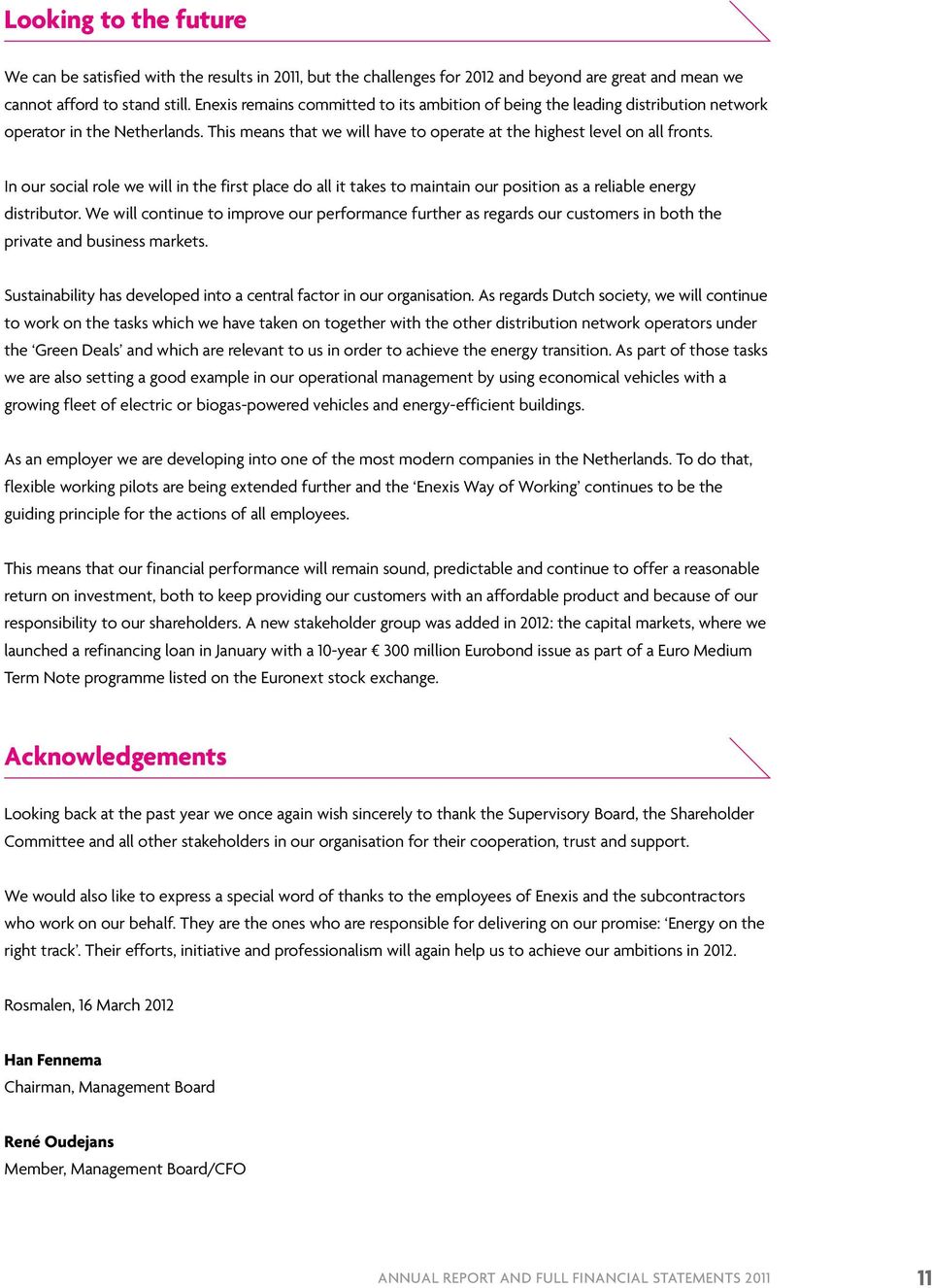
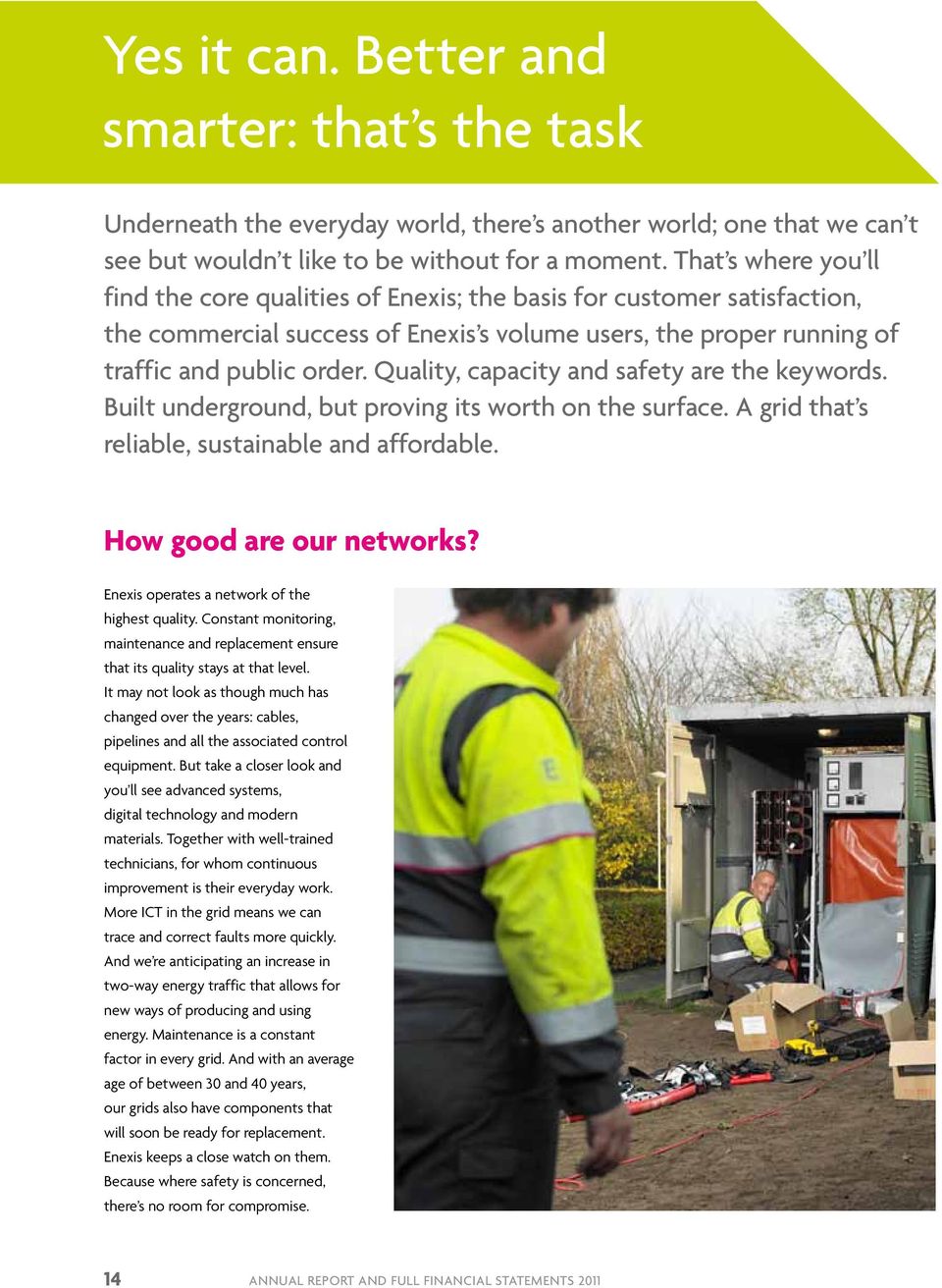
18 Yes it can. Better and smarter: that s the task Underneath the everyday world, there s another world; one that we can t see but wouldn t like to be without for a moment. That s where you ll find the core qualities of Enexis; the basis for customer satisfaction, the commercial success of Enexis s volume users, the proper running of traffic and public order. Quality, capacity and safety are the keywords. Built underground, but proving its worth on the surface. A grid that s reliable, sustainable and affordable. How good are our networks? Enexis operates a network of the highest quality. Constant monitoring, maintenance and replacement ensure that its quality stays at that level. It may not look as though much has changed over the years: cables, pipelines and all the associated control equipment. But take a closer look and you ll see advanced systems, digital technology and modern materials. Together with well-trained technicians, for whom continuous improvement is their everyday work. More ICT in the grid means we can trace and correct faults more quickly. And we re anticipating an increase in two-way energy traffic that allows for new ways of producing and using energy. Maintenance is a constant factor in every grid. And with an average age of between 30 and 40 years, our grids also have components that will soon be ready for replacement. Enexis keeps a close watch on them. Because where safety is concerned, there s no room for compromise. 14 Annual Report and full financial statements 2011
19 Treating customers with respect Enexis has 2.6 million customers. Large and small, single person households, complete sub-networks in municipalities and industry parks, and everything in between. We may not meet all those customers in person, but we certainly know who they are and what their needs and wishes are. We regularly ask them what they think of our service, and how we can further improve it. The answers are honest, and with a score of 7.6 out of 10 we re not afraid to let everyone know about them. But they also show us where there are still shortcomings. And we hear useful wishes and suggestions which we put into practice directly wherever possible. In general we know our large business customers even better, because of their often extensive and more complex installations. Our knowledge of their processes means we can often save them a lot of work. And for new building, maintenance and metering tasks, we re glad to be their regular partner. Clear about outages Just about everything works all the time in the Netherlands. So if now and again anything goes wrong, we make a lot of fuss. That s not surprising, because if there s no water from the tap, if the buses or trains are late or if the lighting or heating fails, our everyday lives are often severely disrupted. But in many cases the biggest annoyance isn t the problem itself, it s the associated uncertainty. What exactly is happening? How long will it last? How can I find out when it will be working again? Those affected call the national emergency line, residents ask field technicians, but they can t usually give the complete answer. That s why at the beginning of November 2011, Enexis started a pilot in the Breda and Emmen regions with a text message service. This means that subscribers get an immediate text message when the outage has been corrected, but also earlier if it lasts for a longer period. The pilot was a success, so the service is now being rolled out across the whole Enexis service area. Emergencies are still annoying, but good communication goes a long way towards making them easier to live with. Annual Report and full financial statements

20 Report of the Supervisory Board To the shareholders In presenting the Annual Report, including the financial statements for 2011, as prepared by the Management Board of Enexis Holding N.V., the Supervisory Board expresses its appreciation for the results and performance delivered during the year. An assurance engagement was granted to Ernst & Young Accountants LLP in respect of the 2011 Annual Report. The Combined report by the independent auditor can be found on page 157. Having read the findings of the Audit Committee, the Supervisory Board discussed the financial statements in detail with the Management Board and the auditor in its plenary meeting of 16 March We endorse the proposal of the Management Board for the appropriation of profit. We propose that you adopt the financial statements including the proposal for the appropriation of profit without amendment, taking into account the legal requirements and the provisions of the Articles of Association, at the Annual General Meeting of Shareholders to be held on 26 April Composition of the Supervisory Board Mr J.A.M. Theeuwes, Vice-Chairman of the Supervisory Board and Chairman of the Audit Committee, retired in April On the same date, Mrs M.E.J.M. Caubo was appointed to the Supervisory Board, which from that date has the following composition: D.D.P. Bosscher, Chairman (retiring in 2012, eligible for re-election) F.J.M. Houben, Vice-Chairman (retiring in 2012, not eligible for re-election) M.E.J.M. Caubo (retiring in 2015) W.M. van Ingen (retiring in 2012, eligible for re-election) R. de Jong (retiring in 2012, eligible for re-election) We would like to thank Mr Theeuwes for his efforts and dedication since his appointment in 2003 to the Supervisory Board of Essent Netwerkbedrijf, as well as for his work since 2008 as Chairman of the Audit Committee. For the profiles of the members of the Supervisory Board, please see the personal details section of this Annual Report. 16 Annual Report and full financial statements 2011

21 Meetings of the Supervisory Board The Supervisory Board met six times in None of the members was absent on a regular basis. The Management Board attended every meeting. Mr J.P. Eydems, Manager of Legal and General Affairs and Official Secretary, acted as secretary to the Supervisory Board. Independence of Supervisory Directors All members of the Supervisory Board were independent of Enexis, as defined in the Dutch Corporate Governance Code, throughout the year. In the opinion of the Supervisory Board, its composition is such that the members can operate independently of each other and of the Management Board. Scope of supervision During its meetings and in the contacts with the Management Board, the Supervisory Board addressed the strategy of Enexis, the performance delivered and the plans for the coming periods, decisions subject to the approval of the Supervisory Board and all other relevant issues that were brought to its attention, including developments in the regulatory area and the sector structuring plan. In particular, the subjects discussed at the meetings included the acquisition and the subsequent integration process of Intergas Energie B.V., the termination of the remaining Cross Border Leases and the preparations for the refinancing. The financial results and the effectiveness of the risk management and control systems at Enexis were discussed frequently and in detail during the meetings of the Supervisory Board. In this process, the Audit Committee advised the full Supervisory Board on key issues. Experts in different areas informed the Supervisory Board regularly of significant technical and regulatory developments. For example during a working visit to the Enexis in-company technical school the members looked in detail at the various technical training programmes and the associated facilities for practical exercises. The issue of safety was addressed during every meeting. The Business Plan for 2012 was adopted in the meeting of 2 December Committees The Supervisory Board has two permanent committees: the Audit Committee and the Remuneration and Selection Committee Annual Report and full financial statements
22 Audit Committee The duty of the Audit Committee is to oversee and advise the Management Board on the internal risk management and control systems, financing and financial information provision. The committee advises the Supervisory Board on these matters. Other responsibilities of the Audit Committee include the periodic assessment of the performance of the external auditor and of the CFO. The Audit Committee had the following members after the AGM on 26 April 2011: R. de Jong- Chairman W.M. van Ingen The Audit Committee met five times in The CFO attended all these meetings. Four meetings were held in the presence of the external auditor. The Audit Committee assessed and discussed all relevant financial issues that were submitted to the Supervisory Board, including reports from the internal auditor and the external auditor, the financial statements, and risk-related and financial reports. In addition, the Audit Committee played a key role in the tendering process and the final selection of the external auditor. Remuneration and Selection Committee The principal duties of the Remuneration and Selection Committee are to define selection criteria and appointment procedures for members of the Supervisory Board and the Management Board, to perform periodic assessments of the performance of the individual members of the Supervisory Board and those of the Management Board, and to make proposals for the remuneration of individual members of the Management Board to be put before the General Meeting of Shareholders for adoption. The committee advises the Supervisory Board on these matters. The Remuneration and Selection Committee had the following members in 2011: D.D.P. Bosscher - Chairman F.J.M. Houben The Remuneration and Selection Committee met five times in Word of appreciation The Supervisory Board wishes to thank the employees: the professionalism and involvement of the organisation have made an important contribution to the achievement of the results. We experienced the regular attendance by individual Supervisory Board members at the consultation meetings between the Management Board and the Works Council as positive and valuable. The Supervisory Board expresses its appreciation for the work of all those concerned, and thanks the Management Board and all employees for their efforts in Rosmalen, 16 March 2012 On behalf of the Supervisory Board D.D.P. Bosscher, Chairman 18 Annual Report and full financial statements 2011
23 Report of the Shareholder Committee 2011 was an exciting year for the Shareholder Committee; a year that started with the completion of the acquisition of Intergas. In this way Enexis showed its care in the execution of the strategic plan as adopted by the shareholders in 2010, and in particular the sector structuring plan. This is especially relevant because of the public aspects that characterise the network operations sector. The Shareholder Committee contributed to the nationwide survey on the initiative of the Stuurgroep Visie Netbeheer (steering group on vision for network management, established by the Minister of Economic Affairs, Agriculture and Innovation) into the perception of stakeholdership in network management. The survey findings show that there is no such thing as the shareholder of the distribution network operators. There is a broad diversity in the shareholders of the distribution network operators, who themselves are also diverse. For this reason it is a good thing that the shareholders of Enexis operate effectively through a committee that represents all of them. A new form of collaboration arose in A core delegation of the Shareholder Committee went through an intensive process within Enexis, in which both parties gained a better impression of how Enexis can continue in the future as a leader in development in the areas of sustainability and Corporate Social Responsibility. By gaining in-depth knowledge in this way, we as shareholders can increase our ties with Enexis and ensure that we remain closely involved with matters that are high on the agenda in the public debate. As a result of the elections for the provincial government, the Shareholder Committee was able to welcome a number of new members. Through the resulting combination of experience and new ideas we have every confidence that the Shareholder Committee, as representatives of the shareholders themselves, can look forward to a continuing mutually beneficial collaboration with the Management Board and the Supervisory Board of Enexis in the coming years. Annual Report and full financial statements
24 The Shareholder Committee had the following composition at year-end 2011: Province of Noord-Brabant: L.W.L. Pauli (Member, Provincial Executive of Noord-Brabant) Province of Overijssel: T.W. Rietkerk (Member, Provincial Executive of Overijssel) Province of Limburg: M. Verheijen (Member, Provincial Executive of Limburg) Provinces of Groningen, Flevoland and Drenthe: J.W. Moorlag (Member, Provincial Executive of Groningen) VEGAL: C.A.M. Hanselaar-van Loevezijn (Mayor of Roerdalen, Chair of VEGAL*) VEGANN: J. Kroon (Mayor of Urk, Chair of VEGANN **) Brabant municipalities: J.W.F. Hoskam (Executive Councillor, Municipality of s-hertogenbosch) * VEGAL: Vereniging Gemeentelijke Aandeelhouders Limburg (association of municipal shareholders in Limburg) ** VEGANN: Vereniging Gemeentelijke Aandeelhouders Noord Nederland (association of municipal shareholders in Northern Netherlands) 20 Annual Report and full financial statements 2011
25 Strategic targets Energy supplies are a primary need, which gives them great social importance. Both consumers and companies need the assurance of constant energy availability. For Enexis this forms the basis for our activities and the point of departure for our strategic targets. Enexis identifies four spearhead areas that define the quality of our functioning, expressed in the keywords reliable, affordable, sustainable and public-focused. The aim is for the sum of all our activities and products to achieve a high score on all these four aspects. If we achieve that, Enexis will achieve its ambition of developing into the leading distribution network operator in the Netherlands, and of being recognised as such by others. Vision Society is becoming increasingly aware of its dependence on energy and of the consequences of energy use for the economy, quality of life and the climate. That means customers and other stakeholders will become increasingly critical in relation to the performance and behaviour of their energy (distribution) partners and the ability of those partners to respond effectively to technological developments and changing market conditions. Mission Enexis goes to great lengths to achieve sustainable, reliable and affordable energy distribution. Annual Report and full financial statements
26 Hierarchy of values In all our decisions and activities, we operate safely, with integrity and responsibility. Our first responsibility is a permanently available, safe and affordable energy grid. We ensure reliable distribution of electricity and gas. We ensure reliable, high-quality services and correct billing. We operate on the basis of a strong social awareness in a continuous, open dialogue with our environment. In those roles, we aim to play a leading role in enabling and facilitating the transition towards sustainable energy supply in the Netherlands. Our second responsibility is towards our customers. We provide a good service, and we deliver on our promises. We do this at the lowest possible costs and for reasonable tariffs. Our third responsibility is towards our employees. Our employees can count on a safe working environment, and in their work for Enexis they have opportunities for personal and professional development. They have access to the right information and context to do their jobs properly. Our managers lead on the basis of coaching and convincing arguments. We are a reliable, professional and fair customer for our (sub) contractors and suppliers. Our fourth responsibility is the continuity and value retention of the company. We will build the value of Enexis, provide shareholders with a reasonable dividend, and ensure that we can finance Enexis without needing to call on our shareholders. The hierarchy of values has been deployed in strategic targets for the stakeholders and in the Enexis financing policy, aimed at maintaining a minimum credit rating of A/A2 with stable outlook. This is amply met, with the present credit ratings of A+ positive outlook (S&P) and Aa3 stable outlook (Moody s). This ensures that Enexis continues to have cost-efficient access to the money and capital markets to finance investments in its networks and organisation. 22 Annual Report and full financial statements 2011
27 Key figures Annual Report and full financial statements
28 Financial (amounts in millions of euros) Result Revenue 1, , , , ,699.0 Cost of sales Gross profit 1, , , ,105.3 Other operating income Operating expenses excluding depreciation and impairments Depreciation and impairments Operating profit Share of result of associates EBIT Financial income and expenses Profit before tax Profit for the year Financial position (before profit appropriation) Net working capital Non-current assets 1 5, , , , ,492.0 Capital employed 5, , , , ,930.8 Equity 3, , , , ,512.0 Total assets 1 6, , , , ,733.0 Ratios Solvency ROIC Return on equity Cash flow Cash flow from operating activities Cash flow from investing activities Cash flow used in financing activities Total cash flows , The comparable figures have been restated because of a change in the presentation of contributions to investments in grids and connections received from third parties. This restatement has no impact on equity or profit. Definitions of financial ratios EBIT Operating profit plus share of result of associates. Net working capital Total current assets excluding cash and cash equivalents (2007: also excluding bank current account) less current liabilities excluding advance contributions to be amortised in following year and excluding derivatives. Capital employed Sum of non-current assets, net working capital and assets held for sale. Solvency Ratio of equity to total assets x 100%. Return on invested capital (ROIC) Ratio of EBIT to capital employed at year-end x 100%. Return on equity Ratio of profit for the year to equity at year-end x 100%. 24 Annual Report and full financial statements 2011
29 General Length of grids (x 1,000 km) Electricity grid Low voltage Medium voltage Intermediate voltage Gas grid Low pressure High pressure Stations (x 1,000) Electricity Gas * Number of connections (x 1,000) Electricity 2,648 2,631 2,610 2,596 2,518 Gas 2,068 1,908 1,899 1,892 1,788 Transported volumes Electricity (GWh) 35,079 34,858 33,305 34,046 33,679 Gas (Mm 3 ) 5,788 6,959 6,003 6,109 5,564 Of which biogas Product quality Electricity outage time (in minutes) High voltage Medium voltage Low voltage Gas outage time (in seconds) Gas * From 2010 non-operational gas stations are not included in this figure. Annual Report and full financial statements
30 General Customer satisfaction Low-volume customers High-volume customers Total Employees Number of employees at year-end 4,101 4,061 3,791 3,511 3,536 Number of FTEs at year-end 3,797 3,718 3,490 3,246 3,264 Percentage of female employees DART rate for Enexis employees DART rate for external personnel Overall DART rate Absenteeism (%) Number of Learning & Development trainees 18, ,378 9,628 9,093 7,433 Employee satisfaction score Sustainable vehicle fleet Electric cars 100% electric passenger cars Passenger cars powered by natural gas/biogas Other electric vehicles 100% electric scooters Waste (in tonnes) Recycled waste 3 8,265 6,163 4,135 5,713 9,487 Incinerated waste 1,336 1,362 1,409 1,171 1,190 Deposited waste Total 5 10,031 7,833 5,640 7,058 10,796 Of which hazardous waste (%) The DART rate (Days Away, Restricted or Transferred) represents the number of accidents resulting in absence or restricted work for every 200,000 hours worked. 2. Total excluding Intergas. 3. The shift from useful incineration to (material) re-use was caused primarily by better waste management. 4. The increase was caused primarily by asbestos-containing waste as a result of the removal and replacement of asbestos-cement pipelines. 5. Of the difference relative to 2010, 1.1 million kg was caused by scrap and cable residues, and 0.8 million kg by clean soil. This contributed to an increase in the recycling percentage. 26 Annual Report and full financial statements 2011
31 Our customers Enexis clearly positions itself as an involved partner for its customers as far as energy is concerned. As an accessible company that not only acts as a reliable energy distributor but also advises, initiates and facilitates in relation to the way energy is used. Enexis worked hard in 2011 on strengthening the desired customer relationships. Better customer segmentation, and above all numerous improvements in the regular customer contacts, were central to that process. Its effects should already become visible from 2012 in an increase in the customer satisfaction score. Stronger customer relationships will help us to overcome the inevitable negative aspects of our work as a distribution network operator, such as outages and excavation works. One of the tasks of a distribution network operator is to facilitate the market process, including the introduction of the new market model in Particularly to ensure trouble-free data transfer, the joint regional energy distribution network operators set up the nationwide Central Connections Register to increase the uniformity and quality of the sector processes. Listening to the customer All for the customer, today and tomorrow, the motto of the 2011 Enexis business plan, has been translated into concrete activities at all practical levels of operation. An important role in this process has been played by improving the contacts with private customers, such as in meter readings, excavation works, fault correction and telephone contacts. For example asking customer panels directly about their experiences and wishes during customer visits produced valuable information that could be translated directly into improvements. Just one of the ways Enexis has used those findings was by starting a text message service to provide information about faults, while the social media platform Twitter is being used to provide up-to-date information. Ambassadors Many Enexis employees are now well aware of their important role as Enexis ambassadors during customer contacts. Staff working in the field can in many cases answer customers most important questions, or otherwise they can ensure that questions are passed on to customer service, who will then answer them directly. The aim is to reduce the response times to questions or complaints, and as a result to strengthen customer satisfaction. Annual Report and full financial statements
32 Uniform nationwide connection process Big advances were made in 2011 in the nationwide cooperation between distribution network operators. Agreement was reached on the details of attractive opportunities in a joint connection process. By the end of 2013 the first customers are expected to be able to arrange for electricity, gas, water, cable and telecom connections to be installed within 10 working days if desired, all with a single application. Achieving this will require close cooperation between the distribution network operators and contractors. Enexis has taken a clear leadership role in setting up this cooperation, and chairs the Landelijke Samenwerking Ondergrondse Infrastructuur (national cooperation for underground infrastructure) which facilitates this process. Extra service for business customers Enexis took further steps in 2011 in the processes to simplify the contacts with business customers. These included the development of electronic billing, linked directly without an intermediate paper-based stage to the automated accounting processes of business customers. At the same time, this will give these customers a much better insight into their energy consumption and the associated costs. Specially for multisite customers, high-volume users with many connections, Enexis developed in 2011 a web portal through which these customers can simply manage all their connections. That creates a win-win situation, with more convenience and significant savings on both sides. Just one of the benefits of the portal is that it allows the data for each connection to be accessed and if desired changed. The exact locations of the connections can also be viewed using Google Maps. Quality measurement Enexis continuously measures the quality of its processes and service, to allow developments to be monitored and guided proactively. In this process we made use of uniform service and quality standards developed on a national basis. Service In measuring its service quality, Enexis applies eight service standards based on quality criteria laid down in the Distribution Network Code. This includes standards and conditions for the behaviour of distribution network operators. Enexis has set itself a minimum performance figure of 96%. As in 2010, Enexis performed at well above this level in Annual Report and full financial statements 2011
33 Service performance in the domestic and business markets (in %) Engineer on-site within 2 hours in case of faults a Correspondence handled within 10 working days b Complaints handled within 10 working days Appointments with customers in 2-hour time slots Work carried out within 3 days Maintenance appointments made 5 days in advance day advance warning of work causing an interruption of energy supply 7 Quotation provided within 10 days of request Customer queries about energy interruption answered within 10 working days Invoice Enexis follows the standards set by the Energiekamer (Dutch Office of Energy Regulation) for the quality of billing. The Office of Energy Regulation specifies a minimum score of 98% on the six criteria for timeliness of billing. In 2011 Enexis scored well above this level on all criteria. Quality of billing (in %) Electricity connections and disconnections Timeliness of provisional billing for connections * Timeliness of final billing for disconnections Gas connections and disconnections Timeliness of provisional billing for connections * Timeliness of final billing for disconnections Timeliness of annual electricity bill Timeliness of annual gas bill * This figure shows a temporary fall in 2010 which is due to the introduction of a new customer information system. Annual Report and full financial statements
34 Customer satisfaction To find out if its efforts to improve continuous customer service are successful, Enexis regularly measures customer satisfaction, especially among consumers and small business customers. After an increase from a score of 7.7 to 7.9 in 2010, customer satisfaction remained at the same level in The average score of 7.9 is in line with our strategic target. At a time when customers are becoming increasingly critical, with higher expectations and demands for more speed and convenience, we have maintained our customer satisfaction at a stable, high level. This means we have been able to increase our service level in line with the higher expectations of customers, which is a good result. It also encourages us to continue making substantial investments in 2012 in meeting and wherever possible surpassing the increasing expectations of our customers. Figure 1 Average score for overall service level by consumers and small business customers % 80% 60% 40% 20% 0% Q Q Q Q Q Q Q Q Q Don t know 30 Annual Report and full financial statements 2011
35 Figure 2 Assessment of overall service level by large business customers 100% % % % 20% 6.5 0% Q Q Q Q Q Q Q Q Score % dissatisfied Brand awareness Enexis brand awareness is continuing to increase. In the consumer market, 27% of respondents cited Enexis as a distribution network operator in their region in Prompting with the name of Enexis led to recognition by another 61% of the respondents. Recognition of the Enexis brand was most probably significantly strengthened by the visibility of the vehicle fleet and the radio commercials. Annual Report and full financial statements
36 Figure 3 Enexis brand awareness among consumers and small business customers 71% 75% 76% 81% 83% 81% 85% 88% 100% 80% 60% 40% 20% 0% Q Q Q Q Q Q Q Q No awareness Prompted awareness Unprompted awareness Figure 4 Enexis brand awareness among large business customers 95% 95% 94% 94% 97% 99% 98% 97% 100% 80% 60% 40% 20% 0% Q Q Q Q Q Q Q Q No awareness Prompted awareness Unprompted awareness 32 Annual Report and full financial statements 2011
37 Tariffs The Office of Energy Regulation (part of the NMa, Netherlands Competition Authority) monitors the tariffs for energy distribution. Every three years the Office of Energy Regulation sets the permissible price increase or the mandatory price decrease percentage on the basis of overall cost developments. Enexis has increased its consumer tariffs for electricity in 2012 by 2.5%. This increase has deliberately been kept at a limited level, despite the fact that an increase of almost 9% would be permitted by the Office of Energy Regulation. That means the tariff increase at Enexis is limited to around the level of inflation, which shows how the company is putting its social responsibility and the strategic target of affordability into practice. Figure 5 Average bill for domestic usage (annual costs, amounts in euro, including VAT) 240 Electricity Gas Tariffs for 2011 by grid operator for domestic users (annual costs, amounts in euro, including VAT) Electricity Gas Total Cogas Delta Endinet (NRE) Enexis Intergas Liander Rendo* Stedin Westland * The above meter tariffs are those found most frequently. At Rendo, the property manager, not the distribution network operator rents the meter. The above table includes the costs of transport, connection and meter rental. Gas meter costs are unregulated. For comparability, the table therefore shows the most frequently found tariffs. Sources: NMa (Netherlands Competition Authority); information from companies and associated organisations. Annual Report and full financial statements
38 Unregulated services As well as its grid operating activities, Enexis also has a portfolio of core-strengthening unregulated activities. At the end of 2011 it was decided to merge these within a single umbrella organisation called Fudura. The new name will be introduced for the unregulated products among all business customers in Fudura provides metering services for business customers, supplies a package of commercial services to customers with their own infrastructure and develops new, sustainable products in relation to the energy transition. A substantial part of these activities is aimed at the initiating role which Enexis has taken on to allow it to play a leading role in the energy transition. Total package of metering services Fudura sells, installs and supplies meter systems and data, together with advanced metering and consultancy services in relation to energy care. Around 20,000 business customers can count on a total package that guarantees that they are meeting all their legal responsibilities, while at the same time giving them a clear overview of and advice about their energy consumption. An important activity in this area in 2011 was the Datadirect product, which uses smart meters already installed in customers infrastructure to give them detailed information about their energy consumption. Analysis of this information gives customers the tools to make adjustments and thereby avoid (costly) peaks in their consumption. This was completed in 2011 by the addition of an externally developed program. There is a high level of interest in this service, especially from large national organisations. Infrastructural services Fudura specialises in designing, installing, managing and maintaining installations and private energy networks. Together with a series of related rental services, this unit offers a total package of services so that customers can concentrate on their own core activities. In this way Fudura serves primarily larger industrial customers with their own, often complex, energy infrastructures. New products Fudura s third task is the development of new, sustainable and core-strengthening products for the unregulated market. The company also investigates opportunities for offering existing products in new markets, such as the installation of biogas pipelines, CO 2 transport, solar energy or the development of sustainable industry parks. In general these do not involve highly profitable projects, but rather developments which promote energy transition and are closely linked to the core activities, especially where safety and reliability are involved. 34 Annual Report and full financial statements 2011
39 Our grids Ensuring trouble-free energy supplies to 2.6 million households and thousands of businesses, towns and villages. Anticipating and preparing for the needs of all our customers in the near and more distant future. These are the primary tasks of a distribution network operator. The gas and electricity grids with a length of almost 200,000 kilometres and the more than 100,000 associated items of equipment above the ground play a central role. At the close of 2011 Enexis can conclude that, partly due to the high reliability of its grids, those challenges have been met in full. Enexis also has a number of measures in place to ensure the required quality, safety and reliability levels in the long term. Based on detailed risk analyses, the desired robustness is carefully balanced with costs, so that the requirement of affordability for the customer is also met. NTA 8120 certificate Enexis Asset Management department has held the PAS 55-1 certificate since 2005, issued by the Institute of Asset Management. This is the international recognition for Asset Management. Based on this certificate and on the Ministerial Regulations for Quality (MRQ), the Netherlands Technical Agreement (NTA) 8120 was set up in 2009 by a partnership involving supervisory authorities, all the distribution network operators and certifying bodies in the Netherlands. Following a detailed audit, Enexis gained this certificate on 20 October 2011 for the Asset Management and Customer Relations departments, three regions and staff. By the end of 2012 Enexis intends to have overall NTA 8120 certification. Annual Report and full financial statements
40 Reliable networks The most important indicator of the reliability of energy grids is the length of outages. This is the average time during which a customer receives no energy in a particular year. With a score of minutes in 2011, the Enexis electricity grid performed better than the national average of minutes. For the gas grids, the outage duration of 69 seconds per connection* was significantly higher than the national average of 43 seconds. This relatively big difference was accounted for by a single fault in Venlo which lasted for a long time and was caused by an external party. * The outage duration of Intergas is included from , and totalled 12 seconds per connection in Excluding Intergas, the outage duration of Enexis was 71 seconds. Figure 6 Annual outage time per electricity connection as a result of HV, MV and LV failures (in minutes per connection) Enexis Netherlands 36 Annual Report and full financial statements 2011
41 Safe gas distribution networks Enexis has used the VIG (Gas Grid Safety Indicator) since 2006 as a measure of the level and development of the safety of its gas distribution networks. The VIG indicates the quality and safety of the gas distribution networks by statistically relating identified gas leaks to the risk that these will lead to incidents and/or accidents. The safety indicator itself is a dimensionless number, in other words its magnitude is not associated with a physical unit. It is based on the number of leaks per year, weighted by the number of connections and grid length. The weighting of a specific leak depends on the number and severity of the results of the type of incident concerned. The lower the VIG score, the higher the safety of the grid. Figure 7 VIG score The safety indicator has developed positively from 2007 to 2011 with a progressively lower score each year. The provisional score for 2011 again shows a slight decline. Annual Report and full financial statements
42 Faults Enexis was able to solve more than 56,000 faults quickly in With an average outage time of minutes (2010: 25.1 minutes), the problems that customers experienced as a result of faults in 2011 were significantly reduced relative to the preceding year. The number of faults also declined relative to 2010; more than 58,000 faults were reported in that year. Despite extensive management measures, a number of major faults in 2011 caused disruption for customers: The largest fault affected 127 large business customers and 25,813 small business and domestic customers, when a high-voltage transformer in Zwolle failed on 10 May. The incident was caused when a contractor broke a transport cable while excavating a pond. The power outage was ended after more than two hours. 35,797 Enexis and Endinet customers were without power in Eindhoven on 4 November. Medium-voltage transformer switchgear failed at the Eindhoven East high-voltage station, as a result of which the highvoltage transformer was isolated by the safety systems as a protective measure. Power supplies were restored after 45 minutes. 450 customers in Venlo were affected by a long-lasting gas fault on 23 July. A leak in the WML (the water company in Limburg) pipeline washed away so much soil that a tree fell over. One of the tree roots broke the low-pressure gas pipeline, which then filled with soil and water. It took more than four days to remove the soil and water from the gas pipeline and to restore the gas supply to the last affected customer. This incident contributed significantly to the relatively high gas outage duration of 69 seconds in Communications relating to street lighting failure has been improved, partly as a result of requests by municipalities. From late 2010 municipalities have been able to report street lighting failures and track their status online, using a special public lighting portal. This was discussed in detail at the Annual General Meeting on 26 April The regional management of Enexis has given further explanations of the actions during working visits to a large number of municipalities. Operating asset status report Many of the Enexis operating assets are underground, which means it is difficult to monitor their condition. Together with other distribution network operators, Enexis is therefore developing techniques to measure the condition and the remaining lifetime of assets as efficiently and accurately as possible. For example in the Smart Cable Guard project, Enexis is working together with Alliander, KEMA and Locamation on a technology to assess the condition of underground electricity cables without the need to take them out of operation. Managers of distribution networks can reduce the risk of supply outages by preventive replacement of damaged cable sections. Significant progress was made in 2011 in the development of knowledge-based rules to allow conclusions to be drawn from the measurements performed by the system. Work is being done in 2012 on developing policies for the application of this system. 38 Annual Report and full financial statements 2011
43 Investments Enexis invested a total of million in connections, replacements and expansion of its grids in Allowance was made right from the start of the year for the reduced need for connections and grid extensions for customers as a result of the economic situation. This created sufficient room to accelerate the investments in replacements, maintenance and pipeline and grid improvements. Investments in the electricity grid shifted slightly from standard to customised connections, reconstructions and replacements. Total investments in the electricity grid were million gross, compared with million gross in Two new high-voltage stations were completed in 2011; one in Klazienaveen and one in Luttelgeest, both in partnership with TenneT. Both stations enable surrounding horticulturalists to feed the electricity produced by their CHP plants into the grid. Two other stations are almost complete and will be put into operation in Investments in the gas distribution pipe network increased significantly, from 98.6 million gross to million gross. The largest part of this increase was for replacements, which in more than half of the cases related to the modernisation of older gas grids (including cast iron pipelines). This involved around 30,000 connections and 282 kilometres of main pipelines. Grid investments (figures in millions of euros) Gross investment Gross investment Gross investment Gross investment Gross investment Electricity Standard connections Customised connections Grid expansions Reconstructions Replacements Other Total electricity Gas Standard connections Customised connections Grid expansions Reconstructions Replacements Other Total gas Total gas and electricity Annual Report and full financial statements
44 Replacement of cast iron pipelines In a number of mainly urban areas, cast iron pipes were laid when the gas distribution network was first installed. This is a durable material, but it can be brittle, which makes it vulnerable to damage. In consultation with the supervisory authority SSM (State Supervision of Mines), Enexis has decided to replace all high-pressure pipelines made of this material within five years. Of the remaining pipelines, around 65% will be replaced within 15 years on the basis of a risk assessment. The plan was for 83 kilometres of cast iron pipeline to be replaced in However this length was already reached on 1 November, and by year-end a total of 112 kilometres had been replaced. Around 1,500 kilometres of cast iron pipelines are still in use in the Enexis service area. Long-term reliability Enexis works closely together with the other regional distribution network operators in gathering information on the causes of failures in components. This information is kept in so-called materials files. All larger incidents experienced by distribution network operators are investigated by KEMA and KIWA Gastec, after which the findings are shared. This prevents the same incident from happening at other distribution network operators. A nationwide study into a simulation model for the long-term effects of ageing of components of the gas grid was completed in The conclusion of this study is that increasing replacement investments are necessary to maintain the present high safety level of our gas distribution networks in the future. A similar study for the electricity grids is expected to be completed in mid Smart electricity network in Enschede Smart use of energy in the existing grids would never be possible without the addition of intelligence to allow the energy flows to be controlled and managed remotely. This is even more important because local energy generation will increase further in the future, for example from CHP and solar panels. Enexis is one of the first distribution network operators in the Netherlands to anticipate these developments, by putting a fully automated medium-voltage grid into everyday operation in Enschede in The grid, a large part of the city s electricity network, can be monitored and managed remotely from the control centre in Zwolle. In the event of a power failure the affected area can be reduced quickly in size, while faults can be localised and corrected rapidly. Threatened failures caused by overloads can also be prevented. Around 60% of the power supply in Enschede will be automated in this way in Annual Report and full financial statements 2011
45 Regional partnership For the management, maintenance and expansion of distribution networks, Enexis works closely together with municipalities, water boards, housing corporations and other parties. The aim is to reduce the social costs but also to minimise disruption to both citizens and society. By coordinating the long-term planning with municipalities and other distribution network operators (electricity, gas, water and telecom) and carrying out connection and installation projects jointly, excavation works can in principle be combined and result in minimal disruption to the residents. This approach already works well in many municipalities. Within its service area, Enexis takes part in three regional partnerships for joint installation and maintenance of underground infrastructure. The aim is to migrate from these regional partnerships to a nationwide approach. NONed The NONed (Northern and Eastern Netherlands) partnership operates in the provinces of Groningen, Drenthe and Overijssel. As well as Enexis, the participants are Waterbedrijf Groningen, Waterbedrijf Drenthe, Vitens, KPN, Rendo, Cogas, Ziggo and Reggefiber. The NONed partnership was further professionalised in 2011, and strategic choices were made allowing Enexis to intensify the partnerships with contractors in the chain. The resulting ideas will be implemented in the tendering process for contracting works during In Friesland Enexis works together with Vitens, Stedin, KPN, UPC, Alliander, Kabel Noord and Ziggo in Friesland CTO for central technical coordination. CTO is focusing on the development of a new cable specification together with distribution network operators in Noord-Holland, Gelderland and Flevoland. Because of market developments, tendering for this project has been postponed until synfra As well as Enexis, the synfra foundation includes Brabant Water, WML, Delta and Endinet. synfra coordinates the joint installation of underground infrastructure in the three southern provinces of the Netherlands. The partnership with contractors and municipalities was strongly intensified in Transparency in the chain has been increased by the roll-out of a shared system (GEMMA) to allow better coordination of works between the parties involved. The ability of municipalities to see where the distribution network operators are working is constantly increasing, so they can respond appropriately to questions from citizens. Work is being done within synfra on a shared vision with contractors to allow maximum use to be made of scarce working capacity in the chain. These ideas will be included in the tendering for contracting works during Annual Report and full financial statements
46 Uniform agreements in Limburg An agreement was reached in Limburg in 2011 between municipalities, Enexis and the water company WML for the installation and management of pipeline networks, both above ground and underground, in municipal areas. This OGN 2011 (agreement between municipalities and utilities in the province of Limburg) lays down in a single document all the agreements needed for 50/50 cost sharing between municipalities and distribution network operator, with permits being granted on the basis of a digital notification and consent procedure. The costs of administrative and technical management by municipalities are covered by a fixed charge per connection per year by the municipality. That means it is no longer necessary to negotiate, allocate costs and grant permits separately for each activity, thereby avoiding bureaucracy and costly administrative procedures. Uniform agreements of this kind have up to now not found widespread support nationwide. In partnership with its Shareholder Committee, Enexis intends to migrate to a uniform approach to these cost-sharing agreements in its entire service area. Street-lighting dispute The provinces of Groningen, Drenthe and 25 municipalities in these provinces placed an ownership claim before the court in Groningen in 2009 by means of a writ. They are demanding that Enexis transfer to them the ownership of the part of the underground low-voltage grids used for public lighting in their areas, including around 150,000 lighting masts. Enexis acquired this part of its grid from its legal predecessors Essent, EDON and NV EGD. The case was held over by the court until the end of 2011, and the proceedings will be resumed in In anticipation of the verdict, the provinces and municipalities concerned have outsourced the maintenance and management of the public lighting grid, which were formerly handled by Ziut, an Enexis subsidiary, to an outside party. In response, Enexis asked the court to grant a preliminary injunction to forbid the provinces and municipalities to award the works on the public lighting network to a third party or to issue a call for tenders for these works, until the court dealing with the main proceedings has reached its verdict. This application for an injunction was rejected on 10 February The principles of ownership of the grid will be dealt with in the main legal proceedings. 42 Annual Report and full financial statements 2011
47 Acquisition and smooth integration of Intergas With effect from 1 June 2011 Enexis completed the acquisition of Intergas Energie, which operates the gas grid in 20 municipalities in the Central and West Brabant region. Enexis already operated the electricity grid in this region and the acquisition means that the customers of Intergas now have a single distribution network operator for both gas and electricity from 1 January This is in line with Enexis efforts towards a clear sector structuring. The Intergas pipeline distribution network is an excellent match for the Enexis distribution network, which means the acquisition offers synergy and efficiency benefits. The integration of Intergas with Enexis was completed as planned at the end of Around 60 employees were transferred to Enexis, and the migration of the accounting systems was completed without problems. The integration of Intergas means that the service area of Enexis has been extended by around 3,200 kilometres of grid length and 150,000 gas customers. The history of Intergas dates back to 1860, when Mr. F.J. Smits was granted permission by a royal decree to set up a gasworks. The company grew strongly in the following century, and eventually stopped its own gas generation as the use of methane gas increased strongly. By 1958 the company acted as methane gas distributor for a large part of Oosterhout and the surrounding area. From those roots arose the NV Streekgasvoorziening Oosterhout, whose deed of incorporation was signed by seven mayors in the region and by the Staatsmijnen national mining company. However the interest from other municipalities was so great that the name soon no longer fitted the company. In 1960 the name was changed to Maatschappij voor Intercommunale Gasdistributie Intergas NV. More than 50 years later, Intergas Energie was serving customers in 20 municipalities, as a modern company with a good reputation among its customers. Annual Report and full financial statements
48 Sustainability and energy transition As the distribution network operator, Enexis is closely involved in the switch by its customers to more sustainable energy sources. The company also follows its own sustainability policy. This means in practice that we work on improvement in three spearhead areas. These focus in our own operations on reducing emissions by cutting down on energy consumption, on reducing the use of raw materials, and on increasing the re-use of waste streams. As well as that, Enexis also takes an active and initiating role in new developments relating to energy generation and use. These may also extend outside its core activities through the subsidiary Fudura if the developments in question influence future requirements for the structure and dimensioning of the networks. The developments supported by Enexis are all dedicated to the energy transition, the sum of the measures intended to enable and support the switch to sustainable energy sources like solar and wind energy. This also means enabling the move from fossil fuels to sustainable sources, including fuel for transport and heating. Sustainability on the road The nature of Enexis business processes means that numerous vehicles are used every day. Enexis has a total (leased) fleet of 750 passenger cars and 1,150 commercial vehicles. That means there is a strong wish to reduce the CO 2 emissions of the fleet. Since 2010 Enexis has had a strong preference for the use of vehicles with low fuel consumption ( A to C energy labels). Meanwhile the fleet includes an increasing number of vehicles using alternative energy sources such as electricity and natural gas or biogas. This part of the fleet increased in 2011 to 29 electric cars and 11 vehicles using natural gas or biogas as its source fuel. 44 Annual Report and full financial statements 2011
49 Sustainability under our roof As well as continuously increasing the sustainability of the existing buildings, particularly by paying attention to heating, cooling and lighting, Enexis is developing three energy-neutral buildings to replace existing sites. Work on two of these, in Venlo and Maastricht, has already started in 2011, while the third building in Zwolle will start in Sustainable purchasing Enexis also requires its external partners and suppliers to make sustainability a component in their transactions. During tendering processes Enexis requires the Supplier to sign a Supplier Code of Conduct which states what is expected of it regarding working conditions, the environmental burden and human rights, as well as other important areas. Tenders also clearly indicate specific sustainability requirements regarding products, processes and the disposal of waste materials. Use of materials and waste management Enexis uses materials carefully. One of the ways in which this is shown is by the responsible and efficient use of components and waste. For example, Enexis donates tools and PCs that no longer meet its quality requirements to a foundation that renovates them and sends them to developing countries. Significant steps were taken in 2011, especially in the management of waste. Structural monitoring of waste streams has delivered cost savings, as well as increased re-use and a reduced level of incineration. New tenders for waste processing were invited in 2011, with a contract in which the environmental aspects were explicitly stated. To enable further steps to be taken, Enexis started work in 2011 together with Ecofys and the new waste-processing partner on the development of a model to allow the CO 2 impact in the waste chain to be calculated. This will allow a further reduction in CO 2 emissions to be achieved. Reducing losses in the energy distribution network Part of the energy is lost in the transport of electricity and gas, mostly as a result of technical losses. In the case of electricity the losses are physically unavoidable because every electrical conductor, transformer or switch, is associated with resistance. Enexis tries to reduce these losses as far as possible, particularly because they are the most significant factor in its CO 2 footprint. Advances in technology allow components with lower losses to be used, but these are usually more costly. In investment decisions, Enexis weighs the societal costs of CO 2 emissions at a value of 20 euro per ton. This helps to make the reduction of losses in the network by using low-loss components a viable proposition in the business case. Annual Report and full financial statements
50 An investigation was carried out in 2011 into ways to further reduce grid losses. This led to a large number of new measures, as well as the fine-tuning of those already in place. From 2012 these measures will be put into practice, and will make an extra contribution to minimising the losses in the network. Enexis buys Certificates of Origin to ensure that the electricity purchased to compensate for grid losses comes from sustainable sources. Each of these certificates represents a specific amount of green energy. For the certificates purchased by Enexis, the energy comes from Scandinavian hydroelectric power stations. Smart grids in the test phase Intelligent electricity grids - or smart networks - allow users to be more involved in their own energy supplies by giving them more control. This simplifies the inclusion of sustainable energy sources in the system and leads to energy savings. Enexis already started in 2010 with a breakthrough pilot in Breda, followed in 2011 by a similar project in Zwolle. These projects, aimed at investigating how new energy developments are used, will reach the phase in which the required technology has been developed and is ready for investigation in 2012 and 2013 respectively. In addition, Enexis is closely involved in the Power Matching City II/Hoogkerk project coordinated by the energy consulting company KEMA. This is a follow-up to the Power Matching City project that gained a lot of attention in 2011 as the first European Smart Grids project. The multidisciplinary nature of smart distribution network projects means many parties are involved in them. Enexis aims to give as many parties as possible the opportunity to gain experience with smart grids. It also works closely together with two commercial energy companies on the application of variable, dynamic energy tariffs. Enexis participates in a partnership dating back to December 2010 focusing on innovation in (intelligent) energy supplies and on reducing the risk of power outages. More than 20 companies in the Netherlands are working together on the development of intelligent energy concepts in the Smart Energy Collective, which aims to develop intelligent energy services and grids. This is believed to be the most extensive initiative of its kind in Europe. Enexis has received government subsidies for the projects in Zwolle and Hoogkerk under the Innovation Programme for Intelligent Networks (IPIN). 46 Annual Report and full financial statements 2011
51 Car power charging points Enexis continued to work undiminished in 2011 on the Mobile Smart Network, which aims to allow as many electric cars as possible to be charged with minimal investments. It is expected that smart methods will have to be found to avoid problematic and costly peak loads from arising when many cars are charged at expensive times. A successful test of smart charging was carried out in 2011, where the charging behaviour was controlled by both the energy supplier and the distribution network operator. Partly on the initiative of Enexis, the cooperating power distribution network operators set up the e-laad.nl foundation to support the large-scale introduction of electric mobility. e-laad.nl gives distribution network operators an insight into what electric mobility will mean for the power grid in the Netherlands, and into the expected charging behaviour of drivers. With that knowledge they will be able to define how the electricity grid needs to be designed and which investments will be needed to maintain the present level of reliability without making unnecessary investments. At the end of 2011, e-laad.nl installed the 1000th public charging point in s-hertogenbosch. Smart meters: helping to save energy Smart meters are part of the New Market Model. These advanced meters can be operated and read remotely, eliminating the need for physical meter reading. Where applicable they can also measure electricity fed into the grid, for example from solar panels. Smart meters are an essential part of overall energy-saving efforts. They can be linked to special smart plugs and thermostats that allow consumers to monitor their energy consumption closely. Surveys show that users are responsive to the savings that can be achieved in this way. The initial discussions, in particular about the privacy aspects of the use of smart meters, have now come to an end with a change in the proposed legislation. The proposal was approved by the Dutch Senate in February 2011, opening the way for a small-scale roll-out from 1 January It is intended to fit 80% of connections with smart meters by These meters were installed in pilots at more than 60,000 addresses in Customers with a standard meter can also ask for a smart meter to be installed, and these requests are treated with priority. To limit the investments in the new meters, Enexis has taken the initiative of combining their purchasing with other distribution network operators. Annual Report and full financial statements
52 Visualising energy consumption The internet-based Energy in View application, which gives municipalities and housing corporations insight into (concentrations in) the consumption of energy in their areas, clearly meets a need. At the end of 2011 the application was in use by 22 municipalities as a tool to monitor gas and electricity consumption and thereby to measure the effects of local energy policy. Municipalities applying Energy in View Municipality of Breda Municipality of Dalfsen Municipality of Groningen Municipality of Zuidhorn Municipality of Haren Municipality of Raalte Municipality of Kerkrade Municipality of Leeuwarden Municipality of Bladel Municipality of Maastricht Municipality of s-hertogenbosch Municipality of Stadskanaal Municipality of Rijssen-Holten Municipality of Enschede Municipality of Zwolle Municipality of Aa en Hunze Municipality of Deventer Municipality of Someren Municipality of Assen Municipality of Steenwijkerland Municipality of Hellendoorn Municipality of Tilburg The Energy in View application is also used by Agentschap NL (Dutch Agency). Enexis has also started the building of a showhouse in Zwolle to let users see and experience what the energy transition means in their everyday lives. Already called the EcoNexis House, this is the first home designed specifically for interaction with smart grids. It is equipped with proven innovative and sustainable technologies for smart energy saving and sustainable generation. The house will be opened before the summer of Generating one s own electricity Enexis is showing its customers the way with a separate website that was updated and extended in 2011, and which is advertised in radio commercials. The website is a success, with many visitors in ,291 customers in the Enexis service area also became producers in the reporting year, using solar panels in the vast majority of cases. 48 Annual Report and full financial statements 2011
53 Biogas In 2011 Enexis extended the possibilities for feeding biogas into the gas grid. In Witteveen, in the province of Drenthe, a new fermentation plant was connected to the Enexis gas grid. The broad implementation of the Biogas in the Enexis organisation theme was initiated in 2011, with the aim of this becoming business as usual instead of an innovative project. Together with the distribution network operator Stedin, Enexis again made significant progress in 2011 in the run-up to the implementation of the BioNOF (North-East Friesland biogas) pipeline. This is a pipeline for raw biogas, which is centrally processed into biogas with the same quality as natural gas and then fed into the national gas transport grid. All the required permits have now been obtained. The start of building now depends on an SDE+ sustainable energy grant being given to the producers who intend to use the pipeline. The next steps are expected to become clear in the first half of In December 2011 Enexis reached agreement with the waste-processing company Attero on working together in the Wijster Biogas Hub project. This project includes the installation and operation of a biogas collection pipeline from Nieuweroord to the Attero location in Wijster. The 11.5 km pipeline is expected to be operational by the end of Biogas from the connected producers will be processed in an Attero plant to natural gas quality and fed into the regional gas grid operated by Enexis and Rendo. Attero will be responsible for the operation and management of the plant. The Enexis subsidiary Fudura will install, manage and maintain the biogas pipeline(s), and for safety and reliability reasons will also take over the operation of a number of third-party plants. Optimal allocation process Each day Enexis allocates all energy streams in its distribution networks to the market parties by transmitting a message. Corrections to this allocation process are then carried out during a 17-month period in the reconciliation process. To provide optimal facilitation to the market parties, Enexis strives to reduce these corrections to a minimum by means of an optimal allocation process. Part of the allocation process is the determination of the grid losses, and the related purchase of this energy. For Enexis, market facilitation takes priority over optimising the purchasing result of grid losses, and the allocation and energy purchasing processes are aligned with this aim. Annual Report and full financial statements
54 The distribution network operator s motto?
55
56 Managing means looking ahead If you manage an underground energy grid that still has to be up to date in 10, 20 or 40 years, you have to look ahead a long way into the future. A very long way. It means that you re now installing the distribution network of the future and building further on a reputation for safety and reliability. All without any adverse effect on affordability for the customer. Extra attention for high-volume users While a single meter is enough for consumers, high-volume customers like municipalities and larger industries in many cases have dozens, and sometimes even hundreds of connections, each with its own characteristics. In 2011 Enexis introduced a special portal for multisites of this kind, to give each customer a perfect overview of all installed connections. It also puts them in control, so they can manage their networks in the most efficient way. That s a big step forward, and a win-win situation for Enexis and its high-volume customers. 52 Annual Report and full financial statements 2011
57 employees 14,101 gas and electricity stations 80,000 electricity cables 133,000 km gas customers 2 million How big is big? The gas distribution grid that Enexis operates grew again substantially in 2011 by around 3,200 kilometres. This was the length of the Intergas grid, which was integrated with that of Enexis during the year. Enexis is now responsible for a total of more than 44,600 kilometres of gas pipelines. That s enough to run all the way around the world (at the Equator), with another 4,600 kilometres left. The Enexis electricity grid is even larger, several times larger, with more than 133,000 kilometres of cable. In other words: a lot more than three times around the world. All this is controlled by no fewer than 80,000 gas and electricity substations. They differ greatly in size, but still add up to quite a large village. Indeed, providing 2.6 million customers with electricity is a big job. It involves 35,079 gigawatts, or 35,079 million kilowatts, of electricity. And a huge gas bubble: 2,068 Mm 3, in other words more than 2 billion cubic metres. Partner in projects The Enexis networks are not alone. Underground they share their slot with water mains, sewers, telecommunication lines and heat transport and overground with roads, railways and waterways. That demands coordination, among other things with municipalities and provinces who are often the land owners, and in any case act on behalf of their communities. It requires good coordination with regard to the numerous, often small, projects involved in maintenance or new building. But every now and again it relates to much larger projects such as the excavation of a new canal, or the building of a tunnel. In those cases Enexis moves a part of its grid and makes sure that excavation and building works can go ahead unhindered, to give traffic and with it the Dutch economy the freedom to move. Annual Report and full financial statements
58 CO 2 footprint These are the CO 2 footprint results for The background to the calculation can be found in the chapter Corporate Social Responsibility. Emissions in the chain Enexis started in 2011 with the modelling and calculation of the chain emissions resulting from the production of equipment on the one hand and the processing of waste streams on the other. A first calculation of the emissions from the production and transport of the cables, transformers and gas pipelines that were installed in 2010 resulted in chain emissions of 44,810 tons of CO 2. This calculation has not been externally validated. The emissions are primarily caused by the production of raw materials such as copper and steel, which in turn are used to produce the equipment used by Enexis. * The calculation of leakages in the gas grid has been modified in line with the methodology of the Ministry of Infrastructure and the Environment. The CO 2 footprint for 2010 has therefore been recalculated, resulting in a lower emissions figure. See Explanation to the calculation of the CO 2 footprint on pages 164, 165 and 166. Leakages in gas grid* Length of pipelines: 43,277 km Gas leakage 7.3 Mm 3 of natural gas Natural gas consumption in buildings 1.5 Mm 3 of natural gas SF6 leakage Switching equipment Leakage 9.15 kg Travel and transport Enexis vehicle fleet (x million km) Passenger cars 38.1 Commercial vehicles 23.0 Trucks 1.1 Electricity consumption in buildings 9.2 million kwh of electricity Grid losses in electricity transport 1660 GWh of electricity Travel by employees using own vehicles and public transport (x million km) Commuting 15.6 Work-related travel by car 11.4 Train 1.0 Taxi Air travel 1.2 Ambitions for 2012 In 2012 Enexis intends to take further steps in CO 2 reduction and transparency. A company-wide target has been set for 2012 of 5% lower CO 2 emissions in the Enexis buildings and vehicle fleet than in In addition, Enexis intends in 2012 to develop a grid-specific indicator for CO 2 emissions that will relate emissions to the performance delivered. This will enable better comparison of individual years, and between different distribution network operators. 54 Annual Report and full financial statements 2011
59 Emissions expressed in tons of CO 2 equivalents 105, ,424 Enexis Intergas Reduced gas losses in own pipeline network Emissions due to gas leakage have been reduced by the replacement of cast iron pipelines. 2,783 3, ,905 Increased vehicle travel This increase was due partly to an increase in the number of employees by the 9,821 transfer of the meter reading service from 4,773 Essent to Enexis in mid , ,894 13,018 5,841 Green purchasing Enexis has purchased sustainable electricity with Certificates of Origin from Scandinavian hydroelectric power stations against network losses. Green purchasing prevented 309,520 tons of CO 2 of emissions in The reduction relative to 2010 was due to a better fuel mix. 5, ,763 tons of CO 2 Enexis decided in 2011 not to purchase CO 2 certificates to compensate for emissions from buildings and mobility. The funds involved have been invested in energy reduction in the buildings. The total effect of these investments will become visible in ,794 tons of CO 2 after compensation by certificates: 102,630 tons of CO 2 Annual Report and full financial statements
60 Our employees The development of our own way of working has a high priority at Enexis. That already resulted in 2010 in the drawing up of the Enexis Way of Working, the title of a set of agreements that clearly defines the style of working expected from employees and managers. This document offers a lot of freedom for people to take their own responsibility and initiative. In addition, it clearly states that within the common framework a clear distinction is made between the assignments given to employees and managers. The professionals on the shopfloor work efficiently and effectively to serve the customer, while their manager and the staff departments enable them to do their job in an optimal way. The traditional pyramid has been inverted: the shopfloor is at the top. The first results of this way of thinking and acting started to become visible throughout the organisation in Enexis as a good employer Not only is the nature of the employment market changing, but young professionals in particular are placing more and different demands on their working environment. For a company to be successful on the employment market takes more than just good conditions of employment. Opportunities for personal development, independence and a good company culture are just as important. More than ever with the spirit of the Enexis Way of Working, Enexis is a company that meets those demands and expectations. A fact that is emphasised in its recruitment advertising, helped by relatively good placings in a number of best employer rankings. A total of 256 new employees joined Enexis in 2011; 197 in technical functions and 56 in administrative functions. Deployment in practice The Enexis Way of Working was introduced in everyday working practice through different channels and programmes in The four core values effective, together, focus on the future and responsible are consistently translated into concrete behaviour. Employees and managers are not only invited to look critically at their own actions, but also to point out inappropriate behaviour to others. This is an excellent way to break out of the customary processes and habits, and to inject a new spirit of excellence into everyday work. 56 Annual Report and full financial statements 2011
61 The freedom for employees to take their own responsibility and initiative has proved to be inspiring. The new, uniform style has been adopted and put into everyday practice at different speeds from department to department within the organisation. For example a number of coherent initiatives were developed and prepared in 2011 under the Enexis Way of Working banner: X-working, the HR in the line programme, a new approach in the VGWM (Health, Safety, Welfare and Environment) department, and a new service model for the Finance department. The last three of these show that the new working style has also influenced the way in which people deal with their internal customers. X-working X-working means that employees themselves are free to choose the time and place that is the most convenient and effective for them and their colleagues. One of the characteristics is that managers no longer manage on the processes followed by employees, or on their presence at work, but on the results they achieve. X-working, already known as flexible working, is all about trust and initiative, but also responsibility. Four pilots were started in 2011, and these will be followed-up in 2012 in 30 departments across the entire organisation. Employees (excluding internships and work experience placements) Male Female End 2011 CAO FTEs 3, ,797 Number 3, , % Age category Male Female Total 19 and under and over Total 3, ,101 Percentage 82.3% 17.7% 100% Function profile Male Female Total Administrative personnel ,573 Management personnel Technical personnel 2, ,204 Total 3, ,101 Annual Report and full financial statements
62 Improving (working) productivity Ageing of infrastructure and extra work as a result of the energy transition make increasing claims on the efforts of Enexis personnel. At the same time people with technical experience are becoming scarcer, both in active service and on the employment market. For these reasons Enexis is working together with suppliers on technologies and components to increase productivity. Just one example is the replacement of gas pipelines without the need for excavation along their entire length. The financial viability of a number of technologies available for this purpose was evaluated in The findings are positive: a productivity increase is indeed achieved because the work can be done by fewer people, while at the same time disturbance to the public is limited. Further tests and development work were done in 2011 in anticipation of larger-scale application. Tablets for mobile work Technicians have been using tablet computers in their work for a number of years. These give them instant access to all relevant data, and also allow them to make changes and updates. The functionality of the tablets was extended in 2011 so that the administration of all the maintenance activities can be handled digitally by wireless. Assuring continuity Continuity of service at the desired level is an absolute priority, which is why Enexis makes constant efforts to ensure a sufficiently large inflow of qualified people. All the available communication channels are used for this purpose, including social media. These efforts will continue, because the part of the employment market that is relevant to Enexis is expected to remain tight. Enexis is succeeding in creating the required inflow of young people at HBO (higher vocational education) and university levels. There are plenty of candidates, but the numbers of those with exactly the right profile for the positions to be filled are declining in relative terms. In general the growing awareness of Enexis, and its good reputation as an employer, are certainly important factors. The programmes for management trainees and technical professionals should ensure good succession for the various management levels in the future. But for technical personnel at MBO (intermediate vocational education) level, of whom Enexis will need several hundred in the coming years, it is proving to be more difficult to fill the vacancies created as staff retire or leave the company. Because of the strong decline in the inflow into MBO education from VMBO (pre-vocational secondary education), Enexis took the initiative in 2010 to set up two accredited in-company training schools which are held at ROCs (Regional Education Centres). At the end of 2011 a total of 33 students were following a special training programme at MBO level. This initiative is being continued and further extended to create a home-grown inflow of technical personnel. Education and training Enexis is a knowledge-intensive organisation at both technical and management levels. That means employees not only need to be well educated when they are recruited, but in their work they also need maximum access to further education and training. Particularly in relation to the Enexis Way of Working, the desired behavioural change requires specific courses and training, especially for managers. In addition, 58 Annual Report and full financial statements 2011
63 employees are also strongly encouraged to broaden their competences with a wide range of training programmes and courses. An important part of these is the Enexis Leerplein training centre, which offers courses that can be followed by e-learning. The number of available modules was greatly increased in The quality is such that other organisations (grid operators and ROCs) have added a number of them to their own training programmes. Enexis Training & Education in 2011 Average number of training hours 40 Classical training participants 15,882 Classical training days 2,297 E-learning participants 2,766 Leadership training participants 384 In-house training school participants 33 Exam participants 1,863 Health policy As well as attention for the traditional approach to absence from work preventing health hazards and ensuring a safe workplace Enexis also focuses on promoting good health with the emphasis on optimising the motivation, productivity and vitality of employees. A Preventive Medical Survey provided some good leads for It showed for example that Enexis employees stand out for their working energy, satisfaction and flexibility. Extra attention points are improvement of lifestyle and reducing stress. The absence due to sickness percentage increased in 2011 to 4.8, higher than the figure in the operational plan. Flexible conditions of employment Enexis has a modern, flexible remuneration policy, which is a good match for the development towards more initiative and freedom of choice for the individual employee. One aspect of this is the conditions of employment store, in which Enexis employees can allocate up to 35% of their income to conditions of employment of their own choice. Works Council The Works Council allows employees to influence the policy of Enexis. In addition to the Works Council, Enexis has a number of committees for specific parts of the company and four standing committees: Finance; Social Policy & Organisation; Health, Safety, Welfare & Environment; and Daily Management of the Works Council. Eight regular consultative meetings and one extra meeting in relation to a number of far-reaching changes in the working approach of the Human Resources and Finance departments were held in The members of the Works Council and the committees not only worked for the welfare and rights of employees, but also for the success of Enexis as a sound organisation that operates with integrity. The company is most grateful to them for their work. Annual Report and full financial statements
64 How sustainable is the energy of the future?
65
66 Balancing supply and demand, that s what it s all about Sustainability will soon no longer be an issue. In the future people will use less energy, more efficiently, and at the exact time when they need it or when it s cheapest. But they will still have more electrical appliances, central heating boilers and electric cars. There will be new energy sources. Biogas, solar panels, wind turbines and CHP systems will meet part of the electricity demand. Consumers will also become producers. The result: two-way traffic, a completely new concept that isn t so easy to manage. These are the things that we re already working on. Intelligence in the grid Compared with what will happen in the future, today s energy flows are still relatively simple. Mainly one-way traffic, from supplier to consumer, with a relatively low feed-in level from solar and wind-energy installations. That will quickly change. The growing share of decentral energy generation from alternative sources will make energy supply hard to predict. The only way to overcome this uncertainty is by good coordination of all the different energy sources, and by making the use of energy variable. That will demand an advanced system of communication and automation to which all the involved parties on both supply and demand sides are connected. Smart grids with full digital control and consumers with smart meters will define the future of the grid operator. Enexis is already taking the first steps in Enschede with a fully automated, remote-controlled sub-grid. 62 Annual Report and full financial statements 2011
67 The right time to use energy Smart use of energy today that just means switching off lamps and appliances at times when they re no longer needed, tracking down hidden points of consumption, and if applicable making good use of off peak tariffs. In the house of the future there will be an important additional factor: self-generated electricity from solar panels and modern central heating boilers. How can you make smart use of those energy sources? The answer is a combination of a smart meter and an energy computer. That allows you to make settings like a washing machine that automatically starts working when energy is cheapest, for example when the solar panels deliver their maximum output. Enexis is experimenting with systems like these in two projects, in Breda and Zwolle. Not just to find out if they work, but also whether people are prepared to adopt this kind of technology in their everyday lives. Rise of the smart meter Gas and electricity meters have hardly changed in the past century. They simply measure consumption, and are read now and again. Hidden in a cabinet or in the cellar, usually unseen because of all the things in front of them. But the smart meter is different. It can be read remotely for preparation of the bill. But it can also control the user s appliances. Like smart switches, a smart thermostat, or a display inside the home to directly indicate the energy consumption. These make it easy for people to become (even more) energy-conscious. Enexis intends to install smart meters in 75,000 homes in 2012, and 80% of all customers are planned to have them by The expectation is an energy saving of around 3% in the entire country! Annual Report and full financial statements
68 Working safely Electricity and gas are by definition hazardous for people who are working with them. That s why safety has top priority at Enexis: reducing and avoiding risks, both immediate and in the long term, creating a safe and healthy working environment as well as protecting nearby residents when work is being carried out. Enexis and all its contractors and subcontractors take safety at work extremely seriously. We work safely or we don t work at all has been the very clear slogan used for a number of years to keep safety at the forefront of everyone's minds. Safety measured To be able to measure safety at work, Enexis uses the DART (Days Away, Restricted or Transferred) rate per 200,000 worked hours). This is a worldwide standard which measures the effects of accidents and incidents. The DART rate at Enexis (excluding external personnel) for the full year 2011 was 0.53, and for Enexis contractors the figure was The number of DART cases that were directly related to the primary activities declined in However secondary incidents such as tripping, falling or traffic accidents increased. This shows the undiminished importance of impressing upon employees that safety at work on site is not limited to gas and electrical hazards alone. By far the largest number of 'environmental' accidents are attributable to behaviour and lack of awareness of the situation on site. Safety figures have developed in a positive way but were below the target for 2011 in absolute terms. Safety in the chain When incidents happen, Enexis carries out an investigation, analyses the reports and, where necessary, takes action to prevent repetition of a near accident or a comparable accident in the future. This is implemented in cooperation with contractors, KIWA and, where applicable, the supervisory authority SSM (State Supervision of Mines) to jointly improve Health, Safety, Welfare and Environmental performance right through the chain. One of the methods used to ensure that the place of work is safe before starting work is to carry out 'pre-job' and 'start of work' meetings. Our technicians are also encouraged to carry out a final on-site check or Last Minute Risk Analysis using a checklist with three questions and ten reminders. If in doubt, do not start is the final message. 64 Annual Report and full financial statements 2011
69 Enexis gains VCA certification Enexis again received VCA (Safety Checklist for Contractors) certification in VCA is a programme for checking and certification of service providers' Health, Safety and Environment management systems. The VCA certificate is valid for three years, and renewal depends on positive results of the periodical audits (at least once a year). The audits are carried out by an external organisation to assess the extent to which the Enexis organisational units comply with the defined procedures. Personal certification Uniform safety instructions have been developed at national level for working on or near electrical or gas installations. For electricity this is BEI (Management of Electrical Installations) and for gas VIAG (Safety Instructions for Natural Gas). Compliance with both these instructions within Enexis was assured by inclusion on the website, training courses and teaching materials in In June 2011 Enexis was the first company in the Dutch energy world to set up a certified examinations institute to run theory and practical exams for BEI BS (Branch Supplement) 2010 and VIAG 2010, on the basis of which nationally recognised certificates are granted. This institute is open to the entire industry and exams can now also be taken at a second location. The aim is for all Enexis technicians to gain this personal certification within two years, and most of them will have taken the exam by mid Awards Many employees and contractors are working actively to improve safety, often showing a lot of initiative and perseverance. To reward these efforts and share best practices related to safety, Enexis issues two awards at the end of each year. Employees can win the Herman Levelink HSE award. This went in 2011 to the 'Safety and me' programme in the Groningen/Drenthe region, which also involved employees' families in the problem of unsafe working practices. Contractors can gain the Contractor Safety Award, which last year went to Visser & Smit Hanab Distributie Noord for their openness and self-critical attitude in relation to safety. HSE results, DART score and accidents Fatal accident DART rate for Enexis employees DART rate for external personnel Workplace visits (internal) 1 114% 129% 112% Incident reports (internal) Evacuation exercises 1 95% 96% 94% 1 Percentage relative to planned number 2 Undesired events Annual Report and full financial statements
70 Company-wide risk management Significant risks Safety and failure risks are closely linked to the primary task of Enexis, and are not discussed separately here. Managing these risks is a permanent part of our operational management. A number of the other risks and the way they are managed are considered here. Regulation model / compliance The regulatory model of the Office of Energy Regulation has been defined for the period The Strategy & Regulation department, whose tasks include interpreting and implementing the Electricity Act, the Gas Act and the secondary legislation derived from these acts, maintains close contact with the supervisory authority. As part of its membership of Netbeheer Nederland, the association of distribution network operators in the Netherlands, Enexis consults actively with the supervisory authority about possible updates to the regulatory model. Data quality Data that is missing or not up-to-date can cause errors in operational processes. There are also risks that Enexis may provide incorrect information to customers and market parties, that it may take less accurate investment decisions and that it may not comply with the quality requirements of the supervisory authorities. Enexis devotes a great deal of attention to the improvement of data quality, and a number of projects are in progress to monitor, supplement and improve data. Dealing with retirement of technical staff Large numbers of employees will reach retirement age in the coming years. In the coming five years 8.71% of all employees will reach pensionable age. The outflow of technical staff and foremen, in particular, may lead to a structural shortage of staff and of the associated knowledge. The employment market for technicians is expected to become increasingly difficult. More efficient working processes mean that Enexis will need fewer employees, but the volume of work will also increase so that a large replacement need will still remain. To ensure sufficient inflow, Enexis is working hard on recruitment together with a recruitment agency and supporting employment market activities and communications. In addition Enexis has an in-company MBO (intermediate vocational education) training school, and is promoting internal development through career planning and coaching. 66 Annual Report and full financial statements 2011
71 Smart meters The roll-out of smart meters to around 100,000 addresses is planned for the coming year. Although detailed preparations have been made for this replacement operation, the risk of quality problems in the installed meters remains. Stringent quality requirements have been agreed with suppliers and the agreed rules will be monitored and applied strictly. The replacement procedures have been thoroughly tested and a number of pilots have been carried out. Implementation of the new market model The preparations for the introduction of the mandatory supplier model in 2013 have been started. The introduction is subject to the following implementation risks: disruption to current activities caused by an earlier than expected high outflow of personnel; delays in preparatory work if the sector requirements are not met in time; the links to the Central Connections Register may not be available on time; the conversion of connection data to the Central Connections Register may not be of adequate quality. Enexis is closely involved in developments in the sector, and closely monitors compliance with the agreements made. Quality management receives a great deal of attention in the project, and a number of (chain) tests have been prepared. For example well-qualified temporary personnel are used to address earlier than expected outflow of personnel and to facilitate job familiarisation for their replacements. Annual Report and full financial statements
72 In control statement The Management Board is responsible for the design and effectiveness of the internal risk management and control system in place at Enexis. The purpose of this system is to monitor the achievement of strategic and operational targets, the reliability of financial reporting and compliance with laws and regulations. At Enexis, the internal risk management and control system is anchored in the Risk & Control Framework. It should be noted that this framework does not provide an absolute assurance that the corporate targets will be achieved or that there will be no instances of material error, loss, fraud or non-compliance with laws and regulations in the processes and financial reports. The framework is assessed regularly and is subject to ongoing development. The Management Board assessed the design and effectiveness of the Enexis Risk & Control Framework during 2011, partly on the basis of business control information, Letters of Representation, reports from the Internal Audit Department and the management letter from the external auditor. Despite the fact that improvements in internal risk management were made in 2011, extra attention needs to be paid to: strengthening the procedures in relation to system authorisations; strengthening the links between asset administration and equipment registration; correct and timely registration of new asset information within the normal processes at Infra Services. Taking into account the above, the Management Board believes that the internal risk management and control systems at Enexis for financial reporting purposes functioned properly in 2011 and that they provide reasonable assurance that the financial information contains no material misstatements. On the basis of the above, it is our opinion that, with these systems, we are compliant with best practice provisions II.1.3, II.1.4 and II.1.5 of the Dutch Corporate Governance Code. The above has also been discussed with the Audit Committee of the Supervisory Board. Rosmalen, 16 March 2012 The Management Board Han Fennema Chairman/CEO René Oudejans Member/CFO 68 Annual Report and full financial statements 2011
73 Corporate Governance Enexis Holding is a public limited liability company under Dutch law. Enexis is a statutory two-tier company. It applies the Dutch Corporate Governance Code to provide maximum openness and transparency on its organisational structure, actions, goals and results, while at the same time meeting its obligations in relation to the listed bond loan issued at the beginning of In the past years Enexis has applied the Code on a voluntary basis. The Code emphasises the responsibilities of companies for social aspects of business. These are well aligned with the strategic goals of Enexis in the areas of sustainability, reliability, affordability and public focus. Enexis departs from a number of best practices of the Corporate Governance Code. For example respecting existing commitments and agreements on the unbundling from Essent has led to the departure from provision II.1.1 (maximum period of office of Management Board members). Provisions II.2.12 to II.2.14 (publication of a remuneration report) are complied with by publication of the remuneration of the Management Board members in the financial statements. It has also been decided to appoint a combined Remuneration and Selection Committee; a deliberate departure from provision III.5 (setting up of a separate Remuneration Committee and Selection and Appointments Committee). A number of other departures from the best practices of the Code (see list below) result from the fact that Enexis is a non-listed Dutch public limited liability company, with local and provincial governments as shareholders. Because of the issue of a listed bond loan in January 2012, Enexis will start the use of a number of other information channels in 2012, in accordance with the provisions of section IV.3. Annual Report and full financial statements
74 Provisions that were not applicable to Enexis in 2011 II II.2.7 (options); III III.7.2 (share-based payments to supervisory directors); III.8.1 to III.8.4 (one-tier governance structure); IV.1.1 (quorum requirements for resolutions to cancel the binding nature of nominations in non-two-tier companies); IV.1.2 (specific voting rights attaching to financing preference shares); IV.1.7 (registration date for the exercise of voting and meeting rights); IV.2.1 to IV.2.8 (issue of depositary receipts for shares); IV.3.1 to IV.3.4 (analysts); IV.3.11 (list of anti-takeover measures in the annual report); IV.4.1 to IV.4.3 (institutional investors). Enexis governance structure Good governance and adequate supervision are the two most important fundamentals of sound corporate governance. The Management Board, the Supervisory Board and the General Meeting of Shareholders are jointly responsible for ensuring that these requirements are met, supported by an effective system of measures for risk management, internal control and audit practices. The relationships between the Management Board, the Supervisory Board, the General Meeting of Shareholders and the various committees have been formalised in the Articles of Association, regulations and a covenant. These documents are available on the Enexis website, The Management Board The Management Board bears collective responsibility for managing Enexis; its duties include setting the company s operational and financial targets, and defining the strategy required to achieve the set targets and the associated prerequisites. These duties are subject to approval by the Supervisory Board and the General Meeting of Shareholders and within the provisions of the Articles of Association. The Management Board is responsible for compliance with all applicable legislation and regulations, managing the risks inherent in the company s operations and arranging their financing. In addition, the Management Board together with the Supervisory Board is responsible for the corporate governance structure of Enexis and for compliance with the Corporate Governance Code. The members of the Management Board are appointed by the Supervisory Board, which also appoints one of the members as Chairman/CEO and another as CFO. The Management Board had two members in 2011: Mr. Han Fennema, Chairman/CEO, and Mr. René Oudejans, CFO. The members of the Management Board divide their duties between themselves by mutual agreement and in consultation with the Supervisory Board. Profiles of the Management Board members are shown in the personal details section at the back of this Annual Report. 70 Annual Report and full financial statements 2011
75 The Board of Management acts in accordance with its own regulations, which are aligned as far as possible with the Corporate Governance Code and approved by the Supervisory Board. These regulations include procedures for the composition, duties and powers, meetings and decision-making of the board. The remuneration of the members of the Management Board is in accordance with the company s remuneration policy, to be adopted by the General Meeting of Shareholders. The remuneration of each Management Board member is set by the Supervisory Board at the proposal of the Remuneration and Selection Committee. Profiles of the Management Board members are shown in the personal details section at the back of this Annual Report. The Supervisory Board The duties of the Supervisory Board are to supervise the policies pursued by the Management Board, for example in relation to the achievement of the company s goals, the strategy and the risks inherent in the operational activities. The board also monitors the structure and effectiveness of the internal risk management and control systems and the financial reporting process. The Supervisory Board acts in accordance with its own regulations, which lay down the composition of the board, committees, duties and powers, meetings and decision-making. The Supervisory Board appoints two permanent committees from within its own ranks: an Audit Committee and a combined Remuneration and Selection Committee. These committees also have their own regulations, which lay down their composition, duties and responsibilities and their working methods. Members of the Supervisory Board receive a remuneration which is set by the General Meeting of Shareholders. As well as their remuneration, they are also entitled to reimbursement of the travel and subsistence expenses which they incur in performing their duties. Information about the remuneration of the Supervisory Board is shown in the condensed and full financial statements. General Meeting of Shareholders The highest decision-making body within Enexis is the General Meeting of Shareholders. In its annual meeting, subjects on the agenda include: the written Annual Report of the Management Board; discharge of the Management Board and Supervisory Board from liability; adopting the financial statements and the profit appropriation; the company strategy; any (proposed) appointments of members of the Management Board or the Supervisory Board. For functional and practical reasons, the General Meeting of Shareholders has assigned specific powers to a Shareholder Committee. This committee, which has seven members, promotes the flexibility and effectiveness of the decision-making process of the General Meeting of Shareholders. Annual Report and full financial statements
76 The committee members receive no remuneration for their duties. These are described in the Articles of Association of Enexis, and their working methods are formalised in a covenant between the Management Board, the Supervisory Board and the Shareholder Committee, which has been approved by the General Meeting of Shareholders. Risk management Risk management is an important element of the Enexis governance model. It has a broadly based focus on all aspects of the organisation; from strategic and operational risks to the reliability of (financial) reporting and compliance with the applicable legislation and regulations. Enexis has a risk management policy and Risk Management Governance rules. Line and project managers at all levels of the organisation are themselves responsible for identifying risks and taking the appropriate measures. They are supported by the Internal Audit & Risk department, the compliance officer and security experts in quantifying, mitigating and monitoring the risks. This decentralised responsibility is an essential element of the overall risk management approach. At central level a Risk Management Committee (RMC) has been set up to monitor the implementation of risk management policy. As well as a number of directors, the RMC also includes risk management experts. Together with the Enexis Governance Model, the set of risk management measures consists of a large number of tools, procedures and monitoring systems. These include: the Risk Based Asset Management System to determine the asset maintenance and investment programme; an annual review of the long-term risks (State of the Risk), linked to the defining of the strategic plan; monitoring total Value at Risk in relation to the Risk Appetite ; the impact of risks is included in decisionmaking and defining the annual targets; the Internal Control Framework of Enexis, against which line management is accountable for the management of the operational processes. Internal Audit Department The internal audit function of Enexis (part of the Internal Audit & Risk department) has an independent role, and provides the management and the Management Board with additional assurance in relation to the control, effectiveness, efficiency and compliance of operational management. Internal Audit & Risk also assesses the processes relating to operational control, risk management and governance. Internal Audit acts under the responsibility of the Chairman of the Management Board. The Audit Committee supervises the work of the committee and advises the Management Board on its role and functioning. In particular the committee is responsible for adopting the audit plan and takes note of the discussions and findings. The audit plan is produced in consultation with the external auditor and the Management Board and is based, among other factors, on risk reports and audit findings. The external auditor also takes note of the findings of the Internal Audit & Risk. 72 Annual Report and full financial statements 2011
77 The external auditor The external auditor is appointed by the General Meeting of Shareholders. The Supervisory Board nominates the external auditor based on recommendations by both the Audit Committee and the Management Board. An important factor in the nomination is the developments in the relationship with the external auditor, and in particular the independence of the external auditor. The Management Board reports annually on these matters to the Supervisory Board and the General Meeting of Shareholders. The Management Board assesses the functioning of the external auditor at least once every four years. The Management Board reports its most important findings to the Supervisory Board and the General Meeting of Shareholders, which are then able to review the nomination. A European tender was held in 2011 and resulted in the proposal by the Supervisory Board to the Shareholder Committee for the appointment of an external auditor. The appointment of this auditor for a period of three years will be placed before the Annual General Meeting of Shareholders on 26 April The external auditor takes part in the meetings of the Audit Committee, which oversees the relationship with the external auditor, and in particular: assesses the independence, fee and any non-audit duties performed by the external auditor of the company; establishes the commitment of the external auditor to the content and publication of the financial reports other than the financial statements; takes note of any irregularities in relation to the content of financial reports such as those that the external auditor is required to report. Horizontal Supervision Covenant On 8 February 2012 Enexis signed a Horizontal Supervision Covenant with the Netherlands Tax and Customs Administration. This covers the agreement to work together on the basis of total transparency, mutual trust and understanding to discuss and resolve fiscal matters as far as possible on an ongoing and current basis. This means in practice that fiscal matters are discussed directly, and that the need for subsequent checking is greatly reduced. As a result the fiscal position of Enexis is always clear, and there are no unexpected costs through later fiscal decisions. It goes without saying that an agreement of this kind places high demands on the accounting and fiscal organisation of the company concerned. Annual Report and full financial statements
78 Profile of the people at Enexis?
79
80 They re professionals who take their responsibilities There s no doubt about it, Enexis is a technical company. By far the majority of employees at least have a technical background and their work involves technical matters on a daily basis. From highly practical and visible, when they re working on the grids in the ground, to highly abstract and unseen where the future of those same grids is concerned. But at the same time the technology of the grid operator touches everyday life in numerous ways. And that s where Enexis aims to do everything possible to make sure its technology is a seamless match for the everyday lives of its customers. In their homes, on the street, and in the administrative processes. Who, what and how at Enexis The Enexis employees are just as different as the people in a town or city. But they also have a lot in common. They re determined to provide their customers with the best product possible. Technicians or people from customer service, it makes no difference. Each Enexis employee is also a customer, and knows how he or she wants to be treated. And also knows that no system or program can compete with good human contact, with attention and with delivering on agreements. Of course there s no such thing as the Enexis employee. But what does exist is the Enexis Way of Working. Joint agreements on the basis of four core values that guide how everybody works. On the one hand it s a style of behaviour, and on the other hand a source of inspiration for new ways of dealing with existing situations, with a big role for individual responsibility and a lot of room for initiative. 76 Annual Report and full financial statements 2011
81 Sharing knowledge, both internally and externally The people of Enexis are well aware that they re not just working for their employer, but also for the communities they serve. That s why Enexis provides a large number of volunteers who share their knowledge with young people who need some extra educational support. They do that through a number of Weekend schools that provide a varied programme on 31 Sundays a year for young people in socially disadvantaged areas. The aim is to give them a broader outlook, and as a result more selfconfidence. A real 2.5 year curriculum makes sure that they leave the school with valuable knowledge, a wider world view and more understanding of the opportunities that society offers. The Weekend school now has nine locations around the Netherlands, and is also supported financially by Enexis. You ve never finished learning People work at Enexis in every possible discipline and every conceivable function. They are well trained for their work, and in general receive further training on-the-job. It s a great way for young technicians to learn, and a place where highly educated people with a technical education are keen to work. Enexis is a dynamic company, which means it offers plenty of career opportunities. That, together with ample attention for personal growth, creates an environment in which further development of employees is the rule, not the exception. Which is why Enexis offers a wide range of internal and external training courses and programmes, both classical and in the form of e-learning. At a time when leadership and behavioural change are important themes, it s certainly not all about technology. To give people the opportunity to follow courses in their own time and at their own speed, e-learning has been introduced with great success alongside the classical training courses. Annual Report and full financial statements
82 Organisational profile Families, companies and government authorities in Groningen, Friesland, Drenthe, Flevoland, Overijssel, Noord-Brabant and Limburg depend for their energy supplies on the Enexis grids. Enexis transports electricity to more than 2.6 million customers, and gas to more than 2 million customers (including those of Intergas). That s a big responsibility. Enexis takes care of energy distribution and the installation, maintenance, management and development of the energy transport and distribution grids in large parts of the above provinces. Electricity grid Gas grid Service area of Enexis at Enexis Holding N.V. All the Enexis operating companies fall legally under Enexis Holding N.V. These companies carry out the grid management activities together with a number of commercial core-strengthening activities. Enexis Holding N.V. is a public limited liability company. Approximately 74% of the shares in Enexis are held by the provinces of Groningen (6.0%), Drenthe (2.3%), Overijssel (18.7%), Flevoland (0.02%), Noord-Brabant (30.8%) and Limburg (16.1%). The remainder of approximately 26% of the shares are held by 116 Dutch municipalities in the above provinces and in Friesland. The number of municipal shareholders increased by 5 in the first half-year as a result of changes in municipal boundaries. 78 Annual Report and full financial statements 2011
83 The grid operator (Enexis B.V.) Enexis B.V. is responsible for the grid management activities which are carried out by subsidiaries. In addition, Enexis B.V. participates in EDSN, which is responsible for the transmission of messages between the regional and national grid operators, suppliers and measuring companies, and in ZEBRA Gasnetwerk B.V., which manages the gas pipeline between Zelzate (Belgium) and Moerdijk. Core-strengthening activities The non-regulated activities of Enexis are carried out by Fudura B.V. This is the new name of the merged companies Enexis Meetbedrijf B.V. and Enexis Infraproducts B.V. Fudura stands for the optimal mix of future and duurzaamheid (sustainability). With this combination Fudura offers its customers innovative, reliable and green energy supplies matched to their needs. Customers have control of their own energy consumption, and Fudura takes care of all energy-related concerns on their behalf. The services provided by Fudura seamlessly match the activities of Enexis as grid operator. Fudura holds a special position in the energy world. The unique combination of knowledge and experience in the areas of metering data, energy infrastructure and sustainable generation enables Fudura to provide solutions for business customers. Solutions that contribute to affordable, sustainable and reliable energy supplies, and that add value in the perception of customers. Sustainable energy-supply solutions are a necessary requirement for companies from the point of view of affordability, image and licence to operate. The technology for these solutions is either available now or just around the corner. The challenge is to make these knowledge areas available to customers in an affordable way. To answer these questions, customers need to work with reliable parties who offer them not only separate, standard solutions, but more particularly integrated, made-to-measure solutions that add tangible value in their total energy chains. In fact, customers want to deal with a provider who removes their energy concerns. Fudura provides these solutions as integrated services and individual products. Fudura includes: the subsidiary Ziut B.V., a joint venture with Alliander that handles the street lighting and traffic-control installation activities of Enexis; Enexis Vastgoed B.V., which manages the real estate assets of Enexis that do not fall under one of the asset companies. These companies are provided with support by the Enexis staff departments under a service agreement. Annual Report and full financial statements
84 Financial results Consolidated financial statements 2011 Enexis achieved a profit for the year 2011 of EUR million. This represents an increase of EUR 35.7 million over the 2010 figure. Summarising, this increase is the result of higher regulated tariffs and cost savings, although there were also cost increases due to the formation of a reorganisation provision and higher depreciation. The results of Intergas Energie B.V., which was acquired on 31 May 2011, are included in the consolidated group figures with effect from 1 June 2011 (amounts in millions of euros). This acquisition has contributed EUR 4.2 million to the group result since 1 June Gross profit plus other operating income Gross profit plus other operating income increased by EUR 90.4 million. This increase is the net result on the one hand of a rise of EUR million in revenues, and on the other hand of an increase of EUR 20.4 million in the cost of sales. After three years of decreases in the regulated tariffs, Enexis was allowed in 2011 to raise its regulated tariffs. This led to an increase of EUR 81.4 million in the regulated revenues. In addition, the revenues increased by EUR 17.4 million through the acquisition of Intergas Energie B.V. The remaining increase in revenues of EUR 12.0 million was due to higher revenues from commercial activities and new services. The cost of sales, consisting of grid losses and purchase costs from the higher level TenneT grid, increased by EUR 20.4 million as a result of higher energy tariffs and higher regulated tariffs, respectively. 1 (amounts in millions of euros) June-Dec Income statement for Intergas Energie B.V. Revenue 17.4 Cost of sales 0.0 Gross profit Employee benefits expense 2.8 Depreciation 7.1 Cost of work contracted out, materials and other external expenses 0.6 Other operating expenses Total operating expenses 11.8 Financial income and expenses 0.1 Profit before tax 5.5 Profit after tax Annual Report and full financial statements 2011
85 Operating expenses Operating expenses increased by EUR 37.6, of which EUR 11.8 million was due to the acquisition of Intergas Energie B.V. The operating expenses are divided into operational costs and depreciation charges. Operating expenses increased by EUR 14.2 million. As a result of the acquisition of Intergas Energie B.V., operating expenses increased by EUR 4.7 million. EUR 10.4 million was invested in new policy, consisting mainly of training of newly recruited technical staff, setting up a second in-company training school and various sustainability initiatives. In addition, operating expenses increased by EUR 23.4 million through the formation of provisions, compared with an on balance release of provisions in On the other hand there was decrease of EUR 24.3 million in operational costs due to the continuing cost-saving programme at Enexis. Depreciation charges increased by EUR 23.4 million, of which EUR 7.1 million was due to the acquisition of Intergas Energie B.V. An amount of EUR 6.8 million was attributable to grid depreciation charges as a result of increasing grid investments. Depreciation of intangible assets increased by EUR 9.5 million due to substantial investments in new systems and accelerated depreciation of obsolete systems. Share of result of associates The share of result of associates was significantly lower than in 2010 because of the decline in the results of associates and a downward adjustment of the carrying amount based on expected long-term results. Financial income and expenses More favourable financial income and expenses were the result on the one hand of a higher balance of freely available cash and cash equivalents and on the other hand lower costs of credit facilities (Revolving Credit Facility). Cash flow Cash flow from operational activities was EUR million positive. Cash flow from investing activities was EUR million negative, of which EUR million relates to the acquisition of Intergas Energie B.V. The cash flow remaining before financing activities was EUR 60.0 million. Cash flow from financing activities was EUR 61.1 million negative. This relates primarily to dividends for 2010 paid to shareholders. On balance the cash flow was EUR 1.1 million negative, by which amount the cash and cash equivalents declined to EUR million. EUR million of these cash assets is held on short-term deposit. Annual Report and full financial statements
86 82 Annual Report and full financial statements 2011
87 Enexis Holding N.V. Full financial statements 2011 The original Dutch version of this Annual Report is available at The Dutch printed version takes precedence. Annual Report and full financial statements
88 Table of contents Financial statements 2011 Consolidated financial statements Consolidated income statement 87 Consolidated statement of the total income 88 Consolidated balance sheet 89 Consolidated cash flow statement 90 Consolidated statement of changes in equity 91 Information on the consolidated financial statements 92 Introduction 92 Basis of preparation 92 General 92 New and/or amended IFRS standards in Basis of consolidation 94 Accounting policies 95 Segmentation 102 Notes to the consolidated financial statements 103 Revenue from the supply of goods and services 103 Cost of sales 103 Other operating income 104 Employee benefits expense 104 Depreciation and impairments 106 Cost of work contracted out, materials and other external expenses 107 Accounting fees 107 Other operating expenses 107 Exceptional items 108 Share of result of associates 109 Financial income and expenses 109 Corporate income tax expense 110 Acquisition 111 Property, plant and equipment 113 Intangible assets 115 Associates 116 Other financial assets 118 Inventories 118 Receivables 118 Cash and cash equivalents 119 Assets held for sale 120 Equity 120 Non-current interest-bearing liabilities Annual Report and full financial statements 2011
89 Provisions 123 Advance contributions for installation of grids and new connections 127 Deferred corporate income tax 127 Trade and other payables 128 Current interest-bearing liabilities 128 Derivatives 129 Notes to the cash flow statement 130 Financing policy and risks associated with financial instruments 131 Related party disclosures 136 Off-balance sheet commitments and contingencies 137 Remuneration of the Management Board and the Supervisory Board 140 Events after the balance sheet date 143 Company financial statements Company income statement 145 Company statement of the total income 146 Company balance sheet 147 Information on the company financial statements 148 Basis of preparation 148 Notes to the company financial statements 149 Share of result of group companies 149 Financial income and expenses 149 Corporate income tax expense 150 Group companies 150 Other financial assets 151 Receivables 151 Corporate income tax expense 152 Cash and cash equivalents 152 Equity 152 Non-current interest-bearing liabilities 152 Deferred corporate income tax 153 Trade and other payables 153 Current interest-bearing liabilities 153 Derivatives 154 Related party disclosures 154 Remuneration of the Management Board 154 Remuneration of the Supervisory Board 154 Associates 155 Other information 156 Appropriation of profit 156 Combined report by the independent auditor 157 Events after the balance sheet date 161 Annual Report and full financial statements
90 Consolidated financial statements Annual Report and full financial statements 2011
91 Consolidated income statement (amounts in millions of euros) Note Revenue from the supply of goods and services 1 1, ,204.2 Cost of sales Gross profit 1, Other operating income Gross profit plus other operating income 1, Employee benefits expense Depreciation and impairments Cost of work contracted out, materials and other external expenses Other operating expenses Total operating expenses Operating profit Share of result of associates Financial income Financial expenses Financial income and expenses Profit before tax Corporate income tax expense Profit for the year Attributable to: Minority shareholders Shareholders Average number of shares during the financial year 149,682, ,682,196 Profit per share , Dilution of profit is not applicable. Annual Report and full financial statements
92 Consolidated statement of the total income (amounts in millions of euros) Profit for the year Non-realised income through equity Corporate income tax on non-realised income through equity Total income including non-realised income through hedge reserve Annual Report and full financial statements 2011
93 Consolidated balance sheet ( before proposed appropriation of profit) (amounts in millions of euros) Note 31 December December 2010 Assets 12 Property, plant and equipment 13 5, ,938.2 Intangible assets Associates Other financial assets Non-current assets 5, ,059.2 Inventories Receivables Cash and cash equivalents Current assets Assets held for sale Total assets 6, ,911.5 (amounts in millions of euros) Note 31 December December 2010 Liabilities Issued and paid-up share capital General reserve Share premium reserve 2, ,436.3 Hedge reserve Profit for the year Equity 21 3, ,963.9 Non-current interest-bearing liabilities 22 1, ,910.9 Non-current provisions Advance contributions for installation of grids and connections Deferred corporate income tax Non-current liabilities 2, ,316.9 Trade and other payables Current interest-bearing liabilities Corporate income tax expense Current provisions Advance contributions to be amortised in following year Derivatives Current liabilities 1, Total liabilities 6, ,911.5 Annual Report and full financial statements
94 Consolidated cash flow statement (amounts in millions of euros) Profit for the year Depreciation and impairments Impairments of associates Amortised contributions for installation of grids and connections Balance of amounts allocated to, charged to and released from provisions, changes in operational working capital and other items Cash flow from operating activities Investments in property, plant, equipment and intangible assets Acquisitions Contributions for installation of grids and connections Purchase of assets and liabilities held for sale Sale of assets and liabilities held for sale Loans granted Repayment of loans granted Acquisition of associate Sale of financial assets Cash flow from investing activities Cash flow before financing activities New interest-bearing liabilities Repayment of interest-bearing liabilities Dividend paid Cash flow used in financing activities Total cash flows Cash and cash equivalents at beginning of year Cash and cash equivalents at end of year , For clarity, the amortised contributions for installation of grids and connections are shown separately. Further information about the consolidated cash flow statement is given in note Annual Report and full financial statements 2011
95 Consolidated statement of changes in equity (amounts in millions of euros) Number of ordinary shares Share capital Share premium reserve General reserve Hedge reserve 3 Profit for the year Total equity At 1 January ,682, , ,849.1 Profit appropriation for Dividend paid for Profit for the year At 31 December ,682, , ,963.9 At 1 January ,682, , ,963.9 Profit appropriation for Dividend paid for Non-realised income for Profit for the year At 31 December ,682, , , The dividend payable to shareholders for 2010, which was paid in 2011, was EUR 0.39 per share (2009: EUR 0.53), calculated on the basis of the number of shares at year-end. 2. Total equity per share at year-end 2011 was EUR (2010: EUR 19.80), calculated on the basis of the number of shares at year-end. 3. The hedge reserve cannot be distributed. Annual Report and full financial statements
96 Information on the consolidated financial statements 1. Introduction Enexis Holding N.V., based in Rosmalen, the Netherlands, is responsible for the construction, maintenance, management and development of the distribution grids for electricity (cables and mains) and gas (mains and pipelines), and related operations, which mainly involve core-strengthening, unregulated activities in the fields of metering services, public lighting, rental of medium-voltage installations, and the installation and management of private energy-distribution grids. Enexis Holding N.V. is a public limited liability company. About 74% of the Enexis shares are held by six Dutch provinces and about 26% by 116 Dutch municipalities. The financial statements, which have been prepared by Enexis Holding N.V. and audited by Ernst & Young Accountants LLP, were presented to the Supervisory Board for signing on 16 March The financial statements, signed by the Supervisory Board, is presented to the Annual General Meeting of Shareholders for adoption on 26 April Basis of preparation 2.1 General Enexis Holding N.V. uses the euro as its functional currency. Unless stated otherwise, all amounts are in millions of euros. The financial statements of Enexis Holding N.V. have been prepared in accordance with the International Financial Reporting Standards (IFRS) as adopted by the European Union. In addition, the financial statements have been prepared in accordance with the provisions of Part 9, Book 2 of the Netherlands Civil Code. 2.2 New and/or amended IFRS standards in 2011 New applications As a result of new developments, Enexis Holding N.V. has adopted the following new and/or amended standards and interpretations for the first time in the financial statements for Annual Report and full financial statements 2011
97 IFRS 3 Business Combinations. This requires the acquisition method to be used as the only method for business combinations, and the general rule is that acquired assets and liabilities are carried at fair value on the acquisition date. This standard was applied in 2011 because of the acquisition of Intergas Energie B.V. IFRS 7 Financial Instruments: Disclosures. This standard provides for the disclosure of information to allow the assessment of the importance of financial instruments for the financial position and performance of the group, for the nature and extent of the risks to which the group is exposed arising out of financial instruments, and the way in which the group manages these risks. This standard was first applied in 2011 because of the use of derivatives, the application of hedge accounting and in anticipation of the issue of listed bond loans planned in IFRS 8 Opening Segments, effective from financial year This standard must be applied in relation to the issue of a listed bond loan in The standard states further requirements for the segment specification in the financial statements. IFRS 32 Financial Instruments: Presentation. This standard is intended to establish the principles for presenting financial instruments as liabilities or equity and for offsetting financial assets and liabilities. This standard was first applied in 2011 because of the use of derivatives, the application of hedge accounting and in anticipation of the issue of listed bond loans planned in IAS 39 Financial Instruments Recognition and Measurement, effective from 2006 and amended in The objective of this standard is to establish principles for recognising or ending the recognition in the balance sheet of financial instruments (claims, debts and securities), derivatives and hedge accounting. This standard was first applied in 2011 because of the application of hedge accounting of interest rate swaps entered into in Amendments and improvements Improvements have been made to IFRS standards with effect from financial year These improvements relate to non-urgent amendments that do not form part of other IASB projects. A distinction is made between improvements in presentation, identification and valuation, and improvements in terminology and other changes with minimal effect on reporting. Improvements have been made to IFRS 7 Financial Instruments: Disclosures, in relation to guidelines for additional information about financial instruments. Annual Report and full financial statements
98 Enexis Holding N.V. has not yet applied the following IFRS standards and interpretations in the 2011 financial statements: New standards (IFRS 9, IFRS 10, IFRS 11, IFRS 12 and IFRS 13), improvements to IFRS standards (IAS 27 and IAS 28), changes (IAS 12, IFRS 1, IAS 2, IAS 19, IFRS 7 and IAS 32) and interpretations (IFRIC 20), taking effect on various dates. These have not yet been adopted by the European Union. The results and effects which these improvements, amendments and interpretations may have for reporting are being studied in more detail. In particular the amendment to IAS 19 Employee Benefits which is expected in 2013 may have effects on the reorganisation provisions, and the possibility cannot be ruled out that EUR 10.7 million of earlier provisions will be released at year-end 2012, and that later payments will have to be recognised in profit or loss in the order in which they are made. 2.3 Basis of consolidation The consolidated financial statements comprise the financial statements of Enexis Holding N.V. and its subsidiaries. Group companies are legal entities and companies over whose management and financial policy the Company can exercise control. Group companies are included in the consolidation from the date on which control is obtained, and are excluded from the consolidation from the date on which control ceases to exist. In determining whether control exists, potential voting rights that can be exercised directly are taken into account. Based on the above principles the figures of Intergas Energie B.V., which was acquired on 31 May 2011, are included in the consolidated group figures from 1 June Full consolidation is used. If an interest in a consolidated entity is less than 100%, a minority interest is disclosed in equity and in the income statement. Transactions between consolidated companies and intercompany balances are eliminated. The entity concept method is applied to any additional interest acquired in an associate over which the Company already has control. Changes in the ownership of an associate that do not lead to loss of control are treated as changes in equity. In such a case the carrying amounts of the minority or majority interest are adjusted to reflect the changes in their relative interests in the associate. Any difference between the amount by which the minority interests are adjusted and the fair value of the payment made or received is recognised directly in equity and attributed to the owners of the parent company. 94 Annual Report and full financial statements 2011
99 2.4 Accounting policies Accounting estimates and assumptions The preparation of the financial statements requires the use of certain estimates and assumptions that affect the amounts presented. Differences between the actual results and these estimates and assumptions impact the amounts that will be recognised in future periods. The assumptions and estimates used by management particularly affect the measurement of property, plant, equipment and intangible assets (notes 13 and 14; see also Property, plant and equipment and Intangible assets in Accounting policies), the need to recognise impairments of property, plant, equipment and intangible assets (notes 13 and 14; see also Impairments in Accounting policies), the measurement of any deferred corporate income tax assets (note 25; see also Deferred corporate income tax assets in Accounting policies), the need to recognise potential impairments in receivables (note 18; see also Receivables in Accounting policies), actuarial assumptions in provisions for employee benefits (note 23; see also Provisions in Accounting policies) and the recognition of revenue as a result of meter readings spread throughout the year and regulatory requirements (note 1; see also Revenue in Accounting policies). Foreign currencies Assets and liabilities denominated in foreign currencies are translated at the rate of exchange ruling on the balance sheet date. Income and expenses denominated in foreign currencies are translated at the exchange rates ruling on the corresponding transaction dates. Any resulting exchange differences are recognised through profit or loss. Monetary items are translated at the rate of exchange ruling at year-end. Netting The assets and liabilities relating to one counterparty are netted provided there is a contractual right to net the amounts recognised and there is the intention to do so. If there is no intention or no actual netting, each contract is treated separately as an asset or a liability. Presentation The classification used for the presentation of the income statement is by category. Annual Report and full financial statements
100 Revenue Revenue represents the income from the supply of goods and services relating to the distribution of electricity and gas and other activities, less value-added tax and energy tax. Charging of low-volume consumers is on the basis of fixed costs depending on the capacity of the connection. Charging of high-volume consumers is done periodically on the basis of contractually agreed capacity, plus in the case of electricity on the basis of metered consumption and actual load. The amount of revenue from the distributed energy is regulated by the Office of Energy Regulation and is determined based on the billed network charges plus an estimate of the remaining billable network charges minus an estimate of the remaining billable network charges at the end of the previous financial year. Cost of sales This concerns the cost of sales directly attributable to revenue, including energy transport charges and grid losses. Grants and subsidies Investment grants are recognised as reductions in the carrying amount of the asset concerned and released to profit or loss based on its useful life. Operating subsidies are recognised in profit or loss in the period to which they relate. Grants and subsidies are recognised only if their receipt is reasonably certain. Other operating income Advance contributions for the installation of grids and new connections are amortised, in parallel with the depreciation of the assets concerned, and included under other operating income. Operating expenses Expenses are allocated to the financial year to which they relate. Any expenses directly attributable to the Company s investment projects and capitalised as such (mainly employee benefits expense and cost of materials) are deducted from the relevant cost categories. Financial income and expenses Interest received and paid is allocated in proportion to time to the period to which it relates, using the effective interest method. Construction period interest is applied to investment projects with estimated durations of more than 12 months. The ineffective part of derivates is recognised immediately in the income statement under financial income and expenses. 96 Annual Report and full financial statements 2011
101 Property, plant and equipment Items of property, plant and equipment are carried at cost or internal manufacturing price, net of subsidies received (up to 2008), and less accumulated depreciation and any impairment losses. Depreciation is applied on a straight-line basis. The expected useful life of the asset is taken into account in determining depreciation. The useful lives and residual values are assessed each year, with any adjustments being recognised prospectively. Land is not depreciated. Items of property, plant and equipment are derecognised on disposal or if no further economic benefits are expected from their continued use or from their sale. Any gain or loss on derecognition of an asset is recognised through profit or loss. Intangible assets Intangible assets mainly comprise application software costs. All intangible assets are carried at cost less accumulated depreciation and any impairment losses. Depreciation is applied on a straight-line basis. The expected useful life of the asset is taken into account in determining depreciation. The useful life is assessed each year, with any adjustments being recognised prospectively. Goodwill is the difference between the acquisition price less the fair value of identifiable assets and the fair value of the acquired liabilities. Goodwill is carried at cost less any impairment losses. Goodwill is assessed each year for impairment losses or more frequently if events or changes in conditions indicate that the carrying amount may be subject to impairment. An impairment of goodwill cannot be reversed. Impairments During the year, an assessment is made of whether there is any indication that an asset may be impaired. If there are any such indications, an estimate is made of the recoverable amount of the asset. The recoverable amount of an asset is the greater of the fair value less costs to sell and its value in use. Value in use is determined based on the present value of the expected future cash flows. An impairment loss is recognised if the carrying amount of an asset or of the cash generating unit to which it belongs exceeds the recoverable amount of the asset concerned. Impairment losses are recognised through profit or loss. An impairment loss can be reversed if the assumptions used for determining the recoverable amount no longer hold. An impairment loss is reversed only to the extent that the carrying amount after reversal does not exceed the carrying amount that would have been determined, net of depreciation, had no impairment loss been recognised for the asset in prior years. Reversals of impairment losses are recognised through profit or loss. Annual Report and full financial statements
102 Associates The carrying amounts of economic interests that do not belong to Enexis Holding N.V. (i.e. joint ventures and associates) are determined using the equity method of accounting in accordance with the accounting policies of Enexis Holding N.V. Using this method, the economic interest is initially measured at cost, after which its carrying amount is increased or reduced by the share of result of the associate of Enexis Holding N.V. Dividends received are netted against the carrying amount. In the event of negative equity, losses on associates are recognised up to the amount of the net investment in the entity in question. This net investment includes loans to associates, to the extent that the loans are integral to the net investment. A provision is formed for the Company s share of further losses only in the event and to the extent that it has accepted liability for the financial obligations of the associate in question or in the event that it has the firm intention to allow the associate to meet its financial obligations (for its share). Any impairments of associates are covered by the paragraph Impairments. Derivatives The company uses derivatives only to cover the risk of changes in future cash flows in relation to the periodical interest payments on the listed bond loan issued in These changes in cash flows may be the result of market developments in interest rates. The instrument used to cover this risk is a forward starting interest rate swap. Because of the specific application of this instrument, it has been decided to apply hedge accounting. This means that all the hedging transactions can be regarded as cash flow hedges. Derivatives are initially carried at cost and subsequently at fair value, determined by the discounted future cash flows method. The discount rate is determined on the basis of the market interest rate at the end of the financial year. The cash flows are determined on the basis of the contractually agreed interest rates. Changes in the fair value are recognised in the hedge reserve (part of equity), insofar as the hedge is effective. The ineffective part of the hedge is recognised directly in profit or loss under financial income and expenses. Derivatives are classified as current or non-current financial assets, as applicable, if their fair value is positive, and as current or non-current financial liabilities, as applicable, if their fair value is negative. Periodical assessments are made of whether the hedging transaction was effective during the preceding period, and of whether the hedging transaction is expected to be effective in the coming period. If the hedging instrument expires or is sold, ended or exercised, or if the hedging transaction no longer meets the criteria for the application of hedge accounting, its application is then immediately ended. The changes in the fair value of the hedging instrument concerned will then remain in the hedge reserve, and will be recognised in profit or loss when the initially hedged cash flow arises. 98 Annual Report and full financial statements 2011
103 Other financial assets There are two categories of other financial assets: Assets held for sale. Loans and receivables. Assets held for sale This category includes equity interests over which the Company has no significant influence. Such equity interests are recognised at cost on acquisition (i.e. their fair value at the time) and subsequently at fair value. If a subsequent fair value cannot be reliably measured, the measurement is at cost. Unrealised gains and losses due to changes in fair value are temporarily recognised in equity as part of the IAS 39 reserve. On disposal of equity interests, the reserve is released to profit or loss. Impairment losses are recognised through profit or loss. Loans and receivables Loans to associates or external parties are carried at amortised cost less a provision for doubtful debts, if necessary. Inventories Inventories are stated at the lower of cost and estimated net realisable value (the estimated selling price in the normal course of business less costs to sell). Cost is calculated using the weighted average cost method. Cost comprises all expenses and costs directly attributable to the purchase of inventories, and to bringing them to their present location and condition. Receivables In view of the short duration of the (trade) receivables, their fair value corresponds to the face value less a value correction for possible doubtful debts. Different customer risk profiles are used to determine this value correction. For trade receivables, the value correction is recognised through a separate provision. When it is firmly established that a receivable is not collectable, both the receivable and the corresponding provision are written off. Netting and presentation of trade receivables and advances from private and small business customers are based on billing groups: a grouping method for customers based on the period in which their meters are read for the purpose of issuing energy bills. Other receivables, prepayments and accrued income are stated at face value, net of a provision for doubtful debts, which is deducted directly from the carrying amount. Cash and cash equivalents Cash and cash equivalents and cash deposits are recognised at fair value. Annual Report and full financial statements
104 Assets held for sale Assets held for sale can comprise individual assets or asset groups, including the related liabilities if any. Assets or asset groups that management intends to sell within one year and whose sale within that term is highly probable are classified separately under current assets. On initial classification, such assets or asset groups, less any impairments recognised through profit or loss, are measured at the lower of their carrying amounts and fair values less costs to sell. Once these assets or asset groups are classified as held for sale, no further depreciation is applied. Non-current interest-bearing liabilities Non-current interest-bearing liabilities are carried at amortised cost using the effective interest method. Repayments on non-current liabilities falling due within one year are presented under current interestbearing liabilities. Gains and losses on the buy-back of interest-bearing liabilities are recognised as financial expenses. Advance contributions for the installation of grids and new connections Advance contributions from third parties for the installation of grids and new connections are recognised on receipt as non-current liabilities. Amortisation is applied on a straight-line basis, taking into account the expected useful life of the asset. Deferred corporate income tax Deferrals relating to the differences between the commercial carrying amounts and tax valuation of property, plant and equipment and employee benefits provisions are shown separately as deferred corporate income tax. The deferrals also relate to derivatives and non realised results formed for this purpose through equity as hedge reserve. Deferrals are measured at the applicable corporate income tax rate in the year concerned. Provisions Provisions are recognised for obligations enforceable by law or factual obligations of uncertain amount or timing as a result of past events. If the effect of an obligation is material, the provision is calculated by discounting expected future cash flows at a current discount rate, taking into account any specific risks inherent to the obligation. The present value is calculated, insofar as applicable, using the projected unit credit method. Any resulting actuarial gains and losses are recognised directly through profit or loss. Any cash outflows expected within a year of the balance sheet date, are included separately under current liabilities. Pension obligations The pension and early-retirement benefits for employees are treated as defined contribution plans in accordance with IAS 19, as there is insufficient information available and the pension funds in question have stated that there is no consistent and reliable method for allocating the liability, pension fund assets and expenses individually to the participants. Any contributions made during a financial year are recognised through profit or loss for that year. 100 Annual Report and full financial statements 2011
105 As a result of the deterioration in its financial position at the end of 2008, the board of the ABP pension fund started a recovery plan at the beginning of 2009 to improve the fund s coverage ratio. Under this plan, the board of the fund is required at the beginning of each year to carry out a progress evaluation of the recovery plan on the basis of the coverage ratio achieved at the end of the preceding year. The coverage ratio at the end of 2011 was 94.2%. For 2012 and 2013 the temporary recovery premium surcharge has been increased by 2% (from 1% to 3%). On balance this means that from 1 April 2012 to 1 January 2014 there will be an additional premium charge relative to 2011 of 2.2% (in other words 3.2%, including the 2011 recovery premium, on top of the normal premium percentages). Trade and other payables Trade and other payables are stated at face value. Corporate income tax expense Corporate income tax is calculated by applying the current nominal tax rate to the profit before tax disclosed in the financial statements, taking into account permanent differences between this profit and the profit for tax purposes. Corporate income tax is recognised through profit or loss, except to the extent that it relates to items recognised directly in equity. Lease Leases that involve the transfer to Enexis Holding N.V. of substantially all the risks and rewards associated with ownership of an asset are classified as financial leases and recognised as purchases of property, plant and equipment, with recognition of a corresponding non-current liability. At inception of the lease, the carrying amount of the asset and the liability is the lower of the fair value of the leased asset and the present value of the lease payments. Lease payments are split into a financial charge and a repayment on the lease obligation, in order to achieve a constant discount rate on the outstanding balance of the liability. The asset is depreciated over the shorter of the asset s useful life and the outstanding term of the lease. If the lease does not provide for the transfer of substantially all the risks and rewards associated with ownership (i.e. if it is an operational lease), the lease payments are recognised evenly over the term of the lease. Cash flow statement The cash flow statement has been prepared using the indirect method, with the change in cash and cash equivalents at the end of the year being based on the profit for the year. Cash and cash equivalents at the end of the year disclosed in the cash flow statement are those recognised in the balance sheet, less bank overdrafts. Segment information Segments are reported according to the method used for internal reporting to the Chief Operating Decision- Maker (CODM). The Management Board is identified as the highest-ranking officer (CODM), with responsibility for the allocation of funding and performance assessment of the segments. The internal reporting is based on the same policies as those used for the consolidated financial statements, excluding exceptional items and changes in fair value. Annual Report and full financial statements
106 Segmentation From the financial year 2011 onwards, Enexis applies IFRS 8 ( Operational segments ) in its financial statements. Enexis distinguishes the following segments in its reporting: The regulated activities; Others. The above classification is based on the internal reporting structure, in particular the consolidated monthly reports and the (annual) business plan. Because of the high level of administrative independence, virtually all revenues, costs, assets and liabilities can be allocated to the segments. The regulated activities (grid management) form by far the largest activity area within Enexis (in terms of revenue, profit for the year and total assets the share of these activities is more than 90%). The segments classified under Others cover the Infra Products, Enexis Meetbedrijf, Enexis Vastgoed and Facilities activities. (amounts in millions of euros) Enexis Regulated Enexis Others 1 Normalisations 2 and eliminations Enexis Total Income statement Revenue 1, , , ,204.2 Cost of sales Other operating income Gross profit 1, , Operating expenses Operating profit Share of result of associates Net financial income and expenses Profit for the year Assets and liabilities Total assets 6, , , ,911.5 Non-consolidated associates Liabilities (provisions and payables) 3, , , ,947.7 Other data Investments in PPE Number of own employees at year-end 3, , , ,718.0 Costs and revenues charged between the segments and receivables, payables and current-account positions between the segments are eliminated. Those costs and revenues relate almost entirely to payments for the use of assets. 1. The share of result of associates was adversely affected in 2011 by a downward adjustment in the carrying value of associates based on expected long-term results. 2. For normalised amounts, see note 8 Exceptional items. 102 Annual Report and full financial statements 2011
107 Notes to the consolidated financial statements 1. Revenue from the supply of goods and services (amounts in millions of euros) Transport fees for , ,005.8 Adjustments of transmission fees of previous years Other products and services sold Total 1, ,204.2 Transport fees for 2011 increased as a result of regulation effects and the acquisition of Intergas. Other products and services sold relates to commercial activities and various regulated revenues other than transport fees. 2. Cost of sales (amounts in millions of euros) Transport and system services Distribution losses Other purchase costs/prior-year adjustments Total The increase in Transport and system services costs was caused particularly by higher transport fee tariffs for the higher-level TenneT grid and the periodical connection charges, also by TenneT. The released grid losses provision recognised in 2010 as Other purchase costs/prior-year adjustments is shown in the above figures as Distribution losses. The distribution losses increased as a result of an allocation to the grid losses provision, compensated by a decline due to price effects. The Other purchase costs/prior-year adjustments item related in 2010 primarily to settlements with TenneT. Annual Report and full financial statements
108 3. Other operating income (amounts in millions of euros) Amortised contributions to investments in the installation of grids and new connections Subsidies and refunds received Proceeds from sale of assets Rental income Other Total Advance contributions to investments in the installation of grids and new connections are recognised on the balance sheet as non-current liabilities with retrospective effect to 1 January 2008 and, in parallel to the depreciation of the assets concerned, are amortised and recognised in the income statement under Other operating income. Rental income relates mainly to the rental of premises in Groningen (EUR 2.5 million; duration 5 years) and the rental of premises to Ziut (EUR 0.6 million; duration 1 year). 4. Employee benefits expense (amounts in millions of euros) Salaries Social security contributions Pension costs Outside staff Allocation to provisions for employee benefits Other Less: own production capitalised Total Excluding the acquisition of Intergas, the workforce of Enexis increased by 26 in 2011, from 3,718 FTEs at year-end 2010 to 3,744 FTEs at year-end However averaged over the years concerned this number increased by FTEs, due particularly to the transfer of the Shared Service Center staff from Essent to Enexis in the second half of This increase resulted in an increase of approximately EUR 16.0 million in salary costs and the related social security contributions and pension obligations. In addition, salaries increased by EUR 3.5 million as a result of the CAO (central labour agreement) salary increase of 1.5% from 1 July Annual Report and full financial statements 2011
109 As a result of the acquisition of Intergas in June 2011, the number of employees increased by 53.5 FTEs, for whom costs of EUR 1.4 million (EUR 2.7 million employee benefits expense less capitalised production of EUR 1.3 million) are included in the consolidated figures in the period June to December Outside staff costs have been reduced by EUR 6.2 million by reducing the number of staff in this category. On the other hand the lower own production capitalised has an adverse effect of EUR 9.7 million on the amount of the employee benefits expense. The Allocation to provisions for employee benefits relates primarily to the reorganisation initiated in 2011 in a number of staff departments and the loss of permanent staff positions in the Customer relations department, in anticipation of the transition to the new market model in The item Other includes travelling expenses, training costs and representation expenses. Annual Report and full financial statements
110 5. Depreciation and impairments (amounts in millions of euros) Depreciation of property, plant and equipment Depreciation of intangible assets Impairments Total Depreciation of property, plant and equipment increased as a result of higher investments in the energy grid. Depreciation of intangible assets increased as a result of the implementation of a number of systems for data processing and customer administration at the end of Of the Impairments item, EUR 9.9 million (2010: EUR 10.9 million) relates to accelerated depreciation on replacement and reconstruction projects, and EUR 2.2 million (2010: EUR 1.7 million) relates to transformer replacements. EUR 3.5 million of the impairments relates to accelerated depreciation of software in anticipation of the introduction of the new market model in Finally, EUR 0.9 million relates to depreciation of the value of electric cars. Impairments of associates are recognised as a negative result of associates in the income statement. Advance contributions for the installation of grids and new connections received from 1 January 2008 are amortised and recognised as Other operating income in profit or loss, in parallel with the depreciation of the assets concerned. In 2011 this amortisation was EUR 8.1 million (2010: EUR 5.9 million). Contributions received before end-2007 will still be released through the depreciation costs. 106 Annual Report and full financial statements 2011
111 6. Cost of work contracted out, materials and other external expenses (amounts in millions of euros) Note Work contracted out Materials Other external expenses 6a Total The costs of work contracted out were lower in 2011 because the activities of the Essent Shared Service Center were transferred to Enexis, as a result of which the service agreement ended. However, because of the transfer of Essent employees to Enexis there is an increase in the employee benefits expense (see note 4). In addition, a lower contribution to the e-laad foundation was charged to Enexis than in The decline in Other external expenses relates primarily to cost savings for ICT services. 6a. Accounting fees Fees charged by Ernst & Young Accountants LLP in 2011 amounted to EUR 0.4 million for auditing the financial statements (2010: EUR 0.4 million), EUR 0.0 for other audit services (2010: EUR 0.0 million), EUR 0.0 million for tax advice (2010: EUR 0.0 million) and EUR 0.1 million for other non-audit services (2010: EUR 0.1 million). 7. Other operating expenses (amounts in millions of euros) Allocated to/released from provisions Other Total Compared with 2010, a limited allocation was made in 2011 to the provision for doubtful debts. On the other hand a number of provisions were released, including those for the Maastricht cross-border lease liabilities, fiscal risks and soil clean-up. The Other item declined by EUR 6 million, due primarily to lower insurance costs, lower service guarantee and compensation payments and lower contributions to industry associations. Annual Report and full financial statements
112 8. Exceptional items Exceptional items include income and expense items which, in the view of management, do not arise in the normal course of business and/or which because of their nature and size should be considered separately to enable a better analysis of the results. The lower limit for exceptional items is EUR 5 million. Operating profit plus share of result of associates includes the following exceptional items: (amounts in millions of euros) Normalised operating profit including share of result of associates (excluding exceptional items) Expenses: New provision for reorganisation 13.6 Impairments of associates Post-payment of periodical connection fee for received from TenneT 5.3 Income: Release of provision for reorganisation/employee transfers 5.8 Settlement of prior-year purchases from TenneT 5.7 Release of provision for fiscal risks 5.2 Release of provision for cross-border leases in relation to settlement of Maastricht cross-border lease liabilities 5.0 Release of provision for Energy XS through settlement of bankruptcy 5.5 Total exceptional items Disclosed operating profit including share of result of associates (including exceptional items) The above items have the following impact on profit for the year: (amounts in millions of euros) Profit for the year (excluding exceptional items) Total exceptional items Tax on exceptional items Profit for the year (including exceptional items) Impairment of associates is non-deductible from corporate income tax, and is therefore not included in the tax on exceptional items. 108 Annual Report and full financial statements 2011
113 9. Share of result of associates (amounts in millions of euros) ZEBRA Gasnetwerk B.V G.O.B. Euroservices B.V Ziut B.V Total The share of result of the associate Ziut B.V. declined relative to A deterioration in market conditions resulted in a lower operating profit, and also led to an impairment of EUR 8.5 million in the value in use of Ziut B.V. The negative result from the associate G.O.B. was due to an impairment of the carrying value of assets. 10. Financial income and expenses (amounts in millions of euros) Interest received Total financial income Interest added to provisions Other interest paid Total financial expenses Net financial expenses Interest paid is largely of a fixed nature (shareholder loans). The change is due primarily to the commitment fee and the costs of credit facilities (Revolving Credit Facility). Interest received increased, due particularly to higher net freely available cash and cash equivalents. Annual Report and full financial statements
114 11. Corporate income tax expense Enexis Holding N.V. is head of the tax group, in which capacity it is jointly and severally liable for the obligations of the members of the tax group. The operations undertaken by Enexis Holding N.V. are subject to corporate income tax. The corporate income tax liability of each member of the tax group is determined and settled based on their profit disclosed in the financial statements and making allowance for any relevant exemptions. The reconciliation between the statutory corporate income tax rate expressed as a percentage of profit before tax and the effective tax rate is as follows: (in %) Nominal statutory corporate income tax rate in the Netherlands Exempt from corporate income tax and prior-year settlements Effective tax rate for current year The profit tax is as follows: (amounts in millions of euros) Profit before tax Exempt income and prior-year settlements Taxable profit Tax on current year Adjustment preceding year Total taxes Of which deferred Current portion (amounts in millions of euros) Non-taxable results Share of result of associates Impairment Ziut B.V Total Annual Report and full financial statements 2011
115 12. Acquisition On 25 January 2011 Enexis announced its intention to acquire Intergas Energie B.V. An agreement in principle with Intergas Holding was signed on that date. Intergas Energie B.V. owns and operates a gas distribution grid in Central and West Brabant with approximately 150,000 connections. Enexis Holding N.V. acquired the shares in Intergas Energie B.V. on 31 May, as a result of which control of the company was formally transferred and Enexis welcomed more than 60 new employees. Intergas Energie B.V. is consolidated in the group figures from 1 June The final cost of this acquisition was EUR million, which can be specified as follows: (amounts in millions of euros) 2011 Non-current assets Current assets 3.8 Cash and cash equivalents 3.9 Total assets acquired Non-current liabilities 25.8 Current liabilities 3.7 Total liabilities acquired 29.5 Fair value of the net assets Goodwill 16.9 Cost of acquisition The fair value of the non-current assets relates to property, plant and equipment in the form of the gas grid, gas connections and gas meters. Of the current assets, EUR 3.2 million relates to receivables from normal operations, after deduction of EUR 0.3 million in provisions for doubtful debts. The acquired non-current liabilities relate to provisions for cross-border lease and employee benefits, together totalling EUR 3.4 million, advance contributions of EUR 3.5 million and deferred corporate income tax of EUR 19 million in relation to differences between the carrying amounts and tax bases of assets. Of the current liabilities, EUR 2.7 million relates to payables, stated at face value, arising out of normal operations. The goodwill of EUR 16.9 million relates particularly to the expected synergy effects and outperformance of operational costs and investments. Since the acquisition date of 31 May 2011, Intergas Energie B.V. has made a contribution of EUR 17.4 million to revenue. The contribution to the profit for this period was on balance EUR 4.2 million. The revenue of Intergas Energie B.V. in the period from January to May 2011 was EUR 11.6 million. If Intergas Energie B.V. had been acquired on 1 January 2011, the profit for the year of Enexis would have been EUR 4 million higher. Annual Report and full financial statements
116 The contribution of Intergas Energie B.V. to the consolidated income statement for 2011 of Enexis Holding N.V. is as follows: (amounts in millions of euros) 2011 Revenue 17.4 Cost of sales 0.0 Gross profit 17.4 Employee benefits expense 2.8 Depreciation 7.1 Work contracted out, materials and other external costs 0.6 Other operating expenses 1.3 Total operating expenses 11.8 Financial income and expenses 0.1 Profit before tax 5.5 Profit for the year 4.2 The costs incurred related to the acquisition were EUR 2 million and these are recognised in the income statement. 112 Annual Report and full financial statements 2011
117 13. Property, plant and equipment From 2010 and with retrospective effect to 1 January 2008, advance contributions from third parties for the installation of grids and new connections are no longer settled with gross investments and presented as property, plant and equipment, but instead are recognised separately under non current liabilities as advance contributions for installation and depreciated as Other operating income. Changes in property, plant and equipment during 2011 were as follows: (amounts in millions of euros) Land and buildings 1 Cables, pipelines and equipment 2 Other non-current assets 3 Work in progress Total 2011 Cost at 1 January , ,614.3 Accumulated depreciation at 1 January , ,676.1 Carrying amount at 1 January , ,938.2 Reclassified Acquisition of Intergas Energie B.V Purchased 2, Sold Depreciated Other Carrying amount at 31 December , ,304.9 Accumulated depreciation at 31 December , ,877.7 Cost at 31 December , , Divestments relate to buildings in Maasbracht, Helmond and Maasbree sold by Vastgoed B.V. 2. EUR 1.5 million (2010: EUR 1.4 million) of construction period interest was capitalised in 2011, based on an interest rate of 4.8% (2010: 4.26%). 3. Other non-current assets consist of commercial vehicles on financial lease, recognised at the present value of the minimum future lease payments. At year-end 2011 the carrying value was EUR 16.7 million. Annual Report and full financial statements
118 Changes in this item were as follows in 2010: (amounts in millions of euros) Land and buildings Cables, pipelines and equipment Other non-current assets Work in progress Total 2010 Cost at 1 January , ,269.3 Accumulated depreciation at 1 January , ,474.0 Carrying amount at 1 January , ,795.3 Reclassified Consolidated and deconsolidated Acquired Reclassified work in progress Assets held for sale Purchased Sold Depreciated Other Carrying amount at 31 December , ,938.2 Accumulated depreciation at 31 December , ,676.1 Cost at 31 December , ,614.3 See note 32 for liabilities arising from the financial lease of commercial vehicles. The expected useful lifetimes of the key assets are as follows: Number of years Buildings Cables, pipelines and equipment Other non-current assets: Commercial vehicles 7 Tools and equipment Annual Report and full financial statements 2011
119 14. Intangible assets Changes in intangible assets were as follows in 2011: (amounts in millions of euros) Goodwill Software Under construction Total 2011 Cost at 1 January Accumulated depreciation at 1 January Carrying amount at 1 January Reclassified Purchased Acquisition of Intergas Energie B.V Depreciation Carrying amount at 31 December Accumulated depreciation at 31 December Cost at 31 December Goodwill relates to the acquisition in 2011 of Intergas Energie B.V. and shows the difference between the cost of the acquisition and the fair value of the net assets. See note 12 for further information about this acquisition. Assets classified as Software mainly concern the network registration system, several operating systems, connection registers, customer information systems, work order management systems and supporting systems. In anticipation of the introduction of the central connection register and the new market model, the depreciation period of software relating entirely to the old market model has been adjusted from The depreciation periods have been adjusted to 1 September 2012 and 1 April 2013, respectively, the dates on which the transition will actually take place. This change in estimates led in 2011 to an additional depreciation charge of EUR 0.7 million. The carrying amount of this software which is subject to accelerated depreciation is EUR 1.8 million at year-end The expected useful life of software is 5 years. Annual Report and full financial statements
120 Changes in this item were as follows in 2010: (amounts in millions of euros) Software Under construction Total 2010 Cost at 1 January Accumulated depreciation and impairments at 1 January Carrying amount at 1 January 60, Reclassified Purchased Depreciated Carrying amount at 31 December Accumulated depreciation at 31 December Cost at 31 December In mid-december 2011 an assessment was made of whether there were any indications for impairment of the grids, including the associated goodwill, taking the value in use as point of departure. The value in use was determined on the basis of the most recent Strategic Plan (SP) up to May The most important assumptions in this plan are a discount rate of 6.1%, the most recent estimates of the regulated tariffs, an estimate of the development of the number of connections and estimates of operational and other costs. The selected assumptions are to a large extent based on past experience, as well as on the most up-to-date information on tariff regulation. The value in use determined in this way was significantly higher than the carrying amount of the grids, plus the allocated goodwill, which means there was no need for impairments of the grids and/or the associated goodwill. 15. Associates Associates can be classified as follows: (amounts in millions of euros) G.O.B. Euroservices B.V ZEBRA Gasnetwerk B.V Energie Data Services Nederland B.V Ziut B.V Other associates and foundations At 31 December The value of the associate Ziut B.V. was increased by the 2011 profit of EUR 0.8 million. In addition, the value was reduced by EUR 8.5 million as a result of a downward adjustment on the basis of the expected long-term results. 116 Annual Report and full financial statements 2011
121 Changes in associates were as follows: (amounts in millions of euros) At 1 January Purchased Profits for the year Dividends received At 31 December The Dividends received item relates to the dividend for 2010 received from ZEBRA Gasnetwerk B.V. in The table below lists the relevant information in relation to the equity interest of Enexis Holding N.V. for all its associates in (amounts in millions of euros) 2011 Non-current assets 27.3 Current assets 44.8 Non-current liabilities 21.8 Current liabilities 25.0 Carrying amount at 31 December Revenue 35.3 Costs (including financial income and expenses) 31.8 Impairment of associates 8.5 Profit before tax 5.0 Corporate income tax expense 0.7 Profit for the year 5.7 Comparative figures for 2010 are as follows: (amounts in millions of euros) 2010 Non-current assets 41.1 Current assets 62.9 Non-current liabilities 27.2 Current liabilities 43.9 Carrying amount at 31 December 32.9 Revenue 36.2 Costs (including financial income and expenses) 29.8 Profit before tax 6.4 Corporate income tax expense 1.5 Profit for the year 4.9 A list of all associates (group companies and other associates) is shown in note 52. None of the associates is listed on a stock exchange. Annual Report and full financial statements
122 16. Other financial assets Other financial assets can be classified as follows: (amounts in millions of euros) Loans and receivables Total This item relates almost entirely to loans to employees under financing schemes. The weighted average effective interest rate on the loans is 2.6% (2010: 3.2%). The fair value of loans is substantially the same as the carrying amount. 17. Inventories (amounts in millions of euros) Materials Provision for obsolescence Total Inventories increased by EUR 10 million relative to 2010 as a result of the purchase of smart meters for the start of their roll-out on a limited scale in The revaluation of inventories recognised through profit or loss in 2011 was zero (2010: EUR 0.2 million). 18. Receivables (amounts in millions of euros) Trade receivables Amounts receivable Current portion of loans Provision for doubtful debts Total The item Amounts receivable relates to additional estimates of transport fees that have yet to be settled in final billings. A loan of EUR 2.8 million was granted in 2010 to Ziut B.V. at an interest rate of 4.4% and with a remaining term of 1 month. The fair value of the item Loans is substantially in line with the carrying amount. 118 Annual Report and full financial statements 2011
123 The ages of Trade receivables, net of the provision for doubtful debts, at 31 December 2011 (compared with figures for 2010) were as follows: (amounts in millions of euros) Not past due days past due days past due days past due days past due Over 365 days past due Total The collectability of trade receivables is assessed individually or collectively depending on the customer profile, based on a risk assessment by management. Changes in the provision for doubtful debts are as follows: (amounts in millions of euros) At 1 January Allocation recognised through profit or loss Write-offs Reversals of earlier write-offs At 31 December Cash and cash equivalents (amounts in millions of euros) Cash at bank and cash balances Short-term deposits Total In accordance with the conditions as stated in the Treasury Charter, temporarily surplus cash resources are placed on deposit, held in commercial savings accounts or invested in money market funds. In relation to the investment of surplus cash resources, the Treasury Charter aims at alignment with the Dutch Local Authorities Funding Act ( Wet Fido ) and the Loans, Advances and Derivatives (Local Authorities) Regulations ( Ruddo ). Additional limits have been set on the amounts and terms involved. All deposits are available on maturity. The remaining durations are less than 3 months. Annual Report and full financial statements
124 20. Assets held for sale Assets held for sale can be classified as follows: (amounts in millions of euros) High-voltage stations Total The assets held for sale in 2010 are 6 stations which were transferred to TenneT in the first half of The result on this sale was zero. 21. Equity The Company s authorised share capital amounts to EUR 300,000,000 (three hundred million euro), divided into 300,000,000 (three hundred million) ordinary shares of EUR 1 (one euro) each. Of these shares, 149,682,196 shares with a total value of EUR 149,682,196 have been issued and fully paid up. The share premium reserve is tax-approved. The hedge reserve relates to the equivalent value of the interest rate swaps entered into by Enexis in the phase prior to the issue of Euro Medium Term Notes to a value of EUR 300 million to hedge the risks arising from the expected future interest payments. The interest swap was settled when the loans were taken up in January The profit or loss then arising, which until then was shown in the cash flow hedge reserve, is released to profit or loss for the remaining term of the loans, so that on balance the originally hedged interest level is recognised in the income statement. After deduction of deferred corporate income tax of EUR 1.4 million, the hedge reserve formed through equity is regarded as non-realised income with a value of EUR 4.3 million. The hedge reserve cannot be freely distributed. The profit for 2011 consists of realised gains only. After tax, the profit for 2011 amounted to EUR million (2010: EUR million). Further information is given in the Consolidated statement of changes in equity on page Annual Report and full financial statements 2011
125 22. Non-current interest-bearing liabilities (amounts in millions of euros) Shareholder loan convertible into equity Shareholder loans 1, ,450.0 Subordinated loans Private loans Lease obligations Total 1, ,910.9 Non-current interest-bearing liabilities include borrowings with outstanding terms exceeding one year. The amounts relating to repayments due within one year are recognised as current interest-bearing liabilities. In accordance with the instruction by the Minister of Economic Affairs ( De Aanwijzing ), part of the shareholder loans of EUR 350,000,000 must be convertible into equity within the context of the unbundling in the event of a structural capital shortfall. Enexis has the right to request the lender to convert all or parts of the loan into equity, if this is considered necessary by Enexis and endorsed by the Supervisory Board. Such a request must be made with a view to ensuring continuity in fulfilling the task of Enexis as grid operator and in accordance with the relevant energy regulations. As lenders, shareholders are under the obligation to cooperate in the requested conversion if Enexis should have a structural capital shortfall, but only to the extent that such conversion is necessary for Enexis to comply with the statutory and bank financial ratios on a structural basis. This convertible shareholder loan is subject to an interest rate of 7.2% (2010: 7.2%) and has a remaining term of 7.75 years. Under the repayment schedule, tranche A of the shareholder loans with a value of EUR 450 million has a formal repayment date of 30 September 2012, although the loan agreement offers the facility of early repayment of the loan from 1 year in advance of this date. This part of the shareholders loan is therefore recognised under current interest bearing liabilities. Full repayment of tranche A of the shareholder loans has since taken place in two parts in January See also note 34 Events after the balance sheet date. The other Shareholder loans are subject to a weighted average interest rate of 4.0% (2010: 4.0%) and have a weighted average remaining term of 2.5 years (2010: 3.8 years). The subordinated loans are subordinated to payables by the group company Aktivabedrijf Enexis Noord B.V. All Subordinated loans have been granted by some of the Enexis shareholders and have indefinite terms. The interest rate (2011 and 2010: 9%) will not be revised. The market interest rate is 6.67% (2010: 6.95%) and the fair value is EUR 111 million (2010: million). Annual Report and full financial statements
126 The Private loans have been assigned by Essent Nederland B.V. to Enexis B.V. The weighted average remaining term of these loans is 2.5 years, with a weighted average interest rate of 6.8% (2010: 7.8%). No collateral security has been provided for these loans. The repayment schedule of the above long-term loans is shown below: Fig. 1 Repayment schedule of the long-term loans (amounts in millions of euros) These obligations were as follows at year-end 2011 and year-end 2010: (amounts in millions of euros) < 1 year 1-5 years > 5 years < 1 year 1-5 years > 5 years Nominal lease obligations Present value of lease obligations The current portion of these Lease obligations is included separately under current liabilities. 122 Annual Report and full financial statements 2011
127 23. Provisions Provisions can be classified as follows: (amounts in millions of euros) Long-service benefits Shorter working hours and special-purpose leave Provision for other employee benefits Provision for future legal and advisory fees for cross-border leases Provision for grid losses Provision for decontamination of gas sites Other provisions Total Less: current portion The current portion of EUR 27.0 million (2010: 17.8 million) is recognised as a separate component of current liabilities. Provision for long-service benefits In accordance with CAO (collective labour agreement) terms, Enexis Holding N.V. grants long-service benefits to employees. A provision for these long-service benefits is formed from the time an employee joins the company, and is based on the number of years of service, expected price and salary increases, and mortality, invalidity and attrition rates. (amounts in millions of euros) Obligations at beginning of year Interest Recognised claims in Benefits paid Other Total Less: current portion Total non-current portion Annual Report and full financial statements
128 The most important parameters used in calculating the long-service benefit provision are: (in %) Discount rate % % Estimated rate of future salary increases 2.0 % 2.5% Estimated future chance of leaving service 1% 2% Increase for vacation allowance/social security contributions 14% 12% Changes in estimates relating to the above parameters resulted in 2011 in an additional increase of EUR 1.7 million in the provision. Provision for shorter working hours and special-purpose leave This provision relates to liabilities arising from the transition scheme for shorter working hours for older employees and from special-purpose leave schemes. (amounts in millions of euros) Obligations at beginning of year Interest Recognised claims in Released Benefits paid Other Total Less: current portion Total non-current portion The most important parameters used in calculating the provisions for shorter working hours and special-purpose leave are in accordance with those stated above under Long-service benefits. Changes in estimates relating to the above parameters resulted in 2011 in an additional increase of EUR 1.5 million in the provision. 124 Annual Report and full financial statements 2011
129 Provision for other employee benefits The provision relates to various employee-related expenses, including payments on leaving service and dismissal, healthcare costs for older employees and retention and reorganisation costs. New provisions were initiated in 2011 in relation to reorganisations started in 2011 in a number of staff departments and the loss of permanent staff positions in the Customer relations department, in anticipation of the transition to the new market model in The provisions for reorganisation have been calculated at individual level on the basis of the gross salary, the length of service, the expected duration of redundancy and an addition of 35% for employer contributions. An estimate has been made for part of the provision in relation to the future dates on which the redundant employees will leave service. (amounts in millions of euros) Obligations at beginning of year Recognised claims in Released Benefits paid Total Less: current portion Total non-current portion Provision for future legal and advisory fees for cross-border leases This provision relates to legal and advisory fees in connection with the cross-border leases. A sum of EUR 5.2 million has been released in relation to the settlement of the cross border lease of gas grids from the former Nutsbedrijf Maastricht utility company. EUR 3.4 million of provisions relating to cross border leases has been taken over as a result of the consolidation of Intergas Energie B.V. following its acquisition. (amounts in millions of euros) Obligations at beginning of year Released Benefits paid Acquisition of Intergas Energie B.V Total Less: current portion Total non-current portion Annual Report and full financial statements
130 Provision for grid losses This provision relates to the financial risk arising from the reconciliation and allocation process. (amounts in millions of euros) Obligations at beginning of year Recognised claims in Benefits paid for reconciliation 2009 and Released Total Less: current portion Total non-current portion The allocation to the provision in 2011 is the result of the normal reconciliation process on the one hand and the change in the sector-wide calculation of the high voltage grid losses on the other hand. Provision for decontamination of gas sites This provision relates to the financial risk associated with obligations to decontaminate gas sites. (amounts in millions of euros) Obligations at beginning of year Released Total Less: current portion Total non-current portion Other provisions Other provisions consist of various provisions relating to the new market model and legal issues. (amounts in millions of euros) Obligations at beginning of year Recognised claims in Released Total Less: current portion Total non-current portion Annual Report and full financial statements 2011
131 24. Advance contributions for the installation of grids and new connections Advance contributions for investments in the installation of grids and new connections can be classified as follows: (amounts in millions of euros) At 1 January Add: Received during the year Acquisition of Intergas Energie B.V Deduct: Depreciated Deduct: Current portion to be amortised in following financial year Total non-current portion From 2010 and with retrospective effect to 1 January 2008, advance contributions from third parties for the installation of grids and new connections are no longer settled with gross investments and presented as property, plant and equipment, but instead are recognised separately under non current liabilities as advance contributions for installation. In parallel with the depreciation of the assets concerned, the advance contributions are amortised and recognised in profit or loss under Other operating income. 25. Deferred corporate income tax Deferred corporate income tax assets and liabilities relate to differences between the carrying amounts and tax bases of property, plant and equipment, employee benefits provisions and derivatives. (amounts in millions of euros) Deferred corporate income tax assets for provisions Deferred corporate income tax assets for derivatives Deferred corporate income tax liabilities for property, plant and equipment Total In particular the fiscal incentive scheme (arbitrary depreciation facility in 2009, 2010 and 2011) results in a strong increase in the deferred corporate income tax on property, plant and equipment. In addition, the deferred corporate income tax position increased through the acquisition of Intergas Energie B.V. Jurisprudence indicates that the provisions for special-purpose leave and shorter working hours are not fiscally admissible. Annual Report and full financial statements
132 26. Trade and other payables (amounts in millions of euros) Suppliers Tax and social security contributions Payments to employees Advance payments placed on deposit Other Total Unless stated otherwise, all items are normally settled within one year. The advance payments from energy suppliers that are placed on deposit result from the agreements with energy suppliers within the framework of the supplier model. The energy supplier is obliged to pay halfyearly advances to the grid operator by way of compensation for the time-related disadvantages that the method of settlement between the parties entails. In the normal execution of the agreement, the debt to the suppliers is a non-current debt. On termination of the agreement or in the event of changes in the expected settlement amount, the outstanding liability is repayable on demand in full or in part, respectively, and for this reason is recognised as a current liability. No interest is due on the advances. 27. Current interest-bearing liabilities (amounts in millions of euros) Shareholder loan to be repaid in following financial year Loan ZEBRA Gasnetwerk B.V Private loan Lease obligations Total A loan of EUR 8.0 million was granted by ZEBRA Gasnetwerk B.V. in 2011 at an interest rate of 1.3% with a term of 1 month. 128 Annual Report and full financial statements 2011
133 28. Derivatives Referentie type Interest rate Currency Nominal value Term Fair value 2011 A forward starting interest rate swap 2.80% Euro 125 mio / B forward starting interest rate swap 2.61% Euro 100 mio / Total 5.7 Presentation on balance sheet Current liabilities 5.7 Total 5.7 In the phase prior to the issue of Euro Medium Term Notes, Enexis entered into an interest rate swap to hedge the risks of the expected future interest payments. This swap is regarded as a cash flow hedge. When the loans were issued (January 2012), the interest rate swap was settled and the profit or loss then arising, which until then was shown in the cash flow hedge reserve, is released to profit or loss for the remaining term of the loans, so that on balance the originally hedged interest level is recognised in the income statement. Because the interest swap was settled in 2012, this results in a future cash flow from the interest swap. On maturity of the loans, the hedge reserve has been recognised entirely in profit or loss. The sensitivity of the value of the derivative position to the interest rate at the end of each year can be expressed as the change in value of the position in EUR per basis point (0.01%) rise or fall in the base interest rate relative to the base rate at year-end. If the interest rate rises the negative value of the derivative position at year-end will fall, and if the interest rate falls the negative value of the derivative position at year-end will rise further. The sensitivity of the derivative position to the interest rate at year-end 2011 was approximately EUR 198,000 per basis point difference in the base interest rate. Annual Report and full financial statements
134 29. Notes to the cash flow statement In preparing the consolidated cash flow statement, the following items have been included in cash and cash equivalents: (amounts in millions of euros) Cash at bank and cash balances Short-term deposits The main items of the cash flow statement can be classified as follows: Changes in working capital, deferred corporate income tax, provisions and other items The changes in working capital, deferred corporate income tax, provisions and other items can be classified as follows: (amounts in millions of euros) Working capital Deferred corporate income tax Provisions Other Changes in working capital can be classified as follows: (amounts in millions of euros) Corporate income tax expense recognised through profit or loss Corporate income tax paid or received Interest received and paid recognised through profit or loss Interest paid Interest received Working capital before tax and interest Specification of net working capital (amounts in millions of euros) mutatie Inventories Receivables Trade and other payables Corporate income tax (Current) provisions Annual Report and full financial statements 2011
135 30. Financing policy and risks associated with financial instruments General The financing policy of Enexis is aimed at assuring the independent financing of Enexis by enabling timely, constant and sufficient access to the capital and money markets and at the same time optimising the financing structure, costs and risks. The execution of the financing policy is laid down in the Treasury Charter, which contains the Treasury objectives, task description and mandate, reporting, risk management and the organisational and administrative frameworks for financing. The operations of Enexis carry a number of risks such as: market risk, credit risk, solvency/liquidity risk and process risk. Among the objectives of policy is to reduce the impact of these risks on the financial results, for which purpose financial instruments/derivatives can be used. Market risk Market risk is the risk that relates to changes in the value of cash flows and financial instruments as a result of changes in market prices, market interest rates and currency exchange rates. Enexis holds no financial instruments for trading purposes, nor does it issue such instruments. Market prices This refers to the risk of changes in commodity prices, in particular the purchase of grid losses. This risk is to a large extent hedged through price-fixing by means of future purchases, in which the predicted volumes are physically purchased at the beginning of the year. This delivers a predictable result subject only to differences in volumes. The purchasing price risk is reduced by spreading the purchasing over a period of approximately two years prior to the start of physical supply. No derivatives are used in the purchase of grid losses. Interest rate risk Interest rates on the shareholder loans are fixed for the term of each tranche. The different tranches of the shareholder loans have the following terms (from 30 September 2009), interest rates and maturity dates: Tranche A: EUR 450 million, 3 years, 3.27% and 30 September 2012 Tranche B: EUR 500 million, 5 years, 4.10% and 30 September 2014 Tranche C: EUR 500 million, 7 years, 4.65% and 30 September 2016 Tranche D: EUR 350 million, 10 years, 7.20% and 30 September 2019 Enexis has the option of early repayment of loans A to C from 1 year in advance of the maturity date. The other loans also have fixed rates over their respective terms. Since almost the entire value of loans has a fixed interest rate, the interest-rate sensitivity per basis point (0.01%) rise or fall in the base interest rate relative to the base rate at year-end is not relevant. Annual Report and full financial statements
136 Enexis has the possibility of using derivatives to hedge specific risks, including the interest risk. The interest rate risk consists on the one hand of the risk that the regulated interest rate payments in the future will be lower than those under the existing loan agreements, and on the other hand that the interest to be paid for future financing will be higher than that payable at the current market interest rate. The interest rate risk can be mitigated by the use of interest rate derivatives, such as Interest Rate Swaps. The use of these derivatives also allows the interest result to be optimised. See note 28 for the sensitivity of the derivative position at year-end 2011 to changes in the interest rate. The interest rate risk on a bond loan issued in January 2012 for the refinancing of tranche A of the shareholders loan, excluding the credit spread, is largely hedged by means of a forward starting Interest Rate Swap. Exchange rate risk Enexis may be exposed to exchange rate risk on the issue of financial instruments and purchases in currencies other than the euro. The policy followed is that Enexis hedges both exchange rate and interest rate risks immediately on the issue of financial instruments denominated in other currencies. In the case of investments or larger purchases denominated in other currencies with an equivalent value exceeding EUR 250,000, the policy is to consider the immediate elimination of exchange rate risk in consultation with the Purchasing department. The total value of liquid funds held in foreign currency at year-end 2011 was very low, so that exchange rate risks and sensitivity are not relevant. Kredietrisico Credit risk is the risk of losses if counterparties fail to meet their payment obligations. Most of the activities of Enexis Holding N.V. and its group companies are regulated. Credit risks in regulated markets are lower than in liberalised energy markets. The collectability of trade receivables is assessed individually or collectively depending on the customer profile, based on a risk assessment by management. The economic downturn following the credit crisis is taken into account in determining credit risks. With the exception of cross-border lease, the maximum credit risk is in principle equal to the carrying amount of trade receivables and current assets. Surplus liquidity is placed on deposit subject to standard market conditions with financial institutions based in the EU that comply with defined minimum rating requirements, and with the Dutch state or in bonds guaranteed by it. Efforts are also made to spread investment risks by observing limits with each counterparty linked to maximum terms of deposits. Solvency/liquidity risk Solvency risk Solvency risk is the risk that the equity or capital base of Enexis are insufficient to allow it to meet its obligations in the long term. For both Enexis Holding N.V. and Enexis B.V., Enexis strives for a strong A rating. This objective is monitored on the basis of defined minimum financial key figures in relation to interest coverage, debt coverage and solvency. The credit rating gives Enexis good access to the international capital markets, with solvency guaranteed by monitoring of the minimum financial indicators. 132 Annual Report and full financial statements 2011
137 Liquidity risk and Contractual term analysis Liquidity risk Liquidity risk is the risk that Enexis will be unable to meet its short-term payment obligations. Measures taken to cover this risk include a committed Revolving Credit Facility (RCF) of EUR 450 million with a consortium of 11 banks extending until mid In addition, Enexis has transferred its bank accounts to two cash pools linked to a committed overdraft facility of EUR 20 million. Enexis held cash and cash equivalents amounting to EUR million at year-end 2011 (2010: EUR million). Contractual term analysis The table below shows the non-discounted commercial cash flows (amounts in millions of euros) < 1 month < 3 months 3-12 months 1-5 years > 5 years Total Non-current interest-bearing liabilities , ,459.7 Trade and other payables Current interest-bearing liabilities Corporate income tax Derivatives Interest on interest-bearing liabilities Operational lease and rental Total , , (amounts in millions of euros) < 1 month < 3 months 3-12 months 1-5 years > 5 years Total Non-current interest-bearing liabilities ,910.9 Trade and other payables Current interest-bearing liabilities Corporate income tax Derivatives Interest on interest-bearing liabilities Operational lease and rental Total , , ,072.0 The non-current interest-bearing liabilities > 5 years include the subordinated loan of EUR 93.9 million with an indeterminate term. Derivatives are stated at non discounted cash flow. However, because of the short settlement period their value is equal to the discounted cash flow. Annual Report and full financial statements
138 Process risk Process risk consists of the risks associated with setting up the organisation, the procedures and the activities of the Treasury department. These risks are covered by an organisational separation of front office and back office functions, as well as by the defined financing policy, the Treasury Charter, the Treasury Control Framework and related internal assessments and internal audits. Capital management The capital managed by the Company consists of the share capital paid up by the shareholders and the accrued general reserves. The capital management of the Enexis Group ( the Group ) aims to achieve a financially sound capital structure and to maintain its strong credit ratings (S&P A+ with positive outlook and Moody s Aa3 with stable outlook) to support the continuity of its operations and to be able to make planned investments. In this process, the Group strives to achieve for its shareholders the return on equity as defined by the Office of Energy Regulation, taking into account the interests of the Group s lenders and other stakeholders. To meet the targets of maintaining its strong credit rating and a financially sound capital structure, the following financial key ratios are used: Norm 2011 werkelijkheid EBIT interest cover >= FFO interest cover >= FFO/net interest-bearing liabilities >= 20% 36% Net interest-bearing liabilities/equity + net interest-bearing liabilities <= 55% 34% EBIT interest cover = ratio of (operating profit plus share of result of associates) to interest paid. FFO interest cover = ratio of (profit for the year plus changes in deferred corporate income tax plus depreciation/amortisation plus changes in provisions plus other one-off and not cash related costs plus interest paid) to interest paid. FFO/net interest-bearing liabilities = ratio of (profit for the year plus changes in deferred corporate income tax plus depreciation/amortisation plus changes in provisions plus other one-off and not cash related costs) to (interest-bearing liabilities minus surplus liquidity). Net interest-bearing liabilities/equity + net interest-bearing liabilities = ratio of (interest bearing liabilities minus surplus liquidity) to (equity plus interest-bearing liabilities minus surplus liquidity). 134 Annual Report and full financial statements 2011
139 By complying with these key ratios and maintaining the current credit rating, the Group amply meets the statutory obligations for capital structure and solvency ( Besluit Financieel Beheer Netbeheerders / Resolution on Financial Management of Grid Operators), as well as the financial covenants under existing financing agreements and Letter of Credit facilities. The Group manages its capital structure and adjusts it to changes in economic conditions and statutory or regulatory requirements taking into account the target minimum key ratios. To maintain or adjust its capital structure, the Group may subject to specific conditions and taking into account the guidelines issued by the Ministry of Economic Affairs change its dividend policy, distribute capital to shareholders, exercise its conversion right or issue new shares. (amounts in millions of euros) Equity + net interest-bearing liabilities Non-current interest-bearing liabilities 1, ,910.9 Current interest-bearing liabilities Sub-total interest-bearing liabilities 1, ,926.4 Less: cash and cash equivalents Plus: non-freely-available cash Net debt (A) 1, ,796.4 Issued and paid-up share capital Reserves 2, ,620.5 Profit for the year Total equity (B) 3, ,963.9 Equity + net interest-bearing liabilities (A+B) 4, , In connection with the acquisition of Intergas Energie B.V., EUR 200 million was considered as non-freely-available cash at year-end Annual Report and full financial statements
140 31. Related party disclosures Transactions with related parties are conducted at arm s length prices. Year-end asset and liability positions are not retained, but are usually settled in cash. No guarantees were received or issued for assets or liabilities of related parties. The adjustment for doubtful debts was zero. In 2011 Enexis Holding N.V. had the following related parties: the shareholders and their affiliates, associates and key officers. The shares in Enexis Holding N.V. are held by provinces and municipalities. Sales transactions with shareholders other than in the course of regular operation had a value of EUR 0.2 million in Loans by shareholders at year-end 2011 had a value of EUR 1,893.9 million (2010: EUR 1,893.9 million). Interest payments on these loans in 2011 were EUR 91.1 million (2010: EUR 91.1 million). Dividend payments to shareholders amounted to EUR 58.1 million (2010: EUR 78.9 million). There were no transactions with affiliates of shareholders other than in the course of regular operation. Sales transactions amounting to EUR 7.7 million (2010: EUR 7.8 million) and purchase transactions amounting to EUR 2.2 million (2010: EUR 6.3 million) took place with Enexis associates. The total value of receivables from associates at year end 2011 was EUR 1.9 million (2010: EUR 0.9 million) and the total value of liabilities to associates was EUR 1.8 million (2010: EUR 0.3 million). Loans to associates at year-end 2011 had a value of EUR 0.0 million (2010: EUR 2.8 million), and loans from associates were EUR 8.0 million (2010: EUR 9.8 million). Interest payments on these loans in 2011 were EUR 0.1 million (2010: EUR 0.2 million). Dividends received from associates had a value of EUR 1.9 million (2010: EUR 4.7 million). Information on transactions with key officers in is given in note 33. The non-consolidated associates of Enexis Holding N.V. and its affiliates are shown below. Further information is given in note 52. Registered office Equity stake held by Enexis Holding N.V. at 31 December 2011 Equity stake held by Enexis Holding N.V. at 31 December 2010 G.O.B. Euroservices B.V. Heerlen 40% 40% ZEBRA Gasnetwerk B.V. Bergen op Zoom 67% 67% Energie Data Services Nederland B.V. Arnhem 16% 15% Ziut B.V. Arnhem 47% 47% Enexis Holding N.V. is the majority shareholder in ZEBRA Gasnetwerk B.V. Control is exercised on a 50/50 basis. 136 Annual Report and full financial statements 2011
141 32. Off-balance sheet commitments and contingencies Developments in cross-border leases in 2011 The remaining CBLs, which were initially entered into by Essent/Enexis, were voluntarily and prematurely ended by both Essent N.V. and Enexis B.V. in June The costs of these terminations were settled in 2011 with the CBL fund which was established by the purchaser (RWE) and the sellers (Enexis shareholders) on the sale of Essent N.V. All the costs incurred by Enexis and Essent in terminating these two CBLs were covered by this fund. The parties involved decided in August 2011 to reserve an amount of USD 20 million in the CBL fund until no later than year-end 2012 for the settlement of any remaining unpaid costs. The remaining balance of the CBL fund was subsequently paid out to the purchaser and sellers of Essent in September The continuation of the CBL fund also means that the CBL cross-guarantee structure between Essent and Enexis remains in place, and this structure is also planned to be terminated no later than year-end Together with the acquisition of Intergas Energie B.V. on 31 May 2011, a CBL associated with the Intergas gas grid network was also acquired by Enexis. In the period prior to the acquisition, there was no relationship between Enexis en Intergas Energie B.V. as far as the Intergas CBL is concerned. At year-end 2011 Enexis therefore still held one grid CBL, on the Intergas gas grid, consisting of two individual transactions. This CBL was established with a US investor, a Dutch lender and a guarantor. When entering into the CBLs, the US investor incorporated separate legal entities in the form of two trusts. Intergas Energie B.V. has placed its CBL in a separate subsidiary, Intergas Gasnetwerk B.V. The CBL is governed by conditional and unconditional rights and obligations. As in previous years, the structure of the transactions concluded for this purpose does not require disclosure of the rights and obligations of the CBLs in the Intergas and Enexis balance sheet. In general, a CBL may be terminated prematurely in consultation with the investor. This option of voluntary early termination has been used frequently in recent years because of a range of circumstances. Early (involuntarily) termination of a CBL may also occur if specific events as defined in the contracts arise, for example default by the lessee, or if the underlying asset is destroyed. In case of involuntary early termination of the Intergas CBL, Intergas Gasnetwerk B.V., and with it Intergas Energie B.V. and Enexis Holding N.V., can be held liable for payment of termination compensation and other related indemnities and finance charges to the US investor and/or other CBL parties. Annual Report and full financial statements
142 At 31 December 2011, total equity exposure on the Intergas Netwerk CBL (i.e. the amount that would be payable in case of early termination) was USD 93.1 million. Part of this amount is covered by separate financial instruments (portfolio investments) at a value depending on the date of any early termination. The value of these instruments at 31 December 2011 was estimated at USD 82.9 million. The total remaining risk at year-end 2011 was USD 10.2 million. At the end of the sub lease term, Enexis/Intergas has the right under specific conditions to repurchase the rights to the asset (repurchase option). If this option is exercised, the amounts that will have to be paid for this purpose can be settled out of the proceeds of the separate financial instruments (investments with a very high creditworthiness and a fixed value on maturity). The contractually agreed Intergas Netwerk CBL rental obligations for the coming years can be broken down as follows: (amounts in millions of US dollars) > 2015 Total The rental obligations shown are fully covered by deposits. For the Intergas Netwerk CBL contract, mortgage rights were granted on a part of the underlying assets. At 31 December 2011 these assets had a carrying amount of about EUR 1.6 million. Under the terms of the Intergas CBL contract, Letters of Credit and/or other guarantees were issued for the benefit of specific CBL contracting parties when the CBL was concluded. At 31 December 2011, financial institutions had issued a Letter of Credit to the value of approximately USD 15.7 million for the Intergas Netwerk CBL in favour of contracting parties. 138 Annual Report and full financial statements 2011
143 Rental and lease obligations < 1 year 1-5 years > 5 years < 1 year 1-5 years > 5 years Passenger cars Office locations Total Purchase commitments Through its subsidiaries Enexis B.V., Fudura B.V. and Enexis Vastgoed B.V., Enexis Holding N.V. had purchase commitments to a value of EUR million at year-end 2011 (2010: EUR million). Legal proceedings and disputes Enexis Holding N.V. was involved in several legal proceedings and disputes at year end 2011 through its subsidiaries Enexis B.V., Fudura B.V. and Enexis Vastgoed B.V. Based on financial risk, provisions have been formed for claims or the possible financial impact has been recognised in the financial statements. Guarantees issued Through its subsidiaries Enexis B.V., Fudura B.V. and Enexis Vastgoed B.V., Enexis Holding N.V. had issued third-party guarantees for an amount of EUR 0.2 million at year-end 2011 (2010: EUR 0.4 million). Annual Report and full financial statements
144 33. Remuneration of the Management Board and the Supervisory Board The remuneration of the members of the Management Board and Supervisory Board in 2011 was EUR 0.8 million (2010: EUR 0.8 million). Remuneration of the Management Board The salaries of the members of the Management Board of Enexis Holding N.V. are shown on the basis of the individually agreed contracts. In was decided in 2010, pending the effectuation of the act for standardisation of publicly and semi publicly financed remuneration of top managers ( Wet normering bezoldiging topfunctionarissen publieke en semipublieke sector ), not yet to define a new remuneration policy for the members of the Management Board. In the meantime, this proposed act has been approved by the Dutch Parliament on 6 December 2011, and it is expected to pass through the Dutch Senate during After confirmation of this act, a new remuneration policy within the legal framework will be put before the General Meeting of Shareholders. For these reasons, a temporary contract of employment for a period of two years was entered into with the chairman of the Management Board, Mr. Fennema; this contract extends until August 2012 with the option for Mr. Fennema to extend it in line with the remuneration policy which may then have been defined. The contract of employment of Mr. Fennema provides for a fixed annual salary of EUR 290,000. The contract of employment of Mr. Oudejans dates from before the unbundling of Essent, and provides for a basic salary of EUR 218,899 in 2011 (including vacation allowance), with a maximum variable income of 35% of the basic annual salary. This salary will be adjusted annually in line with the development of salaries at Enexis. Mr. Levelink stepped down in 2010 as chairman of the Management Board, taking advantage of the possibility of retirement. The table below illustrates the developments in the remuneration of the Management Board members. The table shows the remuneration based on performance during the year. For the annual variable income the year shown is the year to which the income relates. 140 Annual Report and full financial statements 2011
145 (amounts in euros) J.J. Fennema 1 Basic salary (including vacation allowance) 290, ,834 Employer s contributions 2 9,063 3,341 Pension costs 3 47,411 19, , ,833 H.J. Levelink 4 Basic salary (including vacation allowance) - 168,118 Employer s contributions - 16,687 Variable income - 50,015 Pension costs 3-31, ,278 I.M. Oudejans Basic salary (including vacation allowance) 218, ,423 Employer s contributions 5 10,915 10,808 Variable income 6 54,353 54,178 Pension costs 3 35,343 32, , ,355 Total 665, ,466 In addition to the above remuneration, the members of the Management Board receive a fixed annual expenses allowance of EUR 3,600 for Mr. Fennema and EUR 3,300 for Mr. Oudejans. 1. The employment of Mr. Fennema relates to the period 1 August to 31 December The employer s contributions for Mr. Fennema in 2011 were EUR 9,063 (EUR 2,320 employer s contribution to the levensloop (unpaid leave) scheme, and EUR 360 employer s contribution to social security charges). 3. Relates to employer s contribution to the pension scheme as charged by the pension fund; the employee s contribution is not included. 4. Mr. Levelink retired on 1 September 2010 as chairman of the Management Board. 5. The employer s contributions for Mr. Oudejans in 2011 were EUR 10,915 (EUR 3,940 employer s contribution to the levensloop (unpaid leave) scheme, EUR 6,205 employer s contribution to social security charges, EUR 680 flexbudget and EUR 90 health budget). 6 The variable income of Mr. Oudejans in 2011 was set on the basis of the outcome of the Enexis Balanced Scorecard for 2011 at 70.93% of his maximum achievable variable income of 35%. Annual Report and full financial statements
146 Remuneration of the Supervisory Board The remuneration of the members of the Supervisory Board is based on the accepted system of compensation and benefits based on conformity with market practice. From July 2011 the annual remuneration for 2011 is: chairman EUR 25,194, member EUR 17,069. In addition, the annual remuneration for committee membership from July 2011 is: chairman EUR 5,126, member EUR The remuneration is adjusted annually on 1 July based on the median general collective increases as stated in the HAY compensation report. The act for standardisation of publicly and semi publicly financed remuneration of top managers ( WNT act ; see also Remuneration of the Management Board) also includes provisions on the standardisation of the remuneration of members and chairmen of the highest supervisory bodies. Following the laying down of the new remuneration policy for the members of the Management Board, the effect of this act on the remuneration of the members of the Supervisory Board will be determined. The table below provides an overview of developments in the remuneration of the individual members of the Supervisory Board, broken down by board and committee membership. The Supervisory Board has an Audit Committee and a Remuneration and Selection Committee. Name Membership on annual basis Committees Total remuneration 2011 Total remuneration 2010 (amounts in euros) D.D.P. Bosscher 25,069 5,101 30,165 29,798 M.E.J.M. Caubo 1 16,985-11,868 - F.J.M. Houben 16,985 4,591 21,576 21,309 W.M. van Ingen 16,985 4,591 21,576 21,309 R. de Jong 2 16,985 5,101 21,932 21,309 J.A.M. Theeuwes ,325 21,813 Total 93,009 19, , ,538 In addition to the above remuneration, the members of the Supervisory Board receive a fixed annual expenses allowance of EUR 2,000 for the chairman and EUR 1,500 for the members. 1. Mrs. Caubo was appointed as a member of the Supervisory Board of Enexis Holding N.V. at the Annual General Meeting of Shareholders on 20 April The remuneration shown in the column for 2011 is proportional to the period of service in that year. 2. Mr. de Jong was appointed as chairman of the Audit Committee on 20 April The remuneration shown in the column for 2011 is proportional to the period of service in that year. 3. In accordance with the retirement schedule of the Supervisory Board of Enexis Holding N.V., Mr. Theeuwes retired on 20 April 2011 as a member of the Supervisory Board of Enexis Holding N.V. The remuneration shown in the column for 2011 is proportional to the period of service in that year. 142 Annual Report and full financial statements 2011
147 34. Events after the balance sheet date Please see Other information, Events after the balance sheet date on page 161. Annual Report and full financial statements
148 Company financial statements Annual Report and full financial statements 2011
149 Company income statement (amounts in millions of euros) Note Share of result of group companies Financial income Financial expenses Financial income and expenses Profit before tax Corporate income tax expense Profit for the year Attributable to: Minority shareholders Shareholders Average number of shares in financial year 149,682, ,682,196 Profit per share Dilution of profit is not applicable. Annual Report and full financial statements
150 Company statement of the total income (amounts in millions of euros) Profit for the year Non-realised income from equity Corporate income tax on non-realised income from equity Total income including non-realised income from hedge reserve Annual Report and full financial statements 2011
151 Company balance sheet (before proposed appropriation of profit) (amounts in millions of euros) Note 31 December December 2010 Assets Group companies 38 3, ,943.6 Other financial assets 39 1, ,800.0 Non-current assets 4, ,743.6 Receivables Corporate income tax expense Cash and cash equivalents Current assets Total assets 5, ,850.4 (amounts in millions of euros) Note 31 December December 2010 Liabilities Issued and paid-up share capital General reserve Share premium reserve 2, ,436.3 Hedge reserve Profit for the year Equity 43 3, ,963.9 Non-current interest-bearing liabilities 44 1, ,800.0 Deferred corporate income tax Non-current liabilities 1, ,865.7 Trade and other payables Interest-bearing liabilities (current) Corporate income tax Derivatives Current liabilities Total liabilities 5, ,850.4 Annual Report and full financial statements
152 Information on the company financial statements Basis of preparation The company financial statements of Enexis Holding N.V. have been prepared in accordance with Part 9, Book 2 of the Netherlands Civil Code. The accounting policies are largely the same as those used for the consolidated financial statements in accordance with Section 362, paragraph 8, of Part 9, Book 2 of the Netherlands Civil Code with group companies being recognised at net asset value using the equity method. Enexis Holding N.V. is a public limited liability company. Approximately 74% of the Enexis shares are held by six Dutch provinces, and about 26% by 116 municipalities. Consolidated entities are measured using the equity method of accounting. Using this method, the economic interest is initially measured at cost, after which its carrying amount is increased or reduced by the share of the result of the relevant consolidated entity. Dividends received are netted against the carrying amount. Enexis Holding N.V uses the euro as its functional currency. Unless stated otherwise, all amounts are in millions of euros. For a description of the accounting policies, reference is made to the accounting policies section of the consolidated financial statements. 148 Annual Report and full financial statements 2011
153 Notes to the company financial statements 35. Share of result of group companies (amounts in millions of euros) Enexis B.V Fudura B.V Enexis Vastgoed B.V Total Enexis Infra Products B.V. (the acquiring company) and Enexis Meetbedrijf B.V. (the acquired company) were merged on 19 December 2011, after which the name was changed to Fudura B.V. by means of a partial change in the articles of association on 21 December The results presented in 2010 of Enexis Infra Products B.V. (EUR 13,5 million) and Enexis Meetbedrijf B.V. (EUR 7.7 million) have been combined. The result of Fudura B.V. was adversely affected relative to 2010 by the lower-than-expected result of its associate Ziut B.V. and by the impairment of this associate because of a poorer market outlook. 36. Financial income and expenses (amounts in millions of euros) Interest received Total financial income Other interest paid Total financial income Net finance expenses Other interest paid relates to interest paid on the shareholder loans. The shareholder loans are fully relent to Enexis B.V. on the same conditions. Interest received relates to the interest received on these loans to Enexis B.V. Annual Report and full financial statements
154 37. Corporate income tax expense (amounts in millions of euros) Corporate income tax Total corporate income tax Enexis Holding N.V. is head of the corporate income tax group, and in this capacity is jointly and severally liable for any obligations assumed by the members of the tax group. The operations undertaken by Enexis Holding N.V. are subject to corporate income tax. The corporate income tax liability of each member of the tax group is determined and settled based on their profit disclosed in the financial statements and making allowance for any relevant exemptions. The reconciliation between the statutory corporate income tax rate expressed as a percentage of profit before tax and the effective tax rate is as follows: (in %) Nominal statutory corporate income tax rate in the Netherlands Tax-exempt share of result of associates Effective tax rate Group companies (amounts in millions of euros) Enexis B.V. 3, ,877.2 Fudura B.V Enexis Vastgoed B.V Total 3, ,943.6 Enexis Infra Products B.V. (the acquiring company) and Enexis Meetbedrijf B.V. (the acquired company) were merged on 19 December 2011, after which the name was changed to Fudura B.V. by means of a partial change in the articles of association on 21 December Annual Report and full financial statements 2011
155 Changes in this item were as follows: (amounts in millions of euros) At 1 January 2, ,881.2 Profit for the year Dividends paid At 31 December 3, ,943.6 The value of the associate Fudura B.V. was reduced by dividend payments to Enexis Holding N.V. in 2011 by Enexis Infra Products B.V. and Enexis Meetbedrijf B.V. 39. Other financial assets (amounts in millions of euros) Loans to group companies 1, ,800.0 Total 1, ,800.0 Loans to group companies are loans to Enexis B.V. The conditions of these loans are the same as those of the shareholder loans referred to in note 44. The same amount is recognised in current receivables because of the planned repayment of EUR 450 million on 30 September Receivables (amounts in millions of euros) Receivables from group companies Amounts receivable Current portion of loans Total Receivables from group companies include receivables in connection with the settlement of corporate income tax payable. From 2011 this settlement takes place through the Holding. The same amount of the loans to group companies is recognised in current receivables because of the planned repayment of EUR 450 million on 30 September The item Amounts receivable relates to the interest due from Enexis B.V. Annual Report and full financial statements
156 A loan of EUR 2.8 million was granted in 2010 to Ziut B.V. at an interest rate of 4.4% and with a remaining term of 1 month. The fair value is substantially in line with the carrying amount. 41. Corporate income tax expense (amounts in millions of euros) Amounts receivable Total The change during the year was caused primarily by the items relating to the deferred corporate income tax assets and liabilities and the effect of corporate income tax on the fiscal result. 42. Cash and cash equivalents (amounts in millions of euros) Cash at bank and cash balances Total Equity Since the accumulated share of result of minority interests, to the extent not distributed, can be deemed to be zero, no related statutory reserve is recognised. Further information is given in note Non-current interest-bearing liabilities (amounts in millions of euros) Convertible shareholder loan Shareholder loans 1, ,450.0 Total 1, ,800.0 In accordance with the instruction by the Minister of Economic Affairs ( De Aanwijzing ), part of the shareholder loans of EUR 350,000,000 must be convertible into equity within the context of the unbundling in the event of a structural capital shortfall. This loan is subject to an interest rate of 7.2% and has a remaining term of 7.75 years. Please see note 22 for the conversion conditions. 152 Annual Report and full financial statements 2011
157 The other shareholder loans are subject to a weighted average interest rate of 4.0% and have a weighted average remaining term of 2.8 years. Further information is given in note 22. Under the repayment schedule, tranche A of the shareholder loans with a value of EUR 450 million has a formal repayment date of 30 September 2012, although the loan agreement offers the facility of early repayment of the loan from 1 year in advance of this date. This part of the shareholders loan is therefore recognised under current interest bearing liabilities. Full repayment of tranche A of the shareholder loans has since taken place in 2 parts in January See also Events after the balance sheet date. 45. Deferred corporate income tax (amounts in millions of euros) Deferred corporate income tax Total Deferrals relate to the differences between the carrying amounts and tax bases of property, plant and equipment, employee benefits provisions and derivatives in the participations in group companies. Because the participations are settled on the basis of the commercial result, these deferrals are determined at holding level and recognised as deferred corporate income tax. 46. Trade and other payables (amounts in millions of euros) Interest payable Total Interest payable relates to the interest due on the shareholder loans at year-end. 47. Current interest-bearing liabilities (amounts in millions of euros) Shareholder loans to be repaid in Total Annual Report and full financial statements
158 48. Derivatives Reference type Interest rate Currency Nominal value Term Fair value 2011 A forward starting interest rate swap 2.80% Euro 125 mio / B forward starting interest rate swap 2.61% Euro 100 mio / Total 5.7 Presentation on balance sheet Current liabilities 5.7 Total 5.7 Further information is given in note 28 to the Consolidated financial statements. 49. Related party disclosures Transactions with related parties are conducted at arm s length prices. Year-end asset and liability positions are not retained, but are usually settled in cash. No guarantees were received or issued for assets or liabilities of related parties, respectively, except for those disclosed in note 32 involving the CBLs. The adjustment for doubtful debts was zero (2010: zero). Shareholder loans at year-end 2011 were EUR 1,893.9 million (2010: EUR 1,893.9 million). Interest payments on these loans in 2011 were EUR 91.1 million (2010: EUR 91.9 million). Dividend payments to shareholders in 2011 were EUR 58.1 million (2010: EUR 78.9 million). Loans granted to associates were EUR 0.0 million at year-end 2011 (2010: EUR 2.8 million). 50. Remuneration of the Management Board The Management Board members are employed by Enexis B.V. and their remuneration is paid by that company. Further information is given in note Remuneration of the Supervisory Board The remuneration of the Supervisory Board members is paid by Enexis B.V. Further information is given in note Annual Report and full financial statements 2011
159 52. Associates Registered office Equity stake held by Enexis Holding N.V. at 31 December 2011 Equity stake held by Enexis Holding N.V. at 31 December 2010 Structure of associate division of Joint and several liability statement Group companies Enexis B.V. Rosmalen 100% 100% Enexis Holding N.V. yes Fudura B.V. 1 Rosmalen 100% Enexis Holding N.V. Enexis Meetbedrijf B.V. 1 Rosmalen merged 100% Enexis Holding N.V. yes Enexis Infra Products B.V. 1 Rosmalen merged 100% Enexis Holding N.V. yes Enexis Vastgoed B.V. Rosmalen 100% 100% Enexis Holding N.V. yes Aktivabedrijf Enexis Friesland B.V. Rosmalen 100% 100% Enexis B.V. yes Aktivabedrijf Enexis Noord B.V. Rosmalen 100% 100% Enexis B.V. yes Aktivabedrijf Enexis Maastricht B.V. Rosmalen 100% 100% Enexis B.V. yes Aktivabedrijf Enexis Brabant B.V. Rosmalen 100% 100% Enexis B.V. yes Aktivabedrijf Enexis Limburg B.V. Rosmalen 100% 100% Enexis B.V. yes Intergas Energie B.V. Oosterhout 100% n.a. Enexis B.V. no Intergas Gasnetwerk B.V. Oosterhout 100% n.a. Intergas Energie B.V. no Nijverheidsweg 4b B.V. Rosmalen 100% 100% Enexis Vastgoed B.V. Nutsbedrijven Maastricht Gasnetwerk B.V. Maastricht 100% 100% Aktivabedrijf Enexis Maastricht B.V. yes Other associates (less than 50% voting rights) G.O.B. Euroservices B.V. Heerlen 40% 40% Enexis Holding N.V. ZEBRA Gasnetwerk B.V. 2 Bergen op Zoom 67% 67% Enexis B.V. Energie Data Services Nederland B.V. Arnhem 16% 15% Enexis B.V. Ziut B.V. Arnhem 47% 47% Fudura B.V. Entrade Pipe B.V. 2 Tilburg 67% 67% Zebra Gasnetwerk B.V. ZEBRA Activa B.V. 2 Middelburg 67% 67% Zebra Gasnetwerk B.V. Stichting JOB center Arnhem n.a. n.a. Enexis Holding N.V. Stichting Sociaal Fonds Enexis Rosmalen n.a. n.a. Enexis Holding N.V. Stichting GGNI Groningen n.a. n.a. Enexis Holding N.V. Stichting e-laad Arnhem n.a. n.a. Enexis B.V. Stichting synfra s-hertogenbosch n.a. n.a. Enexis B.V. Stichting beheer Maastricht CBL Fondsen Amsterdam n.a. n.a. Enexis B.V. Stichting Nutsbedrijven Maastricht "Edf" 1999 Amsterdam n.a. n.a. Stichting Nutsbedrijven Maastricht Tranfer 1999 Amsterdam n.a. n.a. Aktivabedrijf Enexis Maastricht B.V. Aktivabedrijf Enexis Maastricht B.V. Stichting vakantieverblijven Mega Limburg n.a. n.a. n.a. n.a. 1. Enexis Infra Products B.V. (the acquiring company) and Enexis Meetbedrijf B.V. (the acquired company) were merged on 19 December 2011, after which the name was changed to Fudura B.V. by means of a partial change in the articles of association on 21 December Other associates >50% are not consolidated if there is no controlling interest. Address Enexis Holding N.V. Burgemeester Burgerslaan NH Rosmalen Annual Report and full financial statements
160 Other information Appropriation of profit Provisions in the Articles of Association governing profit appropriation In accordance with the Articles of Association, the profit, insofar as not qualified as retained earnings, will be at the disposal of the General Meeting of Shareholders (Article 36.2). For the financial years 2011 to 2013, at least fifty per cent (50%) of the profit (if any) achieved in each year, is required to be retained (Article 36.6). The basis for the dividend to be paid is the distributable profit after tax and excluding material non cash book profits. Proposed appropriation of profit for 2011 The income statement shows a profit for the year of EUR million. Making allowance for the retained earnings requirement, profit is proposed to be appropriated as follows: (amounts in millions of euros) Profit for the year Addition to General Reserve Proposed dividend distribution The proposed dividend distribution for 2011 is EUR 0.77 per share (2010: EUR 0.39). The proposed appropriation of profit has not been recognised in the balance sheet as at 31 December Annual Report and full financial statements 2011
161 Combined report by the independent auditor To: the General Meeting of Shareholders and the Supervisory Board of Enexis Holding N.V. Engagement The management board of Enexis Holding N.V. (hereinafter referred to as Enexis ) has entrusted us with an assurance engagement in respect of the 2011 Annual Report of Enexis (hereinafter referred to as the Report ). The Report includes the consolidated and company financial statements for 2011, and a report by the management board on the policies pursued, the business operations, the performance and the events in The engagement entrusted to us consisted of: auditing the consolidated financial statements, consisting of the consolidated income statement and the consolidated statement of the total result for 2011, the consolidated balance sheet as at 31 December 2011, the consolidated cash flow statement, the consolidated statement of changes in equity for 2011 and the notes thereto, comprising a summary of the accounting policies and other explanatory information; auditing the company financial statements consisting of the company income statement for 2011 and the company balance sheet as at 31 December 2011 and the notes thereto, comprising a summary of the accounting policies and other explanatory information; providing a limited level of assurance on the non-financial information in the Report included in the chapters Strategic objectives, Key figures, Our customers, Our grids, Sustainability and energy transition, CO 2 footprint, Our employees, Safety first and Corporate Social Responsibility. Based on the engagement entrusted to us, our procedures focused on obtaining: a reasonable level of assurance that the financial statements give a true and fair view of the financial position of Enexis as at 31 December 2011 and of its result for the year then ended; a limited level of assurance that the Report accurately and adequately represents, in all material respects, the policies, business operations, performance and events of Enexis during Responsibilities Management board s responsibility The management board of Enexis is responsible for the preparation and fair presentation of the financial statements in accordance with both International Financial Reporting Standards as adopted by the European Union and Part 9, Book 2 of the Dutch Civil Code, as well as for the preparation of the management board report in accordance with Part 9, Book 2 of the Dutch Civil Code. Annual Report and full financial statements
162 The management board is also responsible for the preparation of the Report in accordance with the Sustainability Reporting Guidelines (G3) of the Global Reporting Initiative, the Guidance Note on Sustainability Reporting of the Dutch Accounting Standards Board and the accounting policies of Enexis as stated on pages 162 to 167 of the Report, including the identification of stakeholders and the selection of material topics. The choices made by the management board in respect of the scope of the Report and the accounting policies are set out in the chapter entitled Sustainability reporting of Enexis and the GRI index of the Report. Finally, the management board is responsible for such internal control as it determines is necessary to enable the preparation of the Report that is free from material misstatement, whether due to fraud or error. Auditor s responsibility Our responsibility is to provide assurance on the Report. We conducted our procedures in accordance with Dutch law. This requires that we comply with the applicable ethical requirements and plan and perform our procedures to obtain reasonable assurance about whether the financial statements are free from material misstatement and limited assurance about whether the Report accurately and adequately, in all material respects, represents the policies, business operations, performance and events during The Report contains forward-looking information in the form of ambitions, strategy, plans, forecasts and estimates. The fulfilment of such information is inherently uncertain. For that reason, we do not provide assurance in respect of the fulfilment of forward-looking information. Procedures Procedures with respect to the financial statements An audit involves performing procedures to obtain audit evidence about the amounts and disclosures in the financial statements. The procedures selected depend on the auditor s judgement, including the assessment of the risks of material misstatement of the financial statements, whether due to fraud or error. In making those risk assessments, the auditor considers internal control relevant to the company's preparation and fair presentation of the financial statements in order to design audit procedures that are appropriate in the circumstances, but not for the purpose of expressing an opinion on the effectiveness of the company's internal control. An audit also includes evaluating the appropriateness of accounting policies used and the reasonableness of accounting estimates made by management, as well as evaluating the overall presentation of the financial statements. 158 Annual Report and full financial statements 2011
163 Procedures with respect to the Report We have performed the procedures with respect to the Report in accordance with Dutch law, including Standard 3410N Assurance engagements with respect to sustainability reports. The review of the Report comprises the following procedures in particular: assessing the information contained in the Report on the basis of the criteria laid down in the Sustainability Reporting Guidelines (G3) of the Global Reporting Initiative and included in the accounting policies of Enexis as stated on pages 162 to 167 of the Report; gaining an understanding of the design of the systems and methods used to collect and process data serving as a basis for the reported information; assessing the reasonableness of the information contained in the Report on the basis of a combination of analytical review procedures and making inquiries; interviewing officers in charge; examining relevant company documents and consulting external sources; evaluating the acceptability of the accounting policies applied and of the reasonableness of estimates applied in the preparation of the Report; evaluating the overall presentation of the Report. Our engagement in relation to the non-financial information in the Report is aimed at obtaining a limited level of assurance. The procedures carried out are aimed at determining the plausibility of the information. These procedures are less in-depth than those carried out for an assurance engagement aimed at obtaining reasonable assurance. We believe that the evidence we have obtained is sufficient and appropriate to provide a basis for our opinion. Opinion Opinion with respect to the consolidated financial statements In our opinion, the consolidated financial statements give a true and fair view of the financial position of Enexis as at 31 December 2011 and of its result and its cash flows for the year then ended in accordance with International Financial Reporting Standards as adopted by the European Union and Part 9, Book 2 of the Dutch Civil Code. Annual Report and full financial statements
164 Opinion with respect to the company financial statements In our opinion, the company financial statements give a true and fair view of the financial position of Enexis as at 31 December 2011 and of its result for the year then ended in accordance with Part 9, Book 2 of the Dutch Civil Code. Conclusion with respect to the Report Based on our procedures, nothing has come to our attention that causes us to believe that the non-financial information shown in the 2011 Report does not accurately and adequately represent, in all material respects, the policies, business operations, performance and events during 2011 in accordance with the guidelines of the Global Reporting Initiative, the Guidance Note on Sustainability Reporting of the Dutch Accounting Standards Board and the accounting policies of Enexis as stated on pages 162 to 167 of the Report. Report on other legal and regulatory requirements Pursuant to the legal requirement under Section 2:393 sub 5 at e and f of the Dutch Civil Code, we have no deficiencies to report as a result of our examination whether the management board report, to the extent we can assess, has been prepared in accordance with Part 9, Book 2 of the Dutch Civil Code, and whether the information as required under Section 2:392 sub 1 at b - h has been annexed. Further, we report that the Report, to the extent we can assess, is consistent with the financial statements as required by Section 2:391 sub 4 of the Dutch Civil Code. The Hague, 16 March 2012 Ernst & Young Accountants LLP signed by J. Niewold 160 Annual Report and full financial statements 2011
165 Events after the balance sheet date On 16 January 2012 Enexis made use of the facility for early repayment of tranche A of the shareholder loans, with the early repayment of EUR 250 million from cash and cash equivalents. On 26 January 2012 Enexis issued a listed bond loan of EUR 300 million, with a term of 10 years and a nominal interest rate of 3.375%. On 19 January 2012, the date on which the interest rate of the bond loan was set, the interest rate swaps (forward starting Interest Rate Swaps) unwinded. These were entered into in December 2011 to hedge the interest rate risk on the planned bond loan. The result of the swaps is recognised as cash flow hedge reserve, and will be amortised over the term of the bond loan. Also on 26 January 2012, Enexis made early repayment of the remaining portion of tranche A of the shareholder loan out of the proceeds of the bond loan. On 27 February 2012, Enexis showed its interest in acquiring the grid operator N.V. RENDO. This was the outcome of talks in which both parties jointly investigated the possibilities of further cooperation. RENDO owns and operates gas and electricity distribution grids in the provinces of Drenthe and Overijssel with a total of around 100,000 gas and 32,000 electricity connections. In the other areas in this region, Enexis is already responsible for the transport of gas and electricity. The possible acquisition represents a further extension of the already existing cooperation between the two companies. RENDO achieved group revenue of more than EUR 34 million in 2010 with a workforce of 122 employees. The shares in RENDO are held by nine municipalities. The shareholders of RENDO will have to approve the decision about a possible acquisition, and the Works Council is being asked to review the proposal. The aim is to reach a decision in the first half of Rosmalen, 16 March 2012 Management Board Han Fennema Chairman of the Management Board René Oudejans Member of the Management Board/CFO Supervisory Board D.D.P. Bosscher, chairman W.M. van Ingen M.E.J.M. Caubo F.J.M. Houben R. de Jong Annual Report and full financial statements
166 Corporate Social Responsibility Enexis sustainability reporting and the GRI index For Enexis, Corporate Social Responsibility (CSR) is an integrated part of operational management. Providing reliable, affordable and at the same time sustainable energy supplies is our primary objective. The report on sustainability performance is therefore also integrated in the regular Annual Report. The report is closely aligned with the guidelines of the Global Reporting Initiative (GRI), the international organisation that draws up guidelines for sustainability reporting. Through this reporting, companies meet the need for public accountability in terms of their economic, environmental and social performance. The mission of the GRI is to make sustainability reporting of all organisations regardless of size, sector or location just as much a matter of routine and just as comparable as their financial reporting. All the relevant information about indicators and standards can be found at In this Annual Report, Enexis reports on 38 performance indicators from the GRI. Use is made of the GRI G3 guidelines, applied in combination with the Electric Utilities Sector Supplement, issued in April The non-financial part of the Annual Report has also been assessed by the external auditor for the first time. In this way the Enexis Annual Report for 2011 complies with the GRI B+ standard. The minimum requirement for compliance is reporting on at least 20 performance indicators. An important part of sustainability reporting is the CO 2 footprint, which shows the greenhouse gas emissions of Enexis. This section includes an explanation of how the CO 2 footprint is calculated. A graphical representation of Enexis CO 2 footprint is shown on pages 54 and 55. An explanation of how the CO 2 footprint is calculated is given on pages 164, 165 and 166. Choice of indicators and information gathering In choosing the GRI indicators on which Enexis reports, consideration is always given to balancing the relevance of the operational management of Enexis, the level of material importance and the investment needed to obtain the necessary data. This balance was made in 2010, and also applies to In gathering the data, a distinction can be made between quantitative and qualitative data. The quantitative data is wherever possible obtained from Enexis systems which are already subject to internal checking and control measures. The qualitative data follows the Enexis sustainability themes. The data on these subjects is provided and supported by the responsibilities within the organisation. 162 Annual Report and full financial statements 2011
167 In this Annual Report we report on the efforts made and the targets achieved in We also show our plans and vision for the future. This forward-looking information can be recognised by the use of words such as anticipated, expected, desired, predicted, objective, vision, ambition, intent and prediction. It is inherent in forward-looking statements that their outcomes are subject to risks, and that their achievement is uncertain. This is why the external auditor does not provide an assurance of the achievement of forward-looking information. Management approach to Corporate Social Responsibility (CSR) Within Enexis CSR is a part of regular operational management. Each member of the Management Board is responsible for one or more spearhead areas in which he is particularly involved Policy focuses on three key areas: Smart Grid initiatives (including Smart Grid, biogas); Insight into energy consumption (including smart meters, Energy in View ); Enexis sustainability (including CO 2 footprint, waste management). Targets were formulated for each of these areas in 2011, and these have been further developed for The most important initiatives in 2011 are described in Sustainability and the energy transition. Those responsible are supported by a CSR coordinator, who forms part of the Strategy & Regulation department. At bimonthly internal sustainability meetings, the Management Board and others responsible discuss the progress, ambitions and direction of the various initiatives. In addition, work is done through internal communication to promote CSR awareness among employees, including the use of newsletters, articles in the company magazine and presentations. The management approach to the different categories distinguished by the GRI is as follows: Environment Compliance with environmental legislation at Enexis is embedded in the core processes under the responsibility of line management. Each individual employee is responsible for deployment. Monitoring of the relevant legislation is assigned to the Health, Safety & Environment department. In relation to CO 2 emissions, Enexis provides transparency through the calculation and publication of the CO 2 footprint. A company-wide target for CO 2 reduction has been formulated for Working conditions and opportunities Enexis is certified under PAS 55-1/NTA More information can be found in Our grids. Responsibility has been delegated to the Asset Management director. Safety-related tasks are assigned to line management supported by the Health, Safety & Environment staff department. There is a process for the notification and analysis of incidents. The desired performance in relation to safety forms part of the company-wide objectives of Enexis, and is measured and externally reported in terms of the DART rate, as described in Working safely. Contractors are required to hold a VCA (Safety Checklist for Contractors) certificate. Annual Report and full financial statements
168 Human rights There is no specific policy relating to (the improvement of) human rights. Complying with elementary human rights is a normal matter in the work of Enexis. Monitoring of legislation and compliance in this area are delegated to the Legal Affairs manager. Enexis employees are subject to a code of conduct. Suppliers are required to sign the Supplier Code of Conduct. More information can be found in Sustainability and the energy transition under Sustainable purchasing. Society Enexis places great emphasis on the social importance of its core business. This is laid down in the strategy and is the responsibility of the Management Board. See also Strategic targets. Product responsibility Product quality is assured by a certified system in accordance with PAS 55-1/NTA More information can be found in the Our grids section. Responsibility has been delegated to the Asset Management director. The framework for assessment is formed by the regulation of grid operators, which lays down conditions for prices and performance indicators for the basic services provided. These are monitored by the Office of Energy Regulation of the NMa (Netherlands Competition Authority). In addition, Enexis has a Compliance Officer, forming part of the Strategy & Regulation department, who advises top managers and the Management Board both on request and proactively. Explanation of the calculation of the CO 2 footprint As a guide to calculation of the CO 2 footprint, Enexis uses the Greenhouse Gas Protocol, Corporate Standard. The CO 2 footprint is part of the Consolidated Financial Statements of Enexis Holding N.V. The organisational scope of the CO 2 footprint therefore comprises the annual emissions as a result of the activities of the operational units as shown in that report: Enexis B.V., Enexis Meetbedrijf and Enexis IP (the last two merged under the name Fudura from year-end 2011). Intergas is also included from 1 June The influence of the activities of the minority shareholdings Ziut and the e-laad.nl foundation are not included. Enexis has opted for the Operational Control approach to the GHG protocol. This means the operational scope of the footprint consists of the activities over which Enexis can exercise control. These are activities related to the installation and management of grids for the transport of electricity and gas. For these purposes Enexis has both a field service organisation and a supporting office organisation. All greenhouse gases are reported in CO 2 equivalents. As well as CO 2, methane and SF6 emissions are also reported. The conversion factors to CO 2 equivalents are derived from the IPCC Fourth Assessment Report, over a 100-year timeframe. Conversion factors for conversion of energy consumption into CO 2 emissions are where possible based on primary data or otherwise are taken from the 2011 Guidelines to Defra / DECC s GHG Conversion Factors for Company Reporting. N 2 O emissions are among the factors for vehicle fuels. The calculation methodology for the CO 2 footprint is laid down in a Monitoring Protocol. 164 Annual Report and full financial statements 2011
169 The following elements form part of the CO 2 footprint calculation: Greenhouse Gas Protocol scope 1, emissions resulting from Leakage of gas from the distribution grid. This is calculated in accordance with Protocol Oil and gas distribution and transport, published by the Ministry of Infrastructure and the Environment for the calculation of emissions under the Kyoto Protocol. The basis for calculation is the length of pipelines as shown by the Geographical Information System at Both the methane and CO 2 components of the gas leakage are included in the calculation. Gas consumption in the Enexis buildings. For buildings used entirely by Enexis this is the metered consumption; for shared buildings it is the calculated consumption on the basis of a coefficient multiplied by the specific emissions when gas is burnt. Travel and transport by the Enexis vehicle fleet. The actual fuel consumption is used as input. Greenhouse Gas Protocol scope 2, emissions resulting from Grid losses in electricity transport. These losses, caused by electrical resistance in cables and other components, are determined in the market allocation and reconciliation processes. A final value is only available 17 months after the end of the financial year, due to the timeline of the reconciliation process. The CO 2 footprint is equal to the position at the end of the financial year with a correction for the expected (limited) reconciliation result. The grid losses are purchased on the wholesale market. As well as the amount in kwh, Enexis purchases Certificates of Origin from Scandinavian hydroelectric power stations guaranteeing that a specified amount of energy has been generated from sustainable sources. These certificates are credited and redeemed in accordance with the rules of the AIB (Association of Issuing Bodies). For transparency Enexis reports both the emissions that would have taken place without the purchase of the certificates and the emissions with the certificates. In the first case the emission factor of the contracted RWE Supply and Trading Netherlands Structured Origination Mix is used. This factor differs from year to year according to the fuel mix used by the suppliers. The final grid losses in 2011 were slightly more than the amount corresponding to the number of certificates purchased. The chain emissions of the hydroelectric power stations are not included in scope 3, and neither are the chain emissions of the other energy suppliers. Electricity consumption in the Enexis buildings. For buildings used entirely by Enexis this is the metered consumption; for shared buildings it is the calculated consumption on the basis of a coefficient multiplied by the emission factor stated by the energy supplier. Greenhouse Gas Protocol scope 3, emissions resulting from Travel by employees using their own vehicles and public transport Commuting and work-related travel by car. The claimed kilometres are used as the basis for calculation. The emissions are calculated on the basis of the average composition of the Dutch vehicle fleet as shown by the CBS (Statistics Netherlands) Statline and the average fuel consumption. Train travel. The emissions are calculated on the basis of data provided by NS (Dutch Railways), including both the total number of traveller-kilometres on Business Cards and the emission factor per traveller-kilometre. Taxi travel. This is based on data provided by NS for Business Cards. Air travel. This is based on a statement of flights used provided by the contracted travel agency. Different emission factors apply to continental and intercontinental flights. Annual Report and full financial statements
170 The CO 2 footprint for 2010 was recalculated because of a correction above the defined recalculation threshold of 5% of the total footprint. This recalculation was validated in the checking of the footprint calculation for The nature of the change is as follows: The emission calculation of leakages in the gas grid follows Protocol Oil and gas distribution and transport published by the Ministry of Infrastructure and the Environment. This describes the methodology for the emissions from oil and gas distribution and transport under the Kyoto Protocol. In the calculation of the footprint in 2010, the emissions from both the trunk pipelines and the connection pipelines were calculated using the same coefficient for leakage. It was found in 2011 that this is not in accordance with the protocol. The protocol states: The emissions of methane (CH 4 ) caused by leakages from consumer connections and distribution stations are unknown, but because of their small (negligible) contribution they have no influence on the total emissions (paragraph 2.1). In line with the methodology, only the value of the trunk pipeline grid is taken into consideration in the calculation of the CO 2 footprint for 2011 and the recalculation of the 2010 footprint. Despite the conclusion of the ministry, it cannot be entirely ruled out that the connection pipelines may make a certain, although in our expectation small, contribution to the total leakage. No method is currently in use to determine the amount of this contribution. However it is certain that this amount will be between zero and the maximum amount calculated by considering the connection pipelines as if they were trunk pipelines. This calculated maximum value for leakage from connection pipelines was around 25,000 tons of CO 2 equivalents from connection pipelines for both 2010 and Enexis intends to raise this matter with the writers of the Protocol in The following percentage of the calculated emissions is based on measured data: 22% for scope 1 en 2; 99% for scope 3. The other data are calculated on the basis of estimated source data. The majority of the source data have been measured. The low percentage of emissions based on measured source data in scope 1 and 2 is caused by two effects: on the one hand the calculation method for the leakage of natural gas from the grid based on a coefficient; and on the other hand the emission factor zero for the generation of (fully measured) grid losses, as a result of which a large proportion of the measured source data leads to low emission levels. The CO 2 footprint has been validated by Ecofys. 166 Annual Report and full financial statements 2011
171 About Ecofys Ecofys is a leading consultancy firm in the field of sustainable energy, energy saving, CO 2 efficiency, energy systems and markets, as well as energy and climate policy. Ecofys helps organisations in the public sector and in business to adapt to changes and to quickly identify market opportunities. Ecofys carried out this validation independently, and there is no conflict of interest of any kind. Final declaration Ecofys has independently validated the greenhouse gas footprint on the aspects of scope, calculation methodology, documentation and procedures and reporting, and the final verdict is positive. The mandatory scope 1 and scope 2 greenhouse gas emissions in accordance with the GHG Protocol have been calculated fully and correctly. The optional scope 3 emission sources that are currently included in the calculation by Enexis are based entirely on actual measured data. Enexis can make a further improvement in relation to documentation and procedures. It can also consider broadening the definition of scope 3 emission sources. Overall, the greenhouse gas footprint of Enexis is of good quality Annual Report and full financial statements
172 GRI-Index The GRI (Global Reporting Initiative) index shown below indicates the observation of the GRI standards. This is followed by additional information about a number of GRI indicators that are not shown in the Annual Report but that clarify (aspects of) relevant GRI indicators. Indicator Description Page EU3 Number of domestic and business connections 25 EU4 Length of transport and distribution lines 25 EU6 Reliability of the electricity grid EU15 EU16 Percentage of employees eligible for pension scheme after 5 and 10 years by function group and region 57, 170 Policy and conditions relating to health and safety of employees and (sub)contractors EU21 Emergency plans, training programmes and plans for damage repair 170 EU26 Non-connected percentage of the population in the service area 170 EU29 Average failure duration 25 EC4 Significant financial support by government 170 EC5 Proportion of standard starting salary and local minimum wage 170 EC7 Procedures for local recruitment and proportion of top management at important branch locations recruited from the local community 58 EN3 Direct energy consumption by primary energy source 54, 55 EN4 Indirect energy consumption by primary energy source 54, 55 EN6 Initiatives for energy efficiency or products and services based on sustainable energy, plus reductions in energy requirements as a result of these initiatives 40, , 49 EN7 Initiatives to reduce indirect energy consumption and reduction already achieved EN8 Total water consumption from each source 171 EN16 Total direct and indirect greenhouse gas emissions by weight 54, 55 EN17 Other relevant indirect greenhouse gas emissions by weight 54, 55 EN18 Initiatives to reduce greenhouse gas emissions and reductions already achieved 40, 44-47, 48, 49 EN19 Emissions of ozone-depleting substances by weight 171 EN22 Total weight of wastes by type and method of disposal 26 EN23 Total number and volume of significant discharges Annual Report and full financial statements 2011
173 Indicator Description Page EN28 EN29 Monetary value of significant fines and total non-monetary sanctions for noncompliance with environmental regulations and legislation 170 Significant environmental consequences of the transport of products and other goods and materials used for the activities of the organisation and the transport of personnel 54, 55 LA1 Total workforce subdivided by type of contract of employment and region 57, 170 LA4 Percentage of employees covered by a collective labour agreement 171 LA5 LA6 LA7 LA10 Minimum period(s) of notice in relation to operational changes, including whether this is specified in collective agreements 171 Percentage of total workforce represented in formal collective ARBO (Occupational Health & Safety) committees of employers and employees that contribute to the monitoring of and advising on ARBO programmes 59 Figures on injuries, occupational sickness, lost working days and absence and the number of work-related fatalities for each region 26 Average number of training hours per employee per year, subdivided by employee category 58, 59 LA14 Ratio of male and female employee salaries for each employee category 171 HR1 HR3 SO1 SO7 SO8 PR3 PR5 Percentage and total number of significant investment agreements containing clauses about human rights or for which the observation of human rights has been checked 45 Total number of hours of employee training on policy and procedures relating to aspects of human rights that are relevant to the activities, including the percentage of employees that have followed the training 171 Nature, scope and effectiveness of any programmes and practices that assess and manage the impact of operations on communities, including entering, operating and exiting 22, 41, 42 Total number of legal proceedings in relation to market access with their results 171 (Monetary value of) fines and sanctions for non-compliance with regulations and legislation 171 Types of product and service information required by procedures and the percentage of significant products and services subject to such information requirements 171 Policy relating to customer satisfaction, including results of customer satisfaction surveys Annual Report and full financial statements
174 Extra information to support the GRI performance indicators. EU15 Percentage of employees eligible for pension scheme after 5 and 10 years by function group and region In the coming 5 years and 10 years 8.7% and 30.1%, respectively, of current employees will retire on reaching pension age. Number >65 after 5 years >65 after 10 years >65 after 5 years >65 after 10 years Total Netherlands 4, , % 30.15% Final total 4, , % 30.15% Final total including Intergas 4, , % 30.11% EU21 Emergency plans, training programmes and plans for damage repair Crisis plans have been prepared for all foreseeable emergency situations; the employees concerned have been trained. In general these matters are assured under the certification of Enexis according to NTA 8120 and PAS EU26 Non-connected percentage of the population in the service area Enexis has a duty of connection for electricity distribution; all applicants are connected to the electricity grid. The duty of connection for gas was laid down in law in For low-volume consumers there is an exception in the case of areas which are not economically viable and areas with a heat-distribution grid. The grid operators have drawn up a proposal to the Office of Energy Regulation describing a methodology to decide whether a connection is not economically viable. EC4 Significant financial support by government Enexis is not dependent on government subsidies for its core activities. Applications were made in 2011 for a number of subsidies, in particular for innovative projects in relation to the energy transition, and some of these have been granted. These projects include Electromobiliteit, Blok voor blok, Project Intelligente Netten and EU Framework Programme 7 relating to Build Smart Grids. Enexis received ESF subsidies of 211,925 in Enexis received 259,000 as well as subsidies from the O&O-fonds Energie en Nutsbedrijven for the Opleidingsplattegrond training project for gas technicians. EC5 Proportion of standard starting salary and local minimum wage The Enexis salary scales have no fixed minimum starting salary. The policy aims at remuneration relative to the market average in the Netherlands at median level + 5%. This is more than approximately 65 to 70% of companies in the market offer, and is higher than the minimum salary. The Hay Group database is used for the benchmark. This policy principle is laid down in the Enexis company CAO (collective labour agreement). EN23 Total number and volume of significant discharges and EN28 Monetary value of significant fines and total non-monetary sanctions for non compliance with environmental regulations and legislation No incidents leading to fines or police reports relating to the environment were notified. LA1 Total workforce subdivided by type of contract of employment and region Country Province Fixed-term contract Indefinite-term contact Total Including Intergas Belgium Belgium Germany Germany Total other countries Netherlands Drenthe Flevoland Friesland Gelderland Groningen Limburg 17 1,006 1,023 1,026 Noord-Brabant 57 1,236 1,293 1,344 Overijssel Utrecht Zeeland Zuid-Holland Total Netherlands 132 3,904 4,036 4,091 Total 133 3,913 4,046 4, Annual Report and full financial statements 2011
175 LA4 Percentage of employees covered by a collective labour agreement 95% of employees fall under the CAO Energie (collective labour agreement for the energy sector). Under this agreement Enexis uses an income scale with starting salaries at a competitive market level. LA5 Minimum period(s) of notice in relation to operational changes, including whether this is specified in collective agreements Enexis observes the periods of notice as laid down in the Netherlands Civil Code. LA14 Ratio of male and female employee salaries for each employee category The average salary of female employees is 3,120, and of male employees 3,577. This is explained partly by the lower average age of female employees, and partly by the slightly lower category level of their functions. HR3 Total number of hours of employee training on policy and procedures relating to aspects of human rights that are relevant to the activities, including the percentage of employees that have followed the training Within the core activities the risk of incidents in this area is very low. No specific training has therefore been given. However a new guide to behaviour has been drawn up and introduced in SO7 Total number of legal proceedings in relation to market access with their results No legal proceedings against Enexis were taken in 2011 in relation to market access. SO8 (Monetary value of) fines and sanctions for non-compliance with regulations and legislation No significant fines or sanctions were imposed on Enexis in PR3 Types of product and service information required by procedures and the percentage of significant products and services subject to such information requirements All offers to high-volume customers are accompanied by a copy of the General Terms and Conditions. The attention of low-volume customers is drawn to the General Terms and Conditions and to the information provided on the Enexis website and on other sites providing information about responsible use of energy, such as EN8 Total water consumption from each source Enexis uses water only in its buildings, not in its processes. The amount of water used in the buildings in 2011 was 24,028 litres. This was discharged into the drainage system. EN19 Emissions of ozone-depleting substances by weight No ozone-depleting substances are used in the core processes. Annual Report and full financial statements
176 Personal details Management Board Han Fennema Chairman of the Management Board/CEO Han Fennema (12 September 1964) has been Chairman/CEO of Enexis Holding N.V. since 1 September Mr. Fennema has held a number of positions in the energy world. At Exxon Mobil he held a number of positions in the fields of ICT, finance, logistics and joint venture management. After that he was director of strategy at Eneco Holding, and subsequently statutory director of Eneco Netbeheer. After that he was a member of the Management Board and COO of Eneco Energie. Mr. Fennema is Chairman of Netbeheer Nederland and a member of the management committee of the e-laad.nl foundation. René Oudejans Member of the Management Board/CFO René Oudejans (27 October 1961) has been a member of the Management Board and CFO of Enexis Holding N.V. since April Mr. Oudejans has held a range of financial positions, including those of corporate controller of Unisource Group and financial director Europe of Global Crossing and Cable & Wireless Global Europe, before moving to the energy world. From November 2003 he was finance manager of the former Essent Retail, and from May 2006 to March 2008 he was director of corporate finance & control of Essent N.V. Mr. Oudejans has also been a member of the Supervisory Board of Ziut B.V. since Annual Report and full financial statements 2011
177 Supervisory Board D.D.P. Bosscher Mr. Bosscher (30 January 1945) has been Chairman of the Supervisory Board since 2008, and is due to retire in Mr. Bosscher is also Chairman of the Remuneration and Selection Committee. He is former Technology & Development Director of Sappi Fine Paper plc and has Dutch nationality. W.M. van Ingen Mrs. Van Ingen (1 March 1958) was appointed as a member of the Supervisory Board in 2008, and is due to retire in She is a member of the Audit Committee. Mrs. Van Ingen is a board member of the law firm Nysingh advocaten - notarissen N.V. She is also Supervisory Director of FC Twente football club and Supervisory Director of Rabobank Apeldoorn en Omgeving, President of the Fanny Blankers-Koen Games and Vice-President of IKT (Twente lndustrial Circle). She has Dutch nationality. M.E.J.M. Caubo Mrs. Caubo (7 November 1961) was appointed as a member of the Supervisory Board in 2011 on the nomination of the Works Council, and is due to retire in Mrs. Caubo is Director Responsible Care at DSM. She is also Chair of the Supervisory Board of the CONRISQ Groep foundation. She has Dutch nationality. F.J.M. Houben Mr. Houben (19 February 1939) was reappointed as a member of the Supervisory Board in 2008, and is due to retire in He is a member of the Remuneration and Selection Committee. Mr. Houben was the Queen s Commissioner for the province of Noord-Brabant. He is also Chairman of the Health Insurance Complaints and Disputes Committee (Stichting Klachten en Geschillen Zorgverzekeraars). He has Dutch nationality. R. de Jong Mr. De Jong (24 September 1948) was appointed as a member of the Supervisory Board in 2008, and is due to retire in He is a member of the Audit Committee. Mr. De Jong was formerly CFO of Essent N.V., and is also Chairman of the Supervisory Board of EAH Holding B.V. (Thialf speed skating oval), Supervisory Director of USG People N.V., Supervisory Director of APX-ENDEX, board member of Stichting Aandelenbeheer BAM Groep, and member of the Supervisory Committee of the Guarantee Fund for the Healthcare Sector (Waarborgfonds voor de Zorgsector). He has Dutch nationality. Annual Report and full financial statements
178 Supervisory Board Committees Audit Committee R. de Jong - Chairman W.M. van Ingen Remuneration and Selection Committee D.D.P. Bosscher - Chairman F.J.M. Houben Shareholder Committee The Shareholder Committee consists of delegates from provinces and municipalities. Its members are appointed by the General Meeting of Shareholders. The Shareholder Committee had the following composition at year-end 2011: Province of Noord-Brabant: L.W.L. Pauli (Member, Provincial Executive of Noord-Brabant) Province of Overijssel: T.W. Rietkerk (Member, Provincial Executive of Overijssel) Province of Limburg: M. Verheijen (Member, Provincial Executive of Limburg) Provinces of Groningen, Flevoland and Drenthe: J.W. Moorlag (Member, Provincial Executive of Groningen) VEGAL: C.A.M. Hanselaar-van Loevezijn (Mayor of Roerdalen, Chair of VEGAL*) VEGANN: J. Kroon (Mayor of Urk, Chair of VEGANN **) Brabant municipalities: J.W.F. Hoskam (Executive Councillor, Municipality of s-hertogenbosch) * VEGAL: Vereniging Gemeentelijke Aandeelhouders Limburg (association of municipal shareholders in Limburg) ** VEGANN: Vereniging Gemeentelijke Aandeelhouders Noord Nederland (association of municipal shareholders in Northern Netherlands) 174 Annual Report and full financial statements 2011
179 Works Council W. (Wouter) Camfferman (Chairman) A.R. (Aldo) van den Bos (Secretary) E.H.J.M. (Eef) Verhoeven (Deputy Chairman) P.J.M. (Peter) Doreleijers (Deputy Secretary) D.J. (Dik) Brokken G.J. (Gerrit) van Diggelen J.J.A.J. (Jacques) Haans H.B. (Henk) Hulzebosch A.C.M. (Guus) ter Laare Y. (IJbe) van Nielen H. (Rieks) Reinders C.S. (Cindy) Scholten F.E.M. (Frank) Schonewille J.A.W. (Hans) Sluyter A.G. (Algèr) Snijder A.J.M. (Alfons) Vollenbroek P.W. (Peter) Weldam A. (Astrid) Woldinga J.F.N.M. (Jo) Custers (Official Secretary) Annual Report and full financial statements
180 176 Annual Report and full financial statements 2011
181 Appendix Figure 8 Equity stakes in Enexis held by municipalities and provinces Friesland 0.40 Province of Friesland Groningen 3.87 Province of Groningen 6.01 Flevoland 0.04 Province of Flevoland 0.02 Drenthe 2.41 Province of Drenthe 2.28 Overijssel 2.27 Province of Overijssel Noord-Brabant 7.57 Province of Noord-Brabant Limburg 9.47 Province of Limburg Equity stake percentages held by provinces Equity stake percentages held by municipalities in the province Annual Report and full financial statements
182 178 Annual Report and full financial statements 2011
183 We would like to thank all the employees of Enexis for their efforts. Han Fennema René Oudejans * The above symbolic impression shows a random selection (10%) of all Enexis employees. Annual Report and full financial statements
184 Publication details Publication Enexis Holding N.V. PO Box AW s-hertogenbosch This annual report is available online on our website: Editor Martin van den Akker Production Enexis Communications, Rosmalen Graphic design Phasis Communication Works Photography Annabelle Oosterweghel, Vincent van den Hoogen Illustrations Schwandt Infographics English translation Phasis Communication Works The original Dutch version of this Annual Report is available at The Dutch printed version takes precedence. 180 Annual Report and full financial statements 2011
185
186 enexis.nl ENEXIS holding N.V. PO Box AW s-hertogenbosch
Scorecard - Oakville Hydro Electricity Distribution Inc.
 Scorecard - Oakville Hydro Electricity Distribution Inc. 9/24/215 Performance Outcomes Performance Categories Measures 21 211 212 213 214 Trend Industry Distributor Target Customer Focus Services are provided
Treating customers fairly
 Treating customers fairly August 2015 Our promise to treat you fairly At SSE we are committed to giving excellent service and treating customers fairly. We are proud of our track record on this. However,
Delivering for our customers Our 2015 to 2020 business plan
 Delivering for our customers Our 2015 to 2020 business plan 2nd December 2013 South East Water Delivering for our customers Our 2015 to 2020 business plan Priorities Service Outcomes Performance Incentives
SustainabledevelopmentofRWEinPoland
 SustainabledevelopmentofRWEinPoland Report2012 ENVIRONMENT COMMUNITY ORGANISATION PROFILE MARKET EMPLOYEES Report2012 RWE Polska and RWE Stoen Operator - facts and figures Corporate Sustainability management
Unaudited Financial Report
 RECRUITING SERVICES Amadeus FiRe AG Unaudited Financial Report Quarter I - 2015 Temporary Staffing. Permanent Placement Interim Management. Training www.amadeus-fire.de Unaudited Amadeus FiRe Group Financial
Investing in Smart Cities
 Investing in Smart Cities The European Investment Bank (EIB) is the financial arm of the European Union (EU) and is owned by its 28 Member States. Founded in 1958, it operates in the 28 EU Member States
13 ENVIRONMENTAL AND SOCIAL MANAGEMENT SYSTEM
 13 ENVIRONMENTAL AND SOCIAL MANAGEMENT SYSTEM This ESIA has identified impacts (both positive and negative) to the physical, natural and socio-economic environments, as well as to community and worker
EVN Conference Call Q. 1 3 2013/14 Results. 28 August 2014
 EVN Conference Call Q. 1 3 2013/14 Results 28 August 2014 IFRS changes to the Scope of Consolidation Initial application of IFRS 10 12 Q. 1 3 2013/14 financial statements were prepared in accordance with
The City of Edinburgh Council Business plan 2015 18. A thriving, sustainable capital city
 The City of Edinburgh Council Business plan 2015 18 A thriving, sustainable capital city Introduction This business plan sets out the strategic direction and priorities for the City of Edinburgh Council
Aalberts Industries realises strong growth in revenue (15%) and earnings per share (24%)
 date 23 February 2012 more information e-mail Jan Aalberts / John Eijgendaal [email protected] phone +31 (0)343 565 080 Press Release Aalberts Industries realises strong growth in revenue (15%) and earnings
Financial Results for the Six Months Ended December 31, 2015 [Japanese GAAP] (Non-consolidated)
![Financial Results for the Six Months Ended December 31, 2015 [Japanese GAAP] (Non-consolidated)](/thumbs/31/15279801.jpg "Financial Results for the Six Months Ended December 31, 2015 [Japanese GAAP] (Non-consolidated)") Financial Results for the Six Months Ended December 31, 2015 [Japanese GAAP] (Non-consolidated) Company name: WELLNET CORPORATION Stock exchange listing: Tokyo Stock Exchange Code number: 2428 URL: http://www.well-net.jp
Financial Results for the Six Months Ended December 31, 2015 [Japanese GAAP] (Non-consolidated) Company name: WELLNET CORPORATION Stock exchange listing: Tokyo Stock Exchange Code number: 2428 URL: http://www.well-net.jp
Coventry Resources Inc. Corporate Governance Statement (current as at 30 June 2015)
 Coventry Resources Inc. Corporate Governance Statement (current as at 30 June 2015) The Board of Directors are responsible for the overall strategy, governance and performance of Coventry Resources Inc.
Everything you should know about smart meters
 Everything you should know about smart meters And getting them to work for you Our goal is to help you to understand and get the most out of your smart meter 2 Contents 4 Smart meters and you 5 Your electricity
Sumitomo Forestry Basic Policy on Corporate Governance
 (Translation) Sumitomo Forestry Basic Policy on Corporate Governance Chapter 1. Article 1. General Provisions (Basic Philosophy on Corporate Governance) Sumitomo Forestry Co., Ltd. (the Company ) seeks
NetVision. NetVision: Smart Energy Smart Grids and Smart Meters - Towards Smarter Energy Management. Solution Datasheet
 Version 2.0 - October 2014 NetVision Solution Datasheet NetVision: Smart Energy Smart Grids and Smart Meters - Towards Smarter Energy Management According to analyst firm Berg Insight, the installed base
Growing the Green Economy
 Growing the Green Economy Labour Green Economy Paper.indd 1 05/02/2016 17:44 Our Plan Establish a green infrastructure fund worth 1bn. We recognise the need to fund immediate action on climate change.
3.2 Our customers and users tell us that they want four things:
 Safety, Accessibility and Sustainability Panel Date: 7 July 2015 Item: TfL s Customer Strategy and Action Plan This paper will be considered in public 1. Summary 1.1 To provide the panel with an overview
SP Energy Networks 2015 2023 Business Plan
 Environmental Discretionary Reward Scheme 1 SP Energy Networks 2015 2023 Business Plan Executive summary SP Distribution Ltd SP Manweb plc July 2013 RIIO ED1 Business Plan 2015 to 2023 2 A Message from
Fleet Alliance is a leading UK fleet management provider offering contract hire, leasing and a complete range of fleet solutions products.
 The all-round fleet solution Fleet Audit CONSULTANCY Funding Products Green Fleet & Whole Life Cost Competitive Tendering Flexi Hire Fleet Management & Support Accident Management FLEET SOLUTIONS Driver
you Customer Satisfaction Survey 2009
 Customer Satisfaction Satisfaction Index TM league table 50.0% 60.0% 70.0% 80.0% 90.0% 100.0% Survey 2009 At we re working hard to change the way we run our business to give you the best possible service,
Corporate Governance Guidelines
 Corporate Governance Guidelines 1. Introduction Entra ASA ( Entra ), and together with its subsidiaries, ( the group ) will be subject to the reporting requirements on corporate governance set out in 3
Silver Spring Networks
 5 December 2011 Mr. Lyndon Rowe, Chairman c/o Mr. Tyson Self, Manager Projects Access Economic Regulation Authority Level 6, Governor Stirling Tower 197 St Georges Terrace Perth, Western Australia 6000
Management Presentation Q2/2012 Results. 8 August 2012
 Management Presentation Q2/2012 Results 8 August 2012 Cautionary statement This presentation contains forward-looking statements which involve risks and uncertainties. The actual performance, results and
CUSTOMER EXPERIENCE PLAN Executive Summary
 At the core of the 2012 strategy are five strategic focus areas that prescribe a suite of people, process and technology oriented solutions. These areas are: Operations To ensure satisfied customers through
Heijmans. code of conduct. The contents of this code of conduct are based on the policy document Heijmans Code of Conduct.
 The contents of this code of conduct are based on the policy document Heijmans Code of Conduct. Heijmans N.V. Group Communications Department Postbus 2 5240 BB Rosmalen The Netherlands Heijmans code of
mr. M.G.F.M.V. Janssen Secretary to the Managing Board T: +31 20 557 52 30 I: www.kasbank.com
 Date: 27 August 2015 For information: mr. M.G.F.M.V. Janssen Secretary to the Managing Board T: +31 20 557 52 30 I: www.kasbank.com Growth of 20% in net result, excluding non-recurring items, to EUR 8.3
NEWCASTLE BUILDING SOCIETY ANNOUNCES FINANCIAL RESULTS FOR THE YEAR ENDED 31 DECEMBER 2013
 Stock Exchange Announcement Strictly embargoed until 9.00 a.m. Tuesday 25 th February 2014 NEWCASTLE BUILDING SOCIETY ANNOUNCES FINANCIAL RESULTS FOR THE YEAR ENDED 31 DECEMBER 2013 Newcastle Building
Corporate Social Responsibility Policy
 Corporate Social Responsibility Policy 2 Content 1 Motivation 3 1.1 What do we want to achieve? 3 2 Definition and policy 4 2.1 What is our ambition 4 2.2 Stakeholders 4 3 Delineation and scope 5 4 Ambitions
FOR IMMEDIATE RELEASE 17 September 2013 BOND INTERNATIONAL SOFTWARE PLC UNAUDITED INTERIM RESULTS
 FOR IMMEDIATE RELEASE 17 September 2013 BOND INTERNATIONAL SOFTWARE PLC UNAUDITED INTERIM RESULTS Bond International Software Plc ( the Group ), the specialist provider of software for the international
About this document. UPS Attention: Sustainability Report Editor 55 Glenlake Parkway N.E. Atlanta, Georgia 30328
 UPS Corporate Sustainability Report: Supplemental Data Table of Contents Water 2 Effluents and Waste 3 Compliance 5 Key Performance 7 Indicators About this document In, UPS reported its annual Corporate
Roche Finance Europe B.V. - Financial Statements 2013
 Roche Finance Europe B.V. - Financial Statements 2013 0 Financial Statements 2011 Roche Finance Europe B.V. Management Report 1. Review of the year ended 31 December 2013 General Roche Finance Europe B.V.,
Solar Power Frequently Asked Questions
 General information about solar power 1. How do I get solar power? Solar Power Frequently Asked Questions Many companies install solar power systems including some electricity retailers. It is worth comparing
Number of consumer customers (Million) Market share (% consumer subscribers)
 Customers Who are our customers? We are delighted to be able to report that we have grown to 23.4 million customers in total this year, which represents an increase of 8.3% from the previous year. Our
Check against delivery. Hans Dieter Pötsch Speech at the Annual Media Conference and Investor Conference on March 13, 2014.
 Check against delivery Hans Dieter Pötsch Speech at the Annual Media Conference and Investor Conference on March 13, 2014 Part II Good morning, Ladies and Gentlemen, I, too, would like to wish you a very
Interim Report 2002/3
 Interim Report 2002/3 Highlights Financial results Turnover increased by 42% to 111.7m (2001: 78.6m) Profit before tax, goodwill and exceptional item increased by 2% to 15.3m (2001: 15.1m) Earnings per
Aalberts Industries increases earnings per share +10%
 Aalberts Industries increases earnings per share +10% Langbroek, 26 February 2015 Highlights o Revenue EUR 2,201 million, increase +8% (organic +3.1%) o Operating profit (EBITA) +10% to EUR 247 million;
EVN Conference Call HY. 1 2014/15 Results. 28 May 2015
 EVN Conference Call HY. 1 2014/15 Results 28 May 2015 Business development HY. 1 2014/15 Significant increase in electricity generation expansion of renewable energy production full operations in the Duisburg-Walsum
Appendix 14 CORPORATE GOVERNANCE CODE AND CORPORATE GOVERNANCE REPORT
 Appendix 14 CORPORATE GOVERNANCE CODE AND CORPORATE GOVERNANCE REPORT The Code This Code sets out the principles of good corporate governance, and two levels of recommendations: code provisions; and recommended
Housing Association Regulatory Assessment
 Welsh Government Housing Directorate - Regulation Housing Association Regulatory Assessment Melin Homes Limited Registration number: L110 Date of publication: 20 December 2013 Welsh Government Housing
SOLTEQ PLC S INTERIM REPORT 1.1.-30.6.2013
 Stock Exchange Bulletin 1 (13) SOLTEQ PLC S INTERIM REPORT 1.1.-30.6.2013 Solteq Plc Stock Exchange Bulletin - Solteq Plc s turnover increased 2.2 per cent and totalled 19.7 million euros (19.3 million
AND International Publishers NV 2015 Results
 Press Release AND International Publishers NV 2015 Results AND's 2015 revenue and profits boosted by investments in digital mapping AND already locks in marked increase of revenue in 2016 in millions of
HUGO BOSS ENVIRONMENTAL COMMITMENT. Our claim. Our approach
 HUGO BOSS ENVIRONMENTAL COMMITMENT HUGO BOSS assumes responsibility for future generations. This entails that we also pursue our high standards for quality and performance in environmental protection.
- 1 - CATHAY PACIFIC AIRWAYS LIMITED. Corporate Governance Code. (Amended and restated with effect from 3rd March 2014)
 - 1 - CATHAY PACIFIC AIRWAYS LIMITED (Amended and restated with effect from 3rd March 2014) This Code sets out the corporate governance practices followed by the Company. The Board and its responsibilities
N Brown Group plc Interim Report 2013
 N Brown Group plc Interim Report 2013 2013 4CUSTOMER CENTRIC SEGMENTS FINANCIAL SUMMARY Financial Highlights 2013 2012 Revenue 409.6m 379.3m Operating profit 48.4m 45.7m Adjusted profit before taxation*
Reed Elsevier Results 2013 Erik Engstrom, CEO Duncan Palmer, CFO
 Reed Elsevier Results Erik Engstrom, CEO Duncan Palmer, CFO FORWARD-LOOKING STATEMENTS This presentation contains forward-looking statements within the meaning of Section 27A of the US Securities Act of
Smart Cities. Smart partners in tomorrow s cities
 DNV KEMA serving the energy industry Smart Cities Smart partners in tomorrow s cities Experience, knowledge and advanced methods & tools for smart city planning and implementation 02 I DNV KEMA SERVING
Reduce your fleet costs in nine simple steps
 Reduce your fleet costs in nine simple steps 75% of fleets expect their costs to rise in 2010. 1 Running a cost efficient fleet is therefore more important than ever in order to keep your expenditure under
Ladies and Gentlemen,
 Ladies and Gentlemen, I would like to begin my speech by thanking deeply the Maniatakeion Foundation and especially the Chairman, Mr. Dimitris Maniatakis for his invitation and to congratulate him for
Appendix 10: Improving the customer experience
 Appendix 10: Improving the customer experience Scottish Water is committed to delivering leading customer service to all of our customers. This means we deliver the following activities: We will ensure
Significant reduction in net loss
 press release 12 May 2015 Royal Imtech publishes first quarter 2015 results Significant reduction in net loss Order intake in Q1 at a satisfactorily level of 912 million Revenue 3% down excluding Germany
CANON REPORTS RESULTS FOR FISCAL 1999
 February 14, 2000 CANON REPORTS RESULTS FOR FISCAL 1999 1. CONSOLIDATED RESULTS Millions of yen (except per share amounts) Actual Projected 1999 1998 Change(%) 2000 Change(%) Net sales 2,622,265 2,826,269-7.2
Innovative Leasing Solutions
 Innovative Leasing Solutions Together We Improve Your Bottom Line Avalon Profile & Services Avalon Leasing Profile and Services Avalon Leasing is a national provider of equipment and software leasing services
Standard terms and conditions
 Standard terms and conditions For small and medium enterprises (SMEs) including micro businesses. Effective from 31 March 2014 Helping our customers. We re on it. 1 Contents Section 1 Taking over premises
Executive Summary. The core energy policy is as follows:
 Executive Summary Energy management must become more sustainable and less dependent on increasingly scarce fossil fuels. Energy is a fundamental element of the economy, and the Netherlands must do more
The NHS Foundation Trust Code of Governance
 The NHS Foundation Trust Code of Governance www.monitor-nhsft.gov.uk The NHS Foundation Trust Code of Governance 1 Contents 1 Introduction 4 1.1 Why is there a code of governance for NHS foundation trusts?
2016 Interim Results Presentation 24 November 2015
 2016 Interim Results Presentation 24 November 2015 Disclaimer This presentation includes statements that are, or may be deemed to be, forward-looking statements. These forward-looking statements can be
Interim consolidated financial statements as of September 30, 2007
 1 Interim consolidated financial statements as of September 30, 2007 January 1 through September 30, 2007 MeVis Medical Solutions AG laying the foundation for further dynamic growth: Sales plus other operating
Smart Grid Overview How the smart grid will give customers the tools to create the new future for electricity use.
 Smart Grid Overview How the smart grid will give customers the tools to create the new future for electricity use. Presentation to California Municipal Utilities Association Paul Lau Assistant General
Risks and uncertainties
 Risks and uncertainties Our risk management approach We have a well-established risk management methodology which we use throughout the business to allow us to identify and manage the principal risks that
Equipment Leasing Purchasing Guide
 Equipment Leasing Purchasing Guide Introduction to the Equipment Leasing Buying Process What s inside: Trends Terms Leasing Types Choosing a Dealer Equipment leasing has become an increasingly popular
How To Calculate Solvay'S Financial Results
 SOLVAC SOCIETE ANONYME Rue de Ransbeek 310 - B-1120 Brussels Belgium Tel. + 32 2 639 66 30 Fax + 32 2 639 66 31 www.solvac.be Press Release Embargo, 27 February 2015 at 5:40 p.m. Regulated information
Preliminary Results for the year ended 31 march 2010
 Preliminary Results for the year ended 31 march 2010 Portsmouth Water Limited, a supplier of water to Hampshire and West Sussex, announced its results for the year to 31 March 2010. Highlights During the
Travel24.com AG. Quarterly Report Q1 2015
 Travel24.com AG Quarterly Report Q1 2015 2 Selected Key Group Data January 1 - March 31 Change In thousands of euro 2015 2014 % Revenue 4,494 7,810-42 % EBIT 806 1,231-35 % Net profit 66 518-87 % Earnings
O KEY GROUP ANNOUNCES AUDITED FINANCIAL RESULTS FOR 2014
 Press Release 19 March 2015 O KEY GROUP ANNOUNCES AUDITED FINANCIAL RESULTS FOR 2014 O KEY Group S.A (LSE: OKEY), a leading food retailer in Russia, today released audited consolidated financial results
Corporate Governance Guidelines
 Corporate Governance Guidelines Fuji Heavy Industries Ltd. Chapter 1. General Provisions Article 1. Purpose These guidelines set out the basic policy, framework and operating policy of the corporate governance
Environment Committee 11 January 2016
 Environment Committee 11 January 2016 Title Whole Life Costing of Footway Maintenance Treatments and Scheme Prioritisation Report of Wards Status Urgent Key Enclosures Commissioning Director, Environment
Communications Strategy
 Communications Strategy 2014-2017 Classification: Internal/Stakeholder 1. Introduction Good communication is central to the perception of City Property (Glasgow) LLP and our credibility. It is at the core
Annual General Meeting of Fresenius SE on May 12, 2010. Speech of Dr. Ulf M. Schneider, Chairman of the Management Board
 Annual General Meeting of Fresenius SE on May 12, 2010 Speech of Dr. Ulf M. Schneider, Chairman of the Management Board The spoken word has precedence. Chart: Welcome Good morning, ladies and gentlemen.
REVIEW OF FLEET SERVICES - FINAL REPORT OF THE ENVIRONMENT SCRUTINY PANEL
 REVIEW OF FLEET SERVICES - FINAL REPORT OF THE ENVIRONMENT SCRUTINY PANEL PURPOSE OF REPORT 1. To present the Environment Scrutiny Panel s findings following its examination of Middlesbrough Council s
Information Paper 9. Local Government Financial Indicators
 Information Paper 9 Local Government Financial Indicators November, 2006 Introduction Formal financial statements contain a wealth of information. Unfortunately their detail and format often mean it is
Summary of Financial Statements (J-GAAP) (Consolidated)
 Summary of Financial Statements (J-GAAP) (Consolidated) February 10, 2016 Company Name: Sodick Co., Ltd. Stock Exchange: Tokyo Stock Exchange, 1st Section Code Number: 6143 URL: http://www.sodick.co.jp
Financial Results for the Nine-Month Period Ended March 31, 2013
 Financial Results for the Nine-Month Period Ended March 31, 2013 May 14, 2013 Company name: ZERO CO., LTD. Code No: 9028 Tokyo Stock Exchange (Second Section) (URL http://www.zero-group.co.jp/) Representative:
Putting together your perfect fleet. Your guide to our products and services.
 Putting together your perfect fleet. Your guide to our products and services. Welcome. Contents. Welcome to Lex Autolease. Welcome... 2 Our strategy for success... 4 Our products and services... 6 Funding
Diluted net income per share. Six months ended Sep. 30, 2012 0.40 0.39 Six months ended Sep. 30, 2011 (1.09) -
 November 9, 2012 Summary of Consolidated Financial Results for the Second Quarter of Fiscal Year Ending March 31, 2013 (Six Months Ended September 30, 2012) [Japanese GAAP] Company name: Japan System Techniques
APPENDIX 4E ANNUAL REPORT THORN GROUP LIMITED ACN 072 507 147 YEAR ENDED 31 MARCH 2015. Page 1 of 7
 APPENDIX 4E ANNUAL REPORT THORN GROUP LIMITED ACN 072 507 147 YEAR ENDED 31 MARCH 2015 1 Details of the reporting period and the previous corresponding period Current period: 1 April 2014 to 31 March 2015
OPTION REPORTS FULL YEAR 2013 RESULTS
 OPTION REPORTS FULL YEAR 2013 RESULTS Leuven, Belgium March 13, 2014 Option N.V. (EURONEXT Brussels: OPTI; OTC: OPNVY), a global leader in wireless connectivity, security and experience, today announced
Chapter 8 Is this a good business? How to measure company returns
 Chapter 8 Is this a good business? How to measure company returns In the previous chapter, we learnt that profits and cash received (cash flow) are rarely the same value. We looked at free cash flow conversion
Corporate Governance. www.sinopec.com. Corporate Governance Fact Sheet
 Corporate Governance Corporate Governance Fact Sheet Board of Directors Responsibilities and Liability Composition Meetings of the Board of Directors Board Committees Supervisory Committee Role and Responsibilities
Equity Value, Enterprise Value & Valuation Multiples: Why You Add and Subtract Different Items When Calculating Enterprise Value
 Equity Value, Enterprise Value & Valuation Multiples: Why You Add and Subtract Different Items When Calculating Enterprise Value Hello and welcome to our next tutorial video here. In this lesson we're
Self Managed Super Funds Take charge
 Self Managed Super Funds Take charge Gain control of your financial future with a Self-Managed Super Fund (SMSF) About Markiewicz & Co. Markiewicz & Co. is one of Australia s leading full service investment
Unaudited Nine Months Financial Report
 RECRUITING SERVICES Amadeus FiRe AG Unaudited Nine Months Financial Report January to September 2015 Temporary Staffing. Permanent Placement Interim Management. Training www.amadeus-fire.de Unaudited Nine
STAND OUT IN YOUR FIELD WITH AN OFFICE PHONE SYSTEM FROM HARVEY COMMUNICATIONS
 STAND OUT IN YOUR FIELD WITH AN OFFICE PHONE SYSTEM FROM HARVEY COMMUNICATIONS 1 At Harvey Communications, a part of 4Com PLC we provide office phone systems for small to medium businesses across the UK.