
North Central Missouri College
|
|
|
- Michael Washington
- 10 years ago
- Views:
Transcription
1 North Central Missouri College Catalog North Central Missouri College 1301 Main Street Trenton, MO Catalog Addendum North Central Missouri College has made every reasonable effort to determine that everything stated in the academic catalog is accurate. Sometimes changes to the academic catalog are necessary after the date of publication. Courses and programs offered, together with other matters contained herein, are subject to change at the discretion of the college. See the addendum for updates and changes to this edition.

2 Contents Contacts Academic Calendar... 8 Fall Final Exams Schedule Spring Final Exams Schedule Main Campus Barton Farm Campus A Letter of Welcome This Is NCMC Getting Started Admission How to Apply for Admission Other Admissions Special Admissions Classification of Students Residency Advising Orientation, Advising & Registration (OAR) Advising Services Accessibility Services Testing Costs & Financial Aid Tuition, Fees, Payments & Refunds Student Cards Financial Aid Employment Assistance Loan Assistance Financial Aid General Eligibility Requirements Application Procedures Other Financial Assistance Programs Satisfactory Academic Progress Policy Disbursement of Funds Acts of Fraud and Abuse Registration & Records Course Registration Academic Conduct Grading System General Transfer Policy Requests For Transcripts Academic Standards Student Education Rights & Privacy Act Graduation Requirements After Graduation Campus Services Library Academic Resource Center TRiO Student Support Services Computer Labs Website Bookstore Cashier & Student Accounts Office Campus Food Service Ketcham Community Center Parking Residence Life Student Activities

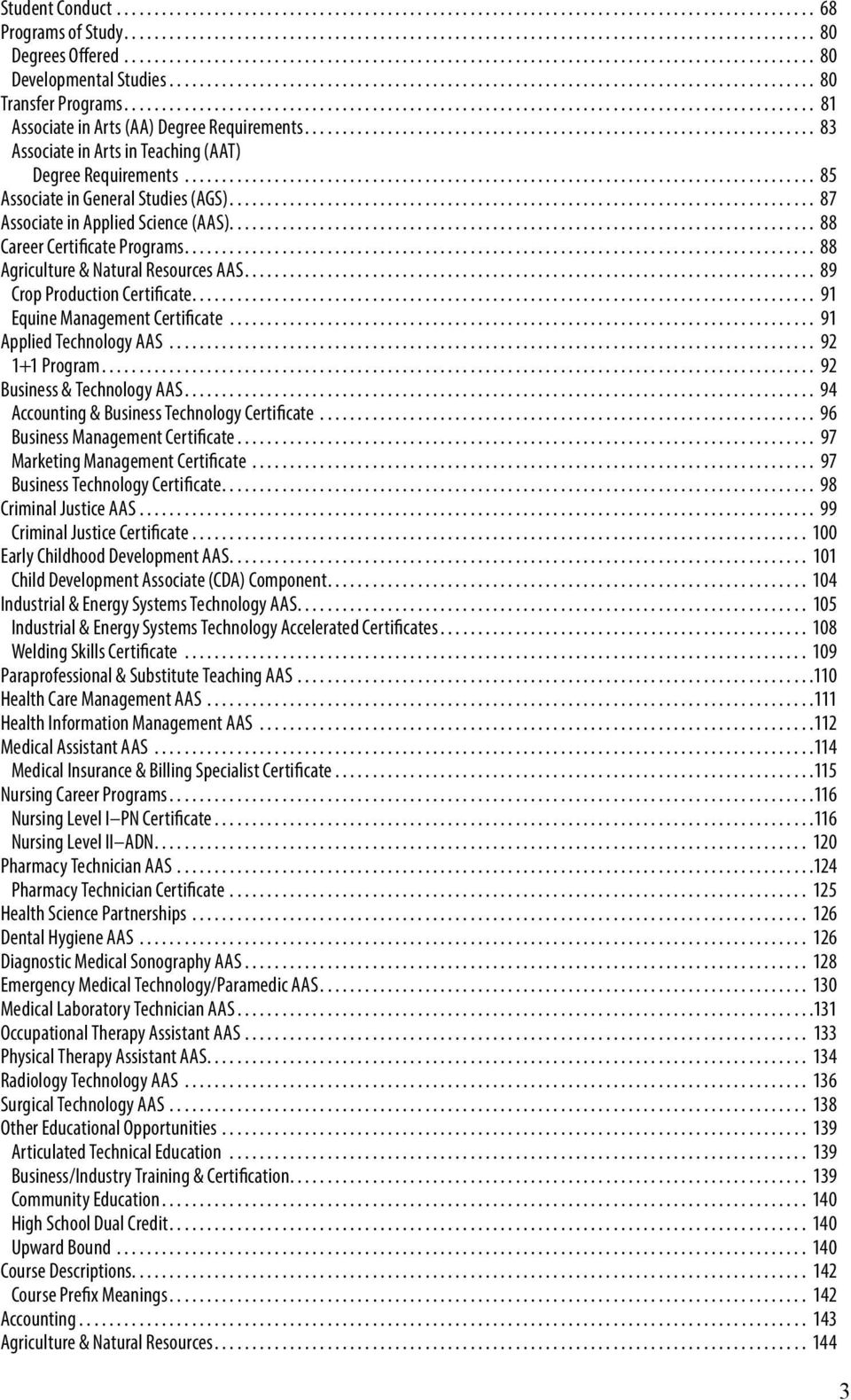
3 Student Conduct Programs of Study Degrees Offered Developmental Studies Transfer Programs Associate in Arts (AA) Degree Requirements Associate in Arts in Teaching (AAT) Degree Requirements Associate in General Studies (AGS) Associate in Applied Science (AAS) Career Certificate Programs Agriculture & Natural Resources AAS Crop Production Certificate Equine Management Certificate Applied Technology AAS Program Business & Technology AAS Accounting & Business Technology Certificate Business Management Certificate Marketing Management Certificate Business Technology Certificate Criminal Justice AAS Criminal Justice Certificate Early Childhood Development AAS Child Development Associate (CDA) Component Industrial & Energy Systems Technology AAS Industrial & Energy Systems Technology Accelerated Certificates Welding Skills Certificate Paraprofessional & Substitute Teaching AAS Health Care Management AAS Health Information Management AAS Medical Assistant AAS Medical Insurance & Billing Specialist Certificate Nursing Career Programs Nursing Level I PN Certificate Nursing Level II ADN Pharmacy Technician AAS Pharmacy Technician Certificate Health Science Partnerships Dental Hygiene AAS Diagnostic Medical Sonography AAS Emergency Medical Technology/Paramedic AAS Medical Laboratory Technician AAS Occupational Therapy Assistant AAS Physical Therapy Assistant AAS Radiology Technology AAS Surgical Technology AAS Other Educational Opportunities Articulated Technical Education Business/Industry Training & Certification Community Education High School Dual Credit Upward Bound Course Descriptions Course Prefix Meanings Accounting Agriculture & Natural Resources
4 Allied Health Art 148 Applied Technology Business Administration Biological Science Business Technology Early Childhood Development Chemistry Criminal Justice College Skills Construction Technology Developmental Studies Economics Education Emergency Medical Technology English Earth Science Foreign Language Geography Health Care Management History Health Information Management Humanities Industrial Energy Information Technology Manufacturing Technology Mathematics Music Nursing Occupational Therapy Assistant Physical Education Philosophy Political Science Pharmacy Technician Physical Science Psychology Religion Social Science Speech Theatre Welding Technology Student Handbook Student Code Of Conduct Student Cards Emergency Evacuation Procedures Rights & Regulations Board Of Trustees NCMC Emeriti Administration Full-Time Faculty Management & Professional Staff Classified Staff Index

5 Contacts To reach one of the following offices or people, call (660) and enter the extension listed. to address shown in parentheses. Department Ext. Advising 1418 Academic Resource Center 1374 Admissions 1414 Bookstore 1506 Career Services 1407 Cashier (payment of fees) 1513 or 1508 Computer Help Desk 1214 Financial Aid 1513 Ketcham Community Center 1450 Registration 1205 or 1206 Residence Hall Information 1418 or 1412 Student Support Services 1356 Testing Services 1418 or 1407 Employee Name Ext. Albrecht, Quentin History Instructor (QAlbrecht) 1315 Alden, Barbara Business Director (BAlden) 1503 Alexander, Anthony Online Services Officer (AAlexander) 1215 Alley, Dr. Kristen Dean of Student Services (KAlley) 1400 Arndt, Tonya Student Services Coordinator (TArndt) 1418 Barnett, Alan Chief Information Officer (ABarnett) 1210 Baugher, Johannah Education/Teacher Education Coordinator (JBaugher) 1349 Bingham, Whitney Student Billing/Cards Coordinator (WBingham) 1508 Bird, Sarah Business Management Instructor (SBird) 1304 Blaine, Stephanie Level II Nursing Instructor/Program Coord.-Maryville (SBlaine) 1901 Bonnett, Sarah Custodial Services Staff (SBonnett) 1522 Boyle, Gary Custodial Services Staff (GBoyle) 1520 Brinser, Leah Development Assistant (LBrinser) 1415 Brown, Andrea TRIO Learning Assistant (ABrown) 1347 Brown, Linda Records & Enrollment Director/Registrar (LBrown) 1205 Bruinsma, Dr. Paul Chemistry & Physics Instructor (PBruinsma) 1307 Buntin, Ashlea Financial Aid Associate Director (ABuntin) 1417 Cairns, Megan Physical Ed. Instructor/Womens Softball Coach (MCairns) 1408 Caldarello, Beth Librarian (BCaldarello) 1322 Campbell, John Physical Plant Staff (JCampbell) 1514 Campbell, Tamara Database Administrator (TCampbell) 1219 Carlson, Susanne Level II Nursing Instructor Maryville (SCarlson) 1903 Castanada, Shellee Library Assistant II (SCastanada) 1335 Claycomb, Kelly Level I Nursing Instructor/Program Coord.-Trenton (KClaycomb) 1312 Cooksey, Cory Business & IT Instructor (CCooksey) 1319 Cooksey, Hilary Payroll/Accounts Payable Coordinator (HCooksey) 1512 Compton, Patricia Level II Nursing Instructor Trenton (PCompton) 1342 Copple, Ronda Accounting Instructor (RCopple) 1320 Cotton, Missie Business Technology Instructor (MCotton) 1323 Cowling, Linda English Instructor (LCowling) 1324 Crawford, Beth Level I Nursing Site Coordinator-Bethany (BCrawford)

6 ???? MO Health Wins Recruitment & Advisement Specialist (????)???? Cross, Teresa Development Director (TCross) 1403 Croy, Jennifer Mathematics Instructor & Womens Basketball Coach (JCroy) 1456 Cunningham, Jamie Cashier & Financial Aid Representative (JCunningham) 1414 Cutsinger, Kristi Allied Health Sciences Administrative Assistant (KCutsinger) 1316 Cutsinger, Marcie Trio Programs Director(MCutsinger) 1348 Dennert, Shayna Student Services Coordinator (SDennert) 1418 Dennis, Mike Custodial Services Staff (MDennis) 1523 DeWitt, Megan Admissions & Financial Aid Director (MDeWitt) 1406 Esry, Jeremy Ketcham Community Center Coor. & Asst. Coach (JEsry) 1450 Flentje, Linda Student Support Services Program Coordinator (LFlentje) 1356 Gaston, Adam Computer Specialist I (AGaston) 1311 Graham, Gina Marketing Coordinator (GGraham) 1416 Guile, Denise Bookstore Assistant Manager (DGuile) 1507 Guthrie, Amy English Instructor (AGuthrie) 1317 Hale, Jeff Custodian Services Supervisor (JHale) 1510 Harman, Maryellen History Instructor (MHarman) 1343 Harris, Kristi Upward Bound Program Coordinator (KHarris) 1353 Helton, Jason Federal Programs Coordinator (JHelton) 1278 Herring, Debra Level I Nursing Instructor/Program Coord. Maryville (DHerring) 1902 Hillerman, Donnie Residential Life Director & Baseball Coach (DHillerman) 1412 Holder, Lori Advisor, A+ & Testing Coordinator (LHolder) 1407 Hooyman, Dr. Jamie Vice President of Institutional Effectivenes (JHooyman) 1329???? Nursing Skills Lab Coordinator (????) 1306 Jumps, Rustin Agriculture & Natural Resources Instructor (RJumps) 1336 Keith, Scott Psychology Instructor (SKeith) 1326 Kidd, Judy ARC Tutor Coordinator & Learning Specialist (JKidd) 1333 Vandel, Jenna Criminal Justice Instructor (JVandel) 1327???? Student Support Services Tutor Coordinator (????) 1347 Maloney, Sarah MO Health Wins Grant Administrator (SMaloney) 1357 Marsh, Cecilia Bookstore Director(CMarsh) 1505 McAtee, Brooke Level I & II Nursing Instr./Level II Prg. Coor. Trenton (BrMcatee) 1309 McCollum, Heather Trio Administrative Assistant (HMccollum) 1332 McCollum, Karla Admissions Associate Director (KMcCollum) 1401 Meeker, Kimberly Admissions & Financial Aid Representative (KMeeker) 1402 Miller, Rickiann Computer Specialist II (RMiller) 1311 Moulin, Marie Advisor (MMoulin) 1404 Nichols, Sue Level II Online Nursing Instructor (SNichols) 1361 Noah, Tara Institutional Research Officer (TNoah) 1218 Norris, Jim Art Instructor (JNorris) 1345 Nowland, David Agriculture & Natural Resources Instructor (DNowland) 1314 Nuttall, Dr. Neil President (NNuttall) 1200 Oaks, Joni Assistant Registrar (JOaks) 1206 Ockenfels, Steve Ketcham Community Center Director (SOckenfels) 1455 O Neal, Mike Custodial Services Staff (MOneal) 1509 Osterthun, Stacy Dean of Instruction Assistant (SOsterthun) 1301 Otto, Tyson Chief Financial Officer/Director of Operations (TOtto) 1500 Peterie, Cindy Admissions Representative (CPeterie) 1410 Quinn, Margaret Sue CTE Recruiter & Retention Specialist (MQuinn) 1359 Ralls, Jason Database & Network Manager (JRalls) 1212 Richman, Steve Athletic Director, Basketball Coach & Phys. Ed. Instr. (SRichman)

7 Riley, Aimee Allied Health Assistant-Maryville (ARiley) 1900 Robinson, Sharalyn Financial Aid Processor (SRobinson) 1413 Russell, Stacey Student Support Services Academic Advisor (SRussell) 1346 Sager, Dennis Life Science Instructor (DSager) 1321 Scott, Stan Industrial & Energy Systems Technology Instructor (SScott) 1358 Searcy, Lee Ann Human Resources Director/Controller (LSearcy) 1502 Shipley, Melody Developmental Education Coordinator (MShipley) 1305 Skipper, Korynn Level I Nursing Instructor (KSkipper) 1328???? Library Assistant I (????) 1325 Smith, Cathy Upward Bound Academic Advisor (CSmith) 1338 Snuffer, Lynda Early Child Development Instructor (LSnuffer) 1331 Stull, Shaun Network Services Administrator (ShStull) 1216 Stull, Dr. Susan Life Science Instructor (SStull) 1303 Suttenfield, Ryan Residence Life Coordinator/Assistant Coach (RSuttenfield) 1470 Swint, Lola Mathematics Instructor (LSwint) 1337 Tanno, Jamie Residence Life Coordinator/Asst. Coach (JTanno) 1480 Thomas, Evelyn Health Information Management Director (EThomas) 1284 Totten, Tina Academic Resource Center Director (TTotten) 1334 Trump, Whitney Academic Support Programs Coordinator (WTrump) 1318???? Advising Coordinator/Accessibility Services Coor. (????) 1405 Vanderpool, Janet Dean of Allied Health Sciences (JVanderpool) 1310 VanDyke, Bari Physical Plant Staff (BVandyke) 1514 Weaver, Vicki Administrative Assistant to President/Public Relations (VWeaver) 1203 Welch, Tracy Mathematics Instructor (TrWelch) 1340 White, Lenny Custodial Services Staff (LWhite) 1521 Wiebers, Tammie Speech Instructor (TWiebers) 1339 Williamson, Sarah Cashier & Financial Aid (SWilliamson) 1513 Wilson, Kayla Accounting Officer (KWilson) 1501 Wyatt, Lesli Ketcham Community Center Asst. & Asst. Coach (LWyatt) 1450 Young, Randy Physical Plant Director (RYoung)

8 Academic Calendar Fall Sessions 2013 Thursday & Friday, August College In-Service Monday, August 19 Classes begin Thursday, August 22 Add/drop ends Monday, September 2 Labor Day College closed Tuesday, September 3 No classes Friday, October 11 Mid-term Thursday, October 17 Fall Break No classes Friday, October 18 Fall Break College closed Friday, November 22 Withdrawal deadline Wednesday, November 27 No evening classes Thursday& Friday, November Thanksgiving College closed Friday, December 6 Last day of regular classes Monday - Thursday, December 9-12 Final exams week December 24 - January 1 Holiday Break College closed Spring Intersession 2014 Friday, December 13 Classes begin Tuesday, December 17 Add/drop ends Monday, December 23 Withdrawal deadline Thursday, January 9 End of classes Final exams held Spring Sessions 2014 Friday, January 10 College In-Service Monday, January 13 Classes begin Thursday, January 16 Add/drop ends Monday, January 20 Martin Luther King Day College closed Monday, February 17 Presidents Day College closed Tuesday, February 18 College In-Service No day classes, evening classes meet Friday, March 7 Mid-term Thursday - Friday, March Spring Break No classes Friday, March 21 Spring Holiday College closed Thursday, April 17 Withdrawal deadline Thursday, April 17 No classes Friday, April 18 College Holiday College closed Monday, May 5 Last day of regular classes Tuesday - Friday, May 6-9 Final exams week Saturday, May 10 Commencement ceremony Summer Intersession 2014 Friday, May 9 Classes begin Tuesday, May 13 Add/drop ends Monday, May 19 Withdrawal deadline Monday, May 26 Memorial Day College closed Friday, May 30 End of classes Final exams held Summer Sessions 2014 Monday, June 2 Classes begin Wednesday, June 4 Summer Full Term & Session I add/drop ends Friday, June 20 Session I withdrawal deadline Friday, June 27 End of Summer Session I classes Final exams held Monday, June 30 Beginning of Summer Session II classes Wednesday, July 2 Summer Session II add/drop ends Friday, July 4 July 4th Holiday College closed Friday, July 18 Summer Full Term & Session II withdrawal deadline Friday, July 25 End of Summer Sessions Final exams held 8

9 Fall Sessions 2014 Thursday & Friday, August College In-Service Monday, August 18 Classes begin Thursday, August 21 First session & full-term add/drop ends Monday, September 1 Labor Day College closed Tuesday, September 2 No classes Friday, October 3 First session withdrawal deadline Friday, October 10 Mid-term, first session ends Monday, October 13 Second session begins Wednesday, October 15 Second session add/drop ends Thursday, October 16 Fall Break No classes Friday, October 17 Fall Break College closed Friday, November 21 Second session & full-term withdrawal deadline Wednesday, November 26 No evening classes Thursday & Friday, November Thanksgiving College closed Friday, December 5 Last day of regular classes Monday - Thursday, December 8-11 Final exams week December 24 - January 1 Holiday Break College closed Spring Intersession 2015 Friday, December 12 Classes begin Tuesday, December 16 Add/drop ends Monday, December 22 Withdrawal deadline Thursday, January 8 End of classes Final exams held Spring Sessions 2015 Friday, January 9 College In-Service Monday, January 12 Classes begin Thursday, January 15 First session & full-term add/drop ends Monday, January 19 Martin Luther King Day College closed Monday, February 16 Presidents Day College closed Tuesday, February 17 College In-Service No day classes, evening classes meet Friday, February 27 First session & full-term withdrawal deadline Friday, March 6 Mid-term, first session ends Monday, March 9 Second session begins Wednesday, March 11 Second session add/drop ends Thursday-Friday, March Spring Break No classes Friday, March 20 Spring Holiday College closed Thursday, April 2 No classes Friday, April 3 College Holiday College closed Friday, April 17 Second session & full-term withdrawal deadline Monday, May 4 Last day of regular classes Tuesday-Friday, May 5-8 Final exams week Saturday, May 9 Commencement ceremony Summer Intersession 2015 Friday, May 8 Classes begin Tuesday, May 12 Add/drop ends Monday, May 18 Withdrawal deadline Monday, May 25 Memorial Day College closed Friday, May 29 End of classes Final exams held Summer Sessions 2015 Monday, June 1 Classes begin Wednesday, June 3 Summer Full Term & Session I add/drop ends Friday, June 19 Session I withdrawal deadline Friday, June 26 End of Summer Session I classes Final exams held Monday, June 29 Beginning of Summer Session II classes Wednesday, July 1 Summer Session II add/drop ends Friday, July 3 July 4th Holiday College closed Friday, July 17 Summer Full Term & Session II withdrawal deadline Friday, July 24 End of Summer Sessions Final exams held 9

10 Fall Final Exams Schedule If your class normally meets on: at: then your final is: MWF 9:00 am Monday 8:00 am to 10:00 am MWF 11:00 am Monday 10:00 am to 12:00 pm MWF 12:00 pm Monday 12:30 pm to 2:30 pm MWF 2:00 pm Monday 2:30 pm to 4:30 pm TR 8:00 am Tuesday 8:00 am to 10:00 am TR 11:00 am Tuesday 10:00 am to 12:00 pm TR 12:00/12:30/1:00 pm Tuesday 12:30 pm to 2:30 pm MWF 8:00 am Wednesday 8:00 am to 10:00 am MWF 10:00 am Wednesday 10:00 am to 12:00 pm MWF 1:00 pm Wednesday 12:30 pm to 2:30 pm TR 9:30 am Thursday 8:00 am to 10:00 am TR 2:00 pm Thursday 12:30 pm to 2:30 pm All night classes will meet during their designated time finals week, including Monday night classes. Night Class Finals Schedule Monday-Monday night of finals week. NOTE: Monday final is the last day of semester classes for day classes. Tuesday-Tuesday night of finals week Wednesday-Wednesday night of finals week Thursday-Thursday night of finals week Open Periods Tuesday Thursday Wednesday Friday 2:30 pm 4:30 pm 10:00 am 12:00 pm 2:30 pm 4:30 pm All day 10

11 Spring Final Exams Schedule If your class normally meets on: at: then your final is: TR 8:00 am Tuesday 8:00 am to 10:00 am TR 11:00 am Tuesday 10:00 am to 12:00 pm TR 12:00/12:30/1:00 pm Tuesday 12:30-2:30 MWF 9:00 am Wednesday 8:00 am to 10:00 am MWF 11:00 am Wednesday 10:00 am to 12:00 pm MWF 12:00 pm Wednesday 12:30 pm to 2:30 pm MWF 2:00 pm Wednesday 2:30 pm to 4:30 pm TR 9:30 am Thursday 8:00 am to 10:00 am TR 2:00 pm Thursday 12:30 pm to 2:30 pm MWF 8:00 am Friday 8:00 am to 10:00 am MWF 10:00 am Friday 10:00 am to 12:00 pm MWF 1:00 pm Friday 12:00 pm to 2:00 pm All night classes will meet during their designated time finals week, including Monday night classes. If an emergency occurs that prevents the administration of a final examination, the student s final course grade will be calculated based on the work in the course completed to that point in time and the faculty member s considered judgment. Final exams will not be rescheduled and a grade of I (Incomplete) will not be given as a result of the missed exam. This Finals policy does NOT apply to online courses. Night Class Finals Schedule Monday-Monday night of finals week. NOTE: Monday final is the last day of semester classes for day classes. Tuesday-Tuesday night of finals week Wednesday-Wednesday night of finals week Thursday-Thursday night of finals week Open Periods Tuesday Thursday 2:30 pm to 4:30 pm 10 am to 12:00 pm 11

12 12 Main Campus

13 Barton Farm Campus 13

14 A Letter of Welcome North Central Missouri College is truly a remarkable college known for its academic excellence and strong sense of community. We believe our educational institution signifies choice and value. It is people gathering to investigate, discover, seek opportunities, and embark upon countless challenges for betterment. Our investment in teaching creates an educational experience that is intellectually challenging and has a practical value far beyond the classroom. Our students are instructed by talented faculty who invest their time and energy to ensure individual success. Small class sizes and a variety of class schedules afford advantages that give students the ability to create their own learning experiences. At North Central Missouri College, partnership programs with business and industry provide expanded learning opportunities that lead to career entry and advancement. Multiple outreach programs bring the learning laboratory to you, the student. Training programs that reach into the workplace assist students in transition from the classroom to a career. With classes offered at Maryville, Chillicothe, Bethany, Brookfield and Trenton, we have begun to regionalize our efforts to serve a diverse population of learners. We are proud of contributions made to our heritage that include students from the surrounding four state region and internationally as well. Whether you are a senior in high school seeking dual credit, a recent high school graduate, or a returning college student seeking advancement, you will find that North Central Missouri College offers a world of potential! Please utilize our catalog as a guide to the services, academic programs, courses, activities, and resources available to you at North Central Missouri College. I hope you will take the time to visit our campus. We began a beautification effort several years ago and have enhanced the scenery of our campus with lush shrubs, lawns, reflective areas on campus and new parking. The Ketcham Center is the home of our competitive sports programs, but also provides you a membership ensuring an active life-style while on campus. A new health and life sciences building, Dr. Albert and Vera Cross Hall; plans to renovate and restore our landmark Geyer Hall and development of the Barton Farm Campus create a wonderful learning environment. Come join the excitement! Let us help you achieve your goals and build a brighter future. Dr. Neil Nuttall, NCMC President 14

15 This Is NCMC Where is it you want to go in life? Is your goal to become an accountant, a nurse, a livestock operations manager, a teacher, a physical therapist, an office manager, a lawyer, a reporter, a doctor, a secretary, a corrections officer, an engineer, a pharmacist or a business owner? If so, North Central Missouri College is the place to start for these and other careers. From NCMC, you can go anywhere! Our alumni have been successful in these professions and many more. For some careers, you will be able to obtain your general education courses at NCMC then continue your education at another college or university. In other cases, you ll find NCMC s career programs give you the skills needed to get a good job. If you re not sure where you re headed, at NCMC you can afford to explore the possibilities. We ll help you develop the skills and knowledge necessary to live, work and contribute meaningfully in a changing world. NCMC Has Many Advantages North Central Missouri College was the right choice for me! More than 2,000 students make that statement each year. Why? Because NCMC offers many advantages, such as: Excellent faculty classes are taught by professionals with master s and doctorate degrees, not graduate teaching assistants as with many universities. Small classes average size is 18 students. Low cost tuition the average student saves $20,000 by choosing a community college to begin their education.. A variety of educational programs nearly 30 options. Financial assistance an array of financial aid programs, scholarships, grants and work-study options. Professional support staff here to help you with academic advising, career counseling, tutoring and course assistance, testing, and exciting student activities. Growing campus residence halls, community center, health and life sciences building, science/technology building, farm campus, beautiful central green, student center, success center, art gallery, plus Internet and computer labs. The Dr. Albert and Vera Cross Hall has been completed as well as the Barton Farm Campus. The only community college located in north central Missouri, NCMC offers convenient access. Missouri A+ Schools Program all NCMC programs qualify for A+ funding. 15

16 University Transfer Programs Are you on the road to a four-year degree, or do you hope to enter a professional program such as law, engineering, medicine or teaching? If so, North Central Missouri College offers you the basic knowledge and academic skills needed to succeed through our Associate in Arts and Associate in Arts in Teaching degrees. The university transfer program at NCMC meets a wide variety of individual needs. Popular options, include but are not limited to the following: Agriculture & Natural Resources Art Biology Business Chemistry Computer Science Criminal Justice Education English Forestry Health Occupations Journalism Mass Media Mathematics Parks, Recreation & Tourism Administration Physical Education Political Science Pre-Engineering Pre-Law Pre-Medical Pre-Veterinary Psychology Social Work Speech Theatre Wildlife & Conservation Mgmt. 16

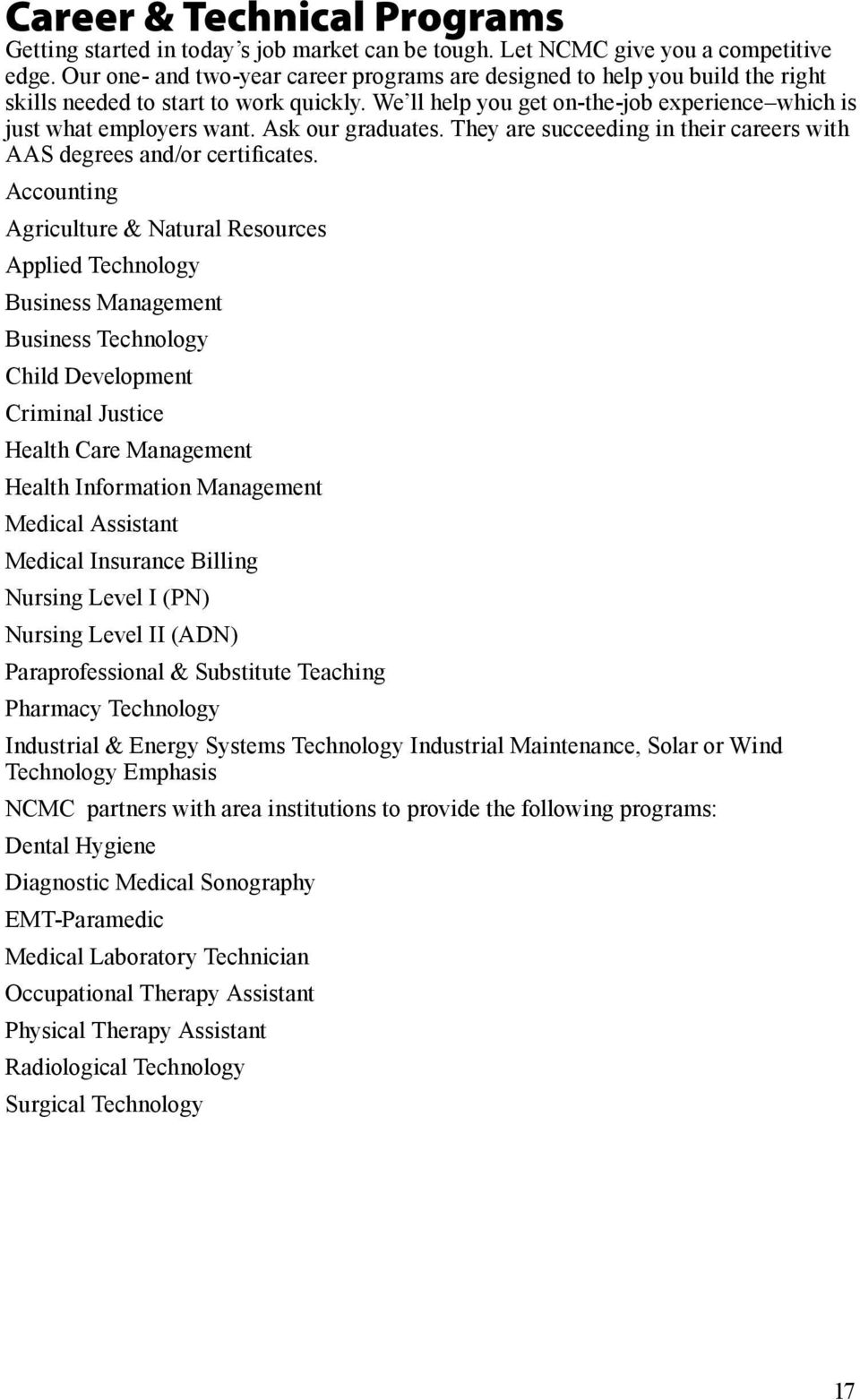
17 Career & Technical Programs Getting started in today s job market can be tough. Let NCMC give you a competitive edge. Our one- and two-year career programs are designed to help you build the right skills needed to start to work quickly. We ll help you get on-the-job experience which is just what employers want. Ask our graduates. They are succeeding in their careers with AAS degrees and/or certificates. Accounting Agriculture & Natural Resources Applied Technology Business Management Business Technology Child Development Criminal Justice Health Care Management Health Information Management Medical Assistant Medical Insurance Billing Nursing Level I (PN) Nursing Level II (ADN) Paraprofessional & Substitute Teaching Pharmacy Technology Industrial & Energy Systems Technology Industrial Maintenance, Solar or Wind Technology Emphasis NCMC partners with area institutions to provide the following programs: Dental Hygiene Diagnostic Medical Sonography EMT-Paramedic Medical Laboratory Technician Occupational Therapy Assistant Physical Therapy Assistant Radiological Technology Surgical Technology 17
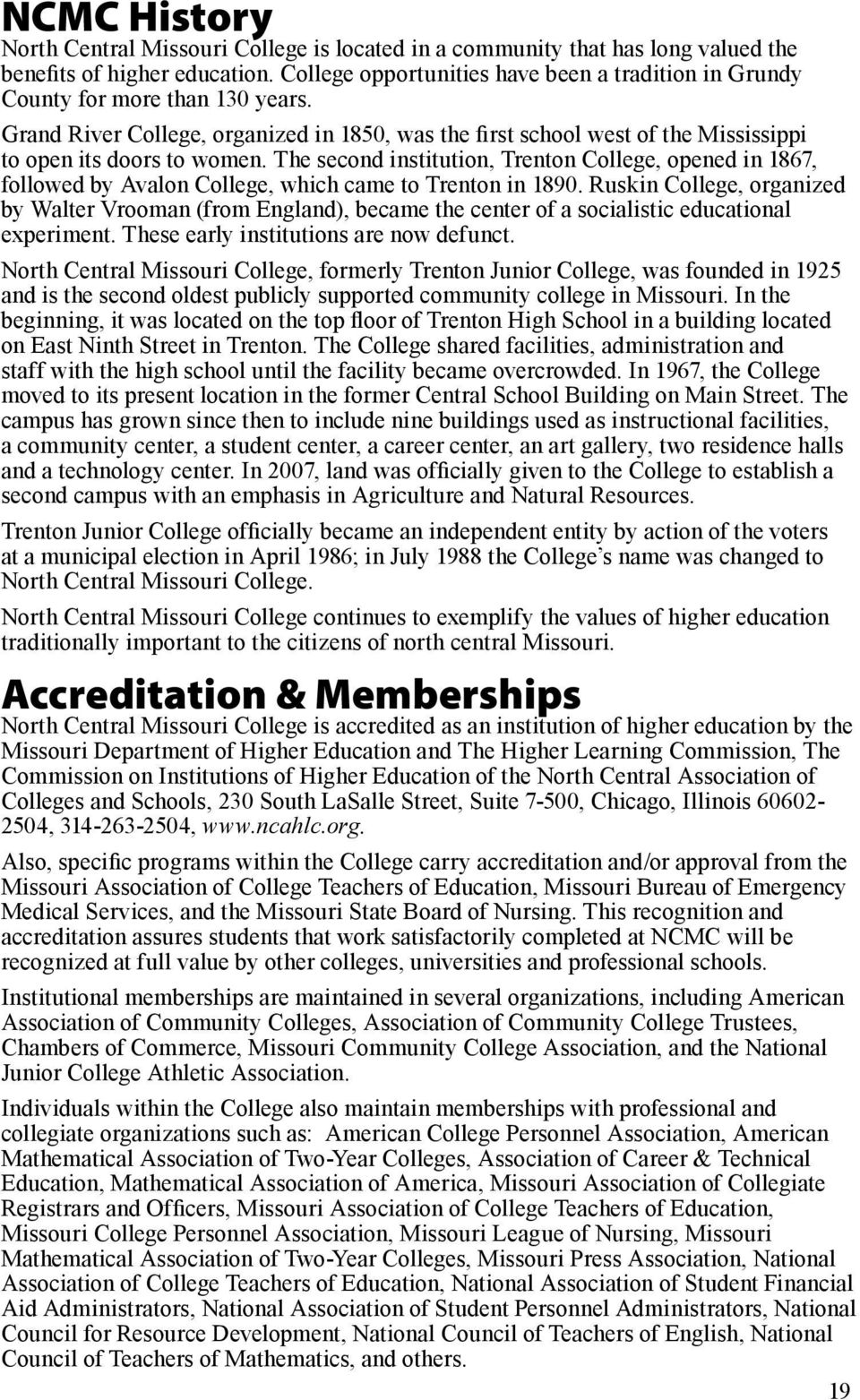
18 Statement Of Mission The mission of NCMC is to assist individuals in our educational/business community to attain their goals through open admission, reasonable costs, and progressive curriculum and services delivered by a caring, competent staff in a safe, technology-rich learning environment. Beliefs 1. NCMC cares about the success of individuals and provides them with the resources and environment necessary to achieve our fundamental purpose: teaching them to learn how to learn. 2. NCMC values the potential of individuals and promotes their personal and intellectual growth as lifelong learners. 3. NCMC employees model the responsibility and integrity we expect from others in the college and community. Objectives 1. Increase the availability of and optimize the management of resources to achieve an excellent educational environment 2. Form and enhance strategic alliances to sustain a dynamic organization 3. Tailor the curriculum and services to help individuals meet the challenges of an ever-changing world 4. Attract and retain a caring and competent staff by valuing the talents and potential of each individual Statement Of Ethics As representatives of North Central Missouri College, we share the responsibility to conduct ourselves with integrity, to act in a fair, consistent, and equitable manner. We value the potential of individuals, care about their success and recognize the need for openness and reliability in what we say and do. We are committed to addressing issues in a forthright and professional manner and to separating people from issues as we engage people in problem solving without prejudice. As representatives of North Central Missouri College, we are committed to personal and academic excellence in all that we do and to adhere to the principles of ethical behavior established in this statement. The conduct of each member of North Central Missouri College is expected to be consistent and comply with the principles contained in this statement and with the Board of Trustees Manual. We expect each employee to model the responsibility and integrity within the college community and will never tolerate demeaning or endangering behaviors. All members of North Central Missouri College are expected to engage in the following: Practice personal and academic integrity; Respect the dignity of all persons; Respect the right and property of others; Discourage bigotry, learn from diverse differences in people, ideas, and opinions; Demonstrate concern for others, their feelings and their need for conditions which support their work and development; Refrain from and discourage behaviors which threaten the freedom and respect that all NCMC community members deserve; Accommodate students regardless of socioeconomic circumstances 18
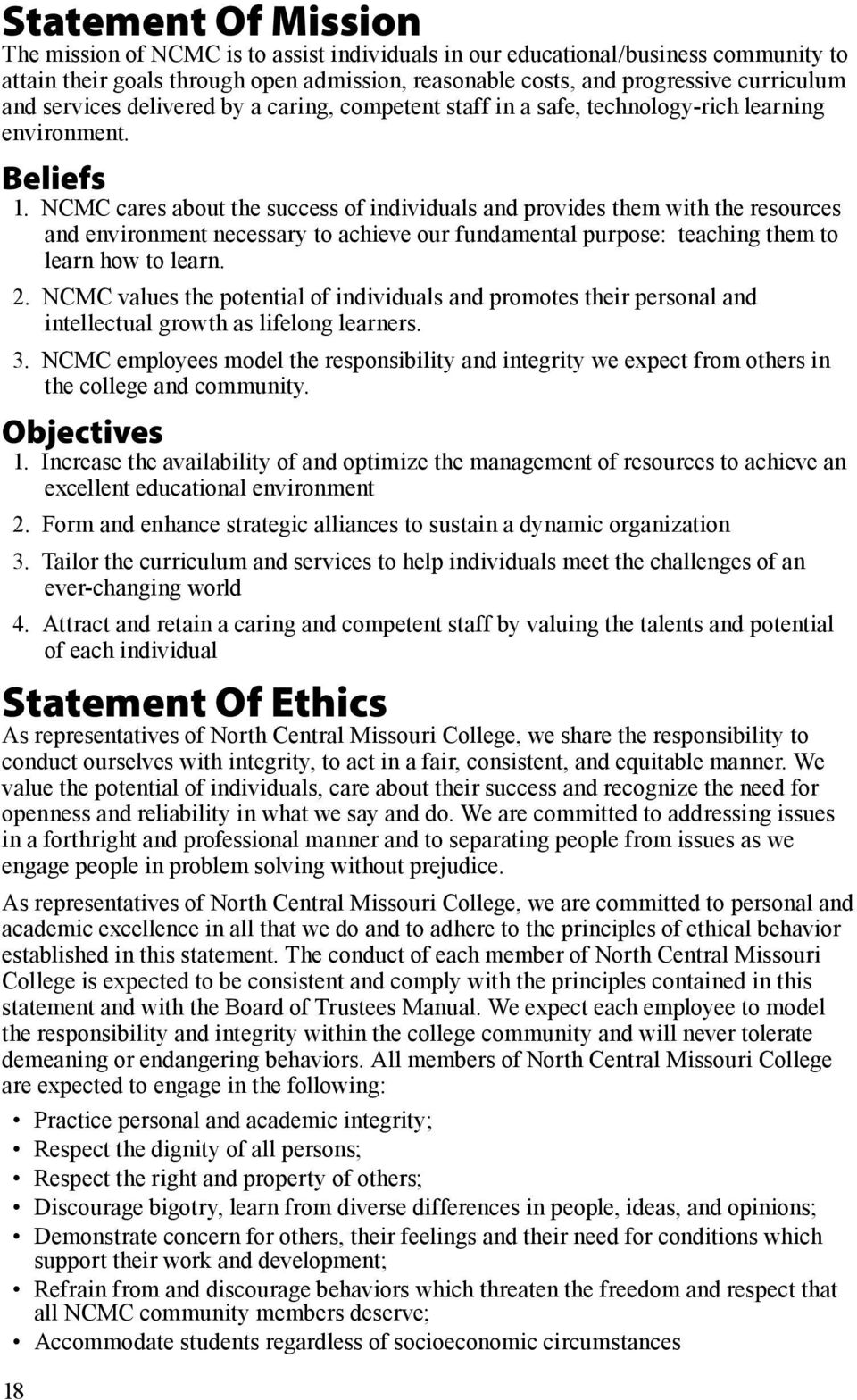
19 NCMC History North Central Missouri College is located in a community that has long valued the benefits of higher education. College opportunities have been a tradition in Grundy County for more than 130 years. Grand River College, organized in 1850, was the first school west of the Mississippi to open its doors to women. The second institution, Trenton College, opened in 1867, followed by Avalon College, which came to Trenton in Ruskin College, organized by Walter Vrooman (from England), became the center of a socialistic educational experiment. These early institutions are now defunct. North Central Missouri College, formerly Trenton Junior College, was founded in 1925 and is the second oldest publicly supported community college in Missouri. In the beginning, it was located on the top floor of Trenton High School in a building located on East Ninth Street in Trenton. The College shared facilities, administration and staff with the high school until the facility became overcrowded. In 1967, the College moved to its present location in the former Central School Building on Main Street. The campus has grown since then to include nine buildings used as instructional facilities, a community center, a student center, a career center, an art gallery, two residence halls and a technology center. In 2007, land was officially given to the College to establish a second campus with an emphasis in Agriculture and Natural Resources. Trenton Junior College officially became an independent entity by action of the voters at a municipal election in April 1986; in July 1988 the College s name was changed to North Central Missouri College. North Central Missouri College continues to exemplify the values of higher education traditionally important to the citizens of north central Missouri. Accreditation & Memberships North Central Missouri College is accredited as an institution of higher education by the Missouri Department of Higher Education and The Higher Learning Commission, The Commission on Institutions of Higher Education of the North Central Association of Colleges and Schools, 230 South LaSalle Street, Suite 7-500, Chicago, Illinois , , Also, specific programs within the College carry accreditation and/or approval from the Missouri Association of College Teachers of Education, Missouri Bureau of Emergency Medical Services, and the Missouri State Board of Nursing. This recognition and accreditation assures students that work satisfactorily completed at NCMC will be recognized at full value by other colleges, universities and professional schools. Institutional memberships are maintained in several organizations, including American Association of Community Colleges, Association of Community College Trustees, Chambers of Commerce, Missouri Community College Association, and the National Junior College Athletic Association. Individuals within the College also maintain memberships with professional and collegiate organizations such as: American College Personnel Association, American Mathematical Association of Two-Year Colleges, Association of Career & Technical Education, Mathematical Association of America, Missouri Association of Collegiate Registrars and Officers, Missouri Association of College Teachers of Education, Missouri College Personnel Association, Missouri League of Nursing, Missouri Mathematical Association of Two-Year Colleges, Missouri Press Association, National Association of College Teachers of Education, National Association of Student Financial Aid Administrators, National Association of Student Personnel Administrators, National Council for Resource Development, National Council of Teachers of English, National Council of Teachers of Mathematics, and others. 19
20 Governance North Central Missouri College is governed by a six-member Board of Trustees. The trustees are elected by patrons of the College district and serve a six-year term without pay. They are charged with the primary responsibilities of setting College policy and the selection of a President to administer those policies. NCMC operates under the general supervision of the Missouri Department of Higher Education. NCMC is located in the heart of the Midwest, the NCMC campus is located in downtown Trenton, Missouri. Campus facilities have more than doubled in recent years to include nine structures for instruction, a student center, two residence halls, an art gallery and a community center/gymnasium. The Barton Farm Campus opened in the fall of 2011 creating a second campus for the college and includes three classroom buildings and grounds for development. The Willis Alexander Student Center (ASC), just south and east of Geyer Hall, is a one-stop center for most student-related services. The upper level contains the Students Services Department including offices for the Dean of Student Services, Admissions, Advising, Testing, Financial Aid, Registrar, and Student Housing. The lower level contains offices for the Graceland University outreach program, offices of Northwest Missouri State University instructors and the NCMC Student Senate. It also has a large conference room, smaller testing and meeting rooms. Larry D. Barnes Hall (BH) & Herbert O. Freeman Hall (FH) are located on the east side of Main Street across from Geyer Hall and contain the departments of Student Support Services, Upward Bound, the Academic Resource Center and Tech Lab for student use. The Elizabeth & Arthur Barton Farm Campus is the College s second campus and is located southeast of Trenton at 96 Southeast 8th Avenue. The campus includes three classroom buildings: the Lager Laboratory of Plant & Energy Science, the Metcalf Mechanical Resource Center and the Kuttler Animal Science complex. The farm campus encompasses 138 acres of farm ground given to the College by the Barton family. A wind turbine, two acre pond and numerous test plots are located on the farm campus to support learning. Dr. Albert & Vera Cross Hall (CH) was dedicated in 2009 and is located on the northwest corner of the campus. It is home to the Allied Health and Life Sciences Department with classrooms and faculty offices plus the Senator Christopher S. Bond Sciences Lab. Additional classrooms are also located in the building. The Northwest Missouri State University outreach office is located here as well as a coffee shop open to the students and the community. Russ Derry Training Facility for Baseball & Softball, located at the corner of 13th & Lulu Streets, is an indoor hitting/training facility for the baseball and softball programs. Building B, located on Crowder Road north of the Cross Hall, is the home to the College s art department. The land was given to the College by Marilyn Witten Whisler and Katherine Witten Parker in memory of their mother, Mary Louise Witten. Ellsworth Hall (EH), a residential facility for men, opened its doors in It is named in honor of Dr. and Mrs. Willard Ellsworth. Each room has its own heating/ air conditioning unit, a sink, cable TV, wifi and standard internet. Ellsworth Hall also includes handicapped accessible rooms for students with physical impairments, a laundry area, computer lab, mailboxes and easy access to parking. The Everett & Hazel Frey Administrative Center (FAC), located east of the Alexander Student Center, hosts a variety of activities and functions. Offices located 20

21 in the Frey Center include those for the College President, Development/Foundation and Marketing, Public Relations, the College Business Office, Human Resources and Information Technology as well as the Dorris Rider Art Gallery. E.D. Geyer Hall (GH) is the anchor building on the downtown campus. It houses administrative and faculty offices as well as classrooms and the college library. The O.G. Sanford Clock Tower located above the front entrance and named in honor of the College s first president, as well as the ship s anchor located outside Geyer Hall are campus landmarks. An elevator is located at the north entrance of the building. The Bert and Rose Hoover Memorial Quadrangle is a beautifully landscaped central green with sitting walls and walkways making Geyer Hall a natural stage for various college and community events. Outdoor arts programs, student activities and special events are often held on the quadrangle. The red stone circle in the center is named Henderson Circle in honor of Leonard Butch Henderson. Hoffman Hall (HH), named in honor of Alice May Hoffman and Jeanette Hoffman Robison is located north of Geyer Hall, houses classrooms, computer and science labs, and faculty offices. A recent expansion doubled the size of the building and now includes access to Cross Hall and a campus commons area. The Lloyd & Margaret Ketcham Community Center (KCC), completed in the spring of 1998, includes a gymnasium, cardio room, exercise equipment, walking track, meeting rooms, training room and coaches offices. The facility provides for NCMC athletic programs, physical education classes, and community activities and events. The building includes the Harry Sugg Conference Room and the Jeanette Hoffman Robison Auditorium. NCMC Bookstore, located at 1314 Main Street, offers textbooks, classroom supplies, college apparel, health care uniforms and general merchandise to students and the public. NCMC s Maintenance Department located on Lulu Street just east of the Ketcham Community Center, houses the NCMC maintenance department offices and workshop areas. This building is also the site for all general deliveries for the College. The Layson Building houses the Workforce Investment Board (WIB) and Adult Education & Literacy (AEL) administrative offices and is located south of campus in the downtown district. The Thomas & Edna Rehard Plaza, located between Ellsworth Hall and the Alexander Student Center, is highlighted by a brick-red concrete walkway. The local Shakespearean Circle has developed a Shakespeare garden within the plaza. A metal arbor was erected in honor of Virginia Holmes and Maurine Embry and adds beauty to the scenic greenspace. The Dr. T. E. Ritze Building, located on Crowder Road and directly north of Hoffman and Cross Halls, is the administrative office for the Missouri Adult Education & Literacy Professional Development Center. Dr. James & Betty Selby Hall, a residential facility for women, was completed in The facility mirrors Ellsworth Hall with rooms and living areas similar to the men s hall. Selby Hall has a lobby/tv room, lounge and computer room for student use. A fullservice dining hall is located on the lower level and provides food service for all college students as well as staff and the public. 21
22 Getting Started The faculty and staff at North Central Missouri College care about student success! We want to help you achieve your goals in all areas of your life; which is why you ll find people and services that can help you both in and out of the classroom. When you re not sure where to go or how to get started, make your first stop the Alexander Student Center. Whether you need help with financial aid or planning your future, you ll find a friendly staff willing to give you the time you need. The Student Services Division is here to offer information and assist you in solving any problems you might have while attending college. Admissions, advising, financial aid, registration, career services and a host of other student services are all located in the Alexander Student Center. Just stop by the information desk to schedule an appointment or pick up current information. The Student Planner and a weekly newsletter, This Week, are prepared by the Marketing Office to provide you with current information about upcoming activities, events, college announcements as well as financial and registration deadlines. Check these publications for office and business hours of the services on campus. And don t forget to visit our website at for the latest news at North Central Missouri College. Take advantage of our one-stop Student Services Center today. We want to make your college experience the best possible. Admission Community colleges are the primary portal to higher education and employment for those who might not otherwise have access. As part of Missouri s community college system, North Central Missouri College is an open-admission institution. Any person who has a high school diploma, GED or home school certificate will be served by the College. Some programs, such as nursing, have specific program entrance requirements that must be met before admission into the program will be granted. Admission to the College does not ensure a student admission to a specific program or course. North Central Missouri College, in compliance with participation in federal programs, refrains from aggressive marketing and inducements and refrains from aggressively marketing to students or using inducements to encourage students to enroll. This policy applies to all students, including military students. 22
23 How to Apply for Admission 1. Complete an Application for Admission available on the NCMC website A one-time non-refundable application fee will apply. Dual Credit students who plan to attend NCMC after graduation will need to fill out the application for admission during their Senior year and pay the admission application fee Returning students who have not attended NCMC classes for five years or who have graduated from a certificate or degree program at NCMC must complete the Re-Admittance form. No fee is required. Please contact the NCMC Admissions Office for the form and further information. The Admissions Office welcomes prospective students, their parents and friends to visit our campus. To schedule an individual or group tour, contact the Admissions Office by phoning , ext. 1414, or by sending an to Admissions@mail. ncmissouri.edu. 2. Provide NCMC with the appropriate transcripts, documents and test scores. a. For first-time college students, request an official copy of your final or most recent high school transcript be sent to the NCMC Admissions Office. A final, official transcript must be received for final acceptance. The transcript must be from an accredited high school or a state recognized unaccredited high school. The transcript must be sent directly from the high school with an official seal of the school. The transcript must show all of the courses the student completed. Transcripts that have been purchased from a diploma mill or from an online accreditation agency will not be accepted. b. For students who have passed the GED test given by the Missouri State Department of Elementary and Secondary Education or any other states GED, send an official copy of your scores or certificate to the Admissions Office. c. For students who are transferring from another college or university, request an official transcript from each college attended. An official high school transcript is also required.. d. For home-schooled students, provide verification of having completed a high school course of study and ACT, SAT, COMPASS or ASSET test scores. Home schooled students must provide a copy of placement testing before enrolling in their initial semester. e. All non-citizen applicants to the college must provide proof of immigration status (i.e. Green card ) and must send a high school transcript translated into English before consideration for admittance into NCMC. See additional requirements under International Students. 3. Provide NCMC with a copy of your ACT, SAT, ASSET, or COMPASS scores prior to enrollment. Placement test scores are valid for two years; if your scores are older than two years you will be required to take the COMPASS test. These scores are used for placement in English, math, reading, science, history and government courses and help advisors to assist students in making career and educational plans. If you have not taken any of these, NCMC offers the COMPASS placement test to students who have either not taken the ACT or who need additional testing. See the catalog section on Academic Placement and Testing for more details. COMPASS study guides are available in the NCMC Library and the Academic Resource Center s home page. To register for testing at NCMC, please visit com. 23
24 The College reserves the right to evaluate and document special cases and to refuse admission if the College determines that the applicant is a threat or potential danger to the college community or if such refusal is considered to be in the best interest of the College. Students whose admission is revoked after enrollment must be given due process. Other Admissions Outreach, Online & Dual Credit Students In order to serve the needs of area residents, NCMC offers outreach, online and dual credit programs throughout north Missouri. Outreach/ITV: NCMC realizes many students may not be able to attend on-campus classes during regular hours. As a result, the College offers courses at community outreach sites. These courses are also delivered to outreach sites via ITV. These classes provide both traditional and nontraditional students the opportunity to pursue a college education with greater convenience. Online: NCMC delivers online classes that students can take from the convenience of their home. Dual Credit: Under certain circumstances, high school juniors and seniors may take college credit classes while in high school and receive both college and high school credit. Students need to be college bound or in accelerated programs at their high school, have a cumulative, non-weighted high school GPA of 3.0 and meet NCMC s requirements for entry into specific courses. High school freshmen and sophomores may be allowed special admission for dual credit provided they score at or above the 90th percentile on a nationally normed test such as the ACT and with approval from the Dean of Instruction. Students who enroll in dual credit classes must complete the NCMC dual credit admissions process. Contact the Dual Credit Coordinator at extension 1318 for further details. Online Policy this policy guides the faculty, student and institution through efficient online practices. Faculty members and students who participate in online are required to understand and follow the policies. The online policy is available on the following NCMC web page tab: About NCMC - Distance Learning/Online ( edu/programs/online/). Home-Schooled Students NCMC welcomes home-schooled students wishing to further their education. Admission is contingent upon completing the NCMC Application for Admission, providing verification of having completed a high school course of study and providing NCMC with ACT, SAT, ASSET, or COMPASS test scores. Home-schooled students are eligible to apply for NCMC academic scholarships and federal financial aid programs. Transfer Students NCMC welcomes transfer students and accepts credits earned from colleges and universities accredited by agencies recognized by the Council for Higher Education Accreditation. Contact the Registrar s Office with questions pertaining to transferring credit from a previous college or university. Refer to the section on transferring in credit to NCMC. 24
25 Outreach Locations Brookfield Area Career Center 122 Pershing Road Brookfield, MO East Buchanan High School 100 Smith Street Gower, MO Gallatin High School 602 S Olive Street Gallatin, MO Grand River Technical School 1200 Fair Street Chillicothe, MO Hillyard Technical Center 3434 Faraon Street St. Joseph, MO Cameron High School 1022 South Chestnut Street Cameron, MO North Central Career Center 3400 Bulldog Avenue Bethany, MO Northwest Technical School 1515 South Munn Maryville, MO Putnam Co. High School 803 S 20 Unionville, MO Stanberry High School 610 N Park Stanberry, MO
26 Special Admissions Current high school students: Students who are 16 years of age and are still in high school may enroll in summer and evening classes as visiting students. Classes taken during the school day as dual credit must be approved by the student s high school. High school freshmen and sophomores may also be allowed special admission for enrollment provided they score at the 90th percentile on a nationally normed test such as the ACT and with approval from the Dean of Instruction. Students on probation/suspension: NCMC may accept students who are on academic probation or suspension from other colleges. Academically suspended students must submit an appeal to the Dean of Student Services for consideration before enrollment. Students on disciplinary suspension from another college, however, may not be admitted until they are eligible for readmission at that institution. International Student Admissions International students who wish to enroll must submit the following: 1. Completed NCMC General Admission Application and International Student Application. 2. Official transcripts of all high school (or equivalent), college and/or university studies. Transcripts must be translated in English. NCMC may require postsecondary transcripts to be sent to an organization that provides evaluations of foreign educational credentials. Information, including costs for this service, is available from the NCMC Admissions Office. 3. Students, whose native language is other than English, are required to provide scores of the Test of English as a Foreign Language (TOEFL). A minimum score of 500 (paper version), 173 (computer-based test) or 61 (Internet based) is required. Limited entrance into coursework for those students not meeting the minimum required TOEFL may be granted if the student is enrolled in an ESL program. 4. A copy of their American College Test (ACT) or SAT results. If the ACT or SAT has not been taken, students will be required to take the COMPASS test and any other NCMC placement tests as needed. 5. Purchase of required health insurance that will be in force during the entire period the student will be attending North Central Missouri College and include repatriation 6. A cashier s check for a minimum of one semester s tuition, books, fees, and room and board is due upon enrollment. 7. Proof of financial support. The U.S. Immigration Services requires that international students arrange, before leaving their home countries, to meet all of the financial needs they will encounter while they are in the United States.* 26
27 *Encountering financial difficulties poses particular problems to international students; the U.S. Immigration Services requires that international students arrange to meet all of the financial needs they will encounter while they are in the United States before leaving their home countries. This includes transportation to and from North Central Missouri College. Applicants must document that sufficient financial resources are immediately available, in U.S. dollars, to cover all expenses for one full year of study at North Central Missouri College in addition to return transportation. Students with dependents must also include additional financial support documentation for any dependents that may accompany them. Students must also show expectation of financial support for the remaining years of their program. This may be demonstrated through a notarized Affidavit of Support and appropriate notarized bank statements. Employment opportunities for international students with an F-1 visa are extremely limited. If positions are available, F-1 students may work up to 20 hours per week on campus. F-1 students can work off campus only with permission from the U.S. government, which is not granted during the first academic year of an international student s stay in the United States. International students should not plan on employment in the U.S. while being a student as a way to meet the first year financial requirements. 27
28 Classification of Students NCMC students are classified in a variety of ways for reporting purposes. Classification may change as a student s goals change. Freshman: Completed less than 30 semester credit hours. Sophomore: Completed 30 semester credit hours. Because NCMC is a two-year institution, status beyond the sophomore year is not recognized. Full-time: Generally, enrolled in at least 12 hours per semester. Students should review the program recommendations in the catalog to determine the specific course sequence recommended for each program. Part-time Student: Enrolled in less than 12 hours per semester. Audit Student: Students can enroll at NCMC through the Audit option. Under this option, students are not held to standard attendance requirements and do not take examinations. Students will not earn credit for audited courses or receive an evaluation by the instructor. Intention to audit must be declared prior to the end of the published Add/Drop period for the term. General Student: Students who have received a high school diploma, have completed a home-school high school program or a General Educational Development (GED) certificate. Transcripts must be submitted. Transfer Student: Students who have previously attended other colleges or universities. Official transcripts must be sent from any institution ever attended, regardless of numbers of credits earned or academic success. Visiting Student: A high school student taking a course or two from NCMC, or a student enrolled at another college or university attending NCMC for a summer term or one semester only with intentions of returning to the home college. Transcripts must be sent from any institution ever attended. Degree or Certificate Seeking Student: Students who have selected a regular program of study leading to a specific degree or certificate at North Central Missouri College. Continuing Education Student: Students who are taking courses of interest and have no intention of meeting graduation requirements. International Student: A non-immigrant, non-domestic student. See the International Student Admissions section for requirements. 28
29 Residency Classification as a resident for tuition purposes is determined by Missouri law. The initial classification is made at the time of admission or first-time enrollment. Students are classified according to the location of their true, fixed and permanent home and place of habitation, or the domicile where they intend to remain and to which they expect to return. In-District students are those whose permanent home is within boundaries of the North Central Missouri College district. Missouri Resident students are those whose permanent home is not within the boundaries of the NCMC district, but is within the state of Missouri. Out-of-State students are those whose permanent home is located outside the state of Missouri. The determination of residency status is initially made in the Admissions Office. Status may change when a student is known to move from the district. A student may challenge residency status by presenting sufficient proof, as defined by the Missouri Department of Higher Education, to the Registrar s Office before the end of the published add/drop period for the semester for which fees will be affected. Change of residency status is not retroactive and will affect only future terms. A dependent student s residency will remain the same as the custodial parent or guardian. IRS code and definitions will be used to determine dependency. See the Registrar s Office for complete details on resident qualifications. Any student who willfully gives wrong or misleading information to avoid paying appropriate tuition and fees is subject to legal and disciplinary action. 29
30 Advising Orientation, Advising & Registration (OAR) Once accepted to North Central Missouri College, the next step is to make a reservation to attend an Orientation, Advising, and Registration (OAR) session. Advisors will assist students with class choices, registration and give instruction on the use of online services at NCMC. For more information, refer to the Pirate s Code on the website, Advising Services Through advising, students receive help in exploring and developing options for the future. Trained Student Services advisors assist students in realistic self-evaluation, developing life plans and setting career and educational goals prior to initial enrollment at NCMC. Career planning: Advisors provide individual career exploration opportunities. A variety of tools are available to help students evaluate interests, values and abilities. Job information materials are found at Educational advising: We strongly recommend that all students seek educational advising prior to or during their first semester of college. With the help of an advisor, students can clarify educational goals and plan an appropriate program of study which will meet their career objectives. Educational advising helps students understand the full range of programs and services offered by NCMC. Personal counseling: NCMC works with professional agencies and will refer students to these agencies if necessary. Students having questions or problems during the semester are encouraged to contact a staff member who will refer them to the Dean of Student Services for assistance. Counseling referrals are confidential with the following exceptions: when self or other harm is possible when a student has given written permission when child or vulnerable adult abuse is indicated when specifically ordered by a court of law when a student s attendance is required as a result of a disciplinary action. Accessibility Services North Central Missouri College provides assistance to students with documented disabilities who require reasonable accommodations. Each student s circumstance is unique and reasonable accommodations will be determined on a case-by-case basis. Students must make a written request for services each semester and provide appropriate documentation within four weeks prior to the start of a semester. Some accommodations by their very nature will require more time and students are encouraged to notify NCMC s Accessibility Services as soon as possible. Requests should be filed as early as possible. For more information visit or the Accessibility Services Coordinator at ext The Dean of Student Services will review all written grievance appeals pertaining to Accessibility Services. 30
31 Testing ACT/Placement testing: All first-time students seeking a degree or certificate or students who plan to take courses with placement score pre-requisites are required to have ACT, SAT, ASSET or COMPASS scores on file at NCMC. The scores are used by NCMC to determine placement in some general education courses. Placement scores will be valid for two years. Test score pre-requisites for individual courses are listed with the course descriptions in this catalog. To file an appeal regarding your test scores complete an Appeal Form and return to the Dean of Instruction or Dean of Allied Health Sciences. Forms are available at the Alexander Student Center or by contacting the Student Services Coordinator at ext The Dean will review the waiver/appeal and respond with written notice or schedule a meeting to further discuss circumstances surrounding the waiver/appeal request. For further processes, please see Appeals process in this catalog. Exit exam: Students graduating from NCMC with an Associate in Arts, Associate in Arts in Teaching, or Associate in General Studies degree are required to take the ETS Proficiency Profile exit examination before receiving their degree. Students graduating from NCMC with an Associate in Applied Science degree or certificate are required to take the WorkKeys exit examination before receiving their degree. Nursing students are required to take a comprehensive exit exam before receiving their certificate or degree. Testing services: Professional personnel in the Testing Office provide students with a variety of services such as the administration and interpretation of the following standardized tests and career inventories: American College Test (ACT) ASSET Placement Test COMPASS Placement Test ETS Proficiency Profile (EXIT) Missouri Connections Career Planning System Nursing pre-entrance examinations WorkKeys For more information or to schedule a test, contact Student Services at ext or
32 Costs & Financial Aid A college education is one of the most important investments you will make. North Central Missouri College is committed to providing access to everyone who can benefit from a program of higher education. The cost of attending NCMC varies depending upon a student s residency, on- or offcampus living arrangements, program of study, lab fees and other services needed. Financial aid is available to those who qualify, which includes approximately 84 percent of all NCMC students. The Financial Assistance section that follows defines the types of financial aid available. A student s financial aid package can provide financial support for tuition, housing, books and other educational items. Contact the NCMC Financial Aid Office at , ext or [email protected] for detailed information. Tuition, Fees, Payments & Refunds Tuition Tuition is charged on a credit hour basis, according to the number of credit hours a student is enrolled in per semester. For a chart of tuition and fees view the Costs & Tuition quick link on the Future Student tab of the NCMC website or request an NCMC Cost Sheet from the Admissions Office (phone , ext or [email protected]). The amount of tuition charged depends upon the delivery method and the student s residency status: In-District, Missouri Resident or Out-of-State. Residency guidelines are outlined in the Residency section of this catalog. Fees Student development fee is required for all students except dual credit courses taught in the high schools. See a current NCMC Cost Sheet (available online) for specific amount. An application fee is required for new students applying for admission to NCMC. This one-time fee is non-refundable. Dual Credit students, NCMC employees, and returning students are exempt. Applications for admission will not be processed without this fee. Facilities use fee is required for all students except for dual credit courses taught in the high school. See a current NCMC Cost Sheet (available online) for specific amount. Laboratory fees are charged for certain courses, especially in the computer, science and vocational areas. Nursing and clinical fees cover the cost of liability insurance, clinicals, testing and supplies. Testing fees must be paid prior to the administration of tests. This would include such tests as nursing, and COMPASS exams. Registration and payment for testing is completed at A transcript fee is charged for all transcripts. Visit the quick link on the NCMC website at for current fee amounts. Payment of Tuition & Fees Once class registration is complete, students must pay their balance in full or set up a payment plan prior to the payment deadline for the semester. Failure to pay may result in dropped courses. 32
33 In addition to cash and checks, the College accepts money orders and major credit cards. Any account past due will incur a late fee. Costs incurred in collection of a delinquent account, including collection and attorney fees, may be added to the balance of the delinquent account. No diplomas will be mailed, copies of transcripts issued, or further enrollments allowed if any financial obligations are outstanding to the College. Statements will be issued from the Student Accounts office. Refunds 100% Refund: A 100% refund will be made when students officially drop courses during the published Add/Drop period, typically the first week of fall and spring semesters. For summer and irregularly scheduled classes, check the Academic Calendar on the website or inquire in the Registrar s Office for the Add/Drop period. Students receive a 100 percent refund of tuition and fees for any class canceled by the College. No Refund: No refunds will be made for student withdrawals after the Add/Drop period. Medical: In the event a student becomes seriously ill, is hospitalized or critically injured and physically unable to attend ALL classes, a refund may be given. A written appeal to the Dean of Student Services requesting special consideration must be made at the time the student officially withdraws from all classes. Medical documentation is required and a determination is made on a case-by-case basis. Requests received after the semester has ended will not be considered. Military: Students called up for military duty in the United States Armed Forces during a school term must present a copy of their orders to active duty to the Registrar of NCMC. The student may choose one of the following options: 1. If 80% of the course work is completed with at least a C grade average, the student may make a request for early completion of the course. With the approval of the instructor and student, a plan would be constructed so that the course work is completed and a grade received by the student prior to the date to report for active duty. 2. If the criteria for the first option are not met, or if the student chooses, the student may withdraw from the courses not completed and a refund of all fees for those courses will be made to the appropriate entities. 3. If the student wishes to have additional options, or requires special consideration, then the student may file an appeal with the Academic Standards Committee. Students should declare their intentions, and which option they would like to choose, in the same semester in which they are called to active duty. 33
34 Student Cards Pirate Gold Student ID Card All students are issued a Pirate Gold Student ID card upon enrollment. The Pirate Gold card serves the following purposes: NCMC student ID card Library checkouts NCMC Bookstore textbooks charged to Financial Aid Printing/copying Ketcham Community Center access Dormitory building and meal plan access In order for students to use the Pirate Gold OneCard, it will first need to be activated. To activate the card, students should go to and click the Click her to activate link or call There is a $25 replacement fee for lost cards. NCMC Discover Debit Card & Refund Options NCMC knows students depend on their school funds. That is why we offer both electronic and paper check disbursement options for receiving student refunds. Excess funds from scholarships, state programs, and federal Title IV programs will be disbursed to students via one two options below, which students will select during the NCMC Admissions application process. The selection will be valid for the entire period of enrollment at NCMC, including multiple academic years. If a student would like to change their refund preference in the future, they will need to complete the Student Refund Change Form or contact the NCMC Business Office. Students can also visit the Financial Aid Refund Information webpage for more information regarding the disbursement of refunds. OPTION 1: NCMC Discover Debit Card Receive a refund the first day it is available. The account gives students free and clear access to their funds by offering Direct Deposit, paper check, use of the on-campus ATM, or by using the card anywhere Discover is accepted. The most safe, efficient, and secure method and funds are FDIC insured. This account is not a credit card. It is a prepaid debit card. Additional funds can be added by a student or a parent. OPTION 2: Check by Mail Receive a paper check from NCMC through the U.S. mail to the permanent mailing address on file with the institution. Please note that it may take 7-14 business days to receive a refund if a student chooses this option. Any credit balance created by a PLUS Loan that is to be refunded to the borrower will be issued via paper check. Using Your Cards Printing/Copying Credit: Students receive a print credit provided each semester by the IT Services department. This credit, applied to the student s Pirate Gold card, is nonrefundable, non-transferable, and does not carry over to the following semester. Students may add print credit to the card via their online account at ncmissouri. Accessing or Transferring Funds: Students have access to an ATM located in the front lobby of the Ketcham Community Center where both the Pirate Gold and Discover cards may be used to withdraw funds. Students can also access their Pirage Gold account 34
35 online at or their Discover Card account at to transfer funds to another bank account or to request a paper check by mail. Report a Lost or Stolen Card: In the event a Pirate Gold card has been lost or stolen, report it immediately to Student Accounts in the Business Office at , ext To report a lost or stolen Discover card, call Cardholder Agreement: Students should review the cardholder agreement located online at CHA%2022SEP2010.pdf. Pirate Gold Customer Service: Discover Customer Service: Financial Aid North Central Missouri College is committed to equal educational opportunity for all students. Our staff is available to help you with financial aid counseling, general information, application procedures and other related issues. If you have questions about financial assistance, call , ext. 1513, or FinancialAid@mail. ncmissouri.edu or write to Financial Aid Office, North Central Missouri College, 1301 Main Street, Trenton, MO NCMC offers a wide variety of financial assistance including programs funded by federal and state agencies, private organizations and the College itself. Financial assistance is available in the form of scholarships, grants, loans, part-time employment or a combination of these. Several financial awards are based on financial need; others are based on achievement or have specific requirements. Institutional Financial Aid Programs North Central Missouri College provides a variety of scholarships and awards to recognize and assist students with exceptional academic ability and/or talent. Scholarships do not have to be repaid and are usually awarded on a competitive basis with scholastic achievement, individual accomplishments and/or financial need. Many scholarships are renewable if satisfactory grades are maintained and the student has continuous enrollment. Scholarship criteria is subject to review and change. Application for NCMC Financial Aid: A comprehensive application form for all NCMC scholarships may be obtained from the NCMC Financial Aid Office, Admissions Office, the College website ( or requested by mail. The NCMC Scholarship Application must be submitted to the Financial Aid Office or Admissions Office by April 15 to receive consideration for fall semester awards. The scholarship deadline is November 1 for the spring semester. Applicants need to have completed the NCMC admissions process to receive full consideration for the following fall term. The Scholarship Selection Committee reviews all scholarship applications and determines who will receive a scholarship(s). Most scholarship recipients are notified by May 1 so they can receive recognition at appropriate high school awards ceremonies. NCMC considers scholarships as awards provided to students and recipient information may be released. Academic Scholarship The Board of Trustees Scholarship is an academic scholarship open to high school seniors or those who have graduated within the last year. Students completing a home- 35
36 school high school program are also eligible by meeting the ACT requirement below. This scholarship is determined on a competitive basis with consideration given to high school class rank, ACT score and the NCMC scholarship application. Students must meet the following criteria to be considered: 1. Have a minimum cumulative high school GPA of 3.75 OR have an ACT composite score of 24 or better. 2. Be a first-time entering college student. (College credit earned while in high school does not affect initial eligibility.) 3. Enroll as a full-time student at NCMC. Scholarship award could be up to $600 per semester, renewable for three additional semesters with continuous enrollment and a minimum GPA of This award can be applied to any educational expense. NCMC Foundation Scholarships General Scholarship Funds are provided through the generosity of NCMC alumni and supporters of the College. They have been endowed through the NCMC Foundation s Knowledge Scholarship Fund. Scholarship recipients must maintain full-time enrollment status. The award is for up to $350 per semester and may be renewed for an additional semester with continuous enrollment and a minimum GPA of 3.0. Priority will be given to sophomores who were awarded Foundation Scholarships the previous year, have successfully completed a minimum of 24 hours of college credit, maintain full-time enrollment and meet the minimum GPA requirement of 3.0 or higher. Second year students must reapply by submitting the NCMC Scholarship Application by the posted deadline. Students may apply for the following scholarships: Willis W. Alexander Scholarships Robert Bailey Memorial Scholarship Sherry Constant Carey Memorial Nursing Scholarship Warren & Nanetta Carter Women s Basketball Scholarship Warren & Nanetta Carter Women s Softball Scholarship Nancy & Peter Trombley Coca-Cola Scholarship Cross Allied Health Science Scholarship William & Juanita Denslow Scholarship Margaret Ellsworth P.E.O. Scholarship Lynn Freeman Scholarship Everett & Hazel Frey Memorial Scholarship Betty Frances Hall Scholarship Phil Hauck, Carl & Louise Roda Scholarship Dorothy Henggeler Memorial Nursing Scholarship Alice Mae Hoffman Scholarship H.F. Hoffman Scholarship Vern E. Hurt Agricultural Scholarship Lloyd & Margaret Ketcham Scholarship Velda Kincaid Scholarship Ray Lymer Scholarship Allen Moore III & Annie B. Moore Scholarship The NCMC Foundation Knowledge Fund Scholarship Christopher P. Raynes Scholarship Thomas & Edna Rehard Scholarship C.F. Russell Scholarship Maude K. Ryan Memorial Nursing Scholarship Patricia Sapko Nursing Scholarship Evans Schafer Scholarship Paul & Betty Preston Steele Agricultural Scholarship Millennium +2 Practical Nursing Scholarship Don Sturgis Scholarship VanVactor Nursing Scholarship Mary Ruth Veatch Scholarship Mark & Rebekah Whitaker Memorial Scholarship Judge V.C. (Casey) Rose & Dorothy Friedrich Rose Scholarship for Ethics & Good Citizenship 36
37 General Scholarships Athletic Scholarships are available to outstanding athletes in the areas of softball, baseball and basketball. Recipients are selected on an individual basis by the NCMC Athletic Director and coaches. Senior Citizen Tuition Waiver: North Central Missouri College encourages lifelong learning and awards full tuition waivers to Missouri senior citizens on a space available basis (RSMo ). Any Missouri state resident who is at least 65 years of age may enroll in an available course during the Final Add/Drop period for the term and receive a full tuition waiver. The waiver does not include out-of-district courses, online courses, courses by arrangement, seminars, non-credit courses or community service courses. Student development fees, facility fees, lab fees and any other associated costs will be paid by the senior citizen. Standard registration policies and procedures apply. Private Awards Various individuals, businesses and organizations award scholarships to students attending NCMC as do many area high schools; these are from private funds. For information, students are advised to contact their high school counselor, the NCMC Financial Aid Office or area businesses & organizations. Federal Financial Aid Programs Students should file a FAFSA (Free Application for Federal Student Aid) before April 1 to be considered for optimal federal and state aid. NCMC financial aid priority deadline is July 1 for fall semester, November 1 for spring semester and April 1 for summer semester. This deadline must be met to avoid administrative drops for non-payment as well as timely refunds. Federal Assistance A grant is a form of financial aid that does not have to be repaid. The Federal Pell Grant is awarded to help undergraduates pay for their education. For many students, Federal Pell Grants provide a foundation of financial aid, to which aid from other federal and non-federal sources may be added. The U.S. Department of Education provides funds to each participating college to pay all eligible students. Eligibility for the Federal Pell Grant Program is determined by a formula passed into law by congress and depends on the Expected Family Contribution (EFC). The amount of the award is dependent upon the EFC, cost of attendance, and enrollment status. Federal Supplemental Educational Opportunity Grant (SEOG) is also federal gift aid awarded by the College to undergraduate students for college-related expenses. The amount awarded through this grant depends upon available finding, EFC and need. Policy for Return of Title IV Funds Students who have been paid federal financial aid funds are required to earn these funds by attending classes through at least 60% of the period of enrollment. Students who fail to meet this guideline will be required to repay all or a portion of their financial aid. This policy, established by the U.S. Department of Education through the Higher Education Act of 1965, as amended, affects students who have received assistance through the following federal financial aid programs: Pell Grant Supplemental Education Opportunity Grant (SEOG) Direct Subsidized Loans Direct Unsubsidized Loans Parent (PLUS) Loans This policy applies to students who withdraw from or stop attending 100% of all classes. 37
38 State Financial Aid Programs The Missouri A+ Scholarship program currently covers the cost of tuition and some fees at North Central Missouri College. Students must graduate from an A+ designated high school and meet certain criteria to qualify. Students who graduate from an approved A+ high school and plan to use their financial incentives at NCMC must first apply for federal financial aid using the Free Application for Federal Student Aid (FAFSA). Any Pell Grant funds and Supplemental Educational Opportunity Grant (SEOG) must first be applied to the cost of tuition and fees. NOTE: A+ does not pay all fees or required class supplies. Only those fees that are required for all students enrolling are paid, such as the Student Development Fee and the Facility Fee. To receive the A+ incentive, students must enroll at full-time status which is a minimum of 12 credit hours each fall and spring semester. A minimum of six hours is required for the summer session. To remain eligible for the A+ incentive, students must maintain a cumulative grade point average (GPA) of 2.5 on a 4.0 scale. Coursework taken prior to high school graduation at institutions other than NCMC is not included when calculating the GPA eligibility for renewing A+. For current information on additional A+ guidelines, please see the Department of Elementary & Secondary Education and Missouri Department of Higher Education A+ websites. Access Missouri Financial Assistance is a need-based program designed to provide students with a simplified financial aid process, provide predictable, portable awards, and increase access to a student s school of choice. Eligibility is determined by the student s expected family contribution (EFC) as calculated through the Free Application for Federal Student Aid (FAFSA). To be eligible for initial or renewed assistance you must: have a FAFSA on file by April 1, have any FAFSA corrections made by July 31 (school choices may be added until September 30), be a U.S. citizen or permanent resident and a Missouri resident, be enrolled full-time at a participating Missouri school, have an EFC of $12,000 or less, and not be pursuing a degree or certificate in theology or divinity. Award amounts are based on the type of school you are attending when you receive the award. If you transfer to a different school, your award amount may change based on the type of school to which you transfer. If you are eligible for A+ tuition reimbursement, your Access Missouri award will be reduced by the amount of the reimbursement. Award amounts may also be reduced if your total aid package, excluding educational loans and aid based solely on academic performance, exceeds your cost of attendance. Missouri Boys State and Missouri Girls State Scholarships are granted to two high school seniors in each category who have attended Boys and Girls State. The award is for one year at $250 per semester. Missouri Bright Flight Scholarship is a merit based program that encourages topranked high school seniors to attend approved Missouri post-secondary schools. To be eligible you must: 38
39 have a composite score on the ACT or SAT in the top three percent of all Missouri students taking those tests. Beginning with 2010 high school seniors, ACT or SAT scores in the top five percent will qualify. be a graduating high school senior (or equivalent) who enrolls as a first-time student. receive the scholarship during the academic year immediately following your senior year in high school (or when you obtain a certificate of high school equivalence). To renew the scholarship you must: maintain a minimum cumulative grade point average of 2.5 and otherwise maintain satisfactory academic progress as defined by your school. Employment Assistance Federal Work-Study is sponsored by NCMC and the Federal Work-Study Program under the authority of the Economic Opportunity Act of 1964 and Title IV, Part C, of the Higher Education Act of The Federal Work-Study Program affords an opportunity for the student to pay for educational expenses while working part-time on campus. Job assignments range from five to 10 hours per week and earn minimum wage. Work-study pay will be disbursed to the working student on the 1st and 16th of each month via their NCMC prepaid Discover Card. Visit the College Website, for more information. Loan Assistance The Federal Direct Loan program includes the Subsidized Direct Loans, Unsubsidized Direct Loans and Federal PLUS loans for parents. All loan applications must be certified by the NCMC Financial Aid Office. The Subsidized Direct Loan is a low-interest loan made by the federal government. The U.S. Department of Education pays the interest while you are in school at least half time. Unsubsidized Direct Loans are designed to provide financial assistance to students who meet the regulatory eligibility criteria for the Federal Stafford Loan Program, but need additional assistance or do not demonstrate need for the full loan limit in the subsidized Federal Stafford Program. The borrower is responsible for all interest payments on the loan from the time it is disbursed. Federal Parent Loans for Undergraduate Students (PLUS) are limited to parent borrowers who have no adverse credit history based on criteria established by federal regulations and are not in default on a student loan. Financial need is not a requirement. For instruction on how to receive a student or parent loan, please visit 39
40 Financial Aid General Eligibility Requirements 1. Be a citizen of the United States or an eligible non-citizen Provide proof of high school diploma, GED, or home-school completion credential. 3. Prove financial need as defined by current federal aid regulations. 4. Enroll as a regular student in a degree or certificate program. 5. Maintain satisfactory academic progress toward a degree or certificate program. 6. Have no default status on a Title IV student loan. 7. Have paid any refunds or repayments on Federal Title IV funds. 8. Sign a statement of educational purpose stating financial aid funds awarded will be used for tuition, fees, room and board, transportation, books, supplies or other expenses related to college attendance. 9. Register with Selective Service, if required. 10. Have a valid Social Security number. 11. Sign an antidrug abuse certification statement that you will not engage in the manufacture, distribution, possession or use of a controlled substance when receiving federal financial assistance. 12. Be a postsecondary student only (not enrolled in an elementary or secondary school). Application Procedures 1. Apply for a PIN at for your electronic signature. 2. Complete the Free Application for Federal Student Aid (FAFSA) on line at www. fafsa.ed.gov. Students should report NCMC s Federal School Code Number of when completing the application. Applications are accepted each year beginning in January. Students must apply every year. Students should receive a Student Aid Report (SAR) outlining financial aid eligibility and should keep a copy for their records. 3. Students should apply and be accepted for admission through the NCMC Admissions Office. This includes submitting an official high school transcript, college transcript or GED certification. 4. If requested by the Financial Aid Office, students will need to submit verification documents. Other Financial Assistance Programs State Vocational Rehabilitation Assistance is available for students with disabilities; information is available in the resident area Vocational Rehabilitation Office. Employment Training Programs may provide selected individuals, who are pursuing occupational certificates, with financial assistance. Information may be secured from the Workforce Investment Board area administration office in Trenton or through the Missouri Division of Job Development and Training in Jefferson City ( ). Veterans Assistance Programs NCMC is responsible under Public Law for certification of all veterans benefits, providing information concerning veterans rights, and for assisting with any problem a veteran may encounter involving the U.S.
41 Department of Veteran Affairs. In order to be certified to receive veterans benefits, students will meet the following requirements: 1. Veterans must declare an educational objective (degree or certificate pursued) at the time of enrollment and enroll in classes on their declared education objective program plan. The veteran must notify the Financial Aid Office after they have enrolled each semester in order to get certified. 2. Prior credit from other colleges MUST be reported to the Financial Aid Office. 3. The College is required to report unsatisfactory progress and nonattendance to the Veteran Administration Office (VA). If coursework is not successfully completed, if the veteran withdraws from a course or courses or if a change in courses results in overpayment of benefits to the veteran, he/she may be required by the V.A. to return the overpayment. 4. Should the veteran s grades fall below the minimum set forth in the academic Standards section of this catalog, the College will notify the veteran and the V.A. 5. Unusual or extenuating circumstances may exist that could affect decisions relating numbers three and four above. It is the veteran s responsibility to provide evidence of such circumstances. The VA has a toll-free number for more information: (888-GIBILL1). Veterans should contact the Office of Financial Aid at ext to apply for GI Bill benefits. The Missouri Saving for Tuition (MO$T) program makes it easy to save for postsecondary education expenses. Anyone--parents, grandparents, relatives, employers or friends--can open a MO$T account for a beneficiary with as little as $25 (or $15 through payroll deduction). MO$T provides an added incentive by allowing up to $8,000 in total contributions to be deducted annually from an individual s Missouri adjusted gross income for state tax purposes. All earnings on the contributions are exempt from state taxes if used to pay the beneficiary s qualified postsecondary education expenses, and federal taxes on the earnings are deferred until the money is withdrawn. The MO$T Program is managed by TIAA-CREF Tuition Financing, Inc., a nationally recognized financial services firm, under the direction of the MO$T Program Board and the Office of the State Treasurer. Additional information about the MO$T Program can be obtained by calling (888) 414-MOST or by visiting the program s website at Tax Credit programs are available. Through these programs, students may be able to deduct expenses related to their education. Please speak with your tax accountant or the Financial Aid Office for more information. Student financial aid related websites:
42 Satisfactory Academic Progress Policy Students must be in good standing under the Satisfactory Academic Progress Policy (SAP) to maintain eligibility for financial aid. In order to be in good standing, students must meet the following standards: cumulative grade point average of 2.0, credit hour completion ratio of 67% and maximum time frame of less than 150%. Please go to to review the full SAP policy. Students have the right to appeal cases in which circumstances beyond their control prevented them from maintaining satisfactory academic progress. Appeals must be made in writing to the Director of Financial Aid. No appointments are necessary and appeal forms are available in the Financial Aid Office. The standards for financial aid satisfactory academic progress differ from those for general academic good standing. Refer to Academic Standards in the Registration and Records section. Disbursement of Funds Money owed to the College for tuition, fees, housing or other student-approved expenses will be paid from the student s award. If all financial aid documents are received by the priority deadlines, disbursements for scholarships and grants will be issued four weeks following the start of class and loans and program disbursements will be issued six weeks following the start of class. Acts of Fraud and Abuse Students are expected to complete any application for federal student aid truthfully and accurately. Any student who intentionally makes false statements on any application for federal student aid is violating the law and NCMC policies and is subject to fine or imprisonment or both. Students suspected of fraud and/or abuse of federal aid programs may be reported to the U.S. Office of the Inspector General (OIG). Please see the Financial Aid Office for details of fraud and/or abuse guidelines. 42
43 Registration & Records Lessons learned at North Central Missouri College can help you achieve your dreams, whether you choose business management, education, computer technology, agriculture or another occupation. The Registration and Records section contains practical information, procedures and policies to help you on your way. This section will tell you how to earn credit, which credits NCMC accepts in transfer, how to register and how to change your schedule. If you want to know about a grade, have your records sent to another college or university, or check your academic standing, you ll find how to do it here. Course Registration NCMC publishes a course schedule for each term on the NCMC website. Registration dates and procedures, course offerings, costs, payment deadlines, academic programs and more can be found on the NCMC Website ( Students should complete the following steps to register for classes: 1. Complete all admissions requirements. 2. Review course offerings in the current course schedule. 3. Attend a orientation, advising and registration session. 4. Pay tuition and fees in the Cashier s Office, online or by mail. Returning students who have been absent for one or more semesters and those who have graduated from a program at NCMC will be required to complete forms to re-enroll. Contact the Admissions Office or Registrar s Office for more information. NCMC degree-seeking students will be assigned a faculty advisor during their first enrolled semester. Continuing education and visiting students may choose to be selfadvised. All students are responsible for knowing and abiding by all established NCMC academic guidelines and consequent changes. Students are responsible for adding and dropping classes through their NCMC-assigned online accounts. The final responsibility for planning a schedule that will meet all graduation requirements as well as all deadlines rests with the student. Advisors will give assistance, advice and information to aid students in their program planning and decision making. Class Schedule Changes While NCMC recognizes that schedule changes may be necessary, students should plan carefully and make thoughtful choices in order to obtain the best schedule possible at initial registration. Any changes should be made during the Add/Drop period. Though advisors are available to assist students with the development of their class schedule, the final schedule and degree tracking is the responsibility of each student. Schedule changes may impact length of time to complete a degree, billing, and financial aid. Add/Drop Classes may be added or dropped from a student s schedule only during the Add/Drop period established for each semester. There is no financial obligation and a 100 percent refund will be given when schedule changes are made during the Add/Drop period. These dates are published on the NCMC website and Academic Calendar located at the front of the catalog. 43
44 Some classes have early decision dates and may be canceled due to low enrollment before the term begins. After the published Add/Drop date, students are financially responsible for costs associated with classes from which they have withdrawn. Administrative Drop Policy In an on-ground class, if a student fails to attend during the first week of class in shortterm classes, or during the first two weeks for full-semester courses, an administrative drop will occur. In an online class, if a student does not complete at least one academic activity (defined by the instructor) during the first week of a short-term course, or during the first two weeks of a full-semester course, an administrative drop will occur. Under the above circumstance students are financially responsible for 50% of tuition and course fees associated with classes from which they have been administratively dropped. Course Withdrawal Courses dropped after the Add/Drop period are considered withdrawals and full tuition and fees are charged to the student. Course withdrawals may be made during the term prior to the Final Withdrawal Deadline, as published on the NCMC website and in the Student Planner. For classes that end earlier than the normal 16 to 17 week semester, contact the Registrar for withdrawal deadlines ( [email protected]. edu). Although students are financially obligated to pay for withdrawn courses, a grade will not be earned and a W will be recorded on the permanent record. Notifying an instructor, advisor or simply not attending class is not sufficient to ensure withdrawal from a class. Students may withdraw by completing the withdrawal card, available at the Information Desk in the Alexander Student Center. Withdrawal requests sent to [email protected] will also be accepted from the students NCMC-issued, pirate account or by signed letter. A verified withdrawal, prior to the published withdrawal deadline, is always the student s responsibility. Withdrawals may be verified by viewing the transcript, available through the student s online SAIL account. Course Load Each course offered for college credit is assigned a specific credit hour value. To complete an Associate degree program in four semesters, a student needs to enroll in approximately 15 to 16 credit hours per fall and spring semester. However, the minimum requirement to be considered a full-time student is 12 credit hours. Enrollment in more than 17 hours per semester is considered an overload and should be carefully considered and must have advisor approval. A general recommendation is that students spend two hours studying outside of class for every one hour spent in the classroom. For example, a student taking 12 credit hours of courses should spend approximately 24 hours studying and preparing for class. Class Attendance Students are expected to attend all class sessions of the courses in which they are enrolled and respond to all online class assignments. Each instructor may set his or her own policy relative to attendance as it pertains to grade received. Absences reduce the value of the learning experience and also reduce the probability of passing the course successfully. Failure to attend class does not constitute an official withdrawal. The responsibility for withdrawal prior to the published withdrawal deadline always lies with the students. Students are financially responsible for costs associated with classes that 44
45 they have withdrawn from after the published Add/Drop date. Failure to attend class during the first week of the term will result in administratively dropped classes. Students will be charged a discounted rate for all classes dropped due to non-attendance. Online Classes Please see the NCMC website for policies regarding distance learning. edu/programs/online Academic Conduct At North Central Missouri College, students find an atmosphere of dedication and purpose. Standards of academic and non-academic conduct are included in this catalog and the Student Handbook. Due process is available to all students, including the right to appeal a case and the right to obtain advice. Students are expected to read and abide by the rules and guidelines outlined in this catalog, as well as the Student Handbook. All members of the learning community at NCMC are expected to be honest. The College will not tolerate cheating or plagiarism on tests, examinations, reports, laboratory reports and/or other assignments. Those who engage in such misconduct may be subject to disciplinary action, which can result in expulsion. Grading System North Central Missouri College follows a standard grading system. Students receive one of the following symbols for each course attempted. GRADE DESCRIPTION QUALITY POINTS A Excellent 4 B Good 3 C Average 2 D Below Average 1 F Fail 0 W Withdrawal 0 AU Audit 0 P Pass 0 I Incomplete 0 X Fail 0 Grade Report Grades are available approximately two weeks after the end of the academic term. Students may access grades through their online SAIL account, accessible from the NCMC website. Academic transcripts will not be released for students with financial obligations outstanding to the College. Grade Disputes During a Semester Faculty members and students should communicate regularly and openly about all grading issues. A student who is dissatisfied with an instructor s grading decision during a semester should discuss the issue with the instructor and attempt to resolve the matter informally as soon as possible. A student who believes that a grading issue has not been satisfactorily resolved should speak with the Dean of Instruction or Dean of Allied Health about the matter. The Dean of Instruction or Dean of Allied Health will work with both the student and the instructor to address the issue. 45
46 Students may not file a formal course grade appeal during the semester. Grading issues that remain unresolved during the semester may become the basis for a formal course grade appeal once the semester has ended and a final course grade has been assigned. The formal process may be used only for grading issues that impact the final course grade. Disputes Over Final Course Grades A student who is dissatisfied with a grading decision must attempt to resolve the matter by contacting the instructor immediately. If the instructor is unavailable, the student may wish to contact the Dean of Instruction or Dean of Allied Health within ten business days of receiving the final grade to facilitate communication between the student and the instructor and to help resolve the dispute. Student Final Course Grade Appeal Procedure The North Central Missouri College Student Course Final Grade Appeal Procedure is based on the following principles: A student has a right to appeal a final grade that the student believes was contrary to procedures as specified in the course syllabus or was based on computational or clerical error. A student s grade should reflect the student s mastery of the subject matter of the course. Students are entitled to a fair and impartial evaluation of their work. Students and faculty should communicate regularly and openly about course requirements, assignments, tests, grading procedures, and grades. The college faculty is responsible for creating the curriculum and establishing the standards by which students will be evaluated in each course. Faculty members are entitled to the presumption that the grades they assign are an accurate reflection of the performance of the students in their courses. Both students and faculty members have rights and responsibilities in the grading process. Students who wish to appeal a final grade are responsible for demonstrating that the grade received was contrary to procedures as specified in the course syllabus or was based on computational or clerical error. Faculty members have a responsibility to provide their students with syllabi that clearly explain the basis on which student grades will be assigned. Faculty members are responsible for providing their students with timely feedback on their performance on tests, papers, projects, and other graded assignments. Faculty members are responsible for keeping course records, final exams, and other materials on which grades are based (that have not been returned to students) for a year. Faculty members have a right to have the grades they assign upheld unless it is clearly demonstrated that a grade was contrary to procedures as specified in the course syllabus or was based on bias, caprice, or computational or clerical error. Both faculty members and students have a right to have grade appeals resolved in a timely fashion (as prescribed in the timeline given in this document). Both faculty members and students have a responsibility to attempt to resolve grade disputes informally. Grounds for a Formal Final Course Grade Appeal A student may file a formal course grade appeal if the following conditions are met: The student has made legitimate attempts to resolve the dispute informally by discussing the issue with the instructor. 46
47 The grading issue at stake impacts the final course grade. (A course grade appeal may not be filed until the semester has ended and a final course grade has been assigned.) The student believes that his or her final course grade was assigned contrary to procedures as specified in the course syllabus or was based on computational or clerical error. The formal final course grade appeal is filed no later than ten (10) business days after the end of the semester for which the grade was given. Grade Appeals Students wanting to appeal a grade must contact the instructor as soon as possible after receiving the final grade report and obtain a copy of the grade appeal procedure. The deadline for the grade appeal is the conclusion of the term following the completion of the course for which the grade is being considered. The grade appeal procedure listed below is also available on the NCMC website or by requesting a copy from any faculty member. A student who is dissatisfied with an instructor s final course grade decision should adhere to the following steps: 1. Discuss the concern or issue with the instructor. THIS IS ALWAYS THE FIRST STEP to the appeals process. If resolution is not achieved after meeting with the instructor, move to step #2. 2. File a formal grade appeal by completing the Student Course Grade Appeal Form and submitting it to the Dean of Instruction or Dean of Allied Health Sciences within ten (10) business days of meeting with faculty member. The form and process details may be obtained from the Dean of Student Services in Alexander Hall. Receipt of the formal grade appeal form and supporting documentation will result in initiation of an investigative process by the Dean of Instruction or Dean of Allied Health Sciences. The appropriate Dean will respond, in writing, to the student within ten (10) business days of receipt of the appeal circumstances. If resolution is not achieved, move to step #3. 3. A formal appeal may be made in writing by the student to the Vice-President of Instruction and Student Services within ten (10) business days of receiving the Dean s decision. Upon receipt of the formal appeal, the Vice-President will initiate an investigative process which will result in a written response to the student within ten (10) business days of receipt of the formal appeal. If resolution is not achieved, move to step #4. 4. The student may request in writing, within ten (10) business days of the Vice President s decision to appeal to a Faculty Grade Appeal Panel be formed to review the appeal by at the request of the student. The request to appeal to the panel will be handled by the Vice President. The panel review will be scheduled as soon as possible with a decision being rendered and communicated in writing to the student within ten (10) working days of the panel review. If resolution is not achieved, move to step #5 5. Either party involved in the grade appeal process has a right to appeal to the President of the College within ten (10) business days of receiving the panel s decision. The President will review the appeals and conduct whatever investigation he/she deems appropriate. The President determines the final outcome of the appeals and will communicate such in writing to the student, faculty, Vice President of Instruction and Student Services and the appropriate Dean. In all cases, the decision of the President is final. I. Filing the Formal Course Grade Appeal 47
48 48 A student who decides to file a final course grade appeal must complete the Student Course Grade Appeal Form available from the college website or from the Dean of Student Services in Student Services. The student is encouraged to review the process with the Dean of Student Services or designee for review of the process prior to initiating the process. The student will submit the completed Student Course Grade Appeal Form, along with supporting documentation, to the Dean of Instruction or Dean of Allied Health within ten (10) business days after meeting with faculty whose grade is being appealed. II. Appeal A. Informal Resolution Upon receipt of a Student Final Course Grade Appeal Form, the Dean of Instruction or Dean of Allied Health, will contact both the student and the instructor involved to attempt to resolve the dispute informally. If the instructor is no longer with the college, the Dean of Instruction or Dean of Allied Health shall appoint another instructor to represent faculty interests in the appeal. The faculty member representing the absent instructor shall act as a good faith representative of the faculty whose goal is to resolve the grading dispute fairly. The instructor may agree to resolve the dispute informally if he or she believes it is appropriate. For example, if the dispute involves a computational or clerical error and the instructor representing the absent faculty member agrees with the student, he or she may simply sign the Change of Grade Form to change the grade rather than begin the process of a Faculty Grade Appeal Panel to resolve the issue. B. Dean s Response If the dispute is not resolved informally within ten (10) business days from the student-instructor meeting, the student will communicate, in writing, to the appropriate Dean the desire to continue the appeal process. The Dean of Instruction or Dean of Allied Health will make the instructor aware of the appeal and ask the instructor involved to prepare a written response to the appeal. The instructor s response should include the following: A copy of the course syllabus. A copy of any relevant graded assignments that had not been returned to the student. A written statement responding to the issues raised by the student. A statement indicating whether the instructor wishes to appear in person before the Faculty Grade Appeal Panel. Any other documents the instructor believes are relevant to the resolution of the course grade appeal. The Dean of Instruction or Dean of Allied Health should continue to pursue an informal resolution to the dispute if he or she believes that a resolution is possible. The Dean of Instruction or Dean of Allied Health may share the instructor s response with the student in hopes of finding common ground between the two. The Dean of Instruction or Dean of Allied Health may wish to give the student the opportunity to address issues raised in the instructor s response that the student has not previously addressed. The Dean of Instruction or Dean of Allied Health may meet with the student and instructor individually and offer a decision, in writing, within ten (10) business days of receipt of the request to continue the appeal process. If the student is not satisfied with the Dean s decision, he/she may request in writing, to the
49 appropriate Dean, within ten (10) business days of the Dean s decision that the appeal be forwarded to the Vice President of Instruction & Student Services. C. Vice-President of Instruction and Student Services The Vice-President of Instruction and Student Services will review the documentation from the student, faculty, and appropriate Dean. The Vice- President may meet with the student, faculty member, and/or appropriate Dean to review the appeal and circumstances. The Vice President of Instruction and Student Services will offer a decision within ten (10) business days of receipt of the appeal. If the student is not satisfied with the Vice-president s decision he/she may request, in writing, within ten business days of receipt of the Vicepresident s decision, request the appeal be forwarded to a Faculty Grade Appeal Panel. D. The Faculty Grade Appeal Panel The Vice-President of Instruction and Student Services along with the appropriate Dean(s) shall appoint a Faculty Grade Appeal Panel to consider the appeal. The Panel shall consist of a minimum of three members; a division chair, at least one full-time faculty member (the student may choose the full-time faculty member), and the Dean of Instruction or Dean of Allied Health and /or the Vice President of Instruction & Student Services. The instructor involved in the grade dispute is not eligible to serve on the Panel. The Faculty Grade Appeal Panel is responsible for ensuring that the grade appeal process is completed before the end of the subsequent semester. The Dean of Instruction or Dean of Allied Health is responsible for ensuring that the instructor and the student have at least ten (10) business days advance notice of the time and location for appearing before the Faculty Grade Appeal Panel if they requested an appearance. The Faculty Grade Appeal Panel is responsible for determining the facts in the dispute and making a judgment on the merits of the course grade appeal. The Panel shall review the materials submitted both by the student and the instructor. The Panel may request any other information it deems necessary, including additional instructor records and input from third parties. Both the student and the instructor have the right to request the opportunity to appear in person before the Faculty Grade Appeal Panel if they so choose. If both parties appear before the Panel, they should be heard separately. If neither party requests to appear in person, the Panel should complete its review based on the written materials supplied by the parties and whatever other information the Panel may request. The Panel s deliberations, including hearing testimony from the parties involved and third parties, shall take place in private. The student has the burden of proof. The student must present clear evidence that a final grade was contrary to procedures as specified in the course syllabus or was based on computational or clerical error. Once the members of the Faculty Grade Appeal Panel have determined that they have sufficient information to make a decision, they will vote either to grant or reject the grade appeal. A simple majority is sufficient to decide the issue. If the Panel grants the appeal, the panel will determine the appropriate course grade for the student. A member of the Panel shall prepare a written report stating the Panel s decision and the justification for that decision. Copies of the report must be conveyed to the student, the instructor, and the Dean of Instruction or Dean of Allied Health. If the Panel determines that the student s grade shall 49
50 50 be changed, the Faculty Grade Appeal Panel will prepare a Change of Grade Form and submit it to the Dean of Instruction or Dean of Allied Health with the Panel report attached. The stated reason for the change of grade will be the recommendation of a Faculty Grade Appeal Panel. The Faculty Grade Appeal Panel will sign the form instead of the course instructor. Sometimes a course grade appeal raises issues that go beyond the resolution of grading issues. These issues could include questions about compliance with ADA guidelines, concerns about an instructor s following NCMC policies, or questions of a student s academic integrity. At its discretion, the Faculty Grade Appeal Panel may prepare a supplementary report addressing those issues and present it to the Vice President of Instruction & Student Services. E. Appealing the Panel s Decision Either party involved in the grade appeal process has a right to appeal to the President of the college within ten (10) business days of receiving the panel s decision. The President will review the appeal and conduct whatever investigation he or she deems appropriate. Please see the NCMC Board Policy Manual, Section for any additional instructions. Grade Point Average Grade point average (GPA) is the standard term used to describe a student s overall academic level. Only courses in which a student receives a grade (not Pass/Fail) apply to the grade point average. To compute GPA, use the following formula and grade quality points: A=4, B=3, C=2, D=1, F=0 and FA=0. 1. Compute the number of grade quality points earned per class. For example, a threecredit (3) hour course with a grade of B (3) points would have a grade quality point value of 9 (3 hours x 3 points). 2. Add together all of the grade quality points earned to date. 3. Add together all of the GPA credit hours to date. 4. Divide the total number of grade quality points earned by the total number of GPA credits. (Transferred credit is not used to calculate the NCMC grade point average. However, all post-high school grades are used to calculate A+ eligibility. Athletic eligibility is calculated using NJCAA guidelines. Graduation requirements for the Associate in Arts in Teaching degree include a minimum GPA calculated on all college credit, regardless of originating institution.) Auditing a Class A class auditor is a student registered for a course only for informational instruction, not to earn credit. An audit must be declared in the Registrar s office by the student prior to the end of the Add/Drop period for the semester. Tuition and fees for audited classes are the same as those taken for credit. A grade of AU - Audit will be placed on the student s transcript. Incomplete Grades Under extreme circumstances, incomplete grades may be given at the discretion of the instructor. An incomplete grade may be given when accident, illness, death in the immediate family, or other documented circumstances beyond the student s control prevent the student from completing some course requirements. An incomplete grade should only be considered when 80% of the course requirements have been satisfied with
51 a grade of C and attendance has been maintained. Course work must be completed within eight weeks of the first day of the term immediately following the term in which the incomplete was received; otherwise the grade will be recorded as F. No extension of time beyond the allotted 8 weeks will be permitted. Pass/Fail Grading Developmental and some college skill classes at North Central Missouri College are graded with P -Pass or X -Fail grades. Credits earned in courses that are stipulated in the catalog as being graded on a Pass/Fail basis will not be used in computing a student s grade point average. They will be considered part of the credit hour load and used in calculating satisfactory academic progress for financial aid. Repeated Courses In general, students may receive credit one time for completion of a course unless the course description states otherwise. Courses used to meet requirements for a conferred degree or certificate may not be repeated. Students may repeat a course to improve their GPA under certain conditions: Grades for transferred in credit do not override grades earned from NCMC. Students may repeat a course in which a grade of C or lower was earned, provided they have not completed a higher level course with a grade of A or B that required the first course as pre-requisite When a course is repeated, only the last grade is used in computing the grade point average. Courses in which grades of A or B were received may be repeated by declaring an audit at the time of enrollment. In the case of an audit, the student is taking the course for informational purposes only and does not receive credit or a grade for the course. The first grade of A or B remains in the grade point calculation. Academic Forgiveness Occasionally, due to overwhelming or unavoidable circumstances, a student earns grades that are not representative of his or her abilities. The Academic Forgiveness Policy is an appeals procedure that allows a student, who has returned to North Central Missouri College after a minimum five-year absence, to request removal of grades for one semester from the cumulative grade point average shown on their official academic record. To review the guidelines and qualification criteria for possible eligibility, contact the Registrar s Office in the Alexander Student Center, ext General Transfer Policy NCMC considers the transferability between colleges and universities as a matter of considerable importance and practice. NCMC also believes the relationships among academic disciplines and between levels of coursework require clear understandings about content and purpose so that students may make progress toward their educational objectives without unnecessary disruption or duplication of coursework. An articulation agreement is a formal arrangement for transfer of a defined set of academic credits between an academic program at NCMC and a program at another college or university. Transfer guidelines facilitate cooperation between colleges and universities for the purpose of accommodating the needs and interests of students who earn credit at one institution and choose to transfer to another. Successful transfer minimizes loss of time and duplication for students and optimizes the use of institutional resources. The following NCMC transfer policies recognize that each college and university has a separate and distinct mission and that each has the responsibility to establish and to maintain academic quality within that mission. Underlying the policy is 51
52 an attitude of mutual respect and cooperation among the institutions and recognition that the primary objective of articulation agreements is to benefit students. North Central Missouri College maintains a list of established articulation agreements with other institutions for the transfer of the associate in arts and associate in applied science degrees, available on the NCMC website. For further information on articulation and transfer policies between institutions contact: Transfer and Articulation Officer Ext or advising@mail. ncmissouri.edu or view the transfer information on the NCMC website edu. Transferring Credit to NCMC NCMC accepts credits earned from institutions accredited by agencies recognized by the Council for Higher Education Accreditation. Transfer coursework must be: lower division academic courses equal in content to current NCMC coursework. lower division courses that fulfill general education requirements. lower division career or technical courses equal in content to current NCMC coursework. lower division academic courses with a grade of D or higher. Coursework from institutions on a quarter hour system will be converted to semester hours using a two-thirds conversion factor for transfer to NCMC. Transferred-in credit is not used to calculate a student s NCMC grade point average for academic standing at NCMC. Grades received at other institutions may be considered for eligibility in some financial aid programs. Athletic eligibility will be based on the calculated cumulative grade point average including coursework at any previous institutions. Cumulative grade point averages for associate in arts in teaching degree candidates will be calculated, including applicable transfer credit, to meet the minimum GPA degree requirement at time of graduation. Transfer Limitations There are some courses that do not count toward degree requirements and do not transfer to NCMC. These are as follows: Developmental courses such as remedial math, reading or English (Coursework may be reflected on NCMC transcript to meet developmental pre-requisites) Career & technical (CTE) courses not equivalent to content and/or level of NCMC courses Courses with upper-division level course numbers (300 and above) Courses in which a grade of F (or equal to F level work) or an incomplete was received Physical education activity credits in excess of two credit hours Religion courses in excess of 6 credit hours Applied music courses in excess of 6 credit hours Foreign College and University Credit North Central Missouri College staff does not evaluate foreign transcripts. Students seeking credit must have their foreign transcripts evaluated by a foreign transcript evaluation service, nationally accredited in the United States, and submit an official copy of the results to the NCMC Registrar s office. Credit may be granted for foreign coursework based on the results of such evaluations if substantially similar to courses 52
53 offered by NCMC. The same requirements and limitations apply to foreign credit as those applicable to credit earned at U.S. colleges and universities. Transfer Appeal Procedure Transfer students have the right to appeal institutional decisions on the acceptance of transfer credit toward graduation requirements at NCMC. Students may complete the transfer credit appeal form and submit to the Registrar s Office. Instructional department chairpersons will review submitted appeal forms and supporting documentation and forward decisions on transferability to the NCMC Registrar. A student, whose appeal is denied, may file a request for review with the appropriate instructional Dean who will make a final decision. For further information, contact (660) , ext or [email protected]. edu. Credit for Prior Learning (CPL) North Central Missouri College believes that learning is a lifelong process and recognizes knowledge is acquired in many different ways. In addition to the traditional classroom setting, mastery of college-level knowledge and skills may occur as a result of nontraditional learning experiences such as employment, military training and experience, non-collegiate training programs, advanced high school courses, and self-development. NCMC awards applicable credits earned for nontraditional prior learning, however, credit is not awarded for experience but for measurable collegelevel learning which includes knowledge, skills and competencies that students have obtained as a result of their prior learning experiences. College credit may be granted on a case-by-case basis for prior learning only when it can be documented and falls within NCMC s regular credit course offerings. Application for credit for prior learning must be approved prior to course enrollment regardless of method or type of prior learning. All mandatory institutional requirements for certificates and degree programs must be met and individuals are only eligible for prior learning credit once officially accepted as an NCMC student. A maximum of 21 hours may be earned and applied for measurable college-level work experience. The total of all credit by examination and nontraditional education cannot exceed 30 hours earned and applied toward a degree Missouri state law limits the number of credits that can be awarded for prior learning to a total of 30 credit hours. Please note that there may be financial aid implications as it relates to credit for prior learning. Please visit with the Financial Aid Office for further details. Credit granted through one of the CPL options may be used to fulfill NCMC program requirements, however transferability to other institutions is at the discretion of the receiving institution and is not guaranteed to transfer to other institutions. Non-Collegiate Programs Credit may be granted for training programs that have been successfully completed at non-collegiate organizations such as government agencies, and corporations and businesses, when applicable to students declared programs of study at NCMC and approved by the NCMC instructional department and dean. Non-collegiate courses will be evaluated in accordance with the American Council on Education (ACE) recommendations and with The National College Recommendation Service (formerly known as PONSI, the National Program of Non-collegiate Sponsored Instruction) recommendations, as well as in accordance with the college s articulation agreements with nontraditional organizations and agencies. Non-collegiate programs must be approved prior to NCMC course enrollment when students believe they have mastery of course skills and objectives. Successful performance and payment of fees results in 53
54 course credits and appears on transcripts as proficiency credit. Credit for non-collegiate programs cannot be retaken and cannot be taken by students previously unsuccessful in courses for which they are seeking credit. Students must be admitted to the college prior to receiving credit. Official transcripts must be submitted to the Registrar s Office. Information on availability can be sought through division chairs or the deans. Missouri state policy requires industrial certification for credit for prior learning must have been awarded within the last five years. Fees may apply. Military Education and Training Credit may be granted for military education and training, based on recommendations made by the American Council on Education. Credit will be awarded in disciplines substantially similar to courses and programs offered by NCMC. Official military transcripts, including Community College of the Air Force (CCAF), AARTS, SMART, or other military transcripts, must be submitted to the registrar s office. Portfolio Assessment Credit for prior learning acquired through employment, self-study, volunteer, civic, or other activities may be awarded through the portfolio assessment option. Students must demonstrate that prior learning and experience have resulted in the acquisition of college-level competencies and skills directly related to courses in their learning programs. Credit through portfolio assessments must be requested prior to course enrollment when students believe they have mastery of course skills and objectives. Successful portfolio performance results in course credits and appears on transcripts as proficiency credit. Portfolio assessments can be attempted only once per course and cannot be taken by students previously unsuccessful in courses for which they are seeking credit. Students must be admitted to the college prior to attempting portfolio assessment. Students must complete the application process for credit for prior learning and must receive prior approval for portfolio assessment by the dean and/or appropriate department. Upon approval the student must pay the fee and complete the portfolio process within 30 days. The appropriate department chair will assess the portfolio to ensure the student has met or exceeds the learning objectives of the course. Fees may apply. National Examinations The national examination programs for which the college awards credit are (fees may apply): Advanced Placement (AP) Exams Subject-matter exams sponsored by the College Board and generally administered through high schools at the culmination of advanced placement (AP) course offerings. Further information can be obtained by contacting high school guidance offices or the College Board website. The college generally awards credit for scores of 3, 4, or 5. College-Level Examination Program (CLEP) National credit-by-examination program providing individuals of all ages and backgrounds the opportunity to receive credit for college-level achievement acquired in a wide variety of ways. General and subject examinations are available in many different areas. Official test scores must be submitted to the office of the registrar. DSST (formerly known as the DANTES Subject Standardized Tests) Students participating in the DSST program have the opportunity to earn college credit for learning that has occurred outside the traditional classroom. Students may earn up to three credits for each examination based upon their scores and the American Council of Education s (ACE) score recommendations. Additional information can be obtained on the DSST website. 54
55 Excelsior College Exams Students may complete subject-based exams developed and offered through Excelsior College and Pearson VUE. Students must receive a grade of C or higher for these examinations to be equated to the NCMC courses. Official transcripts must be submitted to the Registrar s Office for evaluation. Institutional Proficiency Examinations Students must contact the appropriate faculty or division chairperson to arrange proficiency exams. These exams are offered for some, but not all, credit classes. Proficiency exams are taken prior to course enrollment when students believe they have mastery of course skills and objectives. Successful test performance results in course credits and appears on transcripts as proficiency credit. Proficiency exams cannot be retaken and cannot be taken by students previously unsuccessful in courses for which they are seeking credit. Students must be admitted to the college prior to taking proficiency exams. Proficiency exams must be taken within thirty calendar days after fee payment; students who do not take exams within this thirty-day limit will be notified that credit will not be issued. Fees may apply. Articulated Credit North Central Missouri may award credit for approved programs of study taken at area high schools and technical schools. Coursework is designed for use toward a career and technical certificate or degree at NCMC. Qualified students must submit articulation certificates and official transcripts from the sending schools to the registrar s office. For more information on approved programs, please visit the Services tab of the NCMC website. Fees may apply. Credit for Prior Learning Options Non-collegiate programs credit recommendations through: American Council on Education (ACE) and National College Recommendation Service. Fee per credit hour applies. External challenge examinations Advanced Placement (AP), CLEP, DSST (formerly known as DANTES). Fee per credit hour applies. Institutional proficiency examinations and internal portfolio assessment are charged Missouri s tuition rate per credit hour. High school or career center articulated credit is charged a fee per course or flat rate for credit hour block. Military education and training have no fees assessed. 55
56 Requests For Transcripts The options to request official NCMC transcripts are available on the NCMC website. Students may complete a form and mail in with the transcript fee or file the request online with credit or debit card. Unofficial transcripts are available to view and print through student online services. Academic Standards Academic Excellence NCMC encourages academic excellence by naming students who have demonstrated outstanding academic achievement to the honor lists for the fall and spring semesters. The President s Honor Roll lists full-time students who have achieved a grade point average of 4.00 for the semester. The Dean s Honor Roll lists full-time students who have achieved a grade point average of 3.50 for the semester. For each academic year, the Arts and Sciences Division of the College honors a graduating Associate in Arts student with the Academic Excellence Award. Qualifications for this include a minimum of 3.5 GPA, recommendations from the Arts and Sciences instructors and a service component. Specific deadlines and application information will be announced in the College s news bulletin, This Week@NCMC. Academic Probation It is not expected that all students who enroll at North Central Missouri College will achieve at the same level, and no policy of the College is intended to discourage the sincere, conscientious person. However, each student is expected to make reasonable progress toward graduation. To maintain good standing, the student must achieve a cumulative grade point average corresponding to the total GPA eligible credit hours at NCMC as follows: credit hours 1.50 GPA credit hours 1.66 GPA credit hours 1.83 GPA Over 44 credit hours 2.00 GPA A student falling below these standards or not complying with Admissions/Registration requirements may be placed on academic probation for a period of one semester. At the end of the probationary period, the student may be subject to academic suspension unless significant progress has been achieved. Students subject to academic suspension have a right to appeal the suspension. Please contact the Dean of Student Services for instructions related to the appeal process. Students suspended for academic reasons must appeal in writing for reinstatement. The guidelines for academic good standing differ from those for financial aid eligibility. See the Satisfactory Academic Progress Policy in the Financial Aid section. Appeal Procedures The Dean of Student Services and/or the Academic Standards Committee will review all written appeals related to admissions, course withdrawals, disability services, residency status and other areas concerning student enrollment and admission. An appeal form can be obtained online ( or through the Dean of Student Services Office. Appeals must be received by the end of the following semester from the time the business under appeal was conducted. There must be serious and compelling reasons for an appeal, which may include:
57 1. death in immediate family; 2. serious illness or injury of student that prevented them from notifying the College; 3. unforeseen factors outside of student s control. Lack of knowledge regarding the policy is not a reason for an appeal and supporting documentation may be required. Student Education Rights & Privacy Act Records at North Central Missouri College help staff and faculty plan educational opportunities to meet the needs of individual students, better understand students, counsel and advise students more effectively and assist students in employment after graduation. North Central Missouri College will not provide names and addresses to outside agencies for commercial use. Student records are regarded as confidential. These records will be released to faculty and professional staff for authorized college-related purposes. Academic records are released only with written consent by the student or under specific guidelines set out in the Family Educational Rights and Privacy Act (FERPA) of Transcripts may be withheld because of outstanding financial obligations to NCMC. A student shall be defined by North Central Missouri College, for the purpose of administering FERPA regulations, as an individual who is enrolled in a course for college credit and whose attendance has been confirmed. Directory information will not be released prior to the end of the enrollment period for the first semester of enrollment without the express, written permission of the student. Certain items of student information have been designated by North Central Missouri College as public or directory information. The college may provide the following information: Your name Address address Photograph Date and place of birth Major field of study Full- or part-time enrollment status Participation in officially recognized activities Sports- weight and height of an athletic team member Dates of attendance Awards received Most recent previous educational institution attended Currently enrolled students may withhold disclosure of directory information by notifying the Registrar in writing, before the end of the published Add/Drop period, that he or she does not want the directory information released. North Central Missouri College assumes that unless a student specifically requests each semester of enrollment that directory information be withheld, he or she is approving this information for disclosure. Information relating to the Family Educational Rights and Privacy Act of 1974 is available in the Registrar s Office and on the College website, The Act was designated to protect the privacy of education records and to provide guidelines for the correction of inaccurate or misleading data through informal and formal hearings. Students also have the right to file complaints with the Family Educational 57
58 Rights and Privacy Act Office (FERPA) concerning alleged failures by the institution to comply with the Act. Questions concerning the Family Educational Rights and Privacy Act of 1974 should be directed to the Registrar s Office or the Dean of Student Services located in the Alexander Student Center. Graduation Requirements Graduation requirements for each degree and certificate program are outlined in the Programs of Study section of this catalog. The catalog, which is in force at the time a student begins a program, will be used to establish graduation requirements provided the student maintains continuous enrollment. Continuous enrollment for this purpose is defined as the successful completion of at least three credit hours in at least two of the three terms per academic year. Students who do not maintain continuous enrollment will lose the right to use the original catalog requirements and must use the catalog in force at the time of reenrollment or application for degree completion. Candidates for graduation also have the option of selecting the current catalog (in force at the time an application for graduation is submitted) in order to fulfill program requirements. Graduation requirements can be met through a combination of NCMC courses, transfer credit and credit obtained through nontraditional means. Students are required to complete a minimum of 15 credit hours from NCMC. Students who are planning to transfer credit back to NCMC to complete degree requirements should complete the Application of Transfer Credit for Degree Completion form, available in the Registrar s office and on the college website, during their last semester at NCMC. The transfer of credit must occur within one year from students last enrollment at NCMC. All other graduation requirements must be met. All degrees and certificates require a minimum cumulative grade point average. All candidates for a degree or certificate must take an exit test during the last semester at NCMC. Some programs of study have additional graduation requirements. Application for Graduation Students may earn multiple degrees or certificates from North Central Missouri College. An application is required for each award sought. A minimum of an additional 6 credit hours, beyond the first award, must be earned from NCMC for each subsequent certificate and 12 credit hours earned from NCMC for a subsequent associate s degree beyond the previous award. A minimum of 15 credit hours must be earned from North Central Missouri College in total to receive any certificate or degree. Students are encouraged to apply for graduation prior to enrolling for their final semester at NCMC to allow time for a degree audit. The responsibility for enrolling in courses that fulfill graduation requirements remains with the student. Application submission dates are: April 1 through October 1 to graduate the following December November 1 through March 1 to graduate the following May November 1 through March 1 to graduate the following July Applications must be received by the deadline of March 1 for May and July completion and by October 1 for December completion. The application is available on the NCMC website, on the Current Students tab, or at the Alexander Student Center info desk. 58
59 Commencement Attendance at commencement is highly encouraged. Attendance will help make this important occasion a memorable one. Students who are unable to attend commencement must notify the Dean of Student Services as soon as possible. Commencement is held in May at the end of spring semester. Students who expect to complete degree requirements in the previous fall term, spring term or the immediately following summer term are eligible to participate if they submit their applications for graduation by the deadline. Graduate Recognition North Central Missouri College officially recognizes those students with outstanding grade point averages at the time of graduation. To qualify for this recognition, at least fifty percent of the student s coursework must be completed at NCMC. Graduates with honors are those with grade point averages on NCMC coursework of 3.5 to 3.84, and graduates with highest honors are those with grade point averages on NCMC coursework of 3.85 or above. Spring commencement honors are based upon the grade point average at the end of fall term. Final graduate honors, based on all grades, are acknowledged on the final transcript and may be different from those announced at commencement. After Graduation North Central Missouri College is proud of its graduates! Whether you are starting a new career, transferring to another college or using your education for personal growth, we wish you success! Transfer Assistance NCMC provides assistance to those students who wish to transfer to other colleges or universities. Most students who have completed the Associate in Arts degree at NCMC and transfer to a Missouri public four-year institution are granted junior class standing with the lower level General Education requirements met. Students at North Central Missouri College have the option of completing a general education block consisting of 42 credit hours which should then meet the general education requirements at most Missouri public institutions. The Registrar s Office will assist students who encounter difficulty transferring with the general education block without an associate s degree. When planning to transfer to a private or any out-of-state university, all course selections should be carefully based upon the specific requirements and recommendations of that school. Anticipated majors, such as engineering, art and music, should first be thoroughly discussed with an advisor to gain understanding of the unique conditions regarding these programs at the four-year schools. NCMC cooperates on a one-to-one basis with other institutions to ease the transition for its students. Selected transfer guides, listed by institution, are available on the NCMC website ( under the Current Students tab. Reverse Transfer Reverse transfer provides students who have attended, but not graduated from NCMC with the opportunity to earn additional credentials for their resume. Reverse transfer is available to students who have completed at least 15 credit hours at NCMC before transferring to a four year institution. Students combine the credits earned at NCMC 59
60 with the credits earned at a transfer school to complete their Associate in Arts degree. Students who qualify will be notified of their degree by the Registrar s Office. Alumni North Central Missouri College alumni are in good company. Many outstanding individuals have passed through our doors since NCMC is proud to have contributed to the success and achievements of thousands of individuals. The exciting growth and campus developments at NCMC are in part a result of many contributions from alumni and friends who found this college to be an important part of their lives. Alumni serve on college panels and advisory committees and fill leadership roles in a number of activities. NCMC hopes that all graduates will stay in touch with NCMC and help us pass on an even better heritage to our future students. All former students are invited to remain involved with NCMC for a lifetime. All alumni are encouraged to keep current addresses on file in the Development Office by calling , ext or send a letter to NCMC, Office of Development, 1301 Main Street. NCMC keeps alumni posted on what s happening through the Alumni & Friends Newsletter and welcomes alumni to stop by campus anytime. The NCMC Foundation The North Central Missouri College Foundation, Inc. was founded in 1986 and meets quarterly to conduct business of the Foundation. The objective of the Foundation is to advance, encourage, assist and support the growth and development of the College in whatever ways are beneficial to its student body, its faculty, and its administrators. The activities of the Foundation include sponsorship of sustaining programs and special projects related to the curricula and the real facilities of NCMC. Membership on the Foundation Board will consist of a maximum of twenty-four members with at least one-half of the Directors residing in the college s taxing district and the balance of the membership as residents of the 16-county service region. Among the specific duties of the Foundation Board is to administer over $3 million in endowed scholarships and more than $14 million for campus development and special projects. The NCMC Foundation maintains an office on the campus known as the Office of Development and has a staff responsible for directing the efforts of the Foundation. 60
61 Campus Services North Central Missouri College offers a variety of services for students. Whether you need wireless Internet access, helpful tutors in the Academic Resource Center, convenient supplies in the bookstore, tasty dining in the Selby Dining Hall or great athletic events, you ll find the total college experience at NCMC. Library The North Central Missouri College Library is located in Geyer Hall and can be accessed from the first and second floor. The library s reference collection, circulating book collection, and DVD collection are located on the first floor of the library. The second floor of the library houses the periodicals, microforms, and government documents The library is automated with an online catalog system, online periodical databases, and Internet access. This allows for both on campus and remote access to materials. North Central Missouri College is a member of MOBIUS (Missouri Bibliographic Information User System), and as a member of this consortium, NCMC students may borrow books online, at no cost, from the Missouri State Library and over 60 academic libraries in Missouri. NCMC students may also borrow materials from the Grundy County Jewett Norris Library. The mission of the North Central Missouri College Library is to assist our community of learners to reach their educational goals. Reference service, individual and group instruction, and online tutorials are all part of this assistance. The library staff welcomes you and invites you to visit our web page at Academic Resource Center The Academic Resource Center (ARC) supports the institution s mission by providing a positive, accessible learning environment, encouraging independence and diversity, and offering quality resources, thus promoting the emergence of lifelong learners. A certified learning center through the National Association for Developmental Education, the ARC provides a comfortable study environment accessible to all students; up-to-date computers, equipment and software; testing services; friendly, well-qualified personnel; one-to-one and group study sessions for selected courses; a variety of learning materials; and sufficient hours of availability to meet the needs of students and faculty. Professional and pre-professional staff are certified tutors through the College Reading and Learning Association. The ARC is the home of the Tech Lab, Writing Lab, Math Lab, Testing Center, and online learning center. The Tech Lab is staffed by tutors specializing in career programs and houses an open computer lab. Students are encouraged to make appointments when using the Writing Lab or may submit drafts from their Pirate accounts to the online writing lab ([email protected]). The Math Lab supports all levels of mathematics. Students may access the online Academic Resource Center (www. ncmissouri.edu/arc) to locate math, writing, career, and student success materials and resources. Finally, students may be sent to the Testing Center for makeup and online testing. Location: Barnes Hall and Freeman Hall (adjoining buildings). Hours: fall and spring semesters, Monday-Thursday 7:30 am - 6:00 pm and Friday 7:30 am - 3:00 pm Friday. Summer hours vary based on class schedules. 61
62 TRiO Student Support Services Student Support Services (SSS) is a TRiO grant program 100% federally funded through the Department of Education that provides academic and personal support services to eligible college students. SSS provides an array of services to help students complete their degree with the ultimate goal of successful transfer to four-year institutions. These services may include: 1. Tutoring: One-on-one or group. 2. Counseling: Academic, career, and personal advising. 3. Workshops: Covering a variety of academic and personal enrichment topics. 4. Campus Visits: To area colleges and universities to assist students with transfer choices (at least two each semester). 5. Equipment Loans: Laptop computers may be checked out for three days and calculators may be checked out for a semester at a time. 6. Cultural & Social Activities: There are currently two cultural or social activities planned each year. 7. Degree Planning: An academic planner is used to assist in mapping educational goals while at NCMC. 8. Scholarships: Determined by need, academic persistence and program participation. Students may be eligible for admission to the program if they meet the following criteria: 1. U.S. Citizens or legal residents 2. Have a need for academic services, and 3. Who: a. are first generation college students (neither parent has received a baccalaureate degree), or b. meet federal income guidelines, or c. have a documented disability which impacts learning/information processing. For more information on the program, contact the SSS office located in Barnes Hall. Computer Labs Computers with instructional software and Internet access are available to students in Hoffman Hall 107, Geyer Hall 209 and Cross Hall 203. An open lab is maintained for students to write reports, complete assignments, do Internet research or send to friends. Day and evening hours are available; see the posted computer lab schedules for access times. Website The College s website, includes up-to-date information on upcoming events, class schedules, faculty and staff, news releases, alumni activities and much more. The website is maintained by Computing Services. 62
63 Bookstore The NCMC Bookstore is located directly east of Geyer Hall at 1314 Main Street. Regular year-round business hours are posted in the bookstore with special extended hours during the first week and last week of each semester. All required and supplementary texts for the classes at NCMC are available in the Bookstore. A copy of the student s schedule with course numbers is required to insure correct selection of textbooks. The textbook buy-back period is held each semester during finals week. Buy-back information includes: A Student ID card is required to sell back books. All funds will be transferred to the card. No cash will be given out. There may be a limited number of books bought back, based on expected future enrollment. Books will be bought on a first-come basis. The majority of books will be bought for half the purchase price, providing the following criteria are met: 1. The book is complete and in good resalable condition. 2. The book will be used the next term that the class is offered. 3. The instructor allows the use of used books. 4. Books purchased with a CD in them must be returned with that CD to obtain half price. After the Bookstore s limit on a book is met, they may accept it for an outside buyer at a lower price. The Bookstore also carries a complete line of supplies including pens, pencils, folders, notebooks, computer software, postage stamps, nurses uniforms and nursing supplies for sale to students, faculty and the general public. For those wishing to show their school pride, apparel and a variety of other logo merchandise is available. Textbooks and apparel may be purchased online through the college s website. Cashier & Student Accounts Office All monetary transactions are handled by the Cashier s Office located on the upper level of the Alexander Student Center. Tuition, student development fees, facility fees, lab fees, housing payments, and parking fines should all be paid to a cashier. Payments may be mailed to the Student Accounts Office or students may pay online with a Discover, MasterCard or VISA credit card. The Student Accounts Office distributes Pell and other grants, scholarships and loan refunds via the Heartland Acceluraid program which makes a student refund available on a prepaid Discover card. Student payroll is also disbursed through the Discover card. Campus Food Service A full-service dining hall is available for all NCMC students, staff and the public in the lower level of Selby Hall. Residence hall students have a weekly meal plan required as a part of their room and board. Commuter students, faculty and staff are also welcome to eat in the dining hall. Delicious entrees, plus a soup and salad bar are provided daily. They also offer catering services for clubs and organizations as needed. A coffee shop is also located in Cross Hall. The coffee shop provides specialty drinks, soda and our own NCMC Pirates blend of coffee. Pizza, sandwiches, baked goods and other tasty treats are also available. 63
64 Ketcham Community Center Home to the NCMC Pirates and Lady Pirates basketball teams, the Ketcham Community Center can accommodate just about any athletic, student or community event. This multipurpose facility features a collegiate-size basketball court, seating for 2,000, a fitness center, and indoor track. The Ketcham Community Center offers a variety of activities for students and the community including sporting events, cultural and civic activities, and commencement ceremonies. The Center provides a great place to go for fun, education, fitness and entertainment Parking NCMC has several parking lots for students, faculty and staff. All lots are close to the campus for easy access. The only reserved parking lots/places are those marked for Ketcham Community Center members, handicapped persons, visitors and College vehicles. Please observe the no parking areas and driving lanes throughout the lots. Violations will result in parking tickets or towing of vehicles. Parking tickets are to be paid in the Cashier s Office in the Alexander Student Center. Residence Life Living on campus opens up a new world of opportunities for fun, personal growth and leadership development. NCMC offers on-campus living facilities for both men and women. Selby Hall houses women, while men live in Ellsworth Hall. A full-service meal plan is part of the housing agreement. Students rooms feature bunk beds, wardrobe, sink, mirror, dresser and desk. High speed wireless Internet access and expanded basic cable are provided in each room. NCMC s residence halls include handicapped accessible rooms, 24 hour computer labs, a common area land line for local/calling card calls and calls, a laundry area, TV in the lobby, mailboxes, vending machines and easy access to parking. There are many advantages for students living on campus, including academic access. Research shows that students who live on campus are more likely to achieve a higher grade point average and complete their degree program than those students who live off campus. Dozens of clubs and organizations are available for leadership and fun, plus exciting campus activities and intercollegiate sports are close at hand. NCMC s housing facilities are supervised by the Director of Residence Life, Residence Hall Coordinator and Resident Assistants (RAs). Resident Assistants are students who live in the residence halls and serve as peer advisors, as well as assist the director and coordinator in management of the halls. For more information on RA positions, contact the Director of Residence Life. Housing is assigned on a first-come, first-served basis, and early confirmation of arrangements is encouraged. A housing application form accompanied by the required deposit should be submitted to the Office of Residence Life. Students living on campus are required to abide by college rules and the Student Code of Conduct, which specifies no alcohol or drugs on campus. See the Residence Life Contract Terms and Conditions for a complete list of guidelines. Visit edu for current room and board rates, an application form or more information on housing, or contact Student Services at ext or
65 Student Activities We believe that college should not only help you acquire knowledge and skills, but also guide you in developing a character equipped to meet the challenges of tomorrow. At North Central Missouri College, our small size makes it easy for you to make a difference by getting involved in student government, organizations and campus activities and events. Enrich your classroom education by taking part in the student activities at NCMC! See the Director of Residence Life & Campus Activities to see how you can get involved! Student Government The Student Senate provides leadership training for students through various leadership experiences and the development of student activities. It is composed of representatives and officers selected from within the College. The Student Senate is responsible for coordinating the organizational activities of the College in cooperation with the Director of Campus Activities and Dean of Student Services. NCMC Creed The NCMC Student Senate unanimously passed the following creed in We encourage students to make this creed their own. The community of scholars at North Central Missouri College is dedicated to personal and academic excellence. Choosing to join the community calls upon each member to follow a creed of civilized behavior. As a member of this community... I believe in practicing personal and academic integrity; I believe in respecting the dignity of all persons; I believe in respecting the rights and property of others; I believe in discouraging bigotry, while striving to learn from differences in people, ideas and opinions; I believe in demonstrating concern for others, their feelings and their need for conditions which support their work and development. Allegiance to these ideals obligates each NCMC community member to refrain from and discourage behaviors which threaten the freedom and respect every individual deserves. Intercollegiate Athletics The intercollegiate athletic program provides competition of a high quality and allows the exceptional athlete to earn a scholarship for his/her sport skill. North Central Missouri College s program encompasses men s baseball and women s softball, and men s and women s basketball. Teams play a full season of games with schools throughout the Midwest. Teams from other colleges visit the NCMC campus to compete, and our athletes travel to their schools for competition. The sanctioning body governing the men s and women s athletic program is the National Junior College Athletic Association (NJCAA) Region 16, which includes schools from the entire state of Missouri. Athletic eligibility is determined according to NJCAA regulations. NCMC recommends that all athletes have personal medical insurance in addition to the limited medical coverage the College provides. For further information, contact the NCMC Athletic Director. Intramurals As part of our recreation and activities, NCMC offers collegiate intramurals. These sports teams compete against each other on an NCMC league. Some of the sports currently offered include flag football, basketball, softball, volleyball, and bowling. Intramural activities can be a lot of fun for students. If a student is interested in starting a new intramural event, they can contact the Director of Student Activities. 65
66 NCMC and the Arts North Central Missouri College, through the Student Senate and the Grundy County Friends of the Arts cooperate in bringing extraordinary programs and exhibits to NCMC and Trenton. Students can attend a variety of entertainment free just by presenting their NCMC ID card. The Arts Calendar includes a variety of performing arts, including instrumental and vocal music, mime, professional and community theater, jazz, puppet shows, comedy and more. NCMC encourages students to expand their horizons by trying something new. Clubs and Organizations Each student organization has a constitution which states the aims and purposes of the group and outlines how it contributes to campus life and student development. Each organization is responsible for choosing its own officers and for scheduling activities with its faculty advisor. Representatives from the various clubs meet regularly in open session meeting with the Student Senate to collaborate on student development efforts and activities. New clubs and organizations are added as student interest warrants. Please see the Director of Campus Activities or Dean of Student Services for details. Ag Club Students interested in careers related to agriculture, equine management or natural resources are encouraged to join this group. Members have the opportunity to participate in recreational, educational and community service activities. Membership in the National Postsecondary Agricultural Student Organization (PAS) is encouraged. PAS provides opportunities for individual growth, leadership and career preparation at the state and national level. Ambassadors A Student Ambassador is a representative of the student body and a marketing representative of the entire campus. An Ambassador is a student who has a desire to work with faculty, staff, students and members of the community. An Ambassador assists with registration, recruitment, high school visits, campus tours, special events, special phone surveys for student retention, speaking engagements and campus visits. Baptist Student Union The Baptist Student Union provides fun and spiritual fellowship for interested college students. Sponsored by the North Grand River Baptist Association, the BSU is located within a block of the campus at 1109 Main Street. All students are welcome. Baseball Club The Baseball Club allows talented students, who participate in intercollegiate baseball, to offer activities for and with spectators. The organization is made up of team members and fans. Basketball Club The Basketball Club allows talented students, who participate in intercollegiate basketball, to offer activities for and with spectators. The organization is made up of team members and fans. Delta Epsilon Chi Delta Epsilon Chi is the local chapter of the national Delta Epsilon Chi organization which is devoted to the development of competencies needed for careers in marketing, distribution, merchandising and management. Fellowship of Christian Athletes The Fellowship of Christian Athletes organization (FCA) is the largest Christian sports organization in the United States, focusing on professional, college, high school, junior high, and youth athletes by encouraging members to use athletics to impact the world for Christianity. NCMC Players The NCMC Players are a performing group for students interested in theatre or theatre production. The Players present a stage performance at least once a year. 66
67 Phi Mu Epsilon Phi Mu Epsilon is a local sorority that was organized in It is the oldest society on campus. It exists to encourage leadership development and to provide opportunities for social, recreational and cultural activities of women on campus. Phi Theta Kappa Phi Theta Kappa is the International Honor Society of the 2 year college. The Eta Mu chapter at NCMC was established in Its purpose is to recognize and encourage scholarship, to provide an opportunity for development of leadership ability and to promote an intellectual climate for exchange of ideas and lively fellowship. Students who complete 12 hours of college-level course work at NCMC and achieve a grade point average of 3.3 are eligible for membership. A 3.2 GPA is required to remain in good standing. An induction ceremony is held each fall and spring semester. Pre-Med Club This club offers students the opportunity to explore health care careers through the sponsorship of activities and projects. Membership is open to any NCMC student interested in a career within the health care field. Psychology/Sociology Club The Psychology/Sociology Club is for students interested in these fields of study. The organization sponsors a variety of activities and events. Residence Hall Association The Residence Hall Association will give students living in the residence halls a voice and platform for performing community service, participating in campus activities, bring programs of educational value to the residents, and assist in projects with other campus organizations. Softball Club The Softball group allows the talented students, who participate in intercollegiate softball, to offer exciting activities for and with spectators. This organization is made up of team members and fans. Student-Missouri State Teachers Association The Student-Missouri State Teachers Association is an organization designed for students preparing to enter the field of education. It acquaints students with the work of professional teachers organizations and encourages participation in professional activities. Student Nurses Association for ADN Students The Student Nurses Association is open to students in the Associate Degree Nursing program (Level II). It was organized in 1973 to encourage fellowship, to provide an opportunity for the development of leadership ability, to promote an interest in the nursing profession, and to communicate with the state and national professional nurses associations. Student Practical Nurses Association The Student Practical Nurses Association is comprised of students in the Practical Nursing program (Level I). It was chartered to aid in the personal development of individuals and to urge students to be aware of and contribute to improving the health care of all people. The organization encourages student participation in community affairs and communication with the Missouri State Association of Licensed Practical Nurses. Student Senate See Student Government on page 64 67
68 Student Conduct Students admitted to North Central Missouri College are expected to conduct themselves at all times as responsible adults in accordance with the interests and regulations of the College. NCMC recognizes that students are both citizens and members of the academic community. As citizens, students enjoy the same freedom of speech and assembly, freedom of association, freedom of the press, right of petition and right of due process that all citizens enjoy. Upon admission and enrollment at NCMC, each student assumes an obligation for conduct compatible with the College s function as an educational institution and to comply with the laws enacted by Federal, State and local governments. If this obligation is neglected or ignored by the student, the College must, in the interest of fulfilling its function, institute appropriate disciplinary action. Any student who gives wrong or misleading information in the application, enrollment or financial aid process or is involved in any type of misconduct may be subject to disciplinary action including probation, suspension or dismissal. Students are expected to read and abide by the rules and regulations provided below and in the Student Handbook including the Student Code of Conduct. Copies are available during Orientation, from the Student Services Division, or online at NCMC s Website at Student Code of Conduct I. General Policy 68 North Central Missouri College is a community of learners. The College is dedicated to the advancement of knowledge and learning and to the development of ethically responsible persons. College students are expected to uphold appropriate standards of behavior and to respect the rights and privileges of others. NCMC students are directed to the NCMC website to review the Student Code of Conduct and are charged with the responsibility of having read, and agreeing to abide by, the provisions of the Student Code of Conduct and the authority of the student conduct process. The Student Code of Conduct and the student conduct process apply to the conduct of individual students and student organizations regardless of where or when the conduct may take place, including off-campus or outside of school when the administration determines in its discretion that the off-campus or outside-of-college conduct affects a substantial college interest. A substantial college interest is defined to include: Any action that could constitute a criminal offense as defined by federal or state law. This includes, but is not limited to, allegations of single or repeat violations of any local, state, or federal law in the municipality where the College is located; Any situation where it appears that the student may present a danger or threat to the health or safety of him/herself or others; Any situation that significantly disrupts the rights, property or achievements of self or others or significantly breaches the peace and/or causes social disorder The Vice President of Instruction and Student Services, Dean of Student Services, Dean of Allied Health, and Dean of Instruction, through authority delegated by the President of the College, have the responsibility and authority to protect the College s educational purpose and objectives through the establishment of a Student
69 Conduct System. The system incorporates procedural safeguards that allow for proper action, while protecting the rights of students to a fair and timely hearing and decision. The term student includes all persons taking courses at North Central Missouri College, both full-time and less than full-time, for continuing education, personal development, adult basic education or professional development, whether or not pursuing any degree or program offered by North Central Missouri College. II. Offenses Any student who commits or attempts to commit an act of misconduct shall be subject to disciplinary sanctions. Acts of misconduct include, but are not limited to: A. Academic Misconduct (Dean of Instruction s Office/Dean of Allied Health s Office) Conduct involving academic matters that is fraudulent, dishonest, or deceptive is strictly prohibited. 1. Cheating includes, but is not limited to, giving or receiving unauthorized assistance in taking quizzes or examinations; using inappropriate or unallowable sources during an examination or in preparing course assignments; obtaining or distributing tests or other academic information without permission; or falsifying data or any official college record. See also Instructor s syllabus. 2. Plagiarism includes, but is not limited to, using by direct quotation or paraphrase the words or material of another person without properly crediting the author; presenting ideas or creations of another as one s own without consent or appropriate attribution. 3. Deliberate alteration or destruction of the academic work or intellectual property of another member of the College community. B. Non-Academic Misconduct (Dean of Student Services Office) 1. Misuse of documents or identification. Any forgery, alteration or misuse of documents or records; knowingly furnishing false information, written or spoken, to the College and its staff members; or withholding of necessary information in connection with a student s record or status. 2. Intentionally, recklessly, or negligently causing physical harm to any person on College property or at College-sponsored functions. This includes engaging in any form of fighting. 3. Intimidation, harassment or threat of physical violence. Placing any person under mental duress or causing any person to be in fear of physical danger through verbal abuse, harassment, sexual harassment, hazing, stalking, intimidation, threats, bullying/cyber bullying, or other conduct electronic or otherwise, which threatens or endangers that person s emotional, mental, or physical well-being. 4. Sexual misconduct, including but not limited to, the implied use or threatened use of force to engage in sexual activity against a person s will and/or engaging in such behavior with a person. See NCMC s Sexual Misconduct Policy for further details. 5. Theft of or willful destruction, damage or misuse of any College property or that of any person on the campus. This includes theft, misuse or alteration of computer or other electronic services offered by or owned by the College. 69
70 6. Disruptive/disorderly conduct. Disruptive, disorderly, excessively noisy, lewd, indecent, or obscene conduct or behavior on College owned or controlled property or at College-sponsored functions. Individual or group conduct of a nature that interrupts or interferes with educational activities, infringes upon the rights and privileges of others, results in the destruction of property or is otherwise prejudicial to the maintenance of order. 7. Possession, consumption, public intoxication or distribution of alcoholic beverages is strictly prohibited on all College property or at any collegesponsored student activity. This includes possession of alcoholic beverage containers. 8. Possession, use, manufacture, sale or distribution of illegal drugs and/or possession of drug paraphernalia. 9. Possession and/or use of firearms, fireworks, explosives, other weapons or dangerous chemicals. 10. Use of tobacco products while on College property. 11. Unauthorized possession, duplication or use of keys, fobs, or cards to any College facility or unauthorized use of or entry into any College facility. 12. Activation of a fire alarm without cause; destruction or misuse of fire safety equipment or initiating a false report, warning or threat of fire, explosion or other emergency on College property; or setting any fire on College property. 13. Violations of federal and state law, respective county and city ordinances and all College and Board of Trustees rules and regulations. 14. Failure to heed an administrative summons. 15. Failure to comply with the instructions of any College official or law enforcement officer acting in the line of duty and/or failure to identify oneself to these persons when requested to do so. 16. Assisting anyone in the commission of any acts in this section. III. Sanctions A. Warning A written or oral notice, which cautions the student that further behavior of the same or similar type shall be cause for disciplinary action by the College. B. Probation A written reprimand for violation of specified regulations. Probation is for a specific period of time and includes the probability of additional and more severe sanctions if the student is found to be violating any institutional regulation(s) during the probationary period. C. Restriction The withdrawal of specified privileges for a definite period of time. Restrictions may include, but are not limited to, campus housing, dining services, computer labs, recreational facilities, college events or activities, parking areas, etc. D. Restitution A payment for financial injury in cases involving theft, destruction of property or deception. E. Fines/Fees A payment for violation of campus policies or other offenses such as excessive or persistent noise, littering, violation of residence hall visitation hours or other regulations. 70
71 F. Discretionary Sanctions Work assignments, behavioral contracts, administrative referrals, community service, attendance at drug and alcohol education classes and/or other related discretionary assignments. G. Grade Reduction In academic misconduct cases, faculty may reduce class grades for tests or assignments as part of the imposed sanctions. H. Suspension The President or designee may at any time suspend or deny readmission to a student when the President or designee believes that the presence of that student on campus poses a danger to the health, safety or welfare of any member of the College community, including themselves; or that the student poses a danger of inflicting serious emotional distress on others, or creating a substantial disruption of normal campus activities, including classroom instruction. Temporary suspensions, pending a formal hearing, may also occur at the discretion of the President or designee. I. Expulsion The involuntary and permanent separation of the student from the College. IV. Disciplinary Administration A. Academic Misconduct (Dean of Instruction s/dean of Allied Health s Office). The Dean of Instruction or Dean of Allied Health is the primary officer for academic misconduct cases. The process for appeal is as follows: Student meets with their instructor; Student appeals to appropriate dean; Student appeals to Vice President of Instruction/Student Services; Student appeals to Student Appeals Committee; Student makes final appeal to College President. The Dean of Instruction/Dean of Allied Health is the administrative officer in cases of academic misconduct. Grade appeals follow a different procedure, which is outlined in the Grade Appeals section. Each instructor is assigned jurisdiction for class conduct and grades. Charges of academic misconduct should follow one of these options: 1. Provide timely written notice to the student of the suspected academic misconduct and invite the student to discuss the matter. Advise the student in writing within ten (10) business days, after such notification and/or personal meeting, of the decision and penalties imposed and the student s right to appeal, in writing, to the Dean of Instruction/Dean of Allied Health within ten(10) business days. Copies of this action shall be sent to the Dean of Instruction/Dean of Allied Health. 2. Submit a written appeal to the Dean of Instruction/Dean of Allied Health for adjudication. The Dean or designated agent shall investigate the charges. In conducting the investigation, the agent shall discuss the charges with the student(s) in question and with others who have personal knowledge of the alleged misconduct to determine whether it is reasonable to believe the charges are true. The Dean of Instruction/Dean of Allied Health shall provide a timely, written notice to the student of the decision and penalties imposed. 3. Subsequent appeals should follow the procedures outlined in C, Appeals for both Academic and Non-Academic Misconduct B. Non-Academic Misconduct (Dean of Student Services Office). The Dean of Student Services, or designee, is the primary officer for non-academic misconduct cases. The process for appeal is as follows: 71
72 72 Dean of Student Services, or designee conducts hearing; Student may appeal to Vice-President of Instruction/Student Services; Student may appeal to Student Appeals Committee; Student may make final appeal to College President. The Dean of Student Services, or designee, is the administrative officer/hearing officer in cases of nonacademic misconduct. 1. Notice of the Hearing Upon receiving a written report that a student has allegedly committed a violation of the Student Conduct Code, the Dean of Student Services, or designee, shall initiate a hearing within ten (10) business days after receiving the incident report. Notice by mail will be addressed to the last address currently on record with the College. Failure by the student to have his or her current, local address on record with the Registrar shall not invalidate such notice. The hearing notification letter shall be sent at least five (5) working days prior to the hearing, unless a shorter time is deemed necessary by the hearing officer. Notice of a hearing shall include the following: a. Date, time, place and nature of the hearing. b. The particular sections of this Student Code of Conduct involved. c. The fact that the student is entitled to an advisor of his/her choice. 2. Hearing Procedures The hearing officer shall discuss the charges with the student(s) accused with committing the offense in an effort to determine responsibility. Students charged with a violation are required to attend the hearing as requested. The student shall be given an opportunity to present his/her position, explanations, and evidence concerning the charges. The student may also request the attendance of witnesses by submitting a list to the hearing officer at least three (3) business days before the hearing. The hearing officer may also request the presence of others who have personal knowledge of the alleged misconduct. A student who would like to have an advisor at the hearing must notify the Dean of Student Services, or designee, at least three (3) business days before the hearing. Advisors eligible for attendance include any college employee. The student may confer with the advisor, but the advisor will not be allowed to address the judicial officer, any witnesses, or speak on behalf of the student. In addition, the advisor should keep the following in mind: The hearing process is not a court of law. It is not obligated to follow the formal rules of evidence and procedure. Academic decorum requires an advisor to play a different and more limited role than in the court. 3. Findings and Decision The hearing officer shall issue a decision and impose sanctions if warranted. The hearing officer reserves the right to postpone a decision if additional information is needed. The student will be notified of the decision within ten (10) business days after a decision has been made. A student found responsible for a violation of the Student Code of Conduct is entitled to an appeal and should follow the guidelines provided in the student handbook. 4. Hearings by Mail The Dean of Student Services or designee has the authority to settle matters via mail, when classes are not in session or when it is determined by the Dean that the student cannot attend due to extenuating circumstances. In this instance, the hearing officer will contact the student via a certified letter within ten (10) business days of receipt of
73 the incident report, and allow the student to respond to the charges within a reasonable time. The student can respond to the charges, either in written form or by scheduling a meeting by the deadline provided in the letter. If the student chooses not to respond or a response is provided in written form, a determination of responsibility will be made by the hearing officer based on the information provided. At that time, the hearing officer may impose appropriate sanctions. The Dean of Student Services, or designee, shall have the power and jurisdiction to order any student to cease and desist from any activity that is judged disruptive to the institution s operation. If the student fails to cease and desist from such activity, the Dean of Student Services, or designee, after discussing the matter with the student, may immediately suspend the student for a period of time not to exceed ten (10) business days, pending a formal hearing. Appeals should follow the procedures outlined in C, Appeals for both Academic and Non-Academic Misconduct C. Appeals for both Academic and Non-Academic Misconduct 1. Appeal to the Vice President of Instruction & Student Services The student may appeal the initial hearing officer s decision to the Vice President of Instruction & Student Services by filing a written notice of appeal with the Vice President of Instruction & Student Services Office within ten (10) business days after the date of issuance of the decision by the hearing officer. The student should cite specific reasons for the appeal. The Vice President of Instruction & Student Services shall review the record of the case, the appeal documents and other documentation and may affirm, reverse or modify the hearing decision. The Vice President, at his/her discretion, may meet with the student, faculty and/or appropriate Dean to discuss the appeal. A written decision shall be provided to the student and the appropriate Dean within ten (10) business days of the date the decision is rendered. 2. Appeal to the Student Appeals Committee The student may appeal the Vice President s decision to the Student Appeals Committee by filing a written notice of appeal to the Vice President of Instruction & Student Services who will call the Committee together. The Committee shall have jurisdiction and authority to determine cause and recommend sanctions for all appeals referred to it by the Vice President of Instruction & Student Services. Membership shall consist of one student from Student Senate or other student representative, one faculty member from the Student Concerns Committee, one member from the AMP group and a Chair appointed by the Vice President of Instruction & Student Services. The Chair will facilitate discussion, but will not cast a vote. A simple majority is sufficient to decide the issue. If any member of the Committee feels that his/her relationship with either the case or the individuals involved would affect his/her ability to render an impartial judgment, the member shall dismiss him/herself and an appropriate replacement shall be made by the Vice President of Instruction & Student Services. a. Appeals Notice A student shall be sent written notice of an appeals hearing by certified mail or personal delivery at least ten (10) business days prior to the date of the hearing. b. Appeals Hearing Procedures The student and the primary administrative officer/faculty member, if applicable, shall be afforded the opportunity 73
74 to present evidence and argument on all issues involved. The following process shall apply in all appeals hearings before the Student Appeals Committee: (1) Unless otherwise determined by the Student Appeals Committee, testimony shall be submitted in the following order: opening remarks by the Chair outlining the general nature of the case, how the proceeding will take place, and a verbal reading of the written report; testimony of the primary administrative officer/faculty member, if applicable; any other testimony submitted in support of the charges including witnesses; testimony by the student including witnesses; rebuttal testimony in support of the charges; rebuttal testimony submitted by the accused; and closing arguments. (2) Any oral or documentary evidence may be presented. (3) Members of the Committee are entitled to ask questions of any participant in the hearing at any time. The student and the primary administrative officer/faculty member are entitled to question witnesses as directed by the Chair. Procedural questions and points of order are to be addressed to the Chair. (4) Rules of common courtesy and decency shall be observed at all times. (5) The standard of proof for the College shall be substantial evidence, i.e., whether it is reasonable to conclude from evidence submitted that the student did commit the violation(s) for which he/she was charged. The student and the primary administrative officer/faculty member are expected to be present at the hearing. If the student and/or the primary administrative officer/faculty member are not present, the Committee may choose to proceed with the hearing, if its members are satisfied that the student has been given notice of the hearing as provided for in this code; or the committee may choose to let the initial hearing prevail and dispense with a hearing. All hearings shall be closed. A written or tape recorded record of the hearing shall be the responsibility of the College. c. Committee Recommendations After hearing the appeal, the Committee shall make its findings and determinations in executive session out of the presence of the primary administrative officer/faculty member and the student charged. The Committee may decide as follows: (1) No cause for disciplinary action: No violation of this conduct code has been proven. In this case, no sanction may be imposed upon the student. (2) Cause for disciplinary action: There is substantial evidence that a violation of the conduct code has occurred. The Committee may recommend new or additional sanctions provided for in this code and/ or uphold the initial decision of the administrative/hearing officer/ faculty member and their sanctions. (3) No cause for disciplinary action, which results in a grade change for the student. In this instance, the upheld appeal will be remanded to the Dean of Instruction/Allied Health to determine the final grade. The respective Dean will prepare a Change of Grade Form and submit it 74
75 to the Registrar. The stated reason for the change of grade will be the recommendation of the Student Appeals Committee. Within ten (10) business days, the Committee shall provide its findings and recommendations in writing to the respective Dean and the student charged with misconduct. 3. Appeal of the Student Appeals Committee Decision The student may appeal the Committee s decision to the College President by filing a written notice of appeal with the President within ten (10) business days after the date of the Committee s decision has been rendered. The President, at his/her discretion, may meet with the student to discuss the appeal. A written decision shall be provided to the student and the appropriate Dean within ten (10) business days of the date the decision is rendered. Please see the NCMC Board Policy Manual, Section for any additional instructions. 4. Failure to Attend Hearing If at any point during the process a student fails to attend any scheduled hearing without prior approval from the hearing officer, the student loses their right to appeal the decision. 5. Status During Appeal The student s enrollment status shall remain unchanged pending the final decision in the matter, except in cases of emergency where the President or designee determines that the safety, health or general welfare of the student or other College parties are involved. D. Records. The Office of the Dean of Student Services is the official custodian of all educational records involving nonacademic misconduct. The Office of the Dean of Instruction and/or Allied Health is the official custodian of all educational records involving academic misconduct. 1. Academic Misconduct Records: Student files containing record of an offense of such gravity to result in separation from the institution shall be permanent. Student files containing records of offenses that do not result in separation from the institution shall be destroyed after three years. 2. Nonacademic Misconduct Records: Student files must be kept for three years following the publication of the last annual campus security report to which they apply, typically seven years. Student files containing an offense(s) of such gravity to result in separation from the institution shall be permanent. Alcohol, Drug, Tobacco & Firearms Policies Students are expected to comply with local and state laws pertaining to alcoholic beverages, controlled substances and illegal drugs. In addition, the manufacture, distribution, sale, possession, use or transportation of alcoholic beverages, controlled substances and illegal drugs by any student on campus or at NCMC approved classes, field trips or activities off campus shall be strictly prohibited. Tobacco usage is prohibited on campus including the residence halls and parking lots. Prohibited use includes all tobacco products, including: cigarettes, electronic cigarettes, cigars, hookahsmoked products, spit and smokeless tobacco, chew, snuff, snus, clove cigarettes, bidis, kreteks and cigarillos. The possession and/or use of firearms or other weapons is strictly prohibited on campus or at any College activity. A Student Code of Conduct, which includes a detailed Student Alcohol and Drug Abuse Policy, is found in the Student Handbook and in the Residence Life section of this 75
76 catalog. By reference, each student is made responsible for becoming familiar with the contents of the Student Planner and adhering to all regulations. Policy Regarding Sexual Harassment The college s policy on sexual harassment states that offensive or unprofessional conduct of a sexual nature undermines the atmosphere of mutual trust and respect necessary for an effective learning and working environment and hinders NCMC s ability to fulfill its academic mission. Such conduct also may violate federal and state laws applicable to NCMC as an employer, as a state institution or as a recipient of state or federal grants or contracts. NCMC is committed to taking appropriate action against those who violate this policy which prohibits sexual harassment. Any NCMC faculty, staff or student may, and indeed needs to, report knowledge of alleged sexual harassment to the appropriate college officials. Students may obtain a complete copy of the policy at the Human Resource Office, from the Dean of Student Services or from the Dean of Instruction. Annual Public Safety & Crime Statistics Reports In fulfilling its comprehensive mission, NCMC is required by federal law to disclose certain timely and annual information about campus crime and security policies. The Jeanne Clery Disclosure of Campus Security Policy and Campus Crime Statistics Act requires schools to publish an annual report every year by October 1. A copy of the statistics is provided to the Department of Education. The report may be accessed on the NCMC website at A paper copy is available upon request. Timely Warning Campus wide timely warnings are provided to give students, faculty, and staff timely notification of crimes and other events that may represent a serious or ongoing threat to the campus community and to heighten safety awareness. This communication is prepared as part of the Timely Warning requirement of the Jeanne Clery Disclosure of Campus Security Policy and Crime Statistics Act of 1990, Jeanne Clery Act 20 USC 1092F) et Seq. The Dean of Student Services is responsible for issuing a timely warning when a crime is reported to or brought to the attention of college authorities and that crime represents a serious or ongoing threat to the safety of member of the college community. Information for timely warnings may also come from other law enforcement agencies. Every attempt will be made to issue the warning within a reasonable amount of time; however, the release is subject to the availability of accurate facts concerning the incident, and investigation restraints. Anyone with information warranting a timely warning should report the circumstances to the Dean of Student Services by phone or in person. In the event that a situation arises either on or off campus that, in the judgment of the Dean of Student Services in consultation with the President and /or Vice President, constitutes an ongoing threat, a campus wide timely warning may be issued and distributed in one or more of the following ways: 1. Posting on electronic bulletin boards, including Blackboard and SAIL 2. Bulletin boards 3. NCMC alert text messaging News release 6. NCMC website 76
77 Mandatory Administrative Withdrawal Mandatory administrative withdrawal occurs in situations where there is reason to believe that a student is a substantial threat to him/herself or interferes with the welfare of other members of the College or the educational process of the institution. In order to determine if a mandatory administrative withdrawal is warranted, the Dean of Student Services may require a psychological/psychiatric evaluation. If a withdrawal process is initiated, the student shall be notified in writing. A request for an appeal must be filed, in writing, to the Vice President of Instruction & Student Services within two (2) business days of receipt of notification of mandatory administrative withdrawal. An immediate mandatory administrative withdrawal may be required in cases where the College determines that there is substantial imminent threat or there is a failure to comply with conduct decisions. After a mandatory administrative withdrawal has been issued, a student must submit a letter of appeal of the Dean of Student Services to gain re-admission. The Dean of Student Services may require that the student be evaluated by a physician, psychologist, or psychiatrist before an appeal is granted. Immunization Policy North Central Missouri College encourages all college students to follow the American College Health Association recommendations for immunization, which can be found at We also advise that you check with your current health care provider or local public Health Department for their specific recommendations. Students living on-campus are required by Missouri State Law to be informed about meningococcal disease and the benefits of vaccination. Therefore, residence hall students are required to complete a health form as part of the residence hall agreement. Electronic Information Systems Use Policy It is the policy of North Central Missouri College to maintain access to local, national, and international sources of information and provide an atmosphere that encourages free exchange of ideas and promote learning. Use of the College s electronic information systems is a privilege and not a right. Users must respect the rights of other users, respect the integrity of the systems and related physical resources, and comply with all relevant laws, College policies and procedures, and contractual agreements. Network Definition The College network is defined to include any and all computer and electronic based communication facilities (voice, data, and video) and/or equipment which are owned or operated under the supervision of North Central Missouri College Criminal or Illegal Acts Electronic information systems of the College, which include hardware, software, and network environment, shall not be used for illegal or criminal activities. Such activities may involve, but are not limited to, unauthorized access, intentional corruption or misuse of resources, theft, defamation, obscenity, pornography, child pornography, and harassment based upon ethnicity, disability, age, religion, or sex. The College will cooperate with all branches of law enforcement (local, state, federal, or international) in investigations of a criminal nature by making available transmissions and files within the College s network. Copyright Law North Central Missouri College treats copyright infringement very seriously. It is illegal to violate the copyright law, including downloading or sharing music and videos without 77
78 permission from the copyright owner. Copyright owners have begun using software to aggressively search for people who are providing copyrighted materials to others over the Internet without the copyright owner s permission. Acceptable and Unacceptable Uses Acceptable and unacceptable uses of College electronic information systems are outlined below. NOTE: this list is not all inclusive. Acceptable Uses A means for authorized users to have legitimate access to , network resources, and/or Internet access Any use necessary to complete research or coursework assigned to a College employee or student Communication for professional development Other administrative and/or academic communications or activities in direct support of College projects and missions Limited personal use may be allowed when such use meets the following criteria: it does not interfere with College operations, it does not compromise the functioning of the College network and computing resources, it does not interfere with the user s employment or other obligations to the College, and it does not violate any other laws, regulations, or College policy. Unacceptable Uses Any commercial or for-profit use Attempting to gain or gaining unauthorized access to the computer system or files of another Including use of another individual s identification, network, or other Collegebased account and/or related passwords Any use that causes unauthorized network disruption, system failure, or data corruption Any use related to achieving, enabling, or hiding unauthorized access to network resources, College-owned software, or other information belonging to North Central Missouri College Unauthorized or excessive personal use Use of computing facilities or network resources to send obscene, harassing, abusive, or threatening messages or computer viruses or worms Use of all peer to peer file sharing User Responsibility and Account Ownership Users may not allow other individuals to use their College-assigned network, , or other College-based account. Employees and students are individually responsible and accountable for the proper use of their assigned accounts. Users should take proper security measures to ensure the integrity of their accounts and should also report any notice of unauthorized access. All network shares on individual s computers must be properly password protected. The college will use to communicate important information, so all users are encouraged to check their on a regular basis. Additional Policies North Central Missouri College is required by contract with MOREnet to abide by and therefore enforce their policies and procedures. For more information about MOREnet s policies, procedures, and security measures, visit the following website: 78
79 User Conduct and Sanctions Abuse of the College s electronic information system or violation of any local, state, or federal telecommunication law or regulation, or College policy, is not allowed and may subject the individual to criminal, civil, and institutional penalties and liabilities Penalties for violation of college policies including unauthorized peer-to-peer file sharing, illegal downloading or unauthorized distribution of copyrighted material using the College s information technology system can include, but not be limited to, loss of all College computer network privileges, probation, suspension from the College, and/or referral to law enforcement for prosecution, including criminal or civil action. Employees can also be subject to termination. Penalties for violation of federal copyright laws and copyright infringement include civil and criminal penalties. In general, anyone found liable for civil copyright infringement may be ordered to pay either actual damages or statutory damages affixed at not less than $750 and not more than $30,000 per work infringed. For willful infringement, a court may award up to $150,000 per work infringed. A court can, in its discretion, also assess costs and attorneys fees. For details, see Title 17, United States Code, Sections 504, 505. Willful copyright infringement can also result in criminal penalties, including imprisonment of up to five years and fines of up to $250,000 per offense. For more information, visit the US Copyright Office at: 79
80 Programs of Study Degrees Offered Whether your goal is to complete a bachelor s degree, enter a professional program or prepare for employment with occupational training, North Central Missouri College offers a program designed to meet your individual needs. NCMC awards four types of degrees: Associate in Arts degree (AA) Associate in Arts in Teaching degree (AAT) Associate in General Studies degree (AGS) Associate in Applied Science degree (AAS) The College also awards career and technical Certificates of Completion. Specific information about NCMC s degree and certificate programs is detailed in this section of the catalog. In order to earn a second award, a student must complete a minimum of 12 credit hours beyond the previous award for an additional degree, and 6 hours beyond the first award for an additional certificate. For a personal consultation with an academic or admissions advisor, contact the Student Services Department, (660) , ext NCMC maintains partnerships and articulation agreements (transfer agreements) with the following colleges & universities: Central Methodist University Franklin University Graceland University Missouri Southern State University Missouri State University Missouri Western State University Northwest Missouri State University Ozarks Technical Community College Park University University of Central Missouri University of Missouri Developmental Studies The Developmental Education Program and learning support (ARC and SSS) help students achieve their maximum potential and enhance their chances for academic success. Developmental education courses (DS) are designed for traditional and non-traditional, under-prepared students promoting the development of general and discipline-specific learning strategies and preparing students for integration into collegelevel curriculum. Developmental Education courses address academic preparedness in the general competencies necessary for college success. They focus on the academic skills of reading, writing, and math with college-readiness usually determined through placement testing or other assessment measures. While credit-bearing, these courses do not count toward graduation. The program includes the following courses: DS015 College Reading DS025 Writing Improvement DS048 Pre-Algebra DS049 Basic Algebra NOTES Developmental Studies classes do not apply toward any degree or certificate requirements in any program. Students, should take all developmental courses early in order to focus on career courses in later semesters. 80
81 Transfer Programs Associate in Arts Degree (AA) The Associate in Arts degree is often referred to as the university transfer program. Students awarded AA degrees are assured transfer to Missouri public universities through the Missouri Articulation Agreement and are accepted with junior standing at most Missouri public institutions, having fulfilled freshman and sophomore requirements with a solid foundation for upper class study. Credits earned in this program are accepted at state colleges and universities and many private institutions. Students receive individualized advisement in the selection of courses in order to meet the requirements of the transfer institutions in the college majors selected. Articulation guides for specific course transfer are available from advisors and the NCMC website at Transfer students not planning to earn the Associate in Arts degree should carefully select courses that meet the general education or transfer requirements of their particular transfer school. A minimum recommendation is that students complete NCMC s 42 credit hour General Education Core. General Education Rationale General education is the curricular foundation for Associate in Arts Degree students at North Central Missouri College. It encourages students to acquire and use the intellectual tools, knowledge and creative capabilities necessary to study the world as it is, as it has been understood and as it might be imagined. It also furnishes students with skills which enable them to deepen that understanding and to communicate it to others. Through general education, North Central Missouri College equips students for success in their specialized areas of study and for fulfilled lives as educated persons, as active citizens and as effective contributors to their own prosperity and to the general welfare of society. As knowledge of the world is structured, so must general education be constructed to introduce students to the traditional disciplines of the arts and sciences. As that knowledge is ever changing, so must general education alert students to connections between the traditional disciplines and to the potential for interaction among all branches of knowing, ordering, and imagining the real world. As the real world is diverse, so must general education inform students that the world is understood in different ways and provide them with the means to come to terms, intelligently and humanely, with the diversity. As the diversities of knowing and understanding must be made open and accessible, so students must acquire appropriate investigative, interpretative, and communicative competencies. General Education Policy In order to facilitate the transfer of students among institutions of higher education in the state, the Missouri Department of Higher Education has supported the development of a statewide general education policy that is intended to ensure the portability of general education credit among Missouri s colleges and universities. State-level curricular goals and institutional-level student competencies for general education fall into two categories: academic skills and knowledge. 1. Skills Areas A. Communicating To develop students effective use of the English language and quantitative and other symbolic systems essential to their success in school and in the world. 81
82 Students should be able to read and listen critically and to write and speak with thoughtfulness, clarity, coherence, and persuasiveness. B. Higher-Order Thinking To develop students ability to distinguish among opinions, facts, and inferences; to identify underlying or implicit assumptions; to make informed judgments; and to solve problems by applying evaluative standards. C. Managing Information To develop students abilities to locate, organize, store, retrieve, evaluate, synthesize, and annotate information from print, electronic, and other sources in preparation for solving problems and making informed decisions. D. Valuing To develop students abilities to understand the moral and ethical values of a diverse society and to understand that many courses of action are guided by value judgments about the way things ought to be. Students should be able to make informed decisions through identifying personal values and the values of others and through understanding how such values develop. They should be able to analyze the ethical implications of choices made on the basis of these values. 2. Knowledge Areas A. Social and Behavioral Sciences To develop students understanding of themselves and the world around them through study of content and the processes used by historians and social and behavioral scientists to discover, describe, explain, and predict human behavior and social systems. Students must understand the diversities and complexities of the cultural and social world, past and present, and come to an informed sense of self and others. (Students must fulfill the state statute requirements for the United States and Missouri constitutions.) B. Humanities and Fine Arts To develop students understanding of the ways in which humans have addressed their condition through imaginative work in the humanities and fine arts; to deepen their understanding of how that imaginative process is informed and limited by social, cultural, linguistic, and historical circumstances; and to appreciate the world of the creative imagination as a form of knowledge. C. Mathematics To develop students understanding of fundamental mathematical concepts and their applications. Students should develop a level of quantitative literacy that would enable them to make decisions and solve problems and which could serve as a basis for continued learning. (The mathematics requirement for general education should have the same pre-requisite(s) and level of rigor as college algebra.) D. Life and Physical Sciences To develop students understanding of the principles and laboratory procedures of life and physical sciences and to cultivate their abilities to apply the empirical methods of scientific inquiry. Students should understand how scientific discovery changes theoretical views of the world, informs our imaginations, and shapes human history. Students should also understand that science is shaped by historical and social contexts. 82
83 Associate in Arts (AA) Degree Requirements COMMUNICATIONS EN101 English I & EN102 English II 6 hrs SP175 Speech Communications 3 hrs HUMANITIES (Select one course each from three of the four categories.) 1. Literature (except Lit. for Children or Preschool Lit.) 2. Fine Arts AR104 Art Appreciation MU109 Music Appreciation TH111 Introduction to Theatre 3. Humanities/Cultural Studies HU110 Introduction to Humanities: Pre-Renaissance or HU111 Humanities: Renaissance to Present HI101 Western Civilization to 1700 or HI102 Western Civilization since Philosophy/Foreign Language PH101 Introduction to Ethics PH102 Introduction to Philosophy RL101 Introduction to Religion FL100 Foreign Language or FL110, FL120, FL155 MANAGING INFORMATION BT160 Microcomputer Applications I MATHEMATICS MT122 College Algebra, MT125 Elementary Statistics or MT121 Math Concepts NATURAL SCIENCE (Must have one course with lab from each area) 1. Life Science BI100 General Biology BI101 General Botany BI103 General Zoology BI110 Ecology 2. Physical Science CH107 Intro. to Chemistry CH110 Chemistry I ES106 Physical Geology PS101 Intro. to Physical Science PS185 College Physics I SOCIAL SCIENCE (Prefixes: HI, PL, GE, PY, SO, EC) *HI103 American History to 1877 or PL216 National 3 hrs Government Social Science Requirements 6 hrs *If courses are transferred in from an out-of-state institution, PL105 Missouri Constitution, may be required. TOTAL GENERAL EDUCATION CORE PHYSICAL EDUCATION 1. PE105 Health Education 2 hrs 2. Physical Education Activity or Freshman Seminar 1 hrs ELECTIVES TOTAL AA DEGREE REQUIREMENTS 9 hours 9 hours 3 hours 3 hours 9 hours 9 hours 42 hours 3 hours 17 hours 62 hours 83
84 NOTES All humanities course selections should be based upon the specific requirements of the anticipated major and transfer school. A minimum final cumulative grade point average of 2.0 and a minimum of 62 credit hours are required for completion of the AA degree. Developmental Studies classes do not apply toward any degree or certificate requirements in any program. A maximum of six hours in religion courses will be applied toward a degree. A maximum of two hours of physical education activities will be applied toward any degree. Elective courses should be chosen from those required and accepted for the anticipated major at the transfer university. Student should work closely with their advisor to plan electives that transfer. To enhance your AA degree with transferable course work in specific areas of study, please refer to the transfer guides on the NCMC website ( and/or consult with your faculty advisor. Course work in specific areas of study will vary with each individual university. Below are possible options for the most common areas of study. For other areas of interest, please contact an NCMC advisor for additional information. Agriculture & Natural Resources Art Biology Business Chemistry Computer Science Criminal Justice Education English Forestry Health Occupations Journalism Mass Media Mathematics Parks, Recreation & Tourism Physical Education Political Science Pre-Engineering Pre-Law Pre-Medical Pre-Veterinary Psychology RN to BSN Social Work Speech & Theatre Wildlife & Conservation 84
85 Associate in Arts in Teaching (AAT) Degree Requirements COMMUNICATIONS EN101 English I and EN102 English II SP175 Speech Communications HUMANITIES (Select one course each from three of the four categories.) 1. Literature (except Lit. for Children, Preschool Lit. or Young Adult Lit.) 2. Fine Arts (a selection from this category is required) AR104 Art Appreciation MU109 Music Appreciation TH111 Introduction to Theatre 3. Humanities/Cultural Studies ED265 Multicultural Education HI101 Western Civilization I or HI102 Western Civilization II HU110 Introduction to Humanities I or HU111 Humanities II 4. Philosophy/Foreign Language FL100 Foreign Language or FL110, FL120, FL155 PH101 Introduction to Ethics PH102 Introduction to Philosophy RL101 Introduction to Religion MANAGING INFORMATION BT160 Microcomputer Applications I MATHEMATICS *MT122 College Algebra, MT125 Elementary Statistics or MT121 Math Concepts NATURAL SCIENCE 6 hrs 3 hrs 9 hours 9 hours 3 hours 3 hours 9 hours (Must have one course with lab from each area) 1. Life Science BI100 General Biology BI101 General Botany BI103 General Zoology 2. Physical Science CH107 Intro. to Chemistry CH110 Chemistry I ES106 Physical Geology PS101 Intro. to Physical Science PS185 College Physics I SOCIAL SCIENCE 9 hours **HI103 American History I & PL216 National Government 6 hrs PY121 General Psychology 3 hrs TOTAL GENERAL EDUCATION CORE 42 hours *Refer to transfer school degree requirements **If courses are transferred in from an out-of-state institution, PL105 Missouri Constitution, may be required. 85
86 *REQUIRED TEACHER EDUCATION CORE COURSES ED 200 Foundations of Education ED 201 Teaching Profession with Field Experience ED 270 Educational Psychology ED 275 Technology for Teachers P-12 *Must receive a C or higher upon completion of any ED course. REQUIRED NCMC TEACHER EDUCATION ED 295 Capstone: Teacher Work Sample Artifacts ELECTIVES ED 265 Multicultural Education ED 283 Health & PE Methods for Elementary Teachers ED 285 Education of Exceptional Learners P-12 *EN 196 Literature for Children **EN 296 Young Adult Literature *GE 106 Introduction to World Geography MT 110 Intermediate Algebra (if needed) MT 121 Math Concepts *PY 225 Child Psychology **PY 226 Adolescent Psychology *Elementary Education **Secondary Education TOTAL AAT DEGREE REQUIREMENTS 3 hrs 3 hrs 3 hrs 3 hrs 1 hrs 12 hours 1 hour 7 hours 62 hours NOTES General education credits should be carefully selected with the help of an advisor whenever possible to meet degree requirements, pre-requisites and planned level and area of teacher preparation. A minimum cumulative GPA of 2.75 is required for graduation. (will include grades in transferred-in credits) Developmental Studies classes do not apply toward any degree requirements in any program. A maximum of six hours in religion courses will be applied toward a degree. A maximum of two hours in physical education activity credit will be applied toward a degree. Students must achieve institutional scores on each sub-section of the Missouri General Education Assessment (MoGEA), until a state qualifying score is established. Students will be expected to meet institution scores until July Candidates must successfully complete the MoGEA by obtaining the minimum Missouri qualifying score or higher prior to graduation. Candidates must successfully complete the Missouri Educator Profile (MEP) and individual consultation prior to graduation. Candidates must successfully complete the Missouri Pre-Service Teacher Entry Assessment (MPTEA) prior to graduation. A minimum cumulative GPA of 3.00 in professional education coursework is required upon the exit or completion date of the candidate s program. A minimum cumulative GPA of 3.0 in the content area is required upon the exit or completion date of the candidate s program. For all ED coursework candidate must receive a C or higher upon course completion. Consult transfer school when selecting AAT electives. Electives may be selected from education electives, content areas or any other courses. They should be carefully selected with the help of an advisor to meet degree requirements, prerequisites and planned level and area of teacher preparation. 86
87 Associate in General Studies (AGS) The Associate in General Studies degree is for students who wish to further their education, but who choose not to meet the requirements of either the AA degree or the AAS degree. Courses required for this degree may transfer, but will not necessarily fulfill the general education requirements at a four-year college or university. Program Outcomes Upon completion of the Associate in General Studies degree, graduates will be able to: appreciate the diversity of cultures in the United States and in the world, communicate effectively, both written and orally, recognize moral conflicts and adjust their behavior accordingly, and demonstrate the value of life-long learning and personal growth. COMMUNICATIONS A. EN101 English I 3 hrs B. SP175 Speech Communications 3 hrs SOCIAL SCIENCE A. HI103 American History to hrs or PL216 National Government B. PY121 General Psychology 3 hrs MATHEMATICS Intermediate Algebra or above is recommended. HUMANITIES ELECTIVES TOTAL A.G.S. DEGREE REQUIREMENTS NOTES 6 hours 6 hours 3 hours 3 hours 42 hours 60 hours A minimum final cumulative grade point average of 2.0 and a minimum of 60 credit hours are required for graduation. Developmental Studies classes do not apply toward any degree requirements in any program. A maximum of six hours in religion courses will be applied toward a degree. A maximum of two hours in physical education activity credit will be applied toward a degree. 87
88 Associate in Applied Science (AAS) The Associate in Applied Science degree is designed to prepare a student for employment in a specific occupational area. For most majors, the AAS is not designed as a transfer degree. Agreements are in place with several colleges and universities to facilitate transfer of some AAS degrees into four year programs. Contact an NCMC Student Services advisor or your faculty advisor for more information. Associate in Applied Science degrees are comprised of about 15 credit hours of general education courses and a minimum of 46 (up to 58) credit hours of courses most appropriate to address the intended outcome of the career program. Students receive individualized advisement regarding course selections most appropriate to their individual career goals. A recommended curriculum is listed for each career program offered at NCMC COMMUNICATIONS A. EN101 English I 3 hrs B. SP175 Speech Communications 3 hrs SOCIAL SCIENCE A. *HI103 American History to hrs or PL216 National Government MATHEMATICS A. Department Requirement 3 hrs HUMANITIES OR GENERAL ELECTIVE CAREER & TECHNICAL CURRICULUM NOTES 88 6 hours 3 hours 3 hours 3 hours hours *If courses are transferred in from an out-of-state institution, PL105 Missouri Constitution, may be required. In order to earn a second degree, a student must complete a minimum of 12 credit hours in addition to those required for the first degree. Developmental Studies classes do not apply toward any degree or certificate requirements in any program. A minimum final cumulative grade point average of 2.0 and a minimum of 60 credit hours are required for graduation. A maximum of two hours in physical education activity credit will be applied toward a degree. Career Certificate Programs NCMC offers career certificate programs in accounting, agriculture & natural resources, business management, business technology, criminal justice, industrial & energy systems technology, medical assistant, insurance & billing, nursing and pharmacy technology. Designed to be completed in one year or less, these programs help graduates gain job skills for immediate employment. Students who wish to continue their education may do so. In most cases, a certificate program leads directly into an Associate in Applied Science degree. A minimum final cumulative grade point average is required for graduation. NOTES Developmental Studies classes do not apply toward any certificate requirements in any program. Students should take all developmental courses early in order to focus on career courses in later semesters.
89 Agriculture & Natural Resources AAS The AAS in Agriculture and Natural Resources (AGNR) program is designed for students who wish to pursue a career in the areas of agribusiness or the management of agricultural and natural resources. The program focuses on the general planning, economics and use of facilities, natural resources, equipment, labor and capital to produce plant and animal products. Classroom, laboratory, leadership and internship experiences are included in the program. Opportunities After NCMC Agribusiness Agronomy Sales, Feed Mills-Sales/Management, Swine Management, Grain Elevator Management Ag Mechanics Equipment Repairmen/Mechanics, Process Control Technician, Inventory Controller, Machinery Computer Diagnostics Horticulture Greenhouse Production, Own Business (Install, Turf Mgt., Arborist), Sales & Retail For Landscapers, Consultant Natural Resources Soil Technician, Water Quality Technician, Wildlife Animal Caretaker, Fish Hatchery Worker Ag Science Crop Production, Livestock Production, Crop Scout, Livestock Procurement, Operational Management, Research Technicians, Swine Farrowing Manager Program Outcomes At the completion of this program the graduate will be able to: Demonstrate competence in application of leadership, personal growth and career success skills necessary for a chosen profession while effectively contributing to society. Demonstrate competence in the application of scientific principles and practices to the production and management of animals. Demonstrate competence in the application of scientific principles and practices to the production and management of plants. Demonstrate competence in the application of principles and management of agribusiness systems. Demonstrate competence in the application of principles and techniques for the development and management of power, structural and technical systems. 89
90 General Education Course Name Course Number Hours Ag Math or math elective AG117 3 Ecology BI110 5 Microcomputer Applications I BT160 3 Agri Economics EC223 3 English I EN101 3 American History to 1877 or National Government HI103 or PL216 3 Speech Communications SP175 3 Program Requirements Course Name Course Number Hours Career Development in AGNR AG101 1 Soils & Fertilizers AG103 3 Soils & Fertilizers Lab AG104 1 Plant Science AG105 3 Plant Science Lab AG106 1 Animal Science AG107 3 Animal Science Lab AG108 1 Farm & Environmental Safety AG130 2 Agriculture Mechanics AG132 4 Agriculture Sales AG148 3 Ag Credit & Finance AG163 3 Farm Management & Records Analysis AG270 3 AGNR Internship AG215 6 Business Communications BT130 3 Electives A total of 3 credit hours from the list below. Course Name Course Number Hours Beef Production & Management AG112 3 Crop Science AG114 3 Light Horse Production AG125 3 Principles of Light Horse Training AG224 2 Horseback Riding I PE
91 Crop Production Certificate The Crop Production Certificate program focuses on the general planning, economics and use of natural resources, equipment, labor and capital to produce agricultural crops. Classroom, laboratory, and leadership experiences are included in the program. All courses in this certificate program apply toward an AAS in Agriculture and Natural Resources. Program Outcomes At the completion of this program the graduate will be able to: Demonstrate competence in the application of scientific principles and practices to the production and management of agricultural crops. Program Requirements Course Name Course Number Hours Career Development in AGNR AG101 1 Soils & Fertilizers AG103 3 Soils & Fertilizers Lab AG104 1 Plant Science AG105 3 Plant Science Lab AG106 1 Crop Science AG114 3 Farm & Environmental Safety AG130 2 Farm Management & Records Analysis AG270 3 Equine Management Certificate The Equine Management program focuses on the scientific principles and practices related to the production, training and management of horses. Classroom, laboratory, and leadership experiences are included in the program. All courses in this certificate program apply toward an AAS in Agriculture and Natural Resources. Program Outcomes At the completion of this program the graduate will be able to: Demonstrate competence in the application of scientific principles and practices to the production, training and management of horses. Program Requirements Course Name Course Number Hours Career Development in AGNR AG101 1 Animal Science AG107 3 Animal Science Lab AG108 1 Light Horse Production AG125 3 Farm & Environmental Safety AG130 2 Principles Light Horse Training AG224 2 Farm Management & Records Analysis AG270 3 Horseback Riding I PE
92 Applied Technology AAS 1+1 Program Students satisfactorily completing a certificate program of competency-based instruction in a technical field may receive 30 college credit hours toward an AAS in Applied Technology degree. The 1+1 program provides opportunities for students at area technical schools and career centers to earn articulated college credit. Students completing an articulated technical program at an area technical school or career center can earn 30 hours of college credit after completing the remaining NCMC degree requirements. Students can enroll in NCMC classes on campus, at an outreach location in a surrounding community, or online. To receive articulated credit for the certificate earned and have it apply toward the AAS degree at NCMC, you must: 1. Enroll at NCMC within 15 months of high school graduation or completion of the technical school/career center program. 2. Present an official articulated credit certificate and your technical school/career center transcript to NCMC Admissions Office. 3. Complete a minimum of 31 credit hours at NCMC which shall include 15 credits of general education courses, Employment Strategies or Career Development in AGNR, and 15 credits of approved electives. 4. Complete NCMC requirements with an overall GPA of at least Apply with the Registrar s office to have the articulated 30 hour block credit put on the student transcript and pay the transcription fee. The technical school or career center must complete and submit a certificate of articulated credit to NCMC upon the completion of the technical program by the student. Program Outcomes At the completion of this program the graduate will be able to: Solve problems using critical thinking skills and be able to analyze, synthesize, and evaluate independently and in teams. Utilize course subjects to complement completed career technical training. Use oral and written communication skills in creating, expressing, and interpreting information and ideas including technical terminology and information. Demonstrate the importance of employability skills including technical and soft skills. NOTE Transferability of the vocational component and electives of the program are at the discretion of the transfer institution. 92
93 Applied Technology AAS General Education Course Title Course Number Hours Microcomputer Applications BT160 3 Employment Strategies or *Career Development in AGNR BT240 or AG101 1 English I EN101 3 American History to 1877 or National Government HI103 or PL216 3 Speech Communications SP175 3 **Math Requirement 3 ***Electives In addition to the General Education core requirements students must complete 15 hours of credit from career and technical education electives such as: Course Title Course Number Hours Principles of Management BA150 3 Principles of Marketing BA154 3 Entrepreneurship BA269 3 Principles of Safety MF150 3 AutoCad I MF220 3 Industrial Robotics MF235 3 Internship MF271 3 Applied Technology with Agriculture Emphasis Electives For 1+1 students interested in agriculture, 15 hours from the following ag courses could be taken as electives in the Applied Tech program: Course Title Course Number Hours Soils & Fertilizers AG103 3 Soils & Fertilizers Lab AG104 1 Plant Science AG105 3 Plant Science Lab AG106 1 Animal Science AG107 3 Animal Science Lab AG108 1 Agricultural Math AG117 3 Farm & Environmental Safety AG130 2 Agriculture Mechanics AG132 4 NOTES *AG101 may be substituted for Applied Tech students with an emphasis on Agriculture. **See Advisor. Math requirement varies with degree sought. ***Elective courses may be substituted from the following areas with advisor approval: Accounting (AC), Agriculture (AG), Applied Technology (AT), Business Administration (BA), Business Technology (BT), Construction Technology (CT), Economics (EC), Information Technology (IT), and Manufacturing Technology (MF). Contact an NCMC advisor by calling ext or Coordinator of Federal Programs at ext for additional information. 93
94 Business & Technology AAS Opportunities After NCMC Accounting Clerk, Billing Collections, Accounts Receivable Clerk, Accounts Payable Clerk, Income Tax Preparation, Payroll Clerk, Financial Advisor, Compliance Officer, Market Research Analyst, Business Manager, Insurance Agent, Executive Assistant, Loan Officer, Event Planner, Sales Manager, Human Resource Specialist, Real Estate Agent, Receptionist, Administrative Assistant, Webmaster-Web Design, Tech Support- Help Desk Technician, Information Technology Support Program Outcomes Academic Foundations: The student will achieve academic knowledge and skills required to pursue a position within the business career field. Communications: The student will use oral and written communication skills in creating, expressing, and interpreting information/ideas including technical terminology and information. Problem-Solving & Critical-Thinking: The student will solve problems using critical thinking skills (analyze, synthesize and evaluate) independently or in teams by using creativity and innovation. Information Technology Applications: The student will use information technology tools specific to business and accounting to access, manage, integrate, and create information. Systems: The student will understand roles within teams, work units, departments, and organizations, and the larger environment. They will understand how key organizational systems affect organizational performance. Safety, Health & Environment: The student will understand the importance of health, safety, and environment in the workplace, and follow these policies and procedures. Leadership & Teamwork: The student will use leadership and teamwork skills in collaborating with others to accomplish a goal/objective. Ethics & Legal Responsibility: The student will know and understand the importance of professional ethics and legal responsibilities. Employability & Career Development: The student will know and understand the importance of employability skills as they plan and explore their career. Technical Skills: The student will use technical knowledge and skills required to pursue careers in Business and Technology. General Education Course Name Course Number Hours Microcomputer Applications I BT160 3 Macro Economics EC253 3 English I EN101 3 American History to 1877 or National Government HI103 or PL216 3 Psychology or Sociology PY121 or SO107 3 Speech Communications SP
95 Business & Technology AAS Program Requirements Course Name Course Number Hours Elementary Accounting I AC136 3 Elementary Accounting II AC137 3 Introduction to Business BA101 3 Business Communications BT130 3 Business Math or Intermediate Algebra BT110 or MT110 3 Employment Strategies BT240 1 Emphasis Area: Accounting Course Title Course Number Hours Payroll Accounting AC186 3 Computer Accounting AC206 3 Cost Accounting AC210 3 Income Tax Accounting AC220 3 Intermediate Accounting I AC236 3 Intermediate Accounting II AC237 3 Accounting Internship AC240 4 Credit and Finance BA204 3 Business Law BA221 3 Spreadsheet Applications BT190 3 Emphasis Area: Business Management Course Title Course Number Hours Current Issues in Business BA110 3 Principles of Management BA150 3 Principles of Marketing BA154 3 Human Resource Management BA161 3 Business Management Internship BA176 4 Credit and Finance BA204 3 Business Law BA221 3 Entrepreneurship BA269 3 Web Page Design BT210 3 Micro Economics EC252 3 Emphasis Area: Technology Course Title Course Number Hours Database Concepts BT170 3 Digi Tools BT180 2 Spreadsheet Applications BT190 3 Desktop Publishing BT200 3 Web Page Design BT210 3 Web Page Design II BT215 3 Office Procedures BT230 3 Word Processing II BT250 3 Micro Computer Applications II BT260 3 Business Technology Internship BT
96 Professional Accounting Certificate The Professional Accounting Certificate is designed primarily for students wanting to complete requirements with a strong accounting emphasis. Students are required to take several of the same courses as in the Business & Technology AAS degree. Program Requirements Accounting Courses Course Name Course Number Hours Elementary Accounting I AC136 3 Elementary Accounting II AC137 3 Payroll Accounting AC186 3 Computer Accounting AC206 3 Cost Accounting AC210 3 Income Tax Accounting AC220 3 Intermediate Accounting I AC236 3 Intermediate Accounting II AC237 3 Business Technology Courses Course Name Course Number Hours Business Math BT110 3 Business Communications BT130 3 Microcomputer Applications I BT160 3 Spreadsheet Applications BT190 3 Employment Strategies BT240 1 Accounting & Business Technology Certificate This certificate is designed to prepare students for employment in both Accounting and Business Technology fields. Completion of the following courses may be applied toward an AAS in Business & Technology degree. Program Requirements Accounting Courses Course Name Course Number Hours Elementary Accounting I AC136 3 Elementary Accounting II AC137 3 Payroll Accounting AC186 3 Computer Accounting AC206 3 Business Technology Courses Course Name Course Number Hours Business Law BA221 3 Business Communications BT130 3 Microcomputer Applications BT160 3 Database Concepts BT170 3 Spreadsheet Applications BT190 3 Employment Strategies BT240 1 Microcomputer Applications II BT
97 Business Management Certificate The one-year certificate in Business Management is designed to provide applicable skills for today s competitive job market. All courses in this certificate program apply toward an AAS in Business & Technology degree. Program Requirements Course Name Course Number Hours Elementary Accounting I AC136 3 Introduction to Business BA101 3 Current Issues in Business BA110 3 Principles of Management BA150 3 Human Resource Management BA161 3 Business Management Internship BA176 4 Credit & Finance BA204 3 Business Law BA221 3 Business Math BT110 3 Microcomputer Applications I BT160 3 Microeconomics or Macroeconomics EC252 or EC253 3 Marketing Management Certificate The one-year certificate in Marketing Management is designed to provide applicable skills for today s competitive job market. All courses apply toward an AAS in Business & Technology. Program Requirements Course Name Course Number Hours Current Issues in Business BA110 3 Principles of Marketing BA154 3 Business Management Internship BA176 4 Credit & Finance BA204 3 Business Law BA221 3 Entrepreneurship BA269 3 Business Math BT110 3 Microcomputer Applications I BT160 3 Desktop Publishing BT200 3 Web Page Design I BT210 3 Microeconomics or Macroeconomics EC252 or EC
98 Business Technology Certificate This one-year program prepares students for a career in a modern, automated office environment. The 33-credit hour curriculum provides hands-on experience using a variety of hardware, computer software packages and records management. Program Requirements Course Name Course Number Hours Elementary Accounting I AC136 3 Business Communications BT130 3 Microcomputer Applications I BT160 3 Database Concepts BT170 3 DigiTools BT180 2 Spreadsheet Applications BT190 3 Web Page Design I BT210 3 Office Procedures BT230 3 Employment Strategies BT240 1 Word Processing II BT250 3 Speech Communications SP175 3 Business Elective (BA, EC, BT, AC) 3 98
99 Criminal Justice AAS This degree is designed for students seeking a career in Criminal Justice. It also provides a sound base for individuals wanting to enter the mental health profession as students receive background in psychology, the justice system and legal system. Opportunities After NCMC Correctional Officers, Fire Inspectors & Investigators, Firefighters, Police & Detectives, Private Detectives & Investigators, Security Guards & Gaming Surveillance Officers Program Outcomes The degree programs offered by the Department of Criminal Justice are designed to empower students as critical thinkers, ethical actors, and competent communicators concerning matters of crime and justice at the local, state, national, and international levels, to include, at degree-appropriate levels, the abilities to: Assess the philosophy, theories, policies, practices, processes, and reforms of the major institutions of social control; Explain the inter-dependent operations of the major components of the criminal justice system (i.e., police, courts, correctional agencies) and the political, legal, ethical, and socioeconomic environments in which they operate, as well as the implications of these relationships for victims, offenders, justice professionals, and society; Analyze the major historical and contemporary issues facing the criminal justice system, including events, information, programs, policies, and concepts that affect the operation of criminal justice agencies and actors, as well as issues affecting contemporary urban society and respect for racial, ethnic, cultural, and gender diversity; Evaluate the nature, extent, causation, and prevention of crime, including the ability to apply and critique the major theories relevant to those causes; Apply the skills and methods in criminal justice research, including the acquisition, analysis, interpretation, dissemination, and policy implications of both quantitative and qualitative data, and, where appropriate, various skills and methods for conducting basic forensic investigations or crime analysis; Apply the philosophy, theories, and principles of substantive, procedural, and evidentiary criminal law that regulate and guide the criminal justice system and its primary actors; and Communicate effectively, both orally and in writing, and demonstrate basic knowledge of information technology as applied to criminal justice research and practice. NOTE People with felony convictions will have difficulty securing employment in the criminal justice field. General Education Course Name Course Number Hours Business Mathematics BT110 3 English I EN101 3 American History to 1877 or National Government HI103 or PL216 3 General Psychology PY121 3 Speech Communications SP
100 Program Requirements Course Name Course Number Hours Procedural Law CJ118 3 Liability/Criminal Justice Officer CJ125 3 Introduction to Criminal Justice CJ126 3 Criminal Investigations CJ140 3 Introduction to Juvenile Law CJ170 3 Criminology CJ218 3 Criminal Evidence CJ219 3 Introduction to Corrections CJ226 3 Criminal Law CJ235 3 Police Organization & Management CJ239 3 Police Report Writing CJ245 3 Criminal Justice Practicum CJ250 3 Interviewing and Interrogation CJ255 2 Constitutional Aspects of Criminal Justice CJ260 3 General Sociology SO107 3 Deviant Behavior SO298 3 Physical Education activity class PE 1 Criminal Justice Certificate The one-year certificate program is designed to allow easy entrance into the two-year program or provide skills needed for an entry-level position. General Education Course Name Course Number Hours English I EN101 3 Program Requirements Course Name Course Number Hours Procedural Law CJ118 3 Liability Criminal Justice Officer CJ125 3 Introduction to Criminal Justice CJ126 3 Criminal Investigations CJ140 3 Criminal Evidence CJ219 3 Introduction to Corrections CJ226 3 Criminal Law CJ235 3 Police Report Writing CJ245 3 Interviewing & Interrogation CJ255 2 General Psychology PY121 3 General Sociology SO107 3 Physical Education activity class PE 1 100
101 Early Childhood Development AAS This training program in early childhood development prepares students to work in entry-level positions in day care centers, Head Start programs, private pre-schools or in other positions dealing with young children. This is accomplished through a combination of general education and behavioral science courses, and practicum applying classroom knowledge in the field. Program Outcomes Missouri Vocational Pathways Academic Foundations: The student will achieve the academic knowledge and skills required to pursue the full range of career and postsecondary education opportunities with in the Early Childhood field. Communications: The student will use oral and written communication skills in creating, expressing and interpreting information ideas including technical terminology and information. Problem-Solving & Critical-Thinking: The student will solve problems using critical thinking skills (analyze, synthesize, and evaluate) independently and in teams. Solve problems using creativity and innovation. Information Technology Applications: Use information technology tools specific to the career cluster to access, manage, integrate, and create information. System: Understand roles within teams, work units, department, organizations, interorganizational systems and the larger environment. Identify how key organizational systems affect organizational performance and the quality of products and service. Safety, Health, & Environmental: Understand the importance of health, safety, and environmental management systems in organizations and their importance to organizational performance and regulatory compliance. Leadership & Teamwork: Use leadership and teamwork skills in collaborating with others to accomplish organizational goals and objective. Ethics & Legal Responsibilities: Know and understand the importance of professional ethics and legal responsibilities. Employability & Career Development: Know and understand the importance of employability skills. Explore, plan, and effectively manage careers. Know and understand the importance of entrepreneurship skills. Technical Skills: Use of technical knowledge and skill required to pursue careers in all career cluster, including knowledge of design, operation, and maintenance of technological system critical to the career cluster. NAEYC Standards Promoting child development and learning: Candidates prepared in early childhood degree programs are grounded in a child development knowledge base. They use their understanding of young children s characteristics and needs, and of multiple interacting influences on children s development and learning, to create environments that are healthy, respectful, supportive, and challenging for each child. Building family and community relations: Candidates prepared in early childhood degree programs understand that successful early childhood education depends upon partnerships with children s families and communities. They know about, understand, and value the importance and complex characteristics of children s families and communities. They use this understanding to create respectful, reciprocal relationships that support and empower families, and to involve all families in their children s development and learning. Observing, documenting, and assessing to support young children and families: Candidates prepared in early childhood degree programs understand that child observation, documentation, and other forms of assessment are central to the practice 101
102 of all early childhood professional. They know about and understand the goals, benefits, and uses of assessment. They know about and use systematic observation, documentation, and other effective assessment strategies in a responsible way, in partnership with families and other professionals, to positively influence the development of every child. Using developmentally effective approaches: Candidates prepared in early childhood degree programs understand that teaching and learning with young children is a complex enterprise, and its details vary depending on children s ages, characteristics, and the settings within which teaching and learning occur. They understand and use positive relationships and supportive interactions as the foundation for their work with young children and families. Candidates know, understand, and use a wide array of developmentally appropriate approaches, instructional strategies, and tools to connect with children and families and positively influence each child s development and learning. Using content knowledge to build meaningful curriculum: Candidates prepared in early childhood degree programs use their knowledge of academic disciplines to design, implement, and evaluate experiences that promote positive development and learning for each and every young child. Candidates understand the importance of developmental domains and academic (or content) disciplines in early childhood curriculum. They know the essential concepts, inquiry tools, and structure of content areas, including academic subjects, and can identify resources to deepen their understanding. Candidates use their own knowledge and other resources to design, implement, and evaluate meaningful, challenging curriculum that promotes comprehensive developmental and learning outcomes for every young child. Becoming a professional: Candidates prepared in early childhood degree programs identify and conduct themselves as members of the early childhood profession. They know and use ethical guidelines and other professional standards related to early childhood practice. They are continuous, collaborative learners who demonstrate knowledgeable, reflective and critical perspectives on their work, making informed decisions that integrate knowledge from a variety of sources. They are informed advocates for sound educational practices and policies. 102
103 General Education Course Title Course Number Hours Biological or Physical Science BI, CH, ES or PS 4 Business Math, Intermediate Algebra or higher BT110, MT110 3 Microcomputer Applications I BT160 3 English I EN101 3 American History to 1877 or National Government HI103 or PL216 3 General Psychology PY121 3 Speech Communications SP175 3 Humanities Elective HU, EN, AR, MU, HI, PH, FL or RL 3 Elective SO, PY or CD 3 Program Requirements Course Title Course Number Hours (*The three courses below are required for Child Development Associate, CDA, Credential) *Early Child Growth & Development CD112 3 *Preschool Administration & Mgmt. CD120 3 *Intro to Early Childhood Education CD130 3 Child Health, Safety & Nutrition CD205 3 Caring for Children with Special Needs CD207 3 Language Development & Early Literacy CD220 3 Child, Family & Community: Family-Centered Early Care & Education or Marriage & the Family CD230 or SO201 3 Infant/Toddler Curriculum & Practicum CD240 3 Preschool Curriculum & Practicum CD242 3 Child Care Observation CD250 3 Child Care Practicum CD260 3 Professionalism in Early Childhood CD280 3 Electives Students must complete 3 hours of credit from the list of electives below. Course Title Course Number Hours Creative Activities CD140 3 Special Topics in Early Childhood Ed. CD Preschool Literature CD209 3 Music for Children CD211 3 Exploring Science & Math in the Early Childhood Setting CD
104 Child Development Associate (CDA) Component NCMC offers the educational component needed for eligibility to apply for the Child Development Associate (CDA) credential. The CDA is a person who is able to meet the specific needs of children and who, with parents and other adults, works to nurture children s physical, social, emotional and intellectual growth in a child development framework. This component is designed only to provide the 120-hour educational requirement, Professional Resource File, application and provide parent questionnaires required to apply for the CDA Credential. The application process and fees associated with the process is the responsibility of the individual student. The candidate must complete the application, oral and written reviews, and submit all required information and fees to the Council for Professional Development to receive their CDA Credential. Students who have not completed any part of this coursework prior to attending NCMC will be required to complete all three courses as a nine hour block. This course work may be offered on Saturdays and/or evenings to accommodate students who have already entered the early childhood field. Articulated Credit for CDA Coursework These courses, CD112, CD120, and CD130, are not designed to transfer but are a component of the AAS Early Childhood Development degree. High Schools or College/University Transfer Students who have earned articulated credit from their high school or transferring from another college/university may be required to complete any remaining CDA coursework at NCMC in order to apply for their CDA or AAS degree. Career and Technical Schools Students earning articulated CDA coursework through articulation agreements with North Central Missouri College will present their certificate of completion to NCMC under the articulated guidelines to receive credit for this coursework at NCMC. For complete details on how to obtain a CDA, call , ext. 1331, to request a guide sheet or speak with an advisor. Course Title Course Number Hours Early Child Growth & Development CD112 3 Preschool Administration & Mgmt. CD120 3 Introduction to Early Childhood Ed. CD
105 Industrial & Energy Systems Technology AAS This program is designed to provide students with technical skills necessary to be successful in the emerging green and alternative energy fields as well as in today s manufacturing and production operations. This degree will offer students a variety of career options due to the wide-range of technical courses offered. Students will be able to choose an emphasis area within the degree plan. Program Outcomes At the completion of this program the graduate will be able to: Communicate with others regarding maintenance, installation and repair issues and trends to meet business needs. Exhibit hands-on knowledge of equipment operation to identify maintenance needs and maximize performance. Demonstrate the safe use of manufacturing equipment in order to ensure safety in the maintenance, installation, and repair work environment. Identify and diagnose equipment problems in order to effectively repair manufacturing equipment. Employ installation, customizing, or upgrading techniques in order to ensure the proper functioning of manufacturing equipment. NOTE Courses ending in XXX were under development when this catalog went to print. General Education Course Title Course Number Hours Microcomputer Applications I BT160 3 Employment Strategies BT240 1 English I EN101 3 American History to 1877 or National Government HI103 or PL216 3 Intermediate Algebra or Applied Technical Math MT110 or MF104 3 Speech SP175 3 Emphasis Area: Alternative Fuels Opportunities After NCMC Biofuels Production Technician Course Title Course Number Hours Plant Science AG105 3 Plant Science Lab AG106 1 Crop Science AG114 3 Biomass Crops AG116 3 General Biology BI100 5 Introduction to Chemistry CH107 4 Agriculture Economics EC223 3 Programmable Logic Controllers MF141 3 AutoCAD I MF220 3 Introduction to Biofuels IEXXX 3 Biodiesel Production IEXXX 3 105
106 Bioethanol Production IEXXX 3 Biogas Production IEXXX 3 Biofuel Systems Technology IEXXX 3 Biofuel Technology Internship IEXXX 3 Emphasis Area: Industrial Maintenance Opportunities After NCMC Industrial Machinery Mechanics; Maintenance Worker; Machinery, Control & Valve Installation & Repair; Electrical & Electronics Repair; Electric Motor & Power Tool Repair; Installation, Maintenance & Repair Course Title Course Number Hours Principles of Management BA150 3 Intro. to Electricity & Electronics MF120 3 Basic Electricity I MF122 3 Basic Electricity II MF126 3 Motor Controls MF128 3 Programmable Logic Controllers MF141 3 Basic Fluid Power MF145 3 Principles of Safety MF150 3 Industrial Electronics MF201 3 AutoCAD I MF220 3 Industrial Robotics MF235 3 Introduction to Physics PS108 4 Industry Standards IEXXX 3 Agriculture Mechanics AG132 4 Industrial Maintenance Technology Internship IEXXX 3 Emphasis Area: Solar Opportunities After NCMC Solar Hardware System Installation Course Title Course Number Hours Materials of Construction CT107 2 Residential Plumbing CT195 3 Intro. to Electricity & Electronics MF120 3 Basic Electricity I MF122 3 Basic Electricity II MF126 3 Programmable Logic Controllers MF141 3 AutoCAD I MF220 3 Introduction to Physics PS108 4 Introduction to Solar IEXXX 3 Passive Solar IEXXX 3 Passive Solar Lab IEXXX 2 Solar Thermal Systems IEXXX 3 Solar Thermal Systems Lab IEXXX 2 Solar Electrical Systems IEXXX 3 Solar Electrical Systems Lab IEXXX 2 Industry Standards IEXXX 3 Solar Technology Internships IEXXX 3 106
107 Emphasis Area: Wind Opportunities After NCMC Wind Energy Technician Course Title Course Number Hours Materials of Construction CT107 2 Intro. to Electricity & Electronics MF120 3 Basic Electricity I MF122 3 Basic Electricity II MF126 3 Programmable Logic Controllers MF141 3 Basic Fluid Power MF145 3 Principles of Safety MF150 3 Principles of Maintenance Awareness MF155 3 AutoCAD I MF220 3 Introduction to Physics PS108 4 Introduction to Wind IE100 3 Turbine Troubleshooting IE120 3 Agriculture Mechanics AG132 4 Industry Standards IEXXX 3 Wind Turbines and Farms Internship IE220 3 Industrial & Energy Systems Technology Certificate This one-year certificate program is designed to provide applicable technical skills for today s competitive workplace while meeting the needs of manufacturers, industry, and alternative energy operations. Credits from this certificate program may be transferred into the Industrial and Energy Systems Technology AAS program. Emphasis Area: Industrial Maintenance Course Title Course Number Hours Employment Strategies BT240 1 Intro. to Electricity & Electronics MF120 3 Basic Electricity I MF122 3 Motor Controls MF128 3 Programmable Logic Controllers MF141 3 Basic Fluid Power MF145 3 Principles of Safety MF150 3 Intermediate Algebra or Applied Technical Math MT110 or MF104 3 Speech SP175 3 Emphasis Area: Solar Course Title Course Number Hours Employment Strategies BT240 1 Basic Electricity I MF122 3 Intermediate Algebra MT110 3 Speech SP175 3 Introduction to Solar IEXXX 3 Passive Solar IEXXX 3 Passive Solar Lab IEXXX 2 107
108 Solar Thermal Systems IEXXX 3 Solar Thermal Systems Lab IEXXX 2 Solar Electrical Systems IEXXX 3 Solar Electrical Systems Lab IEXXX 2 Emphasis Area: Wind Course Title Course Number Hours Employment Strategies BT240 1 Intro. to Electricity & Electronics MF120 3 Basic Electricity I MF122 3 Principles of Safety or Industrial Hygiene & Safety MF150 or AT240 3 Intermediate Algebra or Applied Technical Math MT110 or MF104 3 Speech SP175 3 Introduction to Wind IE100 3 Turbine Troubleshooting IE120 3 Wind Turbines & Farms Internship IE220 3 Industrial & Energy Systems Technology Accelerated Certificates These certificates are designed to be completed in one term utilizing technology and online instruction. This program provides stackable credentials so students take only the required courses to earn the certificate yet students are positioned to seamlessly advance to the next higher certificate or degree. Opportunities After NCMC Entry-level Installation, Maintenance & Repair Industrial Maintenance Skills Course Title Course Number Hours Basic Electricity I MF122 3 Motor Controls MF128 3 Programmable Logic Controllers MF141 3 Basic Fluid Power MF145 3 Principles of Safety MF150 3 Principles of Maintenance Awareness MF155 3 Opportunities After NCMC Manufacturing Production Technician, Production Worker Manufacturing Skills Course Title Course Number Hours Employment Strategies BT240 1 Applied Technical Math or Intermediate Algebra MF104 or MT110 3 Principles of Safety MF150 3 Principles of Maintenance Awareness MF155 3 Principles of Quality Practices MF160 3 Principles of Manufacturing Processes & Production MF
109 Welding Skills Certificate Students will receive multiple industry certifications based on American Welding Society (AWS) standards Program Outcomes At the completion of this program the graduate will be able to: Demonstrate the safe use of welding equipment and related components. Interpret weld prints and welding symbols, joint configurations, and welding positions. Perform various weld methods and processes on all joint configurations and in all positions. Program Requirements Course Title Course Number Hours Employment Strategies BT240 1 Principles of Safety MF150 3 Gas Metal Arc Welding WT120 3 Flux Cored Arc Welding WT130 3 Shielded Metal Arc Welding WT140 3 Gas Tungsten Arc Welding WT
110 Paraprofessional & Substitute Teaching AAS This program is designed for students seeking employment in either private or public school systems as paraprofessionals and/or substitute teachers. Paraprofessionals and substitute teachers enrich the learning experience for students by assisting in the classroom and performing both administrative and instructional duties that complement and support the instructional plan and educational goals. Opportunities After NCMC Private or Public School Substitute Teacher, Private or Public School Paraprofessional General Education Course Title Course Number Hours English I EN101 3 General Psychology PY121 3 American History to 1877 HI103 3 National Government PL216 3 Speech Communications SP175 3 Health PE105 2 Biological or Physical Science BI, CH, ES, or PS 4-5 Intermediate Algebra or higher MT110 or higher 3 Microcomputer Applications BT160 3 Humanities Elective 3 Program Requirements Course Title Course Number Hours First Aid & Emergency Procedures AH223 2 Health, Safety & Nutrition CD205 3 Foundations of Education ED200 3 Teaching Profession w/field Experience ED201 3 Multicultural Education ED265 3 Education of Exceptional Learners ED285 3 Practicum in Paraprofessional Education ED290 3 Literature for Children or Preschool Literature or EN196 or CD209 3 Language Development & Early Literacy or CD220 Electives-Child Psychology or any course(s) with the PY225 9 prefix CD or ED 110
111 Health Care Management AAS This program is designed to provide an opportunity for those who wish to enter management in a health care setting. The business of health care requires trained management personnel responsible for planning and coordinating health care delivery in the diverse, ever changing health care industry. This program will prepare individuals for entry level managerial leadership roles in a variety of settings that comprise the dynamic health care industry. The goal of the program is to establish a solid foundation of knowledge designed to guide professional, competent practice in health care management. Program Outcomes At the completion of this program the graduate will be able to: Understand the health care industry as a business. Apply terminology, concepts, and principles applicable to health care management. Discuss the legal and ethical variables influencing health care management. Demonstrate information literacy. Utilize effective communications. Apply supervisory and management skills. Maintain confidentiality and integrate HIPAA into practice. NOTES A minimum grade of C is required for all courses in the degree plan. Detailed advisement sheet posted on NCMC website or contact the Allied Health Sciences office for a copy. General Education Course Title Course Number Hours` General Biology w/lab BI100 5 Microcomputer Applications I BT160 3 English I EN101 3 American History to 1877 or National Government HI103 or PL216 3 General Psychology PY121 3 Speech SP175 3 Program Requirements Course Title Course Number Hours Elementary Accounting AC136 3 Basic Medical Terminology AH160 3 Health Insurance Billing AH202 3 Medical Law & Ethics AH211 3 Introduction to Business BA101 3 Principles of Management BA150 3 Human Resources Management BA161 3 Business Law BA221 3 Business Communications BT130 3 Database Concepts BT170 3 Spreadsheet Applications BT190 3 Office Procedures BT230 3 Employment Strategies BT240 1 Health Care Management HC201 3 Elementary Statistics MT
112 Health Information Management AAS This program is designed to provide an opportunity for those who wish to establish a technical career in health care. The program prepares individuals to organize and manage health information data by ensuring its quality, accuracy, accessibility, and security. Records management practices that are consistent with medical, administrative, ethical, legal, and regulating entity requirements are emphasized within the program curriculum. The business of health care information management requires specialized training and effective communication skills. The schedule can vary based upon the rate of course completion, need for developmental courses and transfer credit. Program Outcomes At the completion of this program the graduate will be able to: Analyze data to ensure the documentation in the health record supports the diagnosis and reflects the patient s progress, clinical findings, and discharge status. Maintain the accuracy and completeness of the patient record as defined by organizational policy and external regulations and standards. Apply diagnosis/procedure codes according to current nomenclature. Accurately group diagnostic/procedural groups. Practice within the parameters established through law, regulation, codes, and guidelines. Resolve discrepancies between coded data and supporting documentation. Apply policies and procedures for the use of clinical data required in reimbursement and prospective payment systems in health care delivery. Apply policies and procedures to comply with the changing regulations among various payment systems for health care services such as Medicare, Medicaid, managed care, etc. Practice accurate billing through coding, chargemaster, claims management, and bill reconciliation process. Compile patient data and perform data quality reviews to validate code assignment and compliance with reporting requirements, such as outpatient prospective payment system. Collect, maintain, and report data for clinical indices/databases/registries to meet specific organization needs such as medical research and disease registries. Differentiate the roles of various providers and disciplines throughout the continuum of health care and respond to their needs. Release patient-specific data to authorized users. Practice legally and ethically. Utilize technology to ensure data collection, storage, analysis, and reporting of information. NOTES A minimum grade of C is required for all courses in the degree plan. Detailed advisement sheet posted on NCMC website or contact the Allied Health Sciences office for a copy. 112
113 General Education Course Title Course Number Hours Business Math BT110 3 English I EN101 3 General Psychology PY112 3 Speech SP175 3 National Government or American History to 1877 PL216 or HI103 3 Microcomputer Applications BT160 3 Program Requirements Course Title Course Number Hours Human Body: Health & Disease AH102 3 Introductory A & P for Allied Health AH125 4 Basic Medical Terminology AH160 3 Health Insurance & Billing AH202 3 Digitools BT180 2 Employment Strategies BT240 1 Intro to Health Information Management HM110 2 Health Data Management HM120 3 Medical Coding I HM125 3 Intro to Pharmacology HM135 2 Legal & Ethical Issues In Healthcare HM140 3 Healthcare Statistics HM210 2 Leadership & Organization HM218 3 Quality Management & Performance Improvement HM220 3 Medical Coding II HM225 3 Electronic Health Systems HM226 3 Health Information Management Practicum HM
114 Medical Assistant AAS This program prepares the student to work in a wide variety of health care environments, including hospitals, physicians offices, clinics, laboratories and state health facilities. The Medical Assistant is an important link between the patient and the health care delivery system and provides essential support in the areas of patient care, medical and lab procedures, records management and office administration. Students will be exposed to practical administrative, interpersonal and clinical skills, which will prepare them with the technical ability and versatility needed to establish careers in the field of allied health services. Opportunities After NCMC Hospitals, Physicians Offices, Clinics, Laboratories, State Health Facilities Program Outcomes At the completion of this program the graduate will be able to: Recognize the role of patient advocacy for the medical assistant. Utilize effective communication skills. Comply with federal and state regulations. Practice safely as a professional medical assistant. NOTES A minimum grade of C is required for all courses in the degree plan. Detailed advisement sheet posted on NCMC website or contact the Allied Health Sciences office for a copy. General Education Course Title Course Number Hours *Business Math or higher level BT110 or higher 3 Microcomputer Applications I BT160 3 English I EN101 3 American History to 1877 or National Government HI103 or PL216 3 General Psychology PY121 3 Speech SP175 3 Program Requirements Course Title Course Number Hours Accounting I AC136 3 Human Body: Health & Disease AH102 3 Introductory A & P for Allied Health AH125 4 Basic Medical Terminology AH160 3 Principles of Pharmacology AH200 3 Health Insurance Billing AH202 3 Medical Assisting: Clinical Procedures AH210 3 Medical Law & Ethics AH211 3 Medical Assisting Internship AH222 3 First Aid & Emergency Procedures AH223 3 Business Communications BT130 3 DigiTools BT180 2 Employment Strategies BT
115 Word Processing II BT250 3 Medical Coding I HM125 3 Medical Coding II HM225 3 Electronic Health Systems HM226 3 NOTE *If a student has taken a higher level math class they do not need to take Business Math. Medical Insurance & Billing Specialist Certificate This program prepares individuals to work in an administrative role as a medical insurance and billing specialist. As the act of properly filing insurance claims by health care providers takes on more importance, it is necessary to understand the terminology and processes used by the insurance carriers, as well as the medical procedures. The program prepares the student to process information successfully. A certificate is awarded to those successfully completing the required courses. Credits from this program may be transferred into the Medical Assistant AAS program. Program Outcomes At the completion of this program the graduate will be able to: Apply coding manual data to the billing process. Utilize effective communication. Establish and confidentially maintain patient charts and electronic medical records. Utilize telecommunications equipment in medical setting. Perform medical billing, analyze patient accounts, and apply collection procedures. Prepare insurance claims, referrals, and prior authorizations. Practice legally and ethically. Understand medical terminology. NOTES A minimum grade of C is required for all courses in the degree plan. Detailed advisement sheet posted on NCMC website or contact the Allied Health Sciences office for a copy. Program Requirements Course Title Course Number Hours Human Body: Health & Disease AH102 3 Introductory A & P for Allied Health AH125 4 Basic Medical Terminology AH160 3 Health Insurance Billing AH202 3 Medical Law & Ethics AH211 3 Medical Office Internship AH221 3 Microcomputer Applications I BT160 3 Spreadsheet Applications BT190 3 Employment Strategies BT240 1 Medical Coding I HM125 3 Medical Coding II HM225 3 Electronic Health Systems HM
116 Nursing Career Programs The Nursing programs at North Central Missouri College are designed to meet the needs of the health care workplace and students. NCMC s programs provide practical nursing certificate training through the first year Level I program. An additional two semesters are required for students to complete Level II for an Associate in Applied Science degree in Nursing. All NCMC nursing programs are fully approved by the Missouri State Board of Nursing, the State Department of Elementary & Secondary Education and the Missouri Department of Higher Education. Nursing Level I PN Certificate The Level I program is an INTENSE, FAST-PACED certificate program that takes three (3) semesters to complete or four (4) semesters at Bethany and is designed to prepare individuals for the role of a Licensed Practical Nurse as staff nurses in a variety of health care settings. Clinical experience is acquired at hospitals, extended care facilities, physicians offices, and community agencies. Upon successful completion of Level I, the graduate is eligible to apply to take the NCLEX-PN (licensing) Examination for Licensed Practical Nurses. It is important to note that the Missouri State Board of Nursing may refuse to grant a student permission to take the licensing exam for reasons outlined in the State of Missouri Nursing Practice Act, Chapter Applicants to the program must complete the entrance requirements. Admission criteria shall reflect consideration of the potential for the applicant to complete the program and meet the standards to apply for licensure (see section ,RSMo). General admission to the college does not admit a student to the nursing program. Opportunities After NCMC Upon successful completion of the Nursing Level I program, students are prepared to take the NCLEX-PN exam. Program Outcomes Upon successful completion of the Level 1 Practical Nursing program the graduate should be able to: Human Flourishing The graduate will promote human flourishing through the use of the nursing process identifying holistic needs to ensure patients reach their upmost potential. The graduate will collaborate with the client and the healthcare team identifying holistic healthcare needs. Provide holistic nursing care encompassing the patient s spiritual, physical, and emotional well-being. Collaborate with the patient and the healthcare team in identifying resources to assist the client in reaching the highest healthcare potential. Nursing Judgment The graduate will demonstrate clinical decision making centered around evidence based practice. Demonstrate clinical proficiency by organizing and prioritizing transcultural nursing care across the lifespan. Shows evidence of critical thinking, problem solving, and the use of nursing process to make accurate clinical judgments. Administer nursing care in accordance with accepted state and national nursing standards. Practice therapeutic communications skills to meet the holistic healthcare needs of the client. Documents accurate comprehensive assessments across the lifespan. 116
117 Professional Identity The graduate will individually own & develop over a lifetime their personal identity as a nurse. The graduate will internalize the core values integral to the art and science of nursing and promote the ideals of the nursing profession. The graduate will collaborate and function effectively as a member of the healthcare team to achieve quality patient care. Professional identity develops over the lifetime experiences of the nurse, the graduate will place emphasis on lifelong learning and effectively practice nursing in a global society. Assume personal responsibility for professional growth embracing evidence based practice. Integrate core values integral to the air and science of nursing into nursing practice. Collaborate and function as a member of the healthcare team. Place an emphasis on lifelong learning. Effectively practice nursing in a global society. Spirit of Inquiry The graduate will engage in creative learning, driving changes to improve nursing practices. Asks why. Use evidence based information to support clinical decision making. Demonstrates how to find, manage and use information. Be agents for change, embracing revolution and technological advancements. Nursing Level I PN Admission Requirements NOTE These are minimum admission criteria and DO NOT guarantee admission. Submit to the College s Admissions Office: 1. College application ($20 application fee) 2. One copy of official transcript from: high school or GED; vocational schools: colleges or universities attended. Transcript request forms are provided. You may make copies of request form if necessary. 3. ACT, ASSET or COMPASS test scores. Requirements for Admission into the Level I Practical Nursing Program: Submit documentation to the appropriate nursing office: Trenton & Bethany LPN program: North Central Missouri College, Attn: Allied Health Sciences, 1301 Main Street, Trenton, MO 64683; Phone: , ext Maryville LPN program: Northwest Technical School, NCMC Nursing Programs, Attn: Allied Health Sciences, 1515 South Munn, Maryville, MO 64468; Phone: or , ext Acceptance as a student of North Central Missouri College. 2. Completed nursing department application form. 3. Required pre-entrance exam scores. 4. Waiver form with notarized signature. 5. Successful completion ( C or above) of the required pre-entry courses: Anatomy, Physiology, Speech and Math for Allied Health Sciences or College Algebra. 6. Certification in cardiopulmonary resuscitation must be achieved prior to starting clinical; certification must be maintained throughout nursing education program. 117
118 Selection Process All requirements for admission must be met and submitted to the nursing office by May 15, for the Trenton and Maryville programs and October 1 for the Bethany program, of the current academic year. All applicants who meet the admission criteria will receive a file review without consideration of race, color, national origin, sex, age, or handicap. Applicants whose records indicate the greatest potential for successful achievement in nursing will be selected. Greatest potential for successful achievement is determined by an overall score assigned from points earned for the application, essay, testing scores (ACT, ASSET, or COMPASS and pre-entrance exam), and grades. The grade used to determine required pre-entry course requirements for both programs and designated nursing courses from the PN program for Level II applicants. Applicants are accepted into the class contingent on a physical examination, immunizations, criminal background check, EDL screening, drug screen, proof of health insurance or signed waiver, driving record and CPR Certification. If acceptance is offered/given a student and they defer or lose eligibility for ANY reason, a re-entry application is required. Please refer to the pre-admission data packet for a copy of the score sheet for each program. Inform the nursing assistant and registrar s office IMMEDIATELY if any personal information changes (name, address, telephone number). NOTES A minimum grade of C is required for all courses in the degree plan. Prior to clinical experience, a physical examination, immunization record, criminal background check, EDL screening, drug screen, proof of health insurance or signed waiver, and driving record are required. Detailed advisement sheet posted on NCMC website or contact the Allied Health Sciences office for a copy. Nursing Level I PN Curriculum Trenton & Maryville The Level I program is offered on NCMC s campus or at the Outreach site at Northwest Technical School in Maryville, MO. Pre-Entry Requirements Course Number Hours Math for Allied Health Sciences or College Algebra AH106 or MT122 3 Human Anatomy w/lab BI240 4 Human Physiology w/lab BI242 4 Speech SP175 3 Fall Semester Course Number Hours *Foundations of Nursing I NR108 2 Foundations of Nursing II NR109 7 Personal & Vocational Concepts NR113 1 Introduction to Mental Health Nursing NR105 1 Pharmacology NR117 4 Geriatric Nursing NR120 2 Spring Semester Course Number Hours Basic Nutrition NR104 3 Nursing of Adults I NR Maternal Child Nursing I NR
119 Summer Semester Course Number Hours Employment Strategies BT240 1 Nursing of Adults II NR162 6 Maternal Child Nursing II NR183 5 Nursing Level I PN Curriculum Bethany This Level I program is offered at North Central Career Center in Bethany, MO. *Pre-Entry Requirements Course Number Hours Math for Allied Health Sciences or College Algebra AH106 or MT122 3 Human Anatomy w/lab BI240 4 Human Physiology w/lab BI242 4 Speech SP175 3 Spring Semester Course Number Hours **Foundations of Nursing I NR108 2 Foundations of Nursing II NR109 7 Pharmacology NR117 4 Summer Semester Nursing of Adults I-A NR122 6 Fall Semester Course Number Hours Employment Strategies BT240 1 Introduction to Mental Health Nursing NR105 1 Personal Vocation Concepts NR113 1 Geriatrics NR120 2 Nursing of Adults I-B NR123 5 Nursing of Adults II NR162 6 Spring Semester Course Number Hours Basic Nutrition NR104 3 Maternal Child Nursing I NR129 5 Maternal Child Nursing II NR183 5 NOTES *Pre-entry courses must be successfully completed prior to entry into the program. **Credit for Foundations of Nursing I is awarded to Missouri Certified Nursing Assistants, in good standing, upon successful completion of Foundations II. All nursing courses must be taken in sequence. 119
120 Nursing Level II ADN The Level II program takes two (2) semesters to complete. This program is an INTENSE, FAST-PACED program and is designed to prepare LPN s for the role of a Registered Professional Nurse (RN) in a variety of health care settings. It is a rigorous course of academic studies and clinical experiences, which includes pre-entry courses and nursing classes. The program is designed to give graduates a broad scope of knowledge, and ability in order to meet the needs of the changing health care delivery systems. Clinical experience is acquired at various acute care hospitals and community agencies. Field trips and workshops are incorporated into the educational plan. Upon successful completion of Level II, the graduate is eligible to apply to take the NCLEX- RN (licensing) Examination for Registered Professional Nurses. The Missouri State Board of Nursing may refuse to grant a student permission to take licensing exams as outlined in the State of Missouri Nursing Practice Act, Chapter Applicants to the program must complete the entrance requirements. Admission criteria shall reflect consideration of the potential for the applicant to complete the program and meet the standards to apply for licensure (see section ,RSMo). General admission to the college does not admit a student to the nursing program. Opportunities After NCMC Upon successful completion of the Nursing Level II program, graduates are prepared to take the NCLEX-RN exam. Program Outcomes Upon successful completion of the Level 2 ADN program the graduate should have the following competencies: Human Flourishing The graduate will assist the patient in identifying their own self-concept; ensuring that the patient maintains dignity, autonomy and the ability to grow as a human being. Collaborate with patients to identify and reach their highest level of selfactualization. Equip patient with tools and education necessary to become autonomous in their healthcare decisions. Provide holistic nursing care encompassing the patient s spiritual, physical, and emotional well-being. Nursing Judgment Demonstrates clinical decision making centered around evidence based practice. Independently makes sound clinical decisions, using knowledge gained and critical thinking skills learned. Organize and prioritize transcultural nursing care for individuals, families and communities using the Nursing Process by demonstrating clinical proficiency in the delivery of safe nursing care. Use critical thinking, problem-solving and nursing process skills to make valid, and rational, justifiable clinical decisions. Perform and document accurate comprehensive assessments related to needs of the client from any age, culture, or developmental level. Use effective/therapeutic communication skills. Administer nursing care in an ethical and legal manner in accordance with accepted state and national nursing standards. 120
121 Professional Identity The graduate will individually own and develop over a lifetime their personal identity as a nurse. They will embrace what it means to be a nurse; internalize the core values of a nurse; and contribute personally to the profession. Assumes personal responsibility for professional growth; embracing evidence based practice. Be comfortable with ambiguity and uncertainty. Function effectively in the face of conflict. Realize personal growth in his/her own identity as a nurse, ever evolving in: caring, diversity, ethics, excellence, holism, integrity, and patient-centeredness. Spirit of Inquiry The graduate will raise questions and challenge traditional practices in nursing. They will engage in creative learning, driving changes to improve nursing practice. Asks why. Use evidence based information to support clinical decision making and challenge the status quo. Demonstrates how to find, manage, and use information. Be leaders and agents for change embracing revolution and technological advancements. Nursing Level II ADN Admission Requirements NOTE These are minimum admission criteria and DO NOT guarantee admission. Submit to the College s Admissions Office: 1. College Application ($20 application fee) 2. One copy of official transcript from: High School or GED; Vocational Schools: Colleges or Universities attended. Transcript request forms are provided. You may make copies of request form if necessary. 3. ACT, ASSET or COMPASS test scores. Requirements for Admission into the Level II Practical Nursing Program: Submit documentation to the appropriate Nursing Office: Trenton ADN program: North Central Missouri College, Attn: Allied Health Sciences, 1301 Main Street, Trenton, MO 64683; Phone: , ext Maryville ADN program: Northwest Technical School, NCMC Nursing Programs, Attn: Allied Health Sciences, 1515 South Munn, Maryville, MO 64468; Phone: or , ext Acceptance as a student of North Central Missouri College. 2. Completed nursing department application form. 3. Required pre-entrance exam scores. 4. Waiver form with notarized signature. 5. Successful completion ( C or above) of the required pre-entry courses: Anatomy, Physiology or Body Structure & Function with Human Chemistry; Speech; English I; General Psychology; National Government or American History and Microbiology. 121
122 6. Documentation of current Missouri unencumbered license as a practical nurse. New graduates must provide proof prior to the first day of classes of the second semester (January). 7. Certification in cardiopulmonary resuscitation must be achieved prior to starting clinical; certification must be maintained throughout nursing education program. Selection Process All requirements for admission must be met and submitted to the nursing office by May 15, for the Trenton and Maryville programs of the current academic year. All applicants who meet the admission criteria will receive a file review without consideration of race, color, national origin, sex, age, or handicap. Applicants whose records indicate the greatest potential for successful achievement in nursing will be selected. Greatest potential for successful achievement is determined by an overall score assigned from points earned for the application, essay, testing scores (ACT, ASSET, or COMPASS and pre-entrance exam), and grades. The grade used to determine required pre-entry course requirements for both programs and designated nursing courses from the PN program for Level II applicants. Applicants are accepted into the class contingent on a physical examination, immunizations, criminal background check, EDL screening, drug screen, proof of health insurance or signed waiver, driving record and CPR Certification. If acceptance is offered/given a student and they defer or lose eligibility for ANY reason, a re-entry application is required. Please refer to the pre-admission data packet for a copy of the score sheet for each program. Inform the nursing assistant and registrar s office IMMEDIATELY if any personal information changes (name, address, telephone number). NOTES A minimum grade of C is required for all courses in the degree plan. Prior to clinical experience, a physical examination, immunization record, criminal background check, EDL screening, drug screen, proof of health insurance or signed waiver, and driving record are required. Detailed advisement sheet posted on NCMC website or contact the Allied Health Sciences office for a copy. 122
123 Nursing Level II ADN Curriculum Trenton & Maryville The Level II program is offered on NCMC s campus or at the outreach site at Northwest Technical School in Maryville, MO. Pre-Entry Requirements Course Number Hours *Human Anatomy w/lab BI240 4 *Human Chemistry w/lab BI241 3 *Human Physiology w/lab BI242 4 Microbiology w/lab BI243 4 English I EN101 3 American History to 1877 or National Government HI103 or PL216 3 General Psychology PY121 3 General Sociology SO107 3 Speech SP175 3 Fall Semester Course Number Hours Maternal Child Nursing III NR250 3 Nursing Through the Lifespan I NR254 9 Spring Semester Course Number Hours Trends and Issues in Nursing NR230 1 Mental Health Nursing NR242 2 Nursing Through the Lifespan II NR256 9 Leadership in Nursing NR295 1 NOTE *Students from Practical Nursing Programs with less than the required eight (8) credit hours of Anatomy and Physiology, with or without lab, or Body Structure and Function may be required to take additional course work, such as Human Chemistry. Transcripts are evaluated on an individual basis. Required pre-entry courses must be successfully completed prior to entry into the program. All nursing classes must be taken in sequence. 123
124 Pharmacy Technician AAS This program is designed to provide an opportunity for those who wish to establish a technical career in health care. The program prepares individuals to work in a variety of pharmacy practice settings, including community pharmacies, hospitals, military, home health, long term care, mail service facilities, managed health care facilities, and training programs. The nationwide shortage of pharmacists and the growing demand for prescription medication creates an opportunity for pharmacy technicians to broaden their know ledge to allow them to assist and provide support for pharmacists. Opportunities After NCMC Community Pharmacies, Hospitals, Military, Home Health, Long Term Care, Mail Service Facilities, Managed Health Care Facilities, Training Programs Program Outcomes At the completion of this program the graduate will be able to: Create patient profiles, prescription order entry, and fill prescriptions with acceptable speed and accuracy. Communicate effectively. Maintain records. Facilitate communications for third-party reimbursement. Compound solutions, ointments, lotions, suppositories, and other medications. Utilize medical terminology common to the pharmaceutical environment. Practice legally and ethically. Package and label drugs for prescription dispensing. Prepare parenteral admixtures under aseptic and sterile conditions. Receive and inventory drug shipments. NOTES A minimum grade of C is required for all courses in the degree plan. Contact the Allied Health Sciences office for an advisement sheet. General Education Course Title Course Number Hours General Biology w/lab BI100 5 Microcomputer Applications I BT160 3 English I EN101 3 American History or National Government HI103 or PL216 3 Intermediate Algebra or higher MT110 3 General Psychology PY121 3 Speech SP175 3 Program Requirements Course Title Course Number Hours Basic Medical Terminology AH160 3 Medical Law & Ethics AH211 3 Anatomy w/lab BI240 4 Physiology w/lab BI242 4 Database Concepts BT170 3 Employment Strategies BT
125 Introduction to Chemistry w/lab CH107 4 Pharmacy Calculations PM101 3 Pharmacy Practice I PM105 4 Pharmacy Practice II PM205 4 Pharmacy Technician Internship PM220 4 Pharmacy Technician Certificate This program is designed to provide opportunity for those who wish to establish a technical career in health care. The program prepares individuals to work in a variety of pharmacy practice settings, including community pharmacies, hospitals, military, home health, long term care, mail service facilities, managed health care facilities, and training programs. Program Outcomes At the completion of this program the graduate will be able to: Create patient profiles, prescription order entry, and fill prescriptions with acceptable speed and accuracy. Communicate effectively. Maintain records. Facilitate communications for third-party reimbursement. Compound solutions, ointments, lotions, suppositories, and other medications. Utilize medical terminology common to the pharmaceutical environment. Practice legally and ethically. Package and label drugs for prescription dispensing. Prepare parenteral admixtures under aseptic and sterile conditions. Receive and inventory drug shipments. NOTE A minimum grade of C is required for all courses in the degree plan. Program Requirements Course Title Course Number Hours Employment Strategies BT240 1 Pharmacy Calculations PM101 3 Pharmacy Practice I PM105 4 Pharmacy Practice II PM205 4 Pharmacy Technician Internship PM
126 Health Science Partnerships Dental Hygiene AAS The impetus for this program is to provide a solution to the oral health care crisis in northwest and north central Missouri. In response, North Central Missouri College and Hillyard Technical Center (HTC), of St. Joseph, Missouri, collaborated to develop a Dental Hygiene program as an essential step in over coming the shortage of oral health care workers across the northern tier of Missouri. NCMC will provide the general education courses specific to the associate degree while HTC will provide the dental hygiene classes, laboratory experiences and clinics. Through an agreement, NCMC students are awarded thirty college credit hours for successful completion (C or above) in all classes of the Dental Hygiene Program at HTC. These hours are applied to the associate degree program in dental hygiene at NCMC. Trenton area students have the option to participate in lecture class, which originates at HTC, at the Trenton campus via ITV. Students must travel to Hillyard two days a week to attend the clinics and labs. This varies depending upon semesters. A new class starts, each fall with ten students, as per the Commission on Dental Accreditation Standards. Program Outcomes At the completion of this program the graduate will be able to: Apply ethical and legal concepts. Utilize current peer-reviewed research data to support clinical decision making. Value diversity and sensitivity in providing care, and interpersonal communication skills to deliver culturally competent care to diverse populations and individuals. Utilize critical thinking skills in providing quality care for all individuals in varying states of life and health. Perform assessments of individuals and groups to provide appropriate dental hygiene diagnosis, planning, implementation, and evaluation of care provided. Continue self-assessment and self-regulation in accordance with standards of the dental hygiene profession and state board statutes. Demonstrate appropriate response to medical emergencies and life support measures as needed. Apply principles of oral health education in delivery of care to individuals or groups. Demonstrate life-long learning to stay abreast of current research and provide current standard of care. NOTES A minimum grade of C is required for all courses in the degree plan. Contact the Allied Health Sciences office for an advisement sheet. 126
127 Prerequisites NCMC Course Title Course Number Hours Basic Medical Terminology AH160 3 Human Anatomy w/lab BI240 4 Human Physiology w/lab BI242 4 Microbiology w/lab BI243 4 Introduction to Chemistry w/lab CH107 4 General Education NCMC Course Title Course Number Hours Employment Strategies BT240 1 English I EN101 3 American History to 1877 or National Government HI103 or PL216 3 College Algebra MT122 3 General Psychology PY121 3 General Sociology SO107 3 Speech SP175 3 Program Requirements HTC Taken at Hillyard Technical Center in St. Joseph, Missouri. 127
128 Diagnostic Medical Sonography AAS This program is in affiliation with Hillyard Technical Center (HTC) that provides a learning opportunity to improve job marketability and increase earning power of graduates, while at the same time meeting the needs of Diagnostic Medical Sonography in Northwest and North Central Missouri. The program helps individuals attain their education goals. The Diagnostic Medical Sonographer uses special imaging equipment that directs sound waves into a patient s body (in a procedure commonly referred to as an ultrasound, sonogram, or echocardiogram) to assess and diagnose various medical conditions. Through an agreement, NCMC students will be awarded thirty college credit hours upon successful completion (C or above) in all classes of the Diagnostic Medical Sonography program at HTC. Program Outcomes At the completion of this program the graduate will be able to: Enter the workforce as a Diagnostic Medical Sonographer. Provide basic patient care and comfort. Demonstrate knowledge and understanding of human anatomy and sectional anatomy. Demonstrate knowledge and understanding of physiology, pathology, and pathophysiology. Demonstrate knowledge and understanding of acoustic physics, Doppler ultrasound principles, and ultrasound instrumentation.. Demonstrate knowledge and understanding of the interaction between ultrasound and tissue and the probability of biological effects in clinical examinations. Employ professional judgment and discretion. Understand the fundamental elements for implementing a quality assurance and improvement program, and the policies protocols, and procedures for general function of the ultrasound laboratory. Recognize the importance of continuing education. Recognize the importance of, and employ, ergonomically correct scanning techniques. Transfer to a four-year Diagnostic Medical Sonography Program. NOTE A minimum grade of C is required for all courses in the degree plan. Contact the Allied Health Sciences office for an advisement sheet. 128
129 Prerequisites NCMC Course Title Course Number Hours Basic Medical Terminology AH160 3 General Biology BI100 5 Human Anatomy w/lab BI240 4 Human Physiology w/lab BI242 4 Microcomputer Applications I BT160 3 College Algebra MT122 3 Introduction to Physics PS108 4 Speech SP175 3 General Education NCMC Employment Strategies BT240 1 English I EN101 3 American History to 1877 or National Government HI103 or PL216 3 General Psychology PY121 3 Program Requirement HTC Taken at Hillyard Technical Center in St. Joseph, Missouri. 129
130 Emergency Medical Technology/Paramedic AAS This program is designed to meet the needs of Licensed Paramedics (EMT-P) who are currently employed, but wish to pursue further education. The program will provide preparation in either management or health sciences. Paramedics licensed in the state of Missouri will receive advanced placement into the Associate in Applied Science degree in Emergency Medical Technology-Paramedic program. Thirty (30) college credit hours will be awarded, for completion of requirements of the paramedic program, towards the degree. Program Outcomes At the completion of this program the graduate will be able to: Utilize appropriate assessment and triage skills in all areas of medical/trauma situations. Apply knowledge and skills learned to safe professional practice as and EMT-P. NOTES A minimum grade of C is required for all courses in the degree plan. Contact the Allied Health Sciences office for an advisement sheet. Health Track Course Title Course Number Hours Math for Allied Health Sciences AH106 or higher 3 Basic Medical Terminology AH160 3 Pharmacology (non-nursing) AH200 3 Human Anatomy w/lab BI240 4 Human Physiology w/lab BI242 4 Microbiology w/lab BI243 4 Employment Strategies BT240 1 English I EN101 3 American History to 1877 or National Government HI103 or PL216 3 Speech SP175 3 Management Track Course Title Course Number Hours Math for Allied Health Sciences AH106 or higher 3 Principles of Management BA150 3 Human Resource Management BA161 3 Human Anatomy w/lab BI240 4 Human Physiology w/lab BI242 4 Microcomputer Applications I BT160 3 Employment Strategies BT240 1 English I EN101 3 American History to 1877 or National Government HI103 or PL216 3 General Psychology PY121 3 Social Psychology PY214 3 Speech SP
131 Medical Laboratory Technician AAS This program is designed to assist individuals who desire a career in a health profession. The program is an affiliate program with Ozarks Technical College (OTC) in Springfield, Missouri. A medical laboratory technician performs a wide variety of medical tests on blood, tissue and other bodily fluids that assist physicians in making a diagnosis and guiding therapeutic decisions. In addition to employment in medical laboratories, graduates can pursue positions in research, crime labs, blood banks, veterinary laboratories and medical equipment sales. The program will include clinical experience in area medical facilities along with campus classroom and laboratory training. Students can enroll in the required pre-entry general education courses through NCMC once accepted into the college. Application for the Medical Laboratory Technician program must be submitted to OTC; This application can be obtained from OTC; s website, or the Dean of Allied Health Sciences at NCMC. Participants will be required to spend eight weeks at the beginning of each semester at OTC s outreach campus in Ozark, Missouri for a portion of the didactic and skills related courses. The remainder of the didactic will be delivered via ITV to the NCMC campus. Opportunities After NCMC Medical Laboratories, Research Facilities, Crime Labs, Blood Banks, Veterinary Laboratories, Medical Equipment Sales Program Outcomes At the completion of this program the graduate will be able to: Recognize and apply concepts, principles, and theories from the sciences that underlie clinical lab skills (e.g. biochemistry, physiology, chemistry). Apply methodological principles from clinical courses. Recognize and apply principles of quality assurance. Use medical technology terminology accurately. Correlate results from various procedures with management of patient s diagnosis. Perform new laboratory procedures and evaluate effectiveness. Distinguish abnormal from normal results. Interpret and evaluate clinical procedures and results. Make and confirm sound diagnostic conclusions. Predict clinical course following diagnosis. Conduct research using appropriate literature. Select and apply appropriate statistical procedures to evaluate data. Recognize and describe principles and regulations regarding lab safety. Identify and prevent medical errors or minimize consequences of medical errors. Select, operate, and maintain appropriate strategies for recording and reporting results. Communicate effectively with related medical discipline professionals and service providers. Interact effectively with patients using calm and reasoned judgment and sensitivity to patient. Make professional oral presentations of findings. Articulate appropriate professional responsibility for patient s welfare. Recognize and adhere to applicable professional regulations, ethical standards, and program s code of conduct. 131
132 Advocate for effective, timely accurate, and cost-effective service to demonstrate commitment to patient s welfare. Maintain confidentiality of patient information. NOTES A minimum grade of C is required for all courses in the degree plan. Contact the Allied Health Sciences office for an advisement sheet. General Education NCMC Course Title Course Number Hours Basic Medical Terminology AH160 3 Human Anatomy w/lab BI240 4 Human Physiology w/lab BI242 4 Microbiology BI243 4 Introduction to Chemistry CH107 4 English I EN101 3 Intermediate Algebra MT110 3 National Government PL216 3 General Psychology PY121 3 Speech SP175 3 Program Requirements OTC Course Title Course Number Hours Introduction to the Medical Lab MLT100 (online) 1 Hematology MLT200 4 Clinical Chemistry MLT210 4 Urinalysis & Body Fluids Analysis MLT215 2 Immunohematology MLT220 4 Clinical Microbiology MLT230 4 Clinic Seminar & Review MLT240 2 Clinical Practicum II MLT260 8 Clinical Practicum III MLT270 8 Introduction to Phlebotomy PLB100 (online) 2 Phlebotomy Clinical PLB101 (area med lab) 1 132
133 Occupational Therapy Assistant AAS This program offered by the Missouri Health Professions Consortium is designed to educate and prepare occupational therapy assistants to provide occupational therapy interventions to the citizens of Missouri and neighboring states, especially those in rural and under served areas. We educate and prepare generalists, to have the knowledge, skills, and professional behaviors that are necessary to work in both traditional and emerging areas of practice. Our mission is consistent with the mission of the Consortium partners who have joined together in a forward thinking manner to provide resources, administrative structure and educational opportunities. Program Outcomes At the completion of the program the graduate will be eligible to sit for the NBCOT certification exam. Upon passing the exam, graduates will be qualified to apply for Missouri licensure to deliver occupation therapy services to a variety of clients across the life span and in a variety of practice settings. Graduates of the program will have experience in and be qualified to deliver entry-level occupational therapy services to clients focusing on the application of purposeful and meaningful activities. Skills will include utilization of clinical reasoning appropriate to the OTA role, transmission of the values and beliefs of ethical practice, and competence in order to meet career responsibilities and the client s occupational needs. NOTES A minimum grade of C is required for all courses in the degree plan. Contact the Allied Health Sciences office for an advisement sheet. General Education Course Title Course Number Hours Basic Medical Terminology AH160 3 Anatomy w/lab BI240 4 Physiology w/lab BI242 4 American History to 1877 or National Government HI103 or PL216 3 English I EN101 3 Intermediate Algebra MT110 3 General Psychology PY121 3 Human Growth & Development PY233 3 Speech SP175 3 Elective EC, FL, GE, HU, HI, PH, PL, PY, SO 3 Program Requirements Foundations of Occupational Therapy OT200 4 Medical Conditions in Occupational Therapy OT205 3 Analysis of Occupations OT210 2 Mental Health & Psychosocial Practice OT215 4 Pediatric & Adolescent Practice OT220 4 Functional Kinesiology OT250 2 Physical Disabilities Practice OT255 4 Community Practice OT260 3 Ethics, Management, & Leadership OT265 3 Professional Skills/Capstone OT270 3 Level II A Fieldwork OT290 8 Level II B Fieldwork OT
134 Physical Therapy Assistant AAS This program is an affiliate program with Linn State Technical College in Linn, Missouri as a member of the Missouri Health Professions Consortium. Physical therapy assistants perform a variety of tasks. Under the direction and supervision of physical therapists, they provide part of a patient s treatment. This might involve exercises, massages, electrical stimulation, paraffin baths, hot and cold packs, traction, and ultrasound. Physical therapist assistants record the patient s responses to treatment and report the outcome of each treatment to the physical therapist. The duties of physical therapist assistants include some clerical tasks, such as ordering depleted supplies, answering the phone, and filling out insurance forms and other paperwork. Physical therapist assistants should be well-organized, detail oriented, and caring. They usually have strong interpersonal skills and a desire to help people in need. Program Outcomes At the completion of this program the graduate will be able to: A general education foundation in the liberal arts and sciences. Practice under the direction and supervision of a physical therapist in a legal, safe, and ethical manner. Technical skills implementing selected components of interventions identified in the plan of care established by the physical therapist. Technical skills performing components of data collection skills essential for carrying out the plan of care established by the physical therapist. Communication (written and oral) with the patient, physical therapist, health care delivery personnel, and others in an effective, appropriate, and capable manner. Recognition of individual and cultural differences. Education of patients, health care providers, and others. Participation in administration of physical therapist services. Identification and participation in lifelong learning activities and career development opportunities. Awareness of social responsibility, citizenship, and advocacy. Help manage patients with back and neck injuries, sprains and strains, arthritis, burns, amputation, wounds, neurological conditions, surgical intervention injuries related to work or sports. Help individuals of all ages who are ill, injured or have a health condition that limits their ability to perform daily activities needed for life. Care provided by a PTA my include teaching patients exercises and activities to increase mobility, strength and coordination. Use physical modalities such as heat, ice, ultrasound, traction, massage or electrical stimulation to help decrease pain, increase motion and improve function. Assist the Physical Therapist in performing patient tests, measurements, and evaluations, such as range of motion and manual muscle tests, gait and functional analyses, and body parts measurements. Confer with the physician and with physical and other therapists, social workers, nurses, and psychologists regarding patient cases. Administer manual therapeutic exercises to improve or maintain muscle function. Secure patients in or on therapy equipment. Teach and motivate patients in non-manual exercises, such as isometrics, practical activities, such as walking. 134
135 Administer treatments involving the application of such agents as light, heat, water, and electricity. Observe the effects of various types and durations of treatments and confer wit the physical therapist and medical staff on adjusting treatment to achieve maximum benefits. Administer deep and surface massage techniques. Administer traction to relieve neck and back pain. Record patients treatments, responses, and progress. NOTE A minimum grade of C is required for all courses in the degree plan. Contact the Allied Health Sciences office for an advisement sheet. General Education NCMC Course Title Course Number Hours Basic Medical Terminology AH160 3 Human Anatomy w/lab BI240 4 Human Physiology w/lab BI242 4 Microcomputer Applications I BT160 3 Employment Strategies BT240 1 Introduction to Chemistry w/lab CH107 or other physical science 4 English I EN101 3 American History to 1877 or National Government HI103 or PL216 3 College Algebra MT122 3 General Psychology PY121 3 Speech SP170 3 Program Requirements Linn Tech Taken at Linn State Technical College in Linn, Missouri. 135
136 Radiology Technology AAS The program is designed for students to earn their AAS degree at the completion of their core Radiology Program through Hillyard Technical Center (HTC) in St. Joseph, Missouri or from Research Medical Center (RMC) in Kansas City, Missouri as required by accreditation. NCMC students will be awarded thirty college credit hours for coursework taken from HTC or Research Medical Center upon successful completion (C or above) in all classes in the Radiology Technology program at NCMC. Program Outcomes At the completion of this program the graduate will be able to: Exercise clinical competence in performing and evaluating exams. Maintain patient safety. Practice within the legal and ethical parameters of the profession. Apply problem solving and critical thinking skills. NOTES *College Algebra is required to pursue a Bachelor s degree. **BIO110 Human Anatomy, 5 cr hrs, at HTC plus BI241 Human Chemistry w/lab, 3 cr hrs, at NCMC can substitute for BI240 & BI242 or equivalent at NCMC. A minimum grade of C is required for all courses within the degree plan. Contact the Allied Health Sciences office for an advisement sheet. HTC Prerequisites NCMC Course Title Course Number Hours General Biology w/lab BI100 5 **Human Anatomy w/lab BI240 4 **Human Physiology w/lab BI242 4 English I EN101 3 College Algebra MT122 3 Speech SP175 3 HTC General Education NCMC Medical Law & Ethics AH211 3 Microcomputer Applications I BT160 3 Employment Strategies BT240 1 American History to 1877 or National Government HI103 or PL216 3 General Psychology PY121 3 Program Requirements HTC Taken at Hillyard Technical Center in St. Joseph, Missouri 136
137 RMC Prerequisites NCMC Course Title Course Number Hours Basic Medical Terminology AH160 3 *Human Anatomy w/lab BI240 4 *Human Physiology w/lab BI242 4 *English I EN101 3 *Intermediate Algebra or higher MT110 or higher 3 Speech SP175 3 RMC General Education NCMC Medical Law & Ethics AH211 3 *General Biology w/lab BI100 5 Microcomputer Applications I BT160 3 Employment Strategies BT240 1 *American History to 1877 or *National Government HI103 or PL216 3 General Psychology PY121 3 Program Requirements RMC Taken at Research Medical Center in Kansas City, Missouri. 137
138 Surgical Technology AAS This program is an affiliate program with Hillyard Technical Center (HTC) for continuing the education of the Surgical Technologists who graduate from Hillyard Technical Center in St. Joseph, MO. By obtaining the AAS degree, students benefit by increasing the likelihood of employment at more facilities. Many health care facilities require a degree before employment. Surgical Technologists, certified by the Liaison Council on Certification for the Surgical Technologist, receive 30 credit hours of college credit applicable to the AAS degree with proof of certification. Program Outcomes At the completion of this program the graduate will be able to: Demonstrate growth in personal, vocations, and community live. Demonstrate responsibility in directing and delivering patient care. Contribute to the delivery of health care as a resourceful member of the health care team. Practice effective verbal and non-verbal communication. Exhibit attitudes and behaviors that are respectful. Practice effective communication. Participate in educational and professional development. Qualify to apply and take the National Certification Examination for Surgical Technologists. Demonstrate responsibility as a Certified Surgical Technologist according to the National Board of Surgical Technology and Surgical Assisting (NBSTSA). NOTE A minimum grade of C is required for all courses in the degree plan. Contact the Allied Health Sciences office for an advisement sheet. Prerequisites NCMC Course Title Course Number Hours **Human Anatomy w/lab BI240 4 **Human Physiology w/lab BI242 4 NOTE NOTE **BIO110 Human Anatomy, 5 cr hrs, at HTC plus BI241 Human Chemistry w/lab, 3 cr hrs, at NCMC can substitute for BI240 & BI242 or equivalent at NCMC. General Education NCMC Course Title Course Number Hours Math for Allied Health AH106 3 Medical Law & Ethics AH211 3 General Biology w/lab BI100 5 Microcomputer Applications I BT160 3 Employment Strategies BT240 1 English I EN101 3 American History to 1877 or National Government. HI103 or PL216 3 General Psychology PY121 3 General Sociology SO107 3 Speech SP175 3 Program Requirements HTC Taken at Hillyard Technical Center in St. Joseph, Missouri. 138
139 Other Educational Opportunities Articulated Technical Education Articulated credit offers students a way to save money and time completing an Associate of Applied Science (AAS) degree or a career Certificate. Students can earn the equivalent of college credit by participating in articulated courses while in high school or at an area technical school/career center. Articulated credit is not intended to be used as transfer credit. However, it may be used to fulfill requirements of many AAS programs at NCMC. Please visit with an advisor to see how you might be able to utilize this credit. Beginning in August, 2011, requirements and agreements for articulated credit were updated. Students earning articulated credit in high school or at a technical school/career center prior to this date are eligible to receive articulated college credit under the terms of that previous agreement. For articulated credit earned after August, 2011, students must follow the following guidelines in order for that credit to apply toward a degree or certificate at NCMC: Enroll at NCMC within 15 months of high school graduation. Present an official articulated credit certificate and your high school or technical school/ career center transcript during enrollment and to an advisor. Complete 12 credit hours at NCMC with at least a 2.0 GPA. Apply with the Registrar s office to have the articulated credit put on the student transcript and pay the transcription fee for each articulated course. The high school/technical school/career center must complete and submit a certificate of articulated credit to NCMC upon completion of the course by the student. Articulation credit hours vary by program. If you intend to transfer with articulated credit, please check with the transfer institution to determine if articulated credit will be accepted. Contact the Coordinator of Federal Programs, ext. 1278, for more information. Business/Industry Training & Certification In addition to traditional college credit courses, North Central Missouri College offers specialized training programs for employees of area businesses, industries and agencies. Such programs can be designed to meet the specific training needs of organizations in an efficient and cost-effective manner. Depending upon the arrangement, employees in such courses may earn college credit, continuing education units (CEUs) or no credit at all. Classes may be taught on site or on campus. NCMC instructors and consultants who provide the specialized training are professionals actively working in their fields and are skilled at sharing their knowledge with adult students of all ranges of ability. Instructors may provide a single course, a short seminar or an organized program of classes. The subject matter can be condensed or expanded to fit the time allowed by the participating organization. Courses may be offered during working hours, at lunch breaks or after work. They can be prepared promptly and offered when needed without regard to the academic calendar of the College. Contact the Coordinator of Federal Programs at ext for additional information. 139
140 Community Education NCMC offers cultural and general information courses to area adults through community education classes. These non-credit courses can help you upgrade occupational skills or learn a new hobby. A variety of community education classes are available including computer classes, arts and crafts, personal improvement and more. High School Dual Credit NCMC offers students at participating schools an opportunity to earn college credit while in high school. High school seniors and juniors, and under certain circumstances sophomores and freshmen, may take college credit classes in the high school and receive both college and high school credit. Students must meet the requirements set forth by the Missouri Department of Higher Education and meet NCMC s prerequisites for entry into specific courses. Students who enroll in dual credit classes must complete the dual credit admissions process. A copy of the student s high school transcript and approval from a high school official is required for enrollment. Contact the Dual Credit office at ext for more information. Upward Bound Upward Bound provides fundamental support to participants in their preparation for college entrance. The program provides opportunities for participants to succeed in pre-college performance and ultimately in higher education pursuits. Upward Bound serves a total of 50 high school students each year who are either low-income or first-generation college students from the communities of Chillicothe, Gallatin, Galt, Hamilton, Jamesport and Trenton in Missouri. The goal of Upward Bound is to assist students to achieve at a proficient level during high school assessments; increase enrollment in post-secondary education by the fall term immediately following the student s expected graduation date from high school; and increase the enrollment of post-secondary education for the fall term of the second academic year. The project provides instruction in math, laboratory science, composition, literature and foreign language. Other services include: academic advising, career exploration, college selection, financial aid and scholarship application assistance, mentoring, personal advising, services and activities for parents, winter open house, summer orientation, target school advocacy and the PEA (Parents/Educators/Alumni) Board. Upward Bound has three components that make up its services. During the academic component, students attend weekly after school tutoring sessions and Xtreme Saturdays once a month, where students from all six schools come together to take part in workshops focused on academics and life skills. Students also take campus visits to area colleges and universities as well as cultural excursions. During the summer, students participate in a six-week residential program on the NCMC campus. The summer program is designed to give students an extra jump on their academic year while experiencing life on a college campus. Enrichment classes, weekly cultural trips, campus visits and community service projects give the students a well-rounded experience. The bridge program during the summer component provides seniors who have graduated high school with Upward Bound the opportunity to take free college classes and earn college credit at NCMC. The Upward Bound Program is funded by the U.S. Department of Education under the category of Federal TRIO Programs. For more information on the program, contact the UB Office located in Barnes Hall, ext
141 141
142 Course Descriptions Course Prefix Meanings AC = Accounting AG = Agriculture & Natural Resources AH = Allied Health AR = Art AT = Applied Technology BA = Business Administration BI = Biological Science BT = Business Technology CD = Child Development CH = Chemistry CJ = Criminal Justice CS = College Skills CT = Construction Technology DS = Developmental Studies EC = Economics ED = Education EM = Emergency Medical Technology EN = English ES = Earth Science FL = Foreign Language GE = Geography HC = Health Care Management HI = History HM = Health Information Management HU = Humanities IE = Industrial & Energy Technology (under development at time of print) IT = Information Technology MF = Manufacturing Technology MT = Mathematics MU = Music NR = Nursing OT = Occupational Therapy PE = Physical Education PH = Philosophy PL = Political Science PM = Pharmacy Technician PS = Physical Science PY = Psychology RL = Religion SO = Sociology SP = Speech TH = Theatre WT = Welding Technology The course descriptions that follow are listed in alphabetic order by course prefix. NOTE Some courses may require you to have completed one or more related classes before you can enroll in that course. Or you may have to demonstrate a skill. This is noted as a PREREQUISITE and appears at the end of the course description. 142
143 Accounting AC 136 Elementary Accounting I An introductory course in double-entry methods of accounting for service and merchandising enterprises. This includes the complete accounting cycle, special journals, notes and interest, accruals and deferrals, receivable, inventory and plant assets. AC 137 Elementary Accounting II A continuation of Accounting 136, with emphasis on partnerships and corporations. The basics of financial analysis, cost accounting and managerial accounting are also included. PREREQUISITE: AC 136. AC 156 Fundamentals of Tax Preparation An introduction to basic tax concepts designed to familiarize the student with frequently used tax forms, tax information and accounting procedures. AC 186 Payroll Accounting This course covers the basics of payroll preparation and the filling out of forms that must be filed quarterly and annually by most businesses. PREREQUISITE: AC 136. AC 206 Computer Accounting This course uses computers to apply the basic principles and procedures of accrual accounting with a sophisticated accounting software program. Computer accounting applications include general ledger, accounts receivable, accounts payable, invoicing, payroll, inventory and job cost. PREREQUISITE: AC 136. Basic keyboarding skill required. (Lab fee) AC 210 Cost Accounting This course emphasizes the basic theory and procedures of allocating materials, labor and factory overhead through job order, process cost and standard cost accounting systems. PREREQUISITE: AC 137. AC 220 Income Tax Accounting This course covers the principles of federal income tax accounting as they apply to the individual, partnership and corporation. PREREQUISITE: AC 136 AC 236 Intermediate Accounting I An in-depth study of accounting procedures with emphasis on financial statements, inventory, and plant and intangible assets. PREREQUISITE: AC 137. AC 237 Intermediate Accounting II A continuation of Intermediate Accounting I, emphasizing corporate stocks and bonds, paid-in capital, income taxes, changes in financial position and analysis of financial statements. PREREQUISITE: AC 236. AC 240 Accounting Internship 4 credits This course is designed to help the student gain experience in accounting. The program advisor will periodically visit and counsel the student who will be working in a suitable accounting position. PREREQUISITE: Completion of one year of accounting program. 143
144 144 Agriculture & Natural Resources AG 100 Introduction to Agribusiness Systems An introduction to the Agribusiness Systems career pathway. Topics covered include an overview of the agribusiness industry, economic principles in agribusiness, and retail agribusiness sales. AG 101 Career Development Ag & Natural Resources 1 credit An overview of educational, personal and professional opportunities for NCMC students. Students will research career opportunities in the Agriculture and Natural Resources career pathway and develop a leadership and personal growth plan. Opportunities for leadership in community and professional organizations and the role of responsible citizens are also covered. AG 103 Soils & Fertilizers A basic study of soils formation, morphology, relationship to water, physical properties, chemical properties, organic matter, classification, erosion and soils relationship to the environment. Plant growth requirements, fertilizers and soil testing are also covered. AG 104 Soils & Fertilizers Laboratory 1 credit Laboratory course including practical experiences related to soil texture, structure, morphology, and chemistry. Other topics include: land classification and legal descriptions, USDA Web Soil Survey, soil testing, and interpreting soil tests. Taken in conjunction with AG103. AG 105 Plant Science An introductory course in agronomy; areas of study include plant morphology, growth processes, growth and development, crop investment, climate, and nutrition. AG 106 Plant Science Lab 1 credit Lab activities involving plant and seed identification, seed germination, plant growth and plant nutrition; taken in conjunction with AG 105. AG 107 Animal Science An introductory course in animal science; areas of study include genetics, reproduction, nutrition, health and management of meat and companion animals. AG 108 Animal Science Laboratory 1 credit Laboratory including practical experiences with anatomy and physiology, live animal and meat grading, animal reproduction, and animal health; taken in conjunction with AG 107. AG 109 Pork Production & Management A study of management decisions related to the breeding, feeding, marketing and management of commercial and purebred swine. AG 112 Beef Production & Management A study of management decisions related to the breeding, feeding, marketing and management of commercial and purebred beef operations. AG 114 Crop Science A study of management decisions related to germination, seed selection, tillage and seedbed preparation, planning methods, fertility, pest control, harvest and storage, and marketing of grain, oilseed and forage crops.
145 AG 116 Biomass Crops This course will introduce fundamental principles and practical applications of the properties and production of biomass feedstock, as well as harvesting, transportation, storage, and processing of biomass in the alternative fuels industry. Emphasis is placed on the study of biomass types, economic costs, sustain ability, and employment issues. Students will be introduced to biomass gasification and conversion of energy and mass from one form to another. Student will examine the conditions that produce the greatest conversion yields and discover the most efficient manners of producing, collecting and transporting biomass for fuel production. AG 117 Agricultural Mathematics An intensive review of the fundamentals of basic arithmetic, fractions, percentages, geometric and algebraic solutions as applied to the field of agriculture. PREREQUISITE: appropriate ACT or placement test score, or completion of DS 048. AG 124 Horses & Horsemanship A study of the scope and role of the light horse industry, breeds, development of the horse and its use, selection, breeding, feeding, anatomy and foot care, tack and unsoundness. Visits to stables and equine events will be included. AG 125 Light Horse Production This course will explore in detail the important aspects of light horse production including breeding and reproduction, feeds and feeding, stable management, horse health and behavior, selection and judging for commercial or purebred horses. AG 130 Farm & Environmental Safety 2 credits A study of the mechanical, chemical, electrical, livestock structural and environmental hazards in a farm or natural resource environment. Students will demonstrate the safe operation of tractors, implements, lawn mowers, chain saws, atv, and pickup with livestock trailer. Basic first-aid is also covered. Students earning passing scores will receive a certificate of training from the U. S. Department of Labor. AG 132 Agriculture Mechanics 4 credits A study of basic agriculture mechanics including shop safety and operation, tool identification and use, arc and oxyacetylene welding, oxyacetylene and plasma cutting, woodworking, concrete and plumbing, and machinery and engine maintenance. AG 148 Agriculture Sales Students will study how to become effective sales representatives for agribusiness. AG 163 Agriculture Credit and Finance A survey of the principles, concepts and functions of credit and finance as related to agriculture. AG 215 Ag & Natural Resources Internship 6 credits Applied training in a production agriculture operation, an agriculturally related business, or natural resource management agency following a prearranged training plan arrived at cooperatively by the employer, the student and the College, with experiences appropriate for the student and training enterprise. Periodic visits by instructor for conferences with the student and employer. PREREQUISITE: Instructor permission. AG 224 Principles of Light Horse Training 2 credits Lectures will pertain to horse behavior and training methods. Students will learn the principles, theory and practical experience of the training of foals up to two years old. 145
146 AG 225 Advanced Light Horse Training 2 credits Students will develop further expertise in training, managing, feeding and preparing two-year-old horses. Each student is assigned a horse to take through basic training stages from haltering to riding. AG 227 Feeds & Feeding A basic study of the fundamentals of animal nutrition and feeding requirements, calculation and preparation of balanced rations, and methods of feeding. AG 230 Agricultural Marketing Principles, methods and techniques utilized in marketing agricultural products. Special emphasis will be placed on the marketing options and their use. Guest speakers and field trips will be used in addition to discussions. AG231 Tractor Electronic Systems Introduction to Wheel Tractors Cab System Operations, steering, three-point hitch, transmissions, power take-off, and hydraulics, with emphasis on how tractor electronics control those systems. Technicians will learn correct steps for flashing, configuring, and calibrating the wheel tractor. Course covers the use of on-board electronic diagnostics and diagnostics using Electronic Diagnostic Tool. AG 240 Soil & Farm Water Management A study of planning water management practices for soil productivity, farm surveying, design, layout and maintenance of conservation practices utilized in cropland, pasture/ hay land, woodland and land uses. AG 267 Agribusiness Operations Principles and methods involved in the operation of an agribusiness enterprise. Topics covered include: planning, personnel, control, budgeting and pricing. AG 270 Farm Mgmt. & Records Analysis A study of economic principles related to the management and operation of farm businesses; purposes and methods of keeping farm records and analysis of the farm business. 146 Allied Health AH 101 Nurse Aide I 5 credits Nurse Aide I is a course teaching basic principles, procedures and responsibilities for patient care and their association with common illnesses, rehabilitation processes and the principles of long-term care. The course is designed to teach skills in patient care that will qualify the student to assist the LPN or the RN in direct patient care. Any individual who is employable by a long-term care facility and who is to be involved in direct resident care shall be eligible to enroll in the course, which consists of 80 classroom hours and 100 hours of on-the-job training. On-the-job training and final clinical examinations are not included in AH 101. College certification will be awarded after successful completion of classroom and on-the-job training. State certification as a CNA will be awarded upon documented successful completion of classroom work, onthe-job training and final test with clinical practicum by State approved examiner. Also available as non-credit. AH 102 Human Body: Health & Disease This course is designed to provide fundamental information in human anatomy and physiology for those entering health-related fields of study. It includes education
147 regarding all the body systems, common pathology/diseases, diagnostic and treatment modalities. (Does not meet science requirement for AA degree.) AH 106 Math for Allied Health Sciences This course is primarily designed to provide the allied health student with a review of basic mathematics as well as methods of dosage calculation within the systems of weights and measures. Specific IV flow rate and pediatric formulas will be included. AH 110 Medical Technician (CMT) 4 credits This course provides the knowledge, skills and techniques of drug administration in long-term care facilities as specified by the Department of Health & Senior Services. 60 hours lecture, 8 hours clinical practice and 2 hours final clinical practicum. Fee for practicum and certification not included in course fees. NOTE: Students must be high school graduates or equivalent, score a minimum of 8.9 on both vocabulary and comprehensive tests and a minimum score of 7.0 on mathematics concepts and application test on the D level of the TABE test, be employed as a C.N.A. for six months and listed on the Missouri State Nurse Assistant Register and have a letter of recommendation from their employer to enroll. AH 115 Insulin Administration 0.5 credit This course prepares medication technicians in a skilled nursing or intermediate care facility or medication aides in a residential care facility I or II to administer insulin. The program is designed to present information on diabetes as it relates to symptoms, complication, proper treatment methods, types of insulin, techniques of insulin administration and methods of monitoring blood sugar levels in order to qualify to perform these procedures. Documentation of current CMT required in order to receive certification. AH 125 Intro. Anatomy & Physiology for Allied Health 4 credits Introduction to the structure and function of the cells, tissues, organs, and organ systems of the human body. Focus and terminology used is intended for students entering specific allied health programs; does not fulfill nursing program requirement. AH 160 Basic Medical Terminology A course designed for students who wish to enter the healthcare field or for those presently employed who wish to upgrade current skills of understanding and utilizing medically related terms. Approach is from the general use of roots, prefixes and suffixes of terms most frequently encountered and related to specific body systems. AH 200 Principles of Pharmacology (Non-nursing) This course is the study of the principles of pharmacology and their application to allied health professionals (non-nursing). Mathematics skills are reviewed for the safe administration of medications. The nursing process, critical thinking and therapeutic communication in a community-based healthcare system are included. Cultural and ethnic variations are discussed. Emphasis is placed on committing to lifelong learning in the continually changing area of healthcare. (Lab fee) Students must have achieved a 16 or greater ACT in Math or 18 or greater ASSET in Math or 46 Compass numerical skills or 0-45 Compass Algebra for placement. Those not meeting this standard should seek guidance from their advisor.) AH 202 Health Insurance Billing This course is designed to introduce students to major nationwide medical insurance programs, provide students with a basic knowledge of national diagnosis and procedure coding systems, and simplify the process of filing claim forms. 147
148 AH 210 Medical Assisting: Clinical Procedures This course teaches the medical assistant student the principles and importance of asepsis and infection control ; procedures for specimen collection and processing; how to do clinical office diagnostic testing procedures; principles of patient care; how to take a medical history; how to perform a basic physical examination; and the principles of radiology. (There is an additional two labs required, which is applied toward the 180 hour internship.) PREREQUISITES: AH 102, AH 200; co-requisite: AH 222. AH 211 Medical Law and Ethics This course is designed to expose the allied health professional to the dynamic legal and ethical aspects of employment in a healthcare setting. The various components of medical law and ethics will be explored in a way that is applicable to the healthcare profession. This course will provide insight to help the student gain confidence in dealing with legal and ethical problems that occur as a member of the healthcare system. AH 221 Medical Office Internship This course is designed to place students in a variety of clinical settings to provide for a diverse on-the-job experience. The student applies principles and skills for filing health insurance, billing, diagnostic and procedural coding, business office skills as well as records management through virtual simulation training and then through real-life experiences. Students are mentored by the supervisor or designated person at the approved internship site. Students are not paid for the hours spent in the internship by the College nor the internship site. The internship is a total of 120 hours. PREREQUISITES: 2.5 GPA; requires program advisor s permission. AH 222 Medical Assistant Internship 4 credits This internship is designed to place students in a variety of ambulatory care and acute care settings and is available to students who have completed the course requirements for the Medical Assistant AAS program. The student applies principles and skills for filing health insurance, billing, diagnostic and procedural coding, business office skills, as well as records management through virtual simulation training and then through real-life experiences. Students are mentored by the supervisor or designated person at the approved internship site. Students are not paid for the hours spent in the internship by the College nor the internship site. The internship is a total of 90 clinical hours. PREREQUISITE: 2.5 GPA; requires program advisor s permission. AH 223 First Aid & Emergency Procedures 2 credits This course is designed to help students recognize an emergency, prepare for emergencies, recognize signs and symptoms of acute illness and injury, and how to care for the patient in each situation. 148 Art AR 102 Appreciation of the Arts 1- Offered on occasion on various special topics, with specific content indicated by course subtitle. Credit hours determined by contact hours, activities and assignments as appropriate to content. Humanities credit. AR 104 Art Appreciation A broad survey of the visual arts guiding the student toward an awareness of art in relation to the environment. Includes the examination of motivations for creating art, the study of various artistic processes and the chronological study of the history of art. Humanities credit.
149 AR 105 Design I An introductory course about two-dimensional design principles and elements and how they relate to the other arts. AR 106 Drawing I A basic course emphasizing the elements of drawing and the interpretation of visual properties of form and space through drawing. No painting or color involved. AR 109 Beginning Oil Painting Beginning Oil Painting introduces the student to the basic fundamentals of oil painting as a means for student development. Students will develop skills in using painting materials, as well as solving problems in basic compositions. AR 111 Painting I Introduction to painting through exploration of a variety of techniques, focusing on acrylic and oil mediums. A great deal of attention will be paid to drawing skills in relation to the painting process. Emphasis on studio work. PREREQUISITE: AR 106. AR 112 Water Color Media This course provides experience with selected water-based painting media: water color, casein, tempera and acrylics. AR 205 Design II This course focuses on the characteristics of color within design. The application of color to the design process through various instruction and projects will engage students in the theory and practice of color design. PREREQUISITE: AR 105. AR 206 Drawing II Experience in interpretation of the visual elements from all sources of design: landscape, plant life, man-made and geometric forms, and animal and human forms. Emphasis on creative problems and composition. Use of varied drawing media. PREREQUISITE: AR 106. AR 211 Painting II Painting II provides a focus on the compositional, technical and stylistic approach to form and content in paint media. Emphasis on composition and expressive originality. PREREQUISITE: AR 111. Applied Technology AT 240 Industrial Hygiene & Safety This course outlines real-world illustrations and solutions in safety training that utilize performance-based occupational safety concepts. As well as workplace safety and training, the course covers changing the workplace culture while improving communication. Business Administration BA 101 Introduction to Business To introduce the student to the characteristics, functions and problems of the business world. 149
150 BA 103 Consumer Finance Provides information on income management including taxation, credit buying, bank services, insurance and investments. BA 110 Current Issues in Business An orientation to practices and principles of marketing and industrial decisions that affect national and international businesses that contribute to social, economic and environmental changes. BA 150 Principles of Management An introductory course in management principles and functions. This course includes the history of management; the processes of planning, departmental organizing, directing, and controlling; and management s relationship with the community and the environment. BA 154 Principles of Marketing Marketing foundations represent the basic skills and understandings of the marketing concept within the business environment and the management systems within which it is implemented. Concepts include the marketing mix, consumer behavior, market segmentation, targeted marketing and distribution. The development of a marketing plan is the focal point of the course. BA 161 Human Resource Management This course is a comprehensive review of essential personnel management concepts, law, controversies, and techniques of success currently being used in business. PREREQUISITE: BA 150. BA 176 Business Management Internship 4 credits Seminar-type courses which are based on the application of fundamental business principles and curriculum competencies at both a local internship training station and in the classroom. Must be taken sequentially thereafter. Membership to Delta Epsilon Chi is required. PREREQUISITE: Instructor permission. BA 204 Credit & Finance A study of the organization and operation of credit departments, consumer and commercial credit, collections, and business finance. BA 221 Business Law An introduction to statutory and administration regulations governing business conduct for small businesses and individuals. Emphasis is placed on contracts, negotiable instruments, employer/employee relationship, sale of personal and real property and insurance. BA 269 Entrepreneurship Each student identifies a business opportunity and prepares all the plans and analyses which would be necessary to develop the proposed business with instructional guidance and assistance. BA 279 Special Topics in Business 1- A course offered in response to a specific situation; a variable issue-oriented course which has its content described in a subtitle. Credit and prerequisite as announced. BA 280 International Business This course introduces students to the world of international business and management by studying cultural influences, government, and business structures in our global 150
151 economy. Students will also learn about trade relations, international finance and legal and labor agreements. Also covered, are topics on information needs, production systems, marketing and promotion and career planning. PREREQUISITES: BA 154 or BA 172. BA 281 International Business Travel 1 credit This course if offered as a continuation of BA 280 International Business. The student will be given the opportunity to experience concepts learned in their International Business course by traveling abroad. The course will offer experiences in a business outside the United States, experiences in a different culture and language, and different cultural business practices. The trip will be offered during the Spring Break week only. PREREQUISITES: BI 110, BA 280, or BA 280 as a corequisite with at least a C average in the course. BA 285 Business Ethics This course is to serve as an introduction to the many topics involving ethics as they specifically relate to business. The student will also study major ethical theories and learn to apply these theories to contemporary issues. Biological Science Math and Physical Science courses require placement scores that must be less than two years old. BI 100 General Biology 5 credits This course focuses on the general principles of biology, including ecology, cell biology, biochemistry, genetics, microbiology, botany, and zoology. Structure, function and life application are stressed as components of each unit of study. Satisfies the Life Science General Education requirement; consult transfer catalog for specific program biology requirements. Lecture and laboratory. PREREQUISITE: DS 049 and DS 015 or appropriate placement test scores. (Lab fee) BI 101 General Botany 5 credits This course focuses on a fundamental study of plant structure, physiology, ecology, economic importance, life histories, and taxonomy. Satisfies the Life Science General Education requirement; consult transfer catalog for specific program biology requirements. Lecture and laboratory. PREREQUISITE: DS 049 and DS 015 or appropriate placement test scores. (Lab fee) BI 103 General Zoology 5 credits A general study of animal phyla with a focus on structure, ecology, behavior, taxonomy, and defining characteristics. Satisfies the Life Science General Education requirement; consult transfer catalog for specific program biology requirements. Lecture and laboratory. PREREQUISITE: DS 049 and DS 015 or appropriate placement test scores. (Lab fee) BI 110 Ecology 5 credits This course focuses on the general principles of ecology (populations, communities, and ecosystems) and field technique. The inter-relationships of the following natural resources will be stressed: air, water, soils, forests, grasslands, wildlife, fish, and endangered species. Satisfies the Life Science General Education requirement; consult transfer catalog for specific program biology requirements. Lecture and laboratory. (Lab fee) 151
152 BI 205 Current Topics in Biology 1 credit Articles addressing timely topics in biology are studied in this course. Summarization, verification of information, experimental design, and study of human and environmental impact of the topics will be covered. BI 210 Special Topics in Life Science 1- A special topics course developed to further studies in Life Science. The subtitle of the course will indicate specific content. Credit varies from one to three hours depending on course design. This course may be repeated if the content changes. BI 240 Human Anatomy 4 credits This course is a study of the structure of the cells and tissues of the human integumentary, skeletal, muscular, nervous, endocrine, cardiovascular, lymphatic, respiratory, digestive, urinary, and reproductive systems. Lecture and laboratory. (Lab fee) BI 241 Human Chemistry The emphasis of this course is the chemistry and physiology of the cells and tissues within the human integumentary, skeletal, muscular, respiratory, digestive, urinary, cardiovascular, immunological, endocrine, nervous, and reproductive systems. Lecture and laboratory. BI 242 Human Physiology 4 credits This course is a study of the function including homeostatic mechanisms of the chemicals, cells, and tissues of the human integumentary, skeletal, muscular, nervous, endocrine, cardiovascular, lymphatic, respiratory, digestive, urinary, and reproductive systems. PREREQUISITE : BI 240 with a minimum grade of C. Lecture and laboratory. (Lab fee) BI 243 Microbiology 4 credits This course is a study of microorganisms emphasizing morphology, reproduction, biochemical activities, culture techniques, pathogenicity and control. Lecture and laboratory. (Lab fee) BI 244 Cell Biology 5 credits Focus on subcellular and cellular aspects of structure, function, metabolism, genetics, reproduction, communication, and tissue formation. Applications explaining the complexity and diversity in microorganisms, plants, and animals including the use of these concepts in their identification, physiology, and ecological associations. Lecture and laboratory. Business Technology BT 110 Business Mathematics This course is designed to give students basic arithmetic fundamentals that will apply in their personal and business lives. Requires minimum ACT, Asset or placement test scores. BT 130 Business Communications This course is designed to give the student a basic understanding of the principles involved in verbal and written business correspondence. 152
153 BT 160 Microcomputer Applications I This course is designed to introduce students to software in the Windows environment, using current word processing, graphics presentation, spreadsheet and database software programs. (Lab fee) BT 170 Database Concepts This course provides a comprehensive presentation of Microsoft Access Topics include creating, querying, and maintaining a database; creating a data access page, reports, forms, combo boxes; using OLE fields, hyperlinks, and subforms; creating an application system using the Switchboard Manager; creating a report using design view; customizing forms using VBA; working with charts and pivot table objects; administering a database, SQL and Access data, in other applications. PREREQUISITE: BT 160 or instructor approval. (Lab fee) BT 180 DigiTools 2 credits This course is designed to prepare the student to work with tools in the digital world, starting with an in-depth use of practical keyboarding techniques. In addition, use of PDAs and tablet computers, cellular technologies, digitizers/scanners and other digital tools will be demonstrated and practiced on. (Lab fee) BT 190 Spreadsheet Applications This course is designed to give the student a basic understanding of the principles and software involved in spreadsheet applications. This course is designed to give each student the basic tools in 10-key. Much of the student s success is up to the individual as the software must be practiced. PREREQUISITE: BT 160. BT 200 Desktop Publishing This course is designed to prepare the student to create professional looking custom publications through real life exercises and examples. Publications for both print and internet will be examined and studied. (Lab fee) BT 210 Web Page Design I This course will introduce students to software using current desktop publishing and web page design software programs. PREREQUISITE: BT 160 or instructor approval. (Lab fee) BT 215 Web Page Design II This course is a continuation of the basic design principles used in Web Design. The course will also introduce new software, advanced animation and other advanced web features. PREREQUISITES: BT 160 and BT 210. (Lab Fee) BT 230 Office Procedures This course provides the skills needed to prepare the college trained administrative assistant to meet the requirements necessary for administrative positions in today s competitive job market. This course will help the student develop good decision making skills and exercise good human relations. Areas emphasized in this course include: today s electronic office, technology and procedures, document creation and distribution, research and organization of business reports, travel and conference planning, employment and career advancement. (Lab fee) PREREQUISITE: BT 160. BT 240 Employment Strategies 1 credit This course is designed to prepare the student in beginning their job search. It will give them the tools that they need to utilize and to find information in today s competitive job market. 153
154 BT 250 Word Processing II This course is designed for the student to learn advanced word processing concepts and applications. The student will continue to receive hands-on experience on a sophisticated visual display word processing system. PREREQUISITE: BT 160. BT 260 Microcomputer Applications II This course will offer students an introduction to an array of multimedia concepts and technology components. PREREQUISITE: BT 160. (Lab fee) BT 270 Business Technology Internship 4 credits This course is designed to help the student gain experience in a real business situation so as to improve job performance of beginning workers. It is a capstone experience for student interested in the business technology area. Visitation by college faculty ensures coordination of instruction and on-the-job training. PREREQUISITE: at least 30 hours must be completed in the Business Technology program with at 3.0 GPA Early Childhood Development Early Childhood Development courses prepare students to work in a variety of early childhood settings. Coursework is designed to give students the knowledge and skills to work with children in infant/toddler and preschool settings as well as before and after school care for children up to age eight years of age. Completion of this degree will give students the education needed to open private child care centers, to become a director, teacher and assistant teacher, or to transfer to a partner university with whom NCMC has completed an articulation agreement. The AAS Early Childhood Development degree is designed to include coursework for the Child Development Associate Credential (CDA), giving students a variety of opportunities in the Early Child Development program. CD 101 Parents as Teachers 1 credit This course is designed to help parents become better observers of their children s development, to acquaint parents with the basic neuroscience behind a child s development, and to help parents engage their pre-kindergarten children in activities that promote language, cognitive, social/emotional and motor development. CD 112 Early Childhood Growth & Development This course will help students understand the characteristics of children at different ages. It will provide an overview of their physical, cognitive, social, emotion, creative, and language development. Students will learn how to change teaching skills to fit the developmental needs and interests of children at different ages. This course will be taken in conjunction with CD 120 and CD 130 unless otherwise approved by the Director. At the completion of these three courses the student will be able to apply for the CDA (Child Development Associate). CD 115 Professionalism in Early Childhood This course is created to showcase students ability to apply skills in the early childhood framework to the classroom. Students will complete a professional portfolio connecting early childhood practices in the six NAEYC Professional Standards and Missouri Vocational Pathway Outcomes with these skills. 154
155 CD 120 Pre-School Administration & Mgmt. This course is a survey of childcare programs including planning, developing, and operating a day care center, licensing, curriculum, and parent involvement. Must be taken in conjunction with CD 112 & CD 130 unless otherwise approved by the Director. CD 130 Introduction to Early Childhood Education An introductory course that examines the issues, theories, standards and curriculum of early childhood education. Students will gain an understanding for and become more aware of the opportunities that exist to promote learning as they guide young children. Must be taken in conjunction with CD112 and CD120 unless otherwise approved by the Director. CD 140 Creative Activities for Children An early childhood course that will examine educationally appropriate materials, creative activities and developmentally appropriate environments for young children. Topics include planning and assessing learning activities, thematic teaching and constructivist theory, assessment and reporting, creating a stimulating environment for early childhood education. CD 150 Special Topics in Early Childhood Education A course offered in response to a specific situation; a variable, issue-oriented course which has its content described in a subtitle. Credit and prerequisites as announced. CD 205 Health, Safety & Nutrition for the Young Child This course is designed to give information about current concepts in the field of health, safety and nutrition and their relationship to the young child. This course will prepare the early childhood educator to meet the physical needs of young children through the creation of a safe environment, planned routines, and positive experiences. CD 207 Caring for Children with Special Needs This course will provide an overview of laws regarding special needs children, developmentally appropriate curriculum, and current issues related to special needs children. This course will also examine the different characteristics of children with special needs. CD 209 Preschool Literature This course is designed to present a survey of children s literature, to establish guidelines for evaluating that literature, to help students become aware of the educational opportunities literature provides, and to develop educational experiences based on literature. CD 211 Music for Children Students will learn how early childhood teachers can provide a wide variety of musical activities to stimulate and enhance a child s innate musical abilities. Students will become aware of all aspects of the music curriculum and will learn how to develop lesson plans incorporating these essential areas towards making music education fun, but skill-driven. CD 213 Exploring Science & Math in the Early Childhood Setting This course covers theoretical foundation for teaching science and mathematics in the early childhood setting. Strategies for implementing, nurturing, assessing and supporting early childhood science and math learning environments will be covered. Concepts covered are based on the national Science Education Standards (NSES), the 155
156 National Council of Teachers of Mathematics (NCTM) Principles and Standards for School Mathematics and Missouri Early Childhood Preschool Standards. CD 220 Language Development & Early Literacy An overview of early literacy based on the Missouri Pre-K Literacy Standards. Students will learn about emergent literacy as emergent speaking, emergent writing, and emergent reading. Strategies for enhancing and assessing literacy curriculum in each of these areas will be discussed. Family literacy and its importance will also be included in the coursework. CD 230 Child, Family & Community: Family-Centered Early Care & Education This course gives students the knowledge to provide a supportive educational environment for young children in cooperation between school, family/home and community. Included are the history of family-centered programs for children, families and teachers; history of family systems; basic principles related to community recourses; child rearing and parenting styles; methods of utilizing and communicating with families and the community. Cultural and socio economic factors and the realities of the changing family and society, as well as variations among parent education program types are considered. CD 240 Infant & Toddler Curriculum & Practicum This course is designed to survey and give students the knowledge and skills of a variety of curriculum and teaching methods needed to provide developmentally appropriate learning opportunities to children birth to 36 months of age. Students will be required to spend a minimum of 10 practicum hours in a pre-approved child care setting with children Birth to 24 months and a minimum of 10 practicum hours working in a preapproved child care setting with children 24 months to 36 months of age. Practicum hours will address observing, documenting, and applying knowledge to creating lesson plans for each age group. Professional Standards for the National Association for the Education of Young Children (NAEYC) are followed in this course. PREREQUISITE: CD112 CD 242 Preschool Curriculum & Practicum This course is designed to survey and give students the knowledge and skills of a variety of curriculum and teaching methods needed to provide developmentally appropriate learning opportunities to children 3 5 years of age. Students will be required to spend a minimum of 10 practicum hours in a pre-approved preschool Head Start or district setting with children 3 5 years of age and a minimum of 10 practicum hours working in a pre-approved private preschool setting with children 3 5 years of age. Practicum hours will address observing, documenting, and applying knowledge to creating curriculum for children ages 3 5 years old. Professional Standards for the National Association for the Education of Young Children (NAEYC) are followed in this course. PREREQUISITE: CD112 CD 250 Child Care Observation Supervised observation in conjunction with classroom lecture. The students will meet with instructor six times throughout the semester for a total of 18 hours of lecture/ instruction. Students will observe one child in a single facility for a total of 40 hours throughout the semester. The student, with the teacher, field advisor, and parent approval will observe one child with various developmentally appropriate observation methods. The culminating experience for this course will be the compilation of the observations into a full report on the child s developmental level in each of the following areas: physical, creativity, social, emotional, cognitive, and language development. 156
157 The students will meet with the instructor at the end of the semester to share experiences and bring closure to the observation to prepare for the internship. PREREQUISITE: CD112, CD115, CD120. CD 260 Child Care Practicum The student will actively participate, under supervision, in a developmentally appropriate childhood setting, for a total of 60 hours. The student will ultimately be responsible for implementation of activities and management of the classroom. The class will meet with the instructor four times throughout the semester. PREREQUISITE: CD 250. Chemistry NOTE: Math and Physical Science courses require placement scores that must be less than two years old. CH 107 Introduction to Chemistry 4 credits A beginning chemistry course primarily for non-science majors. An introduction to the basic principles of chemistry emphasizing the importance of chemistry in the real world and its impact on society and the environment. This course satisfies the general education physical science requirement. PREREQUISITE: DS 049 or equivalent. Lecture and laboratory. (Lab fee) CH 110 General Chemistry I 5 credits A rigorous introductory chemistry course primarily for science, engineering and science education majors. An introduction to the elementary principles of modern chemistry emphasizing structure and properties of matter, stoichiometry, nomenclature and bonding. This course satisfies the general education physical science requirement. Lecture and laboratory. PREREQUISITE: MT 122. (Lab fee) CH 112 General Chemistry II 5 credits A continuation of General Chemistry I. Topics to be studied include properties of solutions, acids and bases, kinetics, thermodynamics, equilibrium and electrochemistry. Lecture and laboratory. PREREQUISITE: CH 110. (Lab fee) CH 204 Introduction to Organic Chemistry 4 credits A short course in organic chemistry primarily for health science and medical technology majors. A survey of the different classes of organic compounds found in both the aliphatic and aromatic series with emphases on structure, nomenclature and reactions. The laboratory will emphasize the development of skills to identify different organic compounds. Lecture and laboratory. PREREQUISITE: CH 110. (Lab fee) Criminal Justice CJ 118 Procedural Law Laws of criminal procedure regulating law enforcement and criminal law process. This course will include a study of the fundamental concepts of constitutional and criminal law. Elements of local, state and federal jurisdiction, venue and procedure as they apply to law enforcement. Law of arrest, search and seizure. CJ 125 Liability & the Criminal Justice Officer Law of negligence and tort liability arising from police conduct. 157
158 CJ 126 Introduction to Criminal Justice Surveys of the philosophical and historical background of the criminal justice system. Principles of organization and roles of police and legal systems in relation to activities of local, state and federal agencies. Human relations and social control devices are also studied. CJ 140 Criminal Investigations A study of modern criminal investigation procedures including methods of investigation, sources of information, questioning and interviews, collection and preservation of evidence, preliminary and follow-up investigation, and case preparation. CJ 170 Introduction to Juvenile Law An examination of the origins, philosophy and objectives of the juvenile justice system. Studies the delinquent juvenile as an individual and the impact on society; investigates delinquency, causation, the role of the law enforcement officer, the juvenile officer, the juvenile court and juvenile corrections. CJ 218 Criminology An examination of theories of crime and its causes including interrelationships between specific crimes, types of offenders and correctional theories. CJ 219 Criminal Evidence Students will study the nature, types and degrees of criminal evidence; rules governing admissibility; competency; and relevancy of evidence. CJ 226 Introduction to Corrections Historical analysis of the development of corrections and the influence of social thought and philosophy of this development. Current trends in corrections, court decisions and the role of corrections within the criminal justice system. CJ 235 Criminal Law Explores the origin, development and classification of substantive criminal law. This course will review the rules of evidence important at the operational level of law enforcement with emphasis on criminal procedures in arrest, use of force, and search and seizure. CJ 239 Police Organization and Management Introductory survey of current administrative methodology; reviews the organization of the police service, police functions, principles of police management and operational services within the police agencies. Will include the study of administrative theory as it relates to organizations within the criminal justice system. CJ 245 Police Report Writing The development of written and oral forms of communication in the criminal justice system. This course will focus on the mechanics of written reports, interviewing, interrogation and testifying. CJ 250 Criminal Justice Practicum Students participate with various public sector criminal justice agencies (e.g. Circuit Court, Juvenile Court, Probation and Parole, local police departments, etc.) in order to gain knowledge about the structure and function of public services agencies. The field placement must be program related. PREREQUISITE: Minimum of thirty hours course work in the program and permission of the instructor. 158
159 CJ 255 Interviewing and Interrogation 2 credits The student will develop knowledge and working skills in the art of interviewing and interrogation. The course is designed for both in-service and pre-service law enforcement students. CJ 260 Constitutional Aspects of Criminal Justice Selected constitutional aspects of law enforcement including the law of arrest, search, freedom from electronic eavesdropping, self-incrimination and the right to counsel. College Skills CS 100 College Success 2 credits This course is designed to teach students how to have a successful college experience, both academically and personally. The focus will be on the development of practical knowledge and skills to assist students toward that goal. Topics include time management, test taking, communication skills, study techniques, critical thinking, community and campus resources, and managing the personal and relationship issues that face many college students. CS 102 Freshman Seminar 1 credit This course is designed to prepare the student to perform successfully in college by developing practical knowledge and skills. Areas of focus include: understanding of college policies and procedures, introduction and review of campus and online resources, and development of basic college skills such as managing time, reading textbooks for maximum learning, taking effective notes from lectures and books, maximizing text cores, thinking critically, listening effectively, communicating well both orally and in writing, and learning and applying library research techniques. CS 105 Information Literacy 1 credit This course is designed to teach students how to locate information efficiently, evaluate information critically, and utilize information effectively. The focus is on a basic understanding of the research process, the use of print and online resources, and the effective utilization of the Internet. CS 107 Critical Thinking in Core Courses Students learn fundamental concepts and skills for thinking about one s thinking and research strategies for increasing their information literacy. The concepts and skills become the foundation for developing a systematic process for thinking more critically and researching more effectively. The final step is to make the process a habit of mind by utilizing it in core courses. CS 108 Multicultural Reading 1 credit A self-study course that will help students develop comprehension, critical analysis, vocabulary and writing skills while considering a wide variety of multicultural topics including biographies, science and the world of work. (Pass/Fail) PREREQUISITE: student must score at a certain level on ACT, ASSET, SAT, Compass or complete DS 015. CS 109 African-American Readings 1 credit A self-study course that will help students develop comprehension, critical analysis, vocabulary and writing skills while considering the biographies of such influential African Americans as Maya Angelou, Thurgood Marshall, Nelson Mandela and Colin Powell. (Pass/Fail) PREREQUISITE: student must score at a certain level on ACT, ASSET, SAT, Compass or complete DS
160 CS 110 Speed Reading 1 credit A self-study course designed to help students read more quickly while improving both their comprehension and their vocabularies. This course provides information, strategies and skills likely to produce a lifetime of more efficient reading. (Pass/Fail) PREREQUISITE: student must score at a certain level on ACT, ASSET, SAT, Compass or complete DS 015. CS 111 Women s History Readings 1 credit A self-study course that will help students develop comprehension, critical analysis, vocabulary and writing skills while considering various aspects of women s lives, including religion, social roles, employment and education. (Pass/Fail) PREREQUISITE: student must score at a certain level on ACT, ASSET, SAT, Compass or complete DS 015. Construction Technology CT 107 Materials of Construction 2 credits An introduction to the construction industry and basic skills needed in the area. Topics include tools, safety, basic construction processes as well as the legal, business and management aspects of the industry. Both new construction and remodeling will be covered. CT 179 Cabinet Making This course will cover cabinet making and woodworking techniques employed by custom cabinet makers and home woodworkers. The course content will follow the sequential order of the design and construction process. In addition to traditional materials and procedures, the course will cover the advances of technology for woodworking, including manufactured panel products, 32mm construction & European hardware. Developmental Studies NOTE: DS courses are college preparatory and do not apply toward any degree requirement in any program at NCMC and are not designed to transfer. All Developmental Studies courses are graded Pass/Fail. Placement scores must be less than two years old. DS 015 College Reading The course is designed to improve students vocabulary, comprehension and reading rate, while emphasizing the importance of the key strategies and components necessary to read fiction, nonfiction and textbooks effectively. Students who score below a certain level on a placement test are required to complete this course. (Pass/Fail) DS 020 Reading/Writing Improvement 5 credits The course is designed to take advantage of the interrelationships between reading and writing to improve reading skills (comprehension vocabulary, reading rate) and writing proficiency. Course includes an introduction to writing paragraphs and essays combined with a review of grammar, sentence structure, punctuation, and spelling. ACT or ASSET; COMPASS scores must be on file. (Pass/Fail) 160
161 DS 025 Writing Improvement An introduction to college writing with emphasis on the whole writing process and on building confidence as a writer. Students will progress from personal narratives to analytical essays; ACT or ASSET, Compass scores must be on file. (Pass/Fail) DS 048 Pre-Algebra Student learning outcomes include: whole number, fraction, and decimal operations and properties, ratios and proportions, signed number operations, basic geometry concepts, units of measurement and introduction to statistics. (Pass/Fail) DS 049 Basic Algebra Student learning outcomes include: order of operations, solving linear equations and inequalities, introduction to graphing in a rectangular coordinate system, simplifying polynomial expressions, factoring and solving quadratic equations with an emphasis on problem solving. Placement testing or ACT within last two years required. (Pass/Fail) DS 080 Introduction to Keyboarding 2 credits This self-paced, hands-on computer course teaches students the alphabetic, numeric and symbol keys, as well as the 10-key pad. Students will develop speed and accuracy through the touch system. (Lab fee) (Pass/Fail) Economics EC 223 Agriculture Economics An introduction to the basic concepts and issues of economics as they relate to the food and fiber industry and management of natural resources. Additional projects involving global agricultural trade are included. EC 252 Microeconomics An introduction to basic microeconomic fundamentals with emphasis on economic reasoning, supply and demand analysis, market structure, globalization and trade, government intervention in markets, economics and government policy and income distribution. EC 253 Macroeconomics An introduction to basic macroeconomic fundamentals with emphasis on growth, business cycles, unemployment and inflation, Gross Domestic Product, macroeconomic models, monetary and fiscal policy and international effects of domestic policy. Education Child Psychology and Adolescent Psychology are listed under Psychology (PY). ED 200 Foundations of Education This course is designed to examine the historical, philosophical, sociological, political, economic and legal foundations of American public education systems. Students will explore the nature of school environments, design and organization of school curricula and characteristics of effective schools and instruction in grades P-12. Educational structures, practices and projections for the future will be studied. PREREQUISITE: EN 101. AAT core course. 161
162 ED 201 Teaching Profession with Field Experience This course provides students an opportunity to observe teaching and learning for thirty (30) hours or more in P-12 classrooms. Students are introduced to the requirements for teach preparation and certification. Students will examine characteristics of effective teaching. The course is designed to assist students in determining if a career in teaching is an appropriate goal. PREREQUISITE: EN 101. AAT core course. ED 260 The Living Textbook: Newspapers in Education 1 credit A hands-on course designed to teach those in the education profession, or those going into the education profession, how to obtain and use newspapers as curriculum resources in the classroom. ED 265 Multicultural Education Historical and contemporary analysis of educational policies that incorporate ethnic, religious, and linguistic minorities through selected presentations, text readings, and field experiences. Students will gain awareness of diversity and develop a theoretical understanding of diversity through investigations of diversity within the local community and the creation of an action plan to address diversity issues within his/her classroom. ED 270 Educational Psychology This course is designed to help students relate the application of psychological principles to teaching, learning and assessment and the educational practice in P-12 classrooms. It will focus on the learner and the learning process, teacher characteristics and classroom processes that increase student motivation. Student diversity and appropriate instructional strategies for students with special needs will also be introduced. PREREQUISITE: EN 101 & PY 121. AAT core course. ED 275 Technology for Teachers In this course students will learn how to integrate instructional technology into the P-12 classrooms. Students will study a variety of software programs, presentation technology and telecommunication tools. The focus will also be on social, ethical, legal and human issues surrounding the use of technology. PREREQUISITE: EN 101. AAT core course. ED 280 Special Topics in Education 1- A course offered in response to a specific situation; a variable topic-oriented course that has its content described in a subtitle. Credit and prerequisites as announced. ED 283 Health & PE Methods for Elementary Teachers This course is designed to provide the elementary education teacher candidate with knowledge and practical experiences with content and methods for teaching health and physical education at the elementary school level. ED 285 Education of Exceptional Learners This survey course is an introduction to exceptional learners and their education in grades P-12. Students will attain knowledge, skills and dispositions that will enable them to work effectively with exceptional learners in general education or special education. PREREQUISITE: EN 101 & PY 121. ED 290 Paraprofessional & Substitute Teaching Internship The student will actively participate, under supervision, in a paraprofessional or substitute teaching setting, for a total of 60 hours. The student will ultimately be responsible for implementation of duties assigned by the internship supervisor. The 162
163 class will meet with the instructor prior to the internship and at the end of the semester. PREREQUISITES: ED 200 & ED 201 ED 295 Capstone: Teacher Work Sample Artifacts 1 credit This course introduces students to the preparation of the teaching portfolio. Students will prepare and submit a portfolio of teaching artifacts by discussing, analyzing and reflecting on the 9 MoSPE standards for teacher preparation. PRE or COREQUISITE: ED200, ED201, ED270, ED275. Emergency Medical Technology EM 100 First Responder 2 credits Provides training in emergency medical care for the first persons responding to an accident. EM 200 Basic Emergency Medical Technology 7 credits Encompasses the Department of Transportation requirements for licensure as an ambulance attendant, covering basic emergency medical care procedures, patient assessment and treatment, and emergency medical equipment. 96 hours lecture, minimum 24 hours clinical. (Lab fee) Credit hours subject to change per Missouri EMS requirements. EM 211 Emergency Medical Refresher 2.5 credits Updates the skills and knowledge of licensed emergency medical technicians for relicensure purposes as required by statute. 30 hours lecture, 10 hours lab. English NOTES: English courses require placement scores that must be less than two years old. College preparatory courses in English can be found in the Developmental Studies section. EN 101 English I An introduction to expository and argumentative writing, emphasizing reading, critical thinking and analytical writing skills. Several short papers are assigned, with emphasis on the writing process.. PREREQUISITE: Appropriate score on ACT, ASSET, Compass, SAT, or successful completion of DS 025 is required for initial placement. General education credit EN 102 English II A continuation of EN 101, emphasizing longer and more impersonal and critical writing forms. Organizational skills are developed through the outline and summary units; analytical reading and critical thinking are stressed. A thorough use of library and online resources is required for the bibliography unit and the final research paper. PREREQUISITE: EN 101. General education credit EN 110 Creative Writing I A beginning course including theory and practical experience in writing short fiction, nonfiction, poetry and the one-act play. Students are required to concentrate on one of the four genres. A major emphasis is on process. Students must submit a number of pieces and revise a portion of their work for possible publication. English elective credit. 163
164 EN 196 Literature for Children This course is an introduction to the selection and presentation of literature for preschool and elementary level children. Students will be exposed to children s books in various genres. The course emphasizes the importance of cultural literacy and early and continuous exposure to literature. Does not fulfill Humanities credit. EN 210 Creative Writing II As in Creative Writing I, students must concentrate on one of the four genres. As more advanced creative writers, students taking this course will be expected to demonstrate a greater understanding of the writing process and a better grasp of the basic principles of creative writing. PREREQUISITE: EN 110 or consent of instructor. English elective credit. EN 211 Studies in Literature 1- A special topics course in communication, which may include Women Writers, Popular Literature, or the Broadway Show. The subtitle on schedule of courses for a particular semester indicates specific content. Credit varies from one to three hours. This course may be repeated if the content changes. Humanities credit. EN 230 English Literature I A survey of some significant works of English literature from Beowulf to Pope. Selected authors within this time frame will vary to offer as wide an overview of genres and perspectives as possible during the semester. PREREQUISITE: EN 101 or current enrollment in EN 101. Humanities credit. EN 240 English Literature II A survey of some significant works of English literature from the Romantics to the 20th century. Selected authors within this time frame will vary to offer as wide an overview of formal developments and changes in class, race and gender perspectives as possible during the semester. PREREQUISITE: EN 101 or current enrollment in EN 101. EN 230 is not a prerequisite for EN 240. Humanities credit. EN 251 World Literature: Beginning to the Renaissance A survey of world literature from the beginnings through the Renaissance in Europe. Selections from various cultures are examined for the intellectual trends of the period, for literary and cross-cultural elements, and for artistic design. PREREQUISITE: EN 101 or current enrollment in EN 101. Humanities credit. EN 252 World Literature: Enlightenment to the Present A survey of world literature from the European Enlightenment through the twentieth century. Selections from various cultures are examined for the intellectual trends of the period, for literary and cross-cultural elements, and for artistic design. PREREQUISITE: EN 101 or current enrollment in EN 101. EN 251 is not a prerequisite for EN 252. Humanities credit. EN 261 American Literature Before 1865 A survey of precolonial, eighteenth century and early nineteenth century literature with emphasis on the varied responses to the contexts of American experience, including voices of the dominant as well as minority cultures. PREREQUISITES: EN 101 or current enrollment in EN 101. Humanities credit. EN 262 American Literature After 1865 A survey of late nineteenth century, modern and contemporary literature with emphasis on the varied responses to the contexts of American experience, including voices of the 164
165 dominant as well as minority cultures. PREREQUISITE: EN 101 or current enrollment in EN 101. EN 261 is not a prerequisite for EN 262. Humanities credit. EN 280 Introduction to Literature This course introduces students to the college-level study of literature by focusing on a thematically arranged selection of literary texts. Students will read poetry, plays, short fiction, and a novel, will respond to the literature analytically and responsively, and will learn to value their own as well as others interpretations. Humanities credit. EN 296 Young Adult Literature Trends, censorship and the history of young adult literature will be considered as students read and evaluate classic and contemporary literature suitable for middle and senior high school students. PREREQUISITE: EN 101. Does not fulfill Humanities credit. ES 106 Physical Geology Earth Science 4 credits An introductory course in geology surveying the various rock and mineral groups, landforms and the forces shaping our planet. A study of the fossil record and geological history of the Earth will also be presented. Three hours lecture, two hours laboratory per week. Meets Physical Science requirement. (Lab fee) Foreign Language FL 100 Elementary Spanish I An introductory course in Spanish stressing conversation, basic structural patterns of the language and comprehension of grammatical concepts. Initiates awareness of Hispanic cultures along with the ability to understand simple conversation in Spanish and to communicate basic needs and activities. Intended for students with no previous study of Spanish. Humanities credit. FL 101 Elementary Spanish II Conversation, grammar and reading are stressed. Oral practice and repetition are used as an aid to pronunciation. Humanities credit. PREREQUISITE: FL 100. FL 110 Elementary German 4 credits This is an introductory course in German with an emphasis on speaking the language. Pronunciation, simple grammatical usage, syntax, vocabulary and idioms in carefully graded reading material. This is a first course in basic German language. Humanities credit. FL 111 Elementary German II This course is a continuation of FL 110 Elementary German I, using the same text and classroom materials. Conversation, grammar and reading are stressed. Oral practice and repetition are used as an aid to pronunciation. Humanities credit. PREREQUISITE: FL 110. FL 120 Elementary French I An introductory course in French emphasizing conversational speaking and comprehension, pronunciation, and the accumulation of basic vocabulary. Simple grammatical concepts are also introduced. Humanities credit 165
166 FL 122 Elementary French II This course is a continuation of FL 120, Elementary French I, using the same text and classroom materials. Humanities credit. PREREQUISITE: FL 120. FL 155 American Sign Language I (ASL I) This course is an introduction to the receptive and expressive usage of American Sign Language (vocabulary, finger spelling and numbers). The purpose of this course is to enable the student to communicate with the deaf and hard of hearing people who use signs. This course will help prepare persons interested in preparing for beginning entry into interpreter programs. The history of American Sign Language will also be explored. Humanities credit. FL 255 American Sign Language II (ASL II) This course is a continuation of American Sign Language emphasizing on expanding the receptive and expressive sign vocabulary and usage of conversation. The purpose of this course is to give a stronger foundation to the student to communicate with the deaf and hard of hearing community. This course will help persons prepare for entry into interpreter programs. Humanities credit. PREREQUISITE: FL 155. Geography GE 106 Introduction to World Geography This course surveys the world s major developed regions and their physical and human characteristics from a geographic perspective. The physical environment includes landforms and climate while the human landscape is characterized by language, religion, population characteristics and economic development. Health Care Management HC 201 Health Care Management This course is designed to teach specialized, practical skills and techniques used in a variety of healthcare settings. Health care management encompasses a wide range of administrative responsibilities, such as cost containment, efficiency, decision making, information systems, human relationships and leadership. PREREQUISITES: BA 161 & BA 150. History HI 101 Western Civilization to 1700 This course is a survey of the social, intellectual, religious, political and economic institutions and traditions developed by groups of people who first lived around the Mediterranean Sea and branched out into Europe and the Western Hemisphere. The time span of the course is from prehistory to approximately Humanities/Social Science credit. HI 102 Western Civilization Since 1700 A continuation of the survey of institutions, traditions and history of Western Civilization with emphasis on European developments and their interaction with nonwestern cultures and traditions. The time span for this course is from approximately 1715 to the present. Humanities/Social Science credit. 166
167 HI 103 American History to 1877 A survey course of the history of the United States covering European backgrounds, the colonial and Constitution periods, national expansion and development through Reconstruction. (Meets the Constitutional Requirement). PREREQUISITE: Appropriate score on ACT, ASSET, COMPASS or SAT, or successful completion of DS 015. HI 104 American History Since 1877 A continuation of HI 103. A survey course considering national growth and development, and the constantly broadening sphere of American participation in world affairs from Reconstruction to the present time. Health Information Management HM 110 Introduction to Health Information Management 2 credits This course is designed to introduce to students an overview of the health information management, healthcare delivery systems, and professional roles within the healthcare delivery models. HM 120 Health Data Management This course is designed to introduce students to the health record, including its purpose, structure, and documentation standards. Health data elements, data sets, quality and integrity of healthcare data, and standards required for collection for primary and secondary sources are also discussed. PREREQUISITE: BT 160. HM 125 Medical Coding I This course is designed to provide students an overview of clinical vocabularies, coding classification systems, and nomenclatures. The International Classification of Diseases, 10th revision, Clinical Modification (ICD-10-CM) will be explained with application of chapter-specific diagnosis code assignments. PREREQUISITES: AH 160 & BI 240. HM135 Introduction to Pharmacology 2 credits This course is designed to introduce the Introduction to basic concepts of drug therapy with concentration on major drug classifications as they relate to specific body systems. This course is designed to provide students the knowledge of pharmacology and its application. Focus of study on major categories of pharmacological agents, their actions, side effects, and uses. Emphasis is placed on committing to lifelong learning in the continually changing area of healthcare. HM140 Legal & Ethical Issues in Healthcare This course is designed to introduce student to the Introduction to legal and ethical aspects applicable to health information management. The course will focus is on the medical record as a legal document, legal principles and terminology, patient rights and advocacy issues, and definition and application of professional ethics. State and federal regulations and laws governing release of health information are covered. (The course is designed specifically for health information management students). 167
168 HM218 Leadership and Organization in Healthcare This course is designed to introduce the Introduction to principles of leadership and management as applied to the healthcare setting. Topics include roles and functions of teams and committees, communication styles, budgets and contracts, performance standards, and organizational resources. Review of best practices for revenue cycle management. Best practices for revenue cycle management are also reviewed. HM210 Healthcare Statistics 2 credits This course is designed to introduce students to the Introduction to concepts of compilation, analysis, and presentation of healthcare statistics. Topics include basic statistical principles, indices, databases, registries, vital statistics, descriptive statistics, and inferential statistics and the role of the Institutional Review Board upon research. HM220 Quality Management & Performance Improvement in Healthcare This course is designed to introduce Course introduces students to principles of quality assessment and improvement techniques, utilization, risk, and case management in healthcare. Topics include continuous quality improvement and case management processes, data analysis and reporting techniques, credentialing, regulatory quality monitoring, and outcome measures. Includes An overview of accreditation, certification, and licensure review processes are also discussed. HM 225 Medical Coding II This course is designed to provide students an overview of procedural coding guidelines and structure of the Current Procedural Terminology (CPT), Healthcare Common Procedure Coding System (HCPCS), and the International Classification of Diseases 10th edition, Procedure Coding System (ICD-10-PCS). Inpatient guidelines for reporting diagnoses and procedures will be reviewed. PREREQUISITES: AH 160, BI 240, HM 125. HM 226 Electronic Health Systems This course introduces students to electronic health systems and applications such as clinical, administrative, and management support systems. Social and government initiatives for implementing electronic health record systems along with confidential and security measures will be explored. Students will gain experience in completing an electronic health record simulation. PREREQUISITES: BT 160 HM 250 Health Information Management Practicum This course is designed to allow students to participate in a supervised setting to perform entry-level health information management skills. Through the application of concepts and theories learned in prior coursework, students are to perform various tasks in a traditional and/or non-traditional healthcare facility. Final determination of the clinical site is contingent upon contracting approval between the site and the HIM Program Director. Course registration requires prior approval by HIM Program Director. The practicum consists of 120 hours. Humanities HU 110 Humanities: Pre-Renaissance An integrated course in western culture encompassing an introduction to literature, painting, music, sculpture and architecture, as well as the discipline of philosophy presented as interrelated and integrated manifestations of human creativity. Employing 168
169 methodologies associated with the study of cultural and intellectual history, the course seeks to create an understanding of why we are the way we are. Humanities credit. HU 111 Humanities: Renaissance to Present A continuation of HU 110, with special attention to western cultural heritage from the renaissance period to the present. Humanities credit. Industrial Energy IE 100 Introduction to Wind Energy This course is designed to introduce basic concepts and principles of wind energy technology. Students will study fundamental wind properties; basic turbine, blade and tower components and designs; electrical system interfaces; and related environmental considerations. IE 120 Turbine Troubleshooting This course will cover the basic strategies and techniques used to troubleshoot, maintain, and repair mechanical and/or electrical problems in various sizes of wind turbines and associated equipment. PREREQUISITE: IE 100 (Lab fee) IE 220 Wind Turbines & Farms Internship The internship is designed to give the Alternative Energy and Wind student practical working experience in a supervised work environment setting. Students will gain hands-on experience with energy specific technologies and interaction with professionals in the energy field. PREREQUISITE: permission of instructor Information Technology IT 110 Introduction to Computers An introduction to the basic concepts of information processing and the hardware and software used. The course is designed to familiarize the student with the computer through hands-on experience and classroom lecture. (Lab fee) IT 113 Windows Concepts Provides an in-depth study on the microcomputer environment with an emphasis placed on MS Windows. Basic keyboarding skills required. (Lab fee) IT 243 Programming I A hands-on introduction to structured, object-oriented programming in the C++ environment. Includes a study of data types, functions classes, selection and looping. PREREQUISITES: Basis keyboarding skill. Intermediate or College Algebra recommended. (Lab fee) Manufacturing Technology MF 104 Applied Technical Math The purpose of this course is to develop skills in basic math areas, such as measurement in standard and metric units, conversions, scientific and engineering notation, ratio and proportion, decimals, fractions, percents, formulas, equations, basic geometry, Pythagorean Theory, right triangle trigonometry and introductory statistical process control. Placement testing, ACT, SAT, Compass or successful completion of DS
170 MF 120 Introduction to Electricity & Electronics This course is designed to provide a solid foundation for the study of electricity/ electronics by introducing the fundamental laws of scientific atomic structure, electricity and electrical safety. It builds upon those fundamentals by the study of Ohm s Law, current, voltage, resistance, power sources, and DC measuring instruments. An introduction to complete series, parallel and series-parallel circuits, the laws, mathematical formulas, and methods used to analyze these circuits are introduced in this class. A study of how AC voltages and currents are generated, introducing the science of magnetism, and the effect of AC on electronic components such as inductors and capacitors, AC testing procedures will be emphasized. (Lab Fee) MF 121 Industrial Electricity (DC) This course is an extensive hands-on study of industrial electricity. Students will study electricity and its sources, resistors (as simulated circuit loads), Ohm s Law, series circuits, parallel circuits, combination circuits, meters, conductors, insulators and batteries. (Lab fee) MF 122 Basic Electricity I This course is a hands-on study of fundamental electricity principles and applications. Student will study electricity and its applications using resistors (as simulated circuit loads), Ohm s Law, series circuits, parallel circuits, and combination circuits. The course will also include electrical wiring techniques, system installation, an introduction into raceways, conduit bending, conductors, disconnects, and over-current protection. (Lab fee) MF 125 Industrial Electricity (AC) This course is an extensive hands-on study of Industrial Electricity. Students will study magnetism, induction, AC voltage and current, inductors and capacitors. PREREQUISITE: MF 121 or MF 122. (Lab fee) MF 126 Basic Electricity II This course is a level two, hands-on study of electricity principles and applications. Students will study grounding and bonding of electrical systems, motor theory, application, and motor controls. PREREQUISITE: MF 121 or MF 122. (Lab fee) MF 128 Motor Controls This course is an extensive hands-on study of basic motor control circuits; including electrical symbols, line diagrams, manual motor starters, magnetic motor starters, time delay circuits, motor reversing circuits, electro-mechanical and solid-state rays, photoelectric and proximity controls, preventive maintenance and trouble shooting. (Lab fee) MF 141 Programmable Logic Controllers This course provides students the basic knowledge of Programmable Logic Controllers (PLC s) and their application in industry today. This is a hands-on study of PLC programming applications such as sequencing, timers, counter, hydraulic and pneumatic actuators, indicator lamps and motor controls. At the completion of the course, students will be able to program and troubleshoot a PLC for typical industry applications using Allen-Bradley Control Logix software. (Lab fee) MF 145 Basic Fluid Power This course introduces the basic components and functions of hydraulic and pneumatic systems. Topics include standard symbols, pumps, control valves, control assemblies, actuators, maintenance procedures, and switching and control devices. Upon 170
171 completion, students should be able to understand the operation of a fluid power system, including design, application, and troubleshooting. MF 150 Principles of Safety This course provides students the basic knowledge of OSHA safety requirements and the skills required to ensure a safe and healthy workplace. Students will develop an understanding of safety concerns, issues, and compliance in a work environment. The course also provides an introduction to manufacturing, customer communication skills, high performance production teams and work-readiness skills. This course meets the safety pre-requisite as part of the Wind program. A Manufacturing Skills Standards Council certificate will be provided pending a successful final assessment of this course. The industry-recognized MSSC-Certified Production Technician certification requires successful completion of all four modules and the final assessment. (lab fee) MF 155 Principles of Maintenance Awareness This on-line course provides insights into the basics of good maintenance practices for manufacturing. Students will also develop an understanding of electrical, mechanical and fluid power systems. This course is not a maintenance training course, but rather targets production workers who want to excel in a high-performance manufacturing setting. A Manufacturing Skills Standards Council certificate will be provided pending a successful final assessment of this course. The industry-recognized MSSC-Certified Production Technician certification requires successful completion of all four modules and the final assessment. (lab fee) MF 160 Principles of Quality Practices This course provides knowledge and skills related to effective quality systems used in today s manufacturing industry. Students will develop an understanding of quality philosophy, practices, and methods as well as quality audits, tools, and blueprint reading. Manufacturing Skills Standards Council certificate will be provided pending a successful final assessment of this course. The industry-recognized MSSC-Certified Production Technician certification requires successful completion of all four modules and the final assessment. (lab fee) MF 165 Principles of Manufacturing Processes and Production This course provides students a broad understanding of manufacturing sub-industries and their related products, processes, challenges and best practices. Students will develop an understanding of common production principles, processes and practices, as well inventory management, packaging, and distribution. A Manufacturing Skills Standards Council certificate will be provided pending a successful final assessment of this course. The industry-recognized MSSC-Certified Production Technician certification requires successful completion of all four modules and the final assessment. (lab fee) MF 201 Industrial Electronics This course provides an understanding of diodes, transistors, thyristors, operational amplifiers, and how they work and are used in the industrial setting. Test equipment will be used for verification of operation. PREREQUISITE: Requires completion of vo-tech industrial maintenance program, appropriate prior experience, or instructor permission. (Lab fee) 171
172 MF 205 Digital Electronics This course provides students with advanced electronic skills used in maintaining, installation and development of the complex equipment used in the modern manufacturing environment. Topics covered include number systems, logic gates, flipflops, registers and counters, analog-to-digital, and digital-to-analog data conversions. PREREQUISITE: Requires completion of vo-tech industrial maintenance program, appropriate prior experience, or instructor permission. (Lab fee) MF 220 AutoCAD I This is the first course in the use of the Computer Aided Drafting software AutoCAD. It includes development in the skills of File, Draw, Text and Editing commands while working in the Cartesian workspace. File handling and plotting are stressed. (Lab fee) MF 221 AutoCAD II A continuation of AutoCAD I (MF 220) in the study of application of AutoCAD in the industrial world. To include the topics of three-dimensional modeling, Scaling, Paper Space, Geometric Calculator and Customization of AutoCAD. Perquisites are MF 220 or permission of the instructor. (Lab fee) MF 225 Advanced Programmable Logic Controllers This course provides students with the advanced skills and applications of Programmable Logic Controllers used in increasing quantities in the industrial process today. Training in timers, counters, and data manipulation will be covered. PREREQUISITE: Requires completion of vo-tech industrial maintenance program, appropriate prior experience, or instructor permission. (Lab fee) MF 235 Industrial Robotics This class provides students with the skills and applications of Industrial Robots used in increasing quantities in the manufacturing process today. Programming, integration into current systems, flexible manufacturing and production topics, as applied to robots, will be covered in this course. MF 220 and MF 221 may be substituted with advisor approval. PREREQUISITE: Requires completion of vo-tech program or appropriate experience and instructor permission. (Lab fee) MF 240 Advanced Motor Controls This class provides students with advanced motor control skills, control panel wiring, frequency drives, timers and counters will be studied. PREREQUISITE: Completion of AVTS program or instructor permission. MF 251 Statistical Process Control A study of Statistical Process Control to improve the quality of products in industry. Course discusses the need for S.P.C. instruction in the use of X and R charts, attribute charts and methods of chart analysis. MF 271 Manufacturing Technology Internship The internship is designed to give the Manufacturing and Applied Technology student practical working experience following a pre-approved training plan arrived at cooperatively by the employer, student and instructor. MF 299 Special Topics in Manufacturing Technology 1-5 credits This course is offered on various special topics, with specific content indicated by course subtitle. Credit hours are determined by contact hours, activities and 172
173 assignments as appropriate to content. The course may be repeated if the content varies. PREREQUISITE: Consent of instructor. Mathematics Math and Physical Science courses require placement scores that are less than two years old. College preparatory courses in mathematics can be found in the Developmental Studies section. MT 110 Intermediate Algebra Student learning outcomes include: basic algebra fundamentals, linear equations, linear inequalities, linear functions and their graphs, systems of equations and inequalities, operations with polynomial functions and factoring, quadratic equations and functions and their graphs, operations with rational expressions, and radical equations. This course will use algebra to model and solve real-world problems. PREREQUISITE: DS 049 or appropriate placement test scores. ACT or placement scores must be less than two years old. MT 121 Math Concepts Student learning outcomes include: basic concepts of set theory, numeration and mathematical systems, number theory, real number operations, applications of fractions, decimals, and percents, basic concepts of algebra, graphs, functions, systems of equations and inequalities, and geometry. Recommended for Elementary Education majors. PREREQUISITE: MT 110 or appropriate placement test scores. ACT or placement scores must be less than two years old. MT 122 College Algebra Student learning outcomes include: graphing, analyzing, and solving linear, quadratic, polynomial, rational, logarithmic and exponential functions and equations, solving systems of equations and inequalities, matrices, and other topics as time permits. Satisfies general education mathematics requirement; consult transfer catalog for specific program math requirements. PREREQUISITE: MT 110 or appropriate placement test scores. ACT or placement scores must be less than two years old. MT 123 Finite Mathematics This course utilizes a practical application approach to the following: linear and quadratic equations, graphs and functions including exponential and logarithmic functions, mathematics of finance, annuities, sinking funds and mortgages, linear programming, counting methods and probability, basic statistics, and other topics as time permits. PREREQUISITE: MT 122 or appropriate placement test scores. ACT or placement scores must be less than two years old. MT 125 Elementary Statistics This course provides students with a valuable framework in which to learn and apply statistical concepts. Student learning outcomes include but are not limited to: the nature of probability and statistics, frequency distributions and graphs, data description, confidence intervals, hypothesis testing, correlation and regression. Satisfies general education mathematics requirement; consult transfer catalog for specific program math requirements. PREREQUISITE: MT 110 Intermediate Algebra or appropriate placement test scores. ACT or placement scores must be less than two years old. 173
174 MT 132 Trigonometry Student learning outcomes include: geometric foundations of trigonometry, unit circle, graphs of trigonometric functions, identities, equations and inequalities, inverse functions, law of sines and cosines, vectors, complex numbers and DeMoivre s theorem. PREREQUISITE: MT 110 Intermediate Algebra or appropriate placement test scores. ACT or placement scores must be less than two years old. MT 148 Pre-Calculus 5 credits This is a preparatory course for the Calculus sequence. Student learning outcomes include: algebraic, trigonometric, exponential and logarithmic equations and inequalities; systems of equations and inequalities; matrices; solutions of triangles; inverses of algebraic and trigonometric functions, trigonometric identities; and an introduction to analytic geometry. MT 122 is recommended. PREREQUISITE: MT 110 with an A or B, or ACT or ASSET or placement scores. These must be less than two years old as required for College Algebra/Trigonometry. MT 150 Geometry & Calculus I 5 credits This course is designed for students in engineering, economics, life and physical sciences, and mathematics, focusing on functions, limits and their properties, differentiation and integration, including logarithmic and exponential functions. PREREQUISITES: MT 148 or both MT 122 and MT 132 or instructor permission. MT 222 Discrete Mathematics 4 credits This course is an introduction to discrete models. Topics include: sets, symbolic logic, relations, combinatorics, mathematical induction, probability, matrices, graph theory and Boolean algebra. PREREQUISITES: MT 122 or MT 148. MT 250 Geometry & Calculus II 5 credits This course is a continuation of Geometry & Calculus I. It includes techniques and applications of the integral, sequences, series, polar functions, conic sections and additional topics as time permits. PREREQUISITE: MT 150 with a grade of C or better. MT 260 Geometry and Calculus III 5 credits This course is a continuation of Geometry and Calculus II. It includes the study of solid analytic geometry, vectors and vector calculus, partial differentiation, and multiple integrals. PREREQUISITES: MT 250 with a grade of C or better. MT 270 Special Topics in Mathematics 1- This course is offered on various special topics, with specific content indicated by course subtitle. Credit hours are determined by contact hours, activities and assignments as appropriate to content. The course may be repeated if the content varies. PREREQUISITE: Instructor permission. 174 Music MU 101 Applied Voice 1 credit This course is for students who have little or no training in voice. The class will help students develop and understand vocal technique and basic musicianship. MU 103 Chorus I 1 credit A vocal ensemble for all interested in choral singing. Music representative of all periods, and both secular and sacred is used at the director s discretion. This class is called upon to perform on various occasions.
175 MU 104 Chorus II 1 credit A vocal ensemble for all interested in choral singing. The following musical skills for ensemble singing will be stressed: proper breathing, pleasant vocal production, blend and balance, expansion of range, good intonation, ear training and sight-reading. This chorus builds upon the skill development in Chorus I. Participation may include public performances on various occasions. MU 109 Music Appreciation An introductory course concerned with the elements of music, the important musical masterpieces and the significant composers up to the present age. A portion of the class time is devoted to listening to recordings. Humanities credit. MU 110 Applied Music 1 credit Private instruction for credit. Students are expected to pay a variable fee to the private instructor over and above the cost of course credit. Students must complete 30 hours of instruction to earn one credit hour. Maximum 4 credits, 1 credit per semester. This course does not meet any general education requirements. MU 203 Chorus III 1 credit A vocal ensemble for all interested in choral singing. The following vocal/musical skills for ensemble singing will be emphasized: proper vocal production, blend and balance, sight-reading proficiency, ear training, expansion of range, and technical facility. This chorus build upon the skill development in Chorus II. Participation may include public performances on various occasions. MU 204 Chorus IV 1 credit A vocal ensemble for all interested in choral singing. Musical skills developed in Chorus I, II, and III for ensemble singing will be stressed plus might expand to include a cappella singing, dynamic nuances, and 3 & 4 part music. Participation may include public performance on various occasions. Nursing Nursing courses are restricted to students accepted to the NCMC Nursing Program. NR 104 Basic Nutrition (Level I) This course will cover both normal and therapeutic nutrition. It will particularly focus on what knowledge the Nursing Professional will need to participate in the Nutritional Care Plans, and nutritional outcomes of patients and/or clients in various healthcare settings. NR 105 Introduction to Mental Health Nursing 1 credit A course designed to introduce the student to the knowledge, skills, and attitudes essential to mental health nursing. Through use of the nursing process the focus will be on adapting the nurse client relationship to meet the special concerns of the client who has a mental health disorder in a variety of multi-disciplinary and community settings. NR 108 Foundations of Nursing I (Level I) 2 credits A course teaching basic principles and procedures for patient care and their association with common illnesses, rehabilitation processes and the principles of long-term care. Current certification as Certified Nurse Assistant in the state of Missouri meets requirements of this course. Successful completion of Foundations II is required before advanced credit is awarded for Foundations I. Taught concurrently with NR
176 NR 109 Foundations of Nursing II (Level I) 7 credits A course designed to introduce the student to the knowledge, skill, and attitudes essential to provide safe and appropriate nursing care to a transcultural population. Using a multicultural approach, the nursing process and Maslow s Hierarchy of Needs are the primary conceptual frameworks utilized and reinforced through critical thinking activities. Clinical experience will focus on providing safe and appropriate patient care, communication, patient teaching, documentation, and a lifelong commitment to learning through multi-disciplinary hospital and community based experience. Successful completion of Foundations I and II is required for the Level I program. NR 113 Personal & Vocational Concepts (Level I) 1 credit This non-clinical course is designed to assist the student in adjusting to the role of becoming a member of the healthcare team in a global setting. Focus is placed on the history of practical nursing, the role of the practical nurse, incorporating critical thinking skills and learning leadership skills. Emphasis is placed on personal and professional growth and the commitment to education is a lifelong learning experience. Discussion of the impact of cultural and spiritual differences in a multidisciplinary setting is included. NR 117 Pharmacology 4 credits A course designed to provide the student with the knowledge of pharmacology and its application in nursing. Study focus is on the major categories of pharmacological agents, their actions, side effects, uses, and nursing responsibilities related to safe medication administration. Ethnopharmacology is used throughout the course to understand drug responses in a variety of populations. Students will recognize the importance utilizing evidence-based practice related to safe medication administration in a variety of settings. Students will also value the necessity for a commitment of lifelong learning in order to keep current with the dynamics of medication administration. NR 120 Geriatrics 2 credits This non-clinical course is designed to introduce students to the physiologic, psychological and sociologic aspects of the normal aging process. Emphasis is placed on the biological aspects of aging, interpersonal relations, retirement and socioeconomic factors impacting the aging population. Clinical experience in geriatrics is included in the foundations of nursing and nursing of adults clinical rotations. NR 121 Nursing of Adults I (Level I) 11 credits A course designed to provide the student with the knowledge of medical-surgical conditions and of the adult. Using a transcultural approach, the nursing process and Maslow s Hierarchy of Needs are the primary conceptual frameworks utilized and reinforced through critical thinking activities. Classroom and clinical experience will continue to focus on providing safe and appropriate patient care, communication, patient teaching, documentation and a lifelong commitment to learning. Emphasis is placed on health maintenance, illness prevention and utilization of evidenced-based practice in a variety of multi-disciplinary settings. (Lab fee, Clinical fee) NR 129 Maternal Child I (OB) (Level I) 5 credits A course designed to introduce the student to the knowledge, skill, and attitudes essential to provide safe and appropriate nursing care to the obstetric client and her neonate. Through the use of the nursing process, focus is placed on family centered healthcare during the antepartal, intrapartal, postpartal, and neonatal periods. (Lab fee, clinical fee) 176
177 NR 162 Nursing of Adults II (Level I) 6 credits A continuation of Nursing of Adults I, this course is designed to provide the student with the knowledge of medical-surgical conditions and of the adult. Using a transcultural approach, the nursing process and Maslow s Hierarchy of Needs are the primary conceptual frameworks utilized and reinforced through critical thinking activities. Classroom and clinical experience will continue to focus on providing safe and appropriate patient care, communication, patient teaching, documentation and a lifelong commitment to learning. Emphasis is placed on health maintenance, illness prevention and utilization of evidenced-based practice in a variety of multi-disciplinary settings. (Clinical fee) NR 183 Maternal Child Nursing II (Level I) 5 credits This course is designed to study the growth and development of a child from birth through adolescence. Discussion will included disease process unique to multicultural pediatric populations. Emphasis is placed on appropriate nursing care, patient and family teaching using effective communication skills and use of evidence based practice. (Clinical fee) NR 226 Special Topics in Nursing 1-5 credits Offered occasionally on various special topics, with specific content indicated by course subtitle. Credit hours determined by contact hours, activities and assignments as appropriate to content. NR 230 Trends & Issues in Nursing (Level II) 1 credit A course directed at professional, legal and ethical influences relative to the nursing role. Content includes identification and discussion of current practices and emerging trends which affect the role of nursing in the healthcare delivery system. NR 242 Mental Health Nursing (Level II) 2 credits A basic course in the fundamental concepts of human behavior as related to mental illness, and the specific body of knowledge pertinent to the nursing role in the treatment of the psychologically ill individuals in a multicultural population. Clinical experience is obtained through multidisciplinary hospital and community based experiences which provide life long learning experiences for the mental healthcare needs of individuals. The focus of the clinical is upon the development of therapeutic communication skills, recognition of DSM mental disorders, proper psycho pharmacological and therapy interventions, utilization of the nursing process, and personal and professional development. (Clinical fee) NR 250 Maternal Child Nursing III (Level II) This course focuses on the normal and abnormal physiology, psychology, and psychosocial processes pertaining to reproduction. The nursing process is employed as the framework from which to plan and implement care during the antepartum, intrapartum and postpartum phases of childbirth. Utilization of critical thinking and effective communication skills is stressed as chief components in the delivery of safe nursing care in a dynamic, culturally diverse, and multidisciplinary, healthcare environment. Pharmacology, diet therapy, discharge planning, and psychosocial variables of nursing care are integrated throughout the course. Clinical experience is obtained in hospitals and community based healthcare settings. Value is placed on a commitment to lifelong learning. (Clinical fee) 177
178 NR 254 Nursing Through the Lifespan I 9 credits Nursing Through the Lifespan is a continuation in the study of disease processes with an emphasis on health and its promotion for the client of any age ranging from infancy (28 days old) through the end of life. The nursing process guides management and implementation of care and provides the foundation for the course. The following is integrated into each unit of study: dietary and pharmacologic management, patient and family teaching, discharge planning and follow-up care. Multicultural consideration that may affect treatment for each unit are discussed in the class room and highlighted in clinical. Clinical experiences are spent in acute, outpatient and community based settings, and may include experiences in specialty settings. Learning experiences are centered on meeting the total needs of the patient, family, and community. Management of the medical record and patient information and informatics are taught in lab, then, reinforced at the acute care clinical sites using electronic medical record systems. Students are taught to seek out and promote current best practices supported by evidence as they become active members of the nursing profession. NR256 Nursing Through the Lifespan II 9 credits A continuation in the study of disease processes with emphasis on health and its promotion for clients of all ages ranging from infancy to geriatrics. Nursing management utilizing critical thinking and the nursing process is used throughout the course. Dietary and pharmacologic management will integrated throughout the course. Documentation using electronic medical records and nursing informatics is integrated throughout the course. A more complete and comprehensive assessment, plan, implementation and evaluation of care are required. Emphasis on leadership skills and time management are addressed throughout the course. Clinical experiences are focused on leadership skills, critical thinking situations and emphasis on the need for self-reliance productivity and lifelong commitment to learning. Clinical experiences are spent in acute, outpatient and community based areas. The student may be given experiences in specialty areas. Patient teaching and a discharge planning assignment with follow-up care to a multicultural aging community are required. NR 295 Leadership in Nursing (Level II) 1 credits Study of principles and techniques underlying nursing leadership and management. Focuses on how to work with people, as individuals or as members of groups, teams, organizations and even whole communities. The course focuses on leadership skills, critical thinking situations, priority setting, time management and communication. 178 Occupational Therapy Assistant OT 200 Foundations of Occupational Therapy 4 credits This course presents an introduction to occupational therapy; including history, philosophical base, values, ethics, practice framework and clinical reasoning. Students will learn selected theories and frames of reference as they pertain to interventions in mental health, physical disabilities, pediatrics, and community practice areas. An overview of the occupational therapy process, including assessment, treatment planning, treatment implementation and discontinuation of intervention will be presented. The role of occupational therapy in healthcare, community-based, and educational systems will be explored. Role delineation and collaboration of the occupational therapy assistant with other occupational therapy and healthcare personnel are discussed. This course includes visits to a variety of occupational therapy settings. Lecture and laboratory.
179 OT 205 Medical Conditions in Occupational Therapy This course presents the etiology and symptoms of medical and psychological clinical conditions across the lifespan that are commonly referred to occupational therapy services. Course content emphasizes the effects of trauma, disease, and congenital conditions on the biological, psychological, and social domains of occupational behavior. An exploration of cultural perspectives on disease and wellness will be included. OT 210 Analysis of Occupations 2 credits In this course, observation, analysis, and performance of human occupation in work, self-care, and play/leisure activities throughout the lifespan are emphasized. Students will select, analyze, adapt, grade and use goal-directed, client-centered therapeutic activities and techniques to promote engagement in occupations. Skills in using the teaching-learning process with clients, families and others will be incorporated. The development of observation and data collection skills will be emphasized. Lecture and laboratory. OT 215 Mental Health and Psychosocial Practice 4 credits This course presents the role of the Occupational Therapy Assistant in the psychosocial area of Occupational Therapy practice. Students will learn selected frames of reference, and explore the effects of psychosocial dysfunction on areas of occupation. Students will learn skills necessary to assess, implement and document intervention in a variety of mental health settings. Client factors, including culture and diversity, therapeutic interactions and methods are studied. Students will develop skills in administering individual and group interventions, professional communication, conflict negotiation, and advocacy. Course activities, site visits and Level I fieldwork opportunities will enable students to participate in and apply psychosocial principles to practice. OT 220 Pediatric and Adolescent Practice 4 credits Treatment of pediatric and adolescent conditions. Normal and delayed development of the infant, child and adolescent are explored. The lab component incorporates theoretical principles and provides opportunities for students to develop assessment, intervention planning and implementation, and documentation skills to address a range of childhood sensory-motor, cognitive and psychosocial performance deficits. Students will learn to adapt the environment, tools, materials, and occupations to meet the self-care, work/ play, and leisure needs of the pediatric and adolescent population. Lab activities, site visits and Level 1 fieldwork opportunities will enable students to participate in and apply pediatric and adolescent treatment principles to practice. Lecture and laboratory. OT 250 Functional Kinesiology 2 credits In this course, students use and apply their knowledge of anatomy and physiology to study muscle groups and their function relative to performing various activities. Analysis of functional movement patterns required for work, self-care, play, and leisure activities is emphasized. Manual muscle testing, range of motion, goniometry and basic transfer skills are practiced. Principles of energy conservation, joint protection and work simplification are presented. Prevention, health maintenance and safety procedures relevant to functional mobility are reviewed. Lecture and laboratory. 179
180 OT 255 Physical Disabilities Practice 4 credits The course provides in-depth opportunities (or students to develop assessment, intervention planning, intervention, and documentation skills to address a wide range of adult and geriatric physical disabilities and conditions typically treated by occupational therapy and occupational therapy assistants. Topics include but are not limited to stroke, spinal cord injury, fractures and joint replacements, head injury, and dementia. The use of splinting, orthotics, modalities, and assistive technology in treatment will also be presented. Students will learn to adapt the environment, tools, materials, and occupations to meet the self-care, work/play, and leisure needs of the adult and geriatric population. Lab activities, site visits and Level I fieldwork opportunities will enable students to participate in and apply physical disabilities treatment principles to practice. Lecture and laboratory. OT 260 Community Practice Class activities, site visits and Level I fieldwork opportunities will enable students to participate in and apply occupational therapy assessment and intervention principles to a wide range of community settings including vocational rehabilitation, home health, and emerging community practice areas. Emphasis will be on community settings in the students state and geographic region. The course also provides a broad exposure to the social, political, legislative, economic and cultural factors that influence service delivery. OT 265 Ethics, Management and Leadership This course focuses on the OTA role in managing and directing occupational therapy services. II covers ethical provision of services, departmental operations, program development, supervisory requirements, personnel development and supervision, professional team building, quality assurance, compliance with regulations, reimbursement and national and state credentialing requirements. Techniques for developing a resume and job interview skills are practiced. The importance and responsibility for on-going OTA professional development, ethical practice, contributing to research and evidence based practice, attention to emerging practice issues and areas, and international perspectives are explored. OT 270 Professional Skills This course is designed to foster practical professional skills in critical thinking, using literature to make evidence based practice decisions and recommendations, and using theory to guide practice. Practical skills needed for assessment, goal planning, intervention planning, documentation, discharge planning, other professional written and verbal communication skills, therapeutic use of self, consumer and professional advocacy, and ethics in daily practice will be emphasized. OT 290 Level II Fieldwork A 8 credits Full-time clinical fieldwork experience in mental health, physical disabilities, geriatric, pediatric and/or community based practice working under the supervision of an OTR and/or COTA. Focus is on achieving entry-level competence in planning and implementing interventions. Requires 40 hours per week for 8 weeks for Level II Fieldwork A must be completed within 18 months following completion of academic coursework. All academic and fieldwork courses must be completed prior to graduation. OT 295 Level II Fieldwork B 8 credits Full-time clinical fieldwork experience in mental health, physical disabilities, geriatric, pediatric and/or community based practice working under the supervision of an OTR and/or COTA. Focus is on achieving entry-level competence in planning and implementing interventions. Requires 40 hours per week for 8 weeks in an area of clinical practice that is different from Level II A Fieldwork. Level II Fieldwork B must 180
181 be completed within 18 months following completion of academic coursework. All academic and fieldwork courses must be completed prior to graduation. Physical Education A maximum of two hours of physical education activities will apply toward any degree. PE 101 Golf I 1 credit An activity class intended to acquaint students with golf rules and protocol while developing skills in driving and putting. (Lab fee) (Su) PE 102 Tennis I 1 credit An activity class intended to teach tennis scoring and develop physical skills in the serve and ground strokes. PE 104 Varsity Sports I 1 credit A course for students participating in intercollegiate baseball, softball, men s and women s basketball. PREREQUISITE: Consent of the coach. PE 105 Health Education 2 credits A course that addresses personal health concerns from a holistic standpoint and emphasizes strategies to adapt or change our behavior to promote health and prevent disease. (Not applicable to medical curriculum). PE 106 Weight Training I 1 credit The course is designed to teach students weight lifting techniques, different weight training systems, a variety of exercises, muscle groups and how each affects the body. Weight lifting terminology will also be introduced. PE 107 Aerobics I 1 credit A coed fitness class designed to improve physical fitness and weight control through group aerobic exercises and dietary pattern. PE 108 Volleyball I 1 credit The course is designed to teach the students the game of volleyball. The students will also learn fundamentals, techniques, rules, strategy and volleyball terminology. PE 109 Softball 1 credit An activity course teaching scoring, proper techniques and the importance of softball as a lifetime fitness sport. PE 110 Canoeing 1 credit An activity course designed to teach the fundamental principles and techniques of canoeing and gain an appreciation for the activity. Experiential learning is obtained on a two-day float trip. This course is physically demanding and takes an adequate level of fitness to participate. Course may be taken up to two times for a total of two credit hours. (Lab fee) (Su) PE 111 Bowling I 1 credit An activity course teaching scoring, property techniques and the importance of bowling as a lifetime fitness sport. (Lab fee) PE 112 Sports Officiating 2 credits A course designed to qualify officials, addressing officiating ethics, sports psychology and strategies. 181
182 PE 113 Lifetime Activities 1 credit This course is to acquaint students with a wide variety of physical fitness type activities that can be enjoyed throughout their lifetimes. Individual and group activities including: canoeing, swimming, fishing, badminton, jogging, biking, hiking, country and western dance, etc. may be covered. PE 115 Team Sports I 1 credit An activity course designed to teach scoring, proper technique, rules and strategy for softball, flag football and soccer. PE 116 Karate I 1 credit This course is designed to instruct students in the techniques and skills of Shotokan Karate. Emphasis will be on physical conditioning and mental concentration. PE 117 Personal Fitness 1 credit The purpose of this course is to provide the student instruction in individual fitness and wellness. Emphasis is placed on cardiovascular endurance, muscular strength and muscular endurance. Other components will include designing and implementing a personal exercise prescription in relation to individual goals. May be taken up to two times for a total of two credit hours. PE 119 Introduction to Clay Target Shooting 1 credit The purpose of this course is to introduce students to the clay target shooting sports of trap and skeet. Emphasis is placed on gun safety, gun and ammunition care, rules and range procedures, and learning how to properly use equipment for each sport. PE 123 Horseback Riding I 1 credit An activity class designed to introduce the student to horseback riding. Emphasis is placed upon basic skills of horsemanship, rules of safety and the care of horses. (Lab fee) PE 124 Horseback Riding II A continuation of Horseback Riding I. (Lab fee) PE 201 Golf II A continuation of Golf I. PE 202 Tennis II A continuation of Tennis I. PE 204 Varsity Sports II Second season participation of Varsity Sports. PE 206 Weight Training II A continuation of Weight Training I. PE 207 Aerobics II A continuation of Aerobics I. PE 208 Volleyball II A continuation of Volleyball I. 1 credit 1 credit 1 credit 1 credit 1 credit 1 credit 1 credit PE 211 Bowling II 1 credit A continuation of Bowling I. 182
183 PE 215 Team Sports II 1 credit A activity course designed to teach scoring, proper technique, rules and strategy for basketball, volleyball and team handball. PE 216 Karate II A continuation of Karate I. 1 credit PE 220 Introduction to Recreation An introductory course designed to provide an analysis of the total field of recreation and leisure. The course includes description of its current scope and organizational practices; as well as the historical, sociological, psychological, philosophical and economic aspects of recreation and leisure. PE 225 Introduction to Sport Psychology Study of physical, affective, and cognitive behaviors associated with participation in sport or exercise. Exploration of the psychological makeup of sport participants; explanation of psychological factors influencing involvement and performance in sport. Provides skills and knowledge about sport and exercise psychology applicable to everyday life. PE 230 Recreation Development This course is designed to give the student an overview of the principles of program planning and roles of the leader, administrator and community in program planning. Special considerations or programs are necessitated by various recreational settings, short-term seasonal, and year-round program planning. PE 240 Techniques of Recreation Leadership This course is designed to develop student competencies in the area of recreation leadership. The course will emphasize a theoretical understanding of leadership principles and techniques and will provide opportunities for practical application of these principles. PE 250 Recreation Internship The recreation internship is designed to provide the student with practical, on-the-job training in the recreation field. The internship will include 150 contact hours by the student. PE 260 Foundations of Physical Education A study of the field of physical education/health, its foundational principles, aims, objectives, contributions, future directions, problems and career possibilities. Philosophy PH 101 Ethics This course examines the major theories of value and moral obligation, and how they illuminate such contemporary issues as abortion, euthanasia, sexual morality, discrimination, medical ethics, privacy, individual freedom, violence and war. Humanities credit. PH 102 Introduction to Philosophy This study of philosophy will expose the student to critical thinking and help in the understanding of such fundamental questions as these: How do we know? (epistemology); What is real? (metaphysics); and What is of value? (axiology). Readings from the major philosophers are included. Humanities credit. 183
184 Political Science PL 105 Missouri Constitution 1 credit A survey of the history and content of the Missouri Constitution, its similarities and differences with the federal constitution, and its relevance today. Not open to students with credit for HI 103, PL 216 or any other course that covered instruction in Missouri State Constitution. PL 116 State and Local Government A survey of the political forces which shape policy outcomes in states and local communities. Because of its impact on all levels of government, Federalism is treated in considerable detail. The question of who should provide leadership and the explorations of the roles of state legislatures, governors and judges, and the several variations, also are treated. PL 216 National Government A basic introductory course to acquaint the student with the workings of the national government and the political system which bolsters it. Emphasis is placed on governmental structure, using the historical approach to answer the questions as to why the United States system has developed in the manner that it has. The Constitution is dealt with in detail as the source of governmental power (Meets the Constitutional Requirements). PREREQUISITE: Appropriate score on ACT, ASSET, Compass or SAT, or successful completion of DS 015. Pharmacy Technician PM 101 Pharmacy Calculations Accuracy in calculation is essential to safe pharmaceutical practice. This course will help broaden a student s knowledge in pharmacy calculations thus allowing them to provide assistance to pharmacists. You will master accurate computation in dispensing, pricing, systems of measure, introduction to compounding (focuses on the art of making and preparing medication) and parenteral products as they apply in pharmacy. Study focus is on core concepts and the foundation of what every pharmacy technician needs to know to ensure safe medication administration. Mathematics skills, critical thinking, therapeutic communications in community-based healthcare system are included. PM 105 Pharmacy Practice I 4 credits You will be introduced to the role of pharmacy, the pharmacist and the pharmacy technician in the healthcare delivery system. The course incorporates the history of pharmacy practice, law & ethics, terminology, routes, dosage formulations, Anatomy & Physiology, medications and operations of community based and institutional pharmacies. Cultural and ethnic variations in relationship to medications in a multidisciplinary setting are addressed. Emphasis is placed on committing to lifelong learning in a continually changing environment. Lecture and laboratory. PM 205 Pharmacy Practice II 4 credits This course is a continuation of Pharmacy Practice I (PM105). It builds on prior knowledge. The course incorporates sterile product preparation, aseptic technique, required equipment, TPN, chemotherapy, quality control and assurance and compounding mixtures and dilutions. Lecture and laboratory. PREREQUISITE: PM 101 & PM
185 PM 220 Pharmacy Technician Internship 4 credits This course teaches the Pharmacy Technician student the principles and importance of pharmacy technician procedures; accurate computation in dispensing, pricing, systems of measure, compounding mixtures and solutions, preparing parenteral products, aseptic techniques, law & ethics and operations of community based and institutional pharmacies. The internship is to provide the student with real-life experiences with an opportunity to practice learned theory and clinical skills. Students will work under supervision at the internship site. The benefits to the students include the opportunity to practice learned theoretical and clinical skills, by being exposed to different situations and to have the opportunity to demonstrate (at their internship site) their abilities, which could lead to future employment. During the 90 hours of the internship, your relationship with other professionals and consumers of services in hospitals and the community will be emphasized. PREREQUISITE: PM 101, PM 105; pre or corequisite PM 205. Physical Science NOTE: For other physical science courses, see course descriptions under Chemistry (CH). Physical Science and Math courses require placement scores that must be less than two years old. PS 101 Introduction to the Physical Sciences 4 credits A survey course for non-science majors introducing the important concepts that govern the fields of physics, chemistry, meteorology, geology and astronomy. The impact of these sciences on the environment and human activities will also be considered. This course satisfies the general education physical science requirement. Lecture and laboratory. PREREQUISITE: DS 049 or equivalent. (Lab fee) PS 104 Special Topics in Physical Science 1- Independent study on a current topic in the physical sciences as demand warrants. Credit hours determined by the number of in class contact hours and any activities assigned outside the classroom appropriate to content. PS 108 Introduction to Physics 4 credits A course in physics surveying the fundamental concepts of mechanics, waves, electricity, magnetism and optics. Does not meet general education physical science requirement. Lecture and laboratory. PREREQUISITE: DS 049. (Lab fee) PS 120 Introduction to Astronomy This course is a one-semester introduction to astronomy covering Earth-sky relationships, an overview of the Solar System, the Sun, the stars, our Galaxy, other galaxies, the large-scale structure of the Universe, and cosmology. This course does not meet the general education physical sciences requirement. PS 185 College Physics I 4 credits A rigorous non-calculus introductory physics course primarily for students majoring in the life and environmental sciences and science education. A classical treatment of Newtonian mechanics, fluids, heat and thermodynamics. This course satisfies the general education physical science requirement. Lecture and laboratory. PREREQUISITE: MT 148 or both MT 122 and MT 132. (Lab fee) 185
186 PS 186 College Physics II 4 credits A continuation of College Physics I. Topics to be covered include sound and waves, electricity, magnetism, optics, and topics in modern physics as time permits. Lecture and laboratory. PREREQUISITE: PS 185. (Lab fee) PS 210 General Physics I 5 credits Calculus-based physics designed for those students majoring in Chemistry, Physics or Engineering. The fundamental principles and theories of classical physics topics including kinematics, dynamics, statics, fluids, oscillations, wave mechanics and thermodynamics, based on calculus and vector manipulations. A laboratory course is included to emphasize and reinforce the principles and theories. PREREQUISITE: MT 150 and corequisite: MT 250. PS 212 General Physics II 5 credits Continuation of General Physics I (PS 210). The fundamental principles and theories of classical physics topics including, electricity, electrostatics, elementary circuits, magnetism, electromagnetic phenomena, optics and modern physics, based on calculus and vector manipulations. A laboratory course is included to emphasize and reinforce the principles and theories. PREREQUISITE: PS 210, MT 150 and MT Psychology PY 121 General Psychology A survey course dealing with the basic facts and principles of human behavior, providing an understanding of why and how people think and act as they do, emphasizing the manner in which the environment influences people. PY 214 Social Psychology This course can be applied to either the sociology or psychology requirement. The course considers individual behavior in relation to society and includes theoretical foundations, socialization, social cognition, group dynamics and leadership. PREREQUISITE: PY 121 or SO 107. PY 219 Adult Development and Aging 2 credits This course focuses on the physiological, cognitive, personality and psychosocial development of middle and late adulthood. Emphasis is placed on the problems and concerns of aging, such as, interpersonal relations, retirement, the economy, psychopathology, and death and dying. PREREQUISITE: PY 121. PY 220 Psychology of Supervision This is a basic course in psychological principles, as they apply to industrial supervision. The areas covered in the course will include motivation, conflict resolution, team building, interpersonal communication, leadership skills, ethical behavior and crosscultural diversity. PY 225 Child Psychology Psychological basis of child growth and development, with emphasis on the emotional, mental, physical and social needs of childhood including an analysis of the factors in the home, school and community which influence behavior and personality. PREREQUISITE: PY 121. PY 226 Adolescent Psychology A course focused on physical, intellectual and emotional changes that occur during adolescence. Included is an examination of the unique problems and risks involved
187 as the adolescent develops personal values, behavior patterns, sexuality and morality. PREREQUISITE: PY 121. PY 230 Abnormal Psychology A descriptive course detailing the etiology, prevalence and types of psychological disorders. Topics include theoretical models and behavioral abnormalities, neurosis, psychosis, personality disorders, organic dysfunctions and types of psychotherapy. PREREQUISITE: PY 121. PY 233 Human Growth & Development A study of human development across the life span. The focus is on clearly-defined stages of life, each with its own unique problems, concerns and solutions. The history, research methods, theories, technology and terminology related to the study of human development are discussed. PREREQUISITE: PY 121. PY 235 Independent Research in Psychology 1- Research on selected topics or problems, on an individual conference basis. Students may opt to present their research at regional or national conventions. This course may be repeated for one additional credit hour. PREREQUISITES: PY 121, EN 102 and consent of instructor. PY 245 Advanced General Psychology This course is a survey of the field of scientific psychology, emphasizing the methods used in conducting research and in data analysis. The purpose is to give students a scholarly framework with which to view psychology as a biological and social science. Recommended for second year students. PREREQUISITE: PY 121 Religion RL 101 Introduction to Religion This course introduces the student to the richness and variety of religious expressions around the world. Further, the student will be introduced to the theology and practices of the religions studied. The student will have an opportunity to analyze and compare religious systems. The student will be prepared to better understand contemporary religious issues and conflicts. Humanities credit. Social Science SO 107 General Sociology A survey course concerned with the study of human relationships in groups and of the structures and organizations that develop within human society. Emphasis is placed on various social phenomena and the theories which attempt to explain them. SO 118 Special Topics in Social Science Varied topics. SO 201 Marriage and the Family This course is designed to represent an analysis of the institution of the family and to provide an opportunity for the student to objectively study such basic phenomena as courtship patterns, marriage forms and socialization techniques. 187
188 SO 202 Parenting Today 1 credit A self-study course designed to allow students to read and write about a variety of issues today s families face, including divorce, discipline, scheduling, safety and toilet training. Students will develop comprehensive, critical analysis, and parenting skills. (Pass/Fail) SO 210 Social Problems This course discusses social problems such as violence, gender inequality, education and environment. It examines how social structure and culture of society contribute to social problems and their consequences. This course develops an understanding of the social forces that contribute to these problems, which leads to designing strategies for action. PREREQUISITE: SO 107. SO 230 People & Cultures of the World A course to give an American look at the anthropological study of world cultures. Cultural metaphors will be used as a method for understanding the cultural mind-set of a nation, a cluster of nations, and even a continent to quickly understand what members of a culture consider important. General types of cultures such as authority ranking, equality matching, market pricing, cleft, and torn. Cultural characteristics including religion, politics, gender, language, food, and history of the countries will also be examined. SO 231 Experiencing Culture 1 credit This course is designed to allow students to read about a variety of issues in another culture and then experience the culture by traveling to the selected country. The course will give students skills involving relating with cultures other than their own. PREREQUISITE or COREQUISITE: SO 230 SO 250 Introduction to Social Work 4 credits Introduction to Social Work provides students with an overview of professional social work practice including its history, philosophy, ethics, values, methods and fields of practice. Forty hours of volunteer experience required in an area human service agency. PREREQUISITES: PY 121 or SO 107 or instructor approval. SO 298 Deviant Behavior A course to look at the problems of breaking norms set by culture and society. Through this examination, students will explore several sociological theories behind crimes and other deviant behaviors. Some topics include domestic violence, mental illness, drug and alcohol usage, organized crime, sexual crimes, suicide and other deviant acts found in American society today. PREREQUISITE: SO Speech SP 150 Studies in Communication 1- A special topics course in communication which may include interpersonal communication, nonverbal communication, advanced oral interpretation, theatre practice or forensics. The subtitle on the schedule of courses for a particular semester indicates specific content. Credit varies from one to three hours. The course may be repeated if the content changes. SP 175 Speech Communications Learn how to better think and act as a public speaker by preparing the presenting speeches. Application of content and self assessment are principle learning strategies in this introductory course. The message-creation process stresses thinking broadly
189 and deeply about the subject. The delivery approach emphasizes interactive skills and attitudes. Meets general education requirement. SP 176 Oral Interpretation Study and oral reading of prose, drama and poetry. Performances for audiences beyond the classroom provide practical experience. Understanding literature and developing self-confidence are important aspects of the course. Theatre TH 111 Introduction to Theatre A study of the interrelated roles contributing to the creation of a play: playwright, actor, director, designers and technicians. Examination of the history of theatre is a major component of the course. Humanities credit. TH 113 Beginning Acting 2 credits Introduction to fundamentals necessary for the actor and an approach to creating a character. Improvisational exercises and short scenes enable students to experience the basics of the craft. TH 201 Theatre Participation 1- Exploration of one or more aspects of theatre (acting, directing, design, etc.) in a workshop environment. Participants may also satisfy requirements by working on a production. Hours are arranged; requires permission of the instructor. Welding Technology WT120 Gas Metal Arc Welding Course begins with an introduction to general shop safety, welding symbols, and the Gas Metal Arc Welding (GMAW) process then moves to each of the following practices: Weld print reading, GMAW safety, GMAW equipment, GMAW procedures, GMAW applications. Subjects covered include the various shielding gases associated with GMAW, Weld joint configuration, and the flat, horizontal, vertical, and overhead positions. The weld certification tests will be administered at the end of the course, in accordance with American Welding Society (AWS)D1.1. WT130 Flux Cored Arc Welding Introduction to general shop safety and the Flux Cored Arc Welding (FCAW) process. The following practices are covered: FACW safety and advantages, FCAW equipment, FCAW power sources, FCAW procedures, and FCAW applications. In addition, the course covers the various FCAW electrode classifications and the difference between Flux Cored Arc Welding Gas (FCAW-G) shielded and Flux Cored Arc Welding Self (FCAW-S) shielded. Weld joint configurations taught are the flat, horizontal, vertical and overhead positions. The weld certification tests will be administered at the end of the course, in accordance with the American Welding Society (AWS) D1.1. WT140 Shielded Metal Arc Welding The following practices are covered: SMAW safety, SMAW equipment, SMAW procedures, and SMAW applications. In addition, the various shielded electrodes associated with SMAW and their use with different materials is covered. Weld joint configurations taught are the flat, horizontal, vertical, and overhead positions. The weld certification tests will be administered at the end of the course, in accordance with the American Welding Society (AWS) D
190 WT150 Gas Tungsten Arc Welding Introduction to general shop safety and the Gas Tungsten Arc Welding (GTAW) process. The following practices are covered: GTAW safety, GTAW equipment, GTAW procedures, and GTAW applications. In addition the course covers the various shielding gases associated with GTAW and the electrical polarities GTAW uses for steel, stainless steel, aluminum, and alloys. Course includes instruction in proper electrode classifications to use for various metals. Weld joint configurations taught are the flat, horizontal, vertical, and overhead positions. Weld performance tests, associated with the GTAW process, will be administered at the end of the course. WT 230 Print Reading for Welders This course will help students develop the skills needed to interpret all types of working sketches and prints. Other topics covered include pipe welding symbols, metric and dual dimensioning, bills of materials, ISO for welding, and first and third angle orthographic projection. 190
191 Student Handbook NCMC Welcomes You! We hope you enjoy this Student Handbook. Please stop by any of our offices if you have questions. We are here to help you succeed! Dr. Kristen Alley, Dean of Student Services, , ext Have Fun, Stay Informed Life at NCMC should be more than just classes, studying and books! Extracurricular activities can enhance your college experience and resume. Make your mark at NCMC by getting involved! Ag Club-PAS Ambassadors Baptist Student Union Delta Epsilon Chi Fellowship of Christian Athletes Intercollegiate Baseball Intercollegiate Basketball NCMC Players Intercollegiate Fast Pitch Softball Services For Students Phi Mu Epsilon Phi Beta Lambda Phi Theta Kappa Pre Med Club Residence Hall Assoc. Psych/Sociology Club Student MO State Teachers Assoc. Student Nurses ADN Assoc. Student Practical Nurses Assoc. OFFICE Phone (660) or NCMC s Website EXT. DEANS Allied Health (Geyer Hall) 1310 Instruction (Geyer Hall) 1329 Student Services (Alexander Student Center) 1400 ACADEMIC RESOURCE CENTER (Barnes Hall) 1334 ADMISSIONS (Alexander Student Center) 1410 ADVISING (Alexander Student Center) 1418 ATHLETIC DIRECTOR (Ketcham Community Center) 1409 BOOKSTORE (Main Street Building) 1506 CAREER SERVICES (Alexander Student Center) 1407 CASHIER S OFFICE (Alexander Student Center) 1513/1508 COMPUTER ACCESS (Barnes, Freeman & Hoffman Halls & Library) 1311 COMPUTER HELP DESK 1214 DEFAULT PREVENTION & LOAN ADVISING (Alexander Student Center) 1513 FINANCIAL SERVICES (Alexander Student Center) 1513 FOOD SERVICE Dining Hall (lower level of Selby Hall) 1248 Cross Hall Coffee Shop 1663 KETCHAM COMMUNITY CENTER 1450 LIBRARY (Geyer Hall) 1335 REGISTRAR (Alexander Student Center) 1206 RESIDENCE LIFE (Ellsworth & Selby) 1412 STUDENT BILLING & CARDS (Frey Administrative Center) 1508 STUDENT SUPPORT SERVICES (Barnes Hall)
192 Statement Of Mission NCMC WHERE LIFE-LONG LEARNERS EMERGE! The mission of NCMC is to assist individuals in our educational/business community to attain their goals through open admission, reasonable costs, progressive curriculum and services delivered by a caring, competent staff in a safe, technology-rich learning environment. Statement Of Ethics As representatives of North Central Missouri College, we share the responsibility to conduct ourselves with integrity, to act in a fair, consistent, and equitable manner. We value the potential of individuals, care about their success and recognize the need for openness and reliability in what we say and do. We are committed to addressing issues in a forthright and professional manner and to separating people from issues as we engage people in problem solving without prejudice. As representatives of North Central Missouri College, we are committed to personal and academic excellence in all that we do and to adhere to the principles of ethical behavior established in this statement. The conduct of each member of North Central Missouri College is expected to be consistent and comply with the principles contained in this statement and with the Board of Trustees Manual. We expect each employee to model the responsibility and integrity within the college community and will never tolerate demeaning or endangering behaviors. All members of North Central Missouri College are expected to engage in the following: Practice personal and academic integrity; Respect the dignity of all persons; Respect the right and property of others; Discourage bigotry, learn from diverse differences in people, ideas, and opinions; Demonstrate concern for others, their feelings and their need for conditions which support their work and development; Refrain from and discourage behaviors which threaten freedom and respect all NCMC community members deserve; Accommodate students regardless of socioeconomic circumstances Student Code Of Conduct I. General Policy North Central Missouri College is a community of learners. The College is dedicated to the advancement of knowledge and learning and to the development of ethically responsible persons. College students are expected to uphold appropriate standards of behavior and to respect the rights and privileges of others. Student conduct is expected to be lawful and in accordance with all federal, state and College regulations. The College distinguishes its responsibilities for student conduct from the control functions of the wider community. The conduct of students, both on campus and off campus, is ordinarily of College concern when: (a) the conduct interferes with the College s responsibility for ensuring members of the College full and equal opportunity to obtain their educational objectives or (b) the conduct interferes with the College s responsibility to protect the health, safety and general welfare of persons in the college community, to protect property, to maintain the ordinary rules of good conduct and to sponsor non-classroom activities. 192
193 The Vice President of Instruction and Student Services, Dean of Student Services, Dean of Allied Health, and Dean of Instruction, through authority delegated by the President of the College, have the responsibility and authority to protect the College s educational purpose and objectives through the establishment of a Student Conduct System. The system incorporates procedural safe-guards that allow for proper action, while protecting the rights of students to a fair and timely hearing and decision. The term student includes all persons taking courses at North Central Missouri College, both full-time and part-time, for continuing education, personal development, adult basic education or professional development, whether or not pursuing any degree or program offered by North Central Missouri College. This includes persons who are not officially enrolled for a particular term, but who have a continuing or established academic relationship with the College. II. Offenses Any student who commits or attempts to commit an act of misconduct shall be subject to disciplinary sanctions. Acts of misconduct include, but are not limited to: A. Academic Misconduct (Dean of Instruction s Office/Dean of Allied Health s Office). Conduct involving academic matters that is fraudulent, dishonest, or deceptive is strictly prohibited. 1. Cheating includes, but is not limited to, giving or receiving unauthorized assistance in taking quizzes or examinations; using inappropriate or unallowable sources during an examination or in preparing course assignments; obtaining or distributing tests or other academic information without permission; or falsifying data or any official college record. See also Instructor s syllabus. 2. Plagiarism includes, but is not limited to, using by direct quotation or paraphrase the words or material of another person without properly crediting the author; presenting ideas or creations of another as one s own without consent or appropriate attribution. 3. Deliberate alteration or destruction of the academic work or intellectual property of another member of the College community. B. Non-Academic Misconduct (Dean of Student Services Office) 1. Misuse of documents or identification. Any forgery, alteration or misuse of documents or records; knowingly furnishing false information, written or spoken, to the College; or withholding of necessary information in connection with a student s record or status. 2. Intentionally, recklessly, or negligently causing physical harm to any person on College property or at College-sponsored functions. This includes engaging in any form of fighting. 3. Intimidation, harassment or threat of physical violence. Placing any person under mental duress or causing any person to be in fear of physical danger through verbal abuse, harassment, sexual harassment, hazing, stalking, intimidation, threats, cyber bullying, or other conduct which threatens or endangers that person s emotional, mental, or physical well-being. 193
194 194 III. Sanctions 4. Criminal sexual behavior, including but not limited to, the implied use or threatened use of force to engage in sexual activity against a person s will and/or engaging in such behavior with a person. 5. Theft of or willful destruction, damage or misuse of any College property or that of any person on the campus. This includes theft, misuse or alteration of computer or other electronic services offered by or owned by the College. 6. Disruptive/disorderly conduct. Disorderly, excessively noisy, lewd, indecent, or obscene conduct or behavior on College owned or controlled property or at College-sponsored functions. Individual or group conduct of a nature that interrupts or interferes with educational activities, infringes upon the rights and privileges of others, results in the destruction of property or is otherwise prejudicial to the maintenance of order. 7. Possession, consumption, public intoxication or distribution of alcoholic beverages is strictly prohibited on all College property or at any collegesponsored student activity. This includes possession of alcoholic beverage containers. 8. Possession, use, manufacture, sale or distribution of illegal drugs and/or possession of drug paraphernalia. 9. Possession and/or use of firearms, fireworks, explosives, other weapons or dangerous chemicals. 10. Unauthorized possession, duplication or use of keys to any College facility or unauthorized use of or entry into any College facility. 11. Activation of a fire alarm without cause; destruction or misuse of fire safety equipment or initiating a false report, warning or threat of fire, explosion or other emergency on College property; or setting any fire on College property. 12. Violations of federal and state law, respective county and city ordinances and all College and Board of Trustees rules and regulations. 13. Failure to heed an administrative summons. 14. Failure to comply with the instructions of any College official or law enforcement officer acting in the line of duty and/or failure to identify oneself to these persons when requested to do so. 15. Assisting anyone in the commission of any acts in this section. A. Warning A written or oral notice, which cautions the student that further behavior of the same or similar type shall be cause for disciplinary action by the College. B. Probation A written reprimand for violation of specified regulations. Probation is for a specific period of time and includes the probability of more severe sanctions if the student is found to be violating any institutional regulation(s) during the probationary period. C. Restriction The withdrawal of specified privileges for a definite period of time. Restrictions may include, but are not limited to, campus housing, dining services, computer labs, recreational facilities, college events or activities, parking areas, etc.
195 D. Restitution A payment for financial injury in cases involving theft, destruction of property or deception. E. Fines/Fees A payment for any substance abuse violation or other offenses such as excessive or persistent noise, littering, violation of residence hall visitation hours or other regulations. F. Discretionary Sanctions Work assignments, behavioral contracts, administrative referrals, community service, attendance at drug and alcohol education classes and/or other related discretionary assignments. G. Grade Reduction In academic misconduct cases, faculty may reduce class grades for tests or assignments as part of the imposed sanctions. H. Suspension The President or designee may at any time temporarily suspend or deny readmission to a student pending a formal hearing when the President or designee believes that the presence of a student on campus poses a danger to the health, safety or welfare of any member of the College community, including themselves; or that the student poses a danger of inflicting serious emotional distress on others, or creating a substantial disruption of normal campus activities, including classroom instruction. I. Expulsion The involuntary and permanent separation of the student from the College. IV. Disciplinary Administration A. Academic Misconduct (Dean of Instruction s/dean of Allied Health s Office) The Dean of Instruction or Dean of Allied Health is the primary officer for academic misconduct cases. The process for appeal is as follows: 1. Student meets with their instructor; 2. Student appeals to appropriate dean; 3. Student appeals to Vice President of Instruction/Student Services; 4. Student appeals to Student Appeals Committee; 5. Student makes final appeal to College President. The Dean of Instruction/Dean of Allied Health is the administrative officer in cases of academic misconduct. Grade appeals follow a different procedure, which is outlined in the Grade Appeals section. Each instructor is assigned jurisdiction for class conduct and grades. Charges of academic misconduct should follow one of these options: 1. Provide timely written notice to the student of the suspected academic misconduct and invite the student to discuss the matter. Advise the student in writing within ten (10) business days, after such notification and/or personal meeting, of the decision and penalties imposed and the student s right to appeal, in writing, to the Dean of Instruction/Dean of Allied Health within 195
196 196 ten(10) business days. Copies of this action shall be sent to the Dean of Instruction/Dean of Allied Health. 2. Submit a written appeal to the Dean of Instruction/Dean of Allied Health for adjudication. The Dean or designated agent shall investigate the charges. In conducting the investigation, the agent shall discuss the charges with the student(s) in question and with others who have personal knowledge of the alleged misconduct to determine whether it is reasonable to believe the charges are true. The Dean of Instruction/Dean of Allied Health shall provide a timely, written notice to the student of the decision and penalties imposed. 3. Subsequent appeals should follow the procedures outlined in C, Appeals for both Academic and Non-Academic Misconduct B. Non-Academic Misconduct (Dean of Student Services Office) The Dean of Student Services, or designee, is the primary officer for nonacademic misconduct cases. The process for appeal is as follows: 1. Dean of Student Services, or designee conducts hearing; 2. Student may appeal to Vice-President of Instruction/Student Services; 3. Student may appeal to Student Appeals Committee; 4. Student may make final appeal to College President. The Dean of Student Services, or designee, is the administrative officer/hearing officer in cases of nonacademic misconduct. 1. Notice of the Hearing Upon receiving a written report that a student has allegedly committed a violation of the Student Conduct Code, the Dean of Student Services, or designee, shall initiate a hearing within ten (10) business days after receiving the incident report. Notice by mail will be addressed to the last address currently on record with the College. Failure by the student to have his or her current, local address on record with the Registrar shall not invalidate such notice. The hearing notification letter shall be sent at least ten (10) working days prior to the hearing, unless a shorter time is deemed necessary by the hearing officer. Notice of a hearing shall include the following: a. Date, time, place and nature of the hearing. b. The particular sections of this Student Code of Conduct involved. c. The fact that the student is entitled to an advisor of his/her choice. d. That the Student may inspect all documentary evidence that will be presented against him/her. 2. Hearing Procedures The hearing officer shall discuss the charges with the student(s) accused with committing the offense in an effort to determine responsibility. Students charged with a violation are required to attend the hearing as requested. The student shall be given an opportunity to present his/her position, explanations, and evidence concerning the charges. The student may also request the attendance of witnesses by submitting a list to the hearing officer at least three (3) business days before the hearing. The hearing officer may also request the presence of others who have personal knowledge of the alleged misconduct. A student who would like to have an advisor at the hearing must notify the Dean of Student Services, or designee,
197 at least three (3) business days before the hearing. The student may confer with the advisor, but the advisor will not be allowed to address the judicial officer, any witnesses, or speak on behalf of the student. In addition, the advisor should keep the following in mind: The hearing process is not a court of law. It is not obligated to follow the formal rules of evidence and procedure. Academic decorum requires an advisor to play a different and more limited role than in the court. 3. Findings and Decision The hearing officer shall issue a decision and impose sanctions if warranted. The hearing officer reserves the right to postpone a decision if additional information is needed. The student will be notified of the decision within ten (10) business days after a decision has been made. A student found responsible for a violation of the Student Code of Conduct is entitled to an appeal and should follow the guidelines provided in the student handbook. 4. Hearings by Mail The Dean of Student Services or designee has the authority to settle matters via mail, when classes are not in session or when it is determined by the Dean that the student cannot attend due to extenuating circumstances. In this instance, the hearing officer will contact the student via a certified letter within ten (10) business days of receipt of the incident report, and allow the student to respond to the charges within a reasonable time. The student can respond to the charges, either in written form or by scheduling a meeting by the dead-line provided in the letter. If the student chooses not to respond or a response is provided in written form, a determination of responsibility will be made by the hearing officer based on the information provided. At that time, the hearing officer may impose appropriate sanctions. The Dean of Student Services, or designee, shall have the power and jurisdiction to order any student to cease and desist from any activity that is judged disruptive to the institution s operation. If the student fails to cease and desist from such activity, the Dean of Student Services, or designee, after discussing the matter with the student, may immediately suspend the student for a period of time not to exceed ten (10) business days, pending a formal hearing. Appeals should follow the procedures outlined in C, Appeals for both Academic and Non-Academic Misconduct C. Appeals for both Academic and Non-Academic Misconduct 1. Appeal to the Vice President of Instruction & Student Services The student may appeal the initial hearing officer s decision to the Vice President of Instruction & Student Services by filing a written notice of appeal with the Vice President of Instruction & Student Services Office within ten (10) business days after the date of issuance of the decision by the hearing officer. The student should cite specific reasons for the appeal. The Vice President of Instruction & Student Services shall review the record of the case, the appeal documents and other documentation and may affirm, reverse or modify the hearing decision. The Vice President, at his/her discretion, may meet with the student, faculty and/or appropriate Dean to discuss the appeal. A written decision shall be provided to the student and the appropriate Dean within ten (10) business days of the date the decision is rendered. 197
198 2. Appeal to the Student Appeals Committee The student may appeal the Vice President s decision to the Student Appeals Committee by filing a written notice of appeal to the Vice President of Instruction & Student Services who will call the Committee together. The Committee shall have jurisdiction and authority to determine cause and recommend sanctions for all appeals referred to it by the Vice President of Instruction & Student Services. Membership shall consist of one student from Student Senate, one faculty member from the Student Concerns Committee, one member from the AMP group and a Chair appointed by the Vice President of Instruction & Student Services. The Chair will facilitate discussion, but will not cast a vote. A simple majority is sufficient to decide the issue If any member of the Committee feels that his/her relationship with either the case or the individuals involved would affect his/her ability to render an impartial judgment, the member shall dismiss him/herself and an appropriate replacement shall be made by the Vice President of Instruction & Student Services. a. Appeals Notice A student shall be sent written notice of an appeals hearing by certified mail or personal delivery at least ten (10) business days prior to the date of the hearing. b. Appeals Hearing Procedures The student and the primary administrative officer/faculty member, if applicable, shall be afforded the opportunity to present evidence and argument on all issues involved. The following process shall apply in all appeals hearings before the Student Appeals Committee: (1) Unless otherwise determined by the Student Appeals Committee, testimony shall be submitted in the following order: opening remarks by the Chair outlining the general nature of the case, how the proceeding will take place, and a verbal reading of the written report; testimony of the primary administrative officer/faculty member, if applicable; any other testimony submitted in support of the charges including witnesses; testimony by the student including witnesses; rebuttal testimony in support of the charges; rebuttal testimony submitted by the accused; and closing arguments. (2) Any oral or documentary evidence may be presented. (3) Members of the Committee are entitled to ask questions of any participant in the hearing at any time. The student and the primary administrative officer/faculty member are entitled to question witnesses as directed by the Chair. Procedural questions and points of order are to be addressed to the Chair. (4) Rules of common courtesy and decency shall be observed at all times. (5) The standard of proof for the College shall be substantial evidence, i.e., whether it is reasonable to conclude from evidence submitted that the student did commit the violation(s) for which he/she was charged. The student and the primary administrative officer/faculty member are expected to be present at the hearing. If the student and/or the primary administrative officer/faculty member are not present, the Committee may choose to proceed with the hearing, if its members are satisfied that the student has been given notice of the hearing as provided for in this code; or the committee may choose 198
199 to let the initial hearing prevail and dispense with a hearing. All hearings shall be closed. A written or tape recorded record of the hearing shall be the responsibility of the College. c. Committee Recommendations After hearing the appeal, the Committee shall make its findings and determinations in executive session out of the presence of the primary administrative officer/faculty member and the student charged. The Committee may decide as follows: (1) No cause for disciplinary action: No violation of this conduct code has been proven. In this case, no sanction may be imposed upon the student. (2) Cause for disciplinary action: There is substantial evidence that a violation of the conduct code has occurred. The Committee may recommend new or additional sanctions provided for in this code and/ or uphold the initial decision of the administrative/hearing officer/ faculty member and their sanctions. (3) No cause for disciplinary action, which results in a grade change for the student. In this instance, the upheld appeal will be remanded to the Dean of Instruction/Allied Health to determine the final grade. The respective Dean will prepare a Change of Grade Form and submit it to the Registrar. The stated reason for the change of grade will be the recommendation of the Student Appeals Committee. Within ten (10) business days, the Committee shall provide its findings and recommendations in writing to the respective Dean and the student charged with misconduct. 3. Appeal of the Student Appeals Committee Decision The student may appeal the Committee s decision to the College President by filing a written notice of appeal with the President within ten (10) business days after the date of the Committee s decision has been rendered. The President, at his/her discretion, may meet with the student to discuss the appeal. A written decision shall be provided to the student and the appropriate Dean within ten (10) business days of the date the decision is rendered. Please see the NCMC Board Policy Manual, section for any additional instructions. 4. Status During Appeal The student s enrollment status shall remain unchanged pending the final decision in the matter, except in cases of emergency where the President or designee determines that the safety, health or general welfare of the student or other College parties are involved. D. Records The Office of the Dean of Student Services is the official custodian of all educational records involving nonacademic misconduct. The Office of the Dean of Instruction and/or Allied Health is the official custodian of all educational records involving academic misconduct. 1. Academic Misconduct Records: Student files containing record of an offense of such gravity to result in separation from the institution shall be permanent. Student files containing records of offenses that do not result in separation from the institution shall be destroyed after three years. 199
200 2. Nonacademic Misconduct Records: Student files must be kept for three years following the publication of the last annual campus security report to which they apply, typically seven years. Student files containing an offense(s) of such gravity to result in separation from the institution shall be permanent. Student Cards Pirate Gold Student ID Card All students are issued a Pirate Gold Student ID card upon enrollment. The Pirate Gold card serves the following purposes: NCMC student ID card Library checkouts NCMC Bookstore textbooks charged to Financial Aid Printing/copying Ketcham Community Center access Dormitory building and meal plan access In order for students to use the Pirate Gold OneCard, it will first need to be activated. To activate the card, students should go to and click the Click her to activate link or call There is a $25 replacement fee for lost cards. NCMC Discover Debit Card & Refund Options NCMC knows students depend on their school funds. That is why we offer both electronic and paper check disbursement options for receiving student refunds. Excess funds from scholarships, state programs, and federal Title IV programs will be disbursed to students via one two options below, which students will select during the NCMC Admissions application process. The selection will be valid for the entire period of enrollment at NCMC, including multiple academic years. If a student would like to change their refund preference in the future, they will need to complete the Student Refund Change Form or contact the NCMC Business Office. Students can also visit the Financial Aid Refund Information webpage for more information regarding the disbursement of refunds. OPTION 1: NCMC Discover Debit Card Receive a refund the first day it is available. The account gives students free and clear access to their funds by offering Direct Deposit, paper check, use of the on-campus ATM, or by using the card anywhere Discover is accepted. The most safe, efficient, and secure method and funds are FDIC insured. This account is not a credit card. It is a prepaid debit card. Additional funds can be added by a student or a parent. OPTION 2: Check by Mail Receive a paper check from NCMC through the U.S. mail to the permanent mailing address on file with the institution. Please note that it may take 7-14 business days to receive a refund if a student chooses this option. Any credit balance created by a PLUS Loan that is to be refunded to the borrower will be issued via paper check. Using Your Cards Printing/Copying Credit: Students receive a print credit provided each semester by the IT Services department. This credit, applied to the student s Pirate Gold card, is nonrefundable, non-transferable, and does not carry over to the following semester. Students 200
201 may add print credit to the card via their online account at ncmissouri. Accessing or Transferring Funds: Students have access to an ATM located in the front lobby of the Ketcham Community Center where both the Pirate Gold and Discover cards may be used to withdraw funds. Students can also access their Pirage Gold account online at or their Discover Card account at to transfer funds to another bank account or to request a paper check by mail. Report a Lost or Stolen Card: In the event a Pirate Gold card has been lost or stolen, report it immediately to Student Accounts in the Business Office at , ext To report a lost or stolen Discover card, call Cardholder Agreement: Students should review the cardholder agreement located online at CHA%2022SEP2010.pdf. Pirate Gold Customer Service: Discover Customer Service: Emergency Evacuation Procedures In the event of a tornado, fire or other emergency, students should follow the emergency procedures outlined for each building. The procedures are prominently posted in each College facility. It is the obligation of each student to be familiar with these procedures. 201
202 Rights & Regulations Student Educational Records Complete information and regulations governing records are available in the Office of Records & Enrollment. These regulations include the student right to: 1. Authorize in writing the disclosure to others of personally identifiable information from their educational records; 2. Challenge the accuracy of their educational records and request the College to amend them; 3. Refuse in writing to permit the designation of any or all categories of personally identifiable information as directory information available to the public; 4. File complaints with the Family Educational Rights and Privacy Act Office, Department of Health and Human Services, 330 C Street, S.W., Washington, DC 20202, telephone (202) Disclosure of Directory Information Under the provisions of the Family Educational Rights and Privacy Act of 1974, students have the right to withhold the disclosure of any or all of the categories of Directory Information listed below. Certain items of student information have been designated by North Central Missouri College as public or directory information. The college may provide the following information: Your name Address address Date and place of birth Major field of study Full- or part-time enrollment status Participation in official activities Sports-weight and height of an athletic team member Photograph Dates of attendance Degrees Awards received Most recent previous educational institution attended Currently enrolled students may withhold disclosure of directory information by notifying the Registrar in writing, before the end of the published Add/Drop period, that he or she does not want the directory information released. North Central Missouri College assumes that unless a student specifically requests each semester of enrollment that directory information be withheld, he or she is approving this information for disclosure. Questions concerning the FERPA should be directed to the Registrar s Office or the Dean of Student Services located in the Alexander Student Center. 202
203 Scholastic Standards To maintain good standing, the student must achieve a grade point average (GPA) corresponding to the total hours attempted as follows: 0-14 hours: 1.50 GPA hours: 1.83 GPA hours: 1.66 GPA 45+ hours: 2.00 GPA A student falling below these standards is placed on academic probation. At the end of the probationary period, the student may be subject to academic suspension unless significant progress has been achieved. Class Attendance Students are expected to attend all class sessions of the courses in which they are enrolled. Each instructor may set his or her own policy relative to attendance as it pertains to being permitted to continue in the course and grade received. Absences reduce the value of the learning experience and also reduce the probability of passing the course successfully. Failure to attend class does not constitute an official withdrawal. The responsibility for withdrawal prior to the published withdrawal deadline always lies with the students. Students are financially responsible for costs associated with classes that they have withdrawn from after the published Add/Drop date. Before withdrawing or stopping attendance in classes, students should be aware of the proper withdrawal procedures and consequences as it relates to their financial aid. Information can be found in the Catalog and Student Handbook and on the website. North Central Missouri College attendance policies include new federal financial aid regulations that became effective July 1, If students fail to attend one or more of their classes, their financial aid may be reduced or canceled. If students withdraw or stop attending all classes, whether any credits have been earned for the term or not, a portion of the aid received is considered to be unearned and must be returned to the appropriate Title IV program. Appeal Procedures Students have the right to appeal decisions regarding admissions, credits transferred, course withdrawals, residency status, financial aid eligibility, discipline and other areas concerning admissions, registration, transcripts and College policies. See the Academic Catalog for guidelines or contact the Dean of Student Services. Non-Discrimination Policy NCMC is committed to assuring equal opportunity to all persons and does not discriminate on the basis of race, color, national origin, sex, disability, religion, age, genetic information, veteran status, ancestry, gender identity or expression, or sexual orientation in its educational programs, activities, admissions, or employment practices as required by Title IX of the Education Amendments of 1972, Title VI of the Civil Rights Act of 1964, the Rehabilitation Act of 1973, the Americans with Disabilities Act, other applicable statutes and college policy. Sexual harassment, to include sexual violence, is a form of sex discrimination and is prohibited. Inquiries concerning these statutes and non-discrimination policies should be referred to the college president, Dr. Neil Nuttall, Frey Building, 1213 Mabel Street, phone extension 1200, or [email protected]. 203
204 Involuntary Administrative Withdrawal A student may be subject to involuntary administrative withdrawal from the College or from College housing if it is determined that the student: 204 a. engages in or threatens to engage in behavior that poses a danger of causing physical harm to self or others, or b. engages or threatens to engage in behavior that would cause significant property damage or directly and substantially impedes the lawful activity of others engaged in pursuits relating to the mission of the institution. These standards do not preclude removal from College housing in accordance with the residence hall occupancy agreement or other College rules and regulations. Immunization Recommendations North Central Missouri College encourages all college students to follow the American College Health Association recommendations for immunization, which can be found at We also advise that you check with your current health care provider or local public Health Department for their specific recommendations. Students living oncampus are required by Missouri State Law to be informed about meningococcal disease and the benefits of vaccination. Crime Awareness & Campus Security Report The security of all members of the campus community is of vital concern to North Central Missouri College. In compliance with the Jeanne Clery Disclosure of Campus Security Policy and Crime Statistics Act, information concerning campus security, campus disciplinary procedures, and campus crime statistics for the most recent threeyear period can be found online at under Services/Public Safety Report or may be requested from the Dean of Student Services, North Central Missouri College, 1301 Main, Trenton, MO 64683, (660) , Ext Prohibition of Harassment Harassment is prohibited, whether on the basis of race, color, religion, sex, national origin, age, physical handicap, marital status or veteran status. Harassment is defined as conduct that unreasonably interferes with an employee or student s status or performance by creating an intimidating, hostile or offensive working or educational environment. Sexual harassment is defined as unwelcome or unsolicited sexual advances, requests for sexual favors and other verbal or physical conduct of a sexual nature. Any student believing that he or she has been aggrieved may bring a complaint under this procedure to the Dean of Student Services. Copies of the College s Sexual Harassment policy are available from Student Services. Drug Policy The manufacture, distribution, sale, possession or use of marijuana, narcotics, controlled substances, intoxication substances including alcohol, or dangerous drugs on campus or at college-approved events off campus is strictly prohibited. Disciplinary sanctions for students found responsible through institutional disciplinary procedures or convicted of an offense involving the manufacture, distribution, sale, possession or use of marijuana, controlled substances or other illegal or dangerous drugs will face disciplinary sanctions, which may include the forfeiture of academic credit and the temporary or permanent suspension or expulsion from the institution.
205 Alcoholic Beverages Students are expected to comply with local and state laws pertaining to alcoholic beverages. No student shall furnish or cause to be furnished any alcoholic beverage to any person under the legal drinking age. The manufacture, distribution, sale, possession, use or transportation of alcoholic beverages by any student on campus or at college-approved events off campus shall be strictly prohibited. No student shall be in an intoxicated condition, which may be evidenced by disorderly, obscene or indecent conduct or appearance, while on campus or at a college-approved event off campus. Tobacco Usage Tobacco usage is prohibited at NCMC. Enforcement of Tobacco Usage Policy 1. The monitoring and enforcement of tobacco usage regulations are the responsibility of every employee, faculty member and student. It will be the responsibility of every employee, faculty member and student to politely bring this tobacco usage policy to the attention of persons observed violating the regulations. 2. Faculty, staff and students refusing to abide by these policies should be reported to their Dean or immediate supervisor for appropriate action. Anyone violating this policy shall be subject to the applicable disciplinary procedures as stated in the Faculty, Student and Classified Employees Regulations. 3. Visitors in violation of this policy should be politely informed of this fact; if they persist, they may be reported to an appropriate official. Firearms Except for licensed/accredited police officers, no person shall possess or carry any firearm, visible or concealed, on College property (including college buildings, grounds, leased or owned by the College, College athletic fields, and parking lots, or in any College van or vehicle, or at College-sponsored activities. Firearms for use in artistic expression, academic endeavors, ceremonial purposes, or other purposes related to the College s mission may be allowed with prior approval by the College President. Hazing Hazing is defined as any action or situation that recklessly or intentionally endangers the mental or physical health or safety of a person for the purpose of initiation or admission into any organization registered by the College. This includes, but is not limited to, beating, branding, forced exercises, forced consumption of food or beverage or any other substance. Also included are activities causing mental stress such as sleep deprivation, exclusion from contact with others, or forced contact that could result in extreme embarrassment or adversely affect the dignity of the individual. For the purpose of clarity, any activity described above that is directly or indirectly a condition of initiation of admission into a registered College organization shall be presumed to be a forced activity, the willingness of an individual to participate in such activity notwithstanding. College registered student organizations are prohibited from hazing in any form both on and off campus. Every student organization must include the Hazing Policy in its constitution. Any violation of this policy should be reported to the Dean of Student Services. 205
206 Parking Regulations The College has several parking lots for students, faculty and staff. Space available in the College parking lots is limited and is provided on a first-come, first-served basis. In order to operate efficiently, these regulations are observed and enforced: 1. Only vehicles displaying special handicapped status license plates or tags may be parked in areas reserved for handicapped persons. 2. Do not park in driveways or turn rows. 3. Illegally parked vehicles on public property are subject to ticketing and towing. On campus, vehicles found improperly parked or abandoned are subject to towing and restriction from campus, if repeated offenses occur. Parking tickets are to be paid in the Cashier Office in the Alexander Student Center. Electronic Information Systems Use Policy It is the policy of North Central Missouri College to maintain access to local, national, and international sources of information and provide an atmosphere that encourages free exchange of ideas and promote learning. Use of the College s electronic information systems is a privilege and not a right. Users must respect the rights of other users, respect the integrity of the systems and related physical resources, and comply with all relevant laws, College policies and procedures, and contractual agreements. Network Definition The College network is defined to include any and all computer and electronic based communication facilities (voice, data, and video) and/or equipment which are owned or operated under the supervision of North Central Missouri College Criminal or Illegal Acts Electronic information systems of the College, which include hardware, software, and network environment, shall not be used for illegal or criminal activities. Such activities may involve, but are not limited to, unauthorized access, intentional corruption or misuse of resources, theft, defamation, obscenity, pornography, child pornography, and harassment based upon ethnicity, disability, age, religion, or sex. The College will cooperate with all branches of law enforcement (local, state, federal, or international) in investigations of a criminal nature by making available transmissions and files within the College s network. Copyright Law North Central Missouri College treats copyright infringement very seriously. It is illegal to violate the copyright law, including downloading or sharing music and videos without permission from the copyright owner. Copyright owners have begun using software to aggressively search for people who are providing copyrighted materials to others over the Internet without the copyright owner s permission. Acceptable and Unacceptable Uses Acceptable and unacceptable uses of College electronic information systems are outlined below. Note: this list is not all inclusive. 206
207 Acceptable Uses A means for authorized users to have legitimate access to , network resources, and/or Internet access Any use necessary to complete research or coursework assigned to a College employee or student Communication for professional development Other administrative and/or academic communications or activities in direct support of College projects and missions Limited personal use may be allowed when such use meets the following criteria: it does not interfere with College operations, it does not compromise the functioning of the College network and computing resources, it does not interfere with the user s employment or other obligations to the College, and it does not violate any other laws, regulations, or College policy. Unacceptable Uses Any commercial or for-profit use Attempting to gain or gaining unauthorized access to the computer system or files of another Including use of another individual s identification, network, or other Collegebased account and/or related passwords Any use that causes unauthorized network disruption, system failure, or data corruption Any use related to achieving, enabling, or hiding unauthorized access to network resources, College-owned software, or other information belonging to North Central Missouri College Unauthorized or excessive personal use Use of computing facilities or network resources to send obscene, harassing, abusive, or threatening messages or computer viruses or worms Use of all peer to peer file sharing User Responsibility and Account Ownership Users may not allow other individuals to use their College-assigned network, , or other College-based account. Employees and students are individually responsible and accountable for the proper use of their assigned accounts. Users should take proper security measures to ensure the integrity of their accounts and should also report any notice of unauthorized access. All network shares on individual s computers must be properly password protected. The college will use to communicate important information, so all users are encouraged to check their on a regular basis. Additional Policies North Central Missouri College is required by contract with MOREnet to abide by and therefore enforce their policies and procedures. For more information about MOREnet s policies, procedures, and security measures, visit the following website: more.net/?q=content/service-policies. 207
208 User Conduct and Sanctions Abuse of the College s electronic information system or violation of any local, state, or federal telecommunication law or regulation, or College policy, is not allowed and may subject the individual to criminal, civil, and institutional penalties and liabilities Penalties for violation of college policies including unauthorized peer-to-peer file sharing, illegal downloading or unauthorized distribution of copyrighted material using the College s information technology system can include, but not be limited to, loss of all College computer network privileges, probation, suspension from the College, and/or referral to law enforcement for prosecution, including criminal or civil action. Employees can also be subject to termination. Penalties for violation of federal copyright laws and copyright infringement include civil and criminal penalties. In general, anyone found liable for civil copyright infringement may be ordered to pay either actual damages or statutory damages affixed at not less than $750 and not more than $30,000 per work infringed. For willful infringement, a court may award up to $150,000 per work infringed. A court can, in its discretion, also assess costs and attorneys fees. For details, see Title 17, United States Code, Sections 504, 505. Willful copyright infringement can also result in criminal penalties, including imprisonment of up to five years and fines of up to $250,000 per offense. For more information, visit the US Copyright Office at: Student Organization Compliance The College has determined that the use of alcohol, marijuana, controlled substances or other illegal or dangerous drugs constitutes a serious threat to the public health, welfare and academic achievement of students enrolled in the College. Therefore, all student organizations that are affiliated with, recognized by or which use the facilities under the jurisdiction of the College, are hereby charged with the responsibility of enforcing compliance with local, state and federal laws by all persons attending or participating in their respective functions and affairs, social or otherwise. Any such student organization, which through its officers, agents or responsible members knowingly permits, authorizes or condones the manufacture, sale, distribution, possession, serving, consumption or use of alcohol, marijuana, controlled substances or other illegal or dangerous drugs at any affair, function or activity of such student organization, social or otherwise, is hereby declared to be in violation of the College regulations and may have its recognition as a student organization withdrawn and, after complying with the constitutional requirements of due process, may be barred from campus for at least one calendar year from the date of determination of guilt. Such organization may also be prohibited from using any property or facilities of the institution for a period of at least one year. An appeal shall not defer the effective date of the adverse action against the student organization pending the review unless so directed. Organizational discipline does not preclude disciplinary sanctions that may be imposed on an individual. 208
209 Student-Faculty Public Expression & Assembly On Campus The freedoms of speech and assembly guaranteed by the United States and Missouri Constitutions shall be enjoyed by the students and faculty of North Central Missouri College, which respects the opportunity to exercise public expression and assembly. However, such expressions and assemblies cannot interfere with the lawful and academic missions of North Central Missouri College. Questions regarding assembly and expression on the NCMC campus should be directed to the President s office (Ext 1203). Student Distribution of Written Materials Written materials may be distributed by College students on the campus, either individually or as officials of registered student organizations, pursuant to the following regulations. 1. Distributors are subject to the Code of Student Conduct, as well as local, state and federal laws. 2. Materials distributed must identify the author or publisher and, when necessary for clarification, a statement disclaiming College sponsorship. 3. Materials should be posted on bulletin boards; posting in other locations requires approval of the Office of Student Services. The College reserves the right to remove inappropriate materials. 4. This policy does not apply to officially printed materials of the College. Selling, Advertising & Soliciting Only registered student organizations may engage in fund-raising activities to sell products, publications or services and to collect donations. Prior written approval for such projects must be obtained from the Dean of Student Services in accordance with the following regulations: 1. Before approval is granted, the student organization must submit in writing to the Dean of Student Services a description of the proposed project including purpose, schedule of events and financial plans. 2. The student organization must keep accurate financial records and provide to the College, upon request, a full and complete accounting. 3. Fund-raising projects must be conducted in a lawful manner and in compliance with College regulations. State law prohibits raffles and lotteries. Non-college personnel shall not engage in selling, advertising or soliciting on campus unless approved by the President. Right To Revise & Student Responsibility NCMC reserves the right to make such changes as deemed necessary in its policies, procedures and regulations including the Student Handbook. The most current policy will be available on the College s website Each student is responsible for the information contained in the handbook. Failure to read the regulations will not be considered a valid reason for noncompliance. 209
210 Board Of Trustees Steve Busch, President Chris Hoffman, Vice President Don Dalrymple Dr. John L. Holcomb Diane Lowrey Robert Maloney NCMC Emeriti Date Retired E.D. Geyer, Dean Emeritus, deceased 1989 Louis Pushkarsky, Professor Emeritus, deceased 1989 Tom Brown, Professor Emeritus 1990 Bill Ausmus, Dean Emeritus 1990 C.F. Russell, Counselor Emeritus, deceased 1990 Gean Porter, Dean Emeritus, deceased 1991 Gloria Carpenter, Dean Emeritus 1992 Carolyn Smith, Professor Emeritus, deceased 1995 Phillip Schlarb, Professor/Associate Dean Emeritus 2000 Fred Arthaud, Professor Emeritus 2002 Don Dalrymple, Professor Emeritus 2003 Bill Hinkebein, Professor Emeritus 2003 Bill Oesterling, Professor Emeritus, deceased 2003 Vicki Wheeler, Professor Emeritus, deceased 2006 Jack Smith, Professor Emeritus 2007 Pam Sager, Professor Emeritus 2009 Ginny Wikoff, Counselor Emeritus 2010 Joyce Cutsinger, Professor Emeritus 2012 Marian Goodin, Professor Emeritus 2012 Sharon Barnett, Vice President Emeritus 2013 Administration Dr. Neil Nuttall,... President B.A. Western New Mexico University, M.A. Southwestern Oklahoma State, Ed.D. University of Oklahoma Dr. James Gardner...Instruction & Student Services Vice President B.A. & M.Ed. Drury University, Ph.D. Walden University, Ed.S. Missouri State University Tyson Otto Chief Financial Officer/Director Of Operations A.A. North Central Missouri College, B.S. Missouri Western State University, M.B.A. Park University Dr. Kristen Alley...Dean Of Student Services B.A. University of Nebraska, M.A. & Ed.D. University of Missouri-Columbia Dr. Jamie Hooyman...Dean Of Instruction A.A. Trenton Junior College, B.S.Ed. Southwest Missouri State, M.S.Ed. Northern Illinois University, Ed.D. Oklahoma State University 210
211 Janet Vanderpool...Dean Of Allied Health Sciences A.A.S. (A.D.N.) Trenton Junior College, B.S.N. Northwest Missouri State University, M.S.N. University of Phoenix Full-Time Faculty Quentin Albrecht...History B.S. Northwest Missouri State University, M.S. William Woods University Sarah Bird...Business Management B.S. University of Tennessee, M.S. Northwest Missouri State University Stephanie Blaine... Nursing B.S.N. Truman State University, M.S.N. Western Governors University Johannah Baugher...Education M.S. Ed. Northwest Missouri State University Dr. Paul Bruinsma...Chemistry & Physics B.S. Purdue University, Ph.D. University of Missouri-Columbia Megan Cairns....Physical Education & Athletics B.A. Evangel University, M.S. Eastern New Mexico University Beth Caldarello... Librarian B.S. Truman State University, M.L.S. University of Central Missouri Kelly Claycomb... Nursing B.S.N. Missouri Western State University, M.S.N. Western Governors University Cory Cooksey... Business & Information Technology B.S. University of Missouri-Rolla, M-IT American InterContinental University Ronda Copple Accounting A.A.S. North Central Missouri College, B.S. University of Missouri-Columbia, M.S. William Woods University Missie Cotton...Business Technology B.S., M.S. Ed. Northwest Missouri State University Linda Cowling...English B.A., M.A.T. University of Iowa Beth Crawford Nursing Diploma Burge School of Nursing, B.S.N. Evangel University, M.Ed. Drury University Jennifer Croy...Mathematics & Athletics B.S. Pittsburg State University, M.S. William Wood University Amy Guthrie....English B.S. & MS Ed.. Truman State University Maryellen Harman....History B.S. & M.S. Ed. Truman State University Jewell Harris.... Nursing A.A. North Central Missouri College, B.S.N. Missouri Western State University, M.S.N. Western Governors University Kassie Hodge... Nursing B.S.N. Missouri Western State University Callie Hunter... Nursing B.S.N. Missouri Western State University Rustin Jumps....Agriculture & Natural Resources B.S. University of Missouri-Columbia; M. Ed., Ed. S. William Woods University 211
212 Scott Keith...Psychology B.A. University of South Dakota, M.A. University of Northern Colorado Eddie Koenig...Criminal Justice A.S., B.S., M.S. University of Central Missouri Brooke McAtee.... Nursing B.S.N. University of Missouri Columbia, M.S.N. University of Phoenix Susan Nichols Nursing A.A.S. Iowa Central Community College, B.S.N. Northwest Missouri State University Jim Norris...Art B.S., M.A. University of Central Missouri David Nowland...Agriculture & Natural Resources B.S., M.Ed., Ed. S. University of Missouri-Columbia Steve Richman...Physical Education/Athletic Director B.A. Graceland College, M.S. William Woods University Dennis Sager....Life Science A.A. Trenton Junior College, B.S. Northwest Missouri State University, M.Ed. William Woods University Stan Scott....Industrial Technology B.S., M.S. University of Missouri-Rolla Melody Shipley....Developmental Education Coordinator/Mathematics B.A., M.Ed. Mid-America Nazarene University Korynn Skipper... Nursing A.A.S. North Central Missouri College, B.S.N. University of Phoenix, M.S.N. Western Governors University Lynda Snuffer... Early Child Development B.A. & M.A. Central Methodist University Dr. Susan Stull...Life Science B.S. University of Washington, Ph.D. University of Missouri-Columbia Lola Swint.... Mathematics B.S. Texas Christian University, B.S., M.S. Colorado State University-Pueblo Tina Totten...Academic Resource Center B.S. Missouri Western State University, M.Ed. William Woods University Tracy Welch... Mathematics B.S. Missouri Western State University Tammie Wiebers....Speech B.S., M.S. Northwest Missouri State University Management & Professional Staff Barbara Alden... Business Director A.A. North Central Missouri College, B.S. Missouri Western State University Anthony Alexander...Online Services Administrator B.S. Missouri Valley College Alan Barnett...Chief Information Officer A.A.S. Northwest Missouri State University, Microsoft M.C.S.E., M.C.P., Comptia s A+ Certification Johanna Baugher Teacher Education Coordinator A.A.T. North Central Missouri College, M.S. Ed. Northwest Missouri State University 212
213 Linda Brown... Records & Enrollment Director/Registrar B.S. College Of The Ozarks Ashlea Buntin... Financial Aid Associate Director B.S. Columbia College Tamara Campbell....Database Administrator A.A.S. Kaplan University Teresa Cross....Development Director B.S. Columbia College Marcie Cutsinger...Trio Programs Director B.S. Missouri Western State University, M.S.W. University Of Missouri-Columbia Megan DeWitt...Admissions & Financial Aid Director B.A. University of Mississippi, M.B.A. University of Missouri-Kansas City Jeremy Esry...Ketcham Community Center Coordinator/Assistant Coach A.A. North Central Missouri College, B.S. & M.B.A. Central Methodist University Linda Flentje...Student Support Services Program Coordinator B.S. University of Nebraska-Kearney, M.S. University Of Central Missouri Kristi Harris....Upward Bound Program Coordinator B.S., M.S. Northwest Missouri State University Jason Helton.... Federal Programs Coordinator B.A. University Of Missouri-Columbia Donnie Hillerman...Residential Life Director/Athletics B.S. Missouri Western State University Judy Kidd....ARC Learning Specialist & Tutor Coordinator A.A.S North Central Missouri College, B.A. Graceland University Sari Larson.... Student Support Services Tutor Coordinator B.S. & B.A. Missouri Western State University Sarah Maloney....MO Health Wins Grant Administrator B.S. University of Central Missouri Cecilia Marsh....Bookstore Director A.A.S. North Central Missouri College Karla McCollum...Admissions Associate Director B.A. Central Methodist University Tara Noah...Institutional Researcher B.A. Truman State University Steve Ockenfels... Ketcham Community Center Director A.G.S. North Central Missouri College Margaret Sue Quinn... CTE Recruiter & Retention Specialist B.S. Missouri State University, M.B.A. William Woods University Jason Ralls...Database Service Administrator B.S. Missouri Western State University Stacey Russell...Student Support Services Academic Advisor B.S.W. University Of Central Missouri Lee Ann Searcy...Human Resources Director/Controller A.A. North Central Missouri College, B.S. Missouri Western State University Cathy Smith...Upward Bound Academic Advisor B.S. Missouri Western State University 213
214 Shaun Stull.... Network Service Administrator A.A.S. Linn State Technical College, Comptia A+, Comptia Network+, Certified Wireless Network Associate Ryan Suttenfield....Residence Life Coordinator/Assistant Coach B.S.S. Cornell College Jamie Tanno...Residence Life Coordinator/Assistant Coach Park University Evelyn Thomas...Health Information Management. Director A.A.S. Indian Hills Community College, A.A. Indian Hills Community College Whitney Trump... Academic Support Programs Coordinator A.A. North Central Missouri College, B.S. Missouri Western State University, M.B.A. Western Governor s University Jenna Vandel...Advising Coordinator/Accessibility Services B.A. Columbia College Vicki Weaver...Executive Staff Assistant/Public Relations A.A. Trenton Junior College, B.S. Tarkio College Lesli Wyatt...Ketcham Community Center Assistant/Assistant Coach A.A. North Central Missouri College, B.S. Missouri Western State University Randy Young... Physical Plant Director A.A.S. Trenton Junior College Classified Staff Whitney Bingham.... Student Accounts B.S., M.B.A. Northwest Missouri State University Sarah Bonnett... Custodial Services Gary Boyle... Custodial Services Indian Hills Community College Leah Brinser... Development Assistant A.G.S. North Central Missouri College Andrea Brown.... TRIO Learning Assistant B.S. Missouri Western State University John Campbell... Physical Plant Staff Shellee Castanada.... Library Assistant II B.S. Missouri Western State University Hilary Cooksey.... Payroll/Accounts Payable A.A.S. North Central Missouri College, B.A. Graceland University Kendra Cox...Admissions Representative/Default Manager B.S. University of Missouri-Columbia Cory Crawford....MO Health Wins Recruitment & Advisement Specialist B.S. Missouri Western State University Kristi Cutsinger...Allied Health Sciences Assistant-Trenton A.A. North Central Missouri College, B.S. Northwest Missouri State University, M.B.A. Western Governors University Mike Dennis...Custodial Services Adam Gaston...Computer Specialist I Certificates Grand River Technical School 214
215 Gina Graham... Marketing Coordinator A.A.S. North Central Missouri College Denise Guile... Assistant Bookstore Manager Jeff Hale.... Lead Custodian Heather McCollum... TRIO Administrative Assistant B.A. Columbia College Kimberly Meeker....Financial Aid Representative A.A.S. North Central Missouri College Rickiann Miller.... Computer Specialist II A.A.S. North Central Missouri College Marie Moulin... Advising/Records A.A. North Central Missouri College, B.S.W. Missouri Western State University Joni Oaks...Assistant Registrar A.A.S. North Central Missouri College, B.S. Park University Mike O Neal... Custodial Services Stacy Osterthun...Dean of Instruction Administrative Assistant B.S. Pittsburg State University Aimee Riley.... Allied Health Sciences Assistant-Maryville A.S. Parkland College Sharalyn Robinson...Financial Aid Processor Annabelle Smith... Library Assistant I B.A. Brigham Young University Macey Tipton... Advisor/Testing Coordinator/A+ B.S. Northwest Missouri State University Bari VanDyke... Physical Plant Staff Certificate-North Central Missouri College, Certificate-Grand River Technical School Lenny White... Custodial Services Kayla Wilson... Accounting Officer A.A. North Central Missouri College Chelsea Woodard.... Cashier/Admissions Representative B.S. University of Missouri-Columbia 215
216 A Academic Calendar 8 Academic Conduct 45 Academic Excellence 56 Academic Excellence Award 56 Academic Forgiveness 51 Academic Misconduct 69 Academic Placement Testing 31 Academic Probation 56 Academic Progress 42 Academic Resource Center 61 Academic Standards 56 Accessibility Services 30 Access Missouri Financial Assistance 38 Accounting & Business Technology Certificate 96 Accounting Courses 142 Accreditation 19 ACT 23, 26, 31 Add/Drop 43 Administration Administrative Drop 44 Administrative Withdrawal 77, 204 Admissions Dual Credit 24 Home-Schooled 24 International 26 Online 24 Outreach 24 Returning students 23 Transfer in 24 Advising 30 Ag Club 66 Ag & Natural Resources Courses 143 Agriculture & Natural Resources AAS 89 Alcohol, Drug, Tobacco and Firearms 64, 70, 75 Alcoholic Beverages 205 Alexander Student Center (ASC) 20 Allied Health Courses 145 Alumni 60 Ambassadors 66 Appeals 203 Academic Forgiveness Policy 51 Appeal Procedures, Other 56 Appeals for both Academic and Non-Academic Misconduct 73 Grade Appeal 47 Transfer Appeal Procedure 53 Application for Graduation 58 Applied Technology AAS 92 Agriculture Emphasis 93 Applied Technology Courses 148 Art Courses 147 Articulated Technical Education 139 A+ Scholarship 38 ASSET 23, Index Associate in Applied Science (AAS) 88 Associate in Arts (AA) 81 Associate in Arts in Teaching (AAT) 85 Associate in General Studies (AGS) 87 Athletic Programs 65 Attendance Policy 44, 203 Auditing a Class 50 Audit Student classification 28 B Baptist Student Union (BSU) 66 Barnes Hall (BH) 20 Barton Farm Campus 20 Baseball Club 66 Basketball Club 66 Biological Science Courses 150 Board of Trustees 20 Board of Trustees Scholarship 35 Members 206 Bookstore 21, 63 Bright Flight Scholarship 38 Building B 20 Business Administration Courses 148 Business/Industry Training & Certification 139 Business Management Certificate 97 Business & Technology AAS 94 Accounting Emphasis 95 Management Emphasis 95 Technology Emphasis 95 Business Technology Certificate 98 Business Technology Courses 151 C Cafeteria 63 Career Certificate Programs 88 Career Planning 30 Cashier 63 Certificate seeking student 28 Certificates 88 Accounting & Business Technology 96 Business Management 97 Business Technology 98 Criminal Justice 100 Crop Production 91 Equine Management 91 Industrial Maintenance 107 Industrial Maintenance Skills, Accelerated 108 Manufacturing Skills, Accelerated 108 Marketing Management 97 Medical Insurance & Billing Specialist 115 Nursing Level I PN 116 Pharmacy Technology 125 Professional Accounting 96 Solar Energy 107 Wind Energy 108
217 Changing classes 43 Chemistry Courses 157 Child Development Associate (CDA) 104 Child Development Courses 153 Childhood Development AAS 101 Class Attendance 44 Class Schedule Changes 43 Clubs 66 College Mission 18 College Skills 159 Commencement 59 Community Education 140 COMPASS 31 COMPASS Placement Test 23, 26 Computer Labs 62 Computer Use Policy 77 Electronic Information Systems Use Policy 206 Conduct 68 Construction Technology Courses 159 Contacts 5 Continuing Education status 28 Continuous Enrollment Graduation Requirements 58 Institutional Financial Aid Programs 35 copyright infringement 79, 208 Course Description Prefix Meanings 141 Course Load 44 Course Registration 43 Course Withdrawal 44 CPL Credit for Prior Learning 53 Credit for Prior Learning 53 Credit Transfer 59 Creed 65 Crime & Safety Reports 204 Crime Statistics 76 Criminal Justice AAS 99 Criminal Justice Certificate 100 Criminal Justice Courses 156 Crop Production Certificate 91 Cross Hall (CH) 20 D Dean s Honor Roll 56 Degree Seeking Student 28 Degrees offered 80 Delta Epsilon Chi 66 Dental Hygiene AAS 126 Derry Training Facility 20 Developmental Studies 80 Developmental Studies Courses 159 Diagnostic Medical Sonography AAS 128 Directory Information, Disclosure 202 Disbursement of Funds 42 Dropping Classes 33, 43 Drug, Alcohol, Tobacco & Firearms Policy 64, 70, 75, 204 Dual Credit 23, 140 E Early Child Development AAS 101 Earth Science Courses 164 Economics Courses 160 Educational Advising 30 Educational Rights & Privacy Act 57 Education Courses 160 Electronic Information Systems 77, 206 Ellsworth Hall (EH) 20, Emergency Evacuation 201 Emergency Medical Technology AAS 130 Emergency Medical Technology Courses 163 Employment Training programs 40 English Courses 162 Equine Management Certificate 91 Ethics Statement 18, 189 ETS Proficiency Profile exit examination 31 Evacuation Procedures 201 Exit Exam 31 F Faculty 207 FAFSA Free Application for Federal Student Aid 37, 40 Family Educational Rights and Privacy Act (FERPA) 57 Federal Direct Loan 39 Federal Work-Study 39 Fees 32 Fellowship of Christian Athletes 66 FERPA Family Educational Rights & Privacy Act 57 Final Exam Schedule 10 Financial Aid 35 Acts of Fraud & Abuse 42 Applying for Financial Aid 35, 40 Disbursement of Funds 42 Eligibility Requirements 40 Federal Financial Aid Programs 37 FAFSA 37 Federal Pell Grant 37 Federal Supplemental Educational Opportunity Grant 37 Fraud & Abuse 42 Policy for Return of Title IV Funds 37 Veterans Assistance 40 Satisfactory Academic Progress Policy 42 State Financial Aid Programs 38 Employment Training Programs 40 Missouri Bright Flight Scholarship 38 Missouri Saving for Tuition (MOST) 41 State Vocational Rehab. Assistance 40 Student Aid Report (SAR) 40 Firearms, Alcohol, Drug, Tobacco Policies 70, 75, 205 Fitness Center 64 Food Service 63 Foreign Language Courses 164 Foreign Student Admissions 26 Foundation, NCMC 60 Fraud and Abuse
218 Free Application for Federal Student Aid (FAFSA) 40 Freeman Hall (FH) 20 Freshman Status 28 Frey Administrative Center (FAC) 20 Full-Time Status 28 G General Education 81 Geography Courses 165 Geyer Hall (GH) 21 Governance 20 Government, Student 65 Grade Appeals 47 Grade Disputes 45 Grade Point Average (GPA) 50 Grade Reports 45 Grading System 45 Graduate Recognition 59 Graduation Application 58 Graduation Requirements 57 Graduation Requirements 58 Gym 64 H Harassment 69, 76, 204 Hazing 205 Health Care Management AAS 111 Healthcare Mgmt. Courses 165 Health Information Management Courses 166 Health Information Technology AAS 112 Health Science 126 High School Dual Credit 140 History NCMC 19 History Courses 165 Hoffman Hall (HH) 21 Home-Schooled 24 Honors recognition 59 Hoover Memorial Quadrangle 21 housing 64 Humanities Courses 168 I ID Card 34, 200 Immunization Policy 77, 204 Incomplete Grades 50 In-District 29 Industrial Courses 169 Industrial & Energy Systems Technology AAS 105 Alternative Fuels Emphasis 105 Industrial Maintenance Emphasis 106 Solar Emphasis 106 Wind Emphasis 107 Industrial & Energy Systems Technology Accelerated Certificates 108 Industrial Maintenance Skills 108 Manufacturing Skills 108 Industrial & Energy Systems Technology Certificate 107 Industrial Maintenance Emphasis 107 Solar Emphasis 107 Wind Emphasis 108 Information Technology Courses 169 Institutional Financial Aid Programs 35 Interactivel Television (ITV) 24 Intercollegiate Athletics 65 International Students admission 26 status 28 Test of English as a Foreign Language (TOEFL 26 Internet Use Policy 77 Intramurals 65 Involuntary Administrative Withdrawal 204 J Jeanne Clery Disclosure of Campus Security Policy and Campus Crime Statistics Act 76 K Ketcham Community Center (KCC) 21, 64 L Language Courses 164 Layson Building 21 Library, NCMC 61 Literature Courses Preschool 154 Loan Assistance 39 Federal Direct Loan 39 Parent Loans for Undergraduate Students (PLUS) 39 Subsidized Direct Loan 39 Unsubsidized Direct Loan 39 M Maintenance Department 21 Management & Professional Staff 208 Mandatory Administrative Withdrawal 77 Manufacturing Courses 169 Marketing Management Certificate 97 Mathematics Courses 173 Medical Assistant AAS 114 Medical Insurance & Billing Certificate 115 Medical Refund 33 Memberships 19 Military Refund 33 Misconduct 69 Mission Statement 18, 189 Missouri Association of College Teachers of Education 19 Missouri Boys State and Missouri Girls State Scholarships 38 Missouri Bureau of Emergency Medical Services 19 Missouri Connections Career Planning System 31 Missouri Department Higher Education 19 Missouri Resident 29 Missouri State Board of Nursing 19 MOST Missouri Saving for Tuition 41 Music Courses 174 N 218
219 National Junior College Athletic Association (NJCAA) 65 NCMC and the Arts 66 NCMC Creed 65 NCMC Foundation 60 NCMC Players 66 Non-Academic Misconduct 69 Non-citizen Apply for Admission 23 Non-Credit (Continuing Education) 140 Non-Discrimination Policy 203 North Central Association 19 Nursing Career Programs 116 Nursing Courses 175 Nursing Level I Certificate 116 Nursing Level II ADN 120 O OAR - Orientation, Advising & Registration 30 Occupational Therapy Courses 178 Online 45 bookstore 63 cashier 63 grades 45 library services 61 policy 24 transcript request 56 online learning center 61 Organizations 66, 208 Orientation 30 Out-of-State 29 P Paramedic-EMT AAS 130 Paraprofessional & Substitute Teaching AAS 110 Parent Loans for Undergraduate Students (PLUS) 39 Parking 64, 206 Partnerships, Health Science 126 Part-time Status 28 Pass/Fail Grading 51 Payment of Tuition & Fees 32 Pell Grant 37 Personal Counseling 30 Pharmacy Courses 184 Pharmacy Technology AAS 124 Pharmacy Technology Certificate 125 Philosophy Courses 183 Phi Mu Epsilon 67 Phi Theta Kappa (PTK) 67 Physical Education Courses 181 Physical Science Courses 185 Pirate Gold Card 34, 200 PLUS Loan 39 Political Science Courses 184 Postsecondary Agricultural Student Organization (PAS) 66 Pre-Med Club 67 President s Honor Roll 56 Privacy Act 57 Probation Academic Probation 56 Probation/Suspension, Transfer 26 Professional Accounting Certificate 96 Proficiency Examinations 55 Programs of Study 80 Psychology Courses 186 Psychology/Sociology Club 67 Public Safety and Crime Statistics 76 R Reasonable Accommodations 30 Recognition of Achievement 59 Records 43, 57, 202 Refunds 33 Medical 33 Military 33 Registration & Records 43, 58 Academic Conduct 45 Academic Forgiveness 51 Academic Standards 56 Add/Drop 43 Administrative Drop Policy 44 Auditing a Class 50 Class Attendance 44 Class Schedule Changes 43 Course Load 44 Course Registration 43 Course Withdrawal 44 Credit for Prior Learning 53 Grade Appeals 47 Grade Disputes 45 Grading System 45 Incomplete Grades 50 Pass/Fail Grading 51 Repeated Courses 51 Requests For Transcripts 56 Transfer Appeal Procedure 53 Transfer Policy 51 Rehard Plaza 21 Religion Courses 187 Repeated Courses 51 Request for Transcripts 56 Residence Hall Association 67 Residence Life 64 Student Activities 65 Resident Assistants 64 Reverse Transfer 59 Rights & Regulations 202 Ritze Building 21 S Safety & Crime Reports 204 Safety Statistics 76 SAT 23, 26, 31 Satisfactory Acad. Progress Policy 42 Schedule Changes 43 Scholarships 35 Athletic Scholarships 37 Board of Trustees Scholarship 35 NCMC Foundation Scholarships
220 Private Awards 37 Senior Citizen Tuition Waiver 37 Scholastic Standards 203 Selby Hall (SH) 21, 64 Senior Citizen Tuition Waiver 37 SEOG 37 Sexual Harassment 69, 76 Social Science Courses 187 Softball Club 67 Sophomore Status 28 Speech Courses 188 Staff 210 Student Accounts 42 Disbursement of funds 63 Student Activities 65 Student Conduct 68, 189 Student Employment 39 Student Government 65 Student Handbook 188 Student ID Card 34, 200 Student Loan 39 Student-Missouri State Teachers Association (S-MSTA) 67 Student Nurses Association-ADN 67 Student Organizations 66, 188, 208 Student Practical Nurses Association 67 Student Records 43, 202 Privacy 57 Student Senate 65 Student Services Division 22 Student Support Services 62 Student Teachers Association 67 Subsidized Direct Loan 39 Substitute Teaching & Paraprofessional AAS 110 Surgical Technology AAS 138 Suspension Academic 56 Transfer 26 T Technical Education Applied Technology A.A.S. 92 Testing Services 31 Theatre Courses 189 The Higher Learning Commission 19 Timely Warning 76 Title IV Funds Return 37 Tobacco, Alcohol, Drug, & Firearms Policies 70, 75 Tobacco Usage 205 Transcript Request 56 Transfer assistance 59 Associate in Arts Degree 81 Associate in Arts in Teaching A.A.T. 85 reverse transfer 59 Transfer student 24 Transfer student defined 28 Transfer Assistance 59 Transfer Policy Transferring Credit to NCMC 52 Trio 140 TRiO 62 Tuition 32 Tutoring Services Academic Resource Center 61 Student Support Services 62 U Unsubsidized Direct Loan 39 V Veterans Financial Assistance 40 Visiting Student Status 26, 28 Vocational Rehabilitation 40 W Website 62 Welding Courses 189 Withdrawal 44 Involuntary Administrative 204 Workforce Investment Board 40 WorkKeys exit examination 31 Work-Study 39
Admissions. Admissions Application Procedures. Visiting Campus. English Language Competency Requirement for All Applicants
 University of Illinois at Chicago 1 Admissions Mailing Address: Office of Undergraduate Admissions (MC 018) University of Illinois at Chicago Suite 1100 Student Services Building 1200 West Harrison Street
Dual Credit Dual Enrollment Handbook
 Neosho, Missouri www.crowder.edu Dual Credit Dual Enrollment Handbook Crowder College: Building a civil, serving, literate, learning community of responsible citizens. 1 Table of Contents Definition of
Admissions. Campus Visits and Admission Application
 Admissions Campus Visits and Admission Application Several opportunities are available for prospective students to gain a personal view of life on the Hannibal-LaGrange University campus. Tours, entertainment,
Coastal Carolina University Catalog 2004/2005 ADMISSIONS
 ADMISSIONS 25 ADMISSION INFORMATION The Office of Admissions is committed to marketing the University and attracting students who seek to attend a comprehensive liberal arts institution. As a team, we
Tifton, Georgia COLLEGE. Right DONE
 Tifton, Georgia DONE COLLEGE Right Thank you for considering Abraham Baldwin Agricultural College! I am certain that once you learn more about ABAC, you will see that we really are College Done Right.
BARBARA R. ALLEN, Dean
 1 THE COLLEGE OF GENERAL STUDIES BARBARA R. ALLEN, Dean THE COLLEGE of GENERAL STUDIES offers a baccalaureate and associate degree in General Studies for students who desire a plan of study not found in
Dear Parents, We wish your student much success here at Bergen Community College and trust this information is helpful. Sincerely,
 Dear Parents, Making the transition from high school to college may be challenging and sometimes difficult. Students must adjust to new academic standards, make new friends, and make appropriate decisions
Hutchinson Community College Glossary of College Terms
 Hutchinson Community College Glossary of College Terms Ability to Benefit: To be admitted to Hutchinson Community College as an Ability to Benefit student, you must meet eligibility conditions. For example,
ADMISSION REQUIREMENTS AND PROCEDURES
 ADMISSION REQUIREMENTS AND PROCEDURES Changes to some admission requirements have occurred, edits are indicated below in red. Santa Fe University of Art and Design is an academically challenging institution
Admission to the College
 Admission to the College Admission of Curriculum Students College of The Albemarle follows the open door admissions policy of the State Board of Community Colleges. This policy provides for the admission
Regulation of Florida A&M University
 Regulation of Florida A&M University 2.015 Admissions. (1) General Policies. (a) Florida A&M University (FAMU) uses the common application form for undergraduate admission to any one of the state universities.
UNDERGRADUATE APPLICATION AND REQUIREMENTS
 www.nku.edu E-Mail: [email protected] Office of Admissions, Lucas Administrative Center 400 Nunn Drive, Highland Heights, KY 41099 UNDERGRADUATE APPLICATION AND REQUIREMENTS Northern Kentucky University
Study in the United States Admissions
 Study in the United States Admissions Big Rapids, Michigan Office of International Education We are here to help you learn more about our campus and our academic programs. Contact us for more information
Central Alabama Community College Frequently Asked Questions
 Central Alabama Community College Frequently Asked Questions 1. Can I attend CACC without a high school diploma or GED? All degree seeking candidates must possess a high school diploma or GED. Individuals
GENERAL INFORMATION ACCREDITATION
 GENERAL INFORMATION Thank you for your interest in Eastern Oklahoma State College (EOSC). Founded in 1908, Eastern is a two-year public college in the Oklahoma State system. Eastern is a friendly college,
Central Alabama Community College. Frequently Asked Questions
 Central Alabama Community College Frequently Asked Questions 1. Can I attend CACC without a high school diploma or GED? All degree seeking candidates must possess a high school diploma or GED. Individuals
onlyone GORILL AN ATION Pittsburg State University A GUIDE FOR TRANSFER STUDENTS
 onlyone GORILL AN ATION Pittsburg State University A GUIDE FOR TRANSFER STUDENTS ADMISSION REQUIREMENTS Are You a Transfer Student? For admission purposes, you are considered a transfer student if you
Requirements for Admission
 Requirements for Admission 25 Requirements for Admission Admissions Office Cope Administration Building 208 Application Filing Deadlines The deadline for Fall Semester applications is July 1. The deadline
Academic Information. Academic Credit. Credit Earned at Carl Sandburg College. Credit for Courses Completed at Other Colleges and Universities
 Carl Sandburg College 1 Academic Information Academic Credit Credit Earned at Carl Sandburg College The unit of credit measure is the semester hour which approximates the effort expended in 50 minutes
I Don t Know a Thing about Going to College! Your Army Education Guide on College
 I Don t Know a Thing about Going to College! Your Army Education Guide on College THINGS TO KNOW AND ASK ABOUT Keep it simple You may want to complete a Bachelors degree in something, but you are here
Tuition and Fees 2014-2015. Academic and Registration Info
 Tuition and Fees 2014-2015 Academic and Registration Info North Idaho College 31 2014-2015 REGISTRATION Registration is the official process of enrolling in classes. NIC is on a 16-week Fall/Spring Semester,
WELCOME CLOSER LOOK. Thanks for taking a closer look at Heartland Community College. at Heartland Community College?
 WELCOME Thanks for taking a closer look at Heartland Community College. At Heartland Community College, you ll come face to face with who you are and who you can become. Prepare to work with the latest
Iowa Valley Community College District. Dual Credit Student Manual Policies & Procedures 2015-2016
 Iowa Valley Community College District Dual Credit Student Manual Policies & Procedures 2015-2016 Introduction Welcome to Iowa Valley Community College District, which operates Marshalltown Community College,
Eastern Wyoming College
 Eastern Wyoming College 2014-2016 Elementary Education Program Information For more information about the Eastern Wyoming College / VCSU Elementary Education Program, contact the School of Education and
Undergraduate Admission
 Undergraduate Admission ADMISSION PHILOSOPHY The Office of Undergraduate Admission and University Registrar supports the mission of the University of Kentucky. Consistent with the University s mission
Glossary of College Terms
 Glossary of College Terms Academic Advisor: Member of student services who helps and advises students on what classes to take, what major to pursue, etc. He or she also assists students during the registration
BALL STATE UNIVERSITY GRADUATE CATALOG
 BALL STATE UNIVERSITY GRADUATE CATALOG 2005 2007 BALL STATE UNIVERSITY BULLETIN (USPS 040-660) Volume LXXX, Number 2 Spring 2005 Ball State University Bulletin published four times a year by Ball State
2015-2016 ACADEMIC CALENDAR (Except Dentistry, Law, and Medicine)
 HOWARD UNIVERSITY 2015-2016 ACADEMIC CALENDAR (Except Dentistry, Law, and Medicine) FALL (FIRST) SEMESTER 2015 March 16, Monday Fall 2015 Payment Plan opens with zero down payment option. (Installment
Master s in Educational Administration K-12 / Tier I Credential Application Checklist
 Master s in Educational Administration K-12 / Tier I Credential Application Checklist Students applying for admission to the dual Master of Arts Degree/Preliminary Administrative Credential Program need
ADMISSION POLICY. Documents required to start the admission process are:
 ADMISSION POLICY The UAA welcomes applications from students who choose to combine intellectual integrity with spiritual goals in their efforts to obtain a profession. The Admission Committee reviews applications
Laralee Davenport. Students who do not meet one or more of the above requirements may be admitted as non-degree seeking.
 Dixie State University 1 Admissions Assistant Director: Office: Laralee Davenport Phone: (435) 652-7777 FAX: (435) 879-4060 Email: Website: Hours: Level 1, Holland Centennial Commons [email protected]
CENTRAL GEORGIA TECHNICAL COLLEGE Macon Campus 3300 Macon Tech Drive, Macon, GA 31206 478-757-3403
 DENTAL ASSISTING CENTRAL GEORGIA TECHNICAL COLLEGE Macon Campus 3300 Macon Tech Drive, Macon, GA 31206 478-757-3403 www.centralgatech.edu DENTAL ASSISTING PROGRAM SELECTION Admission to the college and
Graduate Programs Manual Shawnee State University
 Graduate Programs Manual Shawnee State University INTRODUCTION The following is a guide to graduate programs at Shawnee State University (SSU). SSU retains the right to change its course offerings, academic
Admission Information and Requirements
 Admission Information and Requirements Admission Contacting the Office of Admission Office of Admission Butler University 4600 Sunset Ave. Indianapolis, IN 46208-3485 Local: (317) 940-8100 Fax: (317) 940-8150
Administration and Professional Index Staff INDEX
 Administration and Professional Index Staff A ABOUT THE COLLEGE 5 ACADEMIC HONESTY 29 ACADEMIC RENEWAL (FORMER STUDENTS) 29 ACADEMIC SCHOOLS AND CONTINUING EDUCATION 27 ACADEMIC STANDING 29 ACCOUNTING
50 / ADMISSION: TRANSFER STUDENTS CALIFORNIA STATE UNIVERSITY, SACRAMENTO
 ADMISSION TO THE UNIVERSITY: TRANSFER STUDENTS Pre-Enrollment Assistance CAN Numbering System Admission Requirements International Students TOEFL Requirement Special Admission Catalog Rights Auditors Transfer
ST. JOHNS RIVER STATE COLLEGE ADMINISTRATIVE SALARY SCHEDULE 2015-2016
 ADMINISTRATIVE SALARY SCHEDULE ADMINISTRATIVE - 12 MONTH CONTRACT Twelve (12) month administrative salaries are determined by formal education, teaching or administrative experience, job responsibilities,
Admission to Keystone College
 Admission to Keystone College Keystone College accepts applicants on a rolling admissions basis; however, priority is given to applications received by May 1 for fall semester applications and December
CHAPTER TWO General Institutional Requirements
 CHAPTER 2 GIRs CHAPTER TWO General Institutional Requirements Chapter 2 General Institutional Requirements A. MISSION 1) It has a mission statement, formally adopted by the governing board and made public,
Missy Bender, Plano ISD Trustee
 Missy Bender, Plano ISD Trustee Missy Bender was elected to the Plano ISD Board of Trustees in May 2006 and re-elected in 2009. She is serving her third year as Secretary of the Board. Ms. Bender is the
How To Get Into Lancaster College
 P r i o r i t y A d m i s s i o n s A P P l i c A t i o n Lynchburg College UNDERGRADUATE ADMISSION PROCEDURES Application Instructions Freshman Early Decision Applicants The Early Decision option is strongly
Inver Hills Community College Policies. Effective Date: August 2011
 Inver Hills Community College Policies Policy Name: Admission Policy Policy Number: 3.4 Author: Landon K. Pirius Authority: MnSCU Board Policy 3.4 and Procedure 3.4.1 Policy Custodian: Management Team
ADMISSIONS Mr. Walter Peacock Director of Admissions and Enrollment Management 1413 North Patterson Street
 ADMISSIONS Mr. Walter Peacock Director of Admissions and Enrollment Management 1413 North Patterson Street The admission policy of Valdosta State University is designed to admit those students whose academic
P RAI RIE VIEW A&M UNIVERSITY A member of the Texas A&M University System. Bachelor of Business Administration Program
 P RAI RIE VIEW A&M UNIVERSITY A member of the Texas A&M University System Bachelor of Business Administration Program at Lone Star College-CyFair 1 College of Business Undergraduate Programs Bachelor of
The Pirate's Code. www.ncmissouri.edu IT S ALL IN YOU. Batten down the hatches, Matey... Learn the code or walk the plank!
 NORTH CENTRAL MISSOURI COLLEGE The Pirate's Code Batten down the hatches, Matey... Learn the code or walk the plank! MERGE IT S ALL IN YOU www.ncmissouri.edu YOUR FIRST FOUR WEEKS@NCMC WEEK THREE WEEK
Lewis College of Business LEWIS COLLEGE OF BUSINESS VISION STATEMENT LEWIS COLLEGE OF BUSINESS MISSION STATEMENT
 Lewis College of Business LEWIS COLLEGE OF BUSINESS VISION STATEMENT The Marshall University Elizabeth McDowell Lewis College of Business (LCOB) will be recognized as an exceptional educational value and
Admissions. Office of Admissions. Admission. When to Apply. How to Apply. Undergraduate Admission Directly from High School
 Iowa State University 2015-2016 1 Admissions Office of Admissions Director Katharine Johnson Suski Admission When to Apply Applicants for the fall semester are encouraged to apply during the fall of the
DUAL ENROLLMENT ARTICULATION AGREEMENT BETWEEN. NORTH FLORIDA COMMUNITY COLLEGE and HOME EDUCATION STUDENTS
 DUAL ENROLLMENT ARTICULATION AGREEMENT BETWEEN NORTH FLORIDA COMMUNITY COLLEGE and HOME EDUCATION STUDENTS Pursuant to s.1007.271 (13), F.S., the dual enrollment program is available for an eligible home
Iowa Valley Community College District. Dual Credit Student Manual Policies & Procedures 2015-2016
 Iowa Valley Community College District Dual Credit Student Manual Policies & Procedures 2015-2016 Introduction Welcome to Iowa Valley Community College District, which operates Marshalltown Community College,
Serving Delaware and Chester Counties
 1 Serving Delaware and Chester Counties Dual Enrollment Manual Delaware County Community College Office of Dual Enrollment and High School Initiatives Marple Campus, Room 3545 901 S. Media Line Road Media,
SURGICAL TECHNOLOGY PROGRAM
 SURGICAL TECHNOLOGY PROGRAM Admission Packet Criteria A GUIDED PATHWAY TO SUCCESS CENTRAL GEORGIA TECHNICAL COLLEGE Warner Robins Campus 80 Cohen Walker Drive, Warner Robins, GA 31088 (478)988-6850 Macon
PHARMACY TECHNOLOGY PROGRAM Offered on the Macon Campus Admission Packet Criteria
 PHARMACY TECHNOLOGY PROGRAM Offered on the Macon Campus Admission Packet Criteria CENTRAL GEORGIA TECHNICAL COLLEGE Warner Robins Campus 80 Cohen Walker Drive, Warner Robins, GA 31088 (478)988-6850 Macon
Academic Advising Glossary of Terms
 Glossary of Terms Academic Advisor A person who supports students in achieving their academic goals. Services are provided to all prospective, new, current, and transfer students. It is important for all
Payment-in-full due for Fall 2012 (ALL Students) LATE REGISTRATION for all students. Consortium Registration
 2012-2013 UNIVERSITY CALENDAR (EXCEPT DENTISTRY, LAW, AND MEDICINE) *Date Policy: Deadlines are listed according to the calendar date on which they fall, even if that date falls on a weekend or is a legal
Credit Programs and Awards
 Credit Programs and Awards The college offers programs of instruction designed to meet a variety of educational and vocational needs of students. Students who wish to earn a baccalaureate degree may complete
A Guide to Bridgewater College. For International Students
 A Guide to Bridgewater College For International Students The Town The 1.2 km 2 campus is located in Bridgewater, Virginia. The town (approximate population of 5,300) is about a two-hour drive from Washington,
UNDERGRADUATE PROGRAM UNDERGRADUATE PROGRAM. Undergraduate Admission Traditional Programs
 UNDERGRADUATE PROGRAM Undergraduate Admission Traditional Programs 800.422.4101 Institutional Codes 574.807.7600 ACT 1178 574.807.7650 (fax) SAT 1079 [email protected] TOEFL 1079 Bethel College
2012-2014 Elementary Education Program Information
 2012-2014 Elementary Education Program Information VCSU Procedures For more information about the Western Wyoming Community College/ VCSU Elementary Education Program, contact the School of Education and
How To Get Into Darton College
 ADMISSIONS Section Three A. GENERAL The Office of Admissions at Darton College is responsible for providing information to prospective students, evaluating their applications, and notifying them concerning
DOCTORAL DEGREES ADMISSION REQUIREMENTS
 DOCTORAL DEGREES Ball State University offers programs leading to the doctor of philosophy degree (PhD), the doctor of education degree (EdD), the doctor of arts degree (DA), and the doctor of audiology
Undergraduate Admissions Policy
 Undergraduate Admissions Policy STATEMENT OF POLICY: Winston-Salem State University (WSSU) is committed to equality of educational opportunity. Admission to the university is based on merit and there is
Twelfth Grade Student Intervention and Support Courses AP Courses: AP Independent Study: Concurrent Enrollment Courses GTI Career Courses
 Cyprus High School As a 12 th grade student, you are almost ready to graduate! It s time to review your first three years and make sure you are online to graduate and prepared for college and/or a career
Instructions for Completing Online Application DOCTOR OF PHYSICAL THERAPY CLASS ENTERING MAY 2015
 1 Instructions for Completing Online Application DOCTOR OF PHYSICAL THERAPY CLASS ENTERING MAY 2015 These instructions are posted on the Physical Therapy website at http://www.umc.edu/shrp/. Click on Physical
Education Administrator, Director and Principal Careers, Jobs, and Employment Information
 Education Administrator, Director and Principal Careers, Jobs, and Employment Information Career and Job Highlights for Education Administrators Qualifications such a master s or doctoral degree and experience
Admissions and Placement Chapter 3
 Admissions and Placement Chapter 3 Arkansas State University Mid-South 2015-2016 Catalog Page 26 Open Admissions Policy ASU Mid-South admits students without regard to race, color, religion, gender, national
Admissions 13 ADMISSIONS
 Admissions 13 South Piedmont Community College subscribes to the open door policy established by the North Carolina Community College System. The College will admit all applicants who: Are 18 years old
Dual Degree in HDFS & Elementary Education Frequently Asked Questions
 Dual Degree in HDFS & Elementary Education Frequently Asked Questions BASIC INFORMATION General Information How does this Dual Degree Work? Required Courses What classes are required to get these degrees?
2015-2016 Articulation Manual
 2015-2016 Articulation Manual Ringling College of Art and Design For more information please visit: www.ringling.edu Mission Ringling College of Art and Design recognizes that artists and designers play
HDFS Elementary Education Dual Degree
 HDFS/Elementary Education Dual Degree Frequently Asked Questions 2012 HDFS Elementary Education Dual Degree Frequently Asked Questions WHO TO CONTACT FOR MORE INFORMATION Dr. Gary Thompson Dean of School
Summary Form. Prepared for the Compliance Certification Review. Northeast Alabama Community College Rainsville, Alabama
 Summary Form Prepared for the Compliance Certification Review Northeast Alabama Community College Rainsville, Alabama Summary Form Prepared for the Compliance Certification Review Northeast Alabama Community
Table of Contents. Academic Calendar 2015 2016... 2 Index... 11
 Table of Contents Academic Calendar 2015 2016... 2 Index... 11 i ACADEMIC CALENDAR 2015 2016 Fall 2015 NOTE: Classes for FALL LONG SESSION run the full term beginning in the first week and ending in the
WELCOME TO SINCLAIR COMMUNITY COLLEGE!
 STUDENT ORIENTATION WELCOME TO SINCLAIR COMMUNITY COLLEGE! ORIENTATION CONTENTS General Sinclair Information College Credit Plus Overview Course Selection, Restrictions & Registration Process Selective
Tribal Scholarship Program
 Tribal Scholarship Program Policies & Procedures Mississippi Band of Choctaw Indians Tribal Scholarship Program P.O. Box 6085 Choctaw, MS 39350 Phone: (601)650-7409 Fax: (601)650-7413 MISSISSIPPI BAND
SOUTH FLORIDA STATE COLLEGE SALARY SCHEDULE 2014-15
 SOUTH FLORIDA STATE COLLEGE SALARY SCHEDULE 2014-15 Approved by the District Board of Trustees May 28, 2014 TABLE OF CONTENTS INTRODUCTION... 3 CAREER SERVICE EMPLOYEES... 4 PROFESSIONAL STAFF... 6 PART-TIME
An interview may be required as the Office of University Admissions attempts to evaluate each student s ability to complete a program at NJIT.
 1 Admissions Applying for Admission Students considering applying for admission to any of the undergraduate programs at NJIT should read the detailed requirements and procedures set out on the following
How To Get A Dual Credit At North Central Texas College
 Dual Credit Partnership Memorandum of Understanding Academic Years 2015-16 & 2016-17 This Memorandum of Understanding (MOU) establishes the requirements under which high school students from «ISD» may
Opened in 1969 9,500+ Students 80+ Academic Majors 25+ Certificates. Students from 85+ Countries
 Opened in 1969 9,500+ Students 80+ Academic Majors 25+ Certificates Students from 85+ Countries As the premier resource of higher education in Burlington County, we strive to meet the educational and workforce
New Student Orientation 2016. Welcome. New Students. Basic Academic Services
 New Student Orientation 2016 Welcome New Students The University welcomes you to New and Transfer Student Orientation. We are excited to provide academic advisement, class registration, and help you learn
Scholarships and Grants
 Scholarships and Grants More than 5,000 scholarships and grants are awarded annually to Drake University students. These scholarships include awards based on demonstrated financial need, academic achievement,
Student Handbook. Undergraduate Education. College of Education. University of Nevada, Las Vegas
 Student Handbook Undergraduate Education College of Education University of Nevada, Las Vegas TABLE OF CONTENTS Section About the College Departments Majors and Minors Core Curriculum Pre- Major/Full Major
POLICY FOR APPLICANTS FOR UNDERGRADUATE ADMISSION: Degree and Non-Degree 11/16/2015. Policy Statement
 OFFICIAL POLICY 12.1.6 POLICY FOR APPLICANTS FOR UNDERGRADUATE ADMISSION: Degree and Non-Degree 11/16/2015 Policy Statement Undergraduate Admissions Policy Statement: In support of the statement of institutional
2015-2016 STEPS FOR ENROLLING
 2015-2016 STEPS FOR ENROLLING (1) GAIN ADMISSION q Complete Application for Admission online at www.pstcc.edu. q If your native language is not English, you will be required to demonstrate English proficiency.
Providing Educational Excellence
 2012-2013 Viewbook Mountain View College empowers people and transforms communities. Student Services Building Providing Educational Excellence Mountain View College was founded in 1970, as the second
A SACS Accredited Distance Education School
 Thank you for requesting information on The Ogburn School, where you can earn a high school diploma through convenient home study. When you enroll with us your tuition includes: enrollment in a private
Graduate Academic Catalog
 www.nwmissouri.edu Graduate Academic Catalog 2007-2009 2007-2009 ACADEMIC GRADUATE CATALOG Northwest Missouri State University 2007-2009 Graduate Catalog The information in this publication endeavors
2015 Colleges Job Titles
 220010 Academic Records Assistant I Academic Affairs 220020 Academic Records Assistant II (Senior) Academic Affairs 221675 Associate Dean - Career Development Academic Affairs 220460 Box Office/Ticket
2014-2015 ACADEMIC CATALOG ILLINOIS
 2014-2015 ACADEMIC CATALOG ILLINOIS MISSION Rasmussen College is an institution of higher learning dedicated to global enrichment and meeting the evolving needs of our diverse communities. With an emphasis
ADMISSION POLICIES ENROLLMENT MANAGEMENT
 ADMISSION POLICIES ENROLLMENT MANAGEMENT The Division of Enrollment Management exists to identify, enroll, and retain motivated and qualified students who are committed to leadership, the liberal arts,
NAIA GUIDE FOR THE INTERNATIONAL STUDENT-ATHLETE
 OPPORTUNITIES TO EXCEL IN COLLEGE SPORTS National Association of Intercollegiate Athletics 1200 Grand Blvd., Kansas City, MO 64106 816.595.8000 NAIA.org PlayNAIA.org page 1 States or its territories, you