
SOWELA TECHNICAL COMMUNITY COLLEGE DIRECTORY
|
|
|
- Hector Willis
- 10 years ago
- Views:
Transcription
1
2 1
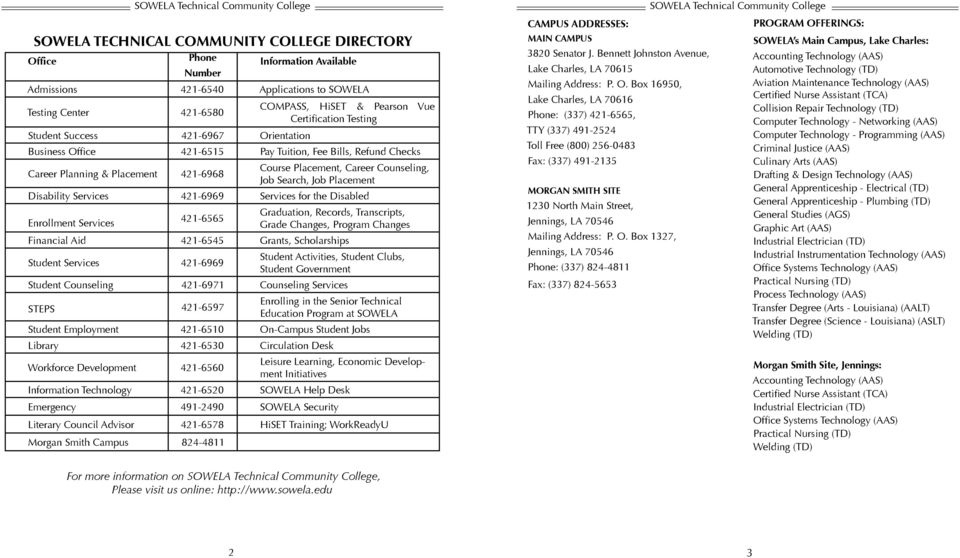
3 SOWELA TECHNICAL COMMUNITY COLLEGE DIRECTORY Office Phone Number Information Available Admissions Applications to SOWELA Testing Center Student Success Orientation COMPASS, HiSET & Pearson Vue Certification Testing Business Office Pay Tuition, Fee Bills, Refund Checks Career Planning & Placement Course Placement, Career Counseling, Job Search, Job Placement Disability Services Services for the Disabled Enrollment Services Graduation, Records, Transcripts, Grade Changes, Program Changes Financial Aid Grants, Scholarships Student Services Student Activities, Student Clubs, Student Government Student Counseling Counseling Services STEPS Enrolling in the Senior Technical Education Program at SOWELA Student Employment On-Campus Student Jobs Library Circulation Desk Workforce Development Leisure Learning, Economic Development Initiatives Information Technology SOWELA Help Desk Emergency SOWELA Security Literary Council Advisor HiSET Training; WorkReadyU Morgan Smith Campus CAMPUS ADDRESSES: PROGRAM OFFERINGS: MAIN CAMPUS SOWELA s Main Campus, Lake Charles: 3820 Senator J. Bennett Johnston Avenue, Accounting Technology (AAS) Lake Charles, LA Automotive Technology (TD) Mailing Address: P. O. Box 16950, Aviation Maintenance Technology (AAS) Lake Charles, LA Certified Nurse Assistant (TCA) Collision Repair Technology (TD) Phone: (337) , Computer Technology - Networking (AAS) TTY (337) Computer Technology - Programming (AAS) Toll Free (800) Criminal Justice (AAS) Fax: (337) Culinary Arts (AAS) Drafting & Design Technology (AAS) MORGAN SMITH SITE General Apprenticeship - Electrical (TD) 1230 North Main Street, General Apprenticeship - Plumbing (TD) General Studies (AGS) Jennings, LA Graphic Art (AAS) Mailing Address: P. O. Box 1327, Industrial Electrician (TD) Jennings, LA Industrial Instrumentation Technology (AAS) Phone: (337) Office Systems Technology (AAS) Fax: (337) Practical Nursing (TD) Process Technology (AAS) Transfer Degree (Arts - Louisiana) (AALT) Transfer Degree (Science - Louisiana) (ASLT) Welding (TD) Morgan Smith Site, Jennings: Accounting Technology (AAS) Certified Nurse Assistant (TCA) Industrial Electrician (TD) Office Systems Technology (AAS) Practical Nursing (TD) Welding (TD) For more information on SOWELA Technical Community College, Please visit us online: 2 3
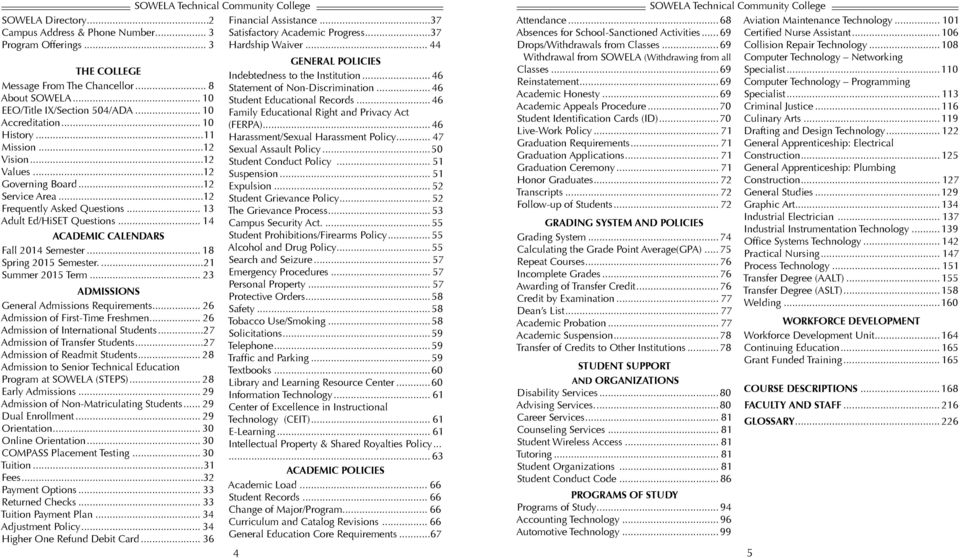
4 SOWELA Directory...2 Campus Address & Phone Number... 3 Program Offerings... 3 The College Message From The Chancellor... 8 About SOWELA EEO/Title IX/Section 504/ADA Accreditation History...11 Mission...12 Vision...12 Values...12 Governing Board...12 Service Area...12 Frequently Asked Questions Adult Ed/HiSET Questions ACADEMIC CALENDARS Fall 2014 Semester Spring 2015 Semester...21 Summer 2015 Term ADMISSIONS General Admissions Requirements Admission of First-Time Freshmen Admission of International Students...27 Admission of Transfer Students...27 Admission of Readmit Students Admission to Senior Technical Education Program at SOWELA (STEPS) Early Admissions Admission of Non-Matriculating Students Dual Enrollment Orientation Online Orientation COMPASS Placement Testing Tuition...31 Fees...32 Payment Options Returned Checks Tuition Payment Plan Adjustment Policy Higher One Refund Debit Card Financial Assistance...37 Satisfactory Academic Progress...37 Hardship Waiver GENERAL POLICIES Indebtedness to the Institution Statement of Non-Discrimination Student Educational Records Family Educational Right and Privacy Act (FERPA) Harassment/Sexual Harassment Policy Sexual Assault Policy...50 Student Conduct Policy Suspension Expulsion Student Grievance Policy The Grievance Process Campus Security Act Student Prohibitions/Firearms Policy Alcohol and Drug Policy Search and Seizure Emergency Procedures Personal Property Protective Orders Safety Tobacco Use/Smoking Solicitations Telephone Traffic and Parking Textbooks...60 Library and Learning Resource Center...60 Information Technology Center of Excellence in Instructional Technology (CEIT) E-Learning Intellectual Property & Shared Royalties Policy ACADEMIC POLICIES Academic Load Student Records Change of Major/Program Curriculum and Catalog Revisions General Education Core Requirements...67 Attendance Absences for School-Sanctioned Activities Drops/Withdrawals from Classes Withdrawal from SOWELA (Withdrawing from all Classes Reinstatement Academic Honesty Academic Appeals Procedure...70 Student Identification Cards (ID)...70 Live-Work Policy Graduation Requirements Graduation Applications Graduation Ceremony Honor Graduates Transcripts Follow-up of Students GRADING SYSTEM AND POLICIES Grading System Calculating the Grade Point Average(GPA) Repeat Courses Incomplete Grades Awarding of Transfer Credit Credit by Examination Dean s List Academic Probation Academic Suspension Transfer of Credits to Other Institutions STUDENT SUPPORT AND ORGANIZATIONS Disability Services...80 Advising Services...80 Career Services Counseling Services Student Wireless Access Tutoring Student Organizations Student Conduct Code PROGRAMS OF STUDY Programs of Study Accounting Technology Automotive Technology Aviation Maintenance Technology Certified Nurse Assistant Collision Repair Technology Computer Technology Networking Specialist Computer Technology Programming Specialist Criminal Justice Culinary Arts Drafting and Design Technology General Apprenticeship: Electrical Construction General Apprenticeship: Plumbing Construction General Studies Graphic Art Industrial Electrician Industrial Instrumentation Technology Office Systems Technology Practical Nursing Process Technology Transfer Degree (AALT) Transfer Degree (ASLT) Welding WORKFORCE DEVELOPMENT Workforce Development Unit Continuing Education Grant Funded Training COURSE DESCRIPTIONS FACULTY AND STAFF GLOSSARY
5

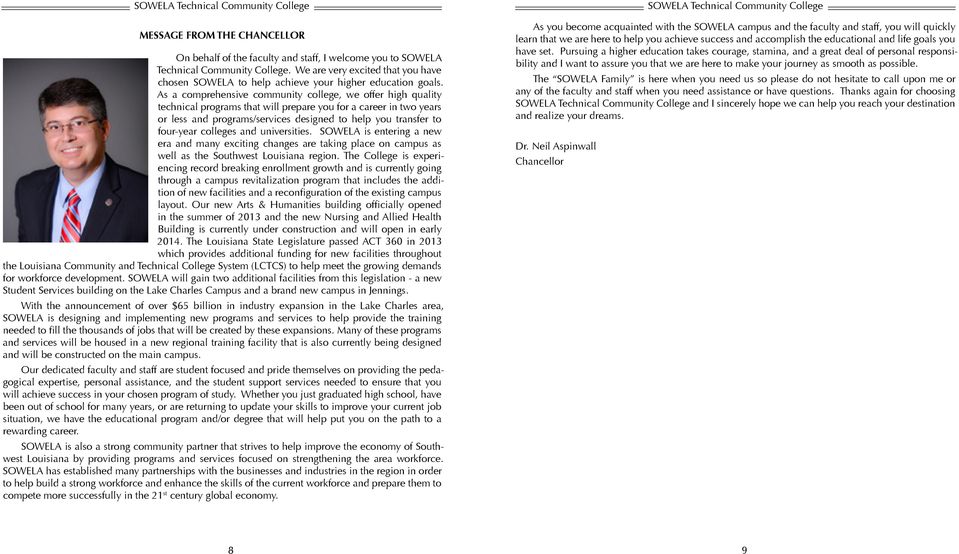
6 MESSAGE FROM THE CHANCELLOR On behalf of the faculty and staff, I welcome you to SOWELA Technical Community College. We are very excited that you have chosen SOWELA to help achieve your higher education goals. As a comprehensive community college, we offer high quality technical programs that will prepare you for a career in two years or less and programs/services designed to help you transfer to four-year colleges and universities. SOWELA is entering a new era and many exciting changes are taking place on campus as well as the Southwest Louisiana region. The College is experiencing record breaking enrollment growth and is currently going through a campus revitalization program that includes the addition of new facilities and a reconfiguration of the existing campus layout. Our new Arts & Humanities building officially opened in the summer of 2013 and the new Nursing and Allied Health Building is currently under construction and will open in early The Louisiana State Legislature passed ACT 360 in 2013 which provides additional funding for new facilities throughout the Louisiana Community and Technical College System (LCTCS) to help meet the growing demands for workforce development. SOWELA will gain two additional facilities from this legislation - a new Student Services building on the Lake Charles Campus and a brand new campus in Jennings. With the announcement of over $65 billion in industry expansion in the Lake Charles area, SOWELA is designing and implementing new programs and services to help provide the training needed to fill the thousands of jobs that will be created by these expansions. Many of these programs and services will be housed in a new regional training facility that is also currently being designed and will be constructed on the main campus. Our dedicated faculty and staff are student focused and pride themselves on providing the pedagogical expertise, personal assistance, and the student support services needed to ensure that you will achieve success in your chosen program of study. Whether you just graduated high school, have been out of school for many years, or are returning to update your skills to improve your current job situation, we have the educational program and/or degree that will help put you on the path to a rewarding career. SOWELA is also a strong community partner that strives to help improve the economy of Southwest Louisiana by providing programs and services focused on strengthening the area workforce. SOWELA has established many partnerships with the businesses and industries in the region in order to help build a strong workforce and enhance the skills of the current workforce and prepare them to compete more successfully in the 21 st century global economy. As you become acquainted with the SOWELA campus and the faculty and staff, you will quickly learn that we are here to help you achieve success and accomplish the educational and life goals you have set. Pursuing a higher education takes courage, stamina, and a great deal of personal responsibility and I want to assure you that we are here to make your journey as smooth as possible. The SOWELA Family is here when you need us so please do not hesitate to call upon me or any of the faculty and staff when you need assistance or have questions. Thanks again for choosing SOWELA Technical Community College and I sincerely hope we can help you reach your destination and realize your dreams. Dr. Neil Aspinwall Chancellor 8 9
7 ABOUT SOWELA SOWELA Technical Community College (SOWELA) is a member of the Louisiana Community and Technical College System and under the governance of the Louisiana Board of Regents. The course offerings and requirements of SOWELA are continually under examination and revision. This catalog presents the offerings and requirements in effect at the time of publication but makes no guarantee that they will not be changed or revoked. However, adequate and reasonable notice will be given to students affected by any changes. This catalog is not intended to state contractual terms and does not constitute a contract between the student and SOWELA. SOWELA reserves the right to make changes as required in course offerings, curricula, academic policies and other rules and regulations affecting students, to be effective whenever determined by the institution. These changes will govern current and formerly enrolled students. Enrollment of all students is subject to these conditions. SOWELA provides the opportunity for students to increase their knowledge by providing programs of instruction in the various disciplines and programs through faculty who, in the opinion of the College, are qualified for teaching at the college level. The acquisition and retention of knowledge by any student is, however, contingent upon the student s desire and ability to learn, and his or her application of appropriate study techniques to any course or program. EEO/TITLE IX/SECTION 504/ADA SOWELA does not discriminate on the basis of race, sex, color, religion, national origin, age or disability. This policy extends to employment by, admission to, or educational opportunities and benefits provided by the College. SOWELA is an affirmative action/equal opportunity college. It is committed to the education of a nonracially identifiable student body. Inquiries concerning EEO, Title IX, the Rehabilitation Act of 1973 and the American Disabilities Act of 1990 should be directed to the following individuals: ADA Coordinator Questions: Ms. Christine Collins, Director of Student Support Services can be located in the Computer Technology Building-Student Success Center. Ms. Collins can be reached at (337) or via at [email protected]. EEO/Title IX Questions: Dr. Fitzpatrick Anyanwu, Executive Director of Institutional Planning and Effectiveness can be located in the Administration Building. Dr. Anyanwu can be reached at (337) or [email protected]. For specific information related to disability services on SOWELA campus please feel free to contact the Office of Student Support Services at (337) ACCREDITATION SOWELA Technical Community College (SOWELA) is accredited by the Southern Association of Colleges and Schools Commission on Colleges (SACSCOC) to award Associate Degrees, Diplomas, and Certificates. Contact the Commission on Colleges at 1866 Southern Lane, Decatur, GA , or call for questions about the accreditation of SOWELA Technical Community College. SOWELA is also accredited by the Commission of the Council on Occupational Education (COE) (a national accrediting agency that specializes in the accreditation of job training and workforce development institutions). This accreditation means that SOWELA is recognized as meeting standards of training acceptable for accreditation. The Council is the successor to the Commission on Occupational Education Institutions, founded in 1971 as a regional accrediting agency of the Southern Association of Colleges and Schools. Dr. Gary Puckett, Executive Director/President Council on Occupational Education 7840 Roswell Road, Building 300, Suite 325 Atlanta, GA Phone: (770) FAX: (770) Website: SOWELA also offers programs that are accredited by professional licensing bodies as well as industry or discipline specific associations. Organizations that accredit programs offered at SOWELA include the following: 1. Association of Technology, Management and Applied Engineering 2. Certified Nurse Assistant Registry 3. Federal Aviation Administration 4. Louisiana State Board of Practical Nurse Examiners 5. National Automotive Technicians Educational Foundation 6. American Culinary Federation Education Foundation HISTORY Technical education deals with knowledge, skills, and attitudes that prepare the individual for a specific occupation or vocation. To assist in the accomplishment of this task, the Southwest Louisiana Trade School was established by the Louisiana Legislature in 1938, and in 1940, classes began in five programs of training. In 1962, the name was changed to SOWELA Technical Institute due to expansion of facilities, growth of the student body, increased curricula, and the need for additional technical education. In 1971, SOWELA Technical Institute gained significant recognition upon its accreditation by the Commission on Occupational Education Institutions of the Southern Association of Colleges and Schools one of the most prestigious educational accrediting agencies in the United States. SOWELA Technical Institute moved to its present location at 3820 Sen. J. Bennett Johnston Avenue in January The institute was renamed SOWELA Regional Technical Institute in March 1990, as it served as the regional center for Region Five. Another milestone was reached on July 27, 1995, when the school was renamed Louisiana Technical College SOWELA Campus. SOWELA was among the largest and most progressive post-secondary technical colleges in the state. The Louisiana Community and Technical College System Board of Supervisors changed the status of Louisiana Technical College SOWELA Campus to SOWELA Technical Community College effective July 1, In 2010, the Louisiana Community and Technical College System Board of Supervisors approved the transfer of the Morgan Smith campus in Jennings to SOWELA Technical Community College. Previously, both Morgan Smith and SOWELA were part of Region Five. The transfer of Morgan Smith to SOWELA is a homecoming designed to increase services to Calcasieu and Jefferson Davis Parishes

8 INSTITUTIONAL MISSION SOWELA Technical Community College provides traditional, distance and lifelong learning experiences and awards associate degrees, technical diplomas, and certificates that empower learners in transfer, career, and technical education to excel as globally competitive citizens. INSTITUTIONAL VISION SOWELA Technical Community College models excellence in teaching, training, and service. INSTITUTIONAL VALUES SOWELA Technical Community College values: Student Success, Integrity, Collaboration, Innovation, Access, and Diversity. GOVERNING BOARD SOWELA Technical Community College is a part of the Louisiana Community and Technical College System (LCTCS), a division of the Board of Regents of the State of Louisiana. Members of the Board of Supervisors of the LCTCS are listed below. Chair - Michael Mickey Murphy First Vice Chair - Norwood Woody Oge' Second Vice Chair - Timothy W. Hardy Robert Brown Helen Bridges Carter Keith Gamble Deni Grissette Steve Hemperley Paul Price, Jr. Edward R. Banks Willie Mount Joe Potts Craig Spohn Stephen Smith Vincent St. Blanc III Stephen Toups Student Board Members: Robert Fisher SERVICE AREA SOWELA Technical Community College s Main Campus is located at 3820 Sen. J. Bennett Johnston Avenue in Lake Charles, Louisiana. The Main Campus is located in Calcasieu Parish and serves citizens of Calcasieu, Cameron, Jefferson Davis, Allen and Beauregard Parishes. SOWELA also operates an off-campus site. The Morgan Smith site is located at 1230 North Main Street in Jennings, Louisiana, Frequently Asked Questions When is registration? Registration is ongoing. To learn about registration, students should review the Schedule of Classes, check the SOWELA website, or visit the Office of Admissions located in the Administration Building. How long must an individual reside in Louisiana before being considered a resident? Individuals must reside and/or work in Louisiana for at least one year (365 days) immediately preceding the first official day of classes for the semester they wish to attend. Refer to the SOWELA website for the Academic Calendar. Do I have to take the SOWELA Placement Test if I have ACT or SAT scores? If you have ACT or SAT test scores taken within the last three years that meet the requirements of the Board of Regents, you will not be required to take SOWELA s placement test. If you have transfer credit in college-level English and mathematics, you may receive a waiver from the placement test. Otherwise, you will be required to take the COMPASSS Placement Test. New students will take the COMPASS after applying for admission and before being advised. I do not want to receive credit for classes. Am I required to complete an application? Yes, all students must complete an Application for Admission in order to register at SOW- ELA. After completing the application process, a student can either enroll for or audit a class (see the Glossary on page 209). How do I obtain a transcript for another institution or an employer? First, complete a Transcript Request form available in the Office of the Registrar, or print one from the web site at Also, a letter can be sent to SOWELA Technical Community College, Office of Admissions, P. O. Box 16950, Lake Charles, LA The letter should include the student s name (printed), signature, social security number, and an address where a transcript can be mailed. Federal regulations require that a student s transcript be released only upon that student s written consent, which must bear the student s signature. Where should other institutions of higher education send transcript(s) and application materials? Other institutions should send transcripts to SOWELA Technical Community College, Office of Admissions, P.O. Box 16950, Lake Charles, LA How do I register for online courses? Students can apply to take online courses the same way they apply to enroll in other college courses. Does SOWELA offer childcare for students children? Currently, the college does not offer childcare services. However, there are qualified and reliable childcare facilities located in close proximity to the campus. Is it necessary to have a SOWELA identification card? All students are required to carry a SOWELA ID Card in order to check out books, print/copy, and use other services offered by the College. Some local merchants offer discounts to SOW- ELA students; to take advantage of the offers, a student ID card must be presented. How do I qualify for the Dean s List? To qualify for the Dean s List, a student must complete a minimum of twelve (12) or more credit hours excluding transitional courses and maintain a grade point average (GPA) of 3.5 or higher with no letter grade lower than a C. Grades earned in transitional classes are excluded from the GPA for the Dean s List

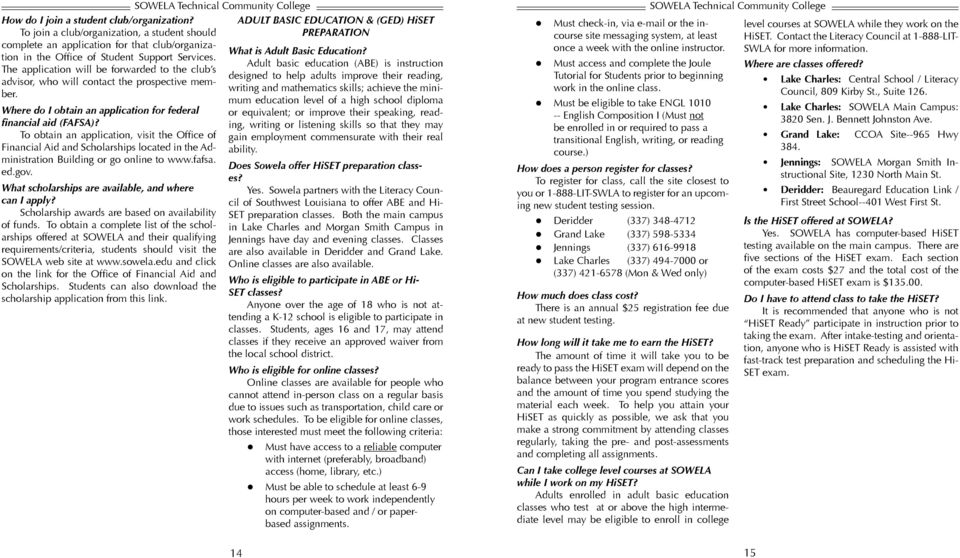
9 How do I join a student club/organization? To join a club/organization, a student should complete an application for that club/organization in the Office of Student Support Services. The application will be forwarded to the club s advisor, who will contact the prospective member. Where do I obtain an application for federal financial aid (FAFSA)? To obtain an application, visit the Office of Financial Aid and Scholarships located in the Administration Building or go online to ed.gov. What scholarships are available, and where can I apply? Scholarship awards are based on availability of funds. To obtain a complete list of the scholarships offered at SOWELA and their qualifying requirements/criteria, students should visit the SOWELA web site at and click on the link for the Office of Financial Aid and Scholarships. Students can also download the scholarship application from this link. ADULT BASIC EDUCATION & (GED) HiSET PREPARATION What is Adult Basic Education? Adult basic education (ABE) is instruction designed to help adults improve their reading, writing and mathematics skills; achieve the minimum education level of a high school diploma or equivalent; or improve their speaking, reading, writing or listening skills so that they may gain employment commensurate with their real ability. Does Sowela offer HiSET preparation classes? Yes. Sowela partners with the Literacy Council of Southwest Louisiana to offer ABE and Hi- SET preparation classes. Both the main campus in Lake Charles and Morgan Smith Campus in Jennings have day and evening classes. Classes are also available in Deridder and Grand Lake. Online classes are also available. Who is eligible to participate in ABE or Hi- SET classes? Anyone over the age of 18 who is not attending a K-12 school is eligible to participate in classes. Students, ages 16 and 17, may attend classes if they receive an approved waiver from the local school district. Who is eligible for online classes? Online classes are available for people who cannot attend in-person class on a regular basis due to issues such as transportation, child care or work schedules. To be eligible for online classes, those interested must meet the following criteria: Must have access to a reliable computer with internet (preferably, broadband) access (home, library, etc.) Must be able to schedule at least 6-9 hours per week to work independently on computer-based and / or paperbased assignments. Must check-in, via or the incourse site messaging system, at least once a week with the online instructor. Must access and complete the Joule Tutorial for Students prior to beginning work in the online class. Must be eligible to take ENGL English Composition I (Must not be enrolled in or required to pass a transitional English, writing, or reading course.) How does a person register for classes? To register for class, call the site closest to you or LIT-SWLA to register for an upcoming new student testing session. Deridder (337) Grand Lake (337) Jennings (337) Lake Charles (337) or (337) (Mon & Wed only) How much does class cost? There is an annual $25 registration fee due at new student testing. How long will it take me to earn the HiSET? The amount of time it will take you to be ready to pass the HiSET exam will depend on the balance between your program entrance scores and the amount of time you spend studying the material each week. To help you attain your HiSET as quickly as possible, we ask that you make a strong commitment by attending classes regularly, taking the pre- and post-assessments and completing all assignments. Can I take college level courses at SOWELA while I work on my HiSET? Adults enrolled in adult basic education classes who test at or above the high intermediate level may be eligible to enroll in college level courses at SOWELA while they work on the HiSET. Contact the Literacy Council at LIT- SWLA for more information. Where are classes offered? Lake Charles: Central School / Literacy Council, 809 Kirby St., Suite 126. Lake Charles: SOWELA Main Campus: 3820 Sen. J. Bennett Johnston Ave. Grand Lake: CCOA Site--965 Hwy 384. Jennings: SOWELA Morgan Smith Instructional Site, 1230 North Main St. Deridder: Beauregard Education Link / First Street School--401 West First St. Is the HiSET offered at SOWELA? Yes. SOWELA has computer-based HiSET testing available on the main campus. There are five sections of the HiSET exam. Each section of the exam costs $27 and the total cost of the computer-based HiSET exam is $ Do I have to attend class to take the HiSET? It is recommended that anyone who is not HiSET Ready participate in instruction prior to taking the exam. After intake-testing and orientation, anyone who is HiSET Ready is assisted with fast-track test preparation and scheduling the Hi- SET exam
10

11 FALL 2014 SEMESTER Full-Term Session August 25 December 15, 2014 March 31 April 4 (Mon Fri)...Advising Days April 7 August 19 (Mon Tues)... Registration for Fall 2014 Registration ends at noon on 8/19/14 August 18 (Mon)...Faculty return to campus August 19 (Tues)... Payment Deadline for Fall :00 Noon August 20 (Wed)... Non-Payment Purge at 12:00 Noon August 20 (Wed)...Faculty Conference Day August (Wed Fri)...Late Registration Opens for Fall 2014 Late Registration begins and Add/Drop reopens at 1:00 p.m. on 8/20/14 and both end at noon on 8/29/14 August 25 (Mon)...Classes Begin August (Mon Fri)...100% Tuition Adjustment Period August 29 (Fri)...Late Registration and Add/Drop end at 12:00 Noon Final Payment Deadline for Fall 2014 at 5:00 p.m. Non-Payment Final Purge September 1 (Mon)...Labor Day Holiday August 30 September 5 (Sat Fri)...50% Tuition Adjustment Period September 6 September 11 (Sat Thurs)... 25% Tuition Adjustment Period September 8 (Mon)...Instructors submit final Show/No Show Report September 9 (Tues)...No Show Purge September 11 (Thurs)...Last Day to Drop Classes with a Refund September 12 (Fri)... 14th Instructional Day/Reporting Day October 15 (Wed)... Midterm Grades Due October 29 (Wed)... Last Day to Withdraw from the College or from Full-term Classes November 3 7 (Mon Fri)...Advising Days November 10 January 8 (Mon Thurs)...Registration for Spring 2015 Registration will end at noon on 01/08/15 November (Mon Fri)... Thanksgiving Holiday December 5 (Fri)... Last Day of Classes December 8 12 (Mon Fri)...Final Exams Week December 15 (Mon)... Fall Semester Ends and Grades Due at 12:00 Noon December 15 (Mon)... Deadline for Removal of Incompletes from Previous Semester December 19 (Fri)...Grades Available to Students on Web Dates for Fall 2014 Installment Payment Plan July 10 (Thurs)... Enrollment Opens for Fall 2014 Installment Payment Plan Enrollment ends 08/29/14 July 15 (Tues)...Payment Due for Fall 2014 Installment Plan August 15 (Fri)...Payment Due for Fall 2014 Installment Plan August 29 (Fri)...Final Date to Enroll in Fall 2014 Installment Payment Plan September 15 (Mon)...Payment Due for Fall 2014 Installment Plan October 15 (Wed)...Payment Due for Fall 2014 Installment Plan November 15 (Saturday)... Final Payment Due for Fall 2014 Installment Plan FALL 2014 SEMESTER 1st 7-Week Session (Session 7A) August 25 October 15, 2014 August 25 (Mon)... Classes Begin for Session 7A August 29 (Fri)...Late Registration and Add/Drop end at 12:00 Noon August (Mon Wed) % Tuition Adjustment Period for Session 7A August (Thurs Fri)... 50% Tuition Adjustment Period for Session 7A August 30 September 2 (Sat Tues)... 25% Tuition Adjustment Period for Session 7A 18 19
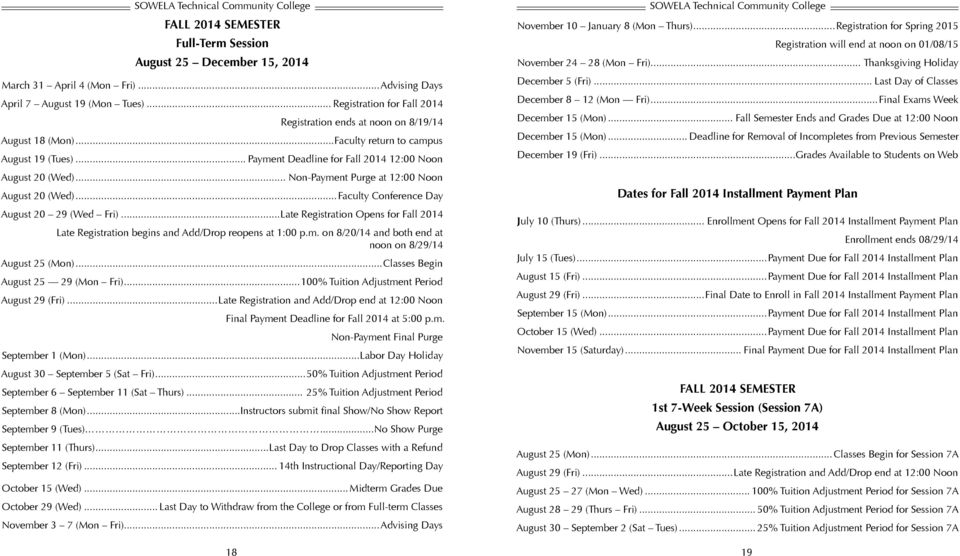
12 September 1 (Mon)...Labor Day Holiday September 19 (Fri)... Midterm Grades Due September 29 (Mon)...Last Day to Withdraw from Session 7A October 13 (Mon)...Last Day of Classes for Session 7A October 14 (Tues)...Final Exams for Session 7A October 15 (Wed)...Grades Due at 12:00 Noon for Session 7A 2nd 7-Week Session (Session 7B) October 17 December 15, 2014 September 29 (Mon)...Registration opens for Session 7B October 16 (Thurs)... Registration for Session 7B closes at 3:00 PM October 16 (Thurs)...Payment Deadline for Session 7B October 17 (Fri)... Classes Begin for Session 7B October (Fri Tues) % Tuition Adjustment Period for Session 7B October (Wed Thurs)... 50% Tuition Adjustment Period for Session 7B October 24 (Fri)... 25% Tuition Adjustment Period for Session 7B November 12 (Wed)... Midterm Grades Due November 20 (Thurs)...Last Day to Withdraw from Session 7B November (Mon Fri)... Thanksgiving Holiday December 11 (Thurs)...Last Day of Classes for Session 7B December 12 (Fri)...Final Exams for Session 7B December 15 (Mon)...Grades Due at 12:00 Noon for Session 7B Spring 2015 SEMESTER Full-Term Session January 12 May 11, 2015 November 3 7 (Mon Fri)...Advising Days November 10 January 6 (Mon Tues)...Registration for Spring 2015 Registration ends at noon on 01/06/15 January 5 (Mon)...Faculty return to campus January 6 (Tues)...Payment Deadline for Spring :00 Noon January 7 (Wed)...Faculty Conference Day January 7 (Wed)... Non-Payment Purge at 12:00 Noon January 7 16 (Wed Fri)... Late Registration Opens for Spring 2015 Late registration begins and Add/Drop reopens at 1:00 p.m. on 01/07/15 and both end at noon on 01/16/15 January 12 (Mon)...Classes Begin January (Mon Fri)...100% Tuition Adjustment Period January 16 (Fri)...Late Registration and Add/Drop end at 12:00 Noon Final Payment Deadline for Spring 2015 at 5:00 p.m. Non-Payment Final Purge January (Sat Fri)...50% Tuition Adjustment Period January 19 (Mon)...Martin Luther King, Jr. Holiday January 26 (Mon)...Instructors submit final Show/No Show Report January 27 (Tues)...No Show Purge January (Sat Thurs)...25% Tuition Adjustment Period January 29 (Thurs)... Last Day to Drop Classes With a Refund January 30 (Fri)... 14th Instructional Day/Reporting Day February (Mon Wed)... Mardi Gras Holiday March 9 (Mon)... Midterm Grades Due March 12 (Thurs)...LCTCS Staff Development Day (tentative) No Classes 20 21
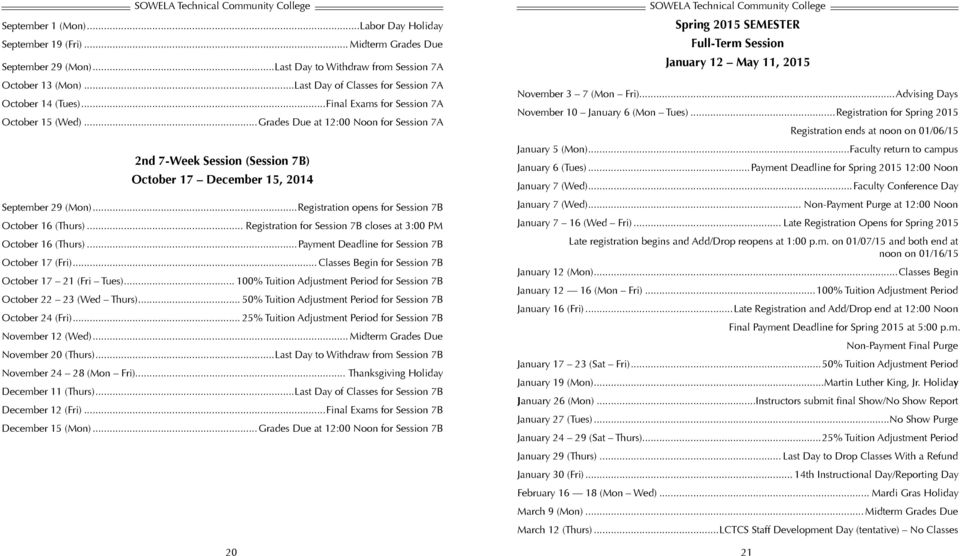
13 March 24 (Tues)... Last Day to Withdraw from the College or from Full-term Classes March 30 April 2 (Mon Thurs)...Advising Days April 3 10 (Fri Fri)... Spring Break April 6 (Mon)... Registration for Summer 2015 & Fall 2015 Begins Fall 2015 Registration ends at noon on 08/20/15 May 1 (Fri)... Last Day of Classes May 4 7 (Mon Fri)...Final Exams Week May 11 (Mon)... Spring Semester Ends and Grades Due at 12:00 Noon May 11 (Mon)... Deadline for Removal of Incompletes from Previous Semester May 15 (Fri)...Spring Grades Available to Students on Web May 19 (Tues)... Spring 2015 Commencement Dates for Spring 2015 Installment Payment Plan November 10 (Mon)... Enrollment Opens for Spring 2015 Installment Payment Plan Enrollment ends 01/16/15 November 15 (Saturday)... Payment Due for Spring 2015 Installment Plan December 15 (Mon)... Payment Due for Spring 2015 Installment Plan January 15 (Thurs)... Payment Due for Spring 2015 Installment Plan January 16 (Fri)... Final Date to Enroll in Spring 2015 Installment Payment Plan February 15 (Sunday)... Payment Due for Spring 2015 Installment Plan March 15 (Sunday)... Payment Due for Spring 2015 Installment Plan April 15 (Wed)...Final Payment Due for Spring 2015 Installment Plan Summer 2015 Session June 1 July 24, 2015 March 30 April 2 (Mon Thurs)...Advising Days April 6 (Mon)... Registration for Summer 2015 & Fall 2015 Begins Summer Registration ends at noon on 05/26/15 May 26 (Tues)...Payment Deadline for Summer :00 Noon May 27 (Wed)... Non-Payment Purge at 12:00 Noon May 27 June 3 (Wed Wed)... Late Registration Opens for Summer 2015 Late registration begins & Add/Drop reopens at 1:00 p.m. on 05/27/15 and both end... at noon on 06/03/15 June 1 (Mon)...Classes Begin June 1 3 (Mon Wed)...100% Tuition Adjustment Period June 3 (Wed)...Late Registration and Add/Drop end at 12:00 Noon Final Payment Deadline for Summer 2015 at 5:00 p.m. Non-Payment Final Purge June 4 5 (Thurs Fri)...50% Tuition Adjustment Period June 5 (Fri)...Instructors submit final Show/No Show Report June 8 (Mon)...No Show Purge June 6 8 (Sat Mon)...25% Tuition Adjustment Period June 8 (Mon)... Last Day to Drop Classes With a Refund June 9 (Tues)... 7th Instructional Day/Reporting Day June 26 (Fri)...Mid-term Grades Due July 6 (Mon)...July 4th Holiday July 7 (Tues)... Last Day to Withdraw from the College or from Classes July 21 (Tue)... Last Day of Classes July (Wed Thu)... Final Exam Days July 24 (Fri)... Summer Term Ends, Grades Due by 12:00 Noon 22 23

14 July 24 (Fri)...Deadline for Removal of Incompletes from Previous Semester July 30 (Thurs)... Summer Grades Available to Students on Web. Dates for Summer 2015 Installment Payment Plan April 10 (Fri)...Enrollment Opens for Spring 2015 Installment Payment Plan Enrollment ends 06/03/15 May 15 (Fri)... Payment Due for Summer 2015 Installment Plan June 15 (Mon)... Payment Due for Summer 2015 Installment Plan July 15 (Wed)...Final Payment Due for Summer 2015 Installment Plan 24

15 SOWELA Technical Community College subscribes to the open door mission of the community and technical colleges in Louisiana. The open door policy applies to admission to SOW- ELA programs which do not have restricted admissions. Procedures for admissions to restricted programs are available upon request. Applicants are encouraged to complete admissions procedures at least thirty days prior to registration. Early application is important since some program enrollments may be limited. There is no application fee. Applications may be submitted by visiting the College website ( edu). SOWELA accepts applications throughout the year. GENERAL ADMISSIONS REQUIREMENTS All applicants must submit the following items (NOTE: Documents will not be returned once submitted): 1. A completed application form. The online application must be submitted prior to the first day of classes. Incomplete or false information may jeopardize admission to SOWELA. 2. All official transcripts of previous schooling. These official transcripts must be submitted to the Admissions Office. An official transcript is one that is mailed directly from the transferring college to SOWELA or submitted in a sealed envelope from the transferring college. Students are encouraged to request that their transcript be sent electronically to SOWELA from those colleges that participate in the escript system. Failure to do so may delay admission to SOWELA. 3. Proof of immunization. As required by Louisiana Law R.S. 17:110, all first time students born after 1956 must provide proof of immunization against measles, mumps, rubella, tetanus and diphtheria as a condition of enrollment. Students will not be allowed to complete the registration process until they have satisfied the immunization requirement. A waiver may be signed by the student, however, in the event of an outbreak of measles, mumps, rubella, tetanus, or diphtheria on campus, the college will require the students who are not immunized to stop attending classes until the outbreak is over or until they submit proof of adequate immunization. 4. Proof of Selective Service status. In accordance with the requirements of Louisiana Law R.S. 17:3151 and the Federal Selective Service Act, applicants who are between the ages of 18 and 25 must provide written evidence that they have registered with Selective Service before they will be allowed to register for classes. Acceptable documentation may be a copy of the applicant s Selective Service Registration card or a printout from the Selective Service web site indicating the applicant s status. The following categories of applicants are exempt from this requirement: Military personnel currently on active duty in the military Veterans who submit a copy of their DD214 discharge certificate ADMISSION OF FIRST-TIME FRESHMEN Applicants must provide an official high school transcript or official high school equivalency scores (GED or HiSET) for admission into the associate degree programs and the Practical Nursing program. Applicants, who are graduates from a Louisiana high school, May 2003 and after, are not required to request a high school transcript. It will be sent to SOWELA via the Student Transcript System upon completion of the application for admission. Applicants who are homeschooled or who graduated from a high school that is not approved by the state of Louisiana can be admitted with a GED or HiST or official high school transcripts and ACT scores of at least 14 in English and 15 in math on a single ACT administration. The ACT scores are required in addition to the required SOWELA placement test scores unless the ACT scores meet the minimum ACT requirements for College level English and math as determined by the Louisiana Board of Regents. ADMISSIONS TO THE PRACTICAL NURSING PROGRAM Students interested in enrolling in the Practical Nursing program should apply to the College under the General Studies degree. Once the student has met the admissions requirements for the Practical Nursing degree program (see the programmatic admission requirements page 146) the degree program will be updated to Practical Nursing. Students planning to enroll should request that their ACT scores be sent to the Admissions Office at SOWELA. SOWELA S ACT Code is The official transcript must indicate successful completion of college English Composition and College Algebra. In order to successfully complete a course for transfer, the student must receive a grade of C or better. ASSET or COMPASS scores may also be used for placement. Students whose test scores indicate a need for additional preparation in basic skills will be required to enroll in appropriate transitional courses to help prepare them for success in higher level courses. SOWELA S placement exams are administered for course placement only and are not used in determining admission to the college except when academic achievement levels are required by a licensure board (i.e. the Louisiana State Board of Practical Nurse Examiners). Test scores are primarily used for advising and placement purposes. A student that tests into transitional courses may be permitted to enroll in a limited number of other courses determined by the department as not requiring a prerequisite ADMISSION OF INTERNATIONAL STUDENTS SOWELA welcomes international students and values their contribution to enhancing the cultural diversity of the College. International students are issued a SEVIS form I-20 by SOW- ELA after the applicant: 1. Completes a SOWELA application. 2. Meets entrance requirements on SOW- ELA S placement test or ACT, or (if the applicant s native language is not English) scores 450 or more on the paper/pencil Test of English as a Foreign Language (TOEFL) or a 133 on the computerized TOEFL. If the applicant has completed coursework for regular academic credit at another USA institution, it may be used in place of TOEFL. 3. Provides the following documentation to the Admission s Office: a. Birth Certificate or other proof of citizenship. b. Documentation of high school completion. c. Affidavit of support (INS Form I-134) or SOWELA s affidavit of support. d. Proof of immunization as required of all students. All documentation must be in English or accompanied by certified translations in English. An M-I student must be a full-time student and is not allowed to accept any form of employment. An M-I student has 30 days to depart the United States after completion of his/her course of study. For additional information call (800) or (337) ADMISSION OF TRANSFER STUDENTS A transfer student is any student who has been previously enrolled at any college or university. Transfer students may enroll at SOWE- LA if they are eligible for readmission at the last school attended. Transfer students may be admit-

16 ted provisionally with approval of the Registrar until all required transcripts have been received. Transfer students who have not received a C or better in a college-level English Composition and/or College Algebra course must complete a placement test. Transfer students who receive transfer credit for college-level English and/ or mathematics are exempted from placement testing in the corresponding courses. However, where placement scores are required as part of the admissions criteria set by licensure boards (i.e. the Louisiana State Board of Practical Nurse Examiners), no such waiver will be permitted. Information regarding the awarding of transfer credit is included in Academic Policies. A student who is ineligible to return to his/ her previous college may be admitted to SOW- ELA on probation. In addition to the general admissions requirements, transfer students are required to submit their high school transcripts if they have not earned at least 12 hours of college level coursework. These earned hours must be evident on the official transcript from the transferring institution. ADMISSION OF READMIT STUDENTS Students who have once attended SOWELA, but have not been enrolled for a full semester (with the exception of the summer semester), must submit a new Application of Admission. If the enrolling student has attended another university/college during the lapsed period, a transcript from that institution is required. Students applying for readmission are subject to the most current fees. ADMISSION TO SENIOR TECHNICAL EDUCATION PROGRAM AT SOWELA (STEPS) The STEPS program provides high school seniors a jump start on college. Students in the STEPS program experience the college environment while completing their high school diplo- ma and earning college credits. Students from participating high schools may enroll in STEPS under the direction of the STEPS coordinator and their high school counselor. Students must meet the minimum requirements of the following diploma paths to qualify for the STEPS program: Career Diploma Graduating senior pursuing a Career Diploma that is school-approved Maximum of two (2) core courses left for graduation (English, math or science) Minimum of 18 high school credits earned Meet SOWELA s placement exam standard or required ACT score Minimum of twelve (12) semester hours of SOWELA Courses enrolled per semester (fall & spring) Open to most SOWELA diploma/degree plans La Core 4/Basic Core Curriculum Graduating senior pursuing a La Core 4 or Basic Core path that is school-approved Minimum of 18 high school credits earned Meet SOWELA S placement exam standard or required ACT score Minimum of twelve (12) semester hours of SOWELA courses enrolled per semester (fall & spring) including any high school core dual enrollment courses needed for graduation Open to most SOWELA diploma/degree plans Tuition and books are paid for through a state grant for high school seniors who meet the STEPS admission requirements and choose to attend SOWELA during their senior year of high school. The only cost to the student is to cover mandatory fees per semester. For additional information, contact the counselor at participating high schools or phone the STEPS office at (337) EARLY ADMISSIONS A student may be able to take classes at SOWELA while still in high school as part of our Early Admissions Program. Students currently enrolled as a junior or senior in high school or home schooled in a BESE approved home school may qualify to attend SOWELA if the following requirements are met: Grade Point Average of (out of a 4.000) system A letter from the high school counselor or principal recommending them for enrollment. Homeschool students must have a letter from someone outside the home that is aware of the student s academic progress. An official high school transcript. Documentation of approval for homeschooling from BESE will also be accepted. Students must meet all college admission and registration requirements and procedures. Students must meet college-level entrance requirements on either the ACT or COMPASS exam. Students must pay course tuition, book costs, and fees. Please note that the classes taken through the early admissions program may not count for credit toward the student s high school diploma or substitute for any high school course requirements. ADMISSION OF NON-MATRICULATING STUDENTS Students interested in gaining a basic understanding of course material without the pressure of examination may take classes for non-credit A notation of audit (AU) will be assigned to the student s SOWELA transcript. Those students taking classes for non-credit are not required to provide a high school transcript or take the placement examination. Fees are the same as those for credit students. Enrollment as non-credit in day classes must be approved by the Department Chair and registration must be done during the drop/add/ late registration period, giving degree-seeking students first priority. Coursework will not be retroactively assigned a grade for non-credit students. DUAL ENROLLMENT Dual Enrollment is a program that allows a high school student to enroll in a college level course for which dual credit (both college and high school credit) is earned on the student s secondary and postsecondary academic record. Eligible high school and SOWELA Courses are listed on the Dual Enrollment Matrix which is included as part of the application to the Dual Enrollment program. The credits that students earn will be applicable toward high school graduation and acceptable toward a college Associate degree or Technical Certificate. This opportunity allows students to accelerate their college career while saving time and money. However, it is vital to understand that a high school student registrant is expected to adhere to all college, course, and instructor requirements. The program is designed for students who: are serious about their education, want to understand what it is like to attend college, want to earn a college degree, desire to start college education where there is a smaller student to teacher ratio, and wish to get an early start on completing their college education.

17 For additional information on the program, contact the College and Career Transition Coordinator at (337) ORIENTATION All new students are required to participate in an orientation session designed to assist in adjusting to college life. First time students must participate in orientation in order to register for their first term. Orientation is conducted each term for new students by the Office of Student Affairs to acquaint each student with the staff, buildings and grounds, policies, and rules and regulations of SOWELA. Each student will be assigned a departmental faculty adviser after the orientation. The faculty adviser will assist the student with curriculum advisement during advising days. ONLINE ORIENTATION SOWELA new students have the option to participate in new student online orientation. However, all students must attend one face-toface orientation for new students. For additional information regarding online orientation please contact the Office of Student Affairs at (337) COMPASS PLACEMENT TESTING The COMPASS is a skills assessment tool used by SOWELA to ensure you are taking classes that fit your academic needs. There is no pass or fail grade, but you need to complete a COM- PASS assessment on campus before registering for classes. The COMPASS includes sections on writing, reading, and math. You are required to complete a COMPASS assessment unless you have scores on the ACT that can be substituted for the writing, reading, and math portions of the COMPASS. Students with prior college credit from other schools may be waived from the requirement to take the COMPASS. Bring a copy of your college transcripts to campus and an admissions counselor will determine if you qualify for a COMPASS waiver. Payment Options Testing fees can be paid by cash and check only in the SOWELA Business Office in Lake Charles or the Front Office in Jennings at the Morgan Smith Campus. Credit and debit card payments must be made online at SOWELA s website. Schedule your COMPASS placement exam online at your convenience. Go to edu. There you will find the link to schedule and pay testing charges online. COMPASS Exam Testing Charges: $25. (Reading, Writing and Math) $18. (Two Sections) $11. (One Section) College Board Advanced Placement Program (AP) Students who have taken part in the Advanced Placement Program of the College Board may receive credit for examinations at SOWELA. Students who have participated in this program and who plan to enroll at SOWELA should have their AP exams score sent to the Office of the Registrar (College Code 6808). Additional information may be obtained from the Office of the Registrar. College Level Examination Program (CLEP) Students who have taken the College Level Examination (CLEP), may be eligible to receive credit at SOWELA. Students who plan to enroll at SOWELA should have their (CLEP) exam scores sent by mail to the Office of the Registrar (College Code 5048). Credit Hours TUITION AND FEE SCHEDULE Note: The table below reflects the estimated rates for These rates are subject to change at any time. In State Tuition Tuition Board Assessed Fees Student Assessed Fees Misc Fee Grad A c t Adjustment Operational Fee Student Services Fee Academic Excellence Fee Enterprise Resource Planning Fee Building Use Fee Technology Fee Student Activity Fee SGA Fee Vehicle Registration Fee Total Due ** 1 $ $2.40 $3.00 $2.00 $7.00 $3.00 $4.00 $5.00 $4.00 $5.00 $20.00 $ $ $4.80 $6.00 $4.00 $14.00 $6.00 $8.00 $10.00 $8.00 $5.00 $20.00 $ $ $7.20 $9.00 $6.00 $21.00 $9.00 $12.00 $15.00 $12.00 $5.00 $20.00 $ $ $9.60 $12.00 $8.00 $28.00 $12.00 $16.00 $20.00 $16.00 $5.00 $20.00 $ $ $12.00 $15.00 $10.00 $35.00 $15.00 $20.00 $25.00 $20.00 $5.00 $20.00 $ $ $14.40 $18.00 $12.00 $42.00 $18.00 $24.00 $30.00 $24.00 $5.00 $20.00 $ $ $16.80 $21.00 $14.00 $49.00 $21.00 $28.00 $35.00 $28.00 $5.00 $20.00 $1, $ $19.20 $24.00 $16.00 $56.00 $24.00 $32.00 $40.00 $32.00 $5.00 $20.00 $1, $1, $21.60 $27.00 $18.00 $63.00 $27.00 $36.00 $45.00 $36.00 $5.00 $20.00 $1, $1, $24.00 $30.00 $20.00 $70.00 $30.00 $40.00 $50.00 $40.00 $5.00 $20.00 $1, $1, $26.40 $33.00 $22.00 $77.00 $33.00 $44.00 $55.00 $44.00 $5.00 $20.00 $1, $1, $28.80 $36.00 $24.00 $84.00 $36.00 $48.00 $60.00 $48.00 $5.00 $20.00 $1, Credit Hours Out of State Tuition Operational Fee Student Services Fee Academic Excellence Fee Enterprise Resource Planning Fee Building Use Fee Technology Fee Student Activity Fee SGA Fee Vehicle Registration Fee Total Due ** 1 $ $3.00 $2.00 $7.00 $3.00 $4.00 $5.00 $4.00 $5.00 $20.00 $ $ $6.00 $4.00 $14.00 $6.00 $8.00 $10.00 $8.00 $5.00 $20.00 $ $ $9.00 $6.00 $21.00 $9.00 $12.00 $15.00 $12.00 $5.00 $20.00 $ $ $12.00 $8.00 $28.00 $12.00 $16.00 $20.00 $16.00 $5.00 $20.00 $1, $1, $15.00 $10.00 $35.00 $15.00 $20.00 $25.00 $20.00 $5.00 $20.00 $1, $1, $18.00 $12.00 $42.00 $18.00 $24.00 $30.00 $24.00 $5.00 $20.00 $1, $1, $21.00 $14.00 $49.00 $21.00 $28.00 $35.00 $28.00 $5.00 $20.00 $1, $1, $24.00 $16.00 $56.00 $24.00 $32.00 $40.00 $32.00 $5.00 $20.00 $2, $2, $27.00 $18.00 $63.00 $27.00 $36.00 $45.00 $36.00 $5.00 $20.00 $2, $2, $30.00 $20.00 $70.00 $30.00 $40.00 $50.00 $40.00 $5.00 $20.00 $2, $2, $33.00 $22.00 $77.00 $33.00 $44.00 $55.00 $44.00 $5.00 $20.00 $3, $2, $36.00 $24.00 $84.00 $36.00 $48.00 $60.00 $48.00 $5.00 $20.00 $3, **Course specific lab and other fees are not included in the above rates

18 FEES Testing Fee* (if applicable)... $25.00 Graduation Fee... $60.00 Late Registration Fee... $25.00 NSF Fee... $25.00 Credit Card Service Fee % of total amount charged. **Course specific lab and other fees vary by department and term. Tuition and Fees for Online Courses The Board of Supervisors of the Louisiana Community and Technical College System (LCTCS) approved equalizing and standardizing tuition and registration fees for all online credit courses to provide equity and convenience for online students. These fees aare in addition to campus courses. There is no cap on tuition and fees related to these courses. The Tuition and Fees for Online Courses have been established as follows: Tuition per credit hour $ Online ERP Fee per credit hour $3.00 Registration fee per student $40.00 Fee Assessment Details Operational Fee Effective Fall 2004, State of Louisiana Legislator s and LCTCS approved an operational fee to be assessed at all state colleges and universities. The operational fee will cover operational expenses no longer covered by the State. The operational fee is $3 per credit hour (Maximum $36 per enrollment period). Student Services Fee Effective Fall 2011, LCTCS and the Board approved a Student Service Fee to be assessed at all LCTCS colleges. This covers fees for student services such as registration, financial aid, bursar, campus security, library, etc. The Student Service Fee is $2 per credit hour (Maximum $24 per enrollment period). Academic Excellence Fee Academic Excellence fee is $7 per credit hour (Maximum $84 per enrollment period). Atypical courses are assessed as a separate enrollment period. The Academic Excellence Fee promotes academic excellence at the college by enhancing institutional programs. This fee was approved by the State Legislature in Enterprise Resource Planning Fee Effective Fall 2010, LCTCS and the Board approved an Enterprise Resource Planning fee to be assessed at all LCTCS colleges. The enterprise resource planning fee will support the implementation and operation of the ERP for the LCTCS. The Enterprise Resource Planning Fee is $3 per credit hour (Maximum $36 per enrollment period). Building Use Fee Effective Fall 2013, State of Louisiana Legislator s and LCTCS approved a building use fee to be assessed at all state colleges and universities. The building use fee will be used to construct, acquire, repair, maintain, operate, or improve the facilities and physical infrastructure of the college. The building use fee is $4 per credit hour. (Maximum $48 per enrollment period.) Technology Fee The student technology fee is $5 per credit hour (Maximum not to exceed $60 per enrollment period). All students pay a student technology fee which supports existing technological resources on SOWELA S campus and provides for upgrades and improvements. Student Government Association Fee All students pay this fee which supports the student activities sponsored by the SGA. Parking Fees/Permits Vehicle registration permits are issued from the Office of Facilities at a cost of $20 each. All faculty, staff, and students who operate vehicles on campus must register their vehicles and display the hanging permit from their rearview mirror so that it is visible at all times. Vehicle registration allows authorized students to park in zones to which they are entitled only if space is available. The operation of a motor vehicle on campus is a privilege granted by SOWELA Technical Community College. Failure to abide by the regulations will revoke this privilege and/or result in disciplinary action. Graduation Fee Students who will be graduating are required to pay a graduation fee of $60 during the period of time established for this purpose. The fee covers your cap and gown, and will defray graduation costs. This fee will be paid at the time of registration for the student s final term and is NONREFUNDABLE. This fee is required even if the student does not plan to attend the graduation ceremony. Library Fines The Library and Learning Resource Center (LLRC) has a one month loan period for books with the option to renew materials for an additional month. At the end of the loan period, materials that have not been returned or renewed are considered overdue. The LLRC charges twentyfive (25) cents per day for each overdue book. When a book is reported lost or long overdue the user is charged for the replacement cost and assessed a $20.00 processing. Overdue notices are sent through U.S. mail. A flag or stop is placed on a student record when fines are owed. Students may not register for classes or receive Student Activity Fee Based on the results of a student referendum held in the fall semester 2013, a student activity fee of $4 per credit hour (Maximum not to exceed $48 per enrollment period) is being implemented effective Fall All students pay a student activity fee which will provide essential resources to build a vibrant student life experience at SOWELA. transcripts until their account is settled PAYMENT OPTIONS Payment Methods Accepted in Person/Mail Business Office Personal checks, cashier s checks, traveler s checks, money orders, or cash payments may be made in the SOWELA Business Office in Lake Charles or in the Front office in Jennings at the Morgan Smith Campus. A current student ID or valid State issued ID is required to disclose any financial information. Payments by mail must be received 48 hours before an established payment deadline and should include the student s ID number to ensure proper credit of payment. It is the student s responsibility to ensure the payment is received in the Business Office. Please do not mail cash or traveler s checks. Credit/Debit Cards are no longer accepted as a form of payment in person or via phone. SOWELA Technical Community College Business Office P. O. Box Lake Charles, LA Morgan Smith Campus Front Office P. O. Box 1327 Jennings, LA Payment Methods Accepted through our Online Payment Gateway The student or authorized user can make payments by electronic check (e-check), or pay by credit/debit card. MasterCard, American Express, Discover, and Visa are all accepted. The e-check option is entirely free while a 2.75% service fee will be charged for each transaction processed using a credit/debit card (This is a nonrefundable fee and is paid directly to CashNet, not to the college). RETURNED CHECKS All returned checks and/or credit card charge backs due to insufficient funds, unauthorized use, cancelled card or fraud will be assessed a $25 fee

19 on the student s account and the associated payment will be reversed. If the payment made by the student or on his behalf and is returned, that student may forfeit all check writing/eft privileges with SOWELA in the future. Payment by cash, cashier s check, or money order may be required. Only in the case of a bank or card issuer error will the returned check/credit card charge back penalties be removed. After the College has exhausted its attempts to notify the student, failure to repay the balance due will subject the student to an administrative withdrawal from classes, and his/her account will be submitted to the Attorney General s Office for collection. Students are responsible for all related costs (collection/attorney fees in the amount of 33 1/3% of the principal, interest, late fees and related court costs). Tuition Deferment Plan SOWELA has contracted with CashNet to provide the ability for students to participate in an installment plan. Students who do not pay the down payment by the given deadline will have their classes dropped. The applicable fee must accompany any payments, and payments are due even if a statement is not received in the mail. TUITION PAYMENT PLAN THE PLAN SOWELA has an established contract with a third-party vendor, cashnet, to provide a payment plan ( The Plan ) for students (formerly offered directly by SOWELA as a deferment plan ). To participate in The Plan, students must enroll in a full Fall, Spring, or Summer Semester at SOW- ELA Technical Community College. The Plan allows students to pay for tuition and fees through monthly installment payments throughout the semester. The number of monthly installments is determined by the date of enrollment and the final payment due date. Final payment due dates are as follows and are subject to change at any time: Summer 2014 Final Payment is Due by July 15, 2014 Fall 2014 Final Payment is Due by November 15, 2014 Spring 2015 Final Payment is Due by April 15, 2015 Summer 2015 Final Payment is Due by July 15, 2015 A one-time, non-refundable fee of $30.00 will be charged upon enrollment in The Plan and is set by and paid directly to the vendor. The first installment (down payment) is due at the time of enrollment. If any installment payment is not received within 15 calendar days after its due date, a late fee of $10.00 will be assessed by the vendor. Please note that declined attempts for credit card or ACH charges or returned checks may also result in late fees if a valid payment is not received by the due date. The Tuition Adjustment Policy for SOW- ELA Technical Community College is as follows: A 100% Tuition Adjustment of Tuition, and all fees will be made to students who resign from all classes or drops a course(s) during the first five instructional days (Add/Drop Period) of the fall and spring semester and the first three instructional days for the summer semester and mini-semesters. A 50% Tuition Adjustment of Tuition, Operational Fee, Academic Excellence Fee, and Technology Fee will be made to students who resign from all classes or drops a course(s) after the 5th instructional day through the 9th instructional day of the semester for the fall and spring semester and after the 3rd instructional day through the 5th instructional day of the semester for the summer semester and mini-semesters. A 25% Tuition Adjustment of Tuition, Operational Fee, Academic Excellence Fee, and Technology Fee will be made to students who resign from all classes or drops a course (s) after the 9th instructional day through the 13th instructional day of the semester for the fall and spring semester and after the 5th instructional day through the 6th instructional day of the semester for the summer semester and mini-semesters. Other registration fees such as: Student Services Fee, Enterprise Resource Fee, SGA Fee, Parking Fee, Lab Fees, and other miscellaneous fees are not refundable during the Tuition Adjustment Period. No Tuition Adjustments shall be made after the 13th instructional day for the fall and spring semester or after the 6th instructional day for the summer semester. No refund shall be made for non-credit courses unless the class is cancelled. No refund shall be made for testing fees or application charges. Tuition Adjustment Schedule Fall 2014 Students who resign or drop a course(s) By 8/29/2014 at noon Spring 2015 Students who resign or drop a course(s) By 1/16/2015 at noon Summer 2015 Students who resign or drop a course(s) By 6/3/15 at noon The percent of fees refunded will be 100% of All Tuition and Registration Fees 8/30/14-9/5/14 1/17/15-1/23/15 6/4/15-6/5/15 50% refund of Tuition, Operational Fee, Academic Excellence Fee and Technology Fee 9/6/14-9/11/14 1/24/15-1/29/15 6/6/15-6/8/15 25% refund of Tuition, Operational Fee, Academic Excellence Fee, and Technology Fee After 9/11/2014 After 1/29/2015 After 6/8/2015 There is no refund of fees for resigning from all courses or dropping a course (s) These dates are subject to change at any time. Student s Fiscal Responsibility By enrolling in classes at SOWELA Technical Community College, the student makes a financial commitment to pay the tuition and fee charges associated with that enrollment. The enrollment action constitutes a financial obligation between the student and SOWELA. The following terms and conditions are financial requirements of each student s education related to their registration for a term at SOWELA Technical Community College. The payment of tuition and fees is the obligation of the student. By processing a course registration a student acknowledges they have read and agree to the following terms and conditions: 34 35

20 Registration constitutes a financial agreement between you ( Student ) and SOWELA Technical Community College. Tuition, fees and other charges you incur, including but not limited to testing charges, course specific fees, fines and bookstore charges ( Charges ), shall be added to your student account. Once you formally register for classes, you assume the responsibility for understanding SOWELA s official policies concerning schedule changes, satisfactory academic progress and the financial policies of the College as described in the current SOWELA Technical Community Catalog and Student Handbook. Charges left unpaid for prior terms may result in dis-enrollment from your current term courses unless payment arrangements are made prior to payment deadlines. Withholding of services: If you have any outstanding obligations with any college in the Louisiana Technical Community College System, SOWELA reserves the right to withhold future services including but not limited to registration, transcript requests, diploma, use of university facilities, and other services as deemed appropriate. Students withdrawing after the stated refund dates remain liable for full tuition and fee charges. In the event the student becomes delinquent in paying Charges or defaults in repaying Charges the debts may be transferred to the State of Louisiana Attorney General s Office, or another outside collection agency, for collection. If SOWELA Technical Community College prevails in a lawsuit to collect on this financial obligation, Student will pay SOWELA s court costs, collection agency costs and attorney s fees in an amount the court finds to be reasonable. Collection costs incurred in the event of delinquency shall be at the expense of the Stu- dent. SOWELA accepts payment via student financial aid and third party sponsorship, but the responsibility for payment remains with the student. It is your responsibility to keep track of your account balance and any funding sources. If financial aid is not granted or if third party sponsors do not pay within a reasonable period, the student will be required to pay the full amount due. You consent to receive notifications to address of the availability of an E Bill (Electronic Billing Statement) and consent to review billing statement information on SOWELA Web Payment System. It is the student s responsibility to check his/her SOWELA student daily and maintain a current postal address to ensure receipt of all College correspondence. HIGHER ONE REFUND DEBIT CARD SOWELA has partnered with Higher One, a financial services company, to provide a method of refund disbursement to the college. Higher One will be handling all refunds for SOWELA S credit students via an electronic disbursement format. As a SOWELA credit student you must activate your preference to receive a refund through the Higher One account. You then will be given the option to have your financial aid and tuition refunds disbursed via the SOWELA Debit Card or an electronic transfer to an existing bank account of your choosing. We are very excited about this opportunity to provide students with faster choices on how they want to receive their refund. A $20 replacement card fee is due at the time of re-ordering an active card. Contact the Business Office to request a replacement card. To learn more about Higher One and this great service, visit the Higher One www. higherone.com or www. lctcsdebitcard. com websites. When you receive your official student refund card, or the SOWELA Debit Card in the mail, activate your refund preference within two business days at It is easy! Even if you do not anticipate a tuition or financial aid refund, activation is required. Do not throw your card away! Remember it is vital to verify and update your address, phone and to insure the quickest refunds. FINANCIAL ASSISTANCE The Office of Financial Aid works closely with all applicants and students to provide information on financial aid programs which assist with the costs related to their education. It is the responsibility of the applicant or student to make application and provide necessary documentation to establish eligibility with each financial aid source. The financial aid staff works with the agencies providing funding to SOWELA students. As requested, attendance and progress reports are provided to the funding agencies. Brief descriptions of financial aid sources follow. More details can be obtained through the Office of Financial Aid or from the various agencies. The Financial Aid process can take time and some funds are limited so we encourage you to apply as soon as possible. All documents must be submitted to the Financial Aid Office before registration in order to use any aid you may be eligible for, to assist with fee payment. Please note our office is always open and welcomes the opportunity to assist you with completing your application. Steps to Apply: 1. Complete the Free Application for Feder al Student Aid (FAFSA). This form may be found on the FAFSA web site at Our office is happy to assist students in completing the application online. If a student needs assistance in applying, they should come to the Financial Aid Office with all 2013 income-related information including their federal tax return and if applicable their parents tax return. 2. Submit any additional requested documentation to the Financial Aid Office. 3. Must be enrolled in an eligible diploma or associate degree program. The student must have a high school diploma or a HiSET in order to receive Title IV aid. In addition, all males 18 or older must be registered with selective service. 4. An award letter will be ed with the amount and type of aid you may be eligible to receive. You must notify the office if you wish to accept, decline, or reduce any portion of your award. Please note: All students awarded Title IV financial aid at SOWELA are required to maintain Satisfactory Academic Progress (SAP) while receiving aid. Please read below for full policy: SOWELA Satisfactory Academic Progress (SAP) Policy Effective summer 2013 The Federal Government mandates that students must maintain satisfactory academic progress toward completion of their degrees within a reasonable period of time in order to be eligible for Title IV financial aid programs (grants, workstudy, and National Guard). Satisfactory Academic Progress (SAP) is defined as: Passing 67% of all hours attempted Achieving a required grade point average (see GPA chart)
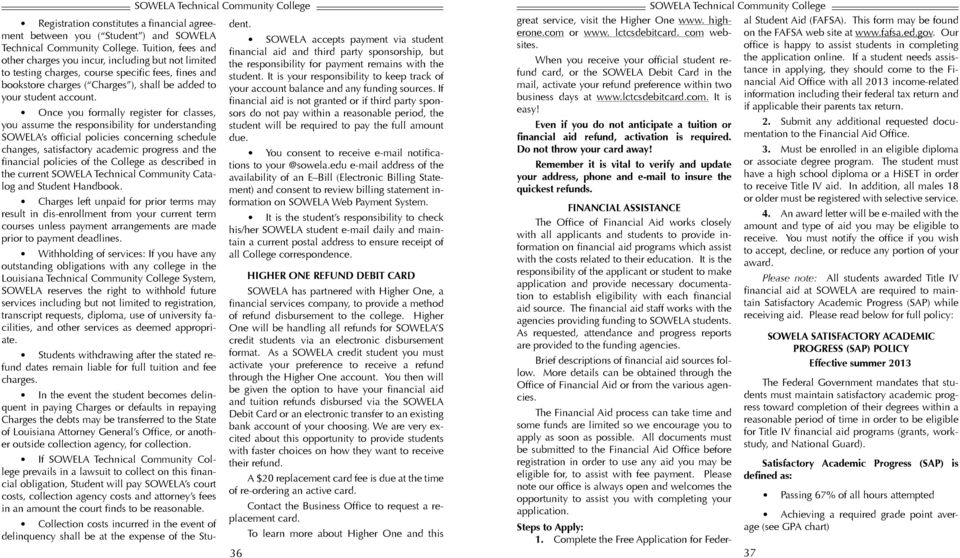
21 Not exceeding 150% of the total attempted hours needed to complete an approved major/program as defined by the Department of Education When is SAP Reviewed? Satisfactory Academic Progress (SAP) will be reviewed and determined: 1. Before aid is initially awarded, AND 2. At *specific increments (see below depending upon the student s program of study) SOWELA Technical Diploma Students: Satisfactory Academic Progress will be reviewed again after each semester (*increment = one semester) for students enrolled in a technical diploma programs. SOWELA Associate Degree Program: Satisfactory Academic Progress will be reviewed again after the spring semester (*increment = fall/spring semester combined) for students enrolled in associate degree programs. (Also, reviewed at the end of summer if applicable) How is SAP Reviewed? (Three measures- Qualitative, Quantitative/PACE, and Maximum Time Frame) In calculating/reviewing SAP, all hours and grades attempted will be considered. These include, but are not limited to, courses passed, courses failed, courses from which the student Cumulative Credit Hours Attempted QUALITATIVE MEASURE (CUM GPA CHART) withdrew, repeated courses, transfer/ accepted courses, non-credit transitional/remedial coursework and courses for which the student did not receive any financial aid. 1. Qualitative Measure (GPA) The qualitative standard is the student s cumulative grade point average (GPA). The qualitative standard requires that as the number of hours attempted increases, the student s cumulative GPA increases. SOWELA students will need to achieve a cumulative GPA relative to the total number of hours attempted as outlined in the chart below: Students can calculate their GPA using the GPA Calculator located on the SOWELA website at: planning_calculator.asp 2. Quantitative Measure/PACE In calculating the quantitative measure, we will measure the Pace at which the student is progressing. This is done by dividing the total hours passed by the cumulative hours attempted. (Example: total attempted hours for = 43, total passed hours = 24. So the calculation would be 24 / 43 = 55%. This student only has a 55% completion rate does not meet SAP). SAP will be met if the student is achieving the appropriate cumulative GPA (see GPA chart above) and the Pace is equal to 67% or higher and the student has not reached 150% maximum time frame allowed for their degree program. (See Maximum Hours Allowed below) 1-15 hours hours hours 46 hours & above Minimum Cumulative GPA Students can calculate their Pace using the calculator located on the SOWELA website at: progress_calculator.asp 3. Maximum Hours Allowed Total attempted hours must not exceed 150% of the Department of Education s approved length of the student s program. Students may receive federal financial aid if they have attempted below 150% of the maximum federal student aid credit hours approved in their major/program. To determine the maximum allowable hours for a specific program of study, refer to the SOWELA Financial Aid website at Determine the total number of hours approved for the program and multiply that figure by (Example: If the degree program requires/ approved 60 hours to the length of the program, multiply 60 hours x 1.50 = 90. The maximum allowable attempted hours for the degree program in this example = 90 hours.) Hours attempted includes all hours pursued, earned, passed, transferred/accepted from another college, dropped, and failed. All of these hours are counted as attempted even if the student did not receive aid. Note: For the Diploma programs (example: Nursing program) the Dept. of Education s Federal Student Aid maximum hours are different than academic program length for the program. Please see chart at financialaid.asp for all financial aid approved program lengths. HOW OTHER FACTORS PERTAIN TO SAP I Grades - An I (incomplete) will be considered an F until a letter grade is assigned in its place. It is the student s responsibility to notify the Financial Aid Office of the grade change. Transitional/Remedial Courses - A maximum of 30 hours of transitional/remedial courses will be used to determine enrollment status for financial aid. After a student has attempted 30 hours of transitional/remedial hours, she/he cannot receive financial aid for transitional/remedial hours. From that point forward, transitional/remedial hours will not count in enrollment status or cost of attendance for financial aid purposes. Withdrawals - For a student who stops attending class officially or unofficially, the last date of attendance in each class will be used to calculate how much of your aid was earned for the semester. Official Withdrawal - (also called Resignation) A student who totally resigns (receives all W s) is considered to have officially withdrawn from school. Unofficial Withdrawal - Students receiving Title IV aid who stop attending all classes (or never begin attendance) and receive all F s or WN s will be treated as unofficial withdrawals. Students who are suspended from all courses based on unexcused absences will be treated as unofficial withdrawals. Transfer Students - Transfer students are required to meet the minimum academic standards set by SOWELA in order to receive Federal Financial Aid at SOWELA Technical Community College. A transfer student must supply the SOW- ELA Admissions Office with a transcript from all previous institutions of attendance. Only courses accepted at SOWELA will be used in the SAP calculation for GPA and hours. STEPS & Early Start (Dual Enrollment) Students - Early Start (Dual Enrollment) and all other high school students taking college courses during high school will have these courses evaluated when matriculating at SOWELA Technical Community College. If a student s college level courses fail to meet the appropriate cumulative GPA (see GPA chart) and/or 67% completion requirements, she/he will not be eligible for federal
22 financial aid. (See Re-establishing Financial Aid Eligibility ) Academic Amnesty - Academic amnesty does not affect or alter the student s financial aid records (academic transcript) for financial aid eligibility. All courses, hours attempted, and grades will be counted for financial aid Satisfactory Academic Progress. This means if for any reason you are allowed to receive a fresh start and have all prior SOWELA coursework removed, this WILL NOT remove the coursework from your transcript (all courses, hours, and grades will be counted) for Financial Aid purposes. Repeated Courses - Repeated courses which were previously failed are counted in hours pursued and, if successfully completed, hours earned/passed. Only one repeated course may be funded with Title IV federal aid if the student has previously passed the course. WHAT HAPPENS ONCE SAP IS REVIEWED? At the time of SAP review, students will fall into one of the following categories: Good Standing: Student has met progress standards and is eligible for aid for the following semester or academic year. Suspension: Student has not made progress. Student is no longer eligible for Financial Aid. Please see re-establishing eligibility below. Probation: Student has NOT met progress standards, but has an approved appeal and is eligible for financial aid for one semester or length of Academic Plan. RE-ESTABLISHING FINANCIAL AID ELIGIBILITY Should a student choose to sit out or attend another school for a period of time, she/he is still subject to meeting the SAP requirements for the semester in which she/he re-enrolls at SOWELA. Sitting out has no bearing on regaining eligibility. Students must enroll and be attending to reestablish your financial aid eligibility. Should you choose to sit out a semester, you are still subject to meeting the conditions listed below for the semester in which you re-enroll. Students who do not meet SAP Standards have two options to receive Financial Aid in future semesters: 1. Attend and regain without the benefit of financial aid - Students may attend at their own expense without the benefit of federal financial aid, attempt and pass a cumulative 67% of hours attempted and earn the appropriate GPA. (See GPA increment chart) 2. Appeal to the Financial Aid Office: Appeal (without an Academic Plan): If the institution determines that the student is able to meet the Satisfactory Academic Progress requirements by the end of one semester (the semester that the student is appealing), the student may appeal to the Financial Aid Department. If the appeal is approved, the student will be considered on Probation, meaning the student is eligible for aid for one semester only. To meet the Satisfactory Academic Progress requirements the student must earn the appropriate cumulative GPA (according to the GPA increment chart), maintain PACE by passing/earning 67% percent of cumulative course attempted, and not exceed 150% of degree program. Appeal (with an Academic Plan): If a student wants to submit a Financial Aid appeal and it is clear the student will NOT be able to meet the progress reqauirements by the end of the semester for which the student is appealing, the student MUST see their Academic Advisor who will place the student on an Academic Plan that if followed, will ensure that the student will be able to meet the SOWELA SAP requirements by a specific point in time without exceeding 150 percent of the degree program. If the student is unsure on if they will need a plan, students may use calculators listed below to determine if SAP will be met in one semester or will require multiple semesters, therefore needing an academic plan. The student must submit a copy of the Academic Plan along with the Financial Aid Appeal form and Appeal Letter. If the appeal is approved, the student will be considered on probation with Academic Plan, meaning the student is eligible for aid as long as the student adheres to the Academic Plan. Students who are following an Academic Plan will need to see an Advisor each semester in order to register for classes. If the appeal is approved, the Academic Plan requires 100 percent successful completion, no drops or withdrawals, and a specified GPA. Please view your LoLA account to see your current SAP status. You may use the following calculators to assist you with determine your status: planning_calculator.asp How to Submit a Financial Aid Appeal Students who do not meet Satisfactory Academic Progress (SAP) standards may have the right to appeal to the Financial Aid. These appeals are generally based on mitigating circumstances. Examples of mitigating circumstances may be defined as, prolonged illness, accidents that require hospitalization to the student or a close family member, death of an immediate family member, or other types of accidents or incidents. The student must provide the following in order to appeal: 1. Complete a Financial Aid Appeal Form (located on our web page 2. Submit a typed letter that includes all of the following: a. Why the student failed to make satisfactory academic progress. b. Why the student is appealing. Examplenot meeting a 2.0 GPA or 67% completion rate. c. What types of mitigating circumstances existed and documentation of the situation. d. What has changed in the student s situation that will allow the student to demonstrate progress at the next SAP evaluation? 3. If it is clear that the student will be unable to meet SAP in one semester, he/she must ALSO submit an Academic Plan (provided by the Academic Advisor). *All appeals MUST have documentation that corresponds with the type of appeal the student is filing. If the appeal is approved, and the institution has determined that the student should be able to meet the SAP standards by the end of the semester, the student will be placed on Probation and would be eligible for aid during the next semester. The student s academic progress will be reviewed at the end of that semester. If, at the end of the semester, the student does NOT meet the SAP requirements, the student is no longer eligible for federal aid until the student attends at his own expense and meets all SAP requirements. If the appeal (with an Academic Plan) is approved, the student will be placed on Probation with Academic Plan, meaning the student
23 is eligible for aid as long as the student adheres to the Academic Plan. The Academic Plan requires 100% successful completion, no drops or withdrawals, and a specified GPA. The student s academic progress will be reviewed at the end of each semester until the student meets all SAP requirements specified in the Academic Plan. If the appeal is DENIED, the student is not eligible to receive federal aid and must attend at his own expense. The appeals decision is FINAL; therefore, a student may not appeal the decision. RETURN OF TITLE IV FUNDS POLICY ATTENTION SOWELA FINANCIAL AID RECIPIENTS: Class enrollment and attendance should be taken seriously, it is important to know and understand your class schedule and it is your responsibility to attend class. If you must resign from SOWELA you must do so officially. If a student, who is disbursed Title IV financial assistance, withdraws or stops attending class on or before completing 60% of the semester in which the Title IV aid was disbursed, the following Return of Title IV Funds policy will be applied. SOWELA Technical Community College will apply the federal Return of Title IV Funds policy per the Higher Education Act of This policy will apply to any student who receives Title IV aid: Federal Pell Grant and the Supplemental Education Opportunity Grant (SEOG). This applies to any student receiving Title IV aid who officially withdraws, drops out, is suspended, takes an unapproved leave of absence (unofficial withdrawal), and/or does not attend ALL scheduled classes. The policy will also apply when a student is dropped from their classes by the instructor due to excessive absences. The amount of Title IV Funds to return to the applicable federal programs will be determined, using the student s last date of attendance and calculating the percentage of the enrollment period for which the student did not complete. Scheduled breaks of five or more consecutive days are excluded. SOWELA Technical Community College will return the lesser of the total of unearned aid or an amount equal to institutional charges multiplied by the percentage of unearned aid. SOWELA must return unearned funds within 45 days of the date of determination of the withdrawal date. Failure to attend class or failure to resign properly could cause the student to receive a letter grade of F in all courses. In this case, the student would still be subject to the return of funds policy once a last date of attendance is established. Merely discontinuing class attendance is not considered to be a formal resignation from the college. If student s portion of unearned Title IV funds is a federal grant, the student will be required to return no more than 50% of the amount received for the enrollment period. The student will be notified of the amount of money that must be repaid to SOWELA due to unearned funds that the school had the responsibility to return. In the event of resignation, the SOWELA institutional refund policy will be applied and tuition will be reduced by that amount. The student may be liable for any Title IV funds disbursed to their account in excess of the amount allowed by federal regulations. The school will collect the portion of any assistance owed by the student. If no payment is received, holds will be placed on the student s account and the student will lose eligibility for Title IV aid unless the overpayment is paid in full or satisfactory repayment arrangements are made. Unearned funds are allocated to the Title IV programs from which the student received assistance, in the following order: Federal Pell Grant, and other Title IV programs. After the institutional refund has been credited in this order, any remaining amount will be returned to the student. Withholding of Academic Transcripts Transcript requests will be denied for individuals who are in default on a federal student loan or who owe a refund on a federal educational grant. Please contact the Financial Aid Office with any questions or concerns regarding this policy. Types of Aid Available: Federal Pell Grant The Federal Pell Grant is considered gift-aid that does not have to be repaid, unless the student never begins attendance or withdraws from school and owes a refund. The amount the student receives depends on his/her financial need, cost of attendance, and enrollment status. Student must complete the FAFSA (Free Application for Federal Student Aid). The Pell Grant award is based upon the student s EFC and enrollment status. The Pell Grant award is based solely on financial need. FSEOG Grant The FSEOG Program provides need-based grants to help low-income undergraduate students finance the costs of postsecondary education. Priority is given to those students with exceptional need on a first-come, first-served basis. This grant does not have to be repaid, unless the student never begins attendance or withdraws from school and owes a refund. The amount of FSEOG a student receives depends not only on his/her financial need but, also, on the amount of other aid the student receives and the availability of funds. The individual amount of a student s award is based on the availability of funds, hours enrolled and the student s demonstrated financial need GO Grant The GO Grant is a state grant that does not have to be repaid. The requirements include but are not limited to, a Louisiana residence, must be a Federal Pell Grant recipient and must be enrolled in a certificate or degree program. The Go Grant funding is limited and will be awarded on a first-come, first-served basis. Taylor Opportunity Program for Students The Taylor Opportunity Program for Student (TOPS) scholarship is awarded to graduating Louisiana high school seniors who have met certain academic requirements and have filed a Free Application for Federal Student Aid (FAFSA). The TOPS scholarship will only fund the tuition portion of institutional charges for two academic years. It does not cover the cost of books, supplies, and fees. TOPS recipients must enroll in an eligible school, as a full time student, within one year after graduation from high school. To maintain eligibility, completion of 24 credit hours during the fall and spring semesters, with a minimum overall GPA of 2.5, and yearly submission of the FAFSA are required. For more information, please contact your high school counselor or the Louisiana Office of Student Financial Assistance (800) , ext: Federal Work-Study Program The Federal Work-Study Program (FWS) is an award from federal funds that allows a student to earn money to meet educational expenses. A student must have financial need to be awarded work-study. This program encourages community service and work related to the student s course of study. Students will be paid at least the federal minimum wage and can work 10 to 20 hours per week. Veterans Affairs Educational Benefits The potential recipient must complete the application process online at or through the local Veteran s Affairs Office located
24 at 1000 Ryan Street, Lake Charles, LA or by phone: (337) Verification of enrollment for the student is completed electronically by the Financial Aid Office after the application process and no sooner than the first week of class. Note: Once the student receives an eligibility letter from the Department of Veteran s Affairs, he/she should contact the Financial Aid Office. Louisiana National Guard Members of the Louisiana National Guard may be exempt from paying the tuition portion of fees. The exemption only covers the tuition portion and the student is still responsible for any and all additional fees relevant to payment of classes before the semester of study begins. The student may claim the exemption at the time of registration by identifying himself/herself as an eligible recipient of this exemption. Eligibility is confirmed via a list of eligible recipients given to the Financial Aid Office by the state. Scholarships A number of SOWELA Foundation and institutional scholarships are available due to the generosity of local donors and supporters of SOWELA. A scholarship application may be completed in the Financial Aid Office. Notices will be posted in the Financial Aid Office and throughout the campus when a specific scholarship becomes available. Departmental scholarship notices will be posted within the specific department. Louisiana Rehabilitation A person with a physical or mental disability severe enough to be considered a vocational handicap may qualify for financial assistance through Louisiana Rehabilitation Services. Students wishing to apply under this program should contact the local Louisiana Rehabilitation Office for assistance at 3616 Kirkman Street, Lake Charles, LA 70605, or call (337) Workforce Investment Act (WIA) WIA is a federally funded program that assists adults, dislocated workers, and youth (ages 14 21) by providing job training, education, and employment services. Interested individuals must participate in a three-step process (Core, Intensive, and Training), after which eligibility is determined by the WIA office. Services are subject to availability, but may include tuition, books, supplies, child care, transportation, etc. For more information contact the Workforce Center at th Ave. Lake Charles, or by phone at (337) HARDSHIP WAIVER OF TUITION and FEES The Hardship Waiver of Tuition and Fees Policy provides a tuition exemption to eligible Louisiana students for the increase in tuition along with the cost of the Academic Excellence Fee and the Operational Fee. Students must complete an application and meet all criteria in order to be eligible; application must be made each semester or session. The Hardship Waiver of Tuition and Fees Application can be found at the Financial Aid Office and in the offices of each academic department. The policy and the application can also be found on the Financial Aid page of the College s web site. 44
25 INDEBTEDNESS TO THE INSTITUTION Students who do not meet their financial obligations as scheduled are not permitted to continue attending classes. The College will not release a transcript or other information unless the financial account of the student is paid in full and the student is in good standing. Fines and replacement fees will be assessed for overdue books and other materials borrowed from the library. For non-returned items, the cost of replacement will be charged to the student. Unpaid fines and replacement fees will be added to the student s bill and will result in a hold being placed on the student s records. A non-sufficient fund fee (NSF) of $25.00 will be charged to students who write NSF checks to SOWELA. The amount owed, plus the $25.00 fee, must be paid in cash in the Business Office upon notification by the school. The charge for each returned check is $ If the check is written payable to SOWELA by a student or on his behalf and is returned to the College, that student will forfeit all check writing privileges with SOWELA in the future. Payment by cash, cashier s check, money order, or credit card will be required. Putting a stop payment on a check will not constitute an official resignation from the College. STATEMENT OF NON-DISCRIMINATION SOWELA supports the Civil Rights Act of 1964, Executive Order #11246, Title IX of the Educational Amendments of 1972, Section 504, of the Rehabilitation Act of 1973, and the Americans with Disability Act. No person shall be excluded from participation in, denied the benefits of, or subjected to discrimination under any program or activity of the college on the basis of age, race, religion, color, sex, national origin, or disability. Any student who has a grievance related to discrimination should contact the Executive Director of Enrollment Management and Student Affairs or Designee. STUDENT EDUCATIONAL RECORDS A SOWELA student educational record includes all the documents required for admission to the College as well as electronic, digitized and paper documents related to registration, add/drop or withdrawal from classes, academic standing, attendance, appeals, credential completion, graduation and placement. Other documents related to enrollment may also be included. The security, maintenance and integrity of the student educational record is the responsibility of the registrar s office. The Nursing Department maintains records required for students to become certified by the Louisiana State Nursing Board. In addition to the documents required for admission to the College, a copy of the student s driver s license, social security card and an original birth certificate are maintained. FAMILY EDUCATIONAL RIGHTS AND PRIVACY ACT (FERPA) SOWELA intends to fully comply with the Family Educational Rights and Privacy Act (FER- PA). This Act gives students the right to inspect and review their educational records, to request correction of inaccurate or misleading information, to authorize disclosure of educational records, and to file complaints with the U.S. Department of Education concerning alleged failure to comply with the act. Student information will be released only upon the student s written request or authorization. If students believe that any information in their records is inaccurate, misleading, or in violation of their privacy rights, they may complete a Request to Amend Records form available in the Registrar s office. At the post-secondary level, parents have no inherent right to inspect a student s educational record. The right to inspect is limited solely to the student. Records or information may be given to parents only if the following conditions have been met: 1. Student signs a written consent. Consent forms are available in the Office of the Registrar. 2. Request is in connection with a health or safety issue. 3. Parent submits evidence that he/she claimed the student as a dependent on his/her most recent Federal Income Tax Form. Students may not inspect or review the following: financial information submitted by their parents, nor employment, job placement, or education records containing information about more than one student (in which case the institution will permit access only to that part of the record which pertains to the inquiring student). Directory Information may include a student s Name Local address/phone number SOWELA address Date and place of birth Major field of study To gain access to their educational records, students must submit a written request, available Full or part-time status in the Registrar s Office, which specifies the records that they wish to inspect. Access to records Participated in official recognized activities and sports will ordinarily be provided within 24 hours of the student s request. Dates of attendance Degrees, honors, and awards received Most recent educational agency or institution attended HARASSMENT/SEXUAL HARASSMENT POLICY Harassment, including sexual harassment, is prohibited by the Equal Employment Opportunity Commission, the Office for Civil Rights, and state regulations (R.S.23:301,312,332), and therefore, it is the policy of the Louisiana Community and Technical College System Board of Supervisors and SOWELA Technical Community College that unlawful harassment of employees and students is prohibited. Harassment is physical, verbal, and visual conduct that creates an intimidating, offensive, or hostile environment, which interferes with work/academic performance. This includes harassment because of race, sex, sexual orientation, religious creed, color, national origin, ancestry, disability or medical condition, age, or any other basis protected by federal, state or local law, ordinance or regulation. Sexual Harassment is defined by the Equal Employment Opportunity Commission as: Unwelcome sexual advances, requests for sexual favors, and other verbal or physical conduct of a sexual nature...when (1) submission to such conduct is made either explicitly or implicitly a term or condition of an individual s employment/ academic success, (2) submission or rejection of such conduct by an individual is used as the basis for employment/academic decisions affecting such individual, or (3) such conduct has the purpose and effect of unreasonably interfering with an individual s work/academic performance or creating an intimidating, hostile or offensive working/academic environment. SOWELA applies this definition to the areas of academic advancement, academic standing, or academic performance.
26 The workplace/academic harassment infringes on employee s/student s rights to a comfortable work/academic environment and it is a form of misconduct that undermines the integrity of the employment/academic relationship. No employee/student, male or female, should be subjected to unsolicited and unwelcome overtures or conduct, either verbally, visually, physically, or electronically transmitted. Although this list is not all-inclusive, examples of conduct that is prohibited include: Taking any personnel/academic action on the basis of an employee s/student s submission to or refusal of sexual overtures Unwelcome or unwanted conversation Unwelcome or unwanted touching Continued or repeated verbal abuse of a sexual nature Explicit or degrading verbal comments, suggestions, or slurs about another individual or his/her appearance Offensive comments regarding sexual or private matters Display of sexually suggestive pictures, objects Offensive jokes Verbal abuse, comments, names, or slurs that in any way relate to an individual s race, color, sex, sexual orientation, age, religion, national origin, or disability Any other offensive or abusive physical, visual or verbal conduct This policy applies to all members of the LCTCS Board of Supervisors, employees, students, supervisors, managers, faculty, vendors, and all other individuals doing business with SOWELA. It is the policy of SOWELA that no member of the SOWELA community may harass another. This includes harassment of an employee by another employee, of a student by an employee, of an employee by a student, of a student by another student. Additionally, under appropriate circumstances, SOWELA may take action to protect its employees and students from harassment, on SOWELA property, or at SOWE- LA sponsored events, by individuals who are not students or employees of SOWELA. A complaint of harassment should be presented as promptly as possible after the alleged harassment occurs. Any employee who believes he/she is the subject of harassment or who has knowledge of harassing behavior must report such conduct to his/her direct supervisor, and the institution s human resource department. SOW- ELA has developed a system of recording all formal written complaints to be submitted and kept on file in the office of Human Resources. Students who have problems, questions, and grievances can discuss these with a SOW- ELA counselor. Some college officials or faculty members can assist in counseling for sexual harassment problems. Throughout the counseling process, information divulged is held in the strictest confidence and no information is released unless the complainant agrees to inform a third party who can facilitate a solution. Any students inquiring about a complaint or concern can seek the advice of a SOWELA faculty/staff member, and the faculty/staff member can accompany the student to discussions with the designated officer, advisor, or counselor. A formal charge is not made by merely discussing the complaint, and no repercussions/ reprimands are issued for initiating a complaint. However, the college is also obliged to protect the rights of a person(s) against whom a complaint is lodged. Efforts are made to resolve issues in a reasonable amount of time. Any student who believes he/she is the subject of harassment or who has knowledge of harassing behavior must report such conduct to the Executive Director of Enrollment Management and Student Affairs or Designee. He/she also may submit a complaint to the Chancellor. No student or employee is required to report or make a complaint of harassment to the person who is allegedly engaging in the problematic conduct. In the event that an individual feels uncomfortable making a complaint at the institutional level, such complaints may be made at the system level with the LCTCS Director of Human Resources, Louisiana Community and Technical College System, 265 South Foster Drive, Baton Rouge, LA The phone number is (225) Employee complaints of harassment should be reported to: Director of Human Resources Human Resources Office, Administration Building Suite 1104; Phone: (337) Student complaints of harassment should be reported to: Director of Student Support Services Computer Technology Building-Student Success Center; Phone: (337) Complaints of harassment will be investigated promptly and in as impartial and confidential a manner as possible. A member of human resources will conduct investigations, unless otherwise deemed necessary, in order to assure an impartial and confidential investigation. SOWELA will not tolerate any type of discipline or retaliation, direct or indirect, against any employee/ student or other person who, in good faith, files a complaint of or responds to questions in regard to having witnessed prohibited harassment. False charges are treated as serious offenses and may result in disciplinary and/or civil action. Any employee/student or member of management who is found, after appropriate investigation to have engaged in harassing conduct is subject to appropriate disciplinary action up to and including termination of employment and/or student standing per the college s current policies which govern students. Appeal: To obtain a hearing with the Chancellor, a student must submit a written request within 10 days after the report from the Human Resource office is rendered. Once the Chancellor receives a request for a hearing, he/she appoints a chairperson to head the Committee of Review. Two members are also selected for the committee in the following manner: The complainant selects one committee member; and The person named in the complaint selects a member. Only full-time, permanent employees can serve on the Committee of Review. The composition of the Committee of Review may include faculty, staff, or a combination of both. Committee of Review thoroughly investigates the complaint of sexual harassment and conducts a hearing. Involved parties are informed of the date and time of the hearing by certified mail, return receipt requested, at least three days prior to the scheduled hearing. An accused faculty member is given notice pursuant to Section 212 of the Policy Manual and relevant sections of the Policy Manual and SOWELA statutes. Hearing is conducted pursuant to procedures established by the Committee of Review and in compliance with the policy. Committee presents its findings, along with any pertinent information, to the Chancellor for further dispensation, which usually takes place within 10 working days after the conclusion of the hearing. The Chancellor renders a final decision 48 49
27 and notifies the involved parties within a reasonable period of time. Sexual Assault Policy Emergency Phone Number (337) When reporting a sexual assault, confidentiality is vital. Sexual assault is an act of violence in which a person subjects a victim to contact of a sexual nature against the victim s will - is an illegal act on the SOWELA campus. Sexual assault includes rape, assault to commit rape, sexual battery, aggravated sexual battery, object rape, statutory rape, sodomy, aggravated sodomy, public indecency, and stalking. Sexual assault, in its various forms, is defined under Louisiana law. Procedures 1. Students should immediately report incidents of sexual assault to the SOWELA Safety Coordinator. 2. The Safety Coordinator will write an incident report and notify the Dean of Instruction. 3. Students will be assisted in seeking counseling and follow-up medical care, addressing academic concerns, and reporting incident(s) to the appropriate authorities. It is crucial that a victim receive prompt medical attention. For medical and counseling services, contact the Louisiana Rape Crisis Center 24-hour crisis line at (800) 656-HOPE (4673). 4. A victim of sexual assault should preserve any evidence that can be used to prove an occurrence of sexual assault. Victims are advised to consult law enforcement officials before showering, bathing, changing, or laundering clothing worn during an assault. Even if a victim bathes, showers, or somehow compromises evidence, the victim should report the assault. Valuable information can still be obtained and an investigation conducted from remaining evidence taken from a victim s person. 5. After a sexual assault is reported, campus personnel should take reasonable and necessary steps to secure the crime scene and protect the victim. Rights and Responsibilities of the Victim 1. A report of sexual assault is treated seriously and the victim treated with dignity. Campus organizations/personnel who deal with sexual assaults should be contacted to assist the victim. 2. A victim has the right to have the alleged sexual assault(s) investigated and adjudicated by the duly constituted criminal and civil authorities of the governmental jurisdiction where the alleged incident(s) occurred; and to full and prompt cooperation and assistance of campus personnel in notifying the proper authorities. Campus disciplinary proceedings are held in addition to these procedures. 3. Campus personnel are prohibited from pressuring a victim to: a) not report the crime(s) to civil/criminal investigating authorities, campus law enforcement personnel, or disciplinary authorities, or b) report the crimes less than what actually occurred. 4. SOWELA offers a victim advice, assistance, or representation at campus disciplinary proceedings, the same as offered to the accused. 5. A victim is notified of the outcome of the disciplinary proceedings. 6. Campus personnel should cooperate in obtaining, securing, and maintaining evidence (including medical examination documentation) required to prove the occurrence of criminal sexual assault for subsequent legal proceedings. 7. SOWELA personnel are to contact and exercise the option(s) provided by state and federal laws and regulations regarding mandatory testing of a sexual assault suspect(s) for communicable diseases and in notifying a victim of the results of the testing. 8. A victim is provided information regarding counseling. Rights of the Accused 1. The accused has the right to have the alleged sexual assault(s) investigated and adjudicated by the duly constituted criminal and civil authorities of the governmental jurisdiction where the alleged incident(s) occurred; and to full and prompt cooperation and assistance of campus personnel in notifying the proper authorities and in providing any exculpatory information. Campus disciplinary proceedings are held in addition to these procedures. 2. SOWELA offers the accused advice, assistance, or representation at campus disciplinary proceedings, the same as offered to the victim. 3. The accused is notified of the outcome of the disciplinary proceedings. 4. The accused receives full and prompt cooperation from campus personnel in obtaining, securing, and maintaining evidence that may disprove the occurrence of criminal sexual assault in subsequent legal proceedings. 5. The accused is provided information regarding counseling. STUDENT CONDUCT POLICY Students, as members of the SOWELA college community, are expected to conduct themselves at all times in a manner that reflects respect for the rights of others and an appreciation of a diverse population. Behavior that interferes with the learning process, is discriminatory, or is derogatory in nature will not be tolerated. Students should understand and exercise their rights, meet their responsibilities, and allow other students to enjoy the same privileges. The college maintains an academic environment for all without denying opportunities to any, and being unfamiliar with SOWELA policies and procedures does not excuse a student from acting responsibly. (See also Student Conduct Code Section) In an educational environment, each instructor has the responsibility to maintain a classroom climate conducive to student learning. The instructor also has the authority to temporarily dismiss from class a student that disrupts that climate or interferes with the rights of other members to learn. The instructor does have an obligation to make students aware of rules for the class and to inform students if they are violating any class rules. A disruptive student may be required to attend a session mediated by a counselor before returning to the class. Extended or permanent exclusion from the classroom can be achieved only through appropriate procedures of the College. The Chancellor or his designated representative may suspend or expel a student for violation of school rules or for conduct that is disruptive of the educational process. The disciplinary action shall be taken in accordance with the procedure provided for in this section. SUSPENSION A student at SOWELA may be suspended for up to ten days by the Chancellor or his representative without the necessity of a formal due process hearing. Prior to the suspension, however, the student shall be advised by the Chancellor or his representative of the particular conduct of which he/she is accused, as well as the basis for the accusation. The student is given the opportunity to explain his/her version of the events to the Chancellor or his representative. After giving the student this chance to respond to the charges against him/her, the Chancellor or his representative may investigate further. Or, if satisfied that sufficient information has been obtained, the Chancellor or his representative may take appropriate disciplinary action not to exceed a ten day suspension. The Chancellor or his representative should document the circumstances involved in the action taken, along with the explanation given by the student, and prepare a written memorandum for the school s files.
28 EXPULSION No student shall be expelled for disciplinary reasons or suspended for more than ten days without being offered the opportunity for a due process hearing on the charges made against him/ her. If the Chancellor learns of charges against a student which, if proved true, might necessitate expulsion, the Chancellor shall offer the student an opportunity to participate in a hearing on the charges. The student may be suspended from appearing on the school premises until the time of the due process hearing; however, every effort should be made to provide for a prompt scheduling of the due process hearing. At the due process hearing, the student may bring such witnesses as he/she desires to testify on his/her behalf on any matter pertinent to the allegations against him/her. He/she may introduce pertinent evidence, may cross-examine any witness against him/her, and may have representation by legal counsel or such other person as he/she desires to act on his/her behalf. Upon completion of the due process hearing, the Chancellor or his representative shall make a determination as to the disciplinary action to be taken as soon as possible and shall so inform the student of the action to be taken and the reasons why disciplinary action is being taken. No hearing shall be required for terminating a student s enrollment for failure to meet the school s attendance requirements. STUDENT GRIEVANCE POLICY The purpose of this grievance policy is to provide an orderly and efficient method by which students may air and resolve their complaints about the conditions and policies at SOWELA. The College defines a legitimate grievance as a circumstance that can be substantiated and is regarded by the student as a just cause for complaint. A grievance can be relevant to any incident involving another student, classroom instructor, faculty advisor, internship supervisor, administrator, or faculty member in the College. A grievance may deal with academic issues or other circumstances involving alleged unfair or irresponsible behavior including violations of department or college policies. To file an academic appeal see section Academic Appeal Procedure under the Academic Policies. Procedures Used to Initiate a Grievance Step 1: Informal Processes Within Five (5) Working Days of Occurrence The College encourages students to make every effort to resolve their problems and concerns directly and informally with the faculty or other involved parties. Discussions among the involved parties (including the department chairperson when appropriate) constitute the first step in the informal process. In some cases, the student may wish to discuss the problem initially with the Student Success Counselor and/or the Director of Student Support Services. Step 2: Formal Procedures Appeal to Grievance Committee If, after utilizing the procedures outlined in Step 1, the student s problem is not resolved, the student has a right to appeal within 10 working days following the decision rendered by the department chairperson. If a Grievance Committee is not established, the Executive Director of Enrollment Management and Student Affairs or Designee will appoint an ad hoc panel to conduct a hearing. The ad hoc panel will consist of five members, two of whom are students. The ad hoc panel will be selected from a pool of faculty, staff, and students in the standing Student Grievance Committee appointed by the Executive Director of Enrollment Management and Student Affairs or Designee which consists of at least three faculty members, two staff members and at least four students. The chair of the ad hoc panel will be appointed by the Executive Director of Enrollment Management and Student Affairs or Designee and will conduct the hearing according to the Guidelines for the Conduct of Student Grievance Hearings. After the hearing, the ad hoc panel will meet in closed session to determine its recommendations. The recommendations of the ad hoc panel or the Grievance Committee will be forwarded to the Executive Director of Enrollment Management and Student Affairs and the Vice Chancellor of Academic Affairs. The ad hoc committee chair will inform the student of the decision. GUIDELINES FOR CONDUCTING FOR- MAL STUDENT GRIEVANCE HEARINGS AT THE COLLEGE LEVEL: A copy of the Student Grievance Form filed by the student will be forwarded to the department(s) and parties involved by the Director of Student Support Services. Within five (5) days of receipt of the student s grievance form, the department(s) will submit any prior responses to the student s complaint, a list of any witnesses it anticipates involving in the hearing, and copies of any documents to be used at the hearing. Similarly, within ten (10) class days of filing the grievance form, the student will submit a list of any witnesses and copies of any documents the student anticipates involving in the hearing. Each party will receive a copy of the materials and list of witnesses submitted by the other party. If a standing Grievance Committee is not established, an ad hoc panel will be appointed by the Executive Director of Enrollment Management and Student Affairs. The panel members will be selected from the pool of members on the College Student Grievance Committee and will consist of five members, two of which will be students. The Executive Director of Enrollment Management and Student Affairs or designee will appoint the chair. The department(s) and the student will be notified of the membership of the panel within five (5) working days of receipt of the student s grievance form. Either party has five (5) class days to request that panel member(s) be disqualified for bias. The Executive Director of Enrollment Management and Student Affairs will consider such requests and make a final decision regarding membership of the panel. The Director of Student Support Services and/or the Department Chair will forward all materials to the hearing panel and will schedule an evidentiary hearing within ten (10) working days of receipt of all written information. All parties involved will be notified as to date, time, and location of the hearing. The Grievance Officer will serve as hearing officer and conduct the hearing utilizing the following format: 1. The petitioner and the respondent will each provide a brief opening statement. 2. Each party will make a presentation of position and evidence, beginning with the petitioner. Witnesses may be called at this time. Questioning will be restricted to members of the hearing panel and the hearing officer. Questions by the involved parties to the witnesses will be addressed through the hearing officer. 3. Each party will have the opportunity for rebuttal during which additional evidence may be introduced to refute points made by the other party. 4. Each party will make a brief summary statement. Attendance at evidentiary hearings is limited to the hearing officer, panel members, the petitioner, the respondent, and their respective witnesses. Witnesses may be present only during their own testimony. After the hearing the panel will meet in 52 53
29 closed session to determine its recommendations that will be forwarded to the Executive Director of Enrollment Management and Student Affairs. The written recommendations will include a finding of facts regarding the incident and application of College policy. The Executive Director of Enrollment Management and Student Affairs will inform all parties of a decision within five (5) class days after the hearing. Step 3: Student Appeal to the Chancellor If the grievant or the party or parties against whom the grievance is addressed desire to appeal a decision of a Student Grievance Committee, he or she must deliver a written request for such appeal to the Chancellor within three (3) working days of receipt of the Committee s decision. A request should describe in detail all reasons or bases upon which the grievant or the party contends the decision of the Student Grievance Committee is erroneous. The Chancellor shall have the authority to affirm, remand, modify, or reverse the decision or the findings of the Committee. Within approximately twenty (20) working days of receiving the written request, the Chancellor shall send the grievant and the party or parties against whom the grievance has been filed his decision by certified mail, return receipt requested. The decision of the Chancellor is final as to all student appeals, except those in which the grievant is alleging discrimination on the basis of age, sex, race, national origin, religion, or disability. In the event the grievant is alleging discrimination on the basis of age, sex, race, national origin, religion, or disability, the full Board of Supervisors will serve as the College s final appellate authority. Step 4: Student Appeal to the Louisiana Community and Technical College System (LCTCS) Board of Supervisors To initiate this final step of the grievance process, a grievant or the party or parties against whom the grievance has been filed who is not satisfied with the determination made by the Chancellor may appeal the ruling to the full Board of Supervisors. In order to be considered, the appeal must be made in writing within fifteen (15) working days after the date the Chancellor s determination is mailed to the grievant or the party or parties against whom the grievance has been filed and be addressed to: Executive Assistant to the President Board of Supervisors 265 South Foster Drive, Baton Rouge, LA (Via certified mail). The Board of Supervisors shall render a written disposition of the grievance appeal within twenty (20) school days from the date of the appeal hearing unless all parties agree to an extension. The decision of the Board of Supervisors may be appealed to judiciary courts or the grievant may request resolution by contacting the College s accrediting agency at the following address: Executive Director Council on Occupational Education 7840 Roswell Road, Building 300, Suite 325 Atlanta, Georgia Effect of Failure to Comply with Time Requirements or Voluntary Withdrawal 1. If a student fails to comply with any of the time requirements set forth herein with respect to completing and delivering the documents required to pursue his or her appeal, to appear, or be represented at any hearing, or otherwise to meet his or her other obligations under these procedures, then the last decision rendered on behalf of the College will stand as final, and all proceedings will be terminated. 2. The College shall make every reasonable effort to comply with the timeliness requirement specified. The Chancellor shall investigate failures to comply with the timeliness requirements and take appropriate action. The College s failure to meet any deadline shall not exempt the student from any sanctions under this policy. 3. A student s decision to withdraw from school during a disciplinary proceeding shall not affect the College s right to continue the disciplinary process or impose sanction. CAMPUS SECURITY ACT The campus of SOWELA is comprised of 50 acres, including buildings, parking lots, and vacant land. Campus Security are available between 6:30 a.m. and 9:00 p.m. and can be reached at (337) if needed. Jennings Campus Security Hours are MWF 8:00 a.m. to 4:00 p.m. and TTH 11:00 a.m. to 7:00 p.m. They may be reached at (337) if needed. The following policies have been adopted to comply with the requirements of the Campus Security Act (PL ): 1. In the event that students, faculty, or staff members witness or discover a criminal/illegal activity, they should first notify campus police. A report will be written and kept on file, with action taken as needed. 2. Records shall also be maintained of any illegal acts which occur during any off-campus school-sponsored activities. 3. Campus crime statistics are made available by the Office of Facilities. STUDENT PROHIBITIONS/ FIREARMS POLICY The following are not allowed on SOWELA S campus: alcoholic beverages, narcotics, other controlled substances, fireworks, and gambling. Carrying a firearm or any dangerous weapon on the SOWELA campus, or at any school function, is also prohibited as defined in R.S. 14: ALCOHOL AND DRUG POLICY SOWELA is committed to providing a drugfree environment for students, visitors, and employees. SOWELA prohibits unlawful possession, use, or sale of any alcoholic beverage or controlled dangerous substance. Any person who violates the school policy will be subject to disciplinary action, up to and including termination of employment or enrollment. Violations are subject to referral to the appropriate authorities for prosecution. The revocation of federal licenses and benefits, such as public housing tenancy or pilot licenses, etc., rests with authorities of the individual federal agencies. Students, visitors, and employees are expected to adhere to all federal, state, and local laws and ordinances concerning illicit drug violations. SOWELA will make every effort to keep a copy of the current laws and ordinances on file in the Administration office. Each new student is provided the following information during orientation: Policy of maintaining a drug-free workplace and campus. Statement that the unlawful manufacture, distribution, dispensing, possession, or use of a controlled substance is prohibited on campus property or as part of any of its activities. Description of health risks associated with the use of illegal drugs and the abuse of alcohol. A clear statement that the institution will impose disciplinary sanctions on students (consistent with local, state, and federal law) and a description of those sanctions, up to and including expulsion and referral for prosecution when appropriate. Drug Free Schools and Communities Act The Drug Free Schools and Communities Act Amendment of 1989 (Public Law ) requires the college to remit certification to the
30 Department of Education that it has adopted and implemented a program to prevent illicit use of drugs and abuse of alcohol by its students and employees. The program includes: 1. Standards of conduct concerning the unlawful possession, use, or distribution of drugs; and the illegal use of alcohol by students and employees on college property or at any college activity 2. A description of the legal sanctions for violating the law 3. A clear statement of the college s sanctions issued for the commission of these types of violations 4. A description of any drug and alcohol counseling, treatment, or rehabilitation services offered at SOWELA 5. A description of the health risks associated with the use of illicit drugs and abuse of alcohol. The information below complies with the requirements of the act. Statement of Purpose Alcohol abuse is a major issue in the community and on college campuses. Use of alcohol or drugs can lead to physical abuse, date rape, auto accidents, violence, health issues and other self-destructive behaviors. SOWELA Technical Community College complies with state, federal, and local laws pertaining to alcohol and enforces underage drinking laws. SOWELA policy prohibits the consumption, possession, or distribution of alcoholic beverages and disciplines individuals under the influence of any controlled substance while on college property or participating in college-sponsored trips or activities. The use, possession, or distribution of illegal drugs or being under the influence of a controlled substance is strictly prohibited on college property or while participating in college-sponsored events. College Sanctions Disciplinary actions are taken for the commission of violations pertaining to the SOWELA drug policy by any student, faculty, or staff. Depending on the nature of the offense, disciplinary action takes the form of a written reprimand, a suspension, a demotion, a reduction in pay, or termination of affiliation with SOWELA. Disciplinary actions for students are issued in accordance to school policies. Examples of sanctions include warnings, probation, exclusion, restitution, suspension of privileges, community service, termination of employment and/or expulsion/suspension from the college. Legal Sanctions It is unlawful in Louisiana to produce, manufacture, distribute, dispense, or possess illegal drugs. The most common illegal drugs on college campuses are marijuana, opium derivatives, hallucinogens, depressants, cocaine, cocaine derivatives, and amphetamines. The Criminal Code of Louisiana carries specific penalties for the possession and use of illegal drugs. It is also unlawful in Louisiana for anyone under 21 years of age to purchase/possess alcoholic beverages for any reason or anywhere open to the public. Controlled Dangerous Substances Sch I Sch IV (R.S. 40:981.3) It is unlawful to possess, sell, distribute, or manufacture drugs listed in the statute. The drugs include, but are not limited to, marijuana, cocaine, crack cocaine, methamphetamines, heroine, rush LSD, ruthies, and prescription drugs without having obtained a prescription from a licensed physician. Persons found guilty of one of these drug violations are subject to a fine of not less than $500, may be imprisoned at hard labor for up to 30 years or; if found selling illegal drugs on campus, can be imprisoned at hard labor for up to 45 years. Cocaine stimulates the central nervous system; produces psychological and physical dependence; crack is very addictive. Effects include dilated pupils, increased pulse and elevated blood pressure, loss of appetite, hallucinations, paranoia, and seizures. Use of cocaine Effects of Alcohol and Drug Use can cause death by cardiac arrest or respiratory Alcohol consumption causes marked chang- failure es in behavior. Even low doses significantly impair the judgment and coordination required to drive a car safely, increasing the likelihood that the driver will be involved in an accident. Low to moderate doses also increase the incidence of various aggressive acts, including spouse and child abuse. Moderate to high doses cause marked impairments and higher mental functions, severely altering one s ability to learn and remember information. Very high doses causes respiratory depression and death. Combined with other depressants of the central nervous system, much lower doses of alcohol produce the same effects. Repeated use of alcohol intake is likely to produce withdrawal symptoms, including severe anxiety, tremors, hallucinations, and convulsions. Alcohol withdrawal can be life-threatening. Long-term alcohol consumption in large quantities, particularly if combined with poor nutrition, can also lead to permanent damage to vital organs such as the liver and brain. Mothers who drink alcohol during pregnancy may give birth to infants with fetal alcohol syndrome, irreversible physical abnormalities and mental retardation. Research shows that children of alcoholic parents are at greater risk than others of becoming alcoholics. Marijuana usage negatively affects physical and mental processes; it can produce paranoia, impair short-term memory and comprehension, and alter one s sense of time. Research indicates marijuana smoke contains more cancer causing agents than tobacco smoke. For more details on other substances, please see SOWELA website Counseling Resources. TOLL FREE INFORMATION Substance Abuse Helpline: HELP(4357) Narcotics Anonymous (Lake Charles): (337) Lake Charles Office of Behavioral Health: (337) Calcasieu Parish Sheriff s Office: Non-emergency: (337) Emergency: 911 National Council on Alcohol and Drug Dependency:1-800-NCA-CALL ( ) for referrals to local treatment facilities. Commonly Abused Drugs and Health Risks - SEARCH AND SEIZURE Lockers and desks are the property of SOW- ELA. As the property of the school, they are subject to search for any contraband at any time, upon the reasonable belief of the Chancellor that the lockers and/or desks may contain material which is not allowed on the school campus. Bringing a tool box or book bag and operating a motor vehicle on campus are privileges granted to students. The granting of these privileges is conditional upon the consent of the students to a search by the school administration of tool boxes, book bags and/or motor vehicles to determine if they contain material which is not allowed on the school campus. This search and seizure policy applies to materials such as weapons, illegal substances or drugs, alcoholic beverages, and other similar material. Local law enforcement authorities may be included in this process if the Chancellor determines a need for such involvement.
31 EMERGENCY PROCEDURES The campus will follow the procedure as outlined in the Emergency Policy and Procedure Bulletin located in each classroom and shop area. All personnel and students should leave the building in accordance with the evacuation plan. Emergency procedures are reviewed at the department orientation. PERSONAL PROPERTY The school will not be held responsible for personal property of students. Vehicles cannot be left on school property after hours without permission from administration. Lost or stolen property should be reported to the program instructor and campus police. PROTECTIVE ORDERS Protective orders are documents issued by a court of law for cases of domestic violence or other criminal activity. They are issued to provide relief from abuse or harassment by a spouse, intimate partner, or family member. If an employee or student is granted a protective order, that individual is encouraged to furnish a copy of the order and if available, photographs of the offender(s) to campus security. Campus security officers are available during normal class hours to assist in the enforcement of protective orders. This information shall remain confidential unless the employee or student holding the protective order signs a written release. SAFETY At SOWELA, the safety of students, personnel, and visitors is of great importance. The college assumes the primary role of providing a safe atmosphere in which to work and study. Campus Police are available between the hours of 6:00 a.m. and 9:30 p.m., Monday through Friday. Students and employees should contribute to the safe atmosphere by assuming their own responsibility for safety. Every attempt shall be made to reduce the possibility of accidents; therefore, the teaching of safe practices shall be integrated into the curriculum of all programs. Each student should be alert to prevent injury to herself/himself and to others. Students should avoid damaging equipment, tools, and buildings. All safety practices should be followed at all times in the operation of equipment. Instructors will provide specific rules for each program area. Students should not operate machines or equipment on which they have not received instruction. Students may work in the shop areas only under instructor supervision. Visiting from shop to shop will not be permitted. In case of sickness or minor accidents, students should first inform the instructor. Appropriate first-aid treatment will be provided. If necessary, the school will telephone an emergency contact to come to the school for the injured or sick student. No emergency or sick room is maintained at the school. A first-aid kit is located in each department. In case of a serious accident, notify emergency personnel at (337) or (337) , an ambulance may be summoned. Personnel in charge at the time of the accident will make that determination. All medical expenses are the responsibility of the student. The Director of Facilities and safety coordinator shall be consulted in all safety/accident situations. TOBACCO USE/SMOKING Tobacco Free Campus To the extent permitted by State law, all faculty, staff, students, visitors, vendors, contractors, and all others are prohibited from using any tobacco products (cigarettes, cigars, smokeless tobacco, snuff, chewing tobacco, electronic cigarettes, etc.) while on the property of SOWELA Technical Community College. The use of tobacco products is prohibited at all times as follows: 1. In all interior space on SOWELA Technical Community College s main campus and all satellite locations; 2. On all outside property or grounds of SOWELA Technical Community College campus; 3. In all SOWELA Technical Community College vehicles; 4. In all indoor and outdoor athletic facilities; All tobacco industry promotions, advertising, marketing, and distribution in any format are prohibited on campus properties and for campus activities as well as direct funding from tobacco companies for such programs. The sampling and/or sale of tobacco products and tobacco related merchandise (including logo containing items) is prohibited on all college property and at college and student organization/ group sponsored events, regardless of the operating vendor. Organizers and attendees at campus events such as, but not limited to, conferences, meetings, lectures, social events, cultural events, etc. using SOWELA Technical Community College facilities will be required to abide by the tobaccofree policy and procedures. Offices responsible for reserving facilities shall be responsible for informing organizers of events. Organizers of such events are responsible for communicating the policy to attendees and for enforcing this policy. Littering the campus with the remains of tobacco products or any other disposable product is prohibited. Penalties for violations to the policy are: a. Students 1st offense - Verbal warning and reminder that SOWELA is a tobacco-free campus 2nd offense - $30 ticket or 3 hours of campus service 3rd offense - Student is required to meet with the Student Grievance Committee for violation and additional disciplinary sanctions b. Faculty/Staff Any faculty or staff members who violate the Tobacco-Free Campus policy will be referred to their immediate supervisor for penalties. SOW- ELA Technical Community College employees who violate this policy will be informed that they may be asked to leave the premises. c. Non- SOWELA Technical Community College Employees Visitors, vendors, contractors, and others not specifically employed by SOWELA Technical Community College will be reported to the department responsible for their presence on campus. In circumstances, where departmental leadership is unable to remedy the situation, then the SOWELA Technical Community College Facilities/Security Department will be contacted for assistance. Non-SOWELA Technical Community College employees who violate this policy will be informed that they may be asked to leave the premises. Vendors and contractors may be subject to action, up to and including, the legal termination of a contract. SOLICITATIONS No one is permitted to solicit money from the student body for any cause unless permission is granted by the school administration. TELEPHONE As a courtesy to students and instructors, beepers, pagers, and cell phones must be turned off or set in vibrate mode when in classrooms, labs or shop areas. TRAFFIC AND PARKING The speed limit is 15 miles per hour on the campus, with two-way traffic lanes. Students are 58 59
32 to park in designated areas. Students should not park in spaces for Faculty/Staff during day-time classes. During night-time classes, after 5:00 p.m., students may park in Faculty/Staff spaces. Parking rules for parking in Handicap and Fire Zones will still be enforced. Students should not park in spaces for Visitors and should not park in driveways or exits. Campus police will handout parking tickets for parking violations. Those coming to SOWELA to take tests should park in designated Visitor s Parking areas. Handicapped parking is provided with DMV Handicapped Tags. If you should have a temporary disability contact the Director of Facilities for parking. All vehicles parked on the campus of SOW- ELA Technical Community College must have a parking tag. Parking tags are valid for an academic school year (summer, fall, and spring semesters). Parking tags are to be displayed on the rear view mirror of the front windshield of the vehicle. If a student does not have a SOWELA parking tag, a vehicle registration check will be conducted through the State of Louisiana or officers will identify the student through other means. In the event that a person locks his/her keys in a vehicle, only a licensed locksmith may unlock the vehicle. No campus police officer can unlock a vehicle. Parking violation fines must be paid at the Business Office. The Campus Security Office is located in the Facilities Building and can be reached at (337) Students indebted to the College will not receive official transcripts and will not be able to register for school until all fines are paid. Parking violation fines are as follows: $ Faculty Parking $ No Parking Tag $ Expired Parking Tag $ Handicapped Parking $ Fire Lane $ Lawn/Sidewalk $ No Parking Zone $ Blocking Driveway/Vehicle $ Reserved Space $ Failure to Obey Officer $ Wheel Boot Fee TEXTBOOKS Textbooks and supplies may be purchased/ rented from SOWELA s bookstore by visiting Students may also utilize other online or on-ground bookstores if they choose. For a list of textbooks visit our website at Under Academics, you ll see the link for Textbook List. LIBRARY AND LEARNING RESOURCE CENTER The Library and Learning Resource Center (LLRC) is a comprehensive academic library which supports teaching and learning through its many resources and services. It is located in the Arts & Humanities Building and is open Monday through Friday. The facility includes 48 public computers, printers, photocopier, four private group study rooms and individual study carrels. A separate library instruction classroom/computer lab offers 38 additional computers with linked printers. Books, periodicals and audio visual materials are accessible on open shelves which allow users the opportunity to browse and select materials themselves. Collections are arranged by Library of Congress Classification. Individuals with a current SOWELA identification card may borrow materials at the Circulation Desk. The loan period, for most items, is 28 days with the option to renew. Overdue fines are charged at 25 cents per item per day. Also at the Circulation Desk, patrons may acquire a free LALINC Card to borrow materials from participating Louisiana college and university libraries. Through the library s web page, patrons may connect to online tutorials, ebooks, full-text e-journals, digital photos, maps, and numerous reference sources. Authorized students, faculty, and staff have off-campus, 24/7 access to these digital resources. Professional librarians and trained staff are available to assist patrons individually or to conduct group instruction. For assistance, [email protected] or call (337) SOWELA MORGAN SMITH LIBRARY/ JENNINGS The Library is open Monday through Friday, twenty-five hours per week. Assistance is provided by one paraprofessional. There are 16 public computers and two printers. Students and faculty have access to materials at the main library through a campus courier service and access to the same online materials and tutorials. For assistance, call (337) INFORMATION TECHNOLOGY The Information Technology Department is committed to providing the highest quality of services to assist with the information technology needs of the college community. We provide students, faculty and staff with the necessary computer-related technical support. For assistance with an information technology problem, please [email protected] or call the IT Help Desk at (337) (Toll Free: (866) ). Please include your full name, a description of the problem, and contact information. Students should also include their student ID numbers and birthdates center OF EXCELLENCE IN INSTRUCTIONAL TECHNOLOGY (ceit) CEIT is designed to provide support to faculty and staff as they undertake new instructional ventures and learn to use new strategies, techniques, software, and technology in the delivery of instruction in traditional, online, hybrid, or telecourse formats. The CEIT provides services which include professional development and instructional design support for the faculty in a myriad of educational technologies. The CEIT staff may also provide guidance to faculty and chairs in determining what technology resources fit best with their particular courses and curricula. e-learning SOWELA offers electronic courses in two basic formats: online and hybrid courses. Webenhanced classes are taught in a traditional faceto-face format but make use of a supplemental online site. Both the online and hybrid courses offer one to four semester hours of credit and are equivalent to face-to-face courses in terms of transferability. (No distinction is made on college transcripts.) The courses are offered in 15-week formats during the spring and fall semesters and an 8-10 week format during the summer. Specialty leisure-learning or career or workforce-development courses may employ a shorter format and may be offered between or during semesters. First-time online and hybrid students are required to complete an online tutorial before beginning their courses, which are all delivered using a Moodle-based course management system called joule. A brief description of each type of course is offered below: Web-enhanced: This is a traditional faceto-face format class, but the teacher has chosen to supplement the course by using a companion
33 web-based course site to post a syllabus, grades, and/or other course documents. Online: With this format, all coursework is presented, accessed, and submitted through the web-based course site for the class. Class members and teachers may never meet face-to-face although the teachers do reserve the right, in rare cases, to give high-stakes tests in a face-toface environment, either on campus or through a proctored test environment at another location. In such cases, students would bear any costs associated with using a proctored testing center rather than taking the test on campus. Online classes will be noted as such in the class schedule. Hybrid: This format is a combination of a web-enhanced and online class. The class will meet face-to-face on specific days of the semester, but all other work is done online. A hybrid class, for example, may meet only one or two hours a week on campus with the rest of the work done through the online course site. Hybrid classes will be noted as such in the class schedule. SOWELA uses the joule course management system, which is based on an open-source Moodle platform. Students have a variety of joule help sources available to them, including an online joule tutorial (required reading for students taking online or hybrid classes) a Student elearning Manual, and help desk services. Help tickets may be submitted by sending a help request to [email protected]. Students should include a full description of the problem they are experiencing or help that they need, as well as their full names, student ID numbers, full birthdates, and contact information. Students can also call the help desk at (337) or (866) (toll-free). A few web class facts: Web classes are not for everyone. A certain measure of self-discipline is required of students to follow a schedule and get their work in on time without being verbally reminded by the teacher to do so. Web classes allow flexibility for students, parents and working folks because they are not tied down to attending class at a specific time on specific days. However, students still must meet deadlines for various assignments and tests scheduled throughout the semester. Web classes are not necessarily easier. In some cases, they are more rigorous than face-to-face classes. Deadlines still must be met. The lecture element is not necessarily used in this format, and often more individual and group projects are assigned. Web classes still require attendance not in the usual sense but students still must check their everyday and should log in to the course site at least three times a week, preferably every day, to check for announcements, postings, and updates. Students must also communicate regularly (via or in-course site messaging system) with their online instructor(s). Web classes require the same amount of seat time per credit hour as face-toface classes at least 15 hours of coursework, per credit hour, per semester. To access SOWELA online courses, students should visit the SOWELA website at and click on the Current Students link, then choose the SOWELA Joule Login option. In the event that the SOWELA website is down, students can also access the joule site at (There is no www in the address.) To access LCTCSOnline web courses, students should visit the SOWELA website at and click on the Current Students link, then choose the LCTCSOnline Login option. In the event that the SOWELA website is down, students can also access the LCTCSOnline joule site at net. (There is no www in the address.) Students may also access the LCTCSOnline site by logging in to LoLA, looking for the on LCTCSOnline logo in the bottom left corner of the page, and then clicking on the appropriate link to access that site. NOTE: LCTCSOnline classes are NOT taught on the SOWELA joule site. Student is a mechanism for official communication within SOWELA Technical Community College. The College has the right to expect that such communications will be received and read in a timely fashion. Official communications are intended only to meet the academic and administrative needs of the campus community. Official College accounts are available for all enrolled students. The usernames for e- mail accounts are the same as those for LoLA accounts, and generally follow the following format: [email protected] ([email protected]. Students are expected to check their on a frequent and consistent basis in order to stay current with College-related communications. Students have the responsibility to recognize that certain communications may be time-critical. I didn t check my , error in forwarding mail, or returned to the College with Mailbox Full or User Unknown are not acceptable excuses for missing official College communications via . Users should exercise extreme caution in using to communicate confidential or sensitive matters, and should not assume that is private and confidential. Students should never include their Social Security numbers or personal passwords in correspondence. It is especially important that users are careful to send messages only to the intended recipient(s). Particular care should be taken when using the reply command during correspondence. Faculty will determine how electronic forms of communication (e.g., ) will be used in their classes, and will specify their requirements in the course syllabus. Intellectual Property & Shared Royalties Policy SOWELA Technical Community College recognizes the need for and desirability of academic research. The primary purpose of this policy is to provide the necessary protections and incentives to encourage both the discovery and development of new knowledge and its transfer for the public benefit; a secondary purpose is to enhance the generation of revenue for the College and the creators. SOWELA is committed to assist its faculty and other researchers in properly disclosing their scholarly work, in complying with applicable laws and formal agreements, and in gaining the protection available under the United States laws governing patents, copyrights, trademarks, and other appropriate provisions. In order to review the full policy for objectives, definition/background, rights to ownership/disclosures, organization/management/ administration and proceeds distribution, please refer to SOWELA s web site. Look under General Policies found on the Student Life page
34 64
35 ACADEMIC LOAD Full time students are those who are registered for a least twelve (12) semester credit hours during the fall and spring semesters and at least six (6) semester credit hours during the summer session. Students will be allowed to enroll for a maximum of nineteen (19) semester credit hours in the fall and spring semesters and ten (10) semester credit hours in the summer session. Only with the written recommendation of the Department Chair and approval from the Dean of Instruction is a student permitted to exceed those limits. Semester credit hours earned from enrollment in alternative delivery systems (e-learning courses, independent study, etc.) are included in the above enrollment figures. STUDENT RECORDS Permanent student records are maintained by the Office of the Registrar. All student records are confidential. Students who wish to review their records may do so through the Office of the Registrar. Documents submitted by the student (from another institution or any other third party) become our property and will not be given back to, or copied for, the student. Students are expected to notify the Registrar s Office of all changes in their legal name, permanent address, and/or telephone number. A copy of legal records should be submitted to document a name change. The College is not responsible for a student s failure to receive official information due to an incorrect name or address. CHANGE OF MAJOR/PROGRAM Each student should discuss academic goals and programs with his/her academic advisor. When it is necessary for a student to change his/ her major or program, that student must go to the Registrar s Office to obtain a Program Change Request form. The form must be completed by the student and delivered to the Registrar s Office for processing. The change will become effective the semester following the submission of the request. A student may transfer from one program to another provided the student meets the requirements that are in the current catalog for the new program. The Registrar approves the change of major and makes the necessary adjustments in the Student Information System. All applicable credit earned will transfer to the new program. CURRICULUM AND CATALOG REVISIONS The catalog is published periodically. The provisions of this catalog are not to be regarded as an irrevocable contract between the student and SOWELA Technical Community College. Normally, a student may expect to be graduated under the requirements published in the catalog year in which he/she was officially accepted into a specific program; however, the college does reserve the right to make and designate the effective date of changes in curriculum, course offerings, fees and other regulations if such changes are considered to be desirable or necessary. If changes are made in curriculum, courses, and/or other requirements, the changes may be applied to students already enrolled provided those changes do not increase the number of hours needed to complete a program of study and to receive a degree/diploma. If a program of study is revised, but the changes are not applied to the students already enrolled, a student may voluntarily elect to follow the new requirements; however, the total credit hours required for graduation could be increased. A change in major or program of study will require the student to meet the requirements specified in the catalog published at the time of the change. Always consult the on-line catalog for the most current, officially approved courses and curricula. GENERAL EDUCATION CORE REQUIREMENTS In accordance with the policies established by the Louisiana Board of Regents, the LCTCS Board of Supervisors, and the Commission on Colleges of SACS, SOWELA requires that graduates of degree programs must demonstrate competency in general education. To fulfill the General Education Core Requirement, students must complete the minimum hours of coursework as indicated by their respective degree plans. Minimum Semester Hours of General Education Required for AAS, AGS, AALT and ASLT Degrees. AAS AGS AALT/ ASLT English Composition Math Natural Sciences Humanities Fine Arts Social/ Behavioral Sciences In addition to the credit hours above, graduates must also demonstrate basic computer and informational literacy. Some degrees require a computer course to fulfill this requirement. Others include concepts in various technical courses. SOWELA students enrolled in AAS degrees are required to successfully complete the general education core requirements in order to comply with this mandate. Course selection may vary by program of study but must be selected from each of the following areas: English Composition, mathematics/analytical reasoning, humanities, fine arts, social/behavioral sciences, and natural sciences. The following courses may be used to meet the General Education Core Requirements. Specific course requirements vary by degree program; therefore, students should confer with their academic advisors. English Composition: ENGL 1010 English Composition I ENGL 1020 English Composition II Math MATH 1100 College Algebra MATH 1105 College Algebra & Trigonometry MATH 1110 Trigonometry MATH 1120 Precalculus Algebra MATH 1305 Finite Math MATH 2000 Contemporary Mathematics MATH 2100 Elementary Statistics MATH 2200 Calculus for Non-Science Majors MATH 2500 Calculus I MATH 2510 Calculus II Natural Sciences BIOL 1010 General Biology I BIOL 1011* General Biology I Laboratory BIOL 1020 General Biology II BIOL 1021* General BiologyII Laboratory BIOL 2104 General Microbiology CHEM 1010 General Chemistry CHEM 1011* General Chemistry Laboratory CHEM 1020 General Chemistry II CHEM 1021* General Chemistry II Lab. ENSC 2000 Environmental Science PHSC 1000 Physical Science I PHSC 1100* Physical Science I Laboratory PHSC 1200 Physical Science II PHSC 1300* Physical Science II Laboratory PHSC 1500 Astronomy PHYS 2100 General Physics I PHYS 2110 General Physics I Laboratory PHYS 2200 General Physics II PHYS 2210* General Physics II Laboratory Humanities ENGL 1500 Creative Copy Writing ENGL 2010 British Literature I 66 67
36 ENGL 2020 British Literature II ENGL 2030 Major British Writers ATTENDANCE POLICY ENGL 2110 American Literature I ENGL 2120 American Literature II ENGL 2130 Major American Writers ENGL 2310 World Literature I ENGL 2320 World Literature II ENGL 2330 Major World Writers ENGL 2410 Introduction to Fiction ENGL 2420 Introduction to Literature ENGL 2430 Intro. to Poetry and/or Drama ENGL 2535* Technical Rpt. Writing HIST 1010 Western Civilization I HIST 1020 Western Civilization II HIST 1210 World Civilization I HIST 1220 World Civilization II HIST 2010 American History I HIST 2020 American History II HIST 2100 History of Louisiana RELG 2110 Intro. to Religions of the World SPCH 1000 Fund. of Spch. Communication SPCH 1200* Intro to Public Speaking Fine Arts ARTS 1200 Introduction to Visual Arts Social/Behavioral Sciences ANTH 2010 Cultural Anthropology CRMJ 1110 Intro to Public Speaking ECON 2010 Macroeconomics ECON 2020 Microeconomics GEOG 2010 Physical Geography GEOG 2110 Human Geography POLI 1100 American Government POLI 2100 State and Local Government PSYC 2010 Introduction to Psychology PSYC 2335 Psyc. of Human Development SOCL 2010 Introduction to Sociology SOCL 2020 Social Problems *These course may not be used to satisfy the general education requirements in the AAS degree. SOWELA is a non-mandatory attendance institution. Thus, the student is considered enrolled and attending all registered courses. Student class attendance is confirmed by instructors taking attendance up to the official census date. It is the responsibility of the student to officially withdraw from a course or courses he or she is not attending prior to the start of the term of enrollment. Any course in which the College has established that the student did not begin attendance will be dropped from the student schedule for non-attendance or no-show prior to the census date. Students will only be allowed to enroll after the published census date with documentation of mitigating circumstances and approval from the Chancellor. Should a student decide to withdraw from school he or she must submit a written or electronic notice of official withdrawal to the Office of Registration and Records. Failure to officially withdrawal may affect the awarding and disbursement of Title IV aid and future balance owed. Students receiving federal student aid, scholarships, and/or institutional awards should consult with the Office of Student Financial Aid prior to withdrawal. Students who completely withdraw from SOWELA (dropping or withdraw from all courses) are subject to the Return of Title IV refund calculation as dictated by federal regulations Return of Title IV Policy. ABSENCES FOR SCHOOL-SANCTIONED ACTIVITIES Student Organization advisors for schoolsponsored and/or school-sanctioned activities may request excused absences for participating students. Advisors should address such requests to the Dean of Instruction prior to the event. Students will be permitted to make up any work that is missed. Further, any assignments due on the day(s) of the events will be accepted on the first day of class following the event, without a penalty being levied. (If students miss an exam, they will be permitted to make up the exam without penalty.) Advisors should make every attempt to limit the number of absences by working around the student s class schedule as much as possible. DROPS/WITHDRAWALS During the initial two weeks of classes for the Fall and Spring semesters and the initial six instructional days for the summer and 1st and 2nd 7-week semesters, a student can drop courses online at the SOWELA website. Dropped courses are removed from the student s academic schedule for that semester and will not appear on the student s transcript. Refunds for dropped courses are based on the school s current refund policy; refer to the Academic Calendar for dates and refund percentages. Students can withdraw from a course before the deadline published in the Academic Calendar for that semester after the refund period has ended. However, courses that are shorter than the full semester will have different deadlines. Students in these courses will need to check with the instructor or the Registrar s office for the withdrawal deadline. Successful withdrawal from a class results in a letter grade of W for that course, which is the grade that appears on the student s transcript. Students who do not attend a class during the first fourteen (14) days of the semester may be dropped or withdrawn from the course. Failure to properly drop or withdraw may result in a grade of F being assigned for the semester. If a student who is dropping a class or classes or who is withdrawing from the college is receiving any type of financial aid, he/she must notify the Office of Financial Aid, the WIA Office, and/or any other source of funding. Failure to do so may jeopardize any future financial aid and may result in the student owing a repayment of funds. WITHDRAWAL FROM SOWELA (WITHDRAWING FROM ALL CLASSES) Students are encouraged to notify their advisor or department chair if they are withdrawing from the college. In addition, students should notify the Office of Financial Aid if they are receiving any type of financial aid. Equipment, books or any other items belonging to the college or instructor must be returned. The college is not responsible for any items left on campus. Failure to properly withdraw may jeopardize a student s financial aid and will result in a grade of F being assigned. Employment information should be given to the department chair or advisor when students withdraw from the college or if the students secure employment after withdrawal. REINSTATEMENT Students who have been dropped or withdrawn for excessive absences or who have dropped courses themselves may request reinstatement by obtaining a completed Reinstatement Form from the Instructor. The form must be signed by the Department Chair and submit the completed form to the Registrar s Office.. ACADEMIC HONESTY SOWELA Technical Community College encourages academic honesty in all classes and requires academic honesty from all students. Students are expected to maintain honesty and integrity when completing all academic assignments and examinations. Academic dishonesty includes, but is not limited to the following: Submitting another student s work as your own or allowing a student to submit
37 your work as their own. Copying from another student on assignments or during an exam or allowing a student to copy from your assignments or exams. Receiving exam questions from a student who has already taken an exam or giving questions to a student who has not taken an exam. Listing false references. Making up research data. Using an author s work without proper credit and citation (plagiarism). Plagiarizing any part of an assignment, essay, or exam. Using unauthorized materials obtained from instructors or students. Receiving unauthorized help on assignments or exams. Altering grades. Using a cell phone, pager, etc. during an exam. Plagiarism, cheating, and other forms of academic dishonesty will not be tolerated. Any student found guilty of such dishonorable acts in academic work will receive a grade of 0% for the work presented. The instructor may also refer the student to the appropriate administrator for further disciplinary action that could result in an F in the course, dismissal from the course, dismissal from the college, and/or possible legal action. To refer a student for further disciplinary action, the instructor should inform the appropriate Department Chair in writing and submit documentation to support the conclusion of academic dishonesty. The instructor should also recommend the disciplinary action(s) to be taken within the guidelines of this policy. The instructor s request should be forwarded through the chain of command: Instructor, Department Chair, Dean of Instruction, Vice Chancellor for Academic Affairs At each point along the chain, the academic administrator will review the evidence presented and may decide to advance the recommendation or terminate the action. If the recommendation is confirmed, the student will be informed in writing of the final decision and a record of the action will be filed in the student s records. The student has the right to appeal any decision by following the institution s grievance policy. ACADEMIC APPEALS PROCEDURE A student who seeks to appeal a grade must follow the academic chain of authority (Instructor Department Chair Dean of Instruction Vice Chancellor for Academic Affairs Chancellor). Grades may be challenged within the first two weeks of the semester following the awarding of the grade. The student is responsible for moving through the process as expeditiously as possible. A student who seeks to appeal an administrative withdrawal must follow the academic chain of authority. An appeal of an administrative withdrawal must be initiated within 10 days of the notice provided to the student by the instructor that such action has been made. STUDENT IDENTIFICATION CARDS (ID) Student identification cards are issued to students at the time of initial registration. All students enrolled at SOWELA must have an ID card and it should, for security purposes, be carried while on campus to permit immediate identification of SOWELA students. ID cards are required for students to access library services and for admission to social, cultural, athletic, and cultural events sponsored by the college. Students are accessed a $5 replacement fee for lost or stolen ID cards. LIVE-WORK POLICY Certain occupational areas require specific skills or competency mastery that can best be obtained or demonstrated in a laboratory environment with real items or projects. Live-work projects provide real-world working conditions to such industrial and technical occupations as auto mechanics, auto body repair, and welding. Instructional live-work projects, when carefully managed and controlled, provide an essential dimension to laboratory learning for certain occupations as a planned and integrated component of the curriculum. As a part of their training at SOWELA, students may be involved in live-work projects in which competencies are taught. Acceptance of live work is at the discretion of the instructor and is determined by the need for projects which relate directly to the curriculum being taught at a given time. The college maintains the following for work done under this premise: 1. Work is limited to property owned by students, school employees, civic enterprises, or charitable organizations. 2. A written request for work must be approved by the program instructor, who will assign a student to the project and note competencies and/or units of instruction to be addressed. 3. The Chancellor or his representative must approve the request. 4. All costs involved in the work (parts, supplies, etc.) must be borne by person(s) requesting the work. 5. Neither the student(s) performing the work, nor the instructor supervising the work, nor the college, will be liable for losses or damages that might occur in connection with the work. GRADUATION REQUIREMENTS SOWELA Technical Community College holds an annual graduation ceremony at the end of the spring semester. Candidates for graduation must fulfill the following requirements: 1. Complete curriculum requirements with a minimum overall grade point average of 2.0 on all courses counted toward the degree or diploma. 2. Meet specific departmental requirements including a grade of C or better in all coursework required in the major subject area. 3. Earn at least 25% of the required hours in a program at SOWELA and at least one third of the major course work required in a program at SOWELA. 4. Be free of debt to SOWELA. 5. Submit an application for graduation, accompanied by the appropriate fees, at the time of registration for the last semester in which the candidate completes degree requirements for graduation. GRADUATION APPLICATIONS Students should consult with their academic advisor on a regular basis to ensure they are on track to meet all graduation requirements. All students must complete a graduation application regardless of their intent to participate in the graduation ceremony. Students must complete the application and pay all applicable graduation fees by the 5th instructional day of the semester they plan to graduate. If a student does not complete the requirements for the upcoming or current semester they must reapply for the semester in which they intend to complete. Applications can be completed online through BANNER self-service. A $60 graduation fee must be paid to the Business Office prior to the graduation application being processed by the Registrar s Office. Failure to complete and pay appropriate fees could result in a student not graduating with his/her class. GRADUATION CEREMONY A graduation ceremony is held once a year in May. Students who participate in the graduation ceremony may incur additional expenses for caps and gowns. Announcements and 70 71
38 class rings may be purchased through Jostens. Students who have completed a graduation application will receive graduation information including commencement activities, by mail. It is the student s responsibility to ensure the Office of Enrollment Management has a correct mailing address. HONOR GRADUATES Students with excellent academic achievement are designated as Honor Graduates. Honor graduates must 1) earn a cumulative grade point average of 4.0 in all coursework attempted, 2) earn a minimum of 45 semester hours in their program at SOWELA, and 3) complete the final 15 semester hours of a program at SOWELA. Students who receive the award of Graduate with Distinction must 1) earn a cumulative grade point average of at least 3.50 on all coursework attempted, 2) earn a minimum of 45 semester hours in their program at SOWELA, and 3) complete the final 15 semester hours of a program at SOWELA. TRANSCRIPTS Transcripts of grades may be obtained by written request from the Registrar s Office. It is requested that adequate time be given in order to process the transcript. Students/graduates are limited to a request of five transcripts per request per week. Follow-Up of Students SOWELA conducts routine follow-up surveys on all students. This data is used to evaluate the success of programs and the employment success of students. For this reason, students are asked to inform their advisors or the Placement Office of employment obtained following withdrawal from the college. Instructional Departments and/ or the Office of Career Planning and Placement send follow-up letters or make follow-up phone calls to students who exit the school each semester, including graduates, in order to obtain program and placement information. Employers of students employed in a field related to their training are also contacted through a survey or questionnaire for the purpose of evaluating student performance and occupational programs. 72
39 GRADING SYSTEM SOWELA uses a point grading system that ranges from 0.0 to 4.0. The academic performance level of each student is designated on the transcript by a letter grade which has an assigned point value. Grades earned are determined by instructors at the end of each semester and are recorded on the student s transcript which is maintained by the Registrar s Office. Students should learn and understand the evaluation and grading systems used to calculate the GPA. At the beginning of each semester, the course instructor discusses how grades are awarded and publishes this information in a course syllabus. A student should discuss questions, concerns, or academic progress with his/ her instructor. Students are evaluated by their instructors relative to the following factors: knowledge of course work, ethical behavior, safety, job performance, work attitudes, ability to follow instructions, ability to get along with others, attention to assignments, and pride in workmanship. A final letter grade for a course is assigned by the instructor at the end of the semester. The grade indicates the success/failure of the student. If a student believes he/she has been assigned an incorrect letter grade for the course, the issue should be discussed with the course instructor. The time frame a student has to challenge a grade can be found in the section Academic Appeals. After the period has expired, grades will be changed only for unusual circumstances. Letter grades are used to determine a grade point average. The sole exception is transitional coursework, which is not used to compute GPA or determine progress in fulfilling degree requirements. Grades for transitional coursework are indicated with an asterisk (*). These grades will not be computed in any grade point average. The overall grade point average is an indicator of academic status and/or eligibility to remain in college. Each earned letter grade is converted to quality points assigned per semester credit hour. Grading symbols and quality point designations are: A: % - Excellent; earns credit hours; carries a value of 4 grade points for each credit hour. B: 80-89% - Above average; earns credit hours; carries a value of 3 grade points for each credit hour. C: 70-79% - Average; earns credit hours; carries a value of 2 grade points for each credit hour. D: 60-69% - Below average; earns credit hours but may not meet graduation requirements; carries a value of 1 grade point for each credit hour. F: 59% or below - Failure; earns no credit hours; carries 0 grade points for each credit hour. I: Incomplete - Indicates some work is incomplete due to mitigating circumstances in a course taught in the traditional manner. The student may not re-enroll in the class. An I does not affect GPA calculation and earns no credit hours. The student must complete the coursework by the deadline published in the academic calendar, or the I grade will be changed to an F grade. W: Withdrawal - Indicates that a student has officially withdrawn (dropped) from a course. WR: Withdrawal due to natural disaster or unforeseen circumstances. S: Satisfactory (Non-credit courses only). U: Unsatisfactory (Non-credit courses only). CR: Credit received. AU: Audit. 74 Students are hereby informed that the grading scale may vary in programs regulated by state boards or federal guidelines. All students will be able to view a grade report at the end of each semester / term through BAN- NER Self Service. Calculating the Grade Point Average (GPA) The following steps should be used to calculate an overall grade point average. Ignore transitional courses and courses where a grade of I, A*, B *, C*, D*, F*, or W was given. For each course taken, multiply the course s credit hours by the quality points of the grade earned to obtain the total number of quality points earned for that course. Add the total quality points for all courses. Add the total earned credit hours for all courses. Divide the total number of quality points by the total number of attempted credit hours. The sample schedule illustrates how to determine an overall GPA: Course Number Attempted Credit Hours Earned Grade Hours Earned Quality Points ENGL A 3 12 HIST B 3 9 PSYC C 3 6 BIOL F 0 0 BUSI W Although the student in the sample schedule above attempted five courses (15 semester credit hours), he/she withdrew from one course prior to the withdrawal deadline; therefore, the course indicated with a W is not included in the overall calculation. The student has a total of 27 quality points from a total 12 credit hours earned including the failed course, in which the student earned zero quality points. The student should divide 27 quality points by the 12 hours in order to calculate a 2.25 GPA. In this example, the student has earned three passing letter grades, but has one failing grade which lowers the student s overall average. However, the student in the example has achieved satisfactory academic progress (a GPA of 2.0 or above), and therefore will not be placed on probation next term. A grade point average is computed for all work that a student completes except work in transitional courses and courses where letter grades of I, A*, B *, C*, D*, F*, or W, are given. I (Incomplete ) is a temporary grade that has no grade value. The letter grade that replaces the I will be used to calculate the GPA. If the course is not completed by the following semester after an I grade is recorded, the I grade is automatically converted to F. 75
40 REPEAT COURSES SOWELA students are allowed to repeat courses. Only the last grade earned will be used in computing the GPA (EVEN IF THE LAST GRADE IS LOWER THAN THE PREVI- OUS GRADE). A student that chooses to repeat a course in which he/she has already earned a passing grade is hereby cautioned that failing to complete the course satisfactorily may result in a failure to complete graduation requirements. Academic advisors should discourage students from repeating courses previously passed. INCOMPLETE GRADES An Incomplete I grade may be requested only in extraordinary circumstances when a student who is passing is unable to complete the course on schedule. I grades may be issued for students who are currently passing the class, attending regularly, and can reasonably complete the coursework by the deadline published in the academic calendar or by the date agreed upon in the Incomplete Grade Contract. The student is responsible for making up the work within the mandated time period. The I grade will convert to an F grade if not changed by the day grades are due the semester following the issuance of the I. Examples of extraordinary circumstances are serious illness or injury, death in the family, sudden change in employment schedule or sudden need for employment, act of nature, and other emergencies deemed appropriate and verified by the instructor. The Procedure for Awarding an I is as follows: 1. The student should initiate the request for grade of I with the instructor. 2. After the student provides verification of the extraordinary circumstances, the student and instructor complete and sign the Incomplete Grade Contract/Request Form obtained from the department. 3. The Incomplete Grade Contract/Request Form must be approved by the Department Chair and the Dean of Instruction. 4. The Incomplete Grade Contract/Request Form, accompanied by the appropriate verification, must be submitted to the Registrar s Office no later than the date the semester grades are due. AWARDING OF TRANSFER CREDIT An applicant should submit a currently issued official transcript from all institutions of higher education that he/she has attended within thirty days of the beginning of the first semester/session of enrollment. Transcripts become the property of SOWELA and part of the permanent student record. Decisions regarding the award of transfer credit will be determined no later than the end of the first semester a student is enrolled. Transfer credit is generally accepted from institutions that are accredited through recognized agencies. Transfer credit from other institutions will be considered on a case-by-case basis. Conversion from quarter hours to semester hours and conversion to a four-point grading scale will be made as needed. Course content, prerequisites and level of instruction will be reviewed. The student may be required to provide course syllabi to determine transfer credit eligibility. Transfer of credit will be considered only for comparable courses within the current curriculum at SOWELA. Only grades of C or better will be considered for transfer credit. Once the credit becomes a part of the student s official record at SOWELA, it will not be removed. Application of transfer credit toward the completion of program requirements will be determined by the Registrar s Office. Grades awarded for any and all transfer credits are excluded when calculating the SOWELA institutional grade point average. However, grades for transfer credit will be included when calculating the student s overall grade point average. No credit will be given for courses taken at other institutions while under suspension from SOWELA. Only courses appearing on a college transcript will be considered for transfer credit. Students with Advanced standing/placement at a previous institution due to ACT Scores or institutional advancement exams can NOT receive credit for courses that were bypassed. In such cases, students will be required to take a CLEP exam to receive credit for courses not appearing on a college transcript. CREDIT BY EXAMINATION SOWELA recognizes that students enroll with varying degrees of preparedness and a wide variety of learning experiences. The College offers the opportunity to earn advanced credit thru its Credit By Examination policy. The policy enables students to receive credit using Advanced Placement (AP) exams or credit exams. A student enrolled in good standing at SOW- ELA may take a credit examination in a course if that student has fundamental knowledge of the content and/or skills associated with the course. Permission to take the credit exam must be granted by the chair of the department offering the course; the credit exams are developed and graded by faculty. Credit examinations are not available for all courses. A non-refundable fee is assessed for each credit exam. A 75% proficiency performance is required for a grade of CR. A credit exam for an individual course may be taken only once. A student who passes a credit exam will receive a grade of CR. DEAN S LIST The Dean s List has been established as a means of encouraging and recognizing academic excellence. The criteria for qualification are as follows: Full-time students (those who complete twelve or more semester credit hours in a semester and/or six semester credit hours in a summer term) will qualify for the Dean s List if their Grade Point Average (GPA) for the current term is 3.5 or greater. Students must not have a grade of F or an incomplete ( I ) for the current semester, nor can grades for transfer credit be used in the computation of GPA for the Dean s List. Transitional courses are not included. You may view the Dean s List on our website under Academics at ACADEMIC PROBATION A student that has attempted at least 15 credit hours and fails to maintain Satisfactory Academic Progress during any term will be placed on academic probation at the end of that term. (See table below). A student on academic probation is encouraged to contact their advisor during the semester of probation to develop a plan for academic success. A student on academic probation may be required to attend workshops designed to bolster academic performance. A student on academic probation must wait to register for the subsequent semester until the previous semester grades are available. The scale used to determine Academic Probation is provided below: ACADEMIC STANDING Overall Credit Hours Attempted Minimum Overall GPA
41 ACADEMIC STANDING & above 2.0 Students will remain on academic probation until they raise their overall grade point average to a 2.00 or suspended. ACADEMIC SUSPENSION If a student has attempted at least 24 hours and is unable to maintain satisfactory aca demic progress while on academic probation, the student is then suspended for the upcoming semester. During this suspension term, the student may not enroll in any programs at SOWELA. No credit will be given for courses taken at other institutions while a student is under sus pension from SOWELA. Students reentering school after academic suspen sion will reenter on academic probation. Students not maintaining Satisfactory Academic Progress after one semester of academic probation will not be al lowed to enroll in any program for one calendar year from the date of the second suspension. Students on academic suspension may also appeal with the Dean of Instruction requesting a change in academic standing from Suspension to Probation. Students wishing to appeal must submit documentation of extenuating circumstances in the form of a letter or via . A committee will review the request and notify the student of the committee s decision. Students should be cautioned that approved appeals may require specific measures be taken that will assist in raising the student s overall GPA. Students may obtain an Academic Standing Appeal form from the Office of the Dean of Instruction OTE: Satisfactory Academic Progress and readmission guidelines for the Practical Nursing program differ due to policies of the Nursing Department and the Louisiana State Board of Practical Nurse Examiners. State Board policies will supersede those of the school. TRANSFER OF CREDITS TO OTHER INSTITUTIONS While most courses at SOWELA are designed to lead to direct employment in a specific career, some courses are designed for transfer to other institutions of higher education. The Statewide Student Transfer Guide and Articulation System Matrices are available to assist students with determining the potential transferability of courses. These matrices indicate transfer equivalencies of courses among Louisiana s public colleges and universities and may be accessed through the Board of Regents web page at state.la.us. Students should note that the matrices are not all-inclusive. The determination of what credit will transfer from SOWELA Technical Community College rests with the receiving institution. Therefore, students are advised to contact the institution to which they intend to transfer to inquire about the potential transferability of courses and to determine whether the courses may be used to meet graduation requirements within their chosen major. 78
42 The Offices of Student Success and Student Support Services are multi-faceted offices providing services for students with disabilities, career guidance, counseling, tutoring, mentoring and student enrichment activities. Our goal is to provide opportunities for students to gain their full career and educational potential using state of the art learning resources. DISABILITY SERVICES Students with disabilities are entitled to equal access to a post-secondary education and SOWELA actively recruits prospective qualified students, including those with disabilities. Title I and Title II of the Americans with Disabilities Act (ADA) are strictly adhered to and the campus will make reasonable accommodations in facilities, services, policies, and practices so that qualified individuals with disabilities may have access to training. Students with impaired sensory, manual, or speaking skills or other disabilities have the responsibility to provide documentation in a timely fashion regarding reasonable accommodation needs. In support of the college s mission to identify and meet the educational needs of its community through innovative, dynamic programs, Disability Services ensures equal access to all campus programs and activities. The office promotes full participation in campus life for individuals with disabilities. Services are provided collaboratively to empower students to advocate for themselves and assume responsibility for their academic outcomes and personal goals. Students must self-identify and apply in the Office of Student Support Services to obtain accommodations. Students must provide documentation from a board-certified physician or psychologist describing the nature of the disability and how it affects an individual s major life activity. The doctor should also recommend the types of accommodations the student may need. We recommend requests for special accommodations/services be made at least eight (8) to four (4) weeks prior to the first official day of classes each semester. For more information please contact (337) As part of the Americans with Disabilities Act (ADA) the College allows persons with disabilities to bring service animals with them to College activities, services and programs. In accordance, to Louisiana State Law service dogs shall be currently vaccinated and wear a vaccination tag. Service animals are defined as any animal individually trained to do work or perform tasks for the benefit of an individual with a disability, including, but not limited to, guiding individuals with impaired vision, alerting individuals who are hearing impaired to intruders, pulling a wheelchair for a person, or fetching dropped items for a person with limited mobility. When an animal meets this definition, it is considered a service animal regardless of whether or not it has been certified by a training program. The College may not insist on proof of state certification before permitting the service animal to accompany the person with a disability. All service animals must be permitted to accompany a person with a disability. If there are any questions regarding service animals, the Office of Student Support Services should be contacted at (337) ADVISING SERVICES Advising services are available through the Office of Student Success. We provide students with activities that foster campus-wide learning as well as increase their retention of knowledge and improve the educational outcome of SOW- ELA. Each student is assigned a faculty advisor during the process of orientation. The advisor provides the student with information about educational, administrative, career, and extracurricular matters, guides the student through the chosen program of study, and helps the student plan the class schedule each semester. Students are encouraged to visit with their advisor early and often as the advisor can help the student make the most of their educational experience. For more information on whom your advisor is contact (337) or (337) Call (337) for advising services in Jennings. (For more information, please go to the Student Life web page at CAREER SERVICES Career Services offers a lifetime of career assistance to the students and alumni of SOWELA. We work closely with students seeking employment by working cooperatively with business and industry to stay informed of employment needs and opportunities. We are committed to serving our students and employers in our region. Career services offers a variety of career guidance resources, job search related services, and skills in resume writing and interviewing. Career guidance resources include our Strong Interest Inventory and the Myer-Briggs Personality Assessment. The Strong Interest Inventory Assessment combined with the Myer-Briggs Type Indicator helps students gain a better understanding of who they are, and how their personality and interests help in developing a satisfying and productive workplace. The assessments do not measure skills or abilities, but the results can help guide students toward rewarding careers, work activities, areas of study, and leisure activities. (For more information, please go to the Student Life web page at Career fairs are held biannually on campus to offer an opportunity for students and alumni to network and make connections with potential employers. For more information please contact the office of Career Planning and Placement, (337) STUDENT COUNSELING Student Counseling services are available to assist students with their academic decisions, personal counseling and development, mental health, education, and wellness. For most students, college presents new and difficult challenges. The Counseling services are FREE of charge to all currently enrolled SOWELA students. You can learn more by requesting information from the Student Counseling Office, (337) Student Wireless Accessibility Wireless accessibility is provided to all SOWELA students. Tutoring SOWELA is proud to offer both face-toface tutoring as well as online tutoring through Smarthinking. Face-to-face tutoring is located in the Computer Technology Building/Student Success Center. Face-to-face tutoring is also offered at the Morgan Smith Campus. For more information on Tutoring Services offered you can call (337) STUDENT ORGANIZATIONS SOWELA encourages participation in student organizations and activities and offers students opportunities to grow socially, personally, and intellectually outside of the classroom. The activities of clubs and organizations enhance the educational experience of the student body. Participation in student activities helps students to develop leadership, communication, interpersonal relations and problem solving skills. For information concerning any of the organizations below, contact the Office of Student Support Services at (337) Organizing Student Clubs/Organizations The following are procedures for operating clubs/organizations: Starting a Club/Organization 1. Students, faculty, or staff interested in
43 starting/advising a club/organization must complete a Prospective Student Organization Form to register the club/ organization with the Office of Student Support Services. 2. The Vice Chancellor for Academic Affairs or his/her designee will sign the constitution and Prospective Student Organization Form. Club members and advisors agree to follow club/organization guidelines and contribute to updating the Student Services section. Club/Organization Advisors Each Club/Organization has a faculty/staff member as an advisor. The advisor assists students with the club business and activities, mentors members of the club/organization, and provides guidance as necessary. Club/Organization advisors are required to attend mandatory meetings at the beginning of the fall and spring semesters. An advisor that is unable to attend should contact and make an appointment to meet with the Director prior to initiating any club/organization activities. Club/Organization advisors should keep their Club Advisors Application current, and a copy should be kept on file in the Office of Student Support Services. Scheduling Activities and Meetings Student activities require prior approval from the Office of Student Support Services. Whenever any campus room or facility is used for club/ organization activities, the club/organization sponsoring the event is responsible for cleaning the area and restoring it to presentable conditions. To schedule an activity/meeting: 1. The club/organization must complete a Student Activity Request Form. The form must be signed by the organization s president and/or advisor, and submitted to OSSS at least three weeks prior to the proposed activity. Clubs/Organizations must also fill out a Program Proposal and Evaluation Form. The Program Proposal section is to be completed prior to the event. 2. The Dean of Instruction and the Director of Facilities or his/her designee must approve the use of space for the event, and sign the request form. 3. After the event, the club/organization should complete the Program Proposal and Evaluation Form by filling out the Evaluation section. Posting Regulations The Graphic Arts Program is available to assist students in creating flyers, banners, and posters for club/organization events. Each club requesting flyers, banners, etc. must complete a Student Activity Request Form prior to any advertising. Only OSSS can approve postings. If a student club/organization would like posters, flyers, and/or posters done by Graphic Arts they must complete a form and submit the form to [email protected]. Unauthorized postings will be removed. Communication and Representation 1. A representative from each club/organization should check for club/organization mail at least once a week in the mail area. 2. Clubs/Organizations can appoint a club senator to serve in the Student Government Association. To serve, a student must maintain a 2.0 GPA, and complete at least six hours of course work. 3. A complete roster of current members is due to OSSS no later than the third week of classes each semester. Additions to the roster can be made at any time. A club/organization must complete a Club Membership Semester Academic Application at the beginning of each semester. This allows members and advisors to maintain an accurate roster/directory of its members. 4. A student interested in joining a club/organization must complete a Club Membership Semester Academic Application at the beginning of each semester. This allows members and advisors to maintain an accurate roster/directory of its members. 5. A sign-in sheet must be completed for each meeting/activity and submitted to OSSS at the end of each semester. 6. Clubs/organizations must provide a constitution to OSSS. 7. Students who wish to attend conferences/activities that conflict with their class schedules must complete a Club/Organization Conference Activity Excuse Form and submit it to the instructor whose class is to be missed. Students are not allowed to attend/participate in any event unless a completed Club/Organization Conference/Activity Excuse Form is submitted to OSSS at least 30 days prior to the event. 8. Clubs/Organizations taking students to an off-campus event must have each student sign a waiver of liability form prior to the event. Waiver of liability forms can be obtained from the OSSS. Student Organization Fund-raising Projects Policy Fund-raising, as pertaining to student organizations, is the seeking of funds/support by a student group from sources other than from its members, including procurement of supplies and other forms of support; the selling/distribution of items, materials, products, or services; and the sponsorship of events. Fund-raising activities on and off the campus must be conducted in a manner that positively influences the College s reputation and image with the campus community and the general public. Only officially registered student clubs/organizations at SOWELA are authorized to conduct fund-raising activities. 1. Student clubs/organizations considering a fund-raising project must obtain a Fund-raising Proposal Application from the Office of Student Support Services. The proposal must be submitted at least two weeks prior to the planned activity. The Directors of Student Support Services may approve, modify, or deny proposals. Upon completion of the fund-raiser a Student Organization Deposit Form must be completed and submitted to the Office of Student Support Services. 2. Projects that interfere with academic programs or functions, college-operated services, contracts, or college development (fund-raising) activities; or competition for products or services available through existing college contracts of a commercial vendor are not approved. 3. Fund-raising activities are to be assigned to specific geographic areas on campus. 4. Clubs/Organizations are responsible for paying postage associated with fundraising. Services from the campus postal service cannot be used by any clubs/organizations for fund-raising activities. 5. Advertising must comply with the campus policies for the posting of flyers, banners, etc.
44 6. Collection of monies must comply with campus policies; and in order to be properly processed, funds must be maintained in an account in the Business Office. 7. SOWELA does not accept responsibility for any financial liability with reference to student fund-raising. All financial expenditures are necessary to projects underwritten as conditions for their approval. College funds are not to be utilized to initiate, or sustain the fund-raising activities of a student club/organization. 8. All fund-raising items must be purchased and paid for by the club/organization upon receipt of the invoiced merchandise. If funds are not available to cover the entire invoice amount prior to delivery, clubs/organizations are prohibited from entering into contracts with companies who require payment after the sale. Exception: When a contracted company has specific guidelines which stipulate the division of the profit between the club/organization and the contracted company. 9. All fund-raising activities must abide by local, state, and federal laws and regulations. Failure to properly account for expenses and income relative to fund-raising activities and failure to deliver promised goods are grounds for disciplinary action by the College. The College reserves the right to audit fund-raising records and activities of the officially recognized student organizations. Club/Organization Advisor Guidelines Rules and guidelines for club/organization advisors: 1. The Office of Student Support Services must approve every activity sponsored by a club/organization, and the activity must be approved by Student Support Services at least one week prior to the event. 2. At least one advisor s signature is required on each Student Activity Request Form. 3. Every activity must have at least one advisor present for the duration of the event. The Student Support Services Office approves exceptions to this rule. 4. Advisors are responsible for ensuring that regular meetings of the club/organization and its executive committee are held. 5. Any money collected by a student club/ organization must be deposited into a registered campus account in the name of the club/organization at the Business Office. 6. Advisors must be familiar with the Student Code of Conduct. 7. The main advisor for each club/organization must maintain an accurate roster of the club/organization members, a copy of the constitution, and the names and contact information of any other club advisors. This information is filed with Student Support Services. 8. The main advisor should know each club/organization member s current academic status and maintain an accurate record of this information in Student Support Services. 9. Club/Organization advisors are required to attend a mandatory club/organization advisor meeting at the beginning of each semester. The spring meeting is held for new advisors only. Current or returning advisors will receive an update of operating rules and procedures in the spring. 10. Assistance or technical support is provided by the Director of Student Support Services. Clubs/Organizations SOWELA Technical Community College students can join the following service clubs/organizations and honor societies: Student Government Association (SGA) Every student duly enrolled at SOWELA Technical Community College (SOWELA) shall be a member of the Student Government Association. The SGA is designed to facilitate student involvement within the college. The SGA promotes the general welfare of the college in a democratic fashion and facilitates communication among the student body, the faculty and the administration. The purpose of the SGA is to serve students by advocating for student rights as well as providing programs that enrich the college experience. The SGA governing body is comprised of an Executive Branch and Student Senate. An elected president, vice-president, secretary, and treasurer form the Executive Branch. Senators are chosen by each department/organization to represent the interests of that department/organization. Future Business Leaders of America - Phi Beta Lambda (PBL) PBL is the largest business career student organization in the world. The high school division has 215,000 members, while the postsecondary division reaches over 11,000 college students. The newest group, FBLA-Middle Level, is showing remarkable growth with nearly 15,000 student members. Finally, the Professional Division has reached over 3,000 members. Over 11,000 advisers round out the group. Exclusive membership and career recognition programs are designed for each division to provide additional personal and chapter development opportunities. The Gamma Alpha Pi Chapter of PBL has been active at SOWELA since SOWELA s chapter competes across the state and nation, frequently winning top honors. Visit org. Skills USA Skills USA is a national organization serving more than 250,000 high school and college students and professional members who are enrolled in training programs in technical, skilled, and service occupations, including health occupations. Skills USA prepares America s high performance workers. It provides quality education experiences for students in leadership, teamwork, citizenship and character development. It builds and reinforces self-confidence, work attitudes and communication skills. It emphasizes total quality at work, high ethical standards, superior work skills, lifelong education and pride in the dignity of work. More than 1,000 corporations, trade associations, and labor unions actively support Skills USA on a national level through financial aid, in-kind contributions, and involvement of their people in Skills USA activities. Team SOWELA competes on the state and national levels and has brought home many gold, silver and bronze medals in Skills USA competitions. Visit Southwest Student Chapter of the Louisiana Restaurant Association (LRA) The Southwest Student Chapter of the Louisiana Restaurant Association is a trade organization in the hospitality industry. The Student Chapter works with the Southwest LRA Chapter to foster education, progress, fraternity, professionalism, and dignity in the hospitality industry. It is the goal of the organization to practice active community citizenship by participating in civic and business development through association and cooperation with responsible community leadership while maintaining a high standard of integrity. Activities include participation in the
45 Annual Louisiana Food Expo, Southwest Chapter LRA Gold Tournament, community service projects and student competitions. Visit National Technical Honor Society NTHS is the acknowledged leader in the recognition of outstanding student achievement in career and technical education. SOWELA Technical Community College offers this nationally recognized honor society to students. Individuals interested in joining NTHS must have a current overall CPA of 3.4 or above and must be at least a second semester student. NTHS members must maintain an overall GPA of 3.0 and maintain a GPA of 3.25 in their Career and Technical program to remain an active member. The student cannot have any current or future discipline and/ or academic attendance problems. Being a part of NTHS encourages higher scholastic achievement, cultivates a desire for personal excellence, and helps top students find success in today s highly competitive workplace. Key benefits to membership include the NTHS custom certificate, presentation folder, member pin, ID card, window decal, white graduation tassel, official NTHS diploma seal and customized general letter of recommendation for the student s career portfolio. Once the student logs in they may request up to three personal letters of recommendation for employment, college admission, or scholarship committees and gain access to the NTHS Online Career Center. Full time students inducted as NTHS members are eligible to apply for scholarships through the NTHS website at SOWELA Gamerz SOWELA Gamerz aims to support and promote the values of SOWELA Technical Community College while providing the student body an opportunity to participate in activities related but not limited to video games, board games, card games, logic games, and puzzles. SOWELA Gamerz will host events such as friendly gaming tournaments, game nights, and game related activities. It will bring together veteran gamers, as well as new-comers, to create a community of fun, leadership, and fair play. The Circle The mission of the The Circle is to provide opportunities for SOWELA Technical Community College students to: (1) share burdens and pray, (2) engage with fellow Christian students and the community, (3) present to college and local community God s word and support, (4) provide bible studies during the semester for students based upon need and desire. Criminal Justice Club The Criminal Justice Club is an organization established by Criminal Justice students to serve the community in a service capacity. STUDENT CONDUCT CODE Membership in the college community confers upon students certain rights and imposes certain responsibilities which are defined below. Students are expected to understand and exercise their rights, to meet their responsibilities, and to respect the rights of others. The College s student conduct code is expected to enforce these responsibilities and to afford the same rights to students. The College will help to preserve a climate in which students can develop without denying this same opportunity to others. Unfamiliarity with the following does not excuse students from carrying out their responsibilities as members of the college community. Student Rights 1. Students have the right to be heard in matters that affect their rights and responsibilities. (e.g. through Student Government Association, Dean of Instruction, etc.) 2. Students have the right to take stands on issues, to examine and discuss questions of intering law. No official records shall be kept which est, and to support legal causes by orderly means which do not disrupt college operations or interfere with the rights of others. 3. Student publications and communications are guaranteed the rights inherent in the concept of freedom of the press. Individual students and student organizations have the right to publish, distribute, and broadcast material on the college campus provided that the materials are identified by the name of the student or student organization. All publications and broadcasts shall be subject to the canons of responsible journalism, including the avoidance of defamation, indecency and obscenity, undocumented allegations, and harassment. In addition, all publications and communications must be approved by the Office of Student Support Services. 4. Students have the right to form and participate in student organizations that provide opportunities for educational and social enrichment. All student organizations registered with the Office of Student Support Services may meet on college premises provided that they make reservations in accordance with the established rules and regulations for room and space reservation. Students and/or student groups may not make reservations in their names for outside groups or organizations to use college space. 5. Student organizations registered with the Office of Student Support Services have the right to invite any persons of their choosing to their organization as speakers on college premises. The Chancellor or the Executive Director of Enrollment Management and Student Affairs may cancel a speaker s reservation where there is a clear and present danger to the orderly operation of the college. Such cancellation shall be communicated to the sponsoring organization at the earliest opportunity. 6. Students have the right to have their academic records kept confidential subject to exist- reflect political activities or beliefs of students. No official records shall be available to unauthorized persons within the institution, or to any person outside the institution without the expressed written consent of the student involved, except under legal compulsion. 7. Students have the right to due process when accused of any violations of college regulation or rules of conduct. This right shall include the following: Right to a notice in writing of any charges. Right to admit the alleged violation, waive a hearing and accept the college s action. Right to admit the alleged violation but request a hearing. Right to deny the alleged violation and request a hearing. Right to a fair hearing before an impartial committee. Right to appear in person at a hearing or not to appear with assurance the failure to appear shall not be construed as indicative of guilt. Right to select an advisor of their choice to attend the hearing with them. Right to call witnesses and present evidence on their behalf. Right upon request to a list of witnesses who will appear against them. Right to confront and cross-examine witnesses and/or accusers. Right to request a copy of any available record or tape recording of a hearing if the offenses involve possible suspension or expulsion. Right to appeal to the Executive Director of Enrollment Management and Stu-
46 dent Affairs or Designee and then to the Chancellor of the College. Student Regulations And Rules Of Conduct It is a basic and fundamental responsibility of a college to maintain order through reasonable policies and procedures. The filing of an application for admission shall be regarded as evidence of the applicant s intention to abide by the standards and regulations of SOWELA. Students forfeit their right to remain enrolled if they fail to comply with such standards and regulations. The following is a statement of the regulations and responsibilities of students both as individuals and as groups at SOWELA. Additional rules or regulations may be initiated under established procedures during the year. 1. Firearms, explosives, fireworks, or weapons of any kind are not to be brought onto the college premises or to collegesponsored events except as authorized by the proper officials of the College. 2. The manufacture, distribution, sale, possession, or use of alcoholic beverages, marijuana, controlled substances, or dangerous drugs on the campus and at institutionally approved events off campus is prohibited. 3. No person shall physically abuse, threaten, or intimidate any member of the faculty, staff, student body, or any official visitor to the College. 4. The taking, damaging, or malicious destruction of property belonging to the college, to the visitors to the college, or to any member of the college community is prohibited. 5. No persons shall assemble on campus for the purpose of creating a riot or disruptive or disorderly diversion which interferes with the normal educational processes and operations of the College. This policy shall not be construed as the denial of any student s right to peaceful assembly. 6. Gambling on the campus premises is prohibited. 7. No person shall interfere with, fail to cooperate with, or fail to identify himself or herself to any properly identified administrator or staff person while that person is in the performance of his or her duties. 8. Unauthorized entry into, use, or occupation of college facilities which are locked, closed to student activities, or otherwise restricted as to use, or which have not been reserved for use through the proper college authorities is prohibited. 9. Falsification, alteration, fabrication, or misuse of college forms, documents, records, or identification cards is prohibited. This policy includes any documents submitted in support of official college purposes. 10. The operation on campus of student organizations not properly registered with and recognized by the Student Support Services Office is prohibited. 11. The dissemination on campus of publications which do not bear the name of the originator or which are not done in accordance with college rules and regulations is prohibited. 12. Students shall not attempt to defraud, deceive, or mislead an instructor in arriving at an honest grade assessment. 13. Hazing is not permitted. Hazing violations include, but are not limited to, abusive initiation requirements for entrance into a club or organization. 14. Unauthorized use of college property or services is prohibited. 15. Behavior that is disruptive or that interferes with the campus learning process in the classroom or on campus is not permitted. Students accused of Student Conduct Code violations can be assured adequate due process through administrative procedures. Violations can be adjudicated through an informal hearing with the Executive Director of Enrollment Management and Student Affairs and/or through a formal hearing. An informal hearing is a meeting between the accuser, the accused, and the Executive Director of Enrollment Management and Student Affairs. An informal hearing is appropriate when all parties voluntarily agree to engage in an attempt to resolve the complaint. This may result in sanctioning if needed. If the informal hearing does not result in resolution, the case will be forwarded for a formal hearing. Additional Conduct Regulations 1. Appearance and/or dress that is extreme or unusual to the point of distracting from or being disturbing to the learning environment within classes or on campus will not be tolerated. In certain technical labs, student dress is expected to meet all safety codes. 2. Telephone and mail service is not available on campus for students. Students should be called through the college switchboard only in cases of emergency which involve the illness or death of a family member. The Office of Facilities should be contacted in such emergencies. 3. The use of tobacco products is prohibited in all buildings on SOWELA campus. Tobacco users are required to be 50 ft from all entrances, exits, and building occupancies. 4. Food and drinks may be brought into buildings, but they are not allowed in classrooms. Children are not allowed in classrooms, and cannot be left unattended while on campus. 5. All electronic devices should be turned off and put away while in class. Disciplinary Sanctions Students/student leaders/clubs/organizations who fail to follow the Code of Conduct are subject to disciplinary actions/sanctions authorized by the Executive Director of Enrollment Management and Student Affairs or Designee. These include: 1. Admonition or oral statement to the student who has violated regulations. 2. Official written reprimand, warning, or notice in writing that continuation or repetition of wrongful conduct can result in harsher action. 3. Educational sanctions that include fines, public service, participation in selected programs, and/or the assignment of a research project. 4. Disciplinary probation/exclusion from privileged or extracurricular activities. 5. Restitution/reimbursement for damage(s) or loss(es) to property or person(s). 6. Forfeiture of academic credit. 7. Suspension/exclusion from classes and privileges for a defined period of time. 8. Expulsion/termination of the club/organizations/student(s). 9. Sanctions as deemed necessary by the Executive Director of Enrollment Management and Student Affairs or Designee.
47 The Executive Director of Enrollment Management and Student Affairs or Designee reviews all disciplinary sanctions. The Vice Chancellor of Academic Affairs or Designee will review all academic related sanctions. Unusual circumstances (i.e. threat of personal safety, physical danger, repeated violations, etc) may result in dispositions decided on through informal hearings. Such dispositions may result in suspension, exclusion from classes, or expulsion/termination of the student s status of SOWELA. Students on disciplinary suspension, exclusion, or expulsion are forbidden the use of college facilities during the term of their sanction. A student or student club/organization facing disciplinary sanctions may receive temporary sanctions from the Executive Director of Enrollment Management and Student Affairs or Designee. These include suspension pending the final disposition of the case, or temporary suspensions imposed in order to maintain the orderly operation of the college. Categories and Definitions of Academic Dishonesty Cheating is the intentional use of inappropriate and unauthorized assistance, information, materials or study aids in any academic exercise, and includes multiple submissions of the same or part of the same work to different instructors for different assignments in the same semester or in a different semester. Cheating includes, but is not limited to, the use of unauthorized assistance, information, or materials on tests, homework, quizzes, papers, projects and all other academic assignments. Additionally, the act of conspiracy for the purpose of defrauding also constitutes cheating. Fabrication is the misrepresentation of a signature or a document as original (authentic) and includes the fabrication of any part of an academic individual or group assignment, or of official documents of the college or outside agencies, including drop/add slips, excused absence slips, and medical documentation. Fabrication also includes making up or changing data or results, or relying on someone else s results in experiments or laboratory assignments. Citing a source that has not actually been used or consulted is also an offense. Plagiarism constitutes the use of another person s ideas, words, data, arguments or sentence structure in any academic assignments as the student s own without proper documentation or citation. Misuse of academic resources constitutes prohibiting students, faculty or staff from using print or electronic resources by rendering them unavailable, useless, or altered from their original form and purpose. This includes the unauthorized use of computer accounts, alteration of passwords, violation of library procedures or other intentional misuse or destruction of educational materials. Misrepresentation is intentionally presenting oneself as someone else, or intentionally representing the condition or the situation as more or less than what it actually is to gain credit or special concessions on academic individual and group work including make-up tests, projects, and class assignments. Violation of class rules is the intentional failure to follow the rules of each individual class concerning academic assignments and class behavior as referenced in the course syllabus. Complicity is the willing involvement with others in any academic misconduct. Software fraud is the unlawful downloading and copying of computer software used in the creation of academic work. Multiple submissions of work include handing in academic work that was done previously by the student for another class or by someone else. Cheating includes any attempt to defraud, deceive or mislead the instructor in arriving at an honest grade assessment. Plagiarism is a form of cheating that involves presenting as one s own the ideas or work of another. Through course syllabi or course requirements, students will be informed of the cheating policy. The policy has been established by SOWELA to insure due process in cases of cheating and plagiarism. Standards Of Conduct For Use Of SOWELA Computers SOWELA s Acceptable Use Policy # complies with the latest revisions of both the Computer Fraud and Abuse Act and the Copyright Act and overall Louisiana Community and Technical College System policy # Examples of unacceptable activities: Accessing, uploading, downloading, transmitting, displaying, or distributing obscene or sexually explicit material; transmitting obscene, abusive, or sexually explicit language Damaging computers, computer systems or computer networks Vandalizing, damaging or disabling the property of another person or organization Debilitating or disabling computers systems or networks through the intentional misuse Overuse of electronic distribution or the spreading of computer viruses through the inappropriate use of files, cd s or other removable devices Violating copyright, or otherwise using another person s intellectual property without his or her prior approval or proper citation Using another person s passwords Trespassing in another person s folders, work or files Violating local, state and federal statutes Display Of Non-College Publications As an institution of higher education, SOW- ELA seeks to foster a free marketplace of ideas in support of the ideas written in our state and national constitutions. To that end, SOWELA allows the display of non-college publications on its campus. The regulations contained herein in no way approve, disapprove, support, or fail to support the content of the publications included in this policy. The policy simply assists SOWELA in the use and management of college facilities. Procedure for posting Non-College Publications: 1. An Agreement for Display of Non-college Publications must be completed and filed in the OSSS. Agreements are renewed annually; however, SOWELA can cancel an agreement at any time by issuing a two-week notice to the vendor. 2. OSSS assigns display locations and assignments are made solely at the discretion of SOWELA. 3. Display racks must be provided and used by the vendor to display publications. Sales and Solicitation SOWELA does not permit the operation of private business enterprises on campus unless the business is under contract to the college. As specified by related procedures, all private business interests on the SOWELA campus are only operated as auxiliaries to the business, and are under the direct management, control, and supervision of the college s chief business officer: Jeanine Newman, Vice Chancellor for Finance. Procedures for Students/Student Organizations: Students can place notices of items for sale on the Campus Advertising Board. Posting of
48 sales notices must first be approved by the Office of Student Support Services. Student Assemblies Students who need to utilize campus facilities for an event, must first reserve the facilities through the Office of Student Support Services. Whenever an activity, held in the name of the college, includes a speaker, the Vice Chancellor for Academic Affairs must officially approve the speaker and coordinate the event with the SOW- ELA Office of Facilities. Visitors on Campus Visitors are welcome and are invited to visit the college at any time. Each visitor to the college must check with the administrative office before touring the school or visiting classes. Visitors must adhere to the rules and policies of the college, including traffic and parking regulations. 92
49 The following section is a description of all programs of study offered at SOWELA Technical Community College. The curricula are as accurate and complete as possible at the time of publication of this catalog. Since this catalog was prepared, some programs may have been added, others may have been deleted, and/or changes in curricula may have been made. Exit level designations for these programs are as follows: TCA = Technical Competency Area Certificate: An applied course, or series of courses (1-16 hours) which provides a student with a specific technical competency area. CTS = Certificate of Technical Studies: An applied technical program (usually hours) to provide a student with a broad technical competency. CGS = Certificate of General Studies: An academic program (30 hours) of general education courses designed to prepare students for entry into an associate or baccalaureate program. TD = Technical Diploma: An applied technical degree program (45-60 hours) often formed by combining multiple CTS s and/or TCA s. AAS = Associate of Applied Science Degree: An applied/academic degree program (60-72 hours), primarily designed to prepare students for immediate employment or career entry. AGS = Associate of General Studies: An academic program (60 hours) that allows students to select a concentration to prepare them for career entry, but which may also transfer to a baccalaureate program. AALT = Associate of Arts Louisiana Transfer Degree: An academic program (60 hours) that is designed to facilitate transfer from community colleges to related baccalaureate degree programs at public universities in Louisiana. ASLT = Associate of Science Louisiana Trans- fer Degree: An academic program (60 hours) that is designed to facilitate transfer from community colleges to related baccalaureate degree programs at public universities in Louisiana Degrees, technical diplomas, and some certificates earned are recorded on the transcript at the time of completion. Associate and transfer degrees have general education requirements. Refer to General Education requirements in the Academic Policies section of this catalog for approved general education courses. Listing of a program does not necessarily mean that enrollment is accepted every semester. Program availability varies and start dates are often determined by the program coordinator. If no information is given in the program description, students should contact the department or the Office of Academic Affairs to determine when the program is to be offered. Degrees offered in the following programs: Accounting Technology AAS Aviation Maintenance Technology AAS Computer Technology/Networking Specialist AAS Computer Technology/Programming Specialist AAS Criminal Justice AAS Culinary Arts AAS Drafting and Design Technology AAS General Studies AGS Graphic Art AAS Industrial Instrumentation Technology AAS Office Systems Technology AAS Process Technology AAS Transfer -Arts Louisiana AALT Transfer - Science Louisiana ASLT The AAS degrees at SOWELA are not designed for transfer into a baccalaureate program of study and are considered terminal credentials. However, courses within these programs and in some cases (at the discretion of the receiving institution) an entire program may be accepted for credit toward an advanced degree. Students desiring to transfer coursework from SOWELA to another institution must verify with the receiving institution that the coursework is transferable
50 Accounting Technology Department: Business and Information Technology Program Description: The Associate of Applied Science in Accounting Technology program is designed to prepare the student for general office work emphasizing manual and computerized accounting. The mission of this program is to provide specialized classroom instruction and practical experience to prepare students for employment as accounting technicians or to provide supplemental training for persons previously or currently employed as accounting technicians. The program prepares individuals to provide technical support to professional accountants and other management personnel. It includes instruction in general accounting principles and practices, posting transactions to accounts, record-keeping systems, and accounting software operation. The program emphasizes safe and efficient work practices, basic occupational skills, and employability skills. The content is organized into competency-based courses that specify occupational competencies that the student must successfully complete. Program Coordinator: Debbie Lejeune Program Instructors: Ricky Monceaux, Winston Richard, Tamalla Green, Kylie Schmaltz (Morgan Smith Site) Special Comments: A minimum grade of C is required in all Accounting Technology major-specific courses. Overall Grade Point Average: Program requirements must be completed with an overall grade point average of 2.0 in order to receive an associate degree, certificate or diploma. Student Learning Outcomes: Students who successfully complete the Accounting Technology Program will be able to: 1. Identify the accounting equation and define each of its elements. 2. Record receipts, invoices, payments, payables, and bank deposits and print financial reports using computerized accounting software. 3. Prepare a set of financial statements in accordance with generally accepted accounting principles. 4. Apply fundamentals of business style in written and oral communication through letters, resumes, presentations, and interviews. 5. Apply formatting efficiently in various documents using word processing software. 6. Utilize formulas and functions and format documents using electronic spreadsheet software. Accounting Technology Associate of Applied Science Course No. Course Title Lecture Lab Total Credit Hrs Semester 1 ACCT 1110 Fundamentals of Accounting OADM 1100 Keyboarding I OADM 1150 Introduction to Software Applications or ITEC 1000 Application Basics **Business Elective General Education Course Semester 2 ACCT 2010 Accounting I *Accounting Elective OADM 1330 Introduction to Spreadsheets ***Elective General Education Course Semester 3 ACCT 2020 Accounting II *Accounting Elective OADM 2640 Advanced Spreadsheet Applications OADM 1450 Basic Word Processing General Education Course Semester 4 *Accounting Elective BUSI 2300 Business Communications ITEC 1320 Introduction to Database Management General Education Course General Education Course AAS Accounting Technology Degree (60) 15 CIP Code: Total Clock Hrs: 900 *Approved Accounting Electives: 9 hours ACCT 1150 Federal Income Tax ACCT 1250 Payroll Accounting ACCT 1210 Computerized Accounting I ACCT 1510 Computerized Accounting II ACCT 2996 Special Projects **Approved Business Electives: 3 hours BUSI 1010 Banking Principles BUSI 1080 Human Resource Management BUSI 1012 Banking Customer Service BUSI 1210 Business Math BUSI 1030 Introduction to Business BUSI 2010 Legal Environment of Business BUSI 1040 Business Planning (Continued on next page) 96 97
51 (Continued from previous page ***Approved Elective: 3 hours Any College Course Accounting Technology Diploma/Certificate Options Course No. Course Title Lecture Lab Total Credit Hrs OADM 1150 Introduction to Software Applications or ITEC 1000 Application Basics Business Elective TCA General Clerk (6) 6 ACCT 1110 Fundamentals of Accounting ACCT 2010 Accounting I OADM 1100 Keyboarding I OADM 1330 Introduction to Spreadsheets OADM 1450 Basic Word Processing Accounting Elective Elective CTS Accounting Assistant (27) 21 ACCT 2020 Accounting II Accounting Elective BUSI 2300 Business Communications OADM 2640 Advanced Spreadsheet Applications CTS Accounting Specialist (39) 12 Accounting Elective ITEC 1320 Introduction to Database Management TD Accounting Technology (45) 6 BUSI 1010 Banking Principles BUSI 1012 Banking Customer Service TCA Bank Teller (6) 6 CIP Code: Automotive Technology Department: Industrial & Transportation Technology Program Description: The purpose of the Automotive Technology program is to provide specialized classroom instruction and practical shop experience to prepare individuals to engage in the servicing and maintenance of all types of automobiles. The program prepares the individual to select, safely use, and maintain hand and power tools, jacks, and hoisting equipment; provides instruction in the diagnosis of malfunctions and the repair of engines; instruction in the analysis of fuel, electrical, cooling, brake systems, drive train, and suspension systems are included. The competencies in the Automotive Technology program are closely correlated with the knowledge required to prepare an individual for the certification test given by the National Institute for Automotive Service Excellence (ASE). The content is organized into competency-based courses of instruction that specify occupational competencies that the individual must successfully complete according to the priorities for tasks established by the National Automotive Technicians Education Foundation (NATEF). Program Coordinator: Lewis Williams Program Instructors: Thomas Richard, Lewis Williams. Program Accreditation: National Automotive Technicians Education Foundation (NATEF) Special Comments: A minimum grade of C is required in all Automotive Technology major-specific courses. This program is also offered at Morgan Smith Campus. Overall Grade Point Average: Program requirements must be completed with an overall grade point average of 2.0 in order to receive a certificate or diploma. Student Learning Outcomes: Students who successfully complete the Automotive Technology Program will be able to: 1. Demonstrate the use of tools and equipment used in the automotive service industry. 2. Describe the theory of operation of automotive systems. 3. Diagnose and document component failures. 4. Inspect, adjust, repair or replace automotive components. 5. Locate manufacturer specific information. 6. Demonstrate knowledge of safety procedures, hazards, housekeeping, and appropriate cautions in the automotive industry
52 automotive Technology Diploma/Certificate Options Course No. Course Title Lecture Lab Total Credit Hrs AUTO 1002 Introduction to Automotive Technology AUTO 1602 Electrical/Electronic I AUTO 1612 Electrical/Electronic II TCA Electrical Technician (13) 13 AUTO 1802 Engine Performance I AUTO 1812 Engine Performance II AUTO 1822 Engine Performance III TCA Engine Performance Technician (14) 14 AUTO 1102 Engine Repair TCA Engine Repair Technician (5) 5 AUTO 1202 Automatic Transmission & Transaxle TCA Automatic Transmission & Transaxle Technician (5) 5 AUTO 1702 Heating and Air Conditioning TCA Heating & Air Conditioning Technician (4) 4 AUTO 1302 Manual Drive Train TCA Manual Drive Train Technician (5) 5 AUTO 1402 Steering & Suspension AUTO 1502 Brakes TCA Manual Brake & Steering Technician (10) 10 TD Automotive Technology (56) CIP Code: Total Clock Hrs: 1350 Aviation Maintenance Technology Department: Industrial and Transportation Technology Program Description: The mission of the Aviation Maintenance Technology program is to provide a teacher-learning environment that will prepare students for certification by the Federal Aviation Administration (FAA) in airframe and powerplant mechanics. The certification process consists of three separate tests detailing the General, Airframe, and Powerplant sections. In addition, three separate oral and practical tests are administered by an FAA designated examiner. Upon successful completion of the three tests, the graduate is awarded the A & P Mechanic Certificate. The Aviation Maintenance Technology program provides a safe and healthy environment for learning, encourages students to become critical thinkers and lifelong learners, and attempts to establish relationships with students and employers that promote upgrading of skills for continued advancement in the field. Program Coordinator: Troy Fontenot Program Instructors: Anthony Savant, Troy Fontenot, Jerome Gueringer. Program Accreditation: Federal Aviation Administration (FAA) Certificated & Association of Technical, Management and Applied Engineering (ATMAE). Special Comments: The grading scale utilized in this program is set by the FAA. According to the FAA grading scale, which differs from the SOWELA grading scale, the minimum grade required in all Aviation Maintenance Technology major-specific courses is 70% or the letter grade D. As an ATMAE accredited program, graduates in Aviation Maintenance Technology must successfully complete a minimum of twenty-two hours of technical coursework at SOWELA. All AMTG, AMTA, AMTP courses are FAA Certificated, all other courses listed are not FAA Certificated. Overall Grade Point Average: Program requirements must be completed with an overall grade point average of 2.0 in order to receive an associate degree, diploma or certificate. Student Learning Outcomes: Students who successfully complete the Aviation Maintenance Technology Program will be able to: 1. Execute Federal Aviation Administration (FAA) forms/records and compose appropriate corresponding aircraft maintenance records entries. 2. Troubleshoot and repair basic aircraft electrical systems utilizing manufacturer data. 3. Inspect an aircraft to show compliance with a 100 hour/annual inspection in accordance with the Title 14 of the Code of Federal Regulations (CFR). 4. Satisfactorily pass the Federal Aviation Administration (FAA) knowledge, oral, practical and written examinations in General, Airframe, and Powerplant subjects. 5. Obtain FAA general mechanic, airframe and powerplant certifications. 6. Demonstrate a working knowledge and mechanical ability to inspect, maintain, service and repair aircraft electrical, engine (piston and turbine), airframe structure, flight control, hydraulic, pneumatic, fuel, navigation and instrument systems and other aircraft components specified by Federal Aviation Regulation Part Identify, install, inspect, fabricate and repair aircraft sheet metal and synthetic material struc
53 tures. 8. Display proper behavior reflecting satisfactory work habits and ethics to fulfill program requirements and confidence to prepare for employment. 9. Demonstrate knowledge of safety procedures, hazards, housekeeping, and appropriate cautions in the aviation maintenance industry Aviation Maintenance Technology Associate of Applied Science Degree Course No. Course Title Lecture Lab Total Credit Hrs Semester 1 AMTG 1010 Aircraft Math & Physics AMTG 1020 Aircraft Drawings AMTG 1040 Materials and Processes AMTG 1050 Fluid Lines and Fittings AMTG 1070 Weight and Balance JOBS 2450 Job Seeking Skills General Education Course General Education Course Semester 2 AMTG 1030 Ground Operation and Servicing AMTG 1060 Cleaning and Corrosion Control AMTG 1080 Documents & Regulations AMTG 1090 Basic Electricity General Education Course General Education Course General Education Course Semester 3 AMTA 2000 Aircraft Fuel Systems AMTA 2010 Wood Structures and Covering AMTA 2020 Aircraft Finishes AMTA 2030 Sheet Metal AMTA 2040 Composites (Continued on next page) (Continued from previous page) AMTA 2050 Welding AMTA 2060 Assembly and Rigging AMTA 2130 Ice and Rain Semester 4 AMTA 2070 Hydraulics and Pneumatics AMTA 2080 Landing Gear & Position/Warning System AMTA 2090 Aircraft Electrical Systems AMTA 2100 Aircraft Instruments AMTA 2110 Communication and Navigation System AMTA 2120 Cabin Atmosphere AMTA 2140 Airframe Inspection ITEC 1000 Application Basics Semester 5 AMTP 2200 Aircraft and Engine Fire Protection AMTP 2210 Reciprocating Engines AMTP 2260 Engine Electrical Systems AMTP 2290 Fuel Metering Systems AMTP 2310 Engine Inspection Semester 6 AMTP 2220 Turbine Engines & APU AMTP 2230 Induction & Engine Airflow Systems AMTP 2240 Exhaust (Reverser) and Cooling Systems AMTP 2250 Lubrication Systems AMTP 2270 Engine Instruments AMTP 2280 Ignition and Starting Systems AMTP 2300 Propellers and Rotors AAS - Aviation Maintenance Technology (86) CIP Code Total Clock Hrs:
54 Aviation Maintenance Technology Diploma/Certificate Options Course No. Course Title Lecture Lab Total Credit Hrs AMTG 1010 Aircraft Math & Physics AMTG 1020 Aircraft Drawings AMTG 1030 Ground Operation and Servicing AMTG 1040 Materials and Processes AMTG 1050 Fluid Lines and Fittings AMTG 1060 Cleaning and Corrosion Control AMTG 1070 Weight and Balance AMTG 1080 Documents & Regulations AMTG 1090 Basic Electricity TCA Aviation Maintenance Helper (15) 15 AMTA 2000 Aircraft Fuel Systems AMTA 2010 Wood Structures and Covering AMTA 2020 Aircraft Finishes AMTA 2030 Sheet Metal AMTA 2040 Composites AMTA 2050 Welding AMTA 2060 Assembly and Rigging AMTA 2070 Hydraulics and Pneumatics AMTA 2080 Landing Gear & Position/Warning System AMTA 2090 Aircraft Electrical Systems AMTA 2100 Aircraft Instruments AMTA 2110 Communication and Navigation System AMTA 2120 Cabin Atmosphere AMTA 2130 Ice and Rain AMTA 2140 Airframe Inspection CTS Airframe (41) 26 AMTP 2200 Aircraft and Engine Fire Protection AMTP 2210 Reciprocating Engines AMTP 2220 Turbine Engines & APU AMTP 2230 Induction & Engine Airflow Systems AMTP 2240 Exhaust (Reverser) and Cooling Systems AMTP 2250 Lubrication Systems AMTP 2260 Engine Electrical Systems AMTP 2270 Engine Instruments AMTP 2280 Ignition and Starting Systems AMTP 2290 Fuel Metering Systems AMTP 2300 Propellers and Rotors AMTP 2310 Engine Inspection CTS Powerplant (40)* 25 *CTS - Powerplant does not include CTS - Airframe ITEC 1000 Application Basics JOBS 2450 Job Seeking Skills TD Aviation Maintenance Technology Airframe and Powerplant (71) CIP Code:
55 CERTIFIED Nurse Assistant Department: Nursing Program Description: The Certified Nurse Assistant program prepares students for employment in long-term care facilities, home health agencies, and hospitals where basic bedside nursing care is needed. Classroom instruction includes an introduction to health care, basic nursing skills, body structure and function, and infection control. Students participate in clinical activities under the supervision of the instructor. All OBRA Skill Standards are included in this competency-based curriculum. Upon completion of the program, the student is qualified for certification and employment in the areas of long-term home health and acute care. Program Coordinator: Paula Hellums, RN, MSN. Program Instructors: Patrice Fontenot, RN, BSN; Charon Randel, RN, MSN; Lisa Rogers, RN, ADN; Gloria White, RN, ADN; Sarah Seaman, RN, BSN; Patricia Montou, RN, BSN; Leslie Ferrygood, RN, MSN. Program Coordinator Morgan Smith Site: Charon Randel, RN, BSN. Program Instructors Morgan Smith Site: Kecia Clark, RN, BSN; Rebecca Doucet, RN, MSN; Pat Pousson, LPN; Charon Randel, RN, MSN. Clinical Sites: Grand Cove, Lake Charles Care Center, Lake Charles Memorial Hospital, Resthaven Nursing Rehabilitation Center. Clinical Sites Morgan Smith: Jeff Davis Living Center, Southwest Louisiana War Veterans Home, Jennings American Legion Hospital, Camelot Brookside. Special Comments: All courses in the Certified Nurse Assistant Program must be completed with a grade of C or higher. Overall Grade Point Average: Program requirements must be completed with an overall grade point average of 2.0 in order to receive a technical competency area certificate. Student Learning Outcomes: Students who successfully complete the Certified Nurse Assistant Program will be able to: 1. Demonstrate basic nursing skills while maintaining infection control and safety standards. 2. Perform cardiopulmonary resuscitation (CPR). 3. Demonstrate basic personal care skills for the client. 4. Demonstrate basic mental health and social service needs by modifying his/her own behavior in response to residents or clients behavior. 5. Demonstrate skills which incorporate principles of restorative nursing, including the use of assistive devices. 6. Demonstrate behavior which maintains residents or clients rights, including, but not limited to, providing privacy and maintenance of confidentiality and allowing clients to make personal choices to accommodate individual needs when possible, and providing care which safeguards the client against abuse. Certified Nurse Assistant Admission Requirements: To be considered for the Certified Nurse Assistant program, an applicant must: 1. Submit a completed application. 2. Submit official copies of ACT, COMPASS, or ASSET scores and official copies of transcripts of all college work to the Admission Office. 3. Satisfactorily complete one of two categories for admission below: a. Achieve an ACT score of: Reading 13, or b. Achieve a COMPASS score of: Reading Be physically and emotionally able to meet the requirements of the program as determined by a qualified physician. Limited openings are available in the Nurse Assistant Program. Acceptance will be determined by the date of the application and satisfactory completion of the admission criteria. Part of the application process includes authorization for a background verification to be done by a consumer-reporting agency. An applicant may be denied placement in clinical rotations based wholly or partially on information contained in the report. If participation in clinical is denied by the clinical site(s), the student will be dropped from the program, as he/she will be unable to meet program requirements. CERTIFIED Nurse Assistant Technical Competency Area Certificate Course No. Course Title Lecture Lab Total Credit Hrs ACNA 1110 Introduction to Health Care ACNA 1120 Basic Body Structure and Function ANUR 1233 Nursing Fundamentals I ACNA 1160 Professionalism for Healthcare Providers TCA Certified Nurse Assistant 10 CIP Code: Total Clock Hrs:
56 Collision Repair Technology Department: Industrial & Transportation Technology Program Description: The purpose of the Collision Repair Technology program is to provide specialized instruction and practical shop experience to prepare students for employment in a variety of jobs in the field of collision repair. The Collision Repair Technology program prepares individuals to repair modern vehicles. This includes identification and analysis of damage, measurement, straightening, welding, structural repair and replacement, corrosion, alignment, refinishing, trim and glass replacement, plastic repair, and working with electrical and mechanical components as they pertain to collision repair. Program Coordinator: Tim McCarty Program Instructors: Tim McCarty Special Comments: A minimum grade of C is required in all Collision Repair Technology majorspecific courses. Overall Grade Point Average: Program requirements must be completed with an overall grade point average of 2.0 in order to receive a diploma or certificate. Student Learning Outcomes: Students who successfully complete the Collision Repair Technology Program will be able to: 1. Perform body panel and minor structural repairs and parts replacement. 2. Perform vehicle refinishing preparation, application, and paint detailing. 3. Dismantle and reassemble vehicle body parts, trim, interior components, and non-structural glass. 4. Perform minor mechanical and electrical collision related procedures. 5. Assess a vehicle s damage, develop a repair plan through interpretation of service information, and communicate the calculation of repair costs and procedures to related parties. 6. Demonstrate knowledge of safety procedures, hazards, housekeeping, and appropriate cautions in the collision repair industry. Collision Repair Technology Diploma/Certificate Options Course No. Course Title Lecture Lab Total Credit Hrs CLRP 1110 Orientation and Safety CLRP 1121 Tools and Equipment CLRP 1131 Identification and Analysis CLRP 1140 Basic Automotive Electricity CLRP 1150 Mechanical Components CTS Collision Repair Apprentice (16) 16 CLRP 1210 Frame and Body CLRP 1220 Welding and Cutting CLRP 1230 Panel Replacement CTS Structural Repair Person (29) 13 CLRP 1311 Automotive Trim and Glass CLRP 1320 Refinishing/Detailing CTS Automotive Refinisher (40) 11 CLRP 2111 Restraint Systems CLRP 2121 Plastic Repair CLRP 2130 Basic Metal Alignment & Finish CLRP 2140 Corrosion TD Collision Repair Technology (52) 12 CIP Code: Total Clock Hrs:
57 Computer Technology - Networking Specialist Computer Technology - Networking Specialist Associate of Applied Science Department: Business & Information Technology Course No. Course Title Lecture Lab Total Credit Hrs Program Description: The Networking Specialist program provides a thorough background in PC Semester 1 computer hardware and operating systems, local networking and internet technologies. In addition, the program provides a background in analyzing business requirements and designing ITEC 1101 IT Essentials: Lab for PC Hardware & Soft ITEC 1100 IT Essentials: PC Hardware & Software and implementing network infrastructure for business solutions. Implementation responsibilities ware include installing, configuring and troubleshooting network systems. The courses prepare the ITEC 1500 Network Pro student for various certifications in: CompTIA s A+, Network+, Server+, Security+, MCP (Microsoft Certified Professional), Cisco s CCENT (Cisco Certified Entry Network Technician) and CCNA General Education Course ITEC 2110 Networking for Home & Small Business (Cisco Certified Network Associate), and MCSE (Microsoft Certified Systems Engineer). Semester 2 Program Coordinator: Debbie Lejeune ITEC 1000 Application Basics Program Instructors: Rocky Schexneider, Barry Humphus, ShaDawnya Semien, Dr. Martha Schexneider. ITEC 1200 Operating Systems ITEC 2120 Working at a Small-to-Medium Business or Program Accreditation: Association of Technology, Management, and Applied Engineering (ATMAE) Special Comments: A minimum grade of C is required in all Information Technology courses. ISP General Education Course As an ATMAE accredited program, graduates in Networking must successfully complete a minimum Semester 3 of fifteen hours of technical coursework at SOWELA. **Networking Elective *Elective Overall Grade Point Average: Program requirements must be completed with an overall grade *Elective point average of 2.0 in order to receive a degree, certificate or diploma. General Education Course Student Learning Outcomes: Students who successfully complete the Networking Specialist Degree will be able to: General Education Course Semester 4 1. Demonstrate a working knowledge of IT terminology. **Networking Elective Identify, describe, and troubleshoot system components. ENGL 2535 Technical Report Writing Demonstrate knowledge of Operating Systems. ITEC 2911 IT Ethics & Career Development Install, manage, and maintain system servers, routers and workstations. ITEC 2999 Comprehensive Networking Project General Education Course Demonstrate a basic knowledge of network security and data communications. AAS Computer Technology - Networking Specialist (60) 16 CIP Code: * Approved Electives: 6 hours, Any College Course Total Clock Hrs: 1020 **Approved Networking Electives: 8 hours ITEC 1800 ITEC 1820 Unix/Linux OS Linux+ ITEC 2010 MCSE 2-Windows Server ITEC 2020 MCSE 3-Windows Network ITEC 2030 MCSE 4-Windows Directory Services Admin ITEC 2040 MCSE Core/Elective (Designing a MS Windows Directory Services Infrastructure) ITEC 2090 Installing, Configuring & Administration of MS ITEC 2125 Health Information Networking ITEC 2130 Introducing Routing and Switching in the Enterprise ITEC 2140 Designing and Supporting Computer Networks ITEC 2670 Networking Security (Continued on next page)
58 (Continued from previous page) ITEC 2680 Security Pro ITEC 2830 Voice and Data Cabling ITEC 2840 Data Communications Computer Technology - Networking Specialist Diploma/Certificate Options Course No. Course Title Lecture Lab Total Credit Hrs ITEC 1100 IT Essentials: PC Hardware &Software ITEC 1101 IT Essentials: Lab for PC Hardware & Software ITEC 1500 Network Pro TCA PC Support Technician (7) 7 ITEC 2110 Networking for Home & Small Business ITEC 2120 Working at a Small-to-Medium Business or ISP TCA Cisco Networking Technician (8) 8 ITEC 1000 Application Basics ITEC 1200 Operating Systems CTS IT Network Apprentice (22) 7 Networking Elective Elective Elective Networking Elective ENGL 2535 Technical Report Writing ITEC 2911 IT Ethics & Career Development ITEC 2999 Comprehensive Networking Project TD Computer Technology - Networking Specialist (45) CIP Code: Computer Technology - Programming Specialist Department: Business & Information Technology Program Description: The primary focus or mission of the Programming Specialist Associate Degree is to train students to work effectively as entry-level developers. Students will demonstrate the ability to design, construct, and test object-oriented programs using current marketable languages; utilize current operating systems; use current application software for manipulating spreadsheets and word processing documents; design and manipulate databases; write SQL code; develop and maintain web applications; connect an application to a database; utilize standard information Technology ethics. Program Coordinator: Debbie Lejeune Program Instructors: Mary Kennerson, Katie Johnson, Dr. Martha Schexneider. Program Accreditation: Association of Technology, Management, and Applied Engineering (AT- MAE) Special Comments: A minimum grade of C is required in all Information Technology courses. As an ATMAE accredited program, graduates in Programming must successfully complete a minimum of fifteen hours of technical coursework at SOWELA. Overall Grade Point Average: Program requirements must be completed with an overall grade point average of 2.0 in order to receive an associate degree, certificate or diploma. Student Learning Outcomes: Students who successfully complete the Programming Specialist Associate Degree will be able to: 1. Display data from related database tables. 2. Demonstrate a working knowledge of developing applications utilizing various programming languages such as Visual Basic, C#, game developer, etc. 3. Develop a web site. 4. Demonstrate basic soft skills required to be successful in the work environment such as appropriate communication and attire. 5. Have the ability to analyze a problem and identify and define the computing requirements appropriate to its solution
59 Computer Technology - Programming Specialist Associate of Applied Science Course No. Course Title Lecture Lab Total Credit Hrs Semester 1 ITEC 1000 Application Basics ITEC 1210 Introduction to Programming *Elective General Education Course General Education Course Semester 2 ITEC 1010 Web Site Development ITEC 1320 Database Management **Programming Elective *Elective General Education Course Semester 3 ACCT 1110 Fundamentals of Accounting ITEC 1200 Operating Systems ***Advanced Programming Elective **Programming Elective General Education Course Semester 4 ENGL 1020 English Composition II ITEC 2911 IT Ethics & Career Development ITEC 2998 Comprehensive Programming Project *Elective General Education Course AAS Computer Technology - Programming Specialist (61) 15 CIP Code: Total Clock Hrs: 990 *Approved Electives: 9 hours Any College Course **Approved Programming Electives: 6 hours ITEC 1531 Intro to C Programming ITEC 1571 Introduction to JAVA ITEC 1550 Intro to Visual Basic ITEC 1610 Intro to Game Program. ITEC 1570 Programming with VBA ***Approved Advanced Programming Electives: 3 hours ITEC 1020 Advanced Web Site Dev ITEC 2450 Advanced Visual Basic ITEC 1532 Advanced C Programming ITEC 2570 Advanced JAVA ITEC 1620 Advanced Game Programming Computer Technology - Programming Specialist Diploma/Certificate Options Course No. Course Title Lecture Lab Total Credit Hrs ITEC 1000 Application Basics ITEC 1210 Introduction to Programming TCA Software Support Technician (6) 6 ITEC 1010 Web Site Development ITEC 1320 Database Management Programming Elective Elective Elective CTS Software Apprentice (21) 15 ACCT 1110 Fundamentals of Accounting ITEC 1200 Operating Systems Advanced Programming Elective Programming Elective ITEC 2911 IT Ethics & Career Development ITEC 2998 Comprehensive Programming Project ENGL 1020 English Composition II Elective TD Computer Technology - Programming Specialist (46) 25 CIP Code:
60 Criminal Justice Department: Liberal Studies and Education Program Description: The mission of the Criminal Justice program is to provide specialized classroom instruction and practical experience to prepare students for employment or promotional opportunities in criminal justice agency positions in crime prevention, public safety, corrections, or other related fields. This program is designed to educate students who wish to pursue a career in criminal justice or for additional training of individuals already employed in the field. The program emphasizes safe and efficient work practices, basic occupational skills, and the application of federal, state, and local laws as they apply to both emergency and routine situations. Course content is organized into competency-based courses of instruction that specify occupational competencies that the student must successfully complete. Program Coordinator: Dr. Lisa Quibodeaux Program Instructors: Dr. Lisa Quibodeaux, Ricky Titus, David McMurry, Jonathan Byrd, Alberto Galan. Special Comments: A minimum grade of C is required in all Criminal Justice major-specific courses. Overall Grade Point Average: Program requirements must be completed with an overall grade point average of 2.0 in order to receive an associate degree, certificate or diploma. Student Learning Outcomes: Students who successfully complete the Criminal Justice Associate Degree or Diploma program will be able to: 1. Demonstrate knowledge and skills required for entry-level employment in the criminal justice profession. 2. Demonstrate knowledge of the issues and dilemmas facing contemporary criminal justice. 3. Apply their analytical skills to applied, professional tasks and team efforts in criminal justice. 4. Communicate successfully within the criminal justice profession using verbal, written, and basic computer literacy skills. 5. Critically evaluate current criminal justice strategies for strengths and weaknesses, and reformulate policy to enhance criminal justice efficiency. Criminal Justice Associate of Applied Science Course No. Course Title Lecture Lab Total Credit Hrs Semester 1 CRMJ 1110 Introduction to Criminal Justice CRMJ 1120 Introduction to Corrections CRMJ 1220 Police Systems and Practices ITEC 1005 IT Fundamentals General Education Course Semester 2 CRMJ 1230 Criminal Justice Writing CRMJ 1322 Criminal Investigation CRMJ 1332 Introduction to Criminal Law CRMJ 1340 Criminology General Education Course Semester 3 CRMJ 1410 Juvenile Delinquency CRMJ 1422 Judicial Process CRMJ 2112 Social Problems for Criminal Justice CRMJ 2510 Introduction to Forensics General Education Course Semester 4 CRMJ 2997/2998 Selected Topics in Criminal Justice CRMJ 2520 Drugs, Crime, and Criminal Justice CRMJ 2552 Criminal Justice Externship General Education Course (2) AAS Criminal Justice (60) 15 CIP Code: Total Clock Hrs:
61 Criminal Justice Diploma/Certificate Options Course No. Course Title Lecture Lab Total Credit Hrs CRMJ 1110 Introduction to Criminal Justice CRMJ 1120 Introduction to Corrections CRMJ 1220 Police Systems and Practices TCA General Criminal Justice Studies (9) 9 CRMJ 2112 Social Problems for Criminal Justice ITEC 1005 IT Fundamentals CRMJ 1230 Criminal Justice Writing TCA General Police Studies (9) 9 CRMJ 1322 Criminal Investigation CRMJ 1332 Introduction to Criminal Law CRMJ 1340 Criminology TCA General Legal Studies (9) 9 CRMJ 1410 Juvenile Delinquency CRMJ 1422 Judicial Process CRMJ Selected Topics in Criminal Justice /2998 CTS Criminal Justice System Studies (36) 9 CRMJ 2510 Introduction to Forensics CRMJ 2520 Drugs, Crime, and Criminal Justice CRMJ 2552 Criminal Justice Externship TD Criminal Justice (45) 9 CIP Code: Culinary Arts Department: Culinary, Graphic & Design Arts Program Description: The Culinary Arts program prepares students to work in service, production, fast foods, and baking areas of the food service industry. Program content includes American Culinary Federation information and guidelines for approved chef training, accreditation, and National Restaurant Association Pro Management Certification. Program Coordinator: Jerry Sonnier Program Instructors: Jerry Sonnier, Ed Neeley, Roy Angelle and Mary Ellen Fontenot. Special Comments: A minimum grade of C is required in all Culinary Arts major-specific courses. Overall Grade Point Average: Program requirements must be completed with an overall grade point average of 2.0 in order to receive a certificate or a diploma. Student Learning Outcomes: Students who successfully complete the Culinary Arts Degree or Diploma program will be able to: 1. Demonstrate good knife skills. 2. Identify kitchen equipment, tools and their use. 3. Utilize basic culinary terminology used in the industry. 4. Demonstrate standard vegetable and meat cuts that are essential in the industry. 5. Recognize guidelines necessary to maintain food safety throughout the flow of food, from purchasing to serving. 6. Produce a meal from start to finish including production of a standard recipe, portion control, cooking concepts, customer relations and proper service. 7. Recognize the concept of food presentation. 8. Know the basic principles and ingredients of the bakeshop. 9. Demonstrate knowledge of safety procedures, hazards, housekeeping, and appropriate cautions in the culinary industry
62 Culinary Arts Associate of Applied Science Course No. Course Title Lecture Lab Total Credit Hrs Semester 1 CULN 1010 Orientation to the Hospitality/Tourism Industry CULN 1130 Sanitation and Safety CULN 1160 Introduction to Culinary Skills (& Culinary Math) General Education Course Semester 2 CULN 1120 Food and Beverage Service CULN 1210 Volume Food Production CULN 1220 Nutrition ITEC 1000 Application Basics CULN 1230 Garde Manger Semester 3 CULN 2010 À La Carte CULN 2400 Introduction to Baking & Pastry CULN 2310 Regional Cuisine General Education Course General Education Course Semester 4 CULN 2450 International Cuisine CULN 2460 Food & Beverage Operation General Education Course General Education Course AAS Culinary Arts (60) 11 CIP Code: Total Clock Hrs: 1275 Culinary Arts and Occupations Diploma/Certificate Options Course No. Course Title Lecture Lab Total Credit Hrs CULN 1010 Orientation to the Hospitality/Tourism Industry CULN 1130 Sanitation and Safety CULN 1160 Introduction to Culinary Skills (& Culinary Math) TCA Entry Level Cook (11) 11 CULN 1120 Food and Beverage Service CULN 1210 Volume Food Production CULN 1220 Nutrition ITEC 1000 Application Basics CULN 1230 Garde Manger CTS Production Cook (30) 19 CULN 2010 À La Carte CULN 2400 Introduction to Baking & Pastry CULN 2310 Regional Cuisine CTS Entry Line Cook (40) 10 CULN 2450 International Cuisine CULN 2460 Food & Beverage Operation TD - Culinary Arts and Occupations (45) 5 CIP Code:
63 Drafting and Design Technology Department: Culinary, Graphic and Design Art Program Description: The mission of the Drafting and Design Technology program is to provide a teacher-learning environment that will afford every student an opportunity to obtain the board and computer drafting skills needed for employment and advancement in the areas of Structural, Architectural, Civil/Surveying, Electrical, Machine/Manufacturing, Piping and Structural/Strength and Materials Drafting. The Drafting program provides a safe and healthy environment for learning, encourages students to become critical thinkers, and attempts to establish a relationship with students and employers that promote upgrading skills for advancement in their drafting career. Program Coordinator: Vacant Program Instructors: Jason Parker, Aaron Goodman Program Accreditation: Association of Technology, Management, and Applied Engineering (ATMAE) Special Comments: A minimum of C is required in all Drafting and Design Technology majorspecific courses. As an ATMAE accredited program, graduates in Drafting and Design Technology must successfully complete a minimum of fifteen hours of technical coursework at SOWELA. Overall Grade Point Average: Program requirements must be completed with an overall grade point average of 2.0 in order to receive a degree, certificate or a diploma. Student Learning Outcomes: Students who successfully complete the Drafting and Design Technology Degree or Diploma Program will be able to: 1. Use industry-standard equipment, and software to create working drawings, in various disciplines of drafting, for use in construction. 2. Interpret ideas or sketches from engineers and designers into working drawings. 3. Collect field notes and data on existing equipment or property to be used in the creation of working drawings. 4. Apply appropriate terminology to effectively communicate with professions in the Architecture, Engineering and Design office environment. 5. Exhibit professionalism through active participation in class activities and successful completion of group projects. Drafting and Design Technology Associate of Applied Science Course No. Course Title Lecture Lab Total Credit Hrs Semester 1 CADD 1101 Computer Aided Drafting I DRFT 1101 Drafting Fundamentals DRFT 1102 Geometric Construction DRFT 1103 Pictorial/Working Drawing DRFT 1104 Machine Drawing General Education Course Semester 2 CADD 1201 Computer Aided Drafting II DRFT 1201 Section Drawing DRFT 1205 Measurements & Materials DRFT 2301 Architecture I General Education Course Semester 3 DRFT 2401 Architecture II DRFT 2402 Civil/Surveying DRFT 2303 Machines/Manufacturing DRFT 2304 Piping General Education Course Semester 4 DRFT 2305 Structural/Strength of Material DRFT 2302 Electrical & Electronics DRFT 2404 Specialization General Education Course General Education Course AAS Drafting and Design Technology 16 (60) CIP Code: Total Clock Hrs: 1695 Elective Drafting Classes (Not Required for the AAS degree): DRFT 2403 Marine Drafting JOBS 2450 Job Seeking Skills MATH 1020 Applied Trigonometry
64 Drafting and Design Technology Diploma/Certificate Options Course No. Course Title Lecture Lab Total Credit Hrs CADD 1101 Computer Aided Drafting I DRFT 1101 Drafting Fundamentals DRFT 1102 Geometric Construction DRFT 1103 Pictorial/Working Drawing DRFT 1104 Machine Drawing TCA Engineering Aide I (12) 12 CADD 1201 Computer Aided Drafting II DRFT 1201 Section Drawing DRFT 1205 Measurements & Materials DRFT 2301 Architecture I CTS Engineering Aide II (23) 11 DRFT 2401 Architecture II DRFT 2402 Civil/Surveying DRFT 2303 Machines/Manufacturing DRFT 2304 Piping CTS Entry Level Drafter (35) 12 DRFT 2305 Structural/Strength & Materials DRFT 2302 Electrical/Electronics DRFT 2404 Specialization TD Drafting and Design Technician (45) 10 CIP Code: General Apprenticeship: Electrical Construction Department: Industrial and Transportation Technology Program Description: The General Apprenticeship with a concentration in Electrical Construction is a 50 credit hour program for apprentices of the International Brotherhood of Electrical Workers (IBEW) that prepares them with the required classroom theory added to their in-the-field work experience to attain the level of journeyman in the electrical field. The essential purpose of this program is to meet the changing needs of this labor group and to provide the highest level of education possible for employees of the region in electrical work. The goal of this program is to provide specialized skilled-trades courses in an effort to provide students with the skills necessary, based on industry standards, to become electrical journeymen. The curriculum places emphasis on the development of a common set of trade skills. Program Coordinator: David Lafargue Program Instructors: Steven Gaspard, Robert Guinn, Terry Hornsby, Jesse Fontenot, Jon Stephens, and John Hicks. Special Comments: Applicants must be approved by the Joint Apprenticeship Training Committee (JATC) for IBEW Local 861 or one of its affiliates. Overall Grade Point Average: Program requirements must be completed with an overall grade point average of 2.0 in order to receive the technical diploma or certificate. Student Learning Outcomes: Students who successfully complete the General Apprenticeship: Electrical Construction program will be able to: 1. Demonstrate positive work habits and use appropriate procedures, tools and equipment, consistent with all applicable standards and OSHA regulations. 2. Make clear and effective presentations to individuals and groups. 3. Demonstrate basic mechanical drawing skills. 4. Use various types of blueprints to perform work-related functions. 5. Apply math skills to analyze and solve work-related problems. 6. Apply writing skills to create reports related to technical work documents and other related tasks. 7. Apply basic laws of physics (Ohm s law, Boyle s law, circuitry, load, and demonstrations as proof of formula) to solve work-related problems. 8. Demonstrate knowledge of safety procedures, hazards, housekeeping, and appropriate cautions in the electrical construction industry
65 General Apprenticeship: Electrical Construction Diploma/Certificate Options Course No. Course Title Lecture Lab Total Credit Hrs GAEC 1100 Introduction to Electrician Apprenticeship GAEC 1110 Job Safety & Health TCA Trade Helper Electrical Construction (5) 5 GAEC 1120 Apprentice Trade Related Mathematics GAEC 1130 Apprentice Trade Technology Part I TCA General Apprentice: Electrical 5 Construction Technician (10) GAEC 1200 Apprentice Trade Related Science GAEC 1210 Apprentice Trade Technology Part II GAEC 1220 Customer Service in the Trade Area GAEC 1230 Apprentice Trade Technology Part III GAEC 1300 Apprentice Trade Technology Part IV CTS General Apprentice: Electrical Construction (25) 15 GAEC 2100 Apprentice Trade Technology Part V GAEC 2200 Apprentice Trade Technology Part VI GAEC 2210 Apprentice Trade Technology Part VII GAEC 2300 Apprentice Trade Technology Part VIII GAEC 2310 Apprentice Trade Technology Part IX TD General Apprentice: Electrical Construction (50) 25 CIP Code: Total Clock Hrs: 750 General Apprenticeship: Plumbing Construction Department: Industrial and Transportation Technology Program Description: The General Apprenticeship with a concentration in Plumbing Construction is a 50 credit hour program for plumbers and steamfitters apprentices that prepares them with the required classroom theory added to their in-the-field work experience to attain the level of journeyman in the plumbing field. The essential purpose of this program is to meet the changing needs of this labor group and to provide the highest level of education possible for employees of the region in plumbing work. The goal of this program is to provide specialized skilled-trades courses in an effort to provide students with the skills necessary, based on industry standards, to become plumbing journeymen. The curriculum places emphasis on the development of a common set of trade skills. Program Coordinator: David Lafargue Program Instructors: Richard Campbell, Jr., Michael Nunez, Richard Paulk. Special Comments: Applicants must be approved by the Apprenticeship Training Committee (ATC) for Plumbers and Steamfitters Local 106 or one of its affiliates. Overall Grade Point Average: Program requirements must be completed with an overall grade point average of 2.0 in order to receive the technical diploma or certificate. Student Learning Outcomes: Students who successfully complete the General Apprenticeship: Plumbing Construction diploma program will be able to: 1. Demonstrate positive work habits and use appropriate procedures, tools and equipment, consistent with all applicable standards and OSHA regulations. 2. Make clear and effective presentations to individuals and groups. 3. Use various types of blueprints to perform work-related functions. 4. Apply math skills to analyze and solve work-related problems. 5. Recognize and classify drawings related to the plumbing industry. 6. Apply writing skills to create reports related to technical work documents and other related tasks. 7. Recognize, classify and demonstrate welding techniques related to the plumbing industry. 8. Recognize and discuss portions of the Plumbing Code. 9. Distinguish and apply techniques for sewer cleaning & stoppage repair. 10. Demonstrate knowledge of safety procedures, hazards, housekeeping, and appropriate cautions in the electrical construction industry
66 General Apprenticeship: Plumbing Construction Diploma/Certificate Options Course No. Course Title Lecture Lab Total Credit Hrs GAPC 1100 Introduction to Plumbing Apprenticeship GAPC 1110 Job Safety & Health TCA Trade Helper: Plumbing 5 Construction (5) GAPC 1120 Apprentice Trade Related Mathematics GAPC 1130 Apprentice Trade Technology Part I TCA General Apprentice: Plumbing 5 Construction Technician(10) GAPC 1200 Apprentice Trade Technology Part II GAPC 1210 Apprentice Trade Technology Part III GAPC 1220 Customer Service in the Trade Area GAPC 1230 Apprentice Trade Technology Part IV GAPC 1300 Apprentice Trade Technology Part V CTS General Apprentice: Plumbing 15 Construction (25) GAPC 2100 Apprentice Trade Technology Part VI GAPC 2200 Apprentice Trade Technology Part VII GAPC 2210 Apprentice Trade Technology Part VIII GAPC 2300 Apprentice Trade Technology Part IX GAPC 2310 Apprentice Trade Technology Part X TD General Apprentice: Plumbing Construction 25 (50) CIP Code Total Clock Hrs: 750 General Studies Associate of General Studies Department: Liberal Studies and Education Program Description: The Associate of General Studies degree is a flexible program designed to help students reach their educational or occupational goals. The degree provides an opportunity for students to earn an associate degree when their specific needs are not met through other degree options. The degree also allows students to explore a variety of academic fields before selecting a specific educational or career path. The Associate of General Studies degree is designed with three primary components. Graduates must complete the general education core requirements, an area of concentration, and enrichment courses. Program Coordinator: Dr. Charles Stewart Program Instructors: Dr. Charles Stewart, Luann Ballou, Alex Bell, Todd Carrere, Dr. Mandy Creel, Matthew Dye, Jonathan Frantz, Katrina Freeman, Robert Groth, Kristen S. Ison, Dr. Bill Kalb, Angela Madden, Dorothy E. McCormick, Anita Morris, Dr. Lane Nevils, Susan Shaffer, Pamela K. Smith, Stephanie Smith, Dr. Bridget Whelan. Special Comments: To be awarded this degree, students must earn a C or better in all courses within the areas of concentration. All courses in the AGS degree program are to be selected in consultation with an advisor. Overall Grade Point Average: Program requirements must be completed with an overall grade point average of 2.0 or better in all credits used to fulfill degree requirements. Student Learning Outcomes: Students who successfully complete the General Studies Degree Program will be able to: 1. Demonstrate knowledge of the humanities, science, mathematics, and social and behavioral sciences in order to understand the world and its cultures. 2. Apply the skills of inquiry and analysis, quantitative literacy, problem solving, and critical thinking. 3. Communicate effectively through writing, speaking, reading, and listening. 4. Employ computer skills and information literacy. 5. Work cooperatively with others to evaluate a situation, and institute priorities for solving a problem or accomplishing a task. Objectives of the Associate of General Studies: To provide a flexible degree option for students whose educational needs are not met by existing degree programs. To provide coursework that allows students to transfer to a baccalaureate degree program with minimal or no loss of credit. To provide students a means of developing marketable skills for their chosen career paths. Program of Study Students admitted to the AGS degree, whose academic skills require that they be placed in tran
67 sitional mathematics and/or English, must complete the appropriate transitional sequence(s) before enrolling in MATH 1100 and ENGL Special Degree Requirements: Students wishing to earn an Associate of General Studies Degree must: Complete the 27 hours General Education requirement Complete six hours in each of three Enrichment Blocks (15 hours; chosen from two of the three blocks) Complete a Concentration Area* (18 hours) General Education Core Requirements 27 Credit Hours English Composition - ENGL 1010, 1020 (6 hours) Mathematics - MATH 1100 or higher (3 hours) Humanities (3 hours) Natural Science (6 hours) Social/Behavioral Science (6 hours) Fine Arts (3 hours) Concentration 18 Credit Hours Arts & Humanities Natural Science/Mathematics (A coherent selection of courses designed to meet the career objectives of the student) Enrichment Electives 15 Credit Hours (15 hours, 6 hours from two enrichment blocks other than the area of concentration) Block 1 Arts and Humanities (Communications, Literature, History and Religion) Block 2 Natural Science/Mathematics (Mathematics, Statistics, Biology, Environmental Science, and Physical Science) Block 3 Social/Behavioral Science (Economics, Psychology, Sociology, Government, Geography) Associate of General Studies (AGS) 60 Credit Hours General Studies Associate of General Studies Suggested Sequence of Coursework: Course No. Course Title Lecture Lab Total Credit Hrs Semester 1 ENGL 1010 English Composition I MATH 1100 College Algebra Natural Science Concentration Enrichment Block Semester 2 ENGL1020 English Composition II Natural Science Concentration Enrichment Block Enrichment Block Semester 3 American History Social/Behavioral Concentration Concentration Enrichment Block Semester 4 Fine Arts Social/Behavioral Concentration Concentration Enrichment Block Associate of General Studies (AGS) (60) 15 CIP Code: Total Clock Hrs:
68 General Studies Certificate of General Studies Department: Liberal Studies & Education Program Description: The Certificate of General Studies (CGS) curriculum provides students with a broad foundation of fundamental academic skills. This program offers students who are undecided about career goals or who are unsure of preparation of collegiate studies, the opportunity to increase readiness for collegiate study, explore career opportunities, and improve individual capacity for learning, personal growth, and interpersonal communication skills. The CGS is designed to provide the foundation needed to pursue additional studies at another college or university. The CGS allows students that intend to transfer the opportunity to tailor their certificate courses to meet admission and/or prerequisite requirements of the student s intended program. Program Coordinator: Dr. Charles Stewart Program Instructors: Dr. Charles Stewart, Luann Ballou, Alex Bell, Todd Carrere, Dr. Mandy Creel, Matthew Dye, Jonathan Frantz, Katrina Freeman, Robert Groth, Kristen S. Ison, Dr. Bill Kalb, Angela Madden, Dorothy E. McCormick, Anita Morris, Dr. Lane Nevils, Susan Shaffer, Pamela K. Smith, Stephanie Smith, Dr. Bridget Whelan. Special Comments: To be awarded this certificate, students must earn a C or better in all courses. All courses in the CGS program are to be selected in consultation with an advisor. Overall Grade Point Average: Program requirements must be completed with an overall grade point average of 2.0 in order to receive a certificate. Student Learning Outcomes: Students who successfully complete the Certificate of General Studies Demonstrate knowledge of the humanities, science, mathematics, and social and behavioral sciences in order to understand the world and the cultures. 1. Apply the skills of inquiry and analysis, quantitative literacy, problem solving, and critical thinking. 2. Communicate effectively through writing, speaking, reading, and listening. 3. Employ computer skills and information literacy. 4. Work cooperatively with others to evaluate a situation, and institute priorities for solving a problem or accomplishing a task. General Studies Certificate of General Studies Course No. Course Title Lecture Lab Total Credit Hrs General Education Requirements ENGL 1010 English Composition I ENGL 1020 English Composition II MATH 1100 College Algebra Fine Arts Humanities Natural Science Social Science General Education Elective Mathematics, Humanities, Natural Science or Social Science Electives: Electives Certificate of General Studies (CGS) (30) CIP Code:
69 graphic Art Department: Culinary, Graphic & Design Arts Program Description: The mission of the Graphic Art program is to provide a teacher-learning environment that will afford students an opportunity to obtain competency skills for employment and advancement in the fields of advertising, photography, printing, video, web development and animation. The Graphic Art program provides a safe and healthy environment for learning, encourages students to become critical thinkers, and attempts to establish relationships with students and employers that promote an upgrading of skills for continued advancement in the field. Interim Program Coordinator: Erik Jessen Program Instructors: Erik Jessen, Judd Bares, Darrell Buck, Jason Hardesty and Rosalyn Stokes. Program Accreditation: Association of Technology, Management, and Applied Engineering (ATMAE) Special Comments: All Graphic Art courses must be completed with a grade of C or higher. Overall Grade Point Average: Program requirements must be completed with an overall grade point average of 2.0 in order to receive an associate degree, certificate or diploma. Student Learning Outcomes: Students who successfully complete the Graphic Art Associate Degree or Diploma Program will be able to: 1. Use industry standard software to modify photographs and images and create illustrations. 2. Integrate photographs, illustrations, and text to create professional layouts for print and web. 3. Use industry standard software to create Images, edit video tape, and create animations to be incorporated into websites or television productions. 4. Demonstrate a working knowledge of the vocabulary and terminology of the graphic arts industry. 5. Work effectively both individually and as a member of a diverse production team. graphic Art Associate of Applied Science Course No. Course Title Lecture Lab Total Credit Hrs Semester 1 GART 1010 Orientation to Graphic Communications GART 1020 Graphic Illustration GART 1030 Photography I GART 1040 Vector Graphics General Education Semester 2 GART 1210 Desktop Publishing GART 1220 Advertising Theory GART 1230 Design I GART 1240 Raster Graphics I General Education Course General Education Course Semester 3 GART 2110 Videography I GART 2120 Animation GART 2130 Design II GART 2140 Raster Graphics II General Education Course Semester 4 GART 2210 Web Site Design GART 2500 Portfolio Preparation & Presentation General Education Course Choose two of the following electives: GART 2230 Photography II GART 2240 Videography II GART 2250 Agency GART 2260 Special Projects AAS Graphic Art (60) CIP Code: Total Clock Hours:
70 graphic Art Diploma/Certificate Options Course No. Course Title Lecture Lab Total Credit Hrs GART 1010 Orientation to Graphic Communications GART 1020 Graphic Illustration GART 1030 Photography I GART 1040 Vector Graphics TCA Photo Assistant (11) 11 GART 1210 Desktop Publishing GART 1220 Advertising Theory GART 1230 Design I GART 1240 Raster Graphics I CTS Graphic Assistant (23) 12 GART 2110 Videography I GART 2120 Animation GART 2130 Design II GART 2140 Raster Graphics II CTS Graphic Designer (35) 12 GART 2210 Web Site Design GART 2500 Portfolio Preparation & Presentation Choose two of the following electives: GART 2230 Photography II GART 2240 Videography II GART 2250 Agency GART 2260 Special Projects TD Graphic Art (45) CIP Code: Industrial Electrician Department: Industrial & Transportation Technology Program Description: The Industrial Electrician program will prepare individuals to install, troubleshoot, and repair wiring, electrical equipment, and other electrical devices used in the industrial environment, such as motors (AC and DC drives), transformers, control systems, industrial instruments, PLC s, and lighting systems. Program specialties emphasize safe and efficient work practices, and basic occupational skills. They are organized into competency-based courses that specify occupational competencies, which the student must successfully complete. Areas of study also include all applicable codes and standards, blueprint reading, and wiring diagram interpretations, which are appropriate to the area. Program Coordinator: David Lafargue Program Instructors: Robert LeBoeuf, Ronald Mueller, John LeBlanc, Steven Drake, Cornelius Moon and Michael Stewart (Morgan Smith Site). Special Comments: A minimum grade of C is required in all Industrial Electrician major-specific courses. This program is also offered at the Morgan Smith Campus. Overall Grade Point Average: Program requirements must be completed with an overall grade point average of 2.0 in order to receive a diploma. Student Learning Outcomes: Students who successfully complete the Industrial Electrician program will be able to: 1. Interpret voltage, current and resistance characteristics as they relate to circuit operation. 2. Use proper electrical test equipment. 3. Interpret electrical drawings. 4. Troubleshoot conventional and specialized motors and their feedback systems. 5. Select, install and troubleshoot industrial electrical sensors and devices. 6. Install, and troubleshoot a PLC and computer communications network. 7. Understand residential, commercial, and industrial diagrams, as well as motor control, and instrumentation piping diagrams. 8. Demonstrate knowledge of safety procedures, hazards, housekeeping, and appropriate cautions in the electrical industry
71 Industrial Electrician Diploma/Certificate Options Course No. Course Title Lecture Lab Total Credit Hrs ETRN 1112 Fundamentals of Electricity/Electronics ELEC 1122 Residential Wiring INST 1010 Introduction to Instrumentation TCA Electrician Helper (10) 10 ELEC 1222 Residential Wiring Installation ELEC 2460 Technical Math for Electricians ETRN 1212 Fundamentals of Semiconductors/Circuits ELEC 1422 Introduction to Motor Controls ITEC 1000 Application Basics CTS Residential Electrician (26) 16 INST 2722 Introduction to Programmable Controllers ELEC 1230 National Electric Code ELEC 1430 Blueprint Interpretation ELEC 1340 Generator and Transformer Operations ELEC 2630 Advanced Motor Controls INST 2812 Advanced PLC s TD Industrial Electrician (45) 19 CIP Code: Total Clock Hrs: 1380 Industrial Instrumentation technology Department: Industrial & Transportation Technology Program Description: The Industrial Instrumentation Technology program prepares individuals to install, maintain, troubleshoot, and repair various types of measuring and control instruments and peripherals, such as measuring, transmitting, indicating, recording, and controlling devices, final elements, optical instruments and control areas of electronics, motor controls, and different types of measuring systems. Interim Program Coordinator: Brian Ezell Program Instructors: Brian Ezell, Robbie Johnson, Terrell Saucier, Shannon Kennedy, Christopher Fontenot. Program Accreditation: Association of Technology, Management, and Applied Engineering (ATMAE) Special Comments: A minimum grade of C is required in all Industrial Instrumentation major-specific courses. As an ATMAE accredited program, graduates in Industrial Instrumentation must successfully complete a minimum of fifteen hours of technical coursework at SOWELA. Overall Grade Point Average: Program requirements must be completed with an overall grade point average of 2.0 in order to receive a degree or diploma. Student Learning Outcomes: Students who successfully complete the Industrial Instrumentation Technology program will be able to: 1. Read and interpret instrument drawings. 2. Perform basic troubleshooting and calibration skills necessary for entry level instrumentation positions. 3. Interpret voltage, current and resistance characteristics as they relate to circuit operation. 4. Interface sensors with automatic controls. 5. Identify typical pumps, compressors, transmitters, and similar components. 6. Communicate technical issues to peers both in writing and orally. 7. Demonstrate punctuality and responsibility suitable to work place employment. 8. Demonstrate knowledge of safety procedures, hazards, housekeeping, and appropriate cautions in the industrial instrumentation industry
72 Industrial Instrumentation technology Associate of Applied Science Course No. Course Title Lecture Lab Total Credit Hrs Semester 1 INST 1010 Introduction to Instrumentation INST 1111 Fundamentals of Electricity/Electronics General Education Course General Education Course Semester 2 INST 1112 Fundamentals of Semiconductors/Circuits ELEC 1312 Generator and Transformer Operations ELEC 1220 Introduction to Motor Controls General Education Course General Education Course Semester 3 INST 1310 Pressure and Level Measurements INST 1410 Flow and Final Control Elements INST 2722 Introduction to Programmable Logic Controllers General Education Course Semester 4 ELEC 2220 Advanced Motor Controls INST 2420 Industrial Control Systems INST 2732 Temperature & Analytical Measurement INST 2812 Advanced Programmable Logic Controllers AAS Industrial Instrumentation Technology (60) CIP CODE Total Clock Hrs: 1065 Industrial Instrumentation technology Diploma/Certificate Options Course No. Course Title Lecture Lab Total Credit Hrs INST 1111 Fundamentals of Electricity/Electronics INST 1010 Introduction to Industrial Instrumentation TCA Electrical Helper I (8) 8 INST 1112 Fundamentals of Semiconductors/Circuits ELEC 1312 Generator and Transformer Operations ELEC 1220 Introduction to Motor Controls INST 1410 Flow and Final Control Elements CTS Electrical Helper II (24) 16 ELEC 2220 Advanced Motor Controls INST 1310 Pressure and Level Measurements INST 2420 Industrial Control Systems INST 2732 Temperature & Analytical Measurement INST 2722 Introduction to Programmable Logic Controllers INST 2812 Advanced Programmable Logic Controllers TD Industrial Instrumentation Technology (45) 21 CIP Code:
73 Office Systems Technology Department: Business & Information Technology Program Description: The mission of the Office Systems Technology program is to provide specialized classroom instruction and practical experience to prepare students for employment or to provide supplemental training for persons previously or currently employed in the business field. This program prepares individuals to perform the duties of special assistants for business executives and top management. It includes instruction in business communications, public relations, scheduling and travel management, conference and meeting recording, report preparation, office equipment and procedures, office supervisory skills, professional standards, and legal requirements. The program emphasizes safe and efficient work practices, basic occupational skills, and employability skills. The content is organized into competency-based courses that specify occupational competencies that the student must successfully complete. Program Coordinator: Debbie Lejeune Program Instructors: Debbie Lejeune, Nora Cooper, P. A. Guillory, Adrienne Abel (Morgan Smith Site), Melinda Thigpen, Judy Tinker. Program Accreditation: Association of Technology, Management, and Applied Engineering (ATMAE) Special Comments: A minimum grade of C is required in all Office Systems Technology major-specific courses. As an ATMAE accredited program, graduates in Office Systems Technology must successfully complete a minimum of fifteen hours of technical coursework at SOWELA. Overall Grade Point Average: Program requirements must be completed with an overall grade point average of 2.0 in order to receive a degree, diploma or certificate. Student Learning Outcomes: Students who successfully complete the Office Systems Technology program will be able to: 1. Apply fundamentals of business style in written and oral communication through letters, resumes, presentations, and interviews. 2. Apply formatting efficiently in various documents using word processing software. 3. Utilize formulas and functions and format documents using electronic spreadsheet software. 4. Demonstrate the role of the administrative assistant in human relations, communications, ethics, and time management. 5. Demonstrate desktop publishing skill in creating specialized documents such as letterheads, business cards, calendars, certificates, and flyers. Office Systems Technology Associate of Applied Science Course No. Course Title Lecture Lab Total Credit Hrs Semester 1 ACCT 1110 Fundamentals of Accounting OADM 1100 Keyboarding I OADM 1150 Introduction to Software Applications or ITEC 1000 Application Basics **Business Elective General Education Course Semester 2 BUSI 1080 Human Resource Management OADM 1200 Keyboarding II OADM 1330 Introduction to Spreadsheets OADM 1450 Basic Word Processing General Education Course Semester 3 BUSI 2300 Business Communications ITEC 1320 Introduction to Database Management OADM 1550 Advanced Word Processing General Education Course General Education Course Semester 4 OADM 1650 Desktop Publishing OADM 2530 Office Procedures *Accounting Elective ***Elective General Education Course AAS Office Systems Technology (60) 15 CIP Code: Total Clock Hrs:
74 *Approved Accounting Electives: 3 hours ACCT 1150 Federal Income Tax ACCT 1250 Payroll Accounting I ACCT 1210 Computerized Accounting I ACCT 1510 Computerized Accounting II ACCT 2996 Special Projects **Approved Business Electives: 3 hours BUSI 1010 Banking Principles BUSI 1040 Business Planning BUSI 1012 Banking Customer Service BUSI 1210 Business Math BUSI 1030 Introduction to Business BUSI 2010 Legal Environment of Business ***Approved Electives: 3 hours Any College Course Office Systems Technology Diploma/Certificate Options Course No. Course Title Lecture Lab Total Credit Hrs OADM 1150 Introduction to Software Applications or ITEC 1000 Application Basics **Business Elective TCA General Clerk (6) 6 ACCT 1110 Fundamentals of Accounting OADM 1100 Keyboarding I OADM 1200 Keyboarding II OADM 1330 Introduction to Spreadsheets OADM 1450 Basic Word Processing CTS Word Processor Operator (21) 15 BUSI 1080 Human Resource Management BUSI 2300 Business Communications ITEC 1320 Introduction to Database Management OADM 1550 Advanced Word Processing CTS Office Assistant (33) 12 OADM 1650 Desktop Publishing OADM 2530 Office Procedures *Accounting Elective ***Elective TD Office Systems Technology (45) 12 MEDL 1300 Medical Terminology MEDL 1340 General Body Structure MEDL 1360 Medical Coding Part MEDL 1370 Medical Coding Part TCA Medical Coding (12) 12 MEDL 1400 Medical Billing CTS Medical Billing (15) 3 OADM 1150 Introduction to Software Applications or ITEC 1000 Application Basics (Continued on next page)
75 (continued from previous page) OADM 1100 Keyboarding I OADM 1180 Records Management OADM 1450 Basic Word Processing CTS Medical Office Assistant (27) 12 CIP Code: Practical Nursing Department: Nursing Program Description: The Practical Nursing program is designed to prepare the student to become a Licensed Practical Nurse. The program consists of both classroom instruction and supervised clinical activities in accredited hospitals, nursing homes, and other health care agencies. Since man is a biological, psychological, and spiritual being who is evolving across the life span, it is essential that nursing needs be met by caring, supportive persons who recognize these many facets and who respect individuality. The program content has been developed utilizing the Administrative Rules for the Louisiana State Board of Practical Nurse Examiners (LSBPNE). The nursing process incorporates the concepts of holistic nursing, hierarchy of needs, stress and adaptation, creative problem-solving, and psychosocial development. Students who are unable to complete the Practical Nursing program may be awarded a Certificate in Nursing Assistant if they satisfactorily complete and can demonstrate the competencies of OBRA skills, as determined by the instructor, and complete a minimum of 40 hours of clinical activities. Upon graduation, the student is awarded a technical diploma and is eligible to take the National Council Licensure Examination (NCLEX) for Practical Nurses. Students should note that some courses have prerequisites, which must be successfully completed before enrolling in upper level courses. All course work must be completed with at least 80% or above for program progression and completion. Program Coordinator: Paula Hellums, RN, MSN/Kim Eaves, RNC, BSN. Program Instructors: Racheal Bilbo, RN, BSN; Kim Eaves, RNC, BSN; Leslie Ferrygood, RN, MSN, ADN; Patrice Fontenot, RN, BSN; Paula Hellums, RN, MSN; Deanna Pulver, RN, MSN; Lisa Rogers, RN, ADN; Gloria White, RN, ADN; Lynn Boyett, ADN; Patricia Montou, RNC, BSN; Danielle Abercrombie, RN, BSN; Amber Petroski, RN, BSN. Program Coordinator Morgan Smith Site: Charon Randel, RN, BSN. Program Instructors Morgan Smith Site: Charon Randel, RN, MSN; Christian Lewis, RN, BSN. Clinical Sites: West Cal-Cam Hospital, Calcasieu Oaks, Christus-St. Patrick Hospital, Dubuis Hospital, Lake Charles Memorial Hospital, Grand Cove Nursing and Rehabilitation Center, Lake Charles Care Center, OCEANS Behavioral Hospital, and Resthaven Rehabilitation Center. Clinical Sites Morgan Smith: Jennings American Legion Hospital, Southwest Louisiana War Veterans Home, MMO West End Hospital, Dr. Darrell Elias, Dr. Amanda LeCombe, Jeff Davis Living Center, The Clinic of Welsh, Jennings Pediatric Center, James Ward Elementary School, Camelot Brookside. Special Comments: The grading scale utilized in this program is set by the LSBPNE. According to the LSBPNE grading scale, the minimum grade required in all Practical Nursing courses is 80% or the letter grade C. Students who make less than an 80% in a theory course are required to repeat the associated clinical course, as well as the theory course, even if a passing grade was made in the clinical course. Application for approval is submitted prior to entering the first semester of the program; however, progression in the program is contingent on LSBPNE approval. Students exiting the program with credit in ANUR 1233 will be awarded a TCA in nursing assistant. The
76 LSBPNE requires that all nursing students complete an FBI background check at least six (6) months prior to graduation. Overall Grade Point Average: Program requirements must be completed with an overall grade point average of 2.0 in order to receive a certificate or diploma. Student Learning Outcomes: Students who successfully complete the Nursing program will be able to: 1. Collaborate with other health care members to facilitate effective client care. 2. Demonstrate an understanding of patient rights, confidentiality, continuity of care, informed consent, ethical practices, legal responsibilities, resource management, and team management. 3. Demonstrate the proper procedure to protect themselves and others from hazardous and infectious materials. 4. Contribute to the health and environmental protection of clients and health care personnel. 5. Demonstrate the proper use of equipment. 6. Demonstrate an understanding of safety plans, disaster plans, security plans, safety devices, error prevention, and reporting requirements. 7. Provide care that incorporates knowledge of expected stages of growth and development, and prevention and/or early detection of health problems. 8. Demonstrate an understanding of the aging process, developmental stages, disease prevention, family planning, health screening programs, human sexuality, self-care, data collection techniques, and postpartum and newborn care. 9. Provide care that assists with the promotion and support of the emotional, mental, and social well being of clients. 10. Demonstrate an understanding of behavioral interventions, behavioral management, coping mechanisms, crisis interventions, grief and loss, mental health and illnesses, substance abuse, abuse and neglect, violence precautions, therapeutic communication, and cultural/spiritual influences on health. 11. Provide comfort and assistance to clients in their activities of daily living. 12. Demonstrate an understanding of assistive devices, mobility issues, non-pharmacological interventions, nutrition, oral hydration, elimination, personal hygiene, and comfort care. 13. Properly administer medications and monitor clients receiving parenteral therapies. 14. Demonstrate an understanding of medication administration, expected versus adverse effects, pharmacological actions and agents, and side effects. 15. Provide care that reduces the potential for clients to develop complications or health problems related to treatments, procedures, or existing conditions. 16. Demonstrate an understanding of human anatomy, human physiology, diagnostic tests, laboratory values, potential for alteration in the body systems, potential for complications of diag- nostic tests/treatments/procedures/surgery, therapeutic procedures, and vital signs. 17. Provide care for clients with acute, chronic, or life-threatening physical health conditions. 18. Demonstrate an understanding of alterations of body systems, basic pathophysiology, fluid and electrolyte imbalances, medical emergencies, radiation therapy, and unexpected responses to therapies. Practical Nursing Admission Requirements: To be considered for the Practical Nursing Program, an applicant must: Be 18 years of age or older. Provide an official high school transcript or documentation of a HiSET. Provide a certified copy of his/her birth certificate. Provide proof of immunizations. Be physically and emotionally able to meet the requirements of the program as determined by a qualified physician and drug-free upon random testing. Submit official copies of ACT or COMPASS scores and official copies of transcripts of all work to the Office of Admissions. Satisfactorily complete one of three categories for admission before qualifying to submit an application. Admission categories are as follows: a. ACT scores: Reading 19, English 18, and Math 19, or b. COMPASS scores: Reading 82, Writing 68, and Algebra 40. c. COMPASS scores: Reading 82, Writing 60, and Algebra 30 or Pre-Algebra 44; take and pass transitional courses in areas where college entrance score requirements are not achieved; see the Nursing Department Testing Policy for additional information. Submit a completed application
77 Practical Nursing Diploma/Certificate Options Course No. Course Title Lecture Lab Total Credit Hrs Semester 1 ANUR 1233 Nursing Fundamentals I TCA Certified Nursing Assistant 5 ANUR 1040 PN Anatomy & Physiology ANUR 1060 Basic Nutrition &Diet Therapy ANUR 1240 Nursing Fundamentals II ANUR 1350 Introduction to Health Care Semester 2 ANUR 1450 Basic Pharmacology ANUR 2110 Medical Surgical Nursing Concepts I ANUR 2112 Medical Surgical Nursing Clinical Applications I ANUR 2223 Mental Health Nursing Concepts ANUR 2243 Maternal/Neonate Nursing Semester 3 ANUR 2210 Medical-Surgical Nursing Concepts II ANUR 2212 Medical-Surgical Nursing Clinical Applications II ANUR 2230 IV Therapy Concepts Semester 4 ANUR 2310 Medical-Surgical Nursing Concepts III ANUR 2312 Medical-Surgical Nursing Clinical Applications III ANUR 2323 Pediatric Nursing ANUR 2340 Advanced Pharmacology ANUR 2353 PN Professionalism TD Practical Nursing (59) 15 CIP Code: Total Clock Hrs: 1532 Process Technology Department: Process Technology Program Description: The purpose of the Process Technology program is to provide classroom instruction and practical laboratory experience to prepare students for employment in a variety of jobs in the field of process technology or to provide supplementary training for persons previously or currently in related process operations. The program prepares individuals to monitor, operate, and maintain equipment used in the processing of raw material into marketable chemical/petrochemical refinery products. The program includes instruction in, but is not limited to, the following: materials handling, extraction, distillation, evaporation, drying, absorption, heat transfer, cracking, and reaction processes. The program also addresses industrial safety, health and environmental concerns in the field of process technology and general plant operations. The program emphasizes safe and efficient work practices, basic occupational skills, and employability skills. Interim Program Coordinator: Richard Louviere. Program Instructors: David Lafargue, Ronald Boullion, Ernest Duhon, Cheryl Trahan, Richard Ardoin, Richard Koonce, Alvin Edwards, W. D. Fults, Doris Landry, Kathryn Spooner, Richard Louviere, Lily Vincent, Mark Mitchell, Antoinette Keller, Terry Rings, Joshua Seaman, Amanda Hamilton and James Hamilton. Program Accreditation: Association of Technology, Management, and Applied Engineering (ATMAE) Special Comments: A minimum grade of C is required in all Process Technology major-specific courses. As an ATMAE accredited program, graduates in Process Technology must successfully complete a minimum of twelve hours of technical coursework at SOWELA. Overall Grade Point Average: Program requirements must be completed with an overall grade point average of 2.0 in order to receive an associate degree, technical diploma, or certificate. Student Learning Outcomes: Students who successfully complete the Process Technology program will be able to: 1. Create a piping and instrument diagram of an operating refinery/petrochemical process. 2. Run one or more PTEC Pilot Plants: Plant B-Liquid/Liquid Extraction, Plant C-Sucrose Conversion to Fructose-Glucose, and or Plant F-Waste Treatment. 3. Operate one or more of the PTEC Pilot Plants while simulating real world activity as in the commercial units using inside/outside operator concepts, communicating via radios comparing inside/outside data. 4. Work effectively in chemical, petrochemical, oil and gas production, energy, pulp and paper, and pharmaceutical industries. 5. Demonstrate knowledge of safety procedures, hazards, housekeeping, and appropriate cautions in the process technology industry. Process Technology Fast Track Program: In order to meet industry needs, SOWELA has developed the Process Technology (PTEC) Fast Track program. This innovative approach to training is providing opportunity for motivated individuals
78 who desire to make a career change and want to take advantage of the new high paying careers that are being created as a result of industry expansion. This approach is not a shortened version of SOWELA s well-established two-year program, but rather the same courses offered in a compressed format. Instead of the traditional two or three day a week semester style course offering, the courses are offered Monday through Friday and stacked as three or four classes per day to offer a full load. This full load offers the entire core Process Technology courses, which consists of 40 credit hours in 16 weeks towards the AAS degree. As a compressed version of SOWELA s existing program, students can plan to spend less time transitioning into a new career. The repetitive and immersion-style approach to teaching the required materials keeps students connected through a building-block approach to learning. The Fast Track PTEC program is specifically designed to help those with an Associate s degree or higher to attain the Associates of Applied Science (AAS) degree in Process Technology within as little as one semester. For more information, please contact the Process Technology department to see when the next cohort will be offered as well as instructions on how to apply. Process Technology Associate of Applied Science Course No. Course Title Lecture Lab Total Cr Hrs Semester 1 ITEC 1000 Application Basics MATH 1100 College Algebra PTEC 1010 Introduction to Process Technology PTEC 1310 Process Instrumentation I ENGL 1010 English Composition I Semester 2 CHEM 1010 General Chemistry CHEM 1011 Chemistry Lab PTEC 1610 Process Equipment (PT I) ENGL 2535 Technical Report Writing or SPCH 1200 Introduction in Public Speaking MATH 1020 Applied Trigonometry PTEC 1320 Process Instrumentation II PTEC 2030 Plant Safety, Health and Environmental Semester 3 PTEC 2620 Process Physics PTEC 2621 Process Physics Lab or PHSC 1000 Physical Science I PHSC 1100 Physical Science I Laboratory PTEC 2070 Statistical Quality Control PTEC 2420 Process Systems (PT II) PTEC 2421 Process Systems Lab HIST 2010 American History I or HIST 2020 American History II Semester 4 PTEC 2440 Process Troubleshooting PTEC 1000 Mechanical Aptitude & Spatial Relations PTEC 2630 Fluid Mechanics JOBS 2450 Job Seeking Skills ECON 2020 Microeconomics or PSYC 2010 Introduction to Psychology Semester 5 PTEC 2430 Unit Operations (PT III) PTEC 2911 Campus Internship or PTEC 2912 Industrial Internship AAS Process Technology (67) 7 CIP Code: Total Clock Hrs: 1215 Approved Elective: PTEC 2700 Oil & Gas Production
79 Process Technology Diploma/Certificate Options Course No. Course Title Lecture Lab Total Credit Hrs ITEC 1000 Application Basics MATH 1100 College Algebra PTEC 1010 Introduction to Process Technology PTEC 1310 Process Instrumentation I TCA Process Technology Trainee (12) 12 ENGL 1010 English Composition I PTEC 1610 Process Equipment (PT I) PTEC 1320 Process Instrumentation II CTS Process Technology Support Technician 9 (21) PTEC 2030 Plant Safety, Health and Environmental CHEM 1010 General Chemistry CHEM 1011 Chemistry Lab ENGL 2535 Technical Report Writing or SPCH 1200 Introduction to Public Speaking MATH 1020 Applied Trigonometry PTEC 2620 Process Physics PTEC 2621 Process Physics Lab or PHSC 1000 Physical Science with Lab PTEC 2070 Statistical Quality Control PTEC 2420 Process Systems (PT II) PTEC 2421 Process Systems Lab PTEC 2440 Process Troubleshooting PTEC 1000 Mechanical Aptitude & Spatial Relations PTEC 2630 Fluid Mechanics PTEC 2430 Unit Operations (PT III) JOBS 2450 Job Seeking Skills PTEC 2911 Campus Internship or PTEC 2912 Industrial Internship TD Process Technology (61) 40 CIP Code: THE ASSOCIATE OF ARTS LOUISIANA TRANSFER DEGREE Department: Liberal Studies and Education Program Description: The Associate of Arts Louisiana Transfer degree program is designed to facilitate transfer from community colleges to related baccalaureate degree programs at public universities in Louisiana. The purpose of the Associate of Arts Louisiana Transfer degree program is to provide rigorous general education coursework coupled with related preparatory instruction in pre-defined, discipline specific tracks to allow seamless transition from the associate degree to the baccalaureate degree with maximization of credits awarded. The Associate of Arts Louisiana Transfer Degree will transfer as a total block rather than by individual course review. The total credit hours required for the degree is 60, with 39 hours required in approved general education coursework and the remaining 21 credit hours in pre-approved discipline-specific coursework as preparation for continued studies in a related baccalaureate degree program. Students in the Associate of Arts Louisiana Transfer Degree program may choose from three concentrations: 1) Criminal Justice, 2) Humanities, or 2) Social Sciences. Advising and planning are key to a student s success in maximizing the transfer experience. All students who might eventually transfer from SOWELA to a university should develop, with an advisor s assistance, a written degree plan of courses to take for the transfer associate degree. Whenever possible, students should use the transfer degree requirements to satisfy the specific course requirements for the baccalaureate degree and major of the university to which they plan to transfer. This information is available through the university s website linked to In summary, for students who complete the Associate of Science Louisiana Transfer Degree with the required grades, the degree guarantees: Admission to a 4-year Louisiana public university Junior-level standing Transfer of all 60 credit hours Completion of General Education block requirements at any Louisiana public university Program Coordinator: Dr. Charles Stewart Program Instructors: Dr. Charles Stewart, Luann Ballou, Alex Bell, Todd Carrere, Dr. Mandy Creel, Matthew Dye, Jonathan Frantz, Katrina Freeman, Robert Groth, Kristen S. Ison, Dr. Bill Kalb, Angela Madden, Dorothy E. McCormick, Anita Morris, Dr. Lane Nevils, Susan Shaffer, Pamela K. Smith, Stephanie Smith, Dr. Bridget Whelan. Overall Grade Point Average: Program requirements must be completed with an overall grade point average of 2.0 or better in all credits used to fulfill degree requirements. Further, students must earn a C or better in all coursework applied to the degree. Student Learning Outcomes: Students who successfully complete the Associate of Arts Louisiana
80 Transfer will be able to: 1. Demonstrate comprehension of college-level material in the general education curriculum consisting of English composition, mathematics/analytical reasoning, natural sciences, humanities, social/behavioral sciences, and fine arts. 2. Demonstrate proficiency in general education competencies including reading, written communications, oral communication, mathematical computation, critical thinking, library skills, and computer literacy. 3. Demonstrate comprehension of basic concepts derived from concentration or track-specific courses in disciplines based upon the student s area of interest and anticipated baccalaureate major. CRIMINAL JUSTICE CONCENTRATION Below is a general outline for the concentration in Criminal Justice. General Education Requirements (39 Credit Hours): English Composition - 6 credit hours Math/Analytical Reasoning - 6 credit hours Fine Arts - 3 credit hours Humanities - 9 credit hours Natural Sciences - 9 credit hours Social/Behavioral Sciences - 6 credit hours Discipline Specific Courses (21 Credit Hours): The remaining 21 credit hours are discipline specific and should be selected as preparatory coursework for continued studies in a related baccalaureate degree program. SOCIAL/BEHAVIORAL SCIENCES CONCENTRATION Below is a general outline for the concentration in the Social and Behavioral Sciences. General Education Requirements (39 Credit Hours): English Composition - 6 credit hours Math/Analytical Reasoning - 6 credit hours Fine Arts - 3 credit hours Humanities - 9 credit hours Natural Sciences - 9 credit hours Social/Behavioral Sciences - 6 credit hours Discipline Specific Courses (21 Credit Hours): The remaining 21 credit hours are discipline specific and should be selected as preparatory coursework for continued studies in a related baccalaureate degree program. Associate of Arts Louisiana Transfer Degree (AALT) 60 Credit Hours CIP Code: HUMANITIES CONCENTRATION Below is a general outline for the concentration in the Humanities. General Education Requirements (39 Credit Hours): English Composition - 6 credit hours Math/Analytical Reasoning - 6 credit hours Fine Arts - 3 credit hours Humanities - 9 credit hours Natural Sciences - 9 credit hours Social/Behavioral Sciences - 6 credit hours Discipline Specific Courses (21 Credit Hours): The remaining 21 credit hours are discipline specific and should be selected as preparatory coursework for continued studies in a related baccalaureate degree program
81 THE ASSOCIATE OF SCIENCE LOUISIANA TRANSFER DEGREE Department: Liberal Studies and Education Program Description: The Associate of Science Louisiana Transfer degree program is designed to facilitate transfer from community colleges to related baccalaureate degree programs at public universities in Louisiana. The purpose of the Associate of Science Louisiana Transfer degree program is to provide rigorous general education coursework coupled with related preparatory instruction in pre-defined discipline-specific tracks to allow seamless transition from the associate degree to the baccalaureate degree with maximization of credits awarded. The Associate of Science Louisiana Transfer degree will transfer as a total block rather than by individual course review. The total credit hours required for the degree is 60, with 39 hours required in approved general education coursework and the remaining 21 credit hours consisting of pre-approved, disciplinespecific coursework as preparatory coursework for continued studies in a related baccalaureate degree program. Students in the Associate of Science Louisiana Transfer Degree will follow the Physical Sciences concentration. Advising and planning are key to a student s success in maximizing the transfer experience. All students who might eventually transfer from SOWELA to a university should develop, with an advisor s assistance, a written degree plan of courses to take for the transfer associate degree. Whenever possible, students should use the transfer degree requirements to satisfy the specific course requirements for the baccalaureate degree and major of the university to which they plan to transfer. This information is available through the university s website linked to In summary, for students who complete the Associate of Science Louisiana Transfer Degree with the required grades, the degree guarantees: Admission to a 4-year Louisiana public university Junior-level standing Transfer of all 60 credit hours Completion of General Education block requirements at any Louisiana public university Program Coordinator: Dr. Charles Stewart Program Instructors: Dr. Charles Stewart, Luann Ballou, Alex Bell, Todd Carrere, Dr. Mandy Creel, Matthew Dye, Jonathan Frantz, Katrina Freeman, Robert Groth, Kristen S. Ison, Dr. Bill Kalb, Angela Madden, Dorothy E. McCormick, Anita Morris, Dr. Lane Nevils, Susan Shaffer, Pamela K. Smith, Stephanie Smith, Dr. Bridget Whelan. Student Learning Outcomes: Students who successfully compete the Associate of Arts Louisiana Transfer will be able to: 1. Demonstrate comprehension of college-level material in the general education curriculum consisting of English composition, mathematics/analytical reasoning, natural sciences, humanities, social/behavioral sciences, and fine arts. 2. Demonstrate proficiency in general education competencies including reading, written communications, oral communication, mathematical computation, critical thinking, library skills, and computer literacy. 3. Demonstrate comprehension of basic concepts derived from concentration or track-specific courses in disciplines based upon the student s area of interest and anticipated baccalaureate major. PHYSICAL SCIENCES CONCENTRATION Below is a general outline for the concentration in Physical Sciences. General Education Requirements (39 Credit Hours): English Composition - 6 credit hours Math/Analytical Reasoning - 6 credit hours Fine Arts - 3 credit hours Humanities - 9 credit hours Natural Sciences - 9 credit hours Social/Behavioral Sciences - 6 credit hours Discipline Specific Courses (21 Credit Hours): The remaining 21 credit hours are discipline-specific and should be selected as preparatory coursework for continued studies in a related baccalaureate degree program. Associate of Science Louisiana Transfer Degree (ASLT) 60 Credit Hours CIP Code: Overall Grade Point Average: Program requirements must be completed with an overall grade point average of 2.0 or better in all credits used to fulfill degree requirements. Further, students must earn a C or better in all coursework applied to the degree
82 Welding Department: Industrial and Transportation Technology Program Description: The purpose of the Welding program is to prepare individuals for employment in the field of welding. Instruction is provided in various processes and techniques of welding including oxy-fuel cutting, carbon arc cutting, shielded metal arc welding, gas tungsten arc welding, flux-cored arc welding, gas metal arc welding, pipe welding, plasma arc cutting, blueprint reading, weld symbols, and joints. After completion of this program, the student will have covered the skills designated by the American Welding Society (AWS) and will be prepared to take the AWS Entry Level Welder Test. Program Coordinator: David Lafargue Program Instructors: Jonathan Darbonne, Richard Devin, and Wallace Deshotel (Morgan Smith Site). Special Comments: A minimum grade of C is required in all Welding major-specific courses. This program is also offered at the Morgan Smith Site. Overall Grade Point Average: Program requirements must be completed with an overall grade point average of 2.0 in order to receive a diploma or certificate. Student Learning Outcomes: Students who successfully complete the Welding program will be able to: 1. Demonstrate fundamental proficiencies in the use of hand tools, portable, and power equipment. 2. Analyze drawings and specifications related to welding problems and jobs. 3. Perform a 2F, 3F, and 4F position fillet weld using 3/ and 1/ electrodes. 4. Perform a shielded metal arc welding 6G uphill pipe weld using 3/ and 1/ electrodes. 5. Perform a gas tungsten arc welding 6G pipe weld using ER70s-6 filler metal. 6. Demonstrate knowledge of safety procedures, hazards, housekeeping, and appropriate cautions in the welding industry. Welding Diploma/Certificate Option Course No. Course Title Lecture Lab Total Credit Hrs WELD 1110 Occupational Orientation & Safety WELD 1120 Basic Blueprint, Metallurgy & Weld Symbols WELD 1130 Welding Inspection and Testing WELD 1210 Oxyfuel Systems WELD 1310 Cutting Processes CAC/PAC TCA Arc Cutter Basic (9) 9 WELD 1410 SMAW - Basic Beads WELD 1411 SMAW - Fillet Weld WELD 1420 SMAW - V-Groove Open WELD 1510 SMAW - Pipe 2G WELD 1514 SMAW - 5G Downhill CTS SMAW Structural Welder (23) 14 WELD 1515 SMAW - 6G Downhill WELD 1516 SMAW - 5G Uphill WELD 1517 SMAW - 6G Uphill CTS SMAW Pipe Welder (32) 9 WELD 2210 GTAW - Multi-Joint WELD 2220 GTAW - Pipe 5G WELD 2221 GTAW - Pipe 2G WELD 2222 GTAW - Pipe 6G WELD 2230 GTAW - Aluminum Multi-Joint CTS SMAW, GTAW Combination 14 Welder (46) WELD 2310 GMAW - Basic Fillet Weld WELD 2311 GMAW - Groove Weld WELD 2110 FCAW - Basic Fillet Welds WELD 2111 FCAW - Groove Welds CTS SMAW, GTAW, GMAW, FCAW 7 Combination Welder (53) WELD 2312 Basic Pipe & Structural Fabrication JOBS 2450 Job Seeking Skills ITEC 1000 Application Basics TD Welding (61) 8 CIP Code: Total Clock Hrs:
83
84 Workforce Development Unit The Workforce Development Unit (WDU) at SOWELA focuses on providing educational and training opportunities beyond the scope of credit preparatory programs that award a degree, diploma, or certificate. This is in keeping with SOW- ELA s mission statement and that of the WDU. The mission of the Workforce Development Unit is to develop, design, support, and provide education and training programs and services that meet the specific needs of the employers, employees, and citizens in the communities we serve. The WDU specializes in providing educational and training programs that are specifically designed for a narrow focus of learning. This can be for credit, non-credit, or continuing education units (CEUs), and can be as short as a one hour course to an apprenticeship training program of several hundred hours. Sample WDU Courses: Aviation Apprenticeships Command Spanish Entrepreneurship Training Equipment Care and Monitoring for Process Equipment Fast Track Welding High-Voltage Electrical Safety Human Resource Training I-CAR Training Microsoft Word Beginner, Intermediate, and Advanced Microsoft Excel Beginner, Intermediate, and Advanced Microsoft Access Beginner, Intermediate, and Advanced NICET Levels 1, 2, 3, & 4 training for Industrial Instrumentation Personal Trainer Pharmacy Technician Training Pre-License Insurance professional Training Programmable Logic Controller Operation Serve Save Essentials Spanish for the Workforce Total Distributive Control Operations and many more. The focus of the WDU is to provide just-intime training, attentive to the needs of individuals or employers, at affordable rates and convenient times of delivery. In most cases, a class can be developed and ready to deliver on campus, at the employer s site, or at a neutral location in ten working days. This response time coupled with very affordable rates make the SOWELA Technical Community College Workforce Development Unit the best choice for individuals and employers looking for specialized and customized training. Dr. Joseph Fleishman, Vice Chancellor for Economic & Workforce Development William E. Mayo, Director of Workforce Development Rosemary August, Administrative Coordinator Alfred Caesar, Training Coordinator Continuing Education Additionally, SOWELA provides continuing education opportunities for professional and personal growth. These courses are conducted for groups of individuals on an as-needed basis. This can range from a course to teach health care workers how to perform a successful venipuncture to work as a phlebotomist to a course in regional cuisine preparation for couples wanting to learn new culinary skills for entertaining their families and friends. Grant Funded Training SOWELA serves as primary training provider for employers applying for the Incumbent Worker Training Program. This program is a funding stream that pays for upgrade training of current employees to meet the needs of a changing workforce. SOWELA has experience with obtaining Workforce Investment Act (WIA) funds, National Emergency Grant (NEG) funds, and Community Development Block Grant (CDBG) funds
85
86 ACCT Fundamentals of Accounting Accounting cycle, journalizing, posting, adjusting, and preparation of financial statements. Focuses on sole proprietorship and merchandising. ACCT Federal Income Tax Principles and practices relating to income tax returns for individuals. Special attention is given to tax planning, withholding allowances, and itemized deductions. Prerequisite: ACCT 1110 or Special Approval. [LCCN: CACC 2613] ACCT Computerized Accounting I Basic accounting principles utilizing the application of a current computerized accounting package which includes setting up the accounting system, recording routine transactions, preparing financial statements, and completing the year-end operations. Prerequisite: ACCT 1110 or Special Approval. [LCCN: CACC 2413] ACCT Payroll Accounting Accounting principles and procedures relating to payroll accounting, including the required payroll and personnel records and reports; computation and payment of wages and salaries, social security taxes, income tax withholding; unemployment compensation taxes; and analysis and recording of payroll transactions. Prerequisite: ACCT 1110 or Special Approval. [LCCN: CACC 2513] ACCT Computerized Accounting II Intermediate accounting principles utilizing the application of a current computerized accounting package which includes setting up the accounting system, recording routine transactions, preparing financial statements, and completing the year-end operations. Prerequisite: ACCT 1110 or Special Approval. [LCCN: CACC 2413] ACCT Accounting I Principles, techniques, and tools of accounting. Includes the principles of collecting, summarizing, and reporting financial information for sole proprietorships. Prerequisite: ACCT [with ACCT 2020, LCCN: CACC 2113] ACCT Accounting II Introduces balance sheet valuations, partnerships, corporations, stockholder equity, the statement of cash flows, and financial statement analysis. Prerequisite: ACCT [with ACCT 2010, LCCN: CACC 2113] ACCT Special Projects A course designed for the student who has demonstrated specific special needs. Prerequisite: Special Approval. ACNA Introduction to Health Care Lecture 2, Lab 0, Credit 2 The student learns to establish a safe and supportive environment for the patient/resident/ client through ethical and legal responsibilities, effective communication, observational skills, safety issues (including fire safety), infection control, CPR, and personal hygiene and grooming practices. ACNA Basic Body Structure and Function Lecture 2, Lab 0, Credit 2 This course covers identification of the organs, systems, basic functions of the human body and disorders as it relates to each system with medical terminology integrated with each. ACNA Professionalism for Health Care Providers Lecture 1, Lab 0, Credit 1 This course assists the student in identifying and performing skills necessary to secure employment in the health care industry and make immediate and future decisions regarding job choices and educational growth. AMTA Aircraft Fuel Systems Lecture 1, Lab 1, Credit 2 The study of the installation, inspection, maintenance, removal, overhaul, repair, and service of airframe and engine fuel systems, which also includes troubleshooting of fuel pressure and temperature warning systems, valves, and fuel pumps. AMTA Wood Structures and Covering Lecture.5, Lab.5, Credit 1 A study of the wooden structures and the organic/inorganic fabrics that cover these structures. Prerequisites: AMTG 1010, AMTG 1020, AMTG 1030, AMTG 1040, AMTG 1050, AMTG 1060, AMTG 1070, AMTG 1080, AMTG AMTA Aircraft Finishes Lecture.5, Lab.5, Credit 1 A study of the selection, application, and subsequent inspection of aircraft finishes and trim. Prerequisites: AMTG 1010, AMTG 1020, AMTG 1030, AMTG 1040, AMTG 1050, AMTG 1060, AMTG 1070, AMTG 1080, AMTG AMTA Sheet Metal Lecture 2, Lab 2, Credit 4 A study which involves the bending, forming, riveting, and inspecting of aircraft metallic structures made of aluminum sheets. Prerequisites: AMTG 1010, AMTG 1020, AMTG 1030, AMTG 1040, AMTG 1050, AMTG 1060, AMTG 1070, AMTG 1080, AMTG AMTA Composites Lecture 1, Lab 1, Credit 2 A study of the various forms of nonmetallic structures that includes the inspection of these structures. Prerequisites: AMTG 1010, AMTG 1020, AMTG 1030, AMTG 1040, AMTG 1050, AMTG 1060, AMTG 1070, AMTG 1080, AMTG AMTA Welding Lecture.5, Lab.5, Credit 1 An introductory course to the science and methodology of welding, brazing, and soldering of materials used in the construction of aircraft. Prerequisites: AMTG 1010, AMTG 1020, AMTG 1030, AMTG 1040, AMTG 1050, AMTG 1060, AMTG 1070, AMTG 1080, AMTG AMTA Assembly and Rigging Lecture 1, Lab 1, Credit 2 A course of study detailing the assembly of primary and secondary flight controls and the subsequent rigging of these controls. Both fixed and rotary wing aircraft are addressed. Prerequisites: AMTG 1010, AMTG 1020, AMTG 1030, AMTG 1040, AMTG 1050, AMTG 1060, AMTG 1070, AMTG 1080, AMTG AMTA Hydraulics and Pneumatics Lecture 1, Lab 1, Credit 2 A study of the aircraft s hydraulic and pneumatic systems and the associated components. Prerequisites: AMTG 1010, AMTG 1020, AMTG 1030, AMTG 1040, AMTG 1050, AMTG 1060, AMTG 1070, AMTG 1080, AMTG AMTA Landing Gear and Position/ Warning System Lecture 1, Lab 1, Credit 2 A study of both large and small aircraft landing gear systems and their associated components. The course also includes the position indicating and warning system for retractable landing gear, as well as stall warning and other P&W systems. Prerequisites: AMTG 1010, AMTG 1020, AMTG 1030, AMTG 1040, AMTG 1050, AMTG 1060, AMTG 1070, AMTG 1080, AMTG AMTA Aircraft Electrical Systems Lecture 2, Lab 2, Credit 4 A course involving the installation, checking, servicing, and repairing of electrical wiring, controls, switches, indicators, components, and circuit protective devices. Prerequisites: AMTG 1010, AMTG 1020, AMTG 1030, AMTG 1040,
87 AMTG 1050, AMTG 1060, AMTG 1070, AMTG 1080, AMTG AMTA Aircraft Instruments Lecture.5, Lab.5, Credit 1 A course of study on aircraft flight instruments that includes principles of operation, purpose, removals, installations, and system integration. Prerequisites: AMTG 1010, AMTG 1020, AMTG 1030, AMTG 1040, AMTG 1050, AMTG 1060, AMTG 1070, AMTG 1080, AMTG AMTA Communication and Navigation System Lecture.5, Lab.5, Credit 1 A study of the communication and navigation systems found on both general aviation and air carrier aircraft. Topics include autopilots, VHF and UHF radios, pulse systems, radar, antenna placement, and equipment installations. Prerequisites: AMTG 1010, AMTG 1020, AMTG 1030, AMTG 1040, AMTG 1050, AMTG 1060, AMTG 1070, AMTG 1080, AMTG AMTA Cabin Atmosphere Lecture.5, Lab.5, Credit 1 A course involving the principles of operation, servicing, inspecting, removing, installing, checking, troubleshooting, and repairing heating, cooling, air conditioning, pressurization, and oxygen systems. Prerequisites: AMTG 1010, AMTG 1020, AMTG 1030, AMTG 1040, AMTG 1050, AMTG 1060, AMTG 1070, AMTG 1080, AMTG AMTA Ice and Rain Lecture.5, Lab.5, Credit 1 A study of airborne systems to control the formation and removal of structural ice and rain. Prerequisites: AMTG 1010, AMTG 1020, AMTG 1030, AMTG 1040, AMTG 1050, AMTG 1060, AMTG 1070, AMTG 1080, AMTG AMTA Airframe Inspection Lecture.5, Lab.5, Credit 1 A course of study which allows the student to utilize previous studies in performing airframe conformity and airworthiness inspections. Prerequisites: AMTG 1010, AMTG 1020, AMTG 1030, AMTG 1040, AMTG 1050, AMTG 1060, AMTG 1070, AMTG 1080, AMTG AMTG Aircraft Math and Physics Lecture 1, Lab 1, Credit 2 A basic course involving the fundamentals of mathematics, physics, and aerodynamics and their relationship to aircraft maintenance. AMTG Aircraft Drawings Lecture.5, Lab.5, Credit 1 A basic course covering the fundamentals of aircraft drawings, sketches, blueprints, graphs, and charts. AMTG Ground Operation and Servicing Lecture.5, Lab.5, Credit 1 A course of study which prepares the student for basic flight line duties such as fueling, directing, securing, taxiing, and providing fire suppression for airplanes and helicopters. AMTG Materials and Processes Lecture 1, Lab 1, Credit 2 A study in the use of precision measuring tools, the identification of aircraft hardware and materials, nondestructive testing methods, inspection of welded structures, and basic heattreating processes. AMTG Fluid Lines and Fittings Lecture.5, Lab.5, Credit 1 A course covering the fabrications, installation, and inspection of flexible and rigid fluid lines. AMTG Cleaning and Corrosion Control Lecture.5, Lab.5, Credit 1 A course covering the selection of cleaning materials and cleaning of aircraft and the inspection, identification, removal, and treatment of aircraft corrosion. AMTG Weight and Balance Lecture 1, Lab 1, Credit 2 A course of study that includes solving weight and balance problems, computing forward and aft-loaded center of gravity limits, equipment changes, loading schedules, helicopter weight and balance and examining weight and balance records. AMTG Documents and Regulations Lecture 1, Lab 1, Credit 2 The study and application of FAA and manufacture maintenance publications, mechanic privileges and limitations, and maintenance forms and records. AMTG Basic Electricity Lecture 2, Lab 1, Credit 3 A basic course covering the relationship, measurement, and the calculation of voltage, current resistance, continuity and power in DC circuits, as well as the calculation of power, capacitance, resistance, and inductance in AC circuits. The inspection, servicing, and theory of operation of the different types of aircraft electrical systems are also discussed. AMTP Aircraft and Engine Fire Protection Lecture.5, Lab.5, Credit 1 A study in the operation and inspection of smoke and carbon monoxide detection systems, engine fire detection, and extinguishing systems. AMTP Reciprocating Engines Lecture 2, Lab 3, Credit 5 A study of the overhaul, repair, inspection, and troubleshooting of both opposed and radial reciprocating engines. Prerequisites: AMTG 1010, AMTG 1020, AMTG 1030, AMTG 1040, AMTG 1050, AMTG 1060, AMTG 1070, AMTG 1080, AMTG AMTP Turbine Engines and APU Lecture 2, Lab 1, Credit 3 A study of the theory, design, construction, installation, repair, and operation of the turbine engines and turbine powered APU. Prerequisites: AMTG 1010, AMTG 1020, AMTG 1030, AMTG 1040, AMTG 1050, AMTG 1060, AMTG 1070, AMTG 1080, AMTG AMTP Induction and Engine Airflow Systems Lecture.5, Lab.5, Credit 1 A course of study involving both turbine and reciprocating engine induction and airflow systems. Topics include ice/rain protection, heat exchangers, turbo chargers, filters, and intake manifolds. AMTP Exhaust (Reverser) and Cooling Systems Lecture.5, Lab.5, Credit 1 A course of study, in which both reciprocating and turbine exhaust and cooling systems are inspected, serviced, checked, and repaired. Prerequisites: AMTG 1010, AMTG 1020, AMTG 1030, AMTG 1040, AMTG 1050, AMTG 1060, AMTG 1070, AMTG 1080, AMTG AMTP Lubrication Systems Lecture.5, Lab.5, Credit 1 A study of the lubrication systems of both turbine and reciprocating engines. Topics include identification and selection of lubricants, and the repair, inspection, and troubleshooting of the system. Prerequisites: AMTG 1010, AMTG 1020, AMTG 1030, AMTG 1040, AMTG 1050, AMTG 1060, AMTG 1070, AMTG 1080, AMTG AMTP Engine Electrical Systems Lecture 2, Lab 1, Credit 3 A course of study involving the installation, checking, servicing, and repairing of electrical components, wiring, controls, switches, indicators, and protective devices found on engine electrical systems. Prerequisites: AMTG 1010, AMTG 1020, AMTG 1030, AMTG 1040, AMTG 1050, AMTG 1060, AMTG 1070, AMTG 1080, AMTG
88 AMTP Engine Instruments Lecture.5, Lab.5, Credit 1 A study of the instrumentation used in monitoring both reciprocating and turbine engine performance. Prerequisites: AMTG 1010, AMTG 1020, AMTG 1030, AMTG 1040, AMTG 1050, AMTG 1060, AMTG 1070, AMTG 1080, AMTG AMTP Ignition and Starting Systems Lecture 1, Lab 1, Credit 2 A course of study in the repair, servicing, and troubleshooting of both reciprocating and turbine engine ignition and starting systems. Topics include magnetos, ignition leads, spark plugs/igniters, and electrical/pneumatic starters. Prerequisites: AMTG 1010, AMTG 1020, AMTG 1030, AMTG 1040, AMTG 1050, AMTG 1060, AMTG 1070, AMTG 1080, AMTG AMTP Fuel Metering Systems Lecture 2, Lab 1, Credit 3 A study of the fuel metering systems of both reciprocating and turbine engines. Topics include the inspection, repairing, servicing, and troubleshooting of these systems. Prerequisites: AMTG 1010, AMTG 1020, AMTG 1030, AMTG 1040, AMTG 1050, AMTG 1060, AMTG 1070, AMTG 1080, AMTG AMTP Propellers and Rotors Lecture 2, Lab 1, Credit 3 A study of propellers, helicopter rotors, and their related systems, including maintenance, inspections, modifications, and overhaul techniques and practices. Prerequisites: AMTG 1010, AMTG 1020, AMTG 1030, AMTG 1040, AMTG 1050, AMTG 1060, AMTG 1070, AMTG 1080, AMTG AMTP Engine Inspection Lecture.5, Lab.5, Credit 1 A course of study that allows the student to use previous studies to perform engine conformity and airworthiness inspections. Prerequisites: AMTG 1010, AMTG 1020, AMTG 1030, AMTG 1040, AMTG 1050, AMTG 1060, AMTG 1070, AMTG 1080, AMTG ANTH Cultural Anthropology Explore the diversity of human cultures; examine patterns of culture including social organization and subsistence, communication, human individuality, law, ethnicity and racism, religion, beliefs and values. ANUR PN Anatomy & Physiology Lecture 5, Lab 0, Credit 5 This course presents a study of the structure and function of the human body systems to include cells/tissues/membranes, skeletal, muscular, circulatory, lymphatic, digestive, respiratory, urinary, reproductive, endocrine, nervous, sensory and integumentary systems. Medical terms and commonly used medical/nursing abbreviations related to each body system are addressed in detail in this course. Prerequisites: Admission to the nursing program; eligibility to enroll in college level courses. ANUR Basic Nutrition & Diet Therapy Lecture 2, Lab 0, Credit 2 Normal nutrition and the modification of the principles of normal nutrition for therapeutic purposes are studied. This course includes the role of the essential nutrients of proteins, carbohydrates, fats, vitamins, minerals, and water in the maintenance of good health and wellness for all ages. Diet therapy will be incorporated in the application of basic nutritional principles and therapeutic diets used in the management of disease conditions for all age groups. Prerequisites: Admission to the nursing program; eligibility to enroll in college level courses. ANUR Nursing Fundamentals I Lecture 3, Lab 2, Credit 5 This course provides an introductory survey of the major issues in adult development and aging changes, cognitive changes, and disease factors; along with the physiological, psychosocial, sociocultural, and spiritual needs of clients in various health care environments. The student is introduced to the basic concepts of the adult population including measurements of physiological statistics and documentation of these findings, basic nutritional intake/output, proper use of body mechanics, bed-making, and infection control. Omnibus Budget Reconciliation Act (OBRA) guidelines are presented as application of the nursing process in the management of clients with health alterations. Supervised lab experiences that focus on providing basic nursing skills are emphasized in identifying internal and external stressors and adaptive responses that adult clients experience in the maintenance or promotion of health. Health care environments utilized include long term care facilities, skilled nursing facilities, and acute care settings. This course includes a 30-hour skills lab experience and a 64-hour clinical component. Prerequisites: Admission to the nursing program; eligibility to enroll in college level courses. Note: Students who wish to articulate to the Practical Nursing Program must meet LSBPNE admission requirements. Students must pass both the theory and clinical components of this course with at least an 80% in each component to successfully complete the course and articulate to the Practical Nursing Program. If students do not wish to articulate to the Practical Nursing Program, they must meet the admission requirements for the Certified Nurse Assistant program and complete both the theory and clinical components of this course with at least a 70% in each component. ANUR Nursing Fundamentals II Lecture 2, Lab 1, Credit 3 This course provides further detail of the major issues in adult development and aging including biological influences, aging changes, cognitive changes, and disease factors; along with the physiological, psychosocial, socio-cultural, and spiritual needs of clients in various health care environments. The student is introduced to additional concepts of the adult population including more detailed areas of physical assessment, urinary catheterization, monitoring of blood glucose levels, wound care with dressing changes, application of hot and col treatments, and documentation of these findings. Principles of admitting, transferring, reporting, and discharging procedures of clients are discussed. The application of the nursing process and the development of critical thinking skills of the novice nurse practices will be incorporated. Supervised lab experiences that focus on providing more advanced nursing skills are emphasized in identifying internal and external stressors and adaptive responses that adult clients experience in the maintenance or promotion of health. Prerequisites: Admission to the nursing program; eligibility to enroll in college level courses. ANUR Introduction to Health Care Lecture 4, Lab 0, Credit 4 This course includes the discussion of the concepts of health, health maintenance, and human development throughout the life cycle. The effects of stress and related defense or coping mechanisms are introduced along with the use of therapeutic communication. The course identifies trends in health care and local, state, and national health resources available for the maintenance of health. Students learn about the role of the practical nurse and the history of practical nursing education, necessary vocational adjustments, and the Louisiana State Board of Practical Nurse Examiners. Legal, ethical and cultural issues relevant to client care are addressed. In order to be successful in this course it is necessary that the student possess basic computer skills
89 Prerequisites: Admission to the nursing program; eligibility to enroll in college level courses. ANUR Basic Pharmacology Lecture 2, Lab 1, Credit 3 This course provides information on pharmacology that is essential for accurately calculating dosages and understanding drug orders and labels. Students learn to recognize common abbreviations and to select correct dosages for medication administration. Critical thinking skills are applied to medication situations, emphasizing the importance of accuracy and the prevention of medication errors. Students will learn procedures for oral, intramuscular, enteral, parental, topical, and instillation administration routes/methods. Safety precautions, guidelines, and documentation will also be emphasized. Prerequisites: ANUR 1040, ANUR 1060, ANUR 1233, ANUR 1240, ANUR ANUR Medical/Surgical Nursing Concepts I Lecture 5, Lab 0, Credit 5 Nursing theory related to the care of the preoperative client and the adult medical/surgical client experiencing alterations in respiratory, cardiovascular, lymphatic functions are presented. Principles of fluid and electrolytes balance are discussed. Diet therapy and pharmacological agents used both in the nursing care of these health alterations and to maintain health is included in the discussions. Nursing implications for discharge planning and client education for the promotion of health are stressed. Prerequisites: ANUR 1040, ANUR 1060, ANUR 1233, ANUR 1240, ANUR Corequisite: ANUR ANUR Medical/Surgical Nursing Clinical Applications I Lecture 0, Lab 3, Credit 3 This course builds upon the nursing care theory and skills discussed in Nursing Fundamentals I, Nursing Fundamentals II, and Medical/ Surgical Nursing Concepts I. Using the nursing process, students perform basic and increasingly advanced clinical nursing skills in appropriate health facilities under the supervision of the instructor. The student begins to use the nursing process to plan and implement safe nursing care. Prerequisites: ANUR 1040, ANUR 1060, ANUR 1233, ANUR 1240, ANUR Corequisite: ANUR ANUR Medical/Surgical Nursing Concepts II Lecture 5, Lab 0, Credit 5 This course builds upon knowledge gained from Medical/Surgical Concepts I. Nursing care of the medical/surgical adult client with neoplasia and skin disorders, and alterations in musculoskeletal, gastrointestinal and the endocrine system are discussed. The appropriate pharmacologic agents and diet therapy necessary for health restoration are discussed. Prerequisites: ANUR 1450, ANUR 2110, ANUR Corequisite: ANUR ANUR Medical/Surgical Nursing Clinical Applications II Lecture 0, Lab 3, Credit 3 Building on Medical/Surgical Nursing Clinical Applications I, students utilize the nursing process to demonstrate basic to advanced clinical nursing skills in a variety of health care settings under the supervision of an instructor. Students have the opportunity to participate in health screening activities. The role and responsibilities of the practical nurse as a health team member are emphasized. Prerequisites: ANUR 1450, ANUR 2110, ANUR Corequisite: ANUR ANUR Mental Health Nursing Concepts Lecture 2, Lab.5, Credit 2.5 The student utilizes the nursing process to provide care to client experiencing psychopathological, emotional, and behavioral alterations. Appropriate pharmacological agents, their actions, uses, and side effects are discussed. Client education and diet modifications related to the use of these medications are stressed. Health promotion activities necessary to promote and maintain optimal mental health are explored. Using the nursing process, students demonstrate appropriate communication techniques and have the opportunity to participate as a member of a multidisciplinary health care team in the care of a selected client in the mental health setting. This course includes a 32-hour clinical component. Prerequisites: ANUR 1040, ANUR 1060, ANUR 1233, ANUR 1240, ANUR Note: Students must pass both the theory and clinical components of this course with an 80% in each component to successfully complete the course and advance in the Practical Nursing Program. ANUR IV Therapy Concepts Lecture 1, Lab 0, Credit 1 Students are exposed to the role of the practical nurse in the initiation and maintenance of intravenous therapy infusions. The legal ramifications of this responsibility are stressed. Students focus on the anatomy and physiology specific to intravenous infusions and are taught the correct procedures for IV therapy in order to maintain client safety. Students demonstrate nursing skills necessary to perform venipuncture. Supervised lab performance is a part of this course. Prerequisites: ANUR 1040, ANUR 1450, ANUR 2110, ANUR Note: Students must pass both the theory and clinical components of this course with an 80% in each component to successfully complete the course and advance in the Practical Nursing Program. ANUR Maternal Neonate Nursing Lecture 2, Lab.5, Credit 2.5 This course emphasizes the use of the nursing process to perform skills in the maternal and neonatal setting to meet the needs of the client and neonate during antepartal, intrapartal, and postpartal periods. Historical/current issues, trends, growth and development of the childbearing family, fetal development, and gestation are presented. Nursing care of the client and her family during the antepartal, intrapartal, and postpartal periods is studied. Complications of pregnancy and their treatment and nursing care are discussed. This course includes a 32-hour clinical component. Prerequisites: ANUR 1040, ANUR 1060, ANUR 1233, ANUR 1240, ANUR Note: Students must pass both the theory and clinical components of this course with an 80% in each component to successfully complete the course and advance in the Practical Nursing Program. (For Semesters 2 and 3) ANUR Medical/Surgical Nursing Concepts III Lecture 5, Lab 0, Credit 5 This course builds on knowledge gained in Medical/Surgical Nursing Concepts II and Medical/Surgical Nursing Clinical Applications II. The nursing care of clients experiencing complex health alterations in the urinary, reproductive, sensory, and neurological systems is discussed. The appropriate pharmacologic agents and diet therapy necessary for health restoration are discussed. Prerequisites: ANUR 1450, ANUR 2210, ANUR Corequisite: ANUR ANUR Medical/Surgical Nursing Clinical Applications III Lecture 0, Lab 3, Credit 3 Building on Medical/Surgical Nursing Clinical Applications II, the student utilizes the nursing process to provide safe, effective nursing care to adult medical/surgical client. Clinical opportunities include a Senior Management Rotation in a long-term care facility to enhance the leadership and management skills of the student and allow for further development of critical-thinking
90 and problem-solving techniques. Prerequisites: ANUR 1450, ANUR 2210, ANUR Corequisite: ANUR ANUR Pediatric Nursing Lecture 2, Lab.5, Credit 2.5 In this course, students study adaptive behaviors utilized within the family unit to maintain and promote health. Students have the opportunity to demonstrate nursing skills specifically employed with pediatric clients. They learn to adapt the nursing process to reflect appropriate developmental stages and how to modify nursing actions for the pediatric client. This course also presents essential information related to growth and development from infancy through adolescence and those diseases common to the particular age groups. Health alterations commonly occurring during this period of the life span are explored. Students focus on age appropriate nursing care for the restoration of health and the promotion of wellness. This course includes a 32-hour clinical component. Prerequisites: ANUR Note: Students must pass both the theory and clinical components of this course with an 80% in each component to successfully complete the course and advance in the Practical Nursing Program. ANUR Advanced Pharmacology Lecture 2, Lab 0, Credit 2 Drug classifications and their effect on the various body systems are presented. Specific drugs in each classification are emphasized according to therapeutic effects, side effects, and adverse effects. Routes of drug administration and variables that influence drug actions are covered to include dangerous drug interactions and nursing implications related to each drug. Safety precautions which will aide in decreasing the incidence of errors in medication are stressed. Advanced medication calculations will be required to demonstrate knowledge of safe dosing parameters. The nursing process is utilized to assess the learning needs of the client and the effects of all pharmacological interventions. Prerequisites: ANUR 1450, ANUR 2110, ANUR 2112, ANUR 2210, ANUR ANUR PN Professionalism Lecture 2.5, Lab 0, Credit 2.5 This course assists the student in preparing for the NCLEX-PN licensure examination. The students are assisted in making decisions concerning job choices and educational growth by compiling resumes, evaluating job offers, and outlining information essential to finding, applying for, and terminating a job in the health care industry. The role and function of professional nursing organizations are discussed while relating the importance of continuing education in preparation for expanded job roles. The laws related to the Practice of Practical Nursing (Nurse Practice Act) and the Administrative Rules and Minimum Requirements Relating to Practical Nursing Education and Licensure to Practice in the state of Louisiana are reviewed and discussed. This course is a study of a dynamic process of internalizing professional and social values for professional nursing practice. Students synthesize professional practice issues in a selected clinical area of interest as a nursing mentor. Clinical experiences provide the students with the opportunity to integrate classroom theory with professional nursing practice while adhering to Laws related to the Practice of Practical Nursing. This course includes a 32-hour clinical component. Prerequisites: ANUR 2110, ANUR 2112, ANUR 2210, ANUR 2212, ANUR 2223, ANUR Note: Students must pass both the theory and clinical components of this course with an 80% in each component to successfully complete the course. ARTS Introduction to Visual Arts This course is a study of the nature and meaning of the visual arts including painting, drawing, sculpture, printmaking, photography, and architecture. [LCCN: CART 1023] AUTO Introduction to Automotive Technology Lecture 2, Lab 1, Credit 3 This course will introduce students to the field of automotive service technology. Students will learn of the career opportunities available in the automotive field as well as safety factors relating to the automotive service industry. Students will be introduced to responsibilities performed and the tools used in the automotive service industry. Topics include the following: careers, chemicals used in automotive service, tools and equipment used, certification requirements, and OSHA and EPA regulations. AUTO Engine Repair Lecture 2, Lab 3, Credit 5 This course covers the theory, construction, and operation of the internal combustion engine. Topics include: automotive engine designs, performance testing of engines, engine removal and disassembly, cylinder head service, short block service, engine assembly and installation, engine lubrication system, and drivability problems related to internal engine problems. Prerequisite: AUTO AUTO Automatic Transmission and Transaxle Lecture 1, Lab 4, Credit 5 This course will cover theory, design, and operation of automatic transmissions and transaxles. Topics include the following: transmission design and components, electric transmission controls, and automatic transmission diagnosis and service. Prerequisite: AUTO AUTO Manual Drive Train Lecture 2, Lab 3, Credit 5 This course will cover the theory, design, and function of the manual drive train. The following topics are included: manual transmission components, operation, diagnosis, and service; clutch assembly components, operation, diagnosis, and service; driveshaft and axle components, diagnosis, and service; differential components, diagnosis, and service; and four-wheel drive operation, diagnosis, and service. Prerequisite: AUTO AUTO Steering and Suspension Lecture 2, Lab 3, Credit 5 This course covers the theory, function, and operation of the automotive steering and suspension system. Topics include the following: steering and suspension system designs, inspection and service of steering and suspension system components, Macpherson Strut analysis and service, wheel bearing and spindle service, adjustable shock absorbers and electronic suspension controls, alignment procedures, and wheel and tire analysis and service. Prerequisite: AUTO AUTO Brakes Lecture 2, Lab 3, Credit 5 This course will cover theory, design, and operation of the automotive brake systems. Topics include the following: disc and drum brake system components; properties of brake fluids; components of the hydraulic brake system; diagnosing, replacing, and adjusting automotive brake systems; and the design, components, operations, diagnosis, and service of the antilock brake system (ABS). Prerequisite: AUTO AUTO Electrical/Electronic I Lecture 2, Lab 3, Credit 5 This course will teach the fundamentals of the electrical/electronic automotive systems. Topics will include the following: Ohms Law; electrical circuit design; principles of electricity; testing and service of automotive batteries;
91 analysis and service of the automotive charging system, automotive lighting, and air conditioning; and using electrical troubleshooting manuals. Prerequisites: AUTO AUTO Electrical/Electronic II Lecture 2, Lab 3, Credit 5 This is the advanced-level electrical/electronic course. Topics include the following: principles of electronics; electronic circuit design; analysis and service of automotive gauges and warning devices; analysis and service of automotive computer system; analysis and service of active restraint systems; and the function, analysis, and service of the automotive computer system. Prerequisite: AUTO AUTO Heating and Air Conditioning Lecture 1, Lab 3, Credit 4 This course will cover the theory and design of automotive climate control systems. The following topics will be included in this course: principles of refrigeration, air conditioning design, components, and controls, diagnosis, and service of air conditioning systems; and automotive heating system components, diagnosis, and service. Prerequisite: AUTO AUTO Engine Performance I Lecture 2, Lab 3, Credit 5 Students will learn the fundamentals of the ignition system. Topics will include the following: engine and performance testing; ignition system theory, analysis, and service and design; ignition-related computerized engine controls; and drivability problems related to the ignition system. Prerequisite: AUTO AUTO Engine Performance II Lecture 2, Lab 3, Credit 5 This course is designed to teach the concepts of automotive fuel systems. Topics include the following: fuels and fuel specifications; fuel supply systems; carburetor analysis and service; types of electronic fuel injection; components, testing, and service of electronic fuel injection; exhaust system analysis and service; and drivability problems related to fuel systems. Prerequisite: AUTO AUTO Engine Performance III Lecture 2, Lab 2, Credit 4 This course will cover the design, function, and operation of the emissions systems as well as EPA guidelines. Topics include the following: relationship of automobile and air pollution, drivability problems related to emission systems, components of vehicle emission system, analysis and service of emission system operation, government mandated emission testing, use of exhaust gas analysis to test emission, and OBDI and OBDII systems. Prerequisite: AUTO BIOL General Biology I This course is a study of basic biological principles and concepts. Intended for non-science majors. [LCCN: CBIO 1013] BIOL General Biology I Laboratory Lecture 0, Lab 1, Credit 1 Laboratory investigations designed to demonstrate and complement the lessons of General Biology I. Prerequisite or corequisites: BIOL [LCCN: CBIO 1011] BIOL General Biology II This course is a study of basic biological principles and concepts. Intended for non-science majors. [LCCN: CBIO 1023] BIOL General Biology II Laboratory Lecture 0, Lab 1, Credit 1 Laboratory investigations designed to demonstrate and complement the lessons of General Biology II. Prerequisite or corequisites BIOL [LCCN: CBIO 1021] BIOL Essentials of Anatomy and Physiology This course is a basic study of the structure and function of the human body. It includes body systems, as well as an introduction to homeostasis, cells, tissues, nutrition, acid-base balance, and electrolytes. Intended for non-science majors. BIOL Introductory Microbiology Lecture 3, Lab 1, Credit 4 A basic study of microorganisms and their role in disease, sanitation, ecology, and industry. [LCCN: CBIO 2104] BIOL Human Anatomy and Physiology I Lecture 3, Lab 1, Credit 4 A study of the structure and function of the following systems: skeletal, muscular, nervous, circulatory, and lymphatic. Prerequisites: BIOL 1020 and BIOL [LCCN: CBIO 2214] BIOL Human Anatomy and Physiology II Lecture 3, Lab 1, Credit 4 A study of the structure and function of tissues and the following systems: endocrine, digestive, urinary, reproductive, and respiratory. Prerequisite: BIOL [LCCN: CBIO 2224] BUSI Banking Principles This course gives an orientation to the essential principles, concepts, and operations of banking and helps develop an understanding of the function of banking and its role in the United States economy. [LCCN: CECN 2313] BUSI Banking Customer Service This course is designed to promote professional behavior in the workplace. It provides training in methods for achieving the appropriate level of client satisfaction. Prerequisites: BUSI BUSI Introduction to Business This course provides a fundamental working knowledge of the functions of business and the contributions to society. This course also covers communication technology, globalization, and business ethics. BUSI Business Planning This course teaches strategies in how to plan a business. It focuses on business tools and concepts for planning a business; however, it is not a small business management course. Also included in this course are Financial Literacy, Understanding Your Credit, Personal Effectiveness, and Time Management. Core Four Business Planning topics include the marketplace and how it works, how to manage cash, how all of the work will be done, and how to stay focused on a clear set of personal and business goals. BUSI Human Resource Management This course is designed to strengthen the understanding of today s important human resource issues and equip participants with the skills to overcome current, practical HRM challenges. The course discusses contemporary human resource management cases, applicable focused exercises with critical hands-on experience to aid in problem-solving and decision making activities necessary in today s marketplace. [LCCN: CMGM 2213] BUSI Business Math A study of various business-related mathematical processes, principles, and techniques used to solve business problems. BUSI Legal Environment of Business A study of the legal influences on the business environment. Topics include structure of court systems, constitutional, administrative, employment, antitrust, securities regulation, interna
92 tional, environmental, and consumer law, social issues and business ethics, business contracts. Prerequisite: BUSI BUSI Business Communications This course includes the following: the communication theories and their applications; the role of technology; legality and ethics; the psychological approaches to preparing business letters; analysis and solution of business problems through effective letters and memos. Prerequisite: ENGL CADD Computer Aided Drafting I Lecture 1, Lab 3, Credit 4 This course is an introduction to computeraided drafting. It introduces the basic concepts and principles of CAD, covering basic CAD commands. Emphasis is on drawing setup; creating and modifying geometry; storing and retrieving predefined shapes; placing, rotating and scaling objects; adding text, using layers; coordinating systems and input and output devices. CADD Computer Aided Drafting II Lecture 1, Lab 3, Credit 4 This course is an application of basic use of commands and components of a CAD workstation. It includes setting up and preparing working drawings. It covers the advanced principles of CAD and making use of advanced commands to develop complex, drawings. It is a continuation of practices and techniques used in Basic I. This course emphasizes the development of symbol libraries; application of parametric principles; dimensioning, blocks; three-dimensional and isometric drawings; customizing program menus and extracting attributes. Students create threedimensional objects and link graphic entities to external non-graphic data. Prerequisite: CADD 1101, DRFT 1101, DRFT 1102, DRFT 1103, DRFT CCSS 1000.College & Career Success Skills Lecture 1, Lab 0, Credit 1 A course designed to provide students with the skills, information and guidance useful for success in college. Students will be introduced to strategies that promote success in college as well as the workplace. Includes an introduction to the college and its resources, recognition of various learning styles, critical thinking, problem-solving, financial literacy, time management, note taking, test taking, listening skills, basic technology skills, social and academic growth. CHEM General Chemistry I An introductory course including atomic and molecular structure, chemical nomenclature, measurement, and stoichiometry. Prerequisite: C or better in College Algebra. [LCCN: CCEM 1123] CHEM 1011.General Chemistry I Laboratory Lecture 0, Lab 1, Credit 1 Laboratory investigations designed to demonstrate and complement the lessons of General Chemistry. Prerequisite or corequisites: CHEM [LCCN: CCEM 1121] CHEM General Chemistry II An introduction to chemistry including Acid-base reactions, thermochemistry, chemical thermodynamics, kinetics, equilibria (acid-base and solubility), and electrochemistry. The course focuses on developing a molecular viewpoint of chemistry, as well as an understanding of broad chemical principles. Prerequisite: C or better in CHEM [LCCN: CCEM 1133] CHEM 1021.General Chemistry II Laboratory Lecture 0, Lab 1, Credit 1 Laboratory investigations designed to demonstrate and complement the lessons of General Chemistry. Prerequisite or Corequisite: CHEM [LCCN: CCEM 1131] CLRP Orientation and Safety Lecture 1, Lab 0, Credit 1 Overview of the collision repair industry and basic safety and health information needed to prepare individuals entering the work force. CLRP Tools and Equipment Lecture 0, Lab 3, Credit 3 Fundamentals of hand and power tools, equipment, and materials used in collision repair industry. Prerequisites: CLRP CLRP Identification and Analysis Lecture 0, Lab 3, Credit 3 The analysis of body construction. Emphasis is given to diagnosis and repair of collision related items. Prerequisites: CLRP 1110 or AUTO CLRP Basic Automotive Electricity Lecture 2, Lab 1, Credit 3 A study of basic electrical properties and their behavior in electrical circuits. The course emphasizes the reading and interpretation of wiring diagrams and schematics. Prerequisites: CLRP CLRP Mechanical Components Lecture 3, Lab 3, Credit 6 Covers mechanical components such as steering, suspension, brakes, cooling system, climate control, etc. which may be damaged in a collision. Prerequisites: CLRP CLRP Frame and Body Includes instructions in unibody and frame construction. Emphasis is given to proper measuring and straightening techniques, stress and failure analysis, the use of gauging equipment, and alignment of components. Prerequisites: CLRP CLRP Welding and Cutting Lecture 1, Lab 3, Credit 4 The application of welding equipment and procedures as they pertain to collision repair processes. Emphasis is given to the setup and use of oxyacetylene, MIG, and other welding equipment. Prerequisites: CLRP 1110 or AUTO CLRP Panel Replacement Lecture 1, Lab 5, Credit 6 Provides the skills for panel removal, replacement, and alignment; Includes door panels, fenders, hood, and body panels. Prerequisites: CLRP 1110 or AUTO CLRP Automotive Trim and Glass Lecture 0, Lab 4, Credit 4 The application of body trim and glass removal and installation; Includes the removal and replacement of interior and exterior trim and locking mechanisms as well as removal, replacement, and alignment of moveable glass. Prerequisites: CLRP CLRP Refinishing/Detailing Lecture 2, Lab 5, Credit 7 Theory and application of proper refinishing and detailing procedures; Includes the proper operation of spray equipment, surface preparation, priming, top coat application, polishing and compounding, and color adjusting. Prerequisites: CLRP CLRP Restraint Systems Lecture 0, Lab 2, Credit 2 A study of the types and operation of passive and active restraint systems; includes theory of operation, components, troubleshooting, and removal and replacement of restraint systems. Prerequisites: CLRP CLRP Plastic Repair Lecture 0, Lab 1, Credit 1 The fundamentals of plastic repair. Emphasis is given to the proper repair procedures for rigid and flexible plastic; includes plastic welding and bonding procedures. Prerequisites: CLRP
93 CLRP Basic Metal Alignment and Finish Lecture 1, Lab 5, Credit 6 Basic repair techniques used in alignment of body panels such as dent pulling, minor repairs, etc. Prerequisites: CLRP CLRP Corrosion Lecture 1, Lab 2, Credit 3 Theory and application of the identification and repair of corrosion damage; includes methods used in restoring corrosion protection and sealant application. Prerequisites: CLRP CRMJ Introduction to Criminal Justice Review of history and philosophical background of the US criminal justice systems; the organization of its agencies and processes including the legislature, police, prosecutor, courts, corrections; including their development of modern practices and their role in today s society. [LCCN: CCRJ 1013] CRMJ Introduction to Corrections Study of history, philosophy, theories and practices involved in treatment of convicted law violators. Focus is given to roles of correctional system as it relates to other components of the criminal justice system. The two worlds of the prison system are explored - administration and inmate. [LLCN: CCRJ 2013 CRMJ Police Systems and Practices Study of organization and management of police agencies, focusing on role, scope, functions of these agencies; history and styles of policing are explored; court rulings involving the police are examined. [LCCN: CCRJ 2313] CRMJ Criminal Justice Writing General procedures in writing police reports and law enforcement related reports, including development and organization of thoughts and ideas; covers grammar skills, proper punctuation, capitalization, and effective communication techniques. Prerequisite: Eligible for ENGL CRMJ Criminal Investigation Lecture 2, Lab 1, Credit 3 Study of investigation procedures including theory, legal aspects, evidence collection, preservation, submission, interviews, interrogations, search and protection of crime scene, patrol and observation, note taking, and report writing. CRMJ Introduction to Criminal Law Study of substantive criminal law including definition of law, crime, defenses, criminal responsibility, punishments, and court systems. Prerequisite: Eligible for ENGL 1010 or ENGL [LCCN: CCRJ 2213] CRMJ Criminology A study of the theories used to explain criminal behavior. [LCCN: CCRJ 2113] CRMJ Juvenile Delinquency Study juvenile delinquency with emphasis on theories, preventive programs, juvenile courts, and treatment. CRMJ Judicial Process Examination of role, function, structure of courts and how they relate to criminal justice. Prerequisite: Eligible for ENGL 1010 or ENGL CRMJ Social Problems for Criminal Justice Analysis of major social problems in today s society focusing on causes and consequences. This course is designed for Criminal Justice majors only. Prerequisites: CRMJ 1110 and Eligible for ENGL CRMJ Introduction to Forensics Lecture 2, Lab 1, Credit 3 Study of investigative techniques and scientific methods used in criminal investigations. Prerequisites: CRMJ 1110 and Eligible for ENGL 1010 or ENGL CRMJ Drugs, Crime, and Criminal Justice Overview of illegal drugs, drug traffic, gang organizations in the local area; discussion of the care and use of firearms in law enforcement. Prerequisites: CRMJ 1110 and Eligible for ENGL 1010 or ENGL CRMJ Criminal Justice Externship Lecture 0, Lab 3, Credit 3 Provides hands on experience at a criminal justice agency, allowing students to take classroom knowledge into the real working realities of the criminal justice system. Prerequisites: CRMJ 1110 and Eligible for ENGL 1010 or ENGL CRMJ Selected Topics in Criminal Justice Examines current issues in the criminal justice system; students will analyze, explore, question, and develop possible responses to issues presented. Prerequisites: CRMJ 1110 and Eligible for ENGL CRMJ Selected Topics in Criminal Justice Examines current issues in the criminal justice system with emphasis on topics appropriate for students considering transfer to a baccalaureate degree. Students will analyze, explore, question, and develop possible responses to issues presented. Prerequisites: CRMJ 1110 and Eligible for ENGL CULN Orientation to the Hospitality/ Tourism Industry An introduction to the many components of the travel industry with emphasis on automation, types of travelers, safety, international travel, political, and environmental issues facing the industry. CULN Food And Beverage Service Lecture 1, Lab 1, Credit 2 A study of types of service used to enhance dining pleasure, as well as the preparation of beverages. CULN Sanitation And Safety Lecture 2, Lab 1, Credit 3 Safety, personal hygiene, and sanitary work procedures required to prevent food borne illnesses. CULN Introduction to Culinary Skills (& Culinary Math) Lecture 2, Lab 3, Credit 5 Career options, personal traits, tools/equipment, recipe use, menu making, as well as the mise en place preparation principle for effective time management are studied. CULN Volume Food Production Lecture 2, Lab 6, Credit 8 Preparing hot foods using appropriate preparation, holding, and serving procedures to maintain a quality food product. Prerequisites: CULN 1130 and CULN CULN Nutrition Discussion of the Food Pyramid, essential nutrients, and the importance of meeting nutritional needs throughout the life cycle when planning menus. CULN Garde Manger Lecture 1, Lab 2, Credit 3 Preparing cold appetizers using appropriate
94 preparation, holding, and serving procedures to maintain a quality product. Prerequisites: CULN 1130 and CULN CULN A La Carte Lecture 0, Lab 3, Credit 3 Includes duties of salad, sandwich, fry, grill, and breakfast station workers. Prerequisites: CULN 1210, and CULN CULN Regional Cuisine Lecture 0, Lab 2, Credit 2 Team preparation of a specified number and variety of regional dishes for portfolio, using advanced skills, instructor prepared criteria, and evaluation processes. Includes a research project. Prerequisite: CULN CULN Introduction to Baking and Pastries Lecture 2, Lab 3, Credit 5 Basic principles of preparation and presentation of various types of breads, quick and yeast risen; pies, cakes, and other plated desserts, some advanced decorative work will be discussed. Chemical and physical factors in baking will also be taught. Prerequisites: CULN 1130 and CULN CULN International Cuisine Lecture 0, Lab 2, Credit 2 Team preparation of a specified number and variety of international meals for portfolio, using advanced skills, instructor prepared criteria, and evaluation processes. Includes a research project. Prerequisite: CULN CULN Food and Beverage Operation Lecture 2, Lab 1, Credit 3 Maintaining food quality by implementing appropriate procedures for purchasing, receiving and issuing food, food products and cooking supplies. Includes menu management. DRFT Drafting Fundamentals Lecture 1, Lab 1, Credit 2 This course is an orientation to the drafting profession. It is an introduction to engineering drawing and design. The students will gain knowledge of drafting equipment, media and reproductions methods and will learn sketching, lettering and drawing using the alphabet lines. DRFT Geometric Construction Lecture 1, Lab 1, Credit 2 This course covers geometric construction. The objectives are for students to: draw parallel and perpendicular lines; construct bisectors and divide lines and spaces into equal parts; draw polygons, tangencies and ellipses; solve engineering problems by making a formal drawing with geometric constructions from an engineer s sketch or layout. It deals with multi-view drawings and the preparation of single and multi-view drawings; selecting the appropriate views for presentations; drawing view enlargements, establishing run-outs, explaining the difference between first and third angle projection, preparing formal multi-view drawings from an engineer s sketch and actual industrial layouts. DRFT Pictorial/Working Drawing Lecture 1, Lab 1, Credit 2 This course covers pictorial and working drawings. The objectives are to have the students learn to draw complete sets of working drawings (including details, assemblies and parts lists); prepare written specifications of purchase parts for the parts lists; properly group information on the assembly drawing with identification numbering systems; explain the engineering change process and prepare engineering changes; draw threedimensional objects using isometric, diametric or trimetric methods; construct objects using oblique drawing methods; draw objects using one, two or three point perspective; apply a variety of shading techniques to pictorial drawings. DRFT Machine Drawing Lecture 1, Lab 1, Credit 2 This course deals with machine drawings, manufacturing materials and processes, dimensioning and tolerance. The objectives are for students to be able to define and describe various manufacturing materials; material terminology; apply proper specific notes for manufacturing features; place proper general notes and delta notes on a drawing; interpret and use correct tolerancing techniques; prepare completely dimensioned multi-view drawings. Students learn the fundamentals of orthographic projection and the application of dimensioning practices in the preparation of formal multi-view drawings. DRFT Section Drawing Lecture 1, Lab 1, Credit 2 This course deals with the identification and drawing of section conventions and different types of sectional views. The objectives are for students to: be able to draw proper cutting-plane line representations; draw sectional views, including full, half, aligned, broken-out, auxiliary, revolved, and removed sections; identify features that should remain un-sectioned in a sectional view; prepare drawings with conventional revolutions and conventional breaks; modify the standard sectioning techniques as applied to specific situations; make sectional drawings; create a cam displacement diagram. Prerequisites: DRFT 1101, DRFT 1102, DRFT 1103 and DRFT DRFT 1205 Measurements & Materials Lecture 1, Lab 1, Credit 2 This course will introduce students to materials used in construction, and give them firsthand experience in measuring real world items and taking field notes. The objectives are: for students to learn about materials that are used in various types of construction; learn the difference between nominal sizes and actual sizes of these materials; to introduce students to the various fasteners used in construction; to learn terminology used in construction; to learn to measure and sketch field notes of items they will encounter in the working world DRFT Architecture I Lecture 1, Lab 2, Credit 3 This course is an introductory course in the development of architectural drafting ability and the basic design necessary in planning procedures to make the overall development of a set of drawings clear. The material is limited to the residential and light commercial construction. Prerequisites: DRFT 1101, DRFT 1102, DRFT 1103, and DRFT DRFT Electrical/Electronics Lecture 1, Lab 2, Credit 3 This course covers AC-DC theory, electrical and electronic symbols, drawings, wiring diagrams, assembly drawings, block diagrams, electronic schematic diagrams, logic diagrams, industrial electronic diagrams, electric power drawings, printed circuit boards layouts, motor control diagrams, electrical one line diagrams, and electrical drawings for architectural plans. Prerequisites: CADD 1201 and all DRFT 1200 level courses. DRFT Machines/Manufacturing Lecture 1, Lab 2, Credit 3 This course deals with the application of theory of machine drawing. Emphasis is on the preparation of detail drawings, section views, notation, tolerance, dimensioning and layout. It is designed to give the student the necessary practice and knowledge to accomplish the design of machine components and to make the necessary drawings to be used in the manufacturing process as well as assembly. Tolerance and classes of fits, threads, fasteners, springs as well as gears and cams are included. Prerequisites: CADD 1201 and all DRFT 1200 level courses. DRFT Piping Lecture 1, Lab 2, Credit 3 This course deals with the theory and principles of pipe drafting, scale layouts, diagrammatic and isometric pipe drawings. Problems in routing pipe design usually handled by the drafter are in-
95 cluded in the instruction. It includes acquainting the student with the process pipe drafting used in the area refineries. Prerequisites: CADD 1201 and all DRFT 1200 level courses. DRFT Structural/Strength of Materials Lecture 1, Lab 2, Credit 3 This course is designed to teach the principles and required information to layout and execute the necessary structural steel details and shop drawings required for the fabrication and erection of a steel structure. The placement of reinforcing steel in concrete is also covered, in addition to the use of the A1SC Steel Construction Manual, American Concrete Institute standards, and the American Institute of Steel Construction. It covers the topics of stress and strain, direct and shearing stresses, torsion, bending, bolted and welded connections, basic design of timber and steel beams and timber and steel columns, beam deflections, and statistically indeterminate beams. Prerequisites: CADD 1201 and all DRFT 1200 level courses. DRFT Architecture II Lecture 1, Lab 2, Credit 3 This course is a continuation of Architecture I. It emphasizes more advanced drawing including some design and utilities for construction. Prerequisites: CADD 1201 and DRFT DRFT Civil/Surveying Lecture 1, Lab 2, Credit 3 This course covers mapping including the types of maps, conventional symbols, profiles, cross-sections, planning maps, plotting traverses, drawing contours and city and village maps from engineer s notes. It also deals with construction, care and use of surveying instruments, and the theory and practice of chaining, differential and profile leveling, traversing, computation of areas of earthwork, theory and practice of stadia and its application to topographic surveying, U.S. Government systems of Public Lands Surveys, linear and grades, and reduction and plotting field notes. Prerequisites: CADD 1201 and all DRFT 1200 level courses. DRFT Marine Drafting Lecture 1, Lab 2, Credit 3 This course is designed to teach an overview of design rationale and methodology with practical applications using contemporary design methods in the shipbuilding and marine industry. Prerequisites: CADD 1201 and all DRFT 2300 level courses. DRFT Specialization Lecture 2, Lab 2, Credit 4 This course is designed as an advanced enhancement course. The student prepares a job presentation portfolio for one of the four specialty areas: Architecture, Civil, Machine, or Piping drafting. Prerequisites: CADD 1201 and all DRFT 1200 level courses, plus the area of speciliazation: DRFT 2301/DRFT2401, DRFT 2304 or DRFT 2402 or DRFT ECON Macroeconomics The course includes a study of market forces and government policies that affect national output/income, unemployment, inflation, and interest rates. It includes an introduction to banking, foreign currency markets, and trade balance. Prerequisite: Eligible for MATH 1100 and ENGL ECON Microeconomics A study of individual behavior and market process. It includes supply and demand, resource allocation, cost, prices and profit, the production process, market structure, and government intervention. Prrequisite: Eligible for MATH 1100 and ENGL ELEC Residential Wiring Lecture 1, Lab 2, Credit 3 The course includes the identification and uses of various types of conductors, equipment, devices, fittings, raceways and boxes used in residential installations. Breaker panel and service entrance components will also be identified and discussed. Also an introduction to various methods of installing AC cable, EMT, rigid metallic conduit, PVC, flexible and surface raceways. Lab requirements include cutting, bending, and installing conduit. ELEC Introduction to Motor Controls Lecture 3, Lab 1, Credit 4 An introduction to basic manual and push button motor control systems. Topics include an understanding of ladder logic and its various components, and basic motor and control installations. Prerequisite: INST 1111 or ETRN ELEC Residential Wiring Installation Lecture 1, Lab 3, Credit 4 The course includes code requirements for residential installations, installing and troubleshooting of single pole, 3/w, 4/w, and receptacle circuits, breaker panels and also building a residential service. Prerequisite: ELEC ELEC National Electric Code Lecture 1, Lab 2, Credit 3 An interpretation and study of the NEC including calculations of: voltage-drops, box and conduit fill capacities, service conductor sizing, and transformer and motor installation protection. Also a study of grounding and bonding, class and division identification, and special occupancies. ELEC Generator and Transformer Operations This course includes the fundamentals and principles of single phase and three phase motors and generators and transformer theory, application, and characteristics. Prerequisite: INST 1111 or ETRN ELEC Generator and Transformer Operations Lecture 1, Lab 2, Credit 3 This course includes the fundamentals and principles of single phase and three phase motors and generators and transformer theory, application, and characteristics. Prerequisite: ETRN ELEC Introduction to Motor Controls Lecture 1, Lab 2, Credit 3 An introduction to basic manual and push button motor control systems. Topics include an understanding of ladder logic and its various components, and basic motor and control installations. Prerequisite: ETRN ELEC Blueprint Interpretation Lecture 1, Lab 2, Credit 3 An introduction to blueprint reading skills, which includes specifications and trade, related elements. The course includes making a material list from a blueprint. ELEC Advanced Motor Controls Lecture 2, Lab 1, Credit 3 This course presents information on advanced motor control applications. Topics include: installation, preventive maintenance, trouble shooting and repair of single phase and three phase motors, reversing motor circuits, reduced voltage starting, accelerating and decelerating methods, variable speed drives including DC motor drives and applications, AC variable frequency drives, programming and troubleshooting of VFD s (formerly ELEC 2630) Pre-requisite: ELEC 1220 or ELEC 1422 and INST 2722 or INST ELEC Technical Mathematics for Electricians Lecture 1, Lab 1, Credit 2 The basics of addition, subtraction, multiplication, and division, squares, square roots, decimals, fractions, and fundamentals of algebra,
96 plane geometry, and trigonometry. The course includes basic concepts of scientific notation and the metric system. ELEC Advanced Motor Controls Lecture 1, Lab 2, Credit 3 This course presents information on advanced motor control applications. Topics include: installation, preventive maintenance, troubleshooting and repair of single phase and three phase motors, reversing motor circuits, reduced voltage starting, accelerating and decelerating methods, variable speed drives including DC motor drives and applications, AC Variable Frequency Drives, programming and troubleshooting of VFD s. Prerequisite: INST 2721, ELEC ENGL English Composition I A study of the basic rhetorical modes of English composition with emphasis on prewriting, writing, and revising techniques utilizing correct English grammar, usage, and punctuation. Prerequisite: English score of at least 18 on the Writing portion and a 19 on the Reading portion of the ACT, an equivalent score on the COMPASS test, C or better in TSEN 0093 and/or TSRE [LCCN: CENL 1013] ENGL English Composition II A study of the basic rhetorical modes of English composition with emphasis on correct English grammar, usage, and punctuation. Term paper required. Prerequisite: Require a C or better in ENGL 1010 to enroll. [LCCN: CENL 1023] ENGL Creative Copy Writing A course in the writing of creative and motivating copy for layouts using the following media: newspaper, radio, billboards, television, magazines and direct mailing. Prerequisite: Require a C or better in ENGL 1020 to enroll. ENGL British Literature I A survey of British writers from the beginning to the Romantic Era; includes literary analysis and writing about literature. Prerequisite: Require a C or better in ENGL 1020 to enroll. [LCCN: CENL 2103] ENGL British Literature II A survey of British writers from the beginning to the Romantic Era; includes literary analysis and writing about literature. Prerequisite: Require a C or better in ENGL 1020 to enroll. [LCCN: CENL 2113] ENGL Major British Writers A survey of significant British writers. Includes literary analysis and writing about literature. Prerequisite: Require a C or better in ENGL 1020 to enroll. [LCCN: CENL 2123] ENGL American Literature I Lecture 3, Lab 0, Credit A survey of American writers from the beginning to the Civil War; includes literary analysis and writing about literature. Prerequisite: Require a C or better in ENGL 1020 to enroll. [LCCN: CENL 2153] ENGL American Literature II Lecture 3, Lab 0, Credit A survey of American writers from the Civil War through the present day; includes literary analysis and writing about literature. Prerequisite: Require a C or better in ENGL 1020 to enroll. [LCCN: CENL 2163] ENGL Major American Writers Lecture 3, Lab 0, Credit A survey of significant American writers. Includes literary analysis and writing about literature. Prerequisite: Require a C or better in ENGL 1020 to enroll. [LCCN: CENL 2173] ENGL World Literature I A survey of world writers from the beginnings through the 1600s; includes literary analysis and writing about literature. Prerequisite: Require a C or better in ENGL 1020 to enroll. [LCCN: CENL 2203] ENGL World Literature II A survey of world writers from circa 1700 through the present day; includes literary analysis and writing about literature. Prerequisite: Require3 a C or better in ENGL 1020 to enroll. [LCCN: CENL 2213] ENGL Major World Writers A survey of world writers from circa 1700 through the present day; includes literary analysis and writing about literature. Prerequisite: Require a C or better in ENGL [LCCN: CENL 2223] ENGL Introduction to Fiction Introduction to fiction; includes critical analysis and writing about literature. Prerequisite: Require a C or better in ENGL 1020 to enroll. [LCCN: CENL 2303] ENGL Introduction to Literature Introduction to various literary genres; includes critical analysis and writing about literature. Prerequisite: Require a C or better in ENGL 1020 to enroll. [LCCN: CENL 2323] ENGL Introduction to Poetry and/or Drama Introduction to poetry and/or drama; includes critical analysis and writing about poetry/ drama. Prerequisite: Require a C or better in ENGL 1020 to enroll. [LCCN: CENL 2313} ENGL Introduction to African American Literature Introduction to African American literature; includes critical analysis and writing about literature. Prerequisite: Require a C or better in ENGL 1020 to enroll. [LCCN: CENL 2403] ENGL Introduction to Women s Literature Introduction to literature by or about women; includes critical analysis and writing about literature. Prerequisite: Require a C or better in ENGL 1020 to enroll. [LCCN: CENL 2413] ENGL Mythology or Folklore Introduction to mythology and/or folklore and its role in literature and culture. Prerequisite: Require a C or better in ENGL 1020 to enroll. [LCCN: CENL 2503] ENGL Technical Report Writing The study of the procedures, terminology, and communication techniques utilized in writing reports for business/industry. Includes the organization of ideas and proposals and the preparation of reports and correspondence. It is strongly recommended that students take this course during their last semester of study. Prerequisite: Require a C or better in ENGL 1010 to enroll. ENSC Environmental Science This course is an introduction to the relationship of man s environment to his health. It includes a study of the physical and chemical hazards in the workplace, as well as a study of general environmental issues. Prerequisite: Eligible for ENGL [LCCN: CEVS 1103]
97 ETRN Fundamentals of Electricity/ Electronics Lecture 1, Lab 3, Credit 4 An introduction to the concept of DC/AC electronics on Ohm s Law, series, series-parallel, and parallel circuits. To include the concepts of inductive and capacitive reactance, time constants, impedance, meters, magnetic relay, and solenoid principles. ETRN Fundamentals of Semiconductors/Circuits Lecture 1, Lab 3, Credit 4 An introduction to solid-state components and electronic circuits. The individual will gain knowledge on diodes, transistors, thermistors, and optical devices. To include power supplies, amplifier circuits, amplifier coupling and phase splitters. Prerequisite: ETRN GAEC Introduction to Electrician Apprenticeship This course is designed to cover introductory related information for the Electrician apprentice plan of study. The areas covered include career opportunities in the electrician industry and responsibilities and attitudes required for a successful career in the electrician industry, introductory basics to conduit fabrication, introductory to wiring devices, and an introductory to the National Electrical Code. GAEC Job Safety & Health Lecture 2, Lab 0, Credit 2 This course is designed to cover job safety and health issues related to the Electrician apprentice plan of study. The course covers job safety and health hazards, OSHA laws and employee and employer rights and responsibilities in accident prevention. Prerequisite: GAEC GAEC Apprentice Trade Related Mathematics Lecture 2, Lab 0, Credit 2 This course is designed to cover mathematical principles and concepts related to electrical trades. The course covers basic mathematical concepts of whole numbers and fraction usage, simultaneous equations, vectors, geometry, and trigonometry. Prerequisite: GAEC GAEC Apprentice Trade Technology Part I This course is designed to cover first year electrical trade technology concepts. Concepts covered include all aspects of basic direct current theory and blueprint reading for electricians. Prerequisite: GAEC 1120 GAEC Apprentice Trade Related Science Lecture 2, Lab 0, Credit 2 This course is designed to cover general knowledge and use of test instruments and the National Electrical Code book. Prerequisite: GAEC 1130 GAEC Apprentice Trade Technology Part II This course is designed to cover second year part one electrical trade technology concepts. Concepts covered include all aspects of basic alternating current (AC) theory, a continuation of blueprint reading and conduit fabrication. Prerequisite: GAEC 1200 GAEC Customer Service in the Trade Area Lecture 2, Lab 0, Credit 2 This course is designed to cover local union by-laws, the IBEW constitution, sexual harassment, avoiding the hazards of drug abuse, and additional safety concerns. Prerequisite: GAEC GAEC Apprentice Trade Technology Part III This course is designed to cover second year part two electrical trade technology concepts. Concepts covered include additional aspects of basic alternating current (AC) theory, the basics of transformers, additional code calculations, and additional code practices. Prerequisite: GAEC GAEC Apprentice Trade Technology Part IV Lecture 5, Lab 0, Credit 5 This course is designed to cover third year part one electrical trade technology concepts. Concepts covered include direct current (DC) theory, semiconductors, installer/technician understanding the RF system, and installer/technician CCTV. Prerequisite: GAEC 1230 GAEC Apprentice Trade Technology Part V Lecture 5, Lab 0, Credit 5 This course is designed to cover third year part two electrical trade technology concepts. Concepts covered include advanced residential technology, installer/technician sound reinforcement systems, installer/technician job information, and installer/technician nurse call systems. Prerequisite: GAEC GAEC Apprentice Trade Technology Part VI Lecture 5, Lab 0, Credit 5 This course is designed to cover fourth year part one electrical trade technology concepts. Concepts covered include lightning protection, motors, motor controls, test instruments application, and lighting essentials. Prerequisite: GAEC GAEC Apprentice Trade Technology Part VII Lecture 5, Lab 0, Credit 5 This course is designed to cover fourth year part two electrical trade technology concepts. Concepts covered include additional motor controls, digital electronics, programmable logic controllers, building automation: Control devices and applications, hazardous locations, and additional code and practices. Prerequisite: GAEC GAEC Apprentice Trade Technology Part VIII Lecture 5, Lab 0, Credit 5 This course is designed to cover fifth year part one electrical trade technology concepts. Concepts covered include fire alarm systems, instrumentation and security systems. Prerequisite: GAEC GAEC Apprentice Trade Technology Part IX Lecture 5, Lab 0, Credit 5 This course is designed to cover fifth year part two electrical trade technology concepts. Concepts covered include power quality/distributed generation, photovoltaic systems, building automation: system integration with open protocols, health care, and codes and practices parts 4 and 5. Prerequisite: GAEC GAPC Introduction to Plumbing Apprenticeship This course is designed to cover introductory related information for the plumber apprentice plan of study. The areas covered include career opportunities in the pipe trades industry and responsibilities and attitudes required for a successful career in the pipe trades industry. GAPC Job Safety & Health Lecture 2, Lab 0, Credit 2 This course is designed to cover job safety and health issues related to the Pipefitter, Plumber, or HVAC apprentice plan of study. The course covers job safety and health hazards, OSHA laws, and employee and employer rights and responsibilities in accident prevention. Prerequisite: GAPC GAPC Apprentice Trade Related Mathematics Lecture 2, Lab 0, Credit 2 This course is designed to cover mathematical principles and concepts related to pipe trades
98 The course covers basic mathematical concepts, formulas used in the pipe trades industry, pipe measurements, and metric measurements. Prerequisite: GAPC GAPC Apprentice Trade Technology Part I This course is designed to cover first year pipe trades technology concepts. Concepts covered include all aspects of basic electricity and the use and care of tools. Prerequisite: GAPC GAPC Apprentice Trade Technology Part II Lecture 2, Lab 0, Credit 2 This course is designed to cover basic science principles and concepts related to pipe trades. Prerequisite: GAPC GAPC Apprentice Trade Technology Part III This course is designed to cover the soldering and brazing methods used in the preparation and joining of the cup type copper tube joint. Prerequisite: GAPC GAPC Customer Service in the Trade Area Lecture 2, Lab 0, Credit 2 This course is designed to cover the basic principles of service work including human relations, salesmanship and how to plan service work. Prerequisite: GAPC GAPC Apprentice Trade Technology Part IV This course is designed to cover second year part two pipe trades technology concepts. Concepts covered include pipe, fittings, valves, supports and fasteners. Prerequisite: GAPC GAPC Apprentice Trade Technology Part V Lecture 5, Lab 0, Credit 5 This course is designed to cover third year part one pipe trades-pipefitter and plumber technology concepts. Concepts covered include oxy-fuel cutting and welding, shielded metal-arc welding and water supply systems. Prerequisite: GAPC GAPC Apprentice Trade Technology Part VI Lecture 5, Lab 0, Credit 5 This course is designed to cover third year part two pipe trades-plumber technology concepts. Concepts covered include a continuation of oxy-fuel cutting and welding and shielded metal-arc welding and drainage systems. Prerequisite: GAPC GAPC Apprentice Trade Technology Part VII Lecture 5, Lab 0, Credit 5 This course is designed to cover fourth year part one pipe trades technology concepts. Concepts covered include a continuation of oxyfuel cutting and welding and shielded metal-arc welding, as well as drawing interpretation and plan reading. Prerequisite: GAPC GAPC Apprentice Trade Technology Part VIII Lecture 5, Lab 0, Credit 5 This course is designed to cover fourth year part two pipe trades-plumber technology concepts. Concepts covered include a continuation of oxy-fuel cutting and welding and shielded metal-arc welding, as well as plumbing fixtures and appliances. Prerequisite: GAPC GAPC Apprentice Trade Technology Part IX Lecture 5, Lab 0, Credit 5 This course is designed to cover fifth year part one pipe trades-plumber technology concepts. Concepts covered include a continuation of oxyfuel cutting and welding and shielded metal-arc welding, as well as plumbing code interpretation. Prerequisite: GAPC GAPC Apprentice Trade Technology Part X Lecture 5, Lab 0, Credit 5 This course is designed to cover fifth year part two pipe trades-plumber technology concepts. Concepts covered include preparation for cross connection prevention certification and medical gas certification. Prerequisite: GAPC GART Orientation to Graphic Communication Lecture 1, Lab 1, Credit 2 This course provides the student with the basic principles, terminology, guidelines, methods and systems necessary to solve graphic design problems. Students will be introduced to various careers in the graphic design industry and learn classroom policy, procedure and safety. GART Graphic Illustration Lecture 1, Lab 2, Credit 3 In this course the students will experience drawing with various media. Students learn how to prepare materials and still life arrangements, working with foundation lines and incorporating more complex lighting, shading, depth, value and color techniques. GART Photography I Lecture 1, Lab 2, Credit 3 Students will create photographic images and become familiar with the various aspects of photography, including subject matter, concept development, contrast, composition, meaning, cropping, lighting, emotional impact and message. An SLR 35mm camera or digital equivalent is required. GART Vector Graphics Lecture 1, Lab 2, Credit 3 In this course students will learn to create vector art for illustrations, logos, and other graphics for print or the Web. Students will learn to work efficiently in the Adobe Illustrator environment with various modes, panels, and settings. GART Desktop Publishing Lecture 1, Lab 2, Credit 3 In this course students will learn to structure and layout print projects such as menus, brochures, reports, and magazines. The course covers a range of technical essentials including master pages, importing and manipulating objects, controlling text flow and style, and adding effects such as transparency, drop shadow, and feathering. GART Advertising Theory Lecture 1, Lab 2, Credit 3 In this course the student will learn to put together a marketing plan and execute via traditional and non-traditional media. Students will be responsible for demographic research of various products and services. Prerequisite: GART GART Design I Lecture 1, Lab 2, Credit 3 In this course the student will learn the fundamentals of being a designer. The course will cover color theory, design, typography, and the elements and principles of design. Upon completion the student will have a good understanding of executing professional graphic designs. Prerequisite: GART 1040 GART Raster Graphics I Lecture 1, Lab 2, Credit 3 This course gives students experience in silhouetting, exposure correction, retouching, layering, typography, and image composites in Adobe Photoshop. The student will learn how to make high-quality selections and edits, using an efficient imaging workflow. GART Videography I Lecture 1, Lab 2, Credit 3 This course introduces the student to the terminology, principles and practices of videography. The student will learn to differentiate between good and bad video, learn basic production techniques, non-linear editing, creative lighting methods and field camera operation
99 GART Animation Lecture 1, Lab 2, Credit 3 In this course students will use After Effects to create motion graphics, key out color using green/blue screen techniques, motion tracking, and composition video and animation. There will be a focus on key framing, masking and using alpha channels. Projects include animated logos, titles, and rendering for broadcast. Prerequisites: GART 1040; GART GART Design II Lecture 1, Lab 2, Credit 3 In this course the student will focus more on real-world design as a base study to their course work. By using industry standard programs the student will study designs and understand the mechanics and theory by which it was created. Prerequisites: GART 1040, GART 1230, GART GART Raster Graphics II Lecture 1, Lab 2, Credit 3 In this course the student will continue their studies into Adobe Photoshop. Advanced skills would include creating compositions for advertising and the arts. Some projects would include website interfaces, billboards, flyers, brochures, just to name a few. Prerequisite: GART GART Web Site Design Lecture 1, Lab 2, Credit 3 Students will learn to develop a web site using industry standard software. Students will create the web site by creating a story board, using advanced presentation techniques and combining layout and design skills. Prerequisites: GART 1040, GART GART Photograph II Lecture 1, Lab 2, Credit 3 Students are introduced to digital photography and explore software programs that adjust and manipulate photographs. Prerequisites: GART 1030, GART GART Videography II Lecture 1, Lab 2, Credit 3 Students will master camera image controls, study the aesthetics of composition, gain an understanding of the importance of lighting, produce an aesthetically thematic and logical video product (with music tracks, voice over, graphics and titling) and explore occupational opportunities in the video industry. Prerequisites: GART 2110; GART GART Agency Lecture 1, Lab 2, Credit 3 In this course the student will gain real-world experience by working on various jobs in the true schedule of the advertising industry. Students will be appointed various tasks in relation to a graphic designer, creative director, or account executive. Prerequisite: GART 1210, GART 2110, and GART GART Special Projects Lecture 1, Lab 2, Credit 3 Internship. Prerequisite: Special Approval. GART Portfolio Preparation Lecture 0, Lab 1, Credit 1 Students receive individual art direction for both required and elective pieces. Work is evaluated and refined to meet top industry standards. Students will present their portfolio to a panel of instructors and industry representatives. Prerequisite: GART 1210, GART 2110, and GART GEOG Physical Geography Includes a study of the earth s atmospheric energy; air, wind, and atmospheric moisture; weather and climate; oceans and river systems; tectonics; erosion and deposition including karst, glacial, eolian, desert, and coastal landscaptes; ecosystems and biomes. Prerequisite: Eligible for ENGL [LCCN: CGRG 2213] GEOG Human Geography Concepts, themes, and techniques of cultural geography; includes politics, languate, religion, urbanization, agriculture, environmentalism, and social problems. Prerequisite: Be eligible for ENGL [LCCN: CGRG 2013] GEOG Geography of Louisiana The course is a study of the physical geography and the natural resources of Louisiana as well as the people in terms of their cultural backgrounds, settlement patterns, and regional economics. Prerequisite: Eligible for ENGL HIST 1010 Western Civilization I This course is a survey of western civilization from the Reformation era to the present. Prerequisite: Eligible for ENGL HIST 1020 Western Civilization II This course is a survey of western civilization from ancient times to the Reformation era. Prerequisite: Eligible for ENGL HIST World Civilization I This course is a survey of major civilizations of the world before 1500 and emphasizes interactions among these civilizations and their influences on each other. Prerequisite: Eligible for ENGL [LCCN: CHIS 1113] HIST World Civilization II This course is a survey of major civilizations of the world from 1500 to the present. Prerequiste: Eligible for ENGL [LCCN: CHIS 1123] HIST American History I A survey of American history to Prerequisite: Eligible for ENGL 1010 or permission of the Department Chair. [LCCN: CHIS 2013] HIST American History II A survey of American history from 1877 to present. Prerequisite: Eligible for ENGL 1010 or permission of the Department Chair. [LCCN: CHIS 2023] HIST History of Louisiana Topics in this course include discovery and exploration, French and Spanish colonial administration, early American period and emergence as a state, emergence of modern Louisiana. Prerequisite: Eligible for ENGL [LCCN: CHIS 2033] INST Introduction to Instrumentation Lecture 2, Lab 1, Credit 3 An introductory course providing an occupational analysis of job descriptions, working conditions, employment opportunities, certification requirements, and safety considerations in the classroom and for those employed in the field of industrial instrumentation. Also included are measurement devices, control devices, control loops, lockout tag-out, as well as P&ID symbology and loop sheets. INST Fundamentals of Electricity/Electronics Lecture 4, Lab 1, Credit 5 An introduction to the concept of DC/AC electronics on Ohm s Law, series, series-parallel, and parallel circuits. To include the concepts of inductive and capacitive reactance, time constants, impedance, meters, magnetic relay, and solenoid principles. INST Fundamentals of Semiconductors/Circuits: Lecture 4, Lab 1, Credit 5 An introduction to solid-state components and electronic circuits. The individual will gain knowledge on diodes, transistors, thermistors, and optical devices. To include power supplies,
100 amplifier circuits, amplifier coupling and phase splitters. Prerequisite: INST 1111 or ETRN INST Pressure and Level Measurement Lecture 3, Lab 1, Credit 4 An introduction to the concepts of pressure and level measurement, calculations and sensing devices. The student will calibrate, troubleshoot and repair/replace pressure and level indicators, recorders, transmitters, and transducers. Prerequisite: INST 1010 or INST INST Flow and Final Control Elements Lecture 3, Lab 1, Credit 4 This course includes instruction in performing flow measurement calculations and conversions, procedures for using flow sensing devices, calibrating, troubleshooting and repair/replacing flow indicators, recorders, transmitters, transducers, and relays. Also included are the principles of final element operation and relates actuators, positioners and control valves to their function as the last system element in a process control loop. Prerequisite: INST 1010 or INST INST Industrial Control Systems Lecture 3, Lab 1, Credit 4 Course instruction includes the principles of operation, maintenance, troubleshooting, and repair of pneumatic, electronic, and digital controllers along with instruments that are found in a typical control loop. Also, process measurement and control using computers and microprocessor based control systems will be covered. Students will be introduced to various distributed control systems including the use of field bus and tuning methods in control systems. Prerequisite: INST 1010 or INST INST Introduction to Programmable Logic Controllers Lecture 3, Lab 1, Credit 4 An introduction to Microprocessors, PLC types, theory, applications, operations, documentation and number systems as they relate to PLC operation. The student will also be introduced to PLC programming. Corequisites: ELEC 1220 or ELEC INST Temperature and Analytical Measurement Lecture 2, Lab 1, Credit 3 An introduction to the concepts of temperature measurement calculations, conversions and operating principles of temperature sensing devices. Troubleshooting, calibration and repair/replacement of electronic and pneumatic temperature sensing devices is also covered. The student will also be introduced to principles of liquid and gas analysis, as well as ph, conductivity, and ORP measurement. Prerequisite: INST 1010 or INST INST Advanced Programmable Logic Controllers Lecture 2, Lab 1, Credit 3 An advanced programmable logic control course that covers the programming, testing, and troubleshooting of specific programmable logic control applications. Also included are the design and installation aspects of PLC S as they relate to industrial settings. Prerequisites: INST 2722 or INST 2721 and ELEC 1220 or ELEC ITEC Application Basics A hands-on approach that provides an introduction to basic information technology skills and microcomputer applications such as file management, electronic communications, word processing, spreadsheets, and presentation concepts. ITEC Keyboarding Introduction to basic keyboarding terminology and practice. Emphasis is placed on speed, accuracy, and correct technique. ITEC IT Fundamentals Introduction to computer hardware, operating systems, Internet concepts, microcomputer applications, and security and ethical issues. ITEC Web Site Development A comprehensive study of Internet concepts, terminology, connection practices, researching on, designing for and publishing on the Internet, as well as a brief study of the programming basics behind the creation of Web Pages using HTML and Dynamic HTML. This course may be used as a substitute for ITEC ITEC E-Commerce Design This course teaches the student to build web pages that conform to business functions using various web languages such as HTML, DHTML, XML, Perl, VB Script, Java Script, and Active Server pages. The concepts of good practice and the Web will be taught as the fundamentals of developing web sites for e-commerce. Topics of the course include design of web hosting, data processing on the web, web marketing, e-commerce components, payment processing, security, and customer service. Prerequisites: ITEC 1010 ITEC Advanced Web Site Development A study in the prevailing language in internet programming. Advanced topics will include, web development, including database programming, communications, and on-line form activity. Prerequisites: ITEC 1010 ITEC IT Essentials: PC Hardware and Software Students completing this course will be able describe the internal components of a computer, understand operating system installation and configuration, connect computers to networks and share resources in a networked environment. The course is also designed to prepare students for entry-level IT positions as well as help prepare students for the industry standard CompTIA A+ Essentials and job-skills exams. Corequisite: ITEC ITEC IT Essentials: Lab for PC Hardware and Software Lecture 0, Lab 1, Credit 1 Laboratory investigations including disassemble and assembly of personal computer, installation of peripheral devices, installation of operating systems, troubleshooting using system and diagnostic tools, patch cable construction and testing. Corequisite: ITEC ITEC Operating Systems Lecture 3, Lab 1, Credit 4 A hands-on study of operating systems which prepares students for an industry-based certification such as the MCP examination. The course includes the installation and administration of a network operating system as well as troubleshooting and optimizing techniques. ITEC Introduction to Programming Basic logic, variables, constants, TOE charts, Input/output, Sequence Structure, Selection Structure, and Repetition Structure. ITEC Internet Applications A hands-on study of Internet concepts. The course includes a wide range of Internet basics such as HTML, networking concepts, TCP/IP protocols, IP addressing, and sub netting. ITEC Introduction to Database Management A comprehensive study and hands-on approach to database management using tables, queries, forms, and reports to facilitate the development, manipulation, and reporting of data in an information system
101 ITEC Network Pro In this course the student will learn how to install networking hardware, configure a small office/home office (SOHO) network, and connect mobile and desktop devices to a network. Through lessons, demonstrations, and exams, as well as hands-on labs and videos, will give the student real experience in networking. The course prepares the student for the following industry certifications: TestOut Network Pro certification and CompTIA Network+(N10-005) certification. ITEC Introduction to C Programming Students are introduced to programming concepts and techniques using the C language. Upon completion, students should have the ability to write a wide variety of programs using the C language. Intensive hands-on applications. Prerequisites: ITEC 1210 ITEC Advanced C Programming A study of advanced programming concepts such as arrays, class inheritance, constructors, exception handling, GUI interface, etc. Prerequisites: ITEC ITEC Introduction to Visual Basic An introduction to the Visual Basic environment. Concentration on basic syntax, object definition, screen layout, and selection and repetition structures. Prerequisites: ITEC 1210, MATH 1100, or Special Approval. ITEC Programming with VBA This course teaches application programming with Visual Basic for Applications. Prerequisites: ITEC 1210, ITEC ITEC Introduction to Java A study of logic structure, arrays, database handling, file connectivity, and various advanced features using Java programming Language. Prerequisites: ITEC ITEC Introduction to Oracle A study of client/server databases and Oracle database architecture. Includes a hands-on study of creating and modifying database tables, performing queries, and creating forms, reports, and graphics. ITEC Introduction to Game Programming Introduction to Game Programming is the first part of a first-year crash course covering the basics of game programming. Students will learn to program 2D and 3D games using Visual Basic and Windows API (Application Programming Interface). This first-year course will give students some experience writing several complete games in 2D and 3D. Prerequisites: ITEC ITEC Advanced Game Programming Advanced Game Programming is a continuation of the study of game programming. It includes concepts such as Direct API used for drawing, input, sound and music. Prerequisites: ITEC ITEC Unix/Linux OS A study of the Unix and Linux operating systems, including topics of Installations, configurations, troubleshooting, optimizing, and administration. Focus on adding users and group and access rights along with user permissions and login authorizations, and hardware replacements and driver installations. ITEC Linux+ Lecture 3, Lab 1, Credit 4 A study of the Linux operating system including topics of installation, configuration, troubleshooting and administration. This course prepares the student to pass the two exams required for both the Linux+ and the LPIC-1 certifications (passing both exams gets both certifications). Note: After passing the Linux+exams, the student must elect to forward the exam information from CompTIA to LPI to obtain the LPIC-1 credential. The Linux+ certification qualifies the student to be a level 1 (junior) Linux administrator and is also useful for any desktop administrator who needs a basic understanding of Linux administration. This course may be used as a substitute for ITEC Prerequisites: ITEC 1500 or ITEC 1100 and ITEC ITEC MCSE 2-Windows Server Lecture 3, Lab 1, Credit 4 This course is designed to provide students with the background necessary to plan, install, configure, manage, and troubleshoot a Windows Server as a member server in an Active directory environment. ITEC MCSE 3-Windows Network Lecture 3, Lab 1, Credit 4 This course is designed to provide students with the background necessary to install, manage, monitor, configure, and troubleshoot DNS, DHCP, Remote Access, Network Protocols, IP Routing, and WINS in a Windows network infrastructure. Prerequisites: ITEC ITEC MCSE 4-Windows Directory Services Administration Lecture 3, Lab 1, Credit 4 This course is designed to provide students with the background necessary to install, configure, and troubleshoot the Windows Active Directory components, DNS for Active Directory, and Active Directory security solutions. Prerequisites: ITEC ITEC MCSE Core/Elective (Designing a MS Windows...) Lecture 3, Lab 1, Credit 4 This Course is designed to provide students with the background necessary to analyze the business requirements and design a directory service architecture, including: Unified directory services such as Active Directory and Windows NT domains; connectivity between and within systems, system components, and applications; data replication such as directory replication and database replication. Prerequisites: ITEC ITEC Installing, Configuring & Administration of MS Lecture 3, Lab 1, Credit 4 This course teaches students, through lectures, discussions, demonstrations, and lab exercises, the skills and knowledge necessary to install, configure, optimize and administer a Microsoft Exchange Server and to prepare the Microsoft Exchange Server Administrator certification. Additional topics of scheduled backup, disaster recovery planning, and scaling for the enterprise. Prerequisites: ITEC ITEC Networking for Home & Small Business Lecture 3, Lab 1, Credit 4 After completion students will be able to setup a personal computer system, including the operating system, interface cards, and peripheral devices. Plan and install a small network connecting to the Internet. Troubleshoot network and internet connectivity. Share resources such as files and printers among multiple computers. Recognize and mitigate security threats to a home network. Configure an integrated wireless access point and a wireless client. This course is designed around the Cisco Networking Academy Discovery Program Semester 1 curriculum. ITEC Working at a Small-to-Medium Business or ISP Lecture 3, Lab 1, Credit 4 After completion students will be able to understand the structure of the Internet and how communication occurs between hosts. Install,
102 configure, and troubleshoot Cisco IOS devices. Plan a basic wired infrastructure to support network traffic. Configure a server to share resources and provide common Web services. Implement basic WAN connectivity using Telco services. Demonstrate proper disaster-recovery procedures and perform server backups. This course is designed around the Cisco Networking Academy Discovery Program Semester 2 curriculum. Prerequisite: ITEC ITEC Health Information Networking This course is designed to introduce students to IT fundamentals for medical groups and include basic information on healthcare environments, fundamentals of electronic health record systems, and designing, securing, and troubleshooting a network to support healthcare organizations. Prerequisite: ITEC 2120 or equivalent industry experience. ITEC Introducing Routing and Switching in the Enterprise Lecture 3, Lab 1, Credit 4 After completion students will be able to implement a LAN for an approved network design. Configure a switch with VLANS and inter-switch communication. Implement access lists to permit or deny specific traffic. Implement WAN links. Configure routing protocols on Cisco Devices. Perform LAN, WAN and VLAN troubleshooting using a structured methodology and the OSI model. This course is designed round the Cisco Networking Academy Discovery Program Semester 3 curriculum. Prerequisite: ITEC ITEC Designing and Supporting Computer Networks Lecture 3, Lab 1, Credit 4 After completion students will be able to gather customer requirements. Design a simple Internetwork using Cisco technology. Design an IP addressing scheme to meet LAN requirements. Create an equipment list to meet LAN design requirements. Install and configure a prototype Internetwork. Obtain and upgrade Cisco IOS software in Cisco devices. This course is designed around the Cisco Networking Academy Discovery Program Sem. 4 curriculum. Prerequisite: ITEC ITEC Introduction to SQL An extensive programming course using SQL in many different environments including Access, Oracle, Informix, and DBV. The use of data modeling and SQL commands will be observed as the standard of programming in SQL. Server applications and Server SQL programming will be observed during the course. Software includes MS SQL Server, Oracle, Informix and DBV. Prerequisite: ITEC ITEC Advanced Spreadsheet Development This is a comprehensive course focusing on the most currently used spreadsheet package used in busi ness and industry. It is a concentrated course on ba sic spreadsheet creation, formulas, charts, macros, da tabase function, and programming using Visual Basic for Applications (VBA). Prerequisite: ITEC ITEC Advanced Visual Basic A study of custom controls, toolbars, file handling, database referencing and other advanced features of the Visual Basic programming language. Prerequisite: ITEC ITEC Advanced JAVA A study of logic structure, arrays, database handling, file connectivity, and various advanced features. Prerequisite: ITEC ITEC Advanced Database Development A further study of database applications including advanced concepts such as action queries, switchboards, custom toolbars and menus, converting objects to html files, and hyperlinks. Prerequisite: ITEC ITEC Networking Security This course teaches the basic networking security requirements needed in local area networking system and the wide area networking systems. It prepares the student for the certification such as the CompTIA Security + certification test. Topics include: Public Key/ Private Key, basic hackers attacks and defends, firewall configurations, and future planning for securing the network. Prerequisite: ITEC ITEC Security Pro Lecture 3, Lab 1, Credit 4 The course will focus on the knowledge and the experience students need to enter the industry as an entry-level IT security administrator. The student will learn how to protect that network from a myriad of threats. The goal is to prepare the student for certifications and give them the hands-on skills IT employers are seeking. Upon completion of this course, the student will be prepared to take any or all of three separate certification exams: TestOut s Security Pro Certification exam, Comp T IA s Security+ exam (SYO-301), and (ISC) 2 s SSCP exam. Prerequisites: ITEC 1500 or ITEC 2110, and ITEC 1100, ITEC 1101, and ITEC 1200 or ITEC 1820, or Special Approval. ITEC Voice and Data Cabling Lecture 3, Lab 1, Credit 4 This course prepares the student for the Certification tests associated with Voice and Data Wiring and cabling. Topics include Levels and Categories of different types of wiring and Fiber Optics; terminations of copper wiring CAT 5, Fiber Optic terminations, Wiring closets, distributions, cable specifications, troubleshooting, and design of local areas to wide enterprising systems. Prerequisite: ITEC ITEC Data Communications This course introduces concepts that help the student achieve an in-depth understanding of the often complex topic of data communications and computer networks by balancing the more technical aspects and the everyday practical aspects. It offers full coverage of wireless technologies, industry convergence, compression techniques, network security, LAN technologies, VoIP, and expanded coverage of error detection and correction. ITEC IT Ethics & Career Development This course teaches the ethics and management techniques in the Information Technology arena and focuses on the methodologies of the IT professional as it relates to business and professional development. ITEC Comprehensive Programming Project Lecture 1, Lab 2, Credit 3 This course is taken toward the end of the student s studies and provides career related work experience in the programming field at the campus or at an employer s site under the supervision of a faculty member. Prerequisite: Special Approval. ITEC Comprehensive Networking Project Lecture 1, Lab 2, Credit 3 This course is taken toward the end of the student s studies and provides career related work experience in the networking field at the campus or at an employer s site under the supervision of a faculty member. Prerequisite: Special Approval. JOBS Job Seeking Skills Lecture 2, Lab 0, Credit 2 This course assists students in preparing appropriate documents for the job search process
103 including cover letters, resumes, job applications, reference sheets, and follow-up correspondence. Proper grammar and effective word selection is emphasized. Students also participate in a structured interview. It is strongly recommended that students take this course during their last semester of study. MATH Applied Trigonometry Topics include a review of geometry essentials, trigonometric functions and graphs, right triangles, vector resolution and oblique triangles. Prerequisite: Require a C or better in MATH MATH College Algebra Linear and quadratic equations and inequalities, radical and rational equations, complex numbers, graphing, functions, exponential and logarithmic functions, polynomial equations, systems of linear equations and inequalities. Prerequisite: Math score of at least 19 on the ACT, an equivalent score on the COMPASS test, a C or better in TSMA [LCCN: CMAT 1213] MATH Algebra and Trigonometry Lecture 5, Lab 0, Credit 5 A one-semester, fast-track course for students intending to enroll in Calculus. Algebraic and trigonometric units including linear and quadratic equations and inequalities, radical and rational equations, complex numbers, graphing, functions, exponential and logarithmic functions, polynomial equations, systems of linear equations and inequalities, trigonometric functions and identities, inverse trigonometric functions, graphs, solving triangles and equations, complex numbers, vectors and polar coordinates. Duplicate credit may not be awarded for MATH 1100 or MATH Prerequisite: Math score of at least 22 on the Enhanced ACT. [LCCN:CMAT 1233) MATH Trigonometry Includes the study of trigonometric functions and identities, inverse trigonometric functions, graphs, solving triangles and equations, complex numbers, vectors and polar coordinates. Prerequisite: Require C or better in MATH [LCCN: CMAT 1223] MATH Precalculus Algebra Topics from advanced algebra to include real number properties, solutions of equations and inequalities, relations, functions, graphs, polynomial and rational functions, exponential and logarithmic functions, complex numbers, systems of equations, and the theory of equations. Prerequisite: C or better in MATH 1100 or a math score of 22 on the Enhanced ACT. MATH Math for Graphic Communication Basic mathematical operations reviewed in the context of applications for graphic communication students. MATH Finite Math Matrices with applications, linear programming, probability, mathematics of finance and trigonometry. Prerequisite: Require C or better in MATH 1000 or MATH [LCCN: CMAT 1313] MATH Contemporary Mathematics An introduction to contemporary mathematics. Topics will vary but may include finance, perspective and symmetry in art, logic, probability and odds, graph theory, statistics, elementary number structure and theory, and numeracy in the real world. Prerequisite: C or better in MATH 1000 or MATH [LCCN: CMAT 1103] MATH Elementary Statistics Calculation of simple probability in discreet and continuous variable cases. Descriptive statistics; measures of central tendency; binomial, Poisson and normal distributions. Testing hypotheses using normal deviate and t-statistics. Prerequisite: Require C or better in MATH 1000 or MATH [LCCN: CMAT 1303] MATH Calculus for Non-Science Majors Limits and continuity of functions; differential and integral calculus; applications to business, economics, and social sciences including maxima, minima, optimization, marginal analysis, and exponential growth. Prerequisite: C or better in MATH [LCCN: CMAT 2103] MATH Calculus I Limits and continuity of functions; the derivative; techniques of differentiation; Chain Rule; implicit differentiation; transcendental functions; applications of differentiation; concavity; relative extrema; optimization; antiderivatives; definite integrals; Fundamental Theorem of Calculus; area. Prerequisites: C or better in MATH [LCCN: CMA 2113] MATH Calculus II Techniques of integration; applications of the integral; parametric equations; polar coordinates; infinite sequences and series; Taylor s formula. Prerequisite: C or better in MATH [LCCN: CMAT 2123] MEDL Medical Terminology An introduction of basic medical terms by use of prefixes, suffixes, and anatomical roots. MEDL General Body Structure This course covers identification of the organs and basic functions of the human boy and disorders as it relates to each system with medical terminology integrated with each. MEDL Medical Coding Part 1 Provides instruction in the application of the International Classification of Diseases, Tenth Revision, Clinical Modification (ICD-10-CM) classification system for diagnosis coding and Procedure Coding System (ICD-10-PCS) coding procedures for inpatient procedure coding for all individuals covered by Health Insurance Portability Accountability Act (HIPAA). Prerequisite: MEDL MEDL Medical Coding Part 2 Provides instruction in the application of the Current Procedural Terminology (CPT) classification system for use in all U.S. health care settings and a continuation of the International Classification of Diseases, Tenth Revision, Clinical Modification (ICD-10-CM) classification system for diagnosis coding and Procedure Coding System (ICD-10-PCS) coding procedures for inpatient procedure coding for all individuals covered by Health Insurance Portability Accountability Act (HIPAA). Prerequisite: MEDL MEDL Medical Billing Highlights the concepts and procedures that are essential to preparing and submitting accurate health insurance claims. Instructions on all aspects of medical insurance, including plan options, carrier requirements, state and federal regulations, abstracting relevant information from source documents and accurate claim completion. Prerequisite: MEDL
104 OADM Keyboarding Basics Lecture 2, Lab 0, Credit 2 Introduction to basic keyboarding terminology and touch typing including alphabetic, numeric, and symbol keys. Emphasis is placed on speed, accuracy, and correct technique utilizing keyboarding software which focuses on drill and practice. This course is designed for students with limited typing skills and does not substitute for OADM 1100, Keyboarding I. OADM Customer Service This course is intended to help participants progress from learning about themselves, to learning how to relate to their internal customers as well as their external customers in the workplace. OADM Keyboarding I Development and application of introductory and intermediate keyboarding techniques combined with basic word processing documentation. Emphasis is also placed on an increase in speed, accuracy, and correct keyboarding techniques. OADM Introduction to Software Applications An introductory study of computer hardware, operating systems, Internet concepts, and security and ethical issues. Includes a hands-on approach in the use of microcomputer applications including spreadsheets, word processing, and database concepts. OADM 1150, ITEC 1000, and ITEC 1005 are considered to be equivalent courses to satisfy the degree requirements. Duplicate credit for these courses will not be given to satisfy elective credit for the Accounting and Office Systems programs. OADM Records Management This course includes basic records manage- ment terminology, procedures, classification systems, electronic and manual storage, retrieval, and disposal, compliance with freedom of information laws and Privacy Act. OADM Keyboarding II Continued development and application of computerized keyboarding techniques and proper usage of word processing commands. Emphasis on integrated office projects for various types of business. Prerequisite: OADM 1100 OADM Introduction to Spreadsheets Focuses on the basic fundamentals of producing spreadsheets. Prerequisite: OADM 1150 or Special Approval. OADM Basic Word Processing Hands-on application of basic word processing techniques and functions. Current version of popular word processing software is incorporated. Prerequisites: OADM 1150 and OADM 1100 or Special Approval. OADM Advanced Word Processing Hands-on application of advanced word processing with emphasis on features and commands using current version of word processing software. Prerequisite: OADM OADM Presentation Software The student will study the use of presentation software. The course will focus on design and proper technique for developing a presentation. Prerequisite: OADM 1150 or Special Approval. OADM Desktop Publishing Basic concepts in creating documents containing graphics and text. Current version of popular word processing/graphics software is incorporated. Prerequisite: OADM 1550 or Special Approval. OADM Office Procedures Focuses on understanding the role of the office professional in today s changing office environment. Students learn effective office, human relations, communication, decision-making, and critical thinking skills by completing assignments and live projects. Specific items covered in this course include interpersonal communications, professional presence and success behaviors, stress and time management, work ethics and diversity, current technology, telecommunications, mail and records management, business correspondence, teamwork, meetings and presentations, travel and conference arrangements, and career development. Prerequisite: OADM OADM Advanced Spreadsheet Applications Focuses on creating graphs, the use of multiple spreadsheets, database capabilities, special spreadsheet functions to perform statistical analysis, financial analysis, mathematical computations, and an introduction to the macro capabilities of spreadsheets. Prerequisite: OADM OADM Special Projects A course designed for the student who has demonstrated specific special needs. Prerequisite: Special Approval. ORNT 1000 College Success Lecture 1, Lab 0, Credit 1 This course is designed to introduce newly enrolled students to college life and career development through a variety of activities. The course includes: an introduction to the college; policies, procedures, and available resources; college success strategies such as study skills, time management, problem resolution, stress management, and effective communication; setting personal and educational goals; team/group dynamics; an introduction to electronic learning and online resources. OSYS Office Procedures Focuses on understanding the role of the office professional in today s changing office environment. Students learn effective office, human relations, communication, decision-making, and critical thinking skills by completing assignments and live projects. Specific items covered in this course include interpersonal communications, professional presence and success behaviors, stress and time management, work ethics and diversity, current technology, telecommunications, mail and records management, business correspondence, teamwork, meetings and presentations, travel and conference arrangements, and career development. Prerequisite: OADM PHSC Physical Science I Introductory study of topics in physical science including motion, energy, temperature, light and sound, electricity, and atomic structure. Prerequisite: Eligibility for Math [LCCN: CPHY 1023] PHSC Physical Science I Laboratory Lecture 0, Lab 1, Credit 1 Laboratory investigations designed to demonstrate and complement the lessons taught in Physical Science I. Prerequisite or corequisite: PHSC PHSC Physical Science II Introductory study of topics in physical science including chemical processes, organic chemistry, meteorology, and geology. Prerequisite: Eligibility for MATH [LCCN: CPHY 1033]
105 PHSC Physical Science II Laboratory Lecture 0, Lab 1, Credit 1 Laboratory investigations designed to demonstrate and complement the lessons taught in Physical Science II. Prerequisite or corequisite: PHSC PHSC Astronomy Includes a study of the earth s solar system, the sun and other stars, nebulae, and galaxies. Prerequisite: Eligible for ENGL PHYS General Physics I Fundamental principles of motion, force, work, energy, temperature, and heat. Prerequisite or Corequisite: C or better in MATH [LCCN: CPHY 2113] PHYS General Physics I Laboratory Lecture 0, Lab 1, Credit 1 Use of laboratory experiences to develop an understanding of basic principles of physics. Prerequisite or corequisite: PHYS 2100 (either pre-req or co-req). [LCCN: CPHY 2111] PHYS General Physics II Fundamental principles of electricity, magnetism, optics, and selected topics of modern physics. Prerequisites: Require C or better in PHYS [LCCN: CPHY 2123] PHYS General Physics II Laboratory Lecture 0, Lab 1, Credit 1 Use of laboratory experiences to develop and understanding of basic principles of physics. Prerequisite or co-requisite: PHYS [LCCN: CPHY 2121] POLI American Government Principles, structures, processes, and functions of the United States government. Prerequisite: Eligible for ENGL [LCCN: CPOL 2013] POLI State and Local Government Principles, organization, and administration of state and municipal governments with an emphasis on Louisiana governmental structures. Prerequisite: Eligibility for ENGL [LCCN: CPOL 2113] PSYC Introduction to Psychology An overview of psychology designed to familiarize students with the major theories and basic principles for studying and understanding human behavior. Prerequisite: Eligible for ENGL [LCCN: CPSY 2013] PSYC Psychology of Human Development Physical, psychological, and social aspects of the individual from conception to death. Includes cultural, social, and hereditary factors that affect the individual s behavior throughout the life cycle. Prerequisite: Require C or better in PSYC [LCCN: CPSY 2113] PTEC Mechanical Aptitude and Spatial Relations Lecture 0, Lab 1, Credit 1 This course is designed to introduce the student to the fundamentals of mechanical aptitude and spatial relations. The student will be introduced to moment summation of levers, pulley and gear calculations and other simple machines. The student will use these principles to solve problems that might be encountered on mechanical aptitude tests. In addition, exercises will be presented to familiarize the student with how to visualize objects in space. Prerequisites: MATH PTEC Introduction to Process Technology This course is designed to introduce the student to Process Technology. Topics covered include a basic overview of an operator s job, history of the industry, responsibilities and duties of an operator, safety and environmental education, and workplace environment. The student will gain a fundamental understanding of industrial equipment. There will be an introduction to basic chemistry and physics in the process areas. PTEC Process Instrumentation I Lecture 2, Lab 1, Credit 3 This course is designed to introduce the student to the equipment and methodologies used by the industry for monitoring performance and controlling processes. Topics addressed include common terminologies, basic principles of measurement and instrumentation, specific hardware, performance characteristics, control loops, typical applications and operating limits. Prerequisites or Corequisite: PTEC PTEC Process Instrumentation II Lecture 2, Lab 1, Credit 3 This course is a continuation of PTEC The course extends the student s knowledge of process instrumentation. Topics addressed include learning to use P&ID s, detailed study of control loops, computerization of process control, DCS, case studies, and troubleshooting. Prerequisite: PTEC 1310 or INST PTEC Plant Equipment (PT I) Lecture 2, Lab 1, Credit 3 This course is a study of process plant equipment including their construction, principles of operations, maintenance and utilization within the process industry. Equipment to be studied includes piping, valves, pumps, compressors, heat exchangers, fired furnaces, steam and gas turbines. Prerequisites or Corequisite: PTEC PTEC Plant Safety, Health and Environmental The student will learn the fundamentals of the government mandated safety programs such as PSM. The student will learn about the govern mental bodies regulating safety and environmental programs in the process industry. The student will learn to recognize potential safety and environmental hazards and solutions that could be encountered in their career. PTEC Statistical Quality Control This course is an introductory study of the concept of product quality. The topics covered are the history of the quality movement, the importance of product quality and how communication and teams affect product quality. In addition, the student will be introduced to the concepts of Total Quality Management and how product quality is measured and maintained in the process industries through the use of statistical control charts. PTEC Process Systems (PT II) This course studies processes found in the chemical and refining industry. This includes distillation and fractionation, reaction, absorption, adsorption, extraction, stripping, cracking, reforming, alkylation, delayed coking, and hydro processing. Process Systems also covers cooling water, heat recovery, water chemistry, clarification, filtration, steam generation, and heat exchange. Prerequisite: PTEC 1610 and PTEC 1310 Corequisite: PTEC PTEC Process Systems (PT II) Lab Lecture 0, Lab 1, Credit 1 This lab prepares the student to operate the Distributive Control Systems in industry. In this class, the student will study the TDC-3000 Distributive Control System. Then the student will work in the Simtronics simulation software. The simulations will be based on plant equipment and running conditions. Corequisite: PTEC PTEC Unit Operations (PT III) Lecture 3, Lab 1, Credit 4 This course teaches the operations of an en-
106 tire unit within the process industry using existing knowledge of equipment, systems, and instrumentation. Concepts related to commissioning, normal startup, operations, normal shutdown, turnarounds, safety, environmental, and abnormal situations, as well as the process technician s role in performing the tasks associated with these concepts within an operating unit. This course incorporates the knowledge of the student and combines that with the responsibilities of the process technician. At the end of the semester the student must prepare an operating manual for one of our glass plants. The lab portion of the classes includes simulation software (Simtronics and Dexter) and refresher training using the Ingenious software. Prerequisites or Corequisite: PTEC 2420, Corequisites: PTEC 2911 or PTEC PTEC Process Troubleshooting This course applies a six-step troubleshooting method for solving and correcting operation problems. It focuses on malfunctions as opposed to process design or configuration improvements. Troubleshooting is using data from instrumentation to determine the cause for abnormal conditions in an organized and regimented way. Prerequisite: PTEC 1610, Prerequisite or Corequisite: PTEC PTEC Process Physics This course is designed to introduce the student to fundamental physics principles and their application to industry. The basic principles of motion, force, work, energy, temperature, and heat will be studied. Formulas, synthesis of formulas, and modification of variables are important to the understanding of scientific principles. Vector analysis and force modifications will be applied as they relate to the petrochemical environment. The use of machines, their mechanical advantages and energy transformations will be tested. The principles of radioactivity and its attendant nature and safety factors will be explored. The students mathematical knowledge, including trigonometry, is imperative to the understanding of this course. Prerequisites: MATH 1100, Corequisite: PTEC PTEC Process Physics Laboratory Lecture 0, Lab 1,Credit 1 The laboratory experience is used to enhance the basic principles of process physics. The major objective is to generate data that can be examined to answer scientific principles. Formula writing as well as mathematical expertise will be needed to accomplish this objective. The topics of industrial organics, forces in our universe, motion, vectors, heat energy, and radiation will be studied in detail. Students should develop a real appreciation of the work of scientists in the process of discovery to answer questions about our physical universe. The correct use and manipulation of scientific equipment and supplies are also important to a successful laboratory experience. Corequisite: PTEC PTEC Fluid Mechanics This course is an introductory study of the physical properties and the static and dynamic behavior of fluids. Topics to be studied are; the structure of matter, the density, specific gravity and API gravity of fluids, the viscosity, temperature, and pressure relationships of fluids, the static behavior of fluids including NPSH and its impact on pumping systems, and the dynamic behavior of fluids including the general energy equation and pressure drop relationships. Prerequisites: MATH PTEC Oil & Gas Production Lecture 3, Lab 1, Credit 4 Oil & Gas Production will familiarize students with the job of the oil and gas production technician. Specifically, the course covers the following topics: natural gas treatment, dehydration and compressions system and equipment; the produced water treatment and handling system and equipment; auxiliary systems and equipment; artificial lift and enhanced recovery techniques; pumping and transportation systems; safety, health and environmental considerations relative to the field of oil and gas production; and in introduction to petroleum refining and processing. Prerequisite or Corequisite: PTEC PTEC Campus Internship Lecture 0, Lab 3, Credit 3 This course consisting of 135 hours of departmentally approved team activities utilizing the PTEC Laboratory (Glass Plants). Using the PTEC Laboratory Glass Plants (six operating units), the students will apply and demonstrate the operating principles previously learned in the PTEC curriculum. This course consists of some individual and team work, exchanging operating principles, safety health and environment issues, and drawing a (P&ID) of their assigned plants as built. Prerequisites: PTEC 2420, Corequisite PTEC PTEC Independent Internship Lecture 0, Lab 3, Credit 3 Students qualifying for an industrial internship (PTEC 2912) must work a minimum of 135 supervised hours in a local industry facility. The facility providing the internship will determine the work schedule, which may include shift, nights or weekend work, and the actual hours that the student must spend at the facility to complete this course. In most cases the total hours will be more than the minimum 135 hours. Students who are unable to obtain an industrial internship will be required to take a campus internship (PTEC 2911) consisting of 135 hours of departmentally approved team activities utilizing the PTEC Laboratory (Glass Plants). Students taking the industrial internship course should note that it is unlikely that any other SOWELA classes other than distance learning classes can be taken in the semester. In addition to meeting the job requirements of the student s assignment in the industrial facility, the student will demonstrate the operating principles previously learned in the PTEC curriculum under the supervision of a supervisor at the industrial facility. Students taking the industrial internship will receive compensation from the facility for the hours worked at the industrial facility with the compensation being determined by the facility. Prerequisites: PTEC 2420, Corequisite: PTEC RELG Introduction to Religions of the World This course will engage you in a comparative study of the history, basic beliefs, and characteristic practices of such major religious systems as Hinduism, Buddhism, Taoism, Confucianism, Judaism, Christianity, and Islam. Some attention will also be given to the religions of the ancient Middle-Eastern and Mediterranean peoples, to ancient and modern tribal religions, and to contemporary sectarian and cultic movements. In this course, you will be introduced to primary and secondary sources in the field of comparative religion. You will also be introduced to the essential principles of critical thinking techniques. Prerequisite: Eligible for ENGL [LCCN: CPHL 2213] SKIL Skills for Successful Studies A comprehensive course outlined to address strategies needed to be successful in college. SOCL Introduction to Sociology An overview of sociology including theoretical perspectives and theorists; logic and techniques of research; social organization, institutions, and inequality; and social change. Prerequisite: Eligible for ENGL [LCCN: CSOC 2013]
107 SOCL Social Problems A study of individual, family, and community disorganization. Topics include crime, drug abuse, sexual deviance, inequality, and mental illness. Prerequisite: Require C or better in SOCL [LCCN: CSOC 2113] SPCH Fundamentals of Speech Communication Develops an awareness and appreciation of history and traditions of speech communication as an academic field of study. Includes fundamental codes, functions, and processes of oral communication. Prerequisite: Eligible for ENGL [LCCN: CCOM 1013] SPCH Introduction to Public Speaking Basic public speaking principles and skills. Provides experience preparing, organizing, and presenting each of the following types of speeches: personal, introductory, informative, demonstrative, persuasive, and testimonial. Prerequisite: Eligible for ENGL [LCCN: CCOM 2013] TSEN Transitional English This course provides students with a comprehensive study of English. Topics discussed are grammar, usage, mechanics, sentences, sentence structure, and editing paragraphs. This is a skills improvement course that may not be used as credit for a certificate, diploma, or degree. Placement is based on ACT, COMPASS, ASSET, or SAT scores. TSEN Transitional Writing This course provides instruction that will enable students to master the techniques of composition. Instruction and practice in paragraph and essay development will provide a foundation for a college level composition course. This is a skills improvement course that may not be used as credit for a certificate, diploma, or degree. Placement is based on ACT, ASSET, COMPASS, or SAT scores, or a grade of C or better in TSEN TSMA Transitional Mathematics Basic operations of whole numbers, fractions, and decimals; basic operations of integers and rational numbers; ratios and proportions; percents; basic algebra concepts including linear equations. This is a skills improvement course that may not be used as credit for a certificate, diploma, or degree. Placement is based on ACT, COMPASS, AS- SET, or SAT scores. A student who has satisfactorily completed TSMA 0092 must enroll in TSMA 0093 prior to enrolling in MATH TSMA Intermediate Algebra This course provides instruction that will enable students to acquire a better understanding of algebra, thus providing a foundation for College Algebra. Topics covered are linear equations, inequalities, polynomials, rational expressions, graphs and functions, radicals, and quadratic equations. This is a skills improvement course that may not be used as credit for a certificate, diploma, or degree. Placement is based on ACT, COM- PASS, ASSET, or SAT scores, or a grade of C or better in TSMA TSRE Transitional Reading This comprehensive reading course helps students improve their reading processes through a study of word forms and meanings, vocabulary and comprehension skills, and critical thinking skills. Also included are user information skills (using a library, , encyclopedias, outlines, note taking, etc.), consumer information skills (reading a newspaper, warning labels, filling out forms, etc.) and reading maps, charts, and graphs. This is a skills improvement course that may not be used as credit for a certificate, diploma, or degree. Placement is based on ACT, COMPASS, AS- SET, or SAT scores. WELD Occupational Orientation and Safety Lecture 1, Lab 1, Credit 2 Introduces the student to the occupation of welding that includes information and practice concerning safe working environments and safe operation of tools and equipment common to welding. WELD Basic Blueprint, Metallurgy, and Weld Symbols Lecture 1, Lab 1, Credit 2 An introduction to and practice of interpreting basic blueprint, metallurgy, and welding symbols. Prerequisite: WELD WELD Welding Inspection and Testing Lecture 1, Lab 1, Credit 2 Instruction and practice in the qualities and judgments involved in the testing and inspection of welded materials. Prerequisite: WELD WELD Oxyfuel Systems Lecture 1, Lab 1, Credit 2 An introduction to and practice of safety, setup, and handling of Oxyfuel cylinders and cutting equipment including practice cutting mild steel. Prerequisite: WELD WELD Cutting Processes CAC/PAC Lecture 0, Lab 1, Credit 1 An introduction to and practice of safety, setup, and handling of Carbon Arc Cutting and Plasma Arc Cutting equipment including practice cutting ferrous and non-ferrous metals. Prerequisite: WELD WELD SMAW Basic Beads Lecture 1, Lab 1, Credit 2 An introduction to the fundamentals of shielded metal arc welding including safety and practice of welding beads. Prerequisite: WELD WELD SMAW Fillet Weld Lecture 0, Lab 2, Credit 2 Maintaining safety and practice of fillet welds using the shielded metal arc welding process. Prerequisite: WELD WELD SMAW V-Groove Open Lecture 1, Lab 3, Credit 4 An introduction to the fundamentals of shielded metal arc welding of open groove welds including safety and practice of open groove welds. Prerequisite: WELD WELD SMAW PIPE 2G Lecture 1, Lab 2, Credit 3 An introduction to the fundamentals of shielded metal arc welding of pipe including safety; setup and operation of pipe beveling equipment, and practice of a 2G-pipe weld. Prerequisite: WELD WELD SMAW 5G Downhill Lecture 1, Lab 2, Credit 3 Maintaining safety and practice of a 5G-pipe weld using shielded metal arc welding, with the weld progressing downhill. Prerequisite: WELD WELD SMAW 6G Downhill Lecture 0, Lab 2, Credit 2 Maintaining safety and practice of a 6G-pipe weld using shielded metal arc welding, with the weld progressing downhill. Prerequisite: WELD WELD SMAW 5G Uphill Lecture 0, Lab 4, Credit 4 Maintaining safety and practice of a 5G-pipe weld using the shielded metal arc welding, with the weld progressing uphill. Prerequisite: WELD 1420.
108 WELD SMAW 6G Uphill Lecture 0, Lab 3, Credit 3 Maintaining safety and practice of a 6G-pipe weld using shielded metal arc welding, with the weld progressing uphill. Prerequisite: WELD WELD FCAW Basic Fillet Welds Lecture 1, Lab 1, Credit 2 An introduction to the fundamentals of fluxcored arc welding including safety and practice of fillet welds. Prerequisite: WELD WELD FCAW Groove Welds Lecture 0, Lab 1, Credit 1 Maintaining safety and practice of groove welds using the flux-cored arc welding process. Prerequisite: WELD WELD GTAW Basic Multi-Joint Lecture 1, Lab 2, Credit 3 An introduction to the fundamentals of gas tungsten arc welding including safety and practice of various fillet and groove welds. Prerequisite: WELD WELD GTAW PIPE 5G Lecture 1, Lab 3, Credit 4 An introduction to the fundamentals of gas tungsten arc welding of pipe including safety, setup and operation of pipe beveling equipment, and practice of a 5G-pipe weld. Prerequisite: WELD WELD GTAW PIPE 2G Lecture 0, Lab 3, Credit 3 Maintaining safety and practice of a 2G-pipe weld using the gas tungsten arc welding process. Prerequisite: WELD WELD GTAW PIPE 6G Lecture 0, Lab 2, Credit 2 Maintaining safety and practice of a 6G-pipe weld using the gas tungsten arc welding process. Prerequisite: WELD WELD GTAW Aluminum Multi-Joint Lecture 1, Lab 1, Credit 2 An introduction to the fundamentals of aluminum gas tungsten arc welding including safety and practice of various fillet and groove welds. Prerequisite: WELD WELD GMAW Basic Fillet Weld Lecture 1, Lab 1, Credit 2 An introduction to the fundamentals of gas metal arc welding including safety and practice of fillet welds. Prerequisite: WELD WELD GMAW Groove Weld Lecture 0, Lab 2, Credit 2 Maintaining safety and practice of groove welds using the gas metal arc welding process. Prerequisite: WELD WELD Basic Pipe and Structural Fabrication Lecture 1, Lab 2, Credit 3 An introduction to the fundamentals of pipe and structural fitting including safety, math for welders, isometric drawings, pipe takeoffs, saddle layouts, flange layouts, and how to use a pipe fitter s handbook. Prerequisite: WELD
109
110 ADMINISTRATION Aspinwall, Stacy Neil, Chancellor, B.S.Ed.; M. Ed.; Ed.S.; Ed.D., Georgia Southern University. Hellums, Paula, Interim Vice Chancellor for Academic Affairs, B.S.N., Louisiana College Pineville; M.S.N., McNeese State University. Newman, Jeanine S., Vice Chancellor for Finance, B. A., McNeese State University. Fleishman, Joseph, Vice Chancellor for Economic & Workforce Development, B.S., M.Ed., Ed.D., Northern Arizona University. Nwankwo, Charles, Chief Information Resources and Technologies Officer, B.S., M.S., University of Houston; Ph.D., The University of Texas at Austin. Jolly, Randy, Executive Director of Institutional Enhancement, Alumni Affairs & Community Engagement, B.S., Abiline Christian University, Abilene, TX. Farley, Andre, Executive Director of Enrollment Management and Student Affairs, M.B.A.; M.A., Webster University, St. Louis, MO; B.S., University of South Carolina; Commercial/Instrument Rated Pilot, U.S. Army/FAA. Anyanwu, FitzPatrick, Executive Director of Planning and Analysis, B.S., M.S., Ed.D., Oklahoma State University. Vacant, Director of Human Capital/Resources and Payroll Planning and Management. Darbone, Davidson, Director of Facilities Planning and Management. Schmaltz, Kylie, Instructional Site Coordinator for Morgan Smith Site, B.S., McNeese State University. ACADEMIC AFFAIRS Hellums, Paula, Department Chair of Nursing and Interim Vice Chancellor of Academic Affairs, B.S.N., Louisiana College Pineville; M.S.N., McNeese State University. Lafargue, David P., Department Chair of Process Technology and Interim Department Chair of Industrial & Transportation Technology, A. S., B.S., McNeese State University; M.A., Liberty University. Lejeune, Deborah A., Department Chair of Business and Information Technology, B.S., M.B.A., McNeese State University. Rigmaiden, Mathilda, Dean of Instruction & Carl Perkins Coordinator, B.S., M.Ed., McNeese State University. Stewart, Charles, Department Chair of Liberal Studies and Education and Interim Department Chair of Culinary, Graphic and Design Art, B.S., M.S., McNeese State University; Ed.D., Lamar State University. FULL TIME FACULTY Abel, Adrienne, Instructor of Office Systems Technology, (Morgan Smith Site), M.A., University of Phoenix; B.S., McNeese State University. Abercrombie, Danielle, Instructor of Nursing, B.S.N., McNeese State University. Angelle, Roy, Instructor of Culinary Arts, A.A.S., LTC - Lafayette Campus. Ballou, Nella Luann, Instructor of Mathematics, A.A.S., Arkansas Community College; B.S., M.S., McNeese State University. Bell, Alexander, Instructor of Physics, M.A., University of Phoenix. Bilbo, Rachael, Instructor of Nursing, B.S.N. McNeese State University. Boullion, Ronald, Instructor of Process Technology. Buck, Darrell, Instructor of Graphic Art, A.A.T., SOWELA Technical Community College. Byrd, Jonathan, Instructor of Criminal Justice, M.S., Troy University Carrere, Todd, Instructor of Mathematics, B.S., M.S., McNeese State University. Creel, Amanda B., Instructor of Psychology, B.A., Louisiana Tech University; M.A., McNeese State University; Ph.D., Auburn University. Darbonne, Jonathan, Instructor of Welding, Diploma, SOWELA Technical Community College. Deshotel, Wallace, Instructor of Welding, (Morgan Smith Site), SMAW Welder Certified. Duhon, Ernest, Instructor of Process Technology. Dye, Matthew, Instructor of English, B.A., University of Tennessee; M.A., M.F.A., McNeese State University. Eaves, Kimberly, Program Coordinator and Instructor of Nursing, B.S.N., RN, Northwestern State University of Louisiana. Ezell, Brian, Interim Program Coordinator and Instructor of Industial Instrumentation Technology, A.S., B.S., McNeese State University. Ferrygood, Leslie, Instructor of Nursing, A.D.N., Lamar State College - Orange; B.S.N, M.S.N., Chamberlain College of Nursing, St. Louis, MO. Fontenot, Christopher, Instructor of Industrial Instrumentation Technology, A.S., Northshore Technical Community College. Fontenot, Gregory Troy, Program Coordinator and Instructor of Aviation Maintenance Technology, Diploma, SOWELA Technical Community College. Fontenot, Patrice, Instructor of Nursing, RN, B.S.N., Chamberlain College of Nursing, St. Louis, MO. Frantz, Jonathan, Instructor of Mathematics, B.S., M.S., McNeese State University. Freeman, Katrina, Instructor of Mathematics, B.S., M.S., McNeese State University. Goodman, Aaron, Instructor of Drafting and Design Technology, Diploma, Delta School of Business and Technology. Groth, Robert, Instructor of Biology, B.S., North east Louisiana University; M.S.+30, Louisiana State University. Gueringer, Jerome, Instructor of Aviation Maintenance Technology, A.A.S., SOWELA Technical Community College. Guillory, Patricia, Instructor of Business, B.A., University of Colorado, M.B.A. HRM, University of Phoenix. Hellums, Paula, Instructor of Nursing, RN, M.S.N, McNeese State University. Humphus, Barry M., Instructor of Information Technology, B.A., University of Texas at Austin; M.B.A., McNeese State University. Ison, Kristen S., Instructor of Mathematics, B.S., M.S., McNeese State University Jessen, Erik P., Interim Program Coordinator and Instructor of Graphic Art, A.A.T., SOWELA Technical Community College. Johnson, Robert N., Instructor of Industrial Instrumentation Technology, A.S., McNeese State University; A.A.T., SOWELA Technical Community College; B.A., McNeese State University. Kalb, William, Instructor of Chemistry, A.A., Fullerton Junior College; B.S., California State University; Ph.D., University of California, Los Angeles. Kennerson, Mary E., Instructor of Information Technology, B.S., M.Ed., McNeese State University. Lafargue, David P., Instructor of Process Technology, A.S., B.S., McNeese State University; M.A., Liberty University. LeBoeuf, Robert J., Instructor of Industrial Electricians, A.A.S., SOWELA Technical Community College. Lejeune, Deborah A., Instructor of Office Systems Technology, B.S., M.B.A., McNeese State University. Lewis, Christian, Instructor of Nursing (Morgan Smith Site), B.S.N., McNeese State University.
111 Lewis-Thomas, Kathy, Transitional Reading Instructor, M.A. McNeese State University; B.S., M.S., Kaplan University; A.A.S., SOWELA Technical Community College. Louviere,Richard, Interim Program Coordinator and Instructor of Process Technology, Certificate of Electronic Instrumentation, SOWELA Technical Community College. MacLennan, Darren, Public Services Librarian, B.A., M.S., Kent State University. Madden, Angela, Instructor of English, M.Ed., M.A., McNeese State University. McCarty, Timothy, Instructor of Collision Repair Technology, ASE, ICAR Certifications. McCormick, Dorothy, Instructor of English, B.A., M.A., McNeese State University. Monceaux, Ricky, Instructor of Accounting Technology, B.A., Louisiana Tech University; M.B.A., McNeese State University. Montou, Patricia, Instructor of Nursing, RN B.S.N., McNeese State University. Morris, Anita, Science Lab Coordinator, M.S., McNeese State University. Mueller, Ronald, Instructor of Industrial Electricians, NEC Electrical Engineering Technology Certificate. Nevils, Lane, Instructor of History, B.A., M.A., University of Louisiana; Ph.D., The University of Texas at Austin. Parker, Jason, Instructor of Drafting and Design Technology, A.A.T., SOWELA Technical Community College. Quibodeaux, Lisa E., Instructor of Criminal Justice, B.S., McNeese State University; M.S., University of Alabama; Ph.D., Walden University. Randel, Charon, Program Coordinator and Instructor of Nursing (Morgan Smith Site), M.S.N., McNeese State University; B.S.N., McNeese State University. Richard, Devin, Instructor of Welding, SMAW Welder Certified. Richard, Thomas C., Instructor of Automotive Technology, ASE Certification. Rogers, Lisa, Instructor of Nursing, RN AD, Lamar State College. Saucier, Terrell, Instructor of Industrial Instrumentation Technology. Savant, Anthony, Instructor of Aviation Maintenance Technology, Certificate Aviation Maintenance Technology, SOWELA Technical Institute Schexneider, Pierre, Instructor of Information Technology, A.O.S., A.A.T., Louisiana Technical College SOWELA Campus; B.S., University of Phoenix; M.Ed., Northwestern State University. Schmaltz, Kylie, Instructor of Accounting Technology, (Morgan Smith Site), B.S., McNeese State University. Shaffer, Susan, Instructor of English, M.F.A., M.A., B.A., McNeese State University. Sherwood, Mary Frances, Director of Library Services, B.A., M.A., Northern Illinois University; M.A.+30, Lamar State University. Smith, Pamela, Instructor of English, A.A., B.A., M.A., McNeese State University. Smith, Stephanie H., Instructor of Mathematics, B.A., B.S., M.Ed., McNeese State University. Sonnier, Jerry Joseph, Program Coordinator and Instructor of Culinary Arts, B.S., Sullivan University; A.A.T., Louisiana Technical College - SOWELA; Diploma, Louisiana Technical College - Lafayette. Spooner, Kathryn, Instructor of Process Technology, A.A.S., SOWELA Technical Community College; B.S., Oregon State University. Stewart, Charles, Instructor of Mathematics, B.S., M.S., McNeese State University; Ed.D., Lamar State University. Stewart, Michael, Instructor of Industrial Electricians. Titus, Ricky J., Instructor of Criminal Justice, B.S., M.Ed., McNeese State University. Trahan, Cheryl, Instructor of Process Technology, B.S., Michigan Technological University. Whelan, Bridget, Instructor of English, Ph.D., University of LA; M.A., McNeese State University. White, Gloria V., Instructor of Nursing, A.D.N., Lamar State College - Orange. Williams, Lewis Ray, Instructor of Automotive Technology, ASE Certification, Diploma, Louisiana Technical College Alexandria Campus. PART TIME FACULTY Ardoin, Richard A., Instructor of Process Technology, B.S., M.Ed., Ed.D., McNeese State University. Bailey, John, Instructor of Information Technology, B.S., M.S., McNeese State University. Bares, Judd, Instructor of Graphic Art, B.S., Mc- Neese State University. Bell, Christa, Instructor of Speech, B.A., University of Southern Mississippi; M.A., Gonzaga University. Bergeron, Cynthia, Instructor of Mathematics, M.A., B.S., McNeese State University. Boyett, Anita, Instructor of Nursing, A.D.N., McNeese State University Campbell Jr., Richard, Instructor of Plumber Apprentice, B.S., McNeese State University. Clark, James, Instructor of Aviation Maintenance Technology. Clark, Kecia, Instructor of Health Sciences, (Morgan Smith Site), B.S.N., Florida Hospital College of Health Sciences, Orlando, FL; A.D.N., McNeese State University. Clarke, Batrina B., Instructor of Transitional Studies, B.A., M.A., McNeese State University. Cooper, Nora, Instructor of Office Systems Technology, B.S., McNeese State University; M.B.A., Dallas Baptist University. Couch, Lacey, Instructor of Mathematics, B.S., M.S., McNeese State University. Denham, Carolyn G., Instructor of Transitional Studies, B.A., M.Ed., McNeese State University. Devereaux, Desiree, E-Learning Program Coordinator, B.A., M.Ed.+30, McNeese State University. Doucet, Rebecca, Instructor of Nursing (Morgan Smith Site), M.S.N., C.S.N., University of South Alabama. Downs, Harvey, Instructor of History, B.A., Mc- Neese State University; M.A., Lamar State University. Drake, Steven, Instructor of Electricians, B.S., University of Maryland. Edwards, Alvin, Instructor of Process Technology. Farber, Gary, Instructor of Process Technology, B.S., McNeese State University. Flowers, Barbara, Instructor of English, M.A., McNeese State University. Fontenot, Jesse, Instructor of Electrician Apprentice, Local 861 Electrical Apprenticeship, Diploma, SOWELA Technical Community College. Fontenot, Mary Ellen, Instructor of Culinary Arts, A.A.S., SOWELA Technical Community College. Fults, W. D., Instructor of Process Technology. Galan, Alberto, Instructor of Criminal Justice, B. S., Louisiana State University; J.D., Southern University Law Center. Gaspard, Steven, Instructor of Electrician Apprentice, Local 861 Electrical Apprenticeship, Diploma, SOWELA Technical Institute
112 Gillard, Shannon, Instructor of History, B.A., McNeese State University; M.A., Texas A&M University. Green, Tamalla, Instructor of Accounting Technology, A.A.T. (2), SOWELA Technical Community College; B.S., McNeese State University; M.B.A., University of Phoenix. Guinn, Robert, Instructor of Electrician Apprentice, Local 861 Electrical Apprenticeship. Hamilton, Amanda, Instructor of Process Technology, B.S., McNeese State University. Hamilton, James Patrick, Instructor of Process Technology, Diploma, SOWELA Technical Institute. Hardesty, Jason, Instructor of Graphic Art, B.A., McNeese State University. Hicks, John, Instructor of Electrician Apprentice, Local 861 Electrical Apprenticeship, Diploma, SOWELA Technical Institute. Hornsby, Terry, Instructor of Electrician Apprentice, Local 861 Electrical Apprenticeship. Johnson, Katie, Instructor of Information Technology, B.S., McNeese State University. Johnson, Regina, Instructor of Nursing, B.S.N., McNeese State University; M.S.N., Texas Woman s University. Julian, Evelyn, Instructor of Dev.Ed./Business Technology, (Morgan Smith Site), M.Ed., Louisiana State University. Keller, Antoinette, Instructor of Process Technology, B.S., McNeese State University. Kennedy, Shannon, Instructor of Industrial Instrumentation Technology, A.S., ITI Technical College, NCEER. Kohrs, Vieve Martin, Instructor of Criminal Justice, B.S., McNeese State University; M.C.J., The University of Alabama. Koonce, Richard, Instructor of Process Technology. Landry, Dane, Instructor of Art, B.F.A., McNeese State University; M.F.A., Louisiana Tech University. Landry, Doris, Instructor of Process Technology, B.S., McNeese State University. LeBlanc, Angel Ann, WRU Instructor, B.S., Mc- Neese State University; M.Ed., McNeese State University; M.S. Loyola University; Ph.D., Capella University. LeBlanc, John, Instructor of Industrial Instrumentation Technology, A.A.S., SOWELA Technical Community College. Livingston, Paula, Instructor of General Education, B.A., M.Ed., McNeese State University. Lundquist, Gary, Instructor of Chemistry, B.S., Bethany College; Ph.D., Southern Illinois University. McGee, Lori, Instructor of Math, M.Ed., B.S., McNeese State University. McMurry, David, Instructor of Criminal Justice, B.S., East Tennessee State University; J.D., University of Maryland-Baltimore. Mitchell, Mark, Instructor of Process Technology, B.S., McNeese State University. Moon Jr., Cornelius, Instructor of Industrial Electricians, B.S., M.Ed., McNeese State University; M.S., University of Wyoming. Neeley, Edward S., Instructor of Culinary Arts. Nunez, Michael, Instructor of Plumbers Apprentice, Local 106 Plumbers Apprenticeship. Nwankwo, Charles, Instructor of Environmental Science, Ph.D., University of Texas at Austin; M.S., University of Houston - Clear Lake; B.S., University of Houston - Clear Lake. Palmer, William Brice, Instructor of Drafting and Design Technology, B.A., University of Southwestern Louisiana. Paulk, Richard, Instructor of Plumbing Apprentice, Journeyman Plumber, #LJP3799. Pelafigue, Michael, Instructor of Process Technology, A.S., Delgado Community College; B.A., University of Hawaii. Petroski, Amber, Instructor of Nursing, B.S.N, McNeese State University. Pousson, Patricia, Instructor of Nursing Assistant, (Morgan Smith Site), L.P.N., Diploma SOW- ELA Technical Community College. Prudhomme, Clarence, Instructor of Mathematics, M.A., Central Michigan; B.S., Grambling State University. Pulver, Deanna, Instructor of Nursing, M.S.N., Louisiana State University; B.S.N., Southeastern Louisiana University. Richard, Winston Landon, Instructor of Accounting Technology, B.S., McNeese State University. Rigmaiden, Mathilda, Dean of Instruction, B.S., M.Ed., McNeese State University. Rings, Terry, Instructor of Process Technology, B.S., West Virginia University,; M.S., Ohio State University. Schexneider, Martha Jo, Instructor of Information Technology, A.S., McNeese State University; A.O.S., SOWELA Regional Technical Institute; B.S., University of Phoenix; M.Ed., Northwestern State University; Ed.D. Lamar University. Seaman, Joshua, Instructor of Process Technology, A.A.T., T.H. Harris Technical College. Seaman, Sarah, Instructor of Nursing, B.S.N., Northwestern State University of Louisiana. Semien, ShaDawnya, Instructor of Information Technology, B.S., McNeese State University; A.S., McNeese State University. Shepherd, Sallie, Instructor of Mathematics, M.Ed. McNeese State University; B.S., Louisiana Tech University. Sherwood, Edwin, Instructor of History, M.A., B.A., Lamar University. Stephens, Jon, Instructor of Apprentice Electrical, Diploma, SOWELA Technical Community College. Stout, Kristine, Instructor of Nursing, M.S.N, B.S.N., McNeese State University. Thigpen, Melinda, Instructor of Office Systems, B.S., M.Ed., McNeese State University. Tinker, Judy, Instructor of Medical Coding, Undergraduate, McNeese State University. Todaro, Rosalyn (Stokes), Instructor of Graphic Art, B.F.A., Louisiana Tech University. Underwood, Jodi M., Instructor of Psychology, B.S., M.A., McNeese State University. Vincent, Lilly, Instructor of Process Technology. White, Rebecca, Instructor of Mathematics, B.S., M.A., Northwestern State University. SPECIALIZED TRAINING/WORKFORCE DEVELOPMENT FACULTY Ardoin, Kevin, Instructor of Machine Shop, Diploma, SOWELA Technical Institute. Caesar, Alfred, Coordinator of Pathways Training, NCEER Master Trainer. Edwards, John, Bristow Aviation Training, A&P License. Edwards, Marialisa, Bristow Aviation Training, M. A., Webster University; B.A., McNeese State University; A.A.S., AirUniv - Community College of the Air Force. Gragg, Jacob, Instructor of Welding, A.S. Welding. Landry, Lloyd, Instructor of Machine Shop. STEPS McCullor, Doug, STEPS Administrator, B.S., McNeese State University; M.E.D., McNeese State University. Hill, Linda, Secretary. Marceaux, Teresa, Instructor of English, M.A., McNeese State University
113 McGee, Lori, Instructor of Mathematics, M.Ed., B.S., McNeese State University. STAFF Amy, Rebecca, Financial Aid Counselor, A.A.T.(2), Louisiana Technical College SOW- ELA Campus. Anderson, Andrea, Student Records Coordinator, A.A.S, SOWELA Technical Community College. Arceneaux, Lawrence, Maintenance Repairer I (Morgan Smith Site) August, Rosemary, Administrative Coordinator 3, Diploma Delta School of Business & Technology, Bebee, Larriet, Interim College and Career Transition Coordinator and Career Coach, B.A. Mc- Neese State University. Bordelon, Barbara, Human Resources Specialist, A.A.T., Louisiana Technical College SOWELA Campus. Bourque, Sharon, Administrative Coordinator 3, A.A.S., SOWELA Technical Community College. Brisco, Myra, Administrative Coordinator 3, (Morgan Smith Site), A.A.T. Louisiana Technical College - Morgan Smith Site Butler, Sherronda, Testing Center Coordinator, B.S., University of Monroe. Caesar, Cherleesha, Custodian 2. Carlile, Ellen, Administrative Coordinator 3. Carr, Harold, Maintenance Repairer 2. Charles, Mark, Maintenance Repairer 2. Clausen, Lois, Administrative Assistant 2. Collins, Christine, Director of Student Support Services, B.S., M.A., Xavier University of Louisiana. Daigle, Anna, Director of Financial Aid, B.S., M.Ed., McNeese State University. Dering, Allison, Assistant Director of Financial Aid, B.S., M. Ed., McNeese State University. Derouen, Edie, Student Life Coordinator, M.Ed., B.A., McNeese State University. Devereaux, Desiree, E-Learning Program Coordinator, B.A., M.Ed.+30, McNeese State University. Forsythe, Barbara, Career Coach, B.S., Southern University. Gary, Beverly, Facilities Administrative Services Specialist. Guidry, Randall, Testing/Advisor, A.A.S., SOWELA Technical Community College. Harris, Jasmine, Enrollment Specialist, B.M., McNeese State University. Isadore, Becky, Interim Support Coordinator for the School of Arts & Sciences, A.A., San Jacinto College; B.A., University of West Florida. Ivey, Marc, Facilities Coordinator, B.S., Mc- Neese State University. LaFleur, Jennifer, Director of Student and Restricted Accounts, A.A.T., SOWELA Technical Community College; B.S., University of Phoenix. LaFleur, Laura, Assistant Director of Admissions & Records/Assistant Registrar, A.A.T., Louisiana Technical College SOWELA Campus. Lavergne, Joseph, Director of Recruitment, B.A., McNeese State University. Logan, Yvette, Accounting Technician. Macato, Esteve, Industrial Technology Lab Coordinator. Manuel, Paula, Human Resources Coordinator, Diploma SOWELA Technical Institute. Mayo, William Emil, Director of Workforce Development, B.A., Grambling State University; M.Ed., McNeese State University. Modlin, Laura, Data & Reporting Coordinator for Institutional Research, A.A.T.(5), SOWELA Technical Community College. Munghor, Leonard, Educational Research & Data Programmer/Analyst, B.S., Ardhi University/Tanzania; Post-Baccalaureate, University of Houston; M.S., Texas Southern University Paulette, Tonya, Student Counselor, M.A., Stephen F. Austin State University; B.S., Texas A&M University. Porche Jr., Francis V., Financial Systems Manager & Controller, B.S., McNeese State University. Puryear, Zoe, Executive Services Coordinator, A.A.S., SOWELA Technical Community College. Richard, LaKeisha, Administrative Coordinator 4. Rupert, Patricia, Administrative Assistant 2. Schexneider, Martha Jo, Director of Center of Excellence in Instructional Technology, A.O.S., SOWELA Regional Technical Institute; Ed.D., Lamar University: A.S., McNeese State University; B.S., University of Phoenix; M.Ed., Northwestern State University. Schexnider, Angela, Director of Career Planning & Placement, M.Ed., McNeese State University. Smith, Heather, Administrative Coordinator 3. Stanfield, William J., HVAC Control Technician Master. Stutes, Gina, Administrative Assistant 2. Talbott, Carol, Library Specialist 3. Thibodeaux, Amy, Assistant to the Chancellor, Diploma Delta School of Business. Thomas, Romona, Programmer Analyst, B.S., Southern University - Baton Rouge. Trahan, Monica, Administrative Assistant 3. Trahan, Theda, Administrative Assistant 2, A.A.T. (2), Louisiana Technical College SOWELA Campus. Tucek, Susan, Procurement Specialist 2, A.A.T., Louisiana Technical College SOWELA Campus. Vacant, Registrar/Director of Admissions Vandover, Cody, Desktop Analyst, A.A.S., SOWELA Technical Community College. Verrett, Caroline, Custodian 2. Walton, Deidra, Director of Student Success, B.A., McNeese State University. Webb, Peggy, Nursing Support Coordinator. Wilkins, Whitney, Desktop Analyst, A.A.S. Computer Networking. Williams, Matthew, Systems/Security Administrator, A.A.T., Louisiana Technical College SOWELA Campus. Williams, Richard, Maintenance Repairer - Master. Young, Joshua, Desktop Analyst, B.A., Louisiana College, Pineville, LA; A.A.S., SOWELA Technical Community College
114
115 GLOSSARY OF IMPORTANT TERMS Academic Status While attending SOWELA, a student must remain in good standing. Students not on academic/ disciplinary probation or suspension are in good standing. Students in good standing can participate in clubs/organizations. Auditing Students who audit a course attend class, but are not required to fulfill all course prerequisites. No course credit is earned for audited courses; they are shown on the student s transcript with a grade of AU. Students must register for the course(s) they intend to audit and pay the required fees. CIP Code Classification of Instructional Programs Code It provides a taxonomic scheme that supports the accurate tracking and reporting of fields of study and program completions activity. College Catalog The College Catalog includes information about SOWELA and its admissions, policies, academic support services, and programs of study. The latest catalog is always on our web site at edu. Corequisites Corequisites are required courses that must be taken with or prior to a companion course(s). These courses are listed in the course descriptions of the latest College Catalog. Credit Hour, Semester The credit hour is a unit of measure assigned to college credit coursework. A semester credit hour corresponds to one hour of class instruction. Most courses earn three to four semester credit hours. For more information consult your academic faculty advisor. Dual Enrollment This is a program that allows a high school student to enroll in a college level course for which dual credit (both college and high school credit) is earned on the student s secondary and postsecondary academic record. Electives Electives are courses taken in addition to required coursework. Elective courses usually relate to the student s major. For more information, consult your academic faculty advisor. General Education Core The general education core is a key series of courses in the humanities, fine arts, mathematics, natural sciences, and social sciences that students are required to take in order to receive an associates or transfer degree. Refer to the latest College Catalog. GED (See HiSET) Grade Point Average (GPA) GPA is used to measure scholastic standing. The GPA is determined by dividing the total number of grade points earned by the total semester credit hours attempted. Refer to the Grading Section of this catalog. Grade Points Grade points are numerical values assigned to each letter grade for the purpose of computing the grade point average (GPA). Refer to the Grading Section of this catalog. HiSET High School Equivalency Test A group of five subject tests which, when passed, certify that the taker has high school level academic skills. They measure proficiency in science, mathematics, social studies, reading and writing. Passing the HiSET, therefore, gives those who did not complete high school the opportunity to earn their high school equivalency credential. Prerequisites Prerequisites are required courses. Students seeking to take a course or enter a program of study with prerequisites must first pass the prerequisite courses with a letter grade of C or better. Refer to the latest College Catalog. Semester Hour Refer to Semester Credit Hour in this catalog. STEPS Senior Technical Education Program at SOWELA The STEPS program provides high school seniors a jump start on college. Students in the STEPS program experience the college environment while completing their high school diploma and earning college credits. Transcript A transcript is the student s official record of academic standing, including biographical and test data. Transcripts are obtained upon request from the student to the Office of the Registrar
116
Admissions. Campus Visits and Admission Application
 Admissions Campus Visits and Admission Application Several opportunities are available for prospective students to gain a personal view of life on the Hannibal-LaGrange University campus. Tours, entertainment,
Requirements for Admission
 Requirements for Admission 25 Requirements for Admission Admissions Office Cope Administration Building 208 Application Filing Deadlines The deadline for Fall Semester applications is July 1. The deadline
ADMISSION REQUIREMENTS AND PROCEDURES
 ADMISSION REQUIREMENTS AND PROCEDURES Changes to some admission requirements have occurred, edits are indicated below in red. Santa Fe University of Art and Design is an academically challenging institution
Admissions and Placement Chapter 3
 Admissions and Placement Chapter 3 Arkansas State University Mid-South 2015-2016 Catalog Page 26 Open Admissions Policy ASU Mid-South admits students without regard to race, color, religion, gender, national
Regulation of Florida A&M University
 Regulation of Florida A&M University 2.015 Admissions. (1) General Policies. (a) Florida A&M University (FAMU) uses the common application form for undergraduate admission to any one of the state universities.
UNIVERSITY ADMISSIONS
 UNIVERSITY ADMISSIONS The Office of Admissions has administrative responsibility for administering the admissions policies of the University. The Office of Admissions is a component of the Division of
Admissions 13 ADMISSIONS
 Admissions 13 South Piedmont Community College subscribes to the open door policy established by the North Carolina Community College System. The College will admit all applicants who: Are 18 years old
UNDERGRADUATE PROGRAM UNDERGRADUATE PROGRAM. Undergraduate Admission Traditional Programs
 UNDERGRADUATE PROGRAM Undergraduate Admission Traditional Programs 800.422.4101 Institutional Codes 574.807.7600 ACT 1178 574.807.7650 (fax) SAT 1079 [email protected] TOEFL 1079 Bethel College
Admission to the College
 Admission to the College OFFICE OF ADMISSIONS Director: Ms. Alba N. Cancetty Assistant Director: Mr. Thomas Bracken Loew Hall, Room 224 Phone: (718) 289-5895 GENERAL ADMISSIONS INFORMATION Bronx Community
Dual Credit Application
 Name: Dual Credit Application TTC s SmartStart Dual Credit program allows eligible high school students to earn both high school and college credits by successfully completing college courses. In accordance
LOUISIANA COMMUNITY & TECHNICAL COLLEGE SYSTEM
 LOUISIANA COMMUNITY & TECHNICAL COLLEGE SYSTEM March 6, 2009 Changing Lives, Creating Futures Joe May System President Officers: Stephen C. Smith Chair Vincent J. St. Blanc, III First Vice Chair Michael
College of the Muscogee Nation Application for Concurrent Enrollment
 Student Information College of the Muscogee Nation Application for Concurrent Enrollment Name SSN # PO Box 917 (918) 549-2800 Fax (918) 549-2881 TDD/TTY - 711 Address City State Zip County Phone Number
Dear Parents, We wish your student much success here at Bergen Community College and trust this information is helpful. Sincerely,
 Dear Parents, Making the transition from high school to college may be challenging and sometimes difficult. Students must adjust to new academic standards, make new friends, and make appropriate decisions
High School Concurrent Enrollment
 High School Concurrent Enrollment Office of Admissions 900 N. Portland Ave Oklahoma City, OK 73107 405.945.3224 405.945.9120 (Fax) [email protected] www.osuokc.edu Name: SSN#: Expected Graduation :
Admission to Keystone College
 Admission to Keystone College Keystone College accepts applicants on a rolling admissions basis; however, priority is given to applications received by May 1 for fall semester applications and December
Nursing Application Packet
 KELLOGG COMMUNITY COLLEGE Admissions 450 North Avenue Battle Creek, MI 49017-3397 269 965 4153 Nursing Application Packet for the 2015 full-time/ 2016 part-time programs The deadline date for all Nursing
CENTRAL GEORGIA TECHNICAL COLLEGE Macon Campus 3300 Macon Tech Drive, Macon, GA 31206 478-757-3403
 DENTAL ASSISTING CENTRAL GEORGIA TECHNICAL COLLEGE Macon Campus 3300 Macon Tech Drive, Macon, GA 31206 478-757-3403 www.centralgatech.edu DENTAL ASSISTING PROGRAM SELECTION Admission to the college and
Admission Information and Requirements
 Admission Information and Requirements Admission Contacting the Office of Admission Office of Admission Butler University 4600 Sunset Ave. Indianapolis, IN 46208-3485 Local: (317) 940-8100 Fax: (317) 940-8150
Academic Information. Academic Credit. Credit Earned at Carl Sandburg College. Credit for Courses Completed at Other Colleges and Universities
 Carl Sandburg College 1 Academic Information Academic Credit Credit Earned at Carl Sandburg College The unit of credit measure is the semester hour which approximates the effort expended in 50 minutes
Tuition and Fees 2014-2015. Academic and Registration Info
 Tuition and Fees 2014-2015 Academic and Registration Info North Idaho College 31 2014-2015 REGISTRATION Registration is the official process of enrolling in classes. NIC is on a 16-week Fall/Spring Semester,
Laralee Davenport. Students who do not meet one or more of the above requirements may be admitted as non-degree seeking.
 Dixie State University 1 Admissions Assistant Director: Office: Laralee Davenport Phone: (435) 652-7777 FAX: (435) 879-4060 Email: Website: Hours: Level 1, Holland Centennial Commons [email protected]
Undergraduate Admission
 Undergraduate Admission ADMISSION PHILOSOPHY The Office of Undergraduate Admission and University Registrar supports the mission of the University of Kentucky. Consistent with the University s mission
POLICY FOR APPLICANTS FOR UNDERGRADUATE ADMISSION: Degree and Non-Degree 11/16/2015. Policy Statement
 OFFICIAL POLICY 12.1.6 POLICY FOR APPLICANTS FOR UNDERGRADUATE ADMISSION: Degree and Non-Degree 11/16/2015 Policy Statement Undergraduate Admissions Policy Statement: In support of the statement of institutional
Medical Assisting Admissions Requirements
 Medical Assisting Admissions Requirements 2014-2015 2 HEALTH PROGRAMS ADMISSIONS REQUIREMENTS Below are the general admissions requirements for all health programs followed by the program specific requirements.
Application. for Admission. Apply Online. W e s t c h e s t e r C o m m u n i t y C o l l e g e. at www.sunywcc.edu/apply
 Apply Online at www.sunywcc.edu/apply W e s t c h e s t e r C o m m u n i t y C o l l e g e Application for Admission to an Associate Degree or Certificate program This application is for Matriculated
BUILDING THE WORKFORCE OF TOMORROW
 BUILDING THE WORKFORCE OF TOMORROW Commitment To Louisiana In 1999, Governor Mike Foster led the Legislature to establish the Louisiana Community and Technical College System. At that time, Louisiana
Admissions and Enrollment
 Admissions and Enrollment Admission Policy The University of Arkansas Community College at Batesville welcomes all individuals who meet the following criteria: 1. (a) Have a high school diploma from an
Inver Hills Community College Policies. Effective Date: August 2011
 Inver Hills Community College Policies Policy Name: Admission Policy Policy Number: 3.4 Author: Landon K. Pirius Authority: MnSCU Board Policy 3.4 and Procedure 3.4.1 Policy Custodian: Management Team
Admissions ADMISSION REQUIREMENTS
 Admissions Admission to Northwest University is granted to applicants meeting the University admissions requirements without regard to sex, race, color, age, national or ethnic origin, or physical disability.
Practical Nursing Admissions Requirements
 Practical Nursing Admissions Requirements Entry Fall 2016 2 HEALTH PROGRAMS ADMISSIONS REQUIREMENTS Below are the general admissions requirements for all health programs followed by the program specific
OUTDATED. 1. A completed University of Utah admission application and processing fee.
 Policy 9-6 Rev 12 Date October 14, 2002 Subject: FACULTY REGULATIONS - Chapter VI UNDERGRADUATE ADMISSION SECTION 1. APPLICATION FOR ADMISSION All prospective undergraduate students must apply through
Graduate Programs Manual Shawnee State University
 Graduate Programs Manual Shawnee State University INTRODUCTION The following is a guide to graduate programs at Shawnee State University (SSU). SSU retains the right to change its course offerings, academic
Medical Laboratory Assistant Admissions Requirements
 Medical Laboratory Assistant Admissions Requirements 2014-2015 1 2 HEALTH PROGRAMS ADMISSIONS REQUIREMENTS Below are the general admissions requirements for all health programs followed by the program
Glossary of College Terms
 Glossary of College Terms Academic Advisor: Member of student services who helps and advises students on what classes to take, what major to pursue, etc. He or she also assists students during the registration
Dual Enrollment. www.cltcc.edu. Earn college and high school credits while still in high school through Dual Enrollment at CLTCC
 www.cltcc.edu Dual Enrollment Earn college and high school credits while still in high school through Dual Enrollment at Session Dates: March 10 May 9, 2014 If you are planning to go to college, Dual Enrollment
Coastal Carolina University Catalog 2004/2005 ADMISSIONS
 ADMISSIONS 25 ADMISSION INFORMATION The Office of Admissions is committed to marketing the University and attracting students who seek to attend a comprehensive liberal arts institution. As a team, we
Academic Advising Glossary of Terms
 Glossary of Terms Academic Advisor A person who supports students in achieving their academic goals. Services are provided to all prospective, new, current, and transfer students. It is important for all
Practical Nursing Admissions Requirements
 Practical Nursing Admissions Requirements 2014-2015 HEALTH PROGRAMS ADMISSIONS REQUIREMENTS Below are the general admissions requirements for all health programs followed by the program specific requirements.
ADMISSIONS Mr. Walter Peacock Director of Admissions and Enrollment Management 1413 North Patterson Street
 ADMISSIONS Mr. Walter Peacock Director of Admissions and Enrollment Management 1413 North Patterson Street The admission policy of Valdosta State University is designed to admit those students whose academic
Hillsborough Community College Health Sciences Admissions APPLICATION FOR ADMISSION NURSING PROGRAM
 Hillsborough Community College Health Sciences Admissions APPLICATION FOR ADMISSION NURSING PROGRAM Rev. 06-03/08/2016 Thank you for your interest in Hillsborough Community College Health Sciences Programs.
ADMISSION POLICIES ENROLLMENT MANAGEMENT
 ADMISSION POLICIES ENROLLMENT MANAGEMENT The Division of Enrollment Management exists to identify, enroll, and retain motivated and qualified students who are committed to leadership, the liberal arts,
SURGICAL TECHNOLOGY PROGRAM
 SURGICAL TECHNOLOGY PROGRAM Admission Packet Criteria A GUIDED PATHWAY TO SUCCESS CENTRAL GEORGIA TECHNICAL COLLEGE Warner Robins Campus 80 Cohen Walker Drive, Warner Robins, GA 31088 (478)988-6850 Macon
ADMISSION POLICY. Documents required to start the admission process are:
 ADMISSION POLICY The UAA welcomes applications from students who choose to combine intellectual integrity with spiritual goals in their efforts to obtain a profession. The Admission Committee reviews applications
Dual Credit Dual Enrollment Handbook
 Neosho, Missouri www.crowder.edu Dual Credit Dual Enrollment Handbook Crowder College: Building a civil, serving, literate, learning community of responsible citizens. 1 Table of Contents Definition of
PHARMACY TECHNOLOGY PROGRAM Offered on the Macon Campus Admission Packet Criteria
 PHARMACY TECHNOLOGY PROGRAM Offered on the Macon Campus Admission Packet Criteria CENTRAL GEORGIA TECHNICAL COLLEGE Warner Robins Campus 80 Cohen Walker Drive, Warner Robins, GA 31088 (478)988-6850 Macon
Medical Assisting Program 2015 Application Packet
 Medical Assisting Program 2015 Application Packet The goal of the medical assisting program is to prepare competent, entry-level medical assistants in the cognitive (knowledge), psychomotor (skills), and
Associate Degree Nursing Admissions Requirements
 Associate Degree Nursing Admissions Requirements 2014-2015 SOUTH PIEDMONT COMMUNITY COLLEGE HEALTH PROGRAMS ADMISSIONS REQUIREMENTS Below are the general admissions requirements for all health programs
MARIETTA COLLEGE. Application for Undergraduate Admission International Students. admission.marietta.edu
 Application for Undergraduate Admission International Students admission.marietta.edu Note: This application is intended for persons seeking/possessing F-1 student visa status and other visa categories.
Florida Gulf Coast University General Graduate Academic Policies
 I. Graduate Admission Policies Florida Gulf Coast University General Graduate Academic Policies A. Graduate Admission Requirements Applicants to graduate degree programs or post-baccalaureate professional
APPLYING REGISTERING PAYING
 STUDENTGUIDE APPLYING REGISTERING PAYING SUMMER 2015 May 18 August 7 FALL 2015 August 24 December 11 SPRING 2016 January 11 May 4 CHECKLIST APPLYING, REGISTERING & PAYING Below is a general checklist for
Admission to the College
 Admission to the College Admission of Curriculum Students College of The Albemarle follows the open door admissions policy of the State Board of Community Colleges. This policy provides for the admission
Fall 2014 - Summer 2015
 L. E. FLETCHER TECHNICAL COMMUNITY COLLEGE STUDENT CATALOG Fall 2014 - Summer 2015 A Member of the Louisiana Community & Technical College System L. E. Fletcher Technical Community College is accredited
Admissions. Admissions Application Procedures. Visiting Campus. English Language Competency Requirement for All Applicants
 University of Illinois at Chicago 1 Admissions Mailing Address: Office of Undergraduate Admissions (MC 018) University of Illinois at Chicago Suite 1100 Student Services Building 1200 West Harrison Street
A MESSAGE FROM CHANCELLOR CROOK
 1.a To complete graduation requirements for your plan of study, you must refer to the curriculum from the Catalog that was current for the year you enrolled or declared your major. Previous catalogs may
Iowa Valley Community College District. Dual Credit Student Manual Policies & Procedures 2015-2016
 Iowa Valley Community College District Dual Credit Student Manual Policies & Procedures 2015-2016 Introduction Welcome to Iowa Valley Community College District, which operates Marshalltown Community College,
A Handbook for High School Students Enrolled in Mineral Area College (MAC s) Arts & Science Dual Credit Program
 ARTS & SCIENCES DUAL CREDIT STUDENT GUIDE A Handbook for High School Students Enrolled in Mineral Area College (MAC s) Arts & Science Dual Credit Program Welcome to MAC Dual Credit Program, an opportunity
THIS APPLICATION WILL NOT BE ACCEPTED IF IT IS ALTERED IN ANY WAY
 Welcome To Crafton Hills College If you are downloading the High School Concurrent Enrollment Request form but haven t applied for admission online, you must do so to receive your Student ID number. Students
University of Pikeville Elizabeth Akers Elliott Nursing Program
 Elizabeth Akers Elliott Nursing Program Application The Elizabeth Akers Elliott nursing program is a twoyear (four semester program) leading to an Associate of Science Degree, with a major in nursing.
Admissions. Office of Admissions. Admission. When to Apply. How to Apply. Undergraduate Admission Directly from High School
 Iowa State University 2015-2016 1 Admissions Office of Admissions Director Katharine Johnson Suski Admission When to Apply Applicants for the fall semester are encouraged to apply during the fall of the
Associate Degree Nursing Admissions Requirements. Entry Fall 2015 Weekend/Night Section
 Associate Degree Nursing Admissions Requirements Entry Fall 2015 Weekend/Night Section 2 SOUTH PIEDMONT COMMUNITY COLLEGE HEALTH PROGRAMS ADMISSIONS REQUIREMENTS Below are the general admissions requirements
An academic adviser is a member of the college who helps and advises a student solely on academic matters.
 Accredited: Accredited refers to the recognition of an education institution by an official agency or professional associate as maintaining certain quality standards. Academic Adviser: An academic adviser
DUAL ENROLLMENT ARTICULATION AGREEMENT BETWEEN. NORTH FLORIDA COMMUNITY COLLEGE and HOME EDUCATION STUDENTS
 DUAL ENROLLMENT ARTICULATION AGREEMENT BETWEEN NORTH FLORIDA COMMUNITY COLLEGE and HOME EDUCATION STUDENTS Pursuant to s.1007.271 (13), F.S., the dual enrollment program is available for an eligible home
Admission packets must include the following:
 Hillsborough Community College Health Sciences Admissions APPLICATION FOR ADMISSION NURSING PROGRAM Thank you for your interest in Hillsborough Community College Health Sciences Programs. Because acceptance
How To Get A Criminal Justice Degree At Westfield State College
 THE DIVISION OF GRADUATE AND CONTINUING EDUCATION GRADUATE CERTIFICATE IN HOMELAND SECURITY STUDIES - - Social Security Number WESTFIELD STATE COLLEGE Division of Graduate & Continuing Education GRADUATE
RADIOLOGIC TECHNOLOGY PROGRAM
 RADIOLOGIC TECHNOLOGY PROGRAM CENTRAL GEORGIA TECHNICAL COLLEGE Warner Robins Campus 80 Cohen Walker Drive, Warner Robins, GA 31088 (478)218-3216 Macon Campus 3300 Macon Tech Drive, Macon, GA 31206 478-757-3552
Central Alabama Community College Frequently Asked Questions
 Central Alabama Community College Frequently Asked Questions 1. Can I attend CACC without a high school diploma or GED? All degree seeking candidates must possess a high school diploma or GED. Individuals
UNDERGRADUATE APPLICATION AND REQUIREMENTS
 www.nku.edu E-Mail: [email protected] Office of Admissions, Lucas Administrative Center 400 Nunn Drive, Highland Heights, KY 41099 UNDERGRADUATE APPLICATION AND REQUIREMENTS Northern Kentucky University
NAVARRO COLLEGE. Dear Student:
 NAVARRO COLLEGE Dear Student: We at Navarro College are excited about your interest in the dual credit program. This program offers some great opportunities to you and some significant financial savings.
Admission of Freshmen or First-Time University Students
 Saint Peter's University 1 Admissions Saint Peter s University admits qualified students regardless of race, color, religion, sex, marital status, national origin, age, physical handicap, sexual orientation,
High School Dual Enrollment Admission Application Form
 High School Dual Enrollment Admission Application Form Dual Enrollment: A Head Start on College. Mount Wachusett Community College offers multiple concurrent enrollment programs. Whether in high school
APPLICATION FOR ADMISSION & SCHOLARSHIP APPLICATION WHO WILL YOU BE?
 APPLICATION FOR ADMISSION & SCHOLARSHIP APPLICATION WHO WILL YOU BE? We look forward to having you as a student at Wallace State. There are just a few steps that you need to complete in order to enroll
Central Alabama Community College. Frequently Asked Questions
 Central Alabama Community College Frequently Asked Questions 1. Can I attend CACC without a high school diploma or GED? All degree seeking candidates must possess a high school diploma or GED. Individuals
Transfer Dictionary Academic Advisor Academic Affairs Academic Program Admissions Advanced Placement Courses (AP) Application Applied Degree
 Transfer Dictionary Academic Advisor Academic advisors assist students in defining and reaching their academic and career goals. All degree-seeking, undergraduate students are assigned to an academic advisor.
Admission to the College of Graduate Studies
 30 Admission to the College of Graduate Studies Admission to the College of Graduate Studies The University welcomes applications from individuals qualified for graduate study. Admission to graduate studies
College Survival Vocabulary Bingo
 College Survival Vocabulary Bingo Outcome (lesson objective) Students sort college terminology into categories and practice using vocabulary. Student/Class Goal Knowing the language used in the college
Associate Degree Nursing Admissions Requirements
 Associate Degree Nursing Admissions Requirements Entry Fall 2016 2 HEALTH PROGRAMS ADMISSIONS REQUIREMENTS Below are the general admissions requirements for all health programs followed by the program
Admission packets must include the following:
 Hillsborough Community College Health Sciences Admissions APPLICATION FOR ADMISSION NURSING PROGRAM Thank you for your interest in Hillsborough Community College Health Sciences Programs. Acceptance to
Emory College and Oxford College
 CO M M O N A P P L I C AT I O N G U I D E L I N E S Emory College and Oxford College At Emory University you ll find two distinct choices for your first two years of undergraduate education. You can choose
Undergraduate Admissions Policy
 Undergraduate Admissions Policy STATEMENT OF POLICY: Winston-Salem State University (WSSU) is committed to equality of educational opportunity. Admission to the university is based on merit and there is
Associate Degree Nursing Admissions Requirements
 Associate Degree Nursing Admissions Requirements Entry Fall 2016 2 HEALTH PROGRAMS ADMISSIONS REQUIREMENTS Below are the general admissions requirements for all health programs followed by the program
HOW TO BECOME A WITC STUDENT
 HOW TO BECOME A WITC STUDENT Key to getting started, 26 Application steps - WITC s admissions process, 27 Declared program major, 28 Double program major Undeclared program major, 28 Youth Options, 29
TITLE: Prior Learning Assessment Policy and Procedures. Policy Statement
 TITLE: Prior Learning Assessment Policy and Procedures EFFECTIVE DATE: December 12, 2005 LAST REVISION: October 8, 2014 Policy No. 1.4160 Policy Statement Prior Learning Assessment (PLA) is a process that
Please refer to www.ubalt.edu/gradadmission for the current address to which all application supporting materials should be mailed.
 ADMISSION Office of Graduate Admission Academic Center, Room 117 Tel: 410.837.6565, 1.877.ApplyUB (toll free) Fax: 410.837.4793 Email: [email protected] Web: www.ubalt.edu/gradadmission Office of
How To Get Into Lancaster College
 P r i o r i t y A d m i s s i o n s A P P l i c A t i o n Lynchburg College UNDERGRADUATE ADMISSION PROCEDURES Application Instructions Freshman Early Decision Applicants The Early Decision option is strongly
Enrollment Guide. www.tri-c.edu/schedule. View credit class schedule ONLINE. Register for Spring/Summer 2015
 Enrollment Guide Spring/Summer 2015 View credit class schedule ONLINE www.tri-c.edu/schedule Register for Spring/Summer 2015 Spring Classes 2015 Full-Term Session: January 12 May 10 First 8-week Session
Master of Education in Educational Psychology With Elementary Licensure through the Urban Institute for Teacher Education 2015-2016
 University of Utah, College of Education Master of Education in Educational Psychology With Elementary Licensure through the Urban Institute for Teacher Education 2015-2016 Program Information is subject
2015-2016 STEPS FOR ENROLLING
 2015-2016 STEPS FOR ENROLLING (1) GAIN ADMISSION q Complete Application for Admission online at www.pstcc.edu. q If your native language is not English, you will be required to demonstrate English proficiency.
Admissions. Table of Contents. Admissions. H. Councill Trenholm State Community College 29
 H. Councill Trenholm State Community College 29 Table of Contents........................................................................................... 30 Policy Statement............................................................................
ACADEMIC REGULATIONS FOR MASTER'S DEGREE PROGRAMS
 Additional Requirements 1. At least six hours of electives must be completed to present a minimum total of 120 semester hours. 2. A cumulative grade point average of 2.0, including a minimum of 2.0 in
BALL STATE UNIVERSITY GRADUATE CATALOG
 BALL STATE UNIVERSITY GRADUATE CATALOG 2005 2007 BALL STATE UNIVERSITY BULLETIN (USPS 040-660) Volume LXXX, Number 2 Spring 2005 Ball State University Bulletin published four times a year by Ball State
Hutchinson Community College Glossary of College Terms
 Hutchinson Community College Glossary of College Terms Ability to Benefit: To be admitted to Hutchinson Community College as an Ability to Benefit student, you must meet eligibility conditions. For example,
College Vocabulary Handbook
 College Vocabulary Handbook academic concentration See major. academic year Usually this refers to the September-June school year. In some cases it refers to the entire year. accreditation Certification
Steps for Getting Started Online
 Why Choose The University of West Alabama Online? Division of Online Programs Convenience No residency requirement. You work at your chosen time of the day. Five terms per year in eight-week blocks. Graduates
Steps to Getting Started
 COLLEGE OF LAKE COUNTY-ASSOCIATE DEGREE PROGRAM IN NURSING INFORMATION FOR PROSPECTIVE STUDENTS The information in this document is not a contractual agreement, but is intended to provide information on
Admission Guide Associate of Science in Nursing
 Admission Guide Associate of Science in Nursing FALL 2013 INFORMATION IN THIS DOCUMENT IS SUBJECT TO CHANGE. Fall 2013 Fletcher ASN Admission Guide 2 Associate of Science in Nursing Program Admission Information