
Maine Criminal Justice Academy
|
|
|
- Reynold Norman
- 10 years ago
- Views:
Transcription
1 Maine Criminal Justice Academy TRAINING CATALOG FALL / WINTER / SPRING OAK GROVE ROAD VASSALBORO, MAINE (207)

2 2

3 Table of Contents Forward Letter from the Director Academy Staff Student Disciplinary Code Rules and Regulations for Special Training Programs Directions and Academy Map Training Schedule Fall 2014 / Winter / Spring 2015 In-Service Course Descriptions Enrollment Procedures Application Forms (may be reproduced locally) (also available on online) Forms can be found at: 3

4 4

5 Paul R. LePage Governor STATE OF MAINE Department of Public Safety MAINE CRIMINAL JUSTICE ACADEMY 15 Oak Grove Road Vassalboro, Maine John E. Morris Commissioner John B. Rogers Director June 15, 2014 Dear Colleague: This publication is designed to provide criminal justice agencies with a schedule of training programs offered by the Academy through June The course schedule, at this time, is an accurate description of the training offered during this training year. However, because of exigent circumstances, changes do occur that require we postpone, cancel or add courses to the schedule. Agencies will be promptly notified of any changes, cancellations or specially scheduled programs. You may also find the training courses in the catalog listed on the Academy s homepage Generally, tuition for most classes is $2.00/hour. Lodging remains at $15 per night and students are required to bring their own bed linen or sleeping bags. Meals have increased to $7.50 per meal. The BLETP tuition is $2, per student for agencies. Agencies will be invoiced for actual costs incurred up to the $2, if the student leaves for any reason. The dress code at the Academy requires students to wear a uniform or dress slacks or skirt and shirts with collars. This policy is included in this catalog. The MCJA cancellation policy, which requires your agency to pay the tuition costs for any class canceled by your employee or if the employee fails to attend a program for which they applied without notifying the Academy in writing by mail, FAX or at least 1 week prior to the class starting date, remains in effect. If the seat can be filled with another student on the waiting list, your agency will not be billed. This cancellation policy will allow students on the waiting list to attend the class, not leaving a last minute vacancy that is difficult to fill. Applications should be forwarded to the Academy or students should register on-line at at least 3 weeks prior to the start of a course. Generally classes will be filled on a first-applied, first-accepted basis, but priority will be given to students who currently hold positions in specialty areas. Please direct all inquiries to the appropriate training supervisor at Sincerely, John B. Rogers, Director Maine Criminal Justice Academy 5 OFFICE LOCATED AT: 15 OAK GROVE ROAD, VASSALBORO, MAINE (207) (Voice) (207) (Fax) 711(TTY)

6 6

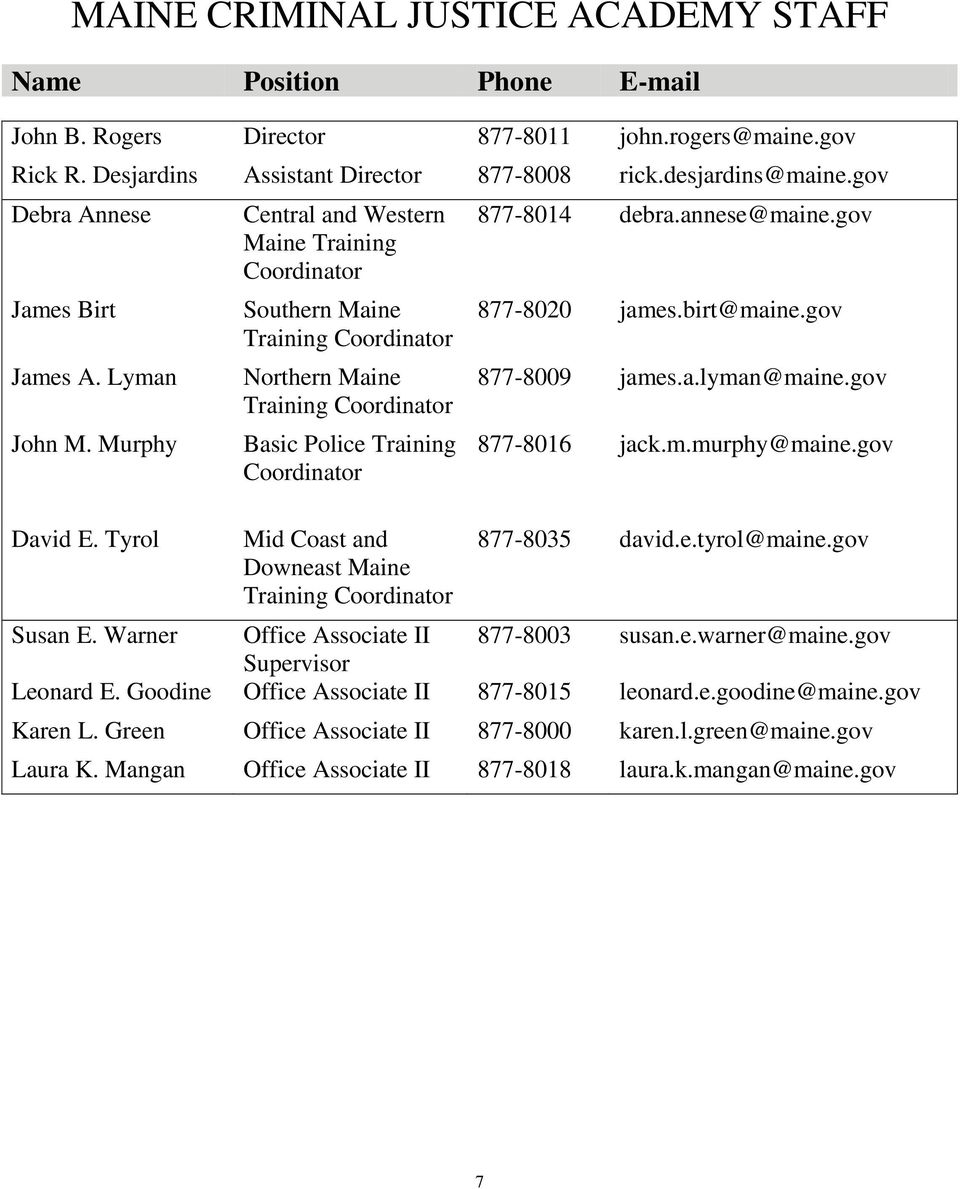
7 MAINE CRIMINAL JUSTICE ACADEMY STAFF Name Position Phone John B. Rogers Director Rick R. Desjardins Assistant Director Debra Annese James Birt James A. Lyman John M. Murphy David E. Tyrol Central and Western Maine Training Coordinator Southern Maine Training Coordinator Northern Maine Training Coordinator Basic Police Training Coordinator Mid Coast and Downeast Maine Training Coordinator Susan E. Warner Office Associate II Supervisor Leonard E. Goodine Office Associate II Karen L. Green Office Associate II Laura K. Mangan Office Associate II
8 8

9 MAINE CRIMINAL JUSTICE ACADEMY A Bureau of the Department of Public Safety MCJA TRAINING PROGRAMS STUDENT DISCIPLINARY CODE PREAMBLE The Maine Criminal Justice Academy Student Disciplinary Code (the Code ) is designed to promote the orderly and efficient training of students who receive training under the auspices of the Academy. The Code is promulgated to assure the safety of persons undergoing training, to protect the peaceful exchange of ideas, and to promote professionalism and orderliness consistent with good law enforcement and an efficient criminal justice system. ARTICLE I Purposes SECTION 1 Title 25, M.R.S A A authorizes the Board of Trustees of the Maine Criminal Justice Academy (the Board ) to set training and certification standards for all law enforcement officers, set requirements for board-approved courses and prescribe curriculum and certify graduates of board-approved courses. SECTION 2 The Board concludes that the foregoing statutory provision authorizes the Board to establish standards of student conduct and the procedure for enforcing such standards. SECTION 3 It is the purpose of this Code to promulgate standards of student conduct and the procedure for enforcing such standards, to be known as the Student Disciplinary Code for the Maine Criminal Justice Academy. SECTION 4 This Code shall apply to all students attending any on-site or off-site Maine Criminal Justice Academy Program, which include: all In-service Programs, the Basic Corrections Program, or the Pre-Service Law Enforcement Programs in accordance with 25 M.R.S.A., chapter 341, with the exception of the Basic Law Enforcement Training Program approved by the Board in accordance with 25 M.R.S.A C ( BLETP ), which has a separate disciplinary code, entitled Cadet Disciplinary Code. SECTION 5 The fact that the Academy may take disciplinary action is not intended to affect or influence the ability of the student s employer or any appropriate civil or law enforcement authority to take disciplinary or enforcement action. The student remains subject to prosecution for violation of any applicable laws. 9

10 ARTICLE II Sanctions SECTION 1 General. No student may be dismissed or suspended for disciplinary reasons except in accordance with the provisions of this Code. The following sanctions may be imposed for violation of the Academy Standards of Conduct, which are set forth in Article III of this Code. SECTION 2 Denial of Privileges. Minor infractions of the Rules and Regulations of the Academy, Standards of Conduct of this Code, directives, and staff orders may result in denial of privileges. Such a sanction may be imposed in conjunction with written or oral reprimands. SECTION 3 Oral Reprimand. A student may receive a verbal reprimand by the Training Coordinator pursuant to the procedures outlined in Article IV for violation of the Standards of Conduct of this Code and the rules and regulations of special training. SECTION 4 Written Reprimand. A student may receive a written reprimand by the Training Coordinator pursuant to the procedures outlined in Article IV for violation of the Standards of Conduct of this Code and the rules and regulations of special training. SECTION 5 Suspension. A student suspended from the Academy shall leave the premises of the Academy and shall not participate in any activity conducted under the auspices of the Academy, except such activities as are open to the general public, and shall not have any privileges of a student. For purposes of the application of this Code, however, he/she shall be regarded as a student, though suspended. At the expiration of the period of suspension, either at the point in time of the course from which he/she was suspended or the beginning of the next training course as determined by the Director of the Academy on the application of such student, he/she shall be automatically reinstated as a student in good disciplinary standing provided he/she has not been found, in the meantime, to have further violated one of the Standards of Conduct of this Code. SECTION 6 Dismissal. A student dismissed from the Academy shall leave the premises of the Academy and shall no longer be a student of the Academy. In order to become a student again, a person must submit a new application for admission. 10

11 ARTICLE III Standards of Conduct SECTION 1 General. Conduct promoting public respect and self-esteem is an essential quality for an effective criminal justice professional. Students are expected to practice and demonstrate such conduct to a high degree while enrolled in an Academy training program. Compliance by all students with the Standards of Conduct will enhance this quality. Such compliance is required and any violation will be the subject of appropriate disciplinary action, up to and including dismissal from the Academy. SECTION 2 Criminal Misconduct. Violation of any criminal law at any time or place is deemed a very serious breach of the Standards of Conduct of this Code. Any student in any MCJA training program against whom criminal charges have been filed in court may be suspended pursuant to Article IV by the Director from further attendance in or at an Academy program pending resolution of the criminal charge. Conviction of a criminal offense will result in appropriate disciplinary action, and may result in dismissal of the student. SECTION 3 Ethical Violations. Ethical standards are essential standards of integrity to which every criminal justice professional should aspire. Ethical Violations represent an EXTREMELY SERIOUS INCIDENT of misconduct that may result in termination from the Academy, or in appropriate cases, a period of probation and/or other punishment. The acts of lying, plagiarism, stealing and cheating are considered ethical violations of the Code. The following definitions are pertinent to the Academy s Ethical Violations: A. Lying is stating an oral or written untruth with the intent to deceive. B. Plagiarism is to knowingly use unauthorized assistance in submitted work designated to represent one s own efforts. C. Stealing is to take, obtain or withhold property or anything of value wrongfully from the owner with the intent of permanently or temporarily depriving the owner of its use or possession. D. Cheating is to deceive by trickery, to mislead, to elude, or to act dishonestly. Examples include: Looking at another student s answer sheet or test papers. Copying another student s answer. Having another student do an assignment. Talking without permission to another student, anytime, during an examination. Writing any information before, during, or after the exam on desktops, booklets, hands, etc. Use of scratch paper for mathematical computations is acceptable if authorized by the exam proctor. Having any unauthorized information at the student s disposal such as notes, books, etc., that is relevant to the examination without permission. Having access to examination questions and answers prior, during, or after a test, and before the grading of the exam. SECTION 4 Failure to Comply with Directives. Students must obey all applicable directives as outlined in the rules and regulations in the Special Training programs. Additional directives may be presented and explained by the staff. Failure to comply with directives will result in appropriate disciplinary sanctions, and may result in dismissal of the student. SECTION 5 Unprofessional Conduct. Students attending any Academy program are expected to conduct themselves professionally. Harassment of any person, hazing, profanity, discourtesy, rudeness, impoliteness and the like are unprofessional conduct for criminal justice professionals. Unprofessional conduct will result in appropriate disciplinary sanctions and may result in dismissal of the student. 11
12 SECTION 6 Sexual Harassment and Discrimination. Sexual Harassment and discrimination based on race, color, sex, religion, age, national origin, sexual orientation or disability are prohibited. Any form of sexual harassment or discrimination will not be tolerated at any Academy programs. Examples of prohibited harassment and discrimination include, but are not limited to: A. Unwelcome sexual advances or contact, gestures, suggestive or lewd remarks; B. Verbal abuse such as offensive racial, ethnic, or sexual threats or comments, physical overtures, or any type of pressure to engage in sexual activity; C. Offensive jokes; and D. Ridicule, slurs, derogatory action or remarks. Students may report incidents of discrimination or harassment to any member of the Academy staff or the Department of Public Safety s Personnel Officer located at 45 Commerce Drive, Suite 1, Augusta, Maine or by telephone at Discrimination against or harassment of any person will result in appropriate disciplinary sanctions, and may result in dismissal. SECTION 7 Application of Sanctions to Standards of Conduct. The specification of a possible sanction under each of the Standards of Conduct in this Code is not intended to be exclusive; the range of sanctions remains available. Each case will be considered individually, with due regard given the nature of the violation and the history of the student. ARTICLE IV Procedures SECTION 1 General. Any person may report a student for a violation of the Standards of Conduct to any member of the Academy staff. Minor violations will normally be addressed by oral or written reprimands. More serious and repeated violations will result in suspension or dismissal. The Disciplinary Officer referred to in this Code shall be the Assistant Director or other designee appointed by the Academy Director. SECTION 2 Oral Reprimand. Disciplinary action in the form of an oral reprimand by the Training Coordinator to a student is subject to review by the Disciplinary Officer. Written notification of an oral reprimand will be provided to the student and the student s sponsor. SECTION 3 Written Reprimand. Disciplinary action in the form of a written reprimand by the Training Coordinator to a student is subject to review by the Disciplinary Officer. The written reprimand shall include a notation of the nature, time, place of the violation and the sanction. The original will be given to the student and the student s sponsor, and the Disciplinary Officer for entry in the students record. Notification of the written reprimand shall be given to the Academy Director. A. The student may appeal this action by submitting a written request to the Disciplinary Officer within twenty-four (24) hours after receiving such reprimand. B. Within three (3) working days after receiving the requested appeal, the Disciplinary Officer shall hold an informal hearing on this appeal, attended by the reprimanded student, the Training Coordinator issuing the reprimand and any witnesses desired by the Training Coordinator or student. C. Upon conclusion of this informal hearing, the Disciplinary Officer shall 12

13 notify the student and the student s sponsor of his/her decision. The decision shall be final and noted in the student s record. SECTION 4 Suspension or Dismissal. A. Preliminary Investigation and Recommendation for Hearing. Upon receipt of information that a student may have committed a violation of the Standards of Conduct of this Code that could result in suspension or dismissal, the Disciplinary Officer shall immediately conduct an informal preliminary investigation of the matter. If satisfied that there is reasonable cause for either suspension or dismissal of the student, the Disciplinary Officer will submit a written report of the investigation specifying the nature, time and place of each violation alleged and the names of witnesses accompanied by all or any written statements and exhibits of such offense to the Academy Director with a recommendation that a hearing be convened on the alleged violation(s). B. Action by the Academy Director. If the Academy Director concurs in the recommendation of the Disciplinary Officer, the Director will notify the Chair of the Board of Trustees to schedule the matter for hearing. In the meantime, the Academy Director may, for good reason, suspend the student pending hearing. The Academy Director may have good reason to suspend the student pending hearing based on such considerations as the health and safety of the accused cadet, other cadets, and/or staff, and the need to conduct training without disruption. If the Academy Director concludes that no violation has occurred, the Director may dismiss the matter. If the Academy Director concludes that the alleged violation is not sufficiently serious to warrant suspension or dismissal, the Director may refer the matter to the Training Coordinator for an oral or written reprimand. C. Hearing. If the Academy Director concurs with the recommendation to refer the matter to the Board of Trustees, the Director shall notify the Chair of the Board who, in turn, will appoint three members of the Board to serve as a hearing panel. The Director shall provide the accused student with a written statement of the charges and the time and place of the hearing at least 48 hours prior to the time of such hearing. The panel shall conduct the hearing in accordance with the Maine Administrative Procedure Act and applicable Department of Public Safety Rules regarding administrative hearings. D. Decision after Hearing. The panel shall issue a written decision no later than two working days after conclusion of the hearing. The decision shall include findings of fact sufficient to advise the student of the basis for the decision, shall be mailed or provided in hand to the student, and shall apprise the student of the right of appeal pursuant to 5 M.R.S.A SECTION 5 Attendance at the Academy Subsequent to Suspension or Dismissal. A dismissed student, or a student unable to complete a course due to a suspension, may apply for admission to a subsequent Academy course. Any statement of the applicant on the Background Standard for Admission to and/or Certification, on an application, or in a request for admission or enrollment must be accompanied by a statement disclosing the date and nature of the prior violation and the sanction imposed. Prior disciplinary action may provide grounds for denial of admission, and will be considered to the extent permitted by law. The Academy Director or his/her designee shall advise the applicant in writing of the decision to deny admission to the Academy. The decision shall reflect the Academy Director s or his/her designee reasoning in a manner sufficient to inform the applicant of the basis for the decision. 13

14 SECTION 6 Appeal of Denial of Admission. An applicant who has been denied admission based all or in part on disciplinary action imposed while the applicant was previously enrolled at or attending the Academy may appeal such decision to the Board of Trustees by delivering a written notice of appeal to the Academy Director no later than ten (10) working days after receipt of written notice of the decision denying admission. The notice of appeal should include a copy of the written decision of the Academy Director and a complete statement of the reasons the applicant disagrees with the decision of the Director. A. Within two (2) working days of receipt of a copy of the written notice of appeal, the Academy Director shall transmit to a three-member panel of the Board appointed by the Chair of the Board a copy of the written decision, copies of any evidence relied on, the notice of appeal, and any materials submitted by the applicant in support of the appeal. B. Within thirty (30) working days of receipt of the materials transmitted by the Academy Director, the panel shall review the materials and issue a written decision. The panel may affirm the decision of the Academy Director; remand to the Director for additional findings of fact; or vacate the findings of the Director and admit the applicant. The decision shall reflect the panel s reasoning and advise the applicant of any right of appeal. Moved by: Linda Smithers Seconded by: Richard Harburger Voted Unanimously by the Board of Trustees Date: 05/05/
15 Directive 79-1 (Revised) MAINE CRIMINAL JUSTICE ACADEMY A BUREAU OF THE DEPARTMENT OF PUBLIC SAFETY Rules and Regulations for Special Training Programs PURPOSE The following rules and regulations are established to promote the orderly and efficient training for those individuals who attend the Maine Criminal Justice Academy for special training programs (i.e. in-service, student orientation programs, etc.) They are designed to promote professionalism and orderliness consistent with the high ideals of the criminal justice system, and so that the students receive the full benefit of the training program. AUTHORITY The herein contained rules and regulations are established and implemented in accordance with policies and procedures promulgated by the Academy Trustees. It shall be the responsibility of all Academy staff members to encourage and enforce compliance with these rules and regulations. A training supervisor will be assigned to each special training program and will be responsible to apprise each student of these rules and regulations at the start of each training program. CONDUCT AND GENERAL RESPONSIBILITIES 1. Students shall conduct themselves in an orderly and professional manner at all times while enrolled in an Academy training program. 2. Students are expected to conduct themselves ethically while attending Academy training programs. Ethical violations such as lying, cheating, plagiarism, deception, as well as criminal conduct and harassment are serious violations of the Student Disciplinary Code and can lead to disciplinary action, up to and including dismissal from the Academy. 3. The consumption of alcoholic beverages on Academy grounds is prohibited unless the consumption is an integral part of an approved training program. 4. Students shall assist in the conservation of heat and electricity. 5. Students shall maintain quiet after lights out at 11:00 p.m. 6. Student vehicles shall be parked according to Academy maps and where instructed to do so. 7. Students are responsible for all information posted on the designated bulletin board or in other locations identified by the MCJA training coordinator. 8. Students shall be properly dressed in uniform or appropriate attire as explained by the In-Service Training Supervisor while enrolled in training programs. No shorts, cutoffs, jeans, T-shirts, clothing with inappropriate language, ripped or torn clothing is allowed without the express approval of the training supervisor. 9. Student shall not use any tobacco product within 100 feet of any Academy building or while participating in any Academy in-service training program off grounds. Students shall smoke only in those areas designated by the training coordinator. 10. Canines are not allowed in the billets or classroom without the permission of the Academy Director or the Training Manager. 11. Law enforcement officers are encouraged to leave their weapons secured in their vehicles during training. Non-law enforcement officers are prohibited from bringing firearms onto Academy grounds. In no case are firearms allowed in the dormitories (billets) without the prior written permission of the Academy Director. 12. Personal injuries or property damage shall be brought to the immediate attention of a staff member. 13. Students will be permitted off the Academy grounds. Students should contact the training supervisor or another staff member if a problem arises or if special permission is needed. 15

16 ROOMS, LODGING AND LINEN 1. Advance notice must be given to the Academy for students who require lodging during training. 2. Each student will be assigned to a room and room assignments will be posted. Room assignments will not be changed without permission of the training supervisor. Students shall not remove dorm room furniture from their rooms. 3. Telephone messages, if not personally communicated, will be posted on the bulletin board. All Academy telephones are off limits, except with specific permission of the staff. 4. Linen will be the student s responsibility. You will need to provide your own sheets, pillow cases, or sleeping bag and you may prefer to bring your own pillow. Blankets will be folded and placed at the foot of the bed. 5. Students must provide their own towels, face cloths, sheets, pillow cases, and/or sleeping bag. 6. We now have a student lounge where we offer a High Definition LCD Projector showing on a 12 foot wide screen, a Blue Ray DVD player and a complete surround sound system. There is also an HDMI cable connection port for your favorite video game to connect to this system. We just recently purchased an X Box for the lounge so bring your favorite DVD or video game the next time you come for an in-service class!!! MEALS 1. Students shall comply with meal policies on the In-Service Application and as explained by the training coordinator. Students are required to have a meal ticket issued by the training coordinator to eat in the dining room. 2. Failure to provide the Academy with at least one-week advance notice may result in the unavailability of meals for a student. ATTENDANCE AND ACADEMIC STANDARDS Accreditation and certification for special training programs shall not be given unless successful completion of required standards and 90% attendance is attained. Exceptions to these standards will only be made by the Academy Director after consultation with the course instructor(s). John B. Rogers, Director Maine Criminal Justice Academy Revised: June 16,

17 Map and Directions to the Academy The Maine Criminal Justice Academy is located off Route 201 in Vassalboro. It is approximately 7 miles south of the Town of Winslow and 12 miles north of the City of Augusta. From the south: Take Interstate 95 north to Exit 113, travel to your second set of traffic lights. Turn left onto Route 201 North. Go approximately 9 miles. The Academy will be located on your right. From the north: Take Interstate 95 south to Exit 127, old exit 33, (Kennedy Memorial Drive). At the end of the ramp, turn left and follow the KMD into town. Where Route 137 turns off to the right (after 7th street light) turn onto Route 137. Proceed approximately 1.5 miles to the intersection of Route 201. Turn right onto Route 201. Follow Route 201 for exactly 5 miles to intersection with the Oak Grove Road on the left. Academy is the set of brick buildings on the right. Main Entrance is located here. Follow signs from Parking Lot. 17

18 TRAINING SCHEDULE FALL / WINTER / SPRING Basic Law Enforcement Training Program DATE COURSE LOCATION August 18 Dec. 19, th Basic Law Enforcement Training Program Maine Criminal Justice Academy January 20 May 22, th Basic Law Enforcement Training Program Maine Criminal Justice Academy Law Enforcement Pre-Service DATE COURSE LOCATION Sept. 29 Oct. 10, 2014 Law Enforcement Pre-Service Phase 2 Maine Criminal Justice Academy Jan. 26 Feb. 6, 2015 Law Enforcement Pre-Service Phase 2 Maine Criminal Justice Academy Basic Corrections DATE COURSE LOCATION Sept. 8 Sept. 19, 2014 Basic Corrections Maine Criminal Justice Academy Jan. 5 Jan. 16, 2015 Basic Corrections Maine Criminal Justice Academy April 27 May 8, 2015 Basic Corrections Maine Criminal Justice Academy Law Enforcement and Corrections In-Service Training DATE COURSE LOCATION Aug. 25 Oct. 10, 2014 K-9 Drug School Maine Criminal Justice Academy Aug , 2014 MARC Instructor Development Maine Criminal Justice Academy Sept. 4, 2014 DRE Refresher Training Maine Criminal Justice Academy Sept. 8 12, 2014 Interactive Use of Force Instructor Development Maine Criminal Justice Academy Sept. 8 Oct. 31, 2014 K-9 Drug School South Portland Police Department Sept , 2014 Breath Testing Device Instructor Development Maine Criminal Justice Academy Sept , 2014 Urban Rifle Instructor Development Maine Criminal Justice Academy Oct , 2014 Investigating Complaints of Officer Misconduct Maine Criminal Justice Academy Oct , 2014 Methods of Instruction Maine Criminal Justice Academy Oct , 2014 Police Training Officer Maine Criminal Justice Academy Dec. 2 3, 2014 Crash Refresher & Exam Maine Criminal Justice Academy Dec. 8 10, 2014 Drug Recognition Expert Instructor Development Maine Criminal Justice Academy Jan. 5 16, 2015 Methods of Instruction Maine Criminal Justice Academy Jan , 2015 Drug Recognition Expert Training Maine Criminal Justice Academy Feb. 10, 2015 Physical Fitness Testing Protocols Maine Criminal Justice Academy Feb. 19, 2015 Civil Rights Officer Maine Criminal Justice Academy Feb , 2015 Law Enforcement Chaplain Certification Course Maine Criminal Justice Academy 18

19 Law Enforcement and Corrections In-Service Training (Continued) Mar , 2015 Basic Crime Scene Investigation Course Maine Criminal Justice Academy To Be Announced K-9 Patrol School Maine Criminal Justice Academy Mar. 23 Apr. 3, 2015 Methods of Instruction Maine Criminal Justice Academy Apr. 27 May 1, 2015 New Chief s and Sheriff s Seminar Maine Criminal Justice Academy June 8 19, 2015 Firearms Instructor Development Maine Criminal Justice Academy June 12, 2015 Firearms Skills Development Maine Criminal Justice Academy Terminal Operator Certification Course DATE COURSE LOCATION Sept. 8 12, 2014 Terminal Operator Certification Maine Criminal Justice Academy Oct. 6 10, 2014 Terminal Operator Certification Maine Criminal Justice Academy Nov. 3 7, 2014 Terminal Operator Certification Maine Criminal Justice Academy Dec. 8 12, 2014 Terminal Operator Certification Maine Criminal Justice Academy Mar. 9 13, 2015 Terminal Operator Certification Maine Criminal Justice Academy Apr , 2015 Terminal Operator Certification Maine Criminal Justice Academy May 11 15, 2015 Terminal Operator Certification Maine Criminal Justice Academy June 8 12, 2015 Terminal Operator Certification Maine Criminal Justice Academy 19

20 Emergency Services Communication Bureau Courses Aug , 2014 Emergency Medical Dispatch Certification Maine Criminal Justice Academy Sept. 8, 2014 QA Review Session (Afternoon) Maine Criminal Justice Academy Sept. 9 10, 2014 EDQ EMD Quality Assurance Maine Criminal Justice Academy Sept. 11, 2014 AQUA Software Training Course Maine Criminal Justice Academy Sept. 12, 2014 Pro-QA Software Certification Course Maine Criminal Justice Academy Sept , 2014 NextGen 911 Guardian New Hire Training Maine Criminal Justice Academy Sept. 29 Oct. 3, 2014 Emergency Telecommunicator Course Maine Criminal Justice Academy Oct. 7 9, 2014 Emergency Medical Dispatch Certification Maine Criminal Justice Academy Dec. 1 5, 2014 Emergency Telecommunicator Course Maine Criminal Justice Academy Dec. 9 11, 2014 Emergency Medical Dispatch Certification Maine Criminal Justice Academy Dec , 2014 NextGen 911 Guardian New Hire Training Maine Criminal Justice Academy Jan. 6 7, 2015 NextGen 911 Guardian New Hire Training Maine Criminal Justice Academy Jan , 2015 Emergency Medical Dispatch Certification Maine Criminal Justice Academy Feb , 2015 NextGen 911 Guardian New Hire Training Maine Criminal Justice Academy Feb , 2015 Emergency Telecommunicator Course Maine Criminal Justice Academy March 9, 2015 QA Review Session (afternoon) Maine Criminal Justice Academy Mar , 2015 Emergency Medical Dispatch Certification Maine Criminal Justice Academy March 13, 2015 Pro-QA (morning and afternoon session) Maine Criminal Justice Academy Mar , 2015 EDQ EMD Quality Assurance Maine Criminal Justice Academy March 18, 2015 AQUA Software Training Course Maine Criminal Justice Academy Mar. 31 Apr. 1, 2015 NextGen 911 Guardian New Hire Training Maine Criminal Justice Academy May 5 6, 2015 NextGen 911 Guardian New Hire Training Maine Criminal Justice Academy May 11 15, 2015 Emergency Telecommunicator Course Maine Criminal Justice Academy May 19 21, 2015 Emergency Medical Dispatch Certification Maine Criminal Justice Academy June 30 July 1, 2015 NextGen 911 Guardian New Hire Training Maine Criminal Justice Academy July 7 9, 2015 Emergency Medical Dispatch Certification Maine Criminal Justice Academy 20

21 Alert and Physical Fitness Testing At MCJA, for the Alert Test, arrive at 0800 hours and PT test will follow. Those taking only the PT Test should arrive at The Phase I Exam will be available each Wednesday or other day that Alerts and PT tests are held and will start at 1200 hours. For those taking the Alert Test at the Southern Maine Community College the arrival time is 0800 hours and the Alert Test starts promptly at 0830 hours. **In January 2015, the Alert Test will be given at York County Sheriff s Office, and the time to arrive will be 1300 hours. Lunch is not provided if you are taking the Alert, PT and Phase 1 exam, you should consider bringing a bag lunch. Alert and PFT Testing Dates at MCJA: Off Campus Alerts 2014 Alert & PFT Alert & PFT (Southern Maine Community College) August September October November December NONE NONE 17 Off Campus Alerts (NO PFT offered) (York County Sheriff s Office) 2015 January February March April 1 15 & May NONE NONE 20 June July
22 Notice of Change in In-Service Class Registration Procedure Because of the ever increasing cost of providing food services, we have changed the procedure for purchasing meals and lodging while attending In-Service classes. Our goal is to streamline the process allowing the kitchen to prepare only those meals that are needed. In the past, we collected meal and lodging requests on the first day of the class. This allowed no time for the kitchen to order the correct amount of food, or to know precisely how many meals would be needed for a certain class. We also allowed students to turn in unused meal tickets and did not bill them or their agency for those meals, even though the meals had been prepared. This is a practice that is both expensive and inefficient. Our new procedure will allow for three options when registering for an In-Service class: 1. Tuition Only. Only the tuition cost of the program will be billed to the agency. There will be no lodging and no meals. 2. Day Student. The agency will be billed for the tuition and all noon time meals served during that class. If a student chooses to skip a meal, for whatever reason, that meal will still be billed to the agency because it was ordered and prepared. 3. Residential Student. The agency will be billed for the tuition, all meals served and all nights lodging during that class. If a student chooses to skip a meal or decides not to stay overnight on a particular night, the agency will still be billed because those services were requested. Our hope is that this new procedure will help keep the increases to the meals and lodging at a minimum. We are always looking for better ways to provide our services to the Criminal Justice Community. If you have any suggestions about ways to improve what we do, please do not hesitate to share your thoughts with us. Thank you, John B. Rogers, Director Maine Criminal Justice Academy 22
23 ADMINISTRATIVE COURSES 23
24 24
25 INVESTIGATING COMPLAINTS OF OFFICER MISCONDUCT Program Description: Date: October 15 16, 2014 Location: MCJA Time: 8:30-5:00 Tuition only: $80.00 Day Student Cost: $96.00 Residential Student Cost: $ Contact: Rick Desjardins From time to time, every law enforcement executive, no matter the size of the agency, will be confronted with the need to conduct an internal affairs investigation. The area of internal affairs investigations is growing increasingly complex. This training attempts to review many of the most common issues confronting chiefs and internal affairs investigators. The community policing philosophy depends on the integrity of the police department. If the public lacks confidence in the agency s ability and commitment to investigate and prosecute officer misconduct, there is little hope for successful partnerships and problem-solving. Investigations are an important part of any employer's frontline defense against liability and serve as a means of maintaining a disciplined workforce. In addition to knowing what to do during an investigation, every employer should know the policies and practices that can be implemented before the need for an investigation arises. INVESTIGATING COMPLAINTS OF OFFICER MISCONDUCT focuses on the practical techniques and information you need to know in order to conduct investigations that meet the ever-changing legal requirements. Class content will include: what you should do now to prepare for your next investigation, how to avoid costly mistakes that can create liability, interview techniques to get the most out of every witness, proper documentation, how to organize investigation files, and how to effectively present the results of an investigation. The two-day class is being offered at the academy. There are two instructors, both with many years of experience in the subject area. They are Laurel Shippee, the state EEO coordinator, and Brian MacMaster, chief investigator for the Attorney General's Office Personnel who may attend: This class is open to full-time law enforcement personnel. Preference will be given to those assigned by their agency as responsible for conducting internal investigations. Prerequisites: Class Limit: 25 Students 25
26 NEW CHIEFS AND SHERIFF S SEMINAR Program Description: Date: April 27 May 1, 2015 Location: MCJA Time: 8:00-5:00 Tuition only: $ Day Student Cost: $ Residential Student Cost: $ Contact: John Rogers This course is for the newly appointed chief or sheriff. The program is designed to prepare chiefs and sheriffs for the challenges of running a law enforcement agency. Topics to be examined include, but are not limited to: liability issues, labor issues, policies, consensus building techniques, discipline, the Public Information Act, managing internal investigations, understanding the needs of your city manager or county commissioners and mandatory reporting requirements. Attendees will learn from each other during interactive discussions of current issues facing department administrators. Personnel who may attend: This class is restricted to newly appointed chiefs and sheriffs or their seconds in command only. Prerequisites: Special Requirements: Must be the agency head or second in command Class Limit: 20 Students 26
27 SPECIALIZED COURSES LAW ENFORCEMENT AND CORRECTIONS 27
28 28
29 LAW ENFORCEMENT PRE-SERVICE COURSE Program Description: The LEPS is the entry level three phase training program to become a law enforcement officer in the State of Maine. The three (3) phase course format consists of forty (40) hours online training, and eighty (80) hours of classroom scenario based practical training. Upon completion of phase 1 and 2 the candidate is eligible to be hired by a law enforcement agency and must successfully complete an eighty (80) hour supervision component. The course curriculum, prerequisites, application forms, and a more detailed course description can be found on the MCJA website at: For Dates and Locations visit our website, or view the schedule in the front of this catalog. Our website will have an updated list of off campus courses as they become available. The LEPS student will receive a Course Completion Certificate after completing Phase 2. Prior to being hired as a Law Enforcement Officer, a LEPS graduate must be 21 years of age or older, unless the applicant has an associate s degree or 60 credit hours of postsecondary education, in which case the applicant must be a least 20 years of age as per Maine Statute 2804-G. Attendees must be hired by a law enforcement agency and complete weapons certification by a MCJA Certified Firearms Instructor. The hiring agency must submit a notice of employment and your firearms qualification form to MCJA before you can work as a Law Enforcement Officer. The hiring agency must also complete the 80 hour supervision Phase III component before you are certified as a law enforcement officer. Who may attend Phase 1 and Phase II You must be 21 years of age or 20 years old with at least 60 credits from an accredited college, or age 19, currently enrolled in an accredited post secondary education program, with at least 40 credit hours. *Copies of transcripts or current grade reports required with the application for those under 21. Phase 1 online training can be completed after registering. No prerequisites. Phase 2: You must take and pass the ALERT exam You must pass the MCJA Physical Agility Test (PT) You must be sponsored by a Law Enforcement Agency You must complete the application process and criminal background check on MCJA approved forms. You must pass a physical exam by your physician and submit on an MCJA approved form. Special Requirements: The cost of Phase 1 online training is $ The cost of Phase 2 scenario based classroom training at MCJA is $ Off site courses may have additional fees. On site meals and lodging are available at a reasonable cost. The academy does not provide meals and lodging for off campus courses. Contact: Deb Annese for more information Students will be required to purchase the Law Books for this class Title 29-A and 17-A. 29
30 MECHANICS OF ARREST, RESTRAINT & CONTROL INSTRUCTOR DEVELOPMENT Date: August 26 29, 2014 Location: MCJA Time: 8:00-5:00 Tuition Only: $80.00 Day Student Cost $ Residential Student Cost: $ Contact: David Tyrol Program Description: This is a 40 hour course directed toward developing instructors for law enforcement defensive tactics that are taught in the Basic Law Enforcement Training Program and the Pre-Service Law Enforcement Academy programs. Those individuals selected should be willing to participate in Academy programs. Applicants must provide a letter with the application from the Chief Law Enforcement Officer of the agency indicating a willingness to send the officer to participate in the Basic Law Enforcement Training Program and/or the Law Enforcement Pre-Service Program. Personnel who may attend: All full time Law Enforcement Officers who are Academy certified and part-time Law Enforcement Officers with 3 years post academy experience. Preference will be giving to fulltime law enforcement officers and those who are willing to participate in Academy programs. Prerequisites: Special Requirements: Class Limit: 20 Students 30
31 DRUG RECOGNITION EXPERT REFRESHER TRAINING Program Description: Date: September 4, 2014 Location: MCJA Time: 9:00-5:00 Fee: $25.00 (lunch included) Contact: James Lyman This class is offered as an annual Drug Recognition Expert (DRE) refresher course. Topics will include current trends and updates to the DRE program, and an interactive discussion about future concerns in the program. DRE instructors will be on hand to answer questions and review re-certification packets as needed. This class will meet the mandatory bi-annual requirements for re-certification training. Although this class is intended for the DRE with a certification expiration date within the next 12 months, all DRE s are encouraged to attend. Personnel who may attend: Currently certified DRE's Prerequisites: None Special Requirements: Due to the length of time required for instructors to review recertification materials, I would encourage DRE's to seek an instructor and complete that process prior to the class. On the day of class, Instructors will be available to review re-certification materials by appointment only, which can be scheduled through the MCJA coordinator. Class Limit: 50 students 31
32 INTERACTIVE USE OF FORCE INSTRUCTOR DEVELOPMENT Date: Sept. 8 12, 2014 Location: MCJA Time: 8:00-5:00 Tuition Only: $80.00 Day Student Cost: $ Residential Student Cost: $ Contact: Jack Murphy David Tyrol Program Description: This course will prepare firearms and other defensive tactics instructors to create, and use situational interactive training scenarios for use of force training. The use of marking cartridges and appropriate protective equipment and rules will be covered. Students will produce and supervise use of force scenarios and critique and evaluate officer s performance during those scenarios. Applicants must provide a letter with the application from the Chief Law Enforcement Officer of the agency indicating a willingness to send the officer to participate in the Basic Law Enforcement Training Program. Personnel who may attend: All MCJA Certified Instructors who are Full Time Law Enforcement officers. Priority will be given to Use of Force, Defensive Tactics, Firearms, &, Chemical Agent Instructors. Prerequisites: Special Requirements: Class Limit: 20 Students 32
33 BREATH TESTING DEVICE INSTRUCTOR DEVELOPMENT Program Description Date: Sept , 2014 Location: MCJA Time: 9:00 5:00 Tuition Only: $60.00 Day Student Cost: $84.00 Residential Student Cost: $ Contact: James Lyman This program is designed to develop a full time law enforcement / corrections officer, who is Intoxilyzer certified, to a level of ability and proficiency necessary to provide quality Intoxilyzer training to other officers. Selection priority will be given to officers who have a demonstrated, credible use of this instrument and have experience dealing with the legal issues associated with the enforcement of impaired driving. Priorities will also be assigned based upon geographic and agency needs. This three day class will prepare the candidates to teach students the necessary skills to become proficient and certified in the use of the Intoxilyzer. Before completing this certification, the students will be required to teach the 2 day Intoxilyzer Operation and Certification course under the supervision of senior instructors. Personnel who may attend: Full time law enforcement / corrections officers who are Intoxilyzer certified and have demonstrated proficiency in all aspects of it's use. Selection criteria will include MCJA and agency needs, Intoxilyzer use history, regional training needs, and instructor training / experience. Prerequisites: Currently certified as an Intoxilyzer operator and Methods of Instruction. Class Limit: 20 Students (Candidates will have to instruct at a later date under the supervision of a senior instructor to complete certification. The first opportunity will be during the fall BLETP classes ) 33
34 URBAN RIFLE INSTRUCTOR DEVELOPMENT Program Description: Date: September 22-26, 2014 Location: MCJA Time: 8:00-5:00 Tuition Only: $ Day Student Cost: $ Residential Student Cost: $ Contact: James Birt This course is designed to develop MCJA Certified Firearms Instructors as trainers in rifle/carbine weapon systems. Topics will include weapon selection for patrol units, training and budgetary issues, nomenclature, function, handling safety, carry conditions and live fire drills. Students must provide a departmental carbine or rifle with 2 magazines and a sling, 1200 rounds of ammo for the rifle. In addition, it is required to bring ear protection (full protection, no plugs only) & full, wrap around eye protection, ballistic vest (if worn), a cleaning kit, departmental duty belt, holster, handgun, spare magazines, 100 rounds of ammo, and a flashlight. Appropriate range gear, hat, bug spray and sun protection are also recommended. Personnel who may attend: All MCJA Certified Firearms Instructors. Preference will be given to those from agencies that have or will soon be transitioning to carbines/rifles. Prerequisites: MCJA Certified Firearms Instructors Special Requirements: Class limit: 20 Students 34
35 METHODS OF INSTRUCTION / MCJA CERTIFIED INSTRUCTOR DEVELOPMENT Dates: Oct , 2014 Jan. 5 16, 2015 Mar. 23 Apr. 3, 2015 Location: MCJA Time: 8:00-5:00 Tuition only: $ Day Student Cost: $ Residential Student Cost: $ Contact: Jim Lyman David Tyrol Program Description: This two (2) week course will cover writing instructional objectives, choosing and preparing visual aids, creating an original lesson plan, teaching the adult learner, preparing tests, and public speaking. Participants are required to make several presentations ranging from 2 to 30 minutes in duration. During the second week (Certified Instructor Development) students will develop a full lesson plan on a Board approved topic from the BLETP, BCOR or LEPS curriculum and be evaluated presenting portions of that unit of instruction. Successful students will be eligible as certified instructors per Board Specification S-6. Personnel who may attend: This course is available to personnel in the criminal justice system and is intended to fulfill the requirement for a Methods of Instruction course needed for Academy Instructor Certification. Prerequisites: Special Requirements: Students will be required to bring a laptop computer to class. Class Limit: 20 Students 35
36 POLICE TRAINING OFFICER Dates: Oct , 2014 Location: MCJA Time: 9:00-5:00 Tuition Only: $ Day Student Cost: $ Residential Student Cost: $ Contact: Rick Desjardins Program Description: The Police Training Officer program incorporates contemporary adult educational methods and a version of problem based learning adapted for Law Enforcement. This approach to training provides a foundation for life long learning that prepares the new officer for the complexities of Law Enforcement today and in the future. Instead of the San Jose model FTO program, this program is based on the Reno Police Training Officer (PTO) program which has been successfully implemented in several states across the country. The Program is designed to provide the trainee with a well structured 15 week program after having completed the Basic Law Enforcement Academy. Personnel who may attend: Full-time certified and experienced law enforcement officers who will be serving in the capacity of Police Training Officers (PTO s) for their respective departments. Prerequisites: Special Requirements: Class Limit: 20 Students 36
37 CRASH RECONSTRUCTION SPECIALIST MANDATORY REFRESHER and EXAM Date: Training Class December 2, 2014 Exam December 3, 2014 Location: Academy Time: December 2, :00-5:00 December 3, :00 - exam completion Tuition only: No fee Day Student Cost: $8.00 (no lunch exam day) Residential Student Cost: $39.00 Contact: James Lyman This 16 hour mandatory training course will provide the Crash Reconstruction Specialist with a comprehensive review of the re-certification exam as well as the taking of the re-certification exam. The successful completion of the re-certification exam with a score of 80% or higher must be met to maintain certification as a Crash Reconstruction Specialist as approved by the Board of Trustees. Personnel who may attend: All certified Crash Reconstruction Specialists seeking re-certification Re-Certification Requirements: Must have completed the mandatory training, Must have completed the re-certification exam with a minimum score of 80%, Must submit 4 completed and approved reconstruction reports to the Crash Reconstruction Certification Board for professional review by December 31, 2014 Class Limit: 60 Students 37
38 DRUG RECOGNITION EXPERT INSTRUCTOR DEVELOPMENT Program Description: Date: December 8-10, 2014 Location: MCJA Time: 8:00-5:00 Tuition Only: $50.00 Day Student Cost: $74.00 Residential Student Cost: $ Contact: James Lyman The Drug Recognition Program in Maine has expanded over the past five years and we are seeking motivated Drug Recognition Experts (DRE s) to become instructors for future program development. This NHTSA/IACP based program will focus on classroom preparation, participant learning styles, public speaking skills and overall presentation skills in the DRE program. The classroom phase of this training will focus on learning the various sections of the DRE curriculum and conduct practice teaching assignments with your peers. After completion of this 24 hour class, candidates will be required to teach various sections in the DRE school scheduled for February 23 March 5, After teaching assignments are successfully completed, candidates must evaluate a minimum of two student evaluations in the field for course completion. Personnel who may attend: All certified Drug Recognition Experts who have completed SFST Instructor Development that are active in the DRE program and have a strong desire to teach other law enforcement officers. Host agencies will be asked to make a commitment of their instructor candidate to assist with future schools and semi annual refresher training. All candidate applications will be reviewed by the Drug Recognition Certification Board prior to acceptance to the school. Prerequisites: Must be an active DRE with course completion in Methods of Instruction. Special Requirements: This is an abbreviated course and not the full 40 hour Instructor class. Eligible candidates must also have completed the NHTSA SFST Instructor Development curriculum. Class Limit: 8 Students Candidates must bring a laptop computer to review manuals in electronic format as we no longer print the manuals. 38
39 DRUG RECOGNITION EXPERT EVALUATION AND CLASSIFICATION SCHOOL Program Description: Date: Jan , 2015 Applications close December 1, 2014 Location: MCJA Time: 8:00-5:00 Tuition Only: $ Day Student Cost: $ Residential Student Cost: $ Contact: James Lyman The intent of this NHTSA / IACP training course is to identify drivers that may be impaired by drugs. The DRE program will instruct the students, through the use of systematic and standardized examinations, how to determine whether the impairment is due to drugs, and if so, the broad category or combination of categories of drugs that is the likely cause of the observed impairment. Phase I of the training is a two day pre-school (16 hours) which reviews and enhances information officers previously received in the NHTSA OUI/SFST program. Attendees should be thoroughly familiar with the OUI/SFST skills prior to attending. Phase II of training is a seven-day (56-hour) classroom program during which students receive detailed instruction in the techniques of the drug evaluation examination as well as in physiology, the effects of drugs and legal considerations. Upon completion of this phase of training, the student must pass a comprehensive written examination before proceeding Phase III of the training, the field certification. The field certification portion of training begins immediately following completion of the classroom training and is conducted at periodic intervals for the next 60 to 90 days. During this portion of the training, students, under the direction of certified instructors, evaluate subjects suspected of being impaired by drugs other than alcohol. After participating in and documenting the results of at least 12 drug evaluations and completing a comprehensive examination, the student is eligible for certification. Personnel who may attend: Full time law enforcement officers with a history of enforcing impaired driving laws and working for an agency committed to providing the logistic support necessary for the DRE to function at maximum effectiveness. Applicants will complete a multiphase process including supplemental application, oral board, and mentorship with an active DRE prior to being chosen for the class. Regional need will also be a consideration in choosing the final class. Prerequisites: SFST Proficiency. The ARIDE course is recommended but not required. Candidates must bring a laptop computer as manuals are in electronic format. A completed supplemental application will be required from the applicant in order for the DRE Certification Board to prepare for their candidate interview and recommend qualified applicants for the program. Class Limit: 15 Students 39
40 PHYSICAL FITNESS TESTING PROTOCOLS Date: February 10, 2015 Location: MCJA Time: 8:30-4:00 Fee: $25.00, including lunch Coordinator: Jack Murphy This is a daylong course directed toward developing evaluators for law enforcement physical fitness testing for entrance into the Basic Law Enforcement Training Program, the Pre-Service Law Enforcement Training Program, and agency hiring. Those individuals selected will be required to participate in Academy testing on an annual basis. Applicants must provide a letter with the application from the Chief Law Enforcement Officer of the agency indicating a willingness to send the officer to participate. Personnel who may attend: All full time Law Enforcement Officers who are Academy certified. Preference will be given to establishing a network of evaluators around the state. Class Limit: 24 Students 40
41 CIVIL RIGHTS OFFICER TRAINING Date: February 19, 2015 Location: MCJA Time: 8:00-4:00 Tuition Only: $20.00 Day Student Cost: $28.00 Contact: David Tyrol Program Description: Maine s civil rights officers are the backbone of the civil rights enforcement system in Maine. It is the responsibility of the civil rights officer to be trained, to maintain that training, and to identify, investigate, and report all civil rights complaints to the Attorney General s Office. The civil rights officer also has the primary responsibility for ensuring that all complaints are investigated, and to work with the Attorney General s Office to ensure that all investigations are thorough. Personnel who may attend: This class is open to full-time law enforcement and corrections personnel who have been selected by the agency head as the Civil Rights Officer. Prerequisites: Special Requirements: Class Limit: 30 Students 41
42 Law Enforcement Chaplain Certification Course Date: February 23 27, 2015 Location: MCJA Time: 8:00-5:00 Tuition Only: $80.00 Day Student Cost: $ Residential Student Cost: $ Contact: Debra Annese Program Description: The law enforcement chaplain has become an increasingly important member of the criminal justice community. In times of crisis or high stress it usually falls to the chaplain to pick up the emotional pieces. This program is designed to instruct the newly appointed law enforcement chaplain in many areas to include: The Criminal Justice System The Law Enforcement Officer Community Policing Legal Liability and Confidentiality Sensitivity and Diversity The Role of the Chaplain in the Department The Chaplain and Other Religions / Denominations Death Notifications Post Traumatic Stress Syndrome Responding to a Crisis Situation Officer Injury or Death Suicide and Suicide Intervention The Effective Counselor Critical Incident Debriefing Stress Management Substance Abuse Personnel who may attend: Students must be ordained by a recognized religious denomination and be sponsored by a Maine law enforcement agency. The sponsoring agency must submit a notarized criminal background investigation form and In-Service Form. Law Enforcement Chaplain Certification Requirements: Must be employed or appointed by a law enforcement agency as their agency chaplain; Must be an ecclesiastically certified person in good standing and endorsed for law enforcement chaplaincy by a recognized religious body (submit endorsement letter); Must have a minimum of five (5) years experience in ministry; Must Complete the MCJA Law Enforcement Chaplain s training program. Class Limit: 20 Students 42
43 BASIC CRIME SCENE INVESTIGATION COURSE Date: Mar , 2015 Location: MCJA Time: 8:00 5:00 Tuition only: $80.00 Day Student Cost: $ Residential Student Cost: $ Contact: James Lyman Program Description: The Maine State Police is offering a scene investigation program as an intermediate level course designed to equip the investigator with the skills necessary to process physical evidence at the scene and develop proper methodologies to understand their inter-relationships. This course is instructed by the State Police Evidence Response Team, Crime Lab and experts representing various forensic disciplines. Each days course of instruction is followed by a practical and leading to scene practicals and evaluation. Upon successful evaluation, attendees will be issued certificates of completion. Personnel who may attend: All full-time certified law enforcement officers, with preference given to those serving as investigators for their departments Prerequisites: Students should bring a digital SLR camera, tripod, and detachable flash with sync cord, Fingerprinting kit, 100 foot tape measure and laptop computer It is strongly recommended that students obtain and review two texts prior to class: Practical Crime Scene Processing; Ross Gardner Crime Scene Photography; Robinson Class Limit: 20 Students 43
44 FIREARMS INSTRUCTOR DEVELOPMENT Program Description: Date: June 8 19, 2015 Location: MCJA Time: 8:00-5:00 Tuition Only: $ Day Student Cost: $ Residential Student Cost: $ Contact: James Birt This course is designed for the officer, who has demonstrated proficiency with firearms, completed Methods of Instruction and has been tasked with obtaining MCJA Certified Firearms Instructor status to assist in improving the shooting skills of others. The class concentrates on firearms program management. This is a two-week program to fulfill the mandatory requirements in becoming an MCJA Firearms Instructor. Week one concentrates on program management, liability, range development and coaching and evaluation of students. The fifth day of this class will be practical application of live fire, range exercises to evaluate shooters and provide constructive feedback to improve their overall firearms proficiency under the guidance of MCJA Firearms Trainers. Week two takes the instructor candidate through the process of planning, developing and implementing law enforcement firearms training in a practical setting. The student will learn highly advanced, yet simple instructional techniques that will enhance their ability at developing high level combat shooting and survival skills in students. The first day of this week will be devoted to firearms lesson plan development and individual presentations on selected firearms topics. MCJA staff, as a necessary part of course completion, will monitor presentations. Courses of fire, developed by the student through the class, will be utilized and evaluated by Trainers. This course goes beyond providing an understanding of firearms training and instructional techniques. It provides the exercise and practice needed to develop highly honed skills that can be applied upon completion of the course. This course is intensive study with outside assignments and possible evening sessions. This is necessary to satisfy core requirements for course completion. Due to the practical nature of this course, it is physically taxing and should be considered when selecting candidates. Personnel who may attend: All full-time law enforcement and Corrections Officers with 3 years post Academy experience or prior MCJA approval. Prerequisites: Methods of Instruction, and appointment letter from organizational head designating student as a Firearms Instructor. Special Requirements: Students will be provided with a list of necessary ammunition and other required gear upon acceptance to class. A laptop computer is required. Required Personal Protection Equipment: Ear and Eye protection. A Bulletproof Vest is also required. Class Limit: 20 Students 44
45 FIREARMS SKILLS DEVELOPMENT Date: June 12, 2015 Location: MCJA Time: 8:00-5:00 Fee: $25.00 includes lunch Contact: James Birt Program Description: This course is designed for the officer who needs assistance improving proficiency with the semi auto pistol. The one-day course is being offered in conjunction with the Firearms Instructor Development Program at the Academy. Instructor candidates will be evaluated on their ability to effectively work with the participants in this class. We will work with students to improve safety issues, marksmanship skills, and other important firearms skills. The ultimate goal of the program is to make participants more comfortable around firearms, teach lifetime firearms skills and successfully qualify participants on the MCJA 50 round pistol qualification course. Special Requirements: Participants will be required to bring 300 rounds of pistol ammunition, duty weapon and gear, wrap around eye protection, ear protection (not plugs) and appropriate range clothing. Personnel who may attend: This class is open to any officer who carries a weapon and desires additional proficiency training. Prerequisites: None Required Personal Protection Equipment: Ear and Eye protection. A Bulletproof Vest is also required. 45
46 46
47 DISPATCHER COURSES 47
48 48
49 TERMINAL OPERATOR TRAINING AND CERTIFICATION Contact the Maine State Police Access Integrity Unit to obtain a special application form for this class: (207) or [email protected] Dates: Sept. 8 12, 2014 Oct. 6 10, 2014 Nov. 3 7, 2014 Dec. 8 12, 2014 Mar. 9 13, 2015 Apr , 2015 May 11 15, 2015 June 8 12, 2015 Location: MCJA Time: 8:00-5:00 Tuition Only: $80.00 Day Student Cost: $ Residential Student Cost: $ Contact: Bruce Fielding Program Description: This course is designed to certify full access terminal operators, or administrators, for use of the METRO, Nlets and the NCIC system. Certification is a requirement of the Criminal Justice Information Systems for all persons having access to the NCIC files. Students will participate in hands-on training, and receive classroom lectures, exercises, and proficiency testing in the NCIC, Nlets, METRO, and Maine Wanted systems. Certification will require an overall numeric score of 80% or higher for the class examination. Students who fail will have an opportunity to reschedule the course at a later date. Personnel who may attend: All law enforcement officers and civilian personnel who are responsible for any telecommunications usage at their respective work sites. Prerequisites: All attendees must have passed a background check administered by a law enforcement agency, to include a Federal Fingerprint Applicant Card prior to the class. Due to the scope and material of training provided, attendees should have experience within their agency, and preferably with the METRO system for a period of three months prior to the class. Class Limit: 10 Students 49
50 50
51 MAINE CRIMINAL JUSTICE ACADEMY 15 OAK GROVE ROAD, VASSALBORO, ME PHONE: (207) FAX: (207) APPLICATION FOR IN-SERVICE TRAINING COURSE NAME: COURSE LOCATION: STARTING DATE: APPLICANT S NAME DOB / / First MI Last MM / DD / YY NAME OF EMPLOYING AGENCY: AGENCY BILLING ADDRESS: Street City/Town Zip AGENCY PHONE: APPLICANT PHONE: *APPLICANT S AGENCY *APPLICANT S SOCIAL SECURITY NUMBER (REQUIRED) APPLICANT MUST COMPLETE THE FOLLOWING I, release the sponsoring agency and any other department/agency officially connected or associated with this training program from any liability in the case of illness or accident. SIGNED: DATE: If agency/department is requesting this applicant to attend, the following must be completed: The (Agency Name) approves this applicant for training and releases the sponsoring agency and any other department/agency officially connected or associated with this training program from any liability in the case of illness or accident. SIGNED: TITLE: Chief/Department Head/Supervisor PRINTED NAME: DATE: Meals and Lodging Information - (the following must be completed to be accepted into class) There are three options, please select one: Select 1. No meals and no lodging : no charge. 2. Day Student only: you will be billed $8.00 per day for the lunch meal. 3. Residential student: you will be billed $15.00 per night and $8.00 per meal for all meals served during your class. 51
Chapter 37 ONEIDA NATION LAW ENFORCEMENT ORDINANCE Shakotiye=n@s Olihw@ke The Matters of Those Who Protect Us
 Chapter 37 ONEIDA NATION LAW ENFORCEMENT ORDINANCE Shakotiye=n@s Olihw@ke The Matters of Those Who Protect Us 37.1-1 Purpose and Policy 37.7-1 Appointment of Law Enforcement Officers 37.2-1 Adoption, Amendment,
Delete Regulation 73-40(1)-(36) and replace with the proposed regulations (73-400 through 73-422).
 SOUTH CAROLINA LAW ENFORCEMENT DIVISION CHAPTER 73 Statutory Authority: 1976 Code Section 40-18-30 (Administrative Regulations - Effective June 23, 2006) Instructions: Delete Regulation 73-40(1)-(36) and
How To Become A Police Officer In Maine
 JOHN ELIAS BALDACCI GOVERNOR STATE OF MAINE DEPARTMENT OF PUBLIC SAFETY MAINE CRIMINAL JUSTICE ACADEMY 15 OAK GROVE ROAD VASSALBORO, MAINE 04989 MICHAEL P. CANTARA COMMISSIONER JOHN B. ROGERS DIRECTOR
OHIO TECHNICAL CENTER AT VANTAGE CAMPUS SAFETY AND SECURITY
 CAMPUS SAFETY POLICIES OHIO TECHNICAL CENTER AT VANTAGE CAMPUS SAFETY AND SECURITY Campus policies regarding the reporting of criminal actions and emergencies: Vantage students and employees will report
Specialty Certification Standards Federal Taxation Law Attorney Information
 Specialty Certification Standards Federal Taxation Law Attorney Information Accredited by the Supreme Court Commission on Certification of Attorneys as Specialists 1 ATTORNEY INFORMATION AND STANDARDS
REQUEST FOR TECHNICAL CHANGE. Criminal Justice Education and Training Standards Commission
 REQUEST FOR TECHNICAL CHANGE AGENCY: Criminal Justice Education and Training Standards Commission RULE CITATION: ALL RULES DEADLINE FOR RECEIPT: October, 0 NOTE WELL: This request when viewed on computer
MEDICAL UNIVERSITY OF SOUTH CAROLINA DEPARTMENT OF PUBLIC SAFETY
 MEDICAL UNIVERSITY OF SOUTH CAROLINA DEPARTMENT OF PUBLIC SAFETY SUBJECT: Training EFFECTIVE DATE: 1 January 1999 PAGE 1 OF 14 REVIEW DATE: 30 November 2015 APPROVED: CHANGE DATE: 20 May 2013 THE POLICIES
550 CMR: MUNICIPAL POLICE TRAINING COMMITTEE
 550 CMR: MUNICIPAL POLICE TRAINING COMMITTEE 550 CMR 3.00: MASSACHUSETTS POLICE RECRUIT TRAINING REQUIREMENTS Section 3.01: Purpose and Scope 3.02: Definitions 3.03: Entry Level Training for Police Officers/Exemptions/Waivers/Expirations
Iowa Law Enforcement Academy PERFORMANCE REPORT
 Iowa Law Enforcement Academy PERFORMANCE REPORT Performance results Achieved for Fiscal Year 2011 TABLE OF CONTENTS SECTION PAGE INTRODUCTION......................................... 3 AGENCY OVERVIEW......................................
APPENDIX C. HARASSMENT, BULLYING, DISCRIMINATION, AND HATE CRIMES (Adaptedfrom the Attorney General's Safe Schools initiative)
 APPENDIX C HARASSMENT, BULLYING, DISCRIMINATION, AND HATE CRIMES (Adaptedfrom the Attorney General's Safe Schools initiative) This section of the Code of Conduct has been adapted from the Greenfield Public
PART II - CODE OF ORDINANCES GENERAL ORDINANCES Chapter 2 - ADMINISTRATION ARTICLE XVI. - BOARDS, COUNCILS, COMMISSIONS AND AUTHORITIES
 DIVISION 11. CITIZEN REVIEW BOARD Sec. 2-2201. Establishment of the Atlanta Citizen Review Board. Sec. 2-2202. Appointment of members. Sec. 2-2203. Composition of board. Sec. 2-2204. Time limit on appointments.
Franklin Technology Center s Code of Conduct
 Franklin Technology Center s Code of Conduct Franklin Technology Center is comprised of students, faculty, staff and administrators. This community recognizes the need to establish a code of conduct that
College Safety Offices. www.ecc.edu 716-851-1ECC
 College Safety Offices North Campus Spring Student Center Room 5 Phone 85-4 South Campus Building 5 Room 5 Phone 85-6 City Campus Main Building Room Phone 85- For emergencies call 76-7-4545 or 9 www.ecc.edu
SUBCHAPTER 9E - IN-SERVICE TRAINING PROGRAMS SECTION.0100 - LAW ENFORCEMENT OFFICER'S IN-SERVICE TRAINING PROGRAM
 SUBCHAPTER 9E - IN-SERVICE TRAINING PROGRAMS SECTION.0100 - LAW ENFORCEMENT OFFICER'S IN-SERVICE TRAINING PROGRAM 12 NCAC 09E.0101 PURPOSE In order to ensure a minimum level of proficiency in specific
Basic Peace Officer Course (BPOC)
 Regional Training Academy The Capital Area Council of Governments Regional Training Academy, or CAPCOG RTA, provides In- Service training courses for licensed Peace Officers and the Basic Peace Officer
CHAPTER 43-40 OCCUPATIONAL THERAPISTS
 CHAPTER 43-40 OCCUPATIONAL THERAPISTS 43-40-01. Definitions. As used in this chapter, unless the context or subject matter otherwise requires: 1. "Board" means the board of occupational therapy practice.
Z:\Committee\2015-16\PERSONNEL PANEL\2015-07-14\POLICIES\Discipline Procdure.doc
 DISCIPLINARY PROCEDURE 1. PURPOSE AND SCOPE This procedure is designed to help and encourage all council employees to achieve and maintain high standards of conduct whilst at work or representing the council.
Academic Honor Code 1
 Academic Honor Code 1 1. Applicability. This code applies to all student-related academic aspects of the Ross School of Business (RSB) Statement of Community Values. It covers all student academic activities
COLORADO COMMUNITY COLLEGE SYSTEM SYSTEM PRESIDENT S PROCEDURE STUDENT DISCIPLINARY PROCEDURE
 Page 1 of 7 COLORADO COMMUNITY COLLEGE SYSTEM SYSTEM PRESIDENT S PROCEDURE STUDENT DISCIPLINARY PROCEDURE SP 4-30 EFFECTIVE: July 1, 1998 RETITLED: September 14, 2000 RETITLED: August 25, 2001 REVISED:
AR 5145.7 (a) Students SEXUAL HARASSMENT
 AR 5145.7 (a) Students SEXUAL HARASSMENT As defined by Education Code Section 212.5, Sexual harassment means unwelcome sexual conduct including advances, requests for sexual favors, and other verbal, visual,
For the purpose of 245 CMR 2.00 the terms listed below have the following meanings:
 245 CMR 2.00: NURSING HOME ADMINISTRATORS Section 2.01: Source of Authority; Title 2.02: Definitions 2.03: Gender of Pronouns 2.04: Board Officers and Duties 2.05: Requirements for Original Licensure 2.06:
How To Become A Police Officer In Michigan
 G R A N D R A P I D S C O M M U N I T Y C O L L E G E Thank you for attending the Grand Rapids Community College Police academy orientation. This meeting is designed to prepare you for the 2015 police
RULES OF THE TENNESSEE PEACE OFFICER STANDARDS AND TRAINING COMMISSION. 3025 Lebanon Road P.O. Box 140229 Donelson, Tennessee 37214
 RULES OF THE TENNESSEE PEACE OFFICER STANDARDS AND TRAINING COMMISSION 3025 Lebanon Road P.O. Box 140229 Donelson, Tennessee 37214 Chapter Title 1110-01....Definitions 1110-02.. Certification 1110-03.....Curricula
250 IAC 2-1-1 Applicability Authority: IC 5-2-1-9 Affected: IC 5-2-1-11; IC 5-2-1-12; IC 36-8-3-20
 ARTICLE 2. GENERAL PROVISIONS Rule 1. Definitions 250 IAC 2-1-1 Applicability Affected: IC 5-2-1-11; IC 5-2-1-12; IC 36-8-3-20 Sec. 1. The definitions in this rule apply throughout this article. (Law Enforcement
Graduate Assistant Employment Handbook. Policies and Procedures. The Office of Graduate Studies
 Graduate Assistant Employment Handbook Policies and Procedures The Office of Graduate Studies Table of Contents Overview Purpose 3 General Information about Graduate Assistantships What is a Graduate Assistantship?
GENERAL ORDER DISTRICT OF COLUMBIA I. BACKGROUND
 GENERAL ORDER DISTRICT OF COLUMBIA Subject Police Officer Initial Training Program Topic Series Number PER 201 29 Effective Date March 19, 2008 Replaces: General Order 201.29 (Recruit Training Program),
Document Name Disciplinary Policy Accountable Body RADIUS Trust Reference HR.P2 Date Ratified 13 th August 2015 Version 1.5 Last Update August 2015
 Category Human Resources Document Name Disciplinary Policy Accountable Body RADIUS Trust Reference HR.P2 Date Ratified 13 th August 2015 Version 1.5 Last Update August 2015 Related Documents Name Support
of the Chancellor SUMMARY OF CHANGES
 Subject: SECURITY IN THE SCHOOLS Page: 1 of 1 SUMMARY OF CHANGES This regulation supersedes A-412 dated September 13, 2005. It sets forth the reporting and notification requirements that school officials
DISCIPLINARY PROCEDURE
 DISCIPLINARY PROCEDURE May 2012 1 Introduction The Disciplinary Procedure applies to all SESTRAN employees. Its main aims are to promote fairness, equity and order in the treatment of individuals and in
ON CAMPUS STUDENT EMPLOYMENT: GUIDELINES
 ON CAMPUS STUDENT EMPLOYMENT: GUIDELINES I. PURPOSE The Oregon Tech Student Employment Service was established to provide employment opportunities to Oregon Tech students so that they may earn a portion
How To Become A Police Officer In Davie
 Employment Recruitment and Backgrounds Unit The Davie Police Department Backgrounds and Recruiting Unit is devoted to the recruitment and hiring of the best-qualified candidates available to serve the
CROWTHORNE PARISH COUNCIL DISCIPLINARY PROCEDURE. Adopted by Council - 5 November 2013. Table of Contents
 CROWTHORNE PARISH COUNCIL DISCIPLINARY PROCEDURE Adopted by Council - 5 November 2013 Table of Contents 1 PURPOSE AND SCOPE:... 2 2 PRINCIPLES:... 2 3 THE PROCEDURE FOR MISCONDUCT AND GROSS MISCONDUCT:...
Part 2 Peace Officer Training and Certification Act
 Part 2 Peace Officer Training and Certification Act 53-6-201 Short title. This part is known as the "Peace Officer Training and Certification Act." Enacted by Chapter 234, 1993 General Session 53-6-202
Introduced by Representatives Lippert of Hinesburg, Conquest of2newbury, Weston, Grad of Moretown, Marek of Newfane, Sweaney 4 of
 2014 Page 1 of 29 1 H.765 Introduced by Representatives Lippert of Hinesburg, Conquest of2newbury, Donaghy of Poultney, Fay of St. Johnsbury, Goodwin 3 of Weston, Grad of Moretown, Marek of Newfane, Sweaney
KANSAS ADMINISTRATIVE REGULATIONS RULES AND REGULATIONS FOR LICENSURE OF KANSAS SPEECH LANGUAGE PATHOLOGISTS AND AUDIOLOGISTS
 KANSAS ADMINISTRATIVE REGULATIONS RULES AND REGULATIONS FOR LICENSURE OF KANSAS SPEECH LANGUAGE PATHOLOGISTS AND AUDIOLOGISTS 28-61-1. DEFINITIONS. (a) American speech-language-hearing association means
Departmental Policy for Handling of Domestic Violence Incidents Involving Law Enforcement Officers 1
 Departmental Policy for Handling of Domestic Violence Incidents Involving Law Enforcement Officers 1 This Policy, prepared by the Division of Criminal Justice, is intended to serve as a model for the law
Rules of Department of Public Safety Division 75 Peace Officer Standards and Training Program Chapter 14 Basic Training Centers
 Rules of Department of Public Safety Division 75 Peace Officer Standards and Training Program Chapter 14 Basic Training Centers Title Page 11 CSR 75-14.010 Procedure to Obtain a Basic Training Center License...3
SUFFOLK COUNTY COMMUNITY COLLEGE SCHOOL OF NURSING
 SUFFOLK COUNTY COMMUNITY COLLEGE SCHOOL OF NURSING Student Policy Manual 1/13/15, 3/23/15, 4/17/15 P a g e 1 Suffolk County Community School of Nursing Student Policy Manual The School of Nursing Student
How To Find Out If A Student Has Violated The Honor Code
 ACADEMIC HONOR CODE UNIVERSITY OF CALIFORNIA, IRVINE SCHOOL OF LAW PREAMBLE The purpose of this Academic Honor Code is to promote academic, extracurricular, and professional opportunities in an atmosphere
TABLE OF CONTENTS. Contact Information Regarding Fleet Operations...2. Driver Qualifications...3. Fleet Operations...4. Use of Personal Vehicles...
 TABLE OF CONTENTS Contact Information Regarding Fleet Operations...2 Driver Qualifications...3 Fleet Operations...4 Use of Personal Vehicles...6 Commercial Motor Vehicles (CDL Drivers)...7 Driver License
OCPS Tech Centers Orlando Campus. Annual Security Report
 OCPS Tech Centers Orlando Campus Annual Security Report 2015 2016 1. Current campus policies regarding procedures for students and others to report criminal actions or other emergencies occurring on campus.
MANDATORY REPORTING LAWS & RULES
 Janet Napolitano Governor Joey Ridenour Executive Director Arizona State Board of Nursing 4747 North 7th Street, Suite 200 Phoenix AZ 85014-3653 Phone (602) 889-5150 Fax (602) 889-5155 E-Mail: [email protected]
TEXARKANA, TEXAS POLICE DEPARTMENT GENERAL ORDERS MANUAL. TPCA Best Practices Recognition Program Reference
 Effective Date February 1, 2008 Amended Date Reference Distribution All Personnel City Manager City Attorney TPCA Best Practices Recognition Program Reference No Reference Review Date January 1, 2017 Pages
STUDENT-ATHLETE DRUG EDUCATION AND TESTING POLICY
 STUDENT-ATHLETE DRUG EDUCATION AND TESTING POLICY I. INTRODUCTION. The overall goal of Rogers State University's Student-Athlete Drug Education and Testing Policy is to promote a year-round drug free environment
Honor Code Cox School of Business Graduate Programs
 Honor Code Cox School of Business Graduate Programs Section 1: Preamble Academic integrity is the foundation of the educational process at the Cox School of Business and the source of value associated
ELEMENTARY SCHOOLS PROGRAM BEFORE & AFTER SCHOOL PARENT HANDBOOK
 ELEMENTARY SCHOOLS PROGRAM BEFORE & AFTER SCHOOL PARENT HANDBOOK YMCA of Central Florida Mission The purpose of this Association is to improve lives of all in Central Florida by connecting individuals,
This policy applies equally to all full time and part time employees on a permanent or fixed-term contract.
 Discipline Policy 1. Introduction This policy set outs how Monitor will deal with employee conduct which falls below the expected standard. It is Monitor s aim to use the policy as a means of encouraging
NORTH CAROLINA WESLEYAN COLLEGE POLICY ON GENDER DISCRIMINATION AND SEXUAL HARASSMENT
 NORTH CAROLINA WESLEYAN COLLEGE POLICY ON GENDER DISCRIMINATION AND SEXUAL HARASSMENT It is the policy of North Carolina Wesleyan college that unlawful gender discrimination in any form, including sexual
AN ACT. The goals of the alcohol and drug treatment divisions created under this Chapter include the following:
 ENROLLED Regular Session, 1997 HOUSE BILL NO. 2412 BY REPRESENTATIVE JACK SMITH AN ACT To enact Chapter 33 of Title 13 of the Louisiana Revised Statutes of 1950, comprised of R.S. 13:5301 through 5304,
State of North Carolina Department of Correction Division of Prisons POLICY & PROCEDURES
 State of North Carolina Department of Correction Division of Prisons POLICY & PROCEDURES Chapter: A Section:.0900 Title: Employee Training Issue Date: 03/07/08 Supersedes: 10/05/07.0901 GENERAL It is the
FIELD TRAINING PROGRAM
 FIELD TRAINING PROGRAM INDEX CODE: 802.1 EFFECTIVE DATE: 07-17-14 Contents: I. Purpose II. Definitions III. Goal IV. Program Objectives V. Program Elements VI. Field Training Duration VII. Field Training
Administrative Rules for Social Workers Windows Draft for Public Review and Comments September 21, 2015. Table of Contents
 Administrative Rules for Social Workers Windows Draft for Public Review and Comments September 21, 2015 Page 1 Table of Contents Part 1 General Information 1.1 Administrative Rules 1.2 General Definitions
N.J.A.C. 6A:20, ADULT EDUCATION PROGRAMS TABLE OF CONTENTS
 N.J.A.C. 6A:20, ADULT EDUCATION PROGRAMS TABLE OF CONTENTS SUBCHAPTER 1. GENERAL PROVISIONS 6A:20-1.1 Purpose and function 6A:20-1.2 Definitions 6A:20-1.3 Age and out-of-school requirements 6A:20-1.4 Certification
INTERNATIONAL SOCIETY OF ARBORICULTURE (ISA) CERTIFICATION PROGRAM ETHICS CASE PROCEDURES
 INTERNATIONAL SOCIETY OF ARBORICULTURE (ISA) CERTIFICATION PROGRAM ETHICS CASE PROCEDURES INTRODUCTION. The ISA Certification Board develops and promotes high ethical standards for the Certified Arborist
ALABAMA ELECTRONIC SECURITY BOARD OF LICENSURE ADMINISTRATIVE CODE
 ALABAMA ELECTRONIC SECURITY BOARD OF LICENSURE ADMINISTRATIVE CODE 304-X-1-.01 Definitions (1) Administrative Fee: A fee is charged to first time applicants, or those reapplying as first time applicants,
Criminal Justice Selection Center
 Send all mail to: Gulf Coast Criminal Justice Selection Center http://www.gulfcoast.edu/north_bay/selection Our physical location: Criminal Justice Selection Center North Bay Campus, Abbott Building 5230
of the Chancellor Summary of Changes
 Subject: BACKGROUND INVESTIGATIONS OF PEDAGOGICAL AND ADMINISTRATIVE APPLICANTS AND Page: 1 of 1 Summary of Changes This regulation has been revised to clarify the responsibilities of different offices
CITY OF LAREDO CIVIL SERVICE COMMISSION MINIMUM STANDARDS FOR ENTRY LEVEL FIRE DEPARTMENT
 CITY OF LAREDO CIVIL SERVICE COMMISSION MINIMUM STANDARDS FOR ENTRY LEVEL FIRE DEPARTMENT The City of Laredo is an equal opportunity employer and is committed to evaluating each candidate on a non-discriminatory
The NREMT Certification Eligibility, Discipline and Appeals Policy
 The NREMT Certification Eligibility, Discipline and Appeals Policy A. Purpose of Certification/Registry The National Registry of Emergency Medical Technicians (NREMT) is the National EMS Certification
Chapter 813. Driving Under the Influence of Intoxicants 2013 EDITION. Title 59 Page 307 (2013 Edition)
 Chapter 813 2013 EDITION Driving Under the Influence of Intoxicants GENERAL PROVISIONS 813.010 Driving under the influence of intoxicants; penalty 813.011 Felony driving under the influence of intoxicants;
ELIGIBILITY REQUIREMENTS FOR POLICE OFFICER
 POLICE DEPARTMENT EMPLOYMENT PLEASE NOTE: Application packets are only available if the City if hiring police officers. Please check the City s job listing for current, available positions. Eligibility
COLLEGE OF LIBERAL ARTS AND SCIENCES STUDENT ACADEMIC MISCONDUCT POLICY Effective April 29, 2009
 COLLEGE OF LIBERAL ARTS AND SCIENCES STUDENT ACADEMIC MISCONDUCT POLICY Effective April 29, 2009 The following policy defines a uniform approach to acts of academic misconduct involving students in courses
SEXUAL ASSAULT POLICY
 SEXUAL ASSAULT POLICY California State University, Stanislaus is strongly committed to the establishment of an educational environment in which students, faculty, and staff can work together in an atmosphere
APPLICATION TO THE SACRAMENTO COUNTY BAR/ INDIGENT DEFENSE PANEL (IDP)
 APPLICATION TO THE SACRAMENTO COUNTY BAR/ INDIGENT DEFENSE PANEL (IDP) 1. Read the enclosed summary of Program Description, Trial Requirements, Rules, Application, Agreement and Authorization and Release
STATE OF COLORADO. Standards for the STANDARDIZED FIELD SOBRIETY TESTING (SFST) PROGRAM
 STATE OF COLORADO Standards for the STANDARDIZED FIELD SOBRIETY TESTING (SFST) PROGRAM Presented by Colorado Department of Transportation 4201 E. Arkansas Ave. Denver, CO. 80222 Issue date 04/01/2008 These
ROYAL HOLLOWAY University of London. DISCIPLINARY POLICY AND PROCEDURE (for all staff other than academic teaching staff)
 APPROVED BY COUNCIL September 2002 ROYAL HOLLOWAY University of London DISCIPLINARY POLICY AND PROCEDURE (for all staff other than academic teaching staff) Disciplinary Policy and Procedure September 2002
ARTICLE 1.1. GENERAL PROVISIONS
 ARTICLE 1.1. GENERAL PROVISIONS Rule 1. Parole Board 220 IAC 1.1-1-1 Parole board membership (Repealed) Sec. 1. (Repealed by Parole Board; filed Jun 15, 1987, 2:45 pm: 10 IR 2496) 220 IAC 1.1-1-2 Definitions
INFORMATION FOR APPLICANTS FOR THE POSITION OF POLICE OFFICER I
 INFORMATION FOR APPLICANTS FOR THE POSITION OF POLICE OFFICER I This packet has been published to inform you as fully as possible of important aspects of the position of Police Officer I and Kent State
ORDINANCE NO. 08-129
 ORDINANCE NO. 08-129 AN ORDINANCE REPEALING AND REORDAINING PART 4 (ALARM LICENSES AND REGISTRATION) OF ARTICLE 3 (SALES OF GOODS AND SERVICES) OF CHAPTER 2 (BUSINESS LICENSES, LIQUOR REGULATION AND TAXATION),
How To Be A Responsible Student At Central Institute Of Technology
 Essentials Guide Responsibilities, Policies & Procedures ESSENTIALS GUIDE 1 CONTENTS standards and customer service p 2 fees, refunds and withdrawals p 3 your time at central p 7 your studies p 10 commonly
2.2.2 Policy Prohibiting Discrimination and Harassment The University of San Diego is committed to upholding standards that promote respect and human
 2.2.2 Policy Prohibiting Discrimination and Harassment The University of San Diego is committed to upholding standards that promote respect and human dignity in an environment that fosters academic excellence
TABLE OF CONTENTS. Introduction... 1 Legislative History... 2 History of Correctional Regulations by Category:
 MARYLAND POLICE AND CORRECTIONAL TRAINING COMMISSIONS LEGISLATIVE AND REGULATORY HISTORY CORRECTIONAL TRAINING COMMISSION (With Changes Through 5/23/2005) TABLE OF CONTENTS Introduction... 1 Legislative
Re: OCR Docket #15-09-6001
 Dave L. Armstrong, Esq. Vice President for Enrollment and Legal Counsel Notre Dame College 4545 College Road South Euclid, Ohio 44121 Dear Mr. Armstrong: Re: OCR Docket #15-09-6001 I am pleased to confirm
514.1 PURPOSE AND SCOPE
 Policy 514 Peoria Police Department 514.1 PURPOSE AND SCOPE This policy provides guidance to those department members who play a role in the detection and investigation of driving under the influence (DUI).
PUBLIC SAFETY TRAINING CENTER Basic Law Enforcement Training (BLET)
 S Y L V A, N O R T H C A R O L I N A Last updated 2/21/06 PUBLIC SAFETY TRAINING CENTER Basic Law Enforcement Training (BLET) The North Carolina Basic Law Enforcement Training is a State accredited program
~ DJ.jC D N J TH CAROLINA STATE BAR,~\ ~ 09 DHC 5
 -tiw~~ "'~ "" NORTH CAROLIN i;;" of. ~ BEFORE THE WAKE COUNTY 1:::::, c! P 201.@IS~'L1NARY HEARING COMMISSION ~ v~ji..s,=-= OF THE ~ DJ.jC D N J TH CAROLINA STATE BAR,~\ ~ 09 DHC 5 >?1/ 11 /?,., l C\ c:,,;/,
Telephone: Detective Jeff Hobales (954) 693-8326 or Human Resources Coordinator Daniele Graydon (954) 693-8252.
 Employment Recruitment and Backgrounds Unit The Davie Police Department Backgrounds and Recruiting Unit is devoted to the recruitment and hiring of the best-qualified candidates available to serve the
CHAPTER 9: NURSING HOME RESPONSIBILITIES REGARDING COMPLAINTS OF ABUSE, NEGLECT, MISTREATMENT AND MISAPPROPRIATION
 CHAPTER 9: NURSING HOME RESPONSIBILITIES REGARDING COMPLAINTS OF ABUSE, NEGLECT, MISTREATMENT AND MISAPPROPRIATION 9.1. PURPOSE Effective protection of residents in long term care facilities from abuse,
PROBATION PEACE OFFICERS & OFF-DUTY WEAPONS
 PROBATION PEACE OFFICERS & OFF-DUTY WEAPONS By Christopher W. Miller, General Counsel State Coalition of Probation Organizations This article provides an overview of current legal authority governing the
OHIO DEPARTMENT OF PUBLIC SAFETY DIVISION OF EMERGENCY MEDICAL SERVICES FIRE CHARTER APPLICATION
 OHIO DEPARTMENT OF PUBLIC SAFETY DIVISION OF EMERGENCY MEDICAL SERVICES FIRE CHARTER APPLICATION RETURN COMPLETE APPLICATION TO: OHIO DEPARTMENT OF PUBLIC SAFETY DIVISION OF EMERGENCY MEDICAL SERVICES
APPLICANT CHECKLIST. The following documents must be submitted at the time of application:
 APPLICANT CHECKLIST The following documents must be submitted at the time of application: 1. Birth Certificate 2. High School Diploma or G.E.D. Certificate 3. College Degree & Transcript (if applicable)
Tulane University School of Law Code of Professionalism
 Tulane University School of Law Code of Professionalism 1 TABLE OF CONTENTS PREAMBLE:... 3 ARTICLE 1: GENERAL PROVISIONS... 4 ARTICLE 2: THE STRUCTURE OF THE HONOR BOARD... 6 ARTICLE 3: THE CODE OF PROFESSIONALISM;
MAINE COMMUNITY COLLEGE SYSTEM
 MAINE COMMUNITY COLLEGE SYSTEM HEALTH AND SAFETY Section 800.1 SUBJECT: PURPOSE: MOTOR VEHICLE PROCEDURE To promote the safe the authorized operation of motor vehicles operated on behalf, or for the benefit,
The University of Iowa College of Nursing Undergraduate Student Code of Academic and Professional Behavior
 The University of Iowa College of Nursing Undergraduate Student Code of Academic and Professional Behavior Policy: Effective Fall 2011(Revised Spring 2013) I. Introduction The education of students at
Regulations of Florida A&M University. 10.103 Non-Discrimination Policy and Discrimination and Harassment Complaint Procedures.
 Regulations of Florida A&M University 10.103 Non-Discrimination Policy and Discrimination and Harassment Complaint Procedures. (1) It is the policy of Florida A & M University that each member of the University
AGREEMENT is made this the day of, by and between the COUNTY SCHOOL SYSTEM and the COUNTY SHERIFF'S DEPARTMENT as follows:
 AGREEMENT is made this the day of, by and between the COUNTY SCHOOL SYSTEM and the COUNTY SHERIFF'S DEPARTMENT as follows: W I T N E S S E T H: WHEREAS the COUNTY SCHOOL SYSTEM agrees to purchase from
PLEASE READ BEFORE COMPLETING APPLICATION
 PLEASE READ BEFORE COMPLETING APPLICATION Information for Licensure: SOCIAL WORKER (LSW) Each item on the enclosed application must be completed. Allow 30 days for processing of the application. Failure
VEHICLE AND EQUIPMENT USE POLICY
 VEHICLE AND EQUIPMENT USE POLICY 1.0 PURPOSE...1 2.0 DEFINITIONS...1 3.0 POLICY...2 4.0 CLASSIFICATION...4 5.0 ASSIGNMENT CRITERIA...4 6.0 FEDERAL INCOME TAX...7 7.0 INSURANCE...7 8.0 OPERATOR LICENSING...7
BANKRUPTCY AND DEBTOR-CREDITOR LAW SPECIALIZATION ADVISORY BOARD STANDARDS AND PROCEDURES FOR CERTIFICATION, RECERTIFICATION AND DECERTIFICATION
 BANKRUPTCY AND DEBTOR-CREDITOR LAW SPECIALIZATION ADVISORY BOARD STANDARDS AND PROCEDURES FOR CERTIFICATION, RECERTIFICATION AND DECERTIFICATION By virtue of the authority vested in the Bankruptcy and
A High School Diploma: The Foundation for Life. USD 489 Hays EOE. Individualized, Mastery-Based Instruction Work at your own pace Online or in our Lab
 Individualized, Mastery-Based Instruction Work at your own pace Online or in our Lab A High School Diploma: The Foundation for Life 323 West 12th Street Hays, KS 67601 hayslc.com Phone: 785-623-2426 [email protected]