
STANDARDS FOR PAYMENT FOR NURSING FACILITIES MEDICAID PROGRAM
|
|
|
- Neal Melton
- 10 years ago
- Views:
Transcription
1 STANDARDS FOR PAYMENT FOR NURSING FACILITIES MEDICAID PROGRAM Department of Health and Hospitals Bureau of Health Services Financing 0 Issued January 20, 1996
2 MEDICAID PROGRAM TABLE OF CONTENTS TABLE OF CONTENTS GENERAL PROVISIONS Chapter Contents Certification Certification of Title XVIII (Medicare)/Skilled Nursing Facilities (SNF) Certification of Title XIX (Medicaid)/Nursing Facilities (NF) Facility Need Review Disclosure Requirement Change in Certification Provider Enrollment Effective Date of the Provider Enrollment Agreement Provider Agreement Time Periods Change in Ownership Assignment of Agreement Continued Participation Ten Percent Withholding - Release of Payments Notification to Fiscal Intermediary Withdrawal From the Medicaid Program Payment Limitation Facility Certification of Non-Compliance Certification of Non-Compliance Notice Transfer Team Recertification of an Involuntary Withdrawal Certification Requirements for Swing Bed Hospitals ADMINISTRATION Chapter Contents Introduction Licensure Compliance With Federal, State, and Local Laws and Professional Standards Relationship to Other HSS Regulations Governing Body Staffing Policies and Procedures In-Service Education Program Personnel Policies and Procedures Development and Review of Resident Care Policies Quality Assurance Infection Control Infection Control Program (ICP) ISSUED JANUARY 20,

3 MEDICAID PROGRAM TABLE OF CONTENTS Preventing Spread of Infection Physical Environment and Sanitation Favorable Environment For Residents Hot Water Isolation Techniques Housekeeping Maintenance of Equipment, Building, and Grounds Nursing Unit Environment RESIDENT CARE SERVICES Chapter Contents Administrative Services Facility Administrator Restrictions Assistant Administrator Physician Services Medical Director Physician Supervision, Ongoing Care Alternate Physicians Frequency of Visits Physician Responsibilities Physician's Signature Nursing Services Director of Nursing Services Assistant Director of Nursing RN Coverage Waiver Waiver in a Skilled Nursing Facility or Dually Certified SNF/NF Charge Nurse Certified Nursing Assistants (CNA) Clerical Staff Other Nursing Services Drug Administration Automatic Stop Orders Self Administration Drug Orders Activities of Daily Living (ADL) Vision and Hearing Pressure Sores Urinary Incontinence Restorative Nursing Care ISSUED JANUARY 20,
4 MEDICAID PROGRAM TABLE OF CONTENTS Range of Motion Psychological Functioning Naso-Gastric-Gastrostomy Tubes Accidents Nutrition Hydration Special Needs Release of a Body by a Registered Nurse Comprehensive Assessment Frequency Coordination of Assessments With Pre-Admission Screening Accuracy of Assessments Penalty for Falsification Utilization - Resident Assessment Instrument (RAI) Comprehensive Care Plan Basis for the Comprehensive Care Plan Contents of the Comprehensive Plan of Care Discharge Summary Physician Involvement and Responsibilities in the Comprehensive Plan of Care Quarterly Assessment and Optional Progress Notes Pharmacy Services Pharmacist or Pharmaceutical Consultant Pharmaceutical Committee Drug Therapy Approved Drugs and Biologicals Labeling of Drugs and Biologicals Storage of Drugs and Biologicals Ordering of Medications Unnecessary Drugs Dietetic Services Dietitian Dietary Manager Dietary Consultant Menus Food Frequency of Meals Assistive Devices Sanitary Conditions Diets Social Services Social History Social Needs Assessment ISSUED JANUARY 20,

5 MEDICAID PROGRAM TABLE OF CONTENTS Participation in Interdisciplinary Staffing Social Services Progress Notes Activity Services Resident Activity Director Activities Assessments Activity Service Progress Notes Medical Records Availability of Records Availability of Medical Records to Facility Staff Confidentiality Protection of Records Retention of Records Components of Medical Records Active Medical Charts Medical Files Contents of Medical Records Ancillary Services Dental Services Radiology and Other Diagnostic Services Laboratory Services Specialized Rehabilitative Services Non-Emergency Transportation for Medical Appointments Attendants During Travel Hospice Services Hospice Admission Criteria Provider Responsibilities Medicaid Reimbursement Admission Review Provider of First Choice Mental Health Rehabilitation Services Mental Health Definitions Specialized Services for Mental Illness Services of a Lesser Intensity for Mental Illness Criteria for Participation in Program NURSE AIDE TRAINING AND COMPETENCY EVALUATION PROGRAM Chapter Contents OBRA Requirements Nurse Aides Not Subject to Fees or Costs Disqualification of Facilities From Offering Nurse Aide Training Location of Training Training Program Content ISSUED JANUARY 20,

6 MEDICAID PROGRAM TABLE OF CONTENTS Orientation Program Core Curriculum Unit Objectives Nurse Aide Trainee Activities Ongoing Training Retraining Required Curriculum Approval Qualifications of Instructors Non-Nursing Facility-Based Programs Nursing Facility-Based Programs Program Trainer (PT) Minimum Curriculum Requirements Core Curriculum State Review of Compliance With Program Requirements Initial Post-Approval and Ongoing Review Minimum Program Performance Standards Competency Evaluation Reporting of Individuals Deemed Competent Registry Renewal of Certification Certification by Reciprocity Verification Allegations of Nurse Aide Wrong-Doing Right to Request Administrative Hearing Basic Provisions Right to Counsel Appearance in Representative Capacity Results of Preliminary Conference Notice of Administrative Hearing Conduct of Hearing Witnesses and Subpoena Continuance or Further Hearings Record of Hearing Decision Failure to Appear VENDOR PAYMENTS Chapter Contents Vendor Payments Residents Receiving Care Under Title XIX (Medicaid) Only Retroactive Payment Resident Personal Care Income ISSUED JANUARY 20,

7 MEDICAID PROGRAM TABLE OF CONTENTS Residents Receiving Care Under Title XVIII (Medicare) Timely Filing for Reimbursements Temporary Absence of the Resident - Not Evacuation Temporary Absence Due to Evacuation Resident Deposits Refunds to BHSF Medicaid Program A Non-Participating Facility A Participating Facility Refunds to Residents Services and Supplies Services and Supplies Included Medical Supplies Incontinent Care and Supplies Catheters Laundry Oxygen Services and Supplies Excluded Requests for Items and Services Ventilator Equipment Multiple Billing and Arrangements for Services Not Included in the Vendor Payment Oxygen Concentrator Colostomy Bags and Colostomy Equipment Payor of Last Resort Sitters Cost Reports Submittal of Cost Reports Initial Cost Report Subsequent Cost Reports Changes in Ownership New Facilities Final Cost Reports Due Date Extensions Basis of Accounting Related Party Transactions Cost Report Form Financial Records Allowable Costs Costs Not Allowable Audits, Inspections, Reviews General Audits ISSUED JANUARY 20,

8 MEDICAID PROGRAM TABLE OF CONTENTS LEVELS OF CARE Chapter Contents Purpose of Levels of Care Facility Submission of Data Nursing Hours Required Intermediate Care I Examples of IC I Services (not all inclusive) Intermediate Care II Examples of IC II Services (not all inclusive) Skilled Nursing Facility Within a NF (Distinct Part SNF Unit) Skilled Nursing Care Services Requiring Supervision of Professional Personnel Skilled ID Nursing Care for Acquired Immune Deficiency Syndrome Facility Responsibilities Determination of Skilled Nursing Services for Aids Examples of Services Skilled ID Nursing Care for Methicillin-Resistant Staphylococcus Aureus (MRSA) 6-11 Determination of Skilled Nursing Services for MRSA Requirements for Participation Certification Requirements Reimbursement Requirements Skilled Infectious Disease - Tuberculosis Multiple Drug Resistant Tuberculosis Determination of SN-ID - Tuberculosis Facility Responsibilities Facility Requirements for Participation Reimbursement Requirements SN - Neurological Rehabilitation Treatment Program (NRTP) Determination of SN-Rehabilitation Services Determination of SN-Complex Care Services Facility Responsibilities Skilled - Technology Dependent Care - (SN/TDC) Determination of Ventilator Dependent Skilled Care Services Facility Responsibilities Examples of Services Change in Level of Care Within a NF ADMISSION REVIEW AND PRE-ADMISSION SCREENING Chapter Contents Admission Review Pre-Admission Medical Evaluation Alternate Attending Physician ISSUED JANUARY 20,
9 MEDICAID PROGRAM TABLE OF CONTENTS TB Testing as Required by Public Health Medical - Social Information Form 148 (Notification of Admission or Change) Mental Status Evaluation Psychological Evaluation Insufficient Data Denial Due to Insufficient Data Screening for Active Treatment and Specialized Services Pre-Admission Screening Purpose of Pre-Admission Screening Annual Resident Review Process Mental Illness (MI) Mental Retardation (MR) and Related Conditions Categorical Determinations Exempted Hospital Discharges Pre-Admission Screening Process Annual Resident Review Appeals Process RESIDENT RIGHTS Chapter Contents Introduction Exercise of Rights Civil Rights Act of 1964 (Title VI) Compliance Written Policies Community Notification Section 504 of the Rehabilitation Act of Age Discrimination Act of Notice of Rights and Services Notification of Changes Involuntary Admittance Delegation of Rights Management of Resident Finances Collective Bank Account(s) Resident Fund Accounting System Cash on Hand Ownership of Accounts Insured Accounts Distribution of Interest Surety Bond Closing a Discharged Resident's Fund Account Conveyance Upon Death ISSUED JANUARY 20,
10 MEDICAID PROGRAM TABLE OF CONTENTS Nursing Facility Residents' Burial Insurance Policy Specific Rights Free Choice Privacy and Confidentiality Grievances Examination of Survey Results Work Mail Access and Visitation Rights Telephone Personal Property Married Couples Self-Administration of Drugs Choice of Roommate Smoking Alcoholic Beverages Retiring and Rising Participation in Resident and Family Groups Representative Payee Violation of Rights Bill of Rights Civil and Religious Liberties Freedom From Restraints and Abuse Housing Open Admission Policy Restricted Occupancy Resident Services Facility Personnel Advance Directives Definitions Written Policy Facility Responsibility Declaration Do Not Resuscitate - DNR Order TRANSFER AND DISCHARGE PROCEDURES Chapter Contents Transfer and Discharge Procedures Appeal of Transfer or Discharge Room to Room Transfer (Intra-facility) Facility Responsibilities in an Individual Involuntary Transfer or Discharge Written Notice of Transfer or Discharge ISSUED JANUARY 20,

11 MEDICAID PROGRAM TABLE OF CONTENTS Transfer or Discharge Conference Pre-Transfer Discharge Services Resident Overstay Transportation Voluntary Individual Transfer or Discharge Voluntary Individual Transfer Voluntary Individual Discharge Bed Hold COMPLAINT PROCEDURES Chapter Contents Purpose and Scope Applicability Duty to Make Complaints Penalties for Failure to Make Complaint Where to Submit a Complaint DHH's Referral of Complaints for Investigation Investigation Procedure Prompt Investigation of Cases Determined to be Immediate Jeopardy Investigation Tasks Manner of Reporting Notice of Investigation to the Facility Confidentiality Disposition of Complaints Unsubstantiated Complaint Repeat Violations Follow-up Activity Narrative Report Content Results of Complaint Investigation Fair Hearing Retaliation by Nursing Facility Notification of the Complaint Procedure Reporting of Incidents Suspicious Death Abuse and/or Neglect Runaways Law Enforcement Involvement Mass Transfer Violence Disasters Accidents/Injuries ISSUED JANUARY 20,
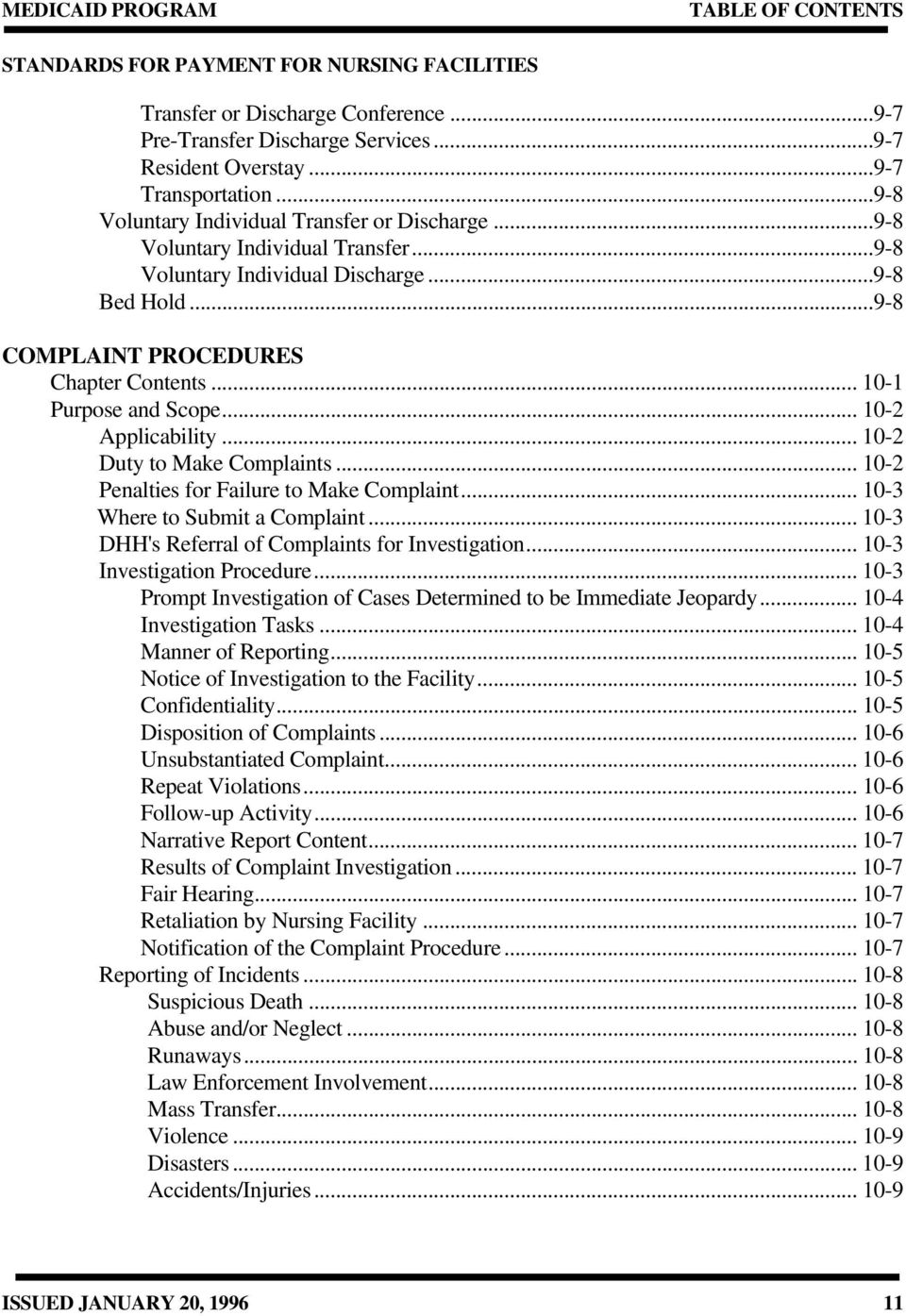
12 MEDICAID PROGRAM TABLE OF CONTENTS SANCTIONS AND APPEAL PROCEDURES Chapter Contents Sanctions and Appeal Procedures Authority and Scope Considerations Repeated Findings of Substandard Care Immediate Jeopardy Non-Immediate Jeopardy Notice and Appeal Procedure Notice to Facility of Violation Administrative Appeal Process Hearing Procedures Judicial Review Description of Sanctions Monitoring On-Site Specific Staffing Requirements Civil Money Penalties (Fines) Class A Violations Class B Violations Class C Violations Class D Violations Class E Violations Factors in Assessment of Civil Fines Right to Assess Civil Fines Not Merged in Other Remedies Classes of Violations Defined Class A Violations Class B Violations Class C Violations Class D Violations Class E Violations Collection of Civil Fines Assessed Denial of Medicaid Payments For All New Admissions Mandatory Denial Agency Procedures Effect of Sanction on Status of Residents Duration Withholding of Vendor Payments Incorrect/Inappropriate Charges Inadequate Review/Revision of Plan of Care Corrective Action on Complaints Unapproved Staffing Shortage Corrective Action for Audit Findings ISSUED JANUARY 20,
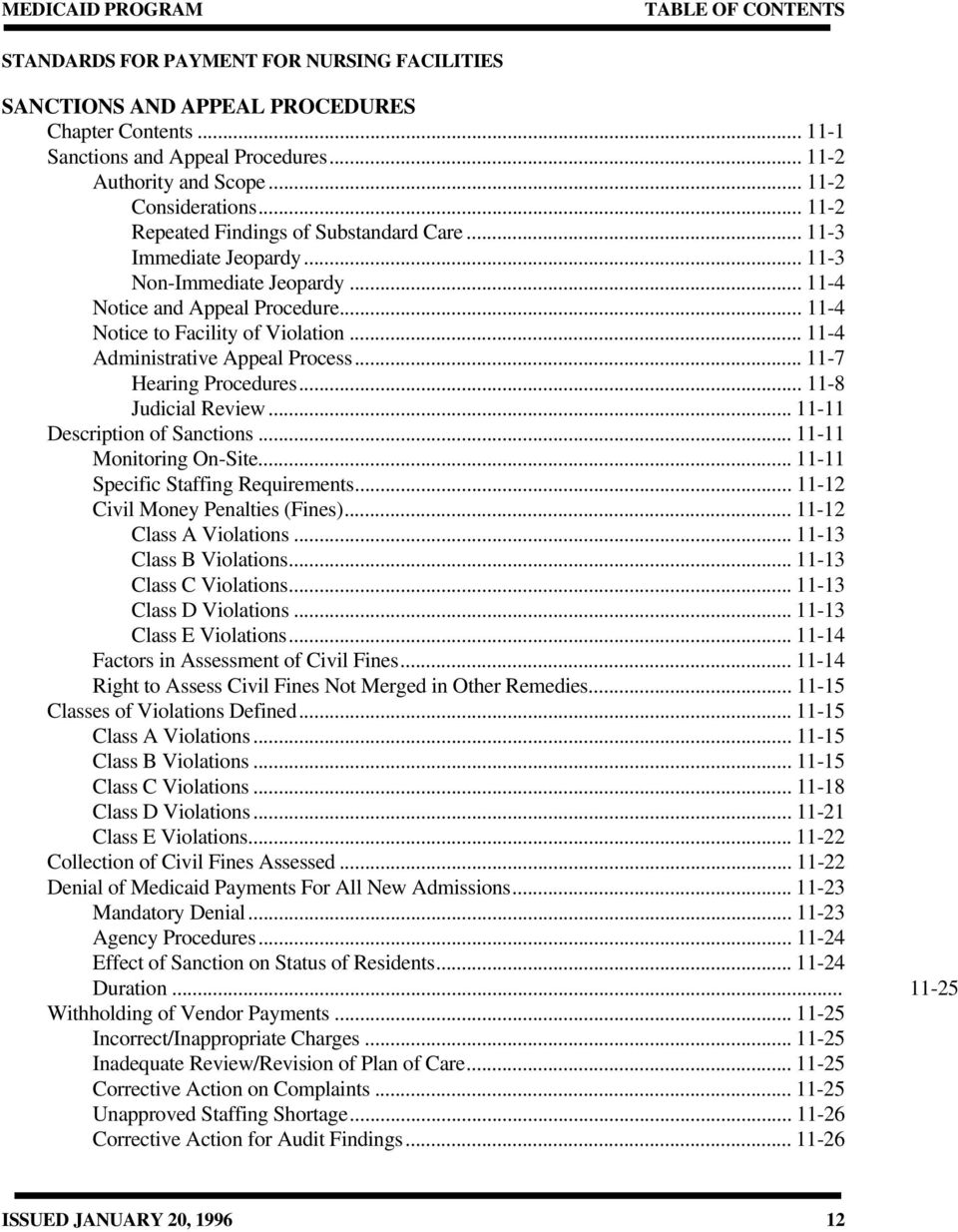
13 MEDICAID PROGRAM TABLE OF CONTENTS Request for Information Unauditable Records Full Scope Audits Temporary Management Regulatory Citation Application Notice of Appointment of Temporary Manager Powers and Duties of Temporary Manager Procedure for Payments to Temporary Manager of Debts Owed to the Facility Qualifications and Compensation of a Temporary Manager Personal Liability of the Temporary Manager Termination of Temporary Management Notice of Appeal Revocation of License Penalty for Falsification of Resident Assessment Resident's Trust Fund GLOSSARY Chapter Contents...1 Abbreviations and Definitions...2 ISSUED JANUARY 20,
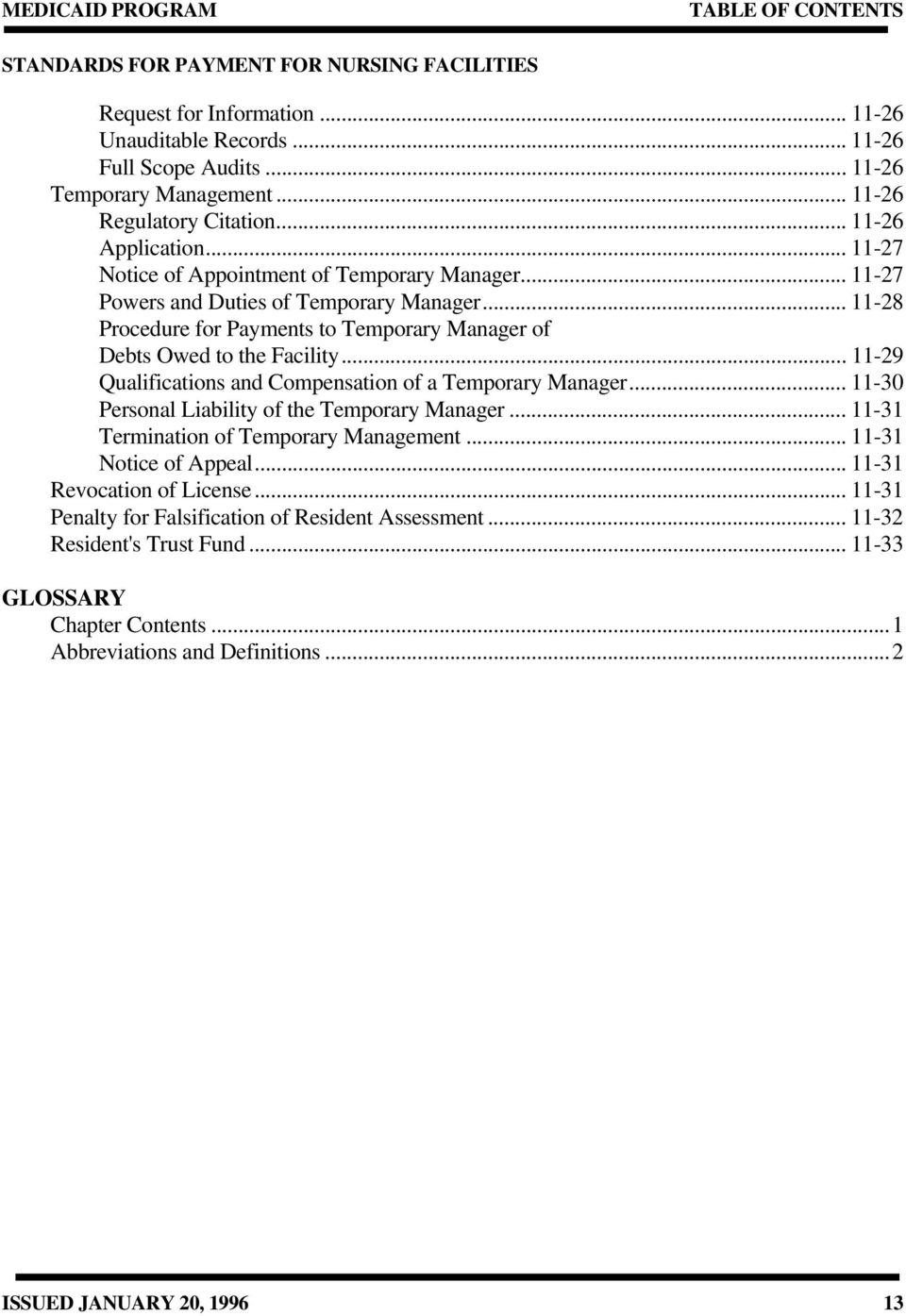
14 MEDICAID PROGRAM CHAPTER 1 GENERAL PROVISIONS CHAPTER 1 GENERAL PROVISIONS CHAPTER CONTENTS Page CERTIFICATION Certification of Title XVIII (Medicare)/Skilled Nursing Facilities (SNF) Certification of Title XIX (Medicaid)/Nursing Facilities (NF) PROVIDER ENROLLMENT Effective Date of the Provider Enrollment Agreement CHANGE IN OWNERSHIP Assignment of Agreement Continued Participation Ten Percent Withholding - Release of Payments Notification to Fiscal Intermediary WITHDRAWAL FROM THE MEDICAID PROGRAM Payment Limitation Facility Certification of Non-Compliance Recertification of an Involuntary Withdrawal CERTIFICATION REQUIREMENTS FOR SWING BED HOSPITALS ISSUED JANUARY 20,
15 MEDICAID PROGRAM CHAPTER 1 GENERAL PROVISIONS CERTIFICATION CERTIFICATION OF TITLE XVIII (MEDICARE)/ SKILLED NURSING FACILITIES (SNF) DHH shall obtain a certification notice from the Secretary of the Department of Health and Human Services (DHHS) that verifies a Skilled Nursing Facility is qualified to participate in the Title XVIII Program. The facility shall request a certification packet from BHSF/HSS State Office. CERTIFICATION OF TITLE XIX (MEDICAID)/ NURSING FACILITIES (NF) To participate in Title XIX (Medicaid Program), a nursing facility must have facility need review, be enrolled as a provider, and be in compliance with the Requirements for Participation established by federal regulations. A nursing facility may participate in the Medicaid Program by meeting the requirements. A facility must obtain licensure of the beds prior to or in conjunction with the request for certification of beds. Licensure of beds is performed by BHSF/HSS. For Medicaid Program participation, all beds to be certified in the Medicaid Program shall be licensed nursing facility beds. Instructions and forms are contained in the packet for the NF to follow to initiate the certification process. These include but are not limited to the following: Facility Need Review Facility Need Review approval must be obtained for Medicaid participation. The facility shall secure approval from the Facility Need Review Program to certify that there is no cause to deny the facility from participation in the Medicaid Program on the basis of need. The approval shall designate the appropriate name of the legal entity operating the facility and the number of beds eligible for Medicaid Program enrollment. If the approval is not issued in the complete name of the legal entity operating the facility, evidence shall be provided to verify that the legal entity which obtained the original approval is the same legal entity operating the facility. Disclosure Requirement As part of the certification requirement, all Medicaid Program participating facilities shall supply ISSUED JANUARY 20,
16 MEDICAID PROGRAM CHAPTER 1 GENERAL PROVISIONS BHSF/HSS with a completed Disclosure of Ownership Control Interest statement, HCFA 1513, which requires information as to the identity of the following individuals: 1. Each person having a direct or indirect ownership interest in the facility of five percent (5%) or more 2. Each owner (in whole or in part) with a five percent (5%) interest in any property, assets, mortgage, deed of trust, note, or other obligation secured by the facility 3. Each officer and director when a facility is organized as a corporation 4. Each partner when a facility is organized as a partnership 5. Within 35 days from the date of request, the provider shall submit full and complete information, as specified by the BHSF, regarding the following: A. The ownership of any subcontractor with whom the facility has had more than $25,000 in business transactions during the previous 12 months B. Information as to any significant business transactions between the facility and the subcontractor or wholly owned suppliers during the previous five years. The DHH Health Standards Section shall arrange for on-site surveys for compliance with Medicaid and Title VI (Civil Rights), Life Safety, and Sanitation. The effective date of certification can be no earlier than the completion date of the survey, assuming all requirements are met. If requirements are not met at the time of survey, then the certification date may be delayed at the discretion of the State Agency either until the facility signs an acceptable plan of correction or a follow-up visit verifies substantial compliance. Change in Certification A facility wishing to change its participation from Medicare/Medicaid (SNF-NF) to Medicaid (NF) OR from Medicaid (NF) to Medicare/Medicaid (SNF-NF) shall submit to the Health Standards Section a letter of intent. Once the facility has been determined eligible to participate, the Medicaid Program (Medicaid) Provider Agreement will be amended accordingly. Bed certification change - a facility wishing to change the number of beds in either category (Medicare or Medicaid) shall submit to DHH a letter of intent. ISSUED JANUARY 20,
17 MEDICAID PROGRAM CHAPTER 1 GENERAL PROVISIONS PROVIDER ENROLLMENT In order to participate as a provider of nursing services under Medicaid, a facility must meet certification requirements and enter into a provider agreement with the Department of Health and Hospitals. A provider agreement is the basis for payments by the Bureau of Health Services Financing. The execution of provider agreement and the assignment of the provider's Medicaid vendor number is contingent upon the following criteria. The facility shall request a Medicaid enrollment packet from the BHSF/HSS Provider Enrollment Unit. The information listed below shall be returned as soon as it is completed. 1. Two (2) copies of the Provider Agreement Form which shall bear the signature of the person legally designated to enter into the contract with DHH 2. One (1) copy of the Provider Enrollment Form, PE 50, which shall be completed in accordance with accompanying instructions and bear the signature of the administrator or authorized representative 3. An addendum to the above provider agreement shall be completed if the facility chooses to provide any of the following enhanced levels of care: A. Skilled-Infectious Disease (S-ID) B. Skilled-Technology Dependent Care (S-TDC) C. Skilled/Neurological Rehabilitation Treatment Program (S-NRTP). EFFECTIVE DATE OF THE PROVIDER ENROLLMENT AGREEMENT The effective date of the provider agreement shall be determined as follows: 1. If all Federal requirements (Health and Safety Standards) including Facility Need Review Approval requirements specified above are met on the day of the Health Standards Section survey, then the effective date of the provider agreement is the date the on-site survey is completed. 2. If all requirements as specified in (1) above are not met on the day of the HSS survey, then the effective date of the provider agreement is the earlier of the following dates: A. The date on which the provider meets all requirements ISSUED JANUARY 20,
18 MEDICAID PROGRAM CHAPTER 1 GENERAL PROVISIONS B. The date on which the provider submits a corrective action plan acceptable to the HSS. 3. Upon receipt of the above documentation/verification, BHSF/HSS Provider Enrollment Unit will assign a vendor number for billing purposes along with the issuance of the Provider Agreement. The Fiscal Intermediary will be notified accordingly. Provider Agreement Time Periods The provider agreement shall meet the following criteria in regard to time periods: 1. It shall not exceed 14 months. 2. It shall coincide with the certification period set by the HSS Survey Unit. Exception: If HSS has adequate documentation showing "good cause", it may make an agreement and certification period for less than 12 months. 3. After a provider agreement expires, payment may be made to a facility for up to 30 days. ISSUED JANUARY 20,

19 MEDICAID PROGRAM CHAPTER 1 GENERAL PROVISIONS CHANGE IN OWNERSHIP "Change in Ownership" is defined as any change in the legal entity responsible for the operation of the facility. ASSIGNMENT OF AGREEMENT As a temporary measure during a change of ownership, the BHSF/HSS shall automatically assign the provider agreement and certification to the new owner. The new owner shall comply with all participation prerequisites simultaneously with the ownership transfer. Failure to promptly comply with these prerequisites may result in the interruption in vendor payment. The new owner shall be required to complete a new provider enrollment application. Such an assignment is subject to all applicable statutes, regulations, terms, and conditions under which it was originally issued including, but not limited to, the following: 1. Any existing corrective action plan 2. Any expiration date 3. Compliance with applicable health and safety standards 4. Compliance with the ownership and financial interest disclosure requirements 5. Compliance with Civil Rights requirements 6. Any Facility Need Review rules that are applicable 7. Compliance with any additional requirements imposed by the BHSF-HSS. CONTINUED PARTICIPATION For a facility to remain eligible for continued participation after a change of ownership, the facility shall meet all the following criteria: 1. State Licensing requirements 2. All Medicaid certification requirements ISSUED JANUARY 20,

20 MEDICAID PROGRAM CHAPTER 1 GENERAL PROVISIONS 3. Medicaid Provider Enrollment requirements including completion of a signed contract with DHH 4. Compliance with Title VI of the Civil Rights Act. TEN PERCENT WITHHOLDING - RELEASE OF PAYMENTS When a change of ownership occurs, a minimum of ten percent (10%) of the final vendor payment to the old legal entity is withheld pending the fulfillment of the following requirements: 1. Completion of a limited scope audit of the residents' funds account and the disposition requirements for nurse aide training funds with findings and any recommendations of a qualified accountant of the old legal entity's choice submitted to the BHSF Institutional Reimbursement Section. Old legal entities have 60 days to submit the audit findings to BHSF Institutional Reimbursement Section once the section notifies the old owner that a limited scope audit is required. Failure of the old legal entity to comply is considered a Class E violation and will result in fines as outlined in the chapter entitled Sanctions. 2. The facility's compliance with the recommendations of the limited scope audit and the disposition requirements for nurse aide training funds with the following two exceptions: A. If the new legal entity disputes the findings of the limited scope audit, said entity may engage an independent auditor and submit any findings and recommendations to the BHSF Institutional Reimbursement Section for review. In such instances, the independent auditor must certify his independence and submit a written opinion to the BHSF Institutional Reimbursement Section. B. New owners may provide the BHSF/HSS with a notarized document attesting that they shall be responsible for completion of and compliance with the limited scope audit and the disposition requirements for nurse aide training funds. New owners have 60 days to submit the audit findings to BHSF Institutional Reimbursement Section once the section notifies the new owner that a limited scope audit is required. Note: Failure of the new owner to comply is considered a Class E violation and will result in fines as outlined in the chapter entitled Sanctions. 3. Submittal of an acceptable cost report by the old legal entity to BHSF Program Operations Section covering the period to the date of ownership change. Once these requirements are met, the portion of the payment withheld shall be released by the BHSF Program Operations Section. ISSUED JANUARY 20,

21 MEDICAID PROGRAM CHAPTER 1 GENERAL PROVISIONS Note: If a SN-ID or SN-TDC changes ownership, the 10% will not be released until the above requirements are met and after cost settlement. NOTIFICATION TO FISCAL INTERMEDIARY Upon notification of the ownership transfer and the new owner's licensure, the BHSF/HSS Provider Enrollment Unit shall notify the Fiscal Intermediary regarding the effective dates of payment and to whom payment is to be made. ISSUED JANUARY 20,
22 MEDICAID PROGRAM CHAPTER 1 GENERAL PROVISIONS WITHDRAWAL FROM THE MEDICAID PROGRAM A facility may involuntarily or voluntarily lose its participating status in the Medicaid Program. When a facility loses its participating status in the Medicaid Program, a minimum of ten percent (10%) of the final vendor payment to the facility is withheld pending the fulfillment of the following requirements. 1. Completion of a limited scope audit of the residents' funds account and the disposition requirements for nurse aide training funds with findings and any recommendations of a qualified accountant of the facility's choice submitted to the BHSF Institutional Reimbursement Section. The facility has 60 days to submit the audit findings to the BHSF Institutional Reimbursement Section once the section notifies the facility that a limited scope audit is required. Failure of the facility to comply is considered a Class E violation and will result in fines as outlined in the chapter entitled Sanctions. 2. The facility's compliance with the recommendations of the limited scope audit and the disposition requirements for nurse aide training funds. 3. Submittal of an acceptable final cost report by the facility to BHSF Program Operations Section. Once these requirements are met, the portion of the payment withheld shall be released by BHSF Program Operations. Note: If a SN-ID or SN-TDC withdraws from the Medicaid Program, the 10% will not be released until the above requirements are met and after cost settlement. In situations where a facility either voluntarily or involuntarily discontinues its operations or participation in the Medicaid Program, residents, residents' legal representative of sponsor, and other appropriate agencies or individuals shall be notified as far in advance of the effective date as possible to ensure an orderly transfer and continuity of care. The owner or administrator shall submit written notice of withdrawal to BHSF/HSS at least 30 days in advance of a voluntary withdrawal. If the facility is closing its operations, plans shall be made for transfer. If the facility is voluntarily or involuntarily withdrawing from Medicaid Program participation, the resident has the option of remaining in the facility on a private-pay basis. ISSUED JANUARY 20,
23 MEDICAID PROGRAM CHAPTER 1 GENERAL PROVISIONS PAYMENT LIMITATION Payments may continue for residents up to 30 days following the effective date of the facility's certification of non-compliance. The payment limitation also applies to Medicaid applicants and recipients admitted prior to the certification of non-compliance notice. Payment is continued only if the facility totally cooperates in the orderly transfer of applicants/recipients to other Medicaid facilities or other placements of their choice. Note: The facility shall not admit new Medicaid applicants/recipients after receiving the certification of non-compliance notice. There shall be no payment approved for such an admittance. DHH may cancel the provider agreement if and when it is determined that the facility is in material breach of contract. FACILITY CERTIFICATION OF NON-COMPLIANCE When the DHH Bureau of Health Services Financing, Health Standards Section determines that a facility no longer meets State and Federal Medicaid certification requirements, action is taken. Usually an advance certification of non-compliance date is set unless residents are in immediate danger. Certification of Non-Compliance Notice On the date the facility is notified of its certification of non-compliance, DHH shall immediately begin notifying residents, residents' legal representative or sponsor, and other appropriate agencies or individuals of the action and of the services available to ensure an orderly transfer and continuity of care. The process of certification of non-compliance requires concentrated and prompt coordination among the following groups: 1. The BHSF Health Standards Regional Office 2. The Parish Office of DHH BHSF, Medicaid Program 3. The facility ISSUED JANUARY 20,
24 MEDICAID PROGRAM CHAPTER 1 GENERAL PROVISIONS 4. Other offices as designated by DHH. This coordination effort shall have the following objectives: 1. Protection of residents 2. Assistance in finding the most appropriate placements when requested by residents and/or responsible parties 3. Timely termination of vendor payment upon the resident's discharge from the facility. Note: The facility still retains its usual responsibility during the transfer/discharge process to notify the parish office of DHH/BHSF Medicaid Program promptly of all changes in the resident's status. Transfer Team DHH shall designate certain staff members as a transfer team when a mass transfer is necessary. Their responsibilities shall include supervising transfer activities in the event of a proposed facility certification of non-compliance with Medicaid participation. The following procedures shall be taken by or under the supervision of this team: 1. Supervision and Assistance When payments are continued for up to 30 days following certification of non-compliance, the transfer team shall take the following actions: A. Supervise the facility certification of non-compliance and transfer of its Medicaid residents B. Determine the last date for which vendor payment for resident care can be made C. Assist in making the most appropriate arrangements for the residents, providing the team members' names as contact persons if such help is needed. 2. Effecting the Transfer To ensure an orderly transfer or discharge, the transfer team shall also be responsible for performing the following tasks: A. They shall meet with appropriate facility administrative staff and other personnel as soon ISSUED JANUARY 20,
25 MEDICAID PROGRAM CHAPTER 1 GENERAL PROVISIONS as possible after termination of a provider agreement to discuss the transfer planning process. B. They shall identify any potential problems. C. They shall monitor the facility's compliance with transfer procedures. D. They shall resolve disputes in the resident's best interest. E. They shall ensure that the facility takes an active role in the transfer planning. F. The local Ombudsman and advocacy agencies shall be contacted. Note: The facility's failure to comply with the transfer team's requests may result in denial of reimbursement during the extension period. 3. Provisions for Resident Services During Transfer or Discharge DHH has the following responsibilities: A. To provide social services necessary in the transfer or discharge plan or otherwise necessary to ensure an orderly transfer or discharge in accordance with the State Plan of the Medicaid Program B. To obtain other services available under Medicaid. 4. Parish DHH/BHSF Medicaid Program Responsibilities: Applicant/Recipient Status Listing The parish office of DHH/BHSF Medicaid Program shall maintain a listing of each applicant/recipient's status as authorization forms are submitted regarding transfer or discharge. At the conclusion of the 30 day period referred to above, the transfer team shall submit a report to the office of DHH/BHSF Medicaid Program, outlining arrangements made for all Medicaid applicants/recipients. 5. Resident Rights Nothing in the transfer or discharge plan shall interfere with the existing bill of rights. ISSUED JANUARY 20,
26 MEDICAID PROGRAM CHAPTER 1 GENERAL PROVISIONS RECERTIFICATION OF AN INVOLUNTARY WITHDRAWAL After involuntary certification of non-compliance, a facility cannot participate as a provider of Medicaid services unless the following conditions are met: 1. The reasons for the certification of non-compliance of the contract no longer exist. 2. Reasonable assurance exists that the factors causing the certification of non-compliance will not recur. 3. The facility demonstrates compliance with the required standards for a 60 day period prior to reinstatement in a participating status. 4. The initial survey verifies that residents are receiving proper care and services. ISSUED JANUARY 20,
27 MEDICAID PROGRAM CHAPTER 1 GENERAL PROVISIONS CERTIFICATION REQUIREMENTS FOR SWING BED HOSPITALS Small rural hospitals may be certified to provide Medicaid Nursing Facility Services if all of the following conditions are met. 1. The hospital has a valid agreement as a Title XVIII (Medicare) provider of swing bed services. 2. The hospital has 50 hospital beds or fewer, excluding beds for newborns and beds in intensive care type in resident units. 3. The hospital is located in an area not designated as "urban" in the most recent census. 4. A Facility Need Review approval has been granted. 5. The hospital is not operating under a waiver of the hospital requirements for 24 hour nursing services. 6. The hospital has a valid Title XIX (Medicaid) agreement as a provider of acute care hospital services. 7. The hospital has not had a swing bed Title XVIII (Medicare) or Title XIX (Medicaid) approval terminated within 2 years previous to application. 8. A provider of swing bed services shall comply with conditions for Title XIX (Medicaid) participation as both acute care hospital and a Medicaid Nursing Facility; however, a lack of compliance with Nursing Facility requirements does not affect participation as a provider of acute care hospital services. 9. Hospitals seeking to enroll as Swing Bed facilities on or after July 9, 1987 must also meet the following criteria: A. Possess a current nursing home license B. Be administered by a licensed Nursing Home Administrator C. Meet the need and resource goals as established in Facility Need Review regulations D. Limit enrollment to 10% of bed capacity. ISSUED JANUARY 20,
28 MEDICAID PROGRAM CHAPTER 2 ADMINISTRATION CHAPTER 2 ADMINISTRATION CHAPTER CONTENTS Page INTRODUCTION Licensure Compliance With Federal, State, and Local Laws and Professional Standards Relationship to Other HSS Regulations Governing Body Staffing Policies and Procedures In-Service Education Program Personnel Policies and Procedures Development and Review of Resident Care Policies Quality Assurance INFECTION CONTROL Infection Control Program (ICP) Preventing Spread of Infection PHYSICAL ENVIRONMENT AND SANITATION Favorable Environment for Residents Hot Water Isolation Techniques Housekeeping Maintenance of Equipment, Building, and Grounds Nursing Unit Environment ISSUED JANUARY 20,
29 MEDICAID PROGRAM CHAPTER 2 ADMINISTRATION INTRODUCTION A facility shall be administered in a manner that enables it to use its resources effectively and efficiently to attain or maintain the highest practicable physical, mental, and psychosocial well-being of each resident. It shall be responsible for ensuring that all services provided to the residents by professional staff meet ethical and professional standards governing the profession. LICENSURE A facility must be licensed under applicable state and local laws. COMPLIANCE WITH FEDERAL, STATE, AND LOCAL LAWS AND PROFESSIONAL STANDARDS The facility must operate and provide services in compliance with all applicable federal, state and local laws, regulations and codes, and with accepted professional standards and principles that apply to professionals providing services in such a facility. RELATIONSHIP TO OTHER HSS REGULATIONS In addition to compliance with the regulations set forth in this sub-part, facilities are obliged to meet the applicable provisions of other HSS regulations, including but not limited to those pertaining to 1. Nondiscrimination on the basis of race, color, or national origin (45 CFR page 80) 2. Nondiscrimination on the basis of handicap (45 CFR page 84) 3. Nondiscrimination on the basis of age (45 CFR part 91) 4. Protection of human subjects of research (45 CFR page 46) 6. Fraud and abuse (42 CFR part 455). Although these regulations are not in themselves considered requirements under this part their violation may result in termination or suspension of, or the refusal to grant or continue payment with federal funds. Nursing facilities shall meet the following criteria: ISSUED JANUARY 20,
30 MEDICAID PROGRAM CHAPTER 2 ADMINISTRATION 1. Compliance - Facilities shall be in compliance with Title VI of the Civil Rights Act of 1964 and shall not discriminate, separate, or make any distinction in housing, services, or activities based on race, color, or national origin. 2. Community Notification - Facilities shall notify the community that admission to the facility, resident care services, and other activities are provided without regard to race, color, or national origin. Notice to the community may be physicians, local health and welfare agencies, paramedical personnel, and public and private organizations having interest in equal opportunity or by notices in the local newspaper. A. Residents shall not be asked if they are willing to share a room with a person of another race, color, or national origin. B. Resident transfers shall not be used to evade compliance with Title VI of the Civil Rights Act of Open Admission Policy - An open admission policy and desegregation of facilities shall be required, particularly when the facility previously excluded or primarily served residents of a particular race, color, or national origin. Facilities which exclusively serve residents of one race have the responsibility for taking corrective action, unless documentation is provided that this pattern has not resulted from discriminatory practices. 4. Restricted Occupancy - A facility owned or operated by a private organization may restrict occupancy to members of the organization without violating Civil Rights compliance, provided membership in the organization and admission to the facility is not denied on the basis of race, color, or national origin. 5. Resident Services - All residents shall be provided medical, non-medical, and volunteer services without regard to race, color, or national origin. All administrative, medical and non-medical services are covered by this requirement. 6. Facility Personnel - Attending physicians shall be permitted to provide resident services without regard to race, color, or national origin. A. Other medical, paramedical, or non-medical persons, whether engaged in contractual or consultative capacities, shall be selected and employed in a non-discriminatory manner. B. Opportunity shall not be denied to qualified persons on the basis or race, color, or national origin. ISSUED JANUARY 20,
31 MEDICAID PROGRAM CHAPTER 2 ADMINISTRATION C. Dismissal from employment shall not be based upon race, color, or national origin. Facilities shall comply with section 504 of the Rehabilitation Act of 1973 which states the following: "No qualified handicapped person shall, on the basis of handicap, be excluded from participation in, be denied the benefits of, or otherwise be subjected to discrimination under any program or activity which receives or benefits from federal financial assistance." GOVERNING BODY The facility must have a governing body or designated persons functioning as a governing body that is legally responsible for establishing and implementing policies regarding the management and operation of the facility. The governing body appoints the administrator who is 1. Licensed by the state where licensing is required 2. Responsible for management of the facility. STAFFING There are staff sufficient in number and qualifications on duty all hours of each day to carry out the policies, responsibilities, and program of the facility. The numbers and categories of personnel are determined by the number of residents and their particular needs in accordance with guidelines in this manual. POLICIES AND PROCEDURES There are written policies and procedures available to staff, residents, and the public which govern areas of service provided by the facility. IN-SERVICE EDUCATION PROGRAM There is an orientation program for all new employees that includes review of all facility policies. Each employee receives appropriate orientation to the facility and its policies and to his position and duties. An in-service education program is planned and conducted for the development and improvement of skills of all the facility's personnel. In-service training includes at least prevention and control of infections, fire prevention and safety, accident prevention, confidentiality of resident ISSUED JANUARY 20,
32 MEDICAID PROGRAM CHAPTER 2 ADMINISTRATION information, and preservation of resident dignity, including protection of his privacy and his personal and privacy rights. Records are maintained which indicate the content of and attendance at such staff development programs. 1. Ongoing educations programs include orientation and in-service training appropriate for each employee. 2. Records indicate content and attendance at staff development programs. PERSONNEL POLICIES AND PROCEDURES The governing body, through the administrator, is responsible for implementing and maintaining written personnel policies and procedures that support sound resident care and personnel practices. Personnel records are current and available for each employee and contain sufficient information to support placement in the position to which assigned. Written policies for control of communicable diseases are in effect to ensure that employees with symptoms or signs of communicable disease or infected skin lesions are not permitted to work and that a safe and sanitary environment for residents and personnel exists and incidents and accidents to residents and personnel are reviewed to identify health and safety hazards. Employees are provided or referred for annual health evaluations. DEVELOPMENT AND REVIEW OF RESIDENT CARE POLICIES The administrator or his designee is responsible, in writing, for the execution of such policies. QUALITY ASSURANCE Each facility must have a Quality Assessment and Assurance Committee. Members must include 1. Director of Nursing Services 2. Physician designated by facility 3. At least 3 other members of the facility staff. This committee meets at least quarterly to identify issues with respect to which quality assessments and assurance activities are necessary. This committee develops and implements appropriate plans of action to correct identified quality deficiencies. ISSUED JANUARY 20,
33 MEDICAID PROGRAM CHAPTER 2 ADMINISTRATION DHH or DHHS may not require disclosure of the records of such committee except insofar as such disclosure is related to the compliance of such committee with the requirements of this section. Good faith attempts by the committee to identify and correct quality deficiencies will not be used as a basis for sanctions and/or citations on Form ISSUED JANUARY 20,
34 MEDICAID PROGRAM CHAPTER 2 ADMINISTRATION INFECTION CONTROL The facility must establish and maintain an infection control program designed to provide a safe, sanitary, and comfortable environment in which residents reside and to help prevent the development and transmission of disease and infection using Centers for Disease Control guidelines where available. INFECTION CONTROL PROGRAM (ICP) An ICP must be established in the facility which identifies who 1. Investigates, controls, and prevents infections in the facility 2. Decides what procedures, such as isolation, should be applied to an individual resident 3. Maintains a record of incidents and corrective actions related to infections. PREVENTING SPREAD OF INFECTION When the staff members designated by the Infection Control Program determines that a resident needs isolation to prevent the spread of infection, the facility must isolate the resident. The facility must prohibit employees with a communicable disease or infected skin lesions from direct contact with residents or their food if direct contact will transmit the disease. The facility must require staff to wash their hands after each direct resident contact for which hand washing is indicated by accepted professional standards. Personnel must handle, store, process, and transport linens so as to prevent the spread of infection. Universal precautions shall be used for residents regardless of diagnosis and/or condition. ISSUED JANUARY 20,
35 MEDICAID PROGRAM CHAPTER 2 ADMINISTRATION PHYSICAL ENVIRONMENT AND SANITATION The facility must be designed, constructed, equipped, and maintained to protect the health and safety of residents, personnel, and the public as set forth below. FAVORABLE ENVIRONMENT FOR RESIDENTS Resident living areas are designed and equipped for the comfort and privacy of the resident. Each room is equipped with or conveniently located near adequate toilet and bathing facilities appropriate in number, size, and design to meet the needs of residents. Each resident room contains a suitable bed and functional furniture appropriate to the resident's needs. HOT WATER An adequate supply of hot water for resident use is available. Temperature of hot water at plumbing fixtures used by residents is automatically regulated by control valves to assure a temperature between 110 degrees and 120 degrees Fahrenheit at the faucet outlet. ISOLATION TECHNIQUES Written effective procedures in aseptic and isolation techniques are followed by all personnel. Procedures are reviewed annually and revised when necessary for effectiveness and improvement. HOUSEKEEPING The facility employs sufficient housekeeping personnel and provides all necessary equipment to maintain a safe, clean, and orderly interior. An employee is designated full-time responsibility for this service and for supervision and training of housekeeping personnel. A facility that has a contract with an outside resource for housekeeping services may be found to be in compliance with this standard provided the facility and/or outside resources meet the requirements of the standard. MAINTENANCE OF EQUIPMENT, BUILDING, AND GROUNDS The facility establishes a preventive maintenance program to ensure that equipment is operative and that the interior and exterior of the building are clean and orderly. All essential mechanical, electrical, and resident care equipment is maintained in safe operating condition. ISSUED JANUARY 20,
36 MEDICAID PROGRAM CHAPTER 2 ADMINISTRATION NURSING UNIT Each nursing unit has at least the following basic service areas: Nurses station, storage and preparation area(s) for drugs and biologicals, and utility and storage rooms that are adequate in size, conveniently located, and well lighted to facilitate staff functioning. The nurses station is equipped to register residents' calls through a communication system from resident areas, including rooms and toilet and bathing facilities. ENVIRONMENT The facility must provide 1. A safe, clean, comfortable, and homelike environment, allowing the resident to use his or her personal belongings to the extent possible 2. Housekeeping and maintenance services necessary to maintain a sanitary, orderly, and comfortable interior 3. Clean bed and bath linens that are in good condition 4. Private closet space in each resident room with clothes rack and shelves and/or drawers accessible to the resident 5. Adequate and comfortable lighting levels in all areas 6. Comfortable and safe temperature levels. The facility must provide the capability to maintain a temperature for all seasons between 71 degrees and 81 degrees throughout all occupied resident areas 7. For the maintenance of comfortable sound levels. ISSUED JANUARY 20,
37 MEDICAID PROGRAM CHAPTER 3 RESIDENT CARE SERVICES CHAPTER 3 RESIDENT CARE SERVICES CHAPTER CONTENTS Page ADMINISTRATIVE SERVICES Facility Administrator Assistant Administrator PHYSICIAN SERVICES Medical Director Physician Supervision, Ongoing Care Alternate Physicians Frequency of Visits Physician Responsibilities Physician's Signature NURSING SERVICES Director of Nursing (DON) Services Assistant Director of Nursing (ADON) RN Coverage Charge Nurse Certified Nursing Assistants (CNA) Clerical Staff Other Nursing Services COMPREHENSIVE ASSESSMENT Frequency Accuracy of Assessments Utilization - Resident Assessment Instrument (RAI) COMPREHENSIVE CARE PLAN Basis for the Comprehensive Care Plan Contents of the Comprehensive Plan of Care Discharge Summary Physician Involvement and Responsibilities in the Comprehensive Plan of Care Quarterly Assessment and Optional Progress Notes PHARMACY SERVICES ISSUED JANUARY 20,
38 MEDICAID PROGRAM CHAPTER 3 RESIDENT CARE SERVICES Pharmacist or Pharmaceutical Consultant Drug Therapy DIETETIC SERVICES Dietitian Dietary Manager Dietary Consultant Menus Food SOCIAL SERVICES Social History Social Needs Assessment Participation in Interdisciplinary Staffing Social Services Progress Notes ACTIVITY SERVICES Resident Activity Director Activities Assessments Activity Services Progress Notes MEDICAL RECORDS Availability of Records Confidentiality Protection of Records Retention of Records Components of Medical Records Contents of Medical Records ANCILLARY SERVICES Dental Services Radiology and Other Diagnostic Services Laboratory Services Specialized Rehabilitative Services Non-Emergency Transportation for Medical Appointments HOSPICE SERVICES Hospice Admission Criteria Provider Responsibilities Medicaid Reimbursement Admission Review ISSUED JANUARY 20,
39 MEDICAID PROGRAM CHAPTER 3 RESIDENT CARE SERVICES Provider of First Choice MENTAL HEALTH REHABILITATION SERVICES Mental Health Definitions Services of a Lesser Intensity for Mental Illness ISSUED JANUARY 20,
40 MEDICAID PROGRAM CHAPTER 3 RESIDENT CARE SERVICES ADMINISTRATIVE SERVICES FACILITY ADMINISTRATOR All facilities are required to have full-time administrators. "Full-time" administrators are persons who are licensed, currently registered and engaged in the day to day management of the facility. A full-time employee functioning in an administrative capacity shall be authorized in writing to act in the administrator's behalf when he/she is absent or when the administrator is functioning as a full-time administrator for two facilities. The administrator's duties shall conform to the following standards. 1. Administrative/management activities shall be the major function of the duties required. The administrator is responsible for the management of the facility. 2. An adequate and reasonable amount of time shall be spent on the premises of the facility. The activity must be the major function of the person performing the act. 3. A major portion of the time, referred to above, shall be spent during the normal work week of the facility's key personnel. Restrictions 1. No individual may function as a full-time administrator for more than two nursing facilities. When a full-time administrator is engaged in the management of two nursing facilities, the facilities' sizes and proximity to one another have considerable bearing on the administrator's ability to adequately manage the affairs of both nursing facilities. The response time to either facility shall be no longer than one hour. If the administrator does serve two facilities, he must spend 20 hours per week at each facility. 2. The full-time administrator of a multi-story facility shall not function as an administrator of another nursing facility. The administrator or his designee is responsible, in writing, for the execution of all policies and procedures. If a change occurs in the individual who is the administrator of a nursing facility, notice shall be provided to BHSF Health Standards Section at the time the change occurs by the facility administrator or, in the absence of an administrator, by the governing body of the facility. Notice shall include the identity of all individuals involved and the specific changes which have occurred. Failure to provide written notice by certified mail within 30 calendar days from the date a change occurs will result in a Class C civil money penalty. (Refer to Sanctions). ISSUED JANUARY 20,
41 MEDICAID PROGRAM CHAPTER 3 RESIDENT CARE SERVICES The Bureau shall allow long term care facilities 30 days from the date of change in the position to fill the resulting vacancy in the administrator position. There shall be no waiver provisions for this position. The governing body of the facility shall appoint a facility designee charged with the general administration of the facility in the absence of a licensed administrator. Failure to fill a vacancy to or notify the Bureau in writing by the thirty-first day of vacancy that the administrator position has been filled shall result in a Class C civil money penalty. (Refer to Sanctions). ASSISTANT ADMINISTRATOR A nursing facility with a licensed bed capacity of 161 or more beds must employ an assistant administrator. An assistant administrator shall 1. Be a full-time employee 2. Function in an administrative capacity. ISSUED JANUARY 20,
42 MEDICAID PROGRAM CHAPTER 3 RESIDENT CARE SERVICES PHYSICIAN SERVICES MEDICAL DIRECTOR The nursing facility shall have a written agreement with a physician who shall serve as the Medical Director on a full-time or part-time basis. Whether the physician is employed full-time or part-time shall be based on the residents' needs. The Medical Director shall not have peer restriction in regard to overseeing total medical care. The Medical Director is responsible for 1. Implementation of resident care policies 2. Coordination of medical care in the facility. Residents shall be admitted to a facility only with a physician's order, and medical care shall be under a physician's supervision. Each resident shall have freedom of choice of physicians. PHYSICIAN SUPERVISION, ONGOING CARE All facilities shall develop policies and procedures to ensure that each resident's health care is under a Louisiana physician's continuing supervision. Each resident must remain under the care of a physician. The care of every Skilled/NRTP resident shall be under the supervision of a licensed physiatrist, certified in physical medicine and rehabilitation. A physician visit is considered timely if it occurs not later than 10 days after the date the visit was required. At the option of the physician, required visits after the initial visit may be made by a physician assistant, nurse practitioner or clinical nurse specialist. Otherwise, all physician visits shall be made by the physician personally. This does not relieve the physician of his/her obligation to visit a resident when the resident's medical condition makes that visit necessary. Physicians may delegate tasks to a physician's assistant, nurse practitioner, of clinical nurse specialist who 1. Meets the applicable definitions as outlined in 42 CFR Is acting within the scope of practice as defined by state law ISSUED JANUARY 20,
43 MEDICAID PROGRAM CHAPTER 3 RESIDENT CARE SERVICES 3. Is under the supervision of a physician. A physician may not delegate a task when the regulations specify that the physician shall perform it personally or when the delegation is prohibited under state law or by the facility's own policies. The facility shall provide or arrange for the provision of physician services 24 hours a day in case of emergency. ALTERNATE PHYSICIANS When continuing care by the attending physician is interrupted by that physician's illness or vacation, the attending physician shall arrange for a designated attending physician to provide coverage. FREQUENCY OF VISITS Physician visits shall conform to the following schedule. 1. For SNFs and NFs the resident shall be seen at least once very 30 days for the first 90 days after admission and at least once every 60 days thereafter. PHYSICIAN RESPONSIBILITIES The attending physician's services shall include but shall not be limited to the following: 1. Making arrangements for the resident's medical care when he/she is not available 2. Performing an examination when visiting and recording the findings in the medical record 3. Reviewing a resident's total program of care, including medication treatment regiment and comprehensive care plan at least once every 90 days 4. Signing and dating all orders 5. Ordering and/or performing the following: A. Medications ISSUED JANUARY 20,
44 MEDICAID PROGRAM CHAPTER 3 RESIDENT CARE SERVICES B. Diagnostic tests C. Specialized rehabilitative services D. Treatment procedures E. Medical appliances F. Psychosocial services G. Discharge evaluations 6. Entering legible progress notes in the medical record, signing and dating his/her entry at each visit 7. Discussing new treatments, medications, and discharge potential and/or plans with the resident, if at all possible 8. Updating the medical record with any subsequent diagnosis which the resident may have acquired since admission and ensuring that all pertinent diagnoses are recorded in one place in the medical record 9. Giving telephone orders only to physicians, pharmacists, physician's assistants and licensed nurses. The physician shall sign telephone orders within 7 days. 10. Ordering rehabilitative services with a written plan of care under the following conditions: A. In consultation with appropriate therapist(s) and the nursing service staff B. With progress being reviewed after the rehabilitative care plan implementation being re-evaluated with the therapist(s) as necessary but at least every 30 days. PHYSICIAN'S SIGNATURE Whenever a physician's signature is required, the actual signature shall be written. The physician may use initials only if an original legend sheet with a full signature and the initials which will be used is placed on the record. Use of signature stamps by physicians is allowed when the signature stamp is authorized by the individual whose signature the stamp represents. The Administration Office of the nursing facility should have on file a signed statement to the effect that he/she is the only one who has the stamp and uses it. There is no delegation to another individual. ISSUED JANUARY 20,
45 MEDICAID PROGRAM CHAPTER 3 RESIDENT CARE SERVICES Electronic signatures, where automated, are acceptable. Orders may be faxed if 1. Original orders are retained by the physician and provided if requested, or sent to facility at a later date 2. The facility should photocopy fax to prevent fading of document over time. ISSUED JANUARY 20,
46 MEDICAID PROGRAM CHAPTER 3 RESIDENT CARE SERVICES NURSING SERVICES The facility shall provide an organized nursing service with a sufficient number of licensed and unlicensed qualified nursing personnel to meet the total nursing needs of all residents in accordance with the resident care policies of the facility on a 24 hour basis. The facility shall provide 1. Policies that are designed to ensure that each resident A. Receives treatments, medications, diets as prescribed, rehabilitative nursing care as needed B. Receives care to prevent pressure sores and deformities C. Is kept comfortable, clean, and well-groomed D. Is protected from accident, injury, and infection E. Is encouraged, assisted, and trained in self-care and group activities. 2. Assurance that all nursing personnel are assigned duties consistent with their education and experience and based on the characteristics of the resident load 3. Weekly time schedules which indicate the number and classification of nursing personnel, including relief personnel who worked in each unit for each tour of duty DIRECTOR OF NURSING SERVICES All Nursing Facilities shall have a Director of Nursing (DON) who is a qualified Registered Nurse employed full-time and regularly assigned to the day shift. The DON must have, in writing, administrative authority, responsibility and accountability for the functions, activities, and training of the nursing services staff. The DON may serve only one facility in the capacity of DON. If a change occurs in the individual who is the DON, notice shall be provided by the facility administrator (or governing body in absence of administrator) to BHSF/HSS at the time the change occurs. Notice shall include the identity of all individuals involved and the specific changes which have occurred. Failure to provide written notice by certified mail within 30 calendar days from the ISSUED JANUARY 20,
47 MEDICAID PROGRAM CHAPTER 3 RESIDENT CARE SERVICES date a change occurs, will result in a Class C civil money penalty. (Refer to Sanctions.) The Bureau shall allow long term care facilities 30 days from the date of change in the position of Director of Nursing to fill a resulting vacancy. In the interim, an RN must be readily available to direct subordinate staff. Waiver of the 30 day time limit may be granted by the Bureau if: 1. The facility demonstrates to the satisfaction of the Bureau that the facility has been unable, despite diligent efforts (including offering wages at the community prevailing rate for nursing facilities) to recruit a Director of Nursing 2. The Bureau determines that a waiver of the Director of Nursing will not endanger the health and safety of individuals staying in the facility. Failure to fill a vacancy or to notify the Bureau in writing that the Director of Nursing position (where no waiver has been granted) has been filled by the thirty-first day of vacancy (or expiration of any waiver granted) shall result in a Class C civil money penalty. (Refer to Sanctions.) The Bureau shall retain the right to apply any other applicable remedies. ASSISTANT DIRECTOR OF NURSING If the Director of Nursing has administrative responsibilities or the nursing facility has a licensed bed capacity of 101 or more, the facility shall have a full time Assistant Director of Nursing (ADON). This individual shall be an RN or LPN. If the ADON is an LPN, the LPN must have 2 years experience in a long term care setting. Documentation of his/her experience in long term care must be submitted. A nursing facility with a licensed bed capacity of 161 or more beds must employ an RN as ADON. RN COVERAGE A nursing facility shall use the services of an RN for at least 8 consecutive hours a day, 7 days a week. When 7-day RN coverage cannot be provided, the facility must notify Health Standards Section following guidelines outlined for the separation of the DON. ISSUED JANUARY 20,
48 MEDICAID PROGRAM CHAPTER 3 RESIDENT CARE SERVICES Waiver If a facility is unable to obtain the 7-day RN coverage the facility may request a waiver. To obtain a waiver for the 7-day RN coverage, the facility shall submit a written request to the Regional Office which includes: 1. Proof that diligent efforts have been made to recruit appropriate personnel. Newspaper invoices with the ad attached shall be submitted and the hourly salary offered and any other benefits offered. 2. Names and phone numbers of RN's interviewed for the job. Upon receipt of this information, the Regional Office will review the level of care of the residents in the facility and make a determination that approval of the waiver would/would not endanger the health or safety of the residents staying in the facility. The Regional Office will make a recommendation to the State Office to approve/deny the waiver. The facility will be notified, in writing, as to the approval/denial of the waiver by State Office. Although a facility is granted a waiver, the facility shall continue to recruit for an RN on a continuous basis to fill the position. A waiver approval will expire after one year or upon the next standard survey. The nursing facility that is granted such a waiver by the State notifies residents of the facility (or where appropriate, the guardians or legal representatives of such residents) and members of their immediate families of the waiver. When a waiver for 7-day RN coverage has been granted, the facility cannot train nursing assistants. Waiver in a Skilled Nursing Facility or Dually Certified SNF/NF The Secretary of DHHS may waive the requirement that a SNF provide the services of a registered nurse for more than 40 hours a week, including a DON if the Secretary finds that the facility 1. Is located in a rural area and the supply of SNF services in the area is not sufficient to meet the needs of individuals residing in the area 2. Has one full-time registered nurse who is regularly on duty at the facility 40 hours a week ISSUED JANUARY 20,
49 MEDICAID PROGRAM CHAPTER 3 RESIDENT CARE SERVICES 3. Has only residents whose physicians have indicated through written orders that they do not require the services of a registered nurse or physician for a 48 hour period, or has made arrangements for a registered nurse or physician to spend time at the facility to provide necessary skilled nursing services on days when the regular full-time registered nurse is not on duty. To apply for a waiver of registered nurse coverage in a skilled nursing facility, the provider should send a written request to: Health Care Financing Administration Regional Office VI 1200 Main Tower Building Dallas, Texas Attn: Mr. Mitchell Chunn Facilities providing the following levels of care may not request a waiver for 7-day RN coverage. 1. Skilled - NRTP 2. Skilled - ID 3. Skilled - TDC CHARGE NURSE A registered nurse, or a qualified licensed practical (vocational) nurse shall be designated as charge nurse by the DON for each tour of duty and is responsible for supervision of the total nursing activities in the facility during each tour of duty. A DON may not serve as charge nurse in a facility with an average daily total occupancy of 60 or more residents. The charge nurse delegates responsibility to nursing personnel for the direct nursing care of specific residents during each tour of duty on the basis of staff qualifications, size/physical layout of the facility, characteristics of resident load, and emotional, social, and nursing care needs of the residents. ISSUED JANUARY 20,
50 MEDICAID PROGRAM CHAPTER 3 RESIDENT CARE SERVICES CERTIFIED NURSING ASSISTANTS (CNA) A nursing facility shall not use any individual who is not a certified nursing assistant in the facility on or after October 1, 1990 for more than 4 months unless the individual has completed a training and competency evaluation program or competency evaluation program approved by the state agency. For additional information, refer to the chapter on Nurse Aide Training. CLERICAL STAFF All facilities shall employ two full-time clerical employees. OTHER NURSING SERVICES Nursing services shall be provided to the resident to ensure that the needs of the resident are met. These services include the following: Drug Administration Medications shall be administered only by a licensed physician, licensed/applicant nurse, or the resident (with the approval of the ID team as documented in the comprehensive care plan.) The facility should be cognizant of the mental status of the resident's roommate(s) or other potential problems which could result in abuses with drugs used for self-administration. Medications shall be administered in accordance with the facility's established written procedures and the written policies of the pharmaceutical services committee to ensure the following criteria are met: 1. Drugs to be administered are checked against physician's orders. 2. The resident is identified before administering the drug. 3. All medications/treatments are administered and properly charted in accordance with nursing practice standards. The reason for each medication omission shall be recorded in the resident's active medical record. The drug dosage shall be prepared, administered, and recorded by the same person. Medications prescribed for one resident shall not be administered to any other person. ISSUED JANUARY 20,
51 MEDICAID PROGRAM CHAPTER 3 RESIDENT CARE SERVICES Medication errors and adverse drug reactions shall be immediately reported to the attending physician and recorded in the medical record. Current medication reference texts or sources shall be kept in all facilities. Automatic Stop Orders Medications not specifically limited as to time or number of doses when ordered shall be controlled by automatic stop orders or other methods in accordance with written policies. The attending physician must be notified of an automatic stop order prior to the last dose so that (s)he may decide if the administration of the drug or biological is to be continued or altered. Self Administration Self administration of medication is allowed only in accordance with orders of resident's attending physician, in conjunction with the ID team, when documented in the comprehensive care plan. Drug Orders Medications shall be ordered by the attending physician verbally or in writing. Verbal medication orders shall be: 1. Given only to a licensed/applicant nurse, pharmacist, physician's assistant, nurse practitioner, clinical nurse specialist or another physician 2. Immediately recorded, fully dated, and signed by the individual receiving the order 3. Fully dated and signed by the physician within 7 days 4. Category II controlled substances must be confirmed in writing within 72 hours and may be given only in an emergency (controlled substance as of 1970). Standing orders, if used, shall be placed in each resident's record and shall be signed by the resident's attending physician and fully dated. These orders shall be reviewed, signed, and fully dated at least annually. ISSUED JANUARY 20,
52 MEDICAID PROGRAM CHAPTER 3 RESIDENT CARE SERVICES Activities of Daily Living (ADL) Based on the comprehensive assessment of a resident, the facility shall ensure that 1. A resident's abilities in activities of daily living (ADLs) do not diminish unless circumstances of the individual's clinical condition demonstrate that diminution was unavoidable. Activities of daily living (ADLs) include the ability to do the following: A. Bathe, dress and groom B. Transfer and ambulate C. Toilet D. Eat E. To use speech, language or other functional communication system. 2. A resident who is unable to carry out activities of daily living shall receive the necessary services to maintain good nutrition, grooming and personal/oral hygiene. 3. A resident is to be given the appropriate treatment and services to maintain or improve his/her functional status and abilities to perform their ADLs. Vision and Hearing The residents shall receive proper treatment and assistive devices to maintain vision and hearing abilities. The facility shall assist the resident in making appointments, arranging for transportation to and from appointments, and in locating assistance from community and charitable organizations when payment is not available through Medicaid, Medicare, or private insurance. Pressure Sores A resident who enters a facility without pressure sores does not develop pressure sores unless the individual's clinical condition demonstrates that they are unavoidable. A resident having pressure sores shall receive necessary treatment and services to promote healing, ISSUED JANUARY 20,
53 MEDICAID PROGRAM CHAPTER 3 RESIDENT CARE SERVICES prevent infection, and prevent sores from developing unless the individual's clinical condition demonstrates that they were unavoidable. Urinary Incontinence A resident who enters the facility without an indwelling catheter is not catheterized unless the resident's clinical condition demonstrates that catheterization was necessary. A resident who is incontinent of bladder receives appropriate treatment and services to prevent urinary tract infections and to restore as much normal bladder function as possible and prevent skin breakdown. Restorative Nursing Care Nursing Services shall be provided in accordance with the needs of the residents and restorative nursing care is provided to each resident to achieve and maintain the highest possible degree of function, self-care, and independence. Restorative nursing care services must be performed daily for those residents who require such service. Range of Motion A resident who enters the facility with full range of motion (ROM) should not experience reduction in ROM unless the resident's clinical condition demonstrates that a reduction in ROM is unavoidable. A resident with limited ROM must receive appropriate treatment and services to increase/maintain or prevent further decrease in ROM. Psychological Functioning A resident who displays psychosocial adjustment difficulty shall receive appropriate treatment and services to achieve as much remotivation and reorientation as possible. A resident whose assessment did not reveal a psychosocial adjustment difficulty should not display a pattern of decreased social interaction and/or increased withdrawn, angry, or depressive behavior unless the resident's clinical condition demonstrates that such a pattern was unavoidable. ISSUED JANUARY 20,
54 MEDICAID PROGRAM CHAPTER 3 RESIDENT CARE SERVICES Naso-Gastric-Gastrostomy Tubes A resident who has been able to eat an adequate diet with assistance should not be fed by naso-gastric (NG) tube unless the resident's clinical condition demonstrates that the use of NG tube was unavoidable. A resident who is fed by NG or gastrostomy tubes shall receive the appropriate treatment and services to prevent 1. Aspiration pneumonia 2. Diarrhea and vomiting 3. Dehydration and metabolic abnormalities 4. Nasal pharyngeal ulcers. Feedings shall be provided to restore normal feeding function if possible. Accidents The resident's environment shall remain as free of accident hazards as possible. Each resident shall receive adequate supervision and assistive devices to prevent accidents. Nutrition Each resident shall be maintained within acceptable parameters of nutritional states such as body weight and protein levels unless the resident's clinical condition demonstrates that this is not possible. In instances where a nutritional problem has been identified, the resident shall be assessed for the need of a therapeutic diet. A therapeutic diet must be prescribed by the attending physician. Hydration Each resident must receive sufficient fluid intake to maintain proper hydration and health. ISSUED JANUARY 20,
55 MEDICAID PROGRAM CHAPTER 3 RESIDENT CARE SERVICES Special Needs Residents must receive proper treatment and care for the following: 1. Injections 2. Parenteral and enteral fluids 3. Colostomy, ureterostomy, or ileostomy care 4. Tracheostomy care 5. Tracheal suctioning 6. Respiratory care 7. Podiatric care 8. Prosthesis. Note: Resident's rights and/or advance directives may supersede the above standards. Release of a Body by a Registered Nurse In the absence of a physician in a setting other than an acute care facility, when an anticipated death has apparently occurred, registered nurses may have the decedent removed to the designated funeral home in accordance with a standing order of a medical director/consultant setting forth basic written criteria for a reasonable determination of death. This is not applicable in cases where the death was unexpected. ISSUED JANUARY 20,
56 MEDICAID PROGRAM CHAPTER 3 RESIDENT CARE SERVICES COMPREHENSIVE ASSESSMENT The facility must conduct initially and periodically a comprehensive, accurate, standardized, reproducible assessment of each resident's functional capacity. Comprehensive assessments must 1. Be based on a uniform data set (resident assessment instrument) 2. Describe the resident's capability to perform daily life functions and significant impairments in functional capacity 3. Include the following information: A. Medically defined conditions and prior medical treatment B. Medical status measurements C. Physical and mental functional status D. Sensory and physical impairments E. Nutritional status and requirements F. Special treatment and procedures G. Mental and psychosocial status H. Discharge potential I. Dental condition J. Activities potential K. Rehabilitation potential L. Cognitive status M. Drug therapy. ISSUED JANUARY 20,
57 MEDICAID PROGRAM CHAPTER 3 RESIDENT CARE SERVICES FREQUENCY The assessment must be conducted no later than 14 days after admission for new admissions. A reassessment must be completed after a significant change in the resident's physical and/or mental condition. A reassessment must be conducted at least once every 12 months/annually. Residents must be examined and assessments must be reviewed every 3 months and revised as appropriate to assure the continued accuracy of the assessment. Coordination of Assessments With Pre-admission Screening The facility must coordinate assessments with the state-required pre-admission screening program to the maximum extent practicable to avoid duplicate testing and effort. ACCURACY OF ASSESSMENTS To assure accuracy, the assessments 1. Must be conducted or coordinated with the appropriate participation of health professional 2. Must be conducted or coordinated by a registered nurse who signs and certifies completion of the assessment 3. Must have each individual who completes a portion of the assessment sign and certify the accuracy of that portion of the assessment. Penalty for Falsification Any individual who willfully and knowingly certifies (or causes another individual to certify) a material and false statement is subject to civil money penalties. Clinical disagreement does not constitute a material and false statement. ISSUED JANUARY 20,
58 MEDICAID PROGRAM CHAPTER 3 RESIDENT CARE SERVICES UTILIZATION - RESIDENT ASSESSMENT INSTRUMENT (RAI) Components of comprehensive assessment (RAI) 1. Minimum Data Set (MDS) 2. Triggers legend 3. Resident Assessment Protocol (RAP) 4. Utilization guidelines 5. Alteration of MDS Information - MDS information collected may be altered until the twenty-first day after admission for the following reasons: A. Information not available to staff completing section because the resident is unable to provide necessary information and family members must make an appointment to participate B. Further observation and interaction with the resident reveals a need to alter the assessment C. At admission, the resident's condition is unstable and the illness or chronic problem is controlled by the twenty-first day. If the MDS must be altered up to the twenty-first day, then the assessor shall show these changes on the admission assessment and shall initial and date such amendments. The MDS may not be altered after the twenty-first day. If a change has occurred, a new MDS must be completed. Significant change defined: A. Deterioration in two or more activities of daily living, communication, and/or cognitive abilities that appear permanent B. Loss of ability to freely ambulate or to use hands to grasp a small object to feed or groom oneself, such as spoon, toothbrush or comb C. Deterioration in behavior, mood, and/or relationships that has not been reversed D. Deterioration in a resident's health status where this change places the resident's life in ISSUED JANUARY 20,
59 MEDICAID PROGRAM CHAPTER 3 RESIDENT CARE SERVICES danger, is associated with serious clinical complications, or is associated with an initial new diagnosis of a condition that is likely to affect the resident's physical, mental, or psychosocial well-being over a prolonged period of time E. Onset of a significant weight loss (5% in last 30 days or 10% in last 180 days) F. A marked and sudden improvement in the resident's status. Document in medical record the initial identification of a significant change in status. Once it has been determined that the resident's change in status is likely to be permanent, complete a full comprehensive assessment within 14 days of that determination. 6. Quarterly Assessment And Optional Progress Notes - To track resident status between assessments and to ensure monitoring of critical indicators of the gradual onset of significant declines in resident status, a licensed nurse: A. Must examine the resident B. Review the MDS core elements as outlined in the HSS Form Quarterly RA Review: 1) Section B - Items 2 and 4 2) Section C - Items 4 and 5 3) Section E - Items 1 b-f and 3A 4) Section F - Item 1 5) Section J - Note only disease diagnosis in last 90 days 6) Section L - Item 2C 7) Section O - Item 4 8) Section P - Item 3 7. Triggers - Level of measurement (coding categories) of MDS elements that identify residents who require evaluation using RAPS 8. Resident Assessment Protocols (RAPS) ISSUED JANUARY 20,
60 MEDICAID PROGRAM CHAPTER 3 RESIDENT CARE SERVICES A. Complete MDS elements using common definitions B. Review MDS and use the triggers worksheet that shows which MDS elements serve as triggers for each RAP C. If MDS items and codes trigger a RAP, identify those RAPS that have been triggered and include these in the comprehensive care plan D. Delegate completion of a particular RAP to facility staff who can address that care area most knowledgeably E. Use the RAPS Summary Form to document decision about care planning and to specify where a summary of the information gained from the assessment is noted in the resident's record F. The RAPS summary must include (as appropriate to the individual resident): 1) Documentation of problems, complications, and risk factors 2) Need for referral to appropriate health professional 3) Reason for deciding whether or not to proceed to care planning for the specific problem identified G. The RAPS summary sheet must be signed and dated by the RN coordinator to verify that the triggered RAPS have been applied. ISSUED JANUARY 20,
61 MEDICAID PROGRAM CHAPTER 3 RESIDENT CARE SERVICES COMPREHENSIVE CARE PLAN BASIS FOR THE COMPREHENSIVE CARE PLAN All services in a facility shall be provided in accordance with a physician's written order which shall be developed either before admission or before authorization for payment. The facility must develop a comprehensive care plan for each resident that includes measurable objectives and timetables to meet a resident's medical, nursing, and psychosocial needs that are identified in the comprehensive assessment. The comprehensive assessment shall be developed for residents within 14 days of admission. Written comprehensive care plans shall be developed within 7 days of the comprehensive assessment and no later than 21 days of admission. Thereafter, care plans must be updated at least quarterly or when a significant change in the resident's condition occurs. Individual comprehensive care plans shall 1. Be prepared by an interdisciplinary (ID) team that includes the attending physician, a registered nurse with responsibility for the resident, and other appropriate staff in disciplines as determined by the resident's needs 2. Include the resident, resident's family or legal representative, to the extent practicable in the participation of the care planning process 3. Be periodically reviewed and revised by a team of qualified persons after each assessment and/or quarterly review. This requirement is a review for both ICF and SNF. Neurological Rehabilitative Treatment Program (NRTP) levels of care shall be reviewed every 30 days. 4. Be located in the medical record and accessible for use by all licensed nursing personnel and any staff directly involved in the integrated care 5. Serve as the primary communication tool among disciplines to ensure that services are coordinated and that the approaches of the various disciplines are integrated 6. Be written in a language understandable to all staff directly involved in the resident's care and the resident in so far as possible 7. Document that all services ordered are being rendered and properly recorded. Documentation of quarterly staffing must be on the MDS quarterly Review Form as a comparable ISSUED JANUARY 20,
62 MEDICAID PROGRAM CHAPTER 3 RESIDENT CARE SERVICES computerized document. The documentation shall indicate the date of the staffing and who was in attendance. CONTENTS OF THE COMPREHENSIVE PLAN OF CARE The plan of care shall include the following information: 1. Identification of all problems and needs according to the resident assessment protocol document as well as any other identified problems. 2. The goals to be accomplished by the resident. These goals shall be A. Specific B. Reasonable C. Measurable. 3. The specific goals regarding discharge. The discharge plans shall A. Reflect exploration of likely discharge possibilities B. Ensure that residents have planned programs of post discharge continuing care which take their needs into account to the extent practicable C. Be developed and reviewed in accordance with the facility's written discharge planning procedures. 4. The expected resolution or review date specified for each problem or need. 5. The prescribed integrated, resident specific therapies and treatments designed to help residents achieve their goals. 6. Individual or professional services staff responsible for each service prescribed in the plan. 7. All participating staff shall be identified by name and title, when signing the plan of care. 8. All participating staff and the resident, whenever possible, sign and date the following: A. The initial plan of care ISSUED JANUARY 20,
63 MEDICAID PROGRAM CHAPTER 3 RESIDENT CARE SERVICES B. Each subsequent review. If the resident refuses to sign the plan of care, this fact and the stated reason should be documented for the medical record. 9. Physician orders for diet. 10. The daily and weekly time frames for each service included in the plan for residents receiving either complex care or rehabilitation under NRTP (Neurological Rehabilitation Treatment Program). DISCHARGE SUMMARY When a facility anticipates a discharge, a resident must have a discharge summary that includes 1. A recapitulation of the resident's stay 2. A final summary of the resident's status to include medical history, current diagnosis/condition, medical status measurements, functional status, cognitive status, any impairments, nutritional status/requirements, drug therapy, special treatment, procedures, psychosocial status and rehabilitation potential. 3. Must be legible and available for release to authorized persons and agencies with the consent of the resident and/or legal representative. 4. Must be developed with the participation of the resident and his/her family, which will assist the resident in adjusting to a new living environment to the extent practicable. PHYSICIAN INVOLVEMENT AND RESPONSIBILITIES IN THE COMPREHENSIVE PLAN OF CARE A physician is responsible for approving each resident's initial integrated plan of care and each subsequent revision. The physician's approval shall be documented in one of the following places: 1. The plan of care 2. The order sheet 3. The progress notes. ISSUED JANUARY 20,
64 MEDICAID PROGRAM CHAPTER 3 RESIDENT CARE SERVICES The documentation referred to above shall be signed and fully dated. The physician may use initials to document review of the plan only if an original legend sheet with a full signature and the initials which will be used is placed on each record. The physician shall review the comprehensive care plan at 90 day intervals. QUARTERLY ASSESSMENT AND OPTIONAL PROGRESS NOTES The nursing facility must examine each resident no less than once every 3 months (quarterly) and, as appropriate, to revise the resident's assessment to assure the continued accuracy of the assessment. The quarterly assessments are recorded on the minimum data set quarterly assessment form and may be supplemented by progress notes which reflect the on-going condition and needs of the residents. The quarterly assessments replace all other monthly summaries. ISSUED JANUARY 20,
65 MEDICAID PROGRAM CHAPTER 3 RESIDENT CARE SERVICES PHARMACY SERVICES The facility must arrange for the provision of pharmaceutical services including procedures that assure the accurate acquiring, receiving, dispensing, and administering of all drugs and biologicals to meet the needs of each resident. Prescription drugs not covered by Medicaid or Medicare shall be at the expense of the resident. However, every attempt should be made to get the attending physician to order a covered medication before the resident incurs any expense. The facility shall provide routine and emergency drugs and biologicals to its residents, or obtain them under an agreement with an outside resource. The arrangement/agreement with an outside resource shall specify in writing that the facility assumes responsibility for 1. Obtaining services that meet professional standards and principles that apply to professionals providing services in such a facility 2. The timeliness of the service. PHARMACIST OR PHARMACEUTICAL CONSULTANT Facilities shall employ or obtain the services of a licensed pharmacist. The Pharmacist/Consultant shall be expected to 1. Provide consultation (at least 1 hour per quarter) on all aspects of the provision of pharmacy services in the facility to insure compliance with all state and federal regulations pertaining to Pharmacy Practice 2. Establish a system of recording the receipt and disposition of all controlled drugs in sufficient detail to enable an accurate reconciliation 3. Determine that drug records are in order and that an account of all controlled drugs is maintained and monthly reconciled 4. Perform drug monitoring 5. Identify drug errors 6. Alert the facility to drug recalls. ISSUED JANUARY 20,
66 MEDICAID PROGRAM CHAPTER 3 RESIDENT CARE SERVICES 7. Be aware of adverse reactions - allergic reactions Every 30 days the staff pharmacist or pharmaceutical consultant in nursing facilities shall conduct drug regimen reviews. Additionally, (s)he shall ensure compliance with drug record requirements and compliance with accounting requirements for controlled drugs. The staff pharmacist or pharmaceutical consultant shall notify the attending physician if changes are appropriate. The pharmacist shall report all irregularities to the attending physician or the Director of Nursing or both and these reports must be acted upon. The physician or DON must verify that the irregularity has been noted, even if no changes are made, by initialing and dating. The facility shall maintain a pharmaceutical committee which develops written policies and procedures for safe and effective drug therapy, distribution, control and use. Pharmaceutical Committee 1. The committee shall be composed of at least the pharmacist, DON, the administrator and one physician. 2. The committee oversees the pharmaceutical services in the facility, makes recommendations for improvement and monitors the services to ensure accuracy and adequacy. 3. The committee meets at least quarterly and documents its activities, findings, and the adequacy of the drug program at the nursing facility. 4. When medications are recorded or placed in unidose by pharmacist, expiration dates shall comply with pharmaceutically accepted practices. 5. The pharmaceutical committee and the facility assessment and assurance committee may be the same committee as long as all requirements are met. DRUG THERAPY The facility must ensure that 1. For each drug ordered for residents there shall be a diagnosis or condition to validate the use of the drug ISSUED JANUARY 20,
67 MEDICAID PROGRAM CHAPTER 3 RESIDENT CARE SERVICES 2. Residents shall not receive antipsychotic drugs unless the drug therapy is necessary to treat a specific condition 3. Residents who receive antipsychotic drugs should receive gradual dose reductions or behavioral programming unless clinically contraindicated in an effort to discontinue these drugs 4. The facility shall be free of significant medication error rates 5. Residents shall be free of any significant medication errors. Approved Drugs and Biologicals Only approved drugs and biologicals are used. Such drugs and biologicals are: 1. Included or approved for inclusion in the United States Pharmacopeia, National Formulary, or United States Homeopathic Pharmacopeia, or 2. Included or approved for inclusion in AMA Drug Evaluations or Accepted Dental Therapeutics, except for any drugs and biologicals unfavorably evaluated therein, or 3. Not included nor approved for inclusion in the compendia listed in the above paragraphs but may be considered approved if such drugs A. Were furnished to the resident during his prior hospitalization, and B. Were approved for the use during a prior hospitalization by the hospital's pharmacy and drug therapeutics committee (or equivalent), and C. Are required for the continuing treatment of the resident in the facility. Labeling of Drugs and Biologicals The labeling of drugs and biologicals is based on currently accepted professional principles and includes the resident's full name, physician's name, full name of pharmacist dispensing, prescription number, name and strength of drug, date of issue, expiration date of all time-dated drugs, name, address, and telephone number of pharmacy issuing the drug, appropriate accessory and cautionary ISSUED JANUARY 20,
68 MEDICAID PROGRAM CHAPTER 3 RESIDENT CARE SERVICES instructions. Non-legend or over-the-counter drugs may be labeled by the facility with resident's full name and room number not to obscure lot number and expiration date. Medication containers which have soiled, damaged, incomplete, illegible, or makeshift labels are to be returned to the issuing pharmacist or pharmacy for relabeling or disposal. Containers which have no labels are to be destroyed in accordance with State and Federal laws. An approved emergency medication kit shall be readily available and have a permit issued by the State Pharmacy Board. Facility must have definition of bonafide emergency in its policies and procedures. The medications of each resident are to be kept and stored in their originally received containers. Transferring between containers is forbidden except by registered pharmacists. A narcotic record shall be maintained which lists on separate sheets for each type and strength of narcotic the following information: date time administered name of resident dose physician's name signature of person administering dose balance (i.e. Barbiturates, non-narcotic analgesics and hypnotic). Poisons and medications for "external use only" shall be kept in locked area separate from internal medications. Medications no longer in use are to be disposed of or destroyed in accordance with Federal and State laws and regulations. Expired medications shall be removed from usage and properly disposed of. Storage of Drugs and Biologicals Drugs and biologicals shall be stored in accordance with State and Federal laws. Drugs and biologicals must be stored in locked compartments and under proper temperature controls. Only authorized personnel shall be permitted access to the keys. Separately locked, permanently affixed compartments for storage of controlled drugs listed in ISSUED JANUARY 20,
69 MEDICAID PROGRAM CHAPTER 3 RESIDENT CARE SERVICES Schedule II of the Comprehensive Drug Abuse Prevention and Control Act of 1970 shall be provided. Other drugs subject to abuse must be secure except when a single unit package drug distribution system is used in which the quantity stored is minimal and a missing dose can be readily detected. Ordering of Medications The facility shall neither expect, accept, nor require any provider to give a discount or rebate for prescription services rendered by pharmacists. The facility may order at least a one-month supply of medications from a pharmacy of the resident's choice unless the attending physician specifies that a smaller quantity is necessary for a special medical reason. If a one-month supply is less than 100 unit doses, then 100 unit doses may be ordered. The facility administrator or the authorized representative shall certify receipt of prescribed medications by signing and dating the pharmacy bill. Unnecessary Drugs Each resident's drug regimen is free of unnecessary drugs. For each drug ordered for residents there must be a diagnosis or condition to validate the use of the drug. Residents shall not receive antipsychotic drugs unless the drug therapy is necessary to treat a specific condition. There shall be documentation in the chart that the resident is being monitored for side effects. Residents who receive antipsychotic drugs should receive gradual dose reductions or behavioral programming unless clinically contraindicated in an effort to discontinue these drugs. ISSUED JANUARY 20,
70 MEDICAID PROGRAM CHAPTER 3 RESIDENT CARE SERVICES DIETETIC SERVICES A designated full-time staff member suited by training and experience in food management and nutrition shall be responsible for supervision of dietary services. If the designated staff member is not a qualified dietitian, he/she shall serve as the Dietary Manager and shall function with frequent, regularly scheduled consultation from a person who is a qualified dietitian. A minimum consultation time shall be not less than 8 hours per month and as needed to ensure nutrition needs of residents are addressed timely. A copy of the consultant's contract shall be available to the State Survey Agency for review. In addition, the facility shall employ sufficient supportive personnel competent to carry out the functions of the dietetic service. Food service personnel shall be on duty daily for a period of 12 or more continuous hours. DIETITIAN The facility shall employ a qualified dietician either full-time, part-time or on a consultant basis. If a qualified dietician is not employed full time, the facility shall designate a person to serve as the dietary manager. A qualified dietician is one who is qualified based upon registration by the Commission on Dietetics of the American Dietetic Association and licensure by the Louisiana Board of Examiners in Dietetics and Nutrition. DIETARY MANAGER (S)he is a person who is one of the following: 1. A qualified dietitian 2. A graduate of a dietetic technician program, correspondence or classroom, approved by the American Dietetic Association 3. Has successfully completed a course of study, by correspondence or otherwise, which meets the minimum eligibility requirements for membership in the Dietary Managers' Association 4. Has successfully completed a training course at a state approved school, vocational or university, which includes course work in foods and food service, supervision, and diet therapy. Documentation of an 8 hour course of formalized instruction by the employing facility's ISSUED JANUARY 20,
71 MEDICAID PROGRAM CHAPTER 3 RESIDENT CARE SERVICES consultant dietitian in therapeutic diets is permissible if the course of study meets on the foods and food service and supervision requirements; or 5. As currently enrolled in an acceptable course which will qualify an individual upon completion. DIETARY CONSULTANT If the staff members designated as Food Service Supervisors are not qualified dieticians, they shall be required to schedule a minimum of 8 hours of consultation per month with qualified dieticians. The facility must employ sufficient support personnel competent to carry out the functions of the dietary service. MENUS Menus must: 1. Meet the nutritional needs of the residents in accordance with the recommended dietary allowance of the Food and Nutrition Board of the National Research Council, National Academy of Sciences 2. Be prepared in advance 3. Be followed. Menu changes are acceptable provided the above requirements are met. Records of menus as actually served are retained for six months. FOOD Food must be: 1. Prepared by methods that conserve nutritive value, flavor and appearance 2. Palatable, attractive and at the proper temperature ISSUED JANUARY 20,
72 MEDICAID PROGRAM CHAPTER 3 RESIDENT CARE SERVICES 3. Prepared in a form designed to meet individual needs 4. Substituted for residents who refuse food served and the substitutes offered shall be of similar nutritional value. Therapeutic diets must be prescribed by the attending physician. Frequency of Meals At least 3 meals shall be served daily at regular times comparable to normal mealtimes of the community. There must be no more than 14 hours between a substantial evening meal and breakfast the following morning except as provided below. 1. Bedtime snacks must be offered each evening. 2. When a nourishing snack is provided at bedtime up to 16 hours may elapse between a substantial evening meal and breakfast the following day if a resident group agrees to this meal span. Assistive Devices The facility must provide special eating equipment and utensils for residents who need them. Sanitary Conditions The facility must 1. Procure food from sources approved or considered satisfactory by federal, state, or local authorities 2. Store, prepare, distribute, and serve food under sanitary conditions 3. Dispose of garbage and refuse properly. ISSUED JANUARY 20,
73 MEDICAID PROGRAM CHAPTER 3 RESIDENT CARE SERVICES Diets If the facility accepts or retains individuals in need of medically prescribed special diets, the menus for such diets are to be prescribed by the attending physician and planned by a professionally qualified dietitian. A current therapeutic diet manual approved by the dietitian shall be readily available to attending physicians, nursing staff, and dietetic service personnel. ISSUED JANUARY 20,
74 MEDICAID PROGRAM CHAPTER 3 RESIDENT CARE SERVICES SOCIAL SERVICES A NF with more than 120 beds must employ a full-time qualified Social Service Director with the following qualifications: 1. A bachelor's degree in social work or a bachelor's degree in a human services field including but not limited to sociology, special education, rehabilitation counseling, and psychology, and 2. One year of supervised social work experience in a health care setting working directly with individuals, or 3. A similar professional degree in a field such as counseling, special education, sociology, or psychology. A NF with 120 beds or less shall designate at least one staff member as social service designee (SSD). The SSD need not have any special educational background. The individual responsible for provision of social services shall 1. Arrange for social services from outside sources or by furnishing the services directly 2. Integrate social services with other elements of the plan or care 3. Complete a social history SOCIAL HISTORY The SSD shall complete, date, and sign a social history on applicants/residents within 14 days after their admission. The history shall include but shall not be limited to the following information: 1. Background A. Age, sex, and marital status B. Birthplace C. Religion ISSUED JANUARY 20,
75 MEDICAID PROGRAM CHAPTER 3 RESIDENT CARE SERVICES D. Cultural and ethnic background E. Occupation F. Education G. Special training or skills H. Primary language 2. Social Functioning A. Living situation and address before admission B. Names and relationships with family and friends C. Involvements with organizations and individuals within the community D. Feelings about placement in the nursing facility SOCIAL NEEDS ASSESSMENT The SSD shall also identify and document the needs and medically related social/emotional problems within 14 days after admission. The social services assessment shall become a component of the plan of care written in conjunction with other disciplines and shall be filed in the active medical record. If the initial social assessment concludes that there are no problems or unmet social needs, the social assessment shall state that no social services are required. PARTICIPATION IN INTERDISCIPLINARY STAFFING The SSD shall participate in the Interdisciplinary Staffing. SOCIAL SERVICES PROGRESS NOTES Social services progress notes shall ISSUED JANUARY 20,
76 MEDICAID PROGRAM CHAPTER 3 RESIDENT CARE SERVICES 1. Be recorded as often as necessary to document services provided, but at least every 90 days (quarterly) in NF's and as often as necessary to describe changes in social conditions 2. Document the degree of involvement of family and friends, interaction with staff and other residents, and adjustment to the facility and roommate(s) 3. Reflect the social needs and functioning 4. Document services in the plan of care are actually being provided 5. Remain in the active medical chart for 3 to 6 months. Note: The facility shall establish policies and procedures for ensuring the confidentiality of all social information. Records shall reflect each referral to an outside agency and shall include the resident's written consent to release the information. The Same Qualifications Apply to Medicare Skilled Nursing Facilities ISSUED JANUARY 20,
77 MEDICAID PROGRAM CHAPTER 3 RESIDENT CARE SERVICES ACTIVITY SERVICES The facility shall provide an ongoing Activities Program designed to stimulate and promote the physical, social, emotional, and intellectual well-being of each resident and encourage normal activity and return to self care. RESIDENT ACTIVITY DIRECTOR The facility's Activities Program shall be under the direction of the Resident Activity Director (RAD). The nursing facility shall have at least one RAD. An additional RAD per resident census in excess of 100 shall be required. The RAD employees shall be full-time or sufficient full-time equivalent employees shall be maintained to comply with these standards. Regardless of the number of RAD employees required, one full-time equivalent RAD shall be certified. Responsibilities of the RAD include the following tasks: 1. Scheduling and coordinating group activities and special events inside and outside the facility 2. Developing and using outside resources and actively recruiting volunteers to enhance and broaden the scope of the activities program 3. Posting monthly activity calendars in places where applicants/residents and staff can easily see them 4. Planning and implementing individual and group activities designed to meet the applicants/residents' needs and interests. A Resident Activity Director may be one of the following individuals: 1. A qualified therapeutic recreation specialist A. Who is certified with the National Council on Therapeutic Recreation Certification B. Eligible for certification as therapeutic recreation specialist by a recognized accrediting body on August 1, A person having the following experience: Two (2) years of experience in a social or recreational program within the last 5 years. One (1) ISSUED JANUARY 20,
78 MEDICAID PROGRAM CHAPTER 3 RESIDENT CARE SERVICES year of the experience shall have been gained as a full-time employee in a health care setting involving resident activities programs. 3. A qualified occupational therapist or occupational therapy assistant. 4. An individual who has completed a training course approved by the Department. 5. An individual who is enrolled in a training course approved by the department. Note: Prior to the effective date of this document the Resident Activity Director (RAD) was referred to as Patient Activities Coordinator (PAC) or Patient Activity Director (PAD). ACTIVITIES ASSESSMENTS Within 14 days after admission, the RAD shall complete a written assessment of each resident's interests and hobbies and note any illnesses or physical handicaps which might affect participation in activities. The activities assessment shall 1. Become the basis for the activities component of the plan of care 2. Be signed, dated, and filed with other elements in the medical record 3. Identify specific problem/need areas along with specific approaches formulated to meet the problems/needs 4. Be included in the interdisciplinary staffing. ACTIVITY SERVICES PROGRESS NOTES Activity services progress notes shall 1. Be written to document the services provided and/or changes in activity needs or approaches at least every 90 days (quarterly) 2. Document the activity level of residents, specifically describing their day to day activities. MEDICAL RECORDS ISSUED JANUARY 20,
79 MEDICAID PROGRAM CHAPTER 3 RESIDENT CARE SERVICES The facility shall maintain medical records which include clinical, medical, and psychosocial information on each resident. These records must be: 1. Complete 2. Accurately documented 3. Readily accessible 4. Systematically organized. Facilities shall have written policies and procedures governing access to, duplication of, and dissemination of information from the resident's personal and medical records. AVAILABILITY OF RECORDS The facility shall make necessary records available to appropriate state and federal personnel at reasonable times. Records shall include but shall not be limited to the following: 1. Personal property and financial records 2. All medical records Note: This includes records of all treatments, drugs, and services for which vendor payments have been made, or which are to be made, under the Medical Assistance Program. This includes the authority for and the date of administration of such treatment, drugs, or services. The facility shall provide sufficient documentation to enable DHH to verify that each charge is due and proper prior to payment. 3. All other records which DHH finds necessary to determine a facility's compliance with any federal or state law, rule, or regulation promulgated by the Department of Health and Human Services (DHHS) or by DHH. Overall supervisory responsibility for the resident record service is assigned to a responsible employee of the facility. If the resident record supervisor is not a qualified medical record practitioner, this person functions with consultation from a person so qualified minimum consultation time shall ISSUED JANUARY 20,
80 MEDICAID PROGRAM CHAPTER 3 RESIDENT CARE SERVICES not be less than 1 hour per quarter. Availability of Medical Records to Facility Staff The facility shall ensure that medical records are available to licensed staff directly involved with the resident's care. CONFIDENTIALITY Facilities shall ensure confidential treatment of personal and medical records, including information contained in automatic data banks. The written consent of the resident or his/her legal representative shall be required for the release of information to any persons not other wise authorized under law to receive it. PROTECTION OF RECORDS The facility shall protect records against loss, damage, destruction, and unauthorized use. RETENTION OF RECORDS The facility shall retain records for 1. In the case of minors, 3 years after they become 18 years of age 2. Six (6) years after the date of discharge. COMPONENTS OF MEDICAL RECORDS Each medical record shall consist of the active medical chart and the facility medical files or folders. Active Medical Charts The active medical charts shall contain the following information: 1. Three (3) to 6 months of current pertinent information relating to the active ongoing medical ISSUED JANUARY 20,
81 MEDICAID PROGRAM CHAPTER 3 RESIDENT CARE SERVICES care 2. Physician certification of each medical assistance admission 3. Physician recertification that the resident required the services of the facility 4. Certification that each plan of care has been periodically reviewed and revised 5. If the facility is aware that an resident has been interdicted, a statement to this effect shall be noted in a conspicuous place in the active medical chart. Medical Files As the active chart becomes bulky, the outdated information shall be removed and filed in the facility's medical files or folders. CONTENTS OF MEDICAL RECORDS An organized active record system shall be maintained for each resident. It shall include the following identifying information: Full name Home address, including street address, city, parish, and state Social Security Number Medical identification number Medicare claim number, if applicable Marital status Date of birth Sex Religious preference ISSUED JANUARY 20,
82 MEDICAID PROGRAM CHAPTER 3 RESIDENT CARE SERVICES Birthplace Father's name Mother's maiden name Name, address, and telephone number of referral agency or hospital Personal attending physician and alternate, if possible Choices of other service providers Name and address of next of kin or legal representative or sponsor Admitting diagnosis Current diagnosis, including primary and secondary DSM III diagnosis, if applicable Date of death Cause of death Diagnosis at death Copy of death certificate Disposition of body Name of funeral home, if appropriate Any other useful identifying information ISSUED JANUARY 20,
83 MEDICAID PROGRAM CHAPTER 3 RESIDENT CARE SERVICES ANCILLARY SERVICES DENTAL SERVICES The facility shall assist residents in obtaining routine and 24 hour emergency dental care. Routine dental services are defined as including dentures, relines and repairs to dentures, and some oral surgeries. Medicaid residents may be charged for dental services which are not covered services, i.e., extraction, fillings, etc. For residents who are unable to pay for needed dental services, the facility should attempt to find alternative funding resources or alternative delivery systems. The facility shall, if necessary, assist the resident in making appointments and arranging for transportation to and from the dentist office. The facility is responsible for promptly referring residents with lost or damaged dentures to a dentist who participates in the Medicaid Program. The Medicaid participating dentist should be contacted to give specific information as to what dental services are Medicaid-covered services, when prior approval is necessary, and what dental procedures are not reimbursable by Medicaid. RADIOLOGY AND OTHER DIAGNOSTIC SERVICES The facility shall arrange for the provision of radiology and other diagnostic services to meet the needs of its residents. The facility is responsible for the quality and timeliness of the services and shall 1. Arrange for the provisions of radiology and other diagnostic services only when ordered by the attending physician 2. Promptly notify the attending physician of the findings 3. Assist resident in making transportation arrangements to and from the source of service as needed 4. File in the resident's clinical record signed and dated reports of X-ray and other diagnostic services. If the facility provides its own diagnostic services, the services shall meet the applicable conditions of ISSUED JANUARY 20,
84 MEDICAID PROGRAM CHAPTER 3 RESIDENT CARE SERVICES participation of hospitals contained in 42 CFR If the facility does not provide diagnostic services, it shall have an agreement to obtain these services from a provider or supplier that is approved to provide these services under the Medicare/Medicaid Program. LABORATORY SERVICES The facility must arrange for the provision of clinical laboratory services to meet the needs of the residents. The facility is responsible for the quality and timeliness of the services and shall 1. Provide or obtain laboratory services only when ordered by the attending physicians 2. Promptly notify the attending physician of the findings 3. Assist resident in making transportation arrangements to and from the services as needed. A facility performing any laboratory service or test must have appealed to HCFA or received a certificate of waiver or a certificate of registration. An application for a certificate of waiver may be needed if the facility performs only the following tasks on the waiver list: 1. Dipstick or Table reagent urinalysis 2. Fecal occult blood 3. Erythrocyte sedimentation rate 4. Hemoglobin 5. Blood glucose by glucose monitoring 6. Devices cleared by FOA specifically for home use 7. Spun micro hematocrit 8. Ovulation test 9. Pregnancy test ISSUED JANUARY 20,
85 MEDICAID PROGRAM CHAPTER 3 RESIDENT CARE SERVICES Appropriate staff shall file in the residents' clinical record signed and dated reports of clinical laboratory services. If the facility provides its own laboratory services, the services shall meet the applicable conditions for coverage of services furnished by independent laboratories. If the facility provides blood bank and transfusion services it shall meet the applicable conditions for independent laboratories and hospital laboratories and hospital laboratories at 42 CFR If the facility laboratory chooses to refer specimens for testing to another laboratory, the referral laboratory shall be approved for participation in the Medicare Program either as a hospital or an independent laboratory. If the facility does not provide laboratory services on site, it shall have an agreement to obtain these services from a laboratory that is approved for participation in the Medicare Program either as a hospital or as an independent laboratory. SPECIALIZED REHABILITATIVE SERVICES A facility must provide or obtain rehabilitation services such as physical therapy, occupational therapy, and speech therapy to every resident when the physician deems it necessary. Specialized rehabilitative services are considered a facility service and are, thus, included within the scope of facility services. They must be provided to residents who need them even when the services are not specifically enumerated in the State Plan. No fee can be charged a Medicaid resident for specialized rehabilitative services because they are covered facility services. If specialized rehabilitation services are required in the resident's comprehensive plan of care, the facility shall 1. Provide the services 2. Obtain the required services from an outside resource through contractual arrangement with a person or agency who is qualified to furnish the required services. Arrangements or agreements pertaining to services furnished by outside resources shall specify in writing that the facility assumes responsibility for 1. Obtaining services that meet professional standards and principles that apply to professionals providing services in such a facility ISSUED JANUARY 20,
86 MEDICAID PROGRAM CHAPTER 3 RESIDENT CARE SERVICES 2. The timeliness of the service. Specialized rehabilitation services shall be provided under the written order of a physician by qualified personnel. NON-EMERGENCY TRANSPORTATION FOR MEDICAL APPOINTMENTS It is the responsibility of the nursing facility to arrange for or provide transportation to all necessary medical appointments. This includes wheelchair bound residents and those residents going to therapies and hemodialysis. Transportation shall be provided to the nearest available qualified provider of routine or specialty care within reasonable proximity to the facility. Residents can be encouraged to utilize medical providers of their choice in the community in which the facility is located when they are in need of transportation services. It is also acceptable if the family or legal representative/sponsor chooses to transport the resident. In cases where residents are bedbound and cannot be transported other than by stretcher and the nursing facility is unable to provide an ambulance may be used. The ambulance provider will be reimbursed at the non-emergency transportation rate. Attendants During Travel The facility is required when medically appropriate, to provide an attendant if the resident or the responsible party cannot arrange for an attendant. Under no circumstances shall the facility require the resident or responsible party to pay for an attendant. However, if a resident is being admitted to a hospital and transportation is via ambulance, then an attendant is not necessary. ISSUED JANUARY 20,
87 MEDICAID PROGRAM CHAPTER 3 RESIDENT CARE SERVICES HOSPICE SERVICES Effective July 1, 1993, a Louisiana nursing facility (NF) resident who is eligible for both Medicare and Medicaid can elect the Medicare hospice benefit if the nursing facility is being or will be reimbursed for the resident's care by Medicaid. Hospice care focuses on assuring the quality of the terminal resident's remaining life rather than on trying to prolong the length of that life. It is a program of palliative (control of pain and symptoms) and supportive services which provides physical, psychological, social and spiritual care for dying persons and families. HOSPICE ADMISSION CRITERIA 1. Resident is enrolled in Medicare Part A and is Medicaid eligible or in applicant status. 2. A prognosis of 6 months or less confirmed by the attending physician. The prognosis of the terminal illness must be in terms of days, weeks, or months. 3. Election of the hospice benefit must be made by the competent resident or family member in the order described by Louisiana law for the non-competent resident. 4. Care goal must be palliative and not curative. 5. Resident shall be under the care of an attending physician who consents to the Hospice admission and who will continue to assume responsibility for medical care. 6. The resident lives in a nursing facility within the Hospice service area. 7. Final determination of medical eligibility for admission to hospice is made by the Health Standards Section of the Bureau of Health Services Financing. PROVIDER RESPONSIBILITIES The nursing facility and the hospice shall have a contractual agreement outlining the specific responsibilities of each entity which shall include but is not limited to 1. Eligible residents 2. Services to be furnished by the Hospice ISSUED JANUARY 20,
88 MEDICAID PROGRAM CHAPTER 3 RESIDENT CARE SERVICES 3. Services to be furnished by the nursing facility 4. Cooperation in professional management 5. Financial responsibility 6. Provider of first choice 7. Public relations 8. Compliance with government regulations 9. Terms of agreement 10. Indemnification and limit of liability. This agreement shall commence as of the date appearing and continue until terminated by either party by giving 30 days written notice to the other party. This agreement may be amended by mutual agreement of the NF and Hospice. The NF and Hospice shall continue to meet all federal regulations for certification and state requirements for licensure. The resident who is receiving Hospice in the NF will be subject to surveys for both the Long Term Care and Hospice programs. MEDICAID REIMBURSEMENT When a dually eligible resident elects the Medicare hospice benefit and the hospice and the nursing facility have a written agreement under which the hospice is responsible for the professional management of the resident's hospice care and the NF agrees to provide room and board to the resident, the Medical Assistance Program will pay the hospice an amount equal to the per diem for NF care. Medicaid payment to the NF is discontinued when payment to the hospice begins. Discharge and admission forms (Form 148) are filed by the NF and the hospice provider effecting the transfer. With respect to the management of a resident's terminal illness, the NF shall 1. Notify Hospice of changes in the resident's condition 2. Make records of care and services to the resident available to Hospice. ISSUED JANUARY 20,
89 MEDICAID PROGRAM CHAPTER 3 RESIDENT CARE SERVICES The NF may continue to collect the resident's personal liability income (PLI) to be applied to the Medicaid per diem. ADMISSION REVIEW The following procedures shall be followed when the Hospice benefit is elected by the dually eligible resident currently residing in the NF: 1. The NF shall A. Discontinue billing Medicaid on the date the hospice is elected and an agreement between NF and Hospice is signed and effectuated B. Notify the Health Standards Regional Office and respective parish office by Form 148 that the resident is being placed in the Hospice category on effective date C. Provide the hospice provider a copy of Form 148 indicating the date of transfer to Hospice. 2. The Hospice is responsible for submitting the following information to the Health Standards Regional Office for review: A. The attending physician's referral confirming prognosis of less than 6 months and to approve the hospice admission B. The hospice RN assessment C. The plan of care D. Form 148 to indicate the effective date of admission to hospice care, and a copy of Form 148 from the NF indicating the date of transfer for those residents who are already placed in a NF. The following procedures shall be followed when the Hospice benefit is elected by an individual prior to admission to the NF. 1. The NF shall submit Form 148, 90-L, and PASARR-1 to the Health Standards Regional Office for review. Note: Form 148 will specify the level of care, effective date of admission and add the ISSUED JANUARY 20,
90 MEDICAID PROGRAM CHAPTER 3 RESIDENT CARE SERVICES notation at the bottom of the admission section that the resident is entering the hospice at the same time. Representatives of both the NF and the Hospice should sign Form 148 at the bottom. 2. The Hospice shall submit the following information to the Health Standards Regional Office for review. A. The attending physician's referral confirming prognosis of less than 6 months and to approve the hospice admission B. The hospice RN assessment C. The plan of care. PROVIDER OF FIRST CHOICE The NF retains the right to decide if it wishes to offer the option of Hospice. If Hospice is offered, the NF agrees to exert its best efforts to promote the use of Hospice services by directing the personnel of the NF to refer all terminally ill residents, subject to the informed consent of the resident and the approval of the attending physician, to the Hospice. If the NF chooses not to offer Hospice and a resident wishes to receive the services, the resident shall be informed that Hospice is not available in the NF and assist with arrangements for transfer to another facility that offers the service if they so choose. ISSUED JANUARY 20,
91 MEDICAID PROGRAM CHAPTER 3 RESIDENT CARE SERVICES MENTAL HEALTH REHABILITATION SERVICES Mental health rehabilitation services are defined as medically necessary services which can reasonable be expected to reduce the resident's disability resulting from mental illness and to restore the individual to his/her best possible functional level in the community. The services are provided outside of a mental institution (or distinct part psychiatric unit) on an as needed basis to assist residents in coping with the symptoms of their illnesses, minimizing the disabling effects of mental illness on their capacity for independent living, and preventing or limiting periods of in-resident treatment. These services are an optional Medicaid service authorized under section (d) of the Code of Federal Regulations. Residents in nursing facilities shall have been identified as needing these services through the pre-admission screening and annual resident review process (PASARR). Mental health rehabilitation services must be ordered by a physician and provided by or under the supervision of a qualified mental health professional according to a rehabilitation care plan which includes the comprehensive mix of services recommended by the physician and the QMHP. Mental health rehabilitation services consist of the planning, delivery, and management of mental health therapeutic services. These services differ from those provided under the Medicaid Clinic Option by the location(s) in which they are provided. Mental health rehabilitation services are not restricted to a community mental health clinic or an in-resident setting. They may be provided in community settings or in any facility which does not provide mental health services as part of its program. They differ from case management services for the chronically mentally ill which involve arranging access to and coordinating a wide range of services of which mental health rehabilitation is only a party. MENTAL HEALTH DEFINITIONS Specialized Services for Mental Illness Specialized services for the treatment of mental illness are those services for people with mental illness whose needs are such that continuous supervision, treatment, and training by qualified mental health personnel (QMHP's) is necessary, and/or for persons who are experiencing an acute episode of serious mental illness. These services are beyond the scope of services provided by the nursing facility, and require high degree of intensity. These services, combined with the services provided by the nursing facility, result in the continuous and aggressive implementation of a plan of care. The following are specialized services as described above: 1. Mental Health Rehabilitation Management - Services provided according to a care plan ISSUED JANUARY 20,
92 MEDICAID PROGRAM CHAPTER 3 RESIDENT CARE SERVICES developed by a licensed professional who is a QMHP, in conjunction with a physician. 2. Psychiatric, psychosocial, psychological and other evaluations or assessments - Discipline: Specific information gathered and integrated for diagnosis, establishment of specific treatment goals, analysis of programs, and/or updating the care plan and goals, evaluating and ordering medications. This may include development and implementation of a behavior program on an intensive basis. 3. Individual, group, and/or family therapy - Face-to-face structured, time-limited, and verbal interactions between counselors or therapists and person(s) receiving the service. 4. Psychosocial skills training - Services specified in the individual's plan of care to be provided by a QMHP or paraprofessionals under the supervision of a QMHP, with focus on the remediation of mental and functional disabilities through skills training and/or supportive interventions. 5. Training in ADL's - Activities which enhance or develop the resident's basic daily living skills. 6. In-resident psychiatric services - Highly restricted, intensive and supervised services in a hospital setting reserved for extreme situations for individuals exhibiting an exacerbation of an acute disturbance or difficult ongoing problems. Medication management is not a billable service for a nursing facility resident. SERVICES OF A LESSER INTENSITY FOR MENTAL ILLNESS Services may be provided at a lesser intensity and frequency and level of aggressiveness for the treatment of mentally ill persons who are in need of some types of services for their condition. These services are within the scope of services which are provided or arranged by the nursing facility. They are intended to help nursing facility residents with a diagnosis of mental illness to achieve the highest possible level of mental and psychosocial well being. The following are examples of services of a lesser intensity: 1. Medical Management, including medication management (provided by the nursing facility), as specified in the resident's plan of care: Services designed for the individual, taking into account the resident's total needs and problems, including prescribing, administering, and monitoring all medications. 2. Counseling regarding adjustment to the nursing facility, interpersonal relations, and family ISSUED JANUARY 20,
93 MEDICAID PROGRAM CHAPTER 3 RESIDENT CARE SERVICES involvement (provided by the nursing facility): Short term counseling designed to assist the resident in his adjustment to the facility. 3. Training and support to maintain functional level (provided by the nursing facility) as specified in the resident's plan of care: Activities tailored to the individual's physical, emotional, and social needs, including ADL's, independent living skills, and communication skills, which may include coordination with primary therapist(s), follow through, and support of a behavior program. 4. Social services support (provided by the nursing facility): Activities and/or services tailored to the individual's social needs, in consideration of the total medical needs such as transportation, referrals to other agencies or community programs, or assistance in obtaining medical appliances and devices. 5. Age and functional level activity program (provided by the nursing facility) as specified in the resident's plan of care: Activities designed individually to address the needs of the resident, such as structured work and leisure activities. Criteria for Participation in Program 1. Resident shall be an adult with chronic mental illness. The program is not for persons who are newly diagnosed with a mental illness. 2. The attending physician shall order the assessment and sign off on the plan of care when developed by the agency which will be providing services. Documentation to be maintained by the facility: 1. The rehabilitation agency will obtain consent from the resident to gain access to information in the facility medical record. 2. A BCSW will do a psychosocial evaluation in order to develop a plan of care. 3. The plan of care will be developed and incorporated into the medical record. This process should include the resident, resident's legal representative or sponsor, and facility staff. 4. The plan of care should be updated every 90 days. 5. There should be documentation of symptoms and progress or lack of progress toward goals. ISSUED JANUARY 20,
94 MEDICAID PROGRAM CHAPTER 4 NURSE AIDE TRAINING AND COMPETENCY EVALUATION PROGRAM CHAPTER 4 NURSE AIDE TRAINING AND COMPETENCY EVALUATION PROGRAM CHAPTER CONTENTS Page OBRA REQUIREMENTS Nurse Aides Not Subject to Fees or Costs Disqualification of Facilities From Offering Nursing Aide Training Location of Training Training Program Content Ongoing Training Curriculum Approval Qualifications of Instructors Minimum Curriculum Requirements STATE REVIEW OF COMPLIANCE WITH PROGRAM REQUIREMENTS Initial Post-Approval and Ongoing Review Minimum Program Performance Standards Competency Evaluation Reporting of Individuals Deemed Competent Registry Certification by Reciprocity Allegations of Nurse Aide Wrong-Doing Right to Request Administrative Hearing Results of Preliminary Conference Notice of Administrative Hearing Conduct of Hearing Witnesses and Subpoena Continuance or Further Hearings Record of Hearing Decision Failure to Appear ISSUED JANUARY 20,
95 MEDICAID PROGRAM CHAPTER 4 NURSE AIDE TRAINING AND COMPETENCY EVALUATION PROGRAM OBRA REQUIREMENTS A nursing facility shall not use any individual as a nurse aide in the facility for more than 4 months unless the individual: 1. Has successfully completed a training and competency evaluation program, or a competency evaluation program approved by the state or been deemed or determined competent by the state 2. Is competent to provide nursing aide services. NURSE AIDES NOT SUBJECT TO FEES OR COSTS For training programs provided in Nursing Facilities, Hospital SNFs, and Swing Beds no nurse aide may be charged for any portion of a nurse aide training and competency evaluation program including fees for textbooks or other required course materials. DISQUALIFICATION OF FACILITIES FROM OFFERING NURSE AIDE TRAINING The state shall prohibit the approval of nurse aide programs offered by nursing facilities that have 1. Been terminated from the Medicaid/Medicare Program until the end of a 2 year period during which no survey or investigation finds deficiencies warranting termination 2. Have operated under a waiver granted on the basis of a demonstration that the facility is unable to provide RN coverage in excess of 48 hours during a week. 3. Have been found in a standard survey to have deficiencies resulting in significant civil money penalties ($5,000 or more), termination of payments, a ban on admission, under temporary management or closure of facility and had resident transferred, or has been subject to an extended (or partial extended) survey, which resulted in substandard practice at 42 CFR (Resident Rights), (Resident Behavior-Facility Practice), (Quality of Life), and/or (Quality of Care). ISSUED JANUARY 20,
96 MEDICAID PROGRAM CHAPTER 4 NURSE AIDE TRAINING AND COMPETENCY EVALUATION PROGRAM LOCATION OF TRAINING Both the Nurse Aid Training and the Competency Evaluation may be provided by community colleges, vocational-technical programs and other education facilities approved by the state. Nursing facilities may provide the required 80 hours of training but the competency evaluation will be the responsibility of the State Agency administering the State Nurse Aide Training Act. The nursing facility may proctor the competency evaluation program provided that the facility assures the competency evaluation program 1. Is secure from tampering 2. Is standardized and scored by a testing, educational, or other organization approved by the state 3. Requires no scoring by facility personnel. TRAINING PROGRAM CONTENT OBRA '87-89 requires that the minimum areas to be covered in a nurse aide training program are: Basic nursing skills, personal care skills, mental health and social service needs, basic restorative services, resident's rights, and care of cognitive impaired residents. Orientation Program An orientation program shall be given to all non-certified nurse aides in nursing facility based programs. This program shall include but not be limited to an explanation of the organizational structure of the facility, policies and procedures, discussions of the philosophy of care of the facility, description of the resident population, and employee rules. This facility orientation phase of the training program is not included in the required 80 hours of training. For training programs provided by entities other than nursing facilities, orientation to facilities used for off-site training will not be included as part of the Program Curriculum hours of training. Core Curriculum The curriculum content for the nurse aide includes material which provides a basic level of both ISSUED JANUARY 20,
97 MEDICAID PROGRAM CHAPTER 4 NURSE AIDE TRAINING AND COMPETENCY EVALUATION PROGRAM knowledge and demonstrate skills for each individual completing the program. The core curriculum content includes needs of populations which may be served by an individual nursing facility. The program shall be a minimum of 80 hours in length consisting of 40 hours classroom and 40 hours skills training. Unit Objectives Each nurse aide training program shall have behavioral stated objectives for each unit of instruction. Each objective must state performance criteria which are measurable and which will serve as the basis for competency evaluations. The unit objectives will be reviewed with the trainees who will know what is expected of him/her as he/she participates in each part of the training program. All facility based nurse aide training shall adapt the content skills training application to the specific population. Nurse Aide Trainee Activities A person cannot be employed as a nurse aide by the facility for more than 4 months unless he/she has satisfactorily completed an approved training and competency evaluation program. (In programs that are facility-based, the facility can permit trainees to provide only that care for which they have demonstrated competency. For instance, if the nurse aide trainee has received training on the correct procedure to use in assisting a resident with ambulation and has demonstrated to the instructor an acceptable level of competence, the trainee may provide this assistance. Supervision of the nurse aide after training is the responsibility of the nurse supervisor and/or charge nurse.) ONGOING TRAINING All facilities will continue to provide ongoing training on a routine basis both in groups and, as necessary in specific situations, on a one-to-one basis. Each nursing aide shall receive 12 hours per year of such staff development. Training can be received on the unit as long as it is directed toward skills improvement, provided by appropriately trained staff, and documented (for example, skills demonstrated with return demonstration recorded on a checklist). Training (ongoing) should be based upon training needs identified by annual evaluation. Retraining Required ISSUED JANUARY 20,
98 MEDICAID PROGRAM CHAPTER 4 NURSE AIDE TRAINING AND COMPETENCY EVALUATION PROGRAM An individual who has not performed nursing or nursing related services for a continuous 24 month period for pay after completion of a new competency evaluation program shall complete a new competency evaluation program. CURRICULUM APPROVAL To obtain course approval, a facility/school shall submit to DHH a copy of 1. The curriculum 2. A list of instructors and their qualifications (RN, LPN experience in nursing, experience in teaching, and experience in a nursing facility setting) 3. Time slots for each topic of classroom and clinical instruction (a minimum of 40 hours in each is required). If a school is applying for approval, it shall identify the facilities used for classroom instruction and clinical experience (a nursing facility shall be used). A school shall also submit copies of exams and evaluation programs. QUALIFICATIONS OF INSTRUCTORS Non-Nursing Facility-Based Programs The Program Coordinator/Primary Instructor (PC/PI) shall be a registered nurse with 2 years of experience in caring for the elderly and/or chronically ill of any age. Such experience could be obtained through employment in nursing facility/unit, geriatrics department, chronic care hospital or other nursing facility setting and should include varied responsibilities, such as direct resident care, supervision and staff education. The PC/PI shall attend a "Train-the-Trainer" type program approved by the state or have demonstrated competence to teach adult learners as defined by the state. Nursing Facility-Based Programs The Program Coordinator (PC) in a nursing facility-based program may be the director of nursing services (DON). The DON may assume the administrative responsibility and accountability for the nurse aide training program. When the PC is the DON, qualified assistance shall be available so that ISSUED JANUARY 20,
99 MEDICAID PROGRAM CHAPTER 4 NURSE AIDE TRAINING AND COMPETENCY EVALUATION PROGRAM the DON nursing services responsibilities are covered full-time. The primary instructor (PI) shall be a licensed nurse with at least one year of experience in a nursing facility. The PC/PI shall attend a "Train-the-Trainer" type program approved by the state. Program Trainer (PT) Qualified resource personnel from the health field may participate as Program Trainers (PTs). They include: Registered nurses, licensed practical nurses, pharmacists, dietitians, social workers, sanitarians, fire safety experts, nursing facility administrators, gerontologists, psychologists, physical and occupational therapists, activities specialists, speech/ language/hearing therapists. All PTs should have a minimum of one year of experience in their fields. All PTs should be, where applicable, licensed, registered and/or certified in their field. The program may utilize other persons such as residents, experienced aides, and ombudsmen if these persons are needed to meet the planned program objectives for a specific unit. Licensed practical nurses (LPNs), under the general supervision of the primary instructor, may provide classroom and skills training instruction and supervision if they have two years experience in caring for the elderly and/or chronically ill of any age or have equivalent experience. Such experience is normally obtained through employment in a NF/unit, geriatrics department, chronic care hospital or other nursing facility care setting. Experience in resident care, supervision, and staff education is preferred. The ratio of instructors to trainees in skills (clinical) training shall ensure that each trainee is provided safe and effective assistance and supervision. The examiner conducting the clinical competency evaluation for any individual trainee shall meet the qualification for the PC/PI. Ratio of instructors to trainees should be no more than 1 to 10 for clinical and 1 to 23 for classroom. MINIMUM CURRICULUM REQUIREMENTS The Omnibus Reconciliation Acts of 1987 and 1989 detailed statutory requirements for nurse aide training and competency evaluation programs. The objective of the nurse aide training and competency evaluation program is the provision of quality services to residents by nurse aides who are able to ISSUED JANUARY 20,
100 MEDICAID PROGRAM CHAPTER 4 NURSE AIDE TRAINING AND COMPETENCY EVALUATION PROGRAM 1. Communicate and interact competently on a one-to-one basis with residents as part of the team implementing resident care objectives. 2. Demonstrate sensitivity to resident's emotional, social, and mental health needs through skillful, directed interactions. 3. Assist residents in attaining and maintaining functional independence. 4. Exhibit behavior in support and promoting of residents' rights. 5. Demonstrate observational and documenting skills needed in support of the assessment of residents' health, physical condition, and well-being. In a nursing facility setting that requires 24 hour per day supervision over a period of years, the training program shall address the psychosocial, physical and environmental needs as equally as important as the medical needs. The training program shall teach the attitudes and behaviors (which reflect attitudes) which impact positively on the emotional conditions of residents and focus on the restoration and maintenance of the resident in as independent a status as possible, such that these attitudes and behaviors of staff are demonstrable in the day-to-day environment in the facility. Core Curriculum At its outset, the training program shall provide classroom instruction prior to a trainee's direct involvement with a nursing facility resident. This instruction shall be at least 16 hours and at a minimum include the following topics. 1. Communication and interpersonal skills 2. Infection control 3. Safety/emergency procedures 4. Promoting residents' independence 5. Respecting residents' rights. ISSUED JANUARY 20,
101 MEDICAID PROGRAM CHAPTER 4 NURSE AIDE TRAINING AND COMPETENCY EVALUATION PROGRAM Additionally, 16 or more hours should be devoted to skills training. An evaluation program shall be developed and conducted to ensure that each CNA at a minimum be able to demonstrate competencies in the following areas. ISSUED JANUARY 20,
102 MEDICAID PROGRAM CHAPTER 4 NURSE AIDE TRAINING AND COMPETENCY EVALUATION PROGRAM 1. Basic Nursing Skills The nurse aide will be able to demonstrate basic nursing skills including but not limited to bed-making, taking vital signs, measuring height and weight, caring for resident environment, measuring fluid and nutrient intake and output, assisting in the provision of proper nutritional care, ambulating, transferring, using body mechanics, maintaining infection control and safety standards, attaining/maintaining proficiency in cardiopulmonary resuscitation (CPR), caring for residents when death is imminent, and recognizing abnormal signs and symptoms of common diseases and conditions. 2. Personal Care Skills The nurse aide will be able to demonstrate basic personal care skills including but not limited to bathing (including mouth care), grooming, dressing, toiletry, assisting with eating and hydration, and skin-care. 3. Mental Health and Social Service Needs The nurse aide will demonstrate basic skills by modifying his/her own behavior in response to residents' behavior, identifying developmental tasks associated with the aging process and use task analysis, segmenting of those tasks to increase independence, providing training in and the opportunity for self-care according to residents' capabilities, demonstrating principles of behavior modification by reinforcing appropriate behavior and causing inappropriate behavior to be reduced or eliminated, demonstrating skills supporting age-appropriate behavior by allowing the resident to make personal choices, and providing and reinforcing other behavior consistent with residents' family as a source of emotional support. 4. Basic Restorative Services The nurse aide will be able to demonstrate skills which incorporate principles of restorative nursing, including the use of assistive devices in ambulation, eating, and dressing, maintenance of range of motion, proper turning and positioning both in bed and chair, transferring, bowel and bladder training, and care and uses of prosthetic devices, such as hearing aids, artificial eyes, and artificial limbs. 5. Resident's Rights The nurse aide will be able to demonstrate behavior which maintains resident's rights including but not limited to: Assisting a resident to vote, providing privacy and maintenance of confidentiality, allowing the resident to make personal choices to accommodate individual needs, ISSUED JANUARY 20,
103 MEDICAID PROGRAM CHAPTER 4 NURSE AIDE TRAINING AND COMPETENCY EVALUATION PROGRAM giving assistance in resolving grievances, providing needed assistance in getting to and participating in resident and family groups and other activities, maintaining reasonable care of resident's personal possessions, providing care which maintains the resident free from abuse, mistreatment or neglect and reporting any instances of such poor care to appropriate facility staff, and maintaining the resident's environment and care so as to minimize the need for physical and chemical restraints. 6. Care of Cognitive Impaired Residents The nurse aide will be able to demonstrate techniques for addressing the unique needs and behaviors of individuals with dementia (Alzheimer's and others), communicating with cognitive impaired residents, understanding the behavior of cognitive impaired residents, responding appropriately to the behavior of cognitive impaired residents, and implementing methods of reducing the effects of cognitive impairments. ISSUED JANUARY 20,
104 MEDICAID PROGRAM CHAPTER 4 NURSE AIDE TRAINING AND COMPETENCY EVALUATION PROGRAM STATE REVIEW OF COMPLIANCE WITH PROGRAM REQUIREMENTS The review of compliance with requirements will include at a minimum a review of program content, length, ratio of classroom to skills training content, ratio of instructor to students, qualification of instructors, quality of clinical supervision, and in the case of non-facility-based programs, review of the written and skills competency evaluation program. The proportion of students completing the competency evaluation will be considered part of the overall review. The review will also consist of the physical facilities used both in classroom and skills training. The classroom facilities should maintain a comfortable temperature, be maintained in a clean and safe condition, have adequate space to accommodate all students, and have adequate lighting and all equipment needed, including audio-visual equipment and any equipment needed for simulating resident care. The quality of care provided by individual nurse aides that is monitored during a licensure and/or survey and certification survey may be used as one part of the program review. INITIAL POST-APPROVAL AND ONGOING REVIEW After initial approval of a training and competency evaluation program, the state will do an initial one year post-approval review to determine the program's implementation of and compliance with the requirements as set forth in this regulation. After the one year post-approval review, the program not meeting minimum requirements may be terminated if the program does not provide an acceptable plan for correcting deficiencies. A self-evaluation will be submitted by the program provider to the state agency each year that an on-site review is not scheduled. Approval for a training and competency evaluation program may only be approved for 2 years. Any changes of instructors, trainers (RN-LPN), facility administrators, training school names, addresses, telephone numbers, and any substantive changes to initially approved programs shall be submitted to DHH. MINIMUM PROGRAM PERFORMANCE STANDARDS The training and evaluation program shall include access to a nursing facility (with no Medicare/Medicaid terminations against it within the past 2 years for all skills training experience, maintenance of qualified facility members for both classroom and skills portions of the training and competency evaluation programs of 70% of all persons participating, adequate number of clinical instructors to provide safe and effective supervision and assistance, program curriculum content that meets federal and state requirements for nurse aide training programs. Programs that do not meet these minimum standards and cannot provide an acceptable plan for correcting deficiencies will be eliminated from participation in the program. ISSUED JANUARY 20,
105 MEDICAID PROGRAM CHAPTER 4 NURSE AIDE TRAINING AND COMPETENCY EVALUATION PROGRAM COMPETENCY EVALUATION Written or oral examinations will be provided by the State. The written evaluation component will be given in English unless the aide will be working in a facility in which the predominant language is other than English. In this case the examination may be taken in the written (or oral) predominant language. Examination content will reflect the content and emphasis of the training program and will be developed in accordance with accepted educational principles. A substitute examination, including an oral component, will be developed for those nurse aides with limited literacy skills. However, this examination shall include all content that is included in the written examination and shall include a written reading comprehension portion that will determine competency to read job-related information. For example, the aide shall be able to read such material as a resident's name band or the contents of a bottle sitting on a bedside stand. For the skills training component of the evaluation program, each nurse aide training program will develop a performance record of major duties/skills taught. This record will consist of, at a minimum, a listing of the duties/skills expected to be learned in the program, space to record when the aide performs this duty/skill, and spaces to note satisfactory or unsatisfactory performance, the date of performance, and the instructor supervising the performance. At the completion of the nurse aide training program, the nurse aide and his/her employer will receive a copy of this record. If the individual did not successfully perform all duties/skills on this performance record, he/she will receive supervision for all duties and skills not satisfactorily performed until such satisfactory performance is confirmed. The demonstration aspect of the skills training portion of the competency evaluation program will consist of a minimum performance of 5 tasks and will be selected for each aide from a pool of evaluation items which have been ranked according to degree of difficulty. A random selection of tasks will be made with at least one task from each degree of difficulty. Examples of such evaluation items are: 1. Take and record a resident's blood pressure, temperature, pulse and respirations 2. Make an occupied bed 3. Orienting a new resident to the facility ISSUED JANUARY 20,
106 MEDICAID PROGRAM CHAPTER 4 NURSE AIDE TRAINING AND COMPETENCY EVALUATION PROGRAM 4. Perform range of motion exercises 5. Give a bed bath 6. Position a resident on his side 7. Responding to a demented resident who is calling out, yelling, or indicating distress or anger. Task-related evaluation items will be developed to also evaluate the non-task oriented competency of the trainee, such as communication and psychosocial skills. The skills demonstration portion of the competency evaluation may be held in either a nursing facility or in a laboratory equipped for this purpose. In the case of nursing facilities which provide their own training programs, the state has made arrangements to provide competency evaluation programs for the individuals who complete this nursing facility-based training or approve an organization that a trainer can contact to provide competency evaluation. The skills competency evaluation may be given in a nursing facility, but shall be administered by personnel not associated with the facility. The competency evaluation may be proctored (as opposed to administered) by facility personnel if the competency evaluation program is secured from tampering, is standardized and scored by a testing, educational, or other organization approved by the state, or by the state itself, and requires no actual administration or scoring by facility personnel. The trainee should have the opportunity to take the competency evaluation written (or oral) and skills demonstration in a timely manner after completion of the training program. The trainee will be provided with three opportunities to successfully complete the written (or oral) and/or skills portions of the competency evaluation. REPORTING OF INDIVIDUALS DEEMED COMPETENT Any organization responsible for the Nurse Aide Training and Competency Evaluation Program shall report the names of all individuals who have satisfactorily completed the program to the State Nurse Aide Registry maintained by the Board of Examiners for Nursing Facility Administrators within 30 days after their completion of the program. When the competency evaluation program is conducted by the state, the state is responsible for ensuring that the names of persons successfully completing the program are placed in the register. Once an aide has successfully completed a course that has been approved by the Department of Health and Hospitals in a non-nursing facility based program, the school shall notify the Registry by completing Form NAT-8. ISSUED JANUARY 20,
107 MEDICAID PROGRAM CHAPTER 4 NURSE AIDE TRAINING AND COMPETENCY EVALUATION PROGRAM When an aide has successfully completed a course in a nursing facility based program, they will arrange for test with State Approved testing agency(ies). After the competency testing is completed and scored, the Testing Agencies will submit Form NAT-8 to the Registry Board indicating those nurse aides eligible for certification. They will also send notification to the facility employing the nurse aide. Forms to be used by DHH and Registry are as follows: 1. Form NAT-1 is used to evaluate the curriculum submitted. 2. Form NAT-2 is sent to the facility if the program is approved. 3. Form NAT-3 is sent to the facility if program does not meet the state requirements. 4. Form NAT-4 is used for "grandfathering" aides for certification prior to October 1, Form NAT-6 is used by DHH to notify the Registry of those aides determined to meet the criteria for certification. 6. Form NAT-7 is to be used by the facility to notify the Registry of employment or termination (employment ceased) of an aide. 7. Form NAT-8 is to be used by the school to notify the Registry of those persons having completed an approved course. REGISTRY The Department of Health and Hospitals maintains a registry for individuals who have been determined to have successfully completed a nurse aide training and competency evaluation program or a competency evaluation or the requirement of CFR The following information will be maintained in the registry: 1. Full name, including a maiden name and any other surname used 2. Address 3. Social Security Number ISSUED JANUARY 20,
108 MEDICAID PROGRAM CHAPTER 4 NURSE AIDE TRAINING AND COMPETENCY EVALUATION PROGRAM Only the State Survey Agency may place on the registry findings of abuse, neglect, and their adverse findings or misappropriation of property. A certified nurse aide or former aide may review his or her own registry file. Renewal of Certification Biennially the Registry will verify that an individual has continued employment (performing nurse aide related duties) without a break in service of two years or more. Upon this verification the certification will be renewed. CERTIFICATION BY RECIPROCITY Nurse aides may become certified in Louisiana by reciprocity with other states. Applicants shall contact the Registry and obtain a reciprocity form. They will then be required to fill out their portion and mail the form to the appropriate state for completion of the remaining portions of the forms. Reciprocity forms shall be returned to the Louisiana Registry by the state completing the form. After verification of certification in the other state, the Registry will then certify the nurse aide in Louisiana. Likewise, the Registry will be responsible for granting reciprocity to other States. Verification Employers must contact the Registry to determine if a prospective hiree is a certified nurse aide or if she/he has abused, neglected residents or misappropriated their property in the past. A letter of verification will be submitted to the employers, within 10 days, for their personnel folder. Verification of initial contact with the registry must be maintained until the formal letter from the registry is received. Employers must check out of state registries if they believe the applicant was employed as an aide in another state. ALLEGATIONS OF NURSE AIDE WRONG-DOING Within 15 calendar days of the receipt of the agency's notice of violation, the nurse aide may request an informal discussion. Such request shall be made to the agency in writing. A meeting will be arranged within 20 days of such a request. The informal discussion is designed to provide an opportunity for the nurse aide to informally review the situation, for the agency to offer alternatives ISSUED JANUARY 20,
109 MEDICAID PROGRAM CHAPTER 4 NURSE AIDE TRAINING AND COMPETENCY EVALUATION PROGRAM based on corrections or clarifications, if any, and for the nurse aide to evaluate the necessity for seeking an administrative hearing. During this informal discussion, the nurse aide will be afforded the opportunity to talk with agency personnel involved in the situation, to review pertinent documents on which the alleged violation is based, to ask questions, to seek clarifications, and to provide additional information. RIGHT TO REQUEST ADMINISTRATIVE HEARING Within 30 calendar days after the receipt of notice of the agency's notice of violation or the notice of results of informal discussion, the nurse aide may request an administrative hearing. Such request shall be in writing to the Appeals Section. The request shall contain a statement setting forth the specific charges with which he/she disagree, and the reasons for this disagreement. Unless a timely and proper request is received by the Appeals Section, the findings of the BHSF shall be considered a final and binding administrative determination. Notification will then be sent to the Nurse Aide Registry to be recorded on his/her file. Basic Provisions The administrative hearing shall be conducted in accordance with the Louisiana Administrative Procedure Act, R.S. 49:956, et al, and the provisions set forth in the procedures described therein. Right to Counsel Any party may appear and be heard at any appeals proceeding through an attorney at law or through a designated representative. Appearance in Representative Capacity Although not specifically required, the Appeals Section may schedule a preliminary conference. The purpose of the preliminary conference includes but is not limited to the following: 1. Clarification, formulations, and simplification of issues ISSUED JANUARY 20,
110 MEDICAID PROGRAM CHAPTER 4 NURSE AIDE TRAINING AND COMPETENCY EVALUATION PROGRAM 2. Resolution of matters in controversy 3. Exchange of documents and information 4. Stipulations of fact so as to avoid unnecessary introduction of evidence at the formal review 5. The identification of witnesses 6. Such other matters as may aid disposition of the issues. When the Appeals Section schedules a preliminary conference, it shall notify all parties in writing. The notice shall direct any parties and their attorneys to appear at a specified date, time, and place. RESULTS OF PRELIMINARY CONFERENCE Where the preliminary conference resolves all or some matters in controversy, a summary of the findings agreed to at the conference shall be provided by the Administrative Law Judge. Where the preliminary conference does not resolve all matters in controversy, an administrative hearing shall be scheduled on those matters in controversy. The hearing shall be scheduled within 30 calendar days following the completion of the preliminary conference or at a time mutually convenient to all parties. NOTICE OF ADMINISTRATIVE HEARING When an administrative hearing is scheduled, the Appeals Section shall notify the nurse aide and/or his representative and the agency representative in writing of the date, time, and place of the hearing. Notice shall be mailed not less than 10 calendar days before the scheduled date of the hearing. CONDUCT OF HEARING The hearing shall be conducted by an Administrative Law Judge from the Appeals Section. Testimony shall be taken only on oath, affirmation, or penalty of perjury. ISSUED JANUARY 20,
111 MEDICAID PROGRAM CHAPTER 4 NURSE AIDE TRAINING AND COMPETENCY EVALUATION PROGRAM Each party shall have the right 1. To call and examine parties and witnesses 2. To introduce exhibits 3. To question opposing witnesses and parties on any matter relevant to the issue even though the matter was not covered in the direct examination 4. To impeach any witness regardless of which party first called him to testify 5. To rebut the evidence against him. Any relevant evidence shall be admitted if it is the sort of evidence on which responsible persons are accustomed to rely in the conduct of serious affairs regardless of the existence of any common law or statutory rule which might make improper the admission of such evidence over objection in civil or criminal actions. Documentary evidence may be received in the form of copies or excerpts. The Administration Law Judge may question any party or witness and may admit any relevant and material evidence. The Administrative Law Judge shall control the taking of evidence in a manner best suited to ascertain the facts and safeguard the rights of the parties. Prior to taking evidence, the Administrative Law Judge shall explain the issues and the order in which evidence will be received. A party has the burden of proving whatever facts it establishes to sustain its position. The burden of producing evidence to substantiate the written charge(s) will be on the provider of services. Once the burden of producing evidence to substantiate the charges has been met, the nurse aide and/or his representative shall have the burden of producing evidence answering the charges. WITNESSES AND SUBPOENA Each party shall arrange for the presence of their witnesses at the hearing. A subpoena to compel the attendance of a witness may be issued by the Administrative Law Judge upon written request by a party and a showing of the need therefore. ISSUED JANUARY 20,
112 MEDICAID PROGRAM CHAPTER 4 NURSE AIDE TRAINING AND COMPETENCY EVALUATION PROGRAM A subpoena to compel the attendance of a witness may be issued by the Administrative Law Judge on his own motion. An application for subpoena duces tecum for the production by a witness of books, papers, correspondence, memoranda, or other records shall be made in writing to the Administrative Law Judge giving the name and address of the person or entity upon whom the subpoena is to be served. The application shall precisely describe the material that is desired to be produced and shall state the materiality thereof to the issue involved in the proceeding. It shall also include a statement that to the best of the applicant's knowledge the witness has such items in his possessions or under his control. CONTINUANCES OR FURTHER HEARINGS The Administrative Law Judge may continue a hearing to another time or place, or order a further hearing on his own motion or upon showing of good cause, at the request of any party. Where the Administrative Law Judge determines that additional evidence is necessary for the proper determination of the case, he may at his discretion: 1. Continue the hearing to a later date and order the party to produce additional evidence 2. Close the hearing and hold the record open in order to permit the introduction of additional documentary evidence. Any evidence so submitted shall be made available to both parties and each party shall have the opportunity for rebuttal. Written notice of the time and place of a continued or further hearing shall be given except that when a continuance of further hearing is ordered during a hearing, oral notice of the time and place of the hearing may be given to each party present at the hearing. RECORD OF HEARING A sound recording of the hearing shall be made. A transcript will be prepared and reproduced at the request of a party to the hearing provided he/she bears the cost of the copy of the transcript. ISSUED JANUARY 20,
113 MEDICAID PROGRAM CHAPTER 4 NURSE AIDE TRAINING AND COMPETENCY EVALUATION PROGRAM DECISION At the conclusion of the hearing, the Administrative Law Judge shall take the matter under submission. The Administrative Law Judge shall prepare a written proposed decision which will contain findings of fact, a determination of the issues presented, a citation of applicable policy and regulations, and an order. The Appeals Section, on behalf of the Secretary of the DHH, may adopt the proposed decision or may reject it based upon the record or it may be remanded to the Administrative Law Judge to take additional evidence. In the latter case, the Administrative Law Judge, thereafter, shall submit a new proposed decision. The decision shall be final and binding upon adoption on behalf of the Secretary, subject only to judicial review by the courts. Copies of the decision shall be mailed to the nurse aide at his last known address and to any representative thereof. FAILURE TO APPEAR If a nurse aide fails to appear at a hearing, a decision may be issued by the Appeals Section dismissing the hearing. A copy of the decision shall be mailed to each party. Any dismissal may be rescinded upon order of the Appeals Section if the nurse aide makes written application within 10 calendar days after the mailing of the dismissal and provides evidence of good cause for failure to appear at the hearing. ISSUED JANUARY 20,
114 MEDICAID PROGRAM CHAPTER 5 VENDOR PAYMENTS CHAPTER 5 VENDOR PAYMENTS CHAPTER CONTENTS Page VENDOR PAYMENTS Residents Receiving Care Under Title XIX (Medicaid) Only Residents Receiving Care Under Title XVIII (Medicare) Timely Filing for Reimbursements Temporary Absence of the Resident - Not Evacuation Temporary Absence Due to Evacuation Resident Deposits Refunds to BHSF Medicaid Program Refunds to Residents SERVICES AND SUPPLIES Services and Supplies Included Services and Supplies Excluded Requests for Items and Services Ventilator Equipment Multiple Billing and Arrangements for Services Not Included in the Vendor Payment Oxygen Concentrator Colostomy Bags and Colostomy Equipment Payor of Last Resort Sitters COST REPORTS Submittal of Cost Reports AUDITS, INSPECTIONS, REVIEWS General Audits ISSUED JANUARY 20,
115 MEDICAID PROGRAM CHAPTER 5 VENDOR PAYMENTS VENDOR PAYMENTS RESIDENTS RECEIVING CARE UNDER TITLE XIX (MEDICAID) ONLY The BHSF Medicaid Program shall determine the resident's applicable income (liability when computing facility vendor payments. Vendor payments are subject to the following conditions. 1. Vendor payments shall begin with the first day the resident is determined categorically and medically eligible or the date of admission, if later. 2. Vendor payments shall be made as determined by the facility per diem rate less the resident's per diem applicable income for the number of eligible days. 3. If a resident transfers from one facility to another, the vendor payments to each facility is the facility's per diem rate for the number of days in the facility, less the resident's per diem applicable income for the total number of days in each facility. Retroactive Payment When individuals enter a facility before their Medicaid eligibility has been established, payment for facility services is made retroactive to the first date of eligibility after admission. Resident Personal Care Income The facility shall not require that any part of a resident's personal care income be paid as a part of the facility's fee. Personal care income is an amount set aside from a resident's available income to be used for personal needs. The amount is determined by DHH. The facility shall not permit tips for services rendered by facility employees. RESIDENTS RECEIVING CARE UNDER TITLE XVIII (MEDICARE) Resident income shall not be considered in determining vendor payments for a period of up to 100 days provided he/she remains eligible for Title XVIII-A (Medicare). This also includes the period for which coinsurance is being paid by the Medicaid Program. ISSUED JANUARY 20,
116 MEDICAID PROGRAM CHAPTER 5 VENDOR PAYMENTS TIMELY FILING FOR REIMBURSEMENTS Vendor payments cannot be made when more than 12 months have elapsed between the month of initial service and submittal of a claim for these services. Payment of claims more than 12 months old require the approval of the BHSF Program Operations Section. TEMPORARY ABSENCE OF THE RESIDENT - NOT EVACUATION Payment procedures for periods of temporary absence are subject to the following conditions. 1. The facility keeps a bed available for the resident's return and provides notification in accordance with the Bed Reservation Policy requirements in the chapter entitled Transfer and Discharge Procedures. 2. The absence is for one of the following reasons: A. Hospitalization for an acute condition including psychiatric stays, which does not exceed 5 days per hospitalization B. Home leave. Note: Payment cannot be made for hospital leave days while a resident is receiving swing bed SNF services. 3. When the hospital has determined that discharge is appropriate for a resident who had been admitted to the hospital from a nursing facility, the nursing facility shall readmit this resident on the date the physician writes the discharge regardless of the hour of the day or the day of the week. This includes holidays and weekends. 4. Payment will not be made to the nursing facility for hospital leave days beyond the date of the physician's date of discharge from the hospital. 5. Home Leave (Leave of Absence), is defined as a visit with relatives or friends which does not exceed 9 days per calendar year. (Institutionalization is not broken if the absence does not exceed 14 days and if the facility has not discharged the resident.) Note: Elopements (unauthorized absences under the plan of care) count against allowable home leave days. ISSUED JANUARY 20,
117 MEDICAID PROGRAM CHAPTER 5 VENDOR PAYMENTS The period of absence shall be determined by counting the first day of absence as the day the resident leaves the facility. Only a period of 24 continuous hours or more shall be considered an absence. Likewise, a temporary leave of absence for hospitalization or home visit is broken only if the resident returns to the facility for 24 hours or longer. Upon admission, a resident must remain in the facility at least 24 hours in order for the facility to submit a payment claim for a day of service or reserve a bed. Example: A resident admitted to a nursing facility in the morning and transferred to the hospital that afternoon would not be eligible for any vendor payment for facility services. If a resident transfers from one facility to another, the unused home leave days for that calendar year also transfer. No additional leave days are allocated. The facility shall promptly notify the Parish/Regional BHSF Office of absences beyond the applicable 14, 5, or 4 day limitations. TEMPORARY ABSENCE DUE TO EVACUATION When local conditions require evacuation of residents in nursing facilities, the following payment procedures apply: 1. When the resident is evacuated for less than twenty four (24) hours, the monthly vendor payment to the facility is not interrupted. 2. When the staff is sent with the resident(s) to the evacuation site, the monthly vendor payment to the facility is not interrupted. 3. When the resident is evacuated to family or friend's home, at the facility's request, the facility shall not submit a claim for a day of service or leave day, and patient liability shall not be collected. 4. When the resident goes home at the family's request or on their own initiative, a leave day shall be charged. 5. When the resident is admitted to the hospital for the purpose of evacuation of the nursing facility, Medicaid payment shall not be made for the hospital charges. ISSUED JANUARY 20,
118 MEDICAID PROGRAM CHAPTER 5 VENDOR PAYMENTS RESIDENT DEPOSITS A facility shall neither require nor accept an advance deposit from a resident whose Medicaid eligibility has been established. Exception: A facility may require an advance deposit for the current month only on the part of the total payment which is the resident's liability. If advance deposits or payments are required from residents or resident's legal representative or sponsor upon admission when Medicaid eligibility has not been established, then such a deposit shall be refunded or credited to the person upon receipt of vendor payment. Credit on the facility's books in lieu of a refund to the resident or resident's legal representative or sponsor is acceptable within the following limitations: 1. Such credit shall not exceed an amount equal to the resident's liability for 60 days following the date the resident was determined eligible for Medicaid. 2. Any deposit exceeding such an amount shall be refunded within 5 working days to the resident or resident's legal representative or sponsor. REFUNDS TO BHSF MEDICAID PROGRAM A Non-Participating Facility Vendor payments made for the services performed while a facility is in a non-participating status shall be refunded to the Department of Health and Hospitals, Office of Management and Finance. The refund shall be made payable to the BHSF Medicaid Program. A Participating Facility A currently participating Medicaid facility shall correct billing or payment errors by the use of appropriate Adjustment/Void or Resident Liability (PLI) adjustment form. REFUNDS TO RESIDENTS Advance payments for a resident's liability (applicable income) shall be refunded promptly if he/she leaves the facility before the end of the month. The facility shall adhere to the following procedures for the refunds. ISSUED JANUARY 20,
119 MEDICAID PROGRAM CHAPTER 5 VENDOR PAYMENTS 1. The proportionate amount for the remaining days of the month shall be refunded to the resident or the responsible party no later than the end of the month following discharge. If the resident has not yet been certified, then the procedures spelled out in Refunds to Residents, paragraph one, shall apply. 2. No penalty shall be charged to the resident or responsible party even if the circumstances surrounding the discharge occurred as follows: A. Without prior notice B. Within the initial month C. Within some other "minimum stay" period established by the facility. Proof of refund of the unused portion of the applicable income shall be furnished to the BHSF Medicaid Program upon request. ISSUED JANUARY 20,
120 MEDICAID PROGRAM CHAPTER 5 VENDOR PAYMENTS SERVICES AND SUPPLIES Regulations pertaining to this subsection are incorporated under the State Plan for the Medicaid Program and included in the Medicaid Eligibility Manual (MEM). SERVICES AND SUPPLIES INCLUDED The nursing facility shall be responsible for providing the following services, supplies, and equipment to Medicaid residents. 1. Room, board, and therapeutic diets 2. Food supplements or food replacements, including at least one brand of each type (i.e., regular, high fiber, diabetic, high nitrogen) Note: This does not include enteral/parenteral nutrients, accessories and/or supplies. 3. General services as listed below: A. Professional nursing services B. An activities program with daily supervision of such activities C. Medically-related social services D. Other services provided by required staff in accordance with the plan of care. 4. Personal Care Needs - The facility shall provide personal hygiene items and services when needed by residents to include hair hygiene supplies comb brush bath soap disinfecting soaps or specialized cleansing agents when indicated to treat special skin problems or to fight infection razors shaving cream toothbrush toothpaste ISSUED JANUARY 20,
121 MEDICAID PROGRAM CHAPTER 5 VENDOR PAYMENTS denture adhesive denture cleaner dental floss moisturizing lotion tissues cotton balls cotton swabs deodorant incontinence supplies sanitary napkins and related supplies towels washcloths hospital gowns hair and nail hygiene services bathing basic personal laundry incontinence care. Note: Special hair cuts, permanent waves, and other such services, which are provided by a licensed barber or beautician at the request of the resident shall be paid directly by residents from their personal funds, or by their legal representatives or sponsors, unless provided as a free service by the facility. 6. Drugs Over the counter drugs are part of pharmaceutical services that the nursing facility is responsible for providing when it is specified in the resident's plan of care. If the prescribing physician does not specify a particular brand in the written order, a generic equivalent is acceptable. If the physician specifies a particular brand, the nursing facility would have to incur the cost of providing that drug. If the physician does not specify a particular brand, but the resident insists on receiving a particular brand, the nursing facility is not required to provide the requested drug. However, if the facility honors the resident's request, it may, after giving appropriate notice, make a charge to the resident's funds for the difference between the cost of the requested item and the cost for the generic. Prescription drugs prescribed by the attending physician shall be filled by the Pharmacy. Reimbursement shall be made as follows: A. The pharmacy shall submit claims to the State Medicaid Program for drugs covered under the program. B. The resident is financially responsible for prescription drugs not covered under the ISSUED JANUARY 20,
122 MEDICAID PROGRAM CHAPTER 5 VENDOR PAYMENTS 7. Wheelchairs Medicaid Program. The limit of the liability is from the resident's resources. A legal representative or sponsor cannot legally be held personally liable for the resident's debts - such person can only be required to pay the resident's debts from the resident's funds. Prior to charging a resident, for a medication, the prescribing physician should be notified that it is not covered by the Medicaid Program and asked if an equivalent alternative that is covered can be prescribed. A resident should not be denied a needed medication simply because of inability to pay. A. Standard wheelchairs - Standard wheelchairs shall be provided in adequate numbers to meet the temporary mobility or general transportation needs of residents. B. Customized wheelchairs - Customized wheelchairs may be obtained for Medicaid recipients with prior authorization through the DME program of Medicaid. If this is not an option for the resident, the nursing facility shall attempt to arrange for the provision of customized wheelchairs as needed through family, community resources, etc. Customized wheelchairs purchased by the nursing facility shall be allowable in the cost report. 8. Other - The facility shall also provide an adequate number of the following items: Standard, adjustable walkers Crutches Over-bed tables Bedside commodes Lifts Restraints Sheepskins or similar decubitus prevention and treatment devices Mechanical supports such as Posey vest-type Suction machines for general use (DME Program will purchase, with prior approval, suction machines and other related equipment for those residents meeting the DME Program need requirements) Glucometers and diabetic supplies ISSUED JANUARY 20,
123 MEDICAID PROGRAM CHAPTER 5 VENDOR PAYMENTS Blood Pressure Cuffs Stethoscopes Other such items which are generally a part of nursing facility treatment. Note: A facility is not required to provide clothing except in emergency situations. If provided, it shall be of reasonable fit. ISSUED JANUARY 20,
124 MEDICAID PROGRAM CHAPTER 5 VENDOR PAYMENTS Medical Supplies The facility shall provide the following apparatus: 1. All types of syringes and needles 2. I-V set-ups 3. Tubing and bags of all kinds except those provided through other payment sources 4. Gauze 5. Bandages 6. Thin film wound dressings (Tegraderm, Duoderm, and similar products) 7. Non-adhering dressings (Telfa or similar products). Incontinent Care and Supplies The facility must provide incontinent supplies as needed to meet the needs of residents. The cost shall not be passed on to the resident or resident's legal representative or sponsor as it is included in the reimbursement rate. Neither shall such items be billed to other payment sources when reimbursement is being made by Medicaid through the rate as this constitutes a duplication of billing. If the family or resident elects to purchase supplies other than what is provided by the facility, the facility is not obligated to pay for such supplies. Catheters The facility shall provide all supplies needed to perform intermittent catheterization. Exception: Facilities are not required to provide supplies used for inserting indwelling catheters. These indwelling catheters and catheter trays may be purchased through the Medicaid Pharmacy Program or through Medicare if the resident is eligible for Medicare Part B. Laundry The facility shall provide laundry services, including personal laundry, for residents. ISSUED JANUARY 20,
125 MEDICAID PROGRAM CHAPTER 5 VENDOR PAYMENTS Exception: Dry cleaning and/or laundering of hand-washable garments is not a provision of this se0rvice. Oxygen The facility shall provide oxygen for use on a temporary or emergency basis. The facility shall also be responsible for arranging for oxygen required on a long term basis. With prior approval and when the resident's condition requires, based on specific criteria of blood gases at room air, the Medicaid Program will purchase or rent an oxygen concentrator. SERVICES AND SUPPLIES EXCLUDED Listed below are general categories and examples of items and services that the facility may charge to residents if they are requested. 1. Telephone 2. Television/radio for personal use 3. Personal comfort items, including smoking materials, notions and novelties, and confections 4. Cosmetic and grooming items and services in excess of those for which payment is made under Medicaid or Medicare 5. Personal clothing 6. Personal reading matter 7. Gifts purchased on behalf of a resident 8. Flowers and plants 9. Non-covered special care services such as privately hired nurses or aides 10. Private room, except when therapeutically required (for example, isolation for infection control) 11. Specially prepared food requested instead of the food generally prepared by the facility. ISSUED JANUARY 20,
126 MEDICAID PROGRAM CHAPTER 5 VENDOR PAYMENTS REQUESTS FOR ITEMS AND SERVICES The facility shall not charge a resident (or his or her representative) for any item or service not requested by the resident. The facility shall not require a resident (or his or her representative) to request any item or service as a condition of admission or continued stay. The facility shall inform the resident (or his or her representative) requesting an item or service for which a charge will be made, that there will be a charge for the item or service and what the charge will be. A facility's general accommodations are rooms shared by two or more residents. Private rooms are not included in the vendor payments. VENTILATOR EQUIPMENT The Louisiana Medicaid Program will cover ventilator equipment required by dually eligible Medicare and Medicaid recipients in nursing facilities as this is not a covered service under Medicare. Medicaid cannot provide this equipment to individuals in a skilled nursing facility until after 20 days have elapsed from the nursing facility admit date. DHH encourages the nursing facility staff to work with families in returning life-saving equipment (such as ventilators) to the nursing facility for use by other Medicaid residents. MULTIPLE BILLING AND ARRANGEMENTS FOR SERVICES NOT INCLUDED IN THE VENDOR PAYMENT The facility shall not bill the resident or responsible party for services or supplies included in the vendor payment. 1. All Medicaid benefits available must be utilized before residents or responsible parties can be charged for services in the facility. This includes payment for reserving beds. A. The nursing facility may bill residents or their responsible parties for reserving beds after the Medicaid Program limits at the Medicaid rate are exceeded. B. Facilities shall not impose policies regarding bed reservations which are more restrictive than BHSF regulations. ISSUED JANUARY 20,
127 MEDICAID PROGRAM CHAPTER 5 VENDOR PAYMENTS OXYGEN CONCENTRATOR The facility may request authorization for payment of an oxygen concentrator from the Durable Medical Equipment Program. 1. The medical criteria used to determine need follows the same requirements established by Medicare. 2. The medical criteria used is available in written form from the Health Standard Regional Office upon request. Note: Items purchased through the Medicaid Durable Medical Equipment (DME) Program shall not be included in the facility's cost report. COLOSTOMY BAGS AND COLOSTOMY EQUIPMENT These items may be purchased with prior authorization from the Medicaid Program or through Medicare if the patient is eligible for Medicare Part B. PAYOR OF LAST RESORT Medicaid is the payor of last resort. Charges shall not be made to the Medicaid Program for any benefits for which the resident is eligible under Title XVIII (Medicare) or other third party insurance coverage. SITTERS A facility shall neither expect nor require a resident to have a sitter. The use of sitters shall be entirely at the discretion of the resident or his legal representative or sponsor. Family members may also elect to use sitters unless the resident or his/her legal representative or sponsor expresses a contrary intent. 1. The facility shall not be responsible for paying the sitter. 2. A sitter shall be expected to abide by the facility's rules and regulations, including health standards and professional ethics. The facility shall provide written notice of violations to the resident, his/her legal representative or sponsor any family member who hired the sitter and to the BHSF-HSS Regional Office. ISSUED JANUARY 20,
128 MEDICAID PROGRAM CHAPTER 5 VENDOR PAYMENTS 4. Presence of a sitter does not absolve the facility of its full responsibility for the resident's care. ISSUED JANUARY 20,
129 MEDICAID PROGRAM CHAPTER 5 VENDOR PAYMENTS COST REPORTS SUBMITTAL OF COST REPORTS Facilities shall be required to submit cost reports within 90 days from their fiscal year end. A separate report must be completed and submitted for all related: a) home office, b) central office and/or, c) management company costs included in the nursing home cost report. Facilities may select any annual period for cost reporting purposes. However, once a facility has made a selection and reported accordingly, the cost report is to be submitted on the same due date unless a change in the reporting period is approved by the BHSF. Initial Cost Report The initial cost report submitted by all providers of Long Term Care services under the Medicaid Program shall be based on the most recent fiscal year end. An exception to the initial cost report requirement may be recognized on an individual basis upon request by the provider prior to the due date. If an exception is allowed, the provider shall attach to the cost report a statement fully describing the nature of the exception for which written permission was requested and granted. For the initial reporting period only, the provider may allocate costs to the various cost centers on a reasonable basis if the required departmental cost breakdown is not available. Subsequent Cost Reports Subsequent cost reports shall be submitted annually by each provider within 90 days of the close of its normal fiscal year end. Changes of Ownership In the event of a change in ownership of the facility, the old legal entity operating the facility shall be required to submit a final cost report from the date of its last fiscal year end to the date of sale or lease. If the new legal entity continues the operations of the facility as a provider of Medicaid services, the new legal entity shall be required to furnish the BHSF-HSS with an initial cost report from the date of purchase or lease to the new fiscal year end selected by the new legal entity. Thereafter, the facility shall file a cost report annually on the purchaser's designated year end. ISSUED JANUARY 20,
130 MEDICAID PROGRAM CHAPTER 5 VENDOR PAYMENTS Example: Ms. New purchased Facility A from Mr. Old on September 1, Facility A's fiscal year end prior to the sale was December 31. Mr. Old is required to file a cost report for the period January 1, 1985 through August 31, If Ms. New decides to change Facility A's fiscal year end to June 30, her first report shall be due for the 10 month period ending June 30, 1986 and annually thereafter. Furthermore, when a facility changes ownership on or after October 1, 1985, the Consolidated Omnibus Budget Reconciliation Act limits evaluation of facility assets to the acquisition costs of the previous owner increased by 50% of the Consumer Price Index or 50% of Nursing facility Construction Cost Index, whichever is lower. In auditing cost reports, DHH will apply this HIM-15 regulation in determining actual cost applicable to sales. If full disclosure of the facts has not been made to DHH and DHH approves a transaction, such approval is qualified on the basis of the facts presented. Any questions concerning a relatedness situation should be directed in writing to BHSF. New Facilities A new facility is defined as a newly constructed facility, a facility not currently participating in the Medicaid Program or a Medicaid Program facility which has been certified for a higher level of care. A new facility may select an initial cost reporting period of at least 1 month but not to exceed 13 months. Thereafter, the cost reports shall be submitted as in Subsequent Cost Reports described above. Example: A new facility began Medicaid participation on September 15, The owner wishes to adopt a reporting period ending September 30. The owner must file a report for the period September 15, 1985 to September 30, He/She cannot file a report for the 15-day period ending September 30, Note: Facilities purchased as ongoing concerns are not considered new facilities for Medicaid purposes. ISSUED JANUARY 20,
131 MEDICAID PROGRAM CHAPTER 5 VENDOR PAYMENTS Final Cost Reports When a provider ceases to participate in the Medicaid Program, he/she must file a cost report covering a period up to the effective date the facility ceases to participate in the program. Depending upon the circumstances involved in the preparation of the provider's final cost report, the provider may file for a period not less than 1 month and not more than 13 months. Due Date Extensions If the facility experiences unavoidable difficulties in preparing its cost report by the prescribed due date, one 30 day extension may be permitted upon written request to the BHSF Medicaid Program prior to the due date. Extensions beyond the 30 day time limit may be approved for situations beyond the facility's control. An extension of the cost report due date cannot be granted when the provider agreement is terminated or a change in ownership occurs. Basis of Accounting All cost report information shall be submitted in accordance with generally accepted accounting principles (GAAP) as well as state and federal regulations. The accrual method of accounting is the only acceptable method for private providers. State institutions shall be allowed to submit data on the cash basis. General ledger accounts should follow the Chart of Accounts previously provided each participating facility. Related Party Transactions Chapter 10 of HIM-15 explains the treatment of cost(s) applicable to services, facilities, and supplies provided to the facility by organizations related by common ownership or control. The Medicaid Cost Report can only include the actual cost(s) to the related organization for those services, facilities, and supplies. The cost(s) must not exceed the price of comparable services, facilities, or supplies that could be purchased elsewhere. Cost Report Form The cost report form shall be used by all private providers of nursing facility services. State institutions shall use the same form with additional information for covered ancillary services. All providers shall determine allowable costs utilizing the Standards for Payment Manual and the ISSUED JANUARY 20,
132 MEDICAID PROGRAM CHAPTER 5 VENDOR PAYMENTS Medicare Provider Reimbursement Manual (HIM-15) instructions provided with the cost report form. Financial Records All providers who elect to participate in the Medicaid Program shall maintain all financial and statistical information necessary to substantiate cost data for 3 years following submission of the cost report or until all audit exceptions are resolved, whichever period is longer. All providers are required to make these records available upon demand to representatives of the state or federal health agencies or their contractual representatives. Allowable Costs Allowable costs for reimbursement to Long Term Care Facilities providing services under Medicaid shall follow the general provisions outlined in the HIM-15. For costs to be allowable, they must be reasonable and related to resident care. The reasonableness of all allowable costs shall be assessed by the BHSF with input from the Audit Contractor, industry representatives, and other interested parties. Allowable cost limits are listed below. More comprehensive explanations of these allowable costs are included in the HIM Salaries Allowable costs for salaries for Administrator, Assistant Administrator, and other facility managers are limited to the maximum set by the state based on the audit contractors review of cost reports statewide, regardless of the size of the nursing facility. 2. Related Travel Expenses Reasonable travel expenses are allowable only as related to administration of the facility and resident care. 3. Insurance Insurance rates are allowable for ordinary and necessary coverage and shall be limited to a reasonable price in addition to any interim increases initiated by the insurance company. ISSUED JANUARY 20,
133 MEDICAID PROGRAM CHAPTER 5 VENDOR PAYMENTS 4. Interest Necessary and proper interest on both current and capital indebtedness is allowable and shall be limited to that which can be specifically related to the purchase of an asset or is necessary for the operation of the facility. 5. Motor Vehicles Depreciation and interest expenses are allowable for certain types of motor vehicles if limited to the statewide average list price published at the beginning of each fiscal year by the Bureau of Health Services Financing. This list includes a new standard size auto or van depreciated over 36 months at the prevailing new auto interest rate charged by lending institutions. 6. Rent A. Lease costs are limited to charges over 36 months by bank-related leasing companies or actual lease costs, whichever is less. B. Vehicle taxes, tags, titles and insurance charges may be claimed as an allowable cost in the year paid. C. All use of such vehicles shall be related to patient care or administration of the facility. D. The following types of vehicles are specifically disallowed: (1) Recreational vehicles (2) Pickup trucks equipped for camping (3) Airplanes and boats. Rents paid to unrelated parties in accordance with HIM-15 are allowable costs. Rental payments between related parties are not allowable costs. Costs of ownership, such as depreciation, interest, etc. may be included in the cost report. 7. Dues Reasonable dues to one professional trade association or organization are considered an allowable cost. ISSUED JANUARY 20,
134 MEDICAID PROGRAM CHAPTER 5 VENDOR PAYMENTS 8. Management Fees and Central Office Overhead A. Contracts for management services are allowable costs. They shall specify exactly what services are covered by the fee. B. The charges by a related management firm are limited to actual cost which shall not exceed what the service would cost from unrelated management companies. Note: If a facility's management fees/central office overhead costs are the results of related party transactions, the provider shall submit a separate cost report for the related management company/central office. 9. Nurse Assistant Training There shall be a supplemental cost report for nurse aide training and these costs shall not be included in the regular cost report. 10. Owner's Compensation All types of owners' compensation costs are allowable based on the following limitations: A. The position filled by the owner is normal to the industry. B. The salary paid to the owner is in line with employees' salaries for similar positions as shown in the paragraph entitled Salaries. C. Facility records document shows that the owner does perform the service for which he/she is being compensated. 11. Depreciation Only the straight-line method of depreciation shall be allowed. Note: Depreciation of assets being used by a vendor at the time he enters the Medicaid Program is allowed. This applies even though such assets be fully or partially depreciated on the vendor's books. As long as an asset is being used, its useful life is considered not to have ended. Consequently, the asset is subject to depreciation based on a revised estimate of the asset's useful life as determined by the provider and approved by the Medicaid Program. ISSUED JANUARY 20,
135 MEDICAID PROGRAM CHAPTER 5 VENDOR PAYMENTS Costs Not Allowable Dues paid to more than one professional trade association or organization, bad debts, unreasonable costs, costs not related to resident care, fines and penalties, and related party costs in excess of actual costs are examples of unallowable costs. Nursing facilities are not to show any cost relating to ventilator equipment in their cost reports to BHSF. In cases where nursing service expense at the various levels of care is not kept separate, the following formula may be used for allocating these costs: Step 1 Multiply the number of resident days at each level of care by the weighted factor Note: The factor represents the number of nursing hours required per patient day at each level of care. Step 2 Step 3 Step 4 Compute the weighted percentage of patient days for each level of care. Apply the percentage computed in Step 2 to the Total Nursing Service Expense for the period. The result obtained in Step 3 is carried to the appropriate schedule of the Cost Report. ISSUED JANUARY 20,
136 MEDICAID PROGRAM CHAPTER 5 VENDOR PAYMENTS AUDITS, INSPECTIONS, REVIEWS GENERAL Facilities shall be subject to audits, inspections of the quality of care provided, and review of each applicant/recipient's need for SN-NRTP, SN-TDC, SN-ID, SN, IC I, or IC II services. AUDITS All nursing facility providers participating in the Medicaid Program shall be subject to audit. A sufficient representative sample of each type of Long Term Care provider shall be fully audited to ensure the fiscal integrity of the program and compliance with program regulations governing reimbursement. Limited scope and exception audits shall be conducted as needed. The facility shall retain such records or file as required by DHH-BHSF and shall have them available for inspection for 3 years from the date of service or until all audit exceptions are resolved, whichever period is longer. Note: If the Department's limited scope audit of the residents' Personal Funds Account indicate a material number of transactions were not sufficiently supported or material non-compliance, the Department shall initiate a full scope audit of the account. The cost of the full scope audit shall be withheld from the vendor payments. (Refer to Sanctions and Appeal Procedures.) ISSUED JANUARY 20,
137 MEDICAID PROGRAM CHAPTER 6 LEVELS OF CARE CHAPTER 6 LEVELS OF CARE CHAPTER CONTENTS Page PURPOSE OF LEVELS OF CARE Facility Submission of Data Nursing Hours Required Intermediate Care I Intermediate Care II Skilled Nursing Facility Within a NF (Distinct Part SNF Unit) Skilled Nursing Care Skilled ID Nursing Care for Aids Skilled ID Nursing Care for Methicillin-Resistant Staphylococcus Aureus (MRSA) Skilled Infectious Disease - Tuberculosis Multiple Drug Resistant Tuberculosis SN - Neurological Rehabilitation Treatment Program (NRTP) Skilled - Technology Dependent Care - (SN/TDC) Change in Level of Care Within a NF ISSUED JANUARY 20,
138 MEDICAID PROGRAM CHAPTER 6 LEVELS OF CARE PURPOSE OF LEVELS OF CARE Classifications of care are established to ensure placement of residents in Long Term Care Facilities with available and appropriate resources to meet their social, psychological, and biophysical needs. Classifications of care are established with consideration of the resident as a person with innate dignity and worth as a human being. Classifications of care are defined and established so that a resident's total needs, the complexity of the services rendered, and the time required to render these services be assessed in determining placement. Classifications of care are established to prevent placement of residents in facilities where they would present a danger to themselves or other residents. Classifications of care are established to maintain health care so residents achieve a reasonable recovery, maintain a current level of wellness, or experience minimal health status deterioration. FACILITY SUBMISSION OF DATA Evaluative data for medical certification for IC I, IC II, and SNF levels of care shall be submitted to the appropriate BHSF-Health Standards, Admission Review Unit. This includes data for the following situations: 1. Initial applications and reapplication 2. Applications for residents already in Long Term Care facilities 3. Transfers of residents from one level to another 4. Transfer of residents between facilities 5. Hospital readmissions. All applicants for admission to a nursing facility must be screened for indications of mental illness or mental retardation prior to admission to the nursing facility. This is done by submitting the information requested on Forms 90-L and PASARR-1. ISSUED JANUARY 20,
139 MEDICAID PROGRAM CHAPTER 6 LEVELS OF CARE NURSING HOURS REQUIRED The facility will staff for any residents on pass and/or bed hold for hospitalization. Private pay residents must be staffed at the highest level of care unless the level of care is determined by the attending physician. The facility shall provide a minimum nurse staffing pattern for each level of care as follows: 1. Skilled service shall provide a minimum nurse staffing pattern over a 24 hour period at a ratio of 2.6 hours per skilled resident. 2. Intermediate care services shall provide a minimum licensed nurse staffing pattern over a 24 hour period of 2.35 hours per resident medically certified at the intermediate level. 3. NRTP/Rehabilitation 5.5; NRTP/Complex TDC Skilled ID 4.0 INTERMEDIATE CARE I Intermediate Care I is defined as follows: This is a medium level of care provided to Medicaid recipients residing in nursing facilities. The conditions requiring this level of care are characterized by a need for monitoring of moderate intensity. Care shall be provided by qualified facility staff or by ancillary health care providers under the supervision of a registered nurse or licensed practical nurse in accordance with physician's orders. This care shall be available to residents on a 24 hour a day basis. Intermediate Care I services is determined by the following: 1. The resident shall need services in order to attain and maintain a maximum level of wellness. 2. Care usually considered IC II can become IC I if there are complicating circumstances. 3. A resident may have multiple conditions, any one of which could require only IC II level of care, but the sum total of which would indicate the need for IC I level of care. ISSUED JANUARY 20,
140 MEDICAID PROGRAM CHAPTER 6 LEVELS OF CARE Examples of IC I Services (not all inclusive) Administration of oral medications and eye drops Special appliance: Urethral catheter care Colostomy care Surgical dressings Care of decubitus ulcers which are not extensive Dependence on staff for a majority of personal care needs Bed or chair bound Frequent periods of agitation requiring physical or chemical restraints Combined sensory defects (e.g. blindness, deafness, significant speech impairment) Care of limbs in cast, splints, and other appliances Post surgical convalescence Incontinence of bladder and/or bowel Recent history of seizures Need for protective restraints Use of oxygen occasionally Frequent monitoring and recording of vital signs Need for physical therapy Uncommunicative or aphasic and unable to express needs adequately. INTERMEDIATE CARE II Intermediate Care II is defined as follows: This is a level of care provided to Medicaid recipients residing in nursing facilities characterized by the need for monitoring of less intensity than Skilled Nursing or Intermediate Care I. This care shall be such that it can be given by facility staff (trained aides and orderlies) who are monitored by and under the supervision of licensed nurses in accordance with physician's orders. These residents require care by licensed personnel for 12 hours a day during daylight hours. Examples of IC II Services (not all inclusive) Supervision or assistance with personal care needs Assistance in eating Administration of medication, eye drops, topical applications which can be given in a 12 hour period Injections given less frequently than daily or for which a rigid time schedule is not important ISSUED JANUARY 20,
141 MEDICAID PROGRAM CHAPTER 6 LEVELS OF CARE Prophylactic skin care or treatment of minor skin problems in ambulatory residents Protection from hazards Mild confusion or withdrawal Medications for stable conditions or those requiring monitoring only once a day Stable blood pressure requiring daily monitoring. SKILLED NURSING FACILITY WITHIN A NF (DISTINCT PART SNF UNIT) Skilled nursing facilities must provide 24 hour nursing services. Except where waived, the services of a registered nurse is required at least eight consecutive hours a day, seven days a week. The facility must have sufficient nursing staff to provide nursing and related services to attain or maintain the highest practicable physical, mental, and psychosocial well-being of each resident, as determined by resident assessments and individual plans of care. Nursing services are not included under "shared services." The distinct part SNF must demonstrate the capacity to provide the services, facilities, and supervision required by SNF requirements of participation. SKILLED NURSING CARE This is the classification of care provided to Medicaid recipients residing in nursing facilities. The conditions requiring this classification of care are characterized by a need for intensive, frequent, and comprehensive monitoring by professional staff. This care shall be such that it can only be given by a registered nurse or licensed practical nurse or under the supervision and observation of such persons in accordance with physician's orders. This care shall be available to residents only on a 24 hour a day basis. An individual shall be determined to meet the requirements for the SNF classification of care in a nursing facility when the following criteria based on current needs are met. These criteria are meant to be objective, self-explanatory, and universally applicable. 1. The individual requires nursing, psychosocial, or rehabilitation services, i.e., services that must be performed by or under the supervision of the professional health personnel; e.g., registered nurse, licensed practical nurse, physical therapist, occupational therapist, speech pathologist or audiologist, or a combination thereof. 2. The individual requires such services on a regular basis (7 days per week). Rehabilitation services must be at least 5 days per week. ISSUED JANUARY 20,
142 MEDICAID PROGRAM CHAPTER 6 LEVELS OF CARE Services Requiring Supervision of Professional Personnel The following services are those which are considered to require the supervision of professional personnel (including but not limited to): 1. Intravenous, intramuscular, or subcutaneous injections 2. Levine tube and gastrostomy feedings 3. Insertion, sterile irrigation and replacement of catheters as adjunct to active treatment of a urinary tract disease 4. Application of dressings involving prescription medications and sterile techniques 5. Nasopharyngeal or tracheostomy aspiration 6. Treatment of decubitus ulcers, of a severity Grade 3 or worse, or multiple lesions of a lesser severity 7. Heat treatments (moist) specifically ordered by a physician as part of active treatment done by physical therapist 8. Initial phases of a regimen involving administration of medical gases such as bronchodilator therapy 9. Rehabilitation nursing procedures, including the related teaching and adaptive aspects of nursing, i.e. bowel and bladder training 10. Care of a colostomy during the immediate postoperative period in the presence of associated complications. 11. Observation, assessment, and judgement of professional personnel in presence of an unstable or complex medical condition and to assure safety of the resident and/or other residents in cases of active suicidal or assaultive behavior. 12. Therapy (at least 5 times per week): A. Physical therapy B. Speech therapy C. Occupational therapy (in conjunction with another therapy. ISSUED JANUARY 20,
143 MEDICAID PROGRAM CHAPTER 6 LEVELS OF CARE Documentation must support that skilled services were actually needed and that these services were actually provided on a daily basis. SKILLED ID NURSING CARE FOR AIDS These residents have a clinical diagnosis of Human Immunodeficiency Virus (HIV) infection and related conditions which require 24 hour a day skilled nuring care. Facility Responsibilities The facility shall 1. Aggressively meet the medical needs of a predominantly young population who have a terminal illness. 2. Provide comprehensive skilled nursing care and related services for residents who require constant nursing intervention and monitoring. The staff shall have specialized training and skills in the care of persons with HIV. 3. Develop policy to govern the comprehensive skilled nursing care and related medical or other services provided. This includes a physician, registered nurse, and any other staff responsible for the execution of such policies. 4. Have an established plan to insure that the health care of every resident is under the supervision of a licensed physician interested and experienced in the primary care of persons with HIV. 5. Make provision to have a licensed physician available to make frequent visits and to furnish necessary medical care in cases of an emergency. 6. Make provisions to have 24 hour access to services in an acute care hospital. 7. Maintain clinical records on all residents and maintain the confidentiality of such records to the highest extent possible. 8. Provide 24 hour nursing service sufficient to meet the complex nursing needs with registered nurse coverage 24 hours per day, seven days per week as the plan of care indicates. 9. Provide appropriate methods and procedures for dispensing and administering medications and biologicals which shall also include a protocol for experimental pharmaceutical use. ISSUED JANUARY 20,
144 MEDICAID PROGRAM CHAPTER 6 LEVELS OF CARE 10. Provide policy, procedure, and ongoing education for enhanced universal precautions, be responsible for keeping policy update on current trends for universal precautions related to infectious diseases as outlined by the Center for Disease Control (CDC), and develop specific policies (Practices and Precautions) for preventing transmission of infection in the work-place including employee health issues. 11. Provide social services sufficient to meet the mental, psychosocial, behavioral, and emotional needs of the resident. These services shall be provided by a social worker with at least a master level degree from an accredited school of social work and who is licensed as applicable by the State of Louisiana, who shall provide a minimum of two (2) hours per week of services per resident. 12. Provide dietary services to meet the complex and comprehensive nutritional needs of the resident. These services shall be provided by registered dietician who shall provide at least one hour per week per resident, but in no case less than 4 hours per month. 13. Provide a dynamic activity program congruent with the needs and ages of the resident which includes an exercise program when indicated to promote and maintain the residents tolerance level to daily activity levels. 14. Provide and/or arrange transportation services to meet the medical needs of the resident. 15. Provide for the resident the opportunity to participate in the coordination and facilitation in the service delivery and personal treatment plan. 16. Provide care plan meetings and updates as often as necessary as necessary by the residents changing condition. 17. Provide for appropriate consultation and services to meet the needs of the resident including but not limited to: oncology, infectious diseases, hematology, neurology, dermatology, gastro-enterology, thoracic, gynecology, pediatrics, mental health and/or any other specialized services as indicated. 18. Develop respiratory therapy protocols. The respiratory therapist shall work with other medical staff to assure compliance. These services shall be provided as often as necessary by a respiratory therapist either contractually or full-time employment for no less than 8 hours per month. 19. Provide physical therapy and other rehabilitative services as necessary to meet the special needs of the resident with sensory perception deficit (touch, hearing, sight, etc.). 20. Provide and/or arrange through community resources for legal and/or pastoral services as needed ISSUED JANUARY 20,
145 MEDICAID PROGRAM CHAPTER 6 LEVELS OF CARE by the resident. 21. Provide a component of care related to personality changes and communication problems brought on as the illness progresses. 22. Provide for access to volunteers and community resources. 23. Provide for access to "significant others" to participate in the emotional support and personal care services. 24. Provide a minimum daily average of 4.0 actual nursing hours per resident. Determination of Skilled Nursing Services for AIDS An individual shall be determined to meet the requirements for SN-ID HIV classification of care in a Long Term Care facility when the following criteria, based on current needs are met. These criteria are meant to be objective, self-explanatory, and universally applicable. Payment or reimbursement is not made just because of a diagnosis of AIDS or being HIV+. The payment is intended to be reimbursement for the additional expenses of administering IV therapy and the additional RN hours required to provide this type of therapy in the nursing facility. Examples of Services Examples of SN-ID Services for which residents with a clinical diagnosis of HIV and a condition which is given 24 hours a day Skilled Nursing may include but are not limited to 1. Enhanced level of universal precautions based on resident needs (blood and body fluid precautions) 2. Continuous ongoing education regarding disease process, infection control, medication, side effects, etc. These services are in conjunction with the following: 1. Intermittent or continuous IV therapy, respiratory therapy, nutritional therapy, or other intervention. 2. Administration of highly toxic pharmaceutical and experimental drugs which include monitoring of side effects. ISSUED JANUARY 20,
146 MEDICAID PROGRAM CHAPTER 6 LEVELS OF CARE 3. Continuous changes in treatment plan for symptom control. 4. Daily medical/nursing assessment for residents changing condition. 5. Continuous monitoring for A. Tolerance level B. Skin integrity C. Bleeding D. Persistent diarrhea E. Pain intensity F. Mental status G. Nutritional status H. Tuberculosis (monthly sputum for AFB). The following related conditions may also require SNF ID LOC for HIV: 1. Opportunist Infections A. Pneumocystis carnii pneumonia (PCP) B. Mycobacterium avium-intracellular complex (MAC) C. Cytomegalovirus D. Cyptocpccus neoformans E. Strongylcides stercoralis 2. Non-opportunistic Infections A. Mycobacterium tuberculosis ISSUED JANUARY 20,
147 MEDICAID PROGRAM CHAPTER 6 LEVELS OF CARE B. Pyogenic bacteria (staphylococcus, Strepto-coccus, etc.) C. Histoplasmosis 3. Malignancies - Kaposi's Sarcoma 4. Opportunistic Gastrointestinal Infections A. Cyptosporidium B. Isospora Belli C. Malabsorption Syndrome with progressive malnutrition 5. Neurological Complications A. progressive multi-focal leukoencephalopathy B. Brain Abscesses C. Acute encephalitis D. Vascular accident E. Toxoplasmosis F. Retinopathy SKILLED ID NURSING CARE FOR METHICILLIN-RESISTANT STAPHYLOCOCCUS AUREUS (MRSA) Determination of Skilled Nursing Services for MRSA The following resident criteria for reimbursement of services under the Infectious Disease (MRSA) rate must be met to establish the need for care at this designation. These criteria are meant to be objective, self-explanatory, and applicable to those residents seeking care at this designation. The resident shall 1. Have a positive MRSA culture (symptomic). Symptoms may be manifested locally or systemically and include but not limited to: Erythema, edema, cellulitis, abcessed furuncles, carbuncles, septicemia, osteomyelitis, purulent drainage, elevated white count, elevated ISSUED JANUARY 20,
148 MEDICAID PROGRAM CHAPTER 6 LEVELS OF CARE temperature, wound infections or urinary infections. 2. Require IV antibiotic therapy given in the nursing facility or a hospital 3. Require comprehensive skilled nursing 4. Require that isolation procedures be initiated and maintained as the plan of care dictates. Facility responsibilities to residents at this level of care designation shall 1. Meet the medical nursing needs of residents having MRSA and maintain documentation of such care. 2. Have laboratory confirmation of a diagnosis of MRSA done by a laboratory certified by national standards. 3. Collect specimens for culture utilizing acceptable techniques or arrange for this to be done by a laboratory. This shall be done as soon as the facility becomes aware of infection and includes but is not limited to drainage from skin lesions, blood, sputum, urine, and aspirations. 4. Institute isolation procedures immediately when a resident with indications of MRSA is admitted to the facility or there is an infection identified in-house using the Center for Disease Control (CDC) guidelines. These procedures shall be initiated even if the physician has not seen the resident or been contacted. These procedures shall be fully documented. 5. Have physician orders for each resident that are specific for each resident's situation. Standing orders shall not be used without the physicians approval for each individual resident. 6. Be expected to insure that IV vancomycin will be initiated under physician order when MRSA has been identified in an active infection with tissue invasion. This therapy can be given within the hospital or in the nursing facility. Exceptions to vancomycin treatment may be made for debilitated and very aged resident(s), a history of sensitivity to this agent, and end state renal disease. Any reason for exception to IV vancomycin therapy must be described in detail the resident's chart and a copy of this documentation provided to Health Standards. There is no assurance that an exception will be granted. ISSUED JANUARY 20,
149 MEDICAID PROGRAM CHAPTER 6 LEVELS OF CARE Payment or reimbursement shall not made in any case where the resident did not receive the I.V. medication, for whatever the reason. Each case requesting an exception will be reviewed on an individual basis. The facility must provide evidence that even though the physician chose not to treat with IV therapy, the resident's care was such that only a RN could provide. The payment is intended to be reimbursement for the additional expenses of administering IV antibiotics and 24-hour RN coverage. It is not paid just because of the diagnosis of MRSA. Isolation in itself is not a reason for payment for SN-ID, as other diseases require isolation procedures and are not reimbursed as SN-ID. 7. Provide IV therapy in the nursing facility only with RN coverage 24 hours a day under a registered nurse employed by the facility and with appropriate laboratory monitoring. 8. Provide continuous nursing assessment of any change in the resident's status or therapy. 11. Provide aggressive wound care and other indicated nursing care. This must be administered by nurses skilled in these procedures and documentation maintained. 12. Provide social services by a masters level social worker and a registered dietician as dictated by the plan of care. 13. Provide equipment, supplies, and teaching necessary for significant others to visit the residents. 15. Evaluate an individual who is an asymptomatic carrier of MRSA with a complicating problem (example: tracheostomy, gastrostomy, colostomy) for need for IV vancomycin therapy. 16. Have policy, procedures, and ongoing education for enhanced universal quality assurance infection control. 18. Be responsible for maintaining facility policies updated with current trends in infection control as outlined by the Center for Disease Control. 19. Develop specific policies, practices, and precautions for preventing transmission of infection in the facility for protection of residents and employees. 20. Have training based on CDC guidelines for MRSA for facility staff responsible for infection control. ISSUED JANUARY 20,
150 MEDICAID PROGRAM CHAPTER 6 LEVELS OF CARE Requirements for Participation The facility shall 1. Be currently enrolled to provide nursing services for the treatment of methicillin-resistant staphylococcus aureus. 2. Sign the addendum to the Provider Agreement for participation in the NF-Infectious Disease (MRSA) level of care designation. Certification Requirements The following medical certification requirements must be met in addition to the Forms 90-L and The facility data submission shall follow the guidelines published for the levels of care. 2. The following additional information requirements must be met: A. Date of onset of MRSA infection B. Physicians' orders (specific to each resident's care relating to MRSA infection) C. Request for a change in level of care to provide treatment for MRSA D. Laboratory reports verifying the diagnosis of MRSA E. Detailed description including measurements of the lesions on tissue involvement F. Documentation that appropriate isolation procedures were carried out (description) from date of the level of care request. Reimbursement Requirements The level of care change request must be approved. The SN-ID rate will be approved only for the days that IV therapy is actually administered. Request for changes in the resident's level of care from MRSA level to the former level of care must be completed promptly. ISSUED JANUARY 20,
151 MEDICAID PROGRAM CHAPTER 6 LEVELS OF CARE The infectious disease reimbursement rate will be paid during the hospital stay. SKILLED INFECTIOUS DISEASE - TUBERCULOSIS MULTIPLE DRUG RESISTANT TUBERCULOSIS This is a Medicaid Program (Title XIX) which was developed in conjunction with the TB Control Section of the Department of Public Health. The purpose of the program is to meet the needs of Louisiana citizens who require specialized care for the treatment of tuberculosis of the respiratory tract who are sputum positive for the TB germ and who cannot be treated on an out-resident basis for whatever reason. Determination of SN-ID - Tuberculosis The resident shall 1. Be referred to the nursing facility only by the TB Section of the Louisiana Department of Public Health 2. Have a diagnosis of active tuberculosis of the respiratory tract 3. Have an infection caused by the Mycobacterium tuberculosis or Mycobacterium bovis, but not by other mycobacterial species (atypical TB) 4. Require 24 hour specialized skilled nursing care 5. Be treated under the umbrella of guidelines from the TB Section of the Department of Public Health and monitored by the Regional TB Clinician 6. Require that immediate isolation procedures be initiated and that the resident not be released from isolation until 3 sputum smears collected on consecutive days have been negative for acid-fast bacilli. Thereafter, sputum will be monitored at least biweekly or whenever symptoms recur or worsen. If the sputum smear again becomes positive for acid-fast bacilli, isolation will be immediately re-instituted. 7. Be admitted and discharged by the Public Health officer 8. Have 24 hour security guard when needed. ISSUED JANUARY 20,
152 MEDICAID PROGRAM CHAPTER 6 LEVELS OF CARE Facility Responsibilities 1. The nursing facility shall be approved by the TB Section of the Public Health Department to care for SN-ID Tuberculosis residents. 2. The approval shall include as having appropriate "Source-Control Methods" ventilation systems to prevent TB bacilli transmission in accordance with federal, state, and local regulations for environmental discharges. 3. Shall monitor at appropriate intervals the ventilation system to maintain effective control of possible transmission of the TB bacilli. 4. Initiate, update, and maintain vigorous infection control policy and procedures to manage the infectious/contagious disease process according to current trends established by the Centers for Disease Control and Prevention. 5. Shall employ or contract with an engineer or other professional with expertise in ventilation or other industrial hygiene. This person shall work closely with the Infection Control Committee in the control of airborne infections. 6. Achieve, maintain, and document compliance with all requirements outlined in the Minimum Standards for Nursing Facilities and the enhanced requirements for SN-ID. 7. Shall inform the Regional TB Clinician if the resident becomes intolerant of TB medications or refuses TB medications. Facility Requirements for Participation 1. The facility shall be enrolled as a provider of the Nursing Facility/Infectious Disease (SN-ID) program with appropriate Provider Agreements to participate. 2. The facility shall be currently enrolled to provide nursing facility services to the level of care designation for the treatment of tuberculosis. 3. The facility has been designated by TB Control of the Public Health Department to provide SN-ID Tuberculosis care to those residents referred by them. ISSUED JANUARY 20,
153 MEDICAID PROGRAM CHAPTER 6 LEVELS OF CARE THE FOLLOWING MEDICAL CERTIFICATION REQUIREMENTS SHALL BE MET IN ADDITION TO THE FORMS 148, 90-L AND PASARR: 1. The facility data submission shall follow the guidelines established for the level of care. 2. The following additional information requirements must be met: A. Outside information consisting of summary of drug therapy prior to admission, past, and present history of non-tubercular illness such as diabetes, previous drug reactions, laboratory test results, and any previous eye or VII Cranial Nerve tests (auditory and equilibrium). B. Physician orders specific to Infection Control for tuberculosis and other infectious diseases including but not limited to HIV and Staphylococcus Aureus/Methicillin Resistant Staph Aureus infections. C. Documentation to support that appropriate isolation procedures were implemented on admission. Reimbursement Requirements 1. The 90-L, level of care, and PASARR must be approved by the Department of Health and Hospitals, Health Standards Section. 2. Request for change in level of care when the resident is discharged from the SN-ID Tuberculosis level shall be submitted within 5 working days. 3. The SN-ID TB reimbursement rate is not applicable to residents who have a non-pulmonary/respiratory diagnosis or who have atypical mycobacteriosis or who have a conversion of skin test without positive sputum. 4. The SN-ID TB reimbursement rate will be paid during a hospital stay up to the customary 10 day bed hold policy. SN - NEUROLOGICAL REHABILITATION TREATMENT PROGRAM (NRTP) The NRT Program was developed to provide care for residents that have neurological injuries or conditions. The NRT Program has two levels of care services. The Rehabilitation Services are for an injury or condition of recent onset and the Complex Care Service is for an injury or condition ISSUED JANUARY 20,
154 MEDICAID PROGRAM CHAPTER 6 LEVELS OF CARE requiring transitional or long term care in a specialized setting capable of addressing cognitive, medical, technological, and family needs. Rehabilitation Services are designed to reduce the resident's rehabilitation and medical needs while restoring the person to an optimal level of physical, cognitive, and behavioral function within the content of the person, family, and community. Complex Care Services are designed to provide care for residents who have a variety of medical/surgical concerns requiring a high skill level of nursing, medical and/or rehabilitation interventions to maintain medical/functional stability. The health conditions of these residents in both levels of care are too medically complex or demanding for a typical skilled nursing setting, but these conditions no longer warrant care. The facility shall provide care to residents as outlined in the medical criteria established by the Department for both levels of care. NRT Program services should be rendered throughout the recovery process not to exceed 18 months unless deemed medically necessary by the Department. Reimbursement for NRT Program services is through prospective flat rates that were developed on budgeted cost data. The rates established are all inclusive and are not in addition to the NF rates. All NRTP cost reports will be audited annually. The NRT Program shall utilize the Consumer Price Index for All Urban Consumers - South Region, All Items Economic Adjustment Factor as published by the United States Department of Labor to give yearly inflation adjustments. This economic adjustment factor is computed by dividing the value of All Items index for December of the year preceding the rate year (July 1 through June 30) by the value of the All Items index one year earlier (December of the second preceding year). This factor, All Items, will be applied to the total base which includes fixed cost. Interim adjustments to rates shall conform to State Plan requirements for regular nursing facilities. Annual financial and compliance audits are required from the NRT Program provider as well as the submittal of additional cost reporting documents as requested by the Department. Providers are required to segregate NRT Program costs from all other nursing facility costs and submit a separate annual cost report for each level of care (Rehabilitation Services and Complex Care Services). Medicare cost principles found in the Provider Reimbursement Manual (HIM-15) shall be used to determine allowable costs. The facility must adhere to the following: 1. Have a valid Medicaid Program provider agreement for provision of nursing facility services 2. Be licensed to provide nursing facility services ISSUED JANUARY 20,
155 MEDICAID PROGRAM CHAPTER 6 LEVELS OF CARE 3. Have entered into a contractual agreement with the Bureau to provide NRT Program services in accordance with standards for the care of persons with neurological rehabilitation treatment needs and meet all staffing and service requirements applicable to this resident population 4. Be accredited by the Joint Commission of Accreditation of Health Care Organizations (JCAHO) and by the Commission on Accreditation of Rehabilitation Facilities (CARF). Determination of SN-Rehabilitation Services Residents in need of SN-Rehabilitation Services shall meet the following requirements. 1. Have a injury or condition that occurred or its initial onset was within one year from the date of admission. Residents served shall have severe functional limitations of recent onset, regression/progression, or residents who have not had prior exposure to rehabilitation. 2. Have been determined by a physician to be responsive and appropriate for rehabilitation to recover lost function or appropriate for assessment for determination of functional recovery potential. 3. Require 2 to 4 hours of rehabilitation therapy services per day as tolerable and appropriate and a minimum of 5.5 hours of nursing care per day. Rehabilitation therapy services will be available and provided, as tolerable and appropriate, at least 5 days per week. Example of residents to be considered include, but are not limited to A. Traumatic brain injury B. Cerebral Vascular accidents with severe neurologic and neuro-behavioral sequelae C. Spinal cord injury (cervical through thoracic) D. Orthopaedic injuries usually associated with neuro-trauma (multiple extremity and pelvic fractures as well as severe contracture) E. Complex paraplegics. 4. Have complete neurological/medical/ psychosocial assessment completed prior to admission by the facility which identifies: A. History of current condition ISSUED JANUARY 20,
156 MEDICAID PROGRAM CHAPTER 6 LEVELS OF CARE B. Presenting problems and current needs C. Preliminary plan of care including services to be rendered D. Initial goals and time-frames for goal accomplishment. 5. Have an assigned facility case manager to monitor and measure goal attainment and functional improvement. The facility case manager will be responsible for cost containment and appropriate utilization of services. The facility case manager will coordinate discharge planning activities with the Department when it has been determined by the Department that NF - Rehabilitation Services are no longer required or appropriate. 6. Demonstrate progress toward the reduction of physical, cognitive, and/or behavioral deficits to maintain eligibility for NF - Rehabilitation funding. Determination of SN-Complex Care Services Residents in need of SN-Complex Care Services shall meet the following requirements. 1. Have an injury or condition resulting in severe functional cognitive, physical and/or behavioral deficits and no longer requires nor can benefit from an active rehabilitation program. 2. Require a minimum of 4.5 hours of nursing care per day. Residents shall receive the maximum amount of rehabilitation therapy services as appropriate and tolerable as determined by a physician. Examples of residents and/or conditions to be considered include, but are not limited to A. Persistent Vegetative State (PVS) brain injury residents B. Parenteral antibiotic therapy C. Spinal cord injury (stable). 3. Have complete neurological/medical/psychosocial assessment completed prior to admission by the facility which identifies A. History of current condition B. Presenting problems and current needs ISSUED JANUARY 20,
157 MEDICAID PROGRAM CHAPTER 6 LEVELS OF CARE C. Preliminary plan of care including services to be rendered. 4. Have an assigned facility case manager to monitor and measure goal attainment and functional improvement. The facility case manager will be responsible for cost containment and appropriate utilization of services. The facility case manager will coordinate discharge planning activities with the Department when it has been determined by the Department that NF - Complex Care services are no longer required or appropriate. Facility Responsibilities The facility seeking to provide services under this Neurological Rehabilitation Treatment Program must meet the following requirements. 1. Be accredited by the Joint Commission on Accreditation on Health Care Organizations (JCAHO) and by the Commission on Accreditation of Rehabilitation Facilities (CARF). 2. Have appropriate rehabilitation services to manage the functional and psychosocial needs of the residents and appropriate medical services to evaluate and treat the pathophysiologic process. The staff shall have intensive specialized training and skills in rehabilitation. 3. Have formalized policies and procedures to govern the comprehensive skilled and rehabilitation nursing care, related medical, and other services provided. An interdisciplinary team approach shall be utilized in resident care. This team shall include, but is not limited to a physician, a registered nurse (with special training/experience in rehabilitation and brain injury care/treatment), physical therapist, occupational therapist, speech/language therapist, respiratory therapist, psychologist, social worker, recreational therapist, and case manager. 4. Have formalized policies and procedures to insure that the interdisciplinary health and rehabilitation needs of every NF - Neurological Rehabilitation resident shall be under the supervision of a board certified primary care physician. 5. Have formalized policies and procedures to insure licensed physician visits and assess each resident's care frequently and no less than required by law, licensure, certifications, and accreditation. 6. Have formalized policies and procedures to furnish necessary medical care in cases of emergency and provide 24 hour access to services in an acute care hospital. 7. Provide designated, continuous beds for persons requiring NF-Neurological Rehabilitation and/or NF-Complex Care services. The facility shall provide private rooms for residents ISSUED JANUARY 20,
158 MEDICAID PROGRAM CHAPTER 6 LEVELS OF CARE demonstrating medical and/or behavioral needs. Dedicated treatment space shall be provided for all treating disciplines including the availability of distraction-free individual treatment rooms/areas. 8. Provide 24 hour nursing services to meet the medical and behavioral needs with registered nurse coverage 24 hours per day, seven days per week. 9. Provide appropriate methods and procedures for dispensing and administering medications and biologicals. 10. Have formalized policies and procedures for ongoing staff education in rehabilitation, respiratory care, specialized medical services, and other related clinical and non-clinical issues. These procedures shall be provided on a regular basis. 11. Provide dietary services to meet the comprehensive nutritional needs of the residents. These services shall be provided by a registered dietician for a minimum of 2 hours per month. 12. Provide resident families and significant others the opportunity to participate in the coordination and facilitation of service delivery and personal treatment plan. 13. Provide non-medical transportation services and arrange for medical transportation services to meet the medical/social needs of the residents. 14. Provide initial and ongoing integrated, interdisciplinary assessments to develop treatment plans which should address medical/neurological issues sensorimotor, cognitive, perceptual, and communicative capacity, affect/mood, interpersonal, social skills, behaviors, ADL's, recreation/leisure skills, education/vocational capacities, sexuality, family, legal competency, adjustment to disability, post-discharge services environmental modifications, and all other areas deemed relevant for the person. 15. Provide a coordinated, interdisciplinary team which meets in team conference to update the treatment plan for each person at least every 14 days and as often as necessary to meet the changing needs of the resident. 16. Provide appropriate consultation and services to meet the needs of the residents including but not limited to audiology, orthotics, prosthetic, or any specialized services. 17. Establish protocol for ongoing contact with vocational rehabilitation education, mental health, developmental disabilities, social security, social welfare, head injury advocacy groups and any other relevant public/community agencies. 18. Establish protocol for close working relationship with other acute care hospitals capable of caring ISSUED JANUARY 20,
159 MEDICAID PROGRAM CHAPTER 6 LEVELS OF CARE for persons with neurological trauma to provide for out-resident follow up, in-service education and ongoing training of treatment protocols to meet the needs of the traumatic brain injury residents. SKILLED - TECHNOLOGY DEPENDENT CARE - (SN/TDC) This is a Medicaid Program and a level of care which was developed to meet the needs of Louisiana residents who require the long-term dependence on expensive and sophisticated health technology and its use in settings other than the acute care hospital. Determination of Ventilator Dependent Skilled Care Services Definition of Ventilator - A mechanical device used to assist in or control respiration by delivering an appropriate volume of gas to the airways or by promoting inspiration. It refers to both positive and negative pressure devices that cause or help a person to breathe. The resident shall require 24 hour in-resident skilled nursing care and be dependent at least part of each day on mechanical ventilators (mechanical ventilation for at least 50 percent of each day or continuous mechanical ventilation for at least 6 hours each day). Facility Responsibilities The facility shall 1. Aggressively meet the highly technical and complex medical needs of the residents who are ventilator dependent. 2. Provide highly technical, comprehensive skilled nursing care and related services for residents who require constant nursing intervention and monitoring. The staff shall have intensive specialized training and skills in pediatrics and the care of ventilator dependent residents. 3. Develop policy to govern the highly technical, comprehensive skilled nursing care, related medical or other services provided. This includes a physician, a registered nurse, respiratory therapist and any other medical staff responsible for the execution of the policy. 4. Establish a plan to insure that the extensive health care needs of every resident is under the supervision of a licensed physician and experienced in the primary care of ventilator dependent residents. ISSUED JANUARY 20,
160 MEDICAID PROGRAM CHAPTER 6 LEVELS OF CARE 5. Make provisions to have a licensed physician available to make frequent visits and to furnish necessary medical care in cases of emergency. 6. Make provisions to have 24 hour access to services in an acute care hospital. 7. Maintain clinical records on all residents. 8. Provide 24 hour nursing service sufficient to meet the complex nursing needs with registered nurse or certified respiratory technician coverage 24 hours per day 7 days per week as called for in resident's plan of care. 9. Provide appropriate methods and procedure for dispensing and administering medications and biologicals. 10. Provide policy, procedure and on-going education for aggressive infection control precautions. 11. Provide social services sufficient to meet the mental, psychosocial, behavioral, and emotional needs of the resident and provide support to each resident's family unit. These services shall be provided by a social worker with at least a master's degree from an accredited school of social work, who shall provide a minimum of 2 hours per week of services per resident. 12. Provide dietary services to meet the complex and comprehensive nutritional needs of the resident. These services shall be provided by a registered dietician who shall provide at least 30 minutes of time per resident per month, but in no case less than 2 hours per month for the unit. 13. Provide a dynamic activity program congruent with the developmental needs and ages of the resident. 14. Provide and/or arrange transportation services to meet the medical needs. Arrange for transportation with the Department of Education to meet the educational needs of the children if resident is school age. 15. Provide the parents the opportunity to participate in the coordination and facilitation in the service delivery and personal treatment plan. 16. Provide care plan meetings and updates as often as necessary. ISSUED JANUARY 20,
161 MEDICAID PROGRAM CHAPTER 6 LEVELS OF CARE 17. Provide respiratory therapy services to meet the intense level of respiratory needs of the resident at least 3 times weekly or as often as necessary by the services of a respiratory therapist either contractually or full-time employment unless contraindicated by written physician order. 18. Provide for appropriate consultation and services to meet the needs of the residents including but not limited to dental, psychiatric, physical therapy, speech therapy, occupational therapy, or any specialized services. 19. Cooperate with the Department of Education in the training of teachers and school personnel to provide necessary nursing care while child is attending school if resident is school age. 20. Provide an environment conducive to pediatric care and child development for children who require a higher level of nursing intensity and skill if resident is school age. 21. Establish protocol for close working relationship with Children's Hospital of New Orleans or other acute care referral sources for out-patient follow-up, case management and on-going training of facility staff by Children's Hospital staff as necessary to meet the needs of the residents who are children. 22. Provide a minimum daily average of 4.5 actual nursing hours per resident per day for ventilator dependent residents. 23. Have immediate access to emergency power and respiratory equipment suppliers. 24. Have an adequate number of primary ventilators, back up ventilators, emergency batteries, oxygen tanks, suction machines, nebulizers, manual resuscitator, and nutrient infusion pumps. Examples of Services Example of Skilled Services for Technology Dependent Care may include but are not limited to the following. 1. Respiratory Skills Pulmonary Hygiene Measures: A. Avoidance of infection B. Adequate systemic hydration ISSUED JANUARY 20,
162 MEDICAID PROGRAM CHAPTER 6 LEVELS OF CARE C. Chest physiotherapy procedures D. Sterile suctioning procedures E. Tracheostomy care procedures F. Tracheostomy tube cuff care procedures G. Signs of airway infection or cor pulmonae that should be reported to the doctor immediately (cor pulmonae) - acute right heart strain with or without heart failure resulting from diseases affecting function of lung. 2. Use and Maintenance of the Equipment A. Daily maintenance of the ventilator B. Oxygen use and knowledge of abuse and hazards C. Cleaning and changing of ventilator circuits D. Resuscitation bag use and cleaning E. Suction machine use and cleaning 3. Intermittent/Continuous IV Therapy, Respiratory Therapy, or Nutritional Therapy, or Other Intervention 4. Extensive infection control precautions 5. Daily medical/nursing assessment for residents changing condition CHANGE IN LEVEL OF CARE WITHIN A NF The facility shall be responsible for submitting current medical information to the HSS Regional Office for approval of level of care change when recommended by the attending physician. Form 149-B shall be completed when making the request for change. This procedure shall be followed whether the change is within the facility or requires a move to another facility. The facility shall have 5 working days to submit Form 149-B to the Health Standards Section for both upgrade and downgrade in level of care. The effective date of medical certification will be the date the physician signs the Form 149-B. If the facility fails to submit the request timely, the certification will be ISSUED JANUARY 20,
163 MEDICAID PROGRAM CHAPTER 6 LEVELS OF CARE effective the date the Form 149-B is received in the HSS regional office. A statement from the physician in lieu of Form 149-B is not acceptable when requesting level of care change. If applicable, notice is also required when a resident transfers to Medicare skilled level. The state will pay co-insurance beginning on the 21st day. ISSUED JANUARY 20,
164 MEDICAID PROGRAM CHAPTER 7 ADMISSION REVIEW AND PRE-ADMISSION SCREENING CHAPTER 7 ADMISSION REVIEW AND PRE-ADMISSION SCREENING CHAPTER CONTENTS Page ADMISSION REVIEW Pre-Admission Medical Evaluation Alternate Attending Physician TB Testing as Required by Public Health Medical - Social Information PRE-ADMISSION SCREENING Purpose of Pre-Admission Screening Annual Resident Review Process (PASARR) Categorical Determinations Exempted Hospital Discharges Pre-Admission Screening Process Appeals Process ISSUED JANUARY 20,
165 MEDICAID PROGRAM CHAPTER 7 ADMISSION REVIEW AND PRE-ADMISSION SCREENING ADMISSION REVIEW Evaluative data for medical certification for IC I and IC II, skilled levels of care shall be submitted to the appropriate BHSF-Health Standards, Admission Review Unit. This includes data for the following. 1. Initial applications and reapplication 2. Applications for residents already in nursing facilities 3. Transfers of residents from one facility to another 4. Readmissions from hospital 5. Requests for upgrade or downgrade of level of care. PRE-ADMISSION MEDICAL EVALUATION Prior to admitting a resident the facility shall obtain a medical evaluation (Form 90-L) which includes the following information. 1. Medical history, including diagnosis or history of mental illness, mental retardation, or developmental disability 2. Physical examination results 3. A description of the individual's function level 4. Orders for medications, treatments, therapies and/or restorative rehabilitative services 5. Orders for diet 6. Orders for special procedures 7. Diagnosis, symptoms, complaints and/or complications substantiating the need for admission to the facility 8. Prognosis and treatment objectives ISSUED JANUARY 20,
166 MEDICAID PROGRAM CHAPTER 7 ADMISSION REVIEW AND PRE-ADMISSION SCREENING 9. Orders for activities and social services as appropriate 10. Continuing care plans 11. Discharge potential 12. Rehabilitative potential 13. The recommended level of care which serves as initial certification 14. The physician's signature and the date of signature 15. The medical/social evaluation shall not have been completed more than 30 days prior to admission 16. A physician must personally approve a recommendation that an individual be admitted to a nursing facility. ALTERNATE ATTENDING PHYSICIAN If the physician who performed the pre-admission examination does not provide continuing care after admission to the facility, the following steps shall be taken to secure an attending physician. 1. The resident or responsible party shall obtain an alternate physician within 48 hours after admission. 2. If they are unable to obtain a physician, the facility shall be responsible for obtaining one within two working days with the resident's or responsible party's approval. There shall be documentation of contact with the physician within the required time frame. 3. The new physician shall perform the following tasks in the course of his normal treatment regimen within 7 days of assuming care. A. Examine the resident B. Review the information provided by the physician who conducted the pre-admission examination C. Furnish the facility with either a signed concurrence with the original physician's orders or submit alternate orders. ISSUED JANUARY 20,
167 MEDICAID PROGRAM CHAPTER 7 ADMISSION REVIEW AND PRE-ADMISSION SCREENING TB TESTING AS REQUIRED BY PUBLIC HEALTH Chapter II of the Public Health Manual, The Control of Diseases, Section 2:026 requires that any person admitted to a nursing facility shall have a complete history and physical examination by a licensed physician within 30 days prior to or 48 hours after admission. (Any nursing facility resident who has complied with this provision shall be exempt from re-examination, i.e., upon transfer to another residential facility, the record of examination is transferred with the resident.) In compliance with the requirement for a complete history and physical examination, laboratory tests shall be completed and must include the following. 1. Purified protein derivative skin test for tuberculosis (PPD-5TU) given by the Mantoux method intradermally 2. For residents over 35 years of age, a chest x-ray (completed no more than 30 days prior to admission). The skin test and x-ray, if applicable, shall be evaluated by a licensed physician prior to the resident's admission to a nursing facility. Office of Public Health (OPH) policy requires that a resident with evidence of active tuberculosis cannot be admitted to a nursing facility unless the examining physician states that the resident 1. Is on an effective drug regimen 2. Is responding to the prescribed treatment 3. Presents no imminent danger to the nursing facility's staff and other residents. These statements shall be in writing, signed by the physician, and dated no more than 2 weeks prior to the resident's admission. Additionally, no resident who has been diagnosed as having active tuberculosis or as being an asymptomatic carrier of this disease shall be admitted to a nursing facility, except under the supervision of the State Health Office (OPH). Tuberculosis is a reportable disease and shall be reported to the State Health Office through the public health unit in the parish where the nursing facility is located. ISSUED JANUARY 20,
168 MEDICAID PROGRAM CHAPTER 7 ADMISSION REVIEW AND PRE-ADMISSION SCREENING Note: A negative chest X-ray will allow the facility to admit the resident; provided, however, a Mantoux PPD test will be administered within 72 hours after admission. In a case where the medical record indicates resident has previously tested positive, a Mantoux PPD should not be performed. MEDICAL - SOCIAL INFORMATION Medical - Social Information shall be submitted on Forms 90-L (Medical - Social Information Form) and PASARR-1 for all applicants and recipients seeking initial certification. It is only required that Part A of the PASARR be completed by the facility. The Forms 90-L and PASARR-1 shall be signed by the physician. The physician shall date the Forms 90-L and PASARR-1 on the actual date he completes and signs the form. This will be the date medical certification begins. A specific classification of care shall be indicated by the physician. The physician shall document on the Form 90-L the applicant's need for the requested level of care. The Form 90-L shall be completed on or not more than 30 days before the resident is admitted to the nursing facility. The Form 90-L, a transfer form, doctor's orders, or a statement signed by a physician who has knowledge of the case shall be completed on or before the date of transfer of a resident from one nursing facility to another. Note: If the form 90-L is not used, the information submitted shall indicate a level of care and document the need for care at that classification. Form 148 (Notification of Admission or Change) Form 148 shall be submitted to the Health Standards Section Regional Office for admission or change in status of residents. ISSUED JANUARY 20,
169 MEDICAID PROGRAM CHAPTER 7 ADMISSION REVIEW AND PRE-ADMISSION SCREENING Mental Status Evaluation For residents with a mental health diagnosis, if either a current (within 30 days of application) mental status evaluation by a psychiatrist or a discharge summary from a mental health facility is available, it may be submitted with Form 90-L and PASARR-1. A psychiatrist shall have signed and dated these documents. Psychological Evaluation For residents with a diagnosis of mental retardation, if a psychological evaluation conducted by a psychologist is available, it may be submitted with Forms 90-L and PASARR-1. This shall be done within 90 days of the date certification is sought. Insufficient Data Additional documentation may be requested by letter if for any reason the data submitted is insufficient. If the PASARR-1 is not complete, it will be returned. The requested information must be received within 30 days from the date of the request. Denial Due to Insufficient Data If incomplete or insufficient data is submitted and the facility fails to respond to a request from the Health Standards Section for additional data, a Notice of Medical Certification shall be issued indicating the resident is not eligible due to insufficient documentation of the need for the requested services. Screening for Active Treatment and Specialized Services If the information on the Form PASARR-1 indicates the possibility of the need for active treatment for MR and/or specialized services for MI, an independent assessment will be completed by representatives of Mental Health/Mental Retardation. Note Medical certification cannot be guaranteed for a Medicaid applicant or recipient admitted to a facility before a service determination from the appropriate state agency is obtained. ISSUED JANUARY 20,
170 MEDICAID PROGRAM CHAPTER 7 ADMISSION REVIEW AND PRE-ADMISSION SCREENING PRE-ADMISSION SCREENING The nursing facility may not admit any new residents with mental illness or mental retardation without a pre-admission screening. PURPOSE OF PRE-ADMISSION SCREENING ANNUAL RESIDENT REVIEW PROCESS (PASARR) The purpose of the pre-admission screening annual resident review process (PASARR) is to identify persons who have mental illness (MI) or mental retardation (MR). The forms used are the 90-L, Title XIX Medical Social Information Form, which asks for the basic medical and social information necessary to determine medical eligibility for Medicaid benefits; and PASARR-1 which addresses the specific identifiers of mental illness or mental retardation that indicate that a more in-depth evaluation is needed to determine the need for specialized services. The need for this in-depth assessment does not necessarily mean that the individual cannot be admitted to a nursing facility, only that the need for other services must be determined. Mental Illness (MI) An individual is considered to have a serious mental illness (MI) if the individual has a major mental disorder diagnosable under the Diagnostic and Statistical Manual of Mental Disorders, 3rd Edition (DSM III-R). A mental disorder may include schizophrenia, mood, paranoid, panic, or other severe anxiety disorder, somatoform disorder, personality disorder, other psychotic disorder, or another mental disorder that may lead to a chronic disability. Not inclusive would be a primary diagnosis of dementia, including Alzheimer's disease or a related disorder, or a non-primary diagnosis or dementia unless the primary diagnosis is a major mental disorder as previously defined. Mental Retardation (MR) and Related Conditions An individual is considered to have MR if he/she has a level of retardation (mild, moderate, severe, or profound) as described in the American Association of Mental Deficiency's Manual on Classification in Mental Retardation (1983), page 1: "Mental retardation refers to significantly subaverage general intellectual functioning existing concurrently with deficits in adaptive behavior and manifested during the developmental period." ISSUED JANUARY 20,
171 MEDICAID PROGRAM CHAPTER 7 ADMISSION REVIEW AND PRE-ADMISSION SCREENING These provisions also apply to persons with "related conditions," as defined by federal regulations which state: "Person with related conditions" means individuals who have a severe, chronic disability that meets all of the following conditions: 1. It is attributable to A. Cerebral Palsy or epilepsy, or B. Any other condition, other than mental illness, found to be closely related to MR because this condition results in impairment of general intellectual functioning or adaptive behavior similar to that of persons with MR, and requires treatment or services similar to those required for these persons. (Any other condition includes autism.) 2. It is manifested before the person reaches age It is likely to continue indefinitely 4. It results in substantial functional limitations in three or more of the following areas of major life activity: A. Self-care B. Understanding and use of language C. Learning D. Mobility E. Self-direction F. Capacity for independent living. ISSUED JANUARY 20,
172 MEDICAID PROGRAM CHAPTER 7 ADMISSION REVIEW AND PRE-ADMISSION SCREENING CATEGORICAL DETERMINATIONS In order to arrange appropriate care for residents in nursing homes, the State of Louisiana has defined certain categories of resident care needs. Residents who fall into these categories may have a determination made regarding their need for specialized services or nursing care without an elaborate assessment. In each case that specialized services is determined not to be necessary, however, it remains the responsibility of the nursing facility to notify the appropriate agency if the resident's mental illness or mental retardation service needs changes and becomes a barrier to utilizing nursing facility services, or they become a danger to themselves or others. The following categories have been established: 1) Convalescent care, 2) terminal illness, 3) severe physical illness, 4) dementia/mr, 5) provisional admissions, and 6) respite. These advance group determinations are made by Health Standards and are for nursing facility care only. The State's Mental Health or Mental Retardation authorities must still make a determination regarding the need for specialized services for MI or MR. 1. Convalescent Care If an applicant for nursing facility placement appears to be in need of level two assessment but is hospitalized for a serious illness and needs time to convalesce before a valid level two assessment can be done, provisions can be made for temporary medical certification for nursing facility care. The maximum period of time a level two screen may be delayed is 90 days but this is not expected to be the norm. The period of convalescence allowed will be consistent with the diagnosis and medical condition of the individual. 2. Terminally Ill Terminally ill patients in need of nursing facility services, who are not a danger to themselves or others can be categorically approved for admission to a nursing facility. This categorical determination remains valid as long as the resident's MR or MI condition does not create a barrier to receiving the necessary nursing services. If a resident's exhibited symptoms make medical and nursing treatment to maintain the care and comfort of the resident ineffective, the nursing facility shall refer the resident to the appropriate state agency for service evaluation. Otherwise, this categorical determination is valid for 6 months at a time, in accordance with the definition used by Medicare and Medicaid that a resident with a prognosis of a life expectancy of six months or less is terminally ill. ISSUED JANUARY 20,
173 MEDICAID PROGRAM CHAPTER 7 ADMISSION REVIEW AND PRE-ADMISSION SCREENING 3. Severe Physical Illness Severely ill residents who are not a danger to themselves or others and whose medical condition prevents them from engaging in active treatment may be categorically approved as needing nursing services and not needing active treatment for mental retardation or mental illness. This categorical determination also remains valid for 6 months to allow an individualized assessment of resident need. Conditions include but are not limited to: Coma, ventilator dependence, functioning at a brain stem level, chronic obstructive pulmonary disease, Parkinson's disease, Huntington's Chorea, Amyotrophic Lateral Sclerosis, or Congestive Heart Failure. The attending physician shall determine that the resident is unable to engage in active treatment due to the level of physical impairment. 4. Dementia/MR This category applies to residents who are mentally retarded or who have indications of mental retardation but who also exhibit symptoms associated with dementia. They require supervision in a structured environment and a planned program of activities. These residents may be categorically certified for nursing facility care for a period not to exceed one year or until such time that the State's Mental Retardation authority makes a determination that an alternative placement is more appropriate. However, while a resident in the NF setting, they may make a recommendation for specialized services. 5. Provisional Admissions (Delirium) Manifestations of this condition include cognitive disturbances such as sustaining and shifting attention. The person is easily distracted and is unable to shift attention when it is appropriate to do so. It may be difficult to engage in conversation because attention wanders. Thinking is totally disorganized. Speech may be rambling and irrelevant, with unpredictable switching from subject to subject. Individuals who exhibit mental disturbances characterized by such symptoms may qualify for nursing facility placement for a period not to exceed 30 days. ISSUED JANUARY 20,
174 MEDICAID PROGRAM CHAPTER 7 ADMISSION REVIEW AND PRE-ADMISSION SCREENING Provisional Admissions (Emergency Requiring Protective Services) Patients with MI or MR who qualify for this category may be certified for nursing facility placement for a period not to exceed 7 days. 6. Respite Care Respite care is for individuals who qualify for nursing facility care but who reside in their homes with care from a family member or other caretaker. Respite provides relief to the caretaker when that caretaker is unable to provide care for a short period of time. An individual with indications of MI or MR who is not a danger to self or others may be categorically certified for respite care in a nursing cacility for a period not to exceed 30 days. EXEMPTED HOSPITAL DISCHARGES Exempted hospital discharges are for MI or MR/DD patients only. This exempted discharge does not apply to any other program or for transfers between nursing facilities. Individuals requesting admission into a NF must meet all three of the following criteria. The patient 1. Is being admitted to a NF directly from a hospital after receiving acute inpatient care 2. Requires NF services for the condition for which he or she received care in the hospital 3. Is likely to require less than 30 days of NF services. If after admission it becomes apparent that a longer stay is required, the individual must be referred as soon as possible, but no later than the 30th day, to DMR/DMH for second level assessment. Approval for NF admission will continue to the 40th calendar day from admission. PRE-ADMISSION SCREENING PROCESS If resident has been identified as having a diagnosis of mental illness and/or mental retardation the following process is followed prior to admission. ISSUED JANUARY 20,
175 MEDICAID PROGRAM CHAPTER 7 ADMISSION REVIEW AND PRE-ADMISSION SCREENING 1. Forms 90-L and PASARR 1 are completed, signed, and dated by the attending physician. 2. Forms 90-L and PASARR 1 are forwarded to the appropriate agency (DMR/DMH) for a screening determination to be made. A copy of the Form 90-L and PASARR-1 is also submitted to the HSS Regional Office with an indication that a second level screening has been requested. 3. DMH/DMR will either make the service determination upon receipt or if further evaluation is necessary the Form 90-L and PASARR 1 will be forwarded within 2 working days to an independent assessment team for Level II screening and recommendation of services needed by the resident. 4. If Level II screening is required an assessment team will visit the resident to complete the evaluations. 5. After all necessary screening is completed DMH/DMR will submit a written service determination to the HSS Regional Office and the facility indicating whether nursing facility services are appropriate. HSS Regional Office will issue Form 142 approving or denying medical certification. 6. All evaluation material will be forwarded to the nursing facility from the DMH/DMR for each resident evaluated. 7. A PAS determination must be made in writing within 8 working days of referral by the agency or facility which performs the Level I identification screen. If a facility feels that an applicant for admission qualifies for one of the advance group determinations the following procedure should be followed: The facility will submit forms 90-L and PASARR to the Health Standards Office for review. If approved, a member of the Health Standards Office will sign, date, and return to the facility indicating a categorical determination with the applicable time limitation for that category. Based upon this approval from Health Standards, the facility may admit the individual but is still required to forward a copy of the admit packet to the State Mental Health or Mental Retardation authority so that they may make a determination for specialized services in the facility. Part C is exempt from further referral for MI or MR unless the stay exceeds 30 days. ISSUED JANUARY 20,
176 MEDICAID PROGRAM CHAPTER 7 ADMISSION REVIEW AND PRE-ADMISSION SCREENING Annual Resident Review All residents of a Medicaid SNF/NF with mental illness and/or mental retardation must be reviewed for services annually regardless of whether they were first screened under the PASARR requirements. To the maximum extent practicable in order to avoid duplicate testing and effort, the PASARR must be coordinated with the routine resident assessment required. APPEALS PROCESS Every decision which denies a resident's eligibility for services may be appealed. Residents who are determined not to need nursing facility services as a result of the PASARR level two process are assigned a case manager from the Office of Mental Health and Office of Citizens with Developmental Disabilities, who will explain the alternatives available and identify advocates (including the state nursing facility ombudsman) who may be of assistance to the recipient. The Medicaid recipient will be notified that he is not eligible for nursing home placement by a form letter. This letter will contain a blank to complete and return to request an appeal of the decision. By this form or any other clear expression the recipient may request a fair hearing. Such requests for appeals will be routed through the Medicaid appeals process. Residents who have been ascertained to be mentally ill or mentally retarded or to have a related condition also have access to an appeal process within the Offices of Mental Health/Citizens with Developmental Disabilities. ISSUED JANUARY 20,
177 MEDICAID PROGRAM CHAPTER 8 RESIDENT RIGHTS CHAPTER 8 RESIDENT RIGHTS CHAPTER CONTENTS Page INTRODUCTION Exercise of Rights Civil Rights Act of 1964 (Title VI) Section 504 of the Rehabilitation Act of Age Discrimination Act of Notice of Rights and Services Delegation of Rights Management of Resident Finances Specific Rights Violation of Rights Bill of Rights Civil and Religious Liberties Freedom From Restraints and Abuse Housing Resident Services Facility Personnel Advance Directives ISSUED JANUARY 20,
178 MEDICAID PROGRAM CHAPTER 8 RESIDENT RIGHTS INTRODUCTION The resident has a right to a dignified existence, self-determination, and communication with and access to persons and services inside and outside the facility. A facility must protect and promote the rights of each resident. EXERCISE OF RIGHTS The resident has the right to exercise his or her rights as a resident of the facility and as a citizen or resident of the United States. The resident has the right to be free of interference, coercion, discrimination, and reprisal from the facility in exercising his or her rights. In the case of a resident adjudged incompetent under the laws of a state by a court of competent jurisdiction, the rights of the resident are exercised by the person appointed under state law to act on the resident's behalf. CIVIL RIGHTS ACT OF 1964 (TITLE VI) Title VI of the Civil Rights Act of 1964 states "No person in the United States shall, on the grounds of race, color, or national origin, be excluded from participation in, be denied the benefits of, or subjected to discrimination under any program or activity receiving federal financial assistance." Nursing facilities shall meet the following criteria in regard to the above-mentioned Act: Compliance Facilities shall be in compliance with Title VI of the Civil Rights Act of 1964 and shall not discriminate, separate, or make any distinction in housing, services, or activities based on race, color, or national origin. Written Policies Facilities shall has written policies and procedures that notify the community that admission to the facility, resident care services, and other activities are provided without regard to race, color, or national origin. ISSUED JANUARY 20,
179 MEDICAID PROGRAM CHAPTER 8 RESIDENT RIGHTS Community Notification Facilities shall notify the community that admission to the facility, resident care services, and other activities are provided without regard to race, color, or national origin. Notice to the community may be given by letters to and meeting with physicians, local health and welfare agencies, paramedical personnel, and public and private organizations having interest in equal opportunity. Notices published in newspapers and signs posted in the facility may also be used to inform the public. SECTION 504 OF THE REHABILITATION ACT OF 1973 Facilities shall comply with Section 504 of the Rehabilitation Act of 1973 which states the following: "No qualified handicapped person shall, on the basis of handicap, be excluded from participation in, be denied the benefits of, or otherwise be subjected to discrimination under any program or activity which receives or benefits from federal financial assistance." AGE DISCRIMINATION ACT OF 1975 This Act prohibits discrimination on the basis of age in programs or activities receiving federal financial assistance. All facilities must be in compliance with this Act. NOTICE OF RIGHTS AND SERVICES All residents, judicially appointed curators or individuals to whom medical power of attorney has been given, shall sign a statement that they have been fully informed verbally and in writing in a language that the resident understands of the following information prior to or at the time of admission and when changes occur during their stay in the facility. 1. The facility's rules and regulations 2. Their rights 3. Their responsibilities to obey all reasonable rules and regulations and respect the personal rights and private property of other residents 4. Rules for conduct at the time of their admission and subsequent changes during their stay in the facility. ISSUED JANUARY 20,
180 MEDICAID PROGRAM CHAPTER 8 RESIDENT RIGHTS Changes in resident rights policies shall be conveyed both verbally and in writing to each resident at the time of or prior to the change, and acknowledged in writing. The resident or his/her legal representative has the right 1. Upon an oral or written request to access all records pertaining to himself or herself including clinical records within 24 hours 2. After receipt of his/her records for inspection to purchase, at a cost comparable to community standards, photocopies of the records or any portions of them upon request and 2 working days advance notice to the facility. 3. Formulate an advance directive. The resident has the right to be fully informed in a language that he/she can understand of his/her total health status including but not limited to his/her medical condition. The resident has the right to 1. Refuse medication and medical treatment. The facility must have documentation demonstrating that it has determined the reason(s) for the resident's refusal of the medication/treatment, the facility's attempts to work with the resident to make the medication/treatment acceptable, the alternative medication/treatment modifications offered by the facility, evidence that the resident has received and understands the consequences of refusing the medication/treatment, and that the facility will provide all other services to the resident. 2. Refuse to participate in experimental research. The facility must 1. Inform each resident who is entitled to Medicaid benefits in writing at the time of admission to the nursing facility or when the resident becomes eligible for Medicaid of A. The items and services that are included in nursing facility services under the State Plan and for which the resident may not be charged by providing a copy of the DHH Blue Book. Unavailability of the Blue Book in no way excuses the facility from providing the required notification in another manner. B. Those other items and services that the facility offers and for which the resident may be charged, and the amount of charges for those services. ISSUED JANUARY 20,
181 MEDICAID PROGRAM CHAPTER 8 RESIDENT RIGHTS 2. Inform each resident when changes are made to these items and services. 3. Inform each resident before or at the time of admission and periodically during the resident's stay, of services available in the facility and of charges for those services, including any charges for services not covered under Medicare/Medicaid or by the facility's per diem rate. 4. Furnish a written description of legal rights which includes A. A description of the manner of protecting personal funds as outlined on pages 8-7 through 8-12 of this document. B. A description of the requirements and procedures for establishing eligibility for Medicaid, including the right to request an assessment which determines the extent of a couple's non-exempt resources at the time of institutionalization and attributes to the community spouse an equitable share of resources which cannot be considered available for payment toward the cost of the institutionalized spouse's medical care in his/her process of spending down to Medicaid eligibility levels. C. A posting of names, addresses, and telephone numbers of all pertinent state client advocacy groups such as the BHSF-HSS, the State Ombudsman Program, the Protection and Advocacy Network, and the Medicaid Fraud Control Unit. D. A statement that the resident may file a complaint with the BHSF-HSS concerning resident abuse, neglect, and misappropriation of resident property in the facility. 5. Inform each resident of the name, specialty, and way of contacting the physician responsible for his/her care. 6. Prominently display in the facility written information and provide to residents and applicants on admission oral and written information about how to apply for and use Medicare and Medicaid benefits and how to receive refunds for previous payments covered by such benefits. Notification of Changes A facility must timely inform or make a reasonable attempt to notify the resident, consult with the resident's physician, and if known, the resident's legal representative or interested family member when there is 1. An accident involving the resident which results in injury and has the potential for requiring physician intervention ISSUED JANUARY 20,
182 MEDICAID PROGRAM CHAPTER 8 RESIDENT RIGHTS 2. A significant change in the resident's physical, mental, or psychosocial status (i.e., a deterioration in health, mental, or psychosocial status in either life-threatening conditions or clinical complications) 3. A need to alter treatment significantly (i.e., a need to discontinue an existing form of treatment due to adverse consequences or to commence a new form of treatment. 4. A decision to transfer or discharge the resident from the facility. Documentation of the notification or attempts at notification shall be entered in the medical record. The facility must also notify the resident and the resident's legal representative or sponsor when there is 1. A change in room or roommate assignment. Notification must be given at least 24 hours before the change and a reason for the move shall be given to all parties. Documentation of this shall be entered in the medical record. 2. A change in resident rights under state law or regulations. Involuntary Admittance Residents shall not be forced to enter or remain in a nursing facility against their will unless they have been judicially interdicted. DELEGATION OF RIGHTS Resident rights and responsibilities are passed on to a guardian, next of kin, sponsor, responsible party, or sponsoring agency in the following instances. 1. When a competent individual chooses to allow another to act for him/her. (Example: Power of Attorney). 2. When the resident is adjudicated incompetent in accordance with state law. The physician and the facility must be aware of, address, and document specific information concerning the incapability of the resident to understand and exercise their rights even if the resident has been adjudicated incompetent. ISSUED JANUARY 20,
183 MEDICAID PROGRAM CHAPTER 8 RESIDENT RIGHTS The following administrative documentation is required. 1. The relation of the resident to the person assuming his rights and responsibilities 2. That the responsible person can act for the resident 3. The extent of a guardianship or Durable Power of Attorney. MANAGEMENT OF RESIDENT FINANCES Residents shall have the right to the following options regarding their personal financial affairs. 1. They shall be allowed to manage their personal financial affairs or to designate someone to assume this responsibility for them. They shall be permitted to spend their personal funds as they desire unless interdicted and/or under a curatorship. There shall be no limitations on the use of personal funds so long as the funds are not used to pay for anything covered by the Medicaid Program. 2. There is no obligation for a resident to deposit funds with the facility. However, the facility is obliged to hold, safeguard, and account for personal funds upon written request by the resident or his or her legal representative. This delegation may be only to the extent of the funds held in trust by the facility. The facility does not have the option of refusing to hold, safeguard, or manage resident funds. The facility must comply with the wishes of the resident once written authorization is received. 3. The resident or his or her legal representative shall have access through quarterly statements and on request financial records if the facility has been delegated the responsibility for handling their financial affairs. Upon request the facility shall provide a list or statement regarding personal funds to the parish/regional office of BHSF with the resident's written consent. A copy shall be retained in the resident's record. The nursing facility may not require the resident to deposit his/her personal funds with the facility. Once the facility receives the written authorization from the resident, it must safeguard and account for such personal funds under a system established and maintained by the facility. The facility shall have written policies and procedures to protect resident funds. Current facility records shall reflect if residents handle their own funds or the names of parties designated to handle their personal funds. ISSUED JANUARY 20,
184 MEDICAID PROGRAM CHAPTER 8 RESIDENT RIGHTS The facility may make arrangements with a federal or state insured financial institution to provide banking services, but the responsibility for the disbursements, quality, and accuracy of required records remains with the facility. Note: Any charge for this service is included in the facility's basic rate. Upon receipt of written authorization of a resident, the facility must manage and account for the personal funds of the resident deposited with the facility as follows. 1. Deposit - The facility must deposit any amount of personal funds in excess of $50.00 with respect to a resident in an interest bearing account (or accounts) that is separate from any of the facility's operating accounts and credit all interest earned on such separate account to such account. The facility may maintain resident's personal funds that do not exceed $50.00 in a non-interest bearing account, interest bearing account, or petty cash fund. 2. Accounting and Records - The facility shall assure a full and complete separate accounting of each such resident's personal funds, maintain a written record of all financial transactions involving the personal funds of a resident deposited with the facility and afford the resident (or legal representative of the resident) reasonable access to such record. 3. Notice of Certain Balances - The facility must notify each resident receiving medical assistance under Medicaid Program State Plan when the amount in the resident's account reaches $200 less than the dollar amount of resources allowed under SSI policy and the fact that if the amount in the account (in addition to the value of the resident's other non-exempt resources) exceeds the SSI resource limit the resident may lose eligibility for such medical assistance or for benefits under Title XVI (SSI) and Medicaid. Collective Bank Account(s) Collective bank account(s) shall 1. Be for the resident's money 2. Be separate and distinct from all nursing facility accounts 3. Consist of resident's money and shall not be commingled with the facility's operating account 4. Be regular checking account(s) or interest-bearing account(s). Interest shall be computed to each resident on the basis of actual earnings or end-of-quarter balance. ISSUED JANUARY 20,
185 MEDICAID PROGRAM CHAPTER 8 RESIDENT RIGHTS There shall be a monthly reconciliation between the collective or individual bank accounts and the individual resident account(s). The individual financial record must be available through quarterly statements and on request to the resident or his/her legal representative. Resident Fund Accounting System The facility shall maintain current written individual records of all financial transactions involving the personal funds which the facility is holding, safeguarding, and accounting. The facility shall keep these records in accordance with requirements of law for a trustee in a fiduciary relationship which exists for these financial transactions. The facility shall ensure the soundness and accuracy of the resident fund account system. The facility shall develop the following procedures to ensure a sound and workable fund accounting system. 1. A file shall exist for each participating resident. Each file or record shall contain all transactions pertinent to the account, including the following information. A. Money received (1) Source (2) Amount (3) Date B. Money expended (1) Purpose (2) Amount (3) Date of all disbursements to or in behalf of the resident. 2. All monies, either spent on behalf of the resident or withdrawn by the resident or his or her legal representative be supported by a receipt and cancelled check or signed voucher on file. Note: It is recommended that the functions of actual cash receipt disbursements and recording of cash disbursements be separate. ISSUED JANUARY 20,
186 MEDICAID PROGRAM CHAPTER 8 RESIDENT RIGHTS 3. Receipt for disbursements shall include the following information. A. The date of the disbursement B. The amount of the disbursement C. The signature of the resident or responsible party D. Purpose and payee of disbursement Note: A running list of disbursements and receipts may be kept for posting on ledger sheets or individual vouchers. The resident's individual ledger sheet shall constitute the necessary receipt in situations where no check has been drawn if the ledger sheet is dated, shows the amount, resident's signature, and has the person's signature responsible for the resident's funds. Cancelled checks are sufficient receipt for disbursements if coupled with information regarding the purpose of the expenditure. When a resident is unable to sign the ledger, it should be signed by the custodian of the fund and one witness. 4. The file shall be available to the resident or his or her legal representative upon request during the normal administrative work day. Cash on Hand The facility shall have a minimum of cash on hand to meet residents' spending needs. Cash on hand shall be maintained on the imprest petty cash system. Ownership of Accounts The account shall be in a form which clearly indicates that a facility does not have an ownership interest in the funds. Insured Accounts The account shall be insured under federal and state law. ISSUED JANUARY 20,
187 MEDICAID PROGRAM CHAPTER 8 RESIDENT RIGHTS Distribution of Interest The interest earned in any pooled interest-bearing account shall be distributed in one of the following manners. 1. Prorated to each resident on an actual interest-earned basis 2. Prorated to each resident on the basis of his end-of-quarter balance. Surety Bond The facility shall purchase a surety bond or otherwise provide assurance satisfactory to the Secretary to assure the security of all personal funds of residents deposited with the facility. Closing a Discharged Resident's Fund Account Nursing facilities shall refund the balance of the resident's personal funds when a resident is discharged. The amount shall be refunded by the end of the month following the month of discharge. Date, check number, and "to close account" should be noted on the ledger sheet. Conveyance Upon Death Legally the funds should be turned over to the executor of the estate. Within three months the legal representative or sponsor should notify the facility as to whom the executor is. The executor must then open succession. The facility must convey within 30 days the balance of the resident's personal funds account and the unused portion of any advance room and board payment, and a final accounting of those funds to the individual or person administering the resident's estate. In lieu of a lengthy legal process, a facility can obtain an "Affidavit of Small Succession" from the Unclaimed Property Section at the Louisiana Department of Revenue and Taxation for estates involving less than $50,000 and where no real estate is involved. This will allow for transfer of assets to the heirs without a waiting period. The following shall apply in regard to a deceased resident's unclaimed personal funds: 1. If the facility fails to receive notification of the appointment or other designation of a responsible party (legal guardian, administrator or the estate, or person placed in possession by court judgement) within 3 months after the date of death, the facility shall retain the funds and notify the Secretary of the Department of Revenue and Taxation, Unclaimed Property Section. The notice shall provide detailed information about the decedent, his next of kin, and the amount of ISSUED JANUARY 20,
188 MEDICAID PROGRAM CHAPTER 8 RESIDENT RIGHTS funds. 2. The facility shall continue to retain the funds until a court order specifies that the funds are to be turned over to the Secretary of the Department of Revenue and Taxation. 3. If neither order nor judgement is forthcoming, the facility shall retain the funds for 5 years after date of death. 4. Thereafter, the facility is responsible for delivering the unclaimed funds to the Secretary of Revenue and Taxation. 5. A termination date of the account and the reason for termination shall be recorded on the resident's participation file. A notation shall read, "to close account". The endorsed cancelled check with check number noted on the ledger sheet shall serve as sufficient receipt and documentation. Nursing Facility Residents' Burial Insurance Policy "With the resident's permission, the nursing facility administrator or designee may assist the resident in acquiring a burial policy, provided that the administrator, designee, or affiliated persons derive no financial or other benefit from the resident's acquisition of the policy." SPECIFIC RIGHTS Free Choice The resident has the right to 1. Choose a personal attending physician 2. Obtain pharmaceutical supplies and services from a pharmacy of choice at their own expense or through Medicaid, provided the drugs are delivered timely to the facility and packaged compatibly with a facility's medication administration system 3. Be fully informed in advance about care and treatment and of any changes in that care or treatment that may affect the resident's well-being 4. Unless adjudged incompetent or otherwise found to be incapacitated under the laws of the state participate in planning care and treatment or changes in care and treatment ISSUED JANUARY 20,
189 MEDICAID PROGRAM CHAPTER 8 RESIDENT RIGHTS 5. Withhold payment for a physician's visit if the physician did not perform an examination. 6. Be returned to the nursing facility upon discharge from an acute hospital bed. Privacy and Confidentiality The resident has the right to personal privacy and confidentiality of his or her personal and clinical records. Personal privacy includes accommodations, medical treatment, written and telephone communications, personal care, visits, and meetings of family and resident groups. This does not require the facility to provide a private room for each resident. Privacy shall include 1. Having closed room doors 2. Having facility personnel knock on a closed door before entering their room except in an emergency situation or unless medically contraindicated 3. Having privacy during toileting, bathing, and other activities of personal hygiene except as needed for safety reasons or assistance 4. Having privacy screens or curtains in use during treatment, bathing, toileting, or other activities of personal hygiene. Except as provided in the next paragraph, the resident may approve or refuse the release of personal and clinical records to any individual outside the facility. The resident's right to refuse release of personal and clinical records does not apply when 1. The resident is transferred to another health care institution 2. Record release is required by law 3. Requested by staff from the Department of Health and Hospitals. Grievances A resident has the right to ISSUED JANUARY 20,
190 MEDICAID PROGRAM CHAPTER 8 RESIDENT RIGHTS 1. Voice grievances without discrimination or reprisal. Such grievances include those with respect to treatment which has been furnished as well as that which has not been furnished 2. Prompt efforts by the facility to resolve grievances the resident may have, including those with respect to the behavior of other residents. Examination of Survey Results A resident has the right to 1. Examine the results of the most recent survey of the facility conducted by federal or state surveyors and any plan of correction in effect with respect to the facility. The results must be made available for examination by the facility in a place readily accessible. The resident shall also be afforded privacy in reviewing the documents if they so choose. 2. Receive information from agencies acting as recipient advocates and be afforded the opportunity to contact these agencies. Work The resident has the right to 1. Refuse to perform services for the facility 2. Perform services for the facility if he/she chooses when A. The facility has documented the need or desire for work in the plan of care B. The plan specifies the nature of the services performed and whether the services are voluntary or paid C. Compensation for paid services is at or above the prevailing rates D. The resident agrees to the work arrangement described in the plan of care. Mail The resident has the right to privacy in written communications including the right to 1. Send and promptly receive mail that is unopened ISSUED JANUARY 20,
191 MEDICAID PROGRAM CHAPTER 8 RESIDENT RIGHTS 2. Have access to stationery, postage, and writing implements at the resident's own expense. Access and Visitation Rights The resident has the right and the facility must provide immediate access by any resident to the following: 1. Any representative of the Secretary of HHS 2. Any representative of the state 3. The resident's individual physician 4. The State Long Term Care Ombudsman (established under section 307(a)(12) of the Older Americans Act of 1965) 5. The agency responsible for the protection and advocacy system for developmentally disabled individuals (established under part C of the Developmental Disabilities Assistance and Bill of Rights Act) 6. The agency responsible for the protection and advocacy system for mentally ill individuals (established under the Protection and Advocacy for Mentally Ill Individuals Act) 7. Subject to the resident's right to deny or withdraw consent at any time, immediate family or other relatives of the resident 8. Subject to reasonable restrictions and the resident's right to deny or withdraw consent at any time, others who are visiting with the consent of the resident. 9. Visiting overnight outside the facility with family and friends in accordance with the facility policies, physician's orders, and Title XVIII (Medicare) and Title XIX (Medicaid) regulations without the loss of their bed. Home visit policies and procedures for arranging home visits shall be fully explained. The facility must provide reasonable access to any resident by any entity or individual that provides health, social, legal, or other services to the resident subject to the resident's right to deny or withdraw consent at any time. The facility must allow certified representatives of the Office of the State Ombudsman to examine a resident's clinical records as provided by state and federal law. ISSUED JANUARY 20,
192 MEDICAID PROGRAM CHAPTER 8 RESIDENT RIGHTS Visiting hours shall be flexible taking into consideration special circumstances such as out-of-town visitors and working relatives and friends. Additionally, the facility shall arrange for critically ill residents to receive visitors other than during normal business hours. Telephone The resident has the right to have reasonable access to the use of a telephone where calls can be made without being overheard. Personal Property The resident has the right to retain and use personal possessions including some furnishings and appropriate clothing, as space permits, unless to do so would infringe upon the rights or health and safety of other residents. Married Couples The resident has the right to share a room with his or her spouse when married residents live in the same facility and both spouses consent to the arrangement. Self-Administration of Drugs An individual resident may self-administer drugs if the interdisciplinary team has determined that this practice is safe. Choice of Roommate Residents shall have the right to have their wish respected regarding choice(s) of roommate(s), insofar as possible and/or reasonable. Smoking Residents shall have the right to use tobacco at their own expense under the facility's safety rules and applicable state and federal laws and rules unless the use of tobacco is medically contraindicated as documented in the medical record by the attending physician. ISSUED JANUARY 20,
193 MEDICAID PROGRAM CHAPTER 8 RESIDENT RIGHTS Alcoholic Beverages Residents shall have the right to consume a reasonable amount of alcoholic beverages at their own expense unless the following conditions are present. 1. It is medically contraindicated as documented in the medical record by the attending physician. 2. It is expressly prohibited by published rules and regulations of a facility owned and operated by a religious denomination which has abstinence from the consumption of alcoholic beverages as part of its religious beliefs. 3. There is no disruption to other facility residents or staff. Retiring and Rising Residents shall have the right to retire and rise in accordance with reasonable requests if the following conditions are met. 1. They do not disturb others. 2. They do not disrupt the posted meal schedule. 3. Upon the facility's request, they remain in a supervised area. 4. Retiring and rising in accordance with their request is not medically contraindicated as documented in the medical record by the attending physician. Participation in Resident and Family Groups 1. A resident have the right to organize and participate in resident groups in the facility. 2. A resident's family has the right to meet in the facility with the families of other residents in the facility. 3. The facility must provide a resident or family group, if one exists, with private space. 4. Staff or visitors may attend meetings at the group's invitation. 5. The facility must provide a designated staff person responsible for providing assistance and ISSUED JANUARY 20,
194 MEDICAID PROGRAM CHAPTER 8 RESIDENT RIGHTS responding to written requests that result from group meetings. 6. When a resident or family group exists, the facility must listen to the views and act upon the grievances and recommendations of residents and families concerning proposed policy and operational decisions affecting resident care and lift in the facility. Representative Payee Residents receiving Social Security benefits shall have the right to make an application with the Social Security Administration to designate a representative payee. If residents receiving Social Security benefits are incapable of managing their personal funds and have no legal representative, the facility may notify the Social Administration and request that a representative payee be appointed. VIOLATION OF RIGHTS Any person who submits or reports a complaint concerning a suspected violation of residents' rights or concerning services or conditions in a facility or who testifies in any administrative or judicial proceeding arising from such complaint, shall have immunity from any criminal or civil liability therefor unless that person has acted in bad faith with malicious purpose or if the court finds that there was an absence of a justifiable issue of either law or fact raised by the complaining party. BILL OF RIGHTS Resident Bill of Rights shall be prominently displayed in accessible areas at a proper height and in a size print which is appropriate to elderly individuals having impaired vision. The Bill of Rights shall include the following assurances in addition to the above mentioned rights. All facilities shall adopt and make public a statement of the rights and responsibilities of residents residing in the facility and shall treat all individuals in accordance with the provisions of the statement. Each nursing facility shall provide a copy of the statement required by R.S. 40:2010 8(A) to each resident, and the resident's legal representative or sponsor upon or before admission to the facility and to each staff member. The statement shall also advise the resident or their legal representative or sponsor that the nursing facility is not responsible for the actions or inactions of other persons or entities not employed by the facility, such as the treating physician, pharmacist, sitter, or other such persons or entities employed or selected by the resident or their legal representative or sponsor. Each facility shall prepare a written plan and provide appropriate staff training to implement the provisions of R.S. 40: et seq., but not limited to explanation of the following: ISSUED JANUARY 20,
195 MEDICAID PROGRAM CHAPTER 8 RESIDENT RIGHTS 1. The resident rights and the staff's responsibilities in the implementation of those rights. 2. The staff's obligation to provide all residents who have similar needs with comparable services as required by state licensure standards. Any violation of the residents' rights in R.S. 40: et seq. shall constitute grounds for appropriate action by the Department of Health and Hospitals. Residents shall have a private right of action to enforce these rights as set forth in T.S. 40: The state courts shall have jurisdiction to enjoin a violation of residents' rights and assess fines for violations not to exceed $ per individual violation. CIVIL AND RELIGIOUS LIBERTIES Residents shall have the right to civil and religious liberties including but not limited to the following. 1. Knowledge of available choices 2. The right to independent personal decisions 3. The right to encouragement and assistance from facility staff in exercising these rights to the fullest extent possible 4. The right to participate in social, religious, and community activities that do not interfere with the rights of other residents in the facility. 5. The resident has the right to exercise his or her rights as a resident of the facility and as a citizen or resident of the United States. FREEDOM FROM RESTRAINTS AND ABUSE Residents shall have the right to be free from verbal, sexual, physical or mental abuse, corporal punishment, involuntary seclusion, and any physical and chemical restraints imposed for the purpose of discipline or convenience and not required to treat the resident's medical symptoms. Restraints may only be imposed 1. To insure the physical safety of the resident. 2. Only upon written order of a physician that specifies the duration of use, type of restraint, and circumstances under which the restraints are to be used except in emergency circumstances. ISSUED JANUARY 20,
196 MEDICAID PROGRAM CHAPTER 8 RESIDENT RIGHTS 3. In case of an emergency, physical restraint may only be applied by a qualified licensed nurse who shall document in the medical record the circumstances requiring the necessity for use of the restraint. The physician shall be notified immediately thereafter. 4. In case of emergency, a chemical restraint may be used by a qualified licensed nurse if authorized by the attending physician. The necessity for the use of the chemical restraint shall be documented in the medical record as well as monitoring of vital signs after the drug has been administered. In this case, the attending physician shall be consulted immediately thereafter. As needed or PRN antipsychotic drugs should only be used when the resident has a "specific condition" for which antipsychotic drugs are indicated and one of the following circumstances exists: The as needed or PRN dose is being used to titrate the resident's total daily dose up or down or is being used to manage unexpected harmful behaviors that cannot be managed without antipsychotic drugs. Under this circumstance, a PRN antipsychotic drug may be used no more than twice in any 7 day period without an assessment or the cause for the resident's behavioral symptoms and the development of a plan of care designed to attempt to reduce or eliminate the cause(s) for the harmful behavior. 5. Psychopharmacologic drugs may be administered only on the orders of a physician and only as part of a plan (included in the written Plan of Care) designed to eliminate or modify the symptoms for which the drugs are prescribed. 6. Bedrails and geri-chairs, if used for the purpose of restricting free movement, are considered restraints. Before using such methods, the facility should first attempt to use less restrictive alternatives. If these alternatives are found to be ineffective in the context of treating the resident's medical symptoms, the facility may apply them within the context of individualized care planning. The facility should also monitor in a way that promotes the highest practicable physical, mental and psychosocial well-being of the resident. If the use is associated with a decline in the resident's functional ability, such as increased agitation, the interdisciplinary team should reassess the resident's needs. If a restraint is used to enable the resident to attain or maintain his or her highest practicable level of functioning, the facility must have evidence of consultation with appropriate health professionals, such as occupational or physical therapist. The consultation should consider the use of less restrictive therapeutic intervention prior to using restraints for such purposes. ISSUED JANUARY 20,
197 MEDICAID PROGRAM CHAPTER 8 RESIDENT RIGHTS HOUSING All residents shall be housed without regard to race, color, or national origin. Bi-racial occupancy of rooms and wards on a non-discriminatory basis shall be required. Residents shall not be asked if they are willing to share a room with a person of another race, color, or national origin. Resident transfers shall not be used to evade compliance with Title VI of the Civil Rights Act of Open Admission Policy An open admission policy and desegregation of facilities shall be required, particularly when the facility previously excluded or primarily served residents of a particular race, color, or national origin. Facilities which exclusively serve residents of one race have the responsibility for taking corrective action, unless documentation is provided that this pattern has not resulted from discriminatory practices. Restricted Occupancy A facility owned or operated by a private organization may restrict occupancy to members of the organization without violating Civil Rights compliance, provided membership in the organization and admission to the facility is not denied on the basis of race, color, or national origin. RESIDENT SERVICES All residents shall be provided medical, non-medical, and volunteer services without regard to race, color, or national origin. All administrative, medical, and non-medical services are covered by this requirement. ISSUED JANUARY 20,
198 MEDICAID PROGRAM CHAPTER 8 RESIDENT RIGHTS FACILITY PERSONNEL Attending physicians shall be permitted to provide resident services without regard to race, color, or national origin. Other medical, paramedical, or non-medical persons, whether engaged in contractual or consultative capacities, shall be selected and employed in a non-discriminatory manner. Opportunity shall not be denied to qualified persons on the basis of race, color, or national origin. Dismissal from employment shall not be based upon race, color, or national origin. ADVANCE DIRECTIVES Each resident shall be 1. Afforded the opportunity to participate in the planning of his medical treatment 2. Encouraged and assisted throughout his/her period of stay to exercise his/her rights as a patient and as a citizen 3. Treated with consideration, respect,and full recognition of his/her dignity and individuality. Nursing facilities must 1. Provide all adult individuals with written information about their rights under state law to make health care decisions including the right to accept or refuse treatment and the right to execute advance directives 2. Document in the resident's medical record whether or not he/she has signed an advance directive 3. Not discriminate against an individual based on whether he/she has executed an advanced directive 4. Provide facility and community with education on advance directives Note: If an Advance Directive has been executed, a copy shall be kept in the medical record.7 ISSUED JANUARY 20,
199 MEDICAID PROGRAM CHAPTER 8 RESIDENT RIGHTS Definitions Attending physician - the physician who has primary responsibility for the treatment and care of the resident. Declaration - a witnessed document, statement, or expression voluntarily made by the declarant, authorizing the withholding or withdrawal of life-sustaining procedures, in accordance with requirements of Louisiana Law. A declaration may be made in writing, orally, or by other means of nonverbal communication. Life-sustaining procedure - any medical procedure or intervention which within reasonable medical judgement, would serve only to prolong the dying process for a person diagnosed as having a terminal and irreversible condition. A "life-sustaining procedure" shall not include any measure deemed necessary to provide comfort care. Physician - a physician or surgeon licensed by the Louisiana State Board of Medical Examiners. Qualified Resident - a resident diagnosed and certified in writing as having a terminal and irreversible condition by two physicians, one of whom shall be the attending physician, who have personally examined the resident. Terminal and irreversible condition - a condition caused by injury, disease, or illness which within reasonable medical judgement, would produce death and for which the application of life-sustaining procedures would serve only to postpone the moment of death. Written Policy All facilities shall have an appropriate written policy and procedure regarding the decision to have life-sustaining procedures withheld or withdrawn in instances where such residents are diagnosed as having a terminal and irreversible condition. If the policies of a nursing facility preclude compliance with the declaration of a resident or preclude compliance with provisions pertaining to a representative acting on behalf of a qualified resident, the nursing facility shall take all reasonable steps to effect the transfer of the resident to a facility in which the provisions of his/her declaration can be carried out. Facility Responsibility Physician orders shall 1. Be based on the medical examination of the resident's immediate and long-term needs ISSUED JANUARY 20,
200 MEDICAID PROGRAM CHAPTER 8 RESIDENT RIGHTS 2. Document that the condition is terminal and irreversible Note: Two physicians must document that the resident has a terminal and irreversible condition ("Qualified Resident"). 3. Prescribe a planned regimen of total care for the resident which shall include special exceptions to the treatment regimen. Plan of care shall 1. Include a statement indicating that a valid declaration has been made 2. Include measures to ensure the comfort care of the resident during the dying process. Nursing Notes - Charting shall be done as often as necessary but at least every 8 hours during the time that life-sustaining procedures are withheld or withdrawn. Declaration The declaration may be executed at any time by the individual or legal representative. The declaration is not activated until two physicians determine that the resident has a terminal or irreversible condition. For purposes of clarity in the event the document must be executed, the resident should be advised that it should be specific as to what measures the resident does and does not want want. Do Not Resuscitate - DNR Order If the responsible physician finds that resuscitation would be medically inappropriate, a Do Not Resuscitate (DNR) order becomes effective only upon the informed choice of a competent resident or by agreement of the family members as a class if the resident is incompetent and determined to be a "qualified resident." A DNR decision may be included as part of an advance directive or it may stand alone. The DNR is not a decision that can be made by a physician or facility committee acting alone. ISSUED JANUARY 20,
201 MEDICAID PROGRAM CHAPTER 9 TRANSFER AND DISCHARGE PROCEDURES CHAPTER 9 TRANSFER AND DISCHARGE PROCEDURES CHAPTER CONTENTS Page TRANSFER AND DISCHARGE PROCEDURES Appeal of Transfer or Discharge Room to Room Transfer (Intra-facility) Facility Responsibilities in an Individual Involuntary Transfer or Discharge Voluntary Individual Transfer or Discharge Bed Hold ISSUED JANUARY 20,
202 MEDICAID PROGRAM CHAPTER 9 TRANSFER AND DISCHARGE PROCEDURES TRANSFER AND DISCHARGE PROCEDURES Health facilities must permit each resident to remain in the facility and not transfer or discharge the resident from the facility unless 1. The transfer or discharge is necessary for the resident's welfare and the resident's needs cannot be met in the facility 2. The transfer or discharge is appropriate because the resident's health has improved sufficiently so that the resident no longer needs the services provided by the facility 3. The safety of individuals in the facility is endangered 4. The health of individuals in the facility would otherwise be endangered 5. The resident has failed, after reasonable and appropriate notice, to pay for (or to have paid under Medicare or Medicaid) a stay at the facility. For a resident who becomes eligible for Medicaid after admission to a facility, the facility may charge a resident only allowable charges under Medicaid. 6. The facility ceases to operate. When the facility proposes to transfer or discharge a resident under any of the circumstances specified in #1 through #5 above, the resident's clinical records must be fully documented. The documentation must be made by the following: 1. The resident's physician when transfer or discharge is necessary as specified in #1 or #2 as listed above. 2. Any physician when transfer or discharge is necessary as specified in #4 as listed above. Before an interfacility transfer or discharge occurs the facility must, on a form prescribed by the Louisiana Department of Health and Hospitals, do the following. 1. Notify the resident of the transfer or discharge and the reasons for the move in writing and in a language and manner that the resident understands. The health facility must place a copy of the notice in the resident's clinical record and transmit a copy to the following. A. The resident ISSUED JANUARY 20,
203 MEDICAID PROGRAM CHAPTER 9 TRANSFER AND DISCHARGE PROCEDURES B. A family member of the resident, if known C. The resident's legal representative and legal guardian, if known D. The local long term care ombudsman program (for involuntary relocations or discharges only) E. The person or agency responsible for the resident's placement, maintenance, and care in the facility F. In situations where the resident is developmentally disabled, the Regional Office of the Division of Mental Health who may assist with placement decisions G. The resident's physician when the transfer or discharge is necessary under situations as described in #3 through #6 on page 9-2 of this chapter. 2. Record the reasons in the resident's clinical record. 3. Include in the notice the items as described in #1 through #8 on page 9-4 of this chapter. Except when specified in #1 below, the notice of transfer or discharge required on page 9-4 of this chapter must be made by the facility in writing at least 30 days before the resident is transferred or discharged. 1. Notice may be made as soon as practicable before transfer or discharge when A. The safety of individuals in the facility would be endangered as described in #3 on page 9-2 of this chapter. B. The health of individuals in the facility would be endangered as described in #4 on page 9-2 of this chapter. C. The resident's health improves sufficiently to allow a more immediate transfer or discharge as described in #2 of the first paragraph on page 9-2 of this chapter. D. An immediate transfer or discharge is required by the resident's urgent medical needs E. A resident has not resided in the facility for 30 days. For health facilities the written notice as described on page 9-2 of this chapter must include the ISSUED JANUARY 20,
204 MEDICAID PROGRAM CHAPTER 9 TRANSFER AND DISCHARGE PROCEDURES following. 1. The reason for transfer or discharge 2. The effective date of transfer or discharge 3. The location to which the resident is transferred or discharged 4. A statement regarding appeal rights that reads, "You have the right to appeal the health facility's decision to transfer you. If you think you should not have to leave this facility, you may file a written request for a hearing postmarked within 30 days after you receive this notice. If you request a hearing, it will be held within 30 days after the facility notifies the Bureau of Appeals of the witnesses who shall testify at the discharge hearing as well as the documents that will be submitted as evidence. You will not be transferred from the facility until a decision on the appeal has been rendered unless the facility is authorized to transfer you as described in #1, page 9-3 of this chapter. If you wish to appeal this transfer or discharge, a form to appeal the health facility's decision and to request a hearing is attached. If you have any questions, call the Louisiana Department of Health and Hospitals at the number listed below." 5. The name of the director, and the address, telephone number, and hours of operation of the Bureau of Appeals of the Louisiana Department of Health and Hospitals 6. A hearing request form utilized by the Louisiana Department of Health and Hospitals. 7. The name, address, and telephone number of the state long term care ombudsman. 8. For health facility residents with developmental disabilities or who are mentally ill, the mailing address and telephone number of the agency responsible for the protection and advocacy of such individuals. APPEAL OF TRANSFER OR DISCHARGE If the resident appeals the transfer or discharge, the nursing facility must permit the resident to remain in the facility and must not transfer or discharge the resident from the facility until the final appeal decision has been reached or a prehearing conference is held at the request of the facility for reasons described in 1.A or B on page 9-3 of this chapter. A physician determines that a medical emergency exists as described in 1.D. ISSUED JANUARY 20,
205 MEDICAID PROGRAM CHAPTER 9 TRANSFER AND DISCHARGE PROCEDURES If non-payment is the basis of a transfer or discharge, the resident shall have the right to pay the balance owed to the facility up to the date of the transfer or discharge and then is entitled to remain in the facility. The Louisiana Department of Health and Hospitals shall provide a resident who wishes to appeal the transfer or discharge from a facility the opportunity to file for a hearing posrmarked within 30 days following the resident's receipt of the written notice or the transfer or discharge from the facility. If a nursing facility resident requests a hearing, the Louisiana Department of Health and Hospitals shall hold a hearing at the nursing facility, or by telephone if agreed upon by all parties, within 30 days from the date the appeal is filed with the Bureau of Appeals and witness and exhibit lists are submitted by the facility. The Louisiana Department of Health and Hospitals shall issue a decision within 30 days from the date the resident receives the hearing. The nursing facility must convince the Department by a preponderance of the evidence that the transfer or discharge is justified. If the Department determines that the transfer is appropriate and no appeal and/or prehearing conference has been lodged with the Bureau of Appeals, the resident must not be required to leave the nursing facility within 30 days after the resident's receipt of the initial transfer or discharge notice unless an emergency exists as described in #1.A,B, or D of the fourth paragraph on page 9-3 of this chapter. ROOM TO ROOM TRANSFER (INTRA-FACILITY) The resident or curator and responsible party shall receive at least a 24 hour notice before the room of the resident is changed. A reason for the move will be given to resident and curator/responsible party. Documentation of all of this information will be entered in the medical record. A resident has the right to receive notice when their roommate is changed. Note: The resident has the right to relocate prior to the expiration of the 24 hours notice if this change is agreeable to him/her. FACILITY RESPONSIBILITIES IN AN INDIVIDUAL INVOLUNTARY TRANSFER OR DISCHARGE Facility responsibilities in ensuring an orderly individual involuntary transfer shall include the following tasks. 1. The facility shall complete a final review and update the plan of care with the transfer in mind. The update shall include review of the following: A. The discharge plan ISSUED JANUARY 20,
206 MEDICAID PROGRAM CHAPTER 9 TRANSFER AND DISCHARGE PROCEDURES B. The overall plan of care and current MDS. 2. A discharge plan shall be submitted to the individual or institution into whose care the resident is being discharged. It shall include the following information. A. Nursing services required including needed medications B. Rehabilitative needs C. Appropriate level of medical care D. Any special medical arrangement necessary to alleviate any adverse effects of the discharge E. Memory and orientation as to time, place, and person F. Length of residence in the facility. A discharge plan containing all pertinent information regarding a resident's present condition and documentation showing lack of continued need for the level of care provided by the facility shall be submitted to the BHSF-HSS Regional Office, once the following conditions are met. 1. A medical assessment is made as near as practicable to the date of discharge 2. The attending physician executes a written statement showing that on the basis of the resident's current physical and mental condition, there are no medical contraindications to the discharge. Written Notice of Transfer or Discharge The written notice of transfer or discharge shall contain the following information. 1. The proposed date of the transfer or discharge and reason(s) for same 2. A date, time, and place for a conference 3. The nursing home personnel available to assist in locating a new nursing facility or alternate living arrangement ISSUED JANUARY 20,
207 MEDICAID PROGRAM CHAPTER 9 TRANSFER AND DISCHARGE PROCEDURES 4. The resident's right for personal and/or third party representation at all stages of the transfer or discharge process. Transfer or Discharge Conference The facility Administrator and/or Nursing Director and/or Social Services Director shall meet with the resident and the resident's legal representative or sponsor to discuss the transfer or discharge. The discussion shall be conducted within the following time frames to ensure an orderly process. 1. As soon as possible in advance of the transfer or discharge, but 2. At least within the written 30 day advance notice time period. A resident whose ability to participate in the process is impaired should still be involved in the conference to the extent practicable, including being informed and consulted on personal preferences. If a resident is impaired to the extent that any participation is impossible, the resident's presence at the conference may be waived upon a written statement from the resident's physician verifying the existence and extent of the impairment. Discussion should include information outlined above. Pre-Transfer Services The facility shall provide all pre-transfer services required in the final update of the individual plan of care and transfer or discharge plan. Resident Overstay The facility is responsible for keeping the resident whenever medical conditions warrant such action for as long as necessary, even if beyond the proposed date of transfer or discharge, except in emergency situations and when payment has been arranged. ISSUED JANUARY 20,
208 MEDICAID PROGRAM CHAPTER 9 TRANSFER AND DISCHARGE PROCEDURES Transportation The facility shall arrange for transportation to the new residence. VOLUNTARY INDIVIDUAL TRANSFER OR DISCHARGE Voluntary Individual Transfer To the extent possible, facilities shall adhere to the procedures outlined above prior to the actual transfer of residents who voluntarily transfer from one facility to another. The information in the plan of care, MDS, and discharge plan should be submitted to the receiving facility at the request of the resident and/or legal representative. Voluntary Individual Discharge To the extent possible, facilities shall adhere to the procedures outlined above prior to the actual discharge of residents who voluntarily leave the facility. The information in the care plan, MDS, and discharge plan shall be submitted to the individual or institution into whose care the resident is being discharged at the written request of the resident and/or legal representative. BED HOLD At the time a nursing facility transfers a resident to a hospital or allowing a resident to go on therapeutic home leave of 24 hours duration or longer, the nursing facility shall provide written information to the resident and a family member or legal representative that specifies the following. 1. The duration of the bed-hold policy under the State Plan during which the resident is permitted to return and resume residence in the facility 2. The health facility's policies regarding bed-hold periods, which must be consistent with the last paragraph on this page. Medicaid certified facilities must establish and follow a written policy under which a resident, whose hospitalization or therapeutic home leave exceeds the bed-hold period under the State Plan, is readmitted to the facility immediately upon the first availability of a bed in a semi-private room if the resident ISSUED JANUARY 20,
209 MEDICAID PROGRAM CHAPTER 9 TRANSFER AND DISCHARGE PROCEDURES 1. Requires the services provided by the facility 2. Is eligible for Medicaid nursing facility services. ISSUED JANUARY 20,
210 MEDICAID PROGRAM CHAPTER 10 COMPLAINT PROCEDURES CHAPTER 10 COMPLAINT PROCEDURES CHAPTER CONTENTS Page PURPOSE AND SCOPE Applicability Duty to Make Complaints Penalties for Failure to Make Complaint Where to Submit Complaint DHH's Referral of Complaints for Investigation Investigation Procedure Reporting of Incidents ISSUED JANUARY 20,
211 MEDICAID PROGRAM CHAPTER 10 COMPLAINT PROCEDURES PURPOSE AND SCOPE Under the provisions of Louisiana R.S. 40: through and State Operations Manual as published by the Department of Health and Hospitals and Health Care Financing Administration, the following procedures are established for receiving, evaluating, investigating, and correcting grievances pertaining to resident care in licensed and certified nursing facilities. The following procedures also provide mandatory reporting of abuse and neglect in nursing facilities. APPLICABILITY Any person having knowledge of the alleged abuse or neglect of a resident or knowledge of a resident being denied care and treatment may submit a complaint, preferably in writing. Any person may submit a complaint if he/she has knowledge that a state law, standard, rule, regulation, correction order, or certification rule issued by the Department of Health and Hospitals has been violated. DUTY TO MAKE COMPLAINTS Any of the following persons who have actual knowledge of a facility's abuse or neglect of a resident, shall submit a complaint within 24 hours. 1. Physicians or other allied health professionals 2. Social Services personnel 3. Facility Administration 4. Psychological or Psychiatric treatment personnel 5. Registered Nurses 6. Licensed Practical Nurses 7. Nurse's Aides. ISSUED JANUARY 20,
212 MEDICAID PROGRAM CHAPTER 10 COMPLAINT PROCEDURES PENALTIES FOR FAILURE TO MAKE COMPLAINT Any person who knowingly and willfully fails to report an abuse or neglect situation shall be fined not more than $ or imprisoned not more than 6 months or both. The same sanctions shall apply to an individual who knowingly and willingly files a false report. Penalties for committing cruelty or negligent mistreatment to a resident of a health care facility shall be not more than $10, or imprisoning with or without hard labor for more than 10 years, or both. WHERE TO SUBMIT COMPLAINT A complaint must be filed as follows: 1. It may be submitted in writing to the Health Standars Section at P.O. Box 3767, Baton Rouge, LA ; or 2. It may be relayed by calling Health Standards Section at (504) In addition, it may be submitted to any local law enforcement agency. DHH'S REFERRAL OF COMPLAINTS FOR INVESTIGATION Complaints involving residents of all ages in institutions received by DHH shall be referred to the Health Standards Section Special Consultant. If it has been determined that complaints involving alleged violations of any criminal law pertaining to a nursing facility are valid, the investigating office of DHH shall furnish copies of the complaints for further investigation to both the Medicaid Fraud Control Unit of the Louisiana Department of Justice and the local office of the District Attorney. INVESTIGATION PROCEDURE The protocol to be used when investigating complaints is as follows. 1. The investigator(s) must identify him/herself to the Administrator or in the absence of the Administrator, to the person designated to be in charge at the time. 2. At the entrance conference, the nature of the complaint will be given and anonymity of the ISSUED JANUARY 20,
213 MEDICAID PROGRAM CHAPTER 10 COMPLAINT PROCEDURES complainant respected if requested. 3. If, during the investigation, deficiencies are found which were not cited in the complaint, these shall be written in a separate memo and addressed in a separate letter to the Administrator. 4. At the conclusion of the investigation, an exit conference should be held with the Administrator and any other personnel the Administrator may want present. The valid and non-valid findings should be shared with those present at the conference. Appropriate recommendations can be made at this time. Prompt Investigation of Cases Determined to be Immediate Jeopardy A complaint of abuse will be referred by DHH to the Regional office immediately upon receipt and staff from the Regional Office will investigate the complaint within 5 days. The facility also has a responsibility to thoroughly investigate and take measures to prevent further abuse. The disposition of other complaints will be determined according to the content and urgency of the complaint. When possible, referrals will be made to other agencies or Departments which can address the complaint and respond to the complainant. Investigation Tasks If the complaint involves abuse and/or neglect, an immediate investigation shall include the following: 1. Interviewing the resident, if possible, and other persons who may have pertinent information 2. Determining the nature of the abuse and/or neglect 3. Determining the extent of the abuse and/or neglect 4. Determining the cause of the abuse and/or neglect, if known If the complaint involves dietary, housekeeping, general care, residents' rights, patient funds, etc., the investigation shall include the following (as applicable to the situation). 1. Review of the medical record(s) ISSUED JANUARY 20,
214 MEDICAID PROGRAM CHAPTER 10 COMPLAINT PROCEDURES 2. Interview (observation) of the resident and other residents 3. Interview pertinent staff members 4. Interview complainant, family, visitors, doctor as necessary for the particular complaint 5. Perform a drug pass observation 6. Perform dining and eating assistance observation. Manner of Reporting If the complaint is not valid, a typed report of the investigation, listing each complaint and the findings will be sent to the Special Consultant of the BHSF-HSS. If any portion of the complaint is found to be valid, a 2567 Form shall be filled out, on site if possible, identifying the ID Prefix Tag, the deficiency, and the Administrator's Plan of Correction and completion date. This form should accompany the written report of the findings of this complaint. If the administrator is not able to provide a Plan of Correction on site, the portion of Form 2567 to be filled in by the investigator should be completed and sent with the written report to the Special Consultant, who will be responsible for obtaining the Plan of Correction. If the complaint involves abuse and/or neglect, a copy of the investigation report shall be submitted to the District Attorney. Notice of Investigation to the Facility The nature of the complaint shall be given to the nursing facility no earlier than when the on-site investigation begins at the facility. Confidentiality In order to protect confidentiality, residents shall not be identified to the nursing facility unless they consent to the disclosure. Note: If disclosure becomes essential to the investigation, the complainant shall be given the opportunity to withdraw the complaint. ISSUED JANUARY 20,
215 MEDICAID PROGRAM CHAPTER 10 COMPLAINT PROCEDURES Disposition of Complaints If, after investigation, the complaint is found to be valid, the Department of Health and Hospitals shall notify the Administrator who will provide an acceptable plan of correction. 1. If it is determined that a situation presents a threat to the health and safety of the resident, the nursing facility shall be required to take immediate corrective action. DHH will certify non-compliance and initiate termination, non-renewal, or intermediate sanctions. HCFA-462 (Adverse Action Extract) and HCFA-562 (Medicare/Medicaid Complaint Form) will be completed. 2. In all other instances of violation, an expeditious correction, not to exceed 90 days, shall be required. If a Condition of Participation in a SNF or a Program Standard in a NF is not met and determined that the provider has a limited capacity to provide adequate care and/or services, or provider is unable or unwilling, DHH will certify non-compliance and initiate termination, non-renewal, or intermediate sanctions. 3. In cases of abuse and/or neglect, referral for appropriate corrective action shall be made to the Medicaid Fraud Control Unit of the Attorney General's Office. Unsubstantiated Complaint If, after investigation, the complaint is determined to be unsubstantiated, DHH shall notify the complainant and the facility of this fact. Repeat Violations When violations continue to exist after the corrective action was taken, the Department of Health and Hospitals may take appropriate action against the nursing facility to include decertification or revocation of its license. Follow-up Activity Deficiencies will be scheduled for follow-up visits as soon as possible after the approved provider completion date on appropriate documents. ISSUED JANUARY 20,
216 MEDICAID PROGRAM CHAPTER 10 COMPLAINT PROCEDURES Narrative Report Content The narrative report content is as follows: 1. Date of investigation 2. What was done (tour, drug pass, etc.) 3. Who was interviewed 4. Identify each aspect of the complaint, conclusions and state whether valid, not valid, or unable to validate. Results of Complaint Investigation These results will be considered in conducting annual surveys and making certification decisions. Staff will read the complaint file prior to the annual survey. Fair Hearing Complainants who are dissatisfied with any action taken by DHH in response to their complaints may request a fair hearing to review the action in accordance with Chapter 8. A request for a fair hearing shall be submitted in writing to the Secretary, DHH, P.O. Box 629, Baton Rouge, LA Retaliation by Nursing Facility Facilities are prohibited from taking retaliatory action against complainants. Persons aware of retaliatory action or threats in this regard should contact DHH. Notification of the Complaint Procedure The DHH "Blue Book" which has the complaint procedure shall be posted in each nursing facility in a conspicuous place where residents gather. This "Blue Book", known as "Nursing Home Care in Louisiana", was developed for the public by DHH. This booklet shall be distributed based upon availability by all licensed nursing facilities to all current residents and/or their legal representatives or sponsors and to all new residents and/or thedir legal representatives or sponsors on the date of their admissions. ISSUED JANUARY 20,
217 MEDICAID PROGRAM CHAPTER 10 COMPLAINT PROCEDURES REPORTING OF INCIDENTS For each resident who is involved in an accident or incident, an incident report shall be completed including the name, date, time, details or accident or incident, circumstances under which it occurred. witnesses and action taken. Incident reports are an administrative tool to pinpoint problem areas and shall result in corrective action, where representatives of the U. S. Department of Health and Human Services and DHH upon request and without prior notice. Incidents or accidents involving residents shall be noted in the nurse's notes and these records should contain all pertinent medical information. The examples listed below are not all inclusive, but are presented to serve as a guideline to assist those facility employees responsible for reporting incident reports. Suspicious Death Death of a resident or on-duty employee when there is suspicion of death other than by natural causes. Abuse and/or Neglect All incidents or allegations of abuse and/or neglect. Runaways Runaways considered to be dangerous to self or others. Law Enforcement Involvement Arrest, incarceration, or other serious involvement of residents with Law Enforcement Authorities. Mass Transfer The voluntary closing of a facility or involuntary mass transfer of residents from a facility. ISSUED JANUARY 20,
218 MEDICAID PROGRAM CHAPTER 10 COMPLAINT PROCEDURES Violence Riot or other extreme violence. Disasters Explosions, bombings, serious fires. Accidents/Injuries Severe accidents or serious injury involving residents or on-duty employees caused by residents such as life threatening or possible permanent and/or causing lasting damage. ISSUED JANUARY 20,
219 MEDICAID PROGRAM CHAPTER 11 SANCTIONS AND APPEAL PROCEDURES CHAPTER 11 SANCTIONS AND APPEAL PROCEDURES CHAPTER CONTENTS Page SANCTIONS AND APPEAL PROCEDURES Authority and Scope Notice and Appeal Procedure Description of Sanctions Classes of Violations Defined Collection of Civil Fines Assessed Denial of Medicaid Payments For All New Admissions Withholding of Vendor Payments Temporary Management Revocation of License Penalty for Falsification of Resident Assessment Resident's Trust Fund ISSUED JANUARY 20,
220 MEDICAID PROGRAM CHAPTER 11 SANCTIONS AND APPEAL PROCEDURES SANCTIONS AND APPEAL PROCEDURES AUTHORITY AND SCOPE Any person or entity found to be in violation of any provision of R.S. 40: through 40: or any other state or federal statute, regulation, or any Department of Health and Hospitals' rule adopted pursuant to the Administrative Procedure Act governing the administration of nursing facility care may be sanctioned by one or more of the following remedies. 1. Plan of Correction 2. Monitoring 3. Special Staffing Requirements 4. Civil Money Penalties 5. Denial of Payment for New Admissions 6. Withholding of Vendor Payments 7. Temporary Management 8. Termination of Certification 9. Revocation of License The Secretary or his designee may impose any of the above cited sanctions separately or in combination. In addition to the foregoing administrative remedies, the Secretary may have recourse to any judicial remedies provided by law. Considerations The Secretary shall impose the sanction(s) which will bring the facility into compliance in the most efficient and effective manner with the care and well-being of the residents being the paramount consideration. The Secretary's decision shall be based on an assessment of some or all of the following factors: ISSUED JANUARY 20,
221 MEDICAID PROGRAM CHAPTER 11 SANCTIONS AND APPEAL PROCEDURES 1. Whether the violations pose an immediate threat to the health or safety of the residents 2. The duration of the violations 3. Whether the violation (or one that is substantially similar) has previously occurred during the last three consecutive surveys 4. The facility's history of compliance during the last three consecutive surveys 5. What sanction is most likely to cause the facility to come into compliance in the shortest amount of time 6. The severity of the violation if it does not pose an immediate threat to health or safety 7. The logistical feasibility of implementing the sanction 8. The "good faith" exercised by the facility in attempting to stay in compliance 9. The financial benefit to the facility of committing or continuing the violation 10. Such other factors as the Secretary deems appropriate. Repeated Findings of Substandard Care Where the facility has been found to have provided substandard quality of care on three consecutive standard surveys, the Secretary shall (regardless of what other remedies are provided) 1. Deny payment under the State Plan with respect to any individual admitted to the nursing facility involved after notice to the public and to the facility as may be provided for by law. 2. Monitor the facility on site, until the facility has demonstrated, to the satisfaction of the Department, that it is in compliance with all requirements and that it will remain in compliance with such requirements. Immediate Jeopardy Where the Department determines that a facility no longer meets the requirements of certification and further finds that the facility's deficiencies immediately jeopardize the health or safety of its residents, the Department shall ISSUED JANUARY 20,
222 MEDICAID PROGRAM CHAPTER 11 SANCTIONS AND APPEAL PROCEDURES 1. Take immediate action to remove the jeopardy and correct the deficiencies through the appointment of temporary management, or 2. Terminate the facility's participation under the State Plan and may provide, in addition, any other remedies the Department deems appropriate. Non-immediate Jeopardy If the facility's deficiencies do not immediately jeopardize the health or safety of its residents, the Department may 1. Terminate the facility's participation under the State Plan, 2. Provide for one or more of the remedies described in Authority and Scope of this Chapter, or 3. Do both. NOTICE AND APPEAL PROCEDURE Unless otherwise indicated, any sanction may be administratively appealed in the manner described as long as the appeal is timely filed following notice of the Department's decision. The Health Standards Section will notify the Office of Elderly Affairs State Ombudsman of all adverse actions taken against nursing facilities. If adverse actions result in an appeal hearing, the representative of the Office of State Ombudsman will attend and offer testimony if knowledgeable about the situation. Notice to Facility of Violation When the Department of Health and Hospitals has reasonable cause to believe through an on-site survey, a complaint investigation, or other means that there exists or has existed a threat to the health, safety, welfare, or rights of a nursing facility resident, the Department shall give notice of the violation(s) in the following manner. 1. The head of the survey team shall conduct an exit conference and give the facility administrator or his designee the preliminary finding of fact and the possible violations before leaving the facility. ISSUED JANUARY 20,
223 MEDICAID PROGRAM CHAPTER 11 SANCTIONS AND APPEAL PROCEDURES 2. The Department shall follow the discussion with confirmed written notice given by certified mail or hand delivery to the facility administrator. The written notice of deficiencies shall be consistent with the unresolved findings delineated at the conference. The written notice given by the Department shall 1. Specify the violation(s) 2. Cite the legal authority which established such violation(s) 3. Cite any sanctions assessed for each violation 4. Inform the administrator that the facility has 10 days from receipt of notice sent by certified mail or hand delivery within which to request a reconsideration of the proposed agency action 5. Inform the administrator of the facility that the consequences of failing to timely request an administrative appeal will be that the departmental determination is final and no further administrative or judicial review may be had 6. Inform the administrator of the facility if the Department has elected to regard the violation(s) as repeat violation(s) or as continuing violation(s) and the manner in which sanctions will be imposed. The Department of Health and Hospitals shall have the authority to determine whether a violation is a repeat violation and shall inform the facility in its notice of that determination. Violations may be considered repeat violations by the Department of Health and Hospitals if the following conditions are found to exist. 1. Where the Department of Health and Hospitals has established the existence of a violation as of a particular date and the violation is one that may be reasonably expected to continue until corrective action is taken, the Department may elect to treat said continuing violation as a repeat violation subject to appropriate fines for each day following the date on which the initial violation is established, until such time as there is evidence establishing a date by which the violation was corrected. 2. Where the Department of Health and Hospitals has established the existence of a violation and another violation occurs within 18 months which is the same or substantially similar to the previous violation, the subsequent violation and all other violations thereafter shall be considered repeat violations subject to fines and other Sanctions appropriate for repeat violations. ISSUED JANUARY 20,
224 MEDICAID PROGRAM CHAPTER 11 SANCTIONS AND APPEAL PROCEDURES If the facility does not request an administrative appeal in a timely manner or does not submit satisfactory evidence to rebut the Department's findings of a violation, the Secretary shall have the authority to enforce sanctions, as provided in these regulations. The Department of Health and Hospitals shall forward its findings to the facility by certified mail or hand delivery, and any sanctions imposed shall commence as of the date such determination is received by the facility. The Department may institute all necessary civil court action to collect fines imposed and not timely appealed. No nursing facility may claim fines as reimbursable costs, nor increase charges to residents as a result of such fines. Interest shall begin to accrue at the current judicial rate on the day following the date on which any fines become due and payable. The facility may request informal dispute resolution to reconsider the Department's findings. This request must be made in writing within 10 days after receipt of the initial notice and Form 2567 from the state survey agency. This reconsideration of findings shall be conducted by designated employees of the department who did not participate in the initial decision to cite the deficiencies. Reconsideration shall be made on the basis of documents before the designated employees and shall include the survey report and statement of deficiencies and all documentation the facility submits to the department at the time of its request for informal dispute resolution. Correction of a deficiency shall not be a basis for reconsideration. Oral presentations can be made by department spokesmen and facility spokesmen. This process is not in lieu of the appeals process and does not extend the time limits for filing an administrative appeal. The designated employees shall have authority only to affirm the survey findings, revoke some or all of the cited deficiencies or to request additional information from either the department or the facility. The department shall notify the facility of its decision within three working days after the oral presentation and receipt of all requested documentation. Participation in informal dispute resolution does not delay the imposition of recommended remedies. If the facility requests an administrative appeal, such request shall 1. State which violation(s) the facility contests and the specific reasons for disagreement 2. Be submitted to the Department of Health and Hospitals within 30 days of receipt of the Secretary's decision on the final agency action by certified mail or hand delivery. The administrative hearing shall be limited to those issues specifically contested and shall not include any claim or argument that the violation(s) have been corrected. Any violations not specifically contested shall become final, and sanctions shall be enforced at the expiration of the time for appeal. All violations/sanctions not contested shall become final at the expiration of the appeal request time period. ISSUED JANUARY 20,
225 MEDICAID PROGRAM CHAPTER 11 SANCTIONS AND APPEAL PROCEDURES Administrative Appeal Process Except as hereinafter provided, when an administrative appeal is requested in a timely and proper manner, the Department of Health and Hospitals shall provide an administrative hearing in accordance with the provisions of the Louisiana Administrative Procedure Act. Any party may appear and be heard at any proceeding described herein through an attorney at law or through a designated representative. A person appearing in a representative capacity shall file a written notice of appearance on behalf of the facility identifying himself by name, address, and telephone number, and identifying the party represented, and shall have a written authorization to appear on behalf of the facility. The Administrative Law Judge conducting the hearing may require the prevailing of any motions by either party no later than the close of business on the third working day prior to the hearing. When the violation(s) jeopardize the health, safety, rights, or welfare of the facility's residents, the requested hearing shall be held within 14 days of the receipt of the request. The Administrative Law Judge shall review all relevant evidence and make a final written determination within 6 days after the administrative hearing. In all other cases, the requested hearing shall be held within 30 days of the receipt of the request. The Administrative Law Judge shall review all relevant evidence and make a final written determination within 15 days after the administrative hearing. The Administrative Law Judge may assess attorney's fees and costs against the facility if it is determined that the facility's appeal was frivolous. Although not specifically required for an administrative hearing, the Administrative Law Judge may schedule a preliminary conference. The purposes of the preliminary conference, if scheduled, include but are not limited to the following: 1. Clarification, formulation and simplification of issue(s) 2. Resolution of matters in controversy 3. Exchange of documents and information ISSUED JANUARY 20,
226 MEDICAID PROGRAM CHAPTER 11 SANCTIONS AND APPEAL PROCEDURES 4. Stipulations of fact so as to avoid unnecessary introduction of evidence at the formal review 5. The identification of witnesses 6. Such other matters as may aid disposition of the issues. When the Administrative Law Judge schedules a preliminary conference, (s)he shall notify all parties in writing. The notice shall direct any parties and their attorneys to appear at a specified date, time, and place. Where the preliminary conference resolves all or some matters in controversy, a summary of the findings agreed to at the conference shall be provided by the Administrative Law Judge. Where the preliminary conference does not resolve all matters in controversy, an administrative hearing shall be scheduled on those matters still in controversy. The hearing shall be scheduled to conform to these procedures on those matters still in controversy. When an administrative hearing is scheduled, the Administrative Law Judge shall notify the facility and/or its attorney and the agency representative in writing of the date, time, and place of the hearing. Notice shall be mailed not less than 10 calendar days before the scheduled date of the hearing. Hearing Procedures 1. The administrative appeal hearing shall be conducted by an Administrative Law Judge from the Appeals Section. 2. Testimony shall be taken only on oath, affirmation, or penalty of perjury. 3. Each party shall have the right to call and examine parties and witnesses, to introduce exhibits, to question opposing witnesses and parties on any matter relevant to the issue even though the matter was not covered in the direct examination, to impeach any witness regardless of which party first called him to testify, and to rebut the evidence against him. 4. Any relevant evidence shall be admitted if it is the sort of evidence on which responsible persons are accustomed to rely in the conduct of serious affairs regardless of the existence of any common law or statutory rule which might make improper the admission of such evidence over objection in civil or criminal actions. Documentary evidence may be received in the form of copies or excerpts. 5. The Administrative Law Judge may question any party or witness and may admit any relevant and material evidence. ISSUED JANUARY 20,
227 MEDICAID PROGRAM CHAPTER 11 SANCTIONS AND APPEAL PROCEDURES 6. The Administrative Law Judge shall control the taking of evidence in a manner best suited to ascertain the facts and safeguard the rights of the parties. Prior to taking evidence, the Administrative Law Judge shall explain the issues and the order in which evidence will be received. 7. A party has the burden of proving whatever facts it must establish to sustain its position. 8. The burden of producing evidence as to a particular fact is on the party against whom a finding on that fact would be required in the absence of further evidence. 9. Each party shall arrange for the presence of their witnesses at the hearing. 10. A subpoena to compel the attendance of a witness may be issued by the Administrative Law Judge upon written request by a party and showing of the need therefor. A subpoena may be issued by the Administrative Law Judge on his own motion. 11. An application for subpoena duces tecum for the production by a witness of books, papers, correspondence, memoranda, or other records shall be made in writing to the Administrative Law Judge, giving the name and address of the person or entity upon whom the subpoena is to be served. The application shall precisely describe the material that is desired to be produced and shall state the materiality thereof to the issue involved in the proceeding. It shall also include a statement, that to the best of the applicant's knowledge, the witness has such items in his possession or under his control. 12. The Administrative Law Judge may continue the matter when such continuance will not jeopardize the health, safety, rights, or welfare of the facility's residents. 13. The Administrative Law Judge may continue a hearing to another time or place, or order a further hearing on his own motion or upon showing of good cause, at the request of any party, provided that the time limits by the Administrative Appeal Process in this chapter are met. 14. Where the Administrative Law Judge determines that additional evidence is necessary for the proper determination of the case, he may at his discretion, A. Continue the hearing to a later date and order the party to produce additional evidence, or B. Close the hearing and hold the record open in order to permit the introduction of additional documentary evidence. Any evidence so submitted shall be made available to both parties and each party shall have the opportunity for rebuttal. ISSUED JANUARY 20,
228 MEDICAID PROGRAM CHAPTER 11 SANCTIONS AND APPEAL PROCEDURES 15. Written notice of the time and place of a continued or further hearing shall be given except that when a continuance of further hearing is ordered during a hearing, oral notice of the time and place of the hearing may be given to each party present at the hearing. 16. A sound recording of the hearing shall be made. A transcript will be prepared and reproduced at the request of a party to the hearing provided he bears the cost of the copy of the transcript. 17. At the conclusion of the hearing, the Administrative Law Judge shall take the matter under submission. The Administrative Law Judge shall prepare a written proposed decision to the Secretary of the Department of Health and Hospitals which will contain findings of fact, a determination of the issues presented, a citation of applicable policy and regulations, and an order. 18. The Administrative Law Judge shall make specific written findings as to each violation that was contested by the facility. The Administrative Law Judge shall have authority to affirm, reverse, or modify the findings or penalties of the Department. The Administrative Law Judge shall transmit such findings by certified mail or hand delivery to the facility at the last known address within time periods stated above in Administrative Appeal Process and by regular mail or hand delivery to the Department and other affected parties. Any civil fines assessed shall commence as of the date findings are received by the facility. Interest on the amount of the fines assessed shall begin accruing on the eleventh day following commencement of the fines at the then current rate of judicial interest. 19. If a facility representative fails to appear at a hearing, a decision may be issued by the Administrative Law Judge dismissing the appeal hearing and making the departmental findings final. A copy of the decision shall be mailed to each party. 20. Any dismissal may be rescinded upon order of the Administrative Law Judge if the facility's representative makes written application within 10 calendar days after mailing of the dismissal, provides evidence of good cause for his failure to appear at the hearing, and no delay beyond the time limits as indicated in this chapter under Administrative Appeal Process results. ISSUED JANUARY 20,
229 MEDICAID PROGRAM CHAPTER 11 SANCTIONS AND APPEAL PROCEDURES Judicial Review If the results of the administrative hearings are adverse to the facility, the facility may request a judicial review of such matters to the Nineteenth Judicial District Court within 15 days of receipt of such findings. Such appeal shall be suspensive. The facility shall furnish with the appeal, a bond in the minimum amount of one and one-half times the amount of the fine imposed by the Department of Health and Hospitals. The bond furnished shall provide in substance that it is furnished as security that the facility will prosecute its appeal, that any judgement against it including court courts, will be paid or satisfied from the amount furnished, or that otherwise the surety is liable for the amount assessed against the facility. The appeal shall be heard in a summary proceeding. At the conclusion of the judicial review, any party aggrieved by the decision may seek further appeals as authorized by law. DESCRIPTION OF SANCTIONS Monitoring On-Site In the case of a nursing facility which, on three consecutive standard surveys conducted, has been found to have provided substandard quality of care, the state shall (regardless of what other remedies are provided) 1. Impose the denial of payment for new admissions 2. Monitor the facility until the facility has demonstrated to the satisfaction of the state, that it is in compliance with the requirements and that it will remain in compliance with such requirements. The Department shall monitor, on-site, on a regular, as needed basis, a nursing facility's compliance with the requirements if A. The facility has been found not to be in compliance with such requirements and is in the process of correcting deficiencies to achieve such compliance, B. The facility was previously found not to be in compliance with such requirements, has corrected deficiencies to achieve such compliance, and verification of continued compliance is indicated, or ISSUED JANUARY 20,
230 MEDICAID PROGRAM CHAPTER 11 SANCTIONS AND APPEAL PROCEDURES C. The state has reason to question the compliance of the facility with such requirements. 3. The Department may monitor conditions while improvements are being made or while the facility is being closed. Monitoring can include: Periodic unannounced site visits by a surveyor during the period of the day where care is most compromised (e.g. during the medication administration or during the meal service), or on-site full time monitoring by surveyors on shifts on 8-12 hours to observe all phases of operation of the facility. 4. The state may maintain and utilize a specialized team (including an attorney, an auditor, and appropriate health care professionals) for the purpose of identifying, surveying, gathering and preserving evidence, and carrying out appropriate enforcement actions against chronically substandard nursing facilities. The notice and appeal procedures previously described in this chapter apply. Specific Staffing Requirements When there is a breakdown in the care and services at a facility and the efforts of the facility have not been successful in correcting these deficiencies, the Department may require special staffing on the part of the facility paid for by the facility. This could include (though it is not limited to) a consultant on resident assessments or care planning, an additional licensed nurse to provide treatments, a consultant dietician, a consultant pharmacist, or medical records practitioner. Any special staffing shall be in addition to the staff already hired. The special staffing shall be time limited and shall be clearly outlined in a letter from the Secretary or the designee. The Notice and Appeal Procedures described previously in this chapter shall apply. Civil Money Penalties (Fines) The following listed civil fines pertaining to classified violations may be assessed by the Secretary against nursing facilities. In the case of Class A violations, the following civil fines shall be assessed. In the cases of Class B, C, D, or E violations, the Secretary, in his discretion, may elect to assess the following civil fines or may allow a specified period of time for correction of said violation. For Class D and E violations, the facility will be given notice of the fine at the time of the first violation and may be given an opportunity to demonstrate compliance before the fine becomes final. If compliance is demonstrated on the follow-up visit, payment of fine may be waived. In all instances the violation is counted and recorded. If compliance is not demonstrated at the next visit, the penalty for a repeat violation will be assessed. No facility shall be penalized because of a physician's or consultant's non-performance beyond the facility's control or if the violation is beyond the facility's control, if the ISSUED JANUARY 20,
231 MEDICAID PROGRAM CHAPTER 11 SANCTIONS AND APPEAL PROCEDURES situation and the efforts to correct it are clearly documented. It is not the intent that every violation found on a survey, inspection, or related visit should be accompanied by an administrative penalty. Class A Violations Class A violations are subject to a civil fine which shall not exceed $2, for the first violation. A second Class A violation occurring within an 18 month period from the first violation shall not exceed $5, per day. The third Class A violation shall result in proceedings being commenced for termination of the facility's Medicaid agreement and may result in proceedings being commenced for revocation of licensure of the facility. Class B Violations Class B violations are subject to a civil fine which shall not exceed $1, for the first violation. A second Class B violation occurring within an 18 month period from the first violation shall not exceed $3, per day. The third Class B violation shall result in proceedings being commenced for termination of the facility's Medicaid agreement and may result in proceedings being commenced for revocation of licensure of the facility. Class C Violations Class C violations are subject to a civil fine which shall not exceed $1, for the first violation. A second Class C violation occurring within an 18 month period from the first violation shall not exceed $2, per day. The third Class C violation shall result in proceedings being commenced for termination of the facility's Medicaid agreement and may result in proceedings being commenced for revocation of licensure of the facility. Class D Violations Class D violations are subject to a civil fine which shall not exceed $ for the first violation. Each subsequent Class D violation within an 18 month period from the first violation shall not exceed $ per day. ISSUED JANUARY 20,
232 MEDICAID PROGRAM CHAPTER 11 SANCTIONS AND APPEAL PROCEDURES Class E Violations Class E violations are subject to a civil fine which shall not exceed $50.00 for the first violation. Each subsequent Class E violation occurring within an 18 month period from the first violation shall not exceed $ per day. The total amount of fines assessed for violations determined in any one month shall not exceed $5,000.00, except that the aggregate fines assessed for Class A or B violations shall not exceed $10, in any one month. Factors in Assessment of Civil Fines In determining whether a civil fine is to be assessed and in affixing the amount of the fine to be imposed, the Secretary shall consider 1. The gravity of the violation including the probability that death or serious physical harm to a resident will result or has resulted. 2. The severity and scope of the actual or potential harm. 3. The extent to which the provisions of the applicable statutes or regulations were violated. 4. The "good faith" exercised by the licensee. Indications of good faith include, but are not limited to A. Prior accomplishments manifesting the licensee's desire to comply with requirements B. Efforts to correct C. Any other mitigating factors in favor of the licensee. 5. Any relevant previous violations committed by the licensee. 6. The financial benefit to the licensee of committing of continuing the violation. 7. Approved waivers. ISSUED JANUARY 20,
233 MEDICAID PROGRAM CHAPTER 11 SANCTIONS AND APPEAL PROCEDURES Right to Assess Civil Fines Not Merged In Other Remedies Assessment of a civil fine provided by this section shall not affect the right of the Department of Health and Hospitals to take such other action as may be authorized by law or regulation. CLASSES OF VIOLATIONS DEFINED Class A Violations Those violations which create a condition or occurrence relating to the operation and maintenance of a nursing facility which result in death or serious harm to a resident. The following examples of Class A violations are provided for illustrative purposes only and are subject to the conditions outlined in Description of Sanctions of this manual. 1. Death of a Resident - Any condition or occurrence relating to the operation of a nursing facility in which the conduct, act, or omission of a person or actor purposely, knowingly, or negligently results in the death of a resident shall be a Class A violation. 2. Serious Physical Harm to a Resident - Any condition or occurrence relating to the operation of a nursing facility in which the conduct, act, or omission of a person or actor purposely, knowingly, or negligently results in serious physical harm to a resident shall be a Class A violation. The above examples of Class A violations are provided for illustrative purposes only. Class B Violations Those violations which create a condition or occurrence relating to the operation and maintenance of a nursing facility which create a substantial probability that death or serious physical harm to a resident will result from the violation. The following examples of Class B violations are provided for illustrative purposes only and are subject to the conditions outlined in Description of Sanctions of this manual. The following conduct, acts, or omissions, which do not result in death or serious physical harm but which create a substantial probability that death or serious physical harm to a resident will result therefrom, are conditions or occurrences relating to the operation of a nursing facility and are Class B violations: ISSUED JANUARY 20,
234 MEDICAID PROGRAM CHAPTER 11 SANCTIONS AND APPEAL PROCEDURES 1. Nursing Techniques - A Class B violation shall exist when good nursing practice is not exercised and this results in the following occurrences: A. Medications or treatments are improperly administered or withheld by nursing personnel B. There is a failure to adequately and appropriately feed residents who are unable to feed themselves or there is use of specialized feeding equipment or substances which are outdated, not protected from contamination, or incorrectly used C. There is a failure to change or irrigate catheters as ordered by a physician or there is use of irrigation sets or solutions which are outdated or not protected from contamination D. There is a failure to obtain physician orders for the use, type, and duration of restraints or physical restraints are improperly applied or facility personnel fail to check and release restraint as specified in regulations E. Staff knowingly fails to answer call lights F. There is a failure to turn or reposition as ordered by a physician or as specified in regulations G. There is a failure to provide rehabilitative nursing as ordered by a physician or as specified in regulations. 2. Poisonous Substances - A Class B violation shall exist when a facility fails to provide proper storage of poisonous substances. 3. Falls by Residents - A Class B violation shall exist when a facility fails to maintain required direct care staffing, follow physician's orders, provide a safe environment, or address a history of falls on a resident's care plan, and this failure directly causes a fall by a resident. (Examples: Equipment not properly maintained or a fall due to personnel not responding to a resident's request for assistance.) 4. Assaults - A Class B violation shall exist when a facility fails to maintain required direct care staffing, adequately trained staff, or take appropriate measures when it is known that a resident is combative or assaultive with other residents, and this failure causes an assault upon a resident of the facility by another resident. A Class B violation shall also exist when a facility fails to perform adequate screening of personnel and this failure causes an assault upon a resident by an employee of the facility. ISSUED JANUARY 20,
235 MEDICAID PROGRAM CHAPTER 11 SANCTIONS AND APPEAL PROCEDURES 5. Permanent Injury to a Resident - A Class B violation shall exist when facility personnel improperly apply physical restraints as directed by physician's orders or regulations and this failure causes permanent injury to a resident. 6. Nosocomial Infection - A Class B violation shall exist when a facility does not follow or meet nosocomial infection control standards as outlined by regulations or as ordered by the physician. 7. Medical Services - A Class B violation shall exist when a facility fails to secure proper medical assistance or orders from a physician and this creates the probability of death or serious harm of a resident. 8. Decubitus Ulcers - A Class B violation shall exist when a facility does not take decubitus ulcer measures as ordered by the physician or facility personnel fail to notify the physician of the existence or change in the condition of such ulcers and such failure creates a probability of death or serious physical harm of a resident. 9. Treatments - A Class B violation shall exist when facility personnel performs treatment(s) contrary to a physician's order or fail to perform such treatments and such treatment creates the probability of death or serious physical harm of a resident. 10. Medications - A Class B violation shall exist when facility personnel knowingly withhold medication from a resident as ordered by a physician and such withholding of medication(s) creates the probability of death or serious injury of a resident, or facility personnel fails to order and/or stock medication(s) prescribed by the physician and the failure to order and/or stock medication(s) creates a probability of death or serious harm of a resident. 11. Elopement - A Class B violation shall exist when a facility does not provide reasonable supervision of residents to prevent a resident from wandering away from the facility and such failure creates the probability of death or serious harm to a resident, or a facility does not provide adequate measures to ensure that residents with an elopement history do not wander away from the facility. (Examples of preventive measures include but are not limited to documentation that an elopement history has been discussed with the family or other caretaker of the resident, alarms have been placed on exit doors, personnel have been trained to make additional effort to watch the resident with such history, and the physician of such resident has been made aware of such history.) 12. Failure to Provide Heating or Air Conditioning - A Class B violation shall exist when a facility fails to reasonably maintain its heating and air conditioning system as required by regulation. Isolated incidents of breakdown or power failure shall not be considered Class B violations under this section. ISSUED JANUARY 20,
236 MEDICAID PROGRAM CHAPTER 11 SANCTIONS AND APPEAL PROCEDURES 13. Natural Disaster/Fire - A Class B violation shall exist when a facility does not train staff in fire/disaster procedures as required by regulations or when staffing requirements are not met. 14. Life Safety Code System - A Class B violation shall exist when a facility fails to maintain the required life safety code system. Isolated incidents of breakdown shall not be considered a Class B violation if the facility has immediately notified the Health Standards Section upon discovery of the problem and has taken all necessary measures to correct the problem. 15. Nursing Equipment/Supplies - A Class B violation shall exist if equipment and supplies to care for a resident as ordered by a physician are not provided, or if the facility does not have sufficient equipment and supplies for residents as specified by regulation and these conditions create a probability of death or serious harm to a resident. 16. Call System - A Class B violation shall exist when a facility fails to maintain a resident call system or the call system is not functioning for a period of more than 24 hours. If call system cords are not kept within reach of residents then it will be determined that the facility has failed to maintain a resident call system and this failure creates a probability of death or serious physical harm to a resident. The above examples of Class B violations are provided for illustrative purposes only. Class C Violations The following conduct, acts, or omissions which do not result in death or serious physical harm to a resident or the substantial probability thereof but create a condition or occurrence relating to the operation and maintenance of a nursing home facility that create a potential for harm by directly threatening the health, safety, rights or welfare of a resident are Class C violations. The following examples of Class C violations are provided for illustrative purposes only and are subject to the conditions outlined in Description of Sanctions of this manual. 1. Nursing Techniques - A Class C violation shall exist when good nursing practice is not exercised and this results in the following occurrences: A. Medications or treatments are improperly administered or withheld by nursing personnel B. There is a failure to adequately and appropriately feed residents who are unable to feed themselves or there is use of specialized feeding equipment and substances which are outdated, not protected from contamination or incorrectly used ISSUED JANUARY 20,
237 MEDICAID PROGRAM CHAPTER 11 SANCTIONS AND APPEAL PROCEDURES C. There is a failure to change or irrigate catheters as ordered by a physician or there is use of irrigation sets and solutions which are outdated or not protected from contamination D. There is a failure to obtain physician orders for the use, type, and duration of restraints, or physical restraints are improperly applied, or facility personnel fail to check and release the restraint as specified in regulations E. Staff knowingly fails to answer call lights F. There is a failure to turn or reposition residents as ordered by a physician or as specified in regulations G. There is a failure to provide rehabilitative nursing as ordered by a physician or as specified in regulations. 2. Poisonous Substances - A Class C violation shall exist when a facility fails to provide proper storage of poisonous substances and this failure threatens the health, safety, rights or welfare of a resident. 3. Falls by Residents - A Class C violation shall exist when it is determined that falls may occur in a facility as a result of the facility's failure to maintain required direct care staffing or a safe environment (including adequate training of staff) as set forth in regulation and this failure threatens the health, safety, rights, or welfare of a resident. 4. Assaults - A Class C violation shall exist when a facility fails to maintain required direct care staffing or measures are not taken when it is known that a resident is combative and assaultive with other residents and this lack threatens the health, welfare, rights, or safety of a resident. 5. Improper Use of Restraints - A Class C violation shall exist when facility personnel apply physical restraints contrary to published regulations or fail to check and release such restraints as directed by physician's order or regulations and such failure threatens the health, safety, rights, or welfare of a resident. 6. Medical Services - A Class C violation shall exist when a facility fails to secure proper medical assistance or orders from a physician and this failure threatens the health, safety, rights or welfare of a resident. ISSUED JANUARY 20,
238 MEDICAID PROGRAM CHAPTER 11 SANCTIONS AND APPEAL PROCEDURES 7. Decubitus Ulcers - A Class C violation shall exist when a facility does not take decubitus ulcer measures as ordered by the physician and this failure threatens the health, safety, rights or welfare of a resident, or facility personnel fail to notify the physician of such ulcers or change in a resident's condition with regard to decubitus ulcers and this failure threatens the health, safety, rights or welfare of a resident. 8. Treatments - A Class C violation shall exist when facility personnel perform treatments contrary to physician's order or fail to perform such treatments and such treatment threatens the health, safety, rights, or welfare of a resident. 9. Medications - A Class C violation shall exist when facility personnel withhold physician ordered medication(s) from a resident and such withholding threatens the health, safety, rights, or welfare of a resident, or facility personnel fail to order or stock medication(s) prescribed by the physician and this failure threatens the health, safety, rights, or welfare of a resident. 10. Elopement - A Class C violation shall exist when a facility does not provide reasonable supervision of residents to prevent a resident from wandering away from the facility and such failure threatens the health, safety, rights, or welfare of a resident, or a facility does not provide adequate measures to ensure that residents with a history of elopement do not wander away from the facility and such failure threatens the health, safety, rights, or welfare of a resident. 11. Food on Hand - A Class C violation shall exist when there is an insufficient amount of food on hand in the facility to meet the menus for the next 3-day period and this failure threatens the health, safety, rights, or welfare of a resident. 12. Nursing Equipment/Supplies - A Class C violation shall exist if equipment and supplies to care for a resident as ordered by a physician are not provided, or if the facility does not have sufficient equipment and supplies for residents as specified by regulation and these conditions threaten the health, safety, rights, or welfare of a resident. 13. Call System - A Class C violation shall exist when a facility fails to maintain a resident call system or the call system is not functioning for a period of 24 hours. If call system cords are not kept within reach of residents then it will be determined that the facility has failed to maintain a resident call system and this failure threatens the health, safety, rights, or welfare of a resident. 14. Heating and Air Conditioning - A Class C violation shall exist when a facility fails to maintain its heating and air conditioning systems as required by regulation and such failure threatens the health, safety, rights, or welfare of a resident. Isolated incidents of breakdown or power failure shall not be considered a Class C violation under this section. ISSUED JANUARY 20,
239 MEDICAID PROGRAM CHAPTER 11 SANCTIONS AND APPEAL PROCEDURES 15. Natural Disaster/Fire - A Class C violation shall exist when a facility does not train staff in fire/disaster procedures as required by regulations or when staffing requirements are not met and this failure threatens the health, safety, rights, or welfare of a resident. 16. Life Safety Code System - A Class C violation shall exist when a facility fails to maintain the required life safety systems and this threatens the health, safety, rights or welfare of a resident. Isolated incidents of breakdown shall not be considered a Class C violation if the facility has immediately notified the Health Standards Section upon discovery of the problem and has taken all necessary measures to correct the problem. 17. Dietary Allowance - A Class C violation shall exist when it is determined that the minimum dietary needs of a resident are not being met as ordered by the physician. 18. Resident Rights - A Class C violation shall exist when facility personnel fails to inform a resident of his Resident Rights as outlined in regulation, or facility personnel fail to allow a resident to honor or exercise any of his rights as outlined in regulation or statute. 19. Sanitation - A Class C violation shall exist when it is determined that regulations relating to sanitation are not met. 20. Administrator - A Class C violation shall exist when it is determined that a facility does not have a licensed administrator for 30 or more consecutive days as required by regulation. 21. Director of Nurses - A Class C violation shall exist when it is determined that a facility does not have a Director of Nurses (DON) as required by regulation for 30 or more consecutive days unless a waiver has been granted by the Department. 22. Notice of Staff Vacancy - A Class C violation shall exist when it is determined that a facility does not have a licensed administrator or a Director of Nurses and has not notified the Bureau within 10 days as required by regulation. The examples above of Class C violations are provided for illustrative purposes only. Class D Violations Those violations which are related to administrative and reporting requirements that do not directly threaten the health, safety, rights, or welfare of a resident. The following examples of Class D violations are provided for illustrative purposes only and are subject to the conditions outlined in Description of Sanctions of this manual. ISSUED JANUARY 20,
240 MEDICAID PROGRAM CHAPTER 11 SANCTIONS AND APPEAL PROCEDURES 1. Overbedding - A Class D violation shall exist when a facility is found to exceed its licensed bed capacity. 2. False Reporting - A Class D violation shall exist when it has been determined that a report, physician's orders, nurses' notes, patient account records, staffing records, or other documents or records which the facility is required to maintain have been intentionally falsified. 3. Resident Trust Funds - A Class D violation shall exist when it is determined that the facility's records reflect that resident trust funds have been misappropriated by facility personnel or if a resident has been charged for items which the facility must provide at no cost to the resident. 4. Denial of Access of Facility - A Class D violation shall exist when it is determined that personnel from the Louisiana Department of Health and Hospitals, the United States Department of Health and Human Services, or personnel of any other agency authorized to have access to any nursing facility have been denied access to the facility or to any facility document record. 5. Reporting of Unusual Occurrences/ Accidents - A Class D violation shall exist when it has been determined that a facility did not report any unusual occurrences or accidents in a timely manner as mandated by regulation. 6. Residents' Council - A Class D violation shall exist when a facility fails to allow a resident access to an established Residents' Council if one exists. The examples above of Class D violations are provided for illustrative purposes only. Class E Violations Class E violations are defined as the failure of any nursing facility to submit a statistical or financial report in a timely manner as required by regulations. The failure to timely submit a statistical or financial report shall be considered a separate Class E violation during any month or part thereof in non-compliance. In addition to any civil fine which may be imposed, the Director is authorized after the first month of a Class E violation to withhold any further reimbursement to the facility until the statistical or financial report is received by the Bureau of Health Services Financing. ISSUED JANUARY 20,
241 MEDICAID PROGRAM CHAPTER 11 SANCTIONS AND APPEAL PROCEDURES COLLECTION OF CIVIL FINES ASSESSED Civil fines assessed shall be final if 1. No timely or proper appeal was requested 2. The facility admits the violations and agrees to pay 3. The administrative hearing is concluded with findings of violations and time for seeking judicial review has expired. When civil fines become final, they shall be paid in full within 10 days of their commencement unless the Department allows a payment schedule in light of a documented financial hardship. Such documentation shall be submitted within the 10-day period. If payment of assessed civil fines is not received or security not posted within 10 days after they are deemed final, the Department of Health and Hospitals shall deduct the full amount plus interest from money otherwise due to the facility as Medicaid reimbursement in its next (quarterly or monthly) payment. No nursing facility may claim imposed fines as reimbursable costs, nor increase charges to residents as a result of such fines. Any audits performed by the Department of Health and Hospitals shall monitor this prohibition. DENIAL OF MEDICAID PAYMENTS FOR ALL NEW ADMISSIONS Mandatory Denial In the case of a nursing facility which no longer meets the requirements, the state shall, regardless of what other remedies are provided, 1. Impose the denial of payment 2. Monitor the facility. Denial of payment applies to any individual admitted to the nursing facility involved after such notice to the public and to the facility as may be provided for by the State. ISSUED JANUARY 20,
242 MEDICAID PROGRAM CHAPTER 11 SANCTIONS AND APPEAL PROCEDURES Agency Procedures Before denying payments for new admissions, the agency must comply with the following requirements. 1. Provide the facility up to 60 days to correct the cited deficiencies and comply with the requirements (for SNFs and NFs) 2. If at the end of the specified period, the facility has not achieved compliance, give the facility notice of intent to deny payment for new admissions, and opportunity for an informal hearing. If the facility requests a hearing, see Notice and Appeal Procedure of this chapter. Effect of Sanction on Status of Residents The resident's status at the effective date of the denial of payment is the controlling factor in determining whether or not residents are subject to the denial of payment, if readmitted. Residents admitted and discharged before the effective date of the denial of payment are considered new admissions, if readmitted, and are subject to the denial of payment. Residents admitted on or after and discharged after the effective date of the denial of payment are considered new admissions if readmitted, and are subject to the denial of payment. Residents admitted before and discharged on or after the effective date of the denial of payment are not considered new admissions if readmitted, and are not subject to the denial of payment. Residents admitted before the effective date of the denial of payment and taking temporary leave, before, on, or after the effective date of the denial of payment are not considered new admissions upon return and thereafter, are not subject to the denial of payment. Residents admitted on or after the effective date of the denial of payment and taking temporary leave, are not considered new admissions, but continue to be subject to the denial of payment. ISSUED JANUARY 20,
243 MEDICAID PROGRAM CHAPTER 11 SANCTIONS AND APPEAL PROCEDURES Duration The denial shall remain in effect until the Department determines the NF is in substantial compliance with requirements. Notification to the provider and the appeal procedure is described in this chapter under Notice and Appeal Procedure. Notification to the public shall be in the newspaper of widest circulation in the area. WITHHOLDING OF VENDOR PAYMENTS The Department of Health and Hospitals may withhold Medicaid vendor payments in whole or in part in the following situations, which are not all inclusive. Incorrect/Inappropriate Charges When DHH determines that a NF has incorrectly or inappropriately charged residents or responsible parties or there has been misapplication of resident funds, a sum not to exceed the inappropriate charges or misapplied funds may be withheld until the Provider does the following: 1. Makes restitution 2. Submits documentation of such restitution to the Department of Health and Hospitals. Inadequate Review/Revision of Plan of Care When a NF repeatedly fails to ensure that an adequate plan of care for a resident is reviewed and revised at least at required intervals, the vendor payment may be withheld or recouped until such time as compliance is achieved. Corrective Action on Complaints When a facility fails to submit an adequate corrective plan in response to a complaint within 7 days after receiving the complaint report, vendor payments may be withheld until an adequate corrective plan is received unless the time limit is extended by the Bureau of Health Services Financing or an administrative reconsideration or appeal is timely filed. ISSUED JANUARY 20,
244 MEDICAID PROGRAM CHAPTER 11 SANCTIONS AND APPEAL PROCEDURES Unapproved Staffing Shortage When a survey report indicates an unapproved staffing shortage, vendor payments may be withheld until such time as staffing is brought into compliance. Corrective Action for Audit Findings When a facility fails to submit corrective action in response to financial and compliance audit findings within 30 days after receiving the notification letter, vendor payments may be withheld until such time as compliance is achieved. Request for Information When a facility fails to respond satisfactorily to requests for information within 30 days after receiving the Department's letter, vendor payments may be withheld until such time the information is received by the Department. Unauditable Records When the Department's auditors determine that a facility's records are unauditable, vendor payment shall be withheld as determined by the Department. Full Scope Audits When the Department's limited scope audit of the Residents' Personal Funds Account indicates a material number of transactions were not sufficiently supported, the Department shall initiate a full scope audit of the account and the costs of the audit shall be withheld from the facility's monthly vendor payment. The Notice and Appeal procedures in this chapter apply. TEMPORARY MANAGEMENT Regulatory Citation ISSUED JANUARY 20,
245 MEDICAID PROGRAM CHAPTER 11 SANCTIONS AND APPEAL PROCEDURES Section 1919(h)(2)(A)(iii) of the Social Security Act requires the appointment of temporary management to oversee the operation of the facility and to assure the health and safety of the facility's residents. Application Immediately effective temporary management is appropriate while 1. The facility is operating without a current Louisiana license. 2. The licensee has abandoned the facility. 3. The nursing facility is closing within 30 calendar days and the Department of Health and Hospitals has reasonable cause to believe that inadequate arrangements designed to minimize the adverse effects of transfer have been made to relocate its residents. 4. A condition or practice in a facility poses a serious and imminent threat to the health, safety, or welfare of the residents or presents a substantial probability that death or serious physical harm would result therefrom. In such instance the facility owner may request approval from the Secretary to be put on 23-day fast track in lieu of temporary management. However, such request may only be granted when the Secretary determines that an adequate plan to protect the health, safety, and welfare of residents has been devised by the facility to prevent an imminent threat of harm to the facility's residents and when the Secretary has provided satisfactory means for the Department to monitor subsequent implementation of such corrective measures by the facility. Appointment of a temporary manager based on one or more of the following grounds shall become effective only upon the later of the expiration of the period for seeking appeal or upon the entry of a final administrative determination by the Department of Health and Hospitals or a hearing officer. 1. The nursing facility exhibits a consistent pattern of violating residents' rights established pursuant to Louisiana or federal laws or regulations. 2. The nursing facility is experiencing financial difficulties that present a substantial probability the facility will be compelled to terminate operation. Notice of Appointment of Temporary Manager When the Secretary of the Department of Health and Hospitals determines that a nursing facility is in ISSUED JANUARY 20,
246 MEDICAID PROGRAM CHAPTER 11 SANCTIONS AND APPEAL PROCEDURES need of a temporary manager, he shall provide written notice which shall include: 1. The date the appointment shall take effect 2. A statement setting forth grounds for the appointment 3. The name of the person within the Department of Health and Hospitals who has the responsibility for responding to inquiries about the appointment 4. The name of the person appointed temporary manager, if such designation has been made 5. A statement explaining the procedure for requesting a hearing. Notice shall be delivered by hand or by certified mail to the owner and administrator of a nursing facility. Powers and Duties of Temporary Manager The licensee and administrator shall be divested of administration of the nursing facility in favor of the temporary manager from the effective date of appointment. The temporary manager shall have the following powers and duties: 1. Exercise those powers and perform those duties set out by the Department of Health and Hospitals in accordance with these and any other applicable provisions. 2. Operate the nursing facility in such a manner as to assure safety and adequate health care for the residents. 3. Take such action as is reasonably necessary to protect or conserve the assets or property of the facility for which the temporary manager is appointed, or the proceeds from any transfer thereof, and use them only in the performance of authorized powers and duties. 4. Use the building, fixtures, furnishings, and any accompanying consumable goods in the provision of care and services to residents and to any other persons receiving services from the nursing facility. 5. Collect payments for all goods and services provided to residents or others during the period of the temporary management at the same rate of payment charged by the owners at the time the temporary manager was appointed or at a fair and reasonable rate as otherwise approved by the ISSUED JANUARY 20,
247 MEDICAID PROGRAM CHAPTER 11 SANCTIONS AND APPEAL PROCEDURES Department of Health and Hospitals. 6. Correct or eliminate any deficiency in the structure or furnishings of the nursing facility which endanger the safety, health, or welfare or residents, provided the total cost of correction does not exceed $5,000. The Department of Health and Hospitals may order expenditures for this purpose in excess of $5,000 on application from the temporary manager after notice to the owner and an opportunity for informal hearing by the Secretary or his designee to determine the reasonableness of the expenditures. 7. Let contracts and hire employees at rates reasonable in the community to carry out the powers and duties of the temporary management. 8. Honor all leases, mortgages, and secured transactions governing the building in which the nursing facility is located and all goods and fixtures in the building of which the temporary manager has taken possession, but only to the extent of payments which, in the case of a rental agreement, are for the use of the property during the period of temporary management, or which, in the case of a purchase agreement, become due during that same period. 9. Have full power to direct, manage, and discipline employees of the nursing facility, subject to any contract rights they have. The temporary manager shall not discharge employees without authorization from the Department of Health and Hospitals and notice to the owner. Temporary management shall not relieve the owner of any obligation to employees made prior to the appointment of a temporary manager and not carried out by the temporary manager. 10. Preserve all property or assets of residents which are in the possession of a nursing facility or its owner; preserve all property or assets and all resident records of which the temporary manager takes possession; and provide for the prompt transfer of the property, assets, and records to the new placement of any transferred resident. An inventory list certified by the owner and temporary manager shall be made at the time the temporary manager takes possession of the nursing facility. Procedure for Payments to Temporary Manager of Debts Owed to the Facility As soon as possible after the effective date of appointment of the temporary manager but in no event later than 10 days thereafter, the owner and administrator shall inform the temporary manager of the names and addresses of all persons owing money to the facility and of the amounts owed. ISSUED JANUARY 20,
248 MEDICAID PROGRAM CHAPTER 11 SANCTIONS AND APPEAL PROCEDURES The temporary manager shall be the proper recipient of all funds due and owing to the facility from and after the effective date of appointment regardless of whether such funds are for goods or services rendered before or after the effective date of appointment, and the owner and administrator shall immediately transfer to the temporary manager any such funds received by either of them after the effective date of appointment. The temporary manager shall notify persons making payments to the facility of the appointment of a temporary manager. A person who is notified of the Department of Health and Hospital's appointment of a temporary manager and of the temporary manager's name and address shall be liable to pay the temporary manager for any goods or services provided by the temporary manager after the date of the appointment, if the person would have been liable for the goods and services as supplied by the owner. The temporary manager shall give a receipt for each payment and shall keep a copy of each receipt on file. The temporary manager shall deposit amounts received in a separate account and may make disbursements from such account. The temporary manager may bring an action to enforce liabilities created by the foregoing provisions. A payment to the temporary manager of any sum owing to the nursing facility or to its owner shall discharge any obligation to the nursing facility to the extent of the payment. Qualifications and Compensation of a Temporary Manager The Department of Health and Hospitals shall appoint to serve as a temporary manager any person qualified by education and the requisite experience in nursing home administration and who is licensed in accordance with Louisiana law. A temporary manager shall have no financial or fiduciary interest in the facility or any affiliated entities. No temporary manager shall be appointed who is affiliated with a management firm under an order of decertification in Louisiana or another state. The Department of Health and Hospitals shall set the necessary expense of the temporary management. Said compensation shall be in line with the prevailing wage in the nursing home field and shall be charged as an expense to the facility for which the manager is appointed. The Department may seek reimbursement for such expenses by deducting the appropriate amount from funds due or payable to the facility. ISSUED JANUARY 20,
249 MEDICAID PROGRAM CHAPTER 11 SANCTIONS AND APPEAL PROCEDURES Personal Liability of the Temporary Manager A temporary manager may be held liable in a personal capacity for the temporary manager's gross negligence, intentional acts, or breach of fiduciary duty, but otherwise, the acts and omissions of such temporary manager will be defended and discharged by the Department. The Department of Health and Hospitals shall secure a bond to cover any acts of negligence or mismanagement committed by the temporary manager when not covered by the facility's insurance. Termination of Temporary Management Temporary management shall be terminated when it is determined that 1. The conditions which gave rise to the temporary management no longer exist, or 2. All of the Title XVIII (Medicare) and XIX (Medicaid) residents in the nursing facility have been transferred or discharged and the facility is no longer certified as a provider in the Medicare or Medicaid programs, or 3. The temporary manager has concluded all financial and patient care responsibilities, and 4. Determination has been made that the party assuming responsibility for continued operation of the facility is capable of competently managing the facility in compliance with all requirements. Notice of Appeal Procedures described in the Notice and Appeal Procedure of this chapter shall apply. REVOCATION OF LICENSE The Secretary of the Department of Health and Hospitals may deny an application for a license or refuse to renew a license or may revoke an outstanding license when an investigation reveals that the applicant or licensee is in non-conformance with or in violation of the provisions of R.S. 40:2009:6; provided that in all such cases, the Secretary shall furnish the applicant or licensee 30 calendar days written notice specifying reasons for the action. ISSUED JANUARY 20,
250 MEDICAID PROGRAM CHAPTER 11 SANCTIONS AND APPEAL PROCEDURES The Secretary, in a written notice of denial, non-renewal, or revocation of a license shall notify the applicant or licensee of his right to file a suspensive appeal with the Office of the Secretary within 30 calendar days from the date the notice, as described in this chapter in Notice and Appeal Procedure, is received by him. This appeal or request for a hearing shall specify in detail reasons why the appeal is lodged and why the appellant feels aggrieved by the action of the Secretary. When any appeal as described in the Notice and Appeal Procedure of this chapter is received by the Secretary, if timely filed, he shall appoint an impartial three member board to conduct a hearing on the appeal at such time and place as such members deem proper, and after such hearing to render a written opinion on the issues presented at the hearing. The written decision or opinion of a majority of the members conducting the hearing shall constitute final administrative action on the appeal. Any member of said board or the Secretary shall have power to administer oaths and to subpoena witnesses on behalf of the board or any party in interest and compel the production of books and papers pertinent to any investigation or hearing authorized by this Chapter, provided that in all cases witness fees and transportation and similar hearing costs shall be paid by the appellant or by the Department of Health and Hospitals if the appellant is found innocent of charges. Any person having been served with a subpoena who shall fail to appear in response to the subpoena or fail or refuse to answer any question or fail to produce any books or papers pertinent to any investigation or hearing or who shall knowingly give false testimony therein shall be guilty of a misdemeanor and shall upon conviction be punished by a fine of not less than one hundred dollars nor more than five hundred dollars or by imprisonment of not less than one month nor more than six months, or by both such fine and imprisonment. PENALTY FOR FALSIFICATION OF RESIDENT ASSESSMENT An individual who willfully and knowingly certifies a material and false statement in a residents assessment is subject to a civil money penalty of not more than $1, with respect to each assessment. An individual who willfully and knowingly causes another individual to certify a material and false statement in a resident assessment is subject to a civil penalty of not more than $5, with respect to each assessment. ISSUED JANUARY 20,
251 MEDICAID PROGRAM CHAPTER 11 SANCTIONS AND APPEAL PROCEDURES The notice and appeal procedures described previously apply. RESIDENTS' TRUST FUND The Residents' Trust Fund, hereinafter referred to as the "Trust Fund" is hereby established in the Department of Health and Hospitals to receive monies collected from civil fines levied against nursing homes found to have been in violation of regulations of the Department. Monies deposited in the Trust Fund shall be used to support social welfare programs for the aid and support of the needy residents of nursing homes, and to achieve that purpose the Department is hereby authorized to enter into cooperative endeavor agreements with public and private entities. The monies deposited shall be segregated from other funds of the State or the Department and shall be designated exclusively for the uses and purposes of this section. All monies of the Trust Fund shall be deposited in an interest bearing account under the supervision of the State Treasurer. Interest on these monies shall be retained in the Trust Fund. The monies in the Trust Fund may be used for the following purposes: 1. To protect the health or property of residents of nursing homes which the Department finds deficient 2. To pay for the cost of relocation of residents to other facilities 3. To maintain operation of a facility pending correction of deficiencies or closure 4. To reimburse residents for personal funds lost. Monies from the Trust Fund shall be utilized only to the extent that private or public funds, including funds available under Title XVIII (Medicare) and Title XIX (Medicaid) of the Social Security Act, are not available or are not sufficient to meet the expenses of the facility. The Secretary of the Department shall conserve the resources of the Trust Fund and shall only authorize expenditures that are consistent with usual and customary charges. Disbursements may be approved for charges in excess of usual and customary charges if the Secretary provides adequate written explanation of the need for such disbursement to the House and Senate Health and Welfare Committees within 5 days of authorizing such disbursement. The existence of the Trust Fund shall not make the Department responsible for the maintenance of residents of a nursing home facility or maintenance of the facility itself. ISSUED JANUARY 20,
252 MEDICAID PROGRAM CHAPTER 11 SANCTIONS AND APPEAL PROCEDURES The Trust Fund shall be administered by the Secretary of the Department or his designee. Requests for monies from the Trust Fund may be made by a nursing home administrator or owner, a resident of the facility, or a resident's relative, conservator, guardian, or representative. The applicant must submit a completed fund request form to the Secretary of the Department. Forms may be obtained from the Department, which shall maintain an adequate supply of such forms in all state and parish offices. A decision shall be provided within seven days of the request. If an emergency exists, the applicant may request immediate consideration by notifying the Secretary of the Department by telephone, indicating the seriousness and immediate nature of the request. The Secretary may orally authorize immediate disbursement but proper documentation or reasons for the disbursement and all completed forms must be filed in the office of the Secretary within five days thereafter. The Department shall make an annual accounting to the Division of Administration of all monies received in the Trust Fund and all disbursements of those monies. The terms of repayment, if any, of monies disbursed from the Trust Fund shall be determined by the Secretary of the Department and may, where appropriate, be set forth in a contract signed by the Secretary and the applicant or other party responsible for repayment. Failure to repay the funds according to the established schedule may, at the discretion of the Secretary, prevent future disbursements to the applicant from the Trust Fund until all monies are repaid. Monies due and owing to reimburse the Trust Fund shall accrue interest at a rate of two percent above the prime lending rate, unless a different rate is specified in the repayment agreement. The Secretary may authorize funds owed by the Department to a nursing home facility to be transferred into the Trust Fund in order to reimburse amounts owed by the facility to the Trust Fund. ISSUED JANUARY 20,
253 MEDICAID PROGRAM GLOSSARY GLOSSARY CHAPTER CONTENTS Page ABBREVIATIONS AND DEFINITIONS...2 ISSUED JANUARY 20,
254 MEDICAID PROGRAM GLOSSARY ABBREVIATIONS AND DEFINITIONS This glossary contains a comprehensive list of abbreviations and definitions used in the Standards for Payment for Nursing Facilities. Abuse The infliction of physical or mental injury or causing deterioration to such an extent that the resident's health, moral, and/or emotional well being is endangered. Cause of such deterioration my include but is not limited to the following: sexual abuse, exploitation, extortion of funds or other things of value, negligence. Advance Directives An instruction, such as a living will or durable power of attorney for health care, recognized under State law relating to the provisions of health care when the individual is incapacitated. Although usually done in writing, state law provides that under some circumstances these directives may be given orally. Ancillary Services Services provided at or through the facility in addition to nursing services provided which includes, but is not limited to, podiatry, dental, audiology, vision, physical therapy, occupational therapy, psychological, social and planning services. Applicant An individual whose written application for Medicaid certification has been submitted to the agency but whose eligibility has not yet been determined. Assistant Director of Nursing (ADON) A licensed nurse responsible for providing assistance to the Director of Nursing (DON) in a nursing facility with a census of 101 or more. Attending Physician A physician, currently licensed by the Louisiana State Board of Medical Examiners, designated by the resident or responsible party as responsible for the direction of overall medical care. This term shall also apply to any physician providing medical care for a resident in the absence of the resident's attending physician. Bed Capacity The total number of beds which can be set up in a nursing facility for the use of residents, based on bedroom criteria of square footage. The term "bed capacity" shall include isolation beds. Certified Beds - Beds certified for use for Title XVIII/XIX by DHH/BHSF. Licensed Beds - Beds licensed for use by DHH/BHSF. ISSUED JANUARY 20,
255 MEDICAID PROGRAM GLOSSARY Bureau of Health Services Financing (BHSF) The division within the Office of the Secretary of the Department of Health and Hospitals responsible for the administration of the Medicaid Program. Call System A system that audibly registers calls electronically from its place of origin (which means the resident's bed) to the place of receivership (which means the nurses' station). Certification A determination made by the Louisiana Department of Health and Hospitals, Bureau of Health Services Financing, Health Standards Section that a facility meets the necessary requirements to participate in Louisiana as a provider of Title XVIII (Medicare) and/or Title XIX (Medicaid) as a nursing facility. Certified Nursing Assistant (CNA) An individual who has completed an approved course taught by a qualified instructor consisting of at least 40 hours classroom and 40 hours clinical and taken a state approved written/competency. As of 1/1/90, all employed nurse aides must meet these qualifications, and aides employed after that date must complete the approved course within four months of the date of employment. Change of Ownership (CHOW) Any change in the legal entity responsible for the operation of a nursing facility. Charge Nurse An individual who is licensed by the state of Louisiana to practice as an RN or LPN. Chemical Restraint The use of any medication listed in the schedules of legend drugs under Louisiana Revised Statute 40:964 as a substance having a depressant effect on the brain or central nervous system activity in order to prohibit inappropriate movement or behavior. Code of Federal Regulations (CFR) A publication by the Federal government containing nursing requirements which facilities must comply with to receive payment under the Medicare/Medicaid Programs. Comfortable Temperature The capability to maintain a temperature for all seasons between 71 degrees and 81 degrees throughout the facility. Controlled Drugs Drugs listed as being subject to the Comprehensive Drug Abuse Prevention and Control Act of ISSUED JANUARY 20,
256 MEDICAID PROGRAM GLOSSARY Dentist An individual currently licensed to practice dentistry in Louisiana under the provisions of current state statutes. DHH Abbreviation for the Department of Health and Hospitals in Louisiana. DHHS Abbreviation for the United States Department of Health and Human Services in Washington, D.C. Dietary Manager (DM) An individual who is a qualified dietician or a qualified Food Serve Supervisor Dietitian (Qualified Consultant) An individual certified as a registered dietitian by the Commission on Dietetic Registration and who is currently licensed by the Louisiana Board of Examiners in Dietetics and Nutrition. Director of Nursing (DON) A registered nurse licensed and registered by the State of Louisiana who directs and coordinates nursing services in a nursing facility. Drill The act or exercise of training employees to be familiar with the emergency actions and signals required under varied conditions. Drug Administration An act in which a single dose of a prescribed drug or biological is given to a resident by an authorized person in accordance with all laws and regulations governing such acts. The complete act of administration entails removing an individual dose from a previously dispensed, properly labeled container (including a unit dose container), verifying it with the physician's orders, giving the individual dose to the proper resident, and promptly recording the time and dose given. Drug Dispensing An act which entails the interpretation of an order for a drug or biological and, pursuant to the order, the proper selection, measuring, labeling, packaging, and issuance of the drug or biological for a resident or for a service unit of the facility by a licensed pharmacist, physician or dentist. ISSUED JANUARY 20,
257 MEDICAID PROGRAM GLOSSARY Existing Buildings For purposes of ANSI standard No. A and minimum patient room size <see (c) and (e)> in nursing facilities or parts thereof whose construction plans are approved and stamped by the appropriate State agency responsible therefore before October 28, Facility An institution which provides services to residents which includes a Medicare Skilled Nursing Facility (SNF), a swing bed hospital, and/or a nursing facility (NF). Facility Administrator An individual currently licensed and registered with the Board of Examiners for Nursing Facility Administrators and is engaged in the daily administration of a nursing facility. Fiscal Intermediary The private fiscal agent with which DHH contracts to operate the Medicaid Management Information System (MMIS). It processes the Title XIX (Medicaid) claims for services provided under the Medicaid Program and issues appropriate payment. Governing Body Board of directors, board of trustees, or any other comparable designation of an individual or group of individuals who have the purpose of owning, acquiring, constructing, equipping, operating and/or maintaining a nursing facility and exercising control over the affairs of said nursing facility. Health Care Financing Administration (HCFA) A division under DHHS responsible for administering the Medicare Program and overseeing and monitoring the State's Medicaid Program. HSS Health Standards Section of the Bureau of Health Services Financing. Licensed Practical Nurse (LPN) An individual currently licensed by the Louisiana State Board of Nurse Examiners for Practical Nurses. Long Term Care Long term care is a set of health care, personal care, and social services delivered over a sustained period of time to persons who have lost, or never acquired, some degree of physical or cognitive capacity, as measured by an index of functional ability. MAR Abbreviation for Medication Administration Record. ISSUED JANUARY 20,
258 MEDICAID PROGRAM GLOSSARY MDS Abbreviation for Minimum Data Set. Medicaid Medicaid assistance provided under the State Plan approved under Title XIX of Social Security Act. Medicaid Agency The single state agency responsible for the administration of the Medicaid Program. In Louisiana, the Department of Health and Hospitals is the single state agency. Medical Director A physician licensed in Louisiana who directs and coordinates medical care in a nursing facility. Medical Record Practitioner (MRP) - Qualified Consultant A person who 1. Is eligible for certification as a registered record administrator (RRA), or an accredited record technician (ART), by the American Record Association under its requirements in effect on the publication of this provision, or 2. Is a graduate of a school of medical record science that is accredited jointly by the Council on Medical Education of the American Medical Association and the American Medical Record Association. Misappropriation of Resident Property To take possession of, without permission, a residents' personal belongings. Neglect Neglect is defined as the facility's or employee's failure to provide the proper or required medical care, nutrition, or other care necessary for an applicant/resident's well-being. Non-Nursing Personnel Facility staff not assigned to give residents direct personal care. This includes administrators, secretaries, activity coordinators, social services designers, bookkeepers, cooks, janitors, maids, laundry workers, and yard maintenance workers. Nursing Facility (NF) The term "nursing facility" or "home" shall mean a private home, institution, building, residence, or other place serving two or more persons who are not related by blood or marriage to the administrator, whether operated for profit or not, and including those places operated by a political subdivision of the State of Louisiana which undertakes, through its ownership or management, to ISSUED JANUARY 20,
259 MEDICAID PROGRAM GLOSSARY provide maintenance, personal care, or nursing for persons who, by reason of illness or physical infirmity or age, are unable to properly care for themselves. The term does not include the following: 1. A home, institution, or other place operated by the federal government or agency, thereof, or by the State of Louisiana. 2. A hospital, sanitarium, or other medical institution whose principal activity or business is the diagnosis, care, and treatment of human illness through the maintenance and operation of organized facilities thereof. 3. A hospital, sanitarium, or other institution whose principal activity or business is the care and treatment of persons suffering from tuberculosis or from mental diseases. 4. Any municipal, parish, or private child welfare agency, maternity hospital, or lying-in-home required by law to be licensed by some other department or agency. 5. Any sanitarium or institution conducted by and for Christian Scientists who rely on the practice of Christian Science for treatment and healing. Nursing Personnel Registered Nurses, registered nurse applicants, graduate practical nurses, licensed practical nurses, clinical nurse associates, ward clerks, and nursing assistants. PASARR Acronym for Pre-Admission Screening and Annual Resident Review. Pharmacist A person who 1. Is licensed as a pharmacist by the State in which he or she is practicing, and 2. Has training or experience in the specialized functions of institutional pharmacy, such as residencies in hospital pharmacy, seminars on institutional pharmacy, and related training programs. Physical Restraint Any manual method, physical or mechanical device, material or equipment attached or adjacent to the resident's body that the individual cannot remove easily which restricts freedom of movement or normal access to the body. It may include a geriatric chair, a locked room, unless requested by the resident, bed-rails, or any facility practice that meets the definition of a restraint. ISSUED JANUARY 20,
260 MEDICAID PROGRAM GLOSSARY Physician An individual currently licensed by the Louisiana State Board of Medical Examiners. Plan of Care The coordinated, integrated treatment plan developed for each resident. It includes each discipline's approach to a specific problem/need, i.e., physician, nursing, social activities, dietary, rehabilitative, etc. Each discipline's approach is a component of the overall plan of care, e.g., Social Services component of the overall plan of care. RAI Abbreviation for Resident Assessment Instrument. RAPS Abbreviation for Resident Assessment Protocol Summary. Recipient An individual who has been determined eligible for Medicaid. Regional Health Standards Section A team of Bureau of Health Services Financing professional staff responsible for conducting licensing and Medicare/Medicaid certification/recertification surveys in nursing facilities, as well as, complaint investigations, and other on site inspections as needed. These professionals are also responsible for admission review functions in the Title XIX Nursing Facilities and the determination of the medical necessity for levels of care for Medicaid applicants/recipients. Registered Nurse (RN) An individual currently licensed by the Louisiana State Board of Nurse Examiners for Registered Nurses. Representative Payee An individual designated by the Social Security Administration to receive and disburse benefits in the best interest of and according to the needs of the resident. Resident An individual admitted to the nursing facility by and upon the recommendation of a physician and who is to receive the medical and nursing care ordered by the physician. Resident Activities Director (RAD) An individual certified as a resident activity director to direct the activity services of the nursing facility. ISSUED JANUARY 20,
261 MEDICAID PROGRAM GLOSSARY SNF Abbreviation for Skilled Nursing Facility (Medicare Only) Social Service Designee (SSD) An individual responsible for arranging or directly providing medically-related social services. (See responsibilities and qualifications under social services section.) Sponsor An adult relative, friend, or guardian of a resident who has an interest or responsibility in the resident's welfare. Preferably, this person is designated on the admission forms as "Responsible Party". Staffing A joint meeting of the resident/responsible party and the facility's staff members involved in planning and implementing the overall plan of care. SW Abbreviation for Social Worker. Vendor Number A seven digit number assigned to a licensed and certified provider who has enrolled with the State to participate in the Medicaid Program and receive payment for services rendered. ISSUED JANUARY 20,
APPENDIX B NURSE AIDE TRAINING & COMPETENCY EVALUATION PROGRAM
 Utah Medicaid Provider Manual Long Term Care Services Division of Health Care Financing October 2007 APPENDIX B NURSE AIDE TRAINING & COMPETENCY EVALUATION PROGRAM NURSE AIDE TRAINING & COMPETENCY EVALUATION
59A-4.150 Geriatric Outpatient Nurse Clinic.
 59A-4.150 Geriatric Outpatient Nurse Clinic. (1) Definitions: (a) Advanced Registered Nurse Practitioner a person who holds a current active license to practice professional nursing and a current Advanced
Resident Rights in Nursing Homes
 Resident Rights in Nursing Homes Nursing home residents have patient rights and certain protections under the law. The nursing home must list and give all new residents a copy of these rights. Resident
PA PROMISe 837 Institutional/UB 04 Claim Form
 Table of Contents 2 1 Appendix H Bureau of Provider Support (BPS) Field Operations Review Process Contents: A. General Background B. Explanation of Forms and Terms used in the Field Operations Section
NEW JERSEY. Downloaded January 2011
 NEW JERSEY Downloaded January 2011 SUBCHAPTER 4. MANDATORY RESIDENT RIGHTS 8:39 4.1 Resident rights (a) Each resident shall be entitled to the following rights: 1. To retain the services of a physician
OKLAHOMA. Downloaded January 2011. (d) Administrative records of the facility shall include the following information:
 OKLAHOMA Downloaded January 2011 310:675 7 8.1. ADMINISTRATIVE RECORDS (d) Administrative records of the facility shall include the following information: (15) A record of all nurse aide competency and
outpatient physical therapy speech pathology survey report
 outpatient physical therapy speech pathology survey report 42 CFR 485.703 Definitions (a) Clinic. A facility that is established primarily to furnish outpatient physician services and that meets the following
NEW HAMPSHIRE. Downloaded January 2011 HE P 803.08 NURSING HOME REQUIREMENTS FOR ORGANIZATIONAL CHANGES.
 NEW HAMPSHIRE Downloaded January 2011 HE P 803.08 NURSING HOME REQUIREMENTS FOR ORGANIZATIONAL CHANGES. (a) The nursing home shall provide the department with written notice at least 30 days prior to changes
SENATE BILL 1099 AN ACT
 Senate Engrossed State of Arizona Senate Forty-third Legislature First Regular Session SENATE BILL AN ACT amending sections -, -.0, -, -, -, -, -, -, -, - and -, Arizona revised statutes; repealing section
ARTICLE 8. ASSISTED LIVING FACILITIES
 Section R9-10-801. R9-10-802. R9-10-803. R9-10-804. R9-10-805. R9-10-806. R9-10-807. R9-10-808. R9-10-809. R9-10-810. R9-10-811. R9-10-812. R9-10-813. R9-10-814. R9-10-815. R9-10-816. R9-10-817. R9-10-818.
MINNESOTA. Downloaded January 2011
 4658.00 (GENERAL) MINNESOTA Downloaded January 2011 4658.0015 COMPLIANCE WITH REGULATIONS AND STANDARDS. A nursing home must operate and provide services in compliance with all applicable federal, state,
IAC Ch 81, p.1. (3) Rescinded IAB 10/7/98, effective 12/1/98.
 IAC Ch 81, p.1 441 81.16 (249A) Nurse aide requirements and training and testing programs. 81.16(1) Deemed meeting of requirements. A nurse aide is deemed to satisfy the requirement of completing a training
Ch. 103 GOVERNANCE AND MANAGEMENT 28 CHAPTER 103. GOVERNANCE AND MANAGEMENT A. GOVERNING PROCESS... 103.1
 Ch. 103 GOVERNANCE AND MANAGEMENT 28 CHAPTER 103. GOVERNANCE AND MANAGEMENT Subchap. Sec. A. GOVERNING PROCESS... 103.1 Cross References This chapter cited in 28 Pa. Code 101.67 (relating to access by
a) Each facility shall have a medical record system that retrieves information regarding individual residents.
 TITLE 77: PUBLIC HEALTH CHAPTER I: DEPARTMENT OF PUBLIC HEALTH SUBCHAPTER c: LONG-TERM CARE FACILITIES PART 300 SKILLED NURSING AND INTERMEDIATE CARE FACILITIES CODE SECTION 300.1810 RESIDENT RECORD REQUIREMENTS
SD MEDICAID PROVIDER AGREEMENT
 SD MEDICAID PROVIDER AGREEMENT The SD Medicaid Provider Agreement, hereinafter called Agreement, is executed by an eligible provider who desires to be a participating provider in the South Dakota Medicaid
CHAPTER 267. BE IT ENACTED by the Senate and General Assembly of the State of New Jersey:
 CHAPTER 267 AN ACT concerning third party administrators of health benefits plans and third party billing services and supplementing Title 17B of the New Jersey Statutes. BE IT ENACTED by the Senate and
DEPARTMENT OF HEALTH CARE FINANCE
 DEPARTMENT OF HEALTH CARE FINANCE Dear Provider: Enclosed is the District of Columbia Medicaid provider enrollment application solely used for providers, who request to be considered for the Adult Substance
RULES OF THE DEPARTMENT OF MENTAL HEALTH AND DEVELOPMENTAL DISABILITIES OFFICE OF LICENSURE
 RULES OF THE DEPARTMENT OF MENTAL HEALTH AND DEVELOPMENTAL DISABILITIES OFFICE OF LICENSURE CHAPTER 0940-5-46 MINIMUM PROGRAM REQUIREMENTS FOR ALCOHOL AND DRUG RESIDENTIAL TREATMENT FACILITIES FOR CHILDREN
Minimum Performance and Service Criteria for Medicare Part D
 Minimum Performance and Service Criteria for Medicare Part D 1. Terms and Conditions. In addition to the other terms and conditions of the Pharmacy Participation Agreement ( Agreement ), the following
CHAPTER VII CERTIFIED NURSING ASSISTANT/NURSE AIDE
 CHAPTER VII CERTIFIED NURSING ASSISTANT/NURSE AIDE Section 1. Authority (a) These rules and regulations are promulgated by the Wyoming State Board of Nursing pursuant to its authority under the Wyoming
CHAPTER 43-44 DIETITIANS AND NUTRITIONISTS
 CHAPTER 43-44 DIETITIANS AND NUTRITIONISTS 43-44-01. Definitions. As used in this chapter, unless the context or subject matter otherwise requires: 1. "Board" means the board of dietetic practice. 2. "Dietetics"
Code of Federal Regulations
 Code of Federal Regulations From the U.S. Government Printing Office via GPO Access The Code of Federal Regulations (CFR) is the codification of the general and permanent rules published in the Federal
The Health and Benefit Trust Fund of the International Union of Operating Engineers Local Union No. 94-94A-94B, AFL-CIO. Notice of Privacy Practices
 The Health and Benefit Trust Fund of the International Union of Operating Section 1: Purpose of This Notice Notice of Privacy Practices Effective as of September 23, 2013 THIS NOTICE DESCRIBES HOW MEDICAL
CHAPTER 59A-23 WORKERS COMPENSATION MANAGED CARE ARRANGEMENTS 59A-23.001 Scope. 59A-23.002 Definitions. 59A-23.003 Authorization Procedures.
 CHAPTER 59A-23 WORKERS COMPENSATION MANAGED CARE ARRANGEMENTS 59A-23.001 Scope. 59A-23.002 Definitions. 59A-23.003 Authorization Procedures. 59A-23.004 Quality Assurance. 59A-23.005 Medical Records and
The Nursing Home Inspection Process
 1 The Nursing Home Inspection Process SUMMARY Both the Minnesota Department of Health (MDH) and the U.S. Department of Health and Human Services share responsibility for ensuring that Minnesota s nursing
Guidelines for the Administrator-In-Training Program
 Maryland Board of Examiners of Nursing Home Administrators 4201 Patterson Avenue, Room 305 Baltimore, MD 21215-2299 Telephone: (410) 764-4750, FAX (410) 358-9187 E-mail: [email protected] Web:www.dhmh.state.md.us/bonha
ALASKA. Downloaded January 2011
 ALASKA Downloaded January 2011 7 AAC 12.255. SERVICES REQUIRED A nursing facility must provide nursing, pharmaceutical, either physical or occupational therapy, social work services, therapeutic recreational
Standards for Accreditation of Outpatient Physical Therapy Organizations
 AN OUTPATIENT PHYSICAL THERAPY ORGANIZATION ACCREDITATION PROGRAM DELVELOPED BY AAAASF Standards for Accreditation of Outpatient Physical Therapy Organizations TABLE OF CONTENTS Outpatient Physical Therapy
ADOPTED REGULATION OF THE DEPARTMENT OF HEALTH AND HUMAN SERVICES. LCB File No. R167-07. Effective January 30, 2008
 ADOPTED REGULATION OF THE DEPARTMENT OF HEALTH AND HUMAN SERVICES LCB File No. R167-07 Effective January 30, 2008 EXPLANATION Matter in italics is new; matter in brackets [omitted material] is material
HPC Healthcare, Inc. Administrative/Operational Policy and Procedure Manual
 Operational and Procedure Manual 1 of 7 Subject: Corporate Compliance Plan Originating Department Quality & Compliance Effective Date 1/99 Administrative Approval Review/Revision Date(s) 6/00, 11/99, 2/02,
EFFECTIVE NEBRASKA HEALTH AND HUMAN SERVICES 172 NAC 100 7/21/04 REGULATION AND LICENSURE PROFESSIONAL AND OCCUPATIONAL LICENSURE TABLE OF CONTENTS
 TITLE 172 CHAPTER 100 PROFESSIONAL AND OCCUPATIONAL LICENSURE ADVANCED PRACTICE REGISTERED NURSE TABLE OF CONTENTS SUBJECT CODE SECTION PAGE Administrative Penalty 010 23 Continuing Competency 004 8 Definitions
PART 425 VOLUNTARY REGISTRATION AND RECOGNITION OF NONPUBLIC SCHOOLS
 ISBE 23 ILLINOIS ADMINISTRATIVE CODE TITLE 23: EDUCATION AND CULTURAL RESOURCES : EDUCATION CHAPTER I: STATE BOARD OF EDUCATION : NONPUBLIC ELEMENTARY AND SECONDARY SCHOOLS PART 425 VOLUNTARY REGISTRATION
City of Pendleton, Oregon Policy on Residential Care Facilities. The City of Pendleton defines a Residential Care Facility as follows:
 City of Pendleton, Oregon Policy on Residential Care Facilities The City of Pendleton defines a Residential Care Facility as follows: Residential Facility. A facility including those licensed by or under
Handbook for Home Health Agencies
 Handbook for Home Health Agencies Chapter R-200 Policy and Procedures For Home Health Agencies Illinois Department of Public Aid CHAPTER R-200 Home Health Agency Services TABLE OF CONTENTS FOREWORD R-200
NOTICE OF PATIENT RIGHTS AND PRIVACY PRACTICES
 1303 NE Cushing Dr. Suite 200 Bend, Oregon 97701 Phone (541) 318-0858 Fax (541) 318-6740 NOTICE OF PATIENT RIGHTS AND PRIVACY PRACTICES THIS INFORMATION IS PROVIDED TO YOU BY BEND SURGERY CENTER THIS NOTICE
AVE MARIA UNIVERSITY HIPAA PRIVACY NOTICE
 AVE MARIA UNIVERSITY HIPAA PRIVACY NOTICE This Notice of Privacy Practices describes the legal obligations of Ave Maria University, Inc. (the plan ) and your legal rights regarding your protected health
ARIZONA STATE BOARD OF EXAMINERS OF NURSING CARE INSTITUTION ADMINISTRATORS AND ASSISTED LIVING MANAGERS
 ARIZONA STATE BOARD OF EXAMINERS OF NURSING CARE INSTITUTION ADMINISTRATORS AND ASSISTED LIVING MANAGERS Assisted Living Facility Manager Training Program Application Revised 8/20/15 1 Douglas A. Ducey
REGULATION NO. 6 REGULATIONS GOVERNING THE LICENSING AND PRACTICE OF OCCUPATIONAL THERAPISTS
 REGULATION NO. 6 REGULATIONS GOVERNING THE LICENSING AND PRACTICE OF OCCUPATIONAL THERAPISTS 1. APPLICATION FOR LICENSURE. Any person who plans to practice as a licensed occupational therapist or occupational
RULES OF THE TENNESSEE DEPARTMENT OF MENTAL HEALTH AND DEVELOPMENTAL DISABILITIES
 RULES OF THE TENNESSEE DEPARTMENT OF MENTAL HEALTH AND DEVELOPMENTAL DISABILITIES CHAPTER 0940-5-45 MINIMUM PROGRAM REQUIREMENTS FOR ALCOHOL AND DRUG RESIDENTIAL REHABILITATION TREATMENT FACILITIES TABLE
Florida Medicaid. Nursing Facility Services Coverage Policy
 Florida Medicaid Agency for Health Care Administration May 2016 Table of Contents Florida Medicaid 1.0 Introduction... 1 1.1 Description... 1 1.2 Legal Authority... 1 1.3 Definitions... 1 2.0 Eligible
Continued Dependent Life Insurance for a Disabled Child Instructions
 Continued Dependent Life Insurance Instructions Your application for consists of four forms. Every space should be filled in to avoid delay in processing your application. If a section does not apply,
NURSING HOMES OPERATION REGULATION
 Province of Alberta NURSING HOMES ACT NURSING HOMES OPERATION REGULATION Alberta Regulation 258/1985 With amendments up to and including Alberta Regulation 164/2015 Office Consolidation Published by Alberta
Salt Lake Community College Employee Health Care Benefits Plan Notice of Privacy Practices
 THIS NOTICE DESCRIBES HOW HEALTH INFORMATION ABOUT YOU MAY BE USED AND DISCLOSED AND HOW YOU CAN GET ACCESS TO THIS INFORMATION. PLEASE REVIEW IT CAREFULLY. Date: June 1, 2014 Salt Lake Community College
CONSUMER INFORMATION GUIDE: ASSISTED LIVING RESIDENCE
 CONSUMER INFORMATION GUIDE: ASSISTED LIVING RESIDENCE 1 TABLE OF CONTENTS Introduction 3 What is an Assisted Living Residence? 3 Who Operates ALRs? 4 Paying for an ALR 4 Types of ALRs and Resident Qualifications
CHAPTER 331. C.45:2D-1 Short title. 1. This act shall be known and may be cited as the "Alcohol and Drug Counselor Licensing and Certification Act.
 CHAPTER 331 AN ACT to license and certify alcohol and drug counselors, creating an Alcohol and Drug Counselor Committee, revising various parts of the statutory law. BE IT ENACTED by the Senate and General
28 Texas Administrative Code
 28 Texas Administrative Code Chapter 127 - Designated Doctor Procedures and Requirements Link to the Secretary of State for 28 TAC Chapter 127 (HTML): http://info.sos.state.tx.us/pls/pub/readtac$ext.viewtac?tac_view=4&ti=28&pt=2&ch=127.
Ohio Department of Health Division of Quality Assurance Quarterly Nursing Home Report Issue 4, April 2012
 Ohio Department of Health Division of Quality Assurance Quarterly Nursing Home Report Issue 4, April 2012 Quarterly Nursing Home Report April 2012 This report provides information on selected indicators
CREDENTIALING PROCEDURES MANUAL
 CREDENTIALING PROCEDURES MANUAL Page PART I Appointment Procedures 1 PART II Reappointment Procedures 5 PART III Delineation of Clinical Privileges Procedures 7 PART IV Leave of Absence, Reinstatement,
How To Train A Nurse Aide
 DISTRICT OF COLUMBIA MUNICIPAL REGULATIONS for NURSE AIDE CERTIFICATION CHAPTER 32. NURSE AIDE CERTIFICATION 3200. Nurse Aide Certification 3201. Standards For Nurse Aide Training Programs 3202. Types
Patient Bill of Rights and Responsibilities
 Patient Bill of Rights and Responsibilities The patient or the patient s legal representative has the right to be informed of the patient s rights and responsibilities as a patient through effective means
The Licensing Division will not process an incomplete application or an application submitted before the application fee is paid
 Dear License Applicant: All residential and nonresidential programs required to be licensed under Minnesota Statutes, Chapter 245A, Human Services Licensing Act, must complete a license application, the
HIPAA Notice of Privacy Practices - Sample Notice. Disclaimer: Template Notice of Privacy Practices (45 C.F.R. 164.520)
 HIPAA Notice of Privacy Practices - Sample Notice Disclaimer: Template Notice of Privacy Practices (45 C.F.R. 164.520) The information provided in this document does not constitute, and is no substitute
CHAPTER 7 CERTIFIED NURSING ASSISTANTS
 CHAPTER 7 CERTIFIED NURSING ASSISTANTS Section 1. Authority (a) These rules and regulations are promulgated by the Wyoming State Board of Nursing pursuant to its authority under W.S. 33-21-119 thru 33-21-156
PATIENT INTAKE FORM PATIENT INFORMATION. Name Soc. Sec. # Last Name First Name Initial Address. City State Zip. Home Phone Work/Mobile Phone
 PATIENT INTAKE FORM PATIENT INFORMATION Name Soc. Sec. # Last Name First Name Initial Address City State Zip Home Phone Work/Mobile Phone Sex M F Age Birth date Single Married Widowed Separated Divorced
NOTICE OF PRIVACY PRACTICES UNIVERSITY OF CALIFORNIA DAVIS HEALTH SYSTEM
 NOTICE OF PRIVACY PRACTICES Effective Date: April 14, 2003 UNIVERSITY OF CALIFORNIA DAVIS HEALTH SYSTEM THIS NOTICE DESCRIBES HOW MEDICAL INFORMATION ABOUT YOU MAY BE USED AND DISCLOSED AND HOW YOU CAN
Health Care Regulation and Quality Improvement
 Health Care Regulation and Quality Improvement 800 NE Oregon Street, Suite 305 Portland, Oregon 97232 971-673-0540 971-673-0556 (Fax) This letter is in response to your expression of interest in becoming
RULES OF THE TENNESSEE DEPARTMENT OF MENTAL HEALTH AND DEVELOPMENTAL DISABILITIES
 RULES OF THE TENNESSEE DEPARTMENT OF MENTAL HEALTH AND DEVELOPMENTAL DISABILITIES CHAPTER 0940-5-41 MINIMUM PROGRAM REQUIREMENTS FOR ALCOHOL AND DRUG HALFWAY HOUSE TREATMENT FACILITIES TABLE OF CONTENTS
12 VAC 5-371. Rules and Regulations for the Licensure of Nursing Facilities
 State Board of Health 12 VAC 5-371 Rules and Regulations for the Licensure of Nursing Facilities Office of Licensure and Certification Virginia Department of Health 3600 West Broad Street, Suite 216 Richmond,
Children with Special. Services Program Expedited. Enrollment Application
 Children with Special Health Care Needs (CSHCN) Services Program Expedited Enrollment Application Rev. VII Introduction Dear Health-care Professional: Thank you for your interest in becoming a Children
OCCUPATIONAL THERAPY PRACTICE ACT - CREATION OF BOARD, REQUIREMENTS FOR LICENSURE, PRACTICE AND REFERRAL, RENEWAL OF LICENSE, REFUSAL, SUSPENSION OR
 OCCUPATIONAL THERAPY PRACTICE ACT - CREATION OF BOARD, REQUIREMENTS FOR LICENSURE, PRACTICE AND REFERRAL, RENEWAL OF LICENSE, REFUSAL, SUSPENSION OR REVOCATION OF LICENSE AND IMPAIRED PROFESSIONALS PROGRAM
DEPARTMENT OF REGULATORY AGENCIES. Division of Professions and Occupations 3 CCR 716-1 CHAPTER 10
 DEPARTMENT OF REGULATORY AGENCIES Division of Professions and Occupations 3 CCR 716-1 CHAPTER 10 RULES AND REGULATIONS FOR CERTIFICATION AS A NURSE AIDE BASIS: The authority for the promulgation of these
City of Los Angeles Disability Insurance Claim Packet Instructions
 Claim Packet Instructions Your Disability Benefit Claim This packet contains the forms necessary to apply for disability benefits. It also addresses common questions about Disability claims. Please save
Behavioral Health and Human Services Licensing Board
 Behavioral Health and Human Services Licensing Board SOCIAL WORKERS, MARRIAGE AND FAMILY THERAPISTS, MENTAL HEALTH COUNSELORS, AND ADDICTION COUNSELORS A compilation of the Indiana Code and Indiana Administrative
HOUSTON LAWYER REFERRAL SERVICE, INC. RULES OF MEMBERSHIP
 HOUSTON LAWYER REFERRAL SERVICE, INC. RULES OF MEMBERSHIP The Houston Lawyer Referral Service, Inc. (HLRS) is a non-profit corporation sponsored by the Houston Bar Association, Houston Young Lawyers Association,
Attachment C. AGREEMENT between the County Department of. Social Services, (referred to in this Agreement as "the Social Services
 Attachment C AGREEMENT BETWEEN A SOCIAL SERVICES DISTRICT AND AN ASSISTED LIVING PROGRAM AGREEMENT between the County Department of Social Services, (referred to in this Agreement as "the Social Services
PPA 419 Aging Services Administration. Lecture 6b Nursing Home Reform Act of 1987 (OBRA 87)
 PPA 419 Aging Services Administration Lecture 6b Nursing Home Reform Act of 1987 (OBRA 87) The 1987 Nursing Home Reform Act In a 1986 study, conducted at the request of Congress, the Institute of Medicine
Consumer Guide. Assisted living and residential care facilities
 OREGON DEPARTMENT OF HUMAN SERVICES: Seniors and People with Disabilities Oregon Consumer Guide Assisted living and residential care facilities PAGE ii CONSUMER GUIDE for Assisted Living and Residential
Quality Management Strategy
 Quality Management Strategy Participant Access: An assessment to determine eligibility is conducted by participating Acquired Brain Injury waiver (ABI) providers utilizing the Medicaid Waiver Assessment
ARIZONA DEPARTMENT OF HEALTH SERVICES DIVISION OF LICENSING SERVICES
 ARIZONA DEPARTMENT OF HEALTH SERVICES DIVISION OF LICENSING SERVICES Office of Long-Term Care Licensing 150 North 18th Ave, Suite 440, Phoenix, AZ 85007 400 W. Congress, Tucson, AZ 85701 A CONSUMER=S GUIDE
PLAIN-LANGUAGE GUIDE: An overview of the new Retirement Homes Act, 2010
 PLAIN-LANGUAGE GUIDE: An overview of the new Retirement Homes Act, 2010 Disclaimer This guide is solely for educational purposes. It is not legal or professional advice. Readers must not rely on it to
NOTICE OF PRIVACY PRACTICES. The University of North Carolina at Chapel Hill. UNC-CH School of Nursing Faculty Practice Carolina Nursing Associates
 NOTICE OF PRIVACY PRACTICES The University of North Carolina at Chapel Hill UNC-CH School of Nursing Faculty Practice Carolina Nursing Associates THIS NOTICE DESCRIBES HOW MEDICAL INFORMATION ABOUT YOU
Disability Insurance Claim Packet Instructions. Your Disability Benefit Claim. How To Apply For Benefits
 Claim Packet Instructions Your Disability Benefit Claim This packet contains the forms necessary to apply for disability benefits. It also addresses common questions about Disability claims. Please save
Ch. 553 OWNERSHIP, GOVERNANCE & MANAGE. 28 CHAPTER 553. OWNERSHIP, GOVERNANCE AND MANAGEMENT GOVERNING BODY PATIENT S BILL OF RIGHTS
 Ch. 553 OWNERSHIP, GOVERNANCE & MANAGE. 28 CHAPTER 553. OWNERSHIP, GOVERNANCE AND MANAGEMENT Sec. 553.1. Principle. 553.2. Ownership. 553.3. Governing body responsibilities. 553.4. Other functions. GOVERNING
244 CMR: BOARD OF REGISTRATION IN NURSING 244 CMR 6.00: APPROVAL OF NURSING EDUCATION PROGRAMS AND THE GENERAL CONDUCT THEREOF
 244 CMR 6.00: APPROVAL OF NURSING EDUCATION PROGRAMS AND THE GENERAL CONDUCT THEREOF Section 6.01: Definitions 6.02: Public Notice of Nursing Education Program Approval Status 6.03: Nursing Education Programs
CHAPTER 43-40 OCCUPATIONAL THERAPISTS
 CHAPTER 43-40 OCCUPATIONAL THERAPISTS 43-40-01. Definitions. As used in this chapter, unless the context or subject matter otherwise requires: 1. "Board" means the board of occupational therapy practice.
MICHIGAN. Downloaded January 2011
 MICHIGAN Downloaded January 2011 PART 1. GENERAL PROVISIONS R 325.20101 Applicability. Rule 101. These rules provide for the licensure of nursing homes, including county medical care facilities and child
Disability Insurance Claim Packet Instructions. Your Disability Benefit Claim. The Standard Benefit Administrators. How To Apply For Benefits
 Claim Packet Instructions Your Disability Benefit Claim This packet contains the forms necessary to apply for disability benefits. It also addresses common questions about Disability claims. Please save
Disability Insurance Claim Packet Instructions
 Claim Packet Instructions Your Disability Benefit Claim This packet contains the forms necessary to apply for disability benefits. It also addresses common questions about Disability claims. Please save
SUMMARY OF ASSISTED LIVING REGULATIONS 1
 SUMMARY OF ASSISTED LIVING REGULATIONS 1 This summary includes the following subjects 2 : Definition of Assisted Living Types Of Assisted Living Residences Admission and Retention Admission Procedures
HEALTH GENERAL PROVISIONS INCIDENT REPORTING, INTAKE, PROCESSING AND TRAINING REQUIREMENTS
 TITLE 7 CHAPTER 1 PART 13 HEALTH HEALTH GENERAL PROVISIONS INCIDENT REPORTING, INTAKE, PROCESSING AND TRAINING REQUIREMENTS 7.1.13.1 ISSUING AGENCY: New Mexico Department of Health. [7.1.13.1 NMAC - Rp,
New Jersey Board of Nursing Regulations
 SUBCHAPTER 14. HOMEMAKER-HOME HEALTH AIDES 13:37-14.1 Purpose and scope (a) The rules in this subchapter are designed to protect the health and safety of the public through certification of homemaker-home
NC WORKERS COMPENSATION: BASIC INFORMATION FOR MEDICAL PROVIDERS
 NC WORKERS COMPENSATION: BASIC INFORMATION FOR MEDICAL PROVIDERS CURRENT AS OF APRIL 1, 2010 I. INFORMATION SOURCES Where is information available for medical providers treating patients with injuries/conditions
Resident Rights in Nursing Facilities
 Your Guide to Resident Rights in Nursing Facilities 1-800-499-0229 (Volce/ITY) Table of Contents The Ombudsman Advocate........................... 3 You Take Your Rights with You... 4 Federal Regulations
CHAPTER 43-41 SOCIAL WORKERS
 CHAPTER 43-41 SOCIAL WORKERS 43-41-01. Definitions. In this chapter, unless the context or subject matter otherwise requires: 1. "Board" means the North Dakota board of social work examiners. 2. "College
The following terms used in Subchapter 6 of these rules shall have (unless the
 THE CALIFORNIA CORPORATIONS COMMISSIONER HEREBY ADOPTS THE FOLLOWING CHANGES IN THE REGULATIONS UNDER THE CALIFORNIA FINANCE LENDERS LAW CALIFORNIA RESIDENTIAL MORTAGE LENDING ACT AS SET FORTH IN CHAPTER
PLEASE NOTE. For more information concerning the history of these regulations, please see the Table of Regulations.
 PLEASE NOTE This document, prepared by the Legislative Counsel Office, is an office consolidation of this regulation, current to November 8, 2005. It is intended for information and reference purposes
Administrative Rules for Social Workers Windows Draft for Public Review and Comments September 21, 2015. Table of Contents
 Administrative Rules for Social Workers Windows Draft for Public Review and Comments September 21, 2015 Page 1 Table of Contents Part 1 General Information 1.1 Administrative Rules 1.2 General Definitions
Sec. 17-136d page 1. Department on Aging TABLE OF CONTENTS
 Department on Aging Sec. 17-136d page 1 TABLE OF CONTENTS An Act Creating a Nursing Home Ombudsman Office Purpose... 17-136d- 1 Nursing home ombudsman office... 17-136d- 2 Complaints and reports of abuse,
NC General Statutes - Chapter 93B 1
 Chapter 93B. Occupational Licensing Boards. 93B-1. Definitions. As used in this Chapter: "License" means any license (other than a privilege license), certificate, or other evidence of qualification which
NEBRASKA HEALTH AND HUMAN SERVICES REGULATION AND LICENSURE 175 HEALTH CARE FACILITIES AND SERVICES LICENSURE
 NEBRASKA HEALTH AND HUMAN SERVICES REGULATION AND LICENSURE 175 HEALTH CARE FACILITIES AND SERVICES LICENSURE CHAPTER 12 SKILLED NURSING FACILITIES, NURSING FACILITIES, AND INTERMEDIATE CARE FACILITIES
ARTICLE 3. BEHAVIORAL HEALTH INPATIENT FACILITIES
 Section R9-10-301. R9-10-302. R9-10-303. R9-10-304. R9-10-305. R9-10-306. R9-10-307. R9-10-308. R9-10-309. R9-10-310. R9-10-311. R9-10-312. R9-10-313. R9-10-314. R9-10-315. R9-10-316. R9-10-317. R9-10-318.
MEDICAL BENEFITS CLASS ACTION SETTLEMENT NOTICE OF INTENT TO SUE
 MEDICAL BENEFITS CLASS ACTION SETTLEMENT NOTICE OF INTENT TO SUE Complete this form if you are a MEDICAL BENEFITS SETTLEMENT CLASS MEMBER seeking to exercise a BACK END LITIGATION OPTION. In addition to