
Business Continuity Planning for Risk Reduction
|
|
|
- Imogen Morton
- 10 years ago
- Views:
Transcription
1 Business Continuity Planning for Risk Reduction Ion PLUMB Andreea ZAMFIR Delia TUDOR Faculty of Management Academy of Economic Studies Bucharest Abstract. The paper outlines the business continuity planning as a methodology that could be used by organizations in order to reduce the risks that occur both at the organizational level and in its outside environment. There are presented the main objectives and steps in business continuity planning process. In the end of the paper are presented some issues that organizations should take into consideration in the implementation of business continuity planning process projects. Keywords: business continuity planning, business impact analysis, risk assessment, risk management, risk monitoring. 1. Introduction Business continuity planning (BCP) is an interdisciplinary peer mentoring methodology used to create and validate a practiced logistical plan for how an organization will recover and restore partially or completely interrupted critical function(s) within a predetermined time after a disaster or extended disruption. Business continuity planning means actually how an organization prepares for future incidents that could jeopardize the organization's core mission and its long term health. Incidents include local incidents like building fires, regional incidents like earthquakes, or national incidents like pandemic illnesses. Business continuity planning may be, for example, part of the organizational learning effort that helps reducing operational risk associated with lax information management controls. This process may be integrated with improving information security and corporate reputation risk management practices. An organization s business continuity planning process should take into consideration the following objectives: business continuity planning is about maintaining, resuming and recovering the business; the planning process should be conducted on an enterprise-wide basis; a thorough business impact analysis and risk assessment are the foundation of an effective business continuity planning; the effectiveness of a business continuity planning can be validated only through testing or practical application; the business continuity planning and test results should be subjected to an independent audit; a business continuity planning should be periodically updated to reflect and respond to changes that occur both at the organizational level and in its outside environment. 2. Steps in the business continuity planning process The organizations could adopt a process-oriented approach to business continuity planning and this process should involve: business impact analysis, risk assessment, risk management, risk 93

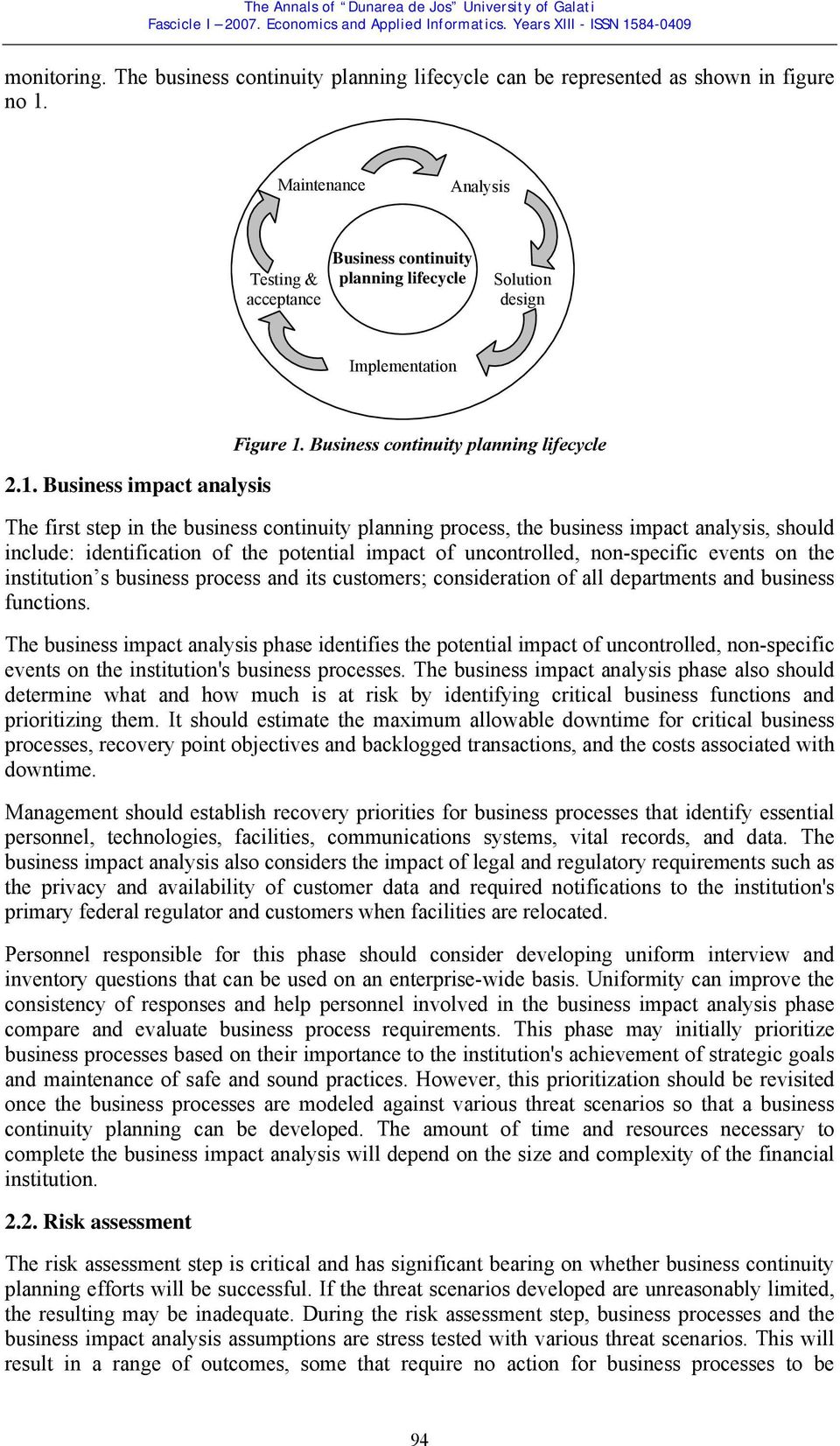
2 monitoring. The business continuity planning lifecycle can be represented as shown in figure no 1. Maintenance Analysis Testing & acceptance Business continuity planning lifecycle Solution design Implementation 2.1. Business impact analysis Figure 1. Business continuity planning lifecycle The first step in the business continuity planning process, the business impact analysis, should include: identification of the potential impact of uncontrolled, non-specific events on the institution s business process and its customers; consideration of all departments and business functions. The business impact analysis phase identifies the potential impact of uncontrolled, non-specific events on the institution's business processes. The business impact analysis phase also should determine what and how much is at risk by identifying critical business functions and prioritizing them. It should estimate the maximum allowable downtime for critical business processes, recovery point objectives and backlogged transactions, and the costs associated with downtime. Management should establish recovery priorities for business processes that identify essential personnel, technologies, facilities, communications systems, vital records, and data. The business impact analysis also considers the impact of legal and regulatory requirements such as the privacy and availability of customer data and required notifications to the institution's primary federal regulator and customers when facilities are relocated. Personnel responsible for this phase should consider developing uniform interview and inventory questions that can be used on an enterprise-wide basis. Uniformity can improve the consistency of responses and help personnel involved in the business impact analysis phase compare and evaluate business process requirements. This phase may initially prioritize business processes based on their importance to the institution's achievement of strategic goals and maintenance of safe and sound practices. However, this prioritization should be revisited once the business processes are modeled against various threat scenarios so that a business continuity planning can be developed. The amount of time and resources necessary to complete the business impact analysis will depend on the size and complexity of the financial institution Risk assessment The risk assessment step is critical and has significant bearing on whether business continuity planning efforts will be successful. If the threat scenarios developed are unreasonably limited, the resulting may be inadequate. During the risk assessment step, business processes and the business impact analysis assumptions are stress tested with various threat scenarios. This will result in a range of outcomes, some that require no action for business processes to be 94
3 successful and others that will require significant business continuity planning to be developed and supported with resources (financial and personnel). Organizations should develop realistic threat scenarios that may potentially disrupt their business processes and ability to meet their client s expectations (internal, business partners, or customers). Threats can take many forms, including malicious activity as well as natural and technical disasters. Where possible, institutions should analyze a threat by focusing on its impact on the institution, not the nature of the threat. For example, the effects of certain threat scenarios can be reduced to business disruptions that affect only specific work areas, systems, facilities (i.e., buildings), or geographic areas. Additionally, the magnitude of the business disruption should consider a wide variety of threat scenarios based upon practical experiences and potential circumstances and events. If the threat scenarios are not comprehensive, business continuity planning may be too basic and omit reasonable steps that could improve business processes' resiliency to disruptions. Threat scenarios need to consider the impact of a disruption and probability of the threat occurring. Threats could have a high probability of occurrence and low impact to the institution (e.g., brief power interruptions), or a low probability of occurrence and high impact on the institution (e.g., hurricane, terrorism). High probability threats are often supported by very specific business continuity planning. However, the most difficult threats to address are those that have a high impact on the institution but a low probability of occurrence. Using a risk assessment, business continuity planning may be more flexible and adaptable to specific types of disruptions that may not be initially considered. It is at this point in the business continuity planning process that organizations should perform a "gap analysis." In this context, a gap analysis is a methodical comparison of what types of plans the institution (or business line) needs to maintain, resume, or recover normal business operations in the event of a disruption, versus what the existing business continuity planning provides. The difference between the two highlights additional risk exposure that management and the board need to address in business continuity planning development. The risk assessment considers: the impact of various business disruption scenarios on both the institution and its customers; the probability of occurrence based, for example, on a rating system of high, medium, and low; the loss impact on information services, technology, personnel, facilities, and service providers from both internal and external sources; the safety of critical processing documents and vital records; a broad range of possible business disruptions, including natural, technical, and human threats. When assessing the probability of a specific event occurring, organizations and technology service providers should consider the geographic location of facilities and their susceptibility to natural threats (e.g., location in a flood plain), and the proximity to critical infrastructures (e.g., power sources, nuclear power plants, airports, points of interest, major highways, railroads). The risk assessment should include all the organizations or service provider's locations and facilities. Worst-case scenarios, such as destruction of the facilities and loss of life, should be considered. At the conclusion of this phase, the institution will have prioritized business processes and estimated how they may be disrupted under various threat scenarios Risk management After conducting the business impact analysis and risk assessment, management should prepare a written business continuity planning. The plan should document strategies and procedures to maintain, resume, and recover critical business functions and processes and should include procedures to execute the plan s priorities for critical vs. non-critical functions, services and processes. A well-written business continuity planning should describe in some 95

4 detail the types of events that would lead up to the formal declaration of a disruption and the process for invoking the business continuity planning. It should describe the responsibilities and procedures to be followed by each continuity team and contain contact lists of critical personnel. The business continuity planning should describe in detail the procedures to be followed to recover each business function affected by the disruption and should be written in such a way that various groups of personnel can implement it in a timely manner. A business continuity planning is more than recovery of the technology, but rather a recovery of all critical business operations. The plan should be flexible to respond to changing internal and external conditions and new threat scenarios. Rather than being developed around specific events (e.g. fire vs. tornado), the plan will be more effective if it is written to adequately address specific types of scenarios and the desired outcomes. A business continuity planning should describe the immediate steps to be taken during an event in order to minimize the damage from a disruption, as well as the action necessary to recover. Thus, business continuity planning should be focused on maintaining, resuming, and recovering the institution's operations after a disruption. Specific scenarios should include how the financial institution would respond if: Critical personnel is not available; Critical buildings, facilities, or geographic regions are not accessible; Equipment malfunctions (hardware, telecommunications, operational equipment); Software and data are not accessible or are corrupted; Vendor assistance or service provider is not available; Utilities are not available (power, telecommunications); Critical documentation and/or records are not available. Organizations should carefully consider the assumptions on which the business continuity planning is based. Also, institutions should not assume a disaster will be limited to a single facility or a small geographic area. Institutions should not assume they will be able to gain access to facilities that have not been damaged or that critical personnel (including senior management) will be available immediately after the disruption. Assuming public transportation systems such as airlines, railroads and subways will be operating may also be incorrect. Organizations should not assume the telecommunications system will be operating at normal capacity. A business continuity planning consists of many components that are both internal and external to a financial institution. The activation of a continuity plan and restoration of business in the event of an emergency is dependent on the successful interaction of various components. The overall strength and effectiveness of a business continuity planning can be decreased by its weakest component. An effective business continuity plan coordinates across its many components, identifies potential process or system dependencies, and mitigates the risks from interdependencies. Typically, the business continuity coordinator or team facilitates the identification of risk and the development of risk mitigation strategies across business areas. Internal causes of interdependencies can include line of business dependencies, telecommunication links, and/or shared resources (i.e., print operations or systems). External sources of interdependencies that can negatively impact a business continuity plan can include telecommunication providers, service providers, customers, business partners and suppliers Risk monitoring Risk monitoring is the final step in business continuity planning. It should ensure that the institution's business continuity planning is viable through: Testing the business continuity planning at least annually; 96

5 Subjecting the business continuity planning to independent audit and review; Updating the business continuity planning based upon changes to personnel and the internal and external environments. 3. Implementation of business continuity planning projects Organizations should provide business continuity training for personnel to ensure all parties are aware of their responsibilities should a disaster occur. Key employees should be involved in the business continuity development process, as well as periodic training exercises. The training program should incorporate enterprise-wide training as well as specific training for individual business units. Employees should be aware of which conditions call for implementing all or parts of the business continuity planning, who is responsible for implementing business continuity planning for business units and the institution, and what to do if these key employees are not available at the time of a disaster. Cross training should be utilized to should be regularly scheduled and updated to address changes to the business continuity planning. Communication planning should identify alternate communication channels to use during a disaster, such as pagers, cell phones, , or two-way radios. An emergency telephone number, address, and physical address list should be provided to employees to assist in communication efforts during a disaster. The list should provide all alternate numbers since one or more telecommunications systems could be unavailable. Additionally, the phone list should provide numbers for vendors, emergency services, transportation, and regulatory agencies. Wallet cards, Internet postings, and calling trees are possible ways to distribute information to employees. Further, institutions should establish reporting or calling locations to assist them in accounting for all personnel following a disaster. Organizations should consider developing an awareness program to let customers, service providers, and regulators know how to contact the institution if normal communication channels are not in operation. The plan should also designate personnel who will communicate with the media, government, vendors, and other companies and provide for the type of information to be communicated. In order to recoup losses from risks that cannot be completely prevented organizations are often using insurance. Generally, insurance coverage is obtained for risks that cannot be entirely controlled, yet could represent a significant potential for financial loss or other disastrous consequences. The decision to obtain insurance should be based on the probability and degree of loss identified during the business impact analysis. Organizations should determine potential exposure for various types of disasters and review the insurance options available to ensure appropriate insurance coverage is provided. Management should know the limits and coverage detailed in insurance policies to make sure coverage is appropriate given the risk profile of the institution. Institutions should perform an annual insurance review to ensure the level and types of coverage are commercially reasonable, and consistent with any legal, management, and board requirements. Also, institutions should create and retain a comprehensive hardware and software inventory list in a secure off-site location in order to facilitate the claims process. Organizations should be aware of the limitations of insurance. Insurance can reimburse an institution for some or all of the financial losses incurred as the result of a disaster or other significant event. However, insurance is by no means a substitute for an effective business continuity planning, since its primary objective is not the recovery of the business. For example, insurance cannot reimburse an institution for damage to its reputation. An institution may need to coordinate with community and government officials and the news media to ensure the successful implementation of the business continuity planning. Ideally, these relationships should be established during the planning or testing phases of business 97

6 continuity planning. This establishes proper protocol in case a city-wide or region-wide event impacts the institution s operations. Organizations are encouraged to contact state and local authorities during the risk assessment process to inquire about specific risks or exposures for all their geographic locations and special requirements for accessing emergency zones. During the recovery phase, facilities access, power, and telecommunications systems would be coordinated with various entities to ensure timely resumption of operations. Conclusions A business continuity planning is a living document; changing in concert with changes in the business activities it supports. The plan should be reviewed by senior management, the planning team or coordinator, team members, internal audit, and the board of directors at least annually. As part of that review process, the team, or coordinator should contact business unit managers throughout the financial institution at regular intervals to assess the nature and scope of any changes to the institution s business, structure, systems, software, hardware, personnel, or facilities. It is to be expected that some changes will have occurred since the last plan update. Software applications are commercially available to assist the business continuity planning coordinator in identifying and tracking these organizational changes so that the business continuity planning can be updated. All such organizational changes should be analyzed to determine how they may affect the existing continuity plan, and what revisions to the plan may be necessary to accommodate these changes. The agencies expect that business continuity planning updates will be documented to show that the plan reflects the institution, as it currently exists. Lastly, the financial institution should ensure the revised business continuity planning is distributed throughout the organization. References 1. Barnes, James, A Guide to Business Continuity Planning, John Willey and Sons Ltd, UK, Barnes, Peter, Hiles, Andrew, The Definitive Handbook of Business Continuity Management, John Willey and Sons Ltd, UK, Toigo, William, Disaster Recovery Planning, Prentice Hall,

Federal Financial Institutions Examination Council FFIEC BCP. Business Continuity Planning MARCH 2003 IT EXAMINATION H ANDBOOK
 Federal Financial Institutions Examination Council FFIEC Business Continuity Planning MARCH 2003 BCP IT EXAMINATION H ANDBOOK TABLE OF CONTENTS INTRODUCTION... 1 BOARD AND SENIOR MANAGEMENT RESPONSIBILITIES...
Federal Financial Institutions Examination Council FFIEC. Business Continuity Planning BCP MARCH 2003 MARCH 2008 IT EXAMINATION
 Federal Financial Institutions Examination Council FFIEC Business Continuity Planning MARCH 2003 MARCH 2008 BCP IT EXAMINATION H ANDBOOK TABLE OF CONTENTS INTRODUCTION... 1 BOARD AND SENIOR MANAGEMENT
Federal Financial Institutions Examination Council FFIEC BCP. Business Continuity Planning FEBRUARY 2015 IT EXAMINATION H ANDBOOK
 Federal Financial Institutions Examination Council FFIEC Business Continuity Planning BCP FEBRUARY 2015 IT EXAMINATION H ANDBOOK Table of Contents Introduction 1 Board and Senior Management Responsibilities
BUSINESS CONTINUITY. Plan Annex
 BUSINESS CONTINUITY Plan Annex 2015 IX iv The University of Texas at Austin Business Continuity Plan Annex v Acknowledgement The University of Texas at Austin Business Continuity Plan Annex has been
Guideline on Business Continuity Management
 Circular No. 033/B/2009-DSB/AMCM (Date: 14/8/2009) Guideline on Business Continuity Management The Monetary Authority of Macao (AMCM), under the powers conferred by Article 9 of the Charter approved by
Business Continuity Plan
 Business Continuity Plan October 2007 Agenda Business continuity plan definition Evolution of the business continuity plan Business continuity plan life cycle FFIEC & Business continuity plan Questions
Business Continuity Management
 Business Continuity Management cliftonlarsonallen.com Introductions Brian Pye CliftonLarsonAllen Senior Manager Business Risk Services group 15 years of experience with Business Continuity Megan Moore
Why Should Companies Take a Closer Look at Business Continuity Planning?
 whitepaper Why Should Companies Take a Closer Look at Business Continuity Planning? How Datalink s business continuity and disaster recovery solutions can help organizations lessen the impact of disasters
Table of Contents... 1
 ... 1 Chapter 1 Introduction... 4 1.1 Executive Summary... 4 1.2 Goals and Objectives... 5 1.3 Senior Management and Board of Directors Responsibilities... 5 1.4 Business Continuity Planning Processes...
Desktop Scenario Self Assessment Exercise Page 1
 Page 1 Neil Jarvis Head of IT Security & IT Risk DHL Page 2 From reputation to data loss - how important is business continuity? Neil Jarvis Head of IT Security (EMEA) DHL Logistics IT Security Taking
Assessing Your Disaster. Andrews Hooper Pavlik PLC. Andrews Hooper Pavlik PLC
 Assessing Your Disaster Recovery Plans Gregory H. Soule, CPA, CISA, CISSP, CFE Andrews Hooper Pavlik PLC Andrews Hooper Pavlik PLC Agenda Business Continuity Concepts Impact Analysis Risk Assessment Risk
Statement of Guidance
 Statement of Guidance Business Continuity Management All Licensees 1. Statement of Objectives 1.1. To enhance the resilience of the financial sector and to minimise the potential impact of a major operational
www.pwc.com Business Resiliency Business Continuity Management - January 14, 2014
 www.pwc.com Business Resiliency Business Continuity Management - January 14, 2014 Agenda Key Definitions Risks Business Continuity Management Program BCM Capability Assessment Process BCM Value Proposition
National Check Payments Certification. Fraud, Risk, and Risk Mitigation Part II. Copyright 2015 by the Electronic Check Clearing House Organization
 NCP 2016 Exam Cycle Core Training Series Session 11 National Check Payments Certification Fraud, Risk, and Risk Mitigation Part II Copyright 2015 by the Electronic Check Clearing House Organization NOTICES
Business Continuity Planning Preparing Your Organization
 Business Continuity Planning Preparing Your Organization Nicholas De Laurentis, CRM, IGP [email protected] 1 Objectives Understand the importance of Business Continuity Planning Know
Business Unit CONTINGENCY PLAN
 Contingency Plan Template Business Unit CONTINGENCY PLAN Version 1.0 (Date submitted) Submitted By: Business Unit Date Version 1.0 Page 1 1 Plan Review and Updates... 3 2 Introduction... 3 2.1 Purpose...
Continuity of Operations Planning. A step by step guide for business
 What is a COOP? Continuity of Operations Planning A step by step guide for business A Continuity Of Operations Plan (COOP) is a MANAGEMENT APPROVED set of agreed-to preparations and sufficient procedures
PAPER-6 PART-1 OF 5 CA A.RAFEQ, FCA
 1 Chapter-4: Business Continuity Planning and Disaster Recovery Planning PAPER-6 PART-1 OF 5 CA A.RAFEQ, FCA Learning Objectives 2 To understand the concept of Business Continuity Management To understand
Creating a Business Continuity Plan for your Health Center
 Creating a Business Continuity Plan for your Health Center 1 Page Left Intentionally Blank 2 About This Manual This tool is the result of collaboration between the Primary Care Development Corporation
Business Continuity and Disaster Recovery Planning
 Business Continuity and Disaster Recovery Planning Jennifer Brandt, CISA A p r i l 16, 2015 HISTORY OF STINNETT & ASSOCIATES Stinnett & Associates (Stinnett) is a professional advisory firm offering services
EMERGENCY PREPAREDNESS PLAN Business Continuity Plan
 EMERGENCY PREPAREDNESS PLAN Business Continuity Plan GIS Bankers Insurance Group Powered by DISASTER PREPAREDNESS Implementation Small Business Guide to Business Continuity Planning Surviving a Catastrophic
The PNC Financial Services Group, Inc. Business Continuity Program
 The PNC Financial Services Group, Inc. Business Continuity Program subsidiaries) 1 Content Overview A. Introduction Page 3 B. Governance Model Page 4 C. Program Components Page 4 Business Impact Analysis
Institute for Business Continuity Training 1623 Military Road, # 377 Niagara Falls, NY 14304-1745
 ECP - 601: Effective Business Continuity Management: ISO 22301 This 3-day course provides an intensive, hands-on workshop covering all major aspects for the design of an effective Business Continuity Plan
STEP-BY-STEP BUSINESS CONTINUITY AND EMERGENCY PLANNING MAY 27 2015
 STEP-BY-STEP BUSINESS CONTINUITY AND EMERGENCY PLANNING MAY 27 2015 AGENDA: Emergency Management Business Continuity Planning Q & A MONTH DAY, YEAR TITLE OF THE PRESENTATION 2 CANADIAN RED CROSS Disaster
PAPER-6 PART-3 OF 5 CA A.RAFEQ, FCA
 Chapter-4: Business Continuity Planning and Disaster Recovery Planning PAPER-6 PART-3 OF 5 CA A.RAFEQ, FCA Learning Objectives 2 To understand the concept of Business Continuity Management To understand
BUSINESS CONTINUITY MANAGEMENT GUIDELINES FOR BANKS AND FINANCIAL INSTITUTIONS
 BUSINESS CONTINUITY MANAGEMENT GUIDELINES FOR BANKS AND FINANCIAL INSTITUTIONS DIRECTORATE OF BANKING SUPERVISION AUGUST 2009 TABLE OF CONTENTS PAGE 1.0 INTRODUCTION..3 1.1 Background...3 1.2 Citation...3
Disaster Preparedness & Response
 3 4 5 6 7 8 9 10 11 12 13 14 15 16 17 18 19 20 21 22 23 24 25 26 27 28 29 30 31 32 A B C E INTRODUCTION AND PURPOSE REVIEW ELEMENTS ABBREVIATIONS NCUA REFERENCES EXTERNAL REFERENCES Planning - Ensuring
NCUA LETTER TO CREDIT UNIONS
 NCUA LETTER TO CREDIT UNIONS NATIONAL CREDIT UNION ADMINISTRATION 1775 Duke Street, Alexandria, VA 22314 DATE: December 2001 LETTER NO.: 01-CU-21 TO: SUBJ: ENCL: All Federally Insured Credit Unions Disaster
CENTRAL BANK OF KENYA (CBK) PRUDENTIAL GUIDELINE ON BUSINESS CONTINUITY MANAGEMENT (BCM) FOR INSTITUTIONS LICENSED UNDER THE BANKING ACT
 CENTRAL BANK OF KENYA (CBK) PRUDENTIAL GUIDELINE ON BUSINESS CONTINUITY MANAGEMENT (BCM) FOR INSTITUTIONS LICENSED UNDER THE BANKING ACT JANUARY 2008 GUIDELINE ON BUSINESS CONTINUITY GUIDELINE CBK/PG/14
Business Continuity Planning 101. +1 610 768-4120 (800) 634-2016 www.strohlsystems.com [email protected]
 Business Continuity Planning 101 Presentation Overview What is business continuity planning Plan Development Plan Testing Plan Maintenance Future advancements in BCP Question & Answer What is a Disaster?
Business Continuity Overview
 Business Continuity Overview Beverley A. Retjos Senior Manager WW SWG Security & Controls 03/12/07 Business Continuity Management (BCM) Process of ensuring that a business is prepared to survive any disruption
CISM Certified Information Security Manager
 CISM Certified Information Security Manager Firebrand Custom Designed Courseware Chapter 4 Information Security Incident Management Exam Relevance Ensure that the CISM candidate Establish an effective
The PNC Financial Services Group, Inc. Business Continuity Program
 The PNC Financial Services Group, Inc. Business Continuity Program 1 Content Overview A. Introduction Page 3 B. Governance Model Page 4 C. Program Components Page 4 Business Impact Analysis (BIA) Page
Business Continuity Planning and Disaster Recovery Planning
 4 Business Continuity Planning and Disaster Recovery Planning Basic Concepts 1. Business Continuity Management: Business Continuity means maintaining the uninterrupted availability of all key business
Unit Guide to Business Continuity/Resumption Planning
 Unit Guide to Business Continuity/Resumption Planning (February 2009) Revised June 2011 Executive Summary... 3 Purpose and Scope for a Unit Business Continuity Plan(BCP)... 3 Resumption Planning... 4 Assumptions
Ohio Supercomputer Center
 Ohio Supercomputer Center IT Business Continuity Planning No: Effective: OSC-13 06/02/2009 Issued By: Kevin Wohlever Director of Supercomputer Operations Published By: Ohio Supercomputer Center Original
Information Security Management: Business Continuity Planning. Presentation by Stanislav Nurilov March 9th, 2005 CS 996: Info. Sec. Mgmt.
 Information Security Management: Business Continuity Planning Presentation by Stanislav Nurilov March 9th, 2005 CS 996: Info. Sec. Mgmt. Overview BCP: Definition BCP: Need for (Why?) BCP: When BCP: Who
2015 CEO & Board University Taking Your Business Continuity Plan To The Next Level. Tracy L. Hall, MBCP
 2015 CEO & Board University Taking Your Business Continuity Plan To The Next Level Tracy L. Hall, MBCP MEMBER OF PKF NORTH AMERICA, AN ASSOCIATION OF LEGALLY INDEPENDENT FIRMS 2015 Wolf & Company, P.C.
IT Disaster Recovery and Business Resumption Planning Standards
 Information Technology Disaster Recovery and Business IT Disaster Recovery and Business Adopted by the Information Services Board (ISB) on May 28, 1992 Policy No: Also see: 500-P1, 502-G1 Supersedes No:
2014 NABRICO Conference
 Business Continuity Planning 2014 NABRICO Conference September 19, 2014 6 CityPlace Drive, Suite 900 St. Louis, Missouri 63141 314.983.1200 1520 S. Fifth Street, Suite 309 St. Charles, Missouri 63303 636.255.3000
Business Continuity Planning for Schools, Departments & Support Units
 Business Continuity Planning for Schools, Departments & Support Units 1 What is Business Continuity Planning? Examples Planning for an adverse, major or catastrophic event that would cause a disruption
BUSINESS CONTINUITY PLANNING GUIDELINES
 BUSINESS CONTINUITY PLANNING GUIDELINES Washington University in St. Louis The purpose of this guide is to serve as a tool to all departments, divisions, and labs across the University in building a Business
Building and Maintaining a Business Continuity Program
 Building and Maintaining a Business Continuity Program Successful strategies for financial institutions for effective preparation and recovery Table of Contents Introduction...3 This white paper was written
Temple university. Auditing a business continuity management BCM. November, 2015
 Temple university Auditing a business continuity management BCM November, 2015 Auditing BCM Agenda 1. Introduction 2. Definitions 3. Standards 4. BCM key elements IT Governance class - IT audit program
Assessment of natural hazards, man made hazards, technical and societal related risks and associated impact.
 Aon Business Continuity Planning The Aon Business Continuity Planning practice provides consulting services that allow Aon clients to measure and manage their strategic and tactical risks through Crisis
Business Continuity and Disaster Planning
 WHITE PAPER Business Continuity and Disaster Planning A guide to preparing for the unexpected Robert Drewniak Director, Strategic & Advisory Services Disasters are not always the result of high winds and
Protecting your Enterprise
 Understanding Disaster Recovery in California Protecting your Enterprise Session Overview Why do we Prepare What is? How do I analyze (measure) it? What to do with it? How do I communicate it? What does
Supervisory Policy Manual
 This module should be read in conjunction with the Introduction and with the Glossary, which contains an explanation of abbreviations and other terms used in this Manual. If reading on-line, click on blue
State of South Carolina Policy Guidance and Training
 State of South Carolina Policy Guidance and Training Policy Workshop All Agencies Business Continuity Management Policy June 2014 Agenda Questions & Follow-Up Policy Workshop Overview & Timeline Policy
Ohio Conference for Payroll Professionals Disaster Recovery
 Ohio Conference for Payroll Professionals Disaster Recovery Speaker Bruce E. Phipps CPP 2011 APA Payroll Man of the Year Principal Product Manager US Legislative Analyst ORACLE Corporation [email protected]
Domain 3 Business Continuity and Disaster Recovery Planning
 Domain 3 Business Continuity and Disaster Recovery Planning Steps (ISC) 2 steps [Har10] Project initiation Business Impact Analysis (BIA) Recovery strategy Plan design and development Implementation Testing
BUSINESS CONTINUITY PLAN
 How to Develop a BUSINESS CONTINUITY PLAN To print to A4, print at 75%. TABLE OF CONTENTS SUMMARY SUMMARY WHAT IS A BUSINESS CONTINUITY PLAN? CHAPTER PREPARING TO WRITE YOUR BUSINESS CONTINUITY PLAN CHAPTER
Technology Recovery Plan Instructions
 State of California California Information Security Office Technology Recovery Plan Instructions SIMM 5325-A (Formerly SIMM 65A) September 2013 REVISION HISTORY REVISION DATE OF RELEASE OWNER SUMMARY OF
Fire Department Guide. Creating and Maintaining Business Continuity Plans (BCP)
 Fire Department Guide Creating and Maintaining Business Continuity Plans (BCP) Business Continuity Planning Components Index: Introduction Getting Started Section 1 1. Assign departmental business continuity
Business Continuity & Disaster Recovery
 Business Continuity & Disaster Recovery Safety First Quality Every Time 1 Business Continuity & Disaster Recovery Planning Who here has a formal Business Continuity & Disaster Recovery plan? The purpose
Introduction to Business Continuity Planning. PCDC Introduction. Objectives. MPCA Series on Business Continuity Planning
 Introduction to Business Continuity Planning MPCA Series on Business Continuity Planning Joan Thomas, MPA, ABPC, MEP Primary Care Development Corporation April 28, 2010 PCDC Introduction Public Private
Shankar Gawade VP IT INFRASTRUCTURE ENAM SECURITIES PVT. LTD.
 Business Continuity Management & Disaster Recovery Planning Presented by: Shankar Gawade VP IT INFRASTRUCTURE ENAM SECURITIES PVT. LTD. 1 What is Business Continuity Management? Is a holistic management
Western Intergovernmental Audit Forum
 Western Intergovernmental Audit Forum Business Continuity & Disaster Recovery Planning September 12, 2013 Presented by: City of Phoenix City Auditor Department Aaron Cook, Sr Internal Auditor IT Audit
Business Continuity Glossary
 Developed In Conjuction with Business Continuity Glossary ACTIVATION: The implementation of business continuity capabilities, procedures, activities, and plans in response to an emergency or disaster declaration;
Interactive-Network Disaster Recovery
 Interactive-Network Disaster Recovery BACKGROUND IT systems are vulnerable to a variety of disruptions, ranging from mild (e.g., short-term power outage, disk drive failure) to severe (e.g., terrorism,
Disaster Recovery Plan
 Disaster Recovery Plan This guide sets forth items to consider in the review of the firm s disaster recovery plan. You should form a committee to assess the plan and should assign activities under the
Enterprise Resiliency & Response Program Customer Overview May 2014
 Customer Overview May 2014 Table of Contents Section I Enterprise Resiliency & Response Overview... 1 Background... 1 Mission Statement... 1 Policy... 1 Objective... 2 Program Strategy... 2 The Layered
PAPER-6 PART-5 OF 5 CA A.RAFEQ, FCA
 Chapter-4: Business Continuity Planning and Disaster Recovery Planning PAPER-6 PART-5 OF 5 CA A.RAFEQ, FCA Learning Objectives 2 To understand the concept of Business Continuity Management To understand
D2-02_01 Disaster Recovery in the modern EPU
 CONSEIL INTERNATIONAL DES GRANDS RESEAUX ELECTRIQUES INTERNATIONAL COUNCIL ON LARGE ELECTRIC SYSTEMS http:d2cigre.org STUDY COMMITTEE D2 INFORMATION SYSTEMS AND TELECOMMUNICATION 2015 Colloquium October
All-Hazard Continuity of Operations Plan. [Department/College Name] [Date]
![All-Hazard Continuity of Operations Plan. [Department/College Name] [Date]](/thumbs/39/18175711.jpg "All-Hazard Continuity of Operations Plan. [Department/College Name] [Date]") d All-Hazard Continuity of Operations Plan [Department/College Name] [Date] TABLE OF CONTENTS SECTION I: INTRODUCTION... 3 Executive Summary... 3 Introduction... 3 Goal... 4 Purpose... 4 Objectives...
d All-Hazard Continuity of Operations Plan [Department/College Name] [Date] TABLE OF CONTENTS SECTION I: INTRODUCTION... 3 Executive Summary... 3 Introduction... 3 Goal... 4 Purpose... 4 Objectives...
Disaster Recovery Plan Documentation for Agencies Instructions
 California Office of Information Security Disaster Recovery Plan Documentation for Agencies Instructions () November 2009 SCOPE AND PURPOSE The requirements included in this document are applicable to
DISASTER RECOVERY PLANNING GUIDE
 DISASTER RECOVERY PLANNING GUIDE AN INTRODUCTION TO BUSINESS CONTINUITY PLANNING FOR JD EDWARDS SOFTWARE CUSTOMERS www.wts.com WTS Disaster Recovery Planning Guide Page 1 Introduction This guide will provide
IT Disaster Recovery Plan Template
 HOPONE INTERNET CORP IT Disaster Recovery Plan Template Compliments of: Tim Sexton 1/1/2015 An information technology (IT) disaster recovery (DR) plan provides a structured approach for responding to unplanned
<Client Name> IT Disaster Recovery Plan Template. By Paul Kirvan, CISA, CISSP, FBCI, CBCP
 IT Disaster Recovery Plan Template By Paul Kirvan, CISA, CISSP, FBCI, CBCP Revision History REVISION DATE NAME DESCRIPTION Original 1.0 2 Table of Contents Information Technology Statement
Business Continuity Planning in IT
 Introduction: Business Continuity Planning in IT The more your business relies on its IT systems, the more you need to consider how unexpected disruptions might affect your business. These disruptions
Business Continuity (Policy & Procedure)
 Business Continuity (Policy & Procedure) Publication Scheme Y/N Can be published on Force Website Department of Origin Force Operations Policy Holder Ch Supt Head of Force Ops Author Business Continuity
Proposal for Business Continuity Plan and Management Review 6 August 2008
 Proposal for Business Continuity Plan and Management Review 6 August 2008 2008/8/6 Contents About Newton IT / Quality of our services. BCM & BS25999 Overview 2. BCM Development in line with BS25999 3.
Developing a Business Continuity Plan... More Than Disaster
 Developing a Business Continuity Plan..... More Than Disaster Recovery! April 19, 2010 UHY / MMA Business Survival Series Webinar Focus.... Understanding the components of Business Continuity Planning
a Disaster Recovery Plan
 Construction of a Disaster Recovery Plan David Godwin, Sr. Sales Engineer March 18, 2014 Objectives Understand What Disaster Recovery is? Why is Disaster Recovery Needed? Effectively assist customers or
(Mr. Krirk Vanikkul) Assistant Governor, Financial Institutions Policy Group Governor For
 Unofficial Translation by the courtesy of The Foreign Banks' Association This translation is for the convenience of those unfamiliar with the Thai language. Please refer to the Thai text for the official
Company Management System. Business Continuity in SIA
 Company Management System Business Continuity in SIA Document code: Classification: Company Project/Service Year Document No. Version Public INDEX 1. INTRODUCTION... 3 2. SIA S BUSINESS CONTINUITY MANAGEMENT
ASX CLEAR (FUTURES) OPERATING RULES Guidance Note 10
 BUSINESS CONTINUITY AND DISASTER RECOVERY The purpose of this Guidance Note The main points it covers To assist participants to understand the disaster recovery and business continuity arrangements they
How to Plan for Disaster Recovery and Business Continuity
 A TAMP Systems White Paper TAMP Systems 1-516-623-2038 www.drsbytamp.com How to Plan for Disaster Recovery and Business Continuity By Tom Abruzzo, President and CEO Contents Introduction 1 Definitions
PPSADOPTED: OCT. 2012 BACKGROUND POLICY STATEMENT PHYSICAL FACILITIES. PROFESSIONAL PRACTICE STATEMENT Developing a Business Continuity Plan
 PROFESSIONAL PRACTICE STATEMENT Developing a Business Continuity Plan OCT. 2012 PPSADOPTED: What is a professional practice statement? Professional Practice developed by the Association Forum of Chicagoland
Prepared by Rod Davis, ABCP, MCSA November, 2011
 Prepared by Rod Davis, ABCP, MCSA November, 2011 Disaster an event, which causes the loss of an essential service, or part of it, for a length of time which imperils mission achievement. (Andrew Hiles,
CIS 523/423 Disaster Recovery Business Continuity
 CIS 523/423 Disaster Recovery Business Continuity Course Description A study of disaster recovery and business continuity as related to the information technology function in organizations. Topics will
Offsite Disaster Recovery Plan
 1 Offsite Disaster Recovery Plan Offsite Disaster Recovery Plan Presented By: Natan Verkhovsky President Disty Portal Inc. 2 Offsite Disaster Recovery Plan Introduction This document is a comprehensive
PBSi Business Continuity Planning
 Business Continuity Planning Definition Business Continuity planning is a planning process designed to reduce the risk that disruptive failures or events could seriously harm your business. It is designed
Disaster Recovery Plan (DRP) / Business Continuity Plan (BCP)
 Preface Computer systems are the core tool of today s business and are vital to every business from the smallest to giant organizations. Money transactions, customer service are just simple examples. Despite
Disaster Recovery. Hendry Taylor Tayori Limited
 Disaster Recovery Hendry Taylor Tayori Limited Agenda What is Business Continuity planning (BCP) What is Disaster Recovery (DR) and Disaster Recovery Planning (DRP) Overview Lifecycle Analysis Plan design
National Fire Protection Association s Contribution to Business Continuity Strategies
 National Fire Protection Association s Contribution to Business Continuity Strategies about me 1. Retired AVP Senior Business Risk Consultant 2. FM Global Trained: 1. 35 Years Service 2. Founder Member
THORNBURG INVESTMENT MANAGEMENT THORNBURG INVESTMENT TRUST. Business Continuity Plan
 THORNBURG INVESTMENT MANAGEMENT THORNBURG INVESTMENT TRUST Business Continuity Plan June 2012 Purpose The purpose of this Business Continuity Plan ( BCP ) is to define the strategies and the plans which
ASX SETTLEMENT OPERATING RULES Guidance Note 10
 BUSINESS CONTINUITY AND DISASTER RECOVERY The purpose of this Guidance Note The main points it covers To assist participants to understand the disaster recovery and business continuity arrangements they
How To Manage A Financial Institution
 BUSINESS CONTINUITY MANAGEMENT GUIDELINE April 2010 Table of Contents Preamble...3 Introduction...4 Scope...5 Coming into effect and updating...6 1. Continuity and resumption of business...7 2. Sound and
How to write a DISASTER RECOVERY PLAN. To print to A4, print at 75%.
 How to write a DISASTER RECOVERY PLAN To print to A4, print at 75%. TABLE OF CONTENTS SUMMARY SUMMARY WHAT IS A DRP AND HOW CAN IT HELP MY COMPANY? CHAPTER PREPARING TO WRITE YOUR DISASTER RECOVERY PLAN
Business Continuity Planning (BCP) & Disaster Recovery Planning (DRP).
 Business Continuity Planning (BCP) & Disaster Recovery Planning (DRP). Ed Fortin President Fortin Consulting Paul Godden Consultant & Quotation Author Friday 24 th February 2012 Business Continuity Planning
Meeting FFIEC Requirements: Enterprise-Wide Testing of Your. Business Continuity Plan
 Meeting FFIEC Requirements: Enterprise-Wide Testing of Your Business Continuity Plan April 25, 2012 Robin Remines, CBCP, AMBCI Certified Business Continuity Professional The OGO Difference Focus on making
BUSINESS CONTINUITY PLAN OVERVIEW
 BUSINESS CONTINUITY PLAN OVERVIEW INTRODUCTION The purpose of this document is to provide Loomis customers with an overview of the company s Business Continuity Plan (BCP). Because of the specific and
Supplier Security Assessment Questionnaire
 HALKYN CONSULTING LTD Supplier Security Assessment Questionnaire Security Self-Assessment and Reporting This questionnaire is provided to assist organisations in conducting supplier security assessments.