
WSE DETAILED EXCHANGE TRADING RULES IN UTP SYSTEM
|
|
|
- Magdalen Blankenship
- 10 years ago
- Views:
Transcription
1 WSE DETAILED EXCHANGE TRADING RULES IN UTP SYSTEM (consolidated text dated 14 September 2015 )* * WSE Detailed Exchange Trading Rules in UTP system adopted by Resolution No. 1038/2012 of the WSE Management Board dated 17 October 2012, including amendments adopted by: - Resolution No. 1334/2012 of the WSE Management Board dated 20 December 2012, - Resolution No. 333/2013 of the WSE Management Board dated 28 March 2013, - Resolution No. 1051/2013 of the WSE Management Board dated 6 September 2013, - Resolution No. 1103/2013 of the WSE Management Board dated 16 September 2013, - Resolution No. 1365/2013 of the WSE Management Board dated 27 November 2013, - Resolution No. 1388/2013 of the WSE Management Board dated 2 December 2013, - Resolution No. 27/2014 of the WSE Management Board dated 10 January 2014, - Resolution No. 268/2014 of the WSE Management Board dated 7 March 2014, - Resolution No. 292/2014 of the WSE Management Board dated 14 March 2014, - Resolution No. 607/2014 of the WSE Management Board dated 23 May 2014, - Resolution No. 696/2014 of the WSE Management Board dated 16 June 2014, - Resolution No. 1042/2014 of the WSE Management Board dated 19 September 2014, - Resolution No. 1179/2014 of the WSE Management Board dated 20 October 2014, - Resolution No. 1168/2014 of the WSE Management Board dated 17 October 2014, - Resolution No. 1222/2014 of the WSE Management Board dated 31 October 2014, - Resolution No. 1425/2014 of the WSE Management Board dated 17 December 2014, - Resolution No. 309/2015 of the WSE Management Board dated 2 April 2015, - Resolution No. 395/2015 of the WSE Management Board dated 29 April 2015, - Resolution No. 866/2015 of the WSE Management Board dated 27 August 2015.

2 DIVISION 1 8 DETAILED RULES OF ADMITTING AND INTRODUCING FINANCIAL INSTRUMENTS TO EXCHANGE TRADING 8 CHAPTER 1 8 ADMISSION OF FINANCIAL INSTRUMENTS TO EXCHANGE TRADING 8 CHAPTER 2 11 INTRODUCTION OF FINANCIAL INSTRUMENTS TO EXCHANGE TRADING BY WAY OF AN ORDINARY PROCEDURE 11 Section 1 11 General provisions 11 Section 2 12 Shares 12 Section 3 13 Rights to shares 13 Section 4 13 Pre-emptive rights 13 Section 5 14 Debt financial instruments (other than Treasury bonds) 14 Section 6 15 Treasury bonds 15 Section 7 17 Investment certificates 17 Section 8 17 ETF units 17 Section 9 18 Structured instruments (structured certificates, structured bonds and put/call warrants) 18 CHAPTER 3 19 INTRODUCTION OF FINANCIAL INSTRUMENTS TO EXCHANGE TRADING 19 BY WAY OF PUBLIC OFFER FOR SALE 19 DIVISION 2 22 DETAILED OPERATING RULES FOR EXCHANGE MEMBERS AND MARKET MAKERS 22 CHAPTER 1 22 EXCHANGE MEMBERS AND EXCHANGE MEMBER REPRESENTATIVES 22 Section 1 22 Exchange members 22 Section 2 23 Exchange brokers 23 Section 3 23 Supervising brokers 23 CHAPTER 2 25 DETAILED OPERATING RULES FOR MARKET MAKERS 25 ON THE CASH AND DERIVATIVES MARKET 25 DIVISION 3 27 EXCHANGE PRODUCTION IT SYSTEM ACCESS 27 DIVISION 4 30 DETAILED RULES OF TRADING 30 ON THE CASH AND DERIVATIVES MARKET 30 2

3 CHAPTER 1 30 GENERAL PROVISIONS 30 CHAPTER 2 30 TRADING SYSTEM 30 CHAPTER 3 32 TRADING SCHEDULE AND PHASES 32 Section 1 32 Trading schedule 32 Section 2 34 Trading phases single-price auction system 34 Section 3 35 Trading phases continuous trading system 35 CHAPTER 4 37 DETAILED RULES OF ACCEPTING, EXECUTING, MODIFYING AND CANCELLING BROKER S ORDERS 37 Section 1 37 General rules 37 Section 2 39 Types of broker s orders 39 Section 3 43 Broker s order validity designation 43 Section 4 44 Additional types of validity of broker s orders 44 Section 5 45 Additional conditions of execution of broker s orders 45 Section 6 46 Priority of price and time of acceptance for the order book 46 Section 7 47 Detailed rules of execution of orders in trading session phases 47 Title 1 Execution of broker s orders in the opening auction, in the closing auction, and during halting 47 Title 2 Execution of orders in the continuous trading phase 47 Section 8 48 Detailed rules of execution of broker s orders in cross trade 48 Section 9 49 Cancellation and modification of broker s orders 49 CHAPTER 5 51 RULES OF DETERMINING THE REFERENCE PRICE 51 Section 1 51 Reference price in the single-price auction system 51 Section 2 51 Reference price in the continuous trading system 51 Section 3 52 Determining the reference price for dynamic collars for financial instruments with a low liquidity of trading 52 Section 4 57 Detailed rules of determining the reference price 57 CHAPTER 6 58 DETERMINING PRICES AND COLLARS 58 Section 1 58 Single-price auction system 58 Section 2 59 Continuous trading system 59 Title
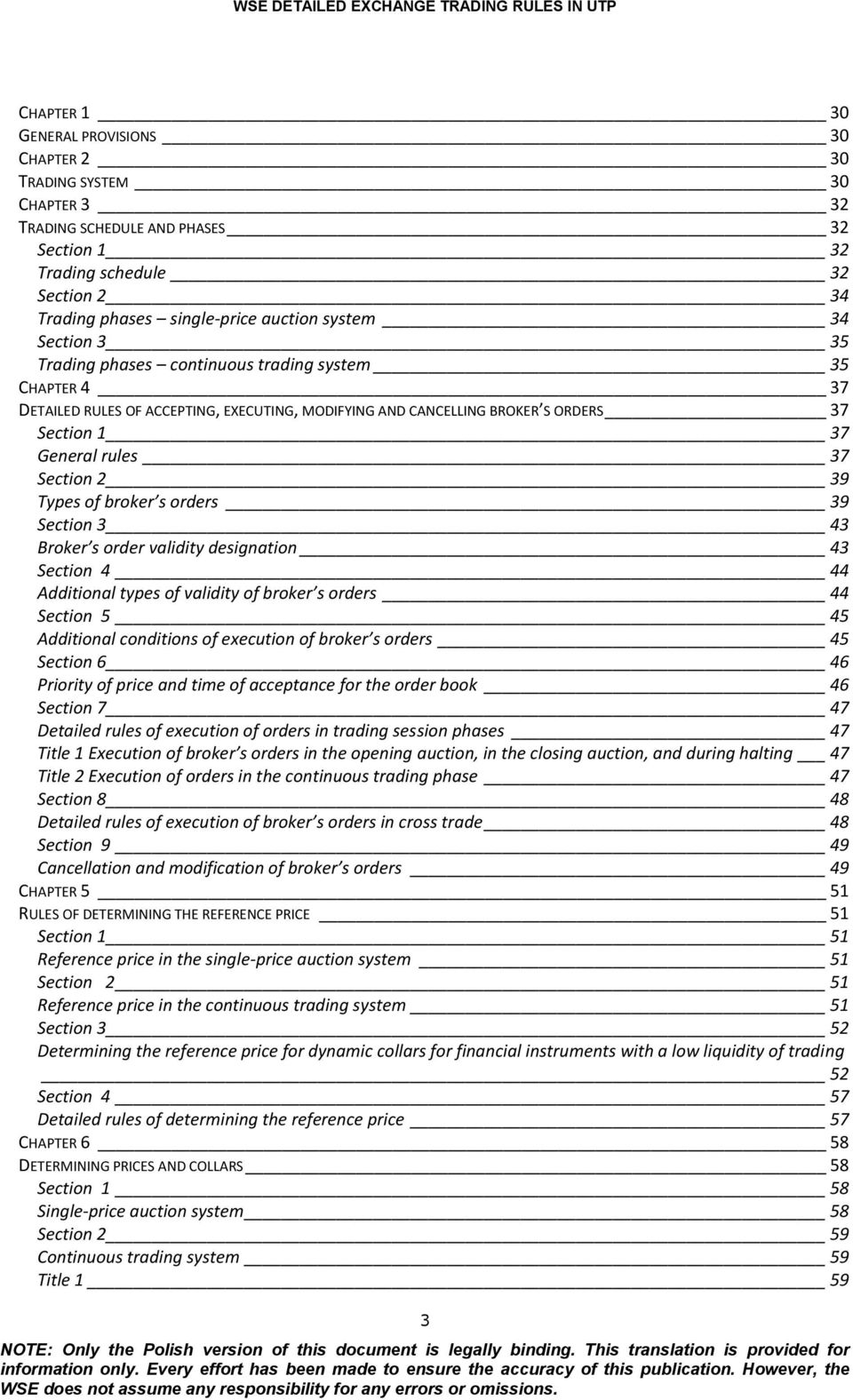
4 General provisions 59 Title 2 60 Continuous trading system static collars 60 Opening auction/closing auction 60 Title 3 62 Continuous trading system dynamic collars 62 CHAPTER 7 65 TICK SIZES 65 CHAPTER 8 66 DETAILED RULES OF TRADING IN FINANCIAL INSTRUMENTS ON THE CASH MARKET 66 Section 1 66 Shares and rights to shares 66 Section 2 70 Pre-emptive rights 70 Section 3 72 Debt financial instruments 72 Section 4 73 Investment certificates 73 Section 5 74 ETF units 74 CHAPTER 9 75 DETAILED RULES OF TRADING IN FINANCIAL INSTRUMENTS ON THE DERIVATIVES MARKET 75 Section 1 75 General provisions 75 Section 2 75 Futures contracts 75 Title 1 75 General provisions 75 Title 2 76 Index futures contracts 76 Title 2a 78 WIBOR reference rate futures contracts 78 Title 2b 79 Futures contracts on short-term, mid-term and long-term Treasury bonds 79 Title 3 82 Currency futures contracts 82 Title 4 84 Single-stock futures 84 Section 3 88 Options 88 Title 1 88 General provisions 88 Title 2 88 Index options 88 Section 4 91 Index participation units 91 CHAPTER ISSUING AND SUBMITTING CONTRACT NOTES 92 CHAPTER CANCELLATION OF EXCHANGE TRADES 93 CHAPTER SHORT SELLING ORDERS AND TRADES [REPEALED] 95 4

5 CHAPTER RULES OF TRADING IN FINANCIAL INSTRUMENTS IN CASE OF RIGHTS ATTACHED TO SUCH INSTRUMENTS BEING EXERCISED 96 Section 1 96 Trading in shares with pre-emptive rights 96 Section 2 98 Decrease of the par value of shares (split of shares) 98 Section 3 99 Increase of the par value of shares (merger of shares) 99 Section Trading in shares with dividend rights 100 Section Trading in shares with dividend rights (dividend payment in shares) 101 Section Trading in shares in connection with a split through spin-off 103 DIVISION DETAILED RULES OF TRADING 105 IN THE MARKET MAKER SYSTEM 105 CHAPTER GENERAL PROVISIONS 105 CHAPTER TRADING SCHEDULE AND PHASES 106 CHAPTER RULES OF OPERATION OF MARKET MAKERS 108 Section General provisions 108 Section Request for Quote (RFQ) 108 Section Request for Execution (RFE) 109 CHAPTER INSTRUMENT STATUS AND COLLARS 110 Section General provisions 110 Section Basic status 110 Section Buy Order Only status 111 Section Sell Order Only status 112 CHAPTER DETAILED RULES OF ACCEPTING, MODIFYING AND CANCELLING BROKER S ORDERS 113 Section General provisions 113 Section Types of broker s orders 114 Section Broker s order validity designation 116 Day orders (D) 116 Section Additional conditions of execution of orders 117 5

6 Section Cancellation and modification of broker s orders 118 CHAPTER DETAILED RULES OF EXECUTION OF BROKER S ORDERS 119 Section General provisions 119 Section Executing broker s orders opening auction 120 Section Executing broker s orders continuous trading phase 121 Title General rules - Segment A 121 Title General rules Segment B 121 Title Executing awaiting MO orders - Segments A and B 121 Title Executing orders in uncrossing - Segments A and B 122 Section Executing broker s orders in cross trade 123 CHAPTER TICK SIZES 124 CHAPTER SUSPENDING TRADING IN STRUCTURED INSTRUMENTS 124 CHAPTER CALCULATING THE REFERENCE LEVEL 127 DIVISION SPECIAL TRADES 128 CHAPTER GENERAL PROVISIONS 128 CHAPTER INDICATION OF INTEREST - IOI 128 CHAPTER BLOCK TRADES 130 Section General provisions 130 Section Shares block trades 131 Section Futures contracts or options block trades 132 Section ETF units block trades 133 Section Block trades in other financial instruments 134 Section Final provisions 135 CHAPTER BUY-IN/SELL-OUT TRANSACTIONS (BISO TRANSACTIONS) 135 CHAPTER DETAILED PROCEDURE FOR RESPONDING TO TENDER OR EXCHANGE OFFERS FOR EXCHANGE-LISTED SHARES 137 6

7 DIVISION DETAILED RULES OF DESIGNATING EXCHANGE-LISTED FINANCIAL INSTRUMENTS 139 DIVISION CURRENT AND PERIODICAL REPORTING RULES FOR ISSUERS OF EXCHANGE-LISTED FINANCIAL INSTRUMENTS 141 EXHIBITS: 143 Exhibit Exhibit Application and combination of validity designations and conditions of execution of broker s orders during their modification on the cash and derivative market 145 Exhibit Opinion of an investment company 147 Exhibit Application for admission to operate on the exchange 149 Exhibit Application for change of the scope of an exchange member s exchange operations 157 Exhibit Application to determine the start date of an exchange member s exchange operations 158 Exhibit 7 Application for entering a candidate into the register of supervising brokers 159 Exhibit 8 Application for the cancellation/notice of withdrawal of an application for the cancellation of an exchange transaction 161 Exhibit Declaration of will of an exchange member counterparty to an exchange transaction 163 7

8 DIVISION 1 DETAILED RULES OF ADMITTING AND INTRODUCING FINANCIAL INSTRUMENTS TO EXCHANGE TRADING Chapter 1 Admission of financial instruments to exchange trading 1 1. An application for the admission of financial instruments to exchange trading should include in particular: a) the issuer s name (business name), b) the number of the financial instruments subject to the application, their par value, type, code or series and date of issue, c) the market to which the financial instruments are to be admitted, d) the issue price and issue value of the issue/series, e) the legal basis of the issue, f) information on where and when an appropriate information document has been published and approved by a relevant supervision authority, or confirmed as equivalent by that authority, unless such information document does not need to be prepared, approved or confirmed as equivalent, g) the issuer s statement of transferability of the financial instruments subject to the application, h) the issuer s statement that no bankruptcy or liquidation proceedings are pending against the issuer, i) the issuer s statement on effective issue of the financial instruments subject to the application and the date of their allotment, j) the issuer s statement of compliance with the regulations governing the exchange, k) information whether the issuer has sought the admission of participation titles to trading on another regulated market or in an alternative trading system, l) information about the intention to introduce the instruments subject to the application to exchange trading by way of public offer for sale (if the issuer intends to introduce the instruments by way of such procedure). 2. Values in a foreign currency are converted in the application using the current mid exchange rates announced by the National Bank of Poland and prevailing on the day preceding the submission date of the application for admission to exchange trading. 8
9 The application referred to in 1 should be accompanied in particular by: a) the updated and consolidated articles of association of the issuer, 2 b) an updated excerpt from the register relevant to the issuer, c) documents which constitute the legal basis of issue of the financial instruments subject to the application, d) an appropriate information document approved by the relevant supervision authority, or confirmed as equivalent by that authority, and where such information document does not need to be prepared, approved or confirmed as equivalent the appropriate statement of the issuer to that effect, e) information on any events that occurred after the publication of the information document that could have a material effect on the evaluation of the issuer or the issuer s securities, f) a copy of the decision of the relevant supervision authority concerning approval of the information document or its confirmation as equivalent, subject to the provisions of point (d), g) statement of submission to the Financial Supervision Authority of a notification document confirming the approval of the information document in the home country, if required pursuant to the relevant provisions of the Act on Public Offering, subject to the provisions of point (d), h) statement of no procedure pending before the relevant supervision authority concerning approval of the information document or its confirmation as equivalent, or concerning amendments, annexes or additions to the information document, subject to the provisions of point (d) In addition to the data specified in 1, the application for admission of shares or rights to shares to exchange trading should include: a) the issue prices and the selling prices of the shares in the public offer, b) information on the structure of ownership of the shares and the manner of their distribution, c) information whether the issuer has applied for the admission of its shares to trading on another regulated market or in an alternative trading system, d) information on the value of the issuer s equity, the book value and the total number of issued shares, e) projected net profit, provided that it was disclosed to the general public. 2. In addition to the documents specified in 2, the application for admission of shares to exchange trading should be accompanied by an opinion of an investment company. The company granting such opinion may not be the issuer filing the application referred to in sub-paragraph 1 or its subsidiary or controlling entity. A specimen opinion is attached as Exhibit 3 to the Detailed Exchange Trading Rules In addition to the data specified in 1, an application for admission of debt financial instruments (bonds other than structured bonds, and mortgage bonds) to exchange 9

10 trading should include the dates and the terms and conditions of redemption of the financial instruments. 2. In addition to the documents specified in 2, the application referred to in subparagraph 1 should be accompanied by an agreement for representation executed between the issuer of bonds and the representing bank if such an agreement is required In addition to the data specified in 1, an application for admission of investment certificates to exchange trading should include the value of issue subject to the application. 2. In addition to the documents specified in 2, the application referred to in subparagraph 1 should be accompanied by: a) statutes of the investment fund and articles of association of the investment fund company, b) an excerpt from the register of investment funds or from the register of the investment fund company In addition to data specified in 1, an application for admission of depositary receipts to exchange trading should include: a) the legal basis of the issue of the depositary receipts, b) the value of the depositary receipts subject to the application. 2. In addition to the documents specified in 2, the application referred to in subparagraph 1 should be accompanied by a copy of the agreement with the underlying issuer under which the depositary receipts were issued (if such an agreement is executed) In addition to the data specified in 1, an application for the admission of ETF units (hereinafter units ) to exchange trading should include: the issue price of the units and the value of the issue subject to the application, or if it is not possible to specify that price the value of the issuer s net assets. 2. In addition to the documents specified in 2, the application referred to in subparagraph 1 should be accompanied by a declaration of the issuer s being entered in the register referred to in Article 263 of the Act on Investment Funds of 27 May In addition to the data specified in 1, an application for the admission of put/call warrants, structured certificates or structured bonds to exchange trading should include information on the form and date of publication of the detailed final terms of the issue ( final terms ) of the instruments subject to the application if the preparation of the final terms is required according to the applicable legal regulations. 10

11 2. In addition to the documents specified in 2, the application referred to in subparagraph 1 should be accompanied by the detailed final terms referred to in subparagraph 1 if the preparation of the final terms was required according to the applicable legal regulations, or a statement that it was not required. 9 If information or documents accompanied an application previously submitted to the Exchange and their content has not changed, then instead of resubmitting such information or documents, the issuer may include in the application or in a separate letter a relevant statement and the date of the previous submission of such information or documents to the Exchange. 10 The Exchange Management Board may require the issuer to provide additional information, statements or documents necessary to make a decision concerning the admission of the financial instruments to exchange trading. Chapter 2 Introduction of financial instruments to exchange trading by way of an ordinary procedure Section 1 General provisions An application for introduction of financial instruments to exchange trading should include in particular: a) the issuer s name (business name), b) the number of the financial instruments subject to the application, their par value, type, code or series and date of issue, c) the market to which the financial instruments are to be introduced, d) the issue price and issue value of the issue/series, e) the legal basis of the issue, f) the code under which the instruments are to be registered in the securities depository, g) the proposed date of introduction to trading, h) abbreviations suggested by the issuer i) the issuer s statement on effective issue of the financial instruments subject to the application and the date of their allotment. 11

12 2. Values in a foreign currency are converted in the application using the current mid exchange rates announced by the National Bank of Poland and prevailing on the day preceding the submission date of the application for introduction to exchange trading The application for introduction of financial instruments to exchange trading should be accompanied in particular by: a) an updated excerpt from the appropriate register, b) the updated and consolidated articles of association of the issuer, c) documents of the National Depository for Securities determining the code under which the instruments are to be registered in the securities depository, d) an appropriate information document approved by the relevant supervision authority, or confirmed as equivalent by that authority, and where such information document does not need to be prepared, approved or confirmed as equivalent the appropriate statement of the issuer to that effect, e) a copy of the decision of the relevant supervision authority concerning approval of the information document or its confirmation as equivalent, subject to the provisions of point (d), f) statement of submission to the Financial Supervision Authority of a notification document confirming the approval of the information document in the home country, if required pursuant to the relevant provisions of the Act on Public Offering, subject to the provisions of point (d). 2. If information or documents accompanied an application previously submitted to the Exchange and their content has not changed, then instead of resubmitting such information or documents, the issuer may include in the application or in a separate letter a relevant statement and the date of the previous submission of such information or documents to the Exchange. 13 The Exchange Management Board may require the issuer to provide additional information, statements or documents necessary to make a decision concerning the introduction of the financial instruments to exchange trading. Section 2 Shares 14 In addition to the data specified in 11, the application for introduction of shares to exchange trading should include: a) the total number of issued shares, b) the total number of votes at the general meeting for shares, c) the total number of shares admitted to exchange trading, d) the number of owners of shares that were admitted to exchange trading (including shares not subject to the application), e) the issuer s structure of ownership. 12

13 Section 3 Rights to shares Rights to shares are introduced to exchange trading by the Exchange Management Board on the issuer s written application. 2. No rights to shares may be traded unless the issuer notifies of the allotment of shares and the National Depository for Securities registers the rights to shares. 16 In addition to the documents specified in 12, the application for introduction of rights to shares to exchange trading should be accompanied by documents of the National Depository for Securities confirming the registration of the rights to shares subject to the application in the securities depository. 17 The Exchange Management Board, in consultation with the issuer and as agreed with the National Depository for Securities, determines the first and last trading dates for the rights to shares on the exchange. Section 4 Pre-emptive rights Pre-emptive rights are listed on the exchange effective from the second session trading day following the day on which the issuer has informed the general public about the issue price of the new issue shares, but in any event not earlier than on the second session trading day once the prerequisites for admission of such pre-emptive rights to exchange trading, set forth in the Exchange Rules, have been met. 2. If the prerequisites, referred to in sub-paragraph 1, have been fulfilled until 9.00 a.m. on a certain trading session day, the pre-emptive rights are listed on the exchange effective from the session trading day immediately following such day. 3. The last trading date for pre-emptive rights is the session held on the third trading day before the subscription end date Pre-emptive rights obtain exchange listing provided that they are going to be listed for a period of at least one trading day, as determined under The Exchange Management Board informs the general public in a communiqué of the trading dates for pre-emptive rights
14 Where specifically justified, the Exchange Management Board may determine preemptive right trading dates other than those stipulated in 18. The trading unit is one pre-emptive right. 21 Section 5 Debt financial instruments (other than Treasury bonds) The provisions of this Section apply where bonds issued by issuers other than the State Treasury and the National Bank of Poland (other than structured bonds) and mortgage bonds, hereinafter debt financial instruments, are introduced to exchange trading. 2. Debt financial instruments are introduced to exchange trading by the Exchange Management Board on the issuer s written application. 3. The application for introduction should cover all the debt financial instruments in an issue or series marked with the same code that have been issued and admitted to exchange trading In addition to the data specified in 11, the application for introduction of debt financial instruments to exchange trading should include: a) the number of investors to whom the instruments were allotted, b) the allotment date, c) the maturity, d) the planned last trading date on the exchange. 2. In addition to the documents specified in 12, the application for introduction should be accompanied by the terms of issue for the series of financial instruments subject to the application The issuer of debt financial instruments or an entity designated by it provides the Exchange with interest rate schedules in such electronic form as agreed with the Exchange. 2. Interest rate schedules referred to in sub-paragraph 1 should be provided to the Exchange at or before 15:00 on the trading day preceding the first trading day for debt financial instruments the schedules refer to, and in the case of already listed debt financial instruments, at or before 16:30 on the third trading day before the beginning of a subsequent interest period. 14
15 3. The issuer is responsible for the correctness of data contained in the interest rate schedules referred to in sub-paragraph 1. The Exchange discloses the interest rate schedules referred to in sub-paragraph 1 to the general public. 4. If the issuer or an entity designated by it fails to provide interest rate schedules for already listed debt financial instruments within the time limits referred to in subparagraph 2, trading in such instruments is suspended: 1) until the end of the trading day on which such schedules are provided to the Exchange if they are provided by 16:30, or 2) until the end of the trading day following the day on which such schedules are provided to the Exchange if they are provided after 16: If the issuer or an entity designated by it provides information that data in an interest rate schedule are incorrect, the Exchange Management Board or the chairman of the session may suspend trading in debt financial instruments concerned by the schedule. The chairman of the session may suspend trading no longer than by the end of the current trading session. The Exchange shall take no other measures in relation to the provision of incorrect data in an interest rate schedule, in particular it shall not modify trade records or modify information on trades and trading in relevant instruments. 6. The issuer of relevant instruments shall be liable for any consequences of providing incorrect data in an interest rate schedule The issuer of debt financial instruments immediately informs the general public of the number of debt financial instruments it has repurchased to redeem them before maturity. 2. The Exchange informs the general public of the number of debt financial instruments that continue to be traded on the exchange. 3. If any or all of the debt financial instruments in an issue (series) are repurchased by the issuer to be redeemed before maturity, the Exchange Management Board may decide to delist the instruments in that issue (series). 26 The Exchange informs the general public of the last trading day for debt financial instruments in a given issue (series), as agreed with the issuer. Section 6 Treasury bonds Treasury bonds (State Treasury bonds) are introduced to exchange trading by the Exchange Management Board on a written application of the Finance Minister. 2. In addition to the data specified in 11, the application referred to in sub-paragraph 1 should include: 15

16 a) the maturity date, b) the planned last trading date on the exchange. 3. In addition to the documents specified in 12(c), the application referred to in subparagraph 1 should be accompanied by: a) the document which constitutes the legal basis of issue of the bonds, b) a copy of the issue letter submitted to the National Depository for Securities All the Treasury bonds in an issue/series must be introduced to exchange trading. 2. The Exchange informs the general public of the last trading day for Treasury bonds in a given issue/series, as agreed with the issuer The issuer of Treasury bonds or an entity designated by it provides the Exchange with interest rate schedules in such electronic form as agreed with the Exchange. 2. Interest rate schedules referred to in sub-paragraph 1 should be provided to the Exchange at or before 15:00 on the trading day preceding the first trading day for bonds the schedules refer to, and in the case of already listed bonds, at or before 16:30 on the third trading day before the beginning of a subsequent interest period. 3. The issuer is responsible for the correctness of data contained in the interest rate schedules referred to in sub-paragraph 1. The Exchange discloses the interest rate schedules referred to in sub-paragraph 1 to the general public. 4. If the issuer or an entity designated by it fails to provide interest rate schedules for already listed bonds within the time limits referred to in sub-paragraph 2, trading in such bonds is suspended: 1) until the end of the trading day on which such schedules are provided to the Exchange if they are provided by 16:30, or 2) until the end of the trading day following the day on which such schedules are provided to the Exchange if they are provided after 16: If the issuer or an entity designated by it provides information that data in an interest rate schedule are incorrect, the Exchange Management Board or the chairman of the session may suspend trading in bonds concerned by the schedule. The chairman of the session may suspend trading no longer than by the end of the current trading session. The Exchange shall take no other measures in relation to the provision of incorrect data in an interest rate schedule, in particular it shall not modify trade records or modify information on trades and trading in relevant bonds. 6. The issuer of relevant bonds shall be liable for any consequences of providing incorrect data in an interest rate schedule. 16

17 Section 7 Investment certificates Investment certificates are introduced to exchange trading by the Exchange Management Board on the issuer s written application. 2. The application for introduction should cover all the investment certificates in an issue that have been issued and admitted to exchange trading. 3. In addition to the documents specified in 12(c), the application for introduction should include an updated excerpt from the register of investment funds If all exchange-listed investment certificates in an issue/series marked with the same ISIN code have been redeemed, the issuer immediately notifies the Exchange thereof, giving in particular the number of the redeemed certificates and the redemption date. 2. In the event referred to in sub-paragraph 1, the Exchange immediately informs trading participants of the delisting of such certificates. 32 If an issuer of exchange-listed investment certificates is liquidated, the last trading date for this issuer s certificates is the session held on the third trading day before the liquidation is opened, unless the Exchange Management Board decides otherwise. 33 If a fund s income is paid to the fund participants without their investment certificates being repurchased, the trade in such certificates is governed by the trading rules for shares with dividend rights. Section 8 ETF units ETF units (hereinafter units ) are introduced to exchange trading by the Exchange Management Board on the issuer's written application. 2. The application for introduction should cover all the units in an issue that have been issued and admitted to exchange trading

18 1. If all exchange-listed units in an issue/series marked with the same ISIN code have been repurchased/redeemed, the issuer immediately notifies the Exchange thereof, giving in particular the number of the redeemed units and the repurchase/redemption date. 2. In the event referred to in sub-paragraph 1, the Exchange immediately informs trading participants of the delisting of such units. 36 If an issuer of exchange-listed units is liquidated, the last trading date for this issuer s units is the session held on the third trading day before the liquidation is opened, unless the Exchange Management Board decides otherwise. 37 If a fund s income is paid to the fund participants without their units being repurchased/redeemed, the trade in such units is governed by the trading rules for shares with dividend rights. 37a An issuer of units shall immediately provide the Exchange with information about the payment of a dividend to unit holders, the amount of the dividend, the amount of the dividend per unit, the dividend record date and the dividend payment date. Section 9 Structured instruments (structured certificates, structured bonds and put/call warrants) Structured instruments are introduced to exchange trading by the Exchange Management Board on the issuer s written application. 2. The application for introduction should cover all the structured instruments in an issue/series marked with the same ISIN code that have been issued and admitted to exchange trading. 3. In addition to the documents specified in 12(c), the application for introduction should include the issuer s statement indicating the entity to perform the tasks of market maker for the instruments If all exchange-listed structured instruments in an issue/series marked with the same ISIN code have been repurchased/redeemed, the issuer immediately notifies the Exchange thereof, giving in particular the number of the redeemed instruments and the repurchase/redemption date. 18

19 2. In the event referred to in sub-paragraph 1, the Exchange immediately informs trading participants of the delisting of such instruments. 39a The Exchange shall publish information about the last day of trading of structured instruments of an issue/series determined on the basis of information provided by their issuer or included in the relevant information document or other documents prepared in connection with the issue of such structured instruments. Chapter 3 Introduction of financial instruments to exchange trading by way of public offer for sale To introduce shares to exchange trading by way of public offer for sale, an exchange member makes an offer for sale as stipulated in 39 of the Exchange Rules. 2. In addition to the data specified in the Exchange Rules, the offer for sale should include: a) the designation of shares to be offered (name), b) the proposed date of the sale, c) a time limit for exchange members to accept buy orders, d) requirements for buyers, e) the proposed transaction settlement period. 3. If the offered financial instruments are stated in a foreign currency, the amount referred to in 40 of the Exchange Rules is converted into that foreign currency using the mid exchange rate for that currency announced by the National Bank of Poland and prevailing on the last trading day before the offer for sale is made. 41 The offer for sale referred to in 40 of the sponsoring exchange member should be accompanied in particular by: a) an appropriate information document approved by the relevant supervision authority, unless such information document does not need to be prepared or approved, b) the issuer s application for introduction of shares to exchange trading, c) the shareholder s authorisation for the sponsoring exchange member to allot the shares, d) the sponsoring exchange member s authorisation for the exchange member s attorney-in-fact to allot the shares. 42 The Exchange Management Board sets out the date of the trading session in which the offer for sale is to be conducted, as well as the time limits and rules under which the exchange will accept sell order(s) and buy orders and the validity period of such orders. 19
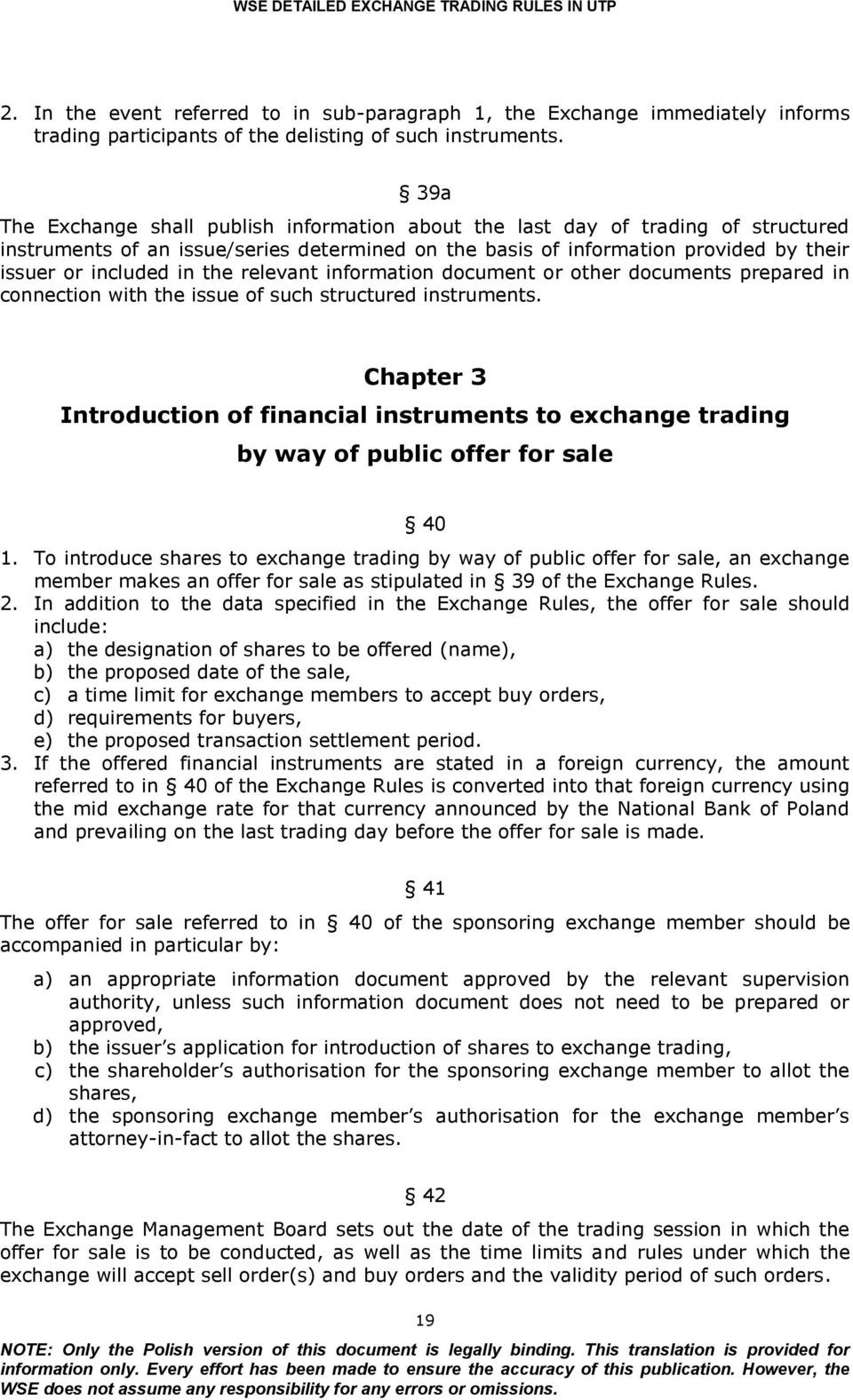
20 43 1. (repealed) 2. The orders referred to in 42 must be limit orders with no additional requirements. 3. The provisions of 37 of Division 4 do not apply to the modification of orders referred to in 42. In case of a modification, the priority of time of acceptance of the order is waived and the modification is considered submission of a new order. 44 Unless the offer for sale provides otherwise, where the shares are sold other than at a determined fixed price, transactions resulting from broker s orders referred to in 42 are made in accordance with the following rules: a) the offer price is determined by the sponsoring exchange member in accordance with 134.2(1) and (2) of the Exchange Rules, b) the orders are executed as follows: - all the buy orders with a limit price higher than the determined price should be executed in full, - the buy orders with a limit price equal to the determined price may be executed in full or in part, or may remain unexecuted, - no buy orders with a limit price lower than the determined price are executed, c) if, given the determined price, there is a buy surplus (limit orders to buy at the determined price cannot be executed in full), the limit orders to buy at the determined price are allocated, i.e., they will be executed in part in accordance with the following formula: aggregate size of executed limit orders to buy at the determined price = aggregate size of limit orders to buy at the determined price x rate of allocati on where: rate of alloca tion = 100% total number of shares in limit orders to buy at or above the determined price total number of shares in limit orders to buy at the determined price total number of shares in sell orders x 100 % 20
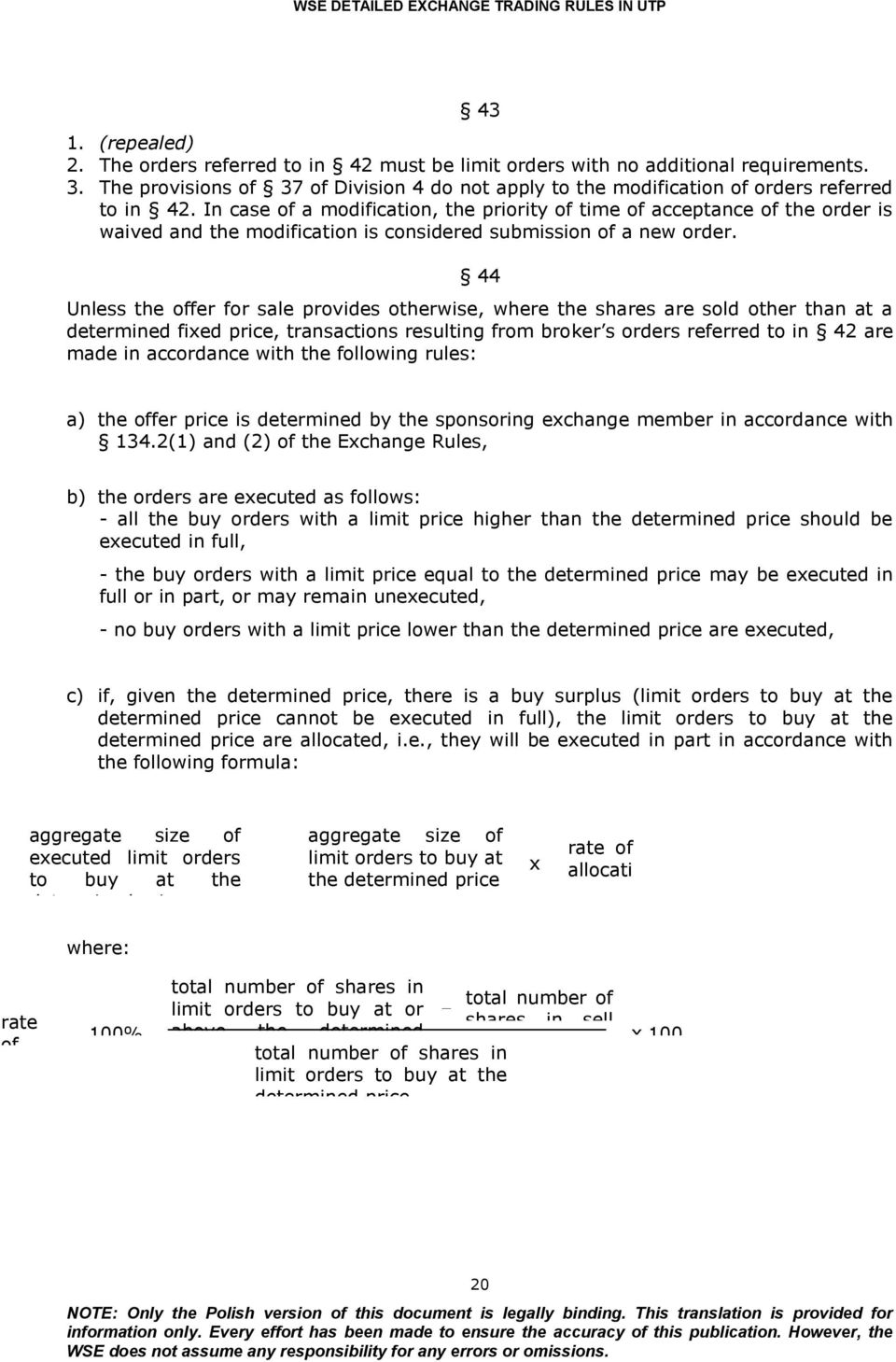
21 d) if, given the determined price, the number of shares in the limit orders to buy at or above the determined price is equal to or lower than the number of shares in the sell orders, all the buy orders are executed in full. 45 Unless the offer for sale provides otherwise, where the shares are sold at a determined fixed price, transactions resulting from broker s orders referred to in 42 are made in accordance with the following rules: a) if there is a buy surplus (buy orders cannot be executed in full), the buy orders are allocated, i.e., they will be executed in part in accordance with the following formula: aggregate size of executed buy orders whe re: = aggregate size of buy orders x rate of alloca tion rate of alloca tion total number of shares in x 100% = total sell orders number of shares in buy orders b) if the number of shares in the buy orders is equal to or lower than the number of shares in the sell orders, all the buy orders are executed in full. 45a If an offer for sale is executed by submitting more than one sale order, the Exchange Management Board sets out the rules of executing sale orders. 46 Immediately after the sale has closed, the sponsoring exchange member must inform the general public of the number of shares sold. 47 Whenever financial instruments other than shares are introduced to exchange trading by way of public offer for sale, the provisions of apply accordingly. 21
22 DIVISION 2 DETAILED OPERATING RULES FOR EXCHANGE MEMBERS AND MARKET MAKERS Chapter 1 Exchange members and exchange member representatives Section 1 Exchange members 1 1. Admission to operate on the exchange is granted according to the provisions of the Exchange Rules on the application of the interested entity. A specimen application is attached as Exhibit 4 to the Detailed Exchange Trading Rules. 2. A change of the scope of operation of an exchange member on the exchange is made according to the provisions of the Exchange Rules on the application of the interested entity. A specimen application is attached as Exhibit 5 to the Detailed Exchange Trading Rules. 3. The start date of operation of an exchange member on the exchange is determined according to the provisions of the Exchange Rules on the application of the interested entity. A specimen application is attached as Exhibit 6 to the Detailed Exchange Trading Rules. 4. An entity applying for admission to operate on the exchange or an exchange member in connection with applying for a change of the scope of its operation on the exchange proves its ability to correctly settle exchange transactions by way of providing the Exchange with: a) a confirmation from KDPW_CCP S.A. that the exchange member has the status of clearing member, or b) a confirmation from KDPW_CCP S.A. that another entity, with which the exchange member executed an agreement for clearing exchange transactions, has the status of clearing member, and a copy of that agreement. 5. Exchange members must meet technical and organisational criteria specified in the agreement concerning access of the exchange member to Exchange IT systems. 22
23 Section 2 Exchange brokers 2 An exchange member may not restrict the exchange broker s operations on the exchange. 3 An exchange broker is responsible in particular for submission of broker s orders to the exchange in accordance with the regulations governing the exchange. Submission of an order is understood in particular as its verification and authorisation in accordance with the internal regulations of the exchange member, so as to enable the exchange member to allocate the order to that exchange broker Upon an exchange member s request, the Exchange assigns the supervising broker a 4brokernet access profile enabling further access profiles to be created. 2. An exchange member maintains a register of individuals having access to 4brokernet and make it available upon written request of the Exchange. 5 An exchange member maintains a register of exchange brokers and makes it available upon written request of the Exchange. 6 An exchange member maintains records of broker s orders. The records should be kept for minimum five years. Section 3 Supervising brokers 7 1. A supervising broker is responsible in particular for: a) maintaining a register of the exchange member s exchange brokers, b) verifying the qualifications and experience of exchange brokers in accordance with the criteria specified in sub-paragraph 4, c) supervising the exchange member s exchange brokers, d) admitting the exchange member s exchange brokers to submitting orders to the exchange, 23
24 e) supervising whether the regulatory requirements are complied with when broker s orders are submitted, f) managing the creation and implementation of procedures for submitting orders to the exchange, g) acting as a contact person for authorised exchange staff members and other exchange members in matters concerning transactions made on the exchange, h) creating and managing 4brokernet access profiles. 2. The procedures referred to in sub-paragraph 1(f) should include in particular: a) the procedure to grant authorisations to exchange brokers, including the rules of verifying their qualifications and experience by an exchange member, including at least the criteria specified in sub-paragraph 4, b) the rules of submitting orders to the exchange, c) the rules of screening orders, including determination of limits concerning the entered orders and rules of establishing limits, d) the rules of an exchange broker s access to the system of the exchange member enabling access to submission (verification) of orders to the exchange (granting access profiles). 3. An exchange member keeps records of the procedures referred to in sub-paragraph 2 and records of broker s orders including information about the supervising broker responsible for a given procedure and its application to individual broker s orders. An exchange member makes the records available upon written request of the exchange. The records should be kept for minimum five years. 4. An exchange member applies the following criteria for assessment of qualifications and experience of exchange brokers, ensuring efficient and safe participation in exchange trading: a) knowledge of exchange regulations, procedures and recommendations related to exchange trading organisation, b) knowledge of the exchange member s internal procedures related to the rules of submitting broker s orders to the exchange, c) practical knowledge of the rules of submitting broker s orders to the exchange. 5. An exchange member, upon request of the Exchange, documents the verification made, as referred to in sub-paragraph 1(b) A specimen application for entering a candidate into the register of supervising brokers is attached as Exhibit 7 to the Detailed Exchange Trading Rules. 2. The application should be accompanied by a certificate of the candidate s passing the examination on knowledge of the regulations governing the exchange, the procedures and rules of submitting broker s orders and receiving information for the purpose of conducting the trading or a certificate referred to in 95.5 of the Exchange Rules. 3. The Exchange informs the exchange member and the Financial Supervision Authority about any changes to the register of supervising brokers. 9 24
25 An exchange member ensures that authorised Exchange staff members can contact the relevant supervising broker by telephone. Chapter 2 Detailed operating rules for market makers on the cash and derivatives market The performance of actions of a market maker of specific financial instruments under a contract referred to in 81 of the Exchange Rules may start upon the receipt by the Exchange of information from the National Depository for Securities concerning the opening of registration accounts to record transactions executed by the given exchange member as a part of performing the tasks of a market maker of organised trading for those financial instruments. 2. In the case of a non-member entity referred to in 81.1 of the Exchange Rules, operations referred to in sub-paragraph 1 may start provided that such entity designates an exchange member through which the orders of that entity are to be submitted as part of performing the tasks of a market maker. The provisions of subparagraph 1 apply accordingly to the exchange member referred to in the first sentence Subject to sub-paragraph 3, among the tasks of a market maker aiming at supporting the liquidity of a given financial instrument are in particular to submit buy and sell orders for a given financial instrument on its own account. 2. Orders referred to in sub-paragraph 1 must meet requirements set out by the Exchange in the market maker s contract referring in particular the minimum value or size, the maximum spread between the limit prices in the best of these orders (the highest price limit for limit orders to buy and the lowest price limit for limit orders to sell). 3. In the market maker s contract, the Exchange sets out conditions under which it is possible to submit buy orders only or sell orders only In the continuous trading system, as part of the tasks referred to in 11.1, the market maker in particular: a) enters, no later than five minutes before the opening and closing prices are determined, unless the contract provides otherwise, and maintains, subject to 11.3, throughout the continuous trading, buy and sell orders meeting the requirements referred to in 11.2, b) throughout the continuous trading, aligns from time to time their own orders with the requirements set out in point (a), with a reaction time not exceeding five minutes. 25
26 2. In the single-price auction system, as part of the tasks referred to in 11.1, subject to 11.3, the market maker in particular enters, no later than five minutes before the opening auction, buy and sell orders meeting the requirements referred to in If any of the orders referred to in 11.1 are iceberg orders, their hidden size may not be lower than the minimum size or value of orders as specified in the market maker s contract. 2. The orders referred to in 11.1 must contain a correct operations type designation referred to in Division A market maker, during a trading session, is released from the duties set out in 11.1 once at least one of the following limits has been exceeded, if such limits have been set out in the market maker s contract: a) daily commitment limit, this limit being here understood as the difference between the number or value of financial instruments that have been purchased and those that have been sold (or, as the case may be, those that have been sold and those that have been purchased) during a trading session by the market maker in their capacity as such, b) total commitment limit, this limit being here understood as the number of open interests for a financial instrument (series) in the case of derivatives, c) global commitment limit, this limit being here understood as the sum total of open interests in all series of a class of a financial instrument in the case of derivatives (class in the meaning of the relevant terms of trading). 15 In special cases, and on the application of a market maker: a) the chairman of the session may release that market maker from the duties set out in 11.1, but only for the duration of that session, b) a member of the Exchange Management Board or an Exchange staff member authorised by the Exchange Management Board may release the market maker from the duties set out in 11.1, but only for a term. 16 The Exchange discloses to the general public information on contracts with market makers, in particular the start and end date of the market maker s performance of tasks for a financial instrument. 17 The provisions of apply accordingly to a non-member entity that has agreed to perform the tasks of a market maker on the exchange. 26
27 18 The detailed operating rules for market makers in organisation of trading in financial instruments in the market maker system are set out in the provisions of Division 5 ( Detailed rules of trading in the market maker system ). DIVISION 3 Exchange production IT system access 1 1. The Exchange production IT system, hereinafter the exchange IT system, comprises: a) the transaction system and b) the exchange information system. 2. An exchange member s access to the exchange IT system for the purpose of conducting trading is based on an agreement concerning access of the exchange member to exchange IT systems on the terms and conditions set out therein. 2 The right to access the exchange IT system is vested only in: a) exchange members through exchange brokers as regards access to the transaction system and the exchange information system to the extent necessary to operate on the exchange, b) authorised Exchange staff members as regards access to the transaction system and the exchange information system to the extent compliant with the trading organisational framework, c) authorised staff members of the Financial Supervision Authority Office as regards access to the exchange information system, d) other persons upon the approval of the Exchange Management Board and following the rules laid down therein, e) KDPW_CCP S.A. on such terms and conditions as determined in an agreement executed under of the Exchange Rules The exchange member s right to access the exchange IT system is understood as: a) the right to connect to and communicate with the transaction system for the purpose of placing, modifying and cancelling broker s orders and receiving information on the status of orders placed and transactions made in order for the exchange member to conduct the exchange trading, and b) the right to connect to the exchange information system for the purpose of accessing exchange information in order for the exchange member to conduct the exchange trading. 27
28 2. Access to the transaction system may be exercised only by the exchange broker authorised by the exchange member using the access profile assigned to the exchange broker under Access to the exchange information system may be exercised only for the needs of the exchange member s enterprise on the terms set out in the agreement referred to in The exchange member is solely liable for arranging access including the technical infrastructure designated and used by the exchange member to exercise access to the exchange information system, the mode of use of access, and any action or omission of persons managing of administering the infrastructure of behalf of the exchange member The IT system is accessed by the exchange member via a remote connection. 2. The right to access the transaction system is granted to the exchange member s exchange brokers by the exchange member s supervising broker by way of assigning personal access profiles to authorised persons. 3. Broker s orders submitted to the exchange by an exchange broker are verified following procedures specified by the supervising broker. 4. The exchange member s supervising broker maintains records of assigned transaction system access profiles Information on the access profile assigned is for the person assigned the profile only and may not be disclosed or made available to third parties. 2. The exchange member is solely liable for making the access profile available to an unauthorised person. 6 The transaction system access profile authorises the use of the transaction system only at such time, to such extent and at such place as is required for the exchange member to perform operations pursuant to the exchange organisational framework and the scope of authorisation granted by the Exchange Subject to sub-paragraphs 3 and 4, an exchange member may not disseminate to third parties any information that they have obtained from the exchange information system, unless and until they have executed a contract with the Exchange referred to in sub-paragraph An exchange member may contract with the Exchange for the distribution of exchange information in order to obtain the right to disseminate such information to third parties. 3. The Exchange Management Board may permit an exchange member to disseminate by electronic means information obtained from the exchange information system, but only to those entities that the exchange member represents according to the regulations of the National Depository for Securities. 4. Permission referred to in sub-paragraph 3 does not authorise any further dissemination by electronic means of information obtained from the exchange information system. 28
29 8 The Exchange Management Board determines further course of action in the event of force majeure or any other event rendering the use of the exchange IT system impossible. 9 The transaction system referred to in 1.1(a) shall also be understood as a system of encrypted internet communication (4brokernet system) referred to in these Detailed Rules. 29
30 DIVISION 4 DETAILED RULES OF TRADING ON THE CASH AND DERIVATIVES MARKET Chapter 1 General provisions 1 1. The provisions of this Division regulate the detailed rules of trading in exchange sessions in financial instruments admitted and introduced to exchange trading other than instruments traded in the market maker system. 2. Financial instruments marked with a given ISIN code and traded according to the provisions of this Division may not be simultaneously in trading in the market maker system organised according to the provisions of Division 5 ( Detailed rules of trading in the market maker system ). 3. Whenever instruments or financial instruments are mentioned below in this Division, this means only financial instruments in trading organised according to the provisions of this Division. Chapter 2 Trading system 2 1. Financial instruments introduced to exchange trading, other than instruments classified for trading in the market maker system, are traded in the continuous trading system which is not a market maker system (hereinafter continuous trading system ), unless otherwise provided for in this Division or Division Pre-emptive rights from shares traded on the exchange are traded in the same trading system as the shares. 3. Rights to shares are traded in the same trading system as the already listed shares of the issuer. 4. The Exchange Management Board or an Exchange staff member authorised by the Exchange Management Board may decide to introduce financial instruments to a trading system other than referred to in sub-paragraphs 1 3 taking into account in particular 30
31 the number and value of the financial instruments being introduced to exchange trading, as well as the projected liquidity of trading in such instruments and their specificity Shares classified in the regulated market segment ALERT LIST or classified in the Lower Liquidity Space are traded in the single-price auction system starting on the third trading day after the date of publication of the classification to trading participants. 2. Shares which are no longer classified in the regulated market segment ALERT LIST or in the Lower Liquidity Space are traded in the continuous trading system starting on the third trading day after the date of publication of their discontinued classification to trading participants, unless the Exchange Management Board or an Exchange staff member authorised by the Exchange Management Board decides otherwise The Exchange Management Board or an Exchange staff member authorised by the Exchange Management Board may change the trading system of financial instruments listed on the exchange (other than shares classified in the WIG20, mwig40 and swig80 indices, shares referred to in 3.1 and ETF units) taking into account in particular the liquidity of trading in the financial instruments, the volatility and the level of instrument prices. 2. The decision to change the trading system is published for information of trading participants no later than 3 trading days before the change of the trading system. 31
32 Chapter 3 Trading schedule and phases Section 1 Trading schedule 5 1. Trading at trading sessions takes place from Monday to Friday in accordance with the following schedule: 1) continuous trading system (except for derivatives, debt financial instruments and ETF units): Opening call 9.00 Opening auction (determination of the opening price) Continuous trading phase Closing call Closing auction (determination of the closing price) Trading at last 2) continuous trading system for derivatives, subject to point 3): Opening call 8.45 Opening auction (determination of the opening price) Continuous trading phase Closing call Closing auction (determination of the closing price) Trading at last 32
33 3) continuous trading system for derivatives on (i) WIBOR reference rates and (ii) short-term, mid-term and long-term Treasury bonds: Opening call 9.00 Opening call (determination of the opening price) 9: Continuous trading phase 4) continuous trading system for debt financial instruments: Opening call 9.00 Opening auction (determination of the opening price) Continuous trading phase Closing call Closing auction (determination of the closing price) Opening call 5) continuous trading system for ETF units: Opening call 9.05 Opening auction (determination of the opening price) Continuous trading phase Closing call Closing auction (determination of the closing price) Trading at last 6) single-price auction system with two auctions: Opening call Opening auction (determination of the single price) Trading at last Opening call 33
34 15.00 Opening auction (determination of the single price) Trading at last Opening call 7) single-price auction system with one auction: Opening call Opening auction (determination of the single price) Trading at last Opening call 2. Hours set out in the trading schedule represent the earliest time when a given trading phase may start and end. 3. If at the time set out in the schedule, a given trading phase for a specified class of financial instruments is not started, then financial instruments of that class remain at the previous phase. 4. A class of financial instruments, hereinafter also class or class of instruments, is a group of financial instruments with the same trading parameters set out respectively in Chapter 8 or 9. A class of derivatives within the meaning of the terms of trading in derivatives is not a class within the meaning of the first sentence. 5. The Exchange publishes the composition of each class of financial instruments. 6. Debt financial instruments include bonds (other than structured bonds) and mortgage bonds. Section 2 Trading phases single-price auction system Opening call 6 1. In the opening call, new broker s orders may be submitted to the exchange but no trade is made. 2. Existing orders in the order book may be modified and cancelled in this phase. 3. In this phase, the Exchange publishes the theoretical opening price (TOP) and the theoretical opening volume (TOV), which are updated on an on-going basis on every change in the order book resulting from acceptance, modification or cancellation of an order. 34
35 4. The theoretical opening price (TOP) and the theoretical opening volume (TOV) are determined according to the provisions of 145.1, and 153 of the Exchange Rules subject to the provisions of 30.7 and 30.8 of this Division. 5. The provisions of sub-paragraphs 3 and 4 apply accordingly to the determination of the theoretical opening price (TOP) and the theoretical opening volume (TOV) in the single-price auction system in the period of suspension of trading with the possibility of submitting, modifying and cancelling broker s orders. Opening auction 7 1. In the opening auction, new broker s orders are not accepted for the order book and existing orders in the order book may not be modified or cancelled. 2. Broker s orders submitted to the exchange in this phase await acceptance for the order book in the next phase. Such orders are accepted for the order book immediately after the end of the opening auction according to the priority of price and time of acceptance on the exchange if they fulfil the conditions of acceptance for the order book. 3. In the opening auction, the single price is determined, orders are executed and trade is made. 4. Orders which fulfil the conditions of execution are executed at a price equal to the single price. 5. If the highest limit in a buy order is lower than the lowest limit in a sell order or there are only buy orders or only sell orders or there are no orders (a divergent market), the single price is not determined. Trading at last 8 1. In the single-price auction system, trading at last is organised for all classes of financial instruments. 2. In the trading at last phase, only limit orders may be submitted at a price equal to the price of the last trade. 3. In the trading at last phase, previously submitted broker s orders may be cancelled and modified in order to execute them at a price equal to the price of the last trade. 4. In the trading at last phase, trade is made at the price of the last trade. Section 3 Trading phases continuous trading system Opening/Closing call 9 1. In the opening call, new broker s orders may be submitted to the exchange but no trade is made. 35
36 2. Existing orders in the order book may be modified and cancelled in this phase. 3. In this phase, the Exchange publishes the theoretical opening price (TOP) and the theoretical opening volume (TOV), which are updated on an on-going basis on every change in the order book resulting from acceptance, modification or cancellation of an order. 4. The theoretical opening price (TOP) and the theoretical opening volume (TOV) are determined according to the provisions of 134.1, and 143 of the Exchange Rules subject to the provisions of 30.7 and 30.8 of this Division. 5. The provisions of sub-paragraphs 3 and 4 apply accordingly to the determination of the theoretical opening price (TOP) and the theoretical opening volume (TOV) in the continuous trading system during halting and in the period of suspension of trading with the possibility of submitting, modifying and cancelling broker s orders. Opening auction/closing auction In the opening/closing auction, the opening price/closing price is determined respectively, orders are executed and trade is made respectively at the opening price/closing price. 2. In the opening/closing auction, new broker s orders are not accepted for the order book and existing orders in the order book may not be modified or cancelled. 3. Broker s orders submitted to the exchange in this phase await acceptance for the order book in the next phase. Such orders are accepted for the order book immediately after the end of the opening auction/closing auction respectively according to the priority of price and time of acceptance on the exchange if they fulfil the conditions of acceptance for the order book. 4. Broker s orders which fulfil the conditions of execution are executed at a price equal respectively to the opening price/closing price. 5. If the highest limit in a buy order is lower than the lowest limit in a sell order or there are only buy orders or only sell orders or there are no orders (a divergent market), the opening price is the price of the first trade made in the session in the continuous trading system and the closing price is the price of the last trade made in the session. If no trade was made in the session, the opening and closing price is not determined. 6. All orders unexecuted in the opening auction move to the continuous trading phase unless provided otherwise in the terms of execution of an order. 7. All orders unexecuted in the closing auction move to the next trading phase unless provided otherwise in the terms of execution of an order. Continuous trading phase In the continuous trading phase, new broker s orders may be submitted to the exchange and existing orders in the order book may be modified and cancelled. 36
37 2. In this phase, orders are executed according to the priority of price and subsequently the priority of time of acceptance for the order book subject to the provisions of this Division, in particular the provisions concerning the rules of execution of MO orders. 3. In the trading phase, trade is made at the price of the best order awaiting execution in the order book subject to the provisions of this Division, in particular the provisions concerning the rules of execution of MO orders. Trading at last In the continuous trading system, trading at last is organised for all classes of financial instruments other than debt financial instruments, derivatives on WIBOR reference rates and derivatives on short-term, mid-term and long-term Treasury bonds. 2. During trading at last, only limit orders may be submitted at a price equal to the currently applicable reference price for dynamic collars provided that, where at least one trade was made at the session, the limit price shall be equal to the price of the last trade made at the session. 3. During trading at last, previously submitted broker s orders may be cancelled and modified in order to execute them at a price equal to the price referred to in subparagraph During trading at last, trade is made at the price equal to the price referred to in sub-paragraph 2. Chapter 4 Detailed rules of accepting, executing, modifying and cancelling broker s orders Section 1 General rules A broker s order submitted to the exchange should include in particular: 1) name or code of the financial instrument concerned by the order, 2) type of order (buy/sell), 3) quantity of financial instruments concerned by the trade; 4) limit price or instructions to execute the order without a limit price, 5) operations type designation: a) on own account, b) on clients account, c) market maker, 6) order validity designation, 7) name or code of the issuer of the order, 8) date of issue of the order, 37
38 9) order identifier. 2. The following operations type designations referred to in sub-paragraph 1(5) apply: 1 or void order on own behalf and on clients account, 2 order on own behalf on own account of an exchange member other than market making, 6 order on own behalf on own account of an exchange member performing the tasks of a market maker, 7, 8, 9 order on own account of a non-member entity performing the tasks of a market maker; a given designation is used for a market maker under a contract with the Exchange. 3. [repealed] 4. When submitting a broker s order, an exchange member may indicate additional types of validity or conditions of execution of the order according to the provisions of this Division. 5. A limit price in a broker s order should be set according to the tick size applicable to the relevant financial instrument Subject to legal regulations, a broker s order may concern any quantity of financial instruments but no more than: 1) 2% of financial instruments introduced to exchange trading and marked with the same ISIN code, and if 2% of such instruments are less than 1,000,000 instruments no more than 1,000,000 instruments, subject to point (2); 2) 1% of debt financial instruments introduced to exchange trading and marked with the same ISIN code, and if 1% of such instruments are less than 1,000 instruments no more than 1,000 instruments - and no more than the aggregate number of such instruments introduced to exchange trading. 2. Subject to the limitations under sub-paragraph 1(1), if the value of a broker s order exceeds the Maximum value of a broker s order which requires no confirmation referred to in Chapter 8, such an order requires an additional confirmation in the exchange transaction system. If the exchange member that submitted the order does not confirm it, the order is rejected. 3. Subject to the limitations under sub-paragraph 1(2), if the value of a broker s order exceeds the Maximum volume of a broker s order which requires no confirmation referred to in Chapter 8, such an order requires an additional confirmation in the exchange transaction system. If the exchange member that submitted the order does not confirm it, the order is rejected. 4. The provisions of subparagraphs 1 3 do not apply to broker s orders for derivatives. The maximum number of derivatives in a broker s order is set in the provisions of Chapter 9 applicable to the relevant class of financial instruments. A broker s order whose volume exceeds the maximum number of derivatives per order set in the provisions of Chapter 9 applicable to the relevant class of financial instruments is rejected. 38
39 5. The value of an order, referred to in sub-paragraph 2, is determined as follows: 1) for limit and stop limit orders order volume times order limit price; 2) for MO, MTL, stop loss orders order volume times applicable reference price for dynamic collars; 3) for peg orders (irrespective of the additional limit price) - order volume times applicable reference price for dynamic collars. 6. The Exchange Management Board may decide to temporarily waive the requirements referred to, respectively, in sub-paragraphs 2, 3 or 4. In that case, the submission of a broker s order whose value or volume exceeds the maximum value, volume or number set for the given class of instruments according to the provisions of Chapter 8 or 9 shall not require an additional confirmation in the exchange transaction system or such order shall not be rejected due to such exceedance. Section 2 Types of broker s orders Limit orders (LIMIT) A limit order is an order quoting a price beyond which the order may not be executed, such price being the maximum bid price for buy orders or the minimum offer price for sell orders. 2. Limit orders may be submitted: a) in the continuous trading system in the opening call, in the continuous trading phase, in the closing call, and in the trading at last phase, b) in the single-price auction system in the opening call and in the trading at last phase. 3. Where the Static collars for orders functionality applies to the given class of financial instruments according to the provisions of Chapter 8 or 9, limit orders concerning such instruments at a price exceeding the static collars are not accepted and existing limit orders in the order book at a price exceeding the static collars valid for the next trading session become void after the end of the relevant session. Market orders (MO) 1. MO orders have no limit price. 2. MO orders may be submitted: 16 a) in the continuous trading system in the opening call, in the closing call, and in the continuous trading phase, b) in the single-price auction system in the opening call. 39
40 3. Subject to sub-paragraph 4, in the continuous trading phase, MO orders are executed at the best possible prices of opposite orders awaiting execution in the order book. An unexecuted part of an MO order remains in the order book. 4. When an MO order is accepted, if the only order opposite to the MO order in the order book is an MO order, the MO order is executed at a price equal to the price of the last trade made on that day and if there is no trade at the reference price for dynamic collars. 5. MO orders have the same priority of execution as MTL orders and have the same highest priority of execution in relation to price as MTL orders. 6. If there are existing unexecuted MO and MTL orders in the order book, the priority of their execution is the priority of time of their acceptance for the order book. 7. Modification of an MO order to an MTL order in the opening call does not waive the priority of time of acceptance of the given order for the order book. Market to limit orders (MTL) 1. MTL orders have no limit price MTL orders may be submitted: a) in the continuous trading system in the opening call, in the continuous trading phase, and in the closing call, b) in the single-price auction system in the opening call. 3. Subject to sub-paragraph 4, in the continuous trading phase, MTL orders are executed at the best possible price of an opposite order awaiting execution in the order book. If an MTL order is executed in part, the unexecuted part of the order is converted into a limit order at a price equal to the price of the last trade. 4. When an MTL order is accepted, if the only order opposite to the MTL order in the order book is an MO order, the MTL order is executed at a price equal to the price of the last trade made on that day and if there is no trade at the reference price for dynamic collars. 5. MTL orders have the same priority of execution as MO orders and have the same highest priority of execution in relation to price as MO orders. 6. If there are existing unexecuted MO and MTL orders in the order book, the priority of their execution is the priority of time of their acceptance for the order book. 7. In the continuous trading phase, when an MTL order is accepted, at least one opposite order must be awaiting execution in the order book; otherwise, the MTL order is rejected. 8. Modification of an MTL order to an MO order in the opening call does not waive the priority of time of acceptance of the given order for the order book. 9. Subject to sub-paragraph 11, in the single-price auction system, if an MTL order is not executed in the opening auction, the MTL order (or its unexecuted part) is converted into a limit order at a price equal to the single price after that phase. 10. Subject to sub-paragraph 11, in the continuous trading system: 40
41 a) if an MTL order is not executed in the opening auction, the MTL order (or its unexecuted part) is converted into a limit order at a price equal to the opening price after that phase, b) if an MTL order is not executed in the closing auction, the MTL order (or its unexecuted part) is converted into a limit order at a price equal to the closing price after that phase. 11. If there is halting after the opening auction/closing auction, an MTL order (or its unexecuted part) is converted into a limit order after the end of halting. 18 Stop orders (STOP) 1. A stop order includes a stop price and a limit price at which the order is executed (stop limit order) or instructions to execute the order without a limit price (stop loss order). 2. Stop orders may be submitted to the exchange in all phases in the continuous trading system and in the single-price auction system other than in the trading at last phase. 3. A stop order is displayed (activated) in the order book once the price of the last trade is higher than or equal to (for buy orders) or lower than or equal to (for sell orders) the stop price, subject to sub-paragraphs 4 and Subject to sub-paragraph 5, a stop order which fulfils the conditions of activation is displayed in the order book immediately once orders without a stop price have been executed. 5. If there is a trading at last phase after the determination of the single price or the closing price which fulfils the conditions referred to in sub-paragraph 3, a stop order which fulfils the conditions of activation is displayed in the order book after the end of that phase. 6. If a stop loss order is activated, the order is added to the order book as an MO order; if a stop limit order is activated, it is added as a limit order. 7. At the time of acceptance for the order book, the stop price of a stop order must be higher (for buy orders) or lower (for sell orders) than the price of the last trade at the given trading session and, if no trade was made in the given trading session, than the reference price for the opening price in the continuous trading system or, respectively, than the reference price of the single price. 8. The limit price of a stop order must be higher than or equal to (for buy orders) or lower than or equal to (for sell orders) the stop price of the order unless, instead of the limit price, the stop orders includes instructions to execute the order without a limit price (stop loss order). 9. Stop orders are prioritised for activation according to the stop price and, in the case of orders with the same stop price, according to the time of acceptance of the order on the exchange. 41
42 10. Activated stop orders with the same limit price and orders with instructions to execute the order without a limit price are prioritised for execution according to the time of their activation. 11. Once activated, stop orders are executed according to the rules applicable to broker s orders without stop limit. 12. The stop price or the limit price of a stop order may be modified only subject to the provisions of sub-paragraphs 7 and In the opening call, stop orders are not displayed in the order book. 14. Stop orders are not included in the determination of the theoretical opening price (TOP) or the theoretical opening volume (TOV). Peg orders (PEG) Peg orders are orders with a limit price which automatically becomes equal to the limit price of the best order on the same side of the order book according to the provisions of sub-paragraphs A peg order may include an additional fixed limit price: a) maximum for buy orders, b) minimum for sell orders - and once it is exceeded, the basic (variable) limit price of the peg order is no longer updated. 3. The additional limit price limits the automatic update of the basic (variable) limit price of the order until the limit price of the best buy order is higher than the additional limit of the peg order or the limit price of the best sell order is lower than the additional limit of the peg order. 4. The basic (variable) limit price of a peg order is once again automatically updated if: a) the limit price of the best buy order in the order book falls below the maximum additional limit price of the peg order for peg orders which are buy orders, b) the limit price of the best sell order rises above the minimum additional limit price of the peg order for peg orders which are sell orders. 5. Peg orders may only be submitted in the continuous trading phase. 6. Peg orders are not accepted and accepted orders become void: a) in the continuous trading phase, if there are no limit orders on the same side of the order book, b) if trading is suspended; c) in the opening/closing call, d) in trading at last, e) during halting. 7. The priority of time of acceptance of a peg order is waived every time that the basic (variable) limit price of the order is updated. 8. The priority of time of acceptance of a buy peg order is waived every time that: a) as a result of addition or modification, its additional limit price is/becomes lower than the limit price of the best buy order in the order book, or 42
43 b) its additional limit price is modified where it was lower than the limit price of the best buy order in the order book before the modification. 9. The priority of time of acceptance of a sell peg order is waived every time that: a) as a result of addition or modification, its additional limit price is/becomes higher than the limit price of the best sell order in the order book, or b) its additional limit price is modified where it was higher than the limit price of the best sell order in the order book before the modification. Section 3 Broker s order validity designation Broker s orders may include the following designation of their maximum validity: 1) Day (D), 2) Good Till Date (GTD), 3) Good Till Cancel (GTC), 4) Good Till Time (GTT), 5) Valid for Auction (VFA), 6) Valid for Closing (VFC). 2. If there is no order validity designation, it is assumed that the order is valid today (no longer than the end of the trading session on the day it was submitted to the exchange). Day orders (D) 21 D orders are valid no longer than the end of the trading session on the day they were submitted to the exchange. Good Till Day orders (GTD) GTD orders are valid no longer than the end of the specified order validity date but no more than 365 days. 2. Orders with a validity date longer than 365 are not accepted. Good Till Cancel orders (GTC) 23 GTC orders are valid no more than 365 days after the day they were submitted to the exchange. 43
44 Good Till Time orders (GTT) 24 GTT orders are valid no longer than the time set in the orders, on the day they were submitted to the exchange, but no longer than the end of the trading session on the day they were submitted to the exchange. The order validity time is specified with a precision of one second. Valid For Auction orders (VFA) VFA orders are valid until the end of the next opening auction, closing auction, or during halting, respectively, on the day they were submitted to the exchange. 2. VFA orders may be submitted to the exchange in each phase of the trading session in which orders of the given type may be submitted, but they are added to the order book on the start of the next opening call, closing call, or during halting, respectively. Once displayed in the order book, such orders receive the priority of time of acceptance according to the time of acceptance on the exchange. Valid For Closing orders (VFC) VFC orders are valid until the end of the closing auction, on the day they were submitted to the exchange. 2. VFC orders may be submitted to the exchange in each phase of the trading session in which orders of the given type may be submitted, but they are added to the order book on the start of the next closing call. Once displayed in the order book, such orders receive the priority of time of acceptance according to the time of acceptance on the exchange. Section 4 Additional types of validity of broker s orders Fill-and-Kill orders (FaK) FaK orders are valid until the first trade is made on the basis of the order (or first trades if an order is executed in more than one trade at the same time), and the unexecuted part of the order becomes void. 2. FaK orders may only be submitted to the exchange in the continuous trading phase and in the trading at last phase. 3. After a FaK order has been accepted, if no opposite limit orders are awaiting in the order book which enable the trade to be made at a price within the collars, then the FaK order becomes void. 44
45 Fill-or-Kill orders (FoK) FoK orders are valid until a trade is made on the basis of the order (or trades if an order is executed in more than one trade at the same time), and must be executed in full or not at all. 2. FoK orders may only be submitted to the exchange in the continuous trading phase and in the trading at last phase. 3. After a FoK order has been accepted, if no opposite limit orders are awaiting in the order book which enable the trade to be made at a price within the collars, then the FoK order becomes void. Section 5 Additional conditions of execution of broker s orders Minimum quantity orders (MinQty) MinQty orders may be submitted to the exchange only in the trading at last phase and in the continuous trading phase, except when halting activities occur. 2. MinQty orders are executed in full or, if in part, then at the minimum size required in the order. 3. Where the order book is such that the MinQty order may not be executed immediately at least at the minimum required size, the order becomes void. 4. Any unexecuted part of a MinQty order remains in the order book as a broker s order without the minimum quantity condition. 5. A MinQty order may additionally contain the hidden size condition. Iceberg Orders Iceberg orders may be submitted to the exchange in all phases in the continuous trading system and in the single-price auction system. 2. The hidden size condition is an instruction determining the volume of the order to be disclosed in the order book. Subject to sub-paragraph 5, the next part of the order may only be disclosed after the previous one has been executed. If the last part of the order is smaller than the hidden size, then the last part of the order is disclosed. 3. Where a single order is executed, which is opposite to awaiting iceberg orders with the same limit price, first the disclosed part of the awaiting orders is executed, and then the remaining parts of the orders are executed according to the priority of time of acceptance of orders. Unexecuted parts of orders remain in the order book with the hidden size condition. 45
46 4. Where there are two or more orders with the same limit price, the iceberg orders are disclosed in the same sequence as the time of their acceptance on the exchange. 5. Where there are two or more orders with the same limit price, the execution of the orders hidden size is prioritised according to the time of disclosure in the order book. 6. A hidden size of an order may not be lower than 10 trading units. 7. The determination of TOP and TOV takes into account the total volume of an iceberg order. 8. Publication of TOV ignores the hidden size of the volume of an iceberg order. 9. An iceberg order may additionally contain the minimum quantity condition (MinQty) When submitting brokers orders, validity designations and types and additional conditions of execution may only be applied and combined in accordance with the scheme set out in Appendix 1 to the Detailed Exchange Trading Rules. 2. When modifying brokers orders, validity designations and types and additional conditions of execution may only be applied and combined in accordance with the scheme set out in Appendix 2 to the Detailed Exchange Trading Rules. Section 6 Priority of price and time of acceptance for the order book Broker s orders are executed according to the priority of price and time of acceptance for/disclosure in the order book unless the provisions of this Division determine otherwise. 2. MO and MTL orders have priority of execution over limit orders irrespective of the time of their acceptance for the order book. 3. Buy orders with a higher limit price and sell orders with a lower limit price have priority of execution. 4. Orders with the same limit price are accepted for the order book and then executed according to the priority of time of acceptance so that orders accepted/disclosed first are executed first. 46
47 Section 7 Detailed rules of execution of orders in trading session phases Title 1 Execution of broker s orders in the opening auction, in the closing auction, and during halting In the opening auction, in the closing auction, and during halting, all broker s orders are executed at the same price equal to, respectively, the single price, the opening price, the closing price or the price determined as a result of halting. 2. Broker s orders are executed according to the priority of price and then according to the priority of time of acceptance/disclosure of the order. 34 For limit orders with a limit price equal to, respectively, the single price, the opening price, the closing price, or the price determined as a result of halting, the sequence of execution of orders is determined by the priority of time of acceptance of orders. Title 2 Execution of orders in the continuous trading phase In the continuous trading phase, trade is made on a continuous basis at different prices according to the rules below. 2. In the continuous trading phase, broker s orders may be executed in full (in one or more than one trade), in part or may remain unexecuted. 3. In the continuous trading phase, broker s orders are executed according to the priority of price and then according to the priority of time of acceptance/disclosure of the order. 4. In the continuous trading phase, trade is made at a price equal to the limit price of the best opposite order awaiting execution in the order book, subject to subparagraphs If an order opposite to the submitted order which fulfils the conditions of execution is awaiting execution in the order book, the submitted order is executed immediately provided that the trading price is within the applicable collars. 6. If an MO order is awaiting execution in the order book and there is no halting, submission of an opposite order results in a trade being made at the best of the following prices (best to the party submitting the opposite order): a) at a price equal to the price of the last trade and, if no trade is made on the given day, equal to the reference price for the dynamic collars, or 47
48 b) at a price equal to the best limit of a limit order existing on the same side of the order book as the awaiting MO order, or c) at a price equal to the limit of the opposite order. 7. The best price within the meaning of sub-paragraph 6 is understood as: a) the highest price where the submitted opposite order is a sell order, b) the lowest price where the submitted opposite order is a buy order. Section 8 Detailed rules of execution of broker s orders in cross trade Limit broker s orders may be executed in trading sessions in trades made on the basis of two opposite orders with the same limit price (a buy order and a sell order for the same quantity of financial instruments at the same price) submitted for this purpose simultaneously by the same exchange member: a) on behalf of and on the account of two clients of that exchange member, or b) on behalf of and on the account of that exchange member and its client, - hereinafter cross orders. 2. Cross orders are not accepted for the order book, are not included in the determination of the opening price, the closing price, or the price determined in halting, and are not executed with broker s orders awaiting execution in the order book. 3. Cross orders may only be submitted in the continuous trading phase and in the trading at last phase. 4. In the continuous trading phase, the limit price of cross orders must fulfil simultaneously the following conditions: a) it must be within the collars applicable to the given financial instrument at the time of submitting the cross orders, and b) if there is/are buy order/orders in the order book at the time of submitting the cross orders, it must be equal to or higher than the highest price in this/these buy order/orders, and c) if there is/are sell order/orders in the order book at the time of submitting the cross orders, it must be equal to or lower than the lowest price in this/these sell order/orders, and d) if there is/are MO buy order/orders in the order book at the time of submitting the cross orders, it must be equal to or higher than the reference price for dynamic collars, and e) if there is/are MO sell order/orders in the order book at the time of submitting the cross orders, it must be equal to or lower than the reference price for dynamic collars. 48
49 5. In the trading at last phase, the limit price of cross orders must be equal to the trading at last price. 6. (repealed) 7. Cross orders cannot contain additional execution conditions. 8. Execution of cross orders and making of trade on their basis result in activation of stop orders in the order book provided that their activation conditions are fulfilled. Section 9 Cancellation and modification of broker s orders Broker s orders may be modified or cancelled by the exchange member that submitted the given broker s order. Deletion of an order by the Exchange from the exchange IT systems on request of the exchange member that submitted the given broker s order or in the performance of the Cancel on Disconnection service (in the cases and on the terms set out in an agreement signed with the exchange member) shall also be considered cancellation of a broker s order by an exchange member. 2. An order cannot be modified by changing the instrument concerned by the order or by changing the type of order (buy/sell). It is not possible to modify an order by changing a cross order to another broker s order or orders. 3. In case of modification of a broker s order involving: a) increase of the hidden size of the order, b) increase of the volume of the order without a hidden size condition, c) change of the limit price, d) change of an order without limit price into a limit order or vice versa, e) change or determination of the stop price, f) addition or modification of an additional limit price of a peg order in cases referred to in 19.8 or 19.9, g) change of parameters of an iceberg order in case of partial execution of the hidden size of the order with simultaneous change of the hidden size into one greater than the unexecuted part of the hidden size of the order, h) removal of the hidden size condition of an order - the priority of time of acceptance of the broker s order is waived and the modification is considered submission of a new order. 4. In case of any modification other than specified in sub-paragraph 3, the priority of time of acceptance of the broker s order is not waived. 5. Modification of a limit price of a broker s order should be made according to the tick size applicable to the given financial instrument. 6. Subject to sub-paragraph 7, cancellation or modification of broker s orders is possible in all phases of the trading session other than the opening auction and the closing auction. 49
50 7. If trading in given financial instruments is suspended, the Exchange Management Board or the chairman of the session, respectively, depending on which one of them makes the suspension decision, may determine other rules of modification or cancellation of broker s orders. 8. Broker s orders may be modified by changing the type of order (from/to) according to the scheme below: From To LIMIT MTL MO STOP Loss STOP Limit PEG LIMIT YES YES YES YES NO MTL YES YES YES YES NO MO YES YES YES YES NO STOP Loss YES YES YES YES NO STOP Limit YES YES YES YES NO PEG NO NO NO NO NO 9. The validity designation of broker s orders may be modified (from/to) according to the scheme below: To From D GTT GTD GTC FaK FoK VFA VFC D YES YES YES YES YES YES YES GTT YES YES YES YES YES YES YES GTD YES YES YES YES YES YES YES GTC YES YES YES YES YES YES YES FaK FoK VFA YES YES YES YES YES YES YES VFC YES YES YES YES YES YES YES 50
51 Chapter 5 Rules of determining the reference price Section 1 Reference price in the single-price auction system 38 Subject to the provisions of this Division, in the single-price auction system, the reference price for the single price is the last single price. Section 2 Reference price in the continuous trading system 39 Subject to the provisions of this Division, the reference price for the opening price, for static and dynamic collars, is the last closing price. 40 Subject to the provisions of this Division, the reference price for prices in the continuous trading phase and for the closing price, for static collars, is the opening price and if no opening price is determined in the opening auction, the last closing price. 41 Subject to the provisions of this Division, the reference price for prices in the continuous trading phase and for the closing price, for dynamic collars, is the price of the last trade. If no opening price is determined in the opening auction, the reference price until the first trade is made, for dynamic collars, is the last closing price. 42 In case of halting at the opening due to exceeded dynamic collars, the reference price, for dynamic collars in the continuous trading phase is respectively the upper or the lower collar, depending on which of these collars was exceeded. 51
52 Section 3 Determining the reference price for dynamic collars for financial instruments with a low liquidity of trading For financial instruments with a low liquidity of trading, the Exchange may determine or enable the determination of a new reference price for dynamic collars as part of the Alternative Reference Price mechanism according to the rules set out in this Section. 2. A price determined according to the mechanism referred to in sub-paragraph 1 becomes the new reference price for dynamic collars according to the provisions below. 3. The mechanism referred to in sub-paragraph 1 may apply to all financial instruments of a given class provided that only one method of determining the reference price referred to in and only one method referred to in may apply to instruments of the same class according to the provisions of Chapter 8 applicable to the given class of instruments. 44 Subject to 43.3, the methods of determining the reference price described below may be used as part of the Alternative Reference Price mechanism: 1) determining the reference price on the basis of a price proposed by the market maker at the level of the existing reference price for dynamic collars, 2) determining the reference price on the basis of a price proposed by the market maker at a level within dynamic collars, 3) determining the reference price at a price automatically generated by the exchange transaction system at a level within dynamic collars, 4) determining the reference price on the basis of a price proposed by the market maker, 5) determining the reference price on the basis of a new buy order or a new sell order submitted by the market maker on own account, 6) determining the reference price by the exchange transaction system at fixed times. 45 Determining the reference price on the basis of a price proposed by the market maker at the level of the existing reference price for dynamic collars ( 44.1) 1. In order to determine the reference price on the basis of a price proposed by the market maker at the level of the existing reference price for dynamic collars, the following conditions must be fulfilled: 52
53 a) the given financial instrument must belong to a class for which the method of determining the reference price is allowed, b) the market maker must be authorised by the Exchange to submit special pricing messages for the given class of instruments, c) the given financial instrument must be in the opening call or in the closing call, d) no trade has been made in the given instrument on that day. 2. The market maker of the given financial instrument referred to in sub-paragraph 1(b) is authorised to submit to the exchange a pricing message which should include the name or code of the financial instrument concerned and the limit price. The limit price should be determined with a precision equal to the tick size and be equal to the applicable reference price for dynamic collars. 3. Fulfilment of the conditions referred to in sub-paragraph 1 and submission by the market maker to the exchange of a pricing message which fulfils the conditions set out in sub-paragraph 2 results in: a) the limit price in the message becoming the new reference price for the given instrument within the dynamic collars, b) activation of stop orders using the new reference price. 4. Information about the determination of the new reference price is immediately notified to trading participants respecting the appropriate designation of the price so determined. 5. Determination of the reference price using the method referred to in sub-paragraphs 1 3 may only take place once in each trading session. 46 Determining the reference price on the basis of a price proposed by the market maker at a level within dynamic collars ( 44.2) 1. In order to determine the reference price on the basis of a price proposed by the market maker at a level within dynamic collars, the following conditions must be fulfilled: a) the given financial instrument must belong to a class for which the method of determining the reference price is allowed, b) the market maker must be authorised by the Exchange to submit special pricing messages for the given class of instruments, c) the given financial instrument must be in the opening call or in the closing call, d) no trade has been made in the given instrument on that day. 2. The market maker of the given financial instrument referred to in sub-paragraph 1(b) is authorised to submit to the exchange a pricing message which should include the name or code of the financial instrument concerned and the limit price. The limit price should be determined with a precision equal to the tick size and be within the applicable dynamic collars. 3. Fulfilment of the conditions referred to in sub-paragraph 1 and submission by the market maker to the exchange of a pricing message which fulfils the conditions set out in sub-paragraph 2 results in: 53
54 a) the limit price in the message becoming the new reference price for the given instrument within the dynamic collars, b) appropriate update of the dynamic collars, c) activation of stop orders using the new reference price. 4. Information about the determination of the new reference price is immediately notified to trading participants respecting the appropriate designation of the price so determined. 5. Determination of the reference price using the method referred to in sub-paragraphs 1 3 may only take place once in each trading session. 47 Determining the reference price at a price automatically generated by the exchange transaction system at a level within dynamic collars ( 44.3) Determining the reference price at a price automatically generated by the exchange transaction system at a level within dynamic collars may be performed on the basis of: a) only broker s orders submitted by the market maker/market makers for the given financial instruments, a) all broker s orders, including orders submitted by the market maker/market makers for the given financial instruments. 48 Automatic determination of the reference price referred to in 47(a) 1. In order to determine the reference price at a price automatically generated by the exchange transaction system only on the basis of orders of the market maker/market makers, the following conditions must be fulfilled: a) the given financial instrument must belong to a class for which the method of determining the reference price is allowed, b) trading in the given instruments has not been suspended, c) no trade has been made in the given instrument on that day, d) broker s orders for the instrument submitted by its market maker/market makers are on both sides of the order book. 2. Fulfilment of the conditions referred to in sub-paragraph 1 results in: a) automatic determination by the exchange transaction system of a price equal to ½ of the sum of the lowest limit price in a sell order of the market maker and the highest limit price in a buy order of the market maker in the order book (rounded off downwards at the tick size of the given instrument) provided that the price is within the applicable static and dynamic collars, b) the price referred to in point (a) becoming the new reference price for the given instrument within the dynamic collars, c) appropriate update of the dynamic collars, d) activation of stop orders using the new reference price. 54
55 3. Information about the determination of the new reference price is immediately notified to trading participants respecting the appropriate designation of the price so determined. 4. Determination of the reference price using the method referred to in sub-paragraphs 1 2 may only take place once in each trading session. 49 Automatic determination of the reference price referred to in 47(b) 1. In order to determine the reference price at a price automatically generated by the exchange transaction system on the basis of all broker s orders, including orders of the market maker/market makers, the following conditions must be fulfilled: a) the given financial instrument must belong to a class for which the method of determining the reference price is allowed, b) trading in the given instruments has not been suspended, c) broker s orders for the instrument are on both sides of the order book, d) no trade has been made in the given instrument on that day. 2. Fulfilment of the conditions referred to in sub-paragraph 1 results in: a) automatic determination by the exchange transaction system of a price equal to ½ of the sum of the lowest limit price in a sell order and the highest limit price in a buy order in the order book not excluding orders of market makers (rounded off downwards at the tick size of the given instrument) provided that the price is within the applicable static and dynamic collars, b) the price referred to in point (a) becoming the new reference price for the given instrument within the dynamic collars, c) appropriate update of the dynamic collars, d) activation of stop orders using the new reference price. 3. Information about the determination of the new reference price is immediately notified to trading participants respecting the appropriate designation of the price so determined. 4. Determination of the reference price using the method referred to in sub-paragraphs 1 2 may only take place once in each trading session. 50 Determining the reference price on the basis of a price proposed by the market maker ( 44.4) 1. In order to determine the reference price on the basis of a price proposed by the market maker, the following conditions must be fulfilled: b) the given financial instrument must belong to a class for which the method of determining the reference price is allowed, c) the market maker must be authorised by the Exchange to submit special pricing messages for the given class of instruments. 55
56 2. The market maker of the given financial instrument referred to in sub-paragraph 1(b) is authorised to submit to the exchange a special pricing message which should include the name or code of the financial instrument concerned and the limit price. The limit price should be determined with a precision equal to the tick size. 3. Fulfilment of the conditions referred to in sub-paragraph 1 and submission by the market maker of a pricing message which fulfils the conditions set out in subparagraph 2 results in: a) the limit price in the message becoming the new reference price for the dynamic collars, b) appropriate update of the dynamic collars. 4. Information about the determination of the new reference price is immediately notified to trading participants respecting the appropriate designation of the price so determined. 5. Determination of the reference price using the method referred to in sub-paragraphs 1 3 may only take place once in each trading session. 51 Determining the reference price on the basis of a new buy order or a new sell order submitted by the market maker on own account ( 44.5) 1. In order for the Exchange to determine the reference price on the basis of a new buy order or a new sell order submitted by the market maker on own account, the following conditions must be fulfilled: a) the given financial instrument must belong to a class for which the method of determining the reference price is allowed, b) the market maker must be authorised by the Exchange to submit broker s orders for the purpose of determining the reference price in this method, c) the given financial instrument must be in the opening call, the closing call, or the continuous trading phase, d) no other broker s order may be in the order book at the time of submission of the order by the market maker for the purpose of determining the reference price. 2. The market maker of the given financial instrument referred to in sub-paragraph 1(b) is authorised to submit on own account a limit order to buy or to sell the given financial instruments. The limit price should be determined with a precision equal to the tick size. 3. Fulfilment of the conditions referred to in sub-paragraph 1 and submission by the exchange member of a limit order to buy or to sell which fulfils the conditions set out in sub-paragraph 1(b) results in: a) the limit price in the message becoming the new reference price for the dynamic collars, b) appropriate update of the dynamic collars. 4. Information about the determination of the new reference price is immediately notified to trading participants respecting the appropriate designation of the price so determined. 56
57 5. Determination of the reference price using the method referred to in sub-paragraphs 1 3 may only take place once in each trading session. 52 Automatic generation of the reference price at fixed times ( 44.6) 1. According to the provisions of Chapter 8 applicable to the given class of instruments, the reference price may be determined as a price automatically calculated and published by the exchange transaction system at fixed times, no more than 10 times per day. 2. When a time fixed in the exchange transaction system comes, irrespective of the trading phase of the given financial instrument, the exchange transaction system automatically generates the reference price equal to the highest limit price in a buy order in the order book irrespective of whether the limit is within the applicable static and dynamic collars. 3. Determination of the reference price referred to in sub-paragraph 2 results in: a) the price becoming the new reference price for the dynamic collars, b) appropriate update of the dynamic collars. 4. Information about the determination of the new reference price is immediately notified to trading participants with the appropriate designation of the price so determined. Section 4 Detailed rules of determining the reference price A reference price applies in the first session in which the given financial instrument is traded, such price to be determined and disclosed by the Exchange to trading participants, subject to the cases provided for in this Division. 2. The provision of sub-paragraph 1 applies accordingly until the first single price or the first closing price is determined for the given financial instrument, if such price has not been determined in the first session. 54 Where any trading system change occurs, the reference price in the first session in which the given financial instrument is traded after the change is the last closing price or, as the case may be, the last single price of that financial instrument from the most recent session in which the financial instrument was traded before the change. 57
58 Chapter 6 Determining prices and collars Section 1 Single-price auction system Only static collars apply in the single-price auction system. 2. Static collars applicable to specific classes of financial instruments in the single-price auction system are determined in Chapter The single price is determined according to of the Exchange Rules. 2. The single price is determined at a level at which all limit orders to buy at a price higher than the single price and all limit orders to sell at a price lower than the single price are executed in full. 3. Subject to the provisions of this Division, the single price is equal to the theoretical opening price (TOP) at the end of the opening call. 4. If the theoretical opening price (TOP) at the opening exceeds the applicable static collars, halting starts and continues until the start of the next opening auction on the given day and, if there is no next opening auction, until the end of the session on that day. 5. During halting, exchange members may submit, modify and cancel broker s orders. 6. If it is possible as a result of halting to determine a single price within the applicable static collars, the chairman of the session announces the single price within such collars. 7. If it is not possible as a result of halting to determine a single price within the applicable static collars, the chairman of the session may: a) change the upper and/or lower static collars and announce a single price within the collars, or b) close trading and announce a single price equal to the last single price. 8. If there are only orders without a limit price on both sides of the order book, the single price is equal to the reference price. 9. If there are MTL orders on one side of the order book and no orders on the opposite side, the single price is not determined and halting starts according to subparagraphs (repealed) 58
59 11. If there are MO orders on one side of the order book and no orders on the opposite side, the single price is not determined but halting does not start. 12. If the highest limit in a buy order is lower than the lowest limit in a sell order or there are only buy orders or only sell orders or there are no orders (a divergent market), the single price is not determined. Section 2 Continuous trading system Title 1 General provisions Static and dynamic collars apply in the continuous trading system. 2. Static and dynamic collars applicable to specific classes of financial instruments in the continuous trading system are determined in Chapters 8 and If an order exceeds at the same time static and dynamic collars, the provisions concerning static collars apply in the first place The opening price/closing price is determined according to of the Exchange Rules. 2. The opening price/closing price is determined at a level at which all limit orders to buy at a price higher than respectively the opening price/closing price and all limit orders to sell at a price lower than respectively the opening price/closing price are executed in full. 3. Subject to the provisions of this Division, the opening price/closing price is equal to the theoretical opening price (TOP) at the end of respectively the opening/closing call. 4. If the theoretical opening price (TOP) at the opening/closing exceeds the applicable static collars, halting starts according to the rules set out in If the theoretical opening price (TOP) at the opening exceeds the applicable dynamic collars, halting starts according to the rules set out in If there are only orders without a limit price on both sides of the order book, the opening price/closing price respectively is equal to the reference price. 7. If there are MTL orders on one side of the order book and no orders on the opposite side, the opening price/closing price respectively is not determined and halting starts according to
60 8. (repealed) 9. If there are MO orders on one side of the order book and no orders on the opposite side, the opening price/closing price respectively is not determined but halting does not start. 10. If the highest limit in a buy order is lower than the lowest limit in a sell order or there are only buy orders or only sell orders or there are no orders (a divergent market), the opening price is the price of the first trade made in the session in the continuous trading system and the closing price is the price of the last trade made in the session. If no trade was made in the session, the opening price and the closing price are not determined. Title 2 Continuous trading system static collars Opening auction/closing auction If the theoretical opening price (TOP) at the opening/closing exceeds the applicable static collars, halting starts. 2. During halting, exchange members may submit, modify and cancel broker s orders. 3. If an opening price/closing price respectively is determined as a result of halting within the applicable static collars, the chairman of the session announces the end of halting and the start of the continuous trading phase. 4. If it is not possible as a result of halting to determine an opening price/closing price respectively within the applicable static collars, the chairman of the session may: a) change the upper and/or lower static collars and announce an opening price/closing price respectively within the collars, or b) close trading without announcing an opening price for halting at the opening, or c) close trading and announce a closing price equal to the price of the last trade or to the last closing price for halting at the closing. Continuous trading phase 60 Submission of an order in the continuous trading phase whose execution would result in a trade being made at a price exceeding the applicable static collars results in: a) start of halting with simultaneous rejection of the unexecuted part of the order, or b) start of halting with simultaneous acceptance of the unexecuted part of the order 60
61 - depending on which of these solutions, referred to in Chapter 8 or 9 as the Static collars application method, has been accepted for instruments of a given class of instruments. 61 Halting with simultaneous rejection of the unexecuted part of the order which caused halting ( 60(a)) 1. In case of halting with simultaneous rejection of the unexecuted part of the order which caused halting: a) the order is executed in part within the static collars, b) the unexecuted part of the order is rejected, subject to sub-paragraphs 2 and Rejection of a part of an order referred to in sub-paragraph 1(b) involves the suspension of the execution of that part of the order for 30 seconds. In that period, the exchange member may confirm the intention to execute that part of the order by entering a new order at a volume equal to the volume of the unexecuted part of the order with the other order parameters unchanged. If a new order is entered or the suspension period referred to above has expired without entering a new order, the unexecuted part of the order referred to in sub-paragraph 1(b) becomes void. 3. If a new order is entered, the activated part of an order is considered a new order incoming to the order book during halting. 4. If it is not possible as a result of halting to determine a price within the applicable static collars according to the rules set out in of the Exchange Rules, the chairman of the session may: a) resume trading and determine a new reference price equal to, respectively, the upper or the lower collar, depending on which collar has been exceeded, or b) resume trading and change the static collars while keeping the reference price unchanged. 5. If the execution of the order which caused halting results in activation of stop orders, such orders are disclosed in the order book immediately after the execution of a part of the order according to sub-paragraph 1(a). 6. If there are MTL orders on one side of the order book and no orders on the opposite side during halting, the price is not determined and halting continues. 62 Halting with simultaneous acceptance of the unexecuted part of the order which caused halting ( 60(b)) 1. In case of halting with simultaneous acceptance of the unexecuted part of the order which caused halting: a) the order is executed within the static collars, b) the unexecuted part of the order is accepted for the order book without the requirement for the party that submitted the order to enter a new order. 2. The provisions of 60 apply accordingly to the extent not regulated in sub-paragraph 1. 61
62 Title 3 Continuous trading system dynamic collars Dynamic collars apply in the continuous trading system only in the opening auction, the closing auction, and the continuous trading phase, including halting. 2. The Exchange Management Board may decide not to apply dynamic collars for given financial instruments or a given class of instruments In the opening auction, the closing auction, and during halting, dynamic collars may be extended to a value equal to the dynamic collars times an extension ratio. The ratio is multiplied by the dynamic collars applicable to a given class of instruments according to the provisions of Chapter 8 or 9 to determine new dynamic collars applicable to such instruments in the opening auction, the closing auction, and during halting. 2. The extension ratio referred to in sub-paragraph 1 is a parameter defined separately for each class of financial instruments according to the provisions of Chapter 8 or 9 as Dynamic collars extension ratio. 3. The provisions of sub-paragraph 1 shall not exclude the possibility of a change of the dynamic collars by the chairman of the session in the cases indicated in the provisions of this Division. Opening auction/closing auction If the theoretical opening price (TOP) at the opening/closing exceeds the applicable dynamic collars, halting begins. 2. If a theoretical opening price (TOP) is determined as a result of halting within the applicable dynamic collars according to the rules set out in of the Exchange Rules, halting ends and the opening/closing price respectively equal to the theoretical opening price is announced. 3. If it is not possible as a result of halting to determine a theoretical opening price (TOP) within the applicable dynamic collars according to the rules set out in of the Exchange Rules, the chairman of the session may: a) change the upper and/or lower dynamic collars and announce an opening price/closing price respectively within the collars, or b) close trading without announcing an opening price for halting at the opening, or c) close trading and announce a closing price equal to the price of the last trade or to the last closing price for halting at the closing. 62
63 4. If the theoretical opening price (TOP) is within the dynamic collars after a change of the dynamic collars and it does not exceed the static collars, an opening/closing price respectively is determined equal to the theoretical opening price. 5. If the theoretical opening price (TOP) referred to in sub-paragraph 4 exceeds the static collars, the provisions of 59 apply accordingly. Continuous trading phase 66 Submission of an order in the continuous trading phase whose execution would result in a trade being made at a price exceeding the applicable dynamic collars results in: a) start of halting with simultaneous rejection of the unexecuted part of the order, or b) start of halting with simultaneous acceptance of the unexecuted part of the order, or c) no halting with simultaneous rejection of the unexecuted part of the order - depending on which of these solutions, referred to in Chapter 8 or 9 as the Dynamic collars application method, has been accepted for instruments of a given class. 67 Halting with simultaneous rejection of the unexecuted part of the order which caused halting ( 66(a)) 1. In case of halting with simultaneous rejection of the unexecuted part of the order which caused halting: a) the order is executed in part within the dynamic collars, b) the unexecuted part of the order is rejected, subject to sub-paragraphs 2 and 3, c) the dynamic collars remain unchanged. 2. Rejection of a part of an order referred to in sub-paragraph 1(b) involves the suspension of the execution of that part of the order for 30 seconds. In that period, the exchange member may confirm the intention to execute that part of the order by entering a new order at a volume equal to the volume of the unexecuted part of the order with the other order parameters unchanged. If a new order is entered or the suspension period referred to above has expired without entering a new order, the unexecuted part of the order referred to in sub-paragraph 1(b) becomes void. 3. If a new order referred to in sub-paragraph 2 is entered, the dynamic collars are changed whereby the new reference price is respectively the upper or the lower collar (depending on which collar has been exceeded), and the activated part of an order is considered a new order incoming to the order book during halting. 4. If it is not possible during the halting to determine a price within the changed dynamic collars according to the rules set out in of the Exchange Rules, the chairman of the session may: a) resume trading and determine a new reference price equal to, respectively, the upper or the lower collar, depending on which collar has been exceeded, or 63
64 b) resume trading and change the dynamic collars while keeping the reference price unchanged. 5. If the execution of the order which caused halting results in activation of stop orders, such orders are disclosed in the order book immediately after the execution of a part of the order according to sub-paragraph 1(a). 6. If there are MTL orders on one side of the order book and no orders on the opposite side during halting, the price is not determined and halting continues. 68 Halting with simultaneous acceptance of the unexecuted part of the order which caused halting ( 66(b)) 1. In case of halting with simultaneous acceptance of the unexecuted part of the order which caused halting: a) the order is executed within the dynamic collars, b) the unexecuted part of the order is accepted for the order book without the requirement for the party that submitted the order to enter a new order, c) the dynamic collars remain unchanged. 2. The provisions of 67 apply accordingly to the extent not regulated in subparagraph No halting with simultaneous rejection of the unexecuted part of the order which caused halting ( 66(c)) 1. Submission of an order in the continuous trading phase whose execution would result in a trade being made at a price exceeding the applicable dynamic collars results in no halting with simultaneous rejection of the unexecuted part of the order: a) the order is executed within the dynamic collars, b) the unexecuted part of the order is rejected, subject to sub-paragraph 2, c) the dynamic collars remain unchanged. 2. Rejection of a part of an order referred to in sub-paragraph 1(b) involves the suspension of the execution of that part of the order for 30 seconds. In that period, the exchange member may confirm the intention to execute that part of the order by entering a new order at a volume equal to the volume of the unexecuted part of the order with the other order parameters unchanged. If a new order is entered or the suspension period referred to above has expired without entering a new order, the unexecuted part of the order referred to in sub-paragraph 1(b) becomes void. 3. If a new order referred to in sub-paragraph 2 is entered: 1) if the execution of the new order would result in the dynamic collars being exceeded again and the order cannot be executed even in part at a price within the existing dynamic collars, then: 64
65 a) if on being entered the new order exceeds the dynamic collars (exceeds the upper or the lower collar) on the same side as the original order (the order referred to in sub-paragraph 1), then the existing upper or lower collar respectively (depending on which collar has been exceeded) becomes the new reference price for the dynamic collars and the new order is disclosed in the order book and executed according to the general rules, b) if on being entered the new order exceeds the dynamic collars (exceeds the upper or the lower collar) on the opposite side to the original order (the order referred to in sub-paragraph 1), then the existing dynamic collars are not changed and the new order is once again rejected; 2) if the new order may be executed in full at a price within the dynamic collars, then the price of the last trade made as a result of execution of the order becomes the new reference price for the dynamic collars; 3) if the execution of the new order would result in the dynamic collars being exceeded again but the order may be executed in part at a price within the existing dynamic collars, then: a) if on being entered the new order exceeds the dynamic collars (exceeds the upper or the lower collar) on the same side as the original order (the order referred to in sub-paragraph 1), then the new order is executed within the existing dynamic collars and the existing upper or lower collar respectively (depending on which collar has been exceeded) becomes the new reference price for the dynamic collars and the remaining part of the new order is disclosed in the order book and executed according to the general rules, or b) if on being entered the new order exceeds the dynamic collars on the opposite side to the original order (the order referred to in sub-paragraph 1), then the new order is once again rejected. 4. If partial execution of the order referred to in sub-paragraph 1 results in activation of stop orders, such orders are disclosed in the order book immediately after the execution of a part of the order according to sub-paragraph 1(a). Chapter 7 Tick sizes Subject to sub-paragraphs 2 7 and other provisions of this Division, prices of shares and other financial instruments listed on the exchange are expressed in zlotys and the tick size is as follows: a) 1 grosz if the price does not exceed 100 zlotys, b) 5 groszy if the price exceeds 100 zlotys. 2. Prices of bonds and mortgage bonds are expressed as a percentage of their par value and the tick size is 0.01 percentage point. 65
66 3. Prices of investment certificates, put/call warrants and ETF units are expressed in zlotys and the tick size is 1 grosz. 4. The tick size of structured certificates is: a) for prices expressed in zlotys 1 grosz, b) for prices expressed as a percentage of the par value 0.01 percentage point. 5. The tick size of structured bonds is: a) for prices expressed in zlotys 1 grosz, b) for prices expressed as a percentage of the par value 0.01 percentage point. 6. If prices are determined in EUR or USD: a) the tick size of shares is as follows: 1 cent if the price does not exceed 100 EUR or 100 USD, 5 cents if the price exceeds 100 EUR or 100 USD, b) the tick size of investment certificates, put/call warrants, structured certificates, structured bonds and ETF units is 1 cent. 7. The Exchange Management Board may decide to list financial instruments on the exchange and determine their prices in other currencies and other tick sizes than provided for in sub-paragraphs 1 6. Chapter 8 Detailed rules of trading in financial instruments on the cash market Section 1 Shares and rights to shares 71 Detailed rules of trading in shares and rights to shares in the continuous trading system: 1) shares in the WIG20 index, subject to point (4): Trading unit one instrument, unless the Exchange Management Board determines other trading unit Static collars a) for a price of 0.01 PLN PLN PLN off the reference price b) for a price of 0.20 PLN PLN PLN off the reference price 66
67 Dynamic collars Dynamic collars extension ratio 2.0 Dynamic collars application method c) for a price of 0.30 PLN or higher 10.00% off the reference price a) for a price of 0.01 PLN PLN PLN off the reference price b) for a price of 0.30 PLN or higher % off the reference price no halting with simultaneous rejection of the unexecuted part of the order Static collars application method halting with simultaneous rejection of the unexecuted part of the order which caused halting Static collars for orders Alternative Reference Price Maximum value of a broker s order which requires no confirmation not applicable not allowed 1,000,000 PLN 2) shares in the mwig40 index, subject to point (4): Trading unit one instrument, unless the Exchange Management Board determines other trading unit Static collars Dynamic collars Dynamic collars extension ratio 2.0 a) for a price of 0.01 PLN PLN PLN off the reference price b) for a price of 0.20 PLN PLN PLN off the reference price c) for a price of 0.30 PLN or higher % off the reference price a) for a price of 0.01 PLN PLN PLN off the reference price b) for a price of 0.25 PLN or higher % off the reference price Dynamic collars application method halting with simultaneous acceptance of the unexecuted part of the order which caused halting Static collars application method halting with simultaneous rejection of the unexecuted part of the order which caused halting Static collars for orders not applicable 67
68 Alternative Reference Price Maximum value of a broker s order which requires no confirmation not allowed 500,000 PLN 3) shares other than in points (1) and (2) and rights to shares, subject to point (4): Trading unit one instrument, unless the Exchange Management Board determines other trading unit Static collars Dynamic collars Dynamic collars extension ratio 1.5 Dynamic collars application method a) for a price of 0.01 PLN PLN PLN off the reference price b) for a price of 0.20 PLN PLN PLN off the reference price c) for a price of 0.30 PLN or higher % off the reference price a) for a price of 0.01 PLN PLN PLN off the reference price b) for a price of 0.15 PLN or higher % off the reference price halting with simultaneous acceptance of the unexecuted part of the order which caused halting Static collars application method halting with simultaneous rejection of the unexecuted part of the order which caused halting Static collars for orders not applicable Alternative Reference Price Maximum value of a broker s order which requires no confirmation not allowed 500,000 PLN 4) shares or rights to shares on the debut day of the issuer on the exchange: Trading unit one instrument, unless the Exchange Management Board determines other trading unit Static collars Dynamic collars 30% off the reference price 10% off the reference price 68
69 Dynamic collars extension ratio 2.0 Dynamic collars application method halting with simultaneous acceptance of the unexecuted part of the order which caused halting Static collars application method halting with simultaneous rejection of the unexecuted part of the order which caused halting Static collars for orders Alternative Reference Price Maximum value of a broker s order which requires no confirmation not applicable not allowed 500,000 PLN Detailed rules of trading in shares and rights to shares in the single-price auction system, subject to sub-paragraph 2: Trading unit one instrument, unless the Exchange Management Board determines other trading unit Static collars Static collars for orders Alternative Reference Price Maximum value of a broker s order which requires no confirmation a) for a price of 0.01 PLN PLN PLN off the reference price b) for a price of 0.20 PLN PLN PLN off the reference price c) for a price of 0.30 PLN or higher % off the reference price not applicable not allowed 500,000 PLN 2. Static collars for shares or rights to shares on the debut day of the issuer on the exchange, in the single-price auction system, is 30% off the reference price. 69
70 Section 2 Pre-emptive rights 73 Detailed rules of trading in pre-emptive rights in the continuous trading system: Trading unit one instrument, unless the Exchange Management Board determines other trading unit Static collars Dynamic collars Dynamic collars extension ratio 2.0 Dynamic collars application method a) for a price of 0.01 PLN PLN PLN off the reference price b) for a price of 0.20 PLN PLN PLN off the reference price c) for a price of 0.30 PLN or higher % off the reference price a) for a price of 0.01 PLN PLN PLN off the reference price b) for a price of 0.30 PLN or higher - 15% off the reference price halting with simultaneous acceptance of the unexecuted part of the order which caused halting Static collars application method halting with simultaneous rejection of the unexecuted part of the order which caused halting Static collars for orders Alternative Reference Price Maximum value of a broker s order which requires no confirmation not applicable not allowed 500,000 PLN 74 Detailed rules of trading in pre-emptive rights in the single-price auction system: Trading unit one instrument, unless the Exchange Management Board determines other trading unit Static collars a) for a price of 0.01 PLN PLN PLN off the reference price b) for a price of 0.20 PLN PLN PLN off the reference price c) for a price of 0.30 PLN or higher % off the reference price 70
71 Static collars for orders Alternative Reference Price Maximum value of a broker s order which requires no confirmation not applicable not allowed 500,000 PLN For pre-emptive rights, the reference price for the opening price in the continuous trading system and in the single-price auction system is the last closing price and, if there is no last closing price determined, the theoretical price calculated as follows: a) if the last closing price for shares was determined when they were traded without pre-emptive rights, the reference price for pre-emptive rights is calculated in accordance with the following formula: (a b) n / m where: a the last closing price b the issue price of new issue shares n the number of shares with pre-emptive rights m the number of new issue shares b) if the last closing price for shares was determined when they were traded with pre-emptive rights, the reference price for pre-emptive rights is calculated in accordance with the following formula: where : a the last closing price (a b) 1 + n / m b the issue price of new issue shares n the number of shares with pre-emptive rights m the number of new issue shares 2. If the issue price of new issue shares is higher than or equal to the last closing price of this issuer s shares, the reference price for pre-emptive rights is 0.01 currency unit in which pre-emptive rights are listed. 71
72 3. In matters not regulated in this paragraph, the provisions concerning shares apply to the determination of the reference price for the trading price and the closing price and changing the collars, unless the Exchange Management Board decides otherwise. 4. In special cases, the Exchange Management Board may determine the reference price in a manner other than that set out in sub-paragraphs 1 3. Section 3 Debt financial instruments 76 Detailed rules of trading in debt financial instruments in the continuous trading system: Trading unit one instrument, unless the Exchange Management Board determines other trading unit Static collars Dynamic collars 5 percentage points off the reference price 2 percentage point off the reference price Dynamic collars extension ratio 2.0 Dynamic collars application method halting with simultaneous acceptance of the unexecuted part of the order which caused halting Static collars application method halting with simultaneous rejection of the unexecuted part of the order which caused halting Static collars for orders Alternative Reference Price Maximum volume of a broker s order which requires no confirmation not applicable not allowed 500 instruments 77 Detailed rules of trading in debt financial instruments in the single-price auction system: Trading unit one instrument, unless the Exchange Management Board determines other trading unit Static collars Static collars for orders 5 percentage points off the reference price not applicable 72
73 Alternative Reference Price Maximum volume of a broker s order which requires no confirmation not allowed 500 instruments Section 4 Investment certificates 78 Detailed rules of trading in investment certificates in the continuous trading system: Trading unit one instrument, unless the Exchange Management Board determines other trading unit Static collars a) for a price of 0.01 PLN PLN PLN off the reference price Dynamic collars Dynamic collars extension ratio 1.5 b) for a price of 0.20 PLN PLN PLN off the reference price c) for a price of 0.30 PLN or higher % off the reference price a) for a price of 0.01 PLN PLN PLN off the reference price b) for a price of 0.15 PLN or higher % off the reference price Dynamic collars application method halting with simultaneous acceptance of the unexecuted part of the order which caused halting Static collars application method halting with simultaneous rejection of the unexecuted part of the order which caused halting Static collars for orders Alternative Reference Price Maximum value of a broker s order which requires no confirmation not applicable not allowed 500,000 PLN 73
74 Section 5 ETF units 79 Detailed rules of trading in ETF units ( units ) in the continuous trading system: Trading unit Static collars one instrument, unless the Exchange Management Board determines other trading unit a) for a price of 0.01 PLN PLN PLN off the reference price b) for a price of 0.20 PLN PLN PLN off the reference price c) for a price of 0.30 PLN or higher % off the reference price Dynamic collars a) for a price of 0.01 PLN PLN PLN off the reference price Dynamic collars extension ratio 2.0 Dynamic collars application method b) for a price of 0.30 PLN or higher % off the reference price halting with simultaneous acceptance of the unexecuted part of the order which caused halting Static collars application method halting with simultaneous rejection of the unexecuted part of the order which caused halting Static collars for orders not applicable Alternative Reference Price Maximum value of a broker s order which requires no confirmation not allowed 500,000 PLN 80 The reference price for the first quotation of given units is determined by their issuer that notifies the Exchange thereof by 14:00 hours at the latest on the trading day preceding the first quotation (using the procedure laid down by the Exchange). In case where: 81 a) the publication of an index underlying given units is suspended or the publication of its value is discontinued, or b) trading in the financial instruments making up a portfolio of an index underlying given units is suspended 74
75 - the Exchange Management Board or an authorised Exchange staff member may suspend the trading in those units on request of their issuer or market maker. The applicant must provide reasons to support the application to suspend quotations of given units. 82 (repealed) Chapter 9 Detailed rules of trading in financial instruments on the derivatives market Section 1 General provisions 83 Derivatives are traded in the continuous trading system As requested by KDPW_CCP S.A., the Exchange Management Board or an Exchange staff member authorised by the Exchange Management Board suspends trading in futures contracts, options or index participation units if the interest and safety of trading participants so require, including situations where margins must be increased. 2. In a situation referred to in sub-paragraph 2, the trading may be resumed after receipt of information from KDPW_CCP S.A. that there are no longer any reasons for the suspension. Section 2 Futures contracts Title 1 General provisions 85 Futures contract delivery month designations are as follows: 75
76 Month January February March April May June July August September October November December Code F G H J K M N Q U V X Z Title 2 Index futures contracts 86 Detailed rules of trading in index futures contracts: Trading unit Determination unit for: - the contract price, - the daily settlement price, - the final settlement price. Tick size Maximum number of contracts per broker s order Static collars Change of static collars one instrument, unless the Exchange Management Board determines other trading unit index points - with a precision equal to the tick size 1 index point % off the reference price Possible provided that KDPW_CCP S.A. confirms that clearing members have increased their margins up to the amount required by KDPW_CCP S.A. or makes another decision to enable trading 76
77 Static collars for orders not applicable Reference price for the opening price, the trading price, and the closing price - for static collars The last daily settlement price of a given contract series and, if there is no last daily settlement price determined, the theoretical price calculated in accordance with the following formula: n F I 1 r 365 where: F- reference price, I- last value of the underlying index from the most recent session before the one for which the reference price is to be determined, r - n - interest rate (determined by the Exchange), number of days between the most recent session before the one for which the reference price is to be determined and the contract expiry date. Dynamic collars Dynamic collars application method 25 index points off the reference price halting with simultaneous rejection of the unexecuted part of the order which caused halting Static collars application method Dynamic collars extension ratio Reference price for the opening price - for dynamic collars halting with simultaneous rejection of the unexecuted part of the order which caused halting 2.0 equal to the reference price for static collars. 87 Where trading in shares making up a portfolio of an index underlying a given contract is suspended, the Exchange Management Board or the chairman of the session may suspend the trading in that contract. 77
78 Title 2a WIBOR reference rate futures contracts 87a Detailed rules of trading in WIBOR reference rate futures contracts: Trading unit Determination unit for: - the contract price, - the daily settlement price, - the final settlement price Tick size one instrument, unless the Exchange Management Board determines other trading unit percentage points per PLN 100 of contract nominal value with a precision equal to the tick size 0.01 percentage point Maximum number of contracts per broker s order Static collars % off the reference price Change of static collars Static collars for orders Possible provided that KDPW_CCP S.A. confirms that clearing members have increased their margins up to the amount required by KDPW_CCP S.A. or makes another decision to enable trading not applicable Reference price for the opening price, the trading price, and the closing price - for static collars: 1. At the first trading session when contracts of a given series are listed the reference price set by the Exchange on the basis of prices offered by market makers who have agreed to offer quotations under an agreement concerning the performance of market maker functions for such contracts. 2. On subsequent days of trading in contracts of a given series the last daily settlement price of a given contract series and, if there is no daily settlement price determined for the series, the reference price is calculated as the arithmetic mean determined on the basis of the limit price of the best buy order and the best sell order at the most recent trading session before the one for which the reference price is to be determined, where: a. the best buy order is the buy order with the highest limit price of all buy orders for at least 100 futures contracts of a given series; b. the best sell order is the sell order with the lowest limit price of all sell orders for at least 100 futures contracts of a given series. 78
79 The mean referred to above is calculated based on broker s orders from the most recent trading session before the one for which the reference price is to be determined on the order book at 16:30 hours with a limit price within the static collars applicable at 16:30 hours at such most recent session. If it is not possible to determine the reference price as set out above, the reference price is the last known reference price. If the reference price determined as set out above exceeds the upper or the lower static collars applicable at 16:30 hours at the most recent trading session before the one for which the reference price is to be determined, then the reference price is the upper or the lower static collar, respectively, applicable at 16:30 hours at such most recent session. Dynamic collars 0.25 % off the reference price Dynamic collars application method Static collars application method Dynamic collars extension ratio Reference price for the opening price - for dynamic collars balancing with simultaneous rejection of the unexecuted part of the order which caused balancing balancing with simultaneous rejection of the unexecuted part of the order which caused balancing 2.0 equal to the reference price for static collars. Title 2b Futures contracts on short-term, mid-term and long-term Treasury bonds 87b Detailed rules of trading in futures contracts on short-term, mid-term and long-term Treasury bonds: Trading unit Determination unit for: - the contract price, - the daily settlement price, - the final settlement price one instrument, unless the Exchange Management Board determines other trading unit percentage points per PLN 100 of nominal value Tick size 0.01 percentage point 79
80 Maximum number of contracts per broker s order Static collars Change of static collars Static collars for orders % off the reference price Possible provided that KDPW_CCP S.A. confirms that clearing members have increased their margins up to the amount required by KDPW_CCP S.A. or makes another decision to enable trading not applicable Reference price for the opening price, the trading price, and the closing price - for static collars: 1. At the first trading session when contracts of a given series are listed, the reference price is the lowest of the theoretical prices of contracts (Fi) calculated on the basis of bond series included in a basket published by KDPW_CCP S.A. The theoretical price (Fi) is calculated in accordance with the following formula: F i 1 CF i S i nk i e rt t 365 e rt T 365 k i d Baza where: i Treasury bond series included in the bond basket of a given contract series, F i theoretical price of the contract determined on the basis of the i-th bond series included in the bond basket published by KDPW_CCP S.A., CF i conversion factor of the i-th bond series determined by KDPW_CCP S.A., S i price of the i-th bond series determined at the second fixing session of Treasury BondSpot Poland operated by BondSpot S.A. preceding the day for which the theoretical price (Fi) is to be determined, plus accrued interest (per PLN 100 of nominal value), k i coupon value of the i-th bond series per PLN 100 of nominal value, n number of coupon payments (0 or 1) of the i-th bond series, for which the coupon record date falls within the period between the date of the session following day V and day E, e base of natural logarithm (Euler s number), r t WIBOR rate per annum for period t, r T WIBOR rate per annum for period T, t number of days between day Pi and day V, T number of days between day E and day V, d number of days between day E and day P i. In a special case where day E falls between the record date of the next coupon of the i-th bond series and the coupon payment (due) date, d is equal to Baza, V day of the most recent session before the one for which the theoretical price (Fi) is 80
81 to be determined, E day of the final settlement of the futures contract (the business day following the last day of trading in the given contract series), P i coupon payment day of the i-th bond series preceding day E, Baza 365 or 366 depending on the number of days in a given calendar year, WIBOR - Warsaw Interbank Offered Rate - a PLN deposit reference rate on the Polish interbank market calculated at the Fixing according to the WIBID and WIBOR Reference Rate Fixing Rules organised by the Financial Markets Association ACI Polska. If the relevant periods, respectively, t and T, do not match the period for which WIBOR is determined, the WIBOR rate for the closest available period is used. The following rates apply: 1M (one month), 3M (3 months), 6M (6 months), 1Y (12 months). 2. On subsequent days of trading in contracts of a given series the last daily settlement price of a given contract series and, if there is no daily settlement price determined for the series, the reference price is calculated as the arithmetic mean determined on the basis of the limit price of the best buy order and the best sell order at the most recent trading session before the one for which the reference price is to be determined, where: a. the best buy order is the buy order with the highest limit price of all buy orders for at least 100 futures contracts of a given series; b. the best sell order is the sell order with the lowest limit price of all sell orders for at least 100 futures contracts of a given series. The mean referred to above is calculated based on broker s orders from the most recent trading session before the one for which the reference price is to be determined on the order book at 16:30 hours with a limit price within the static collars applicable at 16:30 hours at such most recent session. If it is not possible to determine the reference price as set out above, the reference price is the last known reference price. If the reference price determined as set out above exceeds the upper or the lower static collars applicable at 16:30 hours at the most recent trading session before the one for which the reference price is to be determined, then the reference price is the upper or the lower static collar, respectively, applicable at 16:30 hours at such most recent session. Dynamic collars Dynamic collars application method Static collars application method Dynamic collars extension ratio Reference price for the opening price - for dynamic collars 0.9% off the reference price balancing with simultaneous rejection of the unexecuted part of the order which caused balancing balancing with simultaneous rejection of the unexecuted part of the order which caused balancing 2.0 equal to the reference price for static collars 81
82 Title 3 Currency futures contracts 88 Detailed rules of trading in currency futures contracts: Trading unit Determination unit for: - the contract price, - the daily settlement price, one instrument, unless the Exchange Management Board determines other trading unit Polish zloty (PLN) or currency as determined in the given contract s standard specification, whose exchange rate is announced by the National Bank of Poland with a precision equal to the tick size - the final settlement price. Tick size Maximum number of contracts per broker s order Static collars 0.01 currency unit in which currency futures are listed 5,000 6% off the reference price Change of static collars Static collars for orders Possible provided that KDPW_CCP S.A. confirms that clearing members have increased their margins up to the amount required by KDPW_CCP S.A. or makes another decision to enable trading. not applicable Reference price for the opening price, the trading price, and the closing price - for static collars The last daily settlement price of a given contract series and, if there is no last daily settlement price determined, the theoretical price calculated in accordance with the following formula: a) for a USD contract 1 WIBOR (PLN) n/365 F = S 1+R(USD) n/360 b) for a EUR contract 1 WIBOR (PLN) n/365 F = S 1 R(EUR) n/360 c) for a GBP contract 1 WIBOR (PLN) n/365 F = S 1+R(GBP) n/365 82
83 d) for a CHF contract 1 WIBOR (PLN) n/365 F = S 1+R(CHF) n/360 where: F reference price, S mid exchange rate of the underlying currency fixed by the NBP on the most recent business day before the session for which the reference price is to be determined, multiplied by 100, n number of days between the most recent session before the one for which the reference price is to be determined and the contract expiry date, WIBOR (PLN) Warsaw Inter Bank Offered Rate a PLN deposit reference rate on the Polish interbank market calculated at the Fixing according to the WIBID and WIBOR Reference Rate Fixing Rules organised by the Financial Markets Association ACI Polska, R (USD, EUR, GBP, CHF) interest rates determined by the Exchange with application of official interest rates published by suitable central banks: Federal Funds Rate published by Federal Reserve System (FED), Refinancing Rate published by European Central Bank (ECB), Official Bank Rate published by Bank of England (BoE), Reference Interest Rate published by Swiss National Bank (SNB). WIBOR on the basis of data from relevant information services. If the period ending on the series expiry date is not the same as the period for which WIBOR is determined, then such WIBOR is used as is set for the nearest date. The rates used include 1M (1 month), 3M (3 months), 6M (6 months), 1Y (12 months). Dynamic collars Dynamic collars application method Static collars application method Dynamic collars extension ratio Reference price for the opening price - for dynamic collars 4 PLN off the reference price halting with simultaneous rejection of the unexecuted part of the order which caused halting halting with simultaneous rejection of the unexecuted part of the order which caused halting 2.0 equal to the reference price for static collars 83
84 89 Unexecuted broker s orders for currency futures expire at the close of trading on the last day of trading in the given series of futures. Title 4 Single-stock futures 90 Detailed rules of trading in single-stock futures: Trading unit Determination unit for: - the contract price, - the daily settlement price, - the final settlement price Tick size Maximum number of contracts per order Static collars one instrument, unless the Exchange Management Board determines other trading unit Polish zloty (PLN) or currency as determined in the given contract s standard specification, whose exchange rate is announced by the National Bank of Poland with a precision equal to the tick size a) 0.01 currency unit in which single-stock futures are listed if the contract price does not exceed 100 such currency units; b) 0.05 currency unit in which single-stock futures are listed if the contract price exceeds 100 such currency units % off the reference price Change of static collars Static collars for orders Possible provided that KDPW_CCP S.A. confirms that clearing members have increased their margins up to the amount required by KDPW_CCP S.A. or makes another decision to enable trading. not applicable Reference price for the opening price, the trading price, and the closing price - for static collars The last daily settlement price of a given contract series and, if there is no last daily settlement price determined, the theoretical price calculated in accordance with the following formula: n F I 1 r 365 where: F reference price, I last closing price or last single price of the underlying shares, 84
85 Dynamic collars 3.5% r interest rate (determined by the Exchange), n number of days between the most recent session before the one for which the reference price is to be determined and the contract expiry date. Dynamic collars application method Static collars application method halting with simultaneous rejection of the unexecuted part of the order which caused halting halting with simultaneous rejection of the unexecuted part of the order which caused halting Dynamic collars extension ratio 2.0 Reference price for the opening price - for dynamic collars equal to the reference price for static collars For underlying instrument operations or the exercise of rights attached to such instruments, such as: a) pre-emptive rights, b) par value change, c) extraordinary dividend rights (in cases specified in 94) - the number of shares per contract and the contract reference price are changed following the rules specified in The number of shares per contract after a change is rounded off arithmetically to the whole number. The reference rate after a change is rounded off arithmetically according to the contract tick size. 3. In special cases, the Exchange Management Board or an authorised Exchange staff member determines the rules of conduct and immediately informs the trading participants thereof. 4. All broker s orders for the given contract submitted to the exchange and not executed by the end of the last trading day before the changes referred to in sub-paragraph 1 take place become void For pre-emptive rights, the number of shares per contract and the contract reference price are changed starting on the first trading session after the day when the issuer publishes the issue price of new issue shares, but not earlier than the trading session on which the shares being the underlying instruments for contracts are quoted with a designation reading without pre-emptive rights. If the issue price of new issue shares is published by the issuer after on the trading day referred to in the first sentence, the change is made starting on the second trading session after the day when the price is published, but not earlier than the trading session on which the shares being 85
86 the underlying instruments for contracts are quoted with a designation reading without pre-emptive rights. 2. The contract reference price is changed by dividing the reference price by the following formula: a a n b m n m where: a the closing price of shares on the last day of trading in shares with preemptive rights, b the issue price of new issue shares, n the number of shares with pre-emptive rights, m the number of new issue shares. 3. The number of shares per contract is changed by multiplying the number of shares by the formula defined in sub-paragraph The changes referred to in sub-paragraph 1 are not made if the last price of shares with pre-emptive rights is lower than or equal to the issue price of new issue shares. 5. The Exchange notifies the trading participants of the change to the number of shares per contract and the reference price after the trading session preceding the session as of which the change applies In the event of a share par value change, the number of shares per contract and the reference price change starting on the trading session on which shares being the underlying instruments for contracts are quoted with a designation reading after a par value change. 2. The number of shares per contract is changed by multiplying the number of shares by the value of the ratio of the number of the after a par value change shares to the number of the before a par value change shares. 3. The reference price is changed by dividing the reference price by the value of the ratio of the number of the after a par value change shares to the number of the before a par value change shares. 4. The trading participants are notified of the change to the number of shares per contract and the reference price on the last trading session for the before a par value change shares If the issuer of underlying instruments decides to: a) make an advance dividend payment, or b) pay a dividend contingent on a future uncertain event - also referred to as extraordinary dividend, the number of shares per contract and the contract reference price are changed starting on the trading session on which the shares being the underlying instruments for contracts are quoted with a designation reading 86
87 without dividend rights / without advance dividend payment rights or starting on the trading session held on another day determined by the Exchange Management Board. 2. The Exchange notifies the trading participants of the rules of making the changes referred to in sub-paragraph 1 immediately after the issuer of the underlying instruments informs the general public of the decision referred to in sub-paragraph 1(a) or 1(b). 3. The number of shares per contract is changed by dividing the number of shares by the formula (rounded off to ): S Dn S where: S the share closing price on the last trading day of shares with dividend rights / with advance dividend payment rights Dn extraordinary dividend per share. 4. The reference price is changed by multiplying the reference price by the formula referred to in sub-paragraph The trading participants are notified of the change to the number of shares per contract and the contract reference price after the last trading session of shares with dividend rights / with advance dividend payment rights. 6. In special cases, the Exchange Management Board may determine rules of changing the number of shares per contract and the contract reference price other than specified in sub-paragraphs 3 5 and notify them immediately to the trading participants. 7. The Exchange Management Board may introduce the changes referred to in subparagraph 1 also in case the issuer of the underlying instruments decides to distribute the profit otherwise than specified in sub-paragraph 1(a) or 1(b). The provisions of subparagraphs 2 6 apply accordingly. 95 Cancellation of shares being the underlying instruments for given futures contracts has no impact on an adjustment of the number of shares per contract. 96 Where trading in shares underlying a class of contracts (class in the meaning of the relevant terms of trading) is suspended, the Exchange Management Board or an authorised Exchange staff member may suspend the trading in such contracts. 87
88 97 Where shares underlying a class of contracts (class in the meaning of the relevant terms of trading) is delisted, that class of contracts is delisted. Section 3 Options Title 1 General provisions 98 Option exercise month designations are as follows: Month Call option code Put option code January A M February B N March C O April D P May E Q June F R July G S August H T September I U October J V November K W December L X Title 2 Index options Detailed rules of trading in index options: Trading unit 99 one instrument, unless the Exchange Management Board determines other trading unit 88
89 Option price determination unit index points - with a precision equal to the tick size Settlement determination unit price index points - with a precision equal to that of the final settlement price determination for futures contracts on the same index Tick size a) 0.01 index point if the option price does not exceed 50 index points, Maximum number of options per broker s order Static collars Static collars for orders b) 0.05 index point if the option price exceeds 50 index points 500 The opening price, the trading price and the closing price may exceed (the upper collar) or fall below (the bottom collar) the reference price by no more than: a) 25 index points for a reference price from 0.01 point to 2.49 points, b) 50 index points for a reference price from 2.50 points to 4.99 points, c) 100 index points for a reference price from 5 points to points, d) 150 index points for a reference price from 25 points to points, e) 200 index points for a reference price of 100 points or more. not applicable Reference price for the opening price, the transaction price and the closing price - for static collars A price determined using the Black-Scholes methodology, in accordance with the following formula: 1) for a call option: C Ie N( d1) We N( d2) qt rt ; 2) for a put option: P We rt qt N( d2) Ie N( d1) ; where: ln( I / W ) ( r q V d1 V T 2 / 2) T 89
90 d 2 2 ln( I / W ) ( r q V / 2) T d1 V T Abbreviations used: C reference price for the call option P reference price for the put option I last value of the underlying index W exercise price of a given option V T time to maturity = n/365, where n = number of days between the most recent session before the one for which the reference price is to be determined and the option expiry date r interest rate (determined by the Exchange) q dividend yield for the index (determined by the Exchange) V price volatility (determined by the Exchange) N(d) distribution function for the standardised variable of the normal distribution e base of the natural logarithm (Euler s constant). T Dynamic collars Dynamic collars application method Static collars application method Dynamic collars extension ratio Reference price for the opening price - for dynamic collars a) 12.5 index points off the reference price for a reference price from 0.01 point to 2.49 points, b) 25 index points off the reference price for a reference price from 2.50 points to 4.99 points, c) 50 index points off the reference price for a reference price from 5 points to points, d) 75 index points off the reference price for a reference price from 25 points to points, e) 100 index points off the reference price for a reference price of 100 points or more. halting with simultaneous rejection of the unexecuted part of the order which caused halting halting with simultaneous rejection of the unexecuted part of the order which caused halting 2.0 equal to the reference price for static collars. 90
91 Section 4 Index participation units 100 Detailed rules of trading in index participation units: Trading unit Determination unit of: - the index participation unit price, - the settlement price Tick size one instrument, unless the Exchange Management Board determines other trading unit Polish zloty (PLN) or convertible currency as determined in the given contract s standard specification, whose exchange rate is announced by the National Bank of Poland with a precision equal to the tick size 0.01 currency unit in which index participation units are listed Maximum number of index participation units per broker s order Static collars Change of static collars Static collars for orders Reference price for the opening price, the transaction price and the closing price - for static collars 1,000 10% off the reference price Possible provided that KDPW_CCP S.A. confirms that clearing members have increased their margins up to the amount required by KDPW_CCP S.A. or makes another decision to enable trading. not applicable 1. The reference price for the trading session after the day of determining the settlement price is the last settlement price. 2. For other trading sessions: a. the last closing price and, if there is no last closing price determined, the theoretical price calculated in accordance with the following formula: M = I * m where: M reference price, I - last value of the underlying index from the most recent session before the session for which the reference price is to be determined, m - multiplier specified in the index participation unit s standard specification; 91
92 b. if no index participation units are transacted at a given session, the reference price prevailing at this session is the reference price for the next session; c. however, if at closing the order book contains at least one order which has been submitted no later than five minutes before close of trading and whose limit price is better (higher for buy orders, or lower for sell orders) than the closing price, or than the reference price prevailing at this session if no closing price has been determined, then the next session s reference price is the limit price of the best of such orders. If the limit in the aforementioned order is higher than the upper collar or lower than the lower collar as applicable at closing, then the reference price is the upper or, respectively, the lower collar as applicable at closing. 3. In special cases, the Exchange Management Board may, in agreement with the KDPW_CCP S.A., determine the reference price in a manner other than that set out in sub-paragraphs 1 2. Dynamic collars Dynamic collars application method Static collars application method Dynamic collars extension ratio Reference price for the opening price - for dynamic collars 5 PLN off the reference price halting with simultaneous rejection of the unexecuted part of the order which caused halting halting with simultaneous rejection of the unexecuted part of the order which caused halting 2.0 equal to the reference price for static collars. Chapter 10 Issuing and submitting contract notes Contract notes are issued and submitted to exchange members as confirmation of made exchange transactions immediately after each transaction is made. 92
93 2. A contract note should specify in particular: 1) the number of the contract (number of the clearing operation), 2) the date of the transaction, 3) the code of the traded financial instruments, 4) the number of the traded financial instruments, 5) the price of the transaction, 6) the type of the transaction (buy/sell), 7) the individual code of the trading exchange member, 8) the number and submission date of the broker s order, 9) the activity type indicator. 3. Contract notes are submitted electronically. In exceptional situations, contract notes may be submitted via the 4brokernet system or in other form, on terms set out by the Exchange Management Board. 4. Parties to exchange transactions may voice to the chairman of the session their objection relating to the conformity of contract notes with orders accepted by the exchange within 30 minutes of the transaction time. Conformity is assumed if there is no objection (confirmation). 5. If an exchange member has voiced their objection, the further course of action is decided by the chairman of the session. 6. The Exchange submits contract notes confirmed according to sub-paragraph 4 to KDPW_CCP S.A. for the made transactions to be cleared. 7. Electronic contract notes may be provided to exchange members additionally after the close of the trading session (via the 4brokernet system or in other form, on terms set out by the Exchange Management Board). Chapter 11 Cancellation of exchange trades An application for the cancellation of a trade may only be filed by the exchange member that submitted the erroneous order referred to in of the Exchange Rules. The application may be withdrawn by the time the chairman of the session or, in the event referred to in of the Exchange Rules the Exchange Management Board, decides to cancel the trade or deny consent to the cancellation of the trade. 2. The application or notice of withdrawal referred to in sub-paragraph 1 must be sent to the chairman of the session by facsimile or as a scan sent to the address indicated by the chairman of the session. A specimen application/notice of withdrawal is attached as Exhibit 8 to the Detailed Exchange Trading Rules. 3. The supervising broker must immediately confirm the filed application or notice of withdrawal by telephone with the chairman of the session
94 1. For financial instruments to which dynamic collars apply, the no-cancellation range referred to in 113.1(2) of the Exchange Rules is 1.5 times those limits unless the Exchange Management Board decides otherwise. 2. For financial instruments traded in the single-price auction system, the nocancellation range referred to in 113.1(2) of the Exchange Rules is +/- 8%, unless the Exchange Management Board decides otherwise Information that an application for the cancellation of trades was filed, disclosed by the chairman of the session, includes in particular: a) the name of the instrument, b) numbers (from/to) of the trades that may be cancelled, c) no-cancellation ranges, d) time limits of execution of the trades that may be cancelled, e) deadline for exchange members to consent to the cancellation of the trades, f) information about the possibility to consent to the cancellation of the trades to which the information refers. 2. In the information referred to in sub-paragraph 1, the chairman of the session specifies neither the business name nor the code of the exchange member that applied for the cancellation of the trade. The chairman of the session does not verify whether the information has reached its addressees Subject to of the Exchange Rules, exchange members send declarations of will concerning consent or denial of consent to the cancellation of the trade to the chairman of the session by facsimile or as a scan sent to the address indicated by the chairman of the session. A specimen declaration is attached as Exhibit 9 to the Detailed Exchange Trading Rules. 2. If the deadline referred to in of the Exchange Rules is extended, the chairman of the session informs market participants thereof and specifies a new deadline for exchange members to consent or deny consent If consent is given to the trade being cancelled, the information referred to in of the Exchange Rules includes in particular: a) the name and ISIN code of the financial instrument, b) numbers (from/to) of the trades being cancelled. 2. If consent is not given to the cancellation of the trade, the information referred to sub-paragraph 1 specifies: a) the name and ISIN code of the financial instrument, b) the decision of the chairman of the session. 94
95 3. After the trading session, information about the trades cancelled is published as a communiqué The chairman of the session may suspend trading in the instrument that the application for the cancellation of the trade concerns and in the financial instruments for which such financial instrument is the underlying instrument. 2. The chairman of the session may suspend trading as specified in sub-paragraph 1 on the basis of information about an erroneous order and intention to file an application for the cancellation of the trade provided by an exchange member by telephone or on the basis of a received scan of an application for the cancellation of the trade (sent to the address indicated by the chairman of the session). 3. The suspension referred to in sub-paragraph 1 is made with the option to enter orders. Trading is resumed no earlier than 30 minutes after the decision referred to in 117 of the Exchange Rules being made, and the chairman of the session discloses information about the hour the trading is resumed to the general public. 108 Unexecuted parts of broker s orders on the basis of which cancelled trades have been executed shall not become null and void upon the cancellation of trades. Chapter 12 Short selling orders and trades [repealed] 109 [repealed] 110 [repealed] 111 [repealed] 95
96 Chapter 13 Rules of trading in financial instruments in case of rights attached to such instruments being exercised Section 1 Trading in shares with pre-emptive rights 112 The issuer must submit to the Exchange the resolution of the General Meeting concerning an increase of the share capital through an issue of new shares with pre-emptive rights immediately on its adoption. 112a 1. Shares that carry pre-emptive rights (shares with pre-emptive rights ) may be purchased at the latest in a trading session on the trading day ( P-day ) falling on the day of the trading session: a) for which the trade settlement date falls on the record date of the pre-emptive rights, if the record date of the pre-emptive rights is a day on which the National Depository for Securities settles exchange trade, or b) for which the trade settlement date falls on the most recent day before the record date of the pre-emptive rights, if the record date of the pre-emptive rights is not a day on which the National Depository for Securities settles exchange trade. 2. On the nearest trading session after P-day, the shares are quoted with a designation reading bp (without pre-emptive rights). 3. The designation referred to in sub-paragraph 2 is disclosed in the Warsaw Stock Exchange Ceduła [official bulletin]. 113 Broker s orders for shares with pre-emptive rights that have been submitted to the exchange but not executed until the end of the session on P-day, expire after the end of that session. 114 Where the last price of shares with pre-emptive rights is higher than the issue price of the shares that may be subscribed for (the new issue shares), the reference price for the first session after P-day is: a) the last closing price less the pre-emptive right s theoretical value, for the opening price in the continuous trading system, 96
97 b) the last single price less the pre-emptive right s theoretical value, for the first single price in the single-price auction system. 115 The reference price referred to in 114 is determined with a precision equal to the tick size. 116 The pre-emptive right s theoretical value as referred to in 114 is determined as follows: a b n 1 m where: a the last price of shares with pre-emptive rights, b the issue price of new issue shares, n the number of shares with pre-emptive rights, m the number of new issue shares If the rights attached to the new issue shares are not the same as the rights attached to the exchange-listed shares, the pre-emptive right s theoretical value, as referred to in sub-paragraph 2, may be adjusted by the Exchange Management Board. 2. Where the last price of shares with pre-emptive rights is lower than or equal to the issue price of the shares that may be subscribed for (the new issue shares), the reference price for the first session after P-day is: a) the last closing price, for the opening price in the continuous trading system, b) the last single price, for the first single price in the single-price auction system. 3. Where on P-day the issue price of the shares that may be subscribed for (the new issue shares) is not known, the reference price for the first session after P-day is: a) the last closing price, for the opening price in the continuous trading system, b) the last single price, for the first single price in the single-price auction system. 117a In justified cases, the Exchange may refrain from performing all or some of the activities arising from relevant provisions of 112a - 117, in particular where they cannot be performed due to the issuer s failure to provide the Exchange with all information necessary to perform such activities. The Exchange immediately discloses information on 97
98 refraining from performing the activities referred to in the first sentence to the general public as a communiqué. Section 2 Decrease of the par value of shares (split of shares) On the adoption of a resolution decreasing the par value of exchange-listed shares, the issuer must immediately submit to the Exchange the resolution of the General Meeting setting out the conditions of the split of shares. 2. On the registration of an amendment of the articles of association decreasing the par value of exchange-listed shares, the issuer must immediately submit to the Exchange a copy of the appropriate court order and an updated excerpt from the appropriate register of the company. 3. The issuer must immediately submit to the Exchange a resolution of the Management Board of the National Depository for Securities setting the date of the shares split resulting from the par value decrease (W-day) and disclose it to the general public at least three trading days before that date. 119 Before split shares are last traded on the most recent session before W-day. 120 Broker s orders for shares before split that have been submitted to the exchange but not executed until the end of the most recent session before W-day, expire after the end of that session. 121 The reference price respectively for the opening price or for the first single price of after split shares in the session in which they are first traded is the last price of the before split shares divided by the ratio of the number of the after split shares to the number of the before split shares, such price to be determined with a precision equal to the tick size On the split date, the shares are quoted with a designation reading pw (after split). 2. The designation referred to in sub-paragraph 1 is disclosed in the Warsaw Stock Exchange Ceduła. 122a 98
99 In justified cases, the Exchange may refrain from performing all or some of the activities arising from relevant provisions of , in particular where they cannot be performed due to the issuer s failure to provide the Exchange with all information necessary to perform such activities. The Exchange immediately discloses information on refraining from performing the activities referred to in the first sentence to the general public as a communiqué. Section 3 Increase of the par value of shares (merger of shares) On the adoption of a resolution increasing the par value of exchange-listed shares, the issuer must immediately submit to the Exchange the resolution of the General Meeting setting out the conditions of the shares merger. 2. On the registration of an amendment of the articles of association increasing the par value of exchange-listed shares, the issuer must immediately submit to the Exchange a copy of the appropriate court order and an updated excerpt from the appropriate register of the company and agree the proposed dates and terms of trading in such shares in connection with the planned merger of shares. 3. The issuer must immediately submit to the Exchange a resolution of the Management Board of the National Depository for Securities concerning the shares merger and disclose it to the general public On application of the issuer the Exchange Management Board may suspend trading in the issuer s shares on the exchange for a specified period. 2. Broker s orders for shares before the merger that have been submitted to the exchange but not executed until the end of the most recent session before the day of suspension of trading, expire after the end of that session. 125 The reference price respectively for the opening price or for the first single price of shares in the session in which they are first traded after the merger is the last price of the shares before the day of suspension of trading referred to in multiplied by the shares merger ratio, such price to be determined with a precision equal to the tick size On the session in which shares are first traded after the merger, the shares are quoted with a designation reading pw (after merger). 2. The designation referred to in sub-paragraph 1 is disclosed in the Warsaw Stock Exchange Ceduła. 99
100 Section 4 Trading in shares with dividend rights The issuer must immediately notify the Exchange of adoption of a resolution concerning the allocation of profit for the payment of dividend to the shareholders and provide information on: a) the amount of the dividend, b) the number of shares with dividend rights, c) the amount of the dividend per share, d) the dividend record date, e) the dividend payment date. 2. Together with the information referred to in sub-paragraph 1, the issuer must submit to the Exchange the relevant resolutions of the company s competent body Shares with dividend rights may be purchased at the latest on the trading day ( Dday ) falling on the day of the trading session: a) for which the trade settlement date falls on the dividend record date, if the dividend record date is a day on which the National Depository for Securities settles exchange trade, or b) for which the trade settlement date falls on the most recent day before the dividend record date, if the dividend record date is not a day on which the National Depository for Securities settles exchange trade. 2. On the nearest trading session after D-day, the shares are quoted with a designation reading bd (without dividend rights). 3. The designation referred to in sub-paragraph 2 is disclosed in the Warsaw Stock Exchange Ceduła. 129 Broker s orders for shares with dividend rights that have been submitted to the exchange but not executed until the end of the session on D-day, expire after the end of that session The reference price for the first trading day after D-day is: a) the last closing price less the dividend amount per share, for the opening price in the continuous trading system, 100
101 b) the last single price less the dividend amount per share, for the first single price in the single-price auction system. The reference price is determined with a precision equal to the tick size. 2. Where no dividend amount per share is known, the reference price referred to in subparagraph 1(a) or 1(b) for the first session after D-day is the last closing price or the last single price respectively. 3. If the dividend is determined in a foreign currency and the share price is determined in zlotys, its value is converted to zlotys according to the current mid exchange rate for that currency calculated and announced by the National Bank of Poland and prevailing on D-day. If on a day, the current mid exchange rate for that currency is not calculated and announced, the last calculated and announced current mid exchange rate for that currency is used for conversion purposes Subject to sub-paragraph 2, the provisions of apply accordingly to trading in shares with advance dividend rights. 2. To the extent referred to in sub-paragraph 1, shares designation reading bd (without dividend rights) is replaced with a designation reading bzd (without advance dividend rights). 131a In justified cases, the Exchange may refrain from performing all or some of the activities arising from relevant provisions of , in particular where they cannot be performed due to the issuer s failure to provide the Exchange with all information necessary to perform such activities. The Exchange immediately discloses information on refraining from performing the activities referred to in the first sentence to the general public as a communiqué. Section 5 Trading in shares with dividend rights (dividend payment in shares) The issuer must immediately inform the Exchange of the designation of new issue shares for payment of dividend to the shareholders and provide at least the following information: a) the number of shares listed on the regulated market (regulated markets) with the right to dividend (shares with dividend rights ), b) the number of new issue shares designated for payment of dividend from the shares referred to in point (a), c) the ratio of allocation of the new issue shares designated for payment of dividend to the shareholders holding the rights attached to the shares referred to in point (a), d) the dividend record date, 101
102 e) the dividend payment date. 2. Together with the information referred to in sub-paragraph 1, the issuer must submit to the Exchange the relevant resolutions or other decisions of the company s competent body Shares with dividend rights may be purchased at the latest on the trading day ( Dday ) falling on the day of the trading session: a) for which the trade settlement date falls on the dividend record date, if the dividend record date is a day on which the National Depository for Securities settles exchange trade, or b) for which the trade settlement date falls on the most recent day before the dividend record date, if the dividend record date is not a day on which the National Depository for Securities settles exchange trade. 2. On the nearest trading session after D-day, the shares are quoted with a designation reading bd (without dividend rights). 3. The designation referred to in sub-paragraph 2 is disclosed in the Warsaw Stock Exchange Ceduła. 134 Broker s orders for shares with dividend rights that have been submitted to the exchange but not executed until the end of the session on D-day, expire after the end of that session The reference price for the first trading day after D-day is: a) the last closing price less the theoretical dividend amount per share, for the opening price in the continuous trading system, b) the last single price less the theoretical dividend amount per share, for the first single price in the single-price auction system. The reference price is determined with a precision equal to the tick size. 2. The theoretical dividend amount as referred to in sub-paragraphs 1(a) and 1(b) is determined as follows: a n 1 m where: a the last price of shares with dividend rights, n the number of shares with dividend rights, 102
103 m the number of new issue shares designated for payment of dividend. 136 The provisions of apply respectively to trading in shares with rights to dividend paid in shares of the issuer other than new issue shares Subject to sub-paragraph 2, the provisions of apply accordingly to trading in shares with advance dividend rights. 2. To the extent referred to in sub-paragraph 1, shares designation reading bd (without dividend rights) is replaced with a designation reading bzd (without advance dividend rights). 138 In justified cases, the Exchange may refrain from performing all or some of the activities arising from relevant provisions of , in particular where they cannot be performed due to the issuer s failure to provide the Exchange with all information necessary to perform such activities. The Exchange immediately discloses information on refraining from performing the activities referred to in the first sentence to the general public as a communiqué. Section 6 Trading in shares in connection with a split through spin-off The Issuer must submit to the Exchange the resolution of the General Meeting concerning a split through spin-off immediately on its adoption. 2. The issuer must submit to the Exchange a copy of the appropriate court order and an updated excerpt from the appropriate register immediately on the registration of a split through spin-off. 3. The issuer must submit to the Exchange other information (to the extent agreed with the Exchange in working relations) necessary to perform the activities referred to in , not later than two trading days before S-day referred to in The last day of listing of the issuer s shares before a split ( S-day ) is the day falling on the trading session: a) for which the trade settlement falls on the split (spin-off) reference date, if the reference date is a day on which the National Depository for Securities settles exchange trade, or 103
104 b) for which the trade settlement date falls on the most recent clearing day before the split (spin-off) reference date, if the reference date is not a day on which the National Depository for Securities settles exchange trade. 2. On the nearest trading session after S-day, the shares are quoted with a designation reading bs (after split/spin-off). 3. The designation referred to in sub-paragraph 2 is disclosed in the Warsaw Stock Exchange Ceduła. 141 Broker s orders for shares before the split that have been submitted to the exchange but not executed until the end of the session on S-day, expire after the end of that session. 142 The reference price for the first session after S-day is: a) the last closing price adjusted for the split (spin-off) ratio provided by the issuer concerned by the split, for the opening price in the continuous trading system, b) the last single price adjusted for the split (spin-off) ratio provided by the issuer concerned by the split, for the first single price in the single-price auction system. The reference price is determined with a precision equal to the tick size. 143 In justified cases, the Exchange may refrain from performing all or some of the activities arising from relevant provisions of , in particular where they cannot be performed due to the issuer s failure to provide the Exchange with all information necessary to perform such activities. The Exchange immediately discloses information on refraining from performing the activities referred to in the first sentence to the general public as a communiqué. 104
105 DIVISION 5 DETAILED RULES OF TRADING IN THE MARKET MAKER SYSTEM Chapter 1 General provisions 1 1. The provisions of this Division govern the detailed rules of session trading in put/call warrants, structured certificates and structured bonds as well as other financial instruments of similar nature, admitted and introduced to exchange trading, which are classified for trading in the market maker system according to the relevant resolution of the Exchange Management Board. 2. As a condition of trading in structured instruments in the market maker system, there must exist, under a written contract, a valid obligation of a market maker to perform the functions set out in the contract and the provisions of this Division for such instruments. 3. Financial instruments marked with a given ISIN code, which are traded in the market maker system according to the provisions of this Division, may not be at the same time traded in organised trading according to the provisions of Division 4 ( Detailed rules of trading on the cash and derivatives market ). 4. The provisions of Division 4 apply accordingly to trading in structured instruments traded according to the provisions of this Division to the following extent: 1) issuing and submitting contract notes, 2) cancellation of trades provided that the no-cancellation range referred to in 113.1(2) of the Exchange Rules is deemed to be exceeded where the price of a trade made on the basis of an erroneous order is significantly different from the reference level referred to in 43 of this Division. 5. Whenever instruments or structured instruments are mentioned below in this Division, this means only financial instruments in trading in the market maker system organised according to the provisions of this Division Instruments traded in the market maker system may include: a) leveraged structured instruments segment (Segment A instruments), b) non-leveraged structured instruments segment, (Segment B instruments). 105
106 2. The rules of trading in structured instruments of both Segments are the same unless this Division expressly provides otherwise. 3. The Exchange publishes the composition of each of the structured instruments segments referred to in sub-paragraph 1. 3 The trading unit of trading in structured instruments in the market maker system is one instrument unless the Exchange Management Board determines another trading unit. Chapter 2 Trading schedule and phases 4 1. Trading in structured instruments on the exchange takes place at trading sessions from Monday to Friday in accordance with the following schedule: Opening call 9.05 Opening auction (determination of the opening price) Continuous trading phase 2. Hours set out in the trading schedule represent the earliest time when a given trading phase may start and end. 3. If at the time set out in the schedule, a given trading phase for a specified class of instruments is not started, then instruments of that class remain at the previous phase. 4. A class of structured instruments, hereinafter also class or class of instruments is a group of structured instruments with the same trading parameters. 5. The Exchange publishes the composition of each class of instruments for the trading participants. Opening call 5 1. In the opening call, new broker s orders may be submitted to the exchange but no trade is made. 2. Existing orders in the order book may be modified and cancelled in this phase. 106
107 3. In this phase, the Exchange publishes the theoretical opening price (TOP) and the theoretical opening volume (TOV), which are updated on an on-going basis on every change in the order book resulting from acceptance, modification or cancellation of an order. Such values are not determined or published unless there is an order/there are orders of the market maker in the order book as required according to the relevant contract and the provisions of this Division depending on the prevailing instrument status. 4. The theoretical opening price (TOP) and the theoretical opening volume (TOV) are determined according to and 143 of the Exchange Rules subject to of this Division. 5. The provisions of sub-paragraphs 3 and 4 apply accordingly to determination of the theoretical opening price (TOP) and the theoretical opening volume (TOV) in the market maker system during halting and in the period of suspension of trading with the possibility of submitting, modifying and cancelling broker s orders. Opening auction 6 1. In the opening auction, the opening price is determined, existing orders in the order book are executed and trade is made at the opening price. 2. In the opening auction, new broker s orders are not accepted for the order book. Broker s orders submitted to the exchange in this phase await acceptance for the order book in the next phase. Such orders are accepted for the order book immediately after the end of the opening auction according to the priority of price and time of acceptance on the exchange if they fulfil the conditions of acceptance for the order book. 3. In the opening auction, existing orders in the order book may not be modified and cancelled. 4. If a divergent market arises in the determination of the opening price, i.e., the highest limit price in a buy order is lower than the lowest limit price in a sell order or there are only buy orders or only sell orders or there are no order, the opening price is not determined and trade is not made. 5. All orders unexecuted in the opening auction move to the next phase. Continuous trading phase 7 1. In the continuous trading phase, new broker s orders may be submitted for the order book and existing orders in the order book may be modified and cancelled. 2. Broker s orders which fulfil the conditions of execution are executed according to the priority of price and subsequently the priority of time of acceptance for/disclosure in the order book. 3. Trade is made at the price of the best order awaiting execution/prices of the best orders awaiting execution in the order book subject to the provisions concerning execution of MO orders and the rules of execution of orders in uncrossing. 107
108 Chapter 3 Rules of operation of market makers Section 1 General provisions 8 1. As a condition of trading in structured instruments in the market maker system, a market maker must have a valid obligation under a written contract to perform tasks set out in the contract and the provisions of this Division for such instruments. 2. Only one entity may perform the tasks of a market maker for given structured instruments (instruments marked with the same ISIN code) as designated by the issuer of the instruments provided that the entity and the Exchange concluded a contract referred to in sub-paragraph A market maker may perform its tasks for one or more than one structured instrument. 4. A market maker must maintain on a continuous basis in the order book its buy order and sell order or only its buy order or only its sell order, according to the provisions of this Division, depending on the prevailing status of the given instrument, determined by the market maker: a) during 5 minutes preceding the opening auction, and b) for the entire duration of the continuous trading phase. 5. There may be no more than one buy order and/or one sell order of a market maker in the order book at the same time. 6. A market maker may only submit limit orders with the Day designation without additional order execution conditions. 7. A market maker may not submit orders other than orders it is required to submit in the performance of tasks of a market maker under the relevant contract and the provisions of this Division depending on the prevailing status of the given instrument. 8. To the extent not regulated in this Division, the provisions of 10 of Division 2 apply accordingly to the operation of market makers. Section 2 Request for Quote (RFQ) 9 1. Where at least one of the orders of a market maker is missing in the order book, which the market maker is required to maintain at a given time (for a given status of the instrument) according to the provisions of the relevant contract and the provisions of this Division, trading is suspended without halting ( Suspension No 108
109 Market Maker ) and a Request for Quote message ( RFQ message) is sent to the market maker. 2. RFQ messages are sent for structured instruments traded both in Segment A and in Segment B. 3. A RFQ message is sent: 1) in the opening call: a) for the first time where an order/orders of a market maker is/are missing in the order book, which the market maker is required to maintain at a given time (for a given status of the instrument) - 4 minutes before the opening auction, b) for a second time, where a relevant order/orders of a market maker is/are still missing in the order book 1 minute before opening, 2) in the continuous trading phase where at least one of the orders of a market maker is missing, which the market maker is required to maintain at a given time (for a given status of the instrument). 4. Once a market maker in response to a RFQ message submits an order/orders which is/are consistent with the requirements of the relevant contract and this Division, the process of uncrossing the order book ( uncrossing ) starts in the continuous trading phase whereby all of those broker s orders which fulfil the conditions of execution under the provisions of this Division are executed. Section 3 Request for Execution (RFE) Where there are broker s orders in the order book in the continuous trading phase, including an order/orders of a market maker, which fulfil the conditions of execution, such orders are not executed immediately but await execution in the order book and a Request for Execution message ( RFE message) is sent to the market maker. 2. RFE messages are sent only for instruments traded in Segment A. 3. Trade is not made in the period from the dispatch of a RFE message until the start of the uncrossing process. 4. Upon receipt of a RFE message, within the period set out in sub-paragraph 7 ( Market Maker Response Delay Time ), a market maker may: a) confirm its order/orders by submitting a new order/orders with the same parameters replacing the existing order/orders, b) modify its order/orders by submitting a new order/orders replacing the existing order/orders, c) cancel its order/orders, d) do none of the things specified in points (a) (c). 5. Immediately after a market maker submits a new order/new orders referred to in sub-paragraphs 4(a) or 4(b), or immediately after the Market Maker Response Delay 109
110 Time has elapsed in the case referred to in sub-paragraph 4(d), the uncrossing process starts. 6. In the case referred to in sub-paragraph 4(c), trading is suspended without halting ( Suspension No Market Maker ) and a RFQ message is sent to the market maker. 7. The Market Maker Response Delay Time is 3 seconds. Chapter 4 Instrument status and collars Section 1 General provisions In trading in structured instruments, the collars for a given class of instruments ( market maker spread ) are determined by the limit prices of a buy order and a sell order submitted by the market maker ( market maker buy order and market maker sell order, respectively) which are in the order book at a given time, subject to subparagraphs 2 and For an instrument with the Buy Order Only status, the lower collar (the lower limit of the market maker spread) is the limit price of the market maker buy order in the order book at a given time and the upper collar (the upper limit of the market maker spread) is the limit price of the virtual market maker sell order determined according to the provisions of For an instrument with the Sell Order Only status, the upper collar (the upper limit of the market maker spread) is the limit price of the market maker sell order in the order book at a given time and the lower collar (the lower limit of the market maker spread) is the limit price of the virtual market maker buy order determined according to the provisions of Section 2 Basic status Subject to sub-paragraphs 2 and 3, a given structured instrument has the basic status where the market maker is required to maintain in the order book at the same time a buy order and a sell order for the structured instrument according to the provisions of this Division (no market maker Buy Order Only message and no market maker Sell Order Only message). 110
111 2. Where, for an instrument which has the Buy Order Only status, the market maker submits a sell order for the order book, the status of the instrument automatically changes from Buy Order Only to the basic status and information on the change of the instrument status is published for the trading participants. 3. Where, for an instrument which has the Sell Order Only status, the market maker submits a buy order for the order book, the status of the instrument automatically changes from Sell Order Only to the basic status and information on the change of the instrument status is published for the trading participants. Section 3 Buy Order Only status A given structured instrument has the Buy Order Only status where the market maker declares (market maker Buy Order Only message) to maintain on a continuous basis in the order book a buy order for a given structured instrument according to the requirements of the relevant contract and the provisions of this Division. 2. Instruments in both Segments may have the Buy Order Only status. 3. For the Buy Order Only status, the limit price of a virtual market maker sell order is determined by the Exchange according to the provisions of sub-paragraphs The limit price of a virtual market maker sell order changes depending on change of the limit price of the market maker buy order in the order book at a given time. 5. The limit price of a virtual market maker sell order for structured instruments traded in Segment A changes as set out in the table below: Limit price of market maker buy order (Limit K) (respectively in PLN, EUR, USD or CHF, depending on the currency in which the instrument is listed) Limit price of virtual market maker sell order (respectively in PLN, EUR, USD or CHF, depending on the currency in which the instrument is listed) Limit K Limit K Limit K Limit K Limit K Limit K Limit K Limit K Limit K
112 Limit K Limit K Limit K Limit K Limit K The limit price of a virtual market maker sell order for structured instruments traded in Segment B changes as set out in the table below: Limit price of market maker buy order (Limit K) (respectively in PLN, EUR, USD or CHF, depending on the currency in which the instrument is listed) Limit price of virtual market maker sell order (respectively in PLN, EUR, USD or CHF, depending on the currency in which the instrument is listed) Limit K Limit K Limit K Limit K Limit K Limit K Limit K Limit K Limit K Limit K Limit K Limit K Limit K Where the Buy Order Only status prevails for more than one trading session, the market maker must notify the Exchange of the reasons and the expected duration of this situation. Section 4 Sell Order Only status
113 1. A given structured instrument has the Sell Order Only status where the market maker declares (market maker Sell Order Only message) to maintain on a continuous basis in the order book a sell order for a given structured instrument according to the requirements of the relevant contract and the provisions of this Division. 2. Instruments in both Segments may have the Sell Order Only status. 3. For the Sell Order Only status, the limit price of a virtual market maker buy order is determined at the minimum tick size of the given structured instrument. 4. If the basic status is changed to the Sell Order Only status, all stop sell orders are activated, subject to sub-paragraph If the basic status is changed to the Sell Order Only status, the market maker sell order is rejected if the limit price of that order is higher than 30 times the tick size of the given structured instrument. 6. Where the Sell Order Only status prevails for more than one trading session, the market maker must notify the Exchange of the reasons and the expected duration of this situation. Chapter 5 Detailed rules of accepting, modifying and cancelling broker s orders Section 1 General provisions A broker s order should include in particular: 1) name or code of the structured instrument concerned by the order, 2) type of order (buy/sell), 3) quantity of structured instruments concerned by the trade; 4) limit price or instructions to execute the order without a limit price, 5) operations type designation: a) on own account, b) on clients account, c) market maker, 6) order validity designation, 7) name or code of the issuer of the order, 8) date of issue of the order, 9) order identifier. 113
114 2. Orders referred to in sub-paragraph 1 must contain a properly completed operations type designation according to the rules set out in 13.2 of Division When submitting a broker s order, an exchange member other than a market maker may indicate additional conditions of execution of the order according to the provisions of this Division. 4. A limit price in a broker s order should be set according to the tick size applicable to the relevant structured instrument. 5. A broker s order may concern any quantity of structured instruments unless provided otherwise in other exchange regulations applicable to the relevant structured instrument or a decision of the Exchange Management Board. 16 A market maker submits orders to the exchange transaction system by means of Market Maker Quotation messages. Section 2 Types of broker s orders Limit orders (LIMIT) A limit order is an order quoting a price beyond which the order may not be executed, such price being the maximum bid price for buy orders or the minimum offer price for sell orders. 2. Limit orders may be submitted to the exchange in all trading phases in the market maker system. Market orders (MO) MO orders have no limit price. In the continuous trading phase, MO orders are executed at the best possible prices of opposite orders awaiting execution in the order book. 2. MO orders may be submitted to the exchange in all trading phases in the market maker system
115 Stop orders (STOP) 1. A stop order includes a stop price and a limit price at which the order is executed (stop limit order) or instructions to execute the order without a limit price (stop loss order). 2. Stop orders may be submitted to the exchange in all trading phases. 3. In the opening call, stop orders are not disclosed in the order book or included in the determination of the theoretical opening price (TOP) or the theoretical opening volume (TOV). Submitting stop orders At the time of submission of a stop buy order for a structured instrument, where the instrument has: a) the basic status the stop price of the stop buy order must be higher than the limit price of the market maker sell order unless there is no market maker sell order in the order book, and b) the Buy Order Only status the stop price of the stop buy order must be higher than the limit price of the virtual market maker sell order. 2. If a stop buy order has a limit price, the limit price at the time of submission of the order must be equal to or higher than the stop price of the order. 3. Stop buy orders which do not fulfil the conditions set out in sub-paragraphs 1 2 at the time of their submission are rejected. 4. At the time of submission of a stop sell order for a structured instrument, where the instrument has: a) the basic status the stop price of the stop sell order must be lower than the limit price of the market maker buy order unless there is no market maker buy order in the order book, and b) the Sell Order Only status the stop price must be lower than the limit price of the virtual market maker buy order. 5. If a stop sell order has a limit price, the limit price at the time of submission of the order must be equal to or lower than the stop price of the order. 6. Stop sell orders which do not fulfil the conditions set out in sub-paragraphs 4 5 at the time of their submission are rejected. 7. Stop orders which have been submitted but not disclosed may be modified only provided that a new stop price which complies with the rules set out above is specified. Activating stop orders Stop orders are disclosed (activated) in the order book only in the continuous trading phase. 2. A stop buy order is activated once its stop price is lower than or equal to the limit price of the market maker sell order and, if the structured instrument has the Buy 115
116 Order Only status, once the stop price of the order is lower than or equal to the limit price of the virtual market maker sell order. 3. A stop sell order is activated once its stop price is higher than or equal to the limit price of the market maker buy order and, if the structured instrument has the Sell Order Only status, once the stop price of the order is higher than or equal to the limit price of the virtual market maker buy order. 4. If a stop loss order is activated, the order is disclosed in the order book as an MO order and executed according to the rules applicable to MO orders. If a stop limit order is activated, the order is disclosed in the order book as a limit order and executed according to the rules applicable to limit orders. 5. Stop orders are prioritised for activation according to the stop price and, in the case of orders with the same stop price, according to the time of acceptance of the order on the exchange. Section 3 Broker s order validity designation Broker s orders may include the following designation of their maximum validity in the market maker system: a) Day (D), b) Good Till Date (GTD), c) Fill-and-Kill (FaK). 2. If there is no order validity designation, it is assumed that the order is valid today (no longer than the end of the trading session on the day it was submitted to the exchange. Day orders (D) 23 D orders are valid no longer than the end of the trading session on the day they were submitted to the exchange. Good Till Date orders (GTD orders) GTD orders are valid no longer than the end of the specified order validity date but no more than 365 days from the date of submission to the exchange. 116
117 2. Orders with a validity date longer than 365 are not accepted. 3. GTD orders cannot be submitted as part of a market maker s tasks. Fill-and-Kill orders (FaK) FaK orders are valid until the first trade is made on the basis of the order and the unexecuted part of the order becomes void. 2. FaK orders may only be submitted to the exchange in the continuous trading phase. 3. FaK orders may only be submitted as cross orders. 4. FaK orders cannot be submitted as part of a market maker s tasks. Section 4 Additional conditions of execution of orders Iceberg Orders Iceberg orders may be submitted to the exchange in all phases in the market maker system. 2. Iceberg orders may only be limit orders. 3. The hidden size condition is an instruction determining the volume of the order to be disclosed in the order book. The next part of the order may only be disclosed after the previous one has been executed. If the last part of the order is smaller than the hidden size, then the last part of the order is disclosed. 4. Where a single order is executed, which is opposite to awaiting iceberg orders with the same limit price, first the disclosed part of the awaiting orders is executed, and then the remaining parts of the orders are executed according to the priority of time of acceptance of orders. Unexecuted parts of orders remain in the order book with the hidden size condition. 5. Where there are two or more orders with the same limit price, the execution of the orders hidden size is prioritised according to the time of disclosure in the order book. 6. Where there are two or more orders with the same limit price, the iceberg orders are disclosed in the same sequence as the time of their acceptance on the exchange. 7. A hidden size of an order may not be lower than 10 trading units. 8. The determination of TOP and TOV takes into account the total volume of an iceberg order. 9. Publication of TOV ignores the hidden size of the volume of an iceberg order. 117
118 Section 5 Cancellation and modification of broker s orders Broker s orders may be modified by the exchange member that submitted the given broker s order. 2. In case of modification of a broker s order involving: a) increase of the hidden size of the order, b) increase of the volume of the order without a hidden size condition, c) change of the limit price, d) change of an order without limit price into a limit order or vice versa, e) change or determination of the stop price, f) change of parameters of an iceberg order in case of partial execution of the hidden size of the order with simultaneous change of the hidden size into one greater than the unexecuted part of the hidden size of the order, g) removal of the hidden size condition of an order - the priority of time of acceptance of the broker s order is waived and the modification is considered submission of a new order. 3. In case of any modification other than specified in sub-paragraph 2, the priority of time of acceptance of the broker s order is not waived. 4. Modification of a limit price of a broker s order should be made according to the tick size applicable to the given instrument. 5. Cancellation or modification of orders is possible in the opening call and in the continuous trading phase, as well as in the period of suspension of trading without halting ( Suspension No Market Maker ) and suspension of trading with halting ( Suspension with halting ). 6. If trading in given financial instruments is suspended, the Exchange Management Board or the chairman of the session, respectively, depending on which one of them makes the suspension decision, may determine other rules of modification or cancellation of broker s orders. 7. Broker s orders may be modified by changing the type of order (from/to) according to the scheme below: To From LIMIT MO STOP Loss STOP Limit LIMIT N/A YES YES YES MO YES N/A YES YES STOP Loss YES YES N/A YES STOP Limit YES YES YES N/A 118
119 8. The validity designation of broker s orders may be modified (from/to) according to the scheme below: To From D GTD FaK D N/A YES NO GTD YES N/A NO FaK NO NO N/A Chapter 6 Detailed rules of execution of broker s orders Section 1 General provisions 28 Subject to the provisions of this Division, broker s orders are executed according to the priority of price and time of acceptance for/disclosure in the order book provided that: 1) MO orders have priority of execution over limit orders irrespective of the time of their acceptance, 2) in the execution of limit orders, buy orders with a higher limit price and sell orders with a lower limit price have priority of execution, 3) orders with the same limit price are accepted for the order book and then executed according to the priority of time of acceptance/disclosure so that orders accepted/disclosed first are executed first As a necessary condition for orders to be executed and trade to be made both in Segment A and Segment B instruments, there must be an order/orders of the market maker in the order book, which the market maker is required maintain at a given time (for a given status of the instrument) according to the requirements of the relevant contract and the provisions of this Division. 2. If the volume of limit orders in the order book at a price within the market maker spread, including the volume of an order/orders of the market maker, is insufficient to execute a given order in full, the order is executed in part and the unexecuted part of the order remains in the order book awaiting execution. In that case, subject to the provisions of this Division: a) trading is suspended without halting ( Suspension No Market Maker ) and a RFQ message is sent to the market maker, or 119
120 b) trading is suspended with halting ( Suspension with halting ). Section 2 Executing broker s orders opening auction In the opening auction, orders which fulfil the conditions of execution are executed at: a) an opening price equal to the last TOP at the end of the opening call (if the last TOP is within the market maker spread), or b) an opening price equal to the limit price of the market maker order in the order book on the same side on which the market maker spread has been exceeded (respectively the upper or the lower limit), if the last TOP exceeds the market maker spread. 2. Subject to sub-paragraph 3, the opening price is determined by applying the following rules in the order of priority: a) maximising the volume of trade, b) minimising the difference between the number of structured instruments in sell orders and in buy orders which may be executed at the determined price, c) minimising the difference between the determined price and the middle of the market maker spread; the middle of the market maker spread is equal to ½ of the sum of the limit price of the market maker sell order and the limit price of the market maker buy order existing in the order book (rounded off downwards at the tick size of the given instrument); in the Buy Order Only or Sell Order Only status, the middle of the market maker spread is calculated by taking into account the limit price of the virtual market maker sell order or the virtual market maker buy order respectively. 3. The opening price is determined at a level at which all limit orders to buy at a price higher than the determined price and all limit orders to sell at a price lower than the determined price are executed in full. 31 Special cases of executing MO orders in the opening auction If there are only MO orders on both sides in the order book in the opening auction, the opening price is not determined and trade is not made. In that case, trading is suspended without halting ( Suspension No Market Maker ) and a RFQ message is sent to the market maker. Unexecuted orders remain in the order book awaiting execution in the next phase. 120
121 Section 3 Executing broker s orders continuous trading phase Title 1 General rules - Segment A In the continuous trading phase, orders which fulfil the conditions of execution are not executed immediately but await execution in the order book until the market maker submits a new order/new orders in response to a RFE message or until the Market Maker Response Delay Time has elapsed. 2. After the market maker submits a new order/new orders in response to a RFE message or after the Market Maker Response Delay Time has elapsed, orders in the order book are executed according to the rules of uncrossing, subject to the provisions concerning execution of MO orders. 3. In the continuous trading phase, orders which do not fulfil the conditions of execution remain in the order book awaiting execution in the next uncrossing. Title 2 General rules Segment B In the continuous trading phase, orders which fulfil the conditions of execution are executed at the price of the best opposite order/best opposite orders awaiting execution in the order book according to the priority of price and subsequently time of acceptance for/disclosure in the order book, subject to the provisions concerning execution of MO orders and the rules of execution of orders in uncrossing. If one of the orders which fulfil the conditions of execution at a given time in the continuous trading phase is a market maker order, the trade is made at a price equal to the limit price of the order, whether or not the order is awaiting execution. 2. In the continuous trading phase, orders which do not fulfil the conditions of execution remain in the order book awaiting execution in continuous trading. 3. Where, under the provisions of this Division, trading is suspended without halting ( Suspension No Market Maker ) and a RFQ message is sent to the market maker, continuous trading is resumed after prior completion of uncrossing. Title 3 Executing awaiting MO orders - Segments A and B 34 Submission of an order opposite to an MO order awaiting execution results in a trade being made at the best of the following prices (best to the party submitting the opposite order): 121
122 a) at a price equal to the best limit price of an order existing on the same side of the order book as the awaiting MO order, or b) at a price equal to the limit price of the submitted opposite order, if it is a limit order, or c) at a price equal to the price of the last trade and if no trade was made on that day at a price equal to the middle of the market maker spread. Title 4 Executing orders in uncrossing - Segments A and B During uncrossing, orders may be executed at different prices, according to the rules below (order book uncrossing rules): 1) two opposite broker s orders which fulfil the conditions of execution and are best according to the priority of price are selected, one on each side of the order book, of which the order first accepted for/disclosed in the order book is the passive order and the order later accepted for/disclosed in the order book is the aggressive order, 2) if the limit price of the passive order is within the market maker spread, the trade is made at a price equal to the limit price of the passive order, 3) if the limit price of the passive order exceeds the market maker spread, the trade is made at a price equal to the limit price of the market maker order which is opposite to the passive order, if such market maker order exists in the order book, 4) if one of the selected orders referred to in point (1) is an order submitted by the market maker, the trade is made at a price equal to the limit price of the market maker order, whether it is a passive or an aggressive order (the priority of time is ignored), 5) if the passive order is an MO order, the trade is made at a price equal to the best limit price of an order in the order book on the same side as the passive MO order, if such order exists in the order book and if the limit price of the order is within the market maker spread but if the limit exceeds the market maker spread, then the trade is made at a price equal to the limit price of the market maker order on the same side of the order book as the aggressive order, 6) if one of the orders referred to in point (1) is executed only in part, then uncrossing is repeated for the unexecuted part of the order and the next best opposite order (best according to the priority of price, which fulfils the conditions of execution and is on the opposite side of the order book), 7) uncrossing ends where: a) there are no more orders in the order book which fulfil the conditions of execution (there is a divergent market), or b) for an instrument with the basic status, one of the market maker orders has been executed in full, or c) for an instrument with the Buy Order Only status, the market maker buy order has been executed in full, or 122
123 d) for an instrument with the Sell Order Only status, the market maker sell order has been executed in full. 2. In the cases referred to in sub-paragraphs 1.7(b), 1.7(c) or 1.7(d), trading is suspended without halting ( Suspension No Market Maker ) and a RFQ message is sent to the market maker. Section 4 Executing broker s orders in cross trade Limit broker s orders may be executed in trading sessions in trades made on the basis of two opposite orders with the same limit price (a buy order and a sell order for the same quantity of financial instruments at the same price) submitted for this purpose simultaneously by the same exchange member: a) on behalf of and on the account of two clients of that exchange member, or b) on behalf of and on the account of that exchange member and its client, - hereinafter cross orders. 2. Cross orders are not accepted for the order book, are not included in the determination of the opening price, and are not executed with broker s orders awaiting execution in the order book. 3. Cross orders may only be submitted in the continuous trading phase. 4. Trade can be made on the basis of cross orders only for Segment B instruments unless trading in such instruments has been suspended. 5. The limit price of cross orders must fulfil simultaneously the following conditions: a) it must be within the collars applicable to the given financial instrument at the time of submitting the cross orders, and b) if there is/are buy order/orders in the order book at the time of submitting the cross orders, it must be equal to or higher than the highest price in this/these buy order/orders, and c) if there is/are sell order/orders in the order book at the time of submitting the cross orders, it must be equal to or lower than the lowest price in this/these sell order/orders, and d) if there is/are MO buy order/orders in the order book at the time of submitting the cross orders, it must be equal to or higher than the middle of the market maker spread, and e) if there is/are MO sell order/orders in the order book at the time of submitting the cross orders, it must be equal to or lower than the middle of the market maker spread. 6. (repealed) 7. Cross orders cannot contain additional execution conditions. 123
124 Chapter 7 Tick sizes Prices of structured instruments in the market maker system are determined at a tick size of: a) 1 grosz if the price is determined in zlotys, b) 1/100 of the currency in which the instrument is listed if the price is determined in USD, EUR or CHF, c) 0.01 percentage point if the price is determined as a percentage of the par value. 2. The Exchange Management Board may decide to list structured instruments on the exchange and determine their prices in other currencies and other tick sizes than provided for in sub-paragraph 1. Chapter 8 Suspending trading in structured instruments Trading in structured instruments in the market maker system may be suspended in particular in the following cases: a) at least of the orders of the market maker, which the market maker is required to maintain at a given time (for a given status of the instrument) according to the contract and the provisions of this Division, is missing in the order book ( Suspension No Market Maker ), b) an order is submitted whose execution would result in a trade being made at a price which exceeds the limit price of the virtual market maker sell order ( Suspension of trading with halting ), c) trading in a financial instrument which is the underlying of the structured instruments is suspended, or publication of the value of such underlying is discontinued, or trading in instruments making up a portfolio of an index underlying the structured instruments is suspended ( Suspension No Underlying ), d) circumstances/event occurs, which according to information presented in the information document results in trading being suspended, expiry of or an obligation for the issuer to repurchase given structured instruments ( Suspension Knock-out ). 2. Trading is suspended automatically in cases referred to in sub-paragraphs 1(a) or 1(b) and automatically or on the basis of a decision of the Exchange Management Board or the chairman of the session in cases referred to in sub-paragraphs 1(c) or 1(d). 124
125 Suspension No Market Maker Suspension No Market Maker may only take place in the continuous trading phase. 2. During suspension referred to in sub-paragraph 1, broker s orders may be submitted, modified and cancelled. 3. Suspension ends once the market maker in response to a RFQ message submits an order/orders required according to the contract and the provisions of this Division. 4. If there is/are no order/orders of the market maker required according to the provisions of this Division in the opening auction, the opening price is not determined, the structured instrument moves to the continuous trading phase, and trading in the instrument is automatically suspended without halting ( Suspension No Market Maker ). The provisions of sub-paragraphs 1 3 apply accordingly. Suspension of trading with halting Suspension of trading with halting may take place in the opening auction and the continuous trading phase. 2. An order whose execution in the continuous trading phase would result in a trade being made at a price exceeding the limit price of the virtual market maker sell order (order which caused suspension) is executed in part within the applicable limit price of the virtual market maker sell order and the unexecuted part remains in the order book and is included in the determination of the TOP. 3. During suspension referred to in sub-paragraph 1, broker s orders may be submitted, modified and cancelled. 4. During suspension referred to in sub-paragraph 1, the provisions of 4.3 apply accordingly. 5. Suspension referred to in sub-paragraph 1 ends once a TOP within the market maker spread has been determined. Suspension No Underlying Suspension No Underlying may take place in the opening auction and the continuous trading phase. 2. Suspension takes place automatically on the fulfilment of the conditions referred to in 38.1(c), subject to sub-paragraphs 3 and
126 3. If there is no automatic suspension, the suspension decision is made on the basis of an application of the issuer of the structured instruments, subject to sub-paragraph If the Exchange receives information which justifies the suspension of trading, the Exchange Management Board or the chairman of the session may suspend trading in the structured instruments, if there is no automatic suspension, without application of their issuer. 5. If there is an automatic Suspension No Underlying, broker s orders may be submitted, modified and cancelled. 6. In case of suspension by decision of the Exchange Management Board or the chairman of the session, the decision determines whether broker s orders may be submitted, modified or cancelled during suspension. 7. In case of Suspension No Underlying in whatever procedure, broker s orders which exist in the order book before the suspension do not become void unless the Exchange Management Board or the chairman of the session decides otherwise. Suspension - Knock-out Suspension Knock-out may take place in the opening auction and the continuous trading phase. 2. Suspension takes place automatically on the fulfilment of the conditions referred to in 38.1(d), subject to sub-paragraphs 3 and If there is no automatic suspension, the suspension decision is made on the basis of an application of the issuer of the structured instruments, subject to sub-paragraph If the Exchange receives information which justifies the suspension of trading, the Exchange Management Board or the chairman of the session may suspend trading in the structured instruments, if there is no automatic suspension, without application of their issuer. 5. there is an automatic Suspension Knock-out, no new broker s orders may be submitted and orders in the order book may not be modified or cancelled by exchange members. 6. In case of suspension of trading by decision of the Exchange Management Board or the chairman of the session, the decision determines whether broker s orders may be submitted, modified or cancelled during suspension. 7. In case of Suspension Knock-out in whatever procedure, broker s orders which exist in the order book become void after the close of the session on that day unless trading in the instruments is first resumed or, by decision of the Exchange Management Board or the chairman of the session, trading is to be resumed in the next trading session at the latest. 126
127 Chapter 9 Calculating the reference level Subject to sub-paragraph 3, the Exchange calculates and publishes to trading participants before a trading session the Reference Level for each structured instrument listed in the market maker system. 2. The Reference Level referred to in sub-paragraph 1 is calculated according to the rules which apply to the calculation of the middle of the market maker spread, on the basis of last known market maker orders accepted for the order book and last known virtual market maker orders in the order book, even if such orders are no longer in the order book. The Reference Level is calculated to the second decimal place without rounding off. 3. The Reference Level for the first day of trading in a given structured instrument is determined by its issuer. 127
128 DIVISION 6 SPECIAL TRADES Chapter 1 General provisions 1 1. The provisions of this Division govern the rules of making special trades on the exchange as referred to in Chapter 13 of the Exchange Rules, i.e.: 1) block trades, 2) repurchase or resale transactions, also referred to as BISO transactions, 3) transactions concerning substantial purchases of shares. 2. Special trades are made outside the continuous trading system and the single-price auction system. 3. The provisions of Division 4 apply accordingly to the extent not regulated in this Division. Chapter 2 Indication Of Interest - IOI 2 1. An exchange member may submit to the exchange transaction system a request concerning purchase or sale of specific financial instruments, hereinafter IOI. IOI may only concern instruments which may be subject to a block trade or a BISO transaction. 2. IOI is not a commitment of the entity submitting it to submit an order/orders corresponding to the content of the request. 3. IOI may only be addressed to all exchange members. 1. IOI should specify: 3 a) the financial instrument name or code, b) IOI type (to buy or sell), c) indication whether IOI concerns a block trade or a BISO transaction, d) indication whether the entity submitting IOI should be disclosed or anonymous. 128
129 2. IOI may additionally include: a) the number of financial instruments, b) the limit price, c) the transaction settlement date, d) IOI validity period. 3. IOI concerning a BISO transaction may only concern purchase of specific financial instruments. 4. IOI is valid until a time specified therein on the given day and if such time is not indicated, then until the end of the day on which is was submitted, subject to subparagraph IOI submitted to the exchange transaction system may be cancelled at any time by the entity which submitted it. 6. IOI submitted to the exchange transaction system may not be modified. 4 An exchange member may submit and maintain at the same time in the exchange transaction system no more than one IOI concerning: a) a block trade to buy specific financial instruments (instruments marked with a given ISIN code), or b) a block trade to sell specific financial instruments (instruments marked with a given ISIN code), or c) a BISO transaction to buy specific financial instruments (instruments marked with a given ISIN code) In response to IOI, exchange members may submit to the exchange transaction system broker s orders to buy or sell a specific financial instruments. 2. An order submitted in response to IOI must: a) be an order to make a block trade or to make a BISO transaction respectively, b) concern the same instrument, c) be an order opposite to IOI (a buy order if IOI concerned sale or a sell order if IOI concerned purchase). 3. An order submitted in response to IOI need not correspond to the scope of IOI subject to the fulfilment of the requirements specified in sub-paragraph An order submitted in response to IOI may be cancelled but may not be modified. 5. The limit price of the order submitted in response to IOI is determined with a precision of 0.01 percentage point for instruments listed in percentage points and 0.01 of the currency in which other instruments are listed. 6. A broker s order submitted in response to IOI becomes void on the lapse of 60 minutes from its acceptance unless it is first executed or cancelled In response to IOI, a block trade or a BISO transaction may be made, respectively, subject to the fulfilment of the conditions of its execution arising from the provisions of the Exchange Rules and this Division, provided that the exchange member that 129
130 submitted IOI submits to the exchange transaction system a broker s order to buy or sell respectively the same number of financial instruments at the same price and with the same settlement date as the order submitted in response to its IOI. 2. The broker s order of the exchange member that submitted IOI referred to in subparagraph 1 may not be modified or cancelled after it is submitted to the exchange transaction system. 3. The broker s order of the exchange member that submitted IOI referred to in subparagraph 1 must be addressed to only one indicated exchange member. 4. The broker s order of the exchange member that submitted IOI referred to in subparagraph 1 becomes void on the lapse of 60 minutes from its acceptance unless it is first executed or cancelled. A block trade or a BISO transaction respectively is deemed to be made when an appropriate record is made in the exchange transaction system provided that it complies with the provisions of the Exchange Rules, this Division and other provisions governing the exchange. 7 Chapter 3 Block trades Section 1 General provisions 8 1. Block trades may concern only exchange-listed financial instruments subject to subparagraph Block trades may not concern financial instruments traded in the market maker system or participation units. 3. Block trades may be made starting from the first day of trading in the instruments on the exchange and only on days on which trading sessions are held subject to subparagraphs Block trades may be made after the first exchange transaction in the relevant financial instruments is made in the continuous trading system or in the single-price auction system. This limitation does not apply to block trades in debt financial instruments or options. 5. Block trades may be made only on days when trading sessions are held provided that trading in the instruments is not suspended. 6. Block trades in futures contracts or options may be made in the period between closing and hours provided that trading in the instruments was not suspended at the close of the trading session on the day on which the transaction is to be made. 130
131 9 1. As a condition for a block trade to be made, at least one exchange member must submit to the exchange transaction system a buy order and a sell order for the same number of financial instruments subject to the block trade at the same price and with the same settlement date. 2. If an exchange member submits only one of the broker s orders referred to in subparagraph 1, the order may only be addressed to one indicated exchange member. The provisions of the first sentence apply accordingly to an order submitted in response to the order referred to in that sentence. 3. The broker s orders referred to in sub-paragraph 1 must be limit orders and may not include validity designations or types or additional conditions of execution. 4. The limit price of the orders referred to in sub-paragraph 1 is determined with a precision of 0.01 percentage point for instruments listed in percentage points and 0.01 of the currency in which other instruments are listed. 4a. Broker s orders referred to in sub-paragraph 1 submitted by an exchange member performing the tasks of market maker for specific financial instruments (instruments marked with a specific ISIN code) should have the same activity type indicator as orders submitted in the market making for such instruments. 5. The broker s orders referred to in sub-paragraph 1 may be cancelled by the exchange member which submitted them unless a trade is first made. 6. The broker s orders referred to in sub-paragraph 1 become void on the lapse of 60 minutes from acceptance unless they are first executed or cancelled. 10 A block trade is deemed to be made when an appropriate record is made in the exchange transaction system provided that it complies with the provisions of this Chapter and other provisions governing the exchange The settlement date of a block trade must be such that the trade can be cleared and settled according to the regulations of the National Depository for Securities and KDPW_CCP S.A. but the settlement date may not be more than 30 days after the day on which the trade is made, subject to sub-paragraphs 2 and The settlement date of a block trade in debt financial instruments may not be later than their maturity. 3. The settlement date of a block trade in futures contracts or options may not be later than the day on which the trade is made. Section 2 Shares block trades
132 1. A block trade in shares may be made provided that: 1) the trade concerns a block of shares whose value is not lower than the minimum block trade value determined according to the provisions of 155.2(1) or of the Exchange Rules respectively, 2) the maximum difference between the share price determined in the order and the last price of the shares in a trading session does not exceed 10%. 2. Block trades made outside the hours of a trading session may also be made where the conditions set in sub-paragraph 1(1) are fulfilled and the difference between the price of shares in the order and the reference price does not exceed 40%. The reference price is calculated as the turnover-weighted arithmetic average of prices of all transactions in such shares at the trading session on the day when the block trade is to be made. The price is calculated to the second decimal place without rounding off. Where no trade in the shares was made at the trading session on that day, the reference price is the last closing price or the last single price of the shares, respectively. 3. Broker s orders concerning shares block trades may only be submitted on the day on which the trade is to be made in the following hours: 1) for trades made during a trading session referred to in subparagraph 1, 2) for trades made outside the hours of a trading session referred to in sub-paragraph 2 - provided that, if a trade is to be settled on the day it is made, such orders shall be submitted within a time limit which allows for the trade to be cleared and settled under the regulations of KDPW_CCP S.A. and KDPW S.A., but a breach of the time limit shall not exclude the possibility of the trade being made on the exchange. Section 3 Futures contracts or options block trades 13 A block trade in futures contracts or options may be made if the number of derivative instruments subject to the trade (transaction volume) is at least 200 instruments, except for a block trade in index future contracts in the case of which transaction volume should be at least 100 instruments. 14 Broker s orders concerning a block trade in futures contracts or options may be submitted to the exchange only on the day on which the trade is to be made between 8.45 and hours, and if the date of a block trade is the last day of trading in the derivative instruments concerned - between 8.45 and hours on that day, and: a) for currency futures - between 8.45 and hours on that day; b) for futures on WIBOR reference rates - between 8.45 and hours on that day, 132
133 c) for futures on short-term, mid-term and long-term Treasury bonds - between 8.45 and hours on that day Subject to sub-paragraphs 2 and 3, the difference between the price determined in the order and the reference price may not exceed: a) for futures contracts - the last static collars applicable to the futures contracts at the trading session on the day on which the block trade is to be made, b) for WIG20 index options 200 index points. 2. The reference price referred to in sub-paragraph 1 is the reference price for static collars applicable to the futures contracts or options at the trading session on the day on which the block trade is to be made. 3. If, subject to the condition referred to in sub-paragraph 1, the price of a block trade: a) exceeds the static collars applicable at the opening of a trading session to the futures contracts, b) exceeds 200 index points calculated on the reference price for the opening price of options the exchange member submits broker s orders to buy or sell such instruments to the exchange by electronic mail over the internet (on terms set out by the Exchange) and by facsimile, no later than on the day on which the block trade is to be made The broker s orders referred to in 14 must indicate the date on which the trade is to be made as the transaction settlement date. 2. Orders for derivative instruments subject to a block trade may not be combined to form a single broker s order except for orders issued by an exchange member as part of management of a portfolio of broker financial instruments. Section 4 ETF units block trades Block trades in ETF units (hereinafter units ) may be made if: 1) the trade concerns a block with a value of at least 2,000,000 PLN, 2) the maximum difference between the price determined in the order and the last units price in a trading session does not exceed 2%. 2. Broker s orders concerning units block trades may be submitted to the exchange only on the day on which the trade is to be made between 9.05 and hours provided 133
134 that, if the trade is to be settled on the day on which it is made, such broker s orders shall be submitted within a time limit which allows for the trade to be cleared and settled under the regulations of KDPW_CCP S.A. and KDPW S.A., but a breach of the time limit shall not exclude the possibility of the trade being made on the exchange. Section 5 Block trades in other financial instruments Subject to the provisions of 8.2, a block trade in exchange-listed financial instruments other than specified in Sections 2 4 may be made if: 1) the trade concerns a block whose value is not lower than the minimum block trade value determined according to the provisions of 155.4(1) of the Exchange Rules, 2) the maximum difference between the instrument price determined in the order and the last price of the instruments in a trading session does not exceed 10%. 2. Block trades made outside the hours of a trading session may also be made where the conditions set in sub-paragraph 1(1) are fulfilled and the difference between the price of instruments in the order and the reference price does not exceed 40% and for bonds and mortgage bonds, does not exceed 10%. The reference price is calculated as the turnover-weighted arithmetic average of prices of all transactions in such instruments at the trading session on the day when the block trade is to be made. The price is calculated to the second decimal place without rounding off. Where no trade in the instruments was made at the trading session on that day, the reference price is the last closing price or the last single price of the instruments, respectively. 3. Broker s orders concerning block trades in financial instruments referred to in subparagraph 1 may only be submitted on the day on which the trade is to be made in the following hours: 1) for trades made during a trading session referred to in subparagraph 1, 2) for trades made outside the hours of a trading session referred to in sub-paragraph 2 - provided that, if a trade is to be settled on the day it is made, such orders shall be submitted within a time limit which allows for the trade to be cleared and settled under the regulations of KDPW_CCP S.A. and KDPW S.A., but a breach of the time limit shall not exclude the possibility of the trade being made on the exchange. 4. A bonds or mortgage bonds block trade may be made only when the trade s settlement value can be determined. 5. For the purpose of the condition of minimum block trade value, the value of a block of bonds or mortgage bonds is determined as the product of the transaction volume, the price expressed as a % of the par value, and the par value, taking into account the 134
135 par value at the second trading day after the day on which the block trade is to be made. Section 6 Final provisions 19 If a price is determined in a foreign currency, the minimum block trade value in the foreign currency is converted into PLN at the mid exchange rate on the date on which the trade is made announced by the National Bank of Poland. 20 Immediately after a block trade is made, the Exchange informs the general public that the trade was made and in particular specifies: a) the name of the financial instruments concerned by the trade, b) the transaction volume, c) the transaction price, d) the transaction value, e) the transaction settlement date. Chapter 4 Buy-In/Sell-Out transactions (BISO transactions) BISO transactions may concern exchange-listed financial instruments other than derivative instruments and structured instruments referred to in Division 5 unless the Exchange Management Board decides otherwise. 2. BISO transactions may also be made when trading in the instruments is suspended unless the suspension decision provides otherwise. 3. BISO transactions may be made if: 1) the number of financial instruments on clients account or on own account of the exchange member is insufficient to settle the transaction; 2) financial instruments sold by the exchange member contradictory to a client s order must be bought back, 135
136 3) there is no confirmation of a made trade referred to in Article of the Act. 4. As a condition for a BISO transaction to be made: 1) in cases referred to in sub-paragraph 3(1) and 3(2), the exchange member must submit an order to buy financial instruments on own behalf and on own account, or 2) in the case referred to in sub-paragraph 3(3), the exchange member must submit an order to buy financial instruments on own behalf and on clients account or on own account, or 3) KDPW_CCP S.A. must submit an order to buy or sell financial instruments according to of the Exchange Rules. 5. In response to a submitted order to buy or order to sell financial instruments, exchange members submit orders to sell or orders to buy the financial instruments respectively. 6. The broker s orders referred to in sub-paragraphs 4 and 5 must be limit orders and may not include validity designations or types or additional conditions of execution. 7. The limit price of the orders referred to in sub-paragraphs 4 and 5 is determined with a precision of 0.01 percentage point for instruments listed in percentage points and 0.01 of the currency in which other instruments are listed. 8. The broker s orders referred to in sub-paragraphs 4 and 5 may be cancelled by the entity which submitted them (an exchange member or KDPW_CCP S.A. respectively). 9. The broker s orders referred to in sub-paragraphs 4 and 5 become void on the lapse of 60 minutes from acceptance unless they are first executed or cancelled. 22 On terms set out by KDPW_CCP S.A. or in legal provisions, the exchange member that submits the order referred to in 21.3(1) or 21.3(2) is obliged to provide KDPW_CCP S.A. with information on trades made on that basis The number of financial instruments subject to a BISO transaction may not exceed the number of financial instruments necessary to properly settle the transaction. 2. The settlement date of a BISO transaction in debt financial instruments may not be later than the redemption date of such instruments. 24 Broker s orders are submitted through the exchange transaction system on terms set out by the Exchange, on days of trading sessions within such hours that the trade can be cleared and settled according to the regulations of the National Depository for Securities and KDPW_CCP S.A. 25 The Exchange informs the general public of made BISO transactions on an on-going basis. 136
137 26 If the Exchange receives information which justifies suspicion that a BISO transaction may not comply with regulations governing the exchange, the Exchange may require the exchange member to provide additional information about the trade. Chapter 5 Detailed procedure for responding to tender or exchange offers for exchange-listed shares 27 If information is disclosed about the intention to announce an offer, the chairman of the session may suspend trading in the financial instruments that the offer concerns and in the instruments for which such financial instruments are the underlying instrument Upon consultation with the Exchange, an exchange member providing agency services in conducting a tender or exchange offer for exchange-listed shares (hereinafter the agent exchange member) fixes the date and the time by which broker s orders should be submitted to the exchange in response to the offer (the response date) and informs trading participants thereof. 2. The date to respond to the offer referred to in sub-paragraph 1 results from an application to be submitted to the Exchange, including in particular: a) the designation of the shares to be tendered or exchanged (name, ISIN code), b) the number and price of such shares, c) the type (name, ISIN code) and value of securities to be given in exchange for shares purchased, if the offer concerns the exchange of shares, d) the planned response date, e) the planned transaction settlement period. 3. The application referred to in sub-paragraph 2 should be submitted to the Exchange no later than two trading days before the planned response date. 29 The Exchange Management Board or an Exchange staff member authorised by the Exchange Management Board may object to the planned response date within one trading day of receipt of the application referred to in
138 30 The agent exchange member must, by the response date, submit to the Exchange a schedule showing the number and aggregate size of broker s orders to be executed as part of the offer submitted by individual exchange members Broker s orders submitted to the exchange in order to execute the offer must match the schedule referred to in Where any discrepancies occur between the broker s orders submitted to the exchange and the schedule referred to in 30, the exchange member must immediately adjust the submitted order. Failing this, the broker s order becomes void On the response date, in order to execute the offer, the agent exchange member submits to the exchange such broker s orders that match the size of the offer and the schedule referred to in The broker s orders and the schedule referred to in sub-paragraph 1 are submitted to the exchange through 4brokernet (on terms set out by the Exchange) and in writing or by facsimile The broker s orders referred to in 32 are valid only on the response date. 2. All broker s orders referred to in 32 must be limit orders and may not include validity designations or types or additional conditions of execution. 3. The limit price of the broker s orders referred to in 32 is determined with a precision of 0.01 of the currency of listing. 34 An exchange transaction resulting from a tender offer for exchange-listed shares is deemed to be made when an appropriate record is made in the exchange transaction system. 35 Immediately after a transaction is made, the agent exchange member must inform the general public of the number of shares that were traded. 138
139 Division 7 Detailed rules of designating exchange-listed financial instruments 1 If specific circumstances concerning the issuer or the issuer s exchange-listed financial instruments occur, in particular the circumstances referred to in of the Exchange Rules, the Exchange Management Board may decide to assign and inform the general public of a special designation of the issuer s financial instruments in the Warsaw Stock Exchange Ceduła or Exchange information services. 2 The designation of financial instruments referred to in 1 is made on the basis of information disclosed by the issuer to the general public and in specially justified cases also on the basis of other publicly available information The designation of financial instruments referred to in 1 may be assigned in particular if: 1) the issuer submits an application for declaration of bankruptcy with the possibility of an arrangement, 2) the issuer submits an application for declaration of bankruptcy including liquidation of the issuer s assets, 3) the court dismisses an application for declaration of bankruptcy where the issuer s assets are insufficient to cover the cost of the procedure; 4) a court decision dismissing an application for declaration of bankruptcy where the company assets are insufficient to cover the cost of the procedure becomes legally valid, 5) bankruptcy including liquidation of the issuer s assets is declared, 6) bankruptcy with the possibility of an arrangement is declared, 7) a court decision declaring bankruptcy including liquidation of the issuer s assets becomes legally valid, 8) the issuer submits an application for change of the bankruptcy procedure from bankruptcy procedure with the possibility of an arrangement to bankruptcy procedure including liquidation of the issuer s assets, 9) the bankruptcy procedure is changed from bankruptcy procedure including liquidation of the bankrupt entity s assets to bankruptcy procedure with the possibility of an arrangement, 10) a court decision changing the bankruptcy procedure from bankruptcy procedure including liquidation of the bankrupt entity s assets to bankruptcy procedure with the possibility of an arrangement becomes legally valid, 139
140 11) the bankruptcy procedure is changed from bankruptcy procedure with the possibility of an arrangement to bankruptcy procedure including liquidation of the bankrupt entity s assets, 12) a court decision changing the bankruptcy procedure is changed from bankruptcy procedure with the possibility of an arrangement to bankruptcy procedure including liquidation of the bankrupt entity s assets becomes legally valid, 13) an application for declaration of bankruptcy is rejected, 14) the bankruptcy procedure is stayed, 15) the bankruptcy procedure is revoked, 16) a declaration opening the restructuring procedure is submitted, 17) opening of the restructuring procedure is prohibited, 18) the restructuring procedure is opened, 19) the restructuring procedure is stayed, 20) the issuer s liquidation is opened, 21) disclosure requirements are not fulfilled or are unduly fulfilled, 22) the issuer is in breach of regulations governing the exchange, 23) the bankruptcy procedure is opened upon an application of the issuer under the provisions of applicable law, 24) the issuer changes an application for declaration of bankruptcy with the possibility of an arrangement to an application for declaration of bankruptcy including liquidation of assets, 25) the issuer changes an application for declaration of bankruptcy including liquidation of assets to an application for declaration of bankruptcy with the possibility of an arrangement, 26) a court decision on the discontinuation of bankruptcy proceedings due to the absence of sufficient funds in the issuer s assets to meet the costs of the proceedings has become final and binding. 2. The Exchange Management Board may decide to designate financial instruments in cases other than specified in sub-paragraph 1, in particular where it decides on the basis of the information referred to in 2 that the safety of exchange trading or the interest of trading participants so require. 140
141 DIVISION 8 Current and periodical reporting rules for issuers of exchangelisted financial instruments 1 1. On a trading day, issuers of financial instruments should submit current and periodical reports subject to the following rules: a) current reports should be submitted during the entire day (during and outside the session), b) periodical reports should be submitted by the following times: by 8.30 hours, if the financial instruments are traded in the continuous trading system, by hours and between and hours, if the financial instruments are traded in the single-price auction system with two auctions, by hours, if the financial instruments are traded in the single-price auction system with one auction, subject to sub-paragraphs 2 and In any trading system, the submission of periodical reports should be resumed after trading in the issuer s financial instruments has closed on the day, i.e., at the following times: at hours, if the financial instruments are traded in the continuous trading system, at hours, if the financial instruments are traded in the single-price auction system with two auctions, at hours, if the financial instruments are traded in the single price-auction system with one auction, subject to sub-paragraph Where there is reasonable doubt that the confidentiality of information in a periodical report may be breached, or where significant circumstances preventing submission of such report at the times set out in sub-paragraph 1(b) occur, such periodical report may be submitted on that day outside such times. In such case, before the report is submitted, an appropriate notice should be made to the Exchange by telephone or facsimile. 4. The provisions of sub-paragraphs 1-3 do not apply to the submission of current and periodical reports by issuers of financial instruments listed also on foreign regulated markets for which the Republic of Poland is the host country. 2 In extraordinary circumstances which require the closing or opening times for trading in a given trading system to be changed, periodical reports should be submitted at such times as to take the changes into account. 141
142 3 If the information in an issuer s periodical reports submitted in the circumstances described in 1.3 or 2 may materially affect the trade in those financial instruments, the chairman of the session may decide to temporarily suspend further trading in such financial instruments. 142
143 DETAILED RULES OF EXCHANGE TRADING IN UTP Exhibits: Exhibit 1 Application and combination of validity designations and conditions of execution of broker s orders on the cash and derivative market The application and combination of validity designations and conditions of execution of broker s orders must follow the scheme below, provided that the provisions concerning the opening call also apply to trading during the closing call and during halting: Opening Call Limit MTL MO STOP Loss STOP Limit PEG Cross Continuo us Trading Phase Opening Call Continuo us Trading Phase Opening Call Continuo us Trading Phase Opening Call Continuo us Trading Phase Opening Call Continuo us Trading Phase Opening Call Continuou s Trading Phase Standard Size No (1) Yes No (1) Yes No (1) Yes No (6) No (6) No (6) No (6) No (6) No (6) No (8) Yes Opening Call Continuou s Trading Phase FaK MinQty No (3) Yes No (3) Yes No (5) No (5) No (6) No (6) No (6) No (6) No (6) No (6) No (5) No (5) Iceberg Orders No (9) No (9) No (4) No (4) No (4) No (4) No (6) No (6) No (6) No (6) No (6) No (6) No (4) No (4) Standard Size No (2) Yes No (2) Yes No (2) Yes No (6) No (6) No (6) No (6) No (6) No (6) No (8) Yes FoK MinQty No (7) No (7) No (7) No (7) No (5) No (5) No (6) No (6) No (6) No (6) No (6) No (6) No (5) No (5) Iceberg Orders No (9) No (9) No (4) No (4) No (4) No (4) No (6) No (6) No (6) No (6) No (6) No (6) No (4) No (4) Standard Size Yes Yes Yes Yes Yes Yes Yes Yes Yes Yes No (8) Yes No (8) Yes D, GTD, GTC, GTT MinQty No (3) Yes No (3) Yes No (5) No (5) No (5) No (5) No (5) No (5) No (5) No (5) No (5) No (5) Iceberg Orders Yes Yes No (4) No (4) No (4) No (4) No (4) No (4) No (4) No (4) No (4) No (4) No (4) No (4) Standard Size Yes Yes Yes Yes Yes Yes No (6) No (6) No (6) No (6) No (6) No (6) No (8) Yes VFA, VFC MinQty No (7) No (7) No (7) No (7) No (5) No (5) No (6) No (6) No (6) No (6) No (6) No (6) No (5) No (5) Iceberg Orders Yes Yes No (4) No (4) No (4) No (4) No (6) No (6) No (6) No (6) No (6) No (6) No (4) No (4) 143
144 DETAILED RULES OF EXCHANGE TRADING IN UTP (1) FaK orders are not accepted in the opening call (2) FoK orders are not accepted in the opening call (3) MinQty orders are not accepted in the opening call (4) The hidden size condition is not allowed for MO, MTL, STOP, PEG and cross orders (5) The minimum quantity condition (MinQty) is not allowed for MO, STOP, PEG and cross orders (6) FaK, FoK, VFA and VFC designations are not allowed for STOP and PEG orders (7) The minimum quantity condition (MinQty) is not allowed for orders with designation FoK, VFA or VFC (8) PEG and cross orders are not accepted in the opening call (9) The hidden size condition is not allowed for orders with designation FaK or FoK Abbreviations: Standard Size - order with no minimum quantity condition (MinQty) and no hidden size condition MinQty minimum quantity condition D - validity designation Day GTD validity designation Good Till Date GTC validity designation Good Till Cancel GTT validity designation Good Till Time VFA validity designation Valid For Auction VFC validity designation Valid For Closing FaK - validity designation Fill-and-Kill FoK- validity designation Fill-or-Kill cross limit orders submitted for execution in cross trade 144
145 DETAILED RULES OF EXCHANGE TRADING IN UTP Exhibit 2 Application and combination of validity designations and conditions of execution of broker s orders during their modification on the cash and derivative market The application and combination of validity designations and conditions of execution of broker s orders during their modification must follow the scheme below, provided that the provisions concerning the opening call also apply to trading during the closing call and during halting: Limit MTL MO STOP Loss STOP Limit PEG Cross Opening Call Continuous Trading Phase Opening Call Continuous Trading Phase Opening Call Continuous Trading Phase Opening Call Continuous Trading Phase Opening Call Continuous Trading Phase Opening Call Continuous Trading Phase Opening Call Continuous Trading Phase Standard Size No (1) Yes No (1) Yes No (1) Yes No (5) No (5) No (5) No (5) No (5) FaK MinQty No (3) No (3) No (3) No (3) No (3) No (3) No (3) No (3) No (3) No (3) No (3) Iceberg Orders No (6) No (6) No (4) No (4) No (4) No (4) No (5) No (5) No (5) No (5) No (5) Standard Size No (2) Yes No (2) Yes No (2) Yes No (5) No (5) No (5) No (5) No (5) FoK MinQty No (3) No (3) No (3) No (3) No (3) No (3) No (3) No (3) No (3) No (3) No (3) Iceberg Orders No (6) No (6) No (4) No (4) No (4) No (4) No (5) No (5) No (5) No (5) No (5) N/A Standard Size Yes Yes Yes Yes Yes Yes Yes Yes Yes Yes Yes N/A D, GTD, GTC, GTT MinQty No (3) No (3) No (3) No (3) No (3) No (3) No (3) No (3) No (3) No (3) No (3) Iceberg Orders Yes Yes No (4) No (4) No (4) No (4) No (4) No (4) No (4) No (4) No (4) Standard Size Yes Yes Yes Yes Yes Yes No (5) No (5) No (5) No (5) No (5) VFA, VFC MinQty No (3) No (3) No (3) No (3) No (3) No (3) No (3) No (3) No (3) No (3) No (3) Iceberg Orders Yes Yes No (4) No (4) No (4) No (4) No (5) No (5) No (5) No (5) No (5) 145
146 DETAILED RULES OF EXCHANGE TRADING IN UTP (1) FaK orders are not accepted in the opening call (2) FoK orders are not accepted in the opening call (3) MinQty orders are not accepted in the opening call (4) The hidden size condition is not allowed for MO, MTL, STOP, PEG and cross orders (5) FaK, FoK, VFA and VFC designations are not allowed for STOP and PEG orders (6) The hidden size condition is not allowed for orders with designation FaK or FoK Abbreviations: Standard Size - order with no minimum quantity condition (MinQty) and no hidden size condition MinQty minimum quantity condition D - validity designation Day GTD validity designation Good Till Date GTC validity designation Good Till Cancel GTT validity designation Good Till Time VFA validity designation Valid For Auction VFC validity designation Valid For Closing FaK - validity designation Fill-and-Kill FoK- validity designation Fill-or-Kill cross limit orders submitted for execution in cross trade 146
147 DETAILED RULES OF EXCHANGE TRADING IN UTP Exhibit 3 Opinion of an investment company To: Management Board of the Warsaw Stock Exchange OPINION DATE: - - GRANTED BY: ISSUER: SHARE DESIGNATION: MARKET: 1. We represent that we have studied the legal, economic and financial situation of the Issuer and upon a due diligence review thereof, we state that: 1) the Issuer meets the requirements specified in the Exchange Rules necessary to have its shares admitted to exchange trading, 2) we are not aware of any facts or circumstances that, in our opinion, could be an obstacle to admitting such shares to exchange trading. 2. We are of the opinion that trading volume achieved can ensure adequate liquidity and correct execution of exchange transactions. 3. We have informed the Issuer s supervisory and management bodies about obligations resulting from shares being admitted to exchange trading. On the basis of information held we believe that the Issuer will duly meet the above obligations and ensure that its relationships with securities holders will be in line with the nature of public trading 4. This opinion was issued for the needs of the Warsaw Stock Exchange only as part of the procedure of admitting securities to exchange trading. It is not a recommendation to purchase the Issuer s securities. 147
148 DETAILED RULES OF EXCHANGE TRADING IN UTP 5. This opinion does not cover sections:..., (specify section numbers) since... (grounds for exclusion) (place and date) (signatures of persons acting on behalf of the entity granting the above opinion) 148
149 DETAILED RULES OF EXCHANGE TRADING IN UTP Exhibit 4 Application for admission to operate on the exchange To: Management Board of the Warsaw Stock Exchange Application for admission to operate on the exchange (name of the applicant) Category of the applicant 1 : investment firm within the meaning of article 3.33 of the Act on Trading in Financial Instruments of 29 July 2005 foreign investment firm not conducting brokerage business in the territory of the Republic of Poland other entity that is a participant of the National Depository for Securities other entity that is not a participant of the National Depository for Securities 1 Tick the appropriate box in the other column 149
150 DETAILED RULES OF EXCHANGE TRADING IN UTP Registered office address... Mailing address. Website VAT no. 2.. The applicant applies for admission to operate on the exchange as an exchange member and determination of the scope of the exchange operations to be carried out: 3 on own account on clients account securities derivative instruments At the same time the applicant agrees to: a) comply with the regulations governing the exchange; b) recognise that the Exchange Court is competent to settle civil law disputes over property rights arising out of exchange transactions; c) disclose, upon request of the Exchange governing bodies, any information related to exchange trading and to provide periodical information to such extent and at such dates as determined by the Exchange Management Board.... (date, name and surname, signature(s)) 4 2 To be filled out by applicants with their registered offices in European Union Member States only 3 Tick the appropriate box(es) in the first or second column. 4 The application should be signed by a person(s) authorised to make declarations of will on behalf of the applicant. 150
151 DETAILED RULES OF EXCHANGE TRADING IN UTP 1. Composition of the applicant s managing body (persons authorised to manage the applicant: Name and surname Function 2. Applicant s ownership structure: Business name (name and surname) and registered office (address) Share of the total vote [%] Share of the share capital [%] 151
152 DETAILED RULES OF EXCHANGE TRADING IN UTP 3. Information about a branch of the applicant in the territory of the Republic of Poland 5 Name of the company s foreign branch Registered office and address of the branch Date of registration of the branch in the National Court Register National Court Register entry no. Representatives of the foreign company in the branch Start date of business Mailing address of the branch, address, telephone and fax numbers 4. Control of the applicant by other entities: 6 1)... (name of the parent entity and type of control) 2)... (name of the parent entity and type of control) 5 Applies to foreign investment companies operating on WSE from office registered abroad (outside of Poland), but with a branch in the territory of the Republic of Poland, through which investment company conducts brokerage business related to order management. 6 A subsidiary is an entity with respect to which another entity is the parent entity, and all subsidiaries of the subsidiary are also deemed to be subsidiaries of that parent entity. 152
153 DETAILED RULES OF EXCHANGE TRADING IN UTP 3)... (name of the parent entity and type of control) 5. Control of the applicant over other entities: 7 1)... (name of the subsidiary and type of control) 2)... (name of the subsidiary and type of control) 3)... (name of the subsidiary and type of control) 6. Applicant s membership in other financial instrument markets, clearing institutions and professional associations: Market Membership type 8 Clearing institutions Membership type 9 7 A parent entity is an entity: 1) which holds, directly or indirectly, the majority of votes in the governing bodies of another entity including under agreements with other parties, or 2) which is authorised to appoint or dismiss the majority of members of another entity s managing bodies, or 3) where more than 50% of the members of the management board of the latter entity are at the same time the members of the management board or commercial proxies or perform managerial functions in the former entity or another entity controlled by the former entity. 8 e.g., a mutual, remote or local member (acting as a branch) 9 e.g. an Individual Clearing Member or General Clearing Member 153
154 DETAILED RULES OF EXCHANGE TRADING IN UTP Professional associations Does the applicant operate in other financial instrument markets? Yes No If yes, please state in what markets and in what capacity: Market Capacity 7. List of persons to contact the Exchange on the applicant s behalf other than those listed in section 8 below: Name and surname Function Mailing address, address, telephone and fax numbers 154
155 DETAILED RULES OF EXCHANGE TRADING IN UTP 8. List of persons to be supervising brokers: Name and surname Telephone and fax numbers, address Securities broker licence number If a licence is required. 155
156 DETAILED RULES OF EXCHANGE TRADING IN UTP Appendices to the application: 1. A copy of the permit to conduct brokerage business from the relevant supervision authority or other document confirming the applicant s right to conduct brokerage business within the scope required for exchange operations A representation about the scope of operations the intention to perform which was reported by the applicant to the relevant supervision authority The applicant s commitment to inform the Exchange of an intention to begin to conduct brokerage business in the territory of the Republic of Poland The applicant s commitment to file an application for amendment of the resolution concerning admission to exchange operation in the event of an intention to begin to conduct brokerage business in the territory of the Republic of Poland A description of the internal organisational structure. 6. An updated excerpt from the appropriate register and the articles of association of the company. 7. The financial statements for the last financial year of operations and a relevant opinion of an entity authorised to audit financial statements. If under applicable laws such opinion is not required to be held on the application date, the financial statements for the last financial year of operations, and the last audited financial statements and the relevant opinion concerning these statements. If the applicant files the application during the first financial year of operations, financial statements for the period from the operations start date to the last day of the month preceding the application filing The financial statements as at the last day of the month preceding the application filing (if the applicant holds such statements) A diagram of the technical architecture ensuring correct management of trading in exchange-listed instruments or information about the projected technical architecture and terms of its implementation. 10. Information about the proposed start date of exchange operations. 11. A document(s) setting out the applicant s rules of purchasing and selling exchangelisted financial instruments by members of the applicant s governing bodies or the applicant s employees, whose responsibilities include activities related to exchange trading. 12. A document(s) setting out procedures for protection of secrecy of information related to exchange transactions. 11 If a permit is required given the scope of exchange operations. 12 In case where brokerage activity within a given scope was started on the basis of a notification filed with the Financial Supervision Authority. The representation should be signed by a person(s) authorised to make declarations of will on behalf of the applicant. 12 If the applicant is a foreign investment firm not conducting brokerage business in the territory of the Republic of Poland. The commitment should be signed by a person(s) authorised to make declarations of will on behalf of the applicant. 13 Instead of providing financial statements, the applicant may specify the website where the statements are available. 14 Instead of providing financial statements, the applicant may specify the website where the statements are available. 156
157 DETAILED RULES OF EXCHANGE TRADING IN UTP Exhibit 5 Application for change of the scope of an exchange member s exchange operations To: Management Board of the Warsaw Stock Exchange Application for change of the scope of an exchange member s exchange operations (applicant s name) applies for changing the scope of an exchange member s exchange operations to the scope specified below: on own account on clients account securities derivative instruments... (date, name and surname, stamps and signatures of persons authorised to make declarations of will on behalf of the exchange member) 157
158 DETAILED RULES OF EXCHANGE TRADING IN UTP Exhibit 6 Application to determine the start date of an exchange member s exchange operations To: Management Board of the Warsaw Stock Exchange Application to determine the start date of an exchange member s exchange operations (applicant s name) applies for determination that the start date of exchange operations/start date of exchange operations due to a change of the scope of such operations* will be... [date]. *(delete as appropriate)... (date, name and surname, stamps and signatures of persons authorised to make declarations of will on behalf of the exchange member) Appendix to the application: 1) A document proving the ability to settle exchange transactions correctly, referred to in 70 of the Exchange Rules. 158
159 DETAILED RULES OF EXCHANGE TRADING IN UTP Exhibit 7 Application for entering a candidate into the register of supervising brokers Application for entering a candidate into the register of supervising brokers (exchange member s name) applies for entering... into the register of supervising brokers. (broker s name and surname)... (date, name and surname, stamps and signatures of persons authorised to make declarations of will on behalf of the exchange member) Personal data of the candidate: Name Surname Date of birth Date of commencing work for the exchange member Function performed at the exchange member s and the date of commencing that function Securities broker licence number (if a licence is required) address Contact telephone number Office: Mobile: 4brokernet access code * ) Yes No * ) delete as appropriate 159
160 DETAILED RULES OF EXCHANGE TRADING IN UTP I hereby represent that I know the exchange regulations concerning the obligations and liability of supervising brokers.. (date and signature of the candidate supervising broker) The presented personal data will be processed pursuant to the Personal Data Protection Law of 29 August 1997 (Journal of Laws 2002 No. 101, item 926, as amended) by the Warsaw Stock Exchange, registered address: 4 Książęca St., Warsaw, for the purposes of maintaining and updating the register of supervising brokers and for the files. Each person has the right to access and amend his or her data. The presentation of the data is mandatory under the provisions of 9 of the Regulation of the Minister of Finance dated 19 October 2005 on the requirements for the regulated market. Appendix to the application: 1) A certificate of passing the examination on knowledge of the regulations governing the Exchange and the rules of submitting broker s orders and receiving information for the purpose of conducting trading or a certificate referred to in 95.5 of the Exchange Rules. 160
161 DETAILED RULES OF EXCHANGE TRADING IN UTP Exhibit 8 Application for the cancellation/notice of withdrawal of an application for the cancellation of an exchange transaction Application for the cancellation/notice of withdrawal of an application for the cancellation* ) of an exchange transaction Exchange member name Exchange member code Security name ISIN code The following error was made when the order was entered: (enter an X in the right box) Wrong volume Wrong limit price Wrong type of order (buy/sell) Wrong financial instrument name Order number Time of entry into the exchange system Type of order (buy/sell) Volume Limit 161
162 DETAILED RULES OF EXCHANGE TRADING IN UTP KDPW_CCP S.A. settlement data Account Identifier: We apply for cancellation of / withdraw an application for cancellation *) of transactions made on the basis of the foregoing order. (date, name and surname, and signature of the supervising broker acting on behalf of the exchange member) * ) delete as appropriate 162
163 DETAILED RULES OF EXCHANGE TRADING IN UTP Exhibit 9 Declaration of will of an exchange member counterparty to an exchange transaction Declaration of will of an exchange member counterparty to an exchange transaction Exchange member (name and code) consents / does not consent *) to the cancellation of the following exchange transactions to which they are a counterparty. Instrument: ISIN code: Name:.. Transactions nos.: from to Exchange member s comments:.... (date, name and surname, and signature of the supervising broker acting on behalf of the exchange member) * ) delete as appropriate 163
The Warsaw Stock Exchange Rules
 The Warsaw Stock Exchange Rules (text according to legal condition at 1 June 2015)* *The Warsaw Stock Exchange Rules adopted in Resolution No. 1/1110/2006 of the Exchange Supervisory Board dated 4 January
The Warsaw Stock Exchange Rules
 (text consolidated at 20 June 2012)* * 1) The Rules adopted by the Supervisory Board by Resolution No. 1/1110/2006 dated 4 January 2006, as amended by the Exchange Supervisory Board: - by Resolution No.
ALTERNATIVE TRADING SYSTEM RULES
 ALTERNATIVE TRADING SYSTEM RULES (text according to legal condition at 20 June 2012) 1 NOTE: Only the Polish version of this document is legally binding. This translation is provided for information only.
Rules of Alternative Trading System organised by the BondSpot S.A.
 Rules of Alternative Trading System organised by the BondSpot S.A. text according to legal condition at 1 January 2013 Only the Polish version of these documents is legally binding. This translation is
RULES OF FINANCIAL INSTRUMENT TRADING IN THE ALTERNATIVE TRADING SYSTEM. Chapter 1 General provisions
 Exhibit 2 to the Alternative Trading System Rules (text according to legal condition at 2 April 2012) NOTE: Only the Polish version of this document is legally binding. This translation is provided for
Rules of Alternative Trading System organised by the BondSpot S.A.
 Rules of Alternative Trading System organised by the BondSpot S.A. The Rules adopted by the Management Board by Resolution No. 103/2009 dated 4 November 2009, as amended by the Management Board: by Resolution
KAZAKHSTAN LAW ON JOINT STOCK COMPANIES
 KAZAKHSTAN LAW ON JOINT STOCK COMPANIES Important Disclaimer This does not constitute an official translation and the translator and the EBRD cannot be held responsible for any inaccuracy or omission in
Trading Rules of the Georgian Stock Exchange
 A p p r o v e d : by the General Meeting of JSC Georgian Stock Exchange Minutes # 4, September 26, 1999 Changes and amendments are made: by the Supervisory Board of JSC Georgian Stock Exchange Minutes
Bank Gospodarstwa Krajowego (Issuer)
 LETTER OF ISSUE No. 1/2014 of Bank Gospodarstwa Krajowego of 20 May 2014 regarding the issue of bonds of Bank Gospodarstwa Krajowego on behalf of the National Road Fund with maturity date of 25 October
General Regulations. of the Stock Exchange
 General Regulations of the Stock Exchange Approved by decree of the Minister of the Economy and Finance N 1268-08 of the 03 rajab 1429 (07 July 2008) General Rules of the Stock Exchange Contents Title
THE STOCK EXCHANGE ACT
 THE STOCK EXCHANGE ACT Complete wording of the Act on the Stock Exchange of 18 June 2002 No 429/2002 Coll. as results from amendments made by Act No 594/2003 Coll., Act No 635/2004 Coll., Act No 43/2004
Act on Undertakings for Collective Investment in Transferable Securities (UCITS), Investment Funds and Professional Investment funds
 This is an English translation. The original Icelandic text, as published in the Law Gazette (Stjórnartíðindi), is the authoritative text. Should there be discrepancy between this translation and the authoritative
TRADING RULES FOR A SCHEME OF FUTURES CONTRACTS ON WIBOR REFERENCE RATES
 TRADING RULES FOR A SCHEME OF FUTURES CONTRACTS ON WIBOR REFERENCE RATES Statement of the Polish Financial Supervision Authority issued in connection with a decision concerning approval of the Trading
5. The Management Board of the new company shall be composed of: Mr Luis Amaral, Mr Pedro Martinho, Mr Ryszard Majer, and Ms Katarzyna Kopaczewska.
 CHAPTER III INFORMATION ON THE ISSUE 1. Offered Shares and Other Shares to Be Introduced to Public Trading Based on this Prospectus, a total of up to 134,129,100 Issuer Shares with a par value of PLN 1
RULES. The Central Securities Depository of Poland (KDPW) CHAPTER I GENERAL PROVISIONS
 rules_ of The Central Securities Depository of Poland (KDPW) Valid as of 3 February, 2014 RULES Of The Central Securities Depository of Poland (KDPW) CHAPTER I GENERAL PROVISIONS 1 1. The Rules of the
STATEMENT OF COMPLIANCE WITH CORPORATE GOVERNANCE PRINCIPLES
 STATEMENT OF COMPLIANCE WITH CORPORATE GOVERNANCE PRINCIPLES The Board of Impexmetal S.A., pursuant to Article 91 Section 5 and 4 of the 19 February 2009 Regulation of the Minister of Finance Regarding
The Netherlands Authority for the Financial Markets. A legal person applying to become a Member of TOM MTF.
 TOM MTF DEFINITION LIST In the TOM MTF Rules (consisting of the Rule Book, the Membership Agreement, the Market Data Agreement, the Market Maker Agreement, the Trading Manual Cash Products, the Trading
Business Regulations (as of September 24, 2015)
 Business Regulations (as of September 24, 2015) Tokyo Stock Exchange, Inc. Contents: Chapter 1: General Provisions Chapter 2: Trading Sessions Chapter 3: Trading During Trading Sessions Section 1: Types
DECISION NO (94/R) OF 2005 CONCERNING THE LISTING OF DEBT SECURITIES
 DECISION NO (94/R) OF 2005 CONCERNING THE LISTING OF DEBT SECURITIES The Chairman of the Board of Directors of the Stocks and Commodities Authority has, After pursuing the provisions of Federal Law No.
The Netherlands Authority for the Financial Markets. A legal person applying to become a Member of TOM MTF.
 TOM MTF DEFINITION LIST In the TOM MTF Rules (consisting of the Rule Book, the Membership Agreement, the Market Data Agreement, the Market Maker Agreement, the Trading Manual Cash Products, the Trading
INFORMATION CIRCULAR: ALPS ETF TRUST
 INFORMATION CIRCULAR: ALPS ETF TRUST TO: FROM: Head Traders, Technical Contacts, Compliance Officers, Heads of ETF Trading, Structured Products Traders Nasdaq / BX / PHLX Listing Qualifications Department
ACT ON COLLECTIVE INVESTMENT
 ACT ON COLLECTIVE INVESTMENT The full wording of Act No. 594/2003 Coll. on collective investment, as amended by Act No. 635/2003 Coll., Act No. 747/2004 Coll., Act No. 213/2006 Coll., Act No. 209/2007
PROPOSED ISSUE OF ZERO COUPON CONVERTIBLE BONDS DUE 2012 AND RESUMPTION OF TRADING
 The Stock Exchange of Hong Kong Limited takes no responsibility for the contents of this announcement, makes no representation as to its accuracy or completeness and expressly disclaims any liability whatsoever
Terms of Business. 03 March 2014. Authorised and regulated by the Financial Conduct Authority
 Terms of Business 03 March 2014 Authorised and regulated by the Financial Conduct Authority Our Particulars The full name of our firm is Winterflood Securities Limited ( Wins ) The address of our registered
POLAND ACT ON TRADING IN FINANCIAL INSTRUMENTS
 POLAND ACT ON TRADING IN FINANCIAL INSTRUMENTS Important Disclaimer This translation has been generously provided by the Polish Financial Supervision Authority. This does not constitute an official translation
SIX Corporate Bonds AG. Directive 3: Trading. of 23/04/2015 Effective from: 08/05/2015
 SIX Corporate Bonds AG Directive : Trading of /0/05 Effective from: 08/05/05 Directive : Trading 08/05/05 Content. Purpose and principle.... General.... Trading day and trading period.... Clearing day....
1 Overview of TOKYO PRO Market
 I 1 Overview of TOKYO PRO Market Established by Tokyo Stock Exchange, Inc. (hereinafter "TSE"), TOKYO PRO Market is a specified financial instruments exchange market (namely market for professionals) specializing
ACT of 27 May 2004 on Investment Funds 1. Part I General Provisions
 The present English text is furnished for information purposes only. The original Polish text published in the Journal of Laws is binding in all respects. ACT of 27 May 2004 on Investment Funds 1 Part
Trading Rules for the Automated Trading System XETRA (Exchange Electronic Trading)
 Trading Rules for the Automated Trading System XETRA (Exchange Electronic Trading) 2.1 Trading Rules for the Automated Trading System, XETRA 22 May 2015 Page 1 of 19 I. General 1 Scope of Application (1)
Law on Investment Management Companies
 (Unofficial translation) Published in the newspaper Latvijas Vēstnesis1 No. 342/346 on 30 December 1997, taking effect on 1 July 1998. As amended by: Law of 01.06.2000 (L.V., 20 June, No. 230/232; Ziņotājs,
The Options Clearing Corporation
 PROSPECTUS M The Options Clearing Corporation PUT AND CALL OPTIONS This prospectus pertains to put and call security options ( Options ) issued by The Options Clearing Corporation ( OCC ). Certain types
Act on Insurance Mediation and Reinsurance Mediation
 Act on Insurance Mediation and Reinsurance Mediation The full wording of Act No. 340/2005 Coll. dated 23 June 2005 on insurance mediation and resinsurance mediation and on amendments to certain laws, as
PART I GENERAL. Chapter 1. General provisions. Section 1. General scope of application of the Act
 1(49) Unofficial translation Amendments up to 258/2013 included 746/2012 Issued in Helsinki on 14 December 2012 Securities Markets Act Pursuant to the decision of Parliament, the following is enacted:
(Informal Translation) Chapter One. General Provisions. 1- The deposit of securities with the Company or with any licensed entity;
 CAPITAL MARKET AUTHORITY (Informal Translation) Central Securities Depository and Registry Law No. 93 of 2000 Chapter One General Provisions Article 1 In this Law, the Company means a company licensed
Limited Liability Companies Act Finland
 [UNOFFICIAL TRANSLATION Ministry of Justice, Finland 2012] Limited Liability Companies Act Finland (624/2006; amendments up to 981/2011 included; osakeyhtiölaki) PART I GENERAL PRINCIPLES, INCORPORATION
Listing Rules. Chapter 12. Dealing in own securities and treasury shares: Premium listing
 Listing ules Chapter Dealing in own securities and treasury shares: Premium L : Dealing in own securities Section.1 : Application.1 Application.1.1 Application This chapter applies to a company that has
Risk Warning Notice. Introduction
 First Equity Limited Salisbury House London Wall London EC2M 5QQ Tel 020 7374 2212 Fax 020 7374 2336 www.firstequity.ltd.uk Risk Warning Notice Introduction You should not invest in any investment product
VPO NOK Rules. Rules for the Central Securities Settlement. in Norwegian Kroner
 Entry into force: 29. April 2015 Version: 1.1 Published 27. April 2015 VPO NOK Rules Rules for the Central Securities Settlement in Norwegian Kroner This document is a translation from the original Norwegian
Law of Ukraine ON JOINT STOCK COMPANIES
 Unofficial Translation as of December 2008 As signed by the President of Ukraine on 9/17/2008 Law of Ukraine ON JOINT STOCK COMPANIES CHAPTER I. GENERAL PROVISIONS Article 1. Scope of Application of the
Information Memorandum
 Information Memorandum Description, Terms and Conditions of Derivative Warrant of DERIVATIVE CALL WARRANTS ON DELTA ELECTRONICS (THAILAND) PUBLIC COMPANY LIMITED ISSUED BY FINANSIA SYRUS SECURITIES PUBLIC
Report on compliance of AB S.A. with the Corporate Governance Rules
 Report on compliance of AB S.A. with the Corporate Governance Rules Contents 1. Indication of corporate governance rules applicable to AB S.A.... 3 2. Indication of corporate governance rules which have
ASX OPERATING RULES GENERAL OBLIGATIONS... 303 ORDERLY TRADING... 303
 ASX OPERATING RULES SECTION 3 TRADING RULES GENERAL OBLIGATIONS... 303 ORDERLY TRADING... 303 Fair and orderly markets... 303 Technical failure... 304 Communications with a Trading Platform... 304 Efficiency
CHAPTER TWO General Principles
 :: Regarding Board Recognition and Trading of Financial Intermediary Warrants... Page 1/10 2.13.2. COMMUNIQUÉ ON THE PRINCIPLES REGARDING THE BOARD REGISTRATION AND TRADING OF COVERED WARRANTS (Series:
ARTICLES OF ASSOCIATION NEUROSEARCH A/S. (CVR-no. 12546106)
 Unauthorised translation ARTICLES OF ASSOCIATION OF NEUROSEARCH A/S (CVR-no. 12546106) Name, registered office and objects Article 1. The name of the company is NeuroSearch A/S. Article 2. The objects
CHAPTER 16 INVESTMENT ENTITIES
 CHAPTER 16 INVESTMENT ENTITIES Introduction 16.1 This Chapter sets out the requirements for the listing of the securities of investment entities, which include investment companies, unit trusts, closed-end
Issues and corporate actions in the book-entry system Decision of Euroclear Finland s CEO. To: Issuers Account operators Issuer agents
 Issues and corporate actions in the book-entry system Decision of Euroclear Finland s CEO To: Issuers Account operators Issuer agents Reference to the Rules: 2.1.13, 3.1.11, 3.1.12,3.1.13, 3.1.14, 3.1.19
The Minister of Economy and Finance
 The Minister of Economy and Finance Having regard to Law No 228 of 24 December 2012 laying down provisions for drawing up of the annual and multi-annual State budget ("Legge di stabilità 2013 2013 Stability
EVLI SWEDEN EQUITY INDEX FUND
 EVLI SWEDEN EQUITY INDEX FUND FUND-SPECIFIC RULES The fund rules consist of fund-specific rules and common rules based on the UCITS IV Directive. 1 The Fund The name of the mutual fund will be Sijoitusrahasto
ARTICLES OF ASSOCIATION NEUROSEARCH A/S. (CVR-no. 12546106)
 Unauthorised translation ARTICLES OF ASSOCIATION OF NEUROSEARCH A/S (CVR-no. 12546106) Name, registered office and objects Article 1. The name of the company is NeuroSearch A/S. Article 2. The objects
Appendix 1 to notice to convene the EGM proposed new Articles of Association (the complete proposals with track changes)
 Appendix 1 to notice to convene the EGM proposed new Articles of Association (the complete proposals with track changes) ARTICLES OF ASSOCIATION of TORM A/S CVR no. 22460218 Article 1 Article 1 1.1. 1.1
Chapter 10 EQUITY SECURITIES RESTRICTIONS ON PURCHASE AND SUBSCRIPTION
 Chapter 10 EQUITY SECURITIES RESTRICTIONS ON PURCHASE AND SUBSCRIPTION Restrictions on Preferential Treatment of Purchase and Subscription Applications 10.01 Normally no more than ten per cent. of any
PRIMARY DEALER AGREEMENT REGARDING SWEDISH GOVERNMENT BONDS
 PRIMARY DEALER AGREEMENT REGARDING SWEDISH GOVERNMENT BONDS 29 November 2013 [THE PRIMARY DEALER] and THE KINGDOM OF SWEDEN REPRESENTED BY RIKSGÄLDSKONTORET NOTICE: This is an unofficial translation of
7. (a) Place and Method of Offering / (b) Offer price of the Bonds:
 FOR RELEASE: September 2, 2004 Notice Concerning Issuance of Euro Yen Convertible Bonds due 2011 (convertible bonds type - bonds with stock acquisition rights, tenkanshasaigata shinkabu yoyakuken-tsuki
Collective Investment Undertakings of the Closed-Ended Type
 P a g e 1 Listing Conditions Chapter 14 Collective Investment Undertakings of the Closed-Ended Type 1 P a g e 2 14.1 APPLICATION This chapter applies to securities issued by collective investment undertakings
Report on the compliance of AB S.A. with the corporate governance rules
 Report on the compliance of AB S.A. with the corporate governance rules Contents 1. Indication of corporate governance rules applicable to AB S.A.... 3 2. Indication of corporate governance rules which
Certain capitalized terms in this Premium Dividend and Dividend Reinvestment Plan have the meaning assigned to them under "Definitions" below.
 Premium Dividend and Dividend Reinvestment Plan Certain capitalized terms in this Premium Dividend and Dividend Reinvestment Plan have the meaning assigned to them under "Definitions" below. Important
Member s Profile. KELER Ltd. (hereinafter referred to as: KELER) Total Shareholders Equity: USD 121 million
 Member s Profile Organization Name: KELER Ltd. (hereinafter referred to as: KELER) Country/ Region: Hungary Name of CEO: György Dudás Capital (US$): Total Shareholders Equity: USD 121 million Share capital:
Head Traders, Technical Contacts, Compliance Officers, Heads of ETF Trading, Structured Products Traders. Exchange-Traded Fund Symbol CUSIP #
 Information Circular: Reality Shares ETF Trust To: From: Head Traders, Technical Contacts, Compliance Officers, Heads of ETF Trading, Structured Products Traders NASDAQ / BX / PHLX Listing Qualifications
CHAPTER I GENERAL PROVISIONS
 China Securities Depository and Clearing Corporation Ltd. Implementing Rules for Registration, Depository and Clearing Services under the Shanghai-Hong Kong Stock Connect Pilot Program Declaimer: For the
LITHUANIA LAW ON COMPANIES
 LITHUANIA LAW ON COMPANIES Important Disclaimer This translation has been generously provided by the Lithuanian Securities Commission. This does not constitute an official translation and the translator
The Rules of the Clearing Guarantee Fund
 The Rules of the Clearing Guarantee Fund (Valid as at 1 December, 2012) Chapter I General Provisions 1 1. These Rules, hereinafter referred to as "the Rules", define the procedures for the formation and
The Conditions for Providing Investment Services regulate client relationships of Swedbank in providing investment services and ancillary services.
 CONDITIONS FOR PROVIDING INVESTMENT SERVICES 04.01.2016 The Conditions for Providing Investment Services regulate client relationships of Swedbank in providing investment services and ancillary services.
Executive Order on Book-Entry etc. of Investment Securities with a Central Securities Depository
 Executive Order on Book-Entry etc. of Investment Securities with a Central Securities Depository Executive Order no. 1168 of 1 December 2004 EXCLUDING MINOR AMENDMENTS The following shall be laid down
THE GRANDE HOLDINGS LIMITED
 The Stock Exchange of Hong Kong Limited takes no responsibility for the contents of this announcement, makes no representation as to its accuracy or completeness and expressly disclaims any liability whatsoever
THE CROATIAN PARLIAMENT DECISION PROMULGATING THE ACT ON INVESTMENT FUNDS WITH A PUBLIC OFFERING
 THE CROATIAN PARLIAMENT Pursuant to Article 89 of the Constitution of the Republic of Croatia, I hereby pass the DECISION PROMULGATING THE ACT ON INVESTMENT FUNDS WITH A PUBLIC OFFERING I hereby promulgate
AdvisorShares-Madrona Forward Domestic; Madrona Forward International; and Madrona Forward Global Bond ETF s
 Date: June 22, 2011 BZX Information Circular 11-078 BYX Information Circular 11-078 Re: AdvisorShares-Madrona Forward Domestic; Madrona Forward International; and Madrona Forward Global Bond ETF s Pursuant
International Accounting Standard 32 Financial Instruments: Presentation
 EC staff consolidated version as of 21 June 2012, EN EU IAS 32 FOR INFORMATION PURPOSES ONLY International Accounting Standard 32 Financial Instruments: Presentation Objective 1 [Deleted] 2 The objective
The Bratislava Stock Exchange IPO Overview
 The Bratislava Stock Exchange IPO Overview Bratislava Stock Exchange (hereinafter referred to as BSSE ) was founded in 1991, in conformity with a decree of the Ministry of Finance of the Slovak Republic
Unauthorised translation ARTICLES OF ASSOCIATION NEUROSEARCH A/S. (CVR-no. 12546106)
 Unauthorised translation ARTICLES OF ASSOCIATION OF NEUROSEARCH A/S (CVR-no. 12546106) Name, registered office and objects Article 1. The name of the company is NeuroSearch A/S. Article 2. The objects
AMENDED BY-LAWS OF STEELCASE INC. Amended as of: April 17, 2014
 AMENDED BY-LAWS OF STEELCASE INC. Amended as of: April 17, 2014 ARTICLE I Offices SECTION 1.01. Offices. The corporation may have offices at such places both within and without the State of Michigan as
RESTATED ARTICLES OF INCORPORATION NEXTERA ENERGY, INC. ARTICLE I. Name ARTICLE II. Purpose
 RESTATED ARTICLES OF INCORPORATION OF NEXTERA ENERGY, INC. ARTICLE I Name The name of the Corporation is NextEra Energy, Inc. ARTICLE II Purpose The purpose for which the Corporation is organized is the
Appendix 5. Admission to Trading Rules. Contents. Introduction 2. Part 1 Admission to the Main Securities Market 3. 1 General 3
 Appendix 5 Admission to Trading Rules Contents Introduction 2 Part 1 Admission to the Main Securities Market 3 1 General 3 2 Conditions for Admission 3 3 Application Process 5 4 Continuing Obligations
HUME EUROPEAN OPPORTUNITIES FUND. SUPPLEMENT TO THE PROSPECTUS FOR EUROPEAN WEALTH INVESTMENT FUND plc
 HUME EUROPEAN OPPORTUNITIES FUND SUPPLEMENT TO THE PROSPECTUS FOR EUROPEAN WEALTH INVESTMENT FUND plc This document supplements the current prospectus for European Wealth Investment Fund plc (the Company)
STATUTORY BOARD SB-FRS 32 FINANCIAL REPORTING STANDARD. Financial Instruments: Presentation Illustrative Examples
 STATUTORY BOARD SB-FRS 32 FINANCIAL REPORTING STANDARD Financial Instruments: Presentation Illustrative Examples CONTENTS Paragraphs ACCOUNTING FOR CONTRACTS ON EQUITY INSTRUMENTS OF AN ENTITY Example
STATUTORY BOARD FINANCIAL REPORTING STANDARD SB-FRS 32. Financial Instruments: Presentation Illustrative Examples
 STATUTORY BOARD FINANCIAL REPORTING STANDARD SB-FRS 32 Financial Instruments: Presentation Illustrative Examples CONTENTS Paragraphs ACCOUNTING FOR CONTRACTS ON EQUITY INSTRUMENTS OF AN ENTITY Example
OPEN JOINT STOCK COMPANY AGENCY FOR HOUSING MORTGAGE LENDING. Agency for Housing Mortgage Lending OJSC INFORMATION POLICY GUIDELINES.
 OPEN JOINT STOCK COMPANY AGENCY FOR HOUSING MORTGAGE LENDING APPROVED: by decision of the Supervisory Council (minutes No 09 of 21 December 2007) Agency for Housing Mortgage Lending OJSC INFORMATION POLICY
List of Insider Information of Gazprombank (Open Joint-Stock Company) 1. General Provisions
 Approved by Order No.79 issued by Gazprombank (Open Joint-Stock Company) on July 28, 2011 List of Insider Information of Gazprombank (Open Joint-Stock Company) 1. General Provisions 1.1. The list of insider
Code of Ethics Effective June 1, 2015
 Code of Ethics Effective June 1, 2015 APPLICABLE RULES AND REGULATIONS Rule 17j-1 of the Investment Company Act of 1940, as amended Rule 204A-1 of the Investment Advisers Act of 1940, as amended I. POLICY
ONXEO NOTICE OF MEETING. Extraordinary and Ordinary General Meeting of Shareholders. of Wednesday, April 6, 2016
 ONXEO Public Limited Liability Company with a Board of Directors with share capital of 10,138,020.75 Company headquarters: 49 Boulevard du Général Martial Valin - 75015 Paris, France Paris Trade and Companies
General Forex Glossary
 General Forex Glossary A ADR American Depository Receipt Arbitrage The simultaneous buying and selling of a security at two different prices in two different markets, with the aim of creating profits without
SIX Swiss Exchange Ltd. Directive 3: Trading. of 17/07/2015 Effective from: 26/10/2015
 SIX Swiss Exchange Ltd Directive 3: Trading of 7/07/05 Effective from: 6/0/05 Content. Purpose and principle... I General.... Trading day and trading period... 3. Clearing day... 4. Trading hours... II
BOARD NOTICE.. OF 2013 FINANCIAL SERVICES BOARD COLLECTIVE INVESTMENT SCHEMES CONTROL ACT, 2002
 1 BOARD NOTICE.. OF 2013 FINANCIAL SERVICES BOARD COLLECTIVE INVESTMENT SCHEMES CONTROL ACT, 2002 DETERMINATION OF SECURITIES, CLASSES OF SECURITIES, ASSETS OR CLASSES OF ASSETS THAT MAY BE INCLUDED IN
BANCO POPULAR ESPAÑOL, S.A.
 BANCO POPULAR ESPAÑOL, S.A. PROPOSED RESOLUTIONS TO BE ADOPTED AT THE GENERAL ASSEMBLY OF BOND HOLDERS OF THE SUBORDINATED BONDS MANDATORILY CONVERTIBLE INTO SHARES ISSUE I/2012 The proposed resolutions
SPDR Wells Fargo Preferred Stock ETF
 SPDR Wells Fargo Preferred Stock ETF Summary Prospectus-October 31, 2015 PSK (NYSE Ticker) Before you invest in the SPDR Wells Fargo Preferred Stock ETF (the Fund ), you may want to review the Fund's prospectus
NunaMinerals: Notice of extraordinary general meeting
 NunaMinerals: Notice of extraordinary general meeting Nuuk, 20 January 2015 Announcement no. 03/2015 Page 1 of 15 The meeting will be held on Thursday, 29 January 2015 at Hotel Hans Egede, Nuuk at 4.00
REGULATION ON ORDER EXECUTION POLICY OF BROKER-DEALER COMPANY TESLA CAPITAL A.D. BELGRADE
 REGULATION ON ORDER EXECUTION POLICY OF BROKER-DEALER COMPANY TESLA CAPITAL A.D. BELGRADE 18 February 2015 Pursuant to Article 52 of the Regulation on Rules of Conduct of Investment Companies in Providing
GENERAL TERMS AND CONDITIONS OF NORDEA BANK AB (PUBL) SHARE DEPOSITARY RECEIPTS
 GENERAL TERMS AND CONDITIONS OF NORDEA BANK AB (PUBL) SHARE DEPOSITARY RECEIPTS 1. General Nordea Bank AB (publ) (hereinafter the Company ) has appointed Nordea Bank Finland Plc as issuer (hereinafter
COMPOSITE OF AMENDED RESTATED CERTIFICATE OF INCORPORATION AMERICAN ELECTRIC POWER COMPANY, INC. Under Section 807 of the Business Corporation Law
 COMPOSITE OF AMENDED RESTATED CERTIFICATE OF INCORPORATION OF AMERICAN ELECTRIC POWER COMPANY, INC. Under Section 807 of the Business Corporation Law As filed with the Department of State of the State
CHAPTER I I. Formation of a limited liability company CHAPTER I. GENERAL PROVISIONS
 Law of the Republic of Kazakhstan dated April 22, 1998 220-I On limited liability companies and additional liability companies (with alterations and amendments as of 29.12.2014) CHAPTER I. General provisions
CERTIFICATE OF DESIGNATION OF PREFERRED STOCK OF LIGHTING SCIENCE GROUP CORPORATION. To Be Designated Series B Preferred Stock
 CERTIFICATE OF DESIGNATION OF PREFERRED STOCK OF LIGHTING SCIENCE GROUP CORPORATION To Be Designated Series B Preferred Stock Pursuant to Section 151(g) of the General Corporation Law of the State of Delaware
(PREPARED IN ACCORDANCE WITH ARTICLE 84-BIS OF CONSOB REGULATION 11971 OF 14 MAY 1999, AS SUBSEQUENTLY AMENDED AND SUPPLEMENTED)
 (PREPARED IN ACCORDANCE WITH ARTICLE 84-BIS OF CONSOB REGULATION 11971 OF 14 MAY 1999, AS SUBSEQUENTLY AMENDED AND SUPPLEMENTED) MILAN, 11 NOVEMBRE 2015 UPDATED ON 16 NOVEMBER 2015 AND SUPPLEMENTED ON