
SOUTH FLORIDA STATE COLLEGE
|
|
|
- Jean King
- 10 years ago
- Views:
Transcription
1 SOUTH FLORIDA STATE COLLEGE

2 A Public State College serving DeSoto, Hardee, and Highlands Counties CATALOG This document has been prepared and presented as an informational guide only. Course offerings, fee schedules, and other representations provided herein are subject to change, amendment, or deletion by the college as deemed appropriate. Some information contained herein is taken from South Florida State College (SFSC) policies and procedures, and these sources may be consulted for additional information. South Florida State College is accredited by the Southern Association of Colleges and Schools Commission on Colleges to award the associate and baccalaureate degree. Contact the Commission on Colleges at 1866 Southern Lane, Decatur, Georgia or call for questions about the accreditation of South Florida State College. SFSC is a member of the American Association of Community Colleges and the Association of Florida Colleges, and is an approved institution of higher education for veterans and war orphans. DESOTO CAMPUS 2251 N. E. Turner Avenue Arcadia, FL LAKE PLACID CENTER 500 East Interlake Blvd. Lake Placid, FL THE TEACHERAGE 501 Lemon Avenue Sebring, FL HIGHLANDS CAMPUS 600 West College Drive Avon Park, FL Emergency/Security HARDEE CAMPUS 2968 US 17 North Bowling Green, FL CREWS CENTER 200 US Hwy 27 South Avon Park, FL THE HOTEL JACARANDA 19 East Main Street Avon Park, FL South Florida State College pledges to provide equal access to education and employment opportunity to all regardless of race, color, religion, gender, national origin, ethnicity, age, disability, marital status, political affiliation, sexual orientation, or genetic information in admission to, or employment in, any of its education programs or activities. The college adheres to federal and state laws that control equal access/equal opportunity.

3 Table of Contents President s Message...6 District Board of Trustees...7 Officers of the College...8 Organization of the College...9 General College Information...10 SFSC Vision...11 SFSC Mission...11 SFSC Institutional Core Values...11 History...12 Locations...13 Academic Calendar...14 Academic Year (Calendar)...15 Important Resources...16 Recognition of Academic Excellence...17 President s List...17 Vice President s List...17 Graduation with Distinction...17 Honors Program...17 Outstanding Student Awards...17 Phi Theta Kappa...17 Americans with Disabilities Act (ADA)...17 College Hours...17 College Year...18 Drug-Free Campus and Drug-Free Workplace Program...18 Tobacco-Free College...18 Equal Access/Equal Opportunity...18 Law Enforcement/Security...18 Reporting of Emergencies and Criminal Activity...18 Safety Awareness Programs...18 Sexual Misconduct...18 Admissions...19 Admissions Policy...20 Admission to the Baccalaureate Degree Programs...20 Admission to the Associate Degree Programs...20 Admission to the Certificate Programs...20 Admission to State of Florida High School Diploma (GED)...21 Application Fee...21 Admissions Procedures...21 New Students...21 Career Pathways Articulation Credit...21 Early Admission Program...22 Dual Enrollment Program...22 Admission to Selective Programs...24 Admission to Baccalaureate Programs...24 Admission and Program Support Documents...25 International Students...26 Admission of International Students...26 Resident Information and Requirements...26 Testing...28 Placement Testing...28 GED Testing...29 College Credit Certificate Testing...29 Occupational Certificate Testing...29 Assessment Testing...29 College Development Course Rule...29 College Entrance Testing and Course Placement...30 CETCP Chart...31 Transfer Students...32 Transient Students...32 Academic Support...33 Adult Education...34 Adult Basic Education (ABE), General Educational Development (GED) Classes, and Online General Education Development (GED) Classes...34 English for Speakers of Other Languages (ESOL) Classes and Online ESOL Classes...34 Fees for Adult Education Courses...34 Career Development Center...35 Electronic (Distance) Learning (elearning)...36 Asynchronous...36 Mixed-Model/Hybrid...36 Video Conference (Two-way Interactive Televised Courses - 2xTV)...36 Web-Enhanced...36 Support Services...36 Academic Advising/Counseling...36 Services for Students with Disabilities...36 Learning Resources Center (LRC)...36 The Library...37 The Tutoring and Learning Center (TLC)...37 Student Support Services/TRiO...37 Community Educational Offerings...38 Community Education...39 ACT/SAT Prep...39 Driver Education Programs...39 Alcohol Drug Accident Prevention Training (ADAPT)...39 Safe Driving Accident Prevention Program (SDAPP)...39 Advanced Driver Improvement (ADI)...39 Senior Citizen Driver Improvement...39 Heartland Games for Active Adults...39 Lifetime Learners Institute...39 Parents, Children, and Divorce...39 Summer Youth Camp...39 The Artists Group (TAG)...39 Corporate Education...40 Training Opportunities...40 The Small Business Development Center...41 Other Community Programs...41 Leadership Highlands...41 Retired and Senior Volunteer Program (RSVP)

4 Financial Information...42 Estimated Costs of Attendance Fees Student Obligations Fees for Adult Education Courses Fees for Community Education Courses Insurance Fees Lab Fees Tuition and Fee Deferment for Veterans Financial Aid Eligibility Criteria for Federal Financial Aid New Students Former Students Transfer Students Applying for Financial Aid Priority Dates for Applying for Financial Aid Grants, Scholarships, Work Study, and Loans Federal Pell Grant Pell Grant Lifetime Eligibility Used (LEU) Federal Supplemental Educational Opportunity Grant (FSEOG) Florida Student Assistance Grant (FSAG) Florida Student Assistance Grant-Career Education (FSAG-CE) Florida Bright Futures (BF) Scholarship Program BF Withdrawals Repayment Procedure BF Transient Student Federal College Work Study (FWS) Florida Work Experience Program (FWEP) Federal Direct Student Loan Program Federal Subsidized Direct Student Loan Federal Unsubsidized Direct Student Loan Federal PLUS Direct Loan Borrowing Basics for Federal Direct Student Loan Eligibility Requirements How Much Can I Borrow? How Much Should I Borrow? What are the Interest Rates on Direct Loans First Time Loan Borrowers Time Limit for Receiving Loans Loan Disbursement Borrower Responsibilities Repaying Your Loans Exit Counseling Federal TEACH Grant Occupational Scholarships Performance/Participation Scholarships Top 10 Percent Academic Incentives Tuition Installment Payment (TIP) Plan Welfare Transition Services (WTS) SFSC Foundation Scholarships Local Scholarships Occupational/Vocational Scholarship Application Satisfactory Progress Information Standards of Satisfactory Academic Progress Satisfactory Academic Progress (SAP) Postsecondary Adult Vocational (PSAV) Programs Associate and Baccalaureate Programs Financial Aid Warning Financial Aid Suspension Financial Aid Probation Requirements Maximum Time Frame Transfer Student Hours Remedial Course Work Regaining Eligibility Through Appeal Process Other Important Satisfactory Progress Information Exceptions to the Appeals Process...52 Student Rights and Responsibilities...53 Student Financial Aid Rights and Responsibilities...53 Refund and Return of Title IV (R2T4) Policy...54 Refund Policy...54 Refunds for College Credit, Occupational Certificate Courses, and Short Term Classes...54 Special Refunds...54 Federal Title IV Policy on Withdrawals and Returns of Financial Aid (R2T4)...54 Over Awards...54 Return of Federal Financial Aid Calculation Method...54 Refund/Academic Appeals...55 Academic Standards and Policies...56 Academic Amnesty...57 Academic Appeals...57 Academic Suspension, Refund, Withdrawal...57 Grade Appeals...57 Academic Ethics Policy...58 Dishonesty...58 Plagiarism...58 Copyright...58 Intellectual Property...58 Auditing Classes...58 Class Attendance...58 Course Requirements...58 Course Load...58 Grading System...59 Grade Point Average (GPA)...59 Course Attempts...59 Accelerated/Alternative Education...60 Advanced Placement Credit (AP)...60 College-Level Examination Program (CLEP)...60 Credit Awarded for Armed Services Educational Experiences...61 Credit for Experience...61 Directed/Special Independent Study (DIS)/(SIS)...61 Excess Hours...61 Graduation Procedures for All Programs...61 Incomplete I Grade...61 Schedule of Classes...62 Student Classification...62 Standards of Academic Progress...62 College Credit...62 Academic Probation Academic Probation Academic Suspension

5 Removal of Academic Probation/Suspension...63 Determination of Satisfactory Progress...63 Transfer Students...63 Occupational Credit...63 Occupational Program Probation Procedure...63 Removal of Probation...63 Occupational Program Suspension...63 Occupational Appeal Process...63 Student Responsibilities...63 Veterans Educational Benefits Recipients...63 Attendance Standards...63 Academic Standards...63 Program Length...64 Unsatisfactory Progress - VA Students...64 Postsecondary Adult Vocational (PSAV)/Certificate Programs Attendance Standards...64 Withdrawals...64 College Withdrawal...64 Student Withdrawals...64 College Credit...64 Occupational Credit...64 Withdrawal for Academic Reasons...64 Withdrawal for Lack of Attendance...64 Student Directory Information...65 Notification of Social Security Number (SSN) Collection and Use...65 Athletics Department...65 Corporate and Community Education/Driver Education Program...65 Financial Aid Office...66 Human Resources and Payroll Offices...66 Institutional Effectiveness Office...66 Outreach Programs...66 SFSC Foundation...66 Records Maintenance and Privacy Guidelines...66 Family Educational Rights and Privacy Act...66 Disclosure of Education Records...66 Parent Access to Records...67 Health or Safety Emergency...67 Disciplinary Records...67 Law Enforcement Unit Records...67 Directory Information...67 Directory Requests...68 Access to Educational Records...68 Amendment of Educational Records...68 Requests Definitions...68 Student Information...69 Campus Bookstore and Panther Shop (Highlands)...70 Highlands Campus Cafeteria (Kelly s Korner)...70 Panther Athletics...70 Student Activities...70 Student Concerns...70 Student Conduct and Discipline...71 Student Rights and Code of Conduct...71 Equal Access/Equal Opportunity (EA/EO)...75 Smoking and Use of Tobacco Products...75 Initiating Changes at the College...75 Students Right to Know Information...75 Graduation Ceremony Procedures...75 General Education Requirements...76 Baccalaureate and Associate Programs...77 General Education Outcomes...77 General Education Requirements...78 Writing and Computation Course Requirements...79 Foreign Language...79 College Transfer Degree Programs...80 Associate in Arts (A.A.) Degree Program...81 Program Requirements...81 Core Degree Requirements...81 Associate in Arts CIP Codes for University Transfer...82 Associate in Arts (A.A.) Degree Graduation Procedures...83 The Honors Program...84 Associate in Science (A.S.) Degree Programs...85 Program Requirements...85 General Education Requirements...85 Core Degree Requirements...85 Program Offerings by Location...86 Program Guides...87 Accounting Technology...87 Biofuels Technology...87 Biomass Cultivation...88 Biomedical Engineering Technology...89 Business Administration...89 Citrus Production Technology...90 Computer Engineering Technology...91 Computer Information Systems...92 Computer Programming and Analysis...93 Criminal Justice Technology...93 Dental Hygiene...94 Emergency Medical Services...97 Fire Science Technology...98 Industrial Management Technology...99 Landscape and Horticulture Technology...99 Nursing (Generic - RN) Nursing (Transition - LPN to RN) Office Administration Radiography Certificate, Diploma, and Apprenticeship Programs.107 College Credit and Occupational Certificate and Advanced Technical Diploma Programs Apprenticeship Programs Program Offerings by Location Program Guides College Credit Certificates Accounting Applications Biofuels Technology Specialist Biomass Cultivation Specialist Business Management Computer Programming Graphic Design Support Landscape and Horticulture Professional Landscape and Horticulture Technician Medical Office Management
6 Office Management Paramedic Occupational Certificates Administrative Office Specialist Air Conditioning, Refrig., and Heating Technology Automotive Collision Repair and Refinishing Automotive Service Technology Commercial Vehicle Driving Computer Systems Information Technology Correctional Officer Correctional to Correctional Probation (CO) Correctional to Law Enforcement (CO) Cosmetology Dental Assistant Electric Line Service Repair Electronic Technology Food Management, Production, and Services Law Enforcement Auxiliary Officer Law Enforcement (Basic) Law Enforcement to Correctional (CO) Medical Administrative Specialist Network Support Services Nurse Assistant (Articulated) Nursing (Practical) Phlebotomy Advanced Technical Diploma Emergency Medical Technician Apprenticeships Commercial Air Conditioning Electrical Electrical Lineman Plumbing Technology Baccalaureate Degree Programs Program Offerings by Location Program Guides Elementary Education (B.S.E.E.) Nursing (B.S.N.) Supervision and Management (B.A.S.) University Center Programs Partnerships Course Information Florida s Statewide Course Numbering System General Rule for Course Equivalencies The Course Prefix Authority for Acceptance of Equivalent Courses Exceptions to the General Rule for Equivalency SFSC Course Descriptions and Cross-References Areas of Study to Course Prefixes Description of Course Codes Course Descriptions Directory Full-time Faculty and Administrative Staff Highlands Campus Map DeSoto Campus Map Hardee Campus Map Lake Placid Center Map Index

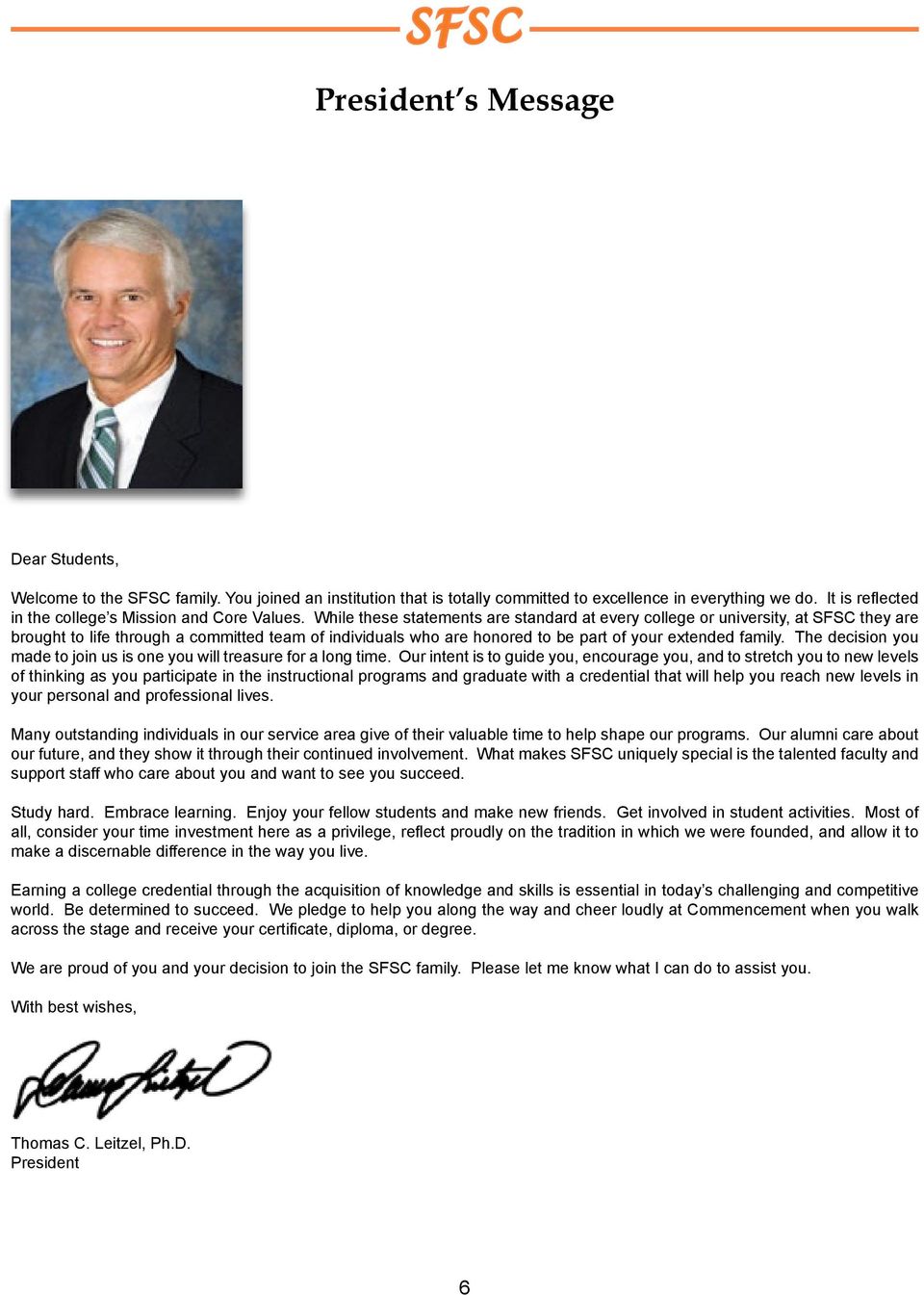
7 President s Message Dear Students, Welcome to the SFSC family. You joined an institution that is totally committed to excellence in everything we do. It is reflected in the college s Mission and Core Values. While these statements are standard at every college or university, at SFSC they are brought to life through a committed team of individuals who are honored to be part of your extended family. The decision you made to join us is one you will treasure for a long time. Our intent is to guide you, encourage you, and to stretch you to new levels of thinking as you participate in the instructional programs and graduate with a credential that will help you reach new levels in your personal and professional lives. Many outstanding individuals in our service area give of their valuable time to help shape our programs. Our alumni care about our future, and they show it through their continued involvement. What makes SFSC uniquely special is the talented faculty and support staff who care about you and want to see you succeed. Study hard. Embrace learning. Enjoy your fellow students and make new friends. Get involved in student activities. Most of all, consider your time investment here as a privilege, reflect proudly on the tradition in which we were founded, and allow it to make a discernable difference in the way you live. Earning a college credential through the acquisition of knowledge and skills is essential in today s challenging and competitive world. Be determined to succeed. We pledge to help you along the way and cheer loudly at Commencement when you walk across the stage and receive your certificate, diploma, or degree. We are proud of you and your decision to join the SFSC family. Please let me know what I can do to assist you. With best wishes, Thomas C. Leitzel, Ph.D. President 6
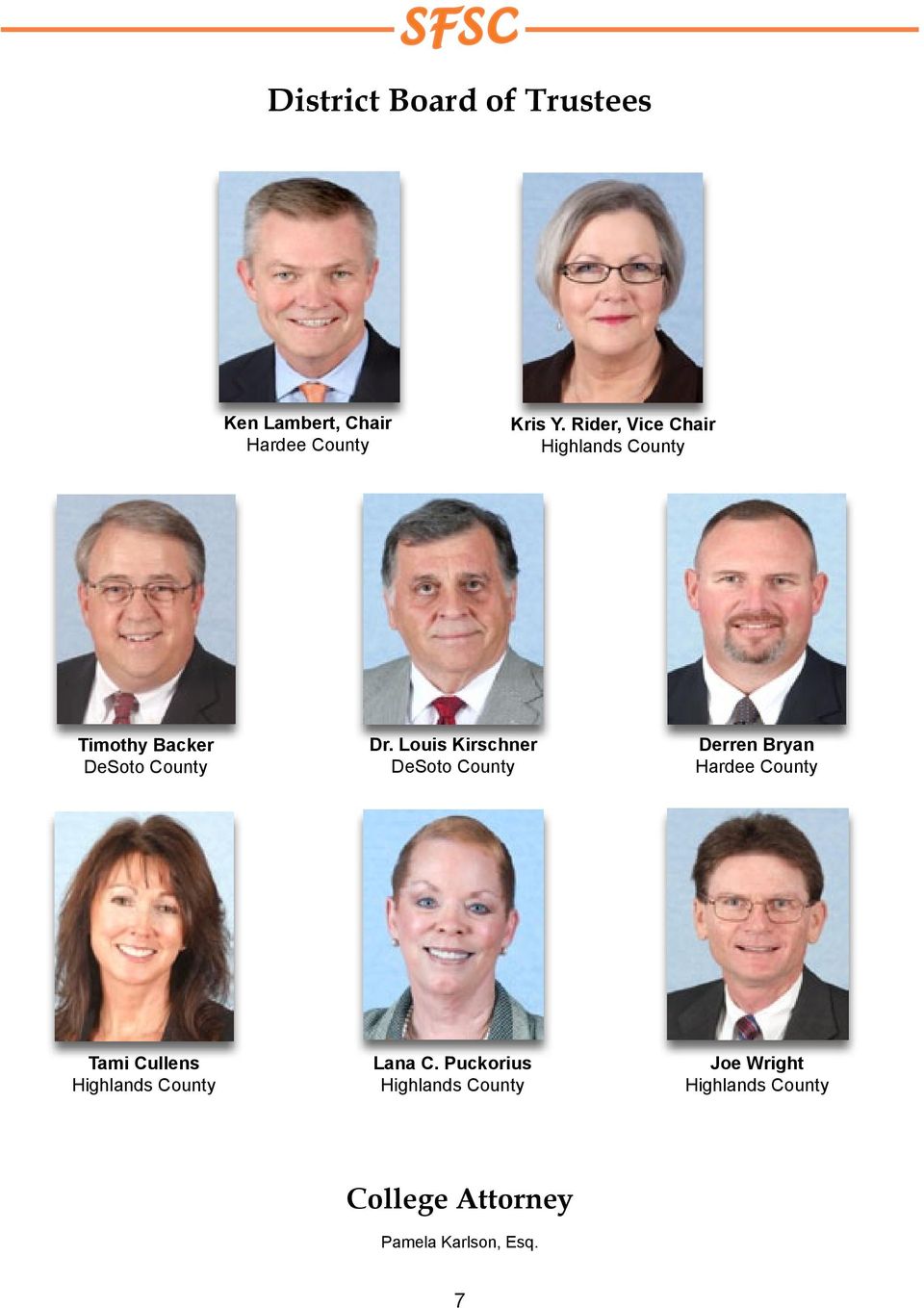
8 District Board of Trustees Ken Lambert, Chair Hardee County Kris Y. Rider, Vice Chair Highlands County Timothy Backer DeSoto County Dr. Louis Kirschner DeSoto County Derren Bryan Hardee County Tami Cullens Highlands County Lana C. Puckorius Highlands County Joe Wright Highlands County College Attorney Pamela Karlson, Esq. 7
9 Officers of the College Dr. Thomas C. Leitzel... President Glenn W. Little... Vice President for Administrative Services Dr. Leana Revell...Vice President for Educational and Student Services Donald L. Appelquist...Dean, Resource Development Dr. Kimberly J. Batty-Herbert... Dean, Arts and Sciences J. Kevin Brown...Dean, Applied Sciences and Technologies Dr. Michael J. McLeod... Dean, Academic Support Rebecca Sroda...Dean, Health Sciences Dr. Timothy G. Wise... Dean, Student Services Dr. Christopher D. van der Kaay...Chief Information Officer Anita A. Kovacs... Controller Dr. Deborah M. Fuschetti... Registrar Teresa M. Crawford... Director, Hardee Campus Suzanne L. Demers... Director, DeSoto Campus Dr. Robert Flores... Director, Remodeling, Renovation and Maintenance Cynthia Garren... Director, Cultural Programs Susan D. Hale...Director, Human Resources Randall K. Paeplow... Director, Lake Placid Center 8

10 Organization of the College President President of the College - Dr. Thomas C. Leitzel Executive Assistant to the President - Tammy Bush Dean, Resource Development/Executive Director, SFSC Foundation - Donald L. Appelquist Director, Grants Development - Dr. Lindsay B. Lynch Director, Planned and Major Giving - Jane M. Hancock Coordinator, Take Stock in Children Program - Irene Castanon Director, Cultural Programs - Cynthia Garren Technical Director, Cultural Programs - William J. Kovacs Curator, Museum of Florida Art and Culture - Mollie Doctrow Coordinator, Facilities Scheduling - Lorrie W. Smith Director, Community Relations and Marketing - Deborah B. Latter Coordinator, Community Relations - Sharon L. Jones Coordinator, Public Relations - Summer Miller Coordinator, ADA Employee - Susan D. Hale Coordinator, ADA Student - Dr. Timothy G. Wise Coordinator, EA/EO Employee - Susan D. Hale Coordinator, EA/EO Student - Dr. Timothy G. Wise Coordinator, Equity Plan - Sureka Flemming Administrative Services Vice President for Administrative Services - Glenn W. Little Chief Information Officer - Dr. Christopher D. van der Kaay Director, Application Software Development - Charles F. Hemler Director, Network Systems - Clifford Hangley Coordinator, Reports - Sureka Flemming Controller - Anita A. Kovacs Coordinator, General Accounting - P. Dean Jordan Coordinator, Financial Services - Susan E. Zelenenki Coordinator, Purchasing - Deborah Olson Coordinator, Restricted Accounting and Payroll - Theresa F. Elders Director, Human Resources - Susan D. Hale Coordinator, Benefits - Sandra L. Turke Coordinator, Human Resources Operations - Robin Southwell Director, Remodeling, Renovation, and Maintenance - Dr. Robert Flores Coordinator, Grounds Maintenance - Steven D. Noel Coordinator, Physical Plant Operations - Cheryl Arpasi Coordinator, Remodeling and Renovation - Robert Mathy Director, Safety and Security - Keith Loweke Educational and Student Services Vice President for Educational and Student Services - Dr. Leana Revell Dean, Academic Support - Dr. Michael J. McLeod Chair, Library Services - Lena D. Phelps Director, Adult Education - Open Coordinator, Adult Education Special Projects - Benjamin F. Carter Jr. Coordinator, ESOL - Sandra C. Pinzon Director, Florida Farmworker and Panther Youth Programs - Tara Jefferies Director, Student Support Services - Dr. Monica Powers Coordinator, RSVP - Kris Juve Dean, Applied Sciences and Technologies - J. Kevin Brown Chair, Business and Computer Technologies - Cynthia Kinser Chair, Technical and Industrial Education - Thomas Bush Director, Corporate and Community Education - Lorrie Key Director, Criminal Justice Programs - Curtis Ivy Director, Technical Dual Enrollment and Workforce Projects - Courtney Green Program Manager, Cosmetology - Timothy E. Johnson Coordinator, Apprenticeship Programs - Joseph M. Hegwood Jr. Dean, Arts and Sciences - Dr. Kimberly J. Batty-Herbert Chair, Academic Foundations - Elizabeth Andrews Chair, Humanities - Stacy Sharp Chair, Mathematics - Davida M. Austin Chair, Natural Sciences - Erik Christensen Chair, Social and Behavioral Sciences - Michele DeVane Coordinator, Honors - Dr. Charlotte Pressler Dean, Health Sciences - Rebecca Sroda Chair, Dental Education - Dr. Deborah P. Milliken Chair, EMS and Fire Science Programs - Steven L. Ashworth Director, Nursing Education - Dr. Michele D. Heston Director, Radiography Technology - Junior A. Gray Dean, Student Services - Dr. Timothy G. Wise Registrar - Dr. Deborah M. Fuschetti Assistant Registrar - Lynn A. Hintz Chair, Advising and Counseling - Charla M. Ellerker Director, Career Development Center - Colleen Rafatti Director, Financial Aid - Susie Johnson Director, Testing/Assessment - MaryAnn Little Coordinator, Student Life - Andrew M. Polk Director, DeSoto Campus - Suzanne L. Demers Director, Hardee Campus - Teresa M. Crawford Director, Lake Placid Center - Randall K. Paeplow Director, Athletics - Richard J. Hitt Director, elearning - Melanie Morgan Jackson Coordinator, Curriculum Support - Elisavet C. Rios 9
11 GENERAL COLLEGE INFORMATION SFSC Vision SFSC Mission SFSC Institutional Core Values History Locations Academic Calendar Important Resources Recognition of Academic Excellence Americans with Disabilities Act (ADA) College Hours College Year Drug-Free Campus and Drug-Free Workplace Program Tobacco-Free College Equal Access/Equal Opportunity Law Enforcement/Security Reporting of Emergencies and Criminal Activity Safety Awareness Programs Sexual Misconduct 10
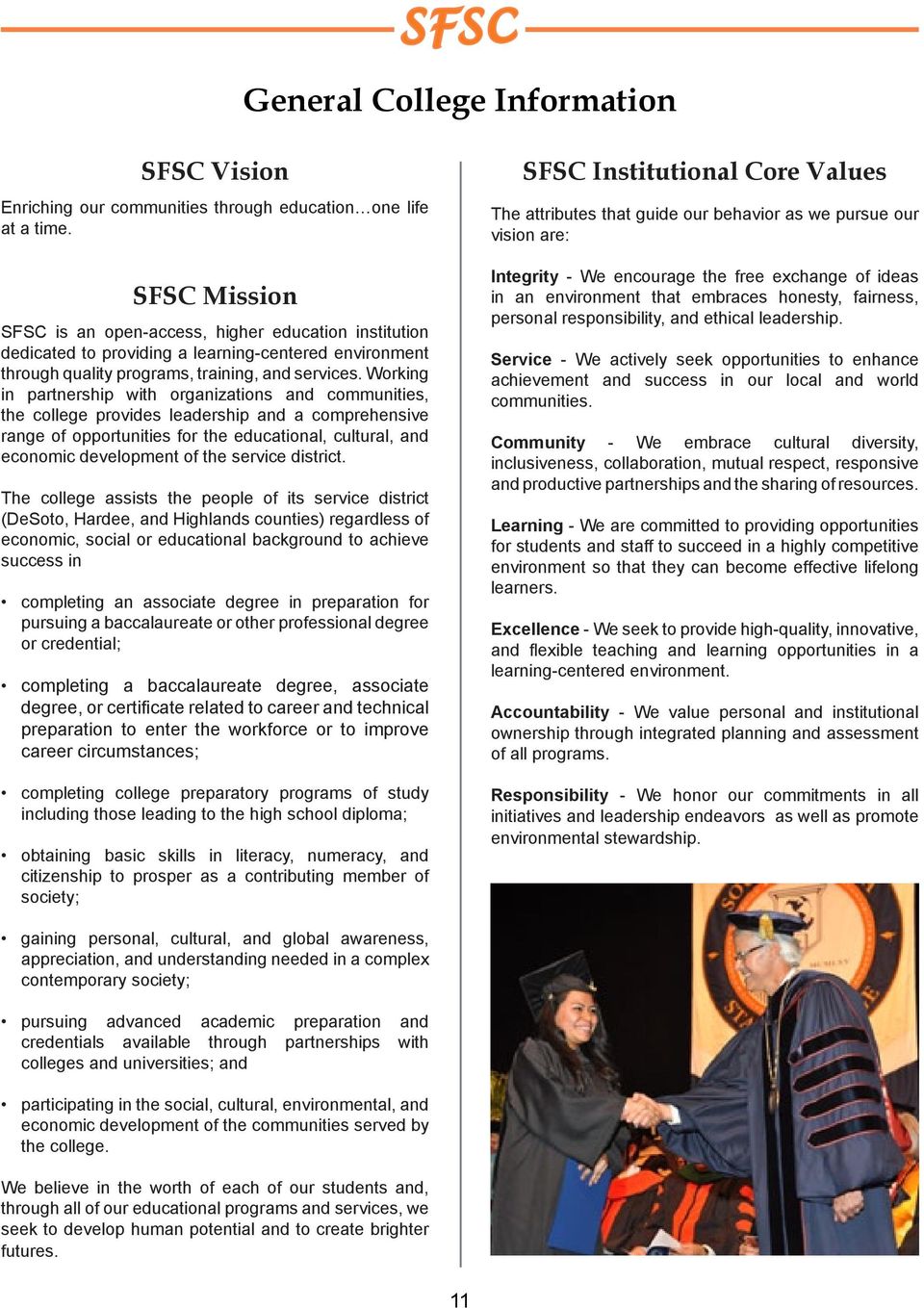
12 General College Information SFSC Vision Enriching our communities through education one life at a time. SFSC Mission SFSC is an open-access, higher education institution dedicated to providing a learning-centered environment through quality programs, training, and services. Working in partnership with organizations and communities, the college provides leadership and a comprehensive range of opportunities for the educational, cultural, and economic development of the service district. The college assists the people of its service district (DeSoto, Hardee, and Highlands counties) regardless of economic, social or educational background to achieve success in completing an associate degree in preparation for pursuing a baccalaureate or other professional degree or credential; completing a baccalaureate degree, associate degree, or certificate related to career and technical preparation to enter the workforce or to improve career circumstances; completing college preparatory programs of study including those leading to the high school diploma; obtaining basic skills in literacy, numeracy, and citizenship to prosper as a contributing member of society; SFSC Institutional Core Values The attributes that guide our behavior as we pursue our vision are: Integrity - We encourage the free exchange of ideas in an environment that embraces honesty, fairness, personal responsibility, and ethical leadership. Service - We actively seek opportunities to enhance achievement and success in our local and world communities. Community - We embrace cultural diversity, inclusiveness, collaboration, mutual respect, responsive and productive partnerships and the sharing of resources. Learning - We are committed to providing opportunities for students and staff to succeed in a highly competitive environment so that they can become effective lifelong learners. Excellence - We seek to provide high-quality, innovative, and flexible teaching and learning opportunities in a learning-centered environment. Accountability - We value personal and institutional ownership through integrated planning and assessment of all programs. Responsibility - We honor our commitments in all initiatives and leadership endeavors as well as promote environmental stewardship. gaining personal, cultural, and global awareness, appreciation, and understanding needed in a complex contemporary society; pursuing advanced academic preparation and credentials available through partnerships with colleges and universities; and participating in the social, cultural, environmental, and economic development of the communities served by the college. We believe in the worth of each of our students and, through all of our educational programs and services, we seek to develop human potential and to create brighter futures. 11
13 History Furthering the established policy of placing high-quality postsecondary education within commuting distance of 99 percent of Florida s population, the 1965 Legislature authorized the establishment of a state-supported junior college in Highlands County to serve the needs of the citizens of DeSoto, Hardee, and Highlands counties. SFSC began operation in August 1966 in temporary donated facilities provided to the community by public spirited citizens of Avon Park. These facilities or buildings were renovated, air conditioned, and partly furnished by voluntary contributions of many interested individuals and organizations of Hardee and Highlands counties, and by the municipalities of Avon Park, Bowling Green, Lake Placid, and Sebring. The college established contact with the Southern Association of Colleges and Schools during its first year of operation, and was fully accredited during the third year of operation. Since its inception, SFSC was designated as the Area Technical School to serve Hardee and Highlands counties and, later, DeSoto County. Since 1965, the college has grown considerably in student enrollment and physical facilities. In October 1968, construction of the nine-building permanent campus was began in Highlands County. The college moved into the new facility in early January The Highlands Campus now consists of 228 acres with more than 30 buildings, including a 1,460-seat Theatre for the Performing Arts and a 1,500-seat gymnasium. The college also offers classes at many other locations in the tri-county area. The overall growth of the college reflects the community s support of and participation in SFSC s programs. In 2002, the college received donations of land in DeSoto and Hardee counties to construct new campuses. The new, full-service campuses were completed in 2003, and each of the 30,000 square-foot facilities provide all student services, a library, general classrooms, computer labs, a large number of classrooms that are wired for two-way interactive television, two large technical program areas, and a student lounge area. The DeSoto Campus is located north of Arcadia at the corner of Gibson and Turner Roads near the DeSoto County High School and the County Agri-Civic Center. The Hardee Campus is located on Highway 17 north of Wauchula between Bostick and Sauls Roads. SFSC evolved from a small college into a mid-sized one that annually serves approximately 19,000 residents of DeSoto, Hardee, and Highlands counties. The college has matured into a responsible and responsive institution of higher learning that provides the community with quality academic programs, specialized technical training, continuing workforce education and adult education, community services, cultural experiences, collegiate athletics, informational services, and programs which enrich the quality of community life. SFSC is pleased with the prestige its faculty and graduates have received. This reputation has been earned through effective and concerned teaching. The continued success of the college depends upon superior teaching and the faculty members are selected with this quality in mind. SFSC believes its student-centered approach to learning will help its graduates meet the challenges of our fast-paced and rapidly changing society. In fall term 2012, SFSC began to offer the Bachelor of Applied Science degree in Supervision and Management (BAS-SM). This open access program is available to students who have successfully completed an associate degree. It will help you build upon your technical or college transfer education and prepare you to work as a supervisor or manager in any number of industries. The upper-level course work covers human resources, management, finance, and leadership. 12

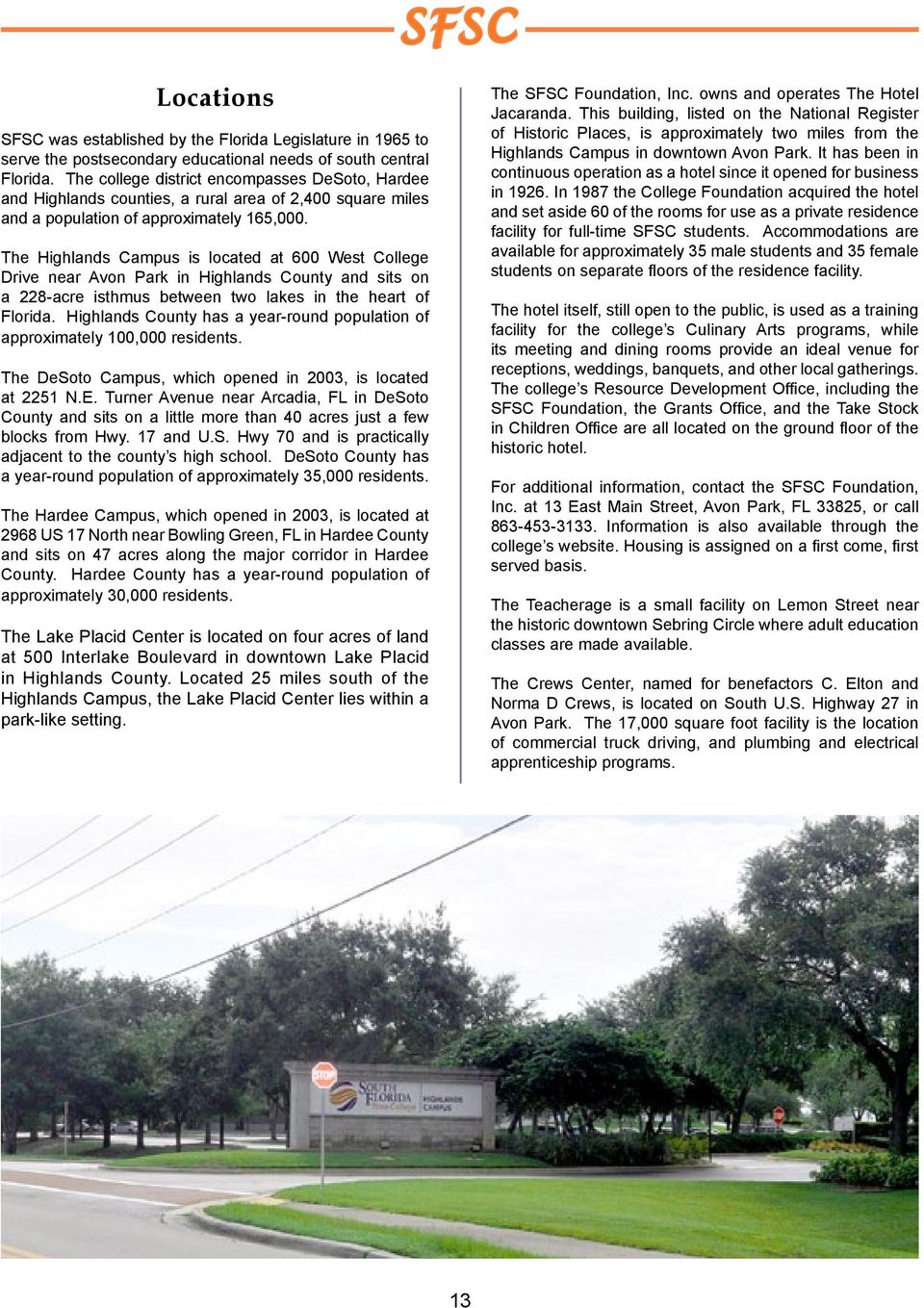
14 Locations SFSC was established by the Florida Legislature in 1965 to serve the postsecondary educational needs of south central Florida. The college district encompasses DeSoto, Hardee and Highlands counties, a rural area of 2,400 square miles and a population of approximately 165,000. The Highlands Campus is located at 600 West College Drive near Avon Park in Highlands County and sits on a 228-acre isthmus between two lakes in the heart of Florida. Highlands County has a year-round population of approximately 100,000 residents. The DeSoto Campus, which opened in 2003, is located at 2251 N.E. Turner Avenue near Arcadia, FL in DeSoto County and sits on a little more than 40 acres just a few blocks from Hwy. 17 and U.S. Hwy 70 and is practically adjacent to the county s high school. DeSoto County has a year-round population of approximately 35,000 residents. The Hardee Campus, which opened in 2003, is located at 2968 US 17 North near Bowling Green, FL in Hardee County and sits on 47 acres along the major corridor in Hardee County. Hardee County has a year-round population of approximately 30,000 residents. The Lake Placid Center is located on four acres of land at 500 Interlake Boulevard in downtown Lake Placid in Highlands County. Located 25 miles south of the Highlands Campus, the Lake Placid Center lies within a park-like setting. The SFSC Foundation, Inc. owns and operates The Hotel Jacaranda. This building, listed on the National Register of Historic Places, is approximately two miles from the Highlands Campus in downtown Avon Park. It has been in continuous operation as a hotel since it opened for business in In 1987 the College Foundation acquired the hotel and set aside 60 of the rooms for use as a private residence facility for full-time SFSC students. Accommodations are available for approximately 35 male students and 35 female students on separate floors of the residence facility. The hotel itself, still open to the public, is used as a training facility for the college s Culinary Arts programs, while its meeting and dining rooms provide an ideal venue for receptions, weddings, banquets, and other local gatherings. The college s Resource Development Office, including the SFSC Foundation, the Grants Office, and the Take Stock in Children Office are all located on the ground floor of the historic hotel. For additional information, contact the SFSC Foundation, Inc. at 13 East Main Street, Avon Park, FL 33825, or call Information is also available through the college s website. Housing is assigned on a first come, first served basis. The Teacherage is a small facility on Lemon Street near the historic downtown Sebring Circle where adult education classes are made available. The Crews Center, named for benefactors C. Elton and Norma D Crews, is located on South U.S. Highway 27 in Avon Park. The 17,000 square foot facility is the location of commercial truck driving, and plumbing and electrical apprenticeship programs. 13
15 Academic Calendar Classes for community education, workforce training, and selected certificate programs are ongoing. Adult Education classes are open-entry and are offered year-round. Please check our Web site at or with a counselor/advisor for the most current offerings. Dual enrollment students check with a high school counselor for beginning and ending dates. Academic Dates and Deadlines South Florida State College Fall 2014 Spring 2015 Summer 2015 Regular Term (16 weeks) Aug 22 - Dec 17 Jan 7 - May 6 May 8 - Jul 30 Priority date to apply for financial aid Mar 15 Oct 15 Mar 15 Begin priority registration for students with over 40 hours Apr 4 Oct 31 Oct 31 Begin registration for students with over 20 hours Apr 11 Nov 7 Nov 7 Begin open registration Apr 25 Nov 21 Nov 21 Priority date for SFSC Foundation Scholarships Jun 15 Oct 15 Mar 15 Fee payment deadline Aug 4* Dec 11* Apr 23* Faculty return Aug 18 Jan 5 - Registration ends Aug 21 Jan 6 May 7 Classes begin Aug 22 Jan 7 May 8 Final day to drop classes with refund or change audit status Aug 29 Jan 13 May 15 Last day to apply for graduation Aug 29 Jan 14 May 15 Last day to withdraw with a grade of W Oct 28 Mar 23 Jun 29 Exam week** Dec Apr 30 - May 6 Jul 29 & 30 Last day of classes Dec 17 May 6 Jul 30 Commencement Dec 18 May 7 - Grades due in Registrar's Office Dec 18 (by Noon) May 7 (by Noon) Aug 3 (by Noon) First Flex Session (8 weeks) Aug 22 - Oct 17 Jan 7 - Mar 3 May 8 - Jun 19 Begin priority registration for students with over 40 hours Apr 4 Oct 31 Oct 31 Begin registration for students with over 20 hours Apr 11 Nov 7 Nov 7 Begin open registration Apr 25 Nov 21 Nov 21 Fee payment deadline Aug 4* Dec 11* Apr 23* Registration ends Aug 21 Jan 6 May 7 Classes begin Aug 22 Jan 7 May 8 Final day to drop classes with refund or change audit status Aug 29 Jan 13 May 15 Last day to apply for graduation Aug 29 Jan 14 May 15 Last day to withdraw with a grade of W Sept 25 Feb 9 Jun 2 Exam week** Oct 16 & 17 Mar 2 & 3 Jun 18 & 19 Last day of classes Oct 17 Mar 3 Jun 19 Grades due in Registrar's Office Oct 20 (by Noon) Mar 4 (by Noon) Jun 22 (by Noon) Second Flex Session (8 weeks) Oct 20 - Dec 17 Mar 4 - May 6 Jun 22 - Jul 30 Begin priority registration for students with over 40 hours Apr 4 Oct 31 Oct 31 Begin registration for students with over 20 hours Apr 11 Nov 7 Nov 7 Begin open registration Apr 25 Nov 21 Nov 21 Fee payment deadline Aug 4* Dec 11* Apr 23* Last day to apply for graduation Aug 29 Jan 14 May 15 Registration ends Oct 19 Mar 3 Jun 21 Classes begin Oct 20 Mar 4 Jun 22 Final day to drop classes with refund or change audit status Oct 24 Mar 10 Jun 26 Last day to withdraw with a grade of W Nov 21 Apr 14 Jul 15 Exam week** Dec Apr 30 - May 6 Jul 29 & 30 Last day of classes Dec 17 May 6 Jul 30 Grades due in Registrar's Office Dec 18 (by Noon) May 7 (by Noon) Aug 3 (by Noon) Limited Services Available Convocation Aug Staff Development Day - Feb 13 - Holidays No classes - college closed Labor Day - Sept 1 New Year's Day - Jan 1 Memorial Day - May 25 All Fridays of Summer B (June 26, July 3, 10, 17, 24, and 31) Thanksgiving - Nov Martin Luther King - Jan 19 Independence Day - Jul 3 Exceptions: Community Education, Workforce Training, and Adult Education Winter Break - Dec 20-Jan 4 Spring Break - Mar * Fees due on day of registration after deadline date ** Examination schedule for Arts and Science Division courses only. Please check course syllabi for all other divisions. 14

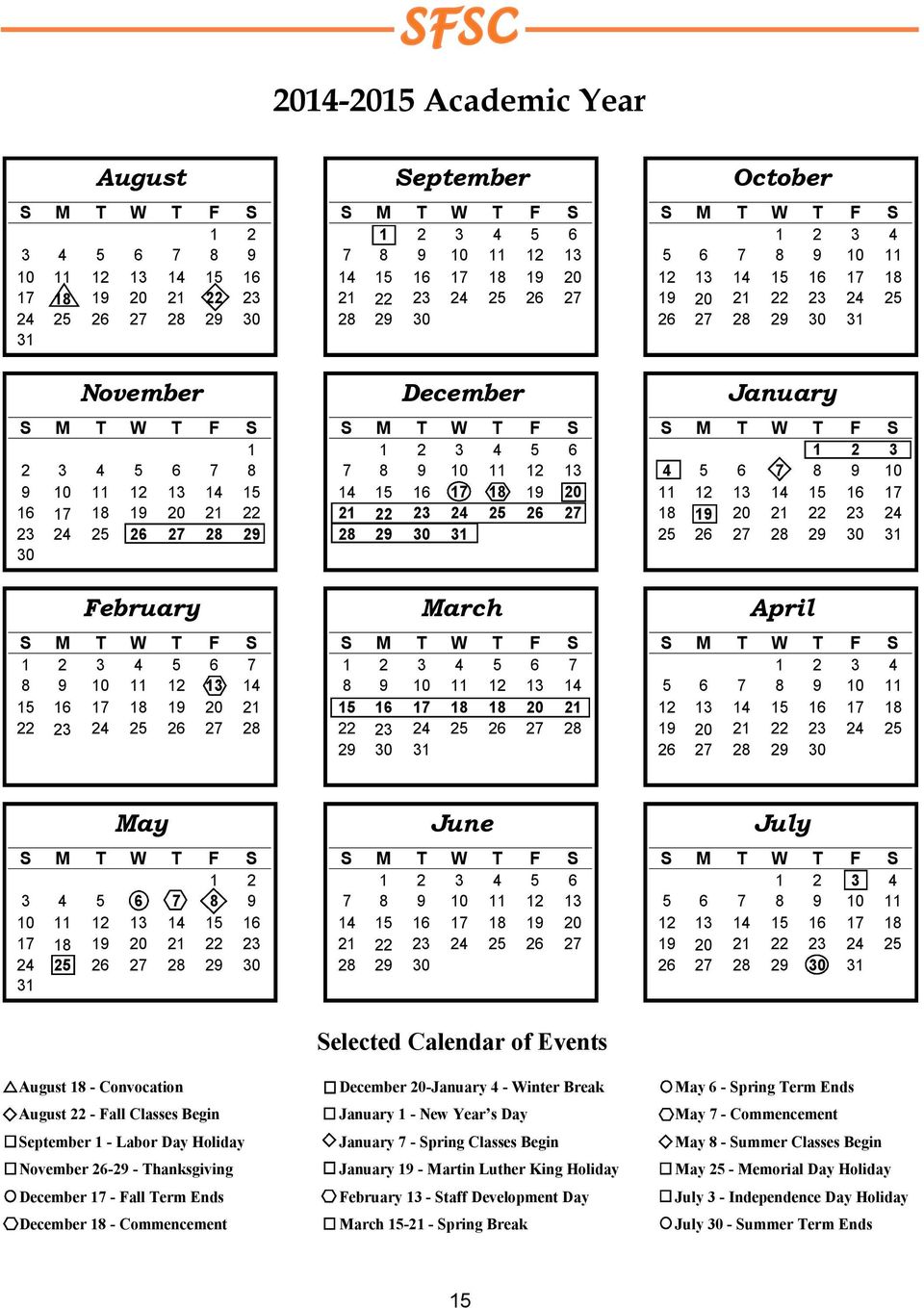
16 Academic Year Year August S M T W T F S November S M T W T F S February S M T W T F S September S M T W T F S December S M T W T F S March S M T W T F S October S M T W T F S January S M T W T F S April S M T W T F S May S M T W T F S June S M T W T F S Selected Calendar of Events July S M T W T F S August 18 - Convocation December 20-January 4 - Winter Break May 6 - Spring Term Ends August 22 - Fall Classes Begin January 1 - New Year s Day May 7 - Commencement September 1 - Labor Day Holiday January 7 - Spring Classes Begin May 8 - Summer Classes Begin November Thanksgiving January 19 - Martin Luther King Holiday May 25 - Memorial Day Holiday December 17 - Fall Term Ends February 13 - Staff Development Day July 3 - Independence Day Holiday December 18 - Commencement March Spring Break July 30 - Summer Term Ends 15
17 Important Resources Service Phone# Location/Building Academic Support Division Y209 (2nd Floor) Admissions B (1st Floor) Adult Education H205 (2nd Floor) Advising and Counseling Center B152 Applied Sciences and Technologies Division T6 Arts and Sciences Division B207 Athletic Department E Bookstore B102 Box Office A Cafeteria J Career Development Center B111 Cashier/Refunds B150 College Reach-Out Program (CROP) B158 Community Relations and Marketing F108 Corporate and Community Education T9 Crews Center Avon Park Cultural Programs A203 DeSoto Campus Arcadia Driver Education T4 EA/EO Employee Coordinator I (1st Floor) EA/EO Student Coordinator B274 elearning Y109 (1st Floor) ESOL H207 (2nd Floor) Farmworker Career Development Program (Hardee) Hardee Farmworker Career Development Program (Highlands) UC Financial Aid or B168 Hardee Campus Bowling Green Help Desk (elearning) Y109 (1st Floor) Highlands Campus Avon Park Highlands Career Institute L Honors Program B205 Lake Placid Center Lake Placid Library - Learning Resources Center (LRC) Y-LRC (2nd Floor) Ombudsman R1 Open Computer Lab Y-LRC (1st Floor) Panther Youth Partners UC Registrar B151 Retired and Senior Volunteer Program (RSVP) Y (2nd Floor) Security K1 Student Disabilities Specialist B153 Student Government Association (SGA) B109 Student Services Division B274 Student Support Services (SSS/TRiO) Y102 (1st Floor) Switchboard (Central) B108 Testing Center B255 The Artists Group (TAG) T4 The Hotel Jacaranda Avon Park The Teacherage Sebring Tutoring and Learning Center (TLC) Y-LRC (1st Floor) 16
18 RECOGNITION OF ACADEMIC EXCELLENCE - SFSC will recognize you for academic excellence during your course of study. You will be eligible each term for the following distinctions: President s List - If you earn six or more credits for the term and earn a GPA of 3.80 to 4.00, SFSC s president will send you a recognition letter. Vice President s List - If you earn six or more credits for the term and earn a GPA of 3.50 to 3.79, SFSC s vice president for educational and student services will send you a recognition letter. Graduation with Distinction - If you graduate with an excellent GPA in the associate and baccalaureate degree programs, you will receive recognition on your diploma according to the following GPAs: 3.90 to 4.00 summa cum laude 3.70 to 3.89 magna cum laude 3.50 to 3.69 cum laude If you attended no other postsecondary institution other than SFSC, this GPA is based on the GPA earned at SFSC. If you attended at least one other postsecondary institution and earned 45 or more credits at SFSC toward the associate degree or 90 or more credits at SFSC toward the baccalaureate degree, this GPA is based on the higher GPA earned at SFSC or the cumulative GPA from all institutions attempted. If you attended at least one other postsecondary institution and earned less than 45 (90) credits at SFSC, this GPA is based on the cumulative GPA from all institutions attended. If you have fulfilled the requirements for a college credit certificate, occupational certificate, or diploma and achieved a 3.50 GPA or higher, you will graduate with distinction. Likewise, if you have earned a State of Florida High School Diploma with a score of 3100 or higher on the General Educational Development (GED) test, you will graduate with distinction. To be recognized with distinction at the December commencement ceremony, you must have met all degree requirements by the end of fall term. The determining GPA will be based upon your previous term cumulative GPA. To be recognized with distinction at the May commencement ceremony, you must have met all degree requirements by the end of spring term. The determining GPA will be based upon your previous term cumulative GPA. Honors Program - If you fulfill the requirements of the Honors Program, you will receive your associate in arts degree with an honors endorsement on your transcript and diploma and special recognition at the graduation ceremony. Outstanding Student Awards are given annually. If you show leadership in scholastic achievements, student activities, and athletics, you may be eligible. Phi Theta Kappa is the international honor society that recognizes and encourages scholarship among associate degree-seeking students. SFSC s chapter, Tau Epsilon, was founded in The organization provides an opportunity to develop leadership and service, promotes an intellectual climate for scholars, and fosters a continued interest in academic excellence. Eligible students must be currently enrolled in a college credit degree program and must have earned 12 or more college credit hours with a cumulative GPA of 3.25 or higher. AMERICANS WITH DISABILITIES ACT (ADA) - SFSC seeks to ensure that programs, services, and facilities are accessible to and usable by persons with disabilities. If you are a qualified student with a disability, the college will make every effort to provide reasonable accommodations. If you are a person with a disability, a catalog is available to you in hard copy and digital format. Telephone or written requests should include your name, address, and telephone or TDD number. Your requests should be made to the ADA student coordinator, SFSC, 600 West College Drive, Avon Park, FL 33825, at least two weeks prior to the time you need the publication. The following college staff members have been assigned to assist in ensuring that you have access to the college s programs, services, and facilities. If you require assistance or have general questions/concerns, please contact: Dr. Timothy G. Wise, Dean of Student Services ADA Student Coordinator , Building B274, 2nd Floor 600 West College Drive, Avon Park, FL [email protected] Susan Hale, Human Resources Director ADA Employee Coordinator , Building I100, 1st Floor 600 West College Drive, Avon Park, FL [email protected] COLLEGE HOURS - Regular college operations are conducted between the hours of 8 a.m. and 7 p.m., Monday through Thursday, and 8 a.m. and 5 p.m., Friday. Except for special events, the college is closed to students and visitors during other hours. If you require access to college facilities at times other than normal working hours, you must advise Security, , of your location and expected time of departure. The college offers you a wide selection of college credit, adult, and occupational classes in the evening. These classes serve as an extension of the day program using the same textbooks, instructional procedures, instructors, and 17

19 contact hours. The majority of your evening credit classes meet once a week during fall and spring terms and twice a week during summer terms. Classes are available evening and weekends. Consult your Schedule of Classes for evening and weekend offerings. COLLEGE YEAR - The college year is divided into fall and spring terms of approximately 16 weeks each and a summer term of 12 weeks with flex sessions in all three terms. The college calendar is coordinated closely with the calendars of other public colleges, the state universities, and county school systems. DRUG-FREE CAMPUS AND DRUG-FREE WORKPLACE PROGRAM - SFSC is a drug-free college and workplace. Illegal use of drugs or alcohol will not be tolerated on any SFSC campus or center, or at any SFSC-sponsored event off campus. Alcohol and drug-free campus handouts are distributed to new students at orientation and to continuing students at their first registration in each academic year. These handouts describe standards of conduct that prohibit unlawful possession, use, or distribution of illicit drugs and alcohol on campus; health risks, applicable legal sanctions under the law; programs that address counseling treatment or rehabilitation/reentry programs; and disciplinary sanctions that SFSC will impose on students and employees. You will find information regarding the Drug Free Campus and Drug-Free Workplace Program in the Student Handbook/ Planner. TOBACCO-FREE COLLEGE - SFSC is committed to providing a safe and healthy environment for its employees, students, and visitors. The use, distribution, or sale of tobacco, or any object or device intended to simulate that use, is prohibited in all indoor and exterior areas of each campus, center, and other property under the control of the college. College employees, students, visitors, contractors, and all others are expected to comply with SFSC s Tobacco-Free College policy and the Florida Indoor Clean Air Act at all times. EQUAL ACCESS/EQUAL OPPORTUNITY - SFSC pledges to provide equal access to education and employment opportunity to all regardless of race, color, religion, gender, national origin, ethnicity, age, disability, marital status, political affiliation, sexual orientation, or genetic information in admission to, or employment in, any of its education programs or activities. The college adheres to federal and state laws that control equal access/equal opportunity. This pledge covers all aspects of the educational and employment relationship with our students and employees. If you have concerns regarding this pledge, address them to the EA/ EO student coordinator, Nothing contained within this College Catalog is intended to discriminate on the basis of the previously mentioned factors. The following staff members have been assigned to assist in ensuring that you have access to the college s programs, services, and facilities. Please contact these individuals, if you require assistance. Dr. Timothy G. Wise, Dean of Student Services EA/EO Student Coordinator , Building B274, 2nd Floor 600 West College Drive, Avon Park, FL [email protected] Susan Hale, Human Resources Director EA/EO Employee Coordinator , Building I100, 1st Floor 600 West College Drive, Avon Park, FL [email protected] Sureka Flemming Equity Plan Coordinator , Building I108, 1st Floor 600 West College Drive, Avon Park, FL [email protected] LAW ENFORCEMENT/SECURITY - Campus security personnel are not law enforcement officers. Law enforcement authority for the Highlands Campus is the responsibility of the Highlands County Sheriff s Office. Law enforcement at other campuses is the responsibility of local police. Security personnel are responsible for the safety of personnel and the safety of buildings and their contents. The college works directly with local law enforcement agencies to report criminal activities and incidents. REPORTING OF EMERGENCY AND CRIMINAL ACTIVITY- SFSC has developed a set of guidelines for reporting emergencies and criminal activities. It is important to note that each emergency situation or criminal activity has different circumstances requiring different actions. Each action should address the safety and security of victims and other participants. You will find reporting guidelines in the Student Handbook. Procedures for reporting information are posted throughout the college classrooms. For emergencies and security concerns, please contact Campus Security at on the Highlands Campus, on the DeSoto Campus, on the Hardee Campus, and at the Lake Placid Center. SAFETY AWARENESS PROGRAMS - Your security and safety is the responsibility of all. Report unsafe conditions or criminal activities; it is important to the safety of everyone at SFSC. You are required to go through student orientation programs that include safety information. Current and continuing students are provided with information regarding personal safety. SEXUAL MISCONDUCT - SFSC is committed to providing an environment, which is free from all forms of sexual misconduct including sexual harassment, public indecency, voyeurism, battery, or assault. If you are a victim, contact the college s EA/EO student coordinator at , and you will receive assistance and support. If you are accused of such a charge, you may be subject to dismissal from the college. Please consult the SFSC Student Handbook for the entire policy and the procedures to follow in the event of an act of sexual misconduct. 18
20 ADMISSIONS Admissions Policy Admission to Baccalaureate Degree Programs Admission to Associate Degree Programs Admission to Certificate Programs Admission to State of Florida High School Diploma (GED) Application Fee Admissions Procedures New Students Career Pathways Articulation Credit Early Admissions Program Dual Enrollment Program Admission to Selective Programs Admission to Baccalaureate Program Admission and Program Support Documents International Students Resident Information and Requirements Testing Placement Testing GED Testing College Credit Certificate Testing Occupational Certificate Testing Assessment Testing College Developmental Course Rule College Entrance Testing and Placement Procedures Transfer Students Transient Students 19

21 Admissions ADMISSIONS POLICY - You can be admitted to non-selective degree programs upon application by presenting an official high school graduation transcript or high school equivalency scores, that meet Florida standards, provided your placement test results indicate the ability to progress successfully. Diplomas are not required for admission to most occupational programs. You may be required to take a placement test prior to advisement and registration. If you are 16 years or older and legally out of school, you may be eligible to enroll in occupational certificate, continuing education, or adult education programs. If you are a high school student, you may enroll in associate degrees or certificate programs provided you have met the early admission or dual enrollment requirements. Some occupational programs have limited seating while others have special admission requirements. You are responsible for being aware of the admission requirements for your desired program of study. Advising and Counseling Center staff, faculty advisors in appropriate departments, program managers, coordinators, directors, or instructional supervisors are available to discuss admission requirements and the course of study before enrolling. The college reserves the right to refuse admission to any individual whose presence on campus has been determined by the college not to be in the best interest of the student and/or SFSC. Admission applications and specific information about admissions are available on the Highlands, DeSoto, and Hardee Campuses, Lake Placid Center and online at www. southflorida.edu. Due to limited space in some classes and programs, class registrations are handled on a first-come, firstserved basis. Apply for admission and register for classes as early as possible. Some occupational programs have special admission requirements and class size restrictions. I. Admission to the baccalaureate degree programs shall include the following criteria: A. You must have earned an Associate in Science or Associate in Arts degree from a regionally accredited institution. B. You must provide official transcripts from all previous educational institutions attended. C. If you are an international student, you must have your transcripts evaluated by a recognized international transcript evaluation service. D. If you have earned 60 semester credit hours, with a minimum cumulative GPA of 2.0 on a 4.0 scale in relevant transfer courses that apply toward the baccalaureate degree, but do not have a degree, your admission application will be evaluated case-by-case for determining admission to the baccalaureate program. E. If you are a college or university transfer applicant, you must have at least 60 college credit hours, with a minimum cumulative GPA of 2.0 on a 4.0 scale in relevant transfer courses that apply toward the baccalaureate degree. II. Admission to the associate degree programs shall include the following criteria: A. You must have a standard high school diploma, a high school equivalency diploma (GED), or previously demonstrated competency (15 credits with C or higher) in college credit postsecondary course work. B. If you have met all requirements for a standard high school diploma except for earning passing scores on the 10th grade FCAT (or approved alternate), you may be eligible to be admitted to a degree-seeking program. Contact Enrollment Services at for more information. C. If you are home schooled, a signed affidavit must be submitted by your parent or legal guardian attesting that you have completed a home education program pursuant to the requirements of prevailing Florida Statutes. D. You may be required to take a placement test. The minimum scores are defined in the latest SFSC College Catalog. E. You must submit an official transcript(s) or documentation of all course work completed. F. High school transcripts are required if you are applying for financial aid. III. Admission to the certificate programs shall include the following criteria: A. You may be required to take a placement test. B. If you are in the Advanced Technical Diploma Program or the College Credit Certificate Program, you must submit an official transcript or documentation of all course work completed. C. High school transcripts are required if you are applying for financial aid. 20
22 IV. Admission to State of Florida High School Diploma (GED) Program shall include the following criteria: A. You must be at least 16 years of age. B. You must take the complete battery of the Tests of Adult Basic Education (TABE). C. You must register for the appropriate class based on the TABE scores. You will be enrolled in an ABE class if at least one score is below 9.0. or a GED class if all scores are 9.0 or above. V. Admission to some programs is selective as a result of limited space or other special requirements. You are admitted to these programs based on the date your completed application is received and all program requirements are met. For more information on selective programs, see Admission to Selective Programs section of this College Catalog. APPLICATION FEE - SFSC requires a $15.00 non-refundable application fee for all new applicants, re-applicants (previous SFSC students who have not taken classes at SFSC in the past 12 months), and all bachelor s degree applicants. Students applying as dual enrollment, adult education, community education or corporate education students will be exempt. ADMISSIONS PROCEDURES - Students seeking admission to the college must file an Application for Admission and pay the application fee. Students in some programs must provide relevant test scores or complete the appropriate testing, complete an orientation and meet with a counselor/advisor prior to registration for classes. New Students - A. You must complete and sign the Application for Admission form verifying that all information is correct and accurate and pay the application fee. Form is available on our SFSC website at www. southflorida.edu. B. If you are a dependent student, the residency section must be completed and signed by your parent or guardian (see Residency Information). C. To be eligible for in-state fees, you, your parent, or guardian (if you are a dependent) must provide information that shows you qualify as a bona fide resident of Florida according to Florida Statute. You may be required to bring additional supporting documentation such as drivers license, voter ID, vehicle registration, tax forms. D. Right-to-know information is directly accessible on our SFSC website at E. The Admissions Office staff will inform you of the placement testing requirements of the program for which you are applying. II. F. All applicants, except early admission/dual enrollment and home schooled students, must send directly to the Admissions Office, 600 West College Drive, Avon Park, FL either an official copy of their high school transcript or provide a copy of their GED diploma (and GED scores if from out-ofstate), or high school equivalency scores that meet Florida standards. G. Transfer students who have successfully completed at least 15 hours of college credit may provide official college transcripts in lieu of high school transcripts. High school transcripts are required if you are applying for financial aid. H. Applicants seeking an associate or baccalaureate degree who have attended a postsecondary institution must have an official copy of their transcript from each institution they attended sent directly to the college. I. Applicants who can provide written proof of unusual reasons why any required record is unavailable (e.g., records destroyed by fire, home country in turmoil), may be admitted with the permission of the dean of Student Services. J. Applicants for limited enrollment/selective programs may be required to provide additional documentation. Selective program applicants are referred to the Office of the Registrar and/or the instructional supervisor. If your last date of enrollment is over a year old or if you have attended another college/university since attending SFSC, you must update your previous application. If you have changed your name or changed your program of study, you will be required to complete a Change of Information form or Change of Program form. III. You will not be authorized to proceed with registration until an admissions application has been designated as accepted. Career Pathways Articulation Credit - If you attended a public high school in DeSoto, Hardee, or Highlands County and are admitted to SFSC after high school graduation as a student seeking an Associate in Science, Associate in Applied Science, College Credit Certificate, or Occupational Certificate, you may be eligible to receive college credit for course work taken in high school. All articulated high school courses must have been completed with a grade of B or higher and must apply to your program of study. A minimum of 15 credit hours of applicable college credit courses or 240 occupational contact hours at SFSC must be successfully completed before you may submit a Career Pathways Articulated Credit Request form to the Admissions Office. Contact the registrar for more information. 21
23 Early Admission Program - Early Admission is a form of dual enrollment in which qualified high school students enroll full time at SFSC. Research provides evidence that dual enrollment increases academic performance and educational attainment. The student is no longer academically associated with the high school but course credit is transferred back to the high school for the purpose of awarding the high school diploma. Participants must enroll in a minimum of 12 hours but not exceed 15 credit hours. Courses must meet the high school and college degree plan requirements. Requirements to participate in the Early Admission Program are the same as those for the Dual Enrollment Program. Tuition or textbooks are provided at no cost. Students may enroll in a degree or certificate program. Some programs have limited space while others have special admission requirements. For information, contact the Advising and Counseling Center. Dual Enrollment Program - Dual Enrollment is an accelerated mechanism that allows you to pursue an advanced curriculum in your target college discipline while still in high school. Courses may be college credit that applies to a degree or technical courses aimed at a certificate. Courses are offered at both the high school and college campuses as well as online. You will be advised based on your personal postsecondary degree plan and monitored to ensure continued success. High school guidance personnel can assist in initiating the application and registration process. Additional information may be found at southflorida.edu/academic/dualenrollment/ or consult a counselor for more information. If you are enrolled in the Early Admission/Dual Enrollment Program at DeSoto, Hardee, or Highlands county public schools and your courses meet the core requirements for high school graduation credit, you will not be charged fees for registration or books. Students enrolling as early admission must take a minimum of 12 hours of college credit and may not exceed 15 college credits in the fall and spring terms. All public high school dual enrollments will be in compliance with the annual inter-institutional articulation agreement between the college and school board. If you are enrolled in a private school or a home education program, you may enroll in courses taken for high school credit and not be charged for registration, but you are responsible for purchasing your books. If you are not receiving high school graduation credit, you must pay your own fees and purchase your own books. Specific details may be obtained from the Parent and Student Guide posted on the college website, SFSC s dual enrollment coordinator, registrar, your high school guidance office, or an SFSC campus/center director or counselor/advisor. I. Public Enrollment Procedure - Early admission and dual enrolled students at the local high schools are to complete the following steps to participate in college credit or technical course work through SFSC. Academic Credit A. Admissions: 1. If you are a high school student planning to enter early admission and dual enrollment classes, you will be required to complete the Admissions Application form prior to testing and/or enrolling in academic or technical course work. 2. If you plan to use your national admissions test scores (ACT/SAT) to meet the college s testing requirement, you must submit them along with the Admissions Application form. 3. Verification of your grade point average (GPA) and guidance office certification is required on the admissions application. B. Testing: The SFSC Testing Center will schedule testing dates for each district high school. The dates will be coordinated with appropriate staff at the high schools. (The following is the general timeline to schedule testing): 1. Fall Term Enrollment: The Testing Center will test in March-April any applicants planning to enter early admission/dual enrollment academic classes during the fall term. If you are a continuing student who needs to be retested, you may also test at this time, provided notification of your eligibility has been coordinated with the SFSC testing coordinator. First Time in College (FTIC) students who are unable to participate in the April testing will have the option of testing during late June/early July by making arrangements through the Testing Center by calling Spring Term Enrollment: The Testing Center will test in November any applicants planning to enter early admission/dual enrollment academic classes during the spring term. If you are a continuing student who needs to be retested, you may also test at this time, provided notification of your eligibility has been coordinated with the SFSC testing coordinator. Any applicants unable to participate during these dates will have the option of arranging alternative testing times through the SFSC Testing Center by calling Retesting: You may retest after 30 days upon approval of the district school guidance office or the SFSC testing coordinator. You may test no more than twice per academic year. 4. Notification of Test Results: Test results will be forwarded to the high schools and to the SFSC Advising and Counseling Center, Admissions, and Registration for evaluation and follow-up services. 22
24 C. Registration: 1. If you have completed the admissions process, have evidence of appropriate test scores, and have an unweighted GPA of 3.0 or above, you will be eligible to register for academic early admission/dual enrollment courses. 2. The Office of the Registrar will coordinate with the appropriate high school guidance personnel to officially register eligible students. D. Orientation and Advising: 1. All early admission/dual enrollment students are required to complete an orientation. Orientation session times will be coordinated through SFSC and jointly planned with the high school guidance staff. Parents and students will receive advanced notification of scheduled dates and times. 2. General information sessions will be scheduled twice annually at each high school (October and April). These sessions will promote student success, introduce participants to educational resources, and provide advising related to specific programs and majors. Technical Credit A. Admissions: 1. If you plan to enter technical early admission/ dual enrollment classes, you will be required to complete the Early Admissions/Dual Enrollment Admissions Application form prior to testing and/ or enrolling in academic or technical course work. You will not be permitted to test or enroll in course work prior to completion of the application process. 2. The application must list the technical program in which you plan to enroll. 3. The SFSC Admissions Office will coordinate dissemination and collection of admissions applications. B. Initial Testing: 1. The SFSC Testing Center will coordinate with the appropriate departments, campuses, centers, and high schools to provide the TABE. 2. Test results will be forwarded to the technical instructors and to the high school. If you do not attain certification scores for your technical program, you will be advised of your options for remediation. C. Registration: 1. When you have completed the admissions process, have evidence of appropriate test scores, and have an unweighted GPA of 2.0 or above, you will be eligible to register for technical II. early admission and dual enrollment courses. NOTE: If you are designated as performance based, you will not be required to meet the 2.0 unweighted GPA requirement. D. Orientation and Advising: 1. All early admission and dual enrolled students are required to complete an orientation. Orientation session times will be coordinated through SFSC and jointly planned with the high school guidance staff. Parents and students will receive advanced notification of scheduled dates and times. 2. General information sessions will be scheduled twice annually at each high school (October and April). These sessions will promote student success, introduce participants to educational resources, and provide counseling related to specific programs and majors. Private/Home School Procedure - early admission and dual enrollment students at private or home high schools use the following steps to participate in college credit or technical credit course work through SFSC. A. Admissions: 1. If you are attending a private or home school program, and plan to enroll in early admission or dual enrollment classes, you must submit an Admissions Application to the Office of the Registrar prior to testing and/or registration. You must be between years of age (younger age requires the approval of the dean of student services). 2. You will not be permitted to test or enroll prior to completion of the application process. B. Testing: 1. You must contact the SFSC Testing Center to schedule an appointment to take the college placement test prior to registration. Test scores will be submitted to the registrar for interpretation and to determine whether you are eligible to enroll in classes. ACT and/or SAT scores should be submitted along with the Admissions Application, if you plan to use these tests to meet the testing requirement. 2. Retesting: You may retest after 30 days upon approval of the SFSC testing coordinator. 3. Notification of Test Results: You will receive notification of test results from the SFSC Testing Center. If you do not meet test score eligibility, you will not be permitted to register. C. Registration: 1. The registrar is responsible for approving your Registration form each term. You may register during the regular registration scheduled dates 23
25 at any SFSC campus. (Registration conducted at the other SFSC locations must have approval of the registrar.) 2. Parents or school officials must submit to the Office of the Registrar a list of courses you need to complete your high school education. You must be at the secondary level of education and must have a minimum of 3.0 GPA for college transfer course enrollment and 2.0 for technical course enrollment. 3. Transcripts of high school, home school, and/or private school courses previously taken must be submitted to the SFSC Office of the Registrar for evaluation prior to registration. 4. At the end of each year, an updated transcript must be submitted to the registrar prior to each fall term registration. 5. Parents must submit a signed affidavit of Home Education Program approved by the county and/or a signed affidavit from private school administrators. Parents must sign the Home School Dual Enrollment Agreement. 6. Parents are responsible for the cost of books and transportation to the college. D. Orientation and Advising: 1. All early admission and dual enrollment students are required to complete an orientation. Orientation session times will be coordinated through the SFSC Advising and Counseling Center. Parents and students will receive advance notification of scheduled orientation dates and times. It is your responsibility to arrange to attend an orientation session prior to registering for classes. ADMISSION TO SELECTIVE PROGRAMS - Admission to some programs is selective as a result of limited space or other special requirements. You are admitted to these programs based on the date your completed application is received and when you have met all program requirements. If you are interested in the following selective programs, contact the appropriate department for application forms and entry requirements either in person or by calling. Correctional Officer Public Service Academy Cosmetology Cosmetology Department Dental Hygiene Dental Education Advising and Counseling Emergency Medical Technician Emergency Medical Department Advising and Counseling Fire Science Technology Fire Science Service Department Honors Program Director of the Honors Program Law Enforcement Public Service Academy Nursing Nursing Department Advising and Counseling Paramedic Emergency Medical Department Advising and Counseling Phlebotomy Health Science Office Advising and Counseling Radiography Advising and Counseling Admission to Baccalaureate Programs - Students seeking admission to baccalaureate programs must file an Application for Admission to the college and pay the application fee. Applications are available online at For admission to bachelor s programs you must meet the specific program criteria: A. You must provide official transcripts from all previous educational institutions attended. B. If you are a student with 60 semester credits and no degree, you will be evaluated on a case-by-case for determining admission to baccalaureate programs. D. If you are an international student, you must have your transcripts evaluated by a recognized international transcript evaluation service. E. If you are a college or university transfer applicant, you must have at least 60 college credit hours, with a minimum cumulative GPA of 2.0 on a 4.0 scale in relevant transfer courses that apply toward the baccalaureate degree. Dental Assistant Dental Education Advising and Counseling
26 ADMISSION AND PROGRAM SUPPORT DOCUMENTS - The following chart summarizes the supporting documents required for the various categories of eligibility (to be sent to the Admissions Office). All transcripts must be sent directly from the high school or college to the SFSC Admissions Office; copies will not be recognized as official. If you are a degree-seeking applicant, you will be notified in writing of your acceptance. Admissions Support Documents A.A. Degree X X X 4 X 1 X 2 Advance Technical Diploma X X X 4 A.S. Degree X X X 4 X 1 X 2 B.A.S./B.S.E.E./B.S.N. Degrees X X X X 5 College Credit Certificate X X X 4 X 1 X 2 Early Admissions X X X X 2 X X H.S. Dual Enrollment-College Credit X X X 2 X X H.S. Dual Enrollment-Technical X X X X X International Students X X X X 1 X 2 X X X Non-Degree X X Occupational Certificate X X X Application Form Residency Affidavit (on application) H.S. Transcript or equivalent College Transcript(s) Tests of Adult Basic Education (TABE) or exempt School's Recommendation TOEFL Score Certificate of Financial Ability Supplemental Forms Teaching Certificate College Placement Tests (CPT/ACT/SAT/PERT) or exempt Program Support Documents Associate Degree Nurse* X X X 4 X 1 X 2 Dental Assistant* X X X X X Dental Hygiene* X X X X X 2 X Honors Program* X X X 4 X 1 X 3 X Licensed Practical Nurse* X X X X 1 X 3 X Teacher Re-certification* X X X *Program support documents. NOTES: 1. Required prior to advisement and registration for first term from each college or university attended. 2. Required of all students planning to pursue a degree or enroll in college-level courses. (See exceptions under placement testing section.) 3. Cutoff scores used for acceptance into program. 4. You must submit proof of high school completion or college credits prior to advisement/registration for your first term at SFSC. 5. See program criteria. 25
27 INTERNATIONAL STUDENTS - You are classified as an international student when you are an alien (non-united States citizen) who has a valid student visa and any other forms required by the U.S. Citizenship and Immigration Services. If you are an applicant who is foreign born but has resident alien status, been granted amnesty, been accepted as a refugee and/or an asylum-seeker, you are not considered an international student and must present proof of status and Florida residency to be admitted and enrolled in degree, certificate, or adult education programs. Contact the Admissions Office at for additional information. Admission of International Students - File required application papers and credentials including admissions test scores (ACT or SAT) at least three months prior to the term for which you plan to register. Required forms and credentials include: When all required forms and credentials have been received, SFSC will issue you an I-20 form for obtaining a student visa. International students must meet all other admission requirements. RESIDENT INFORMATION AND REQUIREMENTS - You will be classified as a resident or non-resident for the purpose of assessing tuition fees in public colleges and universities (Section , Florida Statutes, and Rule 6A ). I. Definitions under this section: A. Parent means either or both parents, any guardian, or any person in a parental relationship. B. Dependent child means any person, whether or not living with his or her parent, who is eligible to be claimed by his or her parent as a dependent under the federal income tax code. 1. A completed Application for Admissions. 2. Official copies of all secondary school and college records in the original language and certified translations into the English language by a translation certifying organization. Transcripts must be evaluated, at your expense, on a document-by-document basis and must show the equivalent of a U.S. high school diploma. A list of certifying organizations is provided in the international admissions packet. 3. Current evidence of proficiency in speaking, writing, and understanding the English language by submitting scores on the Test of English as a Foreign Language (TOEFL) or The International English Language Testing System (IELTS) which is required when your native language is not English. TOEFL is administered by the Educational Testing Service (ETS), at a number of sites worldwide. The telephone number is , website is IELTS tests are held in over 900 locations worldwide with tests up to four times a month and may be found on their website (The code for SFSC is #5666.) You are responsible for making arrangements directly with ETS or IELTS to take the examination and for requesting those results to be sent to the Admissions Office at SFSC. You must have a score of at least 500 on the paper version, 173 on the computer based version and 61 on the Internet version of the TOEF and at least a Band 6 on the IELTS. 4. Provide a certified declaration of finances that indicates you will have sufficient funds to pay full matriculation and tuition fees, textbooks, living and transportation expenses. The funds must be available to you each term of enrollment. Estimated expenses for a 12-month period are $24,000 U.S. dollars. 5. Provide proof of standard health insurance for the entire period of enrollment at the college. SFSC does not provide health and medical services. II. C. Institution of Higher Education means any of the constituent institutions under the jurisdiction of the State University System or the Florida College System. D. Legal Resident means you have maintained your residence in this state for at least 12 months preceding the first day of classes of the term in which you seek Florida residency. E. Resident for Tuition Purposes means you qualify as provided in subsection (II) for the resident tuition rate. F. Non-resident for Tuition Purposes means you do not qualify for the resident tuition rate. To qualify as a resident for tuition purposes: A. You, or if you are a dependent, your parent(s), must have established and maintained legal residence in this state for at least 12 consecutive months immediately prior to your qualification. A copy of your (or your parent s) most recent tax return or other documentation may be requested to establish dependence/independence. B. You or your parents - if dependent - will be required to make a statement as to the length of your residence in the state. If you are a dependent, the presence of your parent(s) in the state during the past 12 months was, for the purpose of maintaining a permanent residence rather than for the purpose of maintaining a mere temporary residence or abode incident to enrollment in an institution of higher education. Florida statute requires that you demonstrate 12-months of continuance residency solely for the purpose of maintaining permanent residency. C. You may qualify as a resident for tuition purposes if you live with an adult relative who has maintained legal residence in Florida for at least 12 consecutive 26
28 months immediately prior to your qualification, provided you have resided continuously with this relative for three years immediately prior to your qualification. The adult relative must have exercised day-to-day care, supervision, and control over you. D. If you are a dependent whose parents are residents of Florida and divorced, separated, or otherwise living apart, your legal residence will be deemed to be this state. III. You will not be classified as a resident for tuition purposes and will not be eligible to receive the resident tuition rate until you have provided clear and convincing documentation related to legal residence. IV. Living or attending school in Florida does not establish a legal residency for tuition purposes. Maintaining a legal residence in Florida requires substantial physical presence as a condition. V. You will be considered eligible to establish Florida residency for tuition purposes, if you are a non-u.s. citizen such as a permanent resident, parolee, asylumseeker, refugee, or other permanent status person (e.g., conditional permanent residents and temporary residents), who has applied to and has been approved by the U.S. Citizenship and Immigration Services (USCIS) with no date certain for departure. For a list of eligible visa categories, contact the Admissions Office. VI. If you physically reside in Florida, you may be classified as a resident for tuition purposes if you marry a person who meets the 12-month residency requirement under Section II and who is a legal resident of this state. VII. If you are a non-resident, who marries a legal resident of this state or marries a person who later becomes a legal resident, you may, upon becoming a legal resident of this state (and relinquishing all legal ties to any other state), become eligible for reclassification as a resident for tuition purposes upon submitting evidence of your own legal residency in the State, evidence of your marriage to a person who is a legal resident of the State, and evidence of your spouse s legal residence in the State for at least 12 consecutive months immediately preceding the application for reclassification. VIII. You will not lose your resident status for tuition purposes solely by reason of serving, or, if you are a dependent, by reason of your parent s or parents serving, in the Armed Forces outside this state. IX. If you have been properly classified as a resident for tuition purposes but, while enrolled in an institution of higher education in this state, you lose your resident tuition status because you (or if you are a dependent, your parent or parents) establish domicile or legal residence elsewhere, you shall continue to enjoy the resident tuition rate for a statutory grace period, which period shall be measured from the date on which the circumstances arose that culminated in the loss of resident tuition status and shall continue for 12 months. However, if the 12-month grace period ends during an academic term for which you are enrolled, such grace period shall be extended to the end of that academic term. X. If you cease to be enrolled at or graduate from an institution of higher education while classified as a resident for tuition purposes and subsequently abandon your domicile in this state, you will be permitted to re-enroll at an institution of higher education in this state as a resident for tuition purposes without the necessity of meeting the 12-month duration requirement of this section whether you have re-established your domicile in this state within 12 months of such abandonment and continuously maintained the re-established domicile during the period of enrollment. XI. You will be classified as a resident for tuition purposes (documentary evidence is always required when, in the judgment of the reviewing officials, inconsistencies with Florida residency for tuition purposes appear in the application materials and documents): A. if you are an active duty member of the armed services of the United States residing or stationed in Florida (and spouse/dependent children) or military service member not stationed in Florida whose home of record or state of legal residence certificate, DD Form 2058, is Florida; B. if you are an honorably discharged veteran of the U.S. Armed Forces, U.S. Reserve Forces, or the National Guard who physically resides in Florida while enrolled at SFSC, this is a waiver of out-of-state fees and is applicable for 110 percent of the required credits of the degree or certificate program for which you are enrolled. 27
29 C. if you are a full-time instructional and administrative personnel currently employed by state public schools, colleges, and institutions of higher education, as defined in Florida Statute and your spouses and dependent children; D. if you are a student enrolled in the Florida Prepaid College Program; E. if you are a full-time employee of a state agency or a political subdivision of the state when your fees are paid by the state agency or political subdivision for the purpose of job related law enforcement or corrections training; F. if you have attended a Florida public high school for four consecutive years immediately prior to high school graduation and you enroll in a Florida institution of higher education within 12 months of graduating from a Florida public high school, provided that you 1. are a U.S. citizen or are in another category of eligible aliens as specified in residency rules and regulations; and 2. submit the high school transcript prior to initial enrollment. XII. Residency Reclassification Determination. If you are classified as a nonresident for tuition purposes, you may become eligible for reclassification as a resident for tuition purposes by presenting a minimum of three (3) documents identified in F.S (3)(c)(1) or (3)(c)(2), that convincingly demonstrate the establishment of your permanent legal residence in Florida other than for the sole purpose of pursuing a postsecondary education. Documentation must demonstrate that you have maintained legal residence in Florida for at least 12 consecutive months prior to your initial enrollment in an institution of higher education. You may also be eligible for reclassification under the following circumstances: A. You have documentation of permanent full-time employment in Florida for at least 30 hours per week for a 12-month period while not enrolled in a public postsecondary institution in Florida; or B. You have purchased a home in Florida and residence therein for the 12-month period while not enrolled in a public postsecondary institution in Florida. TESTING Placement Testing - If you enroll in the associate degree programs and some certificate programs, you may be required to have college placement test scores on file or take the placement test given by the college as a part of the admissions procedure. This placement test includes mathematics, reading, and English language skills. You are not required to take the test, if you have an A.A. degree or higher; are non-degree seeking; are registering for 11 credit hours or fewer (collegelevel math and English courses require placement test scores); are a transfer student who has completed all required college-level English and math courses; have records that indicate you have already taken one of the state-mandated tests within the last two years; or entered the 9th grade in a Florida public school in the school year, or any year thereafter, and earned a Florida standard high school diploma, or if you are currently serving as an active duty member of any branch of the United States Armed Services, you will not be required to take the common placement test and will not be required to enroll in developmental education instruction at a Florida College System institution. If you are not required to take the common placement test and not required to enroll in development education you may opt to be assessed and enroll in developmental education. Always check with your Advisor regarding placement test requirements. XIII. Residency Appeal Process. If you are otherwise unable to qualify for in-state classification by the guidelines posted in the College Catalog, you may submit a petition to the Residency Appeals Committee in the Office of the Registrar. You must include documentation evidencing the grounds on which the appeal for in-state classification is based. Petition forms are available at any campus or center and on the SFSC website. The Residency Appeals Committee will render a final residency determination in writing that includes the reason for the determination. 28
30 The placement test is not a pass/fail test. Students are encouraged to review before the test. Information about review materials is available on the Testing Center Web page at You should contact the Advising/Counseling Center for interpretation of placement scores. SFSC advisors use test results to determine your academic level upon entering and to place you in the proper course selections. The placement tests accepted by SFSC are those designated by the State Board of Education. These are the college entrance exam of the American College Testing Program (ACT), the Scholastic Aptitude Test or College Board Test (SAT), the College Board Accuplacer (CPT), and the Postsecondary Education Readiness Test (PERT). Placement scores that are over two years old at the time of admission with no course enrollment cannot be accepted. If you have not met the State Board of Education placement scores on any part of the ACT or SAT I, you must take the respective part or parts of college placement test. If you have college placement test scores that are below the 9.0 grade equivalent level scores, you must take the Tests of Adult Basic Education (TABE) in order to determine your appropriate program (see College Developmental Course Rule in this College Catalog). GED Testing - Please see Adult Education Section of this College Catalog. College Credit Certificate Testing - For advising purposes, if you enroll in a college credit certificate program, the TABE is recommended. If you have an A.A.S. degree or higher, or have scores at or above the state minimum acceptable scores on the ACT, SAT I, or college placement test within the past two years, you are exempt from college credit placement testing and from the TABE requirement. Ref. State Board Rule 6A Occupational Certificate Testing - If you are in occupational certificate programs of 450 or more hours, you maybe required to take the TABE or any other test designated by the Florida Department of Education within the first six weeks after admission to the program. If you do not meet the minimum basic skills grade level for your occupational program, you will be given the opportunity to upgrade your skills in reading and mathematics before the completion of your occupational program. If you score below 7.0 on TABE, you may be required to enroll in Adult Basic Education classes prior to enrolling in technical courses. You must meet the minimum basic skills grade level for your occupational program in order to be eligible for an occupational certificate. Ref. State Board Rule 6A If you are a new student, you must provide TABE scores that are less than two years old at the time of your admission. If the occupational program basic skills standards are at or above the 9.0 grade level, you must provide Level A, Complete Battery, and TABE scores. Programs with standards below 9.0 grade level may provide either A or D level TABE scores. Some limited access programs require that you meet minimum basic skills requirements prior to entry into the program. You should consult the schedule so that you can complete all requirements prior to class start dates and admission to the program. Assessment Testing - The Testing Center schedules and administers assessment batteries to students and adults at all levels who are referred by counselors, teachers, or community agencies. Different types of tests are administered in order to assist with career planning, occupational rehabilitation, learning problems, and academic or occupational planning. Tests such as interest, aptitude, dexterity, work samples, basic skills, etc. may be given. A fee schedule determines the cost of these test batteries. Most fees are waived for enrolled students. Written reports provide information to students and counselors to assist in future planning. See a counselor or advisor for an individualized assessment. College Development Course Rule Your required placement test scores may require that you enroll in a developmental mathematics, writing, or reading course. It is important for your college success that you demonstrate sufficient mathematics, writing, and reading proficiencies. When you enroll for SFSC courses, your proficiencies in these areas will be assessed. If your scores on a college placement test are below college-level for mathematics and/or communication, you must pursue one of the four alternatives to college developmental instruction: 1. College developmental courses, 2. Proprietary college developmental courses, 3. Special Web-based instruction available at the TLC, or 4. The Adult Basic Education Program. You must enroll in a college developmental course, if your college placement test scores are below the cut scores but are at or above the 9.0 grade equivalent score on the college placement test (see College Entrance Testing and Placement Procedures Chart - Letter A). If you have college placement test scores that are below both the cut scores and the 9.0 grade equivalent score, you are required to take the respective parts of the Tests of Adult Basic Education (TABE). Your TABE scores will then determine proper placement in college developmental instruction (see College Entrance Testing and Placement Procedures Chart - Letter B): 29
31 1. If you score 9.0 to 12.9 grade equivalent on the TABE (Form 9 or 10 level A only), you may remediate at the TLC and re-test or you must enroll in college developmental courses or a proprietary program. 2. If you score 7.9 grade equivalent and below, you may be enrolled in the Academic Adult Basic Education Program until you have reached the required skills levels. You may attempt a college developmental course three (3) times at SFSC. An attempt is defined as remaining enrolled past the end of the Drop with Refund Period (see Academic Calendar). If you do not successfully pass your third attempt, you will not be permitted to continue in college developmental and enroll in any college credit courses simultaneously. You will be given an opportunity to participate in an alternative program designed to work with you on an individual basis to prepare you to re-enter the regular college-level curriculum, or you may petition to enroll in a fourth attempt in college developmental. If you have not successfully completed a college developmental course after the second attempt and desire to continue your efforts toward an associate degree, you will be required to pay the full cost of instruction, which is equal to the non-resident course fees. An exception to the fee may be granted under extenuating circumstances. You may not withdraw from a third or fourth attempt of a developmental course. If you have completed the last course in a college developmental skill area (Writing, Reading, or Math), an exit exam is required. If you do not pass the exit exam, you must repeat the course for Reading and Math. You should complete all college developmental courses by the time you have earned twelve (12) college credit hours. If your required college developmental courses have not been completed by the time you have completed twelve (12) college credit hours, you may continue to enroll in college credit hours provided: 1) you enroll in at least one (1) college developmental course in each term and 2) your overall college credit cumulative GPA is 2.0 or higher. If you are required to enroll in one or more college developmental courses, you may not drop from all college developmental courses without also dropping from all college credit courses. College Entrance testing and COURSE placement - You may be required to take an entrance placement test. In some circumstances, college developmental reading, writing, and math courses have an exit exam that you must pass to enroll in college credit English and math courses. Occupational programs have a grade level requirement in English and math on the TABE for you to graduate from the program. If you have questions regarding the testing program, contact a counselor/advisor, the Testing Center, program manager, or a campus/center director for more information. If you are a degree-seeking student with college placement test scores that suggest you to enroll in one or more college developmental courses, you may either remediate using the TLC resources and re-test or you must enroll in at least one of the college developmental courses required of you within the first 12 hours of college credit enrollment. If you choose the latter route, you may also concurrently enroll in college credit courses that do not require the skills addressed in your college developmental courses. If your college placement test scores require that you enroll in more than one developmental course, you must also enroll in SLS Master Student/College Success. SLS 1501 provides three hours of elective college credit towards a degree. This requirement is to provide you with life skills and study skills to enhance your learning experience. You may enroll in no more than 12 college credit hours before satisfying all your college developmental course requirements. If you have completed the last course in a college developmental skill area (Writing, Reading, or Math), an exit exam is required. If you do not pass the exit exam, you must repeat the course for Reading and Math. You may not withdraw from a third or fourth attempt of a college developmental course. If you have completed the last course in a college developmental skill area (Writing, Reading, or Math), you must pass an exit exam. If you do not pass the exit exam and fail to successfully re-test (college placement test), you will be required to retake the course. You should complete all college developmental courses by the time you complete twelve (12) college credit hours. If your required college developmental courses have not been completed by the time you have completed twelve (12) college credit hours, you may continue to enroll in college credit courses provided: 1) you enroll in at least one (1) college developmental course in each term and 2) your overall college credit cumulative GPA is 2.0 or higher. If you are required to enroll in one or more college developmental courses, you may not drop from all college developmental courses without also dropping from all college credit courses. Once you begin taking a college developmental course, you may re-test at any time. If you meet the required college placement test score, you may either complete the class or withdraw. This means that, if you enroll in a college developmental course and have not met the required score prior to the last day to Drop With Refund, you must maintain enrollment in the class until the end of that term - even if you choose to withdraw from the class. If you stop attending and do not withdraw, you will receive a failing grade for the class. Should you fail to successfully complete a college developmental class, you may re-test and, if you achieve the requisite college placement test score(s), you may advance to the appropriate college developmental class or a college transfer class if there is no higher college developmental class to be completed. Any student with a college placement test score that indicates assignment to a college developmental sequence may remediate utilizing the TLC Web-based resources. Upon completion, that student may re-test. If your college placement test re-test is successful, the new score replaces your original one. 30
32 College Entrance Testing and Course Placement (For Associate Degree-Seeking and College Credit Certificate Students) HAS TAKEN ACT or SAT or ACCUPLACER IN PAST 2 YEARS NO YES SCORES AT or ABOVE COLLEGE CUT SCORES ACT READ 19 ACT WRITING 17 ACT MATH 19 SAT VERB 440 SAT MATH 440 CPT READ 83 CPT WRITING 83 CPT ELEM ALG 72 YES REGISTER IN COLLEGE CREDIT COURSES TAKE PERT YES NO Postsecondary Education Readiness Test (PERT) Scores: COURSE Reading * Freshman English ENC 1101 Reading II Reading I Writing * Freshman English ENC 1101 Writing II Writing I Math * or ACT or SAT MAC 1105, MGF 1106, MGF 1107 or STA 2023 Intermediate Algebra MAT 1033 elective credit Beginning Algebra Pre-Algebra * You may re-test with a score of 49 or below on the PERT with confirmed remediation from the Tutoring and Learning Center (TLC). Students who wish to place into higher level mathematics may take the College Level Math (CLM) placement exam. Eligibility for the CLM exam requires a minimum of one of the following scores: SAT 500 or higher, ACT 21 or higher, or PERT 123 or higher. College Level Math MAC 1140 or MAC 1147 MAC 1114 or MAC 2233 MAC 1105, MGF 1106, MGF 1107 or STA
33 TRANSFER STUDENTS - If you are a degree-seeking student, you must have an official transcript sent from each institution of higher education attended to the admissions office prior to advisement/registration for your first term at SFSC. An evaluation of credit course transferability is made soon after you are admitted to SFSC and the official transcript is received. If you wish to apply for academic amnesty, see page 58. Placement test scores within the last two years are required, unless you have completed a college-level English and/or math course prior to entry to SFSC. Transfer credit is defined as follows (criteria will apply where relevant): 1. If you are admitted in good standing or on probation, you will receive credit for courses in which you have made a grade of D or higher at another college or university, except for courses used as writing and computation course requirements, provided the courses are relevant to the instructional program of SFSC (see Writing and Computation Course Requirements in this College Catalog). 2. If you are a transfer student, admitted on probation, and fail to earn a 2.0 GPA on work attempted during your first term at SFSC, you will be subject to suspension (See Academic Suspension). 3. All incoming transfer credit is evaluated by the Office of Admissions and Records based on several criteria. All lower-division credits (and upper-division credits for bachelor degree students) awarded by a regionally accredited agency transfer to SFSC. If the credits were awarded by a non-regionally accredited agency or by an institution that is not part of the statewide articulation agreements, then the registrar and appropriate faculty/ instructional supervisors will evaluate each course individually and will make a decision regarding equivalency based on available documents. To ensure that the transfer course is fully equivalent to that taught by SFSC, you must submit the following: the course description in the catalog of the awarding institution, a copy of each course syllabus that indicates textbooks and course requirements, and educational credentials of the instructor. TRANSIENT STUDENTS - If you attend another college or university as a transient student and apply the courses taken from another college or university to the program of study at SFSC, you must have completed 15 credit hours at SFSC and have prior approval from the dean of student services or designee. NOTE: Transient students should apply for approval to take course work at other institutions at If you are currently enrolled at another college or university and wish to take courses from SFSC and apply the credit earned to a program at your home institution, you must obtain a transient student approval form from your institution. This approval will ensure that you are registering for appropriate courses at SFSC which will be accepted by your home institution. Completion of the form permits you to attend SFSC without submitting transcripts and/or taking the placement test from SFSC. 32
34 ACADEMIC SUPPORT Adult Education Adult Basic Education (ABE) and General Educational Development (GED) Classes and Online General Educational Development (GED) Classes English for Speakers of Other Languages (ESOL) Fees for Adult Education Courses Career Development Center Co-op Education (Co-op) Internship Work Study Employment Community Employment Opportunities Electronic (Distance) Learning (elearning) Asynchronous Mixed-Mode/Hybrid Video Conference (Two-Way Interactive Televised Courses - 2xTV) Web-Enhanced Support Services Academic Advising/Counseling Services for Students with Disabilities Learning Resources Center (LRC) The Library The Tutoring and Learning Center (TLC) Student Support Services/TRiO 33
35 Adult Education The Adult Education programs at SFSC provide students with a range of educational services to improve basic reading, math, and writing skills; complete a high school diploma; or improve English language communication. Students must be at least 16 years old to access these programs of study. Classes do not necessarily follow the SFSC academic calendar and are offered year-round at a variety of class sites. Adult Basic Education (ABE), General Educational Development (GED) Classes, and Online General Educational Development (GED) Classes - These classes are designed to help GED students improve basic skills and to prepare for the GED exam. Course instruction covers reading comprehension, mathematics, writing, science, social studies and consumer education. You must complete a five-day Adult Education Career Pathways orientation and take the Tests of Adult Basic Education (TABE) in order to register for any ABE or GED course. Once you complete the GED program, you will earn a State of Florida High School Diploma. Requirements to Earn a State of Florida High School Diploma: 1. Earn scores of 11.0 or higher in the reading, math, and language sections of the TABE. 2. Pre-GED scores of 450 in each section and a composite score of 2300*. 3. GED composite score of 2250, with a minimum score of 410 on each subtest (average score of 450). * Before proceeding to the GED exam, 16- and 17-year old students must complete the waiver program. For graduation (commencement) ceremony procedures, see Student Information section of this College Catalog. English for Speakers of Other Languages (ESOL) Classes and Online ESOL Classes -The ESOL Program prepares you to communicate effectively in contemporary American English. The courses are designed to be interactive and include many opportunities for you to practice listening, reading, speaking and writing the English language. The curriculum also focuses on grammar, pronunciation and accent reduction, reading comprehension, vocabulary, and interactive listening skills that are applicable and transferable to daily life. Our English language immersion classrooms, in conjunction with educational activities and materials designed for adult learners, engage learners at every level and enhance the learning experience. The program includes models to enhance skills useful in workplace, life and academic applications. You will start by taking the Comprehensive Adult Student Assessment System (CASAS) assessment. It is recommended that students attain a score of six on the CASAS before advancing to the ABE or GED program, or transitioning into a college program. The Advanced ESOL class allows a seamless transition to Adult Education and/ or other courses of study. A citizenship class is offered to assist you, if eligible, through the application process and prepares you for the oral and written examination in the U.S. Citizenship and Immigration Services interview. Lessons on American history, civics, and geography prepare you to demonstrate your knowledge of U.S. government. In addition to reading, writing, and speaking the English language, you will learn about the other requirements for citizenship. For your convenience, classes are offered year-round at a variety of locations and hours in Highlands and Hardee counties. You must be at least 16 years old to register and you may register at any time during the year. Fees for Adult Education Courses - Adult Education students enrolled in the ABE, ESOL, or GED program will be charged a flat, or block, tuition rate per term; tuition rates for Florida residents and non-florida residents are specified in the SFSC Schedule of Classes. 34
36 Career Development Center Student Work-Based Learning Opportunities Cooperative Education (Co-op), Internship, Work Study and Job Placement - Several different types of student employment and experiential learning opportunities are provided at SFSC to assist you with career decision-making and transition from college to career. Student work-based learning experience can provide you many benefits, including an opportunity to learn first-hand about careers or industries and to make connections that may lead you to future employment prospects; verifiable work experience for inclusion on your resume; a venue in which to develop and practice a range of transferable basic skills; a way to explore your career options to help you make sound career choices; and extra income to help reduce your college expenses. Cooperative Education (Co-op) - Cooperative Education is designed to make your educational program more relevant and meaningful by integrating your classroom curriculum with academically related periods of practical experience related to your major field of study and career objectives. This program is called Cooperative Education (Co-op) because it involves a cooperative alliance between SFSC, local employers, and you. Classroom learning is supported and reinforced by a series of working experiences in business, industry, health, or public sector agencies. You may earn college credit and grades while working in a position related to your academic and career goals. Co-op strengthens understanding, clarifies interests, supports personal growth, and enhances your professional preparation. A Co-op placement can be arranged either part time or full time while you are concurrently attending college. Most co-op positions are unpaid; however, you may be able to apply regularly scheduled hours at a related job to meet co-op requirements in some situations. You may earn a maximum of seven credit hours toward an associate degree, over several college terms, through co-op participation. Some occupational certificate programs include co-op or internship as a mandatory component of the program. To participate in liberal arts Co-op (Co-op provided through the Division of Arts and Sciences*), you must be a current SFSC student in good standing who is registered for SFSC classes during the term of the Co-op experience; have successfully earned at least 12 college credit hours at SFSC unless approved by the director, Career Development Center; hold an overall grade point average (GPA) of 2.5 or higher; meet all requirements of the selected employer work site (this may include orientation, background screening, interview, or other items); and register for the Co-op course with approval of the director, Career Development Center. *Note: The Division of Applied Sciences and Technologies has different policies, procedures and guidelines for Coop experiences associated with its various occupational certificate programs. Please contact the dean of Applied Sciences and Technologies for more information about those Co-op opportunities. Internship - An internship is similar to Co-op with one importance difference: you do not earn college credit for participation in an internship. An internship is a method through which you can gain valuable, intense experience in a workplace in the career field you are pursuing. This may help you confirm your career choices or explore other career options, network with potential employers, and gain valuable knowledge and skills to enhance your future employability opportunities. Most internships are unpaid experiences. An internship can be arranged in almost any occupational field or career. If you are interested, contact the director of the Career Development Center at Work Study Employment - Work Study provides parttime employment to help students earn funds to assist with educational costs. The Work Study program allows students to work in on campus departments, assisting with clerical work and other duties as assigned. Students earn the current minimum wage per hour for a maximum of 15 to 20 hours per week. To be eligible for most types of Work Study you must be a current SFSC student in good standing and currently be enrolled at SFSC for at least the equivalent of halftime student status (a minimum six credit hours in during fall and spring terms, and six hours during the combined summer A and B terms); have a current FAFSA on file in the Financial Aid Office; document an unmet financial need (via FAFSA, etc.) as determined by Financial Aid Office; and hold an overall grade point average (GPA) of 2.0 or higher. For more information about Work Study, contact the Financial Aid Office at To apply, contact the Career Development Center at Community Employment Opportunities - The Career Development Center at SFSC partners with CareerSource Heartland to provide students and alumni with access to the Employ Florida Marketplace (EFM) statewide database on which a variety of part-time and full-time employment opportunities are posted. Stop by the Career Development Center to search this database for employment opportunities. If you are interested in a posted position, contact the Career Development Center for an appointment to meet with our employment specialist and to register for EFM. The Career Development Center can also assist you with resume and cover letter preparation, interview practice, and job hunting strategies workshops. 35
37 Electronic (Distance) Learning (elearning) SFSC offers you the opportunity to receive instruction at a distance. Currently, four instructional delivery modes are in use. Each involves at least some learning that takes place outside the traditional classroom setting. A self-test is available on our SFSC website that is designed to aid you in deciding whether you are suited for elearning and to assist you in choosing the most appropriate type of elearning courses. To complete this self-test, visit the SFSC Online Learning website and choose the link Are you READI. This self-test should be completed prior to registering for any elearning course. SFSC provides you with an account in our online learning environment. This environment, Panther Central, includes access to your SFSC , news bulletins, and course resources. Your default username is your SFSC GID and default password is your six-digit date of birth. Should you need additional assistance with your username and password, contact an elearning Department team member at The types of elearning currently available are: Asynchronous - More than 80 percent of the instruction of these courses is online. These courses use Web-based instruction, communication and collaboration. Courses may require proctored examinations, and may include opportunities for face-to-face orientations, but there may also be no class attendance requirements. Check the Schedule of Classes for specific course attendance requirements for each online course. Mixed-Mode/Hybrid - More than 50 percent of the instruction of these courses is online. These courses may include required classroom attendance and alternate elearning delivery methods. Hybrid courses have considerable instruction distributed over the Internet and/or via other elearning delivery methods, which may replace some face-to-face class sessions. Video Conference (Two-Way Interactive Televised Courses - 2xTV) - These are courses delivered in a live classroom and simultaneously transmitted to SFSC campuses and center using television and telephone equipment. You experience real time interactivity between the instructor and students at all sites. Web-Enhanced - In addition to these formal course designations, many courses involve some instruction and resources via course websites. Some courses have their syllabi and course notes posted online, but the course is otherwise a traditional face-to-face course. Enhanced with a variety of technology resources these courses have no classroom meeting time reduction, but have substantial Internet/electronic components. The SFSC elearning Department is your technology help desk. Please contact us with any technology questions by calling or at [email protected]. Support Services ACADEMIC ADVISING/COUNSELING - After you have completed the application process, appropriate testing, and orientation, the next step in registering is academic advising/ counseling. You should arrange to meet with a counselor/ advisor either by calling or visiting Highlands, DeSoto, or Hardee Campuses or Lake Placid Center or meeting with the appropriate instructional supervisor or instructor. Advising/ Counseling services are available at Highlands, DeSoto, and Hardee Campuses and Lake Placid Center, Monday through Thursday, 8 a.m. to 7 p.m., and Friday, 8 a.m. to 5 p.m. Hours may be shorter during summer term. Appointments are available during non-registration periods. You are encouraged to discuss your academic goals and intended program of study with the advising/counseling staff, SFSC center or campus director, or instructional supervisor/ manager. Advisors/Counselors can help you register, identify your values and interests, plan your education, assist in deciding a career, and solve problems that might interfere with academic and personal success. All advising/counseling or instructor sessions and your records are confidential. If you are a first-time enrolling student, you are required to see a advisor/counselor prior to registration. SERVICES FOR STUDENTS WITH DISABILITIES - In keeping with the college s open door philosophy and in accordance with section 504 of the Rehabilitation Act of 1973, as amended, the Americans with Disabilities Act of 1990 and the 2008 Amendments to the Americans with Disabilities Act. SFSC provides reasonable accommodations to educational/ training opportunities for otherwise qualified individuals with documented disabilities. It is your responsibility to self-identify with the disability specialist and provide the college with appropriate documentation of the disabling condition. If you choose not to self-identify, you may be ineligible for services and/or accommodations. Services include but are not limited to: admission and registration assistance, special campus orientation, classroom accommodations, testing accommodations, course substitutions and assistive technology. More information is available by contacting the disability specialist located at the Advising and Counseling Center in Building B or by calling LEARNING RESOURCES CENTER (LRC) - The Learning Resources Center (LRC) is located on the Highlands Campus. It includes the Library, elearning, and the Tutoring and Learning Center (TLC) services. The DeSoto and Hardee campuses and the Lake Placid Center each have a library. The purpose of the departments within the LRC is to support and supplement the learning activities by providing the materials, equipment, and staff required to satisfy the informational and study needs of members of the college faculty, staff, students, and residents of the communities served by the college. 36
38 The Library - The Department of Library Services provides materials and services to SFSC students, faculty, and staff, and to community members. The Highlands Campus Library is located on the second floor of the LRC. Libraries are also maintained on the DeSoto and Hardee campuses and at the Lake Placid Center. All SFSC libraries collect and circulate books and audio/visual items; journals, magazines and newspapers are available for reading on site. The library collection also includes an extensive collection of full-text electronic books (e-books). Computers in each library provide access to the SFSC library catalog, other library catalogs, and World Wide websites, as well as word processing, spreadsheets and other desktop applications. The library subscribes to useful online databases to support SFSC course work. Library online products may be accessed from any place at any time by going to the student tab in Panther Central and choosing the Library Resources channel. Reference assistance is available in person, by phone, online chat, texting, and via , from staff at the Highlands Campus Library Reference Desk. Librarians provide library skills instruction to classes at all SFSC campuses/center, at instructors requests. You are welcome to contact the SFSC librarians with questions on the use of our materials and services. Interlibrary loan arrangements enable the SFSC Library to locate and request materials from other libraries. You are highly encouraged to visit our libraries for reading, studying, and research throughout the day. We strive to create pleasant, welcoming environments and to provide support for student success. For the Fall and Spring the Highlands Campus Library is open from 7:30 a.m. to 9 p.m., Monday through Thursday; 7:30 a.m. to 5 p.m., Friday. Hours are subject to change and special hours will be posted. Summer hours vary and will also be posted. Libraries at the DeSoto, Hardee, and Lake Placid sites are open when the campus or center is in operation. The Tutoring and Learning Center (TLC) - Our staff welcomes you to the SFSC Tutoring and Learning Center (TLC). The personnel, state of the art equipment, and facilities support academic success by providing services to all currently enrolled students and to those students participating in approved programs. In an effort to document student usage, and thereby support enhanced services, the AccuTrack system is available in all TLC labs. This user-friendly system requires that you use your student identification, or GID number when logging in or out of the labs. The TLC is located on the first floor of the Learning Resources Center (LRC), on the Highlands Campus. It consists of the Open Lab, Mathematics Lab, and Writing/English Lab. The TLC maintains daytime hours, Monday through Friday. It is a welcoming place where you can study, check , use computer assisted modules, work with professional lab specialists and peer tutors, attend private tutoring sessions, receive assistance from mathematics, writing/english and reading faculty members, organize study groups, or just find a helping hand. This state-of-the-art facility has Internet accessible computers, diagnostic learning tools, and educational software that you can use at the TLC or, in some cases, at home. You can come to the TLC to finish homework, do Internet research, or improve your math, reading, and writing skills. The Open Lab is available from 8 a.m. to 5 p.m., Monday through Fridays. The Math Lab and Writing/English Lab have more flexible hours that change from term to term dependent on such variables as student usage, student demand for services and staffing availability. The operating hours are posted each term outside of the respective labs. Every effort is made to meet the current needs of our students in regards to these operating hours. SFSC also offers online tutoring to all students. To access this resource, please follow the steps below. For any challenges or questions, please contact your elearning Help Desk at [email protected] or Launch your Internet browser (Internet Explorer, Safari, etc.); 2. Go to 3. In the Username box, type your username in Panther Den (D2L) online address (e.g., smithj@online. southflorida.edu); and 4. In the Password box, type in your password (original default is: 1234). Student Support Services/TRiO Student Support Services (SSS) is a federal TRiO program intended to increase retention, graduation, and transfer rates among students who participate in the program. SSS/ TRiO staff members work with students to clear obstacles that might otherwise prevent them from earning a degree. Services provided are tutoring, specialized academic advising and transfer counseling, career exploration, college success workshops, university tours, and cultural events. Entrance to the program is by application. You are eligible if you meet one of the following qualifications: you are a firstgeneration college student (neither parent graduated with a four-year degree); you are income-eligible as determined by federal guidelines; or if you have a documented disability. You must also be enrolled in an associate degree program and be seeking to ultimately earn a bachelor s degree. You will be assigned a success coach who will work with you on a one-to-one basis to assist you in achieving your academic goals. For more information, contact the SSS/TRiO Office at or visit the SSS/TRiO Office (Y102) located on the first floor of the Learning Resources Center (Building Y). 37
39 COMMUNITY EDUCATIONAL OFFERINGS Community Education ACT/SAT Prep Driver Education Programs Alcohol Drug Accident Prevention Training (ADAPT) Safe Driving Accident Prevention Program (SDAPP) Advanced Driver Improvement (ADI) Senior Citizen Driver Improvement Heartland Games for Active Adults Lifetime Learners Institute Parents, Children, and Divorce Summer Youth Camp The Artists Group (TAG) Corporate Education Training Opportunities Allied Health Child Development Computer and Business Online Training Public Service Trade and Industry The Small Business Development Center Other Community Programs Leadership Highlands Retired and Senior Volunteer Program (RSVP) 38
40 Community Education SFSC s Community Education Department offers an array of non-credit personal enrichment courses designed to enhance your quality of life or to improve your competencies. Choose from numerous courses, workshops, seminars, special programs, and other enriching educational experiences provided to meet your needs and interests. You may schedule your instruction at various times and locations. Classes include, but are not limited to, art, conversational Spanish, hands-on computer labs, healthy living, creative writing, Tai Chi, aerobics, tennis, cooking, and aquabics. All Community Education classes are fee supported; therefore, the cost varies with the duration of the programs and materials involved. ACT/SAT Prep - Throughout the year, classes are offered to help students prepare for the ACT and SAT tests. Driver Education Programs - SFSC offers a variety of driver improvement programs at three sites within the tri-county area. Alcohol Drug Accident Prevention Training (ADAPT) - This four-hour course is required of all first-time driver s license applicants - approved driver education course. This course focuses on Florida s traffic laws and the consequences of substance abuse and its effects on your ability to drive responsibly. Safe Driving Accident Prevention Program (SDAPP) - If you have received a traffic citation, you may register for the Safe Driving Accident Prevention Program. Successful completion of this four-hour course may prevent you from receiving points. Advanced Driver Improvement (ADI) - Advanced Driver Improvement is a required course, if you have accumulated sufficient points to result in license suspension. This 12-hour course concentrates on providing you with the tools to develop positive attitudes and behaviors while maintaining control of a motor vehicle. Lifetime Learners Institute - The Lifetime Learners Institute is a series of offerings that provide short-term educational opportunities and various social activities for individuals interested in expanding their intellectual horizons. Lectures, discussions, presentations, and optional field trips provide the structure for the program. Series presenters are always welcome to share their expertise. Please contact the Community Education Office at for information about becoming an adjunct instructor. Parents, Children, and Divorce - The Parents, Children, and Divorce class meets the Florida Statute requirements for parents with minor children who seek a divorce in Florida. It focuses on the concerns you have regarding your decisions in divorce, and the impact this process will have on your child or children. You will learn effective ways of communicating with each other and of making decisions that are in the best interests of your child or children. SFSC is the designated provider of this training for DeSoto, Hardee, and Highlands counties. This four-hour course is offered monthly. Summer Youth Camp - The Summer Youth Camp invites young students to apply skills in an interactive environment. The program may include classes focusing on technology, science, drama, math, and reading. Students also participate in structured games and supervised free time at the pool. The Artists Group (TAG) - TAG is a group of local artists who meet regularly at The Hotel Jacaranda to develop their individual talents, and to promote an appreciation of art and artistic expression. This member-centered program offers a forum for individual and creative artistic collaboration, as well as a venue for art instruction and display. For more information, call the Community Education Department at Visit us online to see our class schedule and Web page at Community tab or contact us via at [email protected]. For more information on any of these courses, contact the Corporate and Community Education Department Senior Citizen Driver Improvement - Driving is a critical issue for seniors, it is important to re-evaluate your driving skills regularly to be a safe and conscientious driver. The Senior Citizen Driver Improvement class will refresh your driving skills, and may provide students with a discount on their insurance. Heartland Games for Active Adults - The purpose of the Heartland Games for Active Adults is to promote physical fitness, good health, and a competitive spirit among adults 50 and older who live active lifestyles, and to inspire those who do not. The games are held annually, and are sanctioned by the Florida Sports Foundation. The top five finalists in each age category and each gender qualify to compete in the Florida Senior Games State Championships. 39
41 Corporate Education SFSC s Corporate Education Department can upgrade your skills, customize a program to train your employees, or find a location to present your own training. Corporate and Community Education (CCE) classes are offered at every SFSC campus, center, or your work site. Many are available through the college s strong partnerships with business and community organizations, such as economic development commissions and chambers of commerce. CCE classes may meet for a few hours or over several days. You don t earn college credits, but through some classes you may receive the education units required to maintain your professional accreditations, certifications, or state licenses. Each year, the list of CCE classes continues to grow. Examples of training opportunities available: ALLIED HEALTH IV Therapy Blood-Borne Pathogens Home Health Aide Domestic Violence CPR and First Aid Training Advanced Cardiac Life Support (ACLS) Provider Course Pediatric Advanced Life Support (PALS) Provider Course Emergency Medical Technician (EMT) Refresher Emergency Vehicles Operations Training Local Anesthesia for Dental Hygienist CHILD DEVELOPMENT CPR and First Aid Training Director s Credential Renewal Director s Credential Training - Program Management Course Florida Child Care Professional Credential (FCCPC) Part I and II Florida Child Care Professional Credential (FCCPC) Renewal/Refresher Introduction to Child Care - 40 hours State Mandated Training COMPUTER AND BUSINESS Introduction and Intermediate Microsoft Office 2010 Suites (Word, Excel, Access, PowerPoint, Publisher) Introduction to Web Design Introduction to Adobe Photoshop Business Writing and Grammar Skills Customer Service Personal and Professional Time Management Smart Phone and Technology Tablet Social Networking Stress Management Buying and Selling on ebay Cloud Computing with Google docs Cloud Graphics with Sumo Paint Workplace Spanish Dealing with Difficult People Enhancing Motivation Grant Writing Introduction and Intermediate E-Commerce Leadership Introduction and Intermediate QuickBooks ONLINE TRAINING Coming Soon PUBLIC SERVICE (for Law Enforcement/Correctional Officers) Basic Sniper Certification Breath Test Operators Course Criminal Law Field Training Officer Instructor Techniques Report Writing Security Guard Tactical Defense Tactical Driving Course TRADE AND INDUSTRY Bus Driver Training CDL Driver s License Exam CDL Driver s License Refresher CDL Driver s Train the Tester Certified Crop Advisor Training Contractor s Recertification EPA Test Forklift Certification Mine Safety Health Administration (MSHA) New Miner Training Mine Safety Health Administration (MSHA) Annual Refresher Occupational Health and Safety Administration (OSHA) Training SFSC is the Heartland s premier provider of continuing education and professional development. Training classes can be customized to meet the needs of any business, large or small. CCE classes are delivered in a variety of formats with the flexibility to meet the educational needs of individual workers, small businesses, and large public and corporate enterprises. Visit us online to see our class schedule and Web page at Business tab Corporation Education or contact us via at [email protected]. For more information on CCE courses or developing a class for your business, contact the Corporate Education Department or
42 The Small Business Development Center The Florida Small Business Development Center (SBDC) at SFSC is a partnership program with U.S. Small Business Administration and SFSC. SBDC SEMINARS Basic Business Taxes Basic Customer Service Bookkeeping Basics Building the Ultimate Business Plan Business Disaster Planning Business Startup Series Employer Taxes Financial Intelligence Financing Your Business in Today s Economy Florida Export Series Going Global: International Trade Basics Government Contracting 101 Marketing Your Business Starting Your Business Understanding SBA Loans Women/Minority Certification Custom Training Look for us at under the Business tab. Other Community Programs Leadership Highlands - The Leadership Highlands (LH) program has been developing local leaders since the formation of the pilot class in The mission of the Leadership Highlands program is to develop leaders with a thorough understanding of, and strong sense of commitment to, Highlands County and an appreciation for the strength found in our county s abundant diversities. LH is administered by SFSC and is a partnership between SFSC and the Avon Park, Lake Placid, and Sebring chambers of commerce. It is overseen by an advisory board comprised of the SFSC dean, academic support (chair), the executive directors of the above chambers of commerce, and a limited number LH alumni. The goals of the program are to familiarize participants with the infrastructure, agencies and economic enterprises that exist in Highlands County; to expose the participants to a range of ever-changing community needs and to identify the resources available to meet those needs; to engender leadership potential and challenge each other to increase personal awareness about their community; to provide participants the opportunity to meet and exchange ideas with community leaders; and to encourage civic participation and volunteer involvement in the community. Each graduating class includes an orientation in August, a retreat in September, nine monthly themed sessions that include an overnight trip to Tallahassee and a graduation ceremony in June. For information about enrollment or participation, please contact the program director at Retired and Senior Volunteer Program (RSVP) - RSVP is part of Senior Corps, America s largest volunteer network for people age 55 and over. Join RSVP and you join nearly 500,000 volunteers across the country who are tackling tough issues in their communities. Senior corps is administered by the Corporation for National and Community Service and is sponsored locally by SFSC. RSVP provides volunteer placement in over 35 non-profit, public community agencies, and health care facilities across Highlands County. As an RSVP volunteer, you will receive free volunteer placement; the opportunity to use your experience and skills while making new friends; supplemental accident and liability insurance while on duty; recognition, and the ongoing satisfaction of knowing you are making a difference in our community. Please contact the RSVP office at for more information about volunteer opportunities. 41
43 FINANCIAL INFORMATION Estimated Costs of Attendance Freshman/Sophomore Junior/Senior Fees Student Obligations Fees for Adult Education Courses Fees for Community Education Courses Insurance Fees Lab Fees Tuition and Fee Deferment for Veterans Financial Aid Eligibility Criteria for Federal Financial Aid Applying for Financial Aid Grants, Scholarships, Work Study, and Loans SFSC Foundation Scholarships Satisfactory Progress Information Student Rights and Responsibilities Refund and Return of Title IV (R2T4) Policy Refund Policy Refunds for College Credit, Occupational Certificate Courses, and Short Term Classes Special Refunds Federal Title IV Policy on Withdrawals and Return of Financial Aid (R2T4) Over Awards Return of Federal Financial Aid Calculation Method Refund/Academic Appeals 42
44 Estimated Costs of Attendance Following are the estimated costs used by the Financial Aid Office to determine financial aid award amounts as required under federal financial aid guidelines. This information is provided to assist you in planning your educational expenses Estimated Costs of Attendance - The amounts listed below are used for financial aid purposes and are estimated in each category based on 12 credit hours (per term) in attendance for two terms. Actual costs may vary depending upon the type of program, number of hours enrolled, etc. FRESHMAN/SOPHOMORE Florida Residents Living with Parents Living on their own Non Residents Living with Living Parents on their own Tuition and Fees 2,508 2,508 9,463 9,463 Books/Supplies 1,200 1,200 1,200 1,200 Room and Board 1,967 5,821 1,967 5,821 Transportation Expense 2,376 2,376 2,376 2,376 Miscellaneous/Personal 1,093 1,793 1,093 1,793 TOTAL ESTIMATED COST $9,144 $13,698 $16,099 $20,653 JUNIOR/SENIOR Florida Residents Living with Parents Living on their own Non Residents Living with Living Parents on their own Tuition and Fees 2,864 2,864 10,795 10,795 Books/Supplies 1,200 1,200 1,200 1,200 Room and Board 1,967 5,821 1,967 5,821 Transportation Expense 2,376 2,376 2,376 2,376 Miscellaneous/Personal 1,093 1,793 1,093 1,793 TOTAL ESTIMATED COST $9,500 $14,054 $17,431 $21,985 Fees All fees are due and payable on the day of registration, unless other arrangements are made before the class begins. Fees may be paid by cash, check, Discover, MasterCard, Visa, or the Tuition Installment Payment (TIP) Plan. Additionally, American Express and e-check are available online through Panther Central accounts only. If you request loans or scholarships, you should contact the Financial Aid Office prior to registration to confirm the status of your request. All fees are subject to change. Student Obligations - If you have outstanding obligations with the college, you will be unable to receive further fee-based services from the college until your debts have been satisfied in full. Such services include transcript requests, registration, and library services. All delinquent accounts may require an additional fee. Please note that: 1. Fees depend on Florida residence status (see Admissions). 2. Registration is not complete until fees are paid (cash, financial aid, etc.). It is your responsibility to complete this requirement. 3. Fees to audit a course are the same as regular fees. 4. Credit by examination fees are the same as regular fees. 5. Fees may be changed at the discretion of the SFSC District Board of Trustees. 43
45 6. You should bring sufficient funds to meet immediate needs. Personal checks are accepted only for the exact amount of fees. 7. Student debt will be collected from the first available funds in your name. 8. Course fees are charged separately from costs of books and supplies. You should be prepared to make these payments separately. 9. Some courses include lab instruction which may require lab fees. 10. Check term schedule for current list of fees. Fees for Adult Education Courses - Adult Education students enrolled in the Adult Basic Education (ABE), English for Speakers of Other Languages (ESOL), or GED program will be charged a flat, or block tuition rate per term. Tuition rates for Florida residents and non-florida residents are specified in the SFSC Schedule of Classes. Fees for Community Education Courses - Fees for Community Education courses vary depending upon the number of hours of instruction and are listed in each class activity announcement. Programs operated through Community Education include: Driver Education Program Parents, Children and Divorce Lifetime Learners Institute Please call the Community Education Office at for the Schedule of Classes and fees. Insurance Fees - Several courses offered by SFSC require that you be insured while enrolled in the courses. Insurance fees are in addition to other special or lab fees. See Schedule of Classes for current fees listings. Lab Fees - Many courses offered by SFSC require you to use expendable resources or special equipment. If you are enrolled in these courses, you will be charged a lab fee to pay for these costs. To determine lab fees for courses, check the current Schedule of Classes distributed each term and available on the website. Tuition and Fee Deferment for Veterans - If you are a veteran and have provided all required documents to be eligible to be certified for your educational benefits, you may be permitted to defer your tuition and fees (no books or supplies) once per year or after a break in attendance equal to or greater than one term. This period may be as much as 60 days. Deferments must be paid on the due date whether or not you have received a benefit payment or had a payment posted to your account. Consult the Veterans Advisor in the Advising and Counseling Office at or for further information. Financial Aid SFSC s financial aid program is designed to provide financial assistance to eligible students to attend college. This assistance may come from one or any combination of grants, scholarships, loans, or student employment. Financial aid is awarded on the basis of your academic ability or special talent, demonstrated financial need, and the availability of funds from federal, state, institutional and or local sources. Financial aid awards will not be processed until you have been admitted to a degree program or eligible certificate program. For information and assistance to apply for financial aid, visit our financial aid Web page at student/services/financialaid/. Eligibility Criteria for Federal Financial Aid To qualify for federal financial aid, you must meet the following basic eligibility requirements. 1. You must be a U.S. citizen or an eligible non-citizen. 2. You must be accepted and classified as degree seeking. 3. If male, you must be registered with the Selective Service. Male citizens of the U.S. and male immigrant aliens 18 through 25 years old must be registered with the U.S. Selective Service System to be eligible for Federal financial aid. 4. You must have a high school diploma or General Education Diploma (GED). 5. You must maintain SFSC s Standard for Satisfactory Academic Progress. 6. You must not be in default on any federal educational loan or owe repayment of a federal grant at this or any institution. 7. You must provide all information requested for the completion of your file before aid will be disbursed. New Students - You must apply to the college by submitting an Application for Admission to the Office of the Registrar. Former Students - if you return to SFSC, you will come back under the conditions from which you left. You may be ineligible to receive financial aid but will have the option to appeal to have your financial aid reinstated. See Regaining Eligibility Through the Appeal Process under the Standards of Satisfactory Academic Progress (SAP). Transfer Students - You must have all transcripts from previous institutions received and evaluated, you must be accepted and classified as degree seeking, and you must meet the standards of academic progress before financial 44
46 aid will be awarded. These standards are based on your entire academic records, at all schools attended and hours as determined to be applicable to your SFSC degree, regardless of whether or not you received financial aid. Failure to list all prior institutions you attended could result in your financial aid being cancelled and/or you may owe the college. Federal regulations stipulate that the maximum time frame for an undergraduate student cannot exceed 150 percent of the published length of an academic or a certificate program. Therefore, once you reach the maximum time frame, you are no longer eligible for financial aid as an undergraduate student. However, you may appeal if you believe you have extenuating circumstances that may have caused you not to complete your program within the 150 percent time frame. See Regaining Eligibility Through the Appeal Process under SAP. Applying for Financial Aid To be given the greatest consideration, you should complete the Free Application for Federal Student Aid (FAFSA) prior to April 15, the SFSC priority date. If the priority date is missed, you should still apply as soon as possible to be considered for financial aid that is still available, such as Pell Grants, loans, etc. Failure to have a complete financial aid file at least 60 days prior to the beginning of each term may delay or prevent your receipt of aid. If you apply for aid after June 2, you should not expect your aid to be available until well after the beginning of the fall term and should be prepared to pay your expenses. If you are found eligible later to receive financial aid, you will be reimbursed to the extent of your eligibility. ALL STUDENTS MUST APPLY OR REAPPLY YEARLY FOR FINANCIAL AID. Awards are not renewed automatically. 1. Complete the Free Application for Federal Student Aid (FAFSA) by applying online at The school code for SFSC is We use the FAFSA information to determine if you are eligible to receive aid from state, federal, work study, and direct loan programs. Apply as soon as possible after January 1. You should not wait to be admitted to SFSC before applying for financial aid. 2. Complete an application for admission to SFSC. Your academic records (e.g., high school transcript, GED, and college transcript) and other supporting documents must be submitted to the Admissions Office as specified by Admissions personnel. If you previously attended any other postsecondary institutions, the above information must be received by the Admission Office before the FAO can determine your eligibility for aid. 3. Before beginning the FAFSA, if you don t already have a PIN (personal identification number), you can apply for one at You ll need a PIN to electronically sign your FAFSA. If you are a dependent student, one of your parents is also required to apply for a PIN to electronically sign your FAFSA. The FAO will receive your Institutional Student Aid Report (ISAR) from the processor as long as SFSC school code is listed as one of your schools in Step 6 on the FAFSA. You will receive an Electronic Student Aid Report (ESAR) within 2 weeks via your address, if done via Internet. If you do not receive your ESAR within this time, you may want to call the processor at from 8 a.m. through midnight (Eastern Standard Time) or check online at 4. The ESAR indicates your Expected Family Contribution (EFC), which is used to determine your eligibility for financial aid. The ESAR also lists the information you reported on your FAFSA, and if selected by the federal processor, you will see an asterisk (*) to the right of your EFC. Please take the time to review your ESAR information for accuracy. 5. If you are selected for a process called Verification, you will be requested by the FAO to submit additional information and or forms to its office. Forms are available via SFSC Financial Aid Web page southflorida.edu/student/services/financialaid/. The college FAO will no longer accept copies of tax returns to verify tax information. You or your parents (dependent student) may provide verification of 2013 tax information by using the IRS Retrieval Tool Individuals/Get-Transcript. In some situations, you may not be eligible to use the IRS Retrieval Tool, in which case IRS tax transcripts are required. The only exception to this rule is for you or your parents to have filed tax returns outside the United States. 6. To apply for a Foundation Scholarship, you must complete the SFSC Foundation s Scholarship Application from our Web page at services/financialaid/scholarships.aspx. However, for eligibility to be determined, you must provide the required supporting documents as specified on the application. The application along with supporting documents must be submitted to the FAO of SFSC, 600 W. College Drive, Avon Park, FL or other SFSC campuses. The priority dates are: Awards for High School Graduates (apply through your High School) March 13 Fall Term Awards June 15 Spring Term Awards October 15 Summer Term Awards March A separate application is required, if you are applying for a Direct Student Loan. Applications are available via SFSC Financial Aid Web page. 8. If your financial aid file has been considered complete, a provisional award letter will be ed to your student account. Awards listed on your award letter are 45
47 tentative and are not final. Awards can be either adjusted or cancelled at any time due to ineligible program code, enrollment, academic standing, and/or availability of funds. 9. Please notify the FAO, if you are expecting the Florida Bright Futures Scholarship. Follow up on your application! You are responsible for following up on your financial aid application. Do not wait until school begins. You can use your Panther Central login to view your financial aid status and awards. If you need assistance in completing financial aid forms, you should contact the FAO. You have the right to understand how your financial aid award is determined and the FAO is always willing to discuss any financial aid decisions with you and your parents to promote a better understanding of the financial aid process. Priority Dates for Applying for Financial Aid at SFSC - Applications for financial aid should be done well in advance of registration. The PRIORITY consideration dates for applying for financial aid at SFSC for year for each term are: Fall Term April 15 Spring Term October 15 Summer Term March 21 If you do not meet the priority dates, you may still qualify for financial aid but may experience lengthy delays in receiving financial aid. Early filers with a complete file will be given first priority in determining eligibility to receive one of the Florida Student Assistance Grants (FSAG and or FSAGCE), the Federal Supplemental Education Opportunity Grant (FSEOG), Federal Work Study (FWS), and Florida Work Experience Program (FWEP). Grants, Scholarships, Work Study, and Loans Financial aid comes in many forms, such as grants, employment, loans, waivers, and internal and external scholarships. Grants are considered gift aid and do not have to be repaid. Only undergraduate students who have not previously received a bachelor s degree and who demonstrate financial need may be eligible for the grant programs. Federal Pell Grant - is provided by the federal government to students with demonstrated financial need. Students who are enrolled less than half time may qualify to receive a Pell Grant if the Expected Family Contribution (EFC) meets the standards established by the federal government. Pell Grant Lifetime Eligibility Used (LEU) - The amount of Federal Pell Grant funds a student may receive over his or her lifetime is NOW limited by a new federal law to be equivalent of six years of Pell Grant funding. Since the maximum amount of Pell Grant funding a student can receive each year is equal to 100 percent, the six-year equivalent is 600 percent. Federal Supplemental Educational Opportunity Grant (FSEOG) - is provided by the federal government to assist students with the highest level of need. You must be enrolled at least half-time to be considered for this grant. These funds are very limited and are awarded to students who meet the priority date as listed in the catalog and the availability of funds. Florida Student Assistance Grant (FSAG) - is awarded to a Florida resident who is a U.S. citizen or eligible non-citizen, and who meets state mandated criteria. You may be full time or part time to receive this award. To maintain eligibility for renewal the following school year you must complete all course work enrolled in and maintain a 2.0 cumulative GPA during the academic year in which you received this award. (As an FYI, credit hours earned in the previous summer may be counted in determining your renewal eligibility.) State priority date is May 15. Funds are limited after this date. Florida Student Assistance Grant-Career Education (FSAG-CE) - is awarded to a Florida resident who is a U.S. citizen or eligible non-citizen. You must be enrolled for a minimum of 180 clock hours per term and you must maintain a 2.0 cumulative GPA and complete all course work enrolled in. State priority date is May 15 and funds are limited after this date. Florida Bright Futures (BF) Scholarship Program - includes several state-funded scholarships based on high school academic achievement. It is for students who enroll in an eligible Florida postsecondary educational institution within three years of graduation from a Florida high school. Students who are receiving the Bright Futures Scholarship must be enrolled for a minimum of six non-remedial credits and must be a degree or certificate seeking student (exception would be if less than six credits remain to graduate; must submit a degree audit plan to the FAO for review). New and returning students will be required to submit a Free Application for Federal Student Aid (FAFSA) prior to receiving disbursements. For additional information, you can visit the Florida Department of Education website at floridastudentfinancialaid.org/ssfad/home/uamain.htm or our financial aid website; once there, click the scholarship link and under Bright Futures, click the fact sheet link. BF Withdrawals Repayment Procedure - You will be required to repay the cost of any course funded by BF that you withdraw from after the drop/add period of each term. Your repayment for the cost of withdrawn courses is required to renew a BF award for a subsequent academic year. BF Transient Student - You must complete the transient enrollment process to have dual hours included in your award. 46
48 Federal College Work Study (FWS) - is provided by the federal government to assist students with financial need and who express an interest in working part-time jobs on or off-campus. You may work between 15 and 20 hours per week at the minimum hourly wage. Selection is based on financial need as determined by the federal government (available positions, funds, and job interviews). You may contact the Career Center at for information on available positions or to be placed on a waiting list. Florida Work Experience Program (FWEP) - This is a need-based program funded by the state of Florida to provide eligible SFSC students experience working on campus that will complement and reinforce their educational and career goals. You may work between 20 and 25 hours per week at an hourly rate slightly above the minimum rate. Selection is based on financial need as determined by the federal government, satisfactory academic progress, available positions, funds, and job interviews. You may contact the Career Center at for information on available positions or to be placed on a waiting list. Federal Direct Student Loan Program - The Direct Loan Program was created to simplify federal student loan delivery and provide borrowers with flexible repayment options with a single loan holder. The lender is the U.S. Department of Education rather than a bank or other financial institutions. South Florida State College is a participant in the Federal Direct Student Loan Program. As new and returning students requesting a loan you must first apply for all federal financial aid by submitting the Free Application for Federal Student Aid (FAFSA) at Once the FAO receives your Institutional Student Information Record (ISIR), you will be required to submit the SFSC Federal Student Loan Request form to the Financial Aid Office at Highlands Campus. Two types of Federal Direct Student Loans are available: Federal Subsidized Direct Student Loan - This loan is based on financial need and requires you to have unmet financial need. The federal government will pay the interest on your behalf while you are enrolled in school. A new provision goes into effect for students who receive subsidized loan on and after July 1, 2012, and prior to July 1, You will be required to pay interest that accrues during the grace period. If not paid, the accrued interest will be capitalized (added to the principal balance of the loan). Therefore, you may want to start paying your interest after you leave school and or your enrollment drops to less than half-time status. You must be enrolled in at least 6 credit hours or 8 clock hours per term. Federal Unsubsidized Direct Student Loan - This loan is not based on your financial need. The federal government does not pay the interest on your behalf while you are enrolled in school. You the borrower is responsible for the interest that accrues and capitalizes within 60 days of your first disbursement. You must be enrolled in at least 6 credit hours or 8 clock hours per term. Though this loan is non-need-based aid, the amount combined with other aid cannot exceed the total cost of attendance. Federal PLUS Direct Loan - This loan is a parent loan for undergraduate dependent students (PLUS). Parents of dependent students may borrow on behalf of their children. Although, income is not a factor the borrower cannot have adverse credit. To receive the maximum financial assistance, you should first apply for other types of financial aid by completing the FAFSA at Loan amounts must not exceed the cost of education less other financial aid. Parent loans must be repaid over a 10-year period with interest beginning 60 days after disbursement. Borrowing Basics for Federal Direct Student Loan - Eligibility Requirements All students including transfer students from other institutions must meet the standards of academic progress to be eligible to receive a Direct Student Loan at SFSC. How Much Can I Borrow? How much you borrow each year depends on your enrollment, cost of attendance, and other financial assistance received. There are limits for each federal student loan, depending on the type of loan and your grade level in school. Please refer to the financial aid Web page for current loan limits. How Much Should I Borrow? You should borrow as little as possible to meet your need. Because it is relatively easy to obtain student loans, you might borrow more than you really need. Remember that borrowing is simply renting someone else s money. You will have to repay that money - with interest. What are the Interest Rates on Direct Loans? Please refer to the financial aid Web page for current interest rates on the different types of loans. First Time Loan Borrowers If you are a first-time borrower, federal regulations require a 30-day delay before you receive your loan check (typically 30 days from the start of the term). You must also complete the required loan entrance counseling, Master Promissory Note (MPN) and Financial Aid Literacy on our website www. southflorida.edu and/or at StudentLoans.gov. Time Limit for Receiving Loans - If you are a first-time borrower on or after July 1, 2013, there is a limit on the maximum time period (measured in academic years) that you can receive Direct Subsidized Loans. This time limit does not apply to Direct Unsubsidized Loans or Direct PLUS Loans. If this limit applies to you, you may not receive Direct Subsidized Loans for more than 150 percent of the published 47
49 length of your program. This is called your maximum eligibility period. Your maximum eligibility period is based on the published length of your current program. You can usually find the published length of any program of study in our College Catalog. Loan Disbursement - Loans are required to have a minimum of two disbursements: the start of each term for two term loans or mid-point for a single term loan. Borrower Responsibilities - You must inform SFSC and the Federal Government of any changes that take place in your name, your permanent address, the name and address of an expected employer, an address of your next of kin, and if your enrollment status falls to less than half-time. Repaying Your Loans - After you graduate, leave school, or drop below half-time enrollment, you have a six-month grace period before you have to begin repayment. However, a recent change in the federal law temporarily suspends government subsidies of interest on Direct Subsidized Stafford Loans first disbursed between July 1, 2012, and June 30, You, the borrower, will now be responsible for any interest that accumulates during the six-month grace period. If you do not pay interest during the grace period, the accrued interest will be capitalized (added to the principal balance of the loan). Exit Counseling - SFSC is required to conduct exit counseling for every student who borrowed a Stafford loan and has ceased to be enrolled at least halt-time. You will receive exit counseling information via our Web page, via Student_Loans.gov and/or by mail. It is important that you complete exit counseling to understand repayment options and your rights and responsibilities as a borrower. It is also important that you make your full loan payments on time either monthly or according to your repayment schedule. If you fail to make your payments on a timely basis, you will be in default and face serious consequences that will impact your future finances. Federal TEACH Grant - The U.S. Department of Education s TEACH Grant Program provides grant funds to postsecondary students who are completing or plan to complete course work that is needed to begin a career in teaching. You must agree to serve for at least four years as a full-time, highly-qualified teacher in a high-need field, in a school serving low-income students. To receive a TEACH grant, you must meet the following criteria: Complete the FAFSA, although you do not have to demonstrate financial need. Be a U.S. citizen or eligible non-citizen. Be enrolled as an undergraduate in a postsecondary educational institution that has chosen to participate in the TEACH Grant Program. Be enrolled in course work that is necessary to begin a career in teaching or plan to complete such course work. Meet certain academic achievement requirements by maintaining a cumulative GPA of at least TEACH Grant recipients are required to complete initial and subsequent counseling before completing the Agreement to Serve (ATS). Sign the TEACH Grant Agreement to Serve. Exit Counseling is required when you graduate or cease attending. Visit or the Financial Aid Office for additional information. Occupational Scholarships - If you are interested in an occupational program, contact your high school guidance counselor or the SFSC Financial Aid Office to determine your eligibility for an occupational scholarship. Performance/Participation Scholarships - Your outstanding abilities in academics, athletics, music, performing arts, and other skill areas may make you eligible for this program. Contact the activity sponsor in the department where your specialty is assigned. Top 10 Percent Academic Incentives - These are awarded to graduates from a high school in SFSC s district in the top 10 percent of the class. Tuition Installment Payment (TIP) Plan - To help meet your education expenses, SFSC is pleased to provide the Tuition Payment Plan. TIP is available at all campuses and to all students at SFSC. TIP allows you to pay your tuition in monthly payments. The earlier you enroll the more payment options you have. You may enroll in the TIP plan or review the available payment plans online at TIP is administered for SFSC by Nelnet Business Solutions. Enrollment in TIP s is provided online by using e-cashier tuition management. For more information, pamphlets are available in the Advising and Counseling Center, the Cashier s Office, and the Financial Aid Office. Welfare Transition Services (WTS) - If you, the client, are receiving public assistance benefits to enter training or job programs which will lead you to a self-sufficient life-style, you may be referred to this program by The Florida Department of Children and Families. The goal of the college is to assist you through matriculation, tuition, books, childcare, transportation, and other personal advising services which will assist you in overcoming barriers to success. Contact the CareerSource Heartland Office at
50 SFSC Foundation Scholarships The SFSC Foundation, Inc. (Foundation) awards numerous scholarships to students attending the college each year. Scholarship applications are available in the Financial Aid Office. Although the specific criteria vary among the types of Foundation scholarships, students enrolled at least half time in a bachelor s degree, associate degree, credit certificate, or vocational certificate program may apply for a Foundation scholarship. Some areas of emphasis in qualifying for a Foundation scholarship include academic achievement (GPA of 2.75 or higher), financial need, residence, specific high school graduation, and enrollment. For specific information on each of the following scholarships contact the Financial Aid Office at A. Harrison Kosove Memorial Scholarship AFC Scholarship African American/Willie J. Dennard Jr. Scholarship Agnes Vilkaitis Scott Memorial Scholarship Avon Park Board of Realtors Scholarship Avon Park Breakfast Rotary Scholarship Avon Park Friends of the Library Scholarship Avon Park Noon Rotary Scholarship Avon Park Professional Firefighters (Local 3132) Scholarship Bank of America Dream Makers Scholarship Barbara J. Kurtz Nursing Scholarship Ben Hill Griffin Cinco de Mayo Scholarship Ben Hill Griffin Jr. Endowed Scholarship Benjamin/Brown/Maxwell Scholarship Fund Betty B. Wild Scholarship Bill and Barbara Sachsenmaier Scholarship Bill Blanding Memorial Scholarship Bill Jarrett Automotive Scholarship Brain Bowl Scholarship C. Elton and Norma D. Crews Scholarship Cadet Captain Ryan Martin AFJROTC Memorial Scholarship Catherine P Cornelius Endowed Scholarship Charles and Tami Cullens Endowed Scholarship Christopher Fugate Memorial TSIC Endowment Clifford and Marleen Perkall and Anna Lena Kiler S.T.E.M. Scholarship David Wyche Memorial Scholarship Democratic Women s Club of Highlands County Scholarship Dental Hygiene Scholarship for Highlands and Polk Counties DeSoto County Special Scholarship Dr. and Mrs. Placido Roquiz Scholarship Dr. Harold E. Henderson Memorial Scholarship Duncan Endowed Scholarship Ed Morgan Scholarship Fund Edward K. Roberts Honors Program Scholarship Edward K. Roberts Scholarship Fund Ethics in Business TSIC Scholarship First Generation in College Scholarship Florida Blue Allied Health Scholarship Forty and Eight Voiture 899 Nursing Scholarship Frances and Richard Knapp Endowed Scholarship Fred E. Pennell Memorial Scholarship General Nursing Endowment Scholarship George S. Buck Endowed Scholarship George W. Smoot and Louise O Neal Smoot Endowed Scholarship Gloria and Joe Davis TSIC Endowment Gwendolyn Sanders-Hill Memorial Scholarship Hanford D. Brace Sr. Memorial Scholarship Hazel and Chester Conerly Scholarship Heacock Scholarship Helios Education Foundation First Generation Scholars Program Hibiscus Garden Club Scholarship Highlands County Bar Association Scholarship Highlands County Citrus Growers Association Scholarship Highlands Independent Bank Scholarship James Fentress Memorial Scholarship Joe L. and Pat Davis Endowed Scholarship Joe L. Davis Special Scholarship Joseph E. Johnston/Bette L. McDearman Memorial Scholarship Joy S.Y. Chen Memorial Scholarship Justin N. Patel Memorial Scholarship Knights of Columbus, Council 5441, Endowed Scholarship Lake Placid Noon Rotary Club Scholarship Lake Placid Nursing Scholarship Larry Macbeth Memorial Scholarship Lee R. Cullens Memorial Housing Scholarship Leotis McNeil Memorial Scholarship Matthew Brian Prestridge Scholarship Military Officers Association of America JROTC Scholarship Miriah Brenner Memorial Scholarship Norman L. Stephens Endowment Our Lady of Grace Catholic Church Sarah McDonald Scholarship Patrick and Mercedes Carruthers African-American Scholarship Peace River Electric Cooperative Scholarship Phi Theta Kappa (Becci Davis) Scholarship Progress Energy/Florida Power Electrical Lineman Scholarship Pushpaben M. Joshi Memorial Scholarship Ralph H. Hartt Memorial Scholarship Robert J. and Jane H. Barben Family Scholarship Rotary Club of Highlands County Scholarship #1518 Ruby Thomson Nees Memorial Scholarship Sebring Elks Club Scholarship Sebring Historical Society Scholarship Sebring Noon Rotary Club Education Scholarship Sebring Optimist Club Vocational Scholarship Sebring Sunrise Rotary Club Scholarship Sebring Woman s Club Scholarship SFSC Artist Series Music Scholarship SFSC Board of Trustees Honor Scholar Award SFSC Career Employees Council Scholarship SFSC General Scholarship Fund SFSC Law Enforcement Scholarship Smokey Padgett Memorial Scholarship Snyder/Singletary Memorial Scholarship Steven Martin Durrance Memorial Scholarship SunTrust Scholarship Take Stock in Children General Take Stock in Children George S. Buck Take Stock in Children Sebring Optimists Thomas Burch & Carolyn P. Cornelius Memorial Scholarship Thomas P. Clinard Nursing Endowment Vinod C. Thakkar Nursing Scholarship Wal-Mart Scholarship (Store #3887) Wanda Daymon Junior Achievement Scholarship Wanda Daymon Memorial Scholarship Wauchula Women s Club Scholarship West Coast District Dental Association Scholarship William F. Ward Family Scholarship Zenon C.R. Hansen Memorial Scholarship Almost all scholarships require the completion of the FAFSA at and enrollment of at least 6 credit hours or more. Unless otherwise stated, applicants must attend SFSC. You may visit the Financial Aid Office or the website for additional information to include descriptions and criteria for each scholarship. 49
51 Local Scholarships - Various local groups and organizations select recipients for their scholarships. These awards are coordinated by or through the Financial Aid Office. Occupational/Vocational Scholarship Application - The Occupational/Vocational Scholarship is a need-based program designed to help you enroll in Postsecondary Adult Vocational (PSAV) and non-credit Continuing Education Programs (or courses). In general, these are non-credit workforce development courses as defined by Florida Statute. You must have financial need as determined by the FAFSA; therefore, you must complete the FAFSA at If you are receiving payment of tuition and fees from other programs, you may not be eligible for the Occupational/Vocational Scholarship. If you are receiving the federal Pell Grant and/or other assistance, you may be eligible, depending on the amount and type of assistance or your individual circumstances. If you are receiving payment of tuition and fees from sources outside of the Financial Aid Office (e.g., WIA, Vocational Rehabilitation), you may not be eligible. The Financial Aid Office determines eligibility based on the official FAFSA information as well as other financial resources that may or may not include the Pell Grant. To be considered for this scholarship for financial assistance you must apply each term during the regular registration process by completing the Occupational/Vocational Scholarship Application in the Financial Aid Office. Satisfactory Progress Information Standards of Satisfactory Academic Progress - Federal regulations as outlined in 34CFR require that you meet minimum standards of satisfactory academic progress and moving toward the completion or a degree of certificate within a given time frame to be eligible to receive financial aid funds. The minimum standards at SFSC are applied to all Title IV Federal Financial Aid Programs administered by the college, except those programs whose eligibility requirements are restricted to institutional funds or outside donor restrictions. The SFSC Standards of Satisfactory Academic Progress (SAP) must include the student s total academic history (SFSC, dual enrollment/transient and transfer hours, etc. and applies to all terms of enrollment periods regardless if you received financial aid in prior terms or not). Certain state and locally administered financial aid programs have a more stringent academic progress standard. In these cases, the more stringent academic progress standards will be applied in addition to the college standards. Satisfactory Academic Progress (SAP) - Contain a qualitative measure of progress (GPA) and a quantitative measure of progress (maximum time frame) to complete the degree/certificate program. You must meet all parts of the standard to maintain eligibility. All parts are cumulative in their measurement. 1. You must meet the SAP performance requirement of at least 2.0 annual and cumulative GPA. The SAP is reviewed at the end of each term. 2. You must make progress toward your degree or certificate. The minimum progress toward your degree or certificate requires you to successfully complete 67 percent of all hours attempted including transfer hours regardless of whether you received financial aid or not. This may include college credits and vocational credits. 3. You must complete your educational program within a given time frame. The maximum time frame is 150 percent of the normal credits required for your degree or certificate program. For example, if you are in a 60 credit hour program you can attempt up to 90 credit hours (60 hours times 150 percent). An example of a normal vocational program is approximately 45 credit hours; 150 percent of that program is 68 credit hours. This includes all college course work; all transfer credits whether or not financial aid was received, and whether courses are applicable toward your current degree program. If you have been accepted into our bachelor s program which is 120 credits, 150 percent of 120 credits will allow you to take up to 180 attempted hours. 4. If you have reached the maximum attempted hours of 90 credits or 180 credits (for bachelor s program) in an academic program or reach 150 percent of the published length of the educational program (clock-hour), you will be ineligible to receive financial aid. 5. If you are a first-time SFSC student with course history (e.g., transfer of dual enrollment hours) that does not meet the standard of satisfactory academic progress, you will not be eligible to receive financial aid until you have met the standards as defined above. If you believe you had extenuating circumstances beyond your control, you may appeal. See Regaining Eligibility Through the Appeal Process. A term is defined as any of the major terms: fall, spring, and summer. First and second summer flex sessions are treated as one term for financial aid purposes. An enrollment period is defined as the term or portion of a term for which you enroll. Successful completion is defined as any course completed with a final grade of A, B, C, D, or S. Courses for which you receive grades of W, I, F, N, U, or X, as well as the previous attempt(s) of repeated courses regardless of previous grade, are counted as courses attempted but not successfully completed. Postsecondary Adult Vocational (PSAV) Programs - If you are enrolled in a PSAV program, you must successfully complete the clock hour course work with a 2.0 GPA for each course funded before additional payment can be made. 50
52 If you did not successfully pass all attempted clock hours for any funded term, you will lose all subsequent financial aid, regardless of overall GPA and completion ratio. The duration of eligibility will be limited to the published length of the program. You must complete your program of study within the 150 percent time frame of your eligible certificate program. Associate and Baccalaureate Programs - Failure to meet the minimum standard of progress for associate and bachelor degrees as outlined above will result in the following action(s): Financial Aid Warning - This occurs at the end of the term for which you fail to meet satisfactory academic progress as outlined above. In a warning status, you retain your eligibility for financial aid as long as you are permitted to enroll. While you will continue to receive financial aid at the end of the term, it is your responsibility to restore your academic standing for financial aid by the end of the next term in which the Warning Status was given. You will be notified via your student account of your Warning Status. Financial Aid Suspension - This occurs at the end of the warning status term for which you failed to meet satisfactory academic progress as outlined above. In suspension status, all eligibility for financial aid will be cancelled for future terms until you meet the SAP Standards. You will be notified via your student account of your Suspended status. You may appeal your financial aid suspension if you believe your loss of financial aid eligibility was due to extenuating circumstances (see Regaining Eligibility through the Appeal Process ). If your appeal is approved, and you are not expected to meet Standards of Academic Progress within the probationary term, you will be required to sign a Financial Aid Academic Plan (FAAP) placing you on Financial Aid Probation. You will continue on probation as long as you successfully comply with all contingencies within the FAAP that you sign as part of the SAP Appeal. Once you meet the minimum SAP requirements, you will no longer be on the FAAP. Financial Aid Probation Requirements Your progression will be monitored during the probationary period at the beginning and end of each term to ensure you are following all contingencies within your FAAP and successfully matriculating through your program of study. Disbursements will not be made for a term unless it is verified that you were successful during your prior term and are in the proper classes for the term in question. Maximum Time Frame - As a financial aid recipient, you must earn your degree within a maximum number of attempted credit hours or clock hours after you first enroll at SFSC. Once you reach the maximum time frame of 150 percent of your degree/certificate program, you are no longer eligible for financial aid. Federal regulations stipulate that the maximum time frame for an undergraduate student cannot exceed 150 percent of the published length of an academic program and/ or a certificate program. If you reach a point when it s clear that you will not be able to meet the quantitative standard (the maximum time frame) by graduation, you may become ineligible for aid. Please see a financial aid advisor if you have questions or need assistance. All attempted hours are counted to determine academic progress. This includes transfer hours, hours attempted for which you did not receive financial aid, repeated courses, incomplete courses, withdrawals, and course work that may have been exempted from calculation of the academic GPA under the Forgiveness Policy. Transfer Student Hours - All transfer hours that are accepted by the SFSC Registrar will be included when determining your eligibility. Thus, hours accepted toward your educational program at SFSC will be counted as both attempted hours and completed hours when calculating maximum time frame for SAP purposes. If you are a transfer student with hours above the 150 percent (based on what hours have been accepted) maximum time frame, you may not be eligible to receive financial aid. Please see a financial aid advisor if you have questions or need assistance. Remedial Course Work - Federal funding for remedial course work will be limited to 30 credit hours regardless of whether or not you received financial aid for the remedial (college preparatory courses) credit hours. Once you have attempted 30 credit hours in remedial courses, you will no longer be eligible to receive financial aid for additional remedial hours. Remedial course work for determining your SAP will be included in the evaluation of GPA and 67 percent completion. However, remedial hours will be excluded from the maximum time frame determination. Regaining Eligibility Through the Appeal Process - If you believe extenuating circumstances prevented you from meeting the required standards of progress as outlined above, you may appeal to the Financial Aid Appeal Committee by completing the Financial Aid Appeal form. This form is available on our website at under the financial aid link under forms. If you desire to file an appeal to be reviewed for the current term, you should come prepared to pay all tuition and fees awaiting the decision of the committee. If the decision is favorable, your financial aid will be reinstated and you will be required to sign a Financial Aid Academic Plan (FAAP) and meet all contingencies therein. All appeals must have the following as applicable to your circumstances: A letter written by you describing mitigating circumstances that prevented you from achieving satisfactory progress. Mitigating circumstances that may be considered include: family difficulties, such as divorce or personal illness; serious illness or death within immediate family, or other circumstances beyond your reasonable control. Proof that the mitigating circumstances you describe actually occurred (such as police report, death certificate or obituary, letter from a physician, copies of appointments, etc.). 51
53 Your condition or mitigating circumstances must be resolved allowing you the ability to complete course work successfully or an appeal will not be granted. You will be limited to one maximum time frame appeal and will be required to successfully complete 100 percent of all course work, if approved, a FAAP will be required and you will not be allowed to change your program of study without an additional appeal. For this appeal, you must explain why you have not met graduation requirements and describe what actions or plans you have taken or will take to make sure you graduate in the near future. The committee reviews the appeals and determines whether there are sufficient reasons to allow your financial aid to be reinstated. You will be notified in writing of the committee s decision. If your eligibility to receive financial aid for an additional term is granted, you will be placed on financial aid probation and must sign an FAAP and meet all contingencies therein. If you fail to keep the agreement of your FAAP, you will be placed back on suspension. If you are placed back on financial aid suspension and you do not have mitigating circumstances to support why you failed to meet the agreement of your FAAP, you may regain your eligibility for financial aid by enrolling in courses at your own expense and bringing your cumulative GPA up to a 2.0 or higher and your cumulative Completion Rate to at least 67 percent. This may not apply to the maximum time frame status. Other Important Satisfactory Progress Information: 1. The Satisfactory Academic Progress Policy is applied to all terms that you are enrolled at SFSC whether or not you receive financial aid. 2. If you change your major multiple times during your enrollment at SFSC and this causes your attempts to exceed the maximum time frame of 150 percent of the published length of the program including transfer hours, you may not be eligible for financial aid. Changes in major, double majors and/or certificates - do not increase your maximum time frame and may cause you to lose your eligibility before earning a degree. However, upon completion of a certificate or an associate s degree, you may continue to receive financial aid if you are seeking a different certificate or degree. This is possible only once with an appeal where the school may exclude prior credits and grades that do not count toward the new certificate or program of study for SAP determination. This appeal must be made to the financial aid committee and will only apply if you are meeting all other standards of progress measurements. a grade may contribute to suspension of financial aid eligibility. A grade of I will affect your progression within a time frame towards adequate completion of all college course work and the maximum time frame in which you must complete your educational objective in determining financial aid eligibility. 4. You may use financial aid to repeat a course in which an N, D, or F has been earned only if you have not reached the maximum time frame of 150 percent of the given program and you are meeting the standards of academic progress (SAP). You may also use financial aid ONLY ONCE to repeat a course for credit in which a grade of C or higher was earned if you are making SAP. If you elect to improve a grade in a course, the repeat credit(s) will be included in the total number of credits when determining enrollment status as well as the total number of attempts in determining your quantitative measure of progress. The Committee s decision is final and not normally open for further consideration. However, if your appeal is denied and you believe your mitigating circumstances warrant a second look, you may submit a written request for a review of the appeal to the dean of Student Services. Exceptions to the Appeals Process - The financial aid director or designee can waive the appeal process in certain limited situations. If you reach 150 percent of your degree program, but have less than one academic year to complete this program, you may continue to receive financial aid at the discretion of the financial aid director or designee provided your Pell Grant Lifetime Eligibility Used has not been met and you meet all other standards of progress measurements. The financial aid director or designee may also refer you to the Financial Aid Appeals Committee. NOTE: This is a one-time option and does not apply to multiple associate degrees or certificates. 3. A grade of I will not affect your GPA in determining financial aid eligibility. If the I grade is not removed by the due date according to College Policy, it reverts to an F grade. Such 52
54 Student Rights and Responsibilities Student Financial Aid Rights and Responsibilities - As a student and potential recipient of financial aid at SFSC, it is important that you read and understand the following student rights and responsibilities pertaining to financial aid. Student Rights - You have the right to ask: 1. What financial assistance is available, including information on all federal, state, and institutional financial aid programs? 2. What the deadlines are for submitting applications for each of the financial aid programs available. 3. What the cost of attending is and what policies are on refunds if you drop out. 4. What criteria are used to select financial aid recipients? 5. How the school determines a student s financial need. This process includes how costs for tuition and fees, room and board, travel, books and supplies, personal, and miscellaneous expenses, etc. are considered in your budget. 6. What resources (such as expected family contribution, other financial aid, veterans benefits, etc.) are considered in the calculation of your need? 7. Establish plans to meet your educational and living expenses in case of delay in receiving financial aid assistance. 8. Keep informed by reviewing all information sent to you, as well as by regularly checking your status in Panther Central. 9. Apply for financial aid early, if you believe you will need financial assistance. 10. Keep SFSC informed of any changes of address, name or marital status while you are a student, and until all loans have been repaid in full. 11. Maintain satisfactory academic progress. 12. How much of your financial need, as determined by the institution, has been met. 13. To explain the various programs in your aid award package; to request reconsideration of the award package made. 14. What portion of the financial aid is a loan, work, or a grant? If the aid is a loan, you have the right to know what the interest rate is, the total amount that must be repaid, and the pay-back provisions including the length of time you have to repay the loan and when repayment is to begin. 15. How the school determines whether you are making satisfactory progress and what happens if you are not. 16. To make available for review, a copy of the documents describing the institution s accreditation, approval, or licensing. Financial Aid Student Responsibilities - It is your responsibility to: 1. Review and consider all information about a college s program(s) before enrolling. 2. Apply early, if you need financial aid assistance. Errors can delay receiving financial aid. Intentional misreporting on application forms for financial aid is a violation of the law and is considered a criminal offense subject to penalties under the U.S. Criminal Code. 3. Return all additional documentation, verification information, corrections, and/or new information requested by either the Financial Aid Office or the agency to which an application was submitted. 4. Read and understand all forms before signing and keep copies of them. 5. Accept responsibility for all agreements that bear your signature. 6. Notify the U. S. Department of Education of changes in the name, address, or school status if a loan exists. 7. Perform in a satisfactory manner the work that is agreed upon in accepting a work study award. 8. Know and comply with the deadlines for application or re-application for aid. 9. Comply with the school s refund procedures. 10. Request financial aid transcripts from each postsecondary institution previously attended even if no financial aid was received. 11. Notify Financial Aid Office of all financial aid received from any source(s) other than the college as soon as the student receives it. 12. Know the time for the disbursement of the award(s) and pick up any aid checks within a reasonable period of time. 13. Abide by all conditions of the financial aid award(s). Questions concerning financial aid programs and other student rights and responsibilities should be directed to the Financial Aid Office at or
55 Refund and Return of Title IV (R2T4) Policy REFUND POLICY - You must officially drop a course to obtain consideration for a refund. Refunds must be requested within the drop with refund period at the Office of the Registrar (see Academic Calendar for drop with refund deadlines). Refund exceptions to this rule must be requested in writing to the Academic Appeals Committee and be based upon documented reasons beyond your control. The refund period for summer, and other short terms is reduced in proportion to the length of the term. Changes in your schedule may involve application of the refund policy. For example: If you drop a class during the refund period and add another, you will have the money applied toward the added class. Fees paid by check will not be refunded until your check clears the college s bank. Refunds are paid by college check or paid by crediting the credit card that paid the fees. Refunds are processed two to four weeks after the end of the drop with refund period. Refunds for College Credit, Occupational Certificate Courses, and Short Term Classes: 1. Fall and Spring Terms: 100 percent refund when official withdrawal is received by the Office of the Registrar by the last day of the drop with refund period during normal operating hours. 2. Summer Term: 100 percent refund when official withdrawal is received by the Office of the Registrar on the third day of classes during normal operating hours. This provision applies to other six-week and eight-week terms or courses. 3. Full Term Occupational Classes, contact hours: 100 percent refund when official withdrawal is received by the Office of the Registrar prior to end of first calendar week of student enrollment. 4. Short Term Occupational Classes, contact hours: 100 percent refund when withdrawal is received by the Office of the Registrar prior to second class meeting. 5. Short Term Occupational Classes, 1-29 contact hours: 100 percent refund when official withdrawal is received by the Office of the Registrar prior to the second class meeting, except, in the case of single term classes, workshops, or seminars when official withdrawal must be completed and received by the Office of the Registrar prior to the start of the class or activity. Special Refunds - The college will issue or apply 100 percent refund for courses for the following schedule changes: (1) courses canceled by the college; (2) course level changes within subject area during the first four weeks of fall and spring terms or the first 10 days of the summer term; (3) course changes to equalize class size; (4) course changes resulting from a college administrative action; or (5) approval of your appeal by the Academic Appeals Committee. Written documentation is required before any of these changes can be made. Exception to the college refund policy is made pursuant to the federal rules and regulations regarding as follows: Federal Title IV Policy on Withdrawals and Return of Financial Aid (R2T4) - Congress governs what happens to your federal financial aid when you completely withdraw from school in any term. The policy pertains to all federal grants and loan programs, including the Pell Grant, the SEOG, the Stafford Loans, and the Parent Loan for Undergraduate Students (PLUS). It does not affect the Federal Work Study. This law assumes that you earn federal financial aid awards in direct proportion to the number of days of the term attended. If you receive more aid than you earn, the unearned excess funds must be returned to the Department of Education. However, if you receive less aid than the amount earned, you may be able to receive those additional funds. NOTE: Federal award checks not cashed will revert to the granting federal program 180 days after they are issued regardless of eligibility. Over Awards - An over award occurs when your award package has exceeded either the unmet need or cost of attendance, depending on the type of aid that has been awarded. To prevent over awards, it is extremely important to notify the FAO of any potential awards not already listed on your financial aid award summary on your Panther Central account. In the event of an over award, your award package is reduced to eliminate the over award, which may result in a repayment of the over award. Return of Federal Financial Aid Calculation Method - Return of Title IV funds (R2T4) are calculated as follows: The portion of federal grants and loans you are entitled to receive is calculated on a percentage basis by comparing the total number of days in the term to the number of days completed before withdrawal. 54
56 For example, if 30 percent of the term is completed, 30 percent of the scheduled aid is earned and 70 percent of the scheduled awards remain unearned and must be returned to the federal government. The total number of calendar days in a term excludes any scheduled breaks of more than five days. After the 60 percent point of the term, you have earned all (100 percent) of the aid. If withdrawal from the college occurs on or before completing 61 percent of the term, you may have to repay any unearned federal money that was already disbursed. The law provides that if you must repay grant funds, the amount of the repayment will be reduced by 50 percent. A withdrawal date will be determined by the college when one of these four occurrences: 1. The instructor initiates the withdrawal process (for more information refer to Withdrawals in this College Catalog). 2. The date the student officially notified (verbally or in writing) the Office of the Registrar of intent to withdraw. 3. The midpoint (50 percent) of the term if you withdraw without notifying the college. 4. The last date of attendance at an academically related activity as documented by the college. Any award money you are required to return is designated as a federal grant overpayment. Unearned federal aid (the amount that must be returned to the appropriate programs) will be returned to the following programs in the following order as prescribed by federal rules and regulations: 1. Federal Unsubsidized Loans 2. Federal Subsidized Loans 3. Federal PLUS 4. Federal Pell Grant 5. Federal TEACH Grant 6. Federal SEOG If the return of unearned federal aid causes any portion of tuition and fees to become a liability to the college, the college will bill you the new balance due. You will lose Title IV eligibility unless you return the amount of unearned aid (overpayment) in full to SFSC within 45 days from the date SFSC notifies you of the overpayment. After the 45th day of an unpaid balance, you will be referred to the U.S. Department of Education. Refund/Academic Appeals - Refunds requested for academic appeals can only be granted for refunds not involving Title IV financial aid. Federal law currently does not provide for an appeal of this repayment policy. 55
57 ACADEMIC STANDARDS AND POLICIES Academic Amnesty Academic Appeals Academic Ethics Policy Copyright Intellectual Property Auditing Classes Class Attendance Course Requirements Course Load Grading System Course Attempts (Withdrawal and Forgiveness Policy) Accelerated /Alternative Education Advanced Placement Credit (AP) College-Level Examination Program (CLEP) Credit Awarded for Armed Services Educational Experiences Credit for Experience Directed/Special Independent Study Excess Hours Graduation Procedures for All Programs Incomplete I Grade Schedule of Classes Student Classification Standards of Academic Progress Student Responsibilities Veterans Educational Benefits Recipients Postsecondary Adult Vocational (PSAV)/Certificate Programs Attendance Standards Withdrawals Student Directory Information Notification of Social Security Number (SSN) Collection and Use 56
58 Academic Regulations You may register for classes each term according to published dates. The college may refuse permission to register for such reasons as: unpaid fees, overdue loans, non-returned library books and audiovisual materials, academic suspension or dismissal, incomplete admission records, and disciplinary action. If you have academic difficulties, you may be limited in the number and type of courses for which you may register. ACADEMIC AMNESTY - Academic Amnesty allows you to request that all your college course work (SFSC and transfer) that is at least 10 calendar years old be excluded from your GPA calculations. Academic Amnesty is a one-time, non-reversible option so you should carefully consider your decision to implement it. Before you apply for Academic Amnesty you should first discuss the program with an advisor/counselor or registrar. Your petition for Academic Amnesty applies only at SFSC. If you plan to transfer to another college or university, you are strongly cautioned that the receiving institution may use grades for all courses you ve attempted when computing your GPA for admissions eligibility or for other purposes. Academic Amnesty has no effect on your student financial aid. It also has no effect on the calculation of course attempts related to the multiple course attempt surcharge. It is important to note that individual courses may not be retained when you apply for Academic Amnesty. ALL your course work is excluded. To be considered for Academic Amnesty, you must submit a completed Academic Amnesty Petition to the Office of the Registrar during the first term of enrollment. The Academic Appeals Committee evaluates all Academic Amnesty petitions and recommends those who demonstrate potential for success. To be eligible for Academic Amnesty you must complete a minimum of 15 earned credits at SFSC while maintaining a GPA of 2.50 or higher. College developmental courses are not included in these 15 earned credits. When Academic Amnesty is granted, all college course work (SFSC and transfer) that is at least 10 years old is excluded from calculation of your SFSC GPA and use in meeting SFSC graduation requirements. All course work taken, whether old or new will remain on your permanent record (transcript) and the following statement is added to your transcript: Academic Amnesty Applied Terms XXXXXX XXXXXX. ACADEMIC APPEALS - I. Academic Suspension, Refunds, Withdrawal: A. The Academic Appeals Committee reviews requests for exceptions to college academic procedures when there are factors beyond your control. The committee hears requests for waiving academic suspensions, approving tuition refunds, and approving withdrawal from a class after the deadline. B. You have a maximum of six months following completion of a class to appeal for a tuition refund or withdrawal from a class after the deadline. C. You have a maximum of six months after the term in which you receive a GPA below the required level to appeal an academic suspension. D. Documentation verifying extenuating circumstances must accompany any request for refund, withdrawal or academic suspension. E. You may obtain the Academic Appeals form from any campus location or from the college website. The completed form along with supporting documentation is to be submitted to the Office of the Registrar for review. F. The Academic Appeals Committee will make a recommendation to the dean of Student Services to approve or deny the request. G. The dean of Student Services makes the final decision to approve or deny the request. H. The Office of the Registrar informs you of the final decision. II. Grade Appeals: A. Members of the teaching faculty are responsible for issuing grades. If you believe you have received an incorrect grade, immediately request a conference with your instructor(s) within 15 working days after the grade(s) is issued. B. If the conference does not resolve the disputed grade, you should make an appointment to discuss the problem with the instructor s director, instructional supervisor, or program manager within five college working days after meeting with the instructor. C. If the meeting with the director, instructional supervisor, or program manager still does not resolve the situation, you may submit a written appeal to the academic dean within five college working days after meeting with the director, instructional supervisor, or program manager. 57
59 D. If the meeting with the dean does not resolve the situation, you may submit a written appeal to the Vice President for Educational and Student Services within five college working days after the conference with the dean. E. The Vice President for Educational and Student Services makes the final decision to approve or deny the request for grade change. ACADEMIC ETHICS POLICY - The faculty of SFSC is committed to a policy of honesty in academic affairs. Conduct for which you may be subject to administrative and/ or disciplinary penalties, up to and including suspension or expulsion, include: 1. Dishonesty consisting of cheating of any kind with respect to examinations, course assignments, or illegal possession of examination papers. If you help another to cheat, you will be subject to the same penalties as the student assisted. 2. Plagiarism consisting of the deliberate use and appropriation of another s work without identifying the source and the passing off such work as your own. If you fail to give full credit for ideas or materials taken from another, you have plagiarized. Procedure: In case of cheating or plagiarism: The instructor may take academic action consistent with college policy that may range from loss of credit for a specific assignment, examination, or project to removal from the course with a grade of F. Your instructor and you should seek to resolve the problem to your mutual satisfaction. Failing this, your instructor or you may request action from the appropriate chair, dean/director, and the Vice President for Educational and Student Services (see Grade Appeals in this College Catalog) who adjudicates on the basis of college policy. COPYRIGHT - In accordance with college policies, you must respect copyrighted material, in whatever medium or technological application you may find them. You must document sources appropriately when using any copyrighted material. Note: You should be in compliance if you use a recognized documentation system such as Modern Language Association (MLA) or American Psychological Association (APA) documentation guides. AUDITING CLASSES - You may register to audit a course once prior to registering for credit (college developmental courses cannot be audited - 6A , Florida Statute). Courses taken on an audit basis do not count for credit. Regular fees are charged and you must abide by the instructor s audit policy. Audited courses are recorded on your academic record with a grade of X. You may not change your registration for a course from credit to audit after the end of the Drop with Refund Period. CLASS ATTENDANCE - Absences from class may result in your being withdrawn by the instructor and possible loss of financial aid. Instructors will explain their class attendance policies (this policy must be provided to you during the first week of class). If you are not registered for the class, you are not permitted to attend. There are additional attendance requirements for veterans in occupational programs and financial aid students. COURSE REQUIREMENTS - You are responsible for checking the admission requirements of limited admissions programs. You are also responsible for knowing the prerequisites and/or corequisites of each course in which you plan to enroll. (See Course Descriptions.) If you have not met all requirements, you will not be permitted to register for courses. COURSE LOAD - Credit for work completed in college credit courses is shown as credit hours. One credit hour course generally meets one hour per week during the 16-week term. Generally, laboratory type courses are required to meet twice that length of time or number of hours. If you are an unemployed full-time student, you could carry an academic load of 12 to 18 credit hours during fall and spring terms. The normal load is six to eight credit hours during summer term. If you are employed or have other major responsibilities, you should enroll in fewer courses. Approval must be obtained from the dean of Student Services to enroll in more than 18 credit hours in the fall or spring term, and eight credit hours in summer term. If your GPA is below 2.0, you should register for 12 or fewer credit hours. A counselor s approval of your class schedule prior to registration is required. INTELLECTUAL PROPERTY - If you develop a product (of any sort) that could earn revenue and the product is developed on SFSC s campus/center, using SFSC s facilities or in conjunction with SFSC employees, the college may own some or all of the product. Ownership of the product is negotiated between you, the college, and any other interested parties and stated in a written contract. If you have questions regarding product ownership, please contact the vice president for administrative services at
60 GRADING SYSTEM - College and occupational credit students receive final grades at the end of each term. The college grades according to the following Grade Point Average (GPA) system: 1. Cumulative GPA for all credit-level courses is based on all credit-level courses at SFSC and other institutions. 2. Cumulative GPA for all occupational-level courses is based on all occupational-level courses at SFSC and other institutions. The GPA is computed by adding the total quality points for all courses in a term and dividing by the total number of credits earned. For example: If you take 16 hours (5 courses) during fall term and earn the following grades: English 3 credits A (4 points) = 12 grade points Biology 4 credits B (3 points) = 12 grade points Math 3 credits C (2 points) = 6 grade points History 3 credits D (1 point) = 3 grade points Speech 3 credits F (0 point) = 0 grade points Total Credits 16 Total Points 33 Divide 33 grade points by 16 credits = GPA A. Grades used to compute GPA Quality Point Grade Percent Definition Value A Excellent 4 B Good 3 C Average 2 D Passing 1 F 0-59 Failure 0 B. Grades not used to compute GPA N No grade W Withdraw or not completed X Audit S Satisfactory P Pass U Unsatisfactory I Incomplete 3, 4, 5 Advanced placement test grades D*, F* Transfer grades not used in GPA calculation A.,B.,C.,D.,F. Grades received in a college developmental course COURSE ATTEMPTS (Withdrawal and Forgiveness Policy) - You will not be permitted to register for a course as a credit student more than three times. 1. You will not be permitted to repeat a course in which you have earned a grade of C or higher unless the course is specified as being repeatable for credit; e.g., certain applied music courses. See a counselor or campus/center director. 2. You may repeat a course in which you have earned a grade of D or F a maximum of two (2) times for the purpose of grade improvement. Only the last grade earned counts in the cumulative GPA. You may complete a Special Exception Request to appeal these fees due to extenuating circumstances and financial hardship. The completed form and all documentation must be submitted to the Office of the Registrar for review. 3. You will be permitted a maximum of two withdrawals per course. Grade of W assigned prior to the fall of 1997 will not be counted as a registration attempt. 4. Withdrawal from a third or fourth registration is not permitted and the grade earned will be included in the calculation of the cumulative GPA. 5. A fourth registration may be allowed, but only when approved by the Exceptions Committee and based on extenuating circumstances. All grades from the third and subsequent attempts will be calculated in the GPA (you will be assessed the full cost of instruction which is equal to the non-resident course fee). 6. You should seek advice from a counselor, financial aid advisor, or the registrar regarding the potential impact of forgiven courses in the computation of your GPA in transferring to other institutions and the need to consider the impact of retaking a course on your financial aid eligibility. NOTE: You may not withdraw from the third or fourth attempt of any course. 59
61 Accelerated/Alternative Education - SFSC offers many programs to help you meet your individual educational goals and needs. The college also provides specialized services for business and industry. SFSC provides a number of options to assist you in accelerating your program of study or gaining credit through alternative methods. A maximum number of 45 credit hours may be earned toward graduation requirements through independent study, challenge exams, and other accelerated/ alternative education mechanisms. (Writing and computation course requirements must be met.) These options include: Advanced Placement Credit (AP) - is awarded upon submission of the AP test results from the College Entrance Examination Board with scores of 5, 4, or 3. (Send an official copy of AP scores to the Office of the Registrar.) College-Level Examination Program (CLEP) - You may earn college credit by scoring above minimum required levels on CLEP tests. No more than six credits can be transferred in each of the following areas: English, humanities, mathematics, natural sciences, and social science - history. You may receive credit for courses with a letter grade of S indicating satisfactory completion. Earned CLEP credits are not computed in GPAs. CLEP application fees and additional information are available in the Testing Center. Advanced Placement (AP) Credit-by-Exam Equivalencies Course Exam Title Score Crs. Equivalent Biology 3 3 BSC 1005C 4 4 BSC 1010C 5 8 BSC 1010C and BSC 1011C Calculus AB 3 4 MAC 2311 Calculus BC 3 4 MAC MAC 2311 and MAC 2312 Chemistry 3 3 CHM CHM 1025C 4 4 CHM 2045C 5 8 CHM 2045C and CHM 2046C English Literature 3 3 ENC ENC 1101 and either ENC 1102 or LIT 1005 English Language 3 3 ENC ENC 1101 and ENC 1102 Government: U.S. 3 3 POS 1041 Psychology 3 3 PSY 2012 U.S. History 3 3 AMH Elective 4 6 AMH 1010 and AMH 1020 CLEP Examinations Minimum Course Exam Title Score Crs. Equivalent Accounting, Financial 50 3 ACG 2001 *Algebra, College 50 3 MAC 1105 *American Government 50 3 POS 1041 *American Literature 50 3 Elective credit 55 6 AML 2010 and AML 2020 Analyzing and Interpreting Literature None *Biology, General 50 3 BSC 1005 Business Law, Intro to 50 3 BUL 2241 *Calculus w/elem. Functions 50 3 MAC 2233 *Chemistry, General 50 3 Elective credit Educational Psychology, Introduction to 50 3 Elective credit *College Composition 50 6 ENC 1101 and ENC 1102 *British Literature 50 3 Elective credit 55 6 ENL 2012 and ENL 2022 *French 50 4 FRE FRE 1120 and FRE 1121 College Composition Modular None *German 50 4 Language elective credit 63 8 Language elective credit *History of the United States I 50 3 AMH 1010 *History of the United States II 50 3 AMH 1020 *Human Growth and Dev DEP 1004 *Humanities None *Information Systems and Computer Applications 50 3 CGS 1077 *Macroeconomics 50 3 ECO 2013 Management, Principles of 50 3 MAN 2021 Marketing, Principles of 50 3 MAR 2011 *Mathematics, College 50 3 MGF 1107 *Microeconomics 50 3 ECO 2023 Natural Science None *Pre-calculus 50 3 MAC 1140 *Psychology, Introductory to 50 3 PSY 2012 Social Science and History None *Sociology, Introductory 50 3 SYG 2000 *Spanish 50 4 SPN SPN 1120 and SPN 1121 *Western Civilization I 50 3 EUH 1000 *Western Civilization II 50 3 EUH 1001 *Eligible for use with Bright Futures Scholarship students Minimum acceptable scores are subject to change without notice. 60
62 Credit Awarded for Armed Services Educational Experiences - In recognition of the advanced academic and technical content of many military education experiences, SFSC will grant credit for military education that has been evaluated and recommended as suitable for postsecondary credit by the American Council on Education s (ACE) Guide to the Evaluation of Educational Experiences in the Armed Services. After enrollment in the college, you may initiate the request for such credit by providing appropriate documentation as determined by the college. Recommendations in the ACE Guide are advisory in nature and are not binding upon the college. Credit for Experience - You may have gained knowledge and skills through life experiences which are equivalent to those taught in college courses. The registrar will assist you in identifying applicable knowledge and skills, assess the skills, and award credit as appropriate up to a maximum of 30 hours of college credit or half the length of the program, whichever is less, or 600 clock hours (20 occupational credits), or half the length of the program, whichever is less. All graduation requirements must be met. If a faculty evaluation is required, a fee will be assessed. Only degree- and certificate-seeking students who are currently enrolled and who have earned 15 college credits at SFSC are eligible to receive accelerated learning credit based on noncredit course work or experience. A written request from the student, identifying the courses that are to be reviewed and the reason for credit consideration is required. An accelerated learning course fee for each course may be required prior to evaluation. The student must submit the request and documentation or materials for the determination of credit to the Office of the Registrar. Directed Independent Study (DIS) courses are specially designed to allow you to pursue particular topics within a specific academic discipline under the guidance of a qualified instructor. Special Independent Study (SIS) is a way to complete an existing course through independent study. A SIS is permitted when a course was canceled due to insufficient enrollment, when you are unable to register for a needed course because of documented reasons beyond your control, or you are in your last term and a course required for graduation is not offered. If you wish to take a course (except for college developmental courses) by Directed or Special Independent Study (DIS)/ (SIS), you must secure a request form from the Office of the Registrar and submit it to the appropriate chair and dean for approval. Upon approval, an instructor will be assigned. The maximum number of hours allowed by independent study is 15 hours. Once properly documented, independent study status is begun only upon approval of the division dean, instructional supervisor, and the college instructor selected to supervise the study. The instructor specifies the requirements to be completed including tests, periodic class attendance, term papers, etc. The regular grading system applies to all Independent Study students. Grades earned by independent study have the same status as those acquired through regular class attendance. If you take a course through Independent Study, you must register for the specific course section in the regular manner. EXCESS HOURS - Section , Florida Statutes, establishes an excess hour surcharge equal to 100 percent of the tuition rate for a student seeking a baccalaureate degree at a state university. It is critical that students, including those entering Florida colleges, are aware of the potential for additional course fees. Excess hours are defined as hours that go beyond 110 percent of the hours required for a baccalaureate degree program. For example, if the length of the program is 120 credit hours, the student may be subject to an excess hour surcharge equal to 100 percent of the tuition rate for any credits attempted beyond 132 credit hours (120 x 110 percent). GRADUATION PROCEDURES FOR ALL PROGRAMS - If you are in anticipation of degree and/or program completion at the end of the term, you are to complete the following pre-graduation procedures: 1. Obtain and complete an Application for Graduation from the college website. 2. Associate and baccalaureate degree students: meet with a counselor, campus/center director, or instructional supervisor for a graduation requirement check to ensure eligibility to graduate. Occupational certificate and GED diploma students must be certified by the director, instructional supervisor, program manager, or coordinator. 3. If you are receiving or have received a federal loan, you must complete a required financial aid exit interview. 4. Participate in an in-person exit interview and complete a graduation satisfaction survey. 5. Pay the graduation fee by the deadline stated in the Academic Calendar in this College Catalog. The SFSC commencement ceremonies are held in May and December of each year (see Academic Calendar). If you have completed graduation requirements in the fall or spring term, or have applied early for graduation for the summer term, you are invited to participate. However, if you have applied for graduation, but have not completed all graduation requirements, you cannot be recognized for honors or high honors during graduation ceremony. INCOMPLETE I GRADE - If you have participated throughout the term but are unable to complete all course requirements (such as a term paper, project or final exam) because of illness or other extenuating circumstances, you may request a grade of incomplete. If you receive an I 61
63 grade, you have six weeks from the beginning of the next college enrollment period to make up the work in the course as outlined on the Incomplete form. If you do not complete the assigned work, the grade is automatically changed to an F or to the grade assigned by the instructor. Incomplete grades in competency-based programs are governed by the appropriate departmental policies. SCHEDULE OF CLASSES - The Schedule of Classes for each term is available on the Internet at SFSC offers a variety of courses at convenient times and locations. However, the college, at times, may be required to change or cancel a scheduled class. Changes are posted at all registration locations and online. STUDENT CLASSIFICATION - You are full-time collegecredit student if you enroll in 12 or more hours of credit each term during the fall or spring term. You are a part-time student, if you register for fewer than 12 credits. Full-time enrollment during the summer term is considered to be six or more hours each term. NOTE: A total of 12 credit hours must be taken during the summer term to qualify as a full-time student for financial aid and veteran s purposes. You are a full-time occupational and adult education student, if you are enrolled in 480 contact hours during the fall and spring terms and 180 contact hours during summer term. STANDARDS OF ACADEMIC PROGRESS - College Credit I. Academic Probation 1: A. If your cumulative GPA falls below 2.0 after completing seven or more credit hours, you will be placed on Academic Probation 1. B. If you are on Academic Probation 1, you will be required to attend individual advising/counseling sessions, restricted to enrolling in not more than 13 credit hours, and must have your program of study approved by a counselor or advisor prior to your next registration. C. You will remain on Academic Probation 1 status until your cumulative GPA rises above 2.0 or until moved to Academic Probation 2 status. II. Academic Probation 2: A. If you have been placed on Academic Probation 1, you will be placed on Academic Probation 2 if your GPA for any subsequent term falls below 2.0. B. If you are on Academic Probation 2, you will be required to attend individual advising/counseling sessions, be limited to no more than a 13 credit hour class load, and be restricted to a prescribed program that may include courses to overcome skills deficiencies. C. You will remain on Academic Probation 2 status each term that your cumulative GPA remains below 2.0 unless you are moved to Academic Suspension status. III. Academic Suspension: A. You will be placed on Academic Suspension if your GPA for any two consecutive terms falls below 2.0. B. The period of Academic Suspension is one term. C. You may request the dean of student services to review your case. D. While on Academic Suspension, you may audit two non-developmental courses while receiving assistance in the Tutoring and Learning Center. E. If you are on Academic Suspension, you may not attend college credit classes for the term (a term is defined as the fall, spring, or summer terms) unless approved by review under the following procedure: Removal of Academic Suspension/Probation. 62
64 IV. Removal of Academic Probation/Suspension Status: A. You may be removed from Academic Probation 1 status by attaining a cumulative GPA of 2.0 or higher during the current term. B. You may be upgraded from Academic Probation 2 to Academic Probation 1 by achieving a term GPA of 2.0 or higher. C. If you are readmitted after Academic Suspension, you will enter on Academic Probation 2 unless your cumulative GPA is 2.0 or higher. V. Determination of Satisfactory Progress: Determination of satisfactory progress will be measured at the end of each term. VI. Transfer Students - When you transfer to SFSC, your cumulative GPA is determined by the transfer courses posted on your transcript. You remain in good standing until your transfer credits have been officially evaluated and become a part of your academic record. In most cases, this should occur prior to advising/registration for your first term. NOTE: A. The cumulative GPA does not include college developmental courses. B. If you are a college credit student who has been suspended, you may change to an occupational certificate program and register for occupational classes and be placed in good standing. C. If you transfer into the SFSC Associate in Arts degree program with less than a 2.0 GPA, you will be admitted on probation. Occupational Credit I. Occupational Program Probation Procedure: A. If you fail to maintain satisfactory progress toward occupational program competencies during any term, you will be placed on occupational program probation. Program competencies may include any state of Florida Occupational Program Student Performance Standard. B. Any instructor has the right to recommend probationary status at any time during your program enrollment. C. Occupational program probation must be for a specified length of time with specific conditions for your remediation assigned in order to have the probationary status lifted. Conditions of probation are determined by the program instructor and the instructional supervisor or division dean. II. Removal of Probation: A. You will be removed from probationary status upon satisfactory completion of the probation conditions. III. Occupational Program Suspension: A. If you have been placed on occupational program probation, as determined by the instructor and instructional supervisor or division dean and do not complete the conditions of probation, you will be suspended from the occupational program. B. Program suspension is for a minimum of two terms. If the suspension occurs prior to mid-term, the term counts as a term of suspension. If suspension occurs after mid-term, the term does not count as a term of suspension. A term is defined as fall, spring, or summer enrollment periods. IV. Occupational Appeal Process: A. If you have been placed on suspension from an occupational program, you may appeal your suspension through the program instructor, the instructional supervisor, and the division dean. STUDENT RESPONSIBILITIES - When you register at SFSC, you agree to accept the rules and regulations of the college. Refer to the Student Handbook Student Rights and Responsibilities. VETERANS EDUCATIONAL BENEFITS RECIPIENTS - Standards of Progress for Veterans and Other Eligible Persons. If you receive veterans benefits, you must adhere to the following Standards of Progress. None of the following policies/procedures affect your right to attend SFSC. They pertain only to receiving U.S. Department of Veterans Affairs (VA) educational benefits. For more information contact the Advising and Counseling Center by calling Attendance Standards - VA regulations require that attendance records be kept on you, if you receive veteran s benefits and are enrolled in programs not leading to a standard college degree. This includes all approved certificate and adult education programs. If you receive veteran s benefits and accumulate three or more unexcused absences during any calendar month, you will have your VA educational benefits terminated. Three tardy days may count as one day of absence and two partial days absent may count as one day of absence. If you are terminated for excessive absences, you may be reinstated once during a given term upon written permission of the program director. Any further termination for the same reason will be considered unsatisfactory progress. Academic Standards - The VA Regional Office is notified immediately whenever you receive a grade or grades of X, N, or W, and credit hours for benefit purposes are adjusted accordingly. These are considered non-punitive grades and unless extenuating circumstances prevail, you will be 63
65 in over-payment for any benefits paid for such a course or courses from the first day of the term to the day the grade was assigned. Program Length - You are certified to the VA and paid by the VA only for those courses required for their particular program of study. All degree programs are approved for a specific number of credit hours. You are not certified to the VA or paid by the VA for any courses above and beyond the approved length of the course. Occupational certificate programs are measured in clock hours rather than credit hours, but the same rule applies. Unsatisfactory Progress (VA Students) - When you fail to make satisfactory academic progress, the payment of VA educational benefits is suspended until the cause of the unsatisfactory progress has been removed, and your program of education is determined to be suited to your aptitudes, interests, and abilities. Following the first term with a GPA below 2.0, you will receive a notice that you are on academic probation. If you have two or more consecutive terms with a GPA below 2.0 for each term, you will have educational benefits terminated for failure to maintain satisfactory progress. You are cautioned that while you need to maintain a minimum GPA of 2.0 to continue receiving VA benefits, you must also achieve a minimum GPA of 2.0 to graduate. All courses attempted are used to compute the GPA. The GPA is computed by dividing the sum of the quality points by the total number of hours for that particular term. GPA computations are done three times each school year, following fall and spring terms and summer term. If you attend only one summer flex session, your GPA will be computed after that session. POSTSECONDARY ADULT VOCATIONAL (PSAV)/ CERTIFICATE PROGRAMS ATTENDANCE STANDARDS - Federal regulations require that attendance records be kept on you, if you receive federal funds. Vocational students earn aid by attending classes. Therefore, your attendance is crucial to continue receiving future aid. WITHDRAWALS - If you are registered for a course for the third time, you cannot withdraw or be withdrawn by an instructor with a grade of W. A letter grade A - F must be assigned. College Withdrawal - To officially withdraw from the college, you must complete a Withdrawal form and submit it to the Advising and Counseling Center. However, withdrawing from the college may not be the best or only solution for you. SFSC advises that you discuss the situation with a counselor/advisor before beginning withdrawal procedures. If you are enrolled in a third or fourth attempt of any course, you cannot withdraw. A grade must be assigned and will be included in the cumulative GPA. Student Withdrawals (First and Second Attempts Only): College Credit - If you enroll in college credit courses, you may drop any course with a full refund until the drop with refund period ends and withdraw without a refund from your first or second attempt until the last day for withdrawal. (See Academic Calendar in the front section of this College Catalog.) If you withdraw from a developmental course, you must first consult a counselor/advisor. (See College Developmental Course Rule.) NOTE: Failure to withdraw or withdrawals made after the voluntary withdrawal/drop date may result in a grade of F. Requests for withdrawal without grade penalty and/or refund after deadline must be in the form of a petition to the Academic Appeals Committee. Occupational Credit - If you enroll in an occupational program ( contact hours), you may drop a course with a full refund up to one week after your registration. You may withdraw from your first or second attempt in an occupational credit course at anytime prior to the end of the course with the instructor s approval without grade penalty. A withdrawal is counted as registration and only three registrations of any course are permitted except for the required lab courses that are repeatable. NOTE: Failure to withdraw or withdrawals without instructor approval will result in an automatic grade of F. Requests for refund after the deadline must be in the form of a petition to the Academic Appeals Committee. Withdrawal for Academic Reasons - An institutional withdrawal for academic reasons may be issued by your instructor up to the last date for withdrawal specified in the catalog. Exception: If you enroll in a college credit or developmental course for the third time, you may not withdraw. A grade must be assigned. 1. The instructor must complete and submit an Academic Progress Report form to the Office of the Registrar. On the form, faculty will designate whether this is (1) a warning notice, (2) a request to withdraw with a grade of W, or (3) notification of a failing grade. 2. If the request is for a warning notice, the Office of the Registrar will notify you that you are in danger of failing or being withdrawn from the course for lack of academic progress and will request that you meet with the instructor as soon as possible. A warning notice, sent to you in your third or fourth attempt, will indicate that you will receive a grade for the course and are not permitted to withdraw from the course. Withdrawal for Lack of Attendance - Your instructor has the authority to withdraw you for lack of attendance up to the last date for withdrawal specified in the catalog provided 64
66 it is not your third or fourth attempt in a college credit or developmental course. The instructor may withdraw you for lack of attendance in the following ways: 1. If you do not attend classes during the first and second weeks of classes, you will be reported to the Office of the Registrar as a No Show.. 2. At the mid-term period, the instructor must indicate whether or not you are regularly attending classes. If not, you will be reported to the Office of the Registrar as Not Attending. The Registrar will withdraw you from the class with a final grade of W. 3. If at any time during the term you cease to attend class (up to the posted withdrawal date), the instructor may withdraw you for lack of attendance by submitting an Academic Progress-Class Absence Report form to the Office of the Registrar. 4. The Office of the Registrar will notify you that you are in danger of being withdrawn or failing the course for lack of attendance. It is your responsibility to meet with the appropriate instructor within five school days. A warning notice, sent to you in your third attempt will indicate that you are not permitted to withdraw from the course. 5. Five school days from the date you are notified, the instructor may withdraw you if it is your first or second attempt. The instructor may not withdraw you in your third attempt. 6. If extenuating circumstances beyond your control occur after the withdrawal date, you may petition the Academic Appeals Committee to request a withdrawal from the class with a grade of W. STUDENT DIRECTORY INFORMATION - Federal regulations requires each institution to determine directory information that may be released without the student s consent, unless the student has specifically requested that some or all of the information not be released. SFSC has identified the following as directory information: student name; dates of attendance; academic program; honors received (president s and vice president s list, cum laude, etc.); degree received and date conferred; lists of prospective graduates; participation in officially recognized activities and sports; weight and height of athletic team members; and identification card digitized photographs. NOTE: Although SFSC has designated student directory information, it will appear only in SFSC-generated information such as the commencement ceremony programs, SFSC publications, student IDs (ID Card), and news releases of awards. In addition, students names and addresses will be given to selected institutions of higher education for recruiting purposes and to branches of the U.S. military in accordance with federal guidelines. NOTIFICATION OF SOCIAL SECURITY NUMBER (SSN) COLLECTION AND USE - In compliance with Florida Statute (5), SBE Rule 6A (3)(e), SFSC issues this notification regarding the purpose of the collection and use of your SSN. SFSC collects your SSN for use in performance of the college s duties and responsibilities. To protect your identity, SFSC will secure your SSN from unauthorized access. SFSC will never release your SSN to unauthorized parties, and each student at SFSC will be issued a unique student identification number. Your unique student identification number is used for all educational purposes at SFSC including registration, access of your online record. Federal legislation relating to the Hope Tax Credit, IRC Section 25A, requires that all postsecondary institutions report the SSN of all postsecondary students to the Internal Revenue Service (IRS). This IRS requirement makes it necessary for colleges to collect the SSN of every student. A student may refuse to disclose his/her SSN to the college, but refusing to comply with the federal requirement may result in fines established by the IRS. In addition to the federal reporting requirements, the public school system in Florida uses the SSN as a student identifier. This use is authorized in Florida Statute and in School Code Section. In a seamless K-20 educational system, it is beneficial for postsecondary institutions to have access to the same information for purposes of tracking and assisting students in the transition from one educational level to the next. All SSN are protected by federal regulations and are never released to unauthorized parties. Athletics Department - If you are awarded a scholarship through the Athletics Department but have not yet been officially admitted to the college and assigned a college ID, your SSN will be used to report the award. Corporate and Community Education/Driver Education Program - According to Florida state education reporting requirements, you must submit your SSN when enrolling in Corporate and Community Education Driver Education classes. In addition, the Driver Education Program is required to provide your SSN to the Department of Highway Safety and Motor Vehicles after completion of specific courses. For professional development and licensing classes, your SSN is used for state licensure reporting requirements. For 65
67 adult education and workforce grant-funded programs, your SSN is used as an identifier for program enrollment and completion. Financial Aid Office - The Financial Aid Office at SFSC requires that you submit your SSN on various forms to correctly identify you, match your financial aid record with your student record, and to help coordinate state and federal aid programs. The Financial Aid Office collects SSNs as mandated by the following: 20USC 1078; 20 ESC sections 1090, 1091 and 1092; Section 483 of the Higher Education Act of 1965 (collection of SSNs of students and parents); 34 CFR (administrative use); 34 CFR (verify residency); 34 CFR (verify with FAFSA). Human Resources and Payroll Offices - The college s Human Resources and Payroll Offices collect your SSN for the following purposes: classification of accounts; identification and verification; credit worthiness; billing and payments; data collection, reconciliation, tracking, benefit processing and tax reporting; and for fingerprint submissions to the Florida Department of Law Enforcement. Your SSN is also used as a unique numeric identifier and may be used for search purposes. Providing your SSN is a condition of employment at SFSC. Institutional Effectiveness Office - The Institutional Effectiveness Office uses your SSN for data collection and required annual state and federal reporting. Outreach Programs - The College Reach-Out Program (CROP) collects your SSN to track your progress for outcome data. SFSC Foundation - The SFSC Foundation collects your SSN for the following purposes: as a unique numeric identifier and for reporting scholarship recipients to the Florida Department of Education and the Florida Community College Foundation. Your SSN is also required by certain scholarship donors in accordance with their trust or scholarship agreements. Records Maintenance and Privacy Guidelines - The Registration Department maintains permanent educational records for any of you who have ever enrolled at SFSC. Your educational record may contain an application for admission, high school and/or college transcripts, the SFSC academic record or transcript, authorized changes to the record and other documentation appropriate to your enrollment at the college. Family Educational Rights and Privacy Act (FERPA) - FERPA is a federal law that applies to educational agencies and institutions that receive funding under a program administered by the U.S. Department of Education. The statute is found at 20 U.S.C. 1232g and the department s regulations are found at 34 CFR Part 99. Under FERPA, schools must generally grant you, if you are attending a postsecondary institution, access to your educational information, an opportunity to seek and have your records amended, and some control over the disclosure of information from the records. FERPA requires the college to protect the privacy of your record information with regard to access to your college records, the release of such records, and the opportunity to challenge records should they be inaccurate, misleading, or inappropriate. No information, other than the data determined to be directory information can be provided to a custodial parent, non-custodial parent, or other third party without your permission unless very specific criteria have been met. FERPA requires the college to establish a policy with regard to the data items that can be released to third parties upon request, and to establish the procedures for the release of such information. You have the option of making your file and data confidential. If you choose to have your data marked as confidential, you are identified in the student information system, and your information is excluded from the college s directory information. Disclosure of Education Records - The college must: 1. have your written consent prior to the disclosure of educational records. 2. ensure that the consent is signed and dated and states the purpose of the disclosure. 66
68 The college may disclose education records without prior consent when: 1. the disclosure is to college officials who have been determined to have a legitimate educational interests. 2. you are seeking or intending to enroll in another college/ university. 3. the disclosure is to state or local education authorities auditing or enforcing federal or state supported education programs or enforcing federal laws which relate to those programs. 4. the disclosure is to your parents, if you are a dependent for income tax purposes. 5. the disclosure is in connection with determining eligibility, amounts and terms for financial aid, or enforcing the terms and conditions of financial aid. 6. the disclosure is pursuant to lawfully issued court order or subpoena. 7. the information disclosed has been appropriately designated as directory information by the college. Parent Access to Records - Your records may be released to your parent (either custodial or non-custodial) without your prior approval only when a SFSC Parent Information Request form has been completed. This form requires the requesting party to attach documentation that verifies that you were claimed as a dependent student on the most recently filed IRS tax return. (Copies already supplied to the Financial Aid Office can be used.) Once this form and documentation is received, you will be notified of the request prior to the release of the requested information ten days hence. Your information is subject to the FERPA guidelines even if you are below age 18. FERPA permits the college to disclose information to a parent, if you are in a health or safety emergency. The college is also allowed to inform parents, if you are under age 21 and have violated any law or its policy concerning the use or possession of alcohol or a controlled substance. A college official may generally share with a parent information that is based on that official s personal knowledge or observation of you. You may choose to have your records provided to a parent, or other third party, on a one-time or one-year basis by completing the Student Release of Academic Information form. Health or Safety Emergency - In addition, the college is allowed to disclose without your consent education records, including personally identifiable information from those records, to protect your health and safety and that of other individuals. At such times, records and information may be released to appropriate parties such as law enforcement officials, public health officials, and trained medical personnel. This exception to FERPA s general consent rule is limited to the period of the emergency, and generally does not allow for a blanket release of personally identifiable information. Disciplinary Records - While your disciplinary records are protected as education records under FERPA, there are certain circumstances in which disciplinary records may be disclosed without your consent. The college may disclose to an alleged victim of any crime of violence or non-forcible sex offense the final results of a disciplinary proceeding conducted by the college against the alleged perpetrator of that crime. The college may disclose to anyone the final results of a disciplinary hearing, if it determines that you are an alleged perpetrator of violence or non-forcible sex offense and with respect to the allegation made against you, you have committed a violation of the college rules or policies. Law Enforcement Unit Records - Investigative reports and other records created and maintained by the law enforcement units are not considered to be education records subject to FERPA. Accordingly, the college may disclose information from law enforcement unit records to anyone, including outside law enforcement authorities, without your consent. The Campus Safety Office is responsible for referring potential or alleged violations of law to local police authorities. Directory Information - Directory information may be released to the public without your consent following specific request procedures. Directory information will not be released, if you requested in writing to keep your information confidential. At any time you may complete a form in the Records Office to mark your records as confidential. The SFSC directory information includes: your name; date of attendance; academic program; honors received (president s and vice president s lists, cum laude, etc.); degree received and date conferred; lists of prospective graduates/graduates; participation in officially recognized activities and sports; weight and height of athletic team members; and identification card digitized photographs. SFSC reserves the right to provide additional information, such as street address and telephone number, where there is a signed articulation agreement with another postsecondary institution for purposes of recruitment, and in cases that are superseded by the Solomon Amendment giving military recruiters access to your recruiting information. 67
69 Amendment of Educational Records - Under FERPA, the college must: 1. consider your request to amend inaccurate or misleading information in your education records; 2. offer you a hearing on the matter, if it decides not to amend the records in accordance with the request; and 3. offer you a right to place a statement to be kept and disclosed with the record, if as a result of the hearing, the college decides not to amend the record. The college is not required to consider requests for amendment under FERPA that: 1. seek to change a grade or disciplinary record. 2. seek to change the opinions or reflections of a college official or other person reflected in an education record. You have the right to file a complaint with the U.S. Department of Education concerning alleged failures by the college to comply with the requirements of FERPA. The name and address of the office that administers FERPA is: Any other information is considered to be personally identifiable information and cannot be released to a third party, including parents, without your written consent. Directory Requests - The procedure to request SFSC directory information is indicated below. Directory information requests are not recorded in your individual records. 1. The request must be made in writing on the letterhead of the company, agency, or school requesting the information. 2. If the request is being made by an individual, the request needs to indicate the name, address, and phone number of the requestor and the reason for the request. 3. Requests for the entire student directory, requests from any military sources under the Solomon Amendment, or requests for a class of students, such as all students in any one major, should be directed to the Records Office. Access to Educational Records - The college is required by FERPA to: 1. provide you with an opportunity to inspect and review your education records within 45 days of the receipt of the request. 2. provide you with copies of education records or otherwise make records available to you if you, for instance, live outside of commuting distance of the college. 3. redact the names and other personally identifiable information about other students that may be included in your education records. Family Policy Compliance Office U.S. Department of Education 400 Maryland Avenue, SW Washington, DC Questions about the administration of FERPA at SFSC and the release or amendment of any of your records, should be addressed to the registrar. Requests Definitions: Change in Records - A written request to change your record. Typical changes include name, address, telephone number, social security number, and program code (major). Most changes require you to present appropriate documentation. Enrollment Verification - An official college statement indicating term of enrollment and your status (e.g., full or part time). Transfer Credit Evaluation - A statement of all course work and grades accepted from another postsecondary institution. Transcript evaluation summary is available online at www. southflorida.edu on the Records menu. Non-Release of Directory Information - A request submitted for non-release of directory information by completing a form in the SFSC Records Office. This non-release request will remain in effect until you request a removal of the non-release hold. Official Transcripts - A written request is needed for an official copy of your academic record. There is a $5 fee for each official hard-copy transcript requested. Electronic transcripts are free. 68
70 STUDENT INFORMATION Student Information Campus Bookstore and Panther Shop (Highlands) Highlands Campus Cafeteria (Kelly s Korner) Panther Athletics Student Activities Student Conduct Student Concerns Student Conduct and Discipline Student Rights and Code of Conduct Equal Access/Equal Opportunity (EA/EO) Smoking and Use of Tobacco Products Initiating Changes at the College Students Right to Know Information Graduation Ceremony Procedures 69
71 Student Information CAMPUS BOOKSTORE AND PANTHER SHOP (Highlands) - The SFSC Campus Bookstore and Panther Shop is located on the first floor in Building B. The bookstore carries all required textbooks and supplies. Textbooks may be purchased at each SFSC campus/center at the beginning of each term. Textbooks can also be purchased on the bookstore s website. When purchasing textbooks and other class materials, please be sure that you have the right textbook for your class prior to breaking any shrink wrap or packaging materials as opened packages can not be returned. Bookstore hours are from 8 a.m. to 5 p.m., Monday through Thursday, and 8 a.m. to 2 p.m. on Fridays. During registration, hours are extended. Textbooks may be returned only if the cash register receipt is available, the textbooks are undamaged, and the return is within the Drop with Refund Period (See Bookstore Policy). The Campus Bookstore and Panther Shop purchases used textbooks if the books are in reasonable condition and the college has an immediate need for them. HIGHLANDS CAMPUS CAFETERIA (Kelly s Korner) - The Cafeteria/Snack Bar is located in the Joseph E. Johnston Memorial Student Center. Breakfast and lunch are available daily. Highlands Campus Cafeteria hours are from 7:30 a.m. to 1:30 p.m., Monday through Friday. Hours vary in the summer and are posted in the Cafeteria. PANTHER ATHLETICS - SFSC offers intercollegiate athletic programs in women s softball, women s volleyball and men s baseball. SFSC is an National Junior College Athletic Association (NJCAA) affiliate participating as a Division I college in the Suncoast (Southern - Baseball) Conference of Florida. Athletic scholarships are offered in each of the college s three sports. STUDENT CONCERNS - If you have instructional or noninstructional concerns, you are encouraged to discuss informally your concerns with the dean of students as a beginning step but may file your concerns as follows: If you have concerns about college policies, procedures, personnel or other related matters that are non-classroom or non-instructional in nature. You will first confer with the appropriate department director/supervisor or division dean. If not satisfied with the results, you may submit a written appeal to the office of the dean of students. If you have concerns that are classroom/instructional. You will first confer with the instructor of the class regarding all related details of the concern. If the conference does not resolve the concern, you should make an appointment to discuss the problem with the instructional supervisor or program manager/ director within five college working days after meeting with the instructor. If the meeting with the instructional supervisor or program manager/director still does not resolve the situation, you may submit a written appeal to the dean of the division within five college working days after meeting with the instructional supervisor or program manager. If the meeting with the division dean does not resolve the situation, you may submit a written appeal to the vice president for educational and student services within five college working days after the conference with the division. The vice president for educational and student services makes the final decision or resolution. The home facilities for Panther Athletics are Panther Gym (volleyball) and Panther Field (baseball/softball). More information regarding Panther Athletics can be found on our SFSC website under Athletics. STUDENT ACTIVITIES - You may participate in a variety of college clubs and organizations, cultural events, games, intercollegiate athletics, and other programs. Many of these activities are supported by student activity fees. You are encouraged to participate in the college s decision-making processes through active involvement in the Student Government Association (SGA) as either a representative from a club, academic division, or campus or as an SGA appointee to a college-wide committee such as: the curriculum committee, student judicial committee, or program advisory committee. Information about various activities can be found in the Student Handbook or from the SGA Office, or at any campus or center. 70
72 STUDENT CONDUCT AND DISCIPLINE - SFSC has the right and the duty to protect its educational activities and its students through the reasonable regulation of your conduct and the use of the institution s facilities. The dean of Student Services or designee is responsible for consideration and action on all disciplinary problems. All decisions will be based on college policy. See Student Handbook for additional information. STUDENT RIGHTS AND CODE OF CONDUCT - Your student rights are ensured by Part 99 of Title 34 of the Code of Federal Regulations, the Family Educational Rights and Privacy Act (FERPA) and Section Florida Statutes. I. Primary Rights 5. A list of personal characteristics, a photograph, or other information that would make your identity easily traceable. III. Annual Notification Requirement You are notified of your FERPA rights through the SFSC College Catalog and Student Handbook which are published annually and distributed to each new student during orientation and each continuing student at registration. A Student Records brochure is also given to each new student during orientation. These publications are available in the Welcome Center on each campus and online. II. A. Right to inspect and review your education records. B. Right to seek to amend your education records. C. Right to have some control over the disclosure of information from your education records. Definitions A. Student means any person who is attending or who has attended SFSC. B. Student education records are any record (in handwriting, print, film or other medium) maintained by SFSC or an agent of the college which is directly related to a student, except: 1. Sole possession records are those maintained by an administrator, member of the District Board of Trustees, faculty or staff provided only the maker of the record has access to them. 2. Records created and maintained by the SFSC Law Enforcement unit for a law enforcement purpose. 3. Employment records provided employment is not contingent upon enrollment and provided the record is used only in relation to the individual s employment. 4. Medical records made and maintained in connection with treatment and disclosed only to individuals providing treatment. 5. Alumni records that only contain information about an individual after he or she is no longer a student. C. Personally identifiable information includes, but is not limited to: 1. Your name. 2. Name of your parents or other family members. 3. Your address or your family s address. 4. A personal identifier, such as your social security number or generated identification number. IV. Procedure to Inspect Education Records A. You must submit a written request to inspect and review your education records to the SFSC registrar. The request shall identify as precisely as possible the record or records you wish to inspect. B. Inspection and review of education records shall take place in the Student Services building on the Highlands Campus or other center/campus locations. If you cannot come to one of these locations, you may request that copies be made and mailed. There are no fees for copying and mailing of documents. C. The registrar shall make arrangements for access as promptly as possible and notify you of the time and place where the records may be inspected. Access must be given in 30 days or less from the receipt of the request. Proper identification such as a valid drivers license must be presented before inspection is allowed. The request for access or release shall be retained in your file. V. Refusal to Provide Copies While SFSC cannot deny you access to your education records, it may deny you a copy of such records if: A. You have an unpaid financial obligation to the college. B. An unresolved disciplinary action against you is pending. VI. Disclosure of Education Records SFSC will disclose personally identifiable information from your education records ONLY with your written consent. Exception SFSC may disclose educational records to school officials who have a legitimate educational interest in the records. School officials are defined as: A. A person employed by the college in an administrative, supervisory, academic, or support staff position or a work study student in the office where the education record is maintained. 71
73 B. A person appointed to the SFSC District Board of Trustees. C. A person employed by or under contract to the college to perform a specific task, such as the college attorney, auditor, or consultant. D. A student serving as a student representative on a college committee. Each of these school officials will be properly informed of his or her responsibility to protect your rights and confidentiality of your education records before access is given. A school official has a legitimate educational interest, if the official is: A. Performing a task specified in his/her position description or contract. B. Performing a task related to your education. C. Performing a task related to your discipline. D. Providing a service or benefit relating to you or your family, such as health care, counseling, job placement, or financial aid. Exception SFSC may disclose educational records to the following: A. Upon request to officials of another school in which you seek or intend to enroll. B. To certain officials of the U.S. Department of Education, the Comptroller General, and state and local educational authorities, in connection with certain state or federally supported education programs. C. In connection with your request for, or receipt of, financial aid as necessary to determine the eligibility, amount, or conditions of the financial aid, or to enforce the terms and conditions of the aid. D. If required by a state law requiring disclosure adopted before November 19, E. To organizations conducting certain studies for or on behalf of the college. F. To accrediting organizations to carry out their functions. G. To comply with a judicial order or a lawfully issued subpoena. SFSC shall make a reasonable attempt to notify you before responding to a judicial order or lawfully issued subpoena. H. To appropriate parties in a health or safety emergency. I. For directory information as identified by SFSC. (See Directory Information). J. To an alleged victim of a crime of violence the results of the disciplinary proceeding conducted by the college against the alleged perpetrator. VII. Record of Requests for Disclosure SFSC maintains a record of all requests for and/or disclosure of information from your education records except for requests from a school official, a party seeking directory information, or your parents, if you are under 18 years of age. This record will indicate the name of the party making the request, any additional party to whom it may be redisclosed, and the legitimate interest the party had in requesting or obtaining the information. This record becomes a part of your education record. VIII. Directory Information SFSC may release information classified as directory information without your written permission. The following information has been classified as directory information: name; dates of attendance; academic program; honors received (president s and vice president s list, cum laude, etc.); degree received and date conferred; lists of prospective graduates; participation in officially recognized activities and sports; weight and height of athletic team members; and identification card digitized photographs. 72
74 The college may disclose any of these items without prior written consent, unless you have requested non-release of directory information. IX. Non-release of Directory Information You may request non-release of directory information at time of registration each term. You may also make this request during the term in the Office of the Registrar or at one of the other SFSC locations. Once requested, non-release shall be maintained until you request that it be removed. X. Limited Access Records Limited Access Records include all information not specifically identified as directory information. This encompasses records of admission, enrollment, personal counseling, disciplinary action, finance, financial aid, health, placement, and testing. The registrar is authorized to release limited access records under the conditions outlined below: A. Student Request - 1. You may authorize release of limited access information by signing a written request (personal letter or request form generated either by SFSC or any other organization). 2. A copy of the request will be retained by the Custodian of the Record. B. Request of Parents/Guardians of Students Under 18 - The parent/guardian presents proper identification and proof that the you are under 18 to the custodian/designee. F. Emergency - Information may be released to proper authorities when needed to protect the life, health, or safety of you or other persons. XI. Amendment of Educational Records You have the right to request to have an education record corrected that you believe is inaccurate, misleading, or in violation of your privacy rights. The following are procedures for correction of these records: A. You must submit a written request to the SFSC registrar to amend a record. You should identify the part of the record you want changed and specify why you believe it is inaccurate, misleading or in violation of your privacy or other rights. B. SFSC may or may not comply with the request. The registrar will notify you of the decision. If the college decides not to comply, the registrar will advise you of your right to a hearing to challenge the information believed to be inaccurate, misleading, or in violation of your rights. C. Upon request, SFSC will arrange for a hearing, and notify you, reasonably in advance, of the date, place, and time of the hearing. D. The hearing will be conducted by a hearing officer who is a disinterested party; however, the hearing officer may be an official of the institution. You shall be afforded a full and fair opportunity to present evidence relevant to the issues raised in the original request to amend your education record. You may be assisted by one or more individuals, including an attorney. C. Request of SFSC Faculty/Administrative Staff - Information is released on a need-to-know basis. D. Court Subpoena - 1. Information will be released upon receipt of a subpoena by a court of competent jurisdiction with signed authorization by the student. 2. If no signed authorization, prior to release of the information, the custodian will notify you by certified letter of the information requested by the court. (NOTE: The college is not required to give you prior notice when responding to a federal Grand Jury subpoena or other law enforcement subpoena that requires that you not be informed of the existence of the subpoena.) E. State of Florida Public College/University - Limited access records will be released to another public college or university in the state of Florida on written or electronic request. 73
75 E. SFSC will prepare a written decision based solely on the evidence presented at the hearing. The decision will include a summary of the evidence presented and the reasons for the decision. F. If SFSC decides that the challenged information is not inaccurate, misleading or in violation of your right of privacy, it will notify you that you have a right to place a statement in the record commenting on the challenge information and/or a statement setting forth reasons for disagreeing with the decision. G. The statement will be maintained as a part of your education records as long as the contested portion is maintained. If SFSC discloses the contested portion of the record, it must also disclose the statement. H. If SFSC decides that the information is inaccurate, misleading, or in violation of your right of privacy, it will amend the record and notify you, in writing, that the record has been amended. XII. Right to File a Complaint If you feel that your right to privacy under FERPA has been violated, you may file a complaint with the U.S. Department of Education. The complaint must be filed within 180 days of the date of the alleged violation or of the date that you knew or reasonably should have known of it. To file a complaint, you shall contact: Family Policy Compliance Office U.S. Department of Education 400 Maryland Avenue, SW Washington, DC XIII. Code of Conduct When you are admitted to SFSC, you are subject to the jurisdiction of the college during your enrollment. As a member of the college community, you are expected to act responsibly in all areas of personal and social conduct. You are responsible for the observance of all SFSC District Board of Trustees policies and procedures as published in the catalog, the Student Handbook, and other college information bulletins. Violation of any of these rules may lead to disciplinary action in accordance with prescribed procedures for the handling of disciplinary cases and may range from reprimand to expulsion from the college. See details on conduct and due process in the current student handbook. XIV. Freedom of Inquiry and Expression Students and student organizations are free to examine and to discuss all questions of interest to them and to express opinions publicly and privately. You are free to support causes by orderly, peaceable, and acceptable means which do not disrupt the regular and essential operations of the college. When anyone wishes to invite a speaker to the SFSC campus, certain rules must be met by the inviting person or persons. Any speaker, entertainer, consultant, or other person(s) not employed by the college or enrolled in the college, invited or uninvited to the campus for the purpose of addressing, entertaining, consulting, or otherwise contacting any group of students, faculty, or other employees of the college, must have the approval of the President of SFSC or designated representative in advance of the visit. The approval or disapproval shall be obtained from the President or designee upon written request. If the person or persons desire to come on campus uninvited, then it will be the responsibility of the person or persons to secure the approval or disapproval of the President in advance of the visit. The institutional control of the campus facilities will not be used as an instrument of censorship. In cases where there is a reasonable prediction of disruption on the campus, because of the controversial nature of a speaker or the speaker s subject, or both, an invitation may be withheld. It is the responsibility of the persons who invite outside speakers to make it clear to the college and outside community that all views expressed are not those of the students, faculty, or employees of SFSC. XV. Protection of Freedom of Expression You are free to take reasoned exception to the data or views offered in any course of study and to reserve judgment about matters of opinion; however, you are responsible for learning the content of any course of study in which you are enrolled. XVI.Protection Against Improper Disclosure Information about student views, beliefs, and political associations which instructors, counselors, and advisors acquire in the course of your work is considered confidential. 74
76 EQUAL ACCESS/EQUAL OPPORTUNITY (EA/EO) - SFSC pledges to provide equal access to education and employment opportunity to all regardless of race, color, religion, gender, national origin, age, disability, marital status, political affiliation, sexual orientation, or genetic information. The college adheres to federal and state laws that control equal access/equal opportunity. This pledge covers all aspects of the educational and employment relationship with our students and employees. Concerns regarding this pledge are to be addressed to the EA/ EO student coordinator SMOKING AND USE OF TOBACCO PRODUCTS - Smoking and use of smokeless tobacco (or any device intended to simulate the use of tobacco products) is prohibited in all indoor and exterior areas of each campus, center, and other property under the control of the college. INITIATING CHANGES AT THE COLLEGE - If you have an idea or want to make a request for improvement in the regulations and conditions governing student life at SFSC, you should make your desires known to the Student Government Association (SGA). The SGA will evaluate the proposal and, through the SGA coordinator and designated representatives, make suggestions and recommendations to an appropriate member of the college staff for consideration and action. If this process does not result in a mutually acceptable outcome, you may request that the proposal be reviewed in the following order: 1. The Learning and Student Success Committee; 2. The Vice President, Educational and Student Services; 3. The President of the college; and 4. The Board of Trustees. At any step in this process, you may request a recommendation from the dean of Student Services of the college. information is available in the SFSC Student Handbook or addendum. Information regarding sexual predators or offenders attending or employed by an institution of higher learning may be obtained from the local law enforcement agency, the FDLE hotline 888-FL-PREDATOR or , or the FDLE website at sexual predators. Drug Free Campus: This information is provided at the time of admission or employment at SFSC. See current student handbook for greater detail. Financial Assistance Information: This information can be found in this College Catalog or is available from the Financial Aid Office, Cornelius Complex, Room B173. Athletic Participation and Financial Support Report and Data: This information can be obtained from the athletic director, Building E, Avon Park. Voter Registration Information: Voter Registration forms are available from the Records Office in Avon Park, any SFSC Center, or from your county Supervisor of Elections Office. SFSC encourages all students who are 18 years of age and U.S. Citizens to register to vote. Graduation ceremony procedures - Two Commencement ceremonies are held (May and December) each year (see Academic Calendar for dates). If you have completed graduation requirements, you are invited to participate. However, if you have applied for graduation, but have not completed all graduation requirements, you cannot be recognized for honors or high honors during the graduation ceremony. If you plan to participate in the graduation ceremony, you must complete the following pregraduation procedures: 1. Obtain an Application for Graduation from the website. 2. Meet with a counselor/advisor/program manager for a graduation requirement check to ensure eligibility to graduate. 3. Complete the Application for Graduation form. 4. Pay the graduation fee by the deadline date stated in the Academic Calendar. Student s right to know information - To provide you with information related to attending SFSC, the following reports, policies and general information are available to you upon request from the Office of the Dean of Student Services, Cornelius Complex Room B274, Avon Park. In addition, much of this information is directly accessible on the SFSC website at Student Privacy Information: The Family Educational Rights and Privacy Act (FERPA) provides certain privacy rights to you related to education records. This information can also be found in this College Catalog. College Graduation and Placement Rates: This information concerns the completion/graduation and placement rates of all full-time students entering college. A table of graduation rates is also available from the Office of Enrollment Management or the Office of Institutional Research. Campus Crime Report and Safety Policies: Crime statistics are reported annually. Safety 75
77 GENERAL EDUCATION REQUIREMENTS Baccalaureate and Associate Programs General Education Outcomes General Education Requirements Communication Humanities Social and Behavioral Sciences Science Mathematics General Education Electives Electives Writing and Computation Course Requirements Foreign Language 76
78 General Education Requirements Baccalaureate and Associate Programs - General Education Requirements apply to the baccalaureate and associate degree programs. Please review the general education requirements for your specific program. The general education program provides you with the basic knowledge and skills needed to transfer to upper level institutions. Although you may select certain courses within these areas, you must complete the minimum requirements for each area. To broaden your educational foundation, you are required to take courses in communication, humanities, social sciences, science, and mathematics. These courses constitute the General Education Requirements. The Florida Articulation Agreement between state-supported universities and state colleges assures that when you have been certified by this institution as having completed the general education requirements, no further lower division general education courses will be required. This, of course, does not preclude the possibility that you may occasionally need additional prerequisite courses in your major area of study. You are required to meet with an academic counselor/ advisor upon initial enrollment at SFSC. To plan course work appropriate to a certain major/program, investigate and discuss transfer requirements with the academic counselor/ advisor as early as possible. GENERAL EDUCATION OUTCOMES - SFSC emphasizes the development of general education skills for every student. The college s general education mission is developing students across the college who are well-informed, self-reliant, globally responsible citizens by providing diverse educational opportunities. In each course offered at the college, you will be assessed on at least one of five student general education learning outcomes at one of these levels of focus: I = Introduced; exposure to the concept for the first time. E = Emphasized; expansion upon previously introduced ideas. R = Reinforced; continually refining previously emphasized ideas. Your mastery of the general education outcomes is determined by the course instructor, using college-wide evaluative rubrics or instruments designed by your instructor that incorporate key elements from the rubric. I. You will demonstrate the ability to communicate (read, write, speak, and listen) effectively. A. You will be able to construct an essay that demonstrates excellent composition skills including a clear and thought-provoking thesis; appropriate and effective organization; lively and convincing supporting materials; effective sentence skills; and perfect or near perfect mechanics including spelling and punctuation. (College-wide Rubric - Writing) B. You will be able to present a speech that is appropriate for the purpose, occasion, and audience; contains a clear and identifiable organizational structure and format; uses language that is clear, vivid, and appropriate; and incorporates effective nonverbal behaviors including eye contact, gestures, facial expressions and posture. (College-wide Rubric - Speech) II. You will demonstrate the ability to reflect, analyze, synthesize and apply knowledge. A. You will be able to exhibit accurate and full explanations of deductive and inductive reasoning processes; discern differences and similarities among theories, view information from multiple perspectives; formulate questions; recognize sound and unsound arguments; distinguish facts from inferences and opinions; and demonstrate the ability to transfer thinking from the classroom to the real world. (College-wide Rubric - Critical Thinking) III. You will demonstrate knowledge and application of mathematical and scientific principles and methods. A. You will be able to identify relevant numerical information in mathematical or other concepts; apply mathematical and/or basic statistical reasoning to analyze data and graphs; represent and evaluate basic mathematical information verbally, numerically, graphically, and symbolically; propose and evaluate solutions; and apply mathematical concepts to the solution of real-life problems. (College-wide Rubric - Mathematics) B. You will be able to explain a scientific idea by providing accurate facts; gather and critically evaluate data using the scientific method; analyze and apply scientific data, concepts, and models; evaluate and test a scientific hypothesis; and apply appropriate natural science concepts and theories to contemporary issues. (College-wide Rubric - Science) IV. You will demonstrate the ability to find, evaluate, organize, and use information. A. You will be able to locate and collect sufficient and accurate information necessary to solve a problem or support an argument; organize information; demonstrate an understanding of sources and types of information; and analyze information and sources critically to determine its quality and utility. B. You will recognize the need for information; identify potential sources with or without technology; understand that accurate and complete information is the basis for intelligent decision making; and use information ethically and legally. (College-wide Rubric - Information) 77
79 V. You will be prepared to participate actively as an informed and responsible citizen in social, cultural, global, and environmental matters. A. You will be able to describe the cultural forces affecting the traditions of visual and auditory arts, as well as social and historical events in western and nonwestern societies; and explain how international cultures, societies, political economics, and the environment relate to complex, modern world systems. B. You will be able to demonstrate a mature perspective of cultural diversity; explain the complexity of your own cultural identity; and appreciate your role as a member of the global community. (College-wide Rubric - Global) GENERAL EDUCATION REQUIREMENTS - (36 hours required) I. COMMUNICATION (9 credit hours) - You must complete the following three (3) courses: ENC Freshman English I or Honors Freshman English I* ENC Freshman English II or Honors Freshman English II* SPC Fundamentals of Speech Communication or Honors Fundamentals of Speech Communication *Denotes writing and computation course requirements. These courses require demonstration of college-level writing skills through multiple writing assignments. A minimum grade of C is required for courses used to fulfill the writing and computation course requirements. II. HUMANITIES (6 credit hours) - You must complete HUM 2210 or 2230 and one (1) additional course: AML Honors American Literature I AML American Literature II or Honors American Literature II ARH Art Appreciation ARH Art History I ARH Art History II ENL British Literature I or Honors British Literature I ENL British Literature II or Honors British Literature II HUM Humanities Survey I or Honors Humanities Survey I* HUM Humanities Survey II or Honors Humanities Survey II* IDH Honors The Competitive Edge IDH Honors Symposium I-VI IDH Honors Seminar I-VI LIT World Literature I or Honors World Literature I LIT World Literature II or Honors World Literature II MUL Music Appreciation PHI Introduction to Philosophy or Honors Intro to Philosophy REL Comparative Religion THE Theatre History and Appreciation *Denotes writing and computation course requirements. These courses require demonstration of college-level writing skills through multiple writing assignments. A minimum grade of C is required for courses used to fulfill the writing and computation course requirements. III. SOCIAL AND BEHAVIORAL SCIENCES (6 credit hours)- You must complete POS 1041 and one (1) additional course: AMH Introductory Survey to 1877 AMH Introductory Survey Since 1877 AMH Survey of African-American History CPO Comparative Politics or Honors Comparative Politics DEP Human Development ECO Macroeconomics ECO Microeconomics EUH Western Civilization I EUH Western Civilization II HIS Contemporary History INR International Relations POS American Government or Honors American Government* PSY Introduction to Psychology SYG General Sociology WOH World History in the 20th Century *Denotes writing and computation course requirements. These courses require demonstration of college-level writing skills in multiple writing assignments. A minimum grade of C is required for courses used to fulfill the writing and computation course requirements. If you have not already passed English 1101, then you must be co-enrolled in English ENC 1101 to take American Government or Honors American Government. To take the other courses in this section (Social and Behavioral Sciences), you must be qualified to take English ENC IV. SCIENCE (7-8 credit hours) - You must complete at least one (1) laboratory science course and one additional science course: Laboratory Sciences (5 cr. hrs.): CHM 2210C - Organic Chemistry I or Honors Organic Chemistry I CHM 2211C - Organic Chemistry II or Honors Organic Chemistry II PHY 2048C - General Physics w/calculus I or Honors General Physics w/calculus I PHY 2049C - General Physics w/calculus II or Honors General Physics w/calculus II Laboratory Sciences (1 and 4 cr. hr. labs): AST 1002L - Descriptive Astronomy Lab (1 cr. hr.) BOT 1010C - Botany BSC 1009C - Introduction to Biology BSC 1010C - General Biology I BSC 1011C - General Biology II BSC 1085C - Human Anatomy and Physiology I BSC 1086C - Human Anatomy and Physiology II CHM 1020L - Introducing General Chemistry Lab (1 cr. hr.) CHM 2045C - General Chemistry I CHM 2046C - General Chemistry II CHM 2124C - Introduction to Quantitative Chemical Analysis MCB 2010C - Microbiology PHY 2053C - General Physics I or Honors General Physics I PHY 2054C - General Physics II or Honors General Physics II Non-Laboratory Sciences (): AST Descriptive Astronomy BSC Introducing Biology CHM Introducing General Chemistry PCB Introduction to Ecology: Environment PSC Physical Science 78
80 V. MATHEMATICS (6-8 credit hours): You must complete two (2) mathematics courses. MAC 2311 and MAC 2233 may not be used together to meet this requirement: (5 cr. hrs. each) MAC Precalculus Algebra/Trigonometry (4 cr. hrs. each) MAC Calculus I w/analytic Geometry or Honors Calculus I w/analytic Geometry MAC Calculus II MAC Calculus III ( each) MAC College Algebra MAC Plane Trigonometry MAC Precalculus Algebra MAC Calculus for Business and Social Sciences MAP Differential Equations MGF Liberal Arts Mathematics I MGF Liberal Arts Mathematics II STA Elementary Statistics NOTE: A minimum grade of C is required for the course used to fulfill the six hours of mathematics required as computation intensive course. VI. GENERAL EDUCATION ELECTIVES (2-3 credit hours) - You must complete the following requirement: CGS 1100C - Introduction to Microcomputers using Windows ECO Survey of Economics If you are exempt from CGS 1100C, consult with a counselor/ advisor in completing your 36 hours of General Education requirements. VII. ELECTIVES (21-24 credit hours) - You should consult with SFSC s advising/counseling staff or a campus/center director to select the proper courses to meet this section of the Associate in Arts degree requirements. Elective courses assist you in specializing in an academic major field of study. You must take a minimum of 21 credit hours of electives. Elective courses should be selected on the basis of your intended major. If you are uncertain about your major area of study, you should consult a counselor or advisor before choosing elective courses. Writing and Computation Course Requirements The Florida Board of Education requires the achievement of college-level communication and computation skills through completion of course work in English and mathematics. Before receiving an Associate in Arts degree from a public college or university in Florida, or prior to entry into the upper division of a public university or college in Florida, you must complete with a grade of C or higher the following writing and computation course requirements: Communication/Humanities/Social Science - You must take four writing intensive courses in order to meet the writing and computation course requirements. A minimum of 6 credit hours of English course work and 6 credit hours of additional course work including a humanities course and American Government must be completed. You are required to demonstrate college-level English skills through multiple assignments and earn a grade of C or higher in each course. The following courses may be used to meet the writing and computation course requirements: Course Prefix Number American Government or Honors American Government POS 1041 Freshman English I or Honors Freshman English I ENC 1101 Freshman English II or Honors Freshman English II ENC 1102 Humanities Survey I or Honors Humanities Survey I HUM 2210 Humanities Survey II or Honors Humanities Survey II HUM 2230 Introduction to Philosophy or Honors Introduction to Philosophy PHI 2010 Mathematics - If you take courses to meet the writing and computation course requirements in mathematics, you must complete six hours of mathematics from the following courses with a grade of C or higher. However, MAC 2311 and MAC 2233 may not be used together to meet this requirement. Calculus I w/analytic Geometry or Honors Calculus I w/analytic Geometry MAC 2311 Calculus II MAC 2312 Calculus III MAC 2313 Calculus for Business and Social Sciences MAC 2233 College Algebra MAC 1105 Differential Equations MAP 2302 Elementary Statistics STA 2023 Geometry for College Students MTG 1204 Liberal Arts Math I MGF 1106 Liberal Arts Math II MGF 1107 Plane Trigonometry MAC 1114 Precalculus Algebra MAC 1140 Precalculus Algebra/Trigonometry MAC 1147 Foreign Language SFSC requires demonstration of foreign language competency for graduation with an Associate in Arts degree or as an entry requirement for a baccalaureate degree. Competence may be accomplished with successful completion of one of the following: two years of high school courses in a single foreign language two sequential college semesters in a foreign language the second level foreign language college course corresponding College Level Examination Program (CLEP) exams. American Sign Language satisfies the criteria of a foreign language for the purposes of this requirement. 79
81 COLLEGE TRANSFER DEGREE PROGRAMS Associate in Arts (A.A.) Degree Program Program Requirements Core Degree Requirements Associate in Arts CIP Codes for University Transfer A.A. Degree Graduation Procedures The Honors Program Associate in Science (A.S.) Degree programs Program Requirements General Education Requirements Core Degree Requirements Program Offerings by Location Program Guides Accounting Technology Biofuels Technology Biomass Cultivation Biomedical Engineering Technology Business Administration Citrus Production Technology Computer Engineering Technology Computer Information Systems Computer Programming and Analysis Criminal Justice Technology Dental Hygiene Emergency Medical Services Fire Science Technology Industrial Management Technology Landscape and Horticulture Technology Nursing (Generic - RN) Nursing (Transition - LPN to RN) Office Administration Radiography 80
82 Associate in Arts (A.A.) Degree Program SFSC is committed to a comprehensive university transfer program that provides opportunities for intellectual, cultural, and social growth along with specialized learning. SFSC awards the A.A. degree upon completion of a prescribed program designed as the first two years of a baccalaureate program within the Florida public college and university systems. According to the Florida Articulation Agreement, earning an A.A. degree indicates that you have met the general education requirements for admission to the upper division of Florida s public universities and will be admitted with full junior standing, provided you have met the state competencies requirements or qualified for competency alternatives, paid all fees, and met academic standards. You should investigate transfer requirements of the upper division college you plan to attend as early as possible to fit the appropriate courses into your program at SFSC. If you have completed specialized prerequisites, you are able to continue that specialty at the upper division institution. Should you not maintain continuous enrollment, you will be subject to all new rules and regulations adopted by SFSC since your last admission date. Program Requirements The A.A. degree is awarded, if you meet the following program requirements: 1. Completed a total of 60 or more hours of college credit courses which includes 36 credit hours of general education requirements and met foreign language requirement and 24 credit hours of electives (See General Education Requirements); Core Degree Requirements All associate degrees at SFSC include a basic core of general education courses from the areas of humanities/fine arts, social/behavioral sciences, natural sciences/mathematics and First-Year Experience Seminar. If you are graduating with an associate degree, you must demonstrate competencies in reading, writing, speech communication, fundamental mathematical skills and the basic use of computers as follows: (1) reading - achieve the college-level score on a college placement test or pass reading; (2) writing - earn a passing grade of C or higher in ENC 1101; (3) fundamentals of speech communication - earn a passing grade in SPC 2608; (4) fundamental mathematical skills - achieve the college-level score on a college placement test and pass the mathematics course included in your degree curriculum with a grade of C or higher; (5) basic use of computers - have a passing grade in a computer course on a high school transcript, earn a grade of D or higher in a computer course at the college, or pass a competency test administered by the Computer Science Department. If you have entered the 9th grade in a Florida public school in the school year, or any year thereafter, and earned a Florida standard high school diploma, or if you are currently serving as an active duty member of any branch of the United States Armed Services, you will not be required to take the common placement test and will not be required to enroll in developmental education instruction at a Florida College System institution. If you are not required to take the common placement test and not required to enroll in development education you may opt to be assessed and enroll in developmental education. 2. Successfully completed the First-Year Experience Seminar. You may be exempt from this requirement if transferring to SFSC with 15 or more hours from another institution; 3. Completed a minimum of 15 college credit hours at SFSC in the A.A. degree program; 4. Achieved a minimum of 2.0 GPA in the SFSC college credit hours completed that are applicable toward graduation as well as a minimum 2.0 cumulative average; 5. Successfully completed 12 college credit hours of courses in which you are required to demonstrate writing skills. (See reference to the State Board of Education Rule 6A (2)(a) in this College Catalog.) Additionally, completed six college credit hours of math course work at the level of College Algebra or higher. Successful completion is defined as a grade of C or higher for each of the courses under this item; 6. Fulfilled all financial obligations to the college; 7. Applied for graduation and paid the graduation fee. 81
83 Associate in Arts CIP Codes for University Transfer CIP (Classification of Instructional Program) codes were established to facilitate a seamless articulation from your associate degree program to your baccalaureate degree program. Each field of study has a code and plan of course work prescribed by the state to ensure that the path towards your bachelor s degree is clear and easy to follow. Knowing the appropriate courses to take requires knowing which CIP code is associated with your degree and ultimately your career choice. To ensure efficient and effective progression, transfer, and degree completion, you must identify your CIP code from the list below as early as possible and adhere to the prescribed plan of course work. SFSC advisors and counselors can assist you in selecting your CIP code. It is also recommended that you contact the advising staff at your transfer institution early in your associate program. FACTS STATE CODE Transfer Plans CIP CIP 0002 Dual Enrolled Credit Undecided University-Non-degree Non-Degree Seeking-Credit Teacher Cert.-Non-Degree Credit Agricultural, Agricultural Operations 0010 Agricultural Business/Operations Ag (Food and Resource) Economics Agriculture Science Animal Science Food Science and Technology Horticulture Science Plant Sciences Soils Science Architecture and Related Services 0040 Architecture Urban and Regional Planning Area, Ethnic, Cultural, Gender, and Group Studies 0045 American Studies Business, Management, and Marketing 0060 Accounting Actuarial Science Business Administration/Management Business Managerial Economics Business, General Finance, General Financial Services Hospitality Administration/Management Human Resources Management Insurance and Risk Management International Business Management Management Information Systems Management Science Business/Marketing Management Real Estate Transportation Management Computer and Information Sciences 0100 Computer and Information Science Information Sciences/Studies Education 0120 Agricultural Teacher Education (VOC) Art Teacher Education Business Teacher Education (VOC) Education - Specific Learning Disabilities Education - Blind Handicapped Education - Emotionally Handicapped Education - Mentally Handicapped Elementary Teacher Education English Teacher Education Foreign Languages Teacher Education Health Teacher Education Family and Consumer Sciences Education Jr. High/Middle School Teacher Education Mathematics Teacher Education Music Teacher Education Early Childhood Teacher Education Science Teacher Education Secondary Teacher Education Social Sciences Teacher Education Special Education, General Trade/Industrial Teacher Education (VOC) Engineering 0170 Aerospace Engineering Agricultural Engineering Chemical Engineering Civil Engineering Coastal and Ocean Engineering Computer Engineering Electrical and Electronics Engineering Engineering Science Engineering, General Environmental Health Engineering Industrial and Systems Engineering Industrial Manufacturing Engineering Materials Engineering Mechanical Engineering Nuclear Engineering Engineering Technologies 0210 Civil Technology Construction/Building Technology Electronic Engineering Technology
84 0216 Engineering Technology, General Mechanical Engineering Surveying Foreign Languages, Literatures, and Linguistics 0230 Foreign Languages, Multiple French Linguistics Spanish Health Professions and Related Programs 0250 Cardiopulmonary Science Health Information Management Health Science Health Services Administration Medical Technology Music Therapy Nursing Occupational Therapy Pharmacy Medical Radiologic Technology Speech Pathology and Audiology Vocational Rehabilitation Counseling Human Sciences 0280 Dietics/Nutritional Sciences Legal Professions and Studies 0290 Legal Assistant/Paralegal English Language and Literature/Letters 0300 English, General Rhetorical Speech and Communication Liberal Arts/General Studies/Humanities 0310 Humanities General Studies Liberal Arts and Sciences Honors College Biological and Biomedical Sciences 0330 Biochemistry Biology, General Botany, General Entomology Marine Biology/Aquatic Microbiology/Bacteriology Zoology Communication/Journalism 0360 Advertising Communication Studies Journalism Public Relations Radio and Television Broadcasting Mathematics and Statistics 0380 Applied Mathematics, General Mathematics, General Statistics Multi/Interdisciplinary Studies 0400 Gerontology Interdisciplinary Studies Biological and Physical Sciences Parks, Recreation, Leisure, and Fitness 0420 Exercise Science Parks and Recreation Management Philosophy and Religious Studies 0430 Philosophy Philosophy and Religion Religious Studies Physical Sciences 0450 Astronomy Geosciences Chemical Sciences Chemistry Geology Physics Physical Science Protective Services 0480 Criminal Justice Studies Forensic Science Psychology 0490 Psychology, General Social Psychology Public Administration and Social Services 0502 Public Administration Social Work, General Natural Resources and Conservation 0520 Environmental Science Marine Science Forest Resources and Conservation Social Sciences 0540 Anthropology Economics Geography History International Relations Political Science and Government Social Sciences, General Sociology Visual and Performing Arts 0570 Art History and Appreciation Drama Education Graphics Design Jazz Studies Music History and Appreciation Music Performance Music Composition Music, General Studio/Fine Art Art, General A.A. Degree Graduation Procedures 1. You should contact a counselor, advisor, campus/ center director, or the registrar to discuss graduation requirements. Normally, you would graduate under the degree requirements of the catalog in which you started or the most recent catalog, but there may be instances when another catalog may be more appropriate. Otherwise, you will graduate under the catalog in effect at the time you were admitted into the program and maintained continuous enrollment. You may not combine requirements from more than one catalog. 2. The registrar is the official authority responsible for certifying that all graduation requirements have been met. For graduation (commencement) ceremony procedures, see Student Information section of this College Catalog. 83
85 The Honors Program Associate in Arts with Honors The Honors Program at SFSC prepares you for the full challenge of upper-division study at a selective four-year college or university. Intellectual development - In your Honors courses, you will be encouraged to think for yourself, pursue your individual intellectual interests, and participate actively in discussions. You will increase your abilities to research independently, reason logically, and think critically. Cultural enrichment - With other Honors students and faculty, you may attend regional cultural events, academic conferences, and student development workshops. You will be provided an opportunity to participate in a stimulating intellectual and cultural atmosphere. Recognition - As a graduate of the Honors Program, you will receive the degree of Associate in Arts with an Honors endorsement on your diploma and transcript, as well as special recognition at the graduation ceremony. Financial support - When you enroll in the SFSC Honors Program, scholarships and other forms of financial support for honors students may become available to you. Additional scholarship opportunities are available to Honors students who complete the Associate in Arts with Honors degree, then pursue a bachelor s degree. Admission is selective. To be admitted, you must be able to satisfy at least one of the following criteria: 1. High school cumulative GPA of 3.65 or higher (weighted) or rank at top 10 percent of high school class. 2. College cumulative GPA of 3.30 in at least 12 hours of college credit courses. 3. PERT (Postsecondary Education Readiness Test): reading: minimum score 125; writing: minimum score ACT: English: minimum score 25; mathematics: minimum score 25; reading: minimum score SAT Reasoning Test: mathematics: minimum score 600; critical reading: minimum score Application by letter to the Honors Council, accompanied by two letters of recommendation from college instructors. This option requires a personal interview with the Honors Council. To complete the Associate in Arts degree with Honors, you must: 1. complete 60 credit hours of course work in the Division of Arts and Sciences. Fifteen (15) of these credit hours must be earned in Honors courses. These must include: IDH , The Honors Seminar (3 credits) and IDH 1107, The Competitive Edge (1 credit); 2. achieve a 3.30 cumulative GPA; 3. demonstrate the ability to make a successful oral presentations; 4. complete and log 25 hours of service-learning; 5. complete any additional requirements for your Associate in Arts degree. The following Honors courses are currently offered through the Division of Arts and Sciences: I. English and Writing: AML 2010 Honors American Literature I AML 2020 Honors American Literature II CRW 2001 Honors Creative Writing ENC 1101 Honors Freshman English I ENC 1102 Honors Freshman English II ENL 2012 Honors British Literature I ENL 2022 Honors British Literature II LIT 2110 Honors World Literature I LIT 2120 Honors World Literature II II. Social and Behavioral Sciences: CLP 2140 Honors Abnormal Psychology CPO 2001 Honors Comparative Politics POS 1041 Honors American National Gov t III. Humanities and General Studies: ART 2939 Honors Special Topics in Art HUM 2210 Honors Humanities Survey I HUM 2230 Honors Humanities Survey II IDH 1107 Honors The Competitive Edge IDH 1921 Honors Symposium I-VI IDH 2001 Honors Seminar I-VI IDH 2930 Honors Special Topics in Interdisciplinary PHI 2010 Honors Introduction to Philosophy SPC 2410 Honors Parliamentary Procedure SPC 2608 Honors Fund. of Speech Communication IV. Mathematics and the Sciences: CHM 2932 Honors Special Topics in Chemistry CHM 2210C Honors Organic Chemistry I CHM 2211C Honors Organic Chemistry II MAC 2311 Honors Calculus I w/analytic Geometry PHY 2936 Honors Special Topics in Physics PHY 2048C Honors General Physics w/calculus I PHY 2049C Honors General Physics w/calculus II PHY 2053C Honors General Physics I PHY 2054C Honors General Physics II For more information, consult the Honors Program Coordinator at
86 Associate in Science (A.S.) Degree Programs The A.S. degree programs prepare you for employment in a variety of specialized technical fields. These specialized training programs can help you accelerate your professional growth and keep pace with the changes in your selected field. Each program stresses practical application. Classes are conducted in sophisticated, modern labs and technical facilities. The A.S. degree programs offer you an opportunity to learn tomorrow s technology today. The A.S. degree provides transferability into a baccalaureate program of study at one or more of the state universities or independent colleges in Florida. The A.S. degree is a minimum of 60 credit hours, with approximately 18 credit hours of general education. The A.S. degree gives a student the flexibility of entering the job market after continuing their education. Students are encouraged to discuss their options with a counselor. NOTE: A.S. degree courses are followed by General Education courses required for that degree. Program Requirements The A.S. degree is awarded, if you meet the following program requirements: 1. Successfully completed the First-Year Experience Seminar. You may be exempt from this requirement if transferring to SFSC with 15 or more hours from another institution; 2. Completed the minimum number of hours and courses required by your program. 3. Earned a cumulative GPA of 2.0 or above. 4. Completed a minimum of 25 percent of the credit hours required in the program at SFSC. 5. Fulfilled all financial obligations to the college. 6. Applied for graduation and paid the graduation fees. For graduation (commencement) ceremony procedures, see Student Information section of this College Catalog. It is recommended that you contact a counselor/ advisor or the registrar to discuss graduation requirements. You will graduate under the catalog in effect at the time you were admitted into the program and maintained continuous enrollment. General Education Requirements A.S. degree programs include five or six General Education courses (15 to 18 college credit hours) from the disciplines of humanities/fine arts, social/behavioral sciences, and natural sciences/mathematics. The purpose of these courses is to broaden your understanding of the basic concepts and knowledge of today s world. Specific General Education courses included in each A.S. degree program are identified in the Program Guides and are identified with the note (G.E.). The English and math courses in each program require you to secure a college-level score on the college placement test or to successfully complete the appropriate college developmental course prior to enrolling into the English or math course. Core Degree Requirements All associate degrees at SFSC include a basic core of General Education courses from the areas of humanities/ fine arts, social/behavioral sciences, and natural sciences/ mathematics and First-Year Experience Seminar. If you wish to graduate with an associate degree, you must demonstrate that you are competent in reading, writing, speech communication, fundamental mathematical skills, and the basic use of computers. You may demonstrate your competencies in these areas as follows: (1) reading - achieve the college-level score on a college placement test or pass reading with a grade of C or higher; (2) writing - earn a passing grade of C or higher in ENC 1101; (3) fundamentals of speech communication - earn a passing grade in SPC 2608; (4) fundamental mathematical skills - achieve the college-level score on a college placement test and pass the mathematics course included in the degree curriculum with a grade of C or higher; (5) basic use of computers - have a passing grade in a computer course on a high school transcript, earn a grade of D or higher in a computer course at the college, or pass a competency test administered by the Computer Science Department. If you have entered the 9th grade in a Florida public school in the school year, or any year thereafter, and earned a Florida standard high school diploma, or if you are currently serving as an active duty member of any branch of the United States Armed Services, you will not be required to take the common placement test and will not be required to enroll in developmental education instruction at a Florida College System institution. If you are not required to take the common placement test and not required to enroll in development education you may opt to be assessed and enroll in developmental education. 85
87 Program Offerings by Location A.A./A.S. Programs Highlands Campus DeSoto Campus Hardee Campus Lake Placid Center Limited Access* Associate in Arts X X X X X Accounting Accounting Technology - A.S. Degree X X X Agriculture Citrus Production - A.S. Degree X X X Landscape and Horticulture Technology - A.S. Degree X X X Bioenergy Biofuels Technology - A.S. Degree X Biomass Cultivation - A.S. Degree X Business Business Administration - A.S. Degree X X X X X Computer Computer Information Systems - A.S. Degree X X X X Computer Programming and Analysis - A.S. Degree X X Criminal Justice Criminal Justice Technology - A.S. Degree X X Fire Science Technology - A.S. Degree X Dental Education Dental Hygiene - A.S. Degree X X X Electronics Biomedical Engineering Technology - A.S. Degree X X Computer Engineering Technology - A.S. Degree X X Emergency Medical Services Emergency Medical Services - A.S. Degree X X Manufacturing Industrial Management Technology - A.S. Degree X X Nursing Education Nursing (Generic - RN) - A.S. Degree X X Nursing (Transition - LPN to RN) - A.S. Degree X X X Office Administration/Management Office Administration - A.S. Degree X X Radiography Radiography - A.S. Degree X X Online** *Limited Access Program - Consult a counselor/advisor. **Online course offerings available for selective courses. 86
88 Associate in Science (A.S.) Degrees Program Guides ACCOUNTING TECHNOLOGY ASSOCIATE IN SCIENCE Program Code: 1580 Description of Program: This program prepares you for employment as an accounts receivable, accounts payable and payroll supervisor, a small business accountant, an accounting technician in a professional accounting/tax office, and other accounting related positions. You will also learn financial, cost, and managerial accounting principles and procedures; financial statement components and interpretation; management use of accounting information for strategic and operational planning and controlling; and related business issues. Length: 64 credit hours Prefix Number Course Title Credit Hrs. Fall Term ^ ENC 1101 Freshman English I (G.E.) 3 GEB 1011 Introduction to Business 3 ^ MAC 1105 College Algebra (G.E.) 3 CGS 1100C Introduction to Microcomputers using Windows (G.E.) 3 SLS 1106 First-Year Experience Seminar 1 ACG 2001 Financial Accounting I or + ACG 2021 Financial Accounting 3 16 Spring Term OST 2335 Business Communications 3 * CGS 2510C Spreadsheet Applications 3 PSY 2012 Introduction to Psychology (G.E.) 3 *+ ACG 2011 Financial Accounting II 3 * ACG 2450C Accounting for the Microcomputer 3 15 Summer Term * ACG 2071 Managerial Accounting 3 ** Elective Fall Term SPC 2608 Fundamentals of Speech Communication (G.E.) 3 * ACG 2170 Financial Statement Analysis 3 TAX 2000 Personal Income Tax 3 BUL 2241 Business Law I 3 ** Humanities Elective (G.E.) 3 15 Spring Term * APA 2136 Bookkeeping Certification Preparation 3 ECO 2013 Macroeconomics (G.E.) 3 GEB 2430 Business Ethics 3 * FIN 2001 Principles of Finance 3 * ACO 2807 Payroll Accounting 1 13 * Check the course descriptions for prerequisites. ** It is your responsibility to meet with the instructional supervisor or counselor to select the proper course to fulfill this requirement. ^ It may be necessary to first enroll in a lower level English, math, or reading course depending on college placement test scores. + If completing ACG 2021 instead of ACG 2001 and ACG 2011, you must also complete an additional 3 hour Business Elective. BIOFUELS TECHNOLOGY ASSOCIATE IN SCIENCE Program Code: 1720 Description of Program: The AS degree in Biofuels Technology prepares you for employment in the bioenergy industry in a fuel production facility where feedstocks are received and processed into biofuels. You will be qualified to work as a systems operator, fuel production manager or supervisor, or laboratory analysis technician. Course content includes, but is not limited to, instruction pertaining to an understanding of biofuels and their production, basic plant science, environmental management, production facility safety and management, DC/AC circuits and digital electronic controllers. An internship at a biofuels production facility is required for degree completion. Length: 60 credit hours Prefix Number Course Title Credit Hrs. Fall Term ^ ENC 1101 Freshman English I (G.E.) 3 ^ MAC 1105 College Algebra (G.E.) 3 ETP 1511 Introduction to Biofuels 3 SLS 1106 First-Year Experience Seminar 1 ** Humanities Elective (G.E.) 3 ** Social Science Electives (G.E.) Spring Term * ENC 2210 Technical Writing 3 FNR 1060 Environmental Science and Policy 3 CHM 1020 Introducing General Chemistry (G.E.) 3 CHM 1020L Introducing General Chemistry Lab (G.E.) 1 * EET 1036C Introduction to Basic DC/AC Circuits 3 13 Fall Term BOT 2000C Introduction to Botany 4 * AOM 2230C Ethanol Production and Processing 3 * EVS 2005C Treatment of Water and Wastewater 3 * AOM 2231 Biodiesel Production and Design 3 ETP 1501 Fossil Fuels and Alternatives
89 Spring Term * CHM 2132C Chemical Instrumentation 3 * AOM 2600 Biofuels Facilities Design 3 * AOM 2070 OSHA Safety for Biofuels Industry 1 * AOM 2940 Biofuels Technology Internship 4 * CET 2114C Digital Electronics I 4 15 * Check the course descriptions for prerequisites. ** It is your responsibility to meet with the instructional supervisor or counselor to select the proper course to fulfill this requirement. ^ It may be necessary to first enroll in a lower level English, math, or reading course depending on college placement test scores. Note: Computer competency required prior to graduation. You may demonstrate computer competency via test score or previous course. Fundamentals of Speech Communication general education requirement is covered within the Biofuels Technology curriculum. BIOMASS CULTIVATION ASSOCIATE IN SCIENCE Program Code: 1710 Fall Term BOT 2000C Introduction to Botany 4 * AGR 2643 Biomass Feedstock Crop Production 3 * PMA 2230 Pest Management for Biomass Feedstock 3 MNA 2345 Management and Supervision 3 13 Spring Term * AGR 2645C Biomass Feedstock Analysis and Quality Control 4 AEB 2102 Principles of Agri-Business Management 3 * AGR 2940 Biomass Cultivation Internship 4 * CET 2114C Digital Electronics I 4 15 * Check the course descriptions for prerequisites. ** It is your responsibility to meet with the instructional supervisor or counselor to select the proper course to fulfill this requirement. ^ It may be necessary to first enroll in a lower level English, math, or reading course depending on college placement test scores. Note: Computer competency required prior to graduation. You may demonstrate computer competency via test score or previous course. Fundamentals of Speech Communication general education requirement is covered within the Biomass Cultivation curriculum. Description of Program: The AS degree in Biomass Cultivation prepares you for employment in the bioenergy industry as a grower, foreperson, manager or harvest supervisor in an agriculture operation where feedstock crops are grown, harvested and shipped to a biofuels production facility for processing into biofuels. Course content includes, but is not limited to, instruction pertaining to an understanding of biofuels, plant physiology and growth, plant nutrition and soil quality maintenance, plant classification and identification, crop production, pest management, environmental management, equipment management, digital electronic controllers, marketing, employability and human relations skills, and business management. An internship at a feedstock growing facility is required for degree completion. Length: 60 credit hours Prefix Number Course Title Credit Hrs. Fall Term ^ ENC 1101 Freshman English I (G.E.) 3 ^ MAC 1105 College Algebra (G.E.) 3 ETP 1511 Introduction to Biofuels 3 AOM 1310 Agricultural Machinery and Equipment 3 SLS 1106 First-Year Experience Seminar 1 ** Social Sciences Electives (G.E.) Spring Term * ENC 2210 Technical Writing 3 FNR 1060 Environmental Science and Policy 3 CHM 1020 Introducing General Chemistry (G.E.) 3 CHM 1020L Introducing General Chemistry Lab (G.E.) 1 SWS 1102 Soils and Fertilization 3 ** Humanities Elective (G.E.)
90 BIOMEDICAL ENGINEERING TECHNOLOGY ASSOCIATE IN SCIENCE Program Code: 1700 Description of Program: The A.S. degree in Biomedical Engineering Technology will prepare you for entry level positions related to biomedical equipment repair and support. As a Biomedical Equipment Technician, you are responsible for inspection, installation, maintenance, calibration, troubleshooting and repair of a wide variety of sophisticated devices and instrumentation used in the health care delivery system. You must also be able to communicate effectively with other healthcare professionals as the position frequently requires training others in the proper use of equipment and correcting operator errors. Length: 61 credit hours Prefix Number Course Title Credit Hrs. Fall Term ^ ENC 1101 Freshman English I (G.E.) 3 ^ MAC 1105 College Algebra (G.E.) 3 * EET 1015C Electronics I 4 BSC 1085C Human Anatomy and Physiology I (G.E.) 4 SLS 1106 First-Year Experience Seminar 1 15 Spring Term * EET 1025C Electronics II 4 SPC 2608 Fundamentals of Speech Communication (G.E.) 3 # Biomedical Engineering Elective 3 ** Humanities Elective (G.E.) 3 13 Summer Term * EET 1141C Introduction to Solid State Devices 4 * CET 2114C Digital Electronics I 4 8 Fall Term * EET 1142C Electronics III 4 * CET 2123C Introduction to Microprocessors 3 HSC 1532 Medical Terminology 3 PSY 2012 Introduction to Psychology (G.E.) 3 13 Spring Term EET 2915 Internship in Biomedical Electronic Engineering Systems Biomedical Engineering Electives: ^* MAC 1114 Plane Trigonometry 3 EER 2930 Selected Topics in Electronics Engineering Technology 1-4 ETD 1614C Applied Electronics Drawing 3 CET 1178C PC Support A+ Core Hardware 3-4 CET 1179C PC Support A+ OS Technologies 3 CET 1588C LAN Support Network+ 3 EET 1605C Electronic Fabrication Techniques 3 * Check the course descriptions for prerequisites. ** It is your responsibility to meet with the instructional supervisor or counselor to select the proper course to fulfill this requirement. ^ It may be necessary to first enroll in a lower level English, math, or reading course depending on college placement test scores. # It is your responsibility to meet with your instructor and/or counselor to select the Biomedical Engineering Elective from the prescribed list. NOTE: Computer competency required prior to graduation. You may demonstrate computer competency via test score or previous course. Other courses may be considered as appropriate electives per instructor s approval. BUSINESS ADMINISTRATION ASSOCIATE IN SCIENCE Program Code: 1510 Description of Program: The A.S. degree in Business Administration will prepare you for an entry-level position in management. In this program you will be introduced to essential management, legal, and financial skills. Professional electives allow you the flexibility to tailor the degree toward individual educational and career goals. Length: 60 credit hours Prefix Number Course Title Credit Hrs. Fall Term ^ ENC 1101 Freshman English I (G.E.) 3 GEB 1011 Introduction to Business 3 CGS 1100C Introduction to Microcomputers using Windows (G.E.) 3 ACG 2001 Financial Accounting I or + ACG 2021 Financial Accounting 3 SLS 1106 First-Year Experience Seminar or LIS 2004 Introduction to Internet Research 1 13 Spring Term *+ ACG 2011 Financial Accounting II 3 SPC 2608 Fundamentals of Speech Communication (G.E.) 3 ^ MAC 1105 College Algebra (G.E.) 3 OST 2335 Business Communications 3 12 Summer Term GEB 2430 Business Ethics 3 ** Humanities Elective (G.E.) 3 6 Fall Term MAR 2011 Principles of Marketing 3 ECO 2013 Macroeconomics (G.E.) 3 * ACG 2071 Managerial Accounting 3 BUL 2241 Business Law I 3 ** Professional Elective 3 15 Spring Term ECO 2023 Microeconomics (G.E.) 3 MAN 2021 Principles of Management 3 89
91 * GEB 2002 Career Explorations in Business 2 * STA 2023 Elementary Statistics or (G.E.) * MAC 2233 Calculus for Business and Social Sciences (G.E.) 3 ** Professional Elective 3 14 Professional Electives: * ACG 2450C Accounting for the Microcomputer 3 * CGS 2510C Spreadsheet Applications 3 CGS 2820 Introduction to Web Design 3 LDR 2001 Introduction to Leadership 3 MNA 2345 Management and Supervision 3 SYG 2000 General Sociology (G.E.) 3 NOTE: You must consult with the instructional supervisor or counselor before selecting your Professional Electives. * Check the course descriptions for prerequisites. ** It is your responsibility to meet with the instructional supervisor or counselor to select the proper course to fulfill this requirement. ^ It may be necessary to first enroll in a lower level English, math, or reading course depending on college placement test scores. + If completing ACG 2021 instead of ACG 2001 and ACG 2011, you must also complete an additional 3 hour Professional Elective. SPC 2608 Fundamentals of Speech Communication (G.E.) 3 FRC 1211 Citrus Culture 3 IPM 2671 Principles of Pest Management (Citrus) 3 15 Summer Term ** Agriculture Elective 3 ** Humanities Elective (G.E) 3 6 Fall Term AOM 1310 Agricultural Machinery and Equipment (Citrus) 3 * ORH 1010 Introduction to Horticulture 3 * FRC 1220 Citrus Production and Management 3 ** Social Science Elective (G.E.) 3 ** Citrus Elective 3 15 Spring Term MNA 2345 Management and Supervision 3 FNR 1060 Environmental Science and Policy 3 AEB 2102 Principles of Agri-Business Management 3 AGR 2949 Co-op Work Experience in Agriculture (Citrus Industry) or AGR 2915 Internship in Agriculture (Citrus Industry) CITRUS PRODUCTION TECHNOLOGY ASSOCIATE IN SCIENCE Program Code: 1600 * Check the course descriptions for prerequisites. ** It is your responsibility to meet with the instructional supervisor or counselor to select the proper course to fulfill this requirement. ^ It may be necessary to first enroll in a lower level English, math, or reading course depending on college placement test scores. NOTE: Many agriculture specific courses are conducted as Webenhanced independent studies. A mandatory orientation is held the first Tuesday of the term at 6 p.m. in Building T, Room 20. Description of Program: The A.S. degree in Citrus Production Technology prepares you for employment as a citrus production or citrus nursery foreperson or manager, harvest supervisor, citrus supply salesperson, fruit and tree inspector, or other citrus-related occupations. Course content includes, but is not limited to, instruction that prepares you to produce citrus trees and fruit and manage services associated with citrus production. You will also learn pest management, propagation, nutrition, irrigation, equipment management, environmental management, business management and marketing. Length: 62 credit hours Prefix Number Course Title Credit Hrs. Fall Term ^ ENC 1101 Freshman English I (G.E.) 3 CGS 1100C Introduction to Microcomputers using Windows (G.E.) 3 HOS 1010 Introduction to Plant Science 3 SWS 1102 Soils and Fertilization 3 SLS 1106 First-Year Experience Seminar 1 INP 1390 Human Relations or PSY 2012 Introduction to Psychology (G.E.) 3 16 Spring Term OST 2335 Business Communications 3 ^ MAC 1105 College Algebra (G.E.) 3 90
92 COMPUTER ENGINEERING TECHNOLOGY ASSOCIATE IN SCIENCE Program Code: 1680 Description of Program: When you graduate from the Computer Engineering Technology A.S. Program, you will be prepared to join the work force as a technical professional in a broad range of industries, commercial enterprises, and businesses. You will be able to use the principles and theories of science, engineering, and mathematics to install, service, and maintain computers, peripherals, networks and a variety of microprocessor, and computer controlled equipment. You will be provided the knowledge and skills required to solve technical issues in the design, development, testing, manufacture, repair, installation, and troubleshooting of electronic equipment and systems, which can include automated industrial control systems, robotic manufacturing systems, SCADA systems, information technology infrastructure, and communication systems. A variety of electronics, computer related hardware, software, networking, and programming courses are available, allowing you some flexibility dependent upon personal interest and future employment targets. Hands-on computer experience is emphasized throughout the program. Length: 68 credit hours Prefix Number Course Title Credit Hrs. Fall Term ^ ENC 1101 Freshman English I (G.E.) 3 CET 1178C PC Support A+ Core Hardware 3-4 * EET 1015C Electronics I 4 CGS 1100C Introduction to Microcomputers using Windows (G.E.) 3 ^ MAC 1105 College Algebra or (G.E.) ^ MGF 1106 Liberal Arts Mathematics I (G.E.) 3 SLS 1106 First-Year Experience Seminar or EET 2905 Special Topics in Electronics Engineering Technology or EET 2949 Co-op Education Training in Electronics Engineering 1 17 Spring Term CET 1179C PC Support A+ OS Technologies 3 * EET 1025C Electronics II 4 * CET 2114C Digital Electronics I 4 SPC 2608 Fundamentals of Speech Communication (G.E.) 3 ** Humanities Elective (G.E.) 3 17 Summer Term PSY 2012 Introduction to Psychology (G.E.) 3 CET 1588C LAN Support Network+ 3 6 Fall Term * PHY 1001C Introduction to General Physics (G.E.) 4 ** Electronics Electives 6 ** Computer Science Electives 6 16 Spring Term ** Electronics Electives 4 ** Computer Science Electives 8 12 Electronics Electives: * CET 2123C Introduction to Microprocessors 3 EER 2930 Selected Topics in Electronics Technology 1-4 * EET 1141C Introduction to Solid State Devices 4 * EET 1142C Electronics III 4 EET 1605C Electronics Fabrication Techniques 3 * EET 2325C Electronic Communications 4 ETD 1614C Applied Electronics Drawing 2 Computer Science Electives: CET 1600C CISCO Networking Fundamentals 3 CET 2792 Microsoft Windows Server 3 * CET 2794 Microsoft Directory Services 3 * CET 2796 Designing Security for a Microsoft Windows Network 3 * CGS 2540C Introduction to Database Management 3 CGS 2820 Introduction to Web Design 3 * COP 2170C Principles of Computer Programming 3 * COP 2171C Advanced Programming Techniques 3 * COP 2224 Introduction to C++ Programming 3 * COP 2228 Advanced C++ Programming 3 * COP 2250 Java Programming 3 * COP 2810 Programming for the Internet 3 CTS 2106 Fundamentals of UNIX 3 * Check the course descriptions for prerequisites. ** It is your responsibility to meet with the instructional supervisor or counselor to select the proper course to fulfill this requirement. ^ It may be necessary to first enroll in a lower level English, math, or reading course depending on college placement test scores. 91
93 COMPUTER INFORMATION SYSTEMS (Computer Programming and Analysis) ASSOCIATE IN SCIENCE Program Code: 1570 Description of Program: The A.S. in Computer Information Systems prepares you as entry-level computer programmer, soft-ware applications specialist, data processing assistant, and/or Internet/Web design assistant. SFSC has developed an articulation agreement with Webber International University, Babson Park, FL. If you are an SFSC graduate of the A.S. degree in Computer Information Systems, this agreement affords you the opportunity to transfer all the listed courses and attend Webber with junior standing toward a B.S. degree in Computer Information Systems. If you want to transfer to Webber upon completion of your A.S. degree, you should first consult with SFSC and Webber representatives regarding program requirements. Length: 63 credit hours*** Prefix Number Course Title Credit Hrs. Fall Term ^ ENC 1101 Freshman English I (G.E.) 3 CGS 1100C Introduction to Microcomputers using Windows (G.E.) 3 * CGS 2565C Principles of Computer Information Systems 3 ^ MAC 1105 College Algebra (G.E.) 3 SLS 1106 First-Year Experience Seminar 1 ACG 2001 Financial Accounting I or + ACG 2021 Financial Accounting 3 16 Spring Term * ENC 1102 Freshman English II (G.E.) 3 +* ACG 2011 Financial Accounting II 3 * CGS 2510C Spreadsheet Applications 3 ** Mathematics (Elementary Statistics is suggested) or Science Elective (G.E.) 3 ** Professional Elective Summer Term * ACG 2071 Managerial Accounting 3 SPC 2608 Fundamentals of Speech Communication (G.E.) 3 6 Fall Term MAR 2011 Principles of Marketing 3 ECO 2013 Macroeconomics (G.E.) 3 * COP 2810 Programming for the Internet 3 ** Humanities Elective (G.E.) 3 ** Professional Elective 3 15 Spring Term ECO 2023 Microeconomics (G.E.) 3 MAN 2021 Principles of Management 3 PSY 2012 Introduction to Psychology (G.E.) 3 ** Professional Elective 3 12 List of Professional Electives that may transfer to Webber. Discuss these courses with your counselor/advisor. * CGS 2540C Introduction to Database Management 3 CGS 2820 Introduction to Web Design 3 * COP 2170C Principles of Computer Programming 3 * COP 2171C Advanced Programming Techniques 3 * COP 2224 Introduction to C++ Programming 3 * COP 2228 Advanced C++ Programming 3 * COP 2250 Java Programming 3 CTS 2106 Fundamentals of Unix 3 CTS 2210 Introduction to Digital Graphics 3 Science course (lab or non-lab) 3 Social Science elective 3 NOTE: A maximum of two courses can be transferred to substitute for a Webber CIS 3XX level course in the CIS major. In this A.S. degree program in Computer Information Systems, SFSC is requiring COP 2810 and will substitute for Webber s CIS 360. Only 1 other course may transfer and substitute for a CIS 3XX level course. No substitutions for a Webber CIS 4XX level courses. Also, the emphasis Webber puts on visual basic in CIS 435 is on database programming. You must have a course in Microsoft Access first. Webber International University will accept up to 69 hours of transferable credit. * Check the course descriptions for prerequisites. ** It is your responsibility to meet with the instructional supervisor or counselor to select the proper course to fulfill this requirement. ^ It may be necessary to first enroll in a lower level English, math, or reading course depending on college placement test scores. # If you do not have basic keyboarding skills, it is suggested that you take OST 1100C Introduction to College Keyboarding as the elective course in the first term. + If completing ACG 2021 instead of ACG 2001 and ACG 2011, you must also complete an additional 3 hour Professional Elective. 92
94 COMPUTER PROGRAMMING and ANALYSIS ASSOCIATE IN SCIENCE Program Code: 1610 Description of Program: The A.S. degree in Computer Programming and Applications prepares you to become a software applications specialist or entry-level programmer in the microcomputer/business environment. A variety of programming languages and software applications are available, so you may individualize the program depending on your personal career and interests. Hands-on computer experience is emphasized throughout the program. Length: 63 credit hours Prefix Number Course Title Credit Hrs. Fall Term ^ ENC 1101 Freshman English I (G.E.) 3 ^ MAC 1105 College Algebra (G.E.) 3 # CGS 1100C Introduction to Microcomputers using Windows (G.E.) 3 SLS 1106 First-Year Experience Seminar 1 ACG 2001 Financial Accounting I or ACG 2021 Financial Accounting 3 ** Programming/Application Elective 3 16 Spring Term SPC 2608 Fundamentals of Speech Communication (G.E.) 3 GEB 2430 Business Ethics 3 * CGS 2565C Principles of Computer Information Systems 3 * CGS 2540C Introduction to Database Management 3 ** Programming/Applications Elective 3 15 Summer Term ** Business Elective or Programming/Applications Elective Fall Term * COP 2170C Principles of Computer Programming 3 CGS 2820 Introduction to Web Design 3 PSY 2012 Introduction to Psychology or (G.E.) SYG 2000 General Sociology (G.E.) 3 ** Programming/Applications Electives 6 15 Spring Term * COP 2224 Introduction to C++ Programming 3 ** Humanities Elective (G.E.) 3 ** Business Elective or Programming/Applications Elective 3 ** Programming/Applications Elective 6 15 Programming/Applications Electives: * ACG 2450C Accounting for the Microcomputer 3 CET Networking Course 3 * CGS 2510C Spreadsheet Applications 3 CGS 2930 Selected Topics in Computers General Studies 1-4 CIS 2930 Selected Topics in Computer Science 1-4 CIS 2949 Co-op Ed. Training Assignment in Computer Information Systems 1-4 * COP 2171C Advanced Programming Techniques 3 * COP 2228 Advanced C++ Programming 3 * COP 2250 Java Programming 3 * COP 2810 Programming for the Internet 3 COP 2930 Selected Topics in Computer Programming 1-4 CTS 2210 Introduction to Digital Graphics 3 DIG 2000C Digital Media and Design 3 * GRA 1100 Introduction to Computer Graphics 3 * GRA 1156 Intermediate Computer Graphics 3 * GRA 2157 Advanced Computer Graphics 3 MTB 1103 Business Mathematics using Spreadsheets 3 OST 1100C Introduction to College Keyboarding 3 * OST 1713C Word Processing - MS Word 3 OST 2335 Business Communications 3 PGY 1801 Introduction to Digital Photography 3 * Check the course descriptions for prerequisites. ** It is your responsibility to meet with the instructional supervisor or counselor to select the proper course to fulfill this requirement. ^ It may be necessary to first enroll in a lower level English, math, or reading course depending on college placement test scores. # If you do not have basic keyboarding skills, it is suggested that you take OST 1100C Introduction to College Keyboarding as the elective course in the first term. CRIMINAL JUSTICE TECHNOLOGY ASSOCIATE IN SCIENCE Program Code: 1520 Description of Program: The A.S. degree in Criminal Justice is designed to prepare you for entry-level employment in the criminal justice field. Program content includes general education requirements as well as introductory courses relevant to criminal justice. Length: 64 credit hours Prefix Number Course Title Credit Hrs. Fall Term ^ ENC 1101 Freshman English I (G.E.) 3 CGS 1100C Introduction to Microcomputers using Windows (G.E.) 3 CCJ 1010 Introduction to Criminal Justice 3 SLS 1106 First-Year Experience Seminar 1 PSC 1121 Physical Science or any non-lab science in A.A. degree (G.E.) 3 ** Humanities Elective (G.E.) 3 16 Spring Term * ENC 1102 Freshman English II (G.E.) 3 CJC 2002 Criminal Behavior 3 CJL 2100 Criminal Law 3 CJC 1000 Introduction to Corrections 3 * POS 1041 American Government or Honors American Government (G.E.)
95 Summer Term SPC 2608 Fundamentals of Speech Communication (G.E.) 3 CJJ 1001 Juvenile Justice 3 6 Fall Term CJE 2452 Criminal Justice and Community Relations 3 * MGF 1106 Liberal Arts Mathematics I (G.E.) 3 CJE 1000 Introduction to Law Enforcement 3 PSY 2012 Introduction to Psychology or SYG 2000 General Sociology (G.E.) 3 ** Criminal Justice Elective Spring Term CJE 2600 Criminal Investigations 3 * MGF 1107 Liberal Arts Mathematics II or * STA 2023 Elementary Statistics (G.E.) 3 BSC 1010C General Biology I or Any lab science in A.A. degree (G.E.) 4 ** Criminal Justice Elective 3 13 Criminal Justice Electives: CCJ 1194 Interpersonal Communications 3 CCJ 2949 Co-op Education Training in Criminal Justice 1-4 CJC 2162 Probation, Pardon, and Parole 3 CJC 2300 Administration of Correctional Institutions 3 CJE 2300 Police Administration and Organization 3 CJE 2500 Police Operations 3 CJE 2640 Modern Crime Scene Investigation 3 CJL 1101 Constitutional Law 3 CJL 2130 Criminal Evidence and Procedure 3 EMS 1059C Medical First Responder/Health Issues 3 * Check the course descriptions for prerequisites. ** It is your responsibility to meet with the instructional supervisor or counselor to select the proper course to fulfill this requirement. ^ It may be necessary to first enroll in a lower level English, math, or reading course depending on college placement test scores. Florida Gulf Coast University (FGCU) will accept 72 credit hours from your SFSC A.S. degree in Criminal Justice Technology toward the Bachelor s of Science degree, leaving 48 hours to be taken through FGCU. DENTAL HYGIENE ASSOCIATE IN SCIENCE Program Code: 1640 Description of Program: The A.S. degree in Dental Hygiene prepares you for licensure as a dental hygienist so you may provide quality oral health care to the public. Our four program goals are to provide an environment that fosters respect for the ADHA Professional Code of Ethics and Conduct that supports state laws governing the practice of dental hygiene to provide high quality didactic instruction that precipitates critical thinking, teaching responsibility for evidence based decision making and create a desire for lifelong learning, educate you in precision instrumentation that integrates didactic theory with oral hygiene therapy, and prepare you to deliver education and therapeutic services in your communities, while recognizing dental hygiene as a dynamic profession. Once accepted into the program, the dental hygiene curriculum will prepare you for employment as a licensed dental hygienist. You will be expected to master competencies of the dental profession such as patient assessment, dental hygiene instrumentation, direct patient care services including debridement, taking and interpreting diagnostic radiographs, oral hygiene education, special population dental care, expanded functions, office management, infection control, ethics and jurisprudence. Upon successful completion of the program, you will be eligible to sit for the National Dental Hygiene Board Examination and the Florida State Clinical Licensure Examination. The South Florida State College Dental Hygiene Program is accredited by the American Dental Association Commission on Dental Accreditation, 211 East Chicago Avenue, Suite 1900 Chicago, IL Length: 88 credit hours (66 credit hours following the completion of the prerequisites, 22 credit hours) Admission is once each year in the fall term. Application packets will be accepted beginning the second week in January until the second Friday in April. This is a limited access program. APPLICATION REQUIREMENTS In addition to the admission requirements of the college, the following are requirements for admission to the Dental Hygiene Program: I. Satisfactory completion of any remedial course work needed to be eligible for college-level courses. II. Completion of the six prerequisite dental hygiene courses with a grade of C or higher in each. Prerequisite courses 94
96 should be completed prior to applying. An average cumulative GPA 2.75 or higher in the prerequisite courses is required. (Some of the prerequisite courses may themselves have prerequisites; please verify this information with Advising/Counseling or in this College Catalog under Course Descriptions.) Laboratory science courses must have been completed within five years prior to application. The prerequisite dental hygiene courses are: Prefix Number Course Title Credit Hrs. BSC 1085C Human Anatomy and Physiology I (G.E.) 4 * BSC 1086C Human Anatomy and Physiology II (G.E.) 4 CHM 1020 Introducing General Chemistry (G.E.) 3 CHM 1020L Introducing General Chemistry (G.E.) 1 * MCB 2010C Microbiology (G.E.) 4 * ENC 1101 Freshman English I (G.E.) 3 * MAC 1105 College Algebra (G.E.) 3 * Check the course descriptions for prerequisites. Note: Must earn a grade of C or higher in each of the courses listed above. III. Verification from a licensed general dentist or dental hygienist substantiating completion of at least 40 hours of observation, volunteer service, or work experience in a dental facility. IV. Competency in basic computer skills. A. You must demonstrate competency in basic computer skills in one of four ways: 1. have a passing grade in a computer course on a high school transcript. 2. have a passing grade in a computer course on a college or university transcript. 3. take Introduction to Microcomputers using Windows during the Dental Hygiene Program at SFSC. 4. verify through experiential credit. V. A completed Dental Hygiene Program application (separate application required for admission). ADMISSION PROCEDURES You are responsible for the following admissions procedures and for ensuring that your records are complete in the Admissions Office. No application will be considered unless it is complete. I. Submit the following documents to the Admissions Office prior to applying to the program: A. Completed college application. B. Official high school/ged transcript. C. Official transcript from each college attended for credit courses. II. Submit the following to the Advising and Counseling Office: A. An application for the Dental Hygiene Program (applications are available in January). Applications received after the date specified on the application will not be considered. B. Verification from a licensed general dentist or dental hygienist, substantiating completion of at least 40 hours of observation, volunteer service, or work experience on the required form. C. Physical health exam and a record of immunizations from a licensed physician or nurse practitioner, and a statement of satisfactory dental health from a licensed dentist (form provided on website). IV. Florida Department of Law Enforcement fingerprinting (will be scheduled during summer prior to enrollment). NOTE: Failure to complete these requirements will result in loss of enrollment into the program. SELECTION CRITERIA AND PROCESS Entrance to the program is competitive. The higher the GPA, the better the chance of being selected for the program. Following are specific criteria that will be used when making selections for the Dental Hygiene Program: I. Completion of six prerequisite dental hygiene courses with a grade of C or above in each course, and an overall cumulative GPA of 2.75 or above for all prerequisite dental hygiene courses. II. Documentation of residence in Highlands, DeSoto, Hardee, or Polk county for one year immediately prior to the time of application. III. Verification from a licensed general dentist or dental hygienist, substantiating completion of at least 40 hours of observation, volunteer service, or work experience (form provided on website). IV. In the event there are two or more applicants with an identical number of points, the following criteria will be used, in the given sequence, as a tiebreaker: A. a higher cumulative GPA for the six prerequisite courses. B. if GPAs are identical, then completion of any of the additional 12 hours of general education courses (Fundamentals of Speech Communication, Introduction to Psychology, General Sociology, and a three credit Humanities elective). C. if the same number of general education courses have been completed, then a higher cumulative GPA for the completed general education courses. 95
97 D. if the GPAs of completed general education courses are identical, then quantity of experience in a dental office or clinic. E. if the experience in a dental office or clinic is identical, then the date of receiving the dental hygiene application. V. You may anticipated notification of acceptance into, or rejection from, the fall class in May. SELECTION PROCESS POINT SYSTEM Cumulative GPA for the six pre-dental hygiene courses (Maximum Points = 65) 4.0 to Points 3.80 to Points 3.71 to Points 3.62 to Points 3.44 to Points 3.26 to Points 3.12 to Points 2.99 to Points 2.71 to Points Less Than Points Observation, volunteer, or work experience in a dental office or clinic beyond the required 40 hrs (8 hours = 1 day, 21 days = 1 month) (Maximum Points = 6) 6 days 1 Point 7 days to 5 months 2 Points 5 months 1 day to 11 months 3 Points 11 months 1 day to 24 months 4 Points 24 months 1 day to 35 months 5 Points More than 35 months 6 Points Previous degree (Maximum Points = 9) Graduate from ADA Accredited Dental Assistant Program A.A.S./A.S./A.A. degree B.A./B.S. degree A.A.S./A.S./A.A. degree and B.A./B.S. degree M.A./M.S. degree D.A. graduate, A.A.S./A.S./A.A. degree, B.A./B.S. degree, and M.A./M.S. degree 1 Point 2 Points 3 Points 5 Points 3 Points 9 Points Resident of Highlands, Hardee, DeSoto, or Polk counties (5 Points) Total Points = 100 Prefix Number Course Title Credit Hrs. Fall Term * DEH 1002 Introduction to Dental Hygiene 2 * DEH 1002L Dental Hygiene Pre-Clinic 2 * DES 1020 Orofacial Anatomy 2 * DES 1020L Orofacial Anatomy Lab 1 * DES 1200 Dental Radiology 2 * DES 1200L Dental Radiology Lab 2 SPC 2608 Fundamentals of Speech Communication (G.E.) 3 14 Spring Term * DEH 1130 Oral Embryology and Histology 2 * DES 1100 Dental Materials and Expanded Duties 2 * DES 1100L Dental Materials and Expanded Duties Lab 1 * DEH 1600 Medical Emergencies 2 * DEH 1800 Dental Hygiene Theory I 2 * DEH 1800L Dental Hygiene Clinic I 3 12 Summer Term * DEH 1802 Dental Hygiene Theory II 2 * DEH 1802L Dental Hygiene Clinic II 3 * DEH 2400 General and Oral Pathology 3 * DEH 2602 Periodontology I 1 9 Fall Term * DEH 2604 Periodontology II 2 * DEH 2300 Pharmacology and Pain Control 3 PSY 2012 Introduction to Psychology (G.E.) 3 * DEH 2804 Dental Hygiene Theory III 2 * DEH 2804L Dental Hygiene Clinic III 4 * DEH 2710 Nutritional and Dental Health 2 16 Spring Term * DEH 2702 Community Dental Health 2 * DEH 2702L Community Dental Health Lab 1 * DEH 2806 Professional Development and Ethical Principles 2 * DEH 2806L Dental Hygiene Clinic IV 4 SYG 2000 General Sociology (G.E.) 3 ** Humanities Elective (G.E.) 3 15 * Check the course descriptions for prerequisites. ** It is your responsibility to meet with the instructional supervisor or counselor to select the proper course to fulfill this requirement. Computer competency required prior to graduation. GENERAL INFORMATION 1. SFSC reserves the right to deny admission to you, if you demonstrate the lack of required qualifications for the Dental Hygiene Program. 2. You must reapply, if you wish to be considered for a subsequent class. Each class is selected from a new applicant pool. 3. The college adheres to federal and state laws controlling equal access/equal opportunity. 4. You should understand that completion of all or part of the general education courses required in the degree does not guarantee acceptance into the program. 5. If you have excessive absences, you will be dropped from the program. Excessive absences are defined as being absent from 10 percent or more scheduled class contact hours. If you have life or health conditions that might hinder attendance, you may wish to consider another program or delay application until a strong commitment to attendance can be made. 6. An official criminal history background check is required for entry into the Dental Hygiene Program. Please be aware that some providers of clinical 96
98 experience will not allow individuals with certain types of criminal history into their facilities. This may be cause for denial into the program enrollment, because such individuals would not be able to successfully complete clinical portions of the Dental Hygiene Program. 7. For information about the Dental Hygiene Program, application procedures, and employment opportunities, please contact the Dental Hygiene Instructional Supervisor at SFSC Dental Hygiene program may accept you with advanced standing, depending on space. We also recognize the state of Florida Articulation Agreement between ADA Accredited Dental Assisting and Dental Hygiene Programs. Through this agreement, you may receive credit for the following three courses, depending on comparison of course outlines to assure content and rigor: Dental Materials Dental Radiography Orofacial Anatomy Approximate costs: Resident tuition $ 6,898 Laboratory Fees 4,270 Textbooks 1,481 Graduation pin 45 Florida State Licensure Examination 1,350 Florida Department of Law Enforcement background check 35 Approximate Total $ 14,079 The registrar determines course equivalency of prerequisite dental hygiene courses taken at other colleges and universities. If the registrar is unable to determine course equivalency, then course equivalency will be determined by the appropriate SFSC dean. EMERGENCY MEDICAL SERVICES ASSOCIATE IN SCIENCE Program Code: 1660 Description of Program: The A.S. Degree in Emergency Medical Services provides you with supervisory level instruction related to emergency, out-of-hospital care under the direction of an emergency physician. Emergency medical services personnel direct and manage patient care aspects of the emergency response team. The Emergency Medical Services Program is an applied sciences degree program. It includes Emergency Medical Responder, EMT, Paramedic, and general education course work. Students certified as an Emergency Medical Technician may be awarded 11 credit hours toward this program of study. Students certified as Paramedics may be awarded up to 42 credit hours into this degree program. Entry Requirement: This is a limited access program, you must obtain authorization from the EMS Program Chairperson prior to registering for all or part of this program. You are advised to take the General Education portion of this program prior to or after your Paramedic training which requires extensive field exercises. Length: 73 credit hours Prefix Number Course Title Credit Hrs. Fall Term ^ ENC 1101 Freshman English I (G.E.) 3 SPC 2608 Fundamentals of Speech Communication (G.E.) 3 EMS 1051C Emergency Medical Responder 1 PSY 2012 Introduction to Psychology or (G.E.) SYG 2000 General Sociology (G.E.) 3 ^ MAC 1105 College Algebra or (G.E.) ^ MGF 1106 Liberal Arts Mathematics I (G.E.) 3 SLS 1106 First-Year Experience Seminar or EMS 2930 Special Topics in Emergency Medical Technology 1 ** Humanities Elective (G.E.) 3 17 Spring Term CGS 1100C Introduction to Microcomputers using Windows (G.E.) 3 EMS 1119 Emergency Medical Technician I 7 EMS 1119L Emergency Medical Technician I Lab 3 EMS 2421 Emergency Medical Technician Practicum 1 14 Fall Term * EMS 1010C Anatomy for Paramedics 3 * EMS 1014 Paramedic Preparatory 2 * EMS 1600 Paramedic Fundamentals 2 * EMS 1600L Paramedic Fundamentals Lab 2 * EMS 1641 Paramedic Clinical Experience I 2 * EMS 1656 Paramedic Field Internship I 1 * EMS 1681 Paramedic Special Considerations 2 * EMS 1681L Paramedic Special Considerations Lab
99 Spring Term * EMS 1555 Paramedic Trauma Management 2 * EMS 1555L Paramedic Trauma Management Lab 1 * EMS 1642 Paramedic Clinical Experience II 2 * EMS 1657 Paramedic Field Internship II 2 * EMS 1685 Paramedic Medical Emergencies 3 * EMS 1685L Paramedic Medical Emergencies Lab 2 * EMS 1686 Paramedic Special Emergencies 3 * EMS 1686L Paramedic Special Emergencies Lab 1 16 Summer Term * EMS 1643 Paramedic Clinical Experience III 1 * EMS 1658 Paramedic Field Internship III 2 * EMS 1687 Paramedic Rescue Emergencies 1 * EMS 1687L Paramedic Rescue Emergencies Lab 2 * EMS 1616 Paramedic Patients with Special Needs 2 * EMS 1616L Paramedic Patients with Special Needs Lab 2 10 * Check the course descriptions for prerequisites. ** It is your responsibility to meet with the instructional supervisor or counselor to select the proper course to fulfill this requirement. ^ It may be necessary to first enroll in a lower level English, math, or reading course depending on college placement test scores. FIRE SCIENCE TECHNOLOGY ASSOCIATE IN SCIENCE Program Code: 1670 Description of Program: The A.S. degree in Fire Science Technology provides you with educational classes that prepares you for employment as a fire inspector and investigator, fire science technician, fire officer, fire safety inspector, or firefighter. If you have been previously or are currently employed in these occupations, it can provide supplemental training for you. This program meets both the state of Florida and FESHE degree models. Length: 60 credit hours Summer Term SPC 2608 Fundamentals of Speech Communication (G.E.) 3 3 Fall Term FFP 2702 Principles of Emergency Services 3 FFP 2612 Fire Behavior and Combustion 3 FFP 2740 Fire Service Course Delivery 3 * FFP 2811 Firefighting Tactics and Strategies II 3 ^ MGF 1106 Liberal Arts Mathematics I or ^ MAC 1105 College Algebra (G.E.) 3 15 Spring Term FFP 2770 Ethical and Legal Issues in Firefighting 3 FFP 2610 Fire Investigation: Origin and Cause 3 FFP 2111 Fire Chemistry 3 ** Fire Science Elective Fire Science Electives: * FFP 1302 Fire Apparatus and Equipment 3 FFP 1824 Basic Incident Management 1 * FFP 1825 Intermediate Incident Management 1 FFP 1832 Emergency Response to Terrorism 1 * FFP 2401 Hazardous Materials Emergency Operations 3 * FFP 2402 Hazardous Materials II 3 * FFP 2423 Hazardous Materials III 2 FFP 2510 Related Fire Codes and Standards 3 FFP 2521 Blueprint Reading and Plans Examination 3 FFP 2541 Private Fire Protection II 3 FFP 2604 Fire Investigation and Arson Detection 3 FFP 2606 Post Blast Investigations 3 FFP 2630 Latent Investigations 3 FFP 2670 Legal Issues for Investigators 3 FFP 2706 Public Information Officer 3 FFP 2741 Fire Service Course Design 3 MNA 2303 Introduction to Public Personnel Management 3 * Check the course descriptions for prerequisites. ** It is your responsibility to meet with the instructional supervisor or counselor to select the proper course to fulfill this requirement. ^ It may be necessary to first enroll in a lower level English, math, or reading course depending on college placement test scores. Prefix Number Course Title Credit Hrs. Fall Term ^ ENC 1101 Freshman English I (G.E.) 3 CGS 1100C Introduction to Microcomputers using Windows (G.E.) 3 FFP 1505 Fire Prevention 3 FFP 1540 Private Fire Protection I 3 * FFP 2810 Firefighting Tactics and Strategies I 3 SLS 1106 First-Year Experience Seminar 1 16 Spring Term * FFP 1301 Fire Hydraulics and Water Supply 3 FFP 2120 Building Construction for Fire Protection 3 * FFP 2720 Company Officer Leadership or * FFP 2780 Fire Service Administration 3 PSY 2012 Introduction to Psychology or SYG 2000 General Sociology (G.E.) 3 ** Humanities Elective (G.E.)
100 Industrial Management Technology ASSOCIATE IN SCIENCE Program Code: 1730 Description of Program: The A.S. degree in Industrial Management Technology is designed to provide specific entry-level managerial and supervisory skills related to your technical areas of training. You will gain a balance of academic, business, supervisory, management, and technical skills that are appropriate for management roles and upward mobility in their respective fields. NOTE: Twenty (20) credits may be awarded to you toward the Industrial Management Technology A.S. degree, if you successfully complete one of the following occupational programs Air Conditioning, Refrigeration, and Heating Technology; Automotive Collision Repair and Refinishing; Automotive Service Technology; Electric Line Service Repair; or Electronics Technology offered at SFSC. If you plan to enter this A.S. program, you must have completed the SFSC occupational certificate with a GPA of 2.0 or higher prior to admission. If you are an incoming transfer student who has completed comparable occupational credit courses at other accredited institutions, you must have an official transcript sent to the Registrar s Office. The Dean of Applied Sciences and the Registrar determine transferable courses that could be used toward this program. The college credit awarded as part of this program will be held in escrow until the A.S. Degree in Industrial Management Technology has been completed and may not be used toward any other associate or baccalaureate degree. Length: 60 credit hours Prefix Number Course Title Credit Hrs. Fall Term *^ ENC 1101 Freshman English I (G.E.) 3 GEB 1011 Introduction to Business 3 CGS 1100C Introduction to Microcomputers using Windows (G.E.) 3 MAR 2011 Principles of Marketing 3 # SLS 1106 First-Year Experience Seminar 1 *^ MAC 1105 College Algebra or equivalent (G.E.) 3 16 Spring Term MNA 2345 Management and Supervision 3 SPC 2608 Fundamentals of Speech Communication (G.E.) 3 ETI 1701 Industrial Safety (OSHA) 3 ACG 2001 Financial Accounting I or ACG 2021 Financial Accounting 3 12 Fall Term # EIN 1940 Internship/Externship in Industrial Management 3-4 INP 1390 Human Relations or PSY 2012 Introduction to Psychology (G.E.) 3 ** Social Science Elective (G.E.) 3 ** Humanities Elective (G.E.) 3 12 Awarded credits for specialized occupational certificate program * Check the course descriptions for prerequisites. ** It is your responsibility to meet with the instructional supervisor or counselor to select the proper course to fulfill this requirement. ^ It may be necessary to first enroll in a lower level English, math, or reading course depending on college placement test scores. # If SLS 1106 is not required, 4 credit hours of internship/ externship will be required. LANDSCAPE AND HORTICULTURE TECHNOLOGY ASSOCIATE IN SCIENCE Program Code: 1620 Description of Program: The A.S. degree in Landscape and Horticulture Technology prepares you for employment in the landscape industry as an agricultural or nursery and landscape professional or manager, landscape and groundkeeping manager, production manager and superintendent, landscape gardener, landscape designer, supervisor, park worker, and a landscaping contractor. Course content includes, but is not limited to, instruction pertaining to an understanding of plant physiology and growth, plant nutrition and fertilization, plant classification and identification, propagation, pest management, pruning and shaping plants, maintenance of landscape plants, equipment management, marketing, environmental management, employability and human relations skills, and business management. Length: 64 credit hours Prefix Number Course Title Credit Hrs. Fall Term ^ ENC 1101 Freshman English I (G.E.) 3 CGS 1100C Introduction to Microcomputers using Windows (G.E.) 3 HOS 1010 Introduction to Plant Science 3 SWS 1102 Soils and Fertilization 3 SLS 1106 First-Year Experience Seminar 1 13 Spring Term OST 2335 Business Communications 3 ^ MAC 1105 College Algebra (G.E.) 3 SPC 2608 Fundamentals of Speech Communication (G.E.) 3 * FRC 1211 Citrus Culture 3 IPM 2671 Principles of Pest Management (Ornamental)
101 Summer Term ORH 1220 Turfgrass Management 3 ** Elective 3 6 Fall Term MNA 2345 Management and Supervision 3 AOM 1310 Agricultural Machinery and Equipment (Landscape) 3 * ORH 1010 Introduction to Horticulture 3 INP 1390 Human Relations or PSY 2012 Introduction to Psychology (G.E.) 3 ** Social Science Elective (G.E.) 3 15 Spring Term * LDE 2402 Landscape Design 3 FNR 1060 Environmental Science and Policy 3 AEB 2102 Principles of Agri-Business Management 3 AGR 2949 AGR 2915 Co-op Work Experience in Agriculture (Landscape and Horticulture Industry) or Internship in Agriculture (Landscape and Horticulture Industry) 3-4 ** Humanities Elective (G.E.) 3 15 * Check the course descriptions for prerequisites. ** It is your responsibility to meet with the instructional supervisor or counselor to select the proper course to fulfill this requirement. ^ It may be necessary to first enroll in a lower level English, math, or reading course depending on college placement test scores. NOTE: Many agriculture specific courses are conducted as Webenhanced independent studies. A mandatory orientation is held the first Tuesday of the term at 6 p.m. in Building T, Room 20. NURSING (Generic - RN) ASSOCIATE IN SCIENCE Program Code: 1550 Description of Program: This academic program is designed to prepare you as a registered Associate Degree Nurse (ADN) and/or for an advanced degree. The program provides you the opportunity to acquire the knowledge, attitude, and skills needed to be eligible to take the NCLEX exam for licensure as a Registered Nurse (RN). The SFSC Nursing Program is accredited by the Accreditation Commission for Education in Nursing, Inc., 3343 Peachtree Road NE, Suite 850 Atlanta, GA Consult with an advisor or counselor in the Advising and Counseling to begin the SFSC enrollment process. Once enrolled in SFSC see the online application process for application packet materials. Admission is once each year in the fall term. Application packets will be accepted beginning the second week in January until the second Friday in April. The ADN Program is a limited access program. Length: 72 credit hours (48 credit hours following the completion of the prerequisites, 24 credit hours) APPLICATION REQUIREMENTS 1. Completed SFSC Application for Admission. 2. Completed Supplemental Nursing Application. (If you wish to apply to more than one nursing program, you must submit a separate application for each program.) Application materials are available online under Health Sciences at 3. Placement test scores from any one of the following tests: ACT, SAT I, or FCELPT (college placement test). You may schedule these tests through the college s Testing Center. 4. Official high school transcript, GED, or equivalent verifying proof of high school graduation. 5. Official college transcript(s) verifying the completion of the following courses and all other college work attempted: Prefix Number Course Title Credit Hrs. BSC 1085C Human Anatomy and Physiology I (G.E.) 4 * BSC 1086C Human Anatomy and Physiology II (G.E.) 4 * ENC 1101 Freshman English I (G.E.) 3 PSY 2012 Introduction to Psychology (G.E.) 3 * STA 2023 Elementary Statistics or (G.E.) * MAC 1105 College Algebra (G.E.) 3 * MCB 2010C Microbiology (G.E.) 4 DEP 1004 Human Development 3 24 * Check the course descriptions for prerequisites. Note: Must earn a grade of C or higher in each of the courses listed above. The above program prerequisites must be completed by the end of spring term. The acceptability of equivalents for any of the courses will be determined by SFSC s dean of Health Sciences. 6. Completed Nursing Student Checklist and submission of all related documents required to register for classes. 7. References from the following sources may be mailed or delivered by hand if in a sealed envelope: a. Current or most recent employer or instructor. b. Two persons of your choice other than a relative. 8. Completed test registration forms and fee for National League for Nursing (NLN/PAX-RN) pre-admission examination must be submitted as per testing center procedure noted online under the Testing tab. Study guides are available in the SFSC bookstore and online at 100
102 9. Human Anatomy and Physiology I, Anatomy and Physiology II, and Microbiology must have been taken within seven years of admission to the program. All science courses must have a lab. 10. All required developmental courses must be completed prior to application to the nursing programs. SELECTION CRITERIA There are specific criteria which will be used when making selections for the program. These criteria are as follows: 1. Completion of the 24 prerequisite hours with a grade of C or higher in each course and a cumulative prerequisite GPA of 2.5 or higher. Prerequisite courses are as follows: Prefix Number Course Title Credit Hrs. BSC 1085C Human Anatomy and Physiology I (G.E.) 4 BSC 1086C Human Anatomy and Physiology II (G.E.) 4 ENC 1101 Freshman English I (G.E.) 3 PSY 2012 Introduction to Psychology (G.E.) 3 STA 2023 Elementary Statistics or (G.E.) MAC 1105 College Algebra (G.E.) 3 MCB 2010C Microbiology (G.E.) 4 DEP 1004 Human Development Achievement at the 50th percentile or above on the NLN pre-admission examination (composite percentile score). 3. Satisfactory physical, mental, and dental health as certified by a licensed health care provider. Certification of satisfactory health and immunizations are requirements for admission to the nursing program. Students will not be able to register until all documentation is submitted. 4. Review of professional references. SELECTION PROCESS I. If you meet the minimum requirements by application deadline, you will be rank ordered, highest to lowest, on a product score devised by multiplying the NLN composite percentile score by the cumulative prerequisite GPA in the following courses: Prefix Number Course Title Credit Hrs. BSC 1085C Human Anatomy and Physiology I (G.E.) 4 BSC 1086C Human Anatomy and Physiology II (G.E.) 4 ENC 1101 Freshman English I (G.E.) 3 PSY 2012 Introduction to Psychology (G.E.) 3 STA 2023 Elementary Statistics or (G.E.) MAC 1105 College Algebra (G.E.) 3 MCB 2010C Microbiology (G.E.) 4 DEP 1004 Human Development 3 24 Note: Must earn a grade of C or higher in each of the courses listed above. II. In cases where all credentials are equal, the following criteria will be used in the given sequence to determine who will be admitted into the program: A. Completion of any of the additional general education courses. B. Residence in service district. C. Completed application date. GENERAL INFORMATION 1. SFSC reserves the right to deny admission to you, if you lack required qualifications for the ADN Program. You must reapply if you wish to be considered for a subsequent class. Each class is selected from a new applicant pool. 2. Completion of all or part of the general education courses required in the degree does not guarantee acceptance into the program. 3. The nursing program at SFSC has a stringent attendance policy. It is imperative that you understand and agree to abide by the published attendance standards prior to entering the program. The attendance policy is published in the Nursing Student Handbook which specifies the number of allowable absences for each portion of the program. If you have life or health conditions that might hinder attendance, you may wish to consider another program or delay application until a strong commitment to attendance can be made. 4. An official criminal history background check and a drug screen are required for entry into this nursing program. Please be aware that some providers of clinical experience will not allow individuals with certain types of criminal history into their facilities. This may deny entrance into the program, because such individuals would not be able to successfully complete clinical portions of the nursing program. 5. SFSC is a drug-free campus. As a student, you may be required to submit to random drug testing. 6. Expenses (approximate) incurred prior to official enrollment in the program per the Nursing Student Checklist include the following: Drug Screen 10-panel $ 40 Physical examination Variable FDLE Level II Background Check $ 35 Required titers and immunizations Variable ACADEMIC REQUIREMENTS An overall GPA of 2.0 (C grade) or higher in all general education courses and a grade of 3.0 (B grade) in each and every nursing course is required. Theory and clinical grades are computed separately. Minimal passing grade for each is 80 percent; achievement in either theory or clinical of less than 80 percent constitutes a failure in the course. 101
103 Program Costs (Approximate) Resident tuition $ 5,020 Laboratory fees which include uniforms, clinical lab skills kit, NCLEX Review, and NCLEX testing fees 2,850 Textbooks 1,200 Graduation fee 50 Nursing pin 45 Approximate Total $ 9,165 Prefix Number Course Title Credit Hrs. Fall Term NUR 1180 Principles of Nutrition and Diet Therapy 3 NUR 1020C Fundamentals of Nursing 6 NUR 1141C Pharmacology 2 11 Spring Term * NUR 1710C Medical-Surgical Nursing for Adults and Children I 9 **~ Humanities Elective (G.E.) 3 12 Summer Term Corequisite and/or transfer courses Fall Term * NUR 2209C Medical-Surgical Nursing for Adults and Children II 9 NUR 2005L Nursing Assessment Skills Lab 2 11 Spring Term * NUR 2502C Nursing Care for Community and Mental Health 5 * NUR 2404C Nursing Care of Parents and Infants 4 9 Summer Term * NUR 2801C Nursing Practicum 5 * Check the course descriptions for prerequisites. ** It is your responsibility to meet with the instructional supervisor or counselor to select the proper course to fulfill this requirement. ~ Must earn a grade of C or higher. NOTES: Computer competency and Fundamentals of Speech Communication general education requirements are covered within the nursing curriculum for the Associate Degree. NURSING (Transition - LPN to RN) ASSOCIATE IN SCIENCE Program Code: 1560 Description of Program: This academic program is designed for you, if you are a Licensed Practical Nurse who wishes to become an Associate Degree Nurse (ADN). The program, by building on previously acquired knowledge and skills, provides the opportunity for upward mobility in nursing and to pursue an additional advanced degree. The additional knowledge, attitude, and skills complete the ADN requirements needed to be eligible to take the NCLEX exam for licensure as a Registered Nurse (RN). The South Florida State College Nursing Program is accredited by the Accreditation Commission for Education in Nursing, Inc., 3343 Peachtree Road NE, Suite 850 Atlanta, GA Length: 72 credit hours (10 credit hours articulate with current Florida Practical Nursing licensure and competency validation by the Nursing Acceleration Challenge Exam (ACE) I - PN-RN). You should consult with a counselor or advisor in the Advising and Counseling Department for application acceptance dates and enrollment criteria for this limited access program. Dates for application will be posted on the SFSC website. APPLICATION REQUIREMENTS 1. Completed SFSC Application for Admission. 2. Completed Supplemental Nursing Application. (If you wish to apply to more than one nursing program, you must submit a separate application for each program.) Application materials are available in the Advising and Counseling Center and online under Health Sciences at 3. Placement test scores from any one of the following tests: ACT, SAT I, or FCELPT (college placement test). You may schedule these tests through the college s Testing Center. 4. Official high school transcript, GED, or equivalent verifying proof of high school graduation. 5. Official practical nursing school transcript. 6. Official college transcript(s) verifying the completion of the following courses and all other college work attempted: Prefix Number Course Title Credit Hrs. BSC 1085C Human Anatomy and Physiology I (G.E.) 4 * BSC 1086C Human Anatomy and Physiology II (G.E.) 4 * ENC 1101 Freshman English I (G.E.) 3 102
104 PSY 2012 Introduction to Psychology (G.E.) 3 * STA 2023 Elementary Statistics or (G.E.) * MAC 1105 College Algebra (G.E.) 3 * MCB 2010C Microbiology (G.E.) 4 DEP 1004 Human Development 3 NUR 1180 Principles of Nutrition and Diet Therapy 3 27 * Check the course descriptions for prerequisites. Note: You must earn a grade of C or higher in each of the courses listed above; except for NUR 1180 must earn a grade of B or higher. The above prerequisites must be completed by the end of spring term for the traditional program. The acceptability of equivalents for any of the courses will be determined by SFSC s dean of Health Sciences. 7. Current unencumbered LPN license or proof of application for Florida license, if holding an out-of-state LPN license. 8. Current CPR (Basic Life Support for Healthcare Providers) certificate that will not expire until completion of program. 9. Current IV Therapy certificate. 10. Completed Nursing Student Checklist and submission of all related documents, required in order to register for classes. 11. References from the following sources may be mailed or delivered by hand if in a sealed envelope: Current or most recent employer or instructor. Person of your choice other than a relative. 12. National League for Nursing Acceleration Challenge Exam (ACE) I exam PN to RN. Completed test registration forms and fee for National League for Nursing pre-admission examination must be submitted as per testing center procedure noted online under the Testing tab. Study guides for LPN NCLEX preparation will be helpful as this exam is intended for administration to Licensed Practical Nurses seeking placement in programs preparing for registered nursing practice. The exam includes three content areas: Foundations of Nursing, Nursing Care During Childbearing, and Nursing Care of the Child. 13. Human Anatomy and Physiology I and II and Microbiology must have been taken within seven years of admission to the program. All science courses must have a lab. 14. All required developmental courses must be completed prior to application to the nursing programs. SELECTION CRITERIA There are specific criteria which will be used when making selections for the program. These criteria are as follows: 1. Completion of the eight prerequisite courses with a grade of C or higher in each course and a cumulative prerequisite GPA of 2.5 or higher. Prerequisite courses are as follows: Prefix Number Course Title Credit Hrs. BSC 1085C Human Anatomy and Physiology I (G.E.) 4 BSC 1086C Human Anatomy and Physiology II (G.E.) 4 ENC 1101 Freshman English I (G.E.) 3 PSY 2012 Introduction to Psychology (G.E.) 3 STA 2023 Elementary Statistics or (G.E.) MAC 1105 College Algebra (G.E.) 3 MCB 2010C Microbiology (G.E.) 4 DEP 1004 Human Development 3 NUR 1180 Principles of Nutrition and Diet Therapy Achievement at the 50th percentile or above on the NLN Acceleration Challenge Exam (ACEI) PN to RN (composite percentile score). 3. Current direct patient care experience as deemed appropriate by the Selection Committee. The Selection Committee will determine if an applicant has the appropriate level of current direct care experience based upon skill competency checklist/validation and/ or experience. 4. Satisfactory physical, mental, and dental health as certified by a licensed health care provider. Certification of satisfactory health and immunizations are requirements for admission to the nursing program. 5. Review of professional references. SELECTION PROCESS I. If you meet the minimum requirements by the application deadline, you will be rank ordered, highest to lowest, on a product score devised by multiplying the NLN composite percentile score by the cumulative prerequisite GPA in the following courses: Prefix Number Course Title Credit Hrs. BSC 1085C Human Anatomy and Physiology I (G.E.) 4 BSC 1086C Human Anatomy and Physiology II (G.E.) 4 ENC 1101 Freshman English I (G.E.) 3 PSY 2012 Introduction to Psychology (G.E.) 3 STA 2023 Elementary Statistics or (G.E.) MAC 1105 College Algebra (G.E.) 3 MCB 2010C Microbiology (G.E.) 4 DEP 1004 Human Development 3 NUR 1180 Principles of Nutrition and Diet Therapy 3 27 Note: You must earn a grade of C or higher in each of the courses listed above. 103
105 II. In cases where all credentials are equal, the following criteria will be used in the given sequence to determine who will be admitted into the program: A. Completion of any of the additional general education courses. B. Residence in service district. C. Completed application date. GENERAL INFORMATION 1. SFSC reserves the right to deny admission to you, if you lack required qualifications for the ADN Program. You must reapply, if you wish to be considered for a subsequent class. Each class is selected from a new applicant pool. 2. Completion of all or part of the general education courses required in the degree does not guarantee acceptance into the program. 3. The nursing program at SFSC has a stringent attendance policy. It is imperative that you understand and agree to abide by the published attendance standards prior to entering the program. The attendance policy is published in the Nursing Student Handbook which specifies the number of allowable absences for each portion of the program. If you have life or health conditions that might hinder attendance, you may wish to consider another program or delay application until a strong commitment to attendance can be made. 4. An official criminal history background check and drug screen are required for entry into this nursing program. Please be aware that some providers of clinical experience will not allow individuals with certain types of criminal history into their facilities. This may deny entrance into the program, because such individuals would not be able to successfully complete clinical portions of the nursing program. A criminal history may also prevent you from being allowed to take the NCLEX examination for licensure by action of the Florida Board of Nursing. For more information or questions regarding your status, please contact the Board of Nursing at or access information at 5. SFSC is a drug-free campus. As a student, you will be required to submit to random drug testing. 6. Expenses (approximate) incurred prior to official enrollment in the program per the Nursing Student Checklist include the following: Drug Screen 10-panel $ 40 Physical examination Variable FDLE Level II Background Check $ 35 Required titers and immunizations Variable ACADEMIC REQUIREMENTS An overall GPA of 2.0 (C grade) or higher in all general education courses and a grade of 3.0 (B grade) in each and every nursing course is required. Theory and clinical grades are computed separately. Minimal passing grade for each is 80 percent; achievement in either theory or clinical of less than 80 percent constitutes a failure in the course. Program Costs (Approximate) Resident tuition $ 3,500 Laboratory fees which include uniforms, clinical lab skills kit, NCLEX Review, and NCLEX testing fees 2,200 Textbooks 1,000 Graduation fee 50 Nursing pin 45 Approximate Total $ 6,795 Prefix Number Course Title Credit Hrs. Summer Term NUR 2003C Nursing Transition 7 Fall Term * NUR 2209C Medical-Surgical Nursing for Adults and Children II 9 NUR 2005L Nursing Assessment Skills Lab 2 11 Spring Term NUR 2502C Nursing Care for Community and Mental Health 5 * NUR 2404C Nursing Care of Parents and Infants 4 ~** Humanities Elective (G.E.) 3 12 Summer Term * NUR 2801C Nursing Practicum 5 * Check the course descriptions for prerequisites. ** It is your responsibility to meet with the instructional supervisor or counselor to select the proper course to fulfill this requirement. ~ Must earn a grade of C or higher. NOTES: Computer competency and Fundamentals of Speech Communication general education requirements are covered within the nursing curriculum for the Associate Degree. Completion of a Practical Nursing Program shall articulate ten (10) college credit hours to the AS Degree in Registered Nursing per Florida Department of Education PSAV to AS Degree Articulation Statewide Agreement (DOE, 2010). 104
106 OFFICE ADMINISTRATION ASSOCIATE IN SCIENCE Program Code: 1630 RADIOGRAPHY ASSOCIATE IN SCIENCE Program Code: 1650 Description of Program: The A.S. degree in office administration prepares you for employment as an office clerk, administrative-assistant, electronic publisher, data entry specialist, information processing assistant, software applications specialist, word processing specialist, office systems specialist, and/or office systems manager. Course content includes, but is not limited to development of basic skills in preparing business letters, special communication forms, tabulated reports, general business terminology, basics of integrated accounting systems, and an introduction to microcomputers (see Office Management Program, College Credit Certificate). Length: 63 credit hours Prefix Number Course Title Credit Hrs. Fall Term ^ ENC 1101 Freshman English I (G.E.) 3 OST 1100C Introduction to College Keyboarding 3 MTB 1103 Business Math using Spreadsheets 3 OST 1581 Professional Development in the Workplace 3 SLS 1106 First-Year Experience Seminar 1 ACG 2001 Financial Accounting I or ACG 2021 Financial Accounting 3 16 Spring Term * OST 1713C Word Processing using MS Word 3 OST 2335 Business Communications 3 GEB 1011 Introduction to Business 3 CTS 2210 Introduction to Digital Graphics 3 ** Humanities Elective (G.E) 3 15 Summer OST 2321C Office Equipment and Procedures 3 3 Fall Term MNA 2345 Management and Supervision 3 * OST 1110C Intermediate to College Keyboarding 3 CGS 1100C Introduction Microcomputers using Windows (G.E.) 3 ^ MAC 1105 College Algebra (G.E.) 3 SYG 2000 General Sociology or (G.E.) PSY 2012 Introduction to Psychology (G.E.) 3 15 Spring Term * ACG 2450C Accounting for the Microcomputer 3 SPC 2608 Fundamentals of Speech Communication (G.E.) 3 * CGS 2510C Spreadsheet Applications 3 * CGS 2540C Introduction to Database Management 3 OST 2949 Work Experience * Check the course descriptions for prerequisites. ** It is your responsibility to meet with the instructional supervisor or counselor to select the proper course to fulfill this requirement. ^ It may be necessary to first enroll in a lower level English, math, or reading course depending on college placement test scores. Description of Program: The Radiography Program prepares you as a skilled professional radiographer through a curriculum that includes both classroom and clinical instruction. You will learn to determine safe exposure limits, utilize infection control guidelines, provide appropriate patient care during procedures, and expose radiographs using both traditional and digital techniques. As a radiographer, you may find employment in hospitals and clinics, physician offices, government and industrial facilities, and medical laboratories where you may produce images of the human body to assist the health care team in diagnosis and treatment of injury and disease. The South Florida State College Radiography Program is accredited by the Joint Review Committee on Education in Radiologic Technology, 20 North Wacker Drive, Suite 2850, Chicago, IL at or [email protected] Admission is once each year in the fall term. Application packets will be accepted beginning the second week in January until the second Friday in April. This is a limited access program. APPLICATION REQUIREMENTS In addition to the admission requirements of the college, the following are requirements for admission to the Radiography Program: 1. Satisfactory completion of any remedial course work needed to be eligible for college-level courses. 2. Completion of the three prerequisite courses with a grade of C or higher prior to applying. Laboratory science courses must have been completed within five years prior to application. The three prerequisite courses are: Prefix Number Course Title Credit Hrs. BSC 1085C Anatomy and Physiology I (G.E.) 4 * MAC 1105 College Algebra (G.E.) 3 * ENC 1101 Freshman English I (G.E.) 3 * Check the course descriptions for prerequisites. Note: You must earn a grade of C or higher in each of the courses listed above. 3. A completed Radiography Program application (separate from the college s application). 4. Eight hours of documented observation/shadowing a radiologic technologist. 105
107 ADMISSION PROCEDURES You are responsible for following the admission procedures and for ensuring your records are complete in the Admissions Office. No application will be considered unless it is complete. The following should be submitted to the college s Admissions Office: 1. Completed college application; 2. Official high school transcript; 3. Official transcript from each college attended for credit courses; and 4. Completed Radiography Program Application. SELECTION CRITERIA AND PROCESS Acceptance to the Radiography Program is competitive. The higher your GPA in the three prerequisite courses, the better the chance of being selected for the program: 1. A 2.75 GPA or higher must have been maintained in the ten credit hours of prerequisites. 2. Selection of the 12 students will be based upon those with the highest GPA in the three prerequisites. 3. Satisfactory physical examination as certified by a licensed health care provider. Certification of satisfactory health and immunizations are requirements for admission to the radiography program. 4. You will not be able to register until all documentation is submitted. 5. Residence in service district for one year immediately prior to the time of application. In the event there are two or more applicants with identical GPAs, the following criteria will be used as a tiebreaker (If you have the highest combined GPA, including completed general education courses, you will be selected): Prefix Number Course Title Credit Hrs. BSC 1086C Anatomy and Physiology II (G.E.) 4 MCB 2010C Microbiology (G.E.) 4 CGS 1100C Introduction to Microcomputers using Windows (G.E.) 3 PSY 2012 Introduction to Psychology (G.E.) 3 Humanities (G.E.) 3 General Information SFSC reserves the right to deny admission to you if you lack the required qualifications for the Radiography Program. You must reapply if you wish to be considered for a future class. Each class is selected from a new applicant pool. 1. Completion of all or part of the general education courses required in the degree does not guarantee acceptance into the program. 2. An official criminal history background check, paid by you. 3. A 10-panel drug screen, paid by you. 4. Some clinical education settings will not allow individuals with certain types of criminal history into their facilities. This may deny entrance into the program because such individuals would not be able to successfully complete the clinical education portions of the radiography program. A criminal history may also prevent you from becoming registered by the American Registry of Radiologic Technologists (ARRT). For additional information regarding your status, please contact the American Registry of Radiologic Technologists (ARRT) at , ext or Length: 77 credit hours Prefix Number Course Title Credit Hrs. Fall Term * MCB 2010C Microbiology (G.E.) 4 * HSC 1230C Methods of Patient Care 3 * RTE 1503C Radiographic Procedures I 3 * RTE 1418C Principles of Radiography I 2 * RTE 1804L Radiographic Clinical Education I 1 13 Spring Term * BSC 1086C Human Anatomy and Physiology II (G.E.) 4 * RTE 1458 Principles of Radiography II 4 * RTE 1513C Radiographic Procedures II 3 * RTE 1814L Radiographic Clinical Education II 2 13 Summer Term * RTE 2563 Principles of Radiography III 4 * RTE 1523C Radiographic Procedures III 3 * RTE 1824L Radiographic Clinical Education III 2 CGS 1100C Introduction to Microcomputers using Windows (G.E.) 3 12 Fall Term PSY 2012 Introduction to Psychology (G.E.) 3 * RTE 2609C Principles of Radiography IV 3 * RTE 2763 Introduction to Sectional Anatomy and Computed Tomography 3 * RTE 2834L Radiographic Clinical Education IV 3 12 Spring Term: * RTE 2782 Radiographic Pathology 3 * RTE 2385 Radiation Biology and Protection 3 * RTE 2844L Radiographic Clinical Education V 3 ** Humanities Elective (G.E.) 3 12 Summer Term: * RTE 2061 Radiographic Seminar 2 * RTE 2854L Radiographic Clinical Education VI 3 5 * Check the course descriptions for prerequisites. ** It is your responsibility to meet with the director or Advising and Counseling to select the proper course(s) to fulfill this requirement. NOTES: You must earn a grade of 75 percent or higher on all RTE and HSC courses. Fundamentals of Speech Communication general education requirement is covered within the radiography curriculum. 106
108 CERTIFICATE, DIPLOMA, AND APPRENTICESHIP PROGRAMS College Credit and Occupational Certificate and Advanced Technical Diploma Programs Apprenticeship Programs Program Offerings by Location Program Guides College Credit Certificates (C.C.C.) Accounting Applications Biofuels Technology Specialist Biomass Cultivation Specialist Business Management Graphic Design Support Computer Programming Landscape and Horticulture Professional Landscape and Horticulture Technician Medical Office Management Office Management Paramedic Occupational Certificates (O.C.) Administrative Office Specialist Air Conditioning, Refrig., and Heating Technology Automotive Collision Repair and Refinishing Automotive Service Technology Commercial Vehicle Driving Computer Systems and Information Technology Correctional Officer Correctional to Correctional Probation (CO) Correctional to Law Enforcement (CO) Cosmetology Dental Assistant Electric Line Service Repair Electronics Technology Food Management, Production, and Services Law Enforcement Auxiliary Officer Law Enforcement (Basic) Law Enforcement to Correctional (CO) Medical Administrative Specialist Network Support Services Nurse Assistant (Articulated) Nursing (Practical) Phlebotomy Advanced Technical Diploma Emergency Medical Technician Apprenticeships Commercial Air Conditioning Electrical Electrical Lineman Plumbing Technology 107
109 College Credit and Occupational Certificate and Advanced Technical Diploma Programs SFSC offers numerous certificate programs to provide this type of entry-level training. Certificate programs are for you, if you can spend three to six hours a day, five days a week, learning a skill. Details of each program are listed in the section describing programs. Part-time attendance is possible in certain programs. Remember that you might have to spend additional time at the college, if you do not meet all the requirements of a program. SFSC provides special assistance to you toward completing your program. SFSC There are two types of certificate programs: college credit and occupational credit. The college credit programs provide you with immediate job training instruction, while offering the opportunity to take many of the courses that lead to an associate degree, which may be pursued later. If you receive immediate job preparation in the occupational certificate programs, you also are prepared for jobs that have specific clock-hour requirements for training. You may work while receiving immediate job preparation in occupational credit programs. Additional program information may be obtained from a counselor. You must meet the general admissions requirements of the college and other requirements as specified in program descriptions. Waivers of requirements are possible. NOTE: Many of the certificate programs have limited enrollment due to the size of lab and instructional facilities. College Credit Certificate (Completion Requirements) - Candidates for college credit certificate programs must: 1. Complete all required courses. 2. Earn a cumulative GPA of 2.0 in SFSC courses. 3. Completed a minimum of 25 percent of the credit hours required in the program at SFSC. 4. Apply for graduation and pay the graduation fees. For graduation (commencement) ceremony procedures, see Student Information section of this College Catalog. Occupational Certificate Programs (Completion Requirements) - Candidates for occupational certificate programs must: 1. Complete all competencies in your designated program with a minimum 2.0 average GPA. 2. Pass the Tests of Adult Basic Education (TABE) at the level designated for your individual program (levels differ by program) or exempt. 3. Completed a minimum of 25 percent of the occupational hours required in the program at SFSC. 4. Apply for graduation and pay the graduation fees. For graduation (commencement) ceremony procedures, see Student Information section of this College Catalog. Minimum Basic Skills Exemption for Students with Documented Disabilities Enrolled in Post-Secondary Career Certificates (PSAV) - In accordance with (3), F.S., and Rule 6A (4) F.A.C., if you have a documented disability, you may be exempt from the basic skills exit requirement for Postsecondary Career Certificate Education. To be eligible for the basic skills waiver (TABE Waiver), the following steps must be met: 1. You must complete a pre-test using TABE or other identified test to determine the student s strength and weaknesses. 2. You must participate in remedial instruction based on your assessment each term until the basic skills exit requirements have been met. 3. You must complete the TABE or other identified test in the last term of enrollment to determine academic gains. 4. If you do not meet the basic skills exit requirements on the TABE or other identified tests, but you have met the all the requirements of your career program, you may be exempted from the basic skills requirements and reported as a completer (Refer to Career Education Basic Skills Assessment TAP, available at workforce/). 108
110 To receive the Minimum Basic Skills Exemption, You must 1. Register with Services for Students with Disabilities. 2. Provide documentation of your disability. 3. Complete the SFSC Vocational Certificate Minimum Basic Skill Exemption Request in the last term of enrollment. The exemption request must be approved by the vocational instructor, the remediation instructor, the disabilities specialist, and the Dean of Applied Sciences and Technology. Once all required signatures have been obtained, this form must be filed with the college Registrar. This exemption may be granted to all students with a documented disability enrolled in a post-secondary career certificate program, including secondary students dual enrolled in career education certificate programs. Fee Information - See the section on Fees and Refunds in the current Schedule of Classes publication. New Occupational Certificate Programs - As a statedesignated area technical school for Highlands, Hardee, and DeSoto counties, SFSC stands ready to meet the business and industry training needs for this area. Most programs listed in this section can be adjusted to meet the needs of both students and industry. This includes flexible scheduling, on-site training, co-op training, individualized study, etc. The college, in cooperation with the Heartland Workforce Investment Board, the Industry Services Department of the State Department of Education, and local Chambers of Commerce, is willing to explore the offering of job training programs in a variety of areas to meet the needs of the residents of this district. Persons having a training need in their business or organization, please call the dean of Applied Sciences and Technologies at Advanced Technical Diploma (Completion Requirements) - Candidates for advanced technical diploma program must: 1. Complete all required courses. 2. Earn a cumulative GPA of 2.0 in SFSC courses. 3. Completed a minimum of 25 percent of the credit hours required in the program at SFSC. 4. Apply for graduation and pay the graduation fees. For graduation (commencement) ceremony procedures, see Student Information section of this College Catalog. Apprenticeship Programs Apprenticeship programs are selective admission programs restricted to individuals who are employed in either the air conditioning, plumbing, electrical, or electrical lineman industry and are working for a participating employer. Prospective students who are currently working for a participating employer in these areas are encouraged to apply for selection to the appropriate Apprenticeship Committee before August of each year. For more information call
111 Program Offerings by Location Accounting Certificate Programs Highlands Campus DeSoto Campus Hardee Campus Lake Placid Center SFSC Crews Center The Hotel Jacaranda Limited Access* Online** Accounting Applications Certificate X X Agriculture Landscape and Horticulture Professional Certificate X X X Landscape and Horticulture Technician Certificate X X X Allied Health Phlebotomy Certificate X Automotive Automotive Collision Repair and Refinishing Certificate X Automotive Service Technology Certificate X X Commercial Vehicle Driving Certificate X X X X Bioenergy Biomass Cultivation Specialist Certificate X Biofuels Technology Specialist Certificate X Business Business Management Certificate X X X X X Commercial A/C and Appliance Repair Air Cond., Refrig, and Heating Technology Certificate X Commerical Air Conditioning Apprenticeship X Computer Computer Programming Certificate X X Graphic Design Support Certificate X X Network Support Services Certificate X Contruction Plumbing Technology Apprenticeship X Cosmetology Cosmetology Certificate X X Criminal Justice Correctional Officer Certificate X X Correctional to Law Enforcement (Crossover) Certificate X X Correctional to Probation (Crossover) Certificate X X Law Enforcement Auxiliary Officer Certificate X X Law Enforcement (BASIC) Certificate X X Law Enforcement to Correctional (Crossover) Certificate X X Dental Education Dental Assistant Certificate X X Electricity Electrical Apprenticeship X Electrical Lineman Apprenticeship X Electric Line Service Repair Certificate X Electronics Computer Systems and Information Technology Certificate X Electronics Technology Certificate X Emergency Medical Services Paramedic Certificate X X Emergency Medical Technician ATD X * Limited Access Program - Consult a counselor/advisor. ** Online course offerings available for selective courses. 110
112 Program Offerings by Location Certificate Programs (continued) Hospitality Food Management, Production, and Services Certificate Nursing Education Highlands Campus DeSoto Campus Hardee Campus Lake Placid Center SFSC Crews Center Nurse Assistant (Articulated) Certificate X X Nursing (Practical) Certificate X X Office Administration/Management Administrative Office Specialist Certificate X Medical Administrative Specialist Certificate X Medical Office Management Certificate X Office Management Certificate X X X The Hotel Jacaranda Limited Access* Online** * Limited Access Program - Consult a counselor/advisor. ** Online course offerings available for selective courses. 111
113 College Credit Certificates (C.C.C.) Program Guides ACCOUNTING APPLICATIONS COLLEGE CREDIT CERTIFICATE Program Code: 3010 Description of Program: The Accounting Applications certificate prepares you for employment as a bookkeeper, small business assistant, accounts receivable/payable clerk, or an accountant s assistant in a small business. You will also learn financial accounting principles and procedures, basic operation and use of microcomputers, an overview of business operations, and business communications. Some credits will articulate directly toward the A.S. degree in Accounting Technology (Program #1580). Length: 27 credit hours Prefix Number Course Title Credit Hrs. Fall Term MTB 1103 Business Mathematics using Spreadsheets or higher level math 3 ACG 2001 Financial Accounting I 3 CGS 1100C Introduction to Microcomputers using Windows (G.E.) 3 GEB 1011 Introduction to Business 3 12 Spring Term * ACG 2011 Financial Accounting II 3 * ACG 2450C Accounting for the Microcomputer 3 OST 2335 Business Communications 3 ** Accounting Elective 3 12 Summer Term * ACG 2071 Managerial Accounting 3 3 BIOFUELS TECHNOLOGY SPECIALIST COLLEGE CREDIT CERTIFICATE Program Code: 3082 Description of Program: The purpose of this program is to prepare you for employment as a systems operator in a biofuels production facility where feedstocks are received and processed into biofuels. Course content includes, but is not limited to, instruction pertaining to an understanding of biofuels and their production and digital electronic controllers. An internship at a biofuels production facility is required for certificate completion. Program credits articulate directly into the AS degree in Biofuels Technology (Program #1720). Length: 21 credit hours Prefix Number Course Title Credit Hrs. Fall Term ETP 1511 Introduction to Biofuels 3 BOT 2000C Introduction to Botany 4 * AOM 2230C Ethanol Production and Processing 3 10 Spring Term * AOM 2600 Biofuels Facilities Design 3 * AOM 2940 Biofuels Technology Internship 4 * CET 2114C Digital Electronics I 4 11 * Check the course descriptions for prerequisites. * Check the course descriptions for prerequisites. ** It is your responsibility to meet with the instructional supervisor or counselor to select the proper course to fulfill this requirement. 112
114 BIOMASS CULTIVATION SPECIALIST COLLEGE CREDIT CERTIFICATE Program Code: 3080 Description of Program: The purpose of this program is to prepare you for employment in the bioenergy industry as a grower in an agriculture operation where feedstock crops are grown, harvested and shipped to a biofuels production facility for processing into biofuels. Course content includes, but is not limited to, instruction pertaining to an understanding of biofuels, basic plant science, soil quality maintenance, crop production, and pest management. An internship at a feedstock growing facility is required for certificate completion. Program credits articulate directly into the AS degree in Biomass Cultivation (Program #1710). Length: 21 credit hours Prefix Number Course Title Credit Hrs. Fall Term ETP 1511 Introduction to Biofuels 3 BOT 2000C Introduction to Botany 4 * PMA 2230 Pest Management for Biomass Feedstock 3 * AGR 2643 Biomass Feedstock Crop Production 3 13 Spring Term SWS 1102 Soils and Fertilization 3 * AGR 2940 Biomass Cultivation Internship 5 8 * Check the course descriptions for prerequisites. BUSINESS MANAGEMENT COLLEGE CREDIT CERTIFICATE Program Code: 3070 Description of Program: The certificate in Business Management provides you with the necessary background to train you as a management assistant. Course content includes, but is not limited to, financial accounting principles and procedures, basic operations and use of microcomputers, an overview of business operations and business communications. Some credits will articulate directly toward the A.S. degree in Business Administration (Program #1510). Length: 24 credit hours Prefix Number Course Title Credit Hrs. Fall Term GEB 2430 Business Ethics 3 ACG 2001 Financial Accounting I 3 GEB 1011 Introduction to Business 3 CGS 1100C Introduction to Microcomputers using Windows (G.E.) 3 12 Spring Term * ACG 2011 Financial Accounting II 3 OST 2335 Business Communications 3 MAN 2021 Principles of Management 3 ** Professional Elective 3 12 Professional Electives: * ACG 2450C Accounting for the Microcomputer 3 BUL 2241 Business Law I 3 CGS 2820 Introduction to Web Design 3 ECO 2013 Macroeconomics (G.E.) 3 ECO 2023 Microeconomics (G.E.) 3 LDR 2001 Introduction to Leadership 3 * MAC 1105 College Algebra (G.E.) 3 MAR 2011 Principles of Marketing 3 MNA 2345 Management and Supervision 3 * STA 2023 Elementary Statistics (G.E.) 3 * Check the course descriptions for prerequisites. ** It is your responsibility to meet with the instructional supervisor or counselor to select the proper course to fulfill this requirement. COMPUTER PROGRAMMING COLLEGE CREDIT CERTIFICATE Program Code: 3020 Description of Program: The Computer Programming certificate prepares you as an entry-level information technology specialist in the microcomputer environment. A variety of programming languages and software applications courses are available, so you may individualize the program depending on your personal career interests. Hands-on computer experience is emphasized throughout the program. All credits will articulate directly toward the A.S. degree in Computer Programming and Analysis (Program #1610). Length: 33 credit hours Prefix Number Course Title Credit Hrs. Fall Term OST 2335 Business Communications 3 + CGS 1100C Introduction to Microcomputers using Windows (G.E.) 3 ^# MAC 1105 College Algebra or (G.E.) MTB 1103 Business Mathematics using Spreadsheets 3 ** Programming/Applications Electives 3 12 Spring Term GEB 2430 Business Ethics 3 * CGS 2565C Principles of Computer Info Systems 3 ** Programming/Applications Electives
115 Summer Term ** Programming/Applications Electives 6 6 Programming/Applications Electives: * ACG 2450C Accounting for the Microcomputer 3 CET Networking Courses 3 * CGS 2510C Spreadsheet Applications 3 * CGS 2540C Introduction to Database Management 3 CGS 2930 Selected Topics in Computers General Studies 1-4 CGS 2820 Introduction to Web Design 3 CIS 2930 Selected Topics in Computer Science 1-4 CIS 2949 Co-op Ed. Training Assignment in Computer Information Systems 1-4 * COP 2170C Principles of Computer Programming 3 * COP 2171C Advanced Programming Techniques 3 * COP 2224 Introduction to C++ Programming 3 * COP 2228 Advanced C++ Programming 3 * COP 2250 Java Programming 3 * COP 2810 Programming for the Internet 3 COP 2930 Selected Topics in Computer Programming 1-4 CTS 2210 Introduction to Digital Graphics 3 DIG 2000C Digital Media and Design 3 * GRA 1100 Introduction to Computer Graphics 3 * GRA 1156 Intermediate Computer Graphics 3 * GRA 2157 Advanced Computer Graphics 3 OST 1100C Introduction to College Keyboarding 3 * OST 1713C Word Processing - MS Word 3 PGY 1801 Introduction to Digital Photography 3 * Check the course descriptions for prerequisites. ** It is your responsibility to meet with the instructional supervisor or counselor to select the proper course to fulfill this requirement. ^ It may be necessary to first enroll in a lower level math course depending on college placement test scores. # MAC 1105 College Algebra is highly recommended. + If you do not have basic keyboarding skills, it is suggested that you take OST 1100C Introduction to College Keyboarding as the elective course in the first term. GRAPHIC DESIGN SUPPORT College Credit Certificate Program Code: 3022 Description of Program: The Graphic Design Support certificate offers basic preparation for a career as an Assistant Graphic Designer. You will learn introductory graphic design concepts and theory, and acquire skills in image editing and graphic layout, photo enhancement, graphic illustration, typography, color theory, and publishing techniques. Communication and employability skills are emphasized throughout the program. This program is designed to be completed in one academic year; you can begin in either the Fall or Spring term. The program is designed to be fully transferable into the AS degree in Computer Programming and Analysis (#1610) program. Length: 15 credit hours Prefix Number Course Title Credit Hours Fall Term GEB 2430 Business Ethics 3 PGY 1801 Introduction to Digital Photography 3 CGS 2820 Introduction to Web Design 3 9 Spring Term * CTS 2210 Introduction to Digital Graphics 3 * DIG 2000C Digital Media and Design 3 6 * Check the course descriptions for prerequisites. LANDSCAPE AND HORTICULTURE PROFESSIONAL COLLEGE CREDIT CERTIFICATE Program Code: 3032 Description of Program: The purpose of this program is to prepare you for employment in the horticulture and landscape industries as nursery workers, landscape and groundkeeping workers, landscape or horticulture specialists, and farm, ranch, and other agricultural workers. Course content includes, but is not limited to, instruction pertaining to an understanding of plant physiology and growth, plant nutrition and fertilization, plant classification and identification, pest management, pruning and shaping plants, and employability skills. Some credits will articulate directly toward the A.S. degree in Landscape and Horticulture Technology (Program #1620). Length: 18 credit hours Prefix Number Course Title Credit Hrs. Fall Term * ORH 1010 Introduction to Horticulture 3 HOS 1010 Introduction to Plant Science 3 SWS 1102 Soils and Fertilization 3 9 Spring Term AEB 2102 Principles of Agri-Business Management 3 IPM 2671 Principles of Pest Management (Ornamental) 3 6 Summer Term ORH 1220 Turfgrass Management 3 3 * Check the course descriptions for prerequisites. NOTE: Many agriculture specific courses are conducted as Webenhanced independent studies. A mandatory orientation is held the first Tuesday of the term at 6 p.m. in Building T, Room
116 LANDSCAPE AND HORTICULTURE TECHNICIAN COLLEGE CREDIT CERTIFICATE Program Code: 3034 Description of Program: The purpose of this program is to prepare you for employment in the horticulture and landscape industries as nursery worker, landscape and groundkeeping worker, landscape or horticulture professional, landscape supervisor, production and nursery supervisor, and horticulture technician. Course content includes, but is not limited to, instruction pertaining to an understanding of plant physiology and growth, plant nutrition and fertilization, plant classification and identification, pest management, pruning and shaping plants, maintenance of landscape plants, equipment maintenance, and employability skills. Some credits will articulate directly toward the A.S. degree in Landscape and Horticulture Technology (Program #1620). Length: 30 credit hours Prefix Number Course Title Credit Hrs. Fall Term * ORH 1010 Introduction to Horticulture 3 HOS 1010 Introduction to Plant Science 3 AOM 1310 Agricultural Machinery and Equipment (Landscape) 3 SWS 1102 Soils and Fertilization 3 12 Spring Term AEB 2102 Principles of Agri-Business Management 3 FRC 1211 Citrus Culture 3 FNR 1060 Environmental Science and Policy 3 IPM 2671 Principles of Pest Management (Ornamental) 3 * LDE 2402 Landscape Design 3 15 Summer Term ORH 1220 Turfgrass Management 3 3 MEDICAL OFFICE MANAGEMENT COLLEGE CREDIT CERTIFICATE Program Code: 3062 Description of Program: This certificate is designed to train you for entry-level employment in a medical office, hospital, community health agency or clinic setting. Course content includes, but is not limited to medical front office skills keyboarding, medical terminology, medical coding, and medical insurance and billing. You will have an opportunity to extern in a medical office setting. Length: 34 credit hours Prefix Number Course Title Credit Hrs. Fall Term OST 1100C Introduction to College Keyboarding 3 MTB 1103 Business Math using Spreadsheets 3 OST 2461 Medical Office Management 3 OST 1581 Professional Development in the Workplace 3 OST 2253 Medical Terminology I 3 15 Spring Term OST 1713C Word Processing using MS Word 3 * OST 2463 Medical Insurance/Billing 3 OST 2254 Medical Terminology II 3 * OST 1455 Coding for Medical Assisting 3 OST 2335 Business Communications 3 15 Summer Flex Session OST 2321C Office Equipment and Procedures 3 OST 2949 Work Experience 1 4 * Check the course descriptions for prerequisites. * Check the course descriptions for prerequisites. NOTE: Many agriculture specific courses are conducted as Webenhanced independent studies. A mandatory orientation is held the first Tuesday of the term at 6 p.m. in Building T, Room
117 OFFICE MANAGEMENT COLLEGE CREDIT CERTIFICATE Program Code: 3050 PARAMEDIC COLLEGE CREDIT CERTIFICATE Program Code: 3042 Description of Program: The office management certificate prepares you for entry-level employment in the office workplace as an administrative assistant, secretary, office specialist, or office clerk. Course content includes, but is not limited to, accounting principles, keyboarding, office equipment, and computer applications. Some credits will articulate directly toward an associate degree. Length: 27 credit hours Prefix Number Course Title Credit Hrs. Fall Term OST 1100C Introduction to College Keyboarding 3 MTB 1103 Business Math using Spreadsheets 3 OST 2321C Office Equipment and Procedures 3 OST 1581 Professional Development in the Workplace 3 ACG 2001 Financial Accounting I or ACG 2021 Financial Accounting 3 15 Spring Term OST 1713C Word Processing using MS Word 3 GEB 1011 Introduction to Business 3 OST 2335 Business Communications 3 CTS 2210 Introduction to Digital Graphics 3 12 Description of Program: The college credit certificate in Paramedic trains you to provide emergency, out-ofhospital care under the direction of an emergency physician. Paramedics direct and manage patient care aspects of the emergency response team. The emergency response team is generally composed of public safety and community service agency personnel who respond to traffic accidents, and other life-threatening situations. The Paramedic Program includes a three-term sequence of lecture, lab, hospital clinical and emergency medical services clinical courses and instruction. Instruction includes patient airway management, patient assessment, trauma emergencies, medical emergencies, assessment-based management, and ambulance operations. Credits will articulate directly toward the A.S. degree in Emergency Medical Services (Program #1660). The SFSC Emergency Medical Services Program is accredited by the Commission on Accreditation of Allied Health Education Programs, 1361 Park Street Clearwater, FL 33756, the Florida Department of Health, Bureau of Emergency Medical Services Professions, and Council on Accreditation Emergency Medical Program (CoAEMP). You must have current state of Florida certification as an Emergency Medical Technician or have completed the Emergency Medical Technician course from a state of Florida approved EMS training center. State of Florida certification is required prior to starting the second term of the Paramedic program. This is a limited access program; you must obtain authorization from the Emergency Medical Services Program Chairperson prior to registering for all or part of this program. Preference for admission will be given according to experience as an Emergency Medical Technician and educational achievement. ADMISSION REQUIREMENTS The following entrance criteria must be fulfilled and submitted to the EMS Training Center a minimum of one month prior to the scheduled class start date: I. Physical examination. Have the college approved physical exam form completed and returned. II. III. EMS Programs immunization and health history forms completed and negative finding on a Tuberculosis skin test (or negative finding on chest X-Ray) returned to the EMS Programs Office. In addition, if you are admitted to the program, you are required to sign the following documents: 116
118 A. Statement to the effect that, to the best of your knowledge, you do not have any physical and/ or mental condition that would interfere with your ability to perform the required EMT responsibility. B. Compliance Agreements. This is required to ensure that you are informed of the rights to which you are entitled according to standard college policy as well as program policies. C. Rescue/Injury Release form. This form is required to ensure that you are aware and have been informed that the clinical portion may result in your injury, death, or illness. D. Immunization declination form(s), if required immunizations have not been completed. GENERAL INFORMATION 1. Completed packets are date stamped upon receipt and a priority number is issued to your application based on the date the packet is received as well as preference as noted above. 2. One month prior to the beginning of the class, you will be notified, based on your priority number, of registration dates and procedures. (If you do not register by the specified date, you forfeit your priority number.) 3. Submit to a 10-panel drug screening. NOTE: The college reserves the right to deny admission to you, if you lack the necessary qualifications to the Paramedic Program. Length: 42 credit hours Prefix Number Course Title Credit Hrs. Fall Term EMS 1010C Anatomy for Paramedics 3 EMS 1014 Paramedic Preparatory 2 EMS 1600 Paramedic Fundamentals 2 EMS 1600L Paramedic Fundamentals Lab 2 EMS 1641 Paramedic Clinical Experience I 2 EMS 1656 Paramedic Field Internship I 1 EMS 1681 Paramedic Special Considerations 2 EMS 1681L Paramedic Special Considerations Lab 2 16 Spring Term EMS 1555 Paramedic Trauma Management 2 EMS 1555L Paramedic Trauma Management Lab 1 EMS 1642 Paramedic Clinical Experience II 2 EMS 1657 Paramedic Field Internship II 2 EMS 1685 Paramedic Medical Emergencies 3 EMS 1685L Paramedic Medical Emergencies Lab 2 EMS 1686 Paramedic Special Emergencies 3 EMS 1686L Paramedic Special Emergencies Lab 1 16 Summer Term EMS 1643 Paramedic Clinical Experience III 1 EMS 1658 Paramedic Field Internship III 2 EMS 1687 Paramedic Rescue Emergencies 1 EMS 1687L Paramedic Rescue Emergencies Lab 2 EMS 1616 Paramedic Patients with Special Needs 2 EMS 1616L Paramedic Patients with Special Needs
119 Occupational Certificates (O.C.) Program Guides ADMINISTRATIVE OFFice SPECIALIST OCCUPATIONAL CERTIFICATE Program Code: 3430 Description of Program: The administrative office specialist certificate prepares you for an office occupation such as a typist, payroll clerk, accounts payable/accounts receivable clerk, word processor, receptionist, file clerk, general office clerk, secretary, and administrative assistant. Course content includes, but is not limited to, accounting (elective), payroll, business English, business communications, keyboarding, introduction to business trends, office equipment, transcription, fundamental basic office procedures, introduction to computers, work relations, and interpersonal skills. If you receive your administrative office specialist occupational certificate, you may receive some credits toward a College Credit Certificate (Office Management, #3050). Consult your instructor. Class Meetings: Classes meet Monday through Friday, 8 a.m. to 3 p.m. Length: 1050 contact hours / 35 occupational credits Prefix Number Course Title Contact Hrs. Fall Term OTA 0101 Occupational Introductory Keyboarding 48 OTA 0101L Occupational Introductory Keyboarding Lab 48 OTA 0311 Occupational Business English 48 OTA 0311L Occupational Business English Lab 48 * OTA 0501 Occupational Business Math using Spreadsheets 48 * OTA 0501L Occupational Business Math using Spreadsheets Lab 48 OTA 0402 Occupational Office Equipment and Procedures 48 OTA 0402L Occupational Office Equipment and Procedures Lab 48 OTA 0490 Occupational Personal Business Skills 48 OTA 0490L Occupational Personal Business Skills Lab Spring Term * OTA 0322 Occupational Business Communications 48 * OTA 0322L Occupational Business Communications Lab 48 * OCA 0301 Occupational Word Processing MS Word 48 * OCA 0301L Occupational Word Processing MS Word Lab 48 CTS 0061 Occupational Introduction to Digital Design Techniques 48 CTS 0061L Occupational Introduction to Digital Design Techniques Lab 48 OTA 0105 Occupational Intermediate Keyboarding 48 OTA 0105L Occupational Intermediate Keyboarding Lab 48 Office Elective w/lab Summer Flex Session OTA 0422L Office Practices Lab 42 * OTA 0943 Occupational Office Internship/Externship Office Electives (with 48 hour corequisite lab): ACO 0011 Occupational Financial Accounting I 48 ACO 0805 Occupational Payroll Accounting 48 OTA 0595 Occupational Introduction to Business 48 * Check the course descriptions for prerequisites. NOTE: If you enter the Administrative Office Specialist Occupational Certificate Program in spring or summer term, you will have limited course selection and may require more than one year to complete. AIR CONDITIONING, REFRIGERATION, and HEATING TECHNOLOGY OCCUPATIONAL CERTIFICATE Program Code: 3250 Description of Program: The Air Conditioning, Refrigeration, and Heating Technology occupational certificate prepares you for employment as a technician or repair person of home and commercial air conditioning and refrigeration systems. Course content includes, but is not limited to, the fundamentals of refrigeration, basic electricity, and heating systems. Length: 1350 contact hours / 45 occupational credits Prefix Number Course Title Contact Hrs. Fall Term ACR 0000 Fundamentals of Refrigeration 60 ACR 0000L Fundamentals of Refrigeration Lab 180 ACR 0102 Basic Electricity Systems and Controls 60 ACR 0102L Basic Electricity Systems and Controls Lab 180 Spring Term ACR 0609 Refrigeration: Trouble Analysis 60 ACR 0609L Refrigeration: Trouble Analysis Lab 180 ACR 0600 Heating Systems 60 ACR 0600L Heating Systems Lab
120 Summer Term ACR 0060 Indoor Air Quality and System Design ACR 0060L Indoor Air Quality and System Design Lab or + ACR 0949 Co-op in Refrigeration or ACR 0940 Internship in Refrigeration 180 Fall Term ACR 0930 Selected Topics in Air Conditioning 60 ACR 0080L Air Conditioning, Refrigeration, and Heating Mechanics I Lab 150 ARR 0330L Science of Unibody Repair Lab 180 OR ARR 0949 Co-op Work Experience in Auto Collision 240 NOTE: Any course hours and internship/co-op hours may be used interchangeably after 480 hours have been completed with the approval of the lead instructor, instructional supervisor, and division dean. + It is recommended that you complete vocational internship and coop prior to earning your certificate. NOTE: Any course hours and internship/co-op hours may be used interchangeably after 480 hours have been completed with the approval of the lead instructor, instructional supervisor, and division dean. AUTOMOTIVE SERVICE TECHNOLOGY OCCUPATIONAL CERTIFICATE Program Code: 3220 AUTOMOTIVE COLLISION REPAIR and REFINISHING OCCUPATIONAL CERTIFICATE Program Code: 3210 Description of Program: The Automotive Collision Repair and Refinishing occupational certificate prepares you for employment in the auto collision repair and refinishing industry as a repair technician or an auto collision painter. Course content includes, but is not limited to, fundamentals of auto body repair, basic sheet metal repair, painting techniques, science of unibody repair, and panel repair and replacement. Length: 1380 contact hours / 46 occupational credits Prefix Number Course Title Contact Hrs. Fall Term ARR 0001 Fundamentals of Auto Body Repair 60 ARR 0001L Fundamentals of Auto Body Repair Lab 180 ARR 0110 Basic Sheet Metal Repairs 60 ARR 0110L Basic Sheet Metal Repairs Lab 180 Spring Term ARR 0100 Painting Techniques 60 ARR 0100L Painting Techniques Lab 180 ARR 0292 Applied Techniques in Auto Body Repair 60 ARR 0292L Applied Techniques in Auto Body Repair Lab 180 Summer Term ARR 0120 Advanced Painting Techniques 60 ARR 0120L Advanced Painting Techniques Lab 30 ARR 0310 Panel Repair and Replacement 60 ARR 0310L Panel Repair and Replacement Lab 30 Fall Term ARR 0330 Science of Unibody Repair 60 Description of Program: The Automotive Service Technology occupational certificate prepares you to enter the automotive service industry as a technician. Course content includes, but is not limited to, brake systems, steering, suspension, manual and automatic transmissions, automotive heating and air-conditioning, electrical systems, and engine repair. The SFSC Automotive Service Technology Program is accredited by the National Automotive Technicians Education Foundation, 101 Blue Seal Drive, S.E. Suite 101 Leesburg, VA Length: 1800 contact hours / 60 occupational credits Prefix Number Course Title Contact Hrs. Fall Term AER 0560 AER 0560L Introduction to Automotive Technology and Braking Systems 60 Introduction to Automotive Technology and Braking Systems Lab 180 AER 0697 Engine Performance 60 AER 0697L Engine Performance Lab 180 Spring Term AER 0401 Steering and Suspension 60 AER 0401L Steering and Suspension Lab 180 AER 0691 Electrical/Electronic Systems 60 AER 0691L Electrical/Electronic Systems Lab 180 Summer Flex Session AER 0797 Automotive Heating and Air Conditioning 60 AER 0797L Automotive Heating and Air Conditioning Lab 120 Fall Term AER 0320 Manual and Automatic Transmissions 60 AER 0320L Manual and Automatic Transmissions Lab 180 AER 0190 Engine Repair 60 AER 0190L Engine Repair Lab 180 Spring Term AER 0949 Co-op Work Experience in Automotive Services 180 NOTE: Any course hours and internship/co-op hours may be used interchangeably after 480 hours have been completed with the approval of the lead instructor, instructional supervisor, and division dean. 119
121 COMMERCIAL VEHICLE DRIVING OCCUPATIONAL CERTIFICATE Program Code: 3260 Description of Program: This program prepares you for entry level into the job market. You will learn vehicle systems, D.O.T. rules and regulations, safety, logs and other legal topics of interest to trucking and transportation. You will also learn safe operation, Smith System (five principles of defensive driving), cargo handling, hazardous materials, personal finances, business math, and public and employer relations. You will receive extensive hands-on experience in emergency equipment, safe operations, and preventive maintenance. This course will prepare you for the C.D.L. examination. The CDL Exam is administered by SFSC as part of the program. Length: 320 contact hours / occupational credits Prefix Number Course Title Contact Hrs. TRA 0081 Commercial Vehicle Driving-Tractor Trailer Truck Driver 320 COMPUTER SYSTEMS AND INFORMATION TECHNOLOGY OCCUPATIONAL CERTIFICATE Program Code: 3315 Description of Program: The purpose of this program is to prepare you for employment or advanced training in a variety of occupations in the information technology industry. Program focuses on broad, transferable skills and stresses understanding and demonstration of the following elements of the information technology industry; technical and product skills, underlying principles of technology, planning, management, finance, labor issues, community issues and health, safety, and environmental issues. The course content includes, but is not limited to communication, leadership skills, human relations and employability skills; and safe, efficient work practices. Length: 900 contact hours / 30 occupational credits Prefix Number Course Title Contact Hrs. Fall Term EEV 0560 Introduction to PC Hardware 60 EEV 0560L Computer Technology Lab 180 EEV 0540 Introduction to PC Software 60 EEV 0540L Computer Technology Lab Spring Term EEV 0565 Networking Hardware and Infrastructure 60 EEV 0565L Computer Technology Lab 180 EEV 0598 Networking Software, Security and Administration 60 EEV 0598L Computer Technology Lab CORRECTIONAL OFFICER OCCUPATIONAL CERTIFICATE Program Code: 3270 Description of Program: This program is designed to train you to become a correctional officer in the state of Florida, and it meets the state requirements as approved by the Criminal Justice Standards and Training Commission. Upon successful completion of this occupational program, you will be eligible to take the state certification examination to become a certified officer. You must attend all sessions of training and score a minimum of 80 percent on all examinations per Administrative Rule. You must: SPECIAL ADMISSION REQUIREMENTS 1. obtain authorization from the director of Public Service prior to registering for all or part of this program. 2. possess a valid Florida Driver s License. 3. be 19 years of age prior to graduation from the Academy. 4. be a citizen of the United States of America. 5. submit to a background inquiry prior to admission (additional fee for fingerprint submission). 6. not have a record of conviction for any felony or misdemeanor involving moral turpitude or domestic violence. 7. successfully pass a Basic Abilities Test (additional fee) prior to admission. 8. complete an Academy Application prior to admission. 9. pass a physical exam for physical fitness training. * Weapons and uniforms that meet academy specifications are your responsibility. See academy staff for details. * You must register for these classes as a block of instruction. Length: 420 contact hours / 14 occupational credits Prefix Number Course Title Contact Hrs. CJK 0031 First Aid for Criminal Justice Officers 40 CJK 0040 Firearms 80 CJK 0051 Defensive Tactics
122 CJK 0300 Introduction to Corrections 32 CJK 0305 Communications 40 CJK 0310 Officer Safety 12 CJK 0315 Facility and Equipment 12 CJK 0320 Intake and Release 18 CJK 0325 Supervising in a Correctional Facility 40 CJK 0330 Supervising Special Populations 20 CJK 0335 Responding to Incidents and Emergencies 16 CJK 0340 Officer Wellness and Physical Abilities 30 NOTE: Courses, hours, and requirements are subject to change as determined and required by the state of Florida Criminal Justice Standards and Training Commission. Correctional to Correctional Probation (Crossover) Occupational Certificate Program Code: 3274 Description of Program: This program is designed to train you to become a probation officer in the state of Florida, and it meets the state requirements as approved by the Criminal Justice Standards and Training Commission. If you hold a corrections officer certification, you may crossover to correctional probation. Upon successful completion of this occupational program, you will be eligible to take the state certification examination to become a certified parole/ probation officer. You must attend all sessions of training and score a minimum of 80 percent on all examinations per administrative rule. You must: SPECIAL ADMISSIONS REQUIREMENTS 1. be a certified corrections officer; 2. obtain authorization from the director of Public Service Programs prior to registering for this program; 3. complete an academy application prior to admission; 4. successfully pass a basic abilities test (additional fee) prior to admission; and 5. submit to a fingerprint background check (additional fee) prior to admission. CJK 0276 Correctional Probation Management Information Systems 27 CJK 0235 Probation Officer Wellness 14 CJK 0393 Crossover Program Updates 8 NOTE: Courses, hours, and requirements are subject to change as determined and required by the state of Florida Criminal Justice Standards and Training Commission. CORRECTIONAL TO LAW ENFORCEMENT (CROSSOVER) OCCUPATIONAL CERTIFICATE Program Code: 3342 Description of Program: This program is designed to train you to become a law enforcement officer in the state of Florida, and it meets the state requirements as approved by the Criminal Justice Standards and Training Commission. If you hold a corrections officer certificate, you may crossover to law enforcement. Upon successful completion of this occupational program, you will be eligible to take the state certification examination to become a certified law enforcement officer. You must attend all sessions of training and score a minimum of 80 percent on all examinations per Administrative Rule. Length: 489 contact hours / 16.3 occupational credits Prefix Number Course Title Contact Hrs. CJK 0020 Vehicle Operations 48 CJK 0061 Patrol I 58 CJK 0071 Criminal Investigations 56 CJK 0076 Crime Scene Investigations 24 CJK 0082 Traffic Stops 24 CJK 0083 DUI Traffic Stops 24 CJK 0086 Traffic Crash Investigations 32 CJK 0422 Dart-Firing Stun Gun Use 8 CJK 0290 Introduction and Legal Overview 48 CJK 0291 Human Interaction and Communications 56 CJK 0292 Response to Human Issues 24 CJK 0294 Patrol II (Crossover) 20 CJK 0295 Officer Wellness (Crossover) 35 CJK 0392 Crossover Handgun Transition Course 24 CJK 0393 Crossover Program Updates 8 NOTE: Courses, hours, and requirements are subject to change as determined and required by the state of Florida Criminal Justice Standards and Training Commission. Length: 194 contact hours / 6.47 occupational credits Prefix Number Course Title Contact Hrs. CJK 0230 Correctional Probation Legal and Communications 18 CJK 0231 Correctional Probation Supervision 57 CJK 0232 Correctional Probation Investigations 30 CJK 0273 Correctional Probation Caseload Management
123 COSMETOLOGY OCCUPATIONAL CERTIFICATE Program Code: 3280 DENTAL ASSISTANT OCCUPATIONAL CERTIFICATE Program Code: 3450 Description of Program: The Cosmetology certificate prepares you for entry-level employment in the Cosmetology profession. You will use a modern, well-equipped, schooloperated salon. During the first 200 hours of the program, you will perform laboratory services on one another and mannequins. After completion of 200 hours, you will perform laboratory services on local patrons and other students. Course content includes, but is not limited to, hair design, chemical reformation, precision cutting, manicuring, nail extensions, pedicuring, facials, makeup application, and theory and practical study of trichoanalysis and chromatology. Upon completion of the certificate program, you will be eligible to apply for the Florida State Board of Cosmetology examination. ADMISSION REQUIREMENTS You can be admitted to the Cosmetology Program in August. You must complete items 1-3 to be considered for admission into the Cosmetology Program. 1. Cosmetology Application (obtained from Cosmetology Department). 2. Required TABE Scores: reading - 10, mathematics - 10, and language - 10, prior to registration. 3. Official high school transcript, GED, or equivalent verifying proof of standard high school diploma must be sent to the Admissions Office. You will be notified in writing of acceptance into the Cosmetology Program. The Cosmetology Department reserves the right to deny admission, if you demonstrate the lack of necessary qualifications for the Cosmetology Program. Length: 1200 contact hours / 40 occupational credits Prefix Number Course Title Contact Hrs. COS 0080 Cosmetology Concepts I 120 COS 0080L Salon I 360 * COS 0081 Cosmetology Concepts II 120 * COS 0081L Salon II 360 * COS 0082 Cosmetology Concepts III 90 * COS 0082L Salon III 150 * Check the course descriptions for prerequisites. NOTE: Students are required to attend the full 1200 hours of instruction provided by the program in order to sit for the state licensing examination. Description of Program: The vocational certificate in Dental Assistant curriculum prepares you to be a versatile member of the dental health team who works alongside the dentist. You will be expected to master theoretical, practical and clinical skills including dental basic sciences, dental radiographic techniques, dental materials, sterilization and infection control, chair side assisting, office management, dental specialties and expanded duties. Upon successful completion of the Dental Assistant Program, you will receive certification in expanded duties. Completion of the program also prepares you for Pathway I toward the Dental Assisting National Board (DANB) and Certified Dental Assistant (CDA)designations. The South Florida State College Dental Assistant Program is accredited by the American Dental Association Commission on Dental Accreditation, 211 East Chicago Avenue, Suite 1900 Chicago, IL Length: 1230 contact hours / 41 occupational credits Admission is once each year in the fall term. Application packets will be accepted beginning the second week in January until the second Friday in April. This is a limited access program. ADMISSION REQUIREMENTS I. Verification from a licensed general dentist substantiating completion of at least 16 hours of observation, or work experience. II. College Entrance Testing (SFSC Testing Center is in Building B, Room 255; or ): A. You must document proof of occupational placement testing with minimum scores from any combination of the following: 1. TABE a. Math: 10 b. Reading: 10 c. Language: 10...or College placement test a. Reading: 83 b. Sentence Skills: 83 c. Elementary Algebra: 72...or ACT a. Reading: 18 b. Writing: 17 c. Math: 19...or SAT a. Verbal: 440 b. Math:
124 B. Passed Freshman English I and/or Beginning Algebra, with a C or higher or C. Have an A.A. or higher. III. Demonstrate competency in basic computer skills in one of four ways: A. A passing grade in a computer course on a high school transcript. B. A grade of C or higher in a computer course at the college-level. C. Introduction to Microcomputers using Windows during the Dental Assistant Program. D. Verified experiential credit. IV. You must complete a Dental Assistant Program application for admission to the program. ADMISSION PROCEDURES You are responsible for following the admissions procedures and for ensuring that your records are complete in the Admissions Office. No application will be considered unless it is complete. I. Submit the following to the Admissions Office prior to applying to the program: A. Completed college application. B. Official high school/ged transcript. C. Official transcript from each college attended for credit courses. D. College placement test scores. II. Submit the following to the Advising and Counseling Office when applying to the program: A. An application for the Dental Assistant Program (applications are available in January). B. Verification from a licensed general dentist or substantiating completion of at least 16 hours of observation, volunteer service, or work experience. SELECTION CRITERIA The following are specific criteria that will be used when making selections for the Dental Assistant Program: 1. GED, high school diploma, or college degree or minimum of TABE scores: math - 10; reading - 10, and language Documentation of residence in Highlands, DeSoto, or Hardee county for one year immediately prior to the time of application. 3. Verification from a licensed general dentist, substantiating completion of at least 16 hours of observation, or work experience. SELECTION PROCESS I. If you meet the minimum application requirements, you will be considered for admission into the program. II. This is a limited access program and only twelve students are accepted each academic year beginning in August. Applicants are accepted based on date completed applications are received. III. In cases where all credentials are equal, the following criteria will be used in the noted sequence to determine whether you will be admitted into the program: A. previous degree(s), B. completion of Freshman English I and/or Fundamentals of Speech Communication, C. date of receiving application. IV. You may be notified of acceptance into, or rejection from, the fall class during late May, early June. Upon notification of admission, you are required to complete the following prior to the start of the fall term: 1. Physical health exam and a record of immunizations from a licensed physician or nurse practitioner, and a statement of satisfactory dental health from a licensed dentist (form to be provided upon notification of admission. 2. Florida Department of Law Enforcement fingerprinting. Arrangements are made first week of class. NOTE: Failure to complete these requirements will result in loss of enrollment into the program. ADVANCED STANDING If you apply to SFSC s Dental Assistant Program and have attended a dental assistant program at an accredited college or university in Florida, you may be admitted to the SFSC Dental Assistant Program with advanced standing credit. Dental Assistant courses with DES prefixes and the last three digits are automatically transferable. The Dental Assistant Program Chair determines if the course or courses (whether from the Florida Dental Assistant Program or an out-of-state Dental Assistant Program) are the same in content and credit hour(s) as those offered at SFSC. A grade of C or higher must be earned for each course equivalent. GENERAL INFORMATION 1. SFSC reserves the right to deny admission to you, if you lack required qualifications for the Dental Assistant Program. 2. You must reapply, if you wish to be considered for a subsequent class. Each class is selected from a new applicant pool. 123
125 3. The college adheres to federal and state laws controlling equal access/equal opportunity. 4. If you have excessive absences, you will be dropped from the program (excessive absences are defined as being absent from 10 percent or more scheduled class contact hours with a grade average less than 75 percent, or being absent from 15 percent or more scheduled class contact hours regardless of the grade). 5. If you have life or health conditions that might hinder attendance, you may wish to consider another program or delay application until a strong commitment to attendance can be made. 6. An official criminal history background check is required for entry into the Dental Assistant Program. Please be aware that some providers of clinical experience will not allow individuals with certain types of criminal history into their facilities. This may be cause for denial into the program enrollment, because such individuals would not be able to successfully complete clinical portions of the Dental Assistant Program. ACADEMIC REQUIREMENTS 1. You are expected to be punctual in attending every lecture, laboratory, clinical session, and off campus rotation. If you have excessive absences, you will be dropped from the program. 2. You must maintain a 70 percent in each and every dental assistant course. Less than 70 percent will result in being dropped from the program. Prefix Number Course Title Contact Hrs. Fall Term (Weeks 1-16) DEA 0025 Preclinical Orientation I 40 DEA 0025L Preclinical Orientation I Lab 30 DES 0021 Orofacial and Dental Anatomy 48 DES 0205 Dental Radiographic Techniques 32 DES 0205L Dental Radiographic Techniques Lab 48 DES 0602 Office Emergencies 32 DES 0804 Introduction to Clinical Procedures 32 DES 0804L Introduction to Clinical Procedures Lab 48 DES 0830 Expanded Functions I 20 DES 0830L Expanded Functions I Lab 16 DES 0844 Preventive Dentistry 36 Spring Term (Weeks 17-32) DEA 0026 Preclinical Orientation II 40 DEA 0026L Preclinical Orientation II Lab 30 DEA 0130 Allied Dental Theory 64 DEA 0800 Clinical Practice I 32 DEA 0800L Clinical Practice I Lab 216 DES 0053 Nitrous Oxide Monitoring 32 DES 0103 Elements of Dental Materials 30 DES 0103L Elements of Dental Materials Lab 30 DES 0831L Expanded Functions II Lab 24 Summer Term (Weeks 33-45) DEA 0801 Clinical Practice II 24 DEA 0801L Clinical Practice II Lab 246 DEA 0931 Orthodontics for Dental Auxiliary 32 DES 0501 Dental Office Management 48 *Articulates with dental hygiene program, if you are accepted into the dental hygiene program within three years of successfully graduating from the dental assistant program. Program Costs (Approximate) Tuition $ 3,592 Laboratory fees 1,412 Textbooks 665 Graduation pin 10 Florida criminal background check 35 Gas for clinical rotations 500 Approximate Total $ 6,214 ELECTRIC LINE SERVICE REPAIR Occupational Certificate Program Code: 3300 Description of Program: The Postsecondary Adult Vocational (PSAV) certificate in Electric Line Service Repair prepares you to work as an electric line technician in the construction, maintenance and repair of electric utility overhead and underground systems. You will combine electrical distribution system classroom study with laboratory and practical applications in the course of the program. You will master competencies expected of the trade such as electrical distribution safe work practices; basic electrical theory; overhead pole line and underground electrical construction operation and maintenance and electrical distribution equipment installation. Upon completion of the program, you will receive the PSAV certificate and will possess the necessary skills for employment in the electric utility field as an electric line service and repair technician. Length: 1500 contact hours / 50 occupational credits Prefix Number Course Title Contact Hrs. ETP 0170 Pole Climbing, Ropes, and Rigging 45 ETP 0170L Pole Climbing, Ropes, and Rigging Lab 90 ETP 0171 Pole Line Equipment I 45 ETP 0171L Pole Line Equipment I Lab 90 ETP 0172 Pole Line Equipment II 45 ETP 0172L Pole Line Equipment II Lab 90 ETP 0173 Trucks and Excavation Equipment 45 ETP 0173L Trucks and Excavation Equipment Lab 90 ETP 0174 Electrical Distribution Structures 45 ETP 0174L Electrical Distribution Structures Lab 90 ETP 0175 Underground Distribution 45 ETP 0175L Underground Distribution Lab 90 ETP 0177 Installing Overhead Conductors 45 ETP 0177L Installing Overhead Conductors Lab
126 ETP 0178 Basic Electricity for Line Workers 45 ETP 0178L Basic Electricity for Line Workers Lab 90 ETP 0179 Safe Work Practices 45 ETP 0179L Safe Work Practices Lab 90 ETP 0949 Co-op Work Experience in Electrical Distribution 135 TRA 0260 CDL for Electrical Line Service I 60 TRA 0261 CDL for Electrical Line Service II 45 TRA 0262 CDL for Electrical Line Service III 45 Labs: With the approval of the program chair and course instructor and contingent upon meeting the program provisions, credit for labs/ proficiencies may be earned on-the-job, given for experience, and/ or ETP Labs. NOTE: The number of students enrolled in the PSAV program will determine whether additional courses for PSAV program students will be offered. It may be possible to complete the program in less than two years. Lab hours and internship/co-op hours may be used interchangeably. ELECTRONICS TECHNOLOGY OCCUPATIONAL CERTIFICATE Program Code: 3310 Description of Program: The Electronics Technology certificate prepares you for employment as a technician in electronics related businesses and industries. Course content includes, but is not limited to, A.C. and D.C. circuits, solid state devices, analog circuits, digital devices, and microprocessing. Length: 1400 contact hours / 46.7 occupational credits Prefix Number Course Title Contact Hrs. Fall Term EEV 0811C D.C. Circuits 60 EEV 0811L D.C. Circuits Lab 180 EEV 0812C A.C. Circuits 60 EEV 0812L A.C. Circuits Lab 180 FOOD MANAGEMENT, PRODUCTION, AND SERVICES OCCUPATIONAL CERTIFICATE Program Code: 3330 Description of Program: The Food Management, Production, and Services certificate prepares you for employment as a kitchen manager and operations cook. The program also provides supplemental training for persons previously or currently employed in this occupation. Course content includes kitchen organization, sanitation, and planning for production; quantity food preparation with emphasis on timing, quality, efficiency, and cost controls; detailed studies in raw materials, recipes, menu planning, and the use of institutional equipment; and banquet presentation, catering, and other specialty preparations. Lab experience is an integral portion of this program. This includes instruction in the use of utensils, equipment, food, and in procedures required to prepare meals. Length: 1140 contact hours / 38 occupational credits Prefix Number Course Title Contact Hrs. Fall Term FSS 0228 Food Preparation I 60 FSS 0228L Food Preparation I Lab * FSS 0236 Quantity Food Preparation I 60 FSS 0236L Quantity Food Preparation I Lab Spring Term * FSS 0229 Food Preparation II 60 FSS 0229L Food Preparation II Lab FSS 0237 Quantity Food Preparation II 60 FSS 0237L Quantity Food Preparation II Lab Summer Term FSS 0949 Applied Techniques in Food Service FSS 0940L Food Production and Management Lab * Check the course descriptions for prerequisites. Spring Term EEV 0813C Solid State Devices 60 EEV 0813L Solid State Devices Lab 180 * EEV 0814C Analog Circuits 60 EEV 0814L Analog Circuits Lab 180 First Summer Flex Session * EEV 0815C Digital Devices 60 EEV 0815L Digital Devices Lab 120 Second Summer Flex Session * EEV 0816C Microprocessors 60 EEV 0816L Microprocessors Lab 200 * Check the course description for prerequisites. NOTE: Lab hours and internship/co-op hours may be used interchangeably. 125
127 LAW ENFORCEMENT AUXILIARY OFFICER (Prerequisite Course) OCCUPATIONAL CERTIFICATE Program Code: 3350 Description of Program: This program is designed to train you to become a law enforcement auxiliary officer in the state of Florida, and it meets the state requirements as approved by the Criminal Justice Standards and Training Commission. Upon successful completion of this prerequisite certificate, you may work as an auxiliary officer with limited authority and in the company of a certified officer. You must attend all sessions of training and score a minimum of 80 percent on all examinations per Administrative Rule. If you graduate from this certificate, you may not carry a firearm, impact weapon, or operate a vehicle until you have successfully completed the appropriate training through a certified training center or an agency with a certified high-liability instructor. Length: 111 contact hours / 3.7 occupational credits Prefix Number Course Title Contact Hrs. CJK 0031 First Aid for Criminal Justice Officers 40 CJK 0240 LE Auxiliary Introduction 27 CJK 0241 LE Auxiliary Patrol and Traffic 19 CJK 0242 LE Auxiliary Investigations 17 CJK 0422 Dart-Firing Stun Gun 8 NOTE: Courses, hours, and requirements are subject to change as determined and required by the state of Florida Criminal Justice Standards and Training Commission. LAW ENFORCEMENT (BASIC) OCCUPATIONAL CERTIFICATE Program Code: 3340 Description of Program: This program is designed to train you to become a law enforcement officer in the state of Florida, and it meets the state requirements as approved by the Criminal Justice Standards and Training Commission. Upon successful completion of this occupational certificate, you will be eligible to take the state certification examination to become a certified law enforcement officer. You must attend all sessions of training and score a minimum of 80 percent on all examinations per Administrative Rule. 3. be 19 years of age prior to entry to the academy. 4. be a citizen of the United States of America. 5. submit to a background inquiry prior to admission (additional fee for fingerprint submission) 6. not have a record of conviction for any felony or misdemeanor involving moral turpitude or domestic violence. 7. successfully pass a Basic Abilities Test (additional fee) prior to admission. 8. complete an Academy Application prior to admission. 9. pass a physical exam for physical fitness training. * See academy staff for list of required equipment. * You must register for these classes as a block of instruction. Length: 770 contact hours / 25.7 occupational credits Prefix Number Course Title Contact Hrs. CJK 0001 Introduction to Law Enforcement 10 CJK 0012 Legal 62 CJK 0013 Interactions in a Diverse Community 40 CJK 0014 Interviewing and Report Writing 56 CJK 0020 Vehicle Operations 48 CJK 0031 First Aid for Criminal Justice Officers 40 CJK 0040 Firearms 80 CJK 0051 Defensive Tactics 80 CJK 0064 Fundamentals of Patrol 35 CJK 0065 Calls for Service 36 CJK 0092 Critical Incidents 44 CJK 0077 Criminal Investigations 50 CJK 0078 Crime Scene to Courtroom 35 CJK 0087 Traffic Stops 30 CJK 0084 DUI Traffic Stops 24 CJK 0088 Traffic Crash Investigations 32 CJK 0096 Physical Fitness Training 60 CJK 0422 Dart-Firing Stun Gun 8 NOTE: Courses, hours, and requirements are subject to change as determined and required by the state of Florida Criminal Justice Standards and Training Commission. SPECIAL ADMISSION REQUIREMENTS You must: 1. obtain authorization from the director of Public Service prior to registering for all or part of this program. 2. possess a valid Florida Driver s License. 126
128 LAW ENFORCEMENT TO CORRECTIONAL (CROSSOVER) OCCUPATIONAL CERTIFICATE Program Code #3344 MEDICAL ADMINISTRATIVE SPECIALIST OCCUPATIONAL CERTIFICATE Program Code: 3360 Description of Program: This program is designed to train you to become a corrections officer in the state of Florida, and it meets the state requirements as approved by the Criminal Justice Standards and Training Commission. If you hold a law enforcement officer training certificate and passed the State Certification Examination, you may crossover to corrections. Upon successful completion of this occupational program, you will be eligible to take the state certification examination to become a certified law corrections officer. You must attend all sessions of training and per Administrative Rule, score a minimum of 80 percent on all examinations. Special Admission Requirements 1. Must be a certified law enforcement officer or have successfully completed the Basic Law Enforcement Academy and pass the state certification examination. 2. Obtain authorization from the Director of the Public Service Academy prior to registering for all or part of this program. 3. Submit to a background inquiry prior to admission (additional fingerprint fee). 4. Not have a record of conviction for any felony or misdemeanor involving moral turpitude or domestic violence. 5. Successfully pass a basic abilities test (additional fee). 6. Complete the academy application process. Length: 156 contact hours / 5.2 occupational credits Prefix Number Course Title Contact Hrs. CJK 0315 Facility and Equipment 8 CJK 0325 Supervising in a Correctional Facility 40 CJK 0350 Introduction and Legal 22 CJK 0351 Correctional Procedures 14 CJK 0352 Officer Safety (Crossover) 14 CJK 0353 Supervising Special Populations (Crossover) 14 CJK 0354 Officer Wellness 12 CJK 0392 Crossover Handgun Transition Course 24 CJK 0393 Crossover Program Updates 8 NOTE: Courses, hours, and requirements are subject to change as determined and required by the state of Florida Criminal Justice Standards and Training Commission. Description of Program: The medical administrative specialist certificate prepares you for employment as an administrative medical office assistant, medical records clerk, or receptionist in a medical office, hospital, clinic, or other community health agency. Course content includes basic and advanced medical office procedures, medical terminology, computerized billing/insurance claim processing, introduction to medical coding, business communication, office skills training, keyboarding, filing, handling the telephone, word processing, medical document transcribing, and calculating. Emphasis is placed on employability skills to include resume writing and interview preparation. You will also have an opportunity to extern in a medical office setting. Class Meetings: Classes meet Monday through Friday, 8 a.m. to 3 p.m. Length: 1050 contact hours / 35 occupational credits Prefix Number Course Title Contact Hrs. Fall Term OTA 0311 Occupational Business English 48 OTA 0311L Occupational Business English Lab 48 OTA 0101 Occupational Introductory Keyboarding 48 OTA 0101L Occupational Introductory Keyboarding Lab 48 MEA 0230 Occupational Medical Terminology I 48 MEA 0230L Occupational Medical Terminology I Lab 48 OTA 0490 Occupational Personal Business Skills 48 OTA 0490L Occupational Personal Business Skills Lab 48 MEA 0310 Occupational Medical Office Procedures 48 MEA 0310L Occupational Medical Office Procedures Lab Spring Term * MEA 0334 Occupational Medical Insurance and Billing 48 MEA 0334L Occupational Medical Insurance and Billing Lab 48 OCA 0301 Occupational Word Processing MS Word 48 OCA 0301L Occupational Word Processing MS Word Lab 48 OTA 0501 Occupational Business Math using Spreadsheets 48 OTA 0501L Occupational Business Math using Spreadsheets Lab 48 * MEA 0332 Occupational Coding for Medical Assisting 48 MEA 0332L Occupational Coding for Medical Assisting Lab 48 MEA 0239 Occupational Medical Terminology II 48 MEA 0239L Occupational Medical Terminology II Lab Summer Flex Session OTA 0422L Office Practices Lab 42 OTA 0943 Occupational Office Internship/Externship * Check the course descriptions for prerequisites. NOTE: If you enter the Medical Administrative Specialist Occupational Certificate Program in spring or summer term, you will have limited course selection and may require more than one year to complete. 127
129 NETWORK SUPPORT SERVICES OCCUPATIONAL CERTIFICATE Program Code: 3370 Description of Program: This program is designed to prepare you for employment as network support help desk, network support specialist, network administrator, and to provide continuing workforce development for those previously or currently employed in these occupations. As a CISCO Networking Academy, SFSC is partnering with CISCO Systems, Inc., to provide a broad foundation of knowledge and skills to prepare you for employment in network support services positions. The course content is designed to train you to design, build, and maintain sophisticated computer networks. You will learn to build networks from the ground up, beginning with network design, proper cable installation techniques, connecting and configuring Internet hardware switches and routers, and troubleshooting networks when problems occur. These courses will prepare you to work as a help desk support technician, installation expert, network technician, network support specialist, network designer, network installer, or network administrator. Length: 960 contact hours / 32 occupational credits Prefix Number Course Title Contact Hrs. Fall Term EEV 0570 Network Support Services I 60 EEV 0570L Network Support Services I Lab 180 EEV 0571 Network Support Services II 60 EEV 0571L Network Support Services II Lab 180 Spring Term EEV 0572 Network Support Services III 60 EEV 0572L Network Support Services III Lab 180 EEV 0573 Network Support Services IV 60 EEV 0573L Network Support Services IV Lab 180 Optional Certification Electives (with 180 hour corequisite lab): EEV 0540 Introduction to PC Software 60 EEV 0546 MS Windows Operating System (Server) 60 EEV 0547 MS Windows Operating System (Workstation) 60 EEV 0548 MS Windows - Directory Services 60 EEV 0560 Introduction to PC Hardware 60 EEV 0568C PC Service - A+ Core Hardware 60 EEV 0569C PC Service - A+ OS Technologies 60 EEV 0596 Network Security Services I 60 EEV 0597 Network Security Services II 60 * EEV 0684 Wireless Network Services I 60 * Prerequisite: EEV 0573 NURSING ASSISTANT (ARTICULATED) OCCUPATIONAL CERTIFICATE Program Code: 3560 Description of Program: This program provides coherent and rigorous content aligned with educational standards and technical knowledge and skills needed to prepare for further education and careers in the Health Sciences. It provides technical skill proficiency, and includes competencybased applied learning that contributes to the academic knowledge, and problem-solving skills, work attitudes, general employability skills, technical skills, and occupationspecific skills, and knowledge of all aspects of the Health Science career cluster. Laboratory activities are an integral part of this program. These activities include instruction in the use of safety procedures, tools, equipment, materials, and processes related to this occupation. You will perform nursing assistant skills in the clinical and/or simulated laboratory settings under the supervision of a qualified registered nurse instructor. Successful completion of this program from an approved school prepares you for certification for employment as a Nursing Assistant in a nursing home in accordance with , Florida Statutes. If you satisfactorily complete this approved program, you are eligible to apply to take the National Nursing Assistant examination being utilized in Florida, in accordance with , F.S. This program meets the Department of Health HIV/AIDS, Domestic Violence, and Prevention of Medical Errors education requirements. PROGRAM REQUIREMENTS The Florida Board of Nursing is responsible for protecting the public. In carrying out this responsibility, the Board of Nursing reserves the right to deny licensure to anyone who has been convicted of a crime other than minor traffic violations. Pursuant to Section , Florida Statutes, the Florida Board of Nursing shall refuse to issue a license, certification or registration and shall refuse to admit a candidate for examination if the applicant has been: Convicted or plead guilty or nolo contender (no Contest) to a felony violation regardless of adjudication of chapters 409, 817 or 893, Florida Statutes; or 21 U.S.C. ss or 42 U.S.S. ss , unless the sentence and any probation or pleas ended more than 15 years prior to the application. 128
130 Terminated for cause from Florida Medicaid Program (unless the applicant has been in good standing for the most recent five years). Terminated for cause by any other State Medicaid Program or the Medicare Program (unless the termination was at least 20 years prior to the date of the application and the applicant has been in good standing with the program for the most recent five years). Upon notification of admission, you are required to complete the following prior to the start of the program course: Physical health exam and a record of immunizations from a licensed physician or nurse practitioner (form to be provided upon notification of admission). Florida Department of Law Enforcement fingerprinting to be scheduled before classes begin. Drug screen, information provided upon notification of admission. NOTE: Failure to complete these requirements will result in loss of eligibility for admission to the program. GENERAL INFORMATION SFSC reserves the right to deny admission if any requirements for the Nursing Assistant Program are not successfully completed. The college adheres to federal and state laws controlling equal access/equal opportunity. If you have excessive absences, you will be dropped from the program (excessive absences are defined as being absent from 10 percent or more scheduled class contact hours with a grade average less than 75 percent, or being absent from 15 percent or more scheduled class contact hours regardless of the grade). If you have life or health conditions that might hinder attendance, you may wish to consider another program or delay application until a strong commitment to attendance can be made. An official criminal history background check is required for entry into the Nursing Assistant Program. Please be aware that some providers of clinical experience will not allow individuals with certain types of criminal history into their facilities. This may be cause for denial into the program, because such individuals would not be able to successfully complete clinical portions of the Nursing Assistant Program. You are expected to be punctual in attending every lecture, laboratory, clinical session, and off campus rotation. If you have excessive absences, you will be dropped from the program. You must maintain a 75 percent in the Nursing Assistant course. Less than 75 percent will result in being dropped from the program. PROGRAM COSTS (APPROXIMATE) Tuition and Fees $ 950 Background Check and Drug Screen 85 Physical and Immunizations Up to 600 maximum, depending on provider Uniforms and Supplies 160 Text and Resources 100 Approximate Total $1,895 Special Requirements: (1) Successfully pass CPR prior to class (American Heart Association Basic Life Support for Health Care Providers), (2) Score reading - 11, mathematics - 10, and language - 11 on TABE prior to registration. Length: 165 contact hours / 5.5 occupational credits Prefix Number Course Title Contact Hrs. HCP 0100C Nursing Assistant 165 NURSING (PRACTICAL) OCCUPATIONAL CERTIFICATE Program Code: 3400 Description of Program: This program is designed to provide you with classroom theory and clinical experience in nursing skills. The program includes the scientific principles of nursing care common to all patients and the development of the beginning skills necessary to implement a nursing care plan. Guided learning experience in the care of selected patients is provided in community facilities. Upon completion of the program, you will be eligible to take the NCLEX exam for licensure as a Licensed Practical Nurse. The program is approved by the Florida Board of Nursing. This Board has the authority to deny a license to you, if you are found guilty of violating Florida Statute Length: 1350 contact hours / 45 occupational credits (8 credit hours) You should consult with a counselor/advisor prior to enrolling in this program. Admission to this program occurs once a year. Applications will be accepted from the second week of January until the second Friday of April. This is a limited access program. APPLICATION REQUIREMENTS 1. Completed SFSC Application for Admission form. 2. Completed Supplemental Nursing Application. (If you wish to apply to more than one nursing program, you 129
131 must submit a separate application for each program.) Application materials are available in the Advising and Counseling Center and online under Health Sciences at 3. Placement test scores of 11.0 in reading, 11.0 in math, and 11.0 in language on the TABE or take college placement test. (Applicants may schedule these tests through the college s Testing Center.) 4. Official high school transcript, GED, or equivalent verifying proof of high school graduation. 5. Official college transcript(s) verifying the completion of the following courses: Prefix Number Course Title Contact Hrs. DEP 1004 Human Development 48 PRN 0071 Principles of Nutrition 48 MTB 2371 Math for Health Occupations Completed Nursing Student Checklist and submission of all related documents. 7. References from the following sources may be mailed or delivered by hand if in a sealed envelope: Current or most recent employer or instructor. Two persons of your choice other than a relative. 8. Completed test registration forms and fee for National League for Nursing (NLN/PAX-PN) pre-admission examination must be submitted as per testing center procedure noted online under the Testing tab. Study guides are available in the SFSC bookstore and online at 9. Math for Health Occupations and Nutrition must have been taken within seven years of admission to the program. All science courses must have a lab. 10. All required developmental courses must be completed prior to application to the nursing programs. SELECTION CRITERIA There are specific criteria which will be used when making selections for the program. These criteria are as follows: 1. Completion of the eight prerequisite hours with a grade of C or higher in each course and a cumulative prerequisite GPA of 2.5 or higher. Prerequisite courses are as follows: Prefix Number Course Title Contact Hrs. DEP 1004 Human Development 48 PRN 0071 Principles of Nutrition 48 MTB 2371 Math for Health Occupations Achievement at the 50th percentile or above on the NLN pre-admission examination (composite percentile score). 3. Satisfactory physical, mental, and dental health as certified by a licensed health care provider. Certification of satisfactory health and immunizations are requirements for admission to the nursing program. Students will not be able to register until all documentation is submitted. 4. Review of professional references. SELECTION PROCESS I. If you meet the minimum requirements by application deadline, you will be rank ordered, highest to lowest, on a product score devised by multiplying the NLN composite percentile score by the minimum GPA of 2.5 in the following prerequisite courses: Prefix Number Course Title Contact Hrs. DEP 1004 Human Development 48 PRN 0071 Principles of Nutrition 48 MTB 2371 Math for Health Occupations 32 II. In cases where all credentials are equal, the following criteria will be used in the given sequence to determine who will be admitted into the program: A. Residence in service district. B. Completed application date. GENERAL INFORMATION 1. SFSC reserves the right to deny admission to you, if you lack the necessary qualifications for LPN Program. You must reapply if you wish to be considered for a subsequent class. Each class is selected from a new applicant pool. 2. Expenses (approximate) incurred prior to official enrollment in the program per the Nursing Student Checklist include the following: Drug Screen 10-panel $ 40 Physical examination Variable FDLE Level II Background Check $ 35 Required titers and immunizations Variable 3. The nursing program at SFSC has a stringent attendance policy. It is imperative that you understand and agree to abide by the published attendance standards prior to entering the program. The attendance policy is published in the Nursing Student Handbook which specifies the number of allowable absences for each portion of the program. If you have life or health conditions that might hinder attendance, you may wish to consider another program or delay application until a strong commitment to attendance can be made. 4. An official criminal history background check and a drug screen are required for entry into this nursing program. Please be aware that some providers of clinical experience will not allow individuals with certain types of criminal history into their facilities. This may deny entrance into the program, because such individuals would not be able to successfully complete clinical portions of the nursing program. A criminal history may also prevent you from being allowed to 130
132 take the NCLEX examination for licensure by action of the Florida Board of Nursing. For more information or questions regarding your status, please contact the Board of Nursing at or access information at www. doh.state.fl.us/mqa/nursing. 5. SFSC is a drug-free campus. As a student, you may be required to submit to random drug testing. ACADEMIC REQUIREMENTS An overall grade of 75 or higher in each and every nursing course is required. Theory and clinical grades are computed separately. Minimal passing grade for each is 75 percent; achievement in either theory or clinical of less than 75 percent constitutes a failure in the course. Program Costs (Approximate) Resident tuition $ 3,570 Laboratory fees which include uniforms, clinical lab skills kit, NCLEX Review, and NCLEX testing fees 1,950 Textbooks 750 Graduation fee 50 Nursing pin 45 Approximate Total $ 6,365 Prefix Number Course Title Contact Hrs. Fall Term PRN 0001 Introduction to Nursing Theory 140 PRN 0001L Introduction to Nursing Clinical 150 PRN 0022 Body Structure and Function (Theory) 64 PRN 0010 Spring Term PRN 0030 Vocational Adjustments I and Health (Theory) 30 Administering Medicines (Theory and Clinical) 55 PRN 0379 Medical-Surgical Nursing Theory 160 PRN 0379L Medical-Surgical Nursing Clinical 121 PRN 0500 Geriatrics (Clinical) 144 PHLEBOTOMY OCCUPATIONAL CERTIFICATE Program #3550 Description of Program: This is a short certificate program designed to prepare students for employment as phlebotomists. Students will acquire skills in the areas of communication, leadership, human relations, and employment; collect blood specimens by capillary or venipuncture on adults, children and infants; provide comfort and well-being of the patient while performing blood collecting duties; and observe safety policies and procedures both in the classroom and clinical settings. APPLICATION REQUIREMENTS 1. Must be at least 18 years of age. 2. Must score 9 or above on all three sections of the TABE. 3. Complete both college and Phlebotomy Program Applications. 4. Meet with an advisor or counselor. GENERAL INFORMATION After Acceptance: 1. Complete Background Check/Fingerprinting. 2. Complete Health History/Physician Physical. 3. Submit an Informed Consent. 4. Submit to 10-panel drug screening. Length: 165 contact hours / 5.5 occupational credits Prefix Number Course Title Contact Hrs. MLT 0043C Basic Concepts of Phlebotomy 82 HSC 0405C CPR for Healthcare Providers 8 HCP 0940 Phlebotomy Practicum 75 Applications are accepted August 1st - 31st for October class and November 15th - December 15th for February class. First Summer Flex Session PRN 0100 Maternal and Newborn Care Theory 48 PRN 0100L Maternal and Newborn Care Clinical 56 PRN 0110 Care of Children Theory 48 PRN 0110L Care of Children Clinical 56 Second Summer Flex Session PRN 0011 Vocational Adjustments II (Theory) 20 PRN 0384L Medical-Surgical Nursing Clinical II
133 Advanced Technical Diploma (A.T.D.) Program Guide EMERGENCY MEDICAL TECHNICIAN (BASIC) ADVANCED TECHNICAL DIPLOMA Program Code: 2810 Description of Program: The Emergency Medical Technician (Basic) Advanced Technical Diploma is designed to train you to become an Emergency Medical Technician. This program is approved by the Florida Department of Education and the Florida Department of Health. Upon completion, you will be eligible to apply to take the state certification examination. Some weekend hours are required for clinical practice. Program content includes, but is not limited to, anatomy, cardiac care, medical emergencies, emergency childbirth, poisoning, shock, respiratory emergencies, and psychological emergencies. ADMISSION REQUIREMENTS The following entrance criteria must be fulfilled and submitted to the EMT Training Center a minimum of one month prior to the scheduled class start date: I. Tenth grade level in reading, mathematics, and language as certified by the TABE. This requirement may be waived, if you have received an associate degree or higher. II. Eighteen years of age or older. You must provide copy of current driver s license. III. A high school/ged graduate (provide high school transcript, showing graduation with high school/ged scores). IV. Physical examination. Have the college approved physical exam form completed and returned. V. EMS Programs immunization and health history forms completed and negative finding on a tuberculosis skin test (or negative finding on chest X-Ray) returned to the EMS Programs Office. VI. Provide proof of current Cardio Pulmonary Resuscitation (CPR) training. Training must be completed at the Professional Rescuer level from one of the following agencies: American Heart Association (AHA), American Red Cross (ARC), or American Safety and Health Institute (ASHI). VII. In addition, if you are admitted to the program, you are required to sign the following documents: A. Statement to the effect that, to the best of your knowledge, you do not have any physical and/or mental condition that would interfere with your ability to perform the required EMT responsibility. B. Compliance Agreements. This is required to ensure that you are informed of the rights to which you are entitled according to standard college policy as well as program policies. C. Rescue/Injury Release form. This form is required to ensure that you are aware and have been informed that the clinical portion may result in your injury, death, or illness. D. Immunization declination form(s), if required immunizations have not been completed. VIII. Complete the Emergency Medical Responder course (1 credit). GENERAL INFORMATION 1. Completed packets are date stamped upon receipt and a priority number is issued to your application based on the date the packet is received. 2. One month prior to the beginning of the class, you will be notified, based on your priority number, of registration dates and procedures. (If you do not register by the specified date, you forfeit your priority number.) 3. Submit to a 10-panel drug screening. NOTE: The college reserves the right to deny admission to you, if you lack the necessary qualifications to the EMT Program. Length: 11 credit hours /.37 occupational credits Prefix Number Course Title Credit Hrs. EMS 1119 Emergency Medical Technician I 7 EMS 1119L Emergency Medical Technician I Lab 3 EMS 2421 Emergency Medical Technician Practicum 1 132
134 Apprenticeships Program Guides COMMERCIAL AIR CONDITIONING APPRENTICESHIP Program Code: 3901 Description of Program: The Commercial Air Conditioning Apprenticeship Program is sponsored by the Heartland Air Conditioning Apprenticeship Committee. Program completion requires that you perform 640 hours of related class training and 8,000 hours of on-the-job training (OJT). Related class training hours may count towards completion, but OJT hours are not recorded until you are indentured to a participating employer. The Commercial Air Conditioning Apprenticeship program is a selective admission program restricted to individuals who are employed in the air conditioning industry and are working for a participating employer. Prospective students who are currently working for a participating employer in this area are encouraged to apply for selection to the Apprenticeship Committee before August of each year. For more information call This program is registered with the Florida Department of Education and is recognized by the United States Department of Labor, Bureau of Apprenticeship Training. Length: 640 classroom contact hrs. and 8,000 hrs. on-thejob training / 21 occupational credits Prefix Number Course Title Contact Hrs. Fall Term ACR 0941 Air Conditioning I 80 ACR 0960 Air Conditioning Internship I 320 Spring Term ACR 0942 Air Conditioning II 80 ACR 0961 Air Conditioning Internship II 320 Summer Term ACR 0962 Air Conditioning Internship III 400 Fall Term * ACR 0943 Air Conditioning III 80 ACR 0963 Air Conditioning Internship IV 320 Spring Term * ACR 0944 Air Conditioning IV 80 ACR 0964 Air Conditioning Internship V 320 Summer Term ACR 0965 Air Conditioning Internship VI 400 Fall Term * ACR 0945 Air Conditioning V 80 ACR 0966 Air Conditioning Internship VII 320 Spring Term * ACR 0946 Air Conditioning VI 80 ACR 0967 Air Conditioning Internship VIII 320 Summer Term ACR 0968 Air Conditioning Internship IX 400 Fall Term * ACR 0947 Air Conditioning VII 80 ACR 0969 Air Conditioning Internship X 320 Spring Term * ACR 0948 Air Conditioning VIII 80 ACR 0970 Air Conditioning Internship XI 320 Summer Term ACR 0971 Air Conditioning Internship XII 400 * Check the course descriptions for prerequisites. NOTE: Apprentices must also document 8,000 hours of appropriate on-the-job training and pass the Journeyman Air Conditioning Mechanic Exam. ELECTRICAL APPRENTICESHIP Program Code: 3902 Description of Program: The Heartland Electrical Apprenticeship Committee sponsors the Electrical Apprenticeship Program. Program completion requires that you perform 640 hours of related class training and 8,000 hours of on-the-job training (OJT). Related class training hours may count towards completion, but OJT hours are not recorded until you are indentured to a participating employer. The Electrical Apprenticeship program is a selective admission program restricted to individuals who are employed in the electrical industry and are working for a participating employer. Prospective students who are currently working for a participating employer in this area are encouraged to apply for selection to the Apprenticeship Committee before August of each year. For more information call This program is registered with the Florida Department of Education and is recognized by the United States Department of Labor, Bureau of Apprenticeship Training. This is a limited access program. Length: 640 classroom contact hours and 8,000 hours on-the-job training / 21 occupational credits 133
135 Prefix Number Course Title Contact Hrs. Fall Term BCA 0350 Electrical Wiring I 80 BCA 0358 Electrical Internship I 320 Spring Term BCA 0351 Electrical Wiring II 80 BCA 0359 Electrical Internship II 320 Summer Term BCA 0361 Electrical Internship III 400 Fall Term * BCA 0352 Electrical Wiring III 80 BCA 0362 Electrical Internship IV 320 Spring Term * BCA 0353 Electrical Wiring IV 80 BCA 0364 Electrical Internship V 320 Summer Term BCA 0365 Electrical Internship VI 400 Fall Term * BCA 0354 Electrical Wiring V 80 BCA 0367 Electrical Internship VII 320 Spring Term * BCA 0355 Electrical Wiring VI 80 BCA 0368 Electrical Internship VIII 320 Summer Term BCA 0392 Electrical Internship IX 400 Fall Term * BCA 0356 Electrical Wiring VII 80 BCA 0393 Electrical Internship X 320 Spring Term * BCA 0357 Electrical Wiring VIII 80 BCA 0394 Electrical Internship XI 320 Summer Term BCA 0395 Electrical Internship XII 400 * Check the course descriptions for prerequisites. NOTE: Apprentices must document 8,000 hours of appropriate onthe-job training. Electrical Lineman Apprenticeship Program Code: 3905 Description of Program: The program is designed to introduce you to the historic and current methods and procedures of entry level job skills of electrical lineman. Topics include safety, required mathematics, electrical concepts, measuring electric output, understanding AC current, design of three phase systems, transformers and their installation, distribution and transmission poles, underground distribution systems, application of meters, phasing and measuring voltage and current, and an understanding of overall electrical system operations. The instruction consists of classroom study and hands-on practice. Program completion requires that you perform 640 hours of related classroom training, 8,000 hours of internship and on-the-job training (OJT). The Electrical Lineman Apprenticeship program is a selective admission program restricted to individuals who are employed in the electrical industry and are working for a participating employer. Prospective students who are currently working for a participating employer in this area are encouraged to apply for selection to the Apprenticeship Committee before August of each year. For more information call Length: 640 classroom contact hours, 8,000 hours of internship and on-the-job training / 21.3 occupational credits Prefix Number Course Title Contact Hrs. Fall Term ETP 0180 Lineman Apprenticeship I 4-80 ETP 0941 Lineman Internship I 320 Spring Term ETP 0181 Lineman Apprenticeship II 4-80 ETP 0942 Lineman Internship II 320 Summer Term ETP 0943 Lineman Internship III 400 Fall Term ETP 0182 Lineman Apprenticeship III 4-80 ETP 0944 Lineman Internship IV 320 Spring Term ETP 0183 Lineman Apprenticeship IV 4-80 ETP 0945 Lineman Internship V 320 Summer Term ETP 0946 Lineman Internship VI 400 Fall Term ETP 0184 Lineman Apprenticeship V 4-80 ETP 0947 Lineman Internship VII 320 Spring Term ETP 0185 Lineman Apprenticeship VI 4-80 ETP 0948 Lineman Internship VIII
136 Summer Term ETP 0950 Lineman Internship IX 400 Fall Term ETP 0186 Lineman Apprenticeship VII 4-80 ETP 0951 Lineman Internship X 320 Spring Term ETP 0187 Lineman Apprenticeship VIII 4-80 ETP 0952 Lineman Internship XI 320 Summer Term ETP 0953 Lineman Internship XII 400 NOTE: Apprentices must document 8,000 hours of appropriate onthe-job training. PLUMBING TECHNOLOGY APPRENTICESHIP Program Code: 3903 Description of Program: The Plumbing Technology Apprenticeship Program is sponsored by the Heartland Plumbing Apprenticeship Committee. Program completion requires that you perform 640 hours of related class training and 8000 hours of on-the-job training (OJT). Related class training hours may count towards completion, but OJT hours are not recorded until you are indentured to a participating employer. The Plumbing Technology Apprenticeship program is a selective admission program restricted to individuals who are employed in the plumbing industry and are working for a participating employer. Prospective students who are currently working for a participating employer in this area are encouraged to apply for selection to the Apprenticeship Committee before August of each year. For more information call This program is registered with the Florida Department of Education and is recognized by the United States Department of Labor, Bureau of Apprenticeship Training. This is a limited access program. Spring Term * BCA 0453 Plumbing IV 80 BCA 0405 Plumbing Internship V 320 Summer Term BCA 0406 Plumbing Internship VI 400 Fall Term * BCA 0454 Plumbing V 80 BCA 0407 Plumbing Internship VII 320 Spring Term * BCA 0455 Plumbing VI 80 BCA 0408 Plumbing Internship VIII 320 Summer Term BCA 0409 Plumbing Internship IX 400 Fall Term * BCA 0456 Plumbing VII 80 BCA 0426 Plumbing Internship X 320 Spring Term * BCA 0457 Plumbing VIII 80 BCA 0427 Plumbing Internship XI 320 Summer Term BCA 0428 Plumbing Internship XII 400 * Check the course descriptions for prerequisites. NOTE: Apprentices must document 8,000 hours of appropriate onthe-job training. Length: 640 classroom contact hours and 8,000 hours on-the-job training / 21 occupational credits Prefix Number Course Title Contact Hrs. Fall Term BCA 0450 Plumbing I 80 BCA 0401 Plumbing Internship I 320 Spring Term BCA 0451 Plumbing II 80 BCA 0402 Plumbing Internship II 320 Summer Term BCA 0403 Plumbing Internship III 400 Fall Term * BCA 0452 Plumbing III 80 BCA 0404 Plumbing Internship IV
137 BACCALAUREATE DEGREE PROGRAMS BACHELOR OF SCIENCE (B.S.) PROGRAMS Elementary Education - B.S.E.E. Admission Requirements Selection Process Program Guide Nursing - B.S.N. Admission Requirements Exit Requirements Program Guide BACHELOR OF APPLIED SCIENCE (B.A.S.) PROGRAM Supervision and Management - B.A.S. Admission Requirements Academic Requirements Program Guide UNIVERSITY CENTER PROGRAMS 2+2 Partnerships 136
138 Program Offerings by Location Education Baccalaureate Programs Highlands Campus DeSoto Campus Hardee Campus Lake Placid Center Elementary Education - B.S. Degree X X Nursing Education Nursing - B.S.N. Degree X X Superivison/Management Supervision and Management - B.A.S. Degree X X Limited Access* Online** *Limited Access Program - Consult a counselor/advisor. **Online course offerings available for selective courses. 137
139 Baccalaureate Degrees Program Guides ELEMENTARY EDUCATION BACHELOR OF SCIENCE Program Code: 7710 Description of Program: The Bachelor of Science in Elementary Education prepares highly qualified teachers to work in diverse educational settings in grades kindergarten through six. Graduates of this program earn Florida certification in Elementary K-6 with ESOL and Reading Endorsements. Admission is once each year at the end of the spring term. Application packets will be accepted beginning the first week in March until the third week in April. This is a limited access program. Length: 120 credit hours ADMISSION Requirements You must complete an Application for Admission indicating interest in entering the Bachelor of Science in Elementary Education (BSEE) program. Applications are available online at You must have successfully completed an Associate in Arts degree from a regionally accredited college or university. Associate degrees in unrelated fields will be reviewed on a case-by-case basis. You must have passed the General Knowledge portion of the Florida Teacher Certification Exam. You must complete all Education Common Program Prerequisite courses (EDF 1005, EDF 2085, and EME 2040) with a minimum letter grade of C or higher. You must provide official transcripts from all previous educational institutions attended. If you are an international student, you must have your transcripts evaluated by a recognized international transcript evaluation service. You must have a minimum cumulative grade point average of 2.5 on a 4.0 scale. You must successfully complete the school board s volunteer or employment application, background check, and fingerprinting process for interning in the schools. You must demonstrate proficiency in foreign language through any of the following means: completion of two years of high school instruction in the same foreign language, or completion of one foreign language, per Florida Statute Selection Process If you meet the minimum requirements by the application deadline, you will be rank ordered by GPA, highest to lowest. In cases where all credentials are equal, the cumulative prerequisite course GPA will be used to determine who will be admitted into the program (cumulative GPA from EDF 1005, EDF 2085, and EME 2040). Prefix Number Course Title Credit Hrs. Fall Term TSL 3080 Theory and Practice of Teaching EDG 3442 ESOL Students in Schools 3 Teaching Strategies and Classroom Management 3 EDF 3467 Learning Theory and Assessment 3 RED 3012 Basic Foundations of Reading 3 LAE 3414 Literature for Children 3 15 Spring Term * RED 3519 Diagnostic and Corrective Reading Strategies 3 EEX 3050 Teaching Exceptional Students 3 LAE 3314 Language Arts in the Elementary School 3 SCE 3310 Teaching Science in the Elementary School 3 SSE 3312 Summer Term EDF 4603 Teaching Social Science in the Elementary School 3 15 Analysis and Application of Ethical, Legal, and Safety Issues in Schools 3 3 Fall Term TSL 4240 Issues in Second Language Acquisition 3 * EDE 4223 Integrated Arts, Music and Physical Education in the Elementary School 3 * MAE 4314 How Children Learn Mathematics 3 * RED 4942 Practicum for Assessment and Instruction of Reading 3 * EDE 4942 Elementary Education Internship I 3 15 Spring Term EDE 4943 Elementary Education Internship II * Check the course descriptions for prerequisites or corequisites. Note: Subject Area Exam and Professional Educator Exam must be passed prior to graduation. Students cannot graduate if these state exams are not passed. Students must also complete all requirements for the ESOL and Reading endorsements in order to apply for those endorsements when applying for state certification. 138
140 NURSING BACHELOR OF SCIENCE Program Code: You must submit to a criminal background check prior to clinical courses. Progression in the program will be contingent on a satisfactory background check; and 8. You must submit to a 10-panel drug screen. Description of Program: The Nursing (BSN) Program is a limited-access program designed for graduates of Associate Degree Nursing (ADN) programs, who already hold a Registered Nursing (RN) license in Florida, who would like to obtain an advanced degree. The program builds a connection between prior educational competencies and baccalaureate essentials for contemporary practice grounded by the Quality Caring Model. The topics presented in the BSN course work include, but are not limited to, the following concepts: professionalism, scope of practice, legal/ethical considerations, inquiry, evidence-based research, gerontology, healthcare policy, interdisciplinary collaboration, informatics, technology, nurse as teacher, cultural implications, infection control, advanced clinical care, service, quality, safety, prevention, health promotion, leadership, and relationship-centered caring. Students will choose a specialty focus in the areas of leadership and management, critical care, or community health. Length: 120 credit hours Admission Requirements 1. You must have earned an AS degree in Nursing from a regionally accredited institution and nationally accredited nursing program; 2. You must be a licensed RN with a current unencumbered Florida license; 3. You must present evidence of current certification in Basic Life Support (BLS) for the Healthcare Provider (American Heart Association) or higher; 4. You must complete the SFSC Application for Admission form available online at Additional entrance requirements for enrollment into the BSN program must also be completed as per the BSN Checklist available online at edu/_documents/bsn_degree-checklist.pdf. Program application instructions and forms are available on the SFSC website, Health Sciences tab; 5. You must provide official transcripts from all colleges currently attending or previously attended (international students must have their transcripts evaluated by a recognized international transcript evaluation service); 6. You must submit required health information on Nursing Department forms prior to clinical courses; Exit Requirements 1. Demonstrate proficiency in foreign language through any of the following means: completion of two years of high school instruction in the same foreign language, or completion of one foreign language, per Florida Statue ; 2. Minimum grade of C in all BSN upper division courses. Prefix Number Course Title Credit Hours Fall Term NUR 3065C Health Assessment, Wellness, and NUR 3080 Prevention 3 Dimensions of Baccalaureate Nursing Practice 3 + CHM 1020 Introducing General Chemistry (G.E.) 3 * STA 2023 Elementary Statistics (G.E.) 3 12 Spring Term * NUR 3125 Pathophysiology for Nursing Practice 3 * NUR 3145 Pharmacology for Nursing Practice 3 * NUR 3289 Foundations of Gerontology 3 * NUR 3169 Inquiry and Evidence in Nursing Practice 3 12 Fall Term * NUR 4636C Community Health Nursing 3 * NUR 4827 Foundations of Nursing Healthcare Leadership and Management 3 ** General Education Elective (G.E.) 3 ** Nursing Elective 3 12 Spring Term * NUR 4945C Nursing Capstone 3 SPC 2608 Fundamentals of Speech Communication (G.E.) 3 ** General Education Elective (G.E.) 3 ** Nursing Elective 3 12 Nursing Electives: Leadership and Management Specialty Focus: MAN 3301 Human Resource Management 3 MAN 3240 Organizational Behavior 3 Critical Care Specialty Focus: * NUR 4257C Introduction to Critical Care Nursing 3 * NUR 4295C Adult Critical Care 3 Community Health Specialty Focus: * NUR 3895 Teaching and Learning for the Healthcare Professional 3 NUR 4178 Complementary and Alternative Therapies in Healthcare 3 * Check the course descriptions for prerequisites. ** It is your responsibility to meet with the instructional supervisor or counselor to select the proper course to fulfill this requirement. + Per Florida Common Prerequisite Manual (2013), any CHM course can be substituted for this 3 credit course. 139
141 Supervision and Management Bachelor of Applied Science Program Code: 7510 Description of Program: The Bachelor of Applied Science in Supervision and Management (BAS-SM) is an open access program available to you when you have successfully completed an associate degree. The BAS-SM will prepare you for supervisory and management roles and positions in a variety of industries. The upper-level course work will include applied management practices, leadership development, finance, and basic human relations practice and will prepare you for supervisory and management opportunities within your technical field. The BAS-SM program schedule is designed to provide you with the opportunity to honor employment obligations. The Saturday classes will be offered for a 16-week period on alternate Saturdays. The evening classes will be offered using an eight-week format. You will be able to enter the program at the beginning and middle of each semester provided you meet admission requirements. Length: 120 credit hours Admission Requirements 1. You must complete an Application for Admission and identify that you are seeking entry into the bachelor s degree program. 2. You must have earned an Associate in Science or Associate in Arts degree from a regionally accredited institution. Associate degrees in unrelated fields will be reviewed on a case-by-case basis. 3. You must provide official transcripts from all previous educational institutions attended. If you are an international student, you must have your transcript evaluated by a recognized international transcript evaluation service. 4. If you are a college or university transfer applicant, you must have at least 60 college credit hours, with a minimum cumulative GPA of 2.0 on a 4.0 scale in relevant transfer courses that apply toward the B.A.S. degree. 5. You must demonstrate proficiency in foreign language through any of the following means: completion of two years of high school instruction in the same foreign language, or completion of one foreign language, per Florida Statute Academic Requirements The BAS-SM will be a 120 credit hour program consisting of 36 hours of general education courses, 42 credit hours of lower-level specialized courses, and 42 hours of upperlevel courses in supervision and management. If you have an Associate in Arts degree, you may articulate into the BAS-SM program. You will be able to transfer 60 hours that include 36 hours of general education courses. You must complete an additional 18 hours of lowerlevel specialization courses (such as business, finance, 140
142 management, computer, health care, public service) and 42 hours of upper-level courses. If you are a student who has an existing Associate in Science or equivalent degree in a business-related, healthrelated, or public service-related program, 60 hours would articulate from the associate degree having completed 18 credit hours of general education courses and 42 hours of lower-level specialized courses. You would complete an additional 18 credit hours of general education courses and 42 credit hours of upper-level courses. If you have not completed an associate degree in business administration or management, the following courses are suggested. Several of these courses are prerequisites for specific BAS-SM upper-level courses. Prefix Number course Title Credit Hrs. Fall Term MAN 3240 Organizational Behavior 3 MAN 3303 Leadership and Management Practices 3 GEB 3213 Advanced Business Communication 3 ** General Education Course/Technical Elective 3 ** General Education Course/Technical Elective 3 15 Spring Term BUL 4310 Legal and Ethical Environment 3 * MAN 3301 Human Resource Management 3 *# ACG 3024 Accounting for Managers and Investors (non-majors) or Accounting Equivalent/ General Education Course/Technical Elective 3 ** General Education Course/Technical Elective 3 ** General Education Course/Technical Elective 3 15 Fall Term MAN 3504 Operations Management 3 * FIN 4403 Business Finance 3 GEB 4891 Strategic Planning 3 ** General Education Course/Technical Elective 3 ** General Education Course/Technical Elective/ Supervision and Management Elective 3 15 Spring Term MAN 4342 Supervisory Skills 3 * ISM 4011 Introduction to Management Information Systems 3 MAN 4900 Capstone: Supervision and Management 3 ** Supervision and Management Elective 3 ** Supervision and Management Elective 3 15 Supervision and Management Electives: GEB 4356 International Business 3 MAN 4045 Effective Team Management 3 MAN 4120 Interpersonal Dynamics 3 * MAR 4802 Marketing for Managers 3 MAN 4583 Project Management and Planning 3 * Check the course descriptions for prerequisites. ** It is your responsibility to meet with a counselor to select the proper course to fulfill this requirement. # If ACG 2021 or ACG 2011 has been completed, you should take a supervision and management elective. University Center Programs The SFSC University Center was built in July 1999 to provide a designated space for baccalaureate, master s, and doctoral programs for students who chose to seek a degree without moving away from the area. Under this arrangement, SFSC entered into partnerships with several universities to offer degrees on the SFSC Highlands Campus. The college seeks to partner with universities to provide programs not offered at SFSC and has several current partners including: Florida State University - Online Bachelor s degrees in computer information science and interdisciplinary social sciences, Tallahassee, Fla., Hodges University - Online Bachelor s degree in interdisciplinary studies, Naples, Fla., university of Florida (Warrington College of Business)- Online Bachelor s degree in business administration, Gainesville, Fla., Webber International University - Bachelor s degrees in accounting, business management, and hospitality management, Babson Park, Fla., 141
143 COURSE INFORMATION Florida s Statewide Course Numbering System General Rule for Course Equivalencies The Course Prefix Authority for Acceptance of Equivalent Courses Exceptions to the General Rule for Equivalency Courses at Non-regionally Accredited Institutions SFSC Course Descriptions and Cross-References Areas of Study to Course Prefixes Description of Course Codes Course Descriptions 142
144 FLORIDA S STATEWIDE COURSE NUMBERING SYSTEM Courses in this catalog are identified by prefixes and numbers that were assigned by Florida s Statewide Course Numbering System (SCNS). This numbering system is used by all public postsecondary institutions in Florida and 27 participating nonpublic institutions. The major purpose of this system is to facilitate the transfer of courses between participating institutions. Students and administrators can use the online SCNS to obtain course descriptions and specific information about course transfer between participating Florida institutions. This information is at the SCNS website at Each participating institution controls the title, credit, and content of its own courses and recommends the first digit of the course number to indicate the level at which students normally take the course. Course prefixes and the last three digits of the course numbers are assigned by members of faculty discipline committees appointed for that purpose by the Florida Department of Education in Tallahassee. Individuals nominated to serve on these committees are selected to maintain a representative balance as to type of institution and discipline field or specialization. The course prefix and each digit in the course number have a meaning in the SCNS. The listing of prefixes and associated courses is referred to as the SCNS taxonomy. Descriptions of the content of courses are referred to as statewide course profiles. EXAMPLE OF COURSE IDENTIFIER Prefix Level Code (first digit) Century Digit (second digit) Decade Digit (third digit) Unit Digit (fourth digit) Lab Code ENC English Composition Lower (Freshman) Level at this institution Freshman Composition Freshman Composition Skills Freshman Composition Skills I No laboratory component in this course GENERAL RULE FOR COURSE EQUIVALENCIES Equivalent courses at different institutions are identified by the same prefixes and same last three digits of the course number and are guaranteed to be transferable between participating institutions that offer the course, with a few exceptions, as listed below in Exception to the General Rule for Equivalency. For example, a freshman composition skills course is offered by 59 different postsecondary institutions. Each institution uses ENC_101 to identify its freshman composition skills course. The level code is the first digit and represents the year in which students normally take the course at a specific institution. In the SCNS taxonomy, ENC means English Composition, the century digit 1 represents Freshman Composition, the decade digit 0 represents Freshman Composition Skills, and the unit digit 1 represents Freshman Composition Skills I. In the sciences and certain other areas, a C or L after the course number is known as a lab indicator. The C represents a combined lecture and laboratory course that meets in the same place at the same time. The L represents a laboratory course or the laboratory part of a course that has the same prefix and course number but meets at a different time or place. Transfer of any successfully completed course from one participating institution to another is guaranteed in cases where the course to be transferred is equivalent to one offered by the receiving institution. Equivalencies are established by the same prefix and last three digits and comparable faculty credentials at both institutions. For example, ENC 1101 is offered at a community college. The same course is offered at a state university as ENC A student who has successfully completed ENC 1101 at a Florida College System institution is guaranteed to receive transfer credit for ENC 2101 at the state university if the student transfers. The student cannot be required to take ENC 2101 again since ENC 1101 is equivalent to ENC Transfer credit must be awarded for successfully completed equivalent courses and used by the receiving institution to determine satisfaction of requirements by transfer students on the same basis as credit awarded to the native students. It is the prerogative of the receiving institution, however, to offer transfer credit for courses successfully completed that have not been designated as equivalent. NOTE: Credit generated at institutions on the quarter-term system may not transfer the equivalent number of credits to institutions on semesterterm systems. For example, 4.0 quarter hours often transfer as 2.67 semester hours. 143
145 THE COURSE PREFIX The course prefix is a three-letter designator for a major division of an academic discipline, subject matter area, or subcategory of knowledge. The prefix is not intended to identify the department in which a course is offered. Rather, the content of a course determines the assigned prefix to identify the course. AUTHORITY FOR ACCEPTANCE OF EQUIVALENT COURSES Section (7), Florida Statutes, states: Any student who transfers among postsecondary institutions that are fully accredited by a regional or national accrediting agency recognized by the United States Department of Education and that participate in the SCNS shall be awarded credit by the receiving institution for courses satisfactorily completed by the student at the previous institutions. Credit shall be awarded, if the courses are judged by the appropriate SCNS faculty committees representing school districts, public postsecondary educational institutions, and participating nonpublic postsecondary educational institutions to be academically equivalent to courses offered at the receiving institution, including equivalency of faculty credentials, regardless of the public or nonpublic control of the previous institution. The Department of Education shall ensure that credits to be accepted by a receiving institution are generated in courses for which the faculty possess credentials that are comparable to those required by the accrediting association of the receiving institution. The award of credit may be limited to courses that are entered in the SCNS. Credits awarded pursuant to this subsection shall satisfy institutional requirements on the same basis as credits awarded to native students. EXCEPTIONS TO THE GENERAL RULE FOR EQUIVALENCY Since the initial implementation of the SCNS, specific disciplines or types of courses have been excepted from the guarantee of transfer for equivalent courses. These include courses that must be evaluated individually or courses in which the student must be evaluated for mastery of skill and technique. The following courses are exceptions to the general rule for course equivalencies and may not transfer. Transferability is at the discretion of the receiving institution. A. Courses not offered by the receiving institution. B. For courses at non-regionally accredited institutions, courses offered prior to the established transfer date of the course in question. C. Courses in the _ series are not automatically transferable, and must be evaluated individually. These include such courses as Special Topics, Internships, Apprenticeships, Practica, Study Abroad, Theses and Dissertations. D. Applied academics for adult education courses. E. Graduate courses. F. Internships, apprenticeships, practica, clinical experiences and study abroad courses with numbers other than those ranging from G. Applied courses in the performing arts (Art, Dance, Interior Design, Music, and Theatre) and skills courses in Criminal Justice (academy certificate courses) are not guaranteed as transferable. These courses need evidence of achievement (e.g., portfolio, audition, interview, etc.). COURSES AT NONREGIONALLY ACCREDITED INSTITUTIONS The SCNS makes available on its home page ( a report entitled Courses at Nonregionally Accredited Institutions that contains a comprehensive listing of all nonpublic institution courses in the SCNS inventory, as well as each course s transfer level and transfer effective date. This report is updated monthly. Questions about the SCNS and appeals regarding course credit transfer decisions should be directed to the Curriculum Support Coordinator in Building H111 at or to the Florida Department of Education, Office of Articulation, 1401 Turlington Building, Tallahassee, Florida Special reports and technical information may be requested by calling the SCNS office at or at 144
146 SFSC COURSE DESCRIPTIONS AND CROSS-REFERENCES All courses offered by SFSC are listed in alphabetical order according to their statewide three-letter prefix (e.g., ACC, AER, ETC, MAT). If you know the prefix, then go directly to the alpha listing in the Course Descriptions section. Remember that several courses may have the same prefix, and you will need to look for the course number and title. If you are unsure of the prefix or have only the title of the course, you will want to use the cross-reference section below. Areas of Study to Course Prefixes is a listing of disciplines and, in some cases, course titles; following each discipline title are all of the prefixes associated with that area of study. Remember that not all courses are offered in all terms or at all locations. For current offerings, consult the Schedule of Classes on our website posted each term prior to the registration period. AREAS OF STUDY TO COURSE PREFIXES Accounting...ACG, ACO, APA Agriculture...AEB, AEE, AGR, ANS, AOM,... FRC, IPM, SOS Air Conditioning...ACR Algebra... MAC, MAT Analytic Geometry...MAC Anatomy and Physiology... BSC Anthropology... ANT Appliance Repair... EER Art... AGR, ARH, ART Astronomy...AST Automotive Technology... AER Auto Body...ARR Biology... BSC, MCB, ORH Botany... BOT British Literature...ENL Business... GEB, SBM Business Law...BUL Calculus...MAC Career...SLS Chemistry... CHM Child Care...PRN Child Development... CHD, DEP, EEC Citrus...FRC, IPM Commercial Vehicle Driving...TRA Computer Applications... CGS, CTS, OCA Computer Science/Programming... CGS, CIS, COP Computer Graphics/Design... CTS, DIG, GRA Co-op...COE Corrections... CJC, CJD, CJK, CJT, SCY Cosmetology...COS Creative Writing...CRW Criminal Justice...CCJ, CJC, CJD, CJE...CJJ, CJK, CJL, CJT Dental Hygiene...DEH, DES Dental Assistant...DEA, DES Drawing...ART, ETD Ecology... PCB, IDS Economics...ECO Education... AEE, EDF, EDE, EDG, EEX, EME,... LAE, MAE, RED, SCE, SSE, TSL Environmental Science... EVS, FNR Electrical Repair...ETP Electrical Apprenticeship... BCA, ETP Electronics...CET, EER, EET, EEV, ETD Emergency Medical Technician...EMS Engineering Technologies... CET, EET, EEV, EGN,... ETD, ETG, MAP English...CRW, ENC Finance...FIN, QMB Fire Science...FFP Food Preparation...FSS Foreign Language... ASL, FRE, SPN French Language... FRE General Business...GEB Geography...GEA, GEO Geology...GLY Geometry...MAC, MTG Government...POS Health Education and Safety...HSC Healthcare Providers...HCP History... AMH, EUH, HIS, WOH Honors... AMH, AML, ART, CHM, CLP, CPO, CRW, ENC,... ENL, HUM, IDH, LIT, MAC, PHI, PHY, POS, SPC Horticulture... HOS, ORH, SOS Hospitality Management...FSS, HFT Human Development... DEP Humanities... HUM Industrial Engineering...EIN, ETI Information Systems...CGS, CIS, COP, ISM Integrated Pest Management...IPM Interdisciplinary Studies...IDS Journalism... JOU Landscaping...LDE Law Enforcement... CJD, CJE, CJK, CJL, CJT Leadership... LDR Library... LIS Literature...AML, ENL, LIT Management...MAN, MNA, SBM Marketing...MAR, MKA Mathematics... MAC, MAP, MAT, MGF... MTB, QMB, STA 145
147 Media Communications...MMC Medical Secretarial...HSC, HIM, MEA Meteorology...MET Microbiology... MCB Music General...MUL, MUN, MUS, MUT Music, Applied...MVB, MVK, MVP... MVS, MVV, MVW Network Support Services... EEV Networking Services Technology... CET Nursing...HCP, NUR, PRN Nutrition...FSS, HUN Office Education... OST, OTA Paramedic...EMS Patient Care...HCP Pest Management...PMA Philosophy... PHI Phlebotomy... MLT Photography...PGY Physical Science...GLY, PHY, PSC Plumbing Apprenticeship... BCA Political Science...CPO, POS Pottery... ART Psychology... CLP, DEP, INP, PSY Radiography... RTE Reading... REA Real Estate...REE Refrigeration... ACR, EER Religion...REL Sanitation and Safety... EET, FOS Secretarial... OCA, OST, OTA Sign Language...ASL Social Sciences...AMH, DEP, ECO, GEO...ISS, POS, PSY, SYG Sociology... INP, SYG Spanish Language... SPN Speech...SPC Statistics...STA Student Development...SLS Taxes...TAX Technical Writing...ENC Theatre Arts... THE Trigonometry... MAC Watercolor... ART Western Civilization...EUH Writing...CRW, ENC DESCRIPTION OF COURSE CODES Each course description listed in this College Catalog is followed by (OA), (OC), (PR), or (TR). These indicate the following: (OA) (OC) (PR) (TR) (DV) Occupational Applied course - Credit Certificate (PSV) Occupational Certificate (PSAV) Developmental - Non-Credit Transfer - AA/AS/BAC (A&P) Course Satisfies SUS International and Diversity Requirements LAB FEES: Courses which require a lab fee as part of their cost include the words Lab Fee. To determine the actual lab fee for each course, review the latest Schedule of Classes. TERMS OFFERED: Courses listed in this College Catalog are offered on a planned basis. Many courses are offered during morning, afternoon, and/or evening hours. Throughout the following pages, you will find statements as to which terms courses may be offered. The purpose of these statements is to help in your schedule planning. However, it should be noted that various situations may impact whether or not a course will be held during a specific term, day, or time. To ensure that a specific course is offered during a specific term, day, or time, please check the Schedule of Classes at our website 146
148 A ACG 1949 CO-OP EDUCATION TRAINING ASSIGN- MENT IN ACCOUNTING 1- A hands-on learning activity (paid or non-paid) directly related to your academic major/career objective. Prerequisite: ACG 2011 or ACG (TR) ACG 2001 FINANCIAL ACCOUNTING I This is an introduction to accounting principles and procedures. The course covers financial statements, components of the accounting cycle and generally accepted accounting principles as defined by the Financial Accounting Standards Board. (TR) ACG 2011 FINANCIAL ACCOUNTING II A continuation of Financial Accounting I, this course covers FASB concepts and pronouncements as they pertain to partnerships, corporations, security transactions, and Statement of Cash Flow. The preparation, interpretation, and analysis of financial statements are emphasized. Prerequisite: ACG (TR) ACG 2021 FINANCIAL ACCOUNTING This course is an accelerated alternative of ACG 2001 and ACG It is an introduction to financial accounting principles and procedures. The preparation, analysis and interpretation of financial statements are emphasized. (TR) ACG 2071 MANAGERIAL ACCOUNTING A study of managerial accounting concepts and principles, job order cost systems, process cost systems, cost behavior and cost-volume-profit analysis, budgeting, variance analysis, differential analysis, and capital investment analysis. Prerequisite: ACG 2001 or ACG 2021 with a grade of C or higher. (TR) ACG 2170 FINANCIAL STATEMENT ANALYSIS A study of how to analyze financial statements to determine the financial condition of a business enterprise. Loan and investment decision will be analyzed. Prerequisite: ACG 2001 or ACG (TR) ACG 2450C ACCOUNTING FOR THE MICROCOMPUTER This course offers an overview of accounting software applications in business organizations. You will progressively work through accounting cycles for service and merchandising businesses using the popular accounting software QuickBooks. Transactional and reporting areas will include banking, customers, sales, vendors, purchases, inventory, employees, payroll, and tax reports. Specific applications will include design and setup of an accounting system for a SFSC COURSE DESCRIPTIONS new business. You will record transactions, create various reports and financial statements. Further managerial application includes financial statement analysis, budgeting, and estimates. Prerequisite: ACG 2001 or ACG (TR) ACG 2500 GOVERNMENT ACCOUNTING A study of budgetary and fund accounting systems as applied in various types of governmental agencies and not-forprofit organizations. Prerequisite: ACG 2011, ACG 2021 or Instructor s Approval. (TR) ACG 2930 SELECTED TOPICS IN ACCOUNTING (TR) 1-4 cr. hrs. ACG 2949 CO-OP EDUCATION TRAINING ASSIGN- MENT IN ACCOUNTING 1- A second hands-on learning activity (paid or non-paid) directly related to your academic major/career objective. Prerequisite: ACG 2011 or ACG (TR) ACG 3024 ACCOUNTING FOR MANAGERS AND INVESTORS (NON-MAJORS) This course addresses the use of accounting information by non-financial managers. Emphasis is placed on the interpretation of accounting information and the language of financial accounting to effectively participate in activities such as planning, investment, control, and managerial decision making. Prerequisite: Higher level math with a grade of C or higher. (TR) ACO 0011 OCCUPATIONAL FINANCIAL ACCOUNTING I 48 con. hrs. 1.6 occ. crs. This is an introduction to accounting principles and procedures. The course covers financial statements, components of the accounting cycle and generally accepted accounting principles as defined by the Financial Accounting Standards Board. Corequisite: OTA 0011L. (OC) ACO 0011L OCCUPATIONAL FINANCIAL ACCOUNTING I LAB 48 con. hrs. 1.6 occ. crs. During occupational lab time you will apply and practice the skills, concepts, and theories pertaining to the Occupational Financial Accounting I course and the Medical Administrative Specialist/Administrative Office Specialist programs course work. Lab will also include introduction to accounting and business, financial statement and annual report, analyzing transactions, income measurement and accrual accounting, matching concept and adjusting entries, completion of the accounting cycle, accounting systems and internal controls, accounting for merchandising business, accounting and internal control of cash, accounting and internal control of receivables, TABE remediation, and hands-on office skills and work. Corequisite: ACO (OC) 147
149 ACO 0511 OCCUPATIONAL ACCOUNTING ON MICRO- COMPUTERS 48 con. hrs. 1.6 occ. crs. You will be introduced to the four major integrated accounting systems commonly found in computerized accounting departments. These systems include: general ledger, accounts receivable, accounts payable, and payroll, are presented in such a way as to require no prior knowledge of computers or computerized accounting. Prerequisite: ACO Corequisite: OTA 0511L. (OC) ACO 0511L OCCUPATIONAL ACCOUNTING ON MICRO- COMPUTERS LAB 48 con. hrs. 1.6 occ. crs. During occupational lab time you will apply and practice the skills, concepts, and theories pertaining to the Occupational Accounting on Microcomputers course and the Medical Administrative Specialist/Administrative Office Specialist programs course work. Lab will also include accounting cycle of a service business, bank reconciliations, accounting cycle of a merchandising business, voucher system and budgeting, purchasing cycle, sales cycle, fixed assets, payroll, partnerships and corporations, financial statement analysis, departmentalized accounting, setting up an accounting system, TABE remediation, and hands-on office skills and work. Prerequisite: ACO 0011L. Corequisite: ACO (OC) ACO 0805 OCCUPATIONAL PAYROLL ACCOUNTING 48 con. hrs. 1.6 occ. crs. A study of the payroll accounting process covering the computation of gross wages, payroll deductions, employee tax liability, employer tax liability, state and federal filing requirements, and applicable labor laws. Prerequisite: ACO Corequisite: OTA 0805L. (OC) ACO 0805L OCCUPATIONAL PAYROLL ACCOUNTING LAB 48 con. hrs. 1.6 occ. crs. During occupational lab time you will apply and practice the skills, concepts, and theories pertaining to the Occupational Payroll Accounting course and the Medical Administrative Specialist/Administrative Office Specialist programs course work. Lab will cover Federal and State labor laws and regulations as they pertain to wages, applications to apply for employer s ID number Florida State and Federal (SS4), identify employer s responsibilities for each employee classification, necessary paperwork required for each employee, taxes employer withhold from employee s pay, taxes employer must pay, how to accrue and pay taxes, pension plans, 401K, and other retirement withholdings, insurance benefits, figuring weekly, monthly, semimonthly, bimonthly, and other payroll, payroll records, payroll journal, journal entries required, quarterly reports, year-end reports, TABE remediation, and hands-on office skills and work. Prerequisite: ACO 0011L. Corequisite: OTA (OC) ACO 2807 PAYROLL ACCOUNTING 1 cr. hr. This course studies the payroll accounting process covering the computation of gross wages, payroll deductions, employee and employer tax liability, state and federal filing requirements and applicable labor laws. Prerequisite: ACG 2001 or ACG (TR) ACR 0000 FUNDAMENTALS OF REFRIGERATION 60 con. hrs. 2 occ. crs. This course is an introduction to the fundamentals of refrigeration, refrigerants, and the component parts used in most common equipment. Corequisite: ACR 0000L. Lab Fee. (OC) ACR 0000L FUNDAMENTALS OF REFRIGERATION LAB con. hrs. 1-8 occ. crs. This lab provides you with the opportunity to apply the concepts in introduction to the fundamentals of refrigeration, refrigerants, and the component parts used in most common equipment. Corequisite: ACR (OC) ACR 0004 ACR 0005 ACR 0006 ACR 0007 AIR CONDITIONING MECHANIC I - Deleted AIR CONDITIONING MECHANIC II - Deleted AIR CONDITIONING MECHANIC III - Deleted AIR CONDITIONING MECHANIC IV - Deleted ACR 0060 INDOOR AIR QUALITY AND SYSTEM DESIGN 60 con. hrs. 2 occ. crs. An introduction to psychometrics; load calculations and duct design, the operation, installation, trouble analysis, and repair of home and commercial refrigeration. Corequisite: ACR 0060L. Lab Fee. (OC) ACR 0060L INDOOR AIR QUALITY AND SYSTEM DE- SIGN LAB con. hrs. 1-8 occ. crs. This lab provides you with the opportunity to apply the concepts in psychometrics; load calculations and duct design; and the operation, installation, trouble analysis, and repair of home and commercial refrigeration. Prerequisite: ACR 0000L. Corequisite: ACR (OC) ACR 0080L Air Conditioning, REFRIGERATION, and HEATING MECHANICS LAB con. hrs. 1-8 occ. crs. This lab provides you the opportunity to apply theories and skills learned to both simulated problem solving situations and actual jobs representative of the trade. Through these experiences you will develop competence and expertise in the skills of the trade. (OC) ACR 0102 BASIC ELECTRICITY SYSTEMS AND CON- TROLS 60 con. hrs. 2 occ. crs. This course covers the basic controls, electrical and power systems applicable to air conditioning and refrigeration. You will also learn the theory of operation of these systems. Corequisite: ACR 0102L. Lab Fee. (OC) ACR 0102L BASIC ELECTRICITY SYSTEMS AND CON- TROLS LAB con. hrs. 1-8 occ. crs. This lab provides you with the opportunity to apply the skills in basic controls electrical and power systems applicable to air conditioning and refrigeration. Corequisite: ACR (OC) 148
150 ACR 0600 HEATING SYSTEMS 60 con. hrs. 2 occ. crs. This course introduces you to a variety of heating systems including gas, electric and oil systems. You will learn to diagnose and repair malfunctions in these typical heating systems. Corequisite: ACR 0600L. Lab Fee. (OC) ACR 0600L HEATING SYSTEMS LAB con. hrs. 1-8 occ. crs. This lab provides you with hands-on experience in diagnosis and repair of malfunctions in typical heating systems. Prerequisite: ACR 0000L. Corequisite: ACR (OC) ACR 0609 REFRIGERATION: TROUBLE ANALYSIS 60 con. hrs. 2 occ. crs. This is the study of the operation, installation, trouble analysis, and repair of home and commercial air conditioning, heat pumps, and heating systems. Corequisite: ACR 0609L. Lab Fee. (OC) ACR 0609L REFRIGERATION: TROUBLE ANALYSIS LAB con. hrs. 1-8 occ. crs. This lab covers operation, installation, trouble analysis, and repair of home and commercial air conditioning, heat pumps, and heating systems. Prerequisite: ACR 0000L. Corequisite: ACR (OC) ACR 0930 ACR 0940 SELECTED TOPICS IN AIR CONDITIONING Lab Fee. (OC) con. hrs. 1-4 occ. crs. INTERNSHIP IN AIR CONDITIONING, REFRIGERATION, AND HEATING (OC) con. hrs occ. crs. Prerequisite: ACR ACR 0941 AIR CONDITIONING I con. hrs occ. crs. This course is available on a limited basis to you, if you are not participating in an indentured apprenticeship. Major areas of study include identifying tools and equipment used in industry, safety procedures and soldering practices. Corequisite: ACR (OC) ACR 0942 AIR CONDITIONING II con. hrs occ. crs. This course is available on a limited basis to you, if you are not participating in an indentured apprenticeship. Major areas of study include knowledge of refrigeration safety, basic refrigeration system, and troubleshooting techniques. Prerequisite: ACR 0941 or Instructor s Approval. Corequisite: ACR (OC) ACR 0943 AIR CONDITIONING III con. hrs occ. crs. This course is available on a limited basis to you, if you are not participating in an indentured apprenticeship. Major areas of study include identifying temperature, safety procedures, tubing, and refrigerants. Prerequisite: ACR 0942 or Instructor s Approval. Corequisite: ACR (OC) ACR 0944 AIR CONDITIONING IV con. hrs occ. crs. This course is available on a limited basis to you, if you are not participating in an indentured apprenticeship. Major areas of study include knowledge of refrigerant, condensers and functions of the compressor. Prerequisite: ACR 0943 or Instructor s Approval. Corequisite: ACR (OC) ACR 0945 AIR CONDITIONING V con. hrs occ. crs. This course is available on a limited basis to you, if you are not participating in an indentured apprenticeship. Major areas of study include electrical circuits, basic analog and digital meters, electrical loads, relays and contractors, and basic electricity in air conditioning. Prerequisite: ACR 0944 or Instructor s Approval. Corequisite: ACR (OC) ACR 0946 AIR CONDITIONING VI con. hrs occ. crs. This course is available on a limited basis to you, if you are not participating in an indentured apprenticeship. Major areas of study include electrical circuits, basic analog and digital meters, electrical loads, relays and contractors, and basic electricity in air conditioning. Prerequisite: ACR 0945 or Instructor s Approval. Corequisite: ACR (OC) ACR 0947 AIR CONDITIONING VII con. hrs occ. crs. This course is available on a limited basis to you, if you are not participating in an indentured apprenticeship. Major areas of study include installation and troubleshooting of the electrical components plus temperature procedures and basic air measurements. Prerequisite: ACR 0946 or Instructor s Approval. Corequisite: ACR (OC) ACR 0948 AIR CONDITIONING VIII con. hrs occ. crs. This course is available on a limited basis to you, if you are not participating in an indentured apprenticeship. Major areas of study include describing refrigeration cycle for various systems including preventative and electrical maintenance performed annually on chiller systems. Prerequisite: ACR 0947 or Instructor s Approval. Corequisite: ACR (OC) ACR 0949 CO-OP WORK EXPERIENCE IN AIR CONDITIONING (OC) con. hrs occ. crs. Prerequisite: ACR ACR 0960 AIR CONDITIONING internship I con. hrs occ. crs. Internship provides you with the opportunity to acquire practical experience while working under the supervision of a journeyman air conditioning mechanic. Job skills as defined by the work processes of the apprenticeship agreement are taught on the job. Corequisite: ACR (OC) 149
151 ACR 0961 AIR CONDITIONING internship II con. hrs occ. crs. Internship provides you with the opportunity to acquire practical experience while working under the supervision of a journeyman air conditioning mechanic. Job skills as defined by the work processes of the apprenticeship agreement are taught on the job. Prerequisite: ACR Corequisite: ACR (OC) ACR 0962 AIR CONDITIONING internship III con. hrs occ. crs. Internship provides you with the opportunity to acquire practical experience while working under the supervision of a journeyman air conditioning mechanic. Job skills as defined by the work processes of the apprenticeship agreement are taught on the job. Prerequisite: ACR (OC) ACR 0963 AIR CONDITIONING internship IV con. hrs occ. crs. Internship provides you with the opportunity to acquire practical experience while working under the supervision of a journeyman air conditioning mechanic. Job skills as defined by the work processes of the apprenticeship agreement are taught on the job. Prerequisite: ACR Corequisite: ACR (OC) ACR 0964 AIR CONDITIONING internship V con. hrs occ. crs. Internship provides you with the opportunity to acquire practical experience while working under the supervision of a journeyman air conditioning mechanic. Job skills as defined by the work processes of the apprenticeship agreement are taught on the job. Prerequisite: ACR Corequisite: ACR (OC) ACR 0965 AIR CONDITIONING internship VI con. hrs occ. crs. Internship provides you with the opportunity to acquire practical experience while working under the supervision of a journeyman air conditioning mechanic. Job skills as defined by the work processes of the apprenticeship agreement are taught on the job. Prerequisite: ACR (OC) ACR 0966 AIR CONDITIONING internship VII con. hrs occ. crs. Internship provides you with the opportunity to acquire practical experience while working under the supervision of a journeyman air conditioning mechanic. Job skills as defined by the work processes of the apprenticeship agreement are taught on the job. Prerequisite: ACR Corequisite: ACR (OC) ACR 0967 AIR CONDITIONING internship VIII con. hrs occ. crs. Internship provides you with the opportunity to acquire practical experience while working under the supervision of a journeyman air conditioning mechanic. Job skills as defined by the work processes of the apprenticeship agreement are taught on the job. Prerequisite: ACR Corequisite: ACR (OC) ACR 0968 AIR CONDITIONING internship IX con. hrs occ. crs. Internship provides you with the opportunity to acquire practical experience while working under the supervision of a journeyman air conditioning mechanic. Job skills as defined by the work processes of the apprenticeship agreement are taught on the job. Prerequisite: ACR (OC) ACR 0969 AIR CONDITIONING internship X con. hrs occ. crs. Internship provides you with the opportunity to acquire practical experience while working under the supervision of a journeyman air conditioning mechanic. Job skills as defined by the work processes of the apprenticeship agreement are taught on the job. Prerequisite: ACR Corequisite: ACR (OC) ACR 0970 AIR CONDITIONING internship XI con. hrs occ. crs. Internship provides you with the opportunity to acquire practical experience while working under the supervision of a journeyman air conditioning mechanic. Job skills as defined by the work processes of the apprenticeship agreement are taught on the job. Prerequisite: ACR Corequisite: ACR (OC) ACR 0971 AIR CONDITIONING internship XII con. hrs occ. crs. Internship provides you with the opportunity to acquire practical experience while working under the supervision of a journeyman air conditioning mechanic. Job skills as defined by the work processes of the apprenticeship agreement are taught on the job. Prerequisite: ACR (OC) AEB 2102 PRINCIPLES OF AGRI-BUSINESS MAN- AGEMENT This course provides an introduction to the principles of economics as applied to agribusiness management. It also provides training in developing job skills, career planning, budgeting, recordkeeping and determining insurance needs. (TR) AER 0190 ENGINE REPAIR 60 con. hrs. 2 occ. crs. Course prepares you to repair and rebuild engines commonly found in the automobile today. You will perform general diagnosis to determine need for repairs and perform both upper and lower engine breakdown, evaluation, and repairs. The lubrication and cooling systems are studied in depth. Corequisite: AER 0190L. Lab Fee. (OC) AER 0190L ENGINE REPAIR LAB con. hrs occ. crs. This lab provides you with hands-on experience in repairing and rebuilding engines commonly found in the automobile today. You will perform general diagnosis to determine need for repairs and perform both upper and lower engine breakdown, evaluation, and repairs. The lubrication and cooling systems are studied in depth. Prerequisite: AER 0560L. Corequisite: AER (OC) 150
152 AER 0320 MANUAL AND AUTOMATIC TRANSMIS- SIONS 60 con. hrs. 2 occ. crs. This course prepares you to diagnose and repair manual drive train components including clutch, transmission, transaxle, drive shaft, universal joint, ring and pinion, differential case, axle, and four-wheel drive. Also prepares you to service and repair automatic transmissions and automatic transaxles; diagnose general problems; perform maintenance and adjustments; in-car repairs; remove, disassemble, and assemble; inspect, measure, service, and/or replace oil pump and converter components; and service or replace gear train components. Prerequisite: AER Corequisite: AER 0320L. Lab Fee. (OC) AER 0320L MANUAL AND AUTOMATIC TRANSMIS- SIONS LAB con. hrs occ. crs. This lab provides you with the opportunity to apply the skills in manual drive train components including clutch, transmission, transaxle, drive shaft, universal joint, ring and pinion, differential case, axle, and four-wheel drive. Also prepares you to service and repair automatic transmissions and automatic transaxles; diagnose general problems; perform maintenance and adjustments; in-car repairs; remove, disassemble, and assemble; inspect, measure, service, and/or replace oil pump and converter components; and service or replace gear train components. Prerequisite: AER 0560L. Corequisite: AER (OC) AER 0401 STEERING AND SUSPENSION 60 con. hrs. 2 occ. crs. This course prepares you to inspect, evaluate, diagnose, and repair automotive steering and suspension systems. You will also learn wheel alignment, diagnosis, adjustment, and repair. Corequisite: AER 0401L. Lab Fee. (OC) AER 0401L STEERING AND SUSPENSION LAB con. hrs occ. crs. This lab provides you with the opportunity to apply the concepts of automotive steering and suspension systems. You will also learn wheel alignment, diagnosis, adjustment, and repair. Prerequisite: AER 0560L. Corequisite: AER (OC) AER 0560 INTRODUCTION TO AUTOMOTIVE TECH- NOLOGY AND BRAKING SYSTEMS 60 con. hrs. 2 occ. crs. This course prepares you to perform basic automotive tasks such as lubrication, tire changes, exhaust, and radiator service. Emphasis is placed on tool and equipment identification, automotive-related measuring, basic electricity, and employability. Also prepares you to inspect, evaluate, diagnose, and service automotive braking systems including drum and disc systems as well as anti-lock braking systems. Corequisite: AER 0560L. Lab Fee. (OC) AER 0560L INTRODUCTION TO AUTOMOTIVE TECH- NOLOGY AND BRAKING SYSTEMS LAB con. hrs occ. crs. This lab prepares you to perform basic automotive tasks such as lubrication, tire changes, exhaust, and radiator service. Emphasis is placed on tool and equipment identification, automotive-related measuring, basic electricity, and employability. Also prepares you to inspect, evaluate, diagnose, and service automotive braking systems including drum and disc systems as well as anti-lock braking systems. Corequisite: AER (OC) AER 0691 ELECTRICAL/electronic SYSTEMS 60 con. hrs. 2 occ. crs. Prepares you to perform general electrical diagnosis and to service battery, starter systems, charging system, lighting system, gauges, driver information system, horn, wipers, and body accessories. Corequisite: AER 0691L. Lab Fee. (OC) AER 0691L ELECTRICAL/electronic SYSTEMS LAB con. hrs occ. crs. This lab prepares you to perform general electrical diagnosis and service of battery, starter systems, charging system, lighting system, gauges, driver information system, horn, wipers, and body accessories. Prerequisite: AER 0560L. Corequisite: AER (OC) AER 0697 ENGINE PERFORMANCE 60 con. hrs. 2 occ. crs. This course prepares you to diagnose general engine performance with respect to ignition, carburetion, fuel consumption, and exhaust color, odor, and sound. Corequisite: AER 0697L. Lab Fee. (OC) AER 0697L ENGINE PERFORMANCE LAB con. hrs occ. crs. This lab provides you with the opportunity to apply the skills in general engine performance with respect to ignition; carburetion; fuel consumption; and exhaust color, odor, and sound. Corequisite: AER (OC) AER 0797 AUTOMOTIVE HEATING AND AIR CON- DITIONING 60 con. hrs. 2 occ. crs. This course prepares you to diagnose, service, and/or repair air conditioning systems; diagnose and repair refrigeration system compressor and clutch; diagnose and repair evaporator, receiver, drier, and condenser; diagnose and repair heating systems; diagnose and repair problems with electrical control units. Corequisite: AER 0797L. Lab Fee. (OC) AER 0797L AUTOMOTIVE HEATING AND AIR CON- DITIONING LAB con. hrs occ. crs. This lab provides you with the opportunity to apply knowledge of air conditioning systems; diagnose and repair refrigeration system compressor and clutch; diagnose and repair evaporator, receiver, drier, and condenser; diagnose and repair heating systems; and diagnose and repair problems with electrical control units. Prerequisite: AER 0560L. Corequisite: AER (OC) 151
153 AER 0940 AER 0949 VOCATIONAL INTERNSHIP, AUTOMOTIVE (OC) con. hrs occ. crs. CO-OP WORK EXPERIENCE IN AUTOMO- TIVE SERVICES (OC) con. hrs. 1-8 occ. crs. AGR 2940 BIOMASS CULTIVATION INTERNSHIP 1-5 cr. hrs. You will be placed in a biomass growing operation in order to put classroom knowledge into practice for growing biomass to be used for liquid biofuels production. Prerequisites: ETP 1511, BOT 2000C, and FNR (TR) AER 2905 SPECIAL PROJECTS - AUTO TECHNOL- OGY - Deleted AGR 2949 CO-OP EDUCATION TRAINING ASSIGN- MENT IN AGRICULTURE (TR) 1-4 cr. hrs. AER 2930 SPECIAL TOPICS IN AUTOMOTIVE MECHANICS - Deleted AGR 1949 CO-OP EDUCATION TRAINING ASSIGN- MENT IN AGRICULTURE 1- A first hands-on learning activity (paid or non-paid) directly related to your academic major/career objective. (TR) AGR 2643 BIOMASS FEEDSTOCK CROP PRODUC- TION You will learn how to grow biomass crops of temperate and tropical origin for use in biofuels production. The course will include background materials, concepts, theories, principles and best practices of field crop production. Prerequisites: MAC 1105, ETP 1511, AOM 1310, CHM 1020, CHM 1020L, and SWS Corequisites: BOT 2000C and PMA (TR) AGR 2645C BIOMASS FEEDSTOCK ANALYSIS AND QUALITY CONTROL 4 cr. hrs. You will learn quality control management during all phases of the biofuels production process. Topics include feedstock analysis, in-process quality monitoring and standards compliance with national and international biofuels specifications. Upon completion, you will be able to demonstrate safe and accurate laboratory practices as well as understand various quality control techniques used in industry. Prerequisites: MAC 1105, ETP 1511, CHM 1020, CHM 1020L, and AGR (TR) AGR 2915 AGR 2930 INTERNSHIP IN AGRICULTURE (TR) 1-4 cr. hrs. SPECIAL TOPICS IN AGRICULTURE (TR) 1 cr. hr. AGR 2931 AGRICULTURAL SEMINAR I 1 cr. hr. This independent study course will increase your awareness of career opportunities in agriculture and expose you to various agricultural occupations. The course will introduce you to some of the industries allied to agriculture and to agencies and organizations that support agriculture. (TR) AGR 2932 AGRICULTURAL SEMINAR II 1-4 cr. hrs. The course will introduce you to some of the industries allied to agriculture and to agencies and organizations that support agriculture. (TR) AMH 1010 INTRODUCTORY SURVEY TO 1877 This course is a survey of the history of the United States from its earliest colonial beginnings to The course surveys the major social, economic, cultural, and political developments of the American people up through the Civil War and Reconstruction. Emphasis is placed upon the individuals and events that have shaped these developments. (TR) AMH 1020 INTRODUCTORY SURVEY SINCE 1877 This course surveys American history from 1877 to the present with emphasis on the major economic, social, political, and cultural transformations of the American people since the Civil War, pursuing an essentially chronological approach. (TR) AMH 2070 HISTORY OF FLORIDA This course outlines chronologically the economic, social, geographic, and political background of Florida from the time of discovery through settlement, colonization and statehood. Current issues including the impact of urbanization, tourism, and industrialization are emphasized. Topics in this course include but are not limited to historical explorations, political developments, population growth, economic and environmental problems in the state of Florida. (TR) AMH 2091 SURVEY OF AFRICAN-AMERICAN HIS- TORY This course is a survey of African American history including the history of ancient and medieval Africa, the emergence and evolution of the Atlantic Slave Trade, and the African American experience in the Western Hemisphere to the present. Emphasis will be placed on the economic, social and cultural development aspects of African American history. (TR) (DV). AML 2010 HONORS AMERICAN LITERATURE I ( ) Talk about, write about, and interact with American literature from this period through extensive discussion, open debates, oral reports, computer-assisted research, field work, and community service. Prerequisite: Successful completion of ENC 1101 with a grade of C or higher; ENC 1102 strongly recommended. Offered fall term. (TR) AML 2020 AMERICAN LITERATURE II (1865 to Present) This course is a survey of American writers and their works since Emphasis is on major trends in Realism, 152
154 Naturalism, and Modernism in the 19th and 20th centuries as they apply to the changing ideas in American culture. Prerequisite: Successful completion of ENC 1101 with a grade of C or higher. Offered spring term. (TR) AML 2020 HONORS AMERICAN LITERATURE II (1865 to Present) Talk about, write about, and interact with American literature from this period through extensive discussion, open debates, oral reports, computer-assisted research, field work, and community service. Prerequisite: Successful completion of ENC 1101 with a grade of C or higher; ENC 1102 strongly recommended. Offered spring term. (TR) ANT 2410 GENERAL ANTHROPOLOGY - THE FACES OF CULTURE This course is an introduction to the study of human variation in its biological, social and cultural dimensions. Emphasis is placed on the historical and contemporary perspectives on culture. Topics generally covered include the origins and development of human life ways and differences among societies in technology, language, social organization, religion, and values. (TR) (DV) AOM 1310 AGRICULTURAL MACHINERY AND EQUIPMENT Emphasizes the machinery and equipment utilized in Florida agri-business including safety, purchase, operation, maintenance, and repair. (TR) AOM 2070 OSHA SAFETY FOR BIOFUELS INDUS- TRY 1 cr. hr. Training for biofuels workers, including science terminology and principles, safety equipment, and OSHA safety standards. Prerequisite: AOM 2230C. Corequisite: AOM (TR) AOM 2230C ETHANOL PRODUCTION AND PROCESS- ING An introduction to the principles and techniques for producing fuel-grade ethanol used in the corn, sugar cane and lignocellulosic ethanol industries. Course includes a laboratory component. Prerequisites: ETP 1511, CHM 1020, and CHM 1020L. (TR) AOM 2231 BIODIESEL PRODUCTION AND DESIGN In this course transformation of biomass and other resources into biofuels and bio products will be discussed. Biodiesel history, chemistry, legal factors and political factors are also included. Technical applications focus on technologies for bioconversion of renewable resources. Technologies for future energy needs will be considered. Prerequisites: ETP 1511 and FNR (TR) AOM 2600 BIOFUELS FACILITIES DESIGN Course will cover biofuels facilities boiler system design, operation, maintenance, philosophy, code and standards compliance and troubleshooting. Prerequisite: AOM 2230C. (TR) AOM 2940 BIOFUELS TECHNOLOGY INTERNSHIP 1-5 cr. hrs. You will be placed in an industry location in order to put classroom knowledge into practice in a biofuel production facility. Prerequisites: ETP 1511, EET 1036C, and AOM Corequisite: CHM 2132C. (TR) APA 2136 Bookkeeping certification preparation This course provides you with the theoretical accounting knowledge and practical skills, practices, and procedures necessary to 1) pass the Certified Bookkeeper Exam, 2) reinforce key issues needed in the financial and accounting professions. The major areas of emphasis are 1) adjustments and error corrections, 2) payroll, 3) depreciation, 4) inventory, and 5) internal controls and fraud preventions. Prerequisites: ACG 2011 or ACG 2021 or Instructor s Approval and ACO Corequisite: ACO (TR) APA 2930 SELECTED TOPICS IN APPLIED ACCOUNT- ING 1-4 cr. hrs. Selected topics centering around current or special interest in accounting. Topics may vary from term to term. (TR) APA 2949 CO-OP EDUCATION TRAINING ASSIGN- MENT IN ACCOUNTING (TR) 1-4 cr. hrs. Cooperative in education training directly related to your academic major/career objectives. ARH 2000 ART APPRECIATION Art Appreciation is a course for the non-art major and it introduces the foundations of art and design, including media, form, style, meaning, and history. Prerequisite: ENC 1101 with a grade of C or higher. Lab Fee. (TR) ARH 2050 ART HISTORY I This course covers painting, sculpture, and architecture from the Prehistoric Era to the beginning of the Renaissance including relations of styles to cultural context. Prerequisite: ENC 1101 with a grade of C or higher. Offered fall term. (TR) ARH 2051 ART HISTORY II This course covers painting, sculpture, and architecture from the Renaissance to the present including relations of styles to cultural context. Prerequisite: ENC 1101 with a grade of C or higher. Offered spring term. (TR) ARR 0001 FUNDAMENTALS OF AUTO BODY REPAIR 60 con. hrs. 2 occ. crs. This is a basic course in the history of automobile construction including an overview of general shop procedures, introduction to industry standards, and employment qualifications and outlook. Corequisite: ARR 0001L. Lab Fee. (OC) ARR 0001L FUNDAMENTALS OF AUTO BODY REPAIR LAB con. hrs occ. crs. This lab provides you with the basic instruction of industry standards, shop operation procedures, and employment qualifications. Corequisite: ARR (OC) 153
155 ARR 0100 PAINTING TECHNIQUES 60 con. hrs. 2 occ. crs. This is a basic course in the use and care of the spray gun. The course deals with the types of spray guns, various applications of spray gun techniques, spray gun adjustments, spray gun maintenance, and mixing and application procedures. Corequisite: ARR 0100L. Lab Fee. (OC) ARR 0100L PAINTING TECHNIQUES LAB con. hrs occ. crs. This lab provides you with hands-on experience of the use and care of the spray gun, various applications of spray gun techniques, spray gun adjustments, spray gun maintenance, and mixing and application procedures. Prerequisite: ARR 0001L. Corequisite: ARR (OC) ARR 0110 BASIC SHEET METAL REPAIRS 60 con. hrs. 2 occ. crs. This is a basic course covering hand tools, oxyacetylene welding, electric and plastic welding, and basic sheet metal repairs. Corequisite: ARR 0110L. Lab Fee. (OC) ARR 0110L BASIC SHEET METAL REPAIRS LAB con. hrs occ. crs. This lab provides you with hands-on experience in hand tools, oxyacetylene welding, electric and plastic welding, and basic sheet metal repairs. Corequisite: ARR (OC) ARR 0120 ADVANCED PAINTING TECHNIQUES 60 con. hrs. 2 occ. crs. This course deals with more advanced painting techniques, such as color match, factory defects, spot, and panel painting, custom painting, and paint related problems. Also included are plastic repairs and paint techniques peculiar to plastics, and techniques on interior and exterior cleaning. Corequisite: ARR 0120L. Lab Fee. (OC) ARR 0120L ADVANCED PAINTING TECHNIQUES LAB con. hrs occ. crs. This lab provides you with the opportunity to apply the advanced painting techniques, such as color match, factory defects, spot, panel painting, custom painting, and paint related problems. Also includes plastic repairs and paint techniques peculiar to plastics, and techniques on interior and exterior cleaning. Prerequisite: ARR 0001L. Corequisite: ARR (OC) ARR 0292 APPLIED TECHNIQUES IN AUTO BODY REPAIR 60 con. hrs. 2 occ. crs. A study of panel forming techniques, frame straightening techniques, measuring, suspension, and steering principles, job estimating, and customer relations. Corequisite: ARR 0292L. Lab Fee. (OC) ARR 0292L APPLIED TECHNIQUES IN AUTO BODY REPAIR LAB con. hrs occ. crs. This lab provides you with hands-on experience of the use and care of the spray gun, various applications of spray gun techniques, spray gun adjustments, spray gun maintenance, and mixing and application procedures. Prerequisite: ARR 0001L. Corequisite: ARR (OC) ARR 0310 PANEL REPAIR AND REPLACEMENT 60 con. hrs. 2 occ. crs. This is a course in sheet metal expansion, contraction and heat distortion, body fitting methods, plastic fillers, refinishing materials, surface preparations, and spray gun techniques. Corequisite: ARR 0310L. Lab Fee. (OC) ARR 0310L PANEL REPAIR AND REPLACEMENT LAB con. hrs occ. crs. This lab provides you with the opportunity to apply the concepts learned in sheet metal expansion, contraction and heat distortion, body fitting methods, plastic fillers, refinishing materials, surface preparations, and spray gun techniques. Prerequisite: ARR 0001L. Corequisite: ARR (OC) ARR 0330 SCIENCE OF UNIBODY REPAIR 60 con. hrs. 2 occ. crs. This course deals entirely with unibody automobiles built since Course includes history of automobiles, damage repair, new science of unibody repair, suspension designs, damage diagnosis, parts replacement, and structural repair completion. Corequisite: ARR 0330L. Lab Fee. (OC) ARR 0330L SCIENCE OF UNIBODY REPAIR LAB con. hrs occ. crs. This lab provides you with the opportunity to apply the concepts learned concerning unibody automobiles built since 1980 including damage repair, new science of unibody repair, suspension designs, damage diagnosis, parts replacement, and structural repair completion. Prerequisite: ARR 0001L. Corequisite: ARR (OC) ARR 0940 ARR 0949 VOCATIONAL INTERNSHIP IN AUTO BODY (OC) con. hrs occ. crs. CO-OP WORK EXPERIENCE IN AUTO COL- LISION (OC) con. hrs. 1-8 occ. crs. ART 1201C 2-D DESIGN This course is a study of the fundamental design elements and principles; emphasizing the vocabulary of art and technical skills in handling art tools for two dimensional visual expression. Lab Fee. (TR) ART 1202C 3-D DESIGN This course is a study of the fundamental design elements and principles; emphasizing the vocabulary of art and technical skills in handling art tools for three dimensional visual expression. (TR) 154
156 ART 1300C DRAWING I An introduction to the basic discipline of drawing through the use of various drawing material and the study of still life, landscape, and the figure. Lab Fee. (TR) ART 1301C DRAWING II Drawing II will review basic drawing principles and techniques and execute an individual plan for the creation of an advanced drawing portfolio. Prerequisite: ART 1300C. Lab Fee. (TR) ART 1500C PAINTING I This is an introduction to oil, water soluble oil acrylic and watercolor painting. Emphasis is on the fundamentals of color understanding and painting in the acrylic medium. Lab Fee. (TR) ART 1949 CO-OP EDUCATION TRAINING ASSIGN- MENT IN ART AND GRAPHIC DESIGN 1- A first hands-on learning activity (paid or non-paid) directly related to your academic major/career objective. (TR) ART 2012C MEDIA EXPLORATION 1-4 cr. hrs. Studio practice with materials, tools, techniques, and concepts traditionally associated with painting and other media. This course may be repeated three times up to a maximum of 16 hours. Instructor s Approval. Lab Fee. (TR) ART 2330C FIGURE DRAWING Study of the structure, movement, and rhythm of the human figure. This course may be repeated three times up to a maximum of 16 hours. Instructor s Approval. Lab Fee. (TR) ART 2400C PRINTMAKING I - Deleted ART 2401C PRINTMAKING II - Deleted ART 2501C PAINTING II Painting II is a continuation of Painting I with emphasis on developing a personal style. Exploration of oil and acrylic on canvas, and mural work will be explored. Prerequisite: ART 1500C. Lab Fee. (TR) ART 2540C WATERCOLOR PAINTING I An introduction to transparent and opaque water color painting. Emphasis is on compositional design and the use of media and equipment. Prerequisites: ART 1300C and 1301C or Instructor s Approval. Lab Fee. (TR) ART 2541C WATERCOLOR PAINTING II Watercolor II is a continuation of Watercolor I with emphasis on developing a personal style and creating an advanced portfolio. Prerequisite: ART 2540C. Lab Fee. (TR) ART 2750C POTTERY I Pottery I is the expression of self through clay creations. Course emphasis is hand building, wheel turning, application of glazes, and firing. Lab Fee. (TR) ART 2751C POTTERY II Pottery II is a continuation of Pottery I hand building techniques with more emphasis on creative expression, quality wheel turning, glazing and firing. Prerequisite: ART 2750C. Lab Fee. (TR) ART 2930 ART 2932 SELECTED TOPICS IN ART (TR) 1-4 cr. hrs. SPECIAL TOPICS IN DRAWING FOR HU- MANITIES (TR) 1-4 cr. hrs. ART 2939 HONORS SPECIAL TOPICS IN ART 1-4 cr. hrs. A special course to design art for large indoor and outdoor spaces, including outdoor sculpture, suspended mobiles, and murals. You will work independently and in groups. (TR) ART 2947 CO-OP EDUCATION TRAINING ASSIGN- MENT IN COMMERCIAL AND ADVERTIS- ING ART (TR) 1-4 cr. hrs. ART 2949 CO-OP EDUCATION TRAINING ASSIGN- MENT IN ART AND GRAPHIC DESIGN 1- A second hands-on learning activity (paid or non-paid) directly related to your academic major/career objective. (TR) ASL 2130 AMERICAN SIGN LANGUAGE III American Sign Language (ASL III) is an intermediate course designed for you, if you have previous course work from ASL I and II with labs. ASL III continues development of conversational skills in ASL with strong emphasis on narratives. The development of non-written narratives will increase both comprehension and expressive skills specific to the deaf culture. This course will present you with the structure, conversational vocabulary and grammatical principles, regional and idiomatic usages of American Sign Language while also focusing on the historical, cultural, and social aspects of deafness. Prerequisites: ASL 2140C, ASL 2150C, and labs. (TR) ASL 2140C AMERICAN SIGN LANGUAGE I 4 cr. hrs. Introduction to American Sign Language (ASL I), as used in the deaf community. General discussion of ASL structure and introduction to various manual communication systems and philosophies. Emphasis on building a basic sign vocabulary. Lab required. (TR) ASL 2150C AMERICAN SIGN LANGUAGE II 4 cr. hrs. A continuation of the basic course which expands your signing skills and introduces ASL idioms. Provides a greater opportunity for skill development in ASL structure and idiomatic usage. Prerequisite: ASL 2140C. Lab required. (TR) 155
157 AST 1002 DESCRIPTIVE ASTRONOMY An introduction to the astronomical universe for non-science majors including historical development, astronomical instruments, methods of discovery, motions of celestial objects, evolution of stars, and a description of the members of the solar system, galaxy, and universe. (TR) AST 1002L DESCRIPTIVE ASTRONOMY LAB 1 cr. hr. This is an optional lab for AST 1002 Descriptive Astronomy. It provides an opportunity to perform indoor and outdoor experiments, exercises, measurements, and observations of topics related to the AST 1002 curriculum. Prerequisite: AST 1002 and MAC 1105 with a grade of C or higher. Corequisite: AST (TR) BCA 0321 B ELECTRICIAN INTERNSHIP - Deleted BCA 0350 ELECTRICAL WIRING I con. hrs occ. crs. This course is available on a limited basis if you are not participating in an indentured apprenticeship. Major areas of study include safety, DC current, mathematics for electricians, construction safety, and residential wiring. Corequisite: BCA (OC) BCA 0351 ELECTRICAL WIRING II con. hrs occ. crs. This course is available on a limited basis if you are not participating in an indentured apprenticeship. Major areas of study include knowledge of circuits and installation of outlets and switch boxes and to identify tools and materials need for a job. Prerequisite: BCA Corequisite: BCA (OC) BCA 0352 ELECTRICAL WIRING III con. hrs occ. crs. This course is available on a limited basis if you are not participating in an indentured apprenticeship. Major areas of study include construction of circuits, measuring voltage and interpreting symbols. Also, you will be working on installing switches, receptacles and dimmers and the proper use of power tools. Prerequisite: BCA 0351 or Instructor s Approval. Corequisite: BCA (OC) BCA 0353 ELECTRICAL WIRING IV con. hrs occ. crs. This course is available on a limited basis if you are not participating in an indentured apprenticeship. Major areas of study include motor theory and operation. You will also work on installing and troubleshooting circuits and transformers and identifying tools and materials required on a job. Prerequisite: BCA 0352 or Instructor s Approval. Corequisite: BCA (OC) BCA 0354 ELECTRICAL WIRING V con. hrs occ. crs. This course is available on a limited basis if you are not participating in an indentured apprenticeship. Major areas of study include identifying wiring requirements and installing circuits, light fixtures and receptacles. Prerequisite: BCA 0353 or Instructor s Approval. Corequisite: BCA (OC) BCA 0355 ELECTRICAL WIRING VI con. hrs occ. crs. This course is available on a limited basis if you are not participating in an indentured apprenticeship. Major areas of study include complying with codes and calculation of installing costs. You will also be installing main panels, service entrance meter base and various electrical systems. Prerequisite: BCA 0354 or Instructor s Approval. Corequisite: BCA (OC) BCA 0356 ELECTRICAL WIRING VII con. hrs occ. crs. This course is available on a limited basis if you are not participating in an indentured apprenticeship. Major areas of study include interpreting and identifying commercial wiring plans their requirements and regulations. Prerequisite: BCA 0355 or Instructor s Approval. Corequisite: BCA (OC) BCA 0357 ELECTRICAL WIRING VIII con. hrs occ. crs. This course is available on a limited basis if you are not participating in an indentured apprenticeship. Major areas of study include emergency lighting systems, commercial service entrances, mobile home park service, and circuits and currents. Prerequisite: BCA 0356 or Instructor s Approval. Corequisite: BCA (OC) BCA 0358 Electrical INTERNSHIP I con. hrs occ. crs. This internship provides the electrician apprentice the opportunity to acquire practical experience while working under the supervision of a journeyman electrician. Job skills as defined by the work processes of the apprenticeship agreement are taught on the job. Corequisite: BCA (OC) BCA 0359 Electrical INTERNSHIP II con. hrs occ. crs. This internship provides the electrician apprentice the opportunity to acquire practical experience while working under the supervision of a journeyman electrician. Job skills as defined by the work processes of the apprenticeship agreement are taught on the job. Prerequisite: BCA Corequisite: BCA (OC) BCA 0361 Electrical INTERNSHIP III con. hrs occ. crs. This internship provides the electrician apprentice the opportunity to acquire practical experience while working under the supervision of a journeyman electrician. Job skills as defined by the work processes of the apprenticeship agreement are taught on the job. Prerequisite: BCA (OC) 156
158 BCA 0362 Electrical INTERNSHIP IV con. hrs occ. crs. This internship provides the electrician apprentice the opportunity to acquire practical experience while working under the supervision of a journeyman electrician. Job skills as defined by the work processes of the apprenticeship agreement are taught on the job. Prerequisite: BCA Corequisite: BCA (OC) BCA 0364 Electrical INTERNSHIP V con. hrs occ. crs. This internship provides the electrician apprentice the opportunity to acquire practical experience while working under the supervision of a journeyman electrician. Job skills as defined by the work processes of the apprenticeship agreement are taught on the job. Prerequisite: BCA Corequisite: BCA (OC) BCA 0365 Electrical INTERNSHIP VI con. hrs occ. crs. This internship provides the electrician apprentice the opportunity to acquire practical experience while working under the supervision of a journeyman electrician. Job skills as defined by the work processes of the apprenticeship agreement are taught on the job. Prerequisite: BCA (OC) BCA 0367 Electrical INTERNSHIP VII con. hrs occ. crs. This internship provides the electrician apprentice the opportunity to acquire practical experience while working under the supervision of a journeyman electrician. Job skills as defined by the work processes of the apprenticeship agreement are taught on the job. Prerequisite: BCA Corequisite: BCA (OC) BCA 0368 Electrical INTERNSHIP VIII con. hrs occ. crs. This internship provides the electrician apprentice the opportunity to acquire practical experience while working under the supervision of a journeyman electrician. Job skills as defined by the work processes of the apprenticeship agreement are taught on the job. Prerequisite: BCA Corequisite: BCA (OC) BCA 0392 Electrical INTERNSHIP IX con. hrs occ. crs. This internship provides the electrician apprentice the opportunity to acquire practical experience while working under the supervision of a journeyman electrician. Job skills as defined by the work processes of the apprenticeship agreement are taught on the job. Prerequisite: BCA (OC) BCA 0393 Electrical INTERNSHIP X con. hrs occ. crs. This internship provides the electrician apprentice the opportunity to acquire practical experience while working under the supervision of a journeyman electrician. Job skills as defined by the work processes of the apprenticeship agreement are taught on the job. Prerequisite: BCA Corequisite: BCA (OC) BCA 0394 Electrical INTERNSHIP XI con. hrs occ. crs. This internship provides the electrician apprentice the opportunity to acquire practical experience while working under the supervision of a journeyman electrician. Job skills as defined by the work processes of the apprenticeship agreement are taught on the job. Prerequisite: BCA Corequisite: BCA (OC) BCA 0395 Electrical INTERNSHIP XII con. hrs occ. crs. This internship provides the electrician apprentice the opportunity to acquire practical experience while working under the supervision of a journeyman electrician. Job skills as defined by the work processes of the apprenticeship agreement are taught on the job. Prerequisite: BCA (OC) BCA 0401 PLUMBING INTERNSHIP I con. hrs occ. crs. This internship provides the plumbing apprentice the opportunity to acquire practical experience while working under the supervision of a journeyman plumber. Job skills as defined by the work processes of the apprenticeship agreement are taught on the job. Corequisite: BCA (OC) BCA 0402 PLUMBING INTERNSHIP II con. hrs occ. crs. This internship provides the plumbing apprentice the opportunity to acquire practical experience while working under the supervision of a journeyman plumber. Job skills as defined by the work processes of the apprenticeship agreement are taught on the job. Prerequisite: BCA Corequisite: BCA (OC) BCA 0403 PLUMBING INTERNSHIP III con. hrs occ. crs. This internship provides the plumbing apprentice the opportunity to acquire practical experience while working under the supervision of a journeyman plumber. Job skills as defined by the work processes of the apprenticeship agreement are taught on the job. Prerequisite: BCA (OC) BCA 0404 PLUMBING INTERNSHIP IV con. hrs occ. crs. This internship provides the plumbing apprentice the opportunity to acquire practical experience while working under the supervision of a journeyman plumber. Job skills as defined by the work processes of the apprenticeship agreement are taught on the job. Prerequisite: BCA Corequisite: BCA (OC) BCA 0405 PLUMBING INTERNSHIP V con. hrs occ. crs. This internship provides the plumbing apprentice the opportunity to acquire practical experience while working under the supervision of a journeyman plumber. Job skills as defined by the work processes of the apprenticeship agreement are taught on the job. Prerequisite: BCA Corequisite: BCA (OC) 157
159 BCA 0406 PLUMBING INTERNSHIP VI con. hrs occ. crs. This internship provides the plumbing apprentice the opportunity to acquire practical experience while working under the supervision of a journeyman plumber. Job skills as defined by the work processes of the apprenticeship agreement are taught on the job. Prerequisite: BCA (OC) BCA 0407 PLUMBING INTERNSHIP VII con. hrs occ. crs. This internship provides the plumbing apprentice the opportunity to acquire practical experience while working under the supervision of a journeyman plumber. Job skills as defined by the work processes of the apprenticeship agreement are taught on the job. Prerequisite: BCA Corequisite: BCA (OC) BCA 0408 PLUMBING INTERNSHIP VIII con. hrs occ. crs. This internship provides the plumbing apprentice the opportunity to acquire practical experience while working under the supervision of a journeyman plumber. Job skills as defined by the work processes of the apprenticeship agreement are taught on the job. Prerequisite: BCA Corequisite: BCA (OC) BCA 0409 PLUMBING INTERNSHIP IX con. hrs occ. crs. This internship provides the plumbing apprentice the opportunity to acquire practical experience while working under the supervision of a journeyman plumber. Job skills as defined by the work processes of the apprenticeship agreement are taught on the job. Prerequisite: BCA (OC) BCA 0426 PLUMBING INTERNSHIP X con. hrs occ. crs. This internship provides the plumbing apprentice the opportunity to acquire practical experience while working under the supervision of a journeyman plumber. Job skills as defined by the work processes of the apprenticeship agreement are taught on the job. Prerequisite: BCA Corequisite: BCA (OC) BCA 0427 PLUMBING INTERNSHIP XI con. hrs occ. crs. This internship provides the plumbing apprentice the opportunity to acquire practical experience while working under the supervision of a journeyman plumber. Job skills as defined by the work processes of the apprenticeship agreement are taught on the job. Prerequisite: BCA Corequisite: BCA (OC) BCA 0428 PLUMBING INTERNSHIP XII con. hrs occ. crs. This internship provides the plumbing apprentice the opportunity to acquire practical experience while working under the supervision of a journeyman plumber. Job skills as defined by the work processes of the apprenticeship agreement are taught on the job. Prerequisite: BCA (OC) BCA 0441 PLUMBING INTERNSHIP - Deleted BCA 0450 PLUMBING I con. hrs occ. crs. The course is available on a limited basis if you are not participating in an indentured apprenticeship. Major areas of study include basic plumbing tools and practices, plumbing mathematics, related sciences, installation practices, first aid, occupational safety and health, and blueprint reading. Corequisite: BCA (OC) BCA 0451 PLUMBING II con. hrs occ. crs. The course is available on a limited basis if you are not participating in an indentured apprenticeship. Major areas of study include installation practices, plumbing mathematics, blueprint reading, welding, related sciences, rigging, and hoisting. Prerequisite: BCA 0450 or Instructor s Approval. Corequisite: BCA (OC) BCA 0452 PLUMBING III con. hrs occ. crs. The course is available on a limited basis if you are not participating in an indentured apprenticeship. Major areas of study include installation practices, blueprint reading, heating systems, and plumbing code. Prerequisite: BCA 0451 or Instructor s Approval. Corequisite: BCA (OC) BCA 0453 PLUMBING IV con. hrs occ. crs. The course is available on a limited basis if you are who are not participating in an indentured apprenticeship. Major areas of study include installation practices, plumbing mathematics, gas code, related sciences, blueprint reading with emphasis given to layout and design of plumbing systems. Prerequisite: BCA 0452 or Instructor s Approval. Corequisite: BCA (OC) BCA 0454 PLUMBING V con. hrs occ. crs. The course is available on a limited basis if you are not participating in an indentured apprenticeship. Major areas of study include basic plumbing tools and practices, plumbing mathematics, related sciences, installation practices, first aid, occupational safety and health, and blueprint reading. Prerequisite: BCA 0453 or Instructor s Approval. Corequisite: BCA (OC) BCA 0455 PLUMBING VI con. hrs occ. crs. The course is available on a limited basis if you are not participating in an indentured apprenticeship. Major areas of study include basic plumbing tools and practices, plumbing mathematics, related sciences, installation practices, first aid, occupational safety and health, and blueprint reading. Prerequisite: BCA 0454 or Instructor s Approval. Corequisite: BCA (OC) 158
160 BCA 0456 PLUMBING VII con. hrs occ. crs. The course is available on a limited basis if you are not participating in an indentured apprenticeship. Major areas of study include basic plumbing tools and practices, plumbing mathematics, related sciences, installation practices, first aid, occupational safety and health, and blueprint reading. Prerequisite: BCA 0455 or Instructor s Approval. Corequisite: BCA (OC) BCA 0457 PLUMBING VIII con. hrs occ. crs. The course is available on a limited basis if you are not participating in an indentured apprenticeship. Major areas of study include basic plumbing tools and practices, plumbing mathematics, related sciences, installation practices, first aid, occupational safety and health, and blueprint reading. Prerequisite: BCA 0455 or Instructor s Approval. Corequisite: BCA (OC) BOT 1010C BOTANY 4 cr. hrs. An introduction to the field of general botany with emphasis on study of; the cell, the root, stem, leaf, and flower in their structural and functional relations and plant classifications. Corequisite: BOT 1010L. (TR) BOT 2000C INTRODUCTION TO BOTANY 4 cr. hrs. Introduction to Botany is an introductory course in Bioenergy Education and agriculture fields. You will learn about the importance of plants in agriculture based on plant structure and function. You will also learn basic microbiology, including prokaryotic cell structure and metabolism. The interaction of bacteria, fungi and viruses with agricultural plants will be examined. (TR) BOT 2480 ALGAE PRODUCTION FOR BIODIESEL An introductory course designed to give an understanding of which algae are suitable for growing in order to produce biodiesel. Growing and processing procedures will be examined. Economic and environmental impact of these renewable energy sources will be discussed. (TR) BSC 1005 INTRODUCING BIOLOGY An introductory non-laboratory course in biological science dealing with the fundamentals of both plants and animals with particular emphasis on humans. (TR) BSC 1009C INTRODUCTION TO BIOLOGY 4 cr. hrs. A survey course for non-science majors that covers principle concepts in modern biology including cellular biology, plant biology, human body systems, reproduction and genetics, evolution, behavior, and ecology. Corequisite: BSC 1009L. Lab Fee. (TR) BSC 1010C GENERAL BIOLOGY I 4 cr. hrs. A study of the basic principles in biochemistry, cell structure, cellular metabolism, genetics, molecular biology, and evolution. Recommended for science majors. Corequisite: BSC 1010L. Lab Fee. (TR) BSC 1011C GENERAL BIOLOGY II 4 cr. hrs. A study of the diversity of living things, plant and animal structure, function, animal behavior, and environmental biology. Prerequisite: BSC 1010C or Instructor s Approval. Corequisite: BSC 1011L. Lab Fee. (TR) BSC 1085C HUMAN ANATOMY AND PHYSIOLOGY I 4 cr. hrs. A study of the structure and function of the human body that includes basic chemistry, cell physiology, tissues, and the following systems: integumentary, skeletal, muscular, and nervous. Corequisite: BSC 1085L. Lab Fee. (TR) BSC 1086C HUMAN ANATOMY AND PHYSIOLOGY II 4 cr. hrs. A study of the structure and function of the human body that includes the sensory organs, endocrine system, circulatory system, immune system, respiratory system, digestive system, urinary system, and reproductive system. Prerequisite: BSC 1085C with a grade of C or higher or Instructor s Approval. Corequisite: BSC 1086L. Lab Fee. (TR) BSC 1088 PREPARING FOR ANATOMY AND PHYSI- OLOGY 1 cr. hr. An elective, Web-based course that prepares you for Human Anatomy and Physiology I (BSC 1085C). It is designed to prepare you in background educational areas that are often missing, such as word roots (Latin and Greek), basic chemistry, and basic biology. (TR) BSC 1949 CO-OP EDUCATION TRAINING ASSIGN- MENT IN BIOLOGICAL SCIENCES 1- A first hands-on learning activity (paid or non-paid) directly related to your academic major/career objective. (TR) BSC 2932 SELECTED TOPICS IN BIOLOGY 1-4 cr. hrs. Each topic is a course in directed study under the supervision of a faculty member. This course may be repeated. Prerequisites: BSC 1010C, BSC 1011C, or Instructor s Approval. (TR) BSC 2949 CO-OP EDUCATION TRAINING ASSIGN- MENT IN BIOLOGICAL SCIENCES 1- A second hands-on learning activity (paid or non-paid) directly related to your academic major/career objective. (TR) BUL 2241 BUSINESS LAW I A study of the working principles which govern the legal and social environment of business, crimes, torts, contracts, and sales. (TR) 159
161 BUL 2242 BUSINESS LAW II An advanced study in the principles which govern contracts and business organizations. The course reflects current thinking and recent changes in the law. Also examined are areas of uniform commercial code; creditor s rights, agency, employment, partnership, corporations, and special ventures. Prerequisite: BUL (TR) bul 4310 legal and ethical environment This course covers the working principles which govern the legal and social environment of business, crimes, torts, contracts, and sales. (TR) C CCJ 1010 INTRODUCTION TO CRIMINAL JUSTICE Includes the philosophical and historical background of law enforcement agencies, their development, purposes, functions, and organization with attention given to contemporary problems, processes, and constitutional aspects involved in the administration of criminal justice in a democratic society. (OA) CCJ 1194 INTERPERSONAL COMMUNICATIONS Includes interpersonal skills with topics such as human behavior/human needs; ethnic and cultural groups; mentally ill, retarded, or physically disabled inmates; orientation to crisis intervention; and stress recognition and reduction. (OA) CCJ 2949 CO-OP EDUCATION TRAINING ASSIGN- MENT IN CRIMINAL JUSTICE (OA) 1-4 cr. hrs. CET 0930 SELECTED TOPICS IN MICROCOMPUTER SYSTEMS AND HARDWARE - Deleted CET 1178C PC SUPPORT A+ CORE HARDWARE 3-4 cr. hrs. This course will provide a hands-on opportunity for you to obtain the knowledge and skills necessary to service, repair and upgrade computers and peripherals in preparation for the CompTIA A+ Core Hardware exam. Topics include safety practices, a detailed look at hardware components, power supplies, CMOS, CPUs, motherboards, bus architectures, disk subsystems, hardware installation and configuration, resolving resource conflicts, data recovery, networking, system maintenance and troubleshooting, and other related topics. Upon completion, you should be able to safely repair and/ or upgrade computer systems, identify and resolve system conflicts and optimize system performance. Lab Fee. (TR) CET 1179C PC SUPPORT - A+ OS TECHNOLOGIES This course provides a thorough, step-by-step process for learning the fundamentals of supporting and troubleshooting computer operating systems, thereby, better preparing you to pass the CompTIA A+ Operating System Technologies exam. Topics include how the boot process works, software and hardware interactions, operating system and software support and troubleshooting, supporting and troubleshooting operating systems and software on a network, peripheral installations, device conflict resolution, how to configure printers, modems, networking components and multimedia devices. In a hands-on learning environment, you will learn installation procedures for various operating systems, use FDISK, format, deport and various other utilities, create and use emergency boot diskettes, install and uninstall devices, perform backups, manage system files, troubleshoot operating system errors, configure networks, configure Internet access and manage printers and other peripherals. Lab Fee. (TR) CET 1588C LAN SUPPORT - NETWORK+ The course will provide you with an introduction to the basic concepts of home and Small Office Home Office PC networks in a hands-on intensive environment and aid in preparation for the CompTIA Network+ exam. Achieving Network + certification is a good beginning for you, if you aspire a career in the IT field. Topics include transmission media, network topologies, LAN infrastructure, Ethernet, Token Ring, FDDI, wireless networks, OSI reference model, common network protocols such as NetBEUI and TCP/IP, fault tolerance, disaster recovery, network operating systems, network security, troubleshooting and various utilities commonly used to identify network connectivity issues. Lab Fee. (TR) CET 1600C CISCO NETWORKING FUNDAMENTALS This course is designed to prepare you to apply and understand the basics of networking technologies. The course covers the OSI model and industry standards; network topologies; IP addressing, including subnet masks; and basic network design. This is the first of a four-part series to prepare you for the Cisco Certified Networking Associate examination. Internet access from home (or other major availability) will be necessary for this course. Lab Fee. (TR) CET 1610C CISCO ROUTER TECHNOLOGY This course is designed to prepare you to apply and understand the basics of networking hardware. The course covers beginning router configurations; routed and routing protocols; and introduction to LAN switching. This is the second of a four-part series to prepare you for the Cisco Certified Networking Associate examination. Internet access from home (or other major availability) will be necessary for this course. Prerequisite: CET 1600C. Lab Fee. (TR) 160
162 CET 1615C CISCO ADVANCED ROUTER TECHNOL- OGY This course is designed to prepare you to apply and understand the advanced principles and applications of networking hardware and the Cisco IOS. The course covers advanced routing and switching concepts; LAN management; and network design. This is the third of a four-part series to prepare you for the Cisco Certified Networking Associate examination. Internet access from home (or other major availability) will be necessary for this course. Prerequisite: CET 1610C. Lab Fee. (OA) CET 1620C CISCO PROJECT BASED LEARNING This course is designed to prepare you to apply and understand the advanced principles, applications, and implementation of networking hardware while focusing on the Wide Area Network (WAN) protocols and environment. This is the fourth of a four-part series to prepare you for the Cisco Certified Networking Associate examination. Internet access from home (or other major availability) will be necessary for this course. Prerequisite: CET 1615C. Lab Fee. (OA) CET 1685C FUNDAMENTALS OF NETWORK SECURITY Fundamentals of Network Security will teach you to design and implement security solutions that will reduce the risk of loss revenue and data vulnerability. It will provide an introduction to network security and the overall security processes. There will be emphasis on security policy design and management; security technologies, products and solutions; firewall and secure router design, installation, configuration and maintenance; and AAA and VPN implementation using routers and firewalls. This course will prepare you for the CompTIA Security+ exam and the Implementing Cisco IOS Network Security (IINS) certification exam ( ). Prerequisite: CET 1620C, CCNA certification, or Instructor s Approval. Lab Fee. (OA) CET 1686C INTERMEDIATE NETWORK SECURITY Intermediate Network Security will teach you to design and implement security solutions that will reduce the risk of revenue loss and data vulnerability. It will provide intermediate network security training and train you in more advanced security processes. There will be emphasis on the Cisco PIX Firewall Appliance; security technologies, products and solutions; firewall and secure router design, installation, configuration and maintenance; and AAA and VPN implementation using hardware firewalls. This course will prepare you to take the MCNS (Managing Cisco Network Security), the CSPFA (Cisco Secure PIX Firewall Advanced), and the CompTIA Security+ exams. Prerequisite: CET 1685C. Lab Fee. (OA) CET 1854C FUNDAMENTALS OF WIRELESS NET- WORKING This course is intended to introduce you to wireless networking design, implementation, and management. It is further designed to prepare completers for industry recognized certification exams. Through a combination of online and text-based curriculum, you will develop the skills needed to identify industry standards, install commonly used devices, troubleshoot and correct common wireless network problems, and to perform Radio Frequency (RF) site surveys prior to installation. You will also explore and practice implementing standards-based security to protect networks against unwanted intrusion using such techniques as WEP keys, Virtual Private Networks (VPNs), and key hopping. The study of security will also include identifying sensitive information, establishing physical security, creating and maintaining inventories and audits, and using other advanced solutions over public networks. Prerequisites: CET 1600C, 1610C, 1615C, and 1620C (CCNAI IV), or Instructor s Approval. Lab Fee. (OA) CET 2114C DIGITAL ELECTRONICS I 4 cr. hrs. Introduces topics needed to become proficient in digital electronics. Topics covered are number systems, computer arithmetic, Boolean algebra, logic functions, gates, flip flops, registers, counters, encoders, decoders, arithmetic circuits, shift counters, and memories. Lab experiments are used to verify the concepts studied. Prerequisite: EET 1141C. Lab Fee. (TR) CET 2123C INTRODUCTION TO MICROPROCESSORS This course uses the concepts learned in Digital Electronics I to develop a systems concept using digital circuits. Emphasis is placed on the minicomputer system. Topics covered include programming, CPU structure, internal timing, Buss structures, and interrupts. Hands-on experience with minicomputer system is included. Prerequisite: CET 2114C. Lab Fee. (TR) CET 2791 MICROSOFT WINDOWS CLIENT This course provides the core knowledge needed for supporting Microsoft Windows Client Desktop Operating Systems. The curriculum is designed to train you and support professionals in all the skills needed to install, configure, customize, optimize, network, integrate, and troubleshoot Windows client computers. Completion of this course will prepare you to take Microsoft s Certification Exam and involves installing, configuring and administering Microsoft Windows client computers. Lab Fee. (OA) CET 2792 MICROSOFT WINDOWS SERVER This course provides the core knowledge needed for supporting Microsoft Windows Server Operating System. The curriculum is designed to train you and support professionals in all the skills needed to install, configure, customize, optimize, network, integrate, and troubleshoot Windows Servers in a variety of environments. Completion of this course will prepare you to take the Microsoft Server Certification Exam which includes installing, configuring and administering Microsoft Windows Server products. Lab Fee. (TR) 161
163 CET 2793 WINDOWS NETWORK INFRASTRUCTURE This course provides you with the knowledge and skills required to install, manage, monitor, configure and troubleshoot DNS, DHCP, Remote Access, Network Protocols, IP Routing and WINS in a Microsoft Windows Operating System environment. Completion of this course will prepare you to take Microsoft s Certification Exam requiring knowledge of how to implement and administer the Microsoft Windows Network Infrastructure environment. Prerequisite: CET Lab Fee. (OA) CET 2794 MICROSOFT DIRECTORY SERVICES This course provides you with the core knowledge needed for supporting Microsoft Windows Operating Systems. The curriculum is designed to train you and support professionals in all the skills needed to design, implement, and support a Windows Server object oriented directories including server analysis and optimization, network analysis and optimization; and troubleshooting in the enterprise environment. Completion of this course will prepare you to take Microsoft s Certification Exam which includes implementing and administering Microsoft Windows Directory Services Infrastructure. Prerequisite: CET Lab Fee. (TR) CET 2796 DESIGNING SECURITY FOR A MICROSOFT WINDOWS NETWORK This course provides the knowledge and skills required to control and audit access to Microsoft Windows resources, setup authentication and encryption. It also provides the knowledge and skills to analyze the business, security and technical requirements required to operate medium to very large computing environments. Completion of this course will prepare you for Microsoft s Certification Exam which includes designing security in a Microsoft Windows Network. Prerequisite: CET Lab Fee. (TR) CET 2797 DESIGNING A WINDOWS NETWORK IN- FRASTRUCTURE This course provides the knowledge and skills required to modify and design a Windows networking topology. It will also teach the required skills needed to design for Internet and WAN infrastructures, and methods used to design a management and implementation strategy for Windows networking. Completion of this course will prepare you to take Microsoft s Certification Exam which includes the knowledge to design a Microsoft Windows Network Infrastructure. Prerequisite: CET Lab Fee. (OA) CET 2905 SEMINAR IN BIOMEDICAL ELECTRONIC ENGINEERING SYSTEMS (TR) 1-4 cr. hrs. CET 2930C SELECTED TOPICS IN COMPUTER NET- WORKING (OA) 1-4 cr. hrs. CET 2941 INTERNSHIP IN MICROCOMPUTER SYS- TEMS TECHNOLOGY (OA) CGS 1100C INTRODUCTION TO MICROCOMPUTERS USING WINDOWS 2- An introduction to the components and uses of microcomputer systems. Basic computing concepts including input, output, processing, secondary storage, operating systems, data communications, software applications, and ethical and responsible computer use will be covered. You will also gain hands-on experience in word processing, spreadsheet, database, graphics, and software integration using Microsoft Office software. (If you have taken CGS 1560C or took CGS 1160C prior to January 1995, you may take this course for credit). Lab Fee. (TR) CGS 2510C SPREADSHEET APPLICATIONS A study of electronic spreadsheet construction techniques. Topics to be discussed include spreadsheet design; using the command structure; making, copying, and moving cell entries; arithmetic operations and formulas; formatting cells; using built-in functions; using lookup tables; linking spreadsheets; creating graphs; printing output; and designing and implementing macros. Prerequisite: CGS 1100C or Instructor s Approval. Offered on Highlands Campus fall and spring terms. Lab Fee. (TR) CGS 2540C INTRODUCTION TO DATABASE MANAGE- MENT A study of microcomputer database management systems and their applications in a business environment. Topics to be discussed include fundamental concepts of database design, creating, editing, and modifying database files, sorting, indexing, querying, and creating forms and reports with hands-on experience using appropriate database software. Prerequisite: CGS 1100C or Instructor s Approval. Offered fall term. Lab Fee. (TR) CGS 2554C DATA COMMUNICATIONS AND NETWORK- ING - Deleted CGS 2565C PRINCIPLES OF COMPUTER INFORMA- TION SYSTEMS This course is designed to give you a foundation in computer information fundamentals. Computer terminology, basic system architecture, processing and storage concepts, and data communications, and advanced applications will be covered. In addition, you will acquire skills in operating systems, number systems (including binary, hexadecimal, octal, and decimal), algorithm development, and computer programming. Pre- or Corequisite: CGS 1100C or Instructor s Approval. This course will be offered online in the spring term. Lab Fee. (TR) CGS 2820 INTRODUCTION TO WEB DESIGN This course is designed to teach you the skills needed to design, create, modify, and publish websites on the Internet. You will gain knowledge of the principles of effective website design, learn introductory Web graphics techniques, gain extensive HTML (Hypertext Markup Language) and CSS (Cascading Style Sheet) programming skills, and learn the 162
164 principles of website construction and maintenance. The course also includes a brief to graphics and Web scripting for website support. Lab Fee. (TR) CGS 2930 SELECTED TOPICS IN COMPUTERS GEN- ERAL STUDIES (TR) 1-4 cr. hrs. CHD 1104 INTRODUCTION TO EARLY CHILDHOOD EDUCATION An overview of the vocation that provides education and care for young children from birth through age eight. This course covers the history, types and guidelines for early childhood educational programs. Observational techniques, child growth and development, guidance, and curriculum design specific to early childhood are introduced. Issues and trends in early childhood education are investigated. (OA) CHM 1020 INTRODUCING GENERAL CHEMISTRY An introductory course designed for liberal studies and nonscience majors. It is also suitable for you, if you have not taken high school chemistry and plan to take CHM 2045C. The course covers modern chemical theories used to develop an understanding of fundamentals of inorganic chemistry and its applications without an extensive use of mathematics. Emphasis is on quantitative relationships using dimensional analysis to solve problems and includes selected topics from both organic and biochemistry. This course may not be taken for credit subsequent to earning a grade of C or higher in CHM 2045C. (TR) CHM 1020L INTRODUCING GENERAL CHEMISTRY LAB 1 cr. hr. An introductory chemistry laboratory course designed to complement CHM This course is for liberal studies and non-science majors. It is also suitable for you, if you have not taken high school chemistry and plan to take CHM 2045C. Prerequisite: CHM Corequisite: CHM Lab Fee. (TR) CHM 1025C INTRODUCTION TO GENERAL CHEMISTRY - Deleted CHM 1949 CO-OP EDUCATION TRAINING ASSIGN- MENT IN CHEMISTRY 1- A first hands-on learning activity (paid or non-paid) directly related to your academic major/career objective. (TR) CHM 2045C GENERAL CHEMISTRY I 4 cr. hrs. A study of the principles of chemistry, atomic and molecular structure, the periodic system, stoichiometry, bonding, thermochemistry, gas laws, solutions, formulas, and equations. Pre- or Corequisite: MAC Corequisite: CHM 2045L. Lab Fee. (TR) CHM 2046C GENERAL CHEMISTRY II 4 cr. hrs. A study of kinetics, equilibrium, precipitation reactions, acid-base theory, coordination compounds, redox, nuclear reactions, qualitative analysis, and an introduction to organic compounds. Prerequisite: CHM 2045C. Corequisite: CHM 2046L. Lab Fee. (TR) CHM 2124C INTRODUCTION TO QUANTITATIVE CHEMI- CAL ANALYSIS 4 cr. hrs. An introduction to the principles and laboratory techniques of quantitative chemical analysis, with emphasis on problem solving. Lecture/discussion with considerable handson laboratory experiences. Prerequisite: CHM 2046C. Corequisite: CHM 2124L. Lab Fee. (TR) CHM 2132C CHEMICAL INSTRUMENTATION An introduction to a variety of chemical analysis methods and corresponding instrumentation commonly employed in a chemical laboratory or industry setting. The course will combine lecture/discussion with chemical laboratory experiences to give both a foundation in the principles behind the methods and extensive hands-on laboratory experience geared to the workplace. Fundamentals of instruments are demonstrated but the emphasis is placed on the applications for which the instruments are used. Prerequisites: CHM 1020 and CHM 1020L. (TR) CHM 2210C ORGANIC CHEMISTRY I 5 cr. hrs. An introduction to the organic compounds of the alkane, alkene, alkyne, alcohol, ether, thiol, sulfide, and halide groups. Emphasis is on nomenclature, structural representation, stereochemistry, physical properties, and common reactions. It provides an understanding of modern instrumentation as applied to organic chemistry. Prerequisites: CHM 2045C, CHM 2046C. Corequisite: CHM 2210L. Lab Fee. (TR) CHM 2210C HONORS ORGANIC CHEMISTRY I 5 cr. hrs. The first of a two-term honors organic chemistry course emphasizing nomenclature, structural representation, stereochemistry, physical properties, common reactions, and providing an understanding of modern instrumentation used in organic chemistry. Course content parallels Organic Chemistry I with additional requirements for student-led active research. Prerequisites: CHM 2045C, CHM 2046C. Corequisite: CHM 2210L. Lab Fee. (TR) CHM 2211C ORGANIC CHEMISTRY II 5 cr. hrs. A study of reaction mechanisms, synthesis, functionality, spectroscopy, and chromatography. Prerequisite: CHM 2210C. Corequisite: CHM 2211L. Lab Fee. (TR) CHM 2211C HONORS ORGANIC CHEMISTRY II 5 cr. hrs. The second part of a two-term honors organic chemistry course emphasizing reaction mechanisms, synthesis, functionality, spectroscopy, and chromatography. Course content parallels Organic Chemistry II with additional requirements for student-led active research. Prerequisite: CHM 2210C. Corequisite: CHM 2211L. Lab Fee. (TR) 163
165 CHM 2932 honors SPECIAL TOPICS IN CHEMISTRY 1-4 cr. hrs. Each topic is a course in directed study under the supervision of a faculty member. This course may be repeated and offered as an honors course. (TR) CHM 2936 SELECTED TOPICS IN INTRODUCTION TO QUANTITATIVE CHEMICAL ANALYSIS 1-4 cr. hrs. Each topic is a course in directed study under the supervision of a faculty member. This course may be repeated. (TR) CHM 2949 CO-OP EDUCATION TRAINING ASSIGN- MENT IN CHEMISTRY 1- A second hands-on learning activity (paid or non-paid) directly related to your academic major/career objective. (TR) CIS 1949 CO-OP EDUCATION TRAINING ASSIGNMENT IN COMPUTER INFORMATION SYSTEMS 1- A first hands-on learning activity (paid or non-paid) directly related to your academic major/career objective. (TR) CIS CIS C SYSTEMS ANALYSIS AND DESIGN - Deleted SELECTED TOPICS IN COMPUTER SCI- ENCE (TR) 1-4 cr. hrs. CIS 2949 CO-OP EDUCATION TRAINING ASSIGN- MENT IN COMPUTER INFORMATION SYS- TEMS 1-4 cr. hrs. A second hands-on learning activity (paid or non-paid) directly related to your academic major/career objective. (TR) CJC 1000 INTRODUCTION TO CORRECTIONS An examination of the enforcement, administration of justice, probation, prisons, correctional institutions, and parole. (OA) CJC 2002 CRIMINAL BEHAVIOR Historical, theoretical, and philosophical explanation of criminal behavior; the function and objective of parole and probation; the judicial system and its relationship to the offender; and modern approaches in the prevention and correction of crimes. Case studies in the development of criminal patterns from childhood to adulthood are presented. (OA) CJC 2162 PROBATION, PARDON, AND PAROLE A study of probation as a judicial process and parole as an executive function in community-based correctional programs. (OA) CJC 2300 ADMINISTRATION OF CORRECTIONAL IN- STITUTIONS Principles of administration in the correctional setting including fiscal responsibility, recruitment, development of staff, administrative decision making, public relations, and other correctional administrative functions. (OA) CJD 0939 CORRECTIONAL OFFICER EXAM REVIEW 40 con. hrs. 1.3 occ. crs. This course will provide you with valuable test taking skills and course review in preparation for the state of Florida Correctional Officer Certification Examination. (OC) CJE 1000 INTRODUCTION TO LAW ENFORCEMENT A study of the philosophical and historical backgrounds of law enforcement; the purpose, organization, and function of law enforcement and similar agencies involved in the administration of criminal justice in the United States; and orientation to careers in law enforcement. (OA) CJE 2300 POLICE ADMINISTRATION AND ORGANI- ZATION The principles of law enforcement organization, administration, and supporting services as applied to staff functions; personnel recruiting, training, and promotion; planning and research along with inspection and control and policy formation study; and communication, records, and activities of other supportive services. (OA) CJE 2452 CRIMINAL JUSTICE AND COMMUNITY RE- LATIONS An orientation to the concepts of criminal justice and community relations relating particularly to law enforcement responsibilities in the areas of social protest, minority groups, and youth. (OA) CJE 2500 POLICE OPERATIONS Principles of organization and administration as applied to operational services includes patrol, criminal investigation, intelligence and vice units, as well as juvenile units, traffic administration, and other services. (OA) CJE 2600 CRIMINAL INVESTIGATIONS A study of the fundamentals, principles, concepts, theory, and history of investigation. It covers methods of investigation, case preparation, and problems in criminal investigation. Investigative techniques of specific crimes including juvenile offenses are emphasized. (OA) CJE 2640 modern CRIME SCENE INVESTIGATION Basic techniques of collection, identification, preservation, and transportation of physical evidence within the resources of the investigator or crime technician including advanced criminalistics to familiarize you with the capabilities and limitations of the advanced police science laboratory. (OA) CJJ 1001 JUVENILE JUSTICE A survey of the nature and extent of crime and delinquency together with the major approaches to causation, apprehension, control, and treatment. (OA) 164
166 CJK 0001 INTRODUCTION to LAW Enforcement 10 con. hrs..3 occ. cr. This course introduces you to the law enforcement academy program, criminal justice system in Florida, criminal justice values and ethics, and the criminal justice organizational structure. Lab Fee. (OC) CJK 0007 INTRODUCTION to LAW Enforcement - See CJK 0001 CJK 0008 legal - See CJK 0012 CJK 0011 HUMAN ISSUES - See CJK 0013 CJK 0012 legal 62 con. hrs. 2.1 occ. crs. This course introduces you to the criminal justice system in Florida, constitutional law, elements of various crimes, and the legal application of the enforcement of the laws. (OC) CJK 0013 INTERACTIONS IN A DIVERSE COMMUNITY 40 con. hrs. 1.3 occ. crs. This course introduces you to the law enforcement officer s interaction with citizens who may be in a crisis situations or suffering from various mental or physical impairments. (OC) CJK 0014 INTERVIEWING AND REPORT WRITING 56 con. hrs. 1.9 occ. crs. This course introduces you to basic communication theory and techniques including how communication is affected by behavior, responses, barriers and emotional triggers, and the proper documentation of an incident in a report. (OC) CJK 0017 COMMUNICATIONS - See CJK 0014 CJK 0020 VEHICLE OPERATIONS 48 con. hrs. 1.6 occ. crs. Includes the components of the police driving under normal and emergency conditions during daylight and night conditions. Involves both lecture and practical exercises and testing on the driving range. (OC) CJK 0031 FIRST AID FOR CRIMINAL JUSTICE Officers 40 con. hrs. 1.3 occ. crs. This course presents the techniques needed in emergency medical situations and provides an orientation to the major types of communicable diseases, signs and symptoms, and transmissions methods. Also, the symptoms of food-borne illnesses and general guidelines for health observations are included. (OC) CJK 0040 FIREARMS 80 con. hrs. 2.7 occ. crs. This course includes instruction in the use of officer firearms including handguns, rifles, and shotguns. Safety procedures weapon nomenclature, and ammunition are covered in lecture. Practical exercises and proficiency testing are included. (OC) CJK 0051 DEFENSIVE TACTICS 80 con. hrs. 2.7 occ. crs. This course includes the techniques used for an officer s personal safety and those necessary to subdue, search, and then transport resisting individuals. The use of restraining devices, impact weapons, and pressure points are covered. Instruction includes the use of chemical agents with practical exercises included. (OC) CJK 0061 PATROL I - See CJK 0064 CJK 0062 Patrol II - See CJK 0092 CJK 0064 FUNDAMENTALS OF PATROL 35 con. hrs. 1.2 occ. crs. This course addresses the skills and techniques that are needed by officers daily to do patrol tactics and respond to various types of calls. Methods of approach to various high-risk situations, are explored with practical exercises are included. (OC) CJK 0065 CALLS FOR SERVICE 36 con. hrs. 1.2 occ. crs. This block of instruction will prepare you to identify noncriminal calls for service, respond in a professional manner, evaluate the incident, and determine the appropriate resources necessary to resolve the situation while maintaining officer safety and situational awareness. You will be able to explain how to consider the ability of people who will be assisting, their legal limitation, and the safety of all parties involved. Prerequisite: Admission to the BLE Academy. (OC) CJK 0071 Criminal INVESTIGATIONS - See CJK 0077 CJK 0076 Crime scene Investigations - See CJK 0078 CJK 0077 Criminal INVESTIGATIONS 50 con. hrs. 1.7 occ. crs. This course will introduce you to the basic investigative techniques, involving various offenses and victims. It focuses on the elements of various crimes, locating and interviewing witnesses, and the presentation of information in the courtroom, and depositions. (OC) CJK 0078 Crime scene to courtroom 35 con. hrs. 1.2 occ. cr. This course will introduce you to the basic skills necessary to locate, protect, process, photograph and collect evidence at a crime scene. (OC) CJK 0082 TRAFFIC STOPS - See CJK 0087 CJK 0083 DUI TRAFFIC Stops - See CJK
167 CJK 0084 DUI TRAFFIC Stops 24 con. hrs..8 occ. crs. This course addresses the skills and techniques used when making a suspected traffic stop for DUI, including observation, contact, field sobriety tests, arrest, and various tests to determine breath/blood alcohol levels. (OC) CJK 0086 TRAFFIC CRASH INVESTIGATIONS - See CJK 0088 CJK 0087 TRAFFIC STOPS 30 con. hrs. 1 occ. crs. This course addresses the skills and techniques used when making an unknown traffic stop, performing search and inventory of a vehicle, and performing high risk traffic stops. (OC) CJK 0088 TRAFFIC CRASH INVESTIGATIONS 32 con. hrs. 1.1 occ. crs. This course addresses the skills and techniques used when investigating traffic crashes including determining the damage to roadway and vehicles, applying proper safety procedures, determine causes and appropriate violations of traffic statutes. (OC) CJK 0092 Critical incidents 44 con. hrs. 1.5 occ. crs. This course addresses the skills and techniques that are needed by officers daily to do patrol tactics and respond to various types of calls. Methods of approach to various high-risk situations are explored with practical exercises included. (OC) CJK 0096 physical fitness training 60 con. hrs. 2.0 occ. crs. This course will introduce you to the basic concepts of wellness, and exercise with a goal of improving overall health and fitness. You will be tested in five specific areas of 1.5 mile run, 300 meter burst of energy, sit-ups, push-ups, and vertical jump. (OC) CJK 0230 CORRECTIONAL PROBATION LEGAL AND COMMUNICATIONS 18 con. hrs..6 occ. cr. This course provides you, if you are a certified correctional officer with the laws, rules, structure, and components of the Florida Criminal Justice System along and interpersonal communication techniques with specific focus on the scope of responsibility of a correctional probation officer. Objectives addressed include those established by the Florida Department of Law Enforcement Criminal Justice Standards and Training Commission. Lab Fee. (OC) CJK 0231 CORRECTIONAL PROBATION SUPERVI- SION 57 con. hrs. 1.9 occ. crs. This course provides an overview of the primary responsibilities of a correctional probation officer. Focus is placed on the supervisory role of the officer in relation to those being supervised as well as the necessary skills of perception and recognition. Objectives addressed include those established by the Florida Department of Law Enforcement Criminal Justice Standards and Training Commission. (OC) CJK 0232 CORRECTIONAL PROBATION INVESTI- GATIONS 30 con. hrs. 1.0 occ. cr. This course provides an overview of the basic investigation techniques of a correctional probation officer. Focus is placed on investigative procedures, interviewing skills, observation and surveillance, report writing and evidence handling. Objectives addressed include those established by the Florida Department of Law Enforcement Criminal Justice Standards and Training Commission. (OC) CJK 0235 PROBATION OFFICER WELLNESS 14 con. hrs..47 occ. crs. This course prepares you to understand the physical demands of the duties of a correctional probation officer. It encourages a healthy lifestyle and personal fitness regimen. (OC) CJK 0240 LAW ENFORCEMENT AUXILIARY INTRO- DUCTION 27 con. hrs..9 occ. crs. This is an introductory course in police auxiliary training designed for you, if you are employed or appointed by a law enforcement agency less than full-time and will give you a general understanding of the various aspects of the duties of the law enforcement officer. Lab Fee. (OC) CJK 0241 LAW ENFORCEMENT AUXILIARY PATROL AND TRAFFIC 19 con. hrs..6 occ. crs. This course addresses the skills and techniques that are needed by auxiliary officers to do patrol tactics and respond to various types of calls. Course also introduces methods of approach to various high-risk situations, and hazards and techniques involving traffic related incidents. (OC) CJK 0242 LAW ENFORCEMENT AUXILIARY INVESTI- GATIONS 17 con. hrs..57 occ. crs. This course introduces you to the methods and techniques of crime scene and criminal investigations. (OC) CJK 0273 CORRECTIONAL PROBATION CASELOAD MANAGEMENT 40 con. hrs. 1.3 occ. crs. This course provides an overview of caseload management. You will define organization and explain the different organizational techniques that contribute to a well-balanced working environment. Objectives addressed include those established by the Florida Department of Law Enforcement Criminal Justice Standards and Training Commission. (OC) CJK 0276 CORRECTIONAL PROBATION MANAGE- MENT INFORMATION SYSTEMS 27 con. hrs..9 occ. cr. This course provides an overview of the information systems available to you as a correctional probation officer. You will identify the basic features of the Offender-Based Information System (OBIS) and the various types of reports generated by the OBIS. Objectives addressed include those established by the Florida Department of Law Enforcement Criminal Justice Standards and Training Commission. (OC) 166
168 CJK 0290 INTRODUCTION AND LEGAL OVERVIEW 48 con. hrs. 1.6 occ. crs. This course consists of three units of study that introduces you to the law enforcement academy program, criminal justice system, constitutional law, and criminal justice values and ethics. Lab Fee. (OC) CJK 0291 HUMAN INTERACTION AND COMMUNI- CATIONS 56 con. hrs. 1.9 occ. crs. This course introduces you to the law enforcement communications, gathering information through observation, professional interaction in a diverse society, basic interviews, and documentation through proper report writing methods and techniques. (OC) CJK 0292 RESPONSE TO HUMAN ISSUES 24 con. hrs..8 occ. crs. This course introduces you to the law enforcement human issues including the proper response, recognition, responsibilities and proper intervention techniques to disabilities, the elderly, juveniles, and substance abuse. (OC) CJK 0294 PATROL II (CROSSOVER) 20 con. hrs..7 occ. crs. This course addresses the skills and techniques that are needed by officers daily to do patrol tactics and respond to various types of calls. Methods of approach to various highrisk situations are explored with practical exercises included. You will also be introduced to the Incident Command System of the National Incident Management System. (OC) CJK 0295 OFFICER WELLNESS (CROSSOVER) 35 con. hrs. 1.2 occ. crs. This course is designed to prepare you physically to perform the physical duties as an officer through the implementation of a physical fitness training plan and a nutritional component. (OC) CJK 0300 INTRODUCTION TO CORRECTIONS 32 con. hrs. 1.1 occ. crs. This course provides you an overview of the correctional officer training program and the requirements for becoming a certified officer. It also provides you with instruction on basic criminal justice values, ethics, and a foundational knowledge of the law and the ability to apply that law to specific incidents. Lab Fee. (OC) CJK 0305 COMMUNICATIONS 40 con. hrs. 1.3 occ. crs. This course provides practical communication skills that will assist you in managing and supervising inmates, giving directions, answering questions, and interacting with others in a professional and safe manner. The course includes interpersonal communication, telecommunications, interviewing, note-taking, and report writing. (OC) CJK 0310 OFFICER SAFETY 16 con. hrs..5 occ. crs. This course will give you an overview on safety and security concerns, identification, manipulation and deception, contraband, and searches. (OC) CJK 0315 Facility and Equipment 8 con. hrs..3 occ. crs. This course gives you an overview and basic knowledge of standard equipment and materials used to keep correctional facilities clean, safe, and secure. You will also learn to identify common problems found when managing equipment. (OC) CJK 0320 INTAKE AND RELEASE 18 con. hrs..6 occ. crs. This course provides you with an overview of the various intake, classification, and release processes used by county and state facilities. (OC) CJK 0325 Supervising in a Correctional Facility 40 con. hrs. 1.3 occ. crs. This course gives you an overview of the role of the correctional officer in the care custody and control of inmates. As well as, the importance of developing supervisory and observational skills, practicing officer safety, and following policies and procedures to ensure the safe operation of a correctional facility. (OC) CJK 0330 SUPERVISING SPECIAL POPULATIONS 20 con. hrs..7 occ. crs. This course gives you, as an officer, the awareness of special populations and the appropriate responses when interacting with and supervising a variety of individuals that have been grouped together. (OC) CJK 0335 RESPONDING TO INCIDENTS AND EMER- GENCIES 16 con. hrs..5 occ. crs. This course provides you, as an officer, the awareness and ability to apply knowledge, training, and reasonable judgment to ensure the safety and security of all persons at the facility during an emergency. (OC) CJK 0340 officer wellness and physical abilities 30 con. hrs. 1 occ. cr. This course is designed to prepare you physically to perform the physical duties as a correctional officer through the implementation of a physical fitness training plan and a nutritional component. (OC) CJK 0350 Introduction and Legal 22 con. hrs..7 occ. crs. This course consists of three units of study that introduces you to the corrections academy program, criminal justice system, constitutional law, and criminal justice values and ethics. Lab Fee. (OC) CJK 0351 Correctional PROCEDURES 14 con. hrs..5 occ. crs. This course will enable you to understand the classification process for placing inmates in appropriate housing, understand inmate security levels, the process for releasing inmates, and identify the standard procedures and equipment used when responding to emergencies. (OC) 167
169 CJK 0352 Officer Safety (Crossover) 14 con. hrs..5 occ. crs. This course will give you an overview on safety and security concerns, identification, manipulation and deception, contraband, and searches. (OC) CJK 0353 Supervising Special Populations (Crossover) 14 con. hrs..5 occ. crs. This course gives you, as an officer, the awareness of special populations and the appropriate responses when interacting with and supervising a variety of individuals that have been grouped together. (OC) CJK 0354 Officer Wellness 12 con. hrs..4 occ. crs. This course prepares you to understand the physical demands of the duties of a correctional officer. It encourages a healthy lifestyle and personal fitness regimen. (OC) CJK 0392 Crossover Handgun Transition Course 24 con. hrs..8 occ. crs. This course provides you with transition training from the use of a semiautomatic handgun to a revolver, or vice versa. You must demonstrate proficiency for both handgun daytime and handgun nighttime using the course of fire specified in this course. (OC) CJK 0393 Crossover Program updates 8 con. hrs..3 occ. crs. This course prepares you to understand updated content from the applicable basic recruit training program. The course content and hours may be distributed as needed throughout the program to integrate updated techniques or instruction from the updated course material as it becomes available. (OC) CJK 0422 Dart-Firing Stun Gun 8 con. hrs..3 occ. cr. This course will introduce you to the basics of both the stun gun and the dart-firing stun gun and give you fundamental knowledge on the emerging tool of criminal justice officers. (OC) CJL 1101 CONSTITUTIONAL LAW A detailed study of the U.S. Constitution and case law as it applies to the criminal justice system with emphasis on the Bill of Rights, the Supreme Court, and legal research. (OA) CJL 2100 CRIMINAL LAW This course covers the scope, purpose, and principles of criminal law; the role of the Supreme Court, Florida Courts, state statutes, and concepts of constitutional law; an analysis of criminal acts against persons and property; the classification of crimes; and an examination of selected specific criminal offenses. (OA) CJL 2130 CRIMINAL EVIDENCE AND PROCEDURE A study and evaluation of evidence and proof, rules of evidence and important procedures at the operational level in law enforcement, and the procedures of courts in criminal cases. (OA) CLP 2140 ABNORMAL PSYCHOLOGY This is an advanced course in the scientific study of human behavior. Emphasis is on the process of critical thinking regarding abnormal behavior and thought in individual adjustment to the physical and social environment. Prerequisite: PSY (TR) CLP 2140 HONORS ABNORMAL PSYCHOLOGY This is an advanced course in the scientific study of human behavior. Emphasis is on the process of critical thinking regarding abnormal behavior and thought in individual adjustment to the physical and social environment. Prerequisite: PSY (TR) COE 1949 CO-OP WORK EXPERIENCE I 1- Available in most disciplines. Prerequisite: Completion of 12 credit hours of course work, a minimum GPA of 2.0, satisfaction of employer work requirements and approval by the co-op director/faculty advisor. First work experience (paid or non-paid) in the Cooperative Education Program, is a hands-on learning activity directly related to your academic major and career objective. Grade determined by Co-op Office/Faculty advisor. (TR) COE 2949 CO-OP WORK EXPERIENCE II 1- Available in most disciplines. Prerequisite: Successful completion of COE Co-op Work Experience I, a minimum GPA of 2.0, satisfaction of employer work requirements and approval by the co-op director/faculty advisor. Second work experience (paid or non-paid) as a continuation COE 1949 Co-op Work Experience I, or a change in learning assignment with approval by the Co-op Office. (TR) COP 1949 CO-OP EDUCATION TRAINING ASSIGN- MENT IN COMPUTER PROGRAMMING 1- A first hands-on learning activity (paid or non-paid) directly related to your academic major/career objective. (TR) COP 2170C PRINCIPLES OF COMPUTER PROGRAM- MING The course stresses proper programming methodology, problem solving, structured programming techniques, code implementation, debugging, and testing. Essential aspects of programming are covered, including the construction and manipulation of applications, controls, forms, code (including decisions, looping, and file access), and formatting. Basic Internet programming techniques will also be covered. You will gain extensive hands-on programming experience using appropriate computer language will be used. Pre/Corequisite: CGS 1100C. Offered fall term. Lab Fee. (TR) 168
170 COP 2171C ADVANCED PROGRAMMING TECHNIQUES This course covers the implementation of advanced programming techniques with an emphasis on the integration of programming with existing computing applications. Writing programs to customize and integrate word processing, spreadsheet, and database applications will be stressed, as well as using programming techniques for object linking and embedding, and macro development. Previous experience with full-featured, Windows-based word processing, database, or spreadsheet is recommended. You will have the opportunity to design, create, and maintain several advanced programming projects using an appropriate computer programming language. Prerequisite: COP 2170C or Instructor s Approval. Offered on Highlands Campus spring term. Lab Fee. (TR) COP 2224 INTRODUCTION TO C++ PROGRAMMING This course is an introduction to programming using the C++ programming language. You will design, code, input, run and debug basic programs in the C++ programming language. Variables, data types, arithmetic operations, conditional operations, basic input/output, functions, looping, and file access will be covered. In addition, you will gain an overview of the history of computing, basic computer organization, numbering systems, and the program development cycle. Prerequisite: CGS 1100C. Offered fall term. Lab Fee. (TR) COP 2228 ADVANCED C++ PROGRAMMING A continuation of Introductory C++ Programming. Object Oriented Programming (OOP) concepts will be emphasized, specifically the use of classes and objects. Declaration and implementation of classes, constructors, destructors, data objects, and methods will be discussed. Abstraction, inheritance, and dynamic binding concepts will be presented. Database management through the use of advanced data structures including arrays, pointers, linked lists, stacks, queues, and trees will be covered. Sorting, searching, and recursion mechanisms will also be analyzed. Prerequisite: Successful completion of COP 2224 or Instructor s Approval. Offered spring term. Lab Fee. (TR) COP 2250 JAVA PROGRAMMING This course will cover the principles of object-oriented programming using the Java programming language. Java data types, input/output, control structures, methods and objects will be addressed. You will also learn basic file access principles as well as how to apply Java in Webbased environments. You should have previously acquired programming skills in another computer language before taking Java. Since the course will be available online, you should also have extensive Internet and computing skills, as well as the ability to work well independently. This course satisfies the degree requirements for an advanced programming class. Prerequisites: COP 2170C, COP 2224, other computer programming language course, or Instructor s Approval. Offered fall term only. Lab Fee. (TR) COP 2810 PROGRAMMING FOR THE INTERNET This course covers basic client-side and server-side Web programming. You will gain extensive skill in client-side scripting for calculations, data validation, and page/form enhancement. Server-side programming to manipulate and interact with client-side data will also be introduced. You should have basic skills in HTML, CSS, and Web page design prior to taking this course. Prerequisite: CGS 1100C or Instructor s Approval. Lab Fee. (TR) COP 2930 SELECTED TOPICS IN COMPUTER PRO- GRAMMING (TR) 1-4 cr. hrs. COP 2949 CO-OP EDUCATION TRAINING ASSIGN- MENT IN COMPUTER PROGRAMMING 1-4 cr. hrs. A second hands-on learning activity (paid or non-paid) directly related to your academic major/career objective. (TR) COS 0080 COSMETOLOGY CONCEPTS I 120 con. hrs. 4 occ. crs. This course introduces basic cosmetology concepts which include first aid and safety, bacteriology, trichology, diseases and disorders, hygiene, product knowledge, chemistry, ethics, client consultation, haircutting, hairstyling and other related topics. Upon completion, you should be able to safely and competently apply cosmetology concepts in the salon setting. Corequisite: COS 0080L. (OC) COS 0080L SALON I 360 con. hrs. 12 occ. crs. This course introduces basic salon services which include scalp treatments, shampooing and rinsing, hair color hair design, haircutting, permanent waving, chemical relaxing, pressing, manicuring, facials, makeup and other related topics. Upon completion of this course, you should be able to safely and competently demonstrate these salon services. Corequisite: COS Lab Fee. (OC) COS 0081 COSMETOLOGY CONCEPTS II 120 con. hrs. 4 occ. crs. This course covers more comprehensive concepts which include safety, product knowledge, chemistry, manicuring, facials, chemical texturizing, hair coloring, anatomy and physiology, Florida cosmetology law and other related topics. Upon completion, you should be able to safely and competently apply these concepts in the salon setting. Prerequisite: COS Corequisite: COS 0081L. (OC) COS 0081L SALON II 360 con. hrs. 12 occ. crs. This course provides experience in a simulated salon setting. Emphasis is placed on an intermediate level of skin care, manicuring, artificial nail applications, scalp treatments, shampooing, rinsing, hair color, design, haircutting, chemical texturizing, and other related topics. Upon successful completion, you should be able to safely and competently demonstrate these salon services. Prerequisite: COS 0080L. Corequisite: COS (OC) 169
171 COS 0082 COSMETOLOGY CONCEPTS III 90 con. hrs. 3 occ. crs. This course covers more comprehensive cosmetology concepts which include safety, product knowledge, salon management and salesmanship, skin care, electricity and light therapy, wigs and hair additions, lash and brow tinting, superfluous hair removal and other related topics. Upon completion, you should be able to safely and competently apply these concepts in the salon setting. Prerequisite: COS Corequisite: COS 0082L. (OC) COS 0082L SALON III 150 con. hrs. 5 occ. crs. This course provides advanced experience in a simulated salon setting. Emphasis is placed on efficient and competent delivery off all salon services in preparation for the licensing examination and employment. Upon completion, you should be able to demonstrate competence in program requirements and the areas covered on the state board licensing examination and meet entry level employment requirements. Prerequisite: COS 0081L. Corequisite: COS (OC) COS 0930 SPECIAL TOPICS IN COSMETOLOGY (oc) con. hrs. 1-8 occ. crs. CPO 2001 COMPARATIVE POLITICS The course is a comparative analysis of the domestic and social systems of several major European nations, Japan, and several Third World Nations. Research projects, analysis and discussion of contemporary issues and comparisons to the American system will be emphasized. (TR) CPO 2001 HONORS COMPARATIVE POLITICS The course is a comparative analysis of the domestic and social systems of several major European nations, Japan, and several Third World Nations. Research projects, analysis and discussion of contemporary issues and comparisons to the American system will be emphasized. (TR) (DV) CRW 2001 CREATIVE WRITING Techniques of description and narration. Emphasis is placed upon personal essay, short stories, and poetry. (TR) CRW 2001 HONORS CREATIVE WRITING You will write fiction, poetry, and drama in a cooperative classroom where you will read and critique each others work and have your own work critiqued in return. Prerequisite: Successful completion of ENC 1101 with a grade of C or higher. Usually offered fall term. (TR) CSP 0013 CSP 0260 NAIL SPECIALTY - Deleted SKIN CARE SPECIALTY - Deleted cts 0061 OCCUPATIONAL INTRODUCTION TO DIGI- TAL DESIGN TECHNIQUES 48 con. hrs. 1.6 occ. crs. This course prepares you to design and manage digital documents (both print and Web-based) including layouts, photographs, and illustrations, in the business and organizational workplace. You will develop skills with the foundational concepts of typography, color, layout, tables, charts and graphs, graphic illustration, photographic correction, and text/graphic management. You will develop skills in the use of Adobe InDesign, Adobe Photoshop, Adobe Illustrator, Microsoft PowerPoint, and Microsoft Publisher. Course offered at the Highlands Campus. Corequisite: OTA 0061L. Lab Fee. (OC) cts 0061L OCCUPATIONAL INTRODUCTION TO DIGI- TAL DESIGN TECHNIQUES LAB 48 con. hrs. 1.6 occ. crs. During occupational lab time, you will apply and practice the skills, concepts, and theories pertaining to the Occupational Introduction to Digital Design course and the Medical Administrative Specialist/Administrative Office Specialist Programs course work. Lab will also cover effective document design concepts, software applications, TABE remediation, and hands-on office skills and work. Corequisite: CTS (OC) CTS 2106 FUNDAMENTALS OF UNIX This course is the first of two UNIX courses designed to prepare you for entry-level operation of the world s leading operating systems for Internet websites. This course, combined with our offered A+ Certification preparation courses, Part I and Part II to lead to the successful preparation for CompTIA s Linux+ certification. You will learn how to install, setup, and maintain Sun Microsystem s Solaris (UNIX) Operating System. You will also learn to use a wide variety of built-in utility and application programs. This course is taught using the same sophisticated and proven curriculum engine as the Cisco Networking Academy s CCNA certification preparation program. After completing this course, you will be well on your way to taking and passing Sun s Certified System Administrator Certification Exam. Offered on Highlands Campus spring term. Lab Fee. (TR) cts 2210 INTRODUCTION TO DIGITAL GRAPHICS This course provides you with the technical skills required to create effective digital documents and elements which incorporate graphics, layouts, photographs, and illustrations in the business and organizational environment. You will become proficient in the use of industry-standard digital design software with a focus on raster graphics applications. You will also be introduced to fundamental principles of color management, layout, photographic correction and enhancement, typography, and text/graphic integration. Prerequisite: CGS 1100C or Instructor s Approval. Offered at the Highlands Campus. Lab Fee. (TR) 170
172 D DEA 0025 PRECLINICAL ORIENTATION I 40 con. hrs occ. crs. This course introduces you to the practice of dental assisting. Topics covered in detail are history of dental assisting, professional dental assistant, and the role of the dental health care team. Communicating in the dental office, establishing patient rapport, and working with different patient groups will also be covered. Content on fixed and removable appliances, implants, oral rehabilitation, and oral piercings will be covered. Prerequisite: Program admission. Corequisite: DEA 0025L. (OC) DEA 0025L PRECLINICAL ORIENTATION I LAB 30 con. hrs. 1 occ. cr. Preclinical Orientation I Lab provides you with the principles and application of dental assistant procedures. Laboratory topics will acquaint you with the scope of the dental assistant profession and provide you with a perspective role on being an integral part of the dental team. This course will introduce you to the practice of dental assisting. All topics discussed in the companion didactic course will be demonstrated and practiced. Topics included are disease transmission and infection control, principles and techniques of instrument processing and sterilization, occupational health and safety, and chemical and waste management. Prerequisite: Program admission. Corequisite: DEA Lab Fee. (OC) DEA 0026 PRECLINICAL ORIENTATION II 40 con. hrs occ. crs. This course includes discussions about the dental assistant s role and responsibility in the community as an oral health care professional. Other topics included are tobacco cessation, HIV/AIDs, and treating physically/mentally challenged and homebound patients. The use of clinical photography, dental pulp tester, and diagnodent and velscope in dental treatments will be explored. Prerequisite: DEA Corequisite: DEA 0026L. (OC) DEA 0026L PRECLINICAL ORIENTATION II LAB 30 con. hrs. 1 occ. cr. This course allows you to actively participate in scheduled dental procedures in the dental lab and clinic. You will partner up to give Oral Hygiene Instructions (OHI) and post-op instructions, use the velscope for oral examination of tissues, coronal polish and fluoride, and take clinical photographs for a photography portfolio. Additional time will be spent perfecting preparation for and dismissing patients. Prerequisite: DEA 0025L. Corequisite: DEA Lab Fee. (OC) DEA 0130 Allied Dental Theory 64 con. hrs occ. crs. This course is the study of those scientific areas related to the field of dentistry and will explore in detail: nutrition, pharmacology, microbiology, oral pathology, human anatomy and physiology, and embryology/histology. Prerequisite: DES Corequisite: DEA (OC) DEA 0800 Clinical Practice I 32 con. hrs. 1.1 occ. crs. Clinical Practice I is a continuation of Intro to Clinical Practice. Course discussion will cover the dental specialty practice and content for endodontics, oral and maxillofacial surgery, dental implants, prosthodontics, periodontics, and pediatric dentistry. Prerequisite: DEA Corequisite: DEA 0800L. (OC) DEA 0800L CLINICAL PRACTICE I LAB 216 con. hrs. 7.2 occ. crs. This course is a continuation of DEA 0025L and is designed to comprehensively prepare competent individuals as a dental assistant through an internship program in a private dental practice and college dental facility. You will have additional responsibilities in the area of restorative and cosmetic dentistry, fixed and removable prosthodontics, radiography requirements, infection control, team leadership, receptionist responsibilities, patient management, and expanded functions. Prerequisite: DEA 0025L. Corequisite: DEA Lab Fee. (OC) DEA 0801 Clinical Practice II 24 con. hrs..8 occ. crs. This course is a continuation of Clinical Practice I and is designed to provide you with an opportunity to discuss clinical procedures. Experiences received in the clinical assignments are to comprehensively prepare you as a dental assistant. Prerequisite: DEA Corequisite: DEA 0801L. (OC) DEA 0801L CLINICAL PRACTICE II LAB 246 con. hrs. 8.2 occ. crs. This course is a continuation of Clinical Practice I Lab and is designed to continue to comprehensively prepare you as a dental assistant through an internship program in a private dental practice. Prerequisite: DEA 0800L. Corequisite: DEA Lab Fee. (OC) DEA 0931 ORTHODONTICS FOR DENTAL AUXILIARY 32 con. hrs. 1.1 occ. crs. This course includes instruction on the history of orthodontics, malocclusion, orthodontic vocabulary, photographs, bracket slot, wires, tooth movement, and all phases of bonding, wires, headgear. This course includes taking the State Expanded Functions Orthodontic Examination (SEFOE). This course is required for completion of the Dental Assisting Program. Prerequisite: DES Corequisite: DES 0831L. Lab Fee. (OC) DEH 1002 INTRODUCTION TO DENTAL HYGIENE 2 cr. hrs. Introduction to Dental Hygiene introduces you to the theory and practical skills necessary for basic instrumentation. The course includes extensive infection control instruction, hazardous waste management, instrument sterilization methods, ergonomics, ethics, introduction to HIPAA regulations, communication skills, patient assessment, and dental charting. Prerequisite: Program admission. Corequisite: DEH 1002L. (TR) 171
173 DEH 1002L DENTAL HYGIENE PRE-CLINIC 2 cr. hrs. Dental Hygiene Pre-Clinic introduces you to the theory and practical lab skills necessary for basic instrumentation. Preclinical sessions include instruction in utilizing dental hygiene instruments and demonstrations in entry-level proficiency. You will be instructed in and be required to demonstrate proper ergonomic positioning, aseptic techniques, cleaning and disinfection procedures, and maintenance and care of equipment and instruments. Other topics include proper technique in obtaining and recording vital signs and dental charting documentation. Prerequisite: Program admission. Corequisite: DEH Lab Fee. (TR) DEH 1130 ORAL EMBRYOLOGY AND HISTOLOGY 2 cr. hrs. Oral embryology and histology is a comprehensive study of the embryonic, fetal, and postnatal development, and microanatomy of the cells and tissues that comprise the head, neck, and oral cavity. Lecture topics include development and histology of the structures of the head, neck, and oral cavity; development and histology of teeth; development and histology of the tooth supporting structures; and development and histology of orofacial structures. Laboratory experience will focus on examination and identification of microscopic tissue samples. Prerequisite: DES Corequisites: DES 1100C. (TR) DEH 1600 MEDICAL EMERGENCIES 2 cr. hrs. Medical Emergencies deals with the need to recognize the total health status of the dental patient, as well as the desirability of anticipating and preventing the development of emergency situations in the dental office. Once an emergency occurs, the dental auxiliary must be able to recognize and assist with the management of such emergencies. The relationship of health and medical histories will be emphasized in the context of preventing emergencies from occurring. Prerequisite: DEH Lab Fee. (TR) DEH 1800 DENTAL HYGIENE THEORY I 2 cr. hrs. Dental Hygiene Theory I is a continuation of the theory and practical skills necessary for patient treatment. Topics include data collection and documentation, effective patient communication skills, principles for the prevention of oral disease, theory for scaling and coronal polishing, application of preventative agents, and oral home care instructions. Prerequisite: DEH Corequisite: DEH 1800L. (TR) DEH 1800L DENTAL HYGIENE CLINIC I Dental Hygiene Clinic I is the first term for direct patient care. You will apply practical skills in a clinical setting including the prevention of oral disease, data collection, prophylaxis, application of preventative agents, and oral home care instructions. You will be required to successfully complete clinical processes pertaining to clinical procedures as well as a mandatory number of patients according to degree of difficulty. Prerequisite: DEH 1002L. Corequisite: DEH Lab Fee. (TR) DEH 1802 DENTAL HYGIENE THEORY II 2 cr. hrs. Dental Hygiene Theory II is a continuation of the development, theory, and practice of patient care with a focus on modifications for treatment of patients with special needs. Topics covered will include treatment needs of HIV/AIDS individuals, wheelchair transfers, alcohol and drug abuse, vision and hearing disabilities, cardiovascular disease, the diabetic and pregnant patients. Additional special needs groups will be presented and /or studied online. Prerequisite: DEH Corequisite: DEH 1802L. (TR) DEH 1802L DENTAL HYGIENE CLINIC II Dental Hygiene Clinic II is a continuation of DEH 1800L. You will apply the clinical activities for the prevention of oral disease, including patient assessment, taking radiographs, treatment planning, scaling and debridement of soft and hard deposits, coronal polishing, application of preventive agents, and provide oral home care instructions. Emphasis will be placed on treating special needs patient groups and maintaining patient records using DENTRIX dental software. You will be required to successfully complete a number of procedures. Prerequisite: DEH 1800L. Corequisite: DEH Lab Fee. (TR) DEH 2300 Pharmacology AND PAIN CONTROL Pharmacology and Pain Control introduces principles of basic pharmacology as they pertain to the practice of dentistry and dental hygiene. It emphasizes actions and reactions of medications commonly used in the dental office or taken by dental patients. Topics include terminology, pharmaceutical references, prescriptions and abbreviations, pharmacokinetics, drugs used in dentistry and their pharmacokinetics, drugs that may alter dental treatment and their pharmacokinetics, drugs used in dental emergencies, drug abuse, and nitrous oxide monitoring, and local anesthetics used by dental hygienists. Prerequisite: DEH Corequisite: DEH Lab Fee. (TR) DEH 2400 General and Oral Pathology General and oral pathology presents the principles of general pathology in relation to diseases of the teeth, soft tissue, and supporting structures of the oral cavity, as well as general pathologic conditions affecting the head and neck. Topics include terminology and diagnostic procedures, variants of normal conditions, benign conditions, inflammation and repair, caries and pulpal pathology, immune response, oral diseases with immunological pathogenesis, autoimmune diseases, infectious diseases, developmental disorders of the soft tissues and teeth, developmental cysts, neoplasia, odontogenic tumors, other tumors of oral structures, genetic syndromes, and TMJ disorders. Prerequisite: DEH Corequisite: DEH Lab Fee. (TR) DEH 2602 PERIODONTOLOGY I 1 cr. hr. This course provides information on the principles of periodontology pertinent to dental hygiene practice. Topics include: tissues of the periodontium, local and systemic 172
174 factors associated with periodontal disease, classification of periodontal diseases, clinical features of the gingiva in health and disease, periodontal assessment components, and motivational interviewing. Prerequisite: DEH Corequisite: DEH (TR) DEH 2604 Periodontology II 2 cr. hrs. This course is a continuation of Periodontology I and provides information on the principles of periodontology pertinent to dental hygiene practice. Topics include epidemiology of periodontal disease, disease treatment and management, drug therapy, immunology and host defense mechanisms, surgical and nonsurgical treatment, implantology and maintenance, and periodontal/endodontic emergencies. Prerequisite: DEH Corequisite: DEH (TR) DEH 2702 COMMUNITY DENTAL HEALTH 2 cr. hrs. Community Dental Health provides you with a broad understanding of the health care system, an objective view of the significant social, political, psychological, and economic forces directing the system, and prepares you to promote oral health and prevent oral disease in a community by meeting specific dental health needs of community groups. Topics include epidemiology, community dental care assessment, community dental care provision, preventative counseling for groups, group oral health education, sociological concepts related to dentistry, biostatistics, terminology, dental care systems, and concepts of dental research. Prerequisite: DEH Corequisite: DEH 2702L. (TR) DEH 2702L COMMUNITY DENTAL HEALTH LAB 1 cr. hr. Community Dental Health Lab provides you with a broad understanding of the health care system, an objective view of the significant social, political, psychological, and economic forces directing the system, and prepares you to promote oral health and prevent oral disease in a community by meeting specific dental health needs of community groups. Topics learned in lecture (epidemiology, community dental care assessment, community dental care provision, preventative counseling for groups, group oral health education, sociological concepts related to dentistry, biostatistics, terminology, dental care systems, and concepts of dental research) are all put to practical use that culminates in a major community project. You will pick a population to assess, design an oral health program, deliver instructions, and then assess effectiveness. Prerequisite: DEH Corequisite: DEH Lab Fee. (TR) DEH 2710 NUTRITIONAL AND DENTAL HEALTH 2 cr. hrs. This course presents an overview of the organic and biochemical aspects of the 6 major nutrients in our diets: carbohydrates, proteins, lipids, water, vitamins, and minerals and their digestion, absorption, and metabolism. You will also learn how nutrients function to keep a body well, and how lack of or excess of certain nutrients can cause disease. The role of nutrition in development and maintenance throughout the lifecycle will be presented, as well as the role of nutrition and its relationship to health and disease in the oral cavity. This basic nutritional knowledge will then be incorporated into learning the skill of dietary assessment, counseling and intervention in the clinical setting. Prerequisite: DEH Corequisite: DEH (TR) DEH 2804 DENTAL HYGIENE THEORY III 2 cr. hrs. Dental Hygiene Theory III is a continuation of DEH You will apply the principles and demonstrate improved patient care skills for the prevention of oral disease, including patient assessment, treatment planning, periodontal debridement, ultrasonics and air polishing, oral photography, oral irrigation and antimicrobial agents, topical nesthetic, hypersensitivity and desensitization, patient education involving the Internet, advanced instrumentation and alternate fulcruming techniques, diagnodent, and advanced instrument sharpening procedures. This course offers didactic instruction as well as the applied techniques. Prerequisite: DEH Corequisite: DEH 2804L. Lab Fee. (TR) DEH 2804L DENTAL HYGIENE CLINIC III 4 cr. hrs. Dental Hygiene Clinic III is a continuation of DEH 1802L. You will demonstrate ability to synthesize and conceptualize all knowledge and theory skills previously learned and utilize these skills to provide direct patient services at the entry level proficiency required of a licensed dental hygienist. Patients treated will be at a higher level of difficulty than previous clinics. Responsibilities in expanded functions will be practiced and performed to clinical competence on patients including application of pit and fissure sealants, use of ultrasonic/sonic, air polisher, correlations of radiographs, root planning, and taking impressions for study models. Local anesthetic lab will provide the student with the skills needed to effectively and safely administer local anesthetic via injection to patients who require it. Prerequisite: DEH 1802L. Corequisite: DEH Lab Fee. (TR) DEH 2806 PROFESSIONAL DEVELOPMENT AND ETHICAL PRINCIPLES 2 cr. hrs. Professional Development and Ethical Principles prepare you to practice the profession of dental hygiene within established ethical standards and Florida state laws. Topics include professional development, ethics and jurisprudence with application to practice management, conflict management, state laws, resumes, interviews and legal liabilities as health care professionals. The course also covers the Code of Ethics of the American Dental Association and the Code of Ethics of the American Dental Hygienists Association. Prerequisite: DEH Corequisite: DEH 2806L. (TR) DEH 2806L DENTAL HYGIENE CLINIC IV 4 cr. hrs. Dental Hygiene Clinic IV is a continuation of DEH This is the fourth term of direct patient care, which emphasizes quality patient care, time management, and communication skills. You will continue to perform clinical activities for the prevention of oral disease, including patient assessment, treatment planning, scaling and debriding soft and hard deposits, use of ultrasonic and air-polisher, oral irrigation with 173
175 antimicrobial agents, and oral home care instructions. You are required to successfully complete a number of advanced procedures. Prerequisite: DEH 2804L. Corequisite: DEH Lab Fee. (TR) DEH 2930 DIRECT INDEPENDENT STUDY IN DENTAL HYGIENE (TR) 1-4 cr. hrs. DEP 1004 HUMAN DEVELOPMENT This course includes an analysis of basic principles and application covering the physiological and psychosocial changes throughout the life cycle. Prerequisite: PSY (TR) DEP 2002 CHILD PSYCHOLOGY This course studies all aspects of children s physical, cognitive, and psychological growth and development from birth through adolescence. The course looks at children from a developmental perspective. Recent theoretical and applied perspectives about effective ways to care for and work with children are included. Prerequisite: PSY (TR) DES 0021 OROFACIAL AND DENTAL ANATOMY 48 con. hrs. 1.6 occ. crs. Orofacial and Dental Anatomy is a detailed study of the gross anatomy of the head and neck and the external and internal morphology of the primary and permanent dentition. Emphasis is placed on structures directly affected by the practice of dentistry. Orofacial anatomy lecture topics include anatomic terminology, anatomic landmarks, the study of skeletal, muscular, nervous, respiratory, cardiovascular, lymphatic, endocrine, exocrine systems, facial spaces, and the spread of dental infections. Dental anatomy lecture topics include anatomy of the oral cavity, dental terminology, external and internal tooth anatomy, tooth nomenclature and numbering systems, individual tooth and root morphology, tooth eruption schedules, occlusion, and operative dentistry. In order to apply knowledge of head, neck, and dental anatomy to clinical dentistry, you will study anatomical models of the head, neck, oral cavity, and teeth, and extracted teeth. Prerequisite: Program admission. Corequisite: DES Lab Fee. (OC) DES 0053 Nitrous Oxide Monitoring 32 con. hrs. 1.1 occ. crs. Nitrous Oxide Monitoring introduces you to the study of the pharmacology of agents used in dentistry for local anesthesia and pain control. Topics include the pharmacokinetics of local anesthetics, nonnarcotic analgesics, narcotic analgesics, sedative-hypnotics, nitrous oxide and oxygen conscious sedation (as mandated in the Florida State Administrative Code Chapter 64B-14). Prerequisite: DES Corequisite: DEA Lab Fee. (OC) DES 0103 ELEMENTS OF DENTAL MATERIALS 30 con. hrs. 1 occ. cr. This course covers the nomenclature, characteristics, and application of the materials used in the dental laboratory and clinical practice of dentistry. Prerequisite: DES Corequisite: DES 0103L. (OC) DES 0103L ELEMENTS OF DENTAL MATERIALS LAB 30 con. hrs. 1 occ. cr. This course is the lab component of Elements of Dental Materials and covers materials used in the laboratory and clinical practice of dentistry. Prerequisite: DES 0804L. Corequisite: DES Lab Fee. (OC) DES 0205 DENTAL RADIOGRAPHIC TECHNIQUES 32 con. hrs. 1.1 occ. crs. This course provides the fundamental knowledge of the nature, physical behavior, and biological effects of radiation to maximize understanding of proper methods of control and safety procedures necessary in exposing, processing, mounting, and interpreting diagnostic radiographs of teeth and their surrounding structures. Topics include principles of radiation physics, radiation biology, radiation safety, infection control, radiographic need, radiographic quality assurance, imaging theory, radiographic interpretation, principles of digital radiography and legal issues of dental radiography. Prerequisite: Program admission. Corequisite: DES 0205L. (OC) DES 0205L DENTAL RADIOGRAPHIC TECHNIQUES LAB 48 con. hrs. 1.6 occ. crs. As a supplement to the dental radiography lecture, you will apply radiographic techniques to clinical practice, including periapical, bitewing, occlusal, and panoramic radiographs. Prerequisite: Program admission. Corequisite: DES Lab Fee. (OC) DES 0501 DENTAL OFFICE MANAGEMENT 48 con. hrs. 1.6 occ. crs. This course introduces you to HIPPA guidelines, dental software (DENTRIX), telephone software, telephone techniques, appointment control, records management, accounting and business procedures associated with the dental office, inventory and purchasing control of dental office supplies, as well as written communication skills and résumé writing. Prerequisite: DES Corequisite: DEA (OC) DES 0602 OFFICE EMERGENCIES 32 con. hrs. 1.1 occ. crs. This course will present information in dealing with medical emergencies that may occur in the dental office/clinic. This is a dental assistant course. Prerequisite: Program admission. Corequisite: DES (OC) DES 0804 INTRO TO CLINICAL PROCEDURES 32 con. hrs. 1.1 occ. crs. This course introduces you to the practice of dentistry. It covers the topics of dental office equipment, dental instruments, hand pieces used in general and specialty practices, patient reception, positioning for delivery of care, instrument exchange, oral evacuation, patient information and assessment, vital signs, oral diagnosis, treatment planning, and coronal polishing. Prerequisite: Program admission. Corequisite: DES 0804L. (OC) 174
176 DES 0804L INTRO TO CLINICAL PROCEDURES LAB 48 con. hrs. 1.6 occ. crs. This course introduces you to the practice of dentistry. You will actively participate in scheduled dental evaluations for the areas in professionalism, the dental office, patient reception and positioning for delivery of care, instrument exchange and oral evacuation, occupational health and safety, chemical and waste management, patient information and assessment, vital signs, oral diagnosis and treatment planning, and extrinsic stain removal. The history of dentistry and the dental health team will be included. Prerequisite: Program admission. Corequisite: DES Lab Fee. (OC) DES 0830 EXPANDED FUNCTIONS I 20 con. hrs..67 occ. crs. This course provides you with the knowledge to perform expanded functions permitted by the Florida State Board of Dentistry. The ethical and legal aspects of dentistry and theory behind applying sealants, making impressions for study casts, placing and removing a rubber dam and matrices, applying cavity liners, varnishes and bases, and placing or removing temporary restorations will be discussed. Prerequisite: Program admission. Corequisite: DES 0830L. (OC) DES 0830L EXPANDED FUNCTIONS I LAB 16 con. hrs..54 occ. crs. This course provides you with the knowledge to perform expanded functions permitted by the Florida State Board of Dentistry. The ethical and legal aspects of dentistry, applying sealants, making impressions for study casts, placing and removing a rubber dam and matrices, applying cavity liners, varnishes and bases, and placing or removing temporary restorations will be discussed. Prerequisite: Program admissions. Corequisite: DES Lab Fee. (OC) DES 0831L EXPANDED FUNCTIONS II LAB 24 con. hrs..8 occ. crs. Class is conducted in the dental laboratory. This course provides you with the knowledge and skill to perform expanded functions permitted by the Florida State Board of Dentistry. You will become adept at fabricating bleaching trays, night guards, custom fluoride trays, and temporary restorations. Other activities involve placing and removing periodontal dressing, suture removal, and packing osteitis dressing. Prerequisite: DES 0830L. Corequisite: Enrolled in spring program. Lab Fee. (OC) DES 0844 PREVENTIVE DENTISTRY 36 con. hrs. 1.2 occ. crs. This course introduces you to the practice of preventive dentistry. The first six weeks are devoted to the theory and practice of infection control. The remaining 10 weeks cover the philosophy of preventive dentistry and methods of plaque control: tooth brushing, interproximal aids, and disclosing solutions. Other topics include care of dental appliances, patient education, tooth deposits, stains, and discolorations. Prerequisite: Program admission. Corequisite: DES (OC) DES 1020 OROFACIAL ANATOMY 2 cr. hrs. Orofacial Anatomy is a detailed study of the gross anatomy of the head and neck and the external and internal morphology of the primary and permanent dentition. Emphasis is placed on structures directly affected by the practice of dentistry. Head and neck anatomy lecture topics include anatomic terminology, anatomic landmarks, study of skeletal, muscular, nervous, respiratory, cardiovascular, lymphatic, endocrine, exocrine systems, facial spaces, and the spread of dental infections. Dental anatomy lecture topics include anatomy of the oral cavity, dental terminology, external and internal tooth anatomy, tooth nomenclature and numbering systems, individual tooth and root morphology, tooth eruption schedules, occlusion, and operative dentistry. You will use anatomical models of the head, neck, oral cavity, and teeth, and extracted teeth to apply didactic information in a laboratory setting, and apply knowledge of head, neck, and dental anatomy to clinical dental hygiene. Prerequisite: Program admission. Corequisite: DES 1020L. (TR) DES 1020L OROFACIAL ANATOMY LAB 1 cr. hr. Orofacial Anatomy Lab is a detailed study of the gross anatomy of the head and neck and the external and internal morphology of the primary and permanent dentition. Emphasis is placed on structures directly affected by the practice of dentistry. Head and neck anatomy topics include anatomic terminology, anatomic landmarks, study of skeletal, muscular, nervous, respiratory, cardiovascular, lymphatic, endocrine, exocrine systems, facial spaces, and the spread of dental infections. Dental anatomy topics include anatomy of the oral cavity, dental terminology, external and internal tooth anatomy, tooth nomenclature and numbering systems, individual tooth and root morphology, tooth eruption schedules, occlusion, and operative dentistry. You will use anatomical models of the head, neck, oral cavity, and teeth, and extracted teeth to apply didactic information during laboratory, and apply knowledge of head, neck, and dental anatomy to preclinical dental hygiene. Prerequisite: Program admission. Corequisite: DES Lab Fee. (TR) DES 1100 DENTAL MATERIALS AND EXPANDED DU- TIES 2 cr. hrs. This course focuses on the nature, qualities, composition, and manipulation of materials used in dentistry. The primary goal of this course is to enhance your ability to make clinical judgments regarding the use and care of dental materials based on how these materials react in the oral environment. Lecture topics include physical properties of dental material, general handling and safety of dental materials, properties of tooth colored dental materials, metals used in constructing dental restorations, cementing, bonding, abrasion, finishing and polishing of dental restorations, dental materials used in prevention of dental disease, dental materials used in the replacement of missing teeth, dental materials used in constructing replications of oral tissues for use in constructing dental restorations and replacement of missing oral tissues, and provisional restorations created for temporary use in the treatment of oral disease. Prerequisite: DEH Corequisite: DEH 1130 and DES 1100L. (TR) 175
177 DES 1100L DENTAL MATERIALS AND EXPANDED DU- TIES Lab 1 cr. hr. Dental Materials and Expanded Duties Lab focuses on the nature, qualities, composition, and manipulation of materials used in dentistry. The primary goal of this course is to enhance your ability to make clinical judgments regarding the use and care of dental materials based on how these materials react in the oral environment. You will have handson laboratory experience in manipulating dental materials and some clinical experience in manipulating materials in the oral cavity. You will apply pit and fissure sealants, take alginate impressions, and pour and trim study models. Experience in DES 1100L provides laboratory and clinical experience necessary for the you to perform expanded functions as required by, and outlined in Florida Statue Title XXXII, Chapter 466, Section , and in the Florida Administrative Code Chapter 64, Sections B , B , and B through B Prerequisite: DEH Corequisites: DEH 1130 and DES (TR) DES 1200 DENTAL RADIOLOGY 2 cr. hrs. Dental Radiography provides the fundamental knowledge of the nature, physical behavior, and biological effects of radiation to maximize understanding of proper methods of control and safety procedures to be in exposing, processing, mounting, and interpreting diagnostic radiographs of teeth and their surrounding structures. Lecture topics include radiation physics principles, radiation biology, radiation safety, infection control, radiographic need, radiographic quality assurance, imaging theory, radiographic interpretation, principles of digital radiography, and legal issues of dental radiography. Prerequisite: Program admission. Corequisite: DES 1200L. (TR) DES 1200L DENTAL RADIOLOGY LAB 2 cr. hrs. Dental Radiology Lab provides the fundamental knowledge of the nature, physical behavior, and biological effects of radiation to maximize understanding of proper methods of control and safety procedures to be in exposing, processing, mounting, and interpreting diagnostic radiographs of teeth and their surrounding structures. Lab topics include radiation physics principles, radiation biology, radiation safety, infection control, radiographic need, radiographic quality assurance, imaging theory, radiographic interpretation, principles of digital radiography, and legal issues of dental radiography. Laboratory experience includes correct operation of X-ray units and digital sensors, exposing, processing, mounting, and interpreting diagnostically acceptable radiographs. Prerequisite: Program admission. Corequisite: DES Lab Fee. (TR) DIG 2000C DIGITAL MEDIA AND DESIGN This digital media course will provide you with advanced digital graphics skills with an emphasis on vector graphic illustration and desktop publishing applications. You will apply principles of illustration, design, layout, and typography to plan, design, and produce digital documents and elements utilized in businesses and organizations for visual communication and professional publication. Prerequisite: CTS 2210 or Instructor s Approval. Lab Fee. (TR) E ECO 1000 Survey of economics This course will introduce you to basic financial literacy and economic principles, which are then used to discuss contemporary social issues such as, education, health care, economic growth, market power, and poverty. The last part of the course deals with issues of macroeconomics, including unemployment, inflation, government policy, and international trade. (TR) ECO 1949 CO-OP EDUCATION TRAINING ASSIGN- MENT IN ECONOMICS 1- A first hands-on learning activity (paid or non-paid) directly related to your academic major/career objective. (TR) ECO 2013 MACROeconomics This is a basic course in macroeconomics including principles such as national output and income, cyclical unemployment and inflation, fiscal and monetary policy, the labor market, economic growth, history of economic thought, international trade, globalization, economic growth in developing countries, and other timely subjects. (TR) ECO 2023 MICROeconomics This is a basic course in microeconomics including principles such as elasticity, the production process, different market structures, externalities, public goods, income distribution and poverty, and public finance. (TR) ECO 2949 CO-OP EDUCATION TRAINING ASSIGN- MENT IN ECONOMICS (TR) 1- EDE 4223 INTEGRATED ARTS, MUSIC, AND PHYSICAL EDUCATION IN THE ELEMENTARY SCHOOL This course provides you with an opportunity to apply effective integrative lesson planning and modeling techniques to art, music and physical education in elementary schools. Corequisite: EDE (TR) EDE 4942 ELEMENTARY EDUCATION INTERNSHIP I In this internship, practical application in a clinical setting of knowledge is acquired in the classroom. This course requires 16 service learning hours per week. Corequisites: EDE 4223, MAE 4326, and RED (TR) EDE 4943 ELEMENTARY EDUCATION INTERNSHIP II In this internship, practical application in a clinical setting of knowledge is acquired in the classroom. This course has a culminating experience and requires 40 service learning hours per week. You must apply and be approved for Internship II. Prerequisites: EDE 4242, EDF 4603, EDG 3410, and RED (TR) 176
178 EDF 1005 INTRODUCTION TO THE TEACHING PRO- FESSION This is a survey course including historical, sociological, and philosophical foundations of education, governance and finance of education, educational policies, legal, moral, and ethical issues and the professionalism of teaching. You are required to complete 15 hours of field based experience with children and youth in schools or similar settings. (TR) EDF 2085 INTRODUCTION to diversity for educa- TORS This course provides the opportunity to explore issues of diversity, including an understanding of the influence of exceptionalities, culture, family, gender, sexual orientation, socioeconomic status, religion, language of origin, ethnicity, and age upon the educational experience. A minimum of 15 hours of field based experience working with diverse populations of children and youth in schools or similar settings is required. (TR) EDF 2930 EDF 2931 SPECIAL TOPICS IN EDUCATION FOUNDA- TIONS (TR) 1- SELECTED TOPICS IN EDUCATION (TR) 1- EDF 3467 LEARNING THEORY AND ASSESSMENT You will apply theory and assessment principles to classroom teaching situations. Prerequisites: Program Admission. (TR) EDF 4603 ANALYSIS AND APPLICATION OF ETHICAL, LEGAL, AND SAFETY ISSUES IN SCHOOLS Course will cover critical analysis of contemporary educational issues including ethical, safety, legal, cultural and linguistic considerations which directly impact schooling and democracy. (TR) EDG 1949 CO-OP EDUCATION TRAINING ASSIGN- MENT IN EDUCATION 1- A first hands-on learning activity (paid or non-paid) directly related to your academic major/career objective. (TR) EDG 2905 EDG 2949 DIRECTED INDEPENDENT STUDY IN EDU- CATION (TR) 1- CO-OP EDUCATION TRAINING ASSIGN- MENT IN EDUCATION (TR) 1- EDG 3442 TEACHING STRATEGIES and CLASSroom management This course will provide you with the basic skills of classroom discipline designed to equip you as a pre-service teacher with strategies for managing regular and exceptional learners, the environment, and academic tasks so you will have opportunities for psychological and cognitive growth. Prerequisite: Program Admission. (TR) EEC 1000 CHILD GROWTH AND DEVELOPMENT A study of the growth and development of the child from pre-birth through age eight. This includes considerations of children s physical, social, emotional, and cognitive development. Influences of health, safety, nutrition, and behavior of others on the child s development are considered along with theories of development. (OA) EEC 1407 FACILITATING SOCIAL DEVELOPMENT This course focuses on the social development and behavior of the young child. A child-centered philosophy utilizing positive guidance skills is presented with opportunities for practice and implementation. Further emphasis is placed on appropriate types of communication, limit setting, and classroom management, along with an investigation of play, self-esteem, stress, and pro-social skills among other topics. (OA) EEC 1601 OBSERVING CHILDREN This course covers techniques for observing and recording the behavior of the young child from a developmental perspective. Emphasis is on the use of various types of informal measurements along with the appropriate use of standardized assessments is presented. Issues of professionalism including confidentiality, anti-bias, and ethical behavior are addressed. (OA) EEC 1941 PRACTICUM A minimum of 176 clock hours is spent in a selected supervised work experience in an approved child care facility. Practicum site, supervision, and objectives must be approved in advanced by the Child Development Program Director. Final grade will be based upon completion of training objectives, observation(s), along with the supervisors evaluation and final report. Prerequisites include two of the following: CHD 1104, EEC 1407, or EEC (OA) EEC 2002 PROGRAM MANAGEMENT This course emphasizes managing all available resources to ensure effective operation of a safe and effective child care center or family child care home. A systematic approach for planning, organizing, and record keeping is developed. Upon successful completion of the course, you will be prepared to administer programs for young children in public or private facilities. Prerequisites: EEC 2200 and EEC (OA) EEC 2200 PRESCHOOL CURRICULUM I A study of the principles and techniques for developing a program for young children, including curriculum design, materials, and equipment for learning activities. Emphasis is placed on identification, selection, and application of activities, themes, and key concepts using an integrated approach. Prerequisites: EEC 1407 and EEC (OA) EEC 2202 PRESCHOOL CURRICULUM II This course focuses on exploring and understanding the value and purpose of creative experiences in the development of 177
179 the young child s creative abilities using art, music, dance, play and drama. The child s acquisition of math and science concepts through discovery learning is examined. Emphasis is placed on presentation of activities through an integrated approach. Prerequisite: EEC (OA) EEC 2401 PROFESSIONAL NETWORKING This course covers methods for meeting the needs of parents and children using early child care and education facilities. You will survey the resources available in the community along with the procedures to link families in need with those services. Special emphasis is placed on nurturing the parent-child-teacher relationship and on maximizing parent involvement in their children s lives at school. Prerequisites: EEC 1407, EEC 1601, and EEC (OA) EEC 2732 INFANTS, TODDLERS, AND CAREGIVERS This course provides essential health care information that professionals use in caring for infants and toddlers. It also includes information to help care givers select and use curriculum appropriately in an individualized manner for each child in their care. You will learn to give special attention to the sequence of the development of children while recognizing differences in their rates of development. The holistic emphasis of this course focuses on curriculum which provides for the physical, emotional, social, cognitive, and language development of infants and toddlers. Prerequisites: EEC 1601 and EEC (OA) EEC 2940 INTERNSHIP IN CHILD CARE In this class, your final internship, you will demonstrate active knowledge of the field of early care and education and child care management. Application of this knowledge will be in an approved child care setting under a qualified supervisor who works with the Child Development Program Director. The supervisor will rate your performance, knowledge and skills. The program director will conduct observation(s) of your teaching/management practices and evaluate your internship experience in consultation with the site supervisor. Prerequisite: Approval of program director. (OA) EER 0940 EER 0949 EER 2930 INTERNSHIP IN ELECTRONICS TECH- NOLOGY (OC) con. hrs occ. crs. CO-OP WORK EXPERIENCE IN ELECTRON- ICS TECHNOLOGY - Deleted SELECTED TOPICS IN ELECTRONICS ENGINEERING TECHNOLOGY (TR) 1-4 cr. hrs. EET 1015C ELECTRONICS I 4 cr. hrs. Basic concepts of electricity. Topics covered are charge, current flow, potential difference, resistance, Ohm s Law, series and parallel circuits, Kirchhoff s Law, Thevenin s Theorem, Norton s Theorem, the Super Position Theorem, the use of DC measuring instruments, alternating current, and the 60 HZ power line. Laboratory experiments are used to verify all concepts instructed. Pre- or Corequisites: MAC 1105 or Instructor s Approval. Lab Fee. (TR) EET 1025C ELECTRONICS II 4 cr. hrs. Alternating current concepts and circuits. Topics covered are inductance, capacitance, and their effect in AC circuits; time constants; RL, RC, and RLC circuits; complex numbers; vectors; phasors; resonance and filters studied for both sinusoidal and non-sinusoidal applications; two terminal active devices; rectifiers; and bipolar transistors. Lab experiments are used to verify all concepts studied. Prerequisite: EET 1015C. Pre- or Corequisite: MAC 1114 or Instructor s Approval. Lab Fee. (TR) EET 1036C INTRODUCTION TO BASIC DC/AC CIR- CUITS This course covers voltage, current, resistance, and power concepts in DC and AC circuits. It also includes problem-solving in AC and DC circuits using Ohm s Law with an emphasis on constructing, measuring performance, troubleshooting, and repairing circuits. Laboratory exercises are included. Prerequisite: MAC (TR) EET 1141C INTRODUCTION TO SOLID STATE DEVICES 4 cr. hrs. Semiconductor devices; properties of semiconductor material, measurement and analysis of P-N diodes characteristics, measurement of characteristics of special diodes, including tunnel rectifier zener, varactor, bipolar transistors, field effect transistors, thyristors, op amps, and opto-electronic devices. Prerequisite: EET 1025C. Lab Fee. (TR) EET 1142C ELECTRONICS III 4 cr. hrs. A study of subsystems for linear/analog electronics. The subsystem classifications are amplifiers, signal controlled switches, and special functions. Topics of study involve discrete and integrated circuit types, circuit examples include amplifiers, comparators, PNPN switches, oscillators, voltage regulators, signal shaping, and timing functions. Lab experimentation verifies all concepts presented. Prerequisites: EET 1025C and ENC Lab Fee. (TR) EET 1605C ELECTRONIC FABRICATION TECHNIQUES Basic skills in the drawing and use of circuit diagrams, small hand tools (power and non-power), and special tools commonly used in the fabrication and packaging of electronic equipment. Offered on Highlands Campus summer term. Lab Fee. (TR) EET 2325C ELECTRONIC COMMUNICATIONS 4 cr. hrs. This course discusses the communication process as a system. Topics covered include transmitters, receivers, and mediums of transfer. Specific items include the study of AM and FM radio, microwave, and laser technology principles. Lab work involves the verification of principles using commercial hardware. Prerequisite: EET 1142C. Lab Fee. (TR) 178
180 EET 2905 EET 2915 EET 2949 SPECIAL TOPICS IN ELECTRONICS EN- GINEERING TECHNOLOGY (TR) 1-4 cr. hrs. INTERNSHIP IN BIOMEDICAL ELECTRON- ICS ENGINEERING SYSTEMS (TR) 1-1 CO-OP EDUCATION TRAINING ASSIGN- MENT IN ELECTRONICS ENGINEERING (TR) 1-4 cr. hrs. EEV 0540 Introduction to PC Software 60 cont. hrs. 2 occ. crs. This course provides a thorough entry-level approach to installation, configuration and troubleshooting computer operating systems. Emphasis is placed upon hands-on techniques thereby enhancing your laboratory experience and learning outcomes. In addition to providing applicable skills and knowledge, the course is structured to track and provide a study aide for CompTIA s A+ Certification Exams. Obtaining A+ Certification is a positive achievement for anyone seeking a career in computer or IT related fields. The course begins with a general overview of the boot process, investigating how software and hardware actually interface within a computer, then proceeds to installation, configuration and troubleshooting of various Windows operating systems. Other topics include hard drive preparation prior to OS installation, multiple OS booting options, LAN and Internet security, and an introduction to Linux. Corequisite: EEV 0540L. Lab Fee. (OC) EEV 0540L Introduction to PC Software LAB cont. hrs. 1-8 occ. crs. This lab provides you with hands-on experience in installation, configuration and troubleshooting computer operating systems. Emphasis is placed upon hands-on techniques thereby enhancing your laboratory experience and learning outcomes. Corequisite: EEV (OC) EEV 0546 MS WINDOWS OPERATING SYSTEM (SERVER) 60 con. hrs. 2 occ. crs. This course is designed to train you in the information technology field and to design, implement, and support a Windows Server-based network. The curriculum is designed to train you and support professionals in all the skills needed to install, configure, customize, optimize, network, integrate, and troubleshoot a Microsoft Windows Server. Completion of this course will prepare you to take the current Microsoft Certification Exam for Microsoft Windows Server. Corequisite: EEV 0546L. Lab Fee. (OC) EEV 0546L MS WINDOWS OPERATING SYSTEM (SERVER) LAB con. hrs occ. crs. This laboratory course is designed to assist you in the information technology field and to practice designing, installing, and supporting a Windows Server-based network. The lab work is designed to give you skills needed to configure, customize, optimize, network, integrate, and troubleshoot a Microsoft Windows Server installation. Completion of the lab will provide you with the skills necessary to take the current Microsoft Certification Exam for Microsoft Windows Server Administrator. Corequisite: EEV (OC) EEV 0547 MS WINDOWS OPERATING SYSTEM (WORKSTATION) 60 con. hrs. 2 occ. crs. This course is designed to train you in the information technology field and to design, implement, and support Windows workstations. The curriculum is designed to also teach you skills needed to install, configure, customize, optimize, network, integrate, and troubleshoot Windows 2000 Professional. Completion of this course will prepare you to take Microsoft s Certification Exam for the current workstation environment. Corequisite: EEV 0547L. Lab Fee. (OC) EEV 0547L MS WINDOWS OPERATING SYSTEM (WORKSTATION) LAB con. hrs occ. crs. This lab is designed to prepare you in the information technology field and to manage a Windows workstation environment. The lab is also designed to give you skills needed to install, configure, customize, optimize, network, integrate, and troubleshoot Windows 7 workstations. Completion of this lab will prepare you for the practical skills needed to take and pass Microsoft s Certification Exam for the current workstation environment. Corequisite: EEV (OC) EEV 0548 MS WINDOWS - DIRECTORY SERVICES 60 con. hrs. 2 occ. crs. This course is designed to train you in the information technology field and to design, implement, and support a Windows Server network operating system in a multi-domain enterprise environment. Specific topic areas include: Implementing Microsoft Windows Server Directory Services; Microsoft Windows Server Analysis and Optimization; Microsoft Windows Server Network Analysis and Optimization; Troubleshooting Microsoft Windows Server in the Enterprise Environment. Completion of this course will prepare you to take Microsoft s Certification Exam for Directory Services. Prerequisite: EEV Corequisite: EEV 0548L. Lab Fee. (OC) EEV 0548L MS WINDOWS - DIRECTORY SERVICES LAB con. hrs occ. crs. This lab is designed to prepare you in the information technology field and to design, implement, and support a Windows Server network operating system in a multidomain enterprise environment. Specific laboratory activities include: Implementing Microsoft Windows Server 179
181 Directory Services; Microsoft Windows Server Analysis and Optimization; Microsoft Windows Server Network Analysis and Optimization; Troubleshooting Microsoft Windows Server in the Enterprise Environment. Completion of this lab will provide you with the necessary practical skills to take and pass Microsoft s Certification Exam for Directory Services. Prerequisite: EEV 0546L. Corequisite: EEV (OC) EEV 0554C LAN SERVICE - NETWORK+ - Deleted EEV 0560 Introduction to PC Hardware 60 cont. hrs. 2 occ. crs. This course provides a guided opportunity for you to obtain the knowledge and skills necessary to service, repair and upgrade computers and peripherals, while emphasizing a hands-on laboratory experience. In addition to providing applicable skills and knowledge, the course is structured to track and provide a study aide for CompTIA s A+ Certification Exams. Obtaining A+ Certification is a positive achievement for anyone seeking a career in computer or IT related fields. Topics include safety practices, a detailed look at hardware components, power supplies, CMOS, CPUs, motherboards, RAM, bus architectures, hard drives, hardware installation and configuration, resolving resource conflicts, data recovery, networking, system maintenance, troubleshooting, etc. Upon completion, you will be able to safely repair and/or upgrade computer systems, identify and resolve system conflicts and optimize system performance. Corequisite: EEV 0560L Lab Fee. (OC) EEV 0560L Introduction to PC Hardware LAB cont. hrs. 1-8 occ. crs. This lab applies knowledge necessary to service, repair and upgrade computers and peripherals, while emphasizing a hands-on laboratory experience. Corequisite: EEV (OC) EEV 0565 Networking Hardware and Infrastructure 60 cont. hrs. 2 occ. crs. This course will introduce you to the basic concepts of Small Office Home Office (SOHO) networks, while emphasizing a hands-on laboratory experience. In addition to providing applicable skills and knowledge, the course is structured to track and provide a study aide for CompTIA s Network+ exam. Obtaining Network + certification is a positive achievement for seeking a career in computer or IT related fields. Topics include transmission media, network topologies, LAN infrastructure, Ethernet, Token Ring, FDDI, wireless networks, OSI model, common network protocols, network operating systems, network security, etc. You will be instructed in the selection of appropriate network cabling and connectors as well as utilization of hand tools to assemble and certify functional network cables. Laboratory scenarios will prepare you to utilize various troubleshooting utilities and tools to identify and restore network connectivity. Corequisite: EEV 0565L Lab Fee. (OC) EEV 0565L Networking Hardware and Infrastructure LAB cont. hrs. 1-8 occ. crs. This lab applies knowledge of the basic concepts of Small Office Home Office (SOHO) networks, while emphasizing a hands-on laboratory experience. Corequisite: EEV (OC) EEV 0568C PC SERVICE - A+ CORE HARDWARE 60 con. hrs. 2 occ. crs. This course will provide a hands-on opportunity for you to obtain the knowledge and skills necessary to service, repair and upgrade computers and peripherals in preparation for the CompTIA A+ Core Hardware exam. Topics include safety practices, a detailed look at hardware components, power supplies, CMOS, CPUs, motherboards, bus architectures, disk subsystems, hardware installation and configuration, resolving resource conflicts, data recovery, networking, system maintenance and troubleshooting, and other related topics. Upon completion, you should be able to safely repair and/or upgrade computer systems, identify and resolve system conflicts and optimize system performance. Corequisite: EEV 0568L. Lab Fee. (OC) EEV 0568L PC SERVICE - A+ CORE HARDWARE LAB con. hrs occ. crs. This lab prepares you to obtain the knowledge and skills necessary to service, repair and upgrade computers and peripherals in preparation for the CompTIA A+ Core Hardware exam. Corequisite: EEV 0568C. (OC) EEV 0569C PC SERVICE - A+ OS TECHNOLOGIES 60 con. hrs. 2 occ. crs. This course provides a thorough, step-by-step process for learning the fundamentals of supporting and troubleshooting computer operating systems, thereby, better preparing you to pass the CompTIA A+ Operating System Technologies exam. Topics include how the boot process works, software and hardware interactions, operating system and software support and troubleshooting, supporting and troubleshooting operating systems and software on a network, peripheral installations, device conflict resolution, how to configure printers, modems, networking components and multimedia devices. In a hands-on learning environment, you will learn installation procedures for various operating systems, use FDISK, format, delpart and various other utilities, create and use emergency boot diskettes, install and uninstall devices, perform backups, manage system files, troubleshoot operating system errors, configure networks, configure Internet access and manage printers and other peripherals. Corequisite: EEV 0569L. Lab Fee. (OC) EEV 0569L PC SERVICE - A+ OS TECHNOLOGIES LAB con. hrs occ. crs. This lab gives a practical step-by-step process for applying the fundamentals of supporting and troubleshooting computer operating systems and better preparing you to pass the CompTIA A+ Operating System Technologies Exam. Corequisite: EEV 0569C. (OC) 180
182 EEV 0570 NETWORK SUPPORT SERVICES I 60 con. hrs. 2 occ. crs. This course teaches important fundamentals of computer networking and communications. You will study networking terminology, hardware componentry, Local and Wide Area Networking (LAN/WAN) concepts and design, IP addressing and subnet masking, cabling techniques, network topologies and the Open Systems Interconnection (OSI) model of layered network communications. Corequisite: EEV 0570L. Lab Fee. (OC) EEV 0570L NETWORK SUPPORT SERVICES I LAB con. hrs occ. crs. This lab will allow you while in the Cisco fundamentals course to apply your knowledge of networking and communications. You will employ and develop skills in hardware componentry, Local Area Networking (LAN) concepts and design, IP addressing and subnet masking, cabling techniques, network topologies and the Open Systems Interconnection (OSI) model of layered network communications. Corequisite: EEV (OC) EEV 0571 NETWORK SUPPORT SERVICES II 60 con. hrs. 2 occ. crs. This course extends the concepts from Network Support Services I. Study and lab work will center on networking, networking terminology and protocols, standards, LANs, WANs, OSI modeling, Ethernet and Token Ring topologies, Fiber Distributed Data Interface (FDDI), TCP/IP addressing, dynamic routing, routing, and the network administrator s role and function. Particular emphasis will be given to the use of decision-making and problem-solving techniques in applying science, mathematics, communications and social studies concepts to solve networking problems. In addition, instruction and training are provided in the proper care, safety, maintenance and use of networking software, tools, equipment and all local, state and federal safety, building and environment codes and regulations. Prerequisite: EEV Corequisite: EEV 0571L. Lab Fee. (OC) EEV 0571L NETWORK SUPPORT SERVICES II LAB con. hrs occ. crs. This lab extends the application skills developed from Network Support Services I lab. Lab work will center on network connectivity, configuration of protocols using standards for LANs, Ethernet topologies, TCP/IP addressing, dynamic routing, routing, and the network administrator s role and function. Particular emphasis will be given to the use of problem-solving techniques in applying science, mathematics, communications and troubleshooting methods to solve networking problems. In addition, practice is provided in the proper care, safety, maintenance and use of networking software, tools, equipment and all local, state and federal safety, building and environment codes and regulations. Prerequisite: EEV 0570L. Corequisite: EEV (OC) EEV 0572 NETWORK SUPPORT SERVICES III 60 con. hrs. 2 occ. crs. This course extends the concepts from Network Support Services I and II. Study and lab work will center on building, configuring and troubleshooting and Ethernet TCP/IP LAN which includes hosts, hubs, routers, switches and all necessary cabling, as well as the configuration of switches to create a Virtual LAN (VLAN), developing an IP address scheme for WANs and LANs, configuring networks to run RIP and IGRP, configuring standard and extended access lists on router interfaces and configuring and monitoring Novell IPX routing. Prerequisites: EEV 0570 and EEV Corequisite: EEV 0572L. Lab Fee. (OC) EEV 0572L NETWORK SUPPORT SERVICES III LAB con. hrs occ. crs. This laboratory extends the competencies developed in Network Support Services I and II labs. Lab work will center on building, configuring and troubleshooting and Ethernet LANs and includes hosts, routers, switches and all necessary cabling. Further lab work will cover configuration of switches to incorporate Virtual LANs (VLANs), Virtual Trunking (VTP), Inter-VLAN routing, plus wireless routers, hosts, and access point connectivity, configuration, and troubleshooting. Prerequisite: EEV 0571L. Corequisite: EEV (OC) EEV 0573 NETWORK SUPPORT SERVICES IV 60 con. hrs. 2 occ. crs. This course extends the concepts from Network Support Services I, II and III. Study and lab work will center on the identification and use of WAN-related router commands, configuring routers to implement basic District WAN functions, configuring and verifying PPP, ISDN and Frame Relay on the routers, and complete preparations for passing the skillsbased CCNA Exam. Prerequisites: EEV 0570, EEV 0571, and EEV Corequisite: EEV 0573L. Lab Fee. (OC) EEV 0573L NETWORK SUPPORT SERVICES IV LAB con. hrs occ. crs. This laboratory extends the practical skills and competencies practiced in Network Support Services I, II and III labs. Lab work will center on the configuration, testing and troubleshooting of WAN-related routing protocol commands, configuring routers to implement basic District WAN functions, configuring and verifying PPP, and Frame Relay on the routers. You will practice the implementation of network security including the use of Access Control Lists (ACLs). You will learn to install, test and troubleshoot Dynamic Host Configuration Protocol (DHCP) and Network Address Translation (NAT) and gain valuable practice in network troubleshooting through a series of challenge labs that exercise all the skills developed over the course of four terms of CCNA studies. Prerequisite: EEV 0572L. Corequisite: EEV (OC) 181
183 EEV 0596 NETWORK SECURITY SERVICES I 60 con. hrs. 2 occ. crs. Network Security Services I will teach you to design and apply security solutions to reduce the risk of revenue loss and data vulnerability. It is an introduction to network security and the overall security processes. There will be emphasis on practical security policy design and management; security technologies, products and solutions; firewall and secure router design, installation, configuration and maintenance; and AAA and VPN implementation using routers. This course will prepare you for the CompTIA Security+ exam and the Implementing Cisco IOS Network Security (IINS) certification exam ( ). This course will help you to be prepared for work as a network security designer, network administrator, network installation and repair technician, or network analyst. Prerequisites: EEV 0573, CCNA Certification, or Instructor s Approval. Corequisite: EEV 0596L. Lab Fee. (OC) EEV 0596L NETWORK SECURITY SERVICES I LAB con. hrs occ. crs. The Network Security Services Lab provides you with the chance to apply the security skills needed to reduce the risk of revenue loss and data vulnerability. It also provides you with sophisticated techniques to implement network security and practice working with the overall security process. There will be emphasis on demonstration of security policy design and management applications; security configuration, enabling firewall and secure router methodologies, performing the installation, configuration and maintenance to enhance security; and the techniques needed to establish effective AAA and VPN services on Cisco routers. Prerequisites: EEV 0573L, CCNA Certification, or Instructor s Approval. Corequisite: EEV (OC) EEV 0597 NETWORK SECURITY SERVICES II 60 con. hrs. 2 occ. crs. Network Security Services II will teach you to design and apply more advanced security solutions to reduce the risk of revenue loss and data vulnerability. It is intermediate network security course and it extends your ability to manage and maintain overall security procedures. There will be emphasis on practical security policy design and management; security technologies, products and solutions; intermediate firewall and secure router design, installation, configuration and maintenance; and AAA & VPN implementation using routers and firewalls. This course will prepare you to take the MCNS (Managing Cisco Network Security), the CSPFA (Cisco Secure PIX Firewall Advanced), and the CompTIA Security+ exams. Completing the CCNA training and this course will prepare you for work as a Network Security Designer, Network Administrator, Network Installation and Repair Technician, and Network Analyst. Prerequisite: EEV Corequisite: EEV 0597L. Lab Fee. (OC) EEV 0597L NETWORK SECURITY SERVICES II LAB con. hrs occ. crs. This lab will prepare you to design and apply more advanced security solutions to reduce the risk of revenue loss and data vulnerability. It is intermediate network security lab and it extends your ability to manage and maintain overall security procedures. There will be emphasis on practical security policy design and management; security technologies, products and solutions; intermediate firewall and secure router design, installation, configuration and maintenance; and AAA & VPN implementation using routers and firewalls. This lab will also help you to prepare for the MCNS (Managing Cisco Network Security), the CSPFA (Cisco Secure ASA Firewall Advanced), and the CompTIA Security+ exams. Completing the CCNA training and this lab will prepare you to work as a Network Security Designer, Network Administrator, Network Installation and Repair Technician, and Network Analyst. Prerequisite: EEV 0596L. Corequisite: EEV (OC) EEV 0598 NETWORKING SOFTWARE, SECURITY AND ADMINISTRATION 60 cont. hrs. 2 occ. crs. This course will introduce you to the basic concepts of network software, security and administration, while emphasizing a hands-on network management laboratory experience. In addition to providing applicable skills and knowledge, the course is structured to track and provide a study aide for CompTIA s Network+ and Security+ exams. Obtaining various field certifications are a positive achievement for anyone seeking a career in computer or IT related fields. Topics include, network topologies, physical and infrastructure security, wired and wireless security, common network protocols, network operating systems, servers and data storage, intrusion detection systems, attacks, malicious software, disaster recovery, risk and privilege management, and computer forensics. Corequisite: EEV 0598L. Lab Fee. (OC) EEV 0598L NETWORKING SOFTWARE, SECURITY AND ADMINISTRATION LAB cont. hrs. 1-8 occ. crs. This lab applies knowledge of the basic concepts of network software, security and administration, while emphasizing a hands-on network management laboratory experience. Corequisite: EEV (OC) EEV 0684 WIRELESS NETWORK SERVICES I 60 con. hrs. 2 occ. crs. This course is intended to teach you to successfully employ wireless networking design, implementation, and management. It is further designed to prepare you for industry-recognized certification. Through a combination of online and text-based curriculum, you will develop the skills needed to work with industry standards, install commonly used devices, troubleshoot and correct common wireless network problems, and to perform Radio Frequency (RF) site surveys prior to installation. You will also explore and practice implementing standards-based security to protect networks against unwanted intrusion using such techniques as WEP keys, Virtual Private Networks (VPNs), and key hopping. Further, training will also include identifying sensitive information, establishing physical security, creating and maintaining inventories and audits, and using other advanced solutions over public networks. Prerequisites: EEV 0570, EEV 0571, EEV 0572, EEV 0573 and CCNA I-IV, or Instructor s Approval. Corequisite: EEV 0684L. Lab Fee. (OC) 182
184 EEV 0684L WIRELESS NETWORK SERVICES I LAB con. hrs occ. crs. This lab is intended to prepare you to successfully practice wireless networking design, implementation, and management. It is further designed to prepare you for the application skills needed to achieve industry-recognized certification. Through a combination of practical application and reinforced skill development, you will attain the skills needed to work with industry standards, install commonly used devices, troubleshoot and correct common wireless network problems, and to perform Radio Frequency (RF) site surveys prior to installation. You will also practice implementing standards-based security to protect networks against unwanted intrusion using such techniques as WEP keys, Virtual Private Networks (VPNs), and key hopping. Further, this laboratory training will also include practice in identifying sensitive information, establishing physical security, logging and maintaining inventories and audits, and training in applying advanced solutions over public networks. Prerequisites: EEV 0573L and CCNA I-IV, or Instructor s Approval. Corequisite: EEV (OC) EEV 0811C DC CIRCUITS 60 con. hrs. 2 occ. crs. Basic theory of electricity, DC circuits, electrical components, and test equipment. Corequisite: EEV 0811L. Lab Fee. (OC) EEV 0811L DC CIRCUITS LAB con. hrs. 1-8 occ. crs. This lab applies knowledge of basic electricity, DC circuits, electrical components, and test equipment. Corequisite: EEV 0811C. (OC) EEV 0812C AC CIRCUITS 60 con. hrs. 2 occ. crs. Instruction of AC electronics through problem solving, use of circuit diagrams, and schematics. Corequisite: EEV 0812L. Lab Fee. (OC) EEV 0812L AC CIRCUITS LAB con. hrs. 1-8 occ. crs. This lab applies knowledge of AC electronics through problem solving, use of circuit diagrams, and schematics. Corequisite: EEV 0812C. (OC) EEV 0813C SOLID STATE DEVICES 60 con. hrs. 2 occ. crs. Instruction in semiconductor and circuits; properties of semiconductor material, measurement and analysis of P-N diodes characteristics, analysis and measurement of characteristics of special diodes, including tunnel rectifier zener, varactor. Corequisite: EEV 0813L. Lab Fee. (OC) EEV 0813L SOLID STATE DEVICES LAB con. hrs. 1-8 occ. crs. This lab applies knowledge of semiconductor and circuits; properties of semiconductor material, measurement and analysis of P-N diodes characteristics, analysis and measurement of characteristics of special diodes, including tunnel rectifier zener, varactor. Corequisite: EEV 0813C. (OC) EEV 0814C ANALOG CIRCUITS 60 con. hrs. 2 occ. crs. Techniques of analyzing and troubleshooting amplifiers, power supplies, oscillators, OP amps, and filters. Prerequisite: EEV 0812C or Instructor s Approval. Corequisite: EEV 0814L. Lab Fee. (OC) EEV 0814L ANALOG CIRCUITS LAB con. hrs. 1-8 occ. crs. This lab applies knowledge of analyzing and troubleshooting amplifiers, power supplies, oscillators, OP amps, and filters. Corequisite: EEV 0814C. (OC) EEV 0815C DIGITAL DEVICES 60 con. hrs. 2 occ. crs. An introduction to digital electronics, logic circuits, Boolean algebra, and digital subsystems. Prerequisite: EEV 0814C. Corequisite: EEV 0815L. Lab Fee. (OC) EEV 0815L DIGITAL DEVICES LAB con. hrs. 1-8 occ. crs. This lab applies knowledge of digital electronics, logic circuits, Boolean algebra, and digital subsystems. Corequisite: EEV 0815C. (OC) EEV 0816C MICROPROCESSORS 60 con. hrs. 2 occ. crs. Advanced digital electronics and analysis and servicing of microprocessors and minicomputers. Prerequisite: EEV 0815C or Instructor s Approval. Corequisite: EEV 0816L. Lab Fee. (OC) EEV 0816L MICROPROCESSORS LAB con. hrs. 1-8 occ. crs. This lab applies knowledge of advanced digital electronics and analysis and servicing of microprocessors and minicomputers. Corequisite: EEV 0816C. (OC) EEV 0930L NETWORK SUPPORT SERVICES LAB - Deleted EEX 3050 teaching EXCEPTIONAL STUDENTS This course will provide you with basic identification techniques and strategies to promote academic and social integration and interaction of mainstreamed exceptional students. (TR) EGN 1949 CO-OP EDUCATION TRAINING ASSIGN- MENT IN ENGINEERING 1- A first hands-on learning activity (paid or non-paid) directly related to your academic major/career objective. (TR) EGN 2949 CO-OP EDUCATION TRAINING ASSIGN- MENT IN ENGINEERING 1- A second hands-on learning activity (paid or non-paid) directly related to your academic major/career objective. (TR) 183
185 EIN 1940 Internship/externship in industrial management 1-4 cr. hrs. Internship/Externship educational training directly related to your major/career objectives. You will complete the required hours in the field under the guidance of an instructor and the supervision of a designated professional. (OA) EME 2040 Introduction to technology for educators This course will provide an application of instructional design principles for the use of technology to enhance the quality of teaching and learning in the classroom. The course includes hands-on experiences with educational media, emerging technologies, and hardware, software, and peripherals for the personal computer as well as data drive decision making processes. This course will include identification of appropriate software for classroom applications, classroom procedures for integrating technologies with emphasis on legal and ethical use, and effective instructional strategies in regard to research, analysis, and demonstration of technology. Prerequisite: EDF 1005 or Instructor s Approval. (TR) EMS 1010C ANATOMY FOR PARAMEDICS A comprehensive course presenting basic information on structure, function of the human body. Applies principles of anatomy and physiology to show interaction of body system as they approach homeostasis. Each body system presented with emphasis on cardiovascular, respiratory, nervous system. This course meets the objectives found in the most current National Education Standards. Prerequisite: EMT Certificate. Corequisites: EMS 1600 and EMS 1600L. Lab Fee. (TR) EMS 1014 PARAMEDIC PREPARATORY 2 cr. hrs. This course is the first of a three-term sequence of instruction for the Paramedic Certificate Program and meets the requirements of the most current National Education Standards. Course instruction includes the rules and responsibilities of a Paramedic within the EMS system, the value of personal wellness, medical, legal and ethical considerations, communications, pathophysiological principles, Life Span Development, illness and injury, and pharmacology. Prerequisite: EMT Certificate. (TR) EMS 1051C EMERGENCY MEDICAL RESPONDER 1 cr. hr. Emergency Medical Responder is the most basic training received for entry level EMS personnel and Firefighters. This training includes: anatomy, patient handling, assessment and treatment of medical emergencies and traumatic injuries, operations, and disaster management. This course meets or exceeds the National Education Standards and is designed as a prerequisite to the EMT-Basic Program. Lab Fee. (TR) EMS 1059C MEDICAL FIRST RESPONDER/HEALTH IS- SUES Presents the techniques needed in emergency medical situations and provides an orientation to the major types of communicable diseases, signs and symptoms of these, and transmissions methods. Also, the symptoms of food-borne illnesses and general guidelines for health observations are included. (TR) EMS 1119 EMERGENCY MEDICAL TECHNICIAN I 7 cr. hrs. Emergency medical technician training includes: anatomy and patient assessment, patient handling and movement, assessment and treatment of traumatic injuries, assessment and treatment of medical emergencies, childbirth and pediatric emergencies, psychological and environmental emergencies, crisis intervention, extrication and transportation, and disaster management. Corequisites: EMS 1119L and EMS (TR) EMS 1119L EMERGENCY MEDICAL TECHNICIAN I LAB Emergency medical technician training includes: anatomy and patient assessment, patient handling and movement, assessment and treatment of traumatic injuries, assessment and treatment of medical emergencies, childbirth and pediatric emergencies, psychological and environmental emergencies, crisis intervention, extrication and transportation, and disaster management. Corequisites: EMS 1119 and EMS Lab Fee. (TR) EMS 1555 PARAMEDIC TRAUMA MANAGEMENT 2 cr. hrs. This course is designed to provide paramedic trauma management instruction for the Paramedic Certificate Program and meets the requirements of the most current National Education Standards. Course instruction includes trauma system/mechanism of injury, hemorrhage and shock, burns, soft tissue injuries, head trauma, spinal trauma, thoracic trauma, abdominal trauma, and musculoskeletal trauma. Prerequisite: EMS 1010C. Corequisites: EMS 1555L, EMS (TR) EMS 1555L PARAMEDIC TRAUMA MANAGEMENT LAB 1 cr. hr. This lab covers paramedic trauma management instruction for the Paramedic Certificate Program and meets the requirements of the most current National Education Standards. Lab instruction includes trauma system/mechanism of injury, hemorrhage and shock, burns, soft tissue injuries, head trauma, spinal trauma, thoracic trauma, abdominal trauma, and musculoskeletal trauma. Prerequisite: EMS 1010C. Corequisites: EMS 1555, EMS Lab Fee. (TR) EMS 1600 PARAMEDIC FUNDAMENTALS 2 cr. hrs. Course instruction includes venous access and medication administration, history taking, techniques of patient assessment, communication, documentation, and airway ventilation. Prerequisite: EMT Certificate. Corequisite: EMS (TR) EMS 1600L PARAMEDIC FUNDAMENTALS LAB 2 cr. hrs. This lab covers paramedic fundamentals instruction for the Paramedic Certificate Program and meets the requirements of the most current National Education Standards. Lab 184
186 instruction includes venous access and medication administration, history taking, techniques of patient assessment, communication, documentation, and airway ventilation. Prerequisite: EMT Certificate. Corequisites: EMS 1010C, EMS Lab Fee. (TR) EMS 1616 PARAMEDIC PATIENTS WITH SPECIAL NEEDS 2 cr. hrs. This course provides paramedic rescue emergencies instruction for the Paramedic Certificate Program and meets the requirements of the most current National Education Standards. Course instruction includes: neonates; pediatrics; geriatrics; chronic care; abuse and neglect; assessment based management. Prerequisite: EMS Corequisites: EMS 1616L, EMS 1687, EMS 1687L. (TR) EMS 1616L PARAMEDIC PATIENTS WITH SPECIAL NEEDS LAB 2 cr. hrs. This course provides paramedic rescue emergencies instruction for the Paramedic Certificate Program and meets the requirements of the most current National Education Standards. Course instruction includes: neonates; pediatrics; geriatrics; chronic care; abuse and neglect; assessment based management. Prerequisite: EMS Corequisites: EMS 1616, EMS 1687, EMS 1687L. Lab Fee. (TR) EMS 1641 PARAMEDIC CLINICAL EXPERIENCE I 2 cr. hrs. This clinical experience encompasses approximately 50 hours in a designated hospital during which you will be evaluated in the performance of the activities and procedures covered in EMS 1014, EMS 1600, and EMS 1681 during the first term of the Paramedic Program. This course meets the requirements of the most current National Education Standards. Prerequisite: EMT Certificate. Corequisite: EMS 1010C. (TR) EMS 1642 PARAMEDIC CLINICAL EXPERIENCE II 2 cr. hrs. This clinical experience encompasses approximately 50 hours in a designated hospital during which you will be evaluated in the performance of the activities and procedures covered in EMS 1555, EMS 1685, and EMS 1686 during the second term of the Paramedic Program. This course meets the requirements of the most current National Education Standards. Prerequisite: EMS 1010C. Corequisite: EMS (TR) EMS 1643 PARAMEDIC CLINICAL EXPERIENCE III 1 cr. hr. This clinical experience encompasses approximately 25 hours in a designated hospital during which you will be evaluated in the performance of the activities and procedures covered in EMS 1687 during the third term of the Paramedic Program. This course meets the requirements of the most current National Education Standards. Prerequisite: EMS Corequisite: EMS (TR) EMS 1656 PARAMEDIC FIELD INTERNSHIP I 1 cr. hr. This field internship experience is approximately 78 hours in length during which you will be evaluated in the performance of the activities and procedures covered in EMS 1014, EMS 1600, and EMS 1681 by Emergency Medical Services Personnel and college faculty during the first term of the Paramedic Program. This internship meets the requirements of the most current National Education Standards. Prerequisite: EMT Certificate. Corequisite: EMS 1010C. (TR) EMS 1657 PARAMEDIC FIELD INTERNSHIP II 2 cr. hrs. This field internship experience is approximately 156 hours in length during which you will be evaluated in the performance of the activities and procedures covered in EMS 1555, EMS 1685, and EMS 1686 by Emergency Medical Services Personnel and college faculty during the second term of the Paramedic Program. This internship meets the requirements of the most current National Education Standards. Prerequisite: EMS 1010C. Corequisite: EMS (TR) EMS 1658 PARAMEDIC FIELD INTERNSHIP III 2 cr. hrs. This field internship experience is approximately 234 hours in length during which you will be evaluated in the performance of the activities and procedures covered in EMS 1687, as well as all other areas of instruction prior to this point in the program by Emergency Medical Services Personnel and college faculty during the third term of the Paramedic Program. This internship is meant to be a cumulative learning experience, preparing the student to be able to function as a paramedic in the field. This internship meets the requirements of the most current National Education Standards. Prerequisite: EMS Corequisite: EMS (TR) EMS 1681 PARAMEDIC SPECIAL CONSIDERATIONS 2 cr. hrs. This course provides paramedic special considerations instruction for the Paramedic Certificate Program and meets the requirements of the most current National Education Standards. Course instruction includes patient assessment, communication, and documentation. Prerequisite: EMS Corequisites: EMS 1010C, EMS 1681L. (TR) EMS 1681L PARAMEDIC SPECIAL CONSIDERATIONS LAB 2 cr. hrs. This lab covers paramedic special considerations instruction for the Paramedic Certificate Program and meets the requirements of the most current National Education Standards. Lab instruction includes patient assessment, communication, and documentation. Prerequisite: EMS Corequisites: EMS 1010C, EMS Lab Fee. (TR) 185
187 EMS 1685 PARAMEDIC MEDICAL EMERGENCIES This course is designed to provide paramedic medical emergencies instruction for the Paramedic Certificate Program and meets the requirements of the most current National Education Standards. Course instruction includes pulmonology and cardiology. Prerequisite: EMS 1010C. Corequisites: EMS 1642, EMS 1685L. (TR) EMS 1685L PARAMEDIC MEDICAL EMERGENCIES LAB 2 cr. hrs. This lab covers paramedic medical emergencies instruction for the Paramedic Certificate Program and meets the requirements of the most current National Education Standards. Lab instruction includes pulmonology and cardiology. Prerequisite: EMS 1010C. Corequisites: EMS 1642, EMS Lab Fee. (TR) EMS 1686 PARAMEDIC SPECIAL EMERGENCIES This course provides paramedic special emergencies instruction for the Paramedic Certificate Program and meets the requirements of the most current National Education Standards. Course instruction includes neurology, endocrinology, allergies and anaphylaxis, gastroenterology, genitourinary, toxicology, environmental, and infectious/ communicable diseases. Prerequisite: EMS 1010C. Corequisites: EMS 1642 and EMS 1686L. (TR) EMS 1686L PARAMEDIC SPECIAL EMERGENCIES LAB 1 cr. hr. This lab covers paramedic special emergencies instruction for the Paramedic Certificate Program and meets the requirements of the most current National Education Standards. Lab instruction includes neurology, endocrinology, allergies and anaphylaxis, gastroenterology, genitourinary, toxicology, environmental, and infectious/communicable diseases. Prerequisite: EMS 1010C. Corequisites: EMS 1642 and EMS Lab Fee. (TR) EMS 1687 PARAMEDIC RESCUE EMERGENCIES 1 cr. hr. This course provides paramedic rescue emergencies instruction for the Paramedic Certificate Program and meets the requirements of the most current National Education Standards. Course instruction includes: rescue awareness and operations; ambulance operations; hazardous materials; crime scene awareness; and EMS response to terrorism. Prerequisite: EMS Corequisites: EMS 1643 and EMS 1687L. (TR) EMS 1687L PARAMEDIC RESCUE EMERGENCIES LAB 2 cr. hrs. This lab covers paramedic rescue emergencies instruction for the Paramedic Certificate Program and meets the requirements of the most current National Education Standards. Lab instruction includes rescue awareness and operations, assessment based management, and ambulance operations, hazardous materials, crime scene awareness, and EMS response to terrorism. Prerequisite: EMS Corequisites: EMS 1643, EMS Lab Fee. (TR) EMS 2421 EMERGENCY MEDICAL TECHNICIAN PRACTICUM 1 cr. hr. Emergency medical technician training includes: anatomy and patient assessment, patient handling and movement, assessment and treatment of traumatic injuries, assessment and treatment of medical emergencies, childbirth and pediatric emergencies, psychological and environmental emergencies, crisis intervention, extrication and transportation, and disaster management. Corequisites: EMS 1119 and EMS 1119L. (TR) EMS 2930 special topics in emergency medical technology 1 cr. hr. This course is designed to transition you from the position of Emergency Medical Technology (EMS) provider into the realm of EMS management. You will be given a brief overview of the administrative roles within the EMS profession and how those concepts relate to personal enrichment and professional advancement. (TR) ENC 0015C WRITING I 4 coll. prep. crs. Build writing skills and command of standard written English, including grammar, usage, and mechanics. Laboratory activities in addition to class are required. This college preparatory course does not count toward the associate degrees. Prerequisite: Designated score on placement test. Corequisite: ENC 0015L. Lab required. (PR) ENC 0016 COMPRESSED DEVELOPMENTAL WRIT- ING I 3 coll. prep. crs. In this 8 week course, you will be able to build writing skills and command of standard written English, including grammar, usage, and mechanics. This college preparatory course does not count toward the associate degrees. Prerequisite: Designated score on placement test. (PR) ENC 0025C WRITING II 4 coll. prep. crs. Build writing skills, support written arguments, and demonstrate command of standard written English. Laboratory activities in addition to class are required. This college preparatory course does not count toward the associate degrees. Prerequisite: Designated score on placement test or successful completion of ENC 0015C. Corequisite: ENC 0025L. Lab required. (PR) ENC 0026 COMPRESSED DEVELOPMENTAL WRIT- ING II 3 coll. prep. crs. In this 8 week course, you will be able to build writing skills, support written arguments, and demonstrate command of standard written English. This college preparatory course does not count toward the associate degrees. Prerequisite: Designated score on placement test or successful completion of ENC (PR) 186
188 ENC 0054 WRITING seminar 1 coll. prep. cr. Build writing skills, support written arguments, and demonstrate command of standard written English. This seminar will provide you with additional support instruction. Prerequisite: Designated score on placement test. Corequisite: ENC (PR) ENC 1101 FRESHMAN ENGLISH I You will study the forms of discourse, as illustrated in contemporary and traditional essays, selected to train you in methods of forceful expression, logical thinking, and intelligent reading, skills that will serve you well in many of your other college classes. Your intensive study and practice in the mechanics of composition will support your writing of essays and a research paper. You will read essays from authors of different backgrounds to widen your cultural perspective and support a multi-cultural attitude. You will be required to demonstrate college-level English skills through multiple assignments and earn a grade of C or higher in this course. Prerequisite: Acceptable scores on placement test or successful completion of ENC 0025C and/or REA 0017C. (TR) ENC 1101 HONORS FRESHMAN ENGLISH I This course introduces college-level writing, researching, analysis, and argumentation. You are required to demonstrate college-level English skills through multiple assignments and earn a grade of C or higher in this course. Prerequisite: Acceptable scores on placement test. Offered fall term. (TR) ENC 1102 FRESHMAN ENGLISH II This course is designed to develop your ability to read literature critically and to improve your ability to write effectively. Emphasis is on short fiction, poetry, and drama; exposure to various literary genres; and planning, writing, and documenting short research papers and critical essays. Your reading will include authors of both genders and a variety of multicultural backgrounds. You will be required to demonstrate college-level English skills through multiple assignments and earn a grade of C or higher in this course. Prerequisite: Successful completion of ENC 1101 with a grade of C or higher. (TR) ENC 1102 HONORS FRESHMAN ENGLISH II Within the context of exploring different genres and different themes/issues, you will be assigned creative projects, researched writing, and real-world applications. You will be required to demonstrate college-level English skills through multiple assignments and earn a grade of C or higher in this course. Prerequisite: Successful completion of ENC 1101 with a grade of C or higher. Offered spring term. (TR) ENC 2210 TECHNICAL WRITING You will use your academic writing skills to perform professional communication tasks. You will practice workplace communication scenarios and do projects including abstracts, reviews, memos, reports, articles, proposals, and oral presentations. You will have an opportunity to work in groups and manage projects to completion. Prerequisite: Successful completion of ENC 1101 with a grade of C or higher. (TR) ENL 2012 BRITISH LITERATURE I This course is a survey of the development of British literature from Anglo-Saxon times through the eighteenth century, with attention to the historical background, the continuity of essential traditions, and the characteristic flavor of the other subsequent periods. Critical essays and oral reports are assigned. Prerequisite: Successful completion of ENC 1101 with a grade of C or higher. (TR) ENL 2012 HONORS BRITISH LITERATURE I A survey of literature from the British Isles from the collapse of the Roman Empire to the French Revolution, in perspectives drawn from formalist, historical, and cultural criticism. Themes and topics may vary slightly from term to term, but there will always be several mystics, poets, knights, explorers, outlaws and outspoken women, a Shakespeare play, and at least one dragon. Critical essays and oral reports are assigned. Prerequisite: Successful completion of ENC 1101 with a grade of C or higher; ENC 1102 strongly recommended. (TR) ENL 2022 BRITISH LITERATURE II A survey of the development of British literature from the Nineteenth century to present. Emphasis is on the relevance of the following traditions: Romanticism, Victorianism, and the early Twentieth century as related to contemporary thought. Critical essays and reports are assigned. Prerequisite: Successful completion of ENC 1101 with a grade of C or higher. (TR) ENL 2022 HONORS BRITISH LITERATURE II A survey of the development of British literature from the Nineteenth century to present. Emphasis is on the relevance of the following traditions: Romanticism, Victorianism, and the early Twentieth century as related to contemporary thought. Critical essays and reports are assigned. Prerequisite: Successful completion of ENC 1101 with a grade of C or higher; ENC 1102 strongly recommended. (TR) ETD 1614C APPLIED ELECTRONICS DRAWING Prepares you to create schematics for electronic devices and to design printed circuit boards using E-Z Route Software. Lab Fee. (TR) ETG 1949 ETG 2949 CO-OP EDUCATION TRAINING ASSIGN- MENT IN ENGINEERING TECHNOLOGY (OA) 1-4 cr. hrs. CO-OP EDUCATION TRAINING ASSIGN- MENT IN ENGINEERING TECHNOLOGY (OA) 1-4 cr. hrs. 187
189 ETI 1701 INDUSTRIAL SAFETY (osha) This course covers the skills needed to create and maintain a safe and productive work environment as defined by OSHA regulations that are applicable to industrial facilities and construction sites. Handling and disposal of hazardous materials are also emphasized. (TR) ETP 0170 POLE CLIMBING, ROPES, AND RIGGING 45 con. hrs. 1.5 occ. crs. This is a specialized course in Electrical Distribution Technology trade. You will identify and properly apply ropes, slings and rigging for lifting and rigging task for equipment lifting and hot line work applications. The course will cover care maintenance and application of rope block and tackle; cable, chain and strap hoist. You will demonstrate proficiencies in lifting and rigging and the application care and maintenance of lift sticks, saddles and clamps. You will also become proficient in climbing wood poles and the care and maintenance of pole climbing equipment. Corequisite: ETP 0170L. Lab Fee. (OC) ETP 0170L POLE CLIMBING, ROPES, AND RIGGING LAB con. hrs. 1-8 occ. crs. This lab applies knowledge of the care maintenance and application of rope block and tackle and cable, chain and strap hoist. You will demonstrate proficiencies in lifting and rigging and the application care and maintenance of lift sticks, saddles and clamps; and will also become proficient in climbing wood poles and the care and maintenance of pole climbing equipment. Corequisite: ETP (OC) ETP 0171 POLE LINE EQUIPMENT I 45 con. hrs. 1.5 occ. crs. You will demonstrate knowledge of blueprints for overhead line installations, identify and classify overhead line insulators, properly identify and discuss insulator and lightning arrestor technologies and applications, and discuss insulator and arrestor failure modes. You will demonstrate proficiencies in switch and disconnect installation, operation and maintenance; cross arm identification, application, installation and maintenance; and will demonstrate proficiencies in cross arm, insulator and arrestor installation and maintenance, basic hot stick techniques and live-line wire tying and clamping techniques. Prerequisite: ETP Corequisite: ETP 0171L. Lab Fee. (OC) ETP 0171L POLE LINE EQUIPMENT I LAB con. hrs. 1-8 occ. crs. This lab applies knowledge of blueprints for overhead line installations, identify and classify overhead line insulators, properly identify and discuss insulator and lightning arrestor technologies and applications, and discuss insulator and arrestor failure modes. Corequisite: ETP (OC) ETP 0172 POLE LINE EQUIPMENT II 45 con. hrs. 1.5 occ. crs. You will study blueprint reading applying to overhead line installations and be able to identify and classify oil circuit breakers, primary metering, pole mounted three phase reclosers, single and three phase transformer banks and capacitor banks and pole mounted and platform mounted regulators. You will study and demonstrate proficiencies in installing, operating and maintaining OCB s, primary metering installations, reclosers, transformers and transformer banks, capacitor banks and regulators. You will also be able to identify, operate and maintain manual and automatic controllers for OCB s, reclosers, capacitor banks and regulators. You will study and be able to discuss the theory of operation, application and testing of regulators and regulator by-pass switches. Prerequisites: ETP 0170 and ETP Corequisite: ETP 0172L. Lab Fee. (OC) ETP 0172L POLE LINE EQUIPMENT II LAB con. hrs. 1-8 occ. crs. This lab applies knowledge of blueprint reading applying to overhead line installations and be able to identify and classify oil circuit breakers, primary metering, pole mounted three phase reclosers, single and three phase transformer and capacitor banks, pole and platform mounted regulators. Corequisite: ETP (OC) Etp 0173 TRUCKS AND EXCAVATION EQUIPMENT 45 con. hrs. 1.5 occ. crs. You will demonstrate proficiencies in computing, planning and lifting loads; pole truck auger and winching operations; non-verbal hand signaling; winch cable maintenance and inspection and daily vehicle inspection of boom truck; bucket truck, digger truck, back hoe and trencher equipment. Also, you will demonstrate boring equipment and aerial work platform operations. You will demonstrate maintenance of gloving bucket booms, liners and dielectric testing, and equipment trailering safety. Prerequisites: ETP 0179 and CDL License. Corequisite: ETP 0173L. Lab Fee. (OC) Etp 0173L TRUCKS AND EXCAVATION EQUIPMENT LAB con. hrs. 1-8 occ. crs. This lab applies knowledge of the proficiencies in computing, planning and lifting loads; pole truck auger and winching operations; nonverbal hand signaling; winch cable maintenance and inspection and daily vehicle inspection of boom truck; bucket truck, digger truck, back hoe and trencher equipment. You will demonstrate boring equipment and aerial work platform operations. You will also demonstrate maintenance of gloving bucket booms, liners and dielectric testing, and equipment trailering safety. Corequisite: ETP (OC) ETP 0174 ELECTRICAL DISTRIBUTION STRUCTURES 45 con. hrs. 1.5 occ. crs. You will apply blueprint reading and staking practices related to distribution structures and able to identify the different types and applications of wood, concrete and steel structures. You will be able to identify a pole manufacturer and rating by reading the pole brand. You will demonstrate proficiencies in pole erection and guying; pole and guy grounding and ground testing and will demonstrate a thorough knowledge of guys and attachments. You will also be able to discuss wind loading, weight loading and modes of pole stress; typical structure failure modes and inspection procedures; basic 188
190 pole framing standards and clearances and joint utility use considerations. You will demonstrate a basic knowledge of transmission structures, framing and clearances. Corequisite: ETP 0174L. Lab Fee. (OC) ETP 0174L ELECTRICAL DISTRIBUTION STRUCTURES LAB con. hrs. 1-8 occ. crs. This lab applies knowledge of blueprint reading and staking practices related to distribution structures and different types of wood, concrete and steel structures. You will be able to identify a pole manufacturer and rating by reading the pole brand. You will demonstrate proficiencies in pole erection and guying; pole and guy grounding and ground testing and will demonstrate a thorough knowledge of guys and attachments. Corequisite: ETP (OC) ETP 0175 UNDERGROUND DISTRIBUTION 45 con. hrs. 1.5 occ. crs. You will study blueprints and typical layouts for URD loops and radial systems, identify URD primary and secondary cables and their applications, study and be able to discuss trenching and cable installation; identify soil/cave-in conditions; discuss trenching safe work practices, and discuss locating of subterranean utilities and discuss sitebuilt and pre-cast pad installations. You will be able to identify primary and secondary risers and pothead pole framing, and be able to install porcelain, butyl rubber and tape constructed primary terminators. You will also demonstrate proficiency installing and grounding of single and three phase pad installations; URD switch cabinet installations; secondary risers and terminations; primary and secondary cable failure modes; URD switching on live and dead front equipment; fault finding and testing of URD cables. Prerequisite: ETP Corequisite: ETP 0175L. Lab Fee. (OC) ETP 0175L UNDERGROUND DISTRIBUTION LAB con. hrs. 1-8 occ. crs. This lab applies knowledge of blueprint reading and staking practices related to distribution structures and different types of wood, concrete and steel structures. You will be able to identify a pole manufacturer and rating by reading the pole brand. You will demonstrate proficiencies in pole erection and guying; pole and guy grounding and ground testing and will demonstrate a thorough knowledge of guys and attachments. Corequisite: ETP (OC) ETP 0176L ELECTRICAL DISTRIBUTION LAB con. hrs. 1-6 occ. crs. This course provides opportunity for you to apply theories and skills. Through these experiences you will develop competence and expertise in the skills of the trade. Corequisite: Accompany an ETP course. (OC) ETP 0177 INSTALLING OVERHEAD CONDUCTORS 45 con. hrs. 1.5 occ. crs. You will demonstrate proficiencies in setting up and operating wire tuggers, tensioners and wire reel tenders, discuss techniques for wire pulling; safe guarding of buildings, cross streets, walkways and the public during pulling operations; planning wire pulling; and identifying potential hazards that may be encountered during wire pulling operations. You will also be able to demonstrate proficiencies in fanning and covering of energized lines and live equipment for reconductoring/pulling operations; rigging of rollers and wire pulling devices; serving of cables and ropes for pulling; care, use and insulation of insulated mechanical jumpers; sagging, transfer of, tying in and dead-ending of pulled conductors; and installing of inline and pole mounted disconnects. You will demonstrate proficiencies in live line gloving practices. Prerequisites: ETP 0170 and ETP Corequisite: ETP 0177L. Lab Fee. (OC) ETP 0177L INSTALLING OVERHEAD CONDUCTORS LAB con. hrs. 1-8 occ. crs. This lab applies knowledge of setting up and operating wire tuggers, tensioners and wire reel tenders. You will demonstrate techniques for wire pulling; safe guarding of buildings, cross streets, walkways and the public during pulling operations; planning wire pulling; and identifying potential hazards that may be encountered during wire pulling operations. Corequisite: ETP (OC) ETP 0178 BASIC ELECTRICITY FOR LINE WORK- ERS 45 con. hrs. 1.5 occ. crs. This is a specialized course in basic electricity and the fundamentals of electrical power that apply particularly to the line worker. You will study the history of electricity; AC and DC circuits; the principles of induction, capacitance and reactance; portable generators and basic wiring; conductors and insulator technology and electric power. You will demonstrate proficiencies in basic electrical formulae and measuring/ metering instruments. Corequisite: ETP 0178L. (OC) ETP 0178L BASIC ELECTRICITY FOR LINE WORKERS LAB con. hrs. 1-8 occ. crs. This lab applies knowledge of basic electricity and the fundamentals of electrical power that apply particularly to the line worker. Corequisite: ETP (OC) ETP 0179 SAFE WORK PRACTICES 45 con. hrs. 1.5 occ. crs. You will demonstrate knowledge of the National Electrical Safety Code; FECA Safe Work Practices Handbook or the APPA Safe Work practices Handbook and OSHA (CFR 29) Section Electric Power Generation and Transmission and Distribution and related sections. Lab Fee. Corequisite: ETP 0179L. (OC) ETP 0179L SAFE WORK PRACTICES LAB con. hrs. 1-8 occ. crs. This lab applies knowledge of the National Electrical Safety Code; FECA Safe Work Practices Handbook or the APPA Safe Work practices Handbook and OSHA (CFR29) Section Electric Power Generation and Transmission and Distribution and related sections. Corequisite: ETP (OC) 189
191 ETP 0180 LINEMAN APPRENTICESHIP I 4-80 con. hrs occ. crs. This course is available to you, if you are participating in an indentured apprenticeship and limited to you, if you are not participating in an indentured apprenticeship. Major areas include history and development of electricity, safe use of tools and equipment, generation and transmission of electricity, and electrical distribution systems. If enrolled, you will be required to participate in on-the-job training within the industry represented by the program advisory committee. Advisory committee will communicate with technical instructors and employers to monitor the progress of your training. If not employed in the field while attending technical courses of the apprenticeship program, you will only be eligible for an occupational certificate in the subject area. Corequisite: ETP (OC) ETP 0181 LINEMAN APPRENTICESHIP II 4-80 con. hrs occ. crs. This course is available to you, if you are participating in an indentured apprenticeship and limited to you, if you are not participating in an indentured apprenticeship. Major areas include safe use of tools and equipment, measuring electricity and electrical current concepts. If enrolled, you will be required to participate in on-the-job training within the industry represented by the program advisory committee. Advisory committee will communicate with technical instructors and employers to monitor the progress of your training. If not employed in the field while attending technical courses of the apprenticeship program, you will only be eligible for an occupational certificate in the subject area. Prerequisite: ETP Corequisite: ETP (OC) ETP 0182 LINEMAN APPRENTICESHIP III 4-80 con. hrs occ. crs. This course is available to you, if you are participating in an indentured apprenticeship and limited to you, if you are not participating in an indentured apprenticeship. Major areas include safe use of tools and equipment, alternating current theory, application of capacitors, inductive reactance and AC parallel circuits. If enrolled, you will be required to participate in on-the-job training within the industry represented by the program advisory committee. Advisory committee will communicate with technical instructors and employers to monitor the progress of your training. If you are not employed in the field while attending technical courses of the apprenticeship program, you will only be eligible for an occupational certificate in the subject area. Prerequisite: ETP Corequisite: ETP (OC) ETP 0183 LINEMAN APPRENTICESHIP IV 4-80 con. hrs occ. crs. This course is available to you, if you are participating in an indentured apprenticeship and limited to you, if you are not participating in an indentured apprenticeship. Major areas include safe use of tools and equipment, parallel and series parallel circuits, understanding three phase systems, operation of current generators and transformer purpose. If enrolled, you will be required to participate in on-the-job training within the industry represented by the program advisory committee. Advisory committee will communicate with technical instructors and employers to monitor the progress of your training. If you are not employed in the field while attending technical courses of the apprenticeship program, you will only be eligible for an occupational certificate in the subject area. Corequisite: ETP (OC) ETP 0184 LINEMAN APPRENTICESHIP V 4-80 con. hrs occ. crs. This course is available to you, if you are participating in an indentured apprenticeship and limited to you, if you are not participating in an indentured apprenticeship. Major areas include safe use of tools and equipment; ropes, knots, splices, and gear; distribution and transmission poles; line conductors and connections, and methods of string and sagging operations. If enrolled, you will be required to participate in onthe-job training within the industry represented by the program advisory committee. Advisory committee will communicate with technical instructors and employers to monitor the progress of your training. If you are not employed in the field while attending technical courses of the apprenticeship program, you will only be eligible for an occupational certificate in the subject area. Prerequisite: ETP Corequisite: ETP (OC) ETP 0185 LINEMAN APPRENTICESHIP VI 4-80 con. hrs occ. crs. This course is available to you, if you are participating in an indentured apprenticeship and limited to you, if you are not participating in an indentured apprenticeship. Major areas include safe use of tools and equipment; underground distribution systems; and maintenance of transmission and distribution lines. If enrolled, you will be required to participate in on-the-job training within the industry represented by the program advisory committee. Advisory committee will communicate with technical instructors and employers to monitor the progress of your training. If you are not employed in the field while attending technical courses of the apprenticeship program, you will only be eligible for an occupational certificate in the subject area. Prerequisite: ETP Corequisite: ETP (OC) ETP 0186 LINEMAN APPRENTICESHIP VII 4-80 con. hrs occ. crs. This course is available to you, if you are participating in an indentured apprenticeship and limited to you, if you are not participating in an indentured apprenticeship. Major areas include safe use of tools and equipment, transformer connections and refusing, application of meters, substation operation, and protective grounding. If enrolled, you will be required to participate in on-the-job training within the industry represented by the program advisory committee. Advisory committee will communicate with technical instructors and employers to monitor the progress of your training. If you are not employed in the field while attending technical courses of the apprenticeship program, you will only be eligible for an occupational certificate in the subject area. Prerequisite: ETP Corequisite: ETP (OC) 190
192 ETP 0187 LINEMAN APPRENTICESHIP VIII 4-80 con. hrs occ. crs. This course is available to you, if you are participating in an indentured apprenticeship and limited to you, if you are not participating in an indentured apprenticeship. Major areas include safe use of tools and equipment, right of way clearing, work procedures, techniques and overall electrical line operations. If enrolled, you will be required to participate in onthe-job training within the industry represented by the program advisory committee. Advisory committee will communicate with technical instructors and employers to monitor the progress of your training. If you are not employed in the field while attending technical courses of the apprenticeship program, you will only be eligible for an occupational certificate in the subject area. Prerequisite: ETP Corequisite: ETP (OC) ETP 0941 LINEMAN INTERNSHIP I con. hrs occ. crs. This course provides you the opportunity to acquire practical experience while working on-the-job training. Job skills are defined by the work processes of the apprenticeship agreement taught on-the-job. Corequisite: ETP (OC) ETP 0942 LINEMAN INTERNSHIP II con. hrs occ. crs. This course provides you the opportunity to acquire practical experience while working on-the-job training. Job skills are defined by the work processes of the apprenticeship agreement taught on-the-job. Prerequisite: ETP Corequisite: ETP (OC) ETP 0943 LINEMAN INTERNSHIP III con. hrs occ. crs. This course provides you the opportunity to acquire practical experience while working on-the-job training. Job skills are defined by the work processes of the apprenticeship agreement taught on-the-job. Prerequisite: ETP (OC) ETP 0944 LINEMAN INTERNSHIP IV con. hrs occ. crs. This course provides you the opportunity to acquire practical experience while working on-the-job training. Job skills are defined by the work processes of the apprenticeship agreement taught on-the-job. Prerequisite: ETP Corequisite: ETP (OC) ETP 0945 LINEMAN INTERNSHIP V con. hrs occ. crs. This course provides you the opportunity to acquire practical experience while working on-the-job training. Job skills are defined by the work processes of the apprenticeship agreement taught on-the-job. Prerequisite: ETP Corequisite: ETP (OC) ETP 0946 LINEMAN INTERNSHIP VI con. hrs occ. crs. This course provides you the opportunity to acquire practical experience while working on-the-job training. Job skills are defined by the work processes of the apprenticeship agreement taught on-the-job. Prerequisite: ETP (OC) ETP 0947 LINEMAN INTERNSHIP VII con. hrs occ. crs. This course provides you the opportunity to acquire practical experience while working on-the-job training. Job skills are defined by the work processes of the apprenticeship agreement taught on-the-job. Prerequisite: ETP Corequisite: ETP (OC) ETP 0948 LINEMAN INTERNSHIP VIII con. hrs occ. crs. This course provides you the opportunity to acquire practical experience while working on-the-job training. Job skills are defined by the work processes of the apprenticeship agreement taught on-the-job. Prerequisite: ETP Corequisite: ETP (OC) ETP 0949 CO-OP WORK EXPERIENCE IN ELECTRI- CAL DISTRIBUTION con. hrs. 1-8 occ. crs. The Cooperative Work Experience in Electrical Distribution will allow you to work along in the field with experienced linemen and be exposed to the skills needed and work environment of the trade. (OC) ETP 0950 LINEMAN INTERNSHIP IX con. hrs occ. crs. This course provides you the opportunity to acquire practical experience while working on-the-job training. Job skills are defined by the work processes of the apprenticeship agreement taught on-the-job. Prerequisite: ETP (OC) ETP 0951 LINEMAN INTERNSHIP X con. hrs occ. crs. This course provides you the opportunity to acquire practical experience while working on-the-job training. Job skills are defined by the work processes of the apprenticeship agreement taught on-the-job. Prerequisite: ETP Corequisite: ETP (OC) ETP 0952 LINEMAN INTERNSHIP XI con. hrs occ. crs. This course provides you the opportunity to acquire practical experience while working on-the-job training. Job skills are defined by the work processes of the apprenticeship agreement taught on-the-job. Prerequisite: ETP Corequisite: ETP (OC) ETP 0953 LINEMAN INTERNSHIP XII con. hrs occ. crs. This course provides you the opportunity to acquire practical experience while working on-the-job training. Job skills are defined by the work processes of the apprenticeship agreement taught on-the-job. Prerequisite: ETP (OC) ETP 1501 FOSSIL FUELS AND ALTERNATIVES An introduction to energy systems and renewable energy resources, with a scientific examination of the energy field and an emphasis on alternative energy sources, their technologies and applications. Society s present needs and 191
193 future energy demands will be explored as will conventional energy sources and systems, including fossil fuels and nuclear energy. Alternative renewable energy sources discussed include biomass, solar, wind, geothermal and hydro-energy conservation methods. (TR) ETP 1511 INTRODUCTION TO BIOFUELS An introductory course designed to give an understanding of biofuels, with particular focus on ethanol and biodiesel. Various renewable feedstock, agricultural residues, biowastes, and their availability and attributes for biofuels production will be examined. You will learn about feedstock processing methods, sugar fermentation, distillation and purification of biofuels products. Economic and environmental impact of these renewable energy sources will be discussed. (TR) ETP 2930 Special Topics in Biofuels This course focuses on special topics in biofuels. Topics may vary from term to term in biofuel production. The impact of renewable fuels on society and the environment will be discussed. (TR) EUH 1000 WESTERN CIVILIZATION I This course reviews the essential cultural, economic, social, religious and political developments of Western civilizations from their earliest beginnings up to The importance of historical analysis and research and the inter-relationships of several social studies disciplines are stressed. (TR) (DV) EUH 1001 WESTERN CIVILIZATION II This course reviews the essential cultural, economic, social, religious, and political developments of Western civilizations from 1648 to present stressing the emergence of institutions and ideas. The importance of historical analysis and research and the inter-relationships of several social studies disciplines are stressed. (TR) (DV) EVS 1949 CO-OP EDUCATION TRAINING ASSIGN- MENT IN ENVIRONMENTAL AND NATURAL SCIENCES 1- A first hands-on learning activity (paid or non-paid) directly related to your academic major/career objective. (TR) EVS 2005C TREATMENT OF WATER AND WASTEWA- TER Chemical, physical and biological treatment of water and wastewater is examined. Emphasis on unit operations analysis of water treatment systems and field evaluation of their operation will be covered. Prerequisites: ETP 1511, CHM 1020, CHM 1020L, and FNR Corequisite: BOT 2000C. (TR) EVS 2949 CO-OP EDUCATION TRAINING ASSIGN- MENT IN ENVIRONMENTAL AND NATURAL SCIENCES 1- A second hands-on learning activity (paid or non-paid) directly related to your academic major/career objective. (TR) F FFP 1301 FIRE HYDRAULICS AND WATER SUPPLY This course is an overview of fire characteristics, properties of water, apparatus and appliances. Emphasis on developing proper fire streams using hydraulic calculations (theoretical and practical). Also covers drafting of water, velocity and discharge, friction loss, engine and nozzle pressure, pressure losses, municipal water supplies, standpipes and sprinklers, flow and pump testing and applications in fire science. Prerequisite: Certified Firefighter. (TR) FFP 1302 FIRE APPARATUS AND EQUIPMENT This course covers the laws, rules and driving techniques for emergency vehicles, as well as a review of fire service hydraulics. Fire-ground evolution and a driving course make up the practical part of the course. The evolution portion of the course includes the use of pre-connected lines, tandem pumping, drafting, relays and master streams. Prerequisite: FFP (TR) FFP 1505 Fire Prevention 3 crs. hrs. A study of fire inspections practices, including such items as purpose, definition, liability, authority, responsibility, organizational structure, fire courses, fire behavior, flame spread, inspection techniques, methods of conducting inspections, occupancy types, fire load, Fire Prevention Bureau certification. (TR) FFP 1540 PRIVATE FIRE PROTECTION I A study of private fire protection and detection systems, such as sprinkler and standpipe systems, chemical extinguishing systems, detection systems and devices. Each system is discussed as to its need, construction and preventive maintenance and individual use. (TR) FFP 1824 BASIC INCIDENT MANAGEMENT 1 cr. hr. You will learn the principles and features of an incident command system and how it is organized, identify incident facilities and their purposes (such as but not limited to command post, staging area, bases, camps, and heliportshelispots), describe incident management resources such as strike teams, task forces, and single resources, and common responsibilities, such as communications and forms. (TR) FFP 1825 INTERMEDIATE INCIDENT MANAGEMENT 1 cr. hr. You must be able to list and describe the duties of various positions within the incident command system, construct an incident management organization for a given incident or event, including appropriate procedures for establishing command, transferring command, and terminating an incident, demonstrate knowledge of efficient incident resource management including logistics, finance, administration, and recordkeeping, understand air operations, and demonstrate knowledge of incident planning processes. Prerequisite: FFP (TR) 192
194 FFP 1832 EMERGENCY RESPONSE TO TERRORISM 1 cr. hr. This course includes the USFA s NFA five-level hazardous materials training model. These levels are awareness, operations, technician, specialist, and incident command. Occasionally, the material touches on operational and managerial issues. The course will introduce first responders to the consequences of emergency response to terrorism. The response to terrorism will include, in addition to this course, basic concepts for first responders, tactical considerations, and incident management. The USFA s response to terrorism training is consistent with the National Fire Protection Association s Professional Qualifications 471, 472, and 473. (TR) FFP 2111 FIRE CHEMISTRY This course is designed to address knowledge and skills pertaining to chemistry that will be useful to the hazardous materials technician. The course features forms of matter, energy, common substances, chemical formulas/structure, bonding of atoms, molecules, isotopes, chemical reactions, and physical effects of chemical exposure to victims. Particular emphasis is placed on how this knowledge can be effectively used at a hazardous materials incident. (TR) FFP 2120 BUILDING CONSTRUCTION FOR FIRE PRO- TECTION This course addresses the fundamentals of building construction and design, fire protection features and special considerations for fire inspection and suppression personnel. (TR) FFP 2401 HAZARDOUS MATERIALS EMERGENCY OPERATIONS This course provides basic hazardous materials identification processes, incident control techniques, personnel safety, environmental considerations and basic principles of chemistry. Prerequisite: Certified Firefighter. (TR) FFP 2402 HAZARDOUS MATERIALS II This course is a continuation of FFP 2401 and it concentrates on integrating knowledge about hazardous materials chemistry, storage, transportation, and potential release scenarios with information about local hazardous materials incident plans and response systems. Prerequisites: FFP 2401 and FFP (TR) FFP 2423 HAZARDOUS MATERIALS III 2 cr. hrs. This course is a continuation of FFP 2402 and it concentrates on integrating knowledge about hazardous materials chemistry, storage, transportation, and potential release scenarios. You will be taught the use of personal protective equipment, tools, detection devises, decontamination procedures and the use of specialized equipment that will allow successful mitigation of a hazardous materials emergency. Prerequisites: FFP 2401, FFP 2402 and FFP (TR) FFP 2510 RELATED FIRE CODES AND STANDARDS This course will familiarize you with the Life Safety Code, its purpose, scope and application to the basic classifications of occupancy. (TR) FFP 2521 BLUEPRINT READING AND PLAN EXAMI- NATION This course is an introduction to architectural working drawings, reading, and interpretation. (TR) FFP 2541 PRIVATE FIRE PROTECTION SYSTEMS II This course is a study of pre-engineered and portable systems, extinguishing agents, inspection procedures for code compliance and enforcement, and alarm systems. (TR) FFP 2604 FIRE INVESTIGATION AND ARSON DE- TECTION This course covers latent investigation practices, including such topics as sketching fire scenes, storage of explosives, fire scene personal safety, arson for profit, profiling fire setters and other topics for investigation. (TR) FFP 2606 POST BLAST INVESTIGATIONS This course is a study of arson crime scenes that involve explosions including laboratory procedures, chemical and physical components of explosive materials, and legal issues relative to bombings. (TR) FFP 2610 FIRE INVESTIGATION: ORIGIN AND CAUSE This course is designed to enhance the fire investigators ability to detect and determinate the origin and cause of a fire. Specific topics include fire behavior review, investigator ethics, construction, ignition sources, reading fire patterns and scene reconstruction. Special topics include electrical fire investigation, woodland fires, vehicle fires, mobile home fires, RV and boat, and ship fires. Additional topics provide special emphasis on fire scene documentation and extinguishing/ alert systems. (TR) FFP 2612 FIRE BEHAVIOR AND COMBUSTION This course explores the theories and fundamentals of how and why fires start, spread, and are controlled. (TR) FFP 2630 LATENT INVESTIGATIONS A study of fire death and injury investigations, review of chemistry of hazardous materials, sources of information, motive for arson, and various arson sets and devices. (TR) FFP 2670 LEGAL ISSUES FOR INVESTIGATORS This course covers a study of the state statutes relating to arson, search and seizure guidelines, including case studies of Supreme Court rulings, civil court rulings, preparing an investigation case for trial, and techniques for interviewing witnesses and suspects. (TR) 193
195 F F P p r i n c i p l e s o f e m e r g e n c y s e rv i c e s This course provides an overview to fire protection; career opportunities in fire protection and related fields; philosophy and history of fire. (TR) FFP 2706 PUBLIC INFORMATION OFFICER This course prepares you to serve effectively as an organizational spokesperson, according to current practices in the profession of public relations and numerous examples from the fire service. Particular emphasis will be placed on case studies in crisis communications and the role of the Public Information Officer s role in the Incident Command System. (TR) FFP 2720 COMPANY OFFICER LEADERSHIP This course acquaints you with the basic aspects of leadership. Specifically, covered are those areas that deal with leadership style, communications, group dynamics, individual behavior, motivation and the various types of management currently used in the fire service community. Prerequisite: Certified Firefighter. (TR) FFP 2740 FIRE SERVICE COURSE DELIVERY This course is designed to give you an overview of effective methods and techniques used in the teaching process and an opportunity to gain experience through various practical applications. (TR) FFP 2741 FIRE SERVICE COURSE DESIGN This course covers the principles of effective curriculum design. It stresses the principles of adult learning and studentcentered learning. Course includes designing courses and units that address learning, performance, and behavioral objectives is the program goal. (TR) FFP 2770 ETHICAL AND LEGAL ISSUES IN FIRE- FIGHTING This course deals with the entire spectrum of issues facing today s fire service leaders. Topics covered include; labor relations, human rights and diversity, conflicts of interest and frameworks for ethical decisions-making. (TR) FFP 2780 FIRE SERVICE ADMINISTRATION Course is designed to present the principles of management theory, and its application in the fire services area. The course is intended for you, if your area of responsibility encompasses long and short range planning, budgeting and administration. Prerequisite: Certified Firefighter. (TR) FFP 2810 FIREFIGHTING TACTICS AND STRATE- GIES I This course covers basic factors involved in coping with fire emergency and determining the best use of available resources in protecting lives and property from fire, heat and smoke. The course emphasizes the changing nature of an emergency situation and the ways in which you can evaluate the effectiveness of your proposed plan of action. Prerequisite: Certified Firefighter. (TR) FFP 2811 FIREFIGHTING TACTICS AND STRATE- GIES ii This course covers multiple company operations, logistics, strategy, use of mutual aid forces and conflagration control. The course is intended for you, if you may be in command of fires and other emergencies involving close coordination of large amounts of manpower and equipment. Typical tactical situations and case histories are given. The development of critical thinking skills is stressed. Prerequisites: FFP 2810 and Certified Firefighter. (TR) FIN 1100 PERSONAL FINANCE A survey of consumer buying practices including consumer credit, insurance, home ownership, personal investments and expenditures, buying guidelines, and consumer protection agencies. (TR) FIN 1949 CO-OP EDUCATION TRAINING ASSIGN- MENT IN FINANCE AND INVESTMENTS 1- A first hands-on learning activity (paid or non-paid) directly related to your academic major/career objective. (TR) FIN 2001 PRINCIPLES OF FINANCE Investment characteristics of stocks and bonds, financial analysis and planning, working capital management, capital budgeting, and securities market. Prerequisite: ACG 2001 or ACG (TR) FIN 2949 CO-OP EDUCATION TRAINING ASSIGN- MENT IN FINANCE AND INVESTMENTS 1- A second hands-on learning activity (paid or non-paid) directly related to your academic major/career objective. (TR) fin 4403 business finance This is an introductory course in financial analysis and decision-making from a management perspective. Topics include financial statement analysis, financial planning, time value of money with analysis and computation tools, risk and rates of return, asset valuation, capital budgeting, and miscellaneous financial decision-making tools and methods. Prerequisite: ACG 2011, ACG 2021, or ACG (TR) FNR 1060 ENVIRONMENTAL SCIENCE AND POLICY This course will introduce basic concepts of environmental science and cover policies and regulations on current issues. The course will also review population demographics, ecosystems, wetlands, and various environmental hazards. (TR) FNR 1949 CO-OP EDUCATION TRAINING ASSIGNMENT IN FORESTRY/NATURAL RESOURCES (TR) 1-4 cr. hrs. 194
196 FNR 2905 DIRECTED STUDY IN ENVIRONMENTAL SCIENCE (TR) 1-4 cr. hrs. FOS 2201 SANITATION AND SAFETY Study of sanitation and safety as it relates to the proper purchase, storage, preparation, and service of foods. It is designed for food handlers, as well as hospitality managers and supervisors, to identify the hazards associated with their particular operation, as well as the foods they prepare for patrons. You will learn about food borne illness, cleaning methods, pest control, accident prevention, and management of a sanitary and safe environment and are prepared for the Professional Food Managers Certification Exam. (OA) FRC 1211 CITRUS CULTURE This course is an introduction to the Citrus Industry. It includes a study of taxonomy and botany, history, distribution, varieties and rootstocks, propagation, and citrus growth and development. (TR) FRC 1220 CITRUS PRODUCTION AND MANAGEMENT This course is an in-depth study of the elements of citrus production. It includes: climate and weather, site selection and design, cold protection, nutrition, irrigation, pests and their control, and marketing of citrus products. Prerequisite: FRC (TR) FRC 2905 DIRECTED STUDY IN CITRUS (TR) 1-6 cr. hrs. FRE 1120 ELEMENTARY FRENCH I 4 cr. hrs. This course is designed to help you acquire vocabulary, grammar, and cultural input necessary for meaningful and appropriate communication in the French language. You will supplement your learning with a required course lab. Corequisite: FRE 1120L. (TR) FRE 1121 ELEMENTARY FRENCH II 4 cr. hrs. This course continues in the fundamentals of French grammar with the addition of the reading and writing skills. Prerequisite: FRE 1120 or equivalent. Must complete both terms to receive credit toward graduation. Lab required. (TR) FRE 2220 INTERMEDIATE FRENCH I 4 cr. hrs. This course includes reading in the original language; the literature and cultural history of a variety of French-speaking countries followed by group discussions. A review of grammar is incorporated to enhance your writing skills. Offered on Demand. Prerequisite: FRE Lab required. (TR) FRE 2221 INTERMEDIATE FRENCH II 4 cr. hrs. A continuation of FRE 2220, completing a grammar and verb review. Writing and translation are emphasized. Prerequisite: FRE Lab required. (TR) FRE 2949 CO-OP EDUCATION TRAINING ASSIGN- MENT IN FRENCH (TR) 1-4 cr. hrs. FSS 0228 FOOD PREPARATION I 60 con. hrs. 2 occ. crs. This course provides instruction in the procedures and techniques involved in food preparation with emphasis on quality and retention of nutritive values. Kitchen organization, sanitation, and planning for production are included. Laboratory experience is provided in the production and service of meals including evaluation and controls. Corequisite: FSS 0228L. Lab Fee. (OC) FSS 0228L FOOD PREPARATION I LAB con. hrs. 1-8 occ. crs. This lab provides application in the procedures and techniques involved in food preparation with emphasis on quality and retention of nutritive values. Kitchen organization, sanitation, and planning for production are included. The laboratory experience is similar to the production and service of meals in workplace situations including evaluation and controls. Corequisite: FSS (OC) FSS 0229 FOOD PREPARATION II 60 con. hrs. 2 occ. crs. This course is an advanced study of quantity food preparation with practical experience in preparing and serving of quantity foods is included with emphasis on timing, quality, efficiency, and cost controls. Prerequisite: FSS Corequisite: FSS 0229L. Lab Fee. (OC) FSS 0229L FOOD PREPARATION II LAB con. hrs. 1-8 occ. crs. This lab is an advanced application of food preparation with emphasis in preparing and serving of quality eye appealing foods with additional applications on timing, quality control, and efficiency. Prerequisite: FSS 0228L. Corequisite: FSS (OC) FSS 0236 QUANTITY FOOD PREPARATION I 60 con. hrs. 2 occ. crs. This course provides instruction in the preparation of quality foods with emphasis on quantity cookery by department and station. Detailed studies in raw materials, recipes, menu planning, and the use of institutional equipment are included. Prerequisite: FSS Corequisite: FSS 0236L. Lab Fee. (OC) FSS 0236L QUANTITY FOOD PREPARATION I LAB con. hrs. 1-8 occ. crs. This lab provides hands-on experience in the preparation of quality foods with emphasis on quantity cookery by department and station. Corequisite: FSS (OC) FSS 0237 QUANTITY FOOD PREPARATION II 60 con. hrs. 2 occ. crs. Advanced instruction in quantity food preparation, banquet presentation, catering and other specialty preparations. Corequisite: FSS 0237L. Lab Fee. (OC) 195
197 FSS 0237L QUANTITY FOOD PREPARATION II LAB con. hrs. 1-8 occ. crs. This lab provides advanced instruction and practical application in quantity food preparation, banquet presentation, catering, and other specialty preparations. Prerequisite: FSS 0236L. Corequisite: FSS (OC) FSS 0940L FOOD PRODUCTION AND MANAGEMENT LAB con. hrs. 1-6 occ. crs. Lab experiences similar to workplace situations. The experience is related to theory presented in associated courses. You will have the opportunity to apply theory and skills to both simulated lab work as well as real life situations related to the food production and management field. (OC) FSS 0949 APPLIED TECHNIQUES IN FOOD SERVICE (OC) con. hrs occ. crs. FSS 1063C INTRODUCTION TO BAKING This course covers fundamentals of baking including preparation of yeast breads and rolls, quick breads, pies, cakes, and sweet dough. Proper use and care of equipment, measuring techniques, and sanitation and safety rules are emphasized. Lab Fee. (OA) FSS 1224C FOOD PREPARATION FOR MANAGERS This course covers procedures of quality and quantity production; the selection, composition, and preparation of various foods including stocks and sauces, soups, meats, poultry, fish, vegetables, salads, starches, and sandwiches. Additionally, the study of dietary systems and services, sanitation and safety, and the safe use and care of food service equipment including simple repair techniques and preventive maintenance are included. Lab Fee. (OA) FSS 1248C GARDE-MANGER Introduces you to the art of cold foods production, an integral part of the restaurant and catering business. The content includes preparation of pâtés, mousses, galantines, garnishes, and cold food buffet presentations. Offered on Highlands Campus spring term. Lab Fee. (OA) FSS 2120 HOSPITALITY PURCHASING This course describes how to develop and implement an effective purchasing program, focusing on issues pertaining to supplier relations and selection, negotiation, and evaluation. The course includes in-depth material regarding major categories of purchases. (OA) FSS 2251 FOOD AND BEVERAGE CONTROLS Provides an understanding of the planning and controls process in food and beverage outlets; details systems for the control of food, beverage, labor, and sales income; and gives forms and suggestions for implementing effective cost control procedures. (OA) FSS 2930 FSS 2949 SELECTED TOPICS IN FOOD SERVICE (OA) 1-4 cr. hrs. CO-OP IN FOOD SERVICE (OA) 1-4 cr. hrs. G GEB 1011 INTRODUCTION TO BUSINESS General business terminology and understanding the agencies, methods, functions, and practices of modern business. (TR) GEB 1949 CO-OP EDUCATION TRAINING ASSIGN- MENT IN GENERAL BUSINESS 1- A first hands-on learning activity (paid or non-paid) directly related to your academic major/career objective. Prerequisite: GEB (TR) GEB 2002 CAREER EXPLORATIONS IN BUSINESS 2 cr. hrs. This course is designed to give you the opportunity to examine various careers in the business field and identify your skills and education needed for employment. An emphasis will be placed on social responsibility, corporate culture, and the impact of changes in consumer behavior. Prerequisite: GEB (TR) GEB 2430 BUSINESS ETHICS Introduces you to the important moral issues that arise in various business contexts, provide an understanding of the social, moral, and economic environments within which those problems occur, it introduces the ethical concepts relevant for resolving moral problems, and to provide you with resources for developing the necessary reasoning and analytical skills for resolving these problems. Strategies for making ethical and responsible decisions within the context of the business environment will be emphasized. You will also discuss and review case studies to practice decision-making skills and to heighten awareness of ethical principles and dilemmas. (TR) GEB 2930 GEB 2949 SELECTED TOPICS IN GENERAL BUSI- NESS (OA) 1-4 cr. hrs. CO-OP EDUCATION TRAINING ASSIGN- MENT IN GENERAL BUSINESS (TR) 1-4 cr. hrs. GEB 3213 ADVANCED BUSINESS COMMUNICATION Course emphasizes business writing while reviewing the various kinds of written business correspondence. Assignments will include both individual and team-written documents. You will be expected to integrate business decision making and analytical thinking skills into the content. You must be able to determine solutions to problem-based exercises. It is a writing intensive course. (TR) 196
198 GEB 4356 INTERNATIONAL BUSINESS This course is designed as an overview of the principle aspects of conducting international business. Domestic and international business characteristics are compared and international political and legal environments are studied. Topics include international trade theory, foreign exchange, export and import strategies, negotiations and diplomacy, and human resource management in the global marketplace. (TR) GEB 4891 strategic planning This course covers the strategic planning process from identifying and engaging internal and external stakeholders to the development of a mission statement and identification of goals, objectives and activities. Evaluation of plans and SWOT analysis are also covered. (TR) GLY 1000 AN INTRODUCTION TO GEOLOGY: EARTH REVEALED - Deleted GRA 1100 INTRODUCTION TO COMPUTER GRAPHICS Instruction and practical exercises in the use of software currently utilized in the graphics industry. Concepts taught includes scanning of images, creation of graphics, and merging text with graphics. Emphasis will be placed on design, creative expression and communication. Prerequisite: ART 1201C or ART 1300C or Instructor s Approval. Lab Fee. (TR) GRA 1156 INTERMEDIATE COMPUTER GRAPHICS This course introduces you to the technology of electronic art in the contemporary job market. Emphasis is on the development of individual skills for design studios, multimedia, illustration, and publishing. Prerequisite: CTS 2210 or GRA Lab Fee. (TR) GRA 2157 ADVANCED COMPUTER GRAPHICS This course continues to introduce you to the technology of electronic art currently in use in the contemporary job market. Emphasis will be on the development of individual skills for design studios, multimedia, illustration, publishing, and will focus on developing these job skills. Emphasis will also be on developing a portfolio and creating video and animation. Prerequisite: GRA Lab Fee. (TR) H HCP 0100C NURSING ASSISTANT 165 con. hrs. 5.5 occ. crs. Prepares you to be a nursing assistant and to work in a skilled nursing facility, hospital, nursing home, and other health care settings. Successful completion of this course allows you to take the state exam for certification. Some weekend hours are required for clinical practice. Prerequisite: Successful completion of the TABE score of 10 or above in math and 11 or above in reading and language are required prior to enrollment. You must earn a theory grade of 75 or higher to participate in clinical experience. Lab Fee. (OC) HCP 0940 Phlebotomy practicum 75 con. hrs. 2.5 occ. crs. You will be assigned to medical facilities where you will practice venipuncture and capillary puncture on clinical patients under close preceptor supervision. Corequisite: MLT 0043C. Lab Fee. (OC) HFT 1000 INTRODUCTION TO HOSPITALITY MAN- AGEMENT A comprehensive overview of all operating and staff departments including information on human resources, security, maintenance, sales and marketing, as well as the traditional rooms and food and beverage departments. It traces the industry s growth and development while reviewing the organizational structure of hotels, motels, and resorts. (OA) HFT 2530 HOSPITALITY MERCHANDISING AND AD- VERTISING An in-depth look at proven marketing strategies and tactics to hospitality services that provide methods to help build occupancy and revenue. The course demonstrates how hotels, motels, and resorts can play up their unique features to compete more effectively in their market. (OA) HFT 2940 INTERNSHIP IN HOTEL, MOTEL, RESTAU- RANT MANAGEMENT This course provides an on-the-job work experience. Job performance in the hospitality industry allows the opportunity to use the skills and theory learned in the classroom. You and your instructor will meet to arrange seminars to evaluate your work experience. (OA) HFT 2949 CO-OP EDUCATION TRAINING ASSIGN- MENT IN HOTEL/MOTEL/RESTAURANT MANAGEMENT (OA) 1-4 cr. hrs. HIM 0036 OCCUPATIONAL INTRODUCTION MEDICAL TRANSCRIPTION 48 con. hrs. 1.6 occ. crs. An introductory course to prepare you to become familiar with general medical office transcription and equipment. Provides fundamental principles in English usage, machine transcription and word processing skills, proofreading and editing, and utilizes medical terminology. Corequisites: MEA 0230, OTA 0101, and OTA 0422L. Lab Fee. (OC) HIM 0038 OCCUPATIONAL ADVANCED MEDICAL TRANSCRIPTION 48 con. hrs. 1.6 occ. crs. This course introduces you to the profession and to the role of the medical transcriptionist. Emphasis is placed on business English proficiencies as related to medical communications and the machine transcription of various medical documents, proofreading, editing, and research. Prerequisite: HIM Corequisite: OTA 0422L. Lab Fee. (OC) 197
199 HIS 1949 CO-OP EDUCATION TRAINING ASSIGN- MENT IN HISTORY 1- A first hands-on learning activity (paid or non-paid) directly related to your academic major/career objective. (TR) HIS 2206 CONTEMPORARY HISTORY This course is an analysis of the political, economic, intellectual, and ideological forces prevalent in the postwar world. Included is the study of recent and contemporary national and international problems. The course will emphasize examination of the current ideological, political, and economic trends. It will also examine current and international conflicts, analyzing their causes and attempts at resolution. (TR) (DV) HIS 2905 DIRECTED INDEPENDENT STUDY IN HISTORY-LOCAL HISTORY 1- A directed independent study that emphasizes topics of local historical interest. Instructor s Approval required. (TR) HIS 2949 CO-OP EDUCATION TRAINING ASSIGN- MENT IN HISTORY 1- A second hands-on learning activity (paid or non-paid) directly related to your academic major/career objective. (TR) HOS 1010 INTRODUCTION TO PLANT SCIENCE A basic study of plant science fundamentals and their relationship to agriculture crop production. Topics include plant growth and development, structure, classification, origin, propagation, influence of climate, reproduction, photosynthesis, respiration, and nutrition. (TR) HSC 0405C CPR for Healthcare Providers 8 con. hrs..27 occ. crs. A Basic Life Support (BLS) course designed to provide a wide variety of healthcare professionals the ability to recognize several life-threatening emergencies, provide CPR, use an AED, and relieve choking in a safe, timely and effective manner. The course is intended for certified or noncertified, licensed or nonlicensed healthcare professionals. Lab Fee. (OC) HSC 1230C METHODS OF PATIENT CARE Introduction to principles of infection control, knowledge of immunodeficiency diseases including AIDS, safety and security procedures in a medical facility, and the knowledge, skills, and attitudes required in emergency medical care situations. Prerequisite: Program Admission. Corequisite: RTE 1503C. Lab Fee. (TR) HSC 1532 MEDICAL TERMINOLOGY This course will introduce you to the medical language used by healthcare professionals. You will also be introduced to principles of medical word structure, abbreviations, definitions, and major disease processes. (TR) HSC 1949 CO-OP EDUCATION TRAINING ASSIGN- MENT IN HEALTH SCIENCE 1- A first hands-on learning activity (paid or non-paid) directly related to your academic major/career objective. (TR) HSC 2100 PERSONAL HEALTH A general study of the concepts of health relative to your personal health as well as the overall consequences to society, with a specific emphasis upon the constant challenge of stress and its management, psychological health, the use and abuse of psychoactive drugs, the responsible use of alcohol, a tobacco-free society, nutrition basics, exercise for health and fitness, weight management, cardiovascular health, cancer, sexually transmitted diseases, and the health care system in American society. (TR) HSC 2200 COMMUNITY HEALTH A general study of the concepts of health relative to the consequences to the general society (community) as well as to your personal health, with a specific emphasis upon the challenges of intimate relationships, immunity and infection, sexually transmitted diseases, cardiovascular health, cancer, the use and abuse of psychoactive drugs, personal safety, aging, dying and death, health care, and environmental health in the American society. (TR) HSC 2949 CO-OP EDUCATION TRAINING ASSIGN- MENT IN HEALTH SCIENCE 1- A second hands-on learning activity (paid or non-paid) directly related to your academic major/career objective. (TR) HUM 1949 CO-OP EDUCATION TRAINING ASSIGN- MENT IN HUMANITIES 1- A first hands-on learning activity (paid or non-paid) directly related to your academic major/career objective. (TR) HUM 2210 HUMANITIES SURVEY I Humanities I is a survey of the literature, fine arts, religion, philosophy, and music of western civilizations from its historical beginnings to the early Renaissance. If entering Humanities Survey I, you are expected to have basic skills in grammar, syntax, punctuation, and spelling, as well as a concept of critical analysis and argumentative writing. You are required to demonstrate college-level English skills through multiple assignments and earn a grade of C or higher in this course. Prerequisite: Successful completion of ENC 1101 with a grade of C or higher. (TR) (DV) HUM 2210 HONORS HUMANITIES SURVEY I An interactive and participatory survey of the literature, fine arts, religion, philosophy, and music of our civilizations from their historical beginnings to the late Middle Ages. You are required to demonstrate college-level English skills through multiple assignments and earn a grade of C or higher in this course. Prerequisite: Successful completion of ENC 1101 with a grade of C or higher. Offered fall term. (TR) HUM 2230 HUMANITIES SURVEY II Humanities II is a survey of the literature, fine arts, religion, philosophy, and music of western civilizations from the Renaissance to Post-Modern. Before entering Humanities Survey II, you are expected to have basic skills in grammar, syntax, punctuation, and spelling, as well as a concept of critical analysis and argumentative writing. You are required 198
200 to demonstrate college-level English skills through multiple assignments and earn a grade of C or higher in this course. Prerequisite: Successful completion of ENC 1101 with a grade of C or higher. (TR) (DV) HUM 2230 HONORS HUMANITIES SURVEY II Course is an interactive and participatory survey of the literature, fine arts, religion, philosophy, and music of our civilizations from the Renaissance to present. Before entering Honors Humanities Survey II, you are expected to have good writing and critical thinking skills, as a result of having completed Freshman English (ENC 1101). Furthermore, you will show an independence of thinking and will engage actively with the material and participate in your own learning. You are required to demonstrate college-level English skills through multiple assignments and earn a grade of C or higher in this course. Prerequisite: Successful completion of ENC 1101 or Honors ENC 1101 with a grade of C or higher. Offered fall term. (TR) HUM 2701 HUMANITIES OVERSEAS STUDY PRO- GRAM 1-6 cr. hrs. This is a study of cultural aspects of other countries both in the classroom setting and on-site visits, giving special attention to cross-cultural influences. You will survey major expressions of art, music, literature, drama, architecture, philosophy and religions of the geographic sites visited. (TR) (DV) HUM 2949 CO-OP EDUCATION TRAINING ASSIGN- MENT IN HUMANITIES 1- A second hands-on learning activity (paid or non-paid) directly related to your academic major/career objective. (TR) HUN 1201 NUTRITION Provides fundamental principles and practices that are essential in nutritional care to maintain health, prevent illness, and provide support and therapy during illness. It also presents background and information for the application of nutrition for your personal needs, principles of learning and teaching nutrition, and information for the selection of food required to meet the physiological and psychological needs of the individual to conform to his/her socio-economic background. (TR) I IDH 1107 HONORS THE COMPETITIVE EDGE 1 cr. hr. Includes both study and practice of leadership styles and behaviors. Students learn to identify and enhance their own leadership skills. Required for graduation with the Honors Program endorsement. Offered spring term. (TR) IDH 1921 HONORS SYMPOSIUM I - VI 1- An interdisciplinary, variable-topic seminar emphasizing self-directed student research, class discussion, and oral presentations. Each Honors Seminar is individually designed by its instructor and has a different topic and content. This seminar is titled Ever-Evolving Higher Education and focuses on subjects dominating the higher education dialogue today. One Honors Seminar is required for graduation with the Honors Program endorsement. Prerequisite: ENC 1101 with a grade of C or higher. (TR) IDH HONORS SEMINAR I - VI 1- An interdisciplinary, variable-topic seminar emphasizing self-directed student research, class discussion, and oral presentations. Each Honors Seminar is individually designed by its instructor and has a different topic and content. This seminar is titled Ever-Evolving Higher Education and focuses on subjects dominating the higher education dialogue today. One Honors Seminar is required for graduation with the Honors Program endorsement. Prerequisite: ENC 1101 with a grade of C or higher. Offered fall and sometimes spring term. (TR) IDH SPECIAL TOPICS IN INTERDISCIPLINARY HONORS (TR) 1-4 cr. hrs. IDS 1949 CO-OP EDUCATION TRAINING ASSIGN- MENT IN ECOLOGY 1- A first hands-on learning activity (paid or non-paid) directly related to your academic major/career objective. (TR) IDS 2949 CO-OP EDUCATION TRAINING ASSIGN- MENT IN ECOLOGY 1-4 cr. hrs. A second hands-on learning activity (paid or non-paid) directly related to your academic major/career objective. (TR) INP 1390 HUMAN RELATIONS This is a course designed to help you enhance your interpersonal skills in both your personal life and in the workplace. Emphasis is placed on self-assessment and skill development in areas such as interpersonal communication, teamwork, group problem solving, conflict resolution, ethical behavior, and leadership. (TR) INR 2002 INTERNATIONAL RELATIONS This course introduces you to the politics of relationships between countries, groups of countries and non-state actors such as terrorists, multinational corporations, and nongovernmental organizations. This course will also introduce you to the history and theory of international relations, the causes of war, the role of the international economy and globalization, and the role of individuals and individual nation states. Offered in spring and fall terms. Offered in summer only as a Web course. (TR) IPM 2671 PRINCIPLES OF PEST MANAGEMENT This course is an introduction to various pest management topics including categories of insects and diseases, an identification of common plant pests and corrective measures, integrated pest management strategies, and proper handling, storage and safety precautions for pesticide use. (TR) 199
201 ism 4011 introduction to management information systems This course provides a study of the language, concepts, structures, and processes involved in management of information systems, including fundamentals of computerbased technology and the use of business-based software for support of managerial decisions. Prerequisite: CGS 1100C or equivalent. (TR) ISS 2905 DIRECTED FIELD STUDY IN SOCIAL SCI- ENCE 1- Overseas study course. Pre-tour instruction, student prepared topics, journals, and post-tour papers are required. (TR) (DV) J JOU 1000 JOURNALISM I A study of the profession of journalism and of the theory and practice of writing news including practical experience in gathering and writing both news and feature stories. Offered on Demand. (TR) L lae 3314 LANGUAGE ARTS IN THE ELEMENTARY SCHOOL In this course, you will learn the methods, materials, content, and organization for teaching reading, writing, listening, and speaking in the elementary school. (TR) lae 3414 LITERATURE FOR CHILDREN This course will provide opportunities to survey, select, and use children s literature in elementary schools. Prerequisite: Program Admission. (TR) LDE 2402 LANDSCAPE DESIGN This course studies the basic principles of landscape design, including project planning, soil and site preparation, drawing, irrigation and drainage systems, and plant installation. In addition, course will include a discussion of special problems and trends in the landscaping industry. Prerequisite: HOS (TR) LDR 2001 INTRODUCTION TO leadership This course is an introductory leadership course with an emphasis on traits, values, characteristics and developmental tasks that are the foundation for leadership. A primary goal of this course is for you to gain a greater sense of selfawareness as a basis for developing your own leadership skills. Focus will be placed on implementing change, vision, diversity, emotional intelligence, and leadership. By the end of the course, you will be able to assess the fundamental characteristics they possess which prepare you for leadership, as well as those areas in which you may need to improve and further develop your skills. (TR) Lis 1949 CO-OP education TRAINING ASSIGN- MENT IN LIBRARY SCIENCE 1- A first hands-on learning activity (paid or non-paid) directly related to your academic major/career objective. (TR) Lis 2004 introduction TO INTERNET RE- SEARCH 1 cr. hr. This is a one-credit hour distance learning course. This course is delivered via the World Wide Web and Internet . The course focuses on methods of accessing information resources available through the Internet. You will learn how to design effective search strategies, retrieve, evaluate, and cite Internet resources. (TR) Lis 2949 CO-OP education TRAINING ASSIGN- MENT IN LIBRARY SCIENCE 1- A second hands-on learning activity (paid or non-paid) directly related to your academic major/career objective. (TR) LIT 2110 WORLD LITERATURE I A survey of major periods and forms in literature from the Greek and Roman classics through the Renaissance. Distinctive characteristics of each style or genre as well as the cultural background of each period are emphasized. Prerequisite: Successful completion of ENC 1101 with a grade of C or higher. (TR) (DV) Lit 2110 HONORS WORLD LITERATURE I A survey of literature composed before 1500 in the diverse cultures and civilizations of the world. Myths, legends, oral compositions and written works may be studied. The distinctive characteristics of each kind of work are emphasized, along with the work s relationship to the culture which produced it. The course is taught seminar-style; you are expected to participate vigorously in discussion and to make a substantial oral presentation during the course. Prerequisite: Successful completion of ENC 1101 with a grade of C or higher; ENC 1102 strongly recommended. (TR) (DV) LIT 2120 WORLD LITERATURE II A survey of major periods and types of literature from Renaissance to the present day. Cultural backgrounds, trends, and genre and style characteristics are emphasized. Prerequisite: Successful completion of ENC 1101 with a grade of C or higher. (TR) (DV) Lit 2120 HONORS WORLD LITERATURE II A study of twentieth century non-western Literature that presents global cultures through consideration of a rich diversity of texts and analysis of their literary, cultural, and human significance. Prerequisite: Successful completion of ENC 1101 with a grade of C or higher; ENC 1102 strongly recommended. Offered spring term. (TR) (DV) LIT 2930 SPECIAL TOPICS IN LITERATURE A directed independent study course which allows for a focused study in literature so that you may conduct an indepth study of a special topic selected by the instructor. (TR) 200
202 M MAC 1105 COLLEGE ALGEBRA Basic principles of algebra including algebraic expressions; equations and inequalities; rational, exponential, and logarithmic functions; techniques of graphing; quadratics and conic sections. Prerequisite: MAT 1033 with a grade of C or higher, or satisfactory score on placement test. (TR) MAC 1114 PLANE TRIGONOMETRY Trigonometric functions and their inverses, trigonometric identities and conditional equations, vectors and complex numbers, techniques of graphing, solutions of triangles, and practical applications of trigonometry. Prerequisite: MAC 1105 with a grade of C or higher or with permission of the SFSC Math Chair; geometry recommended. (TR) MAC 1140 PRECALCULUS ALGEBRA Topics included are properties and graphs of polynomial and rational functions, polynomial and rational inequalities, properties and graphs of exponential and logarithmic functions, piecewise defined functions, matrices and determinants, sequences and series, mathematical induction, and the binomial theorem. Prerequisite: MAC 1105 and MAC 1114 with a grade of C or higher. (TR) MAC 1147 PRECALCULUS ALGEBRA/TRIGONOM- ETRY 5 cr. hrs. This course is an accelerated one term course covering the primary topics of both MAC 1140 and MAC This fast paced course is designed for you, if you are a motivated and high achieving student who plans to take MAC Topics in Precalculus Algebra include the study of functions and their graphs (including polynomial, rational, exponential, and logarithmic functions), systems of equations and inequalities (including matrices), and sequences and series. Topics in Trigonometry include the study of the trigonometric functions and their graphs, applications of trigonometry, trigonometric identities and equations, and the laws of sines and cosines. Prerequisite: MAC 1105 with a grade of B or higher or with permission of the SFSC Math Chair. (TR) MAC 2233 CALCULUS FOR BUSINESS AND SOCIAL SCIENCES This course is designed for you, if you are majoring in business, economics, and social sciences. Topics include functions; limits; differentiation and integration of algebraic, exponential, and logarithmic functions; and an emphasis on applications in business and social sciences. Prerequisite: MAC 1105 with a grade of C or higher or with permission of the SFSC Math Chair. (TR) MAC 2311 CALCULUS I with ANALYTIC GEOMETRY 4 cr. hrs. This course is designed for you, if you have mastered the concepts of college algebra and trigonometry. Topics include functions, graphing, continuity, derivatives, integrals, analytical geometry, and applications. Prerequisite: MAC 1114 with a grade of C or higher and MAC 1140 with a grade of C or higher, or with permission of the SFSC Math Chair. Offered fall, spring, and summer terms. (TR) MAC 2311 HONORS CALCULUS I with ANALYTIC GEOMETRY 4 cr. hrs. You will experience an in-depth and enriched coverage of the topics discussed in Calculus I with Analytic Geometry. You will have the opportunity to do independent studies, group projects, and class presentations in addition to the normal activities of Calculus I with Analytic Geometry. Prerequisite: MAC 1114 with a grade of C or higher and MAC 1140 with a grade of C or higher, or with permission of the SFSC Math Chair. (TR) MAC 2312 CALCULUS II 4 cr. hrs. This course includes applications of the definite integral (arc length, volume, area between curves, and physical applications), differential and integration of transcendental functions, techniques of integration including by parts, partial fractions, trigonometric substitutions, improper integrals, and numerical integrations, and sequences and series. Offered fall and spring terms. Prerequisite: MAC 2311 with a grade of C or higher, or with permission of the SFSC Math Chair. (TR) MAC 2313 CALCULUS III 4 cr. hrs. This course includes differentiation and integration of functions in multiple variables, vectors and their applications in the plane and in space, differentiation, integration, and applications of vector functions, analytic geometry, calculus applications of parametric and polar curves (including conic sections), partial derivatives, and multiple integrals. Offered fall term. Prerequisite: MAC 2312 with a grade of C or higher, or with permission of the SFSC Math Chair. (TR) MAC 2930 SELECTED TOPICS IN MATHEMATICS (TR) 1-4 cr. hrs. mae 4314 how CHILDREN learn mathematics This course will cover strategies, techniques, and procedures for teaching and assessing mathematics in elementary grades. Corequisite: EDE (TR) MAN 1930 SPECIAL TOPICS IN MANAGEMENT (TR) MAN 1949 CO-OP EDUCATION TRAINING ASSIGN- MENT IN MANAGEMENT 1- A first hands-on learning activity (paid or non-paid) directly related to your academic major/career objective. Prerequisite: MAN (TR) MAN 2021 PRINCIPLES OF MANAGEMENT This course is designed to enable you to become familiar with the basic functions of management: planning, organizing, staffing, leading, and controlling. (TR) 201
203 MAN 2930 SELECTED TOPIC IN MANAGEMENT (OA) 1-4 cr. hrs. MAN 2949 CO-OP EDUCATION TRAINING ASSIGN- MENT IN MANAGEMENT 1- A second hands-on learning activity (paid or non-paid) directly related to your academic major/career objective. (TR) MAN 3240 ORGANIZATIONAL BEHAVIOR This course investigates the study of individual and group behavior in organizations including motivation, conflict, work stress, power, politics and other challenges of leadership. Emphasis is on ethics, leadership, communication, and decision-making. (TR) MAN 3301 Human resource MANAGEMENT This course examines all aspects of human resources including job descriptions, work force planning, training, development of policies and procedures, reward systems, and due process relative to personnel management. Employment laws and labor relations will also be covered. Prerequisite: MAN (TR) MAN 3303 LEADERSHIP AND MANAGEMENT PRAC- TICES This course presents concepts, principles, and techniques of business leadership. Emphasis will be on developing a solid leadership foundation while centering on the real themes, demands, and opportunities of an evolving and dynamic business workplace. This course will incorporate basic leadership skill development as it relates to the core aspects of the management practice. (TR) MAN 3504 OPERATIONS MANAGEMENT This course describes the scope of operations management and how it pertains to the whole organization. Quantitative principles and techniques to effective planning and utilization of resources in the operations of manufacturing, research and services are emphasized. (TR) MAN 4045 effective team MANAGEMENT This course examines team building, two-way communication and feedback; participative management techniques concerning motivation, small group processes, and group decision support; attracting and retaining quality personnel. The course also covers skills in writing employee evaluations, responsibility, authority, accountability, initiative, creativity, communication upward and downward, people management strategies, and recognition and reward. (TR) MAN 4120 interpersonal dynamics This course is a study of the psychological and sociological dimensions of intergroup relations. Attention to the problems experienced by subgroups in large and small organizations with particular reference to ethnic, racial, and subcultural groups is covered as well as the roles and responsibilities of management in the constructive resolution and utilization of inter-group conflict in organizations. (TR) MAN 4342 supervisory skills This course will study the changing responsibilities of firstlevel supervisors. Topics include high-quality management, multicultural diversity, dealing with unions, equal opportunity legislation, discipline procedures, and organizational ethics and politics. (TR) MAN 4583 PROJECT MANAGEMENT AND PLANNING This class is a general introductory class in project management designed to give you an exposure in general project management concepts. This course is meant to provide you with a framework on which to build project management knowledge that relates to your own specific subset of knowledge. (TR) MAN 4900 capstone: supervision and management This course focuses on the integration of knowledge, skills, and abilities learned in the program through a capstone project. This course should be completed during the last 12 credits of the program prior to graduation. The capstone experience project requires approval by the program manager. (TR) MAP 2302 DIFFERENTIAL EQUATIONS The course covers the basic methods and fundamental theorems of ordinary differential equations with applications in the natural sciences and engineering. Topics include: solutions of first order differential equations of various types, including separable, exact, homogeneous, linear and Bernoulli equations; solutions of nth order linear differential equations; solutions by series; Laplace transforms; numerical methods; and systems of linear differential equations. Prerequisite: MAC 2312 with a grade of C or higher. Only offered in spring term. (TR) MAR 2011 PRINCIPLES OF MARKETING This course is a mid-management approach to functions and institutions including analysis of demand, product planning, market segmentation, distribution, retailing, wholesaling, advertising, sales promotion, pricing, and market research. (TR) MAR 2930 MAR 2949 SELECTED TOPICS IN MARKETING (OA) 1-4 cr. hrs. CO-OP EDUCATION TRAINING ASSIGN- MENT IN MARKETING AND MID-MANAGE- MENT (TR) 1-4 cr. hrs. MAR 4802 MARKETING FOR MANAGERS This course helps develop the marketing knowledge and skills necessary for the successful management of an organization. You will research and discuss marketing concepts including the development and execution of marketing strategies. The course focuses on formulating a marketing strategy for a variety of enterprises including business-to-business, business-to-government, and public service organizations. Prerequisite: MAR 2011 or Instructor s Approval. (TR) 202
204 MAT 0018C Pre-algebra 4 coll. prep. hrs. This course is designed to prepare you for MAT 0028C. Major topics include whole numbers, fractions, decimals, percents, ratios and proportions, geometry, and integers. Laboratory activities in addition to class are required. This college preparatory course does not count toward the associate degrees. Prerequisite: Designated score on placement test. Corequisite: MAT 0018L. Lab required. (PR) MAT 0022 COMPRESSED DEVELOPMENTAL MATH- EMATICS I 3 coll. prep. hrs. This 8 week course is designed to prepare you for Compressed Developmental Mathematics II. Major topics include whole numbers, fractions, decimals, percents, ratios and proportions, geometry, and integers. Online activities in addition to class are required. This college preparatory course does not count toward the associate degrees. Prerequisite: Appropriate placement using PERT. (PR) MAT 0023 COMPRESSED DEVELOPMENTAL MATH- EMATICS II 3 coll. prep. hrs. This 8 week course is designed to prepare you for Intermediate Algebra. Topics include real numbers and their properties, polynomials, linear equations and inequalities, formulas and applications, and graphing. Online activities in addition to class are required. This college preparatory course does not count toward the associate degrees. Prerequisite: Appropriate placement using PERT or successful completion of MAT (PR) MAT 0028C BEGINNING ALGEBRA 4 coll. prep. hrs. This course is designed to prepare you for MAT Topics include real numbers and their properties, polynomials, linear equations and inequalities, formulas and applications, and graphing. Laboratory activities in addition to class are required. This college preparatory course does not count toward the associate degrees. Prerequisite: Designated score on placement test or successful completion of MAT 0018C Corequisite: MAT 0028L. Lab required. (PR) MAT 0055 MODULARIZED DEVELOPMENTAL MATH- EMATICS I 1 coll. prep. hr. This course is designed to prepare you for MAT Topics include polynomials, linear equations and inequalities, and graphing. This college preparatory course does not count toward the associate degrees. Prerequisite: Designated score on placement test and no more than 3 modules to complete. (PR) MAT 0057 MODULARIZED DEVELOPMENTAL MATH- EMATICS II 3 coll. prep. hrs. This course is designed to prepare you for MAT Topics include real numbers and their properties, percents, ratios and proportions, geometry, polynomials, linear equations and inequalities, formulas and applications, and graphing. This college preparatory course does not count toward the associate degrees. Prerequisite: Designated score on placement test or MAT (PR) MAT 1033 INTERMEDIATE ALGEBRA This course is designed to prepare you for MGF 1106, MGF 1107, MAC 1105, or STA Instruction includes linear equations and inequalities in two variables, introduction to functions, systems of linear equations, factoring, operations on rational expressions, complex fractions, equations with rational expressions, rational exponents, radical expressions, equations with radical expressions, quadratic equations, and applications of these topics. Prerequisite: MAT 0028C or designated score on placement test. (TR) MAT 1949 CO-OP EDUCATION TRAINING ASSIGN- MENT IN MATHEMATICS 1- A first hands-on learning activity (paid or non-paid) directly related to your academic major/career objective. (TR) MAT 2949 CO-OP EDUCATION TRAINING ASSIGN- MENT IN MATHEMATICS 1- A second hands-on learning activity (paid or non-paid) directly related to your academic major/career objective. (TR) MCB 2010C MICROBIOLOGY 4 cr. hrs. A study of the structure and diversity of bacteria and viruses, the fungi and protozoan kingdoms, and the immune system. The course culminates with a study of infectious diseases. Prerequisite: Successful completion of any collegelevel biological science course or Instructor s Approval. Corequisite: MCB 2010L. Lab Fee. (TR) MEA 0230 OCCUPATIONAL MEDICAL TERMINOLOGY I 48 con. hrs. 1.6 occ. crs. This course will introduce you to the medical language used by healthcare professionals. You will also be introduced to principles of medical word structure, abbreviations, definitions, major disease processes and pharmacology of specific body systems. This course will be continued in Medical Terminology II. Corequisite: MEA 0230L or Instructor s Approval. Lab Fee. (OC) MEA 0230L OCCUPATIONAL MEDICAL TERMINOLOGY I LAB 48 con. hrs. 1.6 occ. crs. During occupational lab time you will apply and practice the skills, concepts, and theories pertaining to the Occupational Medical Terminology I course and the Medical Administrative Specialist/Administrative Office Specialist programs course work. Lab will also include medical terms, medical reports, interactive student software, TABE remediation, and handson office skills and work. Corequisite: MEA (OC) MEA 0239 OCCUPATIONAL MEDICAL TERMINOLOGY II 48 con. hrs. 1.6 occ. crs. This course is a continuation Medical Terminology I which introduces you to the medical language used by healthcare professionals. You will complete the principles of medical word structure, abbreviations, definitions, major disease processes and pharmacology of specific body systems. In addition to completing the body systems, you will be introduced to radiology, pathology and mental health, utilizing real-world examples of reports. Prerequisite: MEA Corequisite: MEA 0239L or Instructor s Approval. Lab Fee. (OC) 203
205 MEA 0239L OCCUPATIONAL MEDICAL TERMINOLOGY II LAB 48 con. hrs. 1.6 occ. crs. During occupational lab time you will apply and practice the skills, concepts, and theories pertaining to the Occupational Medical Terminology II course and the Medical Administrative Specialist/Administrative Office Specialist programs course work. Lab will also include medical terms, medical reports, interactive student software, TABE remediation, and hands-on office skills and work. Prerequisite: MEA 0230L. Corequisite: MEA (OC) MEA 0310 OCCUPATIONAL MEDICAL OFFICE PRO- CEDURES 48 con. hrs. 1.6 occ. crs. You will learn to perform the duties of the administrative medical assistant under realistic conditions and with realistic pressures that require you to organize your work and set priorities. It teaches administrative office procedures as well as providing exercises in judgment, independent action, and coping with interruptions. Emphasis is placed on the importance of the computerization of routine tasks and communications in the medical office. Work ethics, patient confidentiality, professionalism, and interpersonal relationships are stressed. Corequisites: OTA 0101 and MEA 0310L, or Instructor s Approval. Lab Fee. (OC) MEA 0310L OCCUPATIONAL MEDICAL OFFICE PRO- CEDURES LAB 48 con. hrs. 1.6 occ. crs. During occupational lab time you will apply and practice the skills, concepts, and theories pertaining to the Occupational Medical Office Procedures course and the Medical Administrative Specialist/Administrative Office Specialist programs course work. Lab will also cover the administrative medical assistant s career, administrative responsibilities, patient records, practice finances and management, TABE remediation, and hands-on office skills and work. Corequisite: MEA (OC) MEA 0320L MEDICAL SECRETARY LAB con. hrs. 1-6 occ. crs. Provides you with the opportunity to apply the concepts presented in the related class to simulated medical office experiences and to further develop and refine the skills necessary for obtaining and retaining a position in a medical office. (OC) MEA 0332 OCCUPATIONAL CODING FOR MEDICAL ASSISTING 48 con. hrs. 1.6 occ. crs. This course will provide you with an overview of ICD-9CM, CPT-4, HCPCS and basic claims processing. You will be exposed to the most common codes used in a variety of specialty practices. Prerequisite: MEA Corequisite: MEA 0239 and MEA 0332L, or Instructor s Approval. Lab Fee. (OC) MEA 0332L OCCUPATIONAL CODING FOR MEDICAL ASSISTING LAB 48 con. hrs. 1.6 occ. crs. During occupational lab time you will apply and practice the skills, concepts, and theories pertaining to the Occupational Coding for Medical Assisting course and the Medical Administrative Specialist/Administrative Office Specialist programs course work. Lab will also include introduction to CPT, ICD9-CM and HCPCS tools, claims procedures, diagnosis and procedure coding, billing and processing claims, TABE remediation, and hands on office skills and work. Prerequisite: MEA 0230L. Corequisite: MEA 0239L or Instructor s Approval and MEA (OC) MEA 0334 OCCUPATIONAL MEDICAL INSURANCE AND BILLING 48 con. hrs. 1.6 occ. crs. Instruction provides concepts and processes of medical insurance coordination and billing. Emphasis is placed on diagnostic and procedural coding, types of insurance and managed care structure. Insurance billing experience is obtained through the use of computerized software. Prerequisite: MEA Corequisite: MEA 0334L or Instructor s Approval. Lab Fee. (OC) MEA 0334L OCCUPATIONAL MEDICAL INSURANCE AND BILLING LAB 48 con. hrs. 1.6 occ. crs. During occupational lab time you will apply and practice the skills, concepts, and theories pertaining to the Occupational Medical Insurance and Billing course and the Medical Administrative Specialist/Administrative Office Specialist programs course work. Lab will also include introduction to health insurance, managed health care, life cycle of an insurance claim, legal and regulatory considerations, ICD- 9-CM coding, CPT coding, HCPCS coding system, HCFA reimbursement issues, coding from source documents, essential HCFA-1500 claim form instructions, filing commercial claims, filing Blue Cross and Blue Shield claims, Medicare, Medicaid and Tricare, patient billing and the medical office accounting system, hands on office skills and TABE remediation. Prerequisite: MEA 0230L. Corequisite: MEA (OC) MEA 0810 OCCUPATIONAL MEDICAL WORK EXPERI- ENCE 48 con. hrs. 1.6 occ. crs. In this course, you will complete the related learning externship and makes decisions regarding quality of work and prioritization of projects. This requirement may be satisfied through a cooperative work experience. Prerequisite: OTA Corequisite: OTA 0810L and OTA Lab Fee. (OC) MEA 0810L OCCUPATIONAL MEDICAL WORK EXPERI- ENCE LAB 48 con. hrs. 1.6 occ. crs. In this lab, you will complete the related learning externship and make decisions regarding quality of work and prioritization of projects. This requirement may be satisfied through a cooperative work experience. Prerequisite: OTA 0101L. Corequisite: MEA (OC) MET 1001 WEATHER AND CLIMATE - Deleted MGF 1106 LIBERAL ARTS MATHEMATICS I This is a general education course which includes the collegelevel skills not included in the courses Beginning Algebra (MAT 0028C) and Intermediate Algebra (MAT 1033). Topics 204
206 include problem solving, deductive and inductive reasoning, set theory, logic, systematic counting and probability, statistics, and plane geometry. Prerequisite: MAT 1033 with a grade of C or higher, or suitable placement score. (TR) MGF 1107 LIBERAL ARTS MATHEMATICS II This course will present topics that demonstrate the beauty and utility of mathematics. Topics include financial mathematics, numbers and number systems, history of mathematics, elementary number theory and graph theory, and voting and apportionment. Prerequisite: MAT 1033 with a grade of C or higher or suitable placement score. (TR) MKA 2930 SELECTED TOPICS IN MARKET APPLICA- TIONS (TR) 1-4 cr. hrs. Selected topics centering around current or special interest in market applications. Topics may vary from term to term. MLT 0043C Basic Concepts of Phlebotomy 82 con. hrs. 2.7 occ. crs. A combined lecture/lab course comprised of proper patient and specimen identification, medical terminology, anatomy and physiology, professionalism and communication skills, safety, infection control, and blood collection procedures. Course includes collecting blood specimens by venipuncture, skin puncture, dermal puncture, and arterial puncture including specimen transport and storage requirements, quality assurance and quality control. Corequisite: HCP (OC) MMC 1949 CO-OP Education TRAIN ASSIGNMENT IN MASS MEDIA COMMUNICATIONS 1- A first hands-on learning activity (paid or non-paid) directly related to your academic major/career objective. (TR) MMC 2949 CO-OP EDUCATION TRAIN ASSIGNMENT IN MASS MEDIA COMMUNICATIONS 1- A second hands-on learning activity (paid or non-paid) directly related to your academic major/career objective. (TR) MNA 2303 INTRODUCTION TO PUBLIC PERSONNEL MANAGEMENT Course concentrates on the major issues facing the manager of public employees. These include selection and promotional process, performance appraisal systems, labor relations, employee rights and the future concerns of public sector employment. (TR) MNA 2345 MANAGEMENT AND SUPERVISION An examination of the ever-increasing complexity of supervisory management. Major focus is on the development of personal and professional skills that assist a supervisory level individual in becoming a more effective manager of human resources. These skills include planning, organizing, staffing, leading, controlling, and labor relations. (TR) MNA 2930 SELECTED TOPICS IN APPLIED MANAGE- MENT 1-4 cr. hrs. Selected topics centering around current or special interest in applied management. Topics may vary from term to term. (TR) MTB 1103 BUSINESS MATHEMATICS USING SPREAD- SHEETS This course covers the fundamentals of business mathematics with applications to banking, payroll, taxes and insurance, purchasing merchandise, markup and markdown, interest, mortgages, and consumer credit. Concepts are introduced using the traditional method of calculating. You will be introduced to the same calculations performed using an electronic spreadsheet. (TR) MTB 2371 MATHEMATICS FOR HEALTH OCCUPA- TIONS 2 cr. hrs. Provides basic mathematical procedures in whole numbers, fractions, decimals, percents, Roman numerals, ratios and proportions, metric, apothecary, and household measure systems, as applied in the health field; medical abbreviations, temperature conversions; computations for conversions from one system to another including the solving of algebraic equations and special formulas for calculating adults and children s doses of medicines; I.V. flow rates; preparation of solutions from stock; and reconstitution of drugs. Prerequisite: A grade level score of 11.0 or higher on TABE or FCELPT. (OA) MUL 2010 MUSIC APPRECIATION This is a survey of the art of music as an important and compelling influence in the life of humanity from the earliest civilizations to the present. It relates music to the other fine arts and to the major social, economic, and political events of history which affect significant musical development and which are reflected through this art form. Prerequisite: ENC 1101 with a grade of C or higher. (TR) MUL 2110 MUSIC HISTORY AND APPRECIATION - Deleted MUN 1180 & 2180 COLLEGE/COMMUNITY BAND - Deleted MUN 1280 & 2280 COLLEGE/COMMUNITY ORCHESTRA - Deleted MUN 1310 & 2311 CHORAL UNION I AND II - Deleted MUN 1340 & 2341 CHORAL ENSEMBLE I AND II - Deleted MUN 1490 & 2490 INSTRUMENTAL ENSEMBLE I AND II - Deleted MUN 1710 M U N & JAZZ BAND - Deleted CONTEMPORARY VOCAL ENSEM- BLE I AND II - Deleted 205
207 MUS 1949 CO-OP EDUCATION TRAINING ASSIGN- MENT IN MUSIC 1- A first hands-on learning activity (paid or non-paid) directly related to your academic major/career objective. (TR) MUS 2360 INTRODUCTION TO MUSIC TECHNOLOGY - Deleted MUS 2949 CO-OP EDUCATION TRAINING ASSIGN- MENT IN MUSIC 1- A second hands-on learning activity (paid or non-paid) directly related to your academic major/career objective. (TR) MUT 1001 RUDIMENTS OF MUSIC - Deleted MUT 1121 ELEMENTARY MUSIC THEORY I 4 cr. hrs. A correlated study of elementary materials of music through melodic and harmonic analysis, sight-singing, part writing, keyboard training, and ear training. Concepts include key signatures, scales, intervals, triads, four-part writing, solfege syllables, and cadences. (TR) MUT 1122 ELEMENTARY MUSIC THEORY II 4 cr. hrs. A correlated study of elementary materials of music through melodic and harmonic analysis, sight singing, part writing, keyboard training, and elementary composition. Concepts include Diatonic chord qualities, 6th, 7th, and 9th chords, modulation methods, analysis of Bach chorales, and figured bass. Prerequisite: MUT 1121 or equivalent. (TR) MUT 2126 MUT 2127 MUT 2930 MVK 1111 Applied Lessons Preparatory - Deleted INTERMEDIATE MUSIC THEORY I - Deleted INTERMEDIATE MUSIC THEORY II - Deleted SELECTED TOPICS IN MUSIC (TR) 1-4 cr. hrs. KEYBOARD MUSICIANSHIP I - Deleted MVB 1011, 2021 MVB 1013, 2023 MVB 1014, 2024 MVB 1015, 2025 MVK 1011, 2021 MVK 1013, 2023 MVP 1011, 2021 MVS 1011, 2021 MVS 1013, 2023 MVS 1016, 2026 MVV 1011, 2021 MVW 1011, 2021 MVW 1013, 2023 MVW 1015, 2025 Trumpet Trombone Baritone Tuba Piano Organ Percussion Violin Cello Guitar Voice Flute Clarinet Saxophone Secondary - Deleted MVB 1211, 2221 MVB 1213, 2223 MVB 1214, 2224 MVB 1215, 2225 MVK 1211, 2221 MVK 1213, 2223 MVP 1211, 2221 MVS 1211, 2221 MVS 1213, 2223 MVS 1216, 2226 MVV 1211, 2221 MVW 1211, 2221 MVW 1213, 2223 MVW 1215, 2225 Principal - Deleted MVB 1311, 2321 MVB 1313, 2323 MVB 1314, 2324 MVB 1315, 2325 MVK 1311, 2321 MVK 1313, 2323 MVP 1311, 2321 MVS 1311, 2321 MVS 1313, 2323 MVS 1316, 2326 MVV 1311, 2321 MVW 1311, 2321 MVW 1313, 2323 MVW 1315, 2325 Major - Deleted MVB 1411, 2421 MVB 1413, 2423 MVB 1414, 2424 MVB 1415, 2425 MVK 1411, 2421 MVK 1413, 2423 MVP 1411, 2421 MVS 1411, 2421 MVS 1413, 2423 MVS 1416, 2426 MVV 1411, 2421 MVW 1411, 2421 MVW 1413, 2423 MVW 1415, 2425 Trumpet Trombone Baritone Tuba Piano Organ Percussion Violin Cello Guitar Voice Flute Clarinet Saxophone Trumpet Trombone Baritone Tuba Piano Organ Percussion Violin Cello Guitar Voice Flute Clarinet Saxophone Trumpet Trombone Baritone Tuba Piano Organ Percussion Violin Cello Guitar Voice Flute Clarinet Saxophone 206
208 N NUR 1020C FUNDAMENTALS OF NURSING 6 cr. hrs. (4 Theory / 6 Clinical-Lab) This course introduces you to the seven core concepts of the Associate Degree Nursing program upon which all subsequent nursing courses are built: competence, compassion, confidence, conscience, commitment, communication, and culture. Content areas are based on the current NCLEX-RN Client Needs categories. Clinical competence in basic nursing skills will be developed in the clinical lab and simulated learning environment. These concepts will be further developed in community and clinical settings. This course includes theory, computer-assisted instruction, skills laboratory practice, simulation, clinical experiences, and standardized testing. You must earn a final grade of B or higher. Corequisites: NUR 1020L and NUR 1141C. Lab Fee. (TR) NUR 1141C PHARMACOLOGY 2 cr. hrs. (1 Theory / 3 Clinical-Lab) This course emphasizes the seven core concepts of the Associate Degree Nursing program: competence, compassion, confidence, conscience, commitment, communication, and culture. The course focuses on pharmacological principles and the administration of medications to clients of all ages. This course provides a solid foundation to enable you to administer medications safely. Clinical simulations and skills laboratory practice enable you to apply skills and knowledge. This course includes theory, computer-assisted instruction, skills laboratory practice, simulation, clinical experiences, and standardized testing. You must earn a final grade of B or higher. Corequisites: NUR 1020C and NUR 1141L. (TR) NUR 1180 PRINCIPLES OF NUTRITION AND DIET THERAPY This course is designed to provide the fundamental principles and practices that are essential in nutritional care to maintain health throughout the life span. It includes assessment and application of nutrition in health care focusing on prevention and support of nutrition therapy in management of chronic diseases and metabolic disorders. In addition, principles of learning and teaching nutrition in the selection of foods required to meet the physiological and psychological needs within the economic constructs of the diverse client are presented. You must earn a final grade of B or higher. (TR) NUR 1710C MEDICAL-SURGICAL NURSING FOR ADULTS AND CHILDREN I 9 cr. hrs. (6 Theory / 9 Clinical-Lab) This course emphasizes the seven core concepts of the Associate Degree Nursing program introduced in the introductory course, Fundamentals of Nursing: competence, compassion, confidence, conscience, commitment, communication, and culture. Content areas are based on current NCLEX-RN Client Needs Categories. This course builds on the foundational concepts which prepare you to apply theoretical knowledge and basic nursing skills when providing care in meeting the biopsychosocial needs of clients with common medical surgical problems. Major topics include: pathophysiology, clinical manifestations, diagnostic studies, collaborative care, and nursing management of various diseases and disorders. This course includes theory, computer-assisted instruction, skills laboratory practice, simulation, clinical experiences, and standardized testing. You must earn a final grade of B or higher. Prerequisites: NUR 1020C and NUR 1141C. Corequisite: NUR 1710L. Lab Fee. (TR) NUR 2003C NURSING TRANSITION 7 cr. hrs. (5 Theory / 6 Clinical-Lab) This course is designed to validate your prior learning achieved as a LPN (Licensed Practical Nurse). The course focuses on transitioning from the role of the LPN to the professional RN (Registered Nurse). Emphasis is placed on critical thinking, clinical reasoning, and client care based on the foundational concepts of the associate degree curriculum: competence, compassion, confidence, conscience, commitment, communication, and culture. These concepts will be applied in both the community and clinical settings. This course includes theory, computer-assisted instruction, skills laboratory practice, simulation, clinical experiences, and standardized testing. You must earn a final grade of B or higher. Corequisite: NUR 2003L. Lab Fee. (TR) NUR 2005L NURSING ASSESSMENT SKILLS LAB 2 cr. hrs. (6 Clinical-Lab) This lab gives you the opportunity to learn and practice history-taking and physical examination skills. Additionally the lab course focus is on refining physical assessment skills, health promotion techniques, and the use of clinical assessment tools and current technologies. The course also increases your ability to accurately document assessment findings. Nursing Assessment Skills Lab reinforces the seven core concepts of the Associate Degree Nursing program: competence, compassion, confidence, conscience, commitment, communication, and culture. You must earn a final grade of B or higher. (TR) NUR 2209C MEDICAL-SURGICAL NURSING FOR ADULTS AND CHILDREN II 9 cr. hrs. (6 Theory / 9 Clinical-Lab) This course reinforces the seven core concepts of the Associate Degree Nursing program introduced in previous courses and programs: competence, compassion, confidence, conscience, commitment, communication, and culture. The course focuses on advanced nursing skills when providing care and meeting the complex needs of clients across the lifespan. This course includes theory, computerassisted instruction, skills laboratory practice, simulation, clinical experiences, and standardized testing. You must earn a final grade of B or higher. Prerequisite: NUR 2003C (Transition students only). Corequisites: NUR 2005L and NUR 2209L. Lab Fee. (TR) 207
209 NUR 2404C NURSING CARE OF PARENTS AND IN- FANTS 4 cr. hrs. (3 Theory / 3 Clinical-Lab) This course includes the basic nursing concepts required to care for families within the maternal newborn hospital/ community setting. You will develop an understanding of growth and developmental tasks and events, lifestyle, pathologies, and nursing problems related to the perinatal and neonatal period in a multicultural society. The concepts of ethics, rights and responsibilities, collaboration with others, and social involvement are addressed within the context of maternal-newborn care. In the laboratory and clinical setting, you are taught the knowledge and skills relevant to specific pathologies and nursing problems. You must earn a final grade of B or higher. Prerequisites: NUR 2003C (Transition students only), NUR 2005L, and NUR 2209C. Corequisite: NUR 2403L. Lab Fee. (TR) NUR 2502C NURSING CARE FOR community and MENTAL HEALTH 5 cr. hrs. (3 Theory / 6 Clinical-Lab) This course will build on previously learned mental health concepts and interpersonal skills and will emphasize the application of the nursing process in the prevention, diagnosis, treatment, and rehabilitation of the emotionally ill individual. The framework for this course is based on the seven core concepts of the Associate Degree Program. Particular emphasis will be placed on communication skills. Primary clinical experiences will be in the dual diagnosis treatment center, a regional medical center, mental health unit and behavioral health unit. You will be involved in community health service projects through various community agencies. You must earn a final grade of B or higher. Prerequisites: NUR 2003C (Transition students only), NUR 2005L, and NUR 2209C. Corequisite: NUR 2502L. (TR) NUR 2801C NURSING PRACTICUM 5 cr. hrs. (3 Theory / 6 Clinical-Lab) This course is a culmination of all courses in the ADN program. It allows you to transition from the role of student nurse to graduate nurse. Focus is on trends and issues to assist you to be better prepared to practice nursing in today s world. The content includes leadership and management skills, ethical and legal responsibilities, professional growth, and preparation for licensure. The course provides experience in the clinical setting for managing and administering care to clients. You will work under the direct supervision of a Registered Nurse preceptor. Assigned faculty are available for guidance and direction to you and/or preceptor. You must earn a final grade of B or higher. Completion of comprehensive predictor exam in preparation for NCLEX is also a course requirement. Prerequisites: NUR 2003C (Transition students only), NUR 2005L, NUR 2209C, NUR 2404C, and NUR 2502C. Corequisite: NUR 2801L. Lab Fee. (TR) NUR 2930 NURSING SEMINAR 1-4 cr. hrs. Provides an opportunity for you to perform and perfect more advanced skills and/or to acquire more advanced knowledge through research as required of a professional nurse in various nursing situations such as physical assessment. (TR) NUR 2931 SELECTED TOPICS IN NURSING 1-4 cr. hrs. Selected topics centering around current or special interest in nursing. Topics may vary from term to term. (TR) NUR 3065C HEALTH ASSESSMENT, WELLNESS, AND PREVENTION This course builds upon previous knowledge of health assessment to prepare you to complete comprehensive and holistic evaluations of client health, interpret health data, and educate clients regarding health-promoting behaviors across the lifespan. Documentation of findings and teaching provided will also be evaluated, reinforced, and refined. This is a hybrid course that incorporates Web-based components with the advantage of live skills lab practice and simulation. Lab Fee. (TR) NUR 3080 DIMENSIONS OF BACCALAUREATE NURS- ING PRACTICE This introductory hybrid course focuses on the transition of registered nurses to the role of the BSN nursing graduate. The historical evolution of the nursing profession and current trends and issues impacting professional practice in today s dynamic healthcare delivery environment will be examined. Course content will include an exploration of theoretical foundations, ethical imperatives, advocacy, critical thinking, collaboration, technology, cultural considerations, changing roles, future challenges, and the use of evidence to guide nursing practice. Lab Fee. (TR) NUR 3125 PATHOPHYSIOLOGY FOR NURSING PRAC- TICE This course provides a study of the pathophysiology of human illness across the lifespan with diverse individuals. Concepts will include recognizing the clinical manifestations of selected diseases and disorders and understanding associated diagnostic test results. From the perspective of relationshipcentered caring nursing practice, the integration of current research, health promotion education, and disease prevention strategies will also be discussed. Pharmacological interventions will be addressed in Pharmacology for Nursing Practice course. Prerequisites: NUR 3080 and CHM (TR) NUR 3145 PHARMACOLOGY FOR NURSING PRAC- TICE This course will build on the current knowledge of the practicing nurse to further develop the nursing management of medication regimens in client care. This course will highlight issues in pharmacology and provide you with increased knowledge of pharmacological therapies in the management of diverse clients across the lifespan. 208
210 Emphasis will be focused on improving client outcomes, client education, compliance, safety, effective use and expectations of their medications. In addition, you will complete classroom and Web-based assignments and activities using evidencebased practices and peer-reviewed research publications to enhance nursing practice. Prerequisites: NUR 3080 and CHM (TR) NUR 3169 INQUIRY AND EVIDENCE IN NURSING PRACTICE This course teaches the relationship of nursing research and the utilization of evidence-based practice. This course explores the research process as a foundation for acquiring the skills needed to access, critically appraise, and synthesize research literature. A nursing approach to information technology is also examined. Concepts in healthcare informatics, trends and innovative strategies and applications are introduced. The purpose of this course is to examine the processes required to translate and integrate evidence into nursing practice. A mixed, or hybrid delivery format will be utilized to deliver this course. Prerequisites: NUR 3080 and STA 2023 or MAC (TR) NUR 3289 FOUNDATIONS OF GERONTOLOGY An introduction to the dynamics of aging, this course will cover assessment of normal physical changes of aging, wellness and communication for the baccalaureate nurse. Explored are topics related to the diverse populations of aging patients with emphasis placed on the physiological, developmental, functional, cognitive, affective, cultural, ethical, legal, and social aspects of the aging. Theoretical perspectives, research, and evidenced-based practice related to nursing management of selected aspects of aging will be examined from a relationship-centered, caring approach. Prerequisite: NUR (TR) NUR 3895 TEACHING AND LEARNING FOR THE HEALTHCARE PROFESSIONAL This course provides an introduction to the role of the contemporary professional nurse as educator. Concepts in nursing and health education for diverse clients, groups, and healthcare professionals in a variety of settings will be explored. Content will include a discussion of applicable learning theories, learner characteristics, health literacy, instructional methods, evaluation models, and the utilization of educational technology. (TR) NUR 4257C INTRODUCTION TO CRITICAL CARE NURS- ING The course is an introduction to critical care nursing. The content of course is to provide advanced knowledge and skills in critical care nursing for registered nurses enrolled in the RN to BSN program and intending to work in or have interest in learning about critical care nursing. Content areas are developed around the body systems: cardiovascular, pulmonary and neurological. Prerequisites: NUR 3125 and NUR Lab Fee. (TR) NUR 4295C ADULT CRITICAL CARE This is the second course designed to provide advanced knowledge and skills in critical care nursing for registered nurses enrolled in the RN to BSN program and intending to work in or have interest in learning about critical care nursing. Content areas are developed around the body systems: gastrointestinal, renal, endocrine, hematological and multisystem disorders and special patient populations. Prerequisites: NUR 3125, NUR 3145, and NUR 4257C. Lab Fee. (TR) NUR 4636C COMMUNITY HEALTH NURSING This course will focus on the holistic role of the caring professional nurse in community and public health settings. Topics will include current practice responsibilities, legal issues, global perspectives, cultural considerations, environmental health, epidemiology, evidence-based health promotion, prevention, and the assessment of diverse families and populations. This course is presented in a hybrid format with a community practicum component providing the learner with an opportunity to observe and also practice the principles of community health nursing. Prerequisite: NUR (TR) NUR 4827 FOUNDATIONS OF NURSING HEALTHCARE LEADERSHIP AND MANAGEMENT As a registered nurse, you will learn the concepts and principles of leadership to enable you to assume a leadership role in a health care facility. You will examine practices for the application of your professional role in nursing leadership, integrating decision making, delegation, change NUR 4178 COMPLEMENTARY AND ALTERNATIVE THERAPIES IN HEALTHCARE This course is offered as an elective with a community focus. This course will explore health and healing as it relates to the physical, mental, emotional and spiritual levels of the clients served. This course will look at the history and evolution of complementary care available today. In this course, you will explore select complementary therapies using evidencebased, peer-reviewed research and evaluate the bases for healing and effectiveness of the selected therapies from a nursing and consumer perspective. (TR) 209
211 and innovation in organizations to provide collaborative healthcare excellence in a relationship-centered, caring environment. Prerequisite: NUR Lab Fee. (TR) NUR 4945C NURSING CAPSTONE This capstone experience integrates the academic and practical knowledge you acquired during the curriculum to further develop your acquisition of graduate competencies for baccalaureate-prepared nurse. This course includes a clinical practicum to enhance your confidence in the knowledge and expertise required in areas of complex patient care management, and recognition of your nursing conscience in the advanced professional role. The practicum includes opportunities for evidence-based scholarly inquiry, professional writing, and presentation. You will be required to demonstrate the competencies consistent with program outcomes. Prerequisite: NUR 3080, NUR 3065C, NUR 3125, NUR 3169, and NUR (TR) O OCA 0100 OCCUPATIONAl Computer Applications 48 con. hrs. 1.6 occ. crs. In this course you will be introduced to the components and uses of microcomputer systems. Basic computing concepts including input, output, processing, secondary storage, operating systems, software applications, and ethical and responsible computer use will be covered. You will gain hands-on experience in spreadsheet, database, presentation preparation, and software integration through using Microsoft Office software. Prerequisite: OTA 0101 or Instructor s Approval. Corequisite: OTA 0100L. Lab Fee. (OC) OCA 0100l OCCUPATIONAl Computer Applications LAB 48 con. hrs. 1.6 occ. crs. During occupational lab time you will apply and practice the skills, concepts, and theories pertaining to the Occupational Computer Applications course and the Medical Administrative Specialist/Administrative Office Specialist programs course work. Lab will also cover computer concepts, personal computer, electronic spreadsheets using Microsoft Excel, database management using Microsoft Access, presentations using Microsoft PowerPoint, applications using Excel, Access, and PowerPoint, computer technology, TABE remediation, and hands on office skills and work. Prerequisite: OTA 0101L or Instructor s Approval. Corequisite: OTA (OC) OCA 0301 Occupational Word Processing MS Word 48 con. hrs. 1.6 occ. crs. This course is an introduction to the concepts of word processing in the modern office and includes discussion of theory, terms, and the total word processing environment. The course includes instruction and guidance in: creating and editing documents, using the spell checker and thesaurus, formatting documents, text enhancements, and merging documents with an introduction to Web page creation and desktop publishing. Prerequisite: OTA 0101 or Instructor s Approval. Corequisite: OTA 0301L. Lab Fee. (OC) OCA 0301l Occupational Word Processing MS Word LAB 48 con. hrs. 1.6 occ. crs. During occupational lab time, you will apply and practice the skills, concepts, and theories pertaining to the Occupational Word Processing MS Word course and the Medical Administrative Specialist/Administrative Office Specialist Programs course work. Lab will also include creating and editing a one-page flyer, creating a research paper, creating a resume using a wizard and a cover letter with a table, creating Web pages, creating a sales proposal, form letters, mailing labels, envelopes, and directories, creating a professional newsletter, hands-on office skills, and TABE remediation. Prerequisite: OTA 0101L or Instructor s Approval. Corequisite: OTA (OC) ORH 1010 INTRODUCTION TO HORTICULTURE This course explores various horticultural topics including plant classification and identification, a look at the horticulture and landscaping industries, plant pruning practices, cultivation and propagation of plants, sanitation and safety practices, and handling and marketing. Pre- or Corequisite: HOS (TR) ORH 1220 TURFGRASS MANAGEMENT Study of grasses common to the Southern climate. Emphasis is given to the selection, care, and maintenance of turf for a variety of purposes. (TR) ORH 2932 ORH 2949 SPECIAL TOPIC IN ORNAMENTAL HORTI- CULTURE (TR) 1-4 cr. hrs. CO-OP EDUCATION TRAINING ASSIGN- MENT IN ORNAMENTAL HORTICULTURE AND LANDSCAPING (TR) 1-4 cr. hrs. OST 1100C INTRODUCTION TO COLLEGE KEYBOARD- ING Various styles of business letters, memorandums, simple reports, tables, centering, and composition at the computer. Also included is basic instruction on using computers for processing documents. If you have successfully completed one year of high school keyboarding/typing using a computer, you may not receive credit for basic courses when transferring to another institution. Lab Fee. (TR) OST 1110C INTERMEDIATE TO COLLEGE KEYBOARD- ING This is a course designed to develop keyboarding speed and accuracy, review and refine skills including goal setting, organization, critical thinking, Web access, and integrating keyboarding, formatting and word processing skills into reallife experience. Prerequisite: OST 1100C. Lab Fee. (TR) OST 1221C Introductory medical TRANSCRIP- TION Introductory course to prepare you to become familiar with general medical office transcription and equipment. English usage, machine transcription and word processing skills, 210
212 medical terminology knowledge, and proofreading and editing abilities. Pre- or Corequisite: OST 1100C. Corequisite: OST Lab Fee. (OA) OST 1221C MACHINE TRANSCRIPTION I An introductory course designed to develop skills in the use of dictating/transcribing equipment. Pre- or Corequisite: OST 1100C. Corequisite: OST Lab Fee. (OA) OST 1455 CODING FOR MEDICAL ASSISTING This course will provide you with an overview of ICD-9CM, CPT-4, HCPCS and basic claims processing. You will be exposed to the most common codes used in a variety of specialty practices. Prerequisite: OST Corequisite: OST 2254 or Instructor s Approval. Lab Fee. (OA) OST 1581 PROFESSIONAL DEVELOPMENT IN THE WORKPLACE You will learn that long term success is an ongoing process of developing the following skills in creating goals, building confidence, self-esteem, professional image, maintaining a positive attitude and outlook, time management, team work, leadership, customer service, career planning, interviewing, resume writing, communication and listening skills. Lab Fee. (TR) OST 1713C WORD PROCESSING - MICROSOFT WORD This course is an introduction to the concepts of word processing in the modern office and discussion of theory, terms, and the total word processing environment. The course includes instruction and guidance in: creating and editing documents, using the spell checker and thesaurus, formatting documents, text enhancements, switch features, and merging documents. This course also includes an introduction to macros and desktop publishing. Prerequisite: OST 1100C or Instructor s Approval. Lab Fee. (TR) OST 1949 CO-OP EDUCATION TRAINING ASSIGN- MENT IN OFFICE SYSTEMS TECHNOLOGY 1- A first hands-on learning activity (paid or non-paid) directly related to your academic major/career objective. (TR) OST 2253 MEDICAL TERMINOLOGY I This course will introduce you to the medical language used by healthcare professionals. You will also be introduced to principles of medical word structure, abbreviations, definitions, major disease processes and pharmacology of specific body systems. This course will be continued in Medical Terminology II. Corequisite: OST Lab Fee. (OA) OST 2254 MEDICAL TERMINOLOGY II This course is a continuation Medical Terminology I which introduces you to the medical language used by healthcare professionals. You will complete the principles of medical word structure, abbreviations, definitions, major disease processes and pharmacology of specific body systems. In addition to completing the body systems, you will be introduced to radiology, pathology and mental health, utilizing real-world examples of reports. Prerequisite: OST Lab Fee. (OA) OST 2256 ADVANCED MEDICAL TRANSCRIPTION This course introduces you to the profession and to the role of the medical transcriptionist. Emphasis is placed on business English proficiencies as related to medical communications and the machine transcription of various medical documents, proofreading, editing and research. Prerequisites: OST 1221C and OST Lab Fee. (OA) OST 2321C OFFICE EQUIPMENT AND PROCEDURES This course includes the use of office equipment and procedures normally found in a business office. You will learn to operate and properly maintain the various types of office equipment including fax, Xerox, calculators, and more. You will also learn to order supplies, maintain inventory, keep records and files, manage data, and perform transcription. Lab Fee. (TR) OST 2335 BUSINESS COMMUNICATIONS Development of skills in writing, emphasizes planning and writing various types of business correspondence, and covers organizing data for reports. (TR) OST 2461 MEDICAL OFFICE MANAGEMENT Mechanics of medical office administration. Emphasis is placed on medical ethics and laws, records management and filing, medical communications, patient relations, and office accounting, billing, and banking procedures. Pre- or Corequisite: OST 1100C. Corequisite: OST Lab Fee. (OA) OST 2463 MEDICAL INSURANCE/BILLING Concepts and processes of medical insurance coordination and billing. Emphasis is placed on diagnostic and procedural coding, types of insurance and managed care structure. Insurance billing experience is obtained through the use of computerized software. Prerequisites: OST 2253 and CGS 1100C or equivalent. Lab Fee. (OA) OST 2930 SELECTED TOPICS IN OFFICE SYSTEMS (OA) 1-4 cr. hrs. OST 2949 WORK EXPERIENCE 1-4 cr. hrs. A culminating experience for the Office Systems Technology Program. It is offered to provide you with actual business office experience. You are required to meet with the instructor on a weekly basis and complete assignments. Actual work experience (on-the-job) consists of a minimum of 200 hours. Class time is arranged with the instructor. (TR) 211
213 OTA 0101 OCCUPATIONAL INTRODUCTORY KEY- BOARDING 48 con. hrs. 1.6 occ. crs. Introductory Keyboarding includes various styles of business letters, memorandums, simple reports, tables, centering, and composition at the computer. Also included is basic instruction on computer use for processing documents. Corequisite: OTA 0101L. Lab Fee. (OC) OTA 0101L OCCUPATIONAL INTRODUCTORY KEY- BOARDING LAB 48 con. hrs. 1.6 occ. crs. During occupational lab time you will apply and practice the skills, concepts, and theories pertaining to the Occupational Introductory Keyboarding course and the Medical Administrative Specialist/Administrative Office Specialist programs course work. Lab will also include developing keyboarding skills, formatting business documents, TABE remediation, and hands-on office skills and work. Corequisite: OTA (OC) OTA 0105 OCCUPATIONAL INTERMEDIATE KEY- BOARDING 48 con. hrs. 1.6 occ. crs. This is a course designed to enhance keyboarding speed and accuracy, review and refine skills including goal setting, organization, critical thinking, Web access, and integrating keyboarding, formatting and Word processing skills into reallife experience. Prerequisite: OTA Corequisite: OTA 0105L. Lab Fee. (OC) OTA 0105L OCCUPATIONAL INTERMEDIATE KEY- BOARDING LAB 48 con. hrs. 1.6 occ. crs. During occupational lab time you will apply and practice the skills, concepts, and theories pertaining to the Occupational Intermediate Keyboarding course and the Medical Administrative Specialist/Administrative Office Specialist Programs course work. Lab will also include building your type speed (exceed 50 wpm), business documents (business letter/envelope, organizational chart), business communications ( with attachment), integrate Word with Excel, Access, PowerPoint, mail merge, customized letters, build Word forms, collaborate with coworkers (track changes), customize Word, TABE remediation, and hands-on office skills and work. Prerequisite: OTA 0101L. Corequisite: OTA (OC) OTA 0311 OCCUPATIONAL BUSINESS ENGLISH 48 con. hrs. 1.6 occ. crs. Course consists of development of the basic language skills necessary for success in business. It also includes parts of speech, rules of punctuation, writing styles, and oral language skills. Corequisite: OTA 0311L. (OC) OTA 0311L OCCUPATIONAL BUSINESS ENGLISH LAB 48 con. hrs. 1.6 occ. crs. During occupational lab time, you will apply and practice the skills, concepts, and theories pertaining to the Occupational Business English course and the Medical Administrative Specialist/Administrative Office Specialist programs course work. Lab will also cover identifying parts of a sentence, nouns and pronouns (single, and plural), verbs (kinds, voices, moods; tenses; and subject agreement, modifying and connecting words (adjectives and adverbs; prepositions; conjunctions), spelling and easily confused words, capitalization and punctuation, writing simple business letters, hands-on office skills and work, and TABE remediation. Corequisite: OTA (OC) OTA 0322 OCCUPATIONAL BUSINESS COMMUNICA- TIONS 48 con hrs. 1.6 occ. crs. This course includes the development of skills in planning and writing various types of business correspondence and covers organizing data for reports. Prerequisite: OTA 0311 or equivalent. Corequisites: OTA 0311 or equivalent and OTA 0322L. (OC) OTA 0322L OCCUPATIONAL BUSINESS COMMUNICA- TIONS LAB 48 con hrs. 1.6 occ. crs. During occupational lab time, you will apply and practice the skills, concepts, and theories pertaining to the Business Communications course and the Medical Administrative Specialist/Administrative Office Specialist Programs course work. Lab will also include communication foundations, writing process, business correspondence, reports and proposals, presentations, hands-on office skills and work, and TABE remediation. Prerequisite: OTA 0311L or equivalent. Corequisites. OTA 0595L or equivalent and OTA (OC) OTA 0402 OCCUPATIONAL OFFICE EQUIPMENT AND PROCEDURES 48 con. hrs. 1.6 occ. crs. Instruction covers office equipment and procedures normally found in a business office. You will learn to operate and properly maintain the various types of office equipment including fax, Xerox, calculators, and more. You will also learn to order supplies, maintain inventory, keep records and files, manage data, and perform transcription. Corequisite: OTA 0402L or Instructor s Approval. Lab Fee. (OC) OTA 0402L OCCUPATIONAL OFFICE EQUIPMENT AND PROCEDURES LAB 48 con. hrs. 1.6 occ. crs. During occupational lab time you will apply and practice the skills, concepts, and theories pertaining to the Office Equipment and Procedures course and the Medical Administrative Specialist/Administrative Office Specialist Programs course work. Lab include skills using a computer calculator, number keypad typing lessons, desktop calculator, files management (how to alphabetize) file cabinets, paper files, Xerox, large mega-machines and small copiers, telephone (schedule appointments, take messages, voic / hold/ forward, role play), fax (send and receive), order supplies and equipment, maintain inventory, postage machine, mail services, make deposits, handle bills and invoices, scanner, shredder, typewriters, label-makers, machine transcription, arrange travel, calculate time zones, recycle, cleaning, new technology, hands-on office skills and work, and TABE remediation. Corequisite: OTA (OC) 212
214 OTA 0405 Occupational Files Management And Document Processing 48 con. hrs. 1.6 occ. crs. This class prepares you to store and retrieve files in a variety of records management systems in today s offices. After learning the basics of managing a paper-based filing system, you will transfer this knowledge to electronic storage and retrieval procedures. Prerequisite: OTA Corequisites: OTA 0101 and OTA 0405L. Lab Fee. (OC) OTA 0405L Occupational Files Management And Document Processing LAB 48 con. hrs. 1.6 occ. crs. During occupational lab time you will apply and practice the skills, concepts, and theories pertaining to the Occupational Files Management and Document Processing course and the Medical Administrative Specialist/ Administrative Office Specialist programs course work. Lab will also include basic records management concepts, alphabetic indexing rules, alphabetic filing procedures, numeric filing procedures, subject filing procedures, geographic filing procedures, records retention, transfer and disposition, medical filing, computer record control, computer database applications, TABE remediation, and hands-on office skills and work. Prerequisite: OTA 0101L. Corequisites: OTA (OC) OTA 0422L OFFICE PRACTICES LABORATORY con. hrs. 1-6 occ. crs. Hands-on experiences related to theory presented in related courses. You will have the opportunity to apply theory and skills to both simulated laboratory experiences as well as real life problems related to office technology. (OC) OTA 0490 OCCUPATIONAL PERSONAL BUSINESS SKILLS 48 con. hrs. 1.6 occ. crs. You will learn that long term success is an ongoing process of developing the following skills: creating goals, building confidence, self-esteem, professional image, maintaining a positive attitude and outlook, time management, team work, leadership, customer service, career planning, interviewing, resume writing, and communication and listening skills. Corequisite: OTA 0101 and OTA 0490L, or Instructor s Approval. Lab Fee. (OC) OTA 0490L OCCUPATIONAL PERSONAL BUSINESS SKILLS LAB 48 con. hrs. 1.6 occ. crs. During occupational lab time you will apply and practice the skills, concepts, and theories pertaining to the Occupational Personal Business Skills course and the Medical Administrative Specialist/Administrative Office Specialist programs course work. Lab will also cover exercises on making a commitment to your job, personal traits of a good employee and supervisor, working with others, personal skills and professionalism, career planning and employment, the internship/externship experience, hands-on office skills and work, and TABE remediation. Corequisite: OTA 0101L and OTA (OC) OTA 0501 OCCUPATIONAL BUSINESS MATHEMAT- ICS USING SPREADSHEETS 48 con. hrs. 1.6 occ. crs. This course covers the fundamentals of business mathematics with applications to banking, payroll, taxes and insurance, purchasing merchandise, markup and markdown, interest, mortgages, and consumer credit. Concepts are introduced using the traditional method of calculating. You will be introduced to the same calculations performed using an electronic spreadsheet. Prerequisite: TABE score in math of 8th grade level or higher or Instructor s Approval. Corequisite: OTA 0501L. (OC) OTA 0501L OCCUPATIONAL BUSINESS MATHEMAT- ICS USING SPREADSHEETS LAB 48 con. hrs. 1.6 occ. crs. During occupational lab time you will apply and practice the skills, concepts, and theories pertaining to the Occupational Business Mathematics Using Spreadsheets course and the Medical Administrative Specialist/Administrative Office Specialist programs course work. Lab will also include fundamental review of decimals, fractions, and percentages, accounting applications, percentage applications, interest applications, basic business applications, hands-on office skills and work, and TABE remediation. Prerequisite: TABE score in math of 8th grade level or higher or Instructor s Approval. Corequisite: OTA (OC) OTA 0595 OCCUPATIONAL INTRODUCTION TO BUSI- NESS 48 con. hrs. 1.6 occ. crs. This course includes general business terminology and understanding the agencies, methods, functions and practices of modern business. Corequisite: OTA 0595L. (OC) OTA 0595L OCCUPATIONAL INTRODUCTION TO BUSI- NESS LAB 48 con. hrs. 1.6 occ. crs. During occupational lab time, you will apply and practice the skills, concepts, and theories pertaining to the Introduction to Business course and the Medical Administrative Specialist/ Administrative Office Specialist programs course work. Lab will also include organization and environment of a business, business management, managing employees, marketing, financial management, information technology and risk management, TABE remediation, and hands-on office skills and work. Corequisite: OTA (OC) OTA 0941 SECRETARIAL OFFICE INTERNSHIP 60 con. hrs. 2 occ. crs. You will complete a related learning internship and make decisions regarding quality of work and prioritization of projects. This requirement may be satisfied through a cooperative work experience. Prerequisite: Instructor s Approval. (OC) OTA 0943 OCCUPATIONAL OFFICE INTERNSHIP/ Externship 48 con. hrs. 1.6 occ. crs. In this course, you will complete on-the-job training in an office location approved by the instructor. This internship/ externship follows satisfactory completion of other program course work. Prerequisite: Instructor s Approval. (OC) 213
215 P PCB 2033 INTRODUCTION TO ECOLOGY: ENVI- RONMENT An introduction to the study of the relationship between organisms and the environment, which has been a focus for human survival from the beginning. More than ever before, the future of our environment is directly influenced by human activities, yet we do not fully understand the consequences of those activities. While delving in to the science of Ecology, this course will also use specific local examples to introduce you to the natural environment of the Lake Wales Ridge, the Kissimmee River Valley, the Everglades, and the South Florida ecosystems in our own back yard. (TR) PGY 1801 INTRODUCTION TO DIGITAL PHOTOGRA- PHY This course is an introduction to digital photography and the electronic darkroom. The class will cover basic digital camera controls, lighting, composition, and hardware. The course also covers digital-editing and desk top printing using Adobe Photoshop. The course introduces legal and ethical issues pertaining to photography and digital imaging. This course is designed for you, if you are a Visual Arts student. Course will provide an understanding of the conceptual, visual, and historical background in fine art photography. Lab Fee. (TR) PGY 1930 SELECTED TOPICS IN PHOTOGRAPHY Lab Fee. (TR) 1- PGY 1949 CO-OP EDUCATION TRAINING ASSIGN- MENT IN PHOTOGRAPHY 1- A first hands-on learning activity (paid or non-paid) directly related to your academic major/career objective. (TR) PGY 2401C PHOTOGRAPHY I Introduces fundamental skills in black and white photography from camera and film exposure to the darkroom printing process. You will produce a portfolio of prints with visual effectiveness and perceptual concerns as its goal. Lab Fee. (TR) PGY 2404C PHOTOGRAPHY II Course is designed to give you more technical skills in the darkroom including processing with black and white film, paper, and training in developing the eye to perceive interesting composition. Prerequisite: PGY 2401C. Lab Fee. (TR) PGY 2949 CO-OP EDUCATION TRAINING ASSIGN- MENT IN PHOTOGRAPHY 1- A second hands-on learning activity (paid or non-paid) directly related to your academic major/career objective. (TR) PHI 1949 CO-OP EDUCATION TRAINING ASSIGN- MENT IN PHILOSOPHY AND LOGIC 1- A first hands-on learning activity (paid or non-paid) directly related to your academic major/career objective. (TR) PHI 2010 INTRODUCTION TO PHILOSOPHY When you think hard about yourself, your values, your knowledge and belief systems, your life, and your place in the world, you are doing philosophy. The course surveys the history of philosophy and introduces you to important contemporary issues and positions. You will become able to ground your personal philosophies in traditions of philosophical reasoning. Prerequisite: ENC 1101 with a grade of C or higher. (TR) (DV) PHI 2010 HONORS INTRODUCTION TO PHILOSO- PHY When you think hard about yourself, your values, your knowledge and belief systems, your life, and your place in the world, you are doing philosophy. The course surveys the history of philosophy and introduces you to important contemporary issues and positions. You will become able to ground your personal philosophies in traditions of philosophical reasoning. The Honors version of this course emphasizes critical thinking and group discussions, requires a student presentation, and expects that you will be prepared and willing to engage the course material actively and independently. Prerequisite: ENC 1101 with a grade of C or higher. (TR) (DV) PHI 2949 CO-OP EDUCATION TRAINING ASSIGN- MENT IN PHILOSOPHY AND LOGIC 1- A second hands-on learning activity (paid or non-paid) directly related to your academic major/career objective. (TR) 214
216 PHY 1001C INTRODUCTION TO GENERAL PHYSICS - Deleted PHY 1949 CO-OP EDUCATION TRAINING ASSIGN- MENT IN PHYSICS 1- A first hands-on learning activity (paid or non-paid) directly related to your academic major/career objective. (TR) PHY 2048C GENERAL PHYSICS WITH CALCULUS I 5 cr. hrs. The first part of a two-term introductory calculus-based physics course designed primarily for science and engineering majors. Using an inquiry-based approach, the course is taught in an integrated lecture and laboratory style with accompanying Web-based applications. Topics covered include classical mechanics, including: kinematics, motion, and both linear and angular momentum. Pre/Corequisite: MAC Corequisite: PHY 2048L. Offered fall term. Lab Fee. (TR) PHY 2048C HONORS GENERAL PHYSICS WITH CAL- CULUS I 5 cr. hrs. The first part of a two-term introductory calculus-based physics honors course designed for you, if you will engage actively and independently with the course material before transferring to a four-year engineering or science degree program. Course content parallels General Physics with Calculus I with additional requirements for student-led active research. Pre/Corequisite: MAC Corequisite: PHY 2048L. Offered fall term. Lab Fee. (TR) PHY 2049C GENERAL PHYSICS WITH CALCULUS II 5 cr. hrs. The second part of a two-term introductory calculusbased physics course designed primarily for science and engineering majors. Using an inquiry-based approach, the course is taught in an integrated lecture and laboratory style. Topics covered include: electricity, magnetism, and electric magnetic waves. Prerequisite: MAC Corequisite: PHY 2049L. Offered spring term. Lab Fee. (TR) PHY 2049C HONORS GENERAL PHYSICS WITH CAL- CULUS II 5 cr. hrs. The second part of a two-term introductory calculus-based physics course designed to engage you actively and independently with the course material before transferring to a four-year engineering or science degree program. Course content parallels General Physics with Calculus II with additional requirements for student-led active research. Prerequisite: MAC Corequisite: 2049L. Offered spring term. Lab Fee. (TR) PHY 2053C GENERAL PHYSICS I 4 cr. hrs. The first part of a two-term introductory algebra/trigonometrybased physics course designed primarily for you, if you are not majoring in engineering and science. Using an inquirybased approach, the course is taught in an integrated lecture and laboratory style with accompanying Web-based applications. Topics covered include classical mechanics, including: kinematics, motion, energy, and both linear and angular momentum. Prerequisite: MAC Corequisite: PHY 2053L. Offered fall term. Lab Fee. (TR) PHY 2053C HONORS GENERAL PHYSICS I 4 cr. hrs. The first part of a two-term introductory algebra/trigonometrybased physics course designed primarily for non-engineering and non-science majors. Using an inquiry-based approach, the course is taught in an integrated lecture and laboratory style with accompanying Web-based applications. Topics covered include classical mechanics, including: kinematics, motion, energy, and linear and angular momentum. Course content parallels General Physics I with additional requirements for student-led active research. Prerequisite: MAC Corequisite: PHY 2053L. Offered fall term. Lab Fee. (TR) PHY 2054C GENERAL PHYSICS II 4 cr. hrs. The second part of a two-term introductory algebra/ trigonometry-based physics course designed primarily for you, if you are not majoring in engineering and science. Using an inquiry-based approach, the course is taught in an integrated lecture and laboratory style with accompanying Web-based applications. Topics covered include: thermodynamics, oscillations and wave motion, electricity and magnetism, and optics. Prerequisite: MAC Corequisite: PHY 2054L. Offered spring term. Lab Fee. (TR) PHY 2054C HONORS GENERAL PHYSICS II 4 cr. hrs. The second part of a two-term introductory algebra/ trigonometry-based physics course designed for nonengineering and non-science majors. Using an inquiry-based approach, the course is taught in an integrated lecture and laboratory style with accompanying Web-based applications. Topics covered include: thermodynamics, oscillations and wave motion, electricity and magnetism, and optics. Course content parallels General Physics II with additional requirements for student-led active research. Prerequisite: MAC Corequisite: PHY 2054L. Offered spring term. Lab Fee. (TR) PHY 2936 SPECIAL TOPICS IN PHYSICS 1-4 cr. hrs. Each topic is a course in directed study under the supervision of a faculty member. This course may be repeated and offered as an honors course. (TR) PHY 2949 CO-OP EDUCATION TRAINING ASSIGN- MENT IN PHYSICS 1- A second hands-on learning activity (paid or non-paid) directly related to your academic major/career objective. (TR) PMA 2230 PEST MANAGEMENT FOR BIOMASS FEED- STOCK You will discuss biomass feedstock pests and how to manage them effectively. Important weeds and insect, fungal, bacterial and viral plant problems will be surveyed. An extensive section on pesticide classification, proper use and disposal is included. Prerequisites: MAC 1105, ETP 1511, CHM 1020, and CHM 1020L. Corequisite: BOT 2000C. (TR) 215
217 POS 1041 AMERICAN GOVERNMENT This course covers the structure and operation of our national government emphasizing the basic principles that exist within a federal system of government as well as the institutions and operations of the American system. You will be required to demonstrate college-level English skills through multiple assignments and earn a grade of C or higher in this course. Pre/Corequisite: ENC 1101 with a grade of C or higher. (TR) POS 1041 HONORS American government This course covers the structure and operation of our national government emphasizing the basic principles that exist within a federal system of government as well as the institutions and operations of the American system. You will be required to demonstrate college-level English skills through multiple assignments and earn a grade of C or higher in this course. Pre/Corequisite: ENC 1101 with a grade of C or higher. Offered fall term. (TR) POS 1112 AMERICAN STATE AND LOCAL GOVERN- MENTS This course surveys the essential organizational features of the following aspects of government at the state level: relations between the national government and the states; the structure and activities of state executives; legislatures and the judicial branch; relationships between the state and local units of government; and a review of the basic programs and service provided by state and local government. Throughout the course, particular attention is given to Florida government. Pre/Corequisite: ENC Offered spring term only. (TR) POS 1949 CO-OP EDUCATION TRAINING ASSIGN- MENT IN POLITICAL SCIENCE 1- A first hands-on learning activity (paid or non-paid) directly related to your academic major/career objective. (TR) POS 2949 CO-OP EDUCATION TRAINING ASSIGN- MENT IN POLITICAL SCIENCE 1- A second hands-on learning activity (paid or non-paid) directly related to your academic major/career objective. (TR) PRN 0001 INTRODUCTION TO NURSING THEORY 140 con. hrs. 4.7 occ. crs. Provides the foundation for nursing skills necessary to meet the nursing needs of patients in varying stages of dependency. It presents an opportunity for the acquisition of the fundamental skills necessary to provide nursing care to patients in a health care setting. Clinical experience is a part of this course. You must earn a final grade of 75 or higher. Lab Fee. (OC) PRN 0001L INTRODUCTION TO NURSING CLINICAL 150 con. hrs. 5 occ. crs. Provides the foundation for nursing skills necessary to meet the nursing needs of patients in varying stages of dependency. It presents an opportunity for the acquisition of the fundamental skills necessary to provide nursing care to patients in a health care setting. Clinical experience is a part of this course. You must earn a final grade of 75 or higher. (OC) PRN 0010 VOCATIONAL ADJUSTMENTS I AND HEALTH 30 con. hrs. 1 occ. cr. Assists you in becoming a better learner; provides a history of practical nursing and knowledge of the role of the practical nurse as a member of the health team in various health care settings and the community; explores the legal and ethical aspects of practical nursing; and examines the meaning of health for the individual. You must earn a final grade of 75 or higher. (OC) PRN 0011 VOCATIONAL ADJUSTMENTS II 20 con. hrs. 0.7 occ. crs. Introduces you to leadership roles; describes professional growth, expectations, and responsibilities; and provides information relative to career opportunities and employment. You must earn a final grade of 75 or higher. Lab Fee. (OC) PRN 0022 BODY STRUCTURE AND FUNCTION 64 con. hrs. 2.1 occ. crs. Provides basic scientific facts related to the normal structure and function of the human body and to assist you in correlating these facts into a study of the normal man, woman, and child. You must earn a final grade of 75 or higher. (OC) PRN 0030 ADMINISTERING MEDICINES 55 con. hrs. 1.8 occ. crs. Provides a review of basic math skills and the metric system as it relates to administering medications; introduces drugs and their uses; and provides the opportunity to develop safe methods of preparing and administering medications. You must earn a final grade of 75 or higher. Lab Fee. (OC) PRN 0071 PRINCIPLES OF NUTRITION 48 con. hrs. 1.6 occ. crs. This course is designed to provide the fundamental principles and practices that are essential in nutritional care to maintain health throughout the life span. It includes assessment and application of nutrition in health care focusing on prevention and support of nutrition in management of chronic diseases and metabolic disorders. In addition, principles of learning and teaching nutrition in the selection of foods required to meet the physiological and psychological needs within the economic constructs of the diverse client are presented. You must earn a final grade of 75 or higher. (OC) PRN 0100 MATERNAL AND NEWBORN CARE THEORY 48 con. hrs. 1.6 occ. crs. Assists you in identifying and meeting the needs of the family unit during pregnancy, labor, delivery, and puerperium. It also provides instruction to assist in meeting the basic needs of the newborn. Nursing care of the family during the more common complications of pregnancy is included. You must earn a final grade of 75 or higher. (OC) PRN 0100L MATERNAL AND NEWBORN CARE CLINI- CAL 56 con. hrs. 1.9 occ. crs. Maternal and Newborn Care Clinical assists you in identifying and meeting the needs of the family unit during pregnancy, labor, delivery, and puerperium. It also provides instruction to assist in meeting the basic needs of the newborn. Nursing 216
218 care of the family during the more common complications of pregnancy is included. Clinical experience is a part of this course. You must earn a final grade of 75 or higher. (OC) PRN 0110 CARE OF CHILDREN THEORY 48 con. hrs. 1.6 occ. crs. Provides information and skills necessary for the nursing care of children of all ages in both wellness and sickness. You must earn a final grade of 75 or higher. (OC) PRN 0110L CARE OF CHILDREN CLINICAL 56 con. hrs. 1.9 occ. crs. Provides information and skills necessary for the nursing care of children of all ages in both wellness and sickness. Clinical experience is a part of this course. You must earn a final grade of 75 or higher. (OC) PRN 0379 MEDICAL-SURGICAL NURSING THEORY 160 con. hrs. 5.3 occ. crs. Introduces the major diseases and disorders and the physiological impact of illness and disease upon individuals; correlates the knowledge of drugs, nutrition, diseases to the nursing care of the medical-surgical patient; and provides the information necessary for the care of the geriatric patient in a variety of settings. Clinical experience is a part of this course. You must earn a final grade of 75 or higher. Corequisite: PRN 0379L. Lab Fee. (OC) PRN 0379L MEDICAL-SURGICAL NURSING CLINICAL 121 con. hrs. 4.0 occ. crs. Introduces the major diseases and disorders and the physiological impact of illness and disease upon individuals; correlates the knowledge of drugs, nutrition, and diseases to the nursing care of the medical-surgical patient; and provides the information necessary for the care of the geriatric patient in a variety of settings. You must earn a final grade of 75 or higher. Corequisite: PRN (OC) PRN 0384L MEDICAL-SURGICAL NURSING CLINICAL II 130 con. hrs. 4.3 occ. crs. This course is part two of medical-surgical nursing clinical which introduces the major diseases and disorders and the physiological impact of illness and disease upon individuals; correlates the knowledge of drugs, nutrition, and diseases to the nursing care of the medical-surgical patient; and provides the information necessary for the care of the geriatric patient in a variety of clinical settings. You must earn a final grade of 75 or higher. (OC) PRN 0500 GERIATRICS 144 con. hrs. 4.8 occ. crs. Provides clinical experience to assist you in recognizing the normal aging process and the physiological impact of aging on individuals, in correlating the knowledge of drugs and nutrition to nursing care of the geriatric patient, and in evaluating the needs of the geriatric patient in different settings. You must earn a final grade of 75 or higher. (OC) PRN 0930 SELECTED TOPICS IN NURSING (OC) 1- PSC 1121 PHYSICAL SCIENCE A non-laboratory introductory study of physical science designed for non-science majors. Covers selected topics from physics, chemistry, geology and astronomy in order to help understand and appreciate the fundamental laws of nature. (TR) PSC 1949 CO-OP EDUCATION TRAINING ASSIGN- MENT IN PHYSICAL SCIENCES 1- A first hands-on learning activity (paid or non-paid) directly related to your academic major/career objective. (TR) PSC 2949 CO-OP EDUCATION TRAINING ASSIGN- MENT IN PHYSICAL SCIENCES 1- A second hands-on learning activity (paid or non-paid) directly related to your academic major/career objective. (TR) PSY 1949 CO-OP EDUCATION TRAINING ASSIGN- MENT IN PSYCHOLOGY 1- A first hands-on learning activity (paid or non-paid) directly related to your academic major/career objective. (TR) PSY 2012 INTRODUCTION TO PSYCHOLOGY This is an introduction to the scientific study of human behavior. Emphasis is on the processes of thinking and learning as the basis for individual adjustment to the physical and social environment. (TR) PSY 2949 CO-OP EDUCATION TRAINING ASSIGN- MENT IN PSYCHOLOGY 1- A second hands-on learning activity (paid or non-paid) directly related to your academic major/career objective. (TR) Q QMB 1001 MATHEMATICS OF FINANCE This course is designed to give you a working knowledge of essential, practical business math applications and procedures. It begins with a review of basic computational skills and continues with topics on interest, percents, discounts, markup and markdown, payroll, annuities, credit, mortgages, taxes, insurance, investments, statistics, and spreadsheet programs. The course increases active learning through the integration of current technology into mathematics instruction. Prerequisite: Satisfactory score on placement test or MAT 0028C exit test. (OA) 217
219 R REA 0007C READING I 4 coll. prep. crs. Topics include: main idea; supporting details; author s purpose; author s tone; fact and opinion; organizational patterns; relationships; vocabulary in context; inference and conclusions; reasoning and argument. Laboratory activities in addition to class are required. This college preparatory course does not count toward the associate degrees. Prerequisite: Designated score on placement test. Corequisite: REA 0007L. Lab required. (PR) REA 0017C READING II 4 coll. prep. crs. Topics include: main idea; supporting details; author s purpose; author s tone; fact and opinion; organizational patterns; relationships; bias; vocabulary in context; inference and conclusions; reasoning and argument. Laboratory activities in addition to class are required. This college preparatory course does not count toward the Associate degrees. Prerequisite: Designated score on placement test or successful completion of REA 0007C. Corequisite: REA 0017L. This course will be offered online in fall term. Lab required. (PR) REA 0019 COMPRESSED DEVELOPMENTAL READ- ING I 3 coll. prep. crs. In this 8 week course, you will learning topics such as the main idea; supporting details; author s purpose; author s tone; fact and opinion; organizational patterns; relationships; vocabulary in context; inference and conclusions; reasoning and argument. Online activities in addition to class are required. This college preparatory course does not count toward the Associate degrees. Prerequisite: Designated score on placement test. (PR) REA 0022 COMPRESSED DEVELOPMENTAL READ- ING II 3 coll. prep. crs. In this 8 week course, you will learning topics such as the main idea; supporting details; author s purpose; author s tone; fact and opinion; organizational patterns; relationships; bias; vocabulary in context; inference and conclusions; reasoning and argument. Online activities in addition to class are required. This college preparatory course does not count toward the Associate degrees. Prerequisite: Designated score on placement test or successful completion of REA (PR) REA 1949 CO-OP EDUCATION TRAINING ASSIGN- MENT IN READING 1- A first hands-on learning activity (paid or non-paid) directly related to your academic major/career objective. (TR) REA 2949 CO-OP EDUCATION TRAINING ASSIGN- MENT IN READING 1- A second hands-on learning activity (paid or non-paid) directly related to your academic major/career objective. (TR) RED 3012 BASIC FOUNDATIONS OF READING In this course, you will learn the principles, procedures, organization, and current practices for teaching reading. Also, you will learn the specific techniques and materials for word identification, content reading and comprehension. Prerequisite: Program Admission. (TR) RED 3519 DIAGNOSTIC AND CORRECTIVE READING STRATEGIES This course covers the investigation of diagnosis and remediation in reading instruction in the classroom. Prerequisite: RED (TR) RED 4942 practicum for assessment and instruction of reading This supervised practicum will provide you with the opportunity to apply knowledge of reading assessment and instruction in order to increase reading proficiency of struggling readers. Hours may vary. Prerequisite: RED Corequisite: EDE (TR) REE 2949 CO-OP EDUCATION TRAINING ASSIGN- MENT IN REAL ESTATE (TR) 1-4 cr. hrs. REL 2300 COMPARATIVE RELIGION A comparison of the ideas, literature, and institutions of the major living religions of the world including Judaism, Christianity, Islam, Hinduism, Confucianism, and Buddhism. This course involves a general comparison of Western and Eastern beliefs. Prerequisite: ENC (TR) (DV) REL 2949 CO-OP EDUCATION TRAINING ASSIGN- MENT IN RELIGION (TR) 1-4 cr. hrs. RTE 1418C PRINCIPLES OF RADIOGRAPHY I 2 cr. hrs. The study of radiography is both an art and a science. This course will introduce you to physics, a branch of physical science that studies matter and energy and their interrelationship. This course will also provide you with the knowledge to problem solve effectively to produce quality diagnostic radiographic images consistently in the clinical environment. Information regarding the construction, function, and safe operation and of an x-ray tube will be covered, and the production of the x-ray beam and its unique characteristics will be discussed. You will also learn about the selection, and function of Kilovoltage (kvp), milliamperage (ma), and time during the production of an x-ray beam. Prerequisite: Program Admission. Corequisite: RTE 1503C. (TR) RTE 1458 PRINCIPLES OF RADIOGRAPHY II In order to produce a diagnostic radiographic image, and limit personnel exposure, you must learn how scatter radiation is produced, and the factors necessary to minimize its production. This course will also provide you with the knowledge base necessary to select radiographic exposure 218
220 to produce consistent quality radiographic images in the clinical setting. Prerequisite: RTE 1418C. Corequisite: RTE 1513C. (TR) RTE 1503C RADIOGRAPHIC PROCEDURES I This course provides you with the standard terminology and theoretical foundations necessary to develop the psychomotor skills that are essential to perform standard radiographic imaging procedures of the chest, abdomen, and upper extremities. Energized laboratory demonstrations will be used to complement the lecture portion of this course. Prerequisite: Program Admission. Corequisite: RTE 1418C. (TR) RTE 1513C RADIOGRAPHIC PROCEDURES II This course provides you with the standard terminology and theoretical foundations necessary to develop the psychomotor skills that are essential to perform standard radiographic imaging procedures of the humerus, shoulder girdle, lower extremity, pelvic girdle, cervical and thoracic vertebra. Energized laboratory demonstrations will be used to complement the lecture portion of this course. Prerequisite: RTE 1503C. Corequisite: RTE 1814L. (TR) RTE 1523C RADIOGRAPHIC PROCEDURES III This course provides you with the standard terminology and theoretical foundations necessary to develop the psychomotor skills that are essential to perform standard radiographic imaging procedures of the lumbar vertebrae, sacrum, coccyx, sacroiliac articulations, scoliosis survey, and bony thorax. Energized laboratory demonstrations will be used to complement the lecture portion of this course. Prerequisite: RTE 1513C. Corequisite: RTE 1824L. (TR) RTE 1804L RADIOGRAPHIC CLINICAL EDUCATION I 1 cr. hr. Supervised clinical experience and competency evaluation of professional interaction and performance of routine radiographic procedures with emphasis on radiation protection, patient care, equipment orientation, radiographic technique, image processing procedures and image quality evaluation. Prerequisite: Program Admission. Corequisite: RTE 1503C. Lab Fee. (TR) RTE 1814L RADIOGRAPHIC CLINICAL EDUCATION II Radiographic Clinical Education II is a supervised clinical experience and competency evaluation of professional interaction and performance of routine radiographic procedures with emphasis on radiation protection, patient care, equipment orientation, radiographic technique, image processing procedures and image quality evaluation. Prerequisite: RTE 1804L. Corequisite: RTE 1513C. Lab Fee. (TR) RTE 1824L RADIOGRAPHIC CLINICAL EDUCATION III Supervised clinical experience and competency evaluation of professional interaction and performance of routine radiographic procedures with emphasis on radiation protection, patient care, equipment orientation, radiographic technique, image processing procedures and image quality evaluation. Prerequisite: RTE 1814L. Corequisite: RTE 1523C. Lab Fee. (TR) RTE 2061 RADIOGRAPHIC SEMINAR 2 cr. hrs. This course is designed to provide a forum for student research and review of all aspects of radiography. Prerequisite: RTE Corequisite: RTE 2854L. (TR) RTE 2385 RADIATION BIOLOGY AND PROTECTION Study of effects of ionizing radiation on biologic systems. Investigates responses at cellular and total organism level. Presents protection measures and regulations for all types of ionizing radiation. Prerequisite: RTE Corequisite: RTE 2844L. (TR) RTE 2563 PRINCIPLES OF RADIOGRAPHY III This course provides you with information regarding the purpose, construction and use of accessory equipment such as radiographic film, intensifying screens, and digital image receptors. You will also learn about the purpose, construction and use of the radiographic darkroom, automatic film processing, the formation of the latent image and quality assurance methods for evaluating various radiographic systems. Prerequisite: RTE Corequisite: RTE 1824L. (TR) 219
221 rte 2609C principles of Radiography IV This course provides you with the knowledge base regarding the requirements and design of radiographic, fluoroscopic and mobile equipment. This course also provides you with an understanding of the components, construction, and principles of operation of the various digital imaging systems found in diagnostic imaging. Those factors concerning image acquisition, display, archiving, retrieval as well as quality assurance and maintenance will be discussed. Prerequisite: RTE Corequisite: RTE 2834L. (TR) RTE 2763 INTRODUCTION to SECTIONAL anato- MY AND COMPUTED tomography This course provides you with an introduction to and principles related to computed tomography (CT) imaging to produce computer-generated sectional images of anatomical structures within the head, neck, chest, abdomen, and pelvis in multiple dimensions. This course also provides you with the standard terminology and theoretical foundations necessary to develop the psychomotor skills that are essential to perform radiographic imaging procedures of the cranium, and special studies such as arthrography, and myelography. Prerequisite: RTE 1523C. Corequisite: RTE 2834L. (TR) RTE 2782 RADIOGRAPHIC PATHOLOGY Course content will provide you with an introduction to the concept of disease. Pathology and disease as it relates to various radiographic procedures will be discussed. Assignments include oral case presentations. Course content will provide you with an introduction to the origins of medical terminology, and introduce you to concepts related to disease and etiology with an emphasis on radiographic appearance of disease and its impact on exposure factor selection. Prerequisite: RTE Corequisite: RTE (TR) rte 2834l radiographic CLINICAL EDUCATION IV Course offers supervised clinical experience and competency evaluation of professional interaction and performance of routine radiographic procedures with emphasis on radiation protection, patient care, equipment orientation, radiographic technique, image processing procedures and image quality evaluation. Prerequisite: RTE 1824L. Corequisite: RTE 2609C. Lab Fee. (TR) rte 2844l radiographic CLINICAL EDUCATION V Course offers supervised clinical experience and competency evaluation of professional interaction and performance of routine radiographic procedures with emphasis on radiation protection, patient care, equipment orientation, radiographic technique, image processing procedures and image quality evaluation. Prerequisite: RTE 2834L. Corequisite: RTE Lab Fee. (TR) rte 2854l radiographic CLINICAL EDUCATION VI Course offers supervised clinical experience and competency evaluation of professional interaction and performance of routine radiographic procedures with emphasis on radiation protection, patient care, equipment orientation, radiographic technique, image processing procedures and image quality evaluation. Prerequisite: RTE 2844L. Corequisite: RTE Lab Fee. (TR) S SBM 2000 SMALL BUSINESS MANAGEMENT Step by step presentation of the operational procedures used by an owner/ manager in starting and/or operating a small business firm. (TR) SCE 3310 teaching science in the elementary school In this course, you will be able to teach science in the elementary school consisting of philosophy, methods, and content of elementary school science programs. (TR) SLS 0936 WORK SUCCESS (OC) con. hrs. 1-6 occ. crs. SLS 1106 FIRST-YEAR EXPERIENCE SEMINAR 1 cr. hr. This course is designed to provide a collaborative forum to guide students transitioning into college by developing and strengthening skills essential to success in college and beyond. The college orientation is required as the first four hours of the course. (TR) SLS 1501 MASTER STUDENT/COLLEGE SUCCESS This course is designed to provide you with an opportunity to develop and improve academic skills including active listening, college-level reading, note-taking, test-taking, library use, memory/recall techniques, and use of resources. You will determine your individual learning styles and determine how to adjust your method of learning for greater success. Health, finances, relationships, and attitudes which may interfere with academic success are discussed. (TR) sls 1949 CO-OP EDUCATION TRAINING ASSIGN- MENT IN INTERDISCIPLINARY STUDIES 1- A first hands-on learning activity (paid or non-paid) directly related to your academic major/career objective. (TR) SLS 2301 CAREER PLANNING This course deals with structured career planning assistance including systematic study and review of interest, values, aptitude, employability skills, job search planning, career exploration, and communication skills development. (TR) 220
222 SLS 2304 CAREER EXPLORATION 1 cr. hr. This course is designed for self-paced individualized career exploration. (TR) sls 2949 CO-OP EDUCATION TRAINING ASSIGN- MENT IN INTERDISCIPLINARY STUDIES 1- A second hands-on learning activity (paid or non-paid) directly related to your academic major/career objective. (TR) spc 1949 CO-OP EDUCATION TRAINING ASSIGN- MENT IN SPEECH 1- A first hands-on learning activity (paid or non-paid) directly related to your academic major/career objective. (TR) SPC 2410 HONORS PARLIAMENTARY PROCEDURE - 1 cr. hr. This is a study of the standard parliamentary practices by which self-governing groups determine their course of action. This may be used as one of the minimum requirements towards enrollment in an Honors Program. (TR) SPC 2608 FUNDAMENTALS OF SPEECH COMMUNI- CATION An introduction to the process of speech communication through an analysis of the theoretical aspect of interpersonal communication and public speaking. Practical application of this theory is through subject analysis, research, outline development, and in-class speech presentations. (TR) spc 2608 honors FUNDAMENTALS OF SPEECH COMMUNICATION An introduction to the process of speech communication through an analysis of the theoretical aspect of interpersonal communication and public speaking. Practical application of this theory is through subject analysis, research, outline development, and in-class speech presentations. Offered spring term only. (TR) spc 2949 CO-OP EDUCATION TRAINING ASSIGN- MENT IN SPEECH 1- A second hands-on learning activity (paid or non-paid) directly related to your academic major/career objective. (TR) SPN 1120 ELEMENTARY SPANISH I 4 cr. hrs. This course is designed to help you acquire vocabulary, grammar, and cultural input necessary for meaningful and appropriate communication in the Spanish language. You will supplement your learning with a required course lab. Corequisite: SPN 1120L. (TR) SPN 1121 ELEMENTARY spanish II 4 cr. hrs. A continuation of SPN 1120, with more emphasis on grammar and verb tenses. Listening comprehension and oral recitation are stressed. Prerequisite: SPN 1120 or equivalent. Lab required. (TR) spn 1949 CO-OP EDUCATION TRAINING ASSIGN- MENT IN spanish 1- A first hands-on learning activity (paid or non-paid) directly related to your academic major/career objective. (TR) SPN 2220 INTERMEDIATE SPANISH I 4 cr. hrs. This course includes reading in the original language; literature and cultural history of a variety of Spanish-speaking countries followed by group discussions. A review of grammar is incorporated to enhance your writing skills. Prerequisite: SPN or equivalent. Lab required. (TR) SPN 2221 INTERMEDIATE SPANISH II 4 cr. hrs. A continuation of SPN 2220, completing a grammar and verb review. Writing and translation are emphasized. Prerequisite: SPN Lab required. (TR) spn 2949 CO-OP EDUCATION TRAINING ASSIGN- MENT IN SPANISH 1- A second hands-on learning activity (paid or non-paid) directly related to your academic major/career objective. (TR) SSE 3312 teaching social science in the elementary school Course is designed to enable you to acquire proficiency in teaching social studies in elementary school. (TR) sta 2023 ELEMENTARY STATISTICS This is a study of fundamental statistical methods including organization, analysis and interpretation of numerical data, measures of central tendency and dispersion, statistical distributions, sampling techniques, hypothesis testing, probability, z-tests, chi-square tests, correlations, and regression equations. Prerequisite: MAT 1033 with a grade of C or higher, or equivalent. (TR) SWS 1102 SOILS AND FERTILIZATION Fundamentals of soil science including the chemical and biological factors affecting soil fertility and the relationship of natural fertility, texture, and ph of soil to the use of chemical fertilizers. (TR) syg 1949 CO-OP EDUCATION TRAINING ASSIGN- MENT IN SOCIOLOGY 1- Cooperative in education training directly related to your academic major/career objectives. (TR) SYG 2000 GENERAL SOCIOLOGY This course is an introduction to basic sociological concepts. You will be familiarized with the methods and procedures used by social scientists in collecting data and conducting research. Topics generally covered include: culture, socialization, social groups, socioeconomic class, race and ethnicity, institutions, population, and social change. (TR) (DV) syg 2949 CO-OP EDUCATION TRAINING ASSIGN- MENT IN SOCIOLOGY 1- Cooperative in education training directly related to your academic major/career objectives. (TR) 221
223 T TAX 2000 PERSONAL INCOME TAX A study of tax laws and procedures for individuals including self-employment returns for sole proprietorships, utilizing the Internal Revenue Code Regulations. (TR) THE 1925 THEATRE PRACTICUM 1 cr. hr. Designed to give you experience in various aspects of a college theatrical production. This course is open to you, if you are interested in participating in productions of college theater. May be repeated twice; maximum of three credits. Prerequisite: Instructor s Approval. (TR) THE 2010 THEATRE HISTORY AND APPRECIATION Study of theater as an art form and as a performing art; dramatic structure, form, and style; the chronological development of theater from primitive man to contemporary time including its drama, playwrights, costumes, theater structure, and social relationships. (TR) THE 2905 THE 2930 THE 2949 DIRECTED INDEPENDENT STUDY IN THE- ATRE HISTORY-BRITISH THEATRE (TR) 1-6 cr. hrs. SPECIAL TOPICS IN THEATRE (TR) 1-4 cr. hrs. CO-OP EDUCATION TRAINING ASSIGN- MENT IN DRAMATICS (TR) 1-4 cr. hrs. TRA 0081 COMMERCIAL VEHICLE DRIVING TRAC- TOR TRAILER TRUCK DRIVER 320 con. hrs occ. crs. This course prepares you for entry level into the job market. You will learn vehicle systems, D.O.T. rules and regulations, safety, logs and other legal topics of interest to trucking and transportation. Additional topics include safe operation, Smith System (five principles of defensive driving), cargo handling, hazardous materials, personal finances, business math, in public and employer relations. You will receive extensive hands-on experience in emergency equipment, safe operations, and preventive maintenance. This course will prepare you for the Commercial Driving License (CDL) examination. Lab Fee. (OC) TRA 0260 CDL FOR ELECTRICAL LINE SERVICE I 60 con. hrs. 2 occ. crs. This introductory CDL course provides instruction for you, if you are in the Electrical Distribution Technology (EDT) Program. It allows you to gain training and valuable experience operating EDT vehicles, learning safe driving practices, Department of Transportation (DOT) requirements, and applicable driving laws and regulations. Prerequisites: ETP 0179 and CDL class A permit and DOT physical required prior to enrolling. Lab Fee. (OC) TRA 0261 CDL FOR ELECTRICAL LINE SERVICE II 45 con. hrs. 1.5 occ. crs. This course provides you valuable experience, if you are in the Electrical Line Service (ELS) Program. You will operate ELS vehicles and learn how to pre-trip, conduct vehicle inspection procedures, and carry out basic vehicle control procedures. Prerequisite: TRA Lab Fee. (OC) TRA 0262 CDL FOR ELECTRICAL LINE SERVICE III 45 con. hrs. 1.5 occ. crs. This advanced CDL course provides you valuable experience operating ELS vehicles, if you are in the Electrical Line Service (ELS) Program. Course instruction includes demonstration of trailer hookups, basic vehicle maneuvers, road driving skills under normal conditions, and demonstrating hazardous driving skills. Prerequisite: TRA Lab Fee. (OC) TSL 3080 THEORY and practice of teaching esol in schools Course is designed to provide you with information and skills concerning the education of students who have limited English proficiency and their families. Prerequisite: Program Admission. (TR) TSL 4240 ISSUES in second language acquisition In this course, you will be able to synthesize and reinforce concepts and theories related to the teaching of limited English proficient students. (TR) W WOH 2040 World History in the 20th Century This course is a survey of the history of the world as a whole. The emphasis is on cultural, political, social, and economic developments in the world in the twentieth century and their influence on world relations. (TR) 222
224 DIRECTORY Full-Time Faculty and Administrative Staff Highlands Campus Map DeSoto Campus Map Hardee Campus Map Lake Placid Center Map Index 223
225 FULL-TIME FACULTY AND ADMINISTRATIVE STAFF Andrews, Elizabeth D. (2006) Chair, Academic Foundations; Professor, Developmental Writing B.A., M.S., M.Ed., University of South Florida Appelquist, Donald L. (1970) Dean, Resource Development; Executive Director, SFSC Foundation A.B., Indiana University M.S., Ball State University M.A., University of South Florida Further Graduate Study - Florida State University, University of South Florida Ashworth, Steven L. (2003) Chair, EMS and Fire Science Programs; Professor, EMS A.S., Polk Community College B.A., Warner Southern College Austin, Davida M. (1994) Chair and Professor, Mathematics B.S., Florida A & M University M.S., Nova Southeastern University Further Graduate Study - University of South Florida Bailes, Jessica (2014) Instructor, Nursing A.A.S., South Florida State College B.S., M.S., University of South Florida Batty-Herbert, Kimberly J. (2007) Dean, Arts and Sciences B.S., M.A., Eastern New Mexico University Ed.D., New Mexico State University Bohlman, Brian M. (2014) Instructor, Computer Networking Technology A.S., B.S., Keiser University M.A., Webster University Broen, Elizabeth K. (2006) Professor, History B.S., M.S., Florida State University Broen, James J. (2001) Professor, Biology/Chemistry B.S., Florida State University Ph.D., University of South Dakota Brown, J. Kevin (1998) Dean, Applied Sciences and Technologies A.A., South Florida State College B.S., Florida Southern College M.S., Nova Southeastern University Burch, Beth (2013) Lead Instructor, Bioenergy Program B.S., Millersville University M.S., Ph.D., University of Florida Bush, Thomas A. (1998) Chair, Technical and Industrial Education; Professor, Commercial Air Conditioning Technology Certificate and A.S., South Florida State College Byrd, John G. (2001) Professor, Electronics A.A.S., College of the Albemarle B.S., Elizabeth City State University Cappo, Kathleen M. (2003) Professor, Nursing A.S., A.A., South Florida State College B.S.N., M.S.N., University of South Florida Cardenas, Tina (2012) Lead Instructor, Supervision and Management B.S., Auburn University M.B.A., Alabama A & M University D.B.A., Argosy University Carter Jr., Benjamin F. (2007) Coordinator, Adult Education Special Projects B.B.A., Ft. Lauderdale College Cartwright, Susan (2009) Program Specialist, Youth Services A.A., Southeastern University Castanon, Irene G. (2003) Coordinator, Take Stock in Children Program A.A., South Florida State College B.S., Webber International University Chancey, Alan Randy (2007) Professor, EMT EMT Certificate, A.A.S., South Florida State College Paramedic Certificate, Polk Community College Chancey, Tonya L. (2006) Professor, Nursing A.A., Ashland Community College B.S.N., Rio Grande University M.A., Webster University M.S.N., Walden University Christensen, Erik N. (2004) Chair, Natural Sciences; Professor, Physics B.S., U.S. Naval Academy M.S., Naval Engineer, Massachusetts Institute of Technology Cortazal, Manuel (2011) Coordinator, Grants Development B.A., Florida State University M.S., Columbia University Cover, Ellen (2011) Professor, Biology B.S., Oklahoma State University M.S., Ph.D., Lamar University Crawford, Kimberly A. (2003) Head Coach, Women s Volleyball A.A., South Florida State College B.S., Florida Southern College 224
226 Crawford, Teresa M. (2001) Director, Hardee Campus A.A., South Florida State College B.A., M.A., M.Ed., University of South Florida Cuencas, Edwin (1993) Program Specialist, Youth Services Deery, Brian E. (2007) Professor, Psychology B.A., Providence College M.Ed., Ph.D., Boston College Demers, Suzanne L. (2011) Director, DeSoto Campus B.S., Southern Illinois University M.S., Embry Riddle Aeronautical University DeVane, Susan Michele (2003) Chair, Social and Behavioral Sciences; Professor, Education B.A., University of Kentucky M.A., University of Central Florida Doctrow, Mollie L. (2005) MOFAC Curator; Instructor, Graphic Arts B.A., M.A., California State University Further Graduate Study-Otis Institute of Art, Blue Ridge Community College Dos Santos, Kimberley (2013) Lead Instructor, Elementary Education A.A., Valencia Community College B.S., M.Ed., University of Central Florida Ed.D., Capella University Dozier, Felecia L. (1996) Counselor A.S., South Florida State College B.A., Warner Southern College M.A., Webster University Ed.S., Argosy University Everest, Marcy J. (2005) Professor, Political Science; Director of Service-Learning B.S., M.S., Southern Oregon State University Ph.D., University of Oregon Falla, Carlos (2003) Head Coach, Women s Softball B.S., Webber International University Flemming, Sureka (2004) Reports Coordinator A.A., South Florida State College B.S., University of Central Florida M.P.S., Hodges University Flores, Robert E. (1998) Director, Remodeling, Renovation, and Maintenance A.A., Draughons Jr. College B.B.A., Middle Tennessee State University M.B.A., Palm Beach Atlantic College D.P.A., Nova Southeastern University Foote, Joanne A. (2006) Professor, Nursing A.A., South Florida State College A.S., Lane Community College B.S., M.S., University of South Florida Fuschetti, Deborah M. (1996) Registrar B.S., Mercer University M.Ed., University of Central Florida Ph.D., University of South Florida Futral, Cathy Cranford (1996) Professor, Art B.A., Appalachian State University M.S., Florida State University M.F.A., University of North Carolina Gottus, Tina (2014) Director Xcel-IT Program B.A., Warner University M.B.A., Webber International University Gray, Junior A. (2007) Director, Radiography Technology School of Radiography, Jamaica B.S., New Hampshire College M.B.A., Wilmington College Green, Courtney (2008) Director, Technical Dual Enrollment and Workforce Projects B.A., M.A., University of South Florida Greenwald, Christine M. (2006) Professor, Nursing A.A.S., College of DuPage B.S., University of South Florida Further Graduate Study - University of Central Florida Gregory, William A. (1987) Professor, Biology B.S., Washington State University M.S., University of Florida Ph.D., University of California Gutierrez, Deborah (2002) Coordinator, Corporate and Community Education A.A.S., South Florida State College B.S., Hodges University Hackney, Deborah (2000) TSIC College Enrollment and Retention Advocate B.S., The University of Tennessee at Chattanooga Hale, Susan D. (1986) Director, Human Resources; EA/EO and ADA Employee Coordinator A.A., South Florida State College B.S., Webber International University Hamlet, Dr. Peter L. (2007) Professor, Chemistry B.S., University of Chicago Ph.D., University of California Hampton Jr., Robert, (2012) Student Services Advisor B.S., Rochester Institute of Technology 225
227 Hancock, Jane M. (2011) Director, Planned and Major Giving A.A., South Florida State College B.A., University of Florida J.D., University of Florida College of Law Hangley, Clifford (1997) Director, Network Systems A.A., Broward Community College B.S., Nova Southeastern University Hansen, Timothy W. (2000) Professor, Culinary Arts and Hospitality Management A.S., The Culinary Institute of America Harvell, Leah M. (2014) Program Specialist, Agriculture A.A., South Florida State College B.S., Florida State University Hawker, James R. (2011) Professor, Biology B.A., M.S., University of Texas M.S., University of Houston Ph.D., Texas A & M University Hegwood, Joseph Marty, (2007) Coordinator, Apprenticeship Programs Professor, Commercial Vehicle Driving A.A., South Florida State College B.S., Webber International University Hemler, Charles F. (1989) Director, Application Software Development A.S., Florida Keys Community College Further Graduate Study - St. Leo s College and St. Petersburg College Hemler, Kimberly L. (2012) Counselor A.A., Pensacola Junior College B.A., University of West Florida M.S.C.E., University of West Alabama Heston, Michele D. (1997) Director, Nursing Education A.A., South Florida State College B.S.N., University of South Florida M.S.N., Clarkson College Ph.D., Barry University Hintz, Lynn A. (2010) Assistant Registrar B.S., University of Texas - Permian Basin M.S., Hodges University Hitt, Richard J. (1998) Director, Athletics; Head Coach, Men s Baseball A.A., Santa Fe Community College B.A., St. Thomas University Islas, Fernando (2007) Student Services Advisor, Hardee A.A., South Florida State College B.A., Florida Southern College Ivy Jr., Curtis. (2014) Director, Criminal Justice Programs A.A., Miami-Dade Junior College B.S., M.S., Florida International University M.B.A., University of Miami Further Graduate Study - F.B.I. National Academy Jackson, Loretta (2011) Student Services Advisor, Career Center A.S.,A.A., South Florida State College B.S., University of North Florida Jaques, Lorraine (2012) Instructor, Office Education A.A., South Florida State College B.S., Webber International University M.Ed., University of South Florida James, Theresa Ann (1996) Professor, English B.A., Spring Hill College M.A., Ph.D., Tulane University Jefferies, Tara (2010) Director, Florida Farmworker and Panther Youth Programs A.A., South Florida State College B.S., Hodges University John, Cheryl (2010) Professor, Developmental Mathematics A.A., South Florida State College B.A., University of South Florida Further Graduate Study - University of West Florida Johnson, Susie L. (2002) Director, Financial Aid A.S., Polk Community College B.A., Warner Southern College Further Graduate Study - Webster University Johnson, Timothy E. (2007) Professor/Program Manager, Cosmetology Certificate Cosmetology, South Florida State College A.A.S., Haywood Community College B.A.S., Dallas Baptist University M.A., Liberty University Jones, Sharon L. (2005) Coordinator, Community Relations B.A., University of Central Florida M.A., The American University Juve, Kristini L. (2007) Coordinator, Retired and Senior Volunteer Program Certificate Practical Nursing, Washtenaw Community College Keller, Daniel G. (2006) Professor, Automotive Service Technology A.A., Lincoln Technical Institute ASE, Certified Technician Key, Lorrie T. (1985) Director, Corporate and Community Education 226
228 Kinser, Cynthia (2010) Chair, Business and Computer Technologies Professor, Medical Secretarial A.S., Miami Dade Junior College B.S., Florida International University Kovacs, Anita A. (1998) Controller B.S., Florida Southern College M.B.A., University of Phoenix Lancaster, Sarah (2014) Instructor, Agri-Science B.S., University of Missouri M.S., North Carolina State University Ph.D., Texas A&M University Latter, Deborah B. (1998) Director, Community Relations and Marketing B.S., University of Wisconsin - Madison Leidel, Michelle (2011) Professor, Accounting and Business A.A., Central Florida Community College B.A., St. Leo University M.A.C.C., Stetson University Leitzel, Thomas C. (2013) President A.A.S., Pennsylvania College of Technology B.A., Lycoming College M.S., Temple University Ph.D., Virginia Tech Further Graduate Study - The Pennsylvania State University University of Maryland Lewis, Diane (2000) Financial Aid Advisor B.A., Warner Southern College M.A., Webster University Lewis, Kristina (2009) Professor, English A.A., Spoon River College B.S., M.A., Ed.S., Western Illinois University Ph.D., Illinois State University Little, Glenn W. (1986) Vice President, Administrative Services B.S., Ball State University Further Graduate Study - Heriot-Watt University Little, MaryAnn (2010) Director, Testing/Assessment B.S., University of Maine M.A., Liberty University Long, Chad (2014) Coordinator, Recruitment and Retention B.S., M.A., Ball State University Longenecker, Daniel S. (2006) Professor, Auto Collision Repair and Refinishing Loweke, Keith R. (2006) Coordinator, Risk Management A.A., South Florida State College B.S., University of South Florida Lynch, Lindsay Byron (2006) Director, Grants Development B.A., M.Ed., University of Florida Further Graduate Study - University of Florida Macbeth, Verna Michelle (2013) Instructor, Spanish B.A., M.A., Florida Atlantic University MacNeill, Lynn B. (1972) Professor, Speech B.S., Northern State College M.S., Illinois State University Further Graduate Study - University of Central Florida, University of Florida Manderville, Patricia A. (2003) Professor, Mathematics A.A., South Florida State College B.A., M.A., University of South Florida Martin, Adam C. (2012) Instructor, Business Certificate, Polk Community College A.A., South Florida State College B.A., Warner Southern College M.B.A., Webster University McBride, James W. (2003) Professor, Mathematics B.S., M.S., Indiana State University McConnell, Christopher A. (2008) Professor, Biology B.A., University of South Florida M.D., Emory University McConnell, Lisa (2014) Instructor, Nursing A.S., St. Petersburg College B.S., M.P.H., D.N.P., University of South Florida McDaniel, Ivan Dale (2003) Professor, English B.A., Southeastern Louisiana College M.A., University of New Orleans Ph.D., Tulane University McLeod, Michael J. (1998) Dean, Academic Support; Director, Library Services C.Ed., University of Wales B.A., The Open University M.A., University of South Florida Ed.D., University of Sarasota Merritt, Richard (2007) Coordinator, I.T. Special Projects A.A., South Florida State College B.S., Florida Gulf Coast University Miller, Claire (2013) Librarian B.A., New College of Florida MLIS, University of South Florida 227
229 Milliken, Deborah P. (2004) Professor, Dental Hygiene Chair, Dental Education B.S., Western Kentucky University D.M.D., University of Louisville Minson, Charla D. (1999) Counselor B.S., Millikin University M.S.Ed., Northern Illinois University Morey, Richard D. (1992) Coordinator, Law Enforcement Training Certificate, South Florida State College, Florida Department of Law Enforcement Certified Instructor Morgan-Jackson, Melanie (2003) Director, elearning B.S., Cumberland College M.A., University of South Florida Further Graduate Study - University of South Florida Moye, James J. (2000) Professor, Mathematics A.A., South Florida State College B.S., University of South Florida M.S., Nova Southeastern University Nason, Kimberly (2012) Instructor, Dental Hygiene A.A., Polk State College A.S., B.A., St. Petersburg College M.S.D.H., University of Tennessee Nicholas, Sonji (2013) Instructor, Sociology B.B.A., Howard University M.A., State University of New York M.Phil., Ph.D., City University of New York Paeplow, Randall K. (1993) Director, Lake Placid Center B.A., Bryan College M.R.E., New Orleans Baptist Theological Seminary Pantoja, Ricardo (2007) Coordinator, Student Support Services A.A., South Florida State College B.S., Antillean Adventist University, Puerto Rico Phelps, Lena D. (1996) Chair, Library Services A.A., South Florida State College B.A., M.L.S., Florida State University Further Graduate Study - Florida State University Pinzon, Carol (2013) Coordinator, ESOL B.S., Universidad Autonoma de Honduras Pisarski, Dawn M. (2009) Professor, Nursing A.A.S., Niagara Community College B.S., M.S., Daemen College Polk, Andrew (2012) Coordinator, Student Life A.A., South Florida State College B.S., M.B.A., Webber International University Powers, Monica (2013) Director, Student Support Services B.S., M.Ed., Eastern New Mexico University Ph.D., University of Nebraska Pressler, Charlotte A. (2002) Professor, English and Humanities B.A., M.A., Cleveland State University M.F.A., Brooklyn College Ph.D., University of Buffalo Puckorius, Mary (2011) Coordinator, Admissions A.A., Virginia Intermont College B.F.A., Virginia Commonwealth University Rafatti, Colleen (2006) Director, Career Development Center A.A.S., Macomb Community College B.H.S., Saint Mary s College Ave Maria University M.A., Michigan State University Further Graduate Study - Michigan State University Ramirez, Beatriz (2002) Coordinator, Financial Aid A.A., South Florida State College B.S., Hodges University Ramos, Enrique (1994) Professor, TLC Open Lab A.S., Puerto Rico Technology Institute B.A., University of Puerto Rico Revell, Leana (2004) Vice President, Educational and Student Services B.S.N., M.S.N., Texas Women s University Ed.D., University of Texas Rios, Elisavet C. (1990) Coordinator, Curriculum Support A.S., A.A., South Florida State College B.S., Webber International University Rizzo, Phillip D. (2005) Professor, Automotive Service Technology ASE Master Automobile Technician Saccuzzo, Darlene (2006) Professor, Dental Education A.A.S., Asheville-Buncombe Technical Community College B.A.S., St. Petersburg College Schult, Krista (2014) Head Coach, Women s Cross Country B.S., University of Wisconsin Sconyers, Bobby A. (2006) Professor, Dental Assisting A.A., Columbia College B.A., The Evergreen State College 228
230 Sharp, Stacy (2009) Chair, Humanities Professor, English B.A., Georgia College and State University M.A., University of South Florida Shoemaker, Helen S. (1994) Professor, Nursing A.S., South Florida State College Shumard, Lori J. (2007) Professor, Mathematics A.A., South Florida State College B.S., Florida Southern College M.A., University of South Florida Smith, Rodger D. (2012) Instructor, Psychology B.A., Trinity International University M.S., Ph.D., Capella University Sroda, Rebecca A. (2004) Dean, Health Sciences B.S., University of Detroit M.S., University of Michigan Stevens, Cherie M. (1995) Professor, Computer Science B.S., Western Carolina University M.S., Old Dominion University Ed.D., Vanderbilt University Further Graduate Study - Lock Haven University, University of South Florida von Merveldt, Mary (2012) Instructor, Nursing B.S., Allegheny College B.S.N., M.S.N., University of Florida Wilder, Laura A. (2007) Student Advisor, DeSoto Campus A.A., South Florida State College B.A., Warner Southern College Wise, Timothy G. (2014) Dean, Student Services B.A., M.S., Ed.D., Florida State University Wright, Deena (2010) Take Stock in Children Student Advocate A.A., South Florida State College B.S., University of Florida Yeomans, Christopher R. (2003) Professor, Electrical Distribution Technology Certificate, Lineman Apprenticeship Program - Tennessee Valley Public Power Association Zoerb, David (2011) Professor, Developmental Math B.S., M.S., Eastern Illinois University Sueppel, Peggy (2007) Professor, Economics B.A., State University of New York M.B.A., Florida Southern College Taecker, Susan (2006) Professor, Computer Science B.S., M.S., South Dakota State University Tagesson, Linda L. (1988) Professor, Adult Education B.A., University of Florida M.S., Nova University Thomas, Gaylin (2000) Grants and Program Specialist A.A., South Florida State College Thornton, Ellen L. (2010) Professor, Developmental Reading B.S., Slippery Rock University M.S., Nova University Torres, Nelson (2012) Student Services Advisor Xcel - IT Program B.S., Hodges University van der Kaay, Christopher D. (2008) Chief Information Officer B.A., M.A., Ph.D., University of South Florida 229
231 230
232 S o u t h F l o r i d a S t a t e C o l l e g e D e S o t o C a m p u s SFSC 231
233 S o u h F l o r i d a S t a t e C o l l e g e H a r d e e C a m p u s 232
234 S o u t h F l o r i d a S t a t e C o l l e g e L a k e P l a c i d C e n t e r 233
235 Index A A.A. Degree Graduation Procedures A.A. Honors Program Academic Advising/Counseling Academic Amnesty Academic Appeals Academic Calendar Academic Credit Academic Ethics Policy Academic Probation 1 - College Credit Academic Probation 2 - College Credit Academic Regulations Academic Standards and Policies Academic Standards (VA) Academic Support Academic Suspension - College Credit Academic Suspension, Refunds, Withdrawal Academic Year (Calendar) Accelerated/Alternative Education Access to Educational Records Accounting Applications - C.C.C Accounting Technology - A.S Accreditation... 1 ACT/SAT Prep Administration Office Specialist - O.C Admission and Program Support Documents Admissions... 19, 20 Admissions Policy Admissions Procedures Admissions to Associate Degree Programs Admissions to Baccalaureate Programs... 20, 24 Admissions to Certificate Programs Admissions to Selective Programs... 21, 24 Admissions to State of Florida High School Diploma (GED) Adult Basic Education (ABE), General Educational Development (GED) Classes, and Online General Educational Development (GED) Classes Adult Education Adult Education Course Fees... 34, 44 Advanced Driver Improvement (ADI) Advanced Placement Credit (AP) Aid (Financial Aid) Air Conditioning, Refrig., and Heating Technology - O.C Alcohol Drug Accident Prevention Training (ADAPT) Amendment of Educational Records... 66, 73 Americans with Disabilities Act (ADA) Annual Notification Requirement Appeals... 52, 55, 57 Application Fee Apprenticeship Programs , 133 Areas of Study to Course Prefixes Artists Group (TAG) Assessment Testing Associate and Baccalaureate Programs - Financial Aid Associate in Arts CIP Codes for University Transfer Associate in Arts Degree Program Associate in Arts - Honors Program Associate in Science Degree Programs Asynchronous Athletics Attendance Standards (VA) Attorney for the College... 7 Auditing Classes Automotive Collision Repair and Refinishing - O.C Automotive Service Technology - O.C B Baccalaureate and Associate Programs - Financial Aid Baccalaureate Degree Programs Elementary Education - B.S.E.E Nursing - B.S.N Supervision and Management - B.A.S BF Transient Student BF Withdrawals Repayment Procedure Biofuels Technology - A.S Biofuels Technology Specialist - C.C.C Biomass Cultivation - A.S Biomass Cultivation Specialist - C.C.C Biomedical Engineering Technology - A.S Board of Trustees... 7 Bookstore Borrowers Responsibilities Borrowing Basics for Federal Direct Student Loan Business Administration - A.S Business Management - C.C.C C Cafeteria Calendar (Academic) Calendar of Events Campus Bookstore and Panther Shop (Highlands) Campus/Center Maps Career Development Center Career Pathways Articulation Credit Certificate, Diploma, and Apprenticeship Programs Citrus Production Technology - A.S Class Attendance CLEP Examinations Code of Conduct College Attorney... 7 College Credit College Credit Certificate, Occupational Certificate, and Advanced Technical Diploma Programs College Credit Certificate Testing College Developmental Course Rule College Entrance Testing and Course Placement... 30, 31 College Hours College-Level Examination Program (CLEP) College Transfer Degree Programs College Website... 1 College Withdrawal College Year Commercial Air Conditioning - Apprenticeship Commercial Vehicle Driving - O.C Community Education Community Educational Offerings Community Education Fees
236 Community Employment Opportunities Computer Engineering Technology - A.S Computer Information Systems - A.S Computer Programming and Analysis - A.S Computer Programming - C.C.C Computer Systems and Information Technology - O.C Conduct Cooperative Education (Co-op) Copyright Core Degree Requirements - A.A. Degree Core Degree Requirements - A.S. Degrees Core Values Corporate Education Correctional Officer - O.C Correctional to Correctional Probation (Crossover) - O.C Correctional to Law Enforcement (Crossover) - O.C Cosmetology - O.C Counseling, Academic Course Attempts (Withdrawal and Forgiveness Policy) Course Descriptions Course Information Course Load Course Requirements Credit Awarded for Armed Services Educational Experiences Credit for Experience Criminal Justice Technology - A.S D Deferment for Veterans Fees Definitions Dental Assistant - O.C Dental Hygiene - A.S Description of Course Codes DeSoto Campus Map Determination of Satisfactory Progress Directed Independent Study (DIS) Directory Directory Information... 67, 72 Directory Requests Disciplinary Records Disclosure of Education Records... 66, 71 Dishonesty Distance Learning District of Board of Trustees... 7 Driver Education Programs Drug-Free Campus and Drug-Free Workplace Program Dual Enrollment Program E Early Admission Program Electives Electrical - Apprenticeship Electrical Lineman - Apprenticeship Electric Line Service Repair - O.C Electronic (Distance) Learning (elearning) Electronics Technology - O.C Elementary Education - B.S.E.E Eligibility Criteria for Federal Financial Aid Eligibility Requirements - Financial Aid Emergency Medical Services - A.S Emergency Medical Technician (Basic) - ATD English for Speakers of Other Languages (ESOL) Classes and Online ESOL Classes Equal Access/Equal Opportunity... 18, 75 Estimated Costs of Attendance Exceptions to the Appeals Process Excess Hours Exit Counseling - Financial Aid F Faculty, Full-time Family Educational Rights and Privacy Act (FERPA) Federal College Work Study (FWS) Federal Direct Student Loan Program Federal Pell Grant Federal PLUS Direct Loan Federal Subsidized Direct Student Loan Federal Supplemental Educational Opportunity Grant (FSEOG) Federal TEACH Grant Federal Title IV Policy on Withdrawals and Return of Financial Aid (R2T4) Federal Unsubsidized Direct Student Loan Fees... 34, 43, 44 Financial Aid Probation Requirements Financial Aid Student Responsibilities Financial Aid Suspension Financial Aid Warning Financial Information Fire Science Technology - A.S First Time Loan Borrowers Florida Bright Futures (BF) Scholarship Program Florida s Statewide Course Numbering System Florida Student Assistance Grant (FSAG) Florida Student Assistance Grant-Career Education (FSAG-CE) Florida Work Experience Program (FWEP) Food Management, Production, and Services - O.C Foreign Language Former Students - Financial Aid Freedom of Inquiry and Expression Full-Time Faculty and Administrative Staff G General College Information...10, 11 General Educational Development (GED) Testing General Education Electives General Education Outcomes General Education Requirements... 76, 77, 85 Grade Appeals Grading System Graduation Ceremony Procedures Graduation Procedures (A.A. Degree) Graduation Procedures for All Programs Graduation with Distinction Grants, Scholarship, Work Study, and Loans Graphic Design Support
237 H Hardee Campus Map Health or Safety Emergency Heartland Games for Active Adults Highlands Campus Bookstore Highlands Campus Cafeteria Highlands Campus Map History Honors Program - Associate in Arts... 17, 84 How Much Can I Borrow? How Much Should I Borrow? Hybrid N Network Support Services - O.C New Students - Admissions New Students - Financial Aid Non-release of Directory Information Notification of Social Security Number (SSN) Collection and Use Nursing Assistant - O.C Nursing - B.S.N Nursing (Generic - RN) - A.S Nursing (Practical) - O.C Nursing (Transition - LPN to RN) - A.S I Important Resources Incomplete I Grade Independent Study, Directed Independent Study, Special Industrial Management Technology - A.S Initiating Changes at the College Insurance Fees Intellectual Property International Students Internship L Lab Fees... 44, 146 Lake Placid Center Map Landscape and Horticulture Professional - C.C.C Landscape and Horticulture Technician - C.C.C Landscape and Horticulture Technology - A.S Law Enforcement Auxiliary Officer - O.C Law Enforcement (Basic) - O.C Law Enforcement/Security Law Enforcement to Correctional - O.C Law Enforcement Unit Records Leadership Highlands Learning Resources Center (LRC) Library Lifetime Learners Institute Limited Access Records Loan Disbursement Loans Local Scholarships Location - Program Offerings by...86, 111, 137 Locations of the College...13 M Master s Degree Programs Maximum Time Frame Medical Administrative Specialist - O.C Medical Office Management - C.C.C Mission Mixed-Mode/Hybrid O Occupational Appeal Process Occupational Certificate Programs Occupational Certificate Testing Occupational Credit... 63, 64 Occupational Program Probation Procedure Occupational Program Suspension Occupational Scholarships Occupational/Vocational Scholarship Application Office Administration - A.S Office Management - C.C.C Officers of the College... 8 Organization of the College... 9 Other Community Programs Other Important Satisfactory Progress Information - Financial Aid Outstanding Student Awards Over Awards P Panther Athletics Panther Shop Paramedic - C.C.C Parents Access to Records Parents, Children, and Divorce Pell Grant Lifetime Eligibility Used (LEU) Performance/Participation Scholarships Phi Theta Kappa Phlebotomy - O.C Placement Testing Plagiarism Plumbing Technology - Apprenticeship Postsecondary Adult Vocational (PSAV)/Certificate Programs Attendance Standards Postsecondary Adult Vocational (PSAV) Programs Practical Nursing - O.C President s List President s Message... 6 Primary Rights Priority Dates - Financial Aid Private/Home School Procedure Probations Procedures to Inspect Education Records Program Length Program Offerings by Location...86, 111, 137 Program Requirements for the A.A. Degree
238 Program Requirements for the A.S. Degrees Protection Against Improper Disclosure Protection of Freedom of Expression Public Enrollment Procedure R. Radiography - A.S Recognition of Academic Excellence Record of Requests for Disclosure Records Maintenance and Privacy Guidelines Refund/Academic Appeals Refund and Return of Title IV (R2T4) Policy Refund Policy Refunds for College Credits, Occupational Certificate Courses, and Short Term Classes Refusal to Provide Copies Regaining Eligibility Through Appeal Process Remedial Course Work Removal of Academic Probation/Suspension Status... 62, 63 Removal of Probation (Occupational) Repaying Your Loans Reporting of Emergencies and Criminal Activity Requests Definitions Resident Information and Requirements Retired and Senior Volunteer Program (RSVP) Return of Federal Financial Aid Calculation Method Rights to File a Complaint S Safe Driving Accident Prevention Program (SDAPP) Safety Awareness Programs Satisfactory Progress Information Schedule of Classes Scholarships Security/Law Enforcement Senior Citizen Driver Improvement Services for Students with Disabilities Sexual Misconduct SFSC Course Descriptions and Cross References SFSC Foundation Scholarships SFSC Institutional Core Values...11 SFSC Mission...11 SFSC Vision...11 SFSC Website... 1 Smoking and Use of Tobacco Products Special Independent Study Special Refunds Standards of Academic Progress - Financial Aid Statewide Course Numbering System Student Activities Student Classification Student Concerns Student Conduct Student Conduct and Discipline Student Directory Information Student Information Student Obligations Student Responsibilities Student Rights and Code of Conduct Student Rights and Responsibilities - Financial Aid Students Right to Know Information Student Support Services/TRiO Student Withdrawals Summer Youth Camp Supervision and Management - B.A.S Support Services Suspensions T Table of Contents... 2 Technical Credit Telephone Numbers... 1, 16 Terms Offered Testing Time Limit for Receiving Loans Tobacco-Free College Top 10 Percent Academic Incentives Training Opportunities Transfer Student Hours - Financial Aid Transfer Students... 32, 44, 63 Transient Students Tuition and Fee Deferment for Veterans Tuition Installment Payment (TIP) Plan Tutoring and Learning Center (TLC) Two-way Interactive Televised Courses (2xTV) U University Center Programs Unsatisfactory Progress (VA Students) V Veterans Educational Benefits Recipients Veterans - Fee Deferment for Vice President s List Video Conference (2xTV) Vision...11 W Web-Enhanced Welfare Transition Services (WTS) What are the Interest Rates on Direct Loans? Withdrawal and Forgiveness Policy (Course Attempts) Withdrawal for Academic Reasons Withdrawal for Lack of Attendance Withdrawals Work Study Writing and Computation Course Requirements
239 REVISED COURSES Effective Fall 2014 ENC 1101 MAT 1033 MGF 1106 MGF 1107 PRN 0001 PRN 0001L FRESHMAN ENGLISH I prerequisite changed to Acceptable scores on placement test or successful completion of ENC 0025C and/or REA 0017C or exemption according to Florida State Board of Education Rule 6A INTERMEDIATE ALGEBRA prerequisite changed to Designed score on placement test or exemption according to Florida State Board of Education Rule 6A LIBERAL ARTS MATHEMATICS I removed prerequisite of MAT 1033 with a grade of C or higher, or suitable placement score. LIBERAL ARTS MATHEMATICS II removed prerequisite of MAT 1033 with a grade of C or higher, or suitable placement score. INTRODUCTION TO NURSING THEORY credit hour changed from 140 to 135. Added corequisite of PRN 0001L. INTRODUCTION TO NURSING CLINICAL AND LAB credit hour changed from 150 to 255. Added corequisite of PRN PRN 0011 VOCATIONAL ADJUSTMENTS II credit hour changed from 30 to 20. Added Prerequisite of PRN PRN 0022 BODY STRUCTURE AND FUNCTION credit hour changed from 64 to 60. PRN 0384L MEDICAL-SURGICAL NURSING CLINICAL II credit hour changed from 130 to
240 DELETED COURSES Effective Fall 2014 PRN 0100 PRN 0100L PRN 0110 PRN 0110L MATERNAL AND NEWBORN CARE THEORY MATERNAL AND NEWBORN CARE CLINICAL CARE OF CHILDREN THEORY CARE OF CHILDREN CLINICAL 239
241 NEW COURSES Effective Fall 2014 CET 1660C COMPUTER NETWORK SECURITY 4 cr. hrs. This course is designed to prepare you to apply and understand the basics of computer network security. The course covers aspects of computer crime, cyber-crime culture, basic networking topics, disaster planning, viruses, and denial of service attacks, firewalls, network address translation fundamentals, intrusion detection fundamentals, remote access and windows security. Lab Fee. (TR) CET 2662C SECURITY TESTING AND AUDITING This hands on course focuses on establishing and using test and audit policies to minimize vulnerability to intrusion and maximize intrusion detection. Course covers basics of testing a network security environment, including installation, configuration, and utilization of software tools for testing and auditing. Internal and external security auditing is also discussed. (TR) CET 2691 LAWS AND LEGAL ASPECTS OF IT SECURITY 2 cr. hrs. This course will provide you with an overview of legal issues common to computer and security; and interweaves business reading paradigms which offer a macro-context against such issues. These issues topically fall within the parameters of privacy, intellectual property, computer crime investigation for network breaches, civil liability, and ethics of the information technology (IT) professional focused on network security. The course will seek to expand on all matters of law that may be included on any network security certification exam, but also covers broadly the economic impact that security breaches have on industry sectors and business responses. Course work will include reviewing fact patterns applied to legal and ethical authorities. (TR) CET 2880C DATA FORENSICS I This course provides information on identifying inappropriate uses of corporate IT, gathering electronic evidence of wrongdoing, securing corporate systems from further misuse, and protecting electronic evidence from intentional or accidental modification. Hands-on exercises are an integral part of the course. (TR) CET 2881C DATA FORENSICS II This course provides information on advanced computer forensics. You will learn how to prepare for and conduct a computer investigation, use computer forensics software including access data forensic tool kit FTK and guidance software encase, work with computer forensics acquisition hardware including forensic recovery evidence device (FRED), use ultimate tool kit write blocker suite and voom hardcopy II, apply advanced techniques in windows registry analysis utilizing FTKS registry analyzer, recover forensic DATA from handheld devices such as PDAS, pagers, and cell phones using parabens cell and PDA seizure, use password recovery tools including access data PRTK, conduct analysis of windows operating system, and run forensic analysis of Microsoft s newest operating system. Hands-on exercises are in integral part of the course. (TR) CGS 1135C INTRODUCTION TO COMPUTER FORENSICS 4 cr. hrs. The course will introduce you to the principals and practices required to obtain and preserve evidence in a computer forensics investigation. The topics covered in this course include a survey of current computer forensics tools, incident/crime scene processing, digital evidence control, and reporting. Lab Fee. (TR) CIS 2352C ETHICAL HACKING I This hands-on course teaches you how to hack into information systems using ethical standards. You will learn system and network penetration testing, the tools and techniques used to exploit vulnerabilities such as social engineering, buffer overflows, etc., and how to defend against attacks. (TR) CIS 2358C OPERATING SYSTEM SECURITY This course will focus on windows and operating systems security. You will acquire knowledge and skills needed to perform audit assessments and implement a wide enterprise operating system security. (TR) 240 Continue
242 CIS 2359C ETHICAL HACKING II This course is a continuation of Ethical Hacking I with emphasis on advanced techniques. This hands-on course teaches you how to hack into information systems using ethical standards. You will also learn system and network penetration testing, tools and techniques used to exploit vulnerabilities such as social engineering, buffer overflows, and how to defend against attacks. Prerequisite: CIS 2352C. (TR) CIS 2940 NETWORK SYSTEMS INTERNSHIP 1-4 cr. hrs. Internship training directly related to your academic major/career objectives. Lab Fee. (TR) CTS 1156 DESKTOP SUPPORT 1- This course is designed for you, if you work or intend to work in a remote-based support environment where customer service, client training, operating system and connectivity issues are emphasized. It will build on existing user-level knowledge and experience with personal computer software and hardware to present fundamental skills and concepts that are used in a remote technical support position. (TR) CTS 1940 NETWORK SECURITY INTERNSHIP 1-4 cr. hrs. Internship training directly related to your academic major/career objectives. Lab Fee. (TR) CTS 2142 PROJECT MANAGEMENT This course is an introduction to the techniques, skills and tools required to ensure the success of information technology projects. (TR) CTS 2305 IMPLEMENTING NETWORK INFRASTRUCTURE This course is designed to serve as a general introduction to acquire a foundation in current network technologies for local area networks, wide area networks, and the Internet. The course provides an introduction to the hardware, software, terminology, components, design, and connections of a network, as well as the topologies and protocols for LANS. IT covers LAN-user concepts and the basic functions of system administration and operation. (TR) CTS 2314 NETWORK DEFENSE AND COUNTERMEASURES In this course, you will take an in depth look at network defense concepts and techniques; and examine theoretical concepts that make the world of networking unique. This course also adopts a practical hands-on approach when examining network defense techniques. Along with examining different network defense strategies, you will explore the advancement of network implementation, as well as, timeless problem solving strategies. Course covers such essential practices as developing a security policy and then implementing that policy by performing network address translation, packet filtering, installing proxy servers, firewalls, and virtual private networks. (TR) PRN 0120 CARE OF CHILDBEARING FAMILY AND COMMUNITY 100 con. hrs occ. crs. This course will assist you in identifying and meeting the needs of the family unit during pregnancy, labor, delivery, and post-partum periods. It also provides instruction to assist in meeting the healthcare needs of the newborn, infant, toddler, preschooler, school-age, and adolescent child. Nursing care of the family during the more common complications of pregnancy and childhood illnesses and disorders is included. This course will emphasize application of the nursing process in the provision of nursing care in the community setting. Particular emphasis will be placed on communication skills and population health. You must earn a final grade of 75 percent or higher. Prerequisites: PRN 0379 and PRN 0379L. Corequisite: PRN 0120L. (OC) PRN 0120L CARE OF CHILDBEARING FAMILY AND COMMUNITY CLINICAL 60 con. hrs. 2 occ. crs. This clinical prepares you to provide care to maternal, newborn, and pediatric patients utilizing nursing principles. Focus will be on community health needs with clinical rotations in acute care and community settings. You must earn grade of P to complete the course. Prerequisites: PRN 0379 and PRN 0379L. Corequisite: PRN (OC) REA 0055 READING SEMINAR 1 cr. hr. This seminar is a corequisite reading seminar for the Master Student/College Success course. This seminar will emphasize critical reading/comprehension skills needed for success in college. Corequisite: SLS (PR) REA 1105 COLLEGE READING/CRITICAL ANALYSIS This course is a college level reading course that emphasizes critical reading/comprehension skills needed for success in college. This course will develop college level vocabulary and learning strategies as well as higher order thinking skills. (TR) 241
243 NEW PROGRAM Effective Fall 2014 Network Systems Technology Associate in Science Program Code: 1740 Description of Program: Upon completion of the Network Systems Technology AS degree program you will be able to demonstrate proficiency in basic and advanced security concepts, manage hardware involving imaging and data collections activities, analyze common file systems, perform computer forensics investigations, perform mobile device forensics, and handle incident responses. You will be able to identify key pieces of legislations and processes related to digital forensics. You will also have an understanding of the tasks related to the casework process and the tools to pursue the CompTIA Security+ industry certification. This program is a planned sequence of instruction consisting of core standards and two different tracts to permit students to specialize in Network Security/Cybersecurity or Digital Forensics. Standards comprising each specialization area are completed in addition to the core standards. Length: 63 credit hours Prefix Number Course Title Credit Hours Fall Term ^ ENC 1101 Freshman English I (G.E.) 3 SPC 2608 Fundamentals of Speech Communication (G.E.) 3 SLS 1106 First-Year Experience Seminar 1 ** Humanities Elective (G.E.) 3 ** Social Science Elective (G.E.) 3 ** Mathematics or Science Elective (G.E.) 3 16 Spring Term CTS 1156 Desktop Support 1-3 CTS 2305 Implementing Network Infrastructure 3 CTS 2314 Network Defense and Countermeasures 3 OST 2335 Business Communications 3 CTS 2142 Project Management 3 CIS 2940 Network Systems Internship Digital Forensics Track: CET 1178C PC Support A+ Core Hardware 3 CET 1179C PC Support A+ OS Technologies 3 CET 1588C LAN Support - Network+ 3 CET 1660C Computer Network Security 4 CGS 1135C Introduction to Computer Forensics 4 CET 2691 Laws and Legal Aspects of IT Security 2 CET 2662C Security Testing and Auditing 3 CET 2880C Data Forensics I 3 CET 2881C Data Forensics II 3 OST 1581 Professional Development in the Workplace 3 CTS 1940 Network Security Internship 1 32 Network Security Track: CET 1178C PC Support A+ Core Hardware 3 CET 1179C PC Support A+ OS Technologies 3 CET 1588C LAN Support - Network+ 3 CET 1660C Computer Network Security 4 CGS 1135C Introduction to Computer Forensics 4 CIS 2358C Operating System Security 3 CIS 2352C Ethical Hacking I Continue
244 * CIS 2359C Ethical Hacking II 3 OST 1581 Professional Development in the Workplace 3 CTS 1940 Network Security Internship 1 30 * Check the course descriptions for prerequisites. ** It is your responsibility to meet with the instructional supervisor or counselor to select the proper course to fulfill this requirement. ^ It may be necessary to first enroll in a lower level English, math, or reading course depending on college placement test scores. NOTE: Computer competency is being met within the curriculum 243
245 NEW PROGRAM Effective Fall 2014 Digital Forensics College Credit Certificate Program Code: 3026 Description of Program: The Digital Forensics college credit certificate will give you the necessary training and knowledge needed to prepare for and conduct digital forensics investigations and incident handling methods and procedures. You will be given the tools needed to pursue the CompTIA A+, CompTIA Network+, and CompTIA Security+ industry certifications. Length: 32 credit hours Note: Courses should be taken in the following sequence: Prefix Number Course Title Credit Hours Fall Term CET 1178C PC Support A+ Core Hardware 3 CET 1179C PC Support A+ OS Technologies 3 OST 1581 Professional Development in the Workplace 3 CET 1660C Computer Network Security 4 13 Spring Term CET 1588C LAN Support - Network+ 3 CGS 1135C Introduction to Computer Forensics 4 CET 2691 Laws and Legal Aspects of IT Security 2 CET 2662C Security Testing and Auditing 3 12 Summer Term CET 2880C Data Forensics I 3 CET 2881C Data Forensics II 3 CTS 1940 Network Security Internship
246 NEW PROGRAM Effective Fall 2014 Network Security College Credit Certificate Program Code: 3024 Description of Program: The Network Security college credit certificate will give you the computer literacy training and knowledge needed to operate, troubleshoot and repair PC hardware and software with a strong emphasis on cybersecurity and networking technologies. You will be given the tools needed to pursue the CompTIA A+ and CompTIA Network+ industry certifications. Length: 30 credit hours Note: Courses should be taken in the following sequence: Prefix Number Course Title Credit Hours Fall Term CET 1178C PC Support A+ Core Hardware 3 CET 1179C PC Support A+ OS Technologies 3 CET 1660C Computer Network Security 4 OST 1581 Professional Development in the Workplace 3 13 Spring Term CET 1588C LAN Support - Network+ 3 CGS 1135C Introduction to Computer Forensics 4 CIS 2358C Operating System Security 3 CIS 2352C Ethical Hacking I 3 13 Summer Term * CIS 2359C Ethical Hacking II 3 CTS 1940 Network Security Internship 1 4 * Check the course description for prerequisites. 245
MEETING MINUTES SOUTH FLORIDA STATE COLLEGE DISTRICT BOARD OF TRUSTEES JANUARY 28, 2015
 MEETING MINUTES SOUTH FLORIDA STATE COLLEGE DISTRICT BOARD OF TRUSTEES JANUARY 28, 2015 Members Present: Mr. Tim Backer Mr. Derren Bryan Mrs. Tami Cullens Dr. Louis H. Kirschner Mr. Ken Lambert, Chair
SOUTH FLORIDA STATE COLLEGE SALARY SCHEDULE 2014-15
 SOUTH FLORIDA STATE COLLEGE SALARY SCHEDULE 2014-15 Approved by the District Board of Trustees May 28, 2014 TABLE OF CONTENTS INTRODUCTION... 3 CAREER SERVICE EMPLOYEES... 4 PROFESSIONAL STAFF... 6 PART-TIME
DUAL ENROLLMENT ARTICULATION AGREEMENT BETWEEN. NORTH FLORIDA COMMUNITY COLLEGE and HOME EDUCATION STUDENTS
 DUAL ENROLLMENT ARTICULATION AGREEMENT BETWEEN NORTH FLORIDA COMMUNITY COLLEGE and HOME EDUCATION STUDENTS Pursuant to s.1007.271 (13), F.S., the dual enrollment program is available for an eligible home
Admissions. Campus Visits and Admission Application
 Admissions Campus Visits and Admission Application Several opportunities are available for prospective students to gain a personal view of life on the Hannibal-LaGrange University campus. Tours, entertainment,
GULF COAST UNIVERSITY AGREEMENT AND ARTICULATED ACCELERATION PLAN FOR COLLEGE-LEVEL INSTRUCTION FOR HIGH SCHOOL STUDENTS
 DISTRICT SCHOOL BOARD OF LEE COUNTY, FLORIDA and FLORIDA GULF COAST UNIVERSITY AGREEMENT AND ARTICULATED ACCELERATION PLAN FOR COLLEGE-LEVEL INSTRUCTION FOR HIGH SCHOOL STUDENTS SECTION I - INTRODUCTION
2014-2015 MSSU FINANCIAL AID HANDBOOK
 2014-2015 MSSU FINANCIAL AID HANDBOOK INTRODUCTION Thank you for your interest in the financial aid programs at Missouri Southern State University. This handbook describes various sources of federal Title
PENSACOLA STATE COLLEGE
 PENSACOLA STATE COLLEGE EKG Technician (EKG-VC) Admission Packet Contact Information: Wilma Duncans-Burnett, Program Director 850-484-2216 [email protected] Health Programs Admissions
Financial Aid. of the total clock hours required to complete the course shall receive no refund.
 of the total clock hours required to complete the course shall receive no refund. Noncredit Courses A. Students who officially withdraw from class one work day prior to the first class meeting shall receive
Rio Salado College Dual Enrollment Handbook
 Rio Salado College Dual Enrollment Handbook Welcome to Dual Enrollment at Rio Salado College Through dual enrollment, you can get a head start on college by earning college credits while you re still in
P RAI RIE VIEW A&M UNIVERSITY A member of the Texas A&M University System. Bachelor of Business Administration Program
 P RAI RIE VIEW A&M UNIVERSITY A member of the Texas A&M University System Bachelor of Business Administration Program at Lone Star College-CyFair 1 College of Business Undergraduate Programs Bachelor of
Academic Information. Academic Credit. Credit Earned at Carl Sandburg College. Credit for Courses Completed at Other Colleges and Universities
 Carl Sandburg College 1 Academic Information Academic Credit Credit Earned at Carl Sandburg College The unit of credit measure is the semester hour which approximates the effort expended in 50 minutes
PENSACOLA STATE COLLEGE
 PENSACOLA STATE COLLEGE Surgical Technology (SURG-VC) Admission Packet Contact Information: Health Programs Admissions Office 850-484-2210 [email protected] Pensacola State College does
Admissions. Admissions Application Procedures. Visiting Campus. English Language Competency Requirement for All Applicants
 University of Illinois at Chicago 1 Admissions Mailing Address: Office of Undergraduate Admissions (MC 018) University of Illinois at Chicago Suite 1100 Student Services Building 1200 West Harrison Street
Quick Guide to Getting Started. Admission. Students Not Seeking Degrees or Certificates. Transfer Students. Credit for Prior Learning
 Getting Started 14 getting started Quick Guide to Getting Started www.clackamas.edu (click on Admissions & Aid) www.clackamas.edu/como_inscribirse.aspx Apply to CCC Apply for financial aid (if applicable)
Financial Aid Application Instructions. You must apply for financial aid each academic year.
 FINANCIAL AID Valencia s School Code required on the FAFSA (Free Application for Federal Student Aid): 006750 Purpose of Financial Aid The purpose of financial aid is to provide assistance to students
Dual Enrollment Handbook 2014-15
 Dual Enrollment Handbook 2014-15 Participating Public Schools Contact Information For questions regarding Dual Enrollment, your first point of contact is your high school guidance counselor. Gadsden County
Academic Calendars. Term I (20081) Term II (20082) Term III (20083) Weekend College. International Student Admission Deadlines
 Academic Calendars Term I (20081) Term II (20082) Academic Calendars Term III (20083) Weekend College International Student Admission Deadlines Final Examination Schedule Broward Community College Catalog
This agreement may be amended or renewed from year-to-year by the President of Northwest Florida State College.
 INTER-INSTITUTIONAL EARLY COLLEGE/DUAL ENROLLMENT ARTICULATION AGREEMENT Between NORTHWEST FLORIDA STATE COLLEGE AND THE HOME SCHOOL PARENT OR GUARDIAN This early college/dual enrollment articulation agreement
REGISTRATION AND FINANCIAL INFORMATION
 Registration and Financial Information (Section III) III-1 REGISTRATION AND FINANCIAL INFORMATION REGISTRATION Once you have completed the admissions process, you are ready to register for classes during
Pensacola State College. Paramedic Program. Information Packet. EMS-AAS degree Information Packet. Paramedic Program Director: Don Lee
 Pensacola State College Paramedic Program Information Packet EMS-AAS degree Information Packet Paramedic Program Director: Don Lee Office: (850) 484-2225 Email: [email protected] Accredited by the
AFFIRMATION OF COMMUNITY RESPONSIBILITY
 AFFIRMATION OF COMMUNITY RESPONSIBILITY Illinois College is committed to the development and welfare of every member of our community: students, faculty, staff, and administration. To achieve the working
How To Get Into Lancaster College
 P r i o r i t y A d m i s s i o n s A P P l i c A t i o n Lynchburg College UNDERGRADUATE ADMISSION PROCEDURES Application Instructions Freshman Early Decision Applicants The Early Decision option is strongly
Tuition and Fees 2014-2015. Academic and Registration Info
 Tuition and Fees 2014-2015 Academic and Registration Info North Idaho College 31 2014-2015 REGISTRATION Registration is the official process of enrolling in classes. NIC is on a 16-week Fall/Spring Semester,
Herkimer College. College Now Parent & Student Handbook. Table of Contents
 Herkimer College College Now Parent & Student Handbook Table of Contents About the College Introduction Welcome Mission and Core Values Page 2 What is College Now? Overview The National Alliance of Concurrent
Hillsborough Community College Health Sciences Admissions APPLICATION FOR ADMISSION NURSING PROGRAM
 Hillsborough Community College Health Sciences Admissions APPLICATION FOR ADMISSION NURSING PROGRAM Rev. 06-03/08/2016 Thank you for your interest in Hillsborough Community College Health Sciences Programs.
Admission to the College
 Admission to the College Admission of Curriculum Students College of The Albemarle follows the open door admissions policy of the State Board of Community Colleges. This policy provides for the admission
Requirements for Admission
 Requirements for Admission 25 Requirements for Admission Admissions Office Cope Administration Building 208 Application Filing Deadlines The deadline for Fall Semester applications is July 1. The deadline
Laralee Davenport. Students who do not meet one or more of the above requirements may be admitted as non-degree seeking.
 Dixie State University 1 Admissions Assistant Director: Office: Laralee Davenport Phone: (435) 652-7777 FAX: (435) 879-4060 Email: Website: Hours: Level 1, Holland Centennial Commons [email protected]
PENSACOLA STATE COLLEGE DEPARTMENT OF PROFESSIONAL SERVICE CAREERS
 PENSACOLA STATE COLLEGE DEPARTMENT OF PROFESSIONAL SERVICE CAREERS PART-TIME COSMETOLOGY PROGRAM APPLICATION PACKET (MILTON CAMPUS ONLY) (Restricted Entry Only 15 Applicants per Semester) Ms. Ann Coon,
ALLIANCE CAREER CENTRE ADULT EDUCATION RTW SCHOOL OF PRACTICAL NURSING CATALOG MAY 2013 MAY 2014
 ALLIANCE CAREER CENTRE ADULT EDUCATION RTW SCHOOL OF PRACTICAL NURSING CATALOG MAY 2013 MAY 2014 530 N. Lincoln Avenue Alliance, Ohio 44601 Telephone: 330-829-2267 Table of Contents Adult Education Mission
Dear Parents, We wish your student much success here at Bergen Community College and trust this information is helpful. Sincerely,
 Dear Parents, Making the transition from high school to college may be challenging and sometimes difficult. Students must adjust to new academic standards, make new friends, and make appropriate decisions
CONSUMER INFORMATION
 CONSUMER INFORMATION To help students meet the financial obligations of college attendance, Mohave Community College administers a varied and comprehensive financial aid program. Financial aid is designed
ST. JOHNS RIVER STATE COLLEGE ADMINISTRATIVE SALARY SCHEDULE 2015-2016
 ADMINISTRATIVE SALARY SCHEDULE ADMINISTRATIVE - 12 MONTH CONTRACT Twelve (12) month administrative salaries are determined by formal education, teaching or administrative experience, job responsibilities,
Nursing Admission Information
 Nursing Admission Information www.worwic.edu Table of Contents Introduction 3 Accreditation 3 Costs 3 CPN Program 4 Description 4 Admission Requirements 4-5 Drug Testing and Background Checks 5 GPA Admission
Guide to Financial Aid at Forsyth Tech
 Important! Keep Your Financial Aid Read This Guide! Guide to Financial Aid at Forsyth Tech 2015-2016 Be aware that this guide is subject to change throughout the year if policies and regulations change.
LONG ISLAND UNIVERSITY
 LONG ISLAND UNIVERSITY Guide to Financial Planning 2014-2015 LIU is committed to making a quality private education affordable for every student. A college education is a wise investment in your future
Blinn College Dual Credit Student Handbook
 Blinn College Dual Credit Student Handbook 2015-2016 1 Blinn College Dual Credit Program Table of Contents Table of Contents Welcome... 3 Introduction...3 Student Records... 4 FERPA 4 Annual Notification
Important Dates Calendar 2014-2015 FALL
 Important Dates Calendar 204-205 FALL Rev. 6-8-4 st 8 H st 0 2nd 0 st 5 2nd 5 3rd 5 LSC Advanced Registration Begins May 27 May 27 May 27 May 27 May 27 May 27 May 27 May 27 May 27 Returning Students Advanced
High School Dual Enrollment Admission Application Form
 High School Dual Enrollment Admission Application Form Dual Enrollment: A Head Start on College. Mount Wachusett Community College offers multiple concurrent enrollment programs. Whether in high school
Administration and Professional Index Staff INDEX
 Administration and Professional Index Staff A ABOUT THE COLLEGE 5 ACADEMIC HONESTY 29 ACADEMIC RENEWAL (FORMER STUDENTS) 29 ACADEMIC SCHOOLS AND CONTINUING EDUCATION 27 ACADEMIC STANDING 29 ACCOUNTING
Facials Specialty Program (One Semester, Day or Evening Classes)
 PENSACOLA STATE COLLEGE DEPARTMENT OF PROFESSIONAL SERVICE CAREERS Facials Specialty Program (One Semester, Day or Evening Classes) Day Class Hours: Monday through Thursday, 9:00 a.m. to 1:00 p.m. Evening
Health Information Technology A.S. Admission Packet
 Health Information Technology A.S. Admission Packet Contact Information: Dr. Christa G. Ruber Allied Health Department Head [email protected] Health Programs Admissions Office 850-484-2210 [email protected]
NURSING ASSISTANT PROGRAM. Information Packet. Health-Related Programs Admission Office 850.484.2210 healthprograms@pensacolastate.
 NURSING ASSISTANT PROGRAM Information Packet Health-Related Programs Admission Office 850.484.2210 [email protected] An Equal Access/Equal Opportunity Institution Pensacola State College
Admission packets must include the following:
 Hillsborough Community College Health Sciences Admissions APPLICATION FOR ADMISSION NURSING PROGRAM Thank you for your interest in Hillsborough Community College Health Sciences Programs. Acceptance to
Broward College Focused Report August 26, 2013
 3.13.1 The institution complies with the policies of the on Colleges. (Policy compliance) *3.13.1. Accrediting Decisions of Other Agencies Applicable Policy Statement. Any institution seeking or holding
Admissions 13 ADMISSIONS
 Admissions 13 South Piedmont Community College subscribes to the open door policy established by the North Carolina Community College System. The College will admit all applicants who: Are 18 years old
Financial Aid Award Information Packet Table of Contents
 Financial Aid Award Information Packet Table of Contents How to Read Your Award Notification... 1 What is ROC?... 1 Do You Have to be Full-Time to Receive Financial Aid?... 1 Courses that Do Not Count
Glossary of College Terms
 Glossary of College Terms Academic Advisor: Member of student services who helps and advises students on what classes to take, what major to pursue, etc. He or she also assists students during the registration
FINANCIAL INFORMATION
 FINANCIAL INFORMATION Section Five A. FEES AND COSTS All fees are payable before the beginning of each semester, and registration is not complete until these fees have been paid. Payment must be made by
Admission packets must include the following:
 Hillsborough Community College Health Sciences Admissions APPLICATION FOR ADMISSION HEALTH SCIENCES PROGRAMS Thank you for your interest in Hillsborough Community College Health Sciences Programs. Acceptance
Admission packets must include the following:
 Hillsborough Community College Health Sciences Admissions APPLICATION FOR ADMISSION NURSING PROGRAM Thank you for your interest in Hillsborough Community College Health Sciences Programs. Because acceptance
Coastal Carolina University Catalog 2004/2005 ADMISSIONS
 ADMISSIONS 25 ADMISSION INFORMATION The Office of Admissions is committed to marketing the University and attracting students who seek to attend a comprehensive liberal arts institution. As a team, we
Admissions and Placement Chapter 3
 Admissions and Placement Chapter 3 Arkansas State University Mid-South 2015-2016 Catalog Page 26 Open Admissions Policy ASU Mid-South admits students without regard to race, color, religion, gender, national
ADMISSION REQUIREMENTS AND PROCEDURES
 ADMISSION REQUIREMENTS AND PROCEDURES Changes to some admission requirements have occurred, edits are indicated below in red. Santa Fe University of Art and Design is an academically challenging institution
Admissions ADMISSION REQUIREMENTS
 Admissions Admission to Northwest University is granted to applicants meeting the University admissions requirements without regard to sex, race, color, age, national or ethnic origin, or physical disability.
Accelerated and Flexible Learning Opportunities. Accelerated Learning Opportunities
 Accelerated and Flexible Learning Opportunities Accelerated Learning Opportunities Dual Enrollment Early Admission Advanced Placement CLEP International Baccalaureate Tech Prep The College Academy Experiential
Mercy College A to Z
 Mercy College A to Z Academic Integrity: The moral code or ethical policy at an academic institution. This includes values such as avoidance of cheating or plagiarism, the act of using another person s
ACADEMIC POLICIES. Academic Appeals. Academic Progress. Academic Support Services. Attendance Audit CLAST GPA. Grading Policies
 Academic Policies Academic Appeals Academic Progress Academic Support Services Attendance Audit CLAST GPA Grading Policies ACADEMIC POLICIES A C A D E M I C P O L I C I E S 65 Academic Policies Academic
NGTC Catalog / Student Handbook 2013-2014. Tuition and Fees. Fall Semester, 2013. Fees Due Each Term Upon Registration
 NGTC Catalog / Student Handbook 2013-2014 Tuition and Fees Tuition and Fees Fall Semester, 2013 Tuition Due Each Term Upon Registration $85 per credit hour For Georgia residents $170 per credit hour For
PRACTICAL NURSING PROGRAM
 PRACTICAL NURSING PROGRAM 0 Santa Barbara Blvd. North 3800 Michigan Avenue Cape Coral, FL 33993 Fort Myers, FL 33916 239-574-4440 239-334-4544 www.capecoraltech.edu www.fortmyerstech.edu PROGRAM INFORMATION
PENSACOLA STATE COLLEGE DEPARTMENT OF PROFESSIONAL SERVICE CAREERS
 PENSACOLA STATE COLLEGE DEPARTMENT OF PROFESSIONAL SERVICE CAREERS Century Cosmetology Program Application Packet (Restricted Entry Only 10 Applicants per Semester) Ms. Ann Coon, Program Coordinator Ms.
www.liberty.edu/financialaid
 Financial Aid Guide Privacy: Before speaking with the student by phone or in person, identity will be confirmed. If family members or any other individuals call on behalf of the student, a Family Educational
DUAL ENROLLMENT STUDENT GUIDE
 DUAL ENROLLMENT STUDENT GUIDE Contents KCAD General Information... 3 About... 3 Mission... 3 As a college within Ferris State University, Kendall College of Art and Design (KCAD) prepares students for
General Academic Information
 General Academic Information Academic Honors Academic Load Transcript Evaluation Academic Standards of Progress Cancellation of Previous Academic Record Class Attendance Policy Final Grades and Records
Undergraduate Admission
 Undergraduate Admission ADMISSION PHILOSOPHY The Office of Undergraduate Admission and University Registrar supports the mission of the University of Kentucky. Consistent with the University s mission
How To Place A Student At A College
 DISCLOSURES (April 21, 2014) CONTENTS REPORTED PLACEMENT RATES... 1 Florence, KY Campus Career Placement Rate, July 1, 2012 to October 31, 2013... 2 Tri-County Cincinnati, OH Campus Career Placement Rate
CHAPTER TWO General Institutional Requirements
 CHAPTER 2 GIRs CHAPTER TWO General Institutional Requirements Chapter 2 General Institutional Requirements A. MISSION 1) It has a mission statement, formally adopted by the governing board and made public,
of Eastern Shore Community College.
 Public and Private School Division Partners and Contact Information For questions regarding dual enrollment, your first point of contact is your high school guidance counselor. Accomack County Public Schools
APPROVED - CAMBRIAN COLLEGE ACADEMIC SCHEDULE September 2015 - August 2016
 DATES Category FALL 2015 SEMESTER Week Monday, June 15 Term Deposit for Fall semester is due (non-refundable) Wednesday, July 1 Holiday Canada Day -- No classes. COLLEGE CLOSED Monday, Aug 3 Holiday Civic
EL PASO COMMUNITY COLLEGE PROCEDURE
 For information, contact Institutional Effectiveness: (915) 831-2614 EL PASO COMMUNITY COLLEGE PROCEDURE 6.00.01.18 Establishing Guidelines for the Honors Program APPROVED: July 2, 2001 REVISED: December
DeSoto County School of Practical Nursing
 DeSoto County School of Practical Nursing 310 West Whidden Street Arcadia, Florida 34266 (863) 993-1333 (863) 993-9181 FAX Re: Practical Nursing Program 2015/2016 Dear Applicant, Thank you for your interest
PUR: Public Relations
 PUR: Public Relations Valencia College (http://catalog.valenciacollege.edu/) About Valencia College (http://catalog.valenciacollege.edu/aboutvalenciacollege) Economic Development (http://catalog.valenciacollege.edu/aboutvalenciacollege/economicdevelopment)
POLICY FOR APPLICANTS FOR UNDERGRADUATE ADMISSION: Degree and Non-Degree 11/16/2015. Policy Statement
 OFFICIAL POLICY 12.1.6 POLICY FOR APPLICANTS FOR UNDERGRADUATE ADMISSION: Degree and Non-Degree 11/16/2015 Policy Statement Undergraduate Admissions Policy Statement: In support of the statement of institutional
Florida Gulf Coast University General Graduate Academic Policies
 I. Graduate Admission Policies Florida Gulf Coast University General Graduate Academic Policies A. Graduate Admission Requirements Applicants to graduate degree programs or post-baccalaureate professional
Dual Enrollment Handbook 2015-2016
 Updated March 2, 2015 1 Introduction The Dual Enrollment Program was created to allow qualified students the opportunity to fulfill high school graduation requirements while earning college credit toward
Financial Aid. Fees. Refund Policy
 Refund Policy Students who officially drop a class may be eligible to receive refunds of tuition. Refunds are based on the following scale: Day of Drop Refund Through the last day of registration 100%
Program Policies & Regulations. Class of 2016
 Program Policies & Regulations Class of 2016 January 2015 December 2016 Professional MBA Office Brad Vierig Associate Dean and Director Kristal Kareh Associate Director Laura Craven Program Coordinator
Military. Programs & Services
 Military Programs & Services Northwest Florida State College is an official Military Friendly School and offers a variety of specialized services and programs for members of the military, veterans and
Regulation of Florida A&M University
 Regulation of Florida A&M University 2.015 Admissions. (1) General Policies. (a) Florida A&M University (FAMU) uses the common application form for undergraduate admission to any one of the state universities.
Policies and Procedures
 1 Policies and Procedures Observance of Bulletin Requirements A student, except a classified graduate student, who remains in continuous attendance in regular sessions and continuing in the same curriculum
APPLICATION FOR ADMISSION & SCHOLARSHIP APPLICATION WHO WILL YOU BE?
 APPLICATION FOR ADMISSION & SCHOLARSHIP APPLICATION WHO WILL YOU BE? We look forward to having you as a student at Wallace State. There are just a few steps that you need to complete in order to enroll
Undergraduate Admissions Policy
 Undergraduate Admissions Policy STATEMENT OF POLICY: Winston-Salem State University (WSSU) is committed to equality of educational opportunity. Admission to the university is based on merit and there is
Application Fee. Non-refundable fee charged to all students that covers application for admission processing.
 Tuition and Fees Tuition and fees help cover the costs of providing educational programs for students. Definitions of charges, payment policy, refund policy and schedules are described here. Differences
ADMISSION POLICY. Documents required to start the admission process are:
 ADMISSION POLICY The UAA welcomes applications from students who choose to combine intellectual integrity with spiritual goals in their efforts to obtain a profession. The Admission Committee reviews applications
Dual Enrollment. Frequently Asked Questions. General
 Dual Enrollment Dual enrollment is an acceleration mechanism that allows students to pursue an advanced curriculum relevant to their individual postsecondary interests. Each year, over 50,000 students
Medical Assisting Program 2015 Application Packet
 Medical Assisting Program 2015 Application Packet The goal of the medical assisting program is to prepare competent, entry-level medical assistants in the cognitive (knowledge), psychomotor (skills), and
Dual Enrollment. Frequently Asked Questions. General. 1. What is dual enrollment?
 Dual Enrollment Dual enrollment is an acceleration mechanism that allows students to pursue an advanced curriculum relevant to their individual postsecondary interests. Each year, more than 50,000 students
Technical Assistance Paper Offering Career Education Courses in Department of Juvenile Justice Education Programs
 FLORIDA DEPARTMENT OF EDUCATION DPS: 2010-131 Date: August 13, 2010 Dr. Eric J. Smith Commissioner of Education Technical Assistance Paper Offering Career Education Courses in Department of Juvenile Justice