
Ways to Assess Student Learning During Class
|
|
|
- Emery Turner
- 10 years ago
- Views:
Transcription
1 It s important to have evidence of student learning during class as well as through assignments, and exams. These short student engagement activities will provide this evidence. Many take 5 minutes or less to complete. Brainstorming 1. Present an open- ended question for students to discuss or solve. 2. Students can work individually, in pairs or small groups, or as a class (or combination of these). 3. Have students share ideas with class, making notes on the board. 4. Challenge their responses or have other students challenge the responses on the board. 5. At the end, correct any misconceptions, note opposing points of view, and summarize main points. Value: promotes critical and creative thinking and imagination Concept Map 1. Provide students with a list of terms relative to their course work (either from the previous class, last several classes or most recent lecture segment). Terms may be provided as a list or given out as a stack of cards. 2. Ask students to create a meaningful pattern with these terms (i.e. food web how are different organisms linked, cardiovascular system blood flow, etc.). There may be one right answer or the concepts may promote creative exploration of the topic. 3. If time allows, ask one group to share concept map with the whole class. Or alternatively, ask groups to explain their pattern to another group in the class. Value: promotes integration of ideas, provides immediate feedback about student understanding, Decision Making 1. Provide students with problem that they need to work on for example Imagine you are the director of the antibiotic discovery unit in a major pharmaceutical company and you are asks for a five- year plan to develop new antibiotics. You are told that the plan will be funded only if you can convince your managers that you will be able to develop the five new drugs with entirely new modes of action. Can you do it? What is your plan and how will you defend it? 2. Ask students to work in groups (2-4 students) to develop a plan based on what they have learned in class. 3. Have students share ideas with class, making notes on the board. 4. Ask other students in the class to comment on each group s proposal and suggest changes.

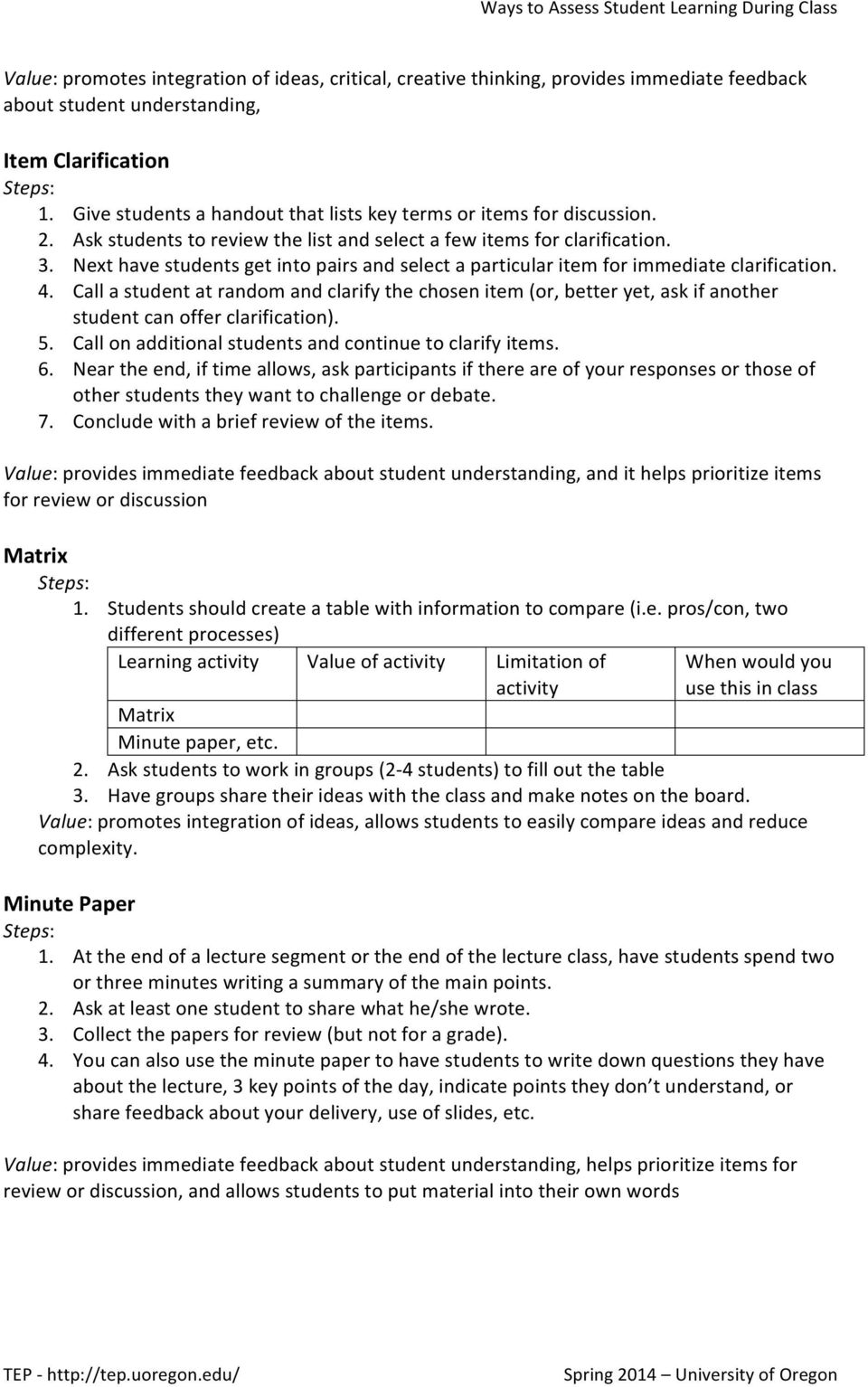
2 Value: promotes integration of ideas, critical, creative thinking, provides immediate feedback about student understanding, Item Clarification 1. Give students a handout that lists key terms or items for discussion. 2. Ask students to review the list and select a few items for clarification. 3. Next have students get into pairs and select a particular item for immediate clarification. 4. Call a student at random and clarify the chosen item (or, better yet, ask if another student can offer clarification). 5. Call on additional students and continue to clarify items. 6. Near the end, if time allows, ask participants if there are of your responses or those of other students they want to challenge or debate. 7. Conclude with a brief review of the items. Value: provides immediate feedback about student understanding, and it helps prioritize items for review or discussion Matrix 1. Students should create a table with information to compare (i.e. pros/con, two different processes) Learning activity Value of activity Limitation of activity When would you use this in class Matrix Minute paper, etc. 2. Ask students to work in groups (2-4 students) to fill out the table 3. Have groups share their ideas with the class and make notes on the board. Value: promotes integration of ideas, allows students to easily compare ideas and reduce complexity. Minute Paper 1. At the end of a lecture segment or the end of the lecture class, have students spend two or three minutes writing a summary of the main points. 2. Ask at least one student to share what he/she wrote. 3. Collect the papers for review (but not for a grade). 4. You can also use the minute paper to have students to write down questions they have about the lecture, 3 key points of the day, indicate points they don t understand, or share feedback about your delivery, use of slides, etc. Value: provides immediate feedback about student understanding, helps prioritize items for review or discussion, and allows students to put material into their own words
3 Multiple- Choice Survey 1. Put a multiple- choice item, preferably conceptual in nature, related to your mini- lecture on the board, a slide, or an overhead, and give four response options. 2. Survey student responses (have them raise hands, use colored cards, or use electronic response system clicker ). 3. Next have them get into pairs and take a couple of minutes to convince each other of their responses. 4. Then re- survey the students. 5. Clarify any misconceptions before proceeding. Value: makes students apply and discuss material while fresh in their minds, and it provides immediate feedback about student understanding Quick Case Study 1. Display a very brief case on an overhead or slide (or put on a handout if lengthy). 2. Pose specific questions for students to answer based on the case [For example, What is the problem? What is the remedy? What is the prevention?] 3. Have students write down their answers. 4. Students can work individually or in pairs or small groups. 5. If time allows, select a few students to share aloud their answers Value: makes students apply material to a realistic situation, and it promotes critical and creative thinking. Quick Thinks For each of the following, use immediate material from mini- lecture, and allow students a couple of minutes to reflect before surveying their responses (have students share aloud, and you can collect written responses for participation points): Correct the Error: Present students with a statement, equation, or visual that you have intentionally made incorrect and have them correct the error. The error may be an illogical or inaccurate statement, premise, inference, prediction, or implication. Complete a Sentence Stem: Present students with a sentence starter and have them complete the sentence. The completed statement may be a definition, category, cause- and- effect relationship, rationale, controversy, etc. Try to avoid statements that ask for rote knowledge. Reorder the Present sequence items in the wrong order and have students re- order the sequence correctly. This might be a process, cycle, method, plan, technique, etc. Interpretation/Paraphrase: Let students know that you will be calling on them at random during your lecture and asking them to interpret what you ve said, putting the material in their own words. When you are ready, pause for a moment to signal that you are about to call on someone. Once a student has shared, call on another student to add any missing items. You can also put items on the board or a slide or a handout a

4 definition, theory, statement, procedure, etc. and have students write them in their own words. Value: these exercises foster attentiveness, provide immediate feedback about student understanding, and promote critical thinking skills Plus/Delta (+/ ) 1. At the end of class ask students to take a sheet of paper and divide it into two columns. 2. In column 1(+) students write down what was very positive about the class, an activity, or instructional materials. In column 2( ) students write what they would like to change for the future. 3. Collect student responses. 4. Read student responses and make changes for next class accordingly. 5. In the next class share some of the highlights with students and make changes as necessary. Value: provides immediate feedback to the instructor, allows for quick changes even in the middle of a term. Reflection 1. Have students take a few minutes to think and write down their thoughts about the lecture material just presented or a particular question or problem that has been posed 2. Collect student papers, if you wish, and review their responses to assess their understanding and identify areas that need clarification at the beginning of the next lecture (you can also assign participation points for responses or allow students to submit them anonymously) Value: allows students to think through material and put it in their own words Strip Sequence 1. Provide students with an out of order list of step in a multi- stepped process (can be written on small strips of paper or on the class screen). 2. In groups or individually, have students put the strips into the correct order from beginning to end. 3. Have student groups compare answers with another group. 4. Review order and answer questions (especially to clarify misconceptions) for the whole class. Value: promotes critical thinking and collaborative learning. Think Pair Share 1. Pose a question. 2. Students get into pairs and discuss question, coming to some resolution.

5 3. Each student pair then shares conclusions with entire class (in large classes or when time is limited, call on as many pairs as time allows). Value: promotes critical thinking and collaborative learning. The activities featured above are compiled from the following sources: Angelo, Thomas A., and K. Patricia Cross Classroom Assessment Techniques: A Handbook for College Teachers. 2nd Edition. San Francisco: Jossey Bass. Barkley, Elizabeth F Student Engagement Techniques: A Handbook for College Faculty. San Francisco: Jossey- Bass. Davis, Barbara G Tools for Teaching. 1st Edition. San Francisco: Jossey Bass. [see Chapter 16, Supplements and Alternatives to Lecturing: Encouraging Student Participation, pp ] Handlesman, J., S. Miller, and C. Pfund Chapter 2, Active Learning in Scientific Teaching. New York: W.H. Freeman and Co. McClanahan, E.B., and L.L. McClanahan Active Learning in a Non- majors Biology Class: Lessons Learned. College Teaching 50(3): Nilson, Linda B Teaching At Its Best: A Research- Based Resource for College Instructors. 3rd Edition. San Francisco: Jossey- Bass. [see Chapter 12, Making the Lecture a Learning Experience, esp. pp ] Additional examples and resources can be found at: 50 CATs by Angelo and Cross Compiled by Cunningham and Moore Classroom Assessment Techniques (CATs) UO Teaching Effectiveness Program Classroom Assessment Techniques (CATs) Center for Teaching, Vanderbilt University sub- pages/cats/
Essays on Teaching Excellence. Practice Tests: a Practical Teaching Method
 Essays on Teaching Excellence Toward the Best in the Academy Volume 17, Number 7, 2005-06 A publication of The Professional & Organizational Development Network in Higher Education (www.podnetwork.org).
CLASSROOM ASSESSMENT TECHNIQUE EXAMPLES
 CLASSROOM ASSESSMENT TECHNIQUE EXAMPLES By Thomas A. Angelo and K. Patricia Cross From Classroom Assessment Techniques: A Handbook for College Teachers, 2nd Ed. Fifty Classroom Assessment Techniques are
Charting Your Course: Instructional Design, Course Planning, and Developing the Syllabus
 Charting Your Course: Instructional Design, Course Planning, and Developing the Syllabus Danielle Mihram, Ph.D. Faculty Fellow and Director USC Center for Excellence in Teaching [email protected] Originally
Assessment In ODL. (Handouts)
 Assessment In ODL (Handouts) Handout 1 MODES OF ASSESSMENT Matching Exercise 1. This kind of assessment is administered during instruction to find out which learning outcomes learners are handling or which
Active Learning in a Non-Majors Biology Class
 Active Learning in a Non-Majors Biology Class Lessons Learned Elaine B. McClanahan and Lon L. McClanahan Abstract. This article describes how a traditional biology lecture course was transformed into an
Planning a Class Session
 Planning a Class Session A Guide for New Teachers by Diane M. Enerson Kathryn M. Plank R. Neill Johnson The Pennsylvania State University 301 Rider Building II University Park, PA 16802 www.schreyerinstitute.psu.edu
New Faculty Orientation 2012 CLASSROOM MANAGEMENT & LEARNING STYLES
 New Faculty Orientation 2012 CLASSROOM MANAGEMENT & LEARNING STYLES LEARNING AND TEACHING This student-centered perspective is a hallmark of the CSUDH approach to teaching. We strive to empower instructors
As tutors, we are responsible for improving the skills of our peers.
 Tutor s Creed As tutors, we are responsible for improving the skills of our peers. As tutors, we will consider the body of work presented at the session in the following manner: First, we will impart to
Teaching a year 5 & 6 class visualisation strategies using the R.I.D.E.R method increases reading comprehension in students with low comprehension.
 Teaching a year 5 & 6 class visualisation strategies using the R.I.D.E.R method increases reading comprehension in students with low comprehension. Teaching session format : Sessions (1 5) The visualization
Writing Better Objective Tests Bill Cerbin UW La Crosse, Center for Advancing Teaching & Learning
 Bill Cerbin UW La Crosse, Center for Advancing Teaching & Learning Prioritize the subject matter What subject matter topics, ideas, concepts are 1. Essential 2. Important 3. Worth being familiar with Use
Facilitating Adult Learning
 Facilitating Adult Learning How to Teach so People Learn Prepared by: Dr. Lela Vandenberg Senior Leadership & Professional Development Specialist 11 Agriculture Hall East Lansing, MI 48824-1039 (517) 353-1898
Data Analysis, Presentation, and Reporting
 Data Analysis, Presentation, and Reporting 2014 Assessment Leadership Institute Review Learning Outcomes Use Results Learning Opportunities Curriculum Map or an activity matrix Identify learning evidence
Strategies That Foster Critical Reading
 Strategies That Foster Critical Reading This guide offers strategies faculty members can use to foster careful reading and critical thinking. Provide Guidance before Each Reading Make Them Curious Professors
50 Instructional Methods
 50 Instructional Methods Presentation Methods (P), Application Methods (A) 1. Action Maze (A) A variation of the case study in which learners solve a problem or case by making decisions. Their decisions
Developing a Course Syllabus: Steps for Syllabus Design
 Developing a Course Syllabus: Steps for Syllabus Design This list of steps breaks down the process of drafting a syllabus. Following these steps in this order will foster an instructor s own critical thinking
Professor Julie Hall [email protected] Napa Valley College Flex Day Fall 2012
 Professor Julie Hall [email protected] Napa Valley College Flex Day Fall 2012 Practical Steps & Strategies to Engage Students in Critical Reflective Thinking Samples of Reflective Prompts & Question
Easy to Use Classroom Assessment Techniques (CATs) Type Description Purpose Advantages Disadvantages Suggestions for use Minute Paper
 Type Description Purpose Advantages Disadvantages Suggestions for use Minute Paper At the end of class students are asked to use index cards or half-sheets of paper to provide written feedback to the following
Concept-Mapping Software: How effective is the learning tool in an online learning environment?
 Concept-Mapping Software: How effective is the learning tool in an online learning environment? Online learning environments address the educational objectives by putting the learner at the center of the
Fundamentals of Teaching-BMSC-GA-4431
 Fundamentals of Teaching-BMSC-GA-4431 Course Leader: Dr. Keith Micoli, Adjunct Assistant Professor and Dr. Vanessa Hubbard, Adjunct Assistant Professor, Dr. Matthew Marcello, UMDNJ Class meets Thursday,
BEFORE-DURING-AFTER (BDA)
 Curriculum & Instruction Resources Content Reading & Writing Resources: A teacher resource page providing strategies to improve reading comprehension in all content areas BEFORE-DURING-AFTER (BDA) Reading
VIDEOCONFERENCING TEACHING ACTIVITIES
 VIDEOCONFERENCING TEACHING ACTIVITIES VIDEOCONFERENCING TEACHING ACTIVITIES As suggested in the document Videoconferencing: Instructional Design Considerations, there is a tendency for students to remain
What is active learning?
 ACTIVE LEARNING: AN INTRODUCTION * Richard M. Felder Hoechst Celanese Professor Emeritus of Chemical Engineering North Carolina State University Rebecca Brent President, Education Designs, Inc. Cary, North
FORMATIVE ASSESSMENT STRATEGIES, DEFINITIONS, EXAMPLES
 FORMATIVE ASSESSMENT STRATEGIES, DEFINITIONS, EXAMPLES 1 Minute Essay Give students an open-ended question and one to three minutes to write their answers. Good questions: What is the most important thing
Teaching with PowerPoint
 Teaching with PowerPoint PowerPoint can be an effective tool to present material in the classroom and encourage student learning. PowerPoint, when effectively planned and used, can enhance instruction.
Discussion (Forums Best Practices) Contents
 1 Contents Discussion (Forums Best Practices) Discussion (Forums Best Practices)... 1 What are Forums?... 2 How do others use forums?... 2 How will you use forums?... 2 Understanding the Forum Structure...
High School Science Lesson Plan: Biology
 High School Science Lesson Plan: Biology Introduction Each lesson in the Adolescent Literacy Toolkit is designed to support students through the reading/learning process by providing instruction before,
Evaluation in Online STEM Courses
 Evaluation in Online STEM Courses Lawrence O. Flowers, PhD Assistant Professor of Microbiology James E. Raynor, Jr., PhD Associate Professor of Cellular and Molecular Biology Erin N. White, PhD Assistant
The Use of a Real Time Online Class Response System to Enhance Classroom Learning
 The Use of a Real Time Online Class Response System to Enhance Classroom Learning Lulu Sun Department of Engineering Fundamentals Embry-Riddle Aeronautical University Abstract A real time online class
Essays on Teaching Excellence. Role-Play: An Often Misused Active Learning Strategy
 Essays on Teaching Excellence Toward the Best in the Academy Volume 19, Number 5, 2007-08 A publication of The Professional & Organizational Development Network in Higher Education (www.podnetwork.org).
Teaching Tips for Higher Education
 ASPB EDUCATION FORUM Teaching Tips for Higher Education The ASPB Education Committee will offer an occasional series of articles providing teaching tips for university or college instructors. These simple
Ten Tips for Facilitating Classroom Discussions on Sensitive Topics
 Ten Tips for Facilitating Classroom Discussions on Sensitive Topics By Alicia L. Moore and Molly Deshaies All teachers will inevitably teach about sensitive topics. These topics may range from racism,
Collecting and Using Student Feedback
 Collecting and Using Student Feedback CETL Center for Excellence in Teaching and Learning October, 2009 Adapted from Collecting and Using Mid-semester Feedback Teaching Support Services by Jeanette McDonald
SI649 Information Visualization. Learning Objectives. Tentative Schedule. Preliminary Syllabus, Fall 2012
 Preliminary Syllabus, Fall 2012 SI649 Information Visualization Fall 2012 Instructor: Eytan Adar, Office hours: Thursday 10 AM-noon, NQ4368 Monday, 1:00-4:00PM, North Quad 1255 Learning Objectives The
1. The teacher candidate sets learning targets that address the Essential Academic Learning Requirements and the state learning goals.
 SCORING RUBRIC Candidate: Supervisor: Cooperating Teacher: School: School District: Grade Level(s): PAA Administration Dates: 1 st 2 nd 3 rd 4 th 1. The teacher candidate sets learning targets that address
Formative Feedback for Teaching Assistants (TAs) at UVic
 Formative Feedback for Teaching Assistants (TAs) at UVic Suggestions Regarding Implementing a Variety of Feedback Approaches that Support the Professional Development of TAs University-wide 1. Introduction
Where are the Cookies?
 Grades 4-6 Mathematics Formative Assessment Lesson Designed and revised by Kentucky Department of Education Mathematics Specialists Field- tested by Kentucky Mathematics Leadership Network Teachers If
Notecard Question & Answer Technique
 Academic Resources Notecard Question & Answer Technique To succeed in college, important ideas from lectures and textbooks must be identified, organized, recorded, practiced and stored in long term memory
SI Coordinator Handbook. Information, Resources and Forms
 SI Coordinator Handbook Information, Resources and Forms Updated November 2010 1 2 Table of Contents SI Coordinator Job Description... 5 Observations and Evaluations... 9 Initial Contacts... 10 Informal
How to Configure and Use the Moodle 1.9.5 Grade Book
 How to Configure and Use the Moodle 1.9.5 Grade Book Table of Contents I. Definitions... 2 II. Grade Book Suggestions... 2 III. Decide on Aggregation Methods... 3 IV. Add Categories... 4 V. Add Graded
Use of formative classroom assessment techniques in a project management course
 Use of formative classroom assessment techniques in a project management course ABSTRACT Bernice M. Purcell Holy Family University Formative assessment is considered to be an evaluation technique that
Biography-Driven Culturally Responsive Teaching
 Selected Instructional Aids from Biography-Driven Culturally Responsive Teaching SOCORRO HERRERA Teachers College, Columbia University New York and London This material appears in Biography-Driven Culturally
Student Preferences for Learning College Algebra in a Web Enhanced Environment
 Abstract Student Preferences for Learning College Algebra in a Web Enhanced Environment Laura Pyzdrowski West Virginia University Anthony Pyzdrowski California University of Pennsylvania It is important
Communication and Problem Solving
 INSTRUCTOR S GUIDE Communication and Problem Solving First Edition, 2006 California Childcare Health Program Administered by the University of California, San Francisco School of Nursing, Department of
How can I improve my interviewing skills? MATERIALS
 Mock Interviews 6 Finding a job The BIG Idea How can I improve my interviewing skills? AGENDA Approx. 45 minutes I. Warm Up: Model an Interview (10 minutes) II. Interview Practice (30 minutes) III. Wrap
Lesson 2 Alcohol: What s the Truth?
 Lesson 2 Alcohol: What s the Truth? Overview This informational lesson helps students see how much they know about alcohol and teaches key facts about this drug. Students complete a True/False quiz about
P-4: Differentiate your plans to fit your students
 What Makes a Differentiated Classroom Different From a Traditional Classroom? In the chart below, you ll notice the ways in which a differentiated classroom differs from a traditional classroom. You may
Active Learning in Accounting Classes: Three Literacy Strategies
 Active Learning in Accounting Classes: Three Literacy Strategies Susan M. Hall, University of the Incarnate Word Theresa M. Tiggeman, University of the Incarnate Word Anita Anderson, University of the
The use of concept maps to evaluate critical thinking in the clinical setting
 Teaching and Learning in Nursing (2008) 3, 6 10 www.jtln.org The use of concept maps to evaluate critical thinking in the clinical setting Julie Senita MSN, CDE, CNE Kent State University, Ashtabula Campus,
CONTENT STANDARD IIIA-1:
 Lesson Title: The Developing Child Grade Levels: 9-12 Time Allotment: Two 45-minute class periods Overview: In this lesson, students learn about the changes that occur in children as they grow. In the
Study Strategies Used By Successful Students
 Study Strategies Used By Successful Students Test performance not only reflects how much one studied in the hours and days right before the test but also how well the person has been studying throughout
A Short Course in Logic Example 8
 A Short ourse in Logic xample 8 I) Recognizing Arguments III) valuating Arguments II) Analyzing Arguments valuating Arguments with More than one Line of Reasoning valuating If then Premises Independent
Mean (Freshmen) Mean (Seniors) Sig. (1-tailed) Mean 2.56 2.77.21.088 N 50 91. Mean 2.53 2.87.34*.009 N 47 94. Mean 2.56 2.72.16.147 N 50 89.
 Critical Thinking General Education/Core Competency Assessment Students were randomly selected from two groups: those with 15 or fewer credits (freshmen) and those with 45 or more credits (seniors), representing
Are students enrolling in the course college freshman and sophomores or college juniors and seniors, or a mix?
 Course Design Each course offered at DSU plays a role in the completion of General Education and/or degree/program learning goals. Be sure to align course learning objectives with these learning goals.
Modifying Curriculum and Instruction
 Modifying Curriculum and Instruction Purpose of Modification: The purpose of modification is to enable an individual to compensate for intellectual, behavioral, or physical disabi1ities. Modifications
Evaluating Students in the Classroom. 2007 Faculty Development Conference February 2007 D. P. Shelton, MSN, RN, CNE, EdD (c)
 Evaluating Students in the Classroom 2007 Faculty Development Conference February 2007 D. P. Shelton, MSN, RN, CNE, EdD (c) Objectives Describe assessment strategies for use in the classroom. Explore the
7 th Grade Instructional Guide Model Lesson 4: The Effects of the Crusades
 7 th Grade Instructional Guide Model Lesson 4: The Effects of the Crusades Standard 7.6.6 Discuss the causes and course of the religious Crusades and their effects on the Christian, Muslim, and Jewish
Spoken English for Work (SEW) exams Guide for Teachers (B1)
 Spoken English for Work (SEW) exams Guide for Teachers (B1) Trinity College London 89 Albert Embankment London SE1 7TP UK T +44 (0)20 7820 6100 F +44 (0)20 7820 6161 E [email protected] www.trinitycollege.co.uk
Teaching Reading with Nonfiction - Just the facts, Ma am
 Teaching Reading with Nonfiction - Just the facts, Ma am The Facts About What our Students are Reading The average child spends less than 4 minutes a day of his/her leisure time reading nonfiction materials
V. Course Evaluation and Revision
 V. Course Evaluation and Revision Chapter 14 - Improving Your Teaching with Feedback There are several ways to get feedback about your teaching: student feedback, self-evaluation, peer observation, viewing
Plot Connections Grade Five
 Ohio Standards Connection Reading Applications: Literary Text Benchmark C Identify the elements of plot and establish a connection between an element and a future event. Indicator 3 Identify the main incidents
Lesson Plan for Note Taking
 Lesson Plan for Note Taking Goals: To prepare students to take pertinent notes form lecture, books and activities. Expose students to different styles of note-taking. Give students an opportunity to practice
Learning from Harvey Milk: Building Support and Coalitions for Change
 Learning from Harvey Milk: Building Support and Coalitions for Change Written by: David Donahue s class, Schools, Sexuality, and Gender, at Mills College, Oakland, California, including the following students:
Transcript: What Is Progress Monitoring?
 Transcript: What Is Progress Monitoring? Slide 1: Welcome to the webinar, What Is Progress Monitoring? This is one of 11 webinars developed by the National Center on Response to Intervention (NCRTI). This
Introduction to Psychology 2101
 Introduction to Psychology 2101 James H. Steiger Department of Psychology and Human Development Vanderbilt University P2101, 2013 Psychology 2101 Introduction 1 Introduction 2 3 4 Psychology 2101 What
Genre Mini Unit. Writing Informational Nonfiction By Joyce Dunning
 Genre Mini Unit Writing Informational Nonfiction By Joyce Dunning Grade Level: 2 nd Grade State Core Standards: Standard 2, Objective 1: Demonstrate an understanding that print carries the message. Standard
From Our Classroom Strategy Library During Reading
 Concept Map Use this map to organize your thoughts and make connections to your topic. Write the main idea in the center, and add supporting ideas or related topics in each surrounding oval. Continue to
Connie Schroeder, Ph.D., Center for Instructional and Professional Development [email protected] 229-5764 Library E179
 2013 Teaching and Learning in College Reflection on Theory and Practice GRAD 803 (one credit) Chem 197 [Note room change] ** See Course Outline as a separate document on D2L after first day of class. Instructor/Contact
SCHOOL OF EDUCATION/HUMAN SERVICES
 SCHOOL OF EDUCATION/HUMAN SERVICES CHILD DEVELOPMENT IV I. DESCRIPTION The study of child development prepares a student to acquire a working knowledge of the principles of a child s growth and development.
Title: All Families Are Special
 Title: All Families Are Special Grade: K 2 nd Grade BACKGROUND Students often express genuine curiosity and interest in one another s family composition. At other times, they may make fun of actual or
Constructivism: A Holistic Approach to Teaching and Learning
 Constructivism: A Holistic Approach to Teaching and Learning Janet Giesen Faculty Development and Instructional Design Center Northern Illinois University Introductions Your name Your department or unit
Blended Instructional Design
 Blended Instructional Design Introduction Before We Get Started This guide explains how to teach lesson with Prentice Hall Algebra 1, Geometry, and Algebra 2 the new Prentice Hall High School Math series.
Writing learning objectives
 Writing learning objectives This material was excerpted and adapted from the following web site: http://www.utexas.edu/academic/diia/assessment/iar/students/plan/objectives/ What is a learning objective?
Assessment. Show US The Learning. An Institution-Wide Process to Improve and Support Student Learning. College of DuPage
 Student or participant learning or satisfaction Outcomes of the processes Reporting and feedback from the assessment measures Show US The Learning Delivery processes Planning processes An Institution-Wide
SHOULD CLINICAL COURSES GET A LETTER GRADE?
 1 SHOULD CLINICAL COURSES GET A LETTER GRADE? Rosalinda Alfaro-LeFevre, RN, MSN Some time ago, a Dutch colleague, Nico Oud, asked me a question that has since played in my head many times. He asked, Have
Effective Lesson Planning for Adult English Language Learners
 III-C. Effective Lesson Planning for Adult English Language Learners Table of Contents Trainer Guide 3 Part 1 Overview... 8 Part 2 Overview... 21 Trainer Notes, Part 1 35 Goal, Objectives, and Agenda...
Lesson 13 My Drug-Free Future
 Lesson 13 My Drug-Free Future Overview This lesson teaches about how drug and alcohol use can affect a person s goals for the future. After reviewing the negative consequences of drug use and the benefits
Bag It! A Quick and Remarkably Easy Instructional Design Process.
 Bag It! A Quick and Remarkably Easy Instructional Design Process. 1 Bag It! A Quick and Remarkably Easy Instructional Design Process. By: Sharon L. Bowman, M.A. President, Bowperson Publishing & Training,
Why So Quiet?: Strategies for Engaging Your Students in the Discussion
 Why So Quiet?: Strategies for Engaging Your Students in the Discussion WHAT PREVENTS STUDENTS FROM PARTICIPATING? 1. They don t think they have anything worthwhile to say or they worry about seeming stupid.
What qualities are employers looking for in teen workers? How can you prove your own skills?
 Sell Yourself 4 Finding a job The BIG Idea What qualities are employers looking for in teen workers? How can you prove your own skills? AGENDA Approx. 45 minutes I. Warm Up: Employer Survey Review (15
Construction of a Professional Perception in the "Methods of Teaching Computer Science" Course
 Construction of a Professional Perception in the "Methods of Teaching Computer Science" Course Orit Hazzan and Tami Lapidot Department of Education in Technology and Science Technion Israel Institute of
Title of Course (45 hours): Building Academic Vocabulary
 LILIE, LLC Course Information Copyright Notice The information below is proprietary information of LILIE, LLC and subject to copyright laws and restrictions. Access to this content is licensed solely to
Careers Career education and Connections BIG AGENDA MATERIALS PoRTfoLIo PAGES: STUDENT HANDBooK PAGES: facilitator PAGES: objectives
 Career Education and Connections 4 Careers The BIG Idea What education do my selected careers require, and why is it important to know this? AGENDA Approx. 45 minutes I. Warm Up: How Much Education for
Teaching Students with Special Needs: Inclusion Strategies for the Classroom Teacher
 Quality Educational Programs, Inc. 1891 North Gaffey Street #228 San Pedro CA 90731 800-486-8650 Teaching Students with Special Needs: Inclusion Strategies for the Classroom Teacher A Distance Learning