
New Hampshire s Early Childhood Professional Development System
|
|
|
- Arabella Mathews
- 10 years ago
- Views:
Transcription
1 NH Early Childhood Professional Development System Updated April 1, 2013 New Hampshire s Early Childhood Professional Development System TABLE OF CONTENTS INTRODUCTION TO THE NH EARLY CHILDHOOD PROFESSIONAL DEVELOPMENT SYSTEM...1 GLOSSARY...4 CE KNOWLEDGE AREAS....7 NH EARLY CHILDHOOD CE KNOWLEDGE AREAS NH EARLY CHILDHOOD CREDENTIAL APPROVED COURSEWK AND NH COLLEGES OFFERING EARLY CHILDHOOD COURSEWK 11 LIST OF APPROVED COURSEWK (NOT ALL-INCLUSIVE)..12 PROFESSIONAL ACTIVITIES.14 PROFESSIONAL ACTIVITIES MATRIX. 15 CREDENTIAL LATTICES.. 17 NH NH NH NH NH FAMILY CHILD CARE CREDENTIAL LATTICE 18 EARLY CHILDHOOD TEACHER CREDENTIAL LATTICE.19 EARLY CHILDHOOD MASTER TEACHER CREDENTIAL LATTICE...20 EARLY CHILDHOOD ADMINISTRAT CREDENTIAL LATTICE.. 21 EARLY CHILDHOOD MASTER PROFESSIONAL CREDENTIAL LATTICE...22 INFANT AND TODDLER ENDSEMENT..23 NH INFANT AND TODDLER CREDENTIAL ENDSEMENT LATTICE..24 SUGGESTED INFANT AND TODDLER TRAININGS..25 APPENDIX. 26 CREDENTIAL APPLICATION....FM A EARLY HEAD START OPTION.....FM B PROFESSIONAL ACTIVITIES DOCUMENTATION FM....FM C PROFESSIONAL DEVELOPMENT PLAN.FM D TRANSCRIPT REQUEST FM FM E RESOURCES

2 New Hampshire s Early Childhood Professional Development System TABLE OF CONTENTS INTRODUCTION TO THE NH EARLY CHILDHOOD PROFESSIONAL DEVELOPMENT SYSTEM...1 GLOSSARY...4 CE KNOWLEDGE AREAS....7 NH EARLY CHILDHOOD CE KNOWLEDGE AREAS NH EARLY CHILDHOOD CREDENTIAL APPROVED COURSEWK AND NH COLLEGES OFFERING EARLY CHILDHOOD COURSEWK 11 LIST OF APPROVED COURSEWK (NOT ALL-INCLUSIVE)..12 PROFESSIONAL ACTIVITIES.14 PROFESSIONAL ACTIVITIES MATRIX. 15 CREDENTIAL LATTICES.. 17 NH FAMILY CHILD CARE CREDENTIAL LATTICE 18 NH EARLY CHILDHOOD TEACHER CREDENTIAL LATTICE.19 NH EARLY CHILDHOOD MASTER TEACHER CREDENTIAL LATTICE...20 NH EARLY CHILDHOOD ADMINISTRAT CREDENTIAL LATTICE.. 21 NH EARLY CHILDHOOD MASTER PROFESSIONAL CREDENTIAL LATTICE...22 INFANT AND TODDLER ENDSEMENT..23 NH INFANT AND TODDLER CREDENTIAL ENDSEMENT LATTICE..24 SUGGESTED INFANT AND TODDLER TRAININGS..25 APPENDIX. 26 CREDENTIAL APPLICATION....FM A EARLY HEAD START OPTION.....FM B PROFESSIONAL ACTIVITIES DOCUMENTATION FM....FM C PROFESSIONAL DEVELOPMENT PLAN.FM D TRANSCRIPT REQUEST FM FM E RESOURCES

3 NH Early Childhood Professional Development System Updated October 14, 2013 Introduction to the New Hampshire Early Childhood Professional Development System The first edition of the New Hampshire Early Childhood Professional Development System (NHECPDS) Guide to Early Childhood Careers was published in December 1999 and, since that time, close to 2,000 individuals have been recognized for their professional development. New Hampshire has a diverse and growing community of professionals who work with or on behalf of children, youth, and families. Just as this community has grown, the NHECPDS has grown and has been revised to support the ongoing professional development of early childhood teachers, administrators, workshop trainers, college faculty, mentors, program consultants, and allied professionals. The National Association for the Education of Young children (NAEYC) defines professional development as initial preparation (preservice) and learning experiences (inservice) designed to improve the knowledge, skills/behaviors, and attitudes/values of the early childhood workforce. To meet NAEYC s mission of assuring the provision of high-quality early childhood programs for young children, it is necessary to have a highly competent workforce for the early childhood field. Professional development provides the path to achieving this goal. Nationally, there is growing commitment to the importance of professional development. Many states have credential systems, some required, others voluntary. Our system is voluntary, except as required in State contracts, and is based on the following criteria: Core Knowledge Areas Education and specialized coursework Work experience Ongoing professional training Professional activities The information and documents contained within this packet are meant to inform readers and to serve as resources for professional development, while providing a process for attaining a professional Credential. Credential lattices (progression of levels of professional roles) include criteria for levels and individual endorsements, providing entry into the NHECPDS for all who choose to be recognized for their commitment to early childhood care and education. The lattices also serve to challenge professionals to continue to grow and explore career opportunities. Revisions to our NHECPDS allow not only for more individuals to enter, but also for more alignment with the New Hampshire Child Care Licensing Rules. These rules were revised in 2008, with increased requirements for ongoing professional development implemented as of July 1, Our credential lattices reflect the increases in professional development requirements, while recognizing individual accomplishments that go above and beyond that which is required for licensing. We also want to invite professionals who work with or on behalf of children and families in capacities other than direct service, teaching, or administration, to be part of our system. Education and training requirements for all lattice levels and endorsements are vital to the continued growth and quality improvement of our professional workforce. *National Association for the Education of Young Children. What is Professional Development in Early Childhood Education? Retrieved from 2
4 We recognize that compensation is also critical to the success of quality improvement through professional development of our early childhood workforce. Advocacy continues to be our best avenue to professional wages. This needs to be a priority in our communities, across the state, and at the national level. Our revised NHECPDS empowers our workforce to be actively engaged in advocacy efforts through professional activities that contribute to the field of early childhood care and education. Your professional credential serves as a visible achievement of your professionalism and as a model for others to emulate. Please display your credential(s) proudly, share this guide widely, and seize every opportunity to engage others in the conversation about quality and the outcomes for children, youth, and families in New Hampshire. Extensive time and effort went into the revision of the NHECPDS. Thank you to the entire Early Childhood Credential Revision Task Force, listed individually below. Additionally, thank you to the early childhood community for your feedback and support during this process. You are growing professionally, as well as helping to grow your field. Your commitment to quality on behalf of children, youth and families is greatly appreciated! Early Childhood Credential Revision Task Force: Cynthia Billings, PlusTime NH Kristin Booth, Division for Children, Youth, and Families Denise Corvino, Child Care Licensing Unit Jackie Cowell, Early Learning NH Christina MacDonald, Department of Education Linda Graham, Bureau of Developmental Services Gale Hall, NHTI Concord s Community College Joan Izen, Preschool Technical Assistance Network Tessa McDonnell, Granite State College Carol Montambeault, St. Paul s School Reeva Murphy, Child Care Information Center John Nimmo, UNH Child Study and Development Center Tracy Pond, Child Care Resource and Referral Lisa Strout, Rivier University Jessica Sugrue, Division for Children, Youth, and Families Ellen Wheatley, Division for Children, Youth, and Families 3

5 Glossary Accreditation: a standard of quality applied to early childhood programs which have successfully completed requirements set forth by the COA, (Council On Accreditation), NAFCC, (National Association for Family Child Care), or as defined by the NAEYC (National Association for the Education of Young Children). Advocacy: the pursuit of influencing outcomes including public policy and resource allocation decisions within political, economic, and social systems and institutions. Allied Professional: an individual who has completed training in a specialized field, and wishes to contribute knowledge and or services to the early childhood field. Appropriate Professional Organization: an early childhood organization focused on the core knowledge skills and experience of early childhood professionals and related issues or advocacy, and which requires membership, meets regularly, may publish articles and/or journals, and may offer professional development through state and/or national conferences. Approved Coursework: credit-bearing courses consisting of early childhood content, offered through regionally accredited colleges (see Approved Coursework list on page 12). Associate Degree: college degree which represents a minimum of 60 credit hours, or two years of full-time study from a regionally accredited institute. Baccalaureate Degree: college degree representing a minimum of 120 credit hours, or four years of full-time study. Child and Adult Care Food Program (CACFP): a food assistance program that provides nutritious meals and snacks for eligible children and adults in care. Child Growth and Development: the way that a young child grows and develops physically, cognitively, and socially/emotionally, from the prenatal stage through age eight. Child Care Resource and Referral (CCR&R): a program that provides referrals to child care programs for families in need of child care, training and targeted technical assistance for child care providers, and community outreach in support of child care. All CCR&R services focus on quality child care, and all CCR&R programs are members of the Child Care Aware of New Hampshire statewide network, Core Knowledge Areas (CKAs): the body of knowledge that defines the early childhood profession Credential: indicator of professional level of growth, a certificate/award that recognizes the recipient s qualifications and commitment to early childhood or an allied profession. Credit bearing: refers to a college course at a regionally accredited college, usually a minimum of 3 credits. Cultural Factors: family and professional s beliefs, traditions, values, and environmental factors that influence child and youth development. Developmentally Appropriate Practices (DAP): the foundation for effective teaching, based on child and youth physical, cognitive, and social/emotional needs. 4

6 Documentation: third-party written evidence of qualifications in the form of official transcripts, copies of training certificates, copies of membership cards, letters signed by employers, and other evidence that demonstrates fulfillment of credential requirements. Early Childhood (EC): used to describe the period of childhood from birth through age eight. Environmental Factors: life conditions that influence child and youth development. Family Child Care (FCC): child care program where a provider cares for children within his/her own home, and may be licensed or license-exempt. Individual Mentor: an individual who guides and supervises the professional development of an individual outside of the Mentor s program. Lattice: a framework of professional development criteria for credential levels/endorsements. License Exempt: refers to a program, which is not licensed by the Child Care Licensing Unit (CCLU). A license exempt family child care provider may care for no more than three children other than his/her own, foster, or adopted children. Please refer to RSA 170-E3 for other exemptions or contact the CCLU. Licensed Plus: term applied to licensed child care programs that have demonstrated evidence of a specific set of quality standards beyond what is required for licensing. Ongoing Professional Training: documented face-to-face, and/or web-based early childhood workshops, conferences, coursework, and self-study that include evidence of content that focuses on the Core Knowledge Areas. Professional Activity (PA): an activity in which one engages to give back to the early childhood community, and which broadens one s own development in the early childhood field. Practicum: a practice teaching experience conducted under the supervision of a classroom teacher and college faculty. Program Consultant: a professional who provides technical assistance to an early childhood program, for the purpose of quality improvement. Professional Development: a continuum of learning and support activities designed to prepare individuals for work with and on behalf of young children and their families, as well as ongoing experience to enhance this work (NAEYC & NACCRRA Early Childhood Education Professional Development: Training and Technical Assistance Glossary Professionally Relevant: related to the field of early childhood through work with children and families. Professional Portfolio: a collection of work that demonstrates one s professional growth and development in Core Knowledge Areas. Quality Rating Improvement System (QRIS): a system that administers methods of assessment of the level of quality in early childhood programs, for the purpose of quality improvement and community engagement. 5

7 Reflective Practice: refers to the process of studying one s own teaching methods or professional practices and determining what works best for young children, youth, or adult learners. Reflective practice can help an individual to develop and grow professionally. Regionally Accredited College or University: a college or university acknowledged as meeting acceptable levels of quality through accreditation by any of the regionally accrediting organizations recognized by the US department of education or the council for higher education accreditation Related Degree: Terminal degrees for early childhood include degrees in Early Childhood Education, and related degrees may include Child Development, Child and Family Studies, Special Education, and Education, all with a required number of credits in approved coursework. Related Field: specialized area of study, which has influence on or is influenced by children, youth, and/or families. A degree in a related field must include a minimum number of credits focused on content in one or more Core Knowledge Areas. Self Study: learning engaged in by oneself, with no direct supervision or attendance in training or class, for one s own knowledge, which is documented through self-reflection (more information found at: Social Factors: societal influences that impact child and youth development. Special Education (SPED): programs and practices designed to meet the unique needs of children whose mental ability, physical ability, emotional functioning, health status, etc. requires special teaching approaches, equipment, or care within or outside a regular classroom. Technical Assistance (TA): specialized consultation provided to early childhood programs, to address specific challenges and improve overall program quality. Work Experience: documented employment or practicum experience working with or on behalf of children and families. Additional Glossary Resource: Early Childhood Education Professional Development: Training and Technical Assistance Glossary 6

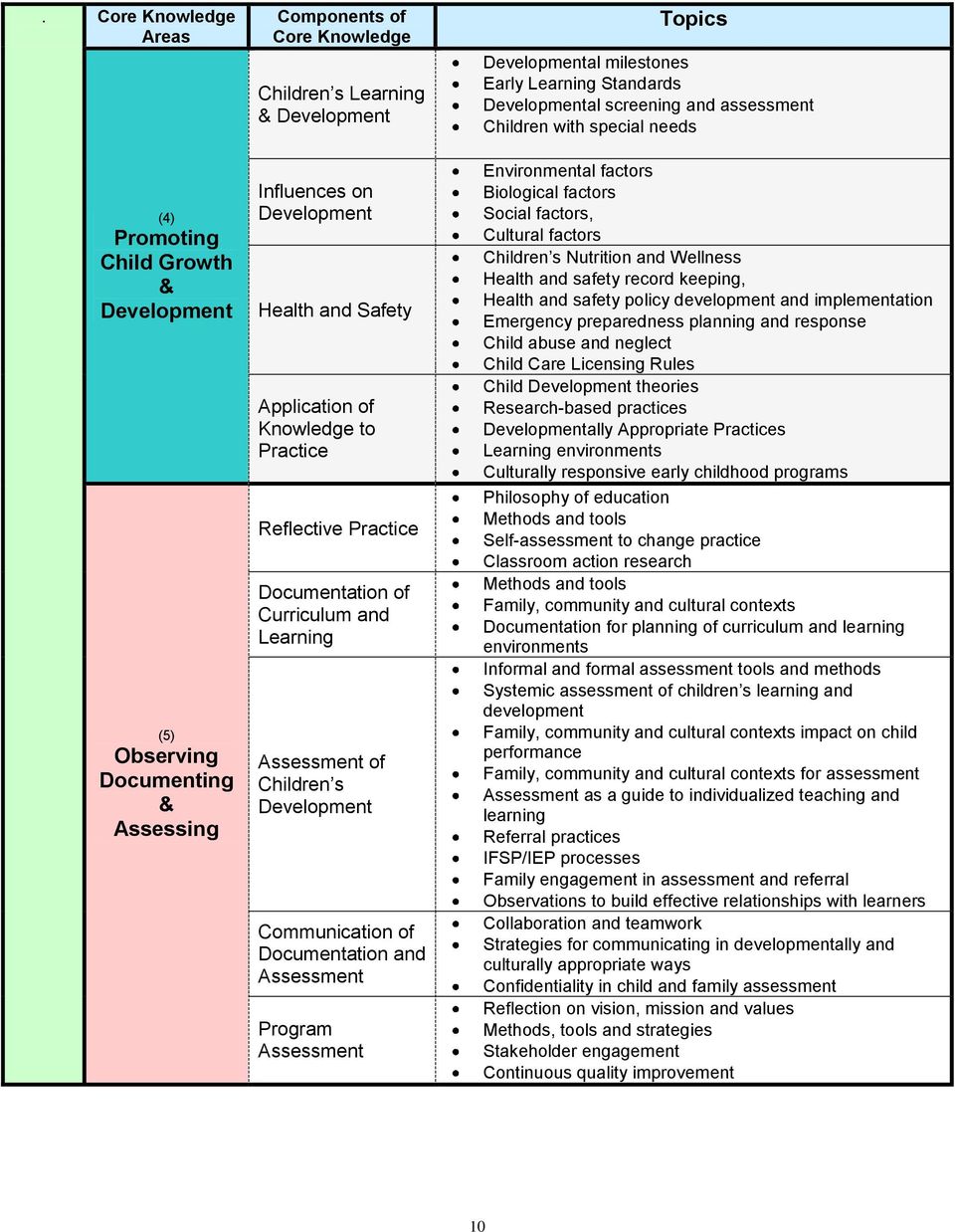
8 Core Knowledge Areas The Core Knowledge Areas (CKAs) constitute the body of knowledge that defines our professional field. Our work with or on behalf of children, youth, and families must be purposeful. It must have a strong foundation; a shared understanding that quality care and education is our common goal. The National Association for the Education of Young Children (NAEYC) has set standards that serve as the framework for high quality early care and education. These standards are the foundation for the Early Childhood Core Knowledge Areas. The CKA matrix is divided into three sections: Core Knowledge Areas, Components of Core Knowledge, and Topics. Core Knowledge Areas are segmented into components and segmented further into topics that could be covered in training, coursework, and self-study. All together, the CKAs comprise the knowledge that professionals strive to master throughout their careers in the field of early childhood. CKA s help individuals to become informed about various topics within the early childhood field. The CKA s guide professionals in their own professional growth and development. The matrix on the following page will allow individuals to find topics within the components about which they would like to learn. To meet the requirements of our NHECPDS, all ongoing training, education, and specialized coursework must cover one or more Core Knowledge Areas. Applicants should familiarize themselves with this matrix and be prepared to demonstrate how their supporting documentation meets Core Knowledge Areas. The Core Knowledge Areas are the seeds from which professional development grows. 7

9 Quality Early Care & Education with respect for the diverse needs of each child & family Core Knowledge Areas (1) Developing As a Professional (2) Building Family & Community Relationships Early Childhood Core Knowledge Areas Components of Core Knowledge Professional Development Standards of Quality Program Administration Advocacy Leadership Ethics Collaboration Communication Partnerships & Participation Topics Self awareness and self- assessment Professional philosophy Professional organizations NH Early Childhood Professional Development system Adult development and learning Mentorship Coaching Quality Rating and Improvement System (QRIS) Child Care Licensing Rules Licensed-Plus Accreditation Early Learning Standards Strengthening Families Initiatives Mission and Vision Program operations Financial planning and management Legal and fiscal issues Staff supervision and evaluation Program evaluation and development Program policies & procedures Community child care needs, marketing and public relations Family recruitment and retention Public policy Advocacy Team building and conflict resolution Staff Development Leadership styles Teachers as leaders Ethical standards Ethical decision-making Professional behavior Professional boundaries Confidentiality Community resources Family and community relationships Partnership development Communication styles Communication formats, i.e. technology, written, nonverbal, etc. Communication skills Positive relationships Family engagement Observation and risk assessment Volunteer engagement Community engagements 8

10 Core Knowledge Areas (2) Building Family & Community Relationships Continued (3) Teaching & Learning Components of Core Knowledge Family and Cultural Contexts Family Leadership Family Supports Community Resources Relationships & Interactions Curriculum & Environment Strategies for Teaching & Learning Individualization Cultural Relevance Positive Behaviors Personal bias Diversity Parenting strategies Family structures Family strengths Family systems theory (Power and Privilege) Topics Self-Advocacy Family participation in decision-making Social capital Networking Strengthening Families Risk factors, protective factors and resilience Social and material supports Emotional and health supports Communication skills Engagement Knowledge of children, youth and families Developmentally appropriate environments and practice Evaluation of appropriate equipment and materials The significance of play Emergent curriculum Research-based Design, development and evaluation Competence in content areas and academic disciplines Intentionality Learning experiences that develop emerging critical thinking Reflective practice to promote positive outcomes Developmentally appropriate approaches Tools and methods for early education Temperament Developmentally appropriate practices for individual children Theoretical and legal foundations for special supports Adaptations of the environment and curriculum Developmentally and culturally appropriate communications Developmentally appropriate communication Effective partnerships with parents, families and other professionals Family involvement Anti-bias curriculum Effective methods of working with all families Support for developing executive function Appropriate theories and application of guidance Team approach Pro-social behavior guidance strategies 9

11 . Core Knowledge Areas (4) Promoting Child Growth & Development (5) Observing Documenting & Assessing Components of Core Knowledge Children s Learning & Development Influences on Development Health and Safety Application of Knowledge to Practice Reflective Practice Documentation of Curriculum and Learning Assessment of Children s Development Communication of Documentation and Assessment Program Assessment Topics Developmental milestones Early Learning Standards Developmental screening and assessment Children with special needs Environmental factors Biological factors Social factors, Cultural factors Children s Nutrition and Wellness Health and safety record keeping, Health and safety policy development and implementation Emergency preparedness planning and response Child abuse and neglect Child Care Licensing Rules Child Development theories Research-based practices Developmentally Appropriate Practices Learning environments Culturally responsive early childhood programs Philosophy of education Methods and tools Self-assessment to change practice Classroom action research Methods and tools Family, community and cultural contexts Documentation for planning of curriculum and learning environments Informal and formal assessment tools and methods Systemic assessment of children s learning and development Family, community and cultural contexts impact on child performance Family, community and cultural contexts for assessment Assessment as a guide to individualized teaching and learning Referral practices IFSP/IEP processes Family engagement in assessment and referral Observations to build effective relationships with learners Collaboration and teamwork Strategies for communicating in developmentally and culturally appropriate ways Confidentiality in child and family assessment Reflection on vision, mission and values Methods, tools and strategies Stakeholder engagement Continuous quality improvement 10
12 NH Early Childhood Credential Approved Coursework and NH Colleges Offering Early Childhood Coursework The NHECPDS requires specific education and specialized coursework completed at regionally accredited colleges. All approved college coursework must focus on content specific to young children (birth through age eight). The Credentialing Specialist maintains a list of approved coursework for reference and carefully examines all college transcripts. Additional documentation may be required to determine if the Credentialing Specialist will approve coursework. *Community College System of New Hampshire Colby-Sawyer College *Granite State College Hesser College Keene State College Plymouth State University Rivier University Southern New Hampshire University University of New Hampshire *Please note that early childhood tuition assistance is available for select early childhood courses at these colleges, for anyone working a minimum of twenty hours per week in a licensed or license exempt child care program. Further information regarding the Council for Higher Education Accreditation can be found here: 11
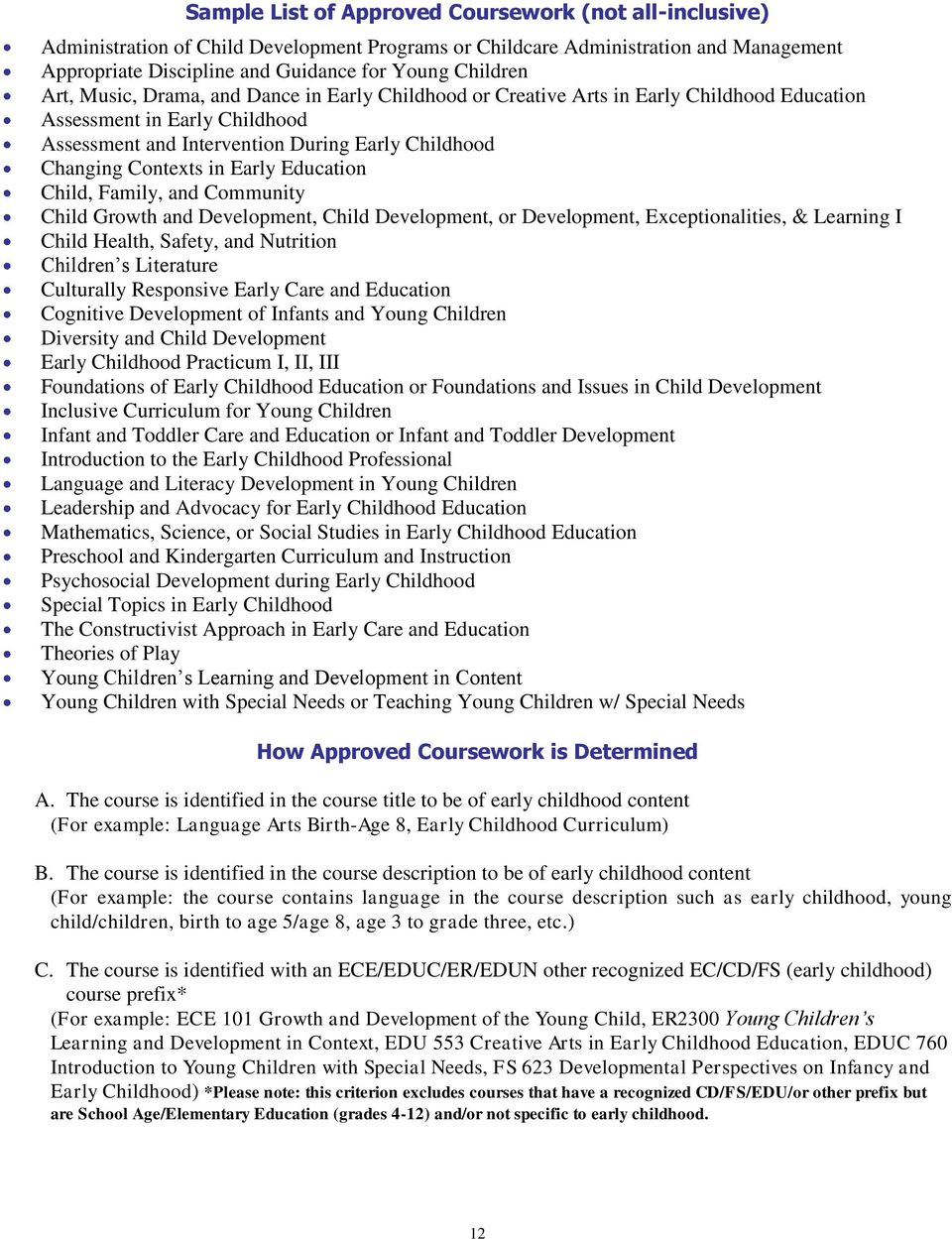
13 Sample List of Approved Coursework (not all-inclusive) Administration of Child Development Programs or Childcare Administration and Management Appropriate Discipline and Guidance for Young Children Art, Music, Drama, and Dance in Early Childhood or Creative Arts in Early Childhood Education Assessment in Early Childhood Assessment and Intervention During Early Childhood Changing Contexts in Early Education Child, Family, and Community Child Growth and Development, Child Development, or Development, Exceptionalities, & Learning I Child Health, Safety, and Nutrition Children s Literature Culturally Responsive Early Care and Education Cognitive Development of Infants and Young Children Diversity and Child Development Early Childhood Practicum I, II, III Foundations of Early Childhood Education or Foundations and Issues in Child Development Inclusive Curriculum for Young Children Infant and Toddler Care and Education or Infant and Toddler Development Introduction to the Early Childhood Professional Language and Literacy Development in Young Children Leadership and Advocacy for Early Childhood Education Mathematics, Science, or Social Studies in Early Childhood Education Preschool and Kindergarten Curriculum and Instruction Psychosocial Development during Early Childhood Special Topics in Early Childhood The Constructivist Approach in Early Care and Education Theories of Play Young Children s Learning and Development in Content Young Children with Special Needs or Teaching Young Children w/ Special Needs How Approved Coursework is Determined A. The course is identified in the course title to be of early childhood content (For example: Language Arts Birth-Age 8, Early Childhood Curriculum) B. The course is identified in the course description to be of early childhood content (For example: the course contains language in the course description such as early childhood, young child/children, birth to age 5/age 8, age 3 to grade three, etc.) C. The course is identified with an ECE/EDUC/ER/EDUN other recognized EC/CD/FS (early childhood) course prefix* (For example: ECE 101 Growth and Development of the Young Child, ER2300 Young Children s Learning and Development in Context, EDU 553 Creative Arts in Early Childhood Education, EDUC 760 Introduction to Young Children with Special Needs, FS 623 Developmental Perspectives on Infancy and Early Childhood) *Please note: this criterion excludes courses that have a recognized CD/FS/EDU/or other prefix but are School Age/Elementary Education (grades 4-12) and/or not specific to early childhood. 12
14 The list of approved coursework provided (see previous page) is not inclusive of all coursework. To assist you with determining if the coursework may be approved, applicable course titles and/or descriptions usually include one or more of the following words/phrases: Early childhood Young children Play Special Needs Young children and families Development Infants Toddlers Preschool Kindergarten Early childhood curriculum Early childhood environments Early learning Observation and assessment Related degrees to Early Childhood Education must include approved coursework credits. Please see credential lattices for specific credit requirements. The following degrees may be considered related degrees, with appropriate approved coursework: Child Development Child and Family Studies Special Education Education In general, elementary education coursework does not meet the criteria for approved coursework for the NHECPDS. Please refer to the course description and the Core Knowledge Areas, and please note that the Credentialing Specialist and the Credential Committee will make final decisions regarding approved coursework. The Credential Committee may request that you submit additional documentation, such as a course syllabus. 13

15 Professional Activities Each credential lattice includes requirements for professional activity units. The following is a definition of professional activity: Professional Activity (PA) refers to participation in activities that help individuals grow and develop professionally, while also encouraging them to give back to the early childhood field. These activities may occur on the individual level or as part of a larger early childhood organization. Active involvement in professional activities promotes and supports the early childhood infrastructure in ways such as workforce development and program improvement, ultimately improving outcomes for children, youth, and families. Professional activities increase an early childhood professional s competence, performance, and/or effectiveness in the early childhood field. Professional Activities are those that: Engage one in the broader aspect of the early childhood field. Increase the knowledge of others in the early childhood field. Increase the knowledge of others outside of the early childhood field. The NHECPDS includes requirements for professional activities to demonstrate individual professional growth and development. This is evidenced through documentation of active engagement in these activities. Please note that the Credential system does require both professional training and professional activities, which together exceed licensing requirements. The following matrix provides several examples of PA s. Each PA is assigned a number of units. There is a column for tallying how many times an activity is completed, as well as a column for total units. Applicants may use this form as a worksheet to track PA units. Documentation, including hours spent in each professional activity, is the only way to receive credit for PA s. For any professional activities completed which are not listed on the PA Matrix, applicants must submit a completed NHECPDS Professional Activities Documentation Form found in the appendix. In the case of any discrepancies, the Credentialing Specialist and the Credential Committee will make final decisions regarding awarding professional activity units. The Credentialing Specialist is available to consult with individuals regarding PA s. 14

16 Professional Activities Matrix Professional Activities for Early Childhood (EC) Professionals* *This is not a comprehensive list. If you are participating in other EC professional activities, please submit the NHECPDS Professional Activities Documentation Form, found in the appendix. The Credential Committee will consider and, if approved, assign units. Related to Professional Organizations Hold current membership in an appropriate local, state or national organization, i.e.: NAEYC/NHAEYC; ELNH; EEIN; NAFCC; NHAIMH; ASCD; ACEI; NAECTE Volunteer for your local Child Care Resource and Referral Program (units assigned per task or per event) Attend a professional organization meeting 1 Be an active committee member of an appropriate local, state, regional or national professional organization Hold a leadership position in a professional organization at the local level 3 Be a board member or officer of a statewide or national professional organization 4 Other: Related to Professional Conferences Units # Of times per credential application 1 Once Attend at a local or state conference 1 Once Attend a national conference 2 Once Serve on a professional conference planning committee 2 Present at a local or state professional conference 3 Present at a national conference 4 Chair a professional conference planning committee. 4 Other: Related to Training, Teaching or Mentoring Others Prepare and present an in-service training or workshop for EC staff, parents or support groups within your own program. Prepare and present as a guest speaker for a college course 1 Hold an appropriate and current teaching certificate from NH Dept. of Education (Early Childhood, K-3, Special Education) Provide training outside of your program (min of 2 hours of training + prep time) 2 Supervise students placed by a high school (1 semester) 2 Supervise student teachers officially placed by a college or university (1 semester) 3 Develop an Early Childhood training curriculum 3 Serve as a mentor in the Trainer Development Program 4 Serve as a mentor to another early childhood professional or program (units assigned based on documentation submitted with application) Teach a minimum of a 3 credit related course at a regionally accredited college or university Other: Units total 15
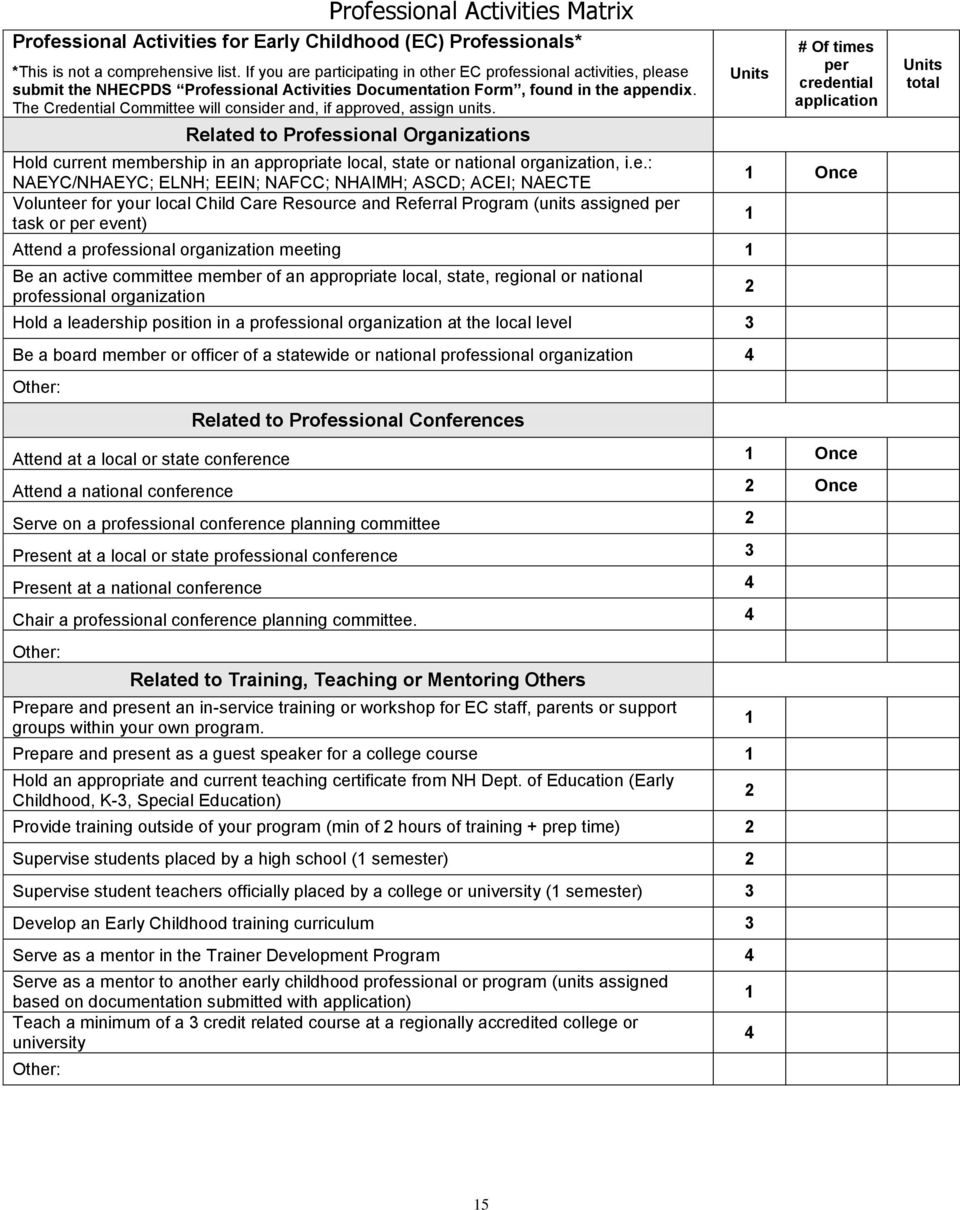
17 Related to Program Quality Improvement or Validation Participate in the CACFP (food program) as a Family Child Care provider 1 Once Complete a Professional Development Plan (see appendix) 1 Once Complete a Professional Portfolio and have it reviewed 2 Once As a license exempt Family Child Care provider, apply for a child care license 2 Once Serve on the accreditation committee of your EC program to achieve or maintain national program accreditation. Direct a program through EC national accreditation process 3 Be a member of a CIPAS team. 3 Provide extended and targeted technical assistance (TA) for a program to improve program quality Serve as an Observer, Validator or Verifier for national accreditation program 4 Other: Related to Outreach or Advocacy Host a professional or community meeting/training at your program (submit agenda) 1 Attend an advocacy event for EC policy 1 Actively advocate for EC policy (contact legislators, invite legislators to visit) 2 Actively participate in a relevant task force or advisory group. 3 Testify at a legislative hearing or organize an advocacy event regarding EC policy issues. 3 Organize a community event related to EC such as Week of the Young Child (WOYC). (submit flyer, registration list, copy of newspaper article) Other: Related to Contributing Written Content Contribute or edit written content to a professionally relevant publication that is distributed locally or statewide Edit a professionally relevant publication that is juried and distributed nationally 3 Publish in a professionally relevant publication or journal that is distributed nationally, or publish a professionally relevant book. Edit, be a peer reviewer, or serve on an editorial board of a professionally relevant publication or journal that is distributed nationally. Other: Related to Grants/Funding Write a grant proposal to secure funding for an EC program 2 Receive and administer a grant to support an EC program. 3 Participate as a blind reviewer for EC request for proposal s (RFP s), grants, etc. 3 Other:
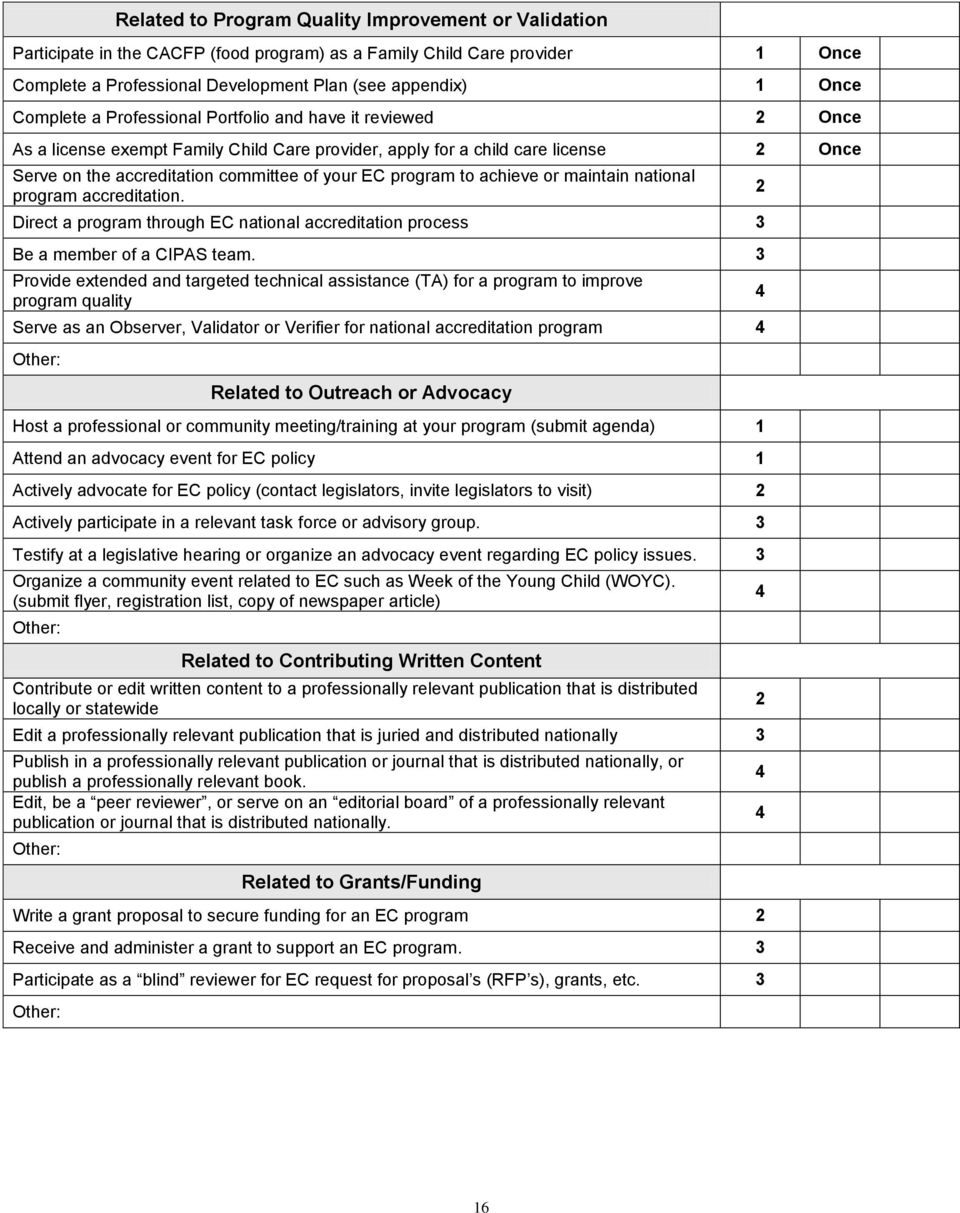
18 Introduction to the Credential Lattices Credential lattices signify the roles of professionals in the early childhood field. Each lattice includes several levels or endorsements and is designed to provide a point of entry into the NHECPDS and to recognize professional growth and achievement. On each lattice you will see the title of the credential, and below the title, there will be either levels or endorsements (as on the Master Professional lattice). Professional development criteria are listed in the left column of each lattice: Education & Specialized Coursework Work Experience Ongoing Professional Training Professional Activities To the right of each criterion listed you will find the requirements for each level or endorsement. Education and coursework require official college transcripts for documentation, and both carry no time limit on completion. Work experience requires third-party documentation, such as a letter or from the appropriate administrator/supervisor, and also carries no time limit. Ongoing training and professional activities require documentation and should be completed within one year prior to your initial credential application date. Your credential will need to be renewed every three years, at which time you will be required to submit documentation of ongoing training and professional activities (i.e. 18 hours of ongoing training and 2 to 4 PA units required for an initial application, 54 hours of ongoing training and 6 to 12 PA units upon renewal). Please review the other documents in this packet for reference, and contact the Credentialing Specialist for assistance at Find your pathway into our credential system and move towards your goal as you grow professionally. 17
19 Training & Education *All credit requirements must include a minimum of 3 credits focused on Child Growth & Development Work Experience Ongoing Professional Training Professional Activities (PA) NH Family Child Care Credential Lattice FCC level 1 FCC Level 2 FCC Level 3 FCC Level 4 FCC Level 5 FCC Level 6 6 months experience in a licensed or licensed exempt Family Child Care (FCC) setting Infant / Child CPR & First Aid Certification AND 9 workshop hours Registered with CCR&R as a licensed exempt FCC provider High School Diploma or GED AND One of the following: 2 years in vocational high school child care classes A minimum of 6 credits in Early Childhood Education (ECE)* 1 year experience in a licensed or licensed exempt FCC setting 18 hours per year, which may include a maximum of 6 hours of self-study** 54 hours cumulative Registered with CCR&R as a licensed exempt FCC provider AND 1 PA unit completed within 12 months with initial application 3 PA units cumulative upon 3 year renewal High School Diploma or GED AND A minimum of 12 credits in ECE* 2 years experience in a licensed or licensed exempt FCC setting 18 hours per year, which may include a maximum of 6 hours of self-study** 54 hours cumulative 1 PA unit completed within 12 months with initial application 3 PA units cumulative upon 3 year renewal 18 Associate degree in ECE* Associate degree in a related field including a minimum of 9 credits in ECE* 1 year experience in a licensed FCC setting 18 hours per year, which may include a maximum of 6 hours of self-study** 54 hours cumulative 2 PA units completed within 12 months with initial application 6 PA units cumulative upon 3 year renewal Associate degree in ECE* Associate degree in a related field including a minimum of 18 credits in ECE* Baccalaureate degree in a related field, including a minimum of 9 credits in ECE* 2 years experience in a licensed FCC setting 18 hours per year, which may include a maximum of 6 hours of self-study** 54 hours cumulative 2 PA units completed within 12 months with initial application 6 PA units cumulative Associate degree in ECE* Baccalaureate degree in a related field including a minimum of 24 credits in ECE* 3 years experience in a licensed FCC setting 18 hours per year, which may include a maximum of 6 hours of self-study** 54 hours cumulative 3 PA units completed within 12 months with initial application 9 PA units cumulative **If you are submitting self- study hours please complete and submit the required self-study documentation sheet (used for the Child Care Licensing Unit), found at:

20 Education & Specialized Coursework *All credit requirements must include a minimum of 3 credits focused on Child Growth & Development NH Early Childhood Teacher Credential Lattice Level 1 Level 2 Level 3 Level 4 Level 5 Level 6 High School Diploma or GED High School Diploma or GED AND A minimum of 3 postsecondary credits in approved coursework* High School Diploma or GED AND A minimum of 9 postsecondary credits in approved coursework* High School Diploma or GED AND A minimum of 18 post-secondary credits in approved coursework* Minimum of an Associate degree in ECE* A minimum of an Associate in a related field including a minimum of 18 postsecondary credits in approved coursework* Minimum of an Baccalaureate degree in ECE* A minimum of a Baccalaureate in a related field including a minimum of 24 postsecondary credits in approved coursework* Work Experience (must be completed in a licensed child care program, public school pre-k through 3 rd grade program) Ongoing Professional Training Professional Activities (PA) 750 hours 1,500 hours 18 hours per year, which may include a maximum of 6 hours of self-study** 54 hours cumulative Optional 1,000 hours and 2 years within a high school child care vocational education program 18 hours per year, which may include a maximum of 6 hours of self-study** 54 hours cumulative 1 PA unit completed within 12 months with initial application 3 PA units cumulative 1,500 hours 1,000 hours 1,000 hours 18 hours per year, which may include a maximum of 6 hours of self-study** 54 hours cumulative 1 PA unit completed within 12 months with initial application 3 PA units cumulative 18 hours per year, which may include a maximum of 6 hours of self-study** 54 hours cumulative 2 PA units completed within 12 months with initial application 6 PA units cumulative 200 supervised practicum hours within an approved college program 18 hours per year, which may include a maximum of 6 hours of self-study** 54 hours cumulative 2 PA units completed within 12 months with initial application 6 PA units cumulative 1,000 hours 18 hours per year, which may include a maximum of 6 hours of self-study** 54 hours cumulative 2 PA units completed within 12 months with initial application 6 PA units cumulative Work Experience: 750 hours equals 30 hours per week x 25 weeks (6 months) 1,500 hours equals 30 hours per week x 50 weeks (1 year) 1,000 hours equals 40 hours per week x 25 weeks (6 months). **If you are submitting self- study hours please complete and submit the required self-study documentation sheet (used for the Child Care Licensing Unit), found at: 19

21 Education & Specialized Coursework NH Early Childhood Master Teacher Credential Lattice Level 1 Level 2 Level 3 Minimum of an Associate degree in ECE* Minimum of a Baccalaureate degree in ECE* Minimum of a Master s degree in ECE* *All credit requirements must include a minimum of 3 credits focused on Child Growth & Development Work Experience (must be completed in a licensed child care program, public school pre-k through 3 rd grade program) Post-secondary degree (Associate, Baccalaureate, or Master s in a related field, including a minimum of 24 postsecondary credits in approved coursework* 5 years Baccalaureate or Master s degree in a related field, including a minimum of 24 post-secondary credits in approved coursework* 5 years, at least 1 of which is post Baccalaureate degree Master s degree in a related field, including a minimum of 24 postsecondary credits in approved coursework* 5 years, at least 1 of which is post Master s degree Ongoing Professional Training 18 hours per year, which may include a maximum of 6 hours of self-study** 54 hours cumulative upon 3 year renewal 18 hours per year, which may include a maximum of 6 hours of self-study** 54 hours cumulative upon 3 year renewal 18 hours per year, which may include a maximum of 6 hours of self-study** 54 hours cumulative upon 3 year renewal Professional Activities (PA) 3 PA units completed within 12 months with initial application 9 PA units cumulative upon 3 year renewal 4 PA units completed within 12 months with initial application 12 PA units cumulative upon 3 year renewal 4 PA units completed within 12 months with initial application 12 PA units cumulative upon 3 year renewal Work Experience: 750 hours equals 30 hours per week x 25 weeks (6 months) 1,500 hours equals 30 hours per week x 50 weeks (1 year) 1,000 hours equals 40 hours per week x 25 weeks (6 months) **If you are submitting self- study hours please complete and submit the required self-study documentation sheet (used for the Child Care Licensing Unit), found at: 20
22 Education & Specialized Coursework *All credit requirements must include a minimum of 3 credits focused on Child Growth & Development Work Experience (Please see work experience defined below) Ongoing Professional Training Professional Activities (PA) NH Early Childhood Administrator Credential Lattice Level 1 Level 2 Level 3 Level 4 One of the following: Minimum of an Associate degree in ECE* Baccalaureate degree in elementary education* 60 post-secondary credits including a minimum of 24 post-secondary credits in approved coursework* INCLUDING 3 Credits in Child Care Administration or Early Childhood Leadership Minimum of an Associate degree in ECE* Associate degree in a related field including a minimum of 24 post-secondary credits in approved coursework* INCLUDING 6 post-secondary credits in approved administration/leadership coursework Minimum of a Baccalaureate degree in ECE* Baccalaureate degree in a related field including a minimum of 24 postsecondary credits in approved coursework* INCLUDING 9 post-secondary credits in approved administration/leadership coursework 1 year 2 years 3 years 4 years 18 hours per year, which may include a maximum of 6 hours of self-study** 54 hours cumulative upon 3 year renewal 3 PA units completed within 12 months with initial application 9 PA units cumulative upon 3 year renewal 18 hours per year, which may include a maximum of 6 hours of self-study** 54 hours cumulative upon 3 year renewal 3 PA units completed within 12 months with initial application 9 PA units cumulative upon 3 year renewal 18 hours per year, which may include a maximum of 6 hours of self-study** 54 hours cumulative upon 3 year renewal 4 PA units completed within 12 months with initial application 12 PA units cumulative upon 3 year renewal Master s degree in ECE* Master s degree in a related field including a minimum of 30 post-secondary credits in approved coursework* INCLUDING 9 post-secondary credits in approved administration/leadership coursework 18 hours per year, which may include a maximum of 6 hours of self-study** 54 hours cumulative upon 3 year renewal 4 PA units completed within 12 months with initial application 12 PA units cumulative upon 3 year renewal Work Experience defined: Work experience must be completed in a licensed child care program, in an administrative and supervisory capacity (director, assistant director, program coordinator, or co-director). 1,500 hours equals 30 hours per week x 50 weeks (1 year) **If you are submitting self- study hours please complete and submit the required self-study documentation sheet (used for the Child Care Licensing Unit), found at: 21
23 Education & Specialized Coursework *All credit requirements must include a minimum of 3 credits focused on Child Growth & Development Work Experience NH Early Childhood Master Professional Credential Lattice Workshop Trainer Faculty Individual Mentor Program Consultant Allied Professional A minimum of a Baccalaureate degree in ECE* A minimum of a Baccalaureate degree including a minimum of 24 credits in approved coursework* 3 years experience in Early Childhood Education AND One of the following: Planning and implementation of at least 12 hours of group training of adults over a 1 year period A minimum of a Master s degree in ECE* A minimum of a Master s degree including a minimum of 24 credits in approved coursework* 5 years experience in Early Childhood Education AND One of the following: Planning and implementation of at least 24 hours of group training of adults over a 2 year period A minimum of an Associate degree in ECE* A minimum of an Associate degree including a minimum of 24 credits in approved coursework* 5 years experience in Early Childhood Education, at least 2 of which are in a classroom supervisory or leadership role. A minimum of a Baccalaureate degree in ECE* A minimum of a Baccalaureate degree including a minimum of 24 credits in approved coursework* 5 years experience in Early Childhood Education, at least 2 of which are in a program director, supervisory, or leadership role. A minimum of a Baccalaureate degree in field of study appropriate to specialization AND If applicable, current license or certification in professional specialization 5 years experience working with or on behalf of young children Successful completion of the Trainer Development Program Successful completion of the Trainer Development Program AND an additional 12 hours of training post TDP Ongoing Professional Training Professional Activities (PA) 18 hours per year, which may include a maximum of 6 hours of self-study** 54 hours cumulative upon 3 year renewal 3 PA units completed within 12 most recent months with initial applications 9 PA units cumulative upon 3 year renewal 18 hours per year, which may include a maximum of 6 hours of self-study** 54 hours cumulative upon 3 year renewal 4 PA units completed within 12 most recent months with initial applications 12 PA units cumulative 18 hours per year, which may include a maximum of 6 hours of self-study** 54 hours cumulative upon 3 year renewal 3 PA units completed within 12 most recent months with initial applications 9 PA units cumulative 18 hours per year, which may include a maximum of 6 hours of self-study** 54 hours cumulative upon 3 year renewal 4 PA units completed within 12 most recent months with initial applications 12 PA units cumulative Meet the professional requirements establish in specialized field AND 3 hours of ECE training 54 hours cumulative upon 3 year renewal 3 PA units completed within 12 most recent months with initial applications 9 PA units cumulative 22
24 Introduction to the Infant and Toddler Credential Endorsement Lattice The infant and toddler credential endorsement is the most recent addition to the New Hampshire Early Childhood Professional Development System. Designed to recognize professionals who work with or on behalf of our youngest and most vulnerable children, this credential lattice includes criteria for knowledge and experience specific to the infant and toddler field. Each of the six infant and toddler endorsements build upon a credential indicated by Required early childhood credential. Awardees of the infant and toddler credential endorsement(s) will see their infant and toddler designation on their early childhood credential certificate awarded through the New Hampshire Early Childhood Professional Development System. A purple State seal will signify the infant and toddler credential endorsement (see visual sample below). This credential endorsement lattice was developed by the Infant Toddler Credential Task Force, which also developed the Infant Toddler Core Competencies as an accompaniment to the infant and toddler credential. Core Competencies are the knowledge and skills that early childhood professionals bring to and demonstrate in their work. With the development of the Infant and Toddler Core Competencies, the early childhood community has access to an assessment tool to reflect on the knowledge and skills of those working with or on behalf of infants, toddlers, and their families. The ability for professionals to assess their knowledge and skills is important for professional growth and quality improvement. Members of the Infant and Toddler Credential Endorsement Task Force: Wendie Adam, Head Start Kristin Booth, Division for Children, Youth, & Families Pat Cantor, Plymouth State University Melissa Clement, Child Care Licensing Unit Denise Corvino, Child Care Licensing Unit Susan Foley, Division for Children, Youth, & Families Gail Gettens, St. Paul s School Linda Graham, Bureau of Developmental Services Lorraine Harris, DHMC Child Care Center Maureen Hickey, Head Start Training & Technical Assistance Marti Ilg, Lakes Region Child Care Services Sharon Kaiser, Special Medical Services Shelly Kernozicky, Easter Seals CCR&R Jessica Locke, Division for Children, Youth, & Families Tessa McDonnell, Granite State College Vanessa Pride, Early Head Start Nancy Pynchon, Rivier University Early Childhood Center Lisa Ranfos, UNH Child Study & Development Center Brooke Stebbins, Maternal & Child Health Lisa Strout, Rivier University Jessica Sugrue, Division for Children, Youth, & Families Patty Tripp, Head Start Training& Technical Assistance Ellen Wheatley, Division for Children, Youth, & Families 23
25 NH Infant and Toddler Credential Endorsement Lattice Required Early Childhood Credential Education & Specialized Coursework *All credit & degree requirements include a minimum of 3 credits focused on Infant/Toddler Development (with the exception of the Specialized Level: Allied Professionals) (Minimum of 3 credits in Child Growth and Development will be accepted for initial credential endorsement application, I/T development will be required upon renewal) Foundational Level I Minimum of NH Early Childhood Teacher level 2 Family Child Care Level 2 3 post-secondary credits in Child Growth and Development will be accepted for initial credential endorsement application A minimum of 3 credits focused on Infant/Toddler Development* will be required upon credential endorsement renewal For applicants seeking this credential endorsement to meet Early Head Start program criteria, there are additional documentation requirements. Please see appendix, FM B for details. Foundational Level II Minimum of NH Early Childhood Teacher level 5 Family Child Care Level 5 Minimum of Associate degree in ECE * Minimum of Associate degree in a related field including a minimum of 18 credits in approved coursework of which at least 3 credits are focused on Infant/Toddler content* Professionals with an Associate degree in a field of specialization** are eligible for this endorsement Intermediate Level Minimum of NH Early Childhood Master Teacher level 1 Family Child Care Level 6 Minimum of Associate degree in ECE* Post-secondary degree in a related field including a minimum of 24 credits in approved coursework of which at least 6 are focused on Infant/Toddler content* Advanced Level Minimum of NH Early Childhood Administrator level 3 Family Child Care Level 6 Minimum of a Baccalaureate degree in ECE * A minimum of a Baccalaureate degree including a minimum of 24 credits in approved coursework of which at least 6 credits must be in child care administration or leadership and of which at least 9 credits are focused on Infant/Toddler content* Specialist Level: Early Childhood Education NH Early Childhood Master Professional with at least one of the following endorsements: WT, F, PC Minimum of a Baccalaureate Degree in ECE* A minimum of a Baccalaureate degree including a minimum of 24 credits in approved coursework of which at least 9 credits are focused on Infant/Toddler content* Specialist Level: Allied Professionals NH Early Childhood Master Professional Allied Professional Endorsement Minimum of a Baccalaureate Degree in ECE or a related field of specialization** ** Field of specialization must be related to work with or on behalf of infants/toddlers and families, such as: Infant Mental Health; Speech Pathology; Occupational Therapy; Nursing; Early Intervention; Social Work; Physical Therapy; Special Education; Child Psychology Ongoing Professional Training (see suggested trainings) Minimum of 6 hours per year focused on I/T content plus 12 hours other ECE for a total of 18 hours per year Minimum of 6 hours per year focused on I/T content plus 12 hours other ECE for a total of 18 hours per year Minimum of 9 hours per year focused on I/T content plus 9 hours other ECE for a total of 18 hours pear year Minimum of 9 hours per year focused on I/T content plus 9 hours other ECE for a total of 18 hours per year Minimum of 12 hours per year focused on I/T content plus 6 hours other ECE for a total of 18 hours per year Meet the professional requirements established in field of specialization AND a minimum of 3 hours per year focused on I/T content Work Experience Minimum of 1,500 hours of which at least 750 hours must be in an I/T setting I/T CDA Minimum of 1,000 hours in an I/T setting 200 cumulative hours of supervised I/T practicum experience Minimum of 5 years experience in early childhood, of which at least 2 years must be in an I/T settings Minimum of 5 years experience in early childhood, of which at least 2 years must be leadership of an I/T program and/or services Minimum of 5 years experience in early childhood, of which at least 3 years must be training and/or teaching to adults focused on I/T content or consulting in I/T programs Minimum of 5 years experience working with or on behalf of I/T and their families 24
26 SUGGESTED TRAINING, EACH OF WHICH MUST RELATE DIRECTLY TO INFANTS/TODDLERS AND THEIR FAMILIES For the Foundational Levels: Caring for Infants & Toddlers Child Care Resource and Referral Child Care Basics Safe Sleep Zero To Three Preventing Child Abuse and Neglect (PCAN), units 1-8 Early Head Start (all Early Head Start training) Nutrition for Infants/Toddlers (including breast feeding) Infectious Diseases Biting Infant/Toddler training offered through early childhood professional organizations Strengthening Families CSEFEL I/T Training Modules Sophia s Hearth advanced trainings Strengthening Families For the Specialized Level: I/T Consultant Modules Working with Families of I/T Birth to Three Institute Zero To Three National Training Institute Train-the Trainer intensive training Strengthening Families PITC (Program for Infant/Toddler Care) Trainers Institute For the Intermediate Level: Infant Toddler Environment Rating Scale (ITERS) PCAN units 1-8 Infant Mental Health Attachment Infant and Toddler Special Needs Center on the Social & Emotional Foundations for Early Learning (CSEFEL) I/T Training Modules Sophia s Hearth Infant/Toddler trainings Strengthening Families Infant/Toddler training offered through early childhood professional organizations For the Advanced Level: PCAN units 9-10 Screening, Assessment and Referral Process for Infant and Toddler Supports Health and Safety in Infant/Toddler Programs Child Care Program Policies Supervision of Child Care Staff Family Systems Leadership For all levels of the Infant Toddler Credential endorsement, selfassessment using the Infant Toddler Core Competencies tool is suggested with the application for each level. The applicant may submit a copy of the completed knowledge and skills checklist for the appropriate level of endorsement. For example, when applying for a Foundational Level I or II Infant Toddler endorsement, you may submit a completed copy of the Infant Toddler Core Competencies Foundational checklist documenting your selfassessment. Should you apply for another level in the future, you may submit your completed self-assessment for that level, using the competencies checklist. One Professional Activity Unit will be awarded towards your overall Early Childhood Credential upon submission of your completed competencies self-assessment. The outcome of your self-assessment using the Competencies Tool will not be a factor in the awarding of the endorsement. 25
27 APPENDIX CREDENTIAL APPLICATION.FM A EARLY HEAD START INFANT AND TODDLER OPTION..FM B PROFESSIONAL ACTIVITIES DOCUMENTATION FM...FM C PROFESSIONAL DEVELOPMENT PLAN FM D TRANSCRIPT REQUEST FM......FM E RESOURCES
28 NH Early Childhood Credential Application I. APPLICATION INFMATION Please mark the box(es ) next to the position(s) for which you are applying. Credential level is dependent on qualifications and will be determined by the Credentialing Specialist. NH Family Child Care NH Early Childhood Teacher NH Early Childhood Master Teacher NH Early Childhood Administrator NH Early Childhood Master Professional (first selected endorsement included in fee, additional endorsements are $5.00/each; endorsements listed below) Workshop Trainer endorsement Faculty endorsement Individual Mentor endorsement Program Consultant endorsement Allied Professional endorsement NH Early Childhood Infant and Toddler Endorsement New Application ($25.00) New Position ($25.00) Change of Level ($10.00) Expired Credential ($25.00) Application for Renewal ($10.00) Credential Reprint ($3.00) *Each additional Master Professional and the Infant & Toddler endorsement is $5.00 Please indicate the # of additional endorsements: Please make checks payable to: Treasurer State of NH II. PERSONAL INFMATION Name (Please print your name exactly as you want it to appear on your credential) Other name/s in which information may be received-maiden, etc. Home Address: City/State/Zip: Primary Telephone: ( ) - Work Telephone: ( ) - Last 4 digits of Soc. Sec. # FM A If applying between October 1 st and March 1 st, please check one of the following: YES, I would like to receive my credential in person at the Annual Celebration for EC and AS Professionals. NO, I will not be attending the Annual Celebration, please mail my credential. F OFFICE USE ONLY: Date Application Received: Date Payment Received: Check # Check from: Check amt: Amount applied to app: Credential Awarded: Date: Expires: 27 (Application continued on next page)
29 III. EDUCATIONAL HISTY Coursework must be completed at a regionally accredited institute of higher education A copy of your high school diploma or GED may be required for some lattice levels* All credit and degree requirements must include a minimum of 3 credits focused on Child Growth and Development College course* transcripts must arrive in a sealed envelope from the college registrar s office *Please refer to lattices and approved coursework for reference Secondary Education Institution City/State High School Diploma; or GED Date of Completion Post-Secondary Education (College/Universities) City/State Date of Attendance Degree(s) Awarded Professional Credentials City/State Date Issued Last Date of Renewal IV. EMPLOYMENT INFMATION* Name of Program/Employer: Address: City/State/Zip: Phone number: Program License #: Full time or Part Time hours: Starting Date of Your Current Position: V. WK EXPERIENCE* *Please attach your updated resume, including current position, and please enclose a letter from current and previous employer(s) verifying the following: employment dates, position held, hours per week, and ages of children in your care. You only need to document employment as required per credential work experience requirements. PLEASE NOTE: All supporting credential documentation must be received within 60 days of your initial credential application submission. Incomplete applications will be archived after 60 days. Should you re-apply for a credential, you will be required to resubmit all documentation, and the appropriate credential fees. (Application continued on next page) 28
30 VI. ONGOING PROFESSIONAL TRAINING Please attach copies of training certificates that include dates, length of training, and content in the Core Knowledge Areas as listed below. The present or host org./agency must sign certificates. Title of Training(s) Date Hours or Credits Developing as a Professional Building Family and Community Relationship Teaching and Learning Promoting Child Growth and Development Observing, Documenting, and Assessing VII. PROFESSIONAL ACTIVITY UNITS (PAU S) ATTACH DOCUMENTATION All levels, with the exception of Family Child Care Level 1, and the NH Early Childhood Teacher level 1, require documentation of PAU s. Please refer to the appropriate lattice for the number of PAU s required. Please contact the Credentialing Specialist with any questions at The information presented in this packet is complete and accurate to the best of my knowledge. Signature: Date: Please mail your completed application with materials to: DHHS/DCYF/Child Development Bureau ATTN: Credentialing Specialist 129 Pleasant Street Concord, NH
31 Early Head Start Option (For applicants to qualify for work in Early Head Start) FM B The following requirements are for Early Head Start only for the infant and toddler credential endorsement. Early childhood professionals who qualify for or hold (a) a valid NH Early Childhood Teacher level 3 credential, and (b) the infant and toddler credential endorsement may seek an Early Head Start Option. The Early Head Start Option is required of professionals to qualify for work in Early Head Start. Candidates for all three credentials/endorsements (NH Early Childhood Teacher level 3 credential, infant and toddler credential endorsement and Early Head Start Option) may submit these applications at the same time. Candidates for the infant and toddler credential and the Early Head Start Option may also submit these applications at the same time. The following verification must be submitted for the Early Head Start Option: Documentation of a valid NH Early Childhood Teacher level 3 credential (unless applying for this credential at the same time as the Early Head Start Option) Documentation of the infant and toddler credential endorsement (unless applying for this endorsement at the same time as the Early Head Start Option) Verification* of completion of a resource binder; Verification* of completion of a parent opinion survey; Verification* of at least 3.5 hours of observation of the applicant in an infant and/or toddler setting was completed; and Verification* of completion of an additional 120 hours of professional development, which may be met through participation in coursework and/or a wide variety of training available in the field, including inservice. All formal education hours must be under the auspices of an institution of higher education, agency or organization with expertise in early childhood teacher preparation. The education could be for college credit or for no credit. *Verification may be a signed letter or direct from a college faculty member or a credentialed Early Childhood Master Professional holding a Workshop Trainer, Individual Mentor, Faculty, or Program Consultant endorsement, who has: Reviewed the documents and verified that the assignments were completed; and Directly observed the applicant working in an infant and/or toddler setting. 30
32 Professional Activities Documentation Form FM C Please complete this form for professional activities that are not listed on the PA Matrix (page 14-16). Please attach any additional appropriate documentation (copy of certificate, brochure, photograph, etc) The credentialing specialist will review your request and, if approved, assign units. Title of Activity: Location: Date: Time: 1. Please mark the Core Knowledge Area(s) that this activity addressed Developing as a Professional Building Family and Community Relations Teaching and Learning Promoting Child Growth and Development Observing, Documenting, and Assessing 2. Provide a brief explanation of the activity in which you participated: 3. List 2 ways that this activity provided opportunity for your own professional growth in the early childhood field: 4. List up to 3 ways in which your involvement in this activity either gave back to the greater early childhood community and/or improved the quality of your early childhood program. (Please note that activities that serve only marketing purposes for programs or organizations are not considered professional activities for the purpose of awarding PAU s): Signature of verification*: Date: Signature of applicant: Date: *A supervisor, employer, or other leader in the field can complete signatures of verification 31
33 Professional Development Plan (Part I) FM D A critical component of professional development is self-awareness and reflection, followed by action planning. Professional development plans begin with reflection and the move forward with goal setting, so that you can further your growth in the field. Please use the following reflective questions as a tool to stimulate your thinking. These ideas and thoughts can be used as a foundation for creating your professional development plan. One of the important steps in achieving professional growth through your plan is by staying committed. Frequently review this plan with your employer, director, or supervisor (at least every 4-6 months). Be sure to create an intentional follow up plan. What are your professional goals? What do you want to learn more about in the field of early care and education? Are there any aspects of your work that challenge you? What would you like to be able to do better? What are your current strengths? 32 (Part II continued on the next page)
34 Professional Development Plan (Part II) Name: Title/Position: Date of hire: Hours per week: Age group: Education Completed: GED High School Diploma Associate Degree Baccalaureate Degree Master s Degree Doctorate (Major: ) (Major: ) (Concentration: ) (Dissertation: ) ACTION PLAN F PROFESSIONAL GROWTH AND DEVELOPMENT Goal What do you want to learn more about, do better, and/or achieve? (Core Knowledge Area) Example CKA= Developing as Professional Activity What activity will you engage in to achieve your goal (for example: enroll in a class, complete a workshop, review literature, plan a specific event or activity, etc)? I want to learn more about professional standards and the credentialing process. I would eventually like to apply for a credential. Resources Needed NH ECPDS guidebook / time Progress Assessment Check back in 3 weeks Date completed Evidence of Accomplish ment Display credential Reviewed By: Reviewed By: Initial review Date: Date: Semi-annual review Date: Yearly- review Date: 33
35 FM E TRANSCRIPT REQUEST FM To (Name of College/University): Date: This is a formal request that a signed and sealed official transcript be forwarded to the address below. Please enclose a transcript key to assist in the evaluation of credits. Current Name: Other name(s) under which transcript might be found: Current Address: Social Security Number: Dates attended/tests taken: Signature: Date: Please mail transcripts and a copy of this form to: DHHS/DCYF/Child Development Bureau ATTN: Credentialing Specialist 129 Pleasant Street Concord, NH
36 Resources for Early Childhood Professionals Center for the Study of Social Policy Strengthening Families 1575 Eye Street NW, Suite 500, Washington, D.C Phone: (202) Center on the Social and Emotional Foundations for Early Learning Child Care Aware of NH (formerly known as NH Child Care Resource and Referral Network) Council on Accreditation (COA) 45 Broadway, 29 th floor, New York, NY Phone: Early Education and Intervention Network (EEIN) 2 Delta Drive, Concord, NH Phone: (603) Early Learning New Hampshire (ELNH) 2 Delta Drive, Concord, NH Phone: (603) NH DHHS, Division for Children, Youth, and Families, Child Development Bureau 129 Pleasant St., Concord, NH (603) NH NAEYC Affiliate (NHAEYC) 47 Hall St., Unit 3 Phone: (603) Preschool Technical Assistance Network (PTAN) 29 Commerce Drive Bedford, NH Phone: The Council for Exceptional Children (CEC) 2900 Crystal Drive Suite 1000, Arlington, VA Phone: (866) Zero to Three National Center for Infants, Toddlers, and Families rd Street, NW, Suite 350, Washington, DC Phone: (202) National Association for the Education of Young Children (NAEYC) 1313 L St., NW Suite 500, Washington, DC Phone: (800) National Association of Family Child Care 1743 W. Alexander St., Salt Lake City, UT NH DHHS, Child Care Licensing Unit 129 Pleasant St., Concord, NH (603)
Program Administrator Definition and Competencies
 I. Program Administrator Definition The program administrator is the individual responsible for planning, implementing, and evaluating a child care, preschool or kindergarten program. The role of the administrator
o Ivy Tech ECED 100 Introduction to Early Childhood Education ECED 101 Health, Safety and Nutrition ECED 103 Curriculum in Early Childhood Classroom
 Indiana Department of Education Academic Course Framework EARLY CHILDHOOD EDUCATION I Early Childhood Education I prepares students for employment in early childhood education and related careers that
Child Development. Child Development. Associate Degrees. Contact Information. Full-Time Faculty. Associate in Arts Degrees
 Child Associate Degrees The Child program explores the social/emotional, cognitive/language, and physical/motor growth and development skills of children from conception through adolescence. Students take
DIABLO VALLEY COLLEGE CATALOG 2015-2016
 EARLY CHILDHOOD EDUCATION ECE Obed Vazquez, Dean Social Sciences Division Faculty Office Building, Room 136 Possible career opportunities Early childhood educators focus on children from zero to age five.
Early Childhood Education
 Degree: Certificates: Early Childhood A.A. - Early Childhood A.A. - Liberal Studies for Elementary Teachers (see Social Science) Infant Specialist Master Teacher Site Supervisor Teacher School Age Specialist
EARLY CHILDHOOD EDUCATION
 EARLY CHILDHOOD EDUCATION This program focuses on the theory and practice of learning and teaching children from birth to age eight; the basic principles of education and development psychology; the art
DELAWARE COMPETENCIES for EARLY CHILDHOOD PROFESSIONALS
 DELAWARE COMPETENCIES for EARLY CHILDHOOD PROFESSIONALS INTRODUCTION Delaware Department of Education in collaboration with Delaware Higher Education and the Delaware early childhood community have developed
B.A. in Education Specialization: Early Childhood Education (P-3) Student Handbook
 B.A. in Education Specialization: Early Childhood Education (P-3) Student Handbook Rowan University College of Education Teacher Education Department 1 Table of Contents Program Description 3 ECED Program
Child Development and Family Studies
 Early Childhood Education (Formerly Early Childhood Education and Human Development) Program Description This program offers comprehensive study of child development, strategies for child guidance, techniques
BOK Course Title Course Description Access to Children
 ECE Online Courses Course Number BOK Course Title Course Description Access to Children 18CI1001 TI Educational Technology This course encompasses effectively analyzing, designing, Must videotape a developing,
Career Options. Associate Degree. Associate in Science Degree in. Child Development Emphases: Infant/Toddler
 human development School of Social and Behavioral Sciences Dean: Karima Feldhus, PhD Academic Chair: Kari Tucker, PhD Faculty: Julie Bookwalter, Marilee Cosgrove, Donna Gray, Wenli Gau Lin, Susan McClintic,
Training Requirements For Child Care Personnel
 Training Requirements For Child Care Personnel 2 Table of Contents Introductory Child Care Training... 3 Early Literacy and Language Development Training Requirement... 5 Introductory Training Exemptions...
Arkansas Early Childhood Professional Development System
 Arkansas Early Childhood Professional Development System Vision Statement All early s in Arkansas value a coordinated professional development system based upon research and best practice, which contains
BIRTH THROUGH AGE EIGHT STATE POLICY FRAMEWORK
 BIRTH THROUGH AGE EIGHT STATE POLICY FRAMEWORK The Birth Through Eight State Policy Framework is a tool, or roadmap, that anyone can use to guide policy in ways that will improve the health, learning,
Child Development and Family Studies
 Early Childhood Education (Formerly Early Childhood Education and Human Development) Program Description This program offers comprehensive study of child development, strategies for child guidance, techniques
School of Education MASTER OF SCIENCE IN EARLY CHILDHOOD EDUCATION. MSED: Early Childhood Education
 School of Education MASTER OF SCIENCE IN EARLY CHILDHOOD EDUCATION : Early Childhood Education 2012-2014 Master of Science in Education () (Early Childhood Education) Purpose The Master of Science in Education
Table of Contents. Introduction... 3-7. WV STARS Career Pathway Levels... 6
 Table of Contents Introduction... 3-7 WV STARS Career Pathway Levels... 6 1. 2. Child Growth and Development... 8-10 1.1 Characteristics and Needs of Young Children... 9 1.2 Multiple Influences on Development
M E M O R A N D U M. Ruth Fernández, LPC Coordinator/Manager, Educational Services
 M E M O R A N D U M DATE: March 9, 2015 TO: FROM: SUBJECT: CC: Supervisor Federal D. Glover, District V, Chair Supervisor Candace Andersen, District II Ruth Fernández, LPC Coordinator/Manager, Educational
Checklist for the Professional Service License Application (out-of-state)
 Checklist for the Professional Service License Application (out-of-state) Before you mail this application, be certain that you have completed the following: I have enclosed official transcripts showing
DIABLO VALLEY COLLEGE CATALOG 2016-2017
 EARLY CHILDHOOD EDUCATION ECE Obed Vazquez, Dean Social Sciences Division Faculty Office Building, Room 136 Possible career opportunities Early childhood educators focus on children from zero to age five.
The Early Childhood Higher Education Inventory: Taking Stock of the States
 The Early Childhood Higher Education Inventory: Taking Stock of the States March 4, 2014 Hosted by: 1 Presenters Why the need for an Inventory Linda K. Smith, Deputy Assistant Secretary and Inter-Departmental
Admissions Requirements
 Special Education Dickinson Hall, Rooms 300F, 304 (501) 569-3124, (501) 569-8710, (501) 569-8922 Master of Education in Special Education The Master of Education in Special Education (SPED) prepares candidates
Common Core Content Early Childhood Educator. Entry Through Bachelor s Level
 Common Core Content Early Childhood Educator Entry Through Bachelor s Level Prepared by Higher Education Early Childhood Task Force May 2002 Revised April, 2011 COMMON CORE CONTENT and COMPETENCIES for
Early Childhood Education / Course Outcomes
 Early Childhood Education / Course Outcomes Development in Early Childhood CCED102 1. To understand the stages of development from pre- natal to 7/8 years of age in order to have appropriate and reasonable
Educational Practices REFERENCE GUIDE. Aligned to the AdvancED Standards for Quality Schools
 Educational Practices REFERENCE GUIDE Aligned to the AdvancED Standards for Quality Schools Table of Contents Introduction... 3 Purpose and Direction... 4 Governance and Leadership... 5 Duties of the Governing
Professional Development Plan for Family Child Care Home Providers Supplemental Documents
 Professional Development Plan for Family Child Care Home Providers Supplemental Documents Developed by Child Care Resources Inc. on behalf of the North Carolina Child Care Resource and Referral Council
Standards for Certification in Early Childhood Education [26.110-26.270]
![Standards for Certification in Early Childhood Education [26.110-26.270]](/thumbs/24/3436110.jpg "Standards for Certification in Early Childhood Education [26.110-26.270]") I.B. SPECIFIC TEACHING FIELDS Standards for Certification in Early Childhood Education [26.110-26.270] STANDARD 1 Curriculum The competent early childhood teacher understands and demonstrates the central
I.B. SPECIFIC TEACHING FIELDS Standards for Certification in Early Childhood Education [26.110-26.270] STANDARD 1 Curriculum The competent early childhood teacher understands and demonstrates the central
Child Development and Educational Studies
 Degree and GAVILAN Certificate COLLEGE CATALOG Programs 2015-2017 Contact (408) 848-4719 [email protected] Degrees and Certificates Oered: Early Childhood Education: Associate in Science for Transfer (A.S.-T.)
Individual Professional Development Plan for Early Education and Care and Out of School Time Educators and Providers. Guidance and Forms
 2010 Individual Professional Development Plan for Early Education and Care and Out of School Time Educators and Providers Guidance and Forms EEC s Mission The Massachusetts Department of Early Education
Colorado Early Childhood Professional Credential 2.0
 Colorado Early Childhood Professional Credential 2.0 Initial Scoring System I. Overview This model provides a common system for all Colorado early childhood professionals to document and quantify their
Individual Professional Development Plan for Early Education and Care and Out of School Time Educators and Providers. Guidance and Forms
 2014 Individual Professional Development Plan for Early Education and Care and Out of School Time Educators and Providers Guidance and Forms EEC s Mission The Massachusetts Department of Early Education
community within Head Start that supports continual training and development. The committee highlighted the following principles:
 Ongoing Staff Training and Development Including Head Start's Family Service Worker Training and Credentialing Initiative Jennifer Pecot, Family & Community Partnership Specialist Staff development is
Master of Science in Early Childhood Education Singapore, 2004 2005
 Master of Science in Early Childhood Education Singapore, 2004 2005 Sponsored by Wheelock College s Center for International Education, Leadership, and Innovation and RTRC Asia in Singapore Background
Child Development Associate (CDA) Credential and Process
 Facts about the 1 Child Development Associate (CDA) Credential and Process What Is a CDA? CDA stands for Child Development Associate. This is a person who has successfully completed the CDA assessment
2015-16 Rubric for Evaluating Colorado s Specialized Service Professionals: School Psychologists
 2015-16 Rubric for Evaluating Colorado s Specialized Service Professionals: School Psychologists Definition of an Effective School Psychologist Effective school psychologists are vital members of the education
Education Specialist. Early Childhood Certificate
 Education Specialist Early Childhood Certificate California State University, Chico VOLUME IV Table of Contents Standards for Early Childhood Special Education Certificate Standard 1: Typical and Atypical
Illinois Early Childhood Programs Matrix
 Illinois Department of Human Services State Collaboration Office Illinois Early Childhood Programs Matrix Updated 06-2012 Posted Online: 09-20-2012 ILEarlyChildhoodCollab.org ILLINOIS EARLY CHILDHOOD PROGRAMS
Early Care and Education Programs and Services in Connecticut
 Early Care and Education Programs and Services in Connecticut All Our Kin: All Our Kin bridges the divide between economic security and caretaking responsibility by combining a professional development
THE CHILD CARE QUALITY RATING SYSTEM (QRS) ASSESSMENT. New Hampshire Quality Rating System. QRS Profile
 THE CHILD CARE QUALITY RATING SYSTEM (QRS) ASSESSMENT New Hampshire Quality Rating System QRS Profile April 2010 THE CHILD CARE QUALITY RATING SYSTEM (QRS) ASSESSMENT New Hampshire Quality Rating System
Pennsylvania Big Ideas Framework and Individual Professional Development Plan for Early Childhood & School-Age Professionals
 Pennsylvania Big Ideas Framework and Individual Professional Development Plan for Early Childhood & School-Age Professionals Office of Child Development and Early Learning Pennsylvania Department of Education
Master of Science in Early Childhood Education Singapore, 2005 2006
 Master of Science in Early Childhood Education Singapore, 2005 2006 Offered by RTRC Asia in Collaboration with Wheelock College s Center for International Education, Leadership, and Innovation Background
Professional Development Plan for Child Care Center Employees Supplemental Documents
 Professional Development Plan for Child Care Center Employees Supplemental Documents Developed by Child Care Resources Inc. on behalf of the North Carolina Child Care Resource and Referral Council With
IAC Ch 27, p.1. conducting classroom sessions with middle and secondary school students. The practicum consisting
 IAC Ch 27, p.1 282 27.3 (272) Specific requirements for professional service license endorsements. 27.3(1) Elementary professional school counselor. a. Authorization. The holder of this endorsement has
District of Columbia Career Guide for Early Childhood and Out of School Time Professionals
 District of Columbia Career Guide for Early Childhood and Out of School Time Professionals Pathways to Professional Growth Division of Early Learning Office of the State Superintendent of Education (OSSE)
Pathways to Quality. Charting the Course for a New Texas Early Childhood Professional Development System
 Pathways to Quality Charting the Course for a New Texas Early Childhood Professional Development System A working paper from the Texas Early Learning Council January 2012 Introduction Quality early care
Program Standards Resource Guide
 Program Standards Resource Guide This resource guide has been created to assist programs who are participating in, or are interested in participating in Step Up To Quality (SUTQ). The guide contains lists
Rubric for Evaluating Colorado s Specialized Service Professionals: School Psychologists Definition of an Effective School Psychologist
 Rubric for Evaluating Colorado s Specialized Service Professionals: School Psychologists Definition of an Effective School Psychologist Effective school psychologists are vital members of the education
NAEYC. Infant 0-15 months 1:4. Toddler 12-28 months 1:4 21-36 months 1:6. Preschool 30-48 months 1:9 48-60 months 1:10. Schoolage 5 15 years 1:12
 Ratio and Group Size (Group size twice the ratio) 0-12 months 1:4 or 2:8 or 3:10 12-18 months 1:5 Group size for children 0-18 months not to exceed 10 children 0-15 months 1:4 0-18 months 1:4 18-36 months
Competencies. The Children s Program Administrator Credential of NewYork State. Topic 1: Administering Children s Programs
 In cooperation with: New York State Child Care Coordinating Council and the New York State Association for the Education of Young Children Competencies The Children s Program Administrator Credential of
Early Childhood Education
 Early Childhood Education 233 Early Childhood Education Degrees, Certificates and Awarded Associate in Science Degree, Early Childhood Education Certificate of Achievement, Early Childhood Education Certificate
South Carolina Early Care and Education Technical Assistance System
 2010 South Carolina Early Care and Education Technical Assistance System South Carolina Early Care and Education Technical Assistance System Table of Contents Acknowledgements 3 Introduction 4 Purpose
NUNAVUT. EDUCATION CAREERS Early Childhood Education PROGRAM REPORT. 171 Early Childhood Education DIPLOMA
 NUNAVUT EDUCATION CAREERS Early Childhood Education PROGRAM REPORT 171 Early Childhood Education DIPLOMA Start Term: No Specified Start Date End Term: No Specified End Date Program Status: Approved Action
Early Childhood Education
 Early Childhood Education Portfolio Guidelines College of Education University of Nevada, Reno Program Coordinator & Advisor: Melissa M. Burnham, Ph.D. (775) 784-7012; [email protected]; WRB 3031 P a g
School of Education MASTER OF ARTS IN TEACHING. Master of Arts in Teaching
 School of Education MASTER OF ARTS IN TEACHING Master of Arts in Teaching 2012-2014 The Master of Arts in Teaching Program The Master of Arts in Teaching program is designed for: 1. A person with an appropriate
EARLY CHILDHOOD EDUCATION
 Area: Health & Education Dean: Dr. Steven Boyd Phone: (916) 484-8432 Counseling: (916) 484-8572 http://www.arc.losrios.edu/programs_of_study/ Health_and_Education/Early_Childhood.htm The ARC Early Childhood
Master of Science in Education Teacher Education
 Master of Science in Education Teacher Education Program Director Marcia Matanin 2407 Beeghly Hall (330) 941-3251 [email protected] Program Description The master teacher education program provides advanced
After School & Out of School Time Programs QRIS Application & Self Assessment
 After School & Out of School Time Programs For Reference Only: The QRIS Program Manager should be used to officially submit a QRIS Application and Self-Assessment. This document has been developed as a
EARLY CHILDHOOD EDUCATION
 Area: Health & Education Dean: Dr. Steven Boyd Phone: (916) 484-8432 Counseling: (916) 484-8572 The ARC Early Childhood Education Program The course work in the ARC Early Childhood Education department
WV Birth to Three. Comprehensive System of Personnel Development CORE COMPETENCIES FOR EARLY INTERVENTION AND SERVICE COORDINATION SPECIALISTS
 WV Birth to Three Comprehensive System of Personnel Development CORE COMPETENCIES FOR EARLY INTERVENTION AND SERVICE COORDINATION SPECIALISTS April, 2003 Revised May, 2008 Acknowledgments The WV Birth
Introduction and Overview of the Program
 California State University, Fresno (07-08) Section A-1 Contextual Information Masters Degree in Education or Advanced Specialist Certification Early Childhood Education Emphasis California State University,
Master of Science in Education Teacher Education
 Master of Science in Education Teacher Education Program Director Marcia Matamin 2321 Beeghly Hall (330) 941-3652 [email protected] Program Description The master teacher education program provides advanced
School of Social and Behavioral Sciences
 human development School of Social and Behavioral Sciences Acting Dean: Daniel E. Rivas, Ph.D. Academic Chair: Kari Tucker, Ph.D. Faculty: Ingrid Anderson, Julie Bookwalter, Marilee Cosgrove, Donna Gray,
STUDENT HANDBOOK. Master of Education in Early Childhood Education, PreK-4 and Early Childhood Education Certification Programs
 Master of Education in Early Childhood Education, PreK-4 and Early Childhood Education Certification Programs STUDENT HANDBOOK Lincoln University Graduate Education Program 3020 Market Street Philadelphia,
Child Development and Educational Studies
 Degree and Certificate Programs and Educational Studies A.A. Degree Certificates of Achievement Early Childhood Education Early Intervention Assistant* School Age Child Care Certificate of Proficiency
NAEYC EARLY CHIDHOOD ASSOCIATE DEGREE ACCREDITATION SELF-STUDY REPORT FOR ACCREDITATION REVIEW
 NAEYC EARLY CHIDHOOD ASSOCIATE DEGREE ACCREDITATION SELF-STUDY REPORT FOR ACCREDITATION REVIEW Submitted by the De Anza College, Child Development & Education Faculty Revised March 27, 2012 Mayra E. Cruz,
BOARD OF REGENTS EDUCATION AND STUDENT AFFAIRS COMMITTEE 7 STATE OF IOWA OCTOBER 24-25, 2012
 BOARD OF REGENTS EDUCATION AND STUDENT AFFAIRS COMMITTEE 7 STATE OF IOWA OCTOBER 24-25, 2012 Contact: Diana Gonzalez COLLEGE OF EDUCATION LICENSURE AND PROFESSIONAL ENDORSEMENT PROGRAMS ACCREDITATION REPORT
UTAH STATE UNIVERSITY. Professional School Guidance Counselor Education Program Mapping
 UTAH STATE UNIVERSITY Professional School Guidance Counselor Education Program Mapping Course Key: PSY 6130 Evidence-Based Practice: School Intervention PSY 6240 Comprehensive School Counseling Programs
PRACTITIONER REGISTRY APPLICATION
 Pract Application Rev 06/23/2014 Page 1 PRACTITIONER REGISTRY APPLICATION The Registry verifies trainers, registers training, and tracks the professional development of both practitioners and trainers.
Early Childhood Education
 260 Early Childhood Education Early Childhood Education The Early Childhood Education Degree Program at Santa Barbara City College centers around the continuing experience of supervised teaching, combined
Washington State Related Degree and Approved ECE Credit Description
 Washington State Related Degree and Approved ECE Credit Description DEL has a centralized education verification process for Washington State. All education applications are verified at Centralia College
Early Childhood Education Program (ECE) Program Outline
 Early Childhood Education Program (ECE) Program Outline PROGRAM IMPLEMENTATION DATE: September 1977 OUTLINE EFFECTIVE DATE: September 2015 PROGRAM OUTLINE REVIEW DATE: April 2020 GENERAL PROGRAM DESCRIPTION:
TITLE 23: EDUCATION AND CULTURAL RESOURCES SUBTITLE A: EDUCATION CHAPTER I: STATE BOARD OF EDUCATION SUBCHAPTER b: PERSONNEL
 ISBE 23 ILLINOIS ADMINISTRATIVE CODE 25 TITLE 23: EDUCATION AND CULTURAL RESOURCES : EDUCATION CHAPTER I: STATE BOARD OF EDUCATION : PERSONNEL Section 25.10 Accredited Institution PART 25 EDUCATOR LICENSURE
NAEYC EARLY CHILDHOOD ASSOCIATE DEGREE ACCREDITATION
 Benefits of: NAEYC EARLY CHILDHOOD ASSOCIATE DEGREE ACCREDITATION FOR HIGHER EDUCATION ADMINISTRATORS The National Association for the Education of Young Children (NAEYC) Commission on Early Childhood
Licensure Regulations for School Personnel Effective September 21, 2007
 Licensure Regulations for School Personnel Effective September 21, 2007 State Board of Education 8VAC20-22-10 et. seq. Virginia Department of Education Division of Teacher Education and Licensure P.O.
Community, Family and Child Studies Diploma Program
 School of Health and Human Services Community, Family and Child Studies Diploma Program 2011 Page 1 of 21 Program Philosophy We believe we have a collective responsibility to create a just society. We
NOTE: This document includes amendments, effective 3/20/15, to Regulations.01.07 under COMAR 13A.14.08.
 For Informational Purposes Only NOTE: This document includes amendments, effective 3/20/15, to Regulations.01.07 under COMAR 13A.14.08. Title 13A STATE BOARD OF EDUCATION Subtitle 14 CHILD AND FAMILY DAY
Florida Department of Education Curriculum Framework. 25-2011 Preschool Teachers, Except Special Education
 Florida Department of Education Curriculum Framework 2013 2014 Program Title: Career Cluster: Early Childhood Education Associate Degree Education and Training CIP Number 1413121003 Program Type Standard
1. PROFESSIONAL SCHOOL COUNSELOR IDENTITY:
 Utah State University Professional School Counselor Education Program Learning Objectives (Adapted from the Standards for Utah School Counselor Education Programs and the Council for Accreditation of Counseling
Assistant Teacher. Child and Family Services. Palomar College 2013-2014 Catalog. Child Development
 Child Development Child Development (CHDV) Contact the Child Development Department f further infmation. (760) 744-1150, ext. 2206 Office: MD-354 F transfer infmation, consult a Palomar College Counsel.
Pennsylvania Core Knowledge Competencies for Early Childhood & School-Age Professionals
 Pennsylvania Core Knowledge Competencies for Early Childhood & School-Age Professionals Office of Child Development and Early Learning Pennsylvania Department of Education and Department of Public Welfare
CHILDREN S PROGRAM ADMINISTRATOR CREDENTIAL
 CHILDREN S PROGRAM ADMINISTRATOR CREDENTIAL The Children s Program Administrator Credential of New York State is designed to provide for and be recognized as a standard by which to measure program management,
Hood River County School District K-12 Guidance and Counseling Program Overview
 Hood River County School District K-12 Guidance and Counseling Program Overview Serving the Students of Hood River County 1 June 2015 Comprehensive Guidance and Counseling Framework Mission The Guidance
Program Outcomes and Assessment
 Program Outcomes and Assessment BS Child Development Program Outcomes October 2013 Creative and Critical Thinkers Program Outcomes Courses Courses Standard 1. Understanding and Applying Developmental Knowledge