
Transfer and Lift with Care. Bridgepoint s TLC Program
|
|
|
- Stewart Reeves
- 9 years ago
- Views:
Transcription


1 Transfer and Lift with Care Bridgepoint s TLC Program
2 TLC Program Goals Eliminate injuries due to poor transfer, lift, and repositioning techniques Understand how injuries occur Understand the Minimal Manual Lift Policy Assess transfer status using decision trees Team communicate using Mobility Status Posting Sheet Use and understand safe body mechanics during patient mobilization Slide 2
3 Definitions Lift carrying all or a portion of body weight using a mechanical lift e.g. patient is incapable of assisting with mobility Transfer- moving a patient from one surface to another in a dynamic and cooperative way e.g. bed to a chair Slide 3
4 Definitions Repositioning change in patient s position in a chair/bed to improve posture, increase safety, aid circulation, prevent skin breakdown Facilitation - invite patient to move with use of verbal, handling guidance, positioning, environment, equipment Slide 4
5 Top 5 Injuries: inpatient services Overexertion/Strains Incidents 1. Repositioning patient up in bed using pink soaker pad 2. Transferring patient and the patient: lost balance, suddenly could not weight bear, could not stand 3. Turning patient in bed alone without co-worker assistance 4. Patient falling off bed/chair and staff manually pushed/pull/lifted/positioned patient back onto bed 5. Patient fell on floor and nurses manually lifted patient from floor without the use of portable mechanical lift Slide 5
6 Impact of an injury Subtitle 1. Safety concern for patient and staff 2. Pain and suffering for the injured patient and staff 3. Adverse effect on patient care 4. Can lead to overworked, and stressed teams due to the absence of injured staff 5. Significant cost to healthcare system Slide 6
7 How do injuries occur? Here are a few reasons: Poor transfer, lift, and repositioning techniques Not utilizing safety equipment or incorrect application of devices Assessment and documentation of mobility status lacking Rushing /cutting corners Not planning ahead or getting help Not helping a colleague Poor biomechanics Slide 7
8 Minimal Manual Lift Policy Key points 1. Handling methods are appropriate to each patient 2. Minimized the risk of injury to patient and staff 3. Appropriate equipment use to ensure safe lift, transfer, reposition technique Slide 8
9 Minimal Manual Lift Policy Manual lifting of patient s total body weight is only permitted in an emergency Lifting of the total body weight is performed with a ceiling lift or mobile floor lift Slide 9
10 Minimal Manual Lift Policy Assessment 1. Team assesses mobility in the first 24 hours after admission 2. Documentation of mobility status in patient record, care plan, mobility status sheet at bedside 3. Communicate the plan 4. Reassess as needed Slide 10
11 Think about. How many staff are required to use a mechanical lift (ceiling /floor)? How many staff are required to reposition a dependent patient? The answer is. Slide 11
12 The Rule of Two Slide 12
13 Sliding sheet or a ceiling or floor lift require two or more staff Slide 13
14 Transfer Assessment
15 Transfer Assessment Guidelines: Use clinical judgment Listen to your patient (if able to report on how they transfer) Patient s mobility can change from hour to hour 2 people to assess mobility for safety Transfer is affected by: -body type -health -confidence -knowledge, skill Slide 15
16 Assistance Percentage of effort of the patient Modified dependence Supervision or set up (patient can perform 100% of task) Minimal assistance (patient can perform 75% or more of task) Moderate Assistance (patient can perform 50% to 74% of task) Complete dependence Maximal assistance (patient can perform 25% to 49% of task) Total assistance (patient can perform less than 25% of the task or requires more than one person to assist) Taken for FIM Scoring Criteria Slide 16
17 Transfer decision tree Used with permission for UHN Toronto Rehabilitation Institute Slide 17
18 Transfer decision tree Guidelines: Uses 4 decisions to assess type of transfer and numbers of individuals assisting Decisions: -Sitting on the edge of the bed (how much support?) -Knee extension -Knee flexion -Arm assisting in transfer Slide 18
19 Transfer assessment Decision tree one I Sitting: Unable to Physically Assist in Maintaining Sitting Balance And/or Unable to follow commands Mechanical Lift Slide 19
20 Transfer assessment Decision tree two II Sitting: Requires hands-on steadying to maintain sitting position on edge of bed Extends 1 knee fully Foot can be positioned toes under knee Extends 1 knee approx 45º short of straight Foot can be positioned toes under knee Unable to use legs but able to use both arms in transfer Any other/lesser combination of arm/leg movements Uses 1 arm to assist in transfer Uses 1 arm to assist in transfer 2 person assist full stand transfer 2 person assist crouch transfer 2 person assist transfer board Mechanical lift Slide 20
21 Transfer assessment Decision tree three III Sitting: Able to maintain sitting position on edge of bed but requires supervision for safety Extends 1 knee fully Foot can be positioned toes under knee Uses 1 arm to assist in transfer 1 person assist full stand transfer Extends 1 knee approx 45º short of straight Foot can be positioned toes under knee Uses 1 arm to assist in transfer Unable to use legs but able to use both arms in transfer Any other/lesser combination of arm/leg movements Assess for more dependent transfer - 2 person or mechanical lift 1 person assist crouch transfer 1 person assist transfer board Slide 21
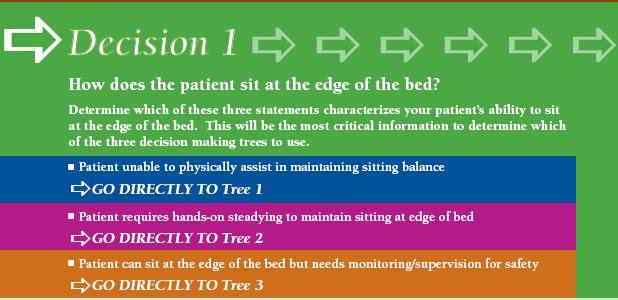
22 Deciding on the right transfer Slide 22
23 Deciding on the right transfer Slide 23
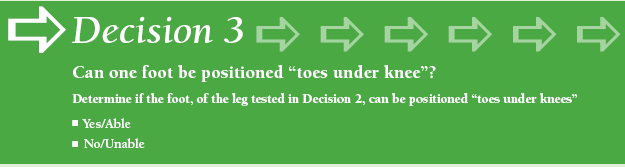

24 Deciding on the right transfer Slide 24

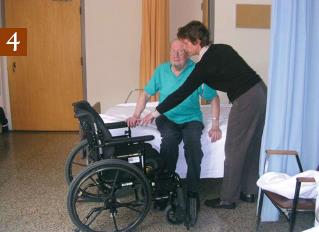
25 Slide 25
26 Team communication
27 Mobility status posting sheet Identifies how much support is needed when mobilizing Located on white board by the bedside Is posted by OT and PT Slide 27
28 Mobility Status Posting Sheet Patient s Name Room/Bed 1. Weight Bearing Status: 2. Lying To Sitting: 3. Sit To Stand: 4. Bed To Chair: 5. Ambulation: Screening Ax done by Ext Date: Slide 28
29 Transfers Pivot / crouch Slide 29
30 Transfers Sliding board Put breaks on Wheelchair Remove arm rest to the side of transfer Level surfaces Patient uses arms to unweight and move bottom along the length of the board Slide 30
31 Lowering to the floor Protect the head of the patient Slow the fall Keep you back straight and bend knees Follow fall down protocol prior to moving patient Slide 31
32 Key points for safe transfer, repositioning and lift
33 Plan ahead Arrange the environment 1. Lower bedrails 2. Adjust the height of bed 3. Remove obstacles 4. Wheelchair setup 5. Lighting Slide 33
34 Caregiver Body Mechanics Avoid bending at the waist whenever possible- maintain the arch in your back Let your legs do the work- bend your knees and keep your feet apart Work as close to the patient as possible- reduce the lever arm effect Turn your feet instead of twisting Keep your head back between your shoulders and your shoulders in line with your hips Slide 34
35 What situations in healthcare would make it difficult to maintain good biomechanics? Slide 35
36 Risks to proper biomechanics Rushing the transfer Environmental obstacles Poor communication Improper use of equipment Insufficient assistance from coworker Stress Slide 36
37 Maximize patient participation Communicate the type of transfer Patient is positioned at the edge of the bed/chair Patient s body is upright with toes under knees Patient s heels to face the direction of the transfer Patient moves forward, shoulders over knees Ensure good footwear and comfortable clothing Slide 37
38 Know your patient Patient status will affect the mobility Slide 38
39 Weight bearing status Non-weight bearing NWB : foot does not touch floor Touch weight bearing: foot is allowed to touch the floor but not allowed to put weight through it Partial weight bearing PWB : half of the body weight through affected leg Weight bearing as tolerated WBAT : patient can weight bear through the affected leg as they feel comfortable Full weight bearing FWB: full body weight can be applied through the affected leg Slide 39
40 Factors affection patient s participation in mobility Slide 40
41 Patient status check See Environment-Setup-Person (ESP) checklist Cognitive, behaviour, emotional status Medical status (diagnosis, pain, precautions, fatigue, Blood pressure ) Physical status (size, strength, balance, skin) Communication (speech, vision, hearing impairments, language barriers) Slide 41
42 Manage devices during mobility Catheter bags IV tubes Oxygen tanks and tubes Prosthesis, and orthotics Slide 42
43 Hip surgery precautions Precaution Functional limitation Adaptive response Do not bend past 90 degrees Unable to tie shoes Use a reacher Legs never cross midline Transfer, comfort Pillows between knees in bed Operative leg should not twist Do not raise leg straight up from hip ADL, walking and turning ADL, putting on boots Patient education Patient education, use a reacher Don t lie on operative side Comfort in bed Patient education, positioning sheet Slide 43
44 Hemiplegic Patients Do not pull on affected arm Do not grasp patient in armpit area Avoid lying on the point of the affected shoulder Patient s heels to face the direction of the transfer Always support the affected arm when transferring Slide 44
45 Goals of Bed and Wheelchair Positioning Refer to the team to develop a positioning plan that everyone follows Maintain skin integrity and circulation Comfort and neutral body alignment Reduce the development of contractures Maintain a functional position Slide 45
46 Transfer and Lift with Care Quiz Check the most correct answers: 1. What is the most common injury to health care workers, and how do these injuries occur? Lower back injury caused by a fall. Shoulder injury due to repositioning patients. Lower back injury while repositioning a patient in bed. Neck injury when transferring a patient. Wrist and hand injuries due to over- use while providing care. 2. What is the preferred method for repositioning a dependent patient in bed? Use the sliding sheet with two persons to assist. Use the bed pad with two persons to assist. Ceiling lift with the two persons assisting. Manually lifting the patient Both the first and third answers are correct. 3. One should not. Work over bed rails. Use a ceiling lift with only one person. Ignore the Mobility Status Sheet. Pull on the hemiplegic arm All the above are correct. 4. What is the Transfer Status Assessment used for? Used to lift a patient. Assist in problem solving about what type of transfer is safe for a given level of patient functioning. Assesses the ability to ambulate. Is to be used only by PT and OT. Used only once per admission. 5. An injury to a team member Adversely affects every member to the team. Cause s everyone on the team to work harder. Can reduce the quality of patient care. Can be prevented. All of the above are true.
47 6. A mechanical lift is used when: The patient is unable to follow commands You are alone The patient is minimal assist of one The patient does not want to get out of bed You are new to the unit 7. Weight bearing as tolerated (WBAT) refers to a Weight bearing status Patient can weight bear through the affected leg as they feel comfortable Patient being able to walk to the washroom independently The first two options are correct None of the above are correct 8. Good caregiver body mechanics include working as close to the patient as possible to reduce the lever arm effect True False 9. The emotional status of the patient can affect the transfer status of the patient True False Correct Answers are: 1) C 2) E 3) E 4) B 5) E 6) A 7)D 8)A 9)A
Range of Motion. A guide for you after spinal cord injury. Spinal Cord Injury Rehabilitation Program
 Range of Motion A guide for you after spinal cord injury Spinal Cord Injury Rehabilitation Program This booklet has been written by the health care providers who provide care to people who have a spinal
http://intranet.urmc-sh.rochester.edu/policy/smhpolicies/section10/10-22.pdf
 APPENDIX B Patient Care Lifting Guidelines Patient handling, including lifting, transferring, and repositioning, is covered by SMH Policy 10.22 Minimal Lift for Patient Handling, which can be found at:
Rehabilitation. Rehabilitation. Walkers, Crutches, Canes
 Walkers, Crutches, Canes These devices provide support through your arms to limit the amount of weight on your operated hip. Initially, after a total hip replacement you will use a walker to get around.
Exercises for older people
 Exercise for older people Exercises for older people Sitting Getting started If you ve not done much physical activity for a while, you may want to get the all-clear from a GP before starting. For the
INTRODUCTION TO POSITIONING. MODULE 3: Positioning and Carrying
 MODULE 3: Positioning and Carrying Blankets, pillows and towels, sandbags, carpet on the floor, a doll with floppy limbs that can be positioned i.e. not a hard plastic doll, display materials. Icebreaker
Physiotherapy Database Exercises for people with Spinal Cord Injury
 Physiotherapy Database Exercises for people with Spinal Cord Injury Compiled by the physiotherapists associated with the following Sydney (Australian) spinal units : Last Generated on Mon Mar 29 16:57:20
Leg Strengthening Exercises
 Leg Strengthening Exercises This exercise program has been designed for you by your physical therapist. Do only the exercises marked. Do them slowly and smoothly on a firm surface. Never hold your breath
Catholic Mutual..."CARES"
 Catholic Mutual..."CARES" BACK INJURY LOSS CONTROL FOR HEALTH CARE FACILITIES Occupational back injuries are a major loss exposure in the health care industry. Serious back injuries can result when employees
total hip replacement
 total hip replacement EXCERCISE BOOKLET patient s name: date of surgery: physical therapist: www.jointpain.md Get Up and Go Joint Program Philosophy: With the development of newer and more sophisticated
Knee Conditioning Program. Purpose of Program
 Prepared for: Prepared by: OrthoInfo Purpose of Program After an injury or surgery, an exercise conditioning program will help you return to daily activities and enjoy a more active, healthy lifestyle.
Range of Motion Exercises
 Range of Motion Exercises Range of motion (ROM) exercises are done to preserve flexibility and mobility of the joints on which they are performed. These exercises reduce stiffness and will prevent or at
March 7th. Smartnet &PNCR. Expanded Hammersmith Functional Motor Scale for SMA (HFMSE) PNCR Network for SMA
 PNCR Network for SMA March 7th Expanded Hammersmith Functional Motor Scale for SMA (HFMSE) 2009 Add-on module presented by PNCR - Expanded Hammersmith Functional Motor Scale (HFMSE) Smartnet &PNCR Hammersmith
Cardiac Rehab Program: Stretching Exercises
 Cardiac Rehab Program: Stretching Exercises Walk around the room, step side to side, ride a bike or walk on a treadmill for at least 5 minutes to warm up before doing these stretches. Stretch warm muscles
Policy & Procedure. Safe Patient Handling (No Lift Policy)
 Effective date signifies approval of this MHS policy by the Performance Improvement Leadership Oversight Team (PILOT) (see minutes). Policy. Policy & Procedure Safe Patient Handling ( Lift Policy) Effective
Lifting & Moving Patients. Lesson Goal. Lesson Objectives 9/10/2012
 Lifting & Moving Patients Lesson Goal Learn the correct techniques, equipment, & positioning for moving patients safely and effectively in a variety of situations &locations Lesson Objectives Define body
Otago Exercise Program Activity Booklet
 Head Movements Stand up tall and look ahead. Slowly turn your head as far as you can to the right. Slowly turn your head as far as you can to the left. Repeat five times to each side. 44 Neck Movements
HELPFUL HINTS FOR A HEALTHY BACK
 HELPFUL HINTS FOR A HEALTHY BACK 1. Standing and Walking For correct posture, balance your head above your shoulders, eyes straight ahead, everything else falls into place. Try to point toes straight ahead
Rehabilitation Exercises for Shoulder Injuries Pendulum Exercise: Wal Walk: Back Scratcher:
 Rehabilitation Exercises for Shoulder Injuries Begin these exercises when your pain has decreased about 25% from the time when your injury was most painful. Pendulum Exercise: Lean over with your uninjured
Patient handling techniques to prevent MSDs in health care
 28 Introduction Patient handling techniques Work-related musculoskeletal disorders (MSDs) are a serious problem among hospital personnel, and in particular the nursing staff. Of primary concern are back
Chapter. Some days I m so stiff. But even then, your firm yet gentle guidance always helps me move more easily. MOVING AND POSITIONING
 15 MOVING AND POSITIONING Chapter Helping a resident move and be comfortably positioned is one of the most important things you do as a nurse assistant. Remember that CMS Guidelines say that all long term
Transferring Safety: Prevent Back Injuries
 Transferring Safety: Prevent Back Injuries OBJECTIVES: At the end of this class you will be able to: 1. Describe the back and what it does. 2. List things that you can do everyday in your home and at work
Injuries from lifting, loading, pulling or pushing can happen to anyone in any industry. It is important to be aware of the risks in your workplace.
 Workplace safety: lifting One of the biggest concerns in the workplace is lifting and loading. When you lift something, the load on your spine increases and your spine can only bear so much before it is
Premier Orthopaedic Pathway. Physiotherapy after dynamic hip screw (DHS)
 Premier Orthopaedic Pathway Physiotherapy after dynamic hip screw (DHS) The surgery After a fractured hip a dynamic hip screw (DHS) is used to hold the bones in place while the fracture heals. It allows
Adult Advisor: Plantar Fasciitis. Plantar Fasciitis
 Adult Advisor: Plantar Fasciitis Page 1 of 3 Plantar Fasciitis What is plantar fasciitis? Plantar fasciitis is a painful inflammation of the bottom of the foot between the ball of the foot and the heel.
Rehabilitation. Rehabilitation. Walking after Total Knee Replacement. Continuous Passive Motion Device
 Walking after Total Knee Replacement After your TKR, continue using your walker or crutches until your surgeons tells you it is okay to stop using them. When turning with a walker or crutches DO NOT PIVOT
IMGPT: Exercise After a Heart Attack 610 944 8140 805 N. RICHMOND ST (Located next to Fleetwood HS) Why is exercise important following a heart
 Why is exercise important following a heart attack? Slow progression back into daily activity is important to strengthen the heart muscle and return blood flow to normal. By adding aerobic exercises, your
Medial Collateral Ligament Sprain: Exercises
 Medial Collateral Ligament Sprain: Exercises Your Kaiser Permanente Care Instructions Here are some examples of typical rehabilitation exercises for your condition. Start each exercise slowly. Ease off
Fact sheet Exercises for older adults undergoing rehabilitation
 Fact sheet Exercises for older adults undergoing rehabilitation Flexibility refers to the amount of movement possible around a joint and is necessary for normal activities of daily living such as stretching,
Passive Range of Motion Exercises
 Exercise and ALS The physical or occupational therapist will make recommendations for exercise based upon each patient s specific needs and abilities. Strengthening exercises are not generally recommended
ROTATOR CUFF HOME EXERCISE PROGRAM
 ROTATOR CUFF HOME EXERCISE PROGRAM Contact us! Vanderbilt Sports Medicine Medical Center East, South Tower, Suite 3200 1215 21st Avenue South Nashville, TN 37232-8828 For more information on this and other
Information and exercises following dynamic hip screw
 Physiotherapy Department Information and exercises following dynamic hip screw Introduction A dynamic hip screw is performed where the neck of femur has been fractured and where there is a good chance
SAFE PATIENT HANDLING RISK ASSESSMENT
 SAFE PATIENT HANDLING RISK ASSESSMENT Swedish Medical Center 2007 This risk assessment consists of two parts: 1) Pre-Site visit forms (Sections 1 & 2): To be completed by facility/unit representative,
[Project name] Standard Operating Procedures. Body Mechanics
![[Project name] Standard Operating Procedures. Body Mechanics](/thumbs/27/11986346.jpg "[Project name] Standard Operating Procedures. Body Mechanics") [Project name] Standard Operating Procedures Body Mechanics PURPOSE. The purpose of this SOP is to provide information to minimize staff injuries with the focus on back injuries resulting from improper
[Project name] Standard Operating Procedures Body Mechanics PURPOSE. The purpose of this SOP is to provide information to minimize staff injuries with the focus on back injuries resulting from improper
Exercise 1: Knee to Chest. Exercise 2: Pelvic Tilt. Exercise 3: Hip Rolling. Starting Position: Lie on your back on a table or firm surface.
 Exercise 1: Knee to Chest Starting Position: Lie on your back on a table or firm surface. Action: Clasp your hands behind the thigh and pull it towards your chest. Keep the opposite leg flat on the surface
WEEKLY SAFETY MEETING All Euramax Subsidiaries BACK SAFETY / PROPER LIFTING. Safety Meeting Contents. Meeting Notice. Leaders Guide.
 Safety Meeting Contents Meeting Notice Employee Handout Employee Quiz Meeting Sign-In Sheet Employee Puzzle PRIOR TO THE WEEKLY MEETING: - Post the meeting notice by the timeclock - Read through the and
Moving and Handling Techniques
 Moving and Handling Techniques Introduction Manual handling involves any activity that requires the use of force exerted by a person to lift, lower, push, pull, carry or otherwise move or hold an object.
TOTAL HIP REPLACEMENT
 PENN ORTHOPAEDICS TOTAL HIP REPLACEMENT Home Exercise Program Maintain Your 3 HIP PRECAUTIONS! The purpose of your hip precautions is to allow for the best healing and the most successful outcomes from
General Guidelines. Neck Stretch: Side. Neck Stretch: Forward. Shoulder Rolls. Side Stretch
 Stretching Exercises General Guidelines Perform stretching exercises at least 2 3 days per week and preferably more Hold each stretch for 15 20 seconds Relax and breathe normally Stretching is most effective
are you reaching your full potential...
 T h e r e s n o s u c h t h i n g a s b a d e x e r c i s e - j u s t e x e r c i s e d o n e b a d l y FIT for sport are you reaching your full potential... These tests are a series of exercises designed
Basic Stretch Programme 3. Exercise Circuit 4
 Basic Stretch Programme 3 Exercise Circuit 4 2 1 Calves Stand approximately 1 metre away from wall with legs straight and heels on floor. Step and lean forward and slowly push hips towards wall. Should
EGOSCUE CLINIC PAIN/POSTURE STRETCHES 1. Standing Arm Circles: Helps Restore Upper Body Strength
 EGOSCUE CLINIC PAIN/POSTURE STRETCHES 1. Standing Arm Circles: Helps Restore Upper Body Strength Two sets of 40 repetitions each. Stand with your feet pointed straight and hip-width apart. Place your fingertips
Understand nurse aide skills needed to promote skin integrity.
 Unit B Resident Care Skills Essential Standard NA5.00 Understand nurse aide s role in providing residents hygiene, grooming, and skin care. Indicator Understand nurse aide skills needed to promote skin
Stand with your feet hip-width apart and your weight equally distributed on both legs (A).
 Introduction to balance exercises Balance exercises can help you maintain your balance and confidence at any age. Balance exercises can also help prevent falls and improve your coordination. For older
Exercise Instructions. PFPS Exercises: 6-week program. Hamstring Stretch (5x20sec) Week 1. Calf Stretch (5x20 seconds)
 Exercise Instructions PFPS Exercises: 6-week program Adapted from: Boling, MC, Bolgla, LA, Mattacola, CG. Uhl, TL, Hosey, RG. Outcomes of a weight-bearing rehabilitation program for patients diagnosed
Sue Schuerman, PT, GCS, PhD UNLVPT
 Sue Schuerman, PT, GCS, PhD UNLVPT Exercise & Physical Activity (Your Everyday Guide from the National Institute on Aging) Go4Life Retain our physical and mental health Continue to do the things we enjoy
Why Back Safety is Important
 Back Safety Why Back Safety is Important Back injuries are considered by OSHA (the Occupational Safety and Health Administration) as the nation's #1 workplace safety problem. Back Injuries are often: Very
How To Improve Drainage
 Rehabilitation Home Program Edema Exercises To Improve Drainage You will improve your lymph flow by doing a few exercises each day. These exercises are an important part of your home program. They may
back care TIPS FOR DAILY ACTIVITIES
 back care TIPS FOR DAILY ACTIVITIES TIPS FOR DAILY ACTIVITIES INTRODUCTION When your back hurts, the way you hold and move your body is important. Your muscles can become more tense and painful depending
ANKLE STRENGTHENING INTRODUCTION EXERCISES SAFETY
 ANKLE STRENGTHENING INTRODUCTION Welcome to your Ankle Strengthening exercise program. The exercises in the program are designed to improve your ankle strength, fitness, balance and dynamic control. The
Hip Conditioning Program. Purpose of Program
 Prepared for: Prepared by: OrthoInfo Purpose of Program After an injury or surgery, an exercise conditioning program will help you return to daily activities and enjoy a more active, healthy lifestyle.
Preventing Overuse Injuries at Work
 Preventing Overuse Injuries at Work The Optimal Office Work Station Use an adjustable chair with good lumbar support. Keep your feet flat on a supportive surface (floor or foot rest). Your knees should
Back Safety and Lifting
 Back Safety and Lifting Structure of the Back: Spine The spine is the part of the back that supports the trunk and head. It protects the spinal cord as well as giving flexibility to the body. Vertebrae
Knee Arthroscopy Exercise Programme
 Chester Knee Clinic & Cartilage Repair Centre Nuffield Health, The Grosvenor Hospital Chester Wrexham Road Chester CH4 7QP Hospital Telephone: 01244 680 444 CKC Website: www.kneeclinic.info Email: [email protected]
Physical & Occupational Therapy
 In this section you will find our recommendations for exercises and everyday activities around your home. We hope that by following our guidelines your healing process will go faster and there will be
Keep fit at the workplace! A simple training programme for more exercise at the workplace.
 Keep fit at the workplace! A simple training programme for more exercise at the workplace. INTRODUCTION Dear Readers, Keeping your body in one position, such as sitting or standing for a long time, results
Foot and Ankle Conditioning Program. Purpose of Program
 Prepared for: Prepared by: OrthoInfo Purpose of Program After an injury or surgery, an exercise conditioning program will help you return to daily activities and enjoy a more active, healthy lifestyle.
Preventing Falls. Strength and balance exercises for healthy ageing
 Preventing Falls Strength and balance exercises for healthy ageing Exercise should be comfortable and fun. To get the most out of your home exercise book, join a class for older people to check your exercises
Chief Executive Office Risk Management Division P.O. Box 1723, Modesto, CA 95354 Phone (209) 525-5710 Fax (209) 525-5779
 Employer: Occupation: Company Contact: Analysis Provided By: Stanislaus County Resident Physician Risk Management 1010 10 th Street Modesto, California 95354 (209) 525-5770 Date: October 2008 Lyle Andersen,
Patient Capability Assessment Readiness for Transfers and Repositioning
 These guidelines have been formed with the opinion that in healthcare settings, manual lifting should be avoided whenever possible. Therefore, there needs to be a mechanism for licensed healthcare professionals
Do s and Don ts with Low Back Pain
 Do s and Don ts with Low Back Pain Sitting Sit as little as possible and then only for short periods. Place a supportive towel roll at the belt line of the back especially when sitting in a car. When getting
Back Safety Goals. Back injury and injury prevention Lifting techniques Quiz
 Back Safety Back Activities Reaching, bending over, sitting Skiing, hiking, bike riding Playing with your children and grandchildren Working and feeling productive Back Safety Goals Back injury and injury
Working as a cashier. HealthandSafetyOntario.ca. Hazard: Poor Workstation Layout
 Working as a cashier Cashiers are at risk for many painful muscles and joint injuries, hazards due to noise, and possibly a quick pace of work. Hazard: Poor Workstation Layout The workstation surface is
Starting position: Lying with knees bent up and feet flat on floor/bed about 12" (30cms) apart
 Exercise 3 Bridging Starting position: Lying with knees bent up and feet flat on floor/bed about 12" (30cms) apart Tighten your buttocks, then raise them off the floor to form a bridge, then hold. Then
Lower Body Strength/Balance Exercises
 Compliments of (Medical Group Name & Phone # to be inserted here) Lower Body Strength/Balance Exercises Hip Flexion Strengthens thigh and hip muscles. Use ankle weights, if you are ready to. Stand to the
Strength Training HEALTHY BONES, HEALTHY HEART
 Strength Training HEALTHY BONES, HEALTHY HEART No matter what your age, strength training can improve your bone health and your balance. As we age, our bones lose both tissue and strength. This condition
Returning to fitness after heart surgery
 Returning to fitness after heart surgery A patient s guide 1 Increasing activity After your operation, your heart function should be improved and so your ability to exercise will also be improved. However,
Low Back Pain Exercises Interactive Video Series Transcript July 2013
 Introduction Low Back Pain Exercises Interactive Video Series Transcript July 2013 ** Note: If an exercise causes an increase in your pain, stop the exercise.** [Music introduction; Dr. John Sheehan onscreen]
Welcome to your LOW BACK PAIN treatment guide
 Welcome to your LOW BACK PAIN treatment guide You are receiving this guide because you have recently experienced low back pain. Back pain is one of the most common musculoskeletal problems treated in medicine
BEACH VOLLEYBALL TRAINING PROGRAM
 2008 ELITE PERFORMANCE ATHLETE CONDITIONING BEACH VOLLEYBALL TRAINING PROGRAM Team BC 2008 Steve Van Schubert, CAT(C), CSCS Training Schedule General Outline Phase 1 2 Weeks Phase 2 3 Weeks Phase 3 3 Weeks
Safe Lifting and Carrying
 PART 1 Basic Lifts Proper lifting and handling will help protect against injury and make your job easier. It takes training and practice to do it right. The following are basic steps in safe lifting and
Physical Capability Strength Test: One Component of the Selection Process
 Physical Capability Strength Test: One Component of the Selection Process One aspect of the Power Systems Institute selection process is to successfully complete and achieve a passing score on a physical
HOPE EXERCISE RECOVERY RESOURCES RELATIONSHIPS INFORMATION REHABILITATION PREVENTION SELF ADVOCACY RELATIONSHIPS MOVEMENT. A Stroke Recovery Guide
 INFORMATION REHABILITATION PREVENTION SELF ADVOCACY RECOVERY HOPE A Stroke Recovery Guide RELATIONSHIPS MOVEMENT RESOURCES RELATIONSHIPS EXERCISE www.stroke.org CHAPTER FOUR Movement and Exercise Moving
SECTION 9. Mobility, positioning, and transfers. Moving after a stroke 9.1. Fatigue. Loss of sensation. Loss of motor function.
 SECTION 9 Mobility, positioning, and transfers Section overview This section looks at: Moving after a stroke Assisting with mobility Positioning Managing the affected limb Transfers Wheelchair use Walking
Safe Lifting/ Back Safety Training. Environmental Health and Safety
 Safe Lifting/ Back Safety Training Environmental Health and Safety Why Back Safety is Important Back injuries are considered by OSHA the nation s #1 workplace safety problem Back injuries are often: Very
MANAGING BREATHLESSNESS
 12 Leaflet issued by: Pulmonary Rehabilitation Service Anglian Community Enterprise (CIC) Kennedy House Kennedy Way, Clacton-on-sea Essex CO15 4AB Tel: 01255 206263 MANAGING BREATHLESSNESS On request,
How To Stretch Your Body
 Exercise Module A New Leaf Choices for Healthy Living University of North Carolina at Chapel Hill 2007 Center for Health Promotion and Disease Prevention Physical Activity Exercises for Keeping Active
Basic Training Exercise Book
 Basic Training Exercise Book Basic Training Exercise Book Instructions The exercises are designed to challenge the major muscles groups every day, approximately every 2 to 3 hours., for a total of 6 times
try Elise s toning exercise plan
 try Elise s toning exercise plan Whether you want to start things off slow and gradually build up your fi tness, or begin with a challenge, Elise s toning exercise programme is designed for all levels.
Info. from the nurses of the Medical Service. LOWER BACK PAIN Exercise guide
 Info. from the nurses of the Medical Service LOWER BACK PAIN Exercise guide GS/ME 03/2009 EXERCISE GUIDE One of the core messages for people suffering with lower back pain is to REMAIN ACTIVE. This leaflet
Spine Conditioning Program Purpose of Program
 Prepared for: Prepared by: OrthoInfo Purpose of Program After an injury or surgery, an exercise conditioning program will help you return to daily activities and enjoy a more active, healthy lifestyle.
PERFORMANCE RUNNING. Piriformis Syndrome
 Piriformis Syndrome Have you started to experience pain in your hip or down your leg while beginning or advancing your fitness program? This pain may be stemming from the piriformis muscle in your hip.
Strengthening Exercises - Below Knee Amputation
 Strengthening Exercises - Below Knee Amputation These exercises will help you strengthen your muscles to best use your prosthetic leg. Do these exercises as directed by your therapist or doctor. Do the
ACL Reconstruction Rehabilitation Program
 ACL Reconstruction Rehabilitation Program 1. Introduction to Rehabilitation 2. The Keys to Successful Rehabilitation 3. Stage 1 (to the end of week 1) 4. Stage 2 (to the end of week 2) 5. Stage 3 (to the
MOON SHOULDER GROUP. Rotator Cuff Home Exercise Program. MOON Shoulder Group
 MOON Shoulder Group For information regarding the MOON Shoulder Group, talk to your doctor or contact: Rosemary Sanders 1215 21 st Avenue South 6100 Medical Center East Vanderbilt University Medical Center
Standard Operating Procedure for Handling an Inanimate Load
 Standard Operating Procedure for Handling an Inanimate Load Moving and handling an inanimate load/s is a key part of the working day for most employees. Moving inanimate loads can take place in many different
Gait with Assistive Devices
 Gait with Assistive Devices Review Last Lecture Weak dorsiflexors? Vaulting? Hip hiking? Weak hip abductors? Hip circumduction? Ataxic gait? Antalgic gait? Explain the line of gravity Ambulation with Assistive
SHOULDER PULL DOWNS. To learn efficient use of the shoulder blades and arms while maintaining a neutral spine position.
 SHOULDER INTRODUCT ION Welcome to your shoulder exercise program The exercises in the program are designed to improve your shoulder mobility, posture and the control of the muscles in your neck and shoulder
Rotator Cuff Home Exercise Program MOON SHOULDER GROUP
 Rotator Cuff Home Exercise Program MOON SHOULDER GROUP Introduction The MOON Shoulder group is a Multi-center Orthopaedic Outcomes Network. In other words, it is a group of doctors from around the country
Illinois Department of Public Health STATEMENT OF DEFICIENCIES AND PLAN OF CORRECTION C 04/26/2015. Statement of Licensure Violations:
 (X1) PROVER/SUPPLIER/LIA ENTIFIATION NUMBER: (X3) SURVEY D NAME OF PROVER OR SUPPLIER (X4) REGULATORY OR LS ENTIFYING INFORMATION) Final Observations Statement of Licensure Violations: 300.610a) 300.1210b)
Mike s Top Ten Tips for Reducing Back Pain
 Mike s Top Ten Tips for Reducing Back Pain The following article explains ways of preventing, reducing or eliminating back pain. I have found them to be very useful to myself, my clients and my patients.
Shoulder Extension Exercise Using Theraband
 Shoulder Extension Exercise Using Theraband Loop the theraband around the stable surface at chest height Lift your chest and pull your arm behind you Keep your neck long and relaxed Make sure you keep
Manual Handling. Procedure
 ` Manual Handling Procedure *All Forth Valley College Health, Safety and Welfare Procedures are covered under the overarching Health, Safety and Welfare Policy. Status: Date of version: Review Date: Reviewed
PHYSIOTHERAPY OF HIP AND KNEE AFTER SURGERY AND INJURY BY RACHEL GEVELL PHYSIOTHERAPIST
 PHYSIOTHERAPY OF HIP AND KNEE AFTER SURGERY AND INJURY BY RACHEL GEVELL PHYSIOTHERAPIST AIMS AND OBJECTIVES To demonstrate the use of physiotherapy assessment and treatment following: Hip Arthroplasty
Good Body Mechanics/ Employee Safety: A Skills Update THIS PROGRAM COVERS: 4) How to Maintain Healthy Lifestyle Habits to Help Prevent Injury
 In-Service Training Good Body Mechanics/ Employee Safety: A Skills Update THIS PROGRAM COVERS: 1) Definition of Ergonomics 2) How Repetitive Movements Can Lead to Injury 3) The Basic Steps to Using Good
Otago Exercise Program
 Otago Exercise Program Edited Version Exercise Booklet Created by: Genesee County Coalition Supported by a grant from the Health Foundation for Western and Central New York Otago Exercise Program to Prevent
HealthandSafetyOntario.ca. Hazards. Introduction. Legislation
 Manual Materials handling Introduction Manual materials handling operations are carried out in most workplaces. Each handling task poses unique demands on the worker. However, workplaces can help workers
TIPS and EXERCISES for your knee stiffness. and pain
 TIPS and EXERCISES for your knee stiffness and pain KNEE EXERCISES Range of motion exercise 3 Knee bending exercises 3 Knee straightening exercises 5 STRENGTHENING EXERCISES 6 AEROBIC EXERCISE 10 ADDITIONAL
Workplace Job Accommodations Solutions for Effective Return to Work
 Workplace Job Accommodations Solutions for Effective Return to Work Workplace Job Accommodations Solutions for Effective Return to Work Published by 102 275 Broadway Winnipeg, MB R3C 4M6 www.mflohc.mb.ca
Pre-operative Instructions for MIS Total Knee Stephen J Kelly, M.D.
 Pre-operative Instructions for MIS Total Knee Stephen J Kelly, M.D. 33 Sewall Street Portland, ME 04102 207.828.2100 800.439.0274 www.orthoassociates.com Pre-operative Pain Protocol Two days before surgery: