
Hip Conditioning Program. Purpose of Program
|
|
|
- James Maxwell
- 10 years ago
- Views:
Transcription
1 Prepared for: Prepared by: OrthoInfo Purpose of Program After an injury or surgery, an exercise conditioning program will help you return to daily activities and enjoy a more active, healthy lifestyle. Following a well-structured conditioning program will also help you return to sports and other recreational activities. This is a general conditioning program that provides a wide range of exercises. To ensure that the program is safe and effective for you, it should be performed under your doctor s supervision. Talk to your doctor or physical therapist about which exercises will best help you meet your rehabilitation goals. Strength: Strengthening the muscles that support your hip will help keep your hip joint stable. Keeping these muscles strong can relieve pain and prevent further injury. Flexibility: Stretching the muscles that you strengthen is important for restoring range of motion and preventing injury. Gently stretching after strengthening exercises can help reduce muscle soreness and keep your muscles long and flexible. Target Muscles: The muscle groups targeted in this conditioning program include: Gluteus maximus (buttocks) Adductors (inner thigh) Gluteus medius (buttocks) Abductors (outer thigh) Hamstrings (back of thigh) Tensor Fascia (outer thigh) Piriformis (buttocks) Length of program: This hip conditioning program should be continued for 4 to 6 weeks, unless otherwise specified by your doctor or physical therapist. After your recovery, these exercises can be continued as a maintenance program for lifelong protection and health of your hips and thighs. Performing the exercises two to three days a week will maintain strength and range of motion in your hips and thighs. Getting Started Warm up: Before doing the following exercises, warm up with 5 to 10 minutes of low impact activity, like walking or riding a stationary bicycle. Stretch: After the warm-up, do the stretching exercises shown on Page 1 before moving on to the strengthening exercises. When you have completed the strengthening exercises, repeat the stretching exercises to end the program. Do not ignore pain: You should not feel pain during an exercise. Talk to your doctor or physical therapist if you have any pain while exercising. Ask questions: If you are not sure how to do an exercise, or how often to do it, contact your doctor or physical therapist. Additional Notes Introduction 1

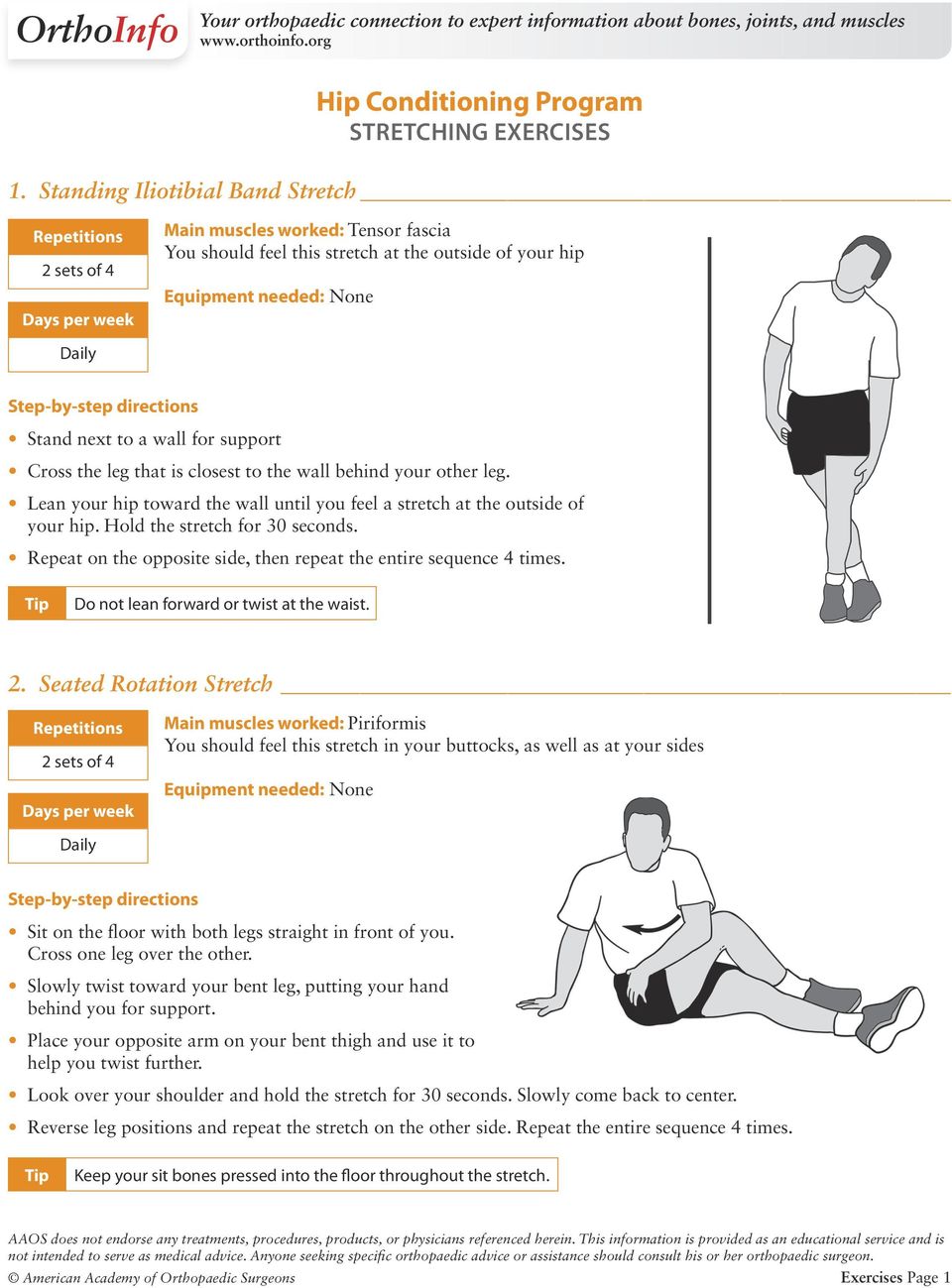
2 Stretching Exercises 1. Standing Iliotibial Band Stretch Main muscles worked: Tensor fascia You should feel this stretch at the outside of your hip Stand next to a wall for support Cross the leg that is closest to the wall behind your other leg. Lean your hip toward the wall until you feel a stretch at the outside of your hip. Hold the stretch for 30 seconds. Repeat on the opposite side, then repeat the entire sequence 4 times. Do not lean forward or twist at the waist. 2. Seated Rotation Stretch Main muscles worked: Piriformis You should feel this stretch in your buttocks, as well as at your sides Sit on the floor with both legs straight in front of you. Cross one leg over the other. Slowly twist toward your bent leg, putting your hand behind you for support. Place your opposite arm on your bent thigh and use it to help you twist further. Look over your shoulder and hold the stretch for 30 seconds. Slowly come back to center. Reverse leg positions and repeat the stretch on the other side. Repeat the entire sequence 4 times. Keep your sit bones pressed into the floor throughout the stretch. American Academy of Orthopaedic Surgeons Exercises Page 1
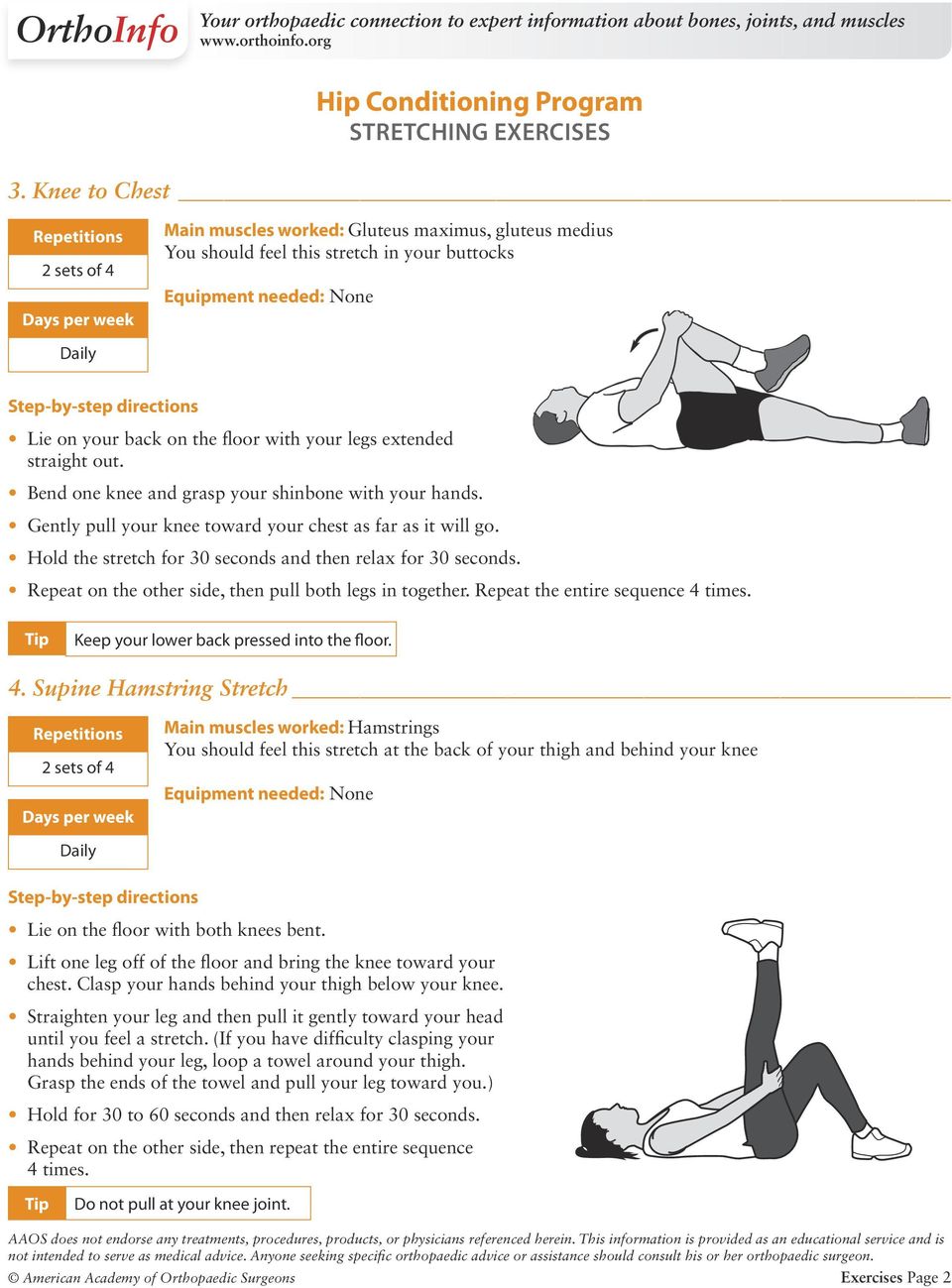
3 Stretching Exercises 3. Knee to Chest Main muscles worked: Gluteus maximus, gluteus medius You should feel this stretch in your buttocks Lie on your back on the floor with your legs extended straight out. Bend one knee and grasp your shinbone with your hands. Gently pull your knee toward your chest as far as it will go. Hold the stretch for 30 seconds and then relax for 30 seconds. Repeat on the other side, then pull both legs in together. Repeat the entire sequence 4 times. Keep your lower back pressed into the floor. 4. Supine Hamstring Stretch Main muscles worked: Hamstrings You should feel this stretch at the back of your thigh and behind your knee Lie on the floor with both knees bent. Lift one leg off of the floor and bring the knee toward your chest. Clasp your hands behind your thigh below your knee. Straighten your leg and then pull it gently toward your head until you feel a stretch. (If you have difficulty clasping your hands behind your leg, loop a towel around your thigh. Grasp the ends of the towel and pull your leg toward you.) Hold for 30 to 60 seconds and then relax for 30 seconds. Repeat on the other side, then repeat the entire sequence 4 times. Do not pull at your knee joint. American Academy of Orthopaedic Surgeons Exercises Page 2
4 Strengthening Exercises 5. Hip Abduction Main muscles worked: Gluteus medius, abductors You should feel this exercise at your outer thigh and buttocks Equipment needed: Begin with a weight that allows repetitions and progress to 12 repetitions. Lie on your side with your injured leg on top and the bottom leg bent to provide support. Straighten your top leg and slowly raise it to 45. Keep your knee straight, but not locked. Hold this position for 5 seconds. Slowly lower your leg and relax it for 2 seconds. Do not turn your leg in an effort to raise it higher. The outside of your thigh should be lifted toward the ceiling. 6. Hip Adduction Main muscles worked: Adductors You should feel this exercise at your inner thigh Equipment needed: Begin with a weight that allows repetitions and progress to 12 repetitions. Lie on the side of your injured leg with both legs straight. Bend your top leg and cross it over your injured leg. Raise your injured leg 6 to off of the floor. Hold this position for 5 seconds. Slowly lower your leg and rest for 2 seconds. Place your hand on the floor in front of your abdomen to prevent you from leaning backward. American Academy of Orthopaedic Surgeons Exercises Page 3

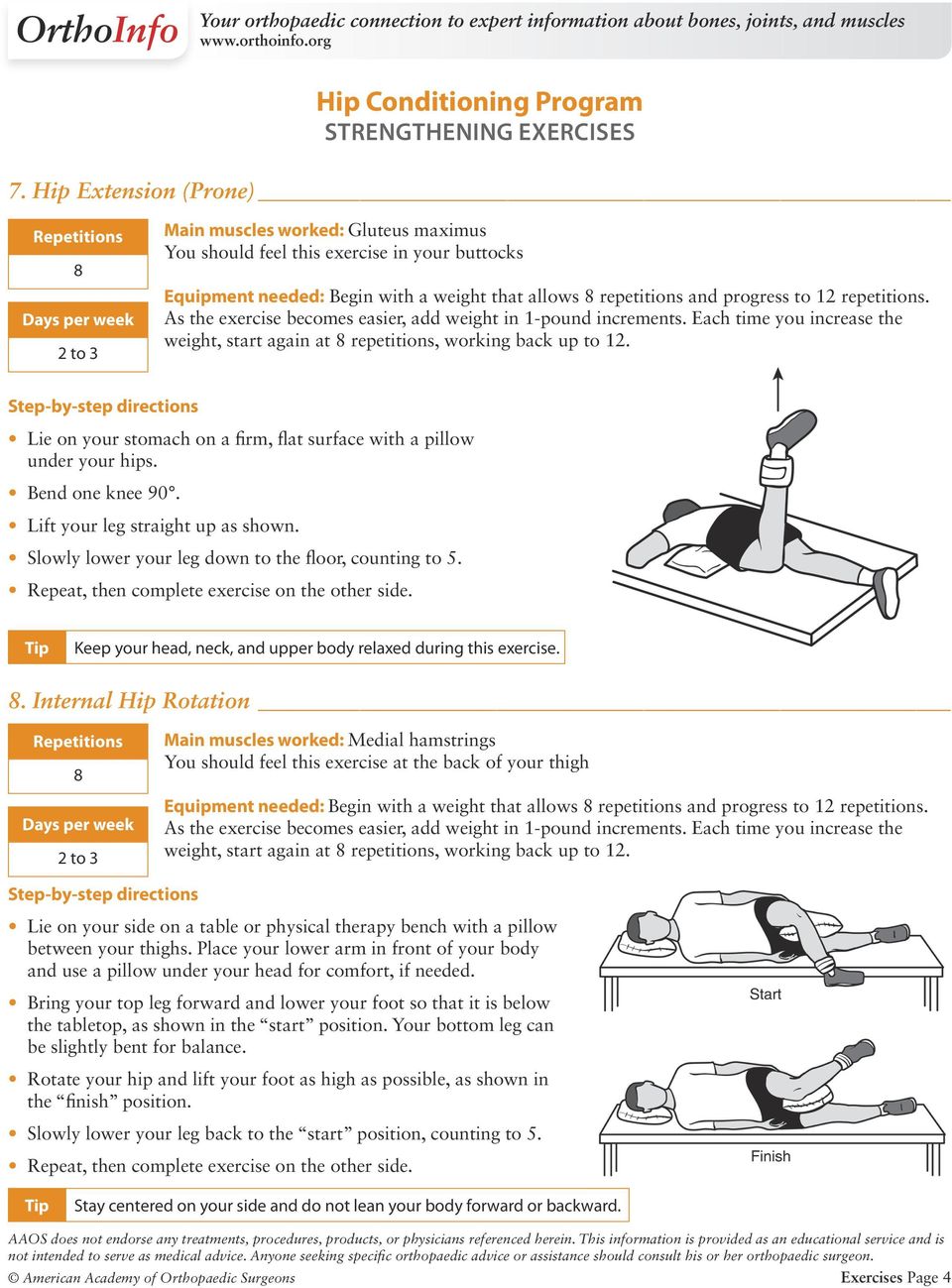
5 Strengthening Exercises 7. Hip Extension (Prone) Main muscles worked: Gluteus maximus You should feel this exercise in your buttocks Equipment needed: Begin with a weight that allows repetitions and progress to 12 repetitions. Lie on your stomach on a firm, flat surface with a pillow under your hips. Bend one knee 90. Lift your leg straight up as shown. Slowly lower your leg down to the floor, counting to 5. Keep your head, neck, and upper body relaxed during this exercise.. Internal Hip Rotation Main muscles worked: Medial hamstrings You should feel this exercise at the back of your thigh Equipment needed: Begin with a weight that allows repetitions and progress to 12 repetitions. Lie on your side on a table or physical therapy bench with a pillow between your thighs. Place your lower arm in front of your body and use a pillow under your head for comfort, if needed. Bring your top leg forward and lower your foot so that it is below the tabletop, as shown in the start position. Your bottom leg can be slightly bent for balance. Rotate your hip and lift your foot as high as possible, as shown in the finish position. Slowly lower your leg back to the start position, counting to 5. Stay centered on your side and do not lean your body forward or backward. American Academy of Orthopaedic Surgeons Exercises Page 4
6 Strengthening Exercises 9. External Hip Rotation Main muscles worked: Piriformis You should feel this exercise in your buttocks Equipment needed: Begin with a weight that allows repetitions and progress to 12 repetitions. Lie on your side on a table or physical therapy bench. Place your lower arm in front of your body and use a pillow under your head for comfort, if needed. Bring your bottom leg forward and lower your foot so that it is below the tabletop, as shown in the start position. Your top leg is mostly straight to help you balance. Rotate your hip and lift your foot as high as possible, as shown in the finish position. Slowly lower your leg back to the start position, counting to 5. Repeat on the other side. Stay centered on your side and do not lean your body forward or backward. American Academy of Orthopaedic Surgeons Exercises Page 5

Knee Conditioning Program. Purpose of Program
 Prepared for: Prepared by: OrthoInfo Purpose of Program After an injury or surgery, an exercise conditioning program will help you return to daily activities and enjoy a more active, healthy lifestyle.
Spine Conditioning Program Purpose of Program
 Prepared for: Prepared by: OrthoInfo Purpose of Program After an injury or surgery, an exercise conditioning program will help you return to daily activities and enjoy a more active, healthy lifestyle.
Rotator Cuff and Shoulder Conditioning Program. Purpose of Program
 Prepared for: Prepared by: OrthoInfo Purpose of Program After an injury or surgery, an exercise conditioning program will help you return to daily activities and enjoy a more active, healthy lifestyle.
Foot and Ankle Conditioning Program. Purpose of Program
 Prepared for: Prepared by: OrthoInfo Purpose of Program After an injury or surgery, an exercise conditioning program will help you return to daily activities and enjoy a more active, healthy lifestyle.
Don t. Hamstrings. Calf Muscles. both legs 2-3 times. stretch is felt in the back of the calf. Repeat with both legs 2-3 times.
 Remember to: Warm-up your muscles first before stretching (e.g. stretch after walking). Stretch until you feel mild discomfort, not pain. Never bounce or force a stretch. Hold the stretch for 10-30 seconds
Stretching for Young Athletes. Shawn P. Anderson, SPT Duke University Doctor of Physical Therapy
 Stretching for Young Athletes Shawn P. Anderson, SPT Duke University Doctor of Physical Therapy Sports and exercise are usually integral parts of many adolescents life. Whether they play at school or in
Cardiac Rehab Program: Stretching Exercises
 Cardiac Rehab Program: Stretching Exercises Walk around the room, step side to side, ride a bike or walk on a treadmill for at least 5 minutes to warm up before doing these stretches. Stretch warm muscles
Above Knee Amputee Exercise Program
 Above Knee Amputee Exercise Program It is important that you take an active role in your rehabilitation. The following exercises must be done every day to prevent any complications. After an above the
General Guidelines. Neck Stretch: Side. Neck Stretch: Forward. Shoulder Rolls. Side Stretch
 Stretching Exercises General Guidelines Perform stretching exercises at least 2 3 days per week and preferably more Hold each stretch for 15 20 seconds Relax and breathe normally Stretching is most effective
Exercise 1: Knee to Chest. Exercise 2: Pelvic Tilt. Exercise 3: Hip Rolling. Starting Position: Lie on your back on a table or firm surface.
 Exercise 1: Knee to Chest Starting Position: Lie on your back on a table or firm surface. Action: Clasp your hands behind the thigh and pull it towards your chest. Keep the opposite leg flat on the surface
Range of Motion. A guide for you after spinal cord injury. Spinal Cord Injury Rehabilitation Program
 Range of Motion A guide for you after spinal cord injury Spinal Cord Injury Rehabilitation Program This booklet has been written by the health care providers who provide care to people who have a spinal
How To Stretch Your Body
 Exercise Module A New Leaf Choices for Healthy Living University of North Carolina at Chapel Hill 2007 Center for Health Promotion and Disease Prevention Physical Activity Exercises for Keeping Active
PERFORMANCE RUNNING. Piriformis Syndrome
 Piriformis Syndrome Have you started to experience pain in your hip or down your leg while beginning or advancing your fitness program? This pain may be stemming from the piriformis muscle in your hip.
TOTAL KNEE REPLACEMENT
 PENN ORTHOPAEDICS TOTAL KNEE REPLACEMENT Home Exercise Program PENN ORTHOPAEDICS TOTAL KNEE REPLACEMENT HOME EXERCISE PROGRAM To get the best results from your surgery, it is important that you do your
Physical & Occupational Therapy
 In this section you will find our recommendations for exercises and everyday activities around your home. We hope that by following our guidelines your healing process will go faster and there will be
Low Back Pain Exercise Guide
 Nader M. Hebela, MD Fellow of the American Academy of Orthopaedic Surgeons http://orthodoc.aaos.org/hebela Cleveland Clinic Abu Dhabi Cleveland Clinic Abu Dhabi Neurological Institute Al Maryah Island
Exercises for Low Back Injury Prevention
 DIVISION OF AGRICULTURE RESEARCH & EXTENSION University of Arkansas System Family and Consumer Sciences Increasing Physical Activity as We Age Exercises for Low Back Injury Prevention FSFCS38 Lisa Washburn,
Basic Stretch Programme 3. Exercise Circuit 4
 Basic Stretch Programme 3 Exercise Circuit 4 2 1 Calves Stand approximately 1 metre away from wall with legs straight and heels on floor. Step and lean forward and slowly push hips towards wall. Should
Physical Capability Strength Test: One Component of the Selection Process
 Physical Capability Strength Test: One Component of the Selection Process One aspect of the Power Systems Institute selection process is to successfully complete and achieve a passing score on a physical
Rehabilitation Exercises for Shoulder Injuries Pendulum Exercise: Wal Walk: Back Scratcher:
 Rehabilitation Exercises for Shoulder Injuries Begin these exercises when your pain has decreased about 25% from the time when your injury was most painful. Pendulum Exercise: Lean over with your uninjured
Do s and Don ts with Low Back Pain
 Do s and Don ts with Low Back Pain Sitting Sit as little as possible and then only for short periods. Place a supportive towel roll at the belt line of the back especially when sitting in a car. When getting
Low Back Pain: Exercises
 Low Back Pain: Exercises Your Kaiser Permanente Care Instructions Here are some examples of typical rehabilitation exercises for your condition. Start each exercise slowly. Ease off the exercise if you
Rehabilitation. Rehabilitation. Walkers, Crutches, Canes
 Walkers, Crutches, Canes These devices provide support through your arms to limit the amount of weight on your operated hip. Initially, after a total hip replacement you will use a walker to get around.
MOON SHOULDER GROUP. Rotator Cuff Home Exercise Program. MOON Shoulder Group
 MOON Shoulder Group For information regarding the MOON Shoulder Group, talk to your doctor or contact: Rosemary Sanders 1215 21 st Avenue South 6100 Medical Center East Vanderbilt University Medical Center
ROTATOR CUFF HOME EXERCISE PROGRAM
 ROTATOR CUFF HOME EXERCISE PROGRAM Contact us! Vanderbilt Sports Medicine Medical Center East, South Tower, Suite 3200 1215 21st Avenue South Nashville, TN 37232-8828 For more information on this and other
Lumbar/Core Strength and Stability Exercises
 Athletic Medicine Lumbar/Core Strength and Stability Exercises Introduction Low back pain can be the result of many different things. Pain can be triggered by some combination of overuse, muscle strain,
HELPFUL HINTS FOR A HEALTHY BACK
 HELPFUL HINTS FOR A HEALTHY BACK 1. Standing and Walking For correct posture, balance your head above your shoulders, eyes straight ahead, everything else falls into place. Try to point toes straight ahead
Rotator Cuff Home Exercise Program MOON SHOULDER GROUP
 Rotator Cuff Home Exercise Program MOON SHOULDER GROUP Introduction The MOON Shoulder group is a Multi-center Orthopaedic Outcomes Network. In other words, it is a group of doctors from around the country
Medial Collateral Ligament Sprain: Exercises
 Medial Collateral Ligament Sprain: Exercises Your Kaiser Permanente Care Instructions Here are some examples of typical rehabilitation exercises for your condition. Start each exercise slowly. Ease off
Sheet 1A. Treating short/tight muscles using MET. Pectorals. Upper trapezius. Levator scapula
 Sheet 1A Treating short/tight muscles using MET Pectorals Once daily lie at edge of bed holding a half-kilo can, arm out sideways. Raise arm and hold for 10 seconds, then allow arm to hang down, stretching
Exercises for older people
 Exercise for older people Exercises for older people Sitting Getting started If you ve not done much physical activity for a while, you may want to get the all-clear from a GP before starting. For the
Injury Prevention for the Back and Neck
 Injury Prevention for the Back and Neck www.csmr.org We have created this brochure to provide you with information regarding: Common Causes of Back and Neck Injuries and Pain Tips for Avoiding Neck and
Fact sheet Exercises for older adults undergoing rehabilitation
 Fact sheet Exercises for older adults undergoing rehabilitation Flexibility refers to the amount of movement possible around a joint and is necessary for normal activities of daily living such as stretching,
Strengthening Exercises - Below Knee Amputation
 Strengthening Exercises - Below Knee Amputation These exercises will help you strengthen your muscles to best use your prosthetic leg. Do these exercises as directed by your therapist or doctor. Do the
Rehabilitation. Rehabilitation. Walking after Total Knee Replacement. Continuous Passive Motion Device
 Walking after Total Knee Replacement After your TKR, continue using your walker or crutches until your surgeons tells you it is okay to stop using them. When turning with a walker or crutches DO NOT PIVOT
Physical Therapy after Hip Arthroscopy Therapy Phases 1 and 2
 Physical Therapy after Hip Arthroscopy Therapy Phases 1 and 2 patienteducation.osumc.edu Table of Contents Physical Therapy after Hip Surgery... 3 OSU Sports Medicine Locations... 4 Hip Therapy Goals...
Info. from the nurses of the Medical Service. LOWER BACK PAIN Exercise guide
 Info. from the nurses of the Medical Service LOWER BACK PAIN Exercise guide GS/ME 03/2009 EXERCISE GUIDE One of the core messages for people suffering with lower back pain is to REMAIN ACTIVE. This leaflet
STRETCHING EXERCISES. Physical Activity Resource Center for Public Health PARC-PH
 STRETCHING EXERCISES Physical Activity Resource Center for Public Health PARC-PH STRETCHING 2 Safety Information...3 Benefits of Stretching...3 Safety Considerations Before and During Exercise...3 A Set
total hip replacement
 total hip replacement EXCERCISE BOOKLET patient s name: date of surgery: physical therapist: www.jointpain.md Get Up and Go Joint Program Philosophy: With the development of newer and more sophisticated
NETWORK FITNESS FACTS THE HIP
 NETWORK FITNESS FACTS THE HIP The Hip Joint ANATOMY OF THE HIP The hip bones are divided into 5 areas, which are: Image: www.health.com/health/static/hw/media/medical/hw/ hwkb17_042.jpg The hip joint is
back stabilization and core strengthening
 back stabilization and core strengthening EXERCISE OOKLET back stabilization and core strengthening TLE OF CONTENTS Introduction 1 Hook-lying Stabilization Progression Neutral position 2 Hook-lying with
Lower Body Strength/Balance Exercises
 Compliments of (Medical Group Name & Phone # to be inserted here) Lower Body Strength/Balance Exercises Hip Flexion Strengthens thigh and hip muscles. Use ankle weights, if you are ready to. Stand to the
The Santa Monica Orthopaedic and Sports Medicine Research Foundation. The PEP Program: Prevent injury and Enhance Performance
 The Santa Monica Orthopaedic and Sports Medicine Research Foundation The PEP Program: Prevent injury and Enhance Performance This prevention program consists of a warm-up, stretching, strengthening, plyometrics,
ACL Reconstruction Rehabilitation Program
 ACL Reconstruction Rehabilitation Program 1. Introduction to Rehabilitation 2. The Keys to Successful Rehabilitation 3. Stage 1 (to the end of week 1) 4. Stage 2 (to the end of week 2) 5. Stage 3 (to the
Strength Training HEALTHY BONES, HEALTHY HEART
 Strength Training HEALTHY BONES, HEALTHY HEART No matter what your age, strength training can improve your bone health and your balance. As we age, our bones lose both tissue and strength. This condition
Bankart Repair For Shoulder Instability Rehabilitation Guidelines
 Bankart Repair For Shoulder Instability Rehabilitation Guidelines Phase I: The first week after surgery. Goals:!! 1. Control pain and swelling! 2. Protect the repair! 3. Begin early shoulder motion Activities:
Premier Orthopaedic Pathway. Physiotherapy after dynamic hip screw (DHS)
 Premier Orthopaedic Pathway Physiotherapy after dynamic hip screw (DHS) The surgery After a fractured hip a dynamic hip screw (DHS) is used to hold the bones in place while the fracture heals. It allows
Myofit Massage Therapy Stretches for Cycling
 Guidelines for Stretching Always assume the stretch start position and comfortably apply the stretch as directed. Think Yoga - gently and slowly, no ballistic actions or bouncing at joint end range. Once
TOTAL HIP REPLACEMENT
 PENN ORTHOPAEDICS TOTAL HIP REPLACEMENT Home Exercise Program Maintain Your 3 HIP PRECAUTIONS! The purpose of your hip precautions is to allow for the best healing and the most successful outcomes from
Trochanteric Bursitis Self Management for Patients
 Trochanteric Bursitis Self Management for Patients Updated May 2010 What is the Trochanteric Bursa? The trochanteric bursa is a fluid-filled sac that functions as a gliding surface to reduce friction between
Standing with legs slightly apart, inhale and expand chest and shoulders; exhale and draw in chest and shoulders.
 ILLUSTRATED EXERCISE #4 PAGE 1 2012 Bringing the Body to the Stage and Screen and Beyond by Annette Lust 1 Standing with legs slightly apart, inhale and expand chest and shoulders; exhale and draw in chest
ILIOTIBIAL BAND SYNDROME
 ILIOTIBIAL BAND SYNDROME Description The iliotibial band is the tendon attachment of hip muscles into the upper leg (tibia) just below the knee to the outer side of the front of the leg. Where the tendon
Stretching in the Office
 Stretching in the Office Legs: Quads, Hamstrings, IT band, Hip flexors, Gluts, Calves Quads: Standing @ desk maintaining upright posture, grab one leg @ a time by foot or ankle and bring it towards backside
CHAPTER 3: BACK & ABDOMINAL STRETCHES. Standing Quad Stretch Athletic Edge - www.athleticedge.biz - (650) 815-6552
 CHAPTER : BACK & ABDOMINAL STRETCHES Standing Quad Stretch ) Stand and grasp right ankle with same hand, use a wall or chair to Lower maintain Back balance with left hand. Maintain an upright Stretches
BRUGGER'S POSTURAL RELIEF EXERCISE
 BRUGGER'S POSTURAL RELIEF EXERCISE Brugger's Postural Relief Exercise strengthens your muscles. lt promotes stability and relaxes tight muscles that tighten due to postural stress (see Figure 2). Check
D: Date Sunday Monday Tuesday Wednesday Thursday Friday Saturday Week 1 D: D: D: D: D: D: D:
 Physical Therapy and Home Exercise Program for Patients in the Exercise Group (Treatment Sessions 1-8) and the Manipulation + Exercise Group (Treatment Sessions 3-8) This exercise handout contains descriptions
Rehabilitation after shoulder dislocation
 Physiotherapy Department Rehabilitation after shoulder dislocation Information for patients This information leaflet gives you advice on rehabilitation after your shoulder dislocation. It is not a substitute
Kelly Corso MS, ATC, CES, FMSC, CSST
 ACL Injury Prevention Program Kelly Corso MS, ATC, CES, FMSC, CSST What is the ACL??? The ACL or anterior cruciate ligament, attaches the front top portion of the shin bone (tibia) to the back bottom portion
TIPS and EXERCISES for your knee stiffness. and pain
 TIPS and EXERCISES for your knee stiffness and pain KNEE EXERCISES Range of motion exercise 3 Knee bending exercises 3 Knee straightening exercises 5 STRENGTHENING EXERCISES 6 AEROBIC EXERCISE 10 ADDITIONAL
Flexibility Assessment and Improvement Compiled and Adapted by Josh Thompson
 Flexibility Assessment and Improvement Compiled and Adapted by Josh Thompson Muscles must have a full and normal range of motion in order for joints and skeletal structure to function properly. Flexibility
ACL RECONSTRUCTION POST-OPERATIVE REHABILITATION PROGRAMME
 ACL RECONSTRUCTION POST-OPERATIVE REHABILITATION PROGRAMME ABOUT THE OPERATION The aim of your operation is to reconstruct the Anterior Cruciate Ligament (ACL) to restore knee joint stability. A graft,
SHOULDER REHABILITATION EXERCISE PROGRAM. Phase I
 Franklin Orthopedics 7400 W Rawson Ave, Suite 225 Franklin, WI 53132 414-425-8232 SHOULDER REHABILITATION EXERCISE PROGRAM Phase I PENDULUM EXERCISES: Bending over at the waist and balancing with the good
A small roller with a big effect. The mini roller for massaging, strengthening, stretching and warming up
 A small roller with a big effect The mini roller for massaging, strengthening, stretching and warming up Suva Preventative products P. O Box, 6002 Lucerne Enquiries Tel. 041 419 58 51 Orders www.suva.ch/waswo
EGOSCUE CLINIC PAIN/POSTURE STRETCHES 1. Standing Arm Circles: Helps Restore Upper Body Strength
 EGOSCUE CLINIC PAIN/POSTURE STRETCHES 1. Standing Arm Circles: Helps Restore Upper Body Strength Two sets of 40 repetitions each. Stand with your feet pointed straight and hip-width apart. Place your fingertips
Chair Exercises For Older Adults
 Chair Exercises For Older Adults Many of these exercises were adapted from these sources: National Institute on Aging, Exercise: A Guide from the National Institute on Aging, 2001, http://www.nia.nih.gov/healthinformation/publications/exerciseguide/.
Ensure that the chair you use is sturdy and stable. Wear comfortable clothes and supportive footwear.
 Page 1 Safety Ensure that the chair you use is sturdy and stable. Wear comfortable clothes and supportive footwear. Prepare a space and have your exercise band and a glass of water (for afterwards) ready
Leg Strengthening Exercises
 Leg Strengthening Exercises This exercise program has been designed for you by your physical therapist. Do only the exercises marked. Do them slowly and smoothly on a firm surface. Never hold your breath
Anterior Cruciate Ligament Reconstruction Rehabilitation Protocol
 The First Two Weeks After Surgery You will go home with crutches and be advised to use ice. Goals 1. Protect reconstruction 2. Ensure wound healing 3. Maintain full knee extension 4. Gain knee flexion
stretches and exercises
 stretches and exercises The enclosed sheets contain stretches and exercises which can be used to delay and minimise the development of contractures and deformities occurring in children with Duchenne muscular
MINDING OUR BODIES. Healthy Eating and Physical Activity for Mental Health
 MINDING OUR BODIES Healthy Eating and Physical Activity for Mental Health Facilitators Guide: Background Information (note: tell participants to consult with their doctor before starting to exercise) What
Low Back Pain Exercises Interactive Video Series Transcript July 2013
 Introduction Low Back Pain Exercises Interactive Video Series Transcript July 2013 ** Note: If an exercise causes an increase in your pain, stop the exercise.** [Music introduction; Dr. John Sheehan onscreen]
McMaster Spikeyball Therapy Drills
 BODY BLOCKS In sequencing Breathing and Tempo Flexibility / Mobility and Proprioception (feel) Upper body segment Middle body segment Lower body segment Extension / Static Posture Office / Computer Travel
Sue Schuerman, PT, GCS, PhD UNLVPT
 Sue Schuerman, PT, GCS, PhD UNLVPT Exercise & Physical Activity (Your Everyday Guide from the National Institute on Aging) Go4Life Retain our physical and mental health Continue to do the things we enjoy
ISOMETRIC EXERCISE HELPS REVERSE JOINT STIFFNESS, BUILDS MUSCLE, AND BOOSTS OVERALL FITNESS.
 ISOMETRIC EXERCISE HELPS REVERSE JOINT STIFFNESS, BUILDS MUSCLE, AND BOOSTS OVERALL FITNESS. By Askari A. Kazmi KazmisBioscienceLabs exercise helps reverse joint stiffness, builds muscle, and boosts overall
Post-Operative Exercise Program
 785 E. Holland Spokane, WA 99218 (877) 464-1829 (509) 466-6393 Fax (509) 466-3072 Knee Joint Replacement Surgery Weeks 1 through 6 The goal of knee replacement surgery is to return you to normal functional
Exercises for the Hip
 Exercises for the Hip Gluteal Sets: Lie on your back, tighten buttocks and hold for 3-5 seconds. Repeat 20 times. Supine Hip ER/IR: Lie on your back with legs straight. Gently rotate knees out and in limited
Shoulders (free weights)
 Dumbbell Shoulder Raise Dumbbell Shoulder Raise 1) Lie back onto an incline bench (45 or less) with a DB in each hand. (You may rest each DB on the corresponding thigh.) 2) Start position: Bring the DB
COMMON OVERUSE INJURIES ATTRIBUTED TO CYCLING, AND WAYS TO MINIMIZE THESE INJURIES
 COMMON OVERUSE INJURIES ATTRIBUTED TO CYCLING, AND WAYS TO MINIMIZE THESE INJURIES Listed are a few of the most common overuse injuries associated with cycling long distances. 1. Cervical and upper back
THE BENJAMIN INSTITUTE PRESENTS. Excerpt from Listen To Your Pain. Assessment & Treatment of. Low Back Pain. Ben E. Benjamin, Ph.D.
 THE BENJAMIN INSTITUTE PRESENTS Excerpt from Listen To Your Pain Assessment & Treatment of Low Back Pain A B E N J A M I N I N S T I T U T E E B O O K Ben E. Benjamin, Ph.D. 2 THERAPIST/CLIENT MANUAL The
EXERCISE DESCRIPTIONS PHASE I Routine #1
 EXERCISE DESCRIPTIONS PHASE I Routine #1 Hip Mobility Exercise: Forward Out-In Movement: Raise leg out to the side, and rotate around to the front. Keep shin/thigh angle at 90 degrees. Exercise: Backward
Strength Training for the Knee
 Strength Training for the Knee This handout is to help you rebuild the strength of the muscles surrounding the knee after injury. It is intended as a guideline to help you organize a structured approach
Keep fit at the workplace! A simple training programme for more exercise at the workplace.
 Keep fit at the workplace! A simple training programme for more exercise at the workplace. INTRODUCTION Dear Readers, Keeping your body in one position, such as sitting or standing for a long time, results
Preventing Falls. Strength and balance exercises for healthy ageing
 Preventing Falls Strength and balance exercises for healthy ageing Exercise should be comfortable and fun. To get the most out of your home exercise book, join a class for older people to check your exercises
Self-Myofascial Release Foam Roller Massage
 How it works. Self-Myofascial Release Foam Roller Massage Traditional stretching techniques simply cause increases in muscle length and can actually increase your chances of injury. Self-myofascial release
KNEE ARTHROSCOPY POST-OPERATIVE REHABILITATION PROGRAMME
 KNEE ARTHROSCOPY POST-OPERATIVE REHABILITATION PROGRAMME ABOUT THE OPERATION The arthroscope is a fibre-optic telescope that can be inserted into a joint. A camera is attached to the arthroscope and the
The 11+ A complete warm-up program
 The 11+ A complete warm-up program Part 1 & 3 A A }6m Part 2 B A: Running B: Jog back B! FIELD SET-UP A: Running exercise B: Jog back The course is made up of 6 pairs of parallel cones, approx. 5-6m apart.
Knee Arthroscopy Post-operative Instructions
 Amon T. Ferry, MD Orthopedic Surgery Sports Medicine Knee Arthroscopy Post-operative Instructions PLEASE READ ALL OF THESE INSTRUCTIONS CAREFULLY. THEY WILL ANSWER MOST OF YOUR QUESTIONS. 1. You may walk
Meniscus Tear: Exercises
 Meniscus Tear: Exercises Your Kaiser Permanente Care Instructions Here are some examples of typical rehabilitation exercises for your condition. Start each exercise slowly. Ease off the exercise if you
Pre - Operative Rehabilitation Program for Anterior Cruciate Ligament Reconstruction
 Pre - Operative Rehabilitation Program for Anterior Cruciate Ligament Reconstruction This protocol is designed to assist you with your preparation for surgery and should be followed under the direction
The Examination...2. Pitching Mechanics...4. Core Exercises...5. Scapular Stretches...7. Scapular Exercises...8. Summary...10. Pitch Counts...
 Table of Contents The Examination....2 Pitching Mechanics...4 Core Exercises....5 Scapular Stretches...7 Scapular Exercises...8 Summary...10 Pitch Counts...12 Introduction Here at Vanderbilt Sports Medicine,
Spinal Exercise Program/Core Stabilization Program Adapted from The Spine in Sports: Robert G. Watkins
 Spinal Exercise Program/Core Stabilization Program Adapted from The Spine in Sports: Robert G. Watkins Below is a description of a Core Stability Program, designed to improve the strength and coordination
Care at its Best! Foam Roller Exercise Program
 Foam Roller Exercise Program Foam rollers are a popular new addition the gym, physical therapy clinics or homes. Foam rollers are made of lightweight polyethyline foam. Cylindrical in shape, foam rollers
Lower Back Pain An Educational Guide
 Lower Back Pain An Educational Guide A publication from the Center of Pain Medicine and Physiatric Rehabilitation 2002 Medical Parkway Ste 150 1630 Main St Ste 215 Annapolis, MD 21401 Chester, MD 21619
Preventing Overuse Injuries at Work
 Preventing Overuse Injuries at Work The Optimal Office Work Station Use an adjustable chair with good lumbar support. Keep your feet flat on a supportive surface (floor or foot rest). Your knees should
Lower Body Exercise One: Glute Bridge
 Lower Body Exercise One: Glute Bridge Lying on your back hands by your side, head on the floor. Position your feet shoulder width apart close to your glutes, feet facing forwards. Place a theraband/mini
Living Room Bodyweight Workout Week 1 March or jog in place for 1 min to increase heart rate and lubricate joints.
 Warm Up- Living Room Bodyweight Workout Week 1 March or jog in place for 1 min to increase heart rate and lubricate joints. Protocol- All exercises will be done for 2 sets of 10 repetitions. After the
ACL Reduction Helping you Keep it Together
 ACL Reduction Helping you Keep it Together What is the training program used in the ACL reduction Program? The ACL Reduction Program will be using the PEP (Prevent injury, Enhance Performance) Program
Otago Exercise Program Activity Booklet
 Head Movements Stand up tall and look ahead. Slowly turn your head as far as you can to the right. Slowly turn your head as far as you can to the left. Repeat five times to each side. 44 Neck Movements
SAMPLE WORKOUT Full Body
 SAMPLE WORKOUT Full Body Perform each exercise: 30 secs each x 2 rounds or 2-3 sets of 8-12 reps Monday & Wednesday or Tuesday & Thursday Standing Squat Muscles: glutes (butt), quadriceps (thigh) Stand
Basic Training Exercise Book
 Basic Training Exercise Book Basic Training Exercise Book Instructions The exercises are designed to challenge the major muscles groups every day, approximately every 2 to 3 hours., for a total of 6 times