
The Angra Neutrino Detector
|
|
|
- Eustace Glenn
- 10 years ago
- Views:
Transcription
1 The Angra Neutrino Detector Edgar Casimiro Linares João dos Anjos Centro Brasileiro de Pesquisas Físicas Workshop From Neutrinos to Dark Matter IFUG, Leon, Guanajuato, Mexico Aug, 2006
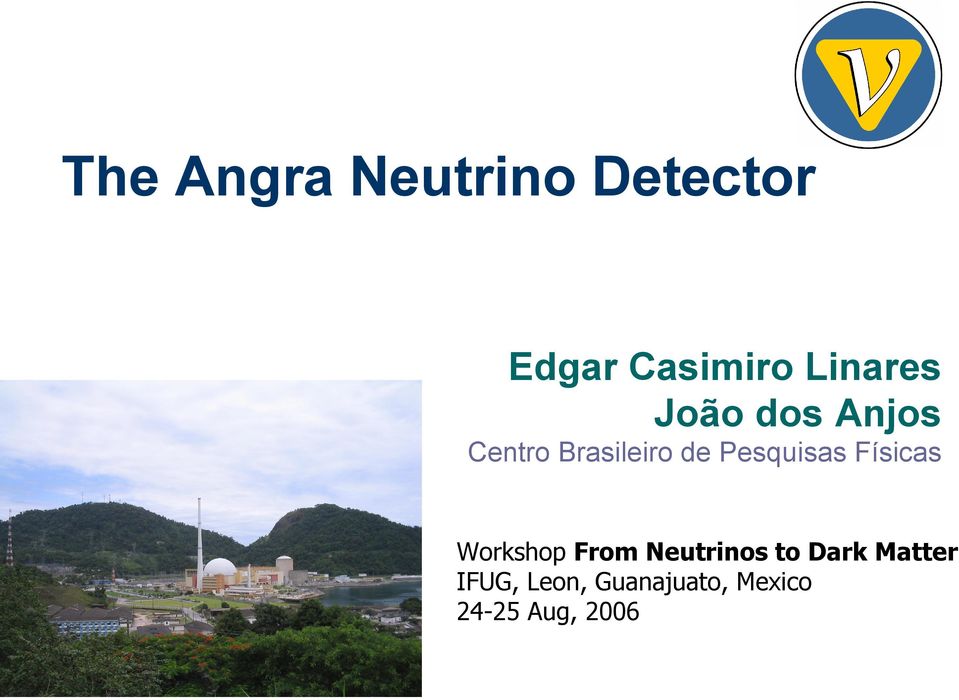
2 The Angra dos Reis Reactor Neutrino Experiment Neutrino oscillations investigations Safeguards tools development

3 Angra collaborators UNICAMP CBPF PUC RJ ANL SANDIA LLNL 17 Researchers 14 Physicists 2 Engineers 1 Post Doc 2 Students 1 PhD 1 Undergraduate Several Post docs and students applying

4 Collaborators João dos Anjos (CBPF) Ronald Shellard (PUC CBPF) Fernando Simão (CBPF) Javier Magnin (CBPF) Ademarlaudo Barbosa (CBPF) Edgar C. Linares (CBPF) Anderson Schilitz (CBPF) Hiroshi Nunokawa (PUC RJ) Ernesto Kemp (UNICAMP) Orlando L. G. Peres (UNICAMP) Marcelo Guzzo (UNICAMP) Renata Z. Funchal (USP) Nathaniel Bowden (SANDIA) Adam Bernstein ( LLNL) David Reyna (ANL) Walter Fulgione (INFN, IFSI Torino)

5 Topics Motivation for an experiment in Angra The Angra dos Reis Nuclear Plant The Detectors Construction Costs Comparison with other projects Safeguards Concluding Remarks

6 Angra dos Reis RJ Brazil MG SP RJ Angra II Angra I Angra III

7 ANGRA III preview

8 Motivations for the Angra Neutrino Detector Frontier Physics in Latin America Frontier experimental Physics taking advantage of existing nuclear reactors Angra I and Angra II. A third reactor, Angra III is expected to be added in the near future Cost relatively low Possibility to use site to host other future experiments (e.g. GRAVITON Project) Frontier Applied Physics: nuclear safeguards

9 Physics Motivations: A descoberta do fenômeno de oscilações de neutrinos implica que neutrinos têm massa e que o Modelo Padrão que descreve as interações entre partículas elementares está incompleto. Estas observações podem ter consequências profundas para a astrofísica: violação de CP no setor leptônico pode ser a chave para entendermos a assimetria matéria antimatéria no universo. A extensão mínima do Modelo Padrão requer 3 auto estados de massa, ν 1, ν 2, ν 3 e uma matriz unitária U que relacione a base de estados de massa à base de estados de sabor.

10 Extensão do Modelo Padrão: A extensão mínima do Modelo Padrão requer sete parametros: 3 massas de neutrinos m 1, m 2 e m 3 3 ângulos de mistura θ 12, θ 23, e θ 13 1 fase δ associada à violação de CP. As probabilidades de oscilação dependem das diferenças de massas ao quadrado m 2 12 = m 2 2 m 1 2 e m 2 23 = m 3 2 m 2 2
11 Extensão do Modelo Padrão: O desafio experimental no estudo de oscilações de neutrinos é medir com a maior precisão possível os parâmetros θ 12, θ 23, θ 13, m 2 12, m 2 23, e δ. Dados das experiências SNO, KamLAND e Super Kamiokande determinaram θ 12 com precisão de 10% e m 2 12 de 10 20%. Dados de neutrinos atmosféricos de Super Kamiokande e do experimento c/ acelerador K2K determinaram θ 23 e m 2 23 (~10% ) Só existe limite superior para θ 13 pelo experimento de reator nuclear CHOOZ. Medida de θ 13 é fundamental: fase δ de violação de CP só pode ser medida se θ 13 0

12 Neutrino Mixing Matrix Experimental status c osθ sin θ 0 sinθ cos i δ cosθ13 0 e sin θ 13 cosθ12 sinθ si nθ 12 cosθ i δ 23 θ 23 e sinθ 13 0 cos θ 13 Atmospheric Reactores and LBL Solar The parameters θ 23 e m 2 23 can be determined using atmospheric neutrino data observed with the detector SuperKamiokande and in the accelerator experiment K2K (precision ~10% ) Data from experiments SNO, KamLAND and SuperKamiokande can be used to determine θ 12 e m 2 12 within 10 20% precision. So far there exists only an upper limit for θ 13 obtained by an experiment performed with the nuclear reactor CHOOZ. sin 2 (2 θ 13 ) < 0.2

13 Atmospheric + Accelerator: Θ 23 = (45 ± 7) Solar + KamLand: Θ 12 = (33 ± 3) Neutrino Mixing Matrix = ν ν ν ν ν ν δ δ τ µ c s s c c e s e s c c s s c i i e θ sol θ 13, δ θ atm Reactor (CHOOZ): Θ 13 < 13 (sin 2 (2Θ 13 ) < 0.2)

14 Motivations for the Angra experiment Scientific Interest : Measurement of θ 13 is important for the investigation of CP violation in the leptonic sector: CP violation phase δ can be measured only if θ 13 0 Physics Advantages of Angra Pure measurement of θ 13, with no matter effects or parameter degeneracy Low cosmic background: shielding of m.w.e. High luminosity: (4 GW reactor, 50 and 500 tons detectors) Precise measurement of the energy spectrum
15 θ 13 & reactor experiments The oscillation signal <E ν > ~ a few MeV only disappearance experiments sin 2 (2θ 13 ) measurement independent of δ-cp 1-P(ν e ν e ) = sin 2 (2θ 13 )sin 2 ( m 2 31 L/4E) + O( m 2 21 / m 2 31 ) weak dependence in m 2 21 Few-MeV ν e + short baselines negligible matter effects (O[10-4 ] ) sin 2 (2θ 13 ) measurement independent of sign( m 2 13 km

16 Motivations for the Angra experiment Support from the Nuclear community ELETRONUCLEAR (Company Operating the reactor) CNEN (Comissão Nacional de Energia Nuclear)

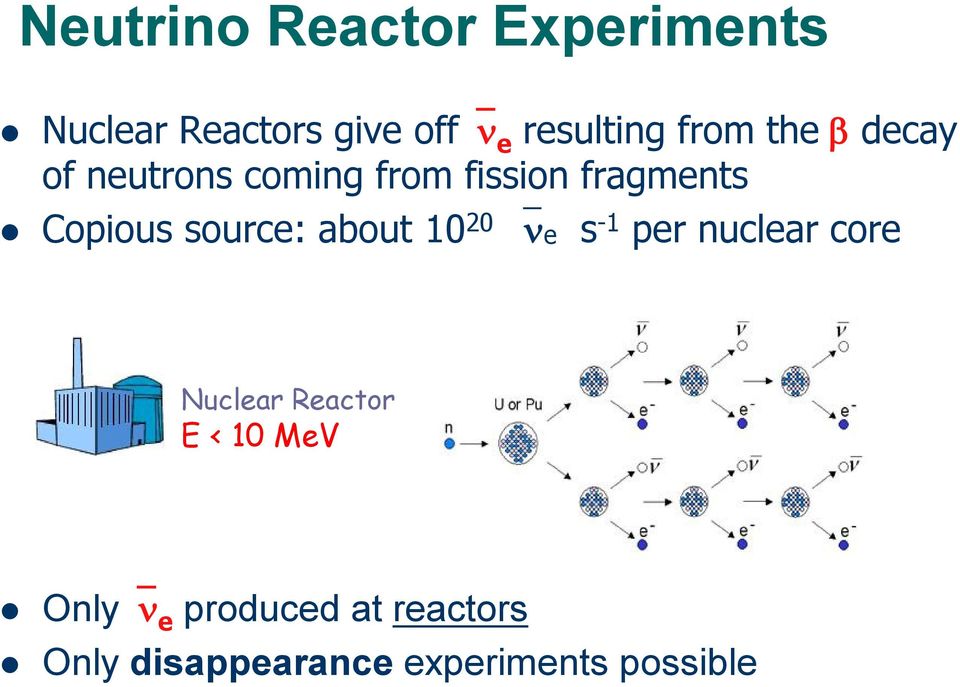
17 Neutrino Reactor Experiments Nuclear Reactors give offν e resulting from the β decay of neutrons coming from fission fragments Copious source: about νe s 1 per nuclear core Nuclear Reactor E < 10 MeV Onlyν e produced at reactors Only disappearance experiments possible
18 How to look for oscillations and measure θ? 13 Oscillation effects are to be observed by comparing the neutrino flux measurements in two detectors installed at different distances from the reactor core The observation of disappearance of electron antineutrinos is the signature of the oscillation and it provides a measure of θ 13

19 The Concept P(ν e ν e ) = 1-sin 2 (2θ 13 )sin 2 ( m 2 31 L/4E) Mesurement of θ 13 Near detector Far detector Nuclear Reactor Cores Near Detector Far Detector ν e ν e,µ,τ Source of electron antineutrinos ν e /s e.g. 280 m e.g m

20 The oscillation signal Far Spectrum Near Spectrum sin 2 (2θ 13 )=0,12 m 2 atm = ev km Far/Near ratio

21 Antineutrino Flux Data: Thermal Power: 4 GW Mean Energy per fision: ~ MeV Fision Rate: N f =1.22x10 20 fisions/s Number of free protons in a 1 ton scintillator detector: n p = 9.3x Mean cross section <σ> E : 5.825x10 43 cm 2 /fision Event rate at a distance L of the core of the reactor N= N f <σ> E n p /(4 π L 2 )
22 Antineutrino Flux Antineutrino Flux: Φ ν = 1 21 P th [ GW ] s cm 2 4 π D W [ MeV ] D = distance from reactor core [50 m] P th = delivered thermal power [4 GW] W = energy release per fission [ MeV] Φ ν = s 1 cm 2
23 Angra dos Reis RJ Brazil MG SP RJ Angra II Angra I Angra III
24 The Angra dos Reis Nuclear Reactors 3 reactors: 2 in operation + 1 planned Reactor (start of operation) Thermal Power (GW) Duty Cycle Fuel Cycle Angra I (1985) % ~1,5 years Angra II (2000) 4.0 ~ 1.2 x f/s 90 % ~1,3 years Angra III Planned >
25 View of the Experimental Layout Morro do Frade Zoom Out Far Site L = 1500 m Tunnel Entrance Angra I Near Site (100m underground)
26 Configuration Morro do Frade reactors Near Detector (reference): 50 ton (7.2 m diameter) 300 m from reactor 250 mwe. Far Detector (oscillation): 500 ton (12.5 m diameter) m from reactor mwe. (under morro do Frade ) Very Near Detector: 1 ton (prototype) < 70 m from reactor Detector Design: 3 volumes
27 Far Site Sites Near Site Reactor Very Near Detector
28 Protoype (Very Near) Detector D = m from core Shielding: 20 < d < 50 mwe reactor detector High rate: ~ 10 3 events /day Little shielding for µ ~ 5 10% dead time with active veto
29 Configuration Morro do Frade reactors Near Detector (reference): 50 ton (7.2 m diameter) 300 m from reactor 250 mwe. Far Detector (oscillation): 500 ton (12.5 m diameter) m from reactor mwe. (under morro do Frade ) Very Near Detector: 1 ton (prototype) < 70 m from reactor Detectores Design: 3 volumes
30 Antineutrino Detection Antineutrino interactions are observed through the inverse beta decay process: + ν e + p e + n Antineutrinos coming from the reactor interact with protons from target (Liquid Scintillator + Gadolinium) The signature of the neutrino interaction is the detection of a prompt positron signal and a (different) neutron delayed (~150 µs) signal
31 The Detection Principle ν e γ e + γ n Muon veto (plastic scintillator paddles) Central Volume (target) scintillator + Gd (~0.5 g/l) External Volume Gamma catcher (liquid scintillator) PMT s
32 ν + p e + + e n Prompt event E prompt E ν E n 0.8 MeV Q~1.8 MeV Threshold n + Gd Delayed event Gd * + γ ' s (~ 8 MeV) MeV 6-11 MeV Prompt e+, E P =1-8 MeV, visible energy Delayed neutron capture on Gd, E D =8 MeV Time correlation: τ 30µsec Space correlation: < 1m 3 Prompt Delayed signals some pulse shape discrimination possible Directionality: weak & statistical (to be studied for the future: R&D)
33 Very Near (prototype) Detector: 3 volume Design A) Target Liquid Scintillator + Gd B) Gamma Catcher Liquid Scintillator C) Buffer Mineral Oil (8 ) D) Vert Scint Paddles (veto) E) X Y Hor Scint Paddles (veto)
34 Protoype Detector Status: Proposal submitted to the CNEN (within the framework of cooperation program with IAEA) Installation and localization under discussion with ELETRONUCLEAR (safety considerations) Design and Project: Argonne + CBPF + INFN + LLNL + Saclay + UNICAMP Estimated cost: ~ KUSD 500
35 Muon Background Intensity vs Depth 10 0 µ vertical intensity (cm 2 s 1 str 1 ) x10 4 1x Bugey Palo Verde D Chooz / Braidwood Kaska Daya Bay Angra Kamioka Gran Sasso Far Detector Depth (m.w.e.)
36 Expected Event Rates Detectors Very Near Near Far Signal (Events/Day) (50m) (300m) (1500m) Muon Rate 150 ~ (Hz)
37 Background Correlated from cosmic muon induced neutrons. More insidious when neutrons are produced by cosmic muon spallation and capture on materials outside the veto counter protection Uncorrelated hits from cosmic rays and natural radioactivity
38 ANGRA II: Probability ofν survival E min = 1.8 MeV; 95%@5MeV (Far Detector) e ) ν e P ( ν 1,0 0,9 0,8 0,7 0,6 0,5 0,4 0,3 0,2 0,1 Near Detector: 0.3 km Far Detector: 1.5 km E = 1.8 MeV E = 5.0 MeV E = 1.8 MeV 0,0 0, L/E [km/mev]
39 Costs: civil engineering
40 Costs: detectors Near 1 ton Detector detector (~1m 3 ) Near Far Detector Far Acrílico (2 esferas concentricas) (scaling from SNO) Aço / Suporte Estrutural (esfera exterior + suportes PMT) Eletronica ($100/canal + $1K/PMT) Óleo Mineral ($553 / ton) $3M $200K $1.2M (1054 Canais) $70K $11.5M $600K $3.6M (3293 Canais) $232K Cintilador Liquido (sem Gadolinium) ($1190 / ton) SubTotal $100K $4.6M $730K $16.7M Total / Detector (design, contingência, etc..ie. X 2) $9.2M $33.4M
41 h3 Comparison with other ν Reactor Experiments
42 Diapositiva 41 h3 hepvb, 19/09/2005
43 2006: 2004: Detector sites Penly Chooz Double Cruas Chooz Braidwood Krasnoyarsk Daya bay Reno Diablo Canyon Kashiwasaki Kaska Taiwan Angra 1 st generation: sin 2 (2θ 13 )~ Un complexe de réacteurs 2 m & ~1-2 km 2 nd generation: sin 2 (2θ 13 )~
44 2006: Non Proliferation detectors Double Chooz San Onofre Angra 2006
45 h2 Comparison with other ν Reactor experiments Power <Power> Location Detectors GW th GW th km/ton/mwe Angra Brazil 0.3/50/ /500/2000 Braidwood Illinois US 0.27/130/ /130/450 Daya Bay 11.6 (17.4 after 2010) 9.9 (14.8 after 2010) China 0.36/40/ /40/260 ~1.75/80/910 Double Chooz France 0.15/10.2/ /10.2/300 KASKA Japan 0.35/6/90 [ 2] 1.6/12/260 RENO Korea 0.150/20/ /20/675
46 Diapositiva 44 h2 hepvb, 19/09/2005
47 Comparison with other ν Reactor experiments Reactor Optimistic start date GW t yr (yr) Sin 2 2θ sensitivity for m 2 (10 3 ev 2 ) Efficiencies Far event rate ANGRA 2013(full) 3900(1) 9000(3) 15000(5) ,000/yr Braidwood (1) 2535(3) 7605(9) ,000/yr Daya Bay 08(fast) 09(full) 3700(3) ,000/yr 110,000/yr (before/after 2010) Double Chooz Oct 07(far) Oct 08(near) 29(1) 29(1+1) 80(1+3) ,000/yr KASKA Mar (3) ,000/yr RENO Late (1) ,000/yr
48 Institutional Responsibilities Experimental Groups construction operation ELETRONUCLEAR approval Communication established! CNEN regulatory submission Support from CNEN and ELETRONUCLEAR Support from CNEN and ELETRONUCLEAR CNEN (Comissão Nacional de Energia Nuclear) ELETRONUCLEAR (company operating the plant)
49 Motivations for the Angra Experiment Interaction with Industry Área de microeletrônica: desenvolvimento de circuitos para o trigger de múons que serão usados em Angra e Double Chooz: encomendas à indústria Mecânica pesada: construção do vaso do detector e estruturas de suporte Construção civil: construção de laboratório subterrâneo para instalação do detector
50 Next Steps Geological survey Eletronuclear will help to perform the study Simulations for Detector design: 2 vs. 3 zones Calibration requirements Prototype Site Proposal for testing scintillator and detector development submitted Necessary to understand background effects possible prototype location discussed with Eletronuclear: 66m from reactor
51 Protoype Detector Test of detector components and Performance studies Geometry, PMT s, scintillators, electronics, backgrounds Understand systematic errors Special Bonus: Neutrino Applied Physics! Nuclear safeguards monitoring for non proliferation of nuclear weapons
52 non-proliferation
53 non-proliferation (of nuclear fissile material)
54 Neutrino Detectors: a new safeguards tool? Antineutrinos have very small interaction cross section, so they easily escape from a reactor ( they cannot be blocked! ). Nuclear reactors are powerful sources of antineutrinos Antineutrinos interact feebly, so detectors need to be big and close to reactor
55 Non intrusive method to monitor reactor activity Reactor core Flux of antineutrinos Antineutrino detector
56 Reactor Monitoring Remote, Integral Continuous Real time Non intrusive Unattended
57 Reactor Monitoring Antineutrinos have specific energy spectrum that varies depending on the reactor fuel composition. Rate and energy spectrum are sensitive to the fissile content of the core (fuel composition). Real data and detailed reactor simulations show a reduction in the antineutrino rate of about 12% through a 600 day cycle - caused by Pu ingrowth and U fission kg of new plutonium is generated in a typical cycle. IAEA and reactor operators the principal customers Counting rate of a detector linearly depends on the reactor power N ν ~ γw th
58 Safeguards Applications A mission of IAEA (International Atomic Energy Agency) : Safeguard & Verification: control that member states do not use civil installations with military goals (e.g. production of plutonium). Neutrino detector can track unauthorized production of plutonium outside of declarations IAEA interested in the use of neutrino detectors for nuclear reactor monitoring. Recommended a feasibility study on neutrinos. (Meeting with USA, France, Russia authorities in Viena in 2002). Cost problem: inspector::us$ /day. One such a detector already in operation: SANDS
59 SANDS: Safeguards AntiNeutrino Detector System Sandia & Lawrence Livermore National Laboratories in the San Onofre Nuclear Generation Station
60 An Experimental Test at a Reactor Site 25 meters standoff from core 20 meter overburden San Onofre Nuclear Generating Station Unit II 3.46 GWt
61 How Does The IAEA Monitor Fissile Material Now? (1 1.5 years) (months to years) (months) (forever) 1. Check Input and Output Declarations 2. Verify with Item Accountancy 3.Containment and Surveillance 1 Gross Defect Detection 2 Continue Item Accountancy 3. Containment and Surveillance 1 Check Declarations 2 Verify with Bulk Accountancy: Operators Report Fuel Burnup and Power History No Direct Pu Inventory Measurement is Made Unless and Until Fuel is Reprocessed
62 Safeguards Verification Determination of Isotopic Composition of the Spent Fuel is based on the comparison of Simulations (of Initial Composition + Thermal History) and Inventory of Final Composition. Based on Reactor Operator Declarations
63 Non-proliferation effort Short-Term Goals Perform antineutrino spectrum measurement at Angra Use Very Near Detector as the Prototype for nuclear reactor monitoring Collaboration with Los Alamos, Livermore, Sandia, DoubleChooz, Byproduct for industry: measurement of thermal precision
64 The safeguards detector 50 m selected possible localizations
65 Measure: Burn up ( 239 Pu accumulation) Thermal power
66 Antineutrino Detectors Have Potential Advantages for Reactor Safeguards This approach provides real time thermal power measurements and Bulk Accountancy of plutonium at the earliest possible moment in the regime Antineutrino detection might replace or complement current techniques, or provide a new capability
67 Monitoring Reactors with Antineutrino Detectors Cubic meter active volume detector a few tens of meters from reactor core Compare measured and predicted total daily or weekly antineutrino rates (or spectrum) to search for anomalous changes in the total fission rate Identify changes in fissile content based on changes in antineutrino rate (the burnup effect). Measured in several previous experiments
68 Concept of Operation: Track Power and Changes in Plutonium Loading Through the Antineutrino Rate Predicted daily antineutrino count rate (% of rate at startup) 100% of rate 90 95% of rate Reactor power is proportional to count rate with known fuel loading/geometry shutdown startup days The systematic shift in plutonium inventory is reflected by the changing antineutrino count rate over time Typically there is a 2 3% systematic drop in antineutrino count rate over 6 months
69 Large amounts of antineutrinos from beta decays of fission products Emission Spectra for different fissile materials
70 Burn up effect on fuel composition
71 Antineutrino Rate Varies with Time and Isotope Fuel Composition Antineutrino Fission Rate varies with Isotope Relative Fission Rate vary in Time Pu 241 U 238
72 The Basic Idea A. Monitor operating reactors with ~1 m 3 antineutrino detectors placed a few tens of meters from the reactor core B. Compare measured and predicted antineutrino rate or spectra to identify changes in fissile content. Pu 241 U 238 Antineutrino count rate relative to beginning of cycle Full power days
73 How Does it Work Operationally? The systematic shift in inventory is reflected in the changing antineutrino count rate over time
74 Daily Power Monitoring Using Only Antineutrinos Antineutrino counts per day /23/05 2/27/05 3/3/05 3/7/05 3/11/05 3/15/05 3/19/05 Date Predicted count rate using reported reactor power Observed count rate, 24 hour average Reported reactor power Reactor Power (%)
75 Some experiments to monitor nuclear reactors with neutrino detectors: Rovno ( ), Bugey (1994) San-Onofre (2004) Chooz (2002?)
76 Some Previous and Ongoing experiments Rovno (Ukraine) San Onofre (USA)
77 Some previous and Ongoing experiments (cont ): Rovno San Onofre 1050 liters of liquid scintillator on mineral oil base g/l Gd, central volume 510 liters 84 PMTs 1 m 3 Liquid scintillator central detector (Gd loaded) 8 PMTs on top side of 4 tanks Passive water shield + Active muon shield
78 Successful checkings of reactor activity: A n tin e u trin o c o u n ts p e r d a y /23/05 2/27/05 3/3/05 3/7/05 3/11/05 3/15/05 3/19/05 Date Predicted count rate using reported reactor power Observed count rate, 24 hour average Reported reactor power R e a c to r P o w e r (% ) Rovno (Ukraine) San Onofre (USA)
79 Reactor Thermal Power and Antineutrino flux Relation between reactor thermal power and antineutrino flux: N ν = γ (1 + k) P th Dependence on detector features Dependence on fuel composition
80 Remarks (safeguards) Previous experiments demonstrate a good capability of using Antineutrinos for Nuclear reactor distant monitoring. Uncertainty of thermal power measurement can be decreased by accounting fuel composition.
81 Some International Contacts France Thierry Lasserre CEA/Saclay Double Chooz and AIEA safeguards Italy Walter Fulgione INFN (Torino) Liquid Scintillator doped with Gd, R&D detector USA. David Reyna Argonne Nat Lab Background studies, Detector Design, R&D Adam Bernstein Lawrence Livermore Nat Lab Prototype Design and R&D Nathaniel Bowden Sandia Nat Lab open
82 Concluding Remarks Fase I Prototype Detector: To develop neutrino detection techniques in Latin America To develop novel technique for nuclear reactor monitoring Science development in Latin America Industry involvement Internacional collaboration with IAEA, ABACC and research labs in USA, France, Italy, Germany and Argentina. ABACC:Agencia Brasileiro Argentina de Contabilidade e Controle de Materiais Nucleares
83 ABACC + ANGRA Project ASSESSMENT of the TECHNICQUE + IAEA!
84 Conclusions fase II: Experimental Reach of the Angra Project Até o momento só limite superior para ângulo de mistura θ 13 foi medido pelo experimento de reator nuclear Chooz na França: sin 2 (2 θ 13 ) < 0.2 O experimento de Angra será capaz de alcançar uma sensitividade ao desaparecimento dos antineutrinos da ordem de sin 2 (2 θ 13 ) = Angra poderá melhorar o limite estabelecido por Chooz por mais de uma ordem de grandeza! Com o conhecimento de θ 13 será possível medir o parametro δ de violação de CP no setor leptônico (se θ13 0), talvez a chave para entender a assimetria matéria antimatéria no universo!
85
86
87
The ANGRA Neutrino Project
 The ANGRA Neutrino Project Ernesto Kemp [email protected] State University at Campinas - UNICAMP Gleb Wataghin Physics Institute Cosmic Rays and Chronology Department 14/12/2007 E.Kemp - Encontro CBPF
PROSPECT: Precision Reactor Oscillation and Spectrum experiment
 PROSPECT: Precision Reactor Oscillation and Spectrum experiment DAVID MARTINEZ CAICEDO on behalf of PROSPECT collaboration ILLINOIS INSTITUTE OF TECHNOLOGY NUFACT 2015 AUGUST 14th 2015 1 Outline Motivations:
declarations at reactor facilities. In particular, inspectors called for improved capabilities to determine power levels, fissile content, cycle
 1 Executive Summary In October 2008, the Division of Technical Support (SGTS) convened a Workshop on Antineutrino Detection for Safeguards Applications to target emerging and future antineutrino detection
The data acquisition system of the XMASS experiment
 The data acquisition system of the XMASS experiment Katsuki Hiraide 1,2, for the XMASS Collaboration 1 Kamioka Observatory, Institute for Cosmic Ray Research, the University of Tokyo, Higashi-Mozumi, Kamioka,
Ay 122 - Fall 2004. The Sun. And The Birth of Neutrino Astronomy. This printout: Many pictures missing, in order to keep the file size reasonable
 Ay 122 - Fall 2004 The Sun And The Birth of Neutrino Astronomy This printout: Many pictures missing, in order to keep the file size reasonable Why Study the Sun? The nearest star - can study it in a greater
Discovery of neutrino oscillations
 INSTITUTE OF PHYSICS PUBLISHING Rep. Prog. Phys. 69 (2006) 1607 1635 REPORTS ON PROGRESS IN PHYSICS doi:10.1088/0034-4885/69/6/r01 Discovery of neutrino oscillations Takaaki Kajita Research Center for
High Precision Measurement of the Target Mass of the Daya Bay Neutrino Detectors
 High Precision Measurement of the Target Mass of the Daya Bay Neutrino Detectors Tom Wise on behalf of Daya Bay collaboration Day Bay is a reactor based experiment dedicated to measurement of the last
Plutonium Watch. Tracking Plutonium Inventories by David Albright and Kimberly Kramer. July 2005, Revised August 2005
 Plutonium Watch Tracking Plutonium Inventories by David Albright and Kimberly Kramer July 25, Revised August 25 Plutonium is a key ingredient in nuclear weapons, making it one of the most dangerous materials
Antineutrino Detection for Nuclear Monitoring
 Antineutrino Detection for Nuclear Monitoring Draft On the cover: Stopped muon in KamLAND, the largest scintillation detector ever constructed. For more information and pictures, go to http://kamland.lbl.gov/.
MICE detectors and first results. M. Bonesini Sezione INFN Milano Bicocca
 MICE detectors and first results M. Bonesini Sezione INFN Milano Bicocca I will speak of the installed beamline PID detectors (TOFes, CKOVs, KL) and only shortly of EMR (to be built)/ the trackers (tested
IMPLEMENTATION OF A MANAGEMENT SYSTEM FOR OPERATING ORGANIZATIONS OF RESEARCH REACTORS
 IMPLEMENTATION OF A MANAGEMENT SYSTEM FOR OPERATING ORGANIZATIONS OF RESEARCH REACTORS Eduardo Kibrit 1, Afonso Rodrigues de Aquino 2 and Désirée Moraes Zouain 3 1 Centro Tecnológico da Marinha em São
The International Monitoring System noble gas network Matthias Auer, CTBTO, Vienna
 Noble gas measurements for monitoring the CTBTO System (IMS) is a unique global network for surveillance of the Comprehensive Nuclear-TestBan Treaty. A major component of the IMS is the radionuclide monitoring
Towards the first deep underground laboratory of the Southern hemisphere. Xavier Bertou
 ANDES Agua Negra Deep Experiment Site Towards the first deep underground laboratory of the Southern hemisphere. Xavier Bertou Centro Atómico Bariloche - CNEA/CONICET CTA LINK - Buenos Aires - October 2012
MONTE CARLO SIMULATION OF THE FULL MULTIPLICITY DISTRIBUTIONS MEASURED WITH A PASSIVE COUNTER
 International Conference on Mathematics, Computational Methods & Reactor Physics (M&C 9) Saratoga Springs, New York, May 3-7, 9, on CD-ROM, American Nuclear Society, LaGrange Park, IL (9) MONTE CARLO SIMULATION
Evaluation Tools for the Performance of a NESTOR Test Detector
 Evaluation Tools for the Performance of a NESTOR Test Detector G. Bourlis, A. Leisos, S. E. Tzamarias and A. Tsirigotis Particle and Astroparticle Physics Group School of Science and Technology Hellenic
Masses in Atomic Units
 Nuclear Composition - the forces binding protons and neutrons in the nucleus are much stronger (binding energy of MeV) than the forces binding electrons to the atom (binding energy of ev) - the constituents
The Muon Veto DAQ. Florian Ritter. Kepler Center for Astro and Particle Physics. Eberhard Karls Universität Tübingen
 The Muon Veto DAQ Florian Ritter Kepler Center for Astro and Particle Physics Eberhard Karls Universität Tübingen Outline Muon Veto Facts I Summary and Outlook Muon Veto Facts plastic scintillator photomultiplier
Neutron Detection Setups proposed for
 Neutron Detection Setups proposed for DESPEC D. Cano-Ott on behalf of the WG members CIEMAT, IFIC, LNL, FYL, UPC, UU, UW Motivation GOAL: to measure neutron emission probabilities and energies for neutron
Basics of Nuclear Physics and Fission
 Basics of Nuclear Physics and Fission A basic background in nuclear physics for those who want to start at the beginning. Some of the terms used in this factsheet can be found in IEER s on-line glossary.
The accurate calibration of all detectors is crucial for the subsequent data
 Chapter 4 Calibration The accurate calibration of all detectors is crucial for the subsequent data analysis. The stability of the gain and offset for energy and time calibration of all detectors involved
Nuclear data for science & technology: Centres for development
 Nuclear data for science & technology: Centres for development An update on the IAEA's nuclear data centre, its services, and the contributions to the global network from developing by Hans Lemmel f\ typical
Overview of Nuclear Detection Needs for Homeland Security. Abstract
 Overview of Nuclear Detection Needs for Homeland Security Timothy E. Valentine * Oak Ridge National Laboratory, P.O. Box 2008, Oak Ridge, Tennessee, 37831, USA Abstract The need for advanced and improved
Cosmic Ray Muon Scattering Tomography for Security Applications
 Cosmic Ray Muon Scattering Tomography for Security Applications Lindsay Cox 1 Cosmic ray Muon Scattering Tomography (MST) is an innovative technique that uses naturally occurring background radiation to
Nuclear Physics. Nuclear Physics comprises the study of:
 Nuclear Physics Nuclear Physics comprises the study of: The general properties of nuclei The particles contained in the nucleus The interaction between these particles Radioactivity and nuclear reactions
Global Nuclear Energy Partnership Technology Demonstration Program
 Global Nuclear Energy Partnership Technology Demonstration Program Dave Hill Deputy Director, Science and Technology Idaho National Laboratory August 10 2006 Global Nuclear Energy Partnership Goals of
Atomic and Nuclear Physics Laboratory (Physics 4780)
 Gamma Ray Spectroscopy Week of September 27, 2010 Atomic and Nuclear Physics Laboratory (Physics 4780) The University of Toledo Instructor: Randy Ellingson Gamma Ray Production: Co 60 60 60 27Co28Ni *
Chapter 21. = 26 10 6 C and point charge
 Chapter 21 21.1 What must the distance between point charge 1 26 10 6 C and point charge 2 47 10 6 C for the electrostatic force between them to be 5.70N? The magnitude of the force of attraction is given
Measurement of Muon Lifetime and Mass Using Cosmic Ray Showers
 Measurement of Muon Lifetime and Mass Using Cosmic Ray Showers Angela Hansen Physics 4052 School of Physics and Astronomy, University of Minnesota May 4, 2001 Abstract In this experiment, we used a scintillation
Test Section for Experimental Simulation of Loss of Coolant Accident in an Instrumented Fuel Assembly Irradiated in the IEA-R1 Reactor
 2013 International Nuclear Atlantic Conference - INAC 2013 Recife, PE, Brazil, November 24-29, 2013 ASSOCIAÇÃO BRASILEIRA DE ENERGIA NUCLEAR - ABEN ISBN: 978-85-99141-05-2 Test Section for Experimental
The OPERA Emulsions. Jan Lenkeit. Hamburg Student Seminar, 12 June 2008. Institut für Experimentalphysik Forschungsgruppe Neutrinophysik
 The OPERA Emulsions Jan Lenkeit Institut für Experimentalphysik Forschungsgruppe Neutrinophysik Hamburg Student Seminar, 12 June 2008 1/43 Outline The OPERA experiment Nuclear emulsions The OPERA emulsions
Lasers and Specturbility of Light Scattering Liquids - A Review
 Artigo Original Revista Brasileira de Física Médica.2011;5(1):57-62. Reproducibility of radiant energy measurements inside light scattering liquids Reprodutibilidade de medidas de energia radiante dentro
Mars Atmosphere and Volatile EvolutioN (MAVEN) Mission
 Mars Atmosphere and Volatile EvolutioN (MAVEN) Mission MAVEN Science Community Workshop December 2, 2012 Particles and Fields Package Solar Energetic Particle Instrument (SEP) Davin Larson and the SEP
Open Source Software zur Vertrauensbildung in der Abrüstungsverifikation: Simulation von Neutronenmultiplizitätsmessungen mit Geant4
 Open Source Software zur Vertrauensbildung in der Abrüstungsverifikation: Simulation von Neutronenmultiplizitätsmessungen mit Geant4 Moritz Kütt [email protected] Interdisciplinary Research Group
Cross section, Flux, Luminosity, Scattering Rates
 Cross section, Flux, Luminosity, Scattering Rates Table of Contents Paul Avery (Andrey Korytov) Sep. 9, 013 1 Introduction... 1 Cross section, flux and scattering... 1 3 Scattering length λ and λ ρ...
Radioactivity III: Measurement of Half Life.
 PHY 192 Half Life 1 Radioactivity III: Measurement of Half Life. Introduction This experiment will once again use the apparatus of the first experiment, this time to measure radiation intensity as a function
V K Raina. Reactor Group, BARC
 Critical facility for AHWR and PHWRs V K Raina Reactor Group, BARC India has large reserves of Thorium Critical facility Utilisation of Thorium for power production is a thrust area of the Indian Nuclear
Large Underground Xenon Experiment. Mani Tripathi, SUSY07 Mani Tripathi, SUSY07, Karlsruhe.
 Large Underground Xenon Experiment, Karlsruhe. New Collaboration Brown University Luiz DeViveiros, Peter Sorensen, Rick Gaitskell, Simon Fiorucci Case Western Reserve University Adam Bradley, Alex Bolozdynya,
Evaluation of the image quality in computed tomography: different phantoms
 Artigo Original Revista Brasileira de Física Médica.2011;5(1):67-72. Evaluation of the image quality in computed tomography: different phantoms Avaliação da qualidade de imagem na tomografia computadorizada:
STUDIES FOR A MULTIPURPOSE RESEARCH REACTOR FOR THE CRCN/CNEN-PE
 STUDIES FOR A MULTIPURPOSE RESEARCH REACTOR FOR THE CRCN/CNEN-PE Antônio C. O. Barroso*, José R. Maiorino, João M. L. Moreira **, José L. Bastos, José E. R. da Silva, Fernando R. de A. Lima, Mitsuo Yamaguchi,
UTILIZING RESEARCH REACTORS FOR EDUCATION AND TRAINING: INTERNET REACTOR LABORATORY
 UTILIZING RESEARCH REACTORS FOR EDUCATION AND TRAINING: INTERNET REACTOR LABORATORY Judy VYSHNIAUSKAS Junior Professional Officer Research Reactor Section Division of Nuclear Fuel Cycle and Waste Technology
ENRICHMENT AND URANIUM MASS FROM NMIS FOR HEU METAL
 ABSTRACT ENRICHMENT AND URANIUM MASS FROM NMIS FOR HEU METAL J. K. Mattingly, T. E. Valentine, J. T. Mihalczo, L. G. Chiang, R. B. Perez Oa Ridge National Laboratory Oa Ridge, Tennessee 37831-6004 Recently,
Single Electron Detection with the Large Volume Spherical Proportional Counter Ilias Savvidis
 Single Electron Detection with the Large Volume Spherical Proportional Counter Ilias Savvidis Collaboration S. Andriamonje, S. Aune, E. Bougamont, M. Chapelier, P. Colas, J. Derré, E. Ferrer, G. Gerbier,
AN INVESTIGATION INTO THE USEFULNESS OF THE ISOCS MATHEMATICAL EFFICIENCY CALIBRATION FOR LARGE RECTANGULAR 3 x5 x16 NAI DETECTORS
 AN INVESTIGATION INTO THE USEFULNESS OF THE ISOCS MATHEMATICAL EFFICIENCY CALIBRATION FOR LARGE RECTANGULAR 3 x5 x16 NAI DETECTORS Frazier L. Bronson CHP Canberra Industries, Inc. 800 Research Parkway,
An Innovative Method for Dead Time Correction in Nuclear Spectroscopy
 An Innovative Method for Dead Time Correction in Nuclear Spectroscopy Upp, Daniel L.; Keyser, Ronald M.; Gedcke, Dale A.; Twomey, Timothy R.; and Bingham, Russell D. PerkinElmer Instruments, Inc. ORTEC,
IBC 2100. Nuclear Energy Liability Exclusion. Explained
 IBC 2100 Nuclear Energy Liability Exclusion Explained By Colleen DeMerchant Assistant Manager Nuclear Insurance Association of Canada June 22, 2005 Nuclear Energy Liability Exclusion (IBC 2100 CGL form)
DOSIMETRIC CHARACTERIZATION OF DYED PMMA SOLID DOSIMETERS FOR GAMMA RADIATION
 2005 International Nuclear Atlantic Conference - INAC 2005 Santos, SP, Brazil, August 28 to September 2, 2005 ASSOCIAÇÃO BRASILEIRA DE ENERGIA NUCLEAR - ABEN ISBN: 85-99141-01-5 DOSIMETRIC CHARACTERIZATION
Main properties of atoms and nucleus
 Main properties of atoms and nucleus. Atom Structure.... Structure of Nuclei... 3. Definition of Isotopes... 4. Energy Characteristics of Nuclei... 5. Laws of Radioactive Nuclei Transformation... 3. Atom
DOE s Fuel Cycle Technologies Program - An Overview
 DOE s Fuel Cycle Technologies Program - An Overview William Boyle Director, Used Fuel Disposition R & D (NE-53) Office of Nuclear Energy U.S. Department of Energy ECA Las Vegas, Nevada Agenda Program Mission
Interstellar Cosmic-Ray Spectrum from Gamma Rays and Synchrotron
 Interstellar Cosmic-Ray Spectrum from Gamma Rays and Synchrotron Chuck Naval Research Laboratory, Washington, DC [email protected] Andy Strong Max-Planck-Institut für extraterrestrische Physik,
Solar Energy. Outline. Solar radiation. What is light?-- Electromagnetic Radiation. Light - Electromagnetic wave spectrum. Electromagnetic Radiation
 Outline MAE 493R/593V- Renewable Energy Devices Solar Energy Electromagnetic wave Solar spectrum Solar global radiation Solar thermal energy Solar thermal collectors Solar thermal power plants Photovoltaics
ADS (Accelerator Driven Systems) e LFR (Lead Fast Reactor)
 ADS (Accelerator Driven Systems) e LFR (Lead Fast Reactor) L. Mansani [email protected] Workshop: La Trasmutazione ed i Cicli Innovativi del Combustibile Nucleare Roma 20 Dicembre 2010 Origin
Objectives 404 CHAPTER 9 RADIATION
 Objectives Explain the difference between isotopes of the same element. Describe the force that holds nucleons together. Explain the relationship between mass and energy according to Einstein s theory
Development and Experimental Performance Evaluation of a Dose-Rate meter for Pulsed Beam.
 5 th International Workshop on Radiation Safety at Synchrotron Radiation Sources Development and Experimental Performance Evaluation of a Dose-Rate meter for Pulsed Beam. A. Vascotto 1, K. Casarin 1, S.
T(CR)3IC Testbed for Coherent Radio Cherenkov Radiation from Cosmic-Ray Induced Cascades
 T(CR)3IC Testbed for Coherent Radio Cherenkov Radiation from Cosmic-Ray Induced Cascades R. Milinčić1, P. Gorham1, C. Hebert1, S. Matsuno1, P. Miočinović1, M. Rosen1, D. Saltzberg2, G. Varner1 1 University
Advanced Safeguards Measurement, Monitoring and Modelling Laboratory (AS3ML) at JRC-ITU-Ispra
 Advanced Safeguards Measurement, Monitoring and Modelling Laboratory (AS3ML) at JRC-ITU-Ispra IAEA Safeguards Symposium Vienna, October 21, 2014 Willem JANSSENS, Paolo PEERANI, Claudio BERGONZI, Erik WOLFART,
ATLAS Tile Calorimeter Readout Electronics Upgrade Program for the High Luminosity LHC
 ATLAS Tile Calorimeter Readout Electronics Upgrade Program for the High Luminosity LHC Augusto Santiago Cerqueira On behalf of the ATLAS Tile Calorimeter Group Federal University of Juiz de Fora, Brazil
Generation IV Fast Reactors. Dr Richard Stainsby AMEC [email protected]
 Generation IV Fast Reactors Dr Richard Stainsby AMEC [email protected] Contents The Generation IV international research programme on advanced reactors The case for fast reactors The technology:
KE A = PE MAX 1/2M v 2 = k q1 q2 /R
 CHAPTER 13 NUCLEAR STRUCTURE NUCLEAR FORCE The nucleus is help firmly together by the nuclear or strong force, We can estimate the nuclear force by observing that protons residing about 1fm = 10-15m apart
DEMONSTRATION ACCELERATOR DRIVEN COMPLEX FOR EFFECTIVE INCINERATION OF 99 Tc AND 129 I
 DEMONSTRATION ACCELERATOR DRIVEN COMPLEX FOR EFFECTIVE INCINERATION OF 99 Tc AND 129 I A.S. Gerasimov, G.V. Kiselev, L.A. Myrtsymova State Scientific Centre of the Russian Federation Institute of Theoretical
Fuel Cycle R&D to Safeguard Advanced Ceramic Fuel Skills Strategic Options
 Fuel Cycle R&D to Safeguard Advanced Ceramic Fuel Skills Strategic Options Fuel Cycle R&D to Safeguard Advanced Ceramic Fuel Skills The Nuclear Renaissance and Fuel Cycle Research and Development Nuclear
The Fuel Cycle R&D Program. Systems Analysis
 The Fuel Cycle R&D Program Systems Analysis Bradley Williams Systems Analysis Federal Program Manager Office of Systems Engineering and Integration Office of Nuclear Energy U.S. Department of Energy July
10 Nuclear Power Reactors Figure 10.1
 10 Nuclear Power Reactors Figure 10.1 89 10.1 What is a Nuclear Power Station? The purpose of a power station is to generate electricity safely reliably and economically. Figure 10.1 is the schematic of
NATIONAL CENTRE FOR PARTICLE, ASTROPARTICLE AND NUCLEAR PHYSICS
 March 30th, 2010 PERSONNEL CONTRACTS WITH PARTIAL FINANCIAL SUPPORT The project of the CONSOLIDER INGENIO 2010 program announces 4 contracts of personnel with partial financial support from. The proposed
(Amplifying) Photo Detectors: Avalanche Photodiodes Silicon Photomultiplier
 (Amplifying) Photo Detectors: Avalanche Photodiodes Silicon Photomultiplier (no PiN and pinned Diodes) Peter Fischer P. Fischer, ziti, Uni Heidelberg, Seite 1 Overview Reminder: Classical Photomultiplier
MCQ - ENERGY and CLIMATE
 1 MCQ - ENERGY and CLIMATE 1. The volume of a given mass of water at a temperature of T 1 is V 1. The volume increases to V 2 at temperature T 2. The coefficient of volume expansion of water may be calculated
LATIN AMERICAN NETWORK FOR EDUCATION AND TRAINING IN NUCLEAR TECHNOLOGY LANENT R. Barrachina, J.L. François
 IAEA Technical Meeting on networking for nuclear education 5-8 December 2011, Vienna, Austria LATIN AMERICAN NETWORK FOR EDUCATION AND IN NUCLEAR TECHNOLOGY LANENT R. Barrachina, J.L. François Created
ASTM C26 LONG RANGE PLAN Committee on the Nuclear Fuel Cycle
 ASTM C26 LONG RANGE PLAN Committee on the Nuclear Fuel Cycle VISION STATEMENT ASTM C26 continues to be the Internationally-recognized leader in the development of consensus standards for the Nuclear Fuel
Introduction to Nuclear Fuel Cycle and Advanced Nuclear Fuels
 Introduction to Nuclear Fuel Cycle and Advanced Nuclear Fuels Jon Carmack Deputy National Technical Director Fuel Cycle Technology Advanced Fuels Program February 27, 2011 The Evolution of Nuclear Power
Environmental Radiation Monitoring in Taiwan
 Environmental Radiation Monitoring in Taiwan Introduction: Ching-Chung Huang Radiation Monitoring Center, Atomic Energy Council 823, Cherng-Ching Road, Kaohsiung, Taiwan cchuang @ trmc.aec.gov.tw Chemical,
SHORT-TERM STABILITY TEST FOR URANIUM SOIL CANDIDATE A REFERENCE MATERIAL
 X Congreso Regional Latinoamericano IRPA de Protección y Seguridad Radiológica Radioprotección: Nuevos Desafíos para un Mundo en Evolución Buenos Aires, 12 al 17 de abril, 2015 SOCIEDAD ARGENTINA DE RADIOPROTECCIÓN
Chemical and Isotopic Signatures for Environmental Remediation and Nuclear Forensic Analysis
 Chemical and Isotopic Signatures for Environmental Remediation and Nuclear Forensic Analysis Sue B. Clark Washington State University, Department of Chemistry, Pullman, WA 99163 [email protected] Abstract
University of Texas Nuclear Security Program: Academic Curriculum and Nuclear Engineering Teaching Laboratory
 University of Texas Nuclear Security Program: Academic Curriculum and Nuclear Engineering Teaching Laboratory Specific Program Information Academic Curriculum and Nuclear Engineering Teaching Laboratory
CeSOX sensitivity studies
 CeSOX sensitivity studies Ma#hieu VIVIER, Guillaume MENTION CEA- Saclay, DSM/IRFU/SPP CeSOX kick- off meecng Paris, February 5 th CeSOX experimental parameters L/E spectrum modeling and χ 2 Model computes
MEXICO Grants for the Second Year (2006-2007) SECOND CALL CENTRO DE INVESTIGACION Y ESTUDIOS AVANZADOS DEL IPN (CINVESTAV)
 MEXICO Grants for the Second Year (006-007) SECOND CALL CENTRO DE INVESTIGACION Y ESTUDIOS AVANZADOS DEL IPN (CINVESTAV) Local Committee: Arnulfo Zepeda (Chair) Gerardo Herrera Miguel Ángel Pérez. RT Prepare
PROPOSALS FOR UNIVERSITY REACTORS OF A NEW GENERATION
 PROPOSALS FOR UNIVERSITY REACTORS OF A NEW GENERATION Introduction R.P. Kuatbekov, O.A. Kravtsova, K.A. Nikel, N.V. Romanova, S.A. Sokolov, I.T. Tretiyakov, V.I. Trushkin (NIKIET, Moscow, Russia) Worldwide,
Experimental Particle Physics PHYS6011 Southampton University Lecture 1
 Experimental Particle Physics PHYS6011 Southampton University Lecture 1 Fergus Wilson, Email: Fergus.Wilson at stfc.ac.uk 1st May 2014 Fergus Wilson, RAL 1 Administrative Points 5 lectures: Tuesday 10am:
Search for double beta decay to excited states with CUORICINO and data acquisition system for CUORE
 Università degli studi di Genova Facoltà di scienze Matematiche, Fisiche e Naturali Scuola di Dottorato in Scienze e Tecnologie per l informazione e la conoscenza XXI Ciclo, A.A. 2006-2009 A Thesis submitted