
Graduate Studies Catalog
|
|
|
- Hugh Ethelbert Ward
- 10 years ago
- Views:
Transcription
1 Graduate Studies Catalog Webster Hall, Home Campus, St. Louis, Missouri College of Arts & Sciences George Herbert Walker School of Business & Technology Leigh Gerdine College of Fine Arts School of Communications School of Education Published 08 May Webster University

2

3 Graduate Studies Catalog Graduate Studies Catalog This catalog represents policies, procedures and graduate program requirements in effect for the academic year, which runs from June 1, 2014 through May 31, For general information or application materials: U.S. Citizens to the St. Louis Campus Phone: Fax: U.S. Citizens to Extended U.S. Campuses Phone or fax the campus of your choice. (For phone and fax information, see the U.S. Extended Campuses Offering Undergraduate Degree Completion section of this catalog.) International Students to U.S. Campuses Phone: international access code Fax: international access code U.S. Residents to International Campuses Phone: Fax: E- mail: Non-U.S. Residents to International Campuses Phone or fax the campus of your choice. (For phone and fax information, see the International Campuses for Undergraduates section of this catalog.) Webster University is a private, non-profit, independent, multicampus, international institution offering a wide variety of undergraduate and graduate degree programs. Founded in 1915, Webster University's home campus is in Webster Groves, Missouri, USA, a major suburban center of the St. Louis metropolitan area. Webster University also offers programs at extended campus locations throughout the United States, including military education installations and metropolitan centers, international programs in Europe, Asia, Africa, and South America, and online distance learning programs in a large number of academic disciplines. Webster University is academically organized into five schools and colleges: College of Arts & Sciences Leigh Gerdine College of Fine Arts School of Business and Technology School of Communications School of Education The policies and courses listed in this catalog represent the curriculum for the following degrees: Master of Arts Global Master of Arts Master of Arts in Teaching Master of Business Administration Master of Health Administration Master of Public Administration Master of Fine Arts Master of Music Combined Bachelor of Music/Master of Music Master of Science Master of Science in Nursing Educational Specialist Doctor of Management Not all degrees and majors are offered at every Webster University location. A schedule of courses for the academic year is available at all Webster University locations that offer degree programs. The statements set forth in this catalog are for informational purposes only and should not be construed as the basis of a contract between a student and Webster University. The provisions of this catalog will ordinarily be applied as stated. However, Webster University reserves the right to change any statement made in this catalog, including but not limited to academic requirements for graduation, without actual notice to individual students. Every effort will be made to keep students advised of any such changes. The student is responsible for knowing graduation requirements for his or her degree program. Enrollment in Webster University or completion of a degree program does not guarantee employment. Career services are available to students at most U.S. campuses. Webster University makes no claim or guarantee that credit earned will transfer to another institution. Webster University works with an independent certified public accountant to assure that there is sufficient funding through a tuition guaranty bond. A copy of the bond document can be requested by mail addressed to Webster University, Office of Academic Affairs, 470 E. Lockwood, St. Louis, MO, It is the policy of Webster University not to discriminate in its educational programs, activities, or employment policies on the basis of race, sex, sexual orientation, color, creed, age, ethnic or national origin, or non-disqualifying handicap, as required by federal laws and regulations, including Title IX of the 1972 Educational Amendments. Webster University complies with the Family Educational Rights and Privacy Act of 1974, Public Law as Amended. Governance Webster University accepts in principle that the governance of the University is a shared responsibility of administration, faculty, and students. Administrators provide executive continuity; faculty and students participate in governance mainly through the constituent assemblies and the work of committees. The latter provide for constructive interactions among administrators, faculty, and students. Organizationally, the Board of Trustees oversees all activities of the University. Leadership is headed by the President, who is responsible for determining the overall strategic direction and priorities for the University. The Provost and Senior Vice President is Webster University's chief academic and chief operating officer. A full description of the organizational structure of the University, including current administrators and a list of Board of Trustees members, can be found at Notice of Non-Discrimination Webster University is committed to non-discrimination and equal opportunity regarding the treatment of students, faculty and staff. The University considers employment, admissions, financial aid, programs, and activity applications without regard to race, sex, sexual orientation, gender identity, color, creed, age, ethnic or Webster University Graduate Studies Catalog i
4 Graduate Studies Catalog national origin, or disability. Inquiries or complaints related to any of these areas should be addressed to the appropriate individuals identified below. The following persons have been designated to handle inquiries regarding the non-discrimination policies: Matters concerning student sexual misconduct: Maureen Stroer Student Affairs Coordinator Webster University 470 E. Lockwood Ave. St. Louis, MO Ted F. Hoef Associate Vice President for Student Affairs and Dean of Students Webster University 470 E. Lockwood Ave. St. Louis, MO Matters concerning athletics: Merry Graf Interim Director of Athletics Webster University 470 E. Lockwood Ave. St. Louis, MO All other matters concerning students: Colette Cummings Associate Dean and Director of the Multicultural Center and International Student Affairs Webster University 470 E. Lockwood Ave. St. Louis, MO Matters concerning academic issues: M. Elizabeth (Beth) Russell Assistant Provost for Graduate Studies Webster University 470 E. Lockwood Ave. St. Louis, MO Matters concerning employees and applicants for employment: Betsy M. Schmutz Associate Vice President and Chief Human Resources Officer Webster University 470 E. Lockwood Ave. St. Louis, MO ii Webster University Graduate Studies Catalog
5 Table of Contents Webster University Graduate Studies Catalog Services for Students...1 Key Dates from the Academic Calendar... 3 Mission and Values... 4 Statement of Ethics... 5 Accreditation and Memberships... 6 Tuition, Fees and Refunds...9 Campus Locations and Offerings Admission...24 Enrollment...27 Academic Policies College of Arts & Sciences...38 George Herbert Walker School of Business & Technology Leigh Gerdine College of Fine Arts School of Communications School of Education...42 Faculty...47 Degrees Advertising and Marketing Communications (MA)...96 Advertising and Marketing Communications (MA)...97 Applied Educational Psychology (MA) Applied Educational Psychology: School Psychology Art (MA) Arts Management and Leadership (MFA) Business and Organizational Security Management (MA) Communication Arts (MA) Communications Management (MA) Computer Science/Distributed Systems (MS) Counseling (MA) Cybersecurity (MS) Doctor of Management (DMgt) Early Childhood Education (MA) Early Childhood Education (MAT) Education and Innovation (MA) Education for Global Sustainability (MA) Educational Leadership (EdS) Educational Technology (MET) Educational Technology Leadership (EdS) Elementary Education (MAT) Environmental Management (MS) Finance (MS) Forensic Accounting (MS) Gerontology (MA) Global MA in International Nongovernmental Organizations Global MA in International Relations (GMA) Health Care Management (MA) Human Resources Development (MA) Human Resources Management (MA) Information Technology Management (MA) International Business (MA) International Human Rights (MA) International Nongovernmental Organizations (MA) International Relations (MA) Legal Studies (MA) Management and Leadership (MA) Marketing (MA) Master of Business Administration (MBA) Master of Health Administration (MHA) Master of Public Administration (MPA) Mathematics for Educators (MA) Media Communications (MA) Media Literacy (MA) Middle School Education (MAT) Mild/Moderate Disabilities (MAT) Music (MA) Music (MM) Nonprofit Leadership (MA) Nurse Anesthesia (MS) Nursing (MSN) Procurement and Acquisitions Management (MA) Psychology with an Emphasis in Counseling Psychology (MA) Public Relations (MA) Reading (MA) School Systems, Superintendency and Leadership (EdS) Science Management and Leadership (MS) Secondary School Education (MAT) Social Science Education (MA) Space Systems Operations Management (MS) Special Education (MA) Teaching English as a Second Language (MA) U.S. Patent Practice (MS) Graduate Certificates Assessment of Learning and Cognitive Development Education Services Specialist Education for Global Sustainability Gerontology Gifted Education and Talent Development Government Contracting (Certificate) Healthcare Leadership Immigrant and Refugee Education Nurse Educator Nurse Leader Online Teaching and Learning Paralegal Studies Pedagogical Coordination in the Reggio Emilia Approach Positive Behavioral Interventions and Supports Teacher Leadership (EdS Certificate) Teaching English as a Foreign Language Writing for Educators Course Descriptions ACCT - Accounting ADVT - Advertising AMLD - Arts Management and Leadership ARHS - Art History ART - Art Webster University Graduate Studies Catalog iii

6 Table of Contents BIOL - Biology BUSN - Business CHEM - Chemistry CMAT - MAT Certification COAP - Computer Applications COMG - Communications Management COMM - Communications COSC - Computer Science COUN - Counseling CSIS - Computer Information Systems CSSS - Cybersecurity DMGT - Doctor of Management ECED - Early Childhood Education EDTC - Educational Technology EDUC - Education EFGS - Education for Global Sustainability ENMG - Environmental Management EPSY - Educational Psychology FINC - Finance GERN - Gerontology GSS - Graduate Success Studies HCED - Healthcare Education HCLD - Healthcare Leadership HEAL - Healthcare Management HLTH - Health HRDV - Human Resources Development HRMG - Human Resources Management HRTS - Human Rights ILC - International Languages and Cultures INGO Course Descriptions INTB - International Business INTL - International Relations ITM- Information Technology Management JOUR - Journalism LEAD - Educational Leadership LEGL - Legal Studies MEDC - Media Communications MNGT - Management MRKT - Marketing MTHC - Mathematics for Educators MUSC - Music NPLR - Nonprofit Leadership NURN - Nursing PADM - Public Administration PATA - Patent Practice PBRL - Public Relations PHYS - Physics PROC - Procurement PSYC - Psychology READ - Reading Education SCIC - Science SCML - Science Management and Leadership SECR - Security Management SOCS - Social Science Education SPED - Special Education SPSM - Space Systems SSSL - School Systems, Superintendency and Leadership TELD - Teacher Leadership TESL - Teaching English as a Second Language iv Webster University Graduate Studies Catalog

7 Services for Students Services for Students Academic Advising The Academic Advising Center coordinates the undergraduate and graduate advising system. This office provides students with information about academic programs as well as special study opportunities; it also administers registration for graduate degree programs. Contact Information: Web: Toll Free: Phone: Academic Resource Center The Academic Resource Center provides academic resources, support, advocacy, and access through relationships that empower students across the worldwide Webster University community. The ARC helps students succeed at Webster in a number of ways including the following: The Writing Center provides a friendly, welcoming place where writers receive one-on-one coaching in order to become independent writers and demystify the writing process. Trained coaches help students through the process of writing a paper. Information about how to schedule appointments can be found on the ARC webpage as well as online resources and helpful writing tips. The Online Writing Center draws on a group of faculty and other writing experts to offer writing coaching to students unable to meet face-to-face. Papers can be submitted via the "Writing Assistance" link in a course's WorldClassRoom template or by following the instructions on the Online Writing Center's website accessible through webster.edu/arc. The Tutoring program provides a pool of capable tutors who can work one-on-one with students to help them achieve greater confidence, independence and success as learners. Individual peer tutoring is available by appointment for both short-term "catch-up" and for ongoing support. Online tutoring is also accessible to Webster University students in high demand graduate level classes. The ARC's Testing Center proctors rescheduled tests with an instructor's approval as well as accommodated tests and the MBA prerequisite waiver exams. Appointments must be made at least one day in advance of requested testing time. Students with documented disabilities should contact the ARC to arrange for appropriate accommodations to ensure equal access to Webster's programs and activities. Assistive technology consultation for Kurzweil 3000, Dragon Naturally Speaking, Zoomtext, JAWS, Smartpen, Braille, alternative formatted text, alternative keyboards, reading software and other hardware/ software is available upon request. Alternative formatted textbooks, within permission/copyright publisher parameters, can be ordered for students, faculty and staff whose documented disabilities include this as an accommodation. Contact Information: Phone: [email protected] Admission The Office of Admission coordinates the recruitment and processing of applications for undergraduate, graduate and international students. Contact Information: Toll Free: Phone: Fax: [email protected] Career Services Career Services empowers students to become independent job seekers and career managers by focusing on comprehensive career education. Career Services assists students in all stages of career development. Contact Information: Toll Free: Phone: [email protected] Disability Accommodations Webster University considers admission, financial aid, program, and activity applications without regard to non-disqualifying disability. The assistant director of the Academic Resource Center acts as Webster's ADA Coordinator, helping students with documented disabilities obtain the accommodations they need to have equal access to information and equal opportunity for program success. While Webster University does not provide diagnostic learning disability testing, faculty who suspect a student may have a learning disability may refer that student to the assistant director of the Academic Resource Center. Students who are concerned that they may have a learning disability may also seek referrals from the ARC assistant director. Students with short-term disabilities (e.g., a broken leg) can arrange temporary accommodations by contacting the Academic Resource Center. Other students may gain information about their learning styles and suggestions for improving their classroom and test performance. Contact Information: Phone: [email protected] Financial Aid The Financial Aid Office processes applications for all federal, state, and institutional student financial aid for all applicants throughout the Webster network. Contact Information: Toll Free: Phone: Fax: [email protected] Help Desk The Help Desk is your centralized resource for technology issues/ questions, including those pertaining to Connections account setups, accessing the Connections portal (to reach services like and Student Academic Services), and WorldClassRoom (online courses). Contact Information: Toll Free; Phone: [email protected] International Opportunities Preparing students to be global citizens and leaders is a core part of Webster University s mission. With an acclaimed study abroad program, campuses on three continents, and students Services For Students Webster University Graduate Studies Catalog 1
8 Services for Students from nearly every country in the world, Webster provides students with ample opportunity for a truly international education. To learn how Webster can broaden your horizons, explore the programs and offices below: The Center for International Education (CIE) is a crossroads of international opportunities and activities for the University and surrounding communities. It arranges housing for the international studies major and certificate programs and serves as an information resource for faculty, staff, and students seeking international fellowships, grants, internships and other programs. Web: The Global Internship Experience (GIE) challenges aspiring young professionals to apply their academic training to the workplace through an internship placement abroad. Global internships have a transformative impact on the intern s professional and personal development as well as on host organizations and communities. Internships are available in business, communications/public relations, computer science, education, and various humanities/social science fields. The GIE works individually with participants to assess skill level and interest and to obtain an appropriate placement for each student. Internships are full-time 8 week placements offered during the summer in Missouri. Web: webster.edu/globalinternshipexperience/index.shtml As a leader in study abroad education, Webster understands the varying regulations governing travel and study within our network of international campuses. The friendly staff in International Recruitment and International Services assist Webster students from all over the world with these issues, providing help with visas, work, health services, lodging and much more. Web: The Multicultural Center and the International Student Affairs Department provides programs and services to students and faculty to help foster a community environment that recognizes social differences, respects cultural uniqueness, and facilitates cross-cultural interaction, learning and appreciation. Web: blogs.webster.edu/mcisa Walker Global Hybrid Courses are 3 credit hour courses that consist of a blend of online and immersive travel learning offered by the Walker School of Business. They are composed of 6-7 weeks of online work with a 7-10 day travel component. These courses offer students the opportunity to explore a global business, technology or management issue with online coursework plus an in-country week of company visits, guest lectures and cultural activities. Web: International Study Opportunities for Webster Students The Office of Study Abroad is the place to start for U.S. based students looking to study at any of Webster s international campuses and beyond. The office prepares students for their travel and connects them with the campus directors and program coordinators who will help them succeed. It s also where faculty start when they re ready to teach at another Webster international campus. A wealth of information and links to resources can be found on the Study Abroad website. Contact Information: Phone: or Fax: [email protected] Library Webster University s Emerson Library offers the latest in collections, online resources and information technology. The library houses a collection of more than 300,000 volumes of books, periodicals, scripts, music scores, CDs, DVDs, Blu-Ray, and other media. Library resources are not limited to materials found in the building. At students, faculty, and staff will discover a wealth of electronic resources. Accessible 24/7 from campus, home, or office, these valuable resources include the library s online catalog; over 150 online and full-text databases; video tutorials; Internet resources; and online services, including reference and electronic reserves. Of course, the Library is more than just its physical and virtual presence - it is also a group of helpful, enthusiastic staff. Professional librarians offer general reference assistance in person, over the phone, or via , and appointments can be made for in-depth help (either in person or online) from a subject specialist. Whether online or in person, come experience the library yourself! Contact Information: Toll Free: Phone: [email protected] Military Student Information Webster University and the U.S. Department of Defense have worked together for nearly 40 years to provide high-quality and cost-effective undergraduate and graduate programs at military installations and other locations throughout the country Webster University's Office of Military Affairs (OMA) is committed to the continuing education needs of our military. The OMA s mission is to provide Webster s military students with access to the global Webster University network through a single touch point. The OMA can assist military students in multiple areas, including financial aid, academic advising, academic testing, transfer credit (including our 35+ Cooperative Degree programs), grants and proposals, military alumni and military student life activities (tutoring, writing assistance, accommodation assistance). Office of the Registrar The Office of the Registrar submits loan deferments to lenders, certifies degree audits, sends letters of good standing, does enrollment verifications, degree verifications, transfer credit evaluations, processes transcript requests, works with GoArmyEd, registers students, processes adds, drops, and withdrawals. Contact Information: Toll Free: Phone: Fax: [email protected] Student Affairs Student Affairs is responsible for all co-curricular programs including Career Services and Student Employment, Campus Ministry, Counseling, First Year Experience (FYE) and New Student Orientation Programs, Food Service, Housing and Residential Life, Student Health Services, Multicultural and International Student Affairs, WebsterLEADs, Student Activities, and the University Center. The Dean s office responds to student concerns and problems, administers emergency student loan funds, the Money for Textbooks program, the undergraduate tuition adjustment process, makes referrals to appropriate resources, advises on all policies affecting students, and coordinates all judicial proceedings. Contact Information: Toll Free: Phone: Fax: Webster University Graduate Studies Catalog
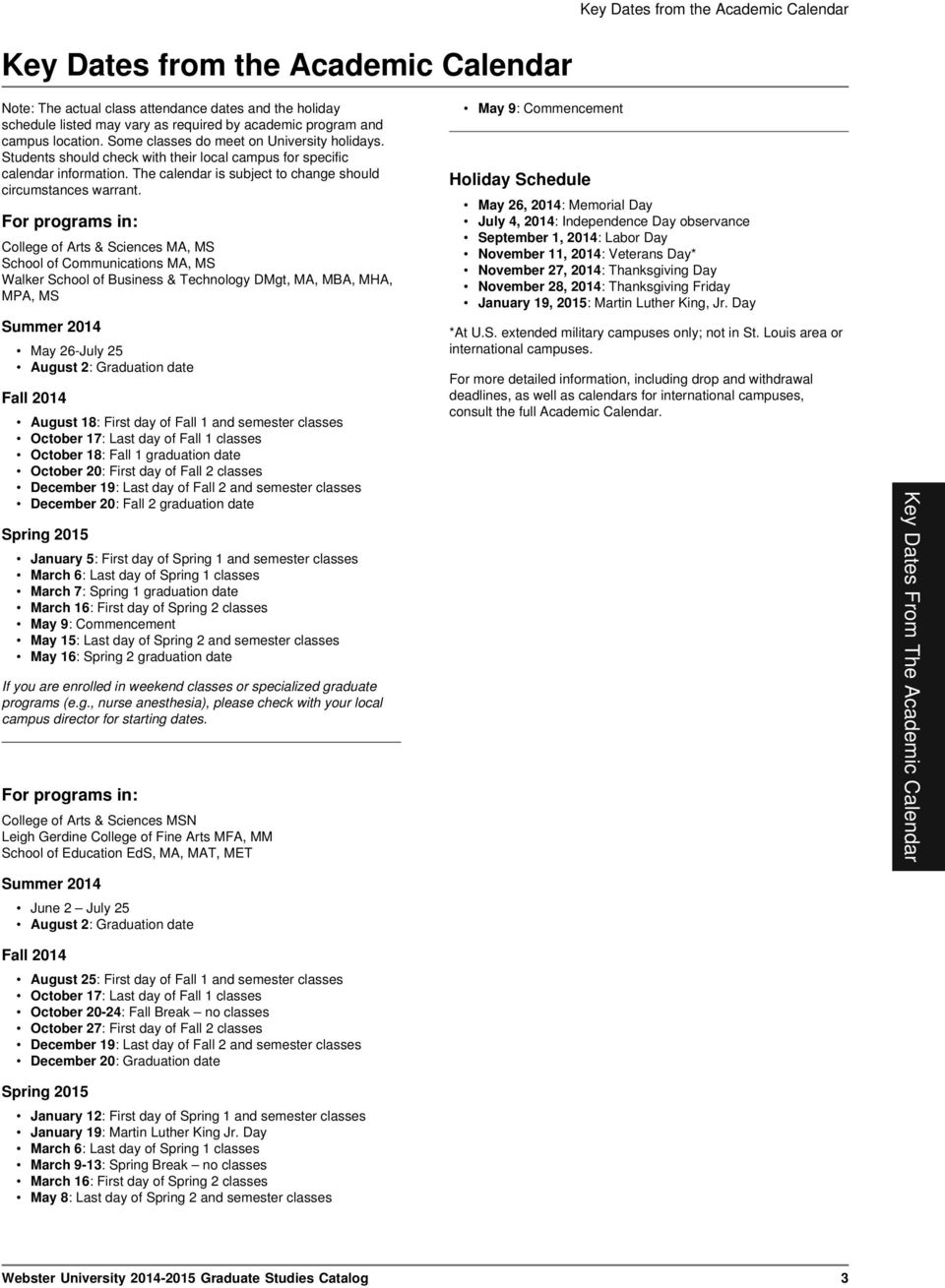
9 Key Dates from the Academic Calendar Key Dates from the Academic Calendar Note: The actual class attendance dates and the holiday schedule listed may vary as required by academic program and campus location. Some classes do meet on University holidays. Students should check with their local campus for specific calendar information. The calendar is subject to change should circumstances warrant. For programs in: College of Arts & Sciences MA, MS School of Communications MA, MS Walker School of Business & Technology DMgt, MA, MBA, MHA, MPA, MS Summer 2014 May 26-July 25 August 2: Graduation date Fall 2014 August 18: First day of Fall 1 and semester classes October 17: Last day of Fall 1 classes October 18: Fall 1 graduation date October 20: First day of Fall 2 classes December 19: Last day of Fall 2 and semester classes December 20: Fall 2 graduation date Spring 2015 January 5: First day of Spring 1 and semester classes March 6: Last day of Spring 1 classes March 7: Spring 1 graduation date March 16: First day of Spring 2 classes May 9: Commencement May 15: Last day of Spring 2 and semester classes May 16: Spring 2 graduation date If you are enrolled in weekend classes or specialized graduate programs (e.g., nurse anesthesia), please check with your local campus director for starting dates. For programs in: College of Arts & Sciences MSN Leigh Gerdine College of Fine Arts MFA, MM School of Education EdS, MA, MAT, MET May 9: Commencement Holiday Schedule May 26, 2014: Memorial Day July 4, 2014: Independence Day observance September 1, 2014: Labor Day November 11, 2014: Veterans Day* November 27, 2014: Thanksgiving Day November 28, 2014: Thanksgiving Friday January 19, 2015: Martin Luther King, Jr. Day *At U.S. extended military campuses only; not in St. Louis area or international campuses. For more detailed information, including drop and withdrawal deadlines, as well as calendars for international campuses, consult the full Academic Calendar. Key Dates From The Academic Calendar Summer 2014 June 2 July 25 August 2: Graduation date Fall 2014 August 25: First day of Fall 1 and semester classes October 17: Last day of Fall 1 classes October 20-24: Fall Break no classes October 27: First day of Fall 2 classes December 19: Last day of Fall 2 and semester classes December 20: Graduation date Spring 2015 January 12: First day of Spring 1 and semester classes January 19: Martin Luther King Jr. Day March 6: Last day of Spring 1 classes March 9-13: Spring Break no classes March 16: First day of Spring 2 classes May 8: Last day of Spring 2 and semester classes Webster University Graduate Studies Catalog 3
10 Mission and Values Mission and Values Mission Webster University, a worldwide institution, ensures high quality learning experiences that transform students for global citizenship and individual excellence. Vision Our vision is to be a premier U.S.-based international university setting a distinct standard for global education. This vision is built on a foundation of excellence in teaching and enhanced by an international perspective that fosters dialogue, respect and understanding across boundaries and between peoples. The educational endeavors in support of this vision are meeting the needs and enriching a global mix of learners within an ever increasing network of students desiring a U.S. education in multiple parts of the world. The institution is committed to offering these students a distinct personal experience and building the resources required to achieve this vision. The actions of the institution are shaped by our core values. Core Values Students Learning Diversity Global Citizenship By sustaining a personalized approach to education through small classes, close relationships with faculty and staff, and attention to student life. By developing educational programs that join theory and practice, provide an international perspective, encourage creativity and scholarship, and foster a lifelong desire to learn and actively serve communities and the world. By creating an environment accessible to individuals of diverse cultures, ages, and socioeconomic backgrounds and instilling in students a respect for diversity and an understanding of their own and others values. By educating a diverse population locally, nationally, and internationally, acting responsibly toward the environment to foster a sustainable future, and strengthening the communities we serve. 4 Webster University Graduate Studies Catalog
11 Statement of Ethics Statement of Ethics Webster University strives to be a center of academic excellence. The University makes every effort to ensure the following: 1. The opportunity for students to learn and inquire freely 2. The protection of intellectual freedom and the rights of professors to teach 3. The advancement of knowledge through scholarly pursuits and relevant dialogue The University community is by nature pluralistic and diverse. Those who elect to participate in the Webster University community--students, faculty, staff, administrators, alumni, and directors--accept the responsibility of sharing in the effort to achieve the University's mission as an institution of higher learning. Each member is expected to respect the objectives of the University and the views of its members. Participants in this shared enterprise strive to be governed by what ought to be rather than by what is. To accomplish its goals, members of the University community aspire to a higher standard than mere compliance with formalized University requirements and local, state, and federal laws. Webster University endeavors to fulfill the following expectations: 1. Preserve academic honor and integrity by repudiating all forms of academic and intellectual dishonesty 2. Treat others with respect and dignity 3. Respect the rights and property of others 4. Act with concern for the safety and well-being of its associates Inquiry, discourse, and dissent, within the framework of an ordered academic environment, are seminal elements of a university community and of a free democratic society. Members of the Webster University community recognize this and are consequently supportive of democratic and lawful procedure and dedicated to rational approaches to solving problems. This assumes openness to change as well as commitment to historical values. Statement Of Ethics Webster University Graduate Studies Catalog 5
12 Accreditation and Memberships Accreditation and Memberships Webster University is accredited by The Higher Learning Commission and is a member of the North Central Association, , The accreditation, which was awarded in 1925, includes undergraduate and graduate levels at all locations where the University offers programs. The Missouri Department of Higher Education serves as a clearinghouse for postsecondary student complaints. The MDHE complaint policy contains information about the complaint process and includes instructions for how to file a formal complaint. Note that the policy provides that a student who wishes to file a complaint with the department must first exhaust all formal and informal avenues provided by the institution to resolve disputes. Licensure/Approvals and Specialized Accreditation State Licensures Arizona Master's degree programs at Luke AFB are licensed by the Arizona State Board for Private Postsecondary Education. If a complaint or grievance cannot be resolved after exhausting the institution s grievance procedure, the student may file a complaint with the Arizona State Board of Private Postsecondary Education. The student must contact the State Board for further details. Arizona State Board for Private Postsecondary Education 1400 West Washington, Room 260 Phoenix, AZ Telephone: Arkansas The campuses at Little Rock, Little Rock Air Force Base, Fort Smith, and Fayetteville are certified by the Arkansas Department of Higher Education. Arkansas Higher Education Coordinating Board certification does not constitute an endorsement of any institution, course or degree program. Such certification merely indicates that certain minimum standards have been met under the rules and regulations of institutional certification as defined in Arkansas Code The student should be aware that these degree programs may not transfer. The transfer of course/ degree credit is determined by the receiving institution. California "Notice of Student Rights" in California You may cancel your contract for school, without any penalty or obligations, by the fifth business day following your first class as described in the Notice of Cancellation form that will be given to you. Read the Notice of Cancellation form for any explanation of your cancellation rights and responsibilities. If you have lost your Notice of Cancellation form, ask the school for a sample copy. After the end of the cancellation period, you also have the right to stop school at any time, and you have the right to receive a refund for the part of the course not taken. Your refund rights are described in the contract. If you have lost your contract, ask the school for a description of the refund policy. If the school closes before you graduate, you may be entitled to a refund. If you have any complaints, questions, or problems which you cannot work out with the school, write or call: Bureau for Private Postsecondary and Vocational Education P.O. Box West Sacramento, CA Telephone: Colorado The metropolitan campuses at Colorado Springs and Denver are authorized to offer master's degrees by the Colorado Commission on Higher Education. District of Columbia Master's degree programs at Bolling AFB in Washington, D.C., are licensed by the District of Columbia Educational Institution Licensure Commission. Florida Master's degree programs at the metropolitan campuses in Orlando, Jacksonville, Lakeland & Brandon, Merritt Island, Ocala, Palm Bay, Sarasota, Tampa Bay, Manatee, and at NAS Jacksonville and Patrick AFB are licensed by the Florida Commission for Independent Education. Credits and degrees earned from colleges licensed by this board do not automatically qualify the holder to participate in professional licensing examinations in the State of Florida. Any person interested in practicing a regulated profession in Florida should contact the appropriate state regulatory agency. For further information about the status of Webster University's programs in Florida, contact: Florida Department of Education Commission for Independent Education 325 West Gaines Street Suite 1414 Tallahassee, FL Telephone: (Toll free) Georgia In accordance with GNPEC requirements, any monies paid by a Georgia resident to a Webster University representative will be refunded to the student if he/she requests the same within three (3) business days of signing an enrollment contract with the university. If no enrollment contract is signed, and if requested by the student, any monies paid will be refunded to the student if he/she requests the same within three (3) business days after making a payment. Illinois The metropolitan campus in Elgin and master's degree programs at Great Lakes Naval Base and Scott Air Force Base are approved by the Illinois Board of Higher Education. Kentucky The metropolitan campus at Louisville is licensed by the Kentucky Council on Post-Secondary Education. 6 Webster University Graduate Studies Catalog

13 Accreditation and Memberships New Mexico NMAC Complaints Against the Institution: A. An institution licensed by the department shall have and make available to all students a written procedure that describes in detail how students or other parties may register a complaint or grievance, how the institution will investigate the complaint, and how the institution will attempt to resolve the complaint. Such policies shall at a minimum include the following components: (1) requirement that students or other parties with complaints or grievances against an institution first seek to resolve their complaint or grievance directly with the institution; (2) a time frame within which the institution will investigate the complaint and respond to the complainant; (3)assurance of the involvement of a person who will serve as an impartial representative of the institution but not be directly involved in the area of the complaint; (4)assurance that no adverse action will be taken against the complainant for registering the complaint; and (5) identification of the higher education department as the agency to be contacted in cases where a complaint cannot be resolved 1333 Main Street, Suite 200 Columbia, SC Telephone: If students at the Charleston, Columbia, Greenville, and Myrtle Beach Metropolitan Campuses have complaints about a classroom situation, they should first attempt to resolve the situation with the instructor. If resolution cannot be made with the instructor, or if the complaint is about a general school policy over which the instructor has no jurisdiction, then they may contact the school director for mediation. If the complaint cannot be resolved at the school level, students may contact Nonpublic Institution Licensing of the Commission on Higher Education. The complaint must be in writing. The school director will provide students with the necessary form. Tennessee Webster University is authorized by the Tennessee Higher Education Commission. This authorization must be renewed each year and is based on an evaluation by minimum standards concerning quality of education, ethical business practices, health and safety, and fiscal responsibility. B. The institution shall maintain adequate records of all complaints and their resolutions for a period of not less than three years. C. Complaint to the department. A student or other party not satisfied with an institution s resolution of a complaint may submit a complaint to the department in writing on a form provided by the department. A student must fill a complaint with the department within three (3) years of his/her last date of enrollment. D. Upon receipt of a written complaint, the department or it authorized representative shall verify that the complaint involves one or more standards for licensure of the institution and is therefore a legitimate subject of complaint to the department. If the complaint is determined to be legitimate, the department or its authorized representative shall forward the complaint to the institution for a written response and shall encourage resolution of the complaint between the student and the institution. The institution shall have thirty (30) days to forward its response to the department. A copy of the institution s response will be forwarded to the student with a request that the student indicate satisfaction or dissatisfaction with the response. E. In attempting to resolve a verified complaint, the department or it authorized representative may, but it not obliged to, convene a hearing and shall give written notice to the institution and to all persons involved, regarding the time, date, and place of the hearing. Such hearings, if held, shall be informal and for the purpose of determining the facts surrounding the claim and, if the claim is correct, to effect a settlement by persuasion and conciliation. F.In the event that the party complained against refuses to attend the hearing or effect the settlement of any claim determined by the department to be correct, the department shall invoke its powers to take such action as shall be necessary for the indemnification of the claimant. New Mexico Higher Education Department 2048 Galisteo Street Santa Fe New Mexico office: Fax: North Carolina A copy of the University's Tuition Guaranty Bond for North Carolina students is available by contacting the Office of Academic Affairs, 470 E. Lockwood Ave., St. Louis, MO, 63119, [email protected]. South Carolina The metropolitan campuses in Charleston, Columbia, Greenville, and Myrtle Beach are licensed by the: Commission on Higher Education Virginia Webster University is certified to operate by the State Council of Higher Education for Virginia (SCHEV). If a student has any complaints, questions or problems which were not resolved by the school to your satisfaction, you may contact State Council of Higher Education for Virginia (SCHEV) 101 N. 14 th Street Richmond, VA (804) Washington Webster University is authorized by the Washington Student Achievement Council and meets the requirements and minimum educational standards established for degree-granting institutions under the Degree-Granting Institutions Act. This authorization is subject to periodic review and authorizes Webster University to offer specific degree programs. The Council may be contacted for a list of currently authorized programs. Authorization by the Council does not carry with it an endorsement by the Council of the institution or its programs. Any person desiring information about the requirements of the act or the applicability of those requirements to the institution may contact the Council at P.O. Box 43430, Olympia, WA Specialized Accreditations Business and Management programs are accredited by the Accreditation Council for Business Schools and Programs (ACBSP) Music programs and degrees are fully accredited and approved by the National Association of Schools of Music (NASM). Nursing programs and degrees are accredited by the Accreditation Commission for Education in Nursing. Webster University is registered for state teachers' certificates by the Department of Education of the State of Missouri and is approved by the National Board for Certified Counselors, Inc. as a continuing education provider. Only the St. Louis Campus' legal studies BA, MA and Paralegal Certificates are approved by the American Bar Association. The nurse anesthesia program is accredited by the Council on Accreditation (COA) of nurse anesthesia educational programs. Education programs are accredited by the National Council for Accreditation of Teacher Education (NCATE). Accreditation And Memberships Webster University Graduate Studies Catalog 7

14 Accreditation and Memberships International Recognitions China: The Webster University MBA program, offered in partnership with the Shanghai University of Finance and Economics, is officially approved by and recognized by the Ministry of Education in China. Ghana: Webster University Ghana has received full accreditation in Ghana from the National Accreditation Board. Thailand: Webster University in Thailand is accredited as a private university by the Thailand Ministry of Education under Thai law. Austria: Webster University in Vienna is accredited by the Austrian Ministry for Science and Research as a private university under Austrian law. The Netherlands: Webster University programs in the Netherlands are accredited by the Netherlands-Flemish Accreditation Agency (NVAO). Webster is an approved institute of higher education under Dutch law. Memberships Webster University holds membership in the following organizations or associations: American Association for Paralegal Education American Association of Colleges of Nursing (AACN) American Association of Colleges of Teacher Education (AACTE) American Council on Education Association of American College and University Programs in Switzerland Association of American Colleges and Universities (AAC&U) Association of Theatre in Higher Education College Art Consortium College Board College Consortium for International Studies Council for Adult and Experiential Learning (CAEL) Council of Independent Colleges (CIC) Council on International Educational Exchange Educational Theatre Association Higher Education Council of Metropolitan St. Louis Independent Colleges and Universities of Missouri Institute of International Education International Council of Fine Arts Deans Missouri Music Educators Association National Education Association National League for Nursing Webster University has been designated as an institutional member of Servicemembers Opportunity Colleges, a group of more than 400 colleges and universities providing voluntary postsecondary education to members of the military throughout the world. As a member of SOC, Webster University recognizes the unique nature of the military lifestyle and has committed itself to easing the transfer of relevant course credits, providing flexible academic residency requirements, and crediting learning from appropriate military training and experiences. SOC has been developed jointly by educational representatives of each of the Armed Services, the Office of the Secretary of Defense, and a consortium of 13 leading national higher education associations; it is sponsored by the American Association of State Colleges and Universities, and the American Association of Community and Junior Colleges. Graduates of Webster University are eligible for membership in the American Association of University Women and the American College of Hospital Administrators. The University also holds appropriate licensure, accreditations, or approvals within the recognized state approval agencies for all locations where Webster University offers programs. 8 Webster University Graduate Studies Catalog
15 Tuition, Fees and Refunds Tuition, Fees and Refunds Tuition and Fees The tuition rates listed below are for the academic year and are subject to change. Tuition (per credit hour) for MA, MS, MSN, MBA, MHA, MFA, MPA, MM* St. Louis area campuses^ $665 California metropolitan campuses Other metropolitan campuses $620 $545 Online courses $735 * Excludes School of Education students ^ Except doctoral students and other specialized degree programs. Global MA (GMA) students Tuition (per year) $45,800 Tuition (per credit hour) for School of Education students St. Louis area campuses*** $535 Extended campus locations $360 Online courses $585 In-service courses $ Off campus face-to-face^^ $360 *** Includes courses held at the Webster Groves School District location. ^ ^Applicable to some off-campus courses. Additional Fees Tuition for Military (Active Duty Military, Reserve, Guard, and First Responders) (per credit hour)^ Metropolitan locations $340 Military locations $340 Online courses $470 Civilian students on military bases** $490 ^ Except doctoral students and other specialized degree programs. **Federal and contract employees of the installation and dependents of active duty military, reserve and guard also qualify for a reduced tuition rate in on-base, in-class courses. Application Fee non-refundable Graduation Fee non-refundable Study Abroad This fee varies depending on the type of study abroad program. It is in addition to tuition, course and lab, and program fee assessments and are nonrefundable. Students should consult the Office of Study Abroad to determine the fees associated with their individual programs. $50 $75 Varies Tuition, Fees And Refunds MS in Nurse Anesthesia students Tuition (per term) $5,485 Fees (per term) $800 Transfer credit $665 Doctor of Management (DMgt) students Regular Tuition $745 Tuition for Military and First Responders (Webster Groves campus) One-Year MBA students $495 Tuition (36 credit $20,000 NOTE: Courses in various academic programs sometimes require expendable supplies or services, and in these cases the student may be billed a class fee for such costs. School of Education Graduate Alumni Reduced Tuition Alumni of the School of Education's graduate programs (MAT, MA and MET) may enroll in eligible graduate face-to-face courses for a special reduced fee per credit hour. Interested students must submit an application to the Dean's Office. The reduced fee is subject to application approval. Under certain circumstances in which classes have a limited enrollment, current degree-seeking students are given priority. Payment Requirements Payment and/or payment arrangements are required at registration. The payment options offered include: Financial aid Direct billing to a third party (i.e., employer) Tuition assistance paid by a government agency, e.g., military Deferred payment plan Webster University Graduate Studies Catalog 9

16 Tuition, Fees and Refunds Payment in full Some options require the submission of appropriate documentation. The deferred payment plan option requires a deferred payment fee to be paid at the time of registration. The University reserves the right to refuse deferred payment privileges for any student whose account is overdue or has been overdue in the past. Students are encouraged to make electronic check payments online, but personal checks made payable to Webster University are also accepted. A $30 returned payment fee is charged if payment is returned. Webster also accepts MasterCard, Discover, VISA, and American Express payments online with a 2.75% convenience fee. Students are financially responsible for all courses not officially dropped by the deadline. Webster University reserves the right to withhold transcripts or diplomas, and refuse or cancel enrollment for future terms, if any tuition or other fees or charges owed to the University are not paid when due. In the event an account is referred to an agency or attorney for collection, the student promises to pay, in addition to all amounts otherwise due to Webster University, the costs and expenses of such collection and/or representation not to exceed 33-1/3% of the amount owed, including, without limitation, reasonable attorneys' fees and expenses (whether or not litigation is commenced), to the extent permitted by applicable law. Refunds The student tuition refund rates apply when a student drops or withdraws from a course in accordance with University enrollment policies and the refund has been approved. Students attending on-campus classes in California will receive a pro rata refund of tuition if the withdrawal is within 60 percent of the beginning of the enrollment period. All other student refunds/ tuition waivers, including those for online courses, are made according to the following schedule: Date 16-Week Class Drop: Week 1 100% 100% Week 2 100% 100% Withdrawal: Week 3 50% 50% Week 4 50% 25% Week 5 25% 0% Week 6 25% 0% Week 7 25% N/A Week 8 25% N/A Week 9 0% N/A 8- or 9- Week Class The deposit and refund policies at our European and Asian campuses may differ from the above. Please refer to the catalog of the international campus you are attending for details. Note: This refund policy does not include course or laboratory fees associated with a class. Financial Aid Webster University's Financial Aid Office offers a comprehensive program of financial aid resources for students needing supplemental financial support for their educational expenses. To apply for federal, state, and institutional aid, a student must complete a Free Application for Federal Student Aid (FAFSA). The FAFSA can be accessed on-line at Webster University's award year begins in the summer semester and ends in the following year spring semester (Summer, Fall, Spring). To be considered for priority financial aid awarding, the FAFSA should be submitted by March 1. Students may complete the FAFSA through June 30 of the award year; however, this may result in limited aid eligibility. In addition to the annual FAFSA, a student needs to complete and submit the Webster University Financial Aid Application available on-line at financialaid/forms. Cost of Attendance An important part of determining a student's eligibility for financial aid is calculating a Cost of Attendance. In accordance with federal regulations, Webster University has developed a Cost of Attendance (i.e., budget) for anticipated expenses a student may incur during the current school year. These expenses include tuition, room, board, books and supplies, travel and personal. Room and board can refer to either on campus or off-campus living expenses, depending upon a student's response on the FAFSA. Expenses are also considered for students who live at home with parents or relatives. Travel expenses include items such as gasoline, vehicle maintenance and insurance. Personal expenses include laundry, clothing and entertainment. Many of the elements in the Cost of Attendance are estimates, so it is possible for a student to spend more or less than anticipated during any given year. Federal Financial Aid Student Eligibility To be eligible for federal financial aid, also referred to as Title IV funds, a student should: be a U.S. citizen or an eligible noncitizen; have a valid Social Security number (with the exception of students from the Republic of the Marshall Islands, Federated States of Micronesia, or the Republic of Palau) be registered with Selective Service, if you're a male (you must register between the ages of 18 and 25) be enrolled or accepted for enrollment as a regular student in an eligible degree or certificate program be enrolled at least half-time to be eligible for Direct Loan Program funds maintain satisfactory academic progress in college or career school sign statements on the Free Application for Federal Student Aid (FAFSA) stating that: you are not in default on a federal student loan and do not owe money on a federal student grant you will use federal student aid only for educational purposes show you're qualified to obtain a college or career school education by having a high school diploma or a recognized equivalent such as a General Educational Development (GED) certificate or completing a high school education in a homeschool setting approved under state law. Gift Aid Scholarships awarded directly to the student from outside sources are added to the award, becoming part of the total package of aid. The amount of the private award can impact eligibility in other programs as can the criteria of the program itself. It is important for all students to provide information regarding, the selection 10 Webster University Graduate Studies Catalog
17 Tuition, Fees and Refunds and renewal (if applicable) criteria, the amount and anticipated disbursement date for any outside scholarship or grant awarded to them to the Financial Aid Office as soon as possible to insure any impact on other aid or charges can be determined. notify the Financial Aid Office of the completion and the financial aid status will be reviewed and updated. Maximum Time-Frame Self-Help Aid Student loans (repaid with interest after leaving the University) may reduce both direct (tuition, fees, campus residence, books) and indirect costs (living expenses, transportation, day care). Federal loans allow students to defer payment until after leaving the University or dropping below half-time student status. There are also privately funded alternative loan programs designed to supplement institutionally administered Federal loan programs. These are not federally insured and may or may not carry a higher, variable interest rate, may require a credit worthy cosigner with a favorable credit history. For students working on a graduate degree, the only available aid are the federal and private loan programs. There are maximum allowable loan levels from the Federal Stafford Direct Student Loan Programs for required graduate course work to complete the degree. Any money borrowed for prior degree(s) would be deducted from the ceiling to determine loan funds still available. Students will receive notification of funding eligibility per year and the criteria to receive and maintain that funding. Satisfactory Academic Progress According to the United States Department of Education regulations, all students applying for federal and/or state financial assistance must maintain satisfactory progress in their course of study to receive these funds. These standards stipulate, but are not limited to, maintaining acceptable grades, completing a sufficient number of credit hours per semester, and completing a degree within a reasonable time frame. A student who does not meet these standards is not eligible to receive federal, state, and/or institutional financial aid. All semesters of attendance are considered for satisfactory progress regardless of whether the student received aid. Adherence to the following standards will be necessary for continued financial aid eligibility. A student must be making academic progress regardless of whether the student had previously received aid. Before aid is disbursed, a student's progress will be evaluated annually after spring semester grades are recorded. Any student who has not previously received financial aid may not be notified of their status until they apply for financial aid. Satisfactory Academic Progress is determined by: Qualitative Measurement (GPA) Students must maintain a 2.0 cumulative grade point average based upon institutional hours attempted to remain in good standing. Quantitative Measurement: Pace of Progression (Credit Hours) Students must complete attempted hours according to the following: Degree requirements must be completed within a specific time frame. The maximum time frame for a Graduate Degree at Webster University is 150% of required credit hours (i.e., 36 credit hours x 150% = 54 credit to complete the degree including hours transferred and accepted by Webster are considered in this time frame. Any student who has exceeded the maximum time frame and/or who mathematically cannot finish the program within this period will be considered ineligible for financial aid. Webster University understands students may change their educational goals and programs of study. These students may appeal for reevaluation of their status. Satisfactory Academic Progress Monitoring Students are reviewed for Qualitative Measurement, Pace of Progression, and Maximum Time-Frame annually at the end of each Spring semester. Students who are on academic plan probation will be evaluated at the end of each semester (Summer, Fall, Spring). Suspension/Academic Plan Probation Status A student will be placed on Financial Aid Suspension if: The cumulative GPA is less than the stated requirement in the Qualitative Measurement section. And/or The student has not successfully completed the minimum 67% of attempted hours including transferred hours. A student placed on financial aid suspension will lose eligibility to receive financial assistance. Students will receive a notice in writing of their suspension status from the Financial Aid Office. Non-Satisfactory Progress Appeal A student who has been suspended from financial aid may complete and submit a Non-Satisfactory Progress Appeal Form (Available online or in the Financial Aid Office) for reinstatement within thirty (30) days of notification, if there are extenuating or mitigating circumstances contributing to their inability to meet the requirements. Students may appeal for one of the following reasons: The death of a relative to the student. Severe injury or illness of the student. Other extenuating circumstances which may include but are not limited to: Severe illness of a relative for whom the student has custodial responsibility. Emergency situations such as fire or flood. Military reassignment, required job shift change, or job transfer preventing the student from completing a semester Separation or divorce Tuition, Fees And Refunds Completion of 67% of cumulative hours attempted (i.e., a student attempts 15 hours; he/she must complete 10). Course grades of "I", "WF", "W", or "F" are considered as attempted and not completed. Courses completed at Webster University, as well as courses transferred and accepted by Webster University are considered in the Pace of Progression completion rate. Once a student completes the coursework for a class in which they had previously earned a grade of "I", they must Such an appeal must be accompanied by supporting documents and be submitted to the Financial Aid Office who will forward the appeal to the Satisfactory Academic Progress Committee. A student placed on a Financial Aid Academic Plan Probation: Will be reviewed at the end of each semester for continued eligibility. Webster University Graduate Studies Catalog 11
18 Tuition, Fees and Refunds Must achieve a Qualitative Measurement (GPA listed above) and Pace of Progression (67% of attempted hours completed) each semester. Will lose all financial aid eligibility in future semesters and be placed on Financial Aid Suspension if either or both measurements are not achieved with no opportunity for appeal Reinstatement A student who has been Suspended from financial aid for academic reasons and has not had an appeal accepted may be eligible for reinstatement if they enroll in courses at their own expense and meets the criteria listed for cumulative Satisfactory Academic Progress. Students must notify the Office of Financial Aid by submitting another Non-Satisfactory Progress Appeal Form. Records of progress are kept by the institution on both veteran and non-veteran students. Progress records are furnished to all students at the end of each scheduled term. The policy and regulations regarding student standards of progress for graduation are detailed in the section titled Undergraduate Grading Policy. Additional information may be obtained from the Office of the Registrar at the St. Louis home campus. Any conduct that is detrimental to the school and/or other students will result in the termination of VA educational benefits. The Satisfactory Academic Progress Policy for financial aid also applies to VA educational benefits. The Webster University Financial Aid Office will attempt to notify, in writing, any student currently receiving financial aid who is placed on Financial Aid Suspension. However, failure to receive such notification does not relieve the student of the requirement to read, understand and follow the Satisfactory Academic Progress Requirements for Financial Aid Recipients. University Withdrawal If a student fully withdraws from the university, the Bursar Office may adjust their charges based upon their withdrawal date and the Webster University Refund Policy. For the university refund policy, refer to the University Business Office website. Regardless of any adjustment to a student's charges, if he or she fully withdraws from the university, financial aid may be adjusted based on the percentage of the semester completed before withdrawal. In some cases, Federal Return of Title IV Funds regulations may require that aid be returned to the federal government for students who withdraw from Webster University before 60 percent of a term has been completed. Financial aid is awarded for the entire term and if a student withdraws prior to the end of a term, then the Return of Title IV Fund rules will determine how much financial aid has been earned. The student can keep the earned amount for the term, but the unearned portion must be immediately returned to the federal government. In some situations, this will leave the student with a balance owed to the university. A student should contact the Financial Aid Office before withdrawing from a course or term to understand the effects this action may cause to financial aid eligibility. Graduate Assistantships A limited number of graduate assistantships are available. Assistantships may include a monthly stipend and tuition remission benefits. Please contact the office of your degree program for availability, remunerations, and application deadlines. Veterans' Educational Benefits Webster University courses of study are approved for veterans' educational benefits in compliance with prescribed regulations by special approval agencies in each state and for each foreign country where the University offers programs. Non-degree students are not eligible for VA educational benefits. The regional VA office will be notified of the date on which a student officially ceases attendance if veterans' educational benefits apply. Except under extenuating circumstances, students receiving VA benefits who withdraw from a course will be reported to the VA offices as making unsatisfactory progress. 12 Webster University Graduate Studies Catalog

19 Campus Locations and Offerings Campus Locations and Offerings The home campus of Webster University is in Webster Groves, Missouri, a major suburban center of the St. Louis metropolitan area. In addition to the home campus, the University has campuses in downtown St. Louis, in St. Louis County at Westport, and in St. Charles County at Winghaven. In the continental United States, Webster University has campuses in 20 states and in the District of Columbia. Internationally, the University has campuses in Africa, China, Austria, United Kingdom, The Netherlands, Switzerland, and Thailand. Little Rock Air Force Base 1490 Vanderberg Blvd., Room 109 Jacksonville, AR Ph: (501) Fax: (501) [email protected] Programs Offered: Not all degrees and majors are offered at every Webster University location. Campus offerings listed below are accurate as of June 1, Please see individual campus websites for current offerings at a particular Webster campus. A schedule of courses for the academic year is available at all Webster University locations that offer degree programs. *Indicates U.S. campuses that are approved to enroll international graduate students. For further information, please consult the Application for International Students section of this catalog. United States Campuses Arizona Luke Air Force Base* P.O. Box 726 Litchfield Park, AZ Ph: (623) Fax: (623) [email protected] Programs offered: MA Business and Organizational Security Management MA Human Resources Management MA Information Technology Management MA Management and Leadership MA Procurement and Acquisitions Management Master of Business Administration (MBA) Master of Public Administration (MPA) Arkansas Fayetteville Metro* Millsap Plaza 688 Millsap Rd. Suite 200 Fayetteville, AR Ph: (479) Fax: (479) [email protected] Programs Offered: MA Human Resources Management MA Management and Leadership Master of Business Administration (MBA) Fort Smith Metro* 801 Carnall Avenue, Suite 200 Fort Smith, AR Ph: (479) Fax: (479) [email protected] Programs Offered: MA Human Resources Management Master of Business Administration (MBA) MA Human Resources Development MA Information Technology Management Master of Business Administration (MBA) Master of Public Administration (MPA) Little Rock Metro* 200 W. Capitol Ave. Suite 1500 Little Rock, AR Ph: (800) Fax: (501) [email protected] Programs Offered: MA Business and Organizational Security Management MA Human Resources Management MA International Business MA Management and Leadership MA NonProfit Leadership Master of Business Administration (MBA) Master of Health Administration (MHA) MS Finance California Edwards Air Force Base 412 MSS/DPEE, 140 METHUSA Ave. Edwards AFB, CA Ph: (661) Fax: (661) [email protected] Programs offered: MA Human Resources Management MA Management and Leadership Master of Business Administration (MBA) Irvine Metro* 32 Discovery, Suite 250 Irvine, CA Ph: (949) Fax: (949) [email protected] Programs offered: MA Counseling: Marriage, Family and Child MA Human Resources Management MA Management & Leadership Master of Business Administration (MBA) Los Angeles Air Force Base 483 N. Aviation Blvd. 61 FSS/FSD, Bldg 272, Rm. C2-302 El Segundo, CA Campus Locations And Offerings Webster University Graduate Studies Catalog 13
20 Campus Locations and Offerings Ph: (310) Fax: (310) Programs offered: Cert Government Contracting MA Business and Organizational Security Management MA Management and Leadership MA Procurement and Acquisitions Management Master of Business Administration (MBA) San Diego Metro* 6333 Greenwich Drive, Suite 230 San Diego, CA Ph: (858) Fax: (858) Programs offered: MA Business and Organizational Security Management MA Human Resources Management MA Management and Leadership Master of Business Administration (MBA) MS Cybersecurity MS Finance Colorado Colorado Springs Metro* 5475 Tech Center Drive, Suite 110 Colorado Springs, CO Ph: (719) Fax: (719) Programs offered: Cert Government Contracting MA Business and Organizational Security Management MA Human Resources Development MA Human Resources Management MA Information Technology Management MA Management and Leadership MA Procurement and Acquisitions Management Master of Business Administration (MBA) Master of Health Administration (MHA) MS Cybersecurity MS Finance MS Space Systems Operations Management Denver Metro* 9250 East Costilla Avenue Suite 310 Greenwood Village, CO Ph: (303) Fax: (303) Programs offered: Cert Education for Global Sustainability Cert Government Contracting MA Human Resources Management MA Information Technology Management MA Management and Leadership MA Procurement and Acquisitions Management Master of Business Administration (MBA) Master of Health Administration (MHA) MS Space Systems Operations Management Peterson Air Force Base Force Development Center 201 West Stewart Ave., Building 1171 Suite 106 Peterson AFB, CO Ph: (719) Fax: (719) Programs offered: Cert Government Contracting MA Cybersecurity MA Information Technology Management MA Management and Leadership MA Procurement and Acquisitions Management MS Space Systems Operations Management Master of Business Administration (MBA) Master of Business Administration (MBA): Information Technology Management Master of Business Administration (MBA): Procurement & Acquisitions Management District of Columbia Joint Base Anacostia-Bolling/Bolling AFB* P.O. Box 8171 Washington, DC Ph: (202) Fax: (202) Programs offered: Cert Government Contracting MA Business and Organizational Security Management MA Human Resources Management MA Information Technology Management MA Management and Leadership MA Procurement and Acquisitions Management Master of Business Administration (MBA) MS Cybersecurity Florida Jacksonville Metro* Centurion Parkway N., Suite 210 Jacksonville, FL Ph: (904) Fax: (904) Programs offered: MA Counseling: Clinical Mental Health MA Counseling: Marriage, Family and Child MA Counseling: Community MA Human Resources Development MA Human Resources Management MA Information Technology Management MA Management and Leadership Master of Business Administration (MBA) MS Finance Jacksonville Naval Air Station Navy Campus Ed Center Bldg. 110, Box 137 Naval Air Station Jacksonville, FL Ph: (904) Fax: (904) Webster University Graduate Studies Catalog
21 Campus Locations and Offerings Programs offered: MA Human Resources Development MA Human Resources Management MA Information Technology Management MA Management and Leadership Master of Business Administration (MBA) Master of Health Administration (MHA) MS Finance Ph: (352) ; (877) Fax: (352) Programs offered: MA Counseling: Clinical Mental Health MA Counseling: Marriage, Family and Child MA Counseling: Community MA Human Resources Management MA Management and Leadership Master of Business Administration (MBA) Lakeland Metro* Webster University, Lakeside Village 1479 Towne Center Dr., Suite 202 Lakeland, FL Ph: (863) Fax: (863) Programs offered: Orlando North Metro* Sanlando Center 2180 W SR434, Suite 5100 Longwood, FL Ph: (407) Fax: (407) [email protected] Programs offered: MA Counseling: Clinical Mental Health MA Counseling: Community MA Human Resources Management MA Management and Leadership Master of Business Administration (MBA) Melbourne/Palm Bay* Melbourne Campus 1775 W. Hibiscus Blvd. Suite 100 Melbourne, FL Ph: (321) Fax: (321) [email protected] Programs offered: MA Counseling: Clinical Mental Health MA Counseling: Community MA Human Resources Management MA Information Technology Management MA Management and Leadership MA Procurement and Acquisitions Management Master of Business Administration (MBA) MA Business and Organizational Security Management MA Counseling: Clinical Mental Health MA Counseling: Marriage, Family and Child MA Counseling: Community MA Human Resources Development MA Human Resources Management MA Information Technology Management MA International Business MA Management and Leadership MA Marketing Master of Business Administration (MBA) Master of Health Administration (MHA) MS Finance Orlando South Metro* Westwood Center 6750, Forum Drive, Suite 300 Orlando, FL Ph: (407) Fax: (407) [email protected] Programs offered: Campus Locations And Offerings Merritt Island/Space Coast Metro* 150 N. Sykes Creek Parkway Suite 200 Merritt Island, FL Ph: (321) Fax: (321) [email protected] Programs offered: MA Business and Organizational Security Management MA Counseling: Clinical Mental Health MA Counseling: Community MA Human Resources Development MA Human Resources Management MA Information Technology Management MA Management and Leadership MA Procurement and Acquisitions Management Master of Business Administration (MBA) Ocala Metro* 4414 SW College Rd #942 Ocala Fl MA Business and Organizational Security Management MA Counseling: Clinical Mental Health MA Counseling: Marriage, Family and Child MA Counseling: Community MA Human Resources Development MA Human Resources Management MA Information Technology Management MA International Business MA Management and Leadership MA Marketing Master of Business Administration (MBA) Master of Health Administration (MHA) MS Finance Patrick Air Force Base Building Central Avenue Suite C-15 Patrick AFB, FL Ph: (321) Fax: (321) [email protected] Programs offered: MA Human Resources Development Webster University Graduate Studies Catalog 15
22 Campus Locations and Offerings MA Human Resources Management MA Information Technology Management MA Management and Leadership Master of Business Administration (MBA) Master of Public Administration (MPA) Sarasota Metro* 8043 Cooper Creek Blvd. #101 University Park, FL Ph: (941) Fax: (941) Programs offered: MA Counseling: Clinical Mental Health MA Counseling: Community MA Human Resources Management MA Management and Leadership Master of Business Administration (MBA) Tampa Bay/St. Petersburg* Corporate Circle North Suite #140 St. Petersburg, FL Ph: (727) Fax: (727) Programs offered: MA Counseling: Clinical Mental Health MA Counseling: Community MA Human Resources Management MA Management and Leadership Master of Business Administration (MBA) Georgia Fort Gordon P.O. Box 8254 Fort Gordon, GA Ph: (706) Programs offered: MA Business and Organizational Security Management MA Human Resources Management MA Information Technology Management MA Management and Leadership Master of Business Administration (MBA) Master of Health Administration (MHA) Fort Stewart P.O. Box 3209 Fort Stewart, GA Ph: (912) Fax: (912) Programs offered: MA Business and Organizational Security Management MA Human Resources Management MA Information Technology Management MA Management and Leadership Master of Business Administration (MBA) Hunter Army Airfield P.O. Box Hunter AAF, GA Ph: (912) Fax: (912) Programs offered: MA Business and Organizational Security Management MA Human Resources Management MA Information Technology Management MA Management and Leadership Master of Business Administration (MBA) Moody Air Force Base 23 FSS/FSDE 3010 Robinson Road Moody AFB, GA Ph: (229) Fax: (229) Programs offered: MA Human Resources Management MA Management and Leadership Master of Business Administration (MBA) Idaho Mountain Home Air Force Base 665 Falcon Street, Bldg 2428 Mountain Home AFB, ID Ph: (208) Fax: (208) Programs offered: MA International Relations MA Management and Leadership Master of Business Administration (MBA) Illinois Great Lakes Naval Base Navy College Office Building 617 Room 201, 2221 MacDonough Street Great Lakes, IL Ph: (847) Fax: (847) Programs offered: MA Business and Organizational Security Management MA Human Resources Development MA Management and Leadership MA Procurement and Acquisitions Management Master of Business Administration (MBA) Scott Air Force Base 375 FSS/FSDE 404 W. Martin St., Rm W. Martin St., Rm. 78 Scott AFB, IL Ph: (618) Fax: (618) Webster University Graduate Studies Catalog
23 Campus Locations and Offerings Programs offered: MA Human Resources Development MA Information Technology Management MA International Relations MA Management and Leadership MA Procurement and Acquisitions Management Programs offered: CERT Government Contracting MA International Relations MA Procurement and Acquisitions Management Master of Business Administration (MBA) Kansas Fort Leavenworth* P.O. Box 3134 Ft. Leavenworth, KS Ph: (913) Fax: (913) Programs offered: MA Business and Organizational Security Management MA Human Resources Management MA Information Technology Management MA International Relations MA Management MA Procurement and Acquisitions Management Master of Business Administration (MBA) McConnell Air Force Base P.O. Box Wichita, KS Ph: (316) Fax: (316) Programs offered: MA Human Resources Development MA Human Resources Management MA Management and Leadership Master of Business Administration (MBA) Master of Health Administration (MHA) Kentucky Louisville Metro* 1031 Zorn Avenue Suite 200 Louisville, KY Ph: (502) Fax: (502) Programs offered: MA Counseling: Clinical Mental Health MA Counseling: Marriage, Family and Child MA Human Resources Development MA Human Resources Management MA Information Technology Management MA Management and Leadership MA Nonprofit Leadership Master of Business Administration (MBA) Master of Health Administration (MHA) Maryland Andrews Air Force Base 316 MSS/DPE 1413 Arkansas Rd. Andrews Air Force Base, MD Ph: (301) /2257 Fax: (301) Southern Maryland Educations Center Airport Road California, MD Ph: (301) , ext 216 Fax: (301) Programs offered: CERT Government Contracting MA Human Resources Management MA Management and Leadership MA Procurement and Acquisitions Management Master of Business Administration (MBA) Missouri Fort Leonard Wood* 268 Constitution St., Ste. 11 Ft. Leonard Wood, MO Ph: (573) Fax: (573) Programs offered: MA Business and Organizational Security Management MA Human Resources Development MA Human Resources Management MA Information Technology Management MA Management and Leadership Master of Business Administration (MBA) Master of Public Administration (MPA) MS Environmental Management Kansas City Metro* 1200 East 104th Street, Suite 100 Kansas City, MO Ph: (816) Fax: (816) Programs offered: Cert Nurse Educator Cert Nurse Leader MA Counseling: Clinical Mental Health MA Counseling: Community MA Education and Innovation MA Human Resources Development MA Human Resources Management MA Management and Leadership MA Marketing MA Non-Profit Leadership MA Teaching English as a Second Language Master of Business Administration (MBA) Master of Educational Technology (MET) Master of Health Administration (MHA) MS Finance MSN Nursing Campus Locations And Offerings Webster University Graduate Studies Catalog 17
24 Campus Locations and Offerings Old Post Office* 815 Olive Street, Suite 20 St. Louis, MO Ph: (314) Fax: (314) Programs offered: MA Business and Organizational Security Management MA Human Resources Development MA Human Resources Management MA Legal Studies MA Management and Leadership Master of Business Administration (MBA) Ozarks Metro 321 W. Battlefield, Second Floor Springfield, MO Ph: (417) Fax: (417) Programs offered: MA Business and Organizational Security Management MA Human Resources Development MA Human Resources Management Master of Business Administration (MBA) Master of Health Administration (MHA) MA Management and Leadership MA Procurement and Acquisitions Management Master of Business Administration (MBA) MS Science Management & Leadership MS Finance Whiteman Air Force Base P.O. Box 6099 Whiteman AFB, MO Ph: (660) Fax: (660) Programs offered: MA Human Resources Development MA Information Technology Management MA Management and Leadership Master of Business Administration (MBA) Winghaven* 2229 Technology Drive, Suite 300 O'Fallon, MO Ph: (636) ; Fax: (636) Programs offered: MA Human Resources Management MA Management and Leadership Master of Business Administration (MBA) Rolla Metro* 1103 Kingshighway Rolla, MO Ph: (573) Fax: (573) Programs offered: MA Counseling: Clinical Mental Health MA Counseling: Marriage, Family and Child MA Counseling: Community Master of Health Administration (MHA) New Mexico Albuquerque Metro* 4775 Indian School NE Suite 300 Albuquerque, NM Ph: (505) Fax: (505) Programs offered: MA Human Resources Management MA Counseling: Clinical Mental Health MA Counseling: Community St. Louis Home Campus* 470 East Lockwood Avenue Webster Groves, MO Ph: (314) Fax: (314) Programs offered: Unless otherwise noted, all programs listed in this catalog are offered at the St. Louis home campus. Westport* Lackland Rd. Suite #600 Maryland Heights, MO Ph: (314) Fax: (314) Programs offered: MA Human Resources Development MA Human Resources Management MA Information Technology Management Kirtland Air Force Base 377 MSS DPEE, Base Education Center Room 100, Wyoming Blvd. SE Albuquerque, NM Ph: (505) Fax: (505) Programs offered: MA Human Resources Development MA Information Technology Management MA Management and Leadership Master of Business Administration (MBA) North Carolina Camp Lejeune PSC Box 100, 100 Brewster Blvd. Camp Lejeune, NC Ph: (910) Fax: (910) Webster University Graduate Studies Catalog
25 Campus Locations and Offerings Programs offered: Cert Government Contracting MA Human Resources Management MA Management and Leadership MA Procurement and Acquisitions Management Fort Bragg P.O. Box Fort Bragg, NC Ph: (910) Fax: (910) Programs offered: Cert Government Contracting MA Business and Organizational Security Management MA Counseling: Family Life MA Human Resources Management MA Information Technology Management MA International Relations MA Management and Leadership MA Procurement and Acquisitions Management Master of Business Administration (MBA) South Carolina Beaufort Naval Hospital P.O. Box 6168 C, US Naval Hospital Beaufort, SC Ph: (843) Fax: (843) Programs offered: MA Human Resources Development MA Management and Leadership Master of Business Administration (MBA) Joint Base Charleston/Charleston Air Force Base 437 FSS/FSDE (AMC), 101 West Hill Blvd., Bldg. 221 Charleston AFB, SC Ph: (843) Programs offered: MA Business and Organizational Security Management MCAS New River Building AS213, Bancroft Drive Room 115 MCAS New River, NC Ph: (910) Programs offered: Master of Business Administration (MBA) Oklahoma Fort Sill Army Continuing Education System 4700 Mow-Way Road Fort Sill, Oklahoma Ph: (580) Fax: (580) Programs offered: MA Human Resources Management MA Information Technology Management MA Management and Leadership Master of Business Administration (MBA) Charleston Metro* 4105 Faber Place Dr., Suite 100 N. Charleston, SC Ph: (843) Fax: (843) Programs offered: MA Counseling: Clinical Mental Health MA Human Resources Development MA Human Resources Management MA Information Technology Management MA Management and Leadership Master of Business Administration (MBA) Columbia Metro 8911 Farrow Road, Suite 101 Columbia, SC Ph: (803) Fax: (803) Programs offered: Campus Locations And Offerings Tinker Air Force Base 72 FSS/DPEE Building 201SE st Street Tinker AFB, OK Ph: (405) DSN: Fax: (405) Programs offered: Cert Government Contracting MA Information Technology Management MA International Relations MA Management and Leadership MA Procurement and Acquisitions Management MA Counseling: Clinical Mental Health MA Human Resources Development MA Human Resources Management MA Management and Leadership Master of Business Administration (MBA) Master of Health Administration (MHA) Fort Jackson P.O. Box Ft. Jackson, SC Ph: (803) Fax: (803) Programs offered: MA Business and Organizational Security Management MA Human Resources Management Webster University Graduate Studies Catalog 19
26 Campus Locations and Offerings MA Information Technology Management MA Management and Leadership Master of Business Administration (MBA) Greenville Metro* 124 Verdae Drive Suite. 400 Greenville, SC Ph: (864) Fax: (864) Programs offered: MA Counseling: Clinical Mental Health MA Human Resources Development MA Human Resources Management MA Management and Leadership Master of Business Administration (MBA) Master of Health Administration (MHA) Texas Fort Bliss* P.O. Box 6077 Ft. Bliss, TX Ph: (915) Fax: (915) Programs offered: Cert Education Services Specialist Cert Government Contracting MA Business and Organizational Security Management MA Counseling: Community MA Human Resources Development MA Human Resources Management MA Information Technology Management MA Management and Leadership Master of Business Administration (MBA) Master of Health Administration (MHA) Myrtle Beach Metro* 4589 Oleander Drive Myrtle Beach, SC Ph: (843) Fax: (843) Programs offered: MA Counseling: Clinical Mental Health MA Human Resources Development MA Human Resources Management MA Management and Leadership Master of Business Administration (MBA) Master of Health Administration (MHA) Shaw Air Force Base 398 Shaw Drive, Rm. 108 Shaw AFB, SC Ph: (803) Fax: (803) Programs offered: Cert Government Contracting MA Information Technology Management MA Procurement and Acquisitions Management Master of Business Administration (MBA) Tennessee Memphis Naval Support Activity P.O. Box Millington, TN Ph: (901) Fax: (901) Programs offered: MA Human Resources Management MA Information Technology Management MA Management and Leadership Master of Business Administration (MBA) Joint Base San Antonio/Fort Sam Houston* 2408 N. New Braunfels Ave. Suite 30 Ft. Sam Houston, TX Ph: (210) Fax: (210) Programs offered: MA Human Resources Development MA Management and Leadership Master of Business Administration (MBA) Master of Health Administration (MHA) Joint Base San Antonio/Lackland Air Force Base 37 MSS/DPE, 1550 Wurtsmith St Bldg. 5725, Room 156 Lackland AFB, TX Ph: (210) Fax: (210) Programs offered: MA Human Resources Development MA Information Technology Management MA Management and Leadership MA Procurement and Acquisitions Management Master of Health Administration (MHA) Joint Base San Antonio/Randolph Air Force Base 902 FSS/FSDE Education and Training Center 301 B St. West, Bldg. 208 Randolph AFB, TX Ph: (210) Fax: (210) [email protected] Programs offered: MA Human Resources Management MA Management and Leadership San Antonio Metro One Castle Hills 20 Webster University Graduate Studies Catalog
27 Campus Locations and Offerings Suite 600, 100 NW Loop 410 San Antonio, TX Ph: Programs Offered: Cert Government Contracting MA Business & Organizational Security Management MA Counseling: Clinical Mental Health MA Counseling: Community MA Human Resources Management MA Procurement & Acquisitions Management Master of Business Administration (MBA) Master of Health Administration (MHA) Utah Hill Air Force Base 75 FSS/FSDE th Street, Bldg. 180, Rm. 103 Hill AFB, UT Ph: (801) Fax: (801) Programs offered: MA Human Resources Management MA Information Technology Management MA Management and Leadership MA Procurement and Acquisitions Management Master of Business Administration (MBA) Virginia Fort Belvoir Barden Education Center 9625 Belvoir Rd., Rm. 143 Fort Belvoir, VA Ph: (703) Fax: (703) Programs offered: Cert Government Contracting MA International Relations MA Procurement and Acquisitions Management MA Public Relations Master of Business Administration (MBA) MS Cybersecurity Washington Fairchild Air Force Base 92 FSS/FSDE, 6 West Castle St. Fairchild AFB, WA Ph: (509) Fax: (509) [email protected] Programs offered: MA Business and Organizational Security Management MA Human Resources Development MA Management and Leadership Master of Business Administration (MBA) International Campuses Austria Vienna Berchtoldgasse Vienna, Austria Ph: (011) Fax: (011) [email protected] Programs offered: Global MA in International Relations (GMA) MA Human Resources Management MA International Business MA International Relations MA Marketing MA Psychology with an emphasis in Counseling Psychology Master of Business Administration (MBA) MBA Finance MBA Human Resources Management MBA International Business MBA International Relations MBA Marketing MS Finance China Shanghai Shanghai University of Finance & Economics USA Joint MBA Program, 369 North Zhong Shan 1 Road, Shanghai , P R China Ph: (011) 86 (21) Fax: (011) 86 (21 ) Programs offered: GMA Global MA International Relations Master of Business Administration (MBA) Chengdu Joint IMBA Office, School of Management Room 306, Electronic Information Building, School of Management & Economics, University of Electronic Science & Technology of China, Chengdu, Sichuan, P. R. China Ph: (011) 86 (28) Programs offered: Master of Business Administration (MBA) Shenzhen Shenzhen Campus of Shanghai University SUFE Shenzhen 3F Sichuan Building, Hongli Road, Futian District, Shenzhen Tel: (011) 86 (755 ) , (011) 86 (755) , (011) Programs offered: Master of Business Administration (MBA) Ghana Accra 4th Circular Road Cantonments Ph: [email protected] Campus Locations And Offerings Webster University Graduate Studies Catalog 21
28 Campus Locations and Offerings Programs offered: MA International Relations Master of Business Administration (MBA) The Netherlands Leiden Boommarkt EA Leiden, Netherlands Ph: (011) 31 (0) Fax: (011) 31 (0) Programs offered: Global MA in International Relations MA International Non-Governmental Organizations MA International Relations MA Management and Leadership MA Media Communications MA Psychology with emphasis in Counseling Psychology Master of Business Administration (MBA) Switzerland Geneva Route de Collex 15-CH1293 Geneva, Switzerland Ph: (011) Fax: (011) Programs offered: Global MA in International Relations MA Counseling MA Health Care Management (French) MA Human Resources Management MA International Non-Governmental Organizations MA International Relations MA Media Communications MA Management and Leadership Master of Business Administration (MBA) Thailand Bangkok Webster University Bangkok Center 143 Moo 5 Tambon, Sampraya Cha-am, Petchaburi Ph: (011) 66 (32) Fax: (011) 66 (32) [email protected] Programs offered: MA International Relations MA Media Communications Master of Business Administration (MBA) United Kingdom London Regent's College Inner Circle, Regents Park London NW1 4NS, United Kingdom Ph: (011) 44 (0) Fax: (011) 44 (0) Programs offered: Global MA in International Relations MA International Business MA International Human Rights MA International Non-Governmental Organizations MA International Relations MA Management and Leadership MA Marketing MA Media Communications Master of Business Administration (MBA) MS Finance Online Program Options Webster University offers you unparalleled opportunities to advance your career with a distinctive blend of classroom and online degree programs. At Webster, you choose the format that is best for you. You can pursue your degree entirely online, or mix classroom and online courses according to your preferences, interests, and work or family commitment. Webster University's WorldClassRoom offers courses and programs that you can participate in any time of day or night; from anywhere you have a computer with Internet access, such as work, home, the library, or while traveling. As an online student you will be taught under the same rigorous academic standards as our traditional classroom programs, yet, everything needed to earn a degree or just take a course is online and accessible 24 hours a day, 7 days a week during the regular academic term. Online programs and courses are continually being developed to serve the needs of Webster students. A list of current online programs can be found at Current Online Programs College of Arts & Sciences Graduate Degrees MA Gerontology MA International Relations MS Environmental Management MS Science Management and Leadership Graduate Certificates Gerontology George Herbert Walker School of Business & Technology Graduate Degrees Master of Business Administration (MBA) MA Business and Organizational Security Management MA Management and Leadership MA Human Resources Management MA Human Resources Development MA Information Technology Management MA Procurement and Acquisitions Management MS Finance Graduate Certificates Decision Support Systems Government Contracting Web Services School of Communications 22 Webster University Graduate Studies Catalog
29 Campus Locations and Offerings Graduate Degrees MA Advertising and Marketing Communications MA Communications Management MA Media Communications MA Public Relations School of Education Graduate Degrees MA Communication Arts MA Education and Innovation MA Social Science Education Master of Educational Technology (MET) Education Specialist (EdS) School Systems, Superintendency and Leadership Educational Leadership Technology Leadership Graduate Certificate Online Teaching and Learning Campus Locations And Offerings Webster University Graduate Studies Catalog 23
30 Admission Admission General Admission Information The University considers applications for admission on a rolling basis. The Admission Committee reviews applications as soon as all supporting documents have been received. Applicants are encouraged to apply at the beginning of the semester prior to which they wish to enroll. Students should apply to only one Webster campus. Applicants may contact the Admission Office to request a change in the Webster campus location of an existing application. Contact Information for the Office of Admission Office Location: Webster University Webster Hall East Lockwood Avenue Saint Louis, MO U.S.A. [email protected] Phone: or Fax: Applications and supporting documents may be sent by regular mail or post to: Office of Admission Webster University 470 E. Lockwood Rd. St. Louis, MO Application documents submitted from outside the United States may be use the following mailing address: Webster University 40 North Rock Hill Road Webster Groves, Missouri USA ATTN: Office of Admission Prospective applicants to one of the University's worldwide campuses should make direct contact with the Admission Office at the campus in which they are interested. Campus addresses, phone and fax numbers, and web addresses is available at Back to Top Degree Seeking Admission Criteria Applicants considered for admission to graduate studies at Webster University must hold an earned baccalaureate degree from an accredited educational institution recognized by Webster University, and meet all program admission standards. Applicants who have a completed baccalaureate degree from a U.S. accredited institution must satisfy program requirements or requisites, including a 2.5* (on a 4.0 scale) minimum cumulative Grade Point Average (GPA) at their degree granting institution for full admission. Students who completed their university education outside the U.S. must have earned an equivalent recognized baccalaureate degree as determined by Webster University. Students who have completed the necessary academic preparation for admission to accredited/recognized Master's-level university programs in their native system of education, providing their academic preparation was at least three years in length will be considered for admission using the normal Webster University admission criteria. Consideration includes a minimum, cumulative GPA as calculated by Webster University. Any transcripts not issued in English will require a certified English translation in addition to the official original language document. The admission decision will be made only after all required documents are on file with the appropriate office at the University. Additional Application Requirements by Program: Some academic programs have additional admission requirements, which are specified in their respective section of the catalog. After the application is completed, the University Admission Committee will render an academic admission decision. Upon submission or completion of the portfolio or audition, the respective department's admission committee will render a programmatic decision. Back to Top Acceptance Applicants should submit official transcripts from all institutions attended to the Office of Admission at the following address: Office of Admission Webster University Attn: [Campus Location to which you wish to apply] 470 East Lockwood Ave. St. Louis, MO To be considered official, transcripts must be received by Webster University directly from the issuing institution. If the student is to deliver transcripts, they must be in sealed, unopened envelopes and certified with the official seal of the issuing institution. Official transcripts must be sent directly to the main campus in St. Louis and other documents pertaining to admission should be sent directly to the campus to which the student applied and/or currently attends. Provisional admission: This may be granted to students without a transcript on file, however an official copy of the degree conferred transcript must be received before any federal financial aid may be disbursed and before the student may register for classes for the second term of enrollment at Webster. Upon receipt of the official transcript from the institution awarding the baccalaureate degree, the student will receive a full graduate admission decision with any conditions such as "conditional basis" acceptance noted, based on the final GPA. *Acceptance by Conditional Basis: Students whose cumulative GPA is at least a 2.0 but below 2.5 will be admitted under a "conditional basis" category (see advancement to candidacy restrictions). Specialized graduate programs have other admission requirements determined by individual Schools and Colleges of Webster University. Back to Top Application by U.S. Citizens and Permanent Residents (Resident Alien Card Holders) Students should apply online at A non-refundable application fee of $50 is required. Students who have been previously enrolled at any Webster University campus location are exempt from paying the application fee. Students who are Permanent Residents of the United States and hold a Resident Alien Card must submit a copy of both sides of the card with their completed application. Applicants whose native language is not English must demonstrate English proficiency by submitting official copies of test scores from TOEFL, IELTS, or Pearson. Back to Top Military Applicants Members of the U.S. Army may apply for admission using the GOARMY.ED portal. Your application will then be directed to the Office of Admission for entry. Applicants interested in pursuing a 24 Webster University Graduate Studies Catalog
31 Admission sequential degree may not use the portal but may apply directly to Webster University using the following link: apply. All documents required for admission to the degree program will apply. the application file. For current information, please contact the campus at which you plan to enroll. Back to Top Application for International Students Webster University welcomes applications for admission from students from all countries. Application Requirements An International Application. Non-U.S. citizens, U.S. citizens applying from outside the U.S. and any student applying to a campus outside the United States should apply online at A non-refundable application fee of $50 is required. Students who have been previously enrolled at any Webster University campus location are exempt from paying the application fee. There is no application fee for the London or Thailand campuses. Official transcripts from the educational institution from which the student earned their first bachelors-level degree. For U.S. institutions, this means accreditation from a regional accrediting body. Non-U.S. institutions must be recognized by the Ministry of Education as a university-level provider of higher education and accredited by any appropriate agencies within the home country and any countries in which it operates and/or issues degrees. This transcript must show the degree received and the date conferred. Applicants previously enrolled in graduate-level coursework must submit official transcripts of that work. Note: Graduate applicants who apply and are provisionally accepted before completing their undergraduate degree must submit a final transcript indicating the degree received and the date conferred. This official transcript must be on file within eight weeks from the beginning of the student's starting term for full acceptance to the University. To be considered official, transcripts must be received by Webster University directly from the issuing institution. If the student is to deliver transcripts, they must be in sealed, unopened envelopes and certified with the official seal of the issuing institution. All official transcripts and documents in a language other than English must be accompanied by a literal and certified English translation. Documentation of English Language Proficiency: All applicants, regardless of program or enrollment location, whose primary language is not English must document their English language proficiency at the time of application. Applicants normally satisfy this requirement by submitting official Test of English as a Foreign Language (TOEFL), Academic IELTS, or Pearson scores. A 300 to 400 word essay on a topic of your choice. You may describe a special interest, experience, or achievement or a curriculum vitae (résumé) that documents prior employment and experience. Two letters of recommendation from professors and/or employers. Additional official documentation may be required depending upon an applicant's program of interest or previous educational background. See program page for details. Applying for a visa: Students requiring a visa to study in the country in which their campus is located will be required to provide additional documentation for the visa process. Visa documentation requirements can vary at international campus locations depending upon the applicant's citizenship status and/or country of origin at the time of acceptance to the University. Applicants should check with the campus they plan to attend for specifics. The University will notify applicants if additional documentation is required to complete English Language Proficiency Applicants whose primary language is not English must document their English language proficiency at the time of application. Applicants normally satisfy this requirement by submitting official scores within the past two years of the Test of English as a Foreign Language (TOEFL) or Academic IELTS scores. The scores required for admission are as follows: TOEFL: ibt- 89 IELTS: Academic: 6.5 Pearson: 53 Equivalent Cambridge, Oxford, NEAB, TEEP, Academic IELTS, and London Certificate test results that are current can be considered in lieu of the TOEFL. Students who cannot document current evidence of English proficiency should contact the campus to which they are applying for on-site testing. In such cases, testing must be completed before the admission decision will be made. Webster University will refer for testing any applicant for admission about whose English language proficiency an admissions officer has concerns. All English as a Second Language (ESL) recommendations and requirements are a condition of the applicant's admission, enrollment, and/or continued enrollment at the University. Use these institutional codes for Webster University when requesting an official TOEFL score report: St. Louis campus: 6933 Geneva campus: 0546 Hua Hin/Cha-am campus 7954 Leiden campus: 0548 London campus: 0549 Vienna campus: 0547 In lieu of submitting one of the English proficiency examinations above, students can demonstrate English proficiency (and be exempt from the test requirement) in any of the following ways: Documentation of successful completion of the ELS Language Center's English for Academic Purposes - or ELS Language Center Level 112 Documentation of successful completion of the University of Central Florida's Center for Multilingual Multicultural Studies (CMMS) Intensive English Program Conditional Admission Some students are academically acceptable to the University but have additional English language proficiency needs that the University believes can be met by taking English as a Second Language (ESL) courses through Webster University or another educational institution with whom the University has an articulation agreement. These students will be accepted on a conditional basis that acknowledges their need to document further work in English. Students admitted on a conditional basis must meet the University's English language proficiency requirements listed above before they can be advanced to candidacy in the graduate program. On-Campus Testing for English Students admitted on conditional admission must sit for the University's on-campus English language testing prior to registration. The results of this evaluation will enable the academic advisor to place the student in appropriate coursework. Options include intermediate and/or advanced English as a Second Language (ESL) courses only; ESL courses in combination with academic courses; or academic courses only. Webster University will refer for testing any Admission Webster University Graduate Studies Catalog 25
32 Admission student about whose English language proficiency an academic department, an individual faculty member, or an academic adviser has concerns. Back to Top Application by Non-Degree Seeking Students Students who do not plan to complete a degree or program from Webster University may request approval to take graduate courses at the University as a non-degree student. Non-degree candidates seeking access to graduate-level coursework must satisfy the minimum criteria for graduate study (a completed baccalaureate degree) as well as satisfy all course or program prerequisites. A student who wants to register for a course as a non-degree student must complete a non-degree application. A nonrefundable, graduate application fee of $50 is required. Students who have been previously enrolled at any Webster University campus location are exempt from the application fee. Not all programs offer non-degree status. Non-degree seeking students are prohibited by federal regulations from receiving federal financial aid. Tuition for non-degree courses must be paid at the time of registration. Approved non-degree seeking applicants can register for classes 30 days before the start of the requested term. A student may enroll as a non-degree student for up to 6 credit hours. To continue as a non-degree student after the initial 6 credit hours, the student must submit an official undergraduate transcript showing baccalaureate degree conferral to the Office of Admission. Non-degree students should meet with an academic advisor before registering for courses since they are subject to the same prerequisite course requirements that apply to degreeseeking students. Non-degree students interested in pursuing MA in Counseling coursework should consult with the individual admission requirements that can be found in this catalog under the Counseling program. Admission Appeal Process Students who have been denied admission to the University may appeal their decision through the Webster University Admissions Appeal Committee, which is comprised of University staff and faculty. Students seeking a successful appeal must submit the following information to be considered: A statement (no longer than 2 pages, double-spaced) detailing the reasons why the Appeal Committee should consider altering the initial admission decision. Students should discuss why they believe they will succeed at Webster and should convey any important information related to academic potential not indicated on the transcript(s) submitted for admission. Updated transcript(s) detailing any college-level coursework completed since the initial admission decision was rendered, if available. Students likely to be granted an appeal will be able to document a measurable change in academic preparedness since the original denial. Admissions appeals should be sent electronically to the Office of Admission at [email protected] and addressed to the attention of the chair of the Admissions Appeal Committee. Back to Top 26 Webster University Graduate Studies Catalog
33 Enrollment Enrollment Connections/ Accounts Webster University provides all students, faculty, and staff with a University account through Connections. Employees and students are expected to: Activate their Connections account after receiving their username and password. Students receive a link to set up their Connections account upon submitting their application.if you have applied but not enrolled in a course and never set up your Connections account you will need to contact the Office of Admission at or [email protected] you have enrolled but never set up the account, you will need to contact the Webster University Help Desk 48 hours after the time of enrollment. You can reach them at or [email protected]. Students should be at a computer at the time of their call.regularly check incoming University . Your Webster account is where all official communication from Webster will be sent.regularly check their Connections Personal and Campus Announcements.Maintain their University account in working order (including compliance with the University's Acceptable Use Policy and appropriately managing disk space usage). Students may choose to have their University forwarded to an alternate address. Connections account holders can call the Help Desk (x5995 or toll free at ) for assistance with this setup. Instructions are also provided on the Information Technology web site at Individual account holders are solely responsible for ensuring that all University correspondence continues to be received and read. Connections also provides access to grades and registration. Students must access their final class grades through the Connections "Student Academic Services" channel. Faculty must input their final class grades through the Connections "Faculty/ Staff Academic Services" channel. Those students eligible to register online may do so through the Connections "Student Academic Services" channel. Registration DMgt, EdS, MA, MAT, MBA, MET, MFA, MHA, MM, MPA, MS, MSN Students are required to meet with an academic advisor and complete a degree plan prior to entering a program at Webster. Failure to meet with an advisor and prepare a degree plan may result in a student taking inappropriate courses. The student must complete and submit a registration form prior to attending a graduate class.* Students registering for graduate courses may register concurrently for Fall 1 and Fall 2 or Spring 1 and Spring 2. It is important that the student complete only one registration each term. A course may be added by contacting your local campus. A list of locations, degrees and majors can be found on page XX. Registration periods are established for each program location. Students should register at the earliest opportunity because class sizes are limited. Certain degree programs may have restricted registration periods. Students should consult their advisor or local registration staff. Registrations will not be accepted after the first scheduled meeting of the course and section of campus courses. If a student gains the permission of the instructor and submits a signed add slip the course may be added. Registrations for online courses should be completed prior to the first day of login. Late registrations are allowed during the first week of the term for some courses. Students should contact the Online Learning Center with questions. Registrations will not be accepted in class. Published course schedules are subject to change without prior notice. *All first-time students must register with an advisor. **Students may drop or add online. Course Load Guidelines MA, MBA, MFA, MHA, MM, MPA, MS, MSN The maximum course load in the graduate degree program for a fully admitted student is 6 credit hours per term or 9 credit hours in a 16 week course. A student must receive written authorization to enroll in more than 6 credit hours per term or more than 7 credit hours per semester. Students may request permission to overload by submitting a Program Option Request to their local campus. Students may request approval if they meet the following criteria: Demonstrated academic success at full time enrollment in graduate coursework. Success is defined by the student earning grades of B or better in both courses in the full term. Good academic standing Under the Americans with Disabilities Act (ADA), students with disabilities may warrant an adjustment in full-time student load. Requests for a reduced load are made to the director of the Academic Resource Center at the time of registration, according to their guidelines. School of Education (EdS, MAT, MA, and MET) Student Load A graduate student who is enrolled in at least 9 credit hours in semester-long courses or at least 5 credit hours in eight-week courses is considered a full-time student. A graduate student who is enrolled in at least 5 credit hours but less than 9 credit hours in a semester or at least 3 credit hours but less than 5 credit hours in an eight-week term is considered a half-time student. A graduate student who is enrolled in less than 5 credit hours in a semester or less than 3 credit hours in an eight-week term is considered less than half time. Students requesting permission to take more than 7 credit hours in one fall semester, spring semester or summer term must complete an overload petition with their advisor. Requisite Course MA, MHA, MPA, MS Most programs have a requisite (5000) course that is mandatory if the student has no academic experience in the area. The requisite course must be completed prior to registration for a core course in the declared major. The student who selects an elective course in another major should enroll in the requisite course if he or she Enrollment Webster University Graduate Studies Catalog 27
34 Enrollment does not have an academic background in that area. A maximum of three 5000 courses outside the student's declared major(s) may be applied as elective credit toward the graduate degree program. If the student can demonstrate academic proficiency in a major, a request for a waiver of the requisite course may be made by submitting a Program Option Request form and documentation to the local director. A student who is granted a waiver of the requisite course in the declared major may not enroll in that course for elective credit after the initial term. A waiver does not change the credit hours required for completion of the MA, MS, MHA and MPA degree. Integrated Studies Course MA, MHA, MPA, MS Each major has a required culminating 6000 or 6200 capstone course. A thesis or project, where allowed, may meet requirements for the 6000 integrated studies course. This substitution is requested on the Program Option Request form. Core courses in the declared major must be completed prior to the student's enrollment in one of these program options. Under the thesis or project option, 3 credit hours will meet requirements for the integrated studies course and 3 credit hours will be considered elective credit. Integrated studies courses (capstone courses) may not be taken as electives. A student may not count more than one integrated studies course toward a single graduate degree. Graduate/Undergraduate Registration Courses numbered in the 5000 and 6000 series are graduate courses. An upper-division undergraduate student may enroll in graduate courses with written permission of his or her advisor. Webster University 4000-series courses are undergraduate senior-level courses. With prior approval a graduate student may enroll in a 4000-series course. A maximum of 6 credit hours of 4000-series courses from Webster University can be applied to a graduate degree, except in the MBA. Prior approval requires the written permission of the Office of the Provost or designee. These courses may be applied toward the student's graduate degree series courses may only be transferred in with grades of B or better. Students who take or 5000-series courses to complete an undergraduate degree may not apply these courses to meet credit-hour requirements for a graduate degree, except in the combined degree programs. Add/Drop/Withdraw Procedures DMgt, EdS, MA, MAT, MBA, MET, MFA, MHA, MM, MPA, MS, MSN Students enrolled in online courses may not add classes or change sections of a course after the term has begun. A student may drop a course by completion of an official Drop Slip prior to the conclusion of the drop/add period. Students may also contact their local campus for assistance with dropping courses. Informing the course instructor is not sufficient notice for adding or dropping a course. (Students may drop or add online.) A student may add a campus course within six calendar days of the first officially scheduled class meeting of the course section, if they have the permission of the Instructor. To add the class students must submit a Add Slip signed by their instructor. A student may drop a course within the first two weeks of the term. Students may drop online or they may contact their local campus for assistance. For more detailed information please refer to the Refunds section of the catalog. In these circumstances, the enrollment is not recorded, tuition charges are not incurred, and certification for veterans' educational benefits is not filed. The drop or add procedures must be followed when a student changes from one section of a course to another section. Students may not change sections in online courses after the term has begun. A change from one section to another must occur during the drop/add period. Changing a section without following these procedures may result in no credit being awarded. A student may withdraw from a course by filing a Withdrawal Petition or contacting their local campus location prior to the Friday of the sixth week of the term. A grade of W will be recorded on the transcript. Students should consult the Refunds section under Tuition, Fees, and Refunds for further information. If veterans' educational benefits apply, the regional V.A. office will be notified of the date on which a student officially ceases attendance. Term and Class Schedule DMgt, EdS, MA, MAT, MBA, MET, MFA, MHA, MM, MPA, MS, MSN For most graduate programs, the graduate academic calendar consists of five nine-week terms per year: Summer, Fall 1, Fall 2, Spring 1, and Spring 2. Terms are eight weeks in duration for the School of Education (MAT, MA and MET), MSN, and at international locations. Graduate classes meet for four hours one night a week for nine weeks. There are exceptions to this schedule. Weekend classes are offered at some Webster University locations. Daytime classes are also offered at the London campus and other locations. Course schedules listing the terms and courses offered are available at each location. School of Education students interested in the MAT, MA and MET programs should contact the School of Education. Course Attendance The University reserves the right to drop students who do not attend class the first week of the term/semester. Students are expected to attend all class sessions of every course. In the case of unavoidable absence, the student must contact the instructor. The student is subject to appropriate academic penalty for incomplete or unacceptable makeup work, or for excessive or unexcused absences. A student who misses more than one fourhour course period (per course) without a documented military or medical excuse and advance permission from the instructor should withdraw from the class within the time period allowed for withdrawals. 28 Webster University Graduate Studies Catalog
35 Enrollment Advancement to Candidacy MA, MBA, MHA, MM, MPA, MS, MSN Students are admitted to their graduate program upon completion of all admission requirements. Students are advanced to candidacy status after successfully completing 12 credit hours of graduate credit, with grades of B or better. In the MBA program and other specialized programs, courses required as prerequisites to the program do not count toward the 12 credit hours required for advancement. A student who receives one F or two C's before advancement is dismissed. Students admitted on a conditional basis into the School of Business and Technology, the College of Arts & Sciences, or the School of Communications are limited to taking one course per term. Such students who earn one grade of C or below before they are advanced to candidacy will be dismissed without further right to appeal for reinstatement. Exceptions for international students may apply. After completing 1 block in the program, the student is advanced to candidacy when the portfolio or other approved documentation method is submitted by the student and approved by faculty. Educational Technology Leadership After completing 9 credit hours in the program, all degree-seeking students are required to be advanced to candidacy. For specific details please see your advisor. School Systems, Superintendency and Leadership After completing 6-12 hours in the program, the student is advanced to candidacy when the portfolio or other approved documentation method is submitted by the student and approved by faculty. Leigh Gerdine College of Fine Arts MFA, Arts Management and Leadership Admission to the program constitutes advancement to candidacy One grade of F, or two grades of C constitute dismissal from the program. MA in Art Advancement to candidacy in the MA in Art Program is achieved by completion of a minimum of 12 credit hours with grades of B or above and a positive faculty evaluation in the Graduate Advancement to Candidacy Review. One grade of F, or two grades of C constitute dismissal from the program. Enrollment School of Education (MA, MAT, MET) Students not advanced to candidacy are not eligible to continue in their programs. After completing 9-12 credit hours within an MAT, MA or MET major and before 21 credit hours, the student's performance and program are evaluated to determine whether the student should be advanced to candidacy. (Transfer hours from other colleges and universities do not count in the eligibility for candidacy hours.) Students who do not file their ATC paperwork on time will have a hold placed on their account and will not be allowed to register for subsequent terms until the paperwork has been filed and their ATC granted. While advancement to candidacy indicates that a student shows the requisite ability and interest to complete the program successfully, the degree candidate continues to receive advising and is evaluated routinely until all other program requirements have been met. It is the student's responsibility to pick up an Advancement to Candidacy form from his or her advisor during registration once he or she has completed 9 credit hours of coursework. To be eligible for advancement, a student must meet the following criteria: The student must have successfully completed 9 credit hours within a major. Courses taken before entry to the program and/or in-service courses cannot be counted toward advancement. The student must have a current grade point average of at least 3.0 (B). School of Education (EdS) Educational Leadership Webster University Graduate Studies Catalog 29
36 Academic Policies Academic Policies Conduct Students enrolling in a graduate program at Webster University assume the obligation of conducting themselves in a manner compatible with the University's function as an educational institution. Misconduct for which students are subject to discipline may be divided into the following categories: All forms of dishonesty, cheating, plagiarism, or knowingly furnishing false information to the University. (See Academic Honesty Policy in this catalog.) Obstruction or disruption of teaching, research, administration, disciplinary procedures, or other University activities or of other authorized activities on University premises. Classroom disruption. Behavior occurring within the academic arena, including but not limited to classroom disruption or obstruction of teaching, is within the jurisdiction of Academic Affairs. In cases of alleged campus and/or classroom disruption or obstruction, a faculty member and/or administrator may take immediate action to restore order and/or to prevent further disruption (e.g., removal of student[s] from class or other setting). Faculty members have original jurisdiction to address the immediacy of a situation as they deem appropriate. When necessary and appropriate, Public Safety and/or the local [or military] police may be contacted to assist with restoring peace and order. Faculty response is forwarded to the academic dean (or his or her designee) for review and, if necessary, further action. Further action might include permanent removal from the course. Repeated offenses could lead to removal from the program and/or the University. Theft of or damage to property of the University. Students who engage in any of the above misconducts may be subject to dismissal from the University on careful consideration by the Office of the Provost or his designee. To the extent that penalties for any of these misconducts (e.g., theft or destruction of property) are prescribed by law, the University will consider appropriate action under such laws. Students are subject to the Student Code of Conduct and Judicial Procedure described in the Online Student Handbook. Academic Honesty Policy The University is committed to high standards of academic conduct and integrity. Students will be held responsible for violations of academic honesty. Definitions of Academic Dishonesty Academic dishonesty includes the following and any other forms of academic dishonesty: Cheating Using or attempting to use crib sheets, electronic sources, stolen exams, unauthorized study aids in an academic assignment, or copying or colluding with a fellow student in an effort to improve one's grade. Fabrication Falsifying, inventing, or misstating any data, information, or citation in an academic assignment, field experience, academic credentials, job application or placement file. Plagiarism Using the works (i.e. words, images, other materials) of another person as one's own words without proper citation in any academic assignment. This includes submission (in whole or in part) of any work purchased or downloaded from a Web site or an Internet paper clearinghouse. Facilitating Academic Dishonesty Assisting or attempting to assist any person to commit any act of academic misconduct, such as allowing someone to copy a paper or test answers. Disciplinary Actions In most cases, the instructor will address issues of academic dishonesty within the confines of the student's course. The instructor may decide an appropriate consequence, including the following options: a written warning; the assignment of a written research project about the nature of plagiarism and academic honesty; a reduced grade or partial credit on the assignment; requiring the student to repeat the assignment; or issuing a failing grade to the student of the course. If a student receives an unsatisfactory grade (C, F) in a course as a result of academic dishonesty, existing academic policies may lead to warning, probation or dismissal. In extreme cases, a dishonesty violation may warrant consideration for dismissal, suspension, or other disciplinary action. These disciplinary actions require a formal judicial process as outlined in the Student Handbook. Credit Hours Credit hours are based on semester hours. Most Webster University graduate courses are 3-credit-hour courses. Credits which are transcripted by other institutions as quarter-hours will be transferred using a 2/3 conversion factor. Continuing Enrollment MA, MBA, MFA, MHA, MM, MPA, MS, MSN A student who has not enrolled in Webster University graduate degree coursework for five consecutive terms must enroll for the sixth term, or the student will be required to meet the program degree requirements stated in the catalog that is current when the student resumes classes with Webster University. This regulation may not apply to students whose work assignments are remote from a Webster University extended-campus location or who have permission to complete studies at another institution. If a student is enrolled continuously and core-course requirements change, the student may opt to complete the revised core curriculum. School of Education MA, MAT and MET Students must complete their degree within seven years of entry into a graduate program. Students who are unable to finish their program within seven years must apply to the Dean, School of Education for an extension. EdS Students who enter the program must complete all degree requirements within five years after completion of their initial EdS 30 Webster University Graduate Studies Catalog
37 Academic Policies course. Students who apply but do not enroll within one year must submit a new application to both the university and the program. A student may apply to the Dean, School of Education for a leave of absence for one year. If the absence is approved, the five-year program limit will be suspended for that year and will resume at the end of the leave of absence, whether or not the student enrolls in EdS courses. Students who have been absent from program for longer than one year, and who wish to sit for a licensure exam, are responsible for updating their knowledge before they take the test during the current exam year. A 4-point system is used to calculate the GPA: A = 4.0 pts. A = 3.67 pts B+ = 3.33 pts. B = 3.0 pts. B = 2.67 pts. C = 2.0 pts. F* = 0 pts. ZF = 0 pts. NC = 0 pts. WF = 0 pts. * The School of Education (MAT, MA, MET and EdS) does not utilize the "F"grade. Grades DMgt, EdS, MA, MAT, MBA, MET, MFA, MHA, MM, MPA, MS, MSN Grades reflect the following standards: A/A-: Superior graduate work Instructors may choose not to use the pluses and minuses. B+/B/B-: Satisfactory graduate work Instructors may choose not to use the pluses and minuses. C: Work that is barely adequate as graduate-level performance CR: Work that is performed as satisfactory graduate work (B or better). A grade of "CR" is reserved for courses designated by a department, involving internships, a thesis, practicums, or specified courses. NC: Unsatisfactory graduate work (used primarily by School of Education) F*: Work that is unsatisfactory I: Incomplete work ZF: An incomplete which was not completed within one year of the end of the course. ZF is treated the same as an F or NC for all cases involving GPA, academic warning, probation, and dismissal. IP: In progress W: Withdrawn from the course WF: Unofficial Withdrawal: A student enrolled for the course, did not withdraw, and failed to complete course requirements. Used when, in the opinion of the instructor, there is insufficient completed work to evaluate academic performance. WF is treated the same as an F or NC for all cases involving GPA, academic warning, probation, and dismissal *The School of Education (MAT, MA and EdS) does not utilize the "F" Grade. A student in the School of Education may choose to receive Credit/No Credit, rather than a letter grade, by completing a grade choice form by the second week of classes. Education students must complete 33 credit hours with a B average or the equivalent. Grades are available on the Internet to all students at the end of each scheduled term. (A hard copy is available upon request and may be requested online via the Academic Services Channel within Connections.) Grade Point Average DMgt, EdS, MA, MAT, MBA, MET, MFA, MHA, MM, MPA, MS, MSN A grade point average (GPA) is calculated on all graded work, including transfer credit, applied toward all graduate degrees. Graduate students are expected to maintain a GPA of B or higher. Grades of Incomplete, Withdrawn, or Credit for Webster University graduate courses, or Credit or Pass for transfer courses, are not used in calculating the GPA. When courses are repeated, the latter course is used for GPA calculation. Grade Appeals Normally, grade disputes should be resolved between the student and the instructor. Students may discuss any grade with the instructor. A student who believes he/she has received a grade of NC, C or F that is arbitrary or assigned for nonacademic reasons may discuss the grade with the appropriate chair in St. Louis, or the site director at extended campuses. If the grade dispute is not resolved within three months, the student may appeal the grade to the appropriate dean to review the procedures the instructor used in determining the grade. Grade appeals should be addressed in a timely manner, and are not considered after one academic year. Grades leading to academic warning, probation, or dismissal apply to one 3-credit-hour course or three 1-credit-hour professional seminars. A grade of C, F, WF, or ZF in a 6-credithour internship, project, or thesis is equal to two grades of C or F for academic warning, probation, and dismissal purposes. Once a student graduates, no further grade changes are allowed on the enrollment record. Incomplete Process A grade of incomplete (I) may be assigned by the instructor in situations where the student has satisfactorily completed major components of the course, and has the ability to finish the remaining work without re-enrolling. The instructor determines the appropriateness of a grade of I, establishes the remaining requirements, and determines a deadline for course completion. These requirements for resolution of the I grade are documented with a "course incomplete" form. A grade of I in a course needed for graduation must be officially changed to an appropriate grade prior to the due date for grades for the term the student has petitioned to graduate. Students are responsible for ensuring that all grades of I have been changed prior to graduation. Students with two or more grades of I will generally not be allowed to enroll in additional coursework until the grades of I are resolved. After one calendar year has passed, the grade of I (Incomplete) will become a ZF. Students participating in military education programs, and in some corporate sponsored tuition plans, may have other deadlines or "I" grade stipulations that impact their enrollment and/or tuition reimbursement. These students are responsible for compliance with these third-party requirements. Once a student graduates, no further grade changes are allowed on the enrollment record. Repeated Courses Students must repeat a core course in which an F, WF, or ZF is earned. The student's enrollment history will document both enrollments and grades, but only the higher grade will be used for GPA calculation. Students may repeat an elective course in which Academic Policies Webster University Graduate Studies Catalog 31
38 Academic Policies an F, WF, or ZF is earned. If a grade of B or better is awarded for the repeated course, probation status may be lifted, and the F, WF, or ZF will not be a qualifier for future probation or dismissal. Records of progress are kept by the institution on both veteran and non-veteran students. Graduate Academic Honors EdS, MA, MAT, MBA, MET, MFA, MHA, MM, MPA, MS, MSN A student who completes a graduate degree (including all required, elective, prerequisite, and transfer courses) while maintaining a minimum GPA of receives Graduate Academic Honors. Accelerated sequential degrees are excluded from this designation. Academic Warning, Probation and Dismissal MA, MS, MBA, MHA, MFA, MM, MPA, DMgt Graduate students are expected to maintain a minimum B grade average. The graduate student has a responsibility to demonstrate the ability to complete graduate-level coursework, including the ability to write clearly and succinctly. If the student receives grades of C, F, WF, ZF, or NC the following conditions prevail: Before Advancement to Candidacy (within first 12 credit hours of the program) Probation Before Advancement A student who receives a C grade is on probation. Dismissal Before Advancement A student who receives two C grades, an F, a ZF, a WF, or an NC is dismissed. A conditional basis student who receives one grade of C or below is dismissed, without further right to appeal for reinstatement. After Advancement to Candidacy (after successfully completing first 12 credit hours of the program) Academic Warning A student who has been advanced to candidacy and receives one grade of C is sent a notice of academic warning. Probation After Advancement A student who receives one grade of F, ZF or WF, or two grades of C is placed on probation. The student is deemed to be on probation as soon as the grade which results in probation is submitted. Students will receive formal written notice of probation by the Office of Academic Affairs in St. Louis. Students on probation are expected to limit their enrollment to one course (3 credit per term. Dismissal After Advancement A student who receives a grade of C and a grade of F, ZF, WF, or NC or two grades of F, ZF, WF, or NC or three grades of C is automatically dismissed from the University. The student is deemed to be dismissed as soon as the grade which results in dismissal is submitted. Students will receive formal written notice of dismissal from the Office of Academic Affairs in St. Louis. Students who are dismissed cannot enroll or attend classes unless and until they are reinstated or readmitted pursuant to relevant policies. Dismissal from a graduate program is dismissal from Webster University. The University also reserves the right to dismiss students who continuously withdraw from coursework and do not make satisfactory academic progress. Students can also be dismissed from the program for violations of United States criminal codes. Any conduct that is detrimental to the school and/or other students will result in the termination of educational benefits from the Veterans' Administration. Sequential Degree Probation and Dismissal A student who receives one grade of C is placed on probation. A student who receives one grade of F, ZF or WF, or two grades of C is dismissed from the program. School of Education EdS, MA, MAT, and MET Graduate students are expected to maintain a minimum B grade average to remain in good academic standing. The graduate student has a responsibility to demonstrate the ability to complete graduate-level coursework, including the ability to write clearly and succinctly. If the student receives grades of C, ZF, WF, or NC (excluding courses numbered 5210) the following conditions prevail: Academic Warning A student who receives one grade of C is sent a notice of academic warning. Probation A student who receives one grade of Z, WF, or NC, or two grades of C is placed on probation. The student is deemed to be on probation as soon as the grade which results in probation is submitted. Students will receive formal written notice of probation by the Office of Academic Affairs in St. Louis. Students on probation are expected to limit their enrollment to 3 credit hours per term or 6 credit hours per semester. Students on probation should consult with their advisors to address any academic problems or concerns. A student is removed from probationary status if he/she subsequently completes 6 credit hours of graduate coursework with a grade of B or better. A student in the School Systems, Superintendency and Leadership program (EdS), or the Educational Leadership program (EdS) is removed from probation if he/she successfully completes the current semester courses with a grade of B or better. A grade of C, NC, WF, or ZF previously acquired remains a part of the student's total academic record and may contribute to the student's dismissal. Dismissal A student who receives a grade of C and a grade of ZF, WF, or NC; or two grades of ZF, WF, or NC; or three grades of C is automatically dismissed from the University. The student is deemed to be dismissed as soon as the grade which results in dismissal is submitted. Students will receive formal written notice from the Office of Academic Affairs in St. Louis. Students who are dismissed cannot enroll or attend classes unless and until they are reinstated or readmitted pursuant to relevant policies. Dismissal from a graduate program is dismissal from Webster University. The University also reserves the right to dismiss students who repeatedly withdraw from coursework and do not make satisfactory academic progress. Students can also be dismissed from the program for violations of United States criminal codes or University policy. Any conduct that is detrimental to the school and/or other students will result in the termination of educational benefits from the Veterans' Administration. 32 Webster University Graduate Studies Catalog
39 Academic Policies Master of Science Nursing (MSN) Students pursuing the Master of Science in Nursing (MSN) degree are required to maintain satisfactory academic progress. If a MSN student receives a grade of C, F, WF, or ZF, the following conditions apply: Probation: A student who receives a C is on probation. Dismissal: A student who receives two Cs, an F, WF, or a ZF is dismissed from the University. Students who are dismissed cannot enroll or attend classes unless and until they are reinstated pursuant to relevant University reinstatement policies. Reinstatement The student may send a written appeal for reinstatement to the Graduate Council in care of the Office of Academic Affairs. The student must send the appeal stating the basis for his or her request for reinstatement no sooner than one term following the dismissal but within one year following the issuance of the last grade that resulted in the dismissal. The student is responsible for providing a complete and accurate statement describing the circumstances that contributed to his or her poor academic performance. Campus or program directors and faculty may provide recommendations to the Graduate Council as to whether or not a student should be reinstated. If the Graduate Council denies the reinstatement appeal, the former student may apply for readmission after one calendar year. Readmission A student may send a written appeal stating the basis for his or her request for readmission to the Graduate Council in care of the Office of Academic Affairs. A student must send the appeal no sooner than one year following the issuance of the last grade that qualified the student for dismissal, or after a reinstatement appeal was denied by the Graduate Council. The student is responsible for providing a complete and accurate statement describing the circumstances that contributed to his or her poor academic performance. substitution for the requisite course is not required. The student may receive the degree in the dual majors on completion of the course requirements for the remaining courses. The Counseling MA degree, the MS degree areas, the MBA, the MHA and MPA degree areas are not eligible for the dual major option. MBA students should consider the MBA with an emphasis instead. International Relations is excluded as a dual major except in Geneva in combination with the human resources development degree. The following policies apply to dual majors: Dual majors may require more than 36 credit hours for completion of the degree if requisite courses are not waived.* The dual majors must be declared before the student has completed 6 credit hours of coursework. A student who has declared dual majors may transfer into the degree program only courses that are equivalent to required courses. A student who earns two grades of C in a major will not meet dual major requirements in that major, unless one of the C grades is repeated with a grade of B- or better. *The U.S. Department of Veterans Affairs requires special approval for students utilizing veterans' educational benefits to enroll in more than 36 credit hours. Students should request approval on the Program Option Request form. Dual Degree Option: MBA/MHA The MBA/MHA dual degree option requires the completion of 57 credit hours consisting of the 9 required core courses (27 credit in the Master of Health Administration (MHA) and the 10 required core courses (30 credit in the Master of Business Administration (MBA), as listed in the respective sections of this catalog. Upon completion of the 57 credits, two separate diplomas are issued at the same time. The two degrees cannot be awarded separately or sequentially under this arrangement. Dual degree students must take BUSN 5760 Applied Business Statistics, but they may substitute another relevant graduate course for the HLTH 5100 Statistics for Health Administration requirement. (They may also complete both statistics courses as an option.) Academic Policies Two types of dismissal situations that might create grounds for readmission are: 1) a student has a generally good graduate record at Webster University but experiences a work or personal problem that leads to poor performance; or 2) a student's background is weak in a specific area, e.g., accounting, that leads to poor performance in courses in that area or a related area, e.g., finance. In the case of a past work or personal problem, the student should submit information or documentation that indicates the nature of the original problem and how it has been resolved. In the case of a weak background in a specific area, the student should demonstrate the attainment of the necessary knowledge and/or skills to do graduate work at Webster University, such as successful completion of remedial work in the problem area. In either instance, the student might demonstrate the ability to do graduate work by voluntarily taking a standardized test such as the GMAT. Dual Majors A student may select dual majors from related majors. Dual majors require completion of the requirements in both majors. If the requisite course is waived in either or both majors, a course Dual Degree Option: INTL/INGO The dual major in International Relations and International Non- Governmental Organizations is designed for the student who wishes to seek a single master of arts degree with two majors: International Relations and International Non-Governmental Relations. Unlike a sequential or dual degree, the student earns a single master's degree but with two concentrations. It is therefore more credit hours (51 credit than a single-concentration master's (36 credit but still fewer than a sequential degree (60 or 63 credit. Sequential Master's Degree MA, MBA, MS, MHA, MPA, MS A student who has earned an MA, MBA, MS, MHA, or MPA from Webster University or another regionally accredited college or university (or its international equivalent) may earn a sequential MA, MBA, MS, MHA, or MPA in another major. The sequential master's degree requires completion of all the core courses in the declared major. The student must complete an elective to meet the core-course requirement if the 5000 course is waived. Webster University Graduate Studies Catalog 33
40 Academic Policies If a student has completed any required courses as part of a previous Webster University master's degree, approval for substitute coursework must be requested and approved prior to enrollment. Please note that courses required as program prerequisites such as MBA pre-requisites will not count toward the minimum number of hours required for the degree. Minimum 21 credit hours required for: MA in Media Communications MA in Procurement and Acquisitions Management Minimum 24 credit hours required for: MA in Business and Organizational Security Management MA in Gerontology MA in Health Care Management MA in Human Resources Development MA in International Nongovernmental Organizations MA in Management and Leadership MA in Marketing Master of Business Administration Miniumum 27 credit hours required for: MS in Cybersecurity MS in Environmental Management MS in Finance Master of Health Administration MA in Human Resources Management MA in International Relations MA in Information Technology Management Master of Public Administration Minimum 30 credit hours required for: MS in Forensic Accounting Minimum 36 credit hours required for: MA in Legal Studies MA in International Business Students may only earn one graduate degree within the School of Communications. If a student holds a graduate degree outside of the School of Communications and wishes to pursue the MA in Communications Management, MA in Public Relations, MA in Advertising and Marketing or MA in Media Literacy, he or she should meet with an advisor regarding possible course reductions. Art, counseling, and other specialized master's degrees are excluded as sequential master's degree options. The following conditions apply to the sequential master's degree: A Webster University graduate with an MA, MBA, MS, MHA, or an MPA may earn the sequential master's by completing the required core courses (minimum 21 credit detailed in the declared major curriculum. The student who holds a master's or doctoral degree from another regionally accredited college or university may earn the sequential MA by completing the required core courses (minimum 21 credit detailed in the declared major curriculum. MBA prerequisite courses, or other prerequisite requirements, may not be used to reduce sequential degree requirements. No transfer of credit may be applied toward this minimum residency. Sequential MBA A student who holds an MA, MS or an equivalent graduate degree from Webster University or from another regionally accredited college or university (or its international equivalent) may earn a sequential MBA from Webster University. Transfer credit may not be applied toward the sequential MBA, except as specified below. These conditions apply to the student seeking the sequential MBA: The student must meet the core course requirements of the MBA. If the student enrolled in any of the MBA core courses as required courses or electives in his or her MA, MS or an equivalent graduate degree program, 6 credit hours of those courses may be counted toward the 30 credit hours of MBA core courses, thus reducing the MBA core requirements to 24 credits. Advancement to Candidacy for Sequential MBA Sequential MBA degree-seeking students who received the MA or MS from Webster University will be advanced to candidacy with the initial registration. A student who received the master's degree from another regionally accredited institution will be advanced to candidacy on approval of the master's degree transcript. Sequential Master's Degree in the School of Education 1. A student who holds an MA or MAT from Webster's School of Education may earn a sequential MA by completing the required courses (ranging from 21 to 24 credit hours depending on the sequential program) detailed in the declared major curriculum. 2. A student who holds a master's or doctoral degree in an education related field from another regionally accredited college or university may earn a sequential MA by completing the required core courses (ranging from 21 to 24 credit hours depending on the sequential degree program) detailed in the declared major curriculum. 3. No transfer of credit may be applied toward the minimum required courses. 4. Students working on a sequential MA or MAT are required to complete the School of Education ATC (Advancement to Candidacy) process for their sequential degree. 5. If a student has completed any required courses as part of a previous Webster University master's degree, approval for substitute coursework must be requested and approved prior to enrollment. 6. Any student with a non-education master's degree, representing any other discipline outside of the field of education, must have the approval of the program coordinator and the Dean, before beginning or enrolling in any master's program in the School of Education. In order to determine which program coordinator to talk to, please contact the School of Education at Directed Studies On a limited basis, and in documented cases of unavoidable absence, a student may request a directed study to complete a required core graduate course outlined in this catalog. Generally, a request for a directed study will be denied when the student has the option to enroll in an online section of the course. The following conditions prevail if a course is to be completed as a directed study: A basis for the directed study must be documented. The documentation should demonstrate a clear academic rationale for a directed study. Requests for directed studies are to be written and submitted to the local director on extended campuses and in St. Louis to the appropriate dean 34 Webster University Graduate Studies Catalog
41 Academic Policies or designee by the student on a Program Option Request form along with the supporting documentation. Initial approval must be given by the local director. Final approval must be granted on extended sites by the associate vice president for academic affairs and on the St. Louis campus by the appropriate dean. The course must be in the curriculum at the campus where the student is enrolled and be a core requirement in the student's program (directed studies are not approved for electives).students pursuing the MA, MAT, MBA, MHA, or MS are permitted a maximum of two directed studies unless further restricted by that program. Students are encouraged to utilize a directed study only as a last resort. Elective courses are excluded from this option. Directed studies are identified by the catalog course prefix, number, and title and include a directed study notation. Example: MNGT 5650 Management and Strategy: Directed Study. Directed studies in media communications may be options at the St. Louis campus and carry the designation MEDC 5200.Individually designed courses may be an option in an individualized degree program at the St. Louis campus and carry the designation INDZ Internship In some majors, students may arrange an internship in a business or agency setting. Internships carry a 6500 course number plus the major prefix, with the exception of COUN 6000 Counseling Learning Practicum. The internship option requires that the student has completed all the required courses (except 6000) in the declared major/ emphasis. Internships (6500) do not substitute for overview (6000) or capstone course requirements. An internship is permitted only in a student's declared major or MBA area of emphasis. Three to 6 credit hours may be earned in internship. Counseling students are exempt from this policy and may complete up to 12 credit hours of practicum if it is required by state licensure law. Students pursuing the MA or the MBA with an emphasis may complete a maximum of 6 credit hours of internship. Internships are not available to School of Education MAT, MA or EdS students or MBA students without an area of emphasis. Approvals of internships are made on a case-by-case basis for graduate students in the School of Communications. A student must meet the prerequisites of MEDC 5390 Practicum and other guidelines to be considered and must submit a written proposal. The proposed internship experience must be strategic in nature and must be directly related to the student's graduate field of study. No internship/practicum experience is available for online students. Thesis or Project Completing a thesis or thesis project (the 6250 course number) is a major undertaking for students and instructors alike. Graduate students electing this option will invest significant time and energy in preparing primary and secondary research that will add to the body of knowledge of their fields of study, or they will produce a project of significant original material. Due to the faculty supervision requirement online students may not pursue the thesis or project option. Several levels of instructor and administrator approvals are necessary before a candidate can proceed with the 6250 option. Students should see their campus director or department chair (if studying at the St. Louis campus) for the copies of the thesis guidelines and the necessary forms for pursuing this course. Students are advised to apply for this option before completing 21 credit hours in order to complete the authorization process in a timely manner. The thesis option is not available in an online format. Before taking the 6250 course the student will have completed all the required courses (except the 6000 integrated studies course) in the declared major/emphasis. A thesis may not be substituted for a core course with the exception of the 6000 integrated studies course. Students pursuing a dual major may substitute a thesis option for only one 6000 capstone course. Students who have received a grade of "C" in any core course(s), or who are on academic warning or probation, may not pursue the thesis option. The thesis option is not available in some degree programs and majors. The 6250 student initially registers for a minimum of 3 credit hours and subsequently maintains a minimum enrollment of 2 3 credit hours until the thesis is completed. A maximum of 6 credit hours may be applied toward the graduate degree, with appropriate approvals. Credit for the thesis is awarded in non-letter grade format (Credit/No Credit.) Certificate Program Policies and Procedures A certificate program normally consists of an identified sequence of coursework within a narrowly defined discipline. Certificate programs are designed for both degree-seeking students and individuals who already possess a baccalaureate degree. Admission policies for certificate-seeking students are the same as for degree-seeking students. Requirements for Certificate Programs All courses to be applied to a certificate program must be completed according to graduate level academic expectations. Some departments may establish a higher overall cumulative grade requirement for specific certificate programs. Courses fulfilling the requirements of a certificate program may also be used to satisfy the requirements of a degree program, but may not be used to complete another certificate. Transfer credits are not applicable to certificate programs. The general academic and financial policies of the University apply to certificate-seeking students. On completion of the approved program, certificates are awarded at Commencement. See listing of all Webster University certificates. Credit by Examination/Experiential Learning Credit by Examination and experiential learning programs are offered at the undergraduate degree level. Only the School of Education has limited credit by examination opportunities at the graduate level. Transfer of Credit MA, MBA, MET, MHA, MM, MPA, MS, MSN Academic Policies Webster University Graduate Studies Catalog 35
42 Academic Policies Transfer credit may not be applied toward certificate programs. Webster University allows limited transfer credit to apply toward graduate programs, when the transfer course is directly applicable (relevant) to the specific master's degree and the following factors are satisfied. The University's transfer policies are based, in part, on the Council for Higher Education Accreditation (CHEA) recommended guidelines and framework. While transfer decisions are not made solely on the source of the accreditation of the sending program or institution, Webster University generally expects transfer coursework to originate from a regionally accredited institution. Other essential academic factors involved in the transfer decision include: existing articulation agreements, comparability, course level, content, grades, course equivalency, course or program prerequisites, and applicability of the transfer request towards the specific degree and major (relevancy to the program). A maximum of 12 credit hours of relevant graduate credit from other regionally accredited graduate institutions or professional military education depending on the requirements of the specific degree program may be transferred into a student's graduate degree program, subject to evaluation and approval. Only 9 credit hours of transfer credit are allowed for students in the MBA program. Transfer credit in which the student has earned a grade of B or above, which is relevant to the student's degree program and which has not been applied toward the completion of a degree, will be considered for review. Several defined government and/or military cooperative degree programs (e.g., Captains' Career Courses) provide transfer credit. Formal articulation agreements define transfer credit for these limited programs. See cooperative.shtml. Requests for transfer of credit must be submitted in writing by the student on the Request for Transfer of Credit form. Transfer of credit should be arranged at the time the student matriculates. Credit will be transferred in strict accordance with the guidelines established by the American Council on Education. Only those schools or courses recommended for graduate credit by that Council will be considered in the evaluation of transfer credit. Credits which are transcripted as quarter-hours will be transferred using a 2/3 conversion factor. As part of the overall Webster University student transfer of credit policy, Webster University will assign a grade of "CR" to all passing grades from recognized non-u.s. or non-american style educational institutions. Approved transfers of credit will be recorded officially after the student is fully accepted into the degree program. If the approved courses to be transferred have not been completed at the time of full acceptance, the student may request the transfer of credit at a later time. This transfer of credit should be requested before the student has completed 18 credit hours with Webster University. School of Education MA, MAT and MET Students may transfer, with approval, either: 6 credit hours from another graduate institution and 3 credit hours of approved Graduate Education In-Service credit or 3 credit hours from another graduate institution and 6 credit hours of approved Graduate Education In-Service credit (MA/ Reading students may not transfer in 6 hours of Graduate Education In-Service). A maximum of 6 credit hours from other colleges or universities may be transferred into the degree program. The course(s) being transferred must meet the following criteria: The course is required to achieve the program goals and is relevant to the student's major. The course carries graduate credit toward an accredited master's degree program at the sponsoring institution. The course was not used to fulfill requirements for another degree. The course must carry a grade of A, B, or Credit. The course must have been completed within five years before admission into the program. Courses taken at other colleges or universities after admission to the program and Graduate Education In-Service courses ordinarily may not be transferred for credit. Waivers would require the following: Prior approval by an advisor and relevant area coordinator must be granted on "prior permission form" before the course is taken. The course does not duplicate one offered at Webster University. (Note: This does not refer only to courses offered in the current semester, but to any similar course Webster University offers.) The student fills out a Request for Transfer of Credit form (available in the School of Education Office) and submits it, along with an official transcript of the course(s) being requested, to the School of Education Office. When the transfer hours have been approved and processed, the student will be notified. Students may request approval of the transfer courses at any time after admission to the program. Approved transfer hours are not used in evaluating advancement-to-candidacy or probation and dismissal actions. EdS Transfer of Credit A maximum of 6 credit hours of relevant post-graduate credit from other regionally accredited graduate institutions or professional military education may be transferred into the student's graduate degree program (EdS), subject to evaluation and approval. Transfer of credit in which the student has earned a grade of B or above, which is relevant to the student's degree program and which has not been applied toward the completion of a degree, will be considered for review. Requests for transfer of credit must be submitted in writing by the student on the "Request for Transfer of Credit" form with an accompanying official transcript. When the transfer hours have been approved and processed, the student will be notified. Students may request approval of the transfer of credit at any time after admission to the program. Core Course Substitution The student must submit a request for substitution of a course for a required core course to the local director/advisor on a Program Option Request form and must include documentation to support the substitution request. The decision to approve or deny a core course substitution request rests with the associate vice president for academic affairs or designee and is based on an evaluation of the student's exposure to equivalent subject matter. Petition/Graduation Requirements The student is responsible for completing degree requirements including, but not limited to, changes of grade, core course substitutions, program evaluation, and the petition to graduate, in accordance with the dates listed in the Academic Calendar. A student should complete a petition to graduate at the time of registration for his or her final term. 36 Webster University Graduate Studies Catalog
43 Academic Policies Prior to their degree completion, students are assigned a nonrefundable graduation candidacy fee, which covers degree audit functions, diploma production, and future transcript requests. Transcripts A student request for an official transcript must be in writing and directed to the Office of the Registrar. The University will issue the official transcript only if the student's account is paid in full. An unofficial copy of the transcript is sent to the student with their diploma after completion of degree requirements. The University issues the unofficial transcript only if the student's account is paid in full. Diploma The University will issue the diploma to students who have completed all degree requirements if the student's account is paid in full. Diplomas are sent from the Office of the Registrar approximately 8-10 weeks after the degree conferral appears on the student's record. Academic Policies Webster University Graduate Studies Catalog 37
44 College of Arts & Sciences College of Arts & Sciences Departments Offering Graduate Programs Biological Sciences, Stephanie Schroeder, chair History, Politics, & International Relations, John Chappell, chair Institute for Human Rights & Humanitarian Studies, Lindsey Kingston, director Legal Studies Graduate Certificates Gerontology Healthcare Leadership Nurse Educator Nurse Leader Paralegal Studies, Robin Jefferson Higgins, chair Nurse Anesthesia, Jill Stulce, chair Nursing, Mary Ann Drake, chair Professional Counseling, Hemla Singaravelu, chair Psychology, Heather Mitchell, chair David Carl Wilson, dean College of Arts & Sciences website(external to catalog) Please refer to the Accreditations and Licensures section of this catalog for specialized accreditations that may apply to programs in the College of Arts & Sciences. Mission Statement Webster University's College of Arts & Sciences fosters free and rigorous intellectual inquiry among students and faculty in an atmosphere that respects differences in background, belief, and aspiration. We promote the values that ground an open, critically reflective, culturally diverse, and democratic society, and we prepare students to be active contributors to such a society. As part of an international university, we encourage students to expand their horizons by learning the languages and worldviews of other cultures. We inspire students to seek the common ground upon which humans create sustainable relationships with each other and with their wider environment. Owing to the general and fundamental nature of our various disciplines, we are committed to providing academic and intellectual support to the entire university. We include several professional programs, which are guided by contemporary practices, appropriate accreditation standards, and the best recent scholarly activity. Graduate Degrees Counseling (MA) Environmental Management (MS) Gerontology (MA) Global MA in International Relations (GMA) Global MA in International Nongovernmental Organizations (GMA) International Human Rights (MA) International Nongovernmental Organizations (MA) International Relations (MA) Legal Studies (MA) Nurse Anesthesia (MS) Nursing (MSN) Psychology with an Emphasis in Counseling Psychology (MA) Science Management and Leadership (MS) U.S. Patent Practice (MS) 38 Webster University Graduate Studies Catalog
45 George Herbert Walker School of Business & Technology George Herbert Walker School of Business & Technology Departments Offering Graduate Programs Business, David Porras, chair Management, Barrett Baebler, chair Mathematics and Computer Science, Al Cawns, chair Dr. Benjamin Ola. Akande, dean George Herbert Walker School of Business & Technology website (external to catalog) Mission Statement To prepare lifelong learners for professional fulfillment in the fields of business and technology through the application of knowledge in a supportive academic environment. Please refer to theaccreditations and Licensuressection of this catalog for specialized accreditations that may apply to programs in the George Herbert Walker School of Business & Technology. Graduate Degrees Business and Organizational Security Management (MA) Computer Science/Distributed Systems (MS) Cybersecurity (MS) Doctor of Management (DMgt) Finance (MS) Forensic Accounting (MS) Health Care Management (MA) Human Resources Development (MA) Human Resources Management (MA) Information Technology Management (MA) International Business (MA) Management and Leadership (MA) Marketing (MA) Master of Business Administration (MBA) Master of Health Administration (MHA) Master of Public Administration (MPA) Nonprofit Leadership (MA) Procurement and Acquisitions Management (MA) Space Systems Operations Management (MS) Graduate Certificates Computer Science/Distributed Systems Government Contracting George Herbert Walker School Of Business & Technology Webster University Graduate Studies Catalog 39
46 Leigh Gerdine College of Fine Arts Leigh Gerdine College of Fine Arts Programs Arts Management and Leadership, Rick Dildine, director Departments Art, Design, and Art History, Tom Lang, chair; Jeffrey Hughes, director of graduate studies Conservatory of Theatre Arts, Dorothy Marshall Englis, chair Dance, James Robey, chair Music, Jeffrey Carter, chair; Glen Bauer, associate chair and director of graduate studies Peter E. Sargent, dean Leigh Gerdine College of Fine Arts website (external to catalog) Mission Statement The mission for the Leigh Gerdine College of Fine Arts at Webster University is to provide students the artistic training, preparation, and scholarship necessary to achieve excellence in the arts as professionals. The faculty of the Leigh Gerdine College of Fine Arts is composed of working professional artists and scholars who share a passion for teaching and who hold the belief that in a diverse and technologically advancing world, the arts serve as an expression of our culture's deeper value. The College's dedication to continuing its longstanding tradition as a center for quality creative expression, combined with the University's continuing commitment as a home of significant professional arts organizations, create the rich artistic, academic, and cultural atmosphere necessary to assure the success of our students in reaching their goals. students will utilize the resources available to them to prepare themselves for successful careers in the arts discipline of choice. It is expected that the faculty will provide the models of excellence that are required to ensure that the best training is available. It is expected that the Leigh Gerdine College of Fine Arts will be a regional and national leader in the visual and performing arts. Everyone students, faculty, and staff is dedicated to being a community of artists reaching for excellence. Expect to be challenged, and prepare to succeed. Please refer to the Accreditation and Membershipssection of this catalog for specialized accreditations that may apply to programs in the Leigh Gerdine College of Fine Arts. Programs Offered Art (MA) Arts Management and Leadership (MFA) Music (MA and MM) This Mission Statement clearly reflects the spirit and atmosphere that permeates the creative atmosphere of the College. The demands placed on students are enormous. In order to succeed, the faculty expect students to be highly disciplined; to be completely focused on the challenges that will be placed in front of them regularly; to be resilient in their spirit to use the talent and instruction available to achieve new levels of excellence; and to understand that to be an artist in our community, it is necessary to be a citizen and a leader. The faculty are dedicated to providing the best possible opportunities to develop individual talents within the resources available at the University. It is expected that students will strive to be the best and to set the standards for others to achieve. In order to ensure that the best opportunities are available to the students, significant partnerships are in place with the outstanding performing and visual arts organizations in the region. The Opera Theatre of Saint Louis and The Repertory Theatre of St. Louis are housed on campus and perform their seasons in the Loretto- Hilton Center for the Performing Arts. The Shakespeare Festival St. Louis and the St. Louis Municipal Opera (The Muny) have partnership programs available to students. The Saint Louis Symphony Orchestra has curricular programs jointly offered with Webster. The presence of these outstanding arts organizations provides our students with day-by-day opportunities to understand the discipline and the demand for excellence that must be maintained at the highest level of achievement. The professionals working with these organizations are selected to be members of the faculty of artists that is the Leigh Gerdine College of Fine Arts. It is expected that through the entrance audition process, our students are excellent. It is expected that our students are ready for the daily regime necessary to excel. It is expected that our students will be intellectually curious. It is expected that our 40 Webster University Graduate Studies Catalog
47 School of Communications School of Communications Departments Audio Aesthetics and Technology, Barry Hufker, chair Communications and Journalism, Gary Ford, chair Electronic and Photographic Media, Kathy Corley, chair Eric Rothenbuhler, dean Public Relations (MA) The MA in advertising and marketing communications, the MA in communications management, the MA in media communications, and the MA in public relations are available online. For more information, please visit Webster's Online Learning Center. School of Communications website (external to catalog) Mission Statement Instructors at the School of Communications are professional media educators, practitioners, artists, and theorists. We seek to promote professional excellence in communication fields; to build on the liberal arts environment of Webster University; and to remain committed to students: learning current and emerging theoretical, technical, creative and managerial aspects of communications; becoming aware of the aesthetic, historical, social, ethical and global aspects of communications; preparing to be future industry leaders, professionals and knowledgeable consumers who can improve all aspects of communications; engaging early in their future professions in communication areas through educational opportunities, field experiences, internships and interactions with professionals; and becoming life-long learners of evolving communications technologies in this rapidly changing field of study. The School of Communications houses and supports: The May Gallery, a photographic exhibit space; The Webster University Film Series, a comprehensive alternative film series allowing students, faculty, and community members to view independent features and documentaries, avant-garde films, animation, retrospectives, and short works and offering filmmaking workshops to students and the community; The Journal, an award-winning student newspaper offering print and Internet news; Gorlok TV, a student-operated television station; The Galaxy, a student-operated radio station; The Ampersand, an award-winning student magazine School Of Communications Please refer to the Accreditations and Licensuressection of this catalog for specialized accreditations that may apply to programs in the School of Communications. Special Study Opportunities Master of Business Administration (MBA) students may elect an area of emphasis in media communications. Students are required to complete the program curriculum for the emphasis in media communications and the degree requirements for the MBA for a total of no less than 51 credit hours. Students who require prerequisite courses may have to complete more than the 51 credit hours to receive the MBA with an emphasis in media communications. Programs The School of Communications offers the master of arts (MA) in the following areas: Advertising and Marketing Communications (MA) Communications Management (MA) Media Communications (MA) Media Literacy (MA) Webster University Graduate Studies Catalog 41
48 School of Education School of Education Departments Communication Arts, Reading and Early Childhood, Phyllis Wilkinson, chair Multidisciplinary Studies, Ralph Olliges, chair Teacher Education, Ted Green, chair Brenda Fyfe, dean School of Education website (external to catalog) Please refer to the Accreditations and Licensuressection of this catalog for specialized accreditations that may apply to programs in the School of Education. Mission/Vision Goals/Dispositions Assessment Policy of the School of Education Programs General Requirement Certification Programs Post-baccalaureate Non-degree Certification Apprentice Teaching Sequential Master's Degree Independent Study School of Education Graduate Alumni Discount Credit by Examination Individualized Advanced Graduate Certificate (AGC) In-Service Education The Beatrice and David Kornblum Institute for Teaching Excellence Mission Statement The School of Education at Webster University provides its students with the knowledge, experiences, and practical tools that enable them to guide both themselves and others toward lifelong learning. The School is a community of teacher-scholars who apply critical reflection and creative energies to enhance learning in schools and other educational settings. The faculty strives to do this by modeling effective teaching practices based on sound theory and research. The personalized approaches make for a challenging, yet supportive environment that permits the risk-taking necessary for learning and growth. The School encourages its faculty and students to work actively toward this end, keeping in mind that the actions must be rooted in visionary yet realistic thinking. This thought and action process underscores the development of an inner-directed self-understanding, an outer-directed global perspective, and an appreciation of human diversity that arises from both. Vision "...We all must work to make this world worthy of its children." (Casals, 1970) Theme Developing a world of learners through knowledge, leadership, and life-long learning. Conceptual Framework This graphic represents the conceptual schema of the School of Education. The outer circle is the "world of learners". Each quadrant represents one of the school's four goals for its candidates: to develop knowledgeable learners, informed instructors, reflective collaborators, and responsive educators. The two axes represent the theme components of knowledge, leadership, and life-long learning. Goals 1. Education candidates will demonstrate knowledge of the subject matter, knowledge of the learner, and knowledge of pedagogy based on inquiry and scholarship. The knowledgeable learner: knows content that supports conceptual understanding; applies tools of inquiry to construct meaningful learning experiences; identifies developmental factors in student learning; and understands theoretical principles of effective instruction to plan learning experiences. 2. Education candidates will incorporate multiple assessment and instructional strategies to support effective educational practices based on research and theory. The informed instructor: designs curriculum based on students' prior knowledge, learning styles, strengths, and needs; understands and uses a range of instructional strategies; uses a variety of communication modes, media, and technology to support student learning; and employs a variety of formal and informal assessments to monitor learning and modify instruction. 3. Education candidates will reflect on the roles educators take as leaders of change through collaboration with colleagues, students, and families in schools and communities. The reflective collaborator: values and integrates reflection to grow as a professional; promotes communication and collaboration with colleagues, families, and community leaders; seeks relationships with families and students to support student learning; and initiates change that benefits students and their families. 42 Webster University Graduate Studies Catalog
49 School of Education 4. Education candidates will demonstrate respect for diversity through responsive teaching and learning that values individual differences. The responsive educator: understands and responds appropriately to issues of diversity; acknowledges social and cultural contexts to create effective teaching and learning environments; adapts instruction to the learner's knowledge, ability, and background experience; and identifies resources for specialized services when needed. Dispositions There are various definitions of dispositions. The dictionary suggests that dispositions are the combination of traits revealed by one's habitual ways of behaving or thinking. The National Council for Accreditation of Teacher Education defines dispositions as "the values, commitments, and professional ethics that influence behaviors toward students, families, colleagues, and communities and affect student learning, motivation, and development as well as the educator's own professional growth." (Professional Standards, p.53) Interpreting and assessing dispositions is often more intuitive than it is descriptive and measurable. Regardless of the difficulty of assessment, there is significant value in focusing attention on qualities that make an effective teacher. Students must demonstrate satisfactory competency in regard to the knowledge, skills, and dispositions identified in the School of Education Conceptual Framework. 1.Understands and Respects Self Understands and respects that s(he) may be different from others Embraces an openness to change (adaptability, flexibility) Exhibits curiosity Engages in reflection 2.Understands and Respects Others Understands, respects, and responds appropriately to diversity in a variety of settings Exhibits empathy Commits to fairness and honesty Listens respectfully to other points of view use the web-based TK20 Assessment System for the submission and evaluation of key assessment assignments; TK20 serves as the school s electronic assessment system. Students may contact their advisors, if they have further questions. Programs The School of Education offers the following Graduate Degree Programs: Applied Educational Psychology (MA) Communication Arts (MA) Early Childhood Education (MA) Early Childhood Education (MAT) Education for Global Sustainability (MA) Education and Innovation (MA) Educational Technology (MET) Elementary Education (MAT) Mathematics for Educators (MA) Middle School Education (MAT) Mild/Moderate Disabilities (MAT) Reading (MA) Secondary Education (MAT) Social Science (MA) Special Education (MA) Teaching English as a Second Language (MA) Post-Master's Programs Applied Educational Psychology: School Psychology (EdS) Educational Leadership (EdS) Educational Technology Leadership (EdS) School Systems, Superintendency and Leadership (EdS) Certificates: NOTE: These Webster certificates in education are not Missouri Teaching Certification Programs. Education for Global Sustainability Online Teaching and Learning Pedagogical Coordination in the Reggio Emilia Approach Teacher Leadership Teaching English as a Foreign Language Writing for Educators School Of Education 3. Understands and Respects Professional Communities Commits to professional behavior in university and school cultures Practices informed decision-making in university and school cultures Communicates and collaborates in university and school cultures Accepts academic rigor (willingness to work/high expectations) Effects change with courage and confidence Assessment Policy of School of Education All programs in the School of Education use key assessments in specific courses to evaluate and promote student achievement of specific learning outcomes. In all courses that use key assessment assignments, students will see on each syllabus the standards that are used for assessing their academic performance. In addition, all faculty and students are expected to Advanced Graduate Certificates: Assessment of Learning & Cognitive Development Gifted Education and Talent Development Individualized Advanced Graduate Certificate Immigrant and Refugee Education Positive Behavioral Interventions and Supports Program Description School of Education (MAT, MA, MET) Webster's School of Education Graduate Programs provide teachers with subject matter knowledge, educational understanding, technical skills, and opportunities for professional development. Webster reinforces an educator's commitment to the classroom by increasing command of subject matter fortified with new teaching methods and strategies. The programs emphasize an inductive approach to learning. Hence, discovery and inquiry play an important part in the program. Faculty members teach as they would have graduates teach--in an open, flexible, considerate manner, in which experimentation and evaluation are encouraged. In such a Webster University Graduate Studies Catalog 43
50 School of Education program, a high level of student participation is encouraged and expected. Educational Specialist (EdS) The EdS degree is designed for individuals who seek knowledge and skills beyond the master's level. Coursework, action research, and internship experiences enable students to develop and demonstrate competencies required to move from a specific focus in teaching, curriculum, or support services in schools to the broader view of the educational leader in the community. Applied Educational Psychology: School Psychology Educational Leadership Educational Technology Leadership School Systems, Superintendencv and Leadership General Requirements Graduate School of Education degrees require the satisfactory completion of (depending on whether certification is included) credit hours of appropriate graduate-level courses with a B average or the equivalent and completion of requirements for a major. Credits may also be gained through credit by examination, directed study, independent study, and transfer of credit. Acceptance MA, MAT, MET and EDS Degrees A completed admission file includes information on professional experience and the academic transcripts of the applicant's undergraduate degree work. This material is reviewed by the appropriate program coordinator. The coordinator evaluates the academic record, essay, and letters of recommendation (if requested), and determines whether the applicant will be accepted. New applicants have one term (8 weeks) to complete the acceptance process. An overall minimum cumulative grade point average of (depending on the degree) is required for acceptance into an MA, MAT, MET or EDS program. Special consideration may be given to students with extraordinary professional accomplishments or to those whose grades show marked improvement in the later years of college or in graduate or professional studies since college. Continuous Enrollment MA, MAT and MET Degrees Students must complete their degree within seven years of entry into a graduate program. Students who are unable to finish their program within seven years must meet with their academic advisor to request an exception to the policy. All requests must be approved by the Dean, School of Education. EdS Degrees Students who enter the program must complete all degree requirements within five years after completion of their initial EdS course. Students who apply but do not enroll within one year must submit a new application to both the university and the program. A student may apply to the Dean, School of Education for a leave of absence for one year. If the absence is approved, the fiveyear program limit will be suspended for that year and will resume at the end of the leave of absence, whether or not the student enrolls in EdS courses. Students who have been absent from the program for longer than one year, and who wish to sit for a licensure exam, are responsible for updating their knowledge before they take the test during the current exam year. Certification Programs The MAT degrees are designed for students who are also pursuing initial Missouri Certification. Students may obtain Missouri certification in Early Childhood (Birth-Grade 3), Early Childhood Special Education (Birth-Grade 3), Elementary (Grades 1-6), Middle School (Grades 5-9) Language Arts, Math, Science, Social Studies, Secondary (Grades 9-12) English, Math, Social Studies, Unified Science: Biology and Secondary (K-12) Art, Music, Foreign Language, and Special Education (K-12 Mild/ Moderate Cross-Categorical). The MAT degrees are: Early Childhood, Elementary, Middle School, Secondary, and Mild/ Moderate Disabilities. A student interested in the MAT degree must have a transcript evaluation by the Webster University Office of Teacher Certification that will indicate the State Department requirements. Some students may need additional coursework beyond what is required for the MAT degree. A student may fax, or send the transcripts to the Office of Teacher Certification: (fax) [email protected] ( ), 470 E. Lockwood, St. Louis, MO (mail). A student should indicate which area of certification is desired and include a phone number and address. After the student has received the evaluation the student should schedule an appointment with an MAT advisor regarding the program plan for the degree. A student who holds an initial certificate and is interested in an advanced certification in English as a Second Language, Gifted Education, Reading Specialist, or Severe Developmental Disabilities may pursue one of these certifications with the corresponding MA degree. The student should contact the School of Education Office for information on these MA degrees. State-Required Content Area Exam In addition to the required courses, apprentice teaching and a teacher work sample, the State of Missouri requires all teaching certificate candidates to successfully complete the Content Area Exam. For information regarding testing dates, locations, and registration materials, check online at general-ed-assessments.htm. Postbaccalaureate Nondegree Certification Students who already hold at least a baccalaureate degree from an accredited institution may be able to pursue initial or additional certification through Webster University. Information regarding acceptance and requirements may be obtained from the Office of Teacher Certification. Apprentice Teaching Apprentice teaching is a requirement for all initial certifications and, in some instances, for additional certification. To enroll in apprentice teaching, students must make formal application to the Office of Apprentice Teaching and Field Experiences at least one full semester prior to the semester in which they plan to apprentice. Application must be filed during periods designated and posted by the Office of Teacher Certification. Students should not contact school officials or teachers about placement, but should contact the Office of Apprentice Teaching and Field Experiences for such information. All students enrolled in apprentice teaching must participate in a mandatory biweekly seminar. 44 Webster University Graduate Studies Catalog
51 School of Education Sequential Master's Degree in the School of Education 1. A student who holds an MAT, MA or MET from Webster's School of Education may earn a sequential MA or MET by completing the required courses (ranging from 21 to 24 credit hours depending on the sequential program) detailed in the declared major curriculum 2. A student who holds a master's or doctoral degree in an education related field from another regionally accredited college or university may earn a sequential MA or MET by completing the required core courses (ranging from 21 to 24 credit hours depending on the sequential degree program) detailed in the declared major curriculum. 3. No transfer of credit may be applied toward the minimum required courses. 4. Students working on a sequential MA/MAT are required to complete the School of Education ATC (Advancement to Candidacy) process for their sequential degree. If a student has completed any required courses as part of a previous Webster University master's degree, approval for substitute coursework must be requested and approved prior to enrollment. Independent Study Degree-seeking students in the School of Education with special interests or needs that are not met by existing curricula may request that a member of the faculty supervise an independent study. Together the student and faculty member decide the content of the independent study and the criteria for evaluation. In no case can an independent study be set up when an existing course already covers the subject. School of Education Graduate Alumni Discount Alumni of the School of Education's graduate programs (MAT, MA and MET) may apply for a special tuition discount toward eligible graduate courses (see application form). The discount is subject to application approval and is limited to a lifetime maximum of 12 credit hours. Application Form Credit by Examination To achieve initial or advanced teaching certification in the State of Missouri, a clinical component of Practicum and/or Apprentice Teaching is required in Webster University's School of Education Teacher Certification Programs. If a student has acquired significant teaching experience outside of Webster University's network and programs, and that experience can be documented and verified by a certified school leader or superintendent, the student may discuss the possibility of completing a credit by exam with the faculty program coordinator, in lieu of a practicum experience. For credit by exam to be granted, the contentexpert faculty program coordinator and the Dean of the School of Education must sign off on the request. All credits by exam are reviewed on a case-by-case basis. NOTE: There is no guarantee by the University or the School of Education that a student will be allowed to waive any aspect of the clinical component of her/his program. Each decision is made carefully with due respect for the Missouri Department of Elementary and Secondary Education Certification standards. Individualized Advanced Graduate Certificate (AGC) (this is not a Missouri certification program) Philosophy The advanced graduate certificate (AGC) program shares the philosophy of Webster's MAT program in encouraging the active participation of students in their own learning. General Information The AGC requires the successful completion of 15 credit hours of graduate-level coursework and a 3-credit-hour AGC project. The grading system in the AGC program is the same as that described in the Grades section of this catalog. Advising After acceptance into the program, the student will have an initial interview with the AGC coordinator to determine the general focus for the student's program and to discuss the choice of initial courses. When 6 credit hours have been completed, the student will have a detailed program review, planning, and project proposal conference. If it seems appropriate for the student to continue in the program, the student and coordinator will jointly choose a project advisor who will work closely with the student in preparation of the final AGC project. The student in the AGC program will register each semester with the AGC coordinator. Advanced Graduate Certificate Project The AGC project (3 credit is the culminating experience in the program. The faculty member chosen by the student and the AGC coordinator at the time of the program planning conference works closely with the student during this final experience. There are individual possibilities for this culminating experience: a professional conference or in-service presentation; a scholarly paper or research project that might be published or distributed within an appropriate school or community group or for a large audience; or an action project designed and implemented within the student's place of employment. At the final presentation (or display/discussion/review) of the AGC, an ad hoc committee, project advisor, and the AGC coordinator review the project and recommend to the dean of education the awarding of the AGC A copy of the AGC project will be forwarded to the student's school district if the student so requests. Award of the Advanced Graduate Certificate After the student has successfully completed 18 credit hours of work, including the AGC project, the AGC will be awarded on the recommendation of the dean of education. In-Service Education In-service education courses support the professional development of teachers, administrators, and educational professionals. These courses address contemporary topics and issues that are relevant to the educational community. Most instructors of in-service courses are successful educational professionals. Students who are currently pursuing a degree at Webster University may transfer a maximum of six (6) credit hours of 5410 courses toward their graduate degree (MA, MAT or MET) if they have also obtained the permission to do so, as granted by their academic advisor. In-service courses numbered 5210 are primarily for professional development purposes and are not considered part of degree-related curricula. For more information, please contact the In-service Education Office at School Of Education Webster University Graduate Studies Catalog 45
52 School of Education The Beatrice and David Kornblum Institute for Teaching Excellence The Beatrice and David Kornblum Institute for Teaching Excellence is an integral part of Webster University's School of Education. The Institute supports innovative education, program development, community service, and improved teaching and learning with an emphasis on economically disadvantaged minority, immigrant, and/or disabled (at risk) public school children from the urban setting. 46 Webster University Graduate Studies Catalog
53 Faculty Faculty Adjunct faculty are assigned the title of adjunct professor. Adjunct faculty can be characterized as follows: 1. They teach for Webster University on a continuing basis. 2. They attend faculty meetings. 3. They attend institutes and workshops for adjunct faculty. 4. They are evaluated by students at the end of each course taught. 5. They submit course syllabi prior to the beginning of classes. 6. They participate in curriculum design through workshops and faculty meetings. Part-time faculty are persons who are not fully employed by Webster University but teach courses for Webster University or, if fully employed, teach on a first-time basis. U.S. Campuses Arizona Gary M. Bridget, BS, New School University, 1992; MS, New School University, 1994; MA, Webster University, 2006 Gary G. DePuydt, BS, Northern Michigan University, 1970; MBA, Western Michigan University, 1978 Jeffrey M. Ferezan, BSBA, Youngstown State University, 1978; MBA, Franklin University, 1999; PhD, Union Institute & University, 2010 Peter W. Harper, BBA, Temple University, 1981; MBA, University of Tulsa, 1984 Jill M. Hudson, BSBA, University of Arizona, 1991; JD, Regent University, 1998 Bruce E. Janis, BA, Emory University, 1982; MBA, Yale University, 1996 Dianne J. Johnson, BS, University of Arizona, 1967; MBA, Arizona State University, 1976 Herbert G. Kretz, BS, University of Miami, 1961; MBA, University of Miami, 1962 Michael S. Kriley, BS, Park University, 1999; MA, Arizona State University, 2002 Wayne M. LeBlance, BS, Southern Illinois University Carbondale, 1991; MPA, Arizona State University, 1995 James L. McDermott, BS, Regis College, 1964; AM, University of Northern Colorado, 1974; PhD, Colorado State University, 1993 John D. McMillin III, BS, Excelsior College, 1981; MBA, Florida Institute of Technology, 1988; MA, Webster University, 1991 Thomas F. Mulherin, Jr., BS, Pennsylvania State University, 1979; MS, University of Arkansas, 1982 Harry G. Percupchick, BSB, University of Phoenix, 2002; MA, University of Phoenix, 2004; DMgt, University of Phoenix, 2011 Christopher D. Reams, BS, Park University, 1992; MS, Chapman University, 1994 Lillian R. Robinson, BSOE, Wayland Baptist University, 2000; MA, Webster University, 2003; PhD, Capella University, 2010 Leslie S. Rowans, BS, Roosevelt University, 1989; MBA, Keller Graduate School of Management of DeVry University, 2003; MPM, Keller Graduate School of Management of DeVry University, 2012 Richard D. Shortridge, BS, Arizona State University, 1980; MS, Golden Gate University, 1985; JD, University of Tulsa, 1983 Kendra S. Swensen, BS, University of Arizona, 1982; MBA, University of Denver, 1988 Pamela J. Unternaehrer, BS, Weber State University, 1971; MA, University of Utah, 1972; EdS, University of Minnesota- Twin Cities, 1978; MIM, American Graduate School of International Management, 1991; JD, Hamline University, 1983; James C. Whitlock, AB, San Diego State University, 1967; MA, Pepperdine University, 1976 Arkansas Lottie L. Adams, BS, Park University, 2000; MA, Webster University, 2002; EdD, Nova Southeastern University, 2007 Steven D. Allspach, BS, Arkansas Tech University, 2004; MA, Webster University, 2008 Susan E. Altrui, BA, Arkansas State University, 2001; MA, Colorado State University, 2005 Albert J. Baker, BSEd, University of Arkansas at Monticello, 1963; MRC, Arkansas State University, 1972; EdS, University of Arkansas, 1983; EdD, University of Arkansas, 1986 Nicole L. Barnes, BBA, Philander Smith College, 1999; MBA, Davenport University, 2002 Tammy S. Barthel, BS, University of the Ozarks, 1986; BS, University of the Ozarks, 1990; MA, Webster University, 1994 William Bastress, Jr., BBA, University of Texas at Austin, 1970; MBA, Stephen F. Austin State University, 1976 David G. Bercaw, BS, Oklahoma State University, 1976; MA, Oklahoma State University, 1978; MS, University of Tulsa, 1984; JD, University of Tulsa, 1995 Joshua M. Bittle, BA, Harding University, 2000; MBA, Harding University, 2008 Michael A. Blanchett, BS, Park University, 1989; MBA, Webster University, 2000 Alan L. Bohannon, BSOE, Wayland Baptist University, 1986; MA, Midwestern State University, 1990 Stacy W. Boncheff, BA, Hendrix College, 1984; MBA, Webster University, 2002 James B. Boyer, BS, Brigham Young University, 1980; MBA, University of Arkansas at Little Rock, 1999 James W. Breakfield, Jr., BA, Virginia Polytechnic Institute and State University, 1971; BSBA, Old Dominion University, 1976; MA, Old Dominion University, 1984 Clinton E. Brown, BS, Park University, 1993; MA, Webster University, 1995 Helen L. Bryant, BA, University of Arkansas at Little Rock, 1989; MEd, University of Arkansas at Little Rock, 2008; MA, University of Arkansas at Little Rock, 2011 Robert E. Burnside, BA, Rhodes College, 1979; MBA, Tulane University, 1981 Gregory P. Burris, BSBA, Missouri Southern State University, 1978; BSBA, Missouri Southern State University, 1983; MS, University of Tulsa, 1985 Joyce A. Campbell, BS, Elizabeth City State University, 1979; MS, University of Central Arkansas, 2000 Vallerie B. Cargill, BSBA, University of Arkansas, 1983; BS, Lyon College, 1987; MA, Webster University, 2007; MBA, Webster University, 2009 Frances M. Carter, BA, Rice University, 1987; MA, Southern Methodist University, 1993; MBA, Southern Methodist University, 1993 Donald D. Cherepski, BS, Memphis State University, 1967; MA, Memphis State University, 1969; EdD, University of Arkansas at Little Rock, 2000 Justin C. Cloar, BSBA, University of Arkansas, 1996; JD, University of Arkansas at Little Rock, 2001 John C. Cox, BSEE, University of Arkansas, 1966; MBA, University of Arkansas, 1969; PhD, University of Arkansas, 1973 Stephanie R. Cox, BS, University of Arkansas at Pine Bluff, 1993; MBA, Webster University, 1996 Marie A. Crawford, BS, Arkansas State University, 1983; JD, University of Arkansas at Little Rock, 2010 Faculty Webster University Graduate Studies Catalog 47
54 Faculty Staci Croom Raley, BA, Memphis State University, 1992; MS, Memphis State University, 1994; JD, University of Arkansas at Little Rock, 2005 Mark A. Davis, BSOE, Wayland Baptist University, 1981; BSOE, Wayland Baptist University, 1987; MBA, Baker College, 1999; DBA, Argosy University, 2002 Causley Edwards, BA, DeSales University, 1987; JD, University of Arkansas, 1998 Jeffrey L. Edwards, BA, University of Oklahoma, 1988; JD, University of Oklahoma, 1991 Victoria N. Ewenike, BA, Obafemi Awolowo University, 1982; MPA, University of Arkansas at Little Rock, 1991; JD, University of Arkansas at Little Rock, 1999 Jason B. Fowler, BSBA, University of Arkansas, 1995; MBA, John Brown University, 2010 Allen W. Frazier, BBA, Harding University, 1983; MBA, University of Wisconsin-Whitewater, 2000; PhD, Capella University, 2006 Adriian F. Gardner, BA, University of Arkansas at Little Rock, 1987; MA, University of Arkansas at Little Rock, 1994 Jerald L. Garner, BS, Park University, 1988; BS, Park University, 1988; MS, University of Arkansas, 1990 Michael H. Gibbs, BSB, Virginia Polytechnic Institute and State University, 1975; MBA, Regis University, 1996 Laura M. Gilson, BFA, Arkansas State University, 1981; JD, University of Arkansas at Little Rock, 1984 Ellna J. Givens, BA, University of Arkansas at Little Rock, 1979; MA, University of Arkansas at Little Rock, 1982 Paul H. Grau, Jr., BA, Colorado Christian University, 2006; MBA, Colorado Christian University, 2007 Richard G. Ham, BS, Park University, 1988; MAS, Embry- Riddle Aeronautical University, 2000; EdD, University of Arkansas at Little Rock, 2006 Charles J. Hamilton, BBA, University of Central Arkansas, 2006; MSM, Colorado Technical University, 2007 Sarah E. Harris, BS, Arkansas State University, 2001; MBA, Webster University, 2005 Albert R. Hart, BBA, Cleveland State University, 1965; AM, University of Northern Colorado, 1977 Virginia R. Hillman, BA, John Brown University, 1999; MA, Webster University, 2002 Marina Hodges, BBA, St. Mary's University, 1988; MBA, St. Mary's University, 1997 E. Denise Hoggard, BS, Arkansas State University, 1979; JD, University of Arkansas at Little Rock, 1983 R. Scott Howard, BA, University of Arkansas, 1973; MBA, University of Puget Sound, 1984 Tionna L. Jenkins, BS, Philander Smith College, 2001; MPH, University of Arkansas for Medical Sciences, 2005 Bruce E. Johanson, BSBA, University of Arkansas, 1978; MBA, University of Arkansas, 1979 Michael P. Johnson, BS, University of Arkansas at Monticello, 1973; MS, University of Arkansas, 1983; JD, University of Arkansas at Little Rock, 1990 Wanda J. Jones, BA, Arkansas Baptist College, 1977; MA, Webster University, 1988 Patricia J. Keegan, BS, Park University, 1990; MS, Golden Gate University, 1992 Charles E. Knapp, BS, Iowa State University, 1974; MS, Iowa State University, 1978 L. Paulette Lawson, BA, University of Arkansas at Little Rock, 1987; MAP, University of Arkansas at Little Rock, 1993 Andrea E. Leaf, BS, University of Mary Hardin-Baylor, 1996 ; Med, Northeastern State University, 2002 Linda L. Little, BA, Southern Arkansas University, 1971; MA, University of Arkansas at Little Rock, 1984 Charles G. Martin, BS, University of Arkansas, 1966; MBA, Tulane University, 1968; PhD, University of North Carolina at Chapel Hill, 1974 Kathleen H. McComber, BSE, University of Arkansas at Little Rock, 1977; MA, Webster University, 1996 Joseph C. McCoy, BS, University of Arkansas, 1995; MBA, University of Arkansas at Little Rock, 2001; MIS, University of Arkansas at Fort Smith, 2007; EdD, University of Arkansas at Fort Smith, 2011 Mary S. McGowan, BA, University of Texas at Austin, 1970; JD, University of Arkansas, 1974 Thomas H. McGowan, AB, Oberlin College, 1976; JD, University of Arkansas at Little Rock, 1982 Johnny L. McKusker, BS, Arkansas State University, 1994; MBA, Webster University, 1997; MA, Webster University, 2004 Jack E. Meadows, Jr., BSIE, University of Arkansas, 1968; MSIE, University of Arkansas, 1971; MBA, Henderson State University, 1979 James E. Metzger, BA, University of Notre Dame, 1971; MA, University of Chicago, 1975 Michael B. Miller, BA, University of Arkansas, 1965; MBA, University of Arkansas, 1969 Jacqueline D. Moore, BA, University of Arkansas at Little Rock, 1975; MA, University of Arkansas at Little Rock, 1993 Gary B. Nave, BSEd, Northeastern State University, 2001; MBA, Northeastern State University, 2004 Eric D. Park, BS, Brigham Young University, 1988; MS, Louisiana State University and A & M College, 1990; PhD, University of Arizona, 1993 Stephen M. Percival, BSB, Wright State University, 1979; MBA, Wright State University, 1987 Patricia L. Petty, BS, Arkansas State University, 2000; MBA, Webster University, 2006 Philip R. Principe, BS, Georgetown University, 1994; JD, The Catholic University of America, 1997 Ron Riggs, BS, Purdue University, 1984; MSEd, Indiana University Bloomington, 1987 R. Alice Riley, BBA, University of Texas at Arlington, 1983; MBA, University of Texas at Arlington, 1989 Rodney A. Riley, BS, University of Wisconsin-Oshkosh, 1974; MEd, University of Arkansas, 2005; MBA, Webster University, 2012; EdD, University of Arkansas, 2009 Jay T. Robbins, BSBA, Henderson State University, 1969; MS, University of Arkansas, 1981; DBA, Nova Southeastern University, 2000 Gary L. Sample, BS, University of Arkansas at Little Rock, 1995; MS, University of Arkansas, 1996 Larry L. Seifert, BA, Arkansas Tech University, 1973; MA, Webster University, 1992; EdD, University of Arkansas, 1997 James R. Shankle, BSBA, University of Arkansas, 1971; MBA, Harvard University, 1978 L. Mark Shannon, BS, Arkansas State University, 1985; MSM, Colorado Technical University, 2005 April M. Shepard, BS, University of Central Arkansas, 2002; MS, University of Arkansas, 2005 Nancy Shray, BA, University of Arkansas at Little Rock, 1997; JD, University of Arkansas at Little Rock, 2004 Carla D. Sloan, BS, Iowa State University, 1985; MBA, Iowa State University, 2006 Debra A. Steele, BS, Northeastern State University, 1990; MA, Webster University, 1992; MBA, Webster University, 2000; PhD, Oklahoma State University, 2012 Patsy L. Stephens, BSEd, University of Missouri-Columbia, 1972; AM, University of Missouri-Columbia, 1973; PhD, University of Missouri-Columbia, 1981 Robert H. Sutton, BSPA, University of Arkansas, 1980; MBA, Oklahoma City University, 1989; DBA, Nova Southeastern University, 2004 Robert H. Swaim, BS, Louisiana State University and A & M College, 1971; MS, Louisiana State University and A & M College, 1973 J. Patrick Sweeden, BA, University of Arkansas at Little Rock, 1989; MA, University of Arkansas at Little Rock, 1993 Rod J. Sweetman, BA, University of Arkansas, 1995; MA, University of Arkansas, Webster University Graduate Studies Catalog
55 Faculty Theodis, N. Thompson, BBA, University of Arkansas at Little Rock, 1998; BS, University of Arkansas at Little Rock, 2001; JD, University of Arkansas at Little Rock, 2009 Barri L. Tulgetske, BS, Missouri Southern State University, 2001; MBA, Webster University, 2008; JD, University of Arkansas, 2004 Albert R. Turner, Jr., BA, University of Maryland, College Park, 1979; MS, University of Southern California, 1981 Bruce L. Upton, BS, Southern Illinois University Carbondale, 1989; MS, University of Arkansas, 1995 R. Vonelle Vanzant, BBA, University of Texas of the Permian Basin, 1983; MBA, University of Arkansas, 2003 Justin J. Villines, BS, University of Phoenix, 2009; MBA, University of Phoenix, 2010 Joseph J. Volpe, BS, United States Military Academy, 1988; JD, University of Arkansas at Little Rock, 1996 Dale A. Walker, BS, University of Arkansas at Little Rock, 1970; MBA, Webster University, 1991 Steve A. Weaver, BA, University of Arkansas at Little Rock, 1981; JD, University of Arkansas at Little Rock, 1985 Alisa Williams, BS, Southern Arkansas University, 1988; MBA, Grambling State University, 1994 W. Grey Williams, BA, Hendrix College, 1984; MBA, Vanderbilt University, 1988 M. Cole Williamson, BA, University of Arkansas at Little Rock, 1990; BA, University of Arkansas at Little Rock, 1990; MS, Texas A&M University, 1992; MA, Webster University, 1999 Robert L. Wofford, BS, University of the Ozarks, 1979; MBA, University of Central Arkansas, 1982 Randall G. Wright, BA, Rhodes College, 1976; JD, University of Arkansas at Little Rock, 1980 L. Stephen Yarberry, BS, University of Arkansas at Little Rock, 1982; MS, University of Arkansas at Little Rock, 1986; PhD, University of North Carolina at Chapel Hill, 1993 California Courtney B. Adolph, BA, George Washington University, 2000; JD, Loyola Marymount University, 2003 Ramona H. Agrela, BA, California State University, Fullerton, 1989; MPA, California State University, Fullerton, 1993 Diane Altweis, BA, University of South Florida, 1983; MBA, University of South Florida, 1988 Ronna R. Arnold, BA, Pepperdine University, 1980; MS, California State University, Dominguez Hills, 1983; MA, Pepperdine University, 1996 Thomas N. Bandy, Jr., AB, San Diego State University, 1969; MA, San Diego State University, 1973 Kevin Barrett, BS, Iona College, 1989; MA, John Jay College of Criminal Justice, 1992 Timothy A. Becker, BA, Luther College, 1971; MBA, University of Dallas, 1982; DBA, Alliant International University, 1990 John A. Bonosoro, BA, Pepperdine University, 1979; MBA, National University, 1984 Anthony J. Brandenburg, BS, Eastern Connecticut State University, 1975; MA, University of Connecticut, 1976; JD, Western State University College of Law, 1979 Thomas H. Brandon, BA, San Diego Christian College, 2004; MA, Webster University, 2007 Ivan A Briceno, BS, Excelsior College, 1996; GMBA, National University, 2002 Danielle L. Brinkman, BS, California State Polytechnic University, Pomona, 1989; MBA, The Claremont Graduate University, 1997 James D. Brownlow, AB, Occidental College, 1970; MA, University of Kansas, 1973; PhD, University of California, Riverside, 1980 Thomas E. Butkiwicz, BA, Concordia University, 2005; MA, University of Redlands, 2007 James R. Chatterton, BA, Loyola Marymount University, 1982; MBA, Pepperdine University, 1990; MS, Pepperdine University, 1994 Ted G. Cheney, BA, University of Nebraska-Lincoln, 1990; MA, Webster University, 1996; MA, St. Mary's University, 2010; MA, St. Mary's University, 2010; PhD, Northcentral University, 2010; Stephen J. Cibull, AB, Indiana University Bloomington, 1976; JD, Widener University, 1980 Allen B. Coe, BS, Washington and Lee University, 1984; LLM, New York University, 1991; JD, University of Oklahoma, 1988 Louis W. Columbus, BSBA, University of Arizona, 1980; MBA, Pepperdine University, 1984 Derek E. D Sa, BEng, University of Mysore, 1965; MBA, San Jose State University, 1974 Frances S.L. Diaz, BA, University of California, Irvine, 1998; MA, Pepperdine University, 2000; PsyD, Pepperdine University, 2005 Heidi Doan, BA, Chapman University, 2000; MA, Chapman University, 2002 Brian K. Dozer, BA, Indiana University Bloomington, 1989; MBA, Pepperdine University, 2001; DMgt, Webster University, 2013 Brian L. Duhart, BS, University of Phoenix, 2003; MBA, Webster University, 2004; PhD, Regent University, 2011 Raulin R. Farinas, BSBA, Old Dominion University, 1985; MBA, University of San Diego, 1997 Kimberly Finney, BS, Rush University, 1982; MA, Wright State University, 1994; MA, Nova Southeastern University, 2006; PsyD, Wright State University, 1999 April E. Frisby, BA, University of California, Irvine, 1995; JD, Whittier College, 1999 Denise Gorman, BS, San Diego State University, 1981; MBA, California State University, Long Beach, 1988 Larry Gray, MBT, University of New South Wales, 1999 ; Erik Gunderson, BA, University of California, Santa Barbara, 1991; JD, Loyola Marymount University, 1994 Marilyn Hawthorne, BA, Stevens Institute of Business and Arts 1972; JD, Western State University College of Law, 1997 Charles E. Heckrotte, Jr., BSBA, California State University, Long Beach, 1975; MBA, Pepperdine University, 1980 Paula C. Herring, BA, Luther College, 1985; MBA, University of Phoenix, 1997 D. Edgar Hibsman, BSME, Lehigh University, 1958; MBA, Lehigh University, 1959; DBA, University of Southern California, 1968 Minehiro Inouye, BA, California State University, Long Beach, 1965; MA, University of California, Los Angeles, 1967 Gene W. James, BA, Brenau University, 1987; MPA, Brenau University, 1988 Scott M. Janke, BBA, Texas State University-San Marcos, 1988; MBA, University of North Texas, 1993 Eugene B. Jasmin, Jr., BSB, Southern University, 1974; MBA, University of Phoenix, 1998 Louise Johnson, BAEd, University of Arizona, 1965; MEd, University of Arizona, 1968 Brenda S. Kasper, BA, Purdue University, 1994; JD, University of Wisconsin-Madison, 1997 Michael H. Kinnen, BA, Loma Linda University, 1990; MBA, University of California, Irvine, 2001 Philip Koo, BA, University of California, Berkeley, 1984; MS, San Diego State University, 1992 Neil M. Kuritzky, BC, Cape Technicon Union of South Africa, 1975; MBA, United States International University, 1983 Veng Va Lam, BS, Moorhead State University, 1990; MS, Colorado State University, 1992; PhD, Colorado State University, 1996 Jamie L. Latiano, BS, University of California, San Diego, 1999; MBA, Chapman University, 2005 Faculty Webster University Graduate Studies Catalog 49
56 Faculty Robert L. Levin, BSBA, Boston University, 1979; LLM, New York University, 1985; JD, California Western School of Law, 1983 Walter V. Makovoz, PhD, Union Institute & University, 1989 ; Karen J. McCarthy, BS, University of Redlands, 2000; MA, Chapman University, 2002 Gregory D. McCutcheon, BA, University of Southern California, 1977; MPA, California State University, Northridge, 2007 Moses McCutcheon, Jr., BIS, Virginia State University, 1987; MS, Pepperdine University, 1992; EdD, Pepperdine University, 2004 Sandra L. McDonough, BA, University of California, San Diego, 1994; JD, University of Southern California, 1997 Melanie McGuire, BS, University of Maryland, College Park, 1996; MS, Troy University, 2004; MMOA, Air University, 2010 Matthew G. McNabb, BA, California State University, Fullerton; MS, University of Southern California, 2003 Jules F. Miller, BA, Saint Louis University, 1972; LLM, George Washington University, 1983; JD, Saint Louis University Kambiz B. Moghaddam, BS, Northrop University, 1986; MBA, California Polytechnic State University, 2000; EdD, Pepperdine University, 2006 Alex P.M. Mukathe, BS, Alliant International University,1980; MS, California State University, Los Angeles, 1993; MBA, Alliant International University, 1994; DBA, Alliant International University, 2002 Maureen Murphy, BA, California State University, Fullerton, 1970; MBA, University of California, Los Angeles, 1989 Paul J. Musselman, BA, University of Toronto, 1985; MBA, National University, 1988 Prasert Nakcharoen, BSCE, University of Missouri-Kansas City, 1990; MBA, University of Central Missouri, 1993; PhD, University of Texas at Arlington, 1997 Janice M. Neal, BA, Calumet College of St. Joseph, 1990; MBA, Fontbonne University, 1994; MA, Webster University, 2003 Stephone M.E. Neely, BS, Furman University, 1984; MBA, Pepperdine University, 1998 Scott Nelson, BS, Jacksonville University, 1966; MPS, Long Island University, 1980 Mayer Nudell, BSFS, Georgetown University, 1971; MS, University of Southern California, 1973 William J. O'Connell, Jr., BA, Villanova University, 1977; MS, National University, 2005 Herbert E. Oliver, BA, University of Portland, 1982; MBA, University of Phoenix, 1999 Caroline Paltin, BA, California State University, Fullerton, 1986; MA, Alliant International University, 1987; PhD, Alliant International University, 1992 David M. Paltin, BA, University of Hawaii at Manoa, 1984; MA, Alliant International University, 1988; PhD, Alliant International University, 1990 Judith A. Parker, BA, University of Southern California, 1990; MBA, American Graduate School of International Management, 1995 Mary J. Pietanza, BS, University of the Pacific, 1986; MIM, American Graduate School of International Management, 1994 Roger E. Pigeon, BA, Chapman University, 1981; MBA, Chapman University, 1984 Joseph M. Preimesberger, BBA. University of San Diego, 1984; MBA, University of San Diego, 1996 Kelly Price Noble, BA, Mount Holyoke College, 1986; MA, University of Phoenix, 2005; DHA, University of Phoenix, 2013 Richard D. Recor, BA, University of California, Irvine; MS, California State University, Fullerton, 1979; PhD, University of Oklahoma, 1984 Norman T. Riggs, BA, University of Puget Sound, 1975; MBA, California State University, Dominguez Hills, 1979 Stephen W. Sawdon, BA, Ohio Wesleyan University, 1964; MBA, Dartmouth College, 1966 Mustafa Sayim, BS, Hacettepe University, 1992; MBA, Virginia Commonwealth University, 1997; MIBA, Alliant International University, 2000; DBA, Alliant International University, 2012 Harry J. Schuler, BA, State University New York at Buffalo, 1971; MA, SUNY at Buffalo, 1973; MBA, The Claremont Graduate University, 1990; MA, The Claremont Graduate University, 1991; PhD, Indiana University Bloomington, 1977; Petros Sebhatu, BA, Union Institute & University, 1987; MBA, National University, 1989; PhD, Alliant International University, 1994 Aaron M. Shaffer, BA, University of California, Irvine, 1991; MA, California State University, Long Beach; PsyD, Alliant International University, 2002 Mehrdad S. Sharbaf, BS, Northrop University, 1982; MS, Northrop University, 1987 Einollah K. Sharghi, BS, National University, 1972; MS, University of Dallas, 1976; DBA, Alliant International University, 1981 Richard V. Sheng, BS, Colorado State University, 1976; MS, Colorado State University, 1978; MBA, American InterContinental University, 2004; EdD, Pepperdine University, 1994 Danielle E. Sherrod, AB, Harvard University, 1998; PhM, University of Cambridge 1998; JD, Stanford University, 2002 Byron G. Shibata, BA, University of California, Los Angeles, 1993; JD, University of Hawaii at Manoa, 2000 Christopher C. Silva II, BA, Central Washington University, 1994; MBA, University of La Verne, 2006 John R. Slosar, BS, Jacksonville University, 1974; MA, Wichita State University, 1976; PhD, University of Southern California, 1981 Arnold F. Sock, BS, Roger Williams University, 1977; LLM, Golden Gate University, 1997; JD, University of West Los Angeles, 1995 Roland E. Sprague, BS, University of Rochester, 1970; MEng, Pennsylvania State University, 1974; PhD, Walden University, 2008; MBA, Webster University, 2014 J. William Stinde, BA, San Fernando Valley State College, 1968; MBA, Pepperdine University, 1980 Georgina M. Talnack, BBS, University of New Mexico, 1979; MBA, University of New Mexico, 1985; MIM, Thunderbird School of Global Management,1990 Claudia J. Thair, BAEd, California University of Pennsylvania, 1973; MA, Chapman University, 2004 Darryl R. Thibault, BA, University of California, Berkeley, 1963; JD, American University, 1978 Kathleen Thome-Diorio, BS, Rutgers, The State University of New Jersey, 1977; MS, University of Wisconsin-La Crosse, 1978; MPA, Golden Gate University, 1987; PhD, Walden University, 2009 Donald B. Titus, Jr., BA, Millikin University, 1966; MBA, Loyola University of Chicago, 1971 Roger L. Torneden, BSB, University of Kansas, 1967; MS, University of Kansas, 1967; PhD, New York University, 1974 Nadia Torres-Eaton, BS, University of La Verne, 2001; MS, University of La Verne, 2004; PsyD, University of La Verne, 2006 Robert A. Trodella, BS, United States Military Academy, 1960; MSBA, Boston University, 1974; MA, University of Texas at Austin, 1978; PhD, Alliant International University, 1982 Antonio F. Vianna, BS, Union College, 1966; MMgt, Northwestern University, 1982 Claudia A. White, BA, University of California, Irvine, 1989; MA, Pepperdine University, 1991; MA, Alliant International University, 1993; PhD, Alliant International University, Webster University Graduate Studies Catalog
57 Faculty Gwendolyn Wurm, BS, Azusa Pacific University, 2006; MBA, University of Utah, 2012 Doyle W. Young, BA, California State University, Northridge, 1971; MBA, Golden Gate University, 1982 Kim H. Young, BS, Pennsylvania State University, 1979; MBA, University of La Verne, 1994; DPA, University of La Verne, 2010 Murad A. Zikri, BS, University of Khartoum, 1989; MA, University of Khartoum, 1991; MBA, Webster University, 2004; PhD, University of Bern, 2001 Linda Zimbelman, BA, California State University, Long Beach, 1971; MBS, California State University, Dominguez Hills, 1984 Colorado Jarla B. Ahlers, BA, University of Dubuque, 1967; MSW, Fordham University, 1971; MPA, Pace University, 1983 Matthew M. Allner, BS, Briar Cliff College, 1996; MS, University of North Dakota, 2009 Daniel R. Avery, BSB, University of Colorado Boulder, 1993; MBA, George Washington University, 1998 William E. Baker, BA, Regis University, 2008; MA, Regis University, 2011 Jerry J. Baur, AB, Indiana University Bloomington, 1952; MBA, Indiana University Bloomington, 1953 Robert W. Bickel, BS, Carnegie Mellon University, 1988; MS, Air Force Institute of Technology, 1998; PhM, Pardee RAND Graduate School, 2002; PhD, Pardee RAND Graduate School, 2003 Thomas L. Binnings, BA, Colorado College, 1979; MBA, Dartmouth College, 1983 Richard L. Bowman II, BS, Pennsylvania State University, 1969; MBA, University of Utah, 1976 Michael A. Boyd, BA, University of Saint Thomas, 1968; MBA, University of Saint Thomas, 1979 Paul A. Britt, Jr., AB, Saint Louis University, 1966; JD, Saint Louis University, 1969 Ronald C. Burnside, BS, University of Colorado Boulder, 1981; MBA, University of Colorado Boulder, 1984 Charles J. Cape, BA, Ohio State University, 1972; MA, Webster University, 1989; PhD, Capella University, 2000 Terri L. Carver, BA, University of Nebraska-Lincoln, 1980; LLM, George Washington University, 1996; JD, Marquette University, 1984 Joseph E. Cassa, Jr., BS, Metropolitan State College of Denver, 2002; MBA, Regis University, 2006 Richard F. Colarco, BS, Manhattan College, 1970; EdS, Troy University, 1986; MS, Air Force Institute of Technology, 1980 Travis A. Cossett, BSBA, University of Montana, 2006; MBA, University of Montana, 2007 Gerald L. Costanzo, BS, University of Dayton, 1967; MS, Wright State University, 1972; MBA, University of Colorado Boulder, 1982 Brian J. Dahl, BS, University of Nebraska-Omaha, 1971; MS, University of Northern Colorado, 1981 John A. D'Alessandro, BS, Providence College, 1980; MPA, Troy University, 1994 Mary J. Davis, BSN, Prairie View A&M University, 1963; MS, University of Colorado Boulder, 1975; PhD, University of Colorado Boulder, 1983 Michael J. Dillon, BA, University of Notre Dame, 1974; MA, Western Michigan University, 1977; PhD, Western Michigan University, 1981 Jason M. Doedderlein, BA, University of Massachusetts Boston, 2005; MBA, University of Colorado Denver, 2008 Randall R. Doizaki, BS, National American University, 2009; MS, Regis University, 2011 Daniel S. Dugan, BA, Ohio State University, 1990; MA, Ohio State University, 1994; ML&HR, Ohio State University, 1994 Carla Y. Elam-Floyd, BS, University of Colorado Boulder, 1976; BA, University of Colorado Boulder, 1976; MBA, University of Phoenix, 1986 Craig M. Eslinger, BS, University of North Dakota, 1978; MBA, University of Phoenix, 1989 Debbie A. Evercloud, BA, Adrian College, 1981; MA, University of Notre Dame, 1982; MA, University of Virginia, 1989; PhD, University of Virginia, 1993 Andrew D. Fallon, BS, United States Air Force Academy, 1976; MBA, University of South Dakota, 1982; JD, University of Colorado Boulder, 1982 David J. Fennell, BS, Colorado State University, 1996; MS, Vermont Law School, 2000; JD, Lewis and Clark College, 2000 Keith R. Fevurly, BA, University of Kansas, 1973; MBA, Regis University, 1988; LLM, University of Denver, 1992; JD, Washburn University, 1976 Louis L. Fletcher, BA, University of Maryland, College Park, 1989; MEd, Northern Montana College, 1992; PhD, Northcentral University, 2008 Jennifer M. Ford, BA, National University, 2000; MBA, National University, 2001; PhD, Capella University, 2010 Dennis E. Francis, BA, Drake University, 1988; JD, Creighton University, 1992 Giulio G. Freda, BBA, Cleveland State University, 1974; MSE, University of Central Arkansas, 1999 James H. Gallent, Jr., BS, University of Colorado Boulder, 1970; MBA, George Washington University, 1976 Margaret B. Garcia, BA, Metropolitan State College of Denver, 1993; JD, University of Colorado Boulder, 1997 Stacy L. Gatto, BA, Saint Olaf College, 1980; JD, Lewis and Clark College, 1983 Lynnane E. George, BME, Georgia Institute of Technology, 1988; MS, Georgia Institute of Technology, 1989; PhD, Georgia Institute of Technology, 2002 David E. Gingerich, BA, Whitman College, 1979; MS, Colorado State University, 1981; MS, Webster University, 2004 Lawrence A. Grimaldi, AB, Saint Michael s College, 1973; MS, SUNY at Stony Brook, 1974 Chad M. Gruhl, BS, Minnesota State University Moorhead, 1987; MS, Rosemont College, 1999; EdD, University of Delaware, 2003 Matthew D. Grunenwald, BBA, Texas A&M University, 1997; MBA, University of Phoenix, 2000 Brian L. Haggerty, BS, MacMurray College, 1993; MA, Webster University, 2007 Kimberly R. Hatch, BA, University of Colorado Boulder, 1996; MSM, Colorado Technical University, 2007 Kenneth E. Heitmann, BS, Chapman University, 1992; MS, Embry-Riddle Aeronautical University, 2010 Jon R. Hertzog, BABA, University of Washington, 1976; MBA, University of Washington, 1978; MT, University of Denver, 2001; JD, University of Denver, 2005 Janet D Hobley-White, BS, Hampton University, 1982; MBA, University of Phoenix, 2006 William C. Hoffman, Jr., BGS, University of Nebraska- Omaha, 1975; BS, University of Maryland College Park, 1978; MA, Webster University, 1983; MA, Webster University, 1988; MS, Webster University, 1999; William I. Houth, BA, Colorado Technical University, 2000; MS, Colorado Technical University, 2002; MBA, Colorado Technical University, 2003 Russell J. Huffman, BSBA, San Jose State University, 1977; MBA, San Jose State University, 1980; MA, Webster University, 1997 Edward E. Hunt III, BS, United States Air Force Academy, 1978; LLM, George Washington University, 1990; MS, National Defense University, 2001; JD, University of Notre Dame, 1984 Faculty Webster University Graduate Studies Catalog 51
58 Faculty Deepak R. Kaithakkapuzha, MCA, Osmania University, 1995; MBA, University of Phoenix, 2002; MS, Colorado Technical University, 2008 Mitchell A. Karaus, BS, Columbia College, 2005; MS, Webster University, 2007 Mark T. Kennedy, BA, Colorado State University, 1975; MBA, Regis University, 1993; PhD, Union Institute & University, 2004 Barbara B. Koehler, BA, Southern Methodist University, 1976; JD, University of Denver, 1982 Richard T. Krai, BS, Northwestern University, 1961; MBA, Saint Louis University, 1967 Kipp A. Larson, BS, Rensselaer Polytechnic Institute, 1993; MS, University of New Hampshire, 2000; MS, Webster University, 2010 Cynthia A. Lauber, BA, Bethany College, 1979; JD, Washburn University, 1982 Rebecca K. Leland, BSBA, University of Arkansas, 1988; MS, Indiana Wesleyan University, 1998 Lisa L. Maes, BS, University of Oregon, 1988; MBA, Regis University, 1992 Joseph W. Mason, BS, Brigham Young University, 1973; MA, University of Oklahoma, 1977 Todd E. Mata, BS, Purdue University, 1989; LLM, DePaul University, 2000; JD, Loyola University of Chicago, 1994 Michelle L. McKinney, BSOE, Wayland Baptist University, 2003; MA, Webster University, 2011 Brett L. Mers, BS, Baptist Bible College, 1985; MS, Missouri State University, 1991 Mary S. Meyers, BA, University of Colorado Boulder, 1994; MS, Regis University, 2007 Teressa L. Mills, BSOE, Wayland Baptist University, 2001; MA, University of Phoenix, 2004 Peter J. Nagy, BBA, University of Portland, 1965; MEd, Wayne State University, 1972; MBA, Golden Gate University, 1976 Gabriella C.P. Neubert, BS, Heidelberg College, 2001; ML&HR, Ohio State University, 2004 Bobby L. Northern, Jr., BS, United States Air Force Academy, 1996; MA, University of Colorado at Colorado Springs, 2001; PhD, Gonzaga University, 2010 William S. Nungester, BS, Columbia College, 2006; MS, Webster University, 2009 Todd W. Oberhelman, BS, University of Colorado Boulder, 1996; MS, Webster University, 2006 Jacqueline L. O'Bryan, BS, Carroll University, 1986; MS University of Maryland University College, 2008 Brandon L. Owens, BS, Columbia College, 2002; MPA, Park University, 2006 David A. Owens, BS, University of Colorado Boulder, 1976; MS, University of Southern California, 1982; MS, Naval Postgraduate School, 1984; MEng, University of Colorado Boulder, 1998 Raymond D. Pabilonia, BS, University of Colorado Boulder, 1982; BSEE, University of Colorado Boulder, 1983; MA, Webster University, 1991; MEng, University of Colorado Boulder, 2000; DBA, University of Phoenix, 2009; Jan A. Palmen, BA, San Jose State University, 1972; MBA, Regis University, 1995 Colleen M. Parsley, BA, South Dakota State University, 1978; MA, Creighton University, 1981; JD, Creighton University, 1984 Anthony S. Pereira, BA, Western Michigan University, 1971; MS, Western Michigan University, 1973; MBA, University of Dallas, 1985 Francisco X. Perez, BA, University of Texas at El Paso, 1968; MS, University of Colorado Boulder, 1974 Reinaldo J. Perez, BS, University of Florida, 1979; MST, University of Florida, 1981; MEng, Florida Atlantic University, 1983; MS, University of Miami, 2004; MBA, University of Miami, 2006; PhD, Florida Atlantic University, 1989 Bradley A. Pollard, BA, Hawaii Pacific University, 1999; MA, University of Phoenix, 2004 Michelle R. Post, BBA, University of North Texas, 1997; MBA, University of Phoenix, 2003; PhD, Capella University, 2008 Carolyn T. Reynolds, BA, University of Colorado Denver, 1997; MS, Regis University, 2007 Sherrill D. Ritenour, BA, University of Colorado at Colorado Springs, 1993; MA, University of Colorado at Colorado Springs, 1996 Glenn M. Rivera, BA, Saint Mary's University, 1996; MA, Saint Mary's University, 1997 Arthur P. Rochette, BA, University of Colorado Boulder, 1976; MIM, American Graduate School of International Management, 1985 Michael J. Ruggieri, BS, Colorado Christian University, 1995; MA, Colorado Christian University, 1998 Richard A. Russel, BSEE, University of New Mexico, 1980; MS, Naval Postgraduate School, 1994; PhD, Colorado Technical University, 2003 Eligar Sadeh, BS, University of Colorado Boulder, 1987; MA, Hebrew University, 1994; PhD, Colorado State University, 1999 Martin D. Sagara, BA, University of Colorado Denver, 1986; MCIS, University of Denver, 1992; MS, Webster University, 2002 Brian C. Sarpy, BS, University of Phoenix, 2004; MA, Ashford University, 2011 Kevin C. Sellers, BS, University of Florida, 1994; MBA, Embry-Riddle Aeronautical University, 1997; EdD, Nova Southeastern University, 2002 Jennifer K.P. Shaiffer, BSB, University of Phoenix, 2004; MBA, Colorado Technical University, 2007 Mary Ellen Siegrist, BS, Regis University, 2003; MS, Regis University, 2005 Michael J. Smith, BS, Rensselaer Polytechnic Institute, 1988; MS, Colorado Technical University, 1998 Nicole L. Smith, BS, Saint Leo University, 2001; MBA, University of West Florida 2004 Ronald G. Snyder, BSB, University of Colorado Boulder, 1976; MS, Troy University, 1985 Suzanne N. Snyder, BS, Troy University, 1979; MS, Troy University, 1986; MA, Webster University, 1996 Mark J. Stevenson, BS, Southern Illinois University Carbondale, 1989; MHA, Chapman University, 1995; MS, Naval Postgraduate School, 2001 Valentin W. Tirman, Jr., BS, Arizona State University, 1963; MAOP, University of Southern California, 1969 Eleftherios L. Trovas, BSBA, Drake University, 1957; MBA, University of Colorado Boulder, 1966 William J. Turnbough, BS, Chapman University, 1993; MA, Webster University, 1995 Daniel M. Van Buren, BSBA, Colorado State University- Pueblo, 1996; MBA, University of Colorado at Colorado Springs, 1999 Patricia L. VanDenBroeke, BA, College of St. Benedict, 1976; LLM, George Washington University, 1992; JD, University of Minnesota-Twin Cities, 1979 Cesar A. Vasquez-Bazan, BA, University of San Marcos, 1975; MA, University of Denver, 1993; PhD, University of Denver, 2003 Colleen M. Vetere, BA, University of Texas at Austin, 1980; BSN, University of Texas at Austin, 1982; MPH, University of Texas Health Science Center, 1993 Vernon V. Vobejda, BSB, University of Minnesota-Twin Cities, 1963; MPA, University of Colorado Boulder, 1976 Paul J. Walker, BS, Colorado State University, 1972; MS, University of Wisconsin-La Crosse, 1980 Cory D. Warner, BS, University of South Dakota, 1995; MPT, University of Mary, 1999; MHCA, Clarkson College, Webster University Graduate Studies Catalog
59 Faculty Robert G. Watson, AB, Susquehanna University, 1965; MA, University of Denver, 1981 Malaika S. White, BA, University of Northern Colorado, 2003; MBA, University of Phoenix, 2008 Eugene A. Wilkerson III, BS, Middle Tennessee State University, 1993; MS, St. Edwards University, 2007; PhD, University of Colorado at Colorado Springs, 2012 Eric T. Williams, BS, University of Phoenix, 2007; MHA, Webster University, 2010 James S. Wright, BA, Brigham Young University, 1966; MS, Northeastern University, 1967 National Capital Region Travis L. Adkins, BA, Fisk University, 1999; MSEd, Lehman College, 2002; MA, The New School, 2009 Joel R. Alvarey, BS, United States Military Academy, 1969; MS, National Defense University, 2004; JD, Fordham University, 1975 Steven J. Anderson, BA, University of Missouri-St. Louis, 1982; JD, Whittier College, 1986 Bradley G. Beil, BS, United States Naval Academy, 1986; MS, George Mason University, 2002 Shelley Bennett, BA, St. Olaf College, 1974; MBA, University of Oklahoma, 1981; MA, U.S. Naval War College, 1996 Patricia D. Bickel, BA, University of Maryland, Baltimore, 1996; MS, Towson University, 2004 Gybrilla B. Blakes, BA, University of the District of Columbia, 1984; MA, Webster University, 1994; PhD, Argosy University, 2010 John E. Boeddeker, BA, Park University, 1978; MS, University of Southern California, 1981; MPA, Golden Gate University, 1982 Kenneth R. Bond II, BS, The Richard Stockton College of New Jersey, 1978; MPA, American University, 2005 Diana G. Bonina, BA, Sofia English Language College, 1969; MA, Moscow Institute of International Relations, 1974; PhD, Institute of Economics, Bulgarian Academy of Sciences, 1982 Robin M. Boutlier, BS, Wiley College; MBA, LeTourneau University, 1996 Willie Dell C. Bowman, BS, Drury University, 1981; MSA, Central Michigan University, 1992; MS, National Defense University, 2001 Jon Boyle, BA, University of Southern Maine, 1980; MEd, Boston University, 1988; MA, George Mason University, 1999; PhD, Virginia Polytechnic Institute and State University, 2002 Diane L. Bridge, BA, Duquesne University, 1983; LLM, George Washington University, 1992; MPA, Harvard University, 1996; JD, Duquesne University, 1986; PhD, George Washington University, 2009; Kelly R. Buck, BA, Wichita State University, 1985; MA, Stanford University, 1987; PhD, Stanford University, 1996 Darrell N. Burrell, BS, National-Louis University, 1997; MS, National-Louis University, 1999; MS, National-Louis University, 2006; MA, Prescott College, 2007; DHEd, Stillman College, 2010; Rodney C. Cartwright, BGS, University of Maryland University College, 1985; MS, University of Maryland University College, 2001 Juanita D. Catchings, BGS, Valdosta State University, 1996; MPA, Troy University, 1999 Scott A. Cerrone, BA, Westfield State College, 1979; MA, Naval Postgraduate School, 1983 Liliana Chacon-Menay, BA, University of West Florida, 1998; MPS, George Washington University, 2009 Carmelita S. Chadwick, BBA, Baylor University, 1998; MA, Baylor University, 1999 Katherine L. Chalfant, BA, Shippensburg University of Pennsylvania, 1983; MSA, Central Michigan University, 1997 Marcia L. Chase, BS, Northwestern State University, 1997; MA, Webster University, 2000 Parnell Coleman, BS, Excelsior College, 2001; MA, Webster University, 2007; MA, Webster University, 2011 Shaquana L. Cooper, BA, SUNY at Binghamton, 2002; JD, West Virginia University, 2008 Frank P. Cyr, Jr., BA, Duquesne University, 1972; MA, Pepperdine University, 1976 Ali A. Dastmalchi, BA, National University, 1971; MBA, University of Scranton, 1979; MA, West Virginia University, 1988; PhD, West Virginia University, 1989 Stacey L. Davis, BS, Jackson State University, 1994; MS, Indiana State University, 1996; MA, Webster University, 1999 Tania B. Davis, BS, North Carolina Central University, 1994; MBA, Johns Hopkins University, 2000 Thomas P. Davis, BS, University of Maryland, College Park, 1985; MBA, Loyola University, 1990 Jack Delman, BA, Queens College, 1973; JD, University of Pennsylvania, 1976 Jennifer M. Deloia, BS, University of New Orleans, 2004; MA, City College, 2006 Michele T. DeMoss-Coward, BS, Embry-Riddle Aeronautical University, 1990; MS, Florida Institute of Technology, 1993 John W. DePauw, BA, Swarthmore College, 1959; MA, American University, 1964; PhD, American University, 1977 Norline J. DePeiza, BA, Christopher Newport University, 1979; MA, George Washington University, 1982; PhD, Walden University, 2001 Allison U. Dichoso, BA, American University, 1988; JD, Howard University, 1992 Mark A. Dobson, BS, Southern Illinois University Carbondale, 1998; MS, Embry-Riddle Aeronautical University, 2005 James K. Dunbar, BA, University of New Mexico, 1993; MS, National Defense University, 2008; EdD, University of Pennsylvania, 2013 Artesa Y. Eady-Mays, BS, Florida State University, 1999; MHR, University of Oklahoma, 2004 Ashley E. Eanes, BS, Virginia Polytechnic Institute and State University, 1986; MS, George Mason University, 1993 Marmie T. Edwards, AB, Indiana University Bloomington, 1972; MS, Virginia Commonwealth University, 2009 Harry E. Elbot, BA, George Washington University, 1970; MPA, Harvard University, 1982 James M. Ensign, BS, Mount Senario College, 2001; MBA, University of Illinois at Chicago, 2009 Aaron O. Estabrook, BA, Indiana University Bloomington, 2008; MA, Ball State University, 2011 Sophia A. Evans, BS, Washington Adventist University, 2005; MBA, Washington Adventist University, 2006 John W. Fallon, BA, La Salle University, 1996; MA, Villanova University, 2001; PhD, Walden University, 2012 Elkanah E. Faux, BS, Fourah Bay College, 1980; PhD, University of Paris, 1987; DIPL, University of Paris, 1984 Jack M. Felsher, BS, University of Evansville, 1991; MA, Embry-Riddle Aeronautical University, 2004 Adrienne L. Ferguson, BS, Grambling State University, 1982; MPA, American University, 1997 Georgella Fordham, BA, St. Johns University, 1981; MS, University of Maryland University College, 2004 David E. Fowler, BA, Virginia Polytechnic Institute and State University, 1967; MBA, Virginia Polytechnic Institute and State University, 1991 Laverne A. French, BSN, Georgetown University, 1993; JD, Howard University, 2000 Daniella D. Fridl, BA, Drake University, 1998; MA, Johns Hopkins University, 2002; PhD, Johns Hopkins University, 2006 Anthony Garner, BS, National-Louis University, 2000; MBA, National-Louis University, 2001; PhD, Capella University Faculty Webster University Graduate Studies Catalog 53
60 Faculty Donald N. George, BA, Carnegie Mellon University, 1987; MS, American University, 1994 Bruce A. Gerrity, BS, United States Air Force Academy, 1968; MA, Webster University, 1976; MPS, Auburn University, 1979 Brian P. Gilbert, BS, United States Military Academy, 1999; MA, Webster University, 2003; MBA, Webster University, 2003 David H. Gilmore, BS, Pennsylvania State University, 1968; MA, George Washington University, 1981 Patricia A. Gipson, BS, Troy University, 1998; MBA, LeMoyne-Owen College, 2002 James R. Glenn, BSBA, American University, 1980; MBA, Palm Beach Atlantic University, 1999; DBA, Nova Southeastern University, 2006 Robert A. Goodman, BS, United States Naval Academy, 1985; MA, Webster University, 1997; MBA, University of Florida, 1997 Vivek K. Gore, BTEC, Indian Institute of Technology, 1987; MS, Rutgers, The State University of New Jersey, 1989; PhD, Rutgers, The State University of New Jersey, 1993 Bruce U. Hair, BS, University of Maryland, College Park, 1977; MSSM, University of Southern California, 1980 Elizabeth C. Hair, BS, Texas A&M University, 1993; MS, Texas A&M University, 1996; PhD, Texas A&M University, 1999 Stephen F. Hamlin, BA, University of Tennessee, 1992; MBA, American Military University, 2006 James P. Hanley, BA, Pace University, 1970; MS, New York Institute of Technology, 1992 Beryl A. Harman, BA, Northeast Louisiana University, 1974; MPA, Golden Gate University, 1980; DPA, University of Southern California, 1998 Moja N. Harmon, BS, Ball State University, 1999; MBA, Indiana Wesleyan University, 2004 Christielove Harris, BA, Principia College, 1997; MA, George Mason University, 2000 Justin U. Harris, BA, Bigard Memorial Seminary, Enugu, 1976; MEd, Marquette University, 1979; MBA, Marquette University, 1985; MHSA, Strayer University, 2008; PhD, Marquette University, 1983; Thomas R. Healy, BA, George Washington University, 1985; MBA, American Graduate School of International Management, 1990; JD, University of Arizona, 1996 Michael F. Heaney, BA, Adelphi University, 1969; MS, Troy University, 1982; JD, George Mason University, 1994 William M. Henabray, BA, University of New Hampshire, 1968; LLM, George Washington University, 1983; JD, Duke University, 1971 Joyce P. Henderson, BBA, University of North Texas, 1970; MBA, University of North Texas, 1972; EdD, George Washington University, 2002 Cheryl Higgins, BS, Norfolk State University, 1980; MBA, Monmouth College, 1983 Beverly L. Hobbs, BS, University of Maryland University College, 1991; MA, University of Phoenix, 2000 Edward J. Hoffman, BS, Brooklyn College, 1981; MA, Columbia University, 1983; PhM, Columbia University, 1988; PhD, Columbia University, 1991 Michael H. Hoffman, BA, Ohio State University, 1975; JD, Southern Methodist University, 1978 Wayne R. Hugar, BBA, Pace University, 1987; MA, Naval Postgraduate School, 1999 Leon W. Hutton, BBA, Northwood University, 1979; MA, Central Michigan University, 1980; MBA, Florida Institute of Technology, 1987 Nathaniel J. Isong, BA, Southern University and Agricultural and Mechanical College, 1987; MS, Southern University and Agricultural and Mechanical College, 1988; PhD, Howard University, 1997 Kirsten N. Jabara, BS, Rutgers, The State University of New Jersey, 1996; MS, Florida Institute of Technology, 1997; JD, University of Baltimore, 2000 Brigitte W. Johnson, BS, Towson University, 1981; MS, University of Maryland University College, 1999 Paul S. Jonnakuty, BBA, Spicer Memorial College, 1969; MCom, University of Poona, 1970; PhM, University of Poona, 1988 Lance E. Kelson, BS, Arizona State University, 1984; MBA, University of Rochester, 1987 Thomas E. Kleiner, BA, University of Arkansas at Little Rock, 1982; MPA, George Mason University, 1994 Nancy T. Lee, BS, Bowie State University, 1988; MA, Marymount University, 1991; MA, Howard University, 1999; PhD, Howard University, 2007 Pamela D. Lewis, BSOE, Wayland Baptist University, 2000; MSA, Central Michigan University, 2001; PhD, Trident University International, 2007 James F. Lindner, BA, Norwich University, 1972; MPS, Long Island University, 1981; MA, U.S. Naval War College, 1995 Kevin O. Logan, BS, Bowie State University, 2004; MSA, Central Michigan University, 2005 Victoria F. Lohn, BS, University of Maryland University College, 2007; MS, Stevenson University, 2009 Marilyn J. Lythgoe, AB, Indiana University Bloomington, 1976; MA, Webster University, 1980; MS, Air Force Institute of Technology, 1984; DPA, University of La Verne, 1990 Kevin A. Maisel, BS, University of Maryland, College Park, 1986; MS, Florida Institute of Technology, 1992; MS, National Defense University, 2005 Mitchell E. Marovitz, BS, University of Illinois at Chicago, 1972; MS, Syracuse University, 1987; PhD, Syracuse University, 1994 Marylynn Marrese, AB, Smith College, 1978; MBA, Adelphi University, 1980; MPA, New York University,1982; PhD, New York University, 1994 Anthony J. Maturo, BEd, Keene State College, 1967; MS, University of Bridgeport, 1973; MS, Southern Connecticut State University, 1980 Allegra F. McCullough, BSEd, University of Virginia, 1972; MA, Marymount University, 1985 Kim T. McDaniel, BGS, University of Maryland, College Park, 1982; LLM, Georgetown University, 1991; JD, Catholic University of America, 1987 Stephanie C. McKissic, BA, University of Maryland, College Park, 1994; MA, Howard University, 1996 Gregory F. McMullin, BS, University of Southern Mississippi, 1982; MBA, Troy University, 1992; MS, Florida Institute of Technology, 2011 Linda K. Medlock, BGS, University of Texas at Dallas, 1981; MS, Amberton University, 1987 Craig V. Mehall, BBA, Cleveland State University, 1996; MBA, Michigan State University, 1999; JD, Michigan State University, 1999 Candido T. Mendes, BA, Louisiana State University, 1983; MSEd, Eastern Illinois University, 1984 Michael J. Mickaliger, BA, The Citadel, 1974; MPA, University of Oklahoma, 1991; MA, Webster University, 1994 Jill M. Miller, BA, Seattle University, 1996; MA, Johns Hopkins University, 2002 Connie L. Mobley, BS, Mount Olive College, 2002; MA, Webster University, 2003 Patrick C. Mullaney, BS, San Jose State University, 1973; MS, University of Arkansas, 1975 Joyce W. Neverov, BA, SUNY at Stony Brook, 1992; MA, American University, 1994; MBA, Virginia Polytechnic Institute and State University, 2001 Edgar H. Noumair, MA, Saint Paul Pontifica University, 1992; MBA, University of Leicester, 2003; MS, Boston University, 2005; MS, Marymount University, 2009; PhD, Saint Paul Pontifica University, 1994; 54 Webster University Graduate Studies Catalog
61 Faculty Kwaku Nuamah, BA, University of Ghana, 1994; PhM, University of Ghana, 1998; MA, Johns Hopkins University, 2000; PhD, Johns Hopkins University, 2006 Wilfred A. Okoh, BA, Howard University, 1974; MA, American University, 1976; PhD, Howard University, 1992 Zamora C. Olin, BA, Old Dominion University, 2003; MBA, American Intercontinental University, 2005 Ray Oman, BSEd, Bloomsburg University of Pennsylvania, 1964; MS, Pennsylvania State University, 1971; MPA, George Washington University, 1976; DPA, George Washington University, 1983 Steven M. Oster, BA, SUNY at Albany, 1980; JD, Columbia University, 1983 Ufuoma E. Otu, BA, Loyola University of Chicago, 2001; MBA, Roosevelt University, 2006 Tammie L. Page, BS, University of Maryland, College Park, 1997; MA, Webster University, 1999; MA, Webster University, 2001; DMgt, University of Phoenix, 2004 William M. Pearson, BA, University of Washington, 1994; MA, Georgetown University, 2003; MBA, University of Pennsylvania, 2006 Kevin E. Peterson, BS, Illinois Institute of Technology, 1978; MS, University of Southern California, 1985 Brian E. Powers, BA, Manhattan College, 1978; MA, Creighton University, 1982; MA, Naval Postgraduate School, 1984 Clark W. Rampton, BA, Brigham Young University, 2001; MA, Georgetown University, 2007 Marcia E. Richard, BSBA, Old Dominion University, 1980; MS, Golden Gate University, 1988; MS, Troy University, 1995; MA, U.S. Naval War College, 2003 Carl T. Richards, BS, West Chester University of Pennsylvania, 1962; MA, University of Maryland, College Park, 1968; PhD, University of Maryland, College Park, 1972 Timothy R. Richardson, BS, Park University, 1991; MS, Troy University, 1991; MS, Naval Postgraduate School, 2000 Bobbie J. Ridley, BA, University of North Florida, 2000; MS, Towson University, 2004 Michael A. Rodgers, BA, Ohio State University, 1981; LLM, George Washington University, 1996; JD, University of Cincinnati,1985 Robert W. Rogalski, BA, Florida State University, 1969; MPA, University of Oklahoma, 1979 Robert G. Roop, BA, Roanoke College, 1974; MA, Towson University, 1976 Bernard L. Roper, BS, University of South Carolina, 1976; MS, Naval Postgraduate School, 1985 M. Jean Russell, BLS, Saint Louis University, 1987; MA, Saint Louis University, 1990; PhD, Saint Louis University, 1995 Kathleen A. Sack, BS, Radford University, 1980; MA, Marymount University, 1994 Sheeba San Antonio, BA, SUNY at Binghamton, 2005; MA, SUNY at Binghamton, 2005; JD, Washington University, 2008 Huma Sayeed, BBA, University of Miami, 2001; MBA, Nova Southeastern University, 2002; MPH, Florida International University, 2007 Clarence J. Schumaker, Jr., BA, Louisiana College, 1960; MS, Trinity University, 1962; MS, University of Pittsburgh, 1969; PhD, Catholic University of America, 1980 Stephen J. Scott, BS, Cornell University, 1989; MSC, London School of Economics, 1994; MBA, Columbia University, 2004 Hossein A. Shahbazi, BS, Sam Houston State University, 1980; MA, Eastern New Mexico University, 1981; PhD, University of Maryland, College Park, 1998 Abdul Q. Shaikh, BA, University of Bombay, 1960; LLB, University of Bombay, 1961; MA, University of Bombay, 1962; MA, University of Massachusetts Amherst, 1970; PhD, University of Massachusetts Amherst, 1971; Paul R. Shibelski, BS, American University, 1979; MBA, American University, 1984 Samuel D. Shiplett, BS, University of Maryland, College Park, 1984; MBA, Golden Gate University, 1992 Chad A. Smith, BS, Trident University International, 2004; MBA, Trident University International, 2005; MHA, Baylor University, 2008; MBA, Baylor University, 2008 Clark G. Smith, BA, University of Tennessee, 1993; MA, Webster University, 2010 R. DeWitt Smith, BA, North Carolina Central University, 1981; MA, University of Maryland, College Park, 1982 Sarah K. Snyder, BA, Valparaiso University, 2004; MA, University of Warwick, 2011 Harry L. Staley, BS, SUNY at Albany, 1988; MA, Webster University, 1998; MS, Capella University Jeffrey D. Tanismore, BA, West Chester University of Pennsylvania, 1984; MBA, George Washington University, 1991; JD, American University, 1987 James S. Taylor, Jr., BS, Rutgers, The State University of New Jersey, 1996; MA, Syracuse University, 2006; MPA, Syracuse University, 2006; MS, National Defense University, 2007 Jonathan Temin, BA, Swarthmore College, 2000; MA, Johns Hopkins University, 2003 Kevin L. Thompkins, BA, Florida Atlantic University, 1981; MA, Webster University, 1997 William A. Tippin IV, BSPA, University of Arkansas, 1973; MPA, University of Arkansas, 1975 Gene W. Townsend, BS, Virginia Polytechnic Institute and State University, 1965; MBA, Florida Institute of Technology, 1984; MS, Florida Institute of Technology, 1992 John M. Treanor, AB, Wofford College, 1979; JD, University of South Carolina, 1982 Rebecca L. Tritschler, BBA, University of Notre Dame, 2005; MSA, Wake Forest University, 2006 Matthew L. Troiani, BA, University of Notre Dame, 2002; JD, University of Maryland University College, 2006 Gail B. Tryon, BSEd, Edinboro University of Pennsylvania, 1975; MSA, Central Michigan University, 1993 Nickey D. Turner, BS, Western Kentucky University, 1960; MS, National-Louis University, 1991 Darlene M. Urquhart, BA, North Carolina State University, 1984; MS, Boston University, 1995 Thomas A. Vadakkeveetil, BS, University of Kerala; MA, American University, 1978; MA, American University, 1983; PhD, American University, 1987 Loretta W. Veney, BA, Catholic University of America, 1980; MA, George Washington University, 1982 Jack B. Voigt, BA, University of Colorado Boulder; LLM, The Judge Advocate General s School; JD, University of Oregon, 1981 Thomas L. Walker, BS, Hampton University, 1979; MBA, Florida Institute of Technology, 1991 Barbara S. Wallace, BSEd, Central Michigan University, 1972; MA, Wayne State University, 1982; DMin, Howard University, 2007 Norman R. Wallis, AB, Boston University, 1961; MA, University of Chicago, 1969; PhD, University of Chicago, 1974 Paul L. Washington, Jr., BS, United States Military Academy, 1987; MS, Golden Gate University, 1991 Monica Y. Watts, BBA, Strayer University, 2007; MBA, Strayer University, 2010 Frederic L. Whiting, BFA, Virginia Commonwealth University, 1970; MA, American University, 1996 Danny A. Wiley, BSBA, Appalachian State University, 1987; MS, Naval Postgraduate School, 1996; MSS, United States Army War College, 2010 Brian L. Williams, BA, Brigham Young University, 1994; MA, George Washington University, 2003; EdD, George Washington University, 2006 Faculty Webster University Graduate Studies Catalog 55
62 Faculty Nathaniel E. Wilson, BA, University of Alaska Anchorage, 1973; MA, Central Michigan University, 1978; MDiv, Virginia Union University, 1999 Craig A. Witt, BS, Brigham Young University, 1971; PhD, University of Kentucky, 1988 David T. Wolfson, AB, Dartmouth College, 1973; MA, University of Chicago, 1976; MS, National Defense University, 1999 Cheryl W. Wood, BSBA, University of Redlands, 1987; MMHO, University of Phoenix, 1990; PhD, Union Institute & University, 1995 Bradley Q. Wootten, BS, Coker College, 1975; MS, University of Southern California, 1980 Monica E. Wotopaj, MS, American University, 2003 ; Ricky L. Yost, BSBA, University of South Dakota, 1988; MBA, University of Florida, 1999; MA, Webster University, 2001; JD, American University, 2008 Florida Mohammed R. Ahmed, BA, California State University, Los Angeles, 1980; MBA, California State University, Los Angeles, 1986; DBA, Nova Southeastern University, 1993 Ryan M. Allen, BSBA, Southeast Missouri State University, 1994; MS, Southern Illinois University Edwardsville, 2002 Rexford V. Alleyne, BA, York University, 1973; BEd, University of Toronto, 1974; MS, American College, 2001 Carol T. Ancona, BA, Utica College, 1963; MS, Syracuse University, 1977; EdD, Nova Southeastern University, 1992 Stephanie S. Anderson, BS, University of Central Florida, 1996; MA, Webster University, 2002; PhD, Barry University, 2011 Daniel B. Andrews, BS, Florida State University, 1985; BS, Florida State University, 1989; MAcct, Florida State University, 1990 Jeffrey B. Atwood, BS, University of Wisconsin-Parkside, 1973; MA, Webster University, 1977; EdS, University of Wisconsin-Stout, 1984; EdD, University of Central Florida, 1998 Michelle Y. Bailey, BA, Saint Leo University, 1997; MA, Norfolk State University, 1998; EdD, Nova Southeastern University, 2006 Sara L. Banks, BA, University of Maryland, College Park, 1971; MA, Ball State University, 1973; PsyD, Florida Institute of Technology, 1982 Justin T. Bateh, BBA, University of North Florida, 2006; MBA, Nova Southeastern University, 2008; DBA, Walden University, 2013 James L. Batie, BA, Columbia College, 1999; MS, Troy University, 2001; EdD, Nova Southeastern University, 2009 John M. Bauernfeind, BS, University of Maryland, College Park, 1994; MS, Webster University, 2003 Adam M. Bazini, BA, University of Central Florida, 1997; MS, Troy University, 1998; PhD, Barry University, 2009 Margaret Z. Beck, BA, Framingham State College, 1984; MBA, Nova Southeastern University, 1994 Linda K. Begley, BA, Rollins College, 1991; MA, Webster University, 1992; PhD, Barry University, 2012 Henri Benlolo, BA, University of Florida, 1970; MS, Rollins College, 1977 Jennifer K. Birmingham, BS, Cedar Crest College, 1995; JD, Villanova University, 1999 Joseph D. Bono, BA, Queens College of the City University of New York, 1976; MEd, Georgia State University, 1987; PhD, Georgia State University, 1995 James E. Boone, Jr., BSCE, North Carolina State University, 1973; MS, North Carolina State University, 1978; MS, Colorado State University, 1987 Marie T. Bracciale, BS, University of Florida, 1980; MA, John F. Kennedy University, 1987; PhD, University of Florida, 2004 Rhett K. Brandt, BA, University of Alabama, 1991; MA, University of Alabama, 1992; PhD, University of Alabama, 1997 Kelly A. Breedlove, BSN, University of Florida, 1979; MA, Webster University, 2012 Jason O. Breitfeller, BS, Oglethorpe University, 1998; MBA, Webster University, 2000 Glenn W. Briggs, BA, University of the Philippines, 1976; MAEd, Northern Michigan University, 1980; MA, Fielding Graduate University, 1993; PhD, Fielding Graduate University, 1999 Timothy R. Brock, BA, University of Minnesota Duluth, 1979; MA, University of Central Missouri, 1987; PhD, Capella University, 2007 Kimberly B. Brooks, BA, University of Central Florida, 1997; MHR, Rollins College, 2001; PhD, Barry University, 2008 Maxie Broome, Jr., BA, California State University, Northridge, 1971; MA, California State University, Northridge, 1975; JD, Loyola Marymount University, 1975 Marion H. Brown, BS, Florida State University, 1966; MSM, Rollins College, 1973 David S. Broxterman, AB, Wilmington College, 1986; MBA, Webster University, 1999; PhD, University of South Florida, 2007 Leonard J. Brzozowski, BS, Worcester Polytechnic Institute, 1974; MBA, Dartmouth College, 1976; MEng, Dartmouth College, 1978 James K. Bunsa, AB, University of Miami, 1973; MS, Florida International University, 1975; MBA, Florida International University, 1985 Thomas M. Caisango, BA, Youngstown State University, 1988; MEd, Ohio University, 1991; PhD, Kent State University, 1996 Scott M. Callaway, BS, University of Florida, 1985; MBA, Rollins College, 1992 Primrose E. Cameron-Hall, BA, Bethune-Cookman University, 1997; MS, Stetson University, 2002; EdD, Argosy University, 2010 Jessica Cardenas-Gonzalez, BS, University of Central Florida, 2007; MBA, Nova Southeastern University, 2009 Kay M. Carsto, BGS, University of Miami, 1998; MPS, New York Institute of Technology, 2000 Daniel J. Casey, BS, Florida State University, 1989; MA, Webster University, 1998 James A. Cash, BGS, Indiana University Southeast, 1982; MA, Webster University, 1985; MBA, Nova Southeastern University, 1993; EdD, Nova Southeastern University, 2008 Stephanie A. Chambers, BA, University of Central Florida, 1993; MA, Webster University, 2011 Patricia M.M. Chapman, BA, Providence College, 1980; MS, Eastern Kentucky University, 1982; PsyD, Florida Institute of Technology, 1987 Tylar C. Chawkins, BA, Auburn University, 1993; MS, Georgia State University, 1996 Sheri Chejlyk, BSW, University of South Florida, 1993; MSW, University of South Florida, 1997; PhD, Capella University, 2006 Charles Chekwa, BS, Mississippi State University, 1978; MBA, Jackson State University, 1979; DBA, Nova Southeastern University, 1983 Clifford J. Christenson, BS, United States Air Force Academy, 1971; MBA, Southern Illinois University Edwardsville, 1975 Vincent A. Ciarpella, BS, University of Connecticut, 1965; MA, Trinity College, 1973; DMgt, Webster University, 2002 John M. Codd, BBA, University of Texas at San Antonio, 1986; MBA, University of Texas at San Antonio, 1990 Andrew B. Cohen, BSB, University of Phoenix, 2001; MBA, University of Phoenix, Webster University Graduate Studies Catalog
63 Faculty Harold D. Coleman, BSOE, Wayland Baptist University, 1993; MBA, University of Phoenix, 1997; DMgt, University of Phoenix, 2004 Gary W. Collins, BA, Pennsylvania State University, 1974; MPA, Pennsylvania State University, 1975 Thomas C. Collins, Jr., BS, Towson University, 1970; MBA, Morgan State University, 1972 Evelyn Corona, BBA, Catholic University, 1977; MA, University of South Florida, 1999; EdS, Argosy University, 2002; EdD, Argosy University, 2004 John W. Cosat, BS, Eastern Illinois University, 1979; MA, Webster University, 1991 Jeremy J. Couch, BS, Palm Beach Atlantic University, 2001; MBA, Palm Beach Atlantic University, 2004 Robert G. Cox, BA, Maryville College, 1972; MDiv, Louisville Presbyterian Theological Seminary, 1976; MA, Webster University, 2002; DMin, San Francisco Theological Seminary, 1984 Sheree T. Cox, BA, Rollins College, 1996; MA, Rollins College, 2000 Karen J. Curran, BS, University of Florida, 1993; MAcct, University of South Florida, 1996 Robert D. Dague, BA, University of Mount Union, 1990; MBA, University of Florida, 2006 Najy M. Daher, BSBA, Ohio State University, 1986; MBA, Stetson University, 2003; DMgt, University of Maryland University College, 2012 Heather A. Davis, BA, University of South Florida, 1992; MA, University of South Florida, 1997; MS, Troy University, 2004 Bobby Decker, BA, Rollins College, 1996; MA, Rollins College, 1999; PhD, Barry University, 2011 Charles Deisler, BS, Rollins College, 1978; MA, University of Central Florida, 1990 John DeNigris, BS, Indiana University Bloomington, 1971; MBA, Everest University, 1991; PhD, Walden University, 1996 Tony W. Denkins, BS, Embry-Riddle Aeronautical University, 1989; MS, Florida Institute of Technology, 2001; PhD, Capella University, 2013 Normand J. Desmarais, BS, Roger Williams University, 1976; MSA, Lesley University, 1986 Dennis D. Dickens, BBA, University of Texas at Austin, 1969; MS, Air Force Institute of Technology, 1974; MS, Florida Institute of Technology, 1995; MA, University of Central Florida, 1998 Janet J. Dickinson, BA, College of William and Mary, 1978; MBA, Florida Institute of Technology, 1989 Eric M. DiFrancesco, BA, University of Arizona, 1988; MBA, Webster University, 1992 Thomas J. Dobbins, BA, American University, 1996; MBA, Vanderbilt University, 2000; JD, Vanderbilt University, 2000 Jacqueline Dohmen, BS, Pfeiffer University, 1998; MBA, Keller Graduate School of Management, 2000 Margaret E. Downey, MBA, Jacksonville University, 1999 ; Howard W. Drake, BA, University of South Florida, 1984; MBA, University of Phoenix, 2005 Stephen W. Drier, BA, University of South Florida, 1998; MA, University of South Florida, 2001 Michael V.P. Dwyer, BA, St. Thomas University, 1991; MA, Webster University, 2002 Cristina M. Echeverry, BS, Florida State University, 2001; MBA, Nova Southeastern University, 2004; EdD, Nova Southeastern University, 2008 Derenda D. Edmondson, BS, Mercy College, 1987; MA, Wayne State University, 1994; PhD, University of Sarasota, 2000 Linda M. Ellington, BS, Palm Beach Atlantic University, 1997; MS, Palm Beach Atlantic University, 1999; EdD, Florida Atlantic University, 2003 Carolyn I. Ellis, BS, University of Central Florida, 1991; MA, University of Central Florida, 1995; MA, University of Central Florida, 1998 Angel R. Epstein, BSN, University of Central Florida, 1995; MSW, University of Central Florida, 1997; MSN, Vanderbilt University, 2008 Monica A. Evans, BA, York University, 1986; MA, Adler School of Professional Psychology, 1989; PhD, Florida Atlantic University, 2013 Timothy D. Evans, BS, Southern Illinois University Edwardsville, 1975; BA, Southern Illinois University Edwardsville, 1975; MSEd, Southern Illinois University Edwardsville, 1977; PhD, The University of Georgia, 1984 James D. Ewing, Jr., BA, University of Pittsburgh, 1969; MA, Indiana University of Pennsylvania, 1972; EdD, California Coast University, 1991 Cynthia A. Farmer, BS, Florida State University; MBA, Nova Southeastern University, 2004; EdD, Nova Southeastern University, 2013 James J. Fasetti, BS, Elmhurst College, 1988; MBA, Aurora University, 1993 Karen M. Fattorosi, BSW, Georgian Court University, 1994; MSW, University of Pennsylvania, 1996; PhD, University of Pennsylvania, 2003 Marilyn A. Feldstein, BA, University of South Florida, 1974; MPA, Pennsylvania State University, 1993 Carlos E. Felix Adams, BPST, Barry University, 1990; MBA, Trident University International, 2003 Fred A. Fening, MS, Amberton University, 2012; DBA, Argosy University, 2006 David H. Fish, BPA, National University, 1993; MA, National University, 1994; MPA, National University, 1996; MA, National University, 1997; MBA, Webster University, 2004; EdD, Nova Southeastern University, 2007 Jerry L. Flanders, BS, University of Central Florida, 1973; MS, Nova Southeastern University, 1998; MA, Webster University, 2004 James E. Fleming, Jr., BA, Saint Leo University, 1986; MS, National-Louis University, 1996; DBA, Argosy University, 2005 Monica L. Ford-Davis, BA, University of North Florida, 1980; MEd, University of North Florida, 1985; EdS, Nova Southeastern University, 1993; EdD, Nova Southeastern University, 2001 Clarence M. Franks, BS, Jacksonville University, 1988; MBA, Nova Southeastern University, 1997 Claudia F. Freedman, MA, Webster University, 2012 ; Cheryl D. Freimuth, BS, University of Florida, 1978; MS, Nova Southeastern University, 1999 Myrna L. Galligano, BBA, University of Houston - Downtown, 1988; JD, University of Houston - Downtown, 1991 Roger J. Geronimo, BS, Central Connecticut State University, 1973; MBA, University of New Haven, 1976 Jenny Gessler, BA, SUNY College at Plattsburgh, 1980; MA, Rollins College, 1997; PhD, Maimonides University, 2005 Susan J. Gillespy, BA, Jacksonville University, 1978; MA, University of North Florida, 1996 Sonia T. Goodwin, BA, Saint Leo University, 1990; MBA, Trident University International, 2003 Ralph Gracia, BA, Inter American University of Puerto Rico, 1982; MEd, Montana State University, 1987; EdD, Nova Southeastern University, 1994 Curtis S. Griffin, BS, University of South Florida, 1993; MS, University of South Florida, 1995; MBA, University of South Florida, 1999 Lu Ann Griz, BLS, Barry University, 1994; MS, Carlos Albizu University, 1999; PsyD, Carlos Albizu University, 2005 Bryan R. Grullon, BS, University of South Florida, 2008; MS, The University of Tampa, 2009 Faculty Webster University Graduate Studies Catalog 57
64 Faculty Nancy T. Grzesik, BS, Gwynedd-Mercy College, 1970; MEd, Suffolk University, 1975 Michelle W. Hacker, BS, Everest University, 1994; MBA, Everest University, 1996; DBA, Argosy University, 2000 James W. Haischer, BA, Michigan State University, 1977; MBA, University of South Florida, 1985 Mark C. Hamilton, BA, Loma Linda University, 1982; MA, California State University, San Bernardino, 1992; EdS, La Sierra University, 1993 Ronald B. Hamilton, BS, West Chester University of Pennsylvania, 1975; MS, University of Pennsylvania, 1989 Monte F. Hancock, Jr., BA, Rice University, 1976; MS, Syracuse University, 1977 Laura J. Hansen-Brown, BA, Messiah College, 1988; MBA, St. Joseph s University, 2000; JD, Widener University, 1992 Wendy K. Harkness, BA, Saint Leo University, 1998; JD, Stetson University, 2002 Sarah M. Harris, BA, Cleveland State University, 1977; MPA, Cleveland State University, 1981; PhD, Cornell University, 1994 Teresa A. Harris, BS, University of Houston - Downtown, 1981; MEd, Winthrop University, 1995; MA, Argosy University, 2001; PsyD, Argosy University, 2006 William J. Harris, BS, University of Southern Maine, 1996; MBA, University of Southern Maine1999 David S. Harvey, Jr., BS, University of Akron, 1990; JD, University of Florida, 1993 Emile H. Hawkins, BPS, Barry University, 1992; MA, Oral Roberts University, 1995; DSL, Regent University, 2005 Stanley H. Helm, BGS, University of Nebraska, 1974; JD, Creighton University, 1980 Karl B.B. Henry, BS, University of the West Indies, 1971; MBA, Nova Southeastern University, 2007 James S. Herndon, BS, Old Dominion University, 1973; MA, Pepperdine University, 1978; PhD, Old Dominion University, 1986; EdD, University of Sarasota, 2002 Kenneth W. Hise, BS, University of Maryland, Baltimore, 1963; MS, Florida State University, 1968; EdD, Nova Southeastern University, 1976 Gregory D. Hoffmann, BS, Purdue University-North Central, 1971; JD, Washington University, 1974 Alan R. Holbrook, BS, University of Central Florida, 1984; MA, Webster University, 1997 Gregory P. Holder, BS, United States Military Academy, 195; MBA, University of West Florida, 1978; JD, Stetson University, 1981 Richard D. Horner, BA, Florida State University, 1978; MS, Florida Institute of Technology, 1990; MBA, Florida Institute of Technology, 1993 Bruce D. Houlter, BS, Bradley University, 1983; MA, Bradley University, 1985; PhD, Wayne State University, 1997 Joseph D. Howell, BA, University of Southern Mississippi, 1976; AM, University of Illinois at Urbana-Champaign, 1978; MIM, American Graduate School of International Management, 1980 Gregory R. Howes, BPS, Barry University, 1990; MBA, Florida Technical University, 1993; DMgt, University of Phoenix, 2003 Paulette M. Howlett, BABL, University of Nottingham, 1998; MBA, Webster University, 2002; PhD, Northcentral University, 2012 Janet Hurley, BBA, Kent State University, 1982; PhD, Kent State University, 1995 William R. Huseman, BS, SUNY at Albany, 1997; JD, Florida Coastal School of Law, 2000 George F. Indest, III, BA, Tulane University, 1973; MPA, University of West Florida, 1982; LLM, George Washington University, 1986; JD, Tulane University, 1980 Phyllis G. Ingram, BS, Florida State University, 1974; MS, University of North Florida, 1986; EdD, Nova Southeastern University, 1999 Thomas A. Jakubowski, BS, University of Wisconsin- Madison, 1987; MS, Ohio State University, 1989 Thomas A. Janke, BS, University of Wisconsin-Madison, 1961; MS, New York University, 1969; PhD, University of Iowa, 1975; JD, University of Maryland, Baltimore, 1996 Dan E. Jenkins, BA, California State University, Chico, 1984; MBA, University of South Florida, 2001 John D. Jinkner, BBA, University of North Florida, 2000; MBA, University of North Florida, 2002 Stefan E. Joe-Yen, BA, Johns Hopkins University, 1994; MS,SUNY College of Environmental Science and Forestry, 2001 Michael H. Johns, BSB, University of Central Florida, 1978; MBA, University of Central Florida, 1980 David S. Johnson, BFA, Florida Atlantic University, 1976; MA, Webster University, 2000; PhD, Southern California University, 2003 Michele E. Johnson, BS, Florida State University, 1979; MA, Liberty University, 1997 Thomas P. Jones, BS, Lehigh University, 1984; JD, George Washington University, 1989 Jean E. Juchnowicz, BA, Rowan University, 1976; MBA, Argosy University, 2001 Andrew M. Kayanga, BS, University of Nevada, Las Vegas, 1997; MS, Boston College, 2002; PhD, University of New Orleans, 2008 William M. Kirkland, BS, Nova Southeastern University, 1995; MBA, Nova Southeastern University, 1997 Amy La Bosco, BA, Stetson University, 1996; MS, Florida State University, 1998; PhD, Capella University, 2007 Danialle K. Leach-Riggins, BS, University of Florida, 1995; JD, Florida A&M University, 2005 Mark W. Lee, BS, Defiance College, 1992; MEd, University of South Carolina, 1998; MBA, Strayer University, 2010; PhD, Capella University, 2003; JD, Abraham Lincoln University, 2008; Danny Lenhof, BBA, Fort Lauderdale College, 1979; MBA, Nova Southeastern University, 1997 Leo A. Lennon, BS, Providence College, 1966; MA, Pepperdine University, 1977 Pamela Lennox, BA, California State University, Long Beach, 1971; MA, California State University, Long Beach, 1981; EdD, University of California, Los Angeles, 1989 Norma K. Little, BS, College of St. Francis, 1976; MS, College of St. Francis, 1994 Ronald F. Logan, BA, University of California, Los Angeles, 1960; MAEd, University of California, Los Angeles, 1966 Daniel A. LoPresto, BS, University of South Florida, 1997; MA, Webster University, 2003 Linda S. Lucas, BS, University of Florida, 1992; MS, Nova Southeastern University, 1996; PhD, Walden University, 2006 Robert J. Ludwiczak, BSB, Emporia State University, 1966; MSA, Central Michigan University, 1992 Marilyn L. Lutz, BSBA, Lindenwood University, 1986; MBA, Lindenwood University, 1988; EdD, Nova Southeastern University, 1996 Edward H. Lyle, BS, University of Maryland, College Park, 1980; MA, Antioch University, 1983; EdD, Nova Southeastern University, 1996 Sandra Lynch-Bass, BA, University of Central Florida, 1995; MS, Stetson University, 1997 Bobbie J. Mann, BS, University of Southern Mississippi, 1989; MEd, Mississippi State University, 1993; PhD, Mississippi State University, 2007 Kevin W. Marrone, BA, University of South Florida, 1997; MS, Nova Southeastern University, 2000 Kimberly A. Martin-Donald, BS, University of Florida, 2000; MEd, University of Florida, 2005; EdS, University of Florida, 2005; PhD, University of Florida, Webster University Graduate Studies Catalog
65 Faculty William R. Mayher, BBA, The University of Georgia, 1989; MS, Saint Francis University, 2004 Kenneth T. McCabe, BA, Lycoming College, 1975; MS, Point Park University, 2007 Leroy McDuffee, Jr., BS, Columbia Southern University, 2003; MBA, Columbia Southern University, 2004; MPA, Walden University, 2008 Brian E. McElyea, BSBA, Widener University, 1991; MPA, Troy University, 1993; PhD, Walden University, 2010 Christine E. McKnight, BSBA, Saint Louis University, 1990; MBA, Fontbonne University, 2003 Kim S. McManus, BA, West Virginia University, 1979; MA, Pennsylvania State University, 1982; PhD, George Washington University, 1995 Frank J. McNellis, BM, Lawrence University, 1979; MA, University of South Florida, 1989 Renee E. McQueen, BS, Florida State University, 1994; MS, Troy University, 1999; EdD, Argosy University, 2006 Mary L. Mercurio, BA, Rutgers, The State University of New Jersey, 1977; MBA, Rutgers, The State University of New Jersey, 1980; PhD, Barry University, 2009 Trena L. Mewborn, BA, Southeastern College, 1991; MA, University of South Florida, 1994 Catherine F. Meyer, BA, University of Montpellier III, France, 1975; MMFL, University of Montpellier III, France, 1983; MA, University of Central Florida, 2007; MA, Webster University, 2013; EdD, University of Central Florida, 1996; Patrick E. Miley, BS, University of Florida, 1989; MEd, University of Florida, 1993; EdS, University of Florida, 1993 Robert C. Miner, BS, Florida State University, 1992; MBA, Jones International University, 2005; DBA, Jones International University, 2011 Robert L. Minter, BA, Miami University, 1960; MA, Miami University, 1962; PhD, Purdue University, 1969 Joseph P. Mirandi, BSBA, University of Central Florida, 1993; MS, University of Central Florida, 1994 Margareta S. Moczynski, BBA, University of North Florida, 1973; MA, Webster University, 2006; PhD, Capella University, 2010 Helda H. Montero, BA, University of Florida, 1995; BS, University of Florida, 1995; MEd, University of Florida, 1998; EdS, University of Florida, 1998 Michael A. Moody, BA, University of Texas at El Paso, 1969; MBA, Florida Institute of Technology, 1990; PhD, Nova Southeastern University, 1993 Johnny L. Morris, BBA, University of Miami, 1964; MBA, Nova Southeastern University, 1998; PhD, Capella University, 2001 Edwin L. Mourino, BA, University of Oklahoma, 1982; MEd, University of Southern Mississippi, 1987; PhD, Barry University, 2005 Jeffrey C. Musgrove, BS, University of Maryland, College Park, 1997; MA, Webster University, 2000; DBA, Argosy University, 2011 Beverly L. Mustaine, BA, University of Cincinnati, 1975; MEd, Xavier University, 1977; EdD, University of Cincinnati, 1986 Jackson M. Musyimi, BS, Webber International University, 2001; MA, Webster University, 2005; DBA, Argosy University, 2011 Nicoletta C. Nance, BA, Youngstown State University, 1970; MSEd, Youngstown State University, 1981; PhD, Capella University, 2011 Lynne G. Nasrallah, BA, Stetson University, 1972; MEd, University of Central Florida, 1976; EdD, University of Central Florida, 1991 Carlos Negron, BBA, University of Puerto Rico, Rio Piedras Campus, 1973; MBA, Houston Baptist University, 1979 Joanne J. Nesbitt, BS, Nova Southeastern University, 1990; MBA, Nova Southeastern University, 1992; PhD, Capella University, 2006 Mary Ellen Netzler, BS, University of Florida, 1985; MAcct, University of Florida, 1988 Jose M. Nieves, BS, Embry-Riddle Aeronautical University, 1990; MAS, Embry-Riddle Aeronautical University, 2004; MBAA, Embry-Riddle Aeronautical University, 2004 Noel M. Noel, BS, Northern Illinois University, 1974; MBA, Northern Illinois University, 1977; DBA, University of Kentucky, 1987 William B. Noffsinger, BA, University of Florida, 1974; MS, University of Florida, 1984 Robert J. Nolan, BS, University of Florida, 1985; MA, University of South Florida, 1989; PhD, Gordon University, 2005 Robin S. Norton, BS, University of Florida, 1981; MSA, Central Michigan University, 1991 Charles W. O Neal, Jr., BA, Webster University, 1976; MA, Antioch University, 1982; MA, Webster University, 1994 Julie A. O'Brien, BA, Franklin Pierce College, 1986; MA, Antioch University, 1988; EdD, Argosy University, 2012 Richard D. Oldham III, BSJ, University of Florida, 1972; BA, University of North Florida, 1973; JD, Stetson University, 1976 Bonnie S. Oliver, BSB, University of Central Florida, 1989; BSB, University of Central Florida, 1989; BA, Rollins College, 2003; MBA, University of North Florida, 1991; MA, University of Central Florida, 1994; DBA, Argosy University, 2005 Judith S. Ortiz, BA, San Francisco State University, 1976; MBA, Saint Thomas University, 1985; PhD, University of Central Florida, 2002 Samuel Palmeri, BBA, Eastern Michigan University, 1980; MSM, Walsh College, 1993; PhD, Capella University, 2013 Donna G. Palumbo, BS, Pennsylvania State University, 1997; MBA, University of Tampa, 2009 J. Timothy Pancake, BA, Golden Gate University, 1975; MA, Pepperdine University, 1982 Lynn C. Paredes-Manfredi, BA, Rollins College, 1976; MA, University of Central Florida, 1993 John H. Parker, BS, University of Southern California, 1996; MBA, University of Phoenix, 2001; MPA, Arizona State University, 2010 Spyridon G. Patton, BA, Pennsylvania State University, 1973; PhD, University of Pittsburgh, 1978 O. Louis Pearsall, BA, Le Moyne College, 1971; MBA, University of Rochester, 1994 Anthony D. Peluso, BM, DePaul University, 1973; MM, Eastman School of Music University of Rochester, 1974 Jose R. Perez, BA, Ottawa University, 1988; BS, University of South Florida, 2001; MBA, Nova Southeastern University, 2003; EdD, Nova Southeastern University, 2011 Richard V. Perrone, BS, Regis University, 1993; BA, Saint Leo University, 2001; MHRL, University of Oklahoma, 1994; PhD, Capella University, 2007 Jeffrey N. Peterson, BS, United States Military Academy, 1981; MS, Boston University, 1988; JD, University of Maryland, Baltimore, 1993 Douglas E. Pickett, BS, Florida State University, 1982; MBA, University of North Florida, 1991 David G. Pirtle, BS, Columbia College, 1995; MBA, Lindenwood University, 1999; DBA, Argosy University, 2007 Michael R. Plummer, BS, Tennessee Technical University, 1967; MS, New York University, 1969; MS, New York University, 1971; MS, Pepperdine University, 1996 Margaret M. Powell, BA, Benedictine University, 1978; MBA, University of Chicago, 1980 Patrick Powell, BS, University of West Georgia, 2002; MS, Louisiana State University, 2006; EdD, Argosy University, 2012 Christopher C. Pratt, BS, Miami University, 1993; MHA, University of Phoenix, 2005; DHA, University of Phoenix, 2010 Faculty Webster University Graduate Studies Catalog 59
66 Faculty Kendra P. Pressley, BSBA, University of North Carolina at Chapel Hill, 1989; MBA, University of North Florida, 1997; MAcct, University of North Florida, 2006 James S. Preston, BBA, Valdosta State University, 1989; MBA, Troy University, 1991 Jayne C. Proesel, BA, University of Wisconsin-Parkside, 1984; BS, University of Wisconsin-Parkside, 1984; MA, Marquette University, 1986 Eric L. Provost, BS, Eastern Kentucky University, 1980; MS, Eastern Kentucky University, 1982; MFS, George Washington University, 1990 Brian M. Quimby, BBA, St. Bonaventure University, 1988; MBA, University of Phoenix, 2003 Donald W. Rahn, BA, University of South Carolina, 1999; MBA, University of Phoenix, 2006 Alex T. Randall III, BA, Appalachian State University, 1974; MS, University of Southern California, 1982 George A. Reid, Jr., BS, Fairmont State University, 1969; MA, University of South Florida, 1973; PhD, Florida State University, 1984 James W. Reynolds, BA, University of South Florida, 1970; MA, University of South Florida, 1974; DHS, Argosy University, 1983; EdD, Argosy University, 1992 Sina Rezaei, BBA, University of North Florida, 2001; MBA, University of North Florida, 2005 Allan Richards, BBA, City College, 1960; MA, New York University, 1965 Deena Richman, BA, University of Florida, 1977; MA, Memphis State University, 1978; PhD, University of Tennessee, 1988 Kathleen Rich-New, BS, Kansas State University, 1974; MBA, University of North Texas, 1993; MMgt, University of Dallas, 1998 Sean A. Richter, BA, Stetson University, 1995; MS, Stetson University, 1999 Sheila Rios, BA, SUNY at Stony Brook, 1995; MS, SUNY at Stony Brook, 1997 Bruce A. Robertson, BM, University of North Texas, 1979; MS, University of North Texas, 1986 D. Paul Rodriguez, BS, Central Michigan University, 1984; MA, Wayne State University, 1991; PhD, Walden University, 2007 James A. Rogowski, BBA, University of Toledo, 1973; MSA, Central Michigan University, 1994; PhD, Walden University, 1999 Martin D. Rosenblum, BA, University of South Florida, 1988; MBA, Florida Institute of Technology, 1992; MS, Florida Institute of Technology, 1995; MS, Florida Institute of Technology, 1997; MPM, Keller Graduate School of Management, 2001; Vicki L. Rossler, BA, Rollins College, 1977; MA, Rollins College, 1992 Ebony D. Russ, BS, Bethune-Cookman University, 2002; MBA, Nova Southeastern University, 2007 William R. Ruth, BS, University of Phoenix, 2007; MBA, University of Phoenix, 2008 George L. Salis, BLS, Barry University, 1984; BS, Excelsior, 1995; LLB, University of Wolverhampton, 1998; MA, University of Baltimore, 1988; LLM, St. Thomas University, 2002; PhD, Union Institute & University, 1995 Mary Jane Salzman, BSBA, Saint Louis University, 1979; MBA, Saint Louis University, 1983 Steven B. Saperstein, BS, University of Pennsylvania, 1989; MBA, Michigan State University, 1994 Drew Sappington, BA, University of Florida, 1965; MA, University of Kentucky, 1968; PhD, University of Kentucky, 1972 Jason C. Scarlata, BS, University of Tampa, 1968; MA, Webster University, 1993; PhD, Walden University, 2001 Albert F. Schroeder, AB, University of Miami, 1967; MA, Central Michigan University, 1975 Deborah P. Scrambling, BS, Nova Southeastern University, 1991; MS, Nova Southeastern University, 1994 Barbara A. Seifert, BSW, West Virginia University, 1980; MSW, Florida State University, 1990; PhD, Barry University, 2006 Christine A. Sereni-Massinger, BA, Saint Joseph s University, 1987; JD, Widener University, 1990 Janet T. Serluco, BA, Temple University, 1980; MS, MCP Hahnemann University, 1982 Jeffrey C. Seward, BA, Columbia College, 1991; MPA, California Lutheran University, 1995 Jaichand Sewkarran, BA, SUNY College of Environmental Science and Forestry, 1994; MST, Iona College, 1996; MBA, Iona College, 1998; MBA, Trident University International, 2005; PhD, Capella University, 2008; Susan N. Sharum, BS, Rollins College, 1993; MA, Webster University, 2001; PhD, Barry University, 2011 David W. Shifflett, BS, Embry-Riddle Aeronautical University, 1987; MBA, Kaplan University, 2012 William L. Shimp, BS, Florida State University, 1969; MBA, Florida State University, 1971 Keith S. Shotzberger, BS, University of Florida, 1995; JD, Georgetown University, 1998 Helen R. Singh-Benn, BS, University of Florida, 1995; BS, University of Florida 1996; MS, Troy University, 1998; PhD, Barry University, 2005 Mohamed Siraj, MBA, University of Central Florida, 1998; MS, University of Central Florida, 2004 Shon D. Smith, BS, Edinboro University of Pennsylvania, 1994; MA, Edinboro University of Pennsylvania, 1996; EdD, Duquesne University, 2005 Nevine K. Snyder, BAEd, University of Florida, 1978; MEd, University of Florida, 1980; EdS, University of Florida, 1980; PhD, University of Florida, 1986 Edward C. Soistman, Jr., BS, United States Air Force Academy, 1965; MS, Northeastern University, 1971; MS, University of Central Florida, 1979 Patricia T. Sokol, BS, Florida State University, 1967; MSW, Florida State University, 1971; MPA, Nova Southeastern University, 1978; DPA, Nova Southeastern University, 1978 James J. Spratt, Jr., BA, New Jersey City University, 1972; MAEd, Seton Hall University, 1979; EdD, Nova Southeastern University, 1996 Terrance L. Sprinkle, BS, Columbia College, 2004; MA, Webster University, 2008; MA, Webster University, 2010 Sally A. Stader, BS, Ball State University, 1981; MA, Ball State University, 1988; MS, University of Central Florida, 2005; PhD, Ball State University, 1991 Samuel A. Stanton, BPS, Barry University, 1991; MBA, Embry-Riddle Aeronautical University, 1996 Kenneth R. Starr, BSJ, University of Tulsa, 1968; JD, The University of Georgia, 1979 Lloyd H. Stebbins, BS, Bucknell University, 1965; MA University of Phoenix, 2000; PhD, Trident University International, 2008 Kenneth E. Stephens, BA, Saint Leo University, 1993; MPA, Troy University, 1995; PhD, Walden University, 2004 Karen Steverson, BA, Warner University, 1997; MBA, Webber International University, 1999; JD, Stetson University, 2003 Ronald E. Stewart, BS, Grambling State University, 1978; MA, Webster University, 1999 Jerald D. Stubbs, AB, The University of Georgia, 1967; JD, Harvard University, 1970 Frank H. Stubbs III, BS, The College of William & Mary, 1981; MA, Webster University, 1984 Joffrey S. Suprina, BA, Rollins College, 1980; MS, Georgia State University, 2003; PhD, Georgia State University, 2006 Aysar P. Sussan, BS, Gannon University, 1977; MS, Columbia University, 1978; DBA, Nova Southeastern University, Webster University Graduate Studies Catalog
67 Faculty Robert W. Taylor, BS, Utah State University, 1977; MS, Idaho State University, 1983; EdS, Idaho State University, 1989 Elaine M. Thompson, BS, Medger Evers College of the City University of New York, 1995; MA, Brooklyn College of the City University of New York, 2005 Michael G. Trabulsy, BA, Warner University, 1991; MS, Nova Southeastern University, 1997 Allison J. Turner, BS, Park University, 2001; MBA, Amberton University, 2003 Suzanne H. Ullein, BS, University of South Florida, 1987; MBA, Webster University, 2007 Steven C. Van Gelder, BA, Saint Bonaventure University, 1977; MSEd, Saint Bonaventure University, 1984; MPA, Old Dominion University, 1992 Stephanie J. Vavilala, BS, Drury University, 1997; MA, Webster University, 1998; EdD, Nova Southeastern University, 2007 Laura J. Verry-Sidoran, BSEd, Georgia Southern University, 1988; EdS, University of Central Florida, 1993; EdD, University of Central Florida, 2002 C. Alexander Vinson, AB, Princeton University, 1999; MA, University of Florida, 2004; JD, Lewis and Clark College, 2006 Margaret A. Vivoda, BLS, Barry University, 1988; MBA, University of Phoenix, 2004; DMgt, University of Phoenix, 2009 Heather E. Vogel, BA, Moravian College, 1981; MA, Webster University, 2005 Frank S. Vorlicek, BS, Boston College, 1977; MBA, Columbia University, 1981 Daniel W. Voss, BA, Pace University, 1970; MEd, University of Central Florida, 1974 Leon J. Wallace, BS, University of North Alabama, 1973; MBA, University of North Alabama, 1977; EdD, University of Alabama, 1994 Lori A.H. Walsh, BA, University of Illinois at Urbana- Champaign, 1995; MS, National-Louis University, 2000 Robert J. Walters, BA, Mansfield University of Pennsylvania, 1973; MS, Florida Institute of Technology, 1986 Rosa M. West, BA, University of Florida, 2000; BS, University of Florida, 2000; MEd, University of Florida, 2003; EdS, University of Florida, 2003; MBA, Saint Leo University, 2011; PhD, University of Florida, 2008 Jana J. Whiddon, BS, Florida Southern College, 1993; MS, Troy University, 1997; PhD, Barry University, 2003 Kenneth R. White, BS, New York University, 1964; PhD, University of Oklahoma, 1971 Paul White, BA, New York University, 1963; MS, Columbia University, 1965 Kathleen M. Wiles, BA, Canisius College, 1974; MSEd, SUNY at Buffalo, 1978; EdM, SUNY at Buffalo, 1980; EdD, Syracuse University, 1989 Berney J. Wilkinson, BA, University of South Florida, 1998; MA, University of South Florida, 2000; EdS, University of South Florida, 2003; PhD, University of South Florida, 2005 C. Mark Willett, BA, Humboldt State University, 1994; MBA, University of Phoenix, 2004 James R. Williams, BS, Florida Institute of Technology, 1967; MS, Florida Institute of Technology, 1968 Sandra R. Wise, BS, Valdosta State University, 1968; MS, Auburn University, 1989; PsyD, Florida Institute of Technology, 1995 Beth A. Wolfe, BA, Heidelberg University, 1979; MA, Ohio State University, 1991; Med, Ohio University, 1993; PhD, Ohio University, 1998 Heather L. Wolfe, BS, Florida State University, 1998; MA, Webster University, 2002; MA, Webster University, 2004 Richard L. Wood, BBA, University of Hawaii at Manoa, 1975; MBA, Pepperdine University, 1980 Kristin D. Woodling, BS, University of Florida, 2002; MA, University of Central Florida, 2007 Marguerite E. Woods, BS, Rollins College, 1992; MS, Webster University, 1998 John D. Woodward, BS, Florida International University; MAcct, Nova Southeastern University, 1992 Sandra J. Wotring, BA, University of Mount Union, 1972; MBA, Mercer University, 1993 Steven J. Yannotti, BS, Manhattan College, 1978; MBA, Webster University, 2000 Eve M. Yeates, BS, University of North Alabama, 1981; MBA, Florida Institute of Technology, 1987 Robert J. Young, BS, Northeastern University, 1992; MS, Bentley College, 1996 Richard A. Zalanka, BS, Berry College, 1982; MS, Nova Southeastern University, 1994 Mary M. Ziegler, BS, Florida State University, 1973; MAcct, Nova Southeastern University, 1996 Linda L. Zimmerman, BSEd, Illinois State University, 1974; MBA, DePaul University, 1981 Georgia Stephanie S. Adams, BBA, American InterContinental University, 2007; MBA, American InterContinental University, 2008 David Avery, Jr., BBA, Georgia Southern University, 2001; MS, University of Phoenix, 2003; MS, Kennesaw State University, 2006 William F. Baker, BS, Syracuse University, 1969; BS, SUNY College of Environmental Science and Forestry, 1969; MBA, Clark University, 1975; MEd, Armstrong Atlantic State University, 2006 William Bonaparte, Jr., BS, Milwaukee School of Engineering, 1976; MBA, Nova Southeastern University, 1999; DBA, Nova Southeastern University, 2008 George D. Bratcher, BS, Austin Peay State University, 2002; MBA, Trident University International, 2009 Amy C. Breitmann, BSEd, Bowling Green State University, 1991; MA, Bowling Green State University, 1994 Troy Breitmann, BSEd, Bowling Green State University, 1993; MS, University of Tennessee, 1995 Stacey N. Brown, BS, Hunter College, 1999; MBA, Florida Institute of Technology, 2011 Nikki A. Butler, BBA, Augusta State University, 2002; MBA, University of Phoenix, 2004; DMgt, University of Phoenix, 2013 Salvatore J. Buzzurro, BS, Regents College of the University of the State of New York, 1999; MA, Webster University, 2002; PhD, Capella University, 2005 Elaine S. Campbell, BA, Clark Atlantic University, 1978; MBA, Savannah State University, 1987; MAcct, Georgia Southern University, 2002 Mary P. Campbell, BAS, Troy University, 1988; MA, Webster University, 2005; MBA, Webster University, 2006 Patti J. Clark, BS, Embry-Riddle Aeronautical University, 1996; MA, Embry-Riddle Aeronautical University, 1998; PhD, Northcentral University, 2008 Terry E. Cooper, BBA, Eastern New Mexico University- Roswell, 1982; MA, Webster University, 1987; JD, Rutgers, The State University of New Jersey, 1997 Kayin R. Darby, BS, University of South Carolina, 2001; JD, Texas Southern University, 2006 Manuel De La Torriente, BLS, Barry University, 1994; MBA, University of Phoenix, 2005 Mendi S. Drayton, BA, Duke University, 2000; JD, University of South Carolina, 2006 Wylie B. Estes, BS, University of Maryland, College Park, 1984; MS, University of Tennessee, 1996 Edward J. Farrell, BS, East Carolina University, 1963; MA, Webster University, 1983 Faculty Webster University Graduate Studies Catalog 61
68 Faculty Douglas J. Fine, BA, University of San Francisco, 1980; MBA, Tulane University, 1991 Richard A. Flippo, BA, University of South Carolina, 1974; MEd, Armstrong Atlantic State University 2005 Dulce M. Font, BA, Saint Thomas University, 2001; MA, Saint Thomas University, 2003 Margaret G. Ford, BS, Brenau University, 1997; MBA, Brenau University, 2010 Eloise Freeman, BS, Voorhees College, 2000; MA, Webster University, 2002 Billy G. Garlen, BBA, Northwood University, 2008; MA, Liberty University, Inc., 2011 James A. Geason, BA, Washington and Lee University, 1973; MA, University of Florida, 1988; PhD, University of Florida, 2002 Heather E. Gordon, BA, University of Virginia, 2001; MBA, Mercer University, 2008 Jeanine K. Gordon, BS, University of Utah, 1995; MBA, Worcester Polytechnic Institute, 2013 Michelle R. Gordon, BBA, Augusta State University, 1993; MBA, Strayer University, 1998 William R. Griffin, Jr., BCVE, Georgia Institute of Technology, 1970; MS, Northeastern University, 1974; MS, Pepperdine University, 1998; JD, Suffolk University, 1978 Charles E. Hall, BBA, Savannah State University, 1989; MBA, Webster University, 2004; MA, Webster University, 2005 Cedric Harris, BS, Upper Iowa University, 2001; MS, Troy University, 2002; PhD, Capella University, 2008 Ann R. Highsmith, BS, Excelsior College, 2004; MBA, Troy University, 2005 Thomas H. Hines, BS, Savannah State University, 2000; MHS, Lincoln University, 1984 Thomas H. Hodgson, AB, Georgia Southern University, 1972; MA, Georgia Southern University, 1973; MPA, Savannah State University, 1991 Dewey T. Huckabee, BS, Limestone College, 2006; MS, Nova Southeastern University, 2009 Gregory R. Jacobs, BA, Duke University, 1974; JD, Emory University, 1979 Anthony J. Justi, Jr., BA, University of South Florida, 1977; MBA, Golden Gate University, 1983 Harry Katzan, Jr., BS, Ohio University, 1957; MA, Ohio University, 1960 Virginia Kirkwood, BA, Saint Joseph College, 1967; BS, Lawrence Technical University, 1985; MBA, Lawrence Technical University, 1993 Robert W. Klemm, BA, William Carey College, 1974; MA, Arizona State University; PhD, Southern Illinois University Carbondale, 1981 LeVette Lanier, BA, Saint Leo University, 1996; MSA, Central Michigan University, 2000 Shine M. Lin, BS, National Taiwan University, 1973; MS, Pittsburg State University, 1982; PhD, University of Kansas, 1991 Peyton L. Lingle, AB, The University of Georgia, 1960; MBA, The University of Georgia, 1964 Pamela J. Majette, BS, Greensboro College, 1981; MPA, North Carolina State University, 1986 Anne L. McDaniel, BS, Claflin University, 1989; MA, Argosy University, 2002; EdD, Argosy University, 2008 Tulin Melancon, BS, Hacettepe University, 1986; MA, Webster University, 1998 Tonya Moore, BA, Saint Leo University, 1996; MPA, Troy University, 1997; DBA, Argosy University, 2006 Jeffrey S. Morris, BA, Westminster College, 1986; MS, West Virginia University, 1992 Mary-Ellen Noone, BACC, George Washington University, 1991; JD, University of Baltimore, 1998 Victor A. Oladapo, BBA, Clayton State University, 1996; MPA, Troy University, 1999; DBA, Argosy University, 2011 Javier Ortiz Delgado, BA, University of Puerto Rico, 2001; MIT, American InterContinental University, 2007 Fred Pierre-Louis, BEng, SUNY at Stony Brook, 1982; MS, Boston University, 1996 William T. Poole, BBA, Valdosta State University, 1982; MBA, Tarleton State University, 1987; MAS, Embry-Riddle Aeronautical University, 1998 Chandra L. Porter, BBA, Savannah State University, 1993; BBA, Georgia State University, 1997; MA, Webster University, 2003; MS, Walden University, 2012 Michael G. Powell, BS, Kean University, 1996; MSA, Central Michigan University, 1997; DSc, Robert Morris University, 2009 Antonio Rivera, BBA, University of Puerto Rico, Rio Piedras Campus, 1972; MBA, Inter American University of Puerto Rico, 1988 Timothy T. Saulnier, BS, University of Maryland, College Park, 1990; MBA, Webster University, 2004 Antoinette Scaringi, BS, McGill University, 1986; MS, University of Colorado at Colorado Springs, 1991 Doretha L. Smith, BA, Saint Martin's College, 1996; MHRL, University of Oklahoma, 1999; MBA, Strayer University, 2010 Yvette R. Stewart, BS, Brewton-Parker College, 2001; MBA, Georgia Southern University, 2003 Brandy M. Stiverson, BS, Macon State College, 2002; MMIF, Auburn University, 2006 Laverne E. Streeter, AB, Washington University, 1977; MS, University of Massachusetts, 1991 Gregory M. Taylor, BA, University of South Carolina, 2004; MIT, University of South Carolina, 2005; MA, American Military University, 2009 Timothy R. Thornton, BS, Brenau University, 1994; MBA, Brenau University, 1996 Hawthorne E. Welcher, Jr., BA, Morehouse College, 1998; MS, Southern Wesleyan University, 2007 Franklin D. Williams, BA, Valdosta State University, 1986; BA, Valdosta State University, 1986; MBA, Mercer University, 1999 Julia M. Williams, BA, Augusta State University, 1996; MS, Troy University, 2004 Harlen G. Williams, Jr., BBA, Augusta State University, 2003; MS, Southern Wesleyan University, 2007 Tyron A. Woodard, BS, Georgia Southern University, 1990; MSA, Central Michigan University, 2003; PhD, Walden University, 2010 Idaho John E. Bennett, BA, Southern Nazarene University, 1991; MS, Southern Nazarene University, 1992; EdD, Oklahoma State University, 2006 Colin L. Carpenter, BBA, Boise State University, 1976; MS, University of Northern Colorado, 1985 LaJuan P. Fuller, BBA, Trident University International, 2010; MBA, Trident University International, 2011 Kevin J. Skaggs, BA, California State University, Sacramento, 1998; MA, Webster University, 2009 Bruce T. Strom, BGS, Indiana University Bloomington; MA, Ball State University; PhD, University of Costa Rica, 2003 Illinois Roger D. Beauman, BS, University of Maryland, College Park, 1978; MA, Webster University, 1985 Neil R. Bercovitz, BS, Northern Illinois University, 1974; MBA, DePaul University, 1978 Delbert C. Brashares, BS, Bowling Green State University, 1979; MS, Troy University, 1981; MS, University of Southern Mississippi, 1987 Benjamin M. Brink, BS, Stanford University, 1980; MS, Stanford University, 1980; MBA, Harvard University, 1982; MSS, United States Army War College, Webster University Graduate Studies Catalog
69 Faculty Dallas L. Browne, BA, Northeastern Illinois University, 1965; MA, University of Illinois at Urbana-Champaign, 1971; PhD, University of Illinois at Urbana-Champaign, 1983 Paul R. Bujak, BA, DePaul University, 2004; MS, Saint Xavier University, 2009 Timothy M. Carlson, BSB, Eastern Illinois University, 1986; MBA, Rockford College, 1995 Andrew A. Clones, BSBA, University of Missouri-St. Louis, 1989; MBA, Saint Louis University, 2003 David L. Dau, BS, Washington University, 1959; MA, Webster University, 1986 John J. Dylik, BS, Illinois Institute of Technology, 1979; MBA, DePaul University, 1984 Lenore O. Erickson, BA, Saint Xavier University, 1981; MS Loyola University of Chicago, 1985 Jody B. Eriksen, BA, Loyola University of Chicago, 1990; MBA, North Park University, 2005 Thomas J. Fitzpatrick, BA, DePaul University, 1976; MBA, Dominican University, 1987 Stephen K. Forsha, BS, Northern Michigan University, 1997; MBA, William Woods University, 2002; DMgt, Webster University, 2013 Paul S. Frazier, BSEE, Texas Tech University, 1983; MS, University of Southern California, 1991 Larry V. Friederich, BS, Southern Illinois University Edwardsville, 1971; MA, Southern Illinois University Edwardsville, 1975; MBA, Southern Illinois University Edwardsville, 1990 Lee E. Goldberg, BA, Loyola University of Chicago, 1985; MS, National-Louis University, 1993 John C. Gray, BS, McKendree University, 1996; MA, Webster University, 1999 Vernon J. Grubisich, BA, Southern Illinois University Carbondale, 1970; MA, Northwestern University, 1973; MBA, DePaul University, 1980 Richard L. Gusewelle, BS, Southern Illinois University Carbondale, 1972; MA, University of Illinois at Springfield, 1974 R. Sven Hauri, BA, National-Louis University, 1981; MA, Webster University, 1991 Donna B. Horowitz, BA, University of Michigan, 1984; MA, DePaul University, 1987; PhD, DePaul University, 1989 Patrick D. Jimerson, BS, Purdue University, 1966; MS, Purdue University, 1969; PhD, Purdue University, 1971 John H. Kennedy, BS, Illinois State University, 1980; MBA, Jacksonville University, 1991 Dale L. Lichtenstein, BS, DePaul University, 1976; MBA, DePaul University, 1982 Michelle L. Luraschi, BA, Truman State University, 1994; MEd, University of Missouri-St. Louis, 1996 Maria K. Malayter, BS, Ball State University, 1989; MA, Ball State University, 1991; PhD, Walden University, 2004 Edward B. McCabe, Jr., AB, Saint Louis University, 1967; MBA, Saint Louis University, 1978 George R. McClintick, BS, University of Rhode Island, 1964; MS, University of Chicago, 1980 Kathy L. Meisinger, BBA, Loyola University of Chicago; MS, National-Louis University, 2007 Jennifer L. Merritt, BSB, University of Phoenix, 2000; MS, University of Phoenix, 2002; EdS, Nova Southeastern University, 2007 Thomas K. Mirabile, BA, Northern Illinois University, 1972; MA, Northeastern Illinois University, 1974; LLM, DePaul University, 2003; JD, Oklahoma City University, 1975 W. Walter Misiak, BS, University of Arkansas at Pine Bluff, 1982; MS, Long Island University, 1985 Lary W. Mohl, BA, Valparaiso University, 1969; MA, Webster University, 1983; JD, University of Missouri-Columbia, 1976 Robert L. Paine, Jr., BS, Pennsylvania State University, 1966; MS, Pennsylvania State University, 1969 Todd E. Petty, BS, Illinois State University, 1989; MS, National-Louis University, 1996 Stephen M. Pill, BS, Iowa State University, 1968; MBA, Loyola University of Chicago, 1977 William R. Powell, Jr., BSOE, Wayland Baptist University, 1994; MA, Webster University, 1996; PhD, Walden University, 2006 David B. Ratliff, BSL, Western State University College of Law, 1977; MS, Troy University, 1991; JD, Western State University College of Law, 1979 Timothy J. Richards, BA, St. Mary s University, 1968; MEd, University of Illinois at Urbana-Champaign, 1975; MSEd, Southern Illinois University Edwardsville, 1978; PhD, Southern Illinois University Carbondale, 1982 Heather D. Robbins, BS, Oklahoma Wesleyan University, 1996; MA, Wheaton College, 1999 Joseph A. Rybowiak, PhB, Northwestern University, 1968; MS, Pepperdine University, 1987 Dennis D. Shannon, BS, Southern Illinois University Edwardsville, 1973; MBA, Southern Illinois University Edwardsville, 1974 William M. Smith, BS, William Carey College, 1982; MBA, William Carey College, 1984; MS, University of Southern Mississippi, 1986 Kevin K. Spradling, BA, University of Oklahoma, 1976; MS, University of Central Missouri, 1978; LLM, McGill University, 1989; JD, Saint Louis University, 1982 Thomas S. Stiles, BA, Southern Illinois University Edwardsville, 2002; MA, University of Missouri-St. Louis, 2005 Andrew B. Stroud, BS, United States Military Academy, 1981; MBA, Averett University, 1992 Benjamin F. Todd III, BS, National-Louis University, 1999; MBA, National-Louis University, 2002 Emmanuel N. Uwalaka, BS, University of Wisconsin-River Falls, 1980; MA, American University, 1983; PhD, Howard University, 1990 Shailendra Verma, BA, University of Delhi, 1984; MBA, Northern Kentucky University, 1991; MA, University of New Orleans, 1993; PhD, University of New Orleans, 1995 Nancy Wajler, BA, University of Illinois; MA, DePaul University Byron I. Wigodner, BS, Northern Illinois University, 1974; MBA, DePaul University, 1979 Michael K. Williams, BS, Embry-Riddle Aeronautical University, 1997; MA, Webster University, 2000; DMgt, Webster University, 2009 Kansas Kent L. Adams, BS, Kansas State University, 1979; MBA, Wichita State University, 1989 Randall M. Amos, BA, Wichita State University, 1977; MBA, Wichita State University, 1994 David A. Anderson, BS, University of Wisconsin-River Falls, 1983; MA, Webster University, 1987; DBA, United States International University, 1993 Frank P. Armato, BA, William Jewel College; EMBA, Benedictine College, 2002 Joseph G. Babb, AB, Bowdoin College, 1973; MPA, Clark University, 1978; MA, University of Kansas, 1998 Robert M. Bayless, Jr., BS, Moorhead State University, 1978; MS, University of Southern California, 1981 George W. Belzer, BS, Pennsylvania State University, 1961; MPA, Golden Gate University, 1974 Roger H. Bonner, BSCJ, Colorado Technical University, 2006; MS, Capella University, 2008 John P. Buselt, BS, Emporia State University, 1976; MBA, Wichita State University, 1978; MPH, Wichita State University, 2003 Vincent J. Carlisle, BA, University of Washington, 1987; MPA, Troy University, 2000 Faculty Webster University Graduate Studies Catalog 63
70 Faculty Sharon L. Chester, BAEd, Wichita State University, 1961; MA, Wichita State University, 1975; EdS, Wichita State University, 1977; PhD, Kansas State University, 1983 James A. Chladek, BBA, St. Mary's University, 1977; MBA, University of Nebraska-Lincoln, 1979 Michael T. Chychota, BS, United States Military Academy, 1973; MBA, University of Oklahoma, 1980; MMAS, United States Army War College, 1986 Charles J. Collins, BA, Virginia Military Institute, 1975; MS, University of Southern California, 1987; MA, Webster University, 1995 James D. Corwin, BS, University of Central Missouri, 1979; MA, Webster University, 1992 Roderick M. Cox, BA, University of Missouri-Columbia, 1981; MA, University of Missouri-Columbia, 1982; MSS, United States Army War College, 2005 Rosalee E. David, BS, Kansas State University, 1997; MA, University of Missouri-Columbia, 2003 Stephen T. Duffy, BA, University of Northern Iowa, 1974; MBA, George Mason University, 1983 Alvin Dunn, BSBA, Rockhurst University, 1976; MMIS, Friends University, 2002 Mark G. English, BEE, University of Minnesota-Twin Cities, 1973; MBA, Webster University, 2012; JD, University of Minnesota-Twin Cities, 1976 Kathryn A. Ervin, BS, Pittsburg State University, 1998; MS, Indiana State University, 2002 Ernest Evans, BA, Brown University, 1972; PhD, Massachusetts Institute of Technology, 2007 Eugene C. Fite, BS, Northwest Missouri State University, 1972; MSEd, Northwest Missouri State University, 1976; EdS, Northwest Missouri State University, 1988; PhD, University of Missouri-Kansas City, 1995 Stephen A. Flanagen, BS, University of Illinois at Urbana- Champaign; MS, Florida Institute of Technology, 1979; MS, Kansas State University, 1985 Richard G. Fovell, BSBA, Rockhurst University, 1974; MBA, Rockhurst University, 1978 James R. Fricke, BA, San Jose State University, 1976; MS, Campbell University, 1987; MA, Webster University, 1999; MBA, Webster University, 2000 Ryan D. Gant, BS, University of Kansas, 1998; MBA, Webster University, 2009 Paul B. Gardner, BSBA, Norwich University, 1985; MA, Louisiana State University and A & M College, 1996 Dean B. Gilbert, BS, United States Air Force Academy, 1984; MBA, University of Phoenix, 1994 Hodges J. Glenn, Jr., BS, University of Massachusetts Amherst, 1976; PhD, University of Massachusetts Amherst, 1990 Andrew G. Goffinet, BS, Northwest Missouri State University, 2001; JD, University of Missouri-Kansas City, 2004 Timothy D. Hamilton, BA, Washburn University, 1984; MA, University of Kansas, 1989; JD, University of Kansas, 1989 Frederick C. Heismeyer III, BS, West Virginia University, 1978; MS, Emporia State University, 1982; EdD, University of Arkansas, 1993 Gary R. Hobin, AB, Dartmouth College, 1968; MA, University of Chicago, 1970 Fred W. Holtz, BA, University of Missouri-Kansas City, 1974; BSBA, Rockhurst University, 1981; MA, Webster University, 1987; MA, Webster University, 1996; MBA, Webster University, 1999; Victor C. Howard, BS, University of Central Missouri, 1975; JD, University of Missouri-Kansas City, 1976 David E. Hunter-Chester, BA, University of Nebraska- Lincoln, 1981; MA, Stanford University, 1990 Geoffrey F. Jenista, BS, Park University, 2002; MA, Webster University, 2011; MBA, Webster University, 2012 Eddie L. Johnson, BAS, Washburn University, 2005; MA, Webster University, 2009 Hurel L. Johnson, BS, University of Arkansas, 1995; MBA, Webster University, 2007 Randy L. Kidder, BA, Johnson State College, 1978; MBA, Washburn University, 2006 Pat R. Kitchens, BS, Park University, 1994; MS, University of St. Mary, 1998 Davin V. Knolton, BS, Austin Peay State University, 1986; MSA, Central Michigan University, 2001 Michael A. Lemanski, BBA, Wichita State University, 1984; MBA, Wichita State university, 1989 Cheryl A. Lentz, BAS, Washburn University, 2005; MBA, Webster University, 2006 Stuart D. Lyon, BS, Brigham Young University 1972; MPA, Brigham Young University, 1974 Jena K. Lysen, BAEd, Wichita State University, 1980; MA, Wichita State University, 1985; MBA, Wichita State University, 1995 Mark A. McManigal, BA, Yankton College, 1983; MSA, Central Michigan University, 2000 Meredith A. McNaul, BS, Newman University, 2002; MBA, Newman University, 2005; MEd, Newman University, 200; MBL, Friends University, 2009 Steven C. Modrcin, BSBA, Rockhurst University, 1977; MAOM, University of Phoenix, 2005 Alan E. Moore, BSEd, Ohio University, 1973; MEd, Boston University, 1993 Eric M. Morrison, BS, SUNY at Albany, 1994; MS, University of Oklahoma, 1995; MA, Webster University, 1996; MBA, University of Houston-Clear Lake, 2011; PhD, University of Oklahoma, 2002; John J. Murphy, BS, West Virginia University, 1964; MBA, Georgia State University, 1968; PhD, Georgia State University, 1977 Joseph R. Palmer, BS, The University of Georgia, 1974; MA, Webster University, 1982; MS, University of Southern California, 1985 Crystal Rialti, BSBA, University of Central Missouri, 1983; MBA, University of Central Missouri, 1994 Thomas J. Sanders, BA, Creighton University, 1974; MPH, University of North Carolina at Chapel Hill, 1978 Betty T. Schrader, BBA, Wichita State University, 1986; MBA, Webster University, 1991 Dennis E. Smith, BSBA, University of Central Missouri, 1992; MS, University of Central Missouri, 2000 Kevin M. Smith, BA, Yale University, 1995; JD, Harvard University, 1999 James R. Thrasher, BSBA, University of Arizona, 1971; MA, Gonzaga University, 1992; MS, Kansas State University, 1999 Joseph L. Walden, BS, North Carolina State University, 1978; MBA, Florida Institute of Technology, 1988; MS, Florida Institute of Technology, 1989; MA, United States Army Command and General Staff College William Wallace, Jr., BS, University of Louisville, 2002; MBA, Embry-Riddle Aeronautical University, 2002; PhD, Walden University, 2008 Jon Weimer, BS, Saint Vincent College and Seminary, 1984; PhD, Texas Tech University, 1988 Claude P. Wiedower, BBA, Sam Houston State University, 1966; MBA, Sam Houston State University, 1968; MAOJ, Wichita State University, 1977 Mark R. Wilcox, BS, Georgetown University, 1980; MA, University of Kansas, 1992 Eugene C. Williams, AB, University of Alabama, 1982; MBA, University of Mobile, 1988 Stephen D. Williams, BS, Southwestern Oklahoma State University, 1987; MBA, Webster University, 1993 Larry D. Wilson, BS, Northwest Missouri State University, 1990; MS, Kansas State University, Webster University Graduate Studies Catalog
71 Faculty Robert E. Wynne, BS, Park University, 1997; MPA, Park University, 2007 Kentucky Norman E. Auspitz, BS, Drexel University, 1968; MMth, University of Waterloo, 1970; MBA, McMaster University, 1980; PhD, University of Waterloo, 1975 James E. Baker, BS, Eastern Kentucky University, 1997; MA, Webster University, 2001; DMgt, University of Phoenix, 2008 Stephanie G. Barnes, BS, Murray State University, 1983; MS, Southern Illinois University Carbondale, 1985; RhD, Southern Illinois University Carbondale, 1994 Kimberly T. Barrie, BA, Transylvania University, 1983; MN, Bellarmine University, 1990; DNP, Rush University of Chicago, 2009 Evan W. Barrington, BA, Brigham Young University, 1975; PhD, Massachusetts Institute of Technology, 1980 Patrick J. Becka, BS, University of Louisville, 2000; MBA, University of Louisville, 2002 Scott R. Berry, BA, Ball State University, 1997; MA, Spalding University, 2000; PhD, University of Louisville, 2007 Gregory T. Cobb, AB, Western Kentucky University, 1985; MA, Webster University, 2001; EdD, Spalding University, 2005 Jacqueline M. Cooper, BS, Spalding University, 1996; MA, Webster University, 2002; EdD, Spalding University, 2006 Larry R. Crouch, BA, North Central College, 1970; MA, Ball State University, 1972; PhD, Southern Illinois University Carbondale, 1981 Brian E. Daly, BA, Eastern Connecticut State University, 1970; MS, Eastern Connecticut State University, 1972; EdD, University of Arkansas, 1978 Helen M. Davis, BSBA, The University of North Carolina at Chapel Hill, 1975; MBA, University of Kentucky, 1976 Francis J. DeSensi, BA, Bellarmine University, 1993; MA, Webster University, 1997; EdD, Spalding University, 2005 Timothy E. Findley, Sr., BSBA, University of Louisville, 1984; MBA, Webster University, 1991; EdD, Spalding University, 2008 Alan L. Fowler, BSBA, University of Southern Mississippi, 1978; MSA, Central Michigan University, 1992 Jeffrey S. Grover, Sr., BS, University of Mobile, 1989; MBA, Embry-Riddle Aeronautical University, 1996; DBA, Nova Southeastern University, 2003 Ann R. Harbeson, BA, Bellarmine University, 1998; MA, Webster University, 2003 Donald R. Harris II, BSBA, University of Louisville, 1989; MBA, University of Louisville, 1997 Joan B. Henderson, AB, Cedar Crest College, 1958; MA, University of Louisville, 1966; JD, University of Louisville, 1978 Heather J. Henderson-Galligan, BA, Hanover College, 1991; MSEd, Indiana University Southeast, 1997; PhD, Indiana State University, 2001 Ronald J. Hess, BBA, McKendree University, 1980; MBA, Indiana University Southeast, 1996; MA, Webster University, 2000 Harry L. Hinkle, BA, Bellarmine University, 1968; MBA, Bellarmine University, 1977 John T. Hohman, BA, Culver-Stockton College, 1965; AMEd, George Washington University, 1967; EdD, George Washington University, 1976 Cathy A. Kidd, BA, Georgetown College, 1978; MAMgt, University of Phoenix, 1988; MBA, University of Phoenix, 1988; PhD, University of Louisville, 2006 David S. Kotter, BS, University of Illinois at Urbana- Champaign, 1987; MBA, University of Illinois at Urbana- Champaign, 1989; MDiv, Trinity International University, 1999; MA, Trinity International University, 2000 John N. Kravic, BA, Youngstown State University, 1973; MS, Eastern Kentucky University, 1980; PhD, University of Kentucky, 1989 William C. Kuchenbrod, BBA, McKendree University, 1987; MS, Eastern Kentucky University, 1990 James G. Mahanes, BS, University of Louisville, 1963; MSSW, University of Louisville, 1967 Gus A. Malawi, BS, University of Kentucky, 1986; MS, University of Louisville, 1989 June A. McCann, BA, University of Kentucky, 1991; MHA, University of Kentucky, 1993 Mark A. McKinney, BA, University of Nevada, Las Vegas, 1996; MA, Webster University, 1998; MA, Webster University, 1999; PhD, James Madison University, 2003 Ivan W. Meaux, BBA, McKendree University, 1981; MA, Webster University, 1983; MBA, Webster University, 1991; EdD, Spalding University, 1996 Robert L. Metcalf, BSBA, University of Louisville, 1988; MBA, Webster University, 1994 Lori A. Moore, BBA, McKendree University, 1998; MBA, Webster University, 2000; MA, Webster University, 2009; MA, Campbellsville University, 2011 Angela M. Murphy, BSPH, Indiana University Bloomington, 1990; MHA, Indiana University-Purdue University Indianapolis, 1993 Rocco A. Pigneri, BS, Iowa State University, 1978; MBA, Harvard University, 1981 Marilyn R. Preston, BSC, Bellarmine University, 1986; MA, Webster University, 1988; MBA, Bellarmine University, 1989 Jeffrey A. Romer, BS, George Williams College, 1977; MDiv, Lutheran School of Theology at Chicago, 1983; DMin, Lutheran School of Theology at Chicago, 1990 William J. Ryan, BS, SUNY at Brockport, 1979; MS, Ithaca College, 1987; PhD, Nova Southeastern University, 2001 Cynthia A. Shaw, BS, University of Kentucky, 1969; MBA, University of Louisville, 1985 Robert C. Staggs, BSBA, Southern Illinois University Edwardsville, 1982; MBA, Maryville University of St. Louis, 1996 Gary F. Steedly, BA, University of Louisville, 1965; MA, University of Louisville, 1968; EdD, Indiana University Bloomington, 1972 Pamela D. Stevenson, BSB, Indiana University Bloomington, 1981; JD, Indiana University Bloomington, 1984 George A. Thompson, BSC, University of Louisville, 1976; MBA, Bellarmine University, 1990 Matthew D. Watkins, BA, University of Louisville, 1998; LLM, DePaul University, 2003; JD, University of Louisville, 2002 Michael B. Yarmouth, BS, University of Louisville, 1964; MBA, Nova Southeastern University, 1985; MS, University of Memphis, 1990 K. Hope Zoeller, BA, Bellarmine University, 1993; MEd, University of Louisville, 1998; EdD, Spalding University, 2005 Missouri Michael A. Abeln, BS, Park University, 1982; MA, Webster University, 1996; DMgt, Webster University, 2003 Lawrence E. Acker, BA, Saint Louis University, 1977; MHA, Washington University, 1979 Steven J. Adelman, BA, Park University, 1980; MA, Webster University, 1982; PsyD, Forest Institute of Professional Psychology, 1997 Thomas B. Ahr, BA, Saint Louis University, 1992; MA, Webster University, 1997; DMgt, Webster University, 2003 Benjamin Ola. Akande, dean, professor; BS, Wayland Baptist University, 1982; MPA, University of Oklahoma, 1984; MA, University of Oklahoma, 1990; PhD, University of Oklahoma, 1995; Faculty Webster University Graduate Studies Catalog 65
72 Faculty Saeed Akbani, BSEE, Washington University, 1989; MSEE, University of Michigan, 1994; MBA, Washington University, 2000 John J. Aleshunas, associate professor; BS, Carnegie Mellon University, 1975; MS, Missouri University of Science and Technology, 1994 Sam F. AlKhakaf, BS, Southern Illinois University Carbondale, 1978; MBA, Southern Illinois University Carbondale, 1980 J. Francis Allen, BA, University of Missouri-Kansas City, 1966; MBA, University of Missouri-Kansas City, 1977 Virginia E. Altrogge, associate professor; BS, Southeast Missouri State University, 1970; MA, Southeast Missouri State University, 1978; EdS, Southeast Missouri State University, 1996; EdD, Saint Louis University, 1996; Pesi J. Amaria, MS, University of Birmingham, 1968; PhD, University of Birmingham, 1975 Tonja K. Ancrum, BSOE, Wayland Baptist University, 2001; MSA, Central Michigan University, 2003 Kristen L. Anderson, assistant professor; BABS, South Dakota State University, 2002; MA, University of Iowa, 2003; PhD, University of Iowa, 2009 Mark T. Anderson, BS, University of Illinois at Chicago, 1982; MPA, Jacksonville State University, 1994 Michael R. Anderson, BS, Kansas State University, 1969; MEd, University of Kansas, 1971; PhD, University of Kansas, 1978 Joseph D. Andrew, Jr., BS, Colorado State University, 1985; MBA, Texas Christian University, 1987 Richard A. Antonaros, BA, Ohio University; MID, Texas A&M University, 2005; PhD, Capella University, 2009 Bruce E. Appel, AB, University of Michigan, 1966; MA, University of Chicago, 1967; MA, University of Missouri- Kansas City, 1979; EdS, University of Missouri-Kansas City, 1991 Barbara J. Arnold, AB, William Jewell College, 1975; MSEd, University of Central Missouri, 1984 Jeanne M. Arnold, BS, Missouri Baptist University, 1995; MBA, Webster University, 1998 Jessalyn L. Arnold, BA, Truman State University, 2003; MA, University of Missouri-St. Louis, 2006; PhD, University of Missouri-St. Louis, 2010 Hector J. Arocha, BS, University of Zulia; MBA, Anderson University, 2004 Robert Arp, BA, The Catholic University of America, 1992; MA, The Catholic University of America, 1993; PhD, Saint Louis University, 2004 James T. Ashford, BS, Webster University, 2011; MS, Webster University, 2012 Robin H. Assner, associate professor; BFA, University of Connecticut, 2000; MFA, Ohio State University, 2002 Angela M. Astuto, BA, Maryville University of St. Louis, 1997; MAT, Webster University, 2003 Jerene Au, associate professor; AB, Saint Louis University, 1969 Mary E. Aubuchon, BSN, Webster University, 1991; MSN, Webster University, 1996 Robert B. Ayllon, BA, William Jewell College, 1983; MM, Southern Illinois University Edwardsville, 2007 Kathy J. Bade, BSEd, University of Central Missouri, 1984; MSEd, University of Central Missouri, 1989; EdS, Webster University, 2003 Carol L.K. Bader, BA, University of Missouri-Columbia, 1977; JD, Saint Louis University, 1982 Mazen S. Badra, BA, Birzeit University, 1981; MBA, Amberton University, 1985 Barrett J. Baebler, associate professor, chairperson; BSBA, University of Missouri-Columbia, 1976; MA, Webster University, 1993; DMgt, Webster University, 2006 William C. Bailey, BLS, Saint Louis University, 1982; MA, Saint Louis University, 1994 Lary Baker, AB, University of Missouri-Columbia, 1960; MAEd, Washington University, 1963 Karen A. Balakas, BS, College of St. Teresa, 1969; MSN, Marquette University, 1981; PhD, Saint Louis University, 1999 Kathryn A. Ballou, BSN, University of Missouri-Kansas City, 1987; MSN, University of Missouri-Kansas City, 1992; PhD, University of Kansas, 2001 Dorothy M. Barbeau, AB, Washington University, 1995; MAEd, Washington University, 1998 Terrance P. Barber, AB, University of Missouri-Columbia, 1974; MS, University of Missouri-Columbia, 1977 David J. Barch, BS, Brigham Young University, 1994; MS, Brigham Young University, 1995 Robert P. Barnidge, lecturer ; William J. Barrett, professor; BA, St. Meinrad College, 1974; MA, New School University, 1991 Suzanne R. Bates, BA, Fontbonne University, 1982; MA, Covenant Theological University, 1999 April M. Bauer, BA, Truman State University, 2001; PhD, University of Missouri-Columbia, 2006 Glen Bauer, associate professor; BM, University of Missouri- Columbia, 1977; PhD, Washington University, 1986 Lon O. Beach, BS, Defiance College, 1966; MBA, Saint Louis University, 1976 John D. Becker, BA, California State university, St. Stanislaus, 1978; MA, Boston University, 1983; MA, Emory University, 1989; LLM, University of Denver, 2004; JD, University of Denver, 2004; PhD, University of Denver, 2007 Robert A. Becker, AB, Gonzaga University, 1969; MA, Webster University, 1996 Lloyd Beckles, BBA, University of Missouri-Kansas City, 1990; MA, University of Missouri-Kansas City, 1991; MBA, Webster University, 2000 Mary G. Beckmann, BA, Western Illinois University, 1999; MAT, Webster University, 2001; EdD, Walden University, 2008 Michaela R. Beezley, BA, Saint Louis University, 2006; MA, Forest Institute of Professional Psychology, 2008; PsyD, Forest Institute of Professional Psychology, 2011 Raymond A. Behrens, BS, Missouri University of Science and Technology, 1969; MBA, Saint Louis University, 1977 Stephen N. Bell, M.D., clinical faculty, nurse anesthesia program; AB, Columbia College, 1962; MD, New York University, 1966 Joseph H. Bellefeuille, BS, Lowell Technical Institute, 1968; MS, Northeastern University, 1970; EdD, Boston University, 2004 Sebastian F. Bellomo, BSBA, Lindenwood University, 1986; MBA, Lindenwood University, 1988; DMgt, Webster University, 1997 Patricia W. Belshe, BS, College of William and Mary, 1969; MAT, Webster University, 1998 Kathleen M. Bennett, BSN, Webster University, 1999; MSN, Webster University, 2006 Garrett R. Bergfeld, associate professor; BS, Southeast Missouri State University, 1972; PhD, Saint Louis University, 1989 Barbara P. Berry, BS, University of Missouri-St. Louis, 1971; MA, University of Missouri-St. Louis, 1984; EdS, Saint Louis University, 1993; PhD, Saint Louis University, 1994 Charles L. Berry, BSC, Saint Louis University, 1961; MSC, Saint Louis University, 1972 Jennifer K. Berry, BS, Southern Illinois University Edwardsville, 1995; MBA, Saint Louis University, 2004 Jon E. Bettale, BSN, Saint Louis University; MBA, Lindenwood University Paul A. Beutenmuller, AB, Cornell University, 1978; MA, Saint Louis University, 1987 Mary W. Bevel, associate professor; BA, Webster University, 1980; MAT, Webster University, 1982; MEd, University of 66 Webster University Graduate Studies Catalog
73 Faculty Missouri-St. Louis, 1994; EdD, University of Missouri-St. Louis, 1997; Vandana Bhatia, BA, University of Delhi, 1993; MA, University of Delhi, 1995; MPH, University of Delhi, 1998; PhD, University of Alberta, 2012 Nicholae L. Bica, BM, The HARID Conservatory, 1997; MM, Webster University, 2001 Robert J. Bielecki, BA, Wilkes University, 1981; MBA, Webster University, 2009 Tadd Biggs, BA, Missouri University of Science and Technology, 1987; MA, University of Missouri-Columbia, 1993 E. William Binder, BS, Missouri University of Science and Technology, 1972; MBA, Southern Illinois University Edwardsville, 1987 Billie Bird-Thurman, BS, Lincoln University, 2009; MMEd, University of Missouri-Columbia, 2011 Marlene Birkman, professor; BS, Concordia University, 1966; MA, Purdue University, 1969; PhD, Purdue University, 1973 Nancy R. Bishop, BA, Virginia Polytechnic Institute and State University, 1977; MA, Webster University, 2000; DMgt, University of Phoenix, 2010 Jay A. Bitner, BSEd, Shippensburg University of Pennsylvania, 1964; MA, Ball State University, 1969 Christopher M. Black, BSN, Southern Illinois University Edwardsville, 2008; MS, Webster University, 2008 David A. Black, BM, Webster University, 1989 ; Daniel L. Blash, BA, Missouri University of Science and Technology, 1995; MEd, Lincoln University, 1998; PhD, University of Missouri-St. Louis, 2010 William T. Blessum, BS, Loyola Marymount University, 1960; MS, Creighton University, 1964; MD, Creighton University, 1965; JD, Washburn University of Topeka, 2005 Matthew H. Blevins, BS, Saint Louis University, 1997; MHA, Saint Louis University, 2003; JD, Saint Louis University, 2003 John F. Blum, BBA, University of Notre Dame, 1966; MBA, University of Notre Dame, 1973 Bradley V. Bodenhausen, BA, University of Central Missouri, 1990; MIAA, Missouri State University, 2007 Ahzad H. Bogosian, BFA, Fontbonne University, 1974; MFA, Fontbonne University, 1988 Victoria C. Bohrer, BS, Tarkio College, 1982; MBA, Webster University, 2003; DMgt, Webster University, 2007 Michael J. Boland, BS, Rockhurst University, 1980; MBA, University of Missouri-Columbia, 1982 Elbert H. Bolsen, BA, Wayland Baptist University, 1962; MS, University of Central Missouri, 1972 Douglas M. Booker, BSEd, University of Central Missouri, 1978; MS, Troy University, 1986 Diana M. Bourisaw, BS, Truman State University, 1977; MA, Truman State University, 1978; PhD, Iowa State University, 1988 Michael S. Bowersox, BS, University of Central Missouri, 1973; MS, University of Central Missouri, 1979; MS, University of Central Missouri, 1980 David L. Bowman, BS, University of Missouri-Columbia, 1966; MA, University of Missouri-Columbia, 1967 Brenda K. Boyce, associate professor; BS, Quincy College, 1980; BS, Quincy College, 1980; MS, University of Missouri- St. Louis, 1989 Kara N. Boyd, BS, Southern Illinois University Edwardsville, 1999; MA, Southern Illinois University Edwardsville, 2000; MBA, Webster University, 2006 Michael B. Boyd, BA, Jacksonville University, 1971; MBA, University of North Florida, 1979 Phillip C. Boyd, BA, Indiana University Bloomington, 1997; JD, University of Illinois at Urbana-Champaign, 2001 Donna O. Bradley, BA, Brown University, 1978; MS, Columbia College, 2011; JD, Howard University, 1981 Marilynne G. Bradley, BFA, Washington University, 1960; MAT, Webster University, 1975; MFA, Syracuse University, 1982 Gary D. Bradshaw, BS, Culver Stockton College,1984; MBA, Appalachian State University, 1990 Gayle L. Bradshaw, BS, Baker University, 1976; MAT, Webster University, 1988; EdS, University of Missouri- Kansas City, 1993; PhD, Capella University, 2007 Jeffrey Bramlett, BSBA, Oklahoma State University, 1981; MS, Oklahoma State University, 1983 James M. Brasfield, professor; BA, Cardinal Glennon College, 1964; MA, Saint Louis University, 1967; PhD, Case Western Reserve University, 1973 Donna J. Brashear, BSN, Central Michigan University, 2009; MSN, Central Michigan University, 2009 Cheryl Breig-Allen, associate professor; BSEd, University of Missouri-St. Louis, 1971; MEd, University of Missouri-St. Louis, 1973; EdD, University of Missouri-St. Louis, 2001 David Brennan, professor; BE, Royal Military College, 1970; MAS, University of Toronto, 1972; MBA, University of Ottawa, 1984; PhD, Saint Louis University, 1992; Kathryn J. Brewer, BA, Park University, 2002; MA, Webster University, 2005 Joan M. Brimer, AB, Washington University, 1975; AB, Washington University, 1975; MA, Washington University, 1978 Jennifer L. Broeder, RN, associate professor; BS, Southern Illinois University Edwardsville, 1980; MSN, Saint Louis University, 1985; PhD, Saint Louis University, 2003 Paul B. Broner, BA, Chaminade University of Honolulu, 2004; MS, Chaminade University of Honolulu, 2011 Thomas D. Brooks, BA, Indiana University Northwest, 1992; MA, Michigan State University, 1995; MBA, Webster University, 2000; PhD, University of Oklahoma, 1999 Earl O. Brown, BS, Missouri University of Science and Technology, 1990; MA, University of Missouri-Columbia, 1992 Giselle C. Brown, BSBA, University of Missouri-Columbia, 1978; MBA, Washington University, 1990 Anne Browning, BA, Saint Louis University, 2001; MA, University of York Victoria L. Brown-Kennerly, assistant professor; BS, University of Michigan, 1993; PhD, Emory University, 2001 Timothy J. Brueggemann, BS, Webster University, 1996; MBA, Lindenwood University, 2001; PhD, Capella University, 2009 Pamela L. Bryan Williams, BS, McKendree University, 1994; MSEd, Southern Illinois University Carbondale, 1999 Paula P. Bryant, BSA, University of Missouri-St. Louis, 1980; JD, Saint Louis University, 1983 John H. Buck, Jr., BA, Colorado State University, 1991; MA, Webster University, 2005; DMgt, Webster University, 2009 Mary E. Bufe, BA, Quincy University, 1983; AM, Washington University, 1985 Erica L. Bumpers, BS, Harris-Stowe State University, 1997; MA, University of Missouri-Kansas City, 2000; EdS, University of Missouri-Kansas City, 2001; PhD, Illinois State University, 2006 Robin K. Bunch, BA, University of Rhode Island, 1995; JD, Oklahoma City University, 1998 Mary E. Burke, BA, Webster University, 1999; MA, Webster University, 2007 Misty M. Burnett, BS, University of Central Missouri, 1999; MS, University of Central Missouri, 2001 Michael J. Burns, lecturer; BSN, McNeese State University, 1996; MS, University of Kansas, 2000 Matthew G. Burridge, AB, Bowdoin College, 1982; MBA, Washington University, 1986 Joyce A. Buxton, AB, Johnson C. Smith University, 1975; MPH, University of South Carolina, 1977; DPH, University of South Carolina, 1985 Faculty Webster University Graduate Studies Catalog 67
74 Faculty Gail A. Byers, BS, University of Central Missouri, 1977; MA, Webster University, 1998 Thomas J. Byrne, BM, Webster University, 1994; MM, Webster University, 2003 David S. Cady, BS, Plymouth State College 1980; MAEd, Washington University, 1985 Patrick J. Cahill, AB, Benedictine College, 1970; JD, Washburn University of Topeka, 1976 H. Wayne Cain, BS, Troy University, 1992; MS, Hawaii Pacific University, 1996 Brent A. Calderwood, BHS, Governors State University, 1981; MS, National-Louis University, 1984; MA, U.S. Naval War College, 2002 Donna M. Campbell, professor; BA, University of Toronto, 1968; MA, University of Toronto, 1969; PhD, Carleton University, 1976 Sandra J. Campbell, BA, Avila University, 1989; MS, Baker University, 1992 Dwight D. Canning, BSBA, University of Missouri-St. Louis, 1982; MBA, Maryville University of St. Louis, 2002 Alison R. Cannon, BFA, Washington University, 1980; MEd, University of Missouri-St. Louis, 2008 Michael R. Cardenas, BA, Saint Louis University, 1986; MHA, Saint Louis University, 1990; JD, University of St. Mary, 1990 Christiane Carlsson, MA, Cologne University, 1992 ; Barbara G. Carnes, BA, University of Missouri-Kansas City, 1970; MPA, University of Missouri-Kansas City, 1979; PhD, Fielding Graduate University, 1993 Debra Carpenter, professor; BS, University of Kansas, 1975; MA, Saint Louis University, 1982 Ronald W. Carr, Sr., BFA, Southeast Missouri State University, 1972; MAT, Webster University, 1984 John P. Carrell, BA, University of St. Thomas, 1987; LLM, U.S. Army Command and General Staff College, 1999 Jeffrey R. Carter, associate professor, chairperson; BA, Southwest Baptist University, 1983; MA, University of Central Missouri, 1996; DMA, University of Kansas, 2000 Albert E. Cawns, professor, chairperson; AB, Drury University, 1958; BS, Missouri University of Science and Technology, 1959; MEA, Washington University, 1965; MS, Missouri University of Science and Technology, 1984; Timothy D. Cebulko, BS, Illinois State University, 1985; MBA, Bradley University, 1987 Rosemary Cereghino, AB, Washington University, 1970; MAEd, Washington University, 1976; MM, Webster University, 1995 Christine A. Chadwick, ; Hasmik Chakaryan, assistant professor ; Robert C. Chamberlin, professor; BM, St. Olaf College, 1971; MM, Southern Illinois University Carbondale, 1973 Grant M. Chapman, BS, Oklahoma State University, 1989; MA, Saint Louis University, 1993; JD, Saint Louis University, 1992 John D. Chappell, professor, chairperson; BS, Illinois State University, 1984; MA, Indiana University Bloomington, 1986; PhD, Indiana University Bloomington, 1994 Harry Charles, AB, Washington University, 1979; MBA, Washington University, 1980; LLM, Washington University, 1991; JD, University of Illinois at Urbana-Champaign, 1983 Gene T. Chavez, BSEd, Truman State University, 1966; BA, Kansas City College and Bible School, 1967; BTh, Kansas City College and Bible School, 1969; MAEd, Arizona State University, 1976; EdD, Arizona State University, 1985; Tyann D. Cherry, BA, Webster University, 2003; MA, Webster University, 2007 John P. Chladek, BSBA, University of Nebraska-Lincoln, 2002; MBA, Rockhurst University, 2006 Lawrence J. Chorosevic, BS, Southeast Missouri State University, 1974; MA, Webster University, 1980 Susan E.K. Chrisman, BSN, Saint Louis University, 1980; MSN, Saint Louis University, 1984; PhD, University of Kansas, 1995 M. Con Christeson, BA, St, Ambrose University, 1978; MA, Webster University, 1994 Keith R. Chrystie, BA, Culver-Stockton College, 1969; MEd, Seattle University, 1995 Salvatore W. Cira, BUA, Saint Louis University, 1983; MA, Webster University, 1998; DMgt, Webster University, 2005 Phoebe A. Cirio, AB, Washington University, 1979; MSW, Washington University, 1984 Perry T. Citrowske, BA, Saint Louis University, 1995; MA, Webster University, 2008 Beverly A. Clark, BA, California State University, St. Stanislaus, 1980; MA, California State University, St. Stanislaus, 1991; EdD, University of the Pacific, 2001 Kenneth E. Clark, BSBA, Southeast Missouri State University, 1972; BS, Southeast Missouri State University, 1972; MBA, Washington University, 1990; LLM, Washington University, 1999; JD, University of Missouri-Kansas City, 1975; Cynthia K. Clausen, BS, Southern Illinois University Carbondale, 1983; MA, Webster University, 2010 John C. Clements, BA, Saint Louis University, 1984; MA, Saint Louis University, 2005 David W. Clewell, professor; BA, University of Wisconsin, 1977; MFA, Washington University, 1982 Sherry L. Clouse Day, BS, Southwest Missouri State University, 1987; MBA, Webster University, 2006 Cynthia M. Cluff, BA, Missouri State University, 1979; MA, University of Houston - Downtown, 1976 Suzanne G. Coffey, BS, University of Missouri-St. Louis, 1989; MA, Lindenwood University, 2006 Gary K. Coffman, BA, McMurry University, 1965; MS, Southern Methodist University, 1970; PhD, University of Illinois at Urbana-Champaign, 1974 Sonia S. Coleman, BA, Culver-Stockton College, 1998; MFA, Lindenwood University, 2010 Carla R. Colletti, assistant professor; BM, Millikin University, 1999; MA, Western Illinois University, 2001; PhD, University of Iowa, 2008 D'Angelo K. Collier, BA, Emory University, 1985; MS, University of Missouri-St. Louis, 1998; MA, Florida A&M University, 2009; EdS, Webster University, 2012 Karen S. Collins, BA, St. Mary's Dominican College, 1976; MAEd, University of New Orleans, 1982; MAEd, University of New Orleans, 1988; EdD, University of Southern Mississippi, 2008 Beverly K. Colombo, BA, University of Missouri-St. Louis, 1975; MEd, University of Missouri-Columbia, 1976 Jennifer L. Condren, BA, Webster University, 1995; MBA, Washington University, 2005 Don Conway-Long, associate professor, chairperson; BA, University of Pennsylvania, 1974; AM, Washington University, 1976; MA, Southern Illinois University Edwardsville, 1989; AM, Washington University, 1991; PhD, Washington University, 2000 Gary L. Cook, BS, Southwest Missouri State University, 1980; MA, Webster University, 1992; PhD, Virginia Commonwealth University, 1999 Kimra L. Coons, BS, Columbia College, 1982; MBA, Lincoln University, 1986 Deborah L. Cooper, BS, Iowa State University, 1976; MA, Webster University, 1996 E. Thomas Copeland, BEd, Washburn University of Topeka, 1968; MS, Emporia State University, 1970; PhD, University of Kansas, 1974 Kathy B. Corley, professor; BA, Webster University, 1974; MA, Washington University, 1976 Rebecca W. Cornatzer, BS, Southern Illinois University Edwardsville; MEd, University of Missouri-St. Louis 68 Webster University Graduate Studies Catalog
75 Faculty Thomas G. Cornell, associate professor; BS, Northern Michigan University, 1976; MEd, Michigan State University, 1978 Thomas G. Cornwell, BA, Saint Louis College of Pharmacy, 1978; MBA, Southern Illinois University Edwardsville, 1983 William G. Cornwell, BSBA, Saint Louis University, 1982; MBA, Webster University, 1989 Don H. Corrigan, professor; BA, Knox College, 1973; MA, University of Missouri-Columbia, 1975 Graciela Corvalán, professor; Licentiate in Philosophy, National University of Cuyo, Argentina, 1966; MA, Washington University, 1971; PhD, Washington University, 1975 Carolyn J. Cottrell, AB, Washington University, 1967; MAT, Webster University, 1970; PhD, Saint Louis University, 1996 John S. Cournoyer, BFA, California College of Arts and Crafts, 1979 ; Mary K. Cox, assistant professor; BA, Lindenwood University, 1975; MS, Iowa State University, 1983 Darrell E. Crick, BS, Drury University, 1982; MS, University of Central Missouri, 1985 Nancy J. Crigger, BSN, University of Kansas, 1979; MS, Texas Woman s University, 1980; MA, University of Florida, 1994; PhD, University of Florida, 1992 Fanon C. Cross, BSBA, Rockhurst University, 1993; MBA, Saint Louis University, 1997 Simone Cummings, associate professor; BSBA, Washington University, 1988; MHA, Washington University, 1991; PhD, University of North Carolina at Chapel Hill, 1999 Nicholas C. Curdt, lecturer; BSN, University of Missouri- Columbia, 2002; MS, Webster University, 2006 Robert B. Curry, BS, Kansas State University, 1981; BSBA, Kansas State University, 1984; MBA, University of Missouri- Kansas City, 1990 Joseph R. Curtis, BSBA, University of Missouri-St. Louis, 1978; MBA, University of Missouri-St. Louis, 1984 Cynthia A. Cusick, BS, Southwest Missouri State University, 1984; MA, Webster University, 1998 Shaowei Dai, BA, Beijing Institute of Business, 1994; MA, University of Iowa, 2001; MBA, University of Iowa, 2001 John W. Dalton, BS, West Chester University of Pennsylvania, 1983; MBA, Lindenwood University, 1987 Thomas M. Daly, lecturer; BFA, Webster University, 1989; MFA, Southern Illinois University Edwardsville, 1992 John J. Dames, Jr., ; Thao Dang-Williams, assistant professor; BA, Monmouth College, 1993; MA, Saint Louis University, 1995; EdD, Saint Louis University, 2006 Robert F. Danner, BS, University of Tennessee, 1982; MS, Murray State University, 1992 Patrice M. Daquin, BS, Missouri University of Science and Technology, 2003; MBA, Webster University, 2008 John R. Davidson, BA, Harding University, 1987; MA, Webster University, 2002 Mary E. Davidson, BA, Saint Louis University, 1975; JD, Saint Louis University, 1982 C. Wayne Davis, BA, Webster University, 1993; JD, Saint Louis University, 1996 John A. Davis, BSBA, University of South Carolina, 1971; MS, University of Southern California, 1979 Paul G. Davis, associate professor; BA, Rocky Mountain College; MEd, Towson University; DMA, University of Texas at Austin, 2006 Dian C. Davitt, RN, associate professor; BS, College of St. Catherine, 1968; MS, Boston University, 1981; PhD, Saint Louis University, 1993 Michael T. Dawson, BS, University of Toledo, 2000; MEd, University of Missouri-St. Louis, 2007 Linda H. Day, BA, Central Methodist University, 1964; MSEd, University of Central Missouri, 1971; PhD, Kansas State University, 1988 Yara S. DeAndrade, BBA, Centro Universitario das Faculdades Metropolitanas Unidas, 1980; MA, Webster University, 2000; DMgt, Webster University, 2009 Amber K. Del Gaiso, BA, University of Missouri-Columbia, 2003; MS, Florida State University, 2007; EdS, Florida State University, 2007 Paul DeMarinis, associate professor; BM, Webster University, 1982; MM, Webster University, 1987 Jessica W. Dewes, BFA, Kansas City Art Institute, 1996; MAT, Webster University, 2007 Albert DiCanzio, BS, Georgetown University, 1965; MS, West Coast University, 1976; MBA, West Coast University, 1978; PhD, Walden University, 2008 Lori H. Diefenbacher, BA, Evergreen State College, 1976; MAT, Webster University, 1985; EdS, Webster University, 2009 Kristen H. DiFate, assistant professor; BFA, Washington University, 2003 Ricky E. Dildine, Jr., BA, Ouachita Baptist University; MFA, Brown University Todd J. Dill, BSB, University of Missouri-St. Louis, 1995; MA, Webster University, 2001 Brain G. Dillard, BA, Concordia University Wisconsin, 1995; MA, Webster University, 1997 David L. Dilthey, BS, University of Missouri-St. Louis, 1975; MBA, University of Missouri-St. Louis, 1981 Larry J. Dinges, BA, Fort Hays State University, 1979; MS, Fort Hays State University, 1980 Richard J. Dippel, assistant professor; BSBA, Saint Louis University, 1976; MBA, Saint Louis University, 1979; JD, Saint Louis University, 1979 David J. Dixon, BA, University of Missouri-St. Louis, 1971; MS, Purdue University, 1972; PhD, Purdue University, 1977 Robert T. Dixon, Jr., BA, Michigan State University, 1969; MA, Michigan State University, 1970 Cynthia A. Donato, BS, Cornell University, 1984; MIB, Saint Louis University, 1992 Julie A. Donnelly, BA, University of Nebraska at Omaha, 1969; MSEd, Southwest Missouri State University, 1985; PhD, University of Missouri-Columbia, 1996 L. William Dorr, Jr., BSC, Saint Louis University, 1973; MBA, Washington University, 1984 Grant R. Doty, BS, United States Military Academy, 1988; MA, Yale University, 1996; JD, Georgetown University, 2008 Mary Ann Drake, RN, professor, chairperson; BA, Maryville University of St. Louis, 1975; BSN, Corpus Christi State University, 1981; MSN, Saint Louis University, 1983; PhD, Saint Louis University, 1995; Geri Dreiling, BA, Wichita State University, 1989; JD, Washington University, 1992 Denise D. Driscoll, BA, Webster University, 1978; EdS, Saint Louis University, 2000 Kevin L. Drollinger, BA, University of Wisconsin-Madison, 1976; MS, University of Wisconsin-Madison, 1977; MBA, University of Wisconsin-Whitewater 1987 Anne M. Drozda, BFA, University of Dayton, 1992; MBA, Arizona State University, 1996 Sarah E. Dubberke, BSBA, University of Missouri-Columbia, 1986; MBA, Saint Louis University, 1993 Carolyn L. Dufault, BA, Mount Holyoke College, 1997; MA, Washington University, 2004; PhD, Washington University, 2009 Christopher D. Dunbar, BA, University of Puget Sound, 2007; JD, University of Tulsa, 2011 Carol D.G. Duncan, BFA, Washington University; AM, Washington University, 1980; PhD, Washington University, 1993 David M. Duncan, BA, Baylor University, 1975; MA, Texas Woman's University,1984 Faculty Webster University Graduate Studies Catalog 69
76 Faculty David F. Dunlap, BS, Appalachian State University, 1969; MA, Appalachian State University, 1976; EdD, University of Alabama, 1980 Peter J. Dunne, AB, Saint Louis University, 1978; JD, University of Missouri-Columbia, 1983 Krista S. Durlas, BS, University of Central Missouri, 1997; MS, Illinois Institute of Technology, 2002 Bobby J. Edwards, BS, Southwest Missouri State University, 1969; MBA, Drury University, 1979 Bobby J. Edwards, BS, Southwest Missouri State University, 1969; MBA, Drury University, 1979 Doyle R. Edwards II, BMEd, University of Central Missouri, 1987; MBA, Webster University, 2000 Jimmie M. Edwards, BA, Saint Louis University, 1978; JD, Saint Louis University, 1981 Ronald W. Ekstrand, Jr., BS, Illinois Wesleyan University, 1986; MBA, Washington University, 1991 Sam Elashkar, MA, University of Missouri-Kansas City, 1979; PhD, University of Missouri-Kansas City, 1984; DC, Cleveland Chiropractic College, 2000 Jennifer M. Elias, BSBA, University of Central Missouri, 1996; MA, Webster University, 2011 Kristian S. Ellingsen, BS, University of Maine 1991; MA, Embry-Riddle Aeronautical University, 1994 Doris S. Elliott, BA, Lincoln University, 1995; MEd, Lincoln University, 1998 Rebecca T. Elliott, BSEd, Arkansas State University, 1974; MSEd, Arkansas State University, 1977; EdD, University of Memphis, 1998 William R. Elliott, BSEd, Southeast Missouri State University, 1966; MAT, Webster University, 1975 Rebecca A. Ellis, BS, University of Evansville, 1997; MSEd, Indiana University Bloomington, 2002 Mitchell B. Ellison, BSBA, Southeast Missouri State University, 1980; MBA, Southeast Missouri State University, 1983; PhD, Saint Louis University, 1993 Erin Elstner, BM, New School University, 1999 ; Merlene L. Emory, BSEd, University of Missouri-St. Louis, 1981; MAT, Webster University, 1994 Carrie A. English, BA, University of Nebraska-Lincoln, 1996; JD, University of Kansas, 1998 Renee A. English, BS, St. Cloud State University, 1977; MA, Webster University, 1988; MBA, Rockhurst University, 1991 ; JD, University of Kansas, 1995 Amy G. Enkelmann-Reed, lecturer; BFA, University of Oregon, 1987; MA, University of Iowa, 1996 Darryl D. Enos, BA, California State University, Sacramento, 1963; PhD, The Claremont Graduate University, 1967 Michael R. Erbschloe, BA, Webster University, 1976; MA, Kent State University, 1978 Shara A. Erdel, BS, University of Missouri-Columbia, 1973; MEd, University of Missouri-Columbia, 1977 Frances B. Erwin, BSEd, University of Missouri-St. Louis, 1978; MAT, Webster University, 1996 David A. Euler, BS, Northrop University, 1978; MBA, Rensselaer Polytechnic Institute, 1982 James W. Evans, professor; BA, College of Wooster, 1966; PhD, Yale University, 1970 Kathryn D. Ewing, BA, Webster University, 2002; MA, Webster University, 2003 Gloria J. Fairchild, BA, University of St. Mary, 1969; MAT, Webster University, 1974 Jameca S. Falconer, BA, Tougaloo College, 1996; MA, University of Missouri-Columbia, 1998; PhD, University of Missouri-St. Louis, 2002 Antoinette J. Falker, RN, BSN, Saint Louis University, 1990; MSN, Saint Louis University, 1996; DNP, University of Kansas, 2013 Baichun Feng, assistant professor; BS, Tsinghua University, 2000; MS, Tsinghua University, 2003; MS, University of Minnesota-Twin Cities, 2005; PhD, The Pennsylvania State University, 2009; Bruce C. Fernandez, BS, Washington University, 1981; MBA, Washington University, 1982 Jane F. Ferry, BA, Fontbonne University, 1984; MA, Webster University, 1991; PhD, Saint Louis University, 2001 Debra K. Finkel, BJ, University of Missouri-Columbia, 1973; MA, Webster University, 2007 Charles J. Fishman, BS, Purdue University, 1974; MS, University of California, Berkeley, 1975; MBA, University of Chicago, 1982 Julie A. Fix, BA, Saint Louis University, 1981; JD, Saint Louis University, 1984 Eric P. Flack, BA, University of Kansas, 1995; BSEd, University of Kansas, 1995; MSEd, University of Kansas, 1998; EdD, Saint Louis University, 2001 Steven J. Flier, BS, University of Texas at Austin, 1988; MS, Air Force Institute of Technology, 1995 Joseph S. Floresca, BFA, Art Center College of Design, 1989 ; George W. Floyd, BS, University of Maryland, College Park, 1986; MBA, University of Central Oklahoma, 1990 Tate Foley, visiting artist; BA, Lycoming College, 2007; MFA, University of Georgia, 2010 Mary C. Fontana, BA, Saint Louis University, 1976; MBA, Saint Louis University, 1982; JD, Saint Louis University, 1988 R. Melissa C. Force, BS, University of Missouri-Columbia, 1984; JD, University of Missouri-Columbia, 1987 Gary E. Ford, associate professor, chairperson; BJ, University of Missouri-Columbia, 1974; MA, Webster University, 1988 Cynthia E. Forman, BA, Clark University, 1962; MAEd, Clark University, 1965; MBA, University of Denver, 1980 Fred A. Fortunato, BS, Youngstown State University, 1973; MS, Purdue University, 1976; PhD, Purdue University, 1979 Timothy J. Fox, BA, University of Missouri-Columbia, 1988; MA, University of Missouri-Columbia, 1991 Grace L. Francis, BA, Webster University, 2006; MAT, Webster University, 2009 Charles C. Franquet, BBA, Campbell University, 1999; MBA, Webster University, 2001; PhD, Trident University International, 2008 Phyllis M. Fredericksen, BA, Mundelein College, 1968; MEd, University of Missouri-St. Louis, 1983; MEd, University of Missouri-St. Louis, 1992; EdS, Saint Louis University, 1994; EdD, Saint Louis University, 1996; Alan O. Freeman, BS, Southwest Missouri State University, 1982; MBA, Webster University, 1993 Cynthia L. Freeman, BSBA, Rockhurst University, 1993; MBA, University of Phoenix, 2004 Jacqueline M. Frieda, BSEd, University of Missouri-St. Louis, 1991; MSEd, Southern Illinois University Edwardsville, 1994 Cameron J. Fuller, BA, San Francisco State University, 2005; MFA, Washington University, 2007 Ellen E. Furnari, BA, Bennington College, 1977; MSW, Adelphi University, 1983 Brenda S. Fyfe, dean, professor; BS, Quincy University, 1971; MEd, University of Illinois at Urbana-Champaign, 1972; EdD, Southern Illinois University Edwardsville, 1982 John S. Gaal, BT, Washington University, 1991; MA, Webster University, 1992; MBA, Webster University, 1993; MIB, Saint Louis University, 1996; EdD, Argosy University, 2007; Tandy Gabbert, BSN, Webster University, 1997; MSN, Webster University, 2006 Kenneth E. Gabel, BS, Southeast Missouri State University, 1970; MA, Webster University, 1990 Ronald R. Gaddis, associate professor; BS, Western Michigan University, 1972; MS, University of Kansas, 1981; PhD, University of Kansas, Webster University Graduate Studies Catalog
77 Faculty Bindu K. Gangadharan, MA, Madras University, 1982; MA, Madras University, 1985; MA, Miami University, 1992 A. Carole Gaspar, professor; BM, Baylor University, 1961; MM, Washington University, 1969 Robert J. Geile, BS, Missouri University of Science and Technology, 1969; MBA, University of New Haven, 1974 Joe C. Gfaller, BA, Harvard University, 2001 ; Kevin Gianino, ; Belva L. Giesing, BS, William Jewell College, 1975; MSN, Webster University, 2010 Lorraine H. Gilbertson, BA, University of Minnesota-Twin Cities, 1963; MBA, Avila University Richard J. Gilley, Jr., BS, Missouri University of Science and Technology, 1989; MS, Webster University, 1997 Bruce G. Gillies, BS, Regents College of the University of the State of New York, 1992; MA, United States International University, 1996; MS, United States International University, 2000; PsyD, United States International University, 2002 Kevin S. Gipson, BA, Drury University, 1982; MA, Webster University, 2002 James M. Glynn, BA, Loyola University of Chicago, 1979 ; MA, The Catholic University of America, 1981; JD, Tulane University, 1990 W. Clay Goddard, BS, Southwest Missouri State University, 1994; MPA, Southwest Missouri State University, 1996 Eric A. Goedereis, assistant professor; BS, Western Illinois University, 2003; MS, Western Illinois University, 2005; PhD, West Virginia University, 2009 Susan C. Golabek, BA, University of South Florida, 1984; MA, Webster University, 1996; EdD, George Washington University, 2001 Richard C. Goldberg, BA, University of Wisconsin-Superior, 1968; MSW, Washington University, 1970; MBA, Lindenwood University, 1984 Phillip Gonsher, BA, Ottawa University, 1986; MLA, Baker University, 2000; MA, Webster University, 2003; MA, Webster University, 2006 Andrew J. Gonzalez, BS, Saint Louis University, 1983; MBA, Webster University, 1991 Gregory D. Gotches, BS, University of Illinois at Chicago, 1974; AM, University of Illinois at Chicago, 1976; MS, Benedictine University, 1993 Timothy M. Grace, BS, Maryville University of St. Louis, 1995; MBA, Maryville University of St. Louis, 2002 Larry M. Granda, associate professor; BA, Webster University, 2001; BS, Webster University, 2001; MA, Saint Louis University, 2004; PhD, Saint Louis University, 2007; Robert D. Gray, BS, Saint Louis University, 1955; MA, University of Central Missouri, 1969; EdS, University of Central Missouri, 1973; EdD, Nova Southeastern University, 1977 Amy M. Gray Graves, BS, University of Central Oklahoma, 1999; MEd, University of Central Oklahoma, 2001; PhD, University of North Texas, 2009 Carolyn S. Green, BS, University of Central Missouri; MA, Indiana University Bloomington, 1992 Rita W. Green, BSBA, University of Tennessee at Martin, 1992; MBA, University of Memphis, 1997 Theodore D. Green, associate professor, chairperson; BA, Beloit College, 1982; MA, Saint Louis University, 1986; PhD, Saint Louis University, 2000 Barry A. Greenberg, BS, University of Illinois at Urbana- Champaign, 1969; MBA, Southern Illinois University Carbondale, 1988 Susan M. Greenberg, BA, Washington University, 1976 ; Richard J. Greene, BA, University of Florida, 1978 ; Mark A. Greenley, BSBA, University of Missouri-St. Louis, 1991; MBA, Saint Louis University, 1998 Ryan E. Gregg, assistant professor; BA, Truman State University, 1999; MA, Virginia Commonwealth University, 2003; PhD, Johns Hopkins University, 2008 Gloria Grenwald, professor; BA, Taylor University, 1976; MS, University of Kentucky, 1978; PhD, Saint Louis University, 1988 William C. Grier, Jr., BS, United States Military Academy, 1977; MA, University of Oklahoma, 1981; MS, Kansas State University, 1995 Julia Griffey, associate professor; BS, University of California, Berkeley, 1994; MA, Cornell University, 1998; MFA, Massachusetts College of Art, 2005 Susan M. Grigsby, AB, Bard College, 1982; MBA, Webster University, 1989; MAT, Webster University, 2006 Kimberly S. Groneck, BS, University of Central Missouri, 1987; MA, Webster University, 1994 Jeffrey L. Groves, BES, University of Missouri-Columbia, 1988; JD, University of Missouri-Columbia, 1991 Lloyd B. Gubin, AB, University of Missouri-Columbia, 1974; MHA, Saint Louis University, 1976; JD, St. Mary s University of Minnesota, 1980 Susan A. Guental, BSEd, Southwest Missouri State University, 1973; MA, University of Missouri-Kansas City, 1975; MA, University of Missouri-Kansas City, 1981; PhD, University of Missouri-Kansas City, 1988 Evelyn Gullett, BA, Hawaii Pacific University, 1995; MBA, Hawaii Pacific University, 1998; MA, Fielding Graduate University, 2002 Jason O. Gurtovoy, BA, University of San Francisco, 2009; MA, University of San Francisco, 2009 Tiffany A. Guthrie, BA, Cornerstone University, 1990; MA, Webster University, 2004 David Gutting, AB, Washington University, 1971; MA, University of Pennsylvania, 1978 W. James Haas, BAEd, University of Akron, 1965; MA, University of Kansas, 1969; EdD, University of Kansas, 1974 Beverly J. Hacker, BSBA, University of Missouri-St. Louis, 1983; MA, Webster University, 2006 Susan H. Hagen, BS, Washington University, 1975 ; Janice E. Hager-Klein, BS, Texas Tech University, 1976; MA, Webster University, 1985; PsyD, Graduate Theological Union, 2003 Jeffrey T. Haldeman, associate professor; BA, Elizabethtown College, 1968; MS, George Williams College, 1976; PhD, Case Western Reserve University, 1983 William F. Hall, BA, Tennessee State University, 1972; MSW, Washington University, 1975; MA, Washington University, 1976 Teresa H. Halloran, BS, Saint Louis University, 1977; MS, Saint Louis University, 1989; PhD, University of Missouri-St. Louis, 2001 Glenn A. Hancock, Jr., BS, University of Missouri-St. Louis; MED, University of Missouri-Columbia, 2010 Ryan Hancock, assistant professor; BA, Augustana College, 2002; MA, Bradley University, 2009; PhD, Old Dominion University, 2012 Craig L. Hannick, BS, Maryville University of St. Louis, 1988; MAT, Webster University, 1993 Paula J. Hanssen, associate professor; BA, Texas Tech University, 1983; MA, Texas Tech University, 1986; PhD, University of Illinois at Urbana-Champaign, 1993 Lawrence W. Hardwick, BA, University of Missouri- Columbia, 2006; JD, University of Missouri-Columbia, 2011 Kimberly A. Harrick, BS, Southern Illinois University Edwardsville, 1991; MAT, Webster University, 1995; EdS, Webster University, 2004 Erik W. Harris, BM, The Juilliard School, 1986; MM, The Juilliard School, 1987 David J. Harrison, BA, University of Nevada, Reno, 1992; MA, Holy Apostles College and Seminary, 2009 Christine F. Hart, professor; BA, Saint Louis University, 1979; MEd, University of Missouri, 1983; JD, Saint Louis University, 1992 Faculty Webster University Graduate Studies Catalog 71
78 Faculty David W. Hart, BA, California State University, Fullerton, 2001; MS, California State University, Fullerton, 2003 Martha Hart, assistant professor; BA, Olivet College, 1978; MM, Michigan State University, 1983 Staci A. Harvatin, BA, Webster University, 2009; MA, Webster University, 2012 Edward J. Harvey III, AB, University of Missouri-Columbia, 1969; AM, University of Missouri-Columbia, 1977; MBA, University of Missouri-Columbia, 1977 Martin L. Hassel, AB, William Jewell College, 1978; AM, Washington University, 1990 Glen R. Hastings II, BS, University of Oklahoma, 1967; MBA, Chapman University, 1975; MHA, University of Minnesota-Twin Cities, 1977 Ann Haubrich, BA, Benedictine University ; Curt J. Haydt, BA, Seattle Pacific University, 1986; MBA, University of Phoenix, 1997 Laurel Hayes, BA, Bates College, 1983; MDiv, Union Theological Seminary, 1991; EdD, Columbia University, 1998 Kyle E. Haynes, assistant professor; BA, University of Delaware, 2005 Susan A. Heady, RN, professor; BSN, Maryville University of St. Louis, 1979; MSN, Saint Louis University, 1982; PhD, Saint Louis University, 1992 Jacob M. Heberlie, BFA, Missouri State University, 2004 ; Helen A. Heidel, BS, College of St. Elizabeth, 1992; MBA, Rider University, 1999 Robin L. Heimos, BA, Fontbonne University, 1978; MA, Fontbonne University, 2001 Erin E. Heimsoth, BS, University of Central Missouri, 1998; JD, University of Missouri-Kansas City, 2004 Daniel C. Hellinger, professor; AB, Rutgers, The State University of New Jersey, 1970; PhD, Rutgers, The State University of New Jersey, 1976 Stacy L. Henning, assistant professor; BA, University of Missouri-St. Louis, 1985; MEd, University of Missouri-St. Louis, 1998; PhD, University of Missouri-St. Louis, 2007 David R. Hentzel, BA, Culver-Stockton College, 1960; MA, Southern Illinois University Carbondale, 1962; PhD, Southern Illinois University Carbondale, 1967 Barbara G. Hethcote, BSEd, University of Tulsa, 1972; MBA, Maryville University of St. Louis, 1990 Craig K. Higgins, BJ, University of Missouri-Columbia, 1988; MBA, Drake University, 1991; JD, Drake University, 1991 Robin Higgins, assistant professor, chairperson; AB, University of Missouri-Columbia, 1987; AB, University of Missouri-Columbia, 1992; MA, University of Missouri- Columbia, 1997; JD, Saint Louis University, 2000; Allyson M. Hile, BA, Truman State University, 1999; MSEd, University of Kansas, 2006 Michael B. Hill, BSBA, Saint Louis University, 2004; MS, Webster University, 2009 Kevin S. Hillman, BA, Centre College, 1997; JD, University of Cincinnati, 2000 Stephanie M. Hillwick, BA, Creighton University, 1991; MBA, Aurora University, 1997 Sandra S. Hinkel, BFA, Oklahoma State University, 1962; MAT, Webster University, 1984 Gail L. Hinshaw, BS, Fort Hayes State University, 1972; MS, Fort Hayes State University, 1974 Steven Y. Hinson, associate professor; BA, Berea College, 1987; MA, University of Kentucky, 1989; MBA, Webster University, 1997; PhD, University of Kentucky, 1993; Carol P. Hodson, professor; BFA, The School of Visual Arts, 1982; MFA, Temple University, 1988 Robert L. Holden, faculty; BA, Southwest Missouri State University, 1973 Sharon J. Hollenback, BA, National-Louis University, 1992; MS, Marymount University, 1997; MS, Marymount University, 1998 Kenneth M. Holmes, visiting assistant professor; BA, Southern Illinois University Edwardsville, 1968; MSEd, Southern Illinois University Edwardsville, 1979; DA, Illinois State University, 1989 Rodney H. Holmes, BA, Saint Louis University, 1994; JD, Saint Louis University, 1997 Suzanne M. Holroyd, BA, University of Missouri-Columbia; MA, George Washington University; MA, University of Southern California; PhD, University of Southern California Shoula R. Horing, BA, Tel Aviv University, 1983; MBA, University of Missouri-Kansas City, 1986; JD, University of Missouri-Kansas City, 1993 Michael S. Hostetter, BS, Southern Illinois University Edwardsville, 1988; MBA, Webster University, 1993 Terry C. House, BS, Campbell University, 2002; MS, Nova Southeastern University, 2003; PhD, Nova Southeastern University, 2009 Sally J. Howald, associate professor; BS, Washington University, 1974; MA, Webster University, 1998 Pareppia Howard-Willms, BS, Illinois State University, 1977; MSEd, Southern Illinois University Edwardsville, 1980 Kathryn J. Howell, BA, Southern Illinois University Edwardsville, 2001; MA, Southern Illinois University Edwardsville, 2003; MA, Webster University, 2010 Joseph E. Huesing, BS, University of Kentucky, 1984; MS, University of Kentucky, 1986; PhD, Purdue University, 1991 Barbara Hufker, BA, University of Missouri-Columbia, 1977; MA, University of Missouri-Columbia, 1987 Barry Hufker, professor, chairperson; BA, University of Missouri-St. Louis, 1976; MA, Webster University, 1993 Christine Hughes, BSBA, Rockhurst University, 1987; MBA, Rockhurst University, 1996 Jeffrey A. Hughes, professor; BA, Indiana State University, 1982; MA, University of Iowa, 1984; PhD, University of Iowa, 1988 Michael R. Hulsizer, professor, chairperson; BA, SUNY at Buffalo, 1991; MA, Kent State University, 1994; PhD, Kent State University, 1997 Donald D. Hunt, BS, Indiana Wesleyan University, 1992; MS, Troy University, 2002 Susan E. Hunt-Bradford, BS, Southern Illinois University Carbondale, 1985; MA, Webster University, 1991 Steven E. Huntley, BA, University of South Florida, 1973; MEd, University of Florida, 1976; EdS, University of Florida, 1976; MBA, University of North Florida, 1988; PhD, University of Florida, 1986; Randal C. Hyde, BS, Missouri State University, 1978; MBA, Drury University, 1992 Randall S. Hyman, AB, Indiana University Bloomington, 1976 ; Nicholas E. Ippolito, BS, Saint Louis University, 1968; MBA, Saint Louis University, 1983 John E. Jackson, BS, Harris-Stowe State University, 1969; MEd, University of Missouri-St. Louis, 1973; EdD, University of Missouri-St. Louis, 1994 Pamela C. Jackson, BSN, Webster University, 1994; MA, Webster University, 1996 Donna M. Jaeger, BA, Webster University, 1982; MEd, University of Missouri-St. Louis, 1993; PhD, Saint Louis University, 2004 Mark W. Jaeggi, BA, University of Dubuque, 1981; MS, University of Southern California, 1987 Jacquelyn L. James, BA, Saint Leo University, 1997; MBA, Keller Graduate School of Management, 2010; MAFM, Keller Graduate School of Management, 2012 James W. Jeffries, AB, Drury University, 1968; BS, Drury University, 1980; MPA, University of Missouri-Columbia, 1990 Katherine S. Jenkins, professor; BA, University of Missouri- Columbia, 1973; MA, Webster University, Webster University Graduate Studies Catalog
79 Faculty Scott L. Jensen, professor; BA, College of the Ozarks, 1985; MA, University of Central Missouri, 1987 Carolyn F. Johanek, BSBA, Saint Louis University, 1978; MBA, Saint Louis University, 1986 Hugh W. Johns, BS, Louisiana State University and A & M College, 1971; MBA, Southern Illinois University Edwardsville, 1982 David G. Johnson, BFA, Texas Christian University, 2005; MFA, Washington University, 2007 H. Michael Johnson, BS, Southern Illinois University Edwardsville, 1972; MSEd, Southern Illinois University Edwardsville, 1973; EdS, Southern Illinois University Edwardsville, 1978 John E. Johnson, BS, Kansas State University, 1980; BA, University of Missouri-Kansas City, 1991; JD, Washburn University, 1982 Kurt P. Johnson, BS, Northwestern University, 1960; PhD, Northwestern University, 1964 Francella Joiner, BBA, University of Memphis, 1996; MBA, Strayer University, 2005 Christopher A. Jones, BS, Central Connecticut State University, 2005; MS, Central Connecticut State University, 2007 James S.C. Jones, BS, Southeast Missouri State University, 1986; MBA, Maryville University of St. Louis, 1993; DMgt, Webster University, 2002 Joseph L. Jones III, BSEd, Southeast Missouri State University, 1976; MAEd, Southeast Missouri State University, 1978; PhD, Saint Louis University, 1984 Kelly L. Jones, BSN, Webster University, 2005; MSN, Webster University, 2006 Regina M. Jones, BA, Saint Louis University, 1989; MBA, Webster University, 2004 Suzanne R. Jones, BA, College of William and Mary, 1995; MS, University of North Carolina at Chapel Hill, 1998 Victoria L. Jones, BSEd, Northwest Missouri State University, 1990; MSEd, Northwest Missouri State University, 1992; PhD, Saint Louis University, 1996 Carolyn A. Jordan, BSEd, Southwest Missouri State University, 1996; MAEd, Maryville University of St. Louis, 2002 Timothy J. Jordan, MD, University of Missouri-Columbia, 1981 ; Anne E. Jost Fritz, BA, Wesleyan University, 1998; AM, Washington University, 2005; PhD, Washington University, 2013 Paula B. Just, BA, Central Methodist University, 1986; MBA, Webster University, 1994 Sandra L. Kabureck, BS, Gannon University, 1983; BSN, Creighton University, 1984; MSN, Southern Illinois University Edwardsville Barbara A. Kaighin, BS, Truman State University, 1978; MA, Webster University, 1983; PhD, Saint Louis University, 1991 DJ Kaiser, assistant professor; BA, University of Illinois at Urbana-Champaign, 1996; BA, University of Illinois at Urbana-Champaign, 1996; MA, University of Illinois at Urbana-Champaign, 2000; AM, Washington University, 2007; Laleh Kalantari, BS, Montclair State University, 1986; MBA, University of Minnesota-Morris, 1987 Lawrence W. Kammien, Jr., BSBA, Saint Louis University, 1990; MBA, Saint Louis University, 1996 Jackie S. Kampmann, BA, University of Kansas, 1970; BSN, University of Kansas, 1974; MN, University of Kansas, 1988 Darin L. Kamradt, BSBA, Rockhurst University, 1990; MS, Webster University, 2008 Gary D. Kannenberg, professor; BS, Marian College of Fond du Lac, 1974; MS, Nova Southeastern University, 1975; PhD, University of South Carolina, 1977 Edward J. Karfeld, JD, University of Missouri-Columbia, 1967 ; David J. Karr, BS, Southwest Missouri State University, 1990; MBA, Drury University, 1998 Mark P. Karscig, BA, University of Pittsburgh, 1977; MA, University of Pittsburgh, 1980; PhD, University of Pittsburgh, 1987 Paula J. Kasica, ; Gary R. Kaye, BA, Bellarmine University, 1990; MPA, University of South Florida, 1995 Joel A. Kazy, BS, University of Maryland, College Park, 1980; MBA, Golden Gate University, 1989 Leslie A. Keaveny, BA, Saint Louis University, 2000; MAT, Webster University, 2007 Michele J. Kelk, BS, Western Michigan University, 1977; MA, Western Michigan University, 1981; PhD, University of Missouri-Columbia, 2002 Patti A. Kelley, BSN, Webster University, 2000; MSN, Webster University, 2006 Lorna J. Kelly, BS, Quincy University, 1975; MS, University of Missouri-Columbia, 1977 Thomas H. Kemp, BA, University of Utah, 1969; MA, University of Utah, 1971; PhD, University of Utah, 1976 Timothy M. Kennedy, BSBA, Saint Louis University, 2004; MAcct, Saint Louis University, 2005 Jane A. Kerlagon, BS, Washington University, 1982; MBA, Webster University, 1988 Kathryn A. Kessinger, BS, Missouri State University, 1978 ; Stephen B. Kessler, ; David L. King, BSEd, Southwest Missouri State University, 1965; MEd, University of Missouri-Columbia, 1967; EdD, University of Missouri-Columbia, 1971 Donald M. King, BS, United States Naval Academy, 1962; MBA, Eastern Michigan University, 1972; PhD, University of Michigan, 1976 Lindsay N. Kingston, assistant professor; BS, Boston University, 2002; MA, American University, 2006; MA, Syracuse University, 2009; PhD, Syracuse University, 2010; Drake C. Kirkham, BS, Regents College of the University of the State of New York, 1990; MBA, University of Phoenix, 1994; MS, University of Phoenix, 1999 David C. Kistle, BA, University of Minnesota-Twin Cities, 1969; MS, University of Illinois at Urbana-Champaign, 1971 Gary C. Kitto, BA, Central Bible College, 1976; BS, Evangel University, 1980; MS, Pittsburg State University, 1982; PhD, Kansas State University, 1992 Lucy R. Klostermann, BA, Webster University, 1968; MA, United States International University, 1972; PhD, Saint Louis University, 1980 David G. Knichel, BS, California State Polytechnic University, Pomona, 1977; MBA, Oklahoma City University, 1987 Constance M. Knox, BA, Lindenwood University, 1999; MA, Lindenwood University, 2002 Courtland W. Koblitz, Jr., BS, Southern Illinois University Edwardsville, 1972; MS, Southern Illinois University Edwardsville, 1975; EdD, Southern Illinois University Edwardsville, 1985 Jarrett W. Kolthoff, BA, Rockhurst University; MS, Troy University, 1998 Janet L. Kourik, professor; BS, Webster University, 1993; MA, Webster University, 1993; PhD, Nova Southeastern University, 2005 Katherine M. Krajcovic, BS, University of Missouri-St. Louis, 1990; MBA, Lindenwood University, 1991; EdD, Saint Louis University, 2011 Christopher P. Krehmeyer, AB, Washington University, 1985 ; Herman R. Krueger, Jr., assistant professor; AB, Washington University, 1979; MS, Northwestern University, 1981; PhD, Northwestern University, 1986 Julie D. Kubiak, BSEd, Missouri State University, 1989; MAT, Webster University, 2003 Faculty Webster University Graduate Studies Catalog 73
80 Faculty Shannon L. Kuczynski, BA, University of Kansas, 1994; MHA, University of Kansas, 2001; MA, University of Kansas, 2001 Thomas E. Kulik, BS, University of Minnesota-Twin Cities; MS, Capella University Kenneth C. Kulosa, ; Nicole R. Kumagai, BA, Millikin University, 2002; MA, University of Illinois at Chicago, 2007 Brian D. Kurth, BBA, University of Wisconsin-Madison, 1996; JD, John Marshall Law School, 2007 Jong Bum Kwon, assistant professor; BA, Macalester College, 1993; MA, New York University, 1999; PhD, New York University, 2005 Kathy J. Lackland, BSE, University of Central Missouri, 1982; MA, University of Missouri-Kansas City, 1996; EdS, William Woods University, 2010; MA, Webster University, 2013 Esther M.L. Lahargoue, BA, Purdue University, 1987; JD, Southwestern University School of Law, 1991 Manika S. Lakshmanan, MAT, Webster University, 2005 ; Melanie J. Lamb, BS, Oklahoma State University, 1986; MA, Oklahoma State University, 1989 Jane A. Landes, AB, Mundelein College, 1960; MAT, Webster University, 1988 Amber L. Lane, BSEd, University of Missouri-St. Louis, 1996; MA, Lindenwood University, 2010 Thomas K. Lang, professor, chairperson; BS, Ohio State University, 1967; MA, Ohio State University, 1969; MFA, Ohio State University, 1970 David A. Lange, BA, Southern Illinois University Edwardsville, 1976; MA, Webster University, 1991 Thomas J. LaRosa, BSEd, University of Missouri-St. Louis, 1977; MEd, University of Missouri-St. Louis, 1981; MEd, Lesley University, 1988; EdS, University of Missouri-St. Louis, 2009 John J. Lawrence, BS, Southeast Missouri State University, 1984; MAT, Webster University, 2002 Deborah A. Lawson, BS, University of Central Missouri, 1979; MS, University of Central Missouri, 1988; MDiv, Eden Theological Seminary, 2002; DC, Cleveland Chiropractic College, 1981; PhD, University of Missouri-Columbia, 1998; Karen Lea, BSN, University of Texas at San Antonio, 1977; MN, University of Kansas, 1988 James M. Leap, BS, Pennsylvania State University, 1971; MBA, University of Pennsylvania, 1981 Gerald R. Lee, BS, Missouri University of Science and Technology, 1976; MBA, Missouri State University, 1982 Ryan W.A. Lee, ; Stephen M. Lee, BSBM, University of Phoenix, 2004; MBA, University of Phoenix, 2006 William J. Lee, BS, Southern Illinois University Carbondale, 1980; MBA, Southern Illinois University Carbondale, 1982 Yin Lam Lee-Johnson, BA, University of Hong Kong, 2002; MA, Chinese University, 2006; PhD, Ohio State University, 2012 Jeffrey B. Leeson, BS, University of Pittsburgh, 1968; MBA, University of New Haven, 1982; MS, Rensselaer Polytechnic Institute, 1995 Edward R. Lefler, BEnv, University of Kansas, 1984; MA, Bellevue University, 1995 Pierce J. Lehr, BA, Baylor University, 2005; MBA, Saint Louis University, 2011; JD, Valparaiso University, 2008 Mark H. Lenox, BS, United States Coast Guard Academy, 1988; MS, Missouri University of Science and Technology, 2001 Allen S. Levin, BA, Washington University, 1967; MArch, Washington University, 1969 Randall D. Lewis, BS, Missouri Valley College, 1987; MA, Webster University, 1993; DMgt, Webster University, 2009 William D. Lewis, BA, Upper Iowa University, 1982; MS, Lamar University, 1992 William J. Liccione, BA, University of Rio Grande, 1968; MA, Northern Illinois University, 1973; MBA, Southern Illinois University Edwardsville, 1994; PhD, University of Missouri- Columbia, 1977 Joel N. Light, BGS, University of Kansas, 1981; MA, Wichita State University, 1992; PhD, Capella University, 2004 Kenneth L. Light, BS, Missouri University of Science and Technology, 1990; MS, University of Wisconsin-Madison, 1991 Glenn D. Lloyd, Jr., BSE, University of Connecticut, 1970; MS, University of Wyoming, 1977 Oliver H. London, BA, Susquehanna University, 1964; MA, University of Texas at Austin, 1967; PhD, Colorado State University, 1975 Mark A. Long, BA, University of Idaho, 1994; MA, Webster University, 1996 Mark A. Long, BSBA, University of Central Missouri, 1980; MAT, Webster University, 1999 Mark W. Longbrake, BA, Albion College, 1998; MA, Ohio State University, 2003; PhD, Ohio State University, 2008 Joseph A. LoPresti, Jr., BSBA, University of Missouri-St. Louis, 1984; MEM, Washington University, 1993 Edward G. Lott, BS, Saint Louis University, 1990; MA, Webster University, 2006 Brad Loudenback, professor; BA, DePauw University, 1977; MA, University of Chicago, 1978; MFA, University of North Carolina at Chapel Hill, 1982 Debbie D. Love, BA, Columbia College, 1997; BA, Columbia College, 1997; MA, Webster University, 2001; PsyD, Forest Institute of Professional Psychology, 2005 Erik Lueders, BSF, University of Missouri-Columbia, 2004; MBA, Webster University, 2009 Kay L. Luft, BSN, Avila University, 1974; MN, University of Kansas, 1983 Troy V.G. Luh, associate professor; BBA, Evangel University, 1991; MAcct, Southwest Missouri State University, 1993; PhD, Saint Louis University, 2003 Loren M. Lundstrom, BA, Washburn University, 1982; MA, Naval Postgraduate School, 1988 Debra G. Lustberg, BS, Pennsylvania State University, 1976; MA, University of Pittsburgh, 1977 Kenneth C. Lynch, BA, Saint Leo University, 1989; MBA, Fontbonne University, 1997 Larry L. Lynch, BSBA, University of Central Missouri, 1975; MBA, University of Central Missouri, 1978; PhD, Walden University, 2005 Mark T. Lynn, BSEd, University of Missouri-St. Louis, 1998; MAT, Webster University, 2002 Lee A. Lyons, BSEd, University of Missouri-Columbia, 1987; MAT, Webster University, 1996 Danielle MacCartney, associate professor; BA, New Mexico State University, 1999; MA, University of California, Irvine, 2001; PhD, University of California, Irvine, 2005 John A. Machnic, BA, Niagara University, 1974; MA, Ball State University, 1976; PhD, Virginia Polytechnic Institute and State University, 1983 Ann R. Mack, BS, Colorado State University, 1979; MAT, Webster University, 1988 Allan H. MacNeill, professor; BA, Franklin and Marshall College, 1982; MS, University of Massachusetts, 1987; PhD, University of Massachusetts, 1997 Stephanie J. Madlinger, BS, University of Missouri- Columbia, 1992; MA, Lindenwood University, 2002; EdS, University of Missouri-Columbia, 2004 Sonette Magnus, BA, University of Toronto, 2006; JD, Emory University, 2009 Peter Maher, professor; BS, University of Wales, 1982; MS, University of Wales, 1983; PhD, University of Wales, Webster University Graduate Studies Catalog
81 Faculty Sebastian P. Mahfood, BA, University of Texas at Arlington, 1992; MA, University of Texas at Arlington, 1994; MET, Webster University, 2012 Stephanie L. Mahfood, assistant professor; BA, Calvin College, 1993; MAT, Webster University, 1999 Ziauddin Mahmood, BS, Washington University, 1983; MBA, Washington University, 1983 Thomas C. Makemson, AB, MacMurray College, 1971; AM, University of Missouri-Columbia, 1973 Christopher B. Maples, BS, College of the Ozarks, 1990; MA, Ottawa University, 2000 Terry L. Maples, BS, Southwest Missouri State University, 1975; MBA, Southwest Missouri State University, 1978 Albert J. Marcella, Jr., professor; BS, Bryant College, 1977; MBA, University of New Haven, 1982; PhD, Walden University, 1995 Russell A. Marchant, BA, Notre Dame College, 1975; BS, Maryville University of St. Louis, 1981; MA, Webster University, 1984; MAT, Webster University, 2005 James D. Marchbank, BS, Southwest Missouri State University, 1964; MBA, Columbia University, 1975 Alvin J. Marcus, BA, Saint Louis University, 1970; MS, Saint Louis University, 1972; MBA, Southern Illinois University Edwardsville, 1977 M. Kathryn Marlock, associate dean; BS, University of Utah, 1991; MS, University of Utah, 1991; PhD, University of Utah, 2001 Shirley M. Marshall, BS, Kansas State University, 1972; MS, Kansas State University, 1976; MA, Ball State University, 1981; PhD, Kansas State University, 1988 James A. Martin, director of Webster Big Band and Wind Ensemble; BA, Saint Louis University, 1981; MM, Eastman School of Music, 1984 John Martin, BS, Drexel University, 1964; MBA, Drexel University Nora M. Martin, BS, Park University, 1990; MBA, Webster University, 1999; DBA, Nova Southeastern University, 2003 Jeffry K. Mason, BS, Lincoln University, 1983; MA, Lincoln University, 1985; MAT, Liberty University, 2009 Robert A. Mast, Jr., BA, University of San Francisco, 1975; MS, University of San Francisco, 1977; MSS, United States Army War College, 2000; JD, University of San Francisco, 1984 Michael J. Mathea, BS, St. Norbert College, 1975; MA, University of Houston, 1976 R. Perry Mathes, BA, Truman State University, 1972; MA, Truman State University, 1975; MPA, University of Missouri- Columbia, 1992 James C. McCarthy, AB, University of Missouri-Columbia, 1986; MBA, Webster University, 1993 Maureen L. McCarthy, BS, Southwest Missouri State University; MBA, Lindenwood University Tracey C. McCarthy, associate professor; BA, Webster University, 1989; MA, Widener University, 1994; MA, Webster University, 2013; JD, Widener University, 1995; PsyD, Widener University, 1996 Holly A. McCarty, BS, Kansas State University, 1993; MSEd, University of Kansas, 1996 Margaret F. McClane, BA, Southern Illinois University Edwardsville, 1985; MS, Southern Illinois University Edwardsville, 1995 John P. McClellan, BM, Saint Louis Conservatory of Music, 1986; MM, Saint Louis Conservatory of Music, 1987 Scott T. McClure, BS, University of Missouri-St. Louis, 1986; MBA, Maryville University of St. Louis, 1993 John R. McClusky, BS, The New School, 1993; MS, Wilmington College, 1997 Timothy J. McCord, BA, University of Kansas, 1999; DO, Kansas City University of Medicine and Biosciences, 2007 Lindsay A. McCracken, BA, Webster University, 2002; MAT, Webster University, 2006 Joanne H. McDermott, BS, SUNY at Plattsburgh, 1975; MA, New York University, 1985 Charles Van Dorn McElwee, professor; BFA, Memphis Academy of Arts, 1974; MFA, Washington University, 1978 Ollie E. McGee, BSEd, Pittsburg State University, 1963; MS, Pittsburg State University, 1966; JD, Oklahoma City University, 1976 Kent P. McGeeney, BSEd, University of Kansas, 1981; MSEd, University of Kansas, 1991; MPA, University of Missouri-Kansas City, 1996 Christopher A. McGinnis, BS, Southwest Missouri State University, 1994; JD, Saint Louis University, 2002 James A. McGraw, BA, University of Iowa, 1980; MA, University of Iowa, 1984; EdD, University of Northern Colorado, 1995 Spencer A. McIlvaiane, BA, University of Missouri- Columbia, 1999; JD, University of Missouri-Columbia, 2003 David A. McIntosh, BS, Rollins College, 1984; MBA, University of Phoenix, 1999 Heather McKay, BA, University of London, 1972; MA, University of Essex, 1981; EdD, University of Essex, 2006 Becky M. McKenna, BA, Sweet Briar College, 1978; MEd, University of Missouri-St. Louis, 1983; PhD, Saint Louis University, 1991 Elaine S. McKenna, BSEd, Indiana University Bloomington, 1985; MAT, Webster University, 2000 Parker C. McKenna, BS, Missouri State University, 2005; MBA, Missouri State University, 2007 Michael L. McKinney, BS, Maryville University of St. Louis, 1993; MBA, Maryville University of St. Louis, 1995; DMgt, Webster University, 2007 Robert W. McMichael, BBA, LeTourneau University, 2003; MA, Webster University, 2005 Victoria B. McMullen, professor; BA, Fontbonne University, 1981; MA, Lindenwood University, 1986; PhD, University of Missouri-Columbia, 2000 Thomas V. McTigue, BSEE, Saint Louis University, 1959; MS, Saint Louis University, 1964 James S. Meadows, BA, Wichita State University, 1985; MA, Webster University, 1998 Daphne M. Means, BS, Missouri State University, 1995; MA, Webster University, 1998 Glenn A. Mechem, BSEd, Southeast Missouri State University, 1982; MS, Southwest Baptist University, 1998 Julie A. Mehringer, BA, St. Olaf College, 1982; PhD, Washington University, 1990 Douglas A. Menendez, BS, Saint Louis University, 1980; MBA, Saint Louis University, 1985 Kristen C. Merrell, BA, University of Missouri-Kansas City, 1992; MAT, Webster University, 2007 Alicia H. Miguel, MA, University of Kansas, 1996; EdD, University of Missouri-Columbia, 2008 Andrea D. Miller, BA, Truman State University, 1995; MA, American University, 2003; PhD, American University, 2006 Curtis E. Miller, BS, Missouri University of Science and Technology, 1997; MBA, Webster University, 2006 Donald C. Miller, BS, Southern Illinois University Edwardsville, 1987; MA, Webster University, 2008 Kurt L. Miller, BS, University of Maryland, College Park, 1990; MS, Chapman University, 1992; DMgt, Colorado Technical University, 1998 Robert T. Miller, AB, University of Missouri-Columbia, 1981; MA, Webster University, 1999 Christine D. Milroy, BSBA, Kansas State University, 1990; MBA, University of Kansas, 1997 Maher H. Mishriki, BCom, University of Cairo, 1978; MBA, Webster University, 1987 Heather H. Mitchell, assistant professor; BS, Lambuth University, 2000; MS, University of Memphis, 2003; PhD, University of Memphis, 2005 Faculty Webster University Graduate Studies Catalog 75
82 Faculty James F. Monahan, BA, College of William and Mary, 1959; MBA, College of William and Mary, 1971 Joseph P. Monteleone, BSBA, Saint Louis University, 1989; MBA, Saint Louis University, 1992 Dacia R. Moore, BS, Michigan State University, 1981; MA, Webster University, 1996 Monica Moore, professor; BA, Missouri University of Science and Technology, 1976; MA, University of Missouri-Columbia, 1978; PhD, University of Missouri-Columbia, 1981 Steven A. Moro, BSBA, University of Missouri-St. Louis, 1985; MS, Fontbonne University, 1994; MBA, Webster University, 2008 Joseph E. Morrison, BA, University of Texas at Austin, 1970; MBA, University of Houston-Clear Lake, 1993 Margaret Z. Morrison, AB, Washington University, 1971; MA, University of British Columbia, 1972; JD, Washington University, 1975 Patricia A. Morrissey, BA, Rockhurst University, 1978; MA, Southern Illinois University Edwardsville, 1992 Ellen S. Moses, BS, Vanderbilt University, 1977; MA, Maryville University of St. Louis, 1998 Douglas S. Mowczko, BS, SUNY at Buffalo, 1974; MA, Webster University, 2004 Dale L. Moyer, BS, Ball State University, 1967; MA, University of Northern Colorado, 1982 Mark J. Muehlbach, BA, Saint Louis University, 1979; MS, Saint Louis University, 1985; PhD, Saint Louis University, 1992 Samantha M. Muehlenbeck, BA, Webster University, 1993; MAT, Webster University, 2003 Jennifer A. Mueller, BS, Missouri State University, 1995; JD, Creighton University, 1998 Donald R. Munday, BS, Friends University, 1987; MS, Friends University, 1989; EdD, Oklahoma State University, 2002 Steven J. Munsie, BA, University of Central Florida, 1979; MA, Webster University, 2005 Joan W. Musbach, BA, University of Kansas; MA, University of Missouri; MAT, Northwestern University, 1965 Nigel J. Mustoe, BA, Southern Illinois University Carbondale, 1962; MBA, University of Michigan, 1966 James A. Myers, BES, University of Missouri-Columbia, 1986; MEd, University of Missouri-Columbia, 1987 Mary Beth Myers, BA, Washburn University, 1977; MA, California School of Professional Psychology, 1980; PhD, California School of Professional Psychology, 1982 Monica L. Nance, BSEd, Drake University, 1983; MAT, Webster University, 1997 Michael A. Napoli, BA, Webster University, 2002; MBA, Webster University, 2011 Betty L. Nash, BSEd, Southeast Missouri State University, 1972; MS, University of Missouri-Columbia, 1985 Linda J. Nash, BA, Lindenwood University; MBA, Lindenwood University, 1989 Silvia Navia Mendez-Boniti, associate professor, chairperson; MA, University of Massachusetts, 1998; PhD, University of Massachusetts, 2002 David R. Neeley, BS, Texas A&M University, 1979; MA, Webster University, 1983 Craig A. Nelson, BS, Eastern Illinois University, 1969; MBA, Southern Illinois University Edwardsville, 1986 Lam Dang Nguyen, BE, University of Economics, 1997; MBA, Webster University, 2003; DMgt, Webster University, 2008 Pamela M. Nickels, BA, Fontbonne University, 1968; MEd, University of Missouri-St. Louis, 1977; EdD, University of Missouri-St. Louis, 1989 Megan M. Nickolai, BBA, The University of Georgia, 2008; JD, The University of Georgia, 2011 Paul D. Niemann, BBA, University of Kentucky, 1987; MBA, Southern Illinois University Carbondale, 1991 Run Hong (Annie) Niu, assistant professor; BEco, Tsinghua University, China, 1993; BEng, Tsinghua University, China, 1993; MEng, Tsinghua University, 1995; PhD, University of Alberta, 2008; Christine N. Nobbe, BSEd, University of Missouri-Columbia, 1980; MEd, University of Missouri-Columbia, 1983; EdS, University of Missouri-Columbia, 1985 Philip H. Noll, BSEE, Washington University, 1966; MS, Saint Louis University, 1970; MBA, Washington University, 1974 Douglas P. O Bannon, professor; BA, Arizona State University, 1983; MBA, Arizona State University, 1984; PhD, University of Maryland, 1997 Robert D. O'Connor, BS, University of Southern Mississippi, 1960; MS, University of Southern Mississippi, 1961; PhD, University of Southern Mississippi, 1985 Cheryl T. Ogolin, BA, Webster University, 2002; MA, Saint Louis University, 2010 Christine E. Oji, BSBA, University of Lagos, 1982; MBA, University of Port Harcourt; DBA, University of Phoenix, 2012 Samuel I. Ojiaka, BA, Ottawa University, 1977; MPA, University of Kansas, 1978; PhD, North Texas State University, 1984 Ralph H. Olliges, Jr., associate professor, chairperson; BA, Saint Louis University, 1981; MA, Saint Louis University, 1983; MBA, Saint Louis University, 1991; PhD, Saint Louis University, 1988; Necole L. Olmstead, BA, Columbia College, 2002; MA, Webster University, 2003 JoEllen O'Loughlin, BS, Millikin University, 1993; MA, Webster University, 2004 David F. Orf, BSEd, University of Missouri-Columbia, 1977; MEd, University of Missouri-Columbia, 1978 Stanford M. Orme, BA, University of Washington, 1965; MBA, University of Washington, 1970 Rebecca Ormond, professor; BA, University of the Pacific, 1989; MA, San Francisco State University, 1994; MFA, San Francisco State University, 2000 David A. Orr, BS, Indiana University Bloomington, 1971; MBA, University of Central Florida, 1987 John P. Orr, associate professor; AB, University of Missouri- Columbia, 1975; BJ, University of Missouri-Columbia, 1979; MBA, Midwestern State University, 1989; PhD, University of North Texas, 1998; Lorrie D. Ortega, BBA, University of Texas at San Antonio, 1989; MBA, Webster University, 2002 Nicholas G. Otten, AB, Saint Louis University, 1967; MAT, Webster University, 1972; MLitt, Middlebury College, 1988 Lee W. Ousley, BSEE, Missouri University of Science and Technology, 1963; MBA, Xavier University, 1970 Roy E. Overmann, BS, University of Missouri-St. Louis, 1969; BA, Washington University, 1976; MA, University of Missouri-St. Louis, 1996 Ali Ovlia, professor; BS, University of Oklahoma, 1985; MS, University of Oklahoma, 1987; DMgt, Webster University, 2000 Joanna W. Owen, BA, University of the South, 1979; JD, Saint Louis University, 1982 Imdat Ozen, BA, Ankara University, 1998; MA, Ankara University, 2001; PhD, Virginia Commonwealth University, 2007 Glenn R. Pace, BS, Southwest Missouri State University, 1971; MBA, University of Missouri-Columbia, 1975 Kyle B. Pace, BA, University of Missouri-St. Louis, 2000; BLA, University of Missouri-St. Louis, 2000; Med, Lesley University, 2004 Julie A. Palmer, associate professor; BS, Colorado State University, 1992; MBA, University of Nebraska-Lincoln, 1999; PhD, University of Missouri-Columbia, Webster University Graduate Studies Catalog
83 Faculty L. Rudolph Papenfuhs, BS, Kansas State University, 1973; MS, Oklahoma State University, 1974; EdD, University of Kansas, 1990 Christopher P. Parr, professor; BA, University of Canterbury, 1977; MA, University of Canterbury, 1980; PhD, Boston University, 1992 William S. Partridge, Jr., BM, University of Cincinnati, 1960; MM, College of Church Musicians, 1964 Gary S. Passanise, professor; BFA, Webster University, 1977; MFA, Southern Illinois University Edwardsville, 1980 Michael Patterson, BSEd, Pittsburgh State University, 1977; MS, Kansas State University, 1979 Trent Patterson, assistant professor, director of choral studies and music education; BM, Florida State University; MA, San Jose State University; DMA, Michigan State University Dee A. Pavelka, BM, Webster University, 1976; MM, Webster University, 1978 Pamela L. Payne, BBA, Memphis State University, 1986; MBA, Union University, 2002 Tina L.H. Payne, BAEd, Glenville State College, 1985; MA, West Virginia State University, 1992 Kelly-Kate S. Pease, professor; BA, Louisiana State University, 1987; MA, University of Nebraska, 1990; PhD, University of Nebraska, 1994 David S. Pennington, assistant professor; BS, Truman State University, 2000; MA, Washington University, 2003; PhD, Washington University,2007 Marijane E. Peplow, AB, Upsala College, 1951; MA, Johns Hopkins University, 1952; PhD, Pontifica Universidad Catolic, 1953 Lana R. Pepper, BA, Fontbonne University, 1987; MA, Lindenwood University, 1995 Marilyn M. Pesto, BS, University of Alabama at Birmingham, 1975; MS, University of Missouri-Columbia, 1978; JD, University of Missouri-Columbia, 1981 Craig E. Peterson, BA, Washburn University of Topeka, 1987; MA, Webster University, 1996 Charlotte D.L. Petty, BS, Southern Illinois University Edwardsville, 1983; MA, Webster University, 2001 Donald M. Pewitte, BA, University of Missouri-Kansas City, 1976; MBA, Webster University, 1995 Michael G. Pfefferkorn, BA, Saint Louis University, 1985; MHA, Saint Louis University, 1989; JD, Saint Louis University, 1989 Carlton Philpot, AB, Talladega College, 1966; MSM, Baker University, 1999 Kathryn M. Pierce, BA, Stephens College, 1978; MEd, University of Missouri-Columbia, 1982; PhD, Indiana University Bloomington, 1986 Geralyn M. Pilarski-Schultz, BA, Webster University, 1983; MA, Webster University, 1988 Michael C. Pitou, BS, United States Air Force Academy, 1978; MA, Central Michigan University, 1980; LLM, George Washington University, 1988; JD, University of Colorado Boulder, 1984 Iva J. Platt, BBA, East Tennessee State University, 1988; MA, Webster University, 2010 Z. Susan Polgar, David Porras, associate professor, chairperson; BSBA, Washington University, 1986; MBA, Washington University, 1987; PhD, Saint Louis University, 1998 George D. Porter, AB, William Jewell College, 1987; JD, University of Notre Dame, 1990 Michael D. Porterfield, BA, Maryville University of St. Louis, 1987; MEd, University of Missouri-St. Louis, 2004; MDiv, Aquinas Institute of Theology, 2002 Teri A. Portman, BA, University of Illinois at Urbana- Champaign, 2002; MSEd, Southern Illinois University Carbondale, 2008 Kim M. Portnoy, associate professor; BA, Washington University, 1976; MM, Washington University, 1981 Jennifer A. Posey, BSEd, Missouri State University, 1995; MSEd, Missouri State University, 1997; EdD, Oklahoma State University, 2003 Frances K. Powell, BA, University of Central Oklahoma, 1967; MEd, University of Central Oklahoma, 1972; EdD, Oklahoma State University, 1981 Mary L. Preuss, assistant professor; BS, Cornell University, 1996; PhD, University of California, Davis, 2002 Mark C. Prugh, BS, United States Military Academy, 1978; LLM, Judge Advocate General s School, 1994; JD, University of Texas at Austin, 1987 Debbie Psihountas, associate professor; BS, Bowling Green State University, 1983; MBA, University of Cincinnati, 1987; PhD, University of Cincinnati, 2000 Christie J. Puttcamp, BSEd, Eastern Illinois University, 1971; MS, University of Nebraska at Omaha, 1991 William T. Quick, BA, Westminster College, 1983; JD, Washington University, 1983 Thomas J. Quirk, professor; BS, John Carroll University, 1961; MA, Stanford University, 1962; MBA, University of Missouri-St. Louis, 1978; PhD, Stanford University, 1967; Daniel E. Ramacciotti, BSBA, University of Missouri-St. Louis, 1973; MBA, Lindenwood University, 1984 Anne Geraghty Rathert, associate professor; BA, Saint Louis University, 1985; JD, Saint Louis University, 1992 William D. Rearden, BT, Washington University, 1989; MA, Webster University, 1991; DMgt, Webster University, 1997 Vincent F. Reardon, BA, Queens College of City University of New York, 1975; MA, National University, 2009 Linda M. Reed, BSEd, University of Missouri-Columbia, 1974; MEd, University of Missouri-Columbia, 1975 Kenneth W. Reiss, BA, Webster University, 1987; MBA, Webster University, 1990 Julie M. Reitenger, BS, George Williams College, 1981; MS, Southern Illinois University Edwardsville, 1984 Gary Renz, professor; BS, University of Minnesota-Twin Cities, 1978; JD, University of California, Berkeley, 1983; PhD, University of Minnesota-Twin Cities, 1995 Eric F. Rhiney, assistant professor; BS, University of Central Missouri, 1995; MBA, Webster University, 2002 Tamara J. Rhomberg, BSEd, Southeast Missouri State University, 1968; MA, Maryville University of St. Louis, 1993 Carol J.H. Richardson, BSEd, University of Central Missouri, 1975; MSEd, University of Central Missouri, 1978; MA, Webster University, 2000 Michele E. Richardson, BS, Arkansas State University, 1996; MS, University of Maryland, College Park, 2004 Jennifer M. Rieger, BS, Northwestern University, 1994; MS, Vanderbilt University, 1997 Patti R. Riggle, BM, Southern Illinois University Carbondale, 1975; MM, Southern Illinois University Carbondale, 1980; EdD, Southern Illinois University Carbondale, 1994 Patrick J. Rishe, professor; BA, University of North Carolina at Chapel Hill, 1992; MS, University of North Carolina at Chapel Hill, 1993; PhD, SUNY at Binghamton, 1997 Elizabeth A. Risik, assistant professor; BA, Michigan State University, 2003; MS, University of Illinois at Urbana- Champaign, 2004; PhD, University of Illinois at Urbana- Champaign, 2010 D. Christopher Risker, associate professor; BA, Kansas University, 1971; MS, New Jersey City University, 1984; PhD, University of Colorado Denver, 1992 J. Annie Ritter, BSEd, University of Central Missouri, 1975; MSEd, University of Central Missouri, 1977; EdS, University of Missouri-Columbia, 1991 Megan M. Rivas, Damon L. Roberts, BS, Kansas State University, 1979; BS, Manhattan Christian College, 1980; MAT, Webster University, 1997 Faculty Webster University Graduate Studies Catalog 77
84 Faculty Daryl W. Roberts, BSEd, University of Missouri-Columbia, 1973; MEd, Lincoln University, 1976 Jeannie E. Roberts, BS, Southern Illinois University Edwardsville, 1989; MA, Lindenwood University, 2000; MA, Lindenwood University, 2006; EdD, Lindenwood University, 2010 Patrick K. Roberts, AB, University of Missouri-Columbia, 1970; JD, University of Missouri-Columbia, 1973 Stephen R. Roberts, BBA, Stephen F. Austin State University, 1981; MBA, Webster University, 2000; MA, Webster University, 2003 William E. Roberts, BA, Southwestern University, 1967; MS, Texas A&M University, 1968; PhD, Iowa State University, 1977 Cecil L. Robertson, BS, Truman State University, 1969; MS, University of Southern California, 1975 Gary D. Robinson, BS, Columbia College, 1997; MBA, Webster University, 1999 John H. Robinson, associate professor; BS, University of Arkansas at Pine Bluff, 1972; MA, Webster University, 1985; DMgt, Webster University, 1992 Rena M. Rockwell, BA, Webster University, 1986; MAT, Webster University, 1993; EdS, Webster University, 2004 Jaren M. Rodgers, BA, Oberlin College, 1992; MAT, Webster University, 1998; MAT, Webster University, 2011 Basiyr D.W. Rodney, associate professor; BA, University of the West Indies, 1996; MS, University of the West Indies, 1998; MEd, Florida Atlantic University, 2001; EdD, Florida Atlantic University, 2006; Arnoldo J. Rodriguez, associate professor; BBA, Central American Autonomous University, 1992; MBA, Instituto Centroamericano de Administracion de Empresas, 1995; PhD, University of Minnesota, 2005 Jane S. Roesti, BA, Missouri University of Science and Technology, 1973; MSEd, Southern Illinois University Edwardsville, 1977; EdD, Southern Illinois University Edwardsville, 1986 Billy J. Rogers, BS, Park University, 1982; MA, Webster University, 1994 Alison L. Rolf, BA, University of Cambridge, 1997; MA, University of Cambridge, 2001 Cathy M. Roper, BBA, Wichita State University, 1987; MBA, Wichita State University, 1992 Amanda M. Rosen, assistant professor; BA, Duke University, 2002; MA, Ohio State University, 2005; PhD, Ohio State University, 2009 Warren Rosenblum, associate professor; BA, Cornell University, 1988; MA, University of Michigan, 1992; PhD, University of Michigan, 1999 William B. Roth, BS, Saint Louis University ; Andrea Rothbart, professor; BA, Wayne State University, 1961; MA, Washington University, 1963; PhD, University of Illinois at Urbana-Champaign, 1971 Stephen E. Rothenberg, BA, University of Illinois at Urbana- Champaign, 1986; JD, Washington University, 1992 Eric W. Rothenbuhler, dean; BA, Ohio State University, 1980; MA, Ohio State University, 1982; PhD, University of Southern California, 1985 Betty L. Rottmann, BA, Columbia College, 1992; MA, Webster University, 1996; DMgt, Webster University, 2004 Barbara L. Roussin, BSEd, University of Missouri-St. Louis, 1991 ; Mitchell A. Ruff, BSN, Webster University, 1995; MS, University of Kansas, 2000 Sarah B. Rush, BS, University of Missouri-Columbia, 1981; MEd, University of Missouri-Columbia, 1983 Bruce P. Russell, BBA, McKendree University, 1992; MPH, Walden University, 2009 John E. Rustemeyer, BA, Grand Valley State University, 1967; MA, Northern Illinois University, 1971; PhD, Saint Louis University, 1975 Mary L. Ruzicka, BA, Concordia University Wisconsin, 1995; MBA, University of Phoenix, 2004 Richard A. Ryffel, BS, Tufts University, 1984; MBA, Boston University, 1990 Barbara C. Sacks, AB, Washington University, 1964; JD, Washington University, 1984 Christopher S. Sagovac, assistant professor; BA, Webster University, 1996; MA, Webster University, 2005 Robert L. Sainz, BS, University of Missouri-St. Louis; MEd, University of Missouri-St. Louis Yupa Saisanan Na Ayudhya, BS, Chulalongkorn University, Thailand, 1981; MBA, Youngstown State University, 1984 Edward T. Sakurai, professor; BA, Reed College, 1958; MA, Washington University, 1964; PhD, Washington University, 1971 Michael J. Salevouris, BA, Colorado College, 1966; MA, University of Minnesota-Twin Cities, 1968; PhD, University of Minnesota-Twin Cities, 1971 Harold E. Salmon, BS, Indiana State University, 1962; MS, Indiana State University, 1964; PhD, Indiana State University, 1972 Stanley J. Salva, BS, University of Missouri-Columbia, 1959; MBA, University of Central Missouri, 1975 Anthony V. Salvati, BS, SUNY at Albany, 1980 ; Richard Sambolin, BA, Columbia College, 2006; MA, Webster University, 2008; MS, Webster University, 2010 Karla A. Samson, BS, Missouri State University, 1999; MAT, Webster University, 2007 Peter E. Sargent, dean, professor; BFA, Carnegie Mellon University, 1959; MFA, Yale University, 1963 Andy C. Saucedo, BS, University of the Ozarks, 1977; MBA, Sul Ross State University, 1986 Ronda L. Sauget, BS, Southern Illinois University Edwardsville, 1996; MBA, Southern Illinois University Edwardsville, 1998; DMgt, Webster University, 2012 Julian H. Scaff, assistant professor; MA, University of California, 1997; MFA, Dutch Art Institute, 2006 Kimberly E. Scanlan, BA, Iowa State University, 1981; MBA, Wichita State University, 1986; PhD, Capella University, 2007 Marilyn E. Schallom, BSN, Saint Louis University, 1983; MSN, Saint Louis University, 1990; PhD, University of Kansas, 2013 Anne E. Schappe, RN, professor; BSN, Saint Louis University, 1969; MSN, Saint Louis University, 1976; MA, Saint Louis University, 1993; PhD, Saint Louis University, 1998; John M. Scheller, BSBA, University of Missouri-St. Louis, 1994; MA, Fontbonne University, 2002 Thomas Schellingerhout, BA, Westminster College, 1979; MA, Webster University, 1993; MS, United States Army War College, 2001 Daniel W. Schene, professor; BM, Indiana University Bloomington, 1978; MM, Indiana University Bloomington, 1980 Steven M. Schenkel, professor; BM, Southern Illinois University Edwardsville, 1973; MM, Southern Illinois University Carbondale, 1974; PhD, Washington University, 1980 James A. Schindler, BBA, University of Notre Dame, 1968; MBA, University of Chicago, 1970 Jonathan C. Schlereth, BA, Webster University, 2002; BBA, Webster University, 2002; MBA, Webster University, 2011 Jerome L. Schmidt, Jr., BS, American University, 1999; MAT, Webster University, 2006 Andrew M. Schmitt, BA, Rockhurst University, 2001; MAT, Webster University, 2010 Christopher A. Schneider, BS, Southwest Missouri State University, 1997; MS, Missouri University of Science and Technology, 2000 James R. Schnurbusch, BA, University of Missouri-St. Louis, 1982 ; 78 Webster University Graduate Studies Catalog
85 Faculty Lauren C. Schoellhorn, BSEd, University of Missouri-St. Louis, 2005; MA, Webster University, 2012 Katie M. Schroeder, BS, Saint Louis University, 1995; MEd, University of Missouri-St. Louis, 2007 Stephanie Schroeder, associate professor, chairperson; BS, Purdue University, 1989; PhD, Vanderbilt University, 1997 Stephen T. Schroer, BA, DePauw University, 1984; MS, Florida International University, 1996 Joseph M. Schuster, professor; BS, Northwestern University, 1975; MFA, Warren Wilson College, 1991 Carol A. Schwab, associate professor; BS, Southeast Missouri State College, 1963; MAT, Webster University, 1981; MS, Nova Southeastern University, 1993 Eddie L. Schwertz, Jr., BS, Louisiana State University and A & M College, 1969; MS, Louisiana State University and A & M College, 1972; MBA, Drury University, 1981 Bradford G. Scott, associate professor; BA, Westminster College, 1984; MBA, Saint Louis University, 1991; PhD, Saint Louis University, 1998 Margaret A. Seever, BS, Northwest Missouri State University, 1971; MS, Northwest Missouri State University, 1975; MS, University of Missouri-Kansas City; PhD, University of Missouri-Kansas City Jennifer M. Self, BM, Southern Illinois University Edwardsville, 1997; MEd, University of Missouri-St. Louis, 2001; PhD, Saint Louis University, 2012 Angela M. Sencibaugh, BA, Maryville University of St. Louis, 2004; MAEd, University of Missouri-St. Louis, 2009; MAEd, Lindenwood University, 2011; EdD, Maryville University of St. Louis, 2013 Joseph M. Sencibaugh, associate professor; BA, Saint Louis University, 1986; MAT, Saint Louis University, 1988; PhD, Saint Louis University, 1996 Karolyn E. Senter, BA, University of Missouri-Kansas City, 1982; MEd, University of Missouri-St. Louis, 1994; PhD, Saint Louis University, 2001 Kristin J.P. Serafini, BA, Principia College, 1998 ; Anne M. Sewell, BA, Rockhurst University, 1986; MSEd, University of Central Missouri, 1991 Susan J. Seymour, associate professor; BJ, University of Missouri-Columbia, 1973; MBA, Saint Louis University, 1983 Mohammad A. Shabbir, BSS, University of Dhaka, 1978; MS, University of Dhaka, 1982; MS, Southern Illinois University Edwardsville, 1987; MS, Southern Illinois University Edwardsville, 1993 Kun Quinn Shao, associate professor; BA, Shangdong Normal University, China, 1981; MEd, Simon Fraser University, 1990; MS, University of Wyoming, 2001 William W. Sharpe, BA, Webster University, 1976; AM, University of Michigan, 1980 Steven R. Shattuck, BS, University of Central Missouri, 1994; MS, University of Central Missouri, 1998 Robert B. Shaw, BS, Southern Illinois University Carbondale, 1993; MSEd, Southern Illinois University Carbondale, 2002 Philip A. Shayne, BS, University of Missouri Columbia, 1969; MEd, University of Missouri Saint Louis, 1973; MEd, University of Missouri Saint Louis, 1977; PhD, Saint Louis University, 2008 George B. Shea, Jr., assistant professor; BA, Knox College, 1966; MA, Southern Illinois University Edwardsville, 1973; EdD, Southern Illinois University Edwardsville, 1991 Katrina S. Shelby, BA, Saint Louis University, 1997; MBA, Webster University, 2012; JD, Saint Louis University, 2000 John R. Shepherd, Jr., BA, Columbia College, 1997; MA, Webster University, 1999 Eric M. Shinault, BA, Purdue University, 1978; BS, Purdue University, 1978; MBA, University of Wisconsin-Oshkosh, 1985 Kimberly J. Shirk, BSEd, University of Kansas, 1989; MA, Webster University, 2000 Gregory A. Shoemaker, BSB, Indiana University Bloomington, 1989; JD, Saint Louis University, 1992 Judy R. Shreves, BS, Truman State University, 1982; MA, Southeast Missouri State University, 1998; MA, Lindenwood University, 2001; PhD, Capella University, 2007 Benny G. Shriver, AB, Drury University, 1966; MPH, University of Oklahoma, 1974; MS, Southwest Missouri State University, 1996; MA, Webster University, 2007 Arthur M. Silverblatt, professor; BA, Michigan State University, 1972; MA, Michigan State University, 1974; PhD, Michigan State University, 1980 Cory J. Simek, BA, Lindenwood University, 1990; MIB, Saint Louis University, 1998 Donald R. Simon, BA, Missouri Southern State University, 1999; LLM, John Marshall Law School, 2003; JD, John Marshall Law School, 2002 Gary W. Sims, BS, William Jewell College, 1971; MM, Southeastern Baptist Theological Seminary, 1974 Hemla D. Singaravelu, professor, chairperson; BS, Southern Illinois University Carbondale, 1986; MS, Southern Illinois University Carbondale, 1992; PhD, Southern Illinois University Edwardsville, 1998 Megan M. Singleton, BFA, Webster University, 2005; MFA, Louisiana State University, 2012 David G. Skeen, BA, University of Washington, 1970; LLM, University of San Diego, 1983; JD, University of Chicago, 1973 Barry T. Smith, BSBA, Roosevelt University, 1983; MBA, DePaul University, 1985 Dustin B. Smith, assistant professor; BS, University of Idaho, 2009; PhD, Washington State University, 2013 Earnrolyn C. Smith, BA, Loyola University New Orleans, 1993; MILS, University of Michigan, 1994; JD, Saint Louis University, 1997 Gary B. Smith, BS, Western Michigan University, 1997; MS, Walsh College of Accountancy and Business Administration, 2000 Jerry L. Smith, BSBA, Southeast Missouri State University, 1968; MA, University of Missouri-Columbia, 1971 Marilyn Smith, BS, University of Missouri-St. Louis, 1974; MEd, University of Missouri-St. Louis, 1995 Martha Smith, associate professor; BA, Webster University, 1991; MS, Webster University, 2000; PhD, Saint Louis University, 2012 Robin D. Smith, BS, University of Central Missouri, 1997; MA, Webster University, 2001 Jennifer D. Snider, BS, University of Missouri-St. Louis, 1975; MA, Washington University, 1982 Sandra J. Snodgrass, BSEd, Southeast Missouri State University, 1968; MEd, University of Missouri-St. Louis, 1975 Michael W. Solly, BA, Hobart College, 1968; MBA, University of Pennsylvania, 1970 Eileen R. Solomon, professor; BA, Washington University, 1973; MS, Boston University, 1977; PhD, Saint Louis University, 2004 Robert J. Spaniol, BA, University of Kansas, 1976; BSN, University of Kansas, 1979; MBA, University of St. Thomas, 1986; PhD, University of Kansas, 2002 Rebecca G. Spear, BA, University of Missouri-St. Louis, 1998; MA, Webster University, 2003 James M. Speck, BS, University of Missouri-St. Louis, 1977; MBA, Lindenwood University, 1977 Edward J. Spillane, Jr., professor emeritus; BS, Stonehill College, 1957; MHA, Saint Louis University, 1962; PhD, Saint Louis University, 1973 M. Kathryn Sprague, BS, Florida State University, 1979; MEd, University of Missouri-Columbia, 2006 Meghan E. Sprung, BA, Fontbonne University, 2004; MA, Webster University, 2008 John C. Spytek, BS, Southern Illinois University Carbondale, 1993; MFin, Saint Louis University, 1998 Faculty Webster University Graduate Studies Catalog 79
86 Faculty C. Kendall Stallings, professor emeritus; AB, Washington University, 1962; AM, Washington University, 1964; PhD, Washington University, 1969 Susan H. Stang, professor; BFA, Rhode Island School of Design, 1971; MFA, Rhode Island School of Design, 1974 Regina R. Stanke, BSN, Webster University, 1999; MSN, Webster University, 2006 Marchita R. Stanton, MSOD, American University, 1997 ; Tracey M. Stanton, BA, Fontbonne University, 1990; MA, Maryville University of St. Louis, 1997 Martina R. Steed, assistant professor; BSN, University of Arkansas, 1988; MS, Southern Illinois University Edwardsville, 1996 Laurita L. Stellyes, BS, Newman University, 1977; ND, National College of Naturopathic Medicine, 1979 M. Mercedes Stephenson, BA, Universidad del Salvador, 1969; MA, University of Southern California, 1971; PhD, Saint Louis University, 1982 Julie B. Stern, BSEd, Eastern Michigan University, 1991; MEd, National-Louis University, 1996 Drew J. Stevens, BA, Rutgers, The State University of New Jersey, 1984; MBA, University of Phoenix, 1998; PhD, Capella University, 2005 Barbara W. Stewart, BA, Webster University, 1984; MA, Webster University, 1993 Ferris M. Sticksel, BSIE, Saint Louis University, 1969; MBA, Lindenwood University, 1985 John S. Stieven, MS, Central Michigan University, 1988; MS, Air Force Institute of Technology, 1993 Deborah A. Stiles, professor; BA, Sarah Lawrence College, 1971; MAT, Rhode Island School of Design, 1972; PhD, Boston College, 1980 Joseph Stimpfl, professor, chairperson; AB, University of Missouri-Columbia, 1971; MEd, University of Missouri- Columbia, 1976; MA, University of Pittsburgh, 1986; PhD, University of Pittsburgh, 1990; Jeffrey D. Stockton, BS, University of the State of New York, 2005; EMBA, Washington University, 2009 Jennifer Stoffel, BS, Lewis and Clark College, 1976; MS, Northwestern University, 1984 Fred H. Stopsky, professor emeritus; BA, City College, 1948; MA, Columbia University, 1957; PhD, New York University, 1969 Jennifer Strange, BA, Webster University, 1977; MAT, Webster University, 2002 Scott H. Strickland, BSAcct, University of Missouri- Columbia, 1986; MBA, Baker University, 1992 Robert M. Stross, Jr., BA, DePauw University, 1965; MBA, Michigan State University, 1970 Jill M.J. Stulce, assistant professor, chairperson; BSN, University of Missouri-Columbia, 1988; MSN, Southern Illinois University Edwardsville, 1998 Xiaoyuan Suo, assistant professor; BS, Georgia State University, 2003; MS, Georgia State University, 2006; PhD, Georgia State University, 2009 Mary K. Suszko, BA, Saint Louis University, 1978; MA, University of Missouri-St. Louis, 1981; PhD, University of Missouri-St. Louis, 1991 Roy T. Tamashiro, professor; BA, University of Hawaii, 1969; MEd, University of Hawaii, 1971; EdD, University of Massachusetts, 1976 Fred G. Tennant, BSA, University of Arkansas, 1982; MIBA, United States International University, 1986 Ellen Tetlow, BA, DePauw University, 1981; MAEd, Washington University, 1982; MSW, Washington University, 1983 Andrew K. Theiling, BS, University of Minnesota-Twin Cities, 2002 ; John D. Theodore, BS, Vanderbilt University, 1963; MA, Western Kentucky University, 1965; PhD, Aristotelian University, 1972; PhD, University of Kansas, 1973; DCom, University of South Africa, 1976; Natalie F. Thomas, BSSW, Saint Louis University, 1976; MAEd, Washington University, 1978; MSW, Washington University, 1979; MA, University of Missouri-St. Louis, 1993; PhD, University of Missouri-St. Louis, 2000; LaToya D. Thomas-Dixon, BA, Columbia College, 1996; ME, Lesley University, 2000; DOE, Walden University, 2010 Emily E. Thompson, professor; BA, Duke University, 1991; MA, University of Pennsylvania, 1993; PhD, University of Pennsylvania, 1996 Margo L. Thompson, BSN, University of Kansas, 1967; MA, University of Kansas, 1974; MSN, Wichita State University, 1993; EdD, University of Kansas, 1983 Stephen R. Thompson, BS, Regis University, 1984; MBA, Regis University, 1991 Geraldine Tierney, professor; BA, University of Alaska, 1981; MA, State University of New York at Albany, 1982; PhD, University of South Florida, 1991 Carole J. Tipton, BS, University of Missouri-St. Louis, 1980; MA, University of Missouri-St. Louis, 1989 William E. Tomes, BS, Florida State University, 1976; MPER, University of South Carolina, 1985 Jaret W. Tomlinson, BS, Friends University, 1997; MSA, Central Michigan University, 1999; EdS, University of Central Missouri, 2007; EdD, Saint Louis University, 2011 Donald H. Tosh, BA, University of Guelph, 1970; MS, University of Alberta, 1972; PhD, University of Alberta, 1981 Gerald K. Touslee, MA, University of Missouri-Kansas City, 1985; EdS, University of Missouri-Kansas City, 1988 Carolyn E.S. Trachtova, lecturer; BS, Miami University, 1990; MA, Georgia State University, 2003 Christy B. Treacy, BS, Southern Illinois University Edwardsville, 1993; MA, Webster University, 2004; DMgt, Webster University, 2009 Eric D. Trias, BS, University of California, Davis, 1998; MS, Air Force Institute of Technology, 2002; PhD, University of New Mexico, 2008 Carolbeth True, ; Michael W. True, BS, Park University, 2000; MA, Webster University, 2005 Nam Truong-Tran, BS, Rutgers, The State University of New Jersey, 1988; MBA, Lindenwood University, 1991 James E. Tucker, AB, Baker University, 1963; MA, Webster University, 1982 Vincent V. Tucker, BA, Central College, 1978; MBA, University of Northern Iowa, 1988 Ece Tuncel, assistant professor; BS, Middle East Technical University, 1998; MS, Middle East Technical University, 2000; PhD, University of Illinois at Urbana-Champaign, 2008 Denna C. Tune, BS, Columbia College, 1998; MA, Webster University, 2004 Gerald J. Turkowski, AB, University of Illinois at Chicago, 1970; MA, University of Illinois at Chicago, 1975; MSJA, University of Denver, 1976 Fredrick A. Turman, BS, Missouri University of Science and Technology, 1986; MBA, Brenau University, 1991; DMgt, Webster University, 2000 Melissa A. Turner, BS, Southwest Missouri State University, 1990; MA, Ottawa University, 1997 Ibrahim Vajzovic, MA, Webster University, 2001; DMgt, Webster University, 2009 Lucille A. Van Alstine, BA, William Woods University, 1979; MAT, Webster University, 1996; EdS, Webster University, 2005; PhD, University of Missouri-St. Louis, 2012 Alexander van der Haven, MA, Utrecht University, 1997; MA, Hebrew University of Jerusalem, 2000; PhD, University of Chicago, 2009 Albert M. Vargesko, BA, Indiana University of Pennsylvania, 1974; MA, U.S. Army Command and General Staff College, Webster University Graduate Studies Catalog
87 Faculty Shaughna L. Vaughan, BA, Ottawa University, 1996; MA, Ottawa University, 1999 Zodie J. Vickers, BSBA, Avila University, 1984; MBA, Avila University, 1988 Katherine A. Vondera, BA, St. Mary s University, 2002; MA, Saint Louis University, 2007; MA, Saint Louis University, 2008 Timothy D. Vonderbrink, BBA, Wichita State University, 1989; MBA, Webster University, 2000 Willem F.N. von Hombracht, ; John L. Wagner, BS, Purdue University, 1989; MUP, University of Kansas, 199 Dana C. Walker, BSB, Emporia State University, 1974; MBA, Southern Illinois University Edwardsville, 1989; DMgt, Webster University, 2001 Karen S. Walsh, BA, University of Missouri-St. Louis, 1976; MA, University of Missouri-St. Louis, 1981 Jiangping Wang, associate professor; BE, Chongqing University, 1982; MS, University of Leeds, 1994; PhD, Missouri University of Science and Technology, 1998 Laura M. Ward, BS, Southwest Missouri State University, 1992; MS, Southwest Missouri State University, 2000 Stanley L. Warrick, BS, United States Military Academy, 1977; MSM, Lake Forest School of Management, 1989; JD, University of Arkansas at Little Rock, 2003 Shirley J. Watkins, BA, Columbia College, 1996; BS, Columbia College, 1996; MA, Webster University, 1998; PsyD, Forest Institute of Professional Psychology, 2002 Philip B. Watlington, BBA, University of Missouri-Kansas City, 1968; MBA, University of Missouri-Kansas City, 1970 Jacquenetta V. Watson-Jolly, BA, Ottawa University; MSW, University of Kansas, 1993 Dara M. Webb, BA, Northwestern University, 2003; MHA, Washington University, 2005 W. Keith Wedge, BS, Missouri University of Science and Technology, 1970; MS, Missouri University of Science and Technology, 1971; PhD, Missouri University of Science and Technology, 1973 Edythe E. Weeks, BA, University of Missouri-Columbia, 1984; JD, University of Missouri-Columbia, 1987; PhD, Northern Arizona University, 2006 Barbara Wehling, RN, professor; BSN, Saint Louis University, 1976; MS, Saint Louis University, 1978; PhD, Saint Louis University, 1998 James F. Weidman, BA, Carleton College; MBA, Indiana University Bloomington Teresa M. Weiersmueller, BSEd University of Missouri-St. Louis, 1971; MEd, National-Louis University, 1995 Susan B. Weitzel, BSEd, University of Missouri-Columbia, 1976; MA, Lindenwood University, 1998 Cynthia A. Wellington, BS, Southwest Missouri State University, 1980; MBA, Webster University, 2001 Keith E. Welsh, professor; BA, DePauw University, 1981; MA, Indiana University Bloomington, 1984; PhD, Indiana University Bloomington, 1988 Althea M. West, BA, Webster University, 2000; MA, Webster University, 2001 Jacalyn Wheelehan, BS, University of Missouri-Columbia, 1973; MEd, University of Missouri-St. Louis, 1982; EdD, Saint Louis University, 2000 Sally H. Whitaker, BSN, Webster University, 2000; MSN, University of Kansas, 2003 Donna M. White, BA, University of Missouri-St. Louis, 2002; MA, University of Illinois at Urbana-Champaign, 2005 Violaine L. White, AM, Washington University, 2005; PhD, Washington University, 2012 Cynthia G. Whitten, BSN, Southwest Baptist University, 1989; MS, Southwest Baptist University, 1999 Phyllis Wilkinson, professor, chairperson; BA, Southern Illinois University Edwardsville, 1970; MA, Southern Illinois University Edwardsville, 1976; EdD, Southern Illinois University Edwardsville, 1988 Janice A. Willcox, BSEd, Southeast Missouri State University, 1972; MAT, Webster University, 1978 Judith A. Willett, BA, Indiana University Bloomington, 1977; MA, University of Wisconsin-Madison, 1980 Aaron A. Williams, BA, University of Central Florida, 1986; BS, University of Central Florida, 1986; MBA, Embry-Riddle Aeronautical University, 1992 Carol R. Williams, associate professor; AB, William Jewell College, 1985; MAT, Webster University, 1990; PhD, Southern Illinois University Edwardsville, 1998 Gwyneth I. Williams, professor; BA, Knox College, 1979; MA, Princeton University, 1982; PhD, Princeton University, 1989 Sally M. Williams, BM, University of Mississippi, 1976; MBA, University of Illinois at Urbana-Champaign, 1981 Andre M. Willis, BS, Truman State University, 1981; MPA, University of Missouri-St. Louis, 2005 David C. Wilson, dean, professor; BA, University of Georgia, 1973; MA, University of Illinois at Chicago, 1978; MA, University of California, Los Angeles, 1983; PhD, University of California, Los Angeles, 1986; Phillip P. Wilson, Jr., BBS, Saint Louis University, 1977; MBA, Webster University, 1988; DMgt, Webster University, 1997 Randall H. Wilson, BBA, University of Wisconsin- Whitewater, 1980; MA, Illinois State University, 1985 Violet K. Wilson, BA, Webster University, 1986; MAT, Webster University, 1994 Patricia A. Winberg, BSN, Avila University, 1974; MS, University of Kansas, 1992 Philippa J. Winkler, BA, London School of Economics, 1975; PhD, University of Bristol, 2004 Chris J. Winter, BS, Southern Illinois University Edwardsville, 1973; MBA, Southern Illinois University Edwardsville, 1988 Paula M. Witkowski-Dieckmann, associate professor; BA, Webster University, 1976; MS, Fontbonne University, 1984; PhD, University of Missouri-St. Louis, 2004 Amanda F Wokurka, BA, Webster University, 2003; MA, Webster University, 2008 Marian M. Wolaver, BA, Notre Dame College, 1964; MEd, University of Missouri-St. Louis, 1982 Kathleen M. Wolff, BSEd, University of Missouri-Columbia, 1977; MS, SUNY at Buffalo, 1983 Anthony K. Woods, BA, Oregon State University, 1975; MS, University of Utah, 1977; PhD, Purdue University, 1984 Linda M. Woolf, professor; BA, Webster University, 1979; MS, Saint Louis University, 1986; PhD, Saint Louis University, 1988 Brenda Wrench, BA, Washington University, 1979; MBA, Washington University, 1990 Edward T. Wright, BA, Columbia College, 1987; MA, Webster University, 1989; MA, Webster University, 1990 Melissa L. Wright, AB, University of Missouri-Columba, 1994; MA, Webster University, 2000 Carl W. Yates III, BS, University of Central Missouri, 1990; JD, Saint Louis University, 1994 William T. Yeager, BSEd, Northwest Missouri State University, 1967; MS, University of Central Missouri, 1975 Jeanine York-Garesche, clarinetist, Saint Louis Symphony Orchestra; BMEd, University of Nebraska-Lincoln, 1979; MM, Saint Louis Conservatory of Music, 1981 Debra A. Yost, BA, Webster University, 1995; MA, Webster University, 1999 Samuel D. Young, BSEd, Arkansas State University, 1980; MS, Arkansas State University, 1981; PhD, Saint Louis University, 2000 Noriko Yuasa, associate professor; BA, Southeast Missouri State University, 1995; BFA, School of the Art Institute of Faculty Webster University Graduate Studies Catalog 81
88 Faculty Chicago, 1998; MFA, Minneapolis College of Art and Design, 2000 Jeanne E. Zack, BSN, Maryville University of St. Louis, 1995; PhD, University of Missouri-St. Louis, 2008 Arthur F. Zeman, BS, University of Illinois at Urbana- Champaign, 1970; MSW, Washington University, 1976 Brian W. Zimmerman, assistant professor; BFA, Kansas City Art Institute, 2006; MFA, University of California, San Diego, 2012 Thomas M. Zygmunt, BSC, Saint Louis University, 1972; MBA, Saint Louis University, 1974 New Mexico Kathleen M. Andreson, BAEd, University of New Mexico, 1969; MA, University of New Mexico, 1974; PhD, University of New Mexico, 1988 Gary J. Andrews, BS, Bradley University, 1969; MSA, Central Michigan University, 1991 Joel W. Blackman, BBA, University of New Mexico, 2002; MAcct, University of New Mexico, 2003 Lester J. Brasher, Jr., BA, University of New Mexico, 1983; MA, Webster University, 1985; PhD, Capella University, 2010 Kenneth E. Chapman, BS, University of Albuquerque, 1972; MA, University of New Mexico, 1976; MBA, New Mexico Highlands University, 1982 Rosemary E. Clarke, BA, Lycoming College, 1967; MEd, Boston University, 1971; PhD, Sierra College, 1985 Sandra L. Cody, BA, Antioch University, 1985; MA, University of Phoenix, 1991 James L. Cook, EMBA, University of Washington, 1996; JD, University of New Mexico, 2005 John J. Cousins, BA, Boston University, 1979; MBA, University of Pennsylvania, 1990 Wayne A. Gaede, BA, Johns Hopkins University, 1975; MBA, New Mexico Highlands University, 1983 Arthur A. Garcia, BA, New Mexico State University, 1976; MA, Webster University, 1987; MBA, Webster University, 1993 Mario G. Gonzalez, BA, University of New Mexico, 1980; EMBA, University of New Mexico, 1993 Bernard Herman, BS, Wayne State University, 1953; AM, University of Michigan, 1960; EdD, University of New Mexico, 1972 Michael G. Jordan, BA, Saint. Leo University, 1978; MSBA, Boston University, 1980; MA, Webster University, 1986; MA, Webster University, 1994 Leroy J. Llamas, BS, University of New Mexico, 1997; MBA, University of New Mexico, 2002 Maria C. Logan, BBA, New Mexico State University, 1989; MA, University of New Mexico, 1998; PhD, University of New Mexico, 2007 Patrick J. Manteufel, BS, Park University, 1995; MA, American Military University, 2003 Paul A. Marcus, BA, University of Texas at Austin, 1975; MS, Vanderbilt University, 1977 Kevin A. McMahon, BA, University of New Mexico, 1977; MBA, University of New Mexico, 1984 Steven G. Meilleur, BA, Bucknell University, 1973; MMgt, University of New Mexico, 1987; PhD, University of New Mexico, 1997 John L. Mounho, BBA, University of New Mexico, 1987; MBA, University of New Mexico, 2004 John P. Owen, BS, Regis University, 1971; MA, University of New Mexico, 1973; EdS, University of New Mexico, 1981; PhD, University of New Mexico, 1986 Sandra Robinson, BA, Keene State College, 1975; MA, University of New Mexico, 1977 Jerry W. Rose, BS, United States Air Force Academy, 1984; MS, Embry-Riddle Aeronautical University, 1994; MBA, Webster University, 2010; MA, Webster University, 2012 Stacy A. Sacco, BSBA, University of Arizona, 1980; MBA, Pepperdine University, 1984 Marilyn L. Simson, BSBA, University of Phoenix, 1991; MA, Webster University, 1993; EdD, Nova Southeastern University, 1999 Arthur W. St. George, BA, California State University, Stanislaus, 1966; MA, University of California, Davis, 1968; PhD, University of California, Davis, 1974 Jean L. Strosinski, MA, University of New Mexico, 1990; PhD, Alliant International University, 2009 Louis R. Sullo, BS, The Citadel, 1968; MBA, University of New Mexico, 1973 Robert M. Tanner, BA, Michigan State University, 1975; MA, University of New Mexico, 1981; MAPA, University of New Mexico, 1984; MA, Fielding Graduate University, 1991; PhD, Fielding Graduate University, 1996; Janet E. Winchester-Silbaugh, BA, University of Kansas, 1972; MBA, University of New Mexico, 1978 North Carolina Josiah R. Baker, BA, University of Central Florida, 1994; MA, University of Kentucky, 1996; MA, University of Central Florida, 1999; MA, Catholic University of America, 2001; PhD, Catholic University of America, 2011; Harold G. Beverage, Jr., BS, Regents College of the University of the State of New York, 1995; MA, Webster University, 1997 Jerome A. Bittner, AB, Fort Hays State University, 1965; MGA, University of Pennsylvania, 1966 Antoinette Bridges, BS, North Carolina Wesleyan College, 1999; MS, University of Maryland University College, 2006; DMgt, University of Phoenix, 2010 Brenda K. Britt, BA, St. Andrew s Presbyterian College, 1970; MSBE, The University of North Carolina at Greensboro, 1973; MBA, Campbell University, 1992 Joseph Brum, Jr., BA, Methodist University, 1978; MBA, Campbell University, 1980; EdD, Nova Southeastern University, 1984 James M. Bundy, BS, Wingate University, 1984; MBA, Campbell University, 2000 Cheryl A. Campbell, BS, University of North Carolina at Pembroke, 1978; MBA, Fayetteville State University, 1996 Anthony W. Cannon, BA, Furman University, 1981; MS, University of Baltimore, 1993 Charles Cease, BA, University of Louisville, 1996; MBA, University of Phoenix, 2000 Nicholas J. Chabra, BA, Fairleigh Dickinson University, 1972; JD, George Mason University, 1975 Darl H. Champion, BA, Indiana University of Pennsylvania, 1970; MCJ, University of South Carolina, 1978; EdD, North Carolina State University, 1995 John R. Cohn, BA, University of Pennsylvania, 1970; MA, United States Naval War College, 1994; JD, Villanova University, 1978 David Creedon, BBA, Campbell University, 1991; MAcct, University of North Carolina at Chapel Hill, 1992 Kenneth E. Digby, BSBA, Ohio State University, 1958; MBA, University of Bridgeport, 1971; EdD, Nova Southeastern University, 1985 Kenneth F. Duffy, Jr., BA, Southeastern College, 1988; MS, Nova Southeastern University, 1991; MSW, University of Central Florida, 1998; PhD, Capella University, 2008 Wagih R. Elgohary, BFA, Helwan University, 1993; MA, Webster University, 2004; PhD, Capella University, 2011 Karen C. Elsom, BS, University of North Carolina at Chapel Hill, 1976; MBA, University of North Carolina at Chapel Hill, 1978 Barry R. Fetzer, BA, Ohio State University, 1975; MA, Webster University, 2009 James W. Fuhs, BSBA, Old Dominion University, 1989; MS, Naval Postgraduate School, Webster University Graduate Studies Catalog
89 Faculty Aloysius M. Gainey, BA, North Carolina Central University, 1983; MA, Webster University, 2004; PhD, North Carolina State University, 2011 Donald R. Gaylord, AB, Dartmouth College, 1978; MA, Tulane University, 1982; PhD, Tulane University, 1991 Marishka K. Gregory, BA, College of Charleston, 1986; MA, University of North Carolina at Wilmington, 2010 Daniel T. Gregory, Jr., BA, The Citadel, 1986; MBA, Webster University, 1989; MA, Columbia University, 1992; EdD, Columbia University, 1994 Guy G. Griffaw, BS, Excelsior College, 1996; MA, Webster University, 1999 Carol D. Hairston, BA, Fayetteville State University, 2004; MA, Webster University, 2007; DMgt, University of Phoenix, 2011 John M. Handley, BA, University of Texas at Austin, 1965; MA, Old Dominion University, 1972; MMAS, United States Army Command and General Staff College, 1981; EdD, North Carolina State University, 1998 James D. Harriss, Jr., BBA, Sam Houston State University, 1977; MBA, Sam Houston State University, 1978; DBA, Mississippi State University, 1987 Hsiaofen Hemstock, BA, National Chengchi University, 1983; MA, Ohio State University, 1989; PhD, Ohio State University, 1990 Peter A. Hill, AB, Stanford University, 1973; MA, Columbia College, 2000; JD, College of William and Mary, 1978 George C. Hogan, BS, Coker College, 1987; MEd, University of South Carolina, 1989; PhD, Walden University, 2002 Roberta E. Hurmence, BA, University of Maryland, College Park, 1978; JD, North Carolina Central University, 1982 Milicia K. Johnson, BS, University of Maryland University College, 1989; MA, Regent University, 1996; PhD, Capella University, 2006 William M. Joyce, BS, North Carolina State University, 1972; MMgt, Northwestern University, 1992; PhD, Capella University, 2011 Albert A. Kittredge, BA, University of Tampa, 1971; MAOJ, Wichita State University, 1976 Tracie H. Lashley, BS, Strayer University, 2006; MBA, University of Phoenix, 2008 Ernest Lawson, Jr., BA, North Carolina Central University, 1991; MA, North Carolina Central University, 1993 Jen-Hsiang Lin, BAgr, University of Chinese Culture, 1975; MS, National Chung-Hsing University, 1977; PhD, North Carolina State University, 1987 Kimberly R. Lindsay, BA, Florida State University, 1986; MA, Regent University, 2000 Jessica R. Lowery, BA, University of North Carolina at Pembroke, 2003; MA, Webster University, 2005; PhD, Capella University, 2012 Colin F. Mayo, AB, College of the Holy Cross, 1977; MS, Naval Postgraduate School, 1987 Erasmus W. McEady, BA, Chapman University, 1981; MA, Webster University, 1994; EdD, La Salle University, 1996; PhD, Capella University, 2009 Joy N. McNeil, BA, University of North Carolina at Chapel Hill; MA, Fayetteville State University, 2008 David P. Mikkelson, BA, Duke University, 1984; MDiv, Reformed Theological Seminary, 1995; MS, Tarleton State University, 2002 Suzanne E. Mikkelson, BA, Duke University, 1984; MA, Reformed Theological Seminary, 1995 Tonya D. Moore, BA, Saint Leo University, 1996; MPA, Troy University, 1997; DBA, Argosy University, 2006 Monica S.Z. Osburn, BA, Rowan University. 1992; MA, The College of New Jersey, 1998; PhD, University of Arkansas, 2002 Duane S. Peckenpaugh, BS, Campbell University, 2002; MA, Webster University, 2004 Matthew J. Popkin, BS, East Carolina University, 1986; BS, Florida State University, 1999; MBA, Rider University, 1990; MPAC, University of Miami, 2003 David A. Potter, BS, Adelphi University, 1987; MS, Golden Gate University, 1991; MAEd, East Carolina University, 1999 Jerry D. Powell, AB, William Jewell College, 1975; MDiv, Midwestern Baptist Theological Seminary, 1978; MS, Columbus State University, 1998; DMin, Midwestern Baptist Theological Seminary, 1989 A.J. Andreas Ringl, BS, Regents College of the University of the State of New York, 1999; MA, Webster University, 2002; MA, Webster University, 2004; PhD, Walden University, 2013 Cynthia A. Rose, BA, Oklahoma State University, 1990; MA, Webster University,, 1993 Efren S. Saenz, BS, California State University, Fresno, 1993; MA, Webster University, 1997; MA, United States Naval War College, 2004 Eric S. See, BS, Bowling Green State University, 1992; MS, University of Cincinnati, 1994; PhD, Indiana University of Pennsylvania, 2001 Frank Signorile, Jr., BS, Excelsior College, 1981; MPA, University of Oklahoma, 1992 Roland D. Slater, BA, University of South Carolina, 1989; MS, National Graduate School of Quality Management, Inc., 2008; DBA, National Graduate School of Quality Management, Inc., 2011 Glen R. Smith, BA, Brigham Young University, 1983; MA, Webster University, 2007 Richard K. Spillane, BS, The University of North Carolina at Chapel Hill; MS, Troy University; MS, Industrial College of the Armed Forces; MS, Air University H. Thomas Stanton, BS, Barton College, 1960; MA, Appalachian State University, 1965; EdD, The University of North Carolina at Greensboro, 1978 Roy Stimits, BS, Lamar University, 1984; MBA, University of Dallas, 1989 Umetria Y. Thomas, BS, Virginia Union University, 2001; MBA, Fayetteville State University, 2007 Patricia A. Turner, BA, Wayne State University, 1972; MA, Webster University, 2002 Umesh C. Varma, BS, Kanpur University, 1977; BS, Western International University, 1989; MS, Jackson State University, 1989 Wendy C. Vonnegut, BA, University of North Carolina Wilmington, 1986; JD, Mercer University, 1989 Joseph B. Weagraff, BS, Regents College of the University of the State of New York, 2003; MA, Webster University, 2004 Patricia L. Weaver, BA, Methodist University, 1983; MEd, Campbell University, 1985 Yumong H. Yang, BA, National Taiwan University, 1975; MBA, Mississippi State University, 1979; ME, North Carolina State University, 1981; PhD, North Carolina State University, 1985 Andrew H. Ziegler, Jr., BS, Florida State University, 1974; MA, University of Florida, 1984; PhD, University of Florida, 1987 Joseph M. Zima, BS, Purdue University, 1977; JD, Indiana University Bloomington, 1981 Oklahoma Leo J. Baxter, PhB, University of North Dakota, 1969; MA, Central Michigan University, 1980 Joyce A. Calvert, BAcct, Cameron University, 2000; MBA. Cameron University, 2007 James W. Chester, BS, University of Science and Arts of Oklahoma, 1968; MBA, Western New England College, 1973; EdD, Oklahoma State University, 1980 Richard L. Endicott, BS, Cameron University,1984; MBA, Oklahoma City University, 1995 Faculty Webster University Graduate Studies Catalog 83
90 Faculty Ferdinand A. Erolin, BSBA, University of Phoenix, 1994; MBA, University of Phoenix, 1999; MEd, University of Oklahoma, 2011 Robert E. Farrell, BBA, University of Central Oklahoma, 1982; MBA, University of Central Oklahoma, 1985 Paul W. Gaasbeck, BS, United States Military Academy, 1984; MS, Colorado School of Mines, 1995 Eddie C. Henderson, BS, Cameron University 2000; MA, Webster University, 2001 Kevin Henson, BA, Monmouth College, 1978; MEd, University of Oklahoma, 1996 Becky R. Holland, BAcct, Cameron University, 1999; MBA. Cameron University, 2001 Willie E. Johnson, Jr., BS, Southern Illinois University Carbondale, 1991; MA, Webster University, 1992 Gayle A. Kearns, BS, University of Oklahoma, 1973; MBEd, University of Oklahoma, 1975; EdD, Oklahoma State University, 1988 Sandra Kunz, BS, Cameron University, 1994; MSA, Central Michigan University, 1996 Justin R. Lewis, BBA, University of Oklahoma, 2004; MBA, Oklahoma City University, 2005 Glenna A. Lunday, BAcct, University of Oklahoma, 1978; MBA, Southwestern Oklahoma State University, 1984 Alan C. McIntyre, BBA, University of Houston - Downtown, 1976; MBA, University of Houston - Downtown, 1979 Jerry R. McMahan, BS, Georgia State University, 1970; MPA, University of Oklahoma, 1982; MBA, Oklahoma City University, 1992; EdD, Oklahoma State University, 1999 A. David Necco, BA, University of Nevada, Reno, 1958; JD, Oklahoma City University, 1965 Frank W. Nelson, BS, Oklahoma State University, 1970; MS, Oklahoma State University, 1973; EdD, Oklahoma State University, 1980 Irma J. Newburn, BS, Cameron University, 2002; JD, Oklahoma City University, 2007 Rodolfo M. Sanchez, Jr., BS, Southern Illinois University Carbondale, 1997; MA, Webster University, 1998 Beverly L. Sanders, BS, Athens State University, 1989; BS, Athens State University, 1992; MBA, Nova Southeastern University, 2000 Marvin L. Terry, BA, Louisiana Tech University, 1964; MA, Louisiana Tech University, 1975; MSSM, University of Southern California, 1985 Thomas P. Tysdal, BS, Cameron University, 1984; MBA, Oklahoma City University, 1986 John D. Veal, Jr., BS, University of Maryland, College Park, 1994; BA, Cameron University, 2003; MBA, Oklahoma City University, 1996 Christopher L. Wike, BS, Southern Illinois University Carbondale, 1995; MBA, Webster University, 2000; PhD, University of North Texas, 2007 South Carolina John H. Abraham, Jr., BS, Virginia Polytechnic Institute and State University, 1973; MA, Webster University, 1983; EdD, Clemson University, 1997 Kingsley I. Ajoku, BA, Thiel College, 1977; MA, Clark Atlanta University, 1980; PhD, Howard University, 1992 Nicholas J. Anderson, BS, South Carolina State University, 1979; MA, Webster University, 1990; MSS, U.S. Army War College, 2000; PhD, Capella University, 2008 Alicia M. Anderson-Brown, BS, Empire State University, 2005; MS, University of Wisconsin-Madison, 2006; MS, Capella University, 2009 Ayokunle O. Awosanya, BSEE, Florida A&M University, 1987; BS, Florida A&M University, 1991; MS, Clark Atlanta University, 1995; PhD, Florida State University, 2001 Gwendolyn Babb, BS, Presbyterian College, 1985; JD, University of South Carolina, 1988 Christine R. Bachmann, BS, Xavier University, 1987; PsyD, Wright State University, 1991 Catherine M. Badgett, BA, College of Charleston, 1994; MA, Webster University, 2012 Lynn M. Bailey, AB, Guilford College, 1973; MA, University of South Carolina, 1974 Lydia C. Bailey-Padgett, BA, Clemson University, 1994; MEd, University of South Carolina, 1997; EdS, University of South Carolina, 1998 Sharon V. Balcome, BS, Virginia Commonwealth University, 1969; MAEd, Western Carolina University, 1973; PhD, University of South Carolina, 1992 Jennie P. Band, BSEd, University of South Carolina, 1969; MM, Florida State University, 1971; MEd, University of Georgia, 1974; PhD, University of South Carolina, 1996 C. Benjamin Barbour, Jr., BA, Erskine College, 1971; MA, Western Carolina University, 1974 Larry Barker, BA, Coker College, 1987; MEd, University of South Carolina, 1994; EdS, University of South Carolina, 1994; PhD, University of South Carolina, 2000 Mark S. Barnes, BA, University of South Carolina, 1982; MBA, University of South Carolina, 1990 Jean H. Barton, BA, East Carolina University, 1981; MS, Golden Gate University, 1982 Charles A. Baxley, Jr., BS, University of Texas at San Antonio, 1979; MS, Air Force Institute of Technology, 1984 Floyd E. Bell, Jr., BS, University of South Carolina, 1970; MA, East Carolina University, 1976; PhD, University of South Carolina, 1978 Frankie L. Bellamy, BSBA, Coastal Carolina University, 2006; MA, Webster University, 2007 Maxwell A. Boafo, BS, Lincoln University, 1995; MBA, Lincoln University, 1987; PhD, Andrew Jackson University, 2007 Joseph C. Bonacci II, BA, Slippery Rock University, 1990; MA, Slippery Rock University, 1993; MHrM, Saint Francis University, 2002 Kevin M. Bonds, BA, University of West Florida, 1990; MHA, Baylor University, 2004 Rachel C. Bourke, BS, University of South Carolina,1997; MA, Webster University, 2001 Thomas J. Brady, BSBA, Charleston Southern University, 1993; MA, Webster University, 1995 Vincent M. Brennan, BA, Manhattan College, 1966; MBA, Fairleigh Dickinson University, 1978 Benjamin Brockington, BS, South Carolina State University, 1957; MEd, South Carolina State University, 1967; EdD, South Carolina State University, 1987 Andy R. Brown, BA, Campbell University, 1996; MSS, United States Sports Academy, 1999; EdD, Argosy University, 2007 Michael E. Brown, Jr., AB, Tri-County Technical College, 1992; BBA, Montreat College, 2002; MS, Southern Wesleyan University, 2004 Tommy G. Burbage, AB, Newberry College, 1972; MEd, University of South Carolina, 1976; EdS, University of South Carolina, 1984; PhD, University of South Carolina, 1990 Gloria J. Burgess, BS, Charleston Southern University, 1988; MEd, The Citadel, 1990 John F. Burwick, BS, Coker College, 1997; MA, Webster University, 2001 Bruce C. Busbee, BA, University of South Carolina, 1983; MPH, University of South Carolina, 1998 Signe C. Cann, BA, Duke University, 1975; MAcct, University of South Carolina, 1980 C. Mitchell Carnell, Jr., BA, Furman University, 1956; MA, University of Alabama, 1958; PhD, Louisiana State University and A & M College, 1972 Cynthia M. Cash, BS, Winthrop University, 1980; MS, Winthrop University, 1981; EdD, South Carolina State University, Webster University Graduate Studies Catalog
91 Faculty Delores B. Cauthen, core faculty; BS, University of South Carolina, 1975; MEd, University of South Carolina, 1976; PhD, Walden University, 1993 Kathryn M. Chamlee, BS, Mars Hill College, 1977; MDiv, Southeastern Baptist Theological Seminary, 1981 Richard D. Chapman, AB, Hamilton College, 1969; PhD, University of Virginia, 1985 Nolan P. Clark, Jr., BS, Methodist University, 1986; MA, Webster University, 1994; MHA, Baylor University, 1997 Troy A. Clay, BS, Monmouth University, 1984; MAcct, University of South Carolina, 1993; MSS, U.S. Army Command and General Staff College, 2007 Thomas D. Cockrell, BSBA, University of South Carolina, 1982; MA, Webster University, 1991 Angela L. Colistra, instructor; BS, West Virginia University, 2002; MS, East Carolina University, 2005 Gary G. Cook, ABEd, University of Michigan, 1969; AM, University of Michigan, 1971; EdS, South Carolina State University, 1992; EdD, South Carolina State University, 1999 Samuel T. Cooper, BSBA, University of South Carolina, 1985; MA, University of South Carolina, 1987; PhD, University of South Carolina, 1994 George E. Counts, BA, University of South Carolina, 1983; JD, University of South Carolina, 1986 Robert D. Cowley, AB, East Carolina University, 1967; MS, University of Georgia, 1972; PsyD, Wright State University, 1987 Margaret M. Cox, core faculty; BA, Rutgers, The State University of New Jersey, 1995; JD, Rutgers, The State University of New Jersey, 1988 Kenneth B. Craib, BS, University of Houston - Downtown, 1967; MA, San Jose State University, 1982 Brian L. Craven, BSBA, University of South Carolina, 1996; JD, John Marshall Law School, 2002 Cynthia S. Crawford, BA, Lipscomb University, 1978; MS, University of Tennessee Chattanooga, 1994; EdS, University of West Georgia, 2003; PhD, University of Tennessee, 2008 Charles E. Crite, Jr., BS, Southern Illinois University Carbondale, 2003; MSEd, Southern Illinois University Carbondale, 2005; EdD, Walden University, 2013 Judith P. Croxton, BS, Huntingdon College, 1968; MS, Troy University, 2005 James H. Davis, BS, Regents College of the University of the State of New York, 1990; MBA, Charleston Southern University, 1995 Marzell S. Davis, BS, Southern Illinois University Carbondale, 1987; MSEd, Southern Illinois University Carbondale, 1990; PhD, Southern Illinois University Carbondale, 1995 Robin R. Davis, BS, South Carolina State University, 1986; MBA, Alabama Agricultural and Mechanical University, 1989; PhD, Capella University, 2006 Glenn L. DeBiasi, BA, Randolph-Macon College, 1971; MA, University of Texas at El Paso, 1974; PhD, Michigan State University, 1978 Clifford A. Dolfe, BA, Bradford College, 1976; MBA, New Hampshire College, 1979 Richard M. Driscoll, BA, Clarkson University, 1972; MBA, University of Dayton, 1980 John A. Dukes, BA, University of Texas at Austin, 1972; MPA, University of South Carolina, 1975; PhD, University of South Carolina, 2008 Benjamin I. Duncan II, BS, Benedict College, 1984; MPA, University of South Carolina, 1998 Philip C. Dunning, BS, University of South Carolina, 1971; MBA, The Citadel, 1974 Yolanda V. Edwards, BS, South Carolina State University, 1995; MA, South Carolina State University, 1996; PhD, University of Iowa, 2001 Wade C. Ferguson, BA, University of New Hampshire, 1973; MBA, The Citadel, 1981; DBA, Nova Southeastern University, 1993 Mary A. Fey, BAEd, University of Kentucky, 1972; MEd, University of South Carolina, 1988; EdS, University of South Carolina, 1999 Kelley R. Fields, BS, South Carolina State University, 2000; MA, South Carolina State University, 2004; EdD, Nova Southeastern University, 2011 Mark A. Fields, BSBA, University of South Carolina, 1976; MBA, University of South Carolina, 1978 Kenneth A. Fox, BBA, University of Cincinnati, 1969; MBA, Pepperdine University, 1986 Patricia C. Freeman, BA, University of North Carolina at Chapel Hill, 1975; MS, Western Carolina University, 1993; EdD, North Carolina State University, 1997 James M. Friar, Jr., BS, Charleston Southern University, 1973; MA, Webster University, 1976 Jacquemar Fudge-Law, BA, Syracuse University, 1981; MS, Syracuse University, 1987; EdD, Nova Southeastern University, 2005 Vivian R. Gallman-DeRienzo, BS, Francis Marion University, 1985; MA, Webster University, 1991; PhD, University of South Carolina, 2009 Jessica S. Gawler, BS, University of South Carolina, 2009; MAcct, University of South Carolina, 2010 Pender O. Gbenedio, BS, Central State University, 1971; MBA, University of Cincinnati, 1973; PhD, University of Cincinnati, 1977 Rebecca A. George, BS, Benedict College, 1998; MA, South Carolina State University, 2000; PhD, University of South Carolina, 2007 Levern Gerald, BA, South Carolina State University, 1972; MBA, Webster University, 2001 Joseph K. Gibson, BMA, University of South Carolina, 1992; MEd, Kent State University, 1994 Darren P. Gore, BS, University of South Carolina, 1992; MBA, Winthrop University, 2001 Deborah L. Grant-James, BA, South Carolina State University, 1983; MEd, The Citadel, 1990 Sylvia E. Guthrie, BA, Furman University, 1967; MEd, University of South Carolina, 1972; EdD, University of South Carolina, 1979 Hamilton R. Haldi, BS, University of Illinois at Urbana- Champaign, 1995; JD, University of Illinois at Urbana- Champaign, 1998 Robert M. Hardison, BA, Syracuse University, 1984; BS, Excelsior College, 1985; MS, University of Findlay, 2007; MA, Webster University, 2008 Dexter G. Harlee, BGS, Indiana University Bloomington, 1999; MA, Webster University, 2001; PhD, Capella University, 2006 Christopher M. Harris, BS, University of Pikeville, 1999; MBA, Anderson University, 2003; DBA, Anderson University, 2007 Lee Hartnett-Sparwasser, BA, College of Charleston, 1994; EdS, University of South Carolina, 2005 Patricia G. Harvey, BGS, Wayne State University, 1988; MSW, University of South Carolina, 2000; EdD, Argosy University, 2003 Mohammad M. Hassan, BS, University of Dhaka, 1987; MBA, University of Nebraska-Lincoln, 1989; PhD, University of Nebraska-Lincoln, 1999 Richard G. Hawk, BSBA, Clarion University of Pennsylvania, 1974; MBA, Clarion University of Pennsylvania, 1979 Mattie B. Haynes, BA, University of South Carolina, 1998; MBA, Webster University, 2006 Deborah D. Hazzard, BA, North Carolina State University, 1991; MBA, Winthrop University, 1997; EDBA, Georgia State University, 2012 Faculty Webster University Graduate Studies Catalog 85
92 Faculty Harold M. Heidt, BA, The Citadel, 1975; MA, Middle Tennessee State University, 1979; EdD, Vanderbilt University, 1984 Rolf Hemmerling, BA, Northwestern University, 1964; MA, Roosevelt University, 1973 Lorraine A. Henderson, core faculty; BA, University of Guam, 1975; MEd, University of Guam, 1977; EdD, University of Southern California, 1993 Patricia A. Henley, BA, City College of New York, 1992; JD, Illinois Institute of Technology, 1997 Camuy G. Heremuru, BSBA, Troy University, 1995; MS, Troy University, 2003; DSL, Regent University, 2010 Robert J. Herkenham, BS, SUNY at Plattsburgh, 1973; MS, Naval Postgraduate School, 1985 Elliot J. Herman, BA, Northwestern University, 1973; MA, Western Kentucky University, 1975; PhD, Northwestern University,1978 Trasha N. Hickman, BA, Spelman College, 1999; JD, North Carolina State University, 2002 Joseph C. Hightower, BS, South Carolina State University, 1977; MPA, Troy University, 1988; MS, United States Army War College, 2001 Kathryn Hilgenkamp, BSEd, University of Nebraska-Lincoln, 1977; MSEd, Southern Illinois University Carbondale, 1980; EdD, University of Nebraska-Lincoln, 1987 Harry L. Hill, BS, Shaw University, 2006; MBA, Webster University, 2009; MA, Webster University, 2010 Damon Hilton, BS, College of Charleston, 1999; BS, Limestone College, 2002; MBA, Baker College, 2005 Gary R. Hinkle, BA, Saint Leo University, 1997; MS, Troy University, 2000; MBA, Saint Leo University, 2007 Bridget A. Hollis, BS, Albany State University, 1994; MA, South Carolina State University, 1996; RhD, Southern Illinois University Carbondale, 2001 Robert A. Horak, Jr., BM, University of Akron, 1984; MEd, University of South Carolina, 1993; EdS, University of South Carolina, 1995; PhD, University of South Carolina, 2003 Rodney B. Hudson, BBA, Memphis State University, 1982; EMBA, Christian Brothers University, 2001 Ronald Hunady, BSBA, Bowling Green State University, 1961; MBA, Bowling Green State University, 1965; PhD, Michigan State University, 1972 Lloyd H. Ingram, BA, University of Colorado Boulder, 1961; MEd, Georgia State University, 1983; PhD, University of Georgia, 1987 Lisa J. Jashinsky, BA, University of South Carolina, 1977; MEd, University of South Carolina, 1979; PhD, University of Alabama, 1984 Constance A. Jolly, BS, University of Maryland University College, 1992; MA, Webster University, 1996 Gary F. Jolly, core faculty; BA, University of Maryland, College Park, 1995; MA, Webster University, 1998; MA, Webster University, 2011 Alice A. Jones, BS, South Carolina State University, 1986; MBA, Webster University, 1998; MA, Webster University, 2002 Amanda R. Jones, BSN, University of Mary Hardin-Baylor, 1993; MA, Webster University, 2000; MS, Drexel University, 2003; EdD, Nova Southeastern University, 2005 George L. Jones, BS, University of Central Arkansas, 1979; MS, University of Central Arkansas, 1982; PsyD, Florida Institute of Technology, 1986 Tanesha L. Jones, BS, Lander University, 2004; MA, South Carolina State University, 2007 Spencer W. Josey, BS, Clemson University, 1995; MA, Webster University, 2010 David A. Kahn, BS, Western Carolina University, 1984; MS, North Carolina A&T State University, 1988; PhD, University of South Carolina, 2013 Donald G. Karns, BA, Southern Wesleyan University, 1979; MA, Southern Wesleyan University, 1994 Don F. Keller, BS, Southeast Missouri State University, 1962; MA, Southeast Missouri State University, 1968; EdD, Indiana University Bloomington, 1974 Robert M. Knight, BA, Southern Illinois University Carbondale, 1967; MDiv, Southern Baptist Theological Seminary, 1971; MA, Southern Illinois University Carbondale, 1972; DMin, Princeton Theological Seminary, 1988 Virginia L. Kozak, AB, Vassar College, 1969; MS, University of Toronto, 1971; MBA, Queen s University, 1984 Richard D. Lab, Jr., BA, University of South Carolina, 1987; MA, Webster University, 1991 Christie R. Larke, BA, Converse College, 1994; MA, Webster University, 1995; EdD, Argosy University, 2006 Timothy A. Laskis, BA, Rutgers, The State University of New Jersey, 1995; MA, California School of Professional Psychology, 2000; PhD, Alliant International University, 2003 Dan Lawther, BA, University of Indianapolis, 1965; MA, Indiana State University, 1970; PhD, University of South Carolina, 1979 E. Wayne Ledbetter, Jr., BSBA, University of South Carolina, 1979; MBA, Clemson University, 1988 Thomas T. Lewandowski, AB, Wofford College, 1965; JD, University of South Carolina, 1968 Peter H. Lewis, BA, Swarthmore College, 1989; MA, Alliant International University, 2009; PsyD, Alliant International University, 2011 Anthony J. Lolas, BS, United States Air Force Academy, 1967; MBA, University of California, Los Angeles, 1968; EdS, Troy University, 1980; PhD, University of South Carolina, 1994 Suresh R. Londhe, BS, Poona University, 1960; MS, Louisiana State University and A&M College, 1962; PhD, Louisiana State University and A&M College, 1965 James E. Mallory, BBA, Memphis State University, 1961; MA, Appalachian State University, 1971; EdD, University of South Carolina, 1978 August J. Marjenhoff, BA, Duke University, 1951; MBA, University of North Carolina at Chapel Hill, 1962; PhD, Indiana University Bloomington, 1974 Glen R. Martin, BSEd, Southern Illinois University Carbondale, 1951; BDiv, Southern Baptist Theological Seminary, 1954; ThM, Southern Baptist Theological Seminary, 1956; MSEd, Southern Illinois University Carbondale, 1961; EdD, University of Illinois at Urbana- Champaign, 1968; Robert P. Massa, BS, Bradley University, 1969; MBA, Bradley University, 1997 Connie P. Mathis, BS, Francis Marion University, 1983; MEd, Francis Marion University, 1995; MS, Francis Marion University, 1997; EdD, South Carolina State University, 2005 Elijah S. McCants, AB, Morris College, 1967; MEd, University of South Carolina, 1975; EdD, South Carolina State University, 1988 Mary Jo McInerny, BS, College of Charleston, 1981; MA, Rollins College, 1984 Sandra C.S. McKnight, BA, Saint Leo University, 2000; MA, Webster University, 2002 Barbara M. Melton, BS, Charleston Southern University, 1988; MEd, The Citadel, 1991 Hardy L. Merritt, BA, Southeast Missouri State University, 1966; MPA, University of South Carolina, 1977; PhD, University of South Carolina, 1983 Melvin T. Miller, BSBA, University of South Carolina, 1988; MBA, Webster University, 1999 Valencia W. Miller, BS, University of South Carolina, 1990; MA, Webster University, 1999; PhD, Capella University 2008 Peter T. Mitchell, BA, Indiana University Bloomington, 1982; MBA, Baldwin-Wallace College, 1995 O'Tasha L. Morgan, BS, Oral Roberts University, 1994; MEd, University of South Carolina, 1998; EdS, University 86 Webster University Graduate Studies Catalog
93 Faculty of South Carolina, 2001; PhD, University of South Carolina, 2011 Ervena C. Muller, BS, Morris College, 2000; MS, Troy University, 2002 Melissa A. Muse, BS, University of Pittsburgh, 1992; MS, Southwestern Oklahoma State University, 1993; EdD, Nova Southeastern University, 2001 Muhammad Mustafa, BA, University of Dhaka, 1967; MA, University of Dhaka, 1968; MEc, University of New England, 1984; PhD, Wayne State University, 1988 Sylvia E. Myers, BS, North Carolina Agricultural and Technical State University, 1974; MAEd, University of North Carolina, 1978; PhD, University of South Carolina, 1993 Narayanaswamy H. Nadig, BA, University of Mysore, 1961; BCom, University of Mysore, 1964; MCom, Karnatak University, 1969; MBA, Atlanta University, 1977; PhD, Union Institute & University, 2001; Donna M. Neeves, BSBA, University of South Carolina, 1992; MS, University of Alabama at Birmingham, 2006; DHA, Medical University of South Carolina, 2009 Robert C. Nelson, BA, Whitworth College, 1977; PsyD, United States International University, 2000 Wanda Nunn, BA, College of Charleston, 1986; MEd, University of South Carolina, 1992; EdS, University of South Carolina, 1999 Eugene S. Odom, BA, Methodist University, 1970; MEd, University of South Carolina, 1979 Stacey L. Olden, BA, York College, 1993; MA, South Carolina State University, 2000 Joseph C. Onyeocha, BS, Wilberforce University, 1979; MBA, Wright State University, 1982 Patrick L. Owens, core faculty; BSBA, University of South Carolina, 1990; MBA, Webster University, 1992; DBA, Nova Southeastern University, 2002 Kristi F. Padgett, BA, University of South Carolina, 1997; MEd, Clemson University, 1999 Matthew A. Pastron, BBA, Eastern Michigan University, 2002; MBA, Eastern Michigan University, 2004 Bobby L. Patterson, Jr., BBA, Eastern New Mexico University, 1998; MA, Webster University, 2003 James W. Pearson, BS, East Tennessee State University, 1966; MA, Florida State University, 1968; EdD, Nova Southeastern University, 1979 Grover C. Pilot, BS, South Carolina State University, 1996; MA, South Carolina State University, 1999; MEd, South Carolina State University, 2002; EdS, South Carolina State University, 2008; EdD, South Carolina State University, 2011; Ezell Pittman, BS, Florida A&M University, 1959; MA, Columbia University, 1964; PhD, University of South Carolina, 1983 Charles B. Poston III, BS, Georgia Institute of Technology, 1971; MBA, Widener University, 1977 William N. Pruitt, Jr., BS, University of Arkansas at Pine Bluff, 1963; MA, Eastern Michigan University, 1970; PhD, University of Michigan, 1974 Frank L. Quinn, BA, University of North Carolina at Chapel Hill, 1972; MS, University of North Carolina at Chapel Hill, 1977; PhD, University of South Carolina, 1986 Kathy S. Quinn, BA, University of South Carolina, 1982; MEd, University of South Carolina, 1988; MS, University of Maryland, College Park, 2005; EdD, University of South Carolina, 1998 David E. Ramsey, BSBA, University of South Carolina, 1960; MA, Appalachian State University, 1970; EdS, Appalachian State University, 1980; EdD, East Tennessee State University, 1985 Melvin Ransom, BA, Claflin University 1976; MA, South Carolina State University, 1981; PhD, Union Institute & University, 1995 George B.T. Reese, BA, National-Louis University, 1990; MBA, Averett University, 1992; MA, Marymount University, 1994 Ronald L. Rhames, BS, Benedict College, 1980; MSA, Central Michigan University, 1985; DBA, Nova Southeastern University, 1997 Tara R. Robertson, BA, Virginia Union University, 1995; MBA, The Citadel, 2011 Jon M. Rogers, BS, Clemson University, 1964; MS, Clemson University, 1966 Catherine B. Ross, BA, Limestone College, 1973; MSW, Tulane University, 1974; PhD, Tulane University, 1985 Dan G. Ruff, Jr., AB, Newberry College, 1972; MA, University of South Carolina, 1975; MPA, University of South Carolina, 1980; PhD, University of South Carolina, 2000 Suhad Sadik, BAEd, University of South Carolina, 1980; MA, University of South Carolina, 1982; MEd, University of South Carolina, 1986; EdS, University of South Carolina, 2006; PhD, University of South Carolina, 1993; James S. Sanders, BA, The Citadel, 1981; MA, Webster University, 1998; EdD, Nova Southeastern University, 2002 David P. Sarnoff, AB, Harvard University, 1975; MSEd, University of Kentucky, 1978; PhD, University of Kentucky, 1982 Victoria Shedrick, BA, University of South Carolina, 2001; MEd, University of South Carolina, 2004; EdS, University of South Carolina, 2004; EdD, Argosy University, 2013 Edward G. Sherbert, BTET, Southern Polytechnic State University, 1973; MBA, Berry College, 1979; DBA, Nova Southeastern University, 2001 Barbara B. Shortridge, instructor; BA, University of Kentucky, 1982; MSW, University of South Carolina, 1984; PhD, Capella University, 2006 Stephen J. Silver, BS, University of Maryland, College Park 1966; MA, Queens College, 1972; PhD, University of Maryland, College Park, 1983 Keya L. Simon, BS, Limestone College, 2006; MBA, Webster University, 2007; DBA, Argosy University, 2012 Ashok E. Singh, BSC, Gorakhpur University, 1961; MS, Agra University, 1964; PhD, Oregon State University, 1971 Delbert H. Singleton, Jr., BS, University of South Carolina, 1983; JD, University of South Carolina, 1987 Jarrell M. Smith, BA, Georgia Southern University, 1968; MA, Ball State University, 1973; PhD. University of South Carolina, 1980 Jerome Smith, BA, Saint Leo University, 1987; MS, Golden Gate University, 1988 Jerry H. Smith, BS, Metropolitan State College of Denver, 1994; MA, Campbell University, 2002; PsyD, University of the Rockies, 2009 Alexanderia Smith-Glenn, instructor; BA, University of North Carolina, 1999; MEd, University of Georgia, 2001; PhD, University of South Carolina, 2007 David S. Snyder, BS, Salisbury State University, 1980; MA, Webster University, 1985; PhD, University of South Carolina, 2000 David Staten, BS, South Carolina State University, 1992; MA, South Carolina State University, 1994; PhD, University of Iowa, 1998 Carl W. Stent, BS, University of South Carolina, 1987; JD, University of South Carolina, 1991 Vincent J. Stovall, BS, Southern Illinois University Edwardsville, 1993; MA, Webster University, 2002 Linell A. Strandine, BA, Texas Christian University, 1969; MAcct, University of South Carolina, 1990 Nikunja K. Swain, BS, Sambalpur University, 1977; MS, Sambalpur University, 1979; MS, North Carolina State University, 1986; PhD, University of North Dakota, 1995 Violet E. Sweat, BA, University of South Carolina, 1978; MRC, University of South Carolina, 2002 Faculty Webster University Graduate Studies Catalog 87
94 Faculty Timothy D. Terrell, BS, Clemson University, 1994; MA, Clemson University, 1995; PhD, Auburn University, 1998 Richard A. Thomas, BS, Southern Illinois University Carbondale, 2002; MA, Webster University, 2006 Tammara Thomas, BA, Southern Illinois University Carbondale, 1997; MS, Southern Illinois University Carbondale, 2000; PhD, University of Iowa, 2013 Aaron Trammell, Jr., BS, Mount Olive College, 2005; MS, Florida Institute of Technology, 2013; MBA, Florida Institute of Technology, 2013 William O. Tripp, Jr., BS, Florida International University, 1988; MHRD, Clemson University, 1999 Betty C. Tysinger, MHdv&L, University of North Carolina at Charlotte, 1985; PhD, Pacifica Graduate Institute, 2006 Craig T. Tyson, BS, University of South Carolina, 1996; MEd, University of South Carolina, 1999; EdS, University of South Carolina, 1999; PhD, University of South Carolina, 2007 Ronald J. Underwood, BS, Limestone College, 1999; MS, Southern Wesleyan University, 2004 Videra K. Varnadore, BA, Clemson University, 1975; MEd, Clemson University, 1977; EdD, Nova Southeastern University, 1997 Garland T. Vaughn, BS, Wofford College, 1983; MA, East Tennessee State University, 1985; MA, Southwestern Baptist Theological Seminary, 1996; DEdMin, Southwestern Baptist Theological Seminary, 2003 Peggy M. Vogel, BA, SUNY at Buffalo, 1974; MA, Alfred University, 1981; PhD, Virginia Polytechnic Institute and State University, 2000 Aseniah M. Wallace, BS, North Carolina Central University, 1973; MBA, Anna Maria College, 1983 Robert N. Wallace III, BS, North Carolina Agricultural and Technical State University, 1970; MA, Webster University, 2006 Rodney D. Webb, BA, Furman University, 2002; JD, University of South Carolina, 2006 John H. Webber, BS, University of North Alabama, 1968; MPA, Golden Gate University, 1990 Carolyn Weisberg, MBA, Loyola University, 1984 ; Michael R. White, BS, Bob Jones University, 1976; MBA, University of Houston, 1980; EdD, Bob Jones University, 1998 Paul V. White, BA, Missouri State University, 1968; MS, George Washington University, 1979; DBA, Nova Southeastern University, 2010 Wendy M. Whitner, BA, University of South Carolina, 1993; MPH, University of South Carolina, 1997; PhD, Walden University, 2005 Tamara A. Willard, BA, Coastal Carolina University, 1996; MA, Webster University, 2002 Terri L. Williams, BS, Howard University, 1983; MEd, Howard University, 1984; PhD, University of South Carolina, 2005 Rebecca C. Wilson, ABEd, University of North Carolina at Chapel Hill, 1971; MAEd, East Carolina University, 1974 David R. Wolter, BS, Southern Illinois University Carbondale, 1977; MA, Central Michigan University, 1978 Karen A. Woodfaulk, BFA, Barry University, 1974; MA, New Mexico Highlands University, 1975; PhD, Florida State University, 1987 Angela S. Woods, BS, South Carolina State University, 1988; MSN, University of Phoenix, 1998; DHS, Nova Southeastern University, 2006 Tamerat Worku, BA, Gannon University, 1978; MA, University of South Carolina, 1981; MA, Webster University, 1998 Carol S. Wright, BS, Ohio State University, 1986; MS, Case Western Reserve University, 1993; EdD, Argosy University, 2006 Brent B. Wunderlich, BS, Rensselaer Polytechnic Institute, 1981; MBA, Syracuse University, 1987 Constella H. Zimmerman, AB, Benedict College, 1970; MEd, University of Virginia, 1978; EdD, Rutgers, The State University of New Jersey, 1998 Tennessee Johnny R. Adams, BA, Southern University and Agricultural and Mechanical College, 1991; MSA, Central Michigan University, 1999; MPA, Troy University, 2001 Etido O. Akpan, BS, Freed-Hardeman University, 1995; BBA, Freed-Hardeman University, 1995; MBA, Union University, 2001; DBA, Argosy University, 2004 Ezell W. Allen, BS, Alcorn State University, 1996; MS, Tennessee State University, 1999 Daniel M. Brandon, Jr., BS, Case Western Reserve University, 1968; MS, University of Connecticut, 1970; PhD, University of Connecticut, 1973 Harriet J. Browning, BSBA, Christian Brothers University, 1991; MS, University of Arkansas at Little Rock, 2000 Maurice A. Buford, BS, Tuskegee University, 1993; MDiv, Interdenominational Theological Center, 1997; DMin, Interdenominational Theological Center, 206; PhD, Regent University, 2012 Matthew G. Buyer, BS, Crichton College, 1991; JD, University of Memphis, 1999 Ryan E. Byrne, BBA, University of Mississippi, 1989; JD, University of Mississippi, 1994 Deborah L. Camp, BA, University of Memphis, 1971; MA, University of Memphis, 1979 Clarence A. Carr, BS, Jackson State University; MEM, Christian Brothers University, 2005; MBA, Christian Brothers University, 2007 Jason M. Carter, BBA, University of Memphis, 1972; MBA, University of Houston - Downtown Katherine W. Causey, BS, Southern University, 1983; MSM, Troy University, 1994; DBA, Argosy University, 2005 Joey D. Edwards, BSBA, University of Tennessee at Martin, 1987; MBA, University of Tennessee at Martin, 1995; MDiv, Memphis Theological Seminary, 2005; DMin, Memphis Theological Seminary, 2010 Mark B. Gardner, BSBA, University of Arkansas, 1988; MBA, Webster University, 1991 Johnnie D. Green, BA, Philander Smith College, 1998; BBA, Philander Smith College, 1998; MBA, Webster University, 1999; MA, Webster University, 2000 Joe D. Hollingsworth, BSBA, University of Tennessee at Martin, 2001; MBA, University of Tennessee at Martin, 2002 Jeffrey D. Jacob, BA, Hamilton College, 1978; MIM, American Graduate School of International Management, 1986 Danny W. Kail, BA, Memphis State University, 1980; JD, Memphis State University, 1983 Lavern M. King, BS, Christian Brothers University, 1986; JD, University of Memphis, 1991 Lakshman Mahadevan, BT, University of Calcutta, 1991; MS, University of Memphis, 1996; MBA, University of Memphis, 2006 William T. Marshall, Jr., BS, Troy University, 1999; MS, Troy University, 2000; MDiv, Mid-America Baptist Theology, 2011 Thomas McDonald, BS, Jackson State University; MS, Georgia Institute of Technology, 1994; MBA, Dowling College, 2013 Mary E. McWillie, BA, University of Memphis, 1971; MEd, University of Memphis, 1982 Gale V. Medley, BA, Harding University, 1966; MAT, University of Memphis, 1971 Luther T. Mercer, BS, Tennessee Technical University, 1997; JD, University of Memphis, Webster University Graduate Studies Catalog
95 Faculty David L. Morton, BS, Southern Illinois University Carbondale, 1983; MA, Webster University, 2003 Alvin A. Plexico, BBA, Texas Tech University, 1990; MA, University of Oklahoma, 1997; PhD, Northcentral University, 2011 Margaret P. Ridings, BS, Memphis State University, 1967; MAT, Memphis State University, 1976 Connie S. Southall, BS, Park University, 2007; MA, Webster University, 2009 Percie A. Strong-Jenkins, BS, Jackson State University, 1990; MBA, Belhaven University, 1999 Kevin D. Sullivan, Sr., BS, University of Phoenix, 2002; MA, Webster University, 2005 Marcus W. Tate, BBA, Tennessee State University, 1996; MBA, Webster University, 2004 Gloria J. Thomas, BBA, University of Memphis, 1975; EMBA, Christian Brothers University, 1997 Wendy U. Thomas, BSBA, University of Tennessee, 1998; MBA, University of Phoenix, 2005 Cortez D. Ward, BS, University of Maryland University College, 2002; MS, Troy University, 2005 Darron E. Williams, BS, University of Memphis, 1992; MS, University of Memphis, 1995; MS, University of Memphis, 1997; MBA, University of Memphis, 1999 Sarah Williams-Stokes, BS, Chicago State University, 1987; MA, Governors State University, 1998; MBA, Governors State University, 1999 Texas Brian K. Anderson, BS, University of New Mexico, 1985; MS, Air Force Institute of Technology, 1991 Hector Aranda, BA, University of Texas at El Paso, 1970; MBA, Sul Ross State University, 1977 David M. Ash, BBA, University of Texas at El Paso, 1978; MBA, University of Texas at El Paso, 1981 Ricky S. Azar, BBA, University of Texas at El Paso, 1979; MAcct, University of Texas at El Paso, 1990 Fred Barrera, Jr., BBA, St. Mary s University, 1965; MBA, St. Mary s University, 1976 Barry M. Beard, BSBA, University of South Carolina, 1983; MSM, Lesley University, 1995 Fred M. Belanger, BS, United States Military Academy, 1965; MS, University of California, Davis, 1972 Rebecca R. Bilbe, BS, University of Texas at El Paso, 1979; MEd, University of Texas at El Paso, 1988 Robert F. Bories, Jr., BA, University of Maryland, College Park, 1966; MHA, Baylor University, 1978 Ronnie L. Brannon, BS, Southern Arkansas University, 1977; MA, Webster University, 1981; MS, Florida Institute of Technology, 1992 Kathryn L. Brennan, BA, University of Montana, 1978; MEd, University of Texas at El Paso, 1981 Brenya T. Buchalski, BA, Johns Hopkins University, 1983; MA, St. Mary's University, 1998; JD, University of Maryland, Baltimore, 1986 Margaret A. Buck, BA, Pennsylvania State University, 1973; MBA, University of West Florida, 1978; PhD, University of the Incarnate Word, 2006 Richard G. Bunch, BSLE, Southwest Texas State University, 1974; MA, Wichita State University, 1979; MBA, Maryville University of St. Louis, 1990 Thilo E. Burzlaff, MD, Friedrich-Alexander University ; Tod R. Bussey, BBA, Campbell University, 1998; MBA, Webster University, 2003 Nonie C. Cabana, BSOE, Wayland Baptist University, 1978; MS, Troy University, 1983; MA, U.S. Naval War College, 2000 Tracy K. Calley, BA, Texas A&M University, 2003; MS, Texas A&M University, 2005; PhD, Texas A&M University, 2009 Richard M. Canada, BA, Ottawa University, 1964; MS, Emporia State University, 1967; EdD, Indiana University Bloomington, 1972 Melissa M. Carrillo, BA, University of Texas at El Paso, 2003; MPA, University of Texas at El Paso, 2006 Evangelina Castellano, BBA, University of Texas at El Paso, 2001; MEd, University of Texas at El Paso, 2011 Reynolds N. Cate, BA, University of Texas at Austin, 1965; JD, University of Texas at Austin, 1970 Joseph B. Christopherson, AB, William Jewell College, 1981; MA, Houston Baptist University, 1992; EdD, Grand Canyon University, 2013 Anthony S. Cooper, BS, North Georgia College and State University, 1993; MBA, University of Georgia, 2003 John C. Correu, BA, University of Texas at San Antonio, 2003; MPA, University of Texas at San Antonio, 2004; MS, University of Texas at San Antonio, 2008 David A. Covington, BAAS, Southwest Texas State University, 1997; MS, Texas A&M University, 2003 Susan M. Cox, BS, Virginia Commonwealth University, 1986; MBA, University of Maryland University College Daniel J. Davied, BS, Pittsburg State University, 1980; MBA, Saint Louis University, 1988; PhD, Saint Louis University, 1999 John A. De La Garza, BAS, Our Lady of the Lake University, 1982; MS, Texas A&M University, 2002; PhD, Texas A&M University, 2011 Gloria M. Donovan, BS, Illinois State University, 1981; MBA, Webster University, 1996; PhD, Walden University, 2012 Phillip D. Douglas, BS, Excelsior College, 1997; MA, Excelsior College, 1998; MEd, National-Louis University, 2000; PhD, Trident University International, 2011 Paul W. Dvorak, BS, Texas A&M University, 1979; MA, Webster University, 1995 Ernesto Escobedo, Jr., BBA, Angelo State University, 1989; MBA, University of Texas at Austin, 1992; PhD, Capella University, 1999 Carole J. Espinosa, BS, University of Texas at El Paso, 2000; MA, Sul Ross State University, 2001; MEd, Sul Ross State University, 2003 Steven M. Fitten, BA, Miami University, 1973; JD, Ohio Northern University, 1976 Melisa L. Fleming, BS, University of Maryland University College, 1997; MA, St. Mary's University, 2000; PhD., St. Mary's University, 2012 Henry F. Garcia, BA, St. Mary s University, 1969; MA, St. Mary s University, 1974 Sharon K. Garcia, BA, University of St. Thomas, 1978; MA, St. Mary's University, 1980; MA, St. Mary s University, 1985; PhD, St. Mary s University, 1993 James M. Georgoulakis, BSEd, University of Alabama, 1971; MSW, University of Alabama, 1973; EdS, Western Kentucky University, 1978; MBA, Our Lady of the Lake University, 1998; PhD, Kansas State University, 1982; Margit B. Gerardi, BSN, University of Texas at El Paso, 1980; MSA, Central Michigan University, 1985; MS, St. Mary's University, 2002; MSN, University of Texas Health Science Center at San Antonio, 2003; PhD, University of Texas Health Science Center at San Antonio, 2007; Rosa Goldmann, BBA, University of Texas at El Paso, 1994; MAcct, University of Texas at El Paso, 1998 Matthew D. Gonzalez, BBA, University of Texas at San Antonio, 1995; MBA, St. Mary s University, 1999; MIS, Keller Graduate School of Management, 2010; PhD, Capella University, 2008 Judith A. Gray, BS, Columbia College, 1983; MA, Webster University, 1987; JD, St. Mary's University, 2000 Robert J. Griffith, BA, Olivet Nazarene University, 1985; MBA, Syracuse University, 1995; PhD, University of Texas at San Antonio, 2012 Faculty Webster University Graduate Studies Catalog 89
96 Faculty Celinda B. Guerra, BBA, St. Mary s University, 1986; JD, St. Mary s University, 1989 Gil Gutierrez, BS, University of Texas at El Paso, 1992; MS, University of Texas at El Paso, 1997 Nita C. Hawk, BS, University of Central Missouri, 1994; MS, University of Central Missouri, 1996; EdD, University of Missouri-Columbia, 2008 Gary L. Henry, BS, Stephen F. Austin State University, 1968; MS, Baylor University, 1970; EdD, Baylor University, 1974 R. Wayne Hilliard, BSEd, Jacksonville State University, 1962; MA, University of Alabama, 1964; MHA, Baylor University, 1968; EdD, George Washington University, 1975 John C. Hinrichs, AB, Benedictine College, 1969; MA, Georgetown University, 1973 Shirley E. Johnson, BS, Nova Southeastern University, 1995; MPA, University of Oklahoma, 2000; PhD, Capella University, 2005 Michelle D. Kelley, BA, University of Maryland, College Park; MBA, Strayer University Robert L. Kennison, BS, Arizona State University, 1964; MBA, University of New Mexico, 1968 Barbara B. King, BA, University of Texas at El Paso, 1988; MEd, University of Texas at El Paso, 1997 Lavern B. Kistner, BAAS, Texas State University-San Marcus, 2001; MA, Webster University, 2004 Barry J. Levine, BS, University of Phoenix, 2004; MA, Webster University, 2005 Ken Lewis, BSOE, Wayland Baptist University, 2008; MBA, Our Lady of the Lake University, 2010 Mee-Gaik Lim, BS, University of Montevallo, 1983; MA, Southwestern Baptist Theological Seminary, 1986; PhD, Texas Woman s University, 1991 Brian J. MacDougald, BA, University of Colorado Boulder, 1982; BS, Tarleton State University, 2000; MS, Troy University, 1986 Grover L. McDaniel, BS, Park University, 2000; MLS, University of Oklahoma, 2005; PhD, Capella University, 2009 Patrick E. McDaniel, BA, University of Texas at San Antonio, 1987; MA, St. Mary s University, 1989; PhD, St. Mary's University, 1999 Gregory E. McDonald, BA, Cameron University, 1984; JD, Texas Tech University, 1991 Jason W. McLendon, BS, Auburn University at Montgomery, 1996; MA, Webster University, 2003 Jesus M. Medrano, BS, University of Phoenix, 2002; MBA, University of Texas at El Paso, 2004 Leila H. Melendez, BSB, University of Phoenix, 2002; MBA, University of Texas at El Paso, 2008 Ruben Molina, Jr., BA, University of Texas - Pan American, 1977; MCM, East Tennessee State University, 1979 Chad C. Moltane, BA, University of Texas at El Paso, 1994; MA, Webster University, 1997 Donna H. Moltane, BA, University of Texas at El Paso, 1962; MEd, University of Texas at El Paso, 1972; PhD, New Mexico State University, 1987 Sonja B. Montgomery, BS, Park University, 1994; MA, St. Mary s ####### #####; PhD, St. Mary's University, 2004 Mark J. Moore, BBA, University of Texas at San Antonio, 2002; MBA, University of Texas at San Antonio, 2005 Kirleen R. Neely, BS, Sam Houston State University, 1994; MA, Prairie View A&M University, 1998; PhD, St. Mary's University, 2011 Maria V. Oliver, BS, University of Phoenix, 2004; MBA, University of Phoenix, 2006 Sergio I. Ortiz, Jr., BSW, New Mexico State University, 2000; MSW, University of Texas at Arlington, 2002 Patricia B. Park, BAEd, University of Florida, 1962; MAEd, Western Kentucky University, 1976 Richard L. Park, BA, University of Florida, 1961; BDiv, Southeastern Baptist Theological Seminary, 1965; MS, Long Island University, 1974; DMin, Southern Baptist Theological Seminary, 1978 Carl R. Pataky, BS, University of Pittsburgh, 1964; MBA, Syracuse University, 1972 Christopher L. Pate, BS, Georgia Southern University, 1986; MPA, Syracuse University, 1994; PhD, Pennsylvania State University, 2001 Joyce G. Peavy, BAAS, Southwest Texas State University, 1981; MPA, Southwest Texas State University, 1984 Fred J. Perea, BA, New Mexico State University, 2004; MPA, University of Texas at El Paso, 2011 Linda H. Peterson, BS, University of Delaware, 1972; MBA, University of Phoenix, 2002 Stevenson L. Ray, BA, University of the Philippines, 1980; MMgt, University of the Philippines, 1986; EdD, Nova Southeastern University, 1996 DaShawn E. Robinson, BS, Excelsior College, 2002; MA, Webster University, 2004 Jacob A. Rodriguez, BS, Northeastern Oklahoma A&M College, 1991; MSHS, Touro University, 2004 Melanie J. Schulte, BA, Our Lady of the Lake University, 1993; MBA, Our Lady of the Lake University, 1996; PhD, Our Lady of the Lake University, 2002 Ronald W. Scott, BS, University of Pittsburgh, 1977; MSBA, Boston University, 1987; LLM, The Judge Advocate General s School, 1988; MS, Samuel Merritt College, 1996; JD, University of San Diego, 1983; EdD, University of Texas at Austin, 2004 Augustin Sicard, BA, St. Mary's University, 1969; MDiv, University of St. Michael's College, 1976; MTh, University of St. Michael's College, 1977; MPH, The University of Texas Health Science Center at Houston, 1988; ThD, University of St. Michael's College, 1983; Adelina S. Silva, BA, Texas A&M University, 1974; MA, University of Texas at San Antonio, 1976; PhD, University of Texas at Austin, 1988 Joseph H. Sloan, Jr., BAAS, Southwest Texas State University, 1992; MA, Webster University, 1993 Bruce A. Smith, BA, Northwestern University, 1964; MA, Western Michigan University, 1971; EdD, University of Illinois at Urbana-Champaign, 1995 Robert T. Smith, BBA, University of Texas at Austin, 1967; MBA, University of Texas at Austin, 1970 William J. Sweetnam, BS, University of Illinois at Urbana- Champaign, 1969; MBA, University of Illinois at Urbana- Champaign, 1971; MA, Webster University, 2002 Mark D. Swofford, BS, Davidson College, 1992; MHA, Baylor University, 2003; PhD, Virginia Commonwealth University, 2011 James R. Tidwell, BBA, University of Texas at El Paso, 2006; MBA, University of Texas at El Paso, 2009 David Torres, BBA, University of Texas at El Paso, 2000; MS, University of Texas at El Paso, 2002 Beth A. Vivaldi, BA, Saint Leo University, 1979; MS, University of Louisville, 1986; PhD, Capella University, 2011 Clifton C. Walsh, BS, Park University, 1998; MBA, Webster University, 2002 Marilyn J. Ward, BSOE, Wayland Baptist University, 1996; MA, Webster University, 1999; PhD, Union Institute and University, 2004 Philip D. Whittle, BS, Middle Tennessee State University, 1987; MS, Florida Institute of Technology, 1996 David L. Winney, BSBA, University of Missouri-Columbia, 1975; MS, Houston Baptist University, 1987 Utah Kristin H. Ahmann, BS, Utah State University, 1991; MAcct, Utah State University, 1992 Scott D. Boman, BA, Weber State University, 1982; MBA, Utah State University, Webster University Graduate Studies Catalog
97 Faculty Ronald A. Brown, BA, Wayland Baptist University, 1993; MA, Midwestern State University, 1996; EdD, Nova Southeastern University, 2009 Clark R. Carvalho, BSE, Northern Arizona University, 1985; MS, Western New England College, 1990; MS, Air Force Institute of Technology, 1992 Christian R. Dorst, BS, University of Utah, 1992; MBA, University of Southern California, 1995 Don C. Evans, BA, Brigham Young University, 1983; JD, Brigham Young University, 1986 Robert J. Fekete, BS, Park University, 2003; MPA, Troy University, 2007 Pamela S Gardiol, BS, Weber State University, 1988; MA, University of Phoenix, 1995 Carey E. Gold, BSB, University of Phoenix, 1998; MBA, University of Phoenix, 2000 Michael K. Harris, BS, Weber State University, 1993; MSS, Utah State University, 1999 James E. Herrin, BA, Brigham Young University, 1986; MBA, University of Utah, 1989 Eric A. Hulphers, BS, Weber State University, 1988; MS, Chapman University, 1993; PhD, University of Utah, 2009 Garry M. Hunter, BS, Weber State University; MBA, University of Phoenix Lucy A. Knight, BA, Webster University, 1988; JD, University of Utah, 1992 Gary R. Madson, BS, University of Utah, 1982; MS, Utah State University, 1986 Alan V. Nicholls, BS, University of Utah, 2000; MS, University of Utah, 2004 Darren L. Ott, BS, Weber State University, 2003; MS, University of Utah, 2008 Phillip P. Padelsky, BS, Weber State University, 1994; MBA, University of Phoenix, 2003 Julie Pasco, BS, University of Maryland University College, 1997; MS, University of Maryland University College, 1998 Derek R. Phair, BS. City University of Seattle, 2004; MBA, American Intercontinental University, 2006; DCS, Colorado Technical University, 2012 C. Frederick Pingel, BA, Park University, 1987; MSA, Central Michigan University, 1989 Stephen A. Reiher, BA, Brigham Young University, 1984; MBA, University of Chicago, 1999 Randy Schouten, BS, Brigham Young University, 1968; MBA, University of Utah, 1969 Lloyd W. Stanger, BA, Weber State University, 1978; MS, Utah State University, 1986; PhD, Loyola University of Chicago, 2002 Marlin Struhs, BS, Utah State University, 1978; MBA, Westminster College, 1994 Michael S. VonRosen, BA, University of Utah, 1988; MMgt, Northwestern University, 1992 Thomas R. Walker, BA, University of Utah, 1982; MBA, University of Utah, 1984 Jason M. Williams, BA, Brigham Young University, 1999; MBA, University of New Hampshire, 2003 David L. Williamsen, BS, University of Utah, 1979; MBA, Mississippi State University, 1987 Jeanine R. Wilson, BS, Westminster College, 1991; MSS, Utah State University, 2002 Washington Anthony A. Anderman, BS, Southern Illinois University Carbondale, 2002; MS, Southern Illinois University Carbondale, 2005 Monique Black, BS, Eastern Washington University, 2000; MA, Webster University, 2002; MA, Webster University, 2004 Christian A. Carvajal, BS, University of Phoenix, 2008; MS, University of Phoenix, 2010 William A. Crandall, Jr., BA, Eastern Washington University, 2007; MBA, Webster University, 2009 Jack R. Farver, BS, Southern Illinois University Carbondale, 2006; MA, Webster University, 2008 Jack H. Gambill, BA, Washington State University, 1959; MBA, Washington State University, 1961 Mark Griffin, BS, Park University, 2006; MBA, Trident University International, 2010 Cameron R. Guilliams, BS, Park University, 2007; MA, Webster University, 2012 Donald T. Heckel, BS, University of California, Los Angeles, 1963; MBA, Pepperdine University, 1986 Rhonda R. Horobiowski, BA, University of Washington, 1974; MS, University of Washington, 1976; PhD, Gonzaga University, 2004 Mark A. Howard, BS, Park University, 1999; MA, Webster University, 2007 Frank E. Hutchison, BA, Central College, 1972; PhD, Utah State University, 1982 Berne M. Indahl, BS, Washington State University, 1970; MA, Washington State University, 1974 Melissa A. Johnson, BS, Southern Illinois University Carbondale, 2009; MA, Webster University, 2011; MA, Webster University, 2012 Susan E. Lehinger, BA, Eastern Washington University, 1970; BA, Eastern Washington University, 1980; MS, Eastern Washington University, 1975; MPA, Eastern Washington University, 1982; MFA, Eastern Washington University, 2004; EdD, Gonzaga University, 1983 Gary L. Martinez, BS, Park University, 2004; MA, Webster University, 2007 Vada C. Martinez, BS, Park University, 2007; MA, Webster University, 2009 Joseph P. McDonnell, BS, Missouri University of Science and Technology, 1987; MBA, Webster University, 2000 Arthur L. Miller, BA, Pacific Lutheran University, 1990; MA, St. Martin s College, 1994; PsyD, Pacific University, 2004 Kevin C. Parker, BA, Whitworth University, 1999; MBA, George Fox University, 2005 Molly B. Pepper, BA, Texas A&M University, 1987; MBA, University of Southern Mississippi, 1997; PhD, Arizona State University, 2004 Roman K. Poplawski, BSEd, Wayne State University, 1980; MA, Michigan State University, 1982; PhD, Brigham Young University, 1992 Frank W. Powers, AB, Gonzaga University, 1974; MPA, California State University, Northridge, 1991; PhD, Gonzaga University, 1999 Phillip G. Robinson, BABA, Eastern Washington University, 1988; MBA, Eastern Washington University, 1989 Sonia I. Sigl, BS, Park University, 2004; MA, Webster University, 2005; MA, Webster University, 2009 Amy R.B, Trosine, BA, Hastings College, 1994; MA, Webster University, 2012 John O. Wilcox, Jr., BS, Northeastern State University, 1965; MA, Central Michigan University, 1980; MA, Central Michigan University, 1983 Marilyn L.C. Wright, BA, Loma Linda University, 1974; BS, Loma Linda University, 1976; MPH, Loma Linda University, 1991; DPH, Loma Linda University, 2001 International Campuses Africa Accra George A. Reid, Jr., BS, Fairmont State University, 1969; MA, University of South Florida, 1973; PhD, Florida State University, 1984 Leonard S. Suransky, BA, Hebrew University, 1965; MSc, London School of Economics, 1967; PhD, University of Michigan, 1980 Faculty Webster University Graduate Studies Catalog 91
98 Faculty Richard D. Shortridge, BS, Arizona State University, 1980; MS, Golden Gate University, 1985; JD, University of Tulsa, 1983 Austria Vienna Franco Algieri, BA, Webster University, 1992; MA, Eberhard-Karls-University Tuebingen; Doctorate, Eberhard- Karls-University Tuebingen, Germany Mehdi Ali, BS, College of Economics and Political Science, Iraq, 1965; MSc, London School of Economics and Political Science; Doctorate, University of Cambridge, England, 1975 Gerhard Barcus, Doctorate, University of Vienna Dezsoe Birkas-Kovats, Doctorate, University of Medicine, Budapest, 1998 Federico Bordonaro, BA, University of Rome, La Sapienza, 1997; DEA, University of Paris-IV, La Sorbonne, 2000; PhD, University of Paris-IV, La Sorbonne, 2005 Eugene Burns, BS, University College Cork, Ireland, 1984; Fellow, Chartered Association of Certified Accountants, United Kingdom, 1989; Fellow of the Chartered Association of Certified Accountants, United Kingdom, 1989; MBA, University of Minnesota, 2003 Manuela Caiani, Laurea, University of Florence, 2001; PhD, University of Florence, 2006 Elisabeth Cassels-Brown, BA, Wesleyan University, 1983 ; MA, Webster University, 2002 Nathalie Choo, BSc, University of Paris, 1985; MSc, University of Paris, 1986 Pablo G. Collazzo, MBA, Boston University, 1997; PhD, ESADE Business School, Spain, 2005 Claus Ebster, Magister, University of Vienna, 1989; MBA, Fordham University, 1991; MS, Northwestern University, 1992; Doctorate, University of Vienna, 2000 Constanze Fay, Magister, Wirtschaftsuniversitaet Wien, 1997; Magister, Wirtschaftsuniversitaet Wien, 1997 Marcel Fink, Magister, University of Vienna, 1996; Doctorate, University of Vienna, 2002 Eric Frey, BA, Princeton University, 1985; MPA, Princeton University, 1986; Doctorate, University of Vienna, 2001 Samia Geldner, BA, The American College of Switzerland, 1983; MA, Stanford University, 1989 Dorota Gierycz, MA, University of Warsaw 1969; PhD, University of Warsaw 1975 Thomas Grischany, Magister, University of Vienna, 1994; Magister, University of Vienna, 1994; Diploma, Diplomatic Academy of Vienna, 1997; MA, University of Chicago, 2002; PhD, University of Chicago, 2007; Avina Gupta, BSc, McGill University, 2002; MA, Columbia University, 2009 Luba Habodaszova, BA, University of Economics, Bratislava, 1994; MA, Central European University, Prague, 1995; Doctorate, Indiana University, 2003 Maria Madlberger, Magister, University of Vienna, 1998; Doctorate, University of Vienna, 2002; Habilitation, University of Vienna, 2009 Marc Mehu, Licence, University of Liège, Belgium, 2001; PhD, University of Liverpool, United Kingdom, 2007 Monika Mokre, Magister, University of Vienna, 1991; Privatdozentin, University of Innsbruck, 2010 Christian Newman, BS, Portland State University, 1994; MS, Portland State University, 1996 Svetla Pehlivanova-Porenta, MA, Sofia University, Bulgaria, 1992; MA, Sofia University, Bulgaria, 1992; EMBA, Arizona State University, 1994; MBA, Donau-Universitaet Krems, Austria, 2000 Hanno Poeschl, MBA, Open University Business School, United Kingdom, 2001; Doctorate, University Trier Business School, Germany, 2006 Johannes Pollak, Magister, University of Vienna, 1991; MSc, London School of Economics and Political Science, 1997; Doctorate, University of Vienna, 1996 Krista Rothschild, BA, Southern Oregon University, 1993; Magister, Vienna University, 2000; Certificate, Ministry of Health, Austria, 2002 Emmanuel Sigalas, BA, Athens University of Economics and Business, Greece, 1998; MA, University of Essex, United Kingdom, 1999; PhD, University of Reading, United Kingdom, 2008 Nicholas Simon, BA, Haverford College, 1977 JD, Boston University, 1980; Doctorate, University of Vienna, 1985 Julia Skobeleva, MA, Belarusian State University, Minsk, 1998; PhD, Academy of Postgraduate Education, Minsk, 2002 Peter Sunley, Dipl. Kfm., University of Vienna, 1968 Guido Tiemann, MA, Philipps University Marburg, 1999; PhD, European University, Viadrina, 2005 Paul D. Tolchinsky, BA, Bowling Green State University, 1971; MA, Purdue University, 1978; PhD, Purdue University, 1978 Emil Tsenov, BA, American University in Bulgaria, 1995; MA, Sofia University, Bulgaria, 1996; MBA, INSEAD, Fontainebleau, France, 1999 Gordon van der Veen, BCom, Bangalore University, 1974; Diploma, St. Joseph's College of Business Administration, 1977; MA, Webster University, 1985 Ibrahim Wazir, BA, Haigazian College, 1973; MA, Webster University, 1982 Norbert Wetzel, DiplKfm, University of Vienna, 1962; MBA, Columbia University, 1964 Johan Winbladh, MSc, Stockholm School of Economics, 2000 China Shang Hai Chengdu Paul P.M. Bon, MA, University of Amsterdam, 1982; EMBA, International Institute for Management Development, 1998 Glenn W. Briggs, BA, University of the Philippines, 1976; MAEd, Northern Michigan University, 1980; MA, Fielding Graduate University, 1993; PhD, Fielding Graduate University, 1999 John J. Cousins, BA, Boston University, 1979; MBA, University of Pennsylvania, 1990 John Davis, BS, University of South Carolina; MS, University of Southern California; Master of Finance & Accounting, Keller Graduate School of Management, 2008 Steven Fieldman, BA, University of Minnesota, 1972; JD, University of California, 1975 Richard F. Foristel, BA, University of Maryland, Baltimore, 1973; JD, University of Baltimore, 1978 Michael H. Gibbs, BSB, Virginia Polytechnic Institute and State University, 1975; MBA, Regis University, 1996 Frederick C. Heismeyer III, BS, West Virginia University, 1978; MS, Emporia State University, 1982; EdD, University of Arkansas, 1993 Stanley H. Helm, BGS, University of Nebraska, 1974; JD, Creighton University, 1980 Gregory D. Hoffmann, BS, Purdue University-North Central, 1971; JD, Washington University, 1974 Donald E. Larsson, BA, University of Florida, 1963; MBA, Nova Southeastern University, 1984 Joseph C. McCoy, BS, University of Arkansas, 1995; MBA, University of Arkansas at Little Rock, 2001; MIS, University of Arkansas at Fort Smith, 2007; EdD, University of Arkansas at Fort Smith, 2011 Richard V. Sheng, BS, Colorado State University, 1976; MS, Colorado State University, 1978; MBA, American 92 Webster University Graduate Studies Catalog
99 Faculty InterContinental University, 2004; EdD, Pepperdine University, 1994; PhD, Northcentral University; David A. van Brecht, BA, University of Port Elizabeth, 1996; MS, University of London - SOAS - Cefims, 2005 Dana C. Walker, BSB, Emporia State University, 1974; MBA, Southern Illinois University Edwardsville, 1989; DMgt, Webster University, 2001 Qin Wang, BA, Shanghai University of Finance and Economics, 1994; MA, Shanghai University of Finance and Economics, 1997; PhD, Shanghai University of Finance and Economics, 2001 Ke Xu, BA, Shanghai International Studies University, China, 1994; MS, Saint Louis University, 1997; PhD, University of Missouri, 2004 Yan Yu, BA, Shanghai University of Finance and Economics, 1985; MA, Shanghai University of Finance and Economics, 1988; PhD, Shanghai University of Finance and Economics, 2006 Switzerland Geneva Houshang Ameri, BA, University of Nebraska, 1961; MLitt, Oxford University, 1978; PhD, University of Bonn, 1970 Aytac Boduroglu, Certified Accountant, ACICA, 1991; MBA, University of Geneva, 1994 Curtis Doebbler, BFA, Southern Methodist University, 1983; BA, Southern Methodist University, 1983; JD, New York University, 1988; LLM, Katholieke Universiteit Nijmegen, 1994; PhD, London School of Economics, 1998; Jean Dumas, BDiv, University of Lausanne, 1974; BS, Queen s University, 1977; MD, Queen s University, 1979; PhD, University of Tennessee, 1982 Peter Dzadzic, MS, University of Novi Sad, 1968; MBA, University of Chicago, 1980; PhD, Johns Hopkins University, 1975 Patricia Esparza, BA, Pomona College, 1997; MA, DePaul University, 2006; PhD, DePaul University, 2008 Neil German, MA, Kutztown University, 1992; Diploma, Jung Institute, 1998 Otto Hieronymi, Licence, Graduate Institute of International Studies, 1960; PhD, Graduate Institute of International Studies, 1973 Aleksandra Jancikova, Diploma, University of Pristina, 1998; EMBA, University of Sheffield, 2005 Rebekah Jorgensen, BA, Ohio State University, 1974; MA, Ohio State University, 1976; PhD, Ohio State University, 1980 Thea Marais, Diploma, University of Cape Town, 1978; BS, University of Cape Town, 1985; BA, University of Cape Town, 1986; MA, University of Cape Town, 1989 Michael Sakbani, LLB, Damascus University, 1962; PhD, New York University, 1970 Chitra Subrahmanian, BA, St. Xavier s College, 1984; MS, Duquesne University, 1986; PhD, Purdue University, 1992 Jeanette Tantillo, BA, Rutgers, The State University of New Jersey, 1991; MA, Rutgers, The State University of New Jersey, 1997; MIS, Institut de Hautes Etudes Internationales, 1999 Roslyn Thomas, BA, University of Stellenbosch, 1978; MA, University of Witwatersrand, 1988; PhD, Oxford University, 2008 Alexandre Vautravers, Licence, University of Lyon 2, 1995; MA, University of Lyon 2, 1996; DEA, University of Lyon 2, 1998; PhD, Geneva University, 2004 Christian Viladent, Doctorate, University of Paris XI, 1985; MIBA, Nova Southeastern University, 2004 Lammert Vrieling, MS, University of Groningen, 1993; PhD, University of Groningen, 1998 Ariane Ayer, Licence, University of Fribourg, 1992; JD, University of Fribourg, 2001; Attorney, Bar of Geneva, 2003 Pierre Bach, MA, University of Geneva, 1974; Certificate, University of Geneva, 1976 Bernard Baertschi, Licence, University of Fribourg, 1972; PhD, University of Geneva, 1979 Ronald Banks, BS, Southwest Missouri State University, 1974; MBA, City University of New York, 1994 Katrina Burrus, MA, Thunderbird School of Global Management, 1986; MA, Fielding Graduate University, 1996; PhD, Fielding Graduate University, 1997 Catherine Butterly, BA, Dalhousie University, 1984; CFT, Zimbabwe Institute of Systemic Therapy, 1996; MA, Zimbabwe Institute of Systemic Therapy, 2000; Diploma, Sheffield University, 2004; MS, Metanoia Institute and Middlesex University, 2006; Vicken Chetirian, BA, American University of Beirut, 1989; Diplôme d'études supérieures, Institut de Hautes Etudes Internationales, 1997; PhD, Institut de Hautes Etudes Internationales, 2006 Michel de Tymowski, BS, Long Island University, 1977; MBA, Pace University, 1979 Patricia Demierre-Berberat, Licence, University of Geneva, 1996; Diploma, University of Lausanne, 2004; Diploma, Jung Institute, 2004 Willem J. Hofmans, BBA, Netherlands School of Business, 1980; MIB, University of South Carolina, 1982 Charlaine Jannerfeldt, BA, McGill University, 1999; MA, Webster University, 2005 Sana Khalaili, Diploma, University of Geneva, 1987; MA, Webster University, 2000 Patricia Laedermann, MA, Webster University, 1999; Diploma, University of Geneva, 2003; Certificate, Association Suisse de Therapies Familiales et Interventions Systemiques, 2007 Francoise Maillard, Diploma, Bon Secours, 1969; MSC, University of Rhode Island, 1978; PhD, Royal Melbourne Institute of Technology, 2010 Robert Piller, BA, University of Notre Dame, 1977; MBA, University of Virginia, 1982 François Rubio, MA, Paris Nanterre, 1973 Randell Zindler, BSc. University of Wisconsin, 1993; MBA, University of Lancaster, 1999; MBA, University of St. Gallen, 1999 Thailand Hua Hin/Cha-am Donald Antone, BEd, Silliman University, Philippines, 1987; MA, Bangkok University, Thailand, 1997 Jason Briggs, BA, University of Iowa, 1997; Master of Law, The George Washington University, 2011 James Gomez, BS, National University of Singapore, 1992; MA, University of Essex, 1994; PhD, Monash University, 2008 Shanaree Laohapongphan, BA, Bangkok University, Thailand, 2002; MA, Bangkok University, Thailand, 2009 Patrick O'Sullivan, BA, University College Dubin, 1972; MA, University College Dubin, 1974; PhD, European University Institute, 1981 Ramona-Mihaela Paun, BSc, The Bucharest University of Economic Studies, 2002; MSc, The Bucharest University of Economic Studies, 2008; PhD, The Bucharest University of Economic Studies, 2008 Timothy G. Andrews, BS, London School of Economics, University of London, 1990; PhD, Brunell University, United Kingdom, 2001 Phillip Avneesh, BCom, DAV College, India, 2002; MCom, DAV College, India 2004; MA, Chulalongkorn University Jonathan Blaine, BA, Kent State University, 1992; MBA, Chaminade University, 1994; JD, Seton Hall Law School, 2000 Faculty Webster University Graduate Studies Catalog 93
100 Faculty Luigi Bodda, BS, University of Genoa, Italy, 1976; MS, University of L. Bocconi of Milan, Italy, 1980; PhD, Wirtschafts University of Vienna, 1991 Robert Burnett, BA, Simon Fraser University, Canada, 1982; Post Doc, Carleton University, Canada, 1990; PhD, Gothenburg University, Sweden Sandro Calvani, MBio, University of Genoa; DBio, University of Genoa Judith McIntyre, BA, University of Guelph, 1988; MPA, University of Victoria, 1992; Diploma, University of Western Australia, 1999; PhD, University of Queensland, 2010 Margaret McMillion, BA, Eisenhower College, 1973; MPIA, University of Pittsburgh, 1975 Robin Ramcharan, BA, Queen's University, 1989; LLB, University of London, 2005; MIH, London School of Economics and Political Science, 1990; MIR, Graduate Institute of International Studies, Geneva, 1993; LLM, University of London, 2012; PhD, Graduate Institute of International Studies, Geneva, 1998 Richard Shainwald, BS, Northeastern University, 1968; MBA, Stetson University, 1969; PhD, University of Georgia, 1973 Randall Shannon, BA, University of Kansas, 1991; MBA, City University, 1993; PhD, Thammasat University, 2004 Peter Shearman, BA, University of Hull, 1980; MA, University of Essex, 1982; PhD, University of Kansas, 1987 Manoug Somakian, BS, University of La Verne, 1984; MA, London School of Economics, University of London, 1985; PhD, University of London, 1993 Ratish Thakur, BS, University of Delhi, India, 1979; MBA, Southeastern University, 1999 The Netherlands Leiden Jill E. Adler, BA, Rutgers, The State University of New Jersey, 1980; JD, Georgetown University, 1984 Paul Anstiss, BA, Brigham Young University, 1984 Randy Bootland, BComm, Carleton University, 1982; MBA, York University, 1988 A. Bram Boxhoorn, PhD, University of Amsterdam, 1992 Ashley Cole, MLitt, University of St. Andrews, 2008; PhD, University of St. Andrews, 2013 Dirk Damsma, MA, University of Amsterdam, 2001 Jim de Wilde, BA, Webster University, 1991; MIEM, Bocconi University, 1992 Marcel DeLijster, MBA, Webster University, 2003 Michiel R.J. Doorn, MS, Delft University of Technology, 1985 Donna Driver-Zwartkruis, MPA, Texas Southern University, 1994 Duco C. Duchatteau, MS, Leiden University, 2000; MBA, Webster University, 2002 Carolyn Ducker, MSc, London School of Economics and Political Science, 1989; MA, Johns Hopkins University, 1993 Alison Fischer, JD, Columbia University Law School, 2005 Christine Fitzgerald, BA, Pace University, 1980; MA, Columbia University, 1982 Stephen Foster, PhD, University of Illinois, 1969 Susan Harding, MBA, City University, 1993 Jacques Kaat, MA, Free University of Amsterdam, 1981; PhD, University of Hull, 1988 Charlene Lambert, BA, St. Mary s College, 1971; MA, University of Ottawa, 1983 Sean Leahy, MA, Michigan State University, 2008 Maja Micevska-Scharf, MA, Claremont Graduate University, 1999; MSc, University of Skopje; PhD, Claremont Graduate University, 2002 Vedrana Mladina, PhD, University of Graz, 2003 Daniel North, PhD, University of Exeter, 2003 Erika O'Donnell, MA Leiden University 2007 Anthony Otieno Ong'ayo, MSc, Utrecht University Chrisoula Papadopoulou, MBA, University of Glasgow, 1997; PhD, University of Glasgow, 2001 Islam Qasem, PhD, University of Leiden, 2010 Delia Richardson, MBA, Birmingham Business School, 2004; MSc, Cranfield University, 2006; PhD, Free University, Amsterdam, 2014 Sheetal Shah, PhD, SNDT Women's University, India, 2006 Gerard van der Ree, MA, Utrecht University, 1991; PhD, University of Leiden, 2007 Kilian Wawoe, PhD. Free University of Amsterdam, 2010 Paul Williams, PhD, University of Wales, 1986 Mehdi P. Amineh, MA, University of Amsterdam, 1991; PhD, University of Amsterdam, 1998 Arie T. Barendregt, MBA, University of Kingston-upon- Thames, 1996; DBA, University of Kingston Upon Thames, 2011 Tina Bastajian, MA, University of Amsterdam, 2007 Dennis Bosch, MA, University of Leiden, 1996 Frans Boumans, MBA, Erasmus University, 1982 Felicia Maer, MA, Rollins College, 1991; BA, Saint Leo University, 1991 Bernadette van Houten, BA, University of San Francisco, 1966; MA, California State University, 1970 Jean Paul van Marissing, MA, University of Leiden and University of Tilburg, 1989; PhD, University Leiden, 1995 Katie-Lee Weille, MSW, Smith College School for Social Work, 1989 United Kingdom London/Regent s College Tony Agathangelou, BA, University of Wales, 1969; PhD, University of Sussex, 1972 Ariane Agostini, BA, Hotelschool The Hague, 1991; MSc, Vrije Universiteit of Amsterdam, 1994; Diploma, University of London, Birkbeck College, 2007 Daniel Aguirre, BA, University of Waterloo, Ontario, 2000; LLM, Irish Centre for Human Rights, Galway, Ireland, 2001; PhD, Irish Centre for Human Rights, Galway, Ireland, 2007 Neven Andjelic, BA, University of Sarajevo, 1988; MA, University of Sussex, 1995; PhD, University of Sussex, 2000 Mikko Arevuo, BA, University of Michigan, 1984; MBA, Cranfield University, 1994 Merim Baitimbetova, BS, Kyrgyz State University, 2003; MS, London South Bank University, 2006 Kit Barton, BA, University of King's College/Dalhousie University, 1995; MA, University of Malta, 1997; PhD, University of Essex, 2002 Anton Baumohl, BA, Durham University; PhM, Nottingham University; PhD, Nottingham University Sara Bazoobandi, BSc, Sharif University of Technology, Iran 2001; MSc, Reading University, 2007; PhD, Exeter University, 2010 Ahron Bregman, BA, The Hebrew University, 1988; MA, The Hebrew University, 1989; PhD, King s College, 1993 Maria Charalambous, BA, Lancaster University; PhM, University of Central England Robin Evans, MA, Trinity College, Dublin, 1968; PhM, University College, London, 1970 Kate Fanning, BA, University of Kansas, 2002; BFA, University of Kansas, 2002; MA, Webster University, 2010 Kaye Foskett, BA, Open University Business School, 1986; MBA, Open University Business School, 1992; PhD, University of Liverpool, 2013 Mireille Hebing, BS, London South Bank University, 2001; PhD, City University, London, 2009; Diploma, Staffordshre Polytechnik, 1985 Peter Hough, BS, London School of Economics, 1989; MS, London School of Economics, 1990; PhD, City University of London, Webster University Graduate Studies Catalog
101 Faculty Peter Hough, BS, London School of Economics, 1989; MS, London School of Economics, 1990; PhD, City University of London, 1994 Janusz Jasinski, BA, Sheffield University, 1968; MS, City University, 1969; Certificate, Institute of Education, University of London, 1981 Andrey Jichev, ; Olaf Jubin, MA, Bochum University, 1994; PhD, Bochum University, 2003 Kavin Kanagasabai, BA, University of Madras, 1991; MA, University of Madras; PhM, University of Madras, 1998; MBA, Liverpool John Moores University, 2000 Paul Kearney, BA, University of Westminster, 1995; MA, London Guildhall, 1992; PhD, University of Essex, 1991 Alexander Knapp, BA, American University, 1995; MA, University of Vienna, 1997 Jennifer Melvin, BAH, Queen's University, Canada, 2004; MA, University of Essex, 2005; PhD, University of London, 2012 Alvaro Mendez, BA, University of Kentucky, 1997; MA, University of Essex, 2000; MS, London School of Economics, 2002; PhD, London School of Economics, 2011 Nikos Nitsas, ; Olaposi Olatubosun, BSc, Oxford Brookes University, 2010; MSc, Lagos State University, 2004; Diploma, North Hertfordshire College, 2011 Karen Oughton, BA, University of York, 2000; PhD, University of Hull, 2010 Michael Oyelere, BS, Maiduguri University, Nigeria, 1998; MILR, Maiduguri University, 2001; MS, Middlesex University, 2005 Jeff Papis, BA, Universidade Anhembi Morumbi; MS, Bournemouth University, 2005 PhD, Middlesex University, 2010 David Parrish, BS, St. Andrew s University, 1967; MBA, University of Pennsylvania, 1971; Diploma, Harvard University, 1984 Ana Maria Pascal, BA, Alexandru Ioan Cuza University, 1998; MA, Alexandru Ioan Cuza University, 1999; MBA, Hult International Business School, 2006; PhD, Alexandru Ioan Cuza University, 2005 Geoffrey Paul, BS, Aston University, 1983; MBA, City University, 1994; PhD, Southbank University, 1988; Certificate, University of Wales, 2012 Jacob Schmidt, MA, Vienna University of Economics and Business, 1990 ; Hagai Segal, BA, Oxford Brookes University, 1995 ; MA, University of Leeds, 1996 Zoetanya Sujon, BA, Carleton University, 2000; MA, Carleton University, 2002; PhD, London School of Economics and Political Science, 2010 Michael Talalay, BS, Massachusetts Institute of Technology, 1969; MA, York University, 1971; PhD, University College London, 1979 Adrian Thornley, BA, Leicester Polytechnic, 1985 ; Elif Toker-Turnalar, BA, Middlesex University, 1996; MA, Bogazici University Tristan Tull, BA, Winchester University, 2003; MA, Bournemouth University, 2004 Àngels Trias I Valls, BA, University of Barcelona, 1992; MA, University of Barcelona, 1992; PhD, Queens University of Belfast, 1999 Caroline Varin, BA, University of Pennsylvania, 2006; MSc, London School of Economics, 2007; LLM, Universita di Bologna, 2008 Peter Verdon, BS, Birkbeck College, 1996 PhD, London School of Economics, 2012 Tom Villis, MA, University of Edinburgh, 1998; PhM, University of Cambridge, 2000; PhD, University of Cambridge, 2004 Leslie Viney, BA, University of Rochester, 1976; MSJ, Medill School of Journalism, 1977 Sabrina White, BM, Valdosta State University, 2007; MA, Webster University, 2009 Paul Wilson, BA, Staffordshire University, 1975; MSc, Strathclyde University, 1976; Certificate, Huddersfield University, 1977 Faculty Webster University Graduate Studies Catalog 95
102 degrees Advertising and Marketing Communications (MA) This program offered by School of Communications Program Description The master of arts (MA) degree in advertising and marketing communications is intended for students who have both an interest and background in advertising and marketing communications. This degree provides additional theory and application for students who want to advance in their careers. The MA degree in advertising and marketing communications is a specialized concentration available to individuals who qualify for the program. All students entering this program are required to consult with a School of Communications academic advisor prior to registration. Qualifications and required prerequisite courses will be discussed at this time. Qualifications include a strong educational background or a minimum of three years of relevant professional experience in this area. A résumé may be requested to determine professional experience. Students without a strong educational background or three years of relevant professional experience in advertising and marketing communications are required to enroll in 6 credit hours of prerequisite course work. Students must earn a grade of B or better in the prerequisite courses before they are allowed to enroll in graduate courses. The prerequisite courses are not counted toward the 36 credit hours required for the degree, nor are they considered as part of the credit hours required for advancement to candidacy. Our degrees are theory and application based and are not intended to be production-oriented. Students interested in developing a creative portfolio or acquiring tactical production skills may wish to consider undergraduate course work in advertising. This degree is also available online. Online courses require excellent organizational skills, self-direction, and motivation to master the challenges of this learning environment. Learning Outcomes Successful graduates of this program will be able to: Demonstrate a working knowledge of the full spectrum of advertising and marketing communications activities and their organizational structure; Analyze a client's specific marketing situation and use critical thinking skills to determine appropriate marketing communications objectives, strategies, and tactics to accomplish the client's goals; Understand the essential role of traditional and nontraditional media to achieve advertising objectives; Evaluate the effectiveness of a marketing communications plan and give productive direction to a team; Stay competitive in the use of emerging technologies as applied to the field of advertising and marketing communications; Understand the influences of culture and international business practices to develop more socially responsible and effective global advertising and marketing communications; Challenge conventional thinking and current practices to foster breakthrough advertising and marketing communications strategies and concepts; Develop a forward-thinking mindset to anticipate and take advantage of changes in consumer trends, nontraditional media, and new technologies that affect marketing communications. Prerequisite Courses If prerequisite course work is required for admission into the program, students must complete a minimum of 6 hours of appropriate undergraduate courses as determined by a School of Communications academic advisor. These required courses must be listed on an official transcript. Prerequisite courses could include the following or their equivalents: ADVT 1940 Introduction to Marketing Communications (3 ADVT 2550 Creative Strategies (3 ADVT 2910 Writing for Advertising (3 ADVT 4040 Advertising Production (3 ADVT 4190 Advertising Research (3 MNGT 3500 Marketing (3 MNGT 3510 Advertising (3 MNGT 4570 Marketing Research (3 Program Curriculum Students choosing this degree may focus on either advertising or marketing communications or both. MEDC 5000 Media Communications is the requisite course in the advertising and marketing communications program. It examines communications theory and its application in mass media, as well as introduces students to the graduate program, describes program expectations, and discusses academic preparation for MEDC 6000 Seminar in Media Communications. Therefore, students must take this course even if they have academic or professional experience in media communications. The required and elective courses may be taken as Directed Studies, subject to the conditions stated in the Directed Studies section listed under Academic Policies and Procedures and approved by the director of Graduate Studies and the dean of the School of Communications. Students taking courses that are a part of their approved curriculum and that are outside of the School of Communications should verify prerequisites with the appropriate school or college. The course of study for students working toward an MA in advertising and marketing communications is as follows. Any variation from this curriculum should be approved in advance using a program option request form. Core Courses (21 credit MEDC 5000 Media Communications (Requisite Course) (3 MEDC 5310 Media and Culture (3 MRKT 5940 Promotional Management (3 ADVT 5321 Advertising Decision-Making (3 MEDC 5350 Media Organization and Regulations (3 MEDC 5400 Media Production Management (3 MEDC 6000 Seminar in Media Communications (3 Elective Courses A minimum of 15 credit hours must be completed from the following: ADVT 4190 Advertising Research (3 ADVT 4200 Media Planning, Buying, and Selling (3 96 Webster University Graduate Studies Catalog
103 degrees ADVT 4910 Advertising Campaign Production (3-6 ADVT 5301 Marketing Communications: Sales Promotion (3 ADVT 5302 Marketing Communications: Product Publicity (3 ADVT 5303 Marketing Communications: Merchandising and Point-of-Purchase (3 ADVT 5304 Marketing Communications: Direct & Internet (3 ADVT 5305 Marketing Communications: Business-to- Business (3 ADVT 5341 Writing for Advertising (3 ADVT 5410 Fundamentals of Branding (3 ADVT 5420 Account Planning and Consumer Insight (3 ADVT 5440 Media Buying and Market Analysis (3 ADVT 5501 Creative Planning and Strategy (3 ADVT 5502 Multinational Advertising (3 ADVT 5550 Topics in Advertising and Marketing Communications (3-6 MEDC 5010 Introduction to Graduate Studies: Advanced Thinking and Writing (3 MEDC 5300 Strategic Communications (3 MEDC 5360 International Communications (3 MEDC 5430 Media Communications Technology (3 MEDC 5460 Media Research (3 MEDC 5500 Professional Seminars (1-3 MEDC 5550 Topics In Media Communications (3-6 MEDC 5600 Introduction to Interactive Communications (3 MEDC 5650 Special Topics in Interactive Media (3 MRKT 5000 Marketing (3 MRKT 5950 Consumer Behavior (3 PBRL 5322 Public Relations (3 PBRL 5323 Organizational Communications (3 Admission Students who are interested in applying to this degree program should see the Admission Section of this catalog for general requirements. Send all admission materials to: Office of Admission Webster University 470 E. Lockwood Ave. St. Louis, MO Advertising and Marketing Communications (MA) This program offered by School of Communications Program Description The master of arts (MA) degree in advertising and marketing communications is intended for students who have both an interest and background in advertising and marketing communications. This degree provides additional theory and application for students who want to advance in their careers. The MA degree in advertising and marketing communications is a specialized concentration available to individuals who qualify for the program. All students entering this program are required to consult with a School of Communications academic advisor prior to registration. Qualifications and required prerequisite courses will be discussed at this time. Qualifications include a strong educational background or a minimum of three years of relevant professional experience in this area. A résumé may be requested to determine professional experience. Students without a strong educational background or three years of relevant professional experience in advertising and marketing communications are required to enroll in 6 credit hours of prerequisite course work. Students must earn a grade of B or better in the prerequisite courses before they are allowed to enroll in graduate courses. The prerequisite courses are not counted toward the 36 credit hours required for the degree, nor are they considered as part of the credit hours required for advancement to candidacy. Our degrees are theory and application based and are not intended to be production-oriented. Students interested in developing a creative portfolio or acquiring tactical production skills may wish to consider undergraduate course work in advertising. This degree is also available online. Online courses require excellent organizational skills, self-direction, and motivation to master the challenges of this learning environment. Learning Outcomes Successful graduates of this program will be able to: Demonstrate a working knowledge of the full spectrum of advertising and marketing communications activities and their organizational structure; Analyze a client's specific marketing situation and use critical thinking skills to determine appropriate marketing communications objectives, strategies, and tactics to accomplish the client's goals; Understand the essential role of traditional and nontraditional media to achieve advertising objectives; Evaluate the effectiveness of a marketing communications plan and give productive direction to a team; Stay competitive in the use of emerging technologies as applied to the field of advertising and marketing communications; Understand the influences of culture and international business practices to develop more socially responsible and effective global advertising and marketing communications; Challenge conventional thinking and current practices to foster breakthrough advertising and marketing communications strategies and concepts; Develop a forward-thinking mindset to anticipate and take advantage of changes in consumer trends, nontraditional media, and new technologies that affect marketing communications. Prerequisite Courses If prerequisite course work is required for admission into the program, students must complete a minimum of 6 hours of appropriate undergraduate courses as determined by a School of Communications academic advisor. These required courses must be listed on an official transcript. Prerequisite courses could include the following or their equivalents: Degrees Webster University Graduate Studies Catalog 97
104 degrees ADVT 1940 Introduction to Marketing Communications (3 ADVT 2550 Creative Strategies (3 ADVT 2910 Writing for Advertising (3 ADVT 4040 Advertising Production (3 ADVT 4190 Advertising Research (3 MNGT 3500 Marketing (3 MNGT 3510 Advertising (3 MNGT 4570 Marketing Research (3 Program Curriculum Students choosing this degree may focus on either advertising or marketing communications or both. MEDC 5000 Media Communications is the requisite course in the advertising and marketing communications program. It examines communications theory and its application in mass media, as well as introduces students to the graduate program, describes program expectations, and discusses academic preparation for MEDC 6000 Seminar in Media Communications. Therefore, students must take this course even if they have academic or professional experience in media communications. The required and elective courses may be taken as Directed Studies, subject to the conditions stated in the Directed Studies section listed under Academic Policies and Procedures and approved by the director of Graduate Studies and the dean of the School of Communications. Students taking courses that are a part of their approved curriculum and that are outside of the School of Communications should verify prerequisites with the appropriate school or college. The course of study for students working toward an MA in advertising and marketing communications is as follows. Any variation from this curriculum should be approved in advance using a program option request form. Core Courses (21 credit MEDC 5000 Media Communications (Requisite Course) (3 MEDC 5310 Media and Culture (3 MRKT 5940 Promotional Management (3 ADVT 5321 Advertising Decision-Making (3 MEDC 5350 Media Organization and Regulations (3 MEDC 5400 Media Production Management (3 MEDC 6000 Seminar in Media Communications (3 Elective Courses A minimum of 15 credit hours must be completed from the following: ADVT 4190 Advertising Research (3 ADVT 4200 Media Planning, Buying, and Selling (3 ADVT 4910 Advertising Campaign Production (3-6 ADVT 5301 Marketing Communications: Sales Promotion (3 ADVT 5302 Marketing Communications: Product Publicity (3 ADVT 5303 Marketing Communications: Merchandising and Point-of-Purchase (3 ADVT 5304 Marketing Communications: Direct & Internet (3 ADVT 5305 Marketing Communications: Business-to- Business (3 ADVT 5341 Writing for Advertising (3 ADVT 5410 Fundamentals of Branding (3 ADVT 5420 Account Planning and Consumer Insight (3 ADVT 5440 Media Buying and Market Analysis (3 ADVT 5501 Creative Planning and Strategy (3 ADVT 5502 Multinational Advertising (3 ADVT 5550 Topics in Advertising and Marketing Communications (3-6 MEDC 5010 Introduction to Graduate Studies: Advanced Thinking and Writing (3 MEDC 5300 Strategic Communications (3 MEDC 5360 International Communications (3 MEDC 5430 Media Communications Technology (3 MEDC 5460 Media Research (3 MEDC 5500 Professional Seminars (1-3 MEDC 5550 Topics In Media Communications (3-6 MEDC 5600 Introduction to Interactive Communications (3 MEDC 5650 Special Topics in Interactive Media (3 MRKT 5000 Marketing (3 MRKT 5950 Consumer Behavior (3 PBRL 5322 Public Relations (3 PBRL 5323 Organizational Communications (3 Admission Students who are interested in applying to this degree program should see the Admission Section of this catalog for general requirements. Send all admission materials to: Office of Admission Webster University 470 E. Lockwood Ave. St. Louis, MO Applied Educational Psychology (MA) School of Education Program Description The master of arts (MA) in applied educational psychology is an advanced degree program for practicing educators, and other professionals working in educationally related services, who are seeking to expand their knowledge, skills and professional effectiveness to improve the academic and social outcomes for school-aged children, adolescents, and their families. The field of educational psychology provides a significant source of scientific insights into teaching, learning, motivation, and maturation. Educational psychology coursework develops knowledge and skills in several areas including assessment of learning differences, developmental processes, recognition of human diversity, effective instruction, evidence-based decisionmaking, research and program evaluation, and technological applications. Students in this program are encouraged to be selfreflective, to develop good communication skills, and to work cooperatively with others. Graduates of applied educational psychology know how to identify learners' strengths and needs, to individualize instruction, to conduct research investigations, to facilitate creative problem-solving, to promote well being and resilience, and to develop psychoeducational curricula and interventions to foster life competencies. In keeping with the mission of Webster University, MA students in applied educational psychology are encouraged to gain "international perspectives" 98 Webster University Graduate Studies Catalog
105 degrees and to develop "a life long desire to learn and a commitment to contribute actively to their communities and the world." This program is not designed for individuals pursuing licensure in clinical psychology, counseling psychology, or professional counseling. See also: Assessment of Learning and Cognitive Development (AGC) Gifted Education and Talent Development (AGC) Immigration and Refugee Education (AGC) Learning Outcomes Graduates of this program are able to Demonstrate and apply knowledge of psychology to education in order to facilitate and inspire student learning and creativity, and to promote social-emotional well being of students. Use assessment and progress data collected in classrooms, schools, or community settings to make evidence-based decisions regarding effective instructional and curricular interventions and practices for individual students, and for groups of students. Understand, apply, and conduct educational research. Demonstrate respect for diversity through responsive teaching that values individual differences in cultural, socioeconomic, ethnic, linguistic, and national/ international backgrounds as well as abilities and disabilities. Promote and model global/digital age citizenship and responsibility. Develop self-assessment skills and the ability to reflect on roles educators can take as leaders of change in the 21st century. Engage in professional growth and leadership. Collaborate effectively with others in designing, developing and guiding decision-making at the individual, class-wide, school, or community level. Program Curriculum A total of 36 credit hours is required for this major.degree-seeking majors in applied educational psychology have the option of completing the program without emphasis or specialization; or with emphasis in one of three specialization areas, including (1) Psychological Education Programs (2) Immigrant and Refugee Children and Families, or (3) Psychology and Education of Gifted Students. This major includes thesis and non-thesis options. The thesis track is recommended for those students wishing to pursue a doctoral degree in Educational Psychology or School Psychology and for those seeking advanced graduate credentials in areas such as Positive Behavioral Interventions and Supports (PBIS). After completing the MA in applied educational psychology, further study is needed if one wants to become a psychologist; the American Psychological Association defines a psychologist as, "An individual with a doctoral degree in psychology " Some requirements in the MA in applied educational psychology are different from the other master's degrees in the School of Education. Successful completion of an admissions essay and a GPA of 3.0 are required for entrance into this program After successfully completing 9 credit hours within the major (including Foundations of Global Citizenship or other required course), MA degree-seeking students are required to apply for Advancement to Candidacy. When they apply for advancement to candidacy, students write an essay, declare their emphasis areas, and chose from the thesis track/non-thesis track options. All applied educational psychology students take Intercultural Communications so that they can further their understanding of human diversity and they all take a Practicum course (or equivalent) so that they can apply the knowledge they have gained in their educational psychology coursework. In addition, all students enrolled in applied educational psychology take Applied Research; this course enables students to read, interpret, and evaluate educational and psychological research and to plan research. Students enrolled in either (non-thesis) Integrated Studies in applied educational psychology or Thesis successfully complete a Final Reflections essay as part of their culminating course experience. Emphasis (none) Required Courses EPSY/EDUC 5001 Foundations of Global Citizenship (3 EPSY 5170 Behavioral Management(3 or EPSY 5971 Models of Behavioral Management(3 or EPSY 5150 Resilience and Self-Concept Development (3 EPSY 5350 Intercultural Communications (3 EPSY 5461 Curriculum and Creativity (3 EPSY 5600 Practicum in Educational Psychology (3 EPSY 5800 Applied Research (3 EPSY 6001 Integrated Studies in Applied Educational Psychology(3 or EPSY 6250 Thesis (for Thesis Track) (3-6 Additional Educational Psychology courses (9 (Select any other three EPSY courses) Electives (6 Hours) Electives may include approved, graduate School of Education courses, or approved 5000 level courses from other disciplines, or approved transfer graduate courses. TOTAL: 36 hours Students wishing to pursue an educational specialist or doctoral degree in Educational Psychology or School Psychology should carefully select their master's degree courses with the assistance of an advisor. Emphasis in Psychological Education Programs This emphasis area enables educators to provide motivational and enrichment strategies for all students and to design psychoeducational intervention and prevention programs that promote the academic, social-emotional and physical well being of students. Examples of psychological education are critical thinking skills instruction, social skills training, "at risk" student intervention, dropout prevention programs, TOTR, and PBIS.Psychologists who study "at risk" and struggling youth have found that stressed youth can overcome adversity if there are caring and competent adults in their lives. Recommended coursework for educators who wish to encourage academic achievement and foster resilience in "at risk" youth are EPSY 5150, EPSY 5816, EPSY 5290, SPED 5331, EPSY 5370, EPSY 5520, EPSY 5810, and EPSY 5980.Psychologists define The Other 3 Rs (TOTR) needed for the 21st century learning as reasoning, resilience, and responsibility. Conceptualized as teachable skills that can optimize school success, TOTR are covered with reasoning (EPSY 5880), resilience (EPSY 5150), and responsibility (EPSY 5110).PBIS (Positive Behavioral Interventions and Supports) promotes Degrees Webster University Graduate Studies Catalog 99
106 degrees effective school-wide methods that encourage positive behaviors in students. Expertise in PBIS can be acquired through successful participation in SPED 5700, SPED 5701, SPED 5702, and SPED 5703.Students who wish to become school psychologists will need to continue their education beyond their master's degree. Recommended courses at the master's level are EPSY 5150, EPSY 5390, EPSY 5971, EPSY 5918, EPSY 5520, and SPED Required Courses EPSY/EDUC 5001 Foundations of Global Citizenship (3 EPSY 5350 Intercultural Communications (3 EPSY 5461 Curriculum and Creativity (3 EPSY 5600 Practicum in Educational Psychology (3 EPSY 5800 Applied Research (3 EPSY 6001 Integrated Studies in Applied Educational Psychology (for Non-Thesis Track) (3 or EPSY 6250 Thesis (for Thesis Track) (3-6 Select four of the following courses (12 EPSY 5060 Assessment and Evaluation of Academic Performance (3 EPSY 5110 Social and Personality Development (3 EPSY 5130 Educational Psychology (3 EPSY 5150 Resilience and Self-Concept Development (3 EPSY 5816 Advanced Child Development (3 EPSY 5971 Models in Behavioral Management (3 EPSY 5918 Advanced Educational Psychology (3 EPSY 5290 Family Counseling (3 EPSY 5370 Counseling (3 EPSY 5390 Applied Statistics in Educational Psychology (3 EPSY 5520 Children, Culture, and Violence (3 EPSY 5810 Advanced Adolescent Psychology (3 EPSY 5880 Psychology of Memory, Learning, andproblem Solving (3 EPSY 5890 Psychology of Stress (3 EPSY 5980 Motivation in the 21st century classroom (3 SPED 5240 Psychoeducational Assessment I (3 SPED 5331 Working with Difficult Students (3 SPED 5700 School-Based Prevention/Intervention: RtI and PBIS (3 SPED 5701 Universal School-Wide PBIS (3 SPED 5702 Secondary Prevention: Targeted GroupInterventions (3 SPED 5703 Applying PBIS: Functional Behavior Assessment and Behavior Support Planning/Implementation (3 Electives (6 Hours) Electives may include approved, graduate School of Education courses, or approved 5000 level courses from other disciplines, or approved transfer graduate courses. TOTAL: 36 hours Students wishing to pursue an educational specialist or doctoral degree in Educational Psychology or School Psychology should care-fully select their master's degree courses with the assistance of an advisor. Emphasis in Immigrant and Refugee Families The emphasis in immigrant and refugee children and families provides educators with the knowledge and skills necessary to meet the educational, social, and emotional needs of children and families who are facing multiple challenges as they migrate to new cultures and countries. Most often the educators who work with immigrants and refugees are also second language teachers. In addition to language instruction, these teachers share cultural experiences and provide a "welcoming oasis" for newly arrived refugees and immigrants. International experience and the study of a second language are strongly recommended. Students enrolled in Immigrant and Refugee Children and Families may substitute the practicum requirement with an approved study abroad course. Required Courses EPSY/EDUC 5001 Foundations of Global Citizenship (3 EPSY 5350 Intercultural Communications (3 EPSY 5461 Curriculum and Creativity (3 EPSY 5510 Psychosocial Aspects of Migration (3 EPSY 5600 Practicum in Educational Psychology (3 EPSY 5800 Applied Research (3 EPSY 6001 Integrated Studies in Applied Educational Psychology (for Non-Thesis Track) (3 or EPSY 6250Thesis (for Thesis Track) (3-6 Select three of the following courses (9 EPSY 5110 Social and Personality Development (3 EPSY 5150 Resilience and Self-Concept Development (3 EPSY 5816 Advanced Child Development (2-3 EPSY 5918 Advanced Educational Psychology (3 EPSY 5290 Family Counseling (3 EPSY 5370 Counseling (3 EPSY 5490 Seminars in Immigrant and Refugee Experiences (3 (May be repeated for credit if content differs) EPSY 5520 Children, Culture, and Violence (3 EPSY 5890 Psychology of Stress (3 EPSY 5991 Issues in Assessment: Cultural and Linguistic Diversity (3 SOCS 5000 Interdisciplinary Course: Global Awareness or Multi-Ethnic Education (3 Electives (6 Hours) Electives may include approved, graduate School of Education courses, or approved 5000 level courses from other disciplines, or approved transfer graduate courses. TOTAL: 36 hours Students wishing to pursue an educational specialist or doctoral degree in Educational Psychology or School Psychology should care-fully select their master's degree courses with the assistance of an advisor. Emphasis in Psychology and Education of Gifted Students The emphasis in the Psychology and Education of Gifted Students provides training on how to understand, nurture, and develop the talents of young people. As suggested by the American Psychological Association Center for Gifted Education Policy, the Webster University program uses a broad definition of gifted and seeks to "enhance the achievement and performance of children and adolescents with special gifts and talents in all domains." This emphasis has courses for educators who are exploring gifted education as well as applied psychology courses for educators who already have knowledge of and experience with gifted education. 100 Webster University Graduate Studies Catalog
107 degrees Required Courses EPSY/EDUC 5001 Foundations of Global Citizenship (3 EPSY 5350 Intercultural Communications (3 EPSY 5461 Curriculum and Creativity (3 EPSY 5600 Practicum in Educational Psychology or EPSY 5601 Practicum in Gifted Education (3 EDTC 5631 Literacies and Technology or other educational technology course (3 EPSY 5800 Applied Research (3 EPSY 6001 Integrated Studies in Applied Educational Psychology (for Non-Thesis Track) (3 or EPSY 6250Thesis (for Thesis Track) (3-6 Select three of the following courses (9 EPSY 5060 Assessment and Evaluation of Academic Performance (3 EPSY 5100 Theories of Creativity: Implications for Education (3 EPSY 5150 Resilience and Self-Concept Development (3 EPSY 5816 Advanced Child Development (3 EPSY 5918 Advanced Educational Psychology (3 EPSY 5290 Family Counseling (3 EPSY 5750 Special Institute (May be repeated for credit if content differs) (3 EPSY 5910 Curriculum and Instruction for the Gifted (3 EPSY 5920 Meeting the Affective Needs of Gifted Children (3 EPSY 5930 Screening, Assessing, and Evaluating Gifted Students (3 EPSY 5940 Systems Leadership: Gifted Program Planning and Evaluation (3 EPSY 5880 Psychology of Memory, Learning, and Problemsolving (3 EPSY 5970 The Gifted Learner (3 EPSY 5980 Motivation in the 21st century classroom (3 EPSY 5990 Identifying Giftedness in Underserved Populations (3 Electives (6 Electives may include approved, graduate School of Education courses, or approved 5000 level courses from other disciplines, or approved transfer graduate courses. TOTAL: 36 hours Students wishing to pursue an educational specialist or doctoral degree in Educational Psychology or School Psychology should care-fully select their master's degree courses with the assistance of an advisor. Gifted Education Certification A valid Missouri teacher's certificate and the following listed courses are needed before a certificate can be granted in gifted education. State certification is issued through Missouri's Department of Elementary and Secondary Education. Psychology of the Exceptional Student (2-3 Nine credit hours (3 courses) from the following listed courses: The Gifted Learner Systems Leadership: Gifted Program Planning and Evaluation Screening, Assessing, and Evaluating Gifted Students Curriculum and Instruction for the Gifted Meeting the Affective Needs of Gifted Children Both of these courses: Applied Research Practicum in Gifted Education Students interested in pursuing any certification should have their transcripts evaluated and be advised by the Webster University Certification Office. Admission Students who are interested in applying to this degree program should also see the Admission Section of this catalog for general requirements. Admission Requirements Receipt of official transcripts from the baccalaureate-granting institution. Undergraduate cumulative GPA of 3.0 or higher. Essay: what motivated you to become an educator and how do you think your participation in Webster's Applied Educational Psychology program will help you to accomplish your personal and professional goals? Send all required documents to: Office of Admission Webster University 470 East Lockwood Avenue St. Louis, MO Completed application files will be reviewed by the Multidisciplinary Studies Department. Sequential MA in Applied Educational Psychology The sequential master's program in applied educational psychology (MA) requires completion of 24 credit hours of coursework provided that the student has an adequate background in graduate-level courses related to educational psychology. Completion of an admissions essay and a GPA of 3.0 are required for admission into the sequential degree in applied educational psychology. Students accepted into the sequential applied educational psychology degree should advance to candidacy after they have completed nine hours.the five required courses (15 for the sequential MA degree are: EPSY/EDUC 5001 Foundations of Global Citizenship EPSY 5350 Intercultural Communications EPSY 5600 Practicum in Educational Psychology (OR EPSY 5601 Practicum in Gifted Education) EPSY 5800 Applied Research (OR EPSY 5461 Curriculum and Creativity) EPSY 6250 Thesis (OR EPSY 6001 Integrated Studies in Applied Educational Psychology) The remaining three elective courses (9 should be selected in consultation with the Coordinator of Applied Educational Psychology. Degrees Webster University Graduate Studies Catalog 101
108 degrees Applied Educational Psychology: School Psychology This program offered by School of Education Vision The vision of this program is to prepare school psychologists who collaborate with teachers, parents, and school personnel to promote educationally and psychologically healthy school environments for all children and youth. This vision is enhanced by [Webster University s] international perspective that fosters dialogue, respect and understanding across boundaries and between peoples. Mission The mission of the EdS in Applied Educational Psychology: School Psychology is to provide a specialist degree program that completes the academic preparation and professional training required for individuals to become school psychologists. The EdS offers the culminating experiences and coursework that give future school psychologists the knowledge and skills they need to promote well-being and resilience in children and youth, to research and analyze educational problems, and to find solutions that create learning environments that are supportive and engaging for all students and that prepare young people to grow up to become competent, caring adults. Conceptual Framework The conceptual framework for this program comes from School Psychology: A Blueprint for Training and Practice III. This blueprint emphasizes the importance of problem-solving and scientific methodology in school psychology practice. The blueprint describes a vision of collaboration, education and social justice in which scientist-practitioners contribute to making this world worthy of its children. Goals and Outcomes The goals for this program originate from the International School Psychology Association. At the completion of their programs, EdS students are expected to demonstrate competency in achieving the following six goals: Goal 1 - Core knowledge in psychology and education Goal 2 - Professional practice preparation Goal 3 - Professional skills and abilities in assessment and intervention Goal 4 - Interpersonal skills Goal 5 - Research methods and statistical skills Goal 6 - Knowledge of ethics and establishment of professional values Domains of School Psychologists The Missouri Department of Elementary and Secondary Education (DESE) and the National Association of School Psychologists (NASP) have identified eleven domains for school psychologists. The Webster University program is directly aligned with these domains; competencies in each of these domains are assessed in the candidate s School Psychology Portfolio. DESE and NASP describe these domains as: Data-Based Decision-Making Consultation & Collaboration Development of Cognitive / Academic Skills Interventions and Mental Health Services for Socialization & Development of Life Skills Student Diversity in Development and Learning School and Systems Organization and School-Wide Practices to Promote Learning Prevention, Crisis Intervention, and Mental Health (Preventative and Responsive Services) Home/ School/ Community Collaboration Research and Program Evaluation School Psychology Development and Ethical Practice Information Technology (this domain was deleted by NASP in 2010) Dispositions and Ethical Guidelines: Dispositions are the values, commitments, and professional ethics that influence behaviors toward students, families, colleagues, and communities and affect student learning, motivation, and development as well as the educator s own professional growth (NCATE, Professional Standards, p. 53). Students need to demonstrate competencies in the School of Education s dispositions. Candidates who complete the program are prepared to be school psychologists who have the knowledge and ability to promote the success of all students by 1) understanding and respecting themselves, 2) understanding and respecting others, and 3) understanding and respecting professional communities. Effective interpersonal skills and the ability to work constructively and collaboratively with diverse individuals and agencies are indispensable for school psychologists (Quote from page 15 of School Psychology: A Blueprint for Training and Practice III). Many of the courses and experiences in the program provide opportunities for intercultural understanding, collaboration, consultation, and the development of strong interpersonal skills. School psychology candidates must have knowledge of professional ethics and follow the ethical guidelines of the National Association of School Psychologists, the American Psychological Association, and the International School Psychology Association. Program Description The Missouri Department of Elementary and Secondary Education requires that a student receive a minimum of sixty (60) semester hours of professional preparation at the graduate level in order to earn educator certification as a school psychologist. A student needs an appropriate master s degree in order to become a school psychologist. Webster University s post-master s EdS degree in Applied Educational Psychology: School Psychology is 38 hours. The EdS degree in Applied Educational Psychology: School Psychology is designed to accommodate three main categories of students: 1. Students who have just completed the master s degree in applied educational psychology at Webster University. 2. Students who have completed a master s degree from Webster University in a closely related field such as special education. 3. Students who have completed a master s degree from another university in applied educational psychology or in a closely related field such as educational psychology, clinical psychology, counseling psychology, school counseling, or special education. 102 Webster University Graduate Studies Catalog
109 degrees General Requirements The entire preparation for becoming a school psychologist includes a master s degree in applied educational psychology or in a closely related field followed by 38 hours of postmaster s work in school psychology curriculum and professional experiences. Full-time EdS students may complete the first of the 38 credit hours in two summers and the included academic year, and the final 4-10 hours during the subsequent internship year. School Psychology Portfolio Work from both the master s degree and the Ed.S degree is included in the School Psychology Portfolio. The portfolio is aligned with DESE s requirements for Missouri educator certification as a school psychologist and the International School Psychology Association s (ISPA) goals, standards, and indicators identified in the ISPA Guidelines for the Preparation of School Psychologists. The portfolio can be developed in the course, Portfolio Based Analysis: School Psychology. with NASP standards and deemed appropriate by the field site and university program (Prus, 2009, p.1). Webster University is in agreement with these guidelines. Professional Development Many valuable professional learning experiences take place outside of the context of graduate courses. Students preparing to become school psychologists program are strongly encouraged to assume advocacy roles, to participate in professional organizations, and to contribute to professional conferences and publications. At a local level, students may wish to join the Missouri Association of School Psychologists; at a national level there is the National Association of School Psychologists. Appropriate international organizations include the International School Psychology Association and the Society for Cross-Cultural Research. Required courses from the Master s Degree Students need to have taken the following graduate-level courses: The portfolios are used for both formative and summative evaluations in school psychology. Students share and discuss their portfolios with their advisors and program faculty. More information on the portfolio and the portfolio s scoring rubric can be found on the School of Education website. Advanced Graduate Certificate (AGC) in the Assessment of Learning and Cognitive Development Included within the EdS is an AGC in the Assessment of Learning and Cognitive Development. While earning this certificate, students acquire skills in the assessment of learning, cognitive abilities, and academic performance. In the state of Missouri a primary professional role for school psychologists is to use psychoeducational assessment as a way to understand children in order to make informed decisions. Accordingly, all students who are enrolled in the EdS in Applied Educational Psychology: School Psychology learn how to investigate children s mental processes, memory, behavior, analytic reasoning, and problem-solving skills. They learn how to gather information and recommend interventions that will help children realize their academic potentials in a school setting. Field Experiences and Internship School psychology preparation includes a planned program of field experiences, practicum courses, and a year-long internship. Each year of the program provides students with increasingly complex professional responsibilities. These experiences provide graduate students who are studying school psychology with opportunities to apply their knowledge of assessment models and methods, data collection, and data analysis to specific school-related concerns. Students gain experience with program evaluation, consultation, mental health promotion, and the full professional work of school psychologists. The final hours of EdS courses are taken during the year-long internship in school psychology. This supervised internship is equivalent to one (1) academic year, or a minimum of 1,200 hours and is accompanied by the course, School Psychology Internship. In 2009 the National Association of School Psychologists (NASP) adopted best practices guidelines for school psychology internships. In these guidelines the internship is conceptualized as a culminating training experience in which the primary focus is on providing breadth and quality of training to the intern School psychology interns should have opportunities to conduct varying types of assessment linked to intervention for academic, behavioral, and social/ emotional issues; consultation; behavior analysis and intervention; counseling; prevention at varying levels; research and program evaluation; and other activities consistent research or applied research, statistics, assessment, developmental psychology, counseling, educational psychology, behavioral consultation or meeting affective needs or behavior management, and a practicum appropriate for school or educational psychology. In addition, at least one of the following two courses is required: EPSY 5150 Resilience and Self-Concept Development or EPSY 5350 Intercultural Communications. Three courses from the prerequisite areas may be taken as EdS electives in the first year of the post-master s program. EdS Program Coursework The goals and learning outcomes for this program originate from the International School Psychology Association and the school psychology coursework is organized around the six goals of ISPA. The 38-hour, post-masters EdS degree builds on the student s masters degree and offers the culminating experiences and coursework needed for educator certification as a school psychologist. Goal 1 Core Knowledge in Psychology and Education (6 With the assistance of an academic advisor, choose from the following courses to strengthen your knowledge in these areas: learning and instruction, social and adaptive skill development, individual differences, prevention, crisis intervention, and mental health promotion. EPSY 5918 Advanced Educational Psychology (3 EPSY 5880 Psychology of Learning, Memory, and Problem Solving (3 EPSY 5750 Child Development I, St. Louis Psychoanalytic Institute (3 EPSY 5750 Child Development II, St. Louis Psychoanalytic Institute (3 EPSY 5890 Psychology of Stress (3 EPSY 5952 Children, Culture, and Violence (3 EPSY 5971 Models and Strategies of Behavior Management (3 SPED 5319 Disabilities and Ethics (3 SPED 5700 School-Based Prevention/ Intervention: RtI/PBIS (3 Goal 2 Professional Practice Preparation (10 EPSY 6102 Practicum in Data-Based Decision-Making: Mental Health Services (1-2 May be repeated for credit. EPSY 6103 Practicum in Data-Based Decision-Making: Advanced Psychoeducational Assessment and Intervention (1-2 Degrees Webster University Graduate Studies Catalog 103
110 degrees Assessment and Intervention (1-2 may be repeated for credit EPSY 6121 Portfolio Based Analysis: School Psychology (1-2 may be repeated for credit EPSY 6500 School Psychology Internship (2 repeated for credit Goal 3 Professional Skills and Abilities in Assessment and Interventions (5 SPED 5360 Psychoeducational Assessment II (2 EPSY 5930 Screening, Assessing, and Evaluating Gifted Students (3 EPSY 5991 Issues in Assessment: Cultural and Linguistic Diversity (3 SPED 5413 Assessment of Learning and Learning Problems (3 Goal 4 - Interpersonal Skills, Collaboration, and Consultation (3 Choose from EPSY 6300 School Consultation in a Global Society, EPSY 5150 Resilience and Self-Concept Development, EPSY 5350 Intercultural Communications, EPSY 5290 Family Counseling, EPSY 5370 Counseling or other counseling course. Goal 5 - Research Methods and Statistical Skills (5 EPSY 6000 Advanced Graduate Certificate Project (3 EPSY 6101 Practicum in Data-Based Decision-Making; Applied Statistics (1 hour) May be repeated for credit. EPSY 6104 Practicum in Data-Based Decision-Making: Consultation and Applied Field Research (1 hour) Goal 6 Knowledge of Ethics and Establishment of Professional Values (4-5 EPSY 5951 Child Rights for School Professionals (1 hour) May be repeated for credit EPSY 6200: Seminar in School Psychology: Professional School Psychology (2 EPSY 6200: Seminar in School Psychology: International and Multicultural School Psychology (2 Included in the 38 hours of the Education Specialist degree are 4-5 hours of EPSY electives Emphasis in International Children's Rights An emphasis in International Children's Rights is offered to educators and mental health professional enrolled in the Ed.S. in Applied Educational Psychology: School of Psychology. In keeping with the core values and goals of this graduate program, the emphasis in International Children's Rights acknowledges the fundamental human rights of all children and provides advanced knowledge and skills so that professionals can promote children's well-being, learning, development, and safety. The emphasis is twelve hours and students can include the following courses (EDUC/EPSY 5210, SPED 5319, EPSY 5510, EPSY 5991, EPSY 5951, EPSY 6100, EPSY 6200). Emphasis is 12 credit hours. Required Course: EPSY 5951 Child Rights for School Professionals (1 hour) May be repeated for credit Electives: Choose 11 hours from the following: EDUC/EPSY 5210 Annual Human Rights Conference (1 hour) May be repeated for credit SPED 5319 Disabilities and Ethics (3 EPSY 5510 Psychosocial Aspects of Migration (3 EPSY 5952 Children, Culture, and Violence (3 EPSY 5991 Issues in Assessment: Cultural and Linguistic Diversity (3 EPSY 6100 Practicum in Data-Based Decision Making (1-2 May be repeated for credit EPSY 6200 Seminars in School Psychology: International and Multicultural Perspectives (2 Admission EdS Prerequisites: Master s degree in applied educational psychology or closely related field such as educational psychology, clinical psychology, counseling psychology, school counseling, or special education. (Preference is given to Webster University Applied Educational Psychology graduates). Successful completion of these prerequisites: Graduate level study of these areas: statistics, research, counseling, assessment, developmental psychology, behavior management, educational psychology, and practicum. Successful completion of at least one of the following: Intercultural Communications, Resilience and Self Concept Development (Three courses of these prerequisite areas of graduate study may be taken as EdS electives in the first year of the post-master s program). Admission Requirements A Master of Arts in Applied Educational Psychology or a master s degree in a closely related field. Official transcripts of previous undergraduate and graduate coursework. A cumulative GPA of 3.5 or higher. Two essays ( words each); these essays may refer to the applicant s resume and transcripts. In the essays please cite references using APA style. 1. a. Submit an essay that reflects on your academic experiences and professional growth during your master s degree program and how these will prepare you for becoming a school psychologist. What do you hope to gain from the EdS in Applied Educational Psychology: School Psychology? b. Submit an essay about student diversity in development and learning. Demonstrate that you have acquired an understanding of individual differences and the sensitivity and skills needed to work with individuals of diverse characteristics. A current resume. Three letters of recommendation from faculty and/or associates. The applicant must be able to provide evidence of superior academic ability. After all materials have been submitted, an entry interview will be scheduled for selected applicants. Provisional acceptance: Applicants may be provisionally accepted every term if they provide evidence of satisfactorily meeting these requirements: a Master of Arts in Applied Educational Psychology or a master s degree in a closely related field; evidence of superior academic 104 Webster University Graduate Studies Catalog
111 degrees ability at the graduate level; official transcripts of previous undergraduate and graduate coursework; a current resume; professional knowledge, skills, and dispositions demonstrated in two admissions essays ( words each). Full acceptance: Applicants may be fully accepted to the EdS in Applied Educational Psychology: School Psychology by the EdS Admissions Committee once a year, every year on January 7. To be fully accepted students need to submit a complete application by December 1. Provisionally accepted applicants may need to meet these additional requirements: continuing evidence of superior academic ability at the graduate level; evidence of successful completion of prerequisites; three letters of recommendation from faculty and/or associates; an entry interview. Send all required documents to the following address: Webster University Office of Admission Attn: EdS Admissions Committee 470 East Lockwood Avenue St. Louis, MO Notes: The student should consult the Academic Policies and Procedures section of the catalog for Webster University policies regarding course attendance; conduct; grades; academic warning, probation, and dismissal; transcripts; and diploma. Procedures for registration and drop, add, and withdrawal from a course are outlined in the Enrollment section of this catalog. EdS students are required to demonstrate graduate level writing skills. Program Curriculum Studio Art Emphasis A student pursuing the MA in Art degree with an emphasis in studio must successfully complete a minimum of 36 credit hours of coursework that is relevant to the student's area of emphasis including: ART 5000 Graduate Seminar in Art (3 ART 6250 Thesis (6 Additional Requirements Emphasis coursework (18 Graduate Art electives (9 The thesis requirement for an MA student in studio art comprises a written thesis and a presentation of an exhibition of selected works completed in the program. The thesis, abstract, and proposal must be presented in accord with Webster University Graduate Thesis guidelines and departmental specifications as outlined in the Department of Art, Design, and Art History Student Handbook. Art History and Criticism Emphasis A student pursuing the MA in Art degree with an emphasis in art history and criticism must successfully complete a minimum of 36 hours of coursework including: ART 5000 Graduate Seminar in Art (3 ARHS 5700 Historiography and Methodology (3 ARHS 5000/6000 level coursework (24 French/German reading (0 Comprehensive exam (0 ARHS 6250 Thesis (6 Degrees Art (MA) This program offered by Leigh Gerdine College of Fine Arts Program Description The Master of Arts (MA) in Art is offered with areas of emphasis in studio art (ceramics, drawing, graphic design, painting, photography, printmaking, and sculpture), and in art history and criticism. The MA in studio art degree is an initial professional degree, comprised of a series of class/studio and independent experiences to enhance and develop individual studio practices. This is an ideal degree option for students intending to seek admission to competitive MFA programs, as an advanced degree for secondary art teachers, and as a culminating educational pursuit in its own right. The MA in art history and criticism typically prepares students to enter PhD programs in the field, and also provides a background in art historical research and contemporary criticism for those interested in art museum and gallery professions. By design the MA in Art program admits only a limited number of students. Typically there will never be more than a few graduate students admitted in any given area and much of the instruction by its nature is individualized. The program is therefore considered very selective. Within the first 18 credit hours of graduate work, the MA student in art history is expected to demonstrate the ability to read art historical writings in either French or German. This requirement may be filled by successful examination of reading knowledge administered by the Department of International Languages and Cultures, or completion of the fourth semester (with at least a 3.0 grade average) of a college or university language course. During the semester in which a student completes 20 credit hours of graduate work, the MA student in art history must pass a comprehensive written examination (approximately 4 broadly covering the field of art history. The comprehensive exam may be retaken only once. MA students in art history must submit a formal research thesis demonstrating significant original research and examination of bibliographic sources. The thesis area or topic will be determined in consultation with a thesis committee comprised of three readers (one reader will be the Director of the Graduate Program in Art). The thesis, abstract, and proposal must be presented in accord with Webster University Graduate Thesis guidelines and departmental specifications. Admission Students who are interested in applying to this degree program should also see the Admission Section found in the front of this catalog for general requirements, or the Graduate Admissions website. In addition, applicants should demonstrate advanced preparation through portfolio review, previous coursework, and résumé. Applicants must satisfy the admission requirements listed below and petition to study within one of the areas of emphasis. Admission Requirements For Studio Art: Webster University Graduate Studies Catalog 105
112 degrees Online Application, $50 application fee, and official transcripts Bachelor of Fine Arts (BFA) or Bachelor of Arts (BA) in Studio Art or approved equivalent from an accredited institution Statement of approximately 500 words examining reasons for graduate study in art Three letters of recommendation, at least two of which must be from former teachers Digital portfolio consisting of about twenty recent works of art For Art History and Criticism: Online Application, $50 application fee, and official transcripts Bachelor of Arts (BA) in art history or approved equivalent from an accredited institution Statement of approximately 500 words examining reasons for graduate study in art Three letters of recommendation, at least two of which must be from former teachers Writing sample demonstrating research and writing abilities from an area of the humanities Send all admission materials to: Office of Admission Webster University 470 E. Lockwood Ave. St. Louis, MO Advancement to Candidacy Advancement to candidacy in the MA in Art program is achieved by completion of a minimum of 12 credit hours with grades of B or above and a positive faculty evaluation in the Graduate Advancement to Candidacy Review. Policies and Procedures One grade of F, or two grades of C constitute dismissal from the program. The candidate should also consult the Academic Policies and Procedures section of the catalog for further Webster University policies regarding course attendance; conduct; grades; academic warning, probation, and dismissal; transcripts; and diploma. Arts Management and Leadership (MFA) This program offered by Leigh Gerdine College of Fine Arts Program Description The master of fine arts (MFA) in arts management and leadership is a program to develop professional, enlightened, and imaginative leadership for visual and performing arts institutions. Students will acquire an understanding of the theories of business management and techniques with special emphasis on the application of these skills to the arts. The goal of the program is to graduate students who are immediately qualified to assume specialized administrative positions with professional arts organizations and who will eventually assume leading decision-making positions in the field. It is anticipated that these graduates will work to effectively influence policies regarding the appropriate role of arts in our society. Enrollment Admission to the program constitutes advancement to candidacy. One grade of F, or two grades of C constitute dismissal from the program. Program Curriculum AMLD 5010 Introduction to Arts Management/Planning (3 AMLD 5020 Legal Issues in the Arts (3 AMLD 5030 Fund-Raising/Development (3 AMLD 5040 Leadership Issues and Board Strategies (3 AMLD 5050 Community and Cultural Policy (3 AMLD 5060 Accounting and Basics in Finance (3 AMLD 5070 Marketing for the Arts (3 AMLD 5065 Financial Issues in the Arts (3 AMLD 5200 Seminar in Arts Leadership (9 AMLD 5210 Thesis Project (3 AMLD 5220 Completion and Acceptance of Final Thesis (3 AMLD 5453 Stakeholder Management Communications (3 HRMG 5000 Managing Human Resources (3 TOTAL: 45 hours Admission Students who are interested in applying to this degree program should also see the Admission Section found in the front of this catalog for general requirements. Admission Requirements Previous practical experience in an arts discipline A bachelor of arts (BA), bachelor of fine arts (BFA), or approved equivalent from an accredited institution Submission of official transcripts Three letters of recommendation Statement of at least 1,000 words examining issues concerning "Arts and the Future" Interview with faculty Send all admission materials to: Office of Admission Webster University 470 E. Lockwood Ave. St. Louis, MO Business and Organizational Security Management (MA) This program offered by Walker School of Business & Technology 106 Webster University Graduate Studies Catalog
113 degrees Program Description The complexities of modern society have combined to generate a variety of threats to business organizations, information networks, military installations, government operations, and individuals. The curriculum of the program is based primarily on the social sciences. The program is designed to give maximum exposure to security management skills and to provide flexibility for the specific needs of the individual student. The content of the business and organizational security management program complements and assists the student in preparation for the Certified Protection Professional Program. This program is offered at a number of extended campuses in the United States. Please see the Campus Locations section of this catalog for a list of campuses where this program is offered. Admission Students who are interested in applying to this certificate program should see the Admission Section of this catalog for general requirements. Send all admission materials to: Office of Admissions Webster University 470 E. Lockwood Ave. St. Louis, MO The Walker School of Business & Technology is accredited by the Accreditation Council for Business Schools and Programs (ACBSP) for BS, BA, MBA, MA, MS, and doctoral programs in the Business and Management departments. Learning Outcomes Students will be able to explain the important terminology, facts, concepts, principles, analytic techniques, and theories used in the field of business and organizational security management. Students will be able to effectively apply important terminology, facts, concepts, principles, analytic techniques, and theories used in the field of business and organizational security management when analyzing complex situations. Students will be able to effectively integrate important facts, concepts, principles, and theories used in business and organi-zational security management when developing solutions to multifaceted business and organizational security management problems in complex situations. Program Curriculum The 36 credit hours required for the master of arts (MA) or the 54 credit hours required for the master of business administration (MBA) with an emphasis in business and organizational security management must include the following courses: SECR 5000 Security Management (Requisite Course) (3 SECR 5010 Legal and Ethical Issues in Security Management (3 SECR 5020 Security Administration and Management (3 SECR 5030 Business Assets Protection (3 SECR 5060 Emergency Planning (3 SECR 5080 Information Systems Security (3 SECR 5090 Behavioral Issues (3 SECR 6000 Integrated Studies in Security Management (3 In addition, the student chooses elective courses offered in this major and/or from the program curricula of other George Herbert Walker School of Business & Technology majors. If the requisite course is waived, the student must choose an elective course from this major or from the program curriculum of another George Herbert Walker School of Business & Technology major. Students pursuing dual majors who have the requisite course(s) waived will complete only the remaining required courses for the dual majors. Communication Arts (MA) This program offered by School of Education Program Description The communication arts master of arts (MA) is designed to provide educators from diverse educational backgrounds the opportunity to study theoretical and practical developments in language, literature, media, and the arts. Students are encouraged to learn by doing and, by doing, expand those skills essential to their professional growth. Courses and experiences in communications allow students to earn state certification, explore career alternatives, and enhance their professional standing. Selected courses in the communication arts major are available online (Internet-based). It is possible to complete the communication arts major with online courses. Contact the School of Education office for current information. Communication arts majors choose one of 11 emphasis areas: Aesthetic Education Educational Technology General Communication Arts Inclusive Education International Languages and Cultures Language Arts Media Literacy Reading Teaching English as a Foreign Language (available online only) Teaching English as a Second Language (available online only) Writing for Educators Learning Outcomes Refine oral, visual, and written communication skills and understand the importance of language, media, and the arts in the communication process. Develop sound instructional and assessment strategies as they create curriculum based on understanding of research, theory, and practice in content areas such as language, literature, reading, writing, media literacy, and the visual and performing arts. Promote creative thought and expression through leadership in schools and communities. Develop skills and strategies to respond to diversity in schools and communities. Degrees Webster University Graduate Studies Catalog 107
114 degrees Students use a variety of technological and information resources to gather and synthesize information to create and communicate knowledge. Requirements All communication arts majors, regardless of the emphasis chosen, take the following required courses: COMM 5260 Oral Communication or COMM 5290 Interpersonal Communications (3 COMM 5270 Visual Communication (3 COMM 5280 Written Communication or COMM 5199 Teaching Writing (online) (3 COMM 5460 Curriculum Design (3 (must be taken early in program) COMM 5800 Applied Research (3 (must be taken late in program) In addition to the above requirements, students select a minimum of 12 credit hours of coursework deemed appropriate for a specialty area. Thus, the 33 credit hours required for the degree must include the 15 credit hours of core courses and 12 credit hours of coursework in the emphasis area, plus 6 credit hours of electives. A final project is not a prerequisite for graduation in communication arts; however, each course usually has projects that must be completed before credit can be earned. Projects take the form of papers, presentations, or curriculum packages. Emphasis areas and suggested courses within the communication arts MA are outlined below. After completing 9 credit hours within an MA major, all MA degree-seeking students are required to be advanced to candidacy. Please refer to the section on Advancement to Candidacy in this catalog for specific guidelines. Students are required to complete a Petition to Graduate two semesters before they plan to graduate. Specific deadlines are posted in the School of Education course offerings. Emphasis in Aesthetic Education The aesthetic education emphasis developed out of Webster's conviction that experiences and learning in the arts are organizing frameworks for liberal education and modern life. The program is designed to develop teachers' skills, theoretical understanding, and creativity while they learn to integrate the arts into the daily classroom curriculum. In addition to the 15 credit hours of communication arts MA requirements, 12 credit hours of appropriate coursework are required. Emphasis in Educational Technology In addition to the 15 credit hours of communication arts MA requirements, 12 credit hours are needed for the emphasis. Six out of those 12 credit hours for the emphasis must use one of the following options. The remaining 6 credit hours can be graduate level technology courses OR the student may select all the courses listed below to satisfy the 12 credit hours for the emphasis area. Option 1 EDTC 5040 Graphic Design for Educators (2 EDTC 5070 Desktop Publishing for Educators (2 EDTC 5465 Instructional Design for Educators (2 Option 2 EDTC 5290 Digital Video for Educators (3 EDTC 5295 Advanced Digital Video for Educators (3 Emphasis in General Communication Arts The general communications emphasis is individualized for the professional seeking flexibility in designing a master's degree. Options for earning credit exist in coursework, independent projects, and practica. The general communications degree is designed by the student and faculty advisor. Emphasis in Inclusive Education The emphasis in inclusive education is designed to provide classroom teachers and regular and special educators at the preschool, elementary, and secondary levels with the knowledge base, practical applications, and strategies necessary for implementing a successful inclusive education program, appropriate to the diverse needs of students in today's regular classroom. This emphasis will enable practicing teachers to investigate issues and examine strategies that relate to the education of all students, regardless of ability, in their local school. In addition to the 15 credit hours of communication arts MA requirements, students must complete at least 12 credit hours of appropriate coursework related to inclusive education. See special education course listings for the emphasis area requirements and course descriptions. Emphasis in International Languages and Cultures The international languages and cultures emphasis provides students with the opportunity to improve their listening comprehension, reading, writing, and oral skills in content-oriented courses in French, German and Spanish taught at the advanced level. French, German and Spanish courses are offered in rotation in a variety of formats and content. Although the classes cover different periods and genres of literatures, the focus of the program is on oral communication and a deep understanding and appreciation of the language and culture. In addition to the 15 credit hours of communication arts MA requirements, French, German and Spanish students must take a minimum of 12 credit hours of appropriate coursework in the language of their emphasis. ILC 5120 Advanced Skills (3 ILC Advanced Listening & Discussion Skills in Languages (3 ILC 5170 Seminars (3 ILC 5180 Methods of Teaching Languages (3-4 ILC 5210 In-Service Education: Advanced Conversational Weekend French, German or Spanish (1 hour) Candidates for this emphasis must be approved by the Department of International Languages and Cultures. 108 Webster University Graduate Studies Catalog
115 degrees Emphasis in Language Arts The language arts emphasis provides the opportunity for intensive exploration of written, oral, dramatic, and visual forms of communication. Knowledge of content and a theoretical background in language arts enable teachers to communicate effectively. Students are encouraged to experiment with various communicative and creative forms and become familiar with curricula concepts which facilitate student-oriented approaches to learning. Students desiring to specialize in elementary or secondary language arts should design a formal program of study with their advisor. In addition to the 15 credit hours of communication arts MA requirements, 12 credit hours of appropriate coursework are required. Emphasis in Media Literacy The media literacy emphasis is designed to provide teachers with the ability to access, understand, analyze, evaluate and create media messages on television, the Internet and other technologies. By helping the teachers interpret the many messages we receive each day through these sources, we expect these teachers to help future generations of student's do the same. In essence, the media literate teacher will apply the same thinking skills used in reading, writing, speaking and critical analysis to the media, and ultimately integrate these skills into the classroom to be used by students. In addition to the 15 credit hours of communication arts MA requirements, students pursuing this emphasis may choose 12 credit hours from the following courses: MEDC 5310 Media and Culture (required) (3 COMM 5340/EDTC 5190 Language Arts Seminar/ Topics in Classroom Media: Media Literacy Children Working with Visual Information (3 MEDC 5480 Comparative Approaches to Media Literacy (3 COMM 5440 Integrated Language Arts (3 EDTC 5750/COMM 5750 Special Institute: Media Education Curriculum and Methodology (3 MEDC 5981 Integrated Studies in Media Literacy (3 COMM 5930 Investigations in Reading, Intermediate (3 COMM 5960 Differentiated Reading Instruction (3 Emphasis in Teaching English as a Foreign Language (Available online only). Teaching English as a foreign language (TEFL) is designed for teachers who develop English skills in non-native speakers overseas or adults living in the United States in private language classrooms and business/technology training programs. In addition to the 15 credit hours of communication arts MA requirements, the following 12 credit hours of TEFL courses are required: TESL 5030 Language History, Planning and Policy (3 TESL 5139 English for Speakers of Other Languages (ESOL) Methods (3 TESL 5230 Second Language Acquisition (3 TESL 5350 Language and Culture (3 This emphasis does not lead to the Webster University TEFL Certificate. Emphasis in Teaching English as a Second Language (Available online only) The emphasis in teaching English as a second language (TESL) is designed for prek-12 teachers faced with non-english speakers in regular or bilingual U.S. classrooms. In addition to the 15 credit hours of communication arts requirements, 12 credit hours from the following courses are needed: TESL 5030 Language History, Planning and Policy (3 TESL 5139 English for Speakers of Other Languages (ESOL) Methods (3 TESL 5220 Curriculum Development in Second Language Classrooms (3 TESL 5230 Second Language Acquisition (3 TESL 5350 Language and Culture (3 Degrees Emphasis in Reading The reading emphasis allows educators to master teaching and assessment necessary in guiding students to develop proficiency and fluency in reading. Webster University emphasizes graduate education for teachers that has direct application to the classroom. In addition to the 15 credit hours of communication arts MA requirements, 12 credit hours of appropriate coursework in reading are required. Students choose 12 credit hours from the following courses: COMM 5050 Community College Reading/ABE/ESOL (3 COMM 5490 Seminars in Reading Instruction Literacy as Empowerment International Perspectives (3 COMM 5820 Foundations in Reading Instruction (3 COMM 5830 Emergent Literacy (3 COMM 5840 Reading and Writing as Cognitive Processes (3 COMM 5850 Reading and Literature Study Groups (3 COMM 5880 Survey Reading Course for Secondary Teachers (3 COMM 5900 Reading Seminars (1-3 COMM 5920 Teaching Reading in Content Fields (3 This emphasis does not lead to Missouri ESOL Certification. Emphasis in Writing for Educators The writing emphasis allows educators to master teaching and assessment necessary in guiding students to develop proficiency, fluency, creativity and style in writing. It promotes the graduate students' own development in various facets of effective writing, such as writing for a purpose, for an audience, and as a creative endeavor. Courses focus on various types and styles of writing appropriate in particular contexts, so academic, creative and professional writing are explored in a variety of courses. A Webster University Certificate in Writing is also available. In addition to the 15 credit hours of communication arts MA requirements, 12 credit hours of appropriate coursework in writing are required. COMM 5300 Reporting Research (3 COMM 5340 Language Arts Seminar (topics) Creative Writing Nature Writing Children's Writing Creating Books for Young Readers COMM 5347 Poetry Writing (3 Webster University Graduate Studies Catalog 109
116 degrees COMM 5480 Advanced Composition (3 COMM 5520 Communication Seminars (3 Professional Writing Writing Across the Curriculum COMM 5750 Special Institute (3 Final Writing Project Admission Students who are interested in applying to this degree program should also see the Admission Section of this catalog for general requirements. Admission Requirements Receipt of official transcripts from the baccalaureate granting institution. Undergraduate cumulative GPA of 2.5 or higher. Essay: What motivated you to seek an MA in Communication Arts? Based on the School of education's mission statement, the program description and learning outcomes, how do you think your participation in Webster's MA in Communication Arts will help you accomplish your personal and professional goals? Send all required documents to the following address: Office of Admission Webster University 470 East Lockwood Avenue St. Louis, MO Completed application files will be reviewed by the Communication Arts, Reading and Early Childhood Department Communications Management (MA) This program offered by School of Communications Program Description The master of arts (MA) degree in communications management is intended for students working in any communications-related field, who are seeking to advance to a position with broader managerial responsibilities. For forward-looking communications professionals, this degree is a necessity. All students entering this program are required to consult with a School of Communications academic advisor prior to registration. Qualifications and required prerequisite courses will be discussed at this time. Qualifications include a strong educational background or professional experience in a communicationsrelated field. A student may be required to enroll in 6 hours of prerequisite undergraduate coursework. The selection of prerequisites will be determined through consultation with an academic advisor. Students must earn a grade of "B" or better in the prerequisite courses before they will be allowed to enroll in graduate courses. The prerequisite courses do not count toward the 36 credit hours required for the degree, nor will they be considered as part of the credit hours required for advancement to candidacy. This degree is also available online. Online courses require excellent organizational skills, self-direction, and motivation to master the challenges of this learning environment. Learning Outcomes Successful graduates of this program will be able to: Apply all functional areas of communications to specific organizational issues or challenges; Manage projects within a communications framework; Communicate more effectively with upper level management; Work effectively in a business environment; Present solutions to communications problems; Work with and manage creative and technical experts; Use strategy and tactics in implementation of communication plans and programs; Adapt and integrate new skills as technologies change. Program Curriculum This degree offers students the opportunity to earn a master's degree in communications while having the flexibility to choose elective courses from various business and management disciplines. MEDC 5000 Media Communications is the requisite course in the communications management program. It examines communications theory and its application to mass media, as well as introduces students to the graduate program, describes program expectations, and discusses academic preparation for MEDC 6000 Seminar in Media Communications. Therefore, students must take this course even if they have academic or professional experience in media communications. The required and elective courses listed may be taken as Directed Studies, subject to the conditions stated in the Directed Studies section listed under Academic Policies and Procedures and approved by the Director of Graduate Studies. Students taking courses that are a part of their approved curriculum and that are from outside of the School of Communications should verify prerequisites with the appropriate school or college. The course of study for students working toward an MA in communications management is as follows. Any variation from this curriculum should be approved in advance using a program option request form. Core Courses (21 credit MEDC 5000 Media Communications (Requisite Course) (3 MEDC 5300 Strategic Communications (3 MEDC 5310 Media and Culture (3 PBRL 5323 Organizational Communications (3 MEDC 5350 Media Organization and Regulations (3 MEDC 5400 Media Production Management (3 MEDC 6000 Seminar in Media Communications (3 Elective Courses A minimum of 15 credit hours must be completed from the following: BUSN 5000 Business (3 BUSN 5680 Issues in Business: Project Management (3 HRDV 5680 Ethics, Values, and Legal Issues in Human Resources Development (3 110 Webster University Graduate Studies Catalog
117 degrees HRMG 5000 Managing Human Resources (3 INTB 5000 International Business (3 INTB 5650 International Business Management (3 MNGT 5000 Management (3 MRKT 5000 Marketing (3 MEDC 5010 Introduction to Graduate Studies: Advanced Thinking and Writing (3 MEDC 5360 International Communications (3 MEDC 5430 Media Communications Technology (3 MEDC 5460 Media Research (3 MEDC 5500 Professional Seminars or MNGT 5500 Professional Seminars (1-3 MEDC 5550 Topics in Media Communications (3 MEDC 5600 Introduction to Interactive Communications (3 MEDC 5650 Special Topics in Interactive Media (3 PBRL 4190 Public Relations Research (3 PBRL 5322 Public Relations (3 PBRL 5451 Communication Strategies for Investors and Financial Stakeholders (3 PBRL 5452 Communication Strategies for Public Affairs and Government Relations (3 PBRL 5453 Communication Strategies for Nonprofit Organizations (3 PBRL 5465 Crisis Management Communications (3 Admission Students who are interested in applying to this degree program should see the Admission Section of this catalog for general requirements. Computer Science/ Distributed Systems (MS) This program offered by Walker School of Business & Technology Program Description The MS in computer science with an emphasis in distributed systems is designed to teach students the principles of distributed information processing. The program emphasizes both theory and practice. Students will learn the underlying principles on which the technology is based, and will learn to use some of the current tools in the field. Demonstrate the ability to solve problems related to the program content. Demonstrate an understanding of the concepts and principles of distributed systems. Be able to analyze, design and implement a distributed system application using techniques and models from the computer science program. Be able to document a distributed system application including both user documentation and technical documentation. Be able to make a formal presentation of a distributed systems project including demonstrating the working application. Program Curriculum The 36 credit hours required for the MS degree must include the following courses for a major in computer science with an emphasis in distributed systems: Core Courses COSC 5000 Distributed Systems (Requisite Course) (3 COSC 5010 Object-Oriented Analysis and Design (3 COSC 5020 Object-Oriented Programming (3 COSC 5040 Distributed Database Design (3 COSC 5050 Distribured Database Applications (3 COSC 6000 Distributed Systems Project (3 Five Elective Courses chosen from the following: COSC 5030 Agile Software Development (3 COSC 5060 Systems Concepts (3 COSC 5110 Network Architecture (3 COSC 5120 Data Communication (3 COSC 5130 Computer Security and Reliability (3 COSC 5140 Network Design and Management (3 COSC 5150 Distributed Application Development (3 In addition, the student may choose one elective course offered in this major or one elective graduate course from a different major. Admission Students who are interested in applying to this degree program should see the Admission Section of this catalog for general requirements. Send all admission materials to: Degrees Students seeking the MS degree in computer science/distributed systems should hold a baccalaureate degree in computer science from an institution accredited by one of the regional accrediting agencies. Students entering this program should have an understanding of operating systems theory (COSC 2610), systems analysis (COSC 2810), and data structures (COSC 3100). They should possess good mathematical skills and be proficient in the C++ programming language (COSC 1550 and COSC 1560). Learning Outcomes Students in the computer science program with an emphasis in distributed systems will: Demonstrate critical thinking skills in the field of computer science. Office of Admission Webster University 470 E. Lockwood Ave. St. Louis, MO Counseling (MA) This program offered by College of Arts & Sciences Program Description The mission of the Webster University graduate Professional Counseling degree program is to provide high quality learning experiences to students, helping them become expert Webster University Graduate Studies Catalog 111
118 degrees professional counselors who endeavor toward individual excellence and contribute to enhancing the quality of life in local, national, and global societies. Our diverse faculty strives to create a culturally inclusive program training students with a strong base of knowledge and skills to practice effectively in a variety of careers in the field of mental health and human service, educational institutions, private practice and government, as well as business and industrial settings. The MA in counseling professional degree program is designed to prepare individuals for careers in clinical mental health counseling; marriage/couple, family, and child counseling; family life counseling; and community counseling. Note that not all emphases are offered at all campuses. The curriculum is designed to provide students with the necessary knowledge, practice, and skills for working with individuals, couples, children, families, and groups in a variety of mental health settings. The MA in Counseling at Webster University is accredited by the Higher Learning Commission. Learning Outcomes The student learning outcomes for the MA in counseling support the development of students as competent counselors in training. The learning outcomes are broadly divided into the following. Core Counseling Learning Outcomes Upon completion of the program, students will be able to: 1. Develop a professional orientation and identity as a counselor by applying sound ethical, legal, advocacy, and supervisory practices which lead to success as a mental health counselor. 2. Identify the cultural context of relationships, issues, and trends in a multicultural society that impact the counseling process. 3. Synthesize theories of human growth and development to develop culturally responsive counseling practices. 4. Apply theories and models of career development to related life factors in multicultural contexts appropriate to an individual's work, family, and lifestyle. 5. Develop an empirically based approach to counseling that emphasizes wellness and prevention by integrating theory and best practices. 6. Apply theoretical and experiential understandings of group approaches to counseling to develop targeted interventions within a multicultural society. 7. Apply individual and group approaches to assessment and evaluation in a multicultural society. 8. Utilize statistical concepts, research methods, needs assessment, and program evaluation skills commonly used in the counseling profession. Clinical Mental Health Counseling Emphasis Additional Learning Outcomes 1. Apply ethical and legal standards as well as knowledge of public mental health policy, financing, and regulatory processes to mental health counseling. 2. Implement mental health counseling principles and practices associated with education, prevention, consultation, and intervention. 3. Describe how living in a multicultural society impacts clients and apply effective advocacy strategies to enhance mental health services. 4. Employ various assessment techniques associated with professional mental health counseling to appropriately intervene in meeting the needs of diverse clients. 5. Apply evidence-based research literature associated with professional mental health counseling to meet the needs of clients living in a diverse society. 6. Implement diagnostic tools appropriate for mental health counseling professionals to diagnosis disorders in diverse clients. Marriage, Family, and Child Counseling Emphasis Additional Learning Outcomes 1. Apply ethical and legal standards in marriage, couple, and family counseling. 2. Identify and apply preventive, developmental, and wellness approaches in working with individuals, couples, and families from multicultural and diverse backgrounds. 3. Describe how living in a multicultural society impacts clients and apply effective advocacy strategies as related to the work of a marriage, family, and child counselor. 4. Employ various assessment techniques associated with marriage, family, and child counseling to appropriately intervene in meeting the needs of diverse clients. 5. Apply evidence-based research literature associated with marriage, family, and child counseling to meet the needs of clients living in a diverse society. Community Counseling Emphasis Additional Learning Outcomes 1. Apply ethical and legal standards as well as knowledge of public mental health policy, financing, and regulatory processes to community counseling. 2. Implement community counseling principles and practices associated with education, prevention, consultation, and intervention. 3. Describe how living in a multicultural society impacts clients and apply effective advocacy strategies to enhance community counseling services. 4. Employ various assessment techniques associated with community counseling to appropriately intervene in meeting the needs of diverse clients. 5. Apply evidence-based research literature associated with community counseling to meet the needs of clients living in a diverse society. Family Life Counseling Emphasis Additional Learning Outcomes 1. Apply ethical and legal standards as well as knowledge of public mental health policy, financing, and regulatory processes to family life counseling. 2. Implement family life counseling principles and practices associated with education, prevention, consultation, and intervention. 3. Describe how living in a multicultural society impacts clients and apply effective advocacy strategies to enhance family life counseling services. 4. Employ various assessment techniques associated with family life counseling to appropriately intervene in meeting the needs of diverse clients. 5. Apply evidence-based research literature associated with family life counseling to meet the needs of clients living in a diverse society. Program Curriculum Emphasis in Clinical Mental Health Counseling The degree emphasis requires satisfactory completion of 60 credit hours of coursework. Some states require completion of all core courses previous to internship. Note that successful completion of program degree may exceed 60 credit hours for students. 112 Webster University Graduate Studies Catalog
119 degrees Required Core Counseling Courses: COUN 5020 Foundations of Counseling: The Helping Relationship (3 COUN 5050 Human Growth and Development (3 COUN 5100 Social and Cultural Foundations of Counseling (3 COUN 5200 Theories of Counseling (3 COUN 5220 Assessment (3 COUN 5600 Techniques of Group Counseling (3 COUN 5700 Lifestyle and Career Development (3 COUN 5800 Professional Orientation and Ethical Practice (3 COUN 5850 Research and Program Evaluation (3 Additional Required Subject Area Courses: COUN 5140 Psychopharmacology (3 COUN 5150 Psychopathology (3 COUN 5450 Trauma, Crisis, and Emergency Relief Counseling (3 COUN 5540 Family Systems Theory (3 COUN 5630 Techniques of Substance Abuse Counseling (3 Required Field Experience Courses: COUN 6100 Counseling Learning Practicum I (1.5 COUN 6200 Counseling Learning Practicum II (1.5 COUN 6500 Internship (1.5 hours per term) (6-9 (A minimum of 6 credit hours and 600 clinical supervised hours required; 9 credit hours and 900 clinical supervised hours may be required in FL) Recommended Elective Courses: Emphasis in Marriage, Family, and Child Counseling This degree emphasis requires satisfactory completion of 60 credit hours of coursework. Some states require completion of all core courses previous to internship. This degree emphasis is not offered at all extended campuses. Please consult your local campus for information. Note that successful completion of program may exceed 60 credit hours for students requiring remedial coursework. Required Core Counseling Courses: COUN 5020 Foundations of Counseling: The Helping Relationship (3 COUN 5050 Human Growth and Development (3 COUN 5100 Social and Cultural Foundations of Counseling (3 COUN 5200 Theories of Counseling (3 COUN 5220 Assessment (3 COUN 5600 Techniques of Group Counseling (3 COUN 5700 Lifestyle and Career Development (3 COUN 5800 Professional Orientation and Ethical Practice (3 COUN 5850 Research and Program Evaluation (3 Additional Required Subject Area Courses: COUN 5140 Psychopharmacology (3 COUN 5150 Psychopathology (3 COUN 5230 Psychodiagnostics (3 COUN 5540 Family Systems Theory (3 COUN 5580 Human Sexuality Theory and Sexual Counseling (3 COUN 5640 Marriage, Couples, and Family Counseling (3 Degrees COUN 5610 Techniques of Counseling (3 COUN 5160 Issues in Counseling (3 COUN 5230 Psychodiagnostics (3 COUN 5545 Blended Family Counseling (3 COUN 5670 Counseling of Children (3 COUN 5640 Marriage, Couples, and Family Counseling (3 COUN 5580 Human Sexuality Theory and Sexual Counseling (3 COUN 5820 Consultation and Supervision (3 No elementary or secondary school settings may be used for practicum or internship hours toward the MA in Counseling at this time. In addition to the required subject area courses listed above, students work with a faculty advisor to select electives from the counselor education program curriculum to fulfill the 60 hour requirement for completion of the degree. In order to graduate from the Counseling program, students must also pass the Counselor Preparation Comprehensive Examination (CPCE) after all core content courses are completed (see COUN 0100 in our Course Descriptions). Note that certain state licensure boards do not allow for courses to be completed through Directed Studies or electronically (online). The student should consult with the Counseling Program coordinator or Counseling Program academic advisor regarding this option. Note that certain state licensure boards do not allow for courses to be completed through Directed Studies or electronically (online). Not all areas of emphasis are offered at all campus locations. Students should verify that the emphasis they seek is offered at the campus they select prior to registration. Required Field Experience Courses: COUN 6100 Counseling Learning Practicum I (1.5 COUN 6200 Counseling Learning Practicum II (1.5 COUN 6500 Internship (1.5 hours per term) (6-9 (A minimum of 6 credit hours and 600 clinical supervised hours required; 9 credit hours and 900 clinical supervised hours may be required in FL) No school settings may be used for practicum or internships toward the Marriage, Couple, Family, and Child Counseling emphasis. In addition to the required subject area courses listed above, students work with a faculty advisor to select electives from the counselor education program curriculum to fulfill the 60 credit hours required for the degree. In order to graduate from the Counseling program, students must also pass the Counselor Preparation Comprehensive Examination (CPCE) after all core content courses are completed (see COUN 0100 in our Course Descriptions). Seek advisement for appropriate selection of electives with the Counseling Program coordinator or Counseling Program academic advisor when selecting elective courses, as electives maydirectly relate to the ability to gain licensure as a professional counselor and/or a marriage and family (and child) counselor. Note that certain state licensure boards do not allow for courses to be completed through Directed Studies or electronically (online). Not all areas of emphasis are offered at all campus locations. Students should verify that the emphasis they seek is offered at the campus they select prior to registration. Emphasis in Community Counseling This degree emphasis requires satisfactory completion of 48 credit hours of coursework. Some states require completion of all core courses previous to internship. Note that successful Webster University Graduate Studies Catalog 113
120 degrees completion of program degree may exceed 48 credit hours for students requiring remedial coursework. Required Core Counseling Courses: COUN 5020 Foundations of Counseling: The Helping Relationship (3 COUN 5050 Human Growth and Development (3 COUN 5100 Social and Cultural Foundations of Counseling (3 COUN 5200 Theories of Counseling (3 COUN 5220 Assessment (3 COUN 5600 Techniques of Group Counseling (3 COUN 5700 Lifestyle and Career Development (3 COUN 5800 Professional Orientation and Ethical Practice (3 COUN 5850 Research and Program Evaluation (3 Required Field Experience Courses: COUN 6000 Counseling Learning Practicum (3 COUN 6500 Internship (1.5 hours per term) (6-9 (A minimum of 6 credit hours and 600 clinical supervised hours required) In addition to the required subject area courses listed above, students work with a faculty advisor to select up to four electives from the counselor education program curriculum to fulfill the 48 credit hours necessary for completion of the degree. In order to graduate from the Counseling program, students must also pass the Counselor Preparation Comprehensive Examination (CPCE) after all core content courses are completed (see COUN 0100 in our Course Descriptions). Note that certain state licensure boards do not allow for courses to be completed through Directed Studies or electronically (online). Note that the majority of states call for educational requirements toward professional counseling licensure to include the completion of a 60 credit hour graduate counseling degree.therefore, students and or graduates who select the Community Counseling 48 credit hour emphasis may be required to complete additional graduate coursework should the student/graduate relocate to a state that requires a 60 credit hour counseling master's degree. Not all areas of emphasis are offered at all campus locations. Students should verify that the emphasis they seek is offered at the campus they select prior to registration. Emphasis in Family Life Counseling This degree emphasis requires satisfactory completion of a minimum of 48 credit hours of coursework. Note that successful completion of program degree may exceed 48 credit hours for students requiring remedial coursework. In addition, students will need to seek faculty advisement to determine if elective credits are needed for licensure as LMFT or LPC. Professional licensure is determined by state boards of licensure. Students seeking to become licensed are responsible for verifying this curriculum with their respective state boards of licensure to ensure that this curriculum meets their state's requirements. Required Core Counseling Courses: COUN 5020 Foundations of Counseling: The Helping Relationship (3 COUN 5050 Human Growth and Development (3 COUN 5150 Psychopathology (3 COUN 5200 Theories of Counseling (3 COUN 5220 Assessment (3 COUN 5600 Techniques of Group Counseling (3 COUN 5800 Professional Orientation and Ethical Practice (3 COUN 5850 Research and Program Evaluation (3 Additional Required Subject Area Courses: COUN 5540 Family Systems Theory (3 COUN 5545 Blended Family Counseling (3 COUN 5580 Human Sexuality Theory and Sexual Counseling (3 COUN 5630 Techniques of Substance Abuse Counseling (3 COUN 5640 Marriage, Couples, and Family Counseling (3 Required Field Experience Courses: COUN 6000 Counseling Learning Practicum (3 COUN 6500 Internship (1.5 hours per term) (6-9 (A minimum of 6 credit hours and 600 clinical supervised hours required) Note that certain state licensure laws do not allow for courses to be completed through Directed Studies or electronically (online). Note that the majority of states call for educational requirements toward professional counseling licensure to include the completion of a 60 credit hour graduate counseling degree.therefore, students and or graduates who select the Family Life Counseling 48 credit hour emphasis may be required to complete additional graduate coursework should the student/graduate relocate to a state that requires a 60 credit hour counseling master's degree. In order to graduate from the Counseling program, students must also pass the Counselor Preparation Comprehensive Examination (CPCE) after all core content courses are completed (see COUN 0100 in our Course Descriptions). This emphasis area is only approved for student participation at the Ft. Bragg campus. Not all areas of emphasis are offered at all campus locations. Students should verify that the emphasis they seek is offered at the campus they select prior to registration. General Requirements The student is subject to the policies and procedures for graduate studies and the specific requirements of the counselor education program found within this Catalog. As stated in the academic policies and procedure guidelines, the MA in counseling professional degree program is excluded from dual major and sequential degree options. Courses in the counseling degree program are available only to the following: those admitted to the MA in counseling professional degree program and specific non degree seeking students (see non degree seeking students below). All non-degree seeking students must meet specific admissions requirements and seek advisement for appropriate course selection. Students participating in the MA in counseling professional degree program are required to understand and follow the ACA Code of Ethics (2005) and adhere to applicable state laws, regulatory policies, and rules and policies governing professional staff behavior at the field placement setting. Students have the same ethical and professional obligation to clients as those required of professional counselors (ACA, 2005). Professional Commitment The American Counseling Association Code of Ethics (2005) requires that institutions providing counselor education screen students for professional, personal, and academic fit with the profession of counseling. Completion and graduation from the MA in counseling professional degree program requires successful completion of all graduate courses with appropriate academic success; development of appropriate interpersonal and counseling skills evidencing competency as a counselor; 114 Webster University Graduate Studies Catalog
121 degrees and being deemed fit for the counseling profession by program faculty as determined by development of counseling knowledge and skills, counselor formation, interpersonal relations with others in the program, and openness to supervision and feedback. Students' counseling skills development, interpersonal skills with others in the program, openness to supervision, and academic success and standing will be evaluated on a regular basis throughout the program via use of the Professional Skills Evaluation, remediation team discussions, program faculty review of student achievement, student participation, and program fitting behavior. Students may be required to complete extra coursework and or personal counseling in order to maintain good standing in the program. beyond the stated number of degree credit hours (48 or 60) for those students requiring remedial coursework and or personal counseling. Student openness to and cooperation with the campus Counseling Program Advisory Committee and adherence to ACA Code of Ethics will be integral to the student's continued success within the program. Note: While the campus Counseling Program Advisory Committee may review cases related to academic challenge, it is not intended to mediate grade appeals or dismissals related to academic failure. The Committee is in place to work with students who are in good standing and challenged in one or more areas and are seeking a plan for remediation for student success to remain in good standing or be transitioned out of the program. This degree is a professional degree that is regulated by state licensure boards and the ACA Code of Ethics (2005). As such, students will be required to commit to the above mentioned academic and interpersonal and counseling skills development through various coursework including a minimum of 11 months of clinical field experience, which may require a minimum of 15 to 38 hours per week to equate to a total of hours of clinical supervised instruction. It is imperative that applicants and students understand the time commitment required to develop and evidence counseling and interpersonal skills, openness to supervision, and academic success related to the clinical field experience and program in general. It is highly recommended that students become involved in their local and or national professional counseling organization for formation of professional identity and the provision of additional learning, professional networking, leadership opportunities, professional liability insurance and legal support; and financial, academic, and career resources. Students in the MA in counseling professional degree program will be expected to participate in self-growth and self-disclosure experiences in some coursework in the MA in counseling professional degree program as delineated by the ACA Code of Ethics (2005). While contents of self-disclosure will not relate to lowered academic evaluations, contents of self-disclosure may lead to requirement of professional help to address any personal concerns that may be affecting development of competent counseling and interpersonal skills, formation of the counselor in training, and openness to supervision (ACA, 2005). Remediation for Student Success Process The American Counseling Association Code of Ethics (2005) requires that all counselor education programs in good standing provide for a remediation process for all counselor education students that includes regular and ongoing evaluation of a student's general fit with the counseling profession. Appraisal will occur with faculty review of didactic and clinical competencies, attention to ethical code, openness to supervision, self-awareness and formation, and academic competency. When experiencing challenges in demonstrating academic success, development of appropriate interpersonal and or counseling skills and openness to clinical supervision, and or knowledge areas students may be initially required to meet with the course instructor to attempt to remediate student challenges. If unresolved, the student and or instructor may request the student be referred to the campus Counseling Program Advisory Committee. This Committee will review the reasons for student lack of success and will interview relevant instructors and the student to determine the most appropriate path for student success related to a potential future in the counseling profession. The most appropriate path may include but is not limited to: completion of extra coursework and or field experience, completion of and or participation in personal counseling, and or dismissal or time off from the counselor education program prior to completion of the degree program. Hence, successful completion of the MA in counseling professional degree program may require additional coursework Student Handbook All students admitted to the MA in counseling professional degree program are required to review and sign the MA in Counseling Student Handbook as a requirement of admission. Students are required to sign the final page of the Handbook stating understanding of and agreement with the personal and professional commitment to the MA in counseling professional degree program. Background Check Some states will not provide a professional counseling license to those with a failed background check. If an applicant or student has questions regarding such, they are recommended to check with the state professional counseling licensure board prior to applying to the MA in counseling professional degree program. See the Counseling Program faculty coordinator/advisor for further information. Also note that some field experience sites require completion of a background check prior to commitment to the field experience. All background checks are at the expense of the student. See the Counseling Program faculty coordinator/ advisor for more information. Professional Liability Insurance All students are required to purchase professional liability insurance and provide proof of such prior to beginning their field experience and retain through the duration of the field experience. Professional liability insurance is at the expense of the student and may be retained through HPSO (Health Professionals Service Organization) found on the American Counseling Association's website, Path to Licensure To attain licensure in the field of professional counseling (LPC/ LMHC/LCPC) or marriage and family therapy (LMFT) graduates must complete further clinical supervised training; passing of nationally normed, field related examinations (NCE and/or NCMHCE); passing of a jurisprudence exam in some states, and further focused coursework depending on the state after completion of the MA in counseling professional degree. Required exams, additional focused coursework, and or number of required clinical supervised training hours following degree completion is dependent on the state in which the graduate pursues licensure. For delineation of individual state licensure requirements consult the following Web sites and or your state professional licensure board website: StateRequirements/CT2.aspx Course Transfer A total of twelve (12) credit hours from a graduate counseling program at a university with acceptable accreditation (see Catalog for definition of accreditation) may be accepted toward the MA in Degrees Webster University Graduate Studies Catalog 115
122 degrees counseling; there will be no course substitutions once a student has transferred 12 credit hours. Core counseling classes considered for transfer must be transferred into the counseling program within eight years of completion and must be equivalent to Webster course content and learning outcomes as evidenced by the actual/real course syllabus for the course requested for transfer. Syllabi samples and or templates are not sufficient. Core courses include: COUN 5050, COUN 5100, COUN 5150, COUN 5200, COUN 5220, COUN 5600, COUN 5700, COUN 5800, AND COUN Non-core counseling courses considered for transfer can be transferred within ten years of completion. Best education preparation for the field may include advising applicants/students to not transfer related but unsubstantial credits as non-core courses. Practicum and Internship hours cannot be transferred to the degree. Students/applicants receiving approval for transfer of counseling coursework that was not received at a CACREP accredited graduate degree program transfer the coursework content at their own risk. Non specialty accredited coursework not completed at Webster University may not adequately prepare students for nationally normed exams. Special Enrollment Circumstances Participation and enrollment in the professional counseling degree program takes personal and professional commitment. For this reason, counseling students are required to receive written permission from the Worldwide Director of Counseling to register for courses outside of the counseling program while enrolled in the program. Enrollment in non-counseling degree related courses are not encouraged.. Admission Students who are interested in applying to this degree program should also see the Admission Section of this catalog for general requirements. Admission Requirements Applicants are required to go through the University admissions process as outlined in the graduate catalog. In addition, applicants for the MA in counseling program are required to meet the following requirements: Submission of a short written essay (minimum of 3 pages). The essay must address the following: personal and professional interests in the professional counseling field; personal background and work history related to counseling field; career goals in the field; and aptitude for succeeding in graduate level education. Provide a statement indicating ways you can contribute to the formation of culturally inclusive and respectful interpersonal relationships in both individual and group context. Strict adherence to a minimum cumulative grade point average of 2.5 or better on a 4.0 scale. Submission of three completed professional (not friends or relatives) recommendation forms, one of which should ideally be from a former professor/instructor. Forms are to be sent directly to Webster University by the reference; instructions are included on the form. Forms can be found on the Department of Professional Counseling website. Resume including: education, work experiences, leadership activities, volunteer/service work, etc. After admission into the counseling program, applicants are required to complete the following steps prior to taking classes: Participation in a group orientation event to discuss: a) career related interests in the field of professional counseling, b) orientation to the field of professional counseling, and c) orientation to the Webster University MA in counseling program. This orientation event will be scheduled through your campus. Student signature on the related page in the Counseling Student Handbook provided by the first night of the first class or before. Some program field experiences may require background checks of students. Non-Degree Admission Applicants Applicants with a graduate degree or current graduate program enrollment in the following fields (professional counseling, psychology, social work, school guidance and counseling, and pastoral care) may be approved to register for up to four (preapproved) courses and forgo the full admission process (detailed above under admission requirements). To receive approval, nondegree applicants are required to submit an online application, official undergraduate transcript and current related graduate transcript, and receive pre-registration advising by a counseling faculty advisor. Approved non-degree seeking applicants can only take a maximum of four courses. Students seeking to take more than four total courses must go through the full admission process and be fully admitted into the program. Transfer between campuses after completion of 5 courses Transfer between Webster University campuses after or during completion of the sixth counseling course but before or during field experience coursework will require the following: 1. two letters from Webster faculty at the campus of origin regarding the student's counseling and interpersonal skills level; 2. a phone or personal interview with the counseling program coordinator and or Practicum faculty supervisor regarding the student's counseling and interpersonal skills level, experience in the field, and reason for transfer; and 3. approval for the transfer by the office of the Worldwide Director of Counseling. Exception to this policy is made for students transferring between campuses that share faculty. Additional Information Students applying for this program must send the required essay and letters of recommendation, to the campus they plan to attend. All transcripts must be sent to the following address: Office of Admission Webster University 470 East Lockwood Ave. St. Louis, MO Students applying to campuses outside of the US maybe required to submit additional documentation and or subject to prerequisite educational requirements. Please consult your campus. The following is a link to the list of campuses offering the MA in counseling degree program: degrees/counseling.shtml. Cybersecurity (MS) This program offered by Walker School of Business & Technology 116 Webster University Graduate Studies Catalog
123 degrees Program Description The Master of Science (MS) degree-seeking student should consult the Admission, Enrollment, and Academic Policies sections under Academic Policies and Procedures for policies regarding application, admission, registration, and the academic policies of Webster University. Students may not apply for dual majors because of the technical nature of this MS degree program. Students may apply for sequential degrees as long as they do not duplicate core courses. Education at the graduate level is an expansion of the knowledge attained from undergraduate studies. Graduate education encourages the development of advanced skills, theoretical knowledge, and critical thinking skills to practice the art and science of Cybersecurity management. Students entering the Cybersecurity program should have knowledge of computer systems, digitalnetworks, familiarity with internet and wireless applications, and possess good (high school algebra and exposure to trigonometry) mathematical as well as written and oral communication skills. CSSS 5220 Cybersecurity Threat Detection (3) CSSS 5230 Cybersecurity Forensics (3) CSSS 5240 Pre-emptive Deterrence (3) CSSS 5250 Use and Protection of Space Assets (3) CSSS 5260 Encryption Methods and Techniques (3) CSSS 5990 Advanced Topics in Cybersecurity (3)** **A maximum of two CSSS 5990 Advanced Topics in Cybersecurity courses may be counted toward the 39 required credit hours. The student must also select two additional electives from CSSS or other Webster elective credit courses that may be offered at the location where the student is completing their MS requirements. All students in this curriculum must complete the (CSSS 6001 [3] and CSSS 6002 [3] - Practical Research in Cybersecurity) capstone courses over two sequential terms as a practical research paper, an internship, or an individual or team project for a total of [6] credit hours and 72 contact hours. Webster reserves the right to restrict access to some courses that may The MS in Cybersecurity prepares individuals for demanding positions in public and private sectors overseeing, operating, or protecting critical computer systems, information, networks, infrastructures and communications networks. Students will be well-versed to apply their knowledge and critical thinking related to domestic and international legal systems, private and public policies, and ethics, as they apply cybersecurity to, information protection, terrorism, fraud, theft, intelligence/ counterintelligence, digital forensics, pre-emptive and strategic force operation application situations. Learning Outcomes 1. Graduates will be capable of explaining important principles, and theories used throughout the field of Cybersecurity. 2. Graduates will be capable of applying knowledge in the field of Cybersecurity to analyze real world problems. 3. Graduates will be capable of effectively integrating knowledge in the field of Cybersecurity to propose solutions to real world problems. Program Curriculum The 39 credit hours required for the MS degree in Cybersecurity must include the required core courses. Core Courses CSSS 5000 Introduction to Cybersecurity (3) CSSS 5110 Cybersecurity Communications (3) CSSS 5120 Cybersecurity Infrastructures (3) CSSS 5130 Cybersecurity Intelligence/Counter Intelligence (3) CSSS 5140 Cybersecurity Strategic Operations (3) CSSS 6001 Practical Research in Cybersecurity (3)* CSSS 6002 Practical Research in Cybersecurity (3)* *CSSS 6001 and 6002 must be taken sequentially over two terms; CSSS 6001 is a Prerequisite for CSSS 6002 Four elective courses chosen from the following: CSSS 5210 Cybersecurity Law and Policy (3) require specific clearances to address specific classified topics related to advanced course content in Cybersecurity. Professors must advise the Site Director, Faculty Advisor or Site Manager of the potential of including any classified content in the course and clearly identify the need for security clearances, the level, agency issued by, and methods employed for the protection of information with applicable security policies and procedures at the location where the course is to be taught. Counselors must understand specific clearance requirements of these courses and the specific clearances of students attempting to enroll in these courses. This restriction will only apply to those programs offered at National Laboratories; Intelligence Agencies or specified Military sites which request this level of security. Admission Students who are interested in applying to this certificate program should see the Admission Section of this catalog for general requirements. Send all admission materials to: Office of Admissions Webster University 470 E. Lockwood Ave. St. Louis, MO Sequential MS in Cybersecurity A student who holds an MA, MS or an equivalent graduate degree from Webster University or another regionally accredited college or university (or its international equivalent) may earn a sequential MS in Cybersecurity from Webster University. Transfer credit may not be applied toward the sequential MS. These conditions apply to the student seeking the sequential MS in Cybersecurity: The student must take a minimum of 27 credit hours to earn the sequential MS in Cybersecurity. this includes the 21- hour degree core, as well as two electives. Electives must be selected from the following list: CSSS 5210 Cybersecurity Law and Policy (3) Degrees Webster University Graduate Studies Catalog 117
124 degrees CSSS 5220 Cybersecurity Threat Detection (3) CSSS 5230 Cybersecurity Forensics (3) CSSS 5240 Pre-emptive Deterrence (3) CSSS 5250 Use and Protection of Space Assets (3) CSSS 5260 Encryption Methods and Techniques (3) CSSS 5990 Advanced Topics in Cybersecurity (3) The student must meet the core course requirements of the MS in Cybersecurity. If the student enrolled in any of the core courses as electives in his or her MA, MS or an equivalent degree program, those courses must be replaced with applicable CSSS electives (see list above). Advancement to Candidacy for Sequential MS in Cybersecurity: Sequential MS in Cybersecurity students who received the MA, MBA, or MS from Webster University will be advanced to candidacy with initial registration. A student who received the master's degree from another regionally accredited institution will be advanced to candidacy upon approval of the master's degree transcript. Doctor of Management (DMgt) This program offered by Walker School of Business & Technology Mission Statement The mission of the Doctor of Management program is to develop post-master's competencies and capabilities in organizational development, leadership and applied research for a broad range of professionals. The Walker School of Business & Technology is accredited by the Accreditation Council for Business Schools and Programs (ACBSP) for BS, BA, MBA, MA, MS, and doctoral programs in the Business and Management departments. Program Description The Doctor of Management (DMgt) degree is designed for professional individuals who are seeking management knowledge and skills from the general manager's viewpoint. Coursework, research, and the doctoral project help students to harness the organizational development process for creating innovative solutions to 21st Century challenges. Learning Outcomes Students will be able to explain the important terminology, facts, concepts, principles, theories, and models used in the areas of organizational development and leadership. Students will be able to effectively apply key concepts, analytic techniques, theories, and models used in the areas of organizational development and leadership when analyzing complex situations. Students will be able to effectively integrate key facts, concepts, principles, theories, and models in the areas of organizational development and leadership when developing solutions to organizational problems in complex situations. Students will be able to design, conduct, and successfully defend a doctoral research project in the areas of organizational development and leadership, using appropriate quantitative and/or qualitative research methods. Program Curriculum The DMgt degree requires satisfactory completion of the following: 36 credit hours of coursework (including an Integrative Seminar), and a 9-credit-hour doctoral project that emphasizes a solutions approach to a management problem. The following are required courses in the DMgt program: DMGT 7140 Statistical Analysis (3 DMGT 7160 Quantitative Research Methods (3 DMGT 7180 Qualitative Research Methods (3 DMGT 7300 Management Systems Redesign (3 DMGT 7330 Managing in the Global Marketplace (3 DMGT 7350 Topics in Technology (3 DMGT 7370 Topics in Leadership (3 DMGT 7450 Strategic Management (3 DMGT 7500 Leadership (3 DMGT 7520 Organizational Development and Change (3 DMGT 7750 Advanced Organizational Behavior (3 DMGT 7900 Integrative Seminar (3 DMGT 8000 Doctoral Project(9 Admission Students who are interested in applying to this degree program should also see the Admission Section of this catalog for general requirements. Prerequisites for Admission Application to the DMgt program requires documentation of the following: A master s degree in a management-related field, such as business, economics, management, health management, industrial psychology or an MBA degree. Superior academic ability at the graduate level. Successful completion of at least one master s level statistics course General Management Admission Test (GMAT) score. Applicant must request that Graduate Management Admissions send an official score report to Webster s DMgt program. A minimum of three years of management experience. Admission Requirements Application Deadline Applications received by April 25th will receive preferential consideration. Final deadline is June 30. Applicants to the DMgt program are accepted annually and should submit the following: Apply online at webster.edu/apply A statement of goals, summarizing how the doctorate will advance the student s career goals and personal objectives. Official transcripts of all previous undergraduate and graduate coursework. An English translation must be included if the transcripts are from a foreign institution. A current resume. At least three letters of recommendation from business associates and/or faculty. 118 Webster University Graduate Studies Catalog
125 degrees A $125 nonrefundable application fee (waived for Webster University graduates). students are expected to achieve the following academic milestones based on a grade-point average: A student who has not completed at least one doctoral-level course at Webster University within one year from the date of admission must reapply for admission to the DMgt degree program. This student must be reviewed again by the admission committee before enrolling in a doctoral-level course. Students should consult the Tuition, Fees, and Refunds section for information regarding tuition, fees, tuition payments, tuition refunds, financial aid, and V.A. educational benefits. Submission of all required documents should be sent to the following address: Office of Admission Webster University 470 East Lockwood Avenue St. Louis, MO Admission Process Completed application files will be reviewed by the Doctoral Admissions Committee Applicants who pass initial screening will be invited on campus for a personal interview. An interview is not a guarantee of admission to the program. The number of persons admitted for a given cohort will vary according to the total number of students currently in the program. Applicants will be notified of final decision by late July or August. Admitted students will begin their degree program in the Fall 2 term. Admitted students are required to submit a deposit to secure their position in the class. International Students Applicants who are not U.S. citizens or permanent residents please complete all of the above documentation and submit the following: TOEFL, IELTS or Pearson score-official only TOEFL IELTS Pearson Paper Computer ibt At end of six Core Courses: Have a GPA of 3.0 At the conclusion of their final classroom course: Have a GPA of 3.0 Failure to achieve either GPA milestone will result in the student being dismissed from the program. For the GPA system, see Academic Policies and Procedures. Students whose GPA falls below 3.0 or who receives a grade below a B in a course will meet with the program director to discuss their academic performance. Other doctoral academic quality policies include: A student who receives an F grade in a course must retake the course with a satisfactory grade before enrolling in the Integrative Seminar. A student must complete Integrative Seminar with a grade of B or better before advancing to the methodology courses. A student who receives an F grade in a methodology course must retake the course with a satisfactory grade before forming a Doctoral Project committee. Doctoral policies on retaking courses: A student who receives a C grade has the option of retaking the course. A student may retake one core course and a total of two courses overall. No course may be retaken more than once. Advancement to Candidacy The student is advanced to candidacy following the successful completion of the 12 classroom courses and after the faculty has approved the Doctoral Project proposal. Information on the format and requirements for the Doctoral Project is available in the doctoral student handbook, which can be obtained from the program director. Degree Completion Upon completion of a successful defense of the doctoral project, as reviewed by the student s project committee, the committee will recommend to the dean of the George Herbert Walker School of Business & Technology that the student be awarded the DMgt degree. Degrees Transfer of Credit At the time of admission, the admission committee will determine coursework acceptable for transfer into the DMgt program. A maximum of 6 credit hours may be transferred into the doctoral program. This coursework must be equivalent to required courses in the DMgt program. Coursework that has been applied toward the completion of a degree and reading courses or courses completed by independent or directed study cannot be transferred into a DMgt program. Academic Probation and Dismissal Students accepted into this program are expected to perform academically at a doctoral level. To remain in this program, As of June 1, 1992, students who enter the program must complete all degree requirements within five years after completion of their initial DMgt course. A student may apply to the DMgt program director for a maximum of two (2) one-year extensions of the five-year time limit for completion of the DMgt. A student may apply to the DMgt program director for a leave of absence of two years or less. If the absence is approved, the fiveyear time limit will be suspended for that period and will resume at the end of the leave of absence, whether or not the student enrolls in DMgt courses. Webster University Graduate Studies Catalog 119
126 degrees Early Childhood Education (MA) This program offered by School of Education Program Description Candidates pursuing the MA in early childhood education engage in observation and documentation to research children's learning processes and analyze them in light of developmental theory, current research, best practices, and historical and social contexts. This kind of action research informs curriculum decisions and program improvement. International perspectives on young children and early childhood education are explored, with in-depth study of the internationally acclaimed early childhood education programs and philosophy of Reggio Emilia, Italy. Central to this philosophy are a strong image of the capabilities of young children; support for integrative, inquiry based, and collaborative learning; participation of families and community; the use of observation and documentation to inform curriculum planning and reflective learning with children; and quality learning environments. Learning Outcomes The goals of the MA in early childhood education are to cultivate graduates who: a. Develop and refine the skills and concepts of collaborative action research in the process of assessing and making learning visible. b. Develop understanding of cross-cultural and international perspectives on early learning and education to inform responsive teaching and learning. c. Explore and formulate general criteria and contexts for quality learning environments and materials for young children. d. Analyze the relationship between social constructivist principles and practices and standards-based curriculum and assessment. e. Integrate content learning through inquiry based curriculum and collaborative learning experiences. Requirements The 33 credit hours for the MA in Early Childhood Education must include the following courses: Core Course Requirements (24 ECED 5470 Observation, Documentation and Analysis in Early Childhood Education (3 ECED 5510 Understanding and Supporting Children's Thinking (3 ECED 5670 Social Intelligence and Relationships: The Foundations for Learning (3 ECED 5750 Negotiated Learning: The Reggio Approach to Early Education (3 ECED 5820 Creating Learning Environments (3 ECED 5860 Cross-Cultural Perspectives in Early Childhood (3 ECED 5870 Valuing the Expressive Languages in Education (3 ECED 5800 Applied Research (3 Electives (9 Students may choose from the list below or select other appropriate course options, with advisor approval: COMM 5830 Emergent Literacy (3 COMM 5910 Investigations in Reading: Primary (3 ECED 5480 Math Methods for the Young Child (3 ECED 5740 Inquiry Learning in Early Childhood (3 ECED 5830 Topics in Early Learning (3 ECED 5840 Issues in Parenting (3 ECED 5830 Topics in Early Learning: The Young Child as Naturalist (3 ECED 5760 Fundamentals of the Reggio Approach Study Tour (3 Total: 33 hours Optional Emphasis Area Students who wish to pursue a special emphasis area in Inclusive Education, in addition to their degree program, may pursue the following program. This is an option available to those who have a special interest in Inclusive Education. Emphasis in Inclusive Education The emphasis in inclusive education is designed to provide classroom teachers and regular and special educators at the pre-primary, elementary, and secondary levels with the knowledge base, practical applications, and strategies necessary for implementing a successful inclusive education program appropriate to the diverse needs of students in today's regular classroom. This emphasis will enable practicing teachers to investigate issues and examine strategies that relate to the education of all students, regardless of ability, in their local school. In addition to the 24 required early childhood credit hours, students must complete at least 9 credit hours of appropriate coursework related to inclusive education. The following two courses are required for the area of emphasis in inclusive education: EDUC 5080 Planning for the Inclusive Classroom (3 EDUC 5090 Curricular and Instructional Adaptation (3 In addition, students select one course from the following courses: SPED 5250 Behavior Management for Children with Special Needs (3 SPED 5260 Career Preparation for Students with Special Needs (3 SPED 5270 Advocating for Persons with Disabilities (3 SPED 5290 Collaboration and Cooperative Teaching (3 SPED 5300 Communicating with Families and Disabled Persons (3 SPED 5330 Legal Issues in Special Education (3 SPED 5370 Educating Students with Physical and Health Impairments (3 SPED 5480 Learning and Behavior Problems in the Classroom (3 ECED 5830 Topics in Early Learning: Assessment for Intervention of Infants and Young Children (3 ECED 5830 Topics in Early Learning; Early Childhood Special Education Curriculum (3 120 Webster University Graduate Studies Catalog
127 degrees Admission Students who are interested in applying to this degree program should also see the Admission Section of this catalog for general requirements. Admission Requirements Receipt of official transcripts from an accredited baccalaureate-granting institution. A baccalaureate degree in early childhood education or a related field, or early childhood education certification. Individuals who do not meet these criteria may be interested in our MAT in early childhood education. Cumulative undergraduate GPA of 2.5 or higher. Essay: What motivated you to become an early childhood educator? Based on the School of Education's mission statement, the Early Childhood Education program description and candidate learning outcomes, how do you think you participation in this program will help you to accomplish your personal and professional goals? Send all required documents to: Office of Admission Webster University 470 East Lockwood Avenue St. Louis, MO Completed application files will be reviewed by the Communication Arts, Reading and Early Childhood Department Advancement to Candidacy (ATC) Automatic ATC based on 12 credit hours of 3.0 GPA graduate level ECED courses. Early Childhood Education (MAT) Learning Outcomes The goals of the MAT in early childhood education are to cultivate graduates who: Demonstrate competence as a teacher researcher through ability to observe, document, and analyze children's ideas, learning processes, and actions. Apply an interdisciplinary, collaborative, and ecological systems-oriented approach to early education that encourages family and community participation. Create curriculum that is grounded in an understanding of subject matter, developmental theory, and ongoing research; that is responsive and respectful of diverse learners and their families; that considers the physical and social contexts of learning; and that promotes inquiry and multiple forms of expression. Demonstrate professionalism through communication and collaboration with colleagues, families, children, and community leaders; and through understanding and respect for self and others. Requirements Course Requirements ECED 5010 Foundations of Early Childhood Education (3 ECED 5430 Language and Motor Development in Infant Toddler Programs (3 ECED 5460 Curriculum Design (3 ECED 5470 Observation, Documentation and Analysis in Early Childhood Education (3 ECED 5480 Math Methods for the Young Child (3 ECED 5880 Integrating Resources: Community Schools and Family (3 COMM 5440 Integrated Language Arts (3 COMM 5830 Emergent Literacy (3 COMM 5960 Differentiated Reading Instruction (3 ECED 5096 Apprentice Teaching Seminar (1 hour) ECED 5940 Apprentice Teaching: Pre-Primary (6 ECED 5950 Apprentice Teaching: Primary (6 Degrees School of Education Program Description Students pursuing early childhood education in the MAT program study young children and their families from an ecological systems perspective. The emphasis is on the integration of knowledge of child development, relationships with families and community, developmentally appropriate practice, and the curriculum content areas. Students can develop a specialized focus on infants and toddlers, pre-primary age children, kindergarten, early primary, or parent education through specific courses, projects within courses, practica, and individualized planning of action research or curriculum development. Students learn to identify developmental needs and design appropriate educational plans for children who are typically developing, as well as those who have special needs. Strategies for meeting the needs of all children in the least restrictive environment are emphasized. Throughout this major, students explore methods of consultation and collaboration among teachers, therapists, parents, and others involved in providing services to young children. Total: 40 hours Additional Courses Required for Certification CMAT 5000 Teaching in a Diverse Society (3 (To be completed within the first 2 semesters; must be taken in residence at Webster) COMM 5000 Fiction, Nonfiction and Poetry for children (3 COMM 5820 Foundations of Reading Instruction (3 ECED 5431 Practicum: Infant/Toddler(1 hour) ECED 5461 Practicum: Pre-Primary(1 hour) ECED 5462 Practicum: Primary(1 hour) EDUC 4020 Health, Nutrition and Safety (3 EPSY 5130 Educational Psychology (3 EPSY 5816 Advanced Child Development(2-3 EPSY 5170 Behavioral Management (3 EDTC 5010 Introduction to Technologies for Educators (3 SPED 5860 Psychology of the Exceptional Student (3 Prior to apprentice teaching, students must take and pass the state required content area exam. Webster University Graduate Studies Catalog 121
128 degrees Teacher Certification in Early Childhood Special Education Early childhood education MAT students may receive an added teaching certificate in early childhood special education. These students should contact the Teacher Certification advisor. Student Internship and Apprentice Teaching Students must also complete the following courses to earn both the MAT Early Childhood Degree and to complete certification in early childhood. ECED 5096 Apprentice Teaching Seminar(1 hour) ECED 5940 Apprentice Teaching: PrePrimary (3 ECED 5950 Apprentice Teaching: Primary (3 Apprentice Teaching is a requirement for all initial certifications. Students must apply by September 15 for Spring placement and by February 15 for Fall placement. Applications for practicum and apprentice teaching are done through TK20. Directions are located on the School of Education website. Optional Emphasis Area Students who wish to pursue a special emphasis area in Inclusive Education, in addition to their degree program, may pursue the following program. This is an option available to those who have a special interest in this area. Emphasis in Inclusive Education The emphasis in inclusive education is designed to provide classroom teachers and regular and special educators at the pre-primary, elementary, and secondary levels with the knowledge base, practical applications, and strategies necessary for implementing a successful inclusive education program appropriate to the diverse needs of students in today's regular classroom. This emphasis will enable practicing teachers to investigate issues and examine strategies that relate to the education of all students, regardless of ability, in their local school. In addition to the 40 required early childhood credit hours, students must complete at least 9 credit hours of appropriate coursework related to inclusive education. The following two courses are required for the area of emphasis in inclusive education: EDUC 5080 Planning for the Inclusive Classroom (3 EDUC 5090 Curricular and Instructional Adaptation (3 In addition, students select one course from the following courses: SPED 5250 Behavior Management for Children with Special Needs (3 SPED 5260 Career Preparation for Students with Special Needs (3 SPED 5270 Advocating for Persons with Disabilities (3 SPED 5290 Collaboration and Cooperative Teaching (3 SPED 5300 Communicating with Families and Disabled Persons (3 SPED 5330 Legal Issues in Special Education (3 SPED 5370 Educating Students with Physical and Health Impairments (3 SPED 5480 Learning and Behavior Problems in the Classroom (3 ECED 5830 Topics in Early Learning: Assessment for Intervention of Infants and Young Children (3 ECED 5830 Topics in Early Learning; Early Childhood Special Education Curriculum (3 Admission Students who are interested in applying to this degree program should also see the Admission Section found in the front of this catalog for general requirements. Admission Requirements Receipt of official transcripts from the baccalaureate-granting institution. Undergraduate cumulative GPA of 2.75 or higher. B- or greater in a college-level math course. B- or greater in a college-level composition course. Send all admission materials to: Webster University Office of Admission 470 East Lockwood Avenue St. Louis, MO Completed application files will be reviewed by the Communication Arts, Reading and Early Childhood Department Advancement to Candidacy (ATC) Automatic ATC based on 12 credit hours of 3.0 GPA graduate level Education and Innovation (MA) This program offered by School of Education Program Description Webster University s master of arts (MA) in education and innovation provides educators and other professionals with the knowledge, skills and personal power tools for citizenship and leadership in this global century. The program enables candidates to work in current and emerging learning environments which are increasing interconnected (locally and globally), interdisciplinary, and technology-embedded. The program emphasizes teacher performance and competence, not just at the local and national level but at the world-class level. As part of Webster University s mission, the MA in education and innovation aims to transform students for global citizenship and individual excellence. Candidates in the MA in education and innovation have the option of completing the major on a Thesis track or a Non-Thesis track. The emphasis in Education for Global Sustainability is optional in either track., or with a program of study with a program strand / specialization area such as those listed below. For Thesis-Track candidates, the Masters Thesis topic is required to relate to the candidate s program specialization area coursework. Program Tracks Candidates in the non-emphasis MA in education and innovation program select courses for their programs of studies that include a specialization or program theme. (Note: This specialization or 122 Webster University Graduate Studies Catalog
129 degrees track is not transcripted.) For example, students may complete program strands in the areas such as Teacher Leadership (including professional learning communities; instructional leadership); Adult Learning (professional development programming); Assessment and Evaluation (including evidence-based decision making; school systems analysis); Internationalism (including comparative education; global studies); Creativity Studies (including constructivist learning systems; interdisciplinary learning systems); Instructional Systems (social networking learning systems; new media/virtual learning systems; ); Interdisciplinary Learning; and Educational Equity and Justice (including educational change management; educational reform). Learning Outcomes The master of arts (MA) in education and innovation embraces Webster University s mission to transform students for global citizenship and individual excellence through the School of Education goals and dispositions: Candidates completing the MA in education and innovation will be able to: 1. Facilitate and inspire student learning and creativity: They will be able to use their knowledge of subject matter, teaching and learning, and technology to facilitate experiences that advance student learning, creativity, and innovation in both face-to-face and virtual environments. 2. Design and develop student-centered learning experiences and assessments: They will be able to design, develop, and evaluate authentic ( real-world ), student centered learning experiences and evidencebased assessments incorporating contemporary tools and re-sources to maximize content learning and to develop students knowledge, skills, and attitudes. 3. Model 21st Century Work and Learning: Educators exhibit knowledge, skills, and work processes representative of an innovative professional in a global and digital society. 4. Promote and model global/digitalage citizenship and responsibility: Educators under-stand local and global societal issues and responsibilities in an evolving digital culture and exhibit legal and ethical behavior in their professional practices 4. Engage in Professional Growth and Leadership: Educators continuously improve their professional practice, model lifelong learning, and exhibit leadership in their school and professional community. Summary of Assessment Plan The assessment plan for the MA in education and innovation will include four transition points and key assessments in courses. The key assessment standards are based on the National Educational Technology Standards for Teachers (NETS-T, 2008) and NCATE s Candidate knowledge, skills, and professional dispositions Standards #1a, #1b, #1c, #1d, #1e,#1f, #1g and #3c. The transition points in the program are: 1. Admission into the program: (a) A minimum 2.5 GPA from accredited college or university; and (b) satisfactory completion of an admissions essay describing the candidates professional goals. 2. Requisite Competencies are assessed in the following courses: 1. a. EDUC 5001 Foundations of Global Citizenship (NETS-T 2008: 4a,b,c,d; 5a,b) b. EPSY 5461 Curriculum and Creativity (NETS-T 2008: 1 a, b, c; 2a, b, c; NCATE 3c Impact on PK-12 learners) c. EDTC 5631 Literacies and Technology (NETS-T 2008: 3a, b, c, d) 3. Advancement to candidacy: Students are advanced to candidacy status after: (a) successfully completing 12 credit hours of required or core courses in the program, with grades of B or better; and (b) approval of declaration of Non-Thesis (with proposed speciali-zation or emphasis area), or Thesis Track (with proposed Thesis topic). A student who receives one NC or two C s before advancement is dismissed. Students may not enroll for courses beyond 21 hours until both 3(a) and 3(b) above have been successfully completed. 4. An overall program competencies review is included in the capstone course (EDUC 6000 Integrated Studies in Education); and the Thesis course (EDUC 6250 Thesis). (NETS-T2008: 1d, 3d, 4a,b,c,d, 5c,d; NCATE 3c Impact on PK-12 learners) Requirements (non-emphasis) Required Courses (9 EDUC 5001 Foundations of Global Citizenship (3 EPSY 5461 Curriculum and Creativity (3 EDTC 5631 Literacies and Technology (3 Specialization Area and Elective Courses (21-24 EPSY 5800 Applied Research (Required for Thesis Track Only) (3 Additional Electives Elective courses include additional hours of advisor-approved graduate School of Education courses pertinent to the student s emphasis area, specialization area, or Master s Thesis topic. Up to 9 hours of approved transfer graduate courses from other universities or in-service courses may be included in the program (6 credit hours maximum from other universities and 6 credit hours maximum in-service courses). Capstone or Thesis (3 EDUC 6001 Integrated Studies in Education (For Non-Thesis Track) (3 -OR-EDUC 6250 Thesis (For Thesis Track) (3-6 TOTAL: 33 hours for Non-Thesis Track; 36 hours for Thesis Track Emphasis in Education for Global Sustainability The emphasis in Education for Global Sustainability (EFGS) provides professionals in education and other disciplines the knowledge, skills, and tools necessary to model and lead with the principles and practices of sustainability. The emphasis includes theory, research, and action planning for global environmental, economic, political, human rights and social justice issues in the P-12 context. Required Courses (9 EDUC 5001 Foundations of Global Citizenship (3 EPSY 5461 Curriculum and Creativity (3 EDTC 5631 Literacies and Technology (3 Emphasis Area Courses (15-21 Choices to be approved by program coordinator. EFGS 5000 Education for Global Sustainability is required. Candidates must have one course each in economics, environmental issues and social sustainability. EFGS 5000 Education for Global Sustainability (3 [required] Degrees Webster University Graduate Studies Catalog 123
130 degrees EFGS 5200 Independent Study (1-3 [by permission of program coordinator] EFGS 5220 Teaching Sustainability Through Literature (3 EFGS 5240 Creating Sustainable Schools (3 EFGS 5250 Child as Naturalist (3 EFGS 5260 Topics in Sustainability (3 [may be repeated with different topics] EFGS 5410 In-Service (limit of up to 6 EFGS 5430 Sustainability Leadership: Transitions and Change (3 ENMG 5000 Environmental Science ENMG 5400 Principals of Sustainability SOCS 5740 Economics: Choices and Challenges (3 The following courses are available for the emphasis electives: (additional courses are available with the approval of the program coordinator) EFGS 5250 Child as Naturalist (3 (Environmental) EFGS 5260 Topics Sustainability (1-3 (All three legs of Sustainability, TBD; May be repeated for credit when topic varies) EFGS 5270 Exploring Regions (2-3 (Environmental, Social Equity) SOCS 5740 Economics: Choices and Challenges (3 Capstone or Thesis (3-6 EDUC 6001 Integrated Studies in Education (For Non-Thesis Track) or EDUC 6250 Thesis (For Thesis Track) (3 Total: 33 hours for Non-Thesis Track; 36 hours for Thesis Track Emphasis in Positive Behavioral Interventions and Supports (PBIS) The emphasis in PBIS is designed to provide educators with the knowledge and expertise to design, implement and evaluate individual, small group, and systematic strategies that improve social behavior and learning out comes for K-12 students. The conceptual framework for PBIS is based in "Tiered Systems" approaches to improving academic and social outcomes for all students. This program is targeted to educators who are interested in pursuing careers as behavior specialists and/or school-wide PBIS team members or consultants. The following coursework is required for an emphasis in PBIS: SPED 5700 School-Based Prevention/Intervention: RtI and PBIS (3 SPED 5701 Universal School-Wide PBIS** (3 (may substitute for SPED 5413, with permission of advisor) SPED 5702 Secondary Prevention: Targeted Group Interventions (3 SPED 5703 Applying PBIS: Functional Behavior Assessment/ and Behavior Support Planning/Implementation (3 Admission Students who are interested in applying to this degree program should see the Admission Section of this catalog for general requirements. Admission Requirements Receipt of official transcripts from the baccalaureate-granting institution. Undergraduate cumulative GPA of 2.5 or higher. Essay: Describe your professional goals. Send all required documents to: Office of Admission Webster University 470 East Lockwood Avenue St. Louis, MO Completed application files will be reviewed by the Multidisciplinary Studies Department Education for Global Sustainability (MA) This program is offered by School of Education Program Description The MA in Education for Global Sustainability is an advanced degree program for educators, formal and informal, who seek knowledge and understanding of sustainability in the context of education. The program motivates educators to clarify their role as responsible citizens, and participate in voice and action as leaders and change agents toward a sustainable future. Education for sustainability employs theoretical, experiential, and problem-based learning. Candidates in this program explore effective educational practices and policies for modeling and leading with the principles and practices of sustainability. The MA builds awareness of environmental, economic, political, human rights and social justice issues at all levels: personal, local, and global. It prepares participants to acknowledge interdependence, analyze the dynamics of systems, understand the importance of place, and generate solutions using multiple perspectives. This program is available at the St. Louis home campus and online. Learning Outcomes The MA in education for Global Sustainability acknowledges Webster University's fourth core value to "educate a diverse population locally, nationally, and internationally, acting responsibly toward the environment to foster a sustainable future, and strengthening the communities we serve." Candidates completing the MA in Education for Global Sustainability will: Demonstrate understanding of sustainability in the context of education and their application and practice in P12 schools or other organizations Assume roles of leadership that transform schools or organizations to be models of sustainable living Connect curriculum and learning to real-world challenges and community/world issues Collaborate with community members of multiple perspectives to achieve goals and partnerships for sustainable schools or organizations Demonstrate an understanding of the rights and responsibilities of global citizenship 124 Webster University Graduate Studies Catalog
131 degrees Discover and employ technology and social media that support learning and social change Program Requirements ( credit hours are required for the non-thesis major; 36 hours are required for the thesis track. After completing at least 9 credit hours withing the major, MA degree-seeking students are required to complete EFGS 5201 Advancement to Candidacy. All required courses must be completed with a B- or better, with an overall GPA of 3.0. Required Courses (9 EDUC 5001 Foundations of Global Citizenship (3 EDTC 5631 Literacies and Technology (3 EPSY 5461 Curriculum and Creativity (3 EFGS 5201 Advancement to Candidacy (0) Admission Requirements Receipt of official transcripts from a baccalaureate granting institution. Undergraduate cumulative GPA of 2.5. Essay - "Why are you interested in a MA in Education for Global Sustainability?" Send all admission materials to: Office of Admission Webster University 470 East Lockwood Avenue St. Louis, MO Completed application files will be reviewed by the Coordinator of Education for Global Sustainability. EFGS Required: (15 EFGS 5000 Education for Global Sustainability (3 EFGS 5240 Creating Sustainable Schools (3 EFGS 5430 Sustainable Leadership: Transitions & Change (3 SOCS 5740 Economics: Choices & Challenges (3 ENMG 5000 Environmental Science or ENMG 5400 Sustainability Principles (9 weeks) (3 Elective Choices (choose 6 credits): EDUC 5111 International Experiences (hybrid) (1-3 EDUC 5410 Sustainability Institute for PK12 Educators (Summer Intensive)(3 ENMG 5400 Sustainability Principles (9 weeks) (3 ENMG 5000 Environmental Science (9 weeks) (3 EFGS 5220 Teaching Sustainability through Literature (3 EFGS 5250 Child as Naturalist (Summer Intensive)(3 EFGS 5260 Topics in Sustainability (can be repeated for credit with new topic) (3 EPSY 5890 Motivation in the 21st Century Classroom (3 INTL 5540 Int'l Organization (9 weeks) (3 INTL 5800 Globalization (9 weeks) (3 SCIC 5010 Contemporary Science Methods (3 EFGS 5410 Community Workshops (Summer Intensive: limit of 6 (3 Capstone (non-thesis) (3 EDUC 6001 Integrated Studies in Education (3 Final Courses (thesis) (6 EPSY 5800 Applied Research (thesis track) (3 EPSY 6250 Thesis (thesis track) (3-6 On-campus housing available for participants of summer intensive courses. Admission Students who are interested in applying to this degree program should also see the Admission Section of this catalog for general requirements. Educational Leadership (EdS) This program offered by School of Education Vision To develop exemplary leaders for tomorrow's world. Mission To provide academic rigor, pragmatic experiences and opportunities for individuals to become courageous leaders who are responsive to the diverse needs of the global community. Goals 1. The educational leader/candidate/graduate will demonstrate and model scholarship and lifelong learning skills. 2. The educational leader/candidate/graduate will demonstrate effective teaching, learning, and leadership based on sound theory and practice and ethical decision-making to create an optimal learning environment. 3. The educational leader/candidate/graduate will reflect upon his/her own practice in order to become an agent of change in classrooms, schools and communities 4. The educational leader/candidate/graduate will demonstrate respect for and participate in a diverse community of global learners including students, teachers, colleagues and families. Dispositions he manner in which an individual behaves (his or her dispositions) has a global impact. ELCC Standards stipulate three foundational dispositions that subsume all others. If one acts with integrity, fairness, and ethically then one will be able to promote success of all students in our global community. Candidates who complete the program are prepared to be educational leaders who have the knowledge and ability to promote the success of all students by acting with integrity, fairly, and in an ethical manner. 5.1 Acts with Integrity 5.2 Acts Fairly 5.3 Acts Ethically Degrees Webster University Graduate Studies Catalog 125
132 degrees Program Description The EdS provides many opportunities for those who wish to increase their knowledge and skills beyond the master s level. Course-work, action research, and internship experiences enable students to develop and demonstrate competencies required to move from a specific focus in teaching, curriculum, or support services in schools to the broader view of the educational leader in the community. The EdS program encourages educators to think outside the box, seek solutions to challenges in schooling, to make the world different, and find the courage to do what is best for all students. Certification Students wishing to combine the EdS program with the certification program must work with their advisor and EdS faculty to meet certification requirements and document performance. Students in the educational leadership major can work toward elementary, middle, or high school principal certification as well as special education director. After successful completion of state-required assessment activities, students can apply for administrative certification. Webster University does not grant administrative certification. Coursework is based upon the requirements as stated by NCATE, DESE, ISLLC, and ELCC. The goal of the program is to increase student knowledge and skills to be better prepared to take the licensure test issued by the department of education in the state where the student resides. Therefore, it is in the student s best interest to confirm certification requirements with the department of education in the state in which they reside or wish to obtain certification. Certification requirements vary from state to state. General Requirements The EdS requires satisfactory completion of 38 credit hours of curriculum. Students seeking administrative certifications must also hold valid teacher certification for the appropriate grade level or specialty area. Students seeking an out-of-state certificate must con-tact their State s department of elementary and secondary education for information on requirements for administrative certificates. Some states require students to complete the entire program at one university before issuing certification. Some states also require that you must complete the entire Ed S program before certification will be granted. Please check with your state's Department of Elementary and Secondary Education for certification requirements. The student should consult the Academic Policies and Procedures section of the catalog for Webster University policies regarding course attendance; conduct; grades; academic warning, probation, and dismissal; transcripts; and diploma. Procedures for registration and drop, add, and withdrawal from a course are outlined in the Enrollment section of this catalog. EdS students are required to demonstrate graduate level writing skills. Students who are unable to do so will be required to seek assistance for every writing assignment at Webster University s Writing Center. The EdS program consists of a prescribed curriculum that includes coursework, internships, and a capstone course. This course includes a formal review of the student s portfolio of documented competencies or other faculty-approved methods of documenting established competencies Program Requirements The following are required courses for the EdS program in educational leadership: Face-to-face program: LEAD 6000 Introduction to Educational Leadership* (2 LEAD 6001 Foundations in Educational Leadership** (5 LEAD 6002 School Administration and Resource Management** (5 LEAD 6003 Instructional Leadership** (5 LEAD 6004 Leadership and Collaboration** (5 LEAD 6006 Advanced Internship (optional) (1-3 LEAD 6007 Topics in Educational Leadership* (1-3 LEAD 6008 Foundations in Special Education Administration* (3 LEAD 6009 Leadership Seminar (2 LEAD 6123 Action Research Internship Step One (2 LEAD 6133 Action Research Internship Step Two (2 LEAD 6134 Optional Topics for Internship I: Dispositions (2 LEAD 6135 Optional topics for Internship II: Diversity (2 *LEAD 6000, 6007, and 6008 may be taken as electives in other School of Education graduate programs if approved by the program advisor. **Students may not register for LEAD 6001, 6002, 6003, or 6004 unless they are formally admitted to the EdS program or have permission from the program coordinator. ***Students must take LEAD 6123 prior to LEAD *** Students enrolled in the Educational Leadership (EdS) program must pass the appropriate Praxis/licensure exam prior to enrolling in LEAD 6009/LEAD 6121 and must have the permission of the program coordinator(s). Online program: LEAD 6119 Educational Foundations of Administration (3 LEAD 6120 Research I (2 LEAD 6121 Portfolio Based Analysis (2 LEAD 6122 Special Education Law (3 LEAD 6123 Action Research Internship Step One (2 LEAD 6124 Schools and Leadership Law (2 LEAD 6125 Building Level Administration (3 LEAD 6126 School Building Finance (3 LEAD 6127 Personnel (2 LEAD 6128 Facilities & Building Level Management (1 hour) LEAD 6129 Curriculum (2 LEAD 6130 Supervision (2 LEAD 6131 School and Community Relations (2 LEAD 6132 Seminar in Principalship: Issues and Politics (2 LEAD 6133 Action Research Internship Step Two (2 LEAD 6134 Optional Topics for Internship I: Dispositions (2 LEAD 6135 Optional topics for Internship II: Diversity (2 LEAD 6136 Special Education Internship (2 Program description materials providing additional information on course requirements for specific certification can be obtained from an EdS advisor. ***Students must take LEAD 6123 prior to LEAD *** Students enrolled in the Educational Leadership (EdS) program must pass the appropriate Praxis/licensure exam prior to 126 Webster University Graduate Studies Catalog
133 degrees enrolling in LEAD 6009/LEAD 6121 and must have the permission of the program coordinator(s). Admission Students who are interested in applying to this degree program should also see the Admission Section of this catalog for general requirements. Admission Requirements Applicants to the EdS program are accepted each term. The applicant will submit the following credentials. Completion of a master s degree in education or a related field, such as social work, business, or communications. Superior academic ability at the graduate level with at least a 3.0 GPA. Official transcripts of previous undergraduate and graduate coursework; these must be sent directly to the Pro-gram coordinator of the EdS Program in the School of Education. A current resume. At least three letters of recommendation from faculty and/or associates. An entry interview. Essay: How will you demonstrate and hope to continue to demonstrate the dispositions of ethics, integrity, and fairness (stipulated by the ELCC and NCATE) as a future administrator? Send all required documents to the following address: Webster University Office of Admission 470 East Lockwood Avenue St. Louis, MO Completed application files will be reviewed by the Multidisciplinary Studies Department. Advancement to Candidacy The student is advanced to candidacy upon the successful completion of the advancement packet. The timeline for advancing to candidacy is after successful completion of the first 6 hours and before completion of 12 hours. Completing the Advancement to Candidacy packet is the student's responsibility. The packet must be completed at this time in order for the student to continue to take courses. The advancement to candidacy information may be found online. literacies and to foster creative thinking using technologies. Candidates learn how to develop learner-centered and contentcentered projects and assessments. Candidates in this program acquire the 21st century learning skills to creatively apply, assess, and reflect on technologies and media in formal and informal learning environments. Candidates view technology and media as vehicles for learning, communication, and collaboration. Themes of the Master of Educational Technology Degree Program Candidates who pursue the master of educational technology (MET) degree explore technology and multimedia including print, graphics, sound, video, and the web. The degree is aligned to ISTE NETS-T standards: Practicing, supporting and fostering student learning and creativity through technologies Enhancing student learning experiences and assessments with digital age tools and processes Modeling authentic digital age work and learning practices through collaboration, professional development, and leadership in professional learning communities Practicing and modeling digital citizenship and responsibility with colleagues and with students Learning Outcomes Students completing the MET degree program will be able to: Model ethical uses and applications of digital media in educational and work settings. (NETS.T ) Demonstrate effective uses of technology and multimedia (audio, video, text, images, interactive media, etc) for student learning and teacher reflection, professional growth and productivity. (NETS.T ; NETS.T ) Demonstrate effective uses of technology and multimedia (audio, video, text, images, interactive media, etc) for collaborative learning and the development of professional learning communities. (NETS.T ) Design, develop, implement, and evaluate technologyembedded learning experiences for students that enhance content mastery, creative thinking, critical thinking, and global citizenship. (NETS.T ) Program Curriculum Students pursuing the master of educational technology (MET) are required to complete 33 credit hours in the curriculum. All majors take the following courses: Degrees Educational Technology (MET) This program offered by School of Education Program Description The master of educational technology (MET) degree enables professional educators and corporate trainers to develop multiple Design & Ethics Core Courses (8 EDTC 5460 Curriculum Design Technology (3 EDTC 5465 Instructional Design (2 EDTC 5900 Technology Ethics & Society (3 Technology Core Courses (11 : EDTC 5040 Graphic Design for Educators (2 EDTC 5070 Desktop Publishing for Educators (2 EDTC 5290 Digital Video for Educators (3 or EDTC 5295 Advanced Digital Video (3 EDTC 5550 Web Page Authoring and Design I (2 EDTC 5555 Web Page Authoring and Design II (2 Webster University Graduate Studies Catalog 127
134 degrees Electives (12 At least 6 credit hours must be in EDTC, other than EDTC 5210 and EDTC 5410 Capstone (2 (Both courses are required) EDTC 5995 Final Program Survey(0 EDTC 5996 Content Performance Portfolio This course includes a formal review of the student s portfolio of documented competencies or other faculty-approved methods of documenting established competencies. (2 Polices & Procedures The student should consult the Academic Policies and Procedures section of the catalog for Webster University policies regarding course attendance; conduct; grades; academic warning, probation, and dismissal; transcripts; and diploma. Procedures for registration and drop, add, and withdrawal from a course are outlined in the Enrollment section of this catalog. Admission Students who are interested in applying to this degree program should also see the Admission Section of this catalog for general requirements. Admission Requirements Receipt of official transcripts from a baccalaureate-granting institution. Undergraduate cumulative GPA of 2.5 or higher. Essay: Why are you interested in a MET in Educational Technology? Send all admission materials to: Office of Admission Webster University 470 East Lockwood Avenue St. Louis, MO Completed application files will be reviewed by the Coordinator of Educational Technology. Advancement to Candidacy Upon completing 9 credit hours within the MET and prior to the completion of 21 hours in the MET, all degree-seeking students are required to be advanced to candidacy. For specific details please see your advisor. Locations Online St. Louis Home Campus Educational Technology Leadership (EdS) This program offered by School of Education Program Description Technology is integral to all teaching and learning in this global age. Technology leaders apply processes and tools to provide for professional development experiences for professional educators. The educational specialist in technology leadership (EdS - TL) program is designed to prepare and support candidates for educational technology leadership at multiple levels: from the local school to the broader national and global contexts. Candidates who pursue the educational specialist in technology leadership (EdS - TL) degree focus on leadership in building technology embedded learning communities and workplaces. They acquire knowledge, skills and competencies for building, facilitating and supporting technology-rich learning environments. Their experiences involve planning professional development experiences, managing facilities and organizing human and technical resources for evidence based technology integration. This program is offered online. Learning Outcomes Students completing the educational specialist in technology leadership (EdS) degree will be able to: demonstrate and model continuous growth and development of the understanding of technology operations and concepts. [TF-I] plan, design, and model effective learning environments, curriculum plans, authentic learning experiences and assessment / evaluation strategies that are consistent with current research and supported by technology [TF- II, III, IV] contribute to personal productivity, professional development, and the building of a learning communities with a shared vision for campus or institutional integration of technology [TF-II, V, VIII] understand and model the social, ethical, legal, and human issues in the ethical use of technology in schools and society [TF-VI] promote the development and implementation of technology infrastructure, procedures, policies, plans, and budgets for schools and other learning environments. [TF-VII] General Requirements The EdS in Educational Technology Leadership degree-seeking student should consult the Admission, Enrollment, and Academic Policies sections under Academic Policies and Procedures for policies regarding application, admission, registration, and the academic policies of Webster University. Academic policies or exceptions to policies applicable to EdS students are noted under their respective general academic policies. Prerequisites For those students who do not have a master s degree in educational technology, the following prerequisites need to be 128 Webster University Graduate Studies Catalog
135 degrees met prior to taking the required courses for the EdS in Technology Leadership. EDTC 5460 Curriculum Design: Tech Apps (3 EDTC 5465 Instructional Design (2 EDTC 5900 Technology, Ethics, and Society (3 Choose one of the following two: EDTC 5745 Instructional Technology, Planning, and Management (2 EDTC 5032 Introduction to Assessment Using Technology (2 Note: Program prerequisites are to be completed before beginning coursework for the EdS in Technology Leadership for those students who have not completed prerequisite courses (or an appropriate equivalent) within five years of entering the program and having earned a grade of B or better. If the appropriate prerequisite course content was completed more than five years prior to entering the program, the department will allow a waiver if the student demonstrates command of the content area by successfully completing a waiver examination. Prerequisite courses may not count as electives in the 38-credithour EdS in Technology Leadership. Required Courses Students pursuing the educational specialist in technology leadership are required to complete 38 credit hours. All majors take the following required courses: Leadership Courses (9 EDTC 6465 Design of Technology Supported Learning Environments (3 EDTC 6460 Foundations of Educational Technology Leadership (3 EDTC 6022 Designing Accessible Learning Communities (3 Final Program Survey (0 : EDTC 6995 Final Program Survey (0 Admission Students who are interested in applying to this degree program should also see the Admission Section of this catalog for general requirements. Admission Requirements Applicants to the EdS program are accepted each term. The applicant will submit the following credentials to the Educational Technology Coordinator: Completion of a master s degree in educational technology or a related field. Superior academic ability at the graduate level with at least a 3.0 GPA. Official transcripts of previous undergraduate and graduate coursework; these must be sent directly to the Educational Technology Coordinator. A current resume. At least three letters of recommendation from faculty and/or associates. An entry interview. An essay entitled, Why are you interested in the EdS Educational Technology Leadership degree? Send all admission materials to: Office of Admission Webster University 470 E. Lockwood Ave. St. Louis, MO Completed application files will be reviewed by the Multidisciplinary Studies Department Degrees Technological Core Courses (11 EDTC 6300 Technology Project Management (3 EDTC 5250 Programming for Educators I (2 EDTC 5255 Programming for Educators II (2 EDTC 5720 Computer Networks (2 EDTC 5730 Technology Environment Management (2 Field Courses (2 hours-choose two): EDTC 6461 Design of Technology Supported Learning Environments Internship (1 hour) EDTC 6301 Technology Project Management Internship (1 hour) EDTC 6136 Designing Accessible Learning Communities Internship (1 hour) Educational Technology Electives (9 : EDTC 5332 Computer Information Systems (3 EDTC 5338 Evaluating Emerging Technologies (3 EDTC 5340 Modeling Data to Enhance Instruction (3 EDTC 5632 Databases for Decision Making(3 EDTC 5637 Systemic Change Theory & Technology (3 EDTC 5740 Planning Educational Technology Facilities (3 EDTC 5900 Technology, Ethics & Society(3 Research (7 EDTC 6240 Educational Statistics (2 EDTC 6245 Research Design (2 EDTC 6996 Content Performance Portfolio (3 Advancement to Candidacy Upon completing 9 credit hours and prior to 21 hours within the EdS, all degree-seeking students are required to be advanced to candidacy. Transfer of Credit Students may transfer no more than six (6) hours of graduate course work from another accredited institution of higher learning. In-service credit is not allowed for the EdS Educational Technology Leadership degree. The transfer credit is allowed to be applied only toward the elective requirements. Policies and Procedures The student should consult the Academic Policies section of the catalog for Webster University policies regarding course attendance; conduct; grades; academic warning, probation, and dismissal; transcripts; and diploma. Procedures for registration and drop, add, and withdrawal from a course are outlined in the Enrollment section of this catalog. Webster University Graduate Studies Catalog 129
136 degrees Elementary Education (MAT) This program offered by School of Education Program Description Webster's MAT in elementary education degree program provides a strong knowledge base of content, child development, and current research that supports best practices in elementary education. The degree emphasizes the principles and practices of inquiry-based and cooperative learning differentiated instruction, and culturally responsive teaching. This graduate degree program is designed to provide the foundation for teacher preparation leading to initial Missouri teacher certification in Elementary Education Learning Outcomes The goals of the MAT in elementary education are to cultivate graduates who are: 1. Knowledgeable Learners Candidates in the elementary MAT will: a. understand, demonstrate, and apply knowledge of many disciplines b. learn how to engage students through an integrated and innovative curriculum c. that builds learners confidence. 2. Reflective Collaborators Candidates in the elementary MAT will: a. demonstrate their ability to facilitate student learning and to reflect on educational outcomes. b. demonstrate their ability to collaborate with colleagues, students, and families. 3. Informed Instructors Candidates in the elementary MAT will: a. use educational theory, best practices, and research to design curriculum, and conduct assessment. b. learn pedagogical strategies to motivate students to learn. c. teach students academic, social and technological skills for living in a changing world. 4. Responsive Educators Candidates in the elementary MAT will: a. recognize and appreciate the needs of diverse learners based on child development theory and research. b. create a positive learning experience that responds to the needs of all learners. c. celebrate the talents and cultures of all students. Policies and Procedures The candidate should consult the Academic Policies and Procedures section of the catalog for Webster University policies regarding course attendance; conduct; grades; academic warning, probation, and dismissal; transcripts, and graduation. Procedures for registration and drop, add, and withdrawal from a course are outlined in the Enrollment section of this catalog. Requirements for Missouri Initial Teacher Certification in Elementary Grades 1-6 Students must contact the Teacher Certification Officer in the School of Education for a transcript evaluation and information regarding teacher certification. Successful completion of a teacher work sample (TWS) is required prior to a recommendation for an initial teacher certification from the university to the Missouri Department of Elementary and Secondary Education (DESE). Program Curriculum To achieve Missouri state certification in Elementary, Grades 1-6 candidates are required to take more than 33 credit hours (plus 10 credit hours of apprentice teaching) and should consult with the Teacher Certification Officer in the School of Education to complete a transcript evaluation. This is necessary to identify the exact number of credit hours that an MAT candidate will require to complete certification with the degree. Students must pass the state required content area exam before Apprentice Teaching. Note: students are advised that the full initial certification in Elementary (grades 1-6) may require more than the listed hours required for the MAT degree program, alone. Degree Requirements The following courses are required for the MAT degree in elementary education. The following courses must be taken while in-residence at Webster University. Foundations CMAT 5000 Teaching in a Diverse Society (3 CMAT 5010 Curriculum Theory, Development and Assessment (3 CMAT 5015 Differentiated Instruction and Assessment (3 (It is recommended that candidates have a prior course in the Psychology of the Exceptional Student before taking this course) EPSY 5170 Behavior Management (3 Communication Arts Courses COMM 5960 Differentiated Reading Instruction (3 COMM 5640 Methods of Teaching Art Forms, Health and PE (3 COMM 5440 Integrated Language Arts (3 Clinical Experiences CMAT 5090 Practicum: Elementary (3 CMAT 5091 Apprentice Teaching: Elementary School (9 CMAT 5096 Apprentice Teaching Seminar(1 hour) In each of the three curricular areas below, one course must be taken in residence and will count toward the degree. Developmental Psychology SPED 5860 Psychology of the Exceptional Student (3 EPSY 5816 Advanced Child Development (2-3 EPSY 5130 Educational Psychology (3 130 Webster University Graduate Studies Catalog
137 degrees Reading Methods COMM 5820 Foundations in Reading( 2-3 COMM 5840 Reading & Writing as Cognitive Processes(2-3 Content Methods Courses SCIC 5010 Contemporary Science Methods or EDUC 4580 Methods of Teaching Elementary Science (3 EDUC 4575 Methods of Teaching Elementary Social Studies (3 COMM 5000 Fiction, Nonfiction and Poetry for children (3 Total: 43 hours All of the above courses are required to complete the requirements for initial Missouri teacher certification in the Elementary Education program. Teaching: Elementary School. Students are limited to no more than two opportunities pass the state required content area exam. Admission Students who are interested in applying to this degree program should also see the Admission Section of this catalog for general requirements. Admission Requirements Receipt of official transcripts from the baccalaureate granting institution. Undergraduate cumulative GPA of 2.75 B- or better in college-level mathematics B- or better in college-level composition Send all required documents to the following address: The following additional courses are required to complete the certification program. Art or Music History or Appreciation Economics Any course in economics EDTC 5010 Classroom Technology Geography Cultural or regional (not physical) MTHT 4310 Elementary School Mathematics Methods Second College Level Math appropriate for Elementary Teachers The State of Missouri Department of Elementary and Secondary Education (DESE) requires 21 hours in an area of concentration for elementary candidates. Application and Eligibility to CMAT 5090, Elementary School Practicum Registration in CMAT 5090 Elementary School Practicum must be approved by the student's advisor by September 15 for Spring placement and by February 15 for Fall placement. Applications for practicum are completed through TK20. Directions are located on the School of Education website. No late applications will be accepted. B or better is required for the practicum. Application to CMAT 5091, Apprentice Teaching: Elementary School Successful completion of CMAT 5091 Apprentice Teaching: Elementary School is required to meet the graduation requirements of the MAT in elementary education. Office of Admission Webster University 470 East Lockwood Avenue St. Louis, MO Advancement to Candidacy Advancement to Candidacy (ATC) represents a significant milestone in a candidate's academic career. Candidates who successfully advance to candidacy have demonstrated mastery of program standards and may continue enrolling in courses to complete their major. Advancement to Candidacy occurs upon completion of: 1. Complete 12 hours of graduate credit with grades of B or better (including CMAT 5000). 2. Acceptance into the Teacher Certification program (contact the School of Education Teacher Certification Office for more information). 3. Candidates must remain in good academic standing and maintain a cumulative GPA of 3.0. Candidates will be restricted from registering in further coursework, until advanced to candidacy. Candidates must complete the ATC form and submit it to the appropriate Department Representative. Please refer to the Advancement to Candidacy section in this catalog for specific guidelines and/or see your advisor. Degrees Application and registration in CMAT 5091 must be approved in writing by the student's advisor by September 15 for Spring placement and by February 15 for Fall placement. Applications for apprentice teaching are completed through TK20. Directions are located on the School of Education website. Students who are full-time paraprofessionals or teachers in an approved educational setting may be eligible to earn credit for Apprentice Teaching through an assessment process (see School of Education Student Resources). Eligibility requirements for acceptance to CMAT 5091, Apprentice Teaching 1. Students must have successfully completed all required courses for initial teacher certification in elementary education. 2. Students must have successfully completed CMAT 5090 Elementary Practicum with a B or better 3. Students must have passed state required content area exam score equal to or greater than the Missouri qualifying score prior to registration in CMAT 5091, Apprentice Environmental Management (MS) This program offered by College of Arts & Sciences Program Description The master of sciences (MS) in environmental management program is designed to provide students with the tools and techniques to navigate the business aspects of environmental management. Our students learn to assess and convey the business, ethical, and legal information to those who make or are affected by the decisions that shape our natural resources and environment. Webster University Graduate Studies Catalog 131
138 degrees The prerequisite for the program is a bachelor s degree and BUSN 5760 Applied Statistics (or 6 credit hours of undergraduate statistics). This program is offered at the Fort Leonard Wood campus and online. Learning Outcomes Upon completion of the program, students can: Apply key terminology, facts, concepts, principles, historical perspectives and theories concerning environmental management and global sustainability toward solving environmental challenges. Align sustainability initiatives with organization mission and core values. Manage environmental-related risk from an organization s operation. Identify environmental hazards affecting air, water and soil quality. Assess environmental-related risk. Develop controls to reduce or eliminate risk. Employ project management processes and analytical tools to achieve a sustainable outcome to environmental problems. Conduct environmental research and communicate risk from an organization s operations. Research scientific, engineering, economic, and congressional information for statutory, regulatory, and sustainable approaches to environmental problems. Prepare technical papers/briefings to communicate risk/ solutions to stakeholders. Program Curriculum The 36 credit hours required for the MS degree must include the following courses for a degree in environmental management: ENMG 5000 Environmental Science (3 BUSN 6110 Operations and Project Management (3 ENMG 5100 Environmental Law (3 ENMG 5200 Environmental Regulations and Compliance Auditing (3 ENMG 5300 Environmental Accounting (3 ENMG 6100 Management of Land and Water Resources (3 ENMG 6110 Management of Air Quality (3 ENMG 6120 Waste Management and Pollution Control (3 ENMG 6200 Environmental Risk Management and Strategies (3 In addition, the student chooses graduate elective courses offered from other programs. Emphasis in Environmental Sustainability The emphasis in environmental sustainability is designed to provide environmental managers with specialized coursework in this area. This emphasis area concentrates on the relationship between sustainability and environmental resource management to include managing economic, social and ecological systems with and external to an organizational entity in order for it to sustain itself and the system it exists within. Learning Outcomes At the completion of this emphasis students will be able to: Identify the basic scientific principle of ecology and biodiversity and the way human systems intergrate with natural systems. Conduct research and present findings on selected environmental sustainability topics. Identify the limits of science and law in resolving environmental disputes. Review managerial, technological, and policy approaches to natural resource management Effectively communicate energy-related legislation and policies to stakeholders Emphasis Curriculum The emphasis in environmental sustainability requires 39 credit hours. The 12 credit hours required for the emphasis in environmental sustainability must include the following courses: ENMG 5400 Environmental Sustainability (3 ENMG 5410 Environmental Ethics and Decision Making (3 ENMG 5420 Natural Resource Management and Sustainability (3 ENMG 5430 Energy Policy and Sustainability (3 Admission Students who are interested in applying to this certificate program should see the Admission Section of this catalog for general requirements. Send all admission materials to: Office of Admissions Webster University 470 E. Lockwood Ave. St. Louis, MO Finance (MS) This program offered by Walker School of Business & Technology Program Description The master of science (MS) in finance is designed to provide a quantitative and comprehensive examination of the finance field. Students will advance through corporate finance, investments, and market instruments and institutions. Additionally, students will experience significant exposure to supporting coursework in the closely related fields of accounting and economics. A capstone experience will tie together the major finance topics, with a significant focus on mergers and acquisitions, and will expose students to literature, and the analysis thereof, pertinent to the field. After a comprehensive examination of the field, students may choose their electives to satisfy their specific career goals. Students desiring to take advanced certification, such as the CFA (Chartered Financial Analyst) or CFP (Certified Financial Planner), will want to take advanced courses in Derivatives, Financial Statement Analysis, Investments and Portfolio Management, while students interested in pursuing careers in other fields may want to 132 Webster University Graduate Studies Catalog
139 degrees take Entrepreneurial Finance, or similar advanced topics offered by the George Herbert Walker School of Business & Technology. The Walker School of Business & Technology is accredited by the Accreditation Council for Business Schools and Programs (ACBSP) for BS, BA, MBA, MA, MS, and doctoral programs in the Business and Management departments. Learning Outcomes 1. Students can determine the value of financial assets. 2. Students can analyze the financial decisions of a corporation. 3. Students can measure risk and formulate strategies to reduce it. Program Curriculum The MS in finance requires successful completion of 36 credit hours including 27 required credit hours and 9 credit hours of electives. The following courses are required for the MS in finance: BUSN 6070 Management Accounting (3 BUSN 6120 Managerial Economics (3 FINC 5000 Finance (3 FINC 5210 Investments (3 FINC 5810 Capital Budgeting and Corporate Investments (3 FINC 5830 Institutions and Financial Markets (3 FINC 5840 International Finance (3 FINC 5880 Advanced Corporate Finance (3 FINC 6290 Financial Strategies (3 Prerequisites: BUSN 5600 Accounting Theory and Practice (3 BUSN 5620 Current Economic Analysis (3 BUSN 5760 Applied Business Statistics (3 Note: Program prerequisites are to be completed before beginning coursework for the MS in finance for those students who have not completed prerequisite courses (or an appropriate equivalent) within five years of entering the program and having earned a grade of B or better. If the appropriate prerequisite course content was completed longer than five years prior to entering the program, the department will allow a waiver if the student demonstrates their command of the content area by successfully completing a waiver examination. The prerequisite courses BUSN 5600 and BUSN 5620 may not count as electives in the 36-credithour MS in finance. Admission Students who are interested in applying to this degree program should see the Admission Section of this catalog for general requirements. Forensic Accounting (MS) This program offered by Walker School of Business & Technology Program Description The master of science (MS) in forensic accounting degree program is designed to provide students with the skills necessary to be successful in the growing and exciting field of forensic accounting. The curriculum for this degree includes courses in criminal and civil investigation, legal procedure, management of evidence, cyber forensics, substantive law, valuation, economic damages and internal auditing. An important element of the courses is the integration, in the course activities, of a variety of cases and role playing exercises. Another important element is the faculty with their extensive backgrounds in forensic accounting, both from an academic and practical standpoint, who will both challenge and educate the students. Successful graduates of the program will have the ability to conduct successful investigations and be able to effectively communicate in writing and orally both in and out of the courtroom with respect to a variety of criminal and civil financial matters. Graduates of this program will be well prepared for a career in this interesting mix of accounting, investigation, valuation and law known as forensic accounting. Learning Outcomes 1. Students will be able to identify and apply the law, the rules of procedure and evidence and ethics that relate to forensic accounting. 2. Students will be able to identify, investigate and discover fraud and other improper accounting activities. 3. Students will be able to, orally and in writing, effectively communicate matters related to forensic accounting. Program Curriculum The Master of Science in Forensic Accounting requires the successful completion of 36 credit hours including 30 required credit hours and 6 credit hours of electives. The following courses are required for the Master of Science in Forensic Accounting: ACCT 5000 Introduction to Forensic Accounting (3 ACCT 5010 Legal Procedure, Substantive Law and Professional Ethics in Forensic Accounting (3 ACCT 5100 Investigation of Financial Fraud (3 ACCT 5150 Introduction to Cyber Forensics (3 ACCT 5200 Business Valuation (3 ACCT 5250 Special Topics in Litigation Accounting (3 ACCT 5300 Management and Communication of Evidence and Evidence Related Information (3 ACCT 5400 Internal Auditing (3 ACCT 5500 Case Studies in Forensic Accounting (3 ACCT 5900 Forensic Accounting Capstone (3 Degrees Send all admission materials to: Office of Admission Webster University 470 E. Lockwood Ave. St. Louis, MO Admission Official transcripts from all of your all previously attended colleges and universities (including community colleges and summer courses) The applicant must have completed the BS in business administration degree or approved equivalent from an accredited institution. The applicant must have the following accounting courses or approved equivalent: Financial Accounting Webster University Graduate Studies Catalog 133
140 degrees Managerial Accounting Advanced Cost Accounting Intermediate Accounting I Intermediate Accounting II Federal Income Tax Accounting Information Systems Auditing Webster University reserves the right to modify the requirements for admission and/or graduation, the program curricula, program dates and locations, tuition, fees, and other regulations affecting the student body. Send all admission materials to: Office of Admission Webster University 470 E. Lockwood Ave. St. Louis, MO Gerontology (MA) This program offered by College of Arts & Sciences Program Description The curriculum is designed to provide students with the skills and knowledge necessary for careers related to gerontology, which is the study of aging, in all aspects, from a behavioral and social sciences point of view. The courses in the program draw upon a variety of disciplines such as management, the behavioral and social sciences, economics, political science, and the natural sciences. Within this multidisciplinary framework, students are provided with a broad educational base concerning the impact of aging on individuals and cultures. The gerontology core courses as well as the program electives are concerned with maximizing the application of gerontological knowledge particularly in areas of direct service, consulting, program development, management, and administration. As the population of the United States and other parts of the world ages, the need for individuals in all aspects of society and business with knowledge of aging will only increase. Those who prepare for this change in demographics by developing an expertise relative to gerontological issues and concerns will be quite marketable as professionals. The gerontology curriculum is designed to provide students with the requisite core knowledge regarding aging individuals and the impact of this age wave on social, economic, and political structures. A degree in gerontology prepares you to understand and provide vital services for the older adult population, including: policy development; case management; community-based services; product design and advertising; administration; health services; human resources; and direct services such as counseling, medical, and financial planning. Gerontology courses may be taken as electives in conjunction with other graduate programs. Learning Outcomes Upon completion of the program, students should: Be able to demonstrate their knowledge of concepts related to healthy aging in terms of physical, psychological, economic and social science domains. Be able to demonstrate an integration and synthesis of theoretical approaches to healthy aging in the physical, psychological, economic and social science domains. Be able to apply scientific research to specific, real world issues. Program Curriculum The 36 credit hours required for the master of arts (MA) or the 54 credit hours required for the master of business administration (MBA) with an emphasis in gerontology must include the following courses: GERN 5000 Gerontology (Requisite Course) (3 GERN 5600 Economic Issues for Older Adults (3 GERN 5620 Physiology of Aging (3 GERN 5630 Psychology of Aging (3 GERN 5640 Management of Programs for Older Adults (3 GERN 5660 Research and Assessment in Gerontology (3 GERN 5670 Social Science Perspectives in Gerontology (3 GERN 6000 Integrated Studies in Gerontology (3 In addition, the student chooses the remaining required credit hours from elective courses offered in this major and/or from the program curricula of other majors. If the requisite course is waived, the student must choose an elective course from this major or from the program curriculum of another major. Students pursuing dual majors who have the requisite course(s) waived will complete only the remaining required courses for the dual majors. The required courses and electives listed in this core may be taken as directed studies, subject to the conditions stated in the Directed Studies section listed under Academic Policies and Procedures. Admission Students who are interested in applying to this degree program should see the Admission Section of this catalog for general requirements. Send all required admission materials to Webster University Office of Admission 470 East Lockwood Ave. St. Louis, MO This program is offered online. 134 Webster University Graduate Studies Catalog
141 degrees Global MA in International Nongovernmental Organizations This program offered by College of Arts & Sciences Program Description The Global Master of Arts (MA) in International Nongovernmental Organizations (INGO) program educates students interested in understanding the nature of world affairs through the activities of NGOs around the world. Courses in this program integrate information and theories from the international relations discipline and skill-based education from the disciplines of management, business, human resources, and marketing. The objective of this program is to develop students into broadly educated INGO specialists who will have the appropriate skills for working in international non-governmental organizations and non-profits as well as academic careers in international relations. Students achieve this objective not only through coursework providing exposure to the key subfields of the discipline and relevant issues such as globalization, human rights, humanitarian action, and economic development, but also through professional seminars and through academic work in four of Webster's overseas sites. The degree requires satisfactory completion of 36 credit hours of the Global INGO curriculum. Global Degrees Students enrolled in Webster Global degrees achieve greater comprehension of theoretical approaches to understanding global issues, not only through traditional course work, but also through lived experience in different nations, interaction with local people, and through field visits. Hence, there are several fundamental experiences that identify the "Global degree" from a "non-global" degree. A Global degree cannot be completed at one Webster University campus alone. A Global degree includes study at several Webster University campuses in a minimum of three different countries. A Global degree allows students to engage in various cultures and develop a "global" perspective that might not otherwise be achieved. A Global degree requires a structured rotation of students among the Webster campuses with a predefined academic curriculum for each campus. A Global degree allows for the movement of a cohort of students between campuses while still achieving all of the requirements for graduation. A Global degree has the intent that the time spent in the local culture at each Webster campus complements the academic work in the particular area of study. Global degree programs have a cohort of students. They are not available for single students moving among campuses. The cohort size will be determined by the academic department offering the Global degree. Therefore, the integration of location specific highlights that enhance academic understanding is crucial to a Global degree and should be organized as a part of the student's coursework normally in professional seminars. Learning Outcomes Upon completion of the program, graduates will: identify the theories, history, and major actors that govern the modern operations of INGOs. develop professional-level proficiency in written and oral communication skills. critically analyze and evaluate the roles and activities of INGOs in international affairs. develop managerial and operational skills relevant to the activities of INGOs. evaluate the consequences of the political and moral choices of INGOs. apply their theoretical knowledge to the practical world of INGOs. Program Curriculum Prerequisites Students are required to complete INTL 5000 prior to admission to the INGO program. This requirement can be waived if the student has completed undergraduate coursework in international relations. Required Courses The 36 credit hours required for the global master of arts (MA) degree must include the following courses for a major in international relations: INGO 5000 Nongovernmental Organizations (NGOs) (3 INGO 5200 Methods and Approaches to International Nongovernmental Organizations (3 INTL 5540 International Organizations (3 INGO 5600 Principles of Negotiation (3 INGO 5700 Grant Writing, Fundraising and Development for International Nongovernmental Organizations (3 INGO 5900 Project Management for International Nongovernmental Organizations (3 INGO 6000 International Nongovernmental Organizations in Theory and Practice (3 INTL 5300 Field Work or INGO 6500 Internship in International Nongovernmental Organizations (3 INGO 5510 Professional Seminar in International Nongovernmental Organizations(6 Two Courses from the Issues Cluster(6 Issues Cluster (2 courses) INTL 5700 Humanitarian Issues in International Politics INTL 5530 International Law INTL 5400 International Political Economy INTL 5580 Politics of Development INTL 5050 Introduction to Comparative Politics INTL 56xx Area Studies Cluster (maximum of one course or 3 credit MNGT 5590 Organizational Behavior or HRDV 5630 Organizational Development and Change Notes: Not all of the courses listed above will be available to students at all locations. If a required course is waived, the student must choose an elective course from the Issues Cluster. The required courses and electives listed in this core may be taken as directed studies, subject to the conditions stated in the Directed Studies section under Academic Policies and Procedures. Students in the Global MA in INGO normally do not have the option of completing the program through INGO 6250 Thesis. Doing so requires at least six additional credits. Degrees Webster University Graduate Studies Catalog 135
142 degrees Admission Students who are interested in applying to this degree program should see the Admission Section of this catalog for general requirements. Application deadline date: March 1, or until the class is filled (for enrollment in August of the same year) Prerequisites: Undergraduate or Graduate level Introduction to International Relations course. All Applicants Must Submit: A completed Graduate Application for Admission, which can be completed and submitted online at apply. Important Note: When asked to choose a program on the online application, applicants should select "St. Louis campuses" > "Home campus, Webster Groves" > "International Relations", and then choose "Global International Non Governmental Organizations." Applicants do not have to submit another application specific to the GMAINGO program. A $50 non-refundable application fee, which can be submitted online with the application for admission. An official transcript showing conferral of a bachelor's degree from a regionally accredited institution. Students who completed their university education outside the US must have earned a comparable recognized bachelor's degree, as determined by Webster University. Students who expect to earn their bachelor's degree by July (the month prior to the start of the program) must submit an official transcript showing current academic progress. A final degree-conferred transcript must be submitted for full admission. Applicants who have completed graduate-level work should also request an official graduate transcript to be mailed to the Office of Admission. Students should have a minimum GPA of a 3.0 out of a 4.0 grading scale from their bachelor's degree. Students with below this GPA may be considered for admission if they show successful academic achievement in their junior and senior years. This is considered on a case-by-case basis. A current resume showing educational, work and volunteer experience. An essay of words, on the topic: "In your opinion, what is the biggest global problem facing the world today?" Two letters of recommendation which speak to the applicant's motivation, character, and ability to be successful in an intensive, 11-month graduate program that requires significant travel. One letter should come from a former or current professor/instructor. Recommendation letters should be written in narrative form and no more than one page in length. Applicants may submit recommendation letters with their application packet. A phone interview may be required. In addition to the documents listed above, non-us applicants must submit an official English translation of their transcript and diploma, if applicable. Applicants whose primary language is not English must document their English language proficiency at the time of application. Refer to the Admission section of the catalog for details. Send all admission materials to: Office of Admission RE: Global MA in International Non Governmental Organizations Webster University 470 East Lockwood Avenue St. Louis, MO Global MA in International Relations (GMA) This program offered by College of Arts & Sciences Program Description The global master of arts (GMA) in international relations enables students to analyze the complexities and processes involved in world politics and international affairs. Students achieve this objective not only through coursework providing exposure to the key subfields of the discipline and relevant issues such as globalization, human rights, humanitarian action, and economic development, but also through professional seminars and through academic work in five of Webster s overseas sites. The program is ideal for students seeking work with a governmental agency, an intergovernmental organization, a nongovernmental organization, or a multinational corporation. This program is also recommended to students planning to pursue a PhD or an academic career at another institution. Global Degrees Students enrolled in Webster Global degrees achieve greater comprehension of theoretical approaches to understanding global issues, not only through traditional course work, but also through lived experience in different nations, interaction with local people, and through field visits. Hence, there are several fundamental experiences that identify the Global degree from a non-global degree. A Global degree cannot be completed at one Webster University campus alone. A Global degree includes study at several Webster University campuses in a minimum of three different countries. A Global degree allows students to engage in various cultures and develop a global perspective that might not otherwise be achieved. A Global degree requires a structured rotation of students among the Webster campuses with a predefined academic curriculum for each campus. A Global degree allows for the movement of a cohort of students between campuses while still achieving all of the requirements for graduation. A Global degree has the intent that the time spent in the local culture at each Webster campus complements the academic work in the particular area of study. Global degree programs have a cohort of students. They are not available for single students moving among campuses. The cohort size will be determined by the academic department offering the Global degree. Therefore, the integration of location specific highlights that enhance academic understanding is crucial to a Global degree and should be organized as a part of the student s coursework normally in professional seminars. For more information, visit the Global MA Program page. Learning Outcomes Students who complete this program will be able to : demonstrate working knowledge of several subfields of the discipline. demonstrate strong research skills. critically analyze international events and issues. 136 Webster University Graduate Studies Catalog
143 degrees apply theories of international relations to the practice of international affairs. demonstrate effective written and oral communication skills. develop the requisite skills to seek employment relevant to the field by having the necessary education. Program Curriculum The 36 credit hours required for the global master of arts (MA) degree must include the following courses for a major in international relations: INTL 5000 Introduction to International Relations (3 INTL 5100 Research Methods and Perspectives (3 INTL 6000 Capstone in International Relations (3 Two courses from the Comparative Politics Cluster (6 Four courses from the International Politics Cluster (12 Two courses of INTL 5500 Professional Seminar (6 One elective course (3 Students in the Global MA in international relations normally do not have the option of completing the program through INTL 6250 Thesis. Doing so requires at least six additional credits. Comparative Politics Cluster (2 courses): INTL 5050 Comparative Politics (3 INTL 5570 Comparative Foreign Policy (3 INTL 5580 Politics of Development (3 INTL 5600 Area Studies (3 INTL 5605 Topics in Comparative Politics (3 INTL 5625 Middle East Area Studies (3 INTL 5635 Western European Area Studies (3 INTL 5645 Asian Area Studies (3 INTL 5655 African Area Studies (3 INTL 5665 South and Central Asian Area Studies (3 INTL 5675 Central and Eastern European Area Studies (3 INTL 5685 Latin American Area Studies (3 Admission Students who are interested in applying to this degree program should see the Admission Section of this catalog for general requirements. Admission Requirements Application deadline date: March 1, or until the class is filled (for enrollment in August of the same year) All Applicants Must Submit: A completed Graduate Application for Admission, which can be completed and submitted online at Important Note: When asked to choose a program on the online application, applicants should select St. Louis campuses > Home campus, Webster Groves > International Relations, and then choose Global International Relations. Applicants do not have to submit another application specific to the GMAIR program. A $50 non-refundable application fee, Which can be submitted online with the application for admission. An official transcript showing conferral of a bachelor's degree from a regionally accredited institution. Students who completed their university education outside the US must have earned a comparable recognized bachelor's degree, as determined by Webster University. Students who expect to earn their bachelor s degree by July (the month prior to the start of the program) must submit an official transcript showing current academic progress. A final degree-conferred transcript must be submitted for full admission. Applicants who have completed graduate-level work should also request an official graduate transcript to be mailed to the Office of Admission. Students should have a minimum GPA of a 3.0 out of a 4.0 grading scale from their bachelor s degree. Students with below this GPA may be considered for admission if they show successful academic achievement in their junior and senior years. This is completed on a case-by-case basis. Degrees International Politics Cluster (4 courses) INTL 5400 International Political Economy (3 INTL 5510 Theories of International Relations (3 INTL 5530 International Law (3 INTL 5540 International Organizations (3 INTL 5550 War and Diplomacy (3 INTL 5560 U.S. Foreign Policy (3 INTL 5700 Humanitarian Issues in International Politics (3 INTL 5800 Globalization (3 INTL 5860 Issues in International Politics (3 INTL 5870 International Law and Politics of Outer Space (3 INTL 5890 Terrorism in World Politics (3 International Relations Elective Courses (1 course) Any additional course from the two clusters above. Not all of the courses listed above will be available to students at all locations. If the requisite course is waived, the student must choose an elective course from this major. The required courses and electives listed in this core may be taken as directed studies, subject to the conditions stated in the Directed Studies section under Academic Policies and Procedures. A current resume showing educational, work and volunteer experience. An essay of words, on the topic: What does it mean to be a global citizen? Two letters of recommendation which speak to the applicant s motivation, character, and ability to be successful in an intensive, 11-month graduate program that requires significant travel. One letter should come from a former or current professor/instructor. Recommendation letters should be written in narrative form and no more than one page in length. Applicants may submit recommendation letters with their application packet. A phone interview may be required. In addition to the documents listed above, non-us applicants must submit an official English translation of their transcript and diploma, if applicable. Applicants whose primary language is not English must document their English language proficiency at the time of application. Refer to the Admission section of the catalog for details. Send all admission materials to: Office of Admission RE: Global MA in International Relations Webster University 470 East Lockwood Avenue St. Louis, MO Webster University Graduate Studies Catalog 137
144 degrees Locations Students interested in this program may enroll through the St. Louis Home Campus. Contact: Graduate Admissions Students in the Global MA in International Relations typically visit the following countries: Beijing, China Geneva, Switzerland Leiden, The Netherlands London, United Kingdom Vienna, Austria For more information, visit the Global MA in International Relations page HEAL 5200 Professional Values and Ethics in Health Care (3 HEAL 5210 Program Development in Health Care (3 HEAL 5220 Politics and Economics of Health Care (3 HEAL 5140 The Law and Health Services (3 HRMG 5000 Managing Human Resources (3 BUSN 5200 Basic Finance for Managers (3 HEAL 6000 Integrated Studies in Health Care (3 Admission Students who are interested in applying to this degree program should see the Admission Section of this catalog for general requirements. Send all admission materials to: Office of Admission Webster University Geneva Route de Collex 15 CH-1293 Bellevue, Switzerland Health Care Management (MA) This program offered by Walker School of Business & Technology Program Description The objective of this curriculum is to provide directors and potential directors of nursing school institutions who are already qualified, trained, and experienced, with advanced training in health care management. This program is available only in Geneva, Switzerland, and the courses are taught in French. Learning Outcomes Students will be able to explain the important terminology, facts, concepts, principles, analytic techniques, and theories used in the field of health care management. Students will be able to effectively apply important terminology, facts, concepts, principles, analytic techniques, and theories used in the field health care management when analyzing complex factual situations. Students will be able to effectively integrate (or synthesize) important facts, concepts, principles, and theories in the field of health care management when developing solutions to multifaceted health care management problems in complex factual situations. Program Curriculum The 36 credit hours required for the master of arts (MA) must include the following courses for a major/emphasis in health care management: HEAL 5000 Advanced Theories and Concepts in Health Care (Requisite Course) (3 Human Resources Development (MA) This program offered by Walker School of Business & Technology Program Description The main objective of the human resources development program is to develop professionals in human resources development who have both a broad conceptual understanding of human resources development and a "working knowledge" of a wide range of individual, group, and organization development strategies and tactics. This combination will enhance the careers of students already in human resources development, and increase the likelihood that students wanting to enter the field will be productive in their new careers by leveraging this knowledge base. Another objective of the program is to develop knowledge, skills, and abilities that are relevant in a wide variety of different human resources development settings and roles. For example, the program should prepare students to work in corporate offices, boutique training firms, or human resources development consulting firms. The Walker School of Business & Technology is accredited by the Accreditation Council for Business Schools and Programs (ACBSP) for BS, BA, MBA, MA, MS, and doctoral programs in the Business and Management departments. Learning Outcomes Students will be able to explain the important terminology, facts, concepts, principles, analytic techniques, and theories used in the field of human resources development. Students will be able to effectively apply important terminology, facts, concepts, principles, analytic techniques, and theories in the field of human resources development when analyzing complex factual situations. Students will be able to effectively integrate (or synthesize) important facts, concepts, principles, and theories in the field of human resources development when developing solutions 138 Webster University Graduate Studies Catalog
145 degrees to multifaceted human resources development problems in complex factual situations. Program Curriculum The 36 credit hours required for the master of arts (MA) or the 51 credit hours required for the master of business administration (MBA) must include the following courses for a major/emphasis in human resources development: HRDV 5000 Introduction to Human Resources Development (Requisite Course) (3 MNGT 5590 Organizational Behavior (3 HRDV 5610 Training and Development (3 HRDV 5560 Group Development and Change (3 HRDV 5630 Organization Development and Change (3 HRDV 5700 Career Management (3 HRDV 5750 Research and Assessment Methods in Human Resources Development (3 HRDV 6000 Integrated Studies in Human Resources Development (3 In addition, the student chooses elective courses offered in this major and/or from the program curricula of other George Herbert Walker School of Business & Technology majors. If the requisite course is waived, the student must choose an elective course from this major or from the program curriculum of another George Herbert Walker School of Business & Technology major. Students pursuing dual majors who have the requisite course(s) waived will complete only the remaining required courses for the dual majors. Admission Students who are interested in applying to this degree program should see the Admission Section of this catalog for general requirements. Send all admission materials to: Office of Admissions Webster University 470 E. Lockwood Ave. St. Louis, MO The Walker School of Business & Technology is accredited by the Accreditation Council for Business Schools and Programs (ACBSP) for BS, BA, MBA, MA, MS, and doctoral programs in the Business and Management departments. Learning Outcomes Students will be able to explain the important terminology, facts, concepts, principles, analytic techniques, and theories used in human resources management. Students will be able to effectively apply important terminology, facts, concepts, principles, analytic techniques, and theories used in human resources management when analyzing situations. Students will be able to effectively integrate important facts, concepts, principles, and theories used in human resources management when developing solutions or analyzing situations. Program Curriculum The 36 credit hours required for the master of arts (MA) or the 51 credit hours required for the master of business administration (MBA) must include the following courses for a major/emphasis in human resources management: HRMG 5000 Managing Human Resources (Requisite Course) (3 MNGT 5590 Organizational Behavior (3 BUSN 5200 Basic Finance for Managers (3 HRDV 5610 Training and Development (3 HRMG 5700 Employment Law (3 HRMG 5800 Staffing (3 HRMG 5920 Compensation (3 HRMG 5930 Labor-Management Relations (3 HRMG 6000 Integrated Studies in Human Resources Management (3 In addition, the student chooses elective courses offered in this major and/or from the program curricula of other George Herbert Walker School of Business & Technology majors. If the requisite course is waived, the student must choose an elective course from this major or from the program curriculum of another George Herbert Walker School of Business & Technology major. Students pursuing dual majors who have the requisite course(s) waived will complete only the remaining required courses for the dual majors. Degrees Human Resources Management (MA) This program offered by Walker School of Business & Technology Program Description The goal of the human resources management degree is to prepare human resource professionals to address the complexities and challenges of managing today's workforce. The program content is designed to provide a comprehensive coverage of the major human resource functions, addressing strategic decisions and operational execution of HR service delivery. The courses involve both practical and theoretical considerations in the development of HR professionals in settings such as business, industry, government, and nonprofit organizations and institutions, both nationally and globally. Admission Students who are interested in applying to this degree program should see the Admission Section of this catalog for general requirements. Send all admission materials to: Office of Admissions Webster University 470 E. Lockwood Ave. St. Louis, MO Webster University Graduate Studies Catalog 139
146 degrees Information Technology Management (MA) This program offered by Walker School of Business & Technology Program Description The MA in information technology management (ITM) program is designed to educate and develop managers who can effectively manage the planning, design, selection, implementation, use, and administration of emerging and converging information and communications technologies. The program curriculum provides students with the technical knowledge and management knowledge and skills needed to effectively integrate people, information and communication technologies, and business processes in support of organizational strategic goals. The Walker School of Business & Technology is accredited by the Accreditation Council for Business Schools and Programs (ACBSP) for BS, BA, MBA, MA, MS, and doctoral programs in the Business and Management departments. Learning Outcomes Students will be able to explain the important terminology, facts, concepts, principles, analytic techniques, and theories used in the field of information technology management. Students will be able to effectively apply important terminology, facts, concepts, principles, analytic techniques, and theories used in the field of information technology management when analyzing complex factual situations. Students will be able to effectively integrate (or synthesize) important facts, concepts, principles, and theories in the field of information technology management when developing solutions to multifaceted information technology management problems in complex factual situations. Program Curriculum The 36 credit hours required for the master of arts (MA) or the 51 credit hours required for the master of business administration (MBA) with an emphasis in information technology management must include the following courses: ITM 5000 Information Technology Management: Overview (Requisite Course) (3 MNGT 5590 Organizational Behavior (3 BUSN 5200 Basic Finance for Managers (3 ITM 5100 Information and Communications Systems and Networks (3 ITM 5200 Project Management of Information Technology (3 ITM 5300 Procurement and Contract Management for Information Technology (3 ITM 5400 Systems Analysis, Design and Implementation (3 ITM 5600 Information and Communications Security (3 ITM 6000 Final Project in Information Technology Management (3 In addition, the student chooses 9 hours of electives, to include ITM 5900, Issues in Information Technology Management, or other graduate elective courses offered in the program curricula of the George Herbert Walker School of Business & Technology majors. Admission Students who are interested in applying to this certificate program should see the Admission Section of this catalog for general requirements. Send all admission materials to: Office of Admissions Webster University 470 E. Lockwood Ave. St. Louis, MO International Business (MA) This program offered by Walker School of Business & Technology Program Description The international business curriculum is designed to enable the student to examine and understand the complexities and processes involved in the international business community. Coursework provides exposure to the historical, legal, political, and economic factors that are key elements in a study of this subject. The dynamics of conducting business in an international context are examined. The Walker School of Business & Technology is accredited by the Accreditation Council for Business Schools and Programs (ACBSP) for BS, BA, MBA, MA, MS, and doctoral programs in the Business and Management departments. Learning Outcomes 1. Graduates can demonstrate foundation knowledge in the functional areas of a global/international business. 2. Graduates can analyze the complexities of global/international businesses. Graduates can identify cultural aspects, and explain how culture effects the business environment in global regions. Graduates can apply administrative and managerial theories as they relate to problem solving in the global business context. Graduates can select and apply appropriate tools for facilitation of international trade. 3. Graduates can select, explain, and apply strategies and tools for solving complex problems posed by managing global businesses. Program Curriculum The 39 credit hours required for the master of arts (MA) in international business or the 66 credit hours required for the master of business administration (MBA) with an emphasis in international business must include the following courses for the degree: INTB 5000 International Business (Requisite Course) (3 140 Webster University Graduate Studies Catalog
147 degrees INTL 5000 Introduction to International Relations (Requisite Course) (3 BUSN 5200 Finance for Managers or FINC 5000 Finance (3 INTL 5400 International Political Economy (3 INTB 5630 International Law and Business (3 MNGT 5710 Cross-Cultural Management (3 MRKT 5980 International Marketing (3 BUSN 5220 Global Supply Chain Management (3 INTB 5600 International Accounting (3 FINC 5840 International Finance (3 INTB 5740 Global Topics #1 (1 hour) INTB 5750 Global Topics #2 (1 hour) INTB 5760 Global Topics #3 (1 hour) INTB 6000 Integrated Studies in International Business (3 Elective (3 In addition, students are required to meet one of the following criteria: 1. A study-abroad course experience 2. A hybrid course experience The student chooses elective courses offered in this major and/or from the program curricula of other majors. If the requisite course is waived, the student must choose an elective course from this major or from the program curriculum of another major. Students pursuing dual majors who have the requisite course(s) waived will complete only the remaining required courses for the dual majors. Admission Students who are interested in applying to this degree program should see the Admission Section of this catalog for general requirements. Send all admission materials to: Office of Admission Webster University 470 E. Lockwood Ave. St. Louis, MO This degree requires completion of 36 credit hours of the International Human Rights program. Offered at the London campus. Learning Outcomes Upon completion of the program students will be able to: Identify the fields, theories, history, and major actors that underpin international human rights in practice. Critically analyze and assess human rights practice in international affairs, business, and advocacy. Evaluate the consequences of the political and moral choices of a wide range of actors that impact on the realization of human rights. Apply their theoretical knowledge to contemporary issues in human rights. Recognize cultural differences and how they contribute to the debates surrounding human rights. Explain how the forces of globalization can contribute to and detract from the realization of human rights. Communicate findings through presentations, research papers and independent research project or thesis. Program Curriculum The 36 credit hours required for the Master of Arts (MA) degree in International Human Rights must include the following required courses: HRTS 5000 Introduction to International Human (3 hours INTL 5000 Introduction to International Relations (3 HRTS 5200 Research Methods and Approaches (3 or INGO 5200 Research Methods and Approaches (3 INTL 5530 International Law (3 HRTS 6000 Capstone in International Human Rights (3 or HRTS 6250 Thesis (6 Two courses from the Law Organizations Cluster (6 Three courses form the Skills Cluster (9 Two courses from the Interdisciplinary Electives Cluster (6 Degrees International Human Rights (MA) This program offered by College of Arts & Sciences Program Description The Master of Arts (MA) in International Human Rights program takes an interdisciplinary approach to human rights in practice, utilizing the contributions of diverse fields such as international public policy, international law, global business, and international organizations to give students a broad conception of human rights practice for careers in these areas. The MA goes beyond a narrow legalistic approach: students will examine the international process of human rights protection and advocacy, including the nature of the international order, the relationship between human rights and sovereignty of states, and the problems of intervention and resource distribution. Students on completion of this degree would not only master the theoretical and conceptual aspects of the discipline of International Human Rights, but will also acquire the necessary skills to work in the field of human rights as researcher, advocates, and project managers among others. Law Organizations Cluster (2 courses) HRTS 5600: International Human Rights Law and Organizations (3 Prerequisite: INTL 5530 International Law HRTS 5610: International Humanitarian Law (3 HRTS 5620: International Criminal Law (3 INTL 5540: International Organizations (3 or INGO 5000: International Nongovernmental Organizations (3 Skills Cluster (3 courses) MNGT 5210 Nonprofit Revenue Development (3 BUSN 5200 Basic Finance for Managers (3 or BUSN 5210 Financial Management for Nonprofits (3 or INGO 5100 Finance, Budgeting and Accounting for International Nongovernmental Organizations (3 INTB 5710 Cross Cultural Management (3 INGO 5300 Human Resources and Staffing for International Nongovernmental Organizations (3 HRTS 5300 Human Rights Advocacy, Fact Finding and Outreach (3 HRTS 6500 Internship (3-6 Webster University Graduate Studies Catalog 141
148 degrees Interdisciplinary Electives Cluster (2 courses) HRTS 5450 History of Human Rights (3 HRTS 5350 Gender and Human Rights (3 HRTS 5400 Human Right Diplomacy (3 HRTS 5800 Issues in Human Rights (3 *Students completing the Thesis option are required to do only one class from the Interdisciplinary/Elective cluster. Note: Not all of the courses listed above will available to the students at all locations. If the requisite course is waived, the student must choose an elective course from this major. The required courses and electives listed in this core may be taken as directed studies, subject to the conditions stated in the Directed Studies section under Academic Policies and Procedures. Admission Students who are interested in applying to this degree program should see the Admission Section of this catalog for general requirements. Send all admission materials to: Office of Admission Webster University 470 E. Lockwood Ave. St. Louis, MO International Nongovernmental Organizations (MA) This program offered by College of Arts & Sciences Program Description The master of arts (MA) in international non-governmental organizations (INGO) program educates students to engage in world affairs and issues by working with and through NGOs. Courses in this program integrate information and theories from the international relations discipline and skill-based education from the disciplines of management, business, human resources, and marketing. The objective of this program is to develop students into broadly educated INGO specialists who will have the appropriate skills for working in international governmental and non-governmental organizations and non-profits. The degree requires satisfactory completion of 36 credit hours of the INGO curriculum. Offered at Geneva, Leiden, and London campuses. Learning Outcomes Upon completion of the program: Graduates will identify the theories, history, and major actors that govern the modern operations of INGOs. Graduates will demonstrate written and oral communication skills. Graduates will be able to critically analyze and evaluate the roles and activities of INGOs in international affairs. Graduates will demonstrate managerial and operational skills relevant to the activities of INGOs. Graduates will evaluate the consequences of the political and moral choices of INGOs. Program Curriculum Prerequisites Students are required to complete INTL 5000 prior to admission to the INGO program. this requirement can be waived if the student has completed undergraduate coursework in international relations. Required Courses The 36 credit hours required for the master of arts (MA) in international non-governmental organizations must include the following courses: INGO 5000 International Non-governmental Organizations (NGOs) (3 INGO 5200 Research Methods and Approaches to International Non-governmental Organizations (3 INTL 5540 International Organizations (3 INGO 5600 Principles of Negotiation (3 INGO 5700 Grant Writing, Fundraising and Development for International non-governmental Organizations (3 INGO 5900 Project Management for International nongovernmental Organizations (3 INGO 6000 International Non-governmental Organizations in Theory and Practice (3 or INGO 6250 Thesis/INGO 6900 (6 Two courses from the Issues Cluster (6 Two courses from the Skills Cluster (6 One additional course from either the Issues or the Skills Cluster (3 Issues Cluster (2 courses): INTL 5700 Humanitarian Issues in International Politics (3 INTL 5530 International Law (3 INTL 5400 International Political Economy (3 INTL 5580 Politics of Development (3 INTL 5050 Introduction to Comparative Politics (3 INTL 5600 Area Studies (maximum of one course or 3 credit (3 Skills Cluster (2 courses): MRKT 5000 Marketing or NPLR 5020 Essentials of Marketing Resource Development in Nonprofits (3 MNGT 5590 Organizational Behavior or HRDV 5630 Organizational Development and Change (3 NPLR 5210 Social Enterprise and Social Entrepreneurship (3 INGO 5100 Finance Budgeting and Accounting for International non-governmental Organizations(3 INTB 5710 Cross Cultural Management (3 142 Webster University Graduate Studies Catalog
149 degrees PBRL 5453 Communication Strategies for Nonprofit Organizations (3 INGO 5300 Human Resources and Staffing for International non-governmental Organizations (3 Note: Not all of the courses listed above will be available to students at all locations. If the requisite course is waived, the student must choose an elective course from this major. The required courses and electives listed in this core may be taken as directed studies, subject to the conditions stated in the Directed Studies section under Academic Policies and Procedures. This program offered by College of Arts & Sciences Program Description The master of arts (MA) in international relations enables students to analyze the complexities and processes involved in world politics and international affairs. Coursework provides exposure to the key subfields of the discipline and relevant issues such as globalization, human rights, humanitarian action, and economic development. The program can help prepare students to compete for work with a governmental agency, an intergovernmental organization, a nongovernmental organization, or a multinational corporation. This program is also recommended to students planning to pursue a PhD, or an academic career at another institution. Dual Degree in INTL/INGO 51 credit hours The Dual Major in International Relations and International Non- Governmental Organizations is designed for the student who wishes to seek a single Master of Arts Degree with two majors: International Relations and International Non-Governmental Relations. Unlike a sequential or dual degree, the student earns a single master's degree but with two concentrations. It is therefore more credit hours than a single-concentration Masters (36 credit but still fewer than a sequential degree (60 or 63 credit. Required Courses: INTL 5000 Introduction to International Relations (3 INGO 5000 Introduction to INGO (3 INTL 5100 or INGO 5200 Methods (3 INTL 6000 or INGO 6000 capstone (3 (or Thesis INTL 6250/INGO 6250 and INTL 6900/INGO 6900) INTL 5540 International Organizations (3 INGO 5600 Principles of Negotiations (3 INGO 5700 Grant Writing, Fundraising and Development for INGOs (3 INGO 5900 Project Management for INGOs (3 Elective Courses: Skills Cluster from INGO (9 Comparative Cluster from INTL (6 International Politics Cluster from INTL (12 Admission Students who are interested in applying to this degree program should see the Admission Section of this catalog for general requirements. Send all admission materials to: Office of Admissions Webster University 470 E. Lockwood Ave. St. Louis, MO International Relations (MA) Webster also offers a Global MA program in International Relations. Learn more at the Global MA Program page (external to the catalog). Learning Outcomes Students who complete this program will be able to: Demonstrate a working knowledge of several subfields of the discipline. Demonstrate strong research skills. Critically analyze international events and issues. apply theories of international relations to the practice of international affairs. Demonstrate effective written and oral communication skills. Develop the requisite skills to seek employment relevant to the field by having the necessary education. Program Curriculum The 36 credit hours required for the master of arts (MA) degree must include the following courses for a major in international relations: INTL 5000 Introduction to International Relations (3 INTL 5100 Research Methods and Perspectives (3 INTL 6000 Capstone In International Relations (3 or INTL 6250 Thesis* (6 and INTL 6900 University Thesis Requirement (0 Two courses from the Comparative Politics Cluster (6 Four courses from the International Politics Cluster (12 Three elective courses (9 * Students taking INTL 6250 Thesis (6 must also register for INTL 6900 University Thesis Requirements (0. INTL 6900 acknowledges successful completion of all thesis requirements including conforming to university and departmental guideline as well as depositing the thesis in the University library. Comparative Politics Cluster (2 courses) INTL 5050 Comparative Politics (3 INTL 5580 Politics of Development (3 INTL 5570 Comparative Foreign Policy (3 INTL 5600 Area Studies (3 INTL 5605 Topics in Comparative Politics (3 INTL 5625 Middle East Area Studies (3 INTL 5635 Western European Area Studies (3 INTL 5645 Asian Area Studies (3 INTL 5655 African Area Studies (3 INTL 5665 South and Central Asian Area Studies (3 INTL 5675 Central and Eastern European Area Studies (3 Degrees Webster University Graduate Studies Catalog 143
150 degrees INTL 5685 Latin American Area Studies (3 International Politics Cluster (4 courses) INTL 5400 International Political Economy (3 INTL 5510 Theories of International Relations (3 INTL 5530 International Law (3 INTL 5540 International Organizations (3 INTL 5550 War and Diplomacy (3 INTL 5560 U.S. Foreign Policy (3 INTL 5590 International Security (3 INTL 5700 Humanitarian Issues in International Politics (3 INTL 5800 Globalization (3 INTL 5860 Issues in International Politics (3 INTL 5870 International Law and Politics of Outer Space (3 INTL 5890 Terrorism in World Politics (3 International Relations Elective Courses (3 courses) Any additional courses from the two clusters above, or any of the following: INTL 5300 Field Work (3-6 INTL 5500 Professional Seminars (1-3 INTL 5610 Non-Thesis Readings/Research (3 INTL 5900 Advanced Research Methods* (3 INTL 6500 Internship (3 Pre-approved courses (non-intl) related to International Relations MRKT 5000 Marketing or NPLR 5020 Essentials of Marketing and Resource Development in Nonprofits (3 MNGT 5590 Organizational Behavior (3 BUSN 5200 Basic Finance for Managers or BUSN 5210 Financial Management and Budgeting in Nonprofits (3 NPLR 5210 Social Enterprise and Social Entrepreneurship (3 INGO 5000 Non-governmental Organizations (3 INGO 5100 Finance, Budgeting and Accounting for International Nongovernmental Organizations (3 INGO 5300 Human Resources and Staffing for International Nongovernmental Organizations (3 HRMG 5000 Managing Human Resources or NPLR 5010 Governance and Executive Leadership in Nonprofits (3 INTB 5000 International Business (3 INTB 5710 Cross Cultural Management (3 INGO 5600 Principles of Negotiation (3 INGO 5700 Grant Writing, Fund-raising and Development for International Nongovernmental Organizations (3 INGO 5900 Project Management for International Nongovernmental Organizations (3 Not all of the courses listed above will be available to students at all locations. If the requisite course is waived, the student must choose an elective course from this major. *Advanced Research Methods may be substituted for a course in the Comparative cluster or in the International cluster. The required courses and electives listed in this core may be taken as directed studies, subject to the conditions stated in the Directed Studies section under Academic Policies and Procedures. Dual Major INTL/INGO 51 credit hours The Dual Major in International Relations and International Non- Governmental Organizations is designed for the student who wishes to seek a single Master of Arts Degree with two majors: International Relations and International Non-Governmental Relations. Unlike a sequential or dual degree, the student earns a single master's degree but with two concentrations. It is therefore more credit hours than a single-concentration Masters (36 credit but still fewer than a sequential degree (60 or 63 credit. *Students taking INTL 6250 or INGO Thesis (6 must also register for INTLor INGO 6900 University Thesis Requirements (0 hour). INTL or INGO 6900 acknowledges successful completion of all thesis requirements including conforming to university and departmental guideline as well as depositing the thesis in the University library. Required Courses: INTL 5000 Introduction to International Relations (3 INGO 5000 Introduction to INGO (3 INTL 5100 or INGO 5200 Methods (3 INTL 6000 or INGO 6000 Capstone (3 or INTL 6250 Thesis (6 and INTL 6900 University Thesis Requirements or INGO 6250 Thesis (6 and INGO 6900 University Thesis Requirement (0 INTL 5540 International Organizations (3 INGO 5600 Principles of Negotiations (3 INGO 5700 Grant Writing, Fundraising and Development for INGOs (3 INGO 5900 Project Management for INGOs (3 Elective Courses: Skills Cluster from INGO (9 Comparative Cluster from INTL (6 International Politics Cluster from INTL (12 Admission Students who are interested in applying to this degree program should see the Admission Section of this catalog for general requirements. Send all admission materials to: Office of Admission Webster University 470 E. Lockwood Ave. St. Louis, MO Legal Studies (MA) This program offered by College of Arts & Sciences Program Description The coursework in legal studies is designed to provide students with a broad understanding of the legal environment in which individuals, businesses, and the judiciary operate. This major should be attractive to those individuals (for example, managers, teachers, government employees, and legal assistants) who need additional legal knowledge to function more effectively. 144 Webster University Graduate Studies Catalog
151 degrees The program in legal studies does not prepare students for the practice of law, and its graduates are not eligible for admission to the bar. MA degree-seeking students with a declared major in legal studies may seek, concurrently with the degree, a certificate in paralegal studies. Some of the coursework is applied toward both the degree and the certificate. Students who are interested in the certificate program should refer to Graduate Certificates. Learning Outcomes Upon completion of the program, students should: substantive legal work for which a lawyer is responsible. Paralegals or legal assistants may not provide legal services directly to the public, except as permitted by law. Webster University's St. Louis area paralegal programs have been approved by the American Bar Association. Admission Students who are interested in applying to this degree program should see the Admission Section of this catalog for general requirements. Send all admission materials to: Demonstrate the fundamentals of legal reasoning and analysis. Comprehend the Code of Professional Responsibility to be able to address ethical dilemmas faced by lawyers and legal assistants. Master the skills and knowledge necessary for understanding legal issues working from both theoretical and practical applications. Explain the essential goals of legal researching, legal and logical reasoning and begin to develop legal writing skills. Be able to apply the theory of legal research and writing to practical problems encountered in a legal environment. Distinguish the significant role that legal assistants have in the legal world and perform the practical skills necessary to function in it. Program Curriculum The 39 credit hours required for the MA degree must include the following courses for a major in legal studies: LEGL 5000 Introduction to Legal Studies (Requisite Course) (3 LEGL 5100 Jurisprudence (3 LEGL 5300 Ethics for the Legal Professional (3 LEGL 5260 Methods of Legal Research and Writing I (3 LEGL 5270 Methods of Legal Research and Writing II (3 LEGL 5400 Anglo-American Legal History (3 LEGL 5450 American Constitutional Law (3 LEGL 5470 Civil Actions (3 LEGL 5480 Criminal Actions (3 LEGL 5490 Advanced Topics in Law (6 LEGL 5800 Computerized Legal Research (3 LEGL 6000 Research and Writing Project (3 The elective requirement can be satisfied by taking LEGL 5850 Advanced Legal Writing, an additional LEGL 5490 Advanced Topics in Law course, or LEGL 5550 Legal Studies Internship. If a substitution has been approved for a required course, the student must choose either LEGL 5850 Advanced Legal Writing or an additional LEGL 5490 Advanced Topics in Law course. The required courses and electives listed in this core may be taken as directed studies, subject to the conditions stated in the Directed Studies section listed under Academic Policies and Procedures. Note: A legal assistant or paralegal is a person, qualified by education, training, or work experience who is employed or retained by a lawyer, law office, corporation, governmental agency or other entity and who performs specifically delegated Office of Admission Webster University 470 E. Lockwood Ave. St. Louis, MO Management and Leadership (MA) This program offered by Walker School of Business & Technology Program Description This curriculum is designed for individuals who are seeking a graduate degree with a broad general management and leadership perspective. (Note: This program is titled Management at our Ft. Leavenworth, Kansas, campus.) The Walker School of Business & Technology is accredited by the Accreditation Council for Business Schools and Programs (ACBSP) for BS, BA, MBA, MA, MS, and doctoral programs in the Business and Management departments. Learning Outcomes Students will be able to explain the important terminology, concepts, principles, analytic techniques, and theories used in management and leadership. Students will be able to effectively apply important terminology, concepts, principles, analytic techniques, and theories used in management and leadership when analyzing situations. Students will be able to effectively integrate important concepts, principles, and theories used management and leadership when developing solutions to multifaceted problems in complex situations. Program Curriculum The 36 credit hours required for the master of arts (MA) or the 48 credit hours required for the master of business administration (MBA) must include the following courses for a major/emphasis in management and leadership: MNGT 5000 Management (Requisite Course) (3 MNGT 5590 Organizational Behavior (3 HRMG 5000 Managing Human Resources (3 BUSN 5200 Basic Finance for Managers (3 MNGT 5650 Management and Strategy (3 MNGT 5670 Managerial Leadership (3 Degrees Webster University Graduate Studies Catalog 145
152 degrees HRDV 5630 Organization Development and Change (3 MNGT 6000 Integrated Studies in Management (3 In addition, the student chooses elective courses offered in this major and/or from the program curricula of other George Herbert Walker School of Business & Technology majors. If the requisite course is waived, the student must choose an elective course from this major or from the program curriculum of another George Herbert Walker School of Business & Technology major. Students pursuing dual majors who have the requisite course(s) waived will complete only the remaining required courses for the dual majors. Admission Students who are interested in applying to this degree program should see the Admission Section of this catalog for general requirements. Send all admission materials to: Office of Admission Webster University 470 E. Lockwood Ave. St. Louis, MO Marketing (MA) This program offered by Walker School of Business & Technology Program Description The objective of the marketing core is to provide an opportunity for the student to study the dynamics of human behavior that affect marketing decisions. Included in this analysis is an examination of effective marketing practices and procedures and the analytical techniques required prior to basic marketing decisions. The Walker School of Business & Technology is accredited by the Accreditation Council for Business Schools and Programs (ACBSP) for BS, BA, MBA, MA, MS, and doctoral programs in the Business and Management departments. Learning Outcomes Students will be able to explain the important terminology, facts, concepts, principles, analytic techniques, and theories used in the field of marketing. Students will be able to effectively apply important terminology, facts, concepts, principles, analytic techniques, and theories used in the field of marketing when analyzing complex marketing situations. Students will be able to effectively integrate (or synthesize) important terminology, facts, concepts, principles, analytic techniques, and theories used in the field of marketing as demonstrated through the successful development of a marketing plan. Program Curriculum The 36 credit hours required for the master of arts (MA) or the 48 credit hours required for the master of business administration (MBA) must include the following courses for a major/emphasis in marketing: MRKT 5000 Marketing (Requisite Course) (3 MRKT 5800 Sales Management or MRKT 5890 Marketing Statistics (3 MRKT 5920 Marketing Channel Management (3 MRKT 5940 Promotional Management (3 MRKT 5960 Marketing Management (3 MRKT 5970 Marketing Research (3 MRKT 5980 International Marketing (3 MRKT 6000 Integrated Studies in Marketing (3 In addition, the student chooses elective courses offered in this major and/or from the program curricula of other George Herbert Walker School of Business & Technology majors. If the requisite course is waived, the student must choose an elective course from this major or from the program curriculum of another George Herbert Walker School of Business & Technology major. Students pursuing dual majors who have the requisite course(s) waived will complete only the remaining required courses for the dual majors. Admission Students who are interested in applying to this degree program should see the Admission Section of this catalog for general requirements. Send all admission materials to: Office of Admission Webster University 470 E. Lockwood Ave. St. Louis, MO Master of Business Administration (MBA) This program offered by Walker School of Business & Technology Program Description The master of business administration (MBA) program provides training in business for students interested in understanding the working nature of business in a competitive environment. Courses in the MBA program integrate information and theories from various disciplines, including accounting, economics, finance, marketing, production operations, and strategic management. The objective of this program is to develop students into broadly educated business managers and executives who understand the nature of business as a whole, with the tools and techniques applicable to a wide variety of business situations. The capstone for the MBA program gives students the chance to bring together all of the theories, skills, and tools studied during the program and integrate them into a learning experience that highlights the nature of competition and the kind of strategic maneuvering that must be done in order to succeed. The degree requires satisfactory completion of 30 credit hours of the MBA curriculum and 6 credit hours of graduate electives for a total of 36 credit hours, OR, if the Global Track is selected for a total of no less than 42 credit hours, students, or if an area of emphasis is selected for a total of no less than 48 credit 146 Webster University Graduate Studies Catalog
153 degrees hours. Students who require prerequisite courses may have to complete more than 36, 42, or 48 credit hours to receive the MBA. Electives for the MBA may be selected from any graduate School of Business offering. If a student has a particular interest in a graduate course outside of the School of Business, approval may be sought for such course(s). The MBA is also available in an accelerated, 1-year format at select campus locations. The 1-Year MBA program is cohort based with a structured schedule that begins in the Fall 1 term. More information including admission requirements can be found at The Walker School of Business & Technology is accredited by the Accreditation Council for Business Schools and Programs (ACBSP) for BS, BA, MBA, MA, MS, and doctoral programs in the Business and Management departments. Program Learning Outcomes Students will demonstrate foundation knowledge in each of the primary functional areas of business. Students will be able to solve semi-structured business problems. Students will be able to solve unstructured business problems General Requirements The MBA degree-seeking student should consult the Admission, Enrollment, and Academic Policies sections under Academic Policies and Procedures for policies regarding application, admission, registration, and the academic policies of Webster University. Academic policies or exceptions to policies applicable to MBA students are noted under their respective general academic policies. Prerequisites: BUSN 5000 Business (3 BUSN 5600 Accounting Theory and Practice (3 BUSN 5620 Current Economic Analysis (3 Note: Program prerequisites are to be completed before beginning coursework for the MBA for those students who have not completed prerequisite courses (or an appropriate equivalent) within five years of entering the program and having earned a grade of B or better. BUSN 6200 Strategy and Competition (3 (prerequisites: all of the above) Additional elective credit hours (6 Global Track Please note that admitted students wishing to pursue the MBA Global Track must see an academic advisor before proceeding. A "track" is defined as a subject area related to a specific degree, which provides the student with a greater knowledge breadth or depth of the subject area. A track is a focused study of a topic that enhances the student's knowledge and understanding of their chosen degree program. A track consists of a specified number of courses (minimum of 12 credit as specified by the academic department. Unlike an emphasis, a track is not a specialization of a major, nor is it the core of another discipline as with a sequential degree. A track is meant to enhance understanding within a defined and related area to the student's degree program. Students pursuing the Global Track will gain an in depth familiarity with subject matter related to the global business marketplace, including a required travel course that will expose the student to international thought, culture, and business practices. Information about possible financial assistance available for the travel course can be found at Curriculum The MBA and the MBA-Global Track cover the same common core of coursework. The MBA-Global Track will require students to take specified courses which will enhance the global focus of the current MBA offerings cultivating global citizenship in each student. Requirements for the GLOBAL TRACK in the MBA program require a minimum of 42 credit hours to include the MBA core (30 as well as 12 hours of International courses as indicated below, in addition to any prerequisites that are required. A student may be required to complete electives to meet the minimum number of hours required. A student who pursues the Global Track may not also pursue an emphasis area in international business. Degree earned: MBA Minimum of 42 credits required, consisting of: Degrees If the appropriate prerequisite course content was completed more than five years prior to entering the program, the department will allow a waiver if the student demonstrates command of the content area by successfully completing a waiver examination. Prerequisite courses may not count as electives in the 36-credithour MBA. The required courses in the MBA program are: MRKT 5000 Marketing (3 MNGT 5590 Organizational Behavior (3 BUSN 5760 Applied Business Statistics (3 FINC 5000 Finance (prerequisites: BUSN 5600 and BUSN 5760) (3 FINC 5880 Advanced Corporate Finance (3 (prerequisite: FINC 5000) MNGT 5990 Corporate Responsibility and Society (3 BUSN 6070 Management Accounting (3 (prerequisites: BUSN 5600 and BUSN 5760) BUSN 6110 Operations and Project Management (3 (prerequisite: BUSN 5760) BUSN 6120 Managerial Economics (3 (prerequisites: BUSN 5620 and BUSN 5760) 30 credit hours of core MBA courses, required 12 credit hoursof international courses chosen from courses approved by the Business Department for the MBA Global Track, as follows: 3 hours: to include at least one 3-credit international experience course (either an overseas graduate level course OR an online-hybrid course involving approximately 1 week of international experience and company visits). The list of online-hybrid courses approved for the track by the Business Department is available at Students wishing to use an overseas graduate level course for the 'international experience' requirement must get the approval of an academic advisor. 9 hours: Students must take a minimum of 9 credit hours from the following two course lists, taking at least one course from each of the two lists. This insures that the student will have at least one international operations course, and one international world-view Webster University Graduate Studies Catalog 147
154 degrees International Business Operations Courses: INTB 5000 International Business (3 INTB 5600 International Accounting (3 INTB 5650 International Business Management (3 INTB 5660 Global Competition & Strategies (3 FINC 5840 International Finance (3 MRKT 5980 International Marketing (3 BUSN 5220 Global Logistics and Supply Chain Management (3 International world-view courses: MNGT 5710 Cross-Cultural Management (3 INTL 5800 Globalization (3 INTB 5970 International Business Language and Culture (3 INTB 5730 Regional Economic and Geographic Perspectives (3 INTB 5890 Issues in International Business (3 INTB 5910 European and United States Economic Thought (3 INTB 5920 Japanese and United States Economic Thought (3 INTB 5930 Modern Europe: Economic, Political, and Business Development (3 INTB 5940 Modern Asia: Economic, Political, and Business Development (3 INTB 5960 Economic Development of the Third World (3 Note: Student may take no more than 2 Issues courses (INTB 5890) in the MBA- Global Track a maximum of one on ground, and one online-hybrid. Areas of Emphasis Requirements for an area of emphasis in the MBA program include the MBA core (30, the core requirements for the emphasis area, and any prerequisites that are required. An MBA with an emphasis requires a minimum of 48 A student may be required to complete electives to meet the minimum number of hours required. Prerequisites may be used to meet the 48 hour requirement if all emphasis courses are accounted for. Students should see an advisor for details. Areas of emphasis for the MBA degree are: Business and Organizational Security Management Environmental Management Finance Gerontology Human Resources Development Human Resources Management Information Technology Management International Business International Relations Management and Leadership Marketing Media Communications Procurement and Acquisitions Management The student should consult the Locations and the MA and MBA Majors/Emphasis and Course Descriptions sections of this catalog for the locations where areas of emphasis are offered. Not all areas of emphasis are offered at every Webster University location. MBA with and Emphasis in Business and Organizational Security Management (54 credits) The MBA with an emphasis in business and organizational management must include the following courses: SECR 5000 Security Management (Requisite Course) (3 SECR 5010 Legal and Ethical Issues in Security Management (3 SECR 5020 Security Administration and Management (3 SECR 5030 Business Assets Protection (3 SECR 5060 Emergency Planning (3 SECR 5080 Information Systems Security (3 SECR 5090 Behavioral Issues (3 SECR 6000 Integrated Studies in Security Management (3 MBA with an Emphasis in Environmental Management (54 credits) The MBA with an emphasis in environmental management must include the following courses: ENMG 5000 Environmental Science (3 ENMG 5100 Environmental Law (3 ENMG 5200 Environmental Regulations and Compliance Auditing (3 ENMG 5300 Environmental Accounting (3 ENMG 6100 Management of Land and Water Resources (3 ENMG 6110 Management of Air Quality (3 ENMG 6120 Waste Management and Pollution Control (3 ENMG 6200 Environmental Risk Management and Strategies (3 See also: MS in Environmental Management MBA with an Emphasis in Finance (48 credits) The MBA with an emphasis in finance must include the following courses: FINC 5210 Investments (3 FINC 5810 Capital Budgeting and Corporate Investments (3 FINC 5830 Institutions and Financial Markets (3 FINC 5840 International Finance (3 FINC 6290 Financial Strategies (3 One elective course to meet 48 credit minimum required for Finance emphasis (3 See also: MS in Finance MBA with an Emphasis in Gerontology (54 credits) The MBA with an emphasis in gerontology must include the following courses: GERN 5000 Gerontology (Required Course) (3 GERN 5600 Economic Issues for Older Adults (3 148 Webster University Graduate Studies Catalog
155 degrees GERN 5620 Physiology of Aging (3 GERN 5630 Psychology of Aging (3 GERN 5640 Management of Programs for Older Adults (3 GERN 5660 Research and Assessment in Gerontology (3 GERN 5670 Social Science Perspectives in Gerontology (3 GERN 6000 Integrated Studies in Gerontology(6 See also: MA in Gerontology Graduate Certificate in Gerontology MBA with an Emphasis in Human Resource Development (51 credits) The MBA with an emphasis in human resources development must include the following courses: ITM 5200 Project Management of Information Technology (3 ITM 5300 Procurement and Contract Management for Information Technology (3 ITM 5400 Systems Analysis, Design and Implementation (3 ITM 5600 Information and Communications Security (3 ITM 6000 Final Project in Information Technology Management (3 See also: MA in Information Technology Management MBA with an Emphasis in International Business (66 credits) The MBA with an emphasis in international business must include the following courses: HRDV 5000 Introduction to Human Resources Development (Required Course) (3 HRDV 5610 Training and Development (3 HRDV 5560 Group Development and Change (3 HRDV 5630 Organization Development and Change (3 HRDV 5700 Career Management (3 HRDV 5750 Research and Assessment Methods in Human Resources Development (3 HRDV 6000 Integrated Studies in Human Resources Development (3 See also: MA in Human Resources Development MBA with an Emphasis in Human Resource Management (51 credits) The MBA with an emphasis in human resources management must include the following courses: HRMG 5000 Managing Human Resources (Required Course) (3 HRDV 5610 Training and Development (3 HRMG 5700 Employment Law (3 HRMG 5800 Staffing (3 HRMG 5920 Compensation (3 HRMG 5930 Labor-Management Relations (3 HRMG 6000 Integrated Studies in Human Resources Management (3 INTB 5000 International Business (Required Course) (3 INTL 5000 Introduction to International Relations (3 INTL 5400 International Political economy (3 INTB 5630 International Law and Business (3 MNGT 5710 Cross-Cultural Management (3 MRKT 5980 International Marketing (3 BUSN 5220 Global Supply chain management (3 INTB 5600 International Accounting (3 FINC 5840 International Finance (3 INTB 5740 Global Topics #1 (1 hour) INTB 5750 Global Topics #2 (1 hour) INTB 5760 Global Topics #3 (1 hour) INTB 6000 Integrated Studies in International Business (3 In addition, students are required to choose an elective course which meets one of the following criteria: 1. a study-abroad course experience 2. a hybrid course experience See also: MA in International Business MBA with an Emphasis in International Relations (57 credits) The MBA with an emphasis in international relations must include the following courses: Degrees See also: MA in Human Resources Management MBA with an Emphasis in Information Technology Management (51 credits) The MBA with an emphasis in information technology management must include the following courses: ITM 5000 Information Technology Management: Overview (Required Course) (3 ITM 5100 Information and Communications Systems and Networks (3 INTL 5000 Introduction to International Relations (3 INTL 5100 Research Methods and Perspectives (3 Two courses from the Comparative Politics Cluster (6 Four courses from International Relations Cluster (12 INTL 6000 Capstone In International Relations (3 Note: Additional INTL electives are not required for the MBA emphasis. Comparative Politics Cluster (2 courses) INTL 5050 Comparative Politics (3 INTL 5570 Comparative Foreign Policy (3 INTL 5580 Politics of Development (3 INTL 5600 Area Studies (3 INTL 5605 Topics in Comparative Politics (3 INTL 5625 Middle East Area Studies (3 Webster University Graduate Studies Catalog 149
156 degrees INTL 5635 Western European Area Studies (3 INTL 5645 Asian Area Studies (3 INTL 5655 African Area Studies (3 INTL 5665 South and Central Asian Area Studies (3 INTL 5675 Central and Eastern European Area Studies (3 INTL 5685 Latin American Area Studies (3 International Politics Cluster (4 courses) INTL 5400 International Political Economy (3 INTL 5510 Theories of International Relations (3 INTL 5530 International Law (3 INTL 5540 International Organizations (3 INTL 5550 War and Diplomacy (3 INTL 5560 U.S. Foreign Policy (3 INTL 5700 Humanitarian Issues in International Politics (3 INTL 5800 Globalization (3 INTL 5860 Issues in International Politics (3 INTL 5870 International Law and Politics of Outer Space (3 INTL 5890 Terrorism in World Politics (3 See also: MA in International Relations MBA with an Emphasis in Management and Leadership (48 credits) The MBA with an emphasis in management and leadership must include the following courses: MNGT 5000 Management (Required Course) (3 HRMG 5000 Managing Human Resources (3 MNGT 5650 Management and Strategy (3 MNGT 5670 Managerial Leadership (3 HRDV 5630 Organization Development and Change (3 MNGT 6000 Integrated Studies in Management (3 See also: MA in Management and Leadership MBA with an Emphasis in Marketing (48 credits) The MBA with an emphasis in marketing must include the following courses: MRKT 5800 Sales Management or MRKT 5890 Marketing Statistics (3 MRKT 5920 Marketing Channel Management (3 MRKT 5940 Promotional Management (3 MRKT 5960 Marketing Management (3 MRKT 5970 Marketing Research (3 MRKT 5980 International Marketing (3 MRKT 6000 Integrated Studies in Marketing (3 See also: MA in Marketing MBA with an Emphasis in Media Communications (51 credits) The MBA with an emphasis in media communications must include the following courses: MEDC 5000 Media Communications (Required Course) (3 MEDC 5310 Media and Culture (3 MEDC 5350 Media Organization and Regulations (3 MEDC 5360 International Communications (3 MEDC 5400 Media Production Management (3 MEDC 6000 Seminar in Media Communications (3 MEDC Elective-one additional core course from MEDC electives, as determined through consultation with an academic advisor See also: MA in Media Communications MBA with an Emphasis in Procurement and Acquistions Management (48 credits) The MBA with an emphasis in procurement and acquisitions management must include the following courses: PROC 5000 Procurement and Acquisitions Management (Required Course) (3 PROC 5810 Acquisitions Law (3 PROC 5830 Pricing (3 PROC 5840 Negotiations (3 PROC 5850 Logistics (3 PROC 6000 Integrated Studies in Procurement and Acquisitions Management (3 See also: MA in Procurement and Acquisitions Management Certificate in Government Contracting Admission Students who are interested in applying to this degree program should see the Admission Section of this catalog for general requirements. Admission requirements for the 1-Year MBA program include a 3.0 GPA and the completion of MBA prerequisites prior to the start of the program. For more information, visit Send all admission materials to: Office of Admissions Webster University 470 E. Lockwood Ave. St. Louis, MO For information on dual degree and sequential degree options, see the appropriate sections in the Academic Policies and Procedures section of this catalog. Master of Health Administration (MHA) This program offered by Walker School of Business & Technology 150 Webster University Graduate Studies Catalog
157 degrees Program Description This course of study builds a broad conceptual understanding of the health care industry, and develops specific, focused administrative skills that will help graduates guide health care organizations toward greater efficiency and effectiveness. The Walker School of Business & Technology is accredited by the Accreditation Council for Business Schools and Programs (ACBSP) for BS, BA, MBA, MA, MS, and doctoral programs in the Business and Management departments. Learning Outcomes Students will be able to explain the important terminology, facts, concepts, principles, analytic techniques, and theories used in the field of health care administration. Students will be able to effectively apply important terminology, facts, concepts, principles, analytic techniques, and theories in the field of health care administration when analyzing complex factual situations. Students will be able to effectively integrate (or synthesize) important facts, concepts, principles, and theories in the field of health care administration when developing solutions to multifaceted health care administration problems in complex factual situations, for greater organization efficiency and effectiveness. Program Curriculum The 36 credit hours required for the master of health administration (MHA) or the 57 credit hours required for the master of business administration (MBA/MHA dual) degree must include the following courses: HLTH 5000 Organization and Management in Health Administration (3 HLTH 5020 Organizational Planning and Change in Health Administration (3 HLTH 5040 Human Resources Management in Health Administration (3 HLTH 5050 Financial Management in Health Administration (3 HLTH 5070 Financial Analysis in Health Administration (3 HLTH 5100 Statistics for Health Administration (3 HLTH 5120 Issues in Health Policy (3 HLTH 5140 Health Administration Law (3 HLTH 6000 Integrated Studies in Health Administration (3 In addition, the student chooses elective courses offered in this major and/or from the program curricula of other George Herbert Walker School of Business & Technology majors. If the requisite course is waived, the student must choose an elective course from this major or from the program curriculum of another George Herbert Walker School of Business & Technology major. Students pursuing dual majors who have the requisite course(s) waived will complete only the remaining required courses for the dual majors. Administration (MBA), as listed in the respective sections of this catalog. Upon completion of the 57 credits, two separate diplomas are issued at the same time. The two degrees cannot be awarded separately or sequentially under this arrangement. Dual degree students must take BUSN 5760 Applied Business Statistics, but they may substitute another relevant graduate course for the HLTH 5100 Statistics for Health Administration requirement. (They may also complete both statistics courses as an option.) Admission Students who are interested in applying to this degree program for the summer and fall 2014 semesters should see the Admission Section found in the front of this catalog for general requirements. The admission requirements detailed below will go into effect for applicants to the Spring term and forward. Admission Criteria Students applying for admission to the Master of Health Administration (MHA) Program must meet the admission requirements outlined below: A bachelor's degree from an accredited educational institution recognized by Webster University. An undergraduate cumulative GPA of 3.0 on a 4.0 scale or a cumulative 3.0 GPA for a minimum of 12 credit hours of graduate work. Applicants with an undergraduate GPA that is at least 2.5 but below 3.0 may be admitted on a conditional basis. These students must successfully complete 12 credit hours of graduate credit with a grade of B or better to advance to candidacy. A minimum of one year of relevant work experience. Application Process Students applying for admission must submit the following to the Office of Admission: Application for graduate study A non-refundable application fee of $50 Official transcripts from all universities and colleges attended One letter of recommendation supporting the applicant's petition for graduate study from a current or former employer or from a faculty member familiar with the student's work A resume A personal statement of 500 words or less describing the applicant's career goals and rationale for seeking the MHA degree Admission materials may be submitted on line by visiting: webster.edu/apply Admission materials may also be submitted by mail: Office of Admission Webster University 470 E. Lockwood Ave. St. Louis, MO [email protected] (314) Degrees Dual Degree Option: MBA/MHA The MBA/MHA dual degree option requires the completion of 57 credit hours consisting of the 9 required core courses (27 credit in the Master of Health Administration (MHA) and the 10 required core courses (30 credit in the Master of Business Webster University Graduate Studies Catalog 151
158 degrees Master of Public Administration (MPA) This program offered by Walker School of Business & Technology Program Description The MPA is designed to provide a developmental framework for those interested in leadership and management in the public service. It examines the public and non-profit sectors of society, with an analysis of management techniques and the leadership experience used in applying these techniques to public policy decision-making. The curriculum seeks to examine in depth the nature of public servants, the tools at their disposal, and various roles in public organizations. This program is offered at a number of extended campuses in the United States. Please see the Campus Locations section of this catalog for a list of campuses where this program is offered. The Walker School of Business & Technology is accredited by the Accreditation Council for Business Schools and Programs (ACBSP) for BS, BA, MBA, MA, MS, and doctoral programs in the Business and Management departments. Program Learning Outcomes Students will be able to explain the important terminology, facts, concepts, principles, analytic techniques, and theories used in the field of public administration. Students will be able to effectively apply important terminology, facts, concepts, principles, analytic techniques, and theories used in the field of public administration when analyzing complex factual situations. Students will be able to effectively integrate (or synthesize) important facts, concepts, principles, and theories in the field of public administration when developing solutions to multifaceted public administration problems in complex factual situations. Program Curriculum The 36 credit hours required for the master of public administration (MPA) must include the following courses for a major in public administration: PADM 5000 Public Administration (required course) (3 MNGT 5590 Organizational Behavior (3 PADM 5820 Planning and Evaluation (3 PADM 5830 Administrative Law and Processes (3 PADM 5840 Budgetary Theory and Analysis (3 PADM 5850 Research and Assessment in Public Administration (3 PADM 5870 Public Personnel Management (3 PADM 5890 Public Policy and Administration (3 PADM 6000 Integrated Studies in Public Administration (3 In addition, the student chooses 9 credit hours of elective courses offered from the program curricula of other George Herbert Walker School of Business & Technology majors. If the requisite course is waived, the student must choose an elective course from this major or from the program curriculum of another George Herbert Walker School of Business & Technology major. Admission Students who are interested in applying to this certificate program should see the Admission Section of this catalog for general requirements. Send all admission materials to: Office of Admissions Webster University 470 E. Lockwood Ave. St. Louis, MO Mathematics for Educators (MA) This program offered by School of Education Program Description The faculty strives to consistently demonstrate outstanding teaching, with the hope that our graduates will be among the most talented and capable teachers in the schools. We want our students to experience learning mathematics in an interesting, growth-producing environment so that they will always be enthusiastic learners and teachers of mathematics. All of our courses are designed specifically for the classroom mathematics teacher. In each course, students will develop a deeper understanding of central ideas in mathematics that are relevant to their own teaching. They will increase their own power to employ mathematical reasoning and problemsolving techniques, and they will learn techniques for teaching mathematics that will stimulate their own students imagination and intelligence. Requirements Mathematics students must meet the requirements for an emphasis in community college mathematics, secondary mathematics or middle school mathematics. Upon completing 9 credit hours, students are required to be advanced to candidacy. Refer to the section on Advancement to Candidacy in this catalog for specific guidelines. During their penultimate semester, and at least one academic year following their advancement to candidacy, students need to register for MTHC 5900 Final Reflections. This is a notuition, zero-credit-hour course in which students write an essay describing how they have changed as a result of participating in the program. Emphasis in Community College Mathematics This emphasis is designed for community college teachers who wish to strengthen their ability to articulate mathematical arguments, increase their general problem solving abilities, and further develop their perspective and understanding of mathematics. 152 Webster University Graduate Studies Catalog
159 degrees The requirements for the community college emphasis are 33 credit hours of mathematics courses numbered above MTHC 5200 and requires maintaining a GPA of 3.5. Emphasis in Secondary Mathematics This emphasis is designed for secondary mathematics teachers who wish to deepen their understanding and broaden their perspective of mathematics. Courses developed for this emphasis include most mathematics courses numbered above MTHC 5200 and requires maintaining a GPA of 3.5. The requirements for the secondary mathematics emphasis are 33 credit hours of mathematics courses including a minimum of 21 credit hours numbered above MTHC Students selecting this emphasis must maintain a 3.5 GPA in graduate math courses. Emphasis in Middle School Mathematics This emphasis is designed for mathematics teachers of grades 5-8. Those choosing this emphasis will study a range of engaging mathematical ideas that require little mathematical background to comprehend and thus can be adapted for their own classroom use. Relevant courses include all those numbered below MTHC 5200, as well as an occasional course numbered above MTHC The requirements for the middle school mathematics emphasis are 33 credit hours of mathematics courses including at least three credit hours of appropriate technology courses. The following courses do not meet area-of-emphasis requirements for any of the emphases: MTHC 5210, MTHC Admission Students who are interested in applying to this degree program should also see the Admission Section of this catalog for general requirements. Admission Requirements Receipt of official transcripts from the baccalaureate granting institution. Undergraduate cumulative GPA of 3.0 or higher. Essay: "Why I Teach". If you do not currently teach, then describe why you want to be a teacher. The student s mathematical background also needs to be commensurate with the emphasis he or she is seeking. In particular, the secondary and community college emphases require (roughly) the equivalent of an undergraduate mathematics major. Send all admission materials to: Office of Admission Webster University 470 E. Lockwood Ave. St. Louis, MO Completed application files will be reviewed by the Mathematics Coordinator. Transfer of Credit Students selecting either the middle school or secondary emphasis may transfer up to 6 credit hours of courses in mathematics or mathematics education provided that the courses are part of a graduate degree program at the host university and that the grades earned for the courses are B or higher. Students selecting the Community College emphasis may transfer up to 6 credit hours of courses in mathematics provided that the courses are part of the host university s graduate degree program in mathematics and that the grades earned for the courses are B or higher. Media Communications (MA) This program offered by School of Communications Program Description The master of arts (MA) degree in media communications is for students who have both an interest and background in communications. All students entering this program are required to consult with a School of Communications academic advisor prior to registration. Qualifications and required prerequisite courses will be discussed at this time. Qualifications include a strong educational background in their intended area of graduate communications study or professional experience in their area of interest. Students without a strong educational background or experience in the communications field are required to enroll in 6 credit hours of prerequisite course work. The selection of prerequisites will depend on each student s area of academic interest in communications and should be approved by a School of Communications academic advisor. Students must earn a grade of B or better in the prerequisite courses before they are allowed to enroll in graduate courses. The prerequisite courses are not counted toward the 36 credit hours required for the degree, nor are they considered as part of the credit hours required for advancement to candidacy. This degree is also available online. Online courses require excellent organizational skills, self-direction, and motivation to master the challenges of this learning environment. Learning Outcomes Successful graduates of this program will be able to: Understand the breadth of media communications; Examine media using multiple perspectives; Examine media in multiple contexts: cultural, economic, political, etc.; Look at media as product, process, and commentary; Apply qualitative and quantitative research methodologies; Apply research strategies to analyze media. Program Curriculum The 36 credit hours required for the MA in media communications degree must include the following courses (21 credit : MEDC 5000 Media Communications (Requisite Course) (3 MEDC 5310 Media and Culture (3 MEDC 5350 Media Organization and Regulations (3 MEDC 5360 International Communications (3 MEDC 5400 Media Production Management (3 Degrees Webster University Graduate Studies Catalog 153
160 degrees MEDC 6000 Seminar in Media Communications (3 MEDC Elective (3 One additional core course from MEDC electives, as determined through consultation with an academic advisor In addition to the seven core courses, students can choose elective courses offered in the other School of Communications majors. Courses from program curricula outside the School of Communications may be considered, if appropriate and approved in advance using a program option request form. Students taking courses that are a part of their approved curriculum and that are from outside of the School of Communications should verify prerequisites with the appropriate school or college. MEDC 5000 Media Communications is the requisite course in the media communications program. It examines communications theory and its application to mass media, as well as introduces students to the graduate program, describes program expectations, and discusses academic preparation for MEDC 6000 Seminar in Media Communications. Therefore, students must take this course even if they have academic or professional experience in media communications. The required courses and electives listed may be taken as directed studies, subject to the conditions stated in the Directed Studies section listed under Academic Policies and Procedures and approved by the director of Graduate Studies and the dean of the School of Communications. Admission Students who are interested in applying to this degree program should see the Admission Section of this catalog for general requirements. Send all admission materials to: Office of Admissions Webster University 470 E. Lockwood Ave. St. Louis, MO Media Literacy (MA) This program offered by School of Communications Program Description The master of arts (MA) in media literacy provides students with a critical perspective that will enable them to decipher the information they receive through the channels of mass communications and to develop independent judgments about media content. This degree examines the cultural, political, and economic context of media, which affects media programming. All students entering this program are required to consult with a School of Communications academic advisor prior to registration. Qualifications and required prerequisite courses will be discussed at this time. Qualifications include a strong educational background in a communications-related field or professional experience in this area. Students without a strong educational background or professional experience are required to enroll in 6 credit hours of prerequisite course work. The selection of prerequisites will depend on each student s area of academic interest in media literacy. Students must earn a grade of B or better in the prerequisite courses before they are allowed to enroll in graduate courses. The prerequisite courses are not counted toward the 36 credit hours required for the degree, nor are they considered as part of the credit hours required for advancement to candidacy. Students who earn an MA in media literacy may pursue careers in education, media literacy research, the press, public policy, community-based media, and media arts production. Learning Outcomes Successful graduates of this program will be able to: Identify media literacy concepts; Understand the impact of the media on the individual and society; Apply media literacy concepts to media and media programming; Recognize media content as a cultural "text" that provides insight into contemporary society; Assess qualitative and quantitative approaches to media literacy; Cultivate an enhanced enjoyment, understanding, and appreciation of media content; In the case of media communicators, produce effective and responsible media messages. Program Curriculum The media literacy degree focuses on research strategies for the systematic analysis of content and provides opportunities for fieldwork experiences in different sectors, including education, community, professional, and media arts. In the case of media communicators, the media literacy degree facilitates the ability to produce effective and responsible media messages. Finally, students in the Communications Arts (MA) program offered by the School of Education may apply approved courses toward an emphasis in media literacy. MEDC 5000 Media Communications is the requisite course in the media literacy program. It examines communications theory and its application in mass media as well as introduces students to the graduate program, describes program expectations, and discusses academic preparation for MEDC 6000 Seminar in Media Communications. Therefore, students must take this course even if they have academic and/or professional experience in media communications. The required and elective courses listed may be taken as directed studies, subject to the conditions stated in the Directed Studies section listed under Academic Policies and Procedures and approved by the director of Graduate Studies and the dean of the School of Communications. Students taking courses that are a part of their approved curricula and are from outside of the School of Communications should verify prerequisites with appropriate school or college. The course of study for students working toward an MA in media literacy is as follows. Any variation from this curriculum should be approved in advance using a program option request form. Core Courses (24 credit MEDC 5000 Media Communications (Requisite Course) (3 MEDC 5310 Media and Culture (3 MEDC 5350 Media Organization and Regulations (3 MEDC 5360 International Communications (3 154 Webster University Graduate Studies Catalog
161 degrees MEDC 5460 Media Research (3 MEDC 5480 Comparative Approaches to Media Literacy (3 MEDC 5981 Integrated Studies in Media Literacy (3 MEDC 6000 Seminar in Media Communications (3 Elective Courses A minimum of 12 credit hours must be completed from the following with no more than 6 credit hours from the 4000-level course work: COMM 5340 Language Arts Seminars (approved topics only) (3 COMM 5440 Integrated Language Arts (3 COMM 5460 Curriculum Design (3 JOUR 4500 Media Criticism for Publication (3 MEDC 4110 Media and Digital Culture (3 MEDC 4220 Genre Studies (3 MEDC 4440 Patterns of Media Ownership (3 MEDC 4500 Political Communications (3 MEDC 5010 Introduction to Graduate Studies: Advanced Thinking and Writing (3 MEDC 5250 Visual Communication in the Media (3 MEDC 5550 Topics in Media Communications: Campaign Strategy and Political Power (3 MEDC 5550 Topics in Media Communications: Video and Media Literacy (3 MEDC 5985 Media Literacy Fieldwork (3 PSYC 4825 Advanced Research Methods (3 Admission Students who are interested in applying to this degree program should see the Admission Section of this catalog for general requirements. Send all admission materials to: Office of Admissions Webster University 470 E. Lockwood Ave. St. Louis, MO Middle School Education (MAT) This program offered by School of Education Program Description Webster's MAT in Middle middle School school education degree program provides a strong foundation in content know-ledge, early adolescent development, and contemporary research supporting best practices. This degree emphasizes the principles and practices of inquiry based learning, differentiated instruction, and culturally responsive teaching. This graduate degree program is designed to lead to initial Missouri Teacher Certification in Middle School Education. Language Arts Mathematics Science Social Studies Learning Outcomes The goals of the MAT in middle school education are to cultivate graduates who are: 1. Knowledgeable Learners Candidates in the middle school MAT will: a. understand, demonstrate, and apply in-depth knowledge of their chosen discipline(s). b. embrace the synergy of collaborative learning. c. understand how to guide students through a period of significant developmental change. 2. Informed Instructors Candidates in the middle school MAT will: a. develop curriculum and assessments based on the best educational theory, practice, research, national, state, and content standards. b. motivate students to learn by implementing instruction based on the developmental needs of young adolescents. c. Apply the best academic, social, and technological tools to address the needs of the 21st century learner. 3. Reflective Collaborators Candidates in the middle school MAT will: a. demonstrate collaborative skills in working with colleagues, students, and families in schools and communities to support student learning. 4. Responsive Educators Candidates in the middle school MAT will: a. recognize, appreciate, and respond to the needs of diverse learners based on theory and research of developmental sciences. b. create a positive, productive learning community that responds to the needs of individual learners. c. celebrate and integrate the talents and cultures of each student. Policies & Procedures The candidate should consult the Academic Policies section of the catalog for Webster University policies regarding course attendance; conduct; grades; academic warning, probation, and dismissal; transcripts; and diploma. Procedures for registration and drop, add, and withdrawal from a course are outlined in the Enrollment section of this catalog. Requirements for Missouri Initial Teacher Certification in Middle School Education (Grades 5-9) Students must contact the Teacher Certification Officer in the School of Education for a transcript evaluation and information regarding teacher certification. Successful completion of a teacher work sample (TWS) is required prior to a recommendation for an initial teacher certification from the university to the Missouri Department of Elementary and Secondary Education (DESE). Program Curriculum To achieve Missouri state certification in middle school education, students are required to take more than 33 credit hours (plus 10 credit hours of apprentice teaching) and should consult with the Teacher Certification Officer in the School of Education to complete a transcript evaluation. This is necessary to identify the Degrees Webster University Graduate Studies Catalog 155
162 degrees exact number of credit hours that an MAT candidate will require to complete certification with the degree. Students must pass the state-required Content Area Exam before Apprentice Teaching. Note: students are advised that the full initial certification in middle school (grades 5-9) may require more than the listed hours required for the MAT degree program, alone. Degree Requirements The following courses are required for the MAT degree in Middle School Education. The following courses must be taken while in-residence at Webster University. CMAT 5000 Teaching in a Diverse Society (3 SOCS 5700 Middle School History and Philosophy (3 SOCS 5760 Middle School Curriculum & Instruction (3 CMAT 5015 Differentiated Instruction and Assessment. (3 EPSY 5170 Behavior Management (3 COMM 5920 Teaching Reading in the Content Field (3 COMM 5199 Teaching Writing (3 EPSY 5370 Counseling or EPSY 5290 Family Counseling (3 Clinical Experiences CMAT 5092 Middle School Practicum (3 CMAT 5093 Apprentice Teaching Middle School (9 CMAT 5096 Apprentice Teaching Seminar (1 hour) In each of the three curricular areas below, one course must be taken in residence and will count toward the degree. Developmental Psychology SPED 5860 Psychology of the Exceptional Student (3 EPSY 5540 Psychology of Early Adolescence (3 EPSY 5130 Educational Psychology (3 Content Methods (Appropriate for chosen discipline) (3 EDUC 4575 Methods for Teaching Elementary Social Studies (3 COMM 5440 Integrated Language Arts Methods (3 MTHT 4450 Middle School Math Methods (3 SCIC 5010 Contemporary Strategies for Elementary & Middle School Science or EDUC 4580 Methods for Teaching Elementary Science (3 COMM 5840 Reading & Writing as Cognitive Processes (2-3 Total: 43 hours All of the above courses are required to complete the requirements for initial Missouri teacher certification in the Middle School Education program. The following additional certification requirements are required to complete the certification program. COMM 5820 Foundations in Reading (3 EDTC 5010 Classroom Technology (3 Language Arts: minimum 21 hours 3 hours of Composition (COMM 5280, COMM 5347) 6 hours of American Literature (COMM 5391, COMM 5392, COMM 5393) 6 hours of American Literature (COMM 5391, COMM 5392, COMM 5393) 3 hours Introduction to Linguistics (COMM 5344) or Historical Linguistics (COMM 5030) 3 hours Young Adult Literature (COMM 5020) Mathematics: minimum 21 hours 4-5 hours Calculus I (MATH 1610) 4-5 hours Calculus II (MATH 1620) hours from the following: MTHC 5100 Functions & Structures (3 MTHC 5110 Perspective in Elem Geometry (3 MTHC 5040 Number Theory (3 MTHC 5150 Number Systems (3 MTHC 5080 Puzzles & Proofs (3 MTHC 5130 Probability & Graphs (3 MTHC 5120 Topics for Middle School Teacher (3 Science: minimum 21 hours Biology with lab Chemistry with lab Physics with lab or Physical Science with lab Astronomy Environmental Science Physical Geology Meteorology Social Studies: minimum 24 hours 3 hours of Economics (SOCS 5250) 3 hours of Geography (SOCS 5260) 3 hours American Government (SOCS 5690) 6 hours American History (to include 18th, 19th, 20th Century)(SOCS 5270, SOCS 5750) 6 hours World/European History (SOCS 5030, SOCS 5040, SOCS 5280, SOCS 5430) 3 hours Young Adult Literature (COMM 5020) Application and Eligibility to CMAT 5092, Middle School Practicum Registration in CMAT 5092 Middle School Practicum must be approved by the student's advisor by September 15 for Spring placement and by February 15 for Fall placement. Applications for practicum are completed through TK20. Directions are located on the School of Education website. No late applications will be accepted. B or better is required for the practicum. Application to CMAT 5093, Apprentice Teaching: Middle School Successful completion of CMAT 5092 Apprentice Teaching: Middle School is required to meet the graduation requirements of the MAT in middle school education. Application and registration in CMAT 5092 must be approved in writing by the student's advisor by September 15 for Spring placement and by February 15 for Fall placement. Applications for apprentice teaching are completed through TK20. Directions are located on the School of Education website. Students who are full-time paraprofessionals or teachers in an approved educational setting may be eligible to earn credit for Apprentice Teaching through an assessment process. Students will choose one of the following content areas (minimum GPA in content area =3.0). 156 Webster University Graduate Studies Catalog
163 degrees Eligibility requirements for acceptance to CMAT 5093, Apprentice Teaching: Middle School 1) Students must have successfully completed all required courses for initial teacher certification in middle school. Mild/Moderate Disabilities (MAT) 2) Students must have successfully completed CMAT 5092 Middle School Practicum with a B or better 3) Students must have passed the state-required Content Area Exam. State-required Content Area Exam with a qualifying score prior to registration in CMAT 5092, Apprentice Teaching: Middle School. Students are limited to no more than two opportunities to pass the state required content area exam. Please also see for any state required content area exam updates. Admission Students who are interested in applying to this degree program should also see the Admission Section of this catalog for general requirements. Admission Requirements for the University Receipt of official transcript from the baccalaureate granting institution. Undergraduate cumulative GPA of B- or better in college-level mathematics. B- or better in college-level composition. Send all required documents to the following address: Office of Admission Webster University 470 East Lockwood Avenue St. Louis, MO Completed application files will be reviewed by the School of Education Graduate Initial Teacher Certification Committee. Advancement to Candidacy Advancement to Candidacy (ATC) represents a significant milestone in a candidate's academic career. Candidates who successfully advance to candidacy have demonstrated mastery of program standards and may continue enrolling in courses to complete their major. Advancement to Candidacy occurs upon completion of: 1. Complete 12 hours of graduate credit with grades of B or better (including CMAT 5000). 2. Acceptance into the Teacher Certification program (contact the School of Education Teacher Certification Office for more information). 3. Candidates must remain in good academic standing and maintain a cumulative GPA of 3.0. Candidates will be restricted from registering in further coursework, until advanced to candidacy. Candidates must complete the ATC form and submit it to the appropriate Department Representative. Please refer to the Advancement to Candidacy section in this catalog for specific guidelines and/or see your advisor. This program offered by School of Education Program Description This is a graduate degree program designed to provide the foundation for teacher preparation leading to initial Missouri teacher certification in Mild/Moderate Disabilities: Cross- Categorical. Coursework is specifically directed towards special education practice. The culminating project is a portfolio developed during SPED 5091, Apprentice Teaching. Learning Outcomes The goal of the mild/moderate disabilities major is to cultivate graduates who are: knowledgeable of the history of special education, characteristics of students with disabilities, and principles and foundations underlying best practices; proficient in designing, adapting, and modifying effective assessment plans, instructional strategies and curricula, and/or intervention plans based on current research regarding cognitive, social, and emotional development in students with disabilities; reflective about their roles as educators to improve learning outcomes, and who collaborate with families and other members of the community in order to advocate for inclusive and equitable educational opportunities for persons with disabilities; and capable of recognizing, valuing, and responding to the unique individual abilities and differences of students with special needs. Requirements for Missouri Initial Teacher Certification in Mild/Moderate Disabilities Students are advised to contact Webster University's Teacher Certification Office for a transcript evaluation and information regarding teacher certification. Successful completion of a portfolio may be required prior to a recommendation for an initial teacher certification from the university to the Missouri Department of Elementary and Secondary Education. Successful completion of the MAT degree program in Mild/ Moderate Disabilities does not guarantee the issuance of a Missouri teacher certificate in Mild/Moderate Disabilities Program Curriculum The MAT in Mild/Moderate disabilities requires a minimum of forty (40) hours of coursework in special education, including successful completion, with a B- or better, of eight (8) hours of SPED 5091, Apprentice Teaching. Students are advised that the full initial certification in Mild/Moderate Disabilities: Cross Categorical (K-12) may require more than the forty hours required for the MAT degree. Required Coursework The following SPED courses, for a total of nineteen (19) hours, are required for the MAT in mild/moderate disabilities and must be taken while in residence with Webster University: Degrees Webster University Graduate Studies Catalog 157
164 degrees SPED 5091 Apprentice Teaching (8 (may be fulfilled by Credit by Examination) SPED 5090 Practicum: Mild/Moderate Disabilities: Cross- Categorical (2 SPED 5030 Students with Mild/Moderate Disabilities (3 SPED 5380 Methods for Students with Mild/Moderate Disabilities I (3 SPED 5381 Methods for students with Mild/Moderate Disabilities II (3 In addition to the above coursework, a minimum of twenty one (21) semester hours of coursework from the following special education courses* are required to complete the MAT degree requirements: SPED 5860 Psychology of the Exceptional Student (3 SPED 5500 Socio-emotional Development: Children w/ Special Needs** (3 SPED 5660 Cognitive Development: Children w/ Special Needs** (3 SPED 5300 Communicating with Families and Disabled Persons (3 SPED 5240 Psycho-educational Assessment I (3 SPED 5050 Language Development for Exceptional Students (3 SPED 5010 Methods of Teaching Mathematics for Disabled Learners (3 SPED 5040 Analysis and Correction of Reading Disabilities (3 SPED 5250 Behavior Management for Children with Special Needs (2-3 SPED 5260 Career Preparation for Students with Special Needs (3 SPED 5020 Assistive Technology for Students with Special Needs Computer Software Adaptations (2-3 EDUC 5080 Planning for the Inclusive Classroom (3 *All of the above courses are required to complete the requirements for initial Missouri teacher certification in Mild/ Moderate Disabilities: Cross-Categorical. **Both courses are approved substitutes for Child Psychology, Adolescent Psychology, and Educational Psychology. The following courses (or equivalent courses) are also required for a Missouri initial teacher certificate in Mild/Moderate Disabilities: Cross Categorical. In each of the three curricular areas below, one course must be taken in residence and will count toward the degree. EDUC 5220 Contemporary Educational Issues or CMAT 5000 Teaching in a Diverse Society (3 MTHT 4310 Elementary-School Mathematics Methods*** (2 *** May not be used to meet the requirements of a MAT degree. Two courses from the following (minimum of 5 : COMM 5820 Foundations in Reading Instruction (2-3 COMM 5830 Emergent Literacy (2-3 COMM 5840 Reading and Writing as Cognitive Processes (2-3 COMM 5920 Teaching Reading in Content Fields (2-3 COMM 5960 Differentiated Reading Instruction (3 Methods II Review and Application to SPED 5090, Practicum Immediately following SPED 5381, Methods for Students with Mild/Moderate Disabilities II and prior to registration in SPED 5090 Special Education Practicum (Mild/Moderate Disabilities: Cross- Categorical), students are required to demonstrate proficiency in the pedagogical competencies required for Missouri initial teacher certification in Mild/Moderate Disabilities, based on Missouri Standards for Teacher Education Programs, and the Council for Exceptional Children Knowledge and Skill Base for All Beginning Special Education Teachers of Students in Individualized General Curriculums. Students are advised to contact their advisor for more information regarding the Methods II review. Registration in SPED 5090, Special Education Practicum (Mild/Moderate Disabilities: Cross-Categorical) must be approved by the student's advisor. Application to SPED 5091, Apprentice Teaching Successful completion of SPED 5091, Apprentice Teaching, is required to meet the graduation requirements of the MAT in mild/moderate disabilities. This requirement may be completed by registration in a traditional 16-week apprentice teaching experience. Students who are full-time paraprofessionals or teachers in an approved educational setting may be awarded credit through credit by experience. Application and registration in SPED 5091 must be approved in writing by the student's advisor and the program coordinator. Eligibility requirements for acceptance to SPED 5091, Apprentice Teaching Students must have successfully completed all but two required courses for initial teacher certification in Mild/ Moderate Disabilities. Students must have passed with a score equal to or greater than the Missouri qualifying score in the state-required Content Area examinations in Mild-Moderate: Cross Categorical Disabilities (K-12) prior to registration in SPED 5091, Apprentice Teaching. Students are limited to no more than two opportunities to pass the examinations. Students must have successfully completed, with a grade of B or better, the requirements of SPED 5090, Practicum (Mild/ Moderate Disabilities). Admission Students who are interested in applying to this degree program should see the Admission Section of this catalog for general requirements. Admission Requirements Receipt of official transcript from the baccalaureate-granting institution. Undergraduate cumulative GPA of 2.75 or higher. B- or better in a college-level math course. B- or better in a college-level composition course. Send all admission materials to: Office of Admission Webster University 470 East Lockwood Avenue St. Louis, MO Completed application files will be reviewed by the Multidisciplinary Studies Department Advancement to Candidacy After completing 9 credit hours in the major, and before twentyone hours (21), all MAT students majoring in Mild/Moderate disabilities are required to advance to candidacy. Students are required to have successfully completed with a grade of B- or 158 Webster University Graduate Studies Catalog
165 degrees better, one of SPED 5860 Psychology of Exceptional Students (or its equivalence) or EDUC 5220 Contemporary Educational Issues (or its equivalence), and SPED 5030 Students with Mild/Moderate Disabilities. Students must be accepted into the Mild/Moderate Disabilities Teacher Certification program (contact the School of Education Teacher Certification Office for more information). Students may be restricted from registering in further coursework, until advanced to candidacy. Please refer to the Advancement to Candidacy section in this catalog for specific guidelines. Transfer of Credit Students may request to transfer up to twelve (12) hours of graduate-level credit from another accredited graduate institution. Students who have graduated from Webster University may transfer up to twelve (12) hours of 4000 level coursework in special education. The course(s) being transferred must meet the following criteria: The course is required to achieve the program goals and is relevant to the student's major. The course carries upper division (4000) or graduate credit toward an accredited master's degree program at the sponsoring institution. The course was not used to fulfill requirements for another degree. The course must carry a grade of A, B, or Credit. The course must have been completed within five years before admission into the program. The course is not on the list of required courses to be taken while in residence at Webster University. Students may request approval of the transfer courses at any time after admission to the program. Approved transfer hours are not used in evaluating advancement-to-candidacy or probation and dismissal actions. Graduates of the MA program will be qualified to teach applied music in the studio or classroom, perform with or conduct ensembles, compose or arrange music, pursue doctoral studies in musicology, theory, or another field, or establish an expertise in any one or several additional areas. The MA program conforms to the guidelines specified by the National Association of Schools of Music for accreditation. Webster University is a full member of the National Association of Schools of Music. Webster University also offers the master of music (MM) with a major in composition, jazz studies, music education, performance, orchestral performance, and church music. Admission Students who are interested in applying to this degree program should also see the Admission Section found in the front of this catalog for general requirements. Admission Requirements Students seeking admission to the MA in music programs must submit or complete the following: An official transcript that documents the awarding of a baccalaureate degree in music from an accredited institution. A satisfactory audition/interview before an appointed faculty committee. Guidelines for audition repertoire are available upon request from the Director of Graduate Studies in Music or the specific program director (voice, piano, jazz, music education, instrumental studies, and so forth). Please read the following section on Audition Procedures. A satisfactory performance on an entrance examination in music history and theory. Remedial studies-without creditmay be prescribed for students who have deficiencies in either or both of these areas. Three letters of recommendation, at least two of which should be from former music teachers Degrees Music (MA) This program offered by Leigh Gerdine College of Fine Arts Program Description Webster University offers the master of arts (MA) in music for students who desire a more general course of study. The MA in music is offered without an official area of specialization, although any one or more of several fields within music may be emphasized through elective courses that meet individual needs and career goals. The area of emphasis will be determined by the student in consultation with the graduate committee and the Director of Graduate Studies in Music. In contrast to the performance-related MM, academic studies in music and related fields are emphasized in the MA in music degree program. Performance and creative musical endeavors, however, will be central to the course of study for many students. Graduates of the MA program will be qualified to teach applied music in the studio or classroom, private or public school music teaching, perform with or conduct ensembles, compose or arrange music, pursue doctoral studies in musicology, theory, or another field, or establish an expertise in any one or several additional areas. Send all required documents to: Webster University Office of Admission 470 East Lockwood Avenue St. Louis, MO Audition Procedures Applicants should follow the guidelines for their instrument or interest area as listed previously. Applicants should discuss audition preparation with the Director of Graduate Studies in Music. Departmental Standards and Policies Students should consult the Academic Warning, Probation, and Dismissal sections of this catalog for further information. In addition, the Department of Music Handbook, available from the Music Office, includes departmental policies on admission to candidacy, degree recitals, theses, applied music, and ensembles, as well as other areas that pertain to MM and MA students. This departmental policy manual constitutes an extension of the Webster University Graduate Studies Catalog. Webster University Graduate Studies Catalog 159
166 degrees Ensemble Requirement for Graduate Students All graduate students in music are required to complete two semesters in a major ensemble. Jazz studies majors may fulfill this requirement through the various jazz ensembles. Composition majors will participate in the New Music Ensemble for one term, with a second term in Wind Ensemble, Orchestra, or a choral ensemble. Majors in other areas will choose choir, orchestra, or wind ensemble. Additional performing groups (such as Opera Studio or Jazz Singers) may be chosen for elective credit. Specific ensemble requirements are listed with each degree and area of emphasis below. Graduate Oral Examinations The Graduate Oral Examination is required of all students at the graduate level. This examination is based on the student s program of study, and includes topics in music history and literature, music theory, and the area of emphasis. Students are expected to demonstrate the ability to integrate and interpret materials and issues in the major field. The exam emphasizes topics dealt with directly in the student s thesis, recital, or other major project presented in fulfillment of the degree requirements. This is an oral examination conducted by a committee that is appointed by the Director of Graduate Studies, in consultation with the Director of the area of study and other members of the faculty. The committee will include a majority of full-time faculty members Those students in the MME programs are also required to complete a written comprehensive examination. Students who fail the oral examination may retake it upon the recommendation of the committee. Program Requirements The MA in music will be balanced among three areas: (1) core courses in music history, theory, and performance; (2) supportive courses in music (area of emphasis); and (3) additional coursework in music or a related field. Suggested Areas of Emphasis Piano Pedagogy/Performance Vocal Pedagogy/Performance Music Education Jazz Studies Conducting Composition/Arranging Music History/Theory Accompanying Chamber Music Other areas as approved by the Director of Graduate Studies Required Courses MUSC 5000 Applied Music (0-2 MUSC 5100, 5110 Analytical Techniques I, II (4 MUSC 5120, 5130 Seminar in Music Literature I, II (6 Major Ensemble-2 semesters (2 MUSC 4900 Webster University Concert Choir MUSC 4910 Webster University Chamber Singers MUSC 4940 Webster University Orchestra MUSC 4960 Jazz Ensemble (Jazz Studies emphasis only) MUSC 4980 Webster University Wind Ensemble Music electives (10-12 Courses in music at the levels to be chosen in consultation with the Director of Graduate Studies (At least 6 credit hours of these courses must be academic electives.) Additional coursework (10-12 These courses may be in music or in another related field such as art, literature, philosophy, or history. Final Project/Recital Program (0 Students will present a major historical, pedagogical, or analytical paper, a recital, or other appropriate demonstration. Final projects are approved by the Director of your area of emphasis in consultation with the Director of Graduate Studies and the Chair of the Department of Music. Oral examination (0 Total: 32 hours Suggested Electives MUSC 4040 Music of the Twentieth Century (3 MUSC 4070 Choral Arranging (2 MUSC 4080 Choral Literature and Techniques (3 MUSC 4140 Lyric Diction (2 MUSC 4150 The Art Song (3 MUSC 4160 Operatic Literature (3 MUSC 4170, 4175, 4270 Piano Literature I, II (6 MUSC 4190 Orchestral Literature (3 MUSC 4250, 4255 Voice Pedagogy (3 MUSC 4260 Piano Pedagogy I, II (4 MUSC 4320 Jazz Pedagogy (3 MUSC 4340, 4350 Jazz Scoring and Arranging I, II (6 MUSC 4990 Opera Studio (1 hour) MUSC 5200 Independent Study (1-3 MUSC 4360 Survey of Music Business (3 MUSC 5320 Advanced Instrumental Conducting (1-4 MUSC 5330 Advanced Choral Conducting (1-4 Library Holdings Books, periodicals, scores, records, compact discs, and videos, as recommended for music libraries by the National Association of Schools of Music, are conveniently housed in the Emerson Library. In addition, the library subscribes to a number of significant online music-related resources including The New Grove Dictionaries of Music, the International Index of Music Periodicals, The Music Index, and RILM. Graduate Assistantships The Department of Music offers graduate assistantships in jazz studies, music theory, orchestra, and choral music. For further information, interested applicants should contact the Director of Graduate Studies in Music. Assistantship stipends do not include tuition remissions. Applications for assistantships must be received by March 15. Graduate Scholarships The Department of Music offers a limited number of scholarships to graduate students based on merit. Among these are the Buder Foundation Scholarships, the James Moroney Nigh Endowed Scholarship Fund in Opera, and the TKT Jazz Scholarship. For more information, interested applicants should contact the Chair of the Department of Music. Scholarship applications are due by April 1. Adjunct Teaching Appointments In addition to graduate assistantships, exceptionally qualified graduate students may be considered for employment as 160 Webster University Graduate Studies Catalog
167 degrees instructors in one of the following areas: academic studies, jazz studies, orchestral instruments, piano, and voice. Employment determination is made by the Chair of the Department of Music with the Director of Graduate Studies in Music in consultation with the director of the specific academic area. Office of Admission 470 East Lockwood Avenue St. Louis, MO Graduate Student General Financial Aid Information For information on non-music related sources of financial aid, including work study and loan programs, interested applicants should contact the Webster University Office of Financial Aid. Music (MM) This program offered by Leigh Gerdine College of Fine Arts Program Description Webster University offers the master of music (MM) with a major in composition, jazz studies, music education, performance, orchestral performance, and church music. Graduates of the MM program will be trained to further their careers in private studio teaching or public performance as soloists, ensemble members, or composers. The emphasis for each student s training will be determined by individual consultation with the major professor, the Director of Graduate Studies in Music, and the Committee for Graduate Studies in Music. The MM program conforms to the guidelines specified by the National Association of Schools of Music for accreditation. Webster University is a full member of the National Association of Schools of Music. Audition Procedures Church Music Applicants should prepare a minimum of three works in contrasting styles from the classical or sacred repertoire for piano, voice, or organ as the major instrument. If piano or organ is not the major instrument, a demonstration of keyboard skills will also be expected. Composition Applicants for the MM in composition must present a portfolio of scores in various genres, as well as recordings of the works from performances, or electronic realizations, if possible. Applicants are also required to perform on their major instrument. Instrumental Performance and Orchestral Performance Applicants for the MM in instrumental performance and orchestral performance should present a minimum of three major works, preferably performed from memory in a variety of historical and technical styles. Orchestral instrumentalists should perform excerpts from standard orchestral literature. Jazz Studies Applicants should prepare a minimum of three works from memory. Instrumentalists should demonstrate improvisation skills on a 12 bar blues, a standard by Ellington or a similar composer, and a contemporary jazz work. Vocalists should perform two standards from the jazz repertoire. Scat singing may be requested. Percussionists will demonstrate an understanding of swing, Latin, fusion, and other styles. A brief sight-reading demonstration may be required. Degrees Students who desire a more general course of studies may pursue the master of arts (MA) with a major in music. Admission Students who are interested in applying to this degree program should also see the Admission Section found in the front of this catalog for general requirements. Admission Requirements Students seeking admission to the MM in music programs must submit or complete the following: An official transcript that documents the awarding of a baccalaureate degree in music from an accredited institution. A satisfactory audition/interview before an appointed faculty committee. Guidelines for audition repertoire are available upon request from the Director of Graduate Studies in Music or the specific program director (voice, piano, jazz, music education, instrumental studies, and so forth). Please read the following section on Audition Procedures. A satisfactory performance on an entrance examination in music history and theory. Remedial studies-without creditmay be prescribed for students who have deficiencies in either or both of these areas. Three letters of recommendation, at least two of which should be from former music teachers Send all required documents to: Webster University Music Education Please follow the guidelines provided elsewhere in this section for auditions in piano, vocal or instrumental performance, or jazz studies. Piano or Organ Piano and organ applicants should prepare a minimum of three major works, performed from memory, in contrasting styles. Two selections must be from the Baroque, Classical, or Romantic periods. The third work should be from the Impressionist or contemporary periods. Voice Applicants must submit previous recital programs and will be assessed on knowledge of repertoire, diction, and language phonetics. Applicants will perform five works from memory, including oratorio/opera arias and songs from the classical repertoire in four languages. Applicants may be asked to sightsing or vocalize to assess pitch perception and tone production. Departmental Standards and Policies Students should consult the Academic Warning, Probation, and Dismissal sections of this catalog for further information. In addition, the Department of Music Handbook, available from the Music Office, includes departmental policies on admission to candidacy, degree recitals, theses, applied music, and ensembles, as well as other areas that pertain to MM and MA students. This departmental policy manual constitutes an extension of the Webster University Graduate Studies Catalog. Webster University Graduate Studies Catalog 161
168 degrees Ensemble Requirement for Graduate Students All graduate students in music are required to complete two semesters in a major ensemble. Jazz studies majors may fulfill this requirement through the various jazz ensembles. Composition majors will participate in the New Music Ensemble for one term, with a second term in Wind Ensemble, Orchestra, or a choral ensemble. Majors in other areas will choose choir, orchestra, or wind ensemble. Additional performing groups (such as Opera Studio or Jazz Singers) may be chosen for elective credit. Specific ensemble requirements are listed with each degree and area of emphasis below. Graduate Oral Examinations The Graduate Oral Examination is required of all students at the graduate level. This examination is based on the student s program of study, and includes topics in music history and literature, music theory, and the area of emphasis. Students are expected to demonstrate the ability to integrate and interpret materials and issues in the major field. The exam emphasizes topics dealt with directly in the student s thesis, recital, or other major project presented in fulfillment of the degree requirements. This is an oral examination conducted by a committee that is appointed by the Director of Graduate Studies, in consultation with the Director of the area of study and other members of the faculty. The committee will include a majority of full-time faculty members Those students in the MME programs are also required to complete a written comprehensive examination. Students who fail the oral examination may retake it upon the recommendation of the committee. Master of Music (MM) Composition Emphasis The composition program at Webster focuses primarily on contemporary concert music. Students are also encouraged to explore many other musical styles and technologies such as jazz, electronic, computer, and MIDI applications. Faculty composers work directly with composition majors. Among other opportunities available for the performance of students works are those provided by the Webster University New Music Ensemble. Required Courses MUSC 4040 Music of the Twentieth Century* (3 MUSC 5010 Composition (four semesters) (8 MUSC 5100 Analytical Techniques I (2 MUSC 5110 Analytical Techniques II (2 MUSC 5120 Seminar in Music Literature I (3 MUSC 5130 Seminar in Music Literature II (3 MUSC 4360 Survey of Music Business (3 MUSC 4950 New Music Ensemble (1 hour) Major Ensemble: MUSC 4900 Webster University Concert Choir (1 hour) MUSC 4940 Webster University Orchestra (1 hour) MUSC 4980 Webster University Wind Ensemble (1 hour) Electives (7-9 Final project (0 The student must submit a major composition project (thesis) and present a recital of works completed while at Webster University of at least 45 minutes in length. A recording of the recital must accompany the submitted thesis manuscript. Oral examination (0 Total: 32 hours *Students who completed MUSC 4040, or equivalent, as undergraduates (with grades of B or better) may choose electives. Suggested Electives AUDI 4300 Advanced MIDI Applications: Film Scoring (3 MUSC 4020 Sixteenth-Century Counterpoint (3 MUSC 4030 Eighteenth-Century Counterpoint (3 MUSC 4340 Jazz Scoring and Arranging I (3 MUSC 5000 Applied Music (1-3 MUSC 5200 Independent Study (1-3 Master of Music (MM) Jazz Studies Emphasis The Webster jazz studies program is based around the small group performing experience. The MM in jazz studies allows for students to emphasize composition or performance. Students who elect to emphasize jazz history may pursue the MA in music. Students work directly with a faculty mentor on various graduate jazz studies projects. Required Courses MUSC 5000 Applied Music: Major Instrument(s) (four semesters) (8 MUSC 5100, 5110 Analytical Techniques I, II (4 MUSC 5120, 5130 Seminar in Music Literature I, II (6 MUSC 4340 Jazz Scoring and Arranging I (3 MUSC 5200 Independent Study: Advanced Arranging(two semesters) (4 MUSC 5800 Advanced Studies in Music: Jazz History (2 Major Ensemble-2 semesters (2 MUSC 4960 Jazz Ensemble MUSC 4950 Vocal Jazz Ensemble (for vocal majors only) MUSC 4970 Webster University Jazz Collective Electives (6 Final project (0 Two recitals or one major arranging project, or one major historical document Oral examination (0 Total: 32 hours Suggested Electives MUSC 4320 Jazz Pedagogy (2 MUSC 5200 Independent Study: Jazz Pedagogy (2 MUSC 5200 Independent Study: Topics in Jazz Improvisation (2 MUSC 4360 Survey of Music Business (3 Master of Music (MM) Performance Emphasis The MM in performance provides an intensive curriculum in solo and ensemble experiences culminating in two public solo recitals. Major Areas of Emphasis Piano Voice Guitar Organ 162 Webster University Graduate Studies Catalog
169 degrees Required Courses for Piano, Guitar, and Organ Performance MUSC 5000 Applied Music: Major Instrument(s)(four semesters) (8 MUSC 5100, 5110 Analytical Techniques I, II (4 MUSC 5120, 5130 Seminar in Music Literature I, II (6 Major Ensemble-2 semesters (2 MUSC 4900 Webster University Concert Choir MUSC 4940 Webster University Orchestra Electives (12 Two Public Recitals (0 Oral examination (0 Total: 32 hours Suggested Electives MUSC 4010 Composition (1-4 MUSC 4030 Eighteenth Century Counterpoint (3 MUSC 4150 The Art Song (3 MUSC 4160 Operatic Literature (3 MUSC 4170, 4180 Piano Literature I, II (6 MUSC 4260, 4270 Piano Pedagogy I, II (4 MUSC 4800 Advanced Topics in Music (2-3 MUSC 4950 Chamber Music: Classical Guitar Ensemble (1 hour) Piano Trio (1 hour) New Music Ensemble (1 hour) MUSC 5000 Applied Music (2 MUSC 5200 Independent Study (1-4 MUSC 4360 Survey of Music Business (3 MUSC 5800 Advanced Studies in Music (1-4 Required Courses for Vocal Performance MUSC 5000 Applied Music: Major Instrument(s) (four semesters) (8 MUSC 5100, 5110 Analytical Techniques I, II (4 MUSC 5120, 5130 Seminar in Music Literature I, II (6 MUSC 4140 Lyric Diction (2 MUSC 4150 The Art Song* (3 MUSC 4160 Operatic Literature* (3 Major Ensemble-2 semesters (2 MUSC 4900 Webster University Concert Choir MUSC 4910 Webster University Chamber Singers MUSC 4990 Webster University Opera Studio (MM vocal performance majors may count Opera Studio as a major ensemble for one semester, but only if they have a major role, and only if they take Opera Studio during the fall semester.) Electives (4 Two Public Recitals (0 Oral examination (0 Total: 32 hours *Students who completed these courses as undergraduates (with grades of B or higher) may choose electives. Suggested Electives MUSC 4250, 4255 Voice Pedagogy I and II (4 MUSC 4800 Advanced Topics in Music (2-3 MUSC 4810 Advanced Aural Skills (2 MUSC 4990 Opera Studio (1 hour) MUSC 5000 Applied Music (1-2 MUSC 4360 Survey of Music Business (1-2 Master of Music (MM) Orchestral Performance Emphasis Those who anticipate careers as orchestral performers will pursue the MM in orchestral performance. This degree program permits a combination of solo, chamber, and orchestral training. Private instruction is provided by full-time and adjunct faculty artists and by members of the Saint Louis Symphony Orchestra. Required Courses MUSC 4190 Orchestral Literature (3 MUSC 4940 Webster University Orchestra** (4 MUSC 4950 Webster University Chamber Music Ensembles (2 MUSC 5000 Applied Music (four semesters) (8 MUSC 5100, 5110 Analytical Techniques I, II (4 MUSC 5120, 5130 Seminar in Music Literature I, II (6 MUSC 4360 Survey of Music Business (3 Electives (3-5 Two public recitals (0 Oral examination (0 Total: 32 hours Suggested Electives MUSC 4040 Music of the Twentieth Century (3 MUSC 4810 Advanced Aural Skills (2 MUSC 5200 Independent Study (1-3 MUSC 5320 Advanced Instrumental Conducting (1-3 ** Students are expected to perform with the Webster University Symphony Orchestra every semester they are enrolled in the program. Beyond the required four semesters, Orchestra may be taken without credit. Master of Music (MM) Church Music Emphasis This graduate degree program is designed specifically for musicians serving as directors of music, organists, and/or choir directors in a church setting. Students in this program enroll in core courses in music theory and history. Classes required for completion of the 36-credit-hour degree are taken at both Webster University and Eden Seminary, Aquinas Institute of Theology, or another seminary. A minimum of 24 graduate credit hours will be earned at Webster University and a minimum of 8 credit hours at Eden Seminary. Required Courses Webster University Courses MUSC 4110 Hymnody and Psalmody (2 MUSC 4080 Choral Literature and Techniques (3 Major Ensemble-2 semesters (2 MUSC 4910 Webster University Chamber Singers MUSC 5000 Applied Music: Organ (for organists) (4-6 MUSC 5000 Applied Music: Voice (2-4 MUSC 5100, 5110 Analytical Techniques I, II (4 MUSC 5120, 5130 Seminar in Music Literature I, II(6 MUSC 5320 Advanced Instrumental Conducting and/or MUSC 5330 Advanced Choral Conducting (4-6 MUSC 5900 Supervised Apprenticeship(2 Public recital (0 1.) an organ recital or 2.) a choral concert with a church or other choir conducted by the MM student, the repertoire will be carefully selected to represent sacred choral works from a variety of important composers and musical eras. Oral examination (0 Degrees Webster University Graduate Studies Catalog 163
170 degrees Eden Seminary Courses Liturgy course (consult with your adviser) (2-3 B111 or B112 Biblical Studies I or II (3 B113 or B114 Biblical Studies III or IV (3 The required seminary courses may be taken at Eden Seminary, at Aquinas Institute of Theology, or at another seminary approved by the program director. Electives to be selected from the following: (1 4 Webster University Courses MUSC 4250 Voice Pedagogy (2 MUSC 5010 Composition (1-3 MUSC 5500 Music Education courses (1-3 Seminary Courses Elective courses taken at Eden Seminary, or at another seminary, must be approved by your program advisor. Total: 36 hours To complete the requirements for graduation, each student must accomplish the following to the satisfaction of a faculty committee: (1) demonstrate keyboard proficiency by playing selected 4-part hymns; (2) pass a comprehensive oral examination; and (3) present a public recital or comparable musical presentation as a demonstration of competence in performance. Library Holdings Books, periodicals, scores, records, compact discs, and videos, as recommended for music libraries by the National Association of Schools of Music, are conveniently housed in the Emerson Library. In addition, the library subscribes to a number of significant online music-related resources including The New Grove Dictionaries of Music, the International Index of Music Periodicals, The Music Index, and RILM. Graduate Assistantships The Department of Music offers graduate assistantships in jazz studies, music theory, orchestra, and choral music. For further information, interested applicants should contact the Director of Graduate Studies in Music. Assistantship stipends do not include tuition remissions. Applications for assistantships must be received by March 15. Graduate Scholarships The Department of Music offers a limited number of scholarships to graduate students based on merit. Among these are the Buder Foundation Scholarships, the James Moroney Nigh Endowed Scholarship Fund in Opera, and the TKT Jazz Scholarship. For more information, interested applicants should contact the Chair of the Department of Music. Scholarship applications are due by April 1. Adjunct Teaching Appointments In addition to graduate assistantships, exceptionally qualified graduate students may be considered for employment as instructors in one of the following areas: academic studies, jazz studies, orchestral instruments, piano, and voice. Employment determination is made by the Chair of the Department of Music with the Director of Graduate Studies in Music in consultation with the director of the specific academic area. Graduate Student General Financial Aid Information For information on non-music related sources of financial aid, including work study and loan programs, interested applicants should contact the Webster University Office of Financial Aid. Nonprofit Leadership (MA) This program offered by Walker School of Business & Technology Program Description The goal of the nonprofit leadership degree is to prepare nonprofit professionals to deal with the complexities and challenges of managing a nonprofit organization in today s new normal business environment. The program content is designed to promote a holistic business-focused nonprofit management thinking process among students and develop real-world nonprofit business skills that emphasize both the organization s mission and the business of leading a self-sustaining nonprofit organization. Courses deliver both practical and theoretical considerations to address the needs of nonprofit professional and the organizations they work in. The degree requires satisfactory completion of 24 credit hours of required courses and 12 credit hours of graduate electives for a total of 36 credit hours. Business and management programs are ACBSP accredited. Program Learning Outcomes Students completing Master of Arts in Nonprofit Leadership will be able to: Articulate the important terminology, facts, concepts, principles, analytic techniques, and theories used in the field of nonprofit leadership. Analyze complex factual situations using the important facts, concepts and theories of the nonprofit leadership field to help diagnose best practices, problems, and opportunities facing nonprofit organizations. Integrate theories and models to develop solutions to complex issues and problems facing leaders of nonprofit organizations, and then demonstrate the effectiveness of their solutions using either quantitative or qualitative criteria. Program Curriculum The 36 credit hours required for the Master of Arts (MA) must include the following courses for a major in Nonprofit Leadership: NPLR 5000 Nonprofit Organizations (3 NPLR 5010 Governance and Executive Leadership in Nonprofits (3 NPLR 5020 Essentials of Marketing and Resource Development in Nonprofits (3 BUSN 5210 Financial Management and Budgeting in Nonprofits (3 164 Webster University Graduate Studies Catalog
171 degrees NPLR 5210 Social Enterprises and Social Entrepreneurship (3 NPLR 5810 Alliances, Partnerships and Mergers Among Nonprofits (3 HRDV 5630 Organization Development and Change (3 NPLR 6210 Integrated Studies in Nonprofit Leadership (3 In addition, the student chooses elective courses offered in this major and/or from the program curricula of other George Herbert Walker School of Business & Technology majors, or approved courses from outside the Walker School of Business and Technology. Admission Students who are interested in applying to this certificate program should see the Admission Section of this catalog for general requirements. Send all admission materials to: nurse anesthesia. The curriculum spans 2 1/2 years of continuous enrollment. Learning Outcomes Upon completion of the program the students should be able to: Professional: Discuss and define the Scope of Practice of the CRNA Discuss current issues pertaining to the practice of nurse anesthesia Demonstrate professional attributes through attendance and participation in local, state and national professional organizational meetings and events Demonstrate strong ethics and personal integrity in all professional pursuits to include the delivery of quality and safe anesthesia to the community we serve Maintain AANA Associate membership until certification is obtained Demonstrate professional behaviors in the classroom, clinical settings and organizational activities Office of Admissions Webster University 470 E. Lockwood Ave. St. Louis, MO Nurse Anesthesia (MS) This program offered by College of Arts & Sciences Program Description The master of science degree in nurse anesthesia program prepares students for expertise in the art and science of anesthesia. Nurse anesthesia is an evolving profession, sensitive to the needs of society and the profession. Individuals develop this expertise through a holistic and complex integration of affective, cognitive, and psychomotor skills. The philosophy of Webster University's nurse anesthesia program is that graduate education is fundamental to preparation for practicing as a certified registered nurse anesthetist. Webster University also believes that the profession of anesthesia requires a scientific and dynamic approach to assist in the return to health. The professional nurse anesthetist provides a variety of health services to individual patients and underserved communities using a variety of theories. The practice of anesthesia involves assessment, planning, implementation, directing, and evaluating the care process. The practice of nurse anesthesia is founded in a long tradition with numerous activities of the nurse anesthesia profession directed toward disease prevention, health maintenance, restoration, and rehabilitation. Strong moral, ethical, and legal codes are fundamental to the practice of nurse anesthesia. These codes are reflected in internal, external, independent, and interdependent behaviors. Education at the graduate level is an expansion of the knowledge attained from undergraduate studies. Graduate education at Webster University encourages the development of advanced skills, theoretical knowledge, and critical thinking skills to practice the art and science of anesthesia. The art and science of anesthesia are dynamic and require continued educational endeavors to stay abreast of current theory. Therefore, the nurse anesthetist must recognize the need to enhance one's knowledge and improve one's skills as a lifelong endeavor in the discipline of Didactic: Develop a strong and comprehensive knowledge base necessary for the safe and effective delivery of anesthesia evidenced by academic progression with a B or better average Demonstrate requisite knowledge of content learned as evidenced by bi-annual Self Evaluation Examination (SEE) scores at or above median range for year in program Proposed, developed, completed and defended a research thesis demonstrating a thorough understanding of the research and scientific method Pass the National Board Certifying Exam for Certified Registered Nurse Anesthetists Clinical: Advocate for patient safety at all times Perform a thorough preanesthetic assessment and physical examination Develop an anesthesia care plan based on reported patient health conditions and physical exam Perform relevant patient and family teaching Obtain informed consent for anesthesia services Administer and manage a variety of anesthetic techniques, to include MAC, regional and general anesthetic techniques Provide advanced airway management skills Safely emerge patient from the anesthetic and transport to the Post Anesthesia Care Unit. (PACU) Transfer care to PACU staff Recognize and manage any post anesthetic conditions in PACU Maintain accurate record keeping of anesthetic experience Clinical Education Partners Sites for beginning level (first year) clinical experiences may include DePaul Health Center, Des Peres Hospital, St. Clare and the Veteran's Affairs Medical Center. Nurse anesthesia residents may obtain clinical experiences at the intermediate (second year) and advanced (third year) levels at any of our affiliated institutions. They include Cardinal Glennon Children's Hospital, DePaul Health Center, Des Peres Hospital, Kosair Children's Hospital, Jefferson Memorial Hospital, Lake Regional Hospital, Missouri Baptist Medical Center, Phelps Degrees Webster University Graduate Studies Catalog 165
172 degrees County Regional Medical Center, St. Clare Hospital, St. Louis University Hospital, the Veteran's Affairs Medical Center. Program Curriculum Enrollment requires admission to the nurse anesthesia program or special permission of the Program Director. CHEM 5500 Biochemistry (3 PHYS 5500 Physics for Anesthesia (2 BIOL 5200 Advanced Anatomy and Physiology I, including lab (3 BIOL 5300 Advanced Anatomy and Physiology II, including lab (3 BIOL 5320 Advanced Anatomy and Physiology III, including lab (3 BIOL 5250 Biostatistics for Nurse Anesthesia (3 BIOL 6255 Cell Biology (3 BIOL 6650 Developmental Biology (1 hour) BIOL 5780 Genetics (1 hour) BIOL 5800 Introduction to Research (2 BIOL 6500 Immunology (2 BIOL 6600 Microbiology (2 BIOL 6640 Microbiology II (2 BIOL 6460 Neuroendocrinology (3 BIOL 5900 Pathophysiology I (3 BIOL 6100 Pathophysiology II (3 BIOL 5700 Pharmacology I (3 BIOL 6000 Pharmacology II (3 BIOL 6200 Pharmacology III (3 Required Nurse Anesthesia Courses BIOL 5400 Introduction to Anesthesia (3 BIOL 5450 Basics of Anesthesia (3 BIOL 5500 Principles of Anesthesia I (3 BIOL 6270 Principles of Anesthesia II (3 BIOL 5510 Anesthesia Concepts I (2 BIOL 5550 Anesthesia Concepts II (2 BIOL 5570 Anesthesia Concepts III (2 BIOL 5580 Anesthesia Concepts IV (2 BIOL 5960 Seminars in Anesthesia I (0 BIOL 6050 Seminars in Anesthesia II (0 BIOL 6160 Seminars in Anesthesia III (0 BIOL 6260 Seminars in Anesthesia IV (0 Required Nurse Anesthesia Clinical Courses BIOL 5600, BIOL 5760, and BIOL 5770 Clinical Experience I, II, and III Beginning Level (3 BIOL 6220, BIOL 6230, BIOL 6240, BIOL 6280, and BIOL6290 Clinical Experience IV, V, VI, VII, and VIII Intermediate Level (5 BIOL 6420, BIOL 6430, BIOL 6440, and BIOL 6450 Clinical Experience IX, X, XI, and XII Advanced Level (4 Required Thesis Courses BIOL 6310/6320/6330/6340/6350/6360/6370/6380 Research/ Thesis Project I-VIII (8 Number of required hours: 91 hours Academic Performance Students must earn a minimum cumulative GPA of 3.0 during the course of graduate study, and are permitted only 1 course grade of "C". General Requirements Enrollment in all nurse anesthesia courses requires admission to the nurse anesthesia program. Completion of the courses will occur in the sequence prescribed by the program for the cohort group in which enrolled; deviations from this sequence, or enrollment without admission to the program require special permission of the Program Director. Students in this program are subject to the policies and procedures for graduate studies for Webster University and the nurse anesthesia program. Admission Students who are interested in applying to this degree program should also see the Admission Section found in the front of this catalog for general requirements. Admission Requirements Requirements for admission to the nurse anesthesia program include: 1. Current RN license. Out-of-state applicants must obtain a Missouri Nursing License once admitted into the program. 2. Bachelor's degree in nursing or equivalent related basic science degree from a fully accredited college. Coursework in organic chemistry and physics is strongly recommended. 3. A cumulative GPA of 3.0 on a 4.0 scale for undergraduate studies or evidence of outstanding post-graduation academic achievement. 4. A minimum of one year of experience in an acute care setting as a professional registered nurse. (Two years preferred in an adult ICU setting) 5. Current ACLS, BLS and CCRN certification. (PALS certification strongly recommended.) 6. A personal interview. Application Process Application deadline date: October 1 for enrollment in the following August term. Submit all the following documents to the Office of Admission; address is below. A completed application may be submitted at webster.edu/ apply A non-refundable application fee Official transcripts from all universities, colleges, and professional schools A one-page cover letter explaining why you have chosen to pursue the nurse anesthesia field, including any relevant information you would like the Admission's Committee to consider regarding your qualifications as an applicant A current résumé Current copies of certifications - BLS, ACLS and CCRN (PALS if you have one) Two letters of reference that provide an assessment of professional performance, continuing education, and character traits. Request one assessment from an immediate supervisor, and one from a professional A CRNA shadow verification form (Download form here) Any additional supporting information you wish to include, such as copies of certifications, awards, honors, and/or publications within the past 2 years A copy of your green card if you are a U.S. permanent resident Send all admission materials to: Office of Admission 166 Webster University Graduate Studies Catalog
173 degrees Webster University 470 E. Lockwood Ave. St. Louis, MO Completed application files will be reviewed by the Nurse Anesthesia Department Selected students will be invited on campus for a personal interview Offers of Admission will be extended to 20 students for entry into the degree program for the fall term Students are required to submit a deposit to secure their position in the class Continuous Enrollment Graduate students enrolled in the nurse anesthesia program must maintain continuous enrollment, or request special permission from the Program Director. Nursing (MSN) This program offered by College of Arts & Sciences Program Description The Master of Science in Nursing (MSN) is designed for registered nurses with a BSN who wish to pursue advanced knowledge necessary for one of two roles: educatior or leader. In addition to specific courses relevant to nursing leadership or education students take core courses in nursing theory, nursing research, policy and politics, population health, organization and systems leadership, and quality and safety. All students complete a synthesis project. Graduates of the MSN program are prepared for positions in nursing education or leadership roles in a variety of settings. The program requires the completion of 36 credit hours for a Nurse Leader focus and 44 credit hours for a Nurse Educator focus. Courses are scheduled in an eight-week format. It is designed to be a part-time program that students can complete in three years. The MSN program is accredited by the Accreditation Commission for Education in Nursing, 3343 Peachtree Road N.E., Suite 850, Atlanta, Georgia, 30326, The program is available at the St. Louis and Kansas City campuses. MSN Program Outcomes Upon completion of the program, students should be able to: Apply organizational and systems leadership skills to promote quality health care. Apply quality and safety principles within an organization. Analyze evidence and research for improvement of practice. Evaluate information and health care technologies to coordinate care. Apply knowledge of policy and advocacy strategies to influence health and health care. Collaborate with other health professionals to coordinate care. Apply prevention and population health concepts to implement culturally relevant care. Integrate advanced knowledge and skills in a practice role. Program Curriculum The following core courses must be completed for the MSN: NURN 5000 Theoretical Foundations of Advanced Nursing (Requisite Course) (3 NURN 5050 Policy and Politics in Nursing (3 NURN 5550 Advanced Nursing Research (3 NURN 5340 Population Health I (3 NURN 5350 Population Health II (3 NURN 5360 Organization and Systems Leadership (3 NURN 5370 Quality and Safety in Healthcare (3 NURN 6000 Integrated Studies in Nursing (3 In addition, the degree-seeking student must complete one of the following options: Educator Focus Students planning to pursue a position in nursing education and selecting this option must complete the following courses: NURN 5210 Instructional Methods in Nursing (3 NURN 5220 Curriculum Development and Evaluation (3 NURN 5380 Pathophysiology, Pharmacology, and Advanced Assessment for Nurse Educators I (4 NURN 5390 Pathophysiology, Pharmacology, and Advanced Assessment for Nurse Educators II (4 NURN 5230 Teaching Practicum in Nursing I (3 NURN 5240 Teaching Practicum in Nursing II (3 Leader Focus Students planning to pursue a position in nursing leadership and selecting this option must complete the following courses: NURN 5410 Leadership in Nursing (3 NURN 5420 Financial Issues for Nurse Leaders (3 NURN 5440 Leadership in Nursing Practicum I (3 NURN 5450 Leadership in Nursing Practicum II (3 General Requirements The student in this graduate program is subject to the policies and procedures for graduate studies and the MSN program. Admission Students who are interested in applying to this degree program should see the Admission Section of this catalog for general requirements. Admission Requirements Admission to the MSN program is based on intellectual capacity, academic record, professional performance, clarity of goals, initiative, and other qualities appropriate to graduate study in nursing. These qualities are difficult to measure in absolute terms, and the decision to offer admission is based on appraisal of the total application record. The requirements for admission to the MSN program are as follows: A bachelor of science in nursing (BSN) accredited by the National League for Nursing Accrediting Commission/ Degrees Webster University Graduate Studies Catalog 167
174 degrees Accreditation Commission for Education in Nursing or Commission on Collegiate Nursing Education; Current licensure as a registered nurse in the United States and eligibility for licensure in Missouri; A minimum cumulative undergraduate GPA of 3.0 on a 4.0 scale; Completion of an undergraduate statistics course with a grade of C or better; A minimum of one year of clinical experience in nursing; Completion of the online application, along with the application fee and official transcripts from all colleges, universities, and schools of nursing; Three academic and/or professional recommendations; A curriculum vitae describing scope, responsibilities, and function of all work experience; A brief essay (500 words or less) clearly describing the applicant s educational and professional objectives for graduate study; A personal interview Send all admission materials to: Office of Admission Webster University 470 E. Lockwood Ave. St. Louis, MO Continuous Enrollment Students in the MSN program must maintain continuous and consecutive enrollment in this program at Webster University. Students who do not enroll for three or more consecutive eight- or nine-week terms will be withdrawn from the program. The student may request a waiver of this requirement. Practicum Evaluation In courses with a clinical/practicum component, students must receive a grade of Satisfactory in the clinical/practicum portion to pass the course. Unsatisfactory completion of the clinical/ practicum component of the course results in automatic failure of the course. Procurement and Acquisitions Management (MA) This program offered by Walker School of Business & Technology Program Description The curriculum is designed to provide a broad theoretical and applied background in the managerial disciplines required to manage effectively the development, procurement, contracting, and channeling of material, services, and major systems. This program is offered at a number of extended campuses in the United States. Please see the Campus Locations section of this catalog or for a list of campuses where this program is offered. (ACBSP) for BS, BA, MBA, MA, MS, and doctoral programs in the Business and Management departments. Program Learning Outcomes Students will be able to explain the important terminology, facts, concepts, principles, analytic techniques, and theories used in the field of procurement and acquisitions management. Students will be able to effectively apply important terminology, facts, concepts, principles, analytic techniques, and theories used in the field of procurement and acquisitions management when analyzing complex factual situations. Students will be able to effectively integrate (or synthesize) important facts, concepts, principles, and theories in the field of procurement and acquisitions management when developing solutions to multifaceted procurement and acquisitions management problems in complex factual situations. Program Curriculum The 36 credit hours required for the master of arts (MA) or the 48 credit hours required for the master of business administration (MBA) must include the following courses for a major/emphasis in procurement and acquisitions management: PROC 5000 Procurement and Acquisitions Management (Requisite Course) (3 PROC 5810 Acquisitions Law (3 PROC 5820 Operations Management (3 PROC 5830 Pricing (3 PROC 5840 Negotiations (3 PROC 5850 Logistics (3 PROC 6000 Integrated Studies in Procurement and Acquisitions Management (3 In addition, the student chooses elective courses offered in this major and/or from the program curricula of other George Herbert Walker School of Business & Technology majors. If the requisite course is waived, the student must choose an elective course from this major or from the program curriculum of another George Herbert Walker School of Business & Technology major. Students pursuing dual majors who have the requisite course(s) waived will complete only the remaining required courses for the dual majors. Admission Students who are interested in applying to this certificate program should see the Admission Section of this catalog for general requirements. Send all admission materials to: Office of Admissions Webster University 470 E. Lockwood Ave. St. Louis, MO The Walker School of Business & Technology is accredited by the Accreditation Council for Business Schools and Programs 168 Webster University Graduate Studies Catalog
175 degrees Psychology with an Emphasis in Counseling Psychology (MA) This program offered by College of Arts & Sciences Leiden and Vienna campuses only Program Description The mission of the MA in psychology with an emphasis in counseling psychology program is to provide its participants with the knowledge and skills necessary to become competent in counseling psychology through academic and experiential learning. The program aims at educating future psychologists who have sound knowledge of the theory and practice of counseling psychology, who are competent consumers and creative producers of social science research, who are competent in counseling practice, and who are ethical and sensitive to the cultures, values, and worlds of various clients. Viewing research and practice as interdependent and mutually supporting, the MA in psychology with an emphasis in counseling psychology program is based on the scientist-practitioner training model. The program is committed both (1) to preparing counseling psychologists for advanced doctoral studies in psychology and (2) to providing training and experience that prepare students for practice. Its goal is to train psychologists who have a sound knowledge of the bases of counseling and psychotherapy. Adopting a multicultural perspective, the program also emphasizes the importance of multicultural competence in both research and practice. The MA in psychology with an emphasis in counseling psychology is ONLY available at the Webster University Vienna and Leiden campuses. To qualify as a professional psychologist or psychotherapist, a student may be required to complete additional education and licensure proceedings, depending on the national requirements of the country in which he/she wishes to work. For example: To qualify as a professional psychologist in Austria, students must have both a bachelor and master degree in psychology. To qualify as a psychotherapist in Austria, students must complete the Propaedeutikum (to which the Webster Psychology MA courses contribute) and the Fachspezifikum. To qualify as a professional psychologyst in The Netherlands, students must have both a bachelor and a master degree in psychology. To qualify as Gezondheidszorg Psycholoog (professional psychologist) in The Netherlands, further postmaster's level training is necessary. Within the United States, the ability to become a licensed counselor (LPC/LMHC/LCPC) is regulated by state licensure boards. Depending on the state, students may be required to complete further clinical supervised training; pass a nationally-normed, field-related examination (NCE and/or NCMHCE); pass a jurisprudence exam in some states, and may need to complete further focused coursework depending on the state after completion of the Counseling Psychology MA. Required exams, additional focused coursework, and/ or number of required clinical supervised training hours following degree completion is dependent on the state in which the graduate pursues licensure. For delineation of individual state requirements, consult the appropriate agency in the state in which you wish to work. Learning Outcomes Upon successful completion of the program, students will be able to: Explain the main approaches to counseling and psychotherapy and the role of the therapeutic relationship. Describe important theories of human development and examine their significance to counseling psychology. Discuss the major categories of psychological disorders and use this knowledge to assess and diagnose psychopathology. Describe the mechanisms of action for a variety of psychopharmacological agents and evaluate the role of psychopharmacology in counseling psychology. Describe the importance of professional ethics and demonstrate how ethical standards and legal requirements are relevant to the practice of counseling and psychotherapy. Administer and interpret various widely-used psychological tests. Construct the appropriate research design, collect data, and implement the necessary statistical techniques to answer re-search questions relevant to counseling psychology which adds to the discipline. Demonstrate practical counseling skills that can be applied to individuals and groups to address a broad range of issues and settings. Integrate theory, experience, behavioral observation and analysis to systematically enhance counseling knowledge and skills. Evaluate the appropriateness of various counseling approaches to different cultures, values, and worldviews of various clients and choose appropriate approaches. Requirements 48 Required Credit Hours The 48 credit hours required to complete the MA in psychology with an emphasis in counseling psychology program are distributed as follows: PSYC 5000 Bases of Counseling Psychology (3 PSYC 5100 Approaches to Counseling and Therapy (3 PSYC 5200 Advanced Developmental Psychology (3 PSYC 5300 Psychopathology (3 PSYC 5400 Research Design (3 PSYC 5500 Assessment (3 PSYC 5600 Group Processes and Group Therapy (3 PSYC 5700 Psychopharmacology (3 PSYC 5800 Ethical and Legal Foundations (3 PSYC 5900 Applied Statistics and Research Methods (3 PSYC 6000 Special Topics in Counseling Psychology (3 PSYC 6100 Master s Thesis (6 PSYC 6200 Practice and Supervision (3 PSYC 6300 Internship (6 Admission Students who are interested in applying to this degree program should also see the Admission Section of this catalog for general requirements. Degrees Webster University Graduate Studies Catalog 169
176 degrees Admission Requirements A Bachelor s degree in psychology from a recognized university as stated in the Admission Section located at the front of this catalog or equivalent. A cumulative GPA of a 3.0 from the applicant's undergraduate degree granting institution Required completion of undergraduate coursework in the following areas: (1) Introductory or General Psychology, (2) Statistics, (3) Research Methods or Experimental Psychology Preference in the admission process will be given for completed coursework in the following areas: (1) social psychology, (2) biological psychology, neuropsychology or physiological psychology, (3) personality theory, (4) human development or developmental psychology, (5) abnormal psychology Submission of a curriculum vitae that includes prior employment and related experience Submission of two letters of recommendation from persons familiar with applicants professional and academic experience and one academic reference A personal statement of approximately 600 words describing the applicant s academic and professional goals, and reasons for applying for the program Official English Language proficiency results as stated in the Admission Section found in the front of this catalog A personal interview with senior program faculty members is required prior to admission decision. Send all required documents to the following address: Vienna Students: Admissions Office Webster University Berchtoldgrasse Vienna Austria Leiden Students: Admissions Office Webster University Boommarkt EA Leiden The Netherlands Additional Information The student is subject to the policies and procedures for graduate studies found within this catalog. As stated in the academic policies and procedure guidelines, the MA in psychology with an emphasis in counseling psychology is excluded from dual major and sequential degree options. Courses in the program are available only to those admitted to the MA in psychology with an emphasis in counseling psychology program unless permission is granted by the instructor and/or the department. All non-degree seeking students must meet program prerequisites. Seek advisement for appropriate course selection. Public Relations (MA) This program offered by School of Communications Program Description The master of arts (MA) degree in public relations is intended for students who have both an interest and background in public relations. The MA in public relations is a specialized concentration available only to individuals who qualify for the program. All students entering this program are required to consult with a School of Communications academic advisor prior to registration. Qualifications and prerequisite course requirements will be discussed at that time. Qualifications include a strong educational background or a minimum of three years of relevant professional experience in public relations. A résumé may be requested to determine professional experience. Students without a strong educational background or three years of relevant professional experience in public relations are required to enroll in 6 credit hours of prerequisite course work. Students must earn a grade of B or better in the prerequisite courses before they are allowed to enroll in graduate courses. The prerequisite courses are not counted toward the 36 credit hours required for the degree, nor are they considered as part of the credit hours required for advancement to candidacy. Our degrees are theory and application based and are not intended to be production-oriented. Students interested in developing a creative portfolio or acquiring tactical production skills may wish to consider undergraduate course work in public relations. This degree is also available online. Online courses require excellent organizational skills, self-direction, and motivation to master the challenges of this learning environment. Student Learning Outcomes Successful graduates of this program will be able to: Demonstrate expertise in problem identification, resolution development and implementation for communication-related issues; Design and perform public relations research and understand findings, in order to solve an organization's communications problems; Develop public relations plans for various internal and external audiences; Demonstrate strategic-level analysis and critical thinking; Assess and apply major tactical-level communication tools based on overall public relations plan strategy; Review trends and anticipate implications for future communications needs and challenges; Identify changes that could have an impact on public relations practices. Prerequisite Courses If prerequisite course work is required for admission into the program, students must complete a minimum of 6 hours of appropriate undergraduate courses as determined by a School of Communications academic advisor. These required courses must be listed on an official transcript. Prerequisite courses could include the following or their equivalents: PBRL 2100 Fundamentals of Strategic Communications and Public Relations (3) PBRL 2920 Writing for Public Relations (3) PBRL 4300 Crisis Communications Management (3) PBRL 4800 Media Relations (3) 170 Webster University Graduate Studies Catalog
177 degrees Program Curriculum MEDC 5000 Media Communications is the requisite course in the public relations program. It examines communications theory and its application to mass media, as well as introduces students to the graduate program, describes program expectations, and discusses academic preparation for MEDC 6000 Seminar in Media Communications. Therefore, students must take this course even if they have academic or professional experience in media communications. The required and elective courses listed may be taken as directed studies, subject to the conditions stated in the Directed Studies section listed under Academic Policies and Procedures and approved by the director of graduate studies. The course of study for students working toward an MA in public relations is as follows. Any variation from this curriculum should be approved in advance using a program option request form. Core Courses (21 credit MEDC 5000 Media Communications (Requisite Course) (3 MEDC 5310 Media and Culture (3 PBRL 5322 Public Relations (3 PBRL 5342 Writing for Public Relations (3 -OR-PBRL 5344 Speech Writing (3 MEDC 5350 Media Organization and Regulations (3 MEDC 5360 International Communications (3 MEDC 6000 Seminar in Media Communications (3 Elective Courses A minimum of 15 credit hours must be completed from the following: ADVT 5321 Advertising Decision-Making (special prerequisites) (3 MEDC 5010 Introduction to Graduate Studies: Advanced Thinking and Writing (3 MEDC 5300 Strategic Communications (3 MEDC 5343 Writing for Media Communications: Scriptwriting (3 MEDC 5345 Writing for Media Communications: Journalism (3 MEDC 5400 Media Production Management (3 MEDC 5430 Media Communications Technology (3 MEDC 5460 Media Research (3 MEDC 5500 Professional Seminars (1-3 MEDC 5550 Topics in Media Communications (3-6 MEDC 5600 Introduction to Interactive Communications (3 MEDC 5650 Special Topics in Interactive Media (3 PBRL 4190 Public Relations Research (3 PBRL 4800 Media Relations (3 PBRL 5323 Organizational Communications (3 PBRL 5342 Writing for Public Relations (if not used as a core course) (3 PBRL 5344 Speech Writing ( if not used as a core course) (3 PBRL 5451 Communication Strategies for Investors and Financial Stakeholders (3 PBRL 5452 Communication Strategies for Public Affairs and Government Relations (3 PBRL 5453 Communication Strategies for Nonprofit Organizations (3 PBRL 5465 Crisis Management Communications (3 PBRL 5550 Topics in Public Relations (3-6 PBRL 5770 Multinational Public Relations (3 Admission Students who are interested in applying to this degree program should see the Admission Section of this catalog for general requirements. Send all admission materials to: Office of Admissions Webster University 470 E. Lockwood Ave. St. Louis, MO Reading (MA) This program offered by School of Education Program Description The MA in reading fits into the unit s overarching goals of developing knowledgeable learners, informed instructors, reflective collaborators, and responsive educators. It is designed for teachers K-12 who want to increase their expertise in teaching reading or become master reading teachers, reading specialists or literacy coaches. Individuals who work in literacy within agencies or colleges may pursue the MA, also. Coursework within the reading MA, built upon cognitive, socioconstructivist and socio-cultural theories in language and literacy learning, integrates all aspects of literacy including reading, writing, thinking, listening, speaking, and viewing. The program is aligned with both state and national standards for the reading teacher and specialist/literacy coach role. Candidates engage not only in diagnostic teaching to develop strategic readers, but they learn to teach for critical literacy to develop responsive readers. Learning Outcomes The following are learning outcomes for this major: develop a strong knowledge base in foundations of literacy and the reading process; learn about and be able to demonstrate and use best practices drawn from theory and research; become proficient in using a wide range of methods and materials, including visual media and technology, to meet needs of diverse learners; employ formal and informal assessments to identify strengths and needs of all learners and to inform teaching of whole group, small group and individual students; become effective in creating positive literacy environments to motivate and engage all learners; collaborate with teachers, school leaders, families and the community to enrich or reform practices; serve as a coach or supervisor to support excellence in teaching reading and as a leader to develop and support reading initiatives; engage in self-reflection and assessment for ongoing professional development. Requirements All reading majors take the following required courses: Degrees Webster University Graduate Studies Catalog 171
178 degrees Core Courses COMM 5280 Written Communication (3 READ 5190 Language Development and Acquisition (3 READ 5777 Literacy Coaching (3 READ 5800 Applied Research (3 Reading Coursework READ 5860 Review of Reading Research (3 READ 5910 Investigations in Reading: Primary (3 READ 5188 Comprehension Strategies (3 READ 5940 Investigations in Reading: Grades 6-12 (3 Clinical Coursework READ 5950 Diagnosis and Correction of Reading Problems (3 READ 5970 Practicum in Diagnosis of Reading Problems (3 READ 5980 Practicum in Remediation of Reading Problems (3 If candidates have extensive experience and prior graduate coursework in a specific area, advisors may approve alternatives, such as READ 5870 Supervision of Reading Programs or COMM 5900 Reading Seminar. Students may transfer up to 6 credit hours of prior graduate work not used for another degree. A total of 33 credit hours are required for completion of the program. A total of 6 hours are in a review of research and the research project. Special Reading Certification A valid Missouri teacher s certificate and two years of classroom teaching experience are needed before Special Reading Certification, K-12, can be granted through Missouri s Department of Elementary and Secondary Education. Coursework embedded within the MA in Reading can count toward the Special Reading Certification and includes 21 hours of required coursework: Three reading methods courses (READ 5910; 5188; 5940) (9 Diagnosis and correction of reading problems (READ 5950) (3 Language acquisition and development (READ 5190) (3 Practicum in diagnosis of reading problems (READ 5970) (3 Practicum in remediation (READ 5980) (3 Thus, for candidates who choose this option, many of the courses in the reading major will also fulfill state requirements. Additional courses for the state certification may have been taken in the undergraduate program or can be taken at the undergraduate or graduate level at Webster. These include: Child Psychology (2-3 Adolescent Psychology (2-3 Psychology of the Exceptional Child (2-3 Behavior Management Techniques (2-3 Counseling Techniques (2-3 Psychoeducational Assessment or Evaluation of Abilities and Achievement (2-3 Following admission and after an initial meeting with the coordinator of the Reading Program, students interested in pursuing Special Reading Certification should have their transcripts evaluated by the Webster University Certification Office for prior coursework. Reading faculty members serve as mentors/advisors throughout the program. After successfully completing 12 credit hours within the major, all MA degree-seeking students are required to be advanced to candidacy. Admission Students who are interested in applying to this certificate program should see the Admission Section of this catalog for general requirements. Admission Requirements Receipt of official transcripts from the baccalaureate granting institution. Undergraduate cumulative GPA of 2.5 or higher. Send all admission materials to: Office of Admissions Webster University 470 E. Lockwood Ave. St. Louis, MO School Systems, Superintendency and Leadership (EdS) This program offered by School of Education Vision To develop exemplary leaders for tomorrow's world. Mission To provide academic rigor, pragmatic experiences and opportunities for individuals to become courageous leaders who are responsive to the diverse needs of the global community. Goals 1. The educational leader/candidate/graduate will demonstrate and model scholarship and lifelong learning skills. 2. The educational leader/candidate/graduate will demonstrate effective teaching, learning, and leadership based on sound theory and practice and ethical decision-making to create an optimal learning environment. 3. The educational leader/candidate/graduate will reflect upon his/her own practice in order to become an agent of change in classrooms, schools and communities 4. The educational leader/candidate/graduate will demonstrate respect for and participate in a diverse community of global learners including students, teachers, colleagues and families. Dispositions he manner in which an individual behaves (his or her dispositions) has a global impact. ELCC Standards stipulate three foundational dispositions that subsume all others. If one acts with integrity, fairness, and ethically then one will be able to promote success of all students in our global community. 172 Webster University Graduate Studies Catalog
179 degrees Candidates who complete the program are prepared to be educational leaders who have the knowledge and ability to promote the success of all students by acting with integrity, fairly, and in an ethical manner. 5.1 Acts with Integrity 5.2 Acts Fairly 5.3 Acts Ethically Program Description The EdS provides many opportunities for those who wish to increase their knowledge and skills beyond the master s level. Coursework, action research, and internship experiences enable students to develop and demonstrate competencies required to move from a specific focus in teaching, curriculum, or support services in schools to the broader view of the educational leader in the community. The EdS program encourages educators to think outside the box, seek solutions to challenges in schooling, to make the world different, and find the courage to do what is best for all students. Students wishing to combine the EdS program with the certification program must work with their advisor and EdS faculty to meet certification requirements and document performance. Students in the school systems superintendency and leadership major can work toward a superintendent certificate. After successful completion of state-required assessment activities, students can apply for administrative certification. General Requirements The EdS requires satisfactory completion of 38 credit hours of curriculum. Students seeking administrative certifications must also hold valid teacher certification for the appropriate grade level or specialty area. Students seeking an out-of-state certificate must con-tact their State's department of elementary and secondary education for information on requirements for administrative certificates. Some states require students to complete the entire program at one university before issuing certification. Some states also require that you must complete the entire Ed S program before certification will be granted. Please check with your state's Department of Elementary and Secondary Education for certification requirements. The student should consult the Academic Policies and Procedures section of the catalog for Webster University policies regarding course attendance; conduct; grades; academic warning, probation, and dismissal; transcripts; and diploma. Procedures for registration and drop, add, and withdrawal from a course are outlined in the Enrollment section of this catalog. EdS students are required to demonstrate graduate level writing skills. Students who are unable to do so will be required to seek assistance for every writing assignment at Webster University's Writing Center. The EdS program consists of a prescribed curriculum that includes coursework, internships, and a capstone course. This course includes a formal review of the student's portfolio of documented competencies or other faculty-approved methods of documenting established competencies Program Requirements The following courses are required for the EdS in School Systems, Superintendency and Leadership: SSSL 6019 School Systems, Superintendency and Leadership: Educational Foundations (3 SSSL 6020 Research I (2 SSSL 6021 Research II (2 SSSL 6022 School Systems, Superintendency and Leadership: Special Education Law and Legal Issues (3 must be taken with Internship 6136 SSSL 6024 School Systems, Superintendency, and Leadership: Law (2 SSSL 6025 School Systems, Superintendency and Leadership: Administration (3 SSSL 6026 School Systems, Superintendency and Leadership: Finance/ Management (2 SSSL 6027 School Systems, Superintendency and Leadership: Personnel Administration (2 SSSL 6028 School Systems, Superintendency and Leadership: Facilities(1 hour) SSSL 6029 School Systems, Superintendency and Leadership: Curriculum (2 SSSL 6030 School Systems, Superintendency and Leadership: Supervision (2 SSSL 6031 Seminar in School Systems, Superintendency and Leadership: School and Community Relations (2 SSSL 6032 Seminar in School Systems, Superintendency and Leadership: Issues/ Politics (2 SSSL 6123 Action Research Internship Step One (2 SSSL 6133 Action Research Internship Step Two (2 SSSL 6134 Optional Topics for Internship I: Dispositions (2 SSSL 6135 Optional topics for Internship II: Diversity (2 SSSL 6136 Special Education Internship (2 Admission Students who are interested in applying to this degree program should also see the Admission Section of this catalog for general requirements. Admission Requirements Applications for the School Systems, Superintendency and Leadership Program are accepted throughout the year. Students begin their program by taking SSSL 6123, which is offered each Spring and Fall semester. The applicant will submit the following credentials to the coordinator of the EdS program: Completion of a master's degree in education or a related field, such as social work, business, or communications. Superior academic ability at the graduate level with at least a 3.0 GPA. Official transcripts of previous undergraduate and graduate coursework; these must be sent directly to the Pro-gram coordinator of the EdS Program in the School of Education. A current resume. At least three letters of recommendation from faculty and/or associates. An entry interview. Essay: How will you demonstrate and hope to continue to demonstrate the dispositions of ethics, integrity, and fairness (stipulated by the ELCC and NCATE) as a future administrator? Send all required documents to the following address: Webster University Office of Admission 470 East Lockwood Avenue Degrees Webster University Graduate Studies Catalog 173
180 degrees St. Louis, MO Completed application files will be reviewed by the Multidisciplinary Studies Department. Advancement to Candidacy The student is advanced to candidacy upon the successful completion of the advancement packet. The timeline for advancing to candidacy is after successful completion of the first 6 hours and before completion of 12 hours. Completing the Advancement to Candidacy packet is the student's responsibility. The packet must be completed at this time in order for the student to continue to take courses. The advancement to candidacy information may be found online. Science Management and Leadership (MS) This program offered by College of Arts & Sciences Program Description The master of science (MS) in science management and leadership is designed for professional scientists and engineers who are advancing in their careers in management and leadership roles. The program aims to provide these professionals with competencies in project management, leadership, regulatory and quality affairs, intellectual property, business law, finance, marketing, communications, and ethics. The program will provide a mentoring system and networking experiences. The program requires 36 credits with a core of 27 credits and an additional 9 elective credits. Learning Outcomes Upon completion of the program, students should: Compose and present written and verbal information clearly and effectively to a variety of audiences. Formulate the role of ethical standards in business and leadership. Demonstrate the ability to work on teams, resolve conflict, and lead to achieve common goals. Formulate the role of marketing, finance, and budgeting in the process of product development for science-based business operations. Formulate the role of business law and intellectual property in science-based business operations. Construct and evaluate project plans in accordance with regulatory and quality affairs standards for science-based business operations. Construct and evaluate project plans in accordance with the Project Management Institute s project management content GAC accreditation standard C.1.2. Program Curriculum The 36 credit hours required for the MS degree must include the following courses for a major in Science Management and Leadership. SCML 5050 Communication for Professional Science Management and Leadership (3 MNGT 5590 Organizational Behavior (3 SCML 5590 Ethics and Social Responsibility in Science Management and Leadership (3 PATA 5120 Foundations in Intellectual Property Law (3 SCML 5700 Marketing and Comparative Analysis for Science Management and Leadership (3 BUSN 5200 Basic Finance for Managers (3 SCML 5800 Project Management (3 SCML 5850 Regulatory and Qualitative Affairs for Science Management and Leadership (3 SCML 6000 Practical Application in Science Management and Leadership (3 Suggested electives: BUSN 5630 Business Law (3 INTB 5000 International Business (3 PROC 5840 Negotiations (3 PATA 5530 Ownership, Licensing, and Transfer of Intellectual Property (3 HRMG 5690 Workforce Retention and Transitions: Theory and Practice (3 Admission Students who are interested in applying to this degree program should also see the Admission Section of this catalog for general requirements. Send all required documents to the following address: Office of Admission Webster University 470 East Lockwood Avenue St. Louis, MO Secondary School Education (MAT) This program offered by School of Education Program Description Webster's MAT in secondary school degree program provides a strong foundaton in content knowledge, adolescent development, and contemporary research supporting best practices. This degree emphasized the principles and practice of inquiry based learning, differentiated instruction, and culturally responsive teaching. This graduate degree program is designed to lead to initial Missouri Teacher Certification in Secondary School Education. Pleae note that certifications for Art, French, German, Music (Instrumental and Choral) and Spanish are for K Webster University Graduate Studies Catalog
181 degrees Art (K-12) English (9-12) French (9-12) German (9-12) Journalism (9-12) Mathematics (9-12) Music (Instrumental and Vocal K-12) Social Studies (9-12) Spanish (9-12) Unified Science: Biology (9-12) This graduate degree program is designed to provide the foundation for teacher prepartation leading to initial Missouri Teacher Certification in Secondary School Education. Learning Outcomes The goals of the MAT in secondary school are to cultivate graduates who are: 1. Knowledgeable Learners Candidates in the Secondary School MAT will: a. understand, demonstrate, and apply in-depth knowledge of their chosen discipline(s). b. embrace the synergy of collaborative learning. c. understand how to guide students through a period of significant developmental change as emerging adults. 2. Informed Instructors Candidates in the Secondary School MAT will: a. develop curriculum and assessments based on the best educational theory, practice, research, national, state, and content standards. b. motivate students to learn by implementing instruction based on the developmental needs of adolescents. c. apply the best academic, social, and technological tools to address the needs of the 21st century learner. 3. Reflective Collaborators Candidates in the Secondary School MAT will: a. demonstrate collaborative skills in working with colleagues, students, and families in schools and communities to support student learning. 4. Responsive Educators Candidates in the Secondary School MAT will: a. recognize, appreciate, and respond to the needs of diverse learners based on theory and research of developmental sciences. b. create a positive, productive learning community that responds to the needs of individual learners. c. celebrate and integrate the talents and cultures of each student. Program Requirements Policies and Procedures The candidate should consult the Academic Policies section of the catalog for Webster University policies regarding course attendance; conduct; grades; academic warning, probation, and dismissal; transcripts, and graduation. Procedures for registration and drop, add, and withdrawal from a course are outlined in the Enrollment section of this catalog. Requirements for Missouri Initial Teacher Certification in Secondary Education Students must contact the Teacher Certification Officer in the School of Education for a transcript evaluation and information regarding teacher certification. Successful completion of a teacher work sample (TWS) is required prior to a recommendation for an initial teacher certification from the university to the Missouri Department of Elementary and Secondary Education (DESE). Program Curriculum To achieve Missouri state certification in Elementary, Grades 1-6 candidates are required to take more than 33 credit hours (plus 10 credit hours of apprentice teaching) and should consult with the Teacher Certification Officer in the School of Education to complete a transcript evaluation. This is necessary to identify the exact number of credit hours that an MAT candidate will require to complete certification with the degree. Students must pass the state-required Content Area Exam before Apprentice Teaching. Note: students are advised that the full initial certification in Secondary Education may require more hours than the listed hours required for the MAT degree program. Degree Requirements The following courses are required for the MAT degree in elementary education. The following courses must be taken while in-residence at Webster University. CMAT 5000 Teaching in a Diverse Society (3 CMAT 5010 Curriculum Theory, Development and Assessment (3 CMAT 5015 Differentiated Instruction and Assessment (3 (It is recommended that candidates have a prior course in the Psychology of the Exceptional Student before taking this course). EPSY 5170 Behavior Management (3 COMM 5920 Teaching Reading in the Content Field (3 COMM 5187 Secondary Techniques (3 Clinical Experiences CMAT 5094 Practicum: Secondary School (1-2 CMAT 5094 Section 30 Practicum Seminar (1 hour) CMAT 5095 Apprentice Teaching: Secondary School (9 (B- or better) CMAT 5096 Apprentice Teaching Seminar (1 hour) In each of the two curricular areas below, one course must be taken in residence and will count toward the degree. Developmental Psychology SPED 5860 Psychology of the Exceptional Student (3 EPSY 5160 Advanced Child Development (2-3 EPSY 5130 Educational Psychology (3 Content Methods appropriate for chosen discipline area (3 Art - Secondary Art Methods (ART 4930) English - Methods of Teaching Secondary English (EDUC 4110) Foreign Language - Foreign Language Methods (ILC 5180) Journalism - Methods of Teaching Secondary Publications/ Journalism (JOUR 4250) Math - Methods of Teaching Secondary Math (MTHT 4460) Degrees Webster University Graduate Studies Catalog 175
182 degrees Unified Science - Methods of Teaching Secondary Science (SCIN 4060) Social Studies - Methods of Teaching Secondary Social Studies (SOCS 5010) Music - Instrumental Music Methods (MUSC 4220) or Music - Choral Literature and Techniques (MUSC 4080) Total: hours Six (6) hours of content area coursework are required for the degree and must be taken at Webster University. All of the above courses are required to complete the requirements for initial Missouri teacher certification in the Secondary Education program. Additional Certification Requirements determined after transcript review: EDTC 5010 Classroom Technology Students will choose one of the following content areas to complete their certification requirements (minimum GPA in content area = 3.0): Art K-12 minimum 33 hours Art for the Elementary Grades (ART 3910) Design Drawing (COMM 5090) Painting (COMM 5100) Graphics (COMM 5400 Printmaking photography, serigraphy) Ceramics (COMM 5250) Sculpture (COMM 5560) Fibers (COMM 5559 Papermaking, weaving, macramé, fiber sculpture) History, Theory, Criticism in Visual Art (min. 3 credits) Art Electives COMM 5552 Multicultural Traditions in Art COMM 5551 Watercolors COMM 5510 Artists are Alive and Well English: 30 hours 12 hours Composition, Rhetoric, Grammar: English Comp I (COMM 5280) English Comp II Teaching Writing (COMM 5199) Additional Composition Requirement (COMM 5347 Poetry Writing) 5 hours Linguistics Historical Linguistics (COMM 5030) Contemporary Linguistics (COMM 5344) 5 hours American Literature (include ethnic unit) American Novel (COMM 5391) American Poetry (COMM 5392) American Short Story (COMM 5393) 5 hours English and/ or World Literature World Literature (COMM 5398) Poetry on the Planet (COMM 5399) Contemporary World Literature (COMM 5395) 3 hours English Methods 3 hours Young Adult Literature (COMM 5020) Foreign Language (Spanish, French, German) K-12 Thirty (30) semester hours in the Foreign Language to be taught, or twenty-seven (27) semester hours plus two (2) or more earned units of high school credit in that language. Coursework should include the understanding and appreciation of the foreign culture and civilization. Students must demonstrate proficiency in the areas of listening comprehension, speaking, reading, and writing by obtaining a written release from the Department of International Languages & Culture. Journalism: minimum 30 hours 3 hours News Writing & Reporting (JOUR 1030) 3 hours Editing (JOUR 2170) 3 hours Communications Law (MEDC 4100 or MEDC 5350) 3 hours Mass Communication Theory (MEDC 1010 or MEDC 5000) 3 hours Scholastic Publications (JOUR 5352) 6 hours from the following: Intro to Radio TV Journalism (BJRN 2410) Journalism: Layout and Design (JOUR 2300) Photojournalism (PHOT 2500) 9 credits from the following: International Photojournalism (PHOT 2870) History & Principles American Journalism or Media Literacy (MEDC 1630 or JOUR 2360) Advanced Reporting or Community Reporting or Feature Writing (JOUR 2140 or JOUR 3060 or JOUR 3130) Newspaper Production or Media Design (JOUR 3000 or MEDC 3350) Math: minimum 30 hours 20 hours to include: Calculus & Analytic Geometry (min 8 hrs) (CALC I, II, III, IV, MTHC 5280) Algebraic Structures (MTHC 5360) Geometry (MTHC 5250, MTHC 5310) Computer Science (EDTC 5250, EDTC 5255 Python) Electives from above to equal 20 hrs 10 elective hours to include at least 3 of the following: Discrete Mathematics (MTHC 5230) Geometry for Teachers (MTHC 5310, MTHC 5250) Structure of the Real Number Sys (MTHC 5430) Number Theory (MTHC 5450) Completion of Calculus sequence (MTHC 5280) Probability & Statistics (MTHC 5330, MTHC 5390) Problem-Solving Strategies in Math (MTHC 5480) Logic (MTHC 5350) Linear Algebra (MTHC 5370) Unified Science: Biology minimum 59 hours 3 hours History/Philosophy of Science & Technology (PHIL 2330) 8 hours Biology (to include Zoology & Botany w/labs) 8 hours Chemistry w/labs 8 hours Physics w/labs 8 hours Earth Science (Geology & Meteorology) 4 credits Environmental Science (SCIC 5080, EFGS 5000, EFGS 5260 [must be preapproved by faculty for relevance]) 20 Additional hours in Biology to include: Zoology, Botany, Genetics, Cell/Biochemistry, Microbiology, Anatomy & Physiology, Ecology, Evolution Social Studies: minimum 40 Hours 12 hours American History (to include 18th, 19th, 20th Century) (SOCS 5270, SOCS 5750) 9 hours World/European History (SOCS 5030, SOCS 5040, SOCS 5280, SOCS 5430) 6 hours Political Science American /US Government (SOCS 5690 Am Govt) Political Science Elective (SOCS 5430, SOCS 5000 Constitutions, Courts, & Conflicts, SOCS 5690 Bill of Rights, SOCS 5790) 6 hours Behavioral/Social Sciences 176 Webster University Graduate Studies Catalog
183 degrees Sociology (SOCS 5000 Multiculturalism, SOCS 5000 Global Awareness) Anthropology/ Psychology 3 hours Economics (SOCS 5250, SOCS 5740) 3 hours Cultural/Regional Geography (SOCS 5260) Social Studies Electives to equal 40 hours Vocal/Choral Music: (K-12) minimum 30 Hours Elementary School Music Methods (to include an introduction to ECED choral literature & musical instruments) (3 MUSC 3210 or MUSC 5520 & 5530 Jazz Education Methods (MUSC 4320) (1 hour) Theory (8 MUSC 1010; MUSC 1020; MUSC 2010; MUSC 2020 History/Literature Music (4 MUSC 2030; MUSC 2040 Beginning Conducting I (2 MUSC 3410; MUSC 5560 & MUSC 5530 Piano (2 or proficiency MUSC 0790; or MUSC 2001; or MUSC 2501; or MUSC 4001 Choral Arranging (2 MUSC 4070 Applied Voice (6 MUSC 2002 or MUSC 2502 or MUSC 4002 Choral Literature & Techniques (MUSC 4080; (2 Advanced Coral Conducting (MUSC 3420 or MUSC 5330) (2 Choral Ensemble (MUSC 4900 or MUSC 4910 or MUSC 4920) (2 Instrumental Music: (K-12) minimum 30 Hours Elementary School Music Methods (to include an introduction to ECED choral literature & musical instruments) (3 MUSC 3210 or MUSC 5520 & 5530 or MUSC 5410 Theory (8 MUSC 1010; MUSC 1020; MUSC 2010; MUSC 2020 History/Literature Music (4 MUSC 2030; MUSC 2040 Conducting I (2 MUSC 3410; MUSC 5530 & MUSC 5560 Piano (2 or proficiency MUSC 0790; MUSC 2001; MUSC 2501; MUSC 4001 Instrumental Methods/Techniques (6 (strings, brass, woodwinds, percussion) (MUSC 2121 & MUSC 2122 & MUSC 2123 & MUSC 2124) Applied Major Instrument (4 MUSC 2000; MUSC 2500; MUSC 4003; MUSC 4004 Instrumental Ensemble (MUSC 4940; MUSC 4960; MUSC 4970; MUSC 4980) (2 Advanced Instrumental Conducting (MUSC 3420; MUSC 5320) Instrumentation Arranging (MUSC 3070) (2 Application and Eligibility to CMAT 5094, Secondary School Practicum Registration in CMAT 5094 Secondary School Practicum must be approved by the student s advisor by September 15 for Spring placement and by February 15 for Fall placement. Applications for practicum are completed through TK20. Directions are located on the School of Education website. No late applications will be accepted. B or better is required for the practicum. Concurrent registration in CMAT 5094, Section 30 is also required. Application to CMAT 5095, Apprentice Teaching: Secondary School Successful completion of CMAT 5095 Apprentice Teaching: Secondary School is required to meet the graduation requirements of the MAT in Secondary Education. Application and registration in CMAT 5095 must be approved in writing by the student s advisor by September 15 for Spring placement and by February 15 for Fall placement. Applications for apprentice teaching are completed through TK20. Directions are located on the School of Education website. Students who are full-time paraprofessionals or teachers in an approved educational setting may be eligible to earn credit for Apprentice Teaching through an assessment process. Eligibility requirements for acceptance to CMAT 5095, Apprentice Teaching 1) Students must have successfully completed all required courses for initial teacher certification in middle school. 2) Students must have successfully completed CMAT 5094 Secondary School Practicum with a B or better 3) Students must have passed the state-required Content Area Exam with a score equal to or greater than the Missouri qualifying score prior to registration in CMAT 5095, Apprentice Teaching: Secondary School. Students are limited to no more than two opportunities to pass the state-required Content Area Exam. Please see for specific content area state-required Content Area Exam information or the Coordinator of Teacher Certification in the School of Education. Admission Students who are interested in applying to this degree program should also see the Admission Section of this catalog for general requirements. Admission Requirements Receipt of official transcripts from the baccalaureate granting institution. Undergraduate cumulative GPA of B- or better in college-level mathematics B- or better in college-level composition Send all required documents to the following address: Office of Admission Webster University 470 East Lockwood Avenue St. Louis, MO Advancement to Candidacy Advancement to Candidacy (ATC) represents a significant milestone in a candidate's academic career. Candidates who successfully advance to candidacy have demonstrated mastery of program standards and may continue enrolling in courses to complete their major. Advancement to Candidacy occurs upon completion of: 1. Complete 12 hours of graduate credit with grades of B or better (including CMAT 5000). 2. Acceptance into the Teacher Certification program (contact the School of Education Teacher Certification Office for more information). 3. Candidates must remain in good academic standing and maintain a cumulative GPA of 3.0. Candidates will be restricted from registering in further coursework, until advanced to candidacy. Candidates must complete the ATC form and submit it to the appropriate Department Representative. Please refer to the Advancement to Candidacy section in this catalog for specific guidelines and/or see your advisor. Degrees Webster University Graduate Studies Catalog 177
184 degrees Social Science Education (MA) This program offered by School of Education Program Description The Master of Arts (MA) in social science education is an advanced degree program for social science educators and other professionals seeking to expand their knowledge, skills and professional effectiveness working in current and emerging 21st century learning environments. The program aims to promote ongoing active reflection and participation as central principles for the development of informed citizens in a democratic society. Candidates in this program critically examine and explore foundational and contemporary issues that shape human interaction at the local, national and global levels. Candidates aim to become engaged as leaders and change agents; they learn to address emerging social, psychological, cultural, sociological, environmental, and educational issues. Throughout the program, creative thinking, innovative problem solving and critical inquiry are developed tools for making meaning of the social world. In keeping with Webster University s mission, the social science MA program aims to transform students for global citizenship and individual excellence. The following themes are explored in the MA social science education courses: Global themes and issues in historical, modern, and contemporary societies Historical trends and developments at the local, national and global levels. Solving global problems, in such areas as poverty, educational disparity, prejudice and discrimination, war and violence, hunger and malnutrition, environmental degradation, and other social and human injustices. Learning Outcomes Candidates in the MA social science education degree program will: Demonstrate advanced knowledge of the specialty areas of the field as derived from the National Council for Social Studies (NCSS) Thematic Strands. Engage in reflection, questioning and critical analysis of prevailing assumptions that have driven the conceptualization and teaching of social sciences. Conceptualize, plan, implement and develop a scholarly research project or thesis that reflects original thought and practical knowledge which serves to advance the field of social science. Demonstrate knowledge of and reflection on transformative aspects of cultural, linguistic and other forms of diversity. Requirements A minimum of 33 credit hours is required for this major. After completing at least 9 credit hours within the major, MA degreeseeking students are required to apply for Advancement to Candidacy. Please refer to the section on Advancement to Candidacy in this catalog for specific guidelines. Students declare their emphasis areas and thesis track/non-thesis track options when they advance to candidacy. Emphasis: None This emphasis provides a more open course schedule outside of the emphasis areas in History & Government and International Relations and Area Studies. In this emphasis social science education majors can select courses across the Social Science spectrum. Course Requirements EDUC 5001 Foundations of Global Citizenship (3 EPSY 5461 Curriculum and Creativity (3 EDTC 5631 Literacies and Technology (3 Discipline and Specialization Courses (9 SOCS 5600 Globalization & Education: Systemic Perspectives (3 SOCS 5610 Interactive Explorations in History & Geography (3 SOCS 5840 Comparative Educational Systems (3 or EPSY 5800 Comparative Education Systems Applied Research* (3 *EPSY 5800 required for thesis (EDUC 6250) Open Area Courses (15 Select 15 hours of coursework from the following or other relevant courses in this section of the catalog: SOCS 5000 Interdisciplinary Course (May be repeated for credit when topic differs) (2-3 SOCS 5080 Topics in Classroom Computing (1-3 SOCS 5410 In-service Courses (May be repeated for credit when topic differs; with approval of advisor) (1-3 SOCS 5400 Issues in Education (May be repeated for credit when topic differs) (2-3 SOCS 5490 Seminars (May be repeated for credit when topic differs) (3 SOCS 5680 Historical Biography (3 SOCS 5740 Economics: Choices and Challenges (3 SOCS 5750 Special Institute (3 (May be repeated for credit when topic differs) Electives or approved transfer courses (6 Capstone or Thesis (3 SOCS 6001 Integrated Project in Social Science Education (3 hours, For Non-Thesis Track) or SOCS 6250 Thesis in Social Science Education (3 hours, For Thesis Track) TOTAL: 33 hours Emphasis in History and Government The study of History and Government are important areas in the realm of the social sciences. Educators seeking advanced level work in this core area will find in this emphasis rigorous focus and analytical skills within these subject areas. Course Requirements Required Courses (9 EDUC 5001 Foundations of Global Citizenship (3 EPSY 5461 Curriculum and Creativity (3 EDTC 5631 Literacies and Technology (3 178 Webster University Graduate Studies Catalog
185 degrees Discipline and Specialization Courses (9 SOCS 5600 Globalization & Education: Systemic Perspectives (3 SOCS 5610 Interactive Explorations in History & Geography (3 SOCS 5690 American Government (3 or SOCS 5250 Topics in Economics (3 or EPSY 5800 Applied Research* (3 *EPSY 5800 required for thesis (EDUC 6250) Emphasis Area Courses (15 Select 15 hours of coursework from the following: SOCS 5000 Interdisciplinary Course (3 (When topic is pertinent to History or Government; May be repeated for credit when topic differs) SOCS 5400 Issues in Education (2-3 (When topic is pertinent to History or Government; May be repeated for credit when topic differs) SOCS 5490 Seminars (1-3 (When topic is pertinent to History or Government; May be repeated for credit when topic differs) SOCS 5680 Historical Biography (3 SOCS 5740 Economics: Choices and Challenges (3 SOCS 5750 Special Institute (3 (When topic is pertinent to History or Government; May be repeated for credit when topic differs) Capstone or Thesis (3 SOCS 6001 Integrated Project in Social Science Education (3 hours, For Non-Thesis Track) or SOCS 6250 Thesis in Social Science Education (3 hours, For Thesis Track) TOTAL: 33 hours Emphasis in International and Area Studies The International and Area Studies emphasis in social science education provide educators with the opportunity to focus on global themes and global issues in order to increase their knowledge base. This emphasis area recognizes that relations between and among nations are important to the modern educators knowledge base. Course Requirements Required Courses: (9 Hours) EDUC 5001 Foundations of Global Citizenship (3 EPSY 5461 Curriculum and Creativity (3 EDTC 5631 Literacies and Technology (3 Discipline and Specialization Courses (9 SOCS 5600 Globalization & Education: Systemic Perspectives (3 SOCS 5610 Interactive Explorations in History & Geography (3 SOCS 5265 Cultural Geography (3 or SOCS 5840 Comparative Education Systems (3 EPSY 5800 Applied Research* (3 Emphasis Area Courses (15 Select 15 hours of coursework from the following: SOCS 5000 Interdisciplinary Course (2-3 SOCS 5030 Contemporary World Affairs (2- (May be repeated for credit when topic differs) SOCS 5040 Modern Asian Civilization (3 (May be repeated for credit when topic differs) EDUC 5111 Classroom Application of International Experiences (3 (May be repeated for credit when topic differs) SPED 5318 Global Perspectives in Special Education (3 Capstone or Thesis (3 SOCS 6001 Integrated Project in Social Science Education (3 hours, For Non-Thesis Track) or SOCS 6250 Thesis in Social Science Education (3 hours, For Thesis Track) TOTAL: 33 hours Admission Students who are interested in applying to this degree program should also see the Admission Section of this catalog for general requirements. Admission Requirements Receipt of official transcripts from the baccalaureate granting institution. Undergraduate cumulative GPA of 2.5 or higher. Essay: How will Webster's MA in Social Science Education help you accomplish your personal and professional goals in the areas of social science teaching, curriculum development or program improvement for 21st century learners? Send all admission materials to: Office of Admission Webster University 470 E. Lockwood Ave. St. Louis, MO Completed application files will be reviewed by the Multidisciplinary Studies Department Space Systems Operations Management (MS) This program offered by Walker School of Business & Technology Program Description The master of science (MS) degree-seeking student should consult the Admission, Enrollment, and Academic Policies sections under Academic Policies and Procedures for policies regarding application, admission, registration, and the academic policies of Webster University. In addition to the required core courses and the elective courses, the following options may be components of the student's degree program: master of arts (MA) degree professional seminars, internship, thesis or project, and credit transferred into the degree program. The student is limited to 3 credit hours of professional seminars and two issues courses. Students may not apply for dual majors because of the technical nature of the MS degree program. Degrees Webster University Graduate Studies Catalog 179
186 degrees This program is offered at a number of extended campuses in the United States. Please see the Campus Locations section of this catalog or for a list of campuses where this program is offered. The Walker School of Business & Technology is accredited by the Accreditation Council for Business Schools and Programs (ACBSP) for BS, BA, MBA, MA, MS, and doctoral programs in the Business and Management departments. Program Learning Outcomes Students will be able to explain the important terminology, facts, concepts, principles, analytic techniques, and theories used in the field of space systems operations management. Students will be able to effectively apply important terminology, facts, concepts, principles, analytic techniques, and theories used in the field of space systems operations management when analyzing complex factual situations. Students will be able to effectively integrate (or synthesize) important facts, concepts, principles, and theories in the field of space systems operations management when developing solutions to multifaceted space systems operations management problems in complex factual situations. Emphasis Areas The MS in space systems operations management is designed to prepare individuals for positions in the public and private sectors of the space industry. The space systems engineering and technical management emphasis enables the student to understand the environment, technology, and complexities of space operations and to apply quantitative and qualitative approaches to planning, executing, and managing programs in the global environment of the space industry. The space systems acquisitions and program management emphasis prepares individuals to handle space-related contracts and unique aspects of space systems acquisitions including software, hardware, personnel resources, budgeting, and risk mitigation. Program Curriculum The 39 credit hours required for the MS degree must include the following core courses for a major in space systems operations management with an emphasis in space systems engineering and technical management or with an emphasis in space systems acquisitions and program management: Core Courses Engineering and Technical Management SPSM 5000 Space Environment (Requisite Course) (3 SPSM 5730 Space Operations Research (3 SPSM 5740 Space Systems Dynamics-Orbital Mechanics (3 SPSM 5750 Space Systems Engineering (3 SPSM 5770 Space Operations Management (3 SPSM 6000 Practical Research in Space Operations (3 Acquisitions and Program Management SPSM 5000 Space Environment (Requisite Course) (3 SPSM 5600 Space Systems Acquisition Law (3 SPSM 5650 Space Systems Contracting (3 SPSM 5730 Space Operations Research (3 SPSM 5950 Space Systems Project Management (3 SPSM 6000 Practical Research in Space Operations (3 Five elective courses chosen from the following for either emphasis: SPSM 5700 Space Commanding Systems (3 SPSM 5710 Space Communications Systems (3 SPSM 5760 Space Bio-Astronautics (3 SPSM 5800 GPS-Space Radio Navigation Systems (3 SPSM 5900 Space Commercialization (3 SPSM 5910 Space Systems Integration (3 SPSM 5930 Space Systems Law and Policy (3 SPSM 5940 Space Decision Support Systems (3 hours SPSM 5990 Issues in Space Operations (3 In addition the student chooses two elective courses (6 credit from this major or from the program curricula of other George Herbert Walker School of Business & Technology majors. Admission Students who are interested in applying to this certificate program should see the Admission Section of this catalog for general requirements. Send all admission materials to: Office of Admissions Webster University 470 E. Lockwood Ave. St. Louis, MO Special Education (MA) This program offered by School of Education Program Description The master of arts (MA) program with a major in special education provides practicing educators, related professionals and other qualified individuals opportunities to study and research special education practices and services. Current issues and emerging trends are explored on a global level, with a strong focus on social justice and ethical themes at the local, national and or international level. The program emphasizes developmentally oriented theory and research in the areas of cognitive and socioemotional development, and students are expected to use this knowledge to design and promote evidence-based interventions and instructional practices to enhance pupil learning, Candidates explore opportunities for collaboration and advocacy within their educational settings that are designed to improve the quality of life of individuals with disabilities in general. The program of study recognizes the rapidly changing dimensions of special education and promotes the philosophy of integrated and inclusive learning experiences for all children and youth. The program offers students opportunities to individualize professional development by specializing in unique area of study. The emphasis areas are designed to provide flexibility within a structured sequence of coursework. Students may choose to specialize in inclusive education,, mild/moderate disabilities, severe disabilities, emotional & behavioral disorders, or Positive Behavioral Interventions & Supports (PBIS). These emphases are designed to: 180 Webster University Graduate Studies Catalog
187 degrees promote efforts to advocate for inclusive education for persons with disabilities. offer practicing educators the learning opportunities that support teaching students with mild/moderate or severe developmental disabilities. lead to increased understanding of specific educational disabilities in relation to the identification, assessment and evidence-based interventions. Opportunities for practicing special educators seeking to demonstrate competency in core academic subjects, as needed for the highly qualified designation, may be designed individually with an academic advisor. The master of arts in special education program does not lead to initial certification in special education. For more information about initial certification in special education (Mild/Moderate Disabilities), please refer to the Teacher Certification section under the MAT Mild/Moderate Disabilities section in the catalog. Learning Outcomes Graduates of this program are able to: analyze current issues and trends in special education on a global level. promote legal and ethical policy and practice that supports high quality education in inclusive settings (as is appropriate to the individual student s needs) and improves outcomes for individuals with disabilities, at a local, national, and international level. actively design and improve effective, evidence-based instructional, curricular, and classroom management programs on an individual, school-wide, and systems level, based on a thorough understanding of up-to-date research in cognitive, social and emotional development of students with disabilities. use scientifically-based methodology to research, evaluate and improve curriculum, instruction and interventions for students with disabilities. use valid tools to evaluate progress of pupils in the general education curriculum and towards IEP goals. advocate for and safeguard the human and civil rights of individuals with disabilities and their families, engage in professional and ethical practices and behavior, reflect on individual strengths and weaknesses as professionals, and pursue continuing professional development to refine skills and expertise in teaching and learning. collaborate with families, colleagues and the community to improve programs and services. Program Curriculum The MA special education majors are required to complete a minimum of 33 credit hours, 24 of which must be in special education. Students considering graduate study at the doctoral level are encouraged to complete six (6) credits of field research, and complete a thesis, for a program total of 36 credit hours. Required Coursework: The following courses are required, with a minimum grade of B- in each course, for all special education majors: Global Citizenship, Teacher Leadership, and Policy SPED 5318 Global Issues in Special Education (3 Program Development and Organization SPED 5500 Socio-emotional Development: Children with Special Needs* (3 SPED 5660 Cognitive Development: Children with Special Needs* (3 Graduate level (5000) coursework (9 Assessment and Evaluation One course from the following list: SPED 5413 Assessment of Learning and Learning Problems (3 SPED 5830 Evaluation (3 Other emphasis courses in assessment may substitute for this requirement. Professional and Ethical Practice One course from the following list: SPED 5270 Advocating for Persons with Disabilities (3 SPED 5330 Legal Issues in Special Education (3 SPED 5319 Ethics and Disabilities (3 Collaborative Practice One course from the following list: SPED 5880 Integrating Resources: Community, School, and Family (3 SPED 5290 Collaboration and Cooperative Teaching Research and Inquiry (3 EDUC 5080 Planning for the Inclusive Classroom (3 (may not be used for the emphasis in Inclusive Education) SPED 5704 PBIS/Systems Leadership: Staff Development & Coaching (3 Research and Inquiry SPED 5800 Applied Research Methods (3 SPED 6000 Applied Field Research (3 or SPED 6250 Thesis (for graduate students interested in doctoral studies) (6 Total coursework: 33 hours * Required coursework from Webster University only Emphasis in Emotional and Behavioral Disorders The emphasis area in emotional and behavioral disorders, in partnership with a local children s residential treatment center, is designed for school-based mental health specialists, practicing teachers, counselors and other related services professionals, and advocates who are interested in expanding their expertise in working with children who require specialized, targeted, or oneto-one services. It offers an advanced program of study in the identification, assessment and evaluation, psycho-educational intervention and instruction of children and youth with severe emotional and behavioral disorders (both internalizing and externalizing). The following coursework is required for an emphasis in emotional and behavioral disorders: SPED 5315 Assessment, Evaluation, and Diagnosis of Emotional and Behavioral Disorders** or SPED 5413 Assessment of Learning and Learning Problems (3 Degrees Webster University Graduate Studies Catalog 181
188 degrees Three of the following: SPED 5314 Children and Youth with Emotional and Behavioral Disorders (3 SPED 5316 Instructional Methods for Students with Emotional and Behavioral Disorders (3 SPED 5250 Behavior Management for Children with Special Needs (3 SPED 5317 Therapeutic Interventions for Disturbed Students (3 SPED 5350 Enhancing Social Competency in Children with Special Needs (3 SPED 5331 Working with Difficult Students (3 SPED 5220 Topics in Special Education (topic appropriate to emphasis) (3 SPED 5280 Attention Deficit Disorder (3 SPED 5702 Secondary Prevention: Targeted Group Interventions (3 SPED 5703 Applying PBIS: Functional Behavior Assessment/ and Behavior Support Planning/Implementation (3 ** Core course requirement or substitute Back to Top Emphasis in Inclusive Education The emphasis in inclusive education is designed to provide inclusion facilitators, regular and special educators at the preschool, elementary, and secondary levels, and other qualified individuals with the knowledge base, practical applications, and strategies necessary for implementing a successful inclusive education program appropriate to the diverse needs of students in today's regular classroom. This emphasis enables practicing teachers to investigate issues and examine strategies that relate to the education of all students, regardless of ability, in their local school. The following courses are required for the area of emphasis in inclusive education: EDUC 5080 Planning for the Inclusive Classroom (3 EDUC 5090 Curricular and Instructional Adaptations (3 One SPED 5000 course (3 Back to Top Emphasis in Mild/Moderate Disabilities The emphasis in mild/moderate disabilities is intended for certified educators who are interested in developing expertise in teaching students with mild/moderate (cross-categorical) disabilities. While the emphasis does not lead to an initial teacher certificate in Mild/Moderate Disabilities, the program of study offers currently certified teachers an opportunity to acquire the foundational knowledge in preparation for an endorsement in Mild/Moderate Disabilities: Cross-Categorical. The following coursework is required for an emphasis in mild/moderate disabilities: SPED 5030 Students with Mild/Moderate Disabilities (3 SPED 5240 Psycho-educational Assessment I** (3 (may substitute for SPED 5413) SPED 5380 Methods for Students with Mild/Moderate Disabilities I (3 One course from: SPED 5250 Behavior Management for Children with Special Needs (3 SPED 5010 Methods of Teaching Mathematics for Disabled Learners (3 SPED 5040 Analysis and Correction of Reading Disabilities (3 SPED 5260 Career Preparation for Students with Special Needs (3 SPED 5300 Communicating with Families and Disabled Persons (3 SPED 5050 Language Development for Exceptional Students (3 SPED 5020 Assistive Technology for Students with Special Needs (2-3 SPED 5381 Methods for Students with Mild/Moderate Disabilities II (3 EDUC 5090 Curricular and Instructional Adaptations (3 SPED 5320 Learning Strategies: A Cognitive Approach to Exceptional Learners (3 ** Core course requirement or substitute Emphasis in Positive Behavioral Interventions and Supports (PBIS) The following coursework is required for an emphasis in PBIS: SPED 5700 School-Based Prevention/Intervention: RtI and PBIS (3 SPED 5701 Universal School-Wide PBIS** (3 (may substitute for SPED 5413) SPED 5702 Secondary Prevention: Targeted Group Interventions (3 SPED 5703 Applying PBIS: Functional Behavior Assessment and Behavior Support Planning (3 ** Core course requirement or substitute Emphasis/Certification Endorsement in Severe Developmental Disabilities The emphasis in severe developmental disabilities offers a concentrated program of study in the assessment and instruction of children and youth with severe developmental disabilities. The program builds on the knowledge base of special educators who are qualified to teach students with mild and moderate disabilities, and extends the capabilities of special educators to provide individualized and appropriate educational opportunities to all children. In order to apply for the advanced certification endorsement program in severe developmental disabilities, the applicant must hold a valid Missouri Teacher s Certificate in Mild/Moderate: Learning Disabilities, Mental Retardation, Behavior Disorders, Physical and Other Health Impairments, or Cross-Categorical Disabilities. The following courses are required for an emphasis in Severe Developmental Disabilities: SPED 5311 Assessment of Functional Skills for Students with Severe Developmental Disabilities** (3 (may substitute for SPED 5413) SPED 5312 Curriculum and Methods of Teaching Students with Severe Developmental Disabilities (3 SPED 5313 Augmentative and Alternative Communication for Students with SDD (3 SPED 5090 Special Education Practicum: Severe Developmental Disabilities (3 182 Webster University Graduate Studies Catalog
189 degrees ** Core course requirement or substitute Admission Students who are interested in applying to this degree program should also see the Admission Section of this catalog for general requirements. Admission Requirements Receipt of official transcripts from the baccalaureate granting institution. Undergraduate cumulative GPA of 2.5 or higher. Successful completion of a three-credit course in Psychology of the Exceptional Students, or its equivalent, with a grade of B or better. Students may not use the credits from the Psychology of the Exceptional Students towards graduation requirements for the MA in Special Education. Essay: "Why I Teach". If you do not currently teach, then describe why you want to be a teacher. Send all required documents to the following address: Webster University Office of Admission 470 East Lockwood Avenue St. Louis, MO Completed application files will be reviewed by the Department of Multidisciplinary Studies. Advancement to Candidacy After completing 9 credit hours within a MA in special education and before twenty one (21) hours, all MA degree-seeking students with a major in special education are required to advance to candidacy. Please refer to the Advancement to Candidacy section in this catalog for other specific guidelines. Transfer of Credit Students may transfer no more than six (6) hours of Webster University 4000 level coursework towards the MA in special education, if the coursework did not apply towards the requirements for another degree. Students may transfer no more than six (6) credits of graduate coursework from another accredited institution of higher learning. Students may apply no more than six (6) credits of SPED 5210/SPED 5410 to satisfy the requirements of the MA. Degree. Requests to transfer credit must be approved by the special education program coordinator. The course(s) being transferred must meet the following criteria: The course is required to achieve the program goals and is relevant to the student s major. The course carries graduate credit toward an accredited master s degree program at the sponsoring institution. The course was not used to fulfill requirements for another degree. The course must carry a grade of A, B, or Credit. The course must have been completed within five years before admission into the program. Courses taken at other colleges or universities after admission to the program and MA In-Service courses ordinarily may not be transferred for credit. Waivers would require the following: Prior approval by an advisor and relevant area coordinator must be granted on prior permission form before the course is taken. The course does not duplicate one offered at Webster University. (Note: This does not refer only to courses offered in the current semester, but to any similar course Webster University offers.) The student fills out a Request for Transfer of Credit form (available in the School of Education Office) and submits it, along with an official transcript of the course(s) being requested, to the School of Education Office. When the transfer hours have been approved and processed, the student will be notified. Students may request approval of the transfer courses at any time after admission to the program. Approved transfer hours are not used in evaluating advancement-to-candidacy or probation and dismissal actions. Teaching English as a Second Language (MA) This program offered by School of Education Program Description The master of arts in teaching English as a second language (MA in TESL) at Webster University is designed for individuals who seek to develop the English skills of non-native speakers living either overseas or in the United States. The program allows candidates to develop a solid theoretical background in critical aspects such as culture, language structure, first and second language acquisition theory, curriculum and materials development, teaching methodology, assessment and research, while preparing them to become effective language teachers. The MA in TESL offers two tracks: Adult Education Emphasis designed to meet the needs of future educators of adults. In this case, prior teaching experience is not required; K-12 English Language Learner (ELL) Education Emphasis designed to meet the needs of existing content area educators interested in expanding their knowledge of teaching ELLs. In this case, a certificate of license to teach is required. As part of the MA in TESL the K-12 ELL Education Emphasis, we offer the Missouri ESOL Certification, an optional 21 credit-hour program issued through Missouri s Department of Elementary and Secondary Education (DESE). The certification is designed for prek-12 teachers faced with non-english speakers in regular, bilingual or English Language Learner (ELL) U.S. classrooms. A valid Missouri permanent or professional certificate of license to teach (participants in the TESL program at Webster may be working toward the initial certificate, but will not receive the ESOL Certificate until the basic certificate is awarded) and two credit hours (which may be undergraduate credit) of Psychology and/or Education of the Exceptional Student and Teaching Reading in Content Fields are required in order to obtain the Certification. A Teaching English as a Foreign Language (TEFL) certificate* may also be issued alone or in conjunction with the MA in TESL degree the Adult Education Emphasis. This program is designed for students interested to teach overseas in both adult and K-12 settings. Students seeking this graduate certificate must have earned a recognized baccalaureate degree and meet the Degrees Webster University Graduate Studies Catalog 183
190 degrees admission and acceptance criteria, as outlined in the graduate program s Academic Policies and Procedures. Students may receive the Webster University TEFL certificate by completing a minimum of 21 credit hours.** *All students pursuing the Missouri ESOL Certification or the Webster TEFL Certificate will be considered degree-seeking students and will have the option to pursue one of the MA in TESL tracks within 5 years from the start of their TESL coursework **Students cannot pursue both the Missouri ESOL Certification and Webster TEFL Certificate within the same MA program. Learning Outcomes Program Goals The following program goals are built on a conceptual framework of knowledge, implementation and reflection. Candidates will demonstrate knowledge of: the English language system, its components (i.e., phonology, morphology, syntax, semantics, etc) and issues of linguistic variation (i.e., dialects, discourse, slang, humor, etc) the major theories, key concepts and research in first and second language acquisition (SLA) modern and traditional teaching approaches, as well as the legal processes and policies that have influenced the English as a Second Language field multicultural aspects and personal variables (i.e., background experiences, values, beliefs, gender) that affect the process of language acquisition and cultural integration effective learning and communications strategies curriculum design and appropriate materials/textbooks current and historical aspects of assessment design and implementation, as well as their implication for various stakeholders Candidates will practice in their classroom: various standards-based instructional strategies to support effective educational practices that value individual and cultural differences standards-based curriculum designed on modern teaching theories and meaningful, authentic content and language materials (i.e., experiences that model social and academic contexts by integrating all language skills listening, speaking, reading and writing) multiple culturally-informed, valid, reliable, authentic, pragmatic and non-biased assessment techniques that measure learning progress and teacher/program/content effectiveness technology-centered activities that promote content and language learning, following a constructivist model that allows ample language input and practice Candidates will reflect on: the roles educators take in collaboration with colleagues, school administrators, paraprofessionals, parents and community members to advocate for the needs of their community of learners and their direct access to resources personal growth through on-going participation in personal development activities effectiveness of instructional and assessment approaches in the classroom with the view of achieving equitable education for their ELL students curriculum appropriateness in compliance with national and regional standards, as well as program expectations and student diverse needs, preparedness, resources and ability the need to support and encourage ESOL students and families in their journey of social, cultural and linguistic accommodation K-12 ELL Education Emphasis 33 credit hours Required Courses (24 credit TESL 5230 Second Language Acquisition * (3 TESL 5139 English for Speakers of Other Languages (ESOL) Methods * (3 TESL 5220 Curriculum Development in Second Language Classrooms* (3 TESL 5350 Language and Culture * (3 TESL 5030 Language History, Planning, and Policy * (3 TESL 5311 Principles and Practices of Language Testing * (3 COMM 5270 Visual Communications or COMM 5530 Visual Communications (3 TESL 5040 Practicum in ESOL* (3 *Course contains a key assessment for data collection purposes. Electives (9 credit COMM 5199 Teaching Writing or COMM 5280 Written Communication (3 COMM 5440 Integrated Language Arts (3 COMM 5340 Language Arts Seminar: Teaching Language and Language Issues (3 COMM 5290 Interpersonal Communication (3 TESL 5710 Grammar for ESL/EFL Teachers (3 TESL 5720 Teaching English Pronunciation (3 COMM 5820 Foundations in Reading Instruction (3 EPSY 5490 Seminar in Immigrant and Refugee Experiences (3 EPSY 5510 Psychosocial Aspects of Migration (3 SPED 5030 Students with Mild/Moderate Disabilities (3 SPED 5318 Global Issues in Special Education (3 SPED 5480 Learning and Behavior Problems in the Classroom (3 SPED 5414 Children and Youth with Learning and Academic Disorders (3 EDTC 5630 Advanced Topics in Classroom Technologies (3 Adult Education Emphasis 33 credit hours Required Courses (24 credit TESL 5230 Second Language Acquisition (3 TESL 5139 English for Speakers of Other Languages (ESOL) Methods (3 TESL 5220 Curriculum Development in Second Language Classrooms (3 TESL 5350 Language and Culture (3 TESL 5030 Language History, Planning and Policy (3 TESL 5311 Principles and Practices of Language Testing (3 184 Webster University Graduate Studies Catalog
191 degrees TESL 5710 Grammar for ESL/EFL Teachers or TESL 5720Teaching English Pronunciation (3 TESL 5040 Practicum in ESOL (taken at the end of the program) (3 Electives (9 credit TESL 5710 Grammar for ESL/EFL Teachers (3 TESL 5720 Teaching English Pronunciation (3 COMM 5199 Teaching Writing or COMM 5280 Written Communication (3 COMM 5440 Integrated Language Arts (3 COMM 5340 Language Arts Seminars: Teaching Language and Language Issues (3 COMM 5344 Introduction to Linguistics (3 COMM 5270 Visual Communications or COMM 5530 Technology and Teaching (3 SPED 5030 Students with Mild/Moderate Disabilities (3 SPED 5318 Global Issues in Special Education (3 SPED 5330 Legal Issues in Special Education (3 EPSY 5510 Psychosocial Aspects of Migration (3 EPSY 5490 Seminar in Immigrant and Refugee Experiences (3 EDTC 5630 Advanced Topics in Classroom Technologies (3 Missouri ESOL Certification 21 credit hours All students pursuing the Missouri ESOL Certification or the Webster TEFL Certificate will be considered degree-seeking students and will have the option to pursue one of the MA in TESL tracks within 5 years from the start of their TESL coursework. Required courses (18 credit TESL 5230 Second Language Acquisition (3 TESL 5220 Curriculum Development in Second Language Classrooms (3 TESL 5139 English for Speakers of Other Languages (ESOL) Methods (3 TESL 5350 Language and Culture (3 TESL 5030 Language History, Planning, and Policy (3 TESL 5040 Practicum in ESOL (3 Electives (3 credit TESL 5311 Principles and Practices of Language Testing (3 TESL 5710 Grammar For ESL/EFL Teachers (3 TESL 5720 Teaching English Pronunciation (3 COMM 5440 Integrated Language Arts (3 COMM 5340 Language Arts Seminars: Teaching Language and Language Issues (3 Admission Students who are interested in applying to this degree program should also see the Admission Section of this catalog for general requirements. Admission Requirements Receipt of official transcripts from the baccalaureate granting institution. Undergraduate cumulative GPA of 2.5 or higher. Non-native speakers need to pass TOEFL, paper-based score of 575 and above (International students see graduate catalog). Native speakers at least two semesters of a foreign language (with a grade of B or better) is strongly recommended. Essay: Describe your teaching philosophy in terms of the kind of knowledge and values that will make a teacher a more effective English as a Second Language/English as a Foreign Language instructor. Send all admission materials to: Office of Admission Webster University 470 E. Lockwood Ave. St. Louis, MO Completed application files will be reviewed by the Communication Arts, Reading and Early Childhood Department Advancement to Candidacy Students must complete hours or core TESL coursework at the beginning of their program of study and maintain a minimum of a 3.0 GPA (B average). Required Coursework for Advancement to Candidacy (6-9 credit TESL Second Language Acquisition TESL Curriculum Development in Second Language Classrooms TESL English for Speakers of Other Languages (ESOL) Methods Other Coursework toward Advancement to Candidacy (3-6 credit TESL Language and Culture TESL Language History, Planning, and Policy TESL Principles and Practices of Language Testing The candidacy requirements are the same for both the K-12 ELL Education Emphasis and the Adult Education Emphasis. U.S. Patent Practice (MS) This program offered by College of Arts & Sciences Program Description The MS in U.S. Patent Practice prepares students who have a science or engineering background* to practice as patent agents before the United States Patent and Trademark Office in patent cases. A patent agent is a non-attorney whose license, issued by the Patent and Trademark Office, allows the person to prepare and prosecute patent applications. The global legal community is experiencing an increasing demand for intellectual property law services, thereby resulting in an increasing demand for patent agents knowledgeable in the field of intellectual property law. This program provides the theoretical and practical knowledge needed to enter the field of patent agency well-prepared to prepare and prosecute patent cases. This program does not administer the Patent Agency Bar Examination, as the administration of the examination is the exclusive province of the United States Patent and Trademark Office. Degrees Webster University Graduate Studies Catalog 185
192 degrees However, in addition to the theoretical and practical knowledge this program provides, a student can use the program to help prepare for taking the Patent Agent Bar Examination. Notably, the written portion of the Patent Agent Bar Examination has recently been eliminated. That means that many patent agents who pass the examination could be entering the work force with virtually no preparation in patent application drafting. A course of study such as this one, that teaches students the art of patent drafting, will likely result in student competency, marketability, and higher compensation. The coursework in this program is designed to provide students who have a science or engineering degree the opportunity to practice as patent agents before the United States Patent and Trademark Office in patent cases. In addition, the coursework is designed to help prepare students to take the Patent Agent Bar Examination. Please note that the MS in U.S. Patent Practice is not approved by the American Bar Association and is not intended to prepare students to work as paralegals. *Pursuant to the General Requirements Bulletin for Admission to the Examination for Registration to Practice in Patent Cases before the United States Patent and Trademark Office, patent agents must possess the legal, scientific, and technical qualifications necessary to enable him or her to render applicants for patents valuable service. Section See Section 10.7 for educational credentials that can demonstrate the required scientific and technical training. Students in this program are entirely responsible for ensuring that they qualify to sit for the Patent Agent Bar Examination. For more information, please visit Learning Goals for the Patent Agency Programs Upon completion of the program, students should: Understand the fundamentals of legal reasoning and analysis. Understand the legal environment in which individuals, businesses, and the judiciary operate. Be able to apply the theory of legal research and writing to practical problems encountered in patent litigation. Obtain the practical knowledge needed to enter the field of patent agency well prepared to prepare and prosecute patent cases. Understand the rules and regulations governing the filing and prosecution of applications before the U.S. Patent and Trademark Office, including both the legal and ethical obligations of those practicing before the Office. Master the computer skills necessary to search for patents along with finding court precedent regarding various patents. Learn the fundamentals of intellectual property law and how it applies to patent litigation. PATA 5310 Patent Law Regulations and Procedures (3 PATA 5400 Patent Litigation in the Federal Courts (3 PATA 6000 Integrated Practices in U.S. Patent Office Procedure (3 Two elective courses (6 credit from the following: PATA 5500 Global Intellectual Property Law (3 PATA 5510 Copyright and Trade Secret Law (3 PATA 5520 Trademark Law (3 PATA 5530 Ownership, Licensing, and Transfer of Intellectual Property (3 PATA 5540 Computerized Patent Searching and Patentability (3 The MS in U.S. Patent Practice is not approved by the American Bar Association. Successful completion of Webster s U.S. Patent Practice program should not be construed to imply state, local, or board certification, as only the United States Patent and Trademark Office licenses patent agents. Admission Students who are interested in applying to this degree program should see the Admission Section of this catalog for general requirements. Send all admission materials to Office of Admission Webster University 470 East Lockwood Ave. St. Louis, MO Program Curriculum The 36 credit hours required for the MS degree must include the following courses for a major in patent practice. LEGL 5000 Introduction to Legal Studies (Requisite Course) (3 PATA 5100 Introduction to Patent Law (3 PATA 5110 Patent Research and Writing (3 PATA 5120 Foundations in Intellectual Property Law (3 PATA 5200 Patent Drafting (3 PATA 5210 Patent Prosecution (3 PATA 5300 Patent Office Ethics (3 186 Webster University Graduate Studies Catalog
193 Graduate Certificates Assessment of Learning and Cognitive Development This program offered by School of Education Program Description The advanced graduate certificate (AGC) in assessment of learning and cognitive development emphasizes understanding the individual learner and his/her learning and cognitive growth. Students enrolled in this program acquire skills in the assessment of learning, cognitive abilities, and academic performance. This AGC is for educators who already have a master's degree and some experience with assessment and applying psychology to education and schooling. This AGC is not designed for Missouri educator certification, but the AGC in Assessment of Learning and Cognitive Development is especially helpful for those who wish to work as assessment coordinators, educational diagnosticians, or psychoeducational testers. This eighteen credit hour advanced certificate is for those who wish to make an even greater contribution at their workplace. Graduate students are encouraged to assume advocacy roles, to participate in professional organizations, and to contribute to professional conferences and publications. See also: Applied Educational Psychology (MA) Gifted Education and Talent Development (AGC) Immigrant and Refugee Education (AGC) Program Curriculum 1. Any Webster University graduate courses taken that are not applied toward a graduate or undergraduate degree, may be counted toward the completion of an Advanced Graduate Certificate (AGC) program provided that the courses are appropriate and relevant to that specific Advanced Graduate Certificate. 2. All AGC coursework must have a grade of B- or better. 3. Any graduate coursework completed may not be counted to two different certificate programs. 4. Courses may not be transferred from another university into any Webster University Advanced Graduate Certificate (AGC) program. EPSY 5390 Applied Statistics in Educational Psychology (3 EPSY 5930 Screening, Assessing, and Evaluating Gifted Students (3 EPSY 5990 Identifying Giftedness in Underserved Populations (3 EPSY 5991 Issues in Assessment: Cultural and Linguistic Diversity (3 EPSY 6100 Practicum in Data-Based Decision-Making (may be repeated for credit) (1-2 MTHC 5390 Statistics (3 SPED 5240 Psychoeducational Assessment I (3 SPED 5413 Assessment of Learning and Learning Problems (3 SPED 5830 Evaluation (3 Required course: ESPY 6000 Advanced Graduate Certificate Project (2-3 To complete the 18-hour Advanced Graduate Certificate, choose two electives from EPSY and/or SPED (6. Admission Students who are interested in applying to this program should see the Admission Section of this catalog for general requirements. Admission Requirements Master's degree in educational psychology, special education, or related area. Receipt of official transcripts from all post-secondary institutions. Overall cumulative GPA of 3.0 or higher. Essay: How do you think your participation in Webster's Advanced Graduate Certificate program in Assessment of Learning and Cognitive Development will help you to achieve your personal and professional goals? Send all required admission materials to Office of Admission Webster University 470 East Lockwood Ave. St. Louis, MO Completed application files will be reviewed by the Multidisciplinary Studies Department. Graduate Certificates Choose at least one course (3 from Cluster One-Child and Adolescent Development and Learning: EPSY 5816 Advanced Child Development (2-3 EPSY 5540 Psychology of Early Adolescence (3 EPSY 5750 Special Institute: Child Development Program, St. Louis Psychoanalytic Institute (3 EPSY 5810 Advanced Adolescent Psychology (3 EPSY 5880 Psychology of Memory, Learning, and Problem- Solving (3 EPSY 5970 The Gifted Learner (3 Choose at least two courses (6 from Cluster Two- Assessment of Learning and Cognitive Development: EDTC 6240 Education Statistics (2-3 EPSY 5060 Assessment and Evaluation of Academic Performance (3 Education Services Specialist This program offered by School of Education Program Description The 24-hour Education Services Specialist Graduate Certificate program provides many opportunities for those who wish to increase their knowledge and skills in designing instruction for the 21st century learning environment. Specifically, this certificate prepares the student with the background required Webster University Graduate Studies Catalog 187
194 Graduate Certificates for employment in the government education services arena, either as an instructor or supervising those who instruct. The courses selected address the required areas for specialized study as defined in the requirements for GS-1700 occupational series: (1) Tests and Measurement (2) Adult Education (3 Educational Program Administration (4) Curriculum Development or Design (5) Teaching Methods (6) Guidance and Counseling (7) Career Planning and (8) Occupational Information. Students are required to complete a practicum in an educational setting. The practicum is a 3 hour credit course and thus is academic. Therefore the student cannot be paid for the work performed because supervision, evaluation, and grading is attached to this course. This program is offered only at the Fort Bliss campus. Student will move through this program as a cohort because the practicum can only absorb a specific number of students in one term. The entire certificate could be completed within 4 semester terms. The courses in this certificate program may be applied towards the master degree program in educational technology or as a stand-alone graduate certificate. Learning Outcomes Students will demonstrate an understanding of the concepts and principles of curriculum design. Students will be able to develop appropriate training materials, including identifying learner characteristics, specifying objects, and applying training strategy. Students will be able to select appropriate software application(s) to support the training requirement and the context in which the training will take place. Students will be able to prepare written and performance tests, survey instruments to determine reliability and validity of evaluation instruments. Students will be able to apply learning theories as they relate to the systematic design training programs, development, and validation of instructional material as it relates to adult learning (andragogical) principles. Students will be able to design, develop, and evaluate authentic ("real-world"), student centered learning experiences and evidence-based assessments incorporating contemporary tools and resources to maximize content learning and to develop students' knowledge, skills, and attitudes. Students will be able to apply principles and techniques used in designing training programs, developing design strategy and models, and apply design methods to improve instructional effectiveness. Students will demonstrate effective technology planning and management by determining the level of technology integration, evaluating appropriate technology acquisitions, and developing technology plans, to include devising a staff development plan for subordinate employees. Program Curriculum EDTC 5010 Introduction to Classroom Technologies for Educators (3 EDTC 5460 Curriculum Design Technology Apps (3 EDTC 5465 Instructional Design (2) EDTC 5633 Adult Learning and Technology (2) EDTC 5745 Instructional Technology Planning and Management (2) EPSY 5060 Assessment and Evaluation of Academic Performances (3 EPSY 5130 Educational Psychology (3 EPSY 5270 Counseling (3 EDTC 5630 Specialized Topics - Practicum (3 Admission Students who are interested in applying to this certificate program should see the Admission Section of this catalog for general requirements. Admission Requirements Send all admission materials to Office of Admission Webster University 470 East Lockwood Ave. St. Louis, MO Completed application files will be reviewed by the Multidisciplinary Studies Department. Education for Global Sustainability This program offered by School of Education Program Description The University certificate in education for global sustainability aims to provide professionals with the knowledge, skills, and tools for transforming schools, organizations and communities toward global sustainability. To attain the certificate, students must complete 18 hours of coursework with a GPA of 3.0 or better and a B- or better in all courses. Choices for coursework in the program must be approved by the coordinator of EFGS and include the requirements below. To receive this certificate, a student must have a recognized baccalaureate degree and meet all of the admission and acceptance criteria as outlined in the graduate program Academic Policies and Procedures. All certificate courses must be completed at Webster University. Requirements EFGS 5000 Education for Global Sustainability (3 EFGS 5900 Reflections and Next Steps(0 Electives (15 Electives (must include at least 1-environmental, 1-economic, and 1-social equity) Environmental (choose one) ENMG 5000 Environmental Science (9 weeks) ENMG 5400 Sustainability Principles (9 weeks) Economics (choose one) SOCS 5740 Economics: Choices and Challenges EDUC 4250 Economics and Geography for Sustainability ENGM 5400 Sustainability Principles (9 weeks) Social equity (choose one) 188 Webster University Graduate Studies Catalog
195 Graduate Certificates EDUC 5001 Foundations of Global Citizenship EFGS 5430 Sustainability Leadership: Transitions & Change EFGS 5240 Creating Sustainable Schools EDUC 5490 Seminars in Education: needs approval Other electives approved by Coordinator of EFGS: EFGS 5220 Teaching Sustainability through Literature EFGS 5250 Child as Naturalist EFGS 5260 Topics in Sustainability EFGS 5410 In-Service Workshop Admission Students who are interested in applying to this certificate program should see the Admission Section of this catalog for general requirements. Admission Requirements Receipt of official transcripts from a baccalaureate granting institution. Undergraduate cumulative GPA of 2.5. Send all admission materials to GERN 5640 Management of Programs for Older Adults (3 GERN 5670 Social Science Perspectives in Gerontology (3 Admission Students who are interested in applying to this certificate program should see the Admission Section of this catalog for general requirements. Send all required admission materials to Webster University Office of Admission 470 East Lockwood Ave. St. Louis, MO See also: MA in Gerontology MBA with Emphasis in Gerontology Office of Admission Webster University 470 East Lockwood Ave. St. Louis, MO Completed application files will be reviewed by the Multidisciplinary Studies Department. Gerontology This program offered by College of Arts & Sciences Program Description The certificate program in gerontology is designed to expand students' marketability and skills in their chosen profession by providing a broad educational base concerning factors related to the aging of individuals and society. The program was developed on the premise that students and professionals in a variety of disciplines and professions have the greatest potential to meet the pressing needs of the aged and our changing society, provided they are given the requisite training in the application of gerontological knowledge. All certificate courses must be taken at Webster University. Students may pursue the certificate by itself or integrate their certificate studies with an MA degree program. Students enrolled in the MA degree program in gerontology are not eligible to receive the gerontology certificate. Gifted Education and Talent Development This program offered by School of Education Program Description The advanced graduate certificate (AGC) in gifted education and talent development provides training on how to identify, understand, nurture, and develop the talents of young people. As suggested by the American Psychological Association Center for Gifted Education Policy, the Webster University program uses a broad definition of gifted and seeks to enhance the achievement and performance of children and adolescents with special gifts and talents in all domains. As suggested by the National Association for Gifted Children-Council for Exceptional Children (NAGC-CEC), educators of gifted need to understand issues in conceptions, definitions, and identification of individuals with gifts and talents, including those of individuals from diverse backgrounds [and they need to] promote and advocate for the learning and well-being of individuals with gifts and talents. This advanced graduate certificate is for educators who already have a master s degree and some experience with assessment and/or gifted education. This eighteen credit hour advanced certificate is for those who wish to make an even greater contribution at their workplace. Graduate students are encouraged to assume advocacy roles, to participate in professional organizations concerned with gifted education, and to contribute to professional conferences and publications. Graduate Certificates This program is offered online. Requirements The 18 credit hours required for the graduate certificate in gerontology include the following courses: GERN 5000 Gerontology (Requisite Course) (3 GERN 5600 Economic Issues for Older Adults (3 GERN 5620 Physiology of Aging (3 GERN 5630 Psychology of Aging (3 See also: Applied Educational Psychology (MA) Assessment of Learning and Cognitive Development (AGC) Immigrant and Refugee Education (AGC) Requirements 1. Any Webster University graduate courses taken that are not applied toward a graduate or undergraduate degree, may be counted toward the completion of an Advanced Webster University Graduate Studies Catalog 189
196 Graduate Certificates Graduate Certificate (AGC) program provided that the courses are appropriate and relevant to that specific Advanced Graduate Certificate. 2. All AGC coursework must have a grade of B- or better. 3. Any graduate coursework completed may not be counted to two different certificate programs. 4. Courses may not be transferred from another university into any Webster University Advanced Graduate Certificate (AGC) program. Choose at least one course (3 from each of the following three clusters: Cluster One: Identification and assessment of gifted and talented students EPSY 5970 The Gifted Learner (3 EPSY 5930 Screening, Assessing, and Evaluating Gifted Students (3 EPSY 5990 Identifying Giftedness in Underserved Populations (3 SPED 5360 Psychoeducational Assessment II (3 Prerequisites: SPED 5240 Psychoeducational Assessment I. Candidates must also have been accepted into the AGC program in Gifted Education and Talent Development and have successfully completed EPSY 5990 Identifying Giftedness in Underserved Populations or EPSY 5991 Issues in Assessment: Cultural and Linguistic Diversity. Cluster Two: Social, emotional, and motivational development of gifted and talented students EPSY 5920 Meeting the Affective Needs of Gifted Children (3 EPSY 5980 Motivation in the 21st century classroom (3 EPSY 5150 Resilience and Self-Concept Development (3 EPSY 5100 Theories of Creativity: Implications for Education (3 Cluster Three: Curriculum, instruction, and professional leadership EPSY 5910 Curriculum and Instruction for the Gifted (3 EPSY 5880 Psychology of Memory, Learning, and Problemsolving (3 EPSY 5750 Special Institute: Gifted Education and Response to Intervention (RtI) (3 EPSY 5940 Systems Leadership: Gifted Program Planning and Evaluation (3 Required course: EPSY 6000 Advanced Graduate Certificate Project: Gifted and Talented Students (3 To complete the 18-hour Advanced Graduate Certificate, choose two electives from EPSY and/or SPED (6. Admission Students who are interested in applying to this program should also see the Admission Section found in the front of this catalog for general requirements. Admission Requirements Master s degree in educational psychology or related area. Receipt of official transcripts from all post-secondary institutions. Overall cumulative GPA of 3.0 or higher. Essay: How do you think your participation in Webster's Advanced Graduate Certificate program in Gifted Education and Talent Development will help you to accomplish your personal and professional goals? Send all admission materials to: Office of Admission Webster University 470 East Lockwood Ave. St. Louis, MO Completed application files will be reviewed by the Multidisciplinary Studies Department. Government Contracting (Certificate) This program offered by Walker School of Business & Technology Program Description The graduate certificate in government contracting program is designed for contracting practitioners new to government contracting who want to enhance their skills and understanding of contracting acquisition management. The program emphasizes both theory and practice allowing students to learn the underlying principles and use of the current tools in the field. This program is offered at a number of extended campuses in the United States. Please see the Campus Locations section of this catalog for a list of campuses where this program is offered. Webster University, in a strategic partnership with the Defense Acquisition University (DAU), provides classes for Department of Defense (DoD) workers in the Acquisitions, Technology and Logistics workforce. For important information regarding the certificate in government contracting program equivalencies with DAU CON courses, visit the Webster/DAU Partnership website. Program Curriculum The curriculum requires 18 credit hours of specialized courses in contracting, acquisitions management, pricing, negotiations, and procurement law. These government contracting certificate courses are equivalent to certain Defense Acquisition University (DAU) courses and can be used to meet the educational certification requirements of the Defense Acquisition Workforce Improvement Act (DAWIA). Specifically, the 18 credit hours required for the graduate certificate in government contracting must include the following courses: PROC 5000 Procurement and Acquisitions Management (3 PROC 5830 Pricing (3 PROC 5840 Negotiations (3 PROC 5860 Government Contracting (3 PROC 5870 Pricing and Contract Integration (3 PROC 5890 Government Procurement Law (3 Admission Students who are interested in applying to this certificate program should see the Admission Section of this catalog for general requirements. 190 Webster University Graduate Studies Catalog
197 Graduate Certificates Send all admission materials to: Office of Admissions Webster University 470 E. Lockwood Ave. St. Louis, MO Program Description The advanced graduate certificate (AGC) in immigrant and refugee education is for educators who already have a master s degree and some experience with immigrant and refugee education. This eighteen credit hour advanced certificate is for those who wish to make an even greater contribution at their workplace. Graduate students are encouraged to assume advocacy roles, to participate in professional organizations, and to contribute to professional conferences and publications. Healthcare Leadership This program offered by College of Arts & Sciences Program Description The Healthcare Leadership certificate is an 18-credit-hour program designed for those who hold leadership positions in healthcare, who have completed a bachelor s degree and are interested in a healthcare leader focus. The program is offered at the Geneva campus. Requirements HCLD 5410 Leadership in Healthcare (3 HCLD 5420 Financial Issues for Healthcare Leaders (3 HCLD 5230 Legal Issues for Healthcare Leaders (3 HCLD 5440 Leadership in Healthcare Practicum I (3 HRDV 5620 Interpersonal and Organizational Communications (3 HCLD 6000 Healthcare Leader Case Studies (3 Admission Students who are interested in applying to this program should also see the Admission Section of this catalog for general requirements. Admission Requirements 2.5 grade point average Bachelor s degree required Minimum of one year of healthcare education experience Résumé describing scope, responsibility, and function of work experience Completion of application with fees Official transcripts Personal interview Send admission documents to: Office of Admission Webster University Geneva Route de Collex 15 CH-1293 Bellevue, Switzerland See also: Applied Educational Psychology (MA) Assessment of Learning and Cognitive Development (AGC) Gifted Education and Talent Development (AGC) Requirements 1. Any Webster University graduate courses taken that are not applied toward a graduate or undergraduate degree, may be counted toward the completion of an Advanced Graduate Certificate (AGC) program provided that the courses are appropriate and relevant to that specific Advanced Graduate Certificate. 2. All AGC coursework must have a grade of B- or better. 3. Any graduate coursework completed may not be counted to two different certificate programs. 4. Courses may not be transferred from another university into any Webster University Advanced Graduate Certificate (AGC) program. Choose at least one course (3 from each of the following three clusters: EPSY 5510 Psychosocial Aspects of Migration (3 EPSY 5490 Seminars in Immigrant and Refugee Experiences (3 EPSY 5350 Intercultural Communications (3 SOCS 5000 Interdisciplinary Course: Multiethnic Education (3 Cluster Two: Educational and learning needs of immigrant and refugee students EPSY 5991 Issues in Assessment: Cultural and Linguistic Diversity (3 TESL 5139 English for Speakers of Other Languages (ESOL) Methods (3 EPSY 5600 Practicum in Educational Psychology (1-6 TESL 5040 Practicum in ESOL (3 Cluster Three: Social and emotional needs of immigrant and refugee students EPSY 5150 Resilience and Self-Concept Development (3 EPSY 5290 Family Counseling (3 EPSY 5370 Counseling (3 EPSY 5520 Children, Culture, and Violence (3 Required course: EPSY 6000 Advanced Graduate Certificate Project: Immigrant and Refugee Education (3 Graduate Certificates Immigrant and Refugee Education This program offered by School of Education To complete the 18-hour Advanced Graduate Certificate, choose two electives (6. International experience and the study of a second language are strongly recommended. Webster University Graduate Studies Catalog 191
198 Graduate Certificates Admission Students who are interested in applying to this program should also see the Admission Section found in the front of this catalog for general requirements. Admission Requirements Master's Degree in Educational Psychology, Teaching English as a Second Language, or related area of study Receipt of official transcripts from all post-secondary institutions. Overall cumulative GPA of 3.0 or higher. Essay: How do you think your participation in Webster's Advanced Graduate Certificate program in Immigrant and Refugee Education will help you to accomplish your personal and professional goals? Send all required admission materials to Office of Admission Webster University 470 East Lockwood Ave. St. Louis, MO Completed application files will be reviewed by the Multidisciplinary Studies Department. Nurse Educator This program offered by College of Arts & Sciences Program Description The Nurse Educator certificate is a 20-credit-hour program designed for the Registered Nurse who has completed a MSN and is interested in a nursing education focus. Requirements NURN 5210 Instructional Methods in Nursing (3 NURN 5220 Curriculum Development and Evaluation (3 NURN 5380 Pathophysiology, Pharmacology, and Advanced Assessment for Nurse Educators I (4 credits) NURN 5390 Pathophysiology, Pharmacology, and Advanced Assessment for Nurse Educators II (4 credits) NURN 5230 Teaching Practicum in Nursing I (3 NURN 5240 Teaching Practicum in Nursing II (3 Admission Students who are interested in applying to this certificate program should also see the Admission Section of this catalog for general requirements. Admission Requirements 2.5 grade point average Master Degree in Nursing required Proof of RN licensure Minimum of one year of clinical experience Résumé describing scope, responsibility, and function of work experience Completion of application with fees Official transcripts Personal interview Send all admission materials to: Office of Admission Webster University 470 E. Lockwood Ave. St. Louis, MO Nurse Leader This program offered by College of Arts & Sciences Program Description The Nurse Leader certificate is a 12-credit-hour program designed for the Registered Nurse who has completed a MSN and is interested in a nursing leader focus. Requirements NURN 5410 Leadership in Nursing (3 NURN 5420 Financial Issues for Nurse Leaders (3 NURN 5440 Leadership in Nursing Practicum I (3 NURN 5450 Leadership in Nursing Practicum II (3 Admission Students who are interested in applying to this certificate program should also see the Admission Section of this catalog for general requirements. Admission Requirements 2.5 grade point average Master Degree in Nursing required Proof of RN licensure Minimum of one year of clinical experience Résumé describing scope, responsibility, and function of work experience Completion of application with fees Official transcripts Personal interview Send all admission materials to: Office of Admissions Webster University 470 E. Lockwood Ave. St. Louis, MO Online Teaching and Learning This program offered by School of Education Program Description The online teaching and learning certificate is a 20 credit hour program designed to provide students with the tools and 192 Webster University Graduate Studies Catalog
199 Graduate Certificates knowledge to work in the field of online teaching and learning. The certificate may be earned as part of the masters degree program or as a stand-alone graduate certificate. Students seeking the graduate certificate should consult the Admission, Enrollment, Academic Policies, and Graduate Certificates sections of this catalog for information regarding application, admission, registration, and the academic policies of Webster University. This program is offered online. Program Description The certificate program in paralegal studies is designed to provide the theoretical and practical education needed by those who work or desire to work as paralegals (legal assistants). It is important to note that, at present, there is no state or federal licensure of paralegals, and that successful completion of Webster s certificate program should not be construed to imply state, federal, or board certification. All certificate courses must be taken at Webster University. Students may pursue the certificate by itself or integrate their certificate studies with their MA degree program. Requirements Required Courses (17 credit EDTC 5460 Curriculum Design Technology Apps (3 EDTC 5465 Instructional Design (2 EDTC 5840 Designing an Online Curriculum (3 EDTC 5820 Designing an Online Course-Part I (2 EDTC 5825 Designing an Online Course-Part II (2 EDTC 5830 Video Conferencing for Educators (3 EDTC 5633 Adult Learning and Technology (2 Electives (3 credit hours- Choose one) EDTC 5338 Evaluating Emerging Technologies (3 EDTC 5340 Modeling Data to Enhance Instruction (3 EDTC 5637 Systemic Change Theory & Technology (3 EDTC 5900 Technology, Ethics, and Society (3 Admission Students who are interested in applying to this certificate program should see the Admission Section found in the front of this catalog for general requirements. Admission Requirements Receipt of official transcripts from the baccalaureate granting institution. Undergraduate cumulative GPA of 2.5 or higher. Essay: Why are you interested in the Certificate in Online Teaching and Learning? Send all admission materials to: Office of Admission Webster University 470 E. Lockwood Ave. St. Louis, MO Completed application files will be reviewed by the Coordinator of Educational Technology. Transfer of Credit No transfer credit allowed for the certificate in Online Teaching and Learning. Requirements The 24 credit hours required for the graduate certificate in paralegal studies must include the following courses: LEGL 5000 Introduction to Legal Studies (3 LEGL 5260 Methods of Legal Research and Writing I (3 LEGL 5270 Methods of Legal Research and Writing II (3 LEGL 5300 Ethics for the Legal Professional (3 LEGL 5470 Civil Actions (3 Two LEGL 5490 Advanced Topics in Law courses (6 LEGL 5800 Computerized Legal Research (3 Areas of law offered in Topics courses include: Torts Contracts Probate Business Organizations Juvenile Products Liability Consumer Environmental Insurance Bankruptcy Property Computers and Law Family Real Estate Note: A legal assistant or paralegal is a person, qualified by education, training, or work experience who is employed or retained by a lawyer, law office, corporation, governmental agency or other entity and who performs specifically delegated substantive legal work for which a lawyer is responsible. Paralegals or legal assistants may not provide legal services directly to the public, except as permitted by law. Webster University's St. Louis area paralegal programs have been approved by the American Bar Association. Admission Students who are interested in applying to this certificate program should see the Admission Section of this catalog for general requirements. Graduate Certificates Paralegal Studies This program offered by College of Arts & Sciences Send all admission materials to: Office of Admissions Webster University 470 E. Lockwood Ave. St. Louis, MO Webster University Graduate Studies Catalog 193
200 Graduate Certificates Pedagogical Coordination in the Reggio Emilia Approach This program offered by School of Education Program Description In Reggio Emilia, Italy the role of pedagogista is to support and collaborate with teachers in their daily work with children, their families and community. The pedagogista does this by working closely with teachers to observe, document, analyze and interpret the rights and needs of each child and family and then use this knowledge to plan and project responsive learning experiences with children. This certificate is designed to offer an in-depth understanding of the fundamental principles and pedagogical practices of Reggio Emilia s social constructivist approach to early learning and to enable teachers to learn the role of pedagogista in schools that are inspired by this approach. This program is offered in partnership between Webster University, Reggio Children, the University of Modena and Reggio Emilia, the Municipal Infant-Toddler and Preschools of Reggio Emilia, and the Maplewood Richmond Heights School District. The program consists of two semesters of full time university study and internship experience in St. Louis, MO. Students will take coursework through Webster University in collaboration with the University of Modena at Reggio Emilia and Reggio Children. Students must complete a two-semester internship in the Maplewood Richmond Heights Early Childhood Center in the St. Louis area. University of Modena and Reggio faculty will coteach this program via online and face-to-face interaction. Learning Outcomes Identify and analyze the historical, social, philosophical and psychological underpinnings and principles of the Reggio Emilia approach and educational services in relation to those of other recognized approaches to early education in the U.S. and around the world. Analyze systems thinking perspectives about early childhood services and the pedagogy of listening that support an interdependent community of learners (including children, teachers, families and the broader community). Develop and apply the skills and concepts of observation and documentation in relation to a) the pedagogy of listening, b) principles of organization of the day that support interdependence of learners and learning, c) the creation and ongoing development of learning environments, and d) the concept and practices of progettazione. Explore the role and functions of the pedagogical coordinator and demonstrate ability to carry out these functions in collaboration with teachers, children, and families from diverse cultural and economic backgrounds. Requirements ECED 5750 Negotiated Learning: The Reggio Emilia Approach to Early Education (3 ECED 5820 Creating Learning Environments (3 ECED 5870 Expressive Languages (3 ECED 5800 Applied Research (3 ECED 5810 Pedagogical Internship (3 ECED 5811 Pedagogical Internship (3 The university coursework will be totally integrated with the internship. Admission Admission Process: Candidates may pursue the certificate by itself or integrate their certificate work with their MA degree in Early Childhood Education. All candidates must have prior teaching experience and a bachelor s or master s degree in early childhood education or a closely related field. All applicants must meet the admission criteria for the MA in Early Childhood Education Students who are interested in applying to this certificate program should also see the Admission Section of this catalog for general requirements. Admission Requirements Receipt of official transcripts from the baccalaureate-granting institution. Undergraduate cumulative GPA of 2.5 or higher. Admission to the Early Childhood Education MA program. Essay: What motivated you to become an early childhood educator? Based on the School of Education s mission statement, the program description and candidate learning outcomes, how do you think your participation in this certificate program will help you accomplish your personal and professional goals? Send all admission materials to: Office of Admission Webster University 470 E. Lockwood Ave. St. Louis, MO Completed application files will be reviewed by the Communication Arts, Reading and Early Childhood Department Positive Behavioral Interventions and Supports This program offered by School of Education Program Description This program is targeted to educators and other qualified professionals who are interested in pursuing careers as statewide, regional, or district-wide PBIS developers and consultants. The focus is on building capacity of school districts, regional consortia, and state agencies to plan and implement tiered prevention systems to improve social behavior and learning outcomes for K-12 students. The advanced graduate certificate in PBIS may be issued alone or in conjunction with the MA degree. Students seeking this advanced graduate certificate must have earned a recognized baccalaureate degree and meet all of the admission and acceptance criteria as outlined in the graduate program s Academic Policies and Procedures. The grading system in the advanced graduate certificate program is the same as that described in the Grades section of this catalog. 194 Webster University Graduate Studies Catalog
201 Graduate Certificates Requirements Students may receive the graduate certificate by completing a minimum of 18 credit hours from the SPED courses listed below. SPED 5700 School-Based Prevention/Intervention: RTI and PBIS (3 SPED 5701 Universal School-Wide PBIS (3 SPED 5702 Secondary Prevention: Targeted Group Interventions (3 SPED 5703 Applying PBIS: Functional Behavior Assessment/ and Behavior Support Planning/Implementation (3 SPED 5704 PBIS/Systems Leadership: Staff Development & Coaching (3 SPED 6000 Applied Field Experience (3 Admission Students who are interested in applying to this certificate program should see the Admission Section of this catalog for general requirements. The courses in this certificate program were developed for teacher leadership and are based on the Standards developed by the Council of Chief State School Officers (CCSSO). This certificate does not lead to teacher certification or principal preparation and licensure. Program Curriculum TELD 6020 Coaching, Mentoring, Evaluating (3 SSSL 6032 or LEAD 6132 Politics of Schools (2 SSSL 6029 or LEAD 6129 Curriculum & Instruction (2 TELD 6000 Equitable Learning: Accessibility, Adaptation & Accommodation (Embedded Internship) (3 TELD 6040 School Improvement (3 TELD 6060 Culture & Diversity of Schools (Embedded Internship) (3 SSSL 6024 or LEAD 6124 School Law (2 SSSL 6123 or LEAD 6123 Action (2 SSSL 6133 or LEAD 6133 Action Research II (2 Total Hours: 22 Admission Requirements Receipt of official transcripts from the baccalaureate granting institution. Undergraduate cumulative GPA of 2.5 or higher. Send all required admission materials to Webster University Office of Admission 470 East Lockwood Ave. St. Louis, MO Completed application files will be reviewed by the Multidisciplinary Studies Department. Teacher Leadership (EdS Certificate) This program offered by School of Education Program Description The Teacher Leadership Certificate is for teachers who have a masters degree and wish to remain in the classroom while becoming more effective leaders in their school and district. This program consists of 22 hours of post graduate credit that provides students with the skills, knowledge and dispositions for: Growing your professional understanding of curriculum Managing projects that touch on: Curriculum Instruction Assessment Collaborating with multiple stakeholders Serving multiple community audiences. Promoting parental involvement Addressing and managing human behavior in the presence of conflict. Making sense of legal institutions and how they impact schools and school social dynamics Admission Students who are interested in applying to this certificate program should see the Admission Section of this catalog for general requirements. Admission Requirements Official transcripts of previous undergraduate and graduate coursework. Superior academic ability at the graduate level with GPA of 3.0 or higher. Completion of a master s degree in education or a related field with permission of an advisor. A current resume. Three letters of recommendation from faculty and/or associates who can attest to your academic and collaborative leadership abilities. An entry interview. An essay: Why am I interested in the Teacher Leadership Certificate? Send all admission materials to Office of Admission Webster University 470 East Lockwood Ave. St. Louis, MO Completed application files will be reviewed by the Multidisciplinary Studies Department. Teaching English as a Foreign Language This program offered by School of Education Program Description (21 credit Graduate Certificates Webster University Graduate Studies Catalog 195
202 Graduate Certificates All students pursuing the Missouri ESOL Certification or the Webster TEFL Certificate will be considered degree-seeking students and will have the option to pursue one of the MA TESL tracks within 5 years from the start of their TESL coursework See also: Teaching English as a Second Language (MA) Missouri ESOL Certification Requirements TESL 5230 Second Language Acquisition (3 TESL 5139 English for Speakers of Other Languages (ESOL) Methods (3 TESL 5220 Curriculum Development in Second Language Classrooms (3 TESL 5350 Language and Culture (3 COMM 5750 Special Institute: Grammar for ESL/EFL Teachers or COMM 5750 Special Institute: Teaching English Pronunciation (3 TESL 5040 Practicum in ESOL (taken at the end of the program) (3 Electives (3 credit : TESL 5311 Principles and Practices of Language Testing (3 TESL 5030 Language History, Planning, and Policy (3 COMM 5750 Special Institute: Grammar for ESL/EFL Teachers (3 COMM 5750 Special Institute: Teaching English Pronunciation (3 COMM 5340 Teaching Language and Language Issues (3 COMM 5344 Introduction to Linguistics (3 COMM 5199 Teaching Writing (3 Admission Students who are interested in applying to this certificate program should see the Admission Section of this catalog for general requirements. Admission Requirements Receipt of official transcripts from the baccalaureate-granting institution. Undergraduate cumulative GPA of 2.5 or higher. Send all required admission materials to develop proficiency, fluency, creativity and style in writing. It promotes the graduate students' own development in various facets of effective writing, such as writing for a purpose, for an audience, and as a creative endeavor. Courses focus on various types and styles of writing appropriate in particular contexts, so academic, creative and professional writing are explored in a variety of courses. A Webster University MA in Communication Arts with an Emphasis in Writing is also available. Requirements The 18 credit hours required for the graduate certificate in decision support systems include the following courses which must all be taken at Webster University: COMM 5199 Teaching Writing or COMM 5280 Written Communication (3 COMM 5340 Language Arts Seminar (3 (Choose two of the following writing workshop topics courses for a total of 6 credit : Creative Writing Nature Writing Creating Books for Young Readers Children's Writing COMM 5347 Poetry Writing or COMM 5480 Advanced Composition(3 COMM 5520 Communication Seminars (3 : Professional Writing or Writing Across the Curriculum COMM 5750 Special Institute Final Writing Project (3 Admission Students who are interested in applying to this Webster certificate program should see the Admission Section of this catalog for general requirements. Admission Requirements Receipt of transcripts from the baccalaureate granting institution. Undergraduate cumulative GPA of 2.5 or higher. Send all admission materials to: Office of Admissions Webster University 470 E. Lockwood Ave. St. Louis, MO Office of Admission Webster University 470 East Lockwood Ave. St. Louis, MO Writing for Educators This program offered by School of Education Program Description The writing for educators certificate allows educators to master teaching and assessment necessary in guiding students to 196 Webster University Graduate Studies Catalog
203 Course Descriptions ACCT - Accounting ACCT 5000 Introduction to Forensic Accounting (3) This course is an introduction to forensic accounting. Students will survey the various aspects of forensic accounting including fraud investigation, litigation support, cyber forensics, valuation and economic damage determination. The various aspects of forensic accounting will be introduced in order to give the student a perspective on the discipline of forensic accounting. ACCT 5010 Legal Procedure, Substantive Law and Professional Ethics in Forensic Accounting (3) This course will examine legal procedure, rules of evidence, substantive law and professional ethics as related to forensic accounting. The students will study the legal system including issues of jurisdiction, discovery, trial procedure and appeals as related to criminal and civil matters, the rules of evidence and remedies. Non-judicial dispute resolution will also be studied. The students will review substantive law areas including securities law, bankruptcy law, anti-trust law, domestic relations, insurance law, intellectual property law, probate, tax fraud and statutory and common law concerning criminal and civil business fraud. Students will also study the applicable ethical standards including the AICPA Code of Professional Conduct as applied to forensic accounting. ACCT 5100 Investigation of Financial Fraud (3) Students will study the skills needed and the investigative techniques utilized to collect, analyze and evaluate evi-dence in order to prevent, detect and investigate financial fraud and financial crimes. The reasons why persons commit acts of fraud will be examined as a necessary element of the investigation process. Prerequisites: ACCT 5000 & ACCT ACCT 5150 Introduction to Cyber Forensics (3) Traditional forensics professionals use finger prints, DNA typing, and ballistics analysis to make their case. Ac-counting and Infosec professionals have to develop new tools for collecting, examining and evaluating data in an effort to establish intent, culpability, motive, means, methods and loss resulting from e-crimes. This course is de-signed to provide the student with an introduction and overview of the field of Cyber Forensics. Cyber Forensics is the science of locating, extracting, analyzing and protecting data from different devices, in a way that is admissible as evidence in a court of law. Cyber Forensics is a topic that covers areas related to criminal justice, computer technology, and the law. Students will learn the policies, legal ramifications and implications, procedures and methodologies of a cyber forensic investigation, from both a theoretical and practical perspective. Prerequisites: ACCT 5100, ITM 5000 or permission of instructor. divorce will be covered. This course will also introduce computer forensics and cyber crime investigation. Prerequisites: ACCT 5000 & ACCT ACCT Management and Communication of Evidence and Evidence Related Information (3) Students will study the management and the communication of information that could be presented in court or could be used to facilitate other information that would be presented in court. The course will review the federal and certain state laws pertaining to the collection of evidence and evidence related material and the successful submission of evidence to a court. In addition, strategies will be discussed as related to discovery of evidence and evidence related material and the use of attorney-client privilege and work product to protect the client s interests with respect to such material. The students will also examine when reports should be drafted and examine the proper drafting and use of such reports as a submission to legal counsel, the court or to business. Further, the students will study effective testimony in a court of law that would include oral testimony and use of demonstrative evidence and material. Prerequisites: ACCT 5150, ACCT 5200 & ACCT ACCT 5400 Internal Auditing (3) This course is primarily intended to introduce students to the basic internal audit concepts and techniques. This course also focuses on how engagements are planned and performed and how engagement outcomes are communicated. Prerequisites: None. ACCT Case Studies in Forensic Accounting (3) Using the case study approach, students will examine a variety of cases of corporate fraud involving asset misappropriation, corruption and fraudulent financial statements. Students will also be required to prepare several cases involving corporate fraud and present them to the class. Students will be encouraged to be inquisitive and think creatively as they examine instances of fraudulent behavior. Prerequisites: ACCT 5300 & ACCT ACCT Forensic Accounting Capstone (3) Students will review the various aspects of forensic accounting including procedural and substantive legal issues, professional ethics, investigation, management of evidence, written and oral communication including court testimony, valuation, economic damages, special topics in forensic accounting, cyber forensics and internal auditing. In addition, student will prepare a case and participate in a deposition and provide testimony in a mock court. Prerequisites: ACCT Course Descriptions ACCT 5200 Business Valuation (3) This course introduces the student to the basic concepts and methodology used to value a closely held business. It will familiarize the student with the three valuation approaches asset, market, and income used by business valuation professionals. The course will focus on the standards issued by the major accreditation bodies and it will familiarize the student with valuation models used on real-world valuation projects. Prerequisites: FINC 3210 or comparable course. ACCT 5250 Special Topics in Litigation Accounting (3) This course is intended to cover specialized topics of investigative accounting that require special investigative skills by accountants. Specialized topics such as reconstructing income, money laundering, commercial damages, economic damages and ADVT - Advertising ADVT 4190 Advertising Research (3) This course introduces the fundamentals of advertising research. Students learn basic ad research theory and put it into practice by undertaking an actual research project. They learn the roles and subject matter of ad research including secondary sources and syndicated services. They also learn to conduct both qualitative and quantitative primary research, including planning, designing, sampling, data processing, analyzing, and reporting for an actual ad case study. Prerequisite: MNGT 3510 for undergraduate students or ADVT 5321 for graduate students. Webster University Graduate Studies Catalog 197
204 Course Descriptions ADVT 4200 Media Planning, Buying, and Selling (3) In this course students learn the role of media planning, buying, and selling to help fulfill marketing communications objectives. Students learn the components of a professional media plan for target reach; how media buying techniques differ by target audience; and how the media sales process works. The course emphasizes the media's role in the advertising process and the media's influence on current techniques used by advertising agency media departments representing consumer and business clients with national, regional, and local needs. Students prepare a professional media plan utilizing the principles and practices mastered throughout the course. Prerequisite: MNGT 3510 for undergraduate students or ADVT 5321 for graduate students. ADVT 5301 Marketing Communications: Sales Promotion (3) This course explores the full range of trade and consumer sales promotion activities and studies the application of these techniques in today's marketplace. Emphasis is placed on the comprehensive understanding of hands-on applications and the creation of a sales promotion mix for a specific product situation. Prerequisite: MRKT 5940 ADVT 5302 Marketing Communications: Product Publicity (3) This course examines the creation and execution of communication plans designed to gain favorable product publicity leading to sales. Creative, planning, and execution techniques are studied, as well as the use of appropriate communication tools such as special events, sponsorships, endorsements, online services, direct mail, telemarketing, and news releases. Prerequisite: MRKT 5940 ADVT 5303 Marketing Communications: Merchandising and Point-of-Purchase (3) This course examines the function of retail merchandising activities in relation to the marketing mix. Emphasis is placed on identifying the various forms and functions of retail merchandising. Students will analyze the relative effectiveness of merchandising activities in relation to the product or service the activity supports. Prerequisite: MRKT 5940 ADVT 5304 Marketing Communications: Direct and Internet (3) Students are introduced to the theories and techniques employed in direct-response marketing communications, including development, execution, and analysis of a direct campaign and exposure to related traditional media such as print, broadcast, catalog, and telemarketing. The course also explores the role of new media, such as the Internet, in interactive marketing communications. Prerequisite: MRKT 5940 ADVT 5305 Marketing Communications: Business-to- Business (3) This course examines marketing communications theories and practices for business-to-business products and services in contrast to consumer products and services, particularly packaged goods. Topics include market analysis, target identification, planning, and budgeting for communications with customers, suppliers, and intermediaries. Prerequisite: MRKT 5940 ADVT 5321 Advertising Decision-Making (3) This course examines case studies that cover decision making in all aspects of advertising management: target and audience identification, strategic planning, objective-setting, creative strategy, media planning, budgeting, research, and agency/client relationships. Prerequisites: A minimum of 6 credit hours of undergraduate course work in advertising theory and MRKT 5940 ADVT 5341 Writing for Advertising (3) This course examines alternative creative strategies used to solve specific advertising problems, develops strategies for particular situations, and brainstorms creative concepts. The student adapts writing styles to specific advertising situations, product categories, and media. Prerequisite: MEDC 5000 and ADVT 5321 ADVT 5410 Fundamentals of Branding (3) The course introduces students to the components of building and maintaining successful brands. The course emphasizes fundamental concepts including: brand identity, positioning strategies, value propositions, brand essence, brand personality, and brand relation structure. Students will construct and maintain a clear brand narrative and learn to manage the evolution of a brand over time. The course will include non-traditional media and how to craft brand strategy using these new communications channels. Prerequisite: MEDC ADVT 5420 Account Planning & Consumer Insight (3) The course introduces students to the theory and practice of account planning for advertising and integrates the analysis of consumer insights into the planning process for the development of breakthrough advertising. Students will study the foundational literature of account planning and will engage in a hands-on planning process. Prerequisites: MRKT 5940 or MEDC 5300 or ADVT ADVT 5440 Media Buying and Market Analysis (3) This course focuses on the use of qualitative and quantitative research methods used to determine which media are best suited for purchase in an advertising campaign. Market research is combined with print and electronic media analysis using mathematical models and syndicated resources. Topics included are ratings for electronic media, circulation of print media, and techniques for evaluating inter-media plans as part of marketing and advertising strategies. Prerequisite: ADVT 5321 ADVT 5501 Creative Planning and Strategy (3) This course emphasizes the importance of critical thinking in the planning and development of message strategy for advertising and other marketing communications tools. Class discussions explore the decision-making process and development of criteria for evaluation of alternative message strategies. Emphasis is also placed on the relationship between strategy and tactics. Students must be prepared to present and defend their positions. Prerequisites: MEDC 5000 and ADVT 5321 ADVT 5502 Multinational Advertising (3) This course focuses on the major components in the process of developing multinational advertising programs/campaigns, including client-agent structure, audience identification and segmentation, objective setting, media strategy, creative strategy, research, and budgeting. Each of these steps must be considered within the context of different cultural, political, and legal environments. Prerequisite: ADVT 5321 ADVT 5550 Topics in Advertising/Marketing Communications (3-6) This course offers a variety of topics to address emerging theories, practices, and applications in the field of advertising and marketing communications. Topics are timely and of interest to professionals currently working in or pursuing advertising and marketing communications related careers. Prerequisites may vary with the topic. This course may be repeated once for credit if content differs and is appropriate for the student s course of study. 198 Webster University Graduate Studies Catalog
205 Course Descriptions AMLD - Arts Management and Leadership AMLD 5010 Introduction to Arts Management/Planning (3) This course presents an overview of the issues, problems, and methods involved in the management of a nonprofit cultural organization. Topics to be covered are planning, leading, motivating, controlling, defining roles of staff, communicating with staff and public, becoming accountable to constituencies, and achieving the organization's stated mission. Prerequisite: acceptance into the arts management and leadership program. AMLD 5020 Legal Issues in the Arts (3) This course explores specific issues and laws relating to negotiations, contracts, alternative dispute resolution, publicity and privacy rights, freedom of expression, employment law, insurance, copyright regulations, charitable solicitations and contributions, ethical standards, and other applications of nonprofit law. Prerequisite: acceptance into the arts management and leadership program. AMLD 5030 Fund-Raising/Development (3) This course examines mission statements, strategic planning, principles, theories, methods, and practical applications of fund-raising, funding institutions (public and private), proposal and grant writing techniques, and philanthropy. Prerequisite: acceptance into the arts management and leadership program. AMLD 5040 Leadership Issues and Board Strategies (3) This course examines problem-solving and decision-making processes as they relate to individual organizations and boards of directors. Topics covered are board/staff relationships, bylaws, board responsibilities and orientation, governance, fundraising, role in strategic planning, and how to plan and conduct meetings. Prerequisite: acceptance into the arts management and leadership program. development, conflict of interest, as well as ethical policies as they concern financial issues. Prerequisite: acceptance into the arts management and leadership program. AMLD 5070 Marketing for the Arts (3) This course examines examples of marketing methods, market research and analysis, audience development strategies, and evaluation techniques. Prerequisite: acceptance into the arts management and leadership program. AMLD 5200 Seminar in Arts Leadership (1-3) The seminar discusses ongoing issues in arts management and decision making. Leaders in the arts will speak. This course may be repeated for credit. Prerequisite: acceptance into the arts management and leadership program. AMLD 5210 Thesis Project (3) The thesis project is designed to guide the student through the early phases of writing the required thesis. The thesis should be related to coursework within the program and to the student's work experiences. The total nature of the thesis will be determined by the candidate in conjunction with an advisory committee, but all projects are expected to add to the body of knowledge in the field. The particular topic will be approved by an advisory committee prior to commencement of work on the project. Typical projects might include the following components: 1) identification and description of a problem, 2) review of related literature, 3) data collection and analysis, 4) findings, discussion, and conclusions. AMLD 5220 Completion and Acceptance of Final Thesis (3) AMLD 5453 Stakeholder Management Communications (3) This course presents an overview of methods of communication with stakeholders of an arts organization. Written materials such as newsletters, volunteer manuals and staff reports will be covered. Students will learn the art of writing speeches and public speaking. An understanding of the importance and use of social media will be studied. Students will complete the course with a presentation of one of the above skills as a final project. Prerequisite: Acceptance into the Arts Management and Leadership Program. Course Descriptions AMLD 5050 Community and Cultural Policy (3) This course covers issues related to the placement and mission of arts organizations in the community including access and outreach, educational mission, institution/artist relationships, and community involvement. Other issues include content restrictions, advocacy, censorship, and relations with the National Endowment for the Arts. Prerequisite: acceptance into the arts management and leadership program. AMLD 5060 Accounting and Basics in Finance (3) This course examines accounting and control methods for nonprofit organizations, budget systems, fund accounting, cashflow analysis, and related issues. Prerequisite: acceptance into the arts management and leadership program. AMLD 5065 Financial Issues in the Arts (3) This course encourages the consideration of a wide variety of financial issues faced by cultural institutions today. A basic understanding of accounting methods is helpful. Readings and research will provide the backdrop for classroom discussions and presentations. Topics to be covered include: analysis of audited financial statements, entrepreneurial opportunities, fund-raising issues, budgeting, e-commerce and Web site ARHS - Art History ARHS 5010 Greek and Roman Art (3) The art and architecture of ancient Greece and the Roman Empire. The course includes a significant research project and an oral presentation. Offered periodically. Prerequisite: Admission to the graduate program in art. ARHS 5110 Early Renaissance Art (3) Follows the development of Renaissance art in Italy, from the late Medieval period through the fifteenth century. Topics include the rise of humanism, theories of vision, the introduction of printmaking, and the growth of artistic status and identity. The course includes a significant research project and an oral presentation. Offered alternating years. Prerequisite: Admission to the graduate program in art. ARHS 5120 High and Late Renaissance Art (3) Explores the arts of Italy, from the High Renaissance of Leonardo, Michelangelo, and Raphael, to the Mannerism of the mid sixteenth Webster University Graduate Studies Catalog 199
206 Course Descriptions century. Topics include the artist as intellectual, theory in art, and the rise of art history. The course includes a significant research project and an oral presentation. Offered alternating years. Prerequisite: Admission to the graduate program in art. ARHS 5130 Northern Renaissance Art (3) Explores the art of the Lowlands, France, and the German States from Artists such as Van Eyck, Durer, Bosch, and Bruegel will be seen in the context of religious turmoil and discovery that brought Europe from the Middle Ages to the early modern world. The course includes a significant research project and an oral presentation. Offered alternating years. Prerequisite: Admission to the graduate program in art. ARHS 5150 Baroque Art (3) This is a study of the art and architecture of the Baroque period including the study of the Academy and the development of the artist as a reformer/conformist. Course includes a significant research project and an oral presentation. Prerequisite: admission to the graduate program in art. ARHS 5210 Nineteenth-Century Art (3) Tracing intellectual and cultural currents from the Enlightenment to the fin de siècle, this course will encompass, Romanticism, Symbolism, and early Modernism in art. While the European viewpoint is dominant, we will also look at the contributions of American landscape painters in the nineteenth century. The course includes a significant research project and an oral presentation. Offered alternating years.prerequisite: Admission to the graduate program in art. ARHS 5250 History of Modern Art (3) The study and research of art created in Europe and America in the nineteenth century and the early modern period is central to this course. Developments include early twentieth-century art as it relates to political forces of the day, the Russian Revolution, and World War I. The course includes a significant research project and an oral presentation. Prerequisite: admission to the graduate program in art. ARHS 5270 Contemporary Art (3) This is a study of art from the pre-world War II migration of European artists until the present. Special focus includes Social Realism, the WPA, and the Harlem Renaissance as influential trends of the second half of the twentieth century. The course includes a significant research project and an oral presentation. Prerequisite: admission to the graduate program in art. ARHS 5500 History of Architecture (3) This is the study of the history of architecture as it relates to the aesthetic and socioeconomic aspects of the built environment. The course includes a significant research project and an oral presentation. Prerequisite: admission to the graduate program in art. ARHS 5700 Historiography and Methodology (3) Covers the history and methods of art history. Prerequisite: Admission to the graduate program in art. ARHS 5730 Seminar in Art Theory and Criticism (3) Students explore the theoretical issues and related historical framework in the critical interpretation of art. Prerequisites: admission to the graduate program in art and permission of the instructor. ARHS 5750 Topics in Art History (3) In-depth study of particular issues in the history and criticism/ theory of art is the central focus of each offering. Prerequisite: admission to the graduate program in art. May be repeated for credit if content differs. ARHS 6150 Directed Study in Art History (3) Students, in consultation with their advisor, will choose a topic in art history or criticism to pursue for the semester through directed research and writing. Prerequisites: Admission to the graduate program in art; permission of the instructory and filing of official form. ARHS 6250 Thesis (3) Prerequisite: Completion of other art program requirements. ART - Art ART 5000 Graduate Seminar in Art (3) Students examine contemporary issues in art and art criticism. This seminar is necessary for advancement to candidacy in the graduate program in art. Prerequisite: admission to the graduate program in art. ART 5110 Drawing Studio (3) This course provides advanced problems in techniques of figure drawing, gesture, contour, chiaroscuro, and long drawing. Prerequisite: admission to the graduate program in art. May be repeated for credit. ART 5270 Graphic Design Studio (3) Graduate projects in graphic design, layout, display, research, and production are central to this course. Studio work includes theoretical and practical exploration of design concepts. Prerequisite: admission to the graduate program in art. May be repeated for credit. ART 5410 Painting Studio (3) This studio course explores the spatial organization of various media as related to the expressive aspects of painting. Prerequisite: admission to the graduate program in art. May be repeated for credit. ART 5510 Sculpture Studio (3) Advanced study of traditional and contemporary materials, concepts, and techniques involving the three-dimensional use of space is the central focus of this studio. Prerequisite: admission to the graduate program in art. May be repeated for credit. ART 5530 Ceramic Studio (3) This course involves advanced problems in techniques and concepts of clay-related arts. Prerequisite: admission to the graduate program in art. May be repeated for credit. ART 5620 Printmaking Studio (3) Students explore the advanced techniques, the growth and refinement of imagery, and creative options available through printmaking. Prerequisite: admission to the graduate program in art. May be repeated for credit. ART 5630 Papermaking Studio (3) This course covers the development and exploration of advanced concepts and techniques of paper-related arts. Prerequisite: admission to the graduate program in art. May be repeated for credit. 200 Webster University Graduate Studies Catalog
207 Course Descriptions ART 5710 Photography Studio (3) Students concentrate on advanced study of the techniques and concepts of color and of black-and-white photography. Prerequisite: admission to the graduate program in art. May be repeated for credit. ART 5810 Conceptual Art (3) This course presents special problems in conceptual, idea, or process art that explore relationships between ideas and the creative process. This advanced study is based on assumptions that inform perception and the relationship between life and art. Prerequisite: admission to the graduate program in art. May be repeated for credit. ART 5820 Performance Art (3) This studio creates challenges to traditional art objects and concepts by exploring multimedia performance works that include body, time, and space. Prerequisite: admission to the graduate program in art. May be repeated for credit. ART 5830 Alternative Media (3) This course provides advanced study of the history, concepts, and processes involved in alternative approaches to art making. Prerequisite: admission to the graduate program in art. May be repeated for credit. ART 5950 Advanced Study in Art (3) This course provides for individual projects for developing professional skills in art or art history. Prerequisites: admission to the graduate program in art and ART May be repeated for credit. ART 6250 Thesis (6) Prerequisite: completion of other art program requirements. ART 6500 Graduate Internship in Art (3) BIOL - Biology BIOL 5200 Advanced Anatomy and Physiology I, includes lab experience (3) Provides the student an opportunity to build upon basic knowledge of the anatomy and physiology of cells, tissues, and blood, and the following systems: musculoskeletal, neuroendocrine, and respiratory systems, and their applicability to anesthesia and acute care. A review of cell physiology is followed by in-depth analysis of muscular, nervous, and circulatory systems. Gross anatomy includes study of head and neck, and thorax. The student engages in critical thinking regarding the effects of anesthetics on physiologic functions and their relation to the client s state of health/wellness as it interacts with the culturally diverse population in the twenty-first century. Prerequisite: Enrollment in the nurse anesthesia program. BIOL 5250 Biostatistics for Nurse Anesthesia (3) A basic introduction to the use of statistics in nurse anesthesia. Topics covered include: descriptive statistics, probability, sampling estimation, t-and Z-tests, chi-square tests, one-way analysis of variance and regression analysis. Computers will be used for some computation analysis. Prerequisite: Enrollment in the nurse anesthesia program. BIOL 5300 Advanced Anatomy and Physiology II, includes lab experience (3) Provides the student an opportunity to continue building upon basic knowledge of the anatomy and physiology of the cardiovascular, digestive, hepatic, reproductive, and renal systems, with particular reference to anesthesia and acute care management. An in-depth analysis will be made of the cardiovascular system. The student engages in critical thinking regarding the effects of anesthesia on normal physiologic functions of the cardiovascular and renal systems. Continuation of gross anatomy study of thorax and abdominal and pelvic regions. Prerequisite: Enrollment in the nurse anesthesia program. BIOL 5320 Advanced Anatomy and Physiology III, includes lab experience (3) This course is a continuation of Anatomy and Physiology II. It continues to explore the topics of the cardiovascular, digestive, hepatic, reproductive, and renal systems, with particular reference to anesthesia and acute care management. An in-depth analysis will be made of the cardiovascular system. The student engages in critical thinking regarding the effects of anesthesia on normal physiologic functions of the cardiovascular and renal systems. Continuation of gross anatomy study of thorax and abdominal and pelvic regions. Prerequisite: Enrollment in the nurse anesthesia program. BIOL 5400 Introduction to Anesthesia (3) This is the first course in anesthesia designed to introduce the student to the basic professional aspects of nurse anesthesia practice including professional development, ethical, social, and legal issues. Introduction to the field of anesthesia also includes orientation to the basic physical facility, equipment, fundamental pharmacology, anesthetic techniques, objectives of Healthy People 2010, historical perspectives, and specialties in the field of anesthesia. Students will be introduced to case planning, standards of practice, systematic strategies for preanesthetic assessment, and analyzing physiological principles. This course includes state-of-the-art computer simulation to assist in developing the initial skills required for administering anesthesia. Professional development opportunities occur through the attendance of local, state, and national anesthesia meetings. This course includes a multi-day orientation to clinical experiences. Prerequisite: Enrollment in the nurse anesthesia program. BIOL 5450 Basics of Anesthesia (2) This course is a continuation of BIOL 5400, Introduction to Anesthesia. It is designed to introduce the student to the basic professional aspects of nurse anesthesia practice including professional development, ethical, social, and legal issues. Introduction to the field of anesthesia also includes orientation to the basic physical facility, equipment, fundamental pharmacology, anesthetic techniques, objectives of Healthy People 2010, historical perspectives, and specialties in the field of anesthesia. Students will be introduced to case planning, standards of practice, systematic strategies for pre-anesthetic assessment, and analyzing physiological principles. This fundamental course begins prior to the start of the clinical practicum and then proceeds in conjunction with BIOL 5600 Clinical Experience I, to give students a comprehensive background. This course includes state-of-the-art computer simulation to assist in developing the initial skills required for administering anesthesia. Professional development opportunities occur through the attendance of local, state, and national anesthesia meetings. Prerequisite: Enrollment in the nurse anesthesia program. BIOL 5500 Principles of Anesthesia I (3) This course is the first of two courses designed to introduce the student to the art and science of nurse anesthesia. The course Course Descriptions Webster University Graduate Studies Catalog 201
208 Course Descriptions includes discussion of professional aspects and anesthetic principles, and introduction to comprehensive anesthetic planning, monitoring, co-existing disease states, and pharmacology. This course includes discussion of medical and systems management during the administration of anesthesia. It emphasizes the effects of anesthesia on the cardiovascular and respiratory systems. It includes state-of-the-art computer simulation to assist in the integration of didactic content and development of clinical skills. This course is offered in conjunction with BIOL 5710 Clinical Experience II. Professional development opportunities occur through the attendance of local, state, and national anesthesia meetings. Co-requisite: BIOL Prerequisite: Enrollment in the nurse anesthesia program. BIOL 5510 Anesthesia Concepts I (2) This course continues to build on the foundation provided by the Principles of Anesthesia courses I and II. It includes a presentation of advanced techniques and procedures in anesthesia, specifically in the area of obstetrics. The placement and management of labor epidurals and spinal techniques for Cesarean sections will be discussed and demonstrated. Ultrasound guided techniques will be presented for the difficulty placement scenario. The advanced principles and techniques associated with each of this specialty area of practice will be discussed. The topics are integrated with learning labs, continuing clinical experience in BIOL 6210 Clinical Experience V, and throughout the remainder of the program. State-of-theart computer simulation to assist in the integration of didactic content occurs through the attendance of local, state, and national anesthesia meetings. Co-requisite: BIOL Prerequisite: Enrollment in the nurse anesthesia program. BIOL 5550 Anesthesia Concepts II (3) This course is an extension of BIOL 5510 Anesthesia Concepts I and includes the presentation of advanced techniques and monitors in anesthesia specifically related to regional and cardiothoracic anesthesia. Advanced concepts and techniques in pain management and critical care management following anesthesia will be discussed. The placement, management, and interpretation of invasive monitors will be discussed. Advanced invasive monitoring techniques are explored and demonstrated to include the use of ultrasound guided techniques. The advanced principles and techniques associated with each of these specialty areas of practice will be discussed. The topics are integrated with learning labs, continuing clinical experiences in BIOL 6210 Clinical Experience V, and throughout the remainder of the program. State-of-the-art computer simulation to assist in the integration of didactic content and clinical skills is included. Professional development opportunities occur through the attendance of local, state, and national anesthesia meetings. Co-requisite: BIOL Prerequisite: Enrollment in the nurse anesthesia program. BIOL 5570 Anesthesia Concepts III (2) This course is a continuation of Anesthesia Concepts II and includes the presentation of advanced techniques and monitors in anesthesia specifically related to the specialty areas of regional, pediatric, and obstetric anesthesia care. The advanced principles and techniques associated with each of these specialty areas of practice will be discussed. The topics are integrated with learning labs, continuing clinical experiences in BIOL 6210 Clinical Experience V, and throughout the remainder of the program. State-of-the-art computer simulation to assist in the integration of didactic content and clinical skills is included. Professional development opportunities occur through the attendance of local, state, and national anesthesia meetings. Co-requisite: BIOL Prerequisite: Enrollment in the nurse anesthesia program. BIOL 5580 Anesthesia Concepts IV (2) This course is a continuation of BIOL 5570 Anesthesia Concepts III and includes the presentation of advanced techniques and monitors in anesthesia specifically related to the specialty areas of regional anesthesia techniques, pain management and neuroanesthesia care. The advanced principles and techniques associated with each of the specialty areas of practice will be presented, discussed, explored and demonstrated through the use of a high-fidelity mannequin and ultrasound. In this course, we will, through the use of ultrasound, evaluate normal anatomy, identify nerve anatomy and learn ultrasound guided techniques. The topics are also integrated with learning labs, workshops, continuing clinical experiences in BIOL 6220 Clinical Experience VI, and throughout the remainder of the program. State-of-the-art computer simulation to assist in the integration of didactic and clinical skills is included. Professional development opportunities occur through the attendance of local, state, and national anesthesia meetings. Prerequisite: Enrollment in the nurse anesthesia program. BIOL 5600 Clinical Experience I Beginning Level Clinical experiences are designed to provide a progressive and integrative experience that coincides with didactic coursework. The clinical experiences are all supervised, and have been divided into four levels, each building on the experience of the previous level. Nurse anesthesia residents attend state-of-theart computer simulation activities 10 times to serve as a bridge between the classroom and the clinical experiences. It provides opportunities for skills development as well as management of high-intensity, low-frequency events. This closely supervised experience focuses primarily on the management of ASA I and II patients, although the management of ASA III through V cases may be included. Cases involving invasive monitoring will be scheduled as appropriate. It includes all preanesthetic and patient assessment activities for general, regional, and MAC anesthesia, administration of the anesthetic, and postanesthesia care. A weekly case conference following the clinical experience will assist the nurse anesthesia resident in the integration of academic and clinical content. All case scheduling and management will assist the resident in meeting the guidelines and requirements for the National Certification Examination. Prerequisite: Enrollment in the nurse anesthesia program. BIOL 5700 Pharmacology I (3) This course is the first in a series of three which focuses on advanced pharmacological concepts in anesthetic administration including pharmacodynamics (pharmacotherapeutics), pharmacokinetics, and toxicology profiles of primary inhaled anesthetic agents. Problem-solving applications in the clinical area are utilized especially as they relate to proper drug selection, dose calculation, and administration. Prerequisite: Enrollment in the nurse anesthesia program. BIOL 5760 Clinical II Beginning Level Clinical experiences are designed to provide a progressive and integrative experience that coincides with didactic coursework. The clinical experiences are all supervised, and have been divided into four levels, each building on the experience of the previous level. Nurse anesthesia residents attend state-of-theart computer simulation activities 10 times to serve as a bridge between the classroom and the clinical experiences. It provides opportunities for skills development as well as management of high-intensity, low-frequency events. This closely supervised experience focuses primarily on the management of ASA I and II patients, although the management of ASA III through V cases may be included. Cases involving invasive monitoring will be scheduled as appropriate. It includes all pre-anesthetic and patient assessment activities for general, regional, and MAC anesthesia, administration of the anesthetic, and postanesthesia care. A weekly case conference following the clinical experience will assist the nurse anesthesia resident in the integration of academic and clinical content. All case scheduling and management will assist the resident in meeting the guidelines 202 Webster University Graduate Studies Catalog
209 Course Descriptions and requirements for the National Certification Examination. Co-requisite: BIOL Prerequisite: Enrollment in the nurse anesthesia program. BIOL 5770 Clinical Experience III Beginning Level Clinical experiences are designed to provide a progressive and integrative experience that coincides with didactic coursework. The clinical experiences are all supervised, and have been divided into four levels, each building on the experience of the previous level. Nurse anesthesia residents attend state-of-theart computer simulation activities 10 times to serve as a bridge between the classroom and the clinical experiences. It provides opportunities for skills development as well as management of high-intensity, low-frequency events. This closely supervised experience focuses primarily on the management of ASA I and II patients, although the management of ASA III through V cases may be included. Cases involving invasive monitoring will be scheduled as appropriate. It includes all pre-anesthetic and patient assessment activities for general, regional, and MAC anesthesia, administration of the anesthetic, and postanesthesia care. A weekly case conference following the clinical experience will assist the nurse anesthesia resident in the integration of academic and clinical content. All case scheduling and management will assist the resident in meeting the guidelines and requirements for the National Certification Examination. Co-requisite: BIOL Prerequisite: Enrollment in the nurse anesthesia program. BIOL 5780 Genetics (1) Presents an overview of human genetics and its relationship to the disease process. Principles of transmission genetics will be covered. Abnormalities of the nervous, cardiac, respiratory, and muscular systems will be addressed. The molecular basis for various inborn errors of cellular activity and how it relates to the delivery of anesthesia will be covered. Prerequisite: Enrollment in the nurse anesthesia program. BIOL 5800 Introduction to Research (2) Focuses on the research process from problem formulation to analysis and interpretation. Quantitative and qualitative methodologies are addressed. The fundamental knowledge needed to plan, implement, and evaluate a research study is provided. Prerequisite: Enrollment in the nurse anesthesia program. BIOL 5900 Pathophysiology I (3) Lecture and discussion of pathologic states common to the surgical population, which may affect the delivery of anesthesia, will be offered. Focus will be on primary disease processes of the nervous, endocrine, and respiratory systems, common therapies, and their relationship to preoperative planning and case management. Prerequisite: Enrollment in the nurse anesthesia program. BIOL 5960 Seminars in Anesthesia/Board Review I (0) Seminars in anesthesia courses are a compendium of topics utilized to embellish the professional development of the resident registered nurse anesthetist. These seminars are tailored to the adult learner and offer a comprehensive review in preparation for the National Certification Examination offered by the Council on Certification of Nurse Anesthetists following graduation. A combination of presentations, case studies, and problem-based learning will be employed. The student is expected to actively participate in a thorough preparation and review process. State-ofthe-art computer simulation to assist in the integration of didactic content and clinical skills is included. Professional development opportunities continue to occur through the attendance of local, state, and national anesthesia meetings. Co-requisite: BIOL Prerequisite: Enrollment in the nurse anesthesia program. BIOL 6000 Pharmacology II (3) This is the second in a series of pharmacology courses, and it addresses specific intravenous anesthetic agents. Pharmacology II is a more intensive examination of the pharmacokinetics and pharmacodynamics of intravenous anesthetic agents, barbiturates, muscle relaxants, and adjuvant drugs used in anesthesia. The scope of pharmacology is widened to include the effects of anesthetic drugs on the nervous system. The autonomic, sympathetic, parasympathetic, and central nervous systems will be thoroughly examined. Prerequisite: Enrollment in the nurse anesthesia program. BIOL 6050 Seminars in Anesthesia/Board Review II (0) Seminars in anesthesia courses are a compendium of topics utilized to embellish the professional development of the resident registered nurse anesthetist. These seminars are tailored to the adult learner and offer a comprehensive review in preparation for the National Certification Examination offered by the Council on Certification of Nurse Anesthetists following graduation. A combination of presentations, case studies, and problem-based learning will be employed. The student is expected to actively participate in a thorough preparation and review process. State-ofthe-art computer simulation to assist in the integration of didactic content and clinical skills is included. Professional development opportunities continue to occur through the attendance of local, state, and national anesthesia meetings. Co-requisite: BIOL Prerequisite: Enrollment in the nurse anesthesia program. BIOL 6100 Pathophysiology II (3) Continuation of BIOL 5900 Pathophysiology I. Focus will be on primary disease processes of the cardiovascular, renal, and digestive systems, common therapies, and their relationship to preoperative planning and anesthesia case management. Prerequisite: Enrollment in the nurse anesthesia program. BIOL 6160 Seminars in Anesthesia/Board Review III (0) Seminars in anesthesia courses are a compendium of topics utilized to embellish the professional development of the resident registered nurse anesthetist. These seminars are tailored to the adult learner and offer a comprehensive review in preparation for the National Certification Examination offered by the Council on Certification of Nurse Anesthetists following graduation. A combination of presentations, case studies, and problem-based learning will be employed. The student is expected to actively participate in a thorough preparation and review process. State-ofthe-art computer simulation to assist in the integration of didactic content and clinical skills is included. Professional development opportunities continue to occur through the attendance of local, state, and national anesthesia meetings. Co-requisite: BIOL Prerequisite: Enrollment in the nurse anesthesia program. BIOL 6200 Pharmacology III (3) Pharmacology III is the third course in a series emphasizing the pharmacology related to the cardiovascular, respiratory, and endocrine systems. Pharmacology III will also address the nonanesthetic drugs related to the practice of anesthesia. Topics like antibiotic, antifungal, and antiviral therapy, the use of pharmacology in HIV, TB, hepatitis, hematologic, and oncologic disorders will be presented. Dermatologic and gastrointestinal pharmacology will be presented as they relate to anesthesia using the clinical practicum and with special focus on clinical applications. Prerequisite: Enrollment in the nurse anesthesia program. BIOL 6220 Clinical Experience IV Intermediate Level (1) At the intermediate level, the nurse anesthesia resident begins full-time clinical experiences that are designed to provide anesthetic experiences in routine as well as specialty practice settings. These supervised experiences can occur in Course Descriptions Webster University Graduate Studies Catalog 203
210 Course Descriptions obstetrics, radiology, pediatrics, cardiothoracic, and neurosurgical procedures. In addition, the nurse anesthesia resident may gain experience in pain management, to include multiple regional techniques and ultrasound guided regional techniques, as well as experiences in the pulmonary clinic, cardiology clinical, intensive care units, and radiology labs. Nurse anesthesia residents will utilize advanced anesthetic management techniques involving medically complex patient management. All case scheduling will lead toward the requirements for the National Certification Examination. Prerequisite: Enrollment in the nurse anesthesia program. BIOL 6230 Clinical Experience V Intermediate Level At the intermediate level, the nurse anesthesia resident begins full-time clinical experiences that are designed to provide anesthetic experiences in routine as well as specialty practice settings. These supervised experiences can occur in obstetrics, radiology, pediatrics, cardiothoracic, and neurosurgical procedures. In addition, the nurse anesthesia resident may gain experience in pain management, to include multiple regional techniques and ultrasound guided regional techniques, as well as experiences in the pulmonary clinic, cardiology clinical, intensive care units, and radiology labs. Nurse anesthesia residents will utilize advanced anesthetic management techniques involving medically complex patient management. All case scheduling will lead toward the requirements for the National Certification Examination. Co-requisite: BIOL Prerequisite: Enrollment in the nurse anesthesia program. BIOL 6240 Clinical Experience VI Intermediate Level At the intermediate level, the nurse anesthesia resident begins full-time clinical experiences that are designed to provide anesthetic experiences in routine as well as specialty practice settings. These supervised experiences can occur in obstetrics, radiology, pediatrics, cardiothoracic, and neurosurgical procedures. In addition, the nurse anesthesia resident may gain experience in pain management, to include multiple regional techniques and ultrasound guided regional techniques, as well as experiences in the pulmonary clinic, cardiology clinical, intensive care units, and radiology labs. Nurse anesthesia residents will utilize advanced anesthetic management techniques involving medically complex patient management. All case scheduling will lead toward the requirements for the National Certification Examination. Co-requisite: BIOL Prerequisite: Enrollment in the nurse anesthesia program. BIOL 6255 Cellular Biology (3) Covers fundamental concepts of the structure and function of human cells. The course begins with a light microscope study of tissue cells and an electron micrograph study of specific cells; followed by a study of organelle function; and ending with cellular perspectives on the nervous system, immunology, and cancer as they relate to anesthesia. Prerequisite: Enrollment in the nurse anesthesia program. BIOL 6260 Seminars in Anesthesia/Board Review IV (0) Seminars in anesthesia courses are a compendium of topics utilized to embellish the professional development of the resident registered nurse anesthetist. These seminars are tailored to the adult learner and offer a comprehensive review in preparation for the National Certification Examination offered by the Council on Certification of Nurse Anesthetists following graduation. A combination of presentations, case studies, and problem-based learning will be employed. The student is expected to actively participate in a thorough preparation and review process. State-ofthe-art computer simulation to assist in the integration of didactic content and clinical skills is included. Professional development opportunities continue to occur through the attendance of local, state, and national anesthesia meetings. Co-requisite: BIOL Prerequisite: Enrollment in the nurse anesthesia program. BIOL 6270 Principles of Anesthesia II (3) This course is the continuation of BIOL 5500 Principles of Anesthesia I, and includes an advanced focus in pathophysiology and medical and systems management during anesthesia care. It includes a discussion of advanced anesthetic principles and management of various disease states, emphasizing the effects of anesthesia on the nervous, endocrine, hepatic, renal, and cardiovascular and respiratory systems. It also includes discussion of anesthesia for the trauma patient. This course is offered in conjunction with BIOL 5710 Clinical Experience III. State-of-the-art computer simulation to assist in the integration and development of didactic content and clinical skills is included. Prerequisite: BIOL 5500 Principles of Anesthesia I; enrollment in the nurse anesthesia program. Co-requisite: BIOL BIOL 6280 Clinical Experience VII Intermediate Level At the intermediate level, the nurse anesthesia resident begins full-time clinical experiences that are designed to provide anesthetic experiences in routine as well as specialty practice settings. These supervised experiences can occur in obstetrics, radiology, pediatrics, cardiothoracic, and neurosurgical procedures. In addition, the nurse anesthesia resident may gain experience in pain management, to include multiple regional techniques and ultrasound guided regional techniques, as well as experiences in the pulmonary clinic, cardiology clinical, intensive care units, and radiology labs. Nurse anesthesia residents will utilize advanced anesthetic management techniques involving medically complex patient management. All case scheduling will lead toward the requirements for the National Certification Examination. Co-requisite: BIOL Prerequisite: Enrollment in the nurse anesthesia program. BIOL 6290 Clinical Experience VIII Intermediate Level At the intermediate level, the nurse anesthesia resident begins full-time clinical experiences that are designed to provide anesthetic experiences in routine as well as specialty practice settings. These supervised experiences can occur in obstetrics, radiology, pediatrics, cardiothoracic, and neurosurgical procedures. In addition, the nurse anesthesia resident may gain experience in pain management, to include multiple regional techniques and ultrasound guided regional techniques, as well as experiences in the pulmonary clinic, cardiology clinical, intensive care units, and radiology labs. Nurse anesthesia residents will utilize advanced anesthetic management techniques involving medically complex patient management. All case scheduling will lead toward the requirements for the National Certification Examination. Co-requisite: BIOL Prerequisite: Enrollment in the nurse anesthesia program. BIOL 6300 Epidemiology/Models in Clinical Research (1) Presents an introduction to principles, methods, and uses of epidemiology. Distribution of populations at high risk, surveillance of health status, planning, evaluation of census, vital data, and health statistics as baseline indices of health status at community, state, and national levels will be presented. Attention will be given to determine the relevance of the findings of epidemiological studies to the clinical practice of anesthesia to individuals, families, groups, and communities. BIOL 6310, 6320, 6330, 6340, 6350, and 6360 Research/ Thesis Project I, II, III, IV, V, VI (1 credit hour each) The design of this course is progressive, culminating in a master s thesis/research project. The course offers the student the opportunity to do research under the direction of a member of Webster University faculty. The student will begin with a proposal and progress through research design, literature search, implementation of the research project, and developing 204 Webster University Graduate Studies Catalog
211 Course Descriptions presentation of data from the research. Prerequisite: Enrollment in the nurse anesthesia program. BIOL 6370 Research/Thesis Project VII (1) The design of this course is progressive, culminating in a master s thesis/research project. The course offers the student the opportunity to do research under the direction of a member of the Webster University faculty. The student will begin with a proposal and progress through research project and design, literature search, implementation of the research project, and developing presentation of data from the research. Prerequisites: BIOL 6310, 6320, 6330, 6340, 6350, and 6360; enrollment in the nurse anesthesia program. BIOL 6380 Research/Thesis Project VIII The design of this course is progressive, culminating in a master s thesis/research project. The course offers the student the opportunity to do research under the direction of a member of the Webster University faculty. The student will begin with a proposal and progress through research project and design, literature search, implementation of the research project, and developing presentation of data from the research. Prerequisites: BIOL 6310, 6320, 6330, 6340, 6350, 6360, and 6370; enrollment in the nurse anesthesia program. BIOL 6420 Clinical Experience IX Advanced Level Clinical experiences at the advanced level continue to be supervised, but the nurse anesthesia resident is expected to demonstrate increasing autonomy and utilize appropriate critical thinking and decision-making skills in the management of all classifications of patients from ASA I-V and emergencies requiring anesthesia care. All case scheduling will lead toward the requirements for the National Certification Examination. Corequisite: BIOL Prerequisite: Enrollment in the nurse anesthesia program. BIOL 6430 Clinical Experience X Advanced Level Clinical experiences at the advanced level continue to be supervised, but the nurse anesthesia resident is expected to demonstrate increasing autonomy and utilize appropriate critical thinking and decision-making skills in the management of all classifications of patients from ASA I-V and emergencies requiring anesthesia care. All case scheduling will lead toward the requirements for the National Certification Examination. Corequisite: BIOL Prerequisite: Enrollment in the nurse anesthesia program. BIOL 6440 Clinical Experience XI Advanced Level Clinical experiences at the advanced level continue to be supervised, but the nurse anesthesia resident is expected to demonstrate increasing autonomy and utilize appropriate critical thinking and decision-making skills in the management of all classifications of patients from ASA I-V and emergencies requiring anesthesia care. All case scheduling will lead toward the requirements for the National Certification Examination. Corequisite: BIOL Prerequisite: Enrollment in the nurse anesthesia program. BIOL 6450 Clinical Experience XII Advanced Level Clinical experiences at the advanced level continue to be supervised, but the nurse anesthesia resident is expected to demonstrate increasing autonomy and utilize appropriate critical thinking and decision-making skills in the management of all classifications of patients from ASA I-V and emergencies requiring anesthesia care. All case scheduling will lead toward the requirements for the National Certification Examination. Corequisite: BIOL Prerequisite: Enrollment in the nurse anesthesia program. BIOL 6460 Neuroendocrinology (3) Covers the principles of hormonal regulation. Special attention to hormonal mechanisms and action and feedback will be studied. The relationship between the endocrine system and the nervous system will be emphasized regarding receptors related to anesthesia. Prerequisite: Enrollment in the nurse anesthesia program. BIOL 6500 Immunology (2) Covers the structure and function of leukocytes and the classification of antibodies. The principles of immunosuppression and the mechanism of the immune response will be studied for the perianesthetic period. Prerequisite: Enrollment in the nurse anesthesia program. BIOL 6600 Microbiology (2) Focuses on properties of bacteria, viruses, and fungi as well as the pathogen-host interactions. An introduction to the molecular genetics of bacteria and viruses. The relation of these organisms to anesthesia and their control will be explored. Prerequisite: Enrollment in the nurse anesthesia program. BIOL 6640 Microbiology II (2) This course is a continuation of Microbiology. It continues the study of bacteria, viruses, and fungi as well as the pathogen-host interactions. An introduction to the molecular genetics of bacteria and viruses. The relation of these organisms to anesthesia and their control will be explored. Prerequisite: Enrollment in the nurse anesthesia program. BIOL 6650 Developmental Biology (1) Focuses on the development of the anatomical and physiological process from embryo to newborn. Normal and pathological conditions will be compared, and anesthesia implications will be discussed. Prerequisite: Enrollment in the nurse anesthesia program. BUSN - Business BUSN 5000 Business (3) This course is designed to provide a foundation in such general business concepts as economics, finance, accounting, business law, marketing, and other business systems. BUSN 5200 Basic Finance for Managers (3) Managers and human resources management professionals must be able to understand financial information contained in financial statements and reports. Line managers must be able to understand financial information contained in financial statements and reports in order to evaluate their unit's financial performance, to communicate clearly with other managers, and to apply financial information when making decisions. Human resources management professionals must understand financial statements and principles if they are to effectively assist line managers and be strategic partners with other business functions. This course will focus on the interpretation and use of basic financial information by non-financial managers, not on the production of financial statements and reports. (FINC 5000 cannot be substituted for BUSN 5200.) BUSN 5210 Financial Management and Budgeting in Nonprofits (3) This course will prepare students to understand and participate in the financial management of nonprofit organizations. The course will provide an overview and specifics of nonprofit Course Descriptions Webster University Graduate Studies Catalog 205
212 Course Descriptions financial management, including budgeting, resource allocation, accounting, financial reporting (internal, board, and governmental), and working with CPAs. BUSN 5220 Global Supply Chain Management (3) This course is designed to increase understanding of the management of flows of materials/goods and information in a global supply chain network. The topics covered include supplier selection, procurement, production/outsourcing, transportation, warehousing, etc. in the context of global supply chain environment and global logistics strategy. Import/export as well as third party logistics (3PL), documentation, customs procedures, government regulations, and free trade zones (FTZ) are also reviewed. BUSN 5500 Professional Seminars (1-3) Students participate in seminars designed to examine contemporary issues in business. The professional seminar supplements the core and elective courses in the area of business by focusing on issues of current and special interest. Course may be repeated for credit if content differs. Graduate students may apply a maximum of 3 credit hours of these seminars as electives to meet the credit-hour requirements for graduation. This course may not be completed by directed study. BUSN 5600 Accounting Theory and Practice (3) Students examine the accounting function and its role in modern business. Basic accounting theory and principles are examined, and some of the more important contemporary accounting developments are reviewed. Case studies are analyzed with an emphasis on situations from the students' own work experiences. This course is designed for consumers as opposed to producers of accounting. Prerequisite: BUSN 5000 or HLTH 5000 BUSN 5620 Current Economic Analysis (3) Implications of current economic events are examined through the applications of economic theory. Emphasis is placed on acquainting the student with methods of economic analysis in the context of current economic issues. BUSN 5630 Business Law (3) This course provides a basic understanding of laws that relate to business with emphasis on the law of contracts, negotiable instruments, secured transactions, business organization and structure, relationships among firms, and property. Case studies are analyzed in order to give the student an understanding of how these various laws have evolved. BUSN 5680 Issues in Business (3) Current and significant issues in business are examined. The course focuses on existing theories and practices as well as on new and emerging topics in the field. Course may be repeated for credit if content differs. BUSN 5760 Applied Business Statistics (3) The student examines the application of statistical analysis, hypothesis testing, and regression analysis in business decision making. The course should focus on the utilization of statistical methods as applied to business problems and operations. BUSN 6050 Macroeconomic Analysis (3) The course provides the consumer of macroeconomic news a conceptual foundation in macroeconomic theory. The goal is to prepare the manager/analyst to consume macroeconomic news and analysis and to draw independent conclusions. Prerequisite: BUSN BUSN 6070 Management Accounting (3) The student examines advanced topics in management accounting as these relate to management information needs for planning, control, and decision making. Topics include interpretation of standard cost variances; application of quantitative techniques; evaluation of divisional performance; activity-based costing; and the behavioral impact of accounting systems. Prerequisites: BUSN 5600 and BUSN BUSN 6080 Business Information Systems (3) The student examines information systems in business organizations. This course will develop the framework for an information system and explore how systems that support the business functions of the organization are integrated and aid the manager with decision-making responsibilities within the operational, tactical, and strategic hierarchy of the company. Underlying the examination of various organizational information systems will be an exploration of emerging technologies that drive these systems. This course provides the student with the skills necessary to effectively understand and use information technology and shows how information technology provides organizations with a strategic competitive advantage. Students who have completed MNGT 5540 may not take BUSN BUSN 6100 Quantitative Business Analysis (3) Students examine the techniques of optimum research allocation, emphasizing the application of the quantitative methods to practical problems. Topics covered include: optimum values, minimum and maximum values with and without constraints, queuing, linear models and techniques, and statistical methods. Emphasis is less on derivation than on application. Examples used for application come from all areas of business, manufacturing, and institutional experience. BUSN 6110 Operations and Project Management (3) This is a course that focuses on the major managerial issues in manufacturing management and the tools that can be used to manage them. Special attention will be given to project management, including PERT, critical path scheduling, and timecost models, in operations management and other business settings. The major operations management issues are quality management and control, capacity management, plant location, layout and design, production planning and scheduling, supply chain management, and inventory management. The analytical tools covered include queuing theory, statistical quality control, linear programming, and learning curves. Where appropriate, the use of operations management techniques in service and distribution organizations will be demonstrated. Prerequisite: BUSN BUSN 6120 Managerial Economics (3) The student examines the application of microeconomic theory as applied to the managers' responsibilities within the organization. This course should emphasize the quantitative and qualitative application of economic principles to business analysis. Prerequisites: BUSN 5620 and BUSN BUSN 6140 Business Research Analysis (3) The student examines the application of the tools and methods of research to management problems. The course focuses on the nature of research; the use of research in decision making; decision making; research concepts and methods for the collection, analysis, and interpretation of data from surveys, experiments, and observational studies; and the evaluation, use, and presentation of research findings. 206 Webster University Graduate Studies Catalog
213 Course Descriptions BUSN 6150 Business Communications and Technology (3) The student examines the methods, protocol, and appropriateness of various forms of communication for business decision making, which include written, oral, networking, teleconferencing, , and other modern methods of communication that are required in today's business world. The course should include all types of communications the student needs to operate in the national and international aspects of business, including sales promotions and financial promotions, as well as computer networking within the business structure. BUSN 6200 Strategy and Competition (3) The student examines the conceptual and practical aspects of business policies and policy decision making by utilizing all the concepts, theories, and tools that were presented in the previous courses. The student should be able to analyze and recommend a comprehensive and workable approach to the situation. The course should cover current business issues and developments. Prerequisite: completion of all other required courses in the MBA. BUSN 9910 Travel Course-Operations and Project Management (3) this is a course that focuses on the major managerial issues in manufacturing management and the tools that can be used to manage them. Special attention will be given to project management, including PERT, critical path scheduling, and timecost models, in operations management and other business settings. The major operations management issues are quality management and control, capacity management, plant location, layout and design, production planning and scheduling, supply chain management, and inventory management. The analytical tools covered include queuing theory, statistical quality control, linear programming, and learning curves. Where appropriate, the use of operations management techniques in service and distribution organizations will be demonstrated. This course includes a mandatory short-term travel component. Prerequisite: BUSN BUSN 9950 Travel Course-Issues in Business (3) Current and significant issues in business are examined. The course focuses on existing theories and practices as well as on new and emerging topics in the field. Course may be repeated for credit if content differs. This course includes a mandatory short - term travel component. CHEM - Chemistry CHEM 5500 Biochemistry (3) Investigates fundamental metabolic pathways, the biochemistry of acid-base metabolism, and the principles of ligand to protein interactions that may be applicable to anesthesia. Prerequisite: Enrollment in the nurse anesthesia program. CMAT - MAT Certification CMAT 5000 Teaching in a Diverse Society (3) Students explore issues in teaching in a multicultural setting, examining the implications of diverse student populations and emphasizing values and beliefs about learning and teaching. The course explores the historical and philosophical foundations of education, focusing on the implications for current diverse classrooms. Students will examine traditional and contemporary philosophies in their historical context and discuss the impact of these on student and teacher roles, curriculum, assessment and instruction, and classroom organization and management. CMAT 5010 Curriculum Theory, Development and Assessment (3) This foundation course is an overview of important educational theories. It is designed to examine global curriculum theories and practices and to analyze current educational issues through reading, writing, discussing and presenting ideas. Individuals explore historical perspectives, philosophical theories, and sociologic influences related to contemporary educational concerns. This course will also focus on how to develop curriculum plans that effectively teach all levels of students. Participants will learn how to write lesson plans and unit plans following School of Education guidelines that focus on rationale, description of learners and setting, accommodations for diversity, selection of appropriate goals and objectives, and pre-, during-, and post- assessment of learner's knowledge throughout the unit, as well as unit assessment of learner outcomes. Participants will learn to describe what P-12 students need to know and be able to perform by the end of the unit and will develop a daily general schedule for the lessons included. Participants will learn how to apply research from a variety of resources including print and media and will explore the multifaceted ways for using technology in the classroom. By the end of the course participants will understand how curriculum theory and practice affect the classroom and be able to reflect on their own strengths and weaknesses as a teacher of P-12 students. Prerequisite: CMAT CMAT 5015 Differentiated Instruction and Assessment (3) Based on curriculum theories of assessment, models will be developed for quality assessment using reliability and validity. Summative and formative assessments will be developed, based on student learning and meeting national, state, and organization standards; performance assessment, including teacher-work samples and portfolio assessment will be studied. Qualitative and quantitative measures of evaluation will also be described. Various methods of documenting assessments will be applied. Methods for creating and measuring student dispositions will be developed. In addition, strategies to promote the social and academic integration of all students in the general education classroom will be provided. Topics include the following: inclusive education philosophy and research, tiered academic intervention (RTI), collaborative practices, roles and responsibilities, parent collaboration and communication, curriculum adaptations, differentiated instruction and positive behavior supports. Prerequisite: CMAT 5010 or SOCS CMAT 5090 Practicum: Elementary School (3) The focus of this practicum is observation and participation in classrooms in an elementary school setting. Practicum occurs near the end of the candidate's program of study and may only be taken when the candidate has completed the majority of their program. Filing of appropriate forms must be completed one semester prior to placement, by the posted deadline. Private, public and parochial district placements will be made in the St. Louis County and/or St. Louis City areas. CMAT 5091 Apprentice Teaching: Elementary School (9) Teacher certification students only. This course is meant for students seeking certification in elementary school education. The apprentice teaching experience is an intensive, full semester field experience in which students are provided the opportunity to instruct under the expert supervision of university supervisors and cooperating teachers.prerequisites: CMAT 5090 with B or better Course Descriptions Webster University Graduate Studies Catalog 207
214 Course Descriptions and all required courses must be completed. The state-required Content Area exam must also have been passed by the student in order to register for CMAT Private, public and parochial district placements will be made in the St. Louis County and/or St. Louis City areas. Concurrent registration in the Apprentice Teaching seminar in required. CMAT 5092 Practicum: Middle School (3) The focus of this practicum is observation and participation in classrooms in an middle school setting. Practicum occurs near the end of the candidate's program of study and may only be taken when the candidate has completed the majority of their program. Filing of appropriate forms must be completed one semester prior to placement, by the posted deadline. Private, public and parochial district placements will be made in the St. Louis County and/or St. Louis City areas. CMAT 5093 Apprentice Teaching: Middle School (9) Teacher certification students only. This course is meant for students seeking certification in middle school education. The apprentice teaching experience is an intensive, full semester field experience in which students are provided the opportunity to instruct under the expert supervision of university supervisors and cooperating teachers. Prerequisites: CMAT 5092 with B or better and all required courses must be completed. The staterequired Content Area exam must also have been passed by the student in order to register for CMAT Private, public and parochial district placements will be made in the St. Louis County and/or St. Louis City areas. Concurrent registration in the Apprentice Teaching seminar in required. CMAT 5094 Practicum: Secondary School (1-3) The focus of this practicum is observation and participation in classrooms in a secondary school setting. Practicum occurs near the end of the candidate's program of study and may only be taken when the candidate has completed the majority of their program. Filing of appropriate forms must be completed one semester prior to placement, by the posted deadline. Private, public and parochial district placements will be made in the St. Louis County and/or St. Louis City areas. Concurrent enrollment in the practicum seminar is required (CMAT 5094, Section 30). CMAT 5095 Apprentice Teaching: Secondary School (9) Teacher certification students only. This course is meant for students seeking certification in elementary school education. The apprentice teaching experience is an intensive, full semester field experience in which students are provided the opportunity to instruct under the expert supervision of university supervisors and cooperating teachers. Prerequisites: CMAT 5094 with B or better and all required courses must be completed. The state-required Content Area exam must also have been passed by the student in order to register for CMAT Private, public and parochial district placements will be made in the St. Louis County and/or St. Louis City areas. Concurrent registration in the Apprentice Teaching seminar in required. CMAT 5096 Apprentice Teaching Seminar (1) This seminar will help students in their apprentice teaching focus on multiple factors affecting their class-room experiences, student interactions and curriculum (including planning, classroom organization and structure, unit and lesson planning, and student assessment) through the creation of a Teacher Work Sample. The course is designed to better prepare each student to meet the MoSTEP Standards. The seminar is a concurrent registration with the appropriate apprentice teaching course. Prerequisites: CMAT 5090 or CMAT 5092 or CMAT 5094 with B or better, and all required courses must be completed. COAP - Computer Applications COAP 5000 Introduction to Web Services (3) This course is designed to be a literacy course that explains Web services, explores the benefits they provide to businesses, and discusses key concepts related to the technology. The course provides a broad overview of new technologies that are involved in the implementation of Web services, introduces Web service strengths and weaknesses, and examines the protocols and technologies involved in Web services. COAP 5010 Web Development Technologies (3) This is a course to cover Web design and development topics for students of management information systems (MIS) and business administrators that are interested in developing Web services. The course covers the practical aspects of XHTML, JavaScript, validation, file sizes, and file formats. COAP 5020 Principles of Data Exchange (3) This course guides the student through the process of creating XML documents and displaying them on the Web. Hands-on exercises are used to learn the essential techniques of handling XML data on the Web. The student will learn how to use data binding and XML Document Object Model scripts to display XML in HTML Web pages. Prerequisite: COAP COAP 5030 Web Services Protocols (3) This course examines the key standards that form the foundation for Web services, XML, WSDL, SOAP, UDDI. The course introduces the main ideas and concepts behind core and extended Web service technologies, and summarizes the major architectural approaches to Web services,.net and J2EE. Prerequisite: COAP COAP 5040 Databases in Web Services (3) This course is designed to provide examples of database use in a variety of Web services. The student will have the opportunity to use a variety of tools to create Web Services, including one or more of the following toolkits: ASP.NET, Visual Studio.NET, the J2EE platform, IBM Toolkit, JDeveloper. Students will have the opportunity to work with various database platforms as they create a series of professional projects. Prerequisite: COAP COAP 5050 Web Services Security (3) This course explains how to implement secure Web services and includes coverage of trust, confidentiality, cryptography, authentication, authorization, and Kerberos. Details on Security Assertion Markup Language (SAML), XML Key Management Specification (XKMS), XML Encryption, Hypertext Transfer Protocol-Reliability (HTTP-R) are also discussed. Prerequisites: COAP COMG - Communications Management COMG 5550 Topics in Media Communications Management (3-6) This course offers a variety of topics to address emerging theories, practices, and applications in the field of media communications management. Topics are timely and of 208 Webster University Graduate Studies Catalog
215 Course Descriptions interest to professionals currently working in or pursuing media communications management careers. Prerequisites may vary with the topic. This course may be repeated once for credit if content differs and is appropriate for the student s course of study. COMM - Communications COMM 5000 Fiction, Nonfiction, and Poetry for Children (3) This course is designed for teachers of pre-school and elementary students. The purpose of the course is to help teachers become familiar with the contemporary books in poetry, children s fiction, and nonfiction. Poetry from various decades will be read, discussed, and evaluated. Speakers, videos and response experiences (journaling, sharing of books, poetry writing, and reader response) will highlight the poetry portion. Media related to poetry presentations will be considered and evaluated. In children s fiction/nonfiction, some of the classics will be discussed and compared with later publications. Students will have choices in selecting their final project. COMM 5020 Young Adult Literature (3) In this course, graduate students learn how to select, evaluate and teach literature written for young adults (grades 6-12). A special focus is on international and multicultural literature with methods for infusing literature into the existing curriculum and across disciplines. Students design a literature project for their classroom or designated grade levels. Counts for certification. Prerequisite: admission to MA/certification program/advisor consent. COMM 5030 Historical Linguistics (3) This course looks at natural language change and then applies those theories to language diversity in the United States. Important laws, policies, and language planning are covered, including English Only policies, the Ebonics controversy, and bilingual education. Students will write their own language policies for a school and write about the effects of linguistic diversity in today's classroom. COMM 5050 Community College Reading/ABE/ESOL (3) The focus is on teaching in literacy programs or community college courses designed to improve the reading skills of adults. Strategies range from teaching the adult learner to decode to facilitating growth in higher levels of comprehension and critical thinking. The emphasis will be on needs of adult learners who may have had limited encounters with reading text for information and entertainment. The course prepares instructors to work with groups in ESL/EFL reading-writing classes and tutorial sessions in colleges, universities, and community programs. COMM 5051 The Role of Narrative in Humane Education (3) This course begins with an investigation of various perspectives (from cognitive science, philosophy/theology/literary theory/ history, etc.) on the role of narrative in shaping our beliefs and values. Students will explore personal stories, literary stories, historical stories, mythology, and folklore as tools for integrating the principles of humane education in classrooms. Participants will develop a body of age-appropriate stories focusing on the relationships between humans and animals and explore strategies for using stories as vehicles for examining moral principles and decision-making. COMM 5080 Study Skills (2) This course covers a set of fundamental study skills that should be taught to all students before or during high school; it also covers interesting, innovative ways to teach these skills in and out of the classroom. Topics include note taking, learning styles, memory techniques, library research, and reading and writing skills outside of English class. COMM 5090 Drawing (3) Class members study drawings of human figures on a variety of levels: 3-D figure on a 2-D page, quality of line, qualities of shape and color, representational drawings, and abstract drawings. COMM 5100 Painting (3) Work revolves around the physical and psychological properties of color. Paintings exhibit the use of personal concepts and organization. COMM 5110 Folklore (3-4) Class members study American folktales, their characteristics, and motifs. Students examine folk sayings, superstitions, art, cures, customs, gestures, and games present in their lives and in the lives of elementary and secondary students. Films, speakers, tapes, videos, and activities call up the lore. COMM 5150 Design (2-3) Basic theoretical and practical factors are introduced relating to design in various dimensions, with primary emphasis on the visual. Participants discuss development of technical skills and practical suggestions for teaching design as they work on studio projects. COMM 5187 Secondary Techniques and Curriculum (3) The course provides secondary teachers opportunities to learn basic instructional techniques, formative and summative assessment models, curriculum development, and lesson plans. Teachers and prospective teachers are expected to integrate the professional standards from their discipline into their projects and assignments. COMM 5199 Teaching Writing (3) Students will study current theories and practices of teaching writing as well as review the history of rhetoric. Based on contemporary theory and classroom realities, students will practice designing writing assignments, organizing courses and activities for writing, and assessing writing. They will also experience the actual process of composing by designing a writing process project. COMM 5200 Independent Study (1-3) MA students with special interests or needs not met by existing curricula may request that a faculty member supervise an independent study. Together the student and faculty member decide the content of the study and the criteria for evaluation. In no case can an independent study be set up when an existing course already treats the subject. Prerequisite: permission of the coordinator. May be repeated for credit if content differs. COMM 5210 In-Service Education (1-4) Webster offers graduate in-service courses not part of the existing MA curricula but which provide experiences important to the academic and professional development of educators. May be repeated for credit when topic varies. The semester course lists identify specific topics. Prerequisite: prior written approval of the MA advisor. Course Descriptions Webster University Graduate Studies Catalog 209
216 Course Descriptions COMM 5250 Ceramics (3) The class content includes development of forms and activities for art teachers. Chemical structures, materials, the kiln, and firing procedures are an integral part of the course. COMM 5260 Oral Communication (2-3) In the first few sessions, students examine basic communication principles. Class activities and out-of-class assignments are designed to help students recognize common causes of communication problems and to expand their skills in dealing with them. The second part of the course builds on this knowledge as students practice more formal presentation skills. COMM 5270 Visual Communication (2-3) Students learn methods by which various types of information can be interpreted and presented visually. Because today s students can read visual messages, just as they read written messages, educators must master the elements, structure, and tools provided to develop visual materials. Creation of video activities for the classroom and mastering basic video production techniques are emphasized. COMM 5280 Written Communication (2-3) Students experience writing as a process of discovery as they improve their writing skills. Exercises designed to focus on various purposes, occasions, and audiences help writers examine clarity, organization, style, and word precision. COMM 5290 Interpersonal Communications (2-3) This course entails both the self-analysis and classroom application of interpersonal communications skills. Specific topics include oral presentations, listening, conflict resolution, social styles analysis, verbal and nonverbal communications, motivation, and methods to enhance your learning environment. Professional educators are encouraged to research and observe communication techniques that will facilitate retentive learning. COMM 5300 Reporting Research (3) Students learn to gather and use research materials, integrate and document a variety of sources in their papers and presentations, evaluate conclusions from research, and apply findings to the work setting. The emphasis is on synthesizing research and understanding theoretical concepts that guide their professional practice. Three papers are required; content of papers will reflect student interest and/or area of study. COMM 5340 Language Arts Seminars Students become involved in a wide variety of activities designed to enhance the teaching of language arts in their classrooms. The courses listed under this course number are representatives of the workshop topics; other workshop topics are included in different semesters. Advanced Storytelling Across the Curriculum (3) Storytelling is a way of using drama in the classroom through literature, creative movement, music, sound, and improvisation to develop interdisciplinary thematic units. Experiences are designed especially for teachers of prekindergarten through high school. Prerequisite: Storytelling Across the Curriculum or equivalent. Children s Writing (3) Participants learn how to successfully implement writing workshop for grades 1 to 6. Focus is on strategies to support students development of skills within the writing process. Strategies for assessment to inform instruction will be demonstrated and practiced. Creating Books for Young Readers (3) This class is for teachers and others who are interested in writing and illustrating books (both fiction and non-fiction) for young readers. The course combines lectures, hands-on experience with writing activities and group discussion. Tools and strategies for encouraging creative writing and inspiration are provided. Creative Expression (3) Participants explore a variety of art forms, including mime, mask, visual arts, improvisation, creative drama, movement, music, storytelling, writing, and poetry. Several art forms are blended for multimedia presentations. Creative Writing (3) This is a workshop course that focuses on creative writing skills. Students will write a variety of stories and poems for a variety of different audiences. This course is for those who want to take their love of literature to another level and produce creative works of their own. Developing Language Skills through Puppetry (3) In this course students have a chance to explore many methods of using puppetry in the classroom. With the assistance of skilled resource people, students become actively involved in the creative process of puppet making, puppet manipulation, and curriculum planning and presentation. Extending Literature through the Arts (3) Students explore oral interpretation, reader s theatre, story theatre, creative drama (improvisation, storytelling, movement, music), writing, and film/video as they discover ways to bring literature for young people to life. Participants incorporate interdisciplinary, thematic approaches to literature to enrich curriculum K-12. Media Literacy (2-3) What messages are being conveyed through the channels of mass communication? How do these messages affect our behavior? Media literacy has emerged as an established field of study within the international academic community. This course prepares students to become discerning and selective consumers of media and explores exciting ways of discussing media in the K-12 classroom. Nature Writing (3) This course will integrate writing and working with nature. It may incorporate the development of a school garden and will emphasize the importance of sustainability. Writing about nature is an excellent way to develop an appreciation of it. Oral Interpretation of Literature (3) Through exploration and preparation of selections for oral presentation, students experience sensory and intellectual responses to literature. Lab sessions, group readings, and individual performances aim to develop the understanding and skills to communicate literature orally. Storytelling Across the Curriculum (3) This course enables students to polish their storytelling skills as they develop a repertoire of material from a variety of genres: personal and original stories, folk fairy tales, literary tales, myths, and sagas. This course focuses on storytelling as performance art, often using movement, music, mime, puppets, story theatre, visual arts, and other media. Students also explore and document uses of storytelling as a motivational classroom teaching tool and design interdisciplinary thematic storytelling units. Teaching Language and Language Issues (3) This course presents some of the various divisions in the field of linguistics from phonology and grammar to doublespeak, including speech theory and oral performance. Films, readings, and oral presentations will be the academic foundations for the study of linguistics in this class. Students will also create instructional activities that are designed to make their students more aware and proficient in the use of language. Teaching the Language Arts with Computers (2) 210 Webster University Graduate Studies Catalog
217 Course Descriptions Students learn methods of using computers to support instruction in the development of reading, writing, speaking, listening, and observation skills. Participants discuss small group, whole class, and individualized applications. Technology and Thinking Skills (2-3) This is a course on developing students thinking skills using new video and computer technologies. These technologies include interactive video, expert systems, and software, with emphasis on equipment and software available in most schools. Concepts and strategies for using these technologies in developing critical and creative thinking are examined. Previous experience with the technologies is not necessary. Workshop in Drama (2) Participants are actively involved throughout the three major phases of the course: (1) pre-drama activities that expand sensory and body awareness, concentration, imagination, and nonverbal communication; (2) informal, spontaneous drama; and (3) the use of drama as response to literature. Writing and Composition Instruction Using Computers (2) Students in this course examine methods for applying word processors and other computer programs to support writing and composition instruction. Students discuss organizing instruction in laboratory or classroom settings. COMM 5344 Introduction to Linguistics (3) This course provides an overview to the field of Linguistics and its many subfields. Students will gain a stronger appreciation of language and a better understanding of research concerning human language. Course content is then related to today's classrooms and the implications these theories might have on learners today. COMM 5347 Poetry Writing (3) Students should be committed to exploring the process and techniques of their own poetry and joining in critical discussions with others engaged in the same process. Focus is on the development of individual style. No previous poetry-writing experience is required. COMM 5350 Language and Culture (3) Culture greatly affects communication and the kind of language used in various situations. This course focuses on both the different styles of communication found across different cultures and the strategies that speakers use when communicating within their own culture. Special attention is paid to the role of Pragmatics and the use of "politeness strategies" in communication. Students will develop classroom materials that will help learners acquire the pragmatics skills they need ot be successful communicators today. COMM 5390 Literature Seminars Some semesters the seminars focus on the interpretation and criticism of specific literary forms. Other semesters the seminar crosses genres to concentrate on specialized themes in literature. May be repeated for credit if content differs. American Autobiographical Writing (2-3) Students study five complete American works: Frederick Douglass s Narrative; Whitman s Song of Myself ; Richard Wright s Black Boy; Elie Wiesel s Night; one chosen by students; and excerpts from Ben Franklin, Emily Dickinson, and others. Participants consider each work in its own right, in relation to other works, and as teaching material. Classic Films from Classic Stories (2-3) Students in this class study one story each week, first reading the book, then viewing the film and analyzing both for differences and impact. Stories include The Wizard of Oz, Wuthering Heights, The Grapes of Wrath, Shane, and other classics. Contemporary British and American Drama (3) Concentration is on a major development in post-world War II drama. Students examine its techniques, functions, and multifaceted evolution as a dramatic style. Playwrights include Beckett, Pinter, Albee, and Shepard. This is a literature seminar; no acting ability is required. Modern English Literature (3) Students examine major developments in twentieth-century English literature-their common ground and points of departure. Discussions focus on the writers methods as artists, in addition to their concerns about content and theme. The emphasis is on fiction. COMM 5391 American Novel (3) This course focuses on the development of the American novel and recurrent American themes. Students read and discuss five or six novels and the related contemporary criticism, considering each work in its own right, in relation to other works, and as teaching material. COMM 5392 American Poetry (3) Students explore the trends in American poetry, from its Native American and Puritan origins through its contemporary forms. Major poets are read and discussed in light of literary history and critical theory and in terms of readers' responses. The information and skills gained in this course are applicable to the reading and teaching of literature at many levels and for many abilities. COMM 5393 American Short Story (3) The short story is the most accessible and teachable of literary forms and rich with possibilities beyond the usual lessons. Emphasis will be on American writers. COMM 5395 Contemporary World Literature (3) Participants delve into fiction, poetry, and drama since World War II that thematically and artistically reflect concerns distinctly different from those commonly expected by members of post- World War II America. Emphasis is on the literature of Eastern and Western Europe and South America. COMM 5398 World Literature (3) Students study several major documents of world literature, spanning three millennia. The basic argument of the course is that there are fundamental human documents to be read and studied, that the few included in our course are some of them, and that these are eminently teachable works. COMM 5399 Poetry of the Planet (3) This exploration will uncover poetry on our planet. Collectively and individually, students will study and search for poems suitable for k-12 classrooms that can be pursued, presented, and performed. A poetry celebration will conclude the journey. What place would you advise me to visit now? he asked. The planet Earth, replied the geographer. It has a good reputation. -Antoine De Saint Exupery COMM 5400 Printmaking (3) Students in this course learn the skills and techniques of printmaking, serigraphy, and silkscreen. COMM 5410 In-Service Topics (1-3) In-service courses are designed to provide MA degree-seeking students with practical applications of contemporary research and methodology to improve classroom effectiveness. These courses may be approved for the MA with prior written approval of the student s advisor. May be repeated for credit if content differs. Course Descriptions Webster University Graduate Studies Catalog 211
218 Course Descriptions COMM 5430 Serigraphy (3) This is a survey of stencil techniques, including photographic processes using newly developed, water-based printing materials. COMM 5440 Integrated Language Arts (3) Students look at various ways to integrate language arts in the K-12 curricula. Speakers, films, and activities highlight listening, acting, speaking, reading, writing, viewing, and thinking as separate, cumulative communication skills. COMM 5460 Curriculum Design (3) This course is required for the major. It is designed to help individuals plan learning experiences. Topics included in discussion are technology in the classroom, research regarding learning, models of curriculum design, and methods of evaluation. Each student develops a curriculum package that has a direct application to a particular teaching situation. COMM 5480 Advanced Composition (2-3) Students in this class give attention to the clear and orderly development of ideas, development of the writer s style, and analytical skills in composition, emphasizing research and professional writing, with a majority of time devoted to individual writing. COMM 5490 Seminars in Reading Instruction (2-3) Seminars are designed to focus on contemporary research and classroom application of these data. Different topic descriptions may be repeated for credit. Literacy as Empowerment-International Perspectives (2-3) This course is an investigation of the role of literacy learning in other countries. Students explore implications for their own teaching so they can deepen understanding of the dynamics inherent in social, political, and academic arenas. Methods/ materials from classrooms are reviewed, and each student will focus on an area (emergent literacy, adult literacy, illiteracy or alliteracy, gender-related issues) and a country to research for a class report. COMM 5510 Artists Are Alive and Well (3) Through a varied selection of activities and close student- artist contact, the students study the art of the past and present. In addition to slides, lectures, and museum and gallery tours, students have the opportunity to visit individual artists studios and private collectors homes not normally open to the public. This course may be offered at various locations such as St. Louis, Kansas City, or Vienna. May be repeated for credit if content differs. COMM 5520 Communications Seminars Communications workshops allow participants to explore various aspects of the communication process. May be repeated for credit if content differs. Communication for Teachers (3) This course is an extension of materials and methods covered in COMM 5260 Oral Communication. Completion of COMM 5260 Oral Communication is a suggested Prerequisite for this course, but is not required. Topics covered include communicating with administrators, peers, and students; negotiation of conflicting needs; conducting parent-teacher conferences; communicating in and with families; school-related communication issues for children coping with divorce; facilitating school meetings and giving presentations; and conducting teacher workshops and inservice programs. Professional Writing (3) This class will focus on writing articles/books for professional publication. The class will be taught as a workshop so that students can work on individual projects and get important feedback and information on publishing their work. Writing Across the Curriculum (2-3) Students examine and experience realistic ways to initiate the writing process-prewriting, writing, rewriting, editing, and evaluating. A history of teaching writing from Cicero to Elbow prepares teachers for classroom activities. Ways of Seeing (2) Ways of Seeing gives students a chance to explore seeing as a sensory, perceptual, imaginative, psychological, artistic, cultural, idiomatic, literary, and journalistic experience. COMM 5530 Technology and Teaching (3) This course is a non-technical approach to the study of technologies and communications related to teaching and training. Students learn how home, school, and business are affected by technology. Primary emphasis is on the direct application of current technology to educational settings and specific teaching objectives. COMM 5540 Methods in Teaching Secondary English (3) This course examines issues, attitudes, and trends in teaching English as well as the essential subject matter of the discipline. Strategies, canons, management and philosophy concerning instruction are addressed. The class will discuss methods used to teach and evaluate speaking, listening, writing, reading and viewing. They will design lesson plans and teach them to the class. The course guides students on their journey to becoming a teacher of English Language Arts. COMM 5550 Aesthetic Education Workshops (1-3) Aesthetic education workshops are designed for elementary and secondary teachers interested in developing artistic skills and curricula that integrate art into daily classroom activities. Although art, music, and theatre specialists are welcome, the workshops are designed for the renewal of professional classroom teachers, regardless of subject matter or grade level taught. May be repeated for credit if content differs. Advanced Ceramics (1-3) This is a continuation of COMM 5250 Ceramics. Further development in throwing techniques, glaze development, firing, and general kiln handling are emphasized. Advanced Drawing (3) Prerequisite: COMM 5090 or permission of the instructor. Advanced Painting (3) Style and theme development are the focus of the course. The individual develops a major work that illustrates point of view and demonstrates competency in a particular area. Advanced Printmaking (3) In this class students develop skills and techniques of printmaking, serigraphy, and silkscreen printing and explore alternative possibilities within each process. Art for Elementary School Teachers (2-3) Focus of this course is the young child s relationship to the world, creative power in children, early education in the visual arts, effective presentation of art materials, and the roles of parents and teacher in encouraging art expression. Art History and Aesthetics (2-3) This course focuses on art history and aesthetics and how they interrelate to produce sequential learning experiences in and out of the classroom. Teachers are asked to look at ways art and the humanities can relate to other arts, other subject areas, and the history of ideas. Criticism and Studio Production (2) Students are encouraged to develop a personal idiom in art and work on individual projects that emphasize 212 Webster University Graduate Studies Catalog
219 Course Descriptions personal attitudes, interests, and viewpoints. A wide range of materials are explored and explained. The creative process is reviewed, with emphasis on making art projects and creative expression accessible to all students in all grade levels. Making Music in the Classroom (3) This course is designed for teachers who want to integrate music into general classroom curriculum but feel they lack time and, perhaps, talent. Class members discuss using music to teach and reinforce other subjects; the course introduces teachers to a myriad of contemporary resources for children s music. Previous music background is not a Prerequisite. Papermaking (3) This workshop in creative papermaking features sheet making, paper casting, and model techniques. Sculpture (1-3) The focus of this course is to teach simple but meaningful hands-on art experiences to the teacher, with emphasis on integrating the art experiences with regular academic studies in language arts, science, history, mathematics, and social studies. COMM 5551 Watercolors (3) This course assists teachers in assessment methods and techniques necessary for developing positive attitudes toward the learning process in watercolor composition. COMM 5552 Multicultural Traditions in Art (3) This course explores the traditions of diverse cultures throughout the world and how they are tied together by common themes. In all continents, customs and lifestyles influence various art media. Each session will explore a different ethnic art experience. COMM 5559 Papermaking (3) Through the use of traditional hand papermaking forms, this course in creative papermaking features sheet making, paper casting, and model techniques. COMM 5560 Sculpture (3) The focus of this course is to investigate traditional and contemporary materials, concepts and techniques applied to meaningful hands-on art experiences, with emphasis on integrating the experience with regular academic studies in language arts, science, history, mathematics, and social studies. COMM 5630 The Humanities Connection (1-3) This course is designed for elementary and secondary teachers and assists them in selecting appropriate humanities materials for their grade level. Course content emphasizes fine arts--their study in the historical setting; aesthetics and the aesthetic valuing process; and the nature of creativity. Participants discuss all concepts regarding fine arts applicability to the existing subject matter curricula. COMM 5631 Literacies and Technology (3) This is a project based course that will explore the realm of literacy and how technology can be used through tools such as grants and other search engines to find resources to supplement literacy and media. Aspects of literacy and goal setting recommendations based upon technology will be addressed. COMM 5640 Methods of Teaching Art Forms, Health and PE (2-3) This course brings students in contact with many of the leading themes, styles, and media of artistic communication. Students explore the roles of visual arts, music, creative drama, and movement in fostering the physical, emotional, social, and cognitive well-being of individuals in school communities. COMM 5730 Materials Development for Language Classrooms (3) This course introduces digital literacy and its application in language teaching. It assists candidates to create hands-on teaching materials for both face-to-face and online courses in language classrooms. The course focuses on creating mini-lessons using handouts, descriptive packets, cartoons, animations, movies, video games, youtube, vimeo, mobile apps, social networking sites, and other web-enhanced materials. The main emphasis is on using new technologies to create engaging teaching and learning activities. Candidates will develop a digital portfolio, which will be useful for their job interviews and conference presentations. The course should benefit all TESL candidates, Communication Arts students, and foreign language education candidates. COMM 5750 Special Institute Webster offers various institutes to provide a wide range of workshop experiences and contemporary topics within the communications arts program. Detailed current information appears in the specific semester course offerings. May be repeated for credit if content differs. Final Writing Project (3) With the guidance of the instructor, certificate students will produce a final writing project that focuses on their particular interest. This class requires advisor approval. Grammar for ESL/EFL Teachers (3) This course introduces modern English grammar, as well as modalities of including it in the day-to-day language instruction. It is designed to provide the adult ESL/EFL teacher with a knowledge base of various English structures, with regard to syntax (i.e., form), semantics (i.e., meaning), and pragmatics (i.e., use). Special emphasis is given to the development of fun, communicative and interactive lesson plans and activities, which target specific grammar points while meeting various test standards (e.g., Show-Me and TOEFL). Theory and research is concentrated in the areas of SLA, Methodology, and Assessment. Grant Writing (3) Participants engage in writing grants with support of an instructor. Focus is on locating grant opportunities, addressing guidelines and actually composing the rationale, grant narrative and budget request. Teaching English Pronunciation (3) Teaching English pronunciation to non-native speakers of English is often one of the most intimidating tasks facing an ESL teacher. This course takes students through the consonant and vowel systems of English, with focus on describing proper articulation and developing pedagogical materials. Special attention is paid to "suprasegmental features" in English, which are the stress, rhythm, and intonation patterns that can most affect intelligibility. Students will design pronunciation materials and conduct a textbook analysis. COMM 5790 Photography (3) This course covers the basics of photography and the fundamentals of imagery and culminates in the creation of a personal photographic narrative. Through a process of group critique and the study of historical context, students will complete a photographic portfolio that illustrates a topic while acquiring a firm understanding of basic camera techniques, the art of capturing mood and moment and the use of computer software to organize, transform and present digital images. Digital camera required. Course Descriptions Webster University Graduate Studies Catalog 213
220 Course Descriptions COMM 5800 Applied Research (3) This course enables students, through action research projects, to develop strategies for problem solving within their classrooms and procedures for conducting self-study as it relates to, but is not limited to, teacher behaviors, learning outcomes, curriculum, policy development, and behavior management. Prerequisites: COMM 5460 Curriculum Design and advancement to candidacy. COMM 5810 Experiments in Learning (3) Each participant becomes involved in a variety of learning modes and, through experiencing these modes, better understands his or her own learning style and becomes sensitive to the learning styles of others. COMM 5820 Foundations in Reading Instruction (2-3) The focus is on reading methods and specific techniques appropriate for emergent readers and developmental readers in elementary grades. A review of best practices in reading instruction, based on both current research and practice, informs graduate students so they can provide instruction for diverse learners at all levels. This course offers a solid background in reading instruction for students who have not had prior coursework in reading. COMM 5830 Emergent Literacy (2-3) Students explore theories and practices of literacy learning. Graduate students engage with community, school, and family resources to identify current teaching strategies and instructional methods. Topics for study include: Contexts of Literacy, Parents and Preschoolers as Emerging Readers, Whole Language and Constructivism as a guiding philosophy, Family Education, and Special Programs. Students learn to provide a supportive environment with direct and indirect approaches for promoting phonemic awareness with a focus on meaning and understanding structures of language in the printed text. An emphasis on stages of development and methods of assessment will provide a background for teaching in early childhood and elementary settings. This course has been approved for certification in early childhood. May be counted toward an emphasis in reading. (Not counted as a methods course for Elementary Education or Reading Certificate.) COMM 5840 Reading and Writing as Cognitive Processes (2-3) This course is designed for teachers to experience the readingwriting connection and develop methods for teaching. Teachers are provided with the opportunity to study, experience, and develop effective strategies for their classrooms. Emphasis is given to early reading instruction, but an integrated focus includes the literacy needs of students of all ages and abilities. This course counts for initial elementary or early childhood certification. COMM 5850 Reading and Literature Study Groups (2-3) Classroom teachers grades K-6 are provided the rationale and information for developing a literature-based reading curriculum. Various techniques for establishing literature study groups at different grade levels, identifying literature found successful in promoting student-directed discussions, and for evaluating student growth will be considered. Students will select and implement appropriate strategies for classroom activities, maintain reader-response journals, and participate with other graduate students in literature study groups. Special emphasis will be on literature across cultures and ways to facilitate the understanding and appreciation of diversity. This course counts for initial elementary certification. COMM 5880 Survey Reading Course for Secondary Teachers (3) This course includes reading techniques and study strategies for teachers of students in grades A major emphasis is communication of concepts in content areas. COMM 5900 Reading Seminars (1-3) The content of various topics is focused on methods and technologies necessary for promoting reading development, increasing knowledge of fiction and nonfiction, and establishing positive attitudes toward literacy grades K-12. Topics offered include the study of genres, adolescent literature, children s literature, and strategic approaches for constructing meaning in reading and composing. May be repeated for credit if content differs. COMM 5920 Teaching Reading in Content Fields (2-3) A broad spectrum of reading strategies necessary for understanding text (e.g., predicting, confirming, questioning, and comprehending) are addressed. Participants study the different kinds of reading required for varied situations and materials and consider problems such as adjusting assignments to different rates, providing assistance in content assignments, and dealing with striving readers. A content area unit is part of the course evaluation and includes vocabulary as well as prereading, during reading and post reading strategies in addition to formative and summative assessments. This course is used for middle school and secondary certification. COMM 5930 Investigations in Reading, Intermediate (2-3) Emphasizes reviewing research and methods related to the teaching of reading in grades 4-6. Participants are assisted in pursuing topics of personal interest in individual investigative projects. Counts for initial elementary certification. COMM 5960 Differentiated Reading Instruction (3) Students learn about research and best practices in developmental reading and learn how to assess abilities and needs of individual students within the classroom. Various materials and activities are developed for whole group, small group and individual instruction, based on informal and formal assessments. Course counts for initial teaching certification. COMM 5990 Independent Scholar (1-3) An MA graduate with special interests or needs not met by existing curricula may request that a member of the faculty supervise an independent study. Together the student and faculty member decide the content of the study and the criteria for evaluation. In no case can an independent study be set up when an existing course already covers the subject. Prerequisite: student must be an MA graduate. May be repeated for credit if content differs. COMM 6000 Advanced Graduate Certificate Project (3) The advanced graduate certificate (AGC) project is the culminating experience in the AGC program. The student chooses a faculty member to supervise this final project. Examples include a presentation or demonstration for an MA class, a school district, a local board of education, or a community group; a paper or research project that might be published or distributed within an appropriate school, a community group, or a large audience; or an action project designed and implemented within the student s place of employment. Prerequisite: permission of the AGC coordinator. 214 Webster University Graduate Studies Catalog
221 Course Descriptions COSC - Computer Science COSC 5130 Computer Security and Reliability (3) Students will study hardware and software reliability and security using currently available technology. Emphasis will be placed on security analysis of the system, physical threats to systems, virus protection, system recovery, and encryption. COSC 5000 Distributed Systems (3) Students will examine the fundamentals of computer information systems in a distributed environment, including network concepts, operating systems concepts, network operating systems, transaction management, and time coordination. Emphasis will be placed on the elements necessary for distributed information systems. COSC 5010 Object-Oriented Analysis and Design (3) Students will learn the principles of object-oriented analysis and design: classes, polymorphism, encapsulation, and inheritance. The emphasis is on development principles for medium, large, and distributed systems. Students will develop a logical design project. Prerequisite: programming proficiency in C++. COSC 5020 Object-Oriented Programming (3) Students will apply the principles of object-oriented programming in the implementation of a major information system project using C++. Students will implement the object-oriented design from COSC Prerequisite: COSC COSC 5030 Agile Software Development (3) Students will explore the important principles of software development: delivering value to the customer, focusing on individual developers and their skills, collaboration, an emphasis on producing working software, the critical contribution of technical excellence, and a willingness to change course when demands shift. Several key software development methods are investigated and one methodology is actively examined using a course development project. Prerequisite: COSC COSC 5040 Distributed Database Design (3) Students will study the principles of homogeneous database technology and the principles of distributed database systems. The emphasis will be on the integration of heterogeneous database management systems into a coherent system. Students will develop a logical design for a distributed database. COSC 5050 Distributed Database Applications (3) Students will implement the distributed database developed in COSC Emphasis will be on good design techniques and proper documentation. Students will implement a database project in this course. Prerequisite: COSC COSC 5060 Systems Concepts (3) Students will study the mathematical basis of connected systems. Topics will include queues, graphs, matrices, and finite state machines. Prerequisite: College algebra. COSC 5110 Network Architecture (3) Students will study the fundamental concepts of computer networks. Topics will include network topologies, protocols, and network operating systems. The OSI model will be used to evaluate and compare systems. COSC 5120 Data Communication (3) Students will study the Internet working standards and common carrier services. Emphasis will be placed on the analysis and design of systems using current communication technologies. COSC 5140 Network Design and Management (3) Students will study the design of a distributed system. The emphasis will be on systems with multiple topologies and protocols. COSC 5150 Distributed Application Development (3) Students will be introduced to the creation of Web-based applications. This course will also cover the components of Web design and incorporate various languages to enhance Web documents. Prerequisite: COSC COSC 5200 Issues in Distributed Systems (3) Students will be introduced to the issues in emerging technologies in distributed systems. This course will cover advanced theories and technologies in building distributed systems, such as mobile applications and web services. COSC 6000 Distributed Systems Project (3) Students will design and implement a major system distributed information system that integrates the learning experiences gained in the previous courses. Prerequisites: COSC 5150 and completion of 30 credit hours of the required and elective COSC courses in this program. COUN - Counseling Note that counseling courses may include self-growth experiential activities. All courses require adherence to ACA Code of Ethics (2005) and include professionalism about and confidentiality of comments made in class sessions by peers. COUN 0100 Counselor Preparation Comprehensive Examination The Counselor Preparation Comprehensive Examination (CPCE) is an exit examination that all Counseling students must pass in order to graduate from the Counseling program. All core content courses must be completed before taking this examination. Seek advisement prior to completing all core content courses in order to schedule COUN No weekly class attendance is required. This exam/course is a 0 credit course and has a minimal material fee. COUN 5020 Foundations of Counseling: The Helping Relationship (Requisite Course) (3) This course defines and examines the philosophic bases of counseling and the helping relationship focusing on the foundational and theoretical concepts necessary for working with individuals, groups, children, and families in a multicultural context. Students also practice the development of basic counseling skills, professional identity and related ethics. Students learn to define, generalize, organize, and critique the counseling process and profession including consultation theories, practice, and application in a multicultural society; and some crisis and disaster intervention. Self-growth experiential activities are associated with this course content. Course Descriptions Webster University Graduate Studies Catalog 215
222 Course Descriptions COUN 5050 Human Growth and Development (3) The student learns to identify, describe, and examine the nature and needs of individuals at all developmental levels and in multicultural contexts. Emphasis is placed on theories of individual and family development, life span transitions, human behavior (normal and abnormal), personality development, learning processes, wellness, related ethics, and addictions; and the effects of crisis, disaster, and other trauma-related events on persons of all ages. Self-growth experiential activities may be associated with the content of this course. COUN 5100 Social and Cultural Foundations of Counseling (3) This course defines and examines the importance of understanding cultural and ethnic attributes; and the impact these attributes have on relationships, professional issues and trends, and the counseling relationship. Attention is given to the influence of gender roles, ethnic groups, urban and rural societies, cultural mores, various family life patterns, and personal constructs including but not limited to religion, sexual orientation, race, ageism, able-ism, gender, ethnicity, etc., on the counseling relationship; related counselor self-awareness; counselors roles in eliminating biases and oppression; and theories of multicultural development and identity formation; social advocacy for diverse populations; related ethics and ethical decision making models; and culturally supported wellness. Self -growth experiential activities are associated with this course content. COUN 5140 Psychopharmacology (3) This course provides an introduction to pharmacological agents that affect mental and emotional functions. Focus of the course will be on identification and comprehension of the effects and the actions of psychoactive drugs, including drugs used in the treatment of psychopathological disorders and drugs of abuse. Multicultural and ethical components are integrated. COUN 5150 Psychopathology (3) This course focuses on the identification and comprehension of the major psychological disorders as detailed in the current Diagnostic and Statistical Manual of Mental Disorders (APA). The behavioral manifestations and dynamics of mental disorders will be explored, focusing on therapeutic assessment issues and case conceptualization. Multicultural, crisis and emergency, and ethical components are integrated. COUN 5160 Issues in Counseling (1-3) This course is designed to provide for the definition and examination of various aspects of the counseling profession, important trends in the field of professional counseling, and focused topics areas. Course may be repeated for credit if content differs. Approval of course topic, content and syllabus by worldwide counseling director prior to course registration is required. Faculty overseeing issues course is required to have expertise in topic evidenced on resume/vita. COUN 5200 Theories of Counseling (3) This course defines and examines the application of basic theories, principles, and related techniques of professional counseling. A major focus will be on the application of the theories and methods used in counseling with consideration for multicultural and ethical contexts. A systems perspective, theories of addictions, and optimal development and wellness for the life span are included. COUN 5220 Assessment (3) This course examines the various frameworks for assessing the functioning of individuals, couples, groups, and families in an ethical frame; and the use of assessment in diagnosis and treatment in a multicultural context. Attention will focus on the methods of data gathering; ethical administration and interpretation from a multicultural perspective; historical perspective of the field; related statistical concepts; and reliability and validity of various instruments. Ethnic, cultural, and sex/ gender factors are considered. Additional minimal fees for the purchase of assessment tools may be required of the student for this course. Self -growth experiential activities may be associated with this course content. COUN 5230 Psychodiagnostics (3) This course is designed to help students conceptualize mental disorders and to develop diagnostic strategies utilizing standard diagnostic nomenclature and treatment strategies, including choice of therapeutic models and indications/contra-indications for particular kinds of counseling. Multicultural and ethical components are integrated. COUN 5450 Trauma, Crisis, and Emergency Relief (3) This course will address the impact of crises, disasters, and other trauma-causing events on people. In addition, students will explore the principles of crisis intervention, appropriate use of diagnosis during a related event, theories and models of individual and group and community resilience, operation of an emergency management system within clinical mental health agencies, and self-care. This topic and the development of related skills are challenging. Students will be required to participate in selfawareness and self-growth activities. COUN 5540 Family Systems Theory (3) This course defines and explores the contribution of general systems theory to the development of family therapy. The focus is on examining different family systems theories, multicultural influences, and ethical components. Self-growth experiential activities are associated with this course content. COUN 5545 Blended Family Therapy (3) This course focuses on the application of systems theory and family theories to the issues involved in establishing high nurturance blended families. Multicultural and ethical components are integrated. Self-growth experiential activities may be associated with the content of this course. COUN 5580 Human Sexuality Theory and Sexual Counseling (3) This course defines and examines the current models and theories of human sexuality across the lifespan. It includes the physiological, psychological, and sociocultural variables associated with sexual identity, behavior, wellness, and disorders. Students will also examine theory, skills, and self-awareness related to sexual relationship counseling including understanding issues of counseling individuals with a history of sexual abuse, sexual addiction, and/or sexual offenses. COUN 5600 Techniques of Group Counseling (3) This course examines and defines theoretical and experiential understandings of group theory and types of groups; group purposes, practices, development, methods, related ethics, and dynamics; and facilitative counseling skills in a multicultural society. This course involves student participation in a direct experience as a group member in a small group activity, approved by the program, for a minimum of 10 clock hours over the course of one academic term. Self-growth experiential activities are associated with this course content. COUN 5610 Techniques of Counseling (3) This course emphasizes the stages of the helping relationship. Students practice basic counseling and advanced skills. Students 216 Webster University Graduate Studies Catalog
223 Course Descriptions learn to help clients identify the problem that provides the focus for counseling and implement a treatment plan; and the significance of openness to supervision and self-evaluation. Multicultural and ethical components are integrated. Students practice skills in role-played situations in class. Course may be repeated for credit if content differs. Self-growth experiential activities are associated with this course content. COUN 5630 Techniques of Substance Abuse Counseling (3) This course examines theory, case conceptualization, diagnoses, and treatment of addictions as related to the chemically dependent and the dependent s family. A portion of the course is devoted to evaluation of the services and programs available to the chemically dependent from the point of view of the dependent, the dependent's family, and society. Multicultural and ethical components are integrated. Self-growth experiential activities may be associated with the content of this course. COUN 5635 Techniques of Counseling Special Populations (3) This course focuses on the examination and application of counseling theories when working with clients from special population groups (e.g., exceptional students, dropouts, minorities, women re-entering the labor force, and older persons). Ethical implications are also discussed. Self-growth experiential activities may be associated with the content of this course. COUN 5640 Marriage and Family Counseling (3) This course examines marriage, couples, and family theories and therapies, stressing the identification and application of general systems theory. The focus is on the major constructs in marriage, couples, and family therapies; identification of marriage, couples, and family structures and communication patterns; and the formulation of related treatment plans and goals in a multicultural and ethical context. COUN 5650 Conjoint Counseling (3) This course examines the theory and application of differing styles of counseling couples and families, stressing therapeutic practice when counseling couples and or family members simultaneously. The primary focus is on theories, models, and interventions employed when counseling various combinations of persons in relationships (as differentiated from groups). Multicultural and ethical issues will be integrated. Students will explore the various forms of counseling couples, including persons in marriage, same sex unions, work relationships, friends, and extended family members. COUN 5670 Counseling of Children (3) This course examines issues related to the counseling of children. Focus is on the application of counseling theories related to children, multiculturalism in treatment of children, techniques for interviewing children and their families, methods for designing and evaluating treatment plans, and the application of counseling related ethical standards and legal requirements. Self-growth experiential activities may be associated with the content of this course. Note: If this course is taken at a Webster campus outside of Florida, the course content should not be construed as leading toward a position in school counseling. COUN 5680 Counseling in the School Setting (3) This course examines counseling practices and theory in relation to children and adolescents in the school setting and the role and function of the counselor as a partner in the learning process. Focus is on developmental needs and age-related issues; guidance counseling in classroom and multicultural settings; collaboration with school team members and families, and related ethics. Special problems of physical and sexual abuse, substance abuse, suicide, and grief; and career and college preparation are also examined. Note: If this course is taken at a Webster campus outside of New Mexico or Florida, the course content should not be construed as leading toward a position in school counseling. COUN 5685 Program Development for School Counselors (3) This course focuses on theory, design, implementation, and evaluation of comprehensive developmental school guidance and counseling programs from a multicultural perspective to include technological interventions and identification of student academic, career, and personal/social competencies; leadership and management and advocacy; and the ASCA model. Note: If this course is taken at a Webster campus outside of New Mexico or Florida, the course content should not be construed as leading toward a position in school guidance counseling. COUN 5700 Lifestyle and Career Development (3) This course examines, evaluates, and applies vocational choice theories, assessments, and techniques; the relationship between career choice and lifestyle; sources of occupational and educational information, assessment, and technology; approaches to decision-making models; interrelationships among and between work, family and life roles including multicultural issues; career planning, placement, and evaluation; and career development exploration techniques and assessments in an ethical context. Self -growth experiential activities may be associated with this course content. COUN 5800 Professional Orientation and Ethical Practice (3) This course identifies and examines the history and philosophy of the counseling profession, goals and objectives of professional counseling organizations, the ACA Code of Ethics, professional credentialing and licensure, role identity of types of professional counselors, application of ethical and legal considerations in counseling, self-care strategies, and advocacy processes to address social and institutional barriers that impede access, equity, and success for clients. Self-growth experiential activities may be associated with this course content. Self-growth experiential activities may be associated with the content of this course. COUN 5820 Consultation and Supervision (3) This course examines consultation and supervision theories and practices as employed by counselors working and supervising in mental health facilities, educational institutions, and other professional COMMUNITY counseling settings. Identification and application of consultation with other professionals and parents in COMMUNITY counseling settings and with consideration for multi cultures is reviewed. Related ethical practice is integrated. COUN 5850 Research and Program Evaluation (3) This course examines areas including statistics, research design, and development of research and demonstration proposals related to the field of professional counseling in a multicultural society through the use of professional counseling literature. Related ethical codes and practices in research are examined. Additional goals of the course include understanding the importance of research in advancing the counseling profession; program development and demonstration proposals; development and evaluation of program objectives; principles, models, and applications of needs assessment; and culturally and ethically relevant strategies for interpreting the results. Additional minimal fees for the purchase of assessment tools may be required of the Course Descriptions Webster University Graduate Studies Catalog 217
224 Course Descriptions student for this course. Self-growth experiential activities may be associated with the content of this course. COUN 6000 Counseling Learning Practicum (3) Students are required to complete a 9 week practicum in conjunction with the Counseling curriculum. The practicum is considered a beginning clinical counseling experience and should provide beginning counseling activities. The site supervisor is required to be a licensed mental health professional and have a minimum of 2 years of experience supervising counselors in training. This course re-quires permission of instructor and or the Counseling Program Coordinator or Counseling Advisor. Each student is required to plan his or her practicum with the Counseling Program Coordinator and or Counseling Academic Advisor before completion of 15 credit hours in the program. The Professional Practicum Agreement must be submitted to the Counseling Program Coordinator or Practicum Faculty Supervisor/Instructor or designee before a student can register for the Practicum. Students are required to abide by the ACA Code of Ethics (2005) in their practicum experience. Practicums are nonpaid. Prerequisites: completion of six (6) core courses in this major including COUN 5020, COUN 5050, COUN 5100, COUN 5200, COUN 5600, COUN Preferably, all 8 core courses in addition to COUN 5230 or COUN 5150 will be completed prior to enrollment in COUN COUN 5540 is a Prerequisite for field experiences that require a majority of family counseling; and COUN 5630 is a Prerequisite for field experiences that require a majority of substance abuse counseling. This course may be repeated for credit. Seek advisement early in the program regarding program plan. The practicum is graded on the credit/no credit grading option. No grades of Incomplete are permitted, hence, students should be prepared to complete all required clinical hours in the field experience. For Practicum students taking leave due to Military or exceptional medical situations, see the Counseling Program Advisor and the Practicum Faculty Supervisor/Instructor for grade completion options. Additional fees are required of students in this course for professional liability insurance and purchase of taping equipment. Students are required to pro-vide evidence of professional liability insurance prior to seeing clients. This course is time consuming and demanding. Students should be prepared to apply more hours to this course than to most other courses; it is recommended that students reduce to part time employment during this course. Students will be required to complete 40 direct hours (of 100 total) in the term; grades of Incomplete are not provided--hours must be completed. Students are encouraged to withdraw from Practicum 6000 before week 6 of the term for those field experience sites that cannot provide the required clinical hours. Students will be required to meet for a minimum of 50 minutes of uninterrupted time with their site supervisor; and a minimum of 90 minutes (or more) of group supervision with the Practicum class. Weekly skills evaluations and activity logs are a critical component of this course. Self-growth experiential activities are associated with this course content. COUN 6100 Counseling Learning Practicum I (1.5) The practicum is considered a beginning clinical counseling experience and should provide beginning counseling activities. Students should seek advisement early in the program regarding program plan. The practicum is graded on the credit/no credit grading option. No grades of Incomplete are permitted, hence, students should be prepared to complete all required clinical hours in the Practicum. For Practicum students taking leave due to Military or exceptional medical situations, see the Counseling Program Advisor and the Practicum Faculty Supervisor/Instructor for grade completion options. Additional fees are required of students in this course for professional liability insurance and purchase of taping equipment. Students are required to provide evidence of professional liability insurance prior to seeing clients. This course is time consuming and demanding. Students should be prepared to apply more hours to this course than to most other courses. Practicum students will have to complete a total of 100 clinical hours, 40 of which are direct, before they can take internship. Students will split these hours up over COUN 6100 and COUN 6200 (typically half in each). Students will be required to meet for a minimum of 50 consecutive minutes with their site supervisor in individual or triadic supervision; and a minimum of 90 minutes (or more) of group supervision with the Practicum class. Weekly skills evaluations and activity logs are a critical component of this course. Self-growth experiential activities are associated with this course content. The site supervisor is required to be a licensed mental health professional and have a minimum of 2 years of experience supervising counselors in training. This course requires permission of the faculty supervisor/instructor and or the Counseling Program Coordinator or Counseling Advisor. The Professional Practicum Agreement is required to be reviewed and completed by each student and site prior to enrollment in this course. Each student is required to plan for his or her practicum with the Counseling Program Coordinator and or Counseling Academic Advisor before completion of 15 credit hours in the program. The Professional Practicum Agreement must be submitted to the Counseling Program Coordinator or Practicum Faculty Supervisor/Instructor or designee before a student can register for the Practicum. Students are required to abide by the ACA Code of Ethics (2005) in their practicum experience. Practicums are nonpaid. Prerequisites: Completion of COUN 5020, COUN 5050, COUN 5100, COUN 5200, COUN 5600, COUN We recommend that the student complete COUN 5230 or COUN 5150 prior to enrollment in COUN COUN 5540 is a prerequisite for field experiences that require a majority of family counseling; and COUN 5630 is a prerequisite for field experiences that require a majority of substance abuse counseling. This course may be repeated for credit. COUN 6200 Counseling Learning Practicum II (1.5) This course is a continuation of COUN Students should seek advisement early in the program regarding program plan. The practicum is graded on the credit/no credit grading option. No grades of Incomplete are permitted, hence, students should be prepared to complete all required clinical hours in the Practicum. For Practicum students taking leave due to Military or exceptional medical situations, see the Counseling Program Advisor and the Practicum Faculty Supervisor/Instructor for grade completion options. Additional fees are required of students in this course for professional liability insurance and purchase of taping equipment. Students are required to provide evidence of professional liability insurance prior to seeing clients. This course is time consuming and demanding. Students should be prepared to apply more hours to this course than to most other courses. Practicum students will have to complete a total of 100 clinical hours, 40 of which are direct, before they can take internship. Students will split these hours up over COUN 6100 and COUN 6200 (typically half in each). Students will be required to meet for a minimum of 50 consecutive minutes with their site supervisor in individual or triadic supervision; and a minimum of 90 minutes (or more) of group supervision with the Practicum class. Weekly skills evaluations and activity logs are a critical component of this course. Self-growth experiential activities are associated with this course content. In addition, students in COUN 6200 will need to take the CPCE as part of their course requirements. The student will schedule this 218 Webster University Graduate Studies Catalog
225 Course Descriptions exam through the Counseling Program Coordinator or designated personnel and will complete the exam on the scheduled date. The site supervisor is required to be a licensed mental health professional and have a minimum of 2 years of experience supervising counselors in training. This course requires permission of the faculty supervisor/instructor and or the Counseling Program Coordinator or Counseling Advisor. The Professional Practicum Agreement is required to be reviewed and completed by each student and site prior to enrollment in this course. Each student is required to plan for his or her practicum with the Counseling Program Coordinator and or Counseling Academic Advisor before completion of 15 credit hours in the program. The Professional Practicum Agreement must be submitted to the Counseling Program Coordinator or Practicum Faculty Supervisor/Instructor or designee before a student can register for the Practicum. Students are required to abide by the ACA Code of Ethics (2005) in their practicum experience. Practicums are nonpaid. Prerequisites: Completion of all required core counseling classes and COUN COUN 5540 is a prerequisite for field experiences that require a majority of family counseling. COUN 5630 is a prerequisite for field experiences that require a majority of substance abuse counseling. This course may be repeated for credit. COUN 6500 Internship (1.5 to 3 credit hours per term, for a total of 6 total credit hours, and 9 total credit hours in FL) Internship is an intensive Counseling experience that provides the student with the opportunity to perform a variety of counseling activities expected of a professional mental health Counselor (e.g., application of diagnostic and therapeutic skills, documentation, information and referral techniques, intake, staff meetings, and weekly supervision). Interns are required to complete a minimum of 10 hours of group facilitation as part of the total internship experience; yet, are required to experience a variety of counseling experiences including individual counseling. Sites are required to provide a comprehensive experience. Sites that only provide one type of counseling experience (such as group facilitation or intake activities) will not be approved. The site supervisor is required to be a licensed mental health professional with a minimum of 2 years of experience supervising counselors in training. A formal Professional Internship Agreement must be completed by the student and the internship on-site supervisor and submitted to the Internship Faculty Supervisor/instructor and or Counseling Program Coordinator prior to the initial class meeting when the internship site is different than the Practicum site (see Counseling Program Coordinator or 6500 Instructor for more information). Students are required to abide by the ACA Code of Ethics (2005) in their internship experience. Students are required to provide evidence of professional liability insurance prior to seeing clients. No school settings may be used for an internship site at this time. Prerequisites: completion of six (6) core courses and COUN Completion of core courses to include COUN 5020, COUN 5050, COUN 5100, COUN 5200, COUN 5600, COUN 5800 and COUN 6000; and approval by Practicum faculty supervisor to register for COUN Preferably, all 8 core courses in addition to COUN 5230 or COUN 5150 will be completed prior to enrollment in COUN COUN 5540 is a Prerequisite for field experience sites that require a majority of family counseling; and COUN 5630 is a Prerequisite for field experience sites that require a majority of substance abuse counseling. This course may be repeated for credit. The internship is proposed as four terms of 1.5 credit hours each of COUN 6500 (some varia-tion in FL). Approval of a 3 credit hour per 9 week term (full time) internship requires extensive (minimum three years), documented experience in professional counseling of individuals and groups. The internship is graded on the credit/no credit grading option. No grades of Incomplete are permitted in this course; students should be prepared to complete all required clinical hours in the registered term. Students taking leave due to Military or exceptional medical situations during this course are required to see the Counseling Program Advisor and the Practicum Faculty Supervisor/instructor for grade completion options. This course requires permission of the Internship Faculty Supervisor/instructor and or the Counseling Program Coordinator or designee. Additional minimal fees are required for this course for professional liability insurance; and potentially for lab fees and taping equipment. This course is time-consuming and demanding. Students should be prepared to apply more hours to this course than to most other courses. Students will be required to meet weekly for a minimum of 50 minutes of uninterrupted time with their site supervisor; and to meet weekly for a minimum of 90 minutes (or more) of group supervision with the Internship class. Weekly skills evaluations and activity logs are a critical component of this course. Self -growth experiential activities are associated with this course content. CSIS - Computer Information Systems CSIS 5300: Database Systems (3) This course will provide a foundation for understanding database technology by examining the way databases are used, designed and managed. The course will introduce fundamental concepts related to databases with an emphasis on the relational model. The course will cover the principles of designing databases and provide students with introductory experience in developing and using database applications. Management of databases in the workplace and the responsibilities of database administrators will be covered. This course requires a software package, Microsoft Access, for use as the database management system (DBMS) in hands-on activities. Also, as for all internet courses, the student must be disciplined and self-motivated. Prerequisites: Basic knowledge of computer and information technology. BUSN 6080 Business Information Systems or equivalent would provide sufficient background. CSIS 5310: Introduction to Decision Support Systems (3) In this course will teach fundamental concepts of information as well as decision support systems. The course will study information systems terminologies, decision-making process, data management, access, and visualizations, constructing a Decision Support Systems. The course will briefly discuss Executive Information Systems and networks role in a Decision Support System. Prerequisites: There are no formal Prerequisites to CSIS However, it is assumed the student has adequate writing, mathematical, and analytical skills. Also, as for all internet courses, the student must be disciplined and self-motivated. CSIS 5400: Data Warehousing (3) Data warehouses were once unique technological advantages for the corporations that had them. Now they are a relatively common corporate decision support tool used by many organizations to better understand their business. This course will provide a foundation to understand data warehouse technology by examining the way they are designed, managed, and used. The course will explore the fundamental concepts related to data warehouses. Some of the topics of interest that are covered in this course are the business justification of a data warehouse, management of a data warehouse project, the design, Course Descriptions Webster University Graduate Studies Catalog 219
226 Course Descriptions construction, and operation of a data warehouse, issues of data quality and performance, and using the data warehouse. Prerequisites: Basic knowledge of computer and information technology and completion of CSIS Database Systems. CSIS 5410: Introduction to Data Mining (3) Many businesses are discovering that stored within their corporate data repositories are the elements to understanding and controlling the components of their business processes. Data warehousing, mining, and visualization are tools that can provide access to these elements. This course will provide a foundation to understand data warehouse technology, data mining methods, and data visualization techniques by examining how these three technologies interact and depend on one another. The course will review the fundamental concepts related to data warehouses. It will also introduce data mining techniques and have the student experiment with data mining applications. Finally, the course will explain how data visualization can allow managers to quickly access large data repositories and make clear decisions based on integrated information structures. Prerequisites: Basic knowledge of computer and information technology and completion of CSIS Data Warehousing CSIS 5420: Data Mining (3) Data mining is the process of finding useful patterns in data. The objective of data mining is to use discovered patterns to help explain current behavior or to predict future outcomes. This course will explore some data mining methods with a primary focus on model building and testing, as well as on interpreting and validating results. Model building is both an art and a science that is best understood from the perspective of learning by doing and this course will supplement the text with exercises with a data mining tool that will enable the student to experimentally build and test data mining models. Prerequisites: Basic knowledge of computer and information technology and completion of CSIS Introduction to Data Mining. CSIS 5600: Decision Support Systems (3) This course will require you to demonstrate your ability to create Enterprise Resource Planning (ERP) and decision support solutions for specific business requirements in an evolving scenario. Each week you will develop a project proposal utilizing the skills learned in this certificate program that meets a specified business need or initiative. Prerequisites: Basic knowledge of computer and information technology and completion of CSIS Data Mining. CSIS 9950 Travel Course-Issues in Information Systems (3) Current and significant issues in computer science are examined. the course focuses on existing theories and practices with emphasis given to new and emerging topcs in the field. This course includes a mandatory short-term travel component. May be repeated for credit if content differs. CSSS - Cybersecurity CSSS 5000 Introduction to Cybersecurity (3) This requisite course is designed to provide the student an overview of the major core areas of study they will encounter throughout this program. Introduction of computer system architectures, vulnerabilities, critical infrastructures, the growing threat of social networks, intelligence and counter intelligence, international laws, security policies, privacy and information liability, cyber attacks and counter cyber attacks, encryption, risk assessment, cybersecurity forensics including data gathering and recovery, and a forward look at future cyber technology developments. CSSS 5110 Cybersecurity Communications (3) Digital communications has grown rapidly and provides increased opportunities to: access information; share and disseminate knowledge; create new innovative services; and compete in a global environment. It presents new opportunities and a growing threat posed by a connected society that can impact critical United States interests. The basics of communication systems, the ISO Layer Model, topologies such as Local-Area-Networks (LANs), Wide-Area-Networks (WANs), World Wide Web and the Internet, space-based communications used by Department of Defense (DoD) and commercial entities, fiber-optics, as well as the rapidly developing personal mobile communication technologies such as Wireless Local Area Network (WiFi). Prerequisite: CSSS 5000 CSSS 5120 Cybersecurity Infrastructures (3) The impact of September 11, 2001 cemented our attention on physical attacks on United States critical infrastructures. Although still a concern, a growing Cybersecurity threat requires additional focus on potential virtual attacks on these same critical infrastructures. Both physical and virtual in capacitance of a critical infrastructure such as the Power Grid, Communications, and Financial transactions can have as great, or greater, impact on our society, Cyber attacks have and can cripple an industry and the services they provide to millions of users. The critical infrastructures identified by the Department of Homeland Security (DHS) are examined from a Cybersecurity perspective. Prerequisite: CSSS 5000 CSSS 5130 Cybersecurity Intelligence/Counter- Intelligence (3) Students examine methods, ethics, policies and procedures for accessing and gathering information for positive or negative use, and applying counterintelligence to evade, trick or trap individuals, agencies, or national entities who wish to steal, damage or deny access to valid users of critical information and its sources. Active measures, passive counter measures, and intelligence gathering processes as well as determining the validity and success of gathering information will be included. Prerequisite: CSSS 5000 CSSS 5140 Cybersecurity Strategic Operations (3) Specific methods, ethics, laws, policies and procedures for conducting strategic operations and countermeasures are the focus of this course. Students will learn how to identify critical infrastructures, communication channels, and information protection schemes and how to detect threats, assess vulnerabilities, penetrate and exploit cyber targets, understand how to monitor, spoof, redirect and deny access, as well as protect critical assets. Prerequisite: CSSS 5000 CSSS 5210 Cybersecurity Law and Policy (3) The laws and policies dealing with cyber-crime, cyber warfare, privacy and international perspectives as well as an in depth look at the National Security Act, the United States Cybersecurity Electronic Security Act, the Cyber Security Enhancement Act, the Protecting Cybersecurity as a National Asset Act, the Communications Assistance for Law Enforcement Act (CALEA), cyber-crime laws, international cyber-crime laws and other current laws and policies will be reviewed and discussed. Prerequisite: CSSS 5000 CSSS 5220 Cybersecurity Threat Detection (3) Students will examine various methods used to threaten our Cyber systems such as: viruses; spoofing; denial of service; fraud; theft; phishing; spy bots; spam; Trojan horses; and active 220 Webster University Graduate Studies Catalog
227 Course Descriptions malware attachments; viral applications; hardware (computers and portable storage devices) with built in viruses or trap-doors; fake web sites; as well as eaves dropping via wireless networks; criminal access to national, corporate or personal data; and the growing loss of privacy over social networks. Prerequisite: CSSS 5000 CSSS 5230 Cybersecurity Forensics (3) The course covers methods and procedures for identification and recovery of damaged or erased digital data, tracing information access (web history, cookies, cache memory and internet source identification), determination of system vulnerabilities (e.g., TEMPEST), communication ports and computer system architectures and encryption methods, as well as incident monitoring and response. Prerequisite: CSSS 5000 CSSS 5240 Pre-Emptive Deterrence (3) This course addresses specific methods, ethics, laws, policies and procedures for planning and executing pre-emptive Cybersecurity deterrence operations and force application. Prerequisite: CSSS 5000 CSSS 5250 Use and Protection of Space Assets (3) A unique course, it focuses on all three segments (space, ground and user) of fixed and mobile communication and Global Positioning System (GPS) assets and their attributes. Secure and non-secure systems are examined to show the breadth of capabilities along with the pros and cons. Uplink and downlink signal characteristics, signal bouncing and relaying capabilities. Frequency hopping, spread-spectrum, interception and overpowering of signals through use of steerable beams, application of laser and fiber-optics, and encryption techniques are cover. Prerequisite: CSSS 5000 CSSS 5260 Encryption/Decryption Methods and Techniques (3) The history and application of ciphers, codes and encryption/ decryption methods and techniques are examined in detail. Public and Private keys and other advanced methods will be included. Understanding the overhead of encryption on communications systems and the storage of data as well as methods employed for decryption, verification and authentication. Aspects of ethics and information privacy have a role when security is applied to public systems and content as well as higher levels of security for corporations proprietary and government classified information; additionally, the Data Protection Act will be discussed. Prerequisite: CSSS 5000 CSSS 5990 Advanced Topics in Cybersecurity (3) This course is designed to permit addressing advanced and emerging topics in Cybersecurity that may include, but not be limited to, Cybersecurity communications, cyber warfare planning and execution, forensics, ethics, policies and laws, encryption/ decryption and future topics e.g., application of quantum nonlocality. This course may be repeated for credit if the content differs. Prerequisite: CSSS 5000 CSSS 6001 Practical Research in Cybersecurity I (3) The student is expected to synthesize and integrate the learning experiences acquired throughout the MS in Cybersecurity and to evaluate current and future topics relative to this major. Specific papers, projects, or other methodologies must include Cybersecurity related technical and management areas than span this entire degree emphasis. Internships or practical research projects that span two consecutive semesters are considered appropriate applications of student research in conjunction with the completion of this course. Prerequisite: Successful completion of all required core courses in this major CSSS 6002 Practical Research in Cybersecurity II (3) The student is expected to synthesize and integrate the learning experiences acquired throughout the MS in Cybersecurity and to evaluate current and future topics relative to this major. Specific papers, projects, or other methodologies must include Cybersecurity related technical and management areas than span this entire degree emphasis. Internships or practical research projects that span two consecutive semesters are considered appropriate applications of student research in conjunction with the completion of this course. Prerequisite: Successful completion of CSSS 6001 DMGT - Doctor of Management DMGT 7140 Statistical Analysis (3) Introduces the student to topics in statistical analysis as a preparation for the research courses and their work on the doctoral project. The focus of topic consideration will be data analysis for research applications. Topics include: hypothesis testing and confidence intervals, correlation, simple linear regression, and multiple regression. As time permits, other discretionary topics may be included such as: path models, discriminate analysis, and structural equations modeling. DMGT 7160 Quantitative Research Methods (3) Introduces the student to the traditional research design and methodology approaches as they apply to organizational research. Topics include formulation, research design, sampling methods, statistical methods, statistical and judgmental inference, and research reporting. Students will develop a research proposal. DMGT 7180 Qualitative Research Methods (3) Introduces the student to qualitative methods and designs in the context of organizational research. Particular attention is given to the indications for qualitative methods and designs, such as research history of the topic and the nature of the topic. Students will be exposed to several models of qualitative methods and designs, including: case studies, qualitative software, and program evaluation. Students will be expected to develop a qualitative research design proposal. DMGT 7300 Management Systems Redesign (3) Features an introduction and exploration of contemporary management theorists, practices, and theoretical frameworks. Topics include a historical perspective of the management literature, cross-cultural management issues, negotiation and conflict management strategies, frameworks for understanding and influencing organizational behavior outcomes, and current issues facing management researchers. DMGT 7330 Managing in the Global Marketplace (3) Explores global issues confronting the twenty-first century manager. Topics included are: impact of culture on management of the global organization, commercial implications of the new regionalism, product and services marketing in the global marketplace, and countertrade. DMGT 7350 Topics in Technology (3) This course offers comprehensive knowledge and skills of survey methods using technology so that students will be able to apply various techniques for data collection and will be able to solve problems related to developing sampling techniques for surveys. Course Descriptions Webster University Graduate Studies Catalog 221
228 Course Descriptions Outcomes include proposal development, instrument preparation, data collection and analysis, and result presentation. DMGT 7370 Topics in Leadership (1-3) Features rotating topics that emphasize various elements of managerial leadership and organizational change. The seminars may be offered as 3-credit-hour courses, or as 1-credit-hour courses. DMGT 7450 Strategic Management (3) Examines from the viewpoint of the general manager how companies create and sustain competitive advantage. This involves an understanding of both external factors - industry structure and rivalries - and internal factors of the firm, and how these factors influence strategic responses. Both process and leadership elements of strategy are discussed. The students analyze cases and empirical research to help prepare for their own research projects. DMGT 7500 Leadership (3) Traces the evolution of leadership thought. Primary focus is given to the contingency theories of leadership to provide students with an understanding of the roles of leader and follower in a contextual situation. Students also explore transformational, charismatic, and visionary leadership. DMGT 7520 Organizational Development and Change (3) Provides an overview of organizational development with an emphasis on planned change. Students explore major interventions: human process, technostructure, human resource management, and strategic. Organizational development interventions are evaluated with special emphasis on modifications for international settings. DMGT 7750 Advanced Organizational Behavior (3) This course analyzes individual and group processes involved in organizational relationships. A dominant theme will be how theory and research inform sound management practice. Several contemporary OB topics, such as attitudes and job satisfaction, will be covered in detail during the course. DMGT 7800 Topics (3) Special areas related to DMgt program objectives are examined. Students may take up to three hours as elective, and a second three hours if program necessity dictates. Prerequisite: Permission of DMgt Director. DMGT 7900 Integrative Seminar (3) Employing critical thinking, students will synthesize concepts and models from their different core courses as a basis for managerial interventions and problem-solving. This seminar will employ indepth discussion of articles, cases, and student research papers, and serve as a bridge to the methodology courses. Note: A student must complete this course with a grade of B or better to advance to the methodology courses. DMGT 8000 Doctoral Project (9) The student completes the doctoral research project, which demonstrates the student s ability to design and conduct research on a management or organizational problem. Emphasizes a problem-solving approach to a business or management problem. Prerequisites: completion of all other doctoral courses and approval by the director of the doctoral program. DMGT 8010 Project Completion (0) For students who have fulfilled DMGT 8000 requirements and are making reasonable progress on their doctoral projects. This course keeps students active in the University system. May be repeated as needed during standard five-year program window. Prerequisite: Formation of doctoral project committee and permission of DMgt Director. ECED - Early Childhood Education ECED 5010 Foundations of Early Childhood Education (3) This course focuses on the historical, psychological, philosophical, and social foundations of early childhood education. Theories and research in child development and education are integrated with practical knowledge. Students examine forces that shape the future of early childhood education and the role teachers play in that future..eced 5040 Program Models in Early Childhood/Early Childhood Special Education (3) This course is focused on programs developed for the early childhood and special education populations. Students examine philosophy, theoretical framework, curriculum, methodology, role of the teacher, role of the child, service delivery systems, and parent involvement. Students replicate portions of specific models as well as develop teaching strategies that would be characteristic of particular models. Special attention is given to models for mainstreaming the special needs child. Prerequisites: ECED 5010 or permission of the early childhood program coordinator. ECED 5096 Apprentice Teaching Seminar (1) This seminar will help students in their apprentice teaching focus on multiple factors affecting their classroom experiences, student interactions and curriculum (including planning, classroom organization and structure, unit and lesson planning, and student assessment) through the creation of an electronic Portfolio or Teacher Work Sample. The course is designed to better prepare each student to meet the MoSTEP Standards within the context of the content being addressed. The seminar is a concurrent registration with the appropriate Apprentice Teaching course. Prerequisites: ECED 5431; ECED 5461; ECED 5462 with B or better and All required courses must be completed. ECED 5200 Independent Study (1-3) Students with special interests or needs that are not met by existing courses may request that a member of the faculty supervise an independent study. Together, the student and faculty member decide on the content of the independent study and the criteria for evaluation. This course may be repeated for credit if content differs. ECED 5410 In-Service Topics (1-3) In-service courses are designed to provide degree-seeking students with practical applications of contemporary research and methodology to improve classroom effectiveness. These courses have been approved for the degree with prior approval of the student's advisor. May be repeated for credit if content differs. ECED 5430 Language and Motor Development in Infant Toddler Programs (3) Young children use language, gestures and the people around them to gain access into social groups including school. This 222 Webster University Graduate Studies Catalog
229 Course Descriptions course examines the current state of theories about language acquisition and important conclusions about language learning that have significant implications for teaching infants and toddlers. The course also considers ways teachers observe the perceptual motor development of infants and toddlers and use these specific observations of each child to promote a comprehensive plan to support children's physical health, enhance motor skills, and support children with developmental lags. Students will examine developmental standards by which early childhood centers can be evaluated and improved. Students seeking post-baccalaureate initial certification must take ECED 5431 either concurrently or after completion of this course. ECED 5431 Infant Toddler Practicum (1) Concurrent registration in ECED 5430 Language and Motor Development in Infant Toddler Centers is preferred. The focus of this practicum is observation and participation in classrooms servicing children in Infant-Toddler Centers and supports an understanding of developmentally appropriate practice. Prerequisites: ECED 5010, ECED ECED 5460 Curriculum Design (3) Concurrent registration in ECED 5461 Preprimary Practicum and ECED 5462 Primary Practicum is preferred. This course combines a theoretical and experiential investigation of curriculum for children ages birth through eight years, with primary emphasis on pre-kindergarten through the elementary grades. It emphasizes the roles of the teacher as observer, collaborator, facilitator, and organizer. Students will learn how to develop curriculum projections that are based on 1) ongoing documentation and study of children's current understanding and interests; 2) child development theory and research; 3) values and goals established with parents and community; and 4) consideration of contextual variables related to the school environment, family, and peer relationships. Emphasis is placed on continuity of learning experiences for children, integration of subject matter knowledge through project studies and daily life experiences, and a negotiated learning process, which allows children and teachers to adjust and readjust their expectations through ongoing questioning and reorganization of experiences. Prerequisites: ECED 5010 Foundations in Early Childhood Education. ECED 5461 PrePrimary Practicum (1) Concurrent registration in ECED 5460 Curriculum Design is preferred. The focus of this practicum is observation and participation in classrooms servicing children in preprimary grades. Prerequisites: EDUC 4740, ECED 5431, ECED ECED 5462 Early Primary Practicum (1) Concurrent registration in ECED 5460 Curriculum Design is preferred. The focus of this practicum is observation and participation in classrooms servicing children in primary grades. Prerequisites: EDUC 4740, ECED 5431, ECED ECED 5466 Preprimary Practicum Early Childhood Special Education (1) Concurrent registration in ECED 5830 Topics in Early Learning: Early Childhood and Special Education Curriculum and ECED 5830 Topics in Early Learning: Assessment and Intervention of Infants and Young Children is required. The focus of this 1-credit-hour practicum is observation and participation in inclusive classrooms in the preprimary grades. It centers on implementation of intervention strategies for children with Individualized Education Plans (IEPs). Prerequisites: EDUC 4740, ECED 5431 and ECED ECED 5470 Observation, Documentation and Analysis of Learning in Early Childhood Education (3) In this class, students will develop an understanding of how documentation based on close observation of children's learning processes helps to make learning visible and shape the learning that takes place in young children. They will learn why assessment of young children's strengths, progress and significant concerns that require focused intervention call for assessment strategies that are developmentally appropriate, culturally and linguistically responsive, connected to relevant children's daily activities and inclusive of families. Following an inquiry-based structure and cycle of learning and teaching, students will evaluate the impact of the children's activities and teacher strategies and create change in early childhood programs. The importance of continued professional development and continued accountability will also be emphasized. Students must have access to children, preferably in a classroom setting. Prerequisites: ECED ECED 5480 Math Methods for the Young Child (3) Students explore ways to support the young child's construction of knowledge in regard to numeracy. The educational implications of current cognitive theory and related research are examined. The Content and Process Standards developed by the National Council of Teachers of Mathematics (NCTM) provide a framework for teaching strategies. The course courses on children's mathematical learning in pre-kindergarten through third grade. Prerequisite: ECED ECED 5510 Understanding and Supporting Children's Thinking (3) Students examine theory and research on cognitive development while considering the integral relationship with the development of children's social intelligence. Emphasis is placed on the study of children's memory, perception, language and literacy, logicalmathematical thinking, and problem solving. Students use action research methods involving observation and documentation to study children's thinking and learning processes. Curriculum implications with connections to state and national standards will explored with an emphasis on project-based and inquiry based learning. Students will learn how to develop strategies to scaffold children as individual and group learners. Prerequisite: ECED 5670 Social Intelligence and Relationships: The Foundation for Learning. ECED 5670 Social Intelligence and Relationships: The Foundations for Learning (3) Students examine theories and research in regard to social intelligence and the development of relationships. The integral linkage of social and moral development with children's intellectual development is explored. Curriculum implications for diverse learners are examined. Emphasis is placed on interactions that foster mutual respect and trust with adults and children; the development of self-regulation and social responsibility; selfesteem, social knowledge and competence; cooperation and collaboration, and positive dispositions toward learning and life. A focus will be placed on children as individual and group learners. Connections will be made to state and national standards. Students use action research methods involving observation and documentation to study children's behavior and learning processes. Ecological systems perspectives of the child, within the family, and within the community will be integrated throughout the course. Course Descriptions Webster University Graduate Studies Catalog 223
230 Course Descriptions ECED 5740 Inquiry Learning in Early Childhood (3) This course is designed to give student an in-depth, practical look at the first through third grade elementary child while focusing on a theoretical and experiential investigation of programming, curriculum, and assessment. Methods and techniques of teaching science and social studies with an emphasis on organization of inquiry learning will be a focus. The class stresses the various roles of the teacher as observer, collaborator, facilitator, and organizer. Students will learn to evaluate learning models, organize curriculum projections that are based on 1) ongoing documentation and study of children's current understanding and interests; 2) child development theory and research; 3) values and goals established with parents and community; and 4) consideration of contextual variables related to the school environment, family, and peer relationships. Students will also learn how to interpret this information to access outcomes and support children's continued development and learning. Developmentally appropriate integration of technology into the primary classrooms will be discussed. ECED 5750 Negotiated Learning: The Reggio Emilia Approach to Early Education (3) This course focuses on the central role of documentation in the social constructivist approach to early learning that has emanated from the early childhood programs of Reggio Emilia, Italy. Students explore multiple ways to observe and document the learning experiences and learning processes of young children and then study that documentation to determine how to support children's thinking and negotiate learning. Documentation is used to improve discourse by serving as a database for reflective teaching. Documentation and discourse enable teachers to generate designs for future learning experiences that have continuity with children's thinking and prior experience. Together, these three components of documentation, discourse and design define a negotiated learning process that involves continuous action research of teaching and learning. ECED 5760 Fundamentals of the Reggio Approach Study Tour (3) This study tour examines the process of observation, questioning, experience and reflection as integral components of meaningful learning in the renowned early childhood programs in Reggio Emilia, Italy, named as one of the best educational systems in the world. Principles fundamental to the Reggio Apprach include an image of the child as competent and full of potential; working collaboratively with children, parents and the larger community; carefully designing the environment to facilitate the social constructs of understanding and to document the learning taking place with the space; and listening closely to children and devising means to provoke inquiry-based learning. Participants in the study tour will be introduced to the history of the Reggio Approach, tour the atelier and classrooms, engage in dialogue with teachers, view project presentations, explore materials, and reflect upon their experiences. ECED 5800 Applied Research (3) This course enables students, through action research projects, to develop strategies for problem solving within their classrooms and procedures for conducting self-study as it relates to, but is not limited to, teacher behaviors, learning outcomes, curriculum, policy development, and behavior management. Prerequisite: advancement to candidacy. ECED 5810 Pedagogical Internship I (3) This supervised internship is required for candidates pursuing the graduate certification in pedagogical coordination of Reggio Inspired Schools. It is the first of a two-semester sequence of internships required for completion of the graduate certificate program. Students work as apprentices in a Reggio Inspired School to learn the role of pedagogista. This role involves strong understanding of the skills and concepts of observation and documentation of learning processes, collaborative action research strategies, mentoring and coaching to support professional development of teachers, and ability to support and develop systems of communication and participation with families and community in early childhood settings. ECED 5811 Pedagogical Internship II (3) This supervised internship is required for candidates pursuing the graduate certification in pedagogical coordination of Reggio Inspired Schools. It is the second of a two -semester sequence of internships required for completion of the graduate certificate program. Students work as apprentices in a Reggio Inspired School to learn the role of pedagogista. This role involves strong understanding of the skills and concepts of observation and documentation of learning processes, collaborative action research strategies, mentoring and coaching to support professional development of teachers, and ability to support and develop systems of communication and participation with families and community in early childhood settings. ECED 5820 Creating Learning Environments (3) This course is designed for early childhood, elementary and special education teachers who are interested in examining the human and physical elements that shape the learning environment and exploring ways to intentionally organize and use these elements to enhance the living and learning experiences of young children. The learning environment will be viewed from multiple perspectives: As a reflection of beliefs and values; as a strategy for teaching and learning; as a forum to empower the community of learners; as a tool for teacher research and student assessment; and as an arena for ongoing professional inquiry. ECED 5830 Topics in Early Learning These courses are designed for educators who work with children from birth through age eight and/or their parents. Additional topics will be added as developments occur in the field of early learning and as teachers who are working in this area indicate their interests and concerns. This course number may be repeated for credit with different topic designations. Examples of offerings in this area are: Administration of Early Childhood Programs (3) This course introduces students to crucial issues in administering early childhood programs. These include public policy and regulation, management theory and leadership styles, new program development, protection of children in and out of home care, quality and affordability, staff development and supervision, and legal issues. Art and the Young Child (3) This course emphasizes art as a natural form of communication for the young child. Current research on art for the young child will be studied and discussed. We will review the effectiveness of the teacher as facilitator in art activities for children, and explore ways to incorporate art into the basic curriculum. As a class we will discover resources for supplies and ideas, and reflect on our present art activities. Assessment for Intervention of Infants and Young Children (3) This is an introductory course for students interested in working with infants, young children, and their families to adapt curriculum to meet their special challenges and develop to the fullest potential. The interrelationships between curriculum and assessment provide a framework of study. Authentic assessment strategies are emphasized, as well as, using strategies to recognize special needs and monitor progress; engaging in collaborative goal setting through team approaches; using assessment information 224 Webster University Graduate Studies Catalog
231 Course Descriptions to plan adaptations in all developmental domains; and developing individualized intervention plans and programs. Curricular topics include forming partnerships with families; preparing the way for successful inclusion; arranging the environment to maximize learning; embedding teaching and learning opportunities within inclusive settings; encouraging developmental play behavior; and providing a variety of activities to accomplish outcomes. Early Childhood Issues (3) Students will thoughtfully and critically examine major issues, trends, controversies, and challenges in early childhood education, surrounding practices policies, and professional development. They will gain in-depth knowledge of the key dimensions of a chosen topic by conducting an individual analysis grounded in theoretical principles, professional literature, and personal experiences. Early Childhood Special Education Curriculum (3) This is an introductory course for students interested in working with infants, young children, and their families to adapt curriculum to meet their special challenges and develop to the fullest potential. The interrelationships between curriculum and assessment provide a framework of study. Curricular topics include forming partnerships with families; preparing the way for successful inclusion; arranging the environment to maximize learning; embedding teaching and learning opportunities within inclusive settings; encouraging developmental play behavior; and providing a variety of activities to accomplish outcomes. Prerequisite: ECED Infant-Toddler Programming and Development (3) This course focuses on development beginning with the fetus and progressing through toddlerhood. Students examine research and developmental theories, with emphasis on the implications in the curriculum for caregiving, play and learning, attachment, partnership with parents, health, safety, and nutrition. This course examines normal infants and toddlers, as well as those with special needs. Program Models in Early Childhood Education (3) This course focuses on programs developed for the early childhood and special education population. Students examine philosophy, theoretical framework, curriculum, methodology, role of the teacher, role of the child, service delivery systems, and parent involvement. Students replicate portions of specific models as well as develop teaching strategies that would be characteristic of particular models. Special attention is given to models for mainstreaming the child with special needs. The Young Child as Naturalist (3) Through activities and discussions, this course will introduce techniques and experiences that encourage a conservation ethic and nurture environmental awareness in young children. While a survey of environmental themes will be key, emphasis will be placed on the importance of nature education at the early childhood level. ECED 5840 Issues in Parenting (3) This course is designed to expose students to the development and use of a variety of effective techniques for interacting with parents of young children. Students explore situations such as parent-teacher conferences, parent meetings, the use of parents as volunteers, and parents as policymakers. Attention also focuses on needs of the single parent, the student parent, parents working outside the home, foster or adoptive parents, and the older parent. ECED 5850 Practicum in Early Childhood Education (1-4) This practicum offers a variety of options for placement and foci for learning. Students may participate in programs for infants and toddlers, preschool-age children, kindergarten, early elementary, early childhood special education, or parent education. The learning focus may be on child development, curriculum, applied research, administration, and/or parent education. Prerequisite: permission of the early childhood coordinator. This course may be repeated for credit. ECED 5860 Cross-Cultural Perspectives in Early Childhood (3) This course addresses the contributions of diverse cultures within the society of the United States. Students will examine and analyze racism, sexism, ageism, and ability levels with the schools and community. This course will also focus on diversity among groups of people and individuals based on ethnicity, socioeconomic status, family structure, exceptionalities, language, religion, sexual orientation, and geographical area. Early childhood education in different countries and cultures will be discussed and ideas generated about implication for teaching young children. ECED 5870 Valuing the Expressive Languages in Education (3) Communicating through varied languages such as drawing, paint, clay, sculpture, dance and music in addition to the spoken and written word can provide new possibilities for expressing learning among children of all ages and abilities. Students in this course will experience and experiment with a myriad of representational and symbolic materials in the ateliers/studios of the Maplewood Richmond Heights Early Childhood Center. The rights of children as unique learners, curriculum design and reflective assessment will be examined. Students will explore, facilitate the use of and document at least one creative language with depth. The work of educators from Reggio Emilia will serve as inspiration. ECED 5880 Integrating Resources: Community, Schools, and Family (3) This course is designed to help students identify changing family and community structures, patterns, and relationships. Students determine how these influence children and their educational needs. They study methods of assessing family needs and interests, identifying and utilizing community resources, and responding to family needs through education and partnerships. They review models of consultation and case management in regard to children and families with special needs. They explore and simulate techniques for interacting with parents and examine collaboration strategies for interdisciplinary team efforts. ECED 5940 Apprentice Teaching: Pre-Primary (6) Teacher certification candidates only. This course is meant for candidates seeking certification in early childhood education at the pre-primary level. Prerequisites: ECED 5431, 5461, 5462 (practica must be passed with B or better grades); passing score on state required content area exam; and all courses completed. Concurrent registration in ECED 5945 Apprentice Teaching Seminar is required. Apprentice teaching placements will be made in the St. Louis City, St. Louis County, Fox, and Francis Howell School Districts. ECED 5950 Apprentice Teaching: Primary (Grades 1-3) (6) Teacher certification candidates only. This course is meant for candidates seeking certification in early childhood education at the primary level. Prerequisites: ECED 5431, 5461, 5462 (practica must be passed with B or better grades); passing score on state required content area exam; and all courses completed. Concurrent registration in ECED 5945 Apprentice Teaching Seminar is required. Apprentice teaching placements will be made in the St. Louis City, St. Louis County, Fox, and Francis Howell School Districts. Course Descriptions Webster University Graduate Studies Catalog 225
232 Course Descriptions EDTC - Educational Technology EDTC 5010 Introduction to Technologies for Education This course is intended as a broad-based introduction to technology. This is a hands-on, project-based course designed to help educators use technology creatively and effectively in support of curriculum in the elementary and secondary school classrooms. Topics include an introduction to media literacy, evaluation and integration of software into the curriculum, and the impact of technology on the teaching/learning process. Technologies presented include: multimedia, videodisks, Internet, and electronic communications (video, audio, and data). EDTC 5020 Assistive Technology (3) This is a hands-on, project based course designed to help educators evaluate hardware and software in relation to a student s specific disability. It provides an in-depth explanation of hardware and software developed for people with disabilities. EDTC 5030 Topics in Classroom Technologies (1-3) The courses are designed to expose students to particular classroom applications or issues on the use of technology. This course may be repeated for credit if the content differs. EDTC 5032 Introduction to Assessment Using Technology (2) This course examines different methods to collect, organize, and analyze information using technological tools., It examines substantive and evidentiary learning processes, ISTE NETS, psychology of learning, pros and cons of using technology to assess, and the ethical and social aspects of evaluation and what assessment means in any curriculum and how can technology aid in the process. EDTC 5033 Learning Communities (1) This course is for individuals in an educational or business setting who have the desire to create and implement successful learning communities with technology in a teaching/instructing atmosphere. This course will take into account researching, creating, formulating, problem solving, grouping strategies, managing, and evaluating and assessing all aspects of learning communities in the educational/instructional setting. EDTC 5034 Maximizing Interactive Learning with Technology (2) This course enables educators to improve student retention, and increase learning through the use of hands-on activities that compliment curriculum across the board. This course covers the adaptation process of application software, free bundled software, and online searching and researching in computer labs and in one-computer classrooms. EDTC 5036 Searching for Classroom Grant Opportunities (2) This course is for individuals who have the desire to locate grants that are offered to educators, trainers, and instructors. It covers searching for grants using the Internet and traditional methods. The course also covers writing techniques, terminology, tips, and suggestions for effective grant writing to simplify the process and ensure success. EDTC 5040 Graphic Design for Educators (2) Computer graphics adds imagery for the web, design for the printed page, and broadcast-quality to multimedia presentations. This course covers the basic applications of computer graphics into word processing, multi-media, and web projects. Some topics include: downloading from the web, creating, converting, manipulating, placement, and exporting of graphics. EDTC 5070 Desktop Publishing for Educators (2) This course is a study of desktop publishing and the current state of the desktop publishing industry. Emphasis will be placed on how to actually create a publication from start to finish and include emphasis on types of publications useful in the classroom. Software required or access to the software in the lab. EDTC 5100 Teaching with Technology: Methods and Materials (2-3) This course is designed with a focus on developing curriculum materials infused with technology. Participants will design curriculum for their particular content area integrating technology into the student learning experience. Topics included in discussion are research regarding learning, models of curriculum design, assessment methods, and current/future technology. Participants will utilize technology in the creation of all course projects. This course may be used by math and educational technology students as a substitute for the Curriculum Design requirement. Prerequisites: Classroom Technologies or permission of the Educational Technology Coordinator. EDTC 5180 Applications Software The courses listed below examine specific applications software, such as word processing, database, and spreadsheet packages. This course may be repeated for credit if the content differs. Microsoft Office (2-3) This course covers the basic software applications of Word, Excel, PowerPoint, and other supporting programs using Microsoft Office. Use of these applications as an instructional and managerial tool in an educational setting is emphasized. EDTC 5200 Independent Study (1-3) Students with special interests or needs that are not met by existing courses may request that a member of the faculty supervise an independent study. Together, the student and faculty member decide on the content of the independent study and the criteria for evaluation. This course may be repeated for credit if the content differs. Prerequisites: permission of the Educational Technology Coordinator. EDTC 5210 In-Service Education (1-4) These courses are not part of the existing curricula but provide experiences important to the academic and professional development of educators. This course may be repeated for credit if the content differs. Prerequisites: permission of the Educational Technology Coordinator required to apply it to the MET degree. EDTC 5250 Programming for Educators I (2) This course is designed to provide educators with foundational skills and experiences in computer programming. Students will be introduced to the rationale, uses, and history of computer programming in schools. Basic programming concepts using Scratch will be taught. Such concepts include: Procedural programming, Event driven programming (Control structures, sequence, if/else, for loop, while loop), Stepwise refinement. Emphasis will also be on students reflection on various advantages for using programming in the K-12 environment as a tool for teaching/instruction. Educational programming languages for the K-12 classroom such as MSWLOGO, XLogo and Scratch will be used. 226 Webster University Graduate Studies Catalog
233 Course Descriptions EDTC 5255 Programming for Educators II (3) This course is designed to provide educators with skills and experiences with computer programming beyond the basic level. Students will be introduced to the Python programming language, concepts covered include: user interaction, procedural programming (methods, parameters, return values) GUI programming. variables, lists and arrays, error handling, debugging. Emphasis will also be on rationale for using programming in the k-12 environment as a tool for teaching/ instruction. Programming languages for professional applications development Python will be used. Prerequisitess: Permission of Instructor. EDTC 5290 Digital Video for Educators (3) This course enables participants to plan, design, script, produce, edit and present digital movies. Emphasis is on classroom lesson designs and teaching-learning applications. The course focuses on teachers making videos for instructional presentations and students making video for creative writing / storytelling, reporting research, and assessment of learning. EDTC 5295 Advanced Digital Video Editing (3) This course provides an extension to the Digital Movie Making class. In this class, students will learn the basics of Non-linear video editing, the set up and importance of lighting and audio to good video, and how to export video for a variety of audiences. Other advanced techniques like compositing, blue/green screen, and title and text generation will also be taught. Prerequisites: EDTC EDTC 5297 Advanced Computer Graphics and Desktop Publishing for Educators (3) This is a course on developing students critical and creative thinking skills using advanced computer graphics and desktop publishing. It will include topics such as an introduction to the Bezier curve, palettes, brushes, and combining applications. Prerequisites: EDTC EDTC 5332 Computers and Information Systems (3) This course is for educators for whom the computer will be an everyday tool. This course covers core concepts of computers and information systems in order to be able to use the computer competently. Information is presented on the capabilities of computers that users can apply at work, home, and school. Topics covered will include computer development; input, processing, storage, and output hardware; software development; programming languages; communications; connectivity; systems development; database management; information management; ethics; privacy; security; and purchasing and maintaining a computer system. EDTC 5334 Constructivism and Technology (3) This course is an introduction to constructivist theories in education and t their applications to curriculum and instruction. The course employs collaborative processes and learning community-based web technologies (i.e. Web 2.0 tools) so that students learn about constructivism by experiencing constructivist methodologies and technologies used in this course. Participants build their knowledge and skills about constructivist theory and practice through collaborative writing and curriculum building using new interactive web technologies. EDTC 5336 Technology and Differentiated Instruction (2) This course will provide the participants with a philosophical, professional, and practical framework for the integration of computer technology into differentiated instruction in the K-12 classroom. Participants will explore learner characteristics of highincidence student groups (gifted, ELL, special education, culturally diverse groups, gender groups), student needs and appropriate teacher responses, and elements of differentiated instruction. A toolbox of technology interventions will be developed. Participants will gain skills in evaluation of currently used instructional units in order effectively to integrate differentiation strategies using computer technology. Legal, ethical, and practical issues will be considered. EDTC 5338 Evaluating Emerging Technologies (3) In this course the student is introduced to the basic concepts of emerging technologies. Emphasis is given to three primary functions: evaluation, selection, and integration of technology. Additional topics include: background of technology into teaching, planning and implementation for effective integration for classroom and school districts including aspects of distance learning resources and methods, Web sites and Web pages and Internet usage exploration as educational technologies, and use of emerging developments in technology for future use. EDTC 5340 Modeling Data to Enhance Instruction (3) This course is designed to focus teachers on engaging in datadriven decision making for instructional improvement. In the context of national and state-based teacher accountability systems, teachers are expected to use student performance and test data to improve student learning by differentiating instruction for each student. In this course, teachers will use data modeling software in conjunction with inquiry based approaches to interpret and analyze student performance data. Using these modeling tools teachers will engage in trend analysis, data representations and visual modeling of individual student data. Teachers will also learn how to teach inquiry based data modeling concepts to students in their own classrooms. EDTC 5410 In-Service Topics (1-3) In-service courses are designed to provide educators with practical applications of contemporary research and methodology to improve classroom effectiveness. This course may be repeated for credit if the content differs. Limited number of credits may be applied to the MET degree. Captivate in the Classroom (2) Discover how to enrich one s presentations whether in a classroom or online by using Adobe Captivate to enhance your presentation for your class next semester. Storyboarding will help you design an interactive presentation. The course involves a recording device to record the presentation you storyboarded. Finally, you will incorporate PowerPoint or screen captures of any software or WWW to create your presentation. Knowledge of PowerPoint is required. Flash in the Classroom (2) Discover ways in which to enhance curriculum using the multimedia-authoring program Flash. Students learn how to design their own multimedia projects, reports, and presentations by combining text, graphics, movies, and sound. Activities include using the Internet, creating original artwork, and importing graphics and photographs. Inspiration for the Classroom (1) This course is intended to teach skills and curriculum uses of Inspiration software in the classroom. This is a handson, project-based course designed to help educators use visualization and concept mapping effectively in the classroom to enhance learning. Integrating Multimedia from the Internet into the Curriculum (2) Students will learn to locate and integrate a variety of images, sound files and video from the Internet into curriculum activities. Emphasis will be on activities that promote critical thinking in the K-12 classroom. Course Descriptions Webster University Graduate Studies Catalog 227
234 Course Descriptions Microsoft Office (2) This course covers the basic software applications of Word, Excel, PowerPoint, and other supporting programs using Microsoft Office. Use of these applications as an instructional and managerial tool in an educational setting is emphasized. Using PDAs in Education (1) This course will discuss capabilities and terminology associated with handhelds, and how they can be used in the classroom, in the business world, and in everyday life. We will examine how they are more than time and organizational managers, and how they support teaching and learning in the classroom. With a focus on educational applications, but also including business applications, we will search on the Internet for free and / or low-cost educational, utilities, and game software programs and practice downloading and uploading. We will discuss assessment methods, hot sync, beaming, copyright issues, curriculum content, various PDAs, and ways and means to obtain handhelds. Whiteboard in the Classroom (1) Students will learn about interactive whiteboards and their implementation in educational environments. Students will investigate the options available in hardware and software as well as learn to incorporate interactive whiteboards for effective teaching and learning. EDTC Curriculum Design Technology Apps (3) This course is designed to help individuals plan learning experiences. Topics included are technology in the classroom, research regarding learning, models of curriculum design, and methods of evaluation. Participants will design curriculum for their particular content area integrating technology into the student learning experience. Evaluating software packages for use within the curriculum is required. EDTC 5465 Instructional Design (2) Master teachers are expected to create instructional materials that reflect current theory and research on learning, exemplify a creative infusion of technology into the content areas, and approach assessment as a dynamic, process-oriented component of the learning experience. This course allows participants to create a comprehensive instructional project in their own content area. This project will reflect their knowledge of learning theory, teaching strategies, leading-edge technology, and performance assessment. Students will have hands-on experience with leading-edge technology to assist them in instructional design processes. Prerequisites: EDUC 5460 or EDTC EDTC 5550 Web Page Authoring and Design I (2) This course is designed to teach educators how to use hypertext markup language (HTML) to design and create Web pages for use in educational settings. Students will learn how to use HTML, tags, links, and attributes for a basic understanding of publishing HTML documents. Tables, forms, style sheets, and frames in educational settings will be covered. EDTC 5555 Web Page Authoring and Design II (2) This course is designed to teach educators how to use hypertext markup language (HTML) to design and create Web pages for use in educational settings. This is the second half of EDTC Tables, forms, style sheets, and frames in educational settings will be covered. Prerequisites: EDTC EDTC 5560 Internet Applications The courses listed below are designed to provide experience in Internet applications in educational settings. This course may be repeated for credit if the content differs. The integration of HTML with JavaScript enhances Web page usage in the classroom. Students learn how to add special features and make interactive Web pages. Students learn how to build Web pages with forms, tables, and database search functions. Prerequisites: EDTC EDTC 5630 Advanced Topics in Classroom Technologies (1-3) The courses are designed to further the student s knowledge and skills for a variety of technologies used by educators. This course may be repeated for credit if the content differs. EDTC 5631 Literacies and Technology (3) This is a project based course that will explore the realm of literacy and how technology can be used through tools such as grants and other search engines to find resources to supplement literacy and media. Aspects of literacy and goal setting recommendations based upon technology will be addressed. EDTC 5632 Databases for Decision Making (3) This course explores ways to manage information using databases. Students will explore a variety of database activities which will stimulate the critical evaluation of data needed for wise decision making. Students will also learn how to incorporate these activities into curriculum. EDTC 5633 Adult Learning and Technology (2) This class focuses on two specific areas of teaching and learning: adult learning methods and the use of technologies appropriate to environments that engage adult learners. While the material covered in this course will deal with good practices in the teaching of adult learners, it will also provide sound methodology in the teaching of k-12 students as the focus is on individualizing education and creating relevance in course materials specific to immediate needs. EDTC 5635 Robotics in the Classroom (2) In this class students will examine how incorporating robotics technology into pre-existing lesson plans will create investigative play through the design of meaningful projects, encourage group participation, enhance social skills, increase comprehension, retention, and thinking and learning skills. Students will build a TechCard chassis-based robot using principles of basic electronics. Students will create a robot that is aesthetically pleasing and one that solves a real-world problem and does something. Students will examine and discuss how robot building involves probability, planning and predicting, designing, hypothesizing, measuring, applying mathematical and scientific principles. Discussions will include how robotics relate to education, how to incorporate robotics into existing lesson plans to enrich and expand on already existing lessons at any grade level in multiple disciplines. EDTC 5637 Systemic Change Theory & Technology (3) The introduction of various technologies into our teaching and learning environments is meant to strengthen the ability of institutions, teachers, and students to reach their educational goals. The implementation phase, however, is often a turbulent process involving a great deal of institutional and pedagogical change. This course will focus on the processes of change in teaching and learning environments that are normalizing the use of educational technologies and explore various theories of resistance and adoption. JavaScript (3) 228 Webster University Graduate Studies Catalog
235 Course Descriptions EDTC 5638 Technology and Language Arts (2) Discover ways of using technology to enhance the language arts curriculum. This hands-on course will develop many enriching activities for your students in language arts. EDTC 5639 Technology and Thinking Skills (3) This is a course on developing students critical and creative thinking skills using new video and computer technologies. EDTC 5710 Maintaining Computer Systems (2) This course will take students from computer setup through software installations and hardware upgrades in order to maintain a well-running computer system without the need of technical support. EDTC 5720 Computer Networks (2) This course provides teachers with an awareness of and an exposure to educational computer networks. Participants will learn basic terminology, purpose, and functions of a computer network. The focus of this course will be computer network usage and management, not the installation and maintenance of hardware. Participants will receive hands-on experience with computer network systems. EDTC 5730 Technical Environment Management (2) This course is designed to provide hands-on technical management skills. Topics include equipment attainment, installation, maintenance, troubleshooting, and technical support. EDTC Designing Educational Technology For Educators (3) Students learn to consider the various components of educational technology facilities and their impact on education. Students will tour the educational technology facilities of several schools in the area to broaden their knowledge of different ways of successfully implementing technology. EDTC 5745 Instructional Technology Planning and Management (2) This course reviews the strategies used for effective technology planning and management. Determining level of technology integration, evaluating appropriate technology acquisitions, developing successful technology plans, and planning successful technology staff development will be reviewed through readings and student projects. State and national standards for student and teacher performance will be a focus for the course. EDTC 5830 Video Conferencing for Educators (3) This course will familiarize the student with multiple video conferencing and collaboration technologies, along with technical and policy issues involved in their use in the classroom. Students will develop strategies and techniques in the use of these technologies to effectively address classroom learning objectives. Uses for teachers and their students include, but are not limited to, virtual field trips, professional development opportunities, contact and collaboration with experts outside the classroom, and utilization of established video conferencing programming. EDTC 5840 Designing an Online Curriculum (3) This course will engage the student in designing a virtual school curriculum using current curriculum and instructional design principles. The focus is on curriculum building for an entire virtual school. Prerequisites: EDTC EDTC 5900 Technology, Ethics, and Society (3) This course will engage social ethics in response to its impact on the developing technologies of global societies. Students will explore the relationship of technology through various philosophical and/or moral perspectives. This course will assist students in exploring their implicit values as they relate to technology. EDTC 5995 Final Program Survey All educational technology MET students are required to register for this zero credit hour course during their final semester. Students complete a program evaluation survey about their participation in the educational technology program. For specific guidelines see the EDTC Coordinator. This course is graded on a credit/no credit basis only. EDTC 5996 Content Performance Portfolio (2) The aim of the Content Performance Portfolio Course is to assist educational technologists (facilitators and coordinators) in developing and demonstrating their mastery of skills that are related to the facilitation of technology in their school environment. Different mediums of representation such as print, video, visual and web will be used to demonstrate student competencies with National Educational Technology Standards at the advanced level. By engaging in and demonstrating multiple forms of representation with media, students will explore processes for becoming effective educational technology facilitators. The overall construct of the course will demonstrate ISTE NETS skills and competencies, however the portfolio will be organized around AECT standards. Course Descriptions EDTC 5750 Special Institute (1-3) Various institutes are offered to provide a wide range of workshop experiences and contemporary topics in the area of educational technology. For more specific and current information, contact the School of Education. This course may be repeated for credit if the content differs. Prerequisites: permission of the Educational Technology Coordinator. EDTC 5820 Designing an Online Course -Part I (2) This course will engage the student in building an online course using online software. Current curriculum and instructional design principles will be utilized. The focus is on curriculum building for a single course. EDTC Designing an Online Course Part II (2) This course will engage the student in building an online course using online software. Current curriculum and instructional design principles will be utilized. The focus is on curriculum building for a single course. It is a continuation of EDTC Prereq: EDTC EDTC 6000 Advanced Graduate Certificate Project (3) The advanced graduate certificate (AGC) project is the culminating experience in the AGC program. The student chooses a faculty member to supervise this final project. Examples include a presentation or demonstration for an MAT class, a school district, a local board of education, or a community group; a paper or research project which might be published or distributed within an appropriate school, community group, or for a large audience; or an action project designed and implemented within the student s place of employment. EDTC 6022 Designing Accessible Learning Communities (3) Technology facilitators are increasingly called on to create safe and supportive learning environments that allow learners to be more independent and valued. Federal laws (e.g. IDEA and NCLB) require learners in schools to receive accommodations and accessibility options. Beyond such mandates, however education leaders should be able to engage in Universal Design for all populations and their environments. This course engages Webster University Graduate Studies Catalog 229
236 Course Descriptions learners in universal design and accessibility principles and practices. EDTC 6136 Designing Accessible Learning Communities Internship (1) Technology facilitators are increasingly called on to create safe and supportive learning environments that allow learners to be more independent and valued. Federal laws (e.g. IDEA and NCLB) require learners in schools to receive accommodations and accessibility options. Beyond such mandates, however education leaders should be able to engage in Universal Design for all populations and their environments. This course engages learners in universal design and accessibility principles and practices. This course is a semester long internship. It involves fieldwork in which the candidate spends an extended period of time with an individual with special needs. The candidate then proceeds to reflect on the experience and designs a technology based application (process or procedure) for enhancing the learning experiences of the individual. It is to be taken concurrently with EDTC EDTC 6240 Educational Statistics (2-3) Educational Statistics is an introductory graduate course in using quantitative methods for inquiry in education. Students will be exposed to the fundamental concepts and procedures of descriptive and inferential statistics. Students will develop competence in reading and understanding statistics topics from various sources. The course includes an introduction to the use and interpretation of SPSS. EDTC 6245 Research Design (2-3) Students will be exposed to various quantitative and qualitative methods as well as mixed methods. Knowing which method(s) to use with various research questions is important. EDTC 6250 Thesis in Educational Technology I (3) In this course students write a comprehensive thesis that focuses on original research in the field of educational technology. This thesis should include the following elements 1) identification and description of a research question, 2) examination of related bibliographic sources (literature review), 3) data collection and analysis, 4) findings, discussion, and conclusions. Ultimately students are expected to propose, develop, complete, and defend a thesis that incorporates a comprehensive understanding of research methods and critical analysis based in their coursework throughout the program. The thesis area or topic will be developed by the student in consultation with the major instructor as well as a committee comprising other faculty or local experts. The thesis proposal and document must be presented in accord with Webster University Graduate Thesis guidelines and departmental specifications. EDTC 6255 Thesis in Educational Technology II (3) In this course students write a comprehensive thesis that focuses on original research in the field of educational technology. This thesis should include the following elements 1) identification and description of a research question, 2) examination of related bibliographic sources (literature review), 3) data collection and analysis, 4) findings, discussion, and conclusions. Ultimately students are expected to propose, develop, complete, and defend a thesis that incorporates a comprehensive understanding of research methods and critical analysis based in their coursework throughout the program. The thesis area or topic will be developed by the student in consultation with the major instructor as well as a committee comprising other faculty or local experts. The thesis proposal and document must be presented in accord with Webster University Graduate Thesis guidelines and departmental specifications. Prerequisites: EDTC EDTC 6300 Technology Project Management (3) In this course students will engage in developing and demonstrating their mastery of skills that are related to the facilitation of technology in their school environment. Different mediums of representation such as print, video, visual and web will be used to demonstrate student competencies with National Educational Technology Standards at the advanced level. By engaging in and demonstrating multiple forms of representation with media, students will explore processes for becoming effective educational technology facilitators. EDTC 6301 Technology Project Management Internship (1) This course is a semester long internship. It is to be taken concurrently with EDTC EDTC 6460 Foundations of Educational Technology Leadership (3) This course engages students in acquiring the competencies and skills for understanding as well as implementing technological pedagogical content knowledge (TPCK). By focusing on the concepts and competencies that teachers ought to have so as to meaningfully integrate technology into instruction in their specific content area this course supports the growth of teachers professional knowledge base. The course focuses on the ability of teachers to recognize the evidence based applications of technology in specific subject area as distinct across disciplines. EDTC 6461 Design of Technology Supported Learning Environments Internship (1) This course is a semester long internship. It is to be taken concurrently with EDTC 6460 and EDTC EDTC 6461 Design of Technology Supported Learning Environments Internship (1) This course is a semester long internship. It is to be taken concurrently with EDTC 6460 and EDTC EDTC 6465 Design of Technology Supported Learning Environments (3) Master teachers are expected to create instructional materials that reflect current theory and research on learning, exemplify a creative infusion of technology into the content areas, and approach assessment as a dynamic, process-oriented component of the learning experience. This project will reflect their knowledge of learning theory, teaching strategies, leading-edge technology, and performance assessment. Students will have hands-on experience with leading-edge technology to assist them in instructional design processes. Prerequisites: EDTC EDTC 6995 Final Program Survey (0) All educational technology EdS- Technology Leadership students are required to register for this zero credit hour course during their final semester. Students complete a program evaluation survey about their participation in the educational technology program. For specific guidelines see the EDTC Coordinator. This course is graded on a credit/no credit basis only. EDTC 6996 Content Performance Portfolio (3) Master teachers are expected to create instructional materials that reflect current theory and research on learning, exemplify a creative infusion of technology into the content areas, and approach assessment as a dynamic, process-oriented component of the learning experience. This project will reflect their knowledge of learning theory, teaching strategies, leading-edge technology, and performance assessment. Students will have hands-on 230 Webster University Graduate Studies Catalog
237 Course Descriptions experience with leading-edge technology to assist them in instructional design processes. Prerequisites: EDTC EDUC - Education EDUC 5020 Foundations of Education (3) This course provides an overview of social, historical, and philosophical bases of current school practice and organization. Analysis of issues and problems in schools is a focus of this course. This course is recommended for individuals with limited classroom experience and will include an embedded practicum. EDUC 5080 Planning for the Inclusive Classroom (3) This course introduces the key factors underlying successful planning for the inclusive classroom. Following an examination of the philosophical and legal bases underlying inclusion, students explore issues related to change and educational reform, increasing disability awareness, team building, action planning, using natural supports, and problem-solving strategies. EDUC 5090 Curricular and Instructional Adaptations (3) This course offers a framework for adapting the regular classroom environment to meet the diverse needs of students, including those with disabilities. Curriculum adaptations, instructional modifications, and environmental accommodations are explored as strategies to support students with special needs in the regular classroom. EDUC 5100 Multidisciplinary Education (3) Students select a curriculum area in which they wish to improve their skills; they proceed to examine ways in which the subject could be taught using ideas from mathematics, science, social studies, and language arts. This is followed with explanations and demonstrations that indicate the student is capable of teaching his or her selected curriculum using a multidisciplinary approach. EDUC 5111 Classroom Applications of International Experiences (1-3) This course enables teachers to build curriculum and instructional materials on the history, culture, language, literature, arts, religion, science, or politics of an international culture or country. Traditional sources (including books, journal articles and library resources), multimedia resources (web resources, photos, videos) as well as first hand immersion experiences (observations, interviews, travel journal experiences) at an international destination are integrated into curriculum units, multimedia presentations and other instructional materials. The course may be repeated for credit if the topic or international destination differs. EDUC 5200 Independent Study (1-3) MAT students with special interests or needs that are not met by existing curricula may request that a member of the faculty supervise an independent study. Together the student and faculty member decide the content of the independent study and the criteria for evaluation. In no case can an independent study be set up when an existing course already covers the subject. EDUC 5201 Advancement to Candidacy (0) In this course, candidates reflect on completed program experiences that demonstrate their attainment of professional and key program goals. Candidates complete a reflective essay about their professional growth experience in the program and impact on student learning. These documents are electronically submitted via the assessment system. Depending on major, candidates may be asked to select the thesis vs non-thesis option. Prerequisites: minimum of 9 graduate credit hours in program; at least one required course. EDUC 5210 In-Service Education (1-4) Webster offers various graduate in-service courses that are not part of the existing curricula but provide experiences important to the academic and professional development of educators. Consult the semester course listings for specific topics. Prerequisite: prior approval of the advisor. EDUC 5220 Contemporary Educational Issues (3) This foundation course is an overview of important educational topics. It is designed to identify and analyze current educational issues through reading, writing, discussing, and presenting ideas. Individuals explore historical perspectives, philosophical theories, and sociologic influences that are related to contemporary educational concerns. EDUC 5230 Foundations of Humane Education (3) This course focuses on the foundation of humane education including the definition, history, psychology, and development of the movement. The scope of humane education will be broadened by the study and appreciation of all animals (both human and nonhuman) and the environment. Students also integrate principles of humane education into classroom instruction. EDUC 5300 Methods of Teaching Elementary School Students (3) This course focuses on multiple factors affecting the elementary curriculum, including lesson planning, organizational strategies, instructional techniques, and student assessment. Competencies in the content areas of physical education, health, art, and music are addressed as well. Prerequisites: EDUC 5220 or COMM 5670 or EDUC 5020 (recommended for those individuals who have limited classroom experience) EDUC 5410 In-Service Topics (3) In-service courses are designed to provide degree-seeking students with practical applications of contemporary research and methodology to improve classroom effectiveness. These courses may be approved for the graduate program with prior written approval of the student's advisor. May be repeated for credit if content differs. EDUC 5460 Curriculum Design (3) This course is designed to help individuals plan learning experiences. Topics included are technology in the classroom, research regarding learning, models of curriculum design, and methods of evaluation. Each student develops a curriculum package that has direct application to his or her particular teaching situation. EDUC 5490 Seminars in Education (1-3) Seminars are designed to focus on contemporary research and classroom application of these data. Different topic designations may be repeated for credit. EDUC 5750 Special Institute (1-3) Webster offers various institutes to provide a wide range of workshop experiences and contemporary topics within the multidisciplinary program. For more specific and current information, contact the School of Education. May be repeated for credit if content differs. Course Descriptions Webster University Graduate Studies Catalog 231
238 Course Descriptions EDUC 5800 Applied Research (3) This course enables students, through action research projects, to develop strategies for problem solving within their classrooms and procedures for conducting self-study as it relates to, but is not limited to, teacher behaviors, learning outcomes, curriculum, policy development, and behavior management. Prerequisites: advancement to candidacy and permission of the instructor. This course may be substituted for EDUC 5460 Curriculum Design. EDUC 6000 Advanced Graduate Certificate Project (3) The advanced graduate certificate (AGC) project is the culminating experience in the AGC program. The student chooses a faculty member to supervise this final project. Examples include a presentation or demonstration for a class, a school district, a local board of education, or a community group; a paper or research project which might be published or distributed within an appropriate school, community group, or for a large audience; or an action project designed and implemented within the student's place of employment. EDUC 6001 Integrated Studies in Education (3) In this course students develop and implement a comprehensive project in their specialization area in education. The project may be a field-based design, implementation and evaluation of a course, program or curriculum or a professional development plan for other educators; or it may be a research project. The project should document the impact on PK-12 learners. Prerequisite: completion of 27 hours of coursework in the MA program. EDUC 6250 Thesis (3-6 The student completes a thesis project under the supervision of two faculty members. The thesis option is recommended for those considering graduate study at the doctoral level. All theses must follow university guidelines and be deposited in the Webster University library. EFGS - Education for Global Sustainability EFGS 5000 Education for Global Sustainability (3) This course will provide an understanding of Global Sustainability and guide participants in ways to incorporate the information into their classrooms. EFGS 5000 should be taken within the first 9 hours of the program. Content will provide understanding in addressing environmental issues and the relationship between the environment, economy and global community. Crucial for today s PK12 students, this framework will also provide candidates with the tools to go beyond identifying environmental problems and prepare them to envision the path towards a healthier future for all sentient beings. EFGS 5200 Independent Study (1-3) Graduate students with special interests in education for sustainability may request that a member of the faculty supervise an independent study. Together the student and faculty member decide the content of the independent study and the criteria for assessment. In no case can an independent study be set up when an existing course already covers the subject. May be repeated for credit if content differs. Prerequisite: Must be degree-seeking. May be repeated for credit (limit 6 credit hours for certificate). EFGS 5201 Advancement to Candidacy (0) In this course, candidates reflect in completed program experiences that demonstrate their attainment of professional and key program goals. Candidates complete a reflective essay about their professional growth experience in the program and impact on student learning. These documents are electronically submitted via the assessment system. Depending on major, candidates may be asked to select the thesis vs non-thesis option. Prerequisites: minimum of 9 graduate credit hours in program; at least one required course. EFGS 5220 Teaching Sustainability Through Literature (3) This course explores the interdisciplinary potential of children's and adult literature with an emphasis on fiction that addresses the social, economic and environmental aspects of sustainability. While reading a number of traditional tales, picture books, chapter books, and iconic texts, participants will apply systems thinking, ecocriticism and rhetorical analysis to the reading of literature, gain an understanding of the history of environmental awareness, appreciate the importance of a sense of place, work on lesson plans that can be replicated in the classroom, and reflect on their personal learning outcomes and applications. Prerequisite: EFGS 5000 or permission of program coordinator. EFGS 5240 Creating Sustainable Schools (3) What does a sustainable school look like? What do educators need to know to be highly qualified instructors with an understanding for education for global sustainability? Educators are facing new territory as they try to create facilities, curriculum, and community connections that transform schools into 21st century learning environments. This course will help participants explore strategies for creating a school that can claim education for sustainability. EFGS 5250 Child as Naturalist (3) This course examines the phenomena of humanity s disconnection from nature, how this affects children, the ramification of this global attitude, and ways to reverse the trend. Outdoor education methodology will be included. Through activities and discussions, the instructor will introduce techniques and experiences that encourage a conservation ethic and nurture environmental awareness in children. While a survey of environmental themes will be key, emphasis will be placed on the importance of nature experiences for children. EFGS 5260 Topics in Education for Global Sustainability (1-3) This course provides candidates with practical applications of contemporary research and methodology to improve classroom effectiveness while considering the goals and concepts of sustainability. The specific topic of this course will change depending on the instructor, but will always help teachers to better under-stand the relationships between a healthy natural environment, economic stability, and social justice. Different topic designations may be repeated for credit. EFGS 5270 Exploring Regions (3) This course introduces students to techniques and resources for learning specifics about the natural history (nature, geography, and indigenous people) of a specific region. After learning these approaches, the group meets in a designated natural environment and spends a week applying the methods to unravel the mysteries and treasures of that region. This is an online course with one week face-to-face in the field. EFGS 5410 In-Service Topics (1-3) In-service courses in EFGS are designed to provide students with practical applications of contemporary research and methodology to advance sustainability and global citizenship in P12 schools. 232 Webster University Graduate Studies Catalog
239 Course Descriptions EFGS 5430 Sustainability Leadership: Transitions and Change Participants will explore the skills needed to lead others toward a sustainability-oriented school and community. We will study leaders of school reform and community involvement, generate strategies for sustainability education, and learn how to initiate change with professional strategies. Participants will evaluate themselves as leaders and learn the skills needed to lead effectively and with integrity. Prerequisite: EFGS 5000 or permission of program coordinator. EFGS 5900 Reflections and Next Steps (0) After 18 hours of a variety of courses, this final course will complete the university certificate in EFGS. Prerequisite: EFGS 5000 or permission of program coordinator ENMG - Environmental Management ENMG 5000 Environmental Science (3) This is a course that provides a broad overview of the environmental fields. The student will obtain the base knowledge necessary for the additional environmental management courses. The topics of law, compliance audits, accounting, land and water resources, air quality, waste management, and pollution control are included in this course. ENMG 5100 Environmental Law (3) (formerly Environmental Law I) This course reviews the substantive law concerning the enforcement of federal and state environmental laws as well as process for imposing or avoiding liability. Topics to be covered include hazardous waste, toxic torts, environmental cleanup programs, and federal regulations. Prerequisite: ENMG 5000 or approval of waiver by instructor. ENMG 5200 Environmental Regulations and Compliance Auditing (3) (formerly Environmental Law and Compliance Auditing) This course continues Environmental Law I and also studies the compliance auditing issues that management of environment must encompass to meet the various regulations. Cases are also used for the research of the topics in compliance auditing. Prerequisite: ENMG ENMG 5300 Environmental Accounting (3) This course covers corporate environmental accounting, activitybased costing, federal, state, municipal accounting, and quality control. Topics also covered will include financial and economic implications of pollution prevention, compliance projects, and procedures required for environmental accounting. Some case studies will be used for these topics. ENMG 5410 Environmental Ethics and Decision Making (3) This course is an advanced study of environmental issues from a moral and philosophical approach. This course explains the relationship between humans and their environment and raises the question of what role an individual plays as a citizen of a global society. ENMG 5420 Natural Resource Management and Sustainability (3) This course focuses on natural resource management and how it relates to sustainability. Students will be introduced to natural resource management with an emphasis on recognition, inventory, usage, and conservation. The primary viewpoint will be that of the U.S., but global natural resource issues will be discussed as well. ENMG 5430 Energy Policy and Sustainability (3) This course introduces students to the fundamental principles, concepts and methods of energy and environmental sustainability, including renewable/alternative energy and emerging technologies. The course explores the origins of energy sources, the principles underlying their use and evolution into their present forms. The course examines the nature and scope of energy and resource prob-lems and investigates ideological, political, and institutional forces that shape policymaking and implementation. ENMG 6100 Management of Land and Water Resources (3) This course covers strategies used in management of multipleuse resources. A variety of management techniques will be examined that pertain to conservation and protection of resources used by the public, including recreational waters, private and public lands, and water sheds. Land use regulations, and water and land rights are restrictions that will be investigated. The role of public policy and its development will also be covered. Prerequisite: ENMG ENMG 6110 Management of Air Quality (3) Sampling techniques of air pollution will be introduced. Air pollutants will be analyzed in terms of their classification, source, and impact on air quality. Effects of air pollution on human health will be studied. Case studies will be used to identify management of air pollutants. Prerequisite: ENMG ENMG 6120 Waste Management and Pollution Control (3) Focuses on management techniques of waste disposal, including liquid and solid effluents from industry. Methods for managing waste collection, recycling, and transportation of nonhazardous and hazardous materials will be studied. Plans will be developed for establishing an environmental monitoring system. Legal, regulatory, and operational laws governing disposal of waste including hazardous waste will be covered, as well as management for recovery of brown fields. Prerequisite: ENMG Course Descriptions ENMG 5400 Environmental Sustainability (3) (formerly Sustaining the Environment) This course introduces students to the fundamental principles, concepts and knowledge in the area of environmental sustainability relative to the impact that our current lifestyles and population trend have on the attainment of a sustainable society. A primary goal of the course is to present opportunities to analyze specific environmental issues related to sustainability and to reflect upon how and to what extend society s behaviors impact the problem and the potential for individual change and civic engagement. ENMG 6200 Environmental Risk Management and Strategies (3) This course integrates the types of information used for environmental management, including scientific, engineering, economic, and congressional information, into a final project. Methods used for retrieval of information will include computer searches via the Internet, use of CD-ROMs, and bibliographical indexes to obtain the most current information for their final project. Prerequisite: completion of all required courses for the MS in environmental management. Webster University Graduate Studies Catalog 233
240 Course Descriptions EPSY - Educational Psychology EPSY 5001 Foundations of Global Citizenship (3) This course enables educators to develop knowledge, skills and competencies for working in the global and digital age learning environments. Students develop research and professional writing and scholarship skills using both traditional media (books, journals) and new media (online databases, video and online resources, wiki-book authoring). They understand local and global societal issues and responsibilities and model legal and ethical behaviors in their professional practice. They develop skills in communicating, collaborating and building learning communities with peers, experts, and students. EPSY 5060 Assessment and Evaluation of Academic Performance (3) Students explore the use of assessment methods to evaluate student achievement and instructional effectiveness. Topics include descriptive statistics, measurement, and assessment methods used in standardized achievement tests. Curriculumbased evaluation devices (oral and written tests, scoring rubrics, grading practices, etc.) as well as informal teacher assessment and evaluation of student learning and behavior are reviewed. EPSY 5100 Theories of Creativity: Implications for Education (3) In this course students will examine contemporary theories of creativity and creativity development and their implications for education and educational psychology. They will learn how to model creative behavior and encourage creative expression in others. Students enrolled in this course will test creativity theories by (a) applying them to their own past experiences with creative endeavors, (b) by determining to what extent the theories can adequately explain the emergence of extraordinary inventions, breakthroughs, and works of art and (c) by producing a creative product, project, or presentation. EPSY 5110 Social and Personality Development (3) The content of this course focuses on the theories that explain the growth of social concepts (e.g., responsibility, sharing, friendship, rules, sex roles); the development of values and conscience; and the emerging personality of children and adolescents. Students explore ways of working with children and youth in enhancing the development of these concepts. EPSY 5130 Educational Psychology (3) Students explore the nature of human growth and development from the perspective of learning, examine the factors contributing to academic success, and consider how effective teaching can have a positive impact on students classroom behavior, motivation, and learning. Theoretical knowledge, educational research, and practical applications are stressed. This course includes a field experience in which students observe and interview educators and then write a paper describing their experience and applying their knowledge of educational psychology. EPSY 5150 Resilience and Self-Concept Development (3) The purpose of this course is to provide theoretical frameworks, specific concepts, and teaching strategies that help enhance student engagement, self-concept development, interpersonal understanding, and psychosocial resilience in the classroom. EPSY 5170 Behavioral Management (3) Teachers are acquainted with techniques to understand and change student behavioral patterns, and learn to observe and interpret classroom behavior, drawing from psychodynamic, ecological, humanistic, and behavioral models. Participants explore various intervention and prevention strategies. EPSY 5210 In-Service Education (1-4) Webster offers various graduate in-service courses that are not part of the existing MA/MAT curricula but provide experiences important to the academic and professional development of educators. Consult the semester course listings for specific topics. Prerequisite: approval of the MA advisor. May be repeated for credit if content differs. EPSY 5290 Family Counseling (3) This course will provide students with the opportunity to explore their assumptions about the family and how it develops in a social/cultural context. The course is designed to give students an opportunity to obtain a beginning understanding of selected theories and principles of family counseling and classroom dynamics. There will be a combination of theoretical and practical information with opportunities for students to gain insights using a variety of approaches. Students will learn how to incorporate family into their classroom curriculum, learn about familyoriented/supportive community resources, and learn strategies to manage problem behavior in the classroom. EPSY 5350 Intercultural Communications (3) In order to function effectively in an interdependent world, we need to get along with and understand people vastly different from ourselves. In this course, students explore the values of their own culture, the extent to which thoughts and perceptions are shaped by cultures, and the expression of cultural differences in education. EPSY 5370 Counseling (3) The focus of this course is the application of major counseling theories, such as psychodynamic, humanistic, and family systems, to an educational setting. Counseling skills, such as empathetic listening, effective communication, and conflict resolution, also will be viewed in the context of the school. Student will learn, then, techniques to diffuse situations with an angry parent, methods to minimize the impact of a negative co-worker, and skills to really listen to students. EPSY 5390 Applied Statistics in Educational Psychology (3) This course covers the application of basic descriptive and inferential statistics to the fields of education and psychology. Graduate students will work with real data that is relevant to the lives of children and youth in schools. The emphasis is on solving practical problems in educational psychology. Students will conduct data analysis using statistical packages (e.g. Excel 2010, SPSS). EPSY 5461 Curriculum and Creativity (3) This course enables educators to design programs, courses and curricula that facilitate and inspire student learning, mastery and creativity in both face-to-face and virtual environments. Educators learn to model systemic, creative and innovative thinking, collaborative processes, and engage students in real-world / authentic issues. The entire curriculum design-developmentimplementation-assessment-revision cycle is diversity sensitive; personalized, learner-centered, and embedded with cyberenabled tools and resources. Curriculum interface with the educator s personal and professional philosophies and mission, 234 Webster University Graduate Studies Catalog
241 Course Descriptions as well as the school district s mission, and state, national, and international standards are examined. EPSY 5490 Seminars in Immigrant and Refugee Studies (3) Seminars in Immigrant and Refugee Experiences are designed to focus on contemporary research and application. May be repeated for credit if content differs. EPSY 5510 Psychosocial Aspects of Migration (3) This course examines the psychosocial aspects of migration. Students learn to identify the needs of immigrant and refugee children and families, and how to help these families adapt to living in new environments. EPSY 5540 Psychology of Early Adolescence (3) This course focuses on the psychological growth and development of the young adolescent (ages 9-15). Participants examine the stage of early adolescence from the perspective of physical, intellectual, and social-emotional development; they also study the importance of the peer group and peer pressure concerns. The course explores multicultural and international perspectives on the psychology of early adolescence. Participants learn how to create instructional environments that will maximize the learning opportunities for all young adolescents. EPSY 5600 Practicum in Educational Psychology (1 6) After exploring the educational, intellectual, social, and emotional needs of children and youth, students enrolled in this practicum course will apply their knowledge of educational psychology. Students will work with children, youth and/or families on a regularly scheduled basis in a school or other educational community setting. EPSY 5601 Practicum in Gifted Education (2-4) This practicum provides supervised field experience in programs for gifted children. In the summer, students work in various programs. During the school year, students work in classrooms for the gifted. This course is for students who are seeking teacher certification in Gifted Education. Prerequisite: Permission of advisor or teacher certification officer. EPSY 5750 Special Institute (3) Webster offers various institutes to provide a wide range of workshop experiences and contemporary topics within the applied educational psychology program. One example is Special Institute: Child Development Program, St. Louis Psychoanalytic Institute. The special institute course may be repeated for credit if content differs. For more specific and current information, see the current course offerings. EPSY 5800 Applied Research (3) This is an introductory course in educational research methodology; basic concepts of research design, strategies of qualitative and quantitative research, and basic statistical procedures are introduced. This course enables students to read, interpret, and evaluate educational and psychological research and to plan research. Students will learn to analyze the purposes and requirements of designing and developing a proposal for a research study and become familiar with Webster University s IRB. EPSY 5810 Advanced Adolescent Psychology (3) This course involves the theoretical and empirical study of adolescence. Topics addressed include physical development, intellectual development, values and moral development, social problems, sexuality, and discipline. Intracultural and intercultural variations in development are explored. Students examine the educational applications for each topic and learn how to adapt instructional practices to meet the interests and learning needs of adolescents. EPSY 5816 Advanced Child Development (2-3) Child development is the scientific study of the physical, cognitive, social, and personality changes that occur throughout the childhood years. This course is based on recent research in education, psychology, and child development that aids the teacher in guiding learning activities of children of preschool age through early adolescence. Students enrolled in this class will learn how to modify instruction to meet the developmental needs of all children. Issues of diversity in child development, including multicultural perspectives and inclusion strategies, are also examined. EPSY 5880 Psychology of Memory, Learning and Problem-solving (3) Students examine current research concerning cognitive psychology, memory, reasoning, problem-solving, and learning systems. Emphasis is placed on studying metacognitive strategies and the development of expertise. EPSY 5890 Psychology of Stress (3) This course focuses on the biological and psychological foundations of stress. Specific techniques for handling school- and classroom-related stressors and tensions are examined. EPSY 5910 Curriculum and Instruction for the Gifted (3) Students study the basic premises of curriculum design and classroom structure appropriate for gifted and talented students. A variety of curriculum models and strategies for teaching the gifted are discussed. EPSY 5918 Advanced Educational Psychology (3) n this course students will investigate psychological research pertaining to education, employ researcher's observational skills and hypothesis testing methods, and discover how the scientific method and evidence-based practice can be used to improve the effectiveness of classroom teachers, school psychologists, and other educators. EPSY 5920 Meeting the Affective Needs of Gifted Children (3) This course reviews the affective needs of gifted students and ways to provide services to meet those needs. Students study the social and emotional development of the gifted child. They address the issues of self-esteem, underachievement, leadership, and social relationships, and discuss helping the families of gifted children. EPSY 5930 Screening, Assessing, and Evaluating Gifted Students (3) Theory of testing, analysis of standardized tests, development of testing procedures, and analysis of test data for the gifted are covered. Emphasis is on intelligence testing, assessment of creativity, and interpretation and integration of test data. Prerequisite: Permission of instructor. EPSY 5940 Systems Leadership: Gifted Program Planning and Evaluation (3) This course offers an understanding of administration and supervision of gifted programs and provides students already familiar with the educational theory and models in gifted education with an overview of the skills needed to plan and supervise a defensible program for gifted and talented students. Topics in Course Descriptions Webster University Graduate Studies Catalog 235
242 Course Descriptions identification, curriculum design, in-service preparation, grant writing, and community relations are covered. EPSY 5951 Child Rights for School Professionals (1) The UN Convention on the Rights of the Child provides an internationally accepted standard that acknowledges the basic human rights of children and youth. The relevance and importance of children's rights to the work of mental health professionals and educators cannot be overstated. There are 54 articles in the UN Convention on the Rights of the Child; these cover many areas including learning, development, well being, protection from danger, violence or ill treatment, and the right of the children to know their rights and have voice and agency. Examples of children's international rights include their rights to enjoy health, well being, education, a family, physical care, play, security and privacy; their rights to protection from abuse, exploitation, kidnapping, discrimination, and injustice; their rights to information, participation in matters that affect them, to be able to practice their own culture, express their opinions, and to have their views respected. Students enrolled in this class will learn about the UN Convention on the Rights of the Child and discover applications for their professional lives and global citizenship. Student may repeat course for credit. EPSY 5952 Children, Culture, and Violence (3) Students enrolled in this course will research and debate the psychological impact of violence on children. Topics include the effects of violent toys, games, and television and the impact of community violence on the lives of young people. How war or the threat of war affects children s development is also studied. Students will learn about conflict resolution strategies and discover how a crisis can be transformed into an opportunity to foster hope and resiliency in children and youth. Students will critically evaluate anti-bullying curriculum, classroom-level conflict resolution curriculum, and school-wide crisis prevention programs such as the PREPaRE Curriculum. Students will learn ways to promote peaceful and safe classrooms and schools. In addition, students will receive a certificate in Prevention and Preparedness: Comprehensive School Safety Planning. EPSY 5970 The Gifted Learner (3) Participants in this course examine current issues in the field of education for the gifted. Programs, teaching methods, and curriculum for the gifted are presented in the course. Multicultural and international perspectives on giftedness are stressed. EPSY 5971 Models and Strategies of Behavior Management (3) This course focuses on behavioral interventions and mental health services designed to develop social and life skills in children. Graduate students enrolled in this class will study the assumptions and principles of a variety of models and methods of classroom management as well as the principles and techniques of behavior management appropriate to the needs of individual K-12 students with disabilities. Students will learn about behavioral assessment and behavioral consultation in schools. EPSY 5980 Motivation in the 21st Century Classroom (3) This course examines current thinking, theory, and practice regarding motivation in the 21 st century. Students will review theories of motivation, including social cognitive, selfdetermination, goal orientation, and flow theory. Theory and research related to the psychology of sustainability will be explored. Implications of these theories for the classroom will be studied, and practices that derive from these theories and concepts will be developed in a course project. EPSY 5990 Identifying Giftedness in Underserved Populations (3) In this course students will gain knowledge and improve personal skill levels in the areas of multicultural assessment in order to serve gifted and talented learners from diverse linguistic, geographic, economic, and cultural backgrounds. Structured as a seminar, discussions include professional issues in psychoeducational examination, reviews of past discriminatory practices that have unfairly influenced the assessment of learning, recommendations for modifying traditional assessment procedures, and ways to stress children s cultural strengths rather than their cultural deficits. EPSY 5991 Issues in Assessment: Cultural and Linguistic Diversity (3) Students examine theory, research, and skills related to assessment and cultural diversity. Structured as a seminar, discussions include professional issues in psychoeducational examination, testing and assessment issues, techniques with regard to multiculturalism, reviews of past discriminatory practices that have unfairly influenced the assessment of learning, recommendations for modifying traditional assessment procedures, and ways to stress children s cultural strengths rather than their cultural deficits. EPSY 6000 Advanced Graduate Certificate Project (3) The advanced graduate certificate (AGC) project is the culminating experience in the AGC program. These projects are based on applied field research at the student s own workplace or practicum placement. Projects may be professional presentations or professional papers. Examples of final projects include a professional presentation or demonstration for other graduates students, a school district, a local board of education, a community group, a professional organization, or a professional conference; or a paper or research project that might be published or distributed within appropriate schools, community groups, professional organizations or professional journals. EPSY 6001 Integrated Studies in Applied Educational Psychology (3) In this capstone course, the student is expected to synthesize and integrate the conceptual, theoretical, and practical knowledge, skills, and dispositions acquired in the program. EPSY 6100 Practicum in Data-Based Decision-Making (1-2) Expertise in psychoeducational assessment requires knowledge of varied models and methods of assessment, data collection, and data analysis. These practicum courses provide graduate students with opportunities to apply their knowledge of assessment models and methods to specific school-related concerns. Graduate students will gain experience collecting data, evaluating information, identifying strengths and needs, and developing effective services and programs in schools. Students will practice data-based decision-making and accountability skills with specific school-based examples. EPSY 6101 Practicum in Data-Based Decision-Making: Applied Statistics (1 2) Expertise in psychoeducational assessment requires knowledge of varied models and methods of assessment, data collection, and data analysis. These practicum courses provide graduate students with opportunities to apply their knowledge of assessment models and methods to specific school-related concerns. Graduate students will gain experience collecting data, evaluating information, identifying strengths and needs, and developing effective services and programs in schools. Students 236 Webster University Graduate Studies Catalog
243 Course Descriptions will practice data-based decision-making and accountability skills with specific school-based examples. This practicum is designed to provide school-based applications of research and statistics courses such as EDTC 6240 Educational Statistics, an introductory graduate course in using quantitative methods for inquiry in education. This practicum may be repeated for credit. EPSY 6102 Practicum in Data-Based Decision-Making: Mental Health Services (1-2) Expertise in psychoeducational assessment requires knowledge of varied models and methods of assessment, data collection, and data analysis. These practicum courses provide graduate students with opportunities to apply their knowledge of assessment models and methods to specific school-related concerns. Graduate students will gain experience collecting data, evaluating information, identifying strengths and needs, and developing effective services and programs in schools. Students will practice data-based decision-making and accountability skills with specific school-based examples. This practicum is designed to provide experience with a consultative problem-solving process. This practicum is connected with applied field research and consultation at the student s own workplace or practicum placement. Students have opportunities for planning, implementing, and evaluating projects related to school-based concerns. This practicum course may be repeated for credit. EPSY 6121 Portfolio-Based Analysis: School Psychology (1-2) The aim of the Portfolio-Based Analysis course is to assist school psychology students in developing and demonstrating their mastery of skills that are related to the eleven competencies of school psychology described by the Missouri Department of Elementary and Secondary Education (DESE), the matching eleven domains described by the National Association of School Psychologists (NASP), the six goals and outcomes of the International Association of School Psychologists (ISPA), and the four goals of the School of Education. the preparation of the School Psychology Portfolio facilitates reflection, self-assessment, goal setting, and improvement. This practicum is designed to provide experience with schoolrelated prevention and intervention services including NASP'S PREPaRE program. This practicum is connected with courses such EPSY 5290, EPSY 5952, EPSY 5890, and EPSY 5971 and other courses that focus on mental health programs and interventions designed to develop social and life skills in children. This practicum course may be repeated for credit. EPSY 6103 Practicum in Data-Based Decision-Making: Advanced Psychoeducational Assessment and Interventions (1-2) Expertise in psychoeducational assessment requires knowledge of varied models and methods of assessment, data collection, and data analysis. These practicum courses provide graduate students with opportunities to apply their knowledge of assessment models and methods to specific school-related concerns. Graduate students will gain experience collecting data, evaluating information, identifying strengths and needs, and developing effective services and programs in schools. Students will practice data-based decision-making and accountability skills with specific school-based examples. This practicum is designed to provide experience administering and interpreting psychoeducational tests. The practicum may be connected with various courses including EPSY 5930 Screening, Assessing, and Evaluating Gifted Students (a course that emphasizes intelligence testing, assessment of creativity, and interpretation and integration of test data), EPSY 5991 Issues in Assessment: Cultural and Linguistic Diversity (a course that includes recommendations for modifying traditional psychoeducational assessment procedures) and SPED 5360 Psychoeducational Assessment II (a course that focuses on assessment in special education). Which tests students administer will be determined by APA and NASP guidelines. This practicum course may be repeated for credit. EPSY 6104 Practicum in Data-Based Decision-Making: Consultation and Applied Field Research (1-2) Expertise in psychoeducational assessment requires knowledge of varied models and methods of assessment, data collection, and data analysis. These practicum courses provide graduate students with opportunities to apply their knowledge of assessment models and methods to specific school-related concerns. Graduate students will gain experience collecting data, evaluating information, identifying strengths and needs, and developing effective services and programs in schools. Students will practice data-based decision-making and accountability skills with specific school-based examples. EPSY 6200 Seminar in School Psychology (2) The purpose of EPSY 6200 Seminar in School Psychology is to assist in the preparation of school psychology graduate students for entry into the field. The seminars include topics and activities in the professional practice of school psychology. Seminars in School Psychology: Professional School Psychology (2). This seminar is designed to familiarize students with the roles and functions of the school psychologist in school settings or other alternative service delivery systems. Topics include assessment, consultation, intervention, special education, research, ethics and standards, and the future of education and school psychology. Seminars in School Psychology: International and Multicultural Perspectives (2). This seminar is designed to provide international and multicultural perspectives on the roles and functions of the school psychologist. Topics include the following: the international growth in school psychology, cultural diversity, global perspectives, social justice, children s rights, effects of poverty, professional organizations, and the future of school psychology. EPSY 6250 Thesis (3-6) The student completes a thesis project under faculty supervision. The thesis option is recommended for those considering graduate study at a doctoral level. All theses must follow university guidelines and be deposited in the Webster University library. EPSY 6300 School Consultation in a Global Society (3) This course provides school psychology candidates with the knowledge and skills necessary to engage in consultation, collaborative problem solving, and systems level interventions in school settings. Candidates will learn theories, models, and processes of consultation. In addition school psychology candidates will learn how to be impact change with administrators, teachers, parents, community and mental health agencies, and students. Consultation within a cross-cultural, international, and ethical framework will be emphasized. Particular attention is given to students with behavioral problems. The majority of this course will be devoted to instruction in skills and strategies required to conduct collaborative consultative services through lecture, applied case work, group work, student presentations, role play, self appraisal, and class discussion. Course Descriptions Webster University Graduate Studies Catalog 237
244 Course Descriptions EPSY 6500 School Psychology Internship (2) The purpose of EPSY 6500 School Psychology Internship is to assist in the preparation of school psychology graduate students for entry into the field. Included are topics and activities in the professional practice of school psychology. May be repeated for credit. FINC - Finance FINC 5000 Finance (3) The student examines the general nature of financial management, the American financial system, taxes, and the major financial decisions of corporations. Specific attention is given to present value and capital budgeting; risk and asset pricing; financial analysis and forecasting; financial decisions and market efficiency; and capital structure. Problem-solving methodology is used to illustrate the theories and tools in financial decisionmaking. Prerequisites: BUSN 5600 and BUSN (BUSN 5200 cannot be substituted for FINC 5000.) FINC 5210 Investments (3) Principles and methods of investing in securities of business and government. This course is a study of practical management of portfolios containing both fixed-income and equity investments. The course will examine the issues in and the procedures for security analysis and portfolio management. The emphasis is on the application of analytical techniques and portfolio management theories for individual investors. Prerequisite: FINC FINC 5810 Capital Budgeting and Corporate Investment (3) The student examines the corporate investment decision process which includes working capital management, financial statement analysis, determination of cash flows, risk return analysis, forecasting, and asset investment. Prerequisite: FINC FINC 5830 Institutions and Financial Markets (3) Students develop a unified framework for understanding financial intermediaries and markets. They examine the structure, regulation, and operation of banking and non-banking financial institutions; analyze how central bank operations affect financial institutions; and develop an understanding of money and capital markets, the flow of funds through the economy, and the role of financial and futures markets. Prerequisite: FINC FINC 5840 International Finance (3) Course content focuses on the environment in which the international financial manager operates. Students study the risks of doing business overseas and the tools available to minimize those risks. Foreign exchange risk, political risk, working capital management, long-term investments and financing, and accounting and control are examined within this context. Prerequisites: BUSN 5200, FINC 5000, or equivalents. FINC 5850 Issues in Finance (3) Current and significant issues in finance are examined. The course focuses on existing theories and practices, with emphasis given to new and emerging topics in the field. Course may be repeated for credit if content differs. Prerequisite: FINC FINC 5860 Entrepreneurial Finance and Venture Capital (3) The student examines the challenges of bringing new business and/or products to the marketplace and the strategies involved in obtaining a financing mix for these products. The focus is on designing a capital plan; seeking funds from external sources (such as venture capitalists); and the financing mix needed to make new product promotion successful. The role of the Small Business Administration is discussed. FINC 5870 Derivatives (3) This course shows how financial managers can use capital markets technology and explores how derivatives can be used to manage financial risks and position firms to exploit strategic opportunities, reduce financing costs, and structure incentives. Students learn the mechanics of options, forwards, futures, and swaps, and study uses of these instruments. Prerequisites: FINC 5210, FINC 5880, and BUSN 5760 or equivalent. FINC 5880 Advanced Corporate Finance (3) This advanced study of corporate financial analysis and planning includes capital budgeting, cost of funds, and capital structure and valuation. Selected topics that may be covered are leasing, mergers, takeovers, business failure, reorganization, and liquidation. A combination of problem-solving and case study methodologies is used to illustrate theories and techniques helpful in financial analysis and planning. Prerequisite: FINC FINC 5890 Financial Statement Analysis (3) Interpretation, analysis, and evaluation of financial reports from viewpoints of creditors, owners, investment firms, and others concerned with business strengths or weaknesses. The impact of general business and specific industry situations, behavior of financial markets, credit or lending criteria, and equity investment standards as related to financial statements to determine present and future financial condition are covered. Prerequisites: FINC 5000 and BUSN 5600 or equivalent. FINC 5910 Advanced Investments and Portfolio Management (3) This course is a continuation and expansion of FINC 5210, which provides an introduction to the area of investments. Focus in this advanced class will be on portfolio theory and management. Additional work on advanced derivatives topics will also be included. Prerequisite: FINC FINC 6290 Financial Strategies (3) This course will be a final, comprehensive finance offering with a focus on mergers and acquisitions. The course will make use of cases and/or simulations to enhance the real-world applicability of the finance degree and to integrate all previous coursework. Prerequisite: completion of all other required courses for the MS in finance. FINC 9950 Travel Course-Issues in Finance (3) Current and significant issues in finance are examined. The course focuses on existing theories and practices, with emphasis given to new and emerging topics in the field. Course may be repeated for credit if content differs. This course includes a mandatory short -term travel component. GERN - Gerontology GERN 5000 Gerontology (3) This course introduces the student to the gerontology specialty area. The course provides the student with an overview of the psychological, sociological, political, and physiological processes related to aging and the elderly. This course includes an examination of basic theoretical perspectives, problems, and the future of gerontology. 238 Webster University Graduate Studies Catalog
245 Course Descriptions GERN 5500 Professional Seminars (1-3) Students participate in seminars designed to examine contemporary issues in gerontology. The professional seminar supplements the core and elective courses in the area of gerontology by focusing on issues of current and special interest. Course may be repeated for credit if content differs. Graduate students may apply a maximum of 3 credit hours of these seminars as electives to meet the credit-hour requirements for graduation. This course may not be completed by directed study. GERN 5600 Economic Issues for Older Adults (3) This course focuses on the economic issues relevant to middleaged and older adults. The student examines topics related to pre- and post-retirement planning, such as financial planning, housing options, and legal concerns. Particular emphasis is placed on what gerontology specialists can do to assist middleaged and older adults in facing later life transitions. The course includes an examination of the economic impact of the older adult on society. GERN 5620 Physiology of Aging (3) This course provides the student with an overview of the changes that occur in the human body as a function of age. All of the major systems within the human body are discussed, ranging from the cardiovascular system to the central nervous system. This course focuses on normal, age-related physiological changes; however, age-related dysfunctional changes are discussed. Additional emphasis is placed on the implications of physiological change on the psychological functioning of the aging individual. GERN 5630 Psychology of Aging (3) This course provides the student with an introduction and analysis of current knowledge and concerns related to psychological aging. It addresses the theoretical and empirical foundations relevant to the psychological study of the later part of the life span. The course is taught from an interdisciplinary perspective and focuses on topics related to perceptual, cognitive, personality, and interpersonal social development. Issues related to psychological adjustment and the topic of death and dying are examined. gerontological administration and programming are examined and applied. This course is cross-listed with HRDV GERN 5670 Social Science Perspectives in Gerontology (3) The realities of the lives of older adults, viewed from a crosscultural perspective with a concern for social issues and problems, will be the focus of this course. Ageism, homelessness, poverty, the structure of family, the meaning of community, and the role of government will all be examined. Using the tools of anthropology and sociology, we will explore variations among older adults that emerge from ethnicity, sex and gender, sexual orientation, race, nationality, and geographic origin. We will seek an understanding of the meanings that various cultures give to their aging populations and to the social consequences of those meanings. GERN 5680 Practicum in Gerontology (3-6) Professional training is provided by gerontological specialists in aging network, business, social service, and health care industries. Field placement is dependent upon the student's discipline or profession. A formal practicum proposal must be submitted to the pro-gram mentor before a student can register for the practicum. Practicum may be repeated to a maximum of 6 credit hours. GERN 5690 Issues in Gerontology (3) Current and significant issues in gerontology are examined. The course focuses on existing theories and practices, with emphasis given to new and emerging topics in the field. Course may be repeated for credit if content differs. GERN 6000 Integrated Studies in Gerontology (3) Following the successful completion of the core courses, the student is expected to synthesize and integrate the learning experiences acquired in gerontology and to evaluate the research and current topics relative to this major. Techniques used to accomplish these goals may vary. Prerequisite: completion of all other required courses in this major or permission of instructor. Course Descriptions GERN 5640 Management of Programs for Older Adults (3) The student examines the theory and practices relevant to the management and administration of organizations. Particular focus is placed on organizations providing services for the elderly. The economic, political, legal, and social issues that affect these organizations are studied in the context of the effect these issues have on the administration of services. Identification of deficiencies in current programs and the proposing of alternative modes of care for the elderly are explored. GERN 5650 Counseling for the Aged (3) This course provides a comprehensive examination of the mental health needs of older persons and counseling-related services that help to meet some of these needs. Counseling theories and methods are discussed, with emphasis on the role of the paraprofessional counselor. GERN 5660 Research and Assessment in Gerontology (3) The course introduces the student to basic statistical methods, methods of research, and methods of assessment. The research aspect of the course includes the empirical research process, the deductive method, the inductive method, the survey, the field experiment, the field study, and program evaluation. In addition, the student is introduced to the basics of statistics as these apply to research and assessment. Basic research methods in GSS - Graduate Success Studies GSS 5000 Graduate Success Studies (3) GSS 5000 is a 9-week online writing course for graduate students. Students will work on their skills as graduate students, including recognizing plagiarism, working with sources, and improving overall writing skills. In this online course, the student will learn the writing, critical reading, and research skills required for success in graduate coursework. The course includes a variety of writing assignments that will focus on style and formatting, while also addressing individual strategies for research and writing. GSS 5010 Developing Graduate Success Strategies (1) GSS 5010 is a 9-week online writing course for graduate students. This course offers students assistance in building their skills to acclimate them to rigors of graduate writing. Students work closely with instructors to improve their writing skills and practice the citation skills required for success in graduate coursework. The course includes a variety of writing assignments that will focus on critical thinking, style, and formatting, while also addressing individual strategies for research and writing. This course is one Webster University Graduate Studies Catalog 239
246 Course Descriptions credit hour, does not count as an elective, and is available each term. Advisors can register students for this course. HCED - Healthcare Education HCED 5210 Instructional Methods (3) A variety of teaching methods are explored. Learning theories, principles of adult learning and learning objectives are examined. Use of technology in healthcare education is integrated. Students develop, implement and evaluate a lesson plan appropriate for adult learners. HCED 5220 Curriculum Development and Evaluation (3) Curriculum design, development, and evaluation are explored. Societal, educational, ethical, research, and professional forces which affect healthcare curricula are discussed. Students design a model curriculum, program evaluation, and outcome criteria to evaluate student achievement. HCED 5230 Teaching Practicum (3) Course content focuses on the development of lesson plans appropriate for defined learner populations. Students design, implement, and evaluate educational plans. The role of the healthcare educator is analyzed. HCED 6000 Healthcare Education Case Studies Students synthesize and integrate learning experiences from previous coursework through an in-depth case study addressing healthcare education issues. HCLD - Healthcare Leadership HCLD 5230 Legal Issues for Healthcare Leaders (3) This course will examine legal issues important to healthcare leaders. Legal issues such as labor relations, employment laws, privacy laws, patient rights and risk management will be discussed. Requirements of governmental and accrediting bodies will be addressed. HCLD 5410 Leadership in Healthcare (3) This course will provide the student with a theoretical foundation of healthcare leadership. Professional practice models and organizational philosophies will be explored within the context of current healthcare issues. The leadership skills of negotiation, delegation, conflict management, coaching and mentoring will be applied to healthcare. The role of communication will be examined across organization systems. The effect of gender and cultural diversity on communication will be discussed. HCLD 5420 Financial Issues for Healthcare Leaders (3) This course is based upon financial issues important to nonfinancial healthcare leaders. The primary focus is on the interpretation and application of basic financial information from a departmental or a general organizational point of view. Topics will include the general goals and functions of financial decisionmaking, the role of money and financial markets in the economy, financial statement analysis and the budget process. The class will include healthcare leader decision making criteria based upon the mission and goals of both for-profit and non-profit corporate health care delivery organizations. HCLD 5440 Leadership in Healthcare Practicum I (3) The practicum course is designed to explore the role of healthcare leader in an organizational or community setting. Students collaborate with faculty and preceptors to examine the role of the healthcare leader. HCLD 6000 Healthcare Leader Case Studies (3) Students synthesize and integrate learning experiences from previous coursework through an in-depth case study addressing healthcare leader issues. HEAL - Healthcare Management HEAL 5000 Advanced Theories and Concepts in Health Care (3) This course promotes an understanding of the usefulness of models and theories in nursing and health care and of the advantages and difficulties linked to the teaching and applications of conceptual framework in these fields. Instruments necessary for the implementation and evaluation of a conceptual framework useful in nursing and health care are developed. Prerequisites: admission to the health care management degree program and MNGT HEAL 5120 Issues in Health Care Management (3) The student examines current and significant issues in the health care field. Special emphasis is given to new and emerging theories, technique patterns of organization, and health care delivery systems. Students synthesize and integrate learning from the entire program. The course develops understanding and analysis of factors that determine changes in teaching systems in health professions. Concrete applications (group and individual assignments) are related to training situations experienced by students in their professional lives. Course may be repeated for credit if content differs. HEAL 5140 The Law and Health Services (3) By means of conferences, class discussions and case study presentations, the course gives an overview and critical evaluation of the legal principles of federal and cantonal law on health issues as well as the legislation regarding social and private insurances. Emphasis is placed on current problems (liabilities, patient rights, aids, etc.). Principal elements: the legal framework of health law, the responsibility of health providers, patient rights, current challenges of health law, social insurance, private insurance. HEAL 5200 Professional Values and Ethics in Health Care (3) This course focuses on values and professional ethics in human rights issues. Students explore the theories of ethics and the components of those theories. The exploration enables the student to determine a step-by-step model of decision making when confronted with ethical problems. HEAL 5210 Program Development in Health Care (3) This course involves step-by-step methods of program development in health care. It includes a study of conceptual frameworks: philosophical basis, the student, the setting, the knowledge component, learning strategies, and evaluation. 240 Webster University Graduate Studies Catalog
247 Course Descriptions HEAL 5220 Politics and Economics of Health Care (3) This course involves a study of the three major pillars of health care politics and economics: cost, professional practices, and innovations. Prerequisite: MNGT HEAL 5140 The Law and Health Services (3) By means of conferences, class discussions and case study presentations, the course gives an overview and critical evaluation of the legal principles of federal and cantonal law on health issues as well as the legislation regarding social and private insurances. Emphasis is placed on current problems (liabilities, patient rights, aids, etc.). Principal elements: the legal framework of health law, the responsibility of health providers, patient rights, current challenges of health law, social insurance, private insurance. HEAL 5200 Professional Values and Ethics in Health Care (3) This course focuses on values and professional ethics in human rights issues. Students explore the theories of ethics and the components of those theories. The exploration enables the student to determine a step-by-step model of decision making when confronted with ethical problems. HEAL 5210 Program Development in Health Care (3) This course involves step-by-step methods of program development in health care. It includes a study of conceptual frameworks: philosophical basis, the student, the setting, the knowledge component, learning strategies, and evaluation. HEAL 5220 Politics and Economics of Health Care (3) This course involves a study of the three major pillars of health care politics and economics: cost, professional practices, and innovations. Prerequisite: MNGT HEAL 5320 Quality Assurance of Health Care (3) This course focuses on health care evaluation (especially nursing care evaluation). It involves the study of some evaluation instruments, the use of these instruments in an institution, and the use of the evaluation results for management. Prerequisites: MNGT 5000 and MNGT HEAL 6000 Integrated Studies in Health Care (3) Within this course, the student chooses a change he or she would like to introduce into his or her service, elaborates and implements a research/development project, and uses the results obtained. During the study, the student keeps a logbook and studies further any needed information. The student writes a detailed report and justifies the actions undertaken. Prerequisite: completion of all other required courses in this major. HLTH - Health HLTH 5000 Organization and Management in Health Administration (3) This course explores the many different methods of health care delivery, their respective financing, and the implications for managing in different types of health service organizations. Emphasis is placed on the role of the manager in directing and guiding these different types of health service organizations. HLTH 5020 Organizational Planning and Change in Health Administration (3) This course identifies the various ways of introducing change in organizations and larger organizational systems as adaptive responses to the external environment. Change efforts at the macro, meso, and micro levels of organization are considered. Particular attention is given to the leadership role in health organizations and health systems. Organizational responses to the issues of market changes, managed care, system consolidation and system integration are analyzed. HLTH 5040 Human Resource Management in Health Administration (3) This course examines the traditional concerns of human resources management within the health administration field. Particular attention is paid to compensation management, employee recruitment, employee retention, employment policies, and the legal environment of human resource management. The various employment arrangements and contracts of physicians, nurses, and allied health professionals are discussed. HLTH 5050 Financial Management in Health Administration (3) This course emphasizes the managerial aspects of health administration finance that managers need in order to interact with the financial and budgeting systems. The course offers a brief review of different types of accounting systems in health administration. The impact of third-party reimbursement policies are described, including managed care and prospective payment systems. Cost behavior and cost analysis are examined as part of these payment systems. Budget and internal control, including auditing concepts and techniques are introduced as management control techniques. Prerequisite: academic background in accounting or demonstration of satisfactory accounting skills. HLTH 5070 Financial Analysis in Health Administration (3) This course introduces students to managerial skills that underpin decision making for managers. The following financial methods are presented as decision models: forecasting, capital budgeting, and capital access. In addition, the managerial implications of long-term financial planning are considered, including capital investment decisions, equity and debt financing, and lease/ purchase decisions. Prerequisite: HLTH HLTH 5100 Statistics for Health Administration (3) This course introduces the use of statistical analysis in health administration. The course emphasizes development of the basic methods and underlying concepts of statistics that are used in management decision making and health services research, which include: descriptive statistics, probability, sampling, hypothesis testing, forecasting methods, and nonparametric statistics. Statistical applications in epidemiology and health services research are presented. HLTH 5120 Issues in Health Policy (3) The student examines significant health care policy issues. Special emphasis is given to public policies with broad implications, such as Medicare, Medicaid, health insurance reform, and health systems costs. The process of policy decision making is explored, and methods and approaches for the study issues are considered. American health policy issues are placed in the international context by comparison with selected other health care systems. HLTH 5140 Health Administration Law (3) The course introduces the law and legal processes that affect health administration. The course presents an overview of legal principles concerned with torts, contracts, and liability in health administration, including the legal standing of individuals covered by various types of health administration. Legal elements of labor relations in the health care field and the legal obligations Course Descriptions Webster University Graduate Studies Catalog 241
248 Course Descriptions and malpractice law are discussed as they apply to health professionals. HLTH 6000 Integrated Studies in Health Administration (3) This course requires that the student synthesize and integrate the knowledge gained through the health administration management curriculum. This may be accomplished by means of an overarching management construct, such as health administration strategy, health administration cases, or through analyzing the health administration literature, and delivering oral presentations or writing critical papers on this review. HRDV - Human Resources Development HRDV 5000 Introduction to Human Resources Development (3) This course introduces the area of human resources development. The objective of the course is to expose students to the breadth of human resources development topics. The primary topics are training and development, career management, and organizational development and change. A wide variety of secondary topics may also be covered in this course, including learning principles, evaluation of human resources development interventions, employee orientation and socialization, performance management and coaching, diversity, and employee counseling. HRDV 5500 Professional Seminars (1-3) Students participate in seminars designed to examine contemporary issues in human resources development. The professional seminar supplements the core and graduate elective courses in the area of human resources development by focusing on issues of current and special interest. Course may be repeated for credit if content differs. Graduate students may apply a maximum of 3 credit hours of these seminars as electives to meet the credit-hour requirements for graduation. This course may not be completed by directed study. HRDV 5560 Group Development and Change (3) Effective groups and teams are critical in modern organizations, yet there are often dysfunctional dynamics and processes within the group. This course teaches the fundamental concepts relating to group dynamics, group decision making, and interpersonal conflict. The course also introduces students to different types of group-level interventions designed to improve group performance. The course also applies this conceptual knowledge to common group problems. HRDV 5570 Planning Organization Development Programs and Interventions (3) This is an elective, advanced course in organization development in which students will learn to design and implement programs and interventions used in organization development. The course builds professional skills by having students learn a variety of conceptual models and intervention methods used in organization development, and then applying that knowledge by analyzing organizational problems and proposing effective OD programs. Students must complete HRDV 5630 prior to taking this course.prerequisite: HRDV 5630 HRDV 5610 Training and Development (3) Rapid changes in technology and job design, along with the increasing importance of learning- and knowledge-based organizations, make training and development an increasingly important topic in human resources development. In this course, the student will learn how to 1) identify training and development needs through needs assessments, 2) analyze jobs and tasks to determine training and development objectives, 3) create appropriate training objectives, 4) design effective training and development programs using different techniques or methods, 5) implement a variety of different training and development activities, and 6) evaluate training and development programs. HRDV 5620 Interpersonal and Organizational Communications (3) Students in this course investigate the phenomenon of communication. Students learn the dynamics of the process of communication; the skills required to achieve successful communication; the importance of effective communication in work situations; methods of evaluating communication problems in the workplace; and methods for increasing productive communication in the workplace. The course affords students opportunities to explore a variety of personal and organizational methods of enhancing communication. HRDV 5630 Organization Development and Change (3) Organization development (OD) is the process of planning and implementing interventions to create interpersonal, group, intergroup, or organization-wide change. This course presents the theoretical foundations of organization development as an applied behavioral science. Students will also be introduced to many types of interpersonal, intra-group, inter-group, and organizational interventions that are used to effect comprehensive and lasting changes. HRDV 5660 Issues in Human Resources Development (3) Current and significant issues in human resources development are examined. The course focuses on existing theories and practices with emphasis given to new and emerging topics in the field. Course may be repeated for credit if content differs. HRDV 5680 Ethics, Values, and Legal Issues in Human Resources Development (3) This course introduces the student to the various theories concerning values and human acquisition of values. Students explore personal value systems and how these systems influence their behavior and the behavior of others. Students examine ethical standards that can relate to human resources development and how these standards can affect actual workplace situations. This course investigates selected legal issues and situations that relate to the practice of human resources development. HRDV 5700 Career Management (3) Career management is the process through which individuals and organizations jointly plan, guide, direct, and influence people's careers to meet the individual's and the organization's future needs. This course introduces students to current ideas about how organizations and individuals are trying to manage the problems created by the new rules of the workplace through career management. HRDV 5710 Diversity in the Workplace (3) This course provides the student with foundational information concerning our multicultural society. Students explore the importance of learning to understand cultural similarities and differences and how this information relates to the workplace. The major subcultures are investigated in a workshop format. The second half of this course provides a specific investigation of social issues that are of current importance to the workplace. 242 Webster University Graduate Studies Catalog
249 Course Descriptions HRDV 5750 Research and Assessment Methods in Human Resources Development (3) This course introduces students to basic descriptive and inferential statistics, research principles, sampling designs, survey methodologies, and simple experimental and quasi-experimental designs. The course also introduces students to other assessment methods used in human resources development, such as learning assessments, performance evaluations, and program evaluation. HRDV 6000 Integrated Studies in Human Resources Development (3) The student is expected to synthesize and integrate the learning experiences acquired in human resources development and to evaluate the research and current topics relative to this major. Techniques used to accomplish these goals may vary. Prerequisite: completion of all other required courses in this major. HRDV 9950 Travel Course-Issues in Human Resources Development (3) Current and significant issues in human resources development are examined. The course focuses on existing theories and practices with emphasis given to new and emerging topics in the field. Course may be repeated for credit if content differs. This course includes a mandatory short -term travel component. HRMG - Human Resources Management HRMG 5000 Managing Human Resources (3) This course is a comprehensive view of personnel policy development with emphasis on the interdependence of personnel and operating functions. Students analyze personnel functions of recruitment, development, training, compensation, integration into the workforce, and maintenance of personnel for the purpose of contributing to organizational, societal, and individual goals. HRMG 5660 Issues in Human Resources Management (3) Students examine current and significant issues in human resources management. The course focuses on existing theories and practices, with emphasis given to new and emerging topics in the field. Topics such as cultural diversity, global competition, organizational downsizing, and self-directed work teams are covered. Course may be repeated for credit if content differs. HRMG 5690 Workforce Retention and Transitions: Theory and Practice (3) This elective course examines the concepts relevant to the development and maintenance of a loyal, satisfied, and productive workforce. This course will illustrate how human resources management practices affect workforce retention and transitions. After reviewing theories of employee motivation, organizational commitment, job satisfaction, and withdrawal cognition, students will examine common organizational strategies and practices for retaining valuable human resources. Students will learn methods for assessing the causes of employee turnover and transfers, how to maximize the retention of good employees, how to design fair and effective layoff or reduction in force policies, and how to design and implement promotion, succession planning, and transfer programs in organizations. This elective course builds upon and supplements the core human resources management courses. Students must complete HRMG 5000 before taking this course. It will be helpful to have completed HRMG 5800 as well. HRMG 5700 Employment Law (3) This course provides an overview of legal issues affecting human resources management. It focuses on the impact of law on individuals in organizations, recognition of legal problems, and the legal impact of human resource decisions. The course content includes laws, regulations, and court decisions covering labormanagement relations. HRMG 5800 Staffing (3) This course introduces students to the basic principles and techniques of staffing the workplace. Students will be introduced to basic and intermediate level theories and strategies utilized in staffing, planning, recruiting, and selection. Topics covered include: job analysis, recruitment, selection, and performance assessment. Prerequisite: HRMG HRMG 5920 Compensation (3) This course addresses tangible and intangible compensation and the use of compensation to motivate and reward employee performance. The course also covers job analysis, job description, and job evaluation on the basis of compensable factors as well as designing an equitable pay structure. In addition, students analyze the influence of unions and government in determining the compensation of the labor force, including compensation of both hourly workers and managerial employees. Prerequisite: HRMG HRMG 5930 Labor-Management Relations (3) Students examine legislation concerning labor-management relations and focus special attention on contract negotiations, contract administration, and the creative resolution of employeemanagement differences in the context of a formal contract. The course focus is on employee relations characterized as being outside of a negotiated agreement. HRMG 5960 Employee Benefits (3) "Employee benefits" refers to compensation other than wages and salaries, such as health insurance, social security contributions, pensions and retirement plans, vacations, and sick days. This course introduces the "how and why" of employee benefits to students who are, or wish to be, in human resources management. First, the course introduces students to the entire range of employee benefits commonly used in the workplace. Second, the course will help students analyze employee benefits programs and identify the critical issues associated with different types of benefits. As an introductory course in benefits, this course does not cover in detail the tax consequences of different types of benefits or the Employee Retirement Income Security Act (ERISA). This elective course supplements the Compensation (HRMG 5920) core course. Prerequisite: HRMG HRMG 6000 Integrated Studies in Human Resources Management (3) The student is expected to synthesize and integrate the learning experiences acquired in human resources management and to evaluate the research and current topics relative to this major. Techniques used to accomplish these goals may vary. Prerequisite: completion of other required courses in this major. HRMG 9950 Travel Course-Issues in Human Resources Management (3) Students examine current and significant issues in human resources management. The course focuses on existing theories and practices, with emphasis given to new and emerging topics in the field. Topics such as cultural diversity, global competition, organizational downsizing, and self-directed work teams are covered. Course may be repeated for credit if content differs. This course includes a mandatory short -term travel component. Course Descriptions Webster University Graduate Studies Catalog 243
250 Course Descriptions HRTS - Human Rights HRTS 5000 Introduction to International Human Rights (3) This course introduces students to the philosophic and political background of the concept of human rights. Key components include discussion of the history, documents, theories, issues, institutions, ethical debates, and current problems in human rights. HRTS 5200 Research Methods and Approaches to International Human Rights (3) An overview of the methods and analysis used to examine human rights abuses, as well as a resource for sources databases, and other material on human rights. Students will learn to analyze and conduct research and write research proposals and analyze existing research. HRTS 5300 Advocacy, Fact Finding and Outreach (3) This course provides the theoretical understanding and practical skills of human rights advocacy, fact-finding, and outreach. The class will analyze the process which creates domestic and international awareness regarding human rights issues from fact finding to effective lobbying. HRTS 5350 Gender and Human Rights (3) This course examines the gendered nature of victimization and human rights abuses. Students will analyze the effect of women's differential position in the social structure, including their legal status and political representation. Students will study various topics, such as the gendered aspects of public policy and human rights law; the militarization of society; the gendered conduct of war and wartime activities; and the impact of gender on the aftermath of war, conflict prevention, peacemaking, and peacebuilding. HRTS 5400 Human Rights Diplomacy (3) This course examines the negotiating and bargaining process related to the promotion and protection of internationally recognized human rights. We look at both state and nonstate actors as well as the tools and tactics used by actors to encourage respect for human rights. HRTS 5450 History of Human Rights (3) This course explores the historical development of international human rights as theory and practice, with particular focus on the contributions of the Enlightenment, the French Revolution, and the anti-slavery movement to universal ideals of human rights; World Wars and anti-colonial struggles; and the United Nations Declaration on Human Rights. HRTS 5600 International Human Rights Law and Organizations (3) This course reviews core legal documents and the work of the most important governmental and nongovernmental institutions currently involved in human rights protection and promotion. The students will examine important issues in current political and ethical debates about human rights and current problems in human rights protection. HRTS 5610 International Humanitarian Law (3) This course covers the history, development, scope and purpose of international humanitarian law and its basic principles, including protection of the defenseless in war, restrictions on the conduct of hostilities, the law of non-international armed conflicts, the problem of supervision and repression, and collective responsibility for the implementation of humanitarian law. HRTS 5620 International Criminal Law (3) This course explores international criminal law as applied by national and international courts. There is a particular focus on the critical discussion of the substantive and institutional impacts of the system, its history, principles, and the relationship between major actors. HRTS 5800 Issues in International Human Rights (3) The students will examine important issues in current political and ethical debates about human rights in the domestic and international sphere. Topics may vary. Course may be repeated for credit if content differs. HRTS 6000 Capstone in international Human Rights (3) This course acts as the capstone for student who are completing a Masters in International Human Rights. Students will produce and defend their final research project for their degree program. HRTS 6250 Thesis (3-6) The student completes a thesis project under the supervision of two faculty members. The thesis option is recommended for those considering graduate study at doctoral level. All theses must follow university guidelines and be deposited in the Webster University library. Students must secure approval of their proposal from the academic director or coordinator of the program at the site where the thesis is to be done. General policy is to expect proposals to be submitted before the 24th credit hour is completed. HRTS 6500 Internship in International Human Rights (3-6) The Internship is an intensive experience that provides the students with the opportunity to work within an existing human rights organization and learn first-hand about its mission, goals and operations. Within the experience, students will employ their understanding of the theories and actors of human rights to the practice of their specific role and organization. ILC - International Languages and Cultures ILC 5000 Study Abroad - Advanced (1-8) Advanced level for study programs offered abroad by Webster University or in conjunction with an approved study abroad program. May be repeated for credit if content differs. Prerequisite: advanced level in appropriate language and permission of instructor. ILC 5120 Advanced Skills (3) Class content varies. This topics course focuses on analytical and writing skills. It develops advanced proficiency in grammar (morphology and syntax), stylistics, composition, and/or 244 Webster University Graduate Studies Catalog
251 Course Descriptions translation. These courses are offered in French, German and Spanish and are taught in the corresponding target language. Prerequisite: permission of the instructor. May be repeated for credit if content differs. ILC 5130 Advanced Listening and Discussion Skills in Languages (3) Class content varies. This course focuses on listening comprehension, note taking, and oral skills. Current issues from a variety of German-, Spanish- or French-speaking countries are studied and discussed after viewing actual broadcasts. Cultural difference and awareness of national perspectives on news events are an important part of these courses. Classes are taught in the corresponding target language. Prerequisite: permission of the instructor. May be repeated for credit if content differs. ILC 5170 Seminars (3) Seminar topics vary. This course develops cultural and literary proficiency at the advanced level. Classes combine a variety of skills with focus on either historical and cultural understanding or linguistic and stylistic appreciation. Classes are taught in German, Spanish or French. Prerequisite: permission of the instructor. May be repeated for credit if content differs. ILC 5180 Methods of Teaching Languages (3-4) This course develops understanding and appreciation for the nature of languages and language teaching and learning. Participants study the most recent developments in teaching techniques and materials, and become involved with using them in on-site activities. Prerequisite: permission of the instructor. INGO Course Descriptions INGO 5000 International Nongovernmental Organizations (3) This course will explore the world of international nongovernmental organizations (INGOs) by reviewing the types of, and institutional issues related to, INGOs. We review the activities and roles of INGOs as subcontractors, educators, technical assistance providers, humanitarian aid providers, and policy advocates, and the role of INGOs in civil society and how INGOs are shaped by world politics, states, and economic forces. INGO 5100 Finance, Budgeting and Accounting International Nongovernmental Organization (3) The focus of the course is on the financial management of international nongovernmental organizations and describes a wide variety of methods, processes and tools of finance, accounting, and budgeting. INGO 5200 Research Methods and Approaches in International Nongovernmental Organizations (3) Students are introduced to the skills, methodological approaches, resources, and tools used by international nongovernmental organizations in order to enhance their critical thinking skills and their ability to work effectively in this field. INGO 5300 Human Resources and Staffing for International Nongovernmental Organizations (3) Human resources management in international nongovernmental organizations offers students the guidance and techniques necessary to implement effective human resources management strategies in public and non-profit organizations from job analysis to performance evaluation, from recruitment and selection to training and development, from compensation and benefits to collective bargaining. The course also covers important but neglected topics such as recruiting and managing volunteers and working with a board of directors. INGO 5510 Professional Seminar in INGO (1-3) Students participate in seminars designed to examine contemporary issues, actors, and organizations relevant to the study and practice of international non-governmental organizations. Seminars may involve guest speakers, field trips, and other forms of non-classroom-based learning to supplement the core program and build understanding of how theory and practice overlap. Course may be repeated for credit if content differs. This course may not be completed by directed study. Prerequisite: Admission to Global INGO program. INGO 5600 Principles of Negotiation (3) This course is designed to help students become effective negotiators by introducing them to the theory and processes of negotiation in an international setting. Students will be introduced to negotiating strategies and bargaining techniques. INGO 5700 Grant Writing, Fundraising and Development for International Nongovernmental Organizations (3) This course is designed to help students develop in-depth experience and knowledge of two of the most widely used and highly valued forms of nonprofit writing: grant proposals and the various documents necessary for holding a fundraising event. It will also provide an overview of other common forms of writing within the international nonprofit sector. INGO 5900 Project Management for International Nongovernmental Organizations (3) The course covers the major events and issues arising during the management of projects in the order in which they usually occur. The focus of this course is on organizing by projects in both national and international contexts, taking into account the organizational dynamics in project-oriented organizations and the projects' relation to its environment. INGO 6000 Theory and Practice in INGO (3) This course is the capstone for the INGO degree and enables students to situate the theories and knowledge of international relations, business, management, and human rights in the practical work of international nongovernmental organizations. Prerequisites: INGO 5100; 30 credits completed. INGO 6250 Thesis (6) The student completes a thesis project under the supervision of two faculty members. The thesis option is recommended for those considering graduate study at the doctoral level. All theses must follow university guidelines and be deposited in the Webster University library. Proposal forms are available from the department website. Students must secure approval of their proposal from the academic director or coordinator of the program at the site where the thesis is to be done. General policy is to expect proposals to be submitted before the 24th credit hour is completed. Prerequisites: 21 credit hours, INGO 5000, and INGO INGO 6500 Internship in INGO (3-6) The internship is an intensive experience that provides students with the opportunity to work within an existing INGO and learn first-hand about its mission, goals, and operations. Within the experience, students will employ their understanding of the theories and actors of INGOs to the practice of their specific role and organization. Prerequisite: Admission to Global INGO program. Course Descriptions Webster University Graduate Studies Catalog 245
252 Course Descriptions INGO 6900 University Thesis Requirements(0) Required of all MA students completing a thesis project. All theses must follow university and departmental guidelines and be deposited in the University library. Recognizes successful completion of all the thesis requirements. INTB - International Business INTB 5000 International Business (3) The student is introduced to the language and terminology of international business and major international political and economic policies that affect modern international businesses. Special attention is given to fundamental concepts of international finance, accounting, law, management, and marketing. INTB 5500 Professional Seminars (1-3) Students participate in seminars designed to examine contemporary issues in international business. The professional seminar supplements the core and elective courses in the area of international business by focusing on issues of current and special interest. Course may be repeated for credit if content differs. Graduate students may apply a maximum of 3 credit hours of these seminars as electives to meet the credit-hour requirements for graduation. This course may not be completed by directed study. INTB 5600 International Accounting (3) The student examines aspects of accounting operations within a multinational corporate environment. Key topics of analysis include foreign exchange exposure; translation of foreigndenominated financial statements; consolidated financial statements; transfer pricing; Foreign Corrupt Practices Act; and related tax and regulatory issues. Comparison of United States and foreign practices in areas such as financial standards and reporting, auditing, and performance measurements is examined. Prerequisite: BUSN 5600, or BUSN 5200, or equivalents. INTB 5630 International Law and Business (3) This course surveys trends and practices that are part of the process of adjudication across national boundaries. Students study the interrelationships among countries as these affect individuals and business organizations attempting to operate internationally. Course content focuses on transnational business activities. INTB 5650 International Business Management (3) Course content focuses on the development of management skills related to multinational business. Students examine the issues of operating in a foreign country or across national boundaries and how management theory and practice in an international setting differ from those in the United States. INTB 5660 Global Competition and Strategies (3) Students examine the globalization process from basic export/ import modes to global consortia, and the operational and strategic requirements of businesses initiating global operations. The economics of international trade and finance, the relation of capital flows and commercial R&D to economic and productivity growth, and the influence of company allocative decisions on competitive performance are examined. Course content focuses on strategic management of global operations and strategies associated with the functions of organization, production, marketing, financial management, human resources development, R&D, communication (EDI, SQL), and control. INTB 5680 Globalization Globalization is the process of integrating national economies, political structures, and cultures into a worldwide interdependent system. This course studies the two views of this topic: globalization and anti-globalization through various arguments presented by the "globalists" and the "skeptics". The contemporary politics of globalization will be explored in terms of their impact globalization has on world markets, the insecurities of those markets, and the development of business in the globalized market. INTB 5720 International Trade and Finance (3) Students examine the theories, policies, and instruments (tariffs, quotas) of international trade and consider trade integration. Course content focuses on international trade, trade policy, the foreign exchange, and balance of payments in international trade. Theories and policies of direct investment in foreign markets are considered. INTB 5730 Regional Economic and Geographic Perspectives (3) Students examine goals, performance criteria, and policy instruments within different economic systems from the perspectives of growth, efficiency, and stability. The increasing regionalization of markets through trading blocs is examined, with particular focus on marketing in the post-1992 European community. INTB 5740 Global Topics I (1) Selected topics and issues in international business are presented in this course. To be taken at the beginning of the program. Offered only online. Prerequisite: MAIB degree-seeking student only INTB 5750 Global Topics II (1) Selected topics and issues in international business are presented in this course. Prerequisite: INTB MAIB degree-seeking student only. Required after the completion of 21 hours. Offered only online. INTB 5760 Global Topics III (1) Selected topics and issues in international business are presented in this course. Prerequisite: MAIB degree-seeking student only. To be taken concurrently with the last course in the program. Offered only online. INTB 5890 Issues in International Business (3) Current and significant issues in international business are examined. Course content focuses on existing theories and practices, with emphasis given to new and emerging topics in the field. Course may be repeated for credit if content differs. INTB 5910 European and United States Economic Thought (3) The student examines and compares European and United States economic thought in the context of the transformation of Europe and the United States from agrarian and commercial economies to modern industrial states. INTB 5920 Japanese and United States Economic Thought (3) Course content focuses on the theories critical to Japan's emergence as an industrial state and compares the history and development of contemporary economic thought in Japan to that of the United States. 246 Webster University Graduate Studies Catalog
253 Course Descriptions INTB 5930 Modern Europe: Economic, Political, and Business Development (3) The student studies demographic, technical, social, political, and business changes in twentieth-century Europe, with a focus on the interrelationship of these factors since INTB 5940 Modern Asia: Economic, Political, and Business Development (3) Students examine the integration of economic, political, and business decisions in the post-world War II Asian economy and the development of the current Asian economy. INTB 5950 Comparative Labor Movements: United States, European (3) Course content focuses on the major economic problems growing out of the employment relationship and the approaches that United States and European industries and unions have taken in resolving them. INTB 5960 Economic Development of the Third World (3) Students analyze modern theories of development and development policy and the relationship of these to the theories of location, trade, investment, and economic planning in Third World countries. INTB 5970 International Business Language and Culture (3) Students study the business language and culture of a country other than the United States in order to facilitate business communication in that nation. French, German, Spanish, or Japanese may be studied. INTB 6000 Integrated Studies in International Business (3) The student applies the principles learned from prior international business courses to selected case studies and research, with practical solutions to typical international business problems. Prerequisite: completion of all other required courses in this major. INTB 9950 Travel Course-Issues in International Business (3) Current and significant issues in international business are examined. Course content focuses on existing theories and practices, with emphasis given to new and emerging topics in the field. Course may be repeated for credit if content differs. This course includes a mandatory short -term travel component. INTL - International Relations INTL 5000 Introduction to International Relations (3) Students are introduced to the discipline of international relations through an overview of international security, foreign policy, international organizations, international law, and international political economy. Students examine the basic structure, processes, and issues relating to international affairs. INTL 5050 Comparative Politics (3) Students explore how we use comparison to theorize about politics and to identify both what holds across cultures and nations and what is idiosyncratic requiring area studies expertise. Topics may include democratization, state and nation building, stability and decay of institutions, systems of representation, parliamentary versus presidential governance, political development, and ideology. INTL 5100 Research Methods and Perspectives (3) Students are introduced to skills, methodological issues, and bibliographic resources, which enhance their ability to evaluate critically and to conduct research in the field of international relations. INTL 5300 Field Work (3-6) Students are involved actively with operations of non-academic institutions and engage in various aspects of field research. Policies and procedures in Directed Studies must be followed. Course may be repeated for credit if content differs. INTL 5400 International Political Economy (3) Students explore, historically and conceptually, the interplay of economics and politics at the global level. They examine such phenomena as: the clash of the market and state, the northsouth conflict, and the worldwide impact of technological change, transnational corporations, and the competition for accumulation. Prerequisite: INTL INTL 5500 Professional Seminars (1-3) Students participate in seminars designed to examine contemporary issues in international relations. The professional seminar supplements the core and elective courses in the area of international relations by focusing on issues of current and special interest. Course may be repeated for credit if content differs. This course may not be completed by directed study. INTL 5510 Theories of International Relations (3) Students consider the growing literature on international relations theory, classical and modern, including realism, liberalism, feminism, behavioralism, globalism, and Marxist and imperialist theories, and the people who have elaborated these ideas and the context in which they did so. Students methodologically critique and compare theories, as well as gain an appreciation for the relevance of theory for international relations. INTL 5530 International Law (3) This course surveys trends and practices that are part of the process of adjudication across national boundaries. Some historical background is provided. Current cases and procedures are the major focuses of course content. INTL 5540 International Organizations (3) Various approaches to international organizations are explored, and the contribution of these organizations to peace and economic and social progress is examined. Current issues facing the United Nations and its associated agencies are discussed within this context. INTL 5550 War and Diplomacy (3) Students examine the evolution of diplomacy and warfare in international relations. Specifically, students examine the roots of conflict between nations and study the mechanisms through which international conflicts are resolved. INTL 5560 U.S. Foreign Policy (3) Students examine the issues, agents, and models surrounding the American foreign policy decision-making process and the issues facing the United States in contemporary international relations. Course Descriptions Webster University Graduate Studies Catalog 247
254 Course Descriptions INTL 5570 Comparative Foreign Policy (3) This course compares how various governments develop the strategies that guide their actions in international affairs. This course employs an institutional and cross-national approach to demonstrate how foreign policy is formulated and influenced by domestic and international considerations. Course may be repeated if content differs. INTL 5580 Politics of Development (3) The student examines problems of social, economic, and political development in Third World nations. Course content focuses on problems of nation building in the postcolonial era and the role of the developing nations in world politics. INTL 5590 International Security (3) This course offers a broad overview of the causes and consequences of international conflict. It examines age-old questions of war and peace, but also tackles more modern topics such as nuclear proliferation, terrorism, and drone warfare. It requires students to assess several of the field's most prominent theories of conflict, coercion, bargaining, and cooperation in terms of both historical and contemporary case studies. INTL 5600 Area Studies (3) The student examines the history, culture, politics, and economic systems of regions and countries that play an important role in world politics. Specific content varies from term to term and includes regions such as Africa, the Middle East, Latin America, Eastern and Western Europe, the Commonwealth of Independent States, and North America. The course may be repeated for credit if content differs. INTL 5605 Topics in Comparative Politics (3) Specific topics and issues in comparative politics, such as democratization, military politics, migration, health care policies, etc. are examined in depth, using a cross-national approach. May be repeated if content differs. INTL 5610 Non-Thesis Readings/Research (3) This is an intensive, one-on-one reading and/or research course for students with special interests in cooperation with an individual professor. This course may not duplicate other courses in the curriculum. Policies and procedures in Directed Studies must be followed. Course may be repeated for credit if content differs. INTL 5625 Middle East Area Studies (3) This course examines politics in the region known as the Middle East, in the context of its historical development, culture and economics. Typical subjects included in this course include the neo-colonial tension between modernization and tradition, challenges of economic development, authoritarian and democratic tendencies, ethnic tensions, etc. Course may be repeated if content differs. INTL 5635 Western European Area Studies (3) This course examines politics in Western Europe in the context of its historical development, culture and economics. Typical subjects included in this course include the neo-colonial tension between modernization and tradition, challenges of economic development, authoritarian and democratic tendencies, ethnic tensions, etc. Course may be repeated if content differs. INTL 5645 Asian Area Studies (3) This course examines politics in Asia in the context of its historical development, culture and economics. Typical subjects included in this course include the neo-colonial tension between modernization and tradition, challenges of economic development, authoritarian and democratic tendencies, ethnic tensions, etc. Course may be repeated if content differs. INTL 5655 African Area Studies (3) This course examines politics in Africa in the context of its historical development, culture and economics. Typical subjects included in this course include the neo-colonial tension between modernization and tradition, challenges of economic development, authoritarian and democratic tendencies, ethnic tensions, etc. Course may be repeated if content differs. INTL 5665 South and Central Asia Area Studies (3) This course examines politics in the regions known as South Asia and Central Asia in the context of its historical development, culture and economics. Typical subjects included in this course include the neo-colonial tension between modernization and tradition, challenges of economic development, authoritarian and democratic tendencies, ethnic tensions, etc. Course may be repeated if content differs. INTL 5675 Central and Eastern Europe Area Studies (3) This course examines politics in Central and Eastern Europe in the context of its historical development, culture and economics. Typical subjects included in this course include the neo-colonial tension between modernization and tradition, challenges of economic development, authoritarian and democratic tendencies, ethnic tensions, etc. Course may be repeated if content differs. INTL 5685 Latin American Area Studies (3) This course examines politics in the region known as Latin America in the context of its historical development, culture and economics. Typical subjects included in this course include the neo-colonial tension between modernization and tradition, challenges of economic development, authoritarian and democratic tendencies, ethnic tensions, etc. Course may be repeated if content differs. INTL 5700 Humanitarian Issues in International Politics (3) This course provides a forum for investigating such transnational issues as: regionalism, the environment, human rights, and refugees. Course may be repeated for credit if content differs. INTL 5800 Globalization (3) Globalization is the intensification of economic, political, social, and cultural relations across international borders. The course will focus on the uneven process of globalization and its effects in terms of cross-national intensity, geographical scope, and national and local depth. Further, the course will explore the factors which have led to globalization in the context of the debate about the real content of the globalization process and the degree of change they invoke in the international system. In addition the course will focus on several key international issues that are currently shaping the global political and economic environment. INTL 5860 Issues in International Politics (3) The course examines in depth such issues and topics as: terrorism, controlling weapons of mass destruction, illicit trade, imperialism, and conflict resolution. Course may be repeated for credit if content differs. INTL 5870 International Law and Politics of Outer Space (3) This course examines the development of international law governing outer space, treating outer space as an international territory and examining conflicts over the role of industries and nations with the technological resources to exploit the territory. 248 Webster University Graduate Studies Catalog
255 Course Descriptions Includes topics such as security concerns. Ownership of natural resources, communications issues, etc. INTL 5890 Terrorism in World Politics (3) This course examines the causes and political responses to terrorism in international politics. Issues examined may include origins and goals of major global terrorist organizations, tension between civil liberties and security in responding to terrorism, distinguishing between terrorism and other forms of warfare, etc. INTL 5900 Advanced Research Methods (3) This course builds upon INTL 5100 by providing additional analytical and theoretical background relating to research methods, data analysis, qualitative techniques, and statistical theory. Prerequisite: INTL INTL 6000 Capstone in International Relations (3) Various contemporary theories of international relations are examined. The relationship of theory to the practice of international relations is considered. This course presents an overview for students who are completing a major in international relations. Prerequisite: completion of at least 30 credits toward major. INTL 6250 Thesis (6) The student completes a thesis project under the supervision of two faculty members. The thesis option is recommended for those considering graduate study at the doctoral level. All theses must follow university guidelines and be deposited in the Webster University library. Proposal forms are available from the department web site. Students must secure approval of their proposal from the academic director or coordinator of the program at the site where the thesis is to be done. General policy is to expect proposals to be submitted before the 24th credit hour is completed. INTL 6500 Internship (3-6) Internship is designed to enhance the international relations curriculum by allowing students to gain important practical knowledge in a non-academic organization under the supervision of a qualified professional. The field work guidelines apply to the internship course except the internship option requires that the student complete all required courses for an international relations major (except INTL 6000) before registering for INTL INTL 6500 cannot be substituted for INTL All works must be related to the field of international relations. INTL 6900 University Thesis Requirements(0) Required of all MA students completing a thesis project. All theses must follow university and departmental guidelines and be depositied in the University library. Recognizes successful completion of all the thesis requirements. ITM 5100 Information and Communications Systems and Networks (3) This course introduces students to the technical aspects of information and communications networks and technology. The course focuses on the interdependencies among information and communications technologies and architectures. Emphasis will be placed on the fundamentals of networks (LAN and WAN). ITM 5200 Project Management of Information Technology (3) This course introduces students to the procedures, tools, and techniques used in planning and managing major IT projects. Issues covered include definition, planning, implementation, control and evaluation of the project. The course also focuses on developing the manager's ability to organize and lead project teams, and conflict resolution. NOTE: BUSN Operations and Project Management is NOT an acceptable substitute for this course. ITM 5300 Procurement and Contract Management for Information Technology (3) This course covers the basic concepts and practices in procurement and contract management, not from a strict legal approach, but rather in a manner that equips a student with the skills and knowledge necessary to negotiate and manage the procurement of information and communications technology, armed with an understanding of the critical issues. ITM 5400 Systems Analysis, Design, and Implementation (3) This course covers the spectrum of activities in information systems life cycle management. The life cycle from the feasibility study through implementation and maintenance is examined. The course includes examination of structured analysis and design, prototyping, procurement and conversion methods. The roles and responsibilities of various personnel involved, as well as the communication and documentation tools and techniques employed, are studied. ITM 5600 Information and Communications Security (3) This course focuses on the analysis and management of information and information systems security including processes, technology, and facilities. ITM 5900 Issues in Information Technology Management (3) Current and significant issues in information technology management are examined. The course focuses on existing theories and practices with emphasis given to new and emerging topics in the field. Course may be repeated for credit if content differs. Course Descriptions ITM- Information Technology Management ITM 5000 Information Technology Management: Overview (3) This overview course presents a managerial and technical perspective that considers the application and management of information and communications technology in business and other types of organizations. The course includes an overview of all the core courses in the ITM curriculum. This course is a Prerequisite for all other courses in the program. ITM 6000 Final Project in Information Technology Management (3) This capstone project course is designed to give students the opportunity to synthesize, integrate, and apply the technical and management knowledge and skills acquired in other courses in the information technology management curriculum. Techniques used to accomplish these goals may vary. Prerequisite: completion of all other required courses in this major. ITM 9950 Travel Course-Issues in Information Technology Management (3) Current and significant issues in information technology management are examined. The course focuses on existing theories and practices with emphasis given to new and emerging Webster University Graduate Studies Catalog 249
256 Course Descriptions topics in the field. Course may be repeated for credit if content differs. This course includes a mandatory short -term travel component. JOUR - Journalism JOUR 4200 Teaching Scholastic Publications (3) This course provides an overview of teaching beginning journalism and advising high school publications. Topics discussed include: press rights and responsibilities; gathering, reporting, and editing the news; photo and electronic journalism; mass media and society; design techniques; management and business skills necessary for advising publications; and evaluation techniques necessary for grading students involved in school publications. Students learn how to write lesson plans for daily use in their journalism classes, and each student is required to submit a lesson plan including activities, tests and projects on teaching the First Amendment. Each student submits a sample staff manual, which he/she adapts to the school publication that he/she will be advising. This course applies to the Missouri Department of Elementary and Secondary Education certification of teachers of journalism in secondary education. Prerequisite: Admission to teacher post-baccalaureate certification program through the School of Education. JOUR 4250 Methods of Teaching Secondary Publications/Journalism (3) This course provides the instruction necessary for the teacher to aid in the publication of the high school newspaper, yearbook, or broadcasting medium. Students learn the process of writing bids for selecting the printing company, and techniques needed to publish the school paper or yearbook. Students learn classroom organization, photography (both digital and darkroom procedures), assigning beats, the public relations of scholastic journalism distribution and mailing of publications, press freedom and mass media in society, advertising and business skills for teaching journalism, and newspaper and yearbook production. This course applies to the Missouri Department of Elementary and Secondary Education certification of teachers of journalism in secondary education. Prerequisite: Admission to teacher post-baccalaureate certification program through the School of Education. JOUR 4500 Media Criticism for Publication (3) Students learn to research and write media analysis within a journalism format. Students learn about the techniques of writing media literacy analysis designed for popular consumption in newspapers, magazines, and online publications. Students analyze the content of news and entertainment media and prepare articles based on this research for publication. Prerequisite: JOUR 3130, MEDC 3190 for undergraduate students, or MEDC 5460 for graduate students. JOUR 5345 News Writing and Reporting (3) Writing for journalism is intended to give the student an understanding of the various genres of journalistic expression, including the hard-news story, feature story, and investigative story, as well as interpretive and explanatory journalism. Additionally, students are introduced to the trends of journalistic writing, from yellow and tabloid journalism to muckraking and the new civic journalism. Students can expect a number of writing/ reporting assignments in this course. Cross-listed with MEDC Prerequisite: MEDC 5000 JOUR 5350 Communications Law (3) The student examines the legal structure of the media communications industry. The course focuses on the formation, rationale, and implications of policies that form the basis of media law and regulation. Cross-listed with MEDC Prerequisite: MEDC 5000 JOUR 5352 Scholastic (High School) Publications (3) This course provides preparation for instructing and advising in the area of publication production. The course will provide knowledge of publishing houses and the printing business; knowledge in content and style of contemporary publications; knowledge of available texts and teaching aids; and knowledge of legal and ethical issues in journalism. The course is designed specifically to prepare journalism teachers at the high school and elementary level for Missouri state certification. Prerequisite: Admission to teacher post-baccalaureate certification program through the School of Education. JOUR 5360 Teaching Journalism Topics (3) Designed as a seminar, this course will provide an overview of teaching and advising publications. Topics to be discussed include: press rights and responsibilities, news gathering and reporting, design, photojournalism, copyediting, communication law, electronic journalism, management and business skills necessary for advising publications. Participants will receive hands-on experience that can be used in the classroom. The course is designed specifically to prepare journalism teachers at the high school and elementary level for Missouri state certification. Prerequisite: Admission to teacher postbaccalaureate certification program through the School of Education. LEAD - Educational Leadership LEAD 6000 Introduction to Educational Leadership (2) This course provides an overview of theories and research in education leadership. Students will actively participate in selfassessment activities and use the outcome information for setting strategic goals for their own professional development while pursuing the EdS degree goals. LEAD 6001 Foundations in Educational Leadership (5) This course helps students understand how the educational process occurs in the context of modern society and is influenced by the forces of the larger community. Students analyze the complex historical, cultural, sociological, philosophical, and theoretical perspectives which impact the education leadership process. They employ active inquiry, experimentation, and reflection to investigate issues of race, ethnicity, gender, disability, equity, social justice, and ethics examining the impact of these issues in urban, rural, and suburban contexts. Prerequisite: Students must be concurrently enrolled in the appropriate LEAD Internship in Educational Administration. LEAD 6002 School Administration and Resource Management (5) Students will study theories, concepts, and models utilized in supervising school personnel and resources. They will identify and analyze legal issues, school policies, state and federal statutes, and case law that form the framework for the daily operation of a school system. Research and professional discourse will guide inquiry into strategies for problem solving, conflict resolution, decision making, and team building. Students will simulate and evaluate techniques used in policy development and implementation. They will also investigate techniques used for successful staff recruitment, training, and performance-based 250 Webster University Graduate Studies Catalog
257 Course Descriptions improvement programs. Exemplary practices for sound business and facilities management will also be articulated. through site-based experiences and student-mentor relationships. Prerequisite: approval of faculty mentor. Prerequisite: LEAD 6000 Introduction to Education Leadership. Students must be concurrently enrolled in the appropriate internship in Educational Administration. LEAD 6003 Instructional Leadership (5) This block is designed to provide students with content and site-based experience related to multiple aspects of effective instructional leadership. Topics will include: qualitative and quantitative research; curriculum analysis and evaluation; diversity and multiculturalism; problem solving and decision making; utilizing data for curriculum alignment and instructional improvement; characteristics of effective instructional leaders; role of technology in education; services for special populations such as the disabled, gifted, and vocational students. Focus will be placed on the complex roles and responsibilities of the educational leader at the elementary, middle, and secondary levels while remaining mindful of the need for stakeholder engagement. Instructional methodology will include site-based experiences, group discussions and simulations, electronic communications, research studies, identification of effective practices, interaction with practitioners in administration, and personal reflection. Prerequisites: Competency in statistical analysis. Students must be concurrently enrolled in the appropriate internship in Educational Administration. LEAD 6004 Leadership and Collaboration (5) In this course students will explore a variety of theories, concepts, and models utilized when implementing partnerships. They will investigate the uses and applications of community and school resources in supporting families and children through research, field visits, and professional discourse. Students will analyze techniques for interacting with stakeholders and examine collaboration in interdisciplinary team efforts. Emphasis will be placed on models of communication, problem solving, conflict resolution, decision making, and team building principles and skills. Emphasis will also be placed on exemplary practices in the development of community information, networking, support systems, public relations, and media. Issues of grant identification, proposals, implementation, and evaluation will also be explored in relation to their impact on collaborative processes. Prerequisite: Students must be concurrently enrolled in the appropriate internship in Educational Administration. LEAD 6006 Advanced Internship (1-3) This course offers students the opportunity to extend or add to site-based application experiences. Students may continue previous experiences to include advanced projects or action research. Students may also choose new internship experiences that can strengthen their leadership skills. Students must receive approval from a faculty mentor to enroll in this course. Examples of offerings in this area are: Advanced Internship: Early Childhood Administration Participants will develop skills and strategies for administering early childhood programs and curricula. Advanced Internship: Writing Grants Participants will develop skills and strategies for obtaining funding from public and private sources during a site-based internship. Advanced Internship: School-Community Partnerships This internship focuses on collaborative leadership in partnerships that support effective schools. Professional development schools, school-business partnerships, collaboratives, and networks across schools will be examined LEAD 6007 Topics in Educational Leadership (1-3) These courses focus on current issues in educational leadership. Students will conduct inquiry into specific topics of professional and personal interest. Additional topics will be added as new challenges for leaders and issues are identified. This course may be repeated for credit with different topic designations. Examples of offerings in this area are: Topics in Leadership: The Politics of Poverty, Race, Ethnicity, and Gender This course focuses on the work of social leaders in addressing issues of poverty, race, ethnicity, and gender. Practical strategies to pursue equity, diversity, and social justice will be addressed. Topics in Leadership: Special Education Administration, Issues and Law This course examines the role and responsibility of the school principal for special education services, students with disabilities, and focuses on the perceptions of family. The course will focus on current legal issues in special education, statutory requirements, fiscal policy organizational structures and related services. Students will review laws governing special education and examine issues emanating from legal requirements from various points of view. Writing This class will focus on grammar as well as review and/or develop writing skills. Selecting your topic, developing ideas and paragraphs, writing a strong introduction and conclusion will be studied. In addition, the course will focus on basics such as subject verb agreement, antecedents, APA and Chicago Style, and how to avoid plagiarizing. LEAD 6008 Foundations in Special Education Administration (3) This course examines the roles and responsibilities of the administrators of special education at the school district, state, and federal levels. Statutory requirements, fiscal operations, organizational structures, relationships to general school administration, instructional, and related service delivery systems are investigated. Principles, processes, competencies, and skills in the areas of planning/programming, staffing, coordination/ communication, and administration will be explored. LEAD 6009 Leadership Seminar (2) The Leadership Seminar is the culminating experience of the EdS degree in educational leadership. This course is an individualized learning experience that supports the prospective school administrator in: integrating learning from coursework, internships, and other professional experiences; completing a professional portfolio that documents knowledge, skills, and dispositions required for administrator certification; and preparing for the state assessment required for administrator certification. This course begins with an informal presentation and review of the student s portfolio related to School of Education goals and state certification standards. Based on this evaluation, the student and instructor will develop an individual course of study addressing competencies that have not yet been documented. The formal presentation of the professional portfolio that documents all required competencies is the culminating experience of both the course and the program. Prerequisite: 36 hours and a passing score as designated by Missouri Department of Elementary and Secondary Education (DESE) on the SLLA for students residing in Missouri. For students residing in other states or countries, they must pass the certification assessment is required by their state and provide verification to Webster University s Certification Officer. Course Descriptions Webster University Graduate Studies Catalog 251
258 Course Descriptions LEAD 6119 Educational Foundations of Administration (3) This course assists leaders of the school district in understanding the historical aspect of school districts and how the beginning influences education today. Leadership at the building level will be examined. The school leadership student will study the role of the principal as an educational leader. Students will develop an understanding of the theory and research that describe the effective school and will identify specific strategies to implement that knowledge in order to lead a high performing learning community. Students will employ active inquiry, experimentation, and reflection to investigate issues of ethnicity, gender, disability, equity, social justice, and ethics. Students will consider the impact of these issues in urban, rural and suburban contexts. Prerequisites: Acceptance into the EdS program, appropriate technology expertise as would be expected of a building leader, a working knowledge of statistics, and a demonstrated ability to communicate orally and through written materials. Any deficits must be addressed through courses that are not part of this program. LEAD 6120 Research I (2) This course allows the instructor to model effective instructional practices and provide opportunities for hands-on learning in the area of educational research. Students will evaluate educational research methodology; compare various types of research: action research, qualitative and quantitative educational research, examine internal and external validity, sampling methods, data analysis, and components of research reports. The course will include a discussion and procedures and skills necessary for the critical review of educational research. Students will have an increased knowledge of educational research, and how it applies to education and the school improvement process. Students will also have opportunities to interpret and analyze test results and data and develop strategies for improvement of academic achievement. Prerequisites: Acceptance into the ED S program, appropriate technology expertise as would be expected of a building leader, a working knowledge of statistics, and a demonstrated ability to communicate orally and through written materials. Any deficits must be addressed through courses that are not part of this program. LEAD 6121 Portfolio Based Analysis (2) The Leadership Seminar is the culminating experience of the EdS degree in educational leadership. This course is an individualized learning experience that supports the prospective school administrator in: integrating learning from coursework, internships, and other professional experiences; completing a professional portfolio that documents knowledge, skills, and dispositions required for administrator certification; and preparing for the state assessment required for administrator certification. This course begins with an informal presentation and review of the student s portfolio related to School of Education goals and state certification standards. Based on this evaluation, the student and instructor will develop an individual course of study addressing competencies that have not yet been documented. The formal presentation of the professional portfolio that documents all required competencies is the culminating experience of both the course and the program. Prerequisite: 27 credit hours in the EdS program. Prerequisites: 36 hours and a passing score as designated by Missouri Department of Elementary and Secondary Education (DESE) on the SLLA for students residing in Missouri. For students residing in other states or countries, they must pass the certification assessment is required by their state and provide verification to Webster University s Certification Officer. LEAD 6122 Special Education and Law (3) Students review the laws governing special education at federal and state levels and address these issues from an administrative perspective. The class covers the interpretive framework encompassing recent judicial decisions that emphasize inclusion. Topics to be covered include: American Legal System, Federal Policy and Disability, Safe Schools Act, IDEA, Zero Reject, Testing, Classification, Placement, Appropriate Education, LRE, Due Process, Parent participation and Shared Decision Making, Compliance Through the Courts, and School Reform. Students will increase their knowledge and understanding of political dynamics of constitutional law, the foundations of special education law, and the process of federal, state, and local education agencies. Special attention will be given to the Safe Schools Act and its specific application to students with disabilities, reauthorization of IDEA, Section 504 of the Rehabilitation Act of 1973, NCLB and the American with Disabilities Act. This course examines the role and responsibilities of the administrator, director, or supervisor of special education at the school district, state, and federal levels. Statutory requirements, fiscal basis, organizational structures, relationship to general school administration, instructional and related services delivery systems are explored. Current issues in the field of special education will also be explored. This course is offered in a seminar format in which students are expected to prepare to lead some aspect of the group discussion each week. Extensive reading and research are required to successfully complete this course. Prerequisites: Acceptance into the ED S program, appropriate technology expertise as would be expected of a building leader, a working knowledge of statistics, and a demonstrated ability to communicate orally and through written materials. Any deficits must be addressed through courses that are not part of this program. LEAD 6123 Action Research Internship Step One (2) Action Research Internship Step One is the first semester internship. It is Step One in the Action Research sequence. In this course the student focuses on understanding action research, developing the action research design and beginning the action research project. Students must fill out an IRB to conduct research. Content of the internship must follow the guidelines stipulated for all internships as delineated in the Education Specialist Student Handbook. This course is 16 weeks (80 contact. Prerequisites: Acceptance into the EdS program, appropriate technology expertise as would be expected of a building leader, a working knowledge of statistics, and a demonstrated ability to communicate orally and through written materials. Any deficits must be addressed through courses that are not part of this program. LEAD 6124 Schools and Leadership Law (2) This course is designed to provide intense opportunities for both theoretical and practical learning in the following areas: Knowledge of structure/function of the United States Court System How statutory/case law impact public schools Litigation in regard to FERPA and NCLB Gender based decision making Student rights First and fourth amendments High stakes testing Prerequisites: Acceptance into the EdS program, appropriate technology expertise as would be expected of a building leader, a working knowledge of statistics, and a demonstrated ability to 252 Webster University Graduate Studies Catalog
259 Course Descriptions communicate orally and through written materials. Any deficits must be addressed through courses that are not part of this program. LEAD 6125 Building Level Administration (3) This course is an overview of the principalship in rural, suburban, and urban education, school community relations, and school politics: principles, concepts, and issues at the federal, state, and local levels. The course will address organizational development and the benefits of mobilizing resources of time, money and people. It will include techniques of structuring a building environment that identifies institutional needs for diversity and concerns the leadership and administrative tasks of the superintendent. The course focuses on the following areas: Strategic plans and system theories. Organizational development and operational procedures as it relates to the building level. Collaborative skills in regard to working with building level stakeholders and responding to and mobilizing community support. Understand the need to promote the success of all students by responding to and influencing the larger political, social, economic, legal, and cultural context. must be addressed through courses that are not part of this program. LEAD 6128 Facilities & Building Level Management (1) This course presents a practical based view of school facilities with some introduction to the foundations, techniques, and principles, related to the planning, maintenance, and remodeling of school buildings. This course allows the instructor to model effective instructional practices and provide opportunities for hands-on learning. If possible, students will visit both a school construction site and an older building. Students will then compare the buildings and how they both contribute to the educational environment. Students will also interview custodians and assist with developing a schedule for building cleanliness and maintenance. Methods for forecasting enrollment also will be studied. The student will: Be knowledgeable of the foundations, techniques, and principles related to educational facility planning. Learn the role of the building level administrator in modernizing, maintaining, and operating an existing facility. Explore the role of the building level administrator in building a new facility. Have hands on opportunities to plan for forecast enrollment. Prerequisites: Acceptance into the EdS program, appropriate technology expertise as would be expected of a building leader, a working knowledge of statistics, and a demonstrated ability to communicate orally and through written materials. Any deficits must be addressed through courses that are not part of this program. LEAD 6126 School Building Finance (2) Emphasis will be placed on the role of federal, state, and local governments in funding public schools, the impact of taxation, and an overview of school funding formulas. Focus will be placed on the use of finance to impact student achievement. The successful student will: Demonstrate and apply a basic understanding of the principles of sound financial management. Identify the contribution of education to the economy. Identify the major components of developing, implementing, changing and evaluating a building level budget. Identify and apply the processes of financial accounting, auditing, and reporting. Identify and apply the processes of financial accounting, auditing, and reporting by developing a building level budget. Evaluate and reallocate financial resources to improve student results. Prerequisites: Acceptance into the EdS program, appropriate technology expertise as would be expected of a building leader, a working knowledge of statistics, and a demonstrated ability to communicate orally and through written materials. Any deficits must be addressed through courses that are not part of this program. LEAD 6129 Curriculum (2) This course is designed to increase theoretical and practical knowledge about curriculum assessment, evaluation, and revision cycle across a school. The goals of curriculum inquiries should always be to improve teaching/learning and increase student performance. During this course, students will create a comprehensive curriculum plan for a building that includes but is not limited to the following: narrative description of demographics of attendance area, building assessment plan, curriculum plan, evaluation cycle and revision plan. The final project will be to develop a school improvement plan. Students will: 1. Understand broad application/impact and results of curriculum across a school district. 2. Assess and analyze core data in relation to schools and district goals, performance, and learner outcomes. 3. Connect learner outcomes to professional development, teacher training and performance. Course Descriptions Prerequisites: Acceptance into the EdS program, appropriate technology expertise as would be expected of a building leader, a working knowledge of statistics, and a demonstrated ability to communicate orally and through written materials. Any deficits must be addressed through courses that are not part of this program. LEAD 6127 Personnel (2) This course focuses on identifying, analyzing, and developing effective methods of systems/building personnel administration and facilitation Topics include: statutory and procedurals issues, human resources planning; recruitment; selection; professional development/evaluation; legal/ethical issues; and formal/informal negotiations. Prerequisites: Acceptance into the EdS program, appropriate technology expertise as would be expected of a building leader, a working knowledge of statistics, and a demonstrated ability to communicate orally and through written materials. Any deficits Prerequisites: Acceptance into the EdS program, appropriate technology expertise as would be expected of a building leader, a working knowledge of statistics, and a demonstrated ability to communicate orally and through written materials. Any deficits must be addressed through courses that are not part of this program. LEAD 6130 Supervision (2) This course will expand the student s knowledge and experience of supervision of teachers and staff members at the building level. The student will: 1. Understand the relationship between effective communication and interpersonal relationships. 2. Understand the effects one s behavior and decisions have on other individuals, the culture, and climate of groups/ organizations. 3. Create a learning organization that supports curriculum and instructional improvement, addresses state and federal mandates, and promotes best practices. Webster University Graduate Studies Catalog 253
260 Course Descriptions 4. Identify the different types of lesson design and develop components of an effective lesson. 5. Explore professional (staff) development and renewal options. 6. Assess data related to student learning that are used to develop the school vision and goals. The vision shapes the educational programs, plans, and actions. 7. Research state law and district policy that direct employee sanction and termination. 8. Develop effective mentoring procedures. 9. Develop supervision alternatives to enhance professional growth and development. 10. Critique evaluation models for non-certificated staff. 11. Understand the relationship between effective communication and interpersonal relationships. 12. Understand the effects one s behavior and decisions have on other individuals, the culture, and climate of groups/ organizations. Prerequisites: Acceptance into the EdS program, appropriate technology expertise as would be expected of a building leader, a working knowledge of statistics, and a demonstrated ability to communicate orally and through written materials. Any deficits must be addressed through courses that are not part of this program. LEAD 6131 School and Community Relations (2) This course will analyze the relationships between school and community, public information techniques and procedures. Students will have opportunities to both critique and develop a school and community relations plan. This course will provide a thorough examination of the school and its interaction with the community. Consideration will be given to internal and external communities and their relationships with the school as an organization. The role of communications in schoolcommunity relations and consideration of the balance of rights and responsibilities between schools and communities will be explored. Students will develop a school and community relations plan. Prerequisites: Acceptance into the EdS program, appropriate technology expertise as would be expected of a building leader, a working knowledge of statistics, and a demonstrated ability to communicate orally and through written materials. Any deficits must be addressed through courses that are not part of this program. LEAD 6132 Seminar in Principalship: Issues and Politics (2) The role of the principal is analyzed with reference to job responsibilities of the position, knowledge, skills, and dispositions necessary to successfully serve the school district. This course examines the role of principals in emerging social, economic and political contexts that are changing the nature of schooling, how schools are viewed and are transforming as well as how a principal provides leadership. This course is designed for aspiring principals and focuses on understanding a broad range of issues that are critical to the success of new principals. These issues can affect relationships and impact the future. The seminar examines major management and leadership responsibilities of principals to provide a framework for identifying and analyzing problems and discriminating among alternative courses of action. Prerequisites: Acceptance into the EdS program, appropriate technology expertise as would be expected of a building leader, a working knowledge of statistics, and a demonstrated ability to communicate orally and through written materials. Any deficits must be addressed through courses that are not part of this program. LEAD 6133 Action Research Internship Step Two (2) The second semester internship experience is Step Two. It focuses on continuation and completion of the action research internship project. However, students cannot begin research until they have the approval of the IRB. Content of the internship must follow the guidelines stipulated for all internships as delineated in the Education Specialist Student Handbook. This course is 16 weeks for 2 credits (80 contact hours of work). Prerequisites: Acceptance into the EdS program, appropriate technology expertise as would be expected of a building leader, a working knowledge of statistics, and a demonstrated ability to communicate orally and through written materials. Also, Lead 6123 must be taken prior to enrollment in LEAD Any deficits must be addressed through courses that are not part of this program. LEAD 6134 Optional Topics for Internship I: Dispositions (2) In the EdS degree program, this internship involves shadowing an administrator. It is a clinical experience that is supervised, supported, individualized, and considered as advanced professional study. It offers opportunities for interns to integrate practice with values, philosophy, theory and research that allows for the examination of presumptions about leadership; discussion and application of current research; and the design and implementation of an individualized Leadership Development Plan. In this internship, the dispositions of fair, ethics, and integrity in education are the grounding values. The focus will include spending 80 contact hours in 16 weeks working in a leadership role that helps interns to increase self-realization and awareness of the dispositions. It is essential that school leaders use the dispositions of fairness, ethics, and integrity in their decision making and in their leadership. Students are required to find an appropriate mentor, internship location, secure that placement, complete the internship plan, and have it approved by the instructor. This must be completed during the first week of the course. Timing is essential. Prerequisites: Acceptance into the EdS program, appropriate technology expertise as would be expected of a building leader, a working knowledge of statistics, and a demonstrated ability to communicate orally and through written materials. Also, Lead 6123 and LEAD 6133 must be taken prior to enrollment in LEAD Any deficits must be addressed through courses that are not part of this program. LEAD 6135 Optional Topics for Internship II: Diversity (2) In the EdS degree program, this internship is shadowing an administrator. It is a clinical experience that is supervised, supported, individualized, and considered as advanced professional study. It offers opportunities for interns to integrate practice with values, philosophy, theory and research that allows for the examination of presumptions about leadership; discussion and application of current research; and the design and implementation of an individualized Leadership Development Plan. The EdS Degree in LEAD requires the successful completion of 5 internship credits within the program. Internships are typically taken one credit at a time and are all individually planned and monitored. In this internship, diversity in education is the grounding value. The focus will include spending 80 contact hours in 16 weeks working in a leadership role that increases self realization about the complexity of our global society and the various prejudices that are embedded in everyday life. As in the other internships, you are required to find and develop an appropriate mentor, 254 Webster University Graduate Studies Catalog
261 Course Descriptions internship location, secure that placement, complete the internship plan, and have it approved by the instructor. This must be completed during the first week of the course. Timing is essential. Prerequisites: Acceptance into the EdS program, appropriate technology expertise as would be expected of a building leader, a working knowledge of statistics, and a demonstrated ability to communicate orally and through written materials. Also, Lead 6123 and LEAD 6133 must be taken prior to enrollment in LEAD Any deficits must be addressed through courses that are not part of this program. LEAD 6136 Special Education Internship (2) This internship is an eight week internship offered during the summer term in conjunction with LEAD 6122 Special Education and Law. This internship must be approached from the viewpoint of individuals with disabilities and/or their families. This internship consists of 2 credit for 80 contact hours within an eight week time frame. It must follow the guidelines stipulated for all internships as delineated in the Education Specialist Student Handbook. Prerequisites: Acceptance into the EdS program, appropriate technology expertise as would be expected of a building leader, a working knowledge of statistics, and a demonstrated ability to communicate orally and through written materials. Also, Lead 6123 and LEAD 6133 must be taken prior to enrollment in LEAD Any deficits must be addressed through courses that are not part of this program. LEGL - Legal Studies LEGL 5000 Introduction to Legal Studies (3) This course provides a background in the American legal system with emphasis on ethics, terminology, and legal analysis. Course content focuses on an overview of substantive areas such as torts, contracts, property, and criminal law. LEGL 5100 Jurisprudence (3) Students analyze major philosophies of law, including methods of justifying legal systems through natural law, legal positivism, and sociological jurisprudence. Contemporary writings on modern philosophies of law are also examined. Prerequisite: LEGL LEGL 5260 Methods of Legal Research and Writing I (3) This course is the first in a two-part writing program which is designed to develop the legal assistant s research and writing skills, including legal citations. Methods of Legal Research and Writing I introduces the student to the skills necessary for identifying, locating, and using legal resources, including: primary sources of statutory and case law; secondary authority; and research reference tools commonly located in a law library which are used to navigate the primary and secondary sources. In addition, the students will be introduced to the process of computer-aided legal research. This class also explores the process of legal analysis through the incorporation of the results of legal research into legal argument and legal memoranda. Prerequisite: LEGL LEGL 5270 Methods of Legal Research and Writing II (3) This course is a continuation of LEGL Methods of Legal Research and Writing II is designed to build upon the research skills learned in Methods of Legal Research and Writing I and to enhance the paralegal student s legal analytical and writing skills. The course includes several legal issue writing projects, at least two of which will combine both research and writing skills. Prerequisite: LEGL 5000 and LEGL LEGL 5300 Ethics for the Legal Professional (3) This course will focus on the ethical and professional responsibilities facing legal professionals. We will examine ethical considerations such as confidentiality, unauthorized practice of law, and conflict of interest, as well as the consequences of unethical behavior. In addition, students will be provided with frameworks for dealing with the moral dilemmas that legal professionals face. Prerequisite: LEGL LEGL 5400 Anglo-American Legal History (3) The student examines the history and development of the Anglo- American common law. Special topics include sources; procedural and substantive developments; and the roles of courts, lawyers, legislatures, and jurists. Prerequisite: LEGL LEGL 5450 American Constitutional Law (3) Students study legal constitutional principles. Emphasis is on access to the courts, growth of federal power under the commerce clause, due process and equal protection, and case law methodology. Prerequisite: LEGL LEGL 5470 Civil Actions (3) Course content focuses on a variety of civil law areas such as contracts, torts, evidence, property, corporations, tax, wills, and trusts. Students examine actions based on these areas of law. Prerequisite: LEGL LEGL 5480 Criminal Actions (3) Students investigate the area of crime against persons and property and the judicial process, including investigation, adjudication, sentencing, and correction. Actions based on these areas of law are examined. Prerequisite: LEGL LEGL 5490 Advanced Topics in Law (3) Current and significant issues in legal studies are examined. Course content focuses on selected topics, with emphasis given to new and emerging developments in the field. Course may be repeated for credit if content differs. Prerequisites: LEGL 5000 and LEGL LEGL 5500 Professional Seminars (1-3) Students participate in seminars designed to examine contemporary issues in legal studies. The professional seminar supplements the core and elective courses in the area of legal studies by focusing on issues of current and special interest. Course may be repeated for credit if content differs. Graduate students may apply a maximum of 3 credit hours of these seminars as electives to meet the credit-hour requirements for graduation. This course may not be completed by directed study. Prerequisites: LEGL 5000 and LEGL LEGL 5501 International Trials: An International and Informed View (3) This course will utilize the unique function of the Hague as a center of international trials by preparing students before they observe the trials and court proceedings to understand the basics of international law and the facts and issues that underpin the trials and related institutions they will observe. The procedural and substantive law that controls trials in the United States and in international law will be compared. Because this course depends heavily on the specific trial being conducted at the time of the course, it is impossible to present definite class agendas. Course Descriptions Webster University Graduate Studies Catalog 255
262 Course Descriptions LEGL 5502 International Criminal Law: A Human Rights Perspective (3) This course will offer a comparison between international law, as viewed by most of Europe and as viewed by the United States. The impact of those two views of international law will be studied both in theory and as they apply to tribunals, governmental organizations, and non-governmental organizations that are located in the Hague. LEGL 5503 International Issues Related to Women and Children (3) This course will explore issues relating to women and children from an international perspective. Special attention directed toward comparing and contrasting law and policy on juvenile delinquency; women, children and poverty; child labor; child soldiers; and child maltreatment. LEGL 5504 International Jurisprudence and Law (3) This course will study the historic background of international law, its formation and development, including the formation and enforcement of treaties; the role of the international courts; international human rights and the protection of individuals; conflicts in international law; if time permits, the law of the sea and international terrorism laws. LEGL 5505 Constitutional and International Issues: Human Trafficking & Slavery (3) Students investigate the area of crime against persons and property and the judicial process, including investigation, adjudication, sentencing, and correction. Actions based on these areas of law are examined. Prerequisite: LEGL LEGL 5506 International Law and the Environment (3) This course will explore the development of international law on issues related to environmental concerns, including: the international lawmaking process; development of treaties and protocols related to regulation of national resources; waste management issues; environmental concerns relating to marine environments; laws related to freshwater resources; exchange of information among countries; and reporting and monitoring issues. LEGL 5507 The Hague: Peacemaking Catalyst in International Conflict (3) This course will explore The Hague s pivotal role in preventing, resolving, and redressing international conflicts, with heavy emphasis on law enforcement and interpretation. Numerous law-related institutions that make The Hague their home will be explored, including international courts, international lawenforcement establishments, legal think tanks, international armscontrol entities, and dispute resolution organizations. Pertinent documents and analysis by leading experts in the field will be studied, discussed, and analyzed, with an eye towards the future roles these entities may play in peacemaking in the future. LEGL 5508 Collision Course: A Critical Approach (3) This course will lay a foundation for student understanding of basic international law principles. In addition to exploring the traditional topics of international law such as sources of international law, the role of states, and the management of international conflict, the course will consider the application of international law as applied outside of the United States. Particular emphasis will be placed on the effect of these often colliding views on human rights around the world. LEGL 5550 Paralegal Clinical Studies (3-6) The internship augments the legal studies curriculum by placing the student in a private or public organization under the supervision of an appointed internship supervisor. Application for placement should be made a term in advance of enrollment. Prerequisite: Completion of all other required courses in this major. LEGL 5800 Computerized Legal Research (3) This course will acquaint students with the fundamental concepts of locating and accessing legal information using computer technology. Prerequisites: LEGL 5000 and LEGL LEGL 5850 Advanced Legal Writing (3) This course is aimed at helping students attain a higher level of legal writing skills by focusing on the intellectual and physical discipline involved in creating a good written legal product. The course teaches students vital reasoning skills along with detailed instruction on the strategies students may use to write clearly and convincingly. Prerequisites: LEGL 5000, LEGL 5260, and LEGL LEGL 5905 Intellectual Property Law for Paralegals (3) This course is a survey of the four primary areas of intellectual property patents, trademarks, copyrights, and trade secrets. This course will focus on the paralegal s role in securing and enforcing these rights. The content of this course is appropriate as a general overview for non-specialists, and a foundation course for those who intend to specialize in intellectual property. Prerequisite: LEGL 5000 LEGL 5925 Patent and Trademark Law for Paralegals (3) This is a substantive law course covering the federal patent statute (35 U.S.C. 1 et seq.), the federal trademark statute (15 U.S.C et seq.), and representative state trademark statutes. This course will follow the process of patenting inventions from prior art searching, preparing and filing patent applications, prosecuting patent applications, and post issuance topics. Additionally, the course will address the process of selecting and protecting trademarks including pre-adoption searching, preparation and filing of applications, prosecution of applications, and issuance and maintenance of trademark registrations in the U.S. and abroad. The course will focus on the paralegal s role in obtaining and maintaining patents and trademarks, including electronic filings. Prerequisite: LEGL LEGL 5945 Copyright and Trade Secret Law for Paralegals (3) This is a substantive law course covering the federal copyright statute (17 U.S.C. 101 et seq.) and the federal and state statutes governing trade secrets and confidential information. This course will cover copyrightable subject matter, the exclusive rights afforded by copyright, ownership of copyright, and fair use. This course will cover the preparation and prosecution of applications for copyright registration and federal and state schemes for protecting and enforcing rights in trade secrets and other confidential information. Additionally, this course will examine the role of the paralegal in securing and enforcing copyright rights in works of authorship in the U.S. and abroad, and the paralegal s role in securing and enforcing trade secret rights. Prerequisite: LEGL LEGL 5965 Computerized Intellectual Property Research for Paralegals (3) This is a legal researching and writing skills course that will focus on searching strategies and databases in intellectual property contexts. This course will address both publicly available and private databases for searching for prior art for patentability and validity purposes; trademarks and services marks for availability and clearance searches; and legal precedent to 256 Webster University Graduate Studies Catalog
263 Course Descriptions support application and enforcement efforts. Prerequisite: LEGL LEGL 6000 Research and Writing Project (3) The student is expected to synthesize and integrate the learning experiences acquired in legal studies and to evaluate the research and current topics relative to this area of concentration. Techniques used to accomplish these goals may vary. Prerequisite: Completion of all other required courses in this major. MEDC - Media Communications MEDC 4110 Media and Digital Culture (3) This course applies the principles of media literacy to digital media, which includes interactive media, voice and image transmission devices, simulations, and video games. The course examines the technological characteristics of digital media as well as the impact of digital technology on content. The course also considers the impact of digital media on the individual and society and identifies strategies for the analysis of media messages. Prerequisite: MEDC 3190 for undergraduate students or MEDC 5460 for graduate students. MEDC 4220 Genre Studies (3) This course offers an in-depth study of genres that appear in the media, such as reality shows, film noir, and the evening news. Students learn a range of approaches to the study of genre, including: formulaic, ideological, historical, cultural, and audience response analysis. Students conduct primary research on a particular genre using selected approaches. Prerequisite: MEDC 3190 for undergraduate students or MEDC 5460 for graduate students. MEDC 4440 Patterns of Ownership in Media (3) Students learn the impact of media economics on content by studying media ownership patterns, such as state-run, stateowned, privately owned, and individually owned systems, and topics such as cross promotion, conflicts of interest, bottomline programming decisions, and internal organizational/staffing decisions. The class will look at recent developments that have affected the concentration of media ownership. Other topics include: historical context, international trends, regulations, and issues of gender and diversity in ownership and management. Students will conduct primary research focusing on one of these topics. MEDC 4500 Political Communications (3) Students learn the role of the media on the American political process. Topics include the history and evolution of political media, the role of the press and its influence on the political process, and how media strategies are created, developed, and produced. Political advertising campaigns are analyzed. Prerequisite: MEDC 1010 for undergraduate students or MEDC 5000 for graduate students. MEDC 5000 Media Communications (3) Students examine communications theory and its application to mass media. The course introduces students to the graduate program and describes program expectations as well as introduces research methodologies used throughout the program and discusses academic preparation for MEDC 6000 Seminar in Media Communications. Therefore, students must take this course even if they have academic and/or professional experience in media communications. Prerequisite: Students should have an educational background or professional experience in media communications, or they must enroll in 6 credit hours of additional preparatory undergraduate coursework, as determined by an academic advisor. MEDC 5010 Introduction to Graduate Studies: Advanced Thinking and Writing (3) This course is an introduction to graduate studies that provides students with knowledge and skills in three important ways to maximize academic success as a graduate student. The course will focus on critical thinking and advanced analysis skills, basic information on academic research and library searches, and advanced writing. The course will also offer a brief introduction to effective online learning. MEDC 5200 Directed Studies in Media Communications (3-6) Under faculty supervision, students examine an area of specialty not currently offered in the media communications curriculum. The student and instructor develop a written course proposal. Requires approval of the director of Graduate Studies and the dean of the School of Communications. Prerequisite: MEDC Course may be repeated for credit if content differs, not to exceed 6 credit hours. MEDC 5250 Visual Communication in the Media (3) One of the major revolutions in contemporary communication has been the development of visual genres to carry information that cannot be carried easily by printed media or radio broadcast. Students examine the development of the documentary film, photojournalism, television, and interactive media, with particular attention to the impact these have had on other media, in terms of both form and content. Emphasis is on the criteria for critical evaluation of each genre in the light of its particular history and development. Prerequisite: MEDC 5000 Media Communications. MEDC 5290 Issues in Media Communications (3-6) Current and significant issues in media communications are examined. The course focuses on existing theories and practices, with emphasis given to new and emerging topics in the field. Prerequisite: MEDC Course may be repeated for credit if content differs, not to exceed 6 credit hours. MEDC 5300 Strategic Communications (3) This course is taught from a top-management perspective regarding the strategic role of communications, and the communications manager, in achieving the company mission and measurable bottom-line results. It introduces students to an integrated approach to managing all communications functions, including all direct and indirect communications requirements for both internal and external audiences and intermediaries, such as customers, suppliers, distributors, employees, shareholders, competitors, politicians, analysts, journalists and lobbyists. It encompasses the functional areas of marketing communications, organizational communications, media relations, investor relations, government relations and corporate branding. Prerequisite: MEDC 5000 MEDC 5310 Media and Culture (3) This course examines the mass media as it reflects and influences the attitudes, values, behaviors, myths, and preoccupations that define a given culture. The course considers the functions of mass media in society and the effect on the individual. Prerequisite: MEDC 5000 Course Descriptions Webster University Graduate Studies Catalog 257
264 Course Descriptions MEDC 5331 Media Communications Production: Video (3) Managers of media communications often need to produce or manage the production of video presentations. This course employs techniques common to all types of video production. The class is a hands-on course in portable production and editing, giving students a basis for understanding the use of this medium to meet management strategies. Prerequisite: MEDC 5000 and VIDE 1810 or permission of instructor. MEDC 5332 Media Communications Production: Graphics (6) This course is composed of two elements. First, the student is introduced to the prepress environment, which includes the production process, the current utilization of offset lithography in conjunction with advanced digital technology, and the production controls necessary for timely development of printed materials. The second element of the class is a hands-on production deployment of a prepress project using advanced print-ready techniques. The course will analyze the use of color, budget impacts, and new advances in printing and information distribution technology. Prerequisite: MEDC 5000 MEDC 5343 Writing for Media Communications: Scriptwriting (3) This course helps students develop several styles of nonfiction video scriptwriting for broadcast and non-broadcast media, including corporate scriptwriting, news-feature writing, and documentary-style scripting. Prerequisite: MEDC 5000 MEDC 5345 Writing for Media Communications: Journalism (3) Writing for journalism is intended to give the student an understanding of the various genres of journalistic expression, including the hard-news story, feature story, and investigative story, as well as interpretive and explanatory journalism. Additionally, students are introduced to the trends of journalistic writing, from yellow and tabloid journalism to muckraking and the new civic journalism. Students can expect a number of writing/ reporting assignments in this course. Cross-listed with JOUR Prerequisite: MEDC 5000 MEDC 5346 Writing for Media Communications: Interactive Scriptwriting (3) Development of the script in adherence to the planning vehicle requires a thorough understanding of the primary and secondary tasks of the interactive environment. This script must provide full detail for execution of the planning vehicle. Scripting for computerbased training, point of information, point of sale, and other deployments are discussed in this course. Prerequisites: MEDC 5000, MEDC 5600, and MEDC 5343 MEDC 5350 Media Organization and Regulations (3) The student examines the legal structure of the media communications industry. The course focuses on the formation, rationale, and implications of policies that form the basis of media law and regulation. Prerequisite: MEDC 5000 MEDC 5360 International Communications (3) This course focuses on the history, issues, and future of international communications. The class considers individual media systems, including different understandings of the role of the media, freedom of press and information in different areas of the world; parity between distribution of news and the shaping of the public mind; international stereotyping; and international propaganda. The course also examines the relationship between national and global media systems and the role of international communications in the development of the new world order. Prerequisite: MEDC 5000 MEDC 5390 Practicum (3) Students undertake, with the supervision of a qualified professional, an approved internship in a media-related setting. The course includes work and academic experience. The work experience involves professional media duties. The academic experience involves written assignments and attendance at seminars. The outline of duties and evaluative methods are established by the student and the internship mentor and approved by the mentor prior to initiation of the program. Prerequisites: Completion of at least 21 credit hours in the MA in media communications program, including MEDC 5000 Media Communications; meeting program criteria; and permission of the internship coordinator and the director of Graduate Studies. Note: Internships should be directly relevant to students course of studies and majors. MEDC 5400 Media Production Management (3) The student applies theories of how communications campaigns work in a real-world environment. Students will critically examine all aspects of the strategic campaign planning process, including research, budgeting, planning, writing and evaluation. The course focuses on how corporate communications, such as public relations, internal communications, advertising and marketing all work together to achieve organizational objectives. Prerequisite: MEDC 5000 MEDC 5401 Media Production Management: Interactive (3) This course prepares students to manage the variety of disciplines involved in the development and production of interactive media. Students learn to manage projects from the concept and script, video, audio, and screen design to programming and testing. Budgeting, invoicing, scheduling, flowcharting, treatment, presentation, and delivery platforms are examined. Prerequisites: MEDC 5000, MEDC 5600, and MEDC 5615 MEDC 5430 Media Communications Technology (3) The student explores new technologies in mass communications and the choices that these technologies present in the area of media communications. Course content focuses on the impact of computer technology, artificial intelligence, and wireless technology on business and government and the increasing reliance on the management and communication of information. Future applications, active media technology, E-commerce and Web services, and Web-based social networks are also considered. Prerequisite: MEDC 5000 MEDC 5460 Media Research (3) This course introduces students to the major research methodologies, communication theories, and topics of study within media research. Theories, models, and methods are applied toward the development of research projects. Students discuss and examine qualitative and quantitative methods of media research employed by various aspects of the media. Prerequisite: MEDC 5000 MEDC 5310 strongly recommended MEDC 5480 Comparative Approaches to Media Literacy (3) This course focuses on qualitative approaches to the study of media literacy, including Nonverbal, Mythic, Socratic, Ideological, Autobiographical, and Production Elements. Students will consider various aspects of the field of media literacy including international approaches/developments in the field; media literacy sectors (education, production, public policy, community) and assessment strategies. Students assume responsibility for a major project or paper. Prerequisites: MEDC 5000 and MEDC Webster University Graduate Studies Catalog
265 Course Descriptions MEDC 5500 Professional Seminars (1-3) Students may supplement the core and elective courses in media communications with professional seminars designed to examine contemporary issues in this field. Course may be repeated for credit if content differs. Graduate students may apply a maximum of 3 credit hours of these seminars as electives to meet the credit-hour requirements for graduation. This course may not be completed by directed study. Prerequisite: Graduate standing. Undergraduate seniors require approval from their academic advisor. MEDC 5550 Topics in Media Communications (3-6) This course offers a variety of topics to address emerging theories, practices, and applications in the field of communications. Topics are timely and of interest to professionals currently working in or pursuing media-related careers. Classes may focus on such topics as campaign strategy and political power; video and media literacy; ethical issues in the media; applications for podcasting and blogs; creating cultural change through organizational communications; etc. Prerequisites may vary by topic. May be repeated once for credit if content differs and is appropriate for student's course of study, not to exceed 6 credits. MEDC 5600 Introduction to Interactive Communications (3) A practical, up to date introduction to the documentation process required to plan and initiate interactive multimedia projects. This course offers a comprehensive approach to planning interactive media projects within an ever-changing multi-device environment. Through hands-on exercises, students will become familiar with the key processes and decision points required to fully document aspects of strategy, research, planning and implementation for digital projects. Prerequisite: MEDC MEDC 5610 Video for Interactive Communications (3) The production of short segment video bytes for interactive applications differs significantly from conventional video production. Video production for nonlinear access is discussed, and tools and methods are examined. Students are responsible for the planning and development of a series of video shorts. Prerequisites: MEDC 5000 and MEDC 5600 MEDC 5615 New Media Tools Students learn about a variety of media used in electronic and digital environments, from the World Wide Web to DVD. Topics include streaming video and audio on the Web, compression, and equipment or tools necessary to use an interactive program or Web site. Students study examples of existing interactive programs (e. g. Web sites, CD-ROM, DVD) as well as develop strategies to solve real-world problems. Note: This is not a production course. Prerequisite: MEDC 5000 MEDC 5620 Audio for Interactive Communications (3) Students learn how to develop and produce the audio component for a variety of interactive programs. The students will learn how to work with sound engineers and composers, how to record sound in the studio and the field, and how to use ProTools software. Students will also explore different compression techniques and study a variety of delivery systems/environments. Prerequisites: MEDC 5000 and MEDC 5600 MEDC 5630 Visual Design for Interactive Communications (3) Integration of traditional commercial art techniques into dynamic interactive modules is the focus of this course. Proper visual cues for response, efficient use of color, and logical design of decision points are examined in detail. Still-frame images from live video are used in combination with graphic design. Human factor issues in the development of interactive media are analyzed. Prerequisites: MEDC 5000 and MEDC 5600 MEDC 5631 Interactive Media Applied to the Internet (3) Students review concepts of interactive digital media and the methodologies used to deliver interactive media over the Internet. This course introduces students to web-based distribution languages such as HTML, XML, JavaScript, and ASP, as well as the authoring tools that assist in creating content for the web. Students are required to design content that incorporates Internet technologies and a minimal amount of HTML coding, which is introduced during the class. Prerequisites: MEDC 5000 and MEDC 5600 MEDC 5640 Interactive Programming (3) The multitude of programming platforms is investigated, reviewed, and their many uses are discussed. Advantages, disadvantages, and suitability for particular markets (i.e. consumer, industrial, educational, remote link) are examined in detail. Prerequisites: MEDC 5000 and MEDC 5600 MEDC 5650 Special Topics in Interactive Media (3-6) This course addresses current and significant issues in interactive media and interactive communications. The course focuses on existing theories and practices, with emphasis on new and emerging topics and technologies in this field. Prerequisites: MEDC 5000 and MEDC 5600 recommended. Can be repeated once for credit if content differs, not to exceed 6 credit hours. MEDC 5690 Interactive Project Management (6) The interactive project represents the integration and implementation of all previous interactive courses. This project is composed of two elements: the interactive project itself, and the planning and production documents associated with the project. The project culminates in a demonstration and presentation to the project review faculty. Prerequisites: Completion of all required interactive courses and permission of the instructor. MEDC 5981 Integrated Studies in Media Literacy (3) An in-depth study in the field of media literacy, students examine a variety of approaches to the discipline, as well as consider issues related to the field of media literacy. Students assume responsibility for a major project or paper. Prerequisites: MEDC 5000, MEDC 5310 and MEDC 5480 MEDC 5985 Media Literacy Fieldwork (3) This course provides students with the opportunity to apply media literacy principles through fieldwork at one of a number of sites including schools, retirement centers, parent-teacher organizations, and businesses. Under the direction of the instructor, students assume responsibility for program initiation, development, implementation, and evaluation. Prerequisites: MEDC 5000, MEDC 5310, MEDC 5480 and permission of instructor. May be repeated once for credit, not to exceed 6 credit hours. MEDC 6000 Seminar in Media Communications (3) In this course, students create a capstone research project. Students are expected to synthesize and integrate the learning experiences acquired in the curriculum and to evaluate current media communications research topics relative to a particular area of interest. Students should seek to add to the body of media communications knowledge with all capstone research projects. Papers used in previous courses cannot be resubmitted or repackaged in order to meet the requirements of this course. However, it is acceptable to continue researching ideas which Course Descriptions Webster University Graduate Studies Catalog 259
266 Course Descriptions students may have pursued during their degree program, building on them to complete the large, comprehensive paper required in this capstone course. Students are encouraged to have their capstone research project topics approved prior to the start of class. Prerequisite: Completion of all other graduate courses in program. This should be the last course taken before graduation. Any exceptions must be approved prior to registration by submitting a program option request to be signed by the director of Graduate Studies and the dean of the School of Communications. MEDC 6250 Thesis Project in Media Communications (3-6) The student synthesizes and integrates the learning experiences from all previous media communications courses and researches a specific topic to complete a thesis project relevant to the student's media communications major. The student must submit a written project proposal. Prerequisite: Completion of all other graduate courses and approval of written project proposal by the director of Graduate Studies and the dean of the School of Communications. The written project proposal must follow current thesis guidelines and include appropriate graduate thesis forms. MNGT - Management MNGT 5000 Management (3) In this course, the student is introduced to the basic concepts of management and organizations. Primary emphasis is given to three primary functions: planning, organizing, and controlling. Additional topics include: organization theory, the global environment, ethics, and decision making. MNGT 5300 American Business and Management (3) (For students who have satisfactorily completed English as a Second Language) The international student is introduced to the language and terminology of business and management in the United States. Students examine the fundamental concepts and practices of American business and management and the social, economic, and political implications in the application of these concepts. MNGT 5500 Professional Seminars (1-3) Students participate in seminars designed to examine contemporary issues in management. The professional seminar supplements the core and elective courses in the area of management by focusing on issues of current and special interest. Course may be repeated for credit if content differs. Graduate students may apply a maximum of 3 credit hours of these seminars as electives to meet the credit-hour requirements for graduation. This course may not be completed by directed study. MNGT 5590 Organizational Behavior (3) This course introduces students to the basic principles of human behavior that effective managers use when managing individuals and groups in organizations. These include theories relating to individual differences in abilities and attitudes, attribution, motivation, group dynamics, power and politics, leadership, conflict resolution, organizational culture, and organizational structure and design. MNGT 5650 Management and Strategy (3) Strategic management refers to long-term managerial decisions and actions that shape the organization s pursuit of competitive advantage. This course introduces the concepts and processes underlying environmental scanning, and strategy formulation, implementation and control. Students then apply this knowledge in case analysis. The course also addresses the roles of leadership and coordination in successful strategizing. MNGT 5670 Managerial Leadership (3) Organizational leadership is the process of influencing other people to achieve organizational goals. This leadership course reviews and builds upon the basic knowledge of leadership provided in an introduction to organizational behavior course by expanding the scope and depth of the student s knowledge of leadership theories, by providing practice in basic leadership skills, and by developing the student s self-knowledge of his or her preferred leadership styles. MNGT 5710 Cross Cultural Management (3) The cultural, attitudinal and behavioral differences that affect international business are examined. Course content focuses on the cultural differences between nations and how these differences affect social organizations. The management of multinational corporations from the perspective of environment, structure, process, and interfirm and intrafirm relations is considered. MNGT 5870 Issues in Management (3) Current issues in management are examined. The course focuses on existing theories and practices, with emphasis given to new and emerging topics in the field. Total Quality Management, selfdirected work teams, workplace innovation are recent examples. Course may be repeated for credit if content differs. MNGT 5910 Ethical and Legal Issues in Management (3) Students examine current topics in the areas of law, regulatory controls, and ethical issues. Discussions focus on the implications of these legal situations in management. MNGT 5950 The Woman Manager (3) Students examine the role of women in modern industrial society. Emphasis is placed on the particular difficulty women experience in assuming managerial roles in a predominantly male enterprise. Course content focuses on the managerial tools women managers may use to control their organizations. MNGT 5960 Corporate Budgeting and Control (3) The student examines the method by which modern American business looks at the future and marshals its financial resources to cope with change. Course content focuses on the development of forecasting techniques, planning strategies, and the creative use of budgeting. MNGT 5990 Corporate Responsibility and Society (3) In this course students evaluate the role of business in society and the demands managers face in maintaining moral integrity while fulfilling their obligations as agents of organizations and firms. Special emphasis is placed on ethical issues confronted by middle managers, as well as strategic implications of corporate responsibility. MNGT 6000 Integrated Studies in Management (3) In this capstone course, the student is expected to synthesize and integrate the conceptual and theoretical knowledge and understanding acquired in the curriculum by use of case study analysis, a research project, or management plan. The emphasis is on the student s development of written analytic material that can be utilized for program assessment as well as individual student assessment. Prerequisite: completion of all other required courses in this major. 260 Webster University Graduate Studies Catalog
267 Course Descriptions MNGT 9950 Travel Course-Issues in Management (3) Current issues in management are examined. The course focuses on existing theories and practices, with emphasis given to new and emerging topics in the field. Total Quality Management, selfdirected work teams, workplace innovation are recent examples. Course may be repeated for credit if content differs. This course includes a mandatory short -term travel component. MRKT - Marketing MRKT 5000 Marketing (3) Students examine the character and importance of the marketing process, its essential functions, and the institutions exercising these functions. Course content focuses on the major policies that underlie the activities of marketing institutions and the social, economic, and political implications of such policies. MRKT 5500 Professional Seminars (1-3) Students participate in seminars designed to examine contemporary issues in marketing. The professional seminar supplements the core and elective courses in the area of marketing by focusing on issues of current and special interest. Course may be repeated for credit if content differs. Graduate students may apply a maximum of 3 credit hours of these seminars as electives to meet the credit-hour requirements for graduation. This course may not be completed as directed study. MRKT 5800 Sales Management (3) This course is designed to help the students become familiar with the theory, concepts, terminology, and problem-solving techniques used in sales and how sales are an important part of the overall promotion plan. In addition, the student will be given insight into how a successful salesperson communicates, including an analysis of consumer buying behavior. Prerequisite: MRKT MRKT 5890 Marketing Statistics (3) The student examines the application of statistical analysis to marketing decisions. Descriptive statistics, probability theory, sampling theory, statistical inference, and techniques of statistical analysis are included, especially as they apply to real-life marketing decisions in business. MBA students should take MRKT Students who have completed BUSN 5760 may not enroll in MRKT MBA students who are taking an emphasis in marketing and who take BUSN 5760 can substitute that course for MRKT Prerequisite: MRKT MRKT 5900 Marketing in Electronic Commerce (3) This course will focus on the strategy involved to market products and services in the age of electronic commerce. Specific emphasis will be placed upon understanding the paradigm shift that the Internet has created in business and marketing s role in that shift. Both consumer and business-to-business applications will be discussed as well as topics such as website functionality, search engine optimization, and the use of social media. MRKT 5910 Pricing Strategies (3) Students study pricing theory in-depth as it applies to marketing strategy decisions. This course includes study of the impact of pricing decisions on income statement performance, gross margins, contribution margin results, and price changes on profitability. Prerequisite: MRKT MRKT 5920 Marketing Channel Management (3) The student studies distribution processes and institutional structures as subsystems of marketing strategy. Focus is on channel structure, product assortment considerations, promotional activities, pricing strategies, and physical logistics necessary to achieve channel objectives. Governmental, economic, and competitive aspects affecting channel management are included. Prerequisite: MRKT MRKT 5940 Promotional Management (3) Students examine the use of all available promotional vehicles to communicate to potential customers the messages that support the objectives of the marketing plan. Each of the four elements of the promotion mix is covered: advertising, publicity, sales promotion, and personal selling. Specific focus is applied to building differentiated value perceptions in the customers in relation to competitors' products. Students who intend to take MRKT 5950 as an elective should take it before MRKT Prerequisite: MRKT MRKT 5950 Consumer Behavior (3) The course includes an analysis of consumer motivation, buyer behavior and perceptions, market adjustment, and product innovation relative to current theories of consumer market behavior and product reactions. Communication vehicles necessary to target specific marketing strategies to address unique consumer buying behavior traits are an integral part of this course. Prerequisite: MRKT 5000 MRKT 5960 Marketing Management (3) The student examines the life cycle management of a product from inception to the point where it is no longer offered. Specific topics covered in the course include the product development cycle, product assortment decisions, branding, pricing, and others that make up the marketing mix and that are dynamic throughout the product life cycle. Specific emphasis is placed on identifying marketing problems, investigating alternative solutions, and rendering appropriate strategies and decisions. Techniques associated with situational analysis of problems are stressed. Prerequisites: MRKT 5000, MRKT 5920, MRKT 5940, and MRKT MRKT 5970 Marketing Research (3) Students examine the application of research in gathering and analyzing information to forecast and control marketing activities. Problem formulation, procedures of research techniques, and application of tools and models to improve marketing decisions are covered in depth. This course includes a statistics component. Emphasis is given to acquiring and analyzing marketing information, understanding primary and secondary sources of information, and survey research techniques. Attention is given to improve techniques and criteria for identifying and selecting markets, and the usefulness of marketing data is evaluated. This course is presented from a viewpoint of a consumer of marketing research, rather than a practitioner of marketing research. Prerequisite: MRKT MRKT 5980 International Marketing (3) Students are exposed to several aspects of international marketing. This includes the international marketing environment and the international marketing mix--product, pricing, distribution, promotion--as well as emerging issues in international trade such as trading blocs, trade barriers, and standardization/adaptation. Prerequisite: MRKT 5000 or permission of the instructor. MRKT 5990 Strategic Market Planning (3) This course is designed to develop the student s ability to effectively assemble an entire strategic and tactical market Course Descriptions Webster University Graduate Studies Catalog 261
268 Course Descriptions plan. The student prepares strategic and tactical market plans for a consumer product, an industrial product, and a specific service. The entire concept of marketing is employed in this course, relating to the three basic areas of marketing applications: consumer goods, industrial goods, and services. The specific differences between strategic and tactical planning are covered in depth. This course stresses market planning rather than problem solving. Prerequisites: MRKT 5000, MRKT 5920, MRKT 5940, MRKT 5960, MRKT 5970, and MRKT MRKT 6000 Integrated Studies in Marketing (3) The student is expected to synthesize and integrate the learning experiences acquired in marketing and to evaluate the research and current topics relative to this major. Techniques used to accomplish these goals may vary. Prerequisite: completion of all other required courses in this major. MRKT 9950 Travel Course-Issues in Marketing (3) Current and significant issues in marketing are examined. Course content focuses on existing theories and practices, with emphasis given to new and emerging topics in the field. Course may be repeated for credit if content differs. this course includes a mandatory short-term travel component. May be repeated for credit. MTHC - Mathematics for Educators MTHC 5040 Number Theory (3) Students examine the basic concepts of number theory with an emphasis on modular systems and their application to a variety of empirical problems. MTHC 5080 Puzzles and Proofs (3) This course examines a variety of materials useful in developing reasoning skills. Included are attribute block puzzles, Lewis Carroll puzzles, logic puzzles, and a variety of games which require deductive reasoning. MTHC 5100 Functions and Structure (3) This course investigates a variety of mathematical systems and functions. MTHC 5110 Perspectives in Elementary Geometry (3) This course focuses on geometry for grades 5-8. May be repeated for credit if content varies. MTHC 5120 Topics for the Middle School Teacher (3) This course covers areas of mathematics and/or mathematics education of particular interest to middle school teachers. Content varies according to the interests of faculty and students. May be repeated for credit if content varies. MTHC 5130 Probability and Graphs (3) Part of this course covers topics from probability and statistics with applications to gambling and game theory. The other part covers graphs, trees, and finite state automata. MTHC 5150 Number Systems (3) This course provides middle school teachers with a deeper understanding of the real number system. Topics covered include arithmetic algorithms in negative and whole number bases; rational and irrational numbers; arithmetic and geometric progressions; number properties; mental arithmetic; factorization and divisibility of integers and of Gaussian integers; and number puzzles and games. MTHC 5200 Independent Study (1-6) Students with special interests or needs that are not met by existing curricula may request that a member of the faculty supervise an independent study. Together the student and faculty member decide the content of the independent study and the criteria for evaluation. In no case may an independent study be set up when an existing course already covers the subject. May be repeated for credit if content varies. MTHC 5210 In-Service Education (1-4) Webster offers various graduate in-service courses that are not part of the existing MAT curricula but provide experiences important to the academic and professional development of educators. Consult the semester course listings for specific topics. May be repeated for credit if content varies. This course does not apply toward an M.A. in Mathematics for Educators. MTHC 5230 Discrete Mathematics (3) This course covers mathematical structures pertinent to an understanding of computers, including graphs, Boolean algebra, and finite state machines. MTHC 5250 Vector Geometry (3) Basic concepts pertaining to vectors in the plane are developed. Proofs of theorems of plane geometry, using a synthetic approach, an analytic approach, and a vector approach are compared. The class introduces vector spaces. MTHC 5260 Algebra for Secondary Teachers (3) Students examine and extend topics in secondary school algebra. Techniques and materials for teaching algebra are also discussed. MTHC 5280 Calculus for Teachers (3) The course reviews the basic concepts of differential and integral calculus, with special focus on central ideas,theory, and applications. Computers and/or graphing calculators are used to help investigate ideas. Students enrolling in this course are assumed to have completed the undergraduate calculus sequence with grades of B or higher. MTHC 5300 History of Mathematics (3) This course is based on selected readings that examine the history and philosophy of mathematics. An important goal is to provide students with a perspective on the relationship between mathematics and culture as well as an insight into how and why mathematical ideas have evolved. May be repeated for credit if content varies. MTHC 5310 Geometry for Secondary Teachers (3) This course deals with areas of geometry relevant to high school teachers. Content varies according to the interests of the faculty and students. May be repeated for credit if content varies. MTHC 5320 Topics in Mathematics (3) Typically this course introduces areas of mathematics not covered in other courses. Content depends upon the interests of the faculty and students. May be repeated for credit if content varies. MTHC 5330 Probability (3) Participants study probability on finite sample spaces along with applications to gambling and game theory. 262 Webster University Graduate Studies Catalog
269 Course Descriptions MTHC 5340 Topics in Mathematics Education (1-3) The content of this course will include an analysis of curricular materials, teaching methods, and/or issues in mathematics education. May be repeated for credit if content varies. MTHC 5350 Logic (3) This course includes propositional and predicate logic, with the objective of increasing students understanding of what constitutes valid reasoning, as well as increasing their ability to express formal mathematical arguments. MTHC 5360 Algebraic Structures (3) Students examine the algebra of various mathematical structures with the goal of gaining a broader and more sophisticated understanding of ordinary algebra. Relevant theory is developed. MTHC 5370 Linear Algebra (3) Concepts and techniques of linear algebra are developed. MTHC 5390 Statistics (3) This course covers the basic concepts (including applications) of the binomial and normal distributions, the chi-square test, analysis of variance, and nonparametric statistics. Emphasis is placed on educational applications as well as the abuses and misuses of statistical ideas. Computers and/or graphing calculators are used to investigate ideas. MTHC 5410 In-Service Topics (1-3) In-service courses are designed to provide teachers with practical applications of contemporary research and methodology to improve classroom effectiveness.. May be repeated for credit if content differs. This course does not apply toward an M.A. degree in Mathematics for Educators. MTHC 5430 The Real Number System (3) The course covers the algebraic and topological properties of the real number system and several of its subfields and subrings. MTHC 5450 Topics in Number Theory (3) This course covers selected topics in number theory, such as modular systems, quadratic reciprocity, number-theoretic functions, Pythagorean Triples, and perfect numbers. Specific topics to be determined by instructor. Relevant theory will be developed. MTHC 5480 Problem-Solving Strategies in Mathematics (3) The primary objective of this course is to help students develop reasoning strategies that are powerful tools in solving problems. A secondary objective is to help students become more skillful at teaching problem-solving strategies. MTHC 5500 Studies in Mathematics (1-6) Courses in this category are offered on an irregular basis. May be repeated for credit if content varies. MTHC 5900 Final Reflections (0) All math students are required to register for this zero-credit hour course during their penultimate semester. Students write an essay describing how they have changed as a result of their participation in the math program. For specific guidelines see the math coordinator. This course is graded on a credit/no credit basis only. MUSC - Music MUSC 4010 Composition (1-3) For students contemplating composition and related activities as occupations. Each student develops content in consultation with the instructor. Prerequisite: 6 credit hours of MUSC 3010 or permission of the instructor. May be repeated for credit. MUSC 4020 Sixteenth Century Counterpoint (3) Practical study of counterpoint as used in the works of Palestrina and other Renaissance-era composers. Includes study of line, voice-leading, rhythm, texture, and extensive analysis of the music of the period. MUSC 4030 Eighteenth-Century Counterpoint (3) Practical study of counterpoint as used in the works of Bach. Includes study of the invention, chorale prelude and fugue, and extensive analysis of the music of the period. Prerequisite: MUSC MUSC 4040 Music of the Twentieth Century (3) A historical survey from Debussy, Ives, Stravinsky, and Schoenberg to Bartók, Cage, Babbitt, and Glass. Involves musical analysis of works involving twentieth-century tonality, modality, the 12-tone method, set theory, microtonality, and aleatoric elements. Prerequisites: MUSC 2020 and MUSC 2040 or permission of instructor. MUSC 4070 Choral Arranging (2) Covers arranging for choral ensembles of various voice groupings and abilities. Projects may include arrangements of folk songs, simplification or re-voicing of previously composed choral music, adapting choral parts to accommodate boys changing voices, limited ranges, and other exigencies. Prerequisite: MUSC MUSC 4080 Choral Literature and Techniques (3) This course surveys choral repertoire from the Renaissance to the present appropriate for school and church choirs. Aspects of the course work include focus on performance practice and associated choral techniques for the purposes of conducting and teaching. Prerequisite: MUSC 3410 or permission of instructor. MUSC 4110 Hymnody and Psalmody (3) Study of psalmody and hymnody in history and current practice; theological study of hymn texts and musical study of hymn tunes; practical application of hymnody in Christian worship and education. MUSC 4120 Piano Accompanying (2) Designed primarily for piano majors. Teaches the specific skills required for accompanying. Emphasizes art song literature, but also includes operatic and instrumental music. Prerequisite: permission of the instructor. MUSC 4140 Lyric Diction (2) Focuses on the correct pronunciation of foreign language sounds using the International Phonetic Alphabet. Prerequisite: students must be voice majors of junior or senior status. MUSC 4150 The Art Song (3) Solo art songs of the nineteenth and twentieth centuries are studied and performed, with emphasis on works by German, French, and American composers. Studies include analysis of style and idea in music and poetry, and the art of programming the song recital. Prerequisites: music major and junior or senior standing. Course Descriptions Webster University Graduate Studies Catalog 263
270 Course Descriptions MUSC 4160 Operatic Literature (3) Studies important works from 400 years of operatic history, including Monteverdi through Glass. The history of operatic style is studied as are the development of recitative, aria, ensembles, and other aspects of operatic form. Prerequisites: MUSC 2020 and MUSC MUSC 4170 Piano Literature I (2) Designed primarily for junior or senior piano majors. A survey of the standard keyboard literature for piano. Style analysis, performance-practice problems, and editions are emphasized. Prerequisite: permission of the instructor. MUSC 4175 Piano Literature II (2) Continues MUSC Prerequisite: MUSC MUSC 4180 Piano Literature III (2) (previously Piano Literature II Continues MUSC Prerequisites: MUSC 4170, MUSC MUSC 4190 Orchestral Literature (3) Examines the development of orchestral literature from the eighteenth century to the present. Study topics include sonata form, instrumentation, the concerto, the tone poem, and so forth. Major works from Haydn, Mozart, Beethoven, the German Romantic composers, and twentieth century composers such as Bartok, Hindemith, Schoenberg, Schwantner, Shostakovich, and Stravinsky will be covered. Prerequisite: MUSC MUSC 4220 Instrumental Music Methods (3) Teaching and administering the instrumental music program, grades 5-12, with emphasis placed on philosophy, facilities/ equipment management, ensemble development (concert band/wind ensemble, orchestra, marching band, and chamber ensembles), and appropriate repertoire and methodology for technical and musical growth. Prerequisite: two semesters of MUSC MUSC 4250 Voice Pedagogy I (2) (previously Voice Pedagogy) Studies the human voice and its registers, classification of voices, methods of practicing, analysis, style, and selection of literature. Prerequisite: junior or senior voice student or permission of the instructor. MUSC 4255 Voice Pedagogy II (2) Students enrolled in the Voice Pedagogy courses study the human voice through reading, writing, listening, and class discussion. Pre-requisite MUSC MUSC 4260 Piano Pedagogy I (3) Examines teaching materials from beginning through intermediate levels. Students gain supervised teaching experience. Prerequisite: junior or senior piano student or permission of the instructor. MUSC 4270 Piano Pedagogy II (1) Continues MUSC Prerequisite: MUSC MUSC 4320 Jazz Education Methods (2) A survey of pedagogical techniques, conducting, and teaching materials for the development of the middle school and high school instrumental and vocal jazz program. Prerequisite: permission of the instructor MUSC 4340 Jazz Scoring and Arranging I (3) Covers scoring and arranging for jazz ensembles of various sizes, from combo to jazz orchestra. Material covered includes melodic and rhythmic variation, reharmonization and voicing techniques, jazz instrumentation and orchestration, elements of form, and score and part preparation. Prerequisites: MUSC 1380 and MUSC MUSC 4350 Jazz Scoring and Arranging II (3) Continues MUSC Prerequisite: MUSC MUSC 4360 Survey of Music Business (3) Examines aspects of contracts, auditions, copyright, publishing, license (BMI, ASCAP, SESAC), union issues, promotionmarketing, taxes, grant applications, non profit organizations and foundations, exploration of careers in the music industry: entertainment law, retail, marketing, recording industry, arts management, self employment as a free lance musician (business owner, recording studio musician, teacher, composer, conductor, and so forth. Prerequisite: BUSN 3700 or permission of instructor. MUSC Marketing for Musicians (3) Examines aspects of image building, promotion kits (letterhead, internet site, photography, video/audio discs (repertoire, recording, art work, copyright, licensing, promotion, sales, reviews, etc), working with a publicist, advertising agency, manager and/or agent, audience connections (targeting educational residencies, seminars, and conventions), contracts, auditions, professional organizations and memberships Prerequisite: MUSC 4360 or permission of instructor. MUSC 4700 Advanced Topics in Music (2-3) A capstone course synthesizing various aspects of music history, theory, performance practice, and/or vernacular and world music traditions. Prerequisites: MUSC 2040; junior standing or permission of instructor. MUSC 4800 Advanced Topics (2-3) Course content varies each semester. See current course description book for subject matter for a particular semester. Credit may be in music history, music theory, music business, or music education. Prerequisites: MUSC 2020 and senior standing. May be repeated for credit. MUSC 4900 Webster University Concert Choir (1) This choir is open to undergraduate singers in the University community. The Concert Choir performs a variety of choral literature representing many periods and styles, sometimes in cooperation with other Webster choirs. Prerequisite: audition or permission of the instructor. May be repeated for credit. MUSC 4910 Webster University Chamber Singers (1) This select chamber choir is open to all students by audition. The Chamber Singers perform a cappella and accompanied choral masterpieces from the Renaissance to the present, sometimes in cooperation with other Webster choirs. Prerequisite: audition. May be repeated for credit. MUSC 4940 Webster University Orchestra (1) The Webster University Symphony Orchestra is comprised of advanced student musicians and studio faculty. The orchestra presents five concerts each year with repertoire from string and chamber orchestra to full symphonic settings. Prerequisite: audition. Instrumental majors who do not qualify will be placed in other instrumental ensembles. May be repeated for credit. 264 Webster University Graduate Studies Catalog
271 Course Descriptions MUSC 4950 Webster University Chamber Music Ensembles (1) The Department of Music offers numerous smaller ensembles, including Jazz Singers, New Music Ensemble, Guitar Ensemble, String Quartet, Sax Ensemble, Woodwind Quintet, and the like. Enrollment in each of these ensembles is by permission of the appropriate instructor. Additional information is available from the Department of Music. MUSC 4960 Webster University Jazz Ensembles (1-2) The Jazz Ensembles are combos of three to eight members that offer a practical approach to jazz styles and improvisation through rehearsals. The Jazz Ensembles perform a wide range of music from Coltrane, Ellington, Liebman, Mingus, and others on weekly Monday afternoon recitals as well as public concerts each semester. Prerequisite: audition. May be repeated for credit. MUSC 4970 Webster University Jazz Collective (1) The Jazz Collective is an 18-piece ensemble that performs literature from all style periods of jazz, with focus placed on works from after Emphasis is placed on developing skills in improvisation, stylistic awareness, reading, and ensemble interaction. The ensemble performs several concerts each semester. Prerequisite: audition. May be repeated for credit. MUSC 4980 Webster University Wind Ensemble (1) The Wind Ensemble is open to all woodwind, brass, and percussion students. The ensemble is comprised of the brass ensemble, chamber winds, saxophone ensemble, and percussion ensemble, each of which is directed by a faculty specialist. These groups join together to form the Wind Ensemble. Emphasis is placed on literature that calls for one performer per part in works from the Renaissance through contemporary periods. The ensemble presents four concerts annually. Prerequisite: audition. May be repeated for credit. MUSC 4990 Webster University Opera Studio (1) The Opera Studio is open by audition to all Webster voice students. The ensemble presents opera scenes and complete works from the Baroque through contemporary periods twice annually. The ensemble frequently works with renowned guest directors and conductors, and receives assistance from Repertory Theatre of St. Louis and Opera Theatre of St. Louis. Prerequisite: audition. May be repeated for credit. MUSC 5000 Applied Music (2-4) Available in piano, voice, organ, and all orchestral instruments. MUSC 5010 Composition (1-4) Each student in consultation with the instructor develops the content for this advanced course in composition. This course may be repeated for credit. Prerequisite: graduate standing. MUSC 5100 Analytical Techniques I (2) Advanced work in formal analysis, including discussion of sectional forms (binary, ternary, rondo), canon and fugue, sonata and sonatina forms, and hybrid forms such as sonata form with fugal exposition, first-movement concerto form, sonata-rondo, etc. Review of chromatic harmony. Prerequisite: graduate standing or admission to combined degree (BM/MM) program. MUSC 5110 Analytical Techniques II (2) This course is designed to prepare students to analyze twentiethcentury Western music. Prerequisite: graduate standing or admission to combined degree (BM/MM) program. MUSC 5120 Seminar in Music Literature I (3) This course covers selected topics in Medieval, Renaissance, and Baroque music history. Prerequisite: graduate standing. MUSC 5130 Seminar in Music Literature II (3) This course covers selected topics in Classical, Romantic, and twentieth-century music history. Prerequisite: graduate standing. MUSC 5200 Independent Study (1-4) MUSC 5230 Seminar in Music Business (2) This seminar addresses the theoretical as well as practical processes of creating a career as a member of a professional ensemble, a free-lance musician, teacher, composer, or conductor. Topics covered could include creating professional work, organizing ensembles, publishing music and method books, and applying for arts grants. Prerequisite: permission of instructor. MUSC 5320 Advanced Instrumental Conducting (1-4) The student cultivates skills in conducting instruments and instruments with voices. The course includes studies in score reading, literature, score study, and other appropriate areas of general musicianship, depending on the individual needs of the student. This course may be repeated for credit. Prerequisite: permission of instructor. MUSC 5330 Advanced Choral Conducting (1-4) The student cultivates skills in conducting voices and voices with instruments. The course includes studies in literature, score reading, diction, and other appropriate areas of general musicianship, depending on the individual needs of the student. This course may be repeated for credit. Prerequisite: permission of instructor. MUSC 5500 Music Education Workshops (1-6) These seminars and courses supplement the core and elective courses in the music education area by focusing on topics of current and special interest, such as specific methods and techniques for music teaching. This course may be repeated for credit if content differs. This course may not be completed by directed study. MUSC 5800 Advanced Studies in Music (1-6) This course concentrates on advanced topics and may include scoring and arranging, pedagogy, history and literature, performance practices, or musical form. This course may be repeated for credit if content differs. Prerequisite: graduate standing. MUSC 5900 Supervised Apprenticeship (1-2) The apprenticeship is a practicum in which a student serves in either a continuing position as a church musician or as an apprentice in a selected position. Supervision is by a Music Department faculty member. Emphasis is on practical experience in the following areas, as deemed appropriate by the supervisor: recruit and plan for, rehearse, and direct a church choir; play the organ for a variety of types of church services; develop and maintain special groups such as children s choirs and bell choirs; budget for and administer a church music program and library; work with the church staff in a collegial and efficient manner. Students are required to maintain a well-organized and comprehensive log during the practicum. MUSC 6250 Thesis/Document in Music (2-4) This course focuses on original research in special projects in the field of music. Prerequisite: graduate standing in music and permission of the instructor. Course Descriptions Webster University Graduate Studies Catalog 265
272 Course Descriptions NPLR - Nonprofit Leadership NPLR 5000 Nonprofit Organizations (3) This course provides an overview of the management functions relevant to nonprofit organizations, including legal structure, organizational design and behavior, communications, ethics, managing information systems, assembling and managing boards, as well as pro-gram design and implementation. The focus of the course is integration of theory and real-world application in nonprofit organizations. Prerequisite: None NPLR 5010 Governance and Executive Leadership in Nonprofits (3) The primary focus of this course is the need to develop a strong partnership between the Board and senior leadership in nonprofits. This course will examine contemporary governance theories for nonprofits, along with applications and case analysis of small and large nonprofit organizations. In addition, the role of the chief executive as supervisor, colleague, leader and visionary will be developed and examined. Prerequisite: None NPLR 5020 Essentials of Marketing and Resource Development in Nonprofits (3) This course will provide a comprehensive survey of the fundamentals and issues of marketing and resource development in the nonprofit sector. Coursework will emphasize the skills and techniques needed to develop innovative marketing plans that promote inter-est in the services, clients and products which compromise the focus of nonprofit organizations and that result in an overall organizational approach to resource development. Prerequisite: None NPLR 5210 Social Enterprise and Social Entrepreneurship (3) This course will provide an understanding of the specific skills, and knowledge required to lead and manage the revenue development process in today s social enterprise organizations. Through readings, discussion, and best practices, students will identify and examine related business revenue development and funding issues and methods with a goal of becoming a self-sustaining nonprofit or social entrepreneurial organization. Prerequisite: None NPLR 5710 Contemporary Issues in Nonprofits (3) Contemporary issues and trends facing today s nonprofit and social enterprises will be discussed and examined. The course focuses on existing theories and practices, as well as on new and emerging topics relevant to the field. Course may be repeated for credit if content differs. NPLR 5810 Alliances, Partnerships and Mergers Among Nonprofits (3) This course will provide both theory and real-world applications relevant to formation of alliances, partnerships, and mergers, in nonprofit organizations in today s new normal economic environment. Students will also examine the similarities and differences of alliances and mergers in the two sectors for-profit and nonprofit through readings, case studies and guest lecturers. NPLR 5910 Planning, Implementation, and Evaluation in Nonprofits (3) This course focuses on the various planning, implementation, and evidence-based program evaluation processes in nonprofit organizations. Students will integrate these processes into a course project ( nonprofit business plan). NPLR 6210 Integrated Studies in Nonprofit Leadership (3) In this capstone course, the student is expected to synthesize and integrate the conceptual and theoretical knowledge and understanding acquired in the curriculum by use of live and written case study analysis, a research project, or nonprofit business plan. the emphasis is on the student s development of written analytic material that can be utilized for program assessment as well as individual student assessment. Prerequisite: completion of all other required courses in the major. NURN - Nursing NURN 5000 Theoretical Foundations of Advanced Nursing (3) Students examine philosophical and theoretical foundations of nursing. Analysis of selected concepts and theories from nursing and related fields are emphasized. The role of the MSN is explored. Prerequisite: None. NURN 5050 Policy and Politics in Nursing (3) This course examines policy within the health care arena focusing on the policymaking process, the organization, delivery and financing of healthcare and the nurse s role in advocacy. Conceptual models clarify aspects of policy problems suggesting explanations for decisions and consequences. Political advocacy and the health policy change process will be explored at the local, state, national and global level. This course reviews principles of health care economics affecting health policy. Prerequisite: None. NURN 5210 Instructional Methods in Nursing (3) This course is designed to explore a variety of teaching methods used by nurse educators in academia, staff development and/ or community education. Learning theories, principles of adult learning and learning objectives are examined. Use of technology in nursing education is integrated throughout the course. Students develop, implement, and evaluate a lesson plan appropriate for adult learners. Prerequisites: NURN 5000 and NURN NURN 5220 Curriculum Development and Evaluation (3) Curriculum design, development, and evaluation are explored. Students examine the philosophical and theoretical bases for curriculum. The influence of nursing and health care trends and community/societal needs on curriculum is discussed. Students design a sample curriculum component, program evaluation, and outcome criteria to evaluate student achievement. Prerequisites: NURN 5000 & NURN 5550 or permission of Coordinator. NURN 5230 Teaching Practicum in Nursing I (3) Course content focuses on the development of lessons appropriate for defined learner populations. Students design, implement and evaluate educational plans. Students collaborate with course instructor and mentor on lessons and clinical supervision. Self-reflection to improve the teaching learning process is promoted. The role of the educator in a teaching setting is explored. Prerequisites: NURN 5210 and NURN 5220 or permission of the instructor. 266 Webster University Graduate Studies Catalog
273 Course Descriptions NURN 5240 Teaching Practicum in Nursing II (3) This course is a continuation of Teaching Practicum I. The student further designs, implements and evaluates educational plans at a practicum site. Students collaborate with course instructor and mentor on lessons and clinical supervision. Current research in nursing education is discussed. Self-reflection to improve the teaching learning process is promoted. The role of the educator in a teaching setting is explored. Students present a poster to a nursing audience. Prerequisites: NURN 5210, 5220 & NURN NURN 5340 Population Health I (3) This course summarizes the theoretical basis of health promotion and disease prevention. Emerging global health issues are explored. Principles of program planning, implementation, and evaluation are discussed. Students develop culturally relevant health promotion plan for a selected population. The role of the MSN nurse in population health is examined. Prerequisites: NURN 5050, NURN NURN 5410 Leadership in Nursing (3) This course builds on the organizational and systems leadership course to provide an advanced knowledge of nursing leadership in complex healthcare environments. Legal issues, professional practice models, information technologies and leadership competencies are examined within the context of the nursing leadership role. Prerequisites: NURN 5350, NURN 5360, and NURN 5370 or permission of Coordinator. NURN 5420 Financial Issues for Nurse Leaders (3) This course focuses on financial and strategic management important to nurse leaders. Emphasis is on the interpretation and application of financial information from a departmental or organizational strategic plan. Basic financial decision-making principles, the role of money and financial markets in the economy, financial statement analysis, and the budget process are examined. Criteria for allocating resources that optimize quality cost effective care are explored. Prerequisites: NURN 5000 and NURN 5550 or permission of Coordinator. NURN 5350 Population Health II (3) This course investigates the factors that contribute to population based health. An evidence based health promotion project that addresses quality improvement strategies will be implemented and evaluated. Ethical issues related to population health will be discussed. Prerequisite: NURN NURN 5360 Organization and Systems Leadership (3) This course provides the student with a theoretical foundation of organization and systems leadership within complex healthcare settings. Leadership skills necessary for promoting quality care, improving outcomes, and leading change are explored. Communication and collaboration will be examined across organization systems and as a part of interprofessional teams. Prerequisites: NURN 5050, NURN NURN 5370 Quality and Safety in Health Care (3) This course provides the foundation necessary to improve quality care and minimize risk to patients, providers, and systems. Competencies related to quality and safety are examined. Strategies to build a culture of quality and safety are explored. Prerequisites: NURN 5050, NURN NURN 5440 Leadership in Nursing Practicum I (3) The practicum course is designed to explore the role of nurse leader in health care organizations. Students collaborate with faculty and preceptors to examine the role of nurse leader. Prerequisites: NURN 5410, NURN 5420, or permission of Coordinator. NURN 5450 Leadership in Nursing Practicum II (3) The practicum course builds on practicum I and further explores the role of nurse leader in health care organizations. Students collaborate with faculty and preceptors to examine the role of nurse leader. Prerequisite: NURN 5440 or permission of Coordinator. NURN 5500 Professional Seminars (1-3) Students participate in seminars designed to examine contemporary issues in nursing. The professional seminar supplements the core or focus area courses by focusing on issues of current and special interest. Course may be repeated for credit if content differs. Graduate students may apply a maximum of 3 credit hours of these seminars to meet the credit-hour requirements for graduation. Course Descriptions NURN 5380 Pathophysiology, Pharmacology, and Advanced Assessment I (4) This course for nurse educators explores pathophysiology, pharmacology, assessment, and clinical findings for selected common disorders of the cardiovascular, respiratory, renal, and musculoskeletal systems. Variations such as age, gender, and race are explored in relation to pathophysiology, assessment, and pharmacoloy. Application of clinical reasoning skills and current evidence-based prevention is emphasized. Communication and collaboration skills are discussed. Prerequisite: Admission to MSN program or permission of MSN coordinator. NURN 5390 Pathophysiology, Pharmacology, and Advanced Assessment II (4) This course for nurse educators explores pathophysiology, pharmacology, assessment, and clinical findings for selected common disorders of nervous, immune, endocrine, and reproductive systems. Variations such as age, gender, and race are explored in relation to pathophysiology, assessment, and pharmacology. Application of clinical reasoning skills and current evidence-based prevention is emphasized. Communication and collaboration skills are discussed. Prerequisite: Admission to MSN program or permission of MSN coordinator. NURN 5550 Advanced Nursing Research (3) Students systematically explore and evaluate current nursing knowledge for scientific and clinical merit. Nursing practice issues are identified and evidence is evaluated to change and improve practice. Prerequisite: NURN NURN 5990 Advanced Studies in Nursing (1-3) Students with special interests or needs not met by existing curricula may request that a faculty member supervise a directed study. Content of the study and evaluation criteria are mutually decided on by the student and faculty. This course may be repeated for credit if content differs. Prerequisite: permission of department chairperson. NURN 6000 Integrated Studies in Nursing (3) Students will synthesize knowledge and integrate learning experiences from previous coursework through an in-depth, scholarly paper. The final paper will be suitable for possible publication and presentation. This is a semester long course. Prerequisite: Completion of 33 credits. Webster University Graduate Studies Catalog 267
274 Course Descriptions PADM - Public Administration PADM 5000 Public Administration (3) This course is designed to foster in the student an understanding of the background and history of public administration as a discipline; to develop an understanding of organizational theory in both classical and contemporary approaches; and to examine the design of organizations and the environment of the political subsystems in which administrators function. PADM 5820 Planning and Evaluation (3) This course introduces students to the basic methods of inquiry utilized in organizational planning and evaluation. The application of these research techniques to the solution of organizational and policy problems is considered. PADM 5830 Administrative Law and Processes (3) The student examines the system of administrative law and in some instances uses specific case studies to indicate the development of this system. The influence of administrative law on the conduct of public operations is examined. PADM 5840 Budgetary Theory and Analysis (3) The student examines analytical approaches to governmental budgeting, which include PPBS, zero-base budgeting, and costbenefit analysis. The political environment of the public budgeting process is analyzed. PADM 5850 Research and Assessment in Public Administration (3) This course introduces students to basic descriptive and inferential statistics, research principles, sampling designs, survey methodologies, and simple experimental and quasiexperimental designs. The course also introduces students to other assessment methods used by public administrators. PADM 5870 Public Personnel Management (3) This course focuses on the principles and practices of public personnel management. Approaches for motivating and evaluating personnel are explored. Individual and group behaviors under the systems of both civil service and public collective bargaining are considered. Methods of compensation for employees and managers are examined. PADM 5880 Issues in Public Administration (3) Current and significant issues in public administration are examined. The course focuses on existing theories and practices, with emphasis given to new and emerging topics in the field. Course may be repeated for credit if content differs. PADM 5890 Public Policy and Administration (3) The student explores the interrelationships between political issues and the formation of public policy. Emphasis is given to both the development and implementation of public policy. Specific case studies provide examples of national as well as state and local policy making and include intergovernmental issues. PADM 6000 Integrated Studies in Public Administration (3) The student is expected to synthesize and integrate the learning experiences acquired in public administration and to evaluate the research and current topics relative to this major. Techniques used to accomplish these goals may vary. Prerequisite: completion of all other required courses in this major. PADM 9950 Travel Course-Issues in Public Administration (3) Current and significant issues in public administration are examined. The course focuses on existing theories and practices, with emphasis given to new and emerging topics in the field. Course may be repeated for credit if content differs. This course includes a mandatory short -term travel component. PATA - Patent Practice PATA 5100 Introduction to Patent Law (3) This is a substantive patent law course focusing on the federal patent laws (35 U.S.C. 1 et seq.). This course will cover the arrangement of the U.S. Patent Office, the requirements of patentability, and the patent application process. This course introduces students to the U.S. patent system, issues relating to patent law, patentability, benefits of obtaining patent protection, defenses to and remedies for patent infringement, and patent issues abroad. Prerequisite: LEGL PATA 5110 Patent Research and Writing (3) This course focuses on familiarizing the student with patent law reference materials. Students will locate, analyze and summarize federal statutes, federal court opinions and federal administrative rules pertaining to patent law. Students learn the essential skills of patent researching and legal reasoning and begin to develop legal writing skills. This course enables students to apply the theory of patent research and writing to practical problems encountered in the patent litigation process. Prerequisite: LEGL PATA 5120 Foundations in Intellectual Property Law (3) This course is a survey of the four primary areas of intellectual property--patents, trademarks, copyrights, and trade secrets. This course will compare and contrast the protections afforded by each of these primary areas of intellectual property law, and will clarify the scope and limits of patent protection for new inventions and discoveries. PATA 5200 Patent Drafting (3) This is a practical skills course that teaches the fundamentals of preparing a patent application, with particular emphasis on claim drafting. Drafting techniques useful for all technical subject matters will be covered. At the end of this course, students are expected to be able to draft proper claims and prepare patent application documents suitable for filing in the U.S. Patent and Trademark Office. Prerequisite: LEGL 5000, PATA 5110, and PATA PATA 5210 Patent Prosecution (3) This is a practical skills course that teaches the fundamentals of prosecuting patent applications - corresponding with the U.S. Patent and Trademark Office to overcome formal and substantive rejections of a patent application. Prosecution strategy with a view toward subsequent enforcement of the resulting patent will be emphasized. At the end of this course, students are expected to be able to draft a proper response to an Office Action issued by the U.S. Patent and Trademark Office, and handle other issues with the U.S. Patent and Trademark Office relating to the issuance and maintenance of U.S. patents. Prerequisite: LEGL Webster University Graduate Studies Catalog
275 Course Descriptions PATA 5300 Patent Office Ethics (3) This course will focus on the ethical and professional responsibilities facing patent agents when submitting work before the United States Patent and Trademark Office. It will examine ethical considerations such as confidentiality, unauthorized practice of law, conflict of interest, as well as the consequences of unethical behavior. In addition, students will be provided with frameworks for dealing with the moral dilemma patent agents face. Prerequisite: LEGL PATA 5310 Patent Law Regulations and Procedures (3) This course reviews the patent laws (35 U.S.C. 1 et seq.), the formal patent rules (37 CFR), and information patent rules (the Manual of Patent Examining Procedure). One of the objectives of this course is for students to become familiar with the practical side of how the patent laws are implemented by the U.S. Patent and Trademark Office. Students will also learn the nuts and bolts of patent filing - what papers are necessary to file a patent application and how to prepare and file them. This course will also cover ethical issues of patent preparation and prosecution. Prerequisite: LEGL 5000 and PATA PATA 5400 Patent Litigation and the Federal Courts (3) This is a substantive law course focusing on the Court of Appeals for the Federal Circuit, which has exclusive jurisdiction over most patent-related lawsuits. This course will cover the structure of the Court, and its procedures, and the effect of the Court's decisions on Patent Office Procedures and patent litigation. Specific attention will be given to the study of the significant rulings of the Federal Circuit on the interpretation of patents, the determination of infringement, and the remedies available for infringement. Prerequisite: LEGL 5000, PATA 5110, and PATA PATA 5500 Global Intellectual Property Law (3) This course will introduce students to intellectual property outside the U.S. It will also cover the challenges and problems in protecting and enforcing patents, trademarks, copyrights, and trade secrets outside the U.S. Additionally, this course will cover the major intellectual property treaties, including the Paris Convention; The Patent Cooperation Treaty; the Madrid Agreement and the Madrid Protocol; the Berne Convention; the Universal Copyright Convention, and others, focusing on the practical impact of these treaties on protecting rights outside of the United States. Prerequisite: LEGL PATA 5510 Copyright Law and Trade Secret Law (3) This is a substantive law course covering the federal copyright statute (17 U.S.C. 101 et seq.) and the federal and state statutes governing trade secrets and confidential information. Issues to be examined include copyrightable subject matter, the exclusive rights afforded by copyright, ownership of copyright, and fair use. Additionally, this course will cover the preparation and prosecution of applications for copyright registration, and the federal and state schemes for protecting and enforcing rights in trade secrets and other confidential information. Prerequisite: LEGL 5000 and PATA PATA 5520 Trademark Law (3) This is a substantive law course covering the federal and state statutory and common law schemes for protecting trademarks and service marks. This course follows the process of selecting and protecting a trademark including pre-adoption searching, preparation and filing of applications, prosecution of applications, and issuance and maintenance of trademark registrations in the U.S. and abroad. Prerequisite: LEGL 5000 and PATA PATA 5530 Ownership, Licensing, and Transfer of Intellectual Property (3) This is a practical skills course covering the basics of contract formation and drafting. This course will cover the preparation and interpretation of agreements affecting the ownership, licensing, and transfer of intellectual property, including patents, trademarks, copyrights, and trade secrets. Prerequisite: LEGL 5000 and PATA PATA 5540 Computerized Patent Searching and Patentability (3) This is a legal researching and writing skills course that will focus on searching strategies and databases in patent contexts. This course will address both publicly available and private databases for searching for prior art for patentability and validity purposes, and legal precedent to support application and enforcement efforts. Prerequisite: LEGL 5000 and PATA PATA 5900 Foundations in Intellectual Property Law (3) This course is a survey of the four primary areas of intellectual property--patents, trademarks, copyrights, and trade secrets. This course will compare and contrast the protections afforded by each of these primary areas of intellectual property law, and will clarify the scope and limits of patent protection for new inventions and discoveries. Prerequisite: LEGL PATA 5910 Patent Law (3) This is a substantive patent law course focusing on the federal patent laws (35 U.S.C. 1 et seq.). This course will cover the arrangement of the U.S. Patent Office, the requirements of patentability, and the patent application process. This course introduces students to the U.S. patent system, issues relating to patent law, patentability, benefits of obtaining patent protection, defenses to and remedies for patent infringement, and patent issues abroad. Prerequisite: LEGL PATA 5920 Patent Drafting (3) This is a practical skills course that teaches the fundamentals of preparing a patent application, with particular emphasis on claim drafting. Drafting techniques useful for all technical subject matters will be covered. At the end of this course, students are expected to be able to draft proper claims and prepare patent application documents suitable for filing in the U.S. Patent and Trademark Office. Prerequisite: LEGL 5000, LEGL 5260, and PATA PATA 5930 Patent Prosecution (3) This is a practical skills course that teaches the fundamentals of prosecuting patent applications - corresponding with the U.S. Patent and Trademark Office to overcome formal and substantive rejections of a patent application. Prosecution strategy with a view toward subsequent enforcement of the resulting patent will be emphasized. At the end of this course, students are expected to be able to draft a proper response to an Office Action issued by the U.S. Patent and Trademark Office, and handle other issues with the U.S. Patent and Trademark Office relating to the issuance and maintenance of U.S. patents. Prerequisite: LEGL PATA 5940 Patent Law Regulations, Procedures, and Ethics (3) This course reviews the patent laws (35 U.S.C. 1 et seq.), the formal patent rules (37 CFR), and information patent rules (the Manual of Patent Examining Procedure). One of the objectives of this course is for students to become familiar with the practical side of how the patent laws are implemented by the U.S. Patent and Trademark Office. Students will also learn the nuts and bolts of patent filing - what papers are necessary to file a patent Course Descriptions Webster University Graduate Studies Catalog 269
276 Course Descriptions application and how to prepare and file them. This course will also cover ethical issues of patent preparation and prosecution. Prerequisite: LEGL 5000 and PATA PATA 5950 Patent Litigation and the Federal Courts (3) This is a substantive law course focusing on the Court of Appeals for the Federal Circuit, which has exclusive jurisdiction over most patent-related lawsuits. This course will cover the structure of the Court, and its procedures, and the effect of the Court s decisions on Patent Office Procedures and patent litigation. Specific attention will be given to the study of the significant rulings of the Federal Circuit on the interpretation of patents, the determination of infringement, and the remedies available for infringement. Prerequisite: LEGL 5000, LEGL 5260, and PATA PATA 6000 Integrated Practices in U.S. Patent Office Procedure (3) This is the capstone practical skills course bringing together all of the substantive law knowledge and practical skills training and applying it to the searching, preparation, filing, and prosecution of a patent application on an invention. Students will follow a project from start to finish, producing a portfolio-type work product that may be useful as a writing sample. Prerequisite: Completion of all other required courses in this major. PBRL - Public Relations PBRL 4190 Public Relations Research (3) Students learn the basic concepts of public relations research using the Internet for instruction and assignment. Students learn how to gather and apply data to public relations program design and evaluation. The course presents primary and secondary data collection methods used in PR research, as well as basic statistical concepts for data analysis. Students also learn to interpret, to report, and to apply findings to specific public relations cases and situations. Prerequisite: PBRL 2100 for undergraduate students or PBRL 5322 for graduate students PBRL 4800 Media Relations (3) Students learn effective verbal and nonverbal communication techniques and apply these concepts to a series of "real-world" simulations in which they learn to attract, work with, and be interviewed by radio, television, and newspaper reporters. Prerequisite: PBRL 2100 for undergraduate students or PBRL 5322 for graduate students. PBRL 5322 Public Relations (3) This course integrates communications strategy with organizational mission statements, demonstrates stakeholder and issues management techniques, and considers ethical dilemmas in public relations situations. Public relations cases are examined in order to learn effective strategic and tactical answers to publicperception problems and opportunities. Prerequisite: MEDC 5000 and 6 hours of undergraduate course work in public relations. PBRL 5323 Organizational Communications (3) This course considers the relationship of organizational mission, employee values, organizational cultures, and motivation. Both formal and informal communication networks are studied as they pertain to appropriate use of media to communicate with employees or volunteers. Students examine case studies showing proactive employee information efforts. Prerequisite: MEDC 5000 and PBRL 5322 or MEDC 5300 PBRL 5342 Writing for Public Relations (3) This course applies public relations strategies and theories to writing for specific stakeholder audiences in a variety of complex public relations situations. Various persuasive techniques are applied to specific target audience needs, as indicated by audience analysis. Students examine professional copy and produce their own advanced public relations writing for inclusion in their portfolios. Topics include news releases, social media/ viral PR, pitch letters, brochures, newsletters, blogs websites, speechwriting, and other communications forms. Prerequisites: MEDC 5000 and PBRL 5322 PBRL 5344 Speech Writing (3) Students review and create organizational and business speeches, with special emphasis on assessing the audience, incorporating the organizational mission, researching the speech, and writing for the ear. Prerequisites: MEDC 5000 and PBRL 5322 PBRL 5451 Communication Strategies for Investors and Financial Stakeholders (3) This course addresses the specific communication requirements of the financial stakeholder audience, including discussion of annual reports and meetings, analyst information programs and meetings, shareholder communications and legal communication requirements. Prerequisites: MEDC 5000 and PBRL 5322 PBRL 5452 Communication Strategies for Public Affairs and Government Relations (3) This course focuses on managing public relations strategies and tactics used in conducting public affairs, public policy lobbying efforts, political campaigning, and government public information functions. Students examine the role of the public affairs practitioner, the role of the media in public affairs, and military public affairs. Prerequisites: MEDC 5000 and PBRL 5322 PBRL 5453 Communication Strategies for Nonprofit Organizations (3) This course addresses the specific public relations strategies needed to effectively manage the communications function within the nonprofit sector of organizations. The challenges of meeting the communication needs of volunteers and donors will be addressed as well as fund-raising communication techniques. Prerequisites: MEDC 5000 and PBRL 5322 PBRL 5465 Crisis Management Communications (3) A specialized function of the public relations practice is the management of crisis communications. Students in this course study the relationship of the organization and its culture to the external environment in times of crisis. Risk assessment, preparation of a crisis plan, and use of appropriate media in addressing crisis communication needs are studied. Prerequisites: MEDC 5000 and PBRL 5322 or PBRL 4800 PBRL 5550 Topics in Public Relations (3) This course offers a variety of topics to address emerging theories, practices, and applications in the field of public relations. Topics are timely and of interest to professionals currently working in or pursuing public relations-related careers. Prerequisites may vary with the topic. This course may be repeated once for credit if content differs and is appropriate for the student s course of study. PBRL 5770 Multinational Public Relations (3) This course focuses on the challenges and opportunities in public relations in a global environment. Students analyze case histories from both U.S.-based multinational companies and non- U.S. multinationals. Study is also directed toward differences in cultures and audiences on each continent. Special attention 270 Webster University Graduate Studies Catalog
277 Course Descriptions is given to questions such as: What kind of media works best where? What cultural expectations inform audience decisions and responses? Which techniques are accepted globally? Pitfalls and common errors are examined. Review of major worldwide media is included. Students develop global public relations strategies and communication plans. Prerequisites: MEDC 5000 and PBRL 5322 PHYS - Physics PHYS 5500 Physics for Anesthesia (2) Provides the student an opportunity to correlate physical properties as they apply to the physiology, pathology, and pharmacology of anesthesia. Major emphasis is on states of matter, gas laws, thermodynamics, fluids, theories of narcosis, oxygen and ancillary gas delivery devices, heat, humidification, and pressure regulation. The student engages in critical thinking regarding the effects of these various principles on homeostatic functions and its relation to the client s state of health/wellness as it interacts with culturally diverse populations in the twentyfirst century. Prerequisite: Enrollment in the nurse anesthesia program. PROC - Procurement PROC 5000 Procurement and Acquisitions Management (3) This course is an overview of acquisitions and materials management. Students examine the functional roles of those individuals having responsibility in this area. The course includes discussion of acquisition law, operations management, pricing, negotiations, and logistics. PROC 5220 Systems Procurement and Project Management (3) Development, procurement, and management of major systems are studied. Systems management, life-cycle acquisition, and project management as a multifunction managerial and systems concept are examined. PROC 5270 Acquisitions Management (3) Students examine the theory and practice of acquisitions management and the control of materials in a business enterprise. Engineering, production, marketing, finance, transportation, warehousing, and inventory control and the relationship of these activities to the acquisitions management function are investigated. PROC 5500 Professional Seminars (1-3) Students participate in seminars designed to examine contemporary issues in procurement and acquisitions management. The professional seminar supplements the core and elective courses in the area of procurement and acquisitions management by focusing on issues of current and special interest. Course may be repeated for credit if content differs. Graduate students may apply a maximum of 3 credit hours of these seminars as electives to meet the credit-hour requirements for graduation. This course may not be completed by directed study. PROC 5810 Acquisitions Law (3) The legal framework for acquisition contracts is examined. Students review the Uniform Commercial Code as it relates to acquisitions and basic contract law. PROC 5820 Operations Management (3) Needs assessments are translated into facilities procedures and operating methodologies. The course includes an analysis of inventory, reliability and quality assurance, value analysis/ engineering, and site and layout analysis. PROC 5830 Pricing (3) The student reviews the competitive and financial environment related to price proposals utilizing the techniques of cost and price analysis, life-cycle costing, return on investment, and cost-benefit analysis. PROC 5840 Negotiations (3) The course involves scope, strategies, and objectives related to negotiated acquisitions. The preparation, conduct, and documentation of the negotiation process are included. PROC 5850 Logistics (3) The student reviews the area of physical distribution management, including warehouse management and layout, transportation, and customer service. PROC 5860 Government Contracting (3) Students will examine contracting, focusing on complex, noncommercial acquisitions. Through lecture, case study, exercises, and other action teaming activities, students will be challenged to accept their roles as business advisors and to apply ethical principles and sound judgments to resolve contracting issues. Prerequisite: PROC 5000 or an equivalent introductory course in procurement and acquisitions management. PROC 5870 Pricing and Contract Integration (3) This course reinforces pricing skills taught in the basic Pricing and Negotiation course and further develops skills in pricing, cost analysis, and managing contract issues. Integrated Program Teams (ITPs) are established to resolve simulated case studies. Each ITP is required to demonstrate its ability to recognize, resolve, and provide advice on pricing issues. Students will appropriately use price and cost analysis in developing prenegotiation objectives so that a fair and reasonable cost or price position can be supported. Prerequisite: PROC 5830 or an equivalent basic pricing course, and a general understanding of the government acquisitions process. PROC 5880 Issues in Procurement and Acquisitions Management (3) Current and significant issues in procurement and acquisitions management are examined. The course focuses on existing theories and practices, with emphasis given to new and emerging topics in the field. Course may be repeated for credit if content differs. PROC 5890 Government Procurement Law (3) The law and legal processes associated with government procurement are explored. An overview of government procurement and acquisitions management is presented, with particular attention given to the legal framework in which these activities must take place. Course Descriptions Webster University Graduate Studies Catalog 271
278 Course Descriptions PROC 6000 Integrated Studies in Procurement and Acquisitions Management (3) The student is expected to synthesize and integrate the learning experiences acquired in procurement and acquisitions management and to evaluate the research and current topics relative to this major. Techniques used to accomplish these goals may vary. Prerequisite: completion of all other required courses in this major. PROC 9950 Travel Course-Issues in Procurement & Acquisitions Management (3) Current and significant issues in procurement and acquisitions management are examined. The course focuses on existing theories and practices, with emphasis given to new and emerging topics in the field. Course may be repeated for credit if content differs. This course includes a mandatory short -term travel component. PSYC - Psychology PSYC 5000 Bases of Counseling Psychology (3) This course provides an introduction to the field of counseling psychology. Topics addressed include the history of the discipline, professions within it, and how counseling psychology relates to other disciplines in psychology and mental health. Participants learn about the development of the profession, examine the counseling process and the importance of the therapeutic relationship, discuss ethical and professional issues, and learn to understand the role of research and science in the field. In addition, students learn basic counseling and communication skills through lectures, small group discussions, role-plays, and helpful interviews conducted with others. PSYC 5100 Approaches to Counseling and Therapy (1-3) This course will explore underlying theories, principles, techniques, and areas of applications of the main approaches to counseling and psychotherapy. The unity and diversity among counseling and psychotherapeutic orientations will be explored with a focus on their implications for counseling and psychotherapeutic practice. Throughout the course participants will be encouraged to develop the skills of learning to select and/ or integrate appropriate orientations for intervention. The course may be presented as a one credit hour course focused on a particular counseling orientation. Consequently, this course may be repeated for credit if content differs. PSYC 5200 Advanced Developmental Psychology (3) This course covers research and theory concerning the psychological development of the maturing human. Students examine the nature and needs of individuals at all developmental levels as the course covers physical, cognitive, social, and emotional development from conception through death. This advanced class emphasizes the scientific and theoretical bases of developmental psychology, and relates the material to counseling and psychotherapy. Included are such areas as human behavior (normal and abnormal), personality development, family relations and development, and life cycle issues. Moreover, the application of developmental theories to child and adolescent deviant development and the counseling/therapy process is explored. PSYC 5300 Psychopathology (3) This course focuses on the understanding and identification of the major psychological disorders as detailed in the current Diagnostic and Statistic Manual of Mental Disorders (APA) and the ICD (WHO). The behavioral manifestations and psychological dynamics of mental disorders will be explored, focusing on therapeutic assessment issues and case conceptualization relevant to counselors and therapists. The course also includes a discussion of practical aspects of dealing with psychopathology in out-patient and in-patient settings. PSYC 5400 Research Design (3) This course both examines the role of science and research in counseling psychology and psychotherapy on a theoretical and philosophical level and introduces participants to some of the most relevant methodological issues involved in counseling and psychotherapy research. The first part of the curse examines theoretical and general aspects of research in counseling psychology. The importance of process research, evaluation, and documentation for research in this field is also explored. The second part of the course is about how quantitative and qualitative methods are used to conduct research. PSYC 5500 Assessment (3) This course covers topics relevant to assessment in counseling psychology, including procedures for diagnostic interviewing, report writing, interpreting personality and performance assessment, and ethical issues in testing. The first part of this course acquaints students with key psychometric concepts and several commonly used assessment instruments in counseling psychology. The second part of this course focuses on specific aspects of assessment in therapeutic settings and in different schools of therapy. Students gain experience in interpreting psychological tests, writing psychological reports based on assessment data, providing and receiving feedback on assessment reports, and performing assessment procedures in an ethical, professional, and culturally-sensitive manner. PSYC 5600 Group Processes and Group Therapy (3) This course introduces participants to the theory of some of the most important processes and phenomena in groups. It explores various types of groups, the role of a group leader or facilitator, and the group process. Group phenomena discussed concern both therapeutic and non-therapeutic groups such as work groups and teams, and they come from such diverse areas as counseling, psychotherapy, social psychology, and organizational psychology. This course also provides participants with the possibility to experience group phenomena and group processes first-hand in the experiential setting of a group and allows them to connect research insights and theoretical knowledge about groups to their own experience. PSYC 5700 Psychopharmacology (1-3) This course explores the relationship between counseling psychology, psychopharmacology, psychotherapy, and psychotropic drugs. Brain neuroanatomy, various types of psychopharmacological agents, and their mechanisms are discussed. Students explore when treatment with psychotropic drugs is indicated, and effects and side effects of various types of psychotropic drugs. The class also provides an introductory overview of medical terminology relevant for psychotherapists and counseling psychologists. Students may be introduced to first aid in therapeutic practice and explore how to assess a variety of medical emergencies and how to react appropriately. The course may be presented as a one or two credit hours course focused on a particular aspect of psychopharmacology. Consequently, this course may be repeated for credit if content differs. PSYC 5800 Ethical and Legal Foundations (1-3) This course focuses on identifying and resolving ethical dilemmas, the relationship of personal values with ethical practice, and the philosophical foundations of ethical practice. The course also explores relevant national and international codes and guidelines of ethics in counseling and psychotherapy. In addition 272 Webster University Graduate Studies Catalog
279 Course Descriptions to exploring ethical foundations, the course also examines the surrounding conditions and regulatory framework relevant to the practice of counseling psychology and psychotherapy. It explores international and national legal regulations from diverse areas of law. The course may be presented as a one or two credit hours course focused on a particular aspect of ethical and legal foundations. Consequently, this course may be repeated for credit if content differs. PSYC 5900 Applied Statistics and Research Methods (3) This course builds on undergraduate knowledge of statistics and research methods. It is intended for graduate students who are engaged in our will shortly be engaged in their own empirical reseastatisticalrch (master s thesis). The course (1) provides a practice-oriented overview of selected procedures and of quantitative and qualitative research methods, and (2) provides the possibility to develop ideas and skills for conducting one s own research and analyzing one s own data. Wherever possible, the course considers actual research issues which participants currently encounter. For practice purposes, the use of thesis data and work on other research problems in which student may be engaged is explicitly encouraged. PSYC 6000 Special Topics in Counseling Psychology (1-3) This course introduces students to topics of special interest within the field of counseling psychology. The course may be presented as a one credit hour course focused on a particular counseling topic. Consequently, this course may be repeated for credit if content differs. PSYC 6100 Master s Thesis (3-6) The master s thesis consists of an individual research project designed by the student and carried out under the direction of a thesis faculty advisor. The thesis project allows students to contribute to the research in the field and to gain important research experience necessary for entrance into a doctoral program. All thesis topics need to be approved by the thesis advisor and the department. Students are expected to develop a topic, design the study, collect and analyze data, and report the results of their research in APA format. Following completion of the thesis, students are encouraged to submit their work for possible publication. In addition to the individual feedback and support they receive from their thesis faculty advisor, students working on a thesis participate regularly in the monthly meetings of the departmental research series (consisting of psychology faculty, thesis students, and invited guests) where their work is presented and critically discussed. This course may be repeated for credit. PSYC 6200 Practice and Supervision (1-3) This course provides students with the opportunity to learn and develop their counseling skills by systematically observing peers and experts in counseling interactions, by providing observations and feedback to others, and by systematically analyzing their own and others counseling experience. A significant part of this class is based on activities and exercises in the counseling lab, supported by modern technical equipment. This course also provides students with the possibility of being led in group supervision by the instructor. Supervised content may include internship work and other relevant experience in counseling contexts. The course is typically taken for one credit hour over three terms. Consequently, this course may be repeated for credit. PSYC 6300 Internship (3-6) The internship is a fieldwork experience that provides a supervised transition from learning in the classroom to the professional field of counseling. The internship provides the student with the practical application of counseling knowledge and skills. It consists of 480 hours of professional experience in a qualified institution in the social or health care system which provides the opportunity to perform a variety of activities related to counseling psychology and therapy. The internship must be completed in an approved setting under the supervision of a qualified supervisor. Program participants are responsible for applying and being accepted to their internship site. A list of approved internship sites is available at the department; students may also complete their internship at another site (both locally and internationally) if these sites are approved by the department. In addition to external sites, participants may also apply for an internship position at the on-campus Psychological Counseling Service to complete their internship, or part of their internship, under the supervision of qualified faculty. Before starting the internship, 24 credits must be completed in the program. The internship is graded on the credit/ no credit grading option. Duration: 480 hours. This course may be repeated for credit. READ - Reading Education READ 5188 Comprehension Strategies (3) Methods for teaching comprehension strategies to students (K-12) and for helping students understand instructional materials and concepts are areas emphasized. Strategies to improve reading, writing, listening, and studying are analyzed and applied to particular grade levels and for specific needs of diverse learners. Final project includes reviewing research and designing a classroom plan for using effective comprehension strategies in the participant s own classroom and for collaborating with other teachers. (Counts as Reading Methods). READ 5190 Language Development and Acquisition (3) This is a core course for the reading program. Focus is on normal language development in the areas of pragmatics, phonology, semantics, and syntax and the relationship of this development to reading and reading disabilities. A coaching project is included in projects for the course. (Required for Special Reading Certification.) READ 5777 Literacy Coaching (3) Core components of literacy coaching within a balanced literacy framework are introduced in this core course. Participants will understand exemplary practices and learn how to implement this knowledge in classroom environments using the literacy coaching model. The definition of and roles of the coach, the coaching, continuum, and collaboration will be studied in detail. Appropriate for classroom teachers, reading teachers, reading specialists, curriculum coordinators, and administrators. READ 5800 Applied Research (3) Students conduct classroom research projects in selected areas of literacy learning in order to develop strategies for problem solving and reflection that leads to effective instruction for all students. Candidates learn both quantitative and qualitative methods for conducting research. Prerequisite: Advancement to Candidacy. READ 5860 Review of Reading Research (3) Current research conducted and reported by teachers and other researchers will be reviewed. Along with studying various quantitative and qualitative designs, participants explore action research for discovering authentic foundations for classroom reading instruction. Each class member is expected to develop a Course Descriptions Webster University Graduate Studies Catalog 273
280 Course Descriptions research project and complete a literature search for the chosen project. READ 5870 Supervision of Reading Programs (3) Teachers who wish to become reading supervisors or consultants will benefit from this course. The class emphasizes demonstration teaching, designing in-service education models, and evaluating reading programs and materials, K-12 and adult level. READ 5910 Investigations in Reading, Primary (3) This course has been designed for classroom teachers to become proficient in the teaching of reading and learning to read (preschool through third grade). Students focus on relevant topics such as balanced literacy, assessment of early literacy, guided reading, and reading workshops. In addition, students pursue particular topics of interest for projects in the classroom. A coaching project is required. (Counts for Reading Methods). READ 5940 Investigations in Reading, Grades 6-12 (3) Emphasis is on instructional strategies to expand students reading interests, motivation, engagement and abilities. Coaching students to use specific strategies for various reading purposes will be one focus along with using the coaching model to support the professional development of classroom teachers. Instruments for assessing reading abilities and materials for meeting diverse student needs are reviewed. Participants focus on current research and trends in middle school and high school reading programs. (Counts for Reading Methods). READ 5950 Diagnosis and Correction of Reading Problems (3) This course emphasizes effective use of formal and informal assessments for documenting strengths and determining needs; detecting, correcting and preventing reading difficulties; and matching instruction and leveled materials to all meet needs. Participants learn to choose and employ materials and methods for differentiated instruction, a student-centered approach that builds on strengths. The study of specific problems with possible corrective procedures will include a miscue analysis to determine a reader s strategy use and a thorough assessment of all levels of comprehension. Each candidate will complete an extensive case study with teaching recommendations for home and school to share with parents and teachers. (Required for Special Reading Certification). READ 5970 Practicum in Diagnosis of Reading Problems (3) This practicum examines the place of testing, assessment, and evaluation. After exploring the related issues of testing and diagnosis, participants work with small groups and individuals on a regularly scheduled basis in a clinical setting. Classroom participation includes observation, interaction, record keeping, and analysis of specific strengths and needs. Prerequisites: READ 5950 and 6 credit hours of READ reading methods courses. (Required for Special Reading Certification) READ 5980 Practicum in Remediation (3) This practicum in remediation is the complementary course to READ 5970 Practicum in Diagnosis of Reading Problems. It is a requirement for teachers working toward special reading certification. Participants focus on interpreting and recommending curriculum materials and methods to encourage and help readers become proficient. Strategies and activities are designed to meet the instructional needs of individual students who have been assessed and evaluated. A focus on the strengths as well as the needs of the student is the basis of the development of an individualized program. Prerequisites: READ 5950 and 6 credit hours of READ reading methods courses. (Required for Special Reading Certification) SCIC - Science SCIC 5010 Contemporary Strategies for Elementary and Middle School Science (3) This course enables students to understand the major content and principles of the sciences and to apply them in the teaching of the sciences in the elementary and middle school. Emphasis is on examining and designing curriculum to help pupils discover the connections of science to real-world situations, to investigate patterns through inquiry, and to use the patterns to predict the answers to new questions about our world and sustainability. Participants become familiar with and apply state and national standards. SCIC 5020 Adventure Education: Personal Development (2) This course recognizes that personal development is a prerequisite to professional growth. Intensive challenge using both natural and urban environments is the vehicle for students to look at themselves; to learn to trust themselves and a group; to learn that some tasks require more than normal effort; and to learn that they have the resources to give. SCIC 5080 Energy Conservation (3) A field-based course, this intensive workshop provides a behindthe-scene look at energy providers in Missouri. The experiences of the course challenge participants to synthesize the information they gather and develop curricula that share concepts and build understanding about our choices and responsibilities as energy consumers. SCIC 5100 Adventure Education: Cooperation and Initiative Tasks (3) This course focuses on group initiative games, ropes initiative courses, and orienteering. Students design and use group initiative games. They experience and develop group leadership skills on ropes initiative courses. The course includes the opportunity to earn Level I and Level II certification for use of ropes initiative courses in St. Louis area parks. (This certification involves an additional $5.00 fee.) Basic skills in orienteering will be emphasized. Students increase their abilities to take initiative, make decisions, and work cooperatively. NOTE: This course can be taken for CR/NC only. SCIC 5120 Geology for School Personnel (1-3) Students in this course look at a particular land area and the kinds of tools a geologist would use to gather information about the area. The emphasis is on the kinds of tools the geologist uses so that the teacher is able to use these tools on a land area near the classroom. SCIC 5240 Animal Form and Function for School Personnel (3) This course covers the physiological processes as they concern the whole animal. Animals chosen are those that can be kept in elementary school classrooms. The experiments deal with animals and humans, and many are applicable to the student s classroom. SCIC 5260 Fresh Water Ecology for School Personnel (3) This course is designed to acquaint teachers with the fresh water environments of this area and how they may be used in the classroom. There are six required field trips (one all-day), with others optional. The emphasis is on making equipment, learning 274 Webster University Graduate Studies Catalog
281 Course Descriptions to use it, identifying organisms, field trip experiences, and human beings effects on the fresh water environment. such as the USDA, US EPA, US FDA, US DOT, OSHA, EFSA, the OECD, ANSI and ISO.Prerequisite: SCML 5590 SCIC 5270 Field and Forest Ecology (1-3) This course is a field study of plant and animal organisms found in fields and forests. Students consider relationships to environment and population changes, and develop specific activities applicable to their classrooms. SCIC 5280 Selected Topics in Biological Science (3) Materials and content selected from the biological sciences apply directly to the PK12 classroom. The specific topics to be studied during any particular semester depend on the instructor s background, current interest, and materials available from curriculum projects. May be repeated for credit if content differs. SCML - Science Management and Leadership SCML 5050 Communication for Professional Science Management and Leadership (3) This course teaches effective ways to communicate both in writing and verbally with colleagues across disciplines, with business and corporate supervisors, and with the general public. Topics also include crisis management and dealing with difficult people. Preparing memos, slide show presentations, reports, and briefing papers will be practiced. SCML 5590 Ethics and Social Responsibility in Science Management and Leadership (3) This course examines the moral and social context of professional managers and leaders in science organizations. Topics include: moral, social and legal issues in contemporary business management; ethical theories as frameworks for managerial decisions; corporate social responsibility; dilemmas of conscience for science managers; ethical issues in the workplace; morality and leadership; codes of conduct and professional standards. Analysis and discussion of case studies comprise a significant portion of the class. SCML 5700 Marketing and Comparative Analysis for Science Management and Leadership (3) This course focuses on marketing strategies for science-based industries, product management (including pricing and inventory control), SWOT analysis, competitive intelligence, branding, and methods of market research. Students will also learn how to be effective participants of a focus group.prerequisite: SCML 5590 SCML 5800 Project Management (3) Students will demonstrate the ability to manage science based projects in accordance with Project Management Institute (PMI) standards. They will learn to use current project planning tools to develop project plans that aid in bringing a project to completion on time and within budget. Special attention will be given to the WBS, cost, scope, time, and scheduling..prerequisite: SCML 5590 SCML 5850 Regulatory and Qualitative Affairs for Science Management and Leadership (3) This course examines the philosophy, structure and select guidelines and standards associated with regulatory, standards and quality assurance and quality control (QA/QC) organizations SCML 6000 Practical Application in Science Management and Leadership (3) This capstone course will have the senior student carry out a welldefined team-based project including marketing and business plans for a new science-based company or other appropriate project. All aspects of the SCML curriculum will be included in the project using PMI standards. Each student and team will make a final presentation and paper to a panel that includes mentors.prerequisite: Completion of all other courses in the program. SECR - Security Management SECR 5000 Security Management (3) This course is an overview of principles and issues in business and organizational security management. Students examine the challenges embodied in various aspects of security such as personnel, facility, and information. Principles of loss prevention and the protection of assets are examined. Students employ the use of situational analyses, case studies, and other researchoriented approaches. SECR 5010 Legal and Ethical Issues in Security Management (3) This course is an overview of important legal and ethical issues with which the business and organizational security management professional must deal. Students examine such issues as personnel law and obligations; negotiations; contract management; constitutional rights of individuals; legal liability of security professionals and organizations; legal compliance; and ethical standards. SECR 5020 Security Administration and Management (3) Students apply principles of management to security administration. Topics include personnel management, security planning, organizational leadership and communication, and recruitment and training. SECR 5030 Business Assets Protection (3) Students examine the application of security knowledge and techniques to the protection of business assets. The security planning process is examined by the study of risk analysis, security surveys, and financial planning and decision making for development of security programs and countermeasures. SECR 5060 Emergency Planning (3) Students discuss the role of the security manager in the identification, analysis, and response to a variety of human and natural crises. They examine threats resulting from riots, demonstrations, product tampering, work stoppage activities, terrorism, and natural disasters. SECR 5070 Issues in Security Management (3) This course provides the opportunity for the student to analyze special problem areas in security management such as security education and training; labor problems; bank security; campus security; hospital security; military security; and other general contemporary issues. Course may be repeated for credit if content differs. Course Descriptions Webster University Graduate Studies Catalog 275
282 Course Descriptions SECR 5080 Information Systems Security (3) Students examine the management of information security and data-processing facilities, including thefts of data, unauthorized uses of information technology, computer viruses, and methods of protecting information, with an emphasis on networked computers. The course covers information technology laws, issues of privacy, and security planning. SECR 5090 Behavioral Issues (3) This course focuses on historical and contemporary perspectives of human behavior. Theories of behavior in the context of threatproducing activities are discussed. Contemporary issues such as substance abuse, violence, ideologies, and similar themes are examined. SECR 5110 Government Security Management (3) Students in this course will focus on government security, its changing role in the security field, and the increasing complexity of the tasks that government managers face today. Focus of study is on the threats to government due to technology advancements, heightened concerns for the safety of personnel in facilities, the complexities of increased globalization, and the myriad of laws and regulations designed to maintain a balance between securing the country and maintaining its citizens' rights. Students will have an opportunity to analyze and discuss new endeavors by government to secure its institutions and its people. Prerequisite: SECR SECR 5120 Business Intelligence (3) This course is designed to consider the increased business and trade competition among domestic and international markets and the need for business leaders to develop management tools to protect intellectual capital and physical asset from competitors. Students will consider, understand, and analyze methods used to collect information on businesses. In this course, students will explore the true nature of corporate security management in the marketplace and among business alliances, competitors, and governments. SECR 5130 Investigations Management (3) This course focuses on the role of investigations in business operations and related issues that must be addressed in any organizational or corporate setting. These issues include legal aspects of investigations, pre-employment screening, employee misconduct investigations, and the protection of intellectual property. Important peripheral issues are the use of polygraph and wiretaps, computer crime investigations, corporate and Internet use policies, surveillance techniques, and workplace violence. The course will provide students with an overview of the investigative process and discuss its relationship to organizational and management functions. Prerequisite: SECR SECR 5140 Critical Infrastructure Protection (3) This course is an overview and continuing analysis of the President's Commission on Critical Infrastructure Protection (PCCIP) and the efforts to ensure the safety of these vital assets. Originally, the commission studied the critical infrastructures that constitute the life support systems of the United States, determined their vulnerabilities, and proposed strategies for protecting those infrastructures into the future. Students will critically examine the Commission's report, critique its recommendations, and analyze how effective government is in light of past experiences and what may be required to ensure the future. SECR 5150 Terrorism and Extremist Activity (3) Understanding the motivation, tactics, and targeting trends of terrorist and extremist groups is mandatory if managers are to be able to evaluate potential threats and then develop appropriate countermeasures to protect the organization's personnel and other assets. Students discuss terrorism as a form of political violence and its effects on security management. Using case studies and class discussions, students examine groups ranging from radical religious fundamentalists to environmental extremists along with other extreme special interest groups. Understanding the manifestations of terrorism will enable students to develop and to apply some of the countermeasures against it through the use of case studies and specific activities. SECR 5160 Violence in the Workplace (3) This course is designed for managers in any organization who have responsibility for the safety and security of personnel and clients and would be responsible for managing incidents of violence in the workplace. This course provides an in-depth review of this important security challenge and will emphasize prevention response and recovery. Students will address and become familiar with warning signs that could telegraph potential acts of violence. Also, students will analyze crisis management teams, post incident trauma, and other critical issues associated with violence in the workplace. SECR 5500 Professional Seminars (1-3) Students participate in seminars designed to examine contemporary issues in security. The professional seminar supplements the core and elective courses in the area of security management by focusing on issues of current and special interest. Topics might include substantive content areas derived from the Certified Protection Professional Program. Course may be repeated for credit if content differs. Graduate students may apply a maximum of 3 credit hours of these seminars as electives to meet the credit-hour requirements for graduation. This course may not be completed by directed study. SECR 6000 Integrated Studies in Security Management (3) The student is expected to synthesize and integrate the learning experiences acquired in security management and to evaluate the research and current topics relative to this major. Techniques used to accomplish those goals may vary. Prerequisite: completion of all other required courses in this major. SECR 9950 Travel Course-Issues in Security Management (3) This course provides the opportunity for the student to analyze special problem areas in security management such as security education and training; labor problems; bank security; campus security; hospital security; military security; and other general contemporary issues. Course may be repeated for credit if content differs. This course includes a mandatory short-term travel component. SOCS - Social Science Education SOCS 5000 Interdisciplinary Course Students entering the program are required to take the interdisciplinary course. There are opportunities to work across discipline lines with faculty from other departments, to help develop minicourses to meet specific needs, and to work with teachers from all educational levels in a cooperative manner that encourages sharing of knowledge. May be repeated for credit if content differs. 276 Webster University Graduate Studies Catalog
283 Course Descriptions Global Awareness (2-3) Students explore the issues, philosophies, and methodologies in teaching global awareness education in grades K-12. Topics arising from the present nuclear-age, interdependent civilization, including population, values, the environment, diplomacy, and international economics are addressed. The inclusion of these issues in elementary and secondary school curriculum is also examined. Multiethnic Education (3) This course examines issues arising from the debate as to the manner in which curriculum reflects the diversity of American society. This course explores various viewpoints regarding minority and set gender curriculum issues, as well as the meaning of Eurocentric approaches to the past and present. SOCS 5010 Social Studies for Secondary Schools (2-4) This course is designed to assist participants in gaining an overview of significant social studies curricula being used at the secondary level. It also introduces students to the area of historiography, which enables them to understand specific ways students can grasp the historical process. SOCS 5030 Contemporary World Affairs (2-3) A crucial feature of the twentieth century has been the globalization of human society. Participants in this course examine the key world issues affecting us, including their origins, current status, and prospects for the future. Particular emphasis is on global survival issues and their interrelationships. May be repeated for credit if content differs. SOCS 5040 Modern Asian Civilization: Modern China (3) Students examine the background of Western impact on traditional China, the revolution in China leading to the creation of the People s Republic of China, and current U.S. relations with China. The course focuses on 10 to 15 problem questions using readings and discussions. May be repeated for credit if content differs. SOCS 5050 Studies in Character Education (3) This course examines the psychology and application of character and values education as it relates to humane education. Students reflect on the developmental perspectives of prosocial behaviors such as cooperation and compassion. Research on programs that aim to instill student values (e.g. responsibility, prosocial behavior, kindness) are evaluated. Classroom applications of character education programs are explored. SOCS 5070 Teaching Methods for Adolescents (3) The focus of this course is teaching strategies, curricular approaches, classroom methods, resources, and materials for working with middle school, junior high, and senior high school students. Discussion covers the practical classroom applications of various theories and research in adolescent development. SOCS 5080 Topics in Classroom Computing (1-3) Participants examine a specific topic, programming language, or application methodology for using computers in the classroom, especially in the language arts and the social studies. May be repeated for credit if content varies. SOCS 5190 School as a Workplace for Teacher Leaders (3) This course focuses on the role of the teacher as a leader in the classroom, school and wider community. Students examine the different ways in which teachers provide leadership both inside and outside the classroom. The positive effects of teacher leadership in areas such as instructional coaching, adoption of technological innovations, service through school committees as well as local and national advisory boards will be explored. Evidence based approaches to teacher leadership and their effect on student learning will also be examined. SOCS 5200 Independent Study (1-3) Students with special interests or needs that are not met by existing curricula may request that a member of the faculty supervise an independent study. Together the student and faculty member decide the content of the independent study and the criteria for evaluation. In no case is an independent study set up when an existing course already covers the subject. May be repeated for credit if content differs. SOCS 5201 Advancement to Candidacy (0) In this course, candidates reflect on completed program experiences that demonstrate their attainment of professional and key program goals. Candidates complete a reflective essay about their professional growth experience in the program and impact on student learning. These documents are electronically submitted via the assessment system. Depending on major, candidates may be asked to select the thesis vs non-thesis option. Prerequisites: minimum of 9 graduate credit hours in program; at least one required course. SOCS 5210 In-Service Education (1-4) Various graduate in-service courses are offered that are not part of the existing curricula but provide experiences important to the academic and professional development of educators. Consult the semester course listings for specific topics. Prerequisite: prior approval of the advisor. May be repeated for credit if content differs. SOCS 5230 Cultural Geography (3) This cultural geography course will study people and places. Cultural geography focuses on how people make and structure locations. The course will study how we organize space and society while we interact with each other in places and across space. How we make sense of others and ourselves in our locality, region and world will be studied. Such topics as religion, language, urbanization, globalization among others will be used to accomplish this study. SOCS 5250 Topics in Economic Education (3) Students work with new materials in economics education and study selected topics in economics. May be repeated for credit if content differs. SOCS 5260 Topics in Geography (3) A combination of work with experimental units in geography as well as geographical concepts, the course is of interest to teachers seeking ways to make geography more relevant to the lives of students. May be repeated for credit if content differs. SOCS 5270 Westward Expansion in the United States (1-3) This course examines significant developments in the expansion of the United States into the western territories. Events such as The Louisiana Purchase, The Lewis & Clarke Expedition; The Missouri Compromise and the California Gold Rush will be explored. May be repeated for credit if content differs. SOCS 5280 Early Civilizations of the Americas (3) This course examines significant developments in the expansion of the United States into the western territories. Events such as The Louisiana Purchase, The Lewis & Clarke Expedition; Course Descriptions Webster University Graduate Studies Catalog 277
284 Course Descriptions The Missouri Compromise and the California Gold Rush will be explored. May be repeated for credit if content differs. SOCS 5400 Issues in Education This course provides an opportunity to examine a selected issue area in education through readings, discussion, and individual projects. May be repeated for credit. Family Transitions (3) Students in this course examine the impact of modern family dynamics on young children and adolescents. Topics include family stress, blended family dynamics, and single-parent families. Emphasis is placed on the teacher s role in working with parents and students experiencing these transitions. St. Louis History (2-3) Students are engaged in a chronological, thematic approach to teaching St. Louis history within the content of national American history. Use of primary materials and material culture in the classroom is emphasized. Students are expected to produce and teach a St. Louis history lesson plan based on primary materials and to write short papers (two to three pages) based on assigned readings/discussion questions during the course. Urban Education (3) This course examines contemporary issues in education through means of discussion, reading, and individual projects. Participants study key controversies, such as busing, open enrollment, the urban school, and teacher movements. SOCS 5410 In-Service Topics (1-3) In-service courses are designed to provide MAT degree-seeking students with practical applications of contemporary research and methodology to improve classroom effectiveness. These courses have been approved for the MAT with prior approval of the student s advisor. May be repeated for credit if content differs. SOCS 5490 Seminars in Social Sciences (1-3) Seminars are designed to focus on contemporary research and classroom application of these data. May be repeated for credit if content differs. SOCS 5600 Globalization & Education: Systemic Perspectives (3) This course explores the effects of modern developments in the international political economy that have led to the expansion of cross-national educational comparisons. Such comparisons have accentuated the global achievement gap and the changing role of the state in education. Moreover the emergence of standardization and accountability measures in schools is directly correlated with international trends. The effect of these ongoing trends on educational policy and schooling will be explored. Particular attention will be paid to the educational impact of globalization on minority, indigenous and vulnerable communities. Students will also survey the role of technology, communications, governance, popular media and their place in the advancement of globalization such that educational institutions also reflect their influence. The interaction of local and global phenomena that influence educational policy and practice are practical, ongoing areas of concern within the course. SOCS 5610 Interactive Explorations in History & Geography (3) This course enables educators to explore geographical spaces and historical developments using interactive modeling software. In this course students use spatial modeling tools to explore physical geography and historical themes. Spatial and GIS tools will be used to explore social science themes such as human rights crises, conflict and historical events. Students will take a critical approach to the study of historical events. Core aspects include reflection and unit development. SOCS 5680 Historical Biography (3) This course examines the lives and influences of one or more persons in American society who have shaped historic events in the 19th and 20th centuries. Focus is on how historic personalities contributed to the dialogs and activities which have supported the advancement of individual rights and freedoms in the struggle for equal access and participation in the United States. May be repeated for credit if content differs. SOCS 5690 American Government (2-3) This course focuses on the decision-making process in American government by examining several case studies. There will be extensive class discussions and advanced level examination of the dynamics of government in the United States. May be repeated for credit if content differs. SOCS 5700 Middle School History and Philosophy (3) Students examine the history of the middle school movement and its evolving philosophy. Implications for school design, organization, and curricula are also studied. Prerequisite: PSYC 2250 Adolescent Psychology or EPSY 5540 Psychology of Early Adolescence. SOCS 5740 Economics: Choices and Challenges (3) Designed to assist teachers in preparing students for consumer education, this course explores significant ideas concerning how and why one should become aware of issues in modern consumerism. SOCS 5750 Special Institute Webster offers various institutes to provide a wide range of workshop experiences and contemporary topics within the social science program. May be repeated for credit if content differs. For more specific and current information, see the current course offerings. Colonial Williamsburg Field Study (3) Enjoy a field based course where Pre-service students will be engaged in the Living History museum at Colonial Williamsburg, Virginia, and will be exposed to new pedagogical practices in the field of the social sciences. Theoretical paradigms from multiple intelligences, constructivism, living history, and museum interpretation will be explored. Students will live in the historic museum for 4 days/3 nights and immerse themselves in eighteenth-century Virginia culture. Expert historians, interpreters, social studies educators, archivists, and curators along with a professor and master teacher will lead the course. This course will meet certification methods requirements for elementary, middle, and secondary certification in social studies. Eighteenth Century Tidewater Virginia (3) Explores the social and material culture of eighteenth-century tidewater Virginia. Emphasis areas include gender issues, Native American, European, and African interactions that helped shape and define the American character. Understanding the African-American Child (2-3) This course is intended to provide students with research and data about issues in the black experience that affect motivation, discipline, and cognition. Information is shared about learning styles, the psychology of performance, curriculum materials, and teaching strategies that can be applied to classroom instruction. 278 Webster University Graduate Studies Catalog
285 Course Descriptions SOCS 5760 Middle School Curriculum and Instruction (3) Students examine curricular and instructional strategies for the middle school. Interdisciplinary curricula, evaluation of instruction and learning, instructional technologies, and personalization of learning are discussed. Prerequisite: SOCS 5700 Middle School History and Philosophy. SPED 5040 Analysis and Correction of Reading Disabilities (3) This course focuses on the identification and characteristics of students with significant reading disabilities requiring special education services. The focus on the course in on informal and formal assessment procedures, diagnosis and intervention. Prerequisites: COMM 5820 or COMM 5830 and SPED SOCS 5840 Comparative Educational Systems (3) Comparing educational systems from various countries increases international understanding and provides insights into our own education methodology and values. Each participant is responsible for researching a particular system and providing an abstract for class evaluation and discussion. SOCS 6000 Advanced Graduate Certificate Project (3) The advanced graduate certificate (AGC) project is the culminating experience in the AGC program. The student chooses a faculty member to supervise this final project. Examples include a presentation or demonstration for a class, a school district, a local board of education, or a community group; a paper or research project which might be published or distributed within an appropriate school, community group, or for a large audience; or an action project designed and implemented within the student's place of employment. Prerequisite: permission of the AGC coordinator. SOCS 6001 Integrated Project in Social Science Education (3) In this course students develop and implement a comprehensive project in their specialization area in social science education. The project may be a field-based design, implementation and evaluation of a course, program or curriculum, or a professional development plan for other educators. It may also be a research project. SOCS 6250 Thesis in Social Science Education (3) The student completes a thesis project under the supervision of two faculty members. The thesis option is recommended for those considering graduate study at the doctoral level. All theses must follow university guidelines and be deposited in the Webster University library. Prerequisite: EPSY 5800 Applied Research. SPED - Special Education SPED 5010 Methods of Teaching Mathematics for Disabled Learners (3) This course focuses on the development of mathematics instruction for students with special needs. Prerequisites: MATH 4310 and SPED SPED 5020 Assistive Technology for Students with Special Needs (2-3) This course focuses on hardware and software designed for persons with disabilities. Students will carry out a hands-on project designed to provide educators with the tools needed to evaluate hardware and software in relation to a student s specific disability. SPED 5030 Students with Mild/Moderate Disabilities (3) This courses focuses on the identification and characteristics of students with mild/moderate disabilities, including learning disabilities, intellectual disabilities,, emotional and behavioral disorders, physical disorders, and other health impairments. SPED 5050 Language Development for Exceptional Students (3) This course focuses on language development in children and youth with special needs. Using case studies, students will examine informal and formal evaluation techniques, review language arts strategies, and develop interventions appropriate for students with language impairments. Prerequisite: SPED 5240 SPED 5090 Special Education Practicum (1-3) All practicum assignments are to be made with prior approval from the instructor. Students should request a practicum application from their advisor at the time of registration. Location, field experience, and identity of the practicum supervisor will be decided upon in each practicum situation. Prerequisites: permission of the instructor; completion of coursework in the specific area of the practicum, including a minimum of 3 credit hours from the Webster University School of Education. May be repeated for credit if content differs. Practicum: Learning Disabled 1-3 hours Practicum: Behavior Disorders 1-3 hours Practicum: Mentally Handicapped 1-3 hours Practicum: Severe Developmental Disabilities 1-3 hours Practicum: Cross-Cat 1-3 hours SPED 5091 Apprentice Teaching (8-10) This supervised field experience is required for candidates pursuing initial teacher certification in Mild/Moderate Disabilities: Cross-Categorical (K-12). During apprentice teaching, the preservice teacher is given an opportunity to analyze pedagogical competencies and to build his/her own personal strategies for teaching and learning. Reflective thought, observation, discussion, and actual teaching will be used to expand his/her skills. The student teacher is expected to conduct informal assessment, design and teach instructional programs and thematic units, write lesson plans on a daily basis, observe practicing teachers in other settings, and identify and develop goals for a professional development plan. This field experience requirement can be satisfied by a semester experience through a university sponsored placement in an approved educational setting. Paraprofessionals or provisionally certified teachers working in approved special education settings may satisfy this requirement through credit by examination, with prior approval of the advisor and SPED program coordinator. Prerequisite: B or better in SPED 5090; permission of advisor and SPED program coordinator. SPED 5200 Independent Study (1-3) Students with special interests or needs not met by existing curricula may request that a faculty member supervise an independent study. Together the student and faculty member decide the content of the study and the criteria for evaluation. In no case can an independent study be set up when an existing course already treats the subject. Prerequisite: permission of the coordinator. May be repeated for credit if content differs. SPED 5210 In-Service Education (1-4) Webster offers various graduate in-service courses that are not part of the existing curricula but provide experiences important to the academic and professional development of educators. Consult the semester course listings for specific topics. Prerequisite: Course Descriptions Webster University Graduate Studies Catalog 279
286 Course Descriptions prior approval of the advisor. May be repeated for credit if content differs. SPED 5220 Topics in Special Education (1-3) Students in this course explore, in depth, specific topics in the education of children with special needs. Topics are selected that promote the integration of these children into the mainstream of education. Topics vary. May be repeated for credit if content differs. SPED 5230 Program Models in Special Education (3) This course focuses on programs developed for the population of students receiving special education services. The content explores philosophy, theoretical framework, curriculum, methodology, learning environment, teacher and student roles, and parent involvement. Students replicate portions of specific models and develop teaching strategies that would be characteristic of particular models. Special attention is given to mainstreaming approaches. SPED 5240 Psycho-educational Assessment I (3) This course examines assessment of students with learning difficulties. A review of the statistical properties of standardized instruments and the social and legal issues in testing is presented to provide a framework from which students examine instruments of intelligence, language, perception, motor skills, academics, and behavior. The information derived from these instruments is used to determine specific strengths and weaknesses in individual students using a case-study approach. SPED 5250 Behavior Management for Children with Special Needs (2-3) Students are introduced to the principles and techniques of behavior management appropriate to the needs of individual students with disabilities. Content includes identifying problem behaviors, functional behavior assessment, direct and indirect observational techniques, preventative and pre-correction techniques, methods to strengthen, replace or weaken behavior, measurement techniques, and program evaluation. Students develop a case study and behavior intervention plan. SPED 5260 Career Preparation for Students with Special Needs (3) This course presents teachers with career development concepts and techniques for preparing students with special needs to make the successful transition from school to working and living in the community. Career education models and programming strategies are presented for elementary through secondary educational levels, with emphasis on adolescents. Prerequisite: SPED SPED 5270 Advocating for Persons with Disabilities (3) Students examine the role of teachers, parents, and professionals in advocating for appropriate services for persons with disabilities. Special emphasis is on the parent-professional relationship, civil rights, due process, participation in educational planning, and advocating for fuller inclusion. SPED 5280 Attention Deficit Disorder (2-3) Students examine in depth the characteristics of attention deficit disorder and review educational strategies and interventions that can be implemented within educational settings. SPED 5290 Collaboration and Cooperative Teaching (3) This course focuses on professional collaboration, including teachers working together (collaborative consultation, cooperative teaching, or class within a class, teacher teams, and peer coaching) as well as students working together (classwide peer tutoring and cooperative learning). Participants will learn to use various collaborative structures, effective cooperative teaching techniques, problem-solving methods, and content enhancement devices. SPED 5300 Communicating with Families and Disabled Persons (3) The course focuses on counseling and communication techniques appropriate to the needs of the exceptional individuals and their families. SPED 5310 Education for Adolescents with Special Needs (3) Participants explore the needs of adolescents with special needs. Emphasis is on academic planning, social and emotional needs, career and vocational planning, and program models. SPED 5311 Assessment of Functional Skills for Students with Severe Developmental Disabilities (3) This course examines the use of standardized and ecologically based assessments in all areas of skill development. Coursework includes the opportunity to examine and use a number of different assessments. SPED 5312 Curriculum and Methods of Teaching Students with Severe Developmental Disabilities (3) This course examines the development and implementation of chronologically age-appropriate functional curriculum for students with severe developmental disabilities in integrated settings. Curriculum and instructional strategies in the areas of domestic skills, vocational skills, leisure skills, and community access skills are covered as well as skills in the embedded areas of communication, social, motor, and functional academics. SPED 5313 Augmentative and Alternative Communication for Students with SDD (3) This course introduces strategies for enhancing the functional communication skills of students with severe developmental disabilities. The use of aided and non-aided augmentative strategies are addressed as well as alternative communication systems with an emphasis on using a multi-modality approach. SPED 5314 Children and Youth with Emotional and Behavioral Disorders (3) This course examines current knowledge and theory of the educational, sociocultural, psychological, and biological factors that influence children and youth with, or at risk for, emotional and behavioral disorders. The course content focuses on current issues and practices regarding characteristics, identification, and assessment procedures specific to this population of students with disabilities. SPED 5315 Assessment, Evaluation, and Diagnosis of Emotional and Behavioral Disorders (3) Students explore a variety of behavioral and psychoeducational assessment techniques that are relevant to the evaluation of children and youth with suspected emotional and behavioral disorders. Functional behavior assessment and analysis, behavior checklists and rating scales, questionnaires, and interviews will be examined in depth. SPED 5316 Instructional Methods for Students with Emotional and Behavioral Disorders (3) Focuses on educational programming of students with emotional and behavioral disorders including IEP development, instructional techniques, curricular modifications, scheduling, classroom 280 Webster University Graduate Studies Catalog
287 Course Descriptions management tactics, individual behavior management plans, and psychoeducational strategies. Prerequisite: SPED SPED 5317 Therapeutic Interventions for Disturbed Students (3) This course examines a variety of psychoeducational and cognitive-behavioral interventions applicable to students with emotional and behavioral disorders. Intervention strategies include life space intervention, group meetings, bibliotherapy and mutual storytelling, self-management, rational emotive therapy and education, stress inoculation, anger control, and self-instructional training. Students are expected to design and implement a selected intervention. SPED 5318 Global Issues in Special Education (2-3) This required course will introduce students to current issues in special education on a global level. Students select and explore a current issue in special education, based on a focused review of published literature. Examples of issues may include: inclusion, discipline, identification and classification, national assessments, curriculum standards. International perspectives to the selected issue are researched using published literature and reports, electronic contacts and the Internet. Students are expected to culminate their coursework by developing a reflective plan for further specialization in their graduate studies. SPED 5319 Disability and Ethics (3) This course will explore the topic of ethics and situations involving disability. Modern moral philosophical theories will be reviewed and applied to specific cases. Both margin of life issues and quality of life issues will be discussed. SPED 5320 Learning Strategies: A Cognitive Approach to Exceptional Learners (3) This course focuses on the theoretical basis and the application of metacognitive approaches to the education of exceptional students. SPED 5330 Legal Issues in Special Education (3) Students review the laws governing special education at the federal and state levels. The course covers the interpretive framework encompassing recent judicial decisions that emphasize inclusion. SPED 5331 Working with Difficult Students (3) This course focuses on students who are difficult to teach, inflexible and explosive (Greene, 2005). Students examine the characteristics and features of students with disruptive behavior disorders, such as oppositional disorders, conduct disorders, and attentional disorders. Students read professional literature, review case studies, interview professionals and family members who are familiar with these youngsters, survey intervention approaches, and summarize findings into class presentations. SPED 5340 Planning Transition (3) Class members explore techniques and policies that enable children with special needs to make a successful transition into less restrictive educational or vocational environments. SPED 5350 Enhancing Social Competency in Children with Special Needs (3) Students examine a variety of strategies and curricula designed to promote social competency and self-regulation in children and youth. Examples of curricula that focus on social skills, problem solving, cooperation, friendship, and self-awareness are studied critically. Students are expected to select and instruct a specific curriculum with students with special needs. SPED 5360 Psychoeducational Assessment II (2) This course is designed to provide students with skills in administering, scoring, and interpreting individual assessment instruments. With the consent of the instructor, each student selects one or more assessment tools to administer and score. Interpretation focuses on the information provided by the instrument(s) administered and how this information fits into a total assessment battery. Prerequisite: SPED SPED 5370 Educating Students with Physical and Health Impairments (3) This course explores the academic, psychosocial, and physical needs of individuals with a variety of physical and health impairments, including chronic illnesses. Emphasis is on adaptations for the general education classroom. SPED 5380 Methods for Students with Mild/Moderate Disabilities I (3) This course is designed to prepare the teachers of students with mild/moderate learning disabilities, behavior disorders, mental retardation, and physical and other health impairments to develop instructional strategies and curricula to provide an effective program in a range of placement settings, with an emphasis on inclusive placements. It emphasizes a metacognitive approach to instruction based on the functional analysis of the learning behaviors. It focuses on team model of planning and delivery, including the parents, regular education teachers and administrators, and support specialists. Prerequisite: SPED SPED 5381 Methods for Students with Mild/Moderate Disabilities II (3) This course introduces pre-service special education teachers to the curriculum, organizational strategies, and instructional techniques appropriate to the needs of students with mild/ moderate disabilities, with a focus in the content areas of physical education, health, art, music, science, child and adolescent literature and social studies (government, geography, and economics). It emphasizes the use of technology in adapting the general education curriculum based on a functional assessment of the curriculum and learner behavior. The course emphasizes team planning and delivery, including parents, regular education teachers, administrators, and support specialists. Prerequisite: SPED SPED 5410 In-Service Topics (1-3) In-service courses are designed to provide degree-seeking students with practical applications of contemporary research and methodology to improve classroom effectiveness. These courses have been approved for the program with prior approval of the student#s advisor. May be repeated for credit if content differs. SPED 5411 Instructional Methods for Students with Mental Retardation (3) Focuses on educational programming of students with mental retardation, including IEP development, instructional techniques, curricular adaptations and modifications, scheduling, classroom management tactics, and metacognitive strategies. Prerequisite: SPED SPED 5412 Instructional Methods for Students with Learning Disabilities (3) Focuses on educational programming of students with learning disabilities, including IEP development, instructional techniques, curricular adaptations and modifications, scheduling, classroom management tactics, and cognitive and metacognitive strategies. Prerequisite: SPED Course Descriptions Webster University Graduate Studies Catalog 281
288 Course Descriptions SPED 5413 Assessment of Learning and Learning Problems (3) Students explore methods to assess and evaluate the academic skills and knowledge of K-12 pupils and the impact of instruction on student learning and behavior. Students will examine the practical and theoretical issues relating to assessment within the classroom. the course will prepare teachers in the development and administration of curriculum-based assessment techniques, behavioral assessment methodologies, and progress-monitoring strategies. Focus is placed on assessment strategies that identify struggling students. SPED 5414 Children and Youth with Learning and Academic Disorders (3) This course examines current knowledge and theory of the educational, sociocultural, psychological, and biological factors that influence children and youth with, or at risk for, academic disorders. The course content focuses on current issues and practices regarding characteristics, identification, and placements specific to this population of students with learning disabilities or mental retardation. SPED 5480 Learning and Behavior Problems in the Classroom (3) This course updates classroom teachers on effective teaching practices and strategies designed specifically for students with learning and behavior problems. Focus is placed on strategies that enhance the success of all students in the regular education setting, including elementary, middle, and high school. SPED 5500 Socioemotional Development: Children with Special Needs (3) This course addresses the implications of theories and research in the areas of social and emotional development of children with special needs. Students explore the relationship between cognitive development and social and emotional development. Emphasis is placed on investigation of environments and interactions that foster trust, self-regulation, self-esteem, social competence, and interdependence. SPED 5660 Cognitive Development: Children with Special Needs (3) This course focuses on the implications of current research in the area of cognitive development and learning theory on the education of children with special learning characteristics. Students examine advances in research on metacognition, executive control strategies, and psycholinguistics, and explore applications to individualized education. SPED 5700 School-based Prevention/Intervention: RtI/ PBIS (3) Education is changing, due to the implementation of response to intervention (RTI) procedures within our schools. Response to Intervention is the practice of providing high quality instruction and interventions matched to student need, monitoring progress frequently to make decisions about changes in instruction or goals and applying child response data to important educational decisions. Positive Behavioral Interventions and Supports (PBIS) is the largest exemplar of RTI in the nation. The emphasis of this course is the understanding of the RTI/PBIS procedures and the various applications of RTI/PBIS within schools and individual classrooms. SPED 5701 Universal School-Wide PBIS (3) This introduction to the concepts and processes of PBIS will focus on school-wide implementation. School-wide implementation includes understanding roles and functions of the PBIS Universal Team, action planning for sustainable practices, data collection systems and tools, and the process for aggregating and analyzing data for decision making and action planning. Additionally, this course will provide an overview of the elements of School, Family, and Community Partnerships in relation to PBIS implementation, with an emphasis on proactive systems change that involves district, school, classroom, and individual student. Prerequisite: SPED SPED 5702 Secondary Prevention/Targeted Group Interventions (3) Secondary Prevention is designed for use in schools where there are students who are at risk of chronic problem behavior, but for whom high intensity interventions are not essential. In this course, students will learn about different secondary prevention interventions, how to determine who needs secondary level interventions, how to implement them and how to measure progress, fidelity, and social validity. SPED 5703 Applying PBIS: Functional Behavioral Assessment and Behavior Support Planning (3) Students will gain broad foundation skills in applied behavioral technology principles for the purpose of solving academic and behavior problems. Principles will include: problem identification and defining, functional assessment, selection of quantitative measurement systems, development of systematic behavioral interventions, and progress evaluation through repeated (ongoing) measurement and use of single subject designs. SPED 5704 PBIS/Systems Leadership: Staff Development & Coaching (3) The purpose of this class is to give the tools necessary to implement school-wide PBIS or any research-based classroom management practices through presentations and coaching. The role of the coach is to provide collaborative and nonevaluative communication and feedback to teachers by creating a positive climate and common purpose among teachers and students. Prospective coaches will learn the skills of active listening, pausing, paraphrasing, and asking meditative questions. Additionally, students will learn how to plan, implement, and evaluate staff development. SPED 5800 Applied Research Methods (3) This is an introductory course in educational research methodology. Basic concepts of research design, strategies of qualitative and quantitative research, and basic statistical procedures are introduced. This course enables students to read, interpret, evaluate, and plan educational and psychological research. Students learn to write a research proposal and complete a request for approval from Webster University s Institutional Review Board (IRB). SPED 5830 Evaluation (3) This course is designed for all educators who wish to explore the importance of formal and informal evaluation procedures as related to the instructor in the classroom. Evaluation will review the concepts of assessment and measurement, study curriculumbased evaluation, teaching and decision making, and explore issues such as national standards, functional curriculum and behavior assessments, and social/cultural transformations in education as related to the ethics of evaluations. SPED 5860 Psychology of the Exceptional Student (3) This course focuses on students gaining an understanding of the abilities and disabilities of children who are commonly identified as exceptional or handicapped. Attention is given to the psychological and educational needs of these children and the instructional organization employed to meet such needs. 282 Webster University Graduate Studies Catalog
289 Course Descriptions SPED 5880 Integrating Resources: Community, School, and Family (3) This course is designed to help students identify changing family and community structures, patterns, and relationships. Students determine how these influence children and their educational needs. Methods of assessing family needs and interests, identifying and utilizing community resources, and responding to family needs through education and partnerships are addressed as well as models of consultation and case management in regard to children and families with special needs. They explore and simulate techniques for interacting with parents, and they examine collaboration strategies for interdisciplinary team efforts. SPED 6000 Applied Field Research (1-6) This course offers students an opportunity to engage in applied research to evaluate and improve curriculum, instructional strategies and programs and services for students with disabilities. Students conduct field research, and implement the proposed applied research project, or curriculum unit. Research projects and findings are conducted and analyzed using scientifically based methodology and principles. Students are expected to work independently, with the guidance from the instructor of record and/or mentor. Students may register for a minimum of one credit, up to a maximum of six credits, depending on the extent and scope of the field research. Students considering graduate study at the doctoral level are encouraged to complete 6 credits of field research. SPED 6250 Thesis (6) The student completes a thesis project under the supervision of two faculty members. The thesis option is recommended for those considering graduate study at the doctoral level. All theses must follow university guidelines and be deposited in the Webster University library. Prerequisite: SPED SPSM - Space Systems SPSM 5000 Space Environment (3) This course is designed to provide students an overview of the concepts, terminology and math thy will encounter in their Space Systems Operations Management degree Emphasis Area. It covers the space environment, including the ionosphere, the magnetosphere, radiation, human factors and limitations, solar effects, near-earth and deep space operations, propulsion systems, satellite communications systems, spacecraft design, ground control and supporting infrastructures, manning, technical support, outsourcing, and large-scale long-term space operations. It also includes the orbital elements within the space environment and the broad range of parameters and constraints of navigation and operations in space are explored. Students are introduced to the mathematics of orbital mechanics and determination techniques, and learn how to calculate orbital parameters. SPSM 5300 Remote Sensing Analysis Concepts and Geospatial Information System Technology (3) Introduction and overview of satellite-based remote sensing including the evolution of national and international imagery policies and the growth of the commercial industry. Practical exposure to data types, imagery manipulation applications, software tools, and future technology developments is included. SPSM 5310 Remote Sensing Applications (3) Commercial and civil applications such as homeland security, emergency management, forestry, urban planning, property assessment, natural resources management, utilities, etc., from business, marketing, and management standpoints are studied. Practical application, case study, and hands-on exercises using Webster University Space Lab resources and imagery products form a significant portion of the curriculum. SPSM 5320 Remote Sensing Imagery Analysis (3) Methods for deriving economic advantage and increasing resource management effectiveness through the use of remotely sensed imagery products are studied. Basic techniques for the analysis of imagery will be combined with hands-on use of current and evolving software applications and tools. SPSM 5330 Geospatial Information System (GIS) (3) Geospatial Information Systems (GIS) processes and their support of integrated applications, analysis, and resource management methods are examined. Instruction includes practical application and hands-on exposure to current and evolving GIS manipulation software applications and tools available in the Webster University Space Lab. SPSM 5340 GPS - Position Determination and Coordinate Applications (3) This course focuses on the use of Global Positioning System (GPS) and gives the student hands-on experience with the spacebased radio navigation system. This course examines current and future GPS applications that lend themselves to use in a variety of mapping, cartography, surveying, geological formation and resource location and identification. Students may explore basic navigation, map coordinate systems, differential GPS position determination and surveying applications and then integrate this knowledge with the remote sensing applications knowledge. This course may not be used to substitute for SPSM 5800 Space Radio Navigation Systems. SPSM 5360 Cartography and Mapping Applications (3) Students will examine the pros and cons of various software applications used in Cartographic and Mapping applications. This course may not permit hands on use of all applications discussed due to hardware and software availability. Integrated information from 2D sources may be integrated into 3D modeling and simulation application software such as Analytical Graphics Inc. Software Tool Kit (STK) as available to demonstrate the power of Remote Sensing data. SPSM 5600 Space Systems Acquisition Law (3) The law and legal processes associated with government acquisition and procurement are explored. An overview of government acquisitions and procurement management is presented, with particular attention given to the legal framework in which these activities must take place. The Federal Acquisition Regular (FAR) or the Uniform Commercial Code (UCC) may be specific areas addressed in this course. Students who have completed PROC 5810 or PROC 5890 may not waive this course. SPSM 5650 Space Systems Contract Management (3) Students will be exposed to the major principles and concepts of the government contracting process, application of the Federal Acquisition Regulation (FAR), and integrating contracting activities into space systems acquisitions. Students examine the acquisition strategy development and contract definition processes, and the roles of the program manager and contracting officer. Contract types and application are presented with emphasis on: requirements/capabilities development; the Request for Proposals (RFP) process; awards; protests; dispute resolution; risk; and government contracting agencies' roles and responsibilities. Contractors; use of the Bid and Proposal (B&P) process, along with socio-economic and domestic preference policies, will be explored. Course Descriptions Webster University Graduate Studies Catalog 283
290 Course Descriptions SPSM 5700 Space Commanding Systems (3) This course is recommended only for space systems engineering and technical management track students due to the technical content and hands-on nature. This course provides hands-on commanding of spacecraft systems using an industry standard COTS software product. Students will be exposed to establishing commands and receiving and reading telemetry from (simulated) satellites. Prerequisites: Students should have a programming course, minimum BASIC or C++, as well as completion of SPSM 5740, prior to taking this course. SPSM 5710 Space Communications Systems (3) This course examines the technical aspects of satellite communication systems, including an extensive evaluation of space, ground and user segments. Topics include space communications design and performance analysis, design trade-offs, antenna design and performance, link equation, focused beam and power management, attenuation, modulation, scintillation, jamming and anti-jamming techniques, encoding and decoding, encryption and decryption, access, error detection and correction, frequency hopping, spread spectrum, CDMA, TDMA, FDMA and other access schemes. This course presents an in-depth analysis of current and future trends in satellite communication systems development and technologies such as Laser, Satellite-to-Satellite, Direct Broadcast, Global Cellular and WiFi support. SPSM 5730 Space Operations Research (3) Students examine modeling techniques that assist in the decisionmaking process of space operations. Linear, nonlinear, integer, and dynamic programming techniques applicable to space operations are among the deterministic mathematical methods explored. SPSM 5740 Space Systems Orbital Mechanics (3) Students examine the basic application of orbital maneuvers, ground traces, ballistic trajectories, mathematics associated with the solution of the two- or three-body problem, satellite stability and attitude control, and boost/re-entry dynamics and attitude control. The theory of basic navigation guidance and control, the dynamics of interplanetary travel, and the effects of space environment and debris are explored. SPSM 5750 Space Systems Engineering (3) Students examine a wide range of engineering issues and consider factors that affect spacecraft design. Topics include human factors engineering, logistics support, long-duration low-earth and deep space operations, design trade-offs, risk identification, and mitigation techniques. Use of telerobotics and interactive virtual environmental support systems, computer-based modeling and simulation tools, and other current engineering considerations are studied. SPSM 5760 Space Bio-Astronautics (3) Students examine the broad range of environmental stresses on the human element for short- and long-duration space travel, including psychological and physiological effects. Pressure, temperature, G-forces, and radiation are among the specific stresses considered. The extension of space operations and human survivability and considerations that affect spacecraft and spacesuit designs, are studied. Consumables such as food, water, breathable air, and fuel are addressed with respect to manned space travel. SPSM 5770 Space Operations Management (3) Students examine various operations issues such as launch facilities, Space Vehhicle design and development, ground control infrastructure, and end user support operations. Manning, technical support, outsourcing, and other issues impacting operations management are included. The International Space Station (ISS) may be used as a potential course topic for examining large-scale low-earth operations. Long-term projects such as lunar and Mars missions are potential projects for research. SPSM 5800 Space Radio Navigation Systems (3) This course focuses primarily on the Global Positioning System (GPS) and gives the student hands-on experience with a spacebased radio navigation system. This course examines current and future GPS applications. Students will explore basic navigation, map coordinate systems, and then integrate this knowledge by understanding the GPS satellite navigation signal properties, capabilities and limitations. Differential GPS and Continuous Broadcast Service will be addressed. Additional information on other radio navigation systems may be included. This course may not be used to substitute for SPSM SPSM 5900 Space Commercialization (3) Students examine the early development of space operations from the first rocket and satellite launches; U.S. and international policies and their effect on space operations; orbit topologies and the impact they have on the space, ground and user segments. Current initiatives in the commercialization of space including: launch services; the NASA technology transfer programs; satellite communications - voice and data services, direct broadcast TV; remote sensing; radio navigation; mining, manufacturing and tourism. Examination of commercial space services, spaceports and the assessment of business risks associated with new startups and competing terrestrial services is integral. Included will be a review of the U.S. International Traffic in Arms Regulation (ITAR) and Export Administration Regulation (EAR) and the impact they have on U.S. space business competitiveness. Investments and incentives for commercial development of new space business ventures, as well as legal issues with areas such as geostationary rights, international sovereignty and claim of rights of off-world resource ownership, limitations of World Radio Frequency allocations, and a broad spectrum of current trends in commercial space operations will be explored. SPSM 5910 Space Systems Integration (3) Students examine those system engineering processes that facilitate the design, development, integration, manufacture, deployment, sustainment, and disposal of space systems. The course identifies those criteria needed to reduce risks and ensure that performance integrity, compatibility, testing, and validation of functional and physical requirements are met. Aspects of the Program Management Institute (PMI ), Government Extension to the Program Management Book of Knowledge (PMBOK ) may be addressed. SPSM 5930 Space Systems Law and Policy (3) Students examine national and international efforts to establish space policies, laws, and treaties. The policy positions of the United States, as defined by presidential administrations, and other nations' positions will be included. The development of future national space priorities and their impact on national and international space law and policy will be discussed. The workings of the UN Committee on Peaceful Uses of Outer Space (COPUOS) to establish international treaties, work legal aspects of outer space law through the complexity of interrelationships of those countries, companies and agencies involved with major space systems worldwide will be examined. Upcoming issues related to the expansion of mankind s presence beyond Earth and impacts to existing treaties may be included. 284 Webster University Graduate Studies Catalog
291 Course Descriptions SPSM 5940 Space Decision Support Systems (3) This course is designed toward the understanding and application of decision support systems and technology tools. The student will examine the various stages of DSS development and use in assisting the manager in making effective decisions relevant to space operations or planning activities. Decisionmaking processes appropriate for effective control, strategic planning, and management information systems, and the role that computers have in presenting complex data to decision makers are examined. SPSM 5950 Space Systems Project Management (3) Students examine those processes used by space system managers to engage and communicate with stake holders, plan, organize, coordinate, and direct the efforts of functional staff, other technical, and project groups in accomplishing the objectives of space system programs and projects. Project cost and personal work estimating are included. Relevant aspects of the Program Management Institute (PMI ), Program Management Book of Knowledge (PMBOK ) may be addressed. SPSM 5990 Issues in Space Operations (3) Current, timely and significant issues in space operations are examined. The course focuses on existing and proposed theories and practices, with emphasis given to new and emerging topics in the field. Significant or advanced topics may be addressed in these issues courses. Course may be repeated for credit if content differs. SPSM 6000 Practical Research in Space Operations (3) The student is expected to synthesize and integrate the learning experiences acquired in space operations and to evaluate current topics relative to this major. Prerequisite successful completion of all required core courses in this major and declaration of the thesis option in accordance with the thesis policy (as applicable). Specific projects or delivery methods will include space-related technical and engineering areas of emphasis. Internships or practical research projects are considered appropriate applications of student research in conjunction with the completion of this course. SSSL - School Systems, Superintendency and Leadership SSSL 6019 School Systems, Superintendency and Leadership: Educational Foundations (3) This course assists leaders of the school district in understanding the historical aspect of school districts and how the beginning influences education today. Leadership at the district level will be examined. The school leadership student will study the role of the district administrator as an educational leader. The students will develop an understanding of the theory and research that describe the effective school and will identify specific strategies to implement that knowledge in order to lead a high performing learning community. Students will employ active inquiry, experimentation, and reflection to investigate issues of ethnicity, gender, disability, equity, social justice, and ethics. Students will consider the impact of these issues in urban, rural, and suburban contexts. Prerequisites: acceptance into the EdS program, appropriate technology expertise as would be expected of a superintendent, a working knowledge of statistics, and a demonstrated ability to communicate orally and through written materials. Any deficits must be addressed through courses that are not part of this program. SSSL 6020 Research I (2) This course allows the instructor to model effective instructional practices and provide opportunities for hands-on learning in the area of educational research. Students will evaluate educational research methodology; compare various types of research: action research, qualitative and quantitative educational research; examine internal and external validity; sampling methods; data analysis, and components of research reports. The course will include a discussion and procedures and skills necessary for the critical review of educational research. Students will have an increased knowledge of educational research, and how it applies to education and the school improvement process. Students will also have opportunities to interpret and analyze test results and data and develop strategies for improvement of academic achievement. Prerequisites: acceptance into the EdS program, appropriate technology expertise as would be expected of a superintendent, a working knowledge of statistics, and a demonstrated ability to communicate orally and through written materials. Any deficits must be addressed through courses that are not of this program. SSSL 6021 Research II (2) This course allows the instructor to model effective instructional practices and provides opportunities for hands-on learning, interpreting and analyzing test results and data for the purpose of school improvement. Other topics will include the following: use of data to align curriculum and objectives, strategies of communicating results and implementing change. Prerequisites: acceptance into the EdS program, appropriate technology expertise as would be expected of a superintendent, a working knowledge of statistics, and a demonstrated ability to communicate orally and through written materials. Any deficits must be addressed through courses that are not counted toward this program. SSSL 6022 School Systems, Superintendency and Leadership: Special Education and Law (3) Students review the laws governing special education at federal and state levels and address these issues from an administrative perspective. The class covers the interpretive framework encompassing recent judicial decisions that emphasize inclusion. Topics to be covered include: American Legal System, Federal Policy and Disability, Safe Schools Act, IDEA 1997 Reauthorization, Zero Reject, Testing, Classification, Placement, Appropriate Education, LRE, Due Process, Parent Participation and Shared Decision Making, Compliance through the Courts, and School Reform. Students will increase their knowledge and understanding of the political dynamics of constitutional law, the foundations of special education law, and the process of federal, state, and local education agencies. Special attention will be given to the Safe Schools Act and its specific application to students with disabilities, reauthorization of IDEA (1997), Section 504 of the Rehabilitation Act of 1973, NCLB and the Americans with Disabilities Act. This course examines of the role and responsibilities of the administrator, director, or supervisor of special education at the school district, state, and federal levels. Statutory requirements, fiscal basis, organizational structures, relationship to general school administration, instructional and related services delivery systems are explored. Current issues in the field of special education will also be explored. This course is offered in a seminar format in which students are expected to prepare to lead some aspect of the group discussion each week. There will be extensive reading and research required to successfully complete this course. Course Descriptions Webster University Graduate Studies Catalog 285
292 Course Descriptions Prerequisites: acceptance into the EdS program, appropriate technology expertise as would be expected of a superintendent, a working knowledge of statistics, and a demonstrated ability to communicate orally and through written materials. Any deficits must be addressed through courses that are not part of this program. SSSL 6024 School Systems, Superintendency and Leadership: Law (2) This course is designed to provide intense opportunities for both theoretical and practical learning in the following areas: 1. Knowledge of structure/function of the American court system 2. How statutory/case law impact the public school 3. Litigation in regard to FERPA and NCLB 4. Gender based decision making 5. Student rights 6. First and fourth amendments 7. High stakes testing Prerequisites: acceptance into the EdS program, appropriate technology expertise as would be expected of a superintendent, a working knowledge of statistics, and a demonstrated ability to communicate orally and through written materials. Any deficits must be addressed through courses that are not part of this program. SSSL 6025 School Systems, Superintendency and Leadership: Administration (3) This course is an overview of rural, suburban, and urban education, school-community relations, and school politics: principles, concepts, and issues at the federal, state, and local level. The course will address organizational development and the benefits of mobilizing resources time, money, and people. It will include techniques of structuring a school district environment that identifies institutional needs for diversity and concerns the leadership and administrative tasks of the superintendent. The course focuses on the following areas: 1. Strategic plans and system theories. 2. Organizational development and operational procedure as it relates to the district level. 3. Collaborative skills in regard to working with district stakeholders and responding to and mobilizing community resources. 4. Understand the need to promote the success of all students by responding to and influencing the larger political, social, economic, legal, and cultural context. Prerequisites: acceptance into the EdS program, appropriate technology expertise as would be expected of a superintendent, a working knowledge of statistics, and a demonstrated ability to communicate orally and through written materials. Any deficits must be addressed through courses that are not part of this program. SSSL 6026 School Systems, Superintendency and Leadership: Finance and Management (2) Emphasis will be placed on the role of federal, state, and local governments in funding public schools, the impact of taxation, and an overview of school funding formulas. Focus will be placed on the use of finance to impact student achievement. The successful student will: 1. Demonstrate and apply a basic understanding of the principles of sound financial management. 2. Identify the contribution of education to the economy. 3. Identify the major components of developing, implementing, changing, and evaluating a school district budget. 4. Identify and apply the processes of financial accounting, auditing, and reporting. 5. Identify and apply school finance concepts. 6. Evaluate and reallocate financial resources to improve student results. Prerequisites: acceptance into the EdS program, appropriate technology expertise as would be expected of a superintendent, a working knowledge of statistics, and a demonstrated ability to communicate orally and through written materials. Any deficits must be addressed through courses that are not part of this program. SSSL 6027 School Systems, Superintendency and Leadership: Personnel Administration (1) This course focuses on identifying, analyzing, and developing effective methods of systems/district personnel administration and facilitation. Topics include: statutory and procedurals issues; human resources planning; recruitment; selection; professional development/evaluation; legal/ethical issues; and formal/informal negotiations. Prerequisites: acceptance into the EdS program, appropriate technology expertise as would be expected of a superintendent, a working knowledge of statistics, and a demonstrated ability to communicate orally and through written materials. Any deficits must be addressed through courses that are not counted toward this program. SSSL 6028 School Systems, Superintendency and Leadership: Facilities (1) This course presents a practical based view of school facilities with some introduction to the foundations, techniques, and principles related to the planning, maintenance, and remodeling of schools. This course allows the instructor to model effective instructional practices and provide opportunities for hands-on learning. If possible, students will visit both a school construction site and an older campus. Students will then compare the campuses and how they both contribute to the educational environment. Methods of forecasting enrollment also will be studied. The student will: 1. Be knowledgeable of the foundations, techniques, and principles related to educational facility planning. 2. Learn the role of the school administrator in modernizing, maintaining, and operating an existing facility. 3. Explore the role of the school administrator in building a new facility. 4. Have hands-on opportunities to forecast enrollment. Prerequisites: acceptance into the EdS program, appropriate technology expertise as would be expected of a superintendent, a working knowledge of statistics, and a demonstrated ability to communicate orally and through written materials. Any deficits must be addressed through courses that are not part of this program. SSSL 6029 School Systems, Superintendency and Leadership: Curriculum (2) This course is designed to increase theoretical and practical knowledge about district curriculum assessment, evaluation, and revision cycle across a school system/district, from K-12. The goals of curriculum inquiries should always be to improve teaching/learning and increase student performance. The culminating project for this course is to create a comprehensive district curriculum plan that includes but is not limited to the following: narrative description of district and curriculum, assessment plan, evaluation cycle, and revision plan. Students will: 286 Webster University Graduate Studies Catalog
293 Course Descriptions 1. Understand broad application/impact and results of curriculum across a school district. 2. Assess and analyze core data in relation to schools and district goals, performance, and learner outcomes 3. Connect learner outcomes to professional development, teacher training, and performance Prerequisites: acceptance into the EdS program, appropriate technology expertise as would be expected of a superintendent, a working knowledge of statistics, and a demonstrated ability to communicate orally and through written materials. Any deficits must be addressed through courses that are not part of this program. SSSL 6030 School Systems, Superintendency and Leadership: Supervision (2) This course will expand the student s knowledge and experience beyond school building level administration and leadership to that of a much wider perspective, the school system/district. The student will: 1. Understand the relationship between effective communication and interpersonal relationships. 2. Understand the effects one s behavior and decisions have on other individuals, the culture, and climate of groups/ organizations. 3. Create a learning organization that supports curriculum and instructional improvement, addresses state and federal mandates, and promotes best practices. Identify the components of an effective lesson. 4. Create a learning organization that supports curriculum and instructional improvement, addresses state and federal mandates, and promotes best practices. 5. Explore professional (staff ) development and renewal options. 6. Assess data related to student learning that are used to develop the school vision and goals. The vision shapes the educational programs, plans, and actions. 7. Research state law and district policy that direct employee sanction and termination. 8. Develop effective mentoring procedures. 9. Develop supervision alternatives to enhance professional growth and development. 10. Critique evaluation models for non-certificated employees. 11. Understand the relationship between effective communication and interpersonal relationships. 12. Understand the effects one s behavior and decisions have on other individuals, the culture, and climate of groups/ organizations. Prerequisites: acceptance into the EdS program, appropriate technology expertise as would be expected of a superintendent, a working knowledge of statistics, and a demonstrated ability to communicate orally and through written materials. Any deficits must be addressed through courses that are not part of this program. SSSL 6031 Seminar in School Systems, Superintendency and Leadership: School and Community Relations (2) This course will analyze the relationships between school and community, public information techniques and procedures. Students will have opportunities to both critique and develop a school and community relations plan. This course will provide a thorough examination of the school and its interaction with the community. Consideration will be given to internal and external communities and the relationships between and among the communities of the school as an organization. The role of communications in school-community relations and consideration of the balance of rights and responsibilities between schools and communities will be explored. Students will develop a school and community relations plan. Prerequisites: acceptance into the EdS program, appropriate technology expertise as would be expected of a superintendent, a working knowledge of statistics, and a demonstrated ability to communicate orally and through written materials. Any deficits must be addressed through courses that are not part of this program. SSSL 6032: Seminar in School Systems, Superintendency and Leadership: Issues/Politics (2) The role of the school district superintendent is analyzed with reference to job responsibilities of the position, knowledge, skills, and dispositions necessary to successfully serve the school district. This course examines the role of superintendents in emerging social, economic and political contexts that are changing the nature of schooling, how schools are viewed, and are transforming how a superintendent provides leadership. This course is designed for aspiring superintendents and focuses on understanding a broad range of issues that are critical to the success of new superintendents. These issues can affect relationships and impact the future. The seminar examines major management and leadership responsibilities of superintendents to provide a framework identifying and analyzing problems and discriminating among alternative courses of action. Prerequisites: acceptance into the EdS program, appropriate technology expertise as would be expected of a superintendent, a working knowledge of statistics, and a demonstrated ability to communicate orally and through written materials. Any deficits must be addressed through courses that are not part of this program. SSSL Internships The internships in the SSSL program are clinical experiences that are supervised, supported, and individualized in advanced professional studies. They offer the opportunity to integrate practice with values, philosophy, theory and research that allows for: the examination of presumptions about leadership; discussion and application of current research; and the design and implementation of an individualized Leadership Development Plan (LDP). The EdS degree in SSSL requires the successful completion of a minimum of 10 internship credits. All internships are individually planned and monitored. Content of the internship must follow the guidelines stipulated for all internships as delineated in the Education Specialist Student Handbook. Two Action Research Internships (16 weeks each) and one Special Education Internship (8 weeks) are required. Prerequisites: acceptance in the Ed.S. Program, appropriate technology expertise as would be expected of a superintendent, a working knowledge of statistics and a demonstrated ability to communicate effectively both orally and through written language. Any deficits must be addressed through courses that are not a part of this program. SSSL 6123 Action Research Internship Step One (2) Action Research Internship Step One is the first semester internship. It is also Step One in the Action Research sequence. In this course the student focuses on understanding action research, developing the action research design and beginning the action research project. Content of the internship must follow the guidelines stipulated for all internships as delineated in the Education Specialist Student Handbook. This course is 16 weeks for 2 credits (80 contact hours of work). Course Descriptions Webster University Graduate Studies Catalog 287
294 Course Descriptions SSSL 6133 Action Research Internship Step Two (2) The second semester of the Action Research Internship experience is Step Two. It focuses on continuation and completion of the action research internship project. Content of the internship must follow the guidelines stipulated for all internships as delineated in the Education Specialist Student Handbook. This course is 16 weeks for 2 credits (80 contact hours of work). SSSL 6134 Optional Topics for Internship I (2) Dispositions: This course is available for internship projects after the Action Research Internship Part One and Part Two. Content of the Optional Topics for Internship must follow the guidelines stipulated for all internships as delineated in the Education Specialist Student Handbook. This internship consists of 2 credit hours for 80 contact hours of work. SSL 6135 Optional Topics for Internship II (2) Diversity: This course is available for internship projects after the Action Research Internship Part One, Part Two and Optional Topics for Internship I. Content of the Optional Topics for Internship II must follow the guidelines stipulated for all internships as delineated in the Education Specialist Student Handbook. This internship consists of 2 credit hours for 80 contact hours of work. SSSL 6136 Special Education Internship (2) This is an eight week internship offered during the summer term in conjunction with SSSL 6022 Special Education Administration and Law. This internship must be approached from the viewpoint of individuals with disabilities and/or their families. This internship consists of 2 credits for 80 contact hours within an eight week time frame. It must follow the guidelines stipulated for all internships as delineated in the Education Specialist Student Handbook. TELD - Teacher Leadership TELD 6000 Equitable Learning: Accessibility, Adaptation, and Accommodation (3) This course is designed to study the skills and responsibilities of the Teacher Leader in promoting change in the pursuit of social justice for all learners in communities, schools and classrooms. This course examines of the role and responsibilities of the teacher leader in regard to providing access and quality instruction through adaptations and accommodations in the school and classroom. A brief foundational perspective to Federal and State law concerning individuals with disabilities will be provided, including the following: organizational structures, relationship to general school curriculum, instruction and related services. Current issues in the field of education will also be explored. Participants will apply the context readings, class discussions, field observations, and group experiences in reflecting on their role as an educator and leader. Students will examine issues such as teacher leadership, parent communications and advocacy for all children. An internship/field experience is also embedded in this course. Prerequisities: A master s degree and a demonstrated ability to communicate orally and through written materials. Any deficits must be addressed through courses that are not part of this program. TELD 6020 Coaching, Mentoring, & Evaluating (3) This course prepares teacher-leaders to do their personal best, to be of service to others, and to be knowledgeable, informed, responsible and reflective life-long learners. The course is designed to encourage teacher-leaders to take ownership and accept accountability for serving as effective coaches and mentors to educators in their school systems and to create a culture of partnership. A goal in the course is that teacher-leaders are able to motivate, utilize, and retain talent in their system and can to explain and perform their roles, their accountability, and their expected outcomes, based on ISLLC (Interstate Leaders Licensure Consortium) standards. Teacher-leaders will learn the importance of coaching individuals, capable of professional responsibilities, who have the knowledge, information, and responses required to incorporate differentiated instruction and reflective dispositions necessary for serving their communities. Understanding how to use and apply formative and summative assessments to achieve a cohesive community where student outcomes can be measured and where student responses in the classroom are valued will be stressed. Teacher-leaders will also be required to apply their knowledge of the requirements their roles by completing a case study. Prerequisities: A master s degree and a demonstrated ability to communicate orally and through written materials. Any deficits must be addressed through courses that are not part of this certificate. TELD 6040 School Improvement (3) This course is for future leaders to understand the school improvement process: to use and analyze data and demographics of the school community for school improvement and goal setting; to understand models for educational program planning and evaluation; to understand research based school improvement strategies, and to involve community members and stakeholders in the school improvement process. Students will also gain an understanding of how the relationships among the development of learning communities, teacher leadership, school effectiveness, and site-based accountability can positively improve schools. Activities may include site-based visits, including participantobserver studies, shadow studies, problem-based learning activities, case studies, and research studies. Students will demonstrate an understanding of data collection and analysis issues, evaluate school improvement models, and develop a product representing their growth in understanding of teacher leadership and school improvement. Prerequisities: A master s degree and a demonstrated ability to communicate orally and through written materials. Any deficits must be addressed through courses that are not part of this program. TELD 6060 Culture and Diversity of Schools (3) Due to the significant technological progress and to the accelerated increase in population relocation numbers, contact between cultures has become an everyday occurrence. Given their classroom roles, teachers are always exposed to a full array of cross cultural interactions. This course combines theory with practical projects that allow learners to improve their understanding and knowledge of various aspects of crosscultural contact involving traditional and nontraditional families and diverse populations. Teachers will learn how culture and language influence one s behavior, actions and judgment. Using this knowledge, learners will be asked to explore and discuss how families and cultures are represented in a school structure and curriculum. Prerequisities: A master s degree and a demonstrated ability to communicate orally and through written materials. Any deficits must be addressed through courses that are not part of this certificate. TESL - Teaching English as a Second Language TESL 5030 Language History, Planning and Policy (3) This course looks at natural language change and then applies those theories to language diversity in the United States. Important laws, policies, and language planning are covered, including English Only policies, the Ebonics controversy, and 288 Webster University Graduate Studies Catalog
295 Course Descriptions bilingual education. Students will write their own language policies for a school and write about the effects of linguistic diversity in today s classroom. TESL 5040 Practicum in ESOL (3) This practicum provides supervised field experience for students enrolled in this program. Reflective thought, observation, discussion, and actual teaching will be used to expand participants' teaching skills. Classroom participation includes observation, interaction, record keeping, and analysis of specific strengths and needs of English language learners. Strategies and activities are designed to meet the instructional needs of individual students. Participants will also focus on interpreting and recommending curriculum materials and methods to encourage and help English language learners become proficient in their new language. Prerequisite: candidacy. TESL 5139 English to Speakers of Other Languages (ESOL) Methods (3) Methods of Teaching Languages - This course develops understanding and appreciation for the nature of languages and language teaching and learning. Participants study the most recent developments in teaching techniques and materials, and become involved in on-site activities using them. TESL 5220 Curriculum Development in Second Language Classrooms (3) Participants will apply a curriculum-planning process to the second language classroom. The planning will be based on local standards and legal requirements, informal assessment of children's language, analysis and adaptation of published materials, and the creation of materials to meet identified needs. TESL 5230 Second Language Acquisition (3) Participants explore theories and models of second language acquisition. They learn about the emotional, social, and intellectual implications of the process of learning a second language. Students will analyze and compare first and second language acquisition and apply strategies related to second language learning in a cross-cultural setting. syntax (i.e., form), semantics (i.e., meaning), and pragmatics (i.e., use). Special emphasis is given to the development of fun, communicative and interactive lesson plans and activities, which target specific grammar points while meeting various test standards (e.g., Show-Me and TOEFL). Theory and research is concentrated in the areas of SLA, Methodology, and Assessment. Prerequisite: Candidacy or Permission. TESL 5720 Teaching English Pronunciation (3) Teaching English pronunciation to non-native speakers of English is often one of the most intimidating tasks facing an ESL teacher. This course takes students through the consonant and vowel systems of English, with focus on describing proper articulation and developing pedagogical materials. Special attention is paid to "suprasegmental features" in English, which are the stress, rhythm, and intonation patterns that can more affect intelligibility. Students will design pronunciation materials and conduct a textbook analysis. Prerequisite: Candidacy or Permission. TESL 5730 Materials Development for Language Classrooms (3) This course introduces digital literacy and its application in language teaching. It assists candidates to create hands-on teaching materials for both face-to-face and online courses in language classrooms. The course focuses on creating mini-lessons using handouts, descriptive packets, cartoons, animations, movies, video games, youtube, vimeo, mobile apps, social networking sites, and other web-enhanced materials. The main emphasis is on using new technologies to create engaging teaching and learning activities. Candidates will develop a digital portfolio, which will be useful for their job interviews and conference presentations. The course should benefit all TESL candidates, Communication Arts students, and foreign language education candidates. Course Descriptions TESL 5311 Principles and Practices of Language Testing (3) This seminar introduces and analyzes different formats and types of language tests as a reflection of varied linguistic contexts, language teaching and language acquisition goals. Assessment techniques, practices and procedures are discussed in close relation to test validity and effectiveness. The class also covers the design, writing and administration of assessments. Prerequisite: Theories in SLA OR teaching experience OR consent of instructor. TESL 5350 Language and Culture (3) Culture greatly affects communication and the kind of language used in various situations. This course focuses on both the different styles of communication found across different cultures and the strategies that speakers use when communicating within their own culture. Special attention is paid to the role of Pragmatics and the use of politeness strategies in communication. Students will develop classroom materials that will help learners acquire the pragmatics skills they need to be successful communicators today. TESL 5710 Grammar for ESL/EFL Teachers (3) This course introduces modern English grammar, as well as modalities of including it in the day-to-day language instruction. It is designed to provide the adult ESL/EFL teacher with a knowledge base of various English structures, with regard to Webster University Graduate Studies Catalog 289
2015 16 Graduate Studies Catalog
 2015 16 Graduate Studies Catalog College of Arts & Sciences George Herbert Walker School of Business & Technology Leigh Gerdine College of Fine Arts School of Communications School of Education Published
Graduate Studies Catalog
 2011 2012 Graduate Studies Catalog Mission Webster University, a worldwide institution, ensures high quality learning experiences that transform students for global citizenship and individual excellence.
Master of Business Administration (MBA)
 This program offered by Walker School of Business & Technology Program Description The master of business administration (MBA) program provides training in business for students interested in understanding
Combined Degrees. Undergraduate Catalog. Program Description. BA/MA OR BS/MA Combinations. Acceptance and Advancement to Candidacy
 Program Description The combined degrees program enables the student with an outstanding academic record to complete both a bachelor s degree and a master s degree through an accelerated program. Upper-level
NEW UNITS OF INSTRUCTION, PUBLIC SERVICE, AND RESEARCH AT PUBLIC UNIVERSITIES
 Item #10 April 1, 2008 NEW UNITS OF INSTRUCTION, PUBLIC SERVICE, AND RESEARCH AT PUBLIC UNIVERSITIES Submitted for: Action. Summary: This item requests approval of seven degree programs and one center
Master of Business Administration (MBA)
 This program offered by Walker School of Business & Technology Program Description The master of business administration (MBA) program provides training in business for students interested in understanding
Financial Aid. of the total clock hours required to complete the course shall receive no refund.
 of the total clock hours required to complete the course shall receive no refund. Noncredit Courses A. Students who officially withdraw from class one work day prior to the first class meeting shall receive
Graduate Studies Catalog
 Graduate Studies Catalog Check WWW.WEBSTER.EDU/GRADCATALOG for updated information Webster University... 2 Mission and Values of Webster University... 4 Accreditation and Memberships... 4 Statement of
Graduate Admission Application
 For applicants seeking Master s / Specialist Degree, or Post-Baccalaureate / Post-Master s Certificate Graduate Admission Application Office of Admissions, Box 1047, Edwardsville, Illinois 62026-1047,
Master of Library and Information Science (MLIS)
 St. Catherine University 1 Master of Library and Information Science (MLIS) Mission The Master of Library and Information Science (MLIS) program at St. Catherine educates students in the principles, practices
APPLICATION FOR ADMISSION
 APPLICATION FOR ADMISSION APPLICATION FOR: Online Class Start Date: 20 Campus Location: CTU Online 4435 N. Chestnut St., Suite E Colorado Springs, CO 80907 Are you interested in applying for Financial
DISTANCE EDUCATION ENROLLMENT REPORT. Brad W. Jamie P.
 DISTANCE EDUCATION AY 5 Brad W. Jamie P. CONTENTS PAGE 4 Steady AY 24-5 HIGHLIGHTS growth, progress PAGE 7 credit REACHING MORE STUDENTS Headcount, enrollments, student hours generated PROGRAM GROWTH Degree,
ST. JOHNS RIVER STATE COLLEGE ADMINISTRATIVE SALARY SCHEDULE 2015-2016
 ADMINISTRATIVE SALARY SCHEDULE ADMINISTRATIVE - 12 MONTH CONTRACT Twelve (12) month administrative salaries are determined by formal education, teaching or administrative experience, job responsibilities,
Admissions. Campus Visits and Admission Application
 Admissions Campus Visits and Admission Application Several opportunities are available for prospective students to gain a personal view of life on the Hannibal-LaGrange University campus. Tours, entertainment,
Graduate Program Application for Admission
 Graduate Program Application for Admission Graduate Program Division of Education, Supervision and Instruction Tougaloo College Tougaloo, MS 39174 601-977-7744 [email protected] SOCIAL SECURITY NUMBER:
Graduate Programs Manual Shawnee State University
 Graduate Programs Manual Shawnee State University INTRODUCTION The following is a guide to graduate programs at Shawnee State University (SSU). SSU retains the right to change its course offerings, academic
Table of Contents. Summer 2015 Calendar
 Table of Contents Important Dates: Summer 2015 Semester.......................... 2 Advising and Registration Information............................. 3 Adding and Dropping Courses...................................
2015-2016 Articulation Manual
 2015-2016 Articulation Manual Ringling College of Art and Design For more information please visit: www.ringling.edu Mission Ringling College of Art and Design recognizes that artists and designers play
P.C. Rossin College of Engineering and Applied Science Graduate Programs
 11-03-2011 P.C. Rossin College of Engineering and Applied Science Graduate Programs Listed below are the degree programs offered through the P.C. Rossin College of Engineering and Applied Science at Lehigh
Bachelor of Science in Nursing Entry Level COLLEGE OF NURSING
 Bachelor of Science in Nursing Entry Level COLLEGE OF NURSING nova southeastern university 2012 2013 The Largest Health Care Provider As you plan or consider a career as a registered nurse, you should
City State Zip Phone. Employment I acknowledge that no representative of Argosy University has guaranteed me employment upon graduation.
 Argosy University, Washington DC Admissions Departmenta 1550 Wilson Blvd, Suite 600, Arlington, VA, 22209 1.703.526.5800 1.866.703.2777 Fax: 703.526.5850 Enrollment Agreement Please Print All Information
Coastal Carolina University Catalog 2004/2005 ADMISSIONS
 ADMISSIONS 25 ADMISSION INFORMATION The Office of Admissions is committed to marketing the University and attracting students who seek to attend a comprehensive liberal arts institution. As a team, we
Mental Health Counseling M.S. CENTER FOR PSYCHOLOGICAL STUDIES
 Mental Health Counseling M.S. CENTER FOR PSYCHOLOGICAL STUDIES MASTER OF SCIENCE DEG M.S. in Mental Health Counseling The master s degree program in mental health counseling is designed for the continued
STUDENT FINANCIAL SERVICES
 STUDENT FINANCIAL SERVICES Jacksonville State University offers a broad program of financial aid to assist as many qualified students as possible. Since the University cannot meet the financial needs of
Graduate-Level Nursing Ph.D. in Nursing Education COLLEGE OF NURSING
 Graduate-Level Nursing Ph.D. in Nursing Education COLLEGE OF NURSING nova southeastern university entering class 2013 DOCTOR OF PHILOSOPHY (PH.D.) IN NURSING EDUCATION The Doctor of Philosophy (Ph.D.)
Glossary of College Terms
 Glossary of College Terms Academic Advisor: Member of student services who helps and advises students on what classes to take, what major to pursue, etc. He or she also assists students during the registration
A SACS Accredited Distance Education School
 Thank you for requesting information on The Ogburn School, where you can earn a high school diploma through convenient home study. When you enroll with us your tuition includes: enrollment in a private
2. SUPPORT SERVICES, ACADEMIC ACCOMMODATIONS, AND SPECIAL CLASS INSTRUCTION
 LOS ANGELES COMMUNITY COLLEGES OFFICE OF THE CHANCELLOR ADMINISTRATIVE REGULATIONS REFERENCE: Title 5, Sections 56000, 56002, 56004, 56005, 56006, 56010, 56026, 56027, 56028, 56029 ISSUE DATE: October
Master of Science in Nursing Online Programs
 Master of Science in Nursing Online Programs Nursing Education Health Systems Leadership COLLEGE OF NURSING nova southeastern university 2012 2013 MASTER OF SCIENCE IN NURSING NURSING EDUCATION/HEALTH
ADMISSION POLICY. Documents required to start the admission process are:
 ADMISSION POLICY The UAA welcomes applications from students who choose to combine intellectual integrity with spiritual goals in their efforts to obtain a profession. The Admission Committee reviews applications
Graduate Programs. Curriculum and Instruction ONLINE. Meeting teachers continuing education needs through online learning.
 Curriculum and Instruction ONLINE Graduate Programs Meeting teachers continuing education needs through online learning. global.k-state.edu/education/curriculum-instruction If you are an educator who is
Doctor of Management... 120. w w w. w e b s t e r. e d u
 TABLE OF CONTENTS Webster University Key Information and Contact... 2 Academic Calendar... 4 President s Message... 5 Webster University... 6 Mission and Scope of Webster University... 6 Accreditation
GULF COAST UNIVERSITY AGREEMENT AND ARTICULATED ACCELERATION PLAN FOR COLLEGE-LEVEL INSTRUCTION FOR HIGH SCHOOL STUDENTS
 DISTRICT SCHOOL BOARD OF LEE COUNTY, FLORIDA and FLORIDA GULF COAST UNIVERSITY AGREEMENT AND ARTICULATED ACCELERATION PLAN FOR COLLEGE-LEVEL INSTRUCTION FOR HIGH SCHOOL STUDENTS SECTION I - INTRODUCTION
ONLINE Graduate Programs How to Apply
 Kansas State University Curriculum and Instruction Online Graduate Programs Global Campus Curriculum and Instruction ONLINE Graduate Programs How to Apply Begin your study as a nondegree distance education
DEGREE-SEEKING APPLICANTS Designed for those persons who wish to earn an undergraduate degree from the University of Memphis.
 Instructions for completing the Application and Procedures for Undergraduate Admission U ALL APPLICANTS The application form should be completed carefully by all applicants (except international applicants
TITLE 23: EDUCATION AND CULTURAL RESOURCES SUBTITLE A: EDUCATION CHAPTER I: STATE BOARD OF EDUCATION SUBCHAPTER b: PERSONNEL
 ISBE 23 ILLINOIS ADMINISTRATIVE CODE 25 TITLE 23: EDUCATION AND CULTURAL RESOURCES : EDUCATION CHAPTER I: STATE BOARD OF EDUCATION : PERSONNEL Section 25.10 Accredited Institution PART 25 EDUCATOR LICENSURE
POLICY FOR APPLICANTS FOR UNDERGRADUATE ADMISSION: Degree and Non-Degree 11/16/2015. Policy Statement
 OFFICIAL POLICY 12.1.6 POLICY FOR APPLICANTS FOR UNDERGRADUATE ADMISSION: Degree and Non-Degree 11/16/2015 Policy Statement Undergraduate Admissions Policy Statement: In support of the statement of institutional
TITLE 4. ADMISSIONS AND EDUCATIONAL STANDARDS
 TITLE 4. ADMISSIONS AND EDUCATIONAL STANDARDS DIVISION 2. ACCREDITED LAW SCHOOL RULES Adopted by the Committee of Bar Examiners and Approved by the Board of Governors of The State Bar of California Effective
PENN STATE ONLINE. worldcampus.psu.edu. Master of Education in Higher Education
 PENN STATE ONLINE worldcampus.psu.edu Master of Education in TA B L E O F C O N T E N T S Master of Education in Higher Education...3 Career Opportunities for Graduates...4 Graduate Certificate in Institutional
Dear Parents, We wish your student much success here at Bergen Community College and trust this information is helpful. Sincerely,
 Dear Parents, Making the transition from high school to college may be challenging and sometimes difficult. Students must adjust to new academic standards, make new friends, and make appropriate decisions
BALL STATE UNIVERSITY GRADUATE CATALOG
 BALL STATE UNIVERSITY GRADUATE CATALOG 2005 2007 BALL STATE UNIVERSITY BULLETIN (USPS 040-660) Volume LXXX, Number 2 Spring 2005 Ball State University Bulletin published four times a year by Ball State
Non-Academic Effectiveness Process Documentation
 Institutional Assessment 328 Tigert Hall PO Box 113175 Gainesville, FL 32611-3175 (352) 273-1090 Non-Academic Effectiveness Process Documentation Division of Enrollment Management Mission Statement The
Department of Computer Science Academic Policies
 Department of Computer Science Academic Policies Version 4 August 2008 This manual describes the academic policies for the Master of Science Degree in Computer Science, Master of Science Degree in Computer
How To Apply To Ohio University
 Application for Admission and Scholarships Application Form 2015-2016 Academic Year www.ohio.edu/admissions Undergraduate Admissions, Chubb Hall 120, 1 Ohio University, Athens OH 45701-2979 E-mail: [email protected]
ADMISSION APPLICATION
 ADMISSION APPLICATION THE APPLICATION PROCESS 1. Complete this application (or complete the online application at nl.edu/applyonline)* 2. Refer to the appropriate Application Checklist for program requirements
Index. A Academic Consistency 64. Art Education (B.F.A.) 108. Art and Design, Department of 107. Academic Honesty 18. Arts Management (B.F.A.
 A Academic Consistency 64 Academic Honesty 18 Academic Honors graduation 64 Merit list/dean s list 62 Academic Information and Programs 68 Academic Standing graduate 261 undergraduate 62 Academy Administration
Southwest Baptist University
 Doctoral Program in Educational Leadership Application Packet Southwest Baptist University College of Education and Social Sciences Department of Graduate Studies in Education Page 1 Overview of Program
800.NAT.UNIV getinfo.nu.edu/transfer
 800.NAT.UNIV getinfo.nu.edu/transfer NATIONAL the next degree of you is a top choice for community college students seeking to achieve their next educational goal. As an accredited nonprofit institution,
The University of Louisiana at Monroe
 i The University of Louisiana at Monroe Online Doctoral Program in Marriage and Family Therapy: Concentration in Creative Systemic Studies Doctor of Philosophy Degree Program Handbook Policies and Procedures
The following information from the U.S. Department of Education (USDE) shows student loan default rates at Saint Leo University.
 In 2006, the Commission licensed Saint Leo to offer in Sumter its first programs off a South Carolina military installation. The institution now offers programs leading to the A.A. degree in Liberal Arts,
A grade of C or above in all education courses, major courses, and in all courses that count toward licensure or endorsement is required.
 EDUCATION The Education Unit draws upon a Biblically-based perspective to prepare pre-service teachers to embody Christ-like servanthood. We prepare teachers to cultivate relational peace, educational
Department of Computer Science Academic Policies
 Department of Computer Science Academic Policies January 2012 This manual describes the academic policies for the Master of Science Degree in Computer Science, Master of Science Degree in Computer Information
South Florida Bible College & Theological Seminary 747 S. Federal Highway Deerfield Beach, FL 33441 954-426-8652 toll-free 1-800-432-1926 www.sfbc.
 Page 1 of 8 South Florida Bible College & Theological Seminary 747 S. Federal Highway Deerfield Beach, FL 33441 954-426-8652 toll-free 1-800-432-1926 www.sfbc.edu Expected Entry and Status Application
ADMISSION REQUIREMENTS AND PROCEDURES
 ADMISSION REQUIREMENTS AND PROCEDURES Changes to some admission requirements have occurred, edits are indicated below in red. Santa Fe University of Art and Design is an academically challenging institution
SUPPLEMENT TO CATALOG NATIONAL MASSAGE THERAPY INSTITUTE. Volume 23 Published May 2013 Revised February 6, 2015
 SUPPLEMENT TO CATALOG Volume 23 Published May 2013 Revised February 6, 2015 NATIONAL MASSAGE THERAPY INSTITUTE NMTI PHILADELPHIA Main Campus 10050 Roosevelt Blvd. Suite 8 Philadelphia, PA 19116 Phone:
STUDENT HANDBOOK. Master of Arts Degree in Education Special Education Emphasis
 Master of Arts Degree in Education Special Education Emphasis STUDENT HANDBOOK Cal Poly Pomona College of Education & Integrative Studies (CEIS) Department of Education 1 THE UNIVERSITY MISSION STATEMENT
PLEASE PRINT ALL INFORMATION CLEARLY. Student s Date of Birth Age City of Birth County of Birth State of Birth Country of Birth
 Application for PRACTICAL NURSING ADMISSION PN Please complete the following application and return to Ocean County Vocational Technical School, Practical Nursing Program, 1299 Old Freehold Road, Toms
Master of Science in Nursing
 Master of Science in Nursing Advanced Practice Registered Nurse, Family Nurse Practitioner COLLEGE OF NURSING nova southeastern university 2012 2013 MASTER OF SCIENCE IN NURSING ADVANCED PRACTICE REGISTERED
Winston-Salem State University RSA Scholars Program
 Winston-Salem State University RSA Scholars Program School of Education and Human Performance Department of Educational Leadership, Counseling, and Professional Studies Rehabilitation Counseling Program
Will apply content knowledge, decision-making skills and sound judgments inherent in the learning and teaching process.
 TEACHER INTERN PROGRAM DESIGN The Teacher Intern Program focuses on a way of thinking about teaching that includes planning and preparation, classroom management, instruction and professional responsibilities.
POINT OF CONTACT Don Morris 470 East Lockwood Ave., St. Louis, MO 63119 Phone 314-968-7444 Fax 314-968-7112 [email protected] URL www.webster.
 Webster University Master of Arts in Business and Organizational Security Management (MA-BOSM) Fort Belvoir, Fort Bliss, Fort Bragg, Fort Gordon, Fort Jackson, Fort Leonard Wood, Fort Leavenworth, Fort
COPPIN STATE COLLEGE REHABILITATION COUNSELING PROGRAM STUDENT HANDBOOK
 COPPIN STATE COLLEGE REHABILITATION COUNSELING PROGRAM STUDENT HANDBOOK Available in Alternative Formats 2500 West North Avenue, Baltimore, Maryland 21216-9978 (410) 951-3510 (Voice/TTY) * (410) 951-3511
COLLEGE APPLICATION LINGO Need help understanding some of the vocabulary words used in the college application process? Here s a helpful list for you!
 Pride, Tradition & Courage COLLEGE APPLICATION LINGO Need help understanding some of the vocabulary words used in the college application process? Here s a helpful list for you! Academic Probation: If
Application for Admission
 Application for Admission admission requirements Grand View University has a personalized admission and enrollment policy. Consideration may be given to: class rank and test scores; quality of high school
Academic Information. Academic Credit. Credit Earned at Carl Sandburg College. Credit for Courses Completed at Other Colleges and Universities
 Carl Sandburg College 1 Academic Information Academic Credit Credit Earned at Carl Sandburg College The unit of credit measure is the semester hour which approximates the effort expended in 50 minutes
MASTER OF SCIENCE IN EDUCATION AND CERTIFICATION OPTIONS
 Overview MASTER OF SCIENCE IN EDUCATION (INSTRUCTIONAL LEADERSHIP) AND CERTIFICATION OPTIONS Neumann University s graduate program leading to the Master of Science in Education: Instructional Leadership
Robert C. Byrd Honors Scholarship Program
 Robert C. Byrd Honors Scholarship Program CHAPTER 2 Under this program, the Secretary of Education makes available, through grants to the states, scholarships to exceptionally able students for study at
Graduate Studies Catalog
 FOR CURRENT CATALOG INFORMATION VISIT WWW.WEBSTER.EDU/GRADCATALOG 2 0 0 9 2 0 1 0 G r a d u at e S t u d i e s C ata l o g Webster University... 2 Mission and Values of Webster University... 4 Accreditation
AN ACT RELATING TO THE PUBLIC PEACE, HEALTH, SAFETY AND WELFARE; REQUIRING REGISTRATION BY THE HIGHER EDUCATION DEPARTMENT OF
 AN ACT RELATING TO THE PUBLIC PEACE, HEALTH, SAFETY AND WELFARE; REQUIRING REGISTRATION BY THE HIGHER EDUCATION DEPARTMENT OF PRIVATE COLLEGES AND UNIVERSITIES THAT ARE REGIONALLY ACCREDITED; COMPLYING
of Arizona s Certification Process
 The s&a s of Arizona s Certification Process Published by the Arizona Education Association s uality Teaching & Learning Center Revised August 2006 Arizona s Professional Teaching Standards 1. The teacher
Steps for Getting Started Online
 Why Choose The University of West Alabama Online? Division of Online Programs Convenience No residency requirement. You work at your chosen time of the day. Five terms per year in eight-week blocks. Graduates
The SHRM. School of Management. Learning System for PHR /SPHR Certification Preparation
 School of Management School of Management The SHRM Learning System for PHR /SPHR Certification Preparation Advance as a Human Resources Professional Prepare for and maintain your PHR or SPHR certification
Quick Guide to Getting Started. Admission. Students Not Seeking Degrees or Certificates. Transfer Students. Credit for Prior Learning
 Getting Started 14 getting started Quick Guide to Getting Started www.clackamas.edu (click on Admissions & Aid) www.clackamas.edu/como_inscribirse.aspx Apply to CCC Apply for financial aid (if applicable)
GRADUATE SCHOOL OF EDUCATION AND HUMAN DEVELOPMENT
 GRADUATE SCHOOL OF EDUCATION AND HUMAN DEVELOPMENT Dean M.J. Feuer Senior Associate Dean C.A. Kochhar-Bryant Associate Dean for Research and External Relations M.B. Freund Administrative Dean and Chief
Higher Education in Cumberland County
 Higher Education in Cumberland County Cumberland County is home to a wide range of educational, vocational and business training schools. Our county can proudly say that it offers unique educational opportunities
The SHRM. School of Management. Learning System for PHR /SPHR Certification Preparation
 School of Management School of Management The SHRM Learning System for PHR /SPHR Certification Preparation Advance as a Human Resources Professional Prepare for and maintain your PHR or SPHR certification
CHAPTER TWO General Institutional Requirements
 CHAPTER 2 GIRs CHAPTER TWO General Institutional Requirements Chapter 2 General Institutional Requirements A. MISSION 1) It has a mission statement, formally adopted by the governing board and made public,
Financial Aid Glossary
 Financial Aid Glossary Ability-to-Benefit Academic Year Accreditation Accrue Award Letter Borrower Capitalized Consolidation Cost of Attendance (COA) Default One of the criteria used to establish student
Purpose of Mandatory and Discretionary Tuition and Fee Waivers
 Purpose of Mandatory and Discretionary Tuition and Fee Waivers Tuition and fee waivers are an agreement between the student and the university to reduce or eliminate tuition and/or fees. All Illinois public
Benefits of a Bachelor's Degree
 1 Benefits of a Bachelor's Degree Increase your qualifications for higher pay Gain the knowledge and skills you need for career advancement Build a financially secure future Benefit from the respect of
R.N. to B.S.N. R.N. to M.S.N. COLLEGE OF NURSING
 R.N. to B.S.N. R.N. to M.S.N. COLLEGE OF NURSING nova southeastern university 2012 2013 Dean s Message The American Association of Colleges of Nursing (AACN) and other leading nursing organizations recognize
GRADUATE SCHOOL A GUIDE FOR UNDERGRADS
 GRADUATE SCHOOL at A GUIDE FOR UNDERGRADS TABLE OF CONTENTS PART I: Is Graduate School Right For You?...5 Facts about Emporia State University...6 FAQs...6 Why should I go to graduate school?...8 When
{2} to prepare students to render service initially as paraprofessionals or behavioral scientists and eventually as professional psychologists;
 INTRODUCTION Welcome to the Department of Psychology at Norfolk State University. The information in this booklet is designed to assist you as you pursue your Bachelor of Arts Degree in Psychology. The
Still Scholars & Early Decision programs
 Still Scholars & Early Decision programs Osteopathic Medicine (DO degree) A.T. Still University Kirksville College of Osteopathic Medicine Location: Kirksville, Mo. Still Scholars - DO Get admitted early
NGTC Catalog / Student Handbook 2013-2014. Tuition and Fees. Fall Semester, 2013. Fees Due Each Term Upon Registration
 NGTC Catalog / Student Handbook 2013-2014 Tuition and Fees Tuition and Fees Fall Semester, 2013 Tuition Due Each Term Upon Registration $85 per credit hour For Georgia residents $170 per credit hour For
Herkimer College. College Now Parent & Student Handbook. Table of Contents
 Herkimer College College Now Parent & Student Handbook Table of Contents About the College Introduction Welcome Mission and Core Values Page 2 What is College Now? Overview The National Alliance of Concurrent