
Particle Physics Quiz. EPPOG Hands on Particle Physics Masterclasses 2011
|
|
|
- Annabella Garrison
- 9 years ago
- Views:
Transcription
1 Particle Physics Quiz EPPOG Hands on Particle Physics Masterclasses 2011

2 Work in groups of 2 Rules of the Game 10 multiple-choice questions + 2 master questions (+ 1 extra tiebreaker for final decision, if necessary) ~30 seconds per question Answer sheets 2 sections fill in both hand bottom part to your instructor Winning teams in each institute will receive a prize from CERN But the main aim is to have fun!
3 Question 1 Our detector shows a signal only in the hadronic calorimeter (no signal in the tracker, electromagnetic calorimeter or muon chambers). Therefore, this signal is most likely 1. pion 2. electron 3. neutron 4. photon
4 Question 2 How much of our universe is made of matter or energy, which we do not know about? % % % %
5 Question 3 How do we see quarks in a detector? 1. Not at all 2. By their characteristic spiral trajectory 3. Via jets of hadrons they generate 4. As two individual straight tracks in opposite directions
6 Question 4 The particles carrying the strong force are the 1. photons 2. gluons 3. Z- or W-bosons 4. none of the above
7 Question 5 Which was the first particle discovered which is still today believed to be elementary, i.e. not made up of further constituents? 1. electron 2. gluon 3. proton 4. photon
8 Question 6 Approximately how many times do the protons in the LHC fly around the accelerator ring in 1 second?
9 Question 7 Superconducting magnets bend the protons around the LHC ring. What do you think is the temperature of these magnets? 1. Room temperature, 300K 2. Colder than outer space, 1.9K 3. Temperature of outer space, 2.7K K
10 Question 8 Which of the following complements makes a wrong statement? The Higgsmechanism 1. explains the production of antimatter 2. explains the masses of particles 3. was invented by the British physicist Peter Higgs 4. applies everywhere in the universe
11 Question 9 Which of the following technological innovations was invented at CERN (only one)? 1. mobile phone 2. teleporter 3. mp3 format 4. World Wide Web
12 How many kilometers of the LHC are situated in Switzerland (approximately)? Question km 2. 7 km km km
13 Master Question 1 ATLAS and CMS will together produce 400MB of data every second. If written to CD (700 MB, thickness approx. 1 mm) how high a stack would this be in one year? 1. Stratosphere, m 2. Mt. Everest, m 3. Sears Tower, 527 m 4. Eiffel Tower, 276 m
14 Master Question 2 Why do tau and mu leptons decay? 1. Because your physics instructor says so 2. Because there are lighter particles they can decay to 3. Because they interact with the magnetic field of the experiment 4. Because there is so much energy produced in e.g. LEP collisions that they break apart
15 Quiz Answers
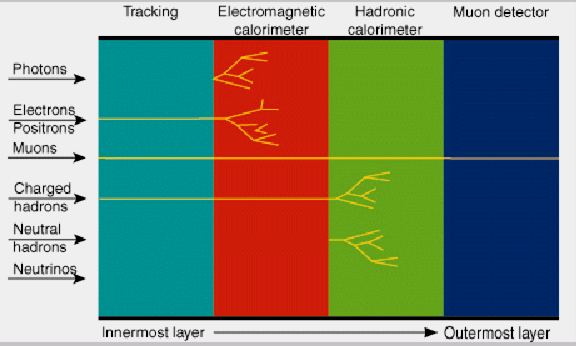
16 Question 1 Our detector shows a signal only in the hadronic calorimeter (no signal in the tracker, electromagnetic calorimeter or muon chambers). Therefore, this signal is most likely 1. pion 2. electron 3. neutron 4. photon
17 Question 2 How much of our universe is made of matter or energy, which we do not know about? % % % %

18 Question 3 How do we see quarks in a detector? 1. Not at all 2. By their characteristic spiral trajectory 3. Via jets of hadrons they generate 4. As two individual straight tracks in opposite directions
19 Question 4 The particles carrying the strong force are the 1. photons 2. gluons 3. Z- or W-bosons 4. None of the above
20 Question 5 Which was the first particle discovered which is still today believed to be elementary, i.e. not made up of further constituents? 1. electron 2. gluon 3. proton 4. photon
21 Question 6 Approximately how many times do the protons in the LHC fly around the accelerator ring in 1 second?
22 Question 7 Superconducting magnets bend the protons around the LHC ring. What do you think is the temperature of these magnets? 1. Room temperature, 300K 2. Colder than outer space, 1.9K 3. Temperature of outer space, 2.7K K
23 Question 8 Which of the following complements makes a wrong statement? The Higgsmechanism 1. explains the production of antimatter 2. explains the masses of particles 3. was invented by the British physicist Peter Higgs 4. applies everywhere in the universe
24 Question 9 Which of the following technological innovations was invented at CERN (only one)? 1. mobile phone 2. teleporter 3. mp3 format 4. World Wide Web
25 Question 10 How many kilometers of the LHC are situated in Switzerland (approximately)? 1. 3 km 2. 7 km km km
26 Master Question 1 ATLAS and CMS will together produce 400MB of data every second. If written to CD (700 MB, thickness approx. 1 mm) how high a stack would this be in one year? 1. Stratosphere, m 2. Mt. Everest, m 3. Sears Tower, 527 m 4. Eiffel Tower, 276 m
27 Master Question 2 Why do tau and mu leptons decay? 1. Because your physics instructor says so 2. Because there are lighter particles they can decay to 3. Because they interact with the magnetic field of the experiment 4. Because there is so much energy produced in e.g. LEP collisions that they break apart
28 Final Tiebreaker

29 Final Tiebreaker Question Identify the 4 tracks coming from a heavy Higgs Boson in the following event. 1 point for every right track!
30 Final Tiebreaker Answer Identify the 4 tracks coming from a heavy Higgs Boson in the following event. 1 point for every right track!
Concepts in Theoretical Physics
 Concepts in Theoretical Physics Lecture 6: Particle Physics David Tong e 2 The Structure of Things 4πc 1 137 e d ν u Four fundamental particles Repeated twice! va, 9608085, 9902033 Four fundamental forces
A Guide to Detectors Particle Physics Masterclass. M. van Dijk
 A Guide to Particle Physics Masterclass M. van Dijk 16/04/2013 How detectors work Scintillation Ionization Particle identification Tracking Calorimetry Data Analysis W & Z bosons 2 Reconstructing collisions
EPPOG International Masterclasses Hands on Particle Physics www.physicsmasterclasses.org
 EPPOG International Masterclasses Hands on Particle Physics www.physicsmasterclasses.org Incontri di Fisica, INFN-LNF, 9.10.2009 Uta Bilow, TU Dresden 1 Outline Introduction History Participation A masterclass
Theoretical Particle Physics FYTN04: Oral Exam Questions, version ht15
 Theoretical Particle Physics FYTN04: Oral Exam Questions, version ht15 Examples of The questions are roughly ordered by chapter but are often connected across the different chapters. Ordering is as in
Searching for the Building Blocks of Matter
 1 Searching for the Building Blocks of Matter Building Blocks of Matter The Smallest Scales Physicists at Fermilab are searching for the smallest building blocks of matter and determining how they interact
Particle Physics. The Standard Model. A New Periodic Table
 5 Particle Physics This lecture is about particle physics, the study of the fundamental building blocks of Nature and the forces between them. We call our best theory of particle physics the Standard Model
Physics for the 21 st Century. Unit 1: The Basic Building Blocks of Matter. Bonnie Fleming and Mark Kruse
 Physics for the 21 st Century Unit 1: The Basic Building Blocks of Matter Bonnie Fleming and Mark Kruse What are the basic building blocks that make up all matter? BONNIE FLEMING: The basic building blocks
FCC 1309180800 JGU WBS_v0034.xlsm
 1 Accelerators 1.1 Hadron injectors 1.1.1 Overall design parameters 1.1.1.1 Performance and gap of existing injector chain 1.1.1.2 Performance and gap of existing injector chain 1.1.1.3 Baseline parameters
Pearson Physics Level 30 Unit VIII Atomic Physics: Chapter 17 Solutions
 Pearson Physics Level 30 Unit VIII Atomic Physics: Chapter 17 Solutions Student Book page 831 Concept Check Since neutrons have no charge, they do not create ions when passing through the liquid in a bubble
How To Teach Physics At The Lhc
 LHC discoveries and Particle Physics Concepts for Education Farid Ould- Saada, University of Oslo On behalf of IPPOG EPS- HEP, Vienna, 25.07.2015 A successful program LHC data are successfully deployed
Calorimetry in particle physics experiments
 Calorimetry in particle physics experiments Unit n. 8 Calibration techniques Roberta Arcidiacono Lecture overview Introduction Hardware Calibration Test Beam Calibration In-situ Calibration (EM calorimeters)
Build Your Own Universe
 Build Your Own Universe You will need: At least 10,000,000,000,000,00 0,000,000,000,000,000,000,00 0,000,000,000,000,000,000,00 0,000,000,000,000,000,000,00 0,000 x Down quarks At least 10,000,000,000,000,000,
Information about the T9 beam line and experimental facilities
 Information about the T9 beam line and experimental facilities The incoming proton beam from the PS accelerator impinges on the North target and thus produces the particles for the T9 beam line. The collisions
PHYSICS WITH LHC EARLY DATA
 PHYSICS WITH LHC EARLY DATA ONE OF THE LAST PROPHETIC TALKS ON THIS SUBJECT HOPEFULLY We may have some two month of the Machine operation in 2008 LONG HISTORY... I will extensively use: Fabiola GIANOTTI
High Energy Physics. Lecture 4 More kinematics and a picture show of particle collisions
 High Energy Physics Lecture 4 More kinematics and a picture show of particle collisions 1 Recall from the previous lecture: the momentum of the scattered Particle in an elastic collision is given by p
Version 18 October 2008
 Fact sheet Version 18 October 2008 CERN: the LHC and Switzerland s contributions 1. Introduction The Large Hadron Collider (LHC), together with its four detectors ALICE, ATLAS, CMS and LHCb, represents
The Birth of the Universe Newcomer Academy High School Visualization One
 The Birth of the Universe Newcomer Academy High School Visualization One Chapter Topic Key Points of Discussion Notes & Vocabulary 1 Birth of The Big Bang Theory Activity 4A the How and when did the universe
Masses in Atomic Units
 Nuclear Composition - the forces binding protons and neutrons in the nucleus are much stronger (binding energy of MeV) than the forces binding electrons to the atom (binding energy of ev) - the constituents
Big Data Analytics. for the Exploitation of the CERN Accelerator Complex. Antonio Romero Marín
 Big Data Analytics for the Exploitation of the CERN Accelerator Complex Antonio Romero Marín Milan 11/03/2015 Oracle Big Data and Analytics @ Work 1 What is CERN CERN - European Laboratory for Particle
0.33 d down 1 1. 0.33 c charm + 2 3. 0 0 1.5 s strange 1 3. 0 0 0.5 t top + 2 3. 0 0 172 b bottom 1 3
 Chapter 16 Constituent Quark Model Quarks are fundamental spin- 1 particles from which all hadrons are made up. Baryons consist of three quarks, whereas mesons consist of a quark and an anti-quark. There
hij Teacher Resource Bank GCE Physics A Other Guidance: Particle Physics By J Breithaupt
 hij Teacher Resource Bank GCE Physics A Other Guidance: Particle Physics By J Breithaupt Copyright 2008 AQA and its licensors. All rights reserved. The Assessment and Qualifications Alliance (AQA) is a
REALIZING EINSTEIN S DREAM Exploring Our Mysterious Universe
 REALIZING EINSTEIN S DREAM Exploring Our Mysterious Universe The End of Physics Albert A. Michelson, at the dedication of Ryerson Physics Lab, U. of Chicago, 1894 The Miracle Year - 1905 Relativity Quantum
Large Hadron Collider am CERN
 The CMS Silicon Tracker Lutz Feld 1. Physikalisches Institut, RWTH Aachen GSI Darmstadt, 18. 4. 2007 Large Hadron Collider am CERN proton proton quarks & gluons circumference 27 km 1200 superconducting
The Standard Model and the LHC! in the Higgs Boson Era Juan Rojo!
 The Standard Model and the LHC in the Higgs Boson Era Juan Rojo Saturday Mornings of Theoretical Physics Rudolf Peierls Center for Theoretical Physics Oxford, 07/02/2015 1 The Standard Model of Particle
Introduction to Elementary Particle Physics. Note 01 Page 1 of 8. Natural Units
 Introduction to Elementary Particle Physics. Note 01 Page 1 of 8 Natural Units There are 4 primary SI units: three kinematical (meter, second, kilogram) and one electrical (Ampere 1 ) It is common in the
Data analysis in Par,cle Physics
 Data analysis in Par,cle Physics From data taking to discovery Tuesday, 13 August 2013 Lukasz Kreczko - Bristol IT MegaMeet 1 $ whoami Lukasz (Luke) Kreczko Par,cle Physicist Graduated in Physics from
STRING THEORY: Past, Present, and Future
 STRING THEORY: Past, Present, and Future John H. Schwarz Simons Center March 25, 2014 1 OUTLINE I) Early History and Basic Concepts II) String Theory for Unification III) Superstring Revolutions IV) Remaining
Measurement of the Mass of the Top Quark in the l+ Jets Channel Using the Matrix Element Method
 Measurement of the Mass of the Top Quark in the l+ Jets Channel Using the Matrix Element Method Carlos Garcia University of Rochester For the DØ Collaboration APS Meeting 2007 Outline Introduction Top
Weak Interactions: towards the Standard Model of Physics
 Weak Interactions: towards the Standard Model of Physics Weak interactions From β-decay to Neutral currents Weak interactions: are very different world CP-violation: power of logics and audacity Some experimental
Relativistic kinematics basic energy, mass and momentum units, Lorents force, track bending, sagitta. First accelerator: cathode ray tube
 Accelerators Relativistic kinematics basic energy, mass and momentum units, Lorents force, track bending, sagitta Basic static acceleration: First accelerator: cathode ray tube Cathode C consist of a filament,
Testing the In-Memory Column Store for in-database physics analysis. Dr. Maaike Limper
 Testing the In-Memory Column Store for in-database physics analysis Dr. Maaike Limper About CERN CERN - European Laboratory for Particle Physics Support the research activities of 10 000 scientists from
Top-Quark Studies at CMS
 Top-Quark Studies at CMS Tim Christiansen (CERN) on behalf of the CMS Collaboration ICHEP 2010, Paris 35th International Conference on High-Energy Physics tt 2 km 22 28 July 2010 Single-top 4 km New Physics
Selected Topics in Elementary Particle Physics ( Haupt-Seminar )
 Selected Topics in Elementary Particle Physics ( Haupt-Seminar ) Paola Avella, Veronika Chobanova, Luigi Li Gioi, Christian Kiesling, Hans-Günther Moser, Martin Ritter, Pit Vanhoefer Time: Do, 12 ct -14
Silicon Sensors for CMS Tracker at High-Luminosity Environment - Challenges in particle detection -
 [email protected] Finnish Society for Natural Philosophy, Helsinki, 17 February 2015 Silicon Sensors for CMS Tracker at High-Luminosity Environment - Challenges in particle detection - Timo Peltola
variables to investigate Monte Carlo methods of t t production
 Using the M 2 and variables to investigate Monte Carlo methods of t t production Caitlin Jones September 8, 25 Abstract In this project the behaviour of Monte Carlo simulations for the event t t! ` `+b
1) G. Goggi et al. A DIFFUSION CLOUD CHAMBER FOR AN INVESTIGATION OF PHOTOREACTIONS ON 3 He - Nucl. Instr. Meth. 57 (1967) 137
 1 1) G. Goggi et al. A DIFFUSION CLOUD CHAMBER FOR AN INVESTIGATION OF PHOTOREACTIONS ON 3 He - Nucl. Instr. Meth. 57 (1967) 137 2) G. Goggi et al. HIGH ENERGY PHOTODISINTEGRATION OF 3 He - Nuovo Cimento
The OPERA Emulsions. Jan Lenkeit. Hamburg Student Seminar, 12 June 2008. Institut für Experimentalphysik Forschungsgruppe Neutrinophysik
 The OPERA Emulsions Jan Lenkeit Institut für Experimentalphysik Forschungsgruppe Neutrinophysik Hamburg Student Seminar, 12 June 2008 1/43 Outline The OPERA experiment Nuclear emulsions The OPERA emulsions
Tracking systems in HEP:
 Tracking systems in HEP: concept and performance of 3 experiments Davide Bolognini Universita' degli Studi dell'insubria Presentazione dottorato Anno I Outline Tracking systems in HEP CMS @ LHC...but not
Launching DORIS II and ARGUS. Herwig Schopper University Hamburg and CERN
 Launching DORIS II and ARGUS Herwig Schopper University Hamburg and CERN ARGUS 20 Years, DESY symposium 9 November 2007 Early days of DORIS The DESY laboratory was founded in 1959 synchrotron DESY began
Highlights of Recent CMS Results. Dmytro Kovalskyi (UCSB)
 Highlights of Recent CMS Results Dmytro Kovalskyi (UCSB) Introduction Number of CMS publication is over 0 already It is very hard to review all the recent results in one talk This talk concentrates on
Physics 121 Sample Common Exam 3 NOTE: ANSWERS ARE ON PAGE 6. Instructions: 1. In the formula F = qvxb:
 Physics 121 Sample Common Exam 3 NOTE: ANSWERS ARE ON PAGE 6 Signature Name (Print): 4 Digit ID: Section: Instructions: Answer all questions 24 multiple choice questions. You may need to do some calculation.
Fermilab FERMILAB-THESIS-2000-10
 Fermilab FERMILAB-THESIS-2000-10 CDF/THESIS/JET/PUBLIC/5555 Version 1.0 12th February 2001 Calorimetric Measurements in CDF: A New Algorithm to Improve The Energy Resolution of Hadronic Jets A Thesis Submitted
Objectives 404 CHAPTER 9 RADIATION
 Objectives Explain the difference between isotopes of the same element. Describe the force that holds nucleons together. Explain the relationship between mass and energy according to Einstein s theory
Exploring the Subatomic Realm
 Exploring the Subatomic Realm SUBATOMIC PHYSICS IN CANADA Superconducting accelerating cavity prototypes for the future International Linear Collider (ILC). The ILC will be a reality in the next ten years,
The Standard Model of Particle Physics - II
 The Standard Model of Particle Physics II Lecture 4 Gauge Theory and Symmetries Quantum Chromodynamics Neutrinos Eram Rizvi Royal Institution London 6 th March 2012 Outline A Century of Particle Scattering
Chapter 15 Cosmology: Will the universe end?
 Cosmology: Will the universe end? 1. Who first showed that the Milky Way is not the only galaxy in the universe? a. Kepler b. Copernicus c. Newton d. Hubble e. Galileo Ans: d 2. The big bang theory and
1 Introduction. 1 There may, of course, in principle, exist other universes, but they are not accessible to our
 1 1 Introduction Cosmology is the study of the universe as a whole, its structure, its origin, and its evolution. Cosmology is soundly based on observations, mostly astronomical, and laws of physics. These
The Higgs Boson. Linac08 Victoria BC, Canada CANADA S NATIONAL LABORATORY FOR PARTICLE AND NUCLEAR PHYSICS
 CANADA S NATIONAL LABORATORY FOR PARTICLE AND NUCLEAR PHYSICS Owned and operated as a joint venture by a consortium of Canadian universities via a contribution through the National Research Council Canada
Cathode Ray Tube. Introduction. Functional principle
 Introduction The Cathode Ray Tube or Braun s Tube was invented by the German physicist Karl Ferdinand Braun in 897 and is today used in computer monitors, TV sets and oscilloscope tubes. The path of the
Real Time Tracking with ATLAS Silicon Detectors and its Applications to Beauty Hadron Physics
 Real Time Tracking with ATLAS Silicon Detectors and its Applications to Beauty Hadron Physics Carlo Schiavi Dottorato in Fisica - XVII Ciclo Outline The ATLAS Experiment The SiTrack Algorithm Application
Delphes, a framework for fast simulation of a general purpose LHC detector
 Delphes, a framework for fast simulation of a general purpose LHC detector S. Ovyn and X. Rouby Center for Particle Physics and Phenomenology (CP3) Université catholique de Louvain B-1348 Louvain-la-Neuve,
5.1 Evolution of the Atomic Model
 5.1 Evolution of the Atomic Model Studying the atom has been a fascination of scientists for hundreds of years. Even Greek philosophers, over 2500 years ago, discussed the idea of there being a smallest
Discovery of neutrino oscillations
 INSTITUTE OF PHYSICS PUBLISHING Rep. Prog. Phys. 69 (2006) 1607 1635 REPORTS ON PROGRESS IN PHYSICS doi:10.1088/0034-4885/69/6/r01 Discovery of neutrino oscillations Takaaki Kajita Research Center for
The unifying field Theory
 The unifying field Theory M T Keshe 2000-2009, all rights reserved Date of release 28.10.2009 Abstract In this paper the origin of electromagnetic fields or electromagnetism and how they are created within
Periodic Table of Particles/Forces in the Standard Model. Three Generations of Fermions: Pattern of Masses
 Introduction to Elementary Particle Physics. Note 01 Page 1 of 8 Periodic Table of Particles/Forces in the Standard Model Three Generations of Fermions: Pattern of Masses 1.0E+06 1.0E+05 1.0E+04 1.0E+03
Cross section, Flux, Luminosity, Scattering Rates
 Cross section, Flux, Luminosity, Scattering Rates Table of Contents Paul Avery (Andrey Korytov) Sep. 9, 013 1 Introduction... 1 Cross section, flux and scattering... 1 3 Scattering length λ and λ ρ...
Curriculum for Excellence. Higher Physics. Success Guide
 Curriculum for Excellence Higher Physics Success Guide Electricity Our Dynamic Universe Particles and Waves Electricity Key Area Monitoring and Measuring A.C. Monitoring alternating current signals with
THEORY OF EVERYTHING. Michael Duff INSTANT EXPERT 12
 THEORY OF EVERYTHING Michael Duff INSTANT EXPERT 12 Four fundamental forces ArSciMed/spl below: DESY/nasa What holds the quarks and leptons, or building-block particles, together? As far as we can tell,
How To Find The Higgs Boson
 Dezső Horváth: Search for Higgs bosons Balaton Summer School, Balatongyörök, 07.07.2009 p. 1/25 Search for Higgs bosons Balaton Summer School, Balatongyörök, 07.07.2009 Dezső Horváth MTA KFKI Research
Jets energy calibration in ATLAS
 Jets energy calibration in ATLAS V.Giangiobbe Università di Pisa INFN sezione di Pisa Supported by the ARTEMIS Research Training Network Workshop sui Monte Carlo, la Fisica e le Simulazioni a LHC V.Giangiobbe
What is Matter? Matter is anything that has mass. All objects are made of matter. Air, water, a brick, even you are made of matter!
 What is Matter? Matter is anything that has mass. All objects are mae of matter. Air, water, a brick, even you are mae of matter! Matter is mae up of smaller pieces. Over eighty years ago, scientists thought
New approaches in user-centric job monitoring on the LHC Computing Grid
 FACHBEREICH C - FACHGRUPPE PHYSIK BERGISCHE UNIVERSITÄT WUPPERTAL New approaches in user-centric job monitoring on the LHC Computing Grid Application of remote debugging and real time data selection techniques
Open access to data and analysis tools from the CMS experiment at the LHC
 Open access to data and analysis tools from the CMS experiment at the LHC Thomas McCauley (for the CMS Collaboration and QuarkNet) University of Notre Dame, USA [email protected]! 5 Feb 2015 Outline
physics 112N magnetic fields and forces
 physics 112N magnetic fields and forces bar magnet & iron filings physics 112N 2 bar magnets physics 112N 3 the Earth s magnetic field physics 112N 4 electro -magnetism! is there a connection between electricity
Technical Case Study CERN the European Organization for Nuclear Research
 Technical Case Study CERN the European Organization for Nuclear Research How CERN helps physicists unlock the secrets of the universe running critical operations on a foundation of Oracle databases on
Chapter 1 Units, Physical Quantities, and Vectors
 Chapter 1 Units, Physical Quantities, and Vectors 1 The Nature of Physics Physics is an experimental science. Physicists make observations of physical phenomena. They try to find patterns and principles
Physics 1104 Midterm 2 Review: Solutions
 Physics 114 Midterm 2 Review: Solutions These review sheets cover only selected topics from the chemical and nuclear energy chapters and are not meant to be a comprehensive review. Topics covered in these
The Standard Model of Particle Physics. Tom W.B. Kibble Blackett Laboratory, Imperial College London
 The Standard Model of Particle Physics Tom W.B. Kibble Blackett Laboratory, Imperial College London Abstract This is a historical account from my personal perspective of the development over the last few
Magnetism. d. gives the direction of the force on a charge moving in a magnetic field. b. results in negative charges moving. clockwise.
 Magnetism 1. An electron which moves with a speed of 3.0 10 4 m/s parallel to a uniform magnetic field of 0.40 T experiences a force of what magnitude? (e = 1.6 10 19 C) a. 4.8 10 14 N c. 2.2 10 24 N b.
Big Data Needs High Energy Physics especially the LHC. Richard P Mount SLAC National Accelerator Laboratory June 27, 2013
 Big Data Needs High Energy Physics especially the LHC Richard P Mount SLAC National Accelerator Laboratory June 27, 2013 Why so much data? Our universe seems to be governed by nondeterministic physics
How High Up Is Space?
 I11 How High Up Is Space? Activity I11 Grade Level: 5 12 Source: This activity was written by Andrew Fraknoi and is copyright 2010 by Andrew Fraknoi. Its first publication is in The Universe at Your Fingertips.
Big Data, Social Networks, and Human Behavior
 Big Data, Social Networks, and Human Behavior Jukka-Pekka Onnela Harvard University Big Data for Development United Nations Headquarters, New York City July 10, 2012 1 Overview Progress in science has
OVERVIEW OF PROTON DRIVERS FOR NEUTRINO SUPER BEAMS AND NEUTRINO FACTORIES*
 FERMILAB-CONF-06-213-AD OVERVIEW OF PROTON DRIVERS FOR NEUTRINO SUPER BEAMS AND NEUTRINO FACTORIES* W. Chou #, Fermilab, Batavia, IL 60510, U.S.A. Abstract There has been a world-wide interest in Proton
The Universe. The Solar system, Stars and Galaxies
 The Universe The Universe is everything. All us, the room, the U.S. the earth, the solar system, all the other stars in the Milky way galaxy, all the other galaxies... everything. How big and how old is
Study of the B D* ℓ ν with the Partial Reconstruction Technique
 Study of the B D* ℓ ν with the Partial Reconstruction Technique + University of Ferrara / INFN Ferrara Dottorato di Ricerca in Fisica Ciclo XVII Mirco Andreotti 4 March 25 Measurement of B(B D*ℓν) from
Recent developments in Electromagnetic Hadron Form Factors
 Recent developments in Electromagnetic Hadron Form Factors (JOH7RPDVL*XVWDIVVRQ '$31,$63K16DFOD\ :KDW are Form Factors? :K\ to measure? +RZ to measure? :KDWLVQHZ" Consequences, Conclusions 6SRNHSHUVR QV
The Elegant Universe Teacher s Guide
 The Elegant Universe Teacher s Guide On the Web It s the holy grail of physics the search for the ultimate explanation of how the universe works. And in the past few years, excitement has grown among scientists
Top rediscovery at ATLAS and CMS
 Top rediscovery at ATLAS and CMS on behalf of ATLAS and CMS collaborations CNRS/IN2P3 & UJF/ENSPG, LPSC, Grenoble, France E-mail: [email protected] We describe the plans and strategies of the