
Recruiting, Interviewing, and Selecting the Best Employees
|
|
|
- Rafe Jennings
- 10 years ago
- Views:
Transcription
1 Purdue Extension PPP-69 Recruiting, Interviewing, and Selecting the Best Employees
2 Cover photo, Fotosearch Stock Photography

3 Recruiting, Interviewing, and Selecting the Best Employees Fred Whitford, Coordinator, Purdue Pesticide Programs Mark Hanna, Senior Corporate Counsel, The Eastridge Group of Staffing Companies Cindy Gerber, Human Resources Manager, JFNew Mark Wade, Manager of Human Resources, Evans Properties, Inc. Arlene Blessing, Developmental Editor and Designer, Purdue Pesticide Programs Introduction... 5 Hiring Was Never Meant to Be Easy... 6 The Cost of Hiring... 7 Take the Time to Hire... 8 The Steps to Hiring Step I: Create a Job Description Step II: Develop an Application for Employment Step III: Interview the Candidates Step IV: Gather Data Step V: Make the Offer Step VI: Notify Rejected Applicants Step VII: Define the Introductory Employment Period Completing the Hiring Process Retention of Interview Files Form I-9: Employment Eligibility Verification SSA Warning Letters: When Names and Numbers Don t Match New-Hire Reporting: Tracking Parents Who Owe Child Support Child Labor Regulations: Restrictions on Jobs and Hours Employment-At-Will: No Notice, No Reason, No Cause Negligent Hiring and Retention: You Should Have Known Employees Right to Privacy Non-Compete Provisions: Restricting Employees Right to Work Conclusion Acknowledgments Appendixes... 41
4 Introduction Consider the following situation: You have spent months comparing the cost and quality of new fleet vehicles, pagers, office copiers, computer equipment, and spray rigs; and you ve spent the entire winter conferring with experts about which pesticides and fertilizers to use in the upcoming season. But suddenly one of your valued employees tells you she has accepted a job in another state, indicating that her new employer offers better career development opportunities and that she will be given responsibilities that will showcase her skills and experience. The new job includes additional perks, better pay and benefits, and expanded retirement options. She will resign at the end of her shift to get ready to move and begin her new job the following week. Panic sets in, but you graciously wish your employee the best and begin thinking about filling her position quickly. You ask your office staff if there are any current job applications on file and, in fact, there is one that afternoon. Fifteen minutes into the interview you reach across the desk, shake his hand, and say, Welcome aboard. You tell him to see the office secretary for the necessary new employee paperwork. was submitted a few weeks earlier. You quickly scan the information and note that the applicant can at least write neatly! You call the applicant, and it s your lucky day: he is still unemployed and looking for work. A quick interview is arranged for that You think back to your morning fraught with panic when your trusted employee resigned. But you have filled the position without having to recruit job applicants, which was painless and quick, and your peace of mind has been restored or 5

5 so you think. Unfortunately, your relief will be short-lived. If you had checked the applicant s references, you would have discovered that he had a troubled work history: poor attendance and customer service skills, unsatisfactory work, and a negative attitude. You might have been better off just walking down the street and hiring the first person you met. Does this scenario sound familiar? When faced with an unexpected resignation, some companies react by hiring too hastily. Hiring someone without a reference check, a background review, and validation of the information supplied on the job application seldom works out, long term. This publication provides you with the tools you need to increase your efficiency in hiring and retaining employees. We will discuss writing a detailed job description, provide a guide for developing an employment application form tailored to the pesticide application industry, and list essential interview questions. Taking the steps outlined here will help increase your odds of attracting, hiring, and retaining good employees; and it will reduce the likelihood of low morale, low productivity, and staff turnover. Hiring Was Never Meant to Be Easy Your human resources manual should address hiring procedures. John Katterjohn Selecting job applicants to interview, drafting good interview questions, and ultimately deciding which person to hire can be a daunting challenge. An effective and efficient hiring process is essential to your personal and business success. You must hire people who can put forth your company s positive image while performing with accuracy and efficiency. Your well trained, conscientious employees are your most valuable assets. A thorough review of applicants backgrounds is essential to the 6

6 hiring process, and your subjective evaluation of how well their personalities and work ethics will fit into your operation is also important. The process requires a lot of time spent reviewing job applications, going over details presented on resumés, and interviewing candidates to decide what technical, communication, and personal skills they can bring to the company. Time invested in careful hiring procedures will save time in the long run by helping you avoid a bad hire. The Cost of Hiring Consider what it costs to hire a new employee, from the time the position opens until the employee becomes productive that is, when the person s performance becomes an asset to your company. There are readily identifiable costs such as training manuals and/or initial classroom training, pesticide licensing, and pesticide recertification classes. In addition to the tangible costs of hiring a new employee, there are intangible expenses known as opportunity costs. A good example is the cost of a supervisor s time spent working with the new employee time that could otherwise be spent managing the business. Intangible expenses also include time spent listening to and resolving complaints lodged by customers and other employees about the new person s performance. Every time an employee resigns or is terminated, the company s investment is lost; and the costly cycle of recruiting, interviewing, hiring, and training a new employee starts all over again. Fred Whitford The initial and ongoing expense of training and certification not to mention the value of your time spent on orientation is part of the cost of hiring a new employee. A suggestion box provides a discreet way for staff to communicate concerns about a new employee. The value of your time spent resolving new employee issues is part of the cost of hiring. 7
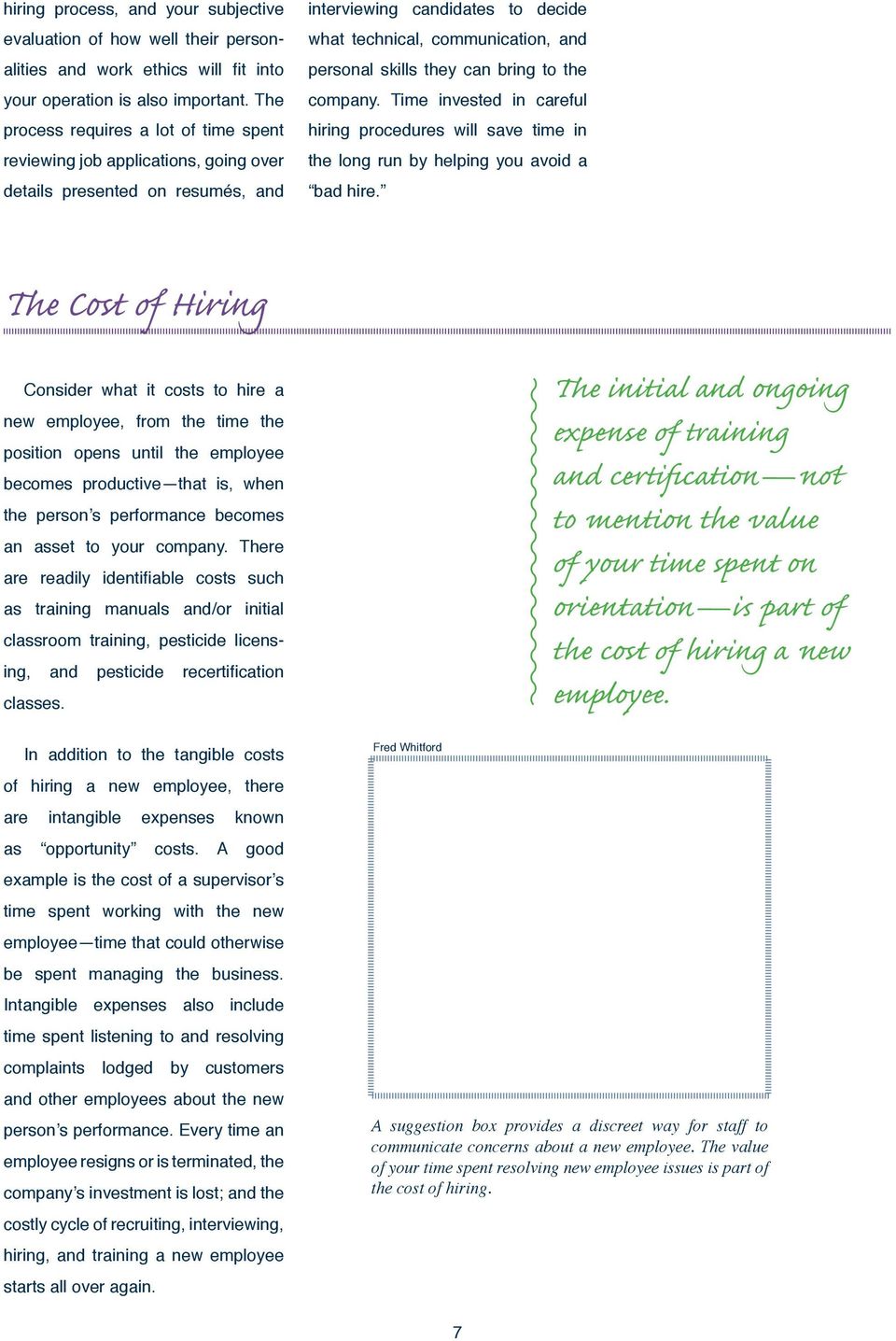
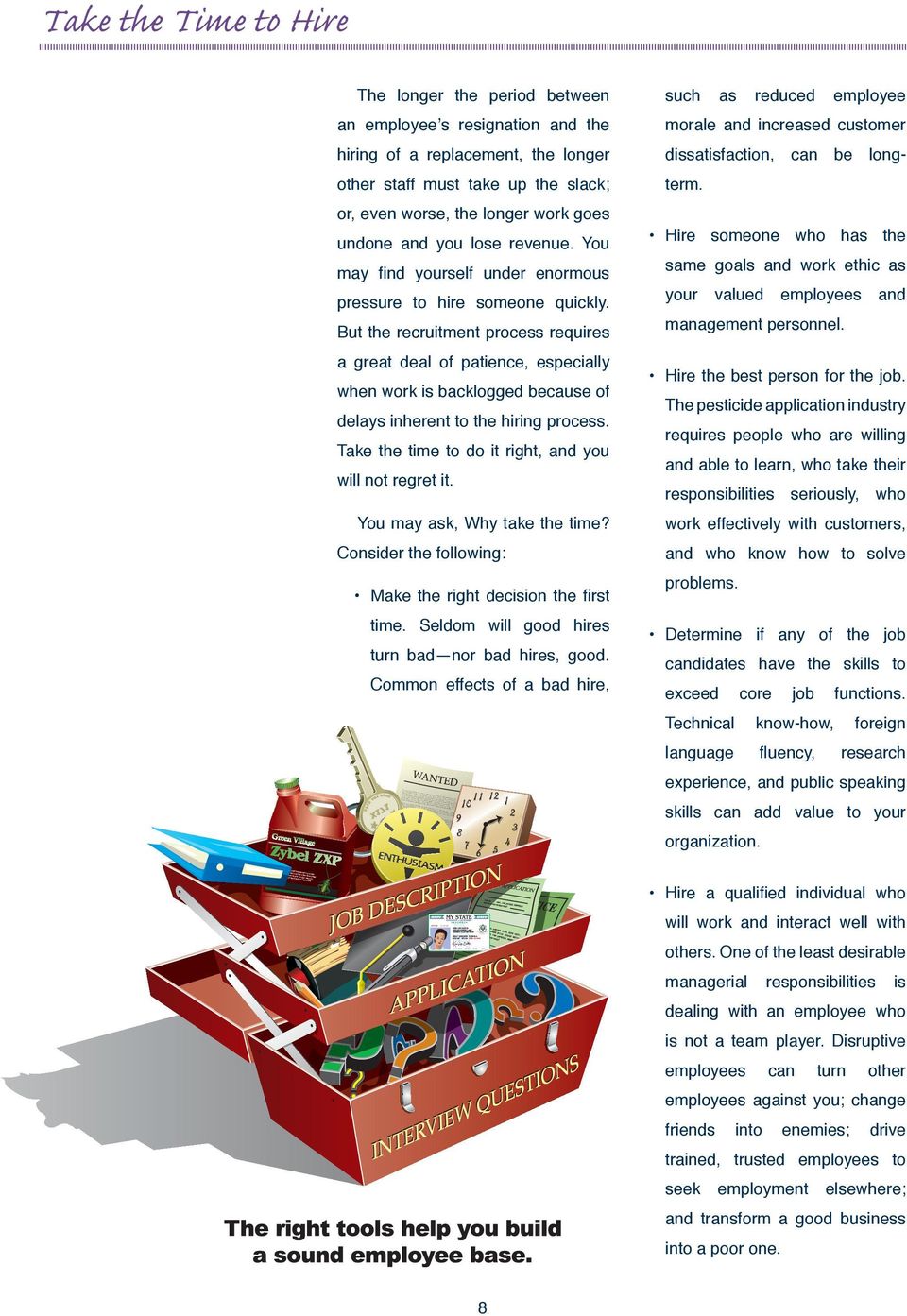
7 Take the Time to Hire The longer the period between an employee s resignation and the hiring of a replacement, the longer other staff must take up the slack; or, even worse, the longer work goes undone and you lose revenue. You may find yourself under enormous pressure to hire someone quickly. But the recruitment process requires a great deal of patience, especially when work is backlogged because of delays inherent to the hiring process. Take the time to do it right, and you will not regret it. You may ask, Why take the time? Consider the following: Make the right decision the first time. Seldom will good hires turn bad nor bad hires, good. Common effects of a bad hire, such as reduced employee morale and increased customer dissatisfaction, can be longterm. Hire someone who has the same goals and work ethic as your valued employees and management personnel. Hire the best person for the job. The pesticide application industry requires people who are willing and able to learn, who take their responsibilities seriously, who work effectively with customers, and who know how to solve problems. Determine if any of the job candidates have the skills to exceed core job functions. Technical know-how, foreign language fluency, research experience, and public speaking skills can add value to your organization. Hire a qualified individual who will work and interact well with others. One of the least desirable managerial responsibilities is dealing with an employee who is not a team player. Disruptive employees can turn other employees against you; change friends into enemies; drive trained, trusted employees to seek employment elsewhere; and transform a good business into a poor one. 8
8 Decide how to spend your training dollars to transform the new employee into an asset. This requires an understanding of the knowledge, skills, and abilities he brings to the job. Today s successful pesticide applicator must be physically fit to work under less-than-ideal conditions, both indoors and out. In addition to meeting the job s physical demands, the employee must be able to pass state and federal certification examinations; willing to use new technologies and methodologies; receptive to new ideas; capable of working harmoniously with others; and attentive to completing paperwork properly and professionally. It may take years for a person to achieve the level of training, education, and performance that meets your expectations. they have achieved within your organization; they also may take valuable information about your business to a new job with one of your competitors. Protect your assets by making it appealing for good employees to stay onboard. Make your company attractive to job applicants. You probably remember the good employee who got away, or the one who would have been a perfect fit for the job but declined your offer. Remember that, while you are evaluating a candidate s qualifications, he is considering whether he really wants to work for your company. It is important to make a good, honest impression throughout the entire evaluation process to reflect the level of professionalism you maintain. Comply with all laws applicable to hiring employees. The hiring process poses legal pitfalls if conducted incorrectly. The more informal the process, the more vulnerable you are to regulatory investigation, charges of discrimination and negligent hiring, and lawsuits. John Katterjohn Retain good employees. Initially, a new hire must adjust to the company s everyday operating procedures while focusing on his own position; later, you may want him to learn more about how the business runs and how business decisions are made. It may take years and thousands of dollars to train There are many regulations that a business owner must deal with, including those pertaining to the hiring and termination of employees. an employee to the desired level of proficiency. And employees who leave take with them the skills, education, and experience 9
9 Management must be aware of what can and cannot be said or done during the hiring process. Hiring is regulated by state and federal laws. Charges alleging racial, gender, religious, or physical disability discrimination are abundant, and many cases go to court. The law requires that your hiring process be consistent, well-organized, and fair to everyone. The Steps to Hiring The hiring process includes recruiting, processing, eliminating, and selecting. It can involve John Katterjohn posting a job advertisement in appropriate places; evaluating the information provided on each job application; screening candidates to determine which ones to interview; verifying references and information; conducting personal interviews; and deciding who will be offered the job. Post job openings on your company bulletin boards as well as in public places. The goal is to choose the most competent person for the position by obtaining and carefully reviewing all relevant information. Consider implementing the steps beginning on page 11 in making your hiring decisions. 10
10 Step I. Create a Job Description It is almost impossible to select the right person for a position without first giving careful consideration to your organization s specific recruitment needs. Do you require technical skills? Communication skills? A good job description provides a summary of the tasks to be performed and states specific position requirements. It serves many different functions: It aids in recruiting the right applicants, whether it is used as an internal posting or a media advertisement. The job description gets the word out, not only that you are hiring, but that you are looking for certain talents. It lists minimum performance expectations and is worded to attract the right people. Mark Wade It discourages uninterested and unqualified individuals from applying, enabling you to limit the application review and interview processes to fewer people. It serves as a guideline for selecting and interviewing candidates and making your decision on which one to hire. It gives the prospective employee a basic understanding of what will be expected of him if he is hired. The job description should state plainly and succinctly what you want the new employee to accomplish. Once you hire someone, you can use the job description as an outline to structure training. It serves as a benchmark for reviewing and measuring the success and growth of an employee. Review it with the employee periodically and discuss his performance of the duties listed. It informs other employees of the job duties and requirements in case they are interested in applying for the position. It should be displayed in the area where legal requirements are posted, as well as other locations where employees have easy access. Take the time and effort to develop an accurate, all-inclusive job description. If the description clearly states all job duties and requirements, it may later serve as evidence against grievances, wrongful termination, lawsuits, or claims of discrimination or retaliation. 11
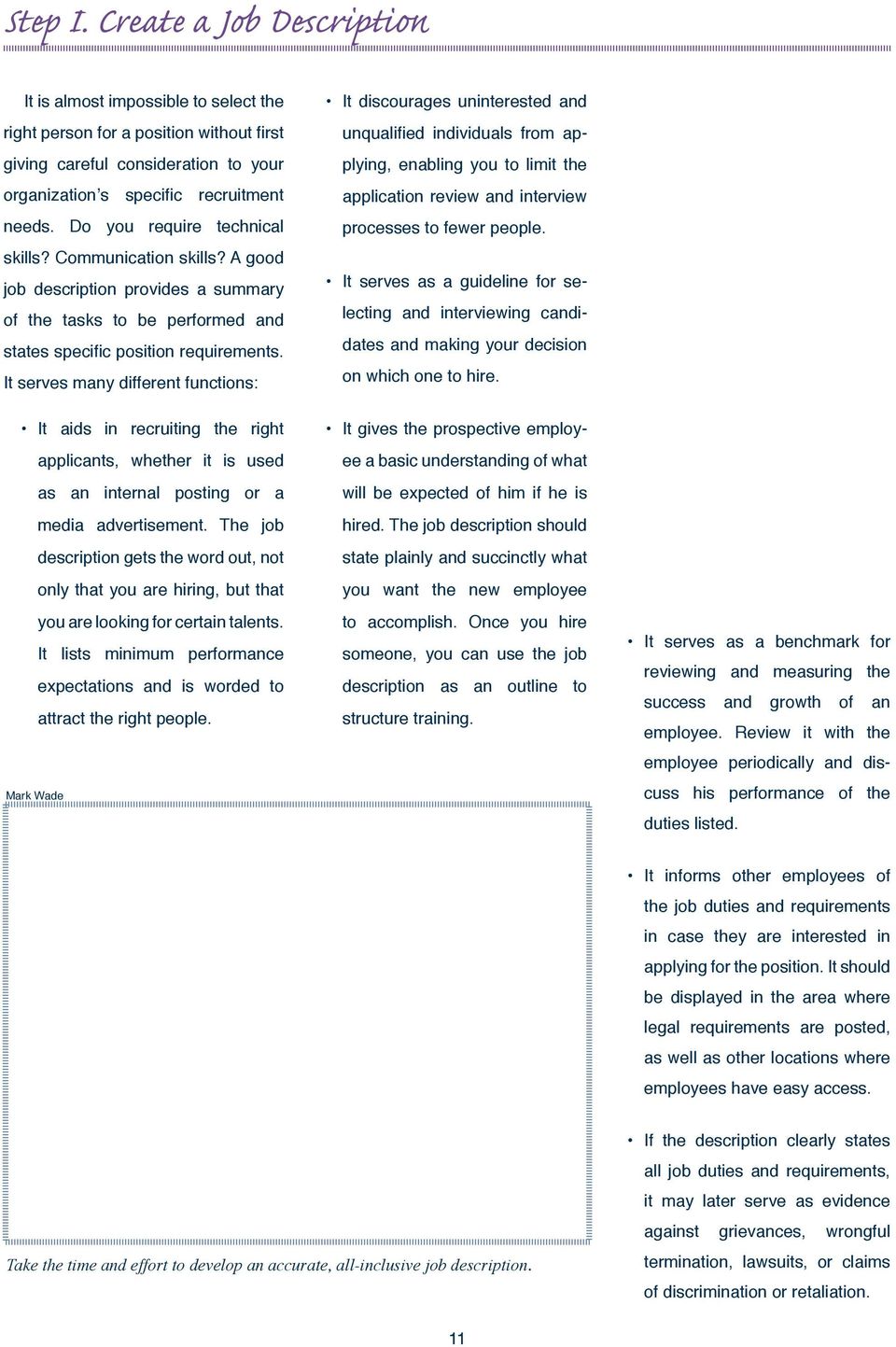
11 Write a Job Description It takes time to write an effective job description, but defining the duties and skills pertinent to the position is essential to the successful hiring process. Start by defining the characteristics of the perfect person Purdue Extension publication EC-728, Developing Effective Job Descriptions for Small Businesses and Farms, is an excellent reference for writing job descriptions. for the job. Make a list of education, experience, and qualities you are seeking. Ask supervisors and other employees to contribute. Decide together what abilities, skills, and personality traits someone needs to be proficient and personally satisfied in the position. Limit the job description to two pages or less, and keep it simple and easy to understand. Omit jargon, even if it is common to the pesticide application industry. Use gender-neutral language. Describe what knowledge, skills, and abilities are required of the applicant, and list the exact duties the job includes. Once you are finished, have the initial job description reviewed by your human resources personnel and your company attorney to assure that it is legal. Wording makes all the difference. 12
12 Treat the initial job description as a draft. Ask employees who are currently performing similar jobs to review it and make comments, then incorporate their suggestions as appropriate. Have a human resource professional or an attorney review the final draft. If you don t have such personnel on staff, contact a human resource consultant (see The Society for Human Resource Management Web site, or ask your personal attorney to refer you to a legal advisor who specializes in this type of work. Organizing and writing an effective job description takes time and effort. But by doing a thorough job you can attract and hire the right person for the position in the least amount of time. See Job Analysis, Appendix 1, for assistance in drafting a job description. Step II. Develop an Application for Employment A well-designed employment application form is a critical management tool. It generates a detailed overview of a candidate s work history, skills, interests, and education; and it organizes all applicants biographical data to facilitate comparison. You should be able to achieve the following goals from information on the application form. Protect the company against liability by obtaining information legally. State certain human resource policies. Collect consistent and complete information relevant to the applicant s aptitude for and ability to perform the job. Collect information related to the applicant s pertinent professional experience. Acquire permission from the applicant to verify the information presented. Identify any outstanding attributes or shortcomings the candidate may have. Provide facts for those in charge of hiring. 13
13 Sample Application for Employment Your employment application form should instruct applicants to describe themselves and outline their skills and related work experience. But you must word it so that they know not to write See resumé under the heading Experience. Specify that you want a description of their experience, not simply a list. Design your form so that applicants will have to provide enough information for you to determine whether they should be interviewed. form that you already use. If you have questions regarding the legality of your application, contact an experienced employment law attorney or consultant. And be sure to check federal, state, and local laws regarding retention requirements for employment applications. Mark Wade You may use the sample Application for Employment (Appendix 2), that we provide, but it should be modified to fit your specific needs. Specific segments on the sample may be used to update an employment Develop your employment application form to elicit the specific information you need to make sound hiring decisions. 14
14 Review the Employment Application to Locate the Best Candidate Employment applications are often just skimmed. But candidates who thoroughly complete their applications deserve careful consideration: you owe them thoughtful attention to the information they provide. Choosing applicants to inter-view is your first hiring decision. Consider these questions when reviewing employment applications: Has the applicant given you permission to do a background check and contact references? If not, consider rejecting the application. Is the person actually qualified for the job? Compare information on the application to requirements listed in the job description. Are there gaps in employment? You may ask about them tactfully but remember that they may be due to legitimate situations such as family leave or time off due to sickness or disability. Did the person offer valid reasons for leaving a prior position? How long did the employee work for each previous employer? Frequent job changes may be a red flag if you are looking for a longterm employee, but they are not always negative; they may result from promotion or from newly acquired training or education that qualified the person for a better job. Has the person received promotions from previous employers? Previous internal promotions reflect dependability, good job performance, and a positive attitude, all of which speak positively for the employee s character. What skills can the applicant bring to your company? Feeling that he can contribute helps an employee start out on the right foot. Could the applicant improve himself by working for your company? An employee s desire to work for you can make a big difference. 15

15 Step III. Interview the Candidates You have reviewed numerous resumés and job applications and selected the candidates you believe could best fit your needs. Now it is time to interview them. The interview is an opportunity for you and a prospective employee to learn more about each other; it allows you to go over information disclosed on the application and to ask questions and assess the applicant s personality, character, verbal skills, and ability to reason through tough questions. The personal interview allows you to get a feel for the person, which is impossible by simply reading an employment application. John Katterjohn Types of Interviews Allow plenty of time for the employment interview. The applicant has set aside this time for you, the same as you have for her; so don t rush. Give the applicant your full attention during the time you have with her. Telephone (Screening) Interviews Try telephone interviews to screen job applicants. The telephone interview is a good way to assess whether an individual is genuinely interested in the type of work you have available, or just something to pay the bills. It also is a quick and convenient way to identify and eliminate applicants who would have a difficult time meeting job requirements. Making these assessments by phone is much less time consuming than personally interviewing each applicant; and by ruling out unlikely candidates you can devote more interview time to 16
16 individuals who seem genuinely interested and qualified. Look for someone who seems committed to getting hired from the first moment of the interview. One-on-One Interviews The one-on-one interview is most frequently used for entrylevel positions. It is less stressful to the applicant than facing a group of people, and in most cases it is easier and more expedient: you ask questions, the applicant responds, and you take notes. After the interview, go over your notes and make sure you recorded the information gained from your conversation with the applicant. Also, write down your general impressions of what kind of employee you think the applicant would make. These thoughts may prove valuable in deciding between two candidates who seem equally qualified. Panel (Team) Interviews When you are the only person interviewing a candidate it can be difficult to assess all that is being said, especially if you have little or no experience in the position under consideration. A panel interview brings together key members of your organization to participate in the interview process. Consider including the prospective employee s immediate manager, the division director, someone from human resources, and perhaps a manager from another department. The First and Second Interview Mark Wade A 30- to 45-minute interview is sufficient for most entry-level positions. This is enough time to get a feel for whether a person who seemed qualified on paper is right for the job. Ask all candidates the same questions and take good notes, while interviewing, to facilitate comparison. Factor each person s responses into the value of their skills, training, and education. If you have difficulty deciding between two candidates, invite them for a second interview. The supervisor (right) conducts a portion of an employment interview in the workplace. Technical and professional positions may require a series of interviews. Use first interviews to narrow the field. Invite a few select candidates for a second visit and, if necessary, ask the two top contenders to return for a third interview. 17
17 I ll see you in court Questions In an actual university interview, an applicant was asked what his wife did for a living. He answered, What does my wife have to do with me and this job? Why would the interviewer ask such a question? Perhaps he innocently viewed it as small talk that would put the applicant at ease, or maybe he was wondering if the spouse s occupation would affect the candidate s availability to work certain hours. Here are some excerpts from page 19, with comments: How old are you? Why would you want to know an applicant s age? Perhaps you think that older individuals are less fit, mentally or physically, to perform certain tasks. The fear is that this would increase absenteeism and perhaps cause the company insurer to raise employee health insurance premiums overall. What do these and similar questions have in common? They are used to stereotype a person: old vs. young, male vs. female, married vs. single, healthy vs. unhealthy, etc. Responses to such questions often identify the individual with a certain group working moms, career women, insurance seekers, etc. about which the interviewer may have a strong opinion. These types of questions can be considered discriminatory, and your asking them could cause legal problems. Here s the rule: If the question is not job related, don t ask it. Specifically train all company personnel involved in the interviewing process on the appropriateness of interviewing behavior and questions that are off limits. Never ask prospective employees the questions on page 19 nor include them on your employment application form. Are you married? Maybe you feel married people are more stable and responsible than singles. Arlene Blessing Do you have children? A common assumption is that a woman with children is likely to take off work more often than a woman without children. Or an employer may wonder if a woman is seeking a job with medical benefits primarily so she can start a family. Arlene Blessing How is your health? It is commonly assumed that someone with a history of poor health will have continual medical problems. Arlene Blessing 18

18 Questions Likely to Be Considered Discriminatory What is your race? Where were you born? How old are you? What is your date of birth? What is your religious affiliation? What is your national origin? What is your primary language? Are you an American citizen? Do you have good credit? Are you married? Do you plan to have children? Do you have children? What are the ages of your children? What are your childcare arrangements? What is your sexual orientation? How tall are you? How much do you weigh? Are you a member of any organizations? (e.g., membership in AARP is indicative of age; ethnic organization membership might imply national origin) What is your spouse s name? Does your spouse work? What does your spouse do for a living? How is your health? Have you ever had a back injury? Have you ever been hospitalized? Do you have a disability? Have you ever filed for medical disability? How many days were you absent from your job last year? Do you have any ongoing medical conditions? What kind of name is? 19

19 Challenging Questions that Reveal Interviews personalize the facts. As soon as possible after interviewing a job applicant, ask yourself, Which candidates exhibited a presence? were interactive during their interview? have significant experience relative to their technical skills? were consistent in answering questions? possess acceptable communication skills? will be able to work well with other employees? seem to be a good fit with the company? The interview should focus on whether a candidate is qualified and would be able to perform the functions of the job. Ask candidates how they might react in certain workrelated situations. Listen and observe how they construct their thoughts in response to your questions, and evaluate their manners of presentation. Getting to the heart of their characters is difficult, as is accurately judging their potential. Ask thought-provoking questions and evaluate how applicants think when challenged. Leave your questions open-ended to allow the applicant an opportunity to offer personal information. Open-ended questions prompt responses that highlight the applicant s skills and personality. Listen attentively and ask follow-up questions. Ask permission to take notes, but don t let extensive note taking distract you from the interview. A very good list of interview questions that cover work history, job performance, education, career goals, self-assessment, motivation, creativity, leadership, etc., can be found on the Indiana University Bloomington Libraries Web site: The questions on page 21 have been modified from an article appearing in the July 2004 issue of the newsletter HR Today, published by the Council on Education in Management, and from the University of Kansas at units/coms2/via/conducting.html. Many professionals consider these the best questions to ask potential job applicants. 20
20 Have you ever left an employer involuntarily? If so, what were the circumstances? What is it specifically about our organization and this position that is attractive to you? What made you happy or satisfied at your last job? How does your experience of the last two years make you a suitable fit for this position? If you were me, why would I hire you? Why do you want to work here? What do you know about our company? What did you like/dislike about your last job? What would you like to be doing five years from now? What are your biggest accomplishments? Can you work under pressure? Tell me about a time when you had to meet a tough deadline. Are you able to take direction/criticism well? Tell me about a time when your supervisor gave you feedback that surprised you. Tell me about yourself. What is the most difficult work-related situation you have faced? Tell me about a customer situation that you found challenging. How did you handle it? Were you pleased with the outcome? Do you prefer working with others, or alone? Have you had an opportunity to work on a team? What was your role? Was the team successful? Why or why not? How would your former boss describe you, using just one sentence? Step IV. Gather Data Write down your opinions as you progress through the hiring process. Sometimes the top candidate on paper is less impressive in person. Consider certain points after the interview, using the Interview Rating Form (Appendix 3), to evaluate your impressions of the individual. 21
21 Red Flags within the Hiring Process Be alert to indications that an applicant might not be right for your company. The following expressions and behaviors might be cause for concern: Prior distrust of management Negativity in any form Expression of ill feelings about prior employer, manager, company, etc. Unreasonable inflexibility of any type Out-of-reach expectations for the job Noncommittal attitude History of job jumping Incomplete references Personal references only (no prior employment references) Ambiguous responses Poor communication skills Lying Falsification of information on resumé or employment application Emphasis on wages More interest in what employer can do for employee than vice versa Prior layoff without a strong reference (unless prior employer had a policy of not providing references), or without providing additional information upon request Failure to research the company before applying for employment (indicates applicant s assumption that employer will provide the information) Disinterest demonstrated during communication with company employees Display of disrespect for company employees Excessive voluntary expression of personal information (may indicate that the applicant will bring personal issues to the workplace) 22
22 Checking References and Background All candidates have filled out the same job application and have been asked the same questions. In the process, you have selected the top candidate and ranked the others. Now it is important to call the top candidate s references to confirm your interpretations of the information provided. References can be the applicant s professional colleagues or personal friends. But keep in mind that personal references typically are more familiar with the person socially than professionally and may not have firsthand knowledge of his professional skills and experience. Some companies have policies that limit references to providing only minimal information (e.g., employment dates, the person s title while employed with the company, and perhaps salary). But it never hurts to ask additional questions, just in case the person is willing to tell you more (see Questions for Prior Employers, Appendix 4). Write down questions in advance and ask the references a few basic questions on the candidate s past work experience, technical skills, personality traits, and work ethic. Take notes as the references respond (see Reference Checks and Prior Employment Verification, Appendix 5). Evaluate both what is said and what is not said, and maintain your notes in the interview file. What duties did this person perform for your firm? Would you rehire this person? Why or why not? How would you describe the person s work ethic? How thorough is the person? Does this person pay attention to details? Was the person punctual in reporting for work? Did this person get along well with others? Did the person take his job seriously? Is there anything I have not asked that I should know about this person before offering him the job? Drug Screens and Motor Vehicle Records Mark Wade Drug screening and checking Bureau of Motor Vehicle records are key components of the hiring process. These are very important if the job involves driving. Most insurance companies conduct their own BMV checks on individuals authorized to drive your company vehicles. If the position requires driving, make sure the candidate has a good driving record and is properly licensed. If a commercial driver license is required, stipulate that the person acquire it prior to starting work if offered the job. Be cautious about hiring someone who fails a drug test during his pre-employment physical. 23
23 Step V. Make the Offer Candidates have been screened and interviewed, and you have made your selection. You have been diligent in choosing your top prospect. Hopefully, this was accomplished quickly because good prospects do not interview with you and wait; they submit applications to your competitors while you are making up your mind. The longer you wait to make the offer, the more likely they will find work elsewhere. Once you have made your choice for the job, call the applicant immediately and make a verbal offer. Answer any questions the person might have, especially those concerning compensation and benefits. Often the applicant will give you an answer immediately; but, regardless, you should follow up with a formal, written offer soon after the conversation. If the candidate asks for time to consider your offer, agree on a deadline. This is important because, if Make your selection quickly to avoid losing the best person for the job. your first choice declines the position, you have already lost time offering it to your second choice. All offers of employment, including those made over the telephone, should be followed up in writing. Many companies use a standard, fill-in-the-blank form or letter. One of the key phrases in the job offer goes something like this: This is to confirm our offer of employment for the position of at a salary of $ (hourly; weekly; biweekly; monthly). Do not state an annual salary because some courts have ruled that doing so implies a one-year contract with the employee. Also, be careful about describing benefit plans, making sure to introduce any summary of benefits Mark Wade An employer shakes the hand of a new hire who has just accepted a position with his company. with a disclaimer: The company currently offers the following benefits to eligible employees. These benefits are subject to change and/or termination at the discretion of the company. Many companies include a copy of the job description with the offer letter to remind the candidate of the job requirements. Include an employmentat-will disclaimer (see page 33) so the candidate can consider the job specifications in deciding whether to accept your offer. Place an acknowledgment line at the bottom of your offer, allowing the individual to confirm acceptance of the offer by signing and returning (or faxing) it. Maintain the signed acknowledgment in the individual s personnel file. 24
24 Step VI. Notify Rejected Applicants Rejection letters should always be sent to candidates who were interviewed either on the telephone or in person. It helps portray the company as a fair employer; you want to maintain a good reputation and be respectful of all applicants. In the event that the primary candidate turns down your offer, or if new positions become available, you might want to reconsider qualified applicants not selected the first time. The following sentences might be used in the rejection letter, depending on the situation: We were impressed with your credentials and work experience. (Do not say this unless you are sincere.) We have offered the position to an individual who we feel is better suited to the position. We appreciate your interest in our company. We invite you to apply for positions that may become available with us in the future. 25
25 Applicants who submit a job application via , fax, or U.S. mail should be contacted in the same manner in which they applied. Explain that their information was received and that they will be contacted only if they are chosen for an interview. This eliminates your having to send a rejection letter if they are not selected. Step VII. Define the Introductory Employment Period Most states are employment-atwill states; that is, either the employer or the employee may terminate the employment relationship at any time, for any reason, with or without cause. If you designate a period of time immediately after hiring for determining if the new hire is right for the job, use the term introductory period, not probationary or trial period. This eliminates the idea that there is an offer of continued and/or permanent employment. Many companies stipulate a 30- to 90-day introductory period for new employees; if things do not work out, the employer may release the employee after the specified time, without obligation. Sometimes a seemingly qualified job applicant cannot learn the job for one reason or another. Sometimes work ethics or personality conflicts become an issue. Conversely, the introductory period allows employees a graceful exit if they do not like the work or feel uncomfortable on the job. Training films are instrumental in helping new employees learn the job during their introductory period of employment. Cindy Gerber Mark Wade A New Employee Performance Review (Appendix 6) should be completed at 30, 60, and 90 days, and at termination. Performance review records should be kept with the employee s personnel file. 26
26 Completing the Hiring Process Many hiring and employee retention issues have evolved from legal rulings, state and federal agency regulations, and good business practices promoted by industry association attorneys and human resource consultants. Retention of Interview Files Document your entire hiring process: position description; job posting; applications received and letters of acknowledgment; your notes from telephone conversations, personal interviews, and the selection process; rejection letters; job offers; and any paperwork signed by job applicants and the newlyhired employee. Maintain an ongoing hiring file as well as individual personnel files. These are some of the advantages to retaining employment documents: Instant access to good candidates who were not chosen initially. You may want to review their strengths and weaknesses as a replacement if your first choice does not stay with the company. Ready reference to qualified, previous applicants who might fit other positions within the company. A person might not be hired for one job but might become a leading candidate for another. Viable alternative to readvertising. Good interview records from previous employee searches might save you the cost of advertising employment opportunities in the future. Documentation of grounds for termination. Keeping interview records allows you to take action against those who lie on their resumés or employment applications. For example, say a person falsifies her work history or qualifications on the application form and is hired. But once she begins work it becomes obvious that she cannot perform the job. You inform the employee that she was hired because her experience would enable her to immediately assume the responsibilities of the position. Your accurate records, including the written application form, are evidence of falsification. Therefore, you could terminate the employee and your liability potential would be minimal. Documentation against claims of discrimination. Recruitment and interview records can be critical in defending against charges of discrimination by a prior job applicant or a current or prior employee. Dated records that state precisely why one person was hired over another can assist legal counsel in your defense. Satisfaction of federal requirements mandating that employers retain for a minimum of one year all information regarding the filling of a position (29 CFR Part ). Additional requirements for employers subject to federal contractor oversight state that personnel records must be kept one year from the date of involuntary termination. If the employer is charged with discrimination, the records must be kept until the charges are resolved (longer in some states). 27
27 Establishing a Filing System A key aspect of your hiring process filing system is to place every piece of information pertaining to each candidate in that person s individual file: resumé, letters of interest, job application, a list of interview questions asked, notes from the interview, information collected from references, rejection letter, job offer, etc. Document who met with the candidate, as well as the dates and times. There are numerous options for organizing files. Employee and Personnel Files Companies are legally required to maintain sensitive personnel files for materials personal to the employee but unrelated to the position: medical records, medical questionnaires, accident reports, workman s compensation claims, investment data, Social Security numbers, addresses, phone numbers, and emergency contact information. For example, under the Americans with Disabilities Act, medical records must be maintained in a separate confidential file. The file also might include training records, tax forms, memoranda, performance evaluations, disciplinary reports, etc. Most companies have policies regulating access to employment and personnel files, but they differ from county to county and from state to state. Normally, companies allow an employee to see most, if not all, of the documents in their own files. But you may want to keep certain documents such as those developed in strict confidence by another person letters of recommendation, notes taken during the interview process, supervisory notes, etc. separate from the file to which they have access. Cindy Gerber Mark Wade Traning records (left) and tax records (above) must be kept in a confidential file. 28
28 You have a duty to make sure certain employee information remains private and confidential in a secure, fireproof location. Controlled access should be limited to those with a legitimate reason to review the file. Designate one trusted employee as the contact for all requests for access to confidential employee information. Most employers do not allow employees access to their personnel files except as required by law. Typically, individuals requesting permission to review their files may do so under proper supervision but may not copy, add, or remove information without express written permission from an authorized company representative. Filing by Individual A popular choice is to maintain a separate file for each employee and job applicant. Reference the person s last name and first initial, the title of the position for which the person applied or was hired, and the date the position was filled. Each file can be cross-referenced with other candidates files that list the same position description and posting date. In this manner, you can pull records on a specific position and determine who submitted applications besides the person who was ultimately hired. There is recruitment software available for tracking applications, usually offering a database and electronic application formats that can be utilized on your company Web site. These systems are beneficial when dealing with numerous applicants. Mark Wade Filing by Position Files organized by position title and the date the vacancy was filled contain information on all candidates, organized alphabetically by the candidates names. Filing by position is especially useful if you do not have human resources personnel to develop and maintain an individual filing system. Position filing makes information retrieval relatively easy, whether to accommodate an official investigation or to fill a vacancy. 29
29 Form I-9: Employment Eligibility Verification Employers are required to verify employees identity and eligibility to work in the United States by having them complete Form I-9, Employment Eligibility Verification. Form I-9 can be downloaded from the U.S. Citizenship and Immigration Services (USCIS), Department of Homeland Security, Web site: formsfee/forms/i-9.htm. USCIS also has an easy-to-read informational bulletin entitled Handbook for Employers (M-274) that describes the I-9 process; it can be viewed and printed at lawsregs/handbook/hnmanual.htm. It takes approximately five minutes to complete Form I-9. Have the employee complete Section 1 on the first day of work. You may allow the employee up to three working days to produce the required documents. Once they are verified, complete Section 2, yourself, verifying that documents provided by the employee satisfy the identity and eligibility requirements from a listing of acceptable documents; i.e., one document from List A, or one document from List B along with one document from List C. A complete list of acceptable documents appears on the back of Form I-9. Mark Wade Critical Issues with Form I-9 Form I-9 must be kept by the employer either for three years after the date of hire or for one year after employment is terminated, whichever is later. There are some critical issues associated with Form I-9: Every employer must have a current I-9 on each employee. Form I-9 should be completed only after the individual has accepted employment. Asking all candidates to complete an I-9 could lead to charges of discrimination; therefore, state on your application that employment is contingent upon verification of employment eligibility. According to federal law, you and your staff may not advise employees as to which authorization documents to submit to satisfy the I-9 requirements. Say a new employee asks what documents are needed, and a member of your staff asks for the employee s driver license and Social Security card. What if he does not have one or the other? Would your staff know that other documents are acceptable? Provide the new employee a copy of the reverse side of 30
30 Form I-9, which specifically lists the various documents that will satisfy the requirements. Employers have the right to photocopy the documents provided by the employee to satisfy the I-9, but USCIS does not specify that you must. But be consistent: copy everyone s or no one s. If you do make copies, keep them separate from the completed forms. That way, if USCIS asks to see the employee s I-9 documentation, you will not have to hand them the person s complete file; if you do provide them the complete file, they are privileged to look at all contents. Some attorneys suggest that you not photocopy I-9 documents because, while you must inspect them and determine if they are genuine, you are not a forgery expert. If a document presented by the employee looks reasonably authentic, you accept it; if not, you ask the employee to submit another document from the list. If you make copies and your company is audited, the USCIS may use the copies to assess validity and to second-guess your judgment. On the other hand, some attorneys strongly recommend that you photocopy the I-9 verification documents. Their rationale is that, in the event of a USCIS audit, it will demonstrate your intent to work within the legal system. Maintain I-9 files separate from personnel files. Upon notice to your company, USCIS inspectors have the right to inspect I-9 documents and accompanying documentation. SSA Warning Letters: When Names and Numbers Don t Match The Social Security Administration (SSA) is responsible for ensuring that Social Security numbers and names match. The process begins when an employee completes Internal Revenue Service (IRS) Form W-2 that lists the name of the person and their Social Security number. A copy of the W-2 is sent from IRS to SSA. If the information provided on the W- 2 does not match what is on file with SSA, the employer is sent a warning letter indicating a mismatch. However, a mismatch does not mean the employer should terminate the employee. There are many reasons why names and numbers may not match. It might be because a number has been transposed, or because a hyphen has been left out of a name. Mismatches also can occur when someone marries or divorces. But while a mismatch simply may result from a harmless error, you should be concerned until the matter is resolved. Your employee may have completed Form I-9 illegally and is not authorized to work in the United States. Attorneys recommend that you notify your employee upon receipt of 31
31 a warning letter stating that SSA has indicated that his name and Social Security number do not match. Give the employee a copy of the letter and advise him to correct the situation directly through SSA. Inform the employee that you are notifying him just as you were notified by SSA, and stress that he must resolve the discrepancy. Sign and date the SSA letter, indicating that you have notified the employee, and have the employee sign it to document notification; place the signed letter in his personnel file. Attorneys also recommend that you give employees a reasonable amount of time to notify you once the problem is resolved, and to review I-9 documentation if the employee used a Social Security card to establish eligibility to work in the United States. New Hire Reporting: Tracking Parents Who Owe Child Support Federal and state governments work cooperatively to track the movement from job to job of parents who owe back payments for child support. Complete information about the Indiana New Hire Reporting Center can be found at newhirereporting.com/in-newhire/ default.asp. The site includes the reporting form that employers use to notify the Indiana New Hire Reporting Center. You may report new hires electronically, by fax, or by U.S. mail. The Indiana New Hire Reporting Center Web site will guide you through the process. Employers are required to submit information on new hires within 20 days of the hire date. The term new hire includes a first time hire as well as any former employee rehired after layoff, an employee returning to work following leave without pay, or an employee rehired after previous termination. You may send the new hire form by U.S. mail or fax, (317) or (800) , or use the online registration form on the Indiana New Hire Reporting Center Web site. If using U.S. mail, send the form to the following address: Indiana New Hire Reporting Center P.O. Box Indianapolis, IN
32 Child Labor Regulations: Restrictions on Jobs and Hours Indiana law allows businesses to employ minors if they are at least 14 years old. If you hire a minor aged 14 17, you must satisfy multiple requirements: Cindy Gerber Secure, from school officials, an employment certificate (right) documenting that the minor is eligible for employment. Know the number of hours a minor is allowed to work. Be aware of limitations on the kinds of work minors may perform. Post a child labor employment poster. Submit a termination notice (located on the lower third of the Employment Certificate) to the minor s school upon termination. Minors include students enrolled in public or private schools as well as those who are home schooled. Employers can obtain specific information regarding laws pertaining to the employment of minors by going to the Indiana Child Labor Bureau Web site: Employment-At-Will: No Notice, No Reason, No Cause Employment-at-will means that either the employer or the employee may terminate the employment relationship at any time, with or without notice, and with or without cause. However, this apparently straightforward employee/employer relationship may be subject to and modified by other laws. When relying on the employment-at-will status of an employee, you must be careful not to discriminate, retaliate, or break a contract. 33
33 Discrimination Civil rights laws protect employees from discrimination based on race, age, gender, national origin, disability, etc., in the hiring and termination process. missing work due to jury duty. refusing to perjure themselves in court. helping form a union. refusing to do hazardous work. Retaliation An employer must not retaliate against employees for engaging in protected activities such as filing a workman s compensation claim. asking for medical assistance for injuries sustained on the job. threatening or filing a lawsuit against the company. becoming a whistle-blower. Breaking a Contract Some employment and union contracts, by relying on the employeeat-will status, make termination difficult. For instance, some contracts contain progressive disciplinary policies that require employers to follow a series of steps prior to termination (e.g., oral warning, written warning, suspension, termination), or require that employees be terminated only for cause. Employees who believe they were terminated unlawfully have recourse despite their at-will status. For instance, they may file a wrongful termination suit if they believe their employer discriminated or retaliated against them. Employees may file a breach-of-contract suit if they believe their employer did not honor an employment contract, either implied or written. Often a union will initiate unfair labor practice proceedings with the National Labor Relations Board on behalf of terminated union employees, especially if it is alleged that they were terminated for taking part in union activities. There are various time frames during which legal actions must be filed. 34
34 Defending legal action is not cheap. The cost of defending against employee litigation claims ranges from $20,000 to $200,000 per case. The average jury award for wrongful termination based on racial discrimination is $750,000; age discrimination, $550,000; and disability discrimination, $380,000. recover attorney fees and back pay, and they may be reinstated to their former positions; in addition, juries often require employers to compensate the employee for emotional distress and to pay punitive damages. Obviously, complying with discrimination laws in an atwill relationship goes a long way in Prevailing employees might also protecting your company. Negligent Hiring and Retention: You Should Have Known Mark Wade You have heard about these cases or read about them in the newspaper: An employee kills another employee, a service technician assaults a customer, a coworker makes sexually explicit comments, or an intoxicated employee causes an accident that claims innocent lives. While these situations may not appear to spell legal problems for the employer because, after all, it was the employee who committed the crime the courts say otherwise. In some states, statutes provide for lawsuits against employers for negligence in the hiring or retention of these employees. Plaintiffs contend that, had the employers researched these employees criminal and driving records and contacted professional references and prior employers, they would have recognized the risks. Courts have generally held that employers are obligated not to hire employees with abusive, combative, belligerent, or violent tendencies. Those who file negligent hiring suits (i.e., those who are injured by an employee) allege that the employer failed to meet his obligation to due care. These types of cases can occur under a variety of scenarios. I knew, but I hired him anyway An employer checks a prospective employee s criminal record and driving history. This scenario occurs when an employer hires someone, knowing there is something in the employee s past that could threaten the current workforce for instance, the individual has been disciplined for sexual harassment. The employer was aware of the incident but hired the person 35
35 anyway, thinking that the employee had learned his lesson. One day at work, the employee gropes a coworker. The coworker may have grounds against the employer for knowingly hiring an employee that he knew had a propensity to harass. I did not know, nor did I check This is a case where negative information on an employee (e.g., a criminal conviction) was readily available, but the employer failed to make the necessary inquiry. For instance, a customer who is assaulted by your technician may have valid grounds for a negligent hiring action if you knew or should have known about the person s prior assault conviction. If you are in charge of hiring, always conduct thorough background checks. I checked, but I did not know The employer unknowingly hired a person with a problem past. The employer had checked all sources regarding the employee s background but, despite his diligence, nothing of significance was revealed. In this situation, the employer may have a valid defense against a negligent hiring or retention action. That is, the employer did everything within reason to identify a problem before deciding to hire the person. I knew what the employee was doing, but I failed to act If an employee commits an offense repeatedly and the employer does nothing about it, the victim a fellow employer or a customer may be justified in holding the employer responsible. As an employer, you are obliged to assure that employees do not have a history of drunk driving, abusive or violent behavior, or offensive conduct such as harassment. If you fail to conduct thorough background checks before hiring, you could be liable for your employees actions on the job. There is no place for negligence in hiring. Certainly you want to avoid litigation, but as an employer you also must be responsible to other employees, customers, and the community in deciding which person to hire. Always check references. If a reference hesitates or refuses to answer a question, there may be a problem. Be prepared to push for the answer. Run criminal background checks and investigate the candidates driving histories. Ask permission to do a drug test; if a person refuses, there might be a reason. Keep good records on every step you take to determine an applicant s suitability for the job. Evidence of your diligence in seeking information on prospective employees will be valuable if you are later faced with a negligent hiring or retention lawsuit. 36
36 Employees Right to Privacy Arlene Blessing Privacy is a major issue working its way through the courts. Do employees have a right to privacy at work? Do employers have the right to view s sent and received by employees and to check out what Web sites they are visiting? Are the contents of an employee s desk and filing cabinet off-limits to employers? Generally speaking, employers may monitor their employees e- mail and Internet usage. However, employees should be made aware so they will not assume privacy in these areas. Most employers enforce and reinforce internal policies addressing employees right to privacy in the workplace. For example, you may have a policy on personal use of company equipment and technology. Company policy against personal use of the telephones, voice mail, , and the Internet makes privacy a lesser issue. Employee search and surveillance also can become an issue. The U.S. Chamber of Commerce estimates that U.S. businesses lose approximately $40 billion per year from employee theft. To fight this trend, the courts have allowed random searches of lockers, desks, suitcases, toolboxes, work areas, etc., with justification and advanced notice. Employees should have no reasonable expectation of privacy in areas where work is the primary function and where rules described under company policy or in the company manual state that inspections can and will occur. Employers may use photographic and video surveillance equipment to monitor employees and visitors to company facilities. But you must have a compelling business reason to monitor employees and must notify them in advance that electronic monitoring may occur. Employees may sue for invasion of privacy, but they must be able to show that their Clearly state your policy regarding personal use of company computers. Make sure all employees know the rule and fully understand the consequences of misuse. reasonable expectation of privacy outweighs the company s justification of surveillance. 37
37 Non-Compete Provisions: Restricting Employees Right to Work Non-compete provisions in employment contracts are used to protect a company s future interests by defining what employees may and may not do after leaving the company. The rationale is to keep former employees from revealing proprietary and confidential information to competitors. Most companies tailor non-compete provisions to specific positions. Non-Disclosure Clause This clause prevents former employees from sharing confidential information with anyone outside the company. Examples of confidential information include price lists, business and marketing plans, marketing strategies, employee pay rates, and customer lists. Non-Solicitation Clause This clause prevents former employees from soliciting the company s clients to follow them to a new employer. Non-Interference Clause This clause prevents former employees from trying to recruit their former coworkers to leave their positions with your company to join a new company or a competitor; it is also known as Non-Solicitation of Current Employees. Non-Compete Clause This clause prohibits former employees from competing with your company for a specific period of time within a geographic area you serve. It also may ban former employees from employment with your competitors. Some states do not allow noncompete clauses; others that do allow them stipulate the wording that must be used. Non-Disparagement Clause This clause restricts former employees from spreading negative information that could be detrimental to your company. Legality of Non-Compete Provisions Non-compete agreements are aimed at preventing former employees from taking your company s valuable and confidential information (business plans, customer lists, price lists) to your competitors. However, courts view them cautiously because they may limit a person s ability to make a living. In states where valid non-compete agreements are enforceable, the agreement must be valid for a reasonable duration and must state reasonable limitations. Prohibiting someone from competing with you indefinitely is not reasonable. Noncompete agreements for technicians generally are invalid because technicians normally are not privy to vital company information. The primary purpose of non-compete agreements should not be to keep employees from leaving your company nor to block competition; rather, they should be used to protect legitimate proprietary or confidential business interests. 38
38 Conclusion Many hiring and employee retention issues have evolved from legal opinions rendered by the courts, regulations written by state and federal agencies, and good business practices promoted by attorneys and human resource consultants. Finding the best person to hire takes considerable time and effort. Screening candidates, digging through multiple resumés and employment applications, listening intently to what candidates have to say and what they don t say and deciding which person to hire is time-consuming and challenging. But consider it an investment in your company s future. Your hiring decisions form the basis for how others view you and your business. Your employees represent you to customers, peers, and coworkers; and they may someday become leaders in your company, so choose wisely. There are numerous reasons why you might neglect to develop a well defined hiring process: We are a small company. I need someone now. No need to look further. We have found the best person. I know this person. 39
39 If your company is small, you probably wear many hats. But a little more time devoted to recruiting, selecting, and hiring could save you a whole lot of time later on. Somebody once said, There is never time to do it right, but there is always time to do it over. History teaches us that taking the time to hire the right person goes a long way in preventing the extra time, effort, and anguish involved in dealing with fixing or replacing a poor hire. Regrettable situations often stem from hiring the wrong person: reduced employee morale, rude or inappropriate behavior, lost customers and opportunities, wasted time and dollars in training and development, or increased supervisory expense. Hiring the right person can help prevent legal actions against the company. Strive for excellence in recruiting and hiring, and excellence will come to you. Time invested in maximizing employee recruitment and retention is time gained for employee development and profit maximization. It s that simple! Acknowledgments The authors thank Stephen Adduci for his illustrations and the following individuals for their time and expertise in reviewing this publication: Tonya Byrd, Purdue University Jennifer Lemler, JFNew Kathleen Martin, JFNew Kimberli Mock, Electronic Commerce, Inc. Scott Namestnik, JFNew Pamela Nesbitt, Purdue University Michael Nicholas, 1st Source Bank Deborah Ottsen, Crowe Chizek and Company, LLC Linda Rucks, Southeastern Aerial Crop Service, Inc. Emmett Russell, KSWB JoAnne Sandifur, Purdue University Elizabeth Shaffer, JFNew Carrie Dove Storer, Dow AgroSciences Joesph von Wahlde, JFNew Tracey Weatherwax, JFNew Mark Wester, Wester Citrus Caretaking Angie Robinson, The Eastridge Group of Staffing Companies 40
40 Appendixes Appendix 1, Job Analysis Appendix 2, Application for Employment Appendix 3, Interview Rating Form APPENDIX 4, Questions for Prior Employers APPENDIX 5, Reference Checks and Prior Employment Verification APPENDIX 6, New Employee Performance Review
41 SAMPLE Job Analysis APPENDIX 1 Your Company Name Main Office Street Address City, State, ZIP Position title: Department: Job location (address): Immediate supervisor: Date the position will be available: o Exempt (not eligible for overtime) q Nonexempt (eligible for overtime) o Full-time o Part-time o Seasonal o Other Position description prepared by Effective date: Position description revised by Effective date of revision: (continued) 43
42 I. Job summary Explain what kind of work the position includes. Limit your summary to three sentences. II. Essential functions A. Choose three to five essential job functions work the employee will be expected to perform and describe the main activities and responsibilities within each: what is to be done, how it is to be done, and why it is to be done. Also state the percentage of job time that will be devoted to each function. Describe six to eight duties under each function, stating the methods, procedures, and techniques required to perform them. Begin each sentence with an action verb, and keep sentences short and to the point (continued)
43 B. List noncritical job functions and other duties that may be assigned. 45 (continued)
44 C. State performance requirements such as punctuality, dependability, and the ability to work well with others in a team environment. III. Physical demands of the essential functions A. Is heavy lifting required? r Yes r No Explain: B. Is working indoors involved? r Yes r No Outdoors? r Yes r No Both? r Yes r No Will the employee have to work in close spaces? r Yes r No Explain: C. Is there significant walking involved? r Yes rno Driving? r Yes rno Standing, sitting, or kneeling for long periods of time? r Yes rno Explain: IV. Working conditions Does the position require evening or weekend work? r Yes r No Same-day (beyond eight hours) travel? r Yes r No Overnight travel? r Yes rno Explain: 46 (continued)
45 Will the employee have to deal with customers one-on-one? r Yes r No Explain: Will the employee have to make presentations to groups? r Yes r No Explain: V. Equipment required for the job List equipment the employee will be required to operate. Describe training on the use of industry-specific equipment. VI. Job Qualifications A. List qualifications that are required, then those preferred. For example, you might require a driver license and one year s related work experience; but you might prefer a commercial driver license, two years experience, familiarity with pertinent equipment, and pesticide applicator certification. Required: Preferred: 47 (continued)
46 B. Provide the job title (not the name) of the person who will supervise the employee, and indicate the level of supervision the employee will receive. C. Describe the level of supervision the employee will be responsible for providing other employees. 48 End
47 APPENDIX 2 FOR OFFICE USE ONLY Date submitted Date reviewed Reviewed by NOTICE to applicants applying for positions that involve driving a company vehicle: If you have been convicted of driving under the influence of alcohol or drugs, you may be disqualified from employment due to insurance constraints. APPLICATION FOR EMPLOYMENT [your company name] A Drug and Alcohol Free Workplace An Equal Opportunity Employer A Violence Free Workplace Equal access to programs and services is available to all applicants. If you need assistance in completing this form, or if you require reasonable accommodations during the employment interview process, please notify the company manager or a representative of the human resources department. ~ PLEASE PRINT ALL INFORMATION ~ Name First Middle Last Name you go by Mailing address Street or P. O. Box City, State, ZIP Telephone number where you prefer to be reached Fax number Alternative telephone number address Application is for the following position(s): The company s receipt of this application does not constitute a job offer, nor does it imply that a position is available. This application will remain active and on file unless the applicant asks to have it withdrawn. 49 (continued)
48 Work Availability Were you referred to us? r Yes r No If yes, by whom? Have you ever applied for a job with this company? r Yes r No Answer only if the job for which you are applying requires a driver license: Has any court of law or any government agency suspended, revoked, or modified your driver license in the last five years? r Yes r No Are you currently subject to a non-compete clause? r Yes r No If yes, please explain the nature of the agreement: Date you could begin working if offered a job: Check the working arrangements you would accept: r Full-time r On-call r Part-time r Seasonal r Weekends only r Other (specify) Are you under 18 years old? r Yes r No Are you currently on layoff status? r Yes r No If yes, are you subject to recall? r Yes r No Are you willing to travel if required for the job? r Yes r No Days you would be available to work: r Monday r Tuesday r Wednesday r Thursday r Friday r Saturday r Sunday Are you able to complete the essential functions of the position without special accommodations? r Yes r No If no, what accommodations are needed? 50 (continued)
49 References List three employment references not related to you: Person s Company Business Fax Years Full Name Name Phone Number Number Known Personal Information Social Security Number: Your Social Security number will facilitate our recordkeeping and minimize errors in reference to other records that are accessible by Social Security number. You have a right to refuse to provide your Social Security number, without penalty, or to request that it be removed. NOTE: Some employment applications, such as those subject to Department of Transportation regulations, may require your date of birth and Social Security number. Have you ever been convicted of a felony (include court-martial convictions but exclude minor traffic violations)? r Yes r No If yes, list the date, charge, place, court, and action taken. A prior conviction does not necessarily exclude you from consideration for employment, but the type of conviction and when it occurred are important considerations: Have you plead guilty to or been convicted of any traffic-related offenses within the past five years? r Yes r No 51 (continued)
50 Education History Circle highest year completed: Undergraduate College, Grammar/High School Trade School, Business School Graduate School Other (specify): Degree Major Grade Point Name and Location Received (or major courses) Average High School Business, Trade, Correspondence College or University College or University College or University If you did not graduate from high school, do you have a GED? r Yes r No How many hours per week did you work while in school? High School College List honors received and offices held: 52 (continued)
51 Work Experience Company Name Employment Date (Month/Year) Job Title From / Street or P.O. Box To / City State, ZIP r Full-Time r Part-Time r Seasonal Hours/Week Supervisor s Name Salary: $ per May we contact? r Yes r No Telephone Number Brief Job Description/Responsibilities Left voluntarily? r Yes r No Laid Off? r Yes r No Terminated? r Yes r No Company Name Employment Date (Month/Year) Job Title From / Street or P.O. Box To / City State, ZIP r Full-Time r Part-Time r Seasonal Hours/Week Supervisor s Name Salary: $ per May we contact? r Yes r No Telephone Number Brief Job Description/Responsibilities Left voluntarily? r Yes r No Laid off? r Yes r No Terminated? r Yes r No 53 (continued)
52 Foreign Languages List the languages you know and put a check mark beneath the column headings that apply: Foreign Speak Knowledge Language Fluently Read Write of Supervisory Skills Have you supervised other employees? r Yes r No If yes, when? Describe supervisory experience: Computer Skills Proficiency Level Hardware/Software You Know How to Use Beginner Intermediate Advanced How many words per minute can you type on a computer keyboard? WPM Driving Information Do you have a valid driver license? r Yes r No Do you have a valid CDL? r Yes r No Driver License Number CDL Number List all states that have issued you a driver license in the past: 54 (continued)
53 Conditions of Employment Read each item carefully before answering. If you have questions, please ask for assistance. Introductory Period If you are hired, you will serve a 90-day introductory period. During the 90 days, every aspect of your work will be evaluated and, if our standards are not met, you will be terminated. Completion of the 90-day Introductory Period is no guarantee of continued employment. Permission to Check References Do you authorize (name of company) to contact your present and/or previous employer(s) through person(s) you have listed as references? Do you authorize your present and/or previous employer(s) to provide information to (name of company) through the person(s) you have listed as references? Present employer(s)? r Yes r No Present employer(s)? r Yes r No Previous employer(s)? r Yes r No Previous employer(s)? r Yes r No Permission to Verify Information Do you authorize (name of company) to verify information provided on your employment application relevant to your education, public records of criminal convictions, and Bureau of Motor Vehicle records? r Yes r No Physical Examination Do you understand that offers of employment for certain positions within (name of company) are contingent upon the successful completion of a medical examination by a physician designated by (name of company) at a site also designated by the company? r Yes r No Drug and Alcohol Screening Do you understand that you may be required to submit to a pre-employment test for drugs and/or alcohol as permitted by law? r Yes r No 55 (continued)
54 Form I-9, Employment Eligibility Verification Can you provide proof of eligibility to work in the United States? r Yes r No Work Requirements Do you understand that, if hired, you may be required to work overtime? r Yes r No required to work weekends? r Yes r No subject to other conditions of employment such as company rules and policies? r Yes r No State and Federal Certification Do you understand that, if hired, your job may require that you pass certain pesticide applicator certification examinations, trade association certification requirements, and/or the commercial driver license test, and that failure to do so may result in termination or transfer? r Yes r No Discrimination Do you understand that (name of company) will not tolerate unlawful discrimination or harassment and that you have a duty to report any such activity to the company? r Yes r No Do you understand that unlawful discrimination or harassment on your part toward others may be grounds for termination? r Yes r No 56 (continued)
55 Employment-At-Will Indiana is an employment-at-will state. This means that an employee may leave employment at any time, with or without cause, and with or without notice; further, it means that (name of company) has the same right to terminate an employee at any time, with or without cause, and with or without notice. Do you understand this definition of an employment-at-will state? r Yes r No False Statement Do you understand that falsification of this application or failure to provide information requested may be cause for your denial of or termination of employment with (name of company)? r Yes r No Confirmation of Information Provided Do you understand that, by signing below, you are declaring all information provided on this application for employment to be true to the best of your knowledge? r Yes r No Printed Name Signature Date 57 End
56 Interview Rating Form APPENDIX 3 Excellent Average Poor How well does the information you were able to confirm reflect the information given by the job candidate on the application form?... r r r How well do the applicant s general qualifications match those necessary to perform the work?... r r r How do you rate the person s skills pertinent to the job?... r r r How do you feel about this person working for you?... r r r How do you rate the candidate s ability to communicate concepts and ideas?... r r r What is the likelihood that this person will work well with your present staff?... r r r What is your level of optimism as to whether or not this person will work well independently?... r r r How do you feel about the applicant s potential to deal positively with your customers?... r r r 59 End
57 Questions for Prior Employers APPENDIX 4 Important: Do not call the applicant s current employer without verified consent, even if listed as a reference. An X represents the name of the job applicant anywhere it appears on this document. How long have you known X? How would you describe your professional relationship with X? When was X hired by your company? Why did X leave your company? Was X s departure voluntary? What position(s) did X hold with your company? What were X s duties and responsibilities? Did X receive favorable performance evaluations? Was X a responsible and trustworthy employee? How would you describe X s work ethic? Did X interact positively with other employees? How would you describe X s job performance compared to that of others who do the same work? Based on your knowledge of X s skills and qualifications, do you believe X would perform effectively in this (name of ) position? Please describe X s best attributes Please comment on X s - written and oral communication skills. - reliability. - dependability. - ability to assume responsibility. - potential for advancement. - degree of supervision needed. - overall attitude. - ability to work with management. - ability to get along with peers. - unfavorable qualities. 61 (continued)
58 Has X ever been convicted of a crime, as far as you know? Has X ever shown any violent tendencies? Was X ever disciplined for harassment or discrimination while under your employment? Was X ever reported or disciplined for careless driving? Was X ever involved in an accident while driving a company vehicle? Would you rehire X? Please explain. Is there anything you would like to add? 62 End
59 Reference Checks and Prior Employment Verification APPENDIX 5 Candidate Information Name of candidate Position applied for Person who interviewed the applicant (name and title) Date of interview Basic background information on the applicant Contact Information Company City, State Company phone Personal contact s name and title Contact s Business phone Home Cell Summary of Information Received 63 End
60 New Employee Performance Review Note to Employee: Your comments are welcomed and encouraged. Please request a separate sheet of paper. APPENDIX 6 1 = Outstanding 2 = Above Standard 3 = Standard 4 = Below Standard 5 = Unacceptable Rating 30 Days 60 Days 90 Days Job knowledge... Quality of work... Quantity of work... Teamwork... Public contact... Supervision required... Communication... Adherence to company procedures... Work attendance... Punctuality... Personal appearance... Comments 30 Days: 60 Days: 90 Days: Employee s Signature Supervisor s Signature Date Date 65 End
61 The content of this publication is for educational purposes only. The authors view has not been approved by any governmental agency or business. The publication is distributed with the understanding that the authors are not engaged in rendering legal or other professional advice, and that the information contained herein should not be regarded or relied upon as a substitute for professional or legal consultation. The use of information contained herein, by any person, constitutes an agreement to hold the authors harmless for any liability, claims, damages, or expenses incurred as a result of reference to or reliance on the information provided.
62 PURDUE AGRICULTURE It is the policy of the Purdue University Cooperative Extension Service, David C. Petritz, Director, that all persons shall have equal opportunity and access to the programs and facilities without regard to race, color, sex, religion, national origin, age, marital status, parental status, sexual orientation, or disability. Purdue University is an Affirmative Action employer. This material may be available in alternative formats EXT-INFO New 09/05 PPP-69
Guide to Reference Checking Resource Information for Classified Supervisors and Managers
 Guide to Reference Checking Resource Information for Classified Supervisors and Managers Published by The Personnel Commission Table of Contents Page Introduction............................................................
SAMPLE INTERVIEW QUESTIONS TEACHER S MASTER
 C-12 INFORMATION SHEET SAMPLE INTERVIEW QUESTIONS TEACHER S MASTER QUESTIONS ABOUT YOU Tell Me a Little about Yourself. The interviewers want to know if you are well adjusted, work well with others, have
Sample Interview Questions
 Sample Interview Questions An interview provides the hiring manager a perfect opportunity to identify the applicant best qualified and best suited for the organization. Conducted properly, it is a valuable
Hiring Staff @ Brown. A Guide to the Staff Hiring Process and Best Practices
 Hiring Staff @ Brown A Guide to the Staff Hiring Process and Best Practices Introduction Purpose University Human Resources (UHR) partners with hiring departments across campus to recruit and hire a diverse
A GUIDE TO SCREENING AND SELECTION IN EMPLOYMENT. www.chrc-ccdp.ca
 A GUIDE TO SCREENING AND SELECTION IN EMPLOYMENT www.chrc-ccdp.ca March 2007 HOW TO REACH THE CANADIAN HUMAN RIGHTS COMMISSION If you need more information or would like to order other publications, please
THE WISE CONSUMER'S GUIDE TO HIRING AN IMMIGRATION ATTORNEY
 THE WISE CONSUMER'S GUIDE TO HIRING AN IMMIGRATION ATTORNEY Cowles & Thompson 214-672-2000 immigration @cowlesthompson.com Page 1 Why Hire an Immigration Lawyer? Remember that immigration applications
Interviewing Tips for Managers
 One of the keys to successful recruitment and retention is the interviewing process. Developing a plan from initiating the search through to selection will enhance your chance for success. The purpose
Guide to the Basic EEO Requirements under Executive Order 11246 for Small Businesses with Federal Contracts
 under Executive Order 11246 for INTRODUCTION TABLE OF CONTENTS I. BASIC EEO REQUIREMENTS UNDER EXECUTIVE ORDER 11246 WHAT IS OFCCP? HOW DO I KNOW IF I AM A FEDERAL CONTRACTOR OR SUBCONTRACTOR SUBJECT TO
Revised 18 January 2013. The University of Texas at Austin University Compliance Services
 The University of Texas at Austin University Hello and welcome. This portion of the Compliance Program will introduce you to the topic of Employment Discrimination, and the University's policies and procedures
Interviewing Practice = Preparation
 Interviewing Practice = Preparation What is the Purpose of an Interview? STUDENT An interview is a two-way exchange, a conversation, in which both participants have some goals. The Interviewer wants to
GUIDE to the BASIC EEO Requirements Under Executive Order 11246 for SMALL BUSINESSES WITH FEDERAL CONTRACTS
 TABLE OF CONTENTS INTRODUCTION I. BASIC EEO REQUIREMENTS UNDER EXECUTIVE ORDER 11246 WHAT IS OFCCP? HOW DO I KNOW IF I AM A FEDERAL CONTRACTOR OR SUBCONTRACTOR SUBJECT TO EXECUTIVE ORDER 11246? WHAT ARE
The Hiring Process 101
 The Hiring Process 101 One of the most challenging dilemmas an orthodontist faces today is how to hire a quality team. Although life might be a lot easier if you could do it all by yourself, surrounding
Employment law solicitors
 Employment law solicitors At Millbank solicitors we are dedicated to providing prompt and practical employment advice to both employers and employees. Our expert lawyers appreciate and understand the ever
A Practical Guide to. Hiring a LAWYER
 A Practical Guide to Hiring a LAWYER A PRACTIAL GUIDE TO HIRING A LAWYER I. Introduction 3 II. When do you Need a Lawyer? 3 III. How to Find a Lawyer 4 A. Referrals 4 B. Lawyer Referral Service 5 C. Unauthorized
ON CAMPUS STUDENT EMPLOYMENT: GUIDELINES
 ON CAMPUS STUDENT EMPLOYMENT: GUIDELINES I. PURPOSE The Oregon Tech Student Employment Service was established to provide employment opportunities to Oregon Tech students so that they may earn a portion
Performance Evaluation Workshop February/March 2015
 February/March 2015 Overview Core Curriculum 2 Preparing Meaningful Performance Evaluations 3 1 February/March 2015 Training Topics: Conducting Performance Evaluations What is the purpose of performance
General Compliance and Best Practices. HR Audit Worksheet
 General Compliance and Best Practices HR Audit Worksheet Note: When conducting a complete HR audit, every aspect of a company's practices should be included. Each question is important, as a deficiency
What Is Small Claims Court? What Types Of Cases Can Be Filed In Small Claims Court? Should I Sue? Do I Have the Defendant s Address?
 SMALL CLAIMS COURT What Is Small Claims Court? Nebraska law requires that every county court in the state have a division known as Small Claims Court (Nebraska Revised Statute 25-2801). Small Claims Court
Interview Questions. 1. Tell me about Yourself. 2. Tell Me About Your experience with This Type of Work
 Interview Questions The interview is where the employer makes an assessment whether or not you are the right person for the job. They usually ask questions to get at specific information. I t is important
Key Employee Retention Plans for Construction Firms
 Whitepaper Series Key Employee Retention Plans for Construction Firms Retaining Top Talent Remains a Challenge for Privately-Held Companies Marc A. Newman, CPA Associate Managing Partner Key Employee Retention
Wentworth Institute of Technology Cooperative Education Student Handbook 1
 Wentworth Institute of Technology Cooperative Education Student Handbook 1 Welcome to the co-op process. This document outlines the requirements, expectations and policies for your cooperative education
CITY OF LOS ANGELES SEXUAL ORIENTATION, GENDER IDENTITY, AND GENDER EXPRESSION DISCRIMINATION COMPLAINT PROCEDURE
 CITY OF LOS ANGELES SEXUAL ORIENTATION, GENDER IDENTITY, AND GENDER EXPRESSION DISCRIMINATION COMPLAINT PROCEDURE The policy of the City of Los Angeles has been, and will continue to be, to promote and
(404) 919-9756 [email protected] www.davidbrauns.com
 You are probably reading this guide because you were recently in an automobile accident. Now you are faced with some difficulties. The tasks of managing your care and your insurance claim can be confusing
Part One: Recruiting & Hiring Training Session
 Staff Search Committee Certification Part One: Recruiting & Hiring Training Session Please enjoy the light refreshments and find a seat of your choosing. 1 Staff Search Committee Certification Certification
Indiana Arts Commission Regional Arts Partnership: Best Practices for Organizational Management
 Indiana Arts Commission 1) Definition: Management means a variety of activities conducted by the regional arts partner organization staff that are not identifiable with any one primary organizational function
HOW TO FIND A LAWYER IN FLORIDA Office of the Staff Judge Advocate, MacDill Air Force Base, Florida (813) 828-4422
 HOW TO FIND A LAWYER IN FLORIDA Office of the Staff Judge Advocate, MacDill Air Force Base, Florida (813) 828-4422 WHEN SHOULD I SEE A LAWYER? You've been hurt in a car accident. It's time to draw up a
DEPARTMENT OF PUBLIC WORKS MANAGEMENT MANUAL
 DEPARTMENT OF PUBLIC WORKS MANAGEMENT MANUAL Personnel Directive Subject: PROCEDURE FOR PREVENTING AND/OR RESOLVING PROBLEMS RELATED TO SEXUAL HARASSMENT ADOPTED BY THE BOARD OF PUBLIC WORKS, CITY OF LOS
Settling Your Injury Case...
 Settling Your Injury Case... Without a Lawyer How to maximize the value of your claim under $10,000 The information provided in this report is for informational purposes only. Shulman DuBois LLC does not
PREPARING FOR THE INTERVIEW
 U N I V E R S I T Y C A R E E R S E R V I C E S PREPARING FOR THE INTERVIEW THE INTERVIEW The interview is an opportunity to demonstrate to an employer why you are the best fit for the position. Essentially,
Managing sickness absence - policy and procedure
 Managing sickness absence - policy and procedure Absence Management, Issue 2, March 2008 Page 1 Contents 1. Introduction...3 2. Policy aim...3 3. General guidance...3 4. General responsibilities...4 4.1
RISK MANAGEMENT INFORMATION WHEN IT S TIME TO LET GO: SAMPLE CHECKLISTS TO USE WHEN TERMINATING EMPLOYEES
 RISK MANAGEMENT INFORMATION WHEN IT S TIME TO LET GO: SAMPLE CHECKLISTS TO USE WHEN TERMINATING EMPLOYEES Terminating an employee is one of the most stressful situations a manager will encounter. In addition
Office of Human Resources
 Spring 2012 UCM Office of Human Resources Timesheets A Necessary Nuisance Whether you are an employee reporting time or a supervisor approving time sheets, it is important for you to understand what is
BEFORE YOU TERMINATE...
 BEFORE YOU TERMINATE... Ellen Freedman, CLM 2005 The good news for attorneys who practice litigation, plaintiff or defense, is that we are in a very litigious period of time. The bad news for attorneys
Independent Contractor vs. Employer; Identifying the correct classification
 Independent Contractor vs. Employer; Identifying the correct classification Version 3A February 15, 2013 Disclaimer: This guide is solely intended to be a free advisory source. All the information contained
Free Report: How To Repair Your Credit
 Free Report: How To Repair Your Credit The following techniques will help correct your credit and should be done with all Credit Bureaus. In this section you will learn the ways of removing negative items
Best Practices in Hiring
 Best Practices in Hiring by Mike Poskey ZERORISK HR If a job candidate looks good on paper and looks good in the interview, one would naturally assume this candidate would be a good fit for the job. While
Consumer Legal Guide. Your Guide to Hiring a Lawyer
 Consumer Legal Guide Your Guide to Hiring a Lawyer How do you find a lawyer? Finding the right lawyer for you and your case is an important personal decision. Frequently people looking for a lawyer ask
Guide To Checking Employment References
 Guide To Checking Employment References Legal aspects of reference checking Best practices Steps to follow when contacting references Template: Reference Check Questionnaire If you would like future assistance
STUDENT EMPLOYMENT HANDBOOK A GUIDE FOR STUDENTS AND SUPERVISORS
 STUDENT EMPLOYMENT HANDBOOK A GUIDE FOR STUDENTS AND SUPERVISORS Last modified on 12/16/2014 Colorado College is an equal opportunity employer and welcomes members of all minority groups and reaffirms
Information for Worker s Compensation Clients
 Information for Worker s Compensation Clients Overview of the Worker s Compensation Act Indiana Worker s Compensation cases are governed by a State law known as the Worker s Compensation Act. The legislature
SAMPLE HR AUDIT CHECKLIST
 There is so much that can be done to create a dynamic and effective human resources function whether you have an in-house HR professional or not. Ideally, it would be best to gather all the information
PAY AND REWARD. Think Business, Think Equality
 PAY AND REWARD Think Business, Think Equality CONTENTS INTRODUCTION WHAT TO CONSIDER WHEN DECIDING HOW MUCH TO PAY STAFF DEVELOPING PAY SYSTEMS INTRODUCING A NON-DISCRIMINATORY PAY RATE SYSTEM INTRODUCING
The establishment of the attorney-client relationship involves two elements: a person seeks advice or assistance
 SECTION 1 Establishing the Attorney-Client Relationship The establishment of the attorney-client relationship involves two elements: a person seeks advice or assistance from an attorney; and the attorney
Finding the Right Staff Recruiting and Interviewing Potential Employees
 Persons with Developmental Disabilities Program Family Managed Services Recruiting and Interviewing Potential Employees Table of Contents Introduction... 1 Developing a Job Description... 1 Should I Use
15 Most Typically Used Interview Questions and Answers
 15 Most Typically Used Interview Questions and Answers According to the reports of job seekers, made from thousands of job interviews, done at 97 big companies in the United States, we selected the 15
Chapter 15 Personnel Management
 Chapter 15 Personnel Management In the corporate sector, it s called human resources. And it makes sense, since your personnel are perhaps your most important resource. You can have the best operating
EARLY CARE & EDUCATION LAW UNIT WHAT YOU NEED TO KNOW ABOUT SMALL CLAIMS COURT
 EARLY CARE & EDUCATION LAW UNIT Publication Date: November 2013 WHAT YOU NEED TO KNOW ABOUT SMALL CLAIMS COURT In the operation of your child care business you may encounter problems which force you to
CALIFORNIA S PAID SICK LEAVE LAW NO GET WELL CARD FOR EMPLOYERS
 CALIFORNIA S PAID SICK LEAVE LAW NO GET WELL CARD FOR EMPLOYERS BONNIE GLATZER, ESQ. PAUL LYND, ESQ. APRIL 8, 2015 BACKGROUND First paid sick leave mandate with San Francisco s Proposition F in 2006 Other
A Guide To Understanding Your 360- Degree Feedback Results
 A Guide To Understanding Your 360- Degree Feedback Results 1 Table of Contents INTRODUCTION CORE BELIEFS... 1 PART ONE: UNDERSTANDING YOUR FEEDBACK... 2 360 Degree Feedback... 2 Evaluate Your Effectiveness...
Interviewing/Hiring Procedures. New Hanover County Schools Dr. Susan C. Hahn
 Interviewing/Hiring Procedures New Hanover County Schools Dr. Susan C. Hahn 8.21.2014 Screening Applications Make sure the applicant has the right credentials for the open position as noted on the application
The Real Cost of a Bad Hire
 On average, employee turnover cost U.S. businesses an estimated $300 billion. 1 The staggering cost of employee turnover can be viewed as simply the cost of doing business, however, additional damage occurs
1. How many children do you have? This question is inappropriate for two reasons.
 Interview Questions: Legal or Illegal? Can you ask if an employee has been arrested? If they have a high school diploma? What organizations they belong to? Employment application forms and pre-employment
The Manchester College
 The Manchester College The Manchester College Produced by TMC Prin DataProtect pol v1 11/2010 All rights reserved; no part of this publication may be photocopied, recorded or otherwise reproduced, stored
Exit Questionnaire and Exit Interview Procedure
 Exit Questionnaire and Exit Interview Procedure Procedure Reference Number: 2009.51 Approved: Name Date Author: Susan Poole 12/02/13 HR Advisor, Policy and Development Produced: 12/02/13 Review due: 3
Performance Appraisal Handbook For Supervisors. For the evaluation of Non-Instructional Academic Staff (NIAS) and University Staff
 Performance Appraisal Handbook For Supervisors For the evaluation of Non-Instructional Academic Staff (NIAS) and University Staff Department of Human Resources May 2013 Introduction Performance management
I. Fair Credit Reporting Act and the Use of Background Checks.
 I. Fair Credit Reporting Act and the Use of Background Checks. Note about this brief. This summary provides information about the law generally. It is designed as a public service, but it is not intended
Volunteer Management Plan Template
 Resource cprgroup.com.au 1. Introduction 3 1.1. Purpose 4 1.2. Structure 4 1.3. Implementation 4 2. Current Volunteer Portfolios 4 3. Other Volunteer Portfolios to Create and Fill 5 4. Recruiting Volunteers
PHRC Pre-Employment Inquiries
 PHRC Pre-Employment Inquiries The Pennsylvania Human Relations Commission (PHRC) is a state agency which enforces the laws prohibiting discrimination because of race, color, religion, ancestry, age, sex,
Consumer Federation of America s
 Consumer Federation of America s Guide to Navigating the Auto Claims Maze: Getting the Settlement You Deserve You ve just be involved in a fender bender with another vehicle. Your car is damaged but drivable.
EQUAL EMPLOYMENT OPPORTUNITY POLICY. Tar River Transit. Rocky Mount, North Carolina
 EQUAL EMPLOYMENT OPPORTUNITY POLICY of Tar River Transit Rocky Mount, North Carolina Revised April, 2015 TABLE OF CONTENTS PAGE I. STATEMENT OF POLICY 3 II. DISSEMINATION OF EQUAL EMPLOYMENT OPPORTUNITY
Practice Resource. Retainer agreement and information. Personal injury contingent fee. Dear [client name]: Accident of [date of accident]
![Practice Resource. Retainer agreement and information. Personal injury contingent fee. Dear [client name]: Accident of [date of accident]](/thumbs/18/778405.jpg "Practice Resource. Retainer agreement and information. Personal injury contingent fee. Dear [client name]: Accident of [date of accident]") Practice Resource Retainer agreement and information Personal injury contingent fee Dear [client name]: Re: Accident of [date of accident] Thank you for asking my law firm to help you with your claim against
Practice Resource Retainer agreement and information Personal injury contingent fee Dear [client name]: Re: Accident of [date of accident] Thank you for asking my law firm to help you with your claim against
Guide to Effective Staff Performance Evaluations
 Guide to Effective Staff Performance Evaluations Compiled by Human Resources Siemens Hall, Room 211 The research is clear. The outcome is consistent. We know with certainty that the most powerful leadership
HOUSING AUTHORITY OF THE COUNTY OF CONTRA COSTA 3133 Estudillo Street P.O. Box 2759 Martinez, CA 94553 Phone: (925) 957-8020 FAX (925) 228-7192
 HOUSING AUTHORITY OF THE COUNTY OF CONTRA COSTA 3133 Estudillo Street P.O. Box 2759 Martinez, CA 94553 Phone: (925) 957-8020 FAX (925) 228-7192 EMPLOYMENT OPPORTUNITY Selection Process: #13-04 POSITION:
ON THE JOB. Employment
 ON THE JOB Employment In order to work in the United States, you must have a social security number, as required by the federal Social Security Act. If you do not have a social security number, you have
The Manitowoc Company, Inc.
 The Manitowoc Company, Inc. DATA PROTECTION POLICY 11FitzPatrick & Associates 4/5/04 1 Proprietary Material Version 4.0 CONTENTS PART 1 - Policy Statement PART 2 - Processing Personal Data PART 3 - Organisational
INTRODUCTION 1 STRUCTURE AND APPROACH 1 CONTEXT AND PURPOSE 2 STATEMENT OF PURPOSE 3
 June 2007 Table of Contents INTRODUCTION 1 STRUCTURE AND APPROACH 1 CONTEXT AND PURPOSE 2 STATEMENT OF PURPOSE 3 3 Standard 1: Statement of purpose 3 Standard 2: Written guide to the adoption service for
The Federal Work Study FWS Program
 The Federal Work Study FWS Program INTRODUCTION The Federal Work Study (FWS) program is a federally funded part-time employment program used to assist students in meeting their financial obligations to
How To Plan At A Tribe Of People
 ONE Don t Mark My Paper, Help Me Get an A Garry Ridge AS I SHARE with you how we successfully implemented our Don t Mark My Paper, Help Me Get an A philosophy into our performance review system, we ll
What is the nature of the relationship between the intern and the employer?
 Common Questions About Internships Winter 2005 by Rochelle Kaplan, Esquire Copyright 2005 by the National Association of Colleges and Employers Internship programs vary from organization to organization,
Everything You MUST Know. Before Hiring a Personal Injury Lawyer!
 Everything You MUST Know Before Hiring a Personal Injury Lawyer! You Do NOT Have the Right to Reprint or Resell this Report! You Also MAY NOT Give Away, Sell or Share the Content Herein If you obtained
Training and Human Resources Manager
 UNITED STATES BANKRUPTCY COURT SOUTHERN DISTRICT OF CALIFORNIA Training and Human Resources Manager Job Summary This position is located in the Administrative Section of the United States Bankruptcy Court
ABBVIE INC. GOVERNANCE GUIDELINES. I. Director Independence and Qualifications... 1. II. Director Responsibilities... 2
 ABBVIE INC. GOVERNANCE GUIDELINES I. Director Independence and Qualifications... 1 II. Director Responsibilities... 2 III. Board and Committee Meetings... 3 IV. Board Committees... 3 V. Director Access
Hiring for Retention Get It Right, Right Out of the Gate
 Hiring for Retention Get It Right, Right Out of the Gate By Russell M. Klosk, SPHR, GPHR Unrelenting Hiring Pressures Global workforces, maturing workforces, baby-boomer retirement waves you don t have
Federal Work-Study Student Handbook
 Financial Aid Office Federal Work-Study Student Handbook Table of Contents Introduction What is Federal Work- Study? How do I apply for Federal Work- Study? Who is eligible for Federal Work- Study? What
GUIDE TO EFFECTIVE STAFF PERFORMANCE EVALUATIONS
 GUIDE TO EFFECTIVE STAFF PERFORMANCE EVALUATIONS The research is clear. The outcome is consistent. We know with certainty that the most powerful leadership tool for improving productivity and increasing
Performance Appraisal System
 SUPERVISORY MANUAL Performance Appraisal System For a New Century State Workforce State of Hawaii Department of Human Resources Development July 1, 2001 PERFORMANCE APPRAISAL SYSTEM POLICY STATEMENT Public
DISCIPLINARY, DISMISSAL AND GRIEVANCE PROCEDURES. Guidance for employers
 DISCIPLINARY, DISMISSAL AND GRIEVANCE PROCEDURES Guidance for employers Contents Foreword...1 Chapter 1: Disciplinary and dismissal procedures...2 Communicating your disciplinary and grievance procedures...2
CLIENT SERVICES: Tax Problem Resolution Services
 CLIENT SERVICES: Tax Problem Resolution Services Dear Client: Are you having problems with the IRS? We re here to help you resolve your tax problems and put an end to the misery that the IRS can put you
Interview Questions Do s & Don ts
 Interview Questions Do s & Don ts It is recommended that a list of questions be developed prior to scheduling any interviews and that all applicants for the same position be asked the same questions (i.e.,
WHAT YOU NEED TO KNOW ABOUT. EEO Publication 133 October 2012
 WHAT YOU NEED TO KNOW ABOUT EEO Publication 133 October 2012 WHAT YOU NEED TO KNOW ABOUT EEO Publication 133 October 2012 Contents Introduction 3 EEO Laws 4 Administrative Process for Complaints of Illegal
How To Become A Support Office Manager In European Union
 EUROPEAN ASYLUM SUPPORT OFFICE Vacancy for a post of a Human Resources Officer (Grade AD 5) in the European Asylum Support Office (EASO) REF.: EASO/2011/015 Publication Title of function Parent Directorate-General
RESOLVING DISPUTES AT WORK: New procedures for discipline and grievances A GUIDE FOR EMPLOYEES
 RESOLVING DISPUTES AT WORK: New procedures for discipline and grievances A GUIDE FOR EMPLOYEES This guide tells you about new rights and procedures you must follow if you have a grievance in work are facing
WORKERS COMPENSATION QUICK FACTS
 The Workers' Compensation Handbook // 1 WORKERS COMPENSATION QUICK FACTS Workers Compensation Quick Facts contains general information about the workers compensation system in New Mexico, to provide employers
Undocumented Workers Employment Rights
 Undocumented Workers Employment Rights YOUR LEGAL RIGHTS 1. What legal rights do I have as an undocumented worker? With a few exceptions, undocumented workers enjoy the legal rights and remedies provided
WHO'S ON THE FIRING LINE? TIPS FOR AVOIDING WRONGFUL/RETALIATORY DISCHARGE CLAIMS by William R. Hanna
 WHO'S ON THE FIRING LINE? TIPS FOR AVOIDING WRONGFUL/RETALIATORY DISCHARGE CLAIMS by William R. Hanna I. INTRODUCTION A. Union members were only 7.2% of the private sector work force in 2009, down from
Bullying. A guide for employers and workers. Bullying A guide for employers and workers 1
 Bullying A guide for employers and workers Bullying A guide for employers and workers 1 Please note This information is for guidance only and is not to be taken as an expression of the law. It should be
CONDUCTING EMPLOYEE PERFORMANCE ASSESSMENTS
 CONDUCTING EMPLOYEE PERFORMANCE ASSESSMENTS I. Overview II. III. IV. Why Assess Performance? When to Conduct a Written Performance Assessment Conducting the Performance Assessment Meeting V. Setting SMART