
User Manual for use with the
|
|
|
- Neil Stephens
- 10 years ago
- Views:
Transcription
1 User Manual for use with the 6000 CMS Ambulatory Infusion System Moog Medical Devices Group tf ph fx

2 Important Safety Note In a life sustaining situation it is recommended that your Curlin Infusion Pump use the AC Adapter and have a back-up pump available. Also provide an extra set of C cell batteries in addition to the batteries that are installed in the pumps. Check pump between patient use per procedure (see maintenance chapter). Prior to Programming Load Dose, refer to Important Information in the appropriate Therapy chapters.

3 CURLIN MEDICAL User Manual for use with the 6000 CMS Ambulatory Infusion Systems Manufactured by ZEVEX, Inc ZEVEX Park Lane Salt Lake City, UT USA Phone Fax Medical Device & QA Services 76 Stockport Road, Timperley Cheshire WA15 7SN United Kingdom 0123 For 24-hour Clinical or Technical Support call toll free: Covered by U.S. Patents 5,575,631 5,683,233 5,791,881 5,924,852 6,164,921 6,371,732 B1 Des. 408,911 Des. 437,547 S. Other U.S. and Foreign Patents Pending Copyright 2000/2004 Moog, Inc. All Rights Reserved Revision D Reorder Number

4 TABLE OF CONTENTS INTRODUCTION... 1 Delivery Modes... 1 Indications for Use... 2 Special Features of the 6000 Series Pump... 2 Regulatory Agency Approvals... 4 Warnings, Cautions, Notices... 4 List of Abbreviations... 9 Pump Illustrations and Features Disposable Administration Set Illustrations and Features Preparing Medication for Infusion/Changing IV Bags Opening and Closing the Pump Door Choosing and installing the Moog Curlin Infusion Administration Set Gravity Priming Set and Filter Steps in Installing Administration Set into Moog Curlin Infusion Pumps Up Stream Occlusion Alarm Feature Installing the Batteries and Using External Power Battery Replacement, Alternate battery door External Power Sources AC Adapter/Charger Bolus Cord Use LEARNING PUMP FEATURES Figure 2.1 Key Pad Keypad Function Keypad Function Description of the Info-On- Demand (IOD) Feature Info-On-Demand (IOD) Key Functions LED Light Indicators Audio Indicator Display Screen BASICS OF PROGRAMMING Types of Display Screens Sample of an Action Field Screen Sample of a Selection List Field Sample of a Data Entry Screen Sample of a Run Screen Sample of User Notification Screen Using Help Starting the Pump Welcome Screen Power Status Screen Preventive Maintenance Screen Select Program or Bio-Med Setup Screen Access Code Clinician Access Code Screen BioMed Setup Bio Med Setup Menu Enable Therapy Menu Patient History Log History Event Log Clearing the History Log Clearing Patient Information Changing Date and Time Change Date and Time Screen Program Program/BioMed Setup Menu I

5 TABLE OF CONTENTS Resume/Repeat Rx/New Program Menu...50 Resuming a therapy Repeating a Pre-Programmed Therapy How to go to New Program Selecting a Therapy Select Therapy Screen...51 Entering or Changing Data Fields PROGRAMMING A 6000 CMS PUMP WITH PROTOCOL LIBRARY SAFETY SYSTEM (PLSS) VERSION 1 PROGRAM Programming a Pump that has Downloaded Protocols in Place PROGRAMMING A 6000 CMS PUMP WITH PROTOCOL LIBRARY SAFETY SYSTEM (PLSS) VERSION 2 PROGRAM Programming a Pump that has Downloaded Protocols in Place CONTINUOUS THERAPY Prescription Menus Continuous Pre-Prescription Menu Screen...67 Continuous Delay Start Setting...68 Run Options Screen...68 Continuous Medlimitation Limit Screen...69 Continuous Prescription Menu...70 Run Options Screen...71 Prime Prime Direction Screen...72 Options Continuous Options Menu...73 Hourly Totals Screen Clear Hourly Totals Screen Continuous Medlimitation Menu Air-In-Line Sensor Off Message Screen Air-In-Line Sensor Set at 2.0ml Alert Screen Reviewing or Changing the Program Starting the Infusion Continuous Run Screen Continuous Information Screens Interrupting an Infusion Pause Menu Screen Resuming the Current Container.. 78 Run Options Screen Hanging a New Container Entering a New Program Infusion Complete Continuous Infusion Complete Stopping the Infusion Pause Menu Screen PCA THERAPY Prescription Menus PCA Pre-Prescription Menu Screen Administration Routes PCA Medlimit Limits Screen PCA Prescription Menu Run Options Screen Prime Prime Direction Screen Options PCA Options Menu Clinician Dose Menu Clinician Dose Run Screen Shift Totals Screens Hourly Totals Screen Clear Hourly Totals Screen PCA Medlimit Screen II

6 TABLE OF CONTENTS Air-In-Line Sensor Off Message Screen...92 Air-In-Line Sensor at 2.0ml Alert Screen...92 Reviewing or Changing the Program Starting the Infusion PCA Run Screen...93 PCA Information Screens...94 Interrupting an Infusion Pause Menu Screen...94 Resuming the Current Container.. 95 Run Options Screen...95 Hanging a New Container Entering a New Program Infusion Complete PCA Infusion Complete...96 Stopping the Infusion Pause Menu Screen...97 TPN THERAPY WITH AUTOMATIC RAMPING Prescription Menus TPN Pre-Prescription Menu Screen...98 TPN Delay Start Setting...98 Run Options Screen...99 TPN Prescription Screen Run Options Screen Prime Prime Direction Screen Options TPN Options Menu Hourly Totals Screen Clear Hourly Totals Screen Air-In-Line Sensor Off Message Screen Air-In-Line Sensor Set at 2.0ml Alert Screen Reviewing or Changing the Program Starting the Infusion TPN Run Screen TPN Information Screens Interrupting an Infusion Pause Menu Screen Resuming the Current Container. 108 Run Options Screen Hanging a New Container Entering a New Program Infusion Complete TPN Infusion Complete Stopping the Infusion Pause Menu Screen INTERMITTENT THERAPY Prescription Menus Intermittent Pre-Prescription Menu Screen Intermittent Delay Start Setting Run Options Screen Intermittent Prescription Menu Run Options Screen Prime Prime Direction Screen Options Intermittent Options Menu Hourly Totals Screen Clear Hourly Totals Screen Air-In-Line Sensor Off Message Screen Air-In-Line Sensor Set at 2.0ml Alert Screen Reviewing or Changing the Program Starting the Infusion Intermittent Run Screen Intermittent Information Screens. 121 III
7 TABLE OF CONTENTS Interrupting an Infusion Pause Menu Screen Resuming the Current Container. 121 Run Options Screen Hanging a New Container Intermittent Dosing Schedule Entering a New Program Timing Rules when Interrupting Intermittent Therapies Infusion Complete Intermittent Infusion Complete Stopping the Infusion Pause Menu Screen VARIABLE THERAPY Prescription Menus Variable Pre-Prescription Menu Screen Variable Delay Start Setting Run Options Screen Variable Prescription Menu Variable Prescription Menu Variable Prescription Menu Variable Summary Screen Run Options Screen Prime Prime Direction Screen Options Variable Options Menu Hourly Totals Screen Clear Hourly Totals Screen Air-In-Line Sensor Off Message Screen Air-In-Line Sensor Set at 2.0ml Alert Screen Reviewing or Changing the Program Starting the Infusion Variable Run Screen Variable Run Screen Variable Information Screens Interrupting an Infusion Pause Menu Screen Resuming the Current Container. 137 Run Options Screen Hanging a New Container Entering a New Program Infusion Complete Variable Infusion Complete Stopping the Infusion Pause Menu Screen TROUBLESHOOTING Alerts, Alarms, and Error Codes ACCESSORIES Soft Carry Packs Detachable Pole Clamps Remote Bolus Cord ( ) Data Interface Cable ( ) Palm Adapter Cable ( ) CLEANING, ENVIRONMENTAL CONDITIONS, AND MAINTENANCE Cleaning Transport and Storage Operating Environment Maintenance Limited Warranty Procedure for Checking Pumps Between Patients TECHNICAL SPECIFICATIONS CLINICIAN INFORMATION AND ACCESS CODE IV

8 TABLE OF CONTENTS Clinician Access Code Lock Setting Table V

9 TABLE OF FIGURES FIGURE 1.1 MOOG CURLIN INFUSION AMBULATORY PUMP FRONT, TOP AND LEFT VIEW FIGURE 1.2 MOOG CURLIN INFUSION AMBULATORY PUMP BACK, BOTTOM, AND RIGHT VIEW FIGURE 10.3 DETACHABLE POLE CLAMP FIGURE 10.4 REMOTE BOLUS CORD FIGURE 10.5 DATA INTERFACE CABLE FIGURE 1.3 SAMPLES OF CURLIN INFUSION ADMINISTRATION SETS FIGURE 1.4 SPIKING THE FLUID CONTAINER, GRAVITY PRIMING THE SET AND USING THE SLIDE CLAMP TO CLOSE THE TUBING FIGURE 1.5 MOOG CURLIN INFUSION ADMINISTRATION SET INTEGRAL FLOW-STOP WITH BREAKAWAY TAB FIGURE 1.6 INTENTIONALLY OPENING THE INTEGRAL FLOW-STOP FIGURE 1.7 OPENING THE PUMP DOOR FIGURE 1.8 CLOSING THE PUMP DOOR FIGURE 1.9 PROPER INSTALLATION OF THE MOOG CURLIN INFUSION ADMINISTRATION SET INTO THE PUMP18 FIGURE 1.10 TOP CUTAWAY VIEW OF THE MOOG CURLIN INFUSION PUMP WITH CURLIN INFUSION ADMINISTRATION SET IN PROPER INSTALLATION POSITION FIGURE 1.11 MOOG CURLIN PUMP BATTERY REPLACEMENTERROR! BOOKMARK NOT DEFINED. FIGURE 1.12 BATTERY REPLACEMENT, ALTERNATE BATTERY DOOR...21 FIGURE 1.13 UNIVERSAL AC ADAPTER FIGURE 1.14 ATTACHING AND REMOVING THE REMOTE BOLUS CORD FIGURE 2.2 SAMPLE OF DISPLAY SCREEN FIGURE 3.1 HISTORY EVENT LOG FIGURE 5.1 PCA ADMINISTRATION ROUTE DEFAULT SETTINGS VI

10 Introduction Chapter 1 Introduction The Moog Curlin Infusion Pumps have been designed with the user in mind and have the latest in friendly, simpleto-learn technology to allow fast and easy access to the features of these pumps. With a little introduction and training, an operator will quickly be able to program and use these pumps to deliver the therapies prescribed. Note: Throughout this Manual the text will refer to the Moog Curlin Infusion pump. All the features described here apply equally to the 6000 Plus and the 6000 CMS pumps, unless specifically otherwise stated. L et s begin by introducing you to the Moog Curlin Infusion pump, an easy-to-use, ambulatory or pole mounted infusion device designed to meet the needs of the hospital or alternate site patient. It operates accurately in any position, has a low rate resolution of 2 microliters, and its small, compact, lightweight design allows mobility for ambulatory patients. The Moog Curlin Infusion pump can be carried in any of the four convenient carryall softpacks, pole mounted, placed into the locked safety shells, or set on a suitable surface for use. Delivery Modes The pump features five therapy delivery modes: 1 Continuous Infusion Designed to allow a constant, programmed rate of infusion. 2 PCA or Patient Controlled Analgesia Designed for therapies that require a continuous rate of infusion, patient-controlled demand boluses, or both. 3 TPN with Automatic Ramping Designed to allow a level rate of infusion of parenteral nutritional products with the option of tapering at the beginning, end, or both beginning and end of the infusion. This mode also has an early ramp-down feature. 4 Intermittent Delivery Designed to deliver programmed intervals and rates of specified amounts of infusates and to optionally deliver small amounts of the infusate between doses to keep the patient s access site patent. 5 Variable Program Designed to allow varying amounts, rates, and times of delivery of infusions up to twenty-four specified programs. 1

11 Indications for Use The Moog Curlin Infusion pump can be used for intravenous, epidural, or subcutaneous therapies. It can be used to deliver medications from the specially designed Moog Curlin Infusion medication reservoir, syringes 1 or from IV bags. A physician or a certified, licensed, healthcare practitioner must oversee any therapy. Patients and caregivers using the Moog Curlin Infusion pump should be instructed in its use by a qualified clinician and demonstrate an adequate level of proficiency in the use of the pump. Special Features of the 6000 Series Pump The Info-On-Demand feature safely provides additional information to the user when the pump is in the RUN mode. Shift Totals that can be greater than 24 hours. Hourly Totals in all therapies Customized Maximum Basal Rate Limit. Customized Maximum Bolus and Dose Limits. Customized Lock Level setting. Large screen with Tallman Lettering. Larger font, single information display. medlimits features. PCA dose and medlimits schedules that can be maintained on Repeat. Pump will not permit the user to enter any programming value that is outside of its predetermined default range, or further restricted through medlimits. Automatic quick-repeat function Small, accurate, ambulatory, volumetric infusion pump that provides reliable and safe delivery of infusion therapies. Cost effective, safe and easy-to-load disposable Moog Curlin Infusion administration sets featuring a unique, spring-activated, self-clamping, set-based Integral Flow-Stop device that automatically clamps the tubing when the door of the pump is opened and prevents inadvertent fluid flow. User-friendly, easy-to-teach programming that shortens staff inservice time and patient teaching time. Helpful help screens and display messages. Three tamper-resistant lock settings to assist in maintaining patient compliance and safety. Patient and therapy specific programming features via the Moog Curlin Infusion BIOMED SETUP and Options Menus (when not limited by the institution). Ability, at the institution level, to configure the pump for specific Administration Route or Units of Measure: Units (Factory, ml, mg, mcg, ml fixed, mg fixed or mcg fixed); Route (Intravenous, Epidural, Subcutaneous, Intravenous fixed, Epidural fixed or 1 Moog cannot guarantee the +5% accuracy claim when using syringes 2

12 Introduction Subcutaneous fixed). Retention of programmed infusion settings until cleared by the clinician, thus eliminating the need to reprogram before each use. Mandatory requirement of two independent key press actions before a running pump can be turned off, thus minimizing the accidental interruption of a therapy in progress. Powered by two readily available, cost-effective C size alkaline batteries. Attractive yet robust design that is impact resistant and water resistant. Audio alarms that can be adjusted from 1 (very quiet) to 9 (loudest) to meet specific patient and clinical setting needs but that cannot be totally disabled. Four sizes of convenient carry packs to assist the ambulatory patient in maintaining independence of lifestyle. Backpack will accommodate pump, AC Adapter, and up to fourliter IV bag. Retained memory features that allow the pump to easily resume a therapy exactly from where it left off when it is interrupted before completion or to repeat a therapy using the same programmed prescription. Compact, lockable safety shells that provide additional security when needed and that are designed to be free standing, pole mounted, or placed in the convenient, soft, carry case. Backlit illumination for display screen. Backlight remains on continuously if AC Adapter is in use. Pump will not permit the user to enter any programming value that is outside of its predetermined range. Integral Up as well as Down Occlusion alarms to notify user if an occlusion is present on either side of the pumping chamber. Integral High Upstream pressure alarm to notify user of excessive upstream pressure. Integral Air-In-Line alarm to notify user of presence of air in the tubing. Adjustable Down Occlusion settings of High and Low to customize the pump s down pressure requirements. Patient side (downstream) Line Pressure displayed on CMS-enabled pumps. 3

13 Regulatory Agency Approvals INFUSION PUMP WITH RESPECT TO ELECTRIC SHOCK, FIRE AND MECHANICAL HAZARDS ONLY IN ACCORDANCE WITH UL /CAN/CSA C22.2 NO TK Underwriters Laboratories has evaluated the Moog Curlin Infusion Pumps with AC Adapter to UL and CSA C22.2 No for General Standards of Safety for Medical Equipment and found the Moog Curlin Infusion Pumps to be compliant. Underwriters Laboratories has evaluated the Moog Curlin Infusion Pumps with accessory equipments Battery Pack ( ) and the AC Adapters ( ), to IEC Particular requirements for safety of infusion pumps and controllers and they were found to be compliant. Underwriters Laboratories has evaluated the Moog Curlin Infusion Pumps and the AC Adapters ( ) for Electromagnetic Compatibility, to regulations EN /1993 and EN /1994 and they were found to be compliant. I M P O R T A N T I N F O R M A T I O N The indicator shown at the left appears throughout this manual to emphasize important information in the operation of the Moog Curlin Infusion Pump. Please read these sections carefully. Warnings, Cautions, Notices EXPLANATION FOR SYMBOLS on the Moog Curlin Infusion Pump with the Classified UL and CSA C22.2 No Label. The meanings for the symbols on the pump are as follows: Attention, consult ACCOMPANYING DOCUMENTS. Type CF Equipment IPX1 Protected against dripping water. Separate collection of electrical and electronic equipment and batteries/accumulators. Please do not dispose of this pump/accumulator in the regular bin. 4

14 INFUSION PUMP WITH RESPECT TO ELECTRIC SHOCK, FIRE AND MECHANICAL HAZARDS ONLY IN ACCORDANCE WITH UL /CAN/CSA C22.2 NO TK INTERNALLY POWERED OR FOR USE WITH AC ADAPTER / AND / DEFIBRILLATION PROOF TYPE CF APPLIED PARTS EQUIPMENT PROTECTED AGAINST DRIPPING WATER, IPX1 EQUIPMENT NOT SUITABLE FOR USE IN THE PRESENCE OF A FLAMMABLE ANESTHETIC MIXTURE WITH AIR OR WITH OXYGEN OR NITROUS OXIDE MODE OF OPERATION CONTINUOUS WARNINGS In a life sustaining situation it is recommended that your Curlin Infusion pump use the AC Adapter and have a back-up pump available. Also provide an extra set of "C" cell batteries in addition to the batteries that are installed in the pumps. Use only Moog Curlin Infusion administration sets in your Moog Curlin Infusion pump. Use of nonproprietary administration sets may alter accuracy in delivery of fluids and could result in over or under infusions, leading to possible patient injury or death. Visually inspect the pump, pumping chamber and administration set before use. Do not use any pump or administration set that appears to be damaged or tampered with or if there is any indication of improper function. Damage to the pump due to dropping or impact while the door is open can cause intermittent free flow conditions and loss of pump accuracy, but may not be visible through inspection. Volumetric testing is the only method to confirm proper function. NOTE: Anti-siphon Valve (ASV) administration sets can be used to provide additional free-flow protection. Do not subject the pump to dropping or hitting against a hard surface. If at any time the pump is dropped or hit, the pump must be checked for volumetric accuracy prior to reuse. The pump can only be brought back into service if the volumetric accuracy test passes per the user manual. If the pump fails volumetric accuracy it must be returned to Moog Medical Devices Group for evaluation. Note: This procedure does not replace the recommended Annual Preventive Maintenance. The pump should receive preventive maintenance by a qualified technician at least annually. Do not use this pump with a pressure cuff applied to the IV bag or medication reservoir bag, and do not unduly squeeze or compress the bag during a running infusion. 5

15 Introduction Remove all air from the administration set and IV bag or reservoir before connecting it to a patient s access site. Do NOT prime the administration set while it is connected to the patient s access device. Doing so could result in overdosing the patient and could cause injury or death. Do not attempt to open the pump s housing. All service problems should be referred to an appropriate service technician. Danger: Risk of explosion if used in the presence of flammable anesthetic or explosive gasses. CAUTIONS U.S. federal law restricts this device to sale by or on the order of a physician or other licensed practitioner. Keep the pumping surfaces clean, dry, and free of fluid spillage at all times. This pump is fluid resistant and can withstand fluid spillage. It is not, however, designed for total submersion as moisture buildup within the case could cause damage to the operating components. Do not use the pump in the shower, sauna, or steam bath, and do not position the pump where it could accidentally be dropped into a container of fluid (e.g., basin, tub, or toilet). Avoid fluid contact with the power port and data port of the pump. Do not try to insert foreign objects into any of the pump connectors, as such objects may damage the pump. Use only Moog Curlin Infusion external power sources to power the Moog Curlin Infusion pump. Using other power sources may result in circuitry or microprocessor damage. When using the AC Adapter, connect the plug only into a grounded AC outlet. Use only non-rigid, non-vented IV fluid containers unless an air vent adapter is in place and the container is suspended from an IV pole. Do not unduly stretch the tubing of the administration set or leave the tubing in the pump for more than twenty-four hours when the pump is not running. Use Moog Curlin Infusion administration sets with appropriate air-in-line filters any time the Air-In-Line Sensor of the pump is disabled. If any signs or symptoms of infiltration or inflammation are noted at the infusion site, stop the infusion and report it to the appropriate healthcare provider. Always use the slide clamp on the administration set as an additional precaution to occlude the tubing before opening the door of the pump. 6

16 NOTICES The Moog Curlin Infusion pump is not intended for the administration of blood or cellular blood products. Dispose of all used administration sets in accordance with all applicable regulatory and institutional policies. Teach users to check all tubing sites for proper aseptic connections and to check the administration sets for air leaks before and during the infusion. To minimize the potential hazard of air bubble formation or out-gassing, administer all medications at the proper temperatures, and remove medications from refrigerators as specified by the healthcare provider or pharmaceutical manufacturer. Shield from radiation or intense magnetic exposure Follow local governing ordinances and recycling plans regarding disposal or recycling of device components. When the C size batteries are to be discarded, do not incinerate them. Dispose of all used administration sets in accordance with all applicable regulatory and institutional policies and directions. Adhere to any warnings, precautions, or recommendations stated by drug manufacturers regarding the use of infusion pumps and disposable administration sets in the administration of their specific products. Administer all drugs selected for epidural administration in accordance with the indications included in the manufacturer s package insert accompanying the drugs. Note that the administration of medications into the epidural space is limited to delivery via specially designed indwelling catheters inserted by a qualified physician. Any patients receiving epidural infusions should be managed and monitored by medical professionals familiar with epidural administrations and their clinical management. Moog offers administration sets specifically designed for epidural infusions with 0.22 micron filters, no injection ports, and yellow striping to clearly identify the set for epidural use. Any administration set being used for epidural infusions should be clearly labeled as such. Clean the pump, remote bolus cord, AC adapter, and battery pack with a soft, clean cloth dampened in any of the following: 1 Warm soapy water (do not submerse) 2 Isopropyl alcohol 3 Household bleach, diluted 9:1 with water 4 Commercial disinfectant When clean, dry pump and other items with a soft, clean, dry cloth. The soft carry packs are intended for single patient use. They may be cleaned in the gentle cycle of a washing machine using cold water, no chlorine bleach, and line dried. (They cannot be dried in a clothes dryer.) 7
17 Introduction The Bolus/Data connector is to be used by the patient only for the connection of the bolus cord with remote switch. Other accessory equipment connected to this digital interface must be certified to the respective IEC/EN standards (i.e. IEC 950 for data processing equipment and EN for medical equipment.) Furthermore, all configurations shall comply with the system standard EN Anyone who connects additional equipment to the signal input part or signal output part configures a medical system, and is therefore, responsible that the system complies with the requirements of the system standard EN If in doubt, consult the technical services department or your local Moog representative. The Moog Curlin Infusion pump has been tested and found to comply with the European Standard EN :1993 and EN :1994. These limits are designed to provide reasonable protection against harmful interference in a typical medical installation. This equipment generates, uses, and can radiate radio frequency energy and, if not installed and used in accordance with the instructions, may cause harmful interference to other devices in the vicinity. However, there is no guarantee that interference will not occur in a particular installation. If this equipment does cause harmful interference to other devices, which can be determined by turning the equipment off and on, the user is encouraged to try to correct the interference by one of more of the following measures: 1 Reorient or relocate the receiving device. 2 Increase the separation between the equipment. 3 Connect the equipment into an outlet on a circuit different from that to which the other device(s) are connected. 4 Consult the manufacturer or field service technician for help. Prior to programming Load Dose, refer to Important Information in the appropriate Therapy chapters. Note: For information regarding the clinician access code, read the chapter entitled, Clinician Information and Access Code. When entered correctly, the access code allows a user to change the lock settings of the pump and thereby change the settings of the pump. I M P O R T A N T I N F O R M A T I O N Because the chapter entitled, Clinician Information and Access Code contains access code information, the entire chapter should be removed before initial patient teaching and should not be left in the manual while in the patient setting. Doing so could jeopardize the security levels intended only for clinician use and access. 8

18 #BOLS/hr RATE TIME AMT AMT TBI BA BASL BG BOL INT CLIN CLRHRLY CONCEN dd DN Occlu EPI HH:MM HX INF IV KVO LPRES MAX MCG medlmts MG MIN List of Abbreviations = Number of Bolus Doses per hour In Patient controlled analgesia the number of boluses allowed per hour 0-15 = Amount rate may be changed = Interval until rate may be changed = Amount = Amount to be infused = Bolus attempted Options hourly screen shows amount of bolus doses attempted = Basal Basal rate or continuous basal infusion maximum varies by route of infusion, intravenous, epidural or subcutaneous = Bolus given Options hourly screen shows amount of bolus doses infused = Bolus Interval Allows clinician to enter RX amount of time 0-60 min between patient-activated bolus dosing for pain management = Clinician Clinician dose is the option to give an additional prescribed dose by a clinician = Clear hourly Option to clear hourly totals of amount infused = Concentration Concentration is the amount of milligrams or micrograms per milliliter of solution = Day To set date enter 2 digit day = Down Occlusion Occlusion pressure in the line between the pump and the patient access site, as a kink in tubing, blockage in access site (infiltration) or clamp on = Epidural To inject anesthetic into the spinal canal = Hours and Minutes To set time enter Military 24 hour or AM/PM 12 hour = History The patient history log is a cumulative record of the last 6,000 events that have occurred in the pump = Infusion Fluid or medication pumping into the patient via intravenous, subcutaneous, or epidural routes = Intravenous To give fluids or medication directly into the venous circulation via peripheral or central circulation = Keep vein open To infuse a very small amount of fluid to keep vein patent = Line Pressure In CMS-enabled pumps shows downstream pressure to patient in millimeter of mercury = Maximum = Microgram = Sets soft limits for medication being infused = Milligram = Minimum Minimum amount of time between patient boluses ML = Milliliter A unit of liquid measure 1/1000 of a liter 9
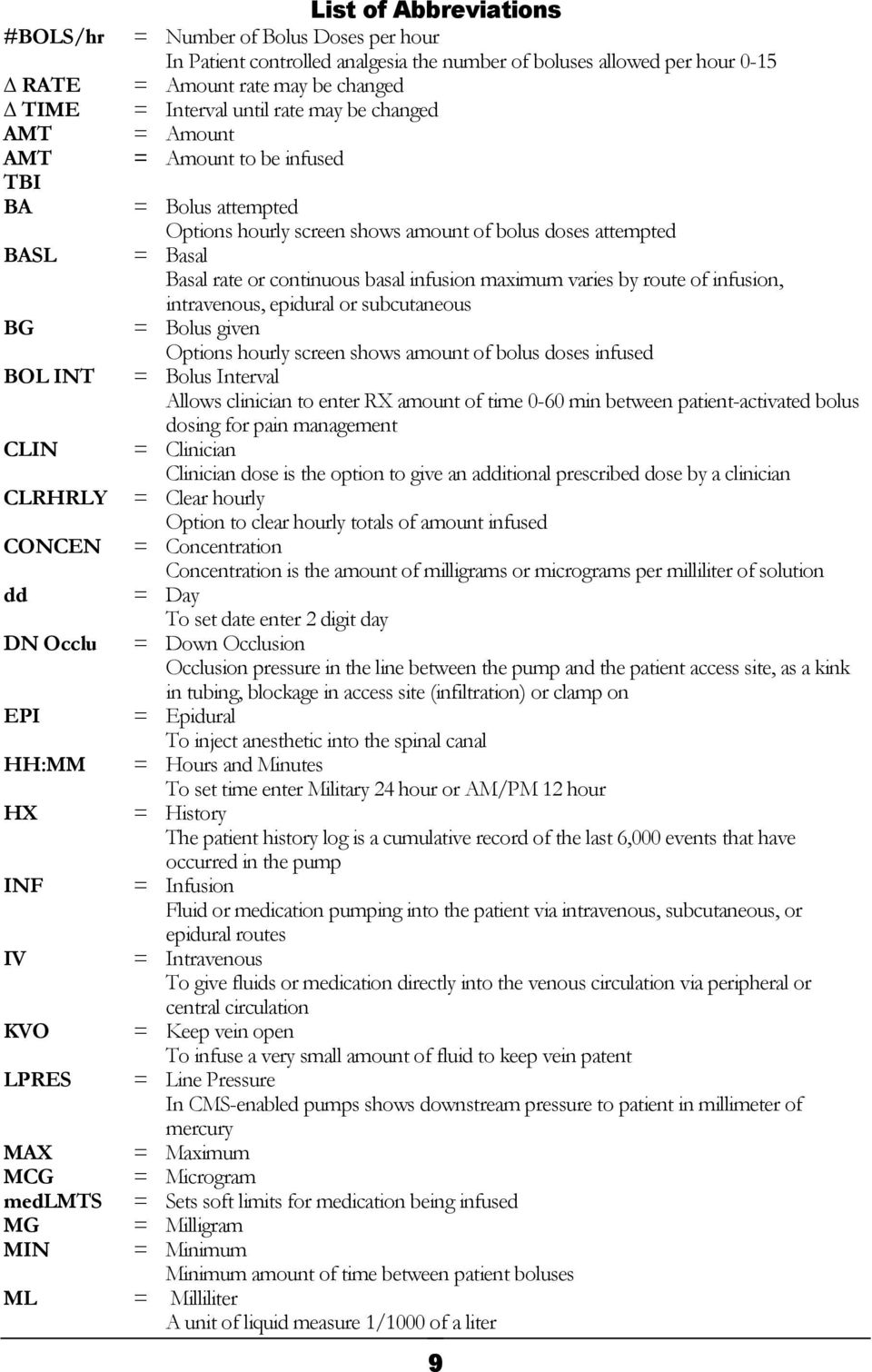
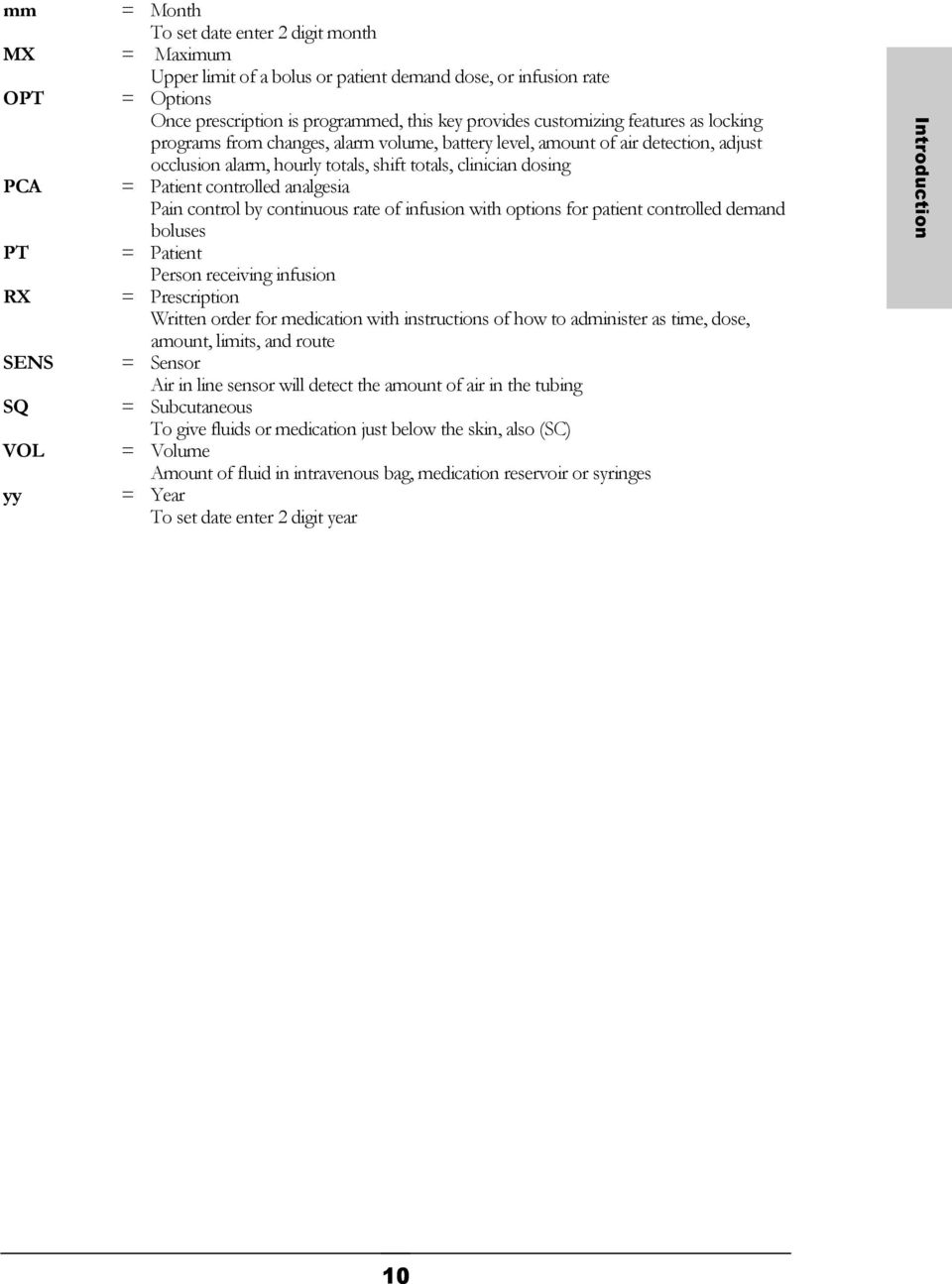
19 Introduction mm = Month To set date enter 2 digit month MX = Maximum Upper limit of a bolus or patient demand dose, or infusion rate OPT = Options Once prescription is programmed, this key provides customizing features as locking programs from changes, alarm volume, battery level, amount of air detection, adjust occlusion alarm, hourly totals, shift totals, clinician dosing PCA = Patient controlled analgesia Pain control by continuous rate of infusion with options for patient controlled demand boluses PT = Patient Person receiving infusion RX = Prescription Written order for medication with instructions of how to administer as time, dose, amount, limits, and route SENS = Sensor Air in line sensor will detect the amount of air in the tubing SQ = Subcutaneous To give fluids or medication just below the skin, also (SC) VOL = Volume Amount of fluid in intravenous bag, medication reservoir or syringes yy = Year To set date enter 2 digit year 10
20 Introduction Pump Illustrations and Features Pump Door Pump Door Instruction Label LED Status Indicator Display Screen Door Latch Run/Pause Key On /Off Key Help/Option Key Data Interface/ Bolus Cord Port Up Arrow Down Arrow Yes/Enter Key Prime/Bolus Key No/Change Key Numeric Keys Decimal Point/ Silence Key Figure 1.1 Moog Curlin Infusion Ambulatory Pump Front, top and left view 11

21 Serial Number Label Battery Compartment Door with Caution Label Right View Pump Door External Power Jack Port (2 Pin Port) Figure 1.2 Moog Curlin Infusion Ambulatory Pump Back, bottom, and right view 12
22 Disposable Administration Set Illustrations and Features Male Luer Lock Slide Clamp These drawings are NOT to scale. Integral Flow- Stop with breakaway tab Tubing Guide Bag Spike Note: An important feature of the Curlin Medical administration set is the unique design of the set-based Integral Flow-Stop. When the set is new, the Integral Flow-Stop has a breakaway tab that keeps the Integral Flow-Stop open and allows the tubing to be gravity primed. When you are ready to load the administration set into the pump, remove this tab, and the Integral Flow-Stop will automatically clamp the tubing. The Curlin Medical Integral Flow-Stop prevents inadvertent flow of medication to the patient whenever the door of the pump is opened because the Integral Flow-Stop automatically reacts to clamp the tubing. The Integral Flow- Stop can, however, be opened after the tab is broken away by intentionally squeezing down on the movable spring action section of the Integral Flow-Stop. See Figure 1.6 for an illustration of how to intentionally open the Integral Flow-Stop. For a complete listing of all available administration sets, see the Curlin Medical Product Catalog. Note: Administration sets with anti-siphon valve protection can also be used for additional free-flow protection. CAUTION: USE ONLY MOOG CURLIN INFUSION ADMINISTRATION SETS WITH THIS PUMP CURLIN MEDICAL Male Luer Lock Slide Clamp Integral Flow- Stop with breakaway tab Tubing Guide Medication Reservoir Figure 1.3 Samples of Moog Curlin Infusion Administration Sets 13
23 Introduction Preparing Medication for Infusion/Changing IV Bags When using an IV bag, grasp the bag spike firmly in one hand and the IV bag spike-port in the other, and insert the spike completely into the port using aseptic technique. Holding the bag with fill ports down allows fluid to fill tubing and displace the air in the line. Be sure all air has been removed from the IV bag as well. Air in the line moves down through the tubing as the fluid fills. OPEN CLOSED In these illustrations, the slide clamps are shown in their open and closed states. Notice the breakaway tab on the Integral Flow-Stop has been removed. The set can be gravity primed by intentionally squeezing the Integral Flow-Stop and thus releasing the clamping action. ( See Figures 1.5 & 1.6 ) Figure 1.4 Spiking the fluid container, gravity priming the set and using the slide clamp to close the tubing. 14
24 Twist and remove breakaway tab from Integral Flow-Stop Figure 1.5 Moog Curlin Infusion Administration set Integral Flow-Stop with breakaway tab Squeeze Integral Flow-Stop between thumb and forefinger as shown to allow fluid to flow through tubing after the breakaway tab has been removed. Figure 1.6 Intentionally Opening the Integral Flow-Stop 15
25 Introduction Opening and Closing the Pump Door The pump door, located on the top of the Moog Curlin Infusion pump, has a sturdy over center latching mechanism, which assists in securely closing the door. Review the following illustrations: Door Latch (Lift to open) 2 1 Latch Hook Latch Pins To open the pump door: 1 Pull the door latch up, releasing the latch hooks from the latch pins. 2 Grasp the door latch and pull upwards and to the right to open the entire door mechanism. Full range access is now available for installing the Curlin Medical Administration set. (See figures 1.9 and 1.10). Figure 1.7 Opening the pump door Push down To close the pump door properly, move the entire door assembly to the left and push downward until it is in its closed position. Then push the door latch down until it locks. The over-center latching mechanism assures that the door closes easily and securely. Figure 1.8 Closing the pump door 16
26 Choosing and installing the Moog Curlin Infusion Administration Set A number of distinctively designed Moog Curlin Infusion administration sets are available to deliver each prescription accurately. Each set is designed to meet the requirements of specific therapies, therefore, if a basic bag-spike set or a set with a medication reservoir is needed, with or without air eliminating filters, etc., there are several configurations from which to choose. Follow the healthcare provider s protocols for preparing the medication and the administration set before loading the set into the pump, remembering the following basic rules: 1 Examine the packaging and the administration set before use to assure the package integrity. Do not use the set if the protective caps are dislodged or if the package integrity is breached, as fluid path sterility cannot be guaranteed under those circumstances. 2 Notice that there is an instructional insert included in the administration set package. This insert includes written and graphic instructions for proper installation of the administration set into the pump. It also lists the fill volume of the administration set. Allow for the amount of the fill volume when determining the final IV bag volume. Gravity Priming Set and Filter 1 To gravity prime the administration set, twist and remove the breakaway tab from the Integral Flow-Stop, then spike the IV bag. Squeeze the Integral Flow-Stop between your thumb and forefinger to allow fluid to flow through the tubing until all air is removed from the IV bag and administration set. (See figures 1.5 and 1.6.) Release the Integral Flow- Stop to automatically clamp the tubing. To correctly prime a filtered set, hold the filter in a vertical position with the flow downwards allowing the filter to completely fill with fluid. Note: Administration sets with integral anti-siphon valves cannot be gravity primed. 2 Close the slide clamp on the administration set before the door of the pump is opened. This step along with the automatic clamping properties of the Integral Flow-Stop prevents inadvertent fluid flow. 3 Use an administration set with an air-eliminating filter whenever the Air-In-Line Sensor is disabled or set to OFF. 4 Follow CDC guidelines or Intravenous Nursing Standards of Practice Guidelines regarding the frequency of changing the administration sets. 5 Use aseptic technique and universal precautions as directed by the policies of your healthcare facility or institution. 6 Use only Moog Curlin Infusion administration sets with the Moog Curlin Infusion pump. 7 Dispose of administration sets in accordance with all applicable regulatory and institutional policies and directions. 17
27 Introduction Air Detector Note: Open the slide clamp before closing the pump door Flow Stop Receptacle Flow Stop Handle (Yellow) Administration Set Tubing Guide (Blue) Pumping Fingers Note: The Administration Set tubing is always placed in front of the door hinge Tubing Guide Receptacle Figure 1.9 shows the Curlin Medical pump with a cut-away of the display screen allowing you to visualize the receptacles for the small blue Tubing Guide on the right side of the pump and the larger yellow Integral Flow-Stop on the left side of the pump. The arrows, in corresponding colors, are visible on the background surface of the pump head and indicate the proper direction for placing these locators into their receptacles. Also, note that the breakaway tab has been removed from the Integral Flow- Stop, allowing the administration set to be placed into the pump correctly. Figure 1.9 Proper installation of the Moog Curlin Infusion Administration set into the pump Steps in Installing Administration Set into Moog Curlin Infusion Pumps 1 Fully open the door of the pump. 2 Close the slide-clamp on the administration set. 3 Activate the Integral Flow-Stop by twisting and removing the breakaway tab. 4 Insert the blue tubing guide into the receptacle on right side of pump in the direction of the blue arrow, positioning the tubing in front of the door hinge. 5 Center the tubing in the middle of the pumping fingers, covering the yellow dot. 6 Holding the yellow Integral Flow-Stop by the handle (see Figure 1.9), insert it on an angle into the receptacle on the left side of the pump in the direction of the yellow arrow. CAUTION: Do not press down on the top of the Integral Flow-Stop when inserting it into the receptacle. This action could inadvertently open the Integral Flow-Stop and allow fluid to flow through the tubing. 7 Open the slide-clamp on the administration set 8 Push the tubing slightly into the black Air Detector slot. 9 Fully close the door of the pump and latch it securely. 10 If the set is not primed, prime the set according to prime section in the relevant therapy chapter. 11 Attach the primed set to the patient s venous access device per agency protocols. 12 Dispose of used administration sets in accordance with all applicable regulatory and institutional policies and directions. 18
28 Flow-Stop handle Air Detector Slot 1 Insert blue Tubing Guide on right side of pump with tubing in front of the door. The Blue arrow on the background surface of the pump head indicates direction and location for the blue Tubing Guide. 2 Important: Center the tubing horizontally over the pumping fingers covering the yellow dot. 3 Insert yellow Integral Flow-Stop on the left side of the pump. The yellow arrow on the background surface of the pump head indicates the direction and location for the Integral Flow-Stop. CAUTION: Hold the Flow-Stop by the small handle. DO NOT press down on the top of the Integral Flow-Stop when inserting it into the receptacle. This action could inadvertently open the Integral Flow-Stop and allow fluid to flow through the tubing. 4 Press the tubing into the air detector slot gently with index finger. Figure 1.10 Top cutaway view of the Moog Curlin Infusion pump with Moog Curlin Infusion Administration set in proper installation position Up Stream Occlusion Alarm Feature The Moog Curlin Infusion pump has an Up Stream Occlusion alarm feature, e.g., it detects low up-stream pressure. This feature notifies you if an occlusion is present between the IV container and the pump. If this alarm occurs, the display will read, ALARM UP OCCLUSION, the alarm will sound, the red LED light will blink, and the infusion will stop. This situation requires that you press the Pause key, examine the administration set from the IV container to the pump for potential causes of the occlusion. If a clamp is in place, open, or remove it; if the administration set is kinked, straighten it. If indicated, close the slide clamp on the administration set and open the door of the pump to verify that the set is correctly placed. Close the pump s door and reopen the slide clamp. When ready to begin infusing, select RESUME and then press the RUN key. The pump also detects excessive up stream pressure (pressure on the IV bag). The display will read ALARM HIGH UP PRESSURE, the alarm will sound, the red LED light will blink, and the infusion will stop. If this situation occurs, relieve the source of excessive pressure on the IV bag and when ready to begin infusing, select RESUME and then press the RUN key. Note: The up stream occlusion detection is disabled during priming. 19
29 Introduction Installing the Batteries and Using External Power The Moog Curlin Infusion pump can be powered solely with the use of two C size alkaline batteries installed into the pump as shown in Figure C size batteries are readily available at most retail facilities that carry alkaline batteries. A second alternative for power is the portable, rechargeable Battery Pack,. The third alternative for power is to use the AC Adapter, allowing the pump to be connected to any approved, three-prong electrical wall outlet. The C size batteries will last approximately 30 hours at a rate of 125 ml/hour and over 85 hours at rates of 2 ml/hr or less. Factors that influence battery life are the number of times the screen is illuminated with a key press, the viscosity of the fluid being delivered, the age and temperature at which the batteries have been stored. To extend the life of the batteries, patients can use the AC adapter whenever they are stationary, e.g., at night. The pump has a low battery alert that beeps periodically with a message appearing to tell you when the power is low in the C size batteries. This alert gives you a window of time to be sure you have back-up power (e.g. extra batteries, AC adapter, or a recharged battery pack.) If you are infusing at high rates, you will have approximately one hour of warning; if you are infusing at low rates (below 10 ml/hr), you will have a significantly longer time interval before the batteries are completely empty. The user should be taught that whenever the low battery alert appears, to pause the therapy, turn the pump off, and to replace both C size batteries. Then, turn the pump back on, select resume to continue the therapy. When the empty battery alarm occurs the pump will go into an alarm state and the infusion will stop. If this occurs, turn the pump off, replace both of the C size batteries, turn the pump on, and go to the Resume function to continue the therapy. All programming information is retained. If the C size batteries are empty and you want to connect the AC adapter to power the pump, turn the pump off first, plug in the AC adapter and then turn the pump back on. Note: If you are operating the pump solely on the battery pack or the AC Adapter (no C size batteries installed) and the power source is disconnected from the pump, the alarm will sound, the infusion will stop, and the display screen will be blank. Turn the pump off, reconnect the power source, turn the pump on, and resume the therapy. All programmed information is retained. However, as there is no low battery alarm for the external battery pack, the external battery pack should always be used with charged C cell batteriesww. When replacing batteries, pause any infusion in progress by pressing the PAUSE key, and then turn the pump off. Replace the batteries, and, when the pump is turned back on, select RESUME to continue the therapy from the point at which it was interrupted. 20
30 Battery Replacement, Alternate battery door Figure 1.12 The battery door compartment is located on the back of the pump. To open the door, depress the recessed release pin. (Use a small coin such as a penny to depress the pin.) Do not use a screwdriver or other sharp objects to open battery compartment door. Slide the battery door down and remove it from the pump. If your pump contains a plastic tab between the batteries, pull up on the tab until the batteries can be removed. Otherwise: Using the small coin (Penny) pry up and out on the top (+) edge of the battery to cause the battery to pop out. Use the same technique on the second battery. Do not use a screwdriver or other sharp objects to pry batteries out of the pump. Install two new C size batteries by depressing the coil spring with bottom ( ) end of the battery and sliding the top of the battery into place. Please note: Both positive poles are at the top of the battery compartment. To depress the coil spring, insert the battery at a slight angle. Slide the battery door compartment back to its closed position until the recessed pin locks into place. 21
31 To check battery** levels while CAUTION: If batteries are removed from the bottom the pump is running; ( ) end first, damage to the springs Press the Help/Options keys in the bottom of the battery case can occur. Damaged Scroll down to PWR Ck? springs can create a situation in which the Press no to change to ON. battery overheats. If the battery or the pump becomes excessively warm to the touch, do not attempt Press yes to view battery level to remove the batteries. Set the pump aside and Press Yes to Accept OPT? to contact your home infusion pharmacy. exit options menu * It is recommended to use Duracell Procell 1 Batteries in Moog Curlin Pumps ** C cell batteries only, this function will not check external battery pump power levels. I M P O R T A N T I N F O R M A T I O N Whenever an external source is powering the pump, it is still important to always install the two C size batteries. In the event of a power failure or accidental power cord disconnection, the batteries will power the pump without interrupting the therapy in progress. If the batteries are in place when the power cord is disconnected, the display will say External Power Disconnected, the alert beep will sound, the batteries will take over powering the pump, and the therapy will continue infusing. Handling and Storage: Store at room temperature. Avoid mechanical or electrical abuse. Do not short, charge or install incorrectly. Do not mix with other battery types, as (alkaline-manganese dioxide with carbon-zinc). Replace both batteries at the same time. Do not store batteries loose. Refer to battery manufacturer's material safety data sheet for specific product recommendations and precautions. 1 Duracell and Procell are registered trademarks of Proctor & Gamble. 22
32 External Power Sources Rechargeable Lithium Ion (Li-Ion) Battery Pack ( ) Overview The Li-Ion Battery Pack (pictured below) is designed to be used with 2 fully charged C-cell batteries to power a model 2000, 4000, 6000 or PainSmart infusion pump for an extended period of time without being connected to a power outlet. The battery pack allows the user to operate the pump for a minimum of 24 hours (at 125ml/hr) in addition to the run-time supplied by the disposable C cells in the pump. To ensure an adequate low battery warning period, the battery pack should always be used with 2 fully charged C-cell batteries installed in the pump. 23
33 The battery pack provides 5.2V with a capacity of 6000 ma-hrs. It is connected to the same port connector that the AC adaptor uses to power the pump. When the battery pack power is fully exhausted the pump will automatically revert to the internal C batteries. Having new C cell batteries in the pump is crucial to ensure an adequate low battery warning period and to ensure infusion continuity if the battery pack is accidently disconnected. The Red Low Battery LED on the battery pack will illuminate prior to the external battery running out of power. The pump will provide at least 30 minutes of audible and visual warning prior to the internal C cell batteries running out power. The battery pack is recharged by connecting it to an AC adaptor. Fully recharging the battery takes approximately 15 hours. While charging, the LED indicator will be yellow. When the battery is fully charged, the LED will be green. If a fault is encountered in the battery pack the LED will either flash yellow or not illuminate. Warnings The external battery pack should be used with new C cell batteries in the pump to avoid interruption of the infusion if the cord between the pump and battery pack becomes disconnected and to ensure proper operation of the pump s low battery alarm. Do not use this battery pack with the POWDEC AC Adaptor WM10-6.9V (Moog Curlin p/n ) as the combination may exceed the allowable limits for emitted electromagnetic interference. Battery pack cable utilizes an attached cable. This can be a tripping or choking hazard, avoid use that may lead to entanglement around the neck or feet. Cautions This battery pack is fluid resistant, but it is not designed to be water tight. Care should be taken to avoid any unnecessary contact with water or other fluids. Do not use the battery pack where it might fall into water. The power gauge located on the pump screen (pictured below) does not reflect the remaining charge in the battery pack. The displayed capacity on the pump will always show empty when a battery pack (with remaining capacity) is attached (see image below): 24
34 Refer to the LED indicators on the pump to determine if the battery pack has been fully charged or is in a low battery condition. The battery pack should be unplugged from the pump when recharging. The AC adaptor cannot simultaneously power the pump and charge the battery pack. If AC operation is desired, connect the adaptor directly to the pump. Environmental Storage Temperature -20ºC to 65ºC, Atmospheric pressure 500hPa to 1060hPa, Humidity 10% to 90% Operational Temperature 5ºC to 40ºC, Atmospheric pressure 650hPa to 1020hPa, Humidity 10% to 90% Directions for Use Charging the Battery Pack The Moog Curlin (Globtek GTM ), Moog Curlin (Globtek GTM ), Moog Curlin (Globtek GTM ) or Moog Curlin (Globtek GTM ). AC adapters can be used to recharge the battery. A fully discharged battery will recharge in less than 15 hours. If connected, disconnect the battery pack from the pump. Connect the AC adapter to the power port of the battery pack. 25
35 Connect AC adaptor here The charge LED will illuminate yellow if the battery needs to be recharged. See below: Charge the battery pack for 15 hours or until the LED turns Green indicating the battery is fully charged. 26
36 Disconnect the battery from the AC adaptor. Note: If there is a fault detected while charging the battery, the LED will either flash yellow or not illuminate. Most faults are due to either the AC adapter becoming unplugged from the power outlet or the battery pack being at a location where the temperature is not between 5 and 40 degrees Centigrade. If the fault condition persists, then the battery pack should be returned to Moog Medical Devices Group for replacement of the battery. Using the Battery Pack to Power the Pump Make sure fully charged C cell batteries are loaded in the pump. Connect the battery pack to the AC adapter port on the pump. Connect Battery Pack here Operate the pump in the desired infusion mode. Do not use the pump s display (see cautions) to predict external battery life. 27
37 When the external battery pack is nearly depleted, the red LED indicator will be illuminated. The pump may continue to be used until the disposable C cells are depleted. Disconnect battery pack from pump prior to recharging the battery pack. Maintenance There is no need to fully discharge the batteries periodically since Li-Ion batteries do not have a memory effect. The battery pack enclosure may be cleaned with a mild soap or disinfectant. End of Life Determination The battery in the battery pack degrades with charge cycles and time since manufacture. When the batteries are no longer holding their charge for a sufficient length of time, the battery pack should be replaced. 28
38 AC Adapter/Charger This accessory becomes the external power source when plugged directly into the Moog Curlin Infusion pump (see Figure 1.2 for external power port location on the bottom of the pump). The AC Adapter can also be used to recharge the portable battery pack by plugging the connecting cable into the recharging port on the battery pack (see Figure 1.13). There are two AC Adapters: The US Domestic AC Adapter (P/N: )has a three-prong plug to be plugged into a standard three-prong, grounded wall receptacle and a six-foot cable which plugs into the power outlet on the bottom of the pump. The two-pin connector plugs into the receptacle by aligning the red dots on each. The International AC Adapter (P/N: Kit) available for international use. The two-pin connector plugs into the receptacle by aligning the key on the connector. Note: Pause the pump and then turn it off before connecting the AC Adapter. Note: The connector is keyed with a notch at this red-dot location to guide alignment. To remove, pull back on the locking sleeve to unlock and then pull gently to remove the connector from the battery pack or pump s port. Figure 1.13 Universal AC Adapter Two-Pin Adapter plugs into port on bottom of the pump for AC power or can be used to recharge the battery pack by plugging into the recharging port on the battery pack (see Figure 1.13). To remove, pull back on the locking sleeve. 29
39 Introduction Bolus Cord Use When the PCA therapy is used, patient bolus dosing can be programmed. To facilitate ease of patient self-dosing, the patient can use the Bolus key or the Remote Bolus Access Cord. When a bolus dose is requested two beeps will sound to indicate that the dose has started. If a bolus dose is requested and denied, one beep will sound. When a bolus dose is completed, no beep will occur. The cord is five feet long and has a patient access button at the top of the remote cord. The fourpin adapter plugs into the four-hole port on the left side of the pump (see Figure 1.14 below). This port may be covered with a plastic plug. If so, remove the plug to access the port. To correctly connect the bolus cord, align the red dot and the connector s keyed notch with the red dot and notch in the port on the left side of the pump. When the cord is plugged into the pump it is locked in place by the locking sleeve. To remove the cord, pull back on the soft, green locking sleeve and disengage the cord from the pump by pulling it straight out of the access port. Because bolus dosing is applicable only in PCA therapy, if the cord is left in place and the button is pushed while any other therapy is infusing, an alert message will appear on the display screen stating: Not in PCA No Bolus Allowed. Bolus/Data Port on Left side of Pump Remote bolus access port Locking Sleeve Four-pronged adapter plugs into access port on left side of pump as shown. To remove bolus cord, pull back on locking sleeve and pull cord straight out of access port. Figure 1.14 Attaching and removing the remote Bolus Cord 30
40 Learning Pump Chapter 2 Learning Pump Features Learning to operate the Moog Curlin Infusion pump requires a few basic points of understanding that remain constant in every therapy. It may be helpful to read through these steps first, and then go back and use them to operate the Moog Curlin Infusion pump. F irst, examine the key pad and the functions of the individual keys. Knowing how the keys, especially the dual function keys, work will allow you to give commands to the pump. Display Screen LED Indicators Screen Figure 2.1 Key Pad 31
41 Keypad Function 1 ON/OFF: Used to turn the pump on and off. When the pump is running, however, the PAUSE key must be used to stop the infusion first and then the OFF key can be pressed to turn the pump off. This requirement prevents the interruption of an infusion by a single accidental press of the OFF key. 2 RUN/PAUSE: Used to start or pause the motor of the pump, which, in turn, starts or pauses fluid delivery. When the pump is running, pressing this key will pause the pump. When the pump is paused, pressing this key during the Run Options menu will start the pump. This key is also used to terminate a pump alarm. Note: If the cause of the alarm is not resolved when the pump is Resumed, the alarm will recur. 3 Up arrow: Used to scroll the highlight bar or field cursor up on the display screen. Note: The Up arrow will not accept a selection which must be made with a YES/ENTER or NO/CHANGE key. 4 Down arrow: Used to scroll the highlight bar or field cursor down on the display screen. Note: The Down arrow will not accept a selection which must be made with a YES/ENTER or NO/CHANGE key. 5 NO/CHANGE: Used to respond NO to data or questions presented or to reject or to change highlighted data. Note: The Moog Curlin Infusion pump requires you to actively change a selection. The Up arrow or Down arrow will not change a selection. 6 YES/ENTER: Used to respond YES/ENTER to data or questions presented or to accept highlighted data when prompted to press enter key. Note: The Moog Curlin Infusion pump requires you to affirmatively accept a selection. The Up arrow or Down arrow will not accept a selection. 7 HELP/OPTIONS: Used to request a help screen when the pump is paused or is at the Infusion Complete Screen. It is also used to access the options screen when the pump is running. When the options screen is displayed, help is again available with this key. When in a help screen, use the arrow keys to scroll through the help message, and then press the help key again to exit help. 8./SILENCE: Used as a decimal point when programming numeric data. Used also to temporarily silence the alarm (for one-minute intervals). 9 PRIME/BOLUS: Used to prime fluid through the tubing to clear it of air or to administer a patient demand bolus dose of medication in PCA therapy Numeric keys: - Used for data entry. 32
42 Learning Pump Description of the Info-On-Demand (IOD) Feature Figure 3.2. IOD Keypad with Info-On-Demand Feature To view any of the Info-On-Demand screens on the pump display, press the related key while the pump is in the RUN mode, i.e., running a therapy. The information requested will be displayed for 6 seconds and then the display will return to the previous infusion screen. Exception is the CLRShft /9 key. The information for the CLRShft/9 key will be displayed for 11 seconds and it will allow the user to CLEAR or EXIT within the 11 seconds or the screen will revert to the RUN screen automatically. 33

43 Info-On-Demand (IOD) Key Functions Designation and functionality of the ten numeric keys of the Info-On-Demand keyboard: 1 Date and Time (DateTime): The Date and Time screen displays the current date and time according to the pump. Changes to this screen are not allowed. 2 Power Check (PowrChck): The Power Check screen displays the active power source of the pump, whether internal (batteries) or external. If the active source is the C-size batteries, a bar graph will indicate the amount of power remaining in the batteries. This graph is only an approximation of the charge left in the batteries and not intended to give specific representation of the battery life. Furthermore, the bar graph should NOT be used to check the state of the external NiMH Battery Pack, because it will not provide with accurate results. 3 Option Info (OptnInfo): This screen provides information on selected options. The information displayed here includes the status of the Lock Level, Down Occlusion, Air Sensors, and the Audio Level. Changes to this screen are not allowed. 4 Hold Screen (HoldScrn): Pressing the Hold Scrn/4 key will hold the current Run screen information for an additional six seconds and then the pump will return to the normal running screen. Changes to this screen are not allowed. 34
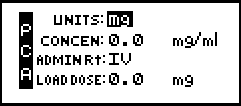
44 Learning Pump 5 Hourly Total (HrlyTot): The information displayed here includes the hourly Volume (amount) Infused, the number of Bolus Given and the number of Bolus Asked. Within the allocated 6 seconds, the user can scroll up or down the screen. Changes to this screen are not allowed. 6 Therapy Information (ThrpyInfo): The information displayed in this screen is from the pre-prescription menu and includes Units, Concentration, Administration Route and Load Dose. Changes to this screen are not allowed. 7 Rx Information (RxInfo): This screen provides prescription menu information such as Basal Rate, Patient Bolus, Bolus Interval, and Number of Bolus per Hour. Changes to this screen are not allowed. 35
45 8 Percent Bolus (%Bols): This screen provides Bolus Volume as percentage of Total Volume. TBOL is the total volume infused through bolus, TVOL is the total volume infused, and % BOLS is the percentage of TBOL over TVOL. Changes to this screen are not allowed. 9 Clear Shift Total (CLRShft): Two SHIFT TOTAL screens are displayed for 11 seconds when this key is pressed. This key allows the user to view or CLEAR the SHIFT TOTALS (this action does not interfere with the operation of the pump). To CLEAR the SHIFT TOTAL information to zero, press the CLRShft/9 IOD key, and then press the YES/ENTER button in response to the DONE? CLEAR question and the pump will go back to the running screen. Press the CLRShft/9 IOD key again to verify that the values are reset or cleared. To EXIT the SHIFT TOTAL screens without clearing, press NO/CHANGE for the DONE? CLEAR question and then YES/ENTER for DONE? EXIT and return to the running screen. The pump will return to the running screen automatically after 11 seconds have elapsed since the pressing of the CLRShft/9 IOD key, even if no key is pressed. 10 Check Maximum Infusion (ChckMax): The information displayed here is the maximum (rate or amount) that can be infused hypothetically, given the prescription parameters. This Maximum Infusion per Hour serves as a sanity check, after the pump has begun infusing. Changes to this screen are not allowed. 36
46 Learning Pump LED Light Indicators This three-light feature gives the user feed back on the current status of the pump. 1 Green indicates a RUNNING status of the pump and blinks approximately once every three seconds when a therapy is in progress. 2 Yellow indicates a STANDBY status of the pump and blinks while the pump is paused. 3 Red indicates a STOPPED or ALARM status of the pump and blinks whenever an alarm status exists. 4 Green and Red indicates an Infusion Complete Alarm status with KVO or a Down Occlusion Alarm with automatic restart. 5 Yellow and Green indicates a Standby status with automatic start. This occurs during any delay start with a 0 KVO programmed or in PCA during a 0 basal rate and bolus only programmed. Audio Indicator An audible alarm or beep is used to alert you to a change in the status of the pump or a situation requiring user action or notification. A message will appear on the display screen describing the situation. The rate, number of beeps, and volume further specify status. This pump offers nine different volume levels from which to select for the audio feature; however, the beep cannot be totally disabled. The audio beep can be silenced for one-minute intervals by pressing the SILENCE key except during an Error Code, at which time the alarm continues and the pump must be turned off. The chapter of this manual entitled, Troubleshooting includes tables with the alerts, alarms, and error codes, the conditions causing them, the message displayed on the screen, and the actions required for resolution. If an alert or alarm occurs, please refer to these tables. Display Screen The display screen provides a maximum of four lines of text, or fields, at any one time for feedback regarding the pump status and data entry. It notifies the user with prompts or messages when necessary. The screen has backlighting that remains: on if connected to an AC outlet; lit for 15 seconds if using batteries or during any key press sequences, on with alert/alarm messages. When no keys are pressed for fifteen seconds, the light goes off to conserve battery power. Backlighting is resumed with any key press. In most displays, a Therapy Identifier Bar appears at the far left of the screen, indicating which therapy is running or which programming screen is being considered. This identifier also has another function, and that is to alert you when more text exists either above the top line or below the bottom line on the display screen. The identifier bar will have an arrow configuration either pointing up or down or both whenever there is more text, or it will appear as a squared-off block if no further text exists. The screen also has a cursor or highlight bar to tell you which field is being considered. Use the up and down arrow keys to move the cursor. When the pump is running, a specially designed running screen appears to provide information regarding the status of that particular infusion. In the following chapters, each display screen will be explained. 37
47 Identifier bar with down arrow indicator Figure 2.2 Sample of display screen 38
48 Basics Programming Chapter 3 Basics of Programming The Moog Curlin Infusion pump allows the operator to customize this device to meet the specific infusion needs of each individual patient. This chapter will explain the customizing features along with the programming steps. P rogramming the Moog Curlin Infusion pump requires initial orientation and training, but the programming steps have been designed to be user friendly and self-prompting to minimize training time. Several different types of screens and fields may appear on the displays. Each of the different types of screens is explained below. Whenever you are required to interact with the pump, a highlight bar or cursor will be present on the screen. Types of Display Screens 1 An action field screen allows you to select a pump action from the menu. S a m p l e o f a n A c t i o n F i e l d S c r e e n In this sample, the highlight bar is resting on the RESUME field. To select a field other than the one highlighted, use the arrow keys to move the cursor up or down to the desired field. When the cursor is highlighting the correct field and you press the YES/ENTER key, the pump accepts the selection and executes that action. In the example above, the pump would proceed with steps to resume the therapy. 2 A Selection List field allows you to select from a predetermined list of values: S a m p l e o f a S e l e c t i o n L i s t F i e l d The above example allows you to select which unit to use in programming e.g., Units: ml, mg or mcg. Only one selection is displayed at a time. When the cursor blinks it is indicating that no selection has yet been accepted. The selection displayed on the screen changes each time you press the NO/CHANGE key. Pressing the YES/ENTER key accepts the selection displayed and moves the cursor to the next field. 39
49 3 Data entry screens are used to specify prescription parameters. S a m p l e o f a D a t a E n t r y S c r e e n In the above example, the cursor rests on a field requiring numeric data entry for specific prescription information, e.g., the volume in the IV bag. The operator enters the correct information using the numeric keys and decimal point key. When the correct data is displayed and the YES/ENTER key is pressed, the pump accepts the selection if it is a valid entry value and moves the cursor down to the next field. If the down arrow key is used to move to the next field, the value reverts back to default or the last programmed value. 4 Run screens display information to the operator about the progress of the specific infusion while the pump is running: S a m p l e o f a R u n S c r e e n The standard run screen displays the Mode Identifier, the rate of pumping, a graphical bar that indicates the progress of the infusion, the volume already infused, and the time remaining for the infusion. No action is required on a run screen, therefore, no highlight bar appears. In some therapies a field may toggle to give the operator more information, i.e. the REMAIN field may change from HH:MM (time remaining) to ml to tell you how much volume is remaining as well. The information on the run screen will alternate between a four-line display and a large font display of each line of information on the screen. 5 User Notification Screens are messages displayed to the user for information. S a m p l e o f U s e r N o t i f i c a t i o n S c r e e n Words representing keys are displayed in reverse video (shown in this manual as bold text). The action requested by a notification screen is either to press a specified key or to resolve an alert, alarm, or error code. For all events such as alerts, alarms, or error codes, specific notification screens will also be displayed. (See chapter entitled, Troubleshooting for specific alert, alarm, and error code messages and how to resolve them). The audio alarm also beeps and the LEDs blink whenever an alarm or error code occurs. In the event of an error code, user directions will be displayed on the screen, most often, this will require turning the pump off and back on again. 40
50 Basics Programming Using Help Help screens are available for data entry/selection screens, during action field screens, and at the infusion complete screen. To access help, press the HELP key. Use the arrow keys to scroll through the help message, and then press the HELP key again to exit help. When a help screen is displayed and there is more text to read which is not currently on the screen, a small up ( ) or down ( ) arrow indicator will appear to let you know you can scroll up or down to read the complete help message. Starting the Pump Start the pump by pushing the blue ON key. The following screen displays: W e l c o m e S c r e e n The above Welcome screen gives the date, time, and a message that the pump is performing a self-diagnostic test. If the numbers on the date field are displayed as zeros, the system clock will need to be set using the BIOMED Set Up. (See BIOMED SETUP section.) The display also lists the software revision number for this pump. During this test, you will hear three beeps as each of the LED indicators blink. If any one of the green, yellow, or red LED lights fails to light or to blink, return the pump for service. If the selftest fails, the alarm will sound, and a new screen will appear stating: ERROR CODE:# or SYSTEM ERR:# (See Troubleshooting chapter for a list of error notices and how to resolve them). The error notice will include a numeric code. At any error notice, the only user option is to turn the pump OFF. I M P O R T A N T I N F O R M A T I O N If, at any time, there is indication of pump damage, error code, or messages requiring the pump to be turned off, call the healthcare agency or facility as directed to report the condition. Note: If an error notice appears, turn the pump off and back on again. If the pump passes its start-up diagnostics tests, you can safely resume the therapy. If the error notice recurs, however, turn the pump off and notify the healthcare agency responsible for monitoring the pump. Some error notices may reset the pump back to it s default settings and therefore will require reprogramming. When the Moog Curlin Infusion pump successfully passes it s self-test, a brief message of System OK appears, and the display moves to the next screen: 41
51 P o w e r S t a t u s S c r e e n This screen displays the active power source of the pump, whether internal (batteries) or external power. If the active source is the C-size batteries, a bar graph will indicate the amount of power remaining in the batteries. This graph is only an approximation of the charge left and is not intended to give a specific representation of battery life. The display will again automatically move to the next screen: P r e v e n t i v e M a i n t e n a n c e S c r e e n The above alert screen will appear after the Welcome Screen only when the Maintenance Due date has arrived and will continue to appear until the date has been reset during the actual maintenance performance. The pump may continue to be used after the maintenance due date but should be returned for its routine maintenance at the earliest opportunity. S e l e c t P r o g r a m o r B i o - M e d S e t u p S c r e e n This screen is the first requiring you to act. It gives two selections from which to choose, PROGRAM or BIOMED SETUP. Using the up or down arrows, move the cursor to the desired field and then press the ENTER key. Selecting PROGRAM allows you to proceed with choosing features and entering data required for the pump to deliver a prescribed therapy. Selecting BIOMED SETUP allows the pump to be programmed and customized by the clinician to perform a number of special functions including setting the system clock. (See BIOMED SETUP ) Accessing BIOMED SETUP requires you to enter a clinician access code. (Refer to the chapter entitled, Clinician Information and Access Code, of this manual.) Access Code C l i n i c i a n A c c e s s C o d e S c r e e n 42
52 Basics Programming The clinician enters a four-digit personal identification number followed by the five-digit access code; and, if the code is valid, the display will automatically move to the requested screen or field. The four-digit personal identification number appears on the screen but the access code numbers do not; instead five asterisks appear. The personal identification number is recorded in the history file for the purpose of providing an audit trail. If an invalid code is accidentally entered, a message displays: Invalid Code, and the clinician can reenter the correct code. Note: After entering the access code, DO NOT press the YES/ENTER key. The pump will automatically recognize the correct code and give you access to the secured section. I M P O R T A N T I N F O R M A T I O N If an access code screen displays and the access code is not known, use the down arrow to move the cursor to the EXIT? field. Press the YES/ENTER key at this field to return to the previous screen and make another selection. Also, remember that the HELP key is available when the pump is paused. Look first at the BIOMED SETUP menu and its special customization features: BioMed Setup B i o M e d S e t u p M e n u The BIOMED SETUP menu lists special optional customization and performance functions of the pump: 43
53 I M P O R T A N T I N F O R M A T I O N You may skip any of these functions by using the down arrow to move the cursor to only the desired selection. When the desired selection is highlighted, press the YES/ENTER key. A secondary screen will be displayed. When all BIOMED SETUP functions are completed, move the cursor to the last field, DONE? YES, and press the YES/ENTER key to exit this menu. 1 PREVENTIVE MAINTENANCE DATE: The first field displays the date the pump requires its annual routine preventive maintenance check. Note: You cannot change this date, it is changed only when a factory technician performs the routine pump maintenance. The clinician that initially programs the pump for a patient should note the maintenance date. Once this date arrives, a Perform Routine Maintenance message will briefly appear after the welcome screen. If the Maintenance Due date will occur during the time the patient will be on service, the clinician may wish to select another Moog Curlin Infusion pump for this patient. This action will avoid any undue concern on the patient s part at the notice of maintenance due and eliminate the need to recall a pump in service for maintenance. The pump, however, can continue to be used without disrupting service when this message appears, but should be returned for service as quickly as possible. 2 PROGRAMMER ID: This feature gives the programmer the option to use the numeric keypad to enter his or her assigned ID number (up to ten digits). If this option is not to be used, it can be left blank and skipped, using the down arrow to scroll to the next field. When the PROGRAMMER ID number is satisfactory, press the YES/ENTER key at the ACCEPT? YES/NO field and the number will be stored in the pump history log. 3 PATIENT ID: This feature gives the programmer the option to use the numeric keypad to enter a patient ID number (up to ten digits). If this option is not to be used, it can be left blank and skipped, using the down arrow to scroll to the next field. When the PATIENT ID number is satisfactory, press the YES/ENTER key at the ACCEPT? YES/NO field and the number will be stored in the pump history log. 4 Rx NUMBER: This feature gives the programmer the option to use the numeric keypad to enter a prescription number (up to ten digits). If this option is not to be used, it can be left blank and skipped, using the down arrow to scroll to the next field. When the Rx NUMBER is satisfactory, press the YES/ENTER key at the ACCEPT? YES/NO field and the number will be stored in the pump history log. 5 INVOICE NUMBER: This feature gives the programmer the option to use the numeric keypad to enter an invoice number (up to ten digits). If this option is not to be used, it can be left blank and skipped, using the down arrow to scroll to the next field. When the INVOICE NUMBER is satisfactory, press the YES/ENTER key at the ACCEPT? YES/NO field and the number will be stored in the pump history log. 6 CHANGE LOCK: This selection allows the clinician to change the lock setting of the pump. This feature is also available under the OPTIONS menu of each therapy. There are four choices in this field: OFF, 1, 2, or 3. When the lock is set to OFF, the clinician has access 44
54 Basics Programming to all pump functions. Each level higher limits the options available to the patient or caregiver (see each lock option screen in the individual therapy sections and/or the lock level table in the chapter entitled Clinician Information and Access Code.) If the desired lock does not appear on the display, press the NO/CHANGE key until the correct lock does appear. Then, press the YES/ENTER key to accept and move the cursor to the next field. 7 ENABLE THERAPY: This field is used to customize the Moog Curlin Infusion pump to the specific therapy ordered for the patient. When you select this function by pressing the YES/ENTER key, the menu below appears, listing all five of the possible therapies. The pump s default setting is to enable all therapies. You can choose, however, to enable or disable any of the therapies listed. Once a therapy is disabled, no further prompts will appear in programming for that therapy. E n a b l e T h e r a p y M e n u a. To enable a therapy, move the cursor to that therapy selection and press the YES/ENTER key when the selection states ON. b. To disable a therapy, move the cursor to that therapy selection and press the NO/CHANGE key. The ON status will change to OFF. Press the YES key to accept the OFF or disable status. c. When the ON/OFF status of each therapy is satisfactory, move the cursor to the last field, ACCEPT? and press the YES/ENTER key to accept. To abort the enable therapy process, press the NO key to exit this menu and return to the BIOMED SETUP Menu. d. At least one therapy must remain enabled before you exit this screen. Note: If a therapy that has previously been programmed is disabled, the program is cleared, and the default settings are reestablished. Patient History Log The patient history log is a cumulative record of the approximately last 6,000 events that have occurred in the pump. Example: When prescription information is saved using the YES/ENTER key at the DONE or ACCEPT fields, a copy of the information also gets date and time stamped and is recorded in the patient history log. Alarms, error codes, certain alerts, and certain key press events also get logged when they occur. The patient history log can be printed using the Moog Curlin Infusion print package and by selecting the Print Pt. Hx option. Selecting the Clear Hx Log option will erase the patient history log. When the history log is full, it will overwrite on a first-in, first-out basis. 45
55 Note: The patient history log should be printed before clearing occurs if a hard copy record is required. The history log, when printed, lists the most recent event first. Clearing the history log does not affect the saved patient information. When printed, the patient history log includes a heading at its beginning and a footer at its end. The heading includes the pump serial number, the patient history log title and revision number information of the software and hardware of the pump. The footer contains information about how much of the history log has been used. The information is printed with the most recent event first, and organized for easy transfer to a spreadsheet for sorting and reporting. A partial sample of a history log is given below: H i s t o r y E v e n t L o g Figure 3.1 History Event Log 46
56 Basics Programming 8 PRINT PATIENT HISTORY: To print the patient history log, connect the Data Interface Cable to the communication port on left side of the pump before selecting this command. (FOLLOW DIRECTIONS THAT ACCOMPANY THE DATA INTERFACE CABLE.) The pump will display: When you select YES, the display will read Printing Patient History Record. When the printing is completed, the pump display returns to the BIOMED SETUP Menu. To abort the printing process, press the NO/CHANGE key on the pump s keypad, and the display will return to the BIOMED SETUP Menu. If the Patient History Log stops before all data is transferred, exit and restart the Print Pt. Hx command. Note: To utilize the print feature of the Moog Curlin Infusion pump, you must have a PC running the Hyperterminal program within MS Windows, and use the Moog Curlin Infusion Data Interface Cable which is purchased separately. Detailed user instructions are provided with the cable. Clearing the History Log 9 CLEAR Hx LOG: This feature is used to clear the patient history log from the pump. When you select YES/ENTER, the pump displays: When you select YES, the history log is cleared and the display returns to the BIOMED SETUP Menu. Selecting NO aborts the feature and also returns to the menu. Clearing Patient Information 10 CLEAR Rx: When this command is selected, prescription information for all currently programmed therapies is cleared; however, the patient data is retained. When you select YES/ENTER the pump displays: When you select YES, all prescription programs are cleared, and the display returns to the BIOMED SETUP Menu. Selecting NO aborts the feature and also returns to the menu. 47
57 11 CLEAR Pt. DATA: Selecting this feature clears all data programmed and resets the pump to its default settings. The history log is NOT cleared. All disabled therapies are reenabled. When you select YES/ENTER at this field, the following screen displays: When you select YES, all patient data clears and the display returns to the BIOMED SETUP Menu. Selecting NO aborts the feature and also returns to the menu. 12 CHANGE CONTRAST: The contrast on the display screen can be adjusted. To do so, press the YES/ENTER key at this field, and the following screen appears: The level can be adjusted from 0 (lightest screen) to 100 (darkest screen). The pump is set to an optimized setting when shipped from the factory. To change the setting, enter any number between 0 and 100, and press the YES/ENTER key to see the change in the screen. If this level of contrast is not satisfactory, move the cursor back to the LEVEL field and enter another number and press the YES/ENTER key. When the contrast is satisfactory, move the cursor to the ACCEPT field, and press the YES/ENTER key. To abort the entire selection and return to the previous contrast setting, press the NO/CHANGE key at this field and return to the BIOMED SETUP Menu. Changing Date and Time 13 CHANGE DATE AND TIME: When this field is selected, the screen on the left appears: C h a n g e D a t e a n d T i m e S c r e e n This screen is used to set the system Real Time Clock in the pump and will change the date and time displayed on the Welcome screen. Note: The time must be reset to accommodate Daylight Savings Time changes and also at any time the pump is moved into a different time zone. 48
58 Basics Programming a. Time Format: You have the option of selecting twelve-hour or twenty-four-hour time format. Press the NO key until the correct selection appears on the field and then press the YES/ENTER key to accept the selection and move the cursor to the next field. b. AM/PM: The second field allows you to select AM or PM when the twelve-hour time format is selected in the previous field. If the twenty-four-hour format was selected, this field will not appear. Press the NO key until the correct selection appears on the field, and then press the YES/ENTER key to choose the selection and move the cursor to the next field. c. Time: Use the numeric keys to enter the correct time and then press the YES/ENTER key to accept and move the cursor to the next field. d. Using the numeric keys, enter the correct mm/dd/yy, using two digits for each (e.g., if the month is January, enter 01; if it is a single digit date, use the number preceded by a 0 and then enter the last two digits of the year code, 00, 01, etc.). When the date is correct, press the YES/ENTER key to accept and move to the next field. e. A final prompt will be given to ACCEPT? YES/NO. If any data needs to be corrected, use the arrow keys to locate the correct field, press NO to change the data, enter the correction(s), and then press YES/ENTER again to accept the correction. Move the cursor back to the ACCEPT? YES field and press YES/ENTER. This action enters the new time and date and moves to the next field in the BIOMED SETUP Menu. Pressing the NO key on this field aborts the change date and time selection and returns to the BIOMED SETUP Menu. I M P O R T A N T I N F O R M A T I O N If a therapy is in progress, the date and time changing functions will not be accessible until the therapy is complete. 14 When BIOMED SETUP is complete, move the cursor to the DONE? Field and press the YES/ENTER key to return to the Program or Set-Up Menu Screen. Program P r o g r a m / B i o M e d S e t u p M e n u To select PROGRAM, use the arrow keys to move the cursor to the PROGRAM field and press the YES/ENTER key. If no therapy is already programmed, a Select Therapy Screen appears prompting you to select a therapy. If a therapy has been programmed, the following screen appears: 49
59 R e s u m e / R e p e a t R x / N e w P r o g r a m M e n u There are three different ways that you can start a therapy: RESUME: Should be used if a therapy is interrupted. The pump picks up where it left off, and continues the therapy. REPEAT Rx: Should be used to hang a new bag and repeat the same therapy over again. The infusion history displayed is reset (volume infused, boluses requested, boluses received, etc). Shift Totals and Hourly Totals continue to accrue. NEW PROGRAM: Should be used to program a totally new Rx. All the therapy parameters in the pump are set to factory default and must be re-entered by the clinician. The judicious choice of the option can help speed up programming. This screen gives you all three options: Resuming a therapy 1 RESUME If a therapy is interrupted and the pump is turned off or paused before completion of the infusion, you may select RESUME by moving the cursor to this field and pressing the YES/ENTER key. A notification screen displays, and a prompt is given to run the pump. At this time, you can continue to infuse the prescription from the exact point at which it was interrupted. Note: Patients should be taught proper time frames or limitations for leaving their IV bags or medication reservoirs hanging during an interrupted state and, if indicated, to change to a new bag according to the healthcare provider s policies and drug manufacturer s instructions. Repeating a Pre-Programmed Therapy 2 REPEAT Rx Use this feature if an infusion is complete and you wish to repeat the same prescription over again or if a therapy is programmed and the pump is turned off before the infusion is started. Select this field by moving the cursor to REPEAT Rx, and press the YES/ENTER key. If the pump has been programmed for more than one therapy and you wish to select a therapy at this time, move the cursor to REPEAT Rx, and press the YES/ENTER key. This action will take you to the Select Therapy Screen and allow you to choose which of the programs you now wish to repeat. Note: If you are choosing a therapy that is different than the last one selected, Shift Totals and Hourly Totals will be cleared. 50
60 Basics Programming If only one therapy is programmed and REPEAT Rx is selected, the cursor will automatically advance through the prescription menus. You can stop the auto-advance function by pressing any key (except ON/OFF) and then complete the confirmation of the prescription by pressing the YES key at the remaining fields. Note: REPEAT Rx does not allow any changes to the Pre-Prescription Menu. If changes need to be made in Pre-Prescription selections (units, concentration, etc.) select New Program and reenter the entire prescription. The lock settings affect the use of REPEAT Rx. Lock 1 allows REPEAT with changes to the prescription screen only. Lock 2 allows REPEAT but does NOT allow the user to make changes in the prescription. Lock 3 does not allow REPEAT. (See lock setting table). If a therapy has not completed and the REPEAT Rx function is selected, the following screen will display: If the current infusion is to be discontinued and a new IV bag started, press YES/ENTER to repeat. If the current infusion is to continue, press NO, and you will be prompted to resume the therapy. How to go to New Program 3. NEW PROGRAM If the cursor is moved to this field and the YES/ENTER key is pressed, the display changes to allow you to select which therapy you wish to program: Selecting a Therapy S e l e c t T h e r a p y S c r e e n This screen displays only those therapies enabled from the BIOMED SETUP Menu. Move the cursor to the appropriate therapy and select it by pressing the YES/ENTER key. If 51
61 only one therapy is enabled, this screen will not display, and the pump will automatically move to the first screen for specific therapy programming. Entering or Changing Data Fields When prescription data fields appear, use the numeric keys to enter specific patient prescription information and, when correct, press the YES/ENTER key to accept. If a field on the menu is not accepted by the program, a context sensitive Alert prompt will appear and the cursor returns you back to the fields that require the change, to help you resolve the problem. The following screen is the general alert prompt: Each individual therapy will now be considered separately in this manual and will have its own chapter heading. 52
62 Programming a 6000 CMS pump with Protocol Library Safety System (PLSS) Version 1 program The information in this addendum describes how to program a pump with a drug protocol from the Protocol Library Safety System of a Curlin Infusion 6000 CMS Infusion Pump that has this program. REQUIRED EQUIPMENT The following equipments are required to service the pump: Data Interface Cable for PC (Curlin P/N: ) Personal Computer with Microsoft Windows: 2000, XP or Vista Protocol Library Safety System Software (Curlin P/N ) 6000 CMS Ambulatory Infusion System with Protocol Library Safety System Note: Electrostatic-Sensitive Devices, observe handling precautions. Download Protocols from the Protocol Library Safety System Software into the Protocol Library-enabled 6000 CMS pump 53
63 How to navigate to the Download Management screen Step 1: Click on Protocol Library from the top navigation bar. Step 2: Click on Download Management from the left navigation bar. How to connect the device to be downloaded Step 1: Connect the data cable proper end to the device. Step 2: Connect the RS232 end of the data cable to an available serial port on the desired PC. How to download a library to the connected device Step 1: Select the desired managed device from the Managed Device drop down. Step 2: Select the proper comm. port from the Managed Device Comm. Port drop down menu. Step 3: Select the desired library to download. Step 4: Click on Download Library to start the download process. Step 5: Immediately turn on the device that is connected to the PC. Step 6: View the Download Status memo box to obtain the status of the download. How to view or print the download history Step 1: Click on View Download Log in order to view the download log. Step 2: [Optional] Click on Print Download Log to print the log to the desired printer. Step 3: Click on Close Download Library to revert to original screen. 54
64 Programming a Pump that has Downloaded Protocols in Place YES key is used to verify or enter NO key is used to change, erase or leave screen Turn the Pump on, watch self test and power source bar. Sets must be installed for pump to run. Press the and keys to scroll through the menu, and press the YES key to accept/confirm a field entry and the NO key to reject/change a field entry. 1. Press to scroll down to the LIBRARY function. 2. Highlight LIBRARY, and then press YES. 3. If Category/Care Area is not already listed on the first screen select YES to the right of Page Down. This will bring up additional screen(s) with additional choices. 4. If Category/Care Area is already listed on first screen press to scroll down to choice you wish to select. 5. When the Category/Care Area that you wish to choose is highlighted, press YES to select that option. 6. If the Drug Therapy is not already listed on the first screen select YES to the right of Page Down. This will bring up additional screen(s) with additional choices. 7. If the Drug Therapy is already listed on first screen press to scroll down to choice you wish to select. 8. When the Drug Therapy that you wish to choose is highlighted, press YES to select that option. 9. Press YES again to ACCEPT this Drug Therapy selection. 10. To use the drug Therapy as pre-programmed in the pump, select YES in each highlighted area to accept the information. To change any of the preselected drug therapy options when highlighted, press NO and enter correct information. Note: Some options may be hard locked so that changes cannot be made or there may be preset med limits that cannot be exceeded for safety. 55
65 Note: YES must be selected after each field when flashing to be accepted, if YES is not pressed after each field the pump will say: ALERT FIELD NOT ACCEPTED and will not allow you to continue programming. Continue through each field until the RUN TO START screen appears after selecting done. 11. In the RUN TO START screen, you have three options: RUN TO START - to begin the infusion NO TO REVIEW - to check orders and make changes PRIME - to prime the tubing via the pump 12. In the RUN TO START screen choose NO to review, to validate therapy with another clinician. Press YES at each highlighted field to confirm choices, NO to change. (Note this should be done prior to priming tubing on the pump) 13. When you reach the RUN TO START screen for the second time you can now prime the tubing. To prime the tubing via the pump Press the PRIME button at the bottom of the pump, follow on screen instructions and hold the prime key down. Keep the button depressed until you are finished priming. Release the prime button to stop and press YES TO EXIT to return to the RUN screen. 14. You can now Begin your infusion by pressing RUN TO START. 56
66 Programming a 6000 CMS pump with Protocol Library Safety System (PLSS) Version 2 program The information in this section describes how to program a pump with a drug protocol from the Protocol Library Safety System of a Moog Curlin Infusion 6000 CMS Infusion Pump that has this program. REQUIRED EQUIPMENT The following equipments are required to service the pump: Data Interface Cable for PC (P/N: ) Personal Computer with Microsoft Windows: 2000, XP, Vista, Windows 7 Protocol Library Safety System Software (P/N 44560) 6000 CMS Ambulatory Infusion System Software with Protocol Library Safety System Note: Electrostatic-Sensitive Devices, observe handling precautions. 57

67 Download Protocols from the Protocol Library Safety System Software into the Protocol Library-enabled 6000 CMS pump How to connect the device to be downloaded Step 1: Connect the data cable proper end to the device. Step 2: Connect the RS232 end of the data cable to an available serial port on the PC. Step 3: Turn the 6000CMS pump OFF. 58

68 How to download a library to the connected device Step 1: Click on Protocol Library from the top navigation bar. Step 2: Click on Protocol Management from the left navigation bar. Step 3: Click on Open Project Symbol (folder on the left with the arrow) Step 4: Select the desired project and Open. Step 5: Click on Library Download from the left navigation bar Step 6: Select the proper serial communications port from the Comm Port drop down menu. Step 7: Click on Download Library to start the download process(third symbol from left side). Step 8: Immediately turn on the device that is connected to the PC. 59
69 Step 9: View the Download Status memo box to obtain the status of the download. 60

70 How to download a pump history file with PLSS Step 1: Click on History from the top navigation bar. Step 2: Select Download History from the left navigation bar Step 3: Select Download History Only option. Step 4: Select communications port to use Step 5: Turn the pump ON 61

71 Step 6: Select Download History Only at the bottom of the screen How to view or print the download history Step 1: At the MS Start button, right click, select Explore Step 2: If the history file HAS NOT been parsed, navigate to: C:\Program Files\MOOG Medical\MOOG PLSS v2\pump History Logs Step 2a: If the history file HAS BEEN parsed, navigate to: C:\Program Files\MOOG Medical\MOOG PLSS v2\pump History Logs Step 4: Locate the file you want to view/print Step 5: Use the WordPad application to view or print. How to generate pump reports (overview) Step 1: Click on History icon. 62

72 Step 2: Click on History Reports select pump file for report. Step 3: Click on Define Report Details. Note: For report generation details, please reference the PLSS User Manual-V2 (P/N 44560) 63

73 Programming a Pump that has Downloaded Protocols in Place YES key is used to verify or enter NO key is used to change, erase or leave screen Turn the Pump on, watch self test and power source bar. Set tubing must be installed for pump to run. Press the and keys to scroll through the menu, and press the YES key to accept/confirm a field entry and the NO key to reject/change a field entry. Note: Library therapies may have soft limits set for various values. For Continuous therapies: Soft limit settings may be set for Max Weight, Max Amt TBI, Max Rate, Min Rate, Max Time, and Min Time. For Intermittent therapies: Soft limit settings may be set for Max Dose Amt, Max Dose Rate, Min Dose Rate, Max Dose Time, Min Dose Time, and Min Dose Frequency. For PCA therapies: Soft limit settings may be set for Max Load Dose, Max Basal Rate, Max Patient Bolus Amt, and Min Bolus Interval. For TPN therapies: Soft limit settings may be set for Max Amt TBI and Max Infusion Rate. For Variable therapies: Soft limit settings may be set for Max Amt TBI, Max Infusion Rate, and Min Total Time. Note: A warning screen will display if a value is entered that is out of range of the soft limit setting(s) for a downloaded therapy. The screen will ask the user to override the soft limit value. Pressing "YES" will accept the new value, Example below; 64
74 1. Press to scroll down to the LIBRARY function. 2. Highlight LIBRARY, and then press YES. 3. If Category/Care Area is not already listed on the first screen, select YES to answer Page Down. This will bring up additional screen(s) with additional choices. 4. If Category/Care Area is already listed on first screen press to scroll down to choice you wish to select. 5. When the Category/Care Area that you wish to choose is highlighted, press YES to select that option. 6. If the Drug Therapy is not already listed on the first screen select YES to the right of Page Down. This will bring up additional screen(s) with additional choices. 7. If the Drug Therapy is already listed on first screen press to scroll down to choice you wish to select. 8. When the Drug Therapy that you wish to choose is highlighted, press YES to select that option. 9. Press YES again to ACCEPT this Drug Therapy selection. 10. An optional ADVISORY <message> may appear, Press YES to Continue or NO to return to main LIBRARY screen. 11. To use the drug Therapy as pre-programmed in the pump, select YES in each highlighted area to accept the information. To change any of the preselected drug therapy options when highlighted, press NO and enter correct information. Note: Some options may be hard locked so that changes cannot be made or there may be preset med limits that cannot be exceeded for safety. Note: YES must be selected after each field when flashing to be accepted, if YES is not pressed after each field the pump will say: ALERT FIELD NOT ACCEPTED and will not allow you to continue programming. Continue through each field until the RUN to START screen appears after selecting done. 65
75 11. In the RUN to START screen, you have four options: RUN to START to begin the infusion NO to REVIEW to check orders and make changes OPTIONS to access additional features such as air sensor, down occlusion setting, audio PRIME to prime the set tubing via the pump 12. In the RUN to START screen choose NO to review, to validate therapy with another clinician. Press YES at each highlighted field to confirm choices, NO to change. (Note this should be done prior to priming the set tubing on the pump) 13. When you reach the RUN to START screen for the second time you can now prime the set tubing. To prime the set tubing via the pump Press the PRIME button at the bottom of the pump, follow on screen instructions and hold the prime key down. Keep the button depressed until you are finished priming. Release the prime button to stop and press YES to EXIT to return to the RUN screen. 14. You can now Begin your infusion by pressing RUN to START. 66
76 Continuous Therapy Chapter 4 Continuous Therapy Continuous Therapy is designed to allow a constant programmed rate of infusion. B egin programming a Continuous Therapy by selecting Continuous from the Select Therapy Screen. The following display screen appears and requires you to enter information needed to program this therapy: Prescription Menus C o n t i n u o u s P r e - P r e s c r i p t i o n M e n u S c r e e n These menu items allow you to customize the program to match each individual prescription. The pump s default settings are displayed in the left screen. Each field is individually explained below. Note: Some of the lines are abbreviated to fit on the display screen; the full descriptions appear below. 1 UNITS: Allows you to select from units of ml, mg, or mcg to match the patient s prescription. The pump will allow a volume range of 0.1 to 400 ml/hr; therefore, if mg or mcg is selected, the concentration requested in the next field will determine the upper and lower programming limits for mg and mcg. Use the NO/CHANGE key until the desired units appears on the display, and then press the YES/ENTER key to accept and move to the next field. 2 CONCEN (Concentration): This field is active whenever mg or mcg is selected in the units field and requires data entry of the concentration of mg or mcg per ml. When the correct data is entered using the numeric keys, press YES/ENTER to accept and move the cursor to the next field. (If ml is chosen in the units field, this line will not display.) The range for this field is 0.1 to DELAY Start: This field allows you to delay the start of the infusion from one minute up to twenty-four hours. If the infusion is NOT to be delayed, accept the OFF setting by pressing the YES/ENTER key. The cursor will move to the next field. If the infusion IS to 67
77 be delayed until a later time, press the NO/CHANGE key. The delay start will change from OFF to ON. Press the YES/ENTER to accept and the following screen will appear: C o n t i n u o u s D e l a y S t a r t S e t t i n g The time format (12 hr AM/PM or 24 hr Military) selected in the BIOMED SETUP Menu will apply in this table; and, if Military was selected, the AM/PM field will not appear here. If the entire delay start screen is to be aborted, press the NO key at the ACCEPT field. When the start time and date are entered and the data is accepted after the YES/ENTER key is pressed, the infusion is set to start at the programmed time. The display then returns to the next field in the Pre-Prescription Menu. After the entire prescription program is accepted, if the pump is turned OFF and back ON, press YES at PROGRAM and YES to REPEAT Rx. The cursor will automatically scroll through the program. No changes will be allowed in the Pre-Prescription Menu during this time, thus maintaining the originally programmed Delay Start time. To change the Delay Start time, press the NO/CHANGE key when the Run Options Screen is displayed: R u n O p t i o n s S c r e e n This will allow the clinician to go back to review the program and at this point a change can be made to the delay start time. Note: If the pump is not connected to the patient s access site at this time, the patient or caregiver should be taught proper techniques to access the infusion site before the scheduled start time. When the RUN key is pressed, the Green and Yellow LED lights will flash to indicate that the pump will automatically start when the delay start countdown period is up. During the delay start time, the following screen appears: 68
78 Continuous Therapy If the KVO rate is set to 0, the pump will beep ten minutes prior to the beginning of the Continuous Therapy start time. To stop the audible beep, press the Silence key. I M P O R T A N T I N F O R M A T I O N During the delay start period, if the KVO rate is set to 0, no fluid is infusing. Be sure the patient s access device is patent and has been flushed per facility policy to maintain patency during this time period. If a KVO rate is programmed, then that KVO rate will be used in the Delay Start period. 4 MEDLIMIT: Allows the programmer to set Medlimitation limits into the prescription settings of the pump. If there is no Medlimitation prescription, select OFF and press YES/ENTER to accept. The cursor will move to the next field. If a Medlimitation prescription has been written, press the NO key to select ON and press the YES/ENTER key to accept. The following screen will appear to program the Medlimitation parameters: Contin u o u s M e d l i m i t a t i o n L i m i t S c r e e n a. MaxRATE (Maximum Rate) limits: Use the numeric keys to enter the upper limits of the infusion rate. When the maximum Medlimitation rate is entered correctly, press YES/ENTER and the cursor moves to the next field. The range for this field is from 0.1 to 400 ml/hr. b. ACCEPT?: If there are any changes to be made, use the up or down arrows to move to the desired field, use the numeric keys to enter the corrected data, and press YES/ENTER to accept the new values. Move the cursor back to the ACCEPT? field and enter YES/ENTER. The Medlimitation Limit is now entered, and the display returns to the Pre-Prescription Screen. If the entire Medlimitation Limit Screen is to be aborted, press NO to return to the Pre-Prescription Screen. 5 NEXT?: If there are any changes to be made, use the up or down arrow keys to locate the field to be changed, use the numeric keys to enter the corrected information, and press YES/ENTER to accept the new data. If all the fields are acceptable, move the cursor to the NEXT? field and press the YES/ENTER key to move on to the next screen. At the following screen, the prescription information is entered to complete the programming of the pump for a Continuous Therapy. Note that the Screen Identifier, at the left side of the display, gives the abbreviation CON for Continuous Therapy and has a down arrow configuration, which indicates that there are more than four fields of text or lines of information to be considered. 69
79 C o n t i n u o u s P r e s c r i p t i o n M e n u 1 BAG Vol (IV Bag Volume): Use the numeric keys to enter the amount of fluid in the IV Bag or Medication Reservoir (include the overfill volume). Note: The volume used for priming via the pump or for KVO is deducted from the Bag Volume. Therefore, Bag Volume should be equal to or greater than the Amount To Be Infused to start the infusion. When the correct amount has been entered, press the YES/ENTER key to accept this field and move on to the next. The range for this field is 1 to a. Weight (Patient Weight in Kilograms): This field is active whenever mg/kg or mcg/kg is selected in the "units" field and requires entry of the patient weight. Use the numeric keys to enter the weight of the patient in kilograms. When the correct weight has been entered, press the "YES/ENTER" key to accept this field and move on to the next. NOTE: If ml, mg or mcg is chosen in the "units" field, this line will not display. The range for this field is 1.0 to 300. The following parameters are also affected when using the weight based dosing mode: Amt TBI: units are mg/kg or mcg/kg Rate: units are mg/kg/hr or mcg/kg/hr 2 Amt TBI (Amount To Be Infused): Use the numeric keys to enter the actual amount of infusion to be delivered excluding any KVO amounts. The Units selected in the prescription menu will automatically appear in this field, whether ml, mg, or mcg. When the amount is correctly entered, use the YES/ENTER key to accept this field and to move to the next. (If the Amt TBI entered is greater than Bag Volume, the pump will beep once. A message of AMT TBI GREATER THAN BAG VOL will appear to remind you to recheck and change the number before the YES/ENTER key will accept the value and move to the next field.) The range for this field is 1 to RATE: The Moog Curlin Infusion pump can deliver from 0.1 ml to 400 ml per hour. Use the numeric keys to enter the prescribed rate. If the time of the infusion is entered first, the pump will automatically calculate the rate. When this field is correct, use the YES/ENTER key to accept the rate, and move to the next field. 4 TIME: Displays the time required to complete the infusion. When the pump is given the Amount To Be Infused and the RATE at which to infuse, it will automatically calculate the Time and display it here. If the time is not acceptable, press the NO key to edit this field, and enter the new TIME with the numeric keys. (Remember, by changing the time of the 70
80 Continuous Therapy infusion, a new RATE will be calculated and will have to be accepted before exiting this menu. The Amount To Be Infused will remain constant.) When the TIME field is satisfactory, press the YES/ENTER key and move to the final field. The range for this field is 0:01 to 288:00 HH:MM. Note: The time calculated by the pump may be less than a minute; however, one minute is the minimum entry and display value. 5 KVO Rate (Keep Vein Open Rate): This field requires data entry using the numeric keys to set the rate at which fluid will be delivered in a Keep Open state. The pump defaults to a rate of 0.1 ml/hour, can be set from 0 to 10 ml/hour, but cannot be set at a rate to exceed the therapy-operating rate. When the desired KVO rate has been entered, press the YES/ENTER key to accept and move the cursor to the next field. 6 DONE?: If any changes are to be made, use the up or down arrow keys to locate the field to be changed, use the numeric keys to enter the corrected information, and press YES/ENTER to accept the new data. If all the fields are acceptable, move the cursor to the DONE? field and press the YES/ENTER key to move on to the next screen. I M P O R T A N T I N F O R M A T I O N Before the infusion is started, it is important to consider a few remaining issues, such as checking the administration set to be sure it was primed or purged of all air, or perhaps the pump may need to be put into a security lock setting for additional safety. The next screen that appears when the programming is complete offers four choices: R u n O p t i o n s S c r e e n Note that you do not need to answer yes or no questions or enter data with the numeric keys as previously requested. This screen requires only that you press the corresponding key on the keypad to begin the requested function. The following explains each selection beginning with Prime: Prime The IV bag and administration set should be inspected and be free of all air and air bubbles before they are connected to the patient s access site. Priming may have been done by gravity when the administration set was first connected to the bag (see Chapter 1, Preparing Medication for Infusion ). However, if it was not done then or if there are any remaining air bubbles to be removed, the pump s PRIME function will assist in this process. To prime the set by using the pump, follow the directions below. Note: The lock setting may restrict the ability to prime using the pump. 1 Press and release the PRIME key at the Run Options screen. 2 The following screen appears: 71
81 P r i m e D i r e c t i o n S c r e e n 3 Disconnect the administration set from the patient s access site using aseptic protocols. Priming with the set connected to the patient could result in overdose and may cause injury or even death to the patient. 4 Release any clamps on the administration set. 5 Press and hold the PRIME key. Fluid will be pumped at a rate of 300 ml/hr through the administration set as long as the PRIME key is pressed or until 6 ml is pumped. The pump will then beep once and require repressing and holding the PRIME key again until 6 more milliliters is delivered. Continue this process until all air has been purged from the IV bag and the administration set. Note: If the bag volume is depleted during priming, a subsequent priming event cannot be initiated. While the PRIME key is depressed, the following screen appears: The amount used for the prime session is accumulated and displayed on the bottom field of this screen. 6 When priming is complete, release the PRIME key. The following screen will display: 7 To continue priming, press the PRIME key again. If priming is complete, press YES/ENTER to exit and return to the Run Options screen. The total amount of solution used in this priming session displays on the bottom field. Note: The amount of fluid used in the priming process will be I M P O R T A N T deducted from the Bag Volume Total but will NOT be counted in the amount infused because this amount is not to be delivered to the patient. I N F O R M A T I O N The bag volume should still be equal to or greater than the Amount TBI before you can proceed with the infusion. If it is not, an alert will appear stating, AMT 72
82 Continuous Therapy TBI GREATER THAN BAG VOL. You have the option to continue by pressing the YES/ENTER key or return to the Run Options screen by pressing the NO key. Options Once the prescription is programmed, there are more customizing features available for each therapy. Press the OPTIONS key from the Run Options screen to access these options. The OPTIONS menu can also be accessed while the pump is running. Note. After the infusion has started, any changes made through the OPTIONS menu involving: HRLY TOT, and CLR HRLY will return you directly to the ACCEPT OPT? field. The following screen displays the Continuous Therapy Options available. When you open this menu, use the up and down arrows to move the highlight bar to the desired option. Lock settings may require an access code before the option can be changed. Any new setting, except CLEAR HOURLY screen acceptance becomes effective when the Options screen is exited by pressing YES/ENTER at the ACCEPT OPT? field. C o n t i n u o u s O p t i o n s M e n u Note: The pump s default settings are indicated above in the left screen. 1 LOCK: When the lock is set to OFF the clinician has access to all of the pump functions. After the pump is completely programmed, change the lock to meet the security needs of this therapy. There are four choices: OFF, 1, 2, or 3. Each level higher limits the available options. To change the lock setting, press the NO/CHANGE key until the correct lock setting appears. Then, press YES/ENTER key to accept the new lock selection. Once the pump has been set into a locked condition, any subsequent request to change the lock will require a clinician access code. (See Clinical Information and Access Code chapter for access code information, lock setting table and available features for each lock setting). 2 HRLY TOT (Hourly Totals): To view hourly infusion totals press the NO/CHANGE key to change OFF to ON and then press YES/ENTER. The following screen will appear: 73
83 H o u r l y T o t a l s S c r e e n The screen displays hourly infusion delivery for each hour (00-23) of the last 24 hours of therapy in the unit selected. a. The highlighted field has a marker indicating the current hour in progress. b. Use the up arrow key to scroll back through the last 24 hours. c. If the infusion was not running, a series of will appear for that hour. d. To exit this screen, press the NO/CHANGE key. 3 CLR HRLY (Clear Hourly Totals): To clear Hourly Totals press the NO/CHANGE key to change OFF to ON and then press YES/ENTER. The following screen will appear: C l e a r H o u r l y T o t a l s S c r e e n a. To clear the Hourly Totals, press the YES/ENTER key. All Hourly Totals will be cleared and the cursor will return to the Options Menu. b. To maintain the Hourly Totals, press the NO/CHANGE key. Hourly Totals will be maintained and the cursor will return to the Options Menu. c. A lock level 2 or 3 will require an access code entry before allowing hourly total reset. 4 TitrRx (Medlimit Prescription): If this feature was not selected in the Pre-Prescription Menu, it will not appear on the Options Menu. If a Medlimit prescription was programmed and if the therapy is to be Medlimitd now, select ON and then press the YES/ENTER key to accept and to go to the Continuous Medlimitation menu: C o n t i n u o u s M e d l i m i t a t i o n M e n u 74
84 Continuous Therapy This screen allows the within the predefined user to change the rate prescription limits. a. RATE: Using the numeric keys, enter the new desired rate. When the new rate has been entered, press the YES/ENTER key to move to the next field. If the Medlimitation option is used to change the rate, the new rate will then appear on the run screen and on the prescription menu whenever it is reviewed. b. ACCEPT? YES/NO: Use the up/down arrows to move to a field and change the data entered at this time. To abort this screen entirely, press NO at this prompt, and the display will return to the options menu. If the rate is correct, press the YES/ENTER key, and the new rate will automatically be accepted. The display returns to the Options menu when this screen is exited. c. New values will be in effect when the Options Menu is exited. 5 DN Occlu (Down Occlusion): This feature allows the pump to sense an occlusion pressure in the line between the pump and the access site e.g., a kink in the tubing between the pump and the patient, a blockage in the access site, a clamp left on the distal tubing. There are two options for this field: the Low setting (default setting) triggers the alarm when it detects in-line pressures at 400 mmhg ±150 (8 ±3 psi pounds per square inch ), or the High setting alarms when it detects in-line pressures at 900 mmhg ±150 (18 ±3 psi). Press NO/CHANGE to change the selection. When the correct pressure setting appears, press the YES/ENTER key to accept it and move the cursor to the next field. 6 AIR SENS (Air In Line Sensor): This feature allows you to select the amount of air the pump will detect in the administration set tubing before it goes into an alarm state. The choices are 0.1 ml, 0.5 ml (the default setting), 2.0 ml, and OFF. Press the NO/CHANGE key to change the options until the desired setting appears on the display, and then press YES/ENTER to select and move the cursor to the next line. I M P O R T A N T I N F O R M A T I O N Whenever the Air-In-Line Sensor is set to OFF, Moog Curlin Infusion recommends the use of an air-eliminating filter. When the Air-In-Line Sensor is set to OFF and the RUN key is pressed at the Run Options screen, the alert message below will appear on the screen. It will also appear if the Air-In-Line is changed from the OPTIONS menu when an infusion is in progress and the AIR SENS field is accepted. Air- In- L i n e S e n s o r O f f M e s s a g e S c r een 75
85 This message alerts you to the Air-In-Line Sensor being set to OFF. The message will require answering yes or no to whether the administration set being used has an aireliminating filter. If you press the YES key to indicate that there is an air-eliminating filter in use, the Air-In-Line sensor will be completely disabled and the pump will start the infusion. If you press the NO key to indicate a filter is not in use, the Air-In-Line sensor will be set to detect the presence of any contiguous 2-milliliter air in the line. The alert message below will then briefly appear on the screen. If the alert occurred at the Run Options screen, the pump will start the infusion. Air- In- L i n e S e n s o r S e t a t 2. 0 m l A l e r t S c r e e n Also, when the Air-In-Line sensor is completely disabled and the infusion goes to an Infusion Complete or Empty Bag status, the Air Sensor setting will automatically change to 2.0 ml. 7 AUDIO (Audio Volume): This feature allows you to adjust the audio volume of the pump s alarm setting. You can enter a number from 9 (the loudest setting) to 1 (the quietest setting). When you select a number, the pump will beep at that audio level. Press the NO key and enter a new setting (1 9). Repeat until the desired setting is reached, and then press YES/ENTER to select it and move the cursor to the next field. 8 PWR CK? (Power Check): This feature allows you to periodically recheck the battery charge. It will display the active power source of the pump, whether internal batteries or external power. If the active source is the batteries, a graph will indicate approximately how much charge remains in the batteries. To access this information, select ON and press YES/ENTER. The Power Source Screen will display for five seconds and return to the Options Menu. 9 ACCEPT OPT?: If the changes made in the Options Menu are acceptable, press the YES/ENTER key. If the changes are not acceptable, use arrow keys to cursor up to any field for corrections, or abort all changes made in this menu by pressing the NO key and return to the previous screen. There are two remaining selections to consider from the Run Options Screen, NO to REVIEW, and RUN to START. Reviewing or Changing the Program To review or make any changes in the prescription programming, press the NO/CHANGE key at the Run Options screen, and the prescription screens will reappear (Changes may be inhibited by lock setting.) Changes to the prescription can be made before the start of the therapy; however, once a therapy has started, no changes can be made to the Pre-Prescription Screen. It will appear only for review purposes. Attempts to change the Pre-Prescription Menu 76
86 Continuous Therapy during a new program review will cause an alert screen to be displayed, notifying the programmer that changes will require reprogramming of the prescription. Starting the Infusion RUN: When all parameters are correct and the pump has been primed properly and connected to the access site, press RUN at the Run Options screen to start the therapy. If a delayed start is programmed, the Delay Start Count Down Screen will appear. If no delay start is programmed or the delay has elapsed, the pump will begin infusing and the following screen will display the status of the therapy: C o n t i n u o u s R u n S c r e e n This screen displays as long as the infusion is running. Notice the information on each field: 1 The first line displays the rate of the infusion in whichever units/hour has been selected. This information toggles with the programmed Amount To Be Infused. 2 The second line displays a graphic bar representing the percentage of the completed infusion. In CMS-enabled pumps, the graphic bar will toggle with Line Pressure ( L Press ) which displays the current patient side (downstream) pressure in the administration set in millimeter of mercury (mmhg) units. 3 The third line displays the total volume infused and, if mg or mcg is the selected unit, this field will toggle to display the total (mg or mcg) infused as well. 4 The last line displays the remaining time to the completion of the infusion toggled with the remaining amount to be infused. 5 In addition to the display screen giving information regarding the status of the infusion, the green LED light blinks whenever the pump is infusing. 77
87 The information on the run screen will alternate between a four-line display and a large-font display of each line of information on the screen. C o n t i n u o u s I n f o r m a t i o n S c r e e n s Interrupting an Infusion The infusion can be paused at any time by pressing the PAUSE key. The yellow Standby LED light blinks, and the following screen displays: P a u s e M e n u S c r e e n The screen offers you three options: Resuming the Current Container 1 RESUME: To resume the therapy in progress from where it left off, press the YES/ENTER key at this field. The pump will return to the Run Options Screen, and you can resume the therapy. Note: If you wish to hang a new container, move the cursor to REPEAT Rx (see following section). R u n O p t i o n s S c r e e n 78
88 a. Press the RUN key to resume the therapy. b. Press the NO key to go back to the programming screen to make changes in the therapy program (this feature may be blocked by a security lock, thus not allowing changes to the program unless an access code is given). Also, remember that no changes are allowed in the first prescription menu if an infusion is in progress. c. Press the OPTIONS or PRIME keys if either of these functions is desired at this time. Hanging a New Container 2 REPEAT Rx: To repeat the present therapy and add another IV container with the same prescription, press the YES/ENTER key at this field. If more than one therapy is programmed, a Select Therapy Screen will list all preprogrammed therapies. Select which therapy to repeat by moving the cursor to the therapy of choice and pressing the YES/ENTER key. The pump will then display the program screen with the last programmed values of the therapy and the cursor will automatically advance through the prescription menus. You can stop the auto-advance function by pressing any key (except ON/OFF) and then complete the confirmation of the prescription manually by pressing the YES key at the remaining fields. When the program is accepted, the display returns to the above Run Options Screen. If the current therapy is still in progress when the REPEAT Rx function is selected, the following screen will appear: a. This screen is a reminder that the infusion is not complete. If the therapy is to be terminated and a new IV container added, press YES/ENTER to go to the programming screen, confirm the program and proceed with the repeat infusion. b. If the incomplete therapy is to be continued, press NO and the Pause Menu screen will be displayed, then press YES and the Run Options screen will be displayed. To resume the unfinished therapy, press RUN. Entering a New Program 3 NEW PROGRAM: To program an entirely new prescription or a different therapy, press the YES/ENTER key at this field (the ability to change these parameters may be controlled by the lock setting). The display will return to the Select Therapy Screen if more than one therapy mode is enabled, or to the Pre-Prescription Screen of the single therapy mode. If the current container has not completely infused, the following screen will appear: 79
89 Continuous Therapy a. This screen is a reminder that the infusion is not complete. If you want to return to the current container and finish infusing it, press the NO/CHANGE key to return to the Pause Menu screen. b. To abort the current container and enter a new program, press the YES/ENTER key. If a prescription has previously been entered for the therapy mode you wish to program, the following screen will appear: c. If you want to save the current prescription, press the NO/CHANGE key to return to the Pause Menu screen. If you wish to erase the current prescription and enter a new program, press the YES/ENTER key to proceed. All previous prescription values will be erased. Note: Selecting NEW PROGRAM will also reset the OPTIONS selected to their default settings except for the LOCK and AUDIO settings which must be changed manually. Infusion Complete When the infusion is complete, the audio alarm will beep, and the following screen will display: Note: To temporarily silence the alarm, press the Silence key. C o n t i n u o u s I n f u s i o n C o m p l e t e This screen displays: 1 INFUSION COMPLETE. 2 A graphic representation (completely filled in bar graph) indicating infusion complete, or the smaller dot configuration (shown here) if a KVO RATE is programmed. 3 TOT Vol (Total Volume): If units are mg or mcg, this field will also toggle to give the Total Infused. 4 KVO Rate: The preset KVO rate displays. 5 Infusion Complete is considered an alarm status, and the audio alarm will beep periodically (every 3 seconds if there is no KVO, every 20 minutes if there is a KVO) to alert the user to this condition. Additionally, the LED lights blink to alert you to the status of the pump. The green light blinks when the KVO rate is infusing (if one is programmed) and the red light blinks to indicate that the Infusion Complete alarm exists. 80
90 Stopping the Infusion To halt the infusion, at Infusion Complete, press the PAUSE key and then choose to either: 1 Turn off the pump by pressing the OFF key, or 2 Select one of the options from the Pause screen: P a u s e M e n u S c r e e n a. REPEAT Rx: To repeat the present therapy and add another container with the same prescription, press the YES/ENTER key at this field. If more than one therapy is programmed, a Select Therapy Screen will list all preprogrammed therapies. Select which therapy to repeat by moving the cursor to the therapy of choice and pressing the YES/ENTER key. The pump will then display the program screen with the last programmed values of the therapy and the cursor will automatically advance through the prescription menus. You can stop the auto-advance function by pressing any key (except ON/OFF) and then complete the confirmation of the prescription manually by pressing the YES key at the remaining fields. b. NEW PROGRAM: To program an entirely new prescription or different therapy, press the YES/ENTER key when this field is highlighted and the display will return to the Select Therapy Screen. (The lock setting can control access to this function.) Note: The therapy is complete; therefore, RESUME is not an option at this time and is not displayed. 81
91 PCA Therapy Chapter 5 PCA Therapy PCA or Patient Controlled Analgesia is designed for therapies requiring a continuous rate of infusion, patient controlled demand boluses, or both. B egin programming a PCA Therapy by selecting PCA from the Select Therapy Screen. The following display screen will appear, requiring you to enter information needed to program this therapy. Prescription Menus P C A P r e - P r e s c r i p t i o n M e n u S c r e e n These menu items allow you to customize the program to match each individual prescription. The pump s default settings are listed in the left screen. Each field is individually explained below. Note: Some of the lines are abbreviated to fit on the display screen; the full descriptions appear below. 1 UNITS: Allows you to select from units of mg, mcg, or ml depending on how the prescription is written. In the PCA therapy, the pump will allow rates as defined in figure 5.1; therefore, if mg or mcg is selected, the concentration requested in the next field will determine the upper and lower programming limits for mg and mcg. Use the NO/CHANGE key until the desired units appears on the display, and then press the YES/ENTER key to accept and move to the next field. 2 CONCEN (Concentration): This field is active whenever mg or mcg is selected in the units field and requires data entry of the concentration of mg or mcg per ml. When the correct data is entered, press YES/ENTER to accept, and move the cursor to the next field. If ml is chosen in the units field, this line will not display. The range for this field is 0.1 to
92 3 ADMIN Rt (Administration Route): Allows a selection from three routes of administration: the default setting of IV (intravenous), EPI (epidural), and SQ (subcutaneous). If Epidural is selected, the Therapy Identifier bar in the Prescription Menu will display EPI instead of PCA. Each of the routes has defined settings as illustrated in the following table: Administration Route Occlusion Setting mmhg (psi) A d m i n i s t r a t i o n R o u t e s Maximum Basal Rate (ml/hr) Rate During Bolus (ml/hr) Maximum Bolus Dose (ml) Maximum Load Dose (ml) Intravenous 900 or 400 (18 or 8) Epidural 900 or 400 (18 or 8) Subcutaneous 900 or 400 (18 or 8) Figure 5.1 PCA Administration Route Default Settings 4 Load Dose (Loading Dose): Allows the clinician to program in a pre-infusion loading dose if it is prescribed. If a loading dose is not ordered, select the default setting of 0 by pressing YES/ENTER. If it is ordered, enter the dose in this field, and press the YES/ENTER key to accept and move to the next field. The maximum load dose is determined by the administration route (refer to Figure 5.1 above). Note: The units will correspond to the choice previously selected. The loading dose will be delivered at the fixed bolus delivery rate when the RUN key is pressed to start the PCA infusion. The amount of the loading dose is included in the displayed amount infused and is logged into the history file. The bolus lockout time is set from the end of the loading dose. Because the loading dose is only used on initial start up of an infusion, it will revert to a value of 0 whenever the REPEAT Rx function is selected. I M P O R T A N T I N F O R M A T I O N To terminate a loading dose in progress but save the rest of the prescription, pause the pump and select REPEAT Rx. When the RUN key is pressed, the prescription will restart without the loading dose. 5 Medlimit: Allows the clinician to program Medlimitation limits into the prescription settings of the pump. If there is no Medlimitation prescription, select OFF, and press YES/ENTER to accept, and move the cursor to the next field. If a Medlimitation prescription has been written, select ON, press the YES/ENTER key to accept, and the following screen will appear to program the Medlimitation parameters: P C A M e d l i m i t L i m i t s S c r e e n 83
93 PCA Therapy a. MxRATE (Maximum Rate) limits: Use the numeric keys to enter the upper limits of the infusion rate. When the correct maximum Medlimitation rate is entered, press YES/ENTER and the cursor will move to the next field. The minimum rate is 0, and the maximum rate must be equal to or less than maximum Basal Rate listed in Figure 5.1 Administration Routes table. b. Rate (Delta Rate): Some prescriptions include incremental levels or delta limitations (e.g., Do not raise the rate more than 1 ml in 12 hours ). If the prescription has these components, use the Rate field and the Time field to enter those limits. Example: Enter the incremental Medlimitation amount level of 1 ml on this field, and press YES/ENTER to move to the next field. c. Time (Delta Time): Enter the incremental or delta time limit. (Example: Enter 12:00 hours.) If there are no incremental or delta level components to the prescription, leave these fields ( Rate and Time) set at their default settings of 0 and press YES/ENTER to move to the next field. d. Max BOLS (Maximum Bolus Dose): Use this field to set the upper limit of the Bolus or Patient Demand dose. If there is no bolus dose, enter 0. If a value is given for the Bolus Dose, use the numeric keys to enter it on this field, press the YES/ENTER key to accept, and move to the next field. The value entered for this field must be equal to or less than maximum Bolus Dose listed in Figure 5.1 Administration Routes table. e. MinINT (Minimum Bolus Interval): Use this field to set the minimum amount of time allowed between bolus doses. When the correct time is entered, press the YES/ENTER key to accept, and move to the next field. f. #BOLS/hr (Number of Boluses allowed per hour): Use this field to enter the maximum bolus/hr. When correct, press the YES/ENTER key to accept, and move to the next field. g. ACCEPT? If there are any changes to be made, use the up or down arrows to move to that field, use the numeric keys to enter the corrected data, and press YES/ENTER to accept the new values. Move the cursor back to the ACCEPT? field and press YES/ENTER. The Medlimitation Limits are now entered and the display returns to the Pre-Prescription screen. If the entire Medlimitation Limit Screen is to be aborted, press NO to return to the Pre-Prescription screen. 6 NEXT? If any field is not satisfactory, use the arrow keys to locate the field to be changed, enter the changes, press the YES/ENTER key to accept the new values and then go back to the NEXT? field. When all fields are satisfied with correct settings, press the YES/ENTER key to exit this screen, and move on to the next PCA Programming Menu. At the following screen, the patient s prescription information is entered to complete the programming of the pump for a PCA Therapy. Remember that there may be additional limits to rates and doses based on limits for the route of administration selected. (See Figure 5.1). Note that the screen Identifier gives the abbreviation PCA for Patient Controlled Analgesic Therapy (or EPI if Epidural route is selected) and has a down arrow configuration, which indicates that there are more than four fields of text or information to be considered. 84
94 P C A P r e s c r i p t i o n M e n u Note: The PCA therapy can be programmed for Basal Rate (continuous infusion) only, for Bolus (patient demand dose) only, or for both. At least one of these settings must be entered, though, before this menu can be accepted at the DONE? prompt. 1 BAG Vol (IV Bag Volume): Using the numeric keys, enter the amount of fluid in the IV Bag or Medication Reservoir (include the overfill volume). Note: The volume used for priming via the pump is deducted from the Bag Volume. Therefore, Bag Volume should be equal to or greater than the Amount To Be Infused to start the infusion. When the correct amount has been entered, press the YES/ENTER key to accept this field and move on to the next. The range for this field is 1 to BASL RATE (Basal Rate): The Moog Curlin Infusion pump in PCA Therapy can be set for a continuous basal infusion of 0 to 50 ml per hour, or the highest limit allowed for the administration route selected (see Figure 5.1). Use the numeric keys to enter the prescribed rate (the units chosen in the Pre-Prescription Menu will appear here). Note: If the rate falls out of the range of the pump (depending on the administration route selected), a beep will sound, and one of the following alert messages will appear: This field will not be accepted with the YES/ENTER key until the rate is adjusted to fall within pump s range. When the rate is correct, use the YES/ENTER key to accept, and move to the next field. 3 BOLUS (Bolus Dose): Use the numeric keys to enter the prescribed bolus (patient demand dose) and when correct, press the YES/ENTER key to accept and move on to the next field. (see Figure 5.1). Note: If a bolus dose entered falls out of the range of the pump, the above Greater than Max Field Limit or Less than Min Field Limit alert will also appear and display the limit. 4 BOLS INT (Bolus Interval): This field allows the clinician to enter the minimum amount of time (from 0 to 60 min) prescribed between patient-activated bolus dosing. Enter the time using the numeric keys and, when correct, press the YES/ENTER key to accept and move 85
95 PCA Therapy the cursor to the next field. 5 # BOLS/hr (Number of Bolus Doses per hour): Using the numeric keys, enter the number (0 to 15) of boluses allowed per hour and, when correct, press the YES/ENTER key to accept and move to the last field. 6 DONE?: If the programming is not done, use the up or down arrow keys to locate the field to be changed, use the numeric keys to enter the corrected information and press YES/ENTER to accept the new data. If all the fields are acceptable, at the DONE? prompt, press the YES/ENTER key to move on to the next screen. I M P O R T A N T I N F O R M A T I O N Before the infusion is started, it is important to consider a few remaining issues, such as checking the administration set to be sure it was primed or purged of all air, or perhaps the pump may need to be put into a security lock setting for additional safety. The following screen offers you four choices: R u n O p t i o n s S c r e e n Note that you do not need to answer yes or no questions or enter data as previously requested. This screen requires only that you press the corresponding key on the keypad to begin the requested function. The following section explains each selection beginning with Prime: Prime The IV bag or syringes and administration set should be inspected and be free of all air and air bubbles before they are connected to the access site. Priming may have been done by gravity when the administration set was first connected to the bag. However, if it was not done then or if there are any remaining air bubbles to be removed, the pump s PRIME function will assist in this process. To prime the set by using the pump, follow the directions below. Note: The lock setting may restrict the ability to prime using the pump. 1 Press and release the PRIME key at the Run Options screen. 2 The following screen appears: P r i m e D i r e c t i o n S c r e e n 3 Disconnect the administration set from the patient s access site using aseptic protocols. 86
96 I M P O R T A N T I N F O R M A T I O N Priming with the set connected to the patient could result in overdose and may cause injury or even death to the patient. 4 Release any clamps on the administration set. 5 Press and hold the PRIME key. Fluid will be pumped at a rate of 300 ml/hr through the administration set as long as the PRIME key is pressed or until 6 ml is pumped. The pump will then beep once and require repressing and holding the PRIME key again until 6 more milliliters is delivered. Continue this process until all air has been purged from the IV bag and the administration set. Note: If the bag volume is depleted during priming, a subsequent priming event cannot be initiated. While the PRIME key is depressed, the following screen appears: The amount used for the prime session is accumulated and displayed on the bottom field of this screen. 6 When priming is complete, release the PRIME key. The following screen will display: 7 To continue priming, press the PRIME key again. If priming is complete, press YES/ENTER to exit and return to the Run Option screen. The total amount of solution used in this priming session displays on the bottom field. Note: The amount of fluid used in the priming process will be deducted from the Bag Volume Total but will NOT be counted in the amount infused because this amount is not to be delivered to the patient. The bag volume should still be equal to or greater than the Amount TBI before you can proceed with the infusion. If it is not, an alert will appear stating, AMT TBI GREATER THAN BAG VOL. You have the option to continue by pressing the YES/ENTER key or return to the Run Options screen by pressing the NO key. Options Once the prescription is programmed, there are more customizing features available for each therapy. Press the OPTIONS key from the Run Options screen to access these options. The OPTIONS menu can also be accessed while the pump is running. 87
97 PCA Therapy Note. After the infusion has started, any changes made through the OPTIONS menu involving: Clin DOSE, SHFT TOT HRLY TOT, and CLR HRLY will return you directly to the ACCEPT OPT? field. The following screen displays the PCA Therapy Options available. When you open this menu, use the up and down arrows to move the highlight bar to the desired option. Lock settings may require an access code before the option can be changed. Any new setting, except CLEAR HOURLY screen acceptance and SHIFT TOTAL clear screen acceptance becomes effective when the Options screen is exited by pressing YES/ENTER at the ACCEPT OPT? field. P C A O p t i o n s M e n u Note: The pump s default settings are indicated above in the left screen. 1 LOCK: When the lock is set to OFF, the clinician has access to all of the pump functions. After the pump is completely programmed, change the lock to meet the security needs of this therapy. There are four choices: OFF, 1, 2, or 3. Each level higher limits the available options. To change the lock setting, press the NO/CHANGE key until the correct lock setting appears. Then, press YES/ENTER key to accept the new lock selection. Once the pump has been set into a locked condition, any subsequent request to change the lock will require a clinician access code. (See Clinical Information and Access Code chapter for access code information, lock setting table and available features for each lock setting). 2 ClinDOSE? (Clinician Dose): Allows an additional prescribed dose to be administered by a clinician at any time except during a Load Dose or Bolus Dose. The Maximum Clinician Dose is determined by the administration route (see Figure 5.1). C l i n i c i a n D o s e M e n u 88
98 Note: If a lock setting of 1, 2 or 3 is selected, an access code will be requested. If you wish to give a clinician dose at this time, change OFF to ON and press YES key. Enter the amount of clinician dose to be delivered. Press YES to accept the clinician dose menu. The Clinician Dose will begin when the options screen is accepted and the pump is running. The following Run Screen will appear until it is completed: C l i n i c i a n D o s e R u n S c r e e n The graphic bar now depicts the clinician dose in progress and when this dose is complete, reverts back to reflecting the container in progress. In CMS-enabled pumps, the graphic bar will toggle with Line Pressure ( L Press ) which displays the current patient side (downstream) pressure in the administration set in millimeter of mercury (mmhg) units. The Volume Infused will toggle with Dose Infused if mg or mcg are the selected unit. Remaining dose time will toggle with remaining dose volume to infuse. I M P O R T A N T I N F O R M A T I O N When the clinician dose is complete, the pump will beep, return to the previous running rate, and resume the PCA therapy. The lockout time for bolus dosing will restart at the end of the clinician dose to prevent a bolus from being delivered too quickly after a clinician dose. Once the clinician dose is given, the clinician-dose field returns to its default of 0, and any subsequent clinician doses will need to be reentered. 3 SHFT TOT (Shift Totals): This feature allows the clinician to track the infusion for a selected period of time, such as an 8 or 12-hour shift. To access Shift Totals, press the NO/CHANGE key to change OFF to ON and then press YES/ENTER. The following screens will appear alternately: S h i f t T o t a l s S c r e e n s a. Cleared/ELAPSED: This field displays the date and time the shift total was last cleared. It toggles with the amount of time elapsed since that clearing. b. Vol INF/Amt INF (Volume/Amount Infused): This field displays the volume (ml) and amount (mg or mcg) infused since the shift total was cleared. c. BOLUS/Clin DOSE (Clinician Dose): This field displays the number of clinician doses given since the total was cleared. It toggles with the number of patient activated boluses received of those requested. 89
99 PCA Therapy d. To exit the shift total feature without clearing the totals, press the YES key at the highlighted EXIT field. e. To clear the Shift Totals, press the NO key at the EXIT field. The field will change to read CLEAR, press the YES key now to clear. A lock level 3 will require an access code entry before allowing the user to clear the Shift Totals. 4 HRLY TOT (Hourly Totals): To view hourly infusion totals press the NO/CHANGE key to change OFF to ON and then press YES/ENTER. Either of the following two screens will appear: H o u r l y T o t a l s S c r e e n or The screen displays hourly infusion delivery for each hour (00-23) of the last 24 hours of therapy in the unit selected. a. The highlighted field has a marker indicating the current hour in progress. b. Volume or Amount will show in the first column, BG (Bolus Given) in the second column and BA (Bolus Attempted) in the third column. c. Use the up arrow key to scroll back through the last 24 hours. d. If the infusion was not running, a series of will appear for that hour. e. To exit this screen, press the NO/CHANGE key. 5 CLR HRLY (Clear Hourly Totals): To clear Hourly Totals press the NO/CHANGE key to change OFF to ON and then press YES/ENTER. The following screen will appear: C l e a r H o u r l y T o t a l s S c r e e n a. To clear the Hourly Totals, press the YES/ENTER key. All Hourly Totals will be cleared and the cursor will return to the Options menu. b. To maintain the Hourly Totals, press the NO/CHANGE key. Hourly Totals will be maintained and the cursor will return to the Options menu. 90
100 c. A lock level of 2 or 3 will require an access code entry before allowing Hourly Totals reset. d. medlmts : (Medication Limitations Prescription): Allows the clinician to setup soft (clinician or institutional) limits on any medication that is being infused with the pump. If there is no request or mandate to set soft limits, press YES/ENTER to select the OFF setting and accept the factory defaults. If a specific medication limit is requested or mandated, press NO/CHANGE to change the OFF setting to ON. Press YES/ENTER to the ON setting and the PCA med limitation menu will appear. P C A M e d l i m i t S c r e e n This screen allows you to change the basal rate and/or the bolus parameters within the predefined prescription limits. Whenever any value is changed using the Medlimit option, the new value will appear on the prescription menu when it is reviewed. If a delta time/rate limitation was previously programmed, the rate can be increased within those parameters up to 12 times during the delta time period. If a 13 th attempt is made an alert will display: MAX CHANGES FOR PERIOD REACHED. a. BASL RATE: Use the numeric keys to enter the new desired rate. When the correct rate has been entered, press the YES/ENTER key to accept the rate, and move to the next field. (see Figure 5.1). b. BOLUS: Use the numeric keys to enter the new bolus dose and, when correct, press YES/ENTER to accept and move to the next field. (see Figure 5.1) c. BOLS INT (Bolus Interval): Use the numeric keys to enter the new bolus time interval and, when correct, press YES/ENTER to accept and move to next field. The range for this field is 0 to 60. d. #BOLS /hr (number of boluses per hour): Use the numeric keys to enter the new number of boluses per hour and, when correct, press YES/ENTER to move to the final step in the Medlimitation menu. The range for this field is 0 to 15. e. ACCEPT? YES/NO: If necessary, use the arrow keys to move to any field and change the data entered. To abort this screen entirely, press NO at this prompt. Any data entered on this display will be aborted and the display will return to the options menu. If the parameters entered are correct, press the YES/ENTER key, and the new rate or rates will be accepted. The display returns to the Options menu when this screen is exited. f. New values will be in effect when the Options menu is accepted. 7 DN Occlu (Down Occlusion): This feature allows the pump to sense an occlusion pressure in the line between the pump and the access site, e.g., a kink in the tubing between the pump 91
101 PCA Therapy and the patient, a blockage in the access site, or a clamp left on the distal tubing. There are two options for this field: the Low setting triggers the alarm when it detects in-line pressures at 400 mmhg ±150 (8 ±3 psi pounds per square inch ), or the High setting (default setting) alarms when it detects in-line pressures at 900 mmhg ±150 (18 ±3 psi). Press NO to change the selection. When the correct pressure setting appears, press the YES/ENTER key to accept it and move the cursor to the next field. 8 AIR SENS (Air In Line Sensor): This feature allows you to select the amount of air the pump will detect in the administration set tubing before it goes into an alarm state. The choices are 0.1 ml, 0.5 ml (the default setting), 2.0 ml, and OFF. Press the NO/CHANGE key to change the options until the desired setting appears on the display, and then press YES/ENTER to select and move the cursor to the next line. I M P O R T A N T I N F O R M A T I O N Whenever the Air-In-Line Sensor is set to OFF, Moog recommends the use of an air-eliminating filter. When the Air-In-Line Sensor is set to OFF and the RUN key is pressed at the Run Option screen, the alert message below will appear on the screen. It will also appear if the Air-In-Line is changed from the OPTIONS menu when an infusion is in progress and the AIR SENS field is accepted. Air- In- L i n e S e n s o r O f f M e s s a g e S c r e e n This message alerts you to the Air-In-Line Sensor being set to OFF. The message will require answering yes or no to whether the administration set being used has an aireliminating filter. If you press the YES key to indicate that there is an air-eliminating filter in use, the Air-In-Line sensor will be completely disabled and the pump will start the infusion. If you press the NO key to indicate a filter is not in use, the Air-In-Line sensor will be set to detect the presence of any contiguous 2-milliliter air in the line. The alert message below will then briefly appear on the screen. If the alert occurred at the Run Options screen, the pump will start the infusion. Air- In- L i n e S e n s o r a t 2. 0 m l A l e r t S c r e e n Also, when the Air-In-Line sensor is completely disabled and the infusion goes to an Infusion Complete or Empty Bag status, the Air Sensor setting will automatically change to 2.0 ml. 9 AUDIO (Audio Volume): This feature allows you to adjust the audio volume of the pump s 92
102 alarm setting. You can enter a number from 9 (the loudest setting) to 1 (the quietest setting). When you select a number, the pump will beep at that audio level. Press the NO key and enter a new setting (1 9). Repeat until the desired setting is reached, and then press YES/ENTER to select and move the cursor to the next field. 10 PWR CK? (Power Check): This feature allows you to periodically recheck the battery charge. It will display the active power source of the pump, whether internal batteries or external power. If the active source is the batteries, a graph will indicate approximately how much charge remains in the batteries. To access this information, select ON and press YES/ENTER. The Power Source Screen will display for five seconds and return to the Options Menu. 11 ACCEPT OPT? If the changes made in the Options Menu are acceptable, press the YES/ENTER key. If the changes are not acceptable, cursor up to any field for corrections or abort all changes made in this menu by pressing the NO key, and return to the previous screen. There are two remaining selections to consider from the Run Options Screen, NO to REVIEW and RUN to START. Reviewing or Changing the Program To review or make any changes in the prescription programming, press the NO/CHANGE key at the Run Options screen, and the prescription screens will reappear (Changes may be inhibited by lock setting.) Changes to the prescription can be made before the start of the therapy; however, once a therapy has started, no changes can be made to the Pre-Prescription Screen. It will appear only for review purposes. Attempts to change the Pre-Prescription Menu during a new program review will cause an alert screen to be displayed, notifying the programmer that changes will require reprogramming of the prescription. Starting the Infusion RUN: When the programming is complete and the pump has been primed properly and connected to the access site, press the RUN key at the Run Option screen to start the therapy. The pump will begin infusing, and except when a LOAD DOSE or CLIN DOSE is programmed, the following screen will display data on the status of the therapy: P C A R u n S c r e e n This screen will continue to display as long as the infusion is running. Notice the information on each field: 1 The first field displays the RATE of the infusion toggled with the programmed Bolus Dose Amount. This field also displays BOLUS xx (mg/ml/mcg) whenever a bolus dose is being delivered. The programmed bolus amount displays and the BOLUS text flashes when the 93
103 PCA Therapy pump is delivering a bolus dose. 2 The second field is a graphic bar representing the percentage of the completed infusion. In CMS-enabled pumps, the graphic bar will toggle with Line Pressure ( L Press ) which displays the current patient side (downstream) pressure in the administration set in millimeter of mercury (mmhg) units. 3 The third line displays the total volume TOT Vol infused and, if mg or mcg is the selected unit, this field will toggle to display the total mg or mcg infused TOT INF as well. 4 The fourth line displays the number of boluses delivered and number of boluses attempted per bag volume. If the patient attempts a bolus before the allowed amount of time set between boluses, an alert message will display Bolus Requested, and only the second number will increase. Also, toggling with number of boluses delivered/requested is the remaining volume left in the bag. 5 In addition to the display screen, information on the status of the infusion is provided by the three LED lights. The green LED light blinks whenever the pump is infusing. If the Basal rate is set at 0, the yellow LED light will blink along with the green light until the bolus is actually being delivered. While the bolus is infusing, only the green light will blink. The information on the run screen will alternate between a four-line display and a large font display of each individual line of information on the screen. P C A I n f o r m a t i o n S c r e e n s Interrupting an Infusion The infusion can be paused at any time by pressing the PAUSE key. The yellow Standby LED light blinks, and the following screen displays: P a u s e M e n u S c r e e n 94
104 The screen offers the user three options: Resuming the Current Container 1 RESUME: To resume the therapy in progress from where it left off, press the YES/ENTER key at this field. The pump will return to the Run Options Screen, and you can resume the therapy. Note: If you wish to hang a new container, move the cursor to REPEAT Rx (see following section). R u n O p t i o n s S c r e e n a. Press the RUN key to resume the therapy. b. Press the NO key to go back to the programming screen to make changes in the therapy program (this feature may be blocked by a security lock, thus not allowing changes to the program unless an access code is given). Also, remember that no changes are allowed in the first prescription menu if an infusion is in progress. c. Press the OPTIONS or PRIME keys if either of these functions is desired at this time. Hanging a New Container 2 REPEAT Rx: To repeat the present therapy and add another IV container with the same prescription, press the YES/ENTER key at this field. If more than one therapy is programmed, a Select Therapy Screen will list all preprogrammed therapies. Select which therapy to repeat by moving the cursor to the therapy of choice and pressing the YES/ENTER key. The pump will then display the program screen with the last programmed values of the therapy and the cursor will automatically advance through the prescription menus. You can stop the auto-advance function by pressing any key (except ON/OFF) and then complete the confirmation of the prescription manually by pressing the YES key at the remaining fields. When the program is accepted, the display returns to the above Run Options Screen. If the current therapy is still in progress when the REPEAT Rx function is selected, the following screen will appear: a. This screen is a reminder that the infusion is not complete. If the therapy is to be terminated and a new IV container added, press YES/ENTER to go to the programming screen, confirm the program and proceed with the repeat infusion. 95
105 PCA Therapy b. If the incomplete therapy is to be continued, press NO and the Pause Menu screen will be displayed, then press YES and the Run Options screen will be displayed. To resume the unfinished therapy, press RUN. Entering a New Program 3 NEW PROGRAM: To program an entirely new prescription or different therapy, press the YES/ENTER key at this field (the ability to change these parameters may be controlled by the lock setting). The display will return to the Select Therapy Screen if more than one therapy mode is enabled, or to the Pre-Prescription Screen of the single therapy mode. If the current container has not completely infused, the following screen will appear: a. This screen is a reminder that the infusion is not complete. If you want to return to the current container and finish infusing it, press the NO/CHANGE key to return to the Pause Menu screen. b. To abort the current container and enter a new program, press the YES/ENTER key. If a prescription has previously been entered for the therapy mode you wish to program, the following screen will appear: c. If you want to save the current prescription, press the NO/CHANGE key to return to the Pause Menu screen. If you wish to erase the current prescription and enter a new program, press the YES/ENTER key to proceed. All previous prescription values will be erased. Note: Selecting NEW PROGRAM will also reset the OPTIONS selected to their default settings except for the LOCK and AUDIO settings which must be changed manually. Infusion Complete When the infusion is complete, the audio alarm will beep, and the following screen will display: Note: To temporarily silence the alarm, press the Silence key. P C A I n f u s i o n C o m p l e t e 96
106 This screen displays: 1 INFUSION COMPLETE. 2 A completely filled in bar graph indicating infusion complete. 3 TOT Vol (Total Volume): If units are mg or mcg, this field will also toggle to give the Total Infused. 4 Infusion Complete is considered an alarm status, and the audio alarm will beep periodically every 3 seconds to alert the user to this condition. Additionally, the red LED light blinks to indicate that the Infusion Complete alarm exists. Stopping the Infusion At Infusion Complete, press the PAUSE key and then choose to either: 1 Turn off the pump by pressing the OFF key, or 2 Select one of the options from the Pause screen: P a u s e M e n u S c r e e n a. REPEAT Rx: To repeat the present therapy and add another IV container with the same prescription, press the YES/ENTER key at this field. If more than one therapy is programmed, a Select Therapy Screen will list all preprogrammed therapies. Select which therapy to repeat by moving the cursor to the therapy of choice and pressing the YES/ENTER key. The pump will then display the program screens with the last programmed values of the therapy and the cursor will automatically advance through the prescription menus. You can stop the auto-advance function by pressing any key (except ON/OFF) and then complete the confirmation of the prescription manually by pressing the YES key at the remaining fields. b. NEW PROGRAM: To program an entirely new prescription or different therapy, press the YES/ENTER key when this field is highlighted and the display will return to the Select Therapy Screen. (The lock setting can control access to this function.) Note: The therapy is complete; therefore, RESUME is not an option at this time and is not displayed. 97
107 TPN Therapy Chapter 6 TPN Therapy with Automatic Ramping This therapy is designed to allow a level rate of infusion of parenteral nutritional products with the option of tapering at the beginning, end, or both of the infusion. It also has an early ramp-down feature. B egin programming a TPN Therapy by selecting TPN from the Select Therapy Screen. The following display screen will appear, requiring you to enter information needed to program this therapy. Prescription Menus T P N P r e - P r e s c r i p t i o n M e n u S c r e e n This menu item allows you to customize the program to match each individual prescription. The pump s default setting is displayed in the left screen. Each field is individually explained below: 1 DELAY (Delay Start): This field allows you to delay the start of the infusion from one minute up to twenty-four hours. If the infusion is NOT to be delayed, select OFF and press the YES/ENTER to enter. The cursor will move to the next field. If the infusion IS to be delayed until a later time, select ON and press YES/ENTER to accept. The following screen will appear: T P N D e l a y S t a r t S e t t i n g The time format (12 hr AM/PM or 24 hr Military) selected in the BIOMED SETUP Menu 98
108 will apply in this table; and, if Military was selected, the AM/PM field will not appear here. If the entire delay start screen is to be aborted, press the NO key at the ACCEPT field. When the start time and date are entered and the data is accepted after the YES/ENTER key is pressed, the infusion is set to start at the programmed time. The display then returns to the next field in the Pre-Prescription Menu. After the entire prescription program is accepted, if the pump is turned OFF and back ON, press YES at PROGRAM and YES to REPEAT Rx. The cursor will automatically scroll through the program. No changes will be allowed in the Pre-Prescription Menu during this time, thus maintaining the originally programmed Delay Start time. To change the Delay Start time, press the NO/CHANGE key when the Run Options Screen is displayed: R u n O p t i o n s S c r e e n This will allow the clinician to go back to review the program and at this point a change can be made to the delay start time. Note: If the pump is not connected to the patient s access site at this time, the patient or caregiver should be taught proper techniques to access the infusion site before the scheduled start time. When the RUN key is pressed, the Green and Yellow LED lights will flash to indicate that the pump will automatically start when the delay start countdown period is up. During the delay start time, the following screen appears: If the KVO rate is set to 0, the pump will beep ten minutes prior to the beginning of the therapy start time. To stop the audible beep, press the Silence key. I M P O R T A N T I N F O R M A T I O N During the delay start period, if the KVO rate is set to 0, no fluid is infusing. Be sure the access device is patent and has been flushed per facility policy to maintain patency during this time period. If a KVO rate is programmed, then that KVO rate will be used in the Delay Start period. 2 NEXT?: If there are any changes to be made, use the up or down arrow keys to locate the field to be changed, use the numeric keys to enter the corrected information, and press YES/ENTER to accept the new data. If all the fields are acceptable, move the cursor to the NEXT? field and press the YES/ENTER key to move on to the next screen. 99
109 TPN Therapy At the following screen, the prescription information is entered to complete the programming of the pump: T P N P r e s c r i p t i o n S c r e e n Note that the screen identifier gives the abbreviation TPN for Total Parenteral Nutrition and has a down arrow configuration, which indicates that there are more than four fields of text or information to be considered. 1 BAG Vol (IV Bag Volume): Use the numeric keys to enter the amount of fluid in the IV Bag or Medication Reservoir (include the overfill volume). Note: The volume used for priming via the pump or for KVO is deducted from the Bag Volume. Therefore, Bag Volume should be equal to or greater than the Amount To Be Infused to start the infusion. When the correct amount has been entered, press the YES/ENTER key to accept this field and move on to the next. The range for this field is 1 to VOL TBI (Volume To Be Infused): Use the numeric keys to enter the actual volume of infusion to be delivered, excluding any KVO amounts. When the amount is correctly entered, use the YES/ENTER key to accept this field and to move to the next. (If VOL TBI entered is greater than Bag Volume, the pump will beep once. An alert message of AMT TBI GREATER THAN BAG VOL will appear to remind you to recheck and change the number before the YES/ENTER key will accept the value and move to the next field.) The range for this field is 1 to Inf RATE (Infusion Rate or rate of the level infusion): The Moog Curlin Infusion pump can deliver from 0.1 ml to 400 ml per hour. Use the numeric keys to enter the prescribed rate. When this field is correct, use the YES/ENTER key to accept the rate and move to the next field. You may choose to let the pump calculate the rate by skipping this field and entering the up ramp time, down ramp, and total time. 4 UP Ramp: This optional feature allows the beginning of the infusion to be gradually tapered up to the level infusion rate over a specified period of time. Enter the up ramp time period using the numeric keys, and when correct, press the YES/ENTER key to accept this field and move to the next. Since this field is optional, 0 may be entered and accepted. The range for this field is 0:00 to 9:00 HH:MM. 5 DN Ramp (Down Ramp): This optional feature allows the infusion to be gradually tapered down over a specified period of time at the end of the level infusion. Enter the down ramp 100
110 time period using the numeric keys, and when correct, press the YES/ENTER key to accept and move the cursor to the next field. Since this field is optional, 0 may be entered and accepted. The range for this field is 0:00 to 9:00 HH:MM. 6 TotTime (Total Time): This field displays the entire time period over which the infusion will be delivered, including up and down ramp times. When the pump is given the Volume To Be Infused, the RATE at which to infuse, and the up and down ramp times, it will automatically calculate the Total Time and display it here. Or you may choose to program the Total Volume To Be Infused, Total Time and ramp times and let the pump calculate the level rate of infusion. If so, the cursor will go back to the Inf RATE field, display the rate, and require the operator to accept it by pressing the YES/ENTER key. If the time is not acceptable, enter the new TIME with the numeric keys. When the TIME field is satisfactory, press the YES/ENTER key and move to the final field. The range for this field is 0:01 to 288:00 HH:MM. Note: The time calculated by the pump may be less than a minute; however, one minute is the minimum entry and display value. 7 KVO Rate (Keep Vein Open Rate): This field requires data entry using the numeric keys to set the rate at which fluid will be delivered in a Keep Open state. The pump defaults to a rate of 0.1 ml/hour can be set from 0 to 10 ml/hour, but cannot be set at a rate to exceed the therapy operating rate. When the desired KVO rate has been entered, press the YES/ENTER key to accept and move the cursor to the next field. 8 DONE?: If there are any changes to be made, use the up or down arrow keys to locate the field to be changed, enter the corrected information, and press YES/ENTER to accept the new data. If all the fields are acceptable, at the DONE? prompt, press YES/ENTER to move to the next screen. I M P O R T A N T I N F O R M A T I O N Before the infusion is started, it is important to consider a few remaining issues, such as checking the administration set to be sure it was primed or purged of all air, or perhaps the pump may need to be put into a security lock setting for additional safety. The next screen that appears when the programming is complete offers four choices: R u n O p t i o n s S c r e e n Note that you do not need to answer yes or no questions or enter data with the numeric keys as previously requested. This screen requires you to press the corresponding key on the keypad to begin the requested function. The following section explains each selection beginning with Prime: Prime The IV bag and administration set should be inspected and be free of all air and air bubbles 101
111 TPN Therapy before they are connected to the access site. Priming may have been done by gravity when the administration set was first connected to the bag (see Chapter 1, Preparing Medication for Infusion ). However, if it was not done then or if there are any remaining air bubbles to be removed, the pump s PRIME function will assist in this process. To prime the set by using the pump, follow the directions below. Note: The lock setting may restrict the ability to prime using the pump. 1 Press and release the PRIME key at the Run Options screen. 2 The following screen appears: P r i m e D i r e c t i o n S c r e e n 3 Disconnect the administration set from the access site using aseptic protocols I M P O R T A N T I N F O R M A T I O N Priming with the set connected to the patient could result in overdose and may cause injury or even death to the patient. 4 Release any clamps on the administration set. 5 Press and hold the PRIME key. Fluid will be pumped at a rate of 300 ml/hr through the administration set as long as the PRIME key is pressed or until 6 ml is pumped. The pump will then beep once and require repressing and holding the PRIME key again until 6 more milliliters is delivered. Continue this process until all air has been purged from the IV bag and the administration set. Note: If the bag volume is depleted during priming, a subsequent priming event cannot be initiated. While the PRIME key is depressed, the following screen appears: The amount used for the prime session is accumulated and displayed on the bottom field of this screen. 6 When priming is complete, release the PRIME key. The following screen will display: 102
112 7 To continue priming, press the PRIME key again. If priming is complete, press YES/ENTER to exit and return to the Run Option screen. The total amount of solution used in this priming session displays on the bottom field. Note: The amount of fluid used in the priming process will be deducted from the Bag Volume Total but will NOT be counted in the amount infused because this amount is not to be delivered to the patient. The bag volume should still be equal to or greater than the Amount TBI before you can proceed with the infusion. If it is not, an alert will appear stating, AMT TBI GREATER THAN BAG VOL. You have the option to continue by pressing the YES/ENTER key or return to the Run Options screen by pressing the NO key. Options Once the prescription is programmed, there are more customizing features available for each therapy. Press the OPTIONS key from the Run Options screen to access these options. The OPTIONS menu can also be accessed while the pump is running. Note. After the infusion has started, any changes made through the OPTIONS menu involving: HRLY TOT, and CLR HRLY will return you directly to the ACCEPT OPT? field. The following screen displays the TPN Therapy Options available. When you open this menu, use the up and down arrows to move the highlight bar to the desired option. Lock settings may require an access code before the option can be changed. Any new setting, except CLEAR HOURLY screen acceptance becomes effective when the Options screen is exited by pressing YES/ENTER at the ACCEPT OPT? field. T P N O p t i o n s M e n u Note: The pump s default settings are indicated above in the left screen. 1 LOCK: When the lock is set to OFF the clinician has access to all of the pump functions. After the pump is completely programmed, change the lock to meet the security needs of this therapy. There are four choices: OFF, 1, 2, or 3. Each level higher limits the available options. To change the lock setting, press the NO/CHANGE key until the correct lock setting appears. Then, press YES/ENTER key to accept the new lock selection. Once the 103
113 TPN Therapy pump has been set into a locked condition, any subsequent request to change the lock will require a clinician access code. (See Clinical Information and Access Code chapter for access code information, lock setting table and available features for each lock setting). 2 HRLY TOT (Hourly Totals): To view hourly infusion totals press the NO/CHANGE key to change OFF to ON and then press YES/ENTER. The following screen will appear: H o u r l y T o t a l s S c r e e n a. The screen displays hourly infusion delivery for each hour (00-23) of the last 24 hours of therapy in the unit selected. a. The highlighted field has a marker indicating the current hour in progress. b. Use the up arrow key to scroll back through the last 24 hours. c. If the infusion was not running, a series of will appear for that hour. d. To exit this screen, press the NO/CHANGE key. 3 CLR HRLY (Clear Hourly Totals): To clear Hourly Totals press the NO/CHANGE key to change OFF to ON and then press YES/ENTER. The following screen will appear: C l e a r H o u r l y T o t a l s S c r e e n a. To clear the Hourly Totals, press the YES/ENTER key. All Hourly Totals will be cleared and the cursor will return to the Options menu. b. To maintain the Hourly Totals, press the NO/CHANGE key. Hourly Totals will be maintained and the cursor will return to the Options menu. c. A lock level of 2 or 3 will require an access code entry before allowing Hourly Totals reset. 4 DN Ramp (Early Down Ramp): During a TPN infusion, it may be necessary or desirable to stop the level rate of infusion and begin an early down ramp process. The range for this field is 0:00 to 9:00 HH:MM. Selecting early ramp down by selecting ON and pressing the YES/ENTER key when the highlight bar is on this field brings a second screen as seen below: 104
114 Note: Whatever Down Ramp time was accepted in the prescription menu will appear as the DN Ramp time on this screen. This time can be changed using the numeric keys or accepted as already displayed. When correct, press the YES/ENTER key. When the new time is accepted, the screen returns to the Options menu. The Early Down Ramp phase begins when the Options menu is exited and the pump is running. 5 DN Occlu (Down Occlusion): This feature allows the pump to sense an occlusion pressure in the line between the pump and the access site e.g., a kink in the tubing between the pump and the patient, a blockage in the access site, or a clamp left on the distal tubing. There are two options for this field: the Low setting (default setting) triggers the alarm when it detects in-line pressures at 400 mmhg ±150 (8 ±3 psi pounds per square inch ), or the High setting alarms when it detects in-line pressures at 900 mmhg ±150 (18 ±3 psi). Press NO/CHANGE to change the selection. When the correct pressure setting appears, press the YES/ENTER key to accept it and move the cursor to the next field. 6 AIR SENS (Air In Line Sensor): This feature allows you to select the amount of air the pump will detect in the administration set tubing before it goes into an alarm state. The choices are 0.1 ml, 0.5 ml (the default setting), 2.0 ml, and OFF. Press the NO/CHANGE key to change the options until the desired setting appears on the display, and then press YES/ENTER to select and move the cursor to the next line. I M P O R T A N T I N F O R M A T I O N Whenever the Air-In-Line Sensor is set to OFF, Moog recommends the use of an air-eliminating filter. When the Air-In-Line Sensor is set to OFF and the RUN key is pressed at the Run Option screen, the alert message below will appear on the screen. It will also appear if the Air-In-Line is changed from the OPTIONS menu when an infusion is in progress and the AIR SENS field is accepted. Air- In- L i n e S e n s o r O f f M e s s a g e S c r e e n This message alerts you to the Air-In-Line Sensor being set to OFF. The message will require answering yes or no to whether the administration set being used has an aireliminating filter. If you press the YES key to indicate that there is an air-eliminating filter in use, the Air-In-Line sensor will be completely disabled and the pump will start the infusion. If you press the NO key to indicate a filter is not in use, the Air-In-Line sensor will be set to detect the presence of any contiguous 2-milliliter air in the line. The alert message below will then briefly appear on the screen. If the alert occurred at the Run Options screen, the pump will start the infusion. Air- In- L i n e S e n s o r S e t a t 2. 0 m l A l e r t S c r e e n 105
115 TPN Therapy Also, when the Air-In-Line sensor is completely disabled and the infusion goes to an Infusion Complete or Empty Bag status, the Air Sensor setting will automatically change to 2.0 ml. 7 AUDIO (Audio Volume): This feature allows you to adjust the audio volume of the pump s alarm setting. You can enter a number from 9 (the loudest setting) to 1 (the quietest setting). When you select a number, the pump will beep at that audio level. Press the NO key and enter a new setting (1 9). Repeat until the desired setting is reached, and then press YES/ENTER to select it and move the cursor to the next field. 8 PWR CK? (Power Check): This feature allows you to periodically recheck the battery charge. It will display the active power source of the pump, whether internal batteries or external power. If the active source is the batteries, a graph will indicate approximately how much charge remains in the batteries. To access this information, select ON, and press YES/ENTER. The Power Source Screen will display for five seconds and return to the Options Menu. 9 ACCEPT OPT?: If the changes made in the Options Menu are acceptable, press the YES/ENTER key. If the changes are not acceptable, use arrow keys to cursor up to any field for corrections, or abort all changes made in this menu by pressing the NO key and return to the previous screen. There are two remaining selections to consider from the Run Options Screen : NO to REVIEW and RUN to START. Reviewing or Changing the Program To review or make any changes in the prescription programming, press the NO/CHANGE key at the Run Options screen, and the prescription screens will reappear (Changes may be inhibited by lock setting.) Changes to the prescription can be made before the start of the therapy; however, once a therapy has started, no changes can be made to the Pre-Prescription Screen. It will appear only for review purposes. Attempts to change the Pre-Prescription Menu during a new program review will cause an alert screen to be displayed, notifying the programmer that changes will require reprogramming of the prescription. Starting the Infusion RUN: When all parameters are correct and the pump has been primed properly and connected to the access site, press RUN at the Run Options screen to start the therapy. If a delayed start is programmed, the Delay Start Count Down Screen will appear. If no delay start is programmed or the delay has elapsed, the pump will begin infusing, and the following screen displays the status of the therapy: T P N R u n S c r e e n This screen will continue to display as long as the infusion is running. Notice the information on each field: 106
116 1 The first field displays the RATE of the infusion. If the therapy is in a ramp up or down phase, the rate will change accordingly to reflect the gradual increase or decrease in rate. The Rate toggles with the Volume to Be Infused. 2 The second field is a graphic bar representing the percentage of the completed infusion. It also depicts the up or down ramping phase with gradually taller or shorter lines on the bar graph. In CMS-enabled pumps, the graphic bar will toggle with Line Pressure ( L Press ) which displays the current patient side (downstream) pressure in the administration set in millimeter of mercury (mmhg) units. 3 The third field displays total volume infused. 4 The fourth field displays the remaining time to the completion of the infusion. This toggles with the remaining volume. 5 In addition to the display screen accumulating information regarding the status of the infusion, the green LED light blinks whenever the pump is infusing. The information on the run screen will alternate between a four-line display and a large-font display of each individual line of information on the screen. T P N I n f o r m a t i o n S c r e e n s Interrupting an Infusion The infusion can be paused at any time by pressing the PAUSE key. The yellow Standby LED light blinks, and the following screen displays: P a u s e M e n u S c r e e n 107
117 TPN Therapy The screen offers the user three options: Resuming the Current Container 1 RESUME: To resume the therapy in progress from where it left off, press the YES/ENTER key at this field. The pump will return to the Run Options Screen, and you can resume the therapy. Note: If you wish to hang a new container, move the cursor to REPEAT Rx (see following section). R u n O p t i o n s S c r e e n a. Press the RUN key to resume the therapy. b. Press the NO key to go back to the programming screen to make changes in the therapy program (this feature may be blocked by a security lock, thus not allowing changes to the program unless an access code is given). Also, remember that no changes are allowed in the first prescription menu if an infusion is in progress. c. Press the OPTIONS or PRIME keys if either of these functions is desired at this time. Hanging a New Container 2 REPEAT Rx: To repeat the present therapy and add another IV container with the same prescription, press the YES/ENTER key at this field. If more than one therapy is programmed, a Select Therapy Screen will list all preprogrammed therapies. Select which therapy to repeat by moving the cursor to the therapy of choice and pressing the YES/ENTER key. The pump will then display the program screen with the last programmed values of the therapy and the cursor will automatically advance through the prescription menus. You can stop the auto-advance function by pressing any key (except ON/OFF) and then complete the confirmation of the prescription manually by pressing the YES key at the remaining fields. When the program is accepted, the display returns to the above Run Options Screen. If the current therapy is still in progress when the REPEAT Rx function is selected, the following screen will appear: a. This screen is a reminder that the infusion is not complete. If the therapy is to be terminated and a new IV container added, press YES/ENTER to go to the programming screen, confirm the program and proceed with the repeat infusion. b. If the incomplete therapy is to be continued, press NO and the Pause Menu screen will 108
118 be displayed, then press YES and the Run Options screen will be displayed. To resume the unfinished therapy, press RUN. Entering a New Program 3 NEW PROGRAM: To program an entirely new prescription or different therapy, press the YES/ENTER key at this field (the ability to change these parameters may be controlled by the lock setting). The display will return to the Select Therapy Screen if more than one therapy mode is enabled, or to the Pre-Prescription Screen of the single therapy mode. If the current container has not completely infused, the following screen will appear: a. This screen is a reminder that the infusion is not complete. If you want to return to the current container and finish infusing it, press the NO/CHANGE key to return to the Pause Menu screen. b. To abort the current container and enter a new program, press the YES/ENTER key. If a prescription has previously been entered for the therapy mode you wish to program, the following screen will appear: c. If you want to save the current prescription, press the NO/CHANGE key to return to the Pause Menu screen. If you wish to erase the current prescription and enter a new program, press the YES/ENTER key to proceed. All previous prescription values will be erased. Note: Selecting NEW PROGRAM will also reset the OPTIONS selected to their default settings except for the LOCK and AUDIO settings which must be changed manually. Infusion Complete When the infusion is complete, the audio alarm will beep, and the following screen will display: Note: To temporarily silence the alarm, press the Silence key. T P N I n f u s i o n C o m p l e t e This screen displays: 109
119 TPN Therapy 1 INFUSION COMPLETE. 2 A graphic representation (completely filled in bar graph) indicating infusion complete, or the smaller dot configuration (shown here) if a KVO RATE is programmed. 3 TOT Vol (Total Volume): Displays the total volume infused. 4 KVO Rate: The preset KVO rate displays. 5 Infusion Complete is considered an alarm status, and the audio alarm will beep periodically (every 3 seconds if there is no KVO, every 20 minutes if there is a KVO) to alert the user to this condition. Additionally, the LED lights blink to alert you to the status of the pump. The green light blinks when the KVO rate is infusing (if one is programmed) and the red light blinks to indicate that the Infusion Complete alarm exists. Stopping the Infusion To halt the infusion at Infusion Complete, press the PAUSE key and then choose to either: 1 Turn off the pump by pressing the OFF key, or 2 Select one of the options from the Pause screen: P a u s e M e n u S c r e e n a. REPEAT Rx: To repeat the present therapy and add another IV container with the same prescription, press the YES/ENTER key at this field. If more than one therapy is programmed, a Select Therapy Screen will list all preprogrammed therapies. Select which therapy to repeat by moving the cursor to the therapy of choice and pressing the YES/ENTER key. The pump will then display the program screens with the last programmed values of the therapy and the cursor will automatically advance through the prescription menus. You can stop the auto-advance function by pressing any key (except ON/OFF) and then complete the confirmation of the prescription manually by pressing the YES key at the remaining fields. b. NEW PROGRAM: To program an entirely new prescription or different therapy, press the YES/ENTER key at this field and the display will return to the Select Therapy Screen. (The lock setting can control access to this function.) Note: The therapy is complete; therefore, RESUME is not an option at this time and is not displayed. 110
120 Intermittent Therapy Chapter 7 Intermittent Therapy Intermittent Therapy is designed to deliver programmed intervals and rates of specified amounts of infusates and to optionally deliver small amounts of the infusate between doses to keep the access site patent. B egin programming an Intermittent Therapy by selecting Intermittent from the Select Therapy Screen. The following display screen will appear, requiring you to enter information needed to program this therapy. Prescription Menus I n t e r m i t t e n t P r e - P r e s c r i p t i o n M e n u S c r e e n These menu items allow you to customize the program to match each individual prescription. The pump s default settings are displayed in the left screen. Each field is individually explained below. Note: Some of the lines are abbreviated to fit on the display screen; the full descriptions appear below. 1 UNITS: Allows you to select from units of ml, mg, or mcg, to match the prescription. The pump will allow a volume range of 0.1 to 400 ml/hr; therefore, if mg or mcg is selected, the concentration requested in the next field will determine the upper and lower programming limits for mg and mcg. Use the NO/CHANGE key until the desired units appears on the display, and then press the YES/ENTER key to accept and move to the next field. 2 CONCEN (Concentration): This field is active whenever mg or mcg is selected in the units field and requires data entry of the concentration of mg or mcg per ml. When the correct data is entered, press YES/ENTER to accept, and move the cursor to the next field. If ml is chosen in the units field, this line will not display. The range for this field is 0.1 to DELAY: This field allows you to delay the start of the infusion from one minute up to twenty-four hours. If the infusion is NOT to be delayed, accept the default setting of OFF by pressing the YES/ENTER key, and the cursor will move to the next field. If the infusion IS to be delayed until a later time, press the NO/CHANGE key. The delay start will change to ON. Now, when you press the YES/ENTER to accept, the following 111
121 screen will appear: I n t e r m i t t e n t D e l a y S t a r t S e t t i n g The time format (12 hr AM/PM or 24 hr Military) selected in the BIOMED SETUP Menu will apply in this table; and, if Military was selected, the AM/PM field will not appear here. If the entire delay start screen is to be aborted, press the NO key at the ACCEPT field. When the start time and date are entered and the data is accepted after the YES/ENTER key is pressed, the infusion is set to start at the programmed time. The display then returns to the next field in the Pre-Prescription Menu. After the entire prescription program is accepted, if the pump is turned OFF and back ON, press YES at PROGRAM and YES to REPEAT Rx. The cursor will automatically scroll through the program. No changes will be allowed in the Pre-Prescription Menu during this time, thus maintaining the originally programmed Delay Start time. To change the Delay Start time, press the NO/CHANGE key when the Run Options Screen is displayed: R u n O p t i o n s S c r e e n This will allow the clinician to go back to review the program and at this point a change can be made to the delay start time. Note: If the pump is not connected to the patient s access site at this time, the patient or caregiver should be taught proper techniques to access the infusion site before the scheduled start time. When the RUN key is pressed, the Green and Yellow LED lights will flash to indicate that the pump will automatically start when the delay start countdown period is up. During the delay start time, the following screen appears: If the KVO rate is set to 0, the pump will beep ten minutes prior to the beginning of the therapy start time. To stop the audible beep, press the Silence key. 112
122 Intermittent Therapy I M P O R T A N T I N F O R M A T I O N During the delay start period, if the KVO rate is set to 0, no fluid is infusing. Be sure the access device is patent and has been flushed per facility policy to maintain patency during this time period. If a KVO rate is programmed, then that KVO rate will be used in the Delay Start period. 4 NEXT?: If there are any changes to be made, use the up or down arrow keys to locate the field to be changed, use the numeric keys to enter the corrected information and press YES/ENTER to accept the new data. If all the fields are acceptable, move the cursor to the NEXT? field and press the YES/ENTER key to move on to the next screen. At the following screen, the prescription information is entered to complete the programming of the pump. Note that the screen Identifier gives you the abbreviation INT for Intermittent Therapy and has a down arrow configuration, which indicates that there are more than four fields of text or information to be considered. I n t e r m i t t e n t P r e s c r i p t i o n M e n u 1 BAG Vol (IV Bag Volume): Using the numeric keys to enter the amount of fluid in the IV Bag or Medication Reservoir (include the overfill volume). Note: The volume used for priming via the pump or for KVO is deducted from the Bag Volume. Therefore, Bag Volume should be equal to or greater than the Amount To Be Infused to start the infusion. When the correct amount has been entered, press the YES/ENTER key to accept this field and move on to the next. The range for this field is 1 to AMT/DOSE (Amount per Dose): Using the numeric keys, enter the actual amount per dose to be delivered. The Units selected in the prescription menu will automatically appear in this field whether ml, mg, or mcg. When the amount is correctly entered, use the YES/ENTER key to accept this field and to move to the next. The range for this field is 0.1 to DOSE RATE (Rate at which each dose is to be delivered): The Moog Curlin Infusion pump can deliver from 0.1 ml to 400 ml per hour. Use the numeric keys to enter the prescribed rate (again, the units chosen in the pre-infusion menu will appear here). When the 113
123 correct rate displays, use the YES/ENTER key to accept the rate, and move to the next field. Note: You may elect to skip the dose rate and enter the dose time first to let the pump automatically calculate the dose rate. 4 DOSE Time: Using the numeric keys, enter the amount of time over which each dose is to be infused. The range for this field is 0:01 to 99:59 HH:MM. When correct, use the YES/ENTER key to accept this field, and to move on to the next. Note: If you have entered the dose amount and rate, the pump will automatically calculate the dose time. 5 DOSE Freq (Dose Frequency): Represents the time from the start of one dose to the start of the next (e.g., every six hours). Use the numeric keys to enter the dose frequency, and when correct, press the YES/ENTER key to accept the cycle time and to move on to the next field. The range for this field is 0:01 to 99:59 HH:MM. 6 KVO Rate (Keep Vein Open Rate): This field requires data entry using the numeric keys to set the rate at which fluid will be delivered in a Keep Open state. The KVO Rate will be used between doses. The pump can be set from 0 to 10 ml/hour, but cannot be set at a rate to exceed the therapy-operating rate. When the desired KVO rate has been entered, press the YES/ENTER key to accept and move the cursor to the next field. I M P O R T A N T I N F O R M A T I O N When a KVO rate is programmed for the Intermittent Therapy, the patient is not disconnected between dosing. The pump automatically cycles through dosing and KVO. A single beep alerts the user to the change between dosing and KVO. If the KVO rate is set at 0, the pump can be off between doses. The internal time clock of the pump continues to monitor the dosing cycle. Note: The next three fields are automatically calculated based on the information already programmed and are helpful in providing additional information for managing an intermittent therapy. At each of these fields, when the information is correct, press the YES/ENTER key to accept and move to the next field. 7 DOSE/BAG: Displays the number of doses that can be delivered from the BAG Volume given. You can change this number to a lower number of doses per bag but cannot change to a greater number. When correct, press the YES/ENTER key to accept, and move to the next field. The range for this field is 1 to REQ Vol (Required Volume): The volume needed for the programmed number of doses, including the amount needed for KVO rates (if a KVO rate is programmed). The pump calculates this volume for you based on previously programmed information, and you cannot change the data in this field. Use the down arrow or the YES/ENTER key to move to the next field. The range for this field is 1 to TOT Time (Total time): Time required to deliver the number of doses programmed. The pump calculates this time based on previously programmed information and you cannot change data in this field. Use the down arrow or the YES/ENTER key to move to the next field. The range for this field is 0:01 to 288:00 HH:MM. 114
124 Intermittent Therapy Note: A DOSE is always followed by a KVO period. Therefore, after the last dose, the KVO will run until the dose frequency time has expired. 10 DONE?: If there are any changes to be made, use the up or down arrow keys to locate the field to be changed, use the numeric keys to enter the corrected information, and press YES/ENTER to accept the new data. (Remember that if a field is changed, subsequent fields will need reconfirmation to verify accuracy.) If all the fields are acceptable, move the cursor to the DONE field, and press the YES/ENTER key to move on to the next screen. Before the infusion is started, it is important to consider a few remaining issues, such as checking the administration set to be sure it was primed or purged of all air, or perhaps the pump may need to be put into a security lock setting for additional safety. I M P O R T A N T I N F O R M A T I O N The following screen offers four choices: R u n O p t i o n s S c r e e n Note that you do not need to answer yes or no questions or enter data with the numeric keys as previously requested. This screen requires only that you press the corresponding key on the keypad to begin the requested function. The following explains each selection beginning with Prime: Prime The IV bag and administration set should be inspected and be free of all air and air bubbles before they are connected to the access site. Priming may have been done by gravity when the administration set was first connected to the bag (see Chapter 1, Preparing Medication for Infusion ). However, if it was not done then or if there are any remaining air bubbles to be removed, the pump s PRIME function will assist in this process. To prime the set by using the pump, follow the directions below. Note: The lock setting may restrict the ability to prime using the pump. 1 Press and release the PRIME key at the Run Options screen. 2 The following screen appears: P r i m e D i r e c t i o n S c r e e n 3 Disconnect the administration set from the access site using aseptic protocols. I M P O R T A N T I N F O R M A T I O N 115
125 Priming with the set connected to the patient could result in overdose and may cause injury or even death to the patient. 4 Release any clamps on the administration set. 5 Press and hold the PRIME key. Fluid will be pumped at a rate of 300 ml/hr through the administration set as long as the PRIME key is pressed or until 6 ml is pumped. The pump will then beep once and require repressing and holding the PRIME key again until 6 more milliliters is delivered. Continue this process until all air has been purged from the IV bag and the administration set. Note: If the bag volume is depleted during priming, a subsequent priming event cannot be initiated. While the PRIME key is depressed, the following screen appears: The amount used for the prime session is accumulated and displayed on the bottom field of this screen. 6 When priming is complete, release the PRIME key. The following screen will display: 7 To continue priming, press the PRIME key again. To continue priming, press the PRIME key again. If priming is complete, press YES/ENTER to exit and return to the Run Options screen. The total amount of solution used in this priming session displays on the bottom field. Note: The amount of fluid used in the priming process will be deducted from the Bag Volume Total but will NOT be counted in the amount infused because this amount is not to be delivered to the patient. The bag volume should still be equal to or greater than the Amount TBI before you can proceed with the infusion. If it is not, an alert will appear stating, AMT TBI GREATER THAN BAG VOL. You have the option to continue by pressing the YES/ENTER key or return to the Run Options screen by pressing the NO key. Options Once the prescription is programmed, there are more customizing features available for each therapy. Press the OPTIONS key from the Run Options screen to access these options. The OPTIONS menu can also be accessed while the pump is running. 116
126 Note. After the infusion has started, any changes made through the OPTIONS menu involving: HRLY TOT, and CLR HRLY will return you directly to the ACCEPT OPT? field. The following screen displays the Intermittent Therapy Options available. When you open this menu, use the up and down arrows to move the highlight bar to the desired option. Lock settings may require an access code before the option can be changed. Any new setting, except CLEAR HOURLY screen acceptance becomes effective when the Options screen is exited by pressing YES/ENTER at the ACCEPT OPT? field. I n t e r m i t t e n t O p t i o n s M e n u Note: The pump s default settings are indicated above in the left screen. 1 LOCK: When the lock is set to OFF the clinician has access to all of the pump functions. After the pump is completely programmed, change the lock to meet the security needs of this therapy. There are four choices: OFF, 1, 2, or 3. Each level higher limits the available options. To change the lock setting, press the NO/CHANGE key until the correct lock setting appears. Then, press YES/ENTER key to accept the new lock selection. Once the pump has been set into a locked condition, any subsequent request to change the lock will require a clinician access code. (See Clinical Information and Access Code chapter for access code information, lock setting table and available features for each lock setting). 2 HRLY TOT (Hourly Totals): To view hourly infusion totals press the NO/CHANGE key to change OFF to ON and then press YES/ENTER. The following screen will appear: H o u r l y T o t a l s S c r e e n The screen displays hourly infusion delivery for each hour (00-23) of the last 24 hours of therapy in the unit selected. 117
127 Intermittent Therapy a. The highlighted field has a marker indicating the current hour in progress. b. Use the up arrow key to scroll back through the last 24 hours. c. If the infusion was not running, a series of will appear for that hour. d. To exit this screen, press the NO/CHANGE key. 3 CLR HRLY (Clear Hourly Totals): To clear Hourly Totals press the NO/CHANGE key to change OFF to ON and then press YES/ENTER. The following screen will appear: C l e a r H o u r l y T o t a l s S c r e e n a. To clear the Hourly Totals, press the YES/ENTER key. All Hourly Totals will be cleared and the cursor will return to the Options menu. b. To maintain the Hourly Totals, press the NO/CHANGE key. Hourly Totals will be maintained and the cursor will return to the Options menu. c. A lock level of 2 or 3 will require an access code entry before allowing Hourly Totals reset. 4 DN Occlu (Down Occlusion): This feature allows the pump to sense an occlusion pressure in the line between the pump and the access site (e.g., a kink in the tubing between the pump and the patient, a blockage in the access site, or a clamp left on the distal tubing). There are two options for this field: the Low setting (default setting) triggers the alarm when it detects in-line pressures at 400 mmhg ±150 (8 ±3 psi pounds per square inch ), or the High setting alarms when it detects in-line pressures at 900 mmhg ±150 (18 ±3 psi). Press NO/CHANGE to change the selection. When the correct pressure setting appears, press the YES/ENTER key to accept it and move the cursor to the next field. 5 AIR SENS (Air In Line Sensor): This feature allows you to select the amount of air the pump will detect in the administration set tubing before it goes into an alarm state. The choices are 0.1 ml, 0.5 ml (the default setting), 2.0 ml, and OFF. Press the NO/CHANGE key to change the options until the desired setting appears on the display, and then press YES/ENTER to select and move the cursor to the next line. I M P O R T A N T I N F O R M A T I O N Whenever the Air-In-Line Sensor is set to OFF, Moog recommends the use of an air-eliminating filter. When the Air-In-Line Sensor is set to OFF and the RUN key is pressed at the Run Option screen, the alert message below will appear on the screen. It will also appear if the Air-In-Line is changed from the OPTIONS menu when an infusion is in progress and the AIR SENS field is accepted. Air- In- L i n e S e n s o r O f f M e s s a g e S c r e e n 118
128 Intermittent Therapy This message alerts you to the Air-In-Line Sensor being set to OFF. The message will require answering yes or no to whether the administration set being used has an aireliminating filter. If you press the YES key to indicate that there is an air-eliminating filter in use, the Air-In-Line sensor will be completely disabled and the pump will start the infusion. If you press the NO key to indicate a filter is not in use, the Air-In-Line sensor will be set to detect the presence of any contiguous 2-milliliter air in the line. The alert message below will then briefly appear on the screen. If the alert occurred at the Run Options screen, the pump will start the infusion. Air- In- L i n e S e n s o r S e t a t 2. 0 m l A l e r t S c r e e n Also, when the Air-In-Line sensor is completely disabled and the infusion goes to an Infusion Complete or Empty Bag status, the Air Sensor setting will automatically change to 2.0 ml. 6 NXT DOSE (Next Dose): Allows the time of the next dose to be changed. The current time-remaining-until-the-next-dose is displayed. Use the numeric keys to change the time for the start of the next dose. If correct, press the YES/ENTER key to accept, and move to the next field. The range for this field is 0:00 to 24:00 HH:MM. Note: If there is a dose currently in progress and the NXT DOSE feature is used, the current dose will be terminated and the cycle will continue at the KVO rate until the time for the new next dose. 7 AUDIO (Audio Volume): This feature allows you to adjust the audio volume of the pump s alarm setting. You can enter a number from 9 (the loudest setting) to 1 (the quietest setting). When you select a number, the pump will beep at that audio level. Press the NO/CHANGE key and enter a new setting (1-9). Repeat until the desired setting is reached, and then press YES/ENTER to select it and move the cursor to the next field. 8 PWR CK? (Power Check): This feature allows the user to recheck the battery charge. The display gives the active power source of the pump, whether internal batteries or external power. If the active source is the batteries, a bar graph will indicate approximately how much charge remains in the batteries. To access this information, use the NO/CHANGE key to change from the default setting of OFF to ON, and press YES/ENTER. The Power Source Screen will display for five seconds and return to the Options Menu. 9 ACCEPT?: If the changes made in the Options Menu are acceptable, press the YES/ENTER key. If the changes are not acceptable, use the arrow keys to cursor up to any field for corrections, or abort all changes made in this menu by pressing the NO key and return to the previous screen. There are two remaining selections to consider from the Run Options Screen : NO to REVIEW and RUN to START. 119
129 Reviewing or Changing the Program To review or make any changes in the prescription programming, press the NO/CHANGE key at the Run Options screen, and the prescription screens will reappear (Changes may be inhibited by lock setting.) Changes to the prescription can be made before the start of the therapy; however, once a therapy has started, no changes can be made to the Pre-Prescription Screen. It will appear only for review purposes. Attempts to change the Pre-Prescription Menu during a new program review will cause an alert screen to be displayed, notifying the programmer that changes will require reprogramming of the prescription. Starting the Infusion RUN: When all parameters are correct and the pump has been primed properly and connected to the access site, press RUN on the Run Options screen to start the therapy. If a delayed start is programmed, the Delay Start Count Down Screen will appear. If no delay start is programmed or the delay has elapsed, the pump will begin infusing and the following screen displays the status of the therapy: I n t e r m i t t e n t R u n S c r e e n This screen continues to display as long as the infusion is in progress. Notice the information given in each field. 1 The first field displays the RATE of the infusion in whichever units/hour has been selected. The dose number in progress of the total number of doses programmed toggles with the infusion rate. 2 The second field is a graphic representation of the delivered amount of the dose in progress or that of the KVO cycle in progress. In CMS-enabled pumps, the graphic bar will toggle with Line Pressure ( L Press ) which displays the current patient side (downstream) pressure in the administration set in millimeter of mercury (mmhg) units. 3 The third field toggles to give Total Volume Infused, Dose Infused, and, if units are mg or mcg, the Total Amount Infused also. 4 The fourth field gives the remaining time for the entire infusion (all doses in this IV bag), the remaining amount (in mg or mcg), the remaining volume, and the time the next dose is due. 5 In addition to the display screen accumulating information regarding the status of the infusion, the green LED light blinks whenever the pump is infusing. The information on the run screen will alternate between a four-line display and a large-font display of each individual line of information on the screen. 120
130 Intermittent Therapy I n t e r m i t t e n t I n f o r m a t i o n S c r e e n s Interrupting an Infusion The infusion can be paused at any time by pressing the PAUSE key. The yellow Standby LED light blinks, and the following screen displays: P a u s e M e n u S c r e e n The screen offers the user three options: Resuming the Current Container 1 RESUME: To resume the therapy in progress from where it left off, press the YES/ENTER key at this field. The pump will return to the Run Options Screen, and you can resume the therapy. Note: If you wish to hang a new container, move the cursor to REPEAT Rx (see following section). 121
131 R u n O p t i o n s S c r e e n a. Press the RUN key to resume the therapy. b. Press the NO key to go back to the programming screen to make changes in the therapy program (this feature may be blocked by a security lock, thus not allowing changes to the program unless an access code is given). Also, remember that no changes are allowed in the first prescription menu if an infusion is in progress. c. Press the OPTIONS or PRIME keys if either of these functions is desired at this time. Hanging a New Container 2 REPEAT Rx: To repeat the present therapy and add another IV bag or reservoir with the same prescription, press the YES/ENTER key at this field. If more than one therapy is programmed, a Select Therapy Screen will list all preprogrammed therapies. Select which therapy to repeat by moving the cursor to the therapy of choice and pressing the YES/ENTER key. The pump will then display the program screen with the last programmed values of the therapy and the cursor will automatically advance through the prescription menus. You can stop the auto-advance function by pressing any key (except ON/OFF) and then complete the confirmation of the prescription manually by pressing the YES key at the remaining fields. When the program is accepted, the display returns to the above Run Options Screen. If the current therapy is still in progress when the REPEAT Rx function is selected, the following screen will appear: a. This screen is a reminder that the infusion is not complete. If the therapy is to be terminated and a new IV container added, press YES/ENTER to go to the programming screen, confirm the program and proceed with the repeat infusion. b. If the incomplete therapy is to be continued, press NO and the Pause Menu screen will be displayed, then press YES and the Run Options screen will be displayed. To resume the unfinished therapy, press RUN. Following the confirmation and acceptance of the prescription screens, a screen will appear to confirm the dosing schedule. This screen is displayed only if the previous INT infusion was terminated prior to the completion of the infusion. 122
132 Intermittent Therapy I n t e r m i t t e n t D o s i n g S c h e d u l e The dosing schedule of the previous container is retained and displayed on this screen. In Lock setting 0 and 1, you can change the time. In lock 2 or 3, the next dose time is displayed but requires an access code before allowing a change. When the next dose time is correct, press the YES/ENTER key. The cursor will move to the DONE? field, press the YES/ENTER key again and the Run Options screen will display. Entering a New Program 3 NEW PROGRAM: To program an entirely new prescription or a different therapy, press the YES/ENTER key at this field (the ability to change these parameters may be controlled by the lock setting). The display will return to the Select Therapy Screen if more than one therapy mode is enabled, or to the Pre-Prescription Screen of the single therapy mode. If the current container has not completely infused, the following screen will appear: a. This screen is a reminder that the infusion is not complete. If you want to return to the current container and finish infusing it, press the NO/CHANGE key to return to the Pause Menu screen. b. To abort the current container and enter a new program, press the YES/ENTER key. If a prescription has previously been entered for the therapy mode you wish to program, the following screen will appear: c. If you want to save the current prescription, press the NO/CHANGE key to return to the Pause Menu screen. If you wish to erase the current prescription and enter a new program, press the YES/ENTER key to proceed. All previous prescription values will be erased. Note: Selecting NEW PROGRAM will also reset the OPTIONS selected to their default settings except for the LOCK and AUDIO settings which must be changed manually. 123
133 Timing Rules when Interrupting Intermittent Therapies I M P O R T A N T I N F O R M A T I O N Remember, this therapy is time dependent, and the following rules apply for interruptions in the therapy. For the Intermittent Therapy the pump automatically cycles through dosing and KVO. A single beep alerts the user to the change in the cycle. If the KVO rate is set at 0 the pump can be off between those doses. When the pump is idle or OFF, the internal time clock of the pump continues to monitor the dosing cycle and the following time considerations apply: 1 When the infusion is resumed thirty minutes or less past the scheduled Next Dose Time, the dose is ready for immediate delivery and no changes will be made in the original scheduling except to shorten the next KVO time between doses to comply with the dosing cycle. 2 When the infusion is resumed more than thirty minutes past the scheduled Next Dose Time, the next dose will be ready for delivery when the pump is turned on. All subsequent dosing will be shifted to keep the dosing cycle consistent unless the NXT DOSE Option is used to change subsequent dose times. 3 If a dose in progress is interrupted for thirty minutes or less and the infusion is resumed, the dose in progress will resume, and the only adjustment made will be to shorten the next KVO time between doses. If a dose in progress is interrupted for more than thirty minutes and the infusion is resumed, the dose in progress will be terminated. If necessary, use the NXT DOSE Option to reset the next dose delivery time. 4 If the KVO cycle is interrupted before reaching the time for next dose, no changes occur in dosing time cycles. I M P O R T A N T I N F O R M A T I O N If it is necessary to change the batteries during the delivery of an intermittent dose, be sure to press the PAUSE key and then turn the pump off before removing the batteries. If the pump is delivering a dose and the batteries are removed without first pausing the pump, the dose in progress will be aborted. Infusion Complete When the infusion is complete (all doses of this IV bag are administered and the last KVO cycle is complete), the following screen displays: I n t e r m i t t e n t I n f u s i o n C o m p l e t e 124
134 Intermittent Therapy This screen displays: 1 INFUSION COMPLETE. 2 A graphic representation (completely filled in bar graph) indicating infusion complete, or the smaller dot configuration (shown here) if a KVO RATE is programmed. 3 TOT Vol (Total Volume): If units are mg or mcg, this field will also toggle to give the Total Infused. 4 KVO Rate: The preset KVO rate displays. 5 Infusion Complete is considered an alarm status, and the audio alarm will beep periodically (every 3 seconds if there is no KVO, every 20 minutes if there is a KVO) to alert the user to this condition. Additionally, the LED lights blink to alert you to the status of the pump. The green light blinks when the KVO rate is infusing (if one is programmed) and the red light blinks to indicate that the Infusion Complete alarm exists. Stopping the Infusion To halt the infusion at Infusion Complete, press the PAUSE key and then choose to either: 1 Turn off the pump by pressing the OFF key, or 2 Select one of the options from the Pause screen: P a u s e M e n u S c r e e n a. REPEAT Rx: To repeat the present therapy and add another IV bag or reservoir with the same prescription, press the YES/ENTER key at this field. If more than one therapy is programmed, a Select Therapy Screen will list all preprogrammed therapies. Select which therapy to repeat by moving the cursor to the therapy of choice and pressing the YES/ENTER key. The pump will then display the program screens with the last programmed values of the therapy and the cursor will automatically advance through the prescription menus. You can stop the auto-advance function by pressing any key (except ON/OFF) and then complete the confirmation of the prescription manually by pressing the YES key at the remaining fields. b. NEW PROGRAM: To program an entirely new prescription or a different therapy, press the YES/ENTER key at this field and the display will return to the Select Therapy Screen. (The lock setting can control access to this function.) Note: The therapy is complete; therefore, RESUME is not an option at this time and is not displayed. 125
135 Variable Therapy CHAPTER 8 Variable Therapy This therapy is designed to allow twenty-four specified programs of varying amounts, rates, and times of delivery. B egin programming a Variable Therapy by selecting Variable from the Select Therapy Screen. The following display screen will appear, requiring you to enter information needed to program this therapy. Prescription Menus V a r i a b l e P r e - P r e s c r i p t i o n M e n u S c r e e n These menu items allow you to customize the program to match each individual prescription. The pump s default settings are displayed in the left screen. Each field is individually explained on following pages. Note: Some of the lines are abbreviated to fit on the display screen; the full descriptions appear below. 1 UNITS: Allows you to select from units of ml, mg, or mcg, to match the prescription. The pump will allow a volume range of 0.1 to 400 ml/hr; therefore, if mg or mcg is selected, the concentration requested in the next field will determine the upper and lower programming limits for mg and mcg. Use the NO/CHANGE key until the desired units appears on the display, and then press the YES/ ENTER key to accept and move to the next field. 2 CONCEN (Concentration): This field is active whenever mg or mcg is selected in the units field and requires data entry of the concentration of mg or mcg per ml. When the correct data is entered using the numeric keys, press YES/ENTER to accept, and move the cursor to the next field. If ml is chosen in the units field, this line will not display. The range for this field is 0.1 to DELAY Start: This field allows you to delay the start of the infusion from one minute up to twenty-four hours. If the infusion is NOT to be delayed, select OFF and press YES/ENTER to enter. The cursor will move to the next field. If the infusion IS to be delayed until a later time, press the NO/CHANGE key. The delay start will change to 126
136 ON. Now, when you press the YES/ENTER to accept, the following screen will appear: V a r i a b l e D e l a y S t a r t S e t t i n g The time format (12 hr AM/PM or 24 hr Military) selected in the BIOMED SETUP Menu will apply in this table; and, if Military was selected, the AM/PM field will not appear here. If the entire delay start screen is to be aborted, press the NO key at the ACCEPT field. When the start time and date are entered and the data is accepted after the YES/ENTER key is pressed, the infusion is set to start at the programmed time. The display then returns to the next field in the Pre-Prescription Menu. After the entire prescription program is accepted, if the pump is turned OFF and back ON, press YES at PROGRAM and YES to REPEAT Rx. The cursor will automatically scroll through the program. No changes will be allowed in the Pre-Prescription Menu during this time, thus maintaining the originally programmed Delay Start time. To change the Delay Start time, press the NO/CHANGE key when the Run Options Screen is displayed: R u n O p t i o n s S c r e e n This will allow the clinician to go back to review the program and at this point a change can be made to the delay start time. Note: If the pump is not connected to the patient s access site at this time, the patient or caregiver should be taught proper techniques to access the infusion site before the scheduled start time. When the RUN key is pressed, the Green and Yellow LED lights will flash to indicate that the pump will automatically start when the delay start count down period is up. During the delay start time, the following screen appears: If the KVO rate is set to 0, the pump will beep ten minutes prior to the beginning of the Continuous Therapy start time. To stop the audible beep, press the Silence key. 127
137 Variable Therapy I M P O R T A N T I N F O R M A T I O N During the delay start period, if the KVO rate is set to 0, no fluid is infusing. Be sure the access device is patent and has been flushed per facility policy to maintain patency during this time period. If a KVO rate is programmed, then that KVO rate will be used in the Delay Start period. 4 NEXT?: If there are any changes to be made, use the up or down arrow keys to locate the field to be changed, use the numeric keys to enter the corrected information, and press YES/ENTER to accept the new data. If all the fields are acceptable, move the cursor to the NEXT? field and press the YES/ENTER key to move on to the next screen. At the following screens, the prescription information is entered to complete the programming of the therapy. Variable Therapies are programmed in individual dose screens, from one up to twenty-four. Before information about each individual dose is entered, the bag volume and number of total doses per bag are entered on the initial programming screen. Once the total number of doses is entered and accepted, the pump will subsequently display a screen for each dose to program the specific dose amount, rate, and time: V a r i a b l e P r e s c r i p t i o n M e n u 1 1 BAG Vol (IV Bag Volume): Use the numeric keys to enter the amount of fluid in the IV Bag or Medication Reservoir (include the overfill volume). Note: The volume used for priming via the pump or for KVO is deducted from the Bag Volume. Therefore, Bag Volume should be equal to or greater than the Amount To Be Infused to start the infusion. When the correct amount has been entered, press the YES/ENTER key to accept this field and move on to the next. The range for this field is 1 to # Doses: The Variable Therapy can be programmed to deliver from one to twenty-four individual programs or doses. Enter the total number of doses to be delivered from the previously entered bag volume. This number dictates the number of dose programming screens that will subsequently display. When the correct number of doses has been entered, press the YES/ENTER key to accept this field and move on to the next. 3 KVO RATE: This field requires data entry using the numeric keys to set the rate at which fluid will be delivered in a Keep Open state. The pump defaults to a rate of 0.1 ml/hour, can be set from 0 to 10 ml/hour. All dose rates (ml/hr) must be greater than the KVO rate. When the desired KVO rate has been entered, press the YES/ENTER key to accept and move the cursor to the next field. 4 NEXT?: If there are any changes to be made, use the up or down arrow keys to locate the field to be changed, use the numeric keys to enter the corrected information, and press 128
138 YES/ENTER to accept the new data. If all the fields are acceptable, move the cursor to the NEXT? field and press the YES/ENTER key to move on to the next screen. At the following screens, the dose information is entered to complete the programming of the pump for a Variable Therapy. Each variable dose will have its own prescription screen: V a r i a b l e P r e s c r i p t i o n M e n u 2 Note: One dose per screen is entered. V a r i a b l e P r e s c r i p t i o n M e n u 3 1 DOSE: The dose number on the first field changes to indicate which dose is currently being programmed. The total number of doses is also displayed, and the pump will only prompt programming screens for the number of doses indicated on the initial programming screen. 2 Amt TBI: Use the numeric keys to enter the amount to be delivered in this dose. The Units selected in the prescription menu will automatically appear in this field, whether ml, mg, or mcg. The amount to be infused is limited to the bag volume total, and each time a dose is programmed, the new amount to be infused is limited to the remaining bag volume total. When the amount is correctly entered, press the YES/ENTER key to accept, and move to the next field. The range for this field is 1 to 9999, or the remaining bag volume amount. 3 RATE: The Moog Curlin Infusion pump can deliver from 0.1 ml to 400 ml per hour. Use the numeric keys to enter the prescribed rate for this dose. When this field is correct, press the YES/ENTER key to accept, and move to the next field. 4 TIME (calculated by pump): Displays the time required to complete this dose. If the time is not acceptable, press the NO key to edit this field, and enter the new TIME. (Remember, when you change the time, a new RATE will be calculated and will have to be accepted before you exit this menu.) When the time is correct, press YES/ENTER to accept, and move to the next field. The range for this field is 0:01 to 288:00 HH:MM. Note: The time entered is limited by what time is remaining out of the maximum time of 288 hours. The time calculated by the pump may be less than a minute, however, one minute is the minimum entry and display value. 129
139 Variable Therapy 5 NEXT?: If there are any changes to be made, use the arrow keys to locate the field to be changed, use the numeric keys to enter the corrected information, and press YES/ENTER to accept the new data. If all fields are acceptable, move the cursor to the NEXT? field and press the YES/ENTER key to accept and move on to the next dose programming screen. When the total number of doses is programmed, the pump will display the Variable Summary screen. The summary screen indicates the total number of doses programmed and the total time and volume required. The fields on this screen cannot be modified. V a r i a b l e S u m m a r y S c r e e n 1 TOT DOSES: The field displays the total number of doses programmed. If correct, press the YES/ENTER key to accept and move to the next field. 2 TOT Time: The pump calculates the total time required to deliver the total number of doses. Press the YES/ENTER key to accept and move to the next field. 3 REQ VOL (Required Volume): The pump calculates the total volume required to deliver the doses. Press the YES/ENTER key to accept and move to the next field. 4 DONE?: If any of the information is NOT acceptable, press the YES key and then the NO key at the Run Options screen. The display will return to the Pre-Prescription and Prescription screens to allow changes to be made. When all fields are acceptable, move the cursor to the DONE? field and press the YES/ENTER key to move on to the next screen. IMP O R T A N T I N F O R M A T I O N Before the infusion is started, it is important to consider a few remaining issues, such as checking the administration set to be sure it was primed or purged of all air, or perhaps the pump may need to be put into a security lock setting for additional safety. The following screen offers four choices: R u n O p t i o n s S c r e e n Note that you do not need to answer yes or no questions or enter data with the numeric keys as previously requested. This screen requires only that you press the corresponding key on the keypad to begin the requested function. The following explains each selection beginning with Prime: 130
140 Prime The IV bag and administration set should be inspected and be free of all air and air bubbles before they are connected to the access site. Priming may have been done by gravity when the administration set was first connected to the bag (see Chapter 1, Preparing Medication for Infusion ). However, if it was not done then or if there are any remaining air bubbles to be removed, the pump s PRIME function will assist in this process. To prime the set by using the pump, follow the directions below. Note: The lock setting may restrict the ability to prime using the pump. 1 Press and release the PRIME key at the Run Options screen. 2 The following screen appears: P r i m e D i r e c t i o n S c r e e n 3 Disconnect the administration set from the access site using aseptic protocols. I M P O R T A N T I N F O R M A T I O N Priming with the set connected to the patient could result in overdose and may cause injury or even death to the patient. 4 Release any clamps on the administration set. 5 Press and hold the PRIME key. Fluid will be pumped at a rate of 300 ml/hr through the administration set as long as the PRIME key is pressed or until 6 ml is pumped. The pump will then beep once and require repressing and holding the PRIME key again until 6 more milliliters is delivered. Continue this process until all air has been purged from the IV bag and the administration set. Note: If the bag volume is depleted during priming, a subsequent priming event cannot be initiated. While the PRIME key is depressed, the following screen appears: The amount used for the prime session is accumulated and displayed on the bottom field of this screen. 6 When priming is complete, release the PRIME key. The following screen will display: 131
141 Variable Therapy 7 To continue priming, press the PRIME key again. If priming is complete, press YES/ENTER to exit and return to the Run Options screen. The total amount of solution used in this priming session displays on the bottom field. Note: The amount of fluid used in the priming process will be deducted from the Bag Volume Total but will NOT be counted in the amount infused because this amount is not to be delivered to the patient. The bag volume should still be equal to or greater than the Amount TBI before you can proceed with the infusion. If it is not, an alert will appear stating, AMT TBI GREATER THAN BAG VOL. You have the option to continue by pressing the YES/ENTER key or return to the Run Options screen by pressing the NO key. Options Once the prescription is programmed, there are more customizing features available for each therapy. Press the OPTIONS key from the Run Options screen to access these options. The OPTIONS menu can also be accessed while the pump is running. Note. After the infusion has started, any changes made through the OPTIONS menu involving: HRLY TOT, and CLR HRLY will return you directly to the ACCEPT OPT? field. The following screen displays the Variable Therapy Options available. When you open this menu, use the up and down arrows to move the highlight bar to the desired option. Lock settings may require an access code before the option can be changed. Any new setting, except CLEAR HOURLY screen acceptance becomes effective when the Options screen is exited by pressing YES/ENTER at the ACCEPT OPT? field. V a r i a b l e O p t i o n s M e n u Note: The pump s default settings are indicated above in the left screen. 132
142 1 LOCK: When the lock is set to OFF, the clinician has access to all of the pump functions. After the pump is completely programmed, change the lock to meet the security needs of this therapy. There are four choices: OFF, 1, 2, or 3. Each level higher limits the available options. To change the lock setting, press the NO/CHANGE key until the correct lock setting appears. Then, press YES/ENTER key to accept the new lock selection. Once the pump has been set into a locked condition, any subsequent request to change the lock will require a clinician access code. (See Clinical Information and Access Code chapter for access code information, lock setting table and available features for each lock setting). 2 HRLY TOT (Hourly Totals): To view hourly infusion totals press the NO/CHANGE key to change OFF to ON and then press YES/ENTER. The following screen will appear: H o u r l y T o t a l s S c r e e n The screen displays hourly infusion delivery for each hour (00-23) of the last 24 hours of therapy in the unit selected. a. The highlighted field has a marker indicating the current hour in progress. b. Use the up arrow key to scroll back through the last 24 hours. c. If the infusion was not running, a series of will appear for that hour. d. To exit this screen, press the NO/CHANGE key. 3 CLR HRLY (Clear Hourly Totals): To clear Hourly Totals press the NO/CHANGE key to change OFF to ON and then press YES/ENTER. The following screen will appear: C l e a r H o u r l y T o t a l s S c r e e n a. To clear the Hourly Totals, press the YES/ENTER key. All Hourly Totals will be cleared and the cursor will return to the Options menu. b. To maintain the Hourly Totals, press the NO/CHANGE key. Hourly Totals will be maintained and the cursor will return to the Options menu. c. A lock level of 2 or 3 will require an access code entry before allowing Hourly Totals reset. 133
143 Variable Therapy 4 DN Occlu (Down Occlusion): This feature allows the pump to sense an occlusion pressure in the line between the pump and the access site e.g., a kink in the tubing between the pump and the patient, a blockage in the access site, a clamp left on the distal tubing. There are two options for this field: the Low setting (default setting) triggers the alarm when it detects in-line pressures at 400 mmhg ±150 (8 ±3 psi pounds per square inch ), or the High setting alarms when it detects in-line pressures at 900 mmhg ±150 (18 ±3 psi). Press NO/CHANGE to change the selection. When the correct pressure setting appears, press the YES/ENTER key to accept it and move the cursor to the next field. 5 AIR SENS (Air In Line Sensor): This feature allows you to select the amount of air the pump will detect in the administration set tubing before it goes into an alarm state. The choices are 0.1 ml, 0.5 ml (the default setting), and OFF. Press the NO/CHANGE key to change the options until the desired setting appears on the display, and then press YES/ENTER to select and move the cursor to the next line. I M P O R T A N T I N F O R M A T I O N Whenever the Air-In-Line Sensor is set to OFF, Moog recommends the use of an air-eliminating filter. When the Air-In-Line Sensor is set to OFF and the RUN key is pressed at the Run Options screen, the alert message below will appear on the screen. It will also appear if the Air-In-Line is changed from the OPTIONS menu when an infusion is in progress and the AIR SENS field is accepted. Air- In- L i n e S e n s o r O f f M e s s a g e S c r e e n This message alerts you to the Air-In-Line Sensor being set to OFF. The message will require answering yes or no to whether the administration set being used has an aireliminating filter. If you press the YES key to indicate that there is an air-eliminating filter in use, the Air-In-Line sensor will be completely disabled and the pump will start the infusion. If you press the NO key to indicate a filter is not in use, the Air-In-Line sensor will be set to detect the presence of any contiguous 2-milliliter air in the line. The alert message below will then briefly appear on the screen. If the alert occurred at the Run Options screen, the pump will start the infusion. Air - In- L i n e S e n s o r S e t a t 2. 0 m l A l e r t S c r e e n 134
144 Also, when the Air-In-Line sensor is completely disabled and the infusion goes to an Infusion Complete or Empty Bag status, the Air Sensor setting will automatically change to 2.0 ml. 6 AUDIO (Audio Volume): This feature allows you to adjust the audio volume of the pump s alarm setting. You can enter a number from 9 (the loudest setting) to 1 (the quietest setting). When you select a number, the pump will beep at that audio level. Press the NO key and enter a new setting (1-9). Repeat until the desired setting appears on the display, and then press YES/ENTER to select it and move the cursor to the next field. 7 PWR CK? (Power Check): This feature allows you to periodically recheck the battery charge. It will display the active power source of the pump, whether batteries or external power. If the active source is the batteries, a graph will indicate approximately how much charge remains in the batteries. To access this information, select ON and press YES/ENTER. The Power Source Screen will display for five seconds and return to the Options Menu. 8 ACCEPT OPT?: If the changes made in the Options Menu are acceptable, press the YES/ENTER key. If the changes are not acceptable, use arrow keys to cursor up to any field for corrections, or abort all changes made in this menu by pressing the NO key and return to the previous screen. There are two remaining selections to consider from the Run Options Screen : NO to REVIEW and RUN to START. Reviewing or Changing the Program To review or make any changes in the prescription programming, press the NO/CHANGE key at the Run Options screen, and the prescription screens will reappear (Changes may be inhibited by lock setting.) Changes to the prescription can be made before the start of the therapy; however, once a therapy has started, no changes can be made to the Pre-Prescription Screen. It will appear only for review purposes. Attempts to change the Pre-Prescription Menu during a new program review will cause an alert screen to be displayed, notifying the programmer that changes will require reprogramming of the prescription. Starting the Infusion RUN: When all parameters are correct and the pump has been primed properly and connected to the access site, press RUN at the Run Options screen to start the therapy. If a delayed start is programmed, the Delay Start Count Down Screen will appear. If no delay start is programmed or the delay has elapsed, the pump will begin infusing and the following screen displays the status of the therapy: V a r i a b l e R u n S c r e e n 1 This information toggles with the following: 135
145 Variable Therapy V a r i a b l e R u n S c r e e n 2 This screen displays as long as the infusion is running. Notice the information on each field: 1 The first field displays the RATE of the infusion in whichever units/hour has been selected. This field toggles to also display the current dose # of total doses programmed. 2 The second field is a graphic bar representing the percentage completed of the current dose. In CMS-enabled pumps, the graphic bar will toggle with Line Pressure ( L Press ) which displays the current patient side (downstream) pressure in the administration set in millimeter of mercury (mmhg) units. 3 The third field displays Total Volume infused (for entire therapy) and toggles with the amount infused of the dose in progress, and Total Infused if units are in mg or mcg. 4 The fourth field displays the remaining time to the completion of the total infusion and toggles with total remaining volume to be infused, and total remaining amounts if units are in mg or mcg. 5 In addition to the display screen giving information regarding the status of the infusion, the green LED light blinks whenever the pump is infusing. The information on the run screen will alternate between a four-line display and a large-font display of each individual line of information on the screen. V a r i a b l e I n f o r m a t i o n S c r e e n s 136
146 Interrupting an Infusion The infusion can be paused at any time by pressing the PAUSE key. The yellow Standby LED light blinks, and the following screen displays: P a u s e M e n u S c r e e n The screen offers the user three options: Resuming the Current Container 1 RESUME: To resume the therapy in progress from where it left off, press the YES/ENTER key at this field. The pump will return to the Run Options Screen, and you can resume the therapy. Note: If you wish to hang a new container, move the cursor to REPEAT Rx (see following section). R u n O p t i o n s S c r e e n a. Press the RUN key to resume the therapy. b. Press the NO key to go back to the programming screen to make changes in the therapy program (this feature may be blocked by a security lock, thus not allowing changes to the program unless an access code is given). Also, remember that no changes are allowed in the first prescription menu if an infusion is in progress. c. Press the OPTIONS or PRIME keys if either of these functions is desired at this time. Hanging a New Container 2 REPEAT Rx: To repeat the present therapy and add another IV bag or reservoir with the same prescription, press the YES/ENTER key at this field. If more than one therapy is programmed, a Select Therapy Screen will list all preprogrammed therapies. Select which therapy to repeat by moving the cursor to the therapy of choice and pressing the YES/ENTER key. The pump will then display the program screen with the last programmed values of the therapy and the cursor will automatically advance through the prescription menus. You can 137
147 Variable Therapy stop the auto-advance function by pressing any key (except ON/OFF) and then complete the confirmation of the prescription manually by pressing the YES key at the remaining fields. When the program is accepted, the display returns to the above Run Options Screen. If the current therapy is still in progress when the REPEAT Rx function is selected, the following screen will appear: a. This screen is a reminder that the infusion is not complete. If the therapy is to be terminated and a new IV container added, press YES/ENTER to go to the programming screen, confirm the program and proceed with the repeat infusion. b. If the incomplete therapy is to be continued, press NO and the Pause Menu screen will be displayed, then press YES and the Run Options screen will be displayed. To resume the unfinished therapy, press RUN. Entering a New Program 3 NEW PROGRAM: To program an entirely new prescription or different therapy, press the YES/ENTER key at this field (The ability to change these parameters may be controlled by the lock setting). The display will return to the Select Therapy Screen if more than one therapy mode is enabled, or to the Pre-Prescription Screen of the single therapy mode. If the current container has not completely infused, the following screen will appear: a. This screen is a reminder that the infusion is not complete. If you want to return to the current container and finish infusing it, press the NO/CHANGE key to return to the Pause Menu screen. b. To abort the current container and enter a new program, press the YES/ENTER key. If a prescription has previously been entered for the therapy mode you wish to program, the following screen will appear: c. If you want to save the current prescription, press the NO/CHANGE key to return to the Pause Menu screen. If you wish to erase the current prescription and enter a new program, press the YES/ENTER key to proceed. All previous prescription values will be erased. 138
148 Note: Selecting NEW PROGRAM will also reset the OPTIONS selected to their default settings except for the LOCK and AUDIO settings which must be changed manually. Infusion Complete When the infusion is complete, the following screen will display: V a r i a b l e I n f u s i o n C o m p l e t e This screen displays: 1 INFUSION COMPLETE. 2 A graphic representation (completely filled in bar graph) indicating infusion complete, or the smaller dot configuration (shown here) if a KVO RATE is programmed. 3 TOT Vol (Total Volume): If units are mg or mcg, this field will also toggle to give the Total Infused. 4 KVO Rate: The preset KVO rate displays. 5 Infusion Complete is considered an alarm status, and the audio alarm will beep periodically (every 3 seconds if there is no KVO, every 20 minutes if there is a KVO) to alert the user to this condition. Additionally, the LED lights blink to alert you to the status of the pump. The green light blinks when the KVO rate is infusing (if one is programmed) and the red light blinks to indicate that the Infusion Complete alarm exists. Stopping the Infusion To halt the infusion at Infusion Complete, press the PAUSE key and then choose to either: 1 Turn off the pump by pressing the OFF key, or 2 Select one of the options from the Pause screen: P a u s e M e n u S c r e e n 3 REPEAT Rx: To repeat the present therapy and add another IV bag with the same prescription, press the YES/ENTER key at this field. If more than one therapy is programmed, a Select Therapy Screen will list all preprogrammed therapies. Select which therapy to repeat by moving the cursor to the therapy of choice and pressing the YES/ENTER key. 139
149 Variable Therapy The pump will then display the program screens with the last programmed values of the therapy and the cursor will automatically advance through the prescription menus. You can stop the auto-advance function by pressing any key (except ON/OFF) and then complete the confirmation of the prescription manually by pressing the YES key at the remaining fields. 4 NEW PROGRAM: To program an entirely new prescription or a different therapy, press the YES/ENTER key at this field and the display will return to the Select Therapy Screen. (The ability to change these parameters may be controlled by the lock setting.) Note: The therapy is complete; therefore, RESUME is not an option at this time and is not displayed. 140
150 Troubleshooting Chapter 9 Troubleshooting This section assists in identifying and resolving alert and alarm conditions that may occur during the use of the Moog Curlin Infusion pump. Alerts, Alarms, and Error Codes I M P O R T A N T I N F O R M A T I O N Alerts, Alarms, and Error Codes are classes of events that are relayed to the user and logged into the history file. The screen will display messages, the LED status lights will blink, and the audio alarm will sound. The backlight feature will illuminate the screen during an alert or alarm. If the batteries have been dislodged or are so low in power that they cannot operate the pump, a solid tone may occur accompanied by a blank display screen and a constant red alarm light. In this event, replace the batteries. ALERTS Alerts report conditions that require attention from the user but may not be safety issues. When an alert occurs, a message is displayed on the LCD screen, and the audio alarm is sounded. The message displays on the screen for three seconds if it is a user-initiated alert, such as a wrong key press. If it is an automatic alert occurring while a therapy is infusing, such as low battery, the message displays for twenty seconds. If it is an alert that requires a user response, the alert remains displayed until the user presses one of the keys specified on the screen. The following is a list of the alerts in alphabetical order. LCD Display: Alert: Cause: Resolution: ALERT AIR SENS OFF. Using In Line Filter? Air-In-Line Sensor Disabled The Air-In-Line Sensor has been disabled and either the RUN key has been pressed to run an infusion or the AIR SENS setting has been set to OFF on the Options menu while the pump is running. If an air-eliminating filter is being used, press YES. The infusion will start/resume and the Air In Line sensitivity will be disabled until the empty bag alert occurs or infusion complete is reached. No AIR IN LINE alarms will occur while the air sensitivity is disabled. 141
151 If no air-eliminating filter is being used, press NO. The infusion will start/resume and the Air In Line sensitivity will be set to 2 ml for the remainder of the infusion. Note: If the screen is not acknowledged with a YES or NO key press, the Air In Line sensitivity will be set to 2 ml when the screen is cleared (i.e. alarm occurs while screen is displayed). LCD Display: Alert: Cause: Resolution: LCD Display: Alert: Cause: Resolution: LCD Display: Alert: Cause: Resolution: LCD Display: Alert: Cause: Resolution: ALERT AIR SENSOR HAS BEEN SET TO 2.0 ML Air in line sensitivity will be set to 2.0ml NO was pressed at the AIR SENS OFF. Using In Line Filter? alert screen. The air in line sensitivity will be set to trigger an AIR IN LINE alarm if 2.0ml of air is detected. If an air eliminating filter is being used, press YES when the AIR SENS OFF. Using In Line Filter? screen is displayed. This will disable air detection as indicated under AIR SENS OFF. Using In Line Filter? alert explanation. ALERT AMT NOT 0 OR CURRENT DOSE AMT Unable to change clinician dose while clinician dose in progress A clinician dose is in progress, and a new clinician dose value is entered that is not 0 or the current dose amount. If the current clinician dose is to be continued, change the Clin DOSE value back to the original value and accept the field and menu. If the current clinician dose is to be terminated, which will allow a new clinician dose to be programmed, enter a value of 0 in the Clin DOSE field and accept the field and menu. The next time that the Options menu is accessed a new Clin DOSE value can be entered. ALERT AMT TBI GREATER THAN BAG VOLUME Value entered is greater than value in Bag Vol field. Occurs when the amount the entered for the Amt TBI or Vol TBI field is greater than the value in the bag volume field. Recheck the data entry. ALERT AMT TBI GREATER THAN BAG VOLUME. YES to Continue NO to Return Insufficient volume Occurs when bag volume is less than amount to be infused. Can occur when pump s priming feature is used as bag volume is depleted by the amount used in priming. To modify the Bag Volume or Amt/Vol TBI, press NO to return to the Run Options screen. The programming screens will then be accessible by pressing NO to Review on the Run Options screen. 142
152 Troubleshooting Note: Access to the programming screens is lock level restrictive. If the actual amount in the source bag/container is sufficient to complete the programmed infusion, press YES to start the infusion. Note: If the infusion is continued without sufficient volume, air-in-line or up occlusion alarms may occur later in the infusion. LCD Display: Alert: Cause: Resolution: LCD Display: Alert: Cause: Resolution: LCD Display: Alert: Cause: Resolution: LCD Display: Alert: Cause: Resolution: LCD Display: Alert: Cause: Resolution: ALERT AMT TBI LESS THAN AMT INFUSED Unable to change amount to be infused to an amount less than what has already infused. Occurs when user tries to change the Vol TBI / Amt TBI field in the prescription menu to an amount lower that the amount which has already infused. Recheck the data entry. If alert recurs, resume the infusion and observe the Vol Inf / Amt Inf field on the run menu. The value for data entry must be greater than the value displayed on the run menu. ALERT BOLUS DOSE IS NON-ZERO Unable to enter a bolus interval or # of boluses/hour of 0 Bolus interval or # of boluses/hour value entered is zero, and bolus dose value is non-zero. When a bolus value is entered, there must also be a value greater than 0 entered for bolus interval and # of boluses/hour. Recheck data entered for the prescription. ALERT BOLUS DOSE NOT ALLOWED A bolus dose is not allowed Bolus key or button pressed when no bolus dose is programmed. If bolus doses are part of the prescription, modify the Rx/Medlimitation program to allow bolus doses. ALERT BOLUS REQUESTED Not time for bolus Bolus button or key is pressed before the programmed time interval between bolus doses have elapsed. Advise patient of time limits between bolus doses per agency protocols. ALERT CALCULATED AMT OUT OF RANGE Invalid calculated amount for infusion The calculated amount for the infusion, based on the values entered for Rate and Time, exceeds either the pump limit or the value entered for bag volume. Recheck data entry for Rx. 143
153 LCD Display: Alert: Cause: Resolution: LCD Display: Alert: Cause: Resolution: LCD Display: Alert: Cause: Resolution: LCD Display: Alert: Cause: Resolution: LCD Display: Alert: Cause: Resolution: ALERT CALCULATED RATE OUT OF RANGE Invalid calculated rate of infusion The calculated rate for the infusion, based on the values entered for Volume/Amount and Time, exceeds either the minimum or maximum rate limit of the pump or the maximum rate programmed in Medlimitation limits. Recheck data entry for Rx. ALERT CALCULATED TIME OUT OF RANGE Invalid calculated time The calculated time for the therapy, based on the values entered for Volume/Amount and Rate, exceeds the therapy time limit of 288:00 HHMM (167:59 HHMM Software Versions below R37C). Recheck data entry. The time calculated by the pump cannot exceed the pump range. ALERT CHANGES REQUIRE REPROGRAMMING. YES to Continue NO to Return Changes to the data will require re-entry of prescription. Attempted to change the Pre-Prescription Screen prior to start of infusion. If a change to the programmed prescription is required, press YES. Note: Selecting YES will clear the entire prescription and require reentry the prescription. If no change is required, press NO to preserve the current prescription and return back to the Pre-Prescription screen. ALERT CMS LEARN MODE ACTIVE KEY NOT ACCEPTED The pump is performing a CMS Create Prescription function and the key pressed is not valid for this mode. While using the pump with CMS/PC in order to create a prescription only certain keys are allowed to be recorded as part of the prescription. Whenever a prohibited key is pressed (i.e., RUN key) this alert will occur and the key will not be recorded. Do not press the key causing the alert during a CMS Create Prescription function. ALERT DATE/TIME CHANGE NOT ALLOWED Not allowed to change date or time Attempt made to modify system clock while a therapy/delay is in progress. If the therapy in progress is to be continued, wait until the infusion is complete and then change the Date and Time. 144
154 Troubleshooting If it is not necessary to preserve the therapy in progress or any other programmed therapy, use the CLEAR Rx feature of the Clinician Biomed menu. This feature will erase all programmed therapies in the pump. The Date and Time can then be changed. If the therapy is to be terminated but the prescription preserved (excluding Delayed Start), go to the Pause menu, select REPEAT Rx and press YES at the Rx in progress alert screen. The pump can then be turned off and then on to access the Date/Time change option in the Clinician Biomed menu. Selecting NEW PROGRAM and the name for the therapy in progress, instead of REPEAT Rx, may also be used but this selection will erase the prescription for the therapy. LCD Display: Alert: Cause: Resolution: LCD Display: Alert: Cause: Resolution: LCD Display: Alert: Cause: Resolution: ALERT DATE/TIME INVALID Unable to enter invalid date or time Date or time entry is not in a valid format. Recheck data entry. An invalid date or time will not be accepted. ALERT DELAY START TIME NOT VALID Delay Start time not valid Delay start time entered is less than one minute or greater than 24 hours from the current system time. Reset Delay Start Time to fall within pump limits. (To obtain the current date and time of the pump, turn the pump off and then on and observe the time on the Welcome screen). ALERT DOOR OPEN or SET NOT PROPERLY INSTALLED Door Open or Administration Set is not properly installed Door Latch is not completely closed or the Administration Set is not installed according to installation instructions. Recheck the door latch assembly and securely close the door. If the door was closed properly, re-install the set according to the installation instructions. LCD Display: ALERT DOSE AMT IS LESS THAN DOSE INFUSED Alert: Dose amount entered is less than the amount already infused for the dose. Cause: New dose value entered is less than the amount already infused for the dose. Resolution: Recheck data entry. After the dose in progress finishes, the dose amount may be changed to the lower value. If the above is not suitable, re-program the prescription. LCD Display: ALERT DOSE CANCELLED, RESUME INFUSION, THEN NEW DOSE 145
155 Alert: Cause: Resolution: LCD Display: Alert: Cause: Resolution: LCD Display: Alert: Cause: Resolution: LCD Display: Alert: Cause: Resolution: LCD Display: Alert: Cause: Resolution: LCD Display: Alert: Cancellation of a Clinician Dose is pending and can only be processed with the pump running. Clinician Dose in progress is cancelled while the infusion is paused; and the user attempts to enter a new Clinician Dose, prior to resuming the infusion Resume the infusion and then program the desired Clinician Dose. ALERT DOSE FREQ LESS THAN DOSE TIME Dose frequency time is less than the time required to infuse the programmed dose The dose frequency value entered is less than the time required to infuse the programmed dose amount. Recheck data entry. Dose frequency cannot be less than required time for dose to infuse. ALERT EMPTY BAG Empty Bag Occurs when the volume infused for the prescription is equal to the Bag Vol. Bag Vol may have been reduced due to priming. Verify that the volume remaining in the source container is sufficient to complete the current therapy. If the volume is insufficient, add another source container or stop the infusion. ALERT EXCEEDS POSSIBLE DOSES PER HR Unable to enter # of boluses/hr that would be possible given the programmed bolus amount # Boluses/hr value exceeds the possible # given the bolus amount. Recheck data entered. The # of boluses per hour cannot exceed the time required to deliver the bolus amount programmed. ALERT EXTERNAL POWER DISCONNECTED External power source disconnected External power source is disconnected or external battery pack power is completely depleted during pump operation. Reestablish external power source, or let pump continue to operate on batteries. Note: The battery level should be checked after the external source is disconnected to gage if additional batteries will be required before an external power source is available again. ALERT FIELD NOT ACCEPTED Field Not Accepted 146
156 Troubleshooting Cause: Resolution: The field indicated by the flashing cursor has not been accepted. Recheck the field and accept it by pressing the YES/ENTER key. LCD Display: Alert: Cause: Resolution: LCD Display: Alert: Cause: Resolution: LCD Display: Alert: Cause: Resolution: LCD Display: Alert: Cause: Resolution: LCD Display: Alert: Cause: ALERT GREATER THAN MAX FIELD LIMIT, MAX = Unable to program a field with a value that exceeds the maximum limit Value entered is greater than the allowable limit. Recheck data entry. A value entered cannot exceed the field limit. ALERT GREATER THAN WHAT BOLS INT ALLOWS Unable to enter a # of boluses/hr that exceeds the possible number allowed given the bolus interval # Boluses/hr value exceeds the possible number given the bolus interval ( BOLS INT ) programmed. Recheck data entry. The # of boluses/hr cannot be set for higher than the number allowed using the given bolus interval. ALERT INFUSION NOT IN PROGRESS Infusion not in progress Modification attempted to Next Dose or Early Down Ramp field without an infusion in progress. Wait until infusion is in progress before modifying or modify original Rx programmed. ALERT INSUFFICIENT VOLUME MAX DOSES= Bag Volume value is insufficient to deliver the remaining Occurs whenever the prescription is changed so that Bag Volume is now less than Amount Required for the entire therapy (based on volume already infused plus volume required to deliver the remaining doses). Recheck data entry. If the source container contains sufficient volume to complete the remaining dose cycles (dose volume + KVO volume), increase the Bag Vol. If the volume is insufficient, decrease the DOSE/BAG such that the therapy can continue with the new modified prescription. Note: If either Bag Vol or DOSE/BAG is modified and the therapy is repeated, these fields will have to be verified against the source container volume and prescribed prescription and changed accordingly. ALERT INVALID ENTRY Invalid Entry Data entered does not fall within the defined limits of the program. 147
157 Resolution: Enter data that falls within the limits of the program. Refer to the specific therapy section in the User s Manual. LCD Display: ALERT KVO RATE IS GREATER THAN INF RATE Alert: Unable to enter KVO rate that is greater than infusion rate Cause: Occurs when user enters a KVO rate that is greater than infusion rate. Resolution: Recheck data entry. KVO rate must be less than programmed or calculated infusion rate. LCD Display: ALERT LESS THAN MIN FIELD LIMIT, MIN = Alert: Unable to program a field with a value that is less than the minimum limit Cause: Value entered is less than the minimum limit for the pump or Medlimitation limit programmed. Resolution: Recheck data entry. A value entered cannot be less than the field s minimum limit. LCD Display: Alert: Cause: Resolution: LCD Display: Alert: Cause: Resolution: LCD Display: Alert: Cause: ALERT LOW C BATTERIES Battery source power is low The batteries that are powering the pump have reached levels that may prevent the continued operation of the pump beyond 1 hour (actual time is rate dependent). Alert applies to only C size batteries, not to the rechargeable battery pack. PAUSE the therapy in progress, turn the pump OFF ; and then replace the batteries. (See chapter 1 of the User s Manual for instructions on battery change.) ALERT MAX CHANGES FOR PERIOD REACHED The maximum number of changes for the current delta time window has been reached The maximum number of pump rate changes for the current delta time window has been reached. This occurs when the rate has been changed more than 12 times during any delta time window. Allow more time to elapse before attempting to change the rate or reprogram the therapy with Medlimitation limits and prescription basal and bolus ranges that will reduce the number of times that the rate will have to be adjusted. ALERT MODIFICATION NOT ALLOWED Modification Not Allowed The selection cannot be modified at this time or the programmed lock setting does not permit modifications to this selection. 148
158 Troubleshooting Resolution: Review the User s Manual for program restrictions or if lock level restricted, change lock setting to access area you wish to modify. LCD Display: Alert: Cause: Resolution: LCD Display: Alert: Cause: Resolution: LCD Display: Alert: Cause: Resolution: LCD Display: Alert: Cause: Resolution: LCD Display: Alert: ALERT NEW DOSE IS LESS THAN CURRENT DOSE Unable to program a lower number of doses than number of doses already infused While the Variable or Intermittent therapy is in progress, a lower number of doses to be delivered is entered than the number already infused. Wait until current therapy in progress is complete, or PAUSE pump and, using the REPEAT Rx function, modify the number of doses. Note: Selecting to repeat the therapy in progress will terminate the current therapy. ALERT NO BOLUS DOSE DEFINED Unable to enter bolus interval or # of bolus/hr because no bolus value has been programmed Entry of a value other than zero for the Bolus Interval or #Bolus per hour field when no bolus value has been programmed. Enter bolus value before entering bolus interval or # of boluses/hr. ALERT NO KEYPAD ACTIVITY No Keypad Activity The pump has been displaying a non-running screen for two minutes without any keys being pressed. The alert will recur every 2 minutes as long as there are no key presses. Complete the activity for the displayed menu. The pump may also be turned off, however, all programming that was not complete will be discarded. If the pump was running and the Options menu displayed when the alert occurred, the run screen for the therapy will be displayed when the alert is cleared. Any changes to the Options menu are discarded and will have to be re-entered. ALERT NO THERAPY ENABLED No Therapy Enabled Attempting to accept the Enable Therapy menu with all therapies set to OFF. At least one therapy must be enabled or ON for menu to be accepted. Enable the therapy or therapies that are to be active for the pump. ALERT NOT ALLOWED, DOSE IN PROGRESS Change is not allowed while a dose is in progress 149
159 Cause: Resolution: LCD Display: Alert: Cause: Resolution: LCD Display: Alert: Cause: Resolution: LCD Display: Alert: Cause: Resolution: LCD Display: Alert: Cause: Resolution: Modification to the current field is not allowed while the dose is in progress. Wait until the dose in progress completes before modifying field. ALERT NOT in PCA. NO BOLUS ALLOWED Bolus requested when therapy is not PCA Remote Bolus button or BOLUS key is pressed when not in PCA therapy. Remove the remote bolus cord from the pump if connected. Refrain from pressing the BOLUS key. ALERT NUMBER OF DOSES INVALID Number of doses entered exceeds maximum for therapy The number of doses per bag in Intermittent therapy exceeds the allowable maximum. Recheck data entry. The number of doses requested must be less than or equal to the maximum for the therapy. ALERT PERFORM ROUTINE MAINTENANCE Maintenance Date (displayed only if date has arrived when pump is turned on) Current Date is beyond the Maintenance Date. Return pump for routine maintenance. ALERT RAMP INVALID FOR AMT/RATE Ramp time entered is invalid for amt/rate already programmed Ramp value entered for TPN is unacceptable given the desired rate and amount programmed. Recheck all data entered for prescription. If programming a new TPN therapy ( NEW PROGRAM selected) and the ramp time is a requirement, enter the ramp time(s) and total time first followed by the next governing parameter (rate or volume to be infused). LCD Display: ALERT RATE EXCEEDS DELTA RATE/DELTA TIME Alert: Rate entered exceeds the delta time limits Cause: The rate entered falls outside of the allowable range for the delta rate / delta time limits programmed. Resolution: Recheck data entry or wait more time elapses then attempt to change the rate. Rate selected cannot exceed the range placed on Medlimitation. LCD Display: Alert: ALERT RUNNING, PAUSE PUMP BEFORE OFF Pause Infusion before turning off 150
160 Troubleshooting Cause: Resolution: The OFF key was pressed while the pump was infusing or a running screen displayed. Press PAUSE key before pressing OFF key to stop an infusion. LCD Display: Alert: Cause: Resolution: LCD Display: Alert: Cause: Resolution: LCD Display: Alert: Cause: Resolution: LCD Display: Alert: Cause: ALERT Rx IN PROGRESS, YES to Repeat NO to Return REPEAT Rx selected while a therapy is already in progress REPEAT Rx was selected and there is a therapy currently in progress. To terminate the current therapy in progress, press YES. Resume will no longer be available. The Select Therapy menu will be displayed (if only one therapy is in programmed, the pre Rx menu for the therapy will be displayed). When the therapy to repeat is chosen, the last prescription data programmed will appear in the menu, excluding Delayed Start and Load Dose (if therapy was previously started). When the infusion is started the entire therapy will be repeated. To continue the current therapy in progress, press NO. The Pause menu will be displayed. ALERT Rx IN PROGRESS, YES New Program NO to Return NEW PROGRAM was selected while a therapy is already in progress NEW PROGRAM was selected and there is a therapy currently in progress. To terminate the current therapy in progress, press YES. Resume will no longer be available. The Select Therapy menu will be displayed (if only one therapy is in programmed, an alert screen informing that the Rx will be erased will be displayed). When the therapy for the new program is chosen, entry of a new prescription will be required. To continue the current therapy in progress, press NO. The Pause menu will be displayed. ALERT Rx Programmed, YES to Erase NO to Return NEW PROGRAM was selected for a therapy that has an existing prescription NEW PROGRAM was selected for a therapy that has an existing prescription. To erase the prescription for the selected therapy, press YES. The pre Rx menu will be displayed and entry of a new prescription will be required. To preserve the prescription for the selected therapy, press NO. The Pause menu will be displayed. ALERT SET NOT INSTALLED Set Not Installed Administration set is not properly installed. 151
161 Resolution: LCD Display: Alert: Cause: Resolution: LCD Display: Alert: Cause: Resolution: Install the appropriate Moog Curlin Infusion administration set for the desired therapy. Use ONLY Moog Curlin Infusion administration sets. See Chapter 1, figures 1.9 and 1.10 of the User s Manual for proper installation of the administration set. ALERT SYSTEM CLOCK NOT SET System Clock Not Set The clock for the pump is not set Use the BIOMED SETUP menu Date and Time option to set the date and time. ALERT THERAPY TIME INVALID Invalid therapy time calculated While programming or modifying an Intermittent therapy, the combination of dose duration and dose frequency result in a prescription with a duration greater than 288:00 HH:MM. Recheck data entry. The changes to the field must comply with the total time limit. LCD Display: ALERT TIME LESS THAN RAMP TIME Alert: Unable to enter a TPN therapy time that is less than the ramp times Cause: Time value entered for TPN infusion is less than ramp times. Resolution: Recheck data entry. TPN infusion time cannot be less than specified ramp times. LCD Display: Alert: Cause: Resolution: LCD Display: Alert: Cause: Resolution: ALERT USING 2.0 ML DEFAULT, PRESS YES TO OFF FOR OFF The air sensitivity currently being used by the pump is 2.0ml YES was pressed at the ACCEPT? field on the Options menu and the displayed setting in Options for the AIR SENS field is OFF, however, the pump is using a setting of 2.0ml. This occurs when YES was not pressed when the AIR SENS OFF. Using In Line Filter? alert screen was last displayed and the down scroll arrow was used instead of the YES key to pass the AIR SENS field on the Options menu. Alert is only displayed when Options is displayed and pump is running. The cursor will be on the AIR SENS field when the alert is cleared. Press YES to display the AIR SENS OFF. Using In Line Filter? screen. Press YES if an air eliminating filter is being used. Press NO if no air eliminating filter is being used. ALERT VALUE PREVENTS A SUBSEQUENT DOSE Value entered will prevent the ability to program any more doses The value entered for the Variable Dose Amt or Time field will cause no remaining amount or time for a subsequent. Recheck data entry. 152
162 Troubleshooting If this is a new program, reprogramming of the therapy will be required if the error is in a previously programmed dose. If the therapy is in progress or this is a repeat program that has not started and the error is in a previously programmed dose, turn the pump off and then on. Choosing to resume or repeat the therapy will display the last prescription that was completely programmed. 153
163 A L A R M S Alarms are conditions that require correction by the user and may be a safety issue but are not system errors of the pump. All alarm conditions stop the infusion. The only exception to this rule is at the Infusion Complete alarm, which allows the KVO rate, when programmed, to continue infusing. When an alarm occurs, a message is displayed on the screen, the audio alarm is sounded, and the red LED light flashes. The message stays on the screen until the pause key is pressed. The Silence key can be pressed to disable the audio alarm for one-minute intervals. The cause of the alarm must be resolved, or the alarm will recur when the infusion is restarted. To exit an alarm screen, press the PAUSE key, resolve the alarm condition, and then resume the therapy by selecting RESUME from the Pause Menu. The following is a selected and alphabetical list of the alarms, conditions that cause the alarms, messages displayed on the screen, and actions necessary to resolve them: LCD Display: Alarm: Cause: Resolution: LCD Display: Alarm: Cause: Resolution: LCD Display: Alarm: Cause: Resolution: ALARM AIR IN LINE Air In Line Pump has detected air in the administration set during an infusion. Check air settings and remove air from administration set and IV bag or reservoir per protocol. (Disconnect from patient s access site before using prime function.) ALARM DOOR OPEN or SET NOT PROPERLY INSTALLED Door is opened or administration set is not properly installed while the pump is running Door is opened or administration set is not properly installed while the pump is running Check the door latch assembly and securely close the door. If the door was closed properly, re-install the set according to the installation instructions. See Figure 1.8 for instructions on closing door. ALARM DOWN OCCLUSION Occlusion between pump and patient access site Pump has detected excessive pressure in the administration set between the pump and the patient s access site. Check administration set from pump to patient access site for potential causes of occlusion. If tubing is kinked, straighten it. If filter is blocked, replace administration set. If patient access is obstructed, check it according to protocol. Consider changing the down occlusion pressure setting from Low to High. If the occlusion is cleared without the need to open the pump door, the pump automatically resumes its operation. Note: If the door of the pump is opened to clear the occlusion, (e.g. replacing the set), you must press the pause key, select Resume, and then press the RUN key to restart the infusion. 154
164 Troubleshooting LCD Display: ALARM EMPTY BATTERY Alarm: Empty Battery Cause: The C cell battery no longer has sufficient power to run the pump. Alarm will not be displayed when external battery pack is depleted. Resolution: Turn the pump off. Replace both of the C size batteries. Recharge or replace the battery pack if applicable. LCD Display: Alarm: Cause: Resolution: LCD Display: Alarm: Cause: Resolution: LCD Display: Alarm: Cause: Resolution: LCD Display: Alarm: Cause: Resolution: ALARM HIGH UP PRESSURE High positive pressure between the pump and IV reservoir The pump has detected excessive positive pressure between the pump and the IV Source. Press Pause to clear alarm screen. Check for excessive pressure on the IV bag and relieve it. When ready to begin infusion, select RESUME. ALARM REPLACE SET# Replace Set The pump has detected that the disposable administration set must be replaced. Replace the disposable administration set, prime the set if necessary, and when ready to begin infusing, select RESUME to continue the infusion. ALARM SET NOT INSTALLED Administration Set Not Installed The administration set has not been installed or has been installed improperly. Install appropriate Moog Curlin Infusion Administration set for desired therapy. Use ONLY Moog Curlin Infusion Administration sets. If the blue tubing guide on the administration set has been damaged in any way, replace the entire administration set. See Chapter entitled Introduction, Figures 1.9 and 1.10 for proper installation of administration set. ALARM UNATTENDED PUMP No key presses have occurred while the pump was paused When a therapy is in progress and a pump is placed in a paused state and left unattended for more than two minutes, this alarm will sound. If the prime menus are left unattended for one minute, this alarm will sound Press the PAUSE key to clear the alarm screen. If required, return to the screen displayed at the time of the alarm and complete the activity that was in progress, or resume the infusion, or turn the pump off. 155
165 LCD Display: Alarm: Cause: Resolution: LCD Display: Alarm: Cause: Resolution: ALARM UP OCCLUSION Negative pressure detected between the pump and IV reservoir Pump has detected excessive negative pressure in the administration set between the medication reservoir or IV bag ( up stream ) and the pump. Pause the pump. Check administration set from IV bag to pump for potential causes of occlusion. Open the door of the pump and remove the administration set from the pumping chamber. If an area of the tubing is flattened, massage that area to a more rounded shape. If a clamp is in place, open it; if tubing is kinked, straighten it. Replace administration set back in the pump. When ready to begin infusing, select RESUME. If the alarm continues, use a new administration set or if the IV bag is almost empty, replace it. CMS NOT ENABLED Pump is not CMS capable A CMS system had attempted to communicate with this pump which was not CMS capable This pump is not capable of CMS communication and should not be used for any CMS function. LCD Display: COMM TIMEOUT Alarm: Communication Timeout occurred during Pump/CMS communication Cause: The communication link between the pump and the P.C. running CMS was broken (i.e., the cable between them was unplugged) during a CMS upload to the pump Resolution: Check the cable connection between the pump and the PDA or P.C. LCD Display: INFUSION COMPLETE Alarm: Infusion Complete Cause: Programmed Amount to be Infused is depleted to 0. Resolution: If the therapy is to be repeated, press PAUSE, add another IV bag or reservoir and select the REPEAT Rx function. If the therapy will not be repeated, press PAUSE key and turn the pump off by pressing the OFF key. LCD Display: Alarm: Cause: Resolution: UPLOAD CHAR ERR While uploading a prescription to the pump a character was misinterpreted Faulty communications link between the pump and the P.C. running CMS Replace the communication cable between the pump and the PDA or PC. If other programs are running on the PC that might with the operation of CMS/PC, close those programs. 156
166 Troubleshooting LCD Display: Alarm: Cause: Resolution: UPLOAD CkSum ERR CMS Upload experienced a Check Sum Error At the completion of an upload of a CMS script the Check Sum signature from the CMS system did not match the signature calculated by the pump A second attempt to upload the script should be made. If the second attempt fails, then a new script should be created for the desired prescription. (See CMS User s Manual). 157
167 ERROR CODES If a pump goes into an error code, a numeric code will appear on the display screen. If this has occurred, turn the pump off and back on. If the error code message does not reappear, continue using the pump. If the pump passes its start-up diagnostic tests, resume the therapy. If an error code recurs, turn the pump off, replace it, and report the error code to the healthcare provider. Error Code LCD Displayed Message Probable Cause Corrective Action 10 Turn pump OFF/ON or Replace Battery or Call Provider Motor Control Loss Replace batteries. Connect AC Adaptor. Turn power off/on and resume. 11 Turn pump Off/On Keyboard Buffer Full Report error code to factory. 12 Air Sensor Air In Line test circuit failure Report error code to factory. Turn pump Off/ON or Call provider 13 Pressure Sens DN Bad Down Strain Beam Replace set and Resume. Check Admin Set turn pump Off/On 14 Pressure Sens UP Check Admin Bad Up Strain Beam Replace set and Resume. Set Turn pump Off/On 15 Turn pump Off/On or Call Bad Encoder Report error code to factory. Provider 16 Turn pump Off/On or call Bad Analog to Digital Report error code to factory. Provider Conversion 17 Turn pump OFF Call Provider Bad Clock Report error code to factory. 18 Call Provider Bad Air In Line comparator Report error code to factory. register reading from FPGA. 19 Turn Pump OFF Call Provider Bad Door Sensor Report error code to factory. 20 Empty Lithium Battery Empty Lithium Battery Report error code to factory. Call Provider 21 Turn pump Off Bad Tristate Pin Report error code to factory. Call Provider 22 Turn Pump OFF Bad Test Pin Report error code to factory. Call Provider 23 Turn Pump OFF Bad Reverence Voltage Report error code to factory. Call Provider 24 Turn Pump OFF Bad Motor Supply Report error code to factory. Call Provider 25 Stalled Pump Broken Motor Shaft Turn power off/on and resume. Turn pump OFF/ON Call Provider 26 Turn Pump OFF Bad Motor Inhibit Report error code to factory. Call Provider 27 Turn Pump OFF Bad Motor Supply Enable Report error code to factory. Call Provider 28 Turn Pump OFF Bad Motor Logic Enable Report error code to factory. Call Provider 29 Low Alarm Batt Low Auxiliary Battery Connect pump to AC Battery Connect AC Adapt Eliminator and turn power off/on to Turn pump OFF/ON pump. May require turning pump off/on a few times. 30 Turn Pump OFF Bad Auxiliary Battery Report error code to factory. Call Provider 31 Turn Pump OFF Audio Main Speaker Low Report error code to factory. Call Provider 32 Turn Pump OFF Audio Main Speaker High Check/replace D31. Replace PCB. Call Provider 33 Low Alarm Audio Audio Auxiliary Speaker Low Connect pump to AC Battery Connect AC Adapt Eliminator and turn power off/on to Turn pump OFF/ON pump. May require turning pump off/on a few times. 158
168 Error Code LCD Displayed Message 34 Turn Pump OFF Call Provider 35 History File Turn pump OFF/ON 36 Bad Cal Data Turn pump OFF Call Provider 37 Turn Pump OFF Call Provider 38 Turn Pump OFF Call Provider 39 Turn Pump OFF Call Provider 40 Turn Pump OFF Call Provider 41 Bad Cal Range Turn Pump OFF Call Provider 45 Turn pumpoff/on Call Provider 46 Turn pumpoff/on Call Provider 100 Turn pumpoff/on Call Provider 101 Turn pumpoff/on Call Provider 102 Turn pumpoff/on Call Provider 103 Turn pumpoff/on Call Provider 104 Turn pumpoff/on Call Provider 105 Turn pumpoff/on Call Provider 106 Turn pumpoff/on Call Provider 107 Turn pumpoff/on Call Provider 108 Turn pumpoff/on Call Provider 109 Turn pumpoff/on Call Provider 110 Turn pumpoff/on Call Provider 111 Turn pumpoff/on Call Provider 112 Turn pumpoff/on Call Provider 140 Turn pumpoff/on Call Provider 141 Turn pumpoff/on Call Provider 142 Turn pumpoff/on Call Provider 143 Turn pumpoff/on Call Provider 144 Turn pumpoff/on Call Provider 145 Turn pumpoff/on Call Provider 146 Turn pumpoff/on Call Provider 160 Stuck PERIOD Key Turn pump OFF/ON or Call Provider Probable Cause Audio Auxiliary Speaker High History Log Erased Bad EEPROM Data CRC value Analog to Digital Converter did not Run Air In Line Circuit not Tested Bad EEPROM Data CRC 2 Bad EEPROM Data Header Bad EEPROM Limit Motor Control Loss Motor Control Loss Menu not found Mode not found Item not found Field not found Data mismatch No menu pointer Count out of range Display task queue overflow Divide by zero Concentration zero value Invalid occurrence Multiple param struct access Multiple status struct access Infusion volume out of range Infusion rate out of range Infusion time out of range Volume conversion error Rate conversion error Time conversion error Bad PCA dose ratio Stuck Period / Silence Key Corrective Action Report error code to factory. Report error code to factory. Report error code to factory. Report error code to factory. Report error code to factory. Report error code to factory. Report error code to factory. Report error code to factory. Report error code to factory. Report error code to factory. Report error code to factory. Report error code to factory. Report error code to factory. Report error code to factory. Report error code to factory. Report error code to factory. Report error code to factory. Report error code to factory. Report error code to factory. Report error code to factory. Report error code to factory. Report error code to factory. Report error code to factory. Report error code to factory. Report error code to factory. Report error code to factory. Report error code to factory. Report error code to factory. Report error code to factory. Report error code to factory. If key was pressed, release it. Otherwise report error code to factory. 159
169 Error Code LCD Displayed Message 161 Stuck ON OFF Key Turn pump OFF/ON or Call Provider 162 Stuck 0 Key Turn pump OFF/ON or Call Provider 163 Stuck 1 Key Turn pump OFF/ON or Call Provider 164 Stuck 2 Key Turn pump OFF/ON or Call Provider 165 Stuck 3 Key Turn pump OFF/ON or Call Provider 166 Stuck 4 Key Turn pump OFF/ON or Call Provider 167 Stuck 5 Key Turn pump OFF/ON or Call Provider 168 Stuck 6 Key Turn pump OFF/ON or Call Provider 169 Stuck 7 Key Turn pump OFF/ON or Call Provider 170 Stuck 8 Key Turn pump OFF/ON or Call Provider 171 Stuck 9 Key Turn pump OFF/ON or Call Provider 172 Stuck UP Key Turn pump OFF/ON or Call Provider 173 Stuck NO Key Turn pump OFF/ON or Call Provider 174 Stuck YES Key Turn pump OFF/ON or Call Provider 175 Stuck DOWN Key Turn pump OFF/ON or Call Provider 176 Stuck RUN Key Turn pump OFF/ON or Call Provider 177 Stuck HELP Key Turn pump OFF/ON or Call Provider 178 Stuck PRIME Key Turn pump OFF/ON or Call Provider 179 Bolus Cord Unplug Cord Turn pump OFF/ON 180 Turn pump OFF/ON Call Provider 200 Turn pump OFF/ON Call Provider 201 Turn pump OFF/ON Call Provider 202 Turn pump OFF/ON Call Provider Probable Cause Stuck On / Off Key Stuck 0 Key Stuck 1 Key Stuck 2 Key Stuck 3 Key Stuck 4 Key Stuck 5 Key Stuck 6 Key Stuck 7 Key Stuck 8 Key Stuck 9 Key Stuck Up Arrow Key Stuck No / Change Key Stuck Yes / Enter Key Stuck Down Arrow Key Stuck Run / Pause Key Stuck Help / Options Key Stuck Prime / Bolus Key Stuck Remote Bolus Switch Invalid Key Invalid system state Bad power up test number Bad power up state Corrective Action If key was pressed, release it. Otherwise report error code to factory. If key was pressed, release it. Otherwise report error code to factory. If key was pressed, release it. Otherwise report error code to factory. If key was pressed, release it. Otherwise report error code to factory. If key was pressed, release it. Otherwise report error code to factory. If key was pressed, release it. Otherwise report error code to factory. If key was pressed, release it. Otherwise report error code to factory. If key was pressed, release it. Otherwise report error code to factory. If key was pressed, release it. Otherwise report error code to factory. If key was pressed, release it. Otherwise report error code to factory. If key was pressed, release it. Otherwise report error code to factory. If key was pressed, release it. Otherwise report error code to factory. If key was pressed, release it. Otherwise report error code to factory. If key was pressed, release it. Otherwise report error code to factory. If key was pressed, release it. Otherwise report error code to factory. If key was pressed, release it. Otherwise report error code to factory. If key was pressed, release it. Otherwise report error code to factory. If key was pressed, release it. Otherwise report error code to factory. If Bolus Switch was pressed, release it. Replace Bolus assembly. Otherwise report error code to factory. Report error code to factory. Report error code to factory. Report error code to factory. Report error code to factory. 160
170 Troubleshooting Error Code LCD Displayed Message 203 Turn pump OFF/ON Call Provider 204 Turn pump OFF/ON Call Provider 205 Turn pump OFF/ON Call Provider 206 Turn pump OFF/ON Call Provider 207 Turn pump OFF/ON Call Provider 208 Turn pump OFF/ON Call Provider 209 Turn pump OFF/ON Call Provider 210 Turn pump OFF/ON Call Provider 211 Turn pump OFF/ON Call Provider 212 Turn pump OFF Call Provider 213 Turn pump OFF Call Provider 214 Turn pump OFF Call Provider 300 Turn pump OFF Call Provider 301 Turn pump OFF Call Provider 302 Turn pump OFF Call Provider 303 Turn pump OFF Call Provider 304 Turn pump OFF Call Provider 305 Turn pump OFF Call Provider 306 Turn pump OFF Call Provider 307 Turn pump OFF Call Provider 308 Watch Dog Call Provider 309 Turn pump OFF Call Provider 310 Turn pump OFF Call Provider 311 Turn pump OFF Call Provider 312 Turn pump OFF Call Provider 313 Turn pump OFF Call Provider 314 Turn pump OFF Call Provider 315 Turn pump OFF Call Provider 316 Turn pump OFF/ON Call Provider 317 Turn pump OFF/ON Call Provider Probable Cause Bad A to D Max address Bad run state Bad pump status Bad volume type Bad rate type Bad motor test number Bad hist type Bad EEPROM Data ID Bad run time CRC state Bad EEPROM Write Bad total volume Bad total time Stack Overflow Bad Flash Bad Run Time Flash Bad Ram Bad output data Bad active data Bad overflow count Therapy data CRC failure Bad Watch Dog Test Stopped Motor Motion Count Stopped Motor Motion Volt Bad Active Flags Bad Active Flags 2 Negative Motor Motion Therapy params write violate Therapy status write violate Configuration settings may have been compromised Configuration settings may have been compromised Corrective Action Report error code to factory. Report error code to factory. Report error code to factory. Report error code to factory. Report error code to factory. Report error code to factory. Report error code to factory. Report error code to factory. Report error code to factory. Report error code to factory. Report error code to factory. Report error code to factory. Report error code to factory. Report error code to factory. Report error code to factory. Report error code to factory. Report error code to factory. Report error code to factory. Report error code to factory. Report error code to factory. Report error code to factory. Report error code to factory. Report error code to factory. Report error code to factory. Report error code to factory. Report error code to factory. Report error code to factory. Report error code to factory. Try to turn off pump then on. If OK, continue, if error recurs, return for service. Try to turn off pump then on. If OK, continue, if error recurs, return for service. 161
171 Accessories Chapter Accessories 10 There are a number of helpful accessories for use with the Moog Curlin Infusion pumps, and their descriptions and diagrams for use are included in this chapter. Soft Carry Packs Moog has some recommended carry packs that come in four sizes and are designed to provide user comfort and convenience. Please refer to our website at to review the latest of these carry packs. 162
172 Accessories Detachable Pole Clamps The pole clamps attach to the Lockable Safety Shells or the Pump Holster and can accommodate a pole of.75 to 1.25-inch diameter. There is a Standard Pole Clamp ( ) as well as a Lockable Pole Clamp ( ) available. Figure 10.3 Detachable Pole Clamp Remote Bolus Cord ( ) This five-foot flexible cable offers a remote push button switch for the patient s use in administering bolus dosing in the PCA therapy. This accessory cannot be used in any therapy except PCA; and if it is left connected for any other therapy, an alert message will display on the pump screen, instructing the operator to remove this cable. Bolus/Data Port on Left side of Pump Remote bolus access port Locking Sleeve Four-pronged adapter plugs into access port on left side of pump as shown. To remove bolus cord, pull back on locking sleeve and pull cord straight out of access port. Figure 10.4 Remote Bolus Cord 163
173 Accessories Data Interface Cable ( ) The data interface cable is used to download the history file of the pump into a PC with Windows 95 or greater using the Hyperterminal communications program of MS Windows 1. An instruction booklet is shipped with the Interface Cable. It is also used for communications between the Moog Curlin Infusion CMS pump and the PC running the CMS program. Figure 10.5 Data Interface Cable Palm Adapter Cable ( ) The Palm TM Adapter cable is used to interface the Moog Curlin Infusion CMS Pump to a Palm TM 2 PDA. The Palm Adapter cable plugs into the pump data port and to the 9 pin 'D' connector of the Serial HotSync cable for the specific type of Palm to be used. The travel Palm Serial HotSync cable, without a cradle, is a good choice for interface with Moog Curlin Infusion CMS Pump although a Serial HotSync cable with a cradle will also work. 1 MS Windows is a registered trademark of Microsoft Corporation 2 Palm is a trademark of Palm, Inc. 164
174 Cleaning, Maintenance Chapter 11 Cleaning, Environmental Conditions, and Maintenance Following the guidelines for care listed below will assure the best appearance and longest life of the Moog Curlin Infusion pump. Cleaning The Moog Curlin Infusion pumps are designed to be resistant to fluid spillage from any direction but are not to be immersed in solutions. Keep the pump and the pumping surfaces clean, dry, and free of fluid spillage at all times. Do not use the pump in the shower, sauna, or steam bath and do not position the pump where it could accidentally be dropped into a container of fluid, (e.g. basin, tub, or toilet.) The pumping surfaces can be cleaned with a cloth dampened with any of the following solutions, and dried with a soft cloth without harming the pump. Clean the pump, remote bolus cord, AC adapter, safety shells, holster and battery pack with a soft cloth dampened in any of the following: Warm soapy water (do not submerse) Isopropyl alcohol Household bleach, diluted 9:1 with water Commercial disinfectant (Do NOT spray the cleaning solution directly on the pump.) I M P O R T A N T I N F O R M A T I O N The following cleaning/disinfecting methods are specifically prohibited: Do not use full strength bleach Do not autoclave or use steam sterilization Do not clean in a dishwasher Do not use acetone, lacquer thinner, or any other solvents or abrasive cleansers to clean the pump With proper care, the pump will retain its finish for many years of service. 165
175 Transport and Storage During transport or storage, the batteries should be removed, the pump should be cleaned and kept in its hard-shell packing case. The environmental conditions should be within the range of: An ambient temperature -20 F to 140F A relative humidity range of 10% to 95% An atmospheric pressure range of 500 Hpa to 1060 Hpa All accessories should be stored in their original packing containers to ensure the longest service. Operating Environment The following conditions of ambient temperature range and relative humidity are recommended for the fluid delivered accuracy of: Temperature: 5% Accuracy: 55 to 90F 10% Accuracy: 45 to 55F 10% Accuracy: 90 to 104F Relative Humidity: 15 to 95% Non-condensing. Maintenance Yearly preventive maintenance checks are recommended and will be prompted in the Set-Up menu and on the display when the date occurs. This date accrues from the date of factory release and is reset when each annual maintenance check is completed. Any time an error code message occurs repeatedly or any time a pump appears to be tampered with or shows any indication of not performing to standards, the pump should be returned to the healthcare provider dispensing the pump. At no time should unauthorized personnel open the hard case of the pump. Limited Warranty ZEVEX, Inc. (the Manufacturer ) warrants to the Original Purchaser that the infusion pump (the Pump ), not including accessories, shall be free from defects in material and workmanship under normal use, if used in accordance with this User s Manual, for a period of one year from the actual date of sale to the Original Purchaser. THERE ARE NO OTHER WARRANTIES. The warranty does not cover normal wear and tear and maintenance items, and specifically excludes batteries, administration sets, extension sets or any other accessory items or equipment used with the Pump. Subject to the conditions of and upon compliance with this Limited Warranty, the Manufacturer will repair or replace at its option without charge (except for a minimal charge for postage and handling) any Pump (not including accessories) which is defective if a claim is made during such one year period. The following conditions, procedures, and limitations apply to the Manufacturer s obligation under this warranty: 166
176 Cleaning, Maintenance 1 PARTIES COVERED BY THIS WARRANTY: This warranty extends only to the Original Purchaser of the Pump. This warranty does not extend to subsequent purchasers. The Original Purchaser may be a patient, medical personnel, or a medical facility that purchases the Pump for treatment of patients. The Original Purchaser should retain the invoice or sales receipt as proof as to the actual date of purchase. 2 WARRANTY PERFORMANCE PROCEDURE: Notice of the claimed defect must be made in writing or by telephone to the Manufacturer as follows: Customer Service Department, Customer Service Department, ZEVEX, Inc., 4314 ZEVEX Park Lane, Salt Lake City, UT 84123, (801) Notice to the Manufacturer must include date of purchase, model and serial number, and a description of the claimed defect in sufficient detail to allow the Manufacturer to determine and facilitate any repairs that may be necessary. AUTHORIZATION MUST BE OBTAINED PRIOR TO RETURNING THE PUMP, and confirmed with issuance of an RMA (Return Materials Authorization) number. When authorized, the Pump must be properly and carefully packaged and returned to the Manufacturer, postage prepaid. Any loss or damage during shipment is at the risk of the sender. 3 CONDITIONS OF WARRANTY: The warranty is void if the pump has been 1) repaired by someone other than the Manufacturer or its authorized agent; 2) altered so that its stability or reliability is affected; 3) misused; or, 4) damaged by negligence or accident. Misuse includes, but not limited to, use not in compliance with the User s Manual or use with non approved accessories. The pump is a sealed unit, and the fact that the seal has been broken will be considered conclusive evidence that the Pump has been altered or misused. Removal or damage to the Pump s serial number will invalidate this warranty. 4 LIMITATIONS AND EXCLUSIONS: Repair or replacement of the pump or any component part thereof is the EXCLUSIVE remedy offered by the Manufacturer. The following and limitations shall apply: a. No agent, representative, or employee of the Manufacturer has authority to bind the Manufacturer to any representation or warranty, expressed or implied. b. THERE IS NO WARRANTY OF MERCHANTABILITY OR FITNESS OR USE OF THE PUMP FOR ANY PARTICULAR PURPOSE. c. The pump can only be used under the supervision of medical personnel whose skill and judgment determine the suitability of the Pump for any particular medical treatment. d. All recommendations, information, and descriptive literature supplied by the Manufacturer or its agents are believed to be accurate and reliable, but do not constitute warranties. The Manufacturer disclaims responsibility for the suitability of the pump for any particular medical treatment or for any medical complications resulting from the use of the Pump. The Manufacturer shall not be responsible for any incidental damages or consequential damages to property, loss of profits, or loss of use caused by any defect or malfunction of the pump. This warranty gives the Original Purchaser specific legal rights, and the Original Purchaser may have other legal rights, which may vary from state to state. 167
177 Procedure for Checking Pumps Between Patients Purpose This procedure is provided for use by caregivers to ensure pumps meet all critical performance specifications prior to use of the product on new patients. This procedure is for use by technicians to inspect, test, and prepare a pump for use by a new patient. The test checks for volumetric accuracy and all pump safety systems. Also, various parameters are initialized. Note: Between patient testing is not required for Moog Curlin Infusion pumps when anti-siphon valve administration sets are being used. This procedure is intended to be used by technicians familiar with operation of the Moog Curlin 6000-series infusion pump. Note: This procedure does not replace the recommended Annual Preventive Maintenance. The pump should receive preventive maintenance by a qualified technician at least annually. Outpatient/Home Care/ Alternate Care Site Environment If the pump is used in an outpatient, Home Care, or Alternate Care setting, the pump must be checked between patients using the following procedure. Inpatient/Hospital Environment Moog Medical offers delivery sets with an anti-siphon valve for use in clinical situations where in between patient checks may not be practical. Note: Between patient testing is not required for Moog Curlin Infusion pumps when integral anti-siphon valve administration sets are being used. Moog Medical highly recommends that the hospital conduct in between patient checks using the following procedure if integral anti-siphon valve administration sets are not being used. Should the hospital determine, for whatever reason, that the in between patient check is not practical, Moog Medical recommends performing volumetric accuracy checks at regular intervals, to ensure the pump continues to meet specifications. Required Equipment The following equipment is required for this procedure: A NEW Administration Set (old or used sets are not suitable for the volumetric delivery and pressure measurements tests.) Volumetric measurement device (i.e. calibrated weight scale, burette or syringes.) 168
178 Beaker with clean, fresh water or I.V. container. Note: If the administration set contains a filter, sterile saline or sterile water should be used. Maintenance Between Patients This procedure does not replace the recommended preventive maintenance. The pump should receive preventive maintenance by a qualified technician annually. 1 CLEAN AND INSPECT PUMP FOR DAMAGE: a Clean the pump with a soft cloth dampened with a designated antiseptic, disinfectant solution or a solution of household bleach diluted 9:1 with water. Be sure to clean all surfaces, including the pumping chamber. b Inspect pump for damage. Check all case surfaces for cracks. Open the pumping chamber door. Examine the finger seal to confirm that no cuts or tears exist. Confirm that the door is well aligned by closing it with no unreasonable interference. Verify that the Power and Bolus/Data connectors are securely mounted on the case (no loose nuts). Verify that all labels are legible and in good condition. Check that Keypad is securely attached to case and that no corners are pealing up. Verify that the Battery Door is in place and that the Battery Contacts in the Battery Compartment are not deformed. 2 VOLUMETRIC DELIVERY TEST: Refer to the picture below when executing the following instructions. 3 Volumetric Delivery Test: 169
179 a Install a new primed Administration Set in the pump and latch the door. b Connect the up-stream side of administration set to a water source 12 inches +/-2 inches above the pump. c Connect the downstream side of the administration set to a volumetric accuracy measurement device (i.e. a calibrated scale or burette) at the same level as the pump +/- 2 inches. d Program the following CONTINUOUS Infusion: Pre Rx: UNITS: ml DELAY: OFF Medlimit OFF NEXT? YES e f g Prescription: BAG VOL: 100 ml VOL TBI: 10.0 ml RATE: 125 ml/hr TIME: 0:04 HH:MM KVO Rate: 0.0 ml/hr DONE? YES Start the continuous therapy running by pressing RUN button. When the 10 ml infusion is over, observe the amount volume infused as measured on the measurement device. Passing measurement is: 9.5 g to 10.5 g (9.5ml to 10.5ml). When Infusion complete occurs verify that the Audio Alarm is beeping and that the Green and Red LEDs are flashing. 4 CHECK ALL SAFETY SYSTEMS: a Low Down Stream Occlusion - Repeat the same Continuous Infusion as above. Go to the Option screen and confirm that the Down Occlusion level is set to LOW. Start the infusion and while the pump is running pinch off or close the down stream side of the administration set. Confirm the pump goes into Down Occlusion alarm. Open or clear the down stream occlusion and confirm the pump resumes infusion. b High Down Stream Occlusion Go to the Option screen and change the Down Occlusion level to HIGH. Again pinch off or close the clamp on the down-stream side of the administration set. Confirm the pump goes into Down Occlusion. Open or clear the down stream occlusion and confirm the pump resumes infusion. c Up Stream Occlusion - Resume the infusion pumping then pinch off or close the up-stream side of the administration set. Confirm that the pump goes into an Up Occlusion alarm. Open or clear the up stream occlusion, press Pause then Resume the infusion. d Door Sensor - With infusion in progress open the door latch and observe ALARM DOOR OPEN OR SET NOT INSTALLED. 170
180 e f Air In Line Sensor - Reinstall the administration set properly and resume the infusion. From the Options menu set the AIL SENS (AIR IN LINE sensitivity) to 0.1ml. With the pump running introduce an Air Bolus of approximately 0.5ml into the fluid path at the input side of the pump. Once approximately 0.1ml of air has past the AIL detector, an ALARM AIR IN LINE will occur. Pause and Prime the air bolus past the AIL sensor, then resume the infusion. Auxiliary Alarm - With the pump running observe the Vol INF (volume infused on the run screen) and disconnect the pump from all power sources (unplug the AC Adapter eliminator and remove one C-Cell battery.) Observe that the Auxiliary Alarm System is activated, with the Red LED and Beeper on constant (not intermittently beeping). With the battery still out of the pump, press the ON/OFF button to turn off the auxiliary alarm. Replace the battery in the battery compartment and turn on the pump. Resume the therapy and confirm that the infusion continues where it stopped due to Auxiliary Alarm occurrence. 5 SET BIOMED CLINICIAN MENU ITEMS: a Turn the pump Off and back On. While pump is performing Self Tests confirm that the pump is set to the correct Date and Time. If date and time are not correct, program the correct date and time from the Biomed/Clinician menu. b Enter the Biomed/Clinician Menu using the Clinician Code. c Set the Lock Level to OFF in the CHANGE LOCK menu. d Clear the Pt DATA from the pump. e f Observe the Pump Maintenance Date, top of the Biomed/Clinician Menu, to insure adequate time for the next use by patient. Sign, date and return the Check List to your record file. Pumps that pass can be used for new patients. Pumps that fail are to be returned for service. 171
181 172
182 Technical Specifications Specifications Chapter 12 Technical Specifications The following specifications apply to the Moog Curlin Infusion Ambulatory Infusion Pump: ITEM Pumping Mechanism: SPECIFICATION Curvilinear peristaltic finger action Pump Size: Height: Width: Depth: Weight: Case Material: Operating Environment: Operating Temperature: 5 inches 4 inches 2.5 inches 17.5 ounces UL rated flame-retardant, non-toxic high impact plastic 5% Accuracy: 55 to 90 o F 10% Accuracy: 45 o to 55 o F 10% Accuracy: 90 o to 104 o F Operating Relative Humidity: Storage Environment: Storage Temperature Range: Storage Relative Humidity: 15 to 95% non condensing -20 o to 140 o F 5 to 95% non-condensing 173
183 Power Requirements: 2 C size Single-Use Batteries AC Power ITEM Operating Time with Full Charge Batteries: Internal Memory Battery Display Flow Rates KVO Rates Volume Accuracy Administration Sets Fill Volume for Administration Sets Up Occlusion Detection Time Microbore tubing with occlusion below spike SPECIFICATION Nominal 10 hours at a rate of 400 ml/hr Nominal 30 hours at a rate of 125 ml/hr Nominal 85 hours at a rate of 2 ml/hr 5 years life Graphic LCD, 4 text fields, 16 characters per field 0.1 to 400 ml/hr 0 to 10 ml/hr. Can be set at 0 in Continuous, TPN, Variable and Intermittent Therapies 5% for volume delivery >1 ml under the following conditions: Temperature 55 to 90 F Back pressure to 300 mmhg (5.8 PSI) 10% for volume delivery >1 ml under the following conditions: Temperature 45 to 55 F Temperature 90 to 104 F Back pressure to 750 mmhg (14.5 PSI) The maximum volume that may be infused under Single Fault Conditions is 0.8 ml. Recommended administration set usage not to exceed 72* hours. *follow standards of practice for set changes Proprietary Moog Curlin Infusion non-dehp, PVC administration sets available in different configurations. Nonfiltered microbore sets ± 4 ml. See individual administration set label for specific fill volume Rate 0.1 ml/hr 1 ml/hr 10 ml/hr 50 ml/hr Time to Alarm <20 minutes < 4 minutes <20 seconds <10 seconds 174
184 Percent Eror Technical Specifications ITEM Down Occlusion Detection Time Microbore tubing with occlusion at distal Luer Programmable Time (HH:MM) Continuous TPN Intermittent Variable PCA SPECIFICATION Rate 0.1 ml/hr 1 ml/hr 10 ml/hr 50 ml/hr 125 ml/hr Low Pressure <45 min <5 min <20 seconds < 5 seconds < 3 seconds 00:01 to 288:00 HH:MM 00:01 to 288:00 HH:MM 00:01 to 288:00 HH:MM 00:01 to 288:00 HH:MM No time limit High Pressure <1 hr, 30 min <7 min <45 seconds <15 seconds < 5 seconds Bolus Volumes Microbore tubing with occlusion at distal Luer Low Pressure: <0.1 ml High Pressure: <0.1 ml Percent Error, Curlin Pump infusing at 25 ml/hr w ith a negative headheight of 100 mm Hg 2% 1% 0% -1% -2% -3% -4% -5% -6% -7% -8% Rate caluclation Window (min) 175
185 Percent Error Percent Error Percent Error Percent Error Percent Error, Curlin Pump infusing at 25 ml/hr w ith a positive headheight of 100 mm Hg 10% 8% 6% 4% 2% 0% Rate Calculation Window (min) Percent Error, Curlin Pump infusing at 25 ml/hr w ith zero Headheight. 3.5% 3.0% 2.5% 2.0% 1.5% 1.0% Time (hrs) Percent Error, Curlin Pump infusing at 1 ml/hr w ith zero headheight (hour 2, detail) 10% 5% 0% -5% Rate Calculation Window (min) Percent Error, Curlin Pump infusing at 1 ml/hr w ith a positive headheight of 100 mm Hg 60% 40% 20% 0% -20% -40% -60% Rate Calculation Window ( min) 176
186 Flow Rate (1 hour calculation window) Infusion Volume (ml) Infusion Volume (ml) Percent Error Percent Error, Curlin Pump infusing at 1 ml/hr w ith a positive headheight of 100 mm Hg (Detail) 15% 10% 5% 0% -5% Rate Calculation Window (min) Curlin pump inusing at.1 ml/hr w ith zero headheight (hour 2) Rate Calculation Window (hrs) Curlin pump infusing at.1 ml/hr w ith zero headheight (hour 70) Rate Calculation Window (hrs) 0.12 Curlin Pump delivering at.1 ml per hour with zero headheight Calculated Average: ml per hr infusion time (hrs) 177
187 Percent Error Percent Error Percent Error Technical Specifications Percent Error, Curlin Pump delivering successive shots of 1 ml at 25 ml per/hr in Intermittent Mode 3% 1% -1% -3% Time (hrs) Percentage Error, Curlin Pump delivering successive boluses of 1 ml in PCA SQ mode 8% 6% 4% 2% 0% -2% -4% Time (hrs) Percent Erro, Curlin Pump delivering successive boluses of 1 ml in PCA IV mode 8% 6% 4% 2% 0% Time (hrs) 178
188 Percent Error Percent Error Percent Error Percent Error Percent Error, Curlin Pump infusing at 1 ml/hr w ith a negative headheight of 100 mm Hg 60% 40% 20% 0% -20% -40% -60% Rate Calculation Window (min) Percent Error, Curlin Pump infusing at 1 ml/hr w ith a negative headheight of 100 mm Hg (Detail) 10% 5% 0% -5% -10% Rate Calculation Window (min) Percent Error, Curlin Pump infusing at 1 ml/hr zero headheight (hour 2) 60% 40% 20% 0% -20% -40% -60% Rate Calculation Window (min) Percent Error, Curlin Pump infusing at 1 ml/hr w ith zero headheight (hour 70) Rate Calculation Window (min) 179
189 Flow Rate (1 hour calculation window) Percent Error Infusion rate Technical Specifications Curlin Infusion pump delivering in TPN mode at 25 ml/hr w ith 1 hour ramp up and 1 hour ramp dow n Time (hrs) Percent Error, Curlin Pump infusing at 1 ml/hr no headhight (hour 70, detail) Rate Calculation Window Curlin Pump delivering at.1 ml per hour with zero headheight (detail) Calculated Average: ml per hr infusion time (hrs) 180
190 % Infusion error % infusion error Curlin pump infusing at.1 ml/hr w ith zero headheight (hour 2) 7% 2% -3% % Rate Calculation Window (hrs) Curlin pump infusing at.1 ml/hr w ith zero headheight (hour 70) 10% 5% 0% -5% % -15% Rate Calculation Window (hrs) 181
191 Clinician Information Chapter 13 Clinician Information and Access Code This chapter should be removed before initial patient training and instruction on the Moog Curlin Infusion pump so the intended locked functions or secured functions of the pump cannot be accessed except by a trained clinician. Removal of this chapter will assist in patient safety. W henever it is necessary for the clinician to unlock a secured lock setting the following screen will appear: C l i n i c i a n A c c e s s C o d e The access code for the Moog Curlin Infusion pump is given below: Clinician Access Code ( this number is located on the address label on the back of the pump reversed for security purposes as 92649) The clinician enters a four-digit personal identification number followed by the five-digit access code. If the five-digit code is valid, the display will automatically move to the requested screen or field. The four-digit personal identification number appears on the screen but the access code numbers are displayed as five asterisks. The personal identification number is recorded in the history file for the purpose of providing an audit trail. If an invalid access code is accidentally entered, a message displays: Invalid Code and the clinician can reenter the correct code. Note: After entering the access code, DO NOT press the YES/ENTER key. The pump will automatically recognize the correct code and give you access to the secured section. Entering the clinician access code does not change the lock setting of the pump but does allow the clinician to perform the locked-out function. 182
192 Lock Setting Table The following table illustrates which features are controlled under which lock settings: No indicates that the correct access code must be entered in order to perform the pump operation. Pump Operation Active Therapy Lock OFF Lock 1 Lock 2 Lock 3 Change Lock Settings All All settings with correct access code Turn Pump Off/On All Yes Yes Yes Yes Pause/Run Therapy All Yes Yes Yes Yes Access Help/Options All Yes Yes Yes Yes Check Power Source All Yes Yes Yes Yes Resume Therapy All Yes Yes Yes Yes View Rx Screens at No to Review All Yes Yes Yes Yes Repeat Therapy All Yes Yes Yes No Prime Pump All Yes Yes Yes* No Change Audio Level All Yes Yes Yes No Change Rx screen information All Yes Yes No No Change Rx screen at No to Review All Yes Yes No No Access New Program All Yes No No No Change Air in Line Setting All Yes No No No Change Down Pressure All Yes No No No Change KVO Rate CON, TPN, Yes Yes No No INT, VAR Delay Start CON, TPN, Yes No No No INT, VAR Change Units (New Program) CON, PCA, Yes No No No INT, VAR Change Concentration (New Program) CON, PCA, Yes No No No INT, VAR Utilize Medlimitation Option CON, PCA Yes Yes No No Program Medlimitation Limits CON, PCA Yes No No No Change Administration Route (New Program) PCA Yes No No No Program Loading Dose PCA Yes No No No Program Clinician Dose PCA Yes No No No Access Early Down Ramp TPN Yes Yes Yes Yes Change Next Dose Time INT Yes Yes No No * In older software versions, i.e. 6R9B and earlier, Lock Level 2 will allow priming without an access code. However, in software versions 6R9C and 6R9D, Lock Level 2 requires an access code in order to prime. In software version 6R9E and Version 2 (Protocol Library pump), Lock Level 2 only requires an access code in the PCA mode unless otherwise dictated by the protocol. 183
193 Note: To determine the software version of the pump, turn the pump on and review the screen that appears after the 6000 CMS screen and immediately before the POWER SOURCE INTERNAL POWER screen appears. Whenever a Lock Level setting is placed in the pump it is retained unless: 1. The setting is changed by using either the BIOMED SETUP function or the OPTIONS function. Note: Entering a New Program will NOT change the Lock Level from its current setting. 2. The user selects a preprogrammed protocol from a Protocol Library Safety System enabled pump. In this case, the pump defaults to the Protocol and erases the Lock Level setting. If a locked-out function is requested, such as PRIME in lock setting 3, a screen will appear requesting the entry of the access code. When the correct code is entered, the locked out function can be performed by the clinician. Note: In any function outside of the field to change the Lock Level, entering the clinician access code will not change the Lock Level setting. Once the pump recognizes the clinician access code, it authorizes the function to be performed without the need to change the Lock Level setting. 184
Regents of the University of Michigan 5/7/2015. Review pump functionality, sets and accessories Understand key process steps for
 April 2015 Goals Review pump functionality, sets and accessories Understand key process steps for Starting an infusion Stopping an infusion Changing a container Re-programming the pump Troubleshooting
PATIENT GUIDE. Care and Maintenance Drainage Frequency: Max. Drainage Volume: Dressing Option: Clinician s Signature: Every drainage Weekly
 PATIENT GUIDE Care and Maintenance Drainage Frequency: Max. Drainage Volume: Dressing Option: Every drainage Weekly Clinician s Signature: ACCESS SYSTEMS Pleural Space Insertion Site Cuff Exit Site Catheter
Multi-Therapy Smart Infusion for Home Care
 Multi-Therapy Smart Infusion for Home Care 100 ml Running 1,200 ml Running 100 ml Running 265 ml Running 500 ml Running 7:16 AM 7:13 AM 7:15 AM Intermittent 7:14 AM 7:39 PM Dosing Dosing Up Current rate
PATIENT GUIDE. Care and Maintenance Drainage Frequency: Max. Drainage Volume: Dressing Option: Clinician s Signature: Every drainage Weekly
 PATIENT GUIDE Care and Maintenance Drainage Frequency: Max. Drainage Volume: Dressing Option: Every drainage Weekly Clinician s Signature: ACCESS SYSTEMS Pleural Space Insertion Site Cuff Exit Site Catheter
THE NEW GENERATION IN TECHNOLOGY. NI-3103A Alarm Clock w/fm Radio ipod & iphone Docking. Operating Instructions
 THE NEW GENERATION IN TECHNOLOGY NI-3103A Alarm Clock w/fm Radio ipod & iphone Docking Operating Instructions Table of Contents Important Safeguards... 3 Parts... 6 Controls... 6 To Set Up... 7 ipod/iphone
Operator s Manual. spectrum 35700BAX & 35700ABB. Gen 2 Operating System Pump Operating Software v6.05 For Use with MDL Editor v6.2.
 spectrum Operator s Manual 35700BAX & 35700ABB Gen 2 Operating System Pump Operating Software v6.05 For Use with MDL Editor v6.2.4 SIGMA, LLC 711 Park Avenue Medina, New York 14103 v 800 356 3454 f 585
CADD-legacy PCA pump Model 6300-100ml Cassette
 HOW TO START THE CADD PUMP Press and hold the stop/start button CADD-legacy PCA pump Model 6300-100ml Cassette Three dashes will count down under the STARTING message STOPPED HOW TO STOP THE CADD PUMP
Portable Air Conditioner. OWNER S MANUAL Read these instructions before use. Model: MF08CESWW. Voltage rating: 115V~60Hz Power rating : 800W
 MODE ALARM Portable Air Conditioner OWNER S MANUAL Read these instructions before use 8 Model: MF08CESWW Voltage rating: 115V~60Hz Power rating : 800W Customer Support : 1-800-474-2147 For product inquiries
2013 VTech Printed in China 91-009656-000 US
 Rechargeable Power Pack User s Manual 2013 VTech Printed in China 91-009656-000 US INTRODUCTION The Rechargeable Power Pack makes it easier than ever to keep the InnoTab 3 or InnoTab 3S charged and ready
CarePartner Telephone With Reminders
 Philips wordmark and Lifeline K100 CarePartner Telephone With Reminders Model 9500 User s Manual Black and white version For use with newsprint and other one-color applications. 1 x P height 1 x P height
PAR Tablet 10 Quick Start Guide
 ParTech, Inc. 8383 Seneca Turnpike New Hartford, NY 13413 p.800.458.6898 www.partech.com PAR Tablet 10 Quick Start Guide PN 770505503 This material has been created in order to accommodate a wide range
FUTURE CALL PICTURE CARE PHONE MODEL: FC-1007 USER MANUAL
 FUTURE CALL PICTURE CARE PHONE MODEL: FC-1007 USER MANUAL Please follow instructions for repairing if any otherwise do not alter or repair any parts of device except specified. IMPORTANT SAFETY INSTRUCTIONS
with FLASH TIPS PLUM A+ INFUSION SYSTEM OPERATING INSTRUCTIONS REFER TO SYSTEM OPERATING MANUAL FOR COMPLETE OPERATING INSTRUCTIONS
 with FLASH TIPS CONTENTS Definitions....................................2, 3, 4 Setup PlumSet...................................5 Clinical Care Area...................................5 Simple Delivery
OPERATOR S MANUAL. Model 6100 and 6101. Ambulatory. Infusion. Pump
 OPERATOR S MANUAL Model 6100 and 6101 Ambulatory Infusion Pump This manual concerns only the Deltec CADD-Prizm VIP (Variable Infusion Profile) Model 6100 and Model 6101 ambulatory infusion pumps. The pump
USER INSTRUCTIONS FOR GET PORTABLE 12k BTU AIR CONDITIONER MODEL No. GPACU12HR
 USER INSTRUCTIONS FOR GET PORTABLE 12k BTU AIR CONDITIONER MODEL No. GPACU12HR CONTENTS Introduction Safety Notes Identification of parts Installation instructions Operation instructions Maintenance Troubleshooting
Portable Air Conditioner. OWNER S MANUAL Read these instructions before use. Model: MM14CCS. Voltage rating: 115V~60Hz Power rating : 1400W
 Portable Air Conditioner OWNER S MANUAL Read these instructions before use Model: MM14CCS Customer Support : 1-800-474-2147 Voltage rating: 115V~60Hz Power rating : 1400W For product inquiries or support
Portable Air Conditioner. OWNER S MANUAL Read these instructions before use. Model: MN12CES / MN10CESWW
 Portable Air Conditioner OWNER S MANUAL Read these instructions before use 8 Model: MN12CES / MN10CESWW Voltage rating: 120V~60Hz Power rating : 1100W (MN12CES) Power rating : 900W (MN10CESWW) Customer
EKOS Cart. Instructions for Use
 EKOS Cart Instructions for Use EKOS Corporation 11911 North Creek Parkway South Bothell, WA 98011 USA (425) 415-3100 (tel) (425) 415-3102 (fax) [email protected] (e-mail) - 1-4913-002 REV E Intended Use
Dehumidifier Users manual. For Models: DH45S DH65S
 Dehumidifier Users manual For Models: DH45S DH65S 950-0062-revD Jan. 9 2007 FORWARD The appearance of the units that you purchase might be slightly different from the ones described in the Manual, but
BLOOD COLLECTION MIXER
 USER S MANUAL BLOOD COLLECTION MIXER Model CM735 No. CAT.CM73522Ce Centron Technologies Corporation 319-25 Sadang-4-dong, Dongjak-ku Seoul, Korea 156-823 Tel. +82-2.522.7807 Fax +82-2.522.7806 Table of
OPL BASIC. Dosing System for Professional Laundry machines. Contents
 OPL BASIC Dosing System for Professional Laundry machines Contents 1 Getting Started. Page 2 2 Installation. Page 4 3 Set Up & Operation. Page 8 4 Maintenance & Accessories. Page 10 5 Troubleshooting Page
BroadBand PowerShield. User Manual
 BroadBand PowerShield User Manual 990-0375G 12/2006 Chapter 1 General Information The PowerShield provides a power source for broadband telephony and other DC applications. Safety This Safety Guide contains
CAD-05 Kit GSM Auto Dialer. Owner s Manual
 CAD-05 Kit GSM Auto Dialer Owner s Manual CAD-05 Kit Manual.indd 1 Warnings: This device complies with Part 15 of the FCC rules, Operation of this device is subject to the following conditions: 1. This
Medications or therapeutic solutions may be injected directly into the bloodstream
 Intravenous Therapy Medications or therapeutic solutions may be injected directly into the bloodstream for immediate circulation and use by the body. State practice acts designate which health care professionals
tattletale User Guide Consumer unit version 2.48 1 P a g e
 tattletale User Guide Consumer unit version 2.48 1 P a g e Contents Basic 1... 4 Base Unit Features... 4 Initial Setup... 4 Arming... 5 Disarming... 5 Quiet Button... 5 Settings... 5 Settings 2... 6 Quick
466-1936 Rev E October 2004 ZZZ*(6HFXULW\FRP. Part No: 60-883-95R. CareGard. User Guide
 ) *(6HFXULW\ 466-1936 Rev E October 2004 ZZZ*(6HFXULW\FRP Part No: 60-883-95R CareGard User Guide FCC Notices FCC Part 15 Information to the User Changes or modifications not expressly approved by GE Security
Insulin Delivery System. Reference Guide
 Insulin Delivery System Reference Guide Reference Guide As an important member of our family, we would like you to know we understand the importance of managing your diabetes. We care about your health
RL HW / RL HW+ / RL HGW / RL HV / RL HVPW/RL HVPW-G
 Auto-Levelling Rotary Laser Level RL HW / RL HW+ / RL HGW / RL HV / RL HVPW/RL HVPW-G 77-496 / 77-429 / 77-439 / 77-497 / 77-427/ 77-441 Please read these instructions before operating the product Auto-Levelling
Pump Therapy MADE FOR YOU. Pump User Guide
 Pump User Guide Pump Therapy MADE FOR YOU Dear ACCU-CHEK Spirit insulin pump owner, Thank you for choosing the ACCU-CHEK Spirit insulin pump. This guide will help you to get the most from your ACCU-CHEK
Evolution Digital HD Set-Top Box Important Safety Instructions
 Evolution Digital HD Set-Top Box Important Safety Instructions 1. Read these instructions. 2. Keep these instructions. 3. Heed all warnings. 4. Follow all instructions. 5. Do not use this apparatus near
CAUTION RISK OF ELECTRIC SHOCK NO NOT OPEN
 Evolution Digital HD Set-Top Box Important Safety Instructions 1. Read these instructions. 2. Keep these instructions. 3. Heed all warnings. 4. Follow all instructions. 5. Do not use this apparatus near
Automatic Phone-Out Home Monitoring Systems
 Automatic Phone-Out Home Monitoring Systems Power Outage and Freeze Alarm Model Number: THP202 Power Outage, Freeze and Flood Alarm Product Description Model Number: THP201 These monitoring systems are
BERKELEY NUCLEONICS USER MANUAL BNC MODEL 960. This manual covers installation and operation procedures for BNC AM members:
 BERKELEY NUCLEONICS USER MANUAL BNC MODEL 960 This manual covers installation and operation procedures for BNC AM members: Berkeley Nucelonics - 2955 Kerner Blvd. San Rafael, CA 94901 - (415)453-9955 -
Metro Series Mobile Computing Workstations MPS-4007 Lithium Ion Nano-Phosphate Power Supply
 Metro Series Mobile Computing Workstations MPS-4007 Lithium Ion Nano-Phosphate Power Supply Operations Manual Supplement L01-505 RevA Copyright 2013 www.metro.com THIS PAGE INTENTIONALLY LEFT BLANK Notice:
Ingenico. User Guide 5100M. Secure transaction and payment solutions
 User Guide Ingenico 5100M Secure transaction and payment solutions Ingenico 5100 M Contents 1 Presentation... 5 1.1 Overview of Ingenico 5100... 6 1.2 Keyboard details and functionality... 7 2 Use...
Owner s Manual. Not suitable for mobile applications. Important Safety Instructions 2. Quick Installation 3. Basic Operation 4. Storage & Service 7
 Register online today for a chance to win a FREE Tripp Lite product! www.tripplite.com/warranty Owner s Manual Internet Office & BC Personal UPS Systems Not suitable for mobile applications. Important
Infusovet Veterinary Infusion Pump
 ` Infusovet Veterinary Infusion Pump OPERATOR S MANUAL 0473 Eickemeyer Medizintechnik fur tierarzte Fax 07461/96580-90 Tel. 07461/96580-0 Eltastarse 8 D78532 Tuttlingen Germany E-mail: www.eickemeyer.de
Advantium 2 Plus Alarm
 ADI 9510-B Advantium 2 Plus Alarm INSTALLATION AND OPERATING INSTRUCTIONS Carefully Read These Instructions Before Operating Carefully Read These Controls Corporation of America 1501 Harpers Road Virginia
D7050/D7050TH. Installation Instructions. Multiplex Photoelectric Smoke Detectors
 D7050/D7050TH EN Installation Instructions Multiplex Photoelectric Smoke Detectors D7050/D7050TH Installation Instructions.0 Description Notices These instructions cover the installation of the D7050/D7050TH
ReadyNet Easy Jack 2 Voice/Data and Data Only Owner s Manual PX-211d and PX-211v
 ReadyNet Easy Jack 2 Voice/Data and Data Only Owner s Manual PX-211d and PX-211v Phonex Broadband Corporation dba ReadyNet 6952 High Tech Drive Midvale, Utah 84047 801.566.0100 Phone 801.566.0880 Fax www.readynetsolutions.com
Operating Manual Color Changing Fountains
 Operating Manual Color Changing Fountains 1-877-80-PONDS www.atlanticwatergardens.com Introduction Thank you for purchasing Atlantic s Color Changing Fountains overflowing features that glow from within.
2 YEAR WARRANTY S7200PAU USE & CARE MANUAL ADVANCED CERAMIC TECHNOLOGY. To register your product go to www.remington-products.com.
 USE & CARE MANUAL PLEASE READ PRIOR TO USE To register your product go to www.remington-products.com.au ADVANCED CERAMIC TECHNOLOGY 2 YEAR WARRANTY S7200PAU 1 IMPORTANT SAFEGUARDS Warning: When the straightener
ENTERALITE INFINITY PUMP Instructions for use
 ENTERALITE INFINITY PUMP Instructions for use Key points: 1. Wash your hands with antibacterial soap before handling your feeding tube and supplies. 2. If you have more than one catheter (example: feeding
Express5800/120Ed. Rack Mount Kit Installation Procedures PN: 455-01607-001
 Express5800/120Ed Rack Mount Kit Installation Procedures PN: 455-01607-001 Proprietary Notice and Liability Disclaimer The information disclosed in this document, including all designs and related materials,
SDX Submersible Depth Transmitter User Manual
 SDX Submersible Depth Transmitter User Manual January 2011 USER INFORMATION Stevens makes no warranty as to the information furnished in these instructions and the reader assumes all risk in the use thereof.
PATIENT GUIDE. Understand and care for your peripherally inserted central venous catheter (PICC). MEDICAL
 PATIENT GUIDE Understand and care for your peripherally inserted central venous catheter (PICC). MEDICAL Introduction The following information is presented as a guideline for your reference. The best
OPERATOR S MANUAL 18 VOLT, 1 HOUR CHARGER
 OPERATOR S MANUAL 18 VOLT, 1 HOUR CHARGER P110 Your battery charger has been engineered and manufactured to Ryobi s high standard for dependability, ease of operation, and operator safety. When properly
NOTE: Additional user information for your printer may be available in the "Manuals" section at support.dell.com.
 CAUTION: General Safety Instructions Use the following safety guidelines to help ensure your own personal safety and to help protect your equipment and working environment from potential damage. NOTE:
Big Button Plus 20200
 Big Button Plus 20200 Congratulations on your selection of the Big Button Plus 20200 from Northwestern Bell Phones. This quality telephone, like all Genuine BELL products, has been designed to give you
RI-215A Operator s Manual. Part Number: 71-0045RK Revision 0 Released: 10/3/05
 RI-215A Operator s Manual Part Number: 71-0045RK Revision 0 Released: 10/3/05 Warranty RKI Instruments, Inc., warrants gas alarm equipment sold by us to be free from defects in materials and workmanship,
esata External Storage
 esata External Storage Operation Manual DA-ES110 Before reading this manual This operation manual contains basic instruction on installing and using esata External Storage, an IDIS product. Users who are
PA500II Enterprise Mobile Computer
 PA500II Enterprise Mobile Computer - PA500II - Quick Reference Guide 400891G Version 1.0 PA500II Product Introduction & Accessory Kit After opening the box, ensure the following accessories for the PA500II
Quick Start Guide See Inside for Use and Safety Information
 3 rd Generation Personal 3D Printer Quick Start Guide See Inside for Use and Safety Information The USB Mass Storage Device Contains the User Guide and Quick Start Guide in other Languages Congratulations
Your Guide to Peritoneal Dialysis Module 3: Doing Peritoneal Dialysis at Home
 Your Guide to Peritoneal Dialysis Module 3: 6.0959 in Preparing to do PD One of the most important things about PD is to keep the dialysis area and anything that comes in contact with the PD equipment
EasyNote TJ Series. Disassembly Manual
 EasyNote TJ Series Disassembly Manual CHAPTER3 Replacing notebook components Preventing static electricity discharge Preparing the work space Required tools Preparing the notebook Adding or replacing memory
SETTING UP YOUR 6000 SERIES TIME RECORDER
 INTRODUCTION The Pyramid 6000 Series Time Recorder is an electronic time recorder designed to make payroll processing easier and more efficient. The 6000 series will meet your business needs whether your
TV Ears 5.0 Digital & Dual Digital Quick Start Guide
 TV Ears 5.0 Digital & Dual Digital Quick Start Guide Voice Clarifying Circuitry CUSTOM FIT YOUR HEADSET Follow these directions to adjust the width of the headset for your comfort. TV EARS All TV Ears
GSM-EXT Cable Assembly Installation Guide
 GSM-EXT Cable Assembly Installation Guide For Documentation and Online Support: http://www.security.honeywell.com/hsc/resources/mywebtech General Information The GSM-EXT cable assembly is used to connect
SALTER AIRE Plus COMPRESSOR Model 8350 / 8352 / 8353. Instruction Manual. Page 1 of 9
 SALTER AIRE Plus COMPRESSOR Model 8350 / 8352 / 8353 Instruction Manual Page 1 of 9 TABLE OF CONTENTS Introduction...3 Important Safeguards..3 System Components...5 Setup and Operation...5 Setup...5 Operation....6
IMPORTANT INSTRUCTIONS & OPERATING MANUAL. Houston 50 Inch Electric Wall Mounted Fireplace Black / White
 IMPORTANT INSTRUCTIONS & OPERATING MANUAL Houston 50 Inch Electric Wall Mounted Fireplace Black / White Model Number:MFE5050BK Model Number:MFE5050WH Read these instructions carefully before attempting
StorTrends 3400 Hardware Guide for Onsite Support
 StorTrends 3400 Hardware Guide for Onsite Support MAN-3400-SS 11/21/2012 Copyright 1985-2012 American Megatrends, Inc. All rights reserved. American Megatrends, Inc. 5555 Oakbrook Parkway, Building 200
aseries A13B Mini Bullet Camera User Manual
 aseries A13B Mini Bullet Camera User Manual Thank you for purchasing our product. If there are any questions, or requests, please do not hesitate to contact the dealer. This manual applies to the MicroView
FOR THE FOLLOWING MODELS: EE-8075W EE-8075O EE-8075R EE-8075BK
 FIREPLACE HEATER FOR THE FOLLOWING MODELS: EE-8075W EE-8075O EE-8075R EE-8075BK If you have any questions about the operation of your fireplace heater, please contact Crane Customer Care. Toll Free: 888-599-0992
Deluxe Bottle Warmer
 Deluxe Bottle Warmer IMPORTANT SAFEGUARDS This product is for household use only. When using electrical appliances, basic safety precautions should always be followed including the following: Read all
Portable Air Conditioner
 Portable Air Conditioner Owner's Manual Model:3 in 1 12,000 Btu/h Series 3 Please read this owner s manual carefully before operation and retain it for future reference. CONTENTS 1. SUMMARY...1 2. PORTABLE
Wireless Alarm System. Silent Alert. User s Manual. Choice ALERT. Control all Sensors & accessories from one location
 45137 Wireless Alarm System Silent Alert User s Manual Choice ALERT Control all Sensors & accessories from one location Table of Contents Important Safeguards 4 Introduction 4 Adding a Silent Alert to
Remote Alarm Monitoring System
 Remote Alarm Monitoring System Operation and Service Manual Model RA1 RA4 A A Version HELMER SCIENTIFIC 14400 Bergen Boulevard Noblesville, IN 46060 USA PH +1.317.773.9073 FAX +1.317.773.9082 USA and Canada
site monitoring Kit Site Monitoring Kit User Manual we prove it.
 site monitoring Kit 1 User Manual Site Monitoring Kit User Manual we prove it. 2 site monitoring Kit Content 1. Introduction 3 2. Content of the Site Monitoring Kit 4 3. Preparation 6 1. Positioning of
Instruction Manual. Window Wiper AFW900. (Read carefully before use)
 Instruction Manual Window Wiper AFW900 (Read carefully before use) When using electrical appliances, basic precautions should always be followed, including the fact READ ALL INSTRUCTIONS IN THIS MANUAL
IMPORTANT SAFETY INSTRUCTIONS
 IMPORTANT SAFETY INSTRUCTIONS Before you install or use the apparatus, you must read and understand these Important Safety Instructions. At all times when using the apparatus you must follow these Important
Jarv Nmotion BTHL-201 Bluetooth Stereo Earbuds Users Guide
 Jarv Nmotion BTHL-201 Bluetooth Stereo Earbuds Users Guide Features: Bluetooth wireless technology Comfortable lightweight in-ear design with detachable sports ear hooks for added support High Definition
NursE GuidEliNEs NURSE GUIDELINES
 NURSE GUIDELINES DISPOSABLE Ambulatory Pump NursE Guidelines WHaT IS an EcLIpSE? The EcLIPSE is a disposable, single use elastomeric drug infusion system with an integrated administration set, suitable
Taurus Super-S3 LCM. Dual-Bay RAID Storage Enclosure for two 3.5-inch Serial ATA Hard Drives. User Manual March 31, 2014 v1.2 www.akitio.
 Dual-Bay RAID Storage Enclosure for two 3.5-inch Serial ATA Hard Drives User Manual March 31, 2014 v1.2 www.akitio.com EN Table of Contents Table of Contents 1 Introduction... 1 1.1 Technical Specifications...
Quick Start USER GUIDE
 ECOSTONE Features & Operation Models: GDI-EGST700--710 QUICK START 1-2-3 STEP 1: STEP 2: STEP 3: Power ON your ECOSTONE SEARCH your Bluetooth Connection on your Smart-device PAIR & PLAY STANDBY ON/OFF
PICCs and Midline Catheters
 Patient Education PICCs and Midline Catheters Patient s guide to PICC (peripherally inserted central catheter) and midline catheters What are PICCs and midline catheters used for? Any medicine given over
Mercury Helios 2 ASSEMBLY MANUAL & USER GUIDE
 Mercury Helios 2 ASSEMBLY MANUAL & USER GUIDE TABLE OF CONTENTS INTRODUCTION...1 1.1 MINIMUM SYSTEM REQUIREMENTS 1.1.1 Apple Mac Requirements 1.1.2 PC Requirements 1.1.3 Supported PCIe Cards 1.2 PACKAGE
Life Is Calling. Meet Your New CaptionCall Phone. Spoken Words into Captions. Free Service Means No Cost to You. 2 CaptionCall
 setup guide Life Is Calling Meet Your New CaptionCall Phone We d like to introduce you to CaptionCall. Your new CaptionCall phone looks and works pretty much like an ordinary telephone, but with one big
Powerware 5110 UPS User s manual
 Powerware 5110 UPS 2005 Eaton Corporation All Rights Reserved The contents of this manual are the copyright of the publisher and may not be reproduced (even extracts) unless permission granted. Every care
MAINTENANCE & TROUBLESHOOTING
 MAINTENANCE & TROUBLESHOOTING This section describes how to: clean the lens replace the projection lamp replace the batteries in the remote use the security lock feature troubleshoot the projector Cleaning
CL90i. 77-021 Please read these instructions before operating the product. 3 - Beam Self-Leveling Cross Line Laser
 3 - Beam Self-Leveling Cross Line Laser CL90i 77-01 Please read these instructions before operating the product Self-Leveling GB D F I E PT NL DK SE FIN NO PL GR CZ RU HU SK SI BG RO EE LV LT Contents
Baxter Elastomeric Pumps CLINICIAN GUIDE
 Baxter Elastomeric Pumps CLINICIAN GUIDE Portfolio Overview: Baxter Elastomeric Pumps are non-electronic medication pumps designed to provide ambulatory infusion therapy. Medication is delivered to the
X-Plain Foley Catheter Male Reference Summary
 X-Plain Foley Catheter Male Reference Summary Introduction A Foley catheter is a tube that is put through the urinary opening and into your bladder to drain urine. Your doctor may have placed or may ask
Daily use. Never use alcohol or other solvents to clean any part of the loudspeakers!
 BeoLab 6002 Guide WARNING: To reduce the risk of fire or electric shock, do not expose this appliance to rain or moisture. Do not expose this equip ment to dripping or splashing and ensure that no objects
user s manual Battery Case model #: SPB3200 Battery Case Charger for Samsung Galaxy S 4
 user s manual model #: SPB3200 Charger for Samsung Galaxy S 4 What s Included Unpack the battery case and make sure all accessories are put aside so they will not be lost. hello. USB to Micro USB Cable
HP ProDisplay P17A LED Backlit Monitor. User Guide
 HP ProDisplay P17A LED Backlit Monitor User Guide 2013 Hewlett-Packard Development Company, L.P. Microsoft, Windows, and Windows Vista are either trademarks or registered trademarks of Microsoft Corporation
USER INSTRUCTIONS FOR 10 LITRE PORTABLE DEHUMIDIFIER MODEL NO. DHMD102
 USER INSTRUCTIONS FOR 10 LITRE PORTABLE DEHUMIDIFIER MODEL NO. DHMD102 THANK YOU FOR CHOOSING YOUR NEW DEHUMIDIFIER. BEFORE USING THE UNIT READ THESE INSTRUCTIONS FULLY AND RETAIN THEM FOR FUTURE REFERENCE
Always there to help you. Register your product and get support at www.philips.com/welcome PD7001B. Question? Contact Philips.
 Always there to help you Register your product and get support at www.philips.com/welcome Question? Contact Philips PD7001B User manual Contents 1 Important 3 Safety and notice 3 Safety 3 Compliance 4
Patient Instruction Manual
 Patient Instruction Manual Preventice Services, LLC and Preventice Technologies, Inc., are independent, wholly owned subsidiaries of Preventice Solutions, Inc. Welcome to BodyGuardian Verité Your physician
Name of Equipment Silver King Model SKMCD1P/C1. This equipment chapter is to be inserted in the appropriate section of the Equipment Manual.
 Name of Equipment Silver King Model SKMCD1P/C1 This equipment chapter is to be inserted in the appropriate section of the Equipment Manual. Manufactured exclusively for McDonald s By Silver King Refrigeration,
How To Use A U.S. Cell Phone At Home
 U.S. Cellular Home Phone 1 Contents Getting to Know Your Device...5 Appearance... 5 LED Indicators... 6 Device Installation...7 Before You Begin... 7 Installing the Battery... 7 Installing the Power Adapter...
FLUORESCENT UV- RING LIGHT OPERATING INSTRUCTION
 FLUORESCENT UV- RING LIGHT OPERATING INSTRUCTION Caution! UV-radiation of this device is in the range of UV-A (320-400 nm). Direct exposure to eyes shall therefore be avoided. UV protection glasses shall
The OmniPod Insulin Management System
 Caregiver GUIDE The OmniPod Insulin Management System The OmniPod is an easy-to-use, two-part insulin delivery system. If you are a school nurse, daycare provider, or other secondary caregiver for someone
Caring for a Tenckhoff Catheter
 Caring for a Tenckhoff Catheter UHN A Patient s Guide What is a Pleural Effusion? There is a small space between the outside of your lung and the chest wall (ribs). This space is called the pleural space.
DE1600 DSA E-Series iscsi Disk Arrays. Installation Manual
 DE1600 DSA E-Series iscsi Disk Arrays en Installation Manual DE1600 DSA E-Series iscsi Disk Arrays Table of Contents en 3 Table of Contents 1 Safety Precautions 4 1.1 Warning Notices 4 1.2 Caution Notices
OC-3 SERIES OF PRINTERS
 110204-003 OC-3 SERIES OF PRINTERS User Guide TABLE OF CONTENTS OC-3 Printer Views... 1 Front and back view... 1 Side views... 1 Setting up your printer... 2 Unpacking your printer... 2 Installing/removing
USER MANUAL. Bottom Loading Bottled Water Dispenser SAVE THIS MANUAL FOR FUTURE USE. Model # 900172
 Model # 900172: Page 1 USER MANUAL Bottom Loading Bottled Water Dispenser Model # 900172 TO REDUCE THE RISK OF INJURY AND PROPERTY DAMAGE, USER MUST READ THIS MANUAL BEFORE ASSEMBLING, INSTALLING & OPERATING
When you switch off your system, or mute the sound, the red indicator light appears immediately, indicating that the subwoofer is not in use.
 BeoLab 11 Guide WARNING: To reduce the risk of fire or electric shock, do not expose this appliance to rain or moisture. Do not expose this equip ment to dripping or splashing and ensure that no objects
Patient Information Guide Morpheus CT Peripherally Inserted Central Catheter
 Patient Information Guide Morpheus CT Peripherally Inserted Central Catheter IC 192 Rev C A measure of flexibility and strength. Table of Contents 1. Introduction 2. What is the Morpheus CT PICC? 3. What
Waters Corporation. Waters 2690/5 USER & TROUBLESHOOTING GUIDE
 Waters Corporation Waters 2690/5 USER & TROUBLESHOOTING GUIDE Contents 2690/5 Theory Setup procedures. Troubleshooting the 2690/5 User maintenance of the 2690/5 Spare Parts 2 2690/5 Theory 2690/5 Solvent
Nokia Bluetooth Headset BH-110 User Guide
 Nokia Bluetooth Headset BH-110 User Guide Issue 1.0 2 Introduction About your headset With the Nokia Bluetooth BH-110 headset, you can handle calls hands-free, even when you are using two phones at the