
WELCOME JACKSON COLLEGE NURSING DEPARTMENT VISION
|
|
|
- Nicholas Wilkinson
- 10 years ago
- Views:
Transcription


1
2 2

3 WELCOME We are pleased you chose Jackson College for your education. You are entering the nursing program during a time of significant change in the health care environment. Health care providers and the systems in which they work are being held publically accountable for the outcomes of care. Since nurses comprise the largest component of the workforce in the health care system, the quality of their work impacts not only the health and wellbeing of people but how well the systems perform. Technological advances have changed the practice world in ways we never imagined. The nurse of today and the future is not only caring and compassionate but must have sound mathematical, scientific and technological skills in order to make responsible and ethical clinical judgments, carry out appropriate interventions and evaluate the effectiveness of care. So to that end, we are honored to partner with you at the beginning/continuation of your journey into the study of nursing. The Nursing Handbook is a resource prepared to provide you with an overview of the philosophies and curriculum of the nursing programs as well clear guidelines for program progression. The student is also expected to know and to follow the policies published in the Jackson College Catalog, Schedule of Courses and Student Handbook. Once again: Welcome. The Faculty, Administration and Staff are committed to your learning and to your future as a member and colleague in the profession of nursing. JACKSON COLLEGE NURSING DEPARTMENT VISION The students, faculty and staff of the Jackson College Nursing Department and associated health care professionals work together as a community of learners to ensure a quality professional nursing education. The Nursing Department provides a supportive environment which promotes diversity, individual accountability and a holistic approach to nursing care. 3

4 Table of Contents Overview... 5 Description of JC Nursing Programs History of JC Nursing Programs Certificate - Practical Nursing... 7 Practical Nursing Philosophy Practical Nursing Conceptual Framework Practical Nursing Educational Outcomes Practical Nursing Progression Policy Practical Nursing Code of Ethics Associate in Applied Science - Nursing Program Associate in Applied Science Nursing Philosophy Associate in Applied Science Nursing Conceptual Framework American Nurses Association Code of Ethics for Nurses Associate in Applied Science Nursing Educational Outcomes Associate in Applied Science Progression Policy Associate in Applied Science Student Transfers to Practical Nursing Program Associate in Applied Science Nursing - LPN to ADN Policies and Procedures Attendance Policy Make-Up Options Grading Standardized Testing Testing Additional Information Academic Integrity and Honesty Policy Clinical Guidelines 4

5 Uniform Policy Appearance Clinical Expectations Health Requirements Legal Responsibilities Performance Notice Procedure Program Dismissal and Re-Admission Policy Re-Admission Exclusions Course Withdrawal Re-Admission Criteria Re-Admission Application Process Re-Admission Requirements Graduation Social Media Policy Clinical Simulation Guidelines Appendices Technical Standards for Admission Technical Standards and Functions Required for Successful Completion Re-Admission Packet Checklist Re-Admission Application Re-Admission Rubric Nursing Handbook Verification Nursing Program Testing Agreement

6 Overview Jackson College Nursing Programs: The Practical Nurse (PN) Program is a one-year certificate program designed to prepare the graduate to function as a Licensed Practical Nurse (LPN) after passing the National Council Licensing Exam-Practical Nurse (NCLEX-PN). The Associate in Applied Science Degree Nursing (AAS-N or ADN) Program prepares the graduate to function as a registered nurse (RN) after passing the National Council Licensing Exam- Registered Nurse (NCLEX-RN). The LPN to ADN Transitions Program is designed for the licensed practical nurse. The Transitions program prepares the graduate to function as a registered nurse (RN) after passing the NCLEX-RN. Graduates will receive an Associate in Applied Science Degree- Nursing (AAS-N). History of the JC Nursing Programs The first class of 24 practical nursing students was admitted to Jackson Junior College in September In the early 1970 s, Foote Hospital closed its registered nurse - diploma program and contracted with Jackson Community College to provide that education. In 1974, the Michigan State Board of Nursing approved JCC's proposal for a two-year associate degree in nursing program, and the first class of 40 students was admitted. In response to the changing health care environment and the nursing roles, JCC made major curriculum revisions to the associate degree and practical nursing programs. The Michigan Board of Nursing approved these changes in Throughout its history, the nursing department s philosophy and values have been aligned with the values and mission of Jackson College. 6

7 CERTIFICATE PRACTICAL NURSING 7

8 Practical Nursing Certificate Certificate Practical Nursing Philosophy The nursing faculty at Jackson College holds certain beliefs about the nature of person, nursing, health, environment, the teaching/learning process and nursing education. The faculty's beliefs as defined below are used as a philosophical basis for the Certificate in Practical Nursing Program. Person - a biopsychosocial and spiritual being with health care needs that are in a continual process of development from conception to death within an ever-changing and dynamic environment. Individual persons possess cultural origins, biases and beliefs, and are unique in nature. Persons are living systems and possess the potential for free will in decision making. Practical Nursing - a licensed subfield of nursing, grounded in the nursing arts and sciences. Certificate of Practical Nursing program graduates are educated and eligible to apply for, and obtain, licensure to provide nursing care to individuals presenting common, well-defined health problems, under the supervision of a registered nurse, physician or dentist (Michigan Public Health Code, Act 368, 1978, as amended). Licensed Practical Nurses are educated to deliver nursing care to individual clients in structured health care settings within the practical nurse role utilizing the nursing process as a decision-making framework to assist clients in meeting their basic needs. Health - defined by the individual and consisting of an ability to meet health care needs throughout the life span. Health consists of wholeness of mind and body. Maintenance of optimal health is a collaborative process to which the practical nurse contributes according to the legal and professional scope of practice. Environment - the dynamic, changing atmosphere in which an individual lives. It includes social, physical, ethical, moral, cultural and other influences that impact the client's ability to meet basic needs. Teaching/Learning - requires faculty/instructors to incorporate both art and science in structuring a learning environment and providing meaningful experiences designed to promote behavioral change. The teacher is guided by his/her individual knowledge, skills and abilities, and actively seeks resources with the goal of being responsive to the unique needs, attitudes and motivations of the adult learner. It is the learner's responsibility to become actively involved in the educational process with the goal of seeking, processing and embracing learning across the life span. The faculty/instructor, staff and College at large share in the responsibility to create and facilitate an environment in which learners can be successful. Nursing Education - integrates physical sciences, nursing concepts and technical skills to facilitate the learner to successfully meet competencies as delineated by the professional and legal regulation of nursing practice. The learner is an active participant employing critical thinking to respond to changes within a structured environment. 8
9 Further, the practical nurse graduate is educated to: Provide direct care under the supervision of a registered nurse, physician, or dentist, Work with the health team to coordinate the delivery of nursing care for a client or group of clients Function ethically as a member of the discipline. PN Program Conceptual Framework The conceptual framework for the Certificate in Practical Nursing at Jackson College has been developed and organized by the nursing faculty relative to: Four Phases of the Nursing Process Maslow's Hierarchical Organization of Basic Needs The National League of Nursing's Roles of the Practical Nurse NAPNES Standards of Practice and Educational Competencies of Graduates of Practical/Vocational Nursing Programs Faculty believe the conceptual model, which utilizes nursing process as an organizing framework, along with the NLN roles of the Practical Nurse and use of Maslow's theory provide a sound framework for Practical Nurse students. The framework is responsive to the changing health care delivery system and is consistent with contemporary professional standards of practice and the legal regulation of nursing set forth in the State of Michigan. Nursing process is a problem-solving framework that provides a consistent and systematic approach to identifying and treating client needs and contributing to the evaluation of client response to treatment. Maslow's human needs hierarchy provides a framework for the student to organize and prioritize client needs while viewing the client as a whole person. The nursing process and its specified phases: (assessment, planning, implementation and evaluation), is one important element of the conceptual framework. Historically, there are two roles of the practical nurse as defined by the National League for Nursing for practical nurses. The roles are "caregiver" and "member of the discipline," Maslow's Human Needs Theory is the content thread of the curriculum. According to Maslow, human needs can be organized into five categories. These categories progress from the most basic needs category of physiologic to secondly, safety; third, love and belonging; fourth, esteem and recognition and lastly, to the highest category of human development, self-actualization. 9

10 In order to competently carry forth the caregiver role, the licensed practical nurse must possess specific knowledge, skills and abilities, including the ability to communicate effectively with clients and members of the health team and the ability to carry out nursing skills safely and effectively. Vital to the implementation of the second role, "member of the discipline of nursing," the LPN must be knowledgeable and demonstrate a practice that is within the parameters of professional, legal and ethical standards of practice (Michigan Board of Nursing Administrative Rules, 1991, as amended; Michigan Public Health Code, Act 368, 1978, as amended, and National League for Nursing, 1989). Certificate - Practical Nursing Educational Outcomes Following completion of the program, graduates are expected to: 1. Assume the role of caregiver. Utilize the nursing process to care for clients in a structured setting under the supervision of a registered nurse, physician or dentist. Utilize Maslow's hierarchy of needs to organize and prioritize nursing care for clients with health care needs. Communicate effectively with clients, families, and members of the health care team. Perform nursing skills safely and effectively. 2. Assume the role of member of the discipline of nursing. Practice according to professional and ethical standards and legal scope of practice. Prepare a plan for continued self-development as a nurse. Progression Policy - Practical Nurse Nursing education builds on prior learning. It is necessary to complete certain required courses before taking advanced courses. In addition to the supportive courses outlined in the curriculum plan, the following courses must be completed with a 2.0 grade before proceeding to the next more advanced semester. Semester I Semester II Semester III Foundations in Nursing, Nursing Care of Adults I-A, I-B Maternal/Child Concepts, Nursing Care of Adults II Role of the Practical Nurse 10

11 The student may not progress to the next semester of nursing courses or graduate until all program courses in that semester have been successfully completed (2.0 or higher). Students who fail Foundations are not eligible for re-admission. Students with a first failure in any course other than Foundations can petition for re-admission (See Re-Admission Policy, pg. 32). A second failure in any nursing course means permanent dismissal from the nursing program with no petition for re-admission. Students who fail a nursing course in the PN Program are not eligible to transfer into the AAS-N Program. Students in the Practical Nurse Program are accountable and responsible for adhering to the American Nurses Association Code of Ethics for Nurses (see AAS-Nursing section of this handbook) and the Code of Ethics for Licensed Practical Nurses (see below). Code of Ethics for the Licensed Practical Nurse 1. Consider as a basic obligation the conservation of life and prevention of disease. 2. Promote and protect the physical, mental, emotional, and spiritual health of the patient and his family. 3. Fulfill all duties faithfully and efficiently. 4. Function within established legal guidelines. 5. Accept personal responsibility for their acts and seek to merit the respect and confidence of all members of the health team. 6. Hold in confidence all matters coming to their knowledge, in the practice of their profession, and in no way at any time violate this confidence. 7. Give conscientious service and charge just remuneration. 8 Learn and respect the religious and cultural beliefs of patients and of all people. 9. Meet their obligation to the patient by keeping abreast of current trends in the health care through reading and continuing education. 10. As a citizen of the United States of America, uphold the laws of the land and seek to promote legislation that shall meet the health needs of the people. Source: National Association of Practical Nurses, accepted by Michigan Association of Practical Nurses. 11
12 ADN PROGRAM 12
13 Associate in Applied Science Associate in Applied Science - Nursing Philosophy Jackson College's nursing faculty holds certain philosophical beliefs about the nature of man, nursing as a profession, and the teaching/learning process. The philosophy is consistent with the values of Jackson College. Following are the definitions of these concepts. Person - a biological, psychological, social and spiritual being with self-care needs who is in the continual process of development from conception to death within an ever-changing and dynamic environment. Individual persons possess cultural origins, biases and beliefs and are unique in nature. Persons are living systems and possess the potential for free will and decision making. Teaching/Learning - requires faculty/instructors to incorporate both art and science in structuring a learning environment and orchestrating learner immersion in meaningful experiences designed for the promotion and goal-directed outcome of behavioral change. The teacher is guided by his/her individual knowledge, skills and abilities, and actively seeks resources with the goal of being responsive to the unique needs, attitudes and motivations of the adult learner. It is the learner's responsibility to become actively involved in the educational process with the goal of seeking, processing and embracing learning across the life span. The faculty/instructor, staff and College at large share in the individual and collective responsibility to create and facilitate an environment in which learners can positively experience and actualize success. Nursing - a licensed profession, a holistic caring for human beings. Nursing involves caring for oneself, for clients and for others through the demonstration of professional and competent based interactions and behaviors. Nursing uses the decision-making process with clients and client systems to professionally meet their self-care needs across the life span. Nursing Practice - the creative, caring and scientifically based, technically competent application of nursing practice roles and competencies within the nursing system to meet clients' actual and potential self-care requisites. Nursing Education - integrates physical sciences, nursing concepts and technical skills to facilitate the learner in meeting competencies as defined by the professional and legal regulation of nursing practice. The learner is an active participant employing critical thinking to respond to changes within a structured environment. Recognition is given to the educational preparation and roles of the associate nursing degree graduate as well as the other educational and professional levels of nursing. Health - defined by the individual based upon his/her ability to meet self-care requisites across the life span. Health consists of wholeness of mind and body. Maintenance of optimal health is a collaborative process that may consist of primary, secondary and tertiary care. 13

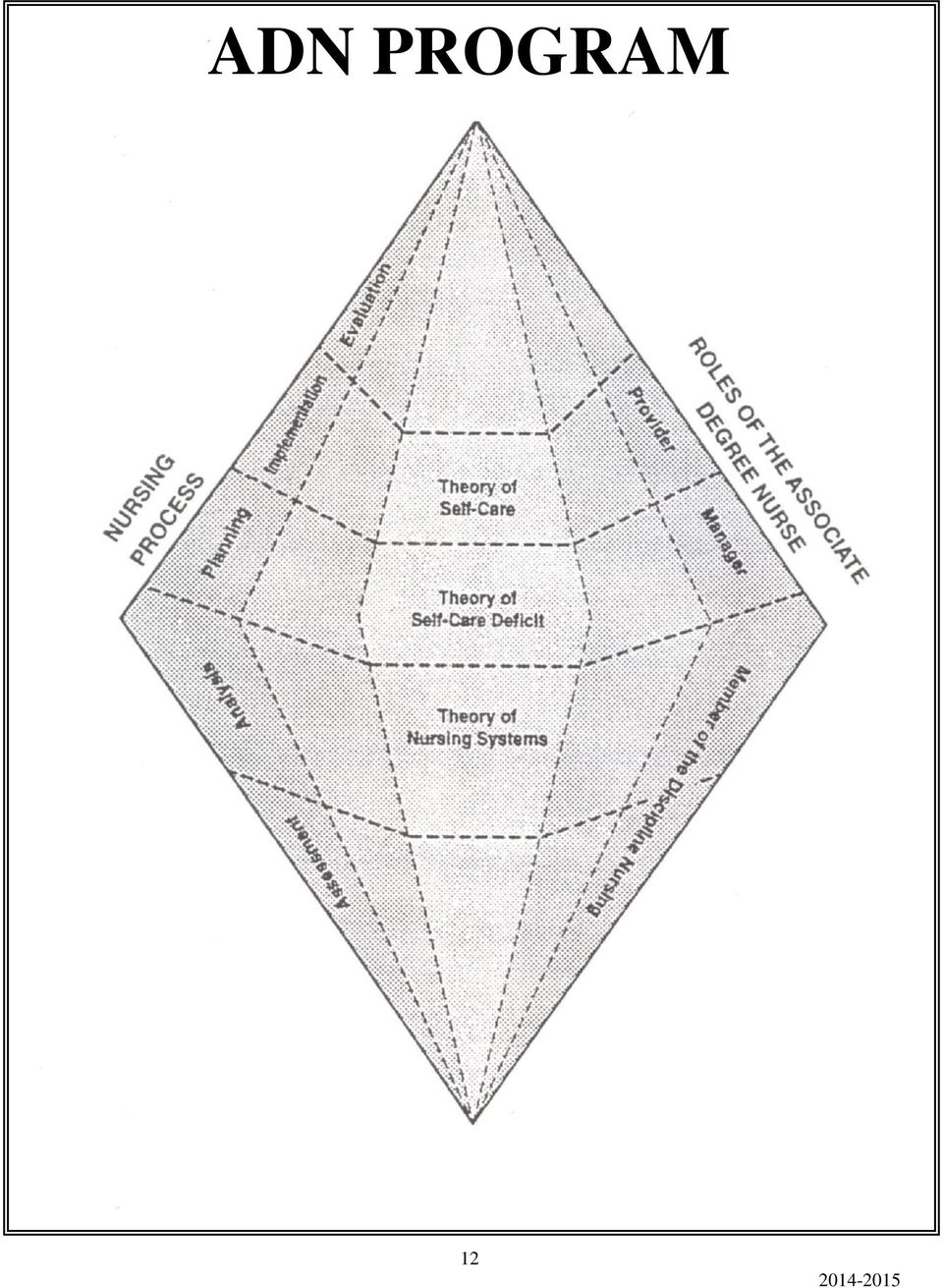
14 Environment - the dynamic, changing context in which an individual lives. It includes social, physical, ethical, moral, cultural and other influences that impact the client's ability to assume self-care. Graduate of the Associate in Applied Science - Nursing Program: An individual prepared to function as a beginning practitioner of care in a structured setting. The Associate in Applied Science-Nursing graduate is prepared to assume the role of provider of care, manager of care, and professional member within the discipline. Associate in Applied Science Nursing Conceptual Framework The Jackson College Nursing Department has predominately used Orem's conceptual model of nursing, the nursing process and the National League for Nursing's roles of the associate degree nurse in the conceptual framework for the Associate in Applied Science - Nursing Program. In organizing the program's conceptual framework, faculty envisioned a system-based framework, including the interfacing of three equally relevant components: Orem's Conceptual Model of Nursing [the theories of self-care, self-care deficits and nursing systems Nursing Process (assessment, analysis, planning, implementation and evaluation), and Roles of the Associate Degree Nurse (provider of care, manager of care and member of the discipline). Further, the faculty views a dynamic interaction between the process threads (nursing process and the roles of the AAS-N) and the content threads (the theories of self-care, self-care deficits and nursing systems). As identified, the process threads of the curriculum are provided by the phases of the nursing process (assessment, analysis, planning, implementation, and evaluation) and the three interfacing roles of the associate degree nurse (provider of care, manager of care, and member of the discipline). Nursing process is the systematic, interactive, problem-solving process utilizing scientific principles and critical thinking by which nurses can assist persons to resolve self-care deficits and achieve optimal states of well-being. Further, the nurse utilizes nursing process as an organizing framework from which he/she carries forth the integrated roles of the associate degree nurse. Within Orem's conceptual model of nursing, the faculty has identified three theoretical entities as the curriculum's content threads: Theory of Self-Care: Is the demands across the life s span inclusive of the physiological, psychological, sociocultural and spiritual dimensions of persons, and determinants which are those factors that influence a person's ability to engage in self-care. Theory of Self Care Deficits: Is the inability to engage in self-care and meet self-care demands. Theory of Nursing Systems: Are the nursing actions necessary to accomplish therapeutic self-care demands. 14

15 The faculty's rationale for choosing the above-referenced concepts to frame the Associate in Applied Science - Nursing Program includes: A systems framework is consistent with scientific theory as well as being reflective of many nursing theories, [Orem, Roger, King, Watson]. Orem's conceptual model of nursing is consistent with the mission and philosophy of the College and of the nursing program. Nursing process is the basis by which nurses deliver care to clients and groups in an organized, competent and holistic manner that is based upon a nursing conceptual framework and validated with scientific knowledge and research. The roles of the AAS-N provide faculty with a consistent and professionally recognized definition from which outcome competencies and a program of study can be developed, as well as serving as a framework from which to develop evaluation systems. In addition, the Code of Ethics for Nurses with Interpretative Statements (ANA, 2001) informs the curriculum and provides ethical guidance to students and practicing nurses throughout their careers. Following is a summary of the provisions found in the Code of Ethics document. American Nurses Association Code of Ethics for Nurses 1. The nurse, in all professional relationships, practices with compassion and respect for the inherent dignity, worth and uniqueness of every individual, unrestricted by considerations of social or economic status, personal attributes, or the nature of health problems Respect for human dignity 1.2. Relationships for patients 1.3. The nature of health problems 1.4. The right to self-determination 1.5. Relationships with colleagues and others 2. The nurse s primary commitment is to the patient, whether an individual, family, group, or community Primacy of patient s interests 2.2. Conflict of interest for nurses 2.3. Collaboration 2.4. Professional boundaries 3. The nurse promotes, advocates for and strives to protect the health, safety and rights of the patient Privacy 3.2. Confidentiality 3.3. Protection of participants in research 3.4. Standards and review mechanisms 3.5. Acting on questionable practice 3.6. Addressing impaired practice 15

16 4. The nurse is responsible and accountable for individual nursing practice and determines the appropriate delegation of tasks consistent with the nurse s obligation to provide optimum patient care Acceptance of accountability and responsibility 4.2. Accountability for nursing judgment and action 4.3. Responsibility for nursing judgment and action 4.4. Delegation of nursing activities 5. The nurse owes the same duties to self as to others, including the responsibility to preserve integrity and safety, to maintain competence and to continue personal and professional growth Moral self-respect 5.2. Professional growth and maintenance of competence 5.3. Wholeness of character 5.4. Preservation of integrity 6. The nurse participates in establishing, maintaining and improving healthcare environments and conditions of employment conducive to the provision of quality healthcare and consistent with the values of the profession through individual and collective action Influence of the environment on moral virtues and values 6.2. Influence of the environment on ethical obligations 6.3. Responsibility for the healthcare environment 7. The nurse participates in the advancement of the profession through contributions to practice, education, administration and knowledge development Advancing the profession through active involvement in nursing and healthcare policy 7.2. Advancing the profession by developing, maintaining, and implementing professional standards in clinical, administrative, and educational practice Advancing the profession through knowledge development, dissemination, and application to practice 8. The nurse collaborates with other health professionals and the public in promoting community, national, and international efforts to meet health needs Health needs and concerns 8.2. Responsibilities to the public 9. The profession of nursing, as represented by associations and their members, in responsible for articulating nursing values, for maintaining the integrity of the profession and its practice and for shaping social policy Assertion of values 9.2. The profession carries out its collective responsibility through professional associations 9.3. Intraprofessional integrity 9.4. Social reform 16

17 Associate of Applied Science - Nursing Nursing Educational Outcomes Following completion of the program, graduates are expected to assume the role of a: 1. Provider of care in a structured setting using the decision making process to determine the clients self care requisites and implementing a plan of care that collaborates or provides for self-care deficits. 2. Manager of care in a structured setting using decision making and leadership skills to organize resources, delegate, collaborate and advocate for clients/client systems. 3. Member within the discipline of nursing characterized by a commitment to practice according to professional standard, active on-going participation in self-learning and accountability to legal and ethical standards of practice. Progression Policy: AAS-N Nursing education builds on prior learning. It is necessary to complete certain required courses before taking advanced courses. The following courses must be completed with a 2.0 grade before proceeding to the next more advanced course. Level 1 Fundamentals of Nursing (NUR 101) Pharmacology (NUR 121) (if not completed previously) Health Assessment (NUR 245) Level 2 Supportive Educative Nursing (NUR 171) Pathophysiology (NUR 172) Family I (NUR 176) Level 3 Partially Compensatory Nursing (NUR 270) Family II (NUR 276) Mental Health (NUR 277) Level 4 Wholly Compensatory Nursing (NUR 275) Leadership (NUR 274) If failure in any course occurs, see Re-Admission Policy. 17

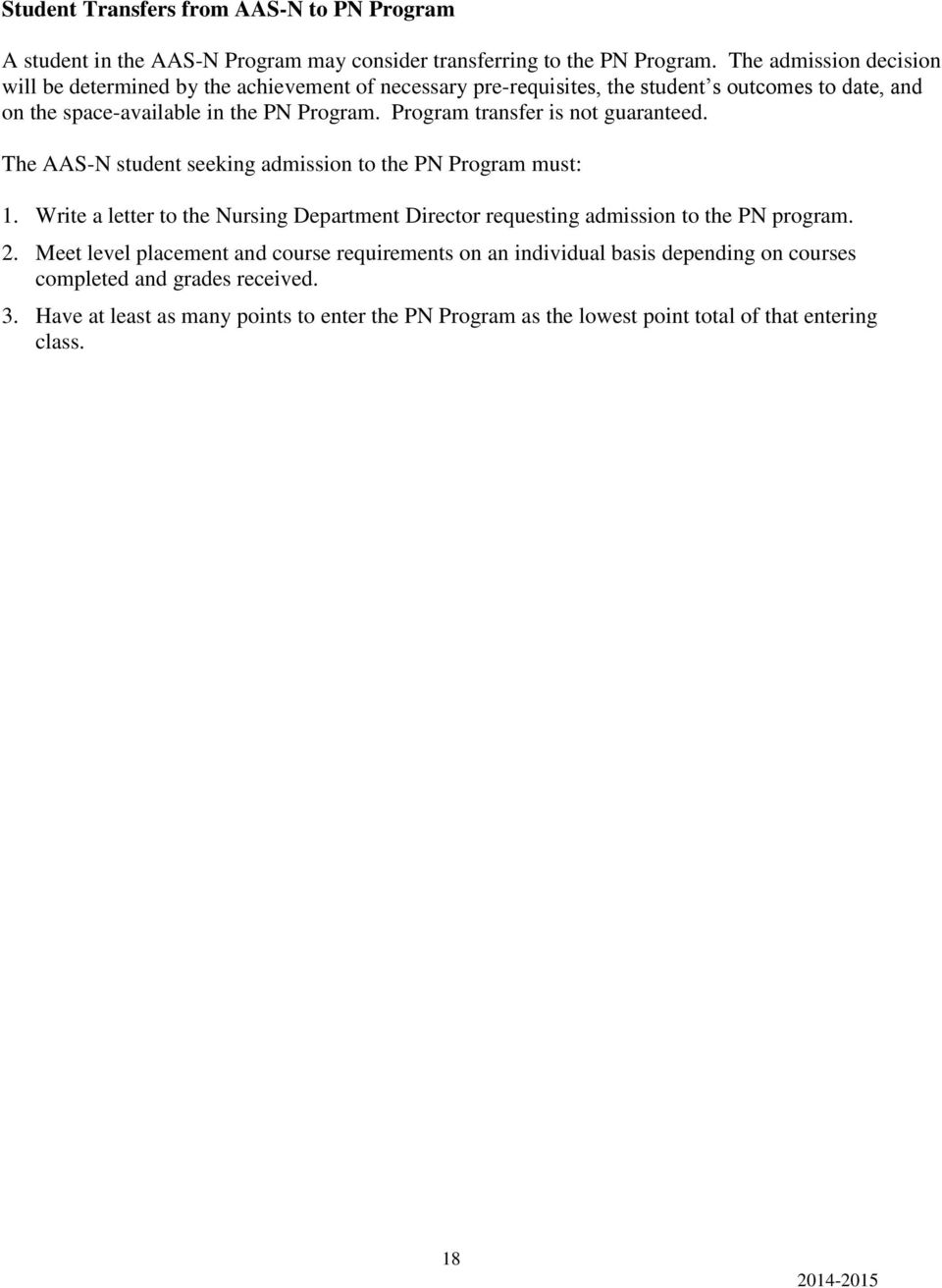
18 Student Transfers from AAS-N to PN Program A student in the AAS-N Program may consider transferring to the PN Program. The admission decision will be determined by the achievement of necessary pre-requisites, the student s outcomes to date, and on the space-available in the PN Program. Program transfer is not guaranteed. The AAS-N student seeking admission to the PN Program must: 1. Write a letter to the Nursing Department Director requesting admission to the PN program. 2. Meet level placement and course requirements on an individual basis depending on courses completed and grades received. 3. Have at least as many points to enter the PN Program as the lowest point total of that entering class. 18
19 LPN to ADN Associate in Applied Science Nursing LPN to ADN This program is a part of the AAS-N (Associate in Applied Science-Nursing) degree, but is designed for the Michigan Licensed Practical Nurse who is returning to college for coursework and clinical experience. Upon successful completion, the individual is required to take the NCLEX-RN. Level 2 Pharmacology (NUR 121) or test out via the NLN Pharmacology exam. Transition Bridge and Care of the Family (NUR 124) Pathophysiology (NUR 172) Level 3 Partially Compensatory Nursing (NUR 270) Family II (NUR 276) Mental Health (NUR 277) Level 4 Wholly Compensatory Nursing (NUR 275) Leadership (NUR 274) Sections of the handbook referring to Conceptual Framework, Philosophy and Nursing Educational Outcomes of the ADN Program are all applicable for students in the LPN to ADN program. If failure in any course occurs, see Re-Admission Policy. 19

20 POLICIES AND PROCEDURES 20

21 Student Participation in the Nursing Department Every semester, multiple Student Forums are held to ensure students have the opportunity to give feedback to faculty and administration and to explore opportunities to participate in the functions of the nursing department. The Forums are co-facilitated by the Director of Nursing and Nursing Department Chair. In addition, students are invited to place items on the Nursing Department Meeting agendas as needed. Faculty welcomes and values student input into the curriculum and other aspects of the program. Issues related to individual instructors or courses are best dealt with by talking directly with the faculty involved (see Student Problem Related to Classroom Instruction). Customarily, student evaluation of a course will be solicited after it is completed. Additionally, following completion of the program, graduates will receive a survey to provide feedback on the entire nursing program. Cell Phones While the nursing faculty recognizes that communication with family and friends is important, the use of cell phones in class is very distracting to other students and instructors. Please keep all electronic devises on either vibrate or voice mail mode during class. If there is a family emergency and a cell phone must be on, please obtain instructor permission prior to class. Children Accompanying Student Nurses The classroom, laboratory and clinical environments are not conducive to the needs of children, and having children in these settings may be disruptive for other students, or hamper the necessary and frank discussions required in a nursing program. Students with children are advised to have a contingency/emergency child care plan in place. Instructors are to be informed of emergency issues with childcare. Attendance Policy General Policies and Procedures for All Nursing Students Attendance is key to success in the nursing program. Faculty recommends attendance to all classes. Students who miss class tend to be less successful. If illness or another emergency impacts your ability to attend class, be sure to notify your instructor. Attendance can be counted as part of the grade in a course, so please refer to individual course syllabi for guidance. There are also penalties for taking tests late, see individual syllabus. Faculty recognize that illness occurs and students should never attend clinical when experiencing an infectious illness which could be passed along to others, or if the student s health effects their ability to safely provide for the care of patients or one s own self-care. Attendance at all scheduled clinical experiences is mandatory; so any time lost for illness or other events must be made up. If the student is ill, it is the student's responsibility to call the instructor and the unit or agency where they are assigned for clinical and report his/her absence prior to the start time. Give the following information to the person at the agency who takes the message: your name, instructor's 21
22 name, nature of your illness/problem and its anticipated duration. Students must call for each missed clinical day. Failure to comply with this policy will result in disciplinary action. ALL CLINICAL TIME AND WORK MUST BE MADE UP If the absence equals or exceeds (4) four hours of clinical time, the student will be required to complete a full clinical day prior to the issuance of a grade for the course in which the absence occurred. Missing clinical time can lead to failure in a nursing course. Students missing (4) four or more clinical hours will be assigned to the first scheduled make-up day. The make-up day will be a seven hour day for all students. Please contact the Nursing Department Chair requesting a make-up day. Please be advised that date assignment is not negotiable and is most likely to take place on a Saturday. Pending the student s successful completion of all clinical assignments and responsibilities, as well as the make-up clinical time, a course grade will be submitted. Students who have less than four hours of missed clinical time will be assigned learning experiences as outlined below, within the time frame designated by the instructor. Make-Up Options (For Less Than Four Hours Missed) Which the Instructor May Assign: Clinical experiences as established by the instructor. Prepare a research paper related to a clinical problem/disease/treatment, using LRC search system. Use the Learning Lab to view videos, do computer simulations, and practice skills to current clinical experience. A brief report will summarize what the student learned from each experience. Read a book and do a report on a clinical topic. Develop an in-depth teaching plan for a disease/treatment encountered in the clinical area. Develop a case study to present. Should include detailed patient history, nursing and medical treatment, and discussion questions. Other as designated by the instructor Students who miss more than 20% of the clinical hours in any individual clinical course must repeat the entire course. On rare occasions satisfactory clinical make-up work in the appropriate clinical setting can be arranged. Appropriate means within the specialty being studied, and that the clinical work will result in meeting clinical objectives. The instructor and/or Director determine what is acceptable. Generally it is not possible to satisfactorily make up all the clinical time once a student has missed more than 20%. The student in that case repeats the course. 22
23 Program Completion Timeframes Students who are out of sequence, regardless of the reason, in the PN Program must complete it within two academic years. Students who are out of sequence, regardless of the reason, in the ADN Program must complete it within three academic years. Multiple withdrawals and re-admits result in lengthy intervals in completing nursing programs, and have been linked with lack of success clinically, in lecture courses, and on NCLEX results. Student Problems Related to Classroom Instruction/Faculty The Nursing Faculty expects a student to initiate a conference with the classroom or clinical instructor when a problem related to that course arises. If the student is not satisfied, he/she may then consult the lead faculty of the course. If the problem cannot be resolved between a student and lead faculty, the student may consult the Department Chairperson and/or the Director of Nursing for mediation. If a student is not satisfied with the mediation within the Nursing Department the student has the right to appeal by following the academic complaint process as outlined in the JC Student Handbook beginning at Step 2. Transfer from Other Nursing Programs and Schools Students are encouraged to complete nursing programs at their original schools of nursing. Nursing curriculums are not standardized; therefore, transfers between nursing programs are difficult and usually not possible. Students typically do not have all the pre-requisites needed for entry, have had different course sequencing and variations in content. Since admitted JC students will not be displaced, the possibility of transfer only exists when space is available. To be considered for transfer to a JC nursing program from another program the following must be in place: All pre-requisites and minimum grades and point totals required for the JC nursing programs must be met prior to any consideration for transfer. The student needs to obtain a letter from the Program Director of the transferring school indicating they are in good standing and eligible to return to their original program. Full syllabi will be required for any course the student is seeking to have transferred for credit into the Nursing Department. Students seeking transfer must have comparable points on the point system as the class entering. Students seeking transfer will not displace any other admitted students. Any placement under consideration is on a space available basis. Transfer/Substitution of Non-Clinical Courses (ie. NUR 121, NUR 172) Students requesting to substitute a non-jackson College course(s) for NUR 121 or NUR 172 must submit a copy of the alternate institution s syllabi to the department director/chair PRIOR TO admission to the nursing program. Such courses must have a minimum transcripted grade of 78% and be comparable in the content of the JC nursing course. Lead faculty will review provided materials to determine if transfer equivalency will be considered. Courses will not be considered if the required materials are missing or if the deadline for the request has passed. 23
24 Grading Each nursing course has an individualized evaluation plan to determine how grades will be achieved. For example, how much weight is given to examinations, quizzes, and whether term papers are required, are all individual instructor decisions. JC nursing instructors use a standardized grading scale. A minimum of a 2.0 is required for all nursing courses. Grades are first figured as a percentage; the percentage is converted to a number grade using the following scale % = % = % = % = % = % = Non-Passing Grades 70-73% = % = 0.5 < 66% = 0.0 The final grade is given for course work but is contingent upon satisfactory completion of the clinical experience, when applicable. At times, content from previous courses will be tested in subsequent courses. There are Three Separate Requirements students must achieve in order to pass nursing courses: First - Students must earn a 78% on the TEST component of each nursing course. Second - An overall percentage of 78% or above is required in each nursing course. Third - Applies to courses with a clinical section. Students must achieve a satisfactory in clinical in order to pass the course, regardless of the theory grade. A student, who earns higher than 78% in theory but receives an unsatisfactory grade in the clinical portion of a class, will automatically receive a 1.5, regardless of test grades. Standardized Testing There are several nursing courses in the ADN curriculum where standardized tests are given and are a part of the course grade. These are computer based tests taken at or near the end of the course. Standardized tests are given to evaluate knowledge of content areas, to compare individual student performance with national norms, and to evaluate testing ability in preparation for the NCLEX-RN. The standardized test results will be factored in the overall course grade as outlined in course syllabus. If scores on any of these tests indicate a reason for concern, please consult faculty for advice on what can be done to improve test taking abilities and performance. PN students content knowledge and performance compared to national norms will be assessed; however, results are not factored into course grades. 24
25 Testing Additional Information Testing is one method to assess content mastery and critical thinking. Faculty developed tests are timed tests and written to simulate NCLEX test as much as possible. The NCLEX is also a timed test. Generally you will be given no more than a minute per multiple-choice question. Many courses will require testing outside of the class time. Please plan on this additional time in your schedule. Be aware of the hours the testing lab is open, the time needed to take each test, and instructions for taking the tests. Picture ID is required upon entering the Testing Center for testing. On multiple choice tests, test items are analyzed to see what percentage of students answered correctly. Items where more than seventy percent of the class chooses the wrong answer are examined by the faculty. Having more than seventy percent of a student group choose incorrectly does not guarantee that multiple answers will be accepted. Please contact your faculty member prior to the scheduled time to test if an emergency is preventing you from taking it when scheduled. Students taking tests late will be penalized as outlined in the syllabi. Once a test has been taken, the grade stands, regardless of circumstances. See Appendix for Student Testing Agreement. Also be aware of the policy on Academic Honesty. Academic Integrity and Honesty Policy Nurses are highly regarded as trusted professionals. We are committed to the ideals that honesty and integrity are essential qualities for the profession of nursing. Here at Jackson College each of us has a personal responsibility to strive for veracity, integrity, and trust in our work and relationships. Academic integrity and honesty is expected of all students. Any student found to be cheating on an exam, quiz, or other assessment will be subjected to corrective action in accordance with the level of infraction outlined in the JC Nursing Handbook and JC Academic Honesty Policy. Corrective action may include receiving a maximum grade of 1.5 for the course in mention or possibly permanent removal from the program. CHEATING and serious violation of responsible technology use (see the Social Media/Simulation Lab Policy) can take on many forms. These may include but are not limited to: Bringing an answer source to the testing site. This could be a cheat sheet, your cell phone, etc. Copying answers or work from another student s test or project. Making copies or taking cell phone pictures of test or course materials including PowerPoint presentations. Changing an answer or work after submission. Sharing test information, test answers and content with someone who has not yet taken the test. Uploading prohibited course materials to any internet site or facilitating others to do so. Periodic audits of the internet are performed. All course materials have been specifically prohibited for distribution by instructors unless specifically indicated otherwise. This includes but is not limited to graded quizzes and exams, group work answers, etc., along with any questions that are or might be intended for future quizzes and exams. 25
26 Unauthorized possession or disposition of academic materials includes the unauthorized selling or purchasing of exams, quizzes, midterm projects, or other academic work; stealing or using another student's work; using information from or possessing exams/quizzes that a faculty member did not authorize for release to students. Facilitation of any act of academic misconduct includes knowingly assisting another to commit an act of misconduct; providing others with course materials to be uploaded digitally or to be shared manually. Taking quizzes with another student. Quizzes are to be done individually - do not share answers with others in person, through or on the phone. Sharing answers is considered cheating and will be treated as such. Plagiarism is another form of cheating. Plagiarism may involve but is not limited to submitting a paper written by someone else (obtained from the web or a fellow student) or using direct quotes from any source without crediting the source. Additional areas of concern specific to nursing include but are not limited to: Covering up or not reporting a clinical error. Charting something complete that was not done. Altering any legal documents. Deviation from an accepted Standard of Care or Standard of Practice. Any form of lying/misrepresentation to faculty, health team members or others. If you are unsure if a practice might be considered cheating, please check with an instructor and/or do not engage in that practice. 26
27 Clinical Guidelines Uniform Policy: The uniform policy provides a guideline for nursing students regarding the value of a professional appearance and demeanor. A health professional's appearance has been shown to affect the development of nurse-client rapport, working relationships with other professionals, and interaction with the public. Uniforms are worn for clinical and lab return skill demonstration check-offs but not for class. Clinical uniform policy adjustments may be necessary to ensure compliance and support various clinical agency policies. Students order uniforms and obtain identification badges during their scheduled JC nursing program student orientation. The first JC identification badge is supplied free of charge. Subsequent or replacement badges may be obtained through the JC Security Department for a fee of $5.00. Payment for uniform orders is due when order is picked up at the Bookstore. Clinical Uniform All Students: Burgundy scrub top with gold embroidered JC logo monogram. A plain white crewneck shirt may be worn under the scrub top. Plain burgundy scrub pant, a white lab coat with burgundy embroidered JC logo monogram, and a JC name tag/badge. Some clinical specialty units require a breakaway lanyard identification badge. White socks White shoes Out of Uniform Clinical Dress (Professional or Business Casual Attire): There are learning experiences where the clinical uniform is not required such as the mental health clinical. Check specific course syllabi for more details. In general, professional casual attire means either chinos or khakis slacks, a collared shirt or blouse which may be a polo style, and skirt or tailored dress at knee length or longer. Jeans, shorts, or sweat suits are never appropriate in any clinical setting. Examples of other inappropriate attire include t-shirts, tank tops, above the knee skirts, shorts, low rise slacks or trousers where skin is exposed, tight fitting tops exposing the midriff, low cut tops, or flip-flops. Appearance Guidelines: Matching tops and pants are required with the same color tone. Uniforms must be clean, neat, and pressed. Uniforms must fit properly. Pant hemlines should not touch the floor. A white under scrub layering shirt may be worn that must be white, not yellowed, and without fraying. White shoes without colored trim with closed toes and closed heel and white socks are required. Shoes must be clean/polished. Shoelaces must be clean, white, and unbroken. 27
28 Only one small post earring in each ear lobe is permitted. All other visible piercing jewelry must be removed. A wedding ring/band is allowed, no other rings, necklaces or bracelets. Any visible body art must be covered while in the clinical area. Avoid use of perfume in the clinical area. Nails should be kept short and well groomed. Only clear or pale pink un-chipped polish may be worn. Long nails may harbor infectious organisms and may scratch clients accidentally. Acrylic nails are NEVER allowed in clinical. Acrylic nails must be removed prior to any clinical experience. Makeup and hair styles should be conservative. Hair that is collar length or longer must be pulled back and kept under control at all times. Men should either be clean shaven or the beard short and well-trimmed. Good personal hygiene is required. Others automatically discount anyone who appears dirty, greasy, or has body odor. JC nursing faculty reserves the right to determine appropriate dress, to enforce the guidelines above, and to send the student home from clinical if the student is dressed unprofessionally or not in compliance with appearance policies. Adjustments in the policy that may be necessary to specific clinical units or sites are delineated in specific course syllabi. Clinical Expectations Prepare for clinical as directed by faculty. This is for the patient's protection as well as your own. If a student is not adequately prepared for clinical, based on the expectations outlined by the instructor, the student will be asked to leave. This could result in a written notice and/or clinical failure (see Attendance Policy). When at the clinical facility to prepare for the next day's assignment, wear the required lab coat, a nametag, and suitable street clothes. Jeans, sandals, sweat suit type clothing, or shorts are not to be worn in the clinical area. Students are to report in to a staff member when entering the area. Never write the patients name, initials, or other key identifying information on any papers or other items while preparing for the next day s patient assignment. Do not leave the facility with any written information which violates HIPPA regulations. Direct questions to faculty or the staff nurse in the area when faculty are not present (while picking up patient assignments). Students are only to be in a clinical area to obtain assignments and perform patient assessments at times designated by instructors. Standard precautions are to be followed at all times. It is possible a clinical experience may occur in a setting where the student is currently employed. If this happens, students are to function in the role of a student nurse and stay within those boundaries. Consult with faculty if conflicts in role arise. Before beginning patient care, listen to report, review SBAR tool or other patient care pathways, receive specific instructions from the registered nurse, and perform an initial patient assessment. This may vary depending on clinical setting. 28
29 Before performing a procedure, students must be prepared. If possible, review the procedure in the policy and procedure manual of the institution. If there is not time for this review, discuss the procedure with your instructor before entering the patient s room. Patients should never hear step-by-step instructions for the procedure. The clinical instructor must be with students when performing procedures, administering medications, hanging IV's, etc., unless permission has been explicitly given for the student to proceed on their own. Do not ask or allow a nurse in the institution to supervise. It is the clinical instructor's responsibility to observe students performing procedures, or to delegate that supervision. Student nurses may not take physician orders orally or over the phone. In Leadership, students may take phone orders with a registered nurse or the clinical instructor listening on an extension and co-signing the order. NEVER sign or witness surgical permits, wills, forms listing valuables, etc. Students are not authorized to legally be a witness. At the end of the clinical experience, students will have a performance conference with the clinical instructor. However, if a student has concerns/problems, the student is advised to schedule a conference with their instructor at any point during the course. Report any illness as outlined under the attendance section. Students with a concern regarding their own, or a family member s, previous experience as a patient or employee of a particular unit or agency should address the situation with their instructor, or the Director or Department Chair. If time allows, students will be given a lunch break during clinical; however, students are expected to remain in the agency and not leave the premises. Health Requirements Drug Screening: To demonstrate compliance with the alcohol and drug policies of the College and clinical affiliates and as a condition of admission, all nursing student candidates will undergo a urine drug screen. The test will be done within a timeframe designated by the nursing department. Failing the drug screen or lack of participation in the drug screen will result in withdrawal from the program. The drug screen will be done on a urine sample and will assess for the presence of illicit and/or prescription drugs not prescribed by a health care provider (including but not limited to marijuana, cocaine, PCP, valium and opiates). All results will be sent to the JC Security Department and will be maintained there. See Performance Notice section for more information on the use of alcohol or other drugs by students. Smoking: Jackson College is a tobacco free environment and is committed to protecting the health of students, staff, faculty and guests by prohibiting the use of and/or sale of tobacco products on all JC properties. Similarly, the majority of the clinical affiliates are also smoke free environments. Nursing students will be expected to follow the College and clinical affiliates polices. Students who smell strongly of smoke or who violate the agency smoking policy may be asked to leave the clinical site. If asked to leave a clinical site, missed time will be considered an absence. Students should be aware that some health care systems will not hire someone testing positive for nicotine. 29
30 Smoking cessation support is available to students in the Health Clinic or through the Allegiance Health Tobacco Treatment Services. Mandatory Health Data Requirements: As a condition of admission, all nursing student must have verification by a licensed health care provider that the student is physically and emotionally able to complete a nursing program of study. Students are required to have a Negative 2 step Tuberculin Skin Test or negative chest x-ray. A one step Tuberculin Skin Test must be updated yearly. Proof of immunizations or immunity for o Rubella (German Measles), o Rubeola (Hard Measles), o Mumps, o Varicella Zoster (Chicken Pox), o Diphtheria/Tetanus/Petussis (Tdap), o Hepatitis B Vaccine Series. It is preferable that the Hepatitis B series be completed prior to entering the nursing program, however, minimally it must be started or a waiver signed before the by the first week of the semester. Clinical facilities require documentation of immunization records several weeks in advance of participation in clinical. Students will not be allowed in clinical if records are not received within the designated timeframes. This can, in turn, will result in a clinical failure. Latex Sensitivity: If a student has a sensitivity or allergy to latex, the student MUST inform the Director of Nursing prior to or at any point during the program. CPR Certification: All students must show evidence of Professional Level CPR Certification. Professional Rescuer or Health Care Provider certificate must include the infant, child, adult, 1 man - 2 man CPR, choking and defibrillator. CPR recertification is required every 2 years. It is the student s responsibility to provide documentation to the Nursing Office upon admission to any nursing program for all immunizations, and to submit evidence of annual TB screening and CPR re-certification. Failure to comply with the above health care requirements may result in an unexcused clinical absence and possibly failing the course. In addition, failure to submit the required documents prior to the established dates, at both the time of admission and for each semester throughout the program may result in a 3% deduction in final grades. 30
31 Student Health Issues: It is the student s responsibility to inform the Nursing Director (or Chair in the Director s absence) of any health condition (i.e. illness, injury, surgery, pregnancy) that might compromise performance or safety of either the student or patient(s). Reasonable accommodation will be our goal. If a student has an infectious process that may endanger clients in the clinical setting, they need to a) inform the Director of the situation b) provide a written letter from their health care provider that it is safe for them to return to clinical practice. While in the program, any student diagnosed with a serious illness or sustaining a serious injury, becoming pregnant or having undergone surgery, will be required to obtain a written doctor s release to continue in class and clinical and/or to return to class and clinical. The release will verify that she/he is able to meet class/lab/clinical practice requirements without restrictions on activity (such as limitations on weight lifting.) The goal is to prevent aggravating an existing condition, or jeopardizing the students, classmates or patient s safety or well-being. Students requesting return to the nursing program following time off due to a health condition will also require a physician s release. If at any point there are concerns regarding a health problem or disability, Jackson College reserves the right to require a medical release or physical examination. Students are responsible for contacting instructors regarding concerns or risks related to their own health care needs. Students who have a concern related to a past admission in a clinical setting should contact their instructor. Students who withdraw from a program due to health issues must follow the Re-Admission Policy. Students must meet the Technical Standards and Functions set for participants in the JC Nursing Programs. These are found in the back of this handbook, pages 53 & 54, and are also available in the Nursing Department and through Student Services. Exposure, Incidents & Disease: Nursing students need to be aware that they will be working with patients who may have infectious diseases. Students must follow infection control procedures (standard precautions and special transmission precautions) at all times. Contact with blood or other potentially infectious materials in the eye(s), mouth, mucous membranes, non-intact skin, or parenteral exposure is called an exposure incident. Following Centers for Disease Control recommendations will greatly decrease this risk. Should exposure occur students must make their clinical instructor immediately aware. The instructor/school will make recommendations based on current CDC guidelines. Students are responsible for accessing recommended care and for costs associated with the care received. Accidents (Including Needle Sticks): While rare, accidents do occur in the clinical setting and on campus. If an incident occurs in the clinical setting, follow agency policy, including filling out and filing variance reports and seeking care if needed. If an accident should occur on campus, a JC accident report needs to be filled out and filed with the Security Office. If emergent care is needed the student can chose to go to the emergency department, however, all treatment is at the student s own expense. Otherwise, it is highly recommended and encouraged for the student to see his or her primary health care provider, the Center for Family Health or the JC Health Clinic for consultation and/or follow-up. The student is financially responsible for this consultation or follow-up. Additionally, a JC accident report, available on JC website, needs to be filled out and filed with the JC Security Office ( ) within one week of occurrence. Depending on the nature and/or severity of the accident, a physician s release to return to the classroom or clinical site may be required. 31
32 Health Insurance: Students are strongly encouraged to carry health insurance to cover the cost of hospital and/or medical care for any student illness or injury acquired while participating in a clinical experience. The cost of student s medical and/or hospital care is not assumed by the College. Substantial monetary liability can be incurred if an injury or illness occurs. 32
33 Legal Responsibilities Nursing students are responsible and liable for their own actions, including any acts of negligence committed during the course of clinical experiences. When students perform duties that are within the scope of professional nursing, such as administering an injection, they are legally held to the same standard of skill and competence as a registered or licensed practical nurse. Lower standards are not applied to actions of nursing students. During registration, students pay a course fee with select clinical courses to defray some of the costs associated with general and professional liability coverage. The general liability policy covers the college and is not a student policy. Students are covered by a professional liability policy carried by the College. To fulfill responsibilities to clients and to minimize chances for liability, nursing students must: Be prepared to carry out the necessary care of assigned clients. Ask for additional help or supervision in situations for which they feel inadequately prepared. Comply with the policies of the agency in which they obtain their clinical experience. Comply with the policies and definitions of responsibility supplied by the Department of Nursing. Follow the Code for Nurses. Criminal Background Checks Most of JC s clinical sites are subject to ACT 303 of the Public Acts of 2002, amended April 1, 2006, of the State of Michigan, which restricts persons with certain criminal convictions from having access to vulnerable populations. Therefore, the agreements that JC has with these organizations require that as a condition of admission, all students will be subject to a fingerprint based Criminal Background Check, including an FBI check. Some criminal convictions may be cause for a student to NOT be admitted into any nursing program at Jackson College. The same stipulation would also apply after admission. Should a current nursing student be convicted of an exclusionary crime it would result in dismissal from the program. Following graduation, application for licensure may be denied should a conviction occur. Exclusion periods are based on the nature of the conviction and range from 1 year to permanent. The Michigan Long Term Care Partnership has prepared a Legal Guide to help with your questions. Visit their web site at and click on the Legal Guide for more information. If you have questions about the law or your personal circumstances, contact Jeff Whipple at
34 Performance Notice Procedure Students who fail to meet academic, clinical, professional, or program requirements will receive a written performance notice. The performance notice will be issued soon after the problem is identified. Suggestions for improvement may include any reasonable action the faculty deems appropriate to correct the behavior. Depending on the seriousness of the behavior, consultation with the Lead Faculty, the Department Chair and/or Director of Nursing may be necessary. If the student behavior or performance is of a serious nature, it may necessitate immediate dismissal from the program. If a student is immediately dismissed a performance notice will not be issued; instead, a dismissal notice explaining the circumstances of the dismissal will be completed (see section on Program Dismissal for more information on dismissal process). The criteria for issuing a performance notice include but are not limited to: 1. Unsatisfactory achievement of level or clinical objectives. 2. Unsafe or potentially unsafe clinical nursing practices. This may be one substantive incident, or repeated instances of questionable nursing practice which could jeopardize patient care. Examples of these include, but are not limited to: a. Errors related to medication administration, including but not limited to lack of knowledge on key concepts or knowledge of individual drugs, errors in preparing or administering medications or errors in dosage calculation. b. Violation of nursing principles resulting in actual or potential patient harm. c. Failure to safely adapt nursing skills to actual patient care. d. Failure to demonstrate adequate preparation for the clinical experience as outlined in syllabi or other course materials. e. Failure to demonstrate sound clinical or professional judgment. f. Performing a procedure without the required knowledge and skill competence, or without the guidance of a qualified individual (i.e. the instructor or designee). 3. Failure to establish effective working relationships with classmates, faculty, or health team members in providing safe patient care. Examples include, but are not limited to: a. Not reporting off to the nurse in charge of the patient. b. Failure to notify health team of pertinent changes in the patient s health. c. Ineffective or inappropriate communication with health team members, including faculty, staff members, or with peers. d. Dishonesty in communication with faculty or other members of the health care team. 4. Disruptive behavior that substantially or repeatedly interferes with teaching and learning. Examples include, but are not limited to: a. Profane or disrespectful language. b. Rude, discourteous speech or behavior (e.g. put downs, insults, slurs, rumors, either in person or online). c. Disregard and insolence for/toward others. d. Persistent interruption or side conversations. e. Persistent argumentation. f. Bullying, menacing, aggressive behavior. 34
35 5. Failure to establish effective therapeutic relationships with patients. Examples include, but are not limited to: a. Willfully or unintentionally doing physical and/or mental harm to a patient. b. Exhibiting careless or negligent behavior in connection with the care of a patient. c. Refusing to assume the assigned and necessary care of a patient and/or failing to inform the instructor with immediacy so that an alternative measure for that care can be found. e. Inability to establish effective communication with a patient or patient s family. f. Non-therapeutic verbal or non-verbal communication. 6. Failure to maintain confidentiality of patient information. Examples include but are not limited to: a. Using the name or initials of a patient in written assignments. b. Disclosing confidential information in inappropriate areas such as elevators or hallways, or via , social networking sites, cell phone texting, or use of a camera. c. Disclosing confidential information about a patient to third parties who do not have a clear and legitimate need to know. d. Seeking information on a patient(s) when it is not necessary for the student s nursing care giving. e. Leaving the clinical setting with any records or documents related to a patient, including any paperwork which contains identifying information about a patient (for example, the last name). 7. Dishonesty in the clinical setting: a. Falsifying patient records or fabricating patient experiences or nursing actions. b. Failing to report errors (or acts of omission) in treatments, assessment, medications, clinical judgment or other components of nursing practice. c. Falsifying or plagiarizing clinical assignments 8. Violations of established Nursing Code of Ethics. The Code of Ethics for the Licensed Practical Nurse and American Nurses Association Code of Ethics for Nurses are included in the JC Nursing Handbook. 9. Use of alcohol and/or other drugs of abuse: Drugs of abuse as identified by the National Institute of Drug Abuse include but are not limited to alcohol, marijuana, cocaine, heroin, methamphetamine, PCP, ecstasy, and/or non-prescribed medications such as benzodiazepines, opioids, or stimulants. If there is evidence that a student is under the influence of alcohol or other drugs while on a clinical assignment, the nursing student will be removed from the clinical area immediately. The student may be required to submit to drug and/or alcohol testing. Positive test results and/or refusal to submit to testing on the part of the student will result in discipline up to and including dismissal from the program. 10. Violation of the laws established regarding nursing practice in Michigan (contained in the Public Health Act of 1978). 11. Failure to assume the responsibilities of a student in the nursing program. a. Repeated tardiness to clinical (see attendance policy). b. Inappropriate personal appearance or inappropriate behavior in the clinical setting or class setting. c. Unethical or immoral behavior, i.e., lying, cheating, stealing. d. Failure to complete and submit required classroom or clinical written work as defined in the course syllabus. 35
36 The written performance notice will include reasons why the notice is being given, suggestions for improvement and criteria to be met to correct the behavior. The student s signature acknowledges that the student has received the written notice. Student's Reply to the Written Performance Notice The student is required to reply in writing, upon receipt of the written notice, within 5 academic days, as defined by the academic calendar. The student's reply must show evidence of problem solving regarding his or her identified unsatisfactory behaviors. This will include the following: Student s perception of the problem. Statement of awareness of the seriousness of the written performance notice. Methods that will be utilized to correct the problem. The performance notice process verifies that the student is aware of the situation and has developed a plan of action to correct the problem. A record of the written performance notice remains a permanent part of the student's record. If the behavior which elicited the warning notice recurs at any time during the nursing program of study, or if the behavior is of a serious nature, the student will be subject to discipline up to and including dismissal from the nursing program. Changes in Clinical Schedule Due to a Written Performance Notice When issued a written performance notice, a student: 1. May have his/her schedule re-arranged or be re-assigned to another clinical section by the lead faculty in consultation with the director of nursing to place a student in a setting where faculty can best assist the student to correct behaviors. Program Dismissal and Re-Admission Policy Students must earn a grade of at least 2.0 in each required course in the nursing program. Once admitted to a nursing program, if a student earns less than a 2.0 in ANY nursing course he/she is dismissed from the program. If the student does not pass each portion of a nursing course (theory, lab and clinical) the maximum grade earned will be 1.5. If a student fails a nursing course the student is automatically dismissed from the program. The dismissal could be the result of but not limited to a failure in a nursing theory course, a clinical failure, a serious clinical violation and/or unprofessional behavior. The criteria for issuing a performance notice are also the criteria referenced for issuing a dismissal notice. In consultation, as needed, with the Director and/or the Department Chair of Nursing, the involved faculty will inform the student of the failure and subsequent dismissal. 36
37 After informing the student, a dismissal notice will be completed by the involved faculty. The Director of Nursing will notify the student, in writing, that the student has been dismissed from the program. The letter will state whether the student is eligible for re-admission, and if eligible, a student re-admission packet will be provided. A copy of the dismissal notice will be included. Re-Admission Exclusions A student may be re-admitted to the Jackson College Nursing program one time in the PN program (excluding LPN 131) and one time in the ADN program (excluding Level I courses). Students in the ADN program who earn less than 2.0 (78% average) for a first level nursing course (NUR 101 or NUR 245) will not be allowed to repeat the course and will be dismissed from the program with no re-admission option. Any student failing NUR 245 is dismissed from the program immediately. Once dismissed, the student would not be allowed to continue in NUR 101 If a student is unable to complete NUR 101 due to a dismissal, a grade of 1.5 would be recorded. ADN students can elect to apply to the PN Program if failure occurs in any of the first level courses. Admission into the PN program is not guaranteed. Students who earn less than 2.0 (78%) in LPN 131 (Foundations in Nursing) will not be allowed to repeat the course and will be dismissed from the program with no re-admission option. Students Who Fail A Second Nursing Course Are Permanently Withdrawn From The Nursing Program. There Is No Petition For Re-Admission After Two Failures. A student will be dismissed from the program without opportunity for re-admission if he/she receives more than one performance notice for the same behavior, or more than two performance notices in any one semester. Course Withdrawal Students who are passing a course but are unable to complete a nursing course for nonacademic reasons such as illness or death in the family must inform the Director of Nursing of the intent to withdraw. The student may be referred to the Student Ombudsman Office for guidance on withdrawing from the nursing program. Students are responsible for understanding the consequences of withdrawing if they are receiving financial aid. Students who withdraw from the program because of health problems will be required to obtain written verification (from a physician or licensed professional health care provider) that they may return to the program before being re-admitted. Re-admission is dependent on space availability. Students who withdraw from the program and are not passing the course at the time of the withdrawal may petition for re-admission. The withdrawal will be considered a course failure. 37
38 If the student is a financial aid recipient, the student is advised to consult the Financial Aid Office regarding any pay back responsibilities. If a student does not officially withdraw from a course and is no longer attending, the student will receive a 0.0 grade. If a student fails two nursing courses, the student would be ineligible to return. Re-Admission Criteria If eligible, the student may petition for re-admission. Re-admission is contingent upon space availability. If the number of applicants exceeds available space, the decision will be based on nursing curriculum cumulative GPA. Applicants may be deferred to a subsequent semester. A withdrawal would count as either a course attempt or course failure based on grade status at time of withdrawal. The student applying for re-admission must meet all current admission criteria, and will be required to meet the curriculum requirements in effect at the time of re-admission. A student repeating a clinical nursing course must repeat both theory and clinical components of the course. A student may be required to repeat one or more nursing courses to insure continuity of content. If a student failed a course related to a single critical incident, he/she may or may not be considered for re-admission to the Nursing Programs depending on the severity of the incident A criminal background check must be repeated prior to clinical if student has been out of school for one year or more. A criminal background check cannot be done prior to 30 days before re-admission start date. * A student who successfully completes a course, but chooses to step out of the nursing program, will not be required to complete Academic Plan for Success forms. Re-Admission Application Process A student must complete a re-admission application packet, including the Academic Plan for Success forms (See Appendix for Re-Admission Forms). Submit all forms to the Director of Nursing to be considered by the Nursing Department Re-Admission Committee according to the following schedule: 1. Apply by May 1 for re-admission into the fall semester. 2. Apply by January 2 for re-admission into the winter semester. Any submission of the re-admission application package to the Nursing Program Re-Admission Committee must be completed and received by the due dates (listed above) for consideration. Late entries will be considered last in line which may/could affect space available placement. Address all correspondence to: 38
39 Attn: Re-Admission Committee Director of Nursing Jackson College 2111 Emmons Road Jackson, MI All students seeking re-admission will receive acknowledgement of their request and individualized plan of action according to Re-Admission Committee recommendations upon review of application packet. * Students who do not meet required re-admission requirements, and do not submit a detailed plan of academic readiness as described in this policy, will not be considered. Re-Admission Requirements Students who have failed a nursing course, or who have withdrawn from the Nursing Program must submit the following documents to the Director of Nursing to be considered by the Re-Admission Committee. The Re-Admission Committee will update faculty members regarding returning students at the last scheduled department meeting prior to summer/winter breaks respectively: 1. Complete and submit an application to the Re-Admissions Committee requesting re-admission (including your name, student number, semester, year). 2. Assure that required compliance documents, CPR and all immunizations are current throughout semester of which re-admission is requested. Copies of current documents must be submitted with re-admission paperwork. 3. Develop a detailed plan of academic readiness consisting of: A. Description of the reason(s) student left the program or student s perception of the problem leading to dismissal. B. Explanation of contributing circumstances: (including) Analysis of factors that lead to this outcome demonstrating an awareness of the problem Problem-solving actions established to correct the problem(s) defined in A. C. The student s detailed plan for success in the nursing course to be repeated and future nursing courses. The plan must be specific and goal oriented. D. All information is to be typed and submitted in WORD format utilizing American Psychological Association (APA) writing standards. E. Copies of the re-admission request documents will be distributed to all members of the Re-Admission Committee. F. The student s personal detailed plan of academic readiness success must be signed and becomes a contract that the student will follow throughout the remainder of the nursing program. 39
40 4. If re-admitted to the nursing program, the student will be assigned a full-time faculty mentor to facilitate achievement of the academic readiness plan. A scheduled review between the mentor and student will occur at a set point early in the academic semester (approximately 3 weeks). A determination will be made at that time in collaboration with the student as to need for further mentoring. If compliance has been met with re-admission policies and both parties agree individualized academic readiness planned goals have been achieved, further meetings would not be required unless requested by the student. Re-Admission Process for Clinical or Non-Academic Failure Any student with a clinical failure or non-academic dismissal from a nursing program will be required to follow the Re-Admission Application process. In addition, the student will attend a Re-Admission Committee meeting to present his/her request for re-admission and academic readiness plan. All forms associated with the academic readiness plan are to be completed by stated deadlines and then submitted to the Director of Nursing as outlined in the re-admission application process section. The Director of Nursing will confirm with the student that the re-admission packet was received. The student and faculty member involved in the dismissal will be informed by the Director of Nursing of the date, time, and place of a formal committee meeting. Copies of the re-admission packet will be forwarded to all the members of the Nursing Department Re-Admission Committee. The Committee will be composed of two nursing faculty other than the faculty directly involved in the dismissal, one faculty member from another discipline, the Student Ombudsman, the Nursing Department Chair and the Director of Nursing. Nursing faculty assigned to the Re-Admission Committee will serve one academic year. One alternate nursing faculty will be available for committee responsibilities as necessary. Formal Nursing Department Re-Admission Committee meetings will be scheduled as needed. The faculty member involved in the dismissal will attend the meeting to answer questions posed by the Committee or student. In the absence of the involved faculty, the lead faculty of the course will attend. At the meeting, the student s academic success plan will be reviewed. The Nursing Department Re-Admission Committee, after reviewing the student s history, pertinent documents, the involved faculty member s input, if requested, and the student s presentation, will determine if the student will be re-admitted to the nursing program. The Nursing Department Re-Admission Committee will look for compelling evidence that the reasons for the dismissal can be corrected with certain changes, and that these particular changes improve the chances for a successful outcome. Each student is expected to use the Re-Admission Rubric (See Appendix) as a guide for outlining his or her planned behavioral change. If the student is permitted to return to the program, the Nursing Department Re-Admission Committee will assign a full-time faculty mentor and determine if additional courses must be repeated as well as any other requirements (i.e. skills validation, Center for Student Success). 40
41 The Director of Nursing will notify the student in writing of the final determination and any re-admission conditions. Any re-admission is based on space availability. Students who are granted permission to repeat a nursing course will repeat both theory and clinical, regardless of which portion of the course they failed previously. Failure by the student to meet the requirements set forth by the Re-Admission Committee for their successful progression in the program will result in dismissal of the student from the Jackson College Nursing Program. If the student is denied re-admission and wishes to appeal the Nursing Department Re-Admission Committee decision, the student, in consultation with the Student Ombudsman, will submit a letter requesting a review to the College Re-Consideration Committee. The decision of the College Re-Consideration Committee is final. The student will not be allowed to continue in the program until this process is complete and a determination on re-admission is made. Determining Order for Space Available Placement When multiple students petition for re-admission, the following criteria will be used to determine placement: 1. Students passing a course at the time of a withdrawal due to serious illness or family issues will receive highest priority. 2. Students with an academic failure or withdrawal will be ranked according to overall nursing program GPA and the student with the highest nursing GPA will receive the opening. Students who decline or are "no shows" for the space available position will forfeit further opportunities to complete or repeat a course. Graduation Student Photographs: The representatives for each class are responsible for organizing individual and composite class photographs if the class so desires. Each class has traditionally provided a framed composite for display in the JC Nursing Department. This must be discussed with the Department Chair and the size and type approved in advance. Return of Property Prior to Graduation: Prior to graduating, or if the student leaves the nursing program, all property related to the status as a nursing student must be returned. This includes parking cards, identification badges, security codes from computer systems, and any other property identified by clinical agencies or the college. Students will not be issued their degrees or certificates until all such property is returned as instructed. NCLEX Review Course: As a requirement for graduation from the AAS-N Program and PN Certificate Program, participation in the NCLEX Review course offered through Jackson College is required. Students are responsible for paying this expense. These expenses are embedded in course fees of the last semester of both programs. Students who take the NCLEX Review courses have historically higher rates of passing. 41
42 Licensure Examination: Application to take the National Licensure Exam (NCLEX) will be distributed to graduates by the Nursing Office. Graduates are responsible for completing and mailing these forms at the time directed. The fee must be enclosed with the application. Conviction of a felony may prevent a candidate from taking the National Council Licensure Examination (NCLEX). The State Board of Nursing does not issue a temporary permit to practice. Graduation Information: See JC Student Catalog for graduation information. Students are encouraged to apply early for graduation so that a review of transcripts can occur and any problems will be identified at the earliest possible time. Failure to complete the JC intent to graduate form will result in a delay in issuing an affidavit to the Michigan Board of Nursing certifying completion of the program. Releases and References: Students must sign a Release of Information Form before references or other personal information will be sent out from the College. No references will be sent out without a signed release. References will be sent to prospective employers or educational institutions as requested by the student. If reference from a faculty member is desired, ask their permission prior to asking the employer to send the reference request. Social Media/Simulation Lab Policy Responsible e-practice for Nursing Students: This policy is to inform Jackson College (JC) nursing students, of their rights and responsibilities according to appropriate use of e-communication, social media and simulation tools in the academic healthcare environment. This policy applies to JC nursing students who participate in online discussions using the internet for school related purposes, and activities such as communications about clinical or classroom related assignments. JC Responsible Use Policy (Campus): This policy is designed to indicate what is considered responsible use of information technology resources. Use of any institutional information technology resource acknowledges acceptance of the Responsible Use Policy. Responsible Use Policy (Review) Information Technology Electronic Account (Review): All users provided with JC electronic resources are governed by the policies associated with owning an IT account. Nursing students are required to read the policies referenced and become familiar with responsible use of their JC personal network account. Professionalism and proper etiquette with all electronic communications including such areas as , JetNet classrooms, and Neehr Perfect/Sim Chart is expected at all times. Social Media Use: Students will be working extensively with computer technologies throughout their nursing programs. Whether collaborating for academic or personal reasons, learning experiences are shared. Social media communication resources such as Facebook, Twitter, YouTube, Wikipedia, LinkedIn, Allnurses.com, MySpace, Second Life, blogs, podcasts, RSS feeds, and other social media outlets allow for real time communications with personal and professional colleagues. Students will be held accountable for becoming familiar with and following the Social Media/Simulation Lab Policy guidelines at all times while enrolled at JC. 42
43 General Information: Extensive discussion of acceptable guidelines for personal behaviors related to the use of social media in nursing are recommended by the National Council of State Boards of Nursing (NCBSN), American Nurses Association (ANA), Nursing & Midwifery Council (NMC), and Centers for Disease Control and Prevention (CDC). The JC Nursing Department has adapted its policy based on these recommendations for accountability in the academic healthcare environment The Nursing Department reserves the right to update and modify policy guidelines as technology in nursing education evolves. More information about nursing social media use guidelines can be accessed via the web by clicking on the organizations listed above. *Discussion /distribution of any personal health, academically confidential, or sensitive information is protected by Health Insurance Portability and Accountability Act (HIPAA) and Family Educational Rights and Privacy Act (FERPA) federal laws. HIPAA guidelines must be followed at all times. Identifiable personal information that is posted to any online forum or web page about a patient/clinical encounter is a violation of federal law. Limiting access to postings through privacy settings is not sufficient to ensure privacy. FERPA guidelines to protect student privacies must be followed at all times. Identifiable personal academic information that is posted to any online forum or webpage is a violation of federal law. No student may post any proprietary college or faculty information (i.e. PowerPoint lectures, handouts, concept maps, databases, assignment rubrics) without written consent. All students must respect the Copyright Infringement, Computer Use & File Sharing Policy and fair use of information terms as indicated in the JC Academic Honesty Policy. The use of JC s logo or graphics on personal social media sites is not allowed. JC s name may not be used to promote a product, cause, or political party or candidate. *Any use of College logo or graphics must receive prior authorization from the JC Nursing and Marketing Departments. Video/Audio taping professors or fellow students for personal use without a signed confidentiality agreement and/or expressed permission of the individual s involved is prohibited. Transmission of any patient-related images and/or coursework or clinical information related images; including, but not limited to photographs of any body parts and/or data from chart or EMR (i.e. history/physical; labs, radiology and surgical results; SBAR data) via mobile/smart device is strictly prohibited. Additional imaging guidelines may be found in the program course syllabi. See Clinical Simulation Guidelines & Recording Policy for further recording information. Identify any views shared within the electronic media environment as your own. A student shall not post content or otherwise speak on behalf of the College, Nursing Department, or healthcare agency unless authorized to do so and in compliance with all applicable policies of the authorizing entity. Students must not make disparaging remarks about any community agency, its staff, or any ancillary services. Threatening, harassing, profane, obscene, sexually explicit, racially derogatory, homophobic or other offensive comments made in the electronic media environment can be grounds for dismissal from the program. 43
44 Students must maintain professional boundaries with patients at all times. Establishment of relationships online with previous patients/clients is not recommended. Doing so may be in direct violation of organizational policy of the healthcare facility and is not sanctioned by the JC Nursing Department. It is strongly recommended that all JC official college communication, including correspondence between students and employees (faculty/staff) regarding classes, schedules, and events, are to be conducted within college-sanctioned communication channels. These are: Microsoft Outlook Web App for official college business Moodle (JetNet/Sim Chart) for academic or clinical coursework Neehr Perfect for clinical or simulation coursework *Any official communications or activities conducted outside these channels are not endorsed by the College or Nursing Department; any breach of confidentiality or privacy guidelines must be reported immediately. Clinical Simulation Guidelines For learning purposes all users shall consider the information utilized in health care simulations as confidential and handle the information in the same way that is required by the Health Insurance Portability and Accountability Act (HIPAA) and other federal or state laws related to protected health information (PHI). Clinical Simulation Recording Policy (Review) In addition to the above policy, nursing students attending Simulation Lab learning experiences are required to sign confidentiality agreements. Depending on the seriousness of an offense, any violation of simulation policies associated with HIPAA, or any other confidentiality laws may result in penalties such as a written warning, a referral to college authorities for disciplinary action, and/or criminal prosecution. Common Myths about Social Media: False belief: once information has been deleted from a social media site, it is no longer accessible. Even if deleted from the site, there is no way to tell how the information traveled across the web and may have been shared / downloaded without your knowledge, or expressed permission. False belief: any electronic sharing of harmless health status information is acceptable as long as it reaches the intended recipient. HIPAA guidelines consider this act a violation of personal rights to privacy. False belief: patient information discussed on a social media site is acceptable if the patient is not addressed by name. Any referral to a patient by nickname, diagnosis, room number, or condition is also considered a breach of confidentiality. False belief: discussing events on personal time using a personal social media site account exempts the user from violations associated with the student nurse role or healthcare employment status. 44
45 Any personal opinion posted to a social media site must represent only the user and not an institution, or organization unless authorized to do so. Clarifications to this effect must be clearly presented at the time of posting any opinion. False belief: posting disparaging remarks, inappropriate language or visuals, or use of sexually explicit references contained within a personal social media account are private. Information posted to the web can be accessed by law enforcement, is often considered in hiring processes, and also used to monitor employee behavior. False belief: posting disparaging remarks, inappropriate language or visuals, or use of sexually explicit references contained within a personal internet account are private. Employers and schools are not prohibited from viewing information that can be obtained without any required access information within the public domain, and may gain access to any electronic communications device paid for (in whole or part) by the employer, or school. State of Michigan Internet Privacy Act: House Bill No htm 45
46 46
47 TECHNICAL STANDARDS FOR ADMISSION NURSING DEPARTMENT JACKSON COLLEGE The Nursing Department faculty has specified the following non-academic criteria which applicants generally are expected to meet in order to participate in the Nursing Programs and professional practice. These technical standards are essential and have been developed to provide for the health and safety of the patients receiving care from the Nursing Department students. 1. OBSERVATION The applicant must be able to participate in all demonstrations, laboratory exercises and clinical experience and to assess and comprehend the condition of all assigned patients. 2. COMMUNICATION The applicant must be able to communicate with patients, health care staff, and faculty effectively. 3. MOTOR The applicant must have motor functions sufficient to elicit information from patients by appropriate diagnostic or therapeutic maneuvers; be able to perform basic tasks; possess all necessary skills to carry out diagnostic or therapeutic procedures; be able to interpret movements reasonably required to provide general care and emergent treatment/actions as necessary for patient safety and comfort. 4. INTELLECTUAL/CONCEPTUAL INTEGRATIVE AND QUANTITATIVE ABILITIES The applicant must be able to measure, calculate, reason, analyze, evaluate, and synthesize information and observations. Problem solving, the critical skill demanded of nurses requires all of these cognitive abilities. 5. BEHAVIOR AND SOCIAL ATTRIBUTES The applicant must possess the emotional health required for full utilization of intellectual abilities; execute appropriate medical judgment; the prompt completion of assigned or non-assigned responsibilities for care of the service to the patient; and the development of supportive and effective relationships with patients. Applicants must be able to tolerate taxing physical and mental workloads, function effectively under stress, adapt to changing environments and conditions, display flexibility and function in the face of uncertainties inherent in the clinical setting and with patients. Compassion, honesty, dependability, concern for others, interest and motivation are personal qualities which each applicant should possess. 6. FREE OF CHEMICAL IMPAIRMENT The applicant must be free of chemical impairment. This is defined as a person who is under the influence of or is abusing alcohol, over-the-counter medication, illegal drugs, prescribed medications, inhalants, or synthetic designer drugs. Abuse of the substances includes episodic misuse or chronic use that has produced psychological symptomology. 7. SAFETY The applicant must be groomed in a safe manner in the clinical area. Any significant tattoos must be covered by the nursing uniform. Body piercing jewelry, other than ear piercing must be removed. Very young children and the patient with an altered mental status may be adversely affected by tattooing or body piercing. 47
48 TECHNICAL STANDARDS AND FUNCTIONS THAT ARE REQUIRED TO SUCCESSFULLY COMPLETE AN ASSOCIATE IN APPLIED SCIENCE NURSING DEGREE OR CERTIFICATE IN PRACTICAL NURSING STANDARDS Vision sufficient to see fine detail, and sufficient to be able to read and accurately complete reports in charts. Speech sufficient to be understood by others; ability to understand the communication of others. Hearing sufficient to understand the spoken word, hear variations in physical assessment findings. Physical coordination including fine motor functions sufficient to perform nursing procedures accurately, efficiently and safely. Sufficient muscle strength and lower back and knee stability to lift patients in a safe manner. Able to stoop when necessary. Sufficient psychological stability and knowledge of techniques/resources to be able to respond appropriately and efficiently in patient care situations. Free of Chemical Impairment during participation in the nursing program including classroom, laboratory and clinical settings. Sufficient endurance to walk for extended periods of time, up to eight hours per day. Ability to learn technical, medical, and pathophysiological information. Physical appearances free of visible tattoos and body piercing jewelry in the clinical area. FUNCTIONS Observing patient s skin color, measuring exact amounts of parenteral medications. Reading and completing of charts and reports. Communicating with patient and health care team. Listening to patients and other health care staff including phone conversation. Auscultate lung sounds, hearts sounds, and bowel sounds. Ability to perform nursing procedures such as insertion of catheters, suctioning, and applying dressings. Lifting and transferring of patients, physically assisting patients, moving beds and equipment. Bending at the knees to empty foley bags, lift objects off of the floor. Recognizing and responding appropriately inpatient care situations including emergencies. Displaying behavior that is free from signs of chemical impairment such as frequent mood swings, disappearing with as insufficient excuse, unexplained absences, and inappropriate behavior. Nursing requires almost constant walking. Completion of clinical and didactic components of program requires ability to learn. Care for confused clients, children without causing harm to patient and to self. 48
49 Re-Admission Packet Checklist Date: Name: Student # Year Application for Re-Admission (including your name, student number, year) Required compliance document: CPR, TB skin test and all immunizations must be current throughout semester of which readmission is requested. Copy of these documents must be submitted with readmission paperwork. Develop a detailed plan of academic readiness consisting of: Description of the reason(s) student is seeking re-admission. Student s perception of the problem leading to dismissal/withdrawal. Explanation of contributing circumstances. Analysis of factors that lead to this outcome which demonstrate an awareness of the problem. Problem-solving established to correct the problems defined in analysis. The student s detailed plan for success in the nursing course to be repeated and future nursing courses if re-admitted. The plan will include what the student must accomplish during the remainder of the Jackson College Nursing Program. The plan must be specific. All information is to be typed and submitted in WORD format utilizing American Psychological Association (APA) writing standards. This document must be printed and submitted to the Nursing Office. Copies will be made and submitted to all members of the Re-Admission Committee. Medical Clearance: Required release to return to school by physician of care on letter head and signed by physician of care. (If applicable). Nursing Department Office Use Only Semester Re-Admission: Last Background Check: Faculty Mentor: Remediation Required for Re-Admission Date Completed (Documentation on File - If Required) 49
50 Today s Date: Student #: Name: Street Address: City, State, Zip: Home Phone: Work Phone: Address: Nursing Re-Admission Application Contact Information Preferred Contact: Phone U.S. Postal Nursing Department Office Use Only Application Date: PLEASE CHOOSE ONE LAST ATTEMPT: (YEAR & TERM) SEMESTER APPLYING FOR: (YEAR & TERM) RE-ADMISSION INFORMATION ADN NUR 171-Supportive Educative Nursing NUR 172-Pathophysiology NUR 176-Family I NUR 270-Partially Compensatory Nursing NUR 276-Family II NUR 277-Mental Health NUR 275-Wholly Compensatory Nursing NUR 274-Leadership Year: Nursing Department Office Use Only Date of Last Background Check: Faculty Mentor: Date of Academic Plan: PN LPN 180-Nursing Care of Adults 1A LPN 181-Nursing Care of Adults 1B LPN 182-Role of the Practical Nurse LPN 185-Nursing Care of Adults II LPN 186-Maternal/Child Concepts Fall Spring Winter Date of Follow Up Review: AGREEMENT AND SIGNATURE By submitting this application, I agree to comply with all applicable policies & procedures. I understand that my application information will be reviewed by the Re-Admission Committee and a decision will be made accordingly. Applicant Name (Printed): Signature: Today s Date: 50
51 Re-Admission Rubic Re-Admission Criteria Score Success Plan / Remediation packet. Did not complete any of success plan /remediation packet Completed 25-50% of success plan/ remediation packet. Completed % of success plan /remediation packet. Success Plan Evidence of recognition of academic difficulties. Exhibited expected professional behaviors during formal readmission meeting Communicated in a clear manner regarding relevant, supporting information during formal re-admission meeting. Work plan/financial support (if applicable). No Plan addressing difficulties and improvement for changes. No insight into causation. No show, no call. Inappropriate comments did not stay on topic. No reasonable plan Plan addresses 50 80% of difficulties and improvements for changes. Weak insight into causation. Late with no call. Dress non-business casual. Unclear, did not answer questions directly. Often strayed from topic. Plan not fully formed Plan addresses >80% of difficulties and improvement for changes. Indicated insight into causation On time. Dressed business casual. Communicated in a clear manner and stayed on topic regarding relevant supporting information. Realistic plan to support successful outcomes Total Points: Academic = 6-8 Clinical / Non- Academic = 12 51
52 Handbook Verification Dear Student: Please sign below verifying that you have received, or downloaded, the Nursing Handbook. It is expected that you will read, understand, and comply with these policies. Submit the signed form to your Fundamentals of Nursing-ADN; Foundations of Nursing-PN, or Transitions Bridge-LPN to ADN instructor. I hereby acknowledge that I have read the Jackson College Nursing Handbook and understand that I am responsible for the information contained therein. Date: Signature: Printed Name: 52
53 Nursing Program Testing Agreement JACKSON COLLEGE NURSING PROGRAM TESTING AGREEMENT Student Student, please review each statement and initial agreement: No study aids (textbooks, notebooks, etc.) are allowed in the testing room. No papers, books, food or drink, pens, purses, wallets, watches, beepers, cell phones or any other electronic devices are allowed in the testing room. No hats, scarves, or coats may be worn in the testing room. One sheet of blank paper and one pencil may be taken into the testing room. The paper must be turned in to the proctor upon leaving the room. Students must present a photo ID prior to testing. The ID will be returned when the test is submitted. Students may not leave the testing room without the test proctor s permission. If the candidate must leave the room for a restroom break, the photo ID and exam will be left with the proctor until the student s return. Irregular behavior for example not listening to proctor, talking during the test, or rude behavior may result in dismissal from the center and test failure. Accessing the internet or any other item on the computer (other than the assigned test) during a test is prohibited. Removing any paper or other resources from the testing area is prohibited. STUDENTS WILL NOT UNDER ANY CIRCUMSTANCES DISCLOSE ANY EXAMINATION MATERIALS INCLUDING THE NATURE OR CONTENT OF EXAMINATION ITEMS BEFORE, DURING, OR AFTER THE EXAMINATION. VIOLATION WILL RESULT IN IMPLEMENTATION OF THE NURSING DEPARTMENT ACADEMIC HONESTY POLICY AND MAY RESULT IN A ZERO GRADE ON THE EXAM AND/OR THE COURSE. I understand that failure to comply with any of the above regulations before, during, or after a test may result in dismissal from the testing area and/or test and/or course failure. SIGNED Student Date 53
Associate in Applied Science Nursing Conceptual Framework
 Associate in Applied Science Nursing Conceptual Framework The Nursing Department at JCC has predominately used Orem's conceptual model of nursing (12001), the nursing process and the National League for
PN Program Conceptual Framework
 PN Program Conceptual Framework The conceptual framework for the Certified in Practical Nursing at Jackson Community College has been developed and organized by the nursing faculty relative to: The Four
FREQUENTLY ASKED QUESTIONS ABOUT THE NURSING PROGRAM. 2. Is it possible to be admitted to the Nursing Program with advanced standing?
 FREQUENTLY ASKED QUESTIONS ABOUT THE NURSING PROGRAM 1. How do I apply to the Nursing Program? You must contact the Admissions Office. Information sessions are scheduled on a regular basis. Applicants
University of Connecticut School of Nursing. Policy on Course Syllabi
 University of Connecticut School of Nursing Policy on Course Syllabi It is the responsibility of the Instructor of Record (IOR) in each nursing course taught each semester to develop a course syllabus.
CENTRAL ALABAMA COMMUNITY COLLEGE Division of Nursing and Allied Health Dress Code for Classroom, Skills Lab and Clinical Experiences
 CENTRAL ALABAMA COMMUNITY COLLEGE Division of Nursing and Allied Health Dress Code for Classroom, Skills Lab and Clinical Experiences PURPOSE The purpose of this policy is to provide specific guidelines
Oregon Coast Community College. Medical Assistant Program Handbook
 Oregon Coast Community College Medical Assistant Program Handbook 2014-2015 Table of Contents I. Medical Assistant Training Program Objectives/Outcomes Policy 2 II. Program Description and Prerequisites
RESPIRATORY THERAPIST PROGRAM WALLACE COMMUNITY COLLEGE STUDENT HANDBOOK. Class of 2013. Linda Moore, BS, RRT Program Director H-110, 334-556-2457
 RESPIRATORY THERAPIST PROGRAM WALLACE COMMUNITY COLLEGE STUDENT HANDBOOK Class of 2013 Linda Moore, BS, RRT Program Director H-110, 334-556-2457 Judith Harrell, BS, RRT Clinical Coordinator H-110, 334-556-2291
Pharmacy Technician Program Student Handbook Policies
 Pharmacy Technician Program Student Handbook Policies Pharmacy Technician Student Handbook Policies: 1. General Information: a. A student who has been dismissed from another program will not be considered
HANDBOOK FOR GRADUATE NURSING STUDENTS Supplement to the Ferris State University Code of Student Community Standards
 FERRIS STATE UNIVERSITY COLLEGE OF HEALTH PROFESSIONS SCHOOL OF NURSING HANDBOOK FOR GRADUATE NURSING STUDENTS Supplement to the Ferris State University Code of Student Community Standards JULY 2015 TABLE
STUDENT PROGRAM HANDBOOK. Medical Assistant Administrative Medical Assistant. Advanced Training Associates WELCOMES YOU
 STUDENT PROGRAM HANDBOOK Medical Assistant Administrative Medical Assistant Advanced Training Associates WELCOMES YOU PROGRAM REQUIREMENTS The purpose of these requirements is to provide you with a clear
SUNY Downstate Medical Center College of Nursing Graduate Program. MS and Advanced Certificate Nurse Practitioner (NP) Degree Programs
 1 SUNY Downstate Medical Center College of Nursing Graduate Program MS and Advanced Certificate Nurse Practitioner (NP) Degree Programs Clinical Requirements Accepted applicants into the Women s Health
ROCKLAND COMMUNITY COLLEGE NURSING REGISTRATION, PROGRESSION, GRADING AND TESTING POLICIES FOR CORE NURSING PROCESS COURSES
 ROCKLAND COMMUNITY COLLEGE NURSING REGISTRATION, PROGRESSION, GRADING AND TESTING POLICIES FOR CORE NURSING PROCESS COURSES All students enrolled in courses at Rockland Community College are required to
Hagerstown Community College Official Course Syllabus Document. Course: NUR 112: Care of Human Needs (6 credits) Fall 2015
 Hagerstown Community College Official Course Syllabus Document Course: NUR 112: Care of Human Needs (6 credits) Fall 2015 INSTRUCTOR: Patricia Williams COURSE DESCRIPTION: This course focuses on the care
N.A.I. Central Carolina Community College Nursing Assistant I Program Handbook
 N.A.I Central Carolina Community College Nursing Assistant I Program Handbook CENTRAL CAROLINA COMMUNITY COLLEGE Nursing Assistant Level I Welcome to Central Carolina Community College - Nursing Assistant
BAKER COLLEGE SCHOOL OF NURSING
 BAKER COLLEGE SCHOOL OF NURSING Graduate Nursing Handbook OVERVIEW MISSION, PHILOSOPHY AND PROGRAM OUTCOMES School of Nursing Mission The mission of the Baker College School of Nursing is to prepare graduates
ASSOCIATE OF SCIENCE IN NURSING PROGRAM
 A LEADING AMERICAN UNIVERSITY WITH INTERNATIONAL REACH ASSOCIATE OF SCIENCE IN NURSING PROGRAM Dear Preceptor, The faculty members of the Associate of Science in Nursing Program of Western Kentucky University
SURGICAL TECHNOLOGY - CODE A45740
 SURGICAL TECHNOLOGY - CODE A45740 The Surgical Technology curriculum prepares individuals to assist in the care of the surgical patient in the operating room and to function as a member of the surgical
Certified Nurse Aide training 2013-2014
 Health Science Early College Academy Certified Nurse Aide training 2013-2014 Course Syllabus & Description Christie Chapin 616.485.0733 [email protected] Donna Clinton-Sanders RN 616.364.8421ext.2787
NURSING AIDE INFORMATION PACKET
 1 NURSING AIDE INFORMATION PACKET Program Director: Dr. Antionique Jones, RN., DNAP. Program Contact Information Phone: 804-874-0814 Email: [email protected] Website: RoyalCareerEducation.com
Bradley University Department of Nursing Graduate Student Handbook
 Bradley University Department of Nursing Graduate Student Handbook Welcome Graduate Nursing Students! The Graduate Student Handbook has been developed to provide guidelines to foster your success. Throughout
HANDBOOK FOR GRADUATE NURSING STUDENTS Supplement to the Ferris State University Code of Student Community Standards
 FERRIS STATE UNIVERSITY COLLEGE OF HEALTH PROFESSIONS SCHOOL OF NURSING HANDBOOK FOR GRADUATE NURSING STUDENTS Supplement to the Ferris State University Code of Student Community Standards JULY 2012 TABLE
ASSOCIATE DEGREE NURSING
 JACKSON COMMUNITY COLLEGE ASSOCIATE DEGREE NURSING COURSE SYLLABUS SPRING/SUMMER 2011 5/23/2011PH 1 5/23/2011PH 2 COURSE NUMBER NUR 121 JACKSON COMMUNITY COLLEGE NURSING DEPARTMENT COURSE SYLLABUS COURSE
National Standards. Council for Standards in Human Service Education. http://www.cshse.org 2013 (2010, 1980, 2005, 2009)
 Council for Standards in Human Service Education National Standards ASSOCIATE DEGREE IN HUMAN SERVICES http://www.cshse.org 2013 (2010, 1980, 2005, 2009) I. GENERAL PROGRAM CHARACTERISTICS A. Institutional
SUFFOLK COUNTY COMMUNITY COLLEGE SCHOOL OF NURSING
 SUFFOLK COUNTY COMMUNITY COLLEGE SCHOOL OF NURSING Student Policy Manual 1/13/15, 3/23/15, 4/17/15 P a g e 1 Suffolk County Community School of Nursing Student Policy Manual The School of Nursing Student
JACKSON COLLEGE COURSE SYLLABUS Winter/Spring 2014
 COURSE NUMBER: LPN 131 COURSE TITLE: Foundations of Nursing JACKSON COLLEGE COURSE SYLLABUS Winter/Spring 2014 DEPARTMENT: PROGRAM: CREDITS: CONTACT HOURS: Nursing Practical Nursing Six Credits 60 hours
Minimum Standards for the Associate Degree Nursing (ADN) Program include:
 Health Science Degree Requirements 256.840.4185 [email protected] The Health Science Division of Snead State Community College offers students the opportunity to earn an Associate in Applied Science degree
N.A.I. Central Carolina Community College Harnett Campus Nursing Assistant I Program Handbook
 N.A.I Central Carolina Community College Harnett Campus Nursing Assistant I Program Handbook CENTRAL CAROLINA COMMUNITY COLLEGE - HARNETT CAMPUS Nursing Assistant Level I Welcome to Central Carolina Community
2. Demonstrate patient advocacy in making appropriate ethical nursing responses in client care. 3. Perform patient care measures to relieve pain and
 Nursing 213 Advanced Practice & Complex Nursing Care Syllabus West Virginia State Community and Technical College LPN to RN Option Spring 2008 Patricia Mazzella, R.N., M.S.N., Program Coordinator Office:
Sterile Processing Technician
 BAKER COLLEGE Waiver Form - Office Copy Sterile Processing Technician Certificate Acknowledgment Form - Open Enrollment Programs I have received the Health Sciences Program Information and understand each/all
Annual Program Evaluation Practical Nursing Program St. Charles Community College. 2008/2009 Academic Year Math-Science-Health Chris Breitmeyer, Dean
 Annual Program Evaluation Practical Nursing Program St. Charles Community College 2008/2009 Academic Year Math-Science-Health Chris Breitmeyer, Dean Written by: Bernadette C. Moody, MSN, RN Director of
REGISTERED NURSING PROGRAM RN INFORMATION PACKET
 REGISTERED NURSING PROGRAM RN INFORMATION PACKET Get In. Get Out. Get On With Your Life. Get In. Get Out. Get On With Your Life. MESSAGE FROM THE PRESIDENT Education remains one of the best investments
National Standards. Council for Standards in Human Service Education. http://www.cshse.org 2013 (2010, 1980, 2005, 2009)
 Council for Standards in Human Service Education National Standards BACCALAUREATE DEGREE IN HUMAN SERVICES http://www.cshse.org 2013 (2010, 1980, 2005, 2009) I. GENERAL PROGRAM CHARACTERISTICS A. Institutional
Admission Requirements for Dental Assistant Program
 Dental Assisting 604 Barnette St. Fairbanks, Alaska 99701 907.455.2805 PH 907.455.2865 FAX www.ctc.uaf.edu Admission Requirements for Dental Assistant Program 1. Be admitted to University of Alaska Fairbanks
LICENSED PRACTICAL NURSING & BILINGUAL LICENSED PRACTICAL NURSING STUDENT HANDBOOK
 LICENSED PRACTICAL NURSING & BILINGUAL LICENSED PRACTICAL NURSING STUDENT HANDBOOK Dear Eastwick College Student: Congratulations! Your decision to attend Eastwick College is one of the most important
THIS POLICY APPLIES TO THE STUDENTS ENROLLED IN UNDERGRADUATE AND GRADUATE SOCIAL WORK PROGRAMS AT SALISBURY UNIVERSITY
 POLICY AND PROCEDURES CONCERNING TECHNICAL STANDARDS FOR ADMISSION, ACADEMIC MATRICULATION, AND GRADUATION IN THE SALISBURY UNIVERSITY SOCIAL WORK PROGRAM THIS POLICY APPLIES TO THE STUDENTS ENROLLED IN
College of the Redwoods
 College of the Redwoods Health Occupations (707) 476-4214 Revised November 2003 7351 Tompkins Hill Road (707) 476-4419 (Fax) Eureka, CA 95501-9300 www.redwoods.edu/departments/ho/index.htm LVN to RN Career
Nursing Applicant Handbook Registered Nursing
 Registered Nursing Registered Nursing Program Fall 2016 LVN to RN Transition Fall 2016 Advanced Placement/Transfer Spring/Fall 2016 GENERAL INFORMATION FOR APPLYING TO THE REGISTERED NURSING PROGRAM Application
Dear Applicant: Sincerely, Grant Wilson Surgical Technology Program Director Calhoun Community College
 Dear Applicant: Thank you for your interest in the surgical technology program. Please complete your application and return it to the Allied Health Department on the third floor of the Health Sciences
NURSING. East Mississippi Community College P.O. Box 100 Mayhew, MS 39753 (662) 243-1910 2012-2013 PRACTICAL NURSING ADMISSION REQUIREMENTS
 NURSING East Mississippi Community College P.O. Box 100 Mayhew, MS 39753 (662) 243-1910 2012-2013 PRACTICAL NURSING ADMISSION REQUIREMENTS Disclaimer The content and requirements of this admission packet
LINCOLN UNIVERSITY DEPARTMENT OF NURSING COURSE SYLLABUS. COURSE TITLE: Fundamentals of Nursing COURSE NUMBER: NUR301
 LINCOLN UNIVERSITY DEPARTMENT OF NURSING COURSE SYLLABUS COURSE TITLE: Fundamentals of Nursing COURSE NUMBER: NUR301 TERM: XXXX PREREQUISITES: All Pre-nursing courses INSTRUCTOR: TBA EXTENSION: XXX OFFICE:
4. Appendices - supplemental information that supports the documentation related to the standards provided in the report.
 Oklahoma Board of Nursing 2915 North Classen Boulevard, Suite 524 Oklahoma City, OK 73106 (405) 962-1800 GUIDELINES FOR SURVEY VISITS OF NURSING EDUCATION PROGRAMS Preparing for the Survey Visit Each nursing
ASSOCIATE DEGREE NURSING
 ASSOCIATE DEGREE NURSING (Wallace Campus) The two-year Associate Degree Nursing (ADN) program is designed to provide knowledge in general education courses and nursing. On successful completion of the
Nursing Applicant Handbook Registered Nursing
 Registered Nursing Registered Nursing Program Fall 2015 LVN to RN Transition Fall 2015 Advanced Placement/Transfer Spring/Fall 2015 GENERAL INFORMATION FOR APPLYING TO THE REGISTERED NURSING PROGRAM Application
UNIVERSITY OF EVANSVILLE Physical Therapy Programs
 UNIVERSITY OF EVANSVILLE Physical Therapy Programs COURSE NUMER, TITLE: PT 663 Clinical IV PLACEMENT: Third year, spring semester 2014 COURSE DESCRIPTION: Full-time clinical experience completes achievement
BRAZOSPORT COLLEGE Division of Health Professions Licensed Vocational Nursing Syllabus VNSG 1234 Pediatrics (Web Version) Spring 2011
 BRAZOSPORT COLLEGE Division of Health Professions Licensed Vocational Nursing Syllabus VNSG 1234 Pediatrics (Web Version) Spring 2011 Instructor Information Instructor: Patricia Dusek, RN, BSN Office:
Pharmacy Technology. Program Information and. Application
 Pharmacy Technology Program Information and Application 1 Thank you for your interest in the Pharmacy Technology Program of Jones County Junior College. The following information will guide you through
G E T I N. G E T O U T. G E T O N W I T H Y O U R L I F E.
 8 9 0 9 S W B A R B U R B L V D S T E 1 0 0 P O R T L A N D, O R 9 7 2 1 9 t e l e p h o n e 503-223- 5100 f a c s i m i l e 503-952- 0010 WWW.SUMNERCOLLEGE.EDU R e g i s t e r e d N u r s i n g P r o
Eastern Shore Community College Practical Nursing Program Application Packet 2015
 Eastern Shore Community College Practical Nursing Program Application Packet 2015 The Eastern Shore Community College School of Practical Nursing was originally Northampton- Accomack Memorial Hospital
N.A.II. Central Carolina Community College Harnett Campus Nursing Assistant I I Program Handbook
 N.A.II Central Carolina Community College Harnett Campus Nursing Assistant I I Program Handbook CENTRAL CAROLINA COMMUNITY COLLEGE - HARNETT CAMPUS Nursing Assistant Level II Welcome to Central Carolina
Certified Nursing Assistant Training
 Certified Nursing Assistant Training HCT 118 Credit & NRSN 118 Non-Credit Course For more information or to register please call 535-5301 7/27/15 Prerequisite: Must be at least 16 years old and have all
Calendar. Program Mission and Outcomes
 Mercy College of Nursing and Health Sciences 31 Mercy College of Nursing and Health Sciences Master of Science in Nursing Dean: Kezia Lilly Faculty: Dana Hunt Office: 4431 S. Fremont St. Springfield, MO
Westminster Campus Nursing Program Curriculum Organizing Framework
 Westminster Campus Nursing Program Curriculum Organizing Framework The curriculum organizing framework describes the concepts, beliefs and philosophy upon which the nursing curriculum is organized and
PATIENT CARE TECHNICIAN/ASSISTANT (PTCA) STUDENT HANDBOOK
 PATIENT CARE TECHNICIAN/ASSISTANT (PTCA) STUDENT HANDBOOK 2015-2016 TABLE OF CONTENTS Page(s) I. ATTENDANCE GUIDELINES 2 Absences 2 Classroom Attendance 2 Reporting Unprepared 2 Tardiness 2 II. CLINICAL
DENTAL HYGIENE PROGRAM
 DENTAL HYGIENE PROGRAM STUDENT HANDBOOK 2013-14 10:28 AM, 27/08/13/ HB Student Handbook Student Handbook TABLE OF CONTENTS Welcome to Camosun College... 2 Important Dates... 3 Vision Statement / Program
Practical Nursing Diploma Program
 Practical Nursing Diploma Program The completion of the Health Care Assistant- Health Care Technician option is required for prospective students seeking admission into the Practical Nursing diploma program
BSN PRECEPTOR PACKET
 CALIFORNIA STATE UNIVERSITY, SAN BERNARDINO COLLEGE OF NATURAL SCIENCES DEPARTMENT OF NURSING BSN PRECEPTOR PACKET For Use in: NUR405: LEADERSHIP/MANAGEMENT IN NURSING Revised: 09/2011/pjn CONTENTS Page
INFORMATION BROCHURE
 INFORMATION BROCHURE Accredited by the Accrediting Bureau of Health Education Schools (ABHES) Certified by State Council of Higher Education for Virginia Approved by the Virginia Board of Nursing 7704
244 CMR: BOARD OF REGISTRATION IN NURSING 244 CMR 6.00: APPROVAL OF NURSING EDUCATION PROGRAMS AND THE GENERAL CONDUCT THEREOF
 244 CMR 6.00: APPROVAL OF NURSING EDUCATION PROGRAMS AND THE GENERAL CONDUCT THEREOF Section 6.01: Definitions 6.02: Public Notice of Nursing Education Program Approval Status 6.03: Nursing Education Programs
Roanoke-Chowan Community College Associate Degree Nursing Admission Procedures
 Roanoke-Chowan Community College Associate Degree Nursing Admission Procedures The Associate Degree Nursing curriculum prepares individuals with the knowledge and skills necessary to provide nursing care
Pharmacy Technology Program Information and Application
 Pharmacy Technology Program Information and Application 2015 Thank you for your interest in the Pharmacy Technology Program of Jones County Junior College. The following information will guide you through
College of the Redwoods Health Occupations (707) 476-4214
 College of the Redwoods Health Occupations (707) 476-4214 Revised November 2003 7351 Tompkins Hill Road (707) 476-4419 (Fax) Eureka, CA 95501-9300 www.redwoods.edu.main/dept/ho/index.htm Licensed Vocational
LPN/Paramedic to Registered Nursing Program Information for Applicants
 LPN/Paramedic to Registered Nursing Program Information for Applicants The application deadline is October 15 by noon. The LPN/Paramedic Registered Nursing Program at ASUMH is designed to prepare the student
Nursing Education Programs and Licensure Requirements General
 Nursing Education Programs and Licensure Requirements General Nursing Education Programs and Licensure Requirements General General 20-90-45. Definition of terms As used in sections 20-90-45 to sections
TMCC NURSING PROGRAM APPLICATION FOR 2015-2016 FALL ADMISSION
 Nursing students are candidates selected for admission into the nursing program of study. The application process for admission into the Associate of Applied Science Practical Nursing Program must be completed
ACADEMIC POLICIES AND PROGRAM REQUIREMENTS
 THE COLLEGE OF NEW JERSEY DEPARTMENT OF NURSING Page 1 of 8 ACADEMIC POLICIES AND PROGRAM REQUIREMENTS Effective Matriculation Date September, 2009 The academic policies and program requirements contained
Nursing, Generic Track
 2011-12 See your Career Program Advisor to help you get in the right classes. Nursing, Generic Track Articulated A.S. to B.S. Degree Set Yourself Up for a Great Career There is no career path hotter right
Information for Nursing Students
 Information for Nursing Students This section of the student handbook has been prepared to familiarize students with the philosophy and conceptual framework of the nursing program, and to provide other
PHILOSOPHY, MISSION AND GOALS STATEMENT
 PHILOSOPHY, MISSION AND GOALS STATEMENT The associate degree nursing program is an integral part of Heartland Community College and derives its philosophy from the mission and goals of the college. The
ACCESS EVENING / WEEKEND BSN Program Admission & Progression Policy
 ACCESS has combined the strengths of the DeSales nursing education with an accelerated format that enables busy adult learners to earn a BSN degree while continuing to work, care for a family, and handle
RNSG 1413 Foundations of Nursing Practice CRN# 85406 Theory: Tuesday 8:00 AM - 1:00 PM (Room 581A) Credit: 4 (3 Lecture/2 Lab)
 RNSG 1413 Foundations of Nursing Practice CRN# 85406 Theory: Tuesday 8:00 AM - 1:00 PM (Room 581A) Credit: 4 (3 Lecture/2 Lab) Instructor Information Theresa Wooten MS, RN, BC Email: [email protected]
The College at Brockport Department of Nursing Application for Consideration for Admission for Fall 2015 Traditional BSN Program
 Dear Applicant: The College at Brockport Department of Nursing Application for Consideration for Admission for Fall 2015 Traditional BSN Program Thank you for considering application to the nursing program
CERRITOS COLLEGE HEALTH OCCUPATIONS DIVISION ASSOCIATE DEGREE NURSING PROGRAM
 CERRITOS COLLEGE HEALTH OCCUPATIONS DIVISION ASSOCIATE DEGREE NURSING PROGRAM DEAR APPLICANT: Thank you for your interest in the Associate Degree Nursing Program, which leads to eligibility for licensure
Sec. 20-90 page 1 (11-04)
 Department of Public Health Sec. 20-90 page 1 (11-04) TABLE OF CONTENTS The Board of Examiners for Nursing and Requirements for Registration of Professional Nurses and Certification of Licensed Practical
I. Provisions Applicable to All Allied Health Programs
 SOUTHWEST TENNESSEE COMMUNITY COLLEGE Policy No 2:03:00:00/7 Page 1 of 5 SUBJECT: Admission to Allied Health and Nursing Programs EFFECTIVE DATE: July 1, 2000; February 10, 2014 Southwest Tennessee Community
Dr. Telva Miller, RN, MSN, Ed. D Providing you with the quality education you deserve! 1 P a g e 407.846.3636 WWW.MILLERSCOLLEGEOFNURSING.
 Dr. Telva Miller, RN, MSN, Ed. D Providing you with the quality education you deserve! 1 P a g e 407.846.3636 WWW.MILLERSCOLLEGEOFNURSING.COM Bachelors of Science in Nursing MISSION The mission of Millers
CERRITOS COLLEGE HEALTH OCCUPATIONS DIVISION ASSOCIATE DEGREE NURSING PROGRAM INFORMATION PACKET www.cerritos.edu/ho
 CERRITOS COLLEGE HEALTH OCCUPATIONS DIVISION ASSOCIATE DEGREE NURSING PROGRAM INFORMATION PACKET www.cerritos.edu/ho DEAR APPLICANT, Thank you for your interest in the Associate Degree Nursing Program,
University of Massachusetts Amherst School of Nursing Vision
 University of Massachusetts Amherst School of Nursing Vision The School of Nursing is a force for innovation, learning and discovery in preparing culturally proficient nurses for leadership in health for
COURSE SYLLABUS. Admission to the Practical Nursing Program
 COURSE SYLLABUS PO Box 1189 1042 W. Hamlet Avenue Hamlet, NC 28345 (910) 410-1700 www.richmondcc.edu COURSE: NUR 101 PRACTICAL NURSING I HOURS: Lecture: 7 Lab/Shop: 6 Work Exp/Clinical: 6 Credits: 11 COURSE
Mount San Jacinto College Associate Degree Nursing Program
 1 Mount San Jacinto College Associate Degree Nursing Program NURS 248 Preceptor Handbook 2014-2015 2 Letter to Preceptor Preceptorship Agreement Preceptorship Self Learning Module Table of Contents Preceptor
School of Nursing and Allied Health Dean Dr. Kimberly Sharp
 300 School of and Allied Health Dean Dr. Kimberly Sharp Division of Division Chair Dr. Elizabeth Battalora Professors D. Sharp, K. Sharp Associate Professors Migues, Sonneland Instructor R. Shamblin The
CHAPTER SIX STANDARDS FOR NURSING EDUCATION PROGRAMS
 Agency #067.00 CHAPTER SIX STANDARDS FOR NURSING EDUCATION PROGRAMS SECTION I APPROVAL OF PROGRAMS This chapter presents the Standards established by the Arkansas State Board of Nursing for nursing education
PRACTICAL NURSING 2015 ADMISSION BROCHURE
 PRACTICAL NURSING 2015 ADMISSION BROCHURE Brunswick Community College PO Box 30 Supply, NC 28462 1-800-754-1050 www.brunswickcc.edu For admission information, contact Lee Brinkley [email protected]
Chipola College. The RN to BSN Online Nursing Program Handbook 2013-2014. A Higher Degree Of Success
 Chipola College The RN to BSN Online Nursing Program Handbook 2013-2014 A Higher Degree Of Success January, 2014 Welcome The Health Sciences faculty welcomes you to the online Bachelor of Science in Nursing
ORGANIZATIONAL FRAMEWORK
 ORGANIZATIONAL FRAMEWORK The organizing framework of the associate degree in nursing program is derived from the Philosophy of the Division of Nursing. It supports the Values of the College, which include
RN - BSN Student Handbook
 Department of Nursing RN - BSN Student Handbook August 2015 Dear R.N. Student: Your enrollment in the nursing program at Wheeling Jesuit University Department of Nursing affirms your choice to participate
Radford University TEACHER EDUCATION PROGRAM
 Radford University TEACHER EDUCATION PROGRAM POLICIES AND PROCEDURES GOVERNING ADMISSION/READMISSION, FIELD PLACEMENT, RETENTION, and PROGRAM COMPLETION Students have a professional obligation to abide
Course Syllabus RNSG 2262. Revision Date: 8/22/2014
 Course Syllabus RNSG 2262 Clinical Nursing, Psychiatric/Mental Health Revision Date: 8/22/2014 Catalog Description: A health-related work-based learning experiences that enables the student to apply specialized