
SAMPLE. Paper F5 PERFORMANCE MANAGEMENT
|
|
|
- Aileen Lane
- 10 years ago
- Views:
Transcription
1 December 2014 June 2015 Edition STUDY QUESTION BANK ACCA Paper F5 PERFORMANCE MANAGEMENT ATC International became a part of Becker Professional Education in ATC International has 20 years of experience providing lectures and learning tools for ACCA Professional Qualifications. Together, Becker Professional Education and ATC International offer ACCA candidates high quality study materials to maximize their chances of success.
2 In 2011 Becker Professional Education, a global leader in professional education, acquired ATC International. ATC International has been developing study materials for ACCA for 20 years, and thousands of candidates studying for the ACCA Qualification have succeeded in their professional examinations through its Platinum and Gold ALP training centers in Central and Eastern Europe and Central Asia.* Becker Professional Education has also been awarded ACCA Approved Content Provider Status for materials for the Diploma in International Financial Reporting (DipIFR). Nearly half a million professionals have advanced their careers through Becker Professional Education's courses. Throughout its more than 50-year history, Becker has earned a strong track record of student success through world-class teaching, curriculum and learning tools. Together with ATC International, we provide a single destination for individuals and companies in need of global accounting certifications and continuing professional education. *Platinum Moscow, Russia and Kiev, Ukraine. Gold Almaty, Kazakhstan Becker Professional Education's ACCA Study Materials All of Becker s materials are authored by experienced ACCA lecturers and are used in the delivery of classroom courses. Study System: Gives complete coverage of the syllabus with a focus on learning outcomes. It is designed to be used both as a reference text and as part of integrated study. It also includes the ACCA Syllabus and Study Guide, exam advice and commentaries and a Study Question Bank containing practice questions relating to each topic covered. Revision Question Bank: Exam style and standard questions together with comprehensive answers to support and prepare students for their exams. The Revision Question Bank also includes past examination questions (updated where relevant), model answers and alternative solutions and tutorial notes. Revision Essentials*: A condensed, easy-to-use aid to revision containing essential technical content and exam guidance. *Revision Essentials are substantially derived from content reviewed by ACCA s examining team.

3 ACCA PAPER F5 PERFORMANCE MANAGEMENT STUDY QUESTION BANK For Examinations to June DeVry/Becker Educational Development Corp. All rights reserved. (i)

4 No responsibility for loss occasioned to any person acting or refraining from action as a result of any material in this publication can be accepted by the author, editor or publisher. This training material has been prepared and published by Becker Professional Development International Limited: 16 Elmtree Road Teddington TW11 8ST United Kingdom Copyright 2014 DeVry/Becker Educational Development Corp. All rights reserved. The trademarks used herein are owned by DeVry/Becker Educational Development Corp. or their respective owners and may not be used without permission from the owner. No part of this training material may be translated, reprinted or reproduced or utilised in any form either in whole or in part or by any electronic, mechanical or other means, now known or hereafter invented, including photocopying and recording, or in any information storage and retrieval system without express written permission. Request for permission or further information should be addressed to the Permissions Department, DeVry/Becker Educational Development Corp. Acknowledgement Past ACCA examination questions are the copyright of the Association of Chartered Certified Accountants and have been reproduced by kind permission. (ii) 2014 DeVry/Becker Educational Development Corp. All rights reserved.

5 STUDY QUESTION BANK PERFORMANCE MANAGEMENT (F5) CONTENTS Question Page Answer Marks Date worked FORMULAE Formulae sheet COST ACCOUNTING 1 Abbot Manufacturing Sunshine Sales Co ACTIVITY BASED COSTING 3 PLB Co Egerton Manufacturing Co DEVELOPMENTS IN MANAGEMENT ACCOUNTING 5 Flopro Telmat Environmental management accounting RELEVANT COSTS ANALYSIS 8 Ennerdale Co Z Co Parser Co (ACCA D01) COST VOLUME PROFIT ANALYSIS 11 Apple, Bravo and Charlie LIMITING FACTOR DECISIONS 12 BVX Optimal production plan PRICING 14 Rothwell Co Slade Tabular approach (ACCA D03) Albany (ACCA D01) RISK AND UNCERTAINTY 18 Mr Ellis Decision Trees BUDGETING (v) 20 ZBB Hotel Excel BRT Co DeVry/Becker Educational Development Corp. All rights reserved. (iii)

6 PERFORMANCE MANAGEMENT (F5) STUDY QUESTION BANK Question Page Answer Marks Date worked QUANTITATIVE ANALYSIS IN BUDGETING 23 Tomkins Co Velo Racers BASIC VARIANCE ANALYSIS 25 Portland Co Dallas Co ADVANCED VARIANCE ANALYSIS 27 Wiffy Co Pan Ocean Chemicals (ACCA PP) BEHAVIOURAL ASPECTS OF STANDARD COSTING 29 Denzel Co EGJ Products Co PERFORMANCE MEASUREMENT 31 Darth Co Ties Only Co (ACCA D07) FURTHER ASPECTS OF PERFORMANCE MEASUREMENT 33 Cadco Value for money Bank operations DIVISIONAL PERFORMANCE EVALUATION 36 Two-minds Co Bablings (89) Co TRANSFER PRICING 38 Musent Co Able and Baker PERFORMANCE MANAGEMENT INFORMATION SYSTEMS 40 Hotelco FURTHER PRACTICE QUESTIONS 41 Scovet (ACCA J01) Budget behaviour (ACCA) Budgeting & costing (ACCA J05) Mermus Co (ACCA D04) Balanced Scorecard (ACCA) (iv) 2014 DeVry/Becker Educational Development Corp. All rights reserved.

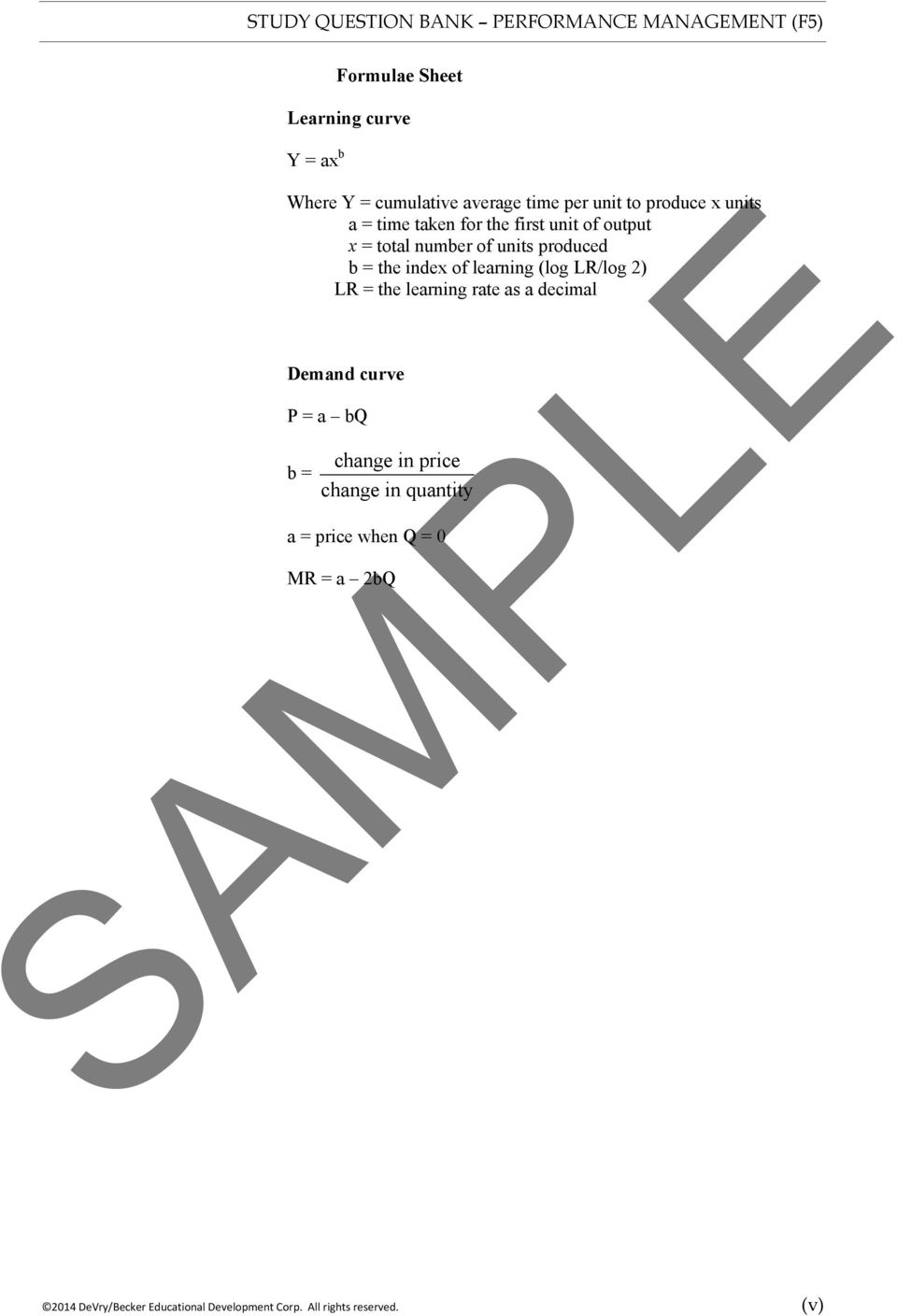
7 STUDY QUESTION BANK PERFORMANCE MANAGEMENT (F5) Formulae Sheet Learning curve Y = ax b Where Y = cumulative average time per unit to produce x units a = time taken for the first unit of output x = total number of units produced b = the index of learning (log LR/log 2) LR = the learning rate as a decimal Demand curve P = a bq b = change in price change in quantity a = price when Q = 0 MR = a 2bQ 2014 DeVry/Becker Educational Development Corp. All rights reserved. (v)
8 PERFORMANCE MANAGEMENT (F5) STUDY QUESTION BANK (vi) 2014 DeVry/Becker Educational Development Corp. All rights reserved.

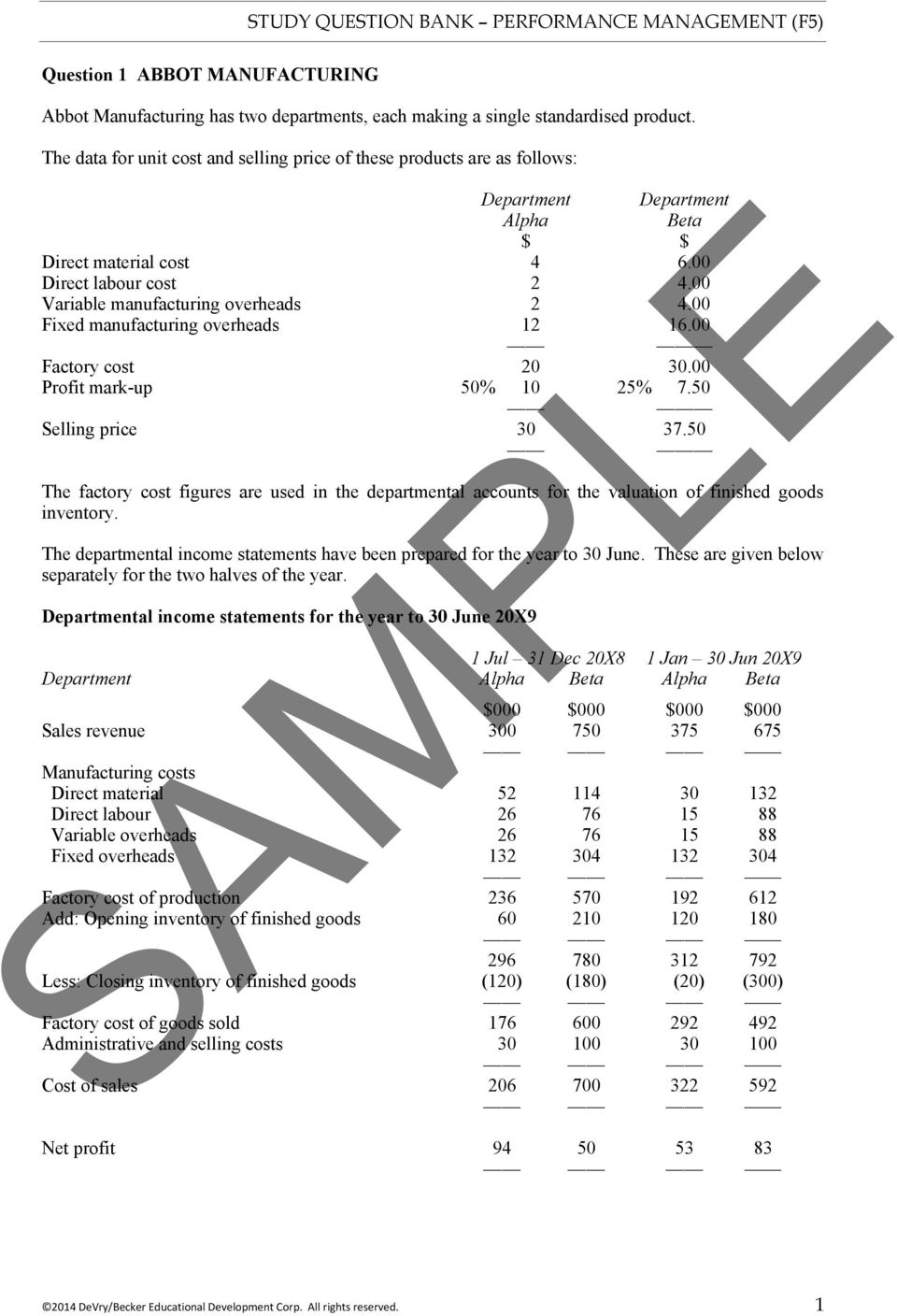
9 STUDY QUESTION BANK PERFORMANCE MANAGEMENT (F5) Question 1 ABBOT MANUFACTURING Abbot Manufacturing has two departments, each making a single standardised product. The data for unit cost and selling price of these products are as follows: Department Department Alpha Beta $ $ Direct material cost Direct labour cost Variable manufacturing overheads Fixed manufacturing overheads Factory cost Profit mark-up 50% 10 25% 7.50 Selling price The factory cost figures are used in the departmental accounts for the valuation of finished goods inventory. The departmental income statements have been prepared for the year to 30 June. These are given below separately for the two halves of the year. Departmental income statements for the year to 30 June 20X9 1 Jul 31 Dec 20X8 1 Jan 30 Jun 20X9 Department Alpha Beta Alpha Beta $000 $000 $000 $000 Sales revenue Manufacturing costs Direct material Direct labour Variable overheads Fixed overheads Factory cost of production Add: Opening inventory of finished goods Less: Closing inventory of finished goods (120) (180) (20) (300) Factory cost of goods sold Administrative and selling costs Cost of sales Net profit DeVry/Becker Educational Development Corp. All rights reserved. 1
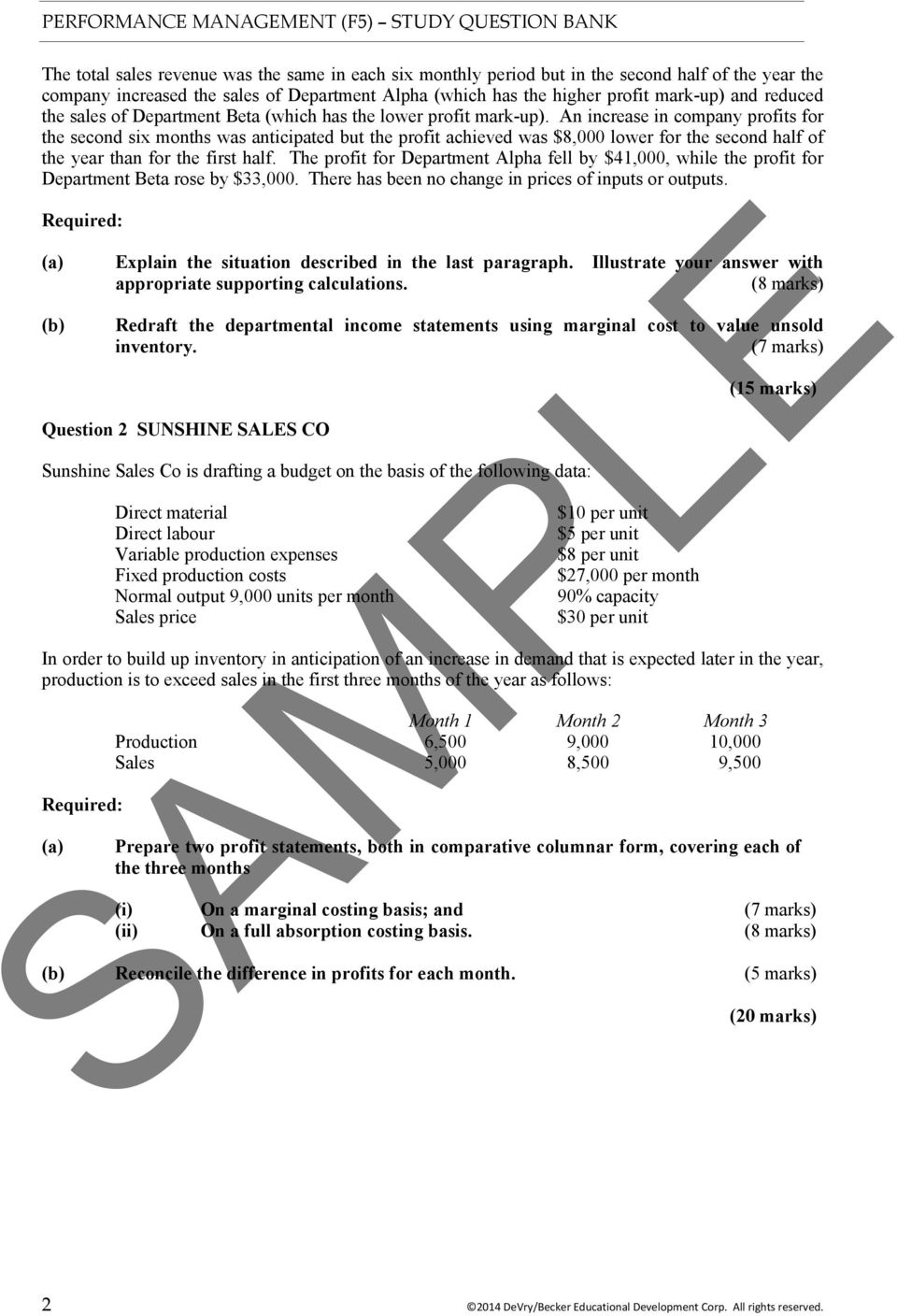
10 PERFORMANCE MANAGEMENT (F5) STUDY QUESTION BANK The total sales revenue was the same in each six monthly period but in the second half of the year the company increased the sales of Department Alpha (which has the higher profit mark-up) and reduced the sales of Department Beta (which has the lower profit mark-up). An increase in company profits for the second six months was anticipated but the profit achieved was $8,000 lower for the second half of the year than for the first half. The profit for Department Alpha fell by $41,000, while the profit for Department Beta rose by $33,000. There has been no change in prices of inputs or outputs. Required: Explain the situation described in the last paragraph. Illustrate your answer with appropriate supporting calculations. (8 marks) Redraft the departmental income statements using marginal cost to value unsold inventory. (7 marks) Question 2 SUNSHINE SALES CO Sunshine Sales Co is drafting a budget on the basis of the following data: Direct material Direct labour Variable production expenses Fixed production costs Normal output 9,000 units per month Sales price $10 per unit $5 per unit $8 per unit $27,000 per month 90% capacity $30 per unit (15 marks) In order to build up inventory in anticipation of an increase in demand that is expected later in the year, production is to exceed sales in the first three months of the year as follows: Required: Month 1 Month 2 Month 3 Production 6,500 9,000 10,000 Sales 5,000 8,500 9,500 Prepare two profit statements, both in comparative columnar form, covering each of the three months (i) On a marginal costing basis; and (7 marks) (ii) On a full absorption costing basis. (8 marks) Reconcile the difference in profits for each month. (5 marks) (20 marks) DeVry/Becker Educational Development Corp. All rights reserved.
11 STUDY QUESTION BANK PERFORMANCE MANAGEMENT (F5) Question 3 PLB CO PLB Co is a company producing bulk meat substitutes for the vegetarian food industry. It produces three meat types: pork (P), lamb (L) and beef (B). Direct costs per tonne are as follows: P L B Materials $500 $700 $850 Labour time 12 hours 14 hours 8 hours Budget production (tonnes) 1, Direct labour costs $10 per hour The company has just completed an activity based costing exercise. For the year just ended, the following activities, along with their associated costs were identified: Activity Costs $000 Machine set up cost 16,000 Ordering materials 1,125 Storage 990 Packing costs 106 Total drivers associated with each of these activities have been identified, and are shown in the table below, along with the number of units of each driver used by each of the three products: P L B Production runs Inventory orders Tonne days of storage ( 000) Packing costs are incurred on a per tonne basis, and are the same per tonne for all three products. Required: Calculate the cost of the finished products using activity based costing. Question 4 EGERTON MANUFACTURING CO (12 marks) Egerton Manufacturing Co produces a range of products at seven separate sites. Each site produces a maximum of four products. The directors have decided to introduce Activity Based Costing (ABC) and have asked each site manager to obtain and analyse the relevant data for their site. Product costs are currently calculated using absorption costing, with overheads being absorbed on a machine hour basis. As part of the process of introducing ABC, the directors wish to assess the profitability of individual products, with the possibility that the product range may be reduced. You are the Manager of the Brumley site and you have obtained the following data: 2014 DeVry/Becker Educational Development Corp. All rights reserved. 3

12 PERFORMANCE MANAGEMENT (F5) STUDY QUESTION BANK Product A B C $ $ $ Selling price per unit Direct material per unit Direct labour per unit Overheads per unit Total cost per unit Budgeted production volume 600 units 400 units 200 units Machine hours per unit Production runs in period Number of sales orders Number of deliveries of material The budgeted overheads of the site for the period are: Machine running costs $78,560 Set up costs $82,900 Material handling costs $49,500 Machine hours are limited to 1,140 hours per period. Required: Calculate the cost of each product using ABC. (12 marks) Draft a memo to the Managing Director which: (i) (ii) Question 5 FLOPRO Using the ABC information indicate which product(s) should no longer be manufactured and justifies your recommendation; (4 marks) Discusses the other factors that should be considered before a final decision is made. (4 marks) (20 marks) Flopro makes and sells two products A and B, each of which passes through the same automated production operations. The following estimated information is available for period 1: (i) Product unit data: A B Selling price per unit ($) Direct material cost ($) 2 40 Variable production overhead cost ($) 28 4 Overall hours per product unit (hours) (ii) Budgeted production/sales of products A and B are 120,000 units and 45,000 units respectively. The selling prices per unit for A and B are $60 and $70 respectively. (iii) Maximum demand for each product is 20% above the budgeted sales levels. (iv) Total fixed production overhead cost is $1,470,000. This is absorbed by products A and B at an average rate per hour based on the estimated production levels DeVry/Becker Educational Development Corp. All rights reserved.

13 STUDY QUESTION BANK PERFORMANCE MANAGEMENT (F5) One of the production operations has a maximum capacity of 3,075 hours that has been identified as a bottleneck that limits the overall production/sales of products A and B. The bottleneck hours required per product unit for products A and B are 0 02 and respectively. Required: Calculate the mix (units) of products A and B that will maximise net profit and the value ($) of the maximum net profit. (8 marks) The bottleneck situation detailed in still applies. Flopro has decided to determine the profit maximising mix of products A and B based on the throughput accounting principle of maximising the throughput return per production hour of the bottleneck resource. This may be measured as: Throughput return per production hour = (selling price material cost)/bottleneck hours per unit. All other information detailed in still applies, except that the variable overhead cost as per is now considered to be fixed for the short/intermediate term, based on the value ($) which applied to budgeted production/sales. Required: (i) (ii) (iii) Question 6 TELMAT Calculate the mix (units) of products A and B that will maximise net profit and the value of that net profit. (8 marks) Calculate the throughput accounting ratio for product B which is calculated as: throughput return per hour of bottleneck resource for product B/overall total overhead cost per hour of bottleneck resource. (3 marks) Comment on the interpretation of throughput accounting ratios and their use as a control device. You should refer to the ratio for product B in your answer. (6 marks) (25 marks) Telmat is a company that manufactures mobile phones. This market is extremely volatile and competitive and achieving adequate product profitability is extremely important. Telmat is a mature company that has been producing electronic equipment for many years and has all the costing systems in place that one would expect in such a company. These include a comprehensive overhead absorption system, annual budgets and monthly variance reports and the balanced scorecard for performance measurement. The company is considering introducing: Required: Target costing; and Life cycle costing systems. Discuss the advantages (or otherwise) that this specific company is likely to gain from these two systems. (10 marks) 2014 DeVry/Becker Educational Development Corp. All rights reserved. 5

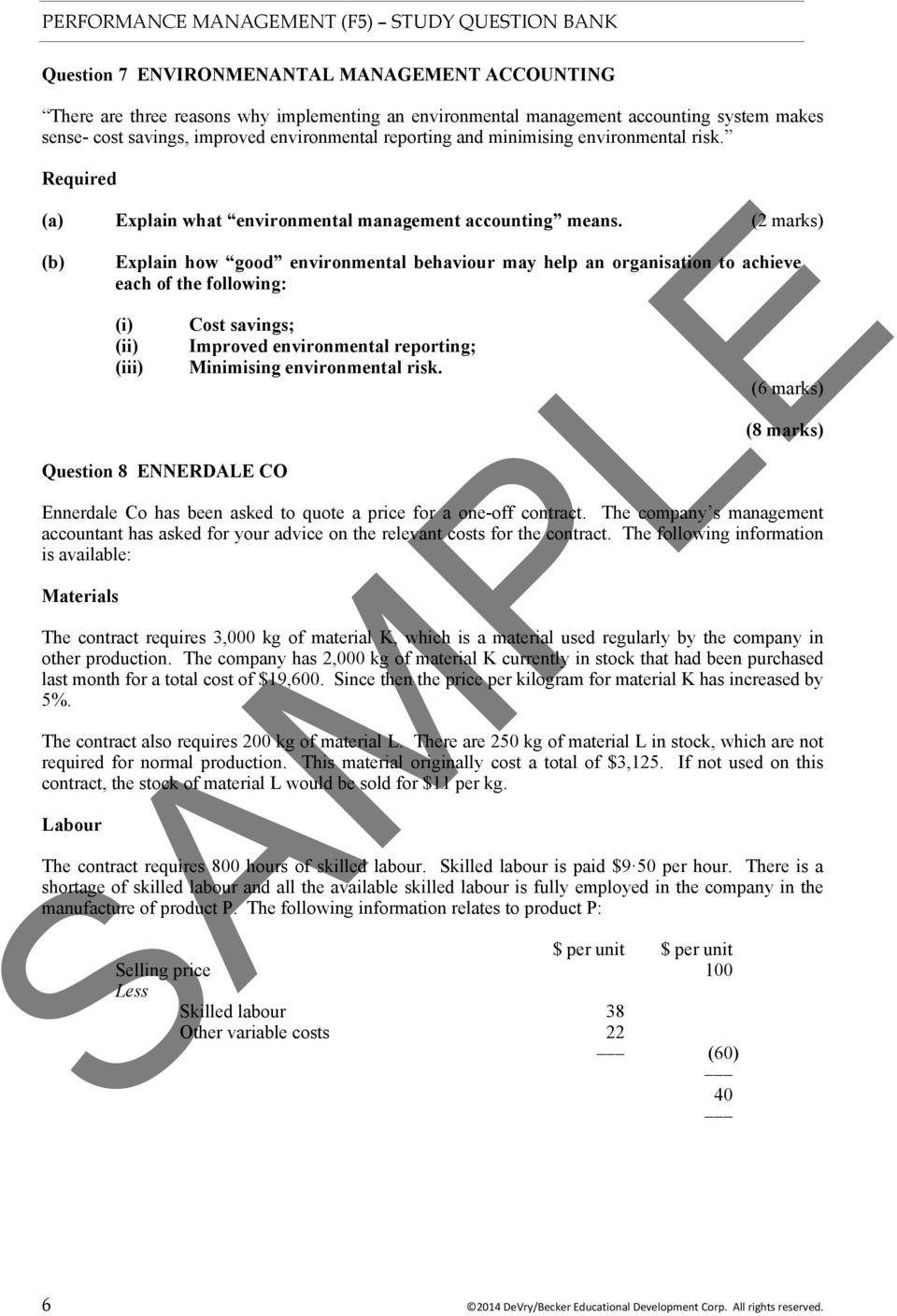
14 PERFORMANCE MANAGEMENT (F5) STUDY QUESTION BANK Question 7 ENVIRONMENANTAL MANAGEMENT ACCOUNTING There are three reasons why implementing an environmental management accounting system makes sense- cost savings, improved environmental reporting and minimising environmental risk. Required Explain what environmental management accounting means. (2 marks) Explain how good environmental behaviour may help an organisation to achieve each of the following: (i) (ii) (iii) Question 8 ENNERDALE CO Cost savings; Improved environmental reporting; Minimising environmental risk. (6 marks) (8 marks) Ennerdale Co has been asked to quote a price for a one-off contract. The company s management accountant has asked for your advice on the relevant costs for the contract. The following information is available: Materials The contract requires 3,000 kg of material K, which is a material used regularly by the company in other production. The company has 2,000 kg of material K currently in stock that had been purchased last month for a total cost of $19,600. Since then the price per kilogram for material K has increased by 5%. The contract also requires 200 kg of material L. There are 250 kg of material L in stock, which are not required for normal production. This material originally cost a total of $3,125. If not used on this contract, the stock of material L would be sold for $11 per kg. Labour The contract requires 800 hours of skilled labour. Skilled labour is paid $9 50 per hour. There is a shortage of skilled labour and all the available skilled labour is fully employed in the company in the manufacture of product P. The following information relates to product P: $ per unit $ per unit Selling price 100 Less Skilled labour 38 Other variable costs 22 (60) DeVry/Becker Educational Development Corp. All rights reserved.
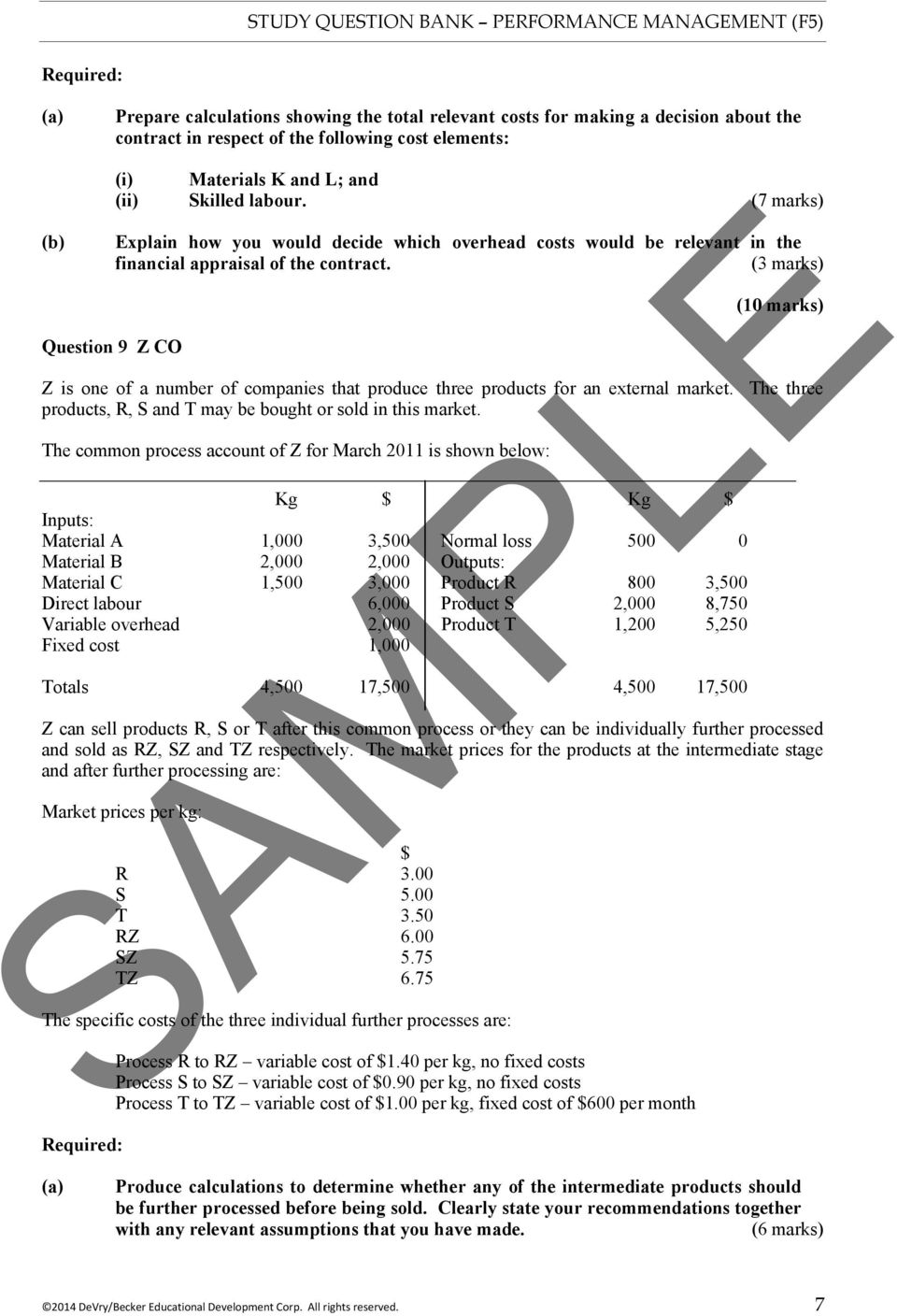
15 STUDY QUESTION BANK PERFORMANCE MANAGEMENT (F5) Required: Question 9 Z CO Prepare calculations showing the total relevant costs for making a decision about the contract in respect of the following cost elements: (i) Materials K and L; and (ii) Skilled labour. (7 marks) Explain how you would decide which overhead costs would be relevant in the financial appraisal of the contract. (3 marks) (10 marks) Z is one of a number of companies that produce three products for an external market. The three products, R, S and T may be bought or sold in this market. The common process account of Z for March 2011 is shown below: Kg $ Kg $ Inputs: Material A 1,000 3,500 Normal loss Material B 2,000 2,000 Outputs: Material C 1,500 3,000 Product R 800 3,500 Direct labour 6,000 Product S 2,000 8,750 Variable overhead 2,000 Product T 1,200 5,250 Fixed cost 1,000 Totals 4,500 17,500 4,500 17,500 Z can sell products R, S or T after this common process or they can be individually further processed and sold as RZ, SZ and TZ respectively. The market prices for the products at the intermediate stage and after further processing are: Market prices per kg: $ R 3.00 S 5.00 T 3.50 RZ 6.00 SZ 5.75 TZ 6.75 The specific costs of the three individual further processes are: Required: Process R to RZ variable cost of $1.40 per kg, no fixed costs Process S to SZ variable cost of $0.90 per kg, no fixed costs Process T to TZ variable cost of $1.00 per kg, fixed cost of $600 per month Produce calculations to determine whether any of the intermediate products should be further processed before being sold. Clearly state your recommendations together with any relevant assumptions that you have made. (6 marks) 2014 DeVry/Becker Educational Development Corp. All rights reserved. 7
16 PERFORMANCE MANAGEMENT (F5) STUDY QUESTION BANK Produce calculations to assess the viability of the common process: (i) Assuming that there is an external market for products R, S and T; and (ii) Assuming that there is not an external market for products R, S and T. State clearly your recommendations. Question 10 PARSER CO (7 marks) (13 marks) The managing director of Parser Co, a small business, is considering undertaking a one-off contract and has asked her inexperienced accountant to advise on what costs are likely to be incurred so that she can price at a profit. The following schedule has been prepared: Costs for special order: Notes: Notes $ Direct wages 1 28,500 Supervisor costs 2 11,500 General overheads 3 4,000 Machine depreciation 4 2,300 Machine overheads 5 18,000 Materials 6 34,000 98,300 (1) Direct wages comprise the wages of two employees, particularly skilled in the labour process for this job, who could be transferred from another department to undertake work on the special order. They are fully occupied in their usual department and sub-contracting staff would have to be bought-in to undertake the work left behind. Subcontracting costs would be $32,000 for the period of the work. Different subcontractors who are skilled in the special order techniques are available to work on the special order and their costs would amount to $31,300. (2) A supervisor would have to work on the special order. The cost of $11,500 is comprised of $8,000 normal payments plus $3,500 additional bonus for working on the special order. Normal payments refer to the fixed salary of the supervisor. In addition, the supervisor would lose incentive payments in his normal work amounting to $2,500. It is not anticipated that any replacement costs relating to the supervisor s work on other jobs would arise. (3) General overheads comprise an apportionment of $3,000 plus an estimate of $1,000 incremental overheads. (4) Machine depreciation represents the normal period cost based on the duration of the contract. It is anticipated that $500 will be incurred in additional machine maintenance costs. (5) Machine overheads (for running costs such as electricity) are charged at $3 per hour. It is estimated that 6000 hours will be needed for the special order. The machine has 4000 hours available capacity. The further 2000 hours required will mean an existing job is taken off the machine resulting in a lost contribution of $2 per hour DeVry/Becker Educational Development Corp. All rights reserved.

17 STUDY QUESTION BANK PERFORMANCE MANAGEMENT (F5) (6) Materials represent the purchase costs of 7,500 kg bought some time ago. The materials are no longer used and are unlikely to be wanted in the future except on the special order. The complete Inventory of materials (amounting to 10,000 kg), or part thereof, could be sold for $4 20 per kg. The replacement cost of material used would be $33,375. Because the business does not have adequate funds to finance the special order, a bank overdraft amounting to $20,000 would be required for the project duration of three months. The overdraft would be repaid at the end of the period. The company uses a cost of capital of 20% to appraise projects. The bank s overdraft rate is 18%. The managing director has heard that, for special orders such as this, relevant costing should be used that also incorporates opportunity costs. She has approached you to create a revised costing schedule based on relevant costing principles. Required: Briefly explain what is meant by opportunity cost. (2 marks) Adjust the schedule prepared by the accountant to a relevant cost basis, incorporating appropriate opportunity costs. (11 marks) Question 11 APPLE, BRAVO AND CHARLIE (13 marks) A company manufactures and sells three products which currently have the following annual trading performance: Product A B C $000 $000 $000 Sales 1,794 3,740 2,950 Production cost of sales 1,242 2,860 1,888 Gross profit ,062 Non-production overheads Net profit Sales units (000) 1,150 2,200 2,360 For each product, units produced and sold were the same in the period. Fixed production overheads are absorbed at a rate of $0.30 per unit for each product. Non-production overheads include certain costs that vary with activity at, a rate of 10% of sales value. The remaining non-production overheads are fixed costs. Required: Prepare a statement, in marginal costing format, showing the sales, costs, and profit contribution of each product expressed both in $ per unit (to three decimal places) and also as a % of sales (to one decimal place) (8 marks) 2014 DeVry/Becker Educational Development Corp. All rights reserved. 9

18 PERFORMANCE MANAGEMENT (F5) STUDY QUESTION BANK Calculate, based on the current mix of sales, the sales required of each product (to the nearest $000) in order to generate a total contribution of $3.75m per annum. (6 marks) Question 12 BVX (14 marks) BVX manufactures three garden furniture products chairs, benches and tables. The budgeted unit cost and resource requirements of each of these items are detailed below: Chair Bench Table $ $ $ Timber cost Direct labour cost Variable overhead cost Fixed overhead cost Budgeted volumes per annum 4,000 2,000 1,500 These volumes are believed to equal the market demand for these products. Fixed overhead costs are attributed to the three products on the basis of direct labour hours. The labour rate is $4.00 per hour. The cost of the timber is $2.00 per square metre. The products are made from a specialist timber. A memo from the purchasing manager advises you that because of a problem with the supplier, it is to be assumed that this specialist timber is limited in supply to 20,000 square metres per annum. The sales director has already accepted an order for 500 chairs, 100 benches and 150 tables which if not supplied would incur a financial penalty of $2,000. These quantities are included in the market demand estimates above. The selling prices of the three products are: Required: Chair $20.00 Bench $50.00 Table $40.00 Determine the optimum production plan and state the net profit that this should yield per annum. (6 marks) Calculate and explain the maximum price which should be paid per square metre in order to obtain extra supplies of the timber. (4 marks) Question 13 OPTIMAL PRODUCTION PLAN (10 marks) A company uses linear programming to establish an optimal production plan in order to maximise profit. The company finds that for the next year materials and labour are likely to be in short supply. Details of the company s products are as follows: DeVry/Becker Educational Development Corp. All rights reserved.

19 STUDY QUESTION BANK PERFORMANCE MANAGEMENT (F5) A B $ $ Materials (at $2 per kg) 6 8 Labour (at $6 per hour) Variable overheads (at $1 per hour) 5 3 Variable cost Selling price Contribution 9 23 There are only 30,000 kg of materials and 36,000 labour hours available. The company also has an agreement to supply 1,000 units of product A which must be met. Required: Formulate the objective function and constraint equations for this problem. (4 marks) Plot the constraints on a suitable graph and determine the optimal production plan. (6 marks) Question 14 ROTHWELL CO (10 marks) Rothwell Co makes various novelty items that are sold to wholesalers particularly in the toy trade. It has just decided to produce a new line, namely small umbrellas to decorate cocktails, which will be sold to various chains of cocktail bars and called a bar brolly. It has provided you with the following information concerning the total cost of annual production and the prices at which that production could be sold: Required: Annual production Total cost Selling price and sales (per 100) (boxes of 100) $000 $ 2, , , , , , , Determine the optimal selling price for bar brollies. Question 15 SLADE (10 marks) Hill Co has recently developed a new product, the Slade. Its parent company, Powell, requires that subsidiaries achieve of 16% a return on opening capital employed on all new investment. Financial data regarding the development and production of the Slade is as follows: The development of the product took three years and cost $120,000. It is anticipated that demand for the product will be 4,000 units per annum and that it will last six years DeVry/Becker Educational Development Corp. All rights reserved. 11

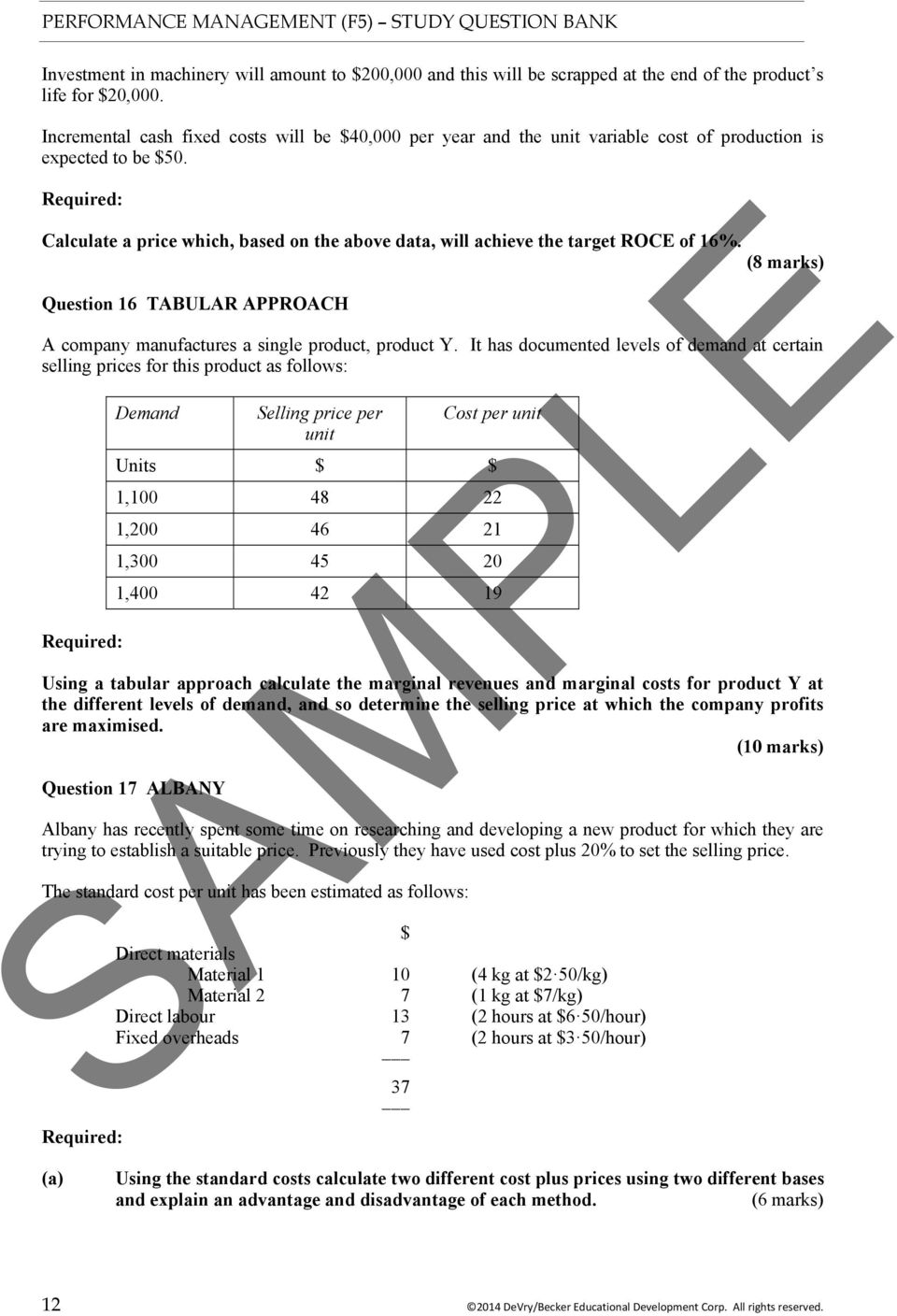
20 PERFORMANCE MANAGEMENT (F5) STUDY QUESTION BANK Investment in machinery will amount to $200,000 and this will be scrapped at the end of the product s life for $20,000. Incremental cash fixed costs will be $40,000 per year and the unit variable cost of production is expected to be $50. Required: Calculate a price which, based on the above data, will achieve the target ROCE of 16%. (8 marks) Question 16 TABULAR APPROACH A company manufactures a single product, product Y. It has documented levels of demand at certain selling prices for this product as follows: Required: Demand Selling price per unit Cost per unit Units $ $ 1, , , , Using a tabular approach calculate the marginal revenues and marginal costs for product Y at the different levels of demand, and so determine the selling price at which the company profits are maximised. (10 marks) Question 17 ALBANY Albany has recently spent some time on researching and developing a new product for which they are trying to establish a suitable price. Previously they have used cost plus 20% to set the selling price. The standard cost per unit has been estimated as follows: $ Direct materials Material 1 10 (4 kg at $2 50/kg) Material 2 7 (1 kg at $7/kg) Direct labour 13 (2 hours at $6 50/hour) Fixed overheads 7 (2 hours at $3 50/hour) 37 Required: Using the standard costs calculate two different cost plus prices using two different bases and explain an advantage and disadvantage of each method. (6 marks) DeVry/Becker Educational Development Corp. All rights reserved.
21 STUDY QUESTION BANK PERFORMANCE MANAGEMENT (F5) Give two other possible pricing strategies that could be adopted and describe the impact of each one on the price of the product. (4 marks) (10 marks) Question 18 MR ELLIS Mr Ellis, the manager of the ice rink is trying to decide what price per person to charge for a five-week ice skating course that would be held on Saturday mornings. He is considering three possible prices- $20, $30 or $50. Roddy Dean, a local ice skating dancer is competing in an International Competition, and this has increased interest in skating. If Mr Dean wins the competition, Mr Ellis believes that demand for the courses will be high. If Mr Dean reaches the finals, but does not win the competition, demand would be medium and if Mr Dean does not reach the finals, demand would be low. A decision on what price to charge has to be taken before the results of the competition are known as the sports complex wishes to start to advertise the course. Mr Ellis has provided you with a table showing his estimates of the number of people who would attend the course, based on the price charged and the level of demand: Demand (number of persons) High Medium Low Price charged Required: Determine which price Mr Ellis should charge for the course based on the following decision making rules. Your answer should include a brief explanation of the meaning of each rule, and what type of risk taker would use it. (i) Maximax; (ii) Maximin; (iii) Minimax regret. (16 marks) Question 19 DECISION TREES An oil company has recently acquired rights in a certain area to conduct surveys and geological test drillings that may lead to lifting oil where it is found in commercially exploitable quantities. The area is already considered to have good potential for finding oil in commercial quantities. At the outset the company has the choice to conduct further geological tests or to carry out a drilling programme immediately. On the known conditions, the company estimates that there is a 70% chance of further tests indicating that a significant amount of oil is present. Whether the tests show the possibility of oil or not, or even if no tests are undertaken at all, the company could still pursue its drilling programme or alternatively consider selling its rights to drill in the area DeVry/Becker Educational Development Corp. All rights reserved. 13
22 PERFORMANCE MANAGEMENT (F5) STUDY QUESTION BANK Thereafter, however, if it carries out the drilling programme, the likelihood of final success or failure in the search for oil is considered dependent on the foregoing stages. Thus: (i) (ii) (iii) If the tests indicated that oil was present, the expectation of success in drilling is given as 80%. If the tests indicated that there was insufficient oil present, then the expectation of success in drilling is given as 20%. If no tests have been carried out at all, the expectation of finding commercially viable quantities of oil is given as 55%. Costs and revenues have been estimated for all possible outcomes and the net present value of each is given below: Required: Outcome Net present value $ million Geological testing (10) Drilling cost (50) Success in finding oil 150 Sale of exploitation rights: Tests indicate oil is present 65 Tests indicate no oil 15 Without geological tests 40 Prepare a decision tree diagram to represent the above information. (8 marks) For the management of the company, calculate its best course of action. (7 marks) (c) Explain the value of decision trees in providing management with guidance for decisionmaking. Illustrate examples of any situations where you consider their use would be of benefit. (5 marks) Question 20 ZBB (c) (d) (20 marks) Explain why zero-based budgeting (ZBB) might be a useful tool to employ to ensure that budgetary requirements are kept up to date. (4 marks) Describe the steps necessary to implement a ZBB system for the following: questioning why expenditure needs to be incurred; deciding which activities should be provided with a budget; and questions to be asked when budgeted activities are to be ranked to allocate scarce resources. (8 marks) Critically assess the use of zero-based budgeting as a tool that might be used to motivate employees. (6 marks) Explain the advantages of encouraging employee participation in budget setting. (7 marks) (25 marks) DeVry/Becker Educational Development Corp. All rights reserved.
23 STUDY QUESTION BANK PERFORMANCE MANAGEMENT (F5) Question 21 HOTEL EXCEL You are the general manager of the Hotel Excel. It is the hotel s policy that rolling budgets are prepared, using a six month time horizon. You are about to prepare the budget for July December 2010, and have collated the following information: (i) (ii) (iii) (iv) (v) (vi) (vii) (viii) (ix) (x) Required: the hotel has 90 bedrooms, each of which can accommodate one or two guests; during the months of July, August and December (high season), standard room rates will be $110 per night; during the months of September, October and November (low season), standard room rates will be $95 per night; the rates above apply to each room, regardless of whether there are one or two guests; average room occupancy per night at standard rates is expected to be: high season 80% low season 50% the company is registered with a number of internet-based hotel providers. It is expected that, subject to capacity, an average of 20 rooms per night can be sold through these facilities. These sales will be in addition to the occupancy levels noted in point (v). The internet based provider pays 40% of the standard rate for all bookings; it is forecast that the average additional spending by guests will be $40 per room night, and that the gross margin earned on this additional spending will be 35%; variable costs are estimated to be $17 per room night; fixed costs are estimated to be $40,000 per month; when occupancy is above 90%, additional staff costs of $150 per night are forecast. For the six month period to 31 December 2010, calculate the Hotel s budgeted: (i) revenue; (6 marks) (ii) costs; (6 marks) (iii) profit. (1 mark) Explain the benefits and drawbacks of using rolling budgets. (7 marks) Question 22 BRT CO (20 marks) BRT Co makes a range of glassware ornaments. The marketing plan for 2011 is based on the three products that have proved most popular in the past: Dog, Bunny and Cat. The expected sales for each product and selling price are as follows: Dog Bunny Cat Sales 10,000 20,000 5,000 Price $10 $5 $ DeVry/Becker Educational Development Corp. All rights reserved. 15
24 STUDY QUESTION BANK PERFORMANCE MANAGEMENT (F5) Answer 1 ABBOT MANUFACTURING Explanation The situation described in the question arises from the method of inventory valuation used by Abbot, together with the fluctuations in the level of finished goods inventory that have occurred in the periods under review. The firm is using an absorption costing basis for inventory valuation purposes. This method attaches part of the fixed production costs to each item held in inventory. In the case of department Beta it is $16. In the income statement the matching concept requires the use of an inventory adjustment process to adapt the cost of production figure to a cost of goods sold figure. When levels of inventory are fluctuating, this process of bringing forward fixed costs from past periods and carrying forward fixed costs to future periods can have a considerable effect on the profit calculations. The following table shows the effect of the inclusion of fixed factory overheads in inventory valuations. 1 Jul 31 Dec 1 Jan 30 Jun Department Alpha Beta Alpha Beta $000 $000 $000 $000 Fixed overheads brought forward in opening inventory of finished goods Fixed overheads carried forward in closing inventory of finished goods Profit increased by Profit reduced by Net profit as per absorption costing income statement Profit prior to inventory adjustment These unadjusted profit figures are in line with the changes in the sale mix between the two periods. The important aspect of the effect that the different inventory valuations have on profit is that, under marginal costing, profit depends only on the level of sales (all other things being equal). Under an absorption costing convention, profit depends on both the level of sales and also on production levels DeVry/Becker Educational Development Corp. All rights reserved. 1001
25 PERFORMANCE MANAGEMENT (F5) STUDY QUESTION BANK Marginal costing income statements 1 Jul 31 Dec 20X8 1 Jan 30 Jun 20X9 Department Alpha Beta Alpha Beta $000 $000 $000 $000 Sales revenue Variable manufacturing costs Direct material Direct labour Variable overheads Factory cost of production Add: Opening inventory of finished goods Less: Closing inventory of finished goods (48) (84) (8) (140) Factory cost of goods sold Total contribution Less: Fixed overheads Factory overheads (132) (304) (132) (304) Administration and selling (30) (100) (30) (100) Net profit These profit figures are those under the absorption-costing basis before making the adjustment for fixed factory overhead in the inventory valuations. Tutorial note: The important aspect of examination technique here is to look at all (both) requirements before reading the body of the text and before answering any part of the question. In this way, if you cannot get the clues of what is required for part from the last paragraph, part tells you what the examiner is driving at. This then leaves the problem of making sure that you do not answer part in your answer to which just needs a little planning DeVry/Becker Educational Development Corp. All rights reserved.
26 STUDY QUESTION BANK PERFORMANCE MANAGEMENT (F5) Answer 2 SUNSHINE SALES CO Profit statement (i) Marginal costing basis Month 1 Month 2 Month 3 $ $ $ $ $ $ Sales ($30 per unit) 150, , ,000 Variable costs Materials ($10 per unit) 65,000 90, ,000 Labour ($5 per unit) 32,500 45,000 50,000 Expenses ($8 per unit) 52,000 72,000 80, , , ,000 Add: Opening inventory 34,500 46, , , ,000 Less: Closing inventory (34,500) (46,000) (57,500) (115,000) (195,500) (218,500) Contribution 35,000 59,500 66,500 Fixed costs (27,000) (27,000) (27,000) Profit 8,000 32,500 39,500 (ii) Absorption costing basis Month 1 Month 2 Month 3 $ $ $ $ $ $ Sales 150, , ,000 Cost of production Materials 65,000 90, ,000 Labour 32,500 45,000 50,000 Variable expenses 52,000 72,000 80,000 Fixed costs 27,000 27,000 27, , , ,000 Add: Opening inventory 39,000 52, , , ,000 Less: Closing inventory (39,000) (52,000) (65,000) Cost of sales (137,500) (221,000) (244,000) Profit 12,500 34,000 41,000 Reconciliation of profits Month 1 Month 2 Month 3 $ $ $ Absorption costing profit 12,500 34,000 41,000 Increase in inventory Fixed cost per unit ($3) 4,500 1,500 1,500 Marginal costing profit 8,000 32,500 39, DeVry/Becker Educational Development Corp. All rights reserved. 1003
27 PERFORMANCE MANAGEMENT (F5) STUDY QUESTION BANK Answer 3 PLB CO Cost per tonne P L B $ $ $ Materials Labour Set up costs (W1) 4,000 10,000 5,000 Material orders (W2) Storage (W3) Packing (W4) ,410 11,620 6,870 WORKINGS P L B Total (1) Production run Cost $16,000,000 Cost/run $500,000 Cost/product $4,000,000 $7,500,000 $4,500,000 Cost/tonne $4,000 $10,000 $5,000 (2) Material orders Cost $1,125,000 Cost/order $15,000 Cost/product $300,000 $375,000 $450,000 Cost/tonne $300 $500 $500 (3) Total tonne days preserved 45,000 18,000 36,000 99,000 Total cost $990,000 Cost/tonne day $10 Cost/product 450, , ,000 Cost/tonne $450 $240 $400 (4) 106,000 Packing cost =, i.e. $40/tonne 2,650 tonnes Answer 4 EGERTON MANUFACTURING CO Calculation of product costs using ABC Product A B C $ $ $ Direct material per unit Direct labour per unit Overheads per unit: (W4) Total cost per unit DeVry/Becker Educational Development Corp. All rights reserved.
28 STUDY QUESTION BANK PERFORMANCE MANAGEMENT (F5) WORKINGS (1) Machine costs Product A B C Total Machine hours per unit Budgeted production volume 600 units 400 units 200 units Total machine hours ,080 Machine costs $78,560 Cost per machine hour $72 74 Total costs apportioned: 26, , , ,559.2 (2) Set up costs Product A B C Total Production runs in period Set up costs $82,900 Cost per set up $ Total costs apportioned 27, , , , (3) Material handling cost Product A B C Total Material deliveries Material handling costs $49,500 Cost per delivery $1, Total costs apportioned 15, , , , (4) Overhead cost per unit Product A B C Total machine costs (W1) 26, , , Total set-up costs (W2) 27, , , Total material handling costs (W3) 15, , , Total overhead costs 68, , , Production (units) Overhead cost per unit DeVry/Becker Educational Development Corp. All rights reserved. 1005
29 PERFORMANCE MANAGEMENT (F5) STUDY QUESTION BANK To Managing Director From Brumley Site Manager Subject Activity Based Costing Date 6 December 20X2 (i) Which product(s) should not be manufactured As requested, I have calculated the cost per unit for each of the products manufactured at the Brumley site. When the unit cost is compared with the selling price, the results are as follows: A B C $ $ $ Selling price per unit Cost per unit Profit/(Loss) per unit (22 78) From this it can be clearly seen that production of Product C should cease, as this product is unprofitable. At first sight, product B appears to be the most attractive, yielding a unit profit of over $200. This seems to suggest that the production of product B should be maximised. However, such an approach ignores the fact that machine hours are limited to 1,140 in each production period. This means that an assessment of which product is more favourable should be based on the profit per unit of limiting factor, rather than the profit per unit of output. Carrying out such a calculation: Product A B Profit per unit $89 40 $ Machine hours per unit Profit per machine hour $ $ This means that Product A is preferable, and should be produced up to the maximum market demand. Product B should be produced only when demand for Product A is satisfied. (ii) Other factors to be considered Before implementing my recommendation to cease production of Products C and B, the following factors should be considered: Sales of each product may be interdependent. If sales of Product A can only be made along with sales of C in particular, it would obviously be counter-productive to cease sales of C. The interdependence of products from Brumley with products of other sites would also need to be considered. Cessation of a product, even if it is independent of the other products produced may result in a loss of customer goodwill, and sales could be adversely affected. Market demand should be confirmed to ensure that there are no factors that will lead to reduced sales volumes DeVry/Becker Educational Development Corp. All rights reserved.
30 STUDY QUESTION BANK PERFORMANCE MANAGEMENT (F5) The stage of each product in the product life cycle may affect the decision. If A is a mature product, there may be a declining market. Concentrating production on a mature product may be placing too much reliance on a market that could soon disappear. It would also be prudent to review current practices to assess whether the cost structure of products B and C can be amended, leading to a reduction in unit cost. The accuracy of the results of activity based costing is entirely dependent on the use of appropriate cost drivers. If the cost drivers selected do not actually influence the total cost incurred, decisions will be made based on inaccurate information. It is therefore essential that the cost drivers have been correctly identified. It should also be noted that the analysis of costs in activity based costing assumes that all costs are amenable to control over the long term. If the objective is to maximise short-term profit, activity based costing is not an appropriate technique. Only when you are fully satisfied on these points should production of C (and possibly B) cease. Answer 5 FLOPRO Optimum product mix The contribution per product unit (selling price variable cost) may be calculated as: A = $60 (2 + 28) = $30 B = $70 (40 + 4) = $26 A B Contribution per unit $30 $26 Bottleneck hours per unit Contribution per bottleneck hour $1,500 $1,733 Ranking Therefore produce and sell product B up to its maximum demand and then product A with the remaining capacity: Maximum demand of product B (45, %) Bottleneck hours required for B (54, ) Bottleneck hours available for A (3, ) Output of product A which is possible (2, ) 54,000 units 810 hours 2,265 hours 113,250 units Maximum net profit: $ Contribution product A 113,250 $30 3,397,500 Contribution product B 54,000 $26 1,404,000 Total contribution 4,801,500 Less: Fixed overhead cost: 1,470,000 Net profit 3,331, DeVry/Becker Educational Development Corp. All rights reserved. 1007
31 PERFORMANCE MANAGEMENT (F5) STUDY QUESTION BANK Throughput accounting (i) Product mix to maximise net profit Throughput per unit is calculated as selling price direct material cost: A = $60 2 = $58 B = $70 40 = $30 A B Throughput per unit $58 $30 Bottleneck hours per unit Throughput return per bottleneck hour $2,900 $2,000 Flopro should sell product A up to its maximum demand and then product B using the remaining capacity. Maximum demand of product A (120, %) Bottleneck hours required for A (144, ) Bottleneck hours available for B (3,075 2,880) Output of product B which is possible ( ) 144,000 units 2,880 hours 195 hours 13,000 units Maximum net profit: $ Throughput return product A 144,000 ($60 2) 8,352,000 Throughput return product B 13,000 ($70 40) 390,000 Total throughput return 8,742,000 Less: Overhead cost: Variable based on budget (120,000 $ ,000 $4) (3,540,000) Fixed (1,470,000) Net profit 3,732,000 (ii) Throughput accounting ratio for product B Throughput accounting ratio = Throughput return per hour of bottleneck Total overhead cost per hour of bottleneck Throughput return per hour of bottleneck for product B was calculated in part (i) as $2,000. Total overhead cost per hour of bottleneck: Total overhead costs: (3,540, ,470,000) $5,010,000 Total hours of bottleneck: 3,075 Total overhead cost per hour of bottleneck (5,010, ) $ ,000 Throughput accounting ratio = 1, = DeVry/Becker Educational Development Corp. All rights reserved.
32 STUDY QUESTION BANK PERFORMANCE MANAGEMENT (F5) (iii) Interpretation Where throughput accounting principles are applied, a product is worth producing and selling so long as its throughput return per bottleneck hour is greater than the production cost per throughput hour. This may be measured by the throughput accounting ratio. Where the ratio is less than 1 00, return exceeds cost and the focus should be on improving the size of the ratio. Efforts may be made to improve the position for each product and in total by focusing on areas such as Improved throughput ($) per unit by increasing selling price or reducing material cost per unit. Product B has a very high material element ($40 per unit) Improving the throughput ($) per unit by reducing the time required on the bottleneck resource. Reducing the time for product B from hours to 0 01 hours through methods change would improve its ratio. Improving the overall position by reducing the cost of spare capacity. This may be achieved by operational re-design aimed at reducing or eliminating the impact of any bottlenecks. The throughput ratio for product B is which is greater than 1 00 and therefore acceptable. Its ratio is considerably less than that of product A, which is ($2,900 $1,629 27). The product ratio may be used as a basis for the monitoring of trend, by product and in total. Answer 6 TELMAT In the rapidly changing business environment, customer requirements, economic factors and technology can all change very fast. Telmat is in a particularly volatile business since technology is changing rapidly as text messaging develops and digital telephones take over. Both life cycle costing and target costing are systems that should help the company cope with this. These systems should help Telmat to compete in terms of cost and product development in the telecoms market. Target costing Target costing has replaced traditional standard costing/variance analysis in many organisations. Telmat may wish to follow suit for cost reduction and control. Standard costs are too rigid for cost reduction and control. They usually need to be set for a year at a time, but Telmat s environment is too fast moving. Target costing is more flexible, so targets can change/reduce from month to month. Standard costing focuses on internal costs while target costing takes into account the competitive market and the price customers are prepared to pay. The organisation has to be outward rather than inward looking. For Telmat, the final customer as well as the system supplier must be considered. (Standard costing tends to focus on internal costs.) Target costing should be used as a cost reduction technique, unlike standard costing, and should incorporate a learning effect. Target costing usually involves other techniques, such as value analysis and value engineering, which should simplify production methods and reduce cost. As Telmat has short product life cycles, this is very important DeVry/Becker Educational Development Corp. All rights reserved. 1009
33 PERFORMANCE MANAGEMENT (F5) STUDY QUESTION BANK Staff can be highly motivated by target costing if used correctly. It helps to break down any artificial functional barriers as staff at all levels and in all functions are involved. Life cycle costing Estimating life cycle costs and revenues will highlight which products can generate profits quickly. As the life cycle of Telmat s products is likely to be short because of changing technology, this is very important. Life cycle costing focuses on the time to market as well as money. This is often a key factor in generating profit. Telmat will probably have to bring new products to market quickly and on time in order to achieve a profit. If costs and benefits are monitored over the life cycle, a project can be stopped early if events have changed or not turned out as planned. The research and development and design costs are likely to be quite high and will need to be recovered quickly, so life cycle costing, with its emphasis on timescale should be very beneficial. Probably the company should adopt both target costing and life cycle costing. Answer 7 ENVIRONMENANTAL MANAGEMENT ACCOUNTING Meaning of environmental management accounting While there is no unique definition of the term environmental management accounting, the term is generally taken to mean providing management with information about the environmental impact of the organisations activities. This includes both physical and monetary information. Physical information would include things such as the amount of scarce resources, such as energy and water that are used (and wasted). Monetary information includes things such as money saved or spent on becoming more environmentally friendly. Traditional management accounting was not concerned with environmental issues. In recent years, however, the environment has become an important issue, and businesses in need to be aware of how their environmental impact of their activities so that they can be managed. How good environmental behaviour can help (i) Cost saving Good environmental behaviour often brings cost savings through a reduction in the waste of energy and water. Many organisations have made huge saving on energy costs, for example, by implementing more efficient energy processes, and insulation. Many companies have also reduced printing costs by issuing newsletters and other such items through , in order to reduce the use of paper. (ii) Improved environmental reporting In traditional management accounting, many environmental related costs were simply lumped in with other overheads, so management were not aware of them. To have environmental management accounting means that the accounting systems will now show such costs as a separate category. This will not only help management to be aware of them, but will also help with external reporting DeVry/Becker Educational Development Corp. All rights reserved.
34 STUDY QUESTION BANK PERFORMANCE MANAGEMENT (F5) (iii) Minimising environmental risk Environmental risk relates to the potential adverse effects of bad environmental behaviour. This may include fines for pollution, costs of cleaning up and lost sales if the organisation gets a reputation for being a harmer of the environment. Environmental management accounting makes such risks clearer to management, so they can be better managed. Answer 8 ENNERDALE CO Answer 9 Z CO Relevant costs (i) Materials $ K 3,000 kg at ($19,600 2,000) ,870 L 200 kg at $11 2,200 33,070 (ii) Skilled labour $ Labour cost 800 hours at $9 50 7,600 Opportunity cost of labour 800 hours at ($40 4) 8,000 15,600 Overhead costs Any variable overhead costs associated with the contract would be relevant because they would represent additional or incremental costs caused directly by the contract. Fixed overhead costs would only be relevant if the total fixed overhead costs of the company increased as a direct consequence of the contract being undertaken. In that case the relevant amount would be the specific increase in the total fixed overhead costs caused by the acceptance of the contract. Arbitrary apportionments of existing fixed overhead costs would not be relevant. Similarly sunk and committed costs would not be relevant. Further processing decision On financial grounds, further processing is worthwhile if the further processing cost is less than the incremental revenue. Evaluation of further processing based on March 2011 output and assuming no losses in the further process: Product Incremental Incremental Increase/ revenue cost (decrease) in profit RZ 800 ( ) = 2, $1.40 = $1,120 1,280 SZ 2,000 ( ) = 1,500 2, = 1,800 (300) TZ 1,200 ( ) = 3,900 1, = 1,800 2, DeVry/Becker Educational Development Corp. All rights reserved. 1011
35 PERFORMANCE MANAGEMENT (F5) STUDY QUESTION BANK Taking each product individually, it can be seen that products R and T should be converted as the incremental revenue exceeds the incremental cost of further processing. In the case of T this assumes that the March 2011 output is representative of other months and that the quantity produced is sufficient to ensure that the incremental revenue covers both the fixed and variable costs. However, as TZ can be sold for a relatively high price, volumes would have to drop considerably for this to become an issue. This is not true of S. Considered in isolation product S should not be converted. However there may be other reasons for producing all three products, in particular marketing considerations such as whether the company needs to supply all three products in order to sell the two profitable products, RZ and TZ. Viability of the common process (i) If there is an external market for R, S and T Assuming that all March 2011 output can be sold at the prices given: Product Selling price/kg Output Sales value $ kgs $ R ,400 S ,000 10,000 T ,200 4,200 16,600 Total cost of common process in March 2011 = $17,500 Loss in March 2011 = $900 and therefore the common process is not financially viable. (ii) If there is not an external market for R, S and T Revenue from selling RZ, SZ, TZ: $ RZ 800 $6.00 4,800 SZ 2,000 $ ,500 TZ 1,200 $6.75 8,100 24,400 Common costs 17,500 Further costs: R RZ 800 $1.40 1,120 S SZ 2,000 $0.90 1,800 T TZ 1,200 $1.00 1,200 Fixed 600 1,800 4,720 22,220 2,180 Based on this analysis the common process is financially viable DeVry/Becker Educational Development Corp. All rights reserved.
36 STUDY QUESTION BANK PERFORMANCE MANAGEMENT (F5) Answer 10 PARSER CO Opportunity cost Opportunity costs represent the value of the loss or sacrifice when choosing between scarce alternatives. Lack of scarcity implies zero opportunity cost. Revised costs for special order Notes $ Subcontractor costs 1 31,300 Supervisor costs 2 1,000 General overheads 3 1,000 Machine maintenance Machine overheads 5 22,000 Materials 6 31,500 Interest costs ,200 Notes: (1) The choice lies between the two subcontractor costs that have to be employed because of the shortage of existing labour. The minimum cost is to have subcontractors employed who are skilled in the special process. (2) Only the difference between the bonus and the incentive payment represents an additional cost that arises due to the special order. Fixed salary costs do not change. (3) Only incremental costs are relevant. (4) Depreciation is a period cost and is not related to the special order. Additional maintenance costs are relevant. (5) The relevant costs are the variable overheads ($3 6,000 hours) that will be incurred, plus the displacement costs of $2 2,000 hours making a total of $22,000. (6) Since the materials are no longer used the replacement cost is irrelevant. The historic cost of $34,000 is a sunk cost. The relevant cost is the lost sale value of the inventory used in the special order which is: 7,500 kg $4 20 per kg = $31,500. (7) Full opportunity costing will also allow for imputed interest costs on the incremental loan. The correct interest rate is the overdraft rate since this represents the incremental cost the company will pay. Simple interest charges for three months are therefore: ( 3 / 12 ) $20,000 18% = $ DeVry/Becker Educational Development Corp. All rights reserved. 1013
37 PERFORMANCE MANAGEMENT (F5) STUDY QUESTION BANK Answer 11 APPLE, BRAVO AND CHARLIE Marginal cost statement Product A Product B Product C % % % $/unit sales $/unit sales $/unit sales Sales Variable production cost Variable non-production cost Total variable cost Contribution Notes 1 $/unit sales = sales ($) sales units 1,794 (e.g. Product A 1,150 = $1.56) Production cost of sales ($) 2 $/unit variable production cost = 0. 3 sales units 1,242 (e.g. Product A 0.3 = $0.78) 1,150 3 $/unit variable non-production cost = 10% of sales per unit Sales required $000 Total sales (1, , ,950) 8,484 Variable production costs: Total production costs (1, , ,888) 5,990 Fixed production costs (5,710 units $0.3/unit) (1,713) Variable non-production costs (10% 8,484) (848.4) Contribution 3, ,750 Sales required: 8,484 3,358.6 Product A 1,794 9,473 8,484 Product B 3,740 9,473 8,484 Product C 2,950 9,473 8,484 $000 9,473 2,003 4,176 3,294 9, DeVry/Becker Educational Development Corp. All rights reserved.
38 STUDY QUESTION BANK PERFORMANCE MANAGEMENT (F5) Answer 12 BVX Optimum production plan Chair Bench Table Total Contribution/unit $8.00 $17.50 $16.00 Timber/unit (m²) Contribution/m² $3.20 $2.33 $3.20 Ranking 1 st 3 rd 1 st Minimum units to avoid penalty Timber required for minimum units (m²) 1, ,750 Number of units to maximum demand/production resources 3, ,350 Timber used for production above minimum units 8,750 1, ,750 17,247.5 Timber used 19,997.5 Timber available 20,000 Total number of units to be produced 4, ,500 Contribution from: $ Chairs 4,000 $ , Benches 333 $ , Tables 1,500 $ , , Fixed costs 54, Profit 7, Since the optimum plan includes production of sufficient quantities of each item to meet the order comprising the minimum demand, and production of the most profitable items already meets the maximum demand, there is no need to consider the financial penalty. Maximum price The maximum price which should be paid for the timber, a scarce resource, is also known as its shadow price. The shadow price is the price at which the purchaser makes a nil contribution from its use. Therefore to answer the question it is necessary to consider the use of any additional timber acquired. The present situation is that demand for chairs and tables is fully satisfied from the existing resources, but there is some unsatisfied demand for benches. Thus any additional timber would be used to manufacture more benches. Based on the current input cost of $2.00 per m 2 each m2 of timber earns a contribution of $2.33. Thus the maximum price to be paid is the sum of these values; $4.33 per m 2. However, there is no benefit in obtaining more timber than can be used to satisfy the total demand for benches, so this shadow price of $4.33 per m2 only applies for up to 12,500 m 2 of timber. Thereafter there is no use for the timber, so its shadow price is nil DeVry/Becker Educational Development Corp. All rights reserved. 1015
39 PERFORMANCE MANAGEMENT (F5) STUDY QUESTION BANK Answer 13 OPTIMAL PRODUCTION PLAN Objective function and constraints Objective is to maximise profit: Let a = the number of units of A to be produced Let b = the number of units of B to be produced Objective function: 9a + 23b Constraints: Non-negativity b 0 Restriction on A a 1,000 Materials 3a + 4b 30,000 Labour 5a + 3b 36,000 Graphical solution b units a = 1,000 5a + 3b = 36,000 Iso-contribution line 3a + 4b = 30, a units DeVry/Becker Educational Development Corp. All rights reserved.
40 STUDY QUESTION BANK PERFORMANCE MANAGEMENT (F5) Optimal point is the intersection of the lines: a = 1,000; and materials constraint 3a + 4b = 30,000. (3 1,000) + 4b = 30,000 3, b = 30,000 therefore 4b = 30,000 3,000 giving 4b = 27,000 so b = 27,000 4,000 therefore b= 6,750 units The optimal production plan is to make 1,000 units of A and 6,750 units of B. Answer 14 ROTHWELL CO Tabulated below are the total cost and revenue figures together with profit at each activity level to determine optimal selling price. The same result has been reached by comparing marginal cost and revenue figures. Selling Production Total Total Profit Marginal Marginal price and sales revenue cost cost revenue (per 100) (100s) $ $000 $000 $000 $000 $ , , , , , , , (48.8) It can be seen from the profit column that profit is maximised where the selling price is set at $62.5, as this gives the highest profit of $ Tutors note: For learning purposes only, the marginal cost and marginal revenue has been shown in the last two columns. It is not necessary to calculate these to solve the question. The marginal cost column simply shows the increase in total cost by moving from one level of output to the next. For example, if production rises from 5,000 units to 7,500 units, total costs rise from $186.3 to $287.8, an increase of $ So this is the marginal cost at the 7,500 units level. Similarly, as production rises from 5,000 units to 7,500 units, total revenue increases by $135.25, so this is the marginal cost at the 7,500 units level. Whenever the marginal revenue from increasing output is higher than the marginal cost increasing output increases profits. This is always the case until output reaches 7,500 units. It can be seen that the marginal cost of moving from 7,500 to 10,000 is higher than the marginal revenue however, so it is not worth producing and selling beyond 7,500 units. To maximise output therefore, Rothwell should produce 7,500 units DeVry/Becker Educational Development Corp. All rights reserved. 1017
41 PERFORMANCE MANAGEMENT (F5) STUDY QUESTION BANK Answer 15 SLADE Investment $(120, ,000) = $320,000 Therefore, annual profit required 16% $320,000 = $51,200 Total annual costs: Amortisation of development $120,000 6 = $20,000 Depreciation $(200,000 20,000) 6 = $30,000 $ Cash fixed costs 40,000 Variable costs (4,000 50) 200, ,000 Required revenue = Costs + Profit = $(290, ,200) = $341,200 Unit price = $341,200 4,000 = $85.30 Answer 16 TABULAR APPROACH Demand Selling price per unit Total revenue Marginal revenue Cost per unit Total cost Marginal cost Units $ $ $ $ $ $ = units unit selling price = units cost per unit 1, ,800 52, ,200 24,200 1, ,200 2, ,200 1,000 1, ,500 3, , , , , MR MC at 1,300 units, therefore profits will be maximised at this point which is a selling price of $45. Answer 17 ALBANY Cost plus prices Marginal cost plus = $30 120% = $36 Advantage Simple and easy to calculate. Focuses on contribution. Can easily adjust the mark-up DeVry/Becker Educational Development Corp. All rights reserved.
42 STUDY QUESTION BANK PERFORMANCE MANAGEMENT (F5) Disadvantage May not cover fixed costs. Ignores price/demand relationship Total cost plus = $37 120% = $44 40 Advantage More likely to ensure a profit is made. Product is not sold below full cost. Simple and easy to calculate Can easily adjust the mark-up. Disadvantage Fixed costs need to be allocated to the cost unit which may be ambiguous. Ignores price/demand relationship. Possible pricing strategies Any two of the following: Price skimming tends to lead to a high price initially, useful if the product is completely new. Penetration pricing go to market with a low price initially to gain market share. Price discrimination use two different prices in two different markets if there are barriers between the markets (e.g. age, time and location). Premium pricing charging a higher price than the competitors as the product can be differentiated. Cost plus pricing leads to a price that will cover costs although care needs to be taken with regard to marginal cost plus to ensure that the plus is large enough to cover fixed costs. Market price leads to an acceptable price but one which may vary. Price to maximise profits although a demand function will need to be established leads to an optimal price but may not affect the market price DeVry/Becker Educational Development Corp. All rights reserved. 1019
43 PERFORMANCE MANAGEMENT (F5) STUDY QUESTION BANK Answer 18 MR ELLIS Pricing decision for the ice skating course Table of revenues Demand (number of persons) High Medium Low Price charged , (i) Decision under maximax Maximax involves choosing the decision with the highest potential return. People who use this method of decision-making are risk seekers. They are prepared to accept a high level of risk on the basis that they have the possibility of making a higher return. It can be seen from the table above that the highest potential revenue is $1,000. This would be gained if the ice rink manager charges $50 for the course, and the demand is high. A maximax decision maker would therefore charge a price of $50. (ii) Decision under maximin Maximin decision makers are risk averse. They wish to limit the down side of their decision, so they select the decision that has the highest worst-case scenario. Such decision makers are pessimistic in outlook. The worst outcome for each of the three prices is as follows: Price Worst outcome (lowest revenue) A minimax decision maker would choose a price of $20 as this gives the highest worst outcome of $700. (iii) Minimax regret Minimax regret decision makers fear making a decision which could turn out to be very different from what would have been the best decision. They therefore look at each of the possible outcomes, and see what would be the best decision if that outcome occurs. They then calculate the regrets for the other decisions. Regrets are the differences between the best decision and the actual output if the other decisions had been made. They choose the decision that has the lowest potential regret. In order to calculate the decision under minimax regret, it is first necessary to calculate a table regrets. of DeVry/Becker Educational Development Corp. All rights reserved.
44 STUDY QUESTION BANK PERFORMANCE MANAGEMENT (F5) Table of regrets Demand High Medium Low Return at best decision 1, Regrets if price = Regrets if price = Regrets if price = The maximum regret for each price is: Price Regret A minimax decision maker would therefore choose a price of $30, as this has the lowest maximum regret. Answer 19 DECISION TREES Diagram 43.5 Tests (10) 53.5 Sell Rights 40 Drill now (50) Indicate oil Indicate no oil Drill (50) Drill (50) Find oil 150 No oil Sell Rights Sell Rights 15 Find oil 150 No oil Find oil 150 No oil 82.5 = Path to follow DeVry/Becker Educational Development Corp. All rights reserved. 1021
45 PERFORMANCE MANAGEMENT (F5) STUDY QUESTION BANK Best course of action (c) Answer 20 ZBB The company should undertake geological tests. If the tests indicate that oil is present then a drilling programme should be carried out. However, if the tests indicate that there is no oil then the company should sell the drilling rights. This strategy will maximise expected returns at $43.5m. Value of decision trees The main value of a decision tree is that it maps out clearly all the decisions and uncertain events and exactly how they are interrelated. They are especially beneficial where the outcome of one decision affects another decision. For example in the above, the probability of eventual success changes depending on the test outcomes. The analysis is made clearer by annotating the tree with probabilities, cash flows, and expected values so that the optimum decisions (based on expected values) can be clearly seen. However, drawing a tree diagram is only one way of undertaking a decision. It is based on the concept of expected value and as such suffers from the limitations of this technique. For example, in this example, if the test drilling proves positive, the tree indicated the company should drill, as opposed to selling the rights. But if it does there is a 20% chance of it losing $50 million. A risk-averse company may well decide to accept the safer option and sell the rights and settle for $65 million. Usefulness Zero-based budgeting (ZBB) is a method of budgeting that re-examines, at each budgeting exercise, whether the budgeted activity is to be funded at any level. Hence, the budgeting exercise begins at a zero or nil cost base. It is a device that is particularly useful when an organisation is unsure if its costs are at the most efficient levels. Most efficient costs are not the same as minimum levels since very low costs might impinge on service or product quality. The purpose of ZBB is to overcome inefficient forms of budgeting that might lead to slack practices that consequently consume more resources than the most effective and efficient organisations face. Steps to implement ZBB There are a series of steps that would ordinarily be taken in order to implement an effective ZBB system. Questioning why expenditure needs to be incurred The development of a questioning attitude to activities that incur costs is the first step to ensuring that costs are kept to most efficient levels. It is important to recall that ZBB, in the short term, can only change costs over which the organisation has short-term control. Longer term, or period costs, can only be changed over a longer horizon. Taxes and other regulatory costs cannot be the focus of ZBB because they are difficult to influence. Thus ZBB can be immediately effective where costs can be related to identifiable activities. The questions that might emerge in such situations are as follows: Can costs associated with an activity be isolated? If costs cannot be identified to a particular activity to a degree that provides management with confidence that they can change the costs then there is little point in applying ZBB techniques to the cost; DeVry/Becker Educational Development Corp. All rights reserved.
46 STUDY QUESTION BANK PERFORMANCE MANAGEMENT (F5) An even more basic question is to ask how important the activity is to the business and what, if the costs can be identified, is the total cost saving that might result should the activity be stopped. In this respect, it is important to identify effects on costs elsewhere in the business. If the activity to be stopped absorbed fixed costs, then the fixed costs will have to be re-apportioned without absorption to the activity that is to be stopped. Moreover, there may be joint costs such that stopping one activity may have an uncertain effect on joint costs incurred with another activity; Is the activity in question the cheapest way of providing the service or contribution to production? Thus, it is important not to ask simply if the costs relating to the activity are the most efficient, but are there alternatives that might reduce costs still further and still maintain a given level of service or production; A more fundamental question about conducting ZBB processes is whether the benefits of employing ZBB outweigh the costs. It is important to appreciate that conducting a ZBB exercise is not a costless process if, as will inevitably be the case, management time is consumed. Deciding which activities should be provided with a budget Budgeted activities should be capable of being monitored and controlled. If an activity is recognised as a budget centre, and is going to be subject to a ZBB process, then it is important that management undertake the task of monitoring costs in relation to activity and taking corrective action when appropriate. Thus, if an activity consumes resources and is capable of being monitored and controlled then it should be provided with a budget. This will then make the activity subject to ZBB processes. Decision packages are sometimes referred to in the context of ZBB and activities. These relate to how activities can be described when thinking about how ZBB can be used to judge an activity. There are two types of decision activity: Mutually exclusive decisions: when ZBB assessments are made of an activity, alternative courses of action are sometimes benchmarked against existing activities. A choice is then made over which activity might be the preferable course of action. The preferred choice will involve budgeted information, but may also involve other factors such as product quality and service level provision. Incremental decisions: ZBB assessments are often related to the level of activity in a budget centre. Thus, there will be a minimum level of activity that provides the essential level of product or service. This is often referred to as the base activity. Further levels of activity are then incremental and, subject to correctly identifying and isolating the variable costs related to an activity, ZBB assessments can be made separately of both the base and the incremental activities. This division might then provide management with an understanding of the degree of flexibility the organisation has. Questions to be asked when ranking budgeted activities for scarce resources The allocation of scarce resources is a key management task. Scarce resources will have to be allocated to the activities of a business in terms of providing appropriate labour and materials, along with any other costs related to an activity. Whilst ZBB is most often applied to support activities, the technique can also be applied to a production process. Some sorting of ranking will have to be applied in order to determine which activities are funded by a budget against those that are not. The key question for budgeting purposes relates to: 2014 DeVry/Becker Educational Development Corp. All rights reserved. 1023
47 PERFORMANCE MANAGEMENT (F5) STUDY QUESTION BANK Defining the appropriate decision package (as described above); The importance of the activity in relation to the organisation in terms of: (c) Support for the organisation s objective (e.g. maximising shareholder wealth); Support for other service or product activities; How the ranking system is to be used: Are all activities to be funded above a certain rank; or Is there a scaling of funds allocated against funds requested as determined by the rank; or Is there a combination of methods? Essentially, a judgement has to be made by management of the benefit of the activity to the organisation. Theoretically, this is best achieved by determining deprival value. In practice, deprival values are difficult tools and some level of arbitrary judgement has to take place in which non-financial factors might play a significant role. Critical assessment of the use of ZBB The motivation of employees is one of the most difficult tasks facing management since the problems are complex and not always referable to financial performance indicators. To the extent that employees are not responsive to financial performance indicators then ZBB is going to be less effective as a device to motivate employees. The problem of employee motivation is one of achieving goal congruence with the organisational objectives. ZBB can be useful in this respect as a method of tackling the problem of motivating employees to achieve targeted performance when a clear understanding of the activities and their related decision packages is essential for the management tasks of monitoring and controlling an activity. In this respect ZBB has the following advantages It ensures that only forward-looking objectives are addressed. This limits the potential for historical abuses in budget setting to be established. Employees can be set targets that are consistent with the future objectives of the organisation. Building budget slack is minimised because, in principle, the entire costs of an activity are reviewed at each budget setting stage. Employees are then set realistic targets that relate to activity levels that are the most efficient. Managers are made to understand, as part of the ZBB process, the activity itself. This reduces tension between those who decide (management) and those who have to implement manager decisions. Claims that management do not really understand the nature of an activity are thus reduced. ZBB encourages flexibility in employees since they know that potentially activities may be stopped. Flexibility induces goal consistency by enabling incentive schemes to reflect activity. In other words, employees are more likely to be responsive to management directives if they are aware and trust that the budget setting process encourages and supports payments that are responsive to flexibility DeVry/Becker Educational Development Corp. All rights reserved.
48 STUDY QUESTION BANK PERFORMANCE MANAGEMENT (F5) (d) Advantages of encouraging employee participation in budget setting Generally, participative budget setting will result in: An informed budget setting process such that management are aware of the detail of budgeted activities as provided by the people who work daily in the budgeted activity; Avoids the criticism that budgets are unrealistic; Participation reduces the adverse effects of budget imposition when difficult management decisions have to be made (e.g. staff reduction); Employees become aware and more involved in the management activities of the organisations. To the extent that they become more aware, then a greater understanding of the needs of the organisation as a whole is reached; Coordination in an activity might be improved. If activities are jointly budgeted, or are part of the same process, then coordination between activities might be improved; Budgetary slack may be reduced as management become more aware of the operational activities in an activity; Achievable budgets are more likely to be set; When budgets are not met management are more likely to have a deeper knowledge of the operational issues involved; There is less risk that subordinates will undermine budgets. Answer 21 HOTEL EXCEL (i) Number of nights High season Low season July 31 September 30 August 31 October 31 December 31 November Occupancy % Rooms/night On-line sales 18 (max available) 20 Revenue: Room letting 72 rooms at $110 per night 93 nights $736, rooms at $44 per night 93 nights $73, rooms at $95 per night 91 nights $389, rooms at $38 per night 91 nights $69, DeVry/Becker Educational Development Corp. All rights reserved. 1025
49 PERFORMANCE MANAGEMENT (F5) STUDY QUESTION BANK Additional spending: 90 rooms at $40 per night 93 nights $334, rooms at $40 per night 91 nights $236,600 Total revenue $1,839,801 (ii) Variable cost High $17 90 rooms 93 nights $142,290 Low $17 65 rooms 91 nights $100,555 Additional spending: $40/night 65% = $26 High $26 90 rooms 93 nights $217,620 Low $26 65 rooms 91 nights $153,790 Fixed costs $40,000/month 6 months $240,000 Additional staff $150/night 93 nights $13,950 Total costs $868,205 (iii) Budgeted profit Profit $1,839,801 $868,205 $971,596 Benefits and drawbacks of rolling budgets Benefits As budgeted results are prepared more frequently, assumptions must be made for a shorter time period. This should make the budget more accurate. The budget will therefore reflect up-to-date assumptions regarding both internal resources and external influences. The period covered by available budget data will be longer, as the period covered by the budget is continually rolled out. This will aid planning. A rolling budget emphasises the continuous nature of business. Managers will therefore be encouraged to regard planning as an on-going, rather than a oneoff, activity. Drawbacks A common problem of budgeting is that it is time consuming. This is exacerbated by the frequent revisions needed to prepare rolling budgets. worse. As a result, rolling budgets can be costly. There is a danger that the need for frequent revisions will lead to the budget being seen as a distraction by operational managers. They may feel that preparing the budget gets in the way of real work. If managers are not competent to prepare budgets, or do not participate in the budgeting process, using a continuous budget will not solve these problems. Indeed it may make them DeVry/Becker Educational Development Corp. All rights reserved.
50 ABOUT BECKER PROFESSIONAL EDUCATION Together with ATC International, Becker Professional Education provides a single destination for candidates and professionals looking to advance their careers and achieve success in: Accounting International Financial Reporting Project Management Continuing Professional Education Healthcare For more information on how Becker Professional Education can support you in your career, visit
51 This ACCA Study Question Bank has been reviewed by ACCA's examining team and includes: Question practice for every topic Model answers and workings Tutorial notes DeVry/Becker Educational Development Corp. All rights reserved.
Abbot Manufacturing has two departments, each making a single standardised product. Factory cost 20 30.00 Profit mark-up 50% 10 25% 7.
 STUDY QUESTION BANK PERFORMANCE MANAGEMENT (F5) Question 1 ABBOT MANUFACTURING Abbot Manufacturing has two departments, each making a single standardised product. The data for unit cost and selling price
ACCA. For Examinations to June 2015. Paper F5 PERFORMANCE MANAGEMENT. Revision Essentials
 E For Examinations to June 2015 PL Revision Essentials ACCA SA M Paper F5 PERFORMANCE MANAGEMENT Becker Professional Education has more than 20 years of experience providing lectures and learning tools
MANAGEMENT ACCOUNTING
 CIPFA PROFESSIONAL QUALIFICATION CIPFA CERTIFICATE IN INTERNATIONAL PUBLIC FINANCIAL MANAGEMENT MANAGEMENT ACCOUNTING Instructions to candidates There are two sections in the examination. Section A contains
Paper F5. Performance Management. Monday 2 June 2014. Fundamentals Level Skills Module. The Association of Chartered Certified Accountants
 Fundamentals Level Skills Module Performance Management Monday 2 June 2014 Time allowed Reading and planning: Writing: 15 minutes 3 hours ALL FIVE questions are compulsory and MUST be attempted. Formulae
Paper F5. Performance Management 2013 ACCA INTERIM ASSESSMENT. Kaplan Publishing/Kaplan Financial. Time allowed Reading and planning: 15 minutes
 ACCA INTERIM ASSESSMENT Performance Management 2013 Time allowed Reading and planning: 15 minutes Writing: 3 hours Paper F5 All FIVE questions are compulsory and MUST be attempted. The formulae are on
Paper F5. Performance Management. Monday 5 December 2011. Fundamentals Level Skills Module. The Association of Chartered Certified Accountants
 Fundamentals Level Skills Module Performance Management Monday 5 December 2011 Time allowed Reading and planning: Writing: 15 minutes 3 hours ALL FIVE questions are compulsory and MUST be attempted. Formulae
Paper F5. Performance Management. Monday 14 December 2009. Fundamentals Level Skills Module. The Association of Chartered Certified Accountants
 Fundamentals Level Skills Module Performance Management Monday 14 December 2009 Time allowed Reading and planning: Writing: 15 minutes 3 hours ALL FIVE questions are compulsory and MUST be attempted. Formulae
Management Accounting 2 nd Year Examination
 Management Accounting 2 nd Year Examination August 2010 Paper, Solutions & Examiner s Report NOTES TO USERS ABOUT THESE SOLUTIONS The solutions in this document are published by Accounting Technicians
ACCA QUALIFICATION COURSE NOTES
 ACCA QUALIFICATION COURSE NOTES Paper F5 PERFORMANCE MANAGEMENT DECEMBER 2011 EXAMINATIONS OpenTuition Course Notes can be downloaded FREE from www.opentuition.com Copyright belongs to OpenTuition.com
Paper P1 Performance Operations Post Exam Guide September 2011 Exam. General Comments
 General Comments Performance on this paper was better than in previous sittings mainly as a result of improved performance in Sections A and B. Candidates scored better on average in the multiple choice
Paper P2 Management Accounting Decision Management
 May 2007 Examinations Managerial Level Paper P2 Management Accounting Decision Management Question Paper 2 Examiner s Brief Guide to the Paper 20 Examiner s Answers 21 The answers published here have been
Performance Management (F5) December 2014 to June 2015
 Performance Management (F5) December 2014 to June 2015 This syllabus and study guide is designed to help This syllabus and study guide is designed to help with planning study and to provide detailed information
Paper F5. Performance Management. Monday 3 December 2012. Fundamentals Level Skills Module. The Association of Chartered Certified Accountants
 Fundamentals Level Skills Module Performance Management Monday 3 December 2012 Time allowed Reading and planning: Writing: 15 minutes 3 hours ALL FIVE questions are compulsory and MUST be attempted. Formulae
P2 Performance Management
 Pillar P P2 Performance Management Instructions to candidates Specimen Examination Paper You are allowed three hours to answer this question paper. You are allowed 20 minutes reading time before the examination
Candidates did not perform well on this paper. Many seemed to lack knowledge of even the basic concepts of costing and management accounting.
 General Comments Candidates did not perform well on this paper. Many seemed to lack knowledge of even the basic concepts of costing and management accounting. Poor and inexact expression also marred scripts.
Paper P1 Performance Operations Post Exam Guide March 2011 Exam. General Comments
 General Comments Performance overall in March 2011 was comparable to the September 2010 diet. While the pass rate was acceptable, it could have been significantly improved if candidates had worked through
How To Calculate Overhead Absorption Rate For A Business
 MANAGEMENT ACCOUNTING 2 nd Year Examination August 2014 Exam Paper, Solutions & Examiner s Comments 1 NOTES TO USERS ABOUT THESE SOLUTIONS The solutions in this document are published by Accounting Technicians
Performance Management (F5) September 2015 to June 2016
 Performance Management (F5) September 2015 to June 2016 This syllabus and study guide is designed to help with planning study and to provide detailed information on what could be assessed in any examination
Paper P1 Performance Operations Post Exam Guide September 2010 Exam
 General Comments This was the second sitting of the new P1 syllabus and candidate performance was generally better than that achieved in the May diet. There were however still core areas of the syllabus
Management Accounting 2 nd Year Examination
 Management Accounting 2 nd Year Examination August 2012 Exam Paper, Solutions & Examiner s Report NOTES TO USERS ABOUT THESE SOLUTIONS The solutions in this document are published by Accounting Technicians
Paper F5. Performance Management. Monday 3 June 2013. Fundamentals Level Skills Module. The Association of Chartered Certified Accountants
 Fundamentals Level Skills Module Performance Management Monday 3 June 2013 Time allowed Reading and planning: Writing: 15 minutes 3 hours ALL FIVE questions are compulsory and MUST be attempted. Formulae
The budgeting process
 The budgeting process Question IM 15.1 Intermediate Question IM 15.2 Intermediate Question IM 15.3 Question IM 15.4 Question IM 15.5 Outline: (a) the objectives of budgetary planning and control systems;
Lesson-13. Elements of Cost and Cost Sheet
 Lesson-13 Elements of Cost and Cost Sheet Learning Objectives To understand the elements of cost To classify overheads on different bases To prepare a cost sheet Elements of Cost Raw materials are converted
Management Accounting (F2/FMA) September 2015 (for CBE exams from 23 September 2015) to August 2016
 Management Accounting (F2/FMA) September 2015 (for CBE exams from 23 September 2015) to August 2016 This syllabus and study guide are designed to help with teaching and learning and is intended to provide
Institute of Certified Management Accountants of Sri Lanka. Operational Level November 2012 Examination
 Copyright Reserved Serial No Operational Level November 2012 Examination Examination Date : 11 th November 2012 Number of Pages : 08 Examination Time: 9.30 a:m. 12.30 p:m. Number of Questions: 07 Instructions
A target cost is arrived at by identifying the market price of a product and then subtracting a desired profit margin from it.
 Answers Fundamentals Level Skills Module, Paper F5 Performance Management June 2015 Answers Section A 1 C Divisional profit before depreciation = $2 7m x 15% = $405,000 per annum. Less depreciation = $2
Paper 7 Management Accounting
 Technician Level Paper 7 Management Accounting Extended Syllabus INTRODUCTION Extended Syllabuses are part of a comprehensive package of support materials offered by SIAT. This package includes past question
COST AND MANAGEMENT ACCOUNTING
 EXECUTIVE PROGRAMME COST AND MANAGEMENT ACCOUNTING SAMPLE TEST PAPER (This test paper is for practice and self study only and not to be sent to the institute) Time allowed: 3 hours Maximum marks : 100
Institute of Chartered Accountants Ghana (ICAG) Paper 2.2 Management Accounting
 Institute of Chartered Accountants Ghana (ICAG) Paper. Management Accounting Final Mock Exam Marking scheme and suggested solutions DO NOT TURN THIS PAGE UNTIL YOU HAVE COMPLETED THE MOCK EXAM ii Management
RELEVANT TO ACCA QUALIFICATION PAPER P3. Studying Paper P3? Performance objectives 7, 8 and 9 are relevant to this exam
 RELEVANT TO ACCA QUALIFICATION PAPER P3 Studying Paper P3? Performance objectives 7, 8 and 9 are relevant to this exam Business forecasting and strategic planning Quantitative data has always been supplied
Paper F5. Performance Management. Monday 2 December 2013. Fundamentals Level Skills Module. The Association of Chartered Certified Accountants
 Fundamentals Level Skills Module Performance Management Monday 2 December 2013 Time allowed Reading and planning: Writing: 15 minutes 3 hours ALL FIVE questions are compulsory and MUST be attempted. Formulae
Questions 1, 3 and 4 gained reasonable average marks, whereas Question 2 was poorly answered, especially parts (b),(c) and (f).
 General Comments This sitting produced a reasonable pass rate for a resit paper although there was a large variation in pass rates between centres. It was clear that well-prepared candidates did not have
SAMPLE. Paper F5 PERFORMANCE MANAGEMENT
 December 2014 June 2015 Edition ATC International became a part of Becker Professional Education in 2011. ATC International has 20 years of experience providing lectures and learning tools for ACCA Professional
ACCA Certified Accounting Technician Examination Paper T7. Section A. 2 C ($200,000 ($200,000 0 2 x 0 15)) = $50,000
 Answers ACCA Certified Accounting Technician Examination Paper T7 Planning, Control and Financial Management December 2009 Answers Section A 1 A 2 C ($200,000 ($200,000 0 2 x 0 15)) = $50,000 3 D 4 B $3,600
P2 Performance Management November 2014 examination
 Management Level Paper P2 Performance Management November 2014 examination Examiner s Answers Note: Some of the answers that follow are fuller and more comprehensive than would be expected from a well-prepared
Paper F5. Performance Management. Monday 11 June 2012. Fundamentals Level Skills Module. The Association of Chartered Certified Accountants
 Fundamentals Level Skills Module Performance Management Monday 11 June 2012 Time allowed Reading and planning: Writing: 15 minutes 3 hours ALL FIVE questions are compulsory and MUST be attempted. Formulae
Management Accounting (F2/FMA) February 2013 to January 2014
 Management Accounting (F2/FMA) February 2013 to January 2014 This syllabus and study guide is designed to help with teaching and learning and is intended to provide detailed information on what could be
P1 Performance Operations September 2012 examination
 Operational Level Paper P1 Performance Operations September 2012 examination Examiner s Answers Note: Some of the answers that follow are fuller and more comprehensive than would be expected from a well-prepared
P2 Performance Management March 2014 examination
 Management Level Paper P2 Performance Management March 2014 examination Examiner s Answers Note: Some of the answers that follow are fuller and more comprehensive than would be expected from a well-prepared
Fundamentals Level Skills Module, Paper F5
 Answers Fundamentals Level Skills Module, Paper F5 Performance Management June 2014 Answers 1 (a) Full budgeted production cost per unit using absorption costing Product X Y Z Total Budgeted annual production
Performance Management (F5) September 2016 to June 2017
 Performance Management (F5) September 2016 to June 2017 This syllabus and study guide is designed to help with planning study and to provide detailed information on what could be assessed in any examination
Management and Cast Accaunting
 COLIN DRURY Management and Cast Accaunting Second edition CHAPMAN AND HALL University and Professional Division LONDON. NEW YORK. TOKYO. MELBOURNE. MADRAS Contents Preface XVI Part I: Introduction to Management
Paper MA2. Managing Costs and Finance FOUNDATIONS IN ACCOUNTANCY. Specimen Exam applicable from June 2014
 FOUNTIONS IN OUNTNY Managing osts and Finance Specimen Exam applicable from June 2014 Time allowed: 2 hours LL 50 questions are compulsory and MUST be attempted. Paper M2 o NOT open this paper until instructed
Unit Title: Managerial Accounting Unit Reference Number: D/502/4812 Guided Learning Hours: 160 Level: Level 5 Number of Credits: 18
 Unit Title: Managerial Accounting Unit Reference Number: D/502/4812 Guided Learning Hours: 160 Level: Level 5 Number of Credits: 18 Unit objective and aim(s): This unit aims to give learners a comprehensive
Paper P1 Performance Operations Post Exam Guide September 2013 Exam. General Comments
 General Comments This sitting produced a slightly disappointing pass rate, towards the lower end compared to previous sittings. Whilst the overall performance of candidates was disappointing, it was encouraging
6.3 PROFIT AND LOSS AND BALANCE SHEETS. Simple Financial Calculations. Analysing Performance - The Balance Sheet. Analysing Performance
 63 COSTS AND COSTING 6 PROFIT AND LOSS AND BALANCE SHEETS Simple Financial Calculations Analysing Performance - The Balance Sheet Analysing Performance Analysing Financial Performance Profit And Loss Forecast
Marginal and. this chapter covers...
 7 Marginal and absorption costing this chapter covers... This chapter focuses on the costing methods of marginal and absorption costing and compares the profit made by a business under each method. The
National Occupational Standards in Accounting
 National Occupational Standards in Accounting 2 ACCOUNTANCY OCCUPATIONALS STANDARDS GROUP (AOSG) Contents Introduction to the Accounting Standards...4 Accounting Qualification Framework...6 Accounting
WORKING CAPITAL MANAGEMENT
 CHAPTER 9 WORKING CAPITAL MANAGEMENT Working capital is the long term fund required to run the day to day operations of the business. The company starts with cash. It buys raw materials, employs staff
KB 2 Business Management Accounting Suggested Answers and Marking Guide
 KB 2 Business Management Accounting Suggested Answers and 1 SECTION 1 Question 01 Relevant learning outcome/s: 1.1.1 Assess the key features of the absorption costing method and the ABC method. 1.1.2 Demonstrate
Learning Curve Theory
 CHAPTER 16 Learning Curve Theory Basic Concepts Learning Curve Learning curve is a geometrical progression, which reveals that there is steadily decreasing cost for the accomplishment of a given repetitive
Module Title: Management Accounting 2
 CORK INSTITUTE OF TECHNOLOGY INSTITIÚID TEICNEOLAÍOCHTA CHORCAÍ Semester 2 Examinations 2008/09 Module Title: Management Accounting 2 Module Code: ACCT 6004 School: Business Programme Title: Bachelor of
Management Accounting 2 nd Year Examination
 Management Accounting 2 nd Year Examination August 2013 Exam Paper, Solutions & Examiner s Report NOTES TO USERS ABOUT THESE SOLUTIONS The solutions in this document are published by Accounting Technicians
CHAPTER 12. Cost Sheet ( or) Statement of Cost ELEMENTS OF COST
 CHAPTER 12 Cost Sheet ( or) Statement of Cost Introduction ELEMENTS OF COST Elements of cost are necessary to have a proper classification and analysis of total cost. Thus, elements of cost provide the
OPERATIONAL CASE STUDY PRACTICE EXAM ANSWERS
 OPERATIONAL CASE STUDY PRACTICE EXAM ANSWERS The Practice Exam can be viewed at http://www.pearsonvue.com/cima/practiceexams/ These answers have been provided by CIMA for information purposes only. The
The term marginal cost refers to the additional costs incurred in providing a unit of
 Chapter 4 Solutions Question 4.1 A) Explain the following The term marginal cost refers to the additional costs incurred in providing a unit of product or service. The term contribution refers to the amount
Paper F5. Performance Management. Specimen Exam applicable from December 2014. Fundamentals Level Skills Module
 Fundamentals Level Skills Module Performance Management Specimen Exam applicable from December 2014 Time allowed Reading and planning: 15 minutes Writing: 3 hours This paper is divided into two sections:
Fundamentals Level Skills Module, Paper F9
 Answers Fundamentals Level Skills Module, Paper F9 Financial Management June 2008 Answers 1 (a) Calculation of weighted average cost of capital (WACC) Cost of equity Cost of equity using capital asset
10.SHORT-TERM DECISIONS & CAPITAL INVESTMENT APPRAISAL
 INDUSTRIAL UNIVERSITY OF HO CHI MINH CITY AUDITING ACCOUNTING FACULTY 10.SHORT-TERM DECISIONS & CAPITAL INVESTMENT APPRAISAL 4 Topic List INDUSTRIAL UNIVERSITY OF HO CHI MINH CITY AUDITING ACCOUNTING FACULTY
Level 1/2/3 Award in Business Finance (8990)
 Level 1/2/3 Award in Business Finance (8990) Qualification handbook 500/4376/6 Level 1 500/4377/8 Level 2 500/4306/7 Level 3 www.cityandguilds.com May 2009 Version 2.0 About City & Guilds City & Guilds
Pricing decisions and profitability analysis
 Pricing decisions and profitability analysis Solutions to Chapter 11 questions Question 11.24 (a) (b) Computation of full costs and budgeted cost-plus selling price EXE WYE Stores Maintenance Admin ( m)
JUNE 2012 EXAMINATION. D2. Business Finance. Answer ALL THREE questions. Question 1: 20 marks available. Question 2: 30 marks available
 1 JUNE 2012 EXAMINATION D2. Business Finance Instructions to candidates 1. Time allowed is 3 hours and 10 minutes, which includes 10 minutes reading time. 2. This is a closed book examination. 3. Use of
Budgeting and Budgetary Control
 CHAPTER 27 Budgeting and Budgetary Control Introduction Budgeting has come to be accepted as an efficient method of short-term planning and control. It is employed, no doubt, in large business houses,
Chapter. Working capital
 Chapter 10 Working capital 1 10.1 Working capital Working capital is the capital available for conducting the day-to-day operations of the business and consists of current assets and current liabilities.
Paper F5. Performance Management. Monday 1 December 2014. Fundamentals Level Skills Module. The Association of Chartered Certified Accountants
 Fundamentals Level Skills Module Performance Management Monday 1 ecember 2014 Time allowed Reading and planning: 15 minutes Writing: 3 hours This paper is divided into two sections: Section LL 20 questions
How To Understand Cost Volume Profit Analysis
 Course Title: Cost Accounting for Decision Making Professional Development Programme on Enriching Knowledge of the Business, Accounting and Financial Studies (BAFS) Curriculum 1 Learning
CE2451 Engineering Economics & Cost Analysis. Objectives of this course
 CE2451 Engineering Economics & Cost Analysis Dr. M. Selvakumar Associate Professor Department of Civil Engineering Sri Venkateswara College of Engineering Objectives of this course The main objective of
Cost and Management Accounting. Students Manual
 Cost and Management Accounting Sixth Edition Students Manual Colin Drury Australia Canada Mexico Singapore Spain United Kingdom United States Cost and Management Accounting 6e: Students Manual Colin Drury
Accounting. Draft GCE AS and A level subject content
 Accounting Draft GCE AS and A level subject content September 2015 Contents The content for AS and A level accounting 3 Introduction 3 Aims and objectives 3 Subject content 4 Knowledge and understanding
Paper MA1. Management Information FOUNDATIONS IN ACCOUNTANCY. Specimen Exam applicable from June 2014
 FOUNTIONS IN OUNTNY Management Information Specimen Exam applicable from June 2014 Time allowed: 2 hours LL 50 questions are compulsory and MUST be attempted. Paper M1 o NOT open this paper until instructed
Paper F2. Management Accounting. Fundamentals Pilot Paper Knowledge module. The Association of Chartered Certified Accountants. Time allowed: 2 hours
 Fundamentals Pilot Paper Knowledge module Management ccounting Time allowed: 2 hours LL FIFTY questions are compulsory and MUST be attempted. Paper F2 o NOT open this paper until instructed by the supervisor.
Decision Making using Cost Concepts and CVP Analysis
 CHAPTER 2 Decision Making using Cost Concepts and CVP Analysis Basic Concepts Absorption Costing * Assigns direct costs and all or part of overhead to cost units using one or more overhead absorption rates.
Coimisiún na Scrúduithe Stáit State Examinations Commission. Leaving Certificate 2014. Marking Scheme. Accounting. Higher Level
 Coimisiún na Scrúduithe Stáit State Examinations Commission Leaving Certificate 2014 Marking Scheme Accounting Higher Level Note to teachers and students on the use of published marking schemes Marking
Process Cutting Heating Assembly Hrs per unit 2 3 4 Total hours available 100,000 120,000 220,000
 RELEVANT TO ACCA QUALIFICATION PAPER F5 AND PERFORMANCE OBJECTIVES 12, 13 AND 14 Throughput accounting and the theory of constraints In the previous article, I told you all about The Goal, the book in
Marginal Costing and Absorption Costing
 Marginal Costing and Absorption Costing Learning Objectives To understand the meanings of marginal cost and marginal costing To distinguish between marginal costing and absorption costing To ascertain
MGT402 - Cost & Management Accounting Glossary For Final Term Exam Preparation
 MGT402 - Cost & Management Accounting Glossary For Final Term Exam Preparation Glossary Absorption costing : Includes all manufacturing costs --- including direct materials, direct labor, and both variable
Paper F5. Performance Management. March/June 2016 Sample Questions. Fundamentals Level Skills Module
 Fundamentals Level Skills Module Performance Management March/June 2016 Sample Questions Time allowed Reading and planning: 15 minutes Writing: 3 hours This question paper is divided into two sections:
CIMA Chartered Management Accounting Qualification 2010
 CIMA Chartered Management Accounting Qualification 2010 Student Support Guide Paper P1 Performance Operations Introduction This guide outlines matters to be considered by those wishing to sit the examination
Performance Pillar. P1 Performance Operations. Wednesday 28 August 2013
 P1 Performance Operations DO NOT OPEN THIS QUESTION PAPER UNTIL YOU ARE TOLD TO SO Performance Pillar P1 Performance Operations Wednesday 28 August 2013 Instructions to candidates You are allowed three
2013 Accounting. Higher - Solutions. Finalised Marking Instructions
 2013 Accounting Higher - Solutions Finalised Marking Instructions Scottish Qualifications Authority 2013 The information in this publication may be reproduced to support SQA qualifications only on a non-commercial
Paper F9. Financial Management. Fundamentals Pilot Paper Skills module. The Association of Chartered Certified Accountants
 Fundamentals Pilot Paper Skills module Financial Management Time allowed Reading and planning: Writing: 15 minutes 3 hours ALL FOUR questions are compulsory and MUST be attempted. Do NOT open this paper
University of Waterloo Final Examination
 University of Waterloo Final Examination Term: Winter Year: 2006 Student Name UW Student ID Number Place an X by the section in which you are registered: 1 (MWF 8:30 am to 9:20 am) 2 (MWF 9:30 am to 10:20
ACCA. For Examinations to June 2015. Paper F9 FINANCIAL MANAGEMENT. Revision Essentials
 E For Examinations to June 2015 PL Revision Essentials ACCA SA M Paper F9 FINANCIAL MANAGEMENT Becker Professional Education has more than 20 years of experience providing lectures and learning tools for
CASH BUDGETS AND RELATED TOPICS
 CASH BUDGETS AND RELATED TOPICS Article relevant to Formation 2 Management Accounting Author: Neil Hayden, current Examiner. In projected cash flow statements the information can be presented in a variety
Management Accounting
 Unit 7: Management Accounting Unit code: QCF Level 3: Credit value: 10 Guided learning hours: 60 Aim and purpose J/502/5419 BTEC National The aim of this unit is to enable learners to understand how important
- 1 - Cost Drivers. Product Diversity - Difference in product size, product complexity, size of batches and set-up times cause product diversity.
 - 1 - Traditional Cost Accounting It arbitrarily allocates overheads to the cost objects. Total Company s overhead is allocated based on volume based measure e.g. labour hours, machine hours. Here the
Chapter. Break-even analysis (CVP analysis)
 Chapter 5 Break-even analysis (CVP analysis) 1 5.1 Introduction Cost-volume-profit (CVP) analysis looks at how profit changes when there are changes in variable costs, sales price, fixed costs and quantity.
12 Marginal Costing. 12.1 Definitions
 12 Marginal Costing Learning Objectives When you have finished studying this chapter, you should be able to Understand the difference between absorption costing and marginal costing Understand the concept
Society of Certified Management Accountants of Sri Lanka
 Copyright Reserved Serial No Technician Stage March 2009 Examination Examination Date : 28 th March 2009 Number of Pages : 06 Examination Time: 9.30a:m.- 12.30p:m. Number of Questions: 05 Instructions
2006 Accounting. Higher Solutions. Finalised Marking Instructions
 2006 Accounting Higher Solutions Finalised Marking Instructions The Scottish Qualifications Authority 2006 The information in this publication may be reproduced to support SQA qualifications only on a
ACCA Certified Accounting Technician Examination Paper T10. Section A
 Answers ACCA Certified Accounting Technician Examination Paper T10 Managing Finances December 10 Answers Section A 1 B $ Non-current assets as at 1 December X6 250,000 Add back depreciation 0,000 Non-current
Fundamentals Level Skills Module, Paper F5
 Answers Fundamentals Level Skills Module, Paper F5 Performance Management June 2010 Answers 1 (a) Costs and quoted prices for the GC and the EX using labour hours to absorb overheads: GC $ EX $ Materials
P2 Performance Management September 2014 examination
 Management Level Paper P2 Performance Management September 2014 examination Examiner s Answers Note: Some of the answers that follow are fuller and more comprehensive than would be expected from a well-prepared
elements of costs like material, labour and expenses can be classified into direct and indirect. They are mentioned below. i. Direct and Indirect
 3. Costing: [12] Importance and basic principles, a brief introduction to methods of costing and elements of cost. Marginal costing, nature, scope and importance, Break-even analysis, its use and limitations,
BASIC CONCEPTS AND FORMULAE
 12 Marginal Costing BASIC CONCEPTS AND FORMULAE Basic Concepts 1. Absorption Costing: a method of costing by which all direct cost and applicable overheads are charged to products or cost centers for finding
The aim behind the calculations of EOQ and ROL is to weigh up these, and other advantages and disadvantages and to find a suitable compromise level.
 Stock control by Tony Mock 12 Feb 2004 Stock control features in the syllabuses of several ACCA examination papers, including CAT Papers 4 and 10, and Professional Scheme Papers 1.2 and 2.4. The areas
MANAGEMENT ACCOUNTING
 MANAGEMENT ACCOUNTING FORMATION 2 EXAMINATION - AUGUST 2007 NOTES Answer Questions 1 and 2 and three out of Questions 3, 4, 5 and 6. TIME ALLOWED: 3 hours, plus 10 minutes to read the paper. INSTRUCTIONS:
House Published on www.jps-dir.com
 I. Cost - Volume - Profit (Break - Even) Analysis A. Definitions 1. Cost - Volume - Profit (CVP) Analysis: is a means of predicting the relationships among revenues, variable costs, and fixed costs at
COST CLASSIFICATION AND COST BEHAVIOR INTRODUCTION
 COST CLASSIFICATION AND COST BEHAVIOR INTRODUCTION LESSON# 1 Cost Accounting Cost Accounting is an expanded phase of financial accounting which provides management promptly with the cost of producing and/or