
Good practice framework for handling complaints and academic appeals. Draft for consultation
|
|
|
- Jody Jefferson
- 10 years ago
- Views:
Transcription
1 Good practice framework for handling complaints and academic appeals Draft for consultation April 2014
2 Contents About the consultation 3 Responding to the consultation 4 Finalising the framework 5 Background to the consultation 6 The draft framework 8 Principles 8 Who can make a complaint or academic appeal? 8 The complaints and academic appeals process overview 12 Stages in the complaints and academic appeals processes 13 Factors to consider 23 Recording, reporting and learning from complaints and academic appeals 24 Accountability 25 Definitions 28 Annex 1 The Early Resolution Pilots initiative 29 Annex 2 The OIA 32 Annex 3 QAA Concerns Scheme 33 2
3 ABOUT THE CONSULTATION About the consultation The consultation is seeking views on a new draft good practice framework for handling complaints and academic appeals in higher education in England and Wales. The framework steering group, led by the OIA, is made up of representatives from the Academic Registrars Council (ARC), the Association of Heads of University Administration (AHUA), the National Union of Students (NUS) and the Quality Assurance Agency (QAA). The framework has drawn from the model complaints handling framework for universities introduced in Scotland in 2012, from detailed guidance produced for practitioners by the ARC, and from NUS policy initiatives. The framework applies only to universities in England and Wales. It does not apply to students unions, which are formally separate organisations. The framework has been written as a guide to operational good practice in complaints and academic appeals handling. As such it complements the principles-based Chapter B9 of the QAA Quality Code. 2 The framework sets out expectations for complaint and academic appeal handling but does not include prescriptive detail. Each university is able to draft its own policies and procedures to fit its own context. Unlike its Scottish equivalent the framework has no legislative basis. It is being developed in consultative fashion and with the full support of sector partners. Development of the framework is one of the outcomes of the Pathway 3 consultation 1 with the sector undertaken by the OIA in The framework will be revised to take into account responses to the consultation. Thank you in advance for your input. The framework will guide staff in universities who handle complaints and academic appeals and people who support and advise students, including students unions. The framework will also be of interest to students. Students unions are strongly encouraged to work with universities to ensure robust complaints procedures are in place for their own activities. Scope Rob Behrens, Independent Adjudicator for Higher Education Sophie Bowen, Association of Heads of University Administration Tim Burton, Quality Assurance Agency Huw Morris, Academic Registrars Council The framework covers complaints and academic appeals brought by students under universities complaints and academic appeals processes. It does not apply to other institutional processes, such as disciplinary procedures or fitness to practise procedures. The framework does not apply to admissions or complaints by applicants. 1 OIA, Pathway 3: Towards early resolution and more effective complaints handling, (October 2012), Joanne O Rourke, Office of the Independent Adjudicator Bethan Payne, National Union of Students 2 QAA, UK Quality Code for Higher Education Chapter B9: Academic appeals and student complaints, (April 2013), Documents/B9.pdf 3
4 GOOD PRACTICE FRAMEWORK FOR HANDLING COMPLAINTS AND ACADEMIC APPEALS Responding to the consultation The consultation closes on 5 July The consultation document and response form can be downloaded from oiahe.org.uk/guidance-good-practice-and-events/good-practice-framework.aspx and comments returned to [email protected]. Responses may also be made online at Practice-Framework The specific consultation questions are: Q1 What additional resources and information should support implementation of the framework? Q2 Are the definitions of complaints and academic appeals accurate and useful? Q3 Do the suggested time limits balance the need for effective internal review with the importance of resolving cases as quickly as possible? Q4 Are the suggestions on recording the informal stage proportionate? Q5 Is it appropriate to introduce the sifting process at the formal stage? Q6 Does the draft framework give the right emphasis to hearings in the complaints and academic appeals processes? Q7 Does the draft framework adequately reflect the importance of including legal representation only in exceptional circumstances? Q8 Is the progression between stages clear? Q9 What more would you do to clarify and explain this draft framework? 4

5 FINALISING THE FRAMEWORK Finalising the framework Following the three month consultation period, responses to the questions asked, and any other views and submissions, will be reviewed. The good practice framework will be sent to universities and students unions in September 2014, and published on the OIA website ( The OIA may publish or quote from responses to the consultation, attributing comments to the author. A living document The Pathway 3 Report made it clear that the good practice framework will be reviewed regularly to ensure it reflects developments in what is a fastchanging environment. 3 The steering group hopes to develop a number of additional resources which could include: A simplified and summary student guide to complaints and academic appeals processes Guidance on specific issues (e.g. dealing with disability and mental health issues) with anonymised case studies where helpful Implementation The framework complements the QAA Quality Code. It is intended to provide additional operational guidance and does not replace any part of the code. The framework will be available from September 2014 for universities and students unions to guide their practice in complaints and academic appeals handling. Universities will not be expected to have made any changes to procedures or policies to be consistent with the framework (where these may be needed) until September From September 2015 the OIA will use the framework (in addition to other relevant material and guidance) when assessing complaints and will expect institutions to provide comment in justification where institutional procedures or policies differ significantly from the good practice set out in the framework. A framework online hub to encourage the exchange of good practice, link to external resources, provide information on recent cases, and update on sector-related developments. Q1 What additional resources and information should support implementation of the framework? 3 OIA, Pathway 3: Towards early resolution and more effective complaints handling, (October 2012), para. 7, p. 5 5

6 GOOD PRACTICE FRAMEWORK FOR HANDLING COMPLAINTS AND ACADEMIC APPEALS Background to the consultation 6 The publication of this draft framework follows extensive consultation with the higher education sector since It builds on work developed by the ARC and the NUS in handling complaints and academic appeals, and follows publication by the QAA of the UK Quality Code for Higher Education. The ARC s Complaints and Appeals Practitioners Group was established in 2007 as a forum for professionals dealing with academic appeals and student complaints. Colleagues share experiences, learn from good practice, and reflect on court and OIA judgments and on the work of bodies operating within devolved administrations affecting institutional approaches to processing academic appeals or complaints. The ARC has held a number of events to consider issues to be included in the draft framework. The ARC s Reference Handbook for Practitioners 4 deals specifically with extenuating circumstances in academic appeals, and sets out key principles that underpin the draft framework: Processes adopted by universities should (a) aim at producing results that are fair in the circumstances, respect academic standards, protect the university against criticism by OIA or others, and are promptly delivered (b) accord with the principles of natural justice (c) be simple to operate and be widely publicised. The NUS published a Review of Institutional Complaints and Appeals Procedures in England 4 Academic Registrars Council, A Reference Document on Academic Appeals and Extenuating Circumstances for University Practitioners, (April 2011) and Wales in This made detailed recommendations and concluded that The sector, supported by the OIA and the Academic Registrars Council, should develop a model procedure that institutions could use as a basis for their procedures. The Government White Paper of June 2011, Higher Education: Students at the Heart of the System 6 considered complaints. It noted that: The vast majority of student complaints are handled within their institution, either informally or through their formal complaints and appeals systems We want the OIA to help higher education institutions resolve complaints at the earliest possible stage. Early resolution of complaints is an important goal for all parties. A lengthy process benefits no-one, it can undermine the relationship between the student and their institution and consumes resource from the student, the institution and the OIA. 7 The government asked the OIA to consult the sector on a number of possible initiatives including development of a best practice framework on complaints, produced by the OIA, leading to the introduction of a kite-mark scheme for university complaint processes. 8 Pathway 3 The OIA undertook a wide reaching consultation, publishing the results in its Pathway 3 report in October More than 80 per cent of the written submissions to Pathway 3 agreed that a 5 National Union of Students, Review of Institutional Complaints & Appeals Procedures in England and Wales, (NUS, February 2009) 6 BIS, Higher Education: Students at the Heart of the System, Cm8122, (June 2011), uploads/system/uploads/attachment_data/file/31384/ higher-education-students-at-heart-of-system.pdf 7 Ibid, paras , p Ibid.
7 BACKGROUND TO THE CONSULTATION good practice framework, focusing on operational complaints and appeals resolution issues, was needed and would be extremely useful. Pathway 3 recommended that the construction of the framework would be consultative: The construction will be consensual, consultative, lowkey and drawing on the extensive good practice which exists already. The OIA has no interest in seeking to impose a good practice framework on the sector. We will continue to work closely and collaboratively with relevant sector groups and institutions and to disseminate any draft framework to universities and students unions for comment. 9 student conciliators, effective partnerships between university student services departments and students union advice centres informs the framework. A brief report from a number of the pilots is included at Annex 1. Pathway 3 indicated a clear consensus that time targets in the handling of complaints and appeals when carefully constructed and flexibly managed play an important role in adding transparency to the process and in managing complainant expectations. The report also noted that the adoption of kitemarks for complaints and appeals procedures was supported by about a third of submissions. However, research showed that the content of existing external kite-marks does not necessarily fit well with operational issues related to the resolution of student complaints and appeals. In any event, kite-marks are related sequentially to a standard framework for handling complaints and appeals. A functioning good practice framework logically comes before the development of a kite-mark. We will return to the issue in a year s time. Following the publication of the Pathway 3 Report, the OIA coordinated the Early Resolution Pilots programme. These pilots ran in several universities and students unions during the calendar year The explicit purpose of the pilots was to explore approaches in or related to the handling of complaints and academic appeals that would inform the good practice framework. Experience from the pilots early resolution, mediation, 9 OIA, Pathway 3: Towards early resolution and more effective complaints handling, (October 2012), paras 6-7, p
8 GOOD PRACTICE FRAMEWORK FOR HANDLING COMPLAINTS AND ACADEMIC APPEALS The draft framework 1 The framework sets out expectations for complaint and academic appeal handling but does not include prescriptive detail. Each university is able to draft its own policies and procedures to fit its own context. Principles 2 The Dearing report of recognised that there will inevitably be occasions when students will complain and that it is essential for good governance that complaints are dealt with fairly, transparently and in a timely way. 3 The draft framework is based on principles of: fairness transparency It sets out to ensure that: complaints and academic appeals are dealt with as quickly as possible processes, decisions and the reasons behind decisions are clear students are supported Who can make a complaint or academic appeal? 4 The complaints and academic appeals procedures may be used by anyone who is or was a registered student at the university. The term student includes those accepted to study with a university or registered for its awards and those who have recently left a university. However, students who have recently left a programme may only be able to raise issues of complaint or academic appeal within an explicitly defined period after the end of their studies. 5 Sometimes a student may be unable or reluctant to make a complaint or academic appeal on his or her own. The university will only accept complaints brought by third parties (for example, a students union representative) if the student has given personal consent under the requirements of the Data Protection Act (1998). This means that the student must give clear written authority for the third party to act on his or her behalf. Complaints or academic appeals made by a third party with the explicit permission of the student will be dealt with according to the same timescales as other cases. 6 Where the issues raised affect a number of students, those students can submit a complaint or academic appeal as a group complaint or group appeal. In such circumstances, in order to manage the progression of the complaint or academic appeal, the university can ask the group to nominate one student to act as group representative. 7 Complaints received anonymously may be accepted at the discretion of the university. Students who wish to raise a concern anonymously should be made aware that in many circumstances this could impede the investigation and communication of the outcome. Complaints and academic appeals 8 Universities normally operate separate complaints and academic appeals procedures. The framework does not generally distinguish between academic appeals and complaints except where indicated because the underlying principles of good practice apply to both Dearing Report of National Committee of Inquiry into Higher Education (1997)

9 THE DRAFT FRAMEWORK 9 It is important for universities and students to be clear about which procedure students should use in different circumstances. 10 Students should always refer to the university s own policies and procedures (and the local support available to them through advice centres or the students union) if they wish to make a complaint or academic appeal. What is a complaint? 11 For the purpose of this framework, and in line with the QAA Quality Code, a complaint may be defined as: The expression of a specific concern about matters that affect the quality of a student s learning opportunities. 12 Some universities use different terminology, for example referring to grievances or representation. 12 Examples of complaints include: or contractors providing a service (see paragraphs 23-25) 13 Some issues may more appropriately be considered under processes other than the complaints procedure. For example, the following are not normally dealt with as complaints: a concern about a decision made by an academic body regarding student progression, academic assessment and awards (see paragraphs What is an academic appeal? ) dissatisfaction about the outcome of an academic misconduct or disciplinary process a concern about a staff member or student which falls within the university s bullying and harassment policy a concern about a decision made under other specific regulations such as fitness to practise or disciplinary processes. failure by the university to meet obligations including those outlined in course/student handbooks or the Student Charter misleading or incorrect information in prospectuses or promotional material and other information provided by the university concerns about the delivery of a programme, teaching or administration including, where applicable, that provided by a partner institution (see paragraphs on partner institutions) What is an academic appeal? 14 For the purposes of this framework, and in line with the QAA Quality Code, an academic appeal may be defined as: A request for a review of a decision of an academic body charged with making decisions on student progress, assessment and awards 13. Some universities use different terminology, for example referring to a discretionary panel procedure or a representation. poor quality of facilities, learning resources or services provided directly by the university complaints involving other organisations 12 QAA, UK Quality Code for Higher Education Chapter B9: Academic appeals and student complaints, (April 2013), p.2, Documents/B9.pdf 15 An academic appeal may relate to: 13 Ibid., p. 2 the outcome of an assessment or examination a procedural irregularity in the assessment process 9
10 GOOD PRACTICE FRAMEWORK FOR HANDLING COMPLAINTS AND ACADEMIC APPEALS bias or perception of bias an error relating to the recording of marks or grades requirements for awarding qualifications mitigating circumstances where the academic body was not made aware of a significant factor relating to the assessment of a student when it made its original decision. 16 The university needs to state clearly the scope of the academic appeals process and grounds on which an academic appeal may be lodged. Reference to any exclusion should be included in the university s procedures. The following are not normally considered to be legitimate grounds for an academic appeal: where a student questions the exercise of academic judgment i.e. the decision made by academic staff on the quality of the work itself or the criteria being applied to mark the work (rather than the administrative marking process) disagreement about the way in which extenuating circumstances were considered unless there is clear evidence that the defined procedures were not followed by the mitigating or extenuating circumstances panel and/or the mitigating or extenuating circumstances panel s recommendation was not appropriately considered by an academic body. Q2 Are the definitions of complaints and academic appeals accurate and useful? Complaints and academic appeals involving multiple issues 17 Many students raise issues which do not fall neatly into the category of either complaint or academic appeal. Where this happens, it is good practice to tell the student which specific issues will be considered under which specific procedure and direct the student to the alternative appropriate procedure e.g. academic appeals procedure, for the remaining issues. Where there is overlap, it is good practice if procedures make it possible for complaints and academic appeals to be reclassified, exceptionally, in consultation with the person complaining or appealing. 18 It is good practice to inform the student of the implications, if any, of following two procedures at once, particularly where one procedure may be suspended pending the completion the other. 19 Alternatively a university may, with the written agreement of the parties, decide to consider matters together. For example, where a complaint covers issues that fall within the remit of other procedures such as the academic appeals procedure, or, where the complaint covers issues of service delivery as well as the conduct of an individual member of staff, investigations can be conducted collaboratively by the respective departments where possible. All parties should be clear where responsibility for overall conduct of the matter lies and who will issue the final decision. Partner institutions 20 Where the university is working with one or more partners to provide learning opportunities, information provided to both staff and students should make clear which partner s complaints or academic appeals procedures apply and how students can access those procedures. This includes making explicit to students where a complaint or academic appeal should be directed, and the extent to which each partner will be involved in considering such a complaint or academic appeal. 10

11 THE DRAFT FRAMEWORK 21 Under the QAA Quality Code, students studying with partners which are not the degree-awarding body have the ultimate right of appeal to that awarding body. Degree-awarding bodies should make provision for the review of complaints and academic appeals where procedures at the nonawarding partner have been exhausted In the case of a joint degree offered by two awarding bodies the partners should make it clear which of the two bodies will carry out such a review and which national body (if relevant) is responsible for the external review. Complaints involving other organisations or contractors who provide a service on behalf of the university 23 If a student wishes to complain about the service of another organisation provided on behalf of the university, for example accommodation services or IT systems, the student should be advised to contact the appropriate organisation directly. Universities should ensure that those organisations have appropriate complaints procedures in place. 24 Students should be able to complain directly to the university about a service provided by a third party e.g. placement provider which the student feels has impacted on their learning experience. 25 If enquiries to an outside organisation in relation to the complaint are required, care should be taken to comply with data protection legislation and the university s guidance on handling personal information. Complaints about staff 26 Complaints by students about senior staff can be difficult to handle as there may be a conflict of interest for the staff investigating the complaint. When serious complaints are raised against staff it is particularly important that the 14 Ibid., p. 7 investigation is conducted by an individual who is independent of the situation. It is important to ensure that there are strong governance arrangements in place that set out clear procedures for handling such complaints. Complaints about the students union 27 Students may wish to complain about the role of representatives of the students union in the complaints or academic appeal process, for example they may feel that they were not given enough support or guidance or that confidentiality was not maintained and personal information has been provided to other students. These complaints should be managed through the students union own complaints procedures. Time limits for students bringing complaints or academic appeals 28 It is good practice for universities to set time limits within which students should submit complaints and academic appeals. These time limits should be clearly communicated to students. It is good practice to specify time limits in correspondence notifying students of the decision of an academic body. For students, issues dealt with under the complaints procedure should be raised with the institution as soon as problems arise to enable prompt investigation and swift resolution. 29 Universities should exercise discretion where there is good reason supported by evidence for late submission of a complaint or academic appeal. Universities should also be mindful of their obligations under the Equality Act when considering if there are exceptional reasons to accept a complaint or academic appeal outside the normal time limit or if a student requires a reasonable adjustment to the procedure being used. Advice should be sought from the university s disability support team where proportionate and necessary. Cases where late submission is accepted should be documented. 11
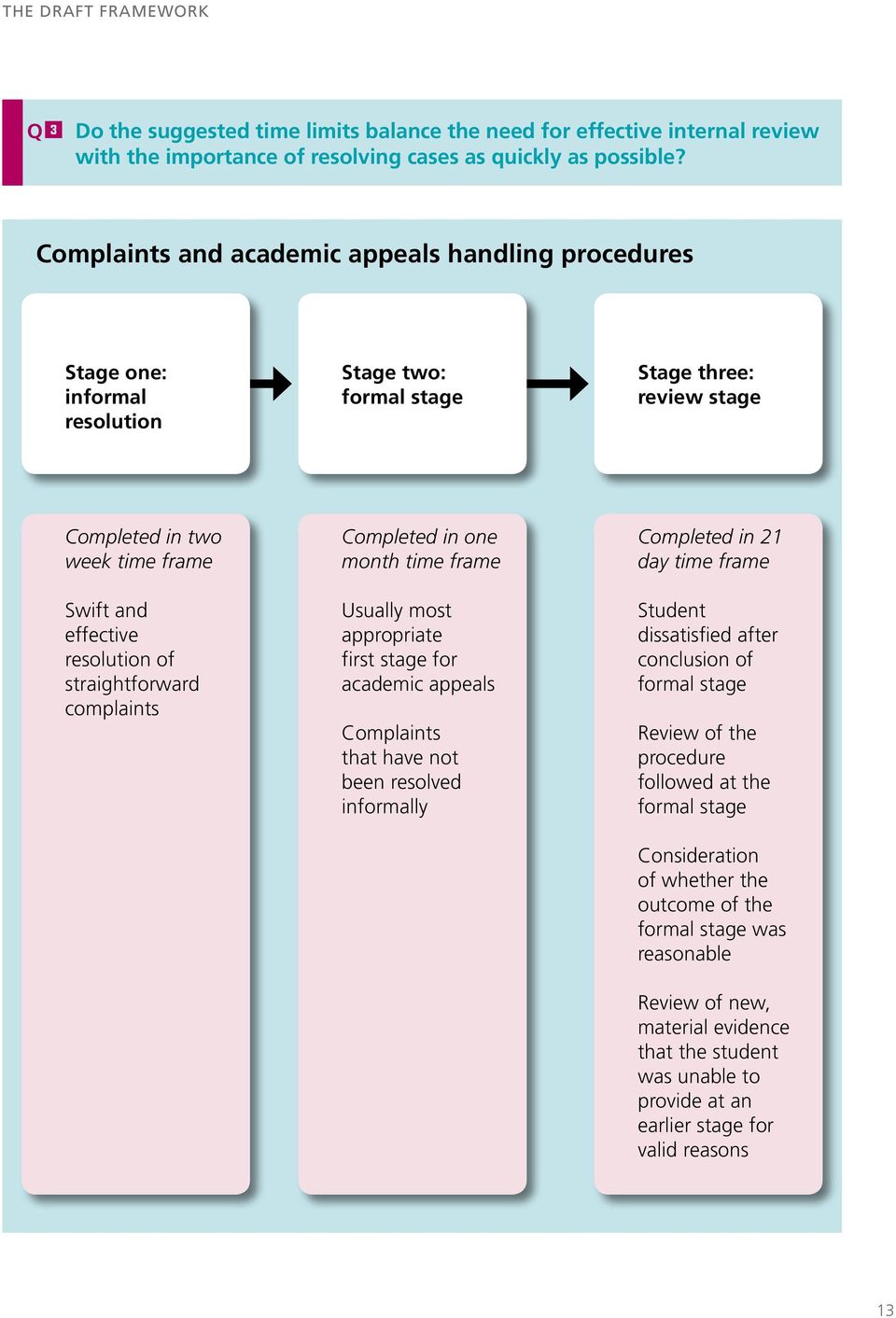
12 GOOD PRACTICE FRAMEWORK FOR HANDLING COMPLAINTS AND ACADEMIC APPEALS The Complaints and Academic Appeals Process overview 30 Procedures should involve no more than three stages: (i) The informal resolution stage (stage 1) seeks to resolve straightforward concerns swiftly and effectively at the point at which a complaint is made, or as close to that point as possible, for example at School or Faculty level. Universities should consider and adopt an early dispute resolution approach, beginning with an attempt at resolution at the informal stage. The informal stage should be completed within two weeks. In all cases, students should be directed to the next stage of the procedure if they remain dissatisfied at the conclusion of informal resolution. See paragraphs for more guidance on the informal stage. (ii) The formal stage (stage 2) is appropriate where a student is dissatisfied with the outcome of informal resolution, or where informal resolution is not possible or appropriate due to the complexity or seriousness of the case. Academic appeals will normally be considered at the formal stage. The formal stage will usually be dealt with at School, Faculty or Department level, by people who were not involved at the informal stage. The formal stage may include mediation or conciliation where appropriate. (iii) The review stage (stage 3) is where the student can appeal to a higher body within the university for a review of the process of the formal complaint or academic appeal stage to ensure that appropriate procedures were followed and that the decision was reasonable. This stage does not necessarily require a reconsideration of the issues raised. Complaints or academic appeals which have exhausted a partner organisation s internal procedures will normally be considered by the degreeawarding university at this stage. This should include a review of the partner institution s handling of the matter. The review stage should be completed within 21 days of receipt. At the conclusion of this stage, the university should issue a Completion of Procedures letter within 28 days to enable the student to request an external review by the OIA if he or she remains dissatisfied at the conclusion of the review stage. See paragraphs for more guidance on the review stage. The formal stage should be completed within one month of receipt. The student should be provided with a written outcome at the conclusion of this stage. See paragraphs for more guidance on the formal stage. 12

13 THE DRAFT FRAMEWORK Q3 Do the suggested time limits balance the need for effective internal review with the importance of resolving cases as quickly as possible? Complaints and academic appeals handling procedures Stage one: informal resolution Stage two: formal stage Stage three: review stage Completed in two week time frame Swift and effective resolution of straightforward complaints Completed in one month time frame Usually most appropriate first stage for academic appeals Complaints that have not been resolved informally Completed in 21 day time frame Student dissatisfied after conclusion of formal stage Review of the procedure followed at the formal stage Consideration of whether the outcome of the formal stage was reasonable Review of new, material evidence that the student was unable to provide at an earlier stage for valid reasons 13
14 GOOD PRACTICE FRAMEWORK FOR HANDLING COMPLAINTS AND ACADEMIC APPEALS Stage 1: Informal resolution of complaints to be completed within two weeks of receipt 31 The purpose of informal resolution is to attempt to resolve as quickly as possible concerns which are straightforward and require little or no investigation. To facilitate this, it is important that university staff are appropriately empowered and skilled. Concerns raised at this stage can be handled by a face-to-face discussion with the student or by asking an appropriate member of staff, or trained conciliator, to deal with the matter. 32 Key questions to consider could include: What specifically is the concern about and which area(s) of the university is /are involved? What outcome is the student hoping for and can it be achieved? Is the concern straightforward and likely to be resolved with little or no investigation? Can it be resolved on the spot by providing an apology/explanation/alternative solution? Can someone else assist in seeking informal resolution, for example where an informal administrative resolution is required? may wish to provide advice to staff on providing and recording apologies. 34 If responsibility for the matter raised lies in the staff member s area of work, every attempt should be made to resolve the concern at source in consultation with the student where appropriate. If responsibility lies elsewhere, the staff member should liaise with the relevant area to facilitate swift resolution, rather than simply passing the student on to another office. Where this is not possible and the student is directed to liaise with another office, it is good practice to introduce the student to the person who will deal with the concern or alternatively make an appointment for the student to meet them at the earliest opportunity. 35 As academic appeals are not generally amenable to informal resolution universities are not obliged to establish an informal stage for academic appeals. However, the inclusion of an informal resolution stage in the academic appeals procedure allows students who may have grounds for appeal, or who seek clarification of an assessment or examination board s decision, to discuss their concerns with a nominated representative of the School, for example at a Results Surgery following the publication of results. This also provides an opportunity to manage the student s expectations in advance of submission of an academic appeal under the formal stage. What assistance or support can be provided to the student in taking this forward? 33 Students should have an opportunity to air their concerns and feel that they have been listened to. Resolution might be achieved by providing an on-the-spot explanation of why the issue occurred and/or (where appropriate) an apology and explanation of what will be done to stop a similar situation happening again. Some staff may be concerned that making an apology could create a legal liability, particularly if an issue is not fully resolved to the student s satisfaction and is escalated to the next stage. Universities 36 Where it is clear that a concern will need to be considered at the formal stage rather than the informal stage, the student should be directed promptly to the appropriate procedure. He or she should be encouraged to complete the appropriate form to provide full details of the complaint or academic appeal and to provide any relevant documentation. The student should also be informed of any time limits for submission and where and how to access advice and support, for example the students union, the student advice centre, professional associations or trades unions. 14
15 THE DRAFT FRAMEWORK 37 Procedures should make clear any circumstances in which students do not have to follow the informal stage. Closing the matter at the informal resolution stage 38 At the conclusion of informal resolution, the student should be advised of: the right to submit a formal complaint or academic appeal if he or she remains dissatisfied Stage two: Formal complaint or academic appeal to be completed within one month of receipt 40 Complaints (and academic appeals) may already have been considered at informal resolution stage, or they may be complaints or academic appeals identified upon receipt as appropriate for immediate formal investigation. Academic appeals will normally be considered at this stage centrally by the university, or may be managed at a Faculty level but according to institutional procedures and with oversight by central staff. the time limit for doing so the appropriate procedure to follow 41 The university should move a complaint (or academic appeal) to the formal stage for investigation when: where and how to access advice and support for example the students union or student advice centre 39 Where proportionate to do so, the outcome of informal resolution should be communicated to the student in writing. It is good practice for the actions taken to investigate the complaint (such as meeting the student), the decision, and minimum details of what was communicated to the student, and when, to be recorded in a way that can be referred to by people dealing with the complaint at a later stage. Q4 Are the suggestions on recording the informal stage proportionate? Informal resolution was attempted, but the student remains dissatisfied The issues raised are complex and will require detailed investigation, for example, where a complaint relates to the conduct of staff members or covers a number of different incidents. 42 Key questions to consider could include: Is this a complaint or academic appeal? Should the student be referred to another procedure? Was informal resolution attempted? If not, should the matter be referred back to the School or Faculty? Has the student set out clearly what the complaint or academic appeal is about and which area(s) of the university is/are involved? Has the student provided evidence in support of the complaint or appeal? What outcome is the student hoping for and can it be achieved? 15
16 GOOD PRACTICE FRAMEWORK FOR HANDLING COMPLAINTS AND ACADEMIC APPEALS Is the complaint suitable for mediation or conciliation? What assistance or support can be provided to the student in taking this forward? 43 Special attention should be given to identifying complaints and academic appeals that may require particularly swift action. These may include, but are not limited to: complaints involving a threat of serious harm cases where the impact of the issues raised has detrimental consequences for the student s mental health or where the student displays significant distress cases where external time limits apply for example in meeting regulatory requirements for completion of professional courses complaints relating to disability support issues of serious and repeated service failure and/or significant delay issues of a highly sensitive nature. 44 In some cases it may be appropriate to consider the complaint under another procedure, for example a bullying and harassment policy or disciplinary procedure, or to refer the student to other sources of support. Requirements on students 45 Universities will normally require students to submit a complaint or academic appeal in writing, by or online by completing the appropriate form or by having someone submit a complaint or academic appeal on their behalf where written consent is provided. 46 The purpose of conducting an investigation is to establish all of the facts relevant to the points made in the complaint or academic appeal and to provide a full, objective and proportionate response to the student that represents the university s clear position. Universities can require students to set out their concerns clearly and succinctly and provide evidence to substantiate the issues raised where possible. An investigation will gather evidence, but it is expected that a student will provide all evidence that it is reasonable for them to have gathered and provide. This may include medical evidence such as letters confirming attendance or treatment at a GP or hospital or counselling service, reports by professionals such as psychologists or disability advisors, police crime numbers in the case of reported incidents, financial information such as evidence of lost income (where relevant to the complaint), bank statements or receipts or statements of witnesses to incidents where it is safe and helpful to provide these. 47 Students may indicate that they wish elements of, or their entire complaint or academic appeal e.g. a statement from a witness or medical evidence, to remain confidential. Although it is expected that any complaint or academic appeal will be managed in a confidential and sensitive way, there will be staff who need to consider the appeal or complaint and who may be asked to provide comment or response to the statements made. Institutional procedures should set out in what circumstances elements of, or the entire complaint or academic appeal can be kept confidential, for example where a student provides a corroborating statement in support of a complaint about a member of staff and wishes to remain anonymous when the statement is shown to that member of staff. What the university will do when it receives a complaint or academic appeal for investigation 48 It is good practice for universities to include a sifting process at this stage to determine whether grounds exist for a complaint or academic appeal. The university needs to make 16
17 THE DRAFT FRAMEWORK it clear what purpose sifting serves and establish clear criteria for any initial sifting process including how the student can dispute such a preliminary finding. Q5 Is it appropriate to introduce the sifting process at the formal stage? 49 If there are grounds for an academic appeal, or if a complaint is eligible, the university should allocate the case to a case officer who has had no previous involvement in the matter. Case officers should be given proper training. It is important to be clear from the start of the formal stage exactly what is being investigated to ensure that both the case officer and student understand the purpose and scope of the investigation and how the case officer relates to any later panel. The case officer should consider meeting with the student to facilitate this. If the student s expectations appear to go beyond what the university can reasonably provide or what is in its power to provide, the student should be advised of this as soon as possible in writing in order to manage expectations about possible outcomes. 50 The university should tell the student the name and contact details of the case officer. It will not normally be appropriate to keep the name of the case officer confidential. This would undermine transparency and may undermine the student s confidence in the process. Academic appeals 51 For academic appeals the case officer will consider the academic appeal and may talk to key staff or other students and consider documents and other evidence. 52 Where the case officer has determined that there are grounds for appeal it is good practice to refer the appeal to an academic panel. The panel should be given a summary of the student s academic progress, minutes from a Board of Examiners, evidence provided by the student and relevant course or institutional regulations. The student s school or department will usually be asked to comment on the academic appeal, often termed a school response. Case officers may also provide other information, for example, where a student refers to a previous mitigation or appeal a copy of this may be provided. All such information including the school response should be copied to the student. It is important however that the panel 17
18 GOOD PRACTICE FRAMEWORK FOR HANDLING COMPLAINTS AND ACADEMIC APPEALS is only provided with information pertinent to the appeal, and not all of the information which may be available in a student s file. 53 Where appropriate and proportionate it is good practice to provide the student with an opportunity to attend a meeting (often called a hearing ) before a panel, in person or by alternative means (electronically for example by Skype). In cases where a hearing is to be held, universities should take all necessary steps to ensure that the proceedings are conducted in a timely manner, with adequate notice given to all parties, and timely information given to the student about the composition of the panel and others who may attend to give evidence. Universities may wish to set out a running order for the meeting, clarifying how the meeting will be conducted, the role of the Chair (if any) of the panel and any administrative support, the role of any other attendees, for example where a school representative may attend to provide clarification on local regulations, whether the student has an opportunity to present their appeal, how questions will be managed, any final statement by the student and other points. 54 In addition to following its own procedures correctly when it holds a hearing, a university should act fairly. Panel members should be given proper training. All parties should receive copies of the information to be considered by the panel in reasonable advance of the hearing. Both parties should be heard and have the opportunity to hear what the other party has said. The duty to act fairly also requires that panels should be free of any perception of bias. The university needs to consider the constitution of panels and take steps to ensure that those charged with reaching a decision have had no previous involvement in the matter. Complaints 55 For complaints, the case officer will consider the complaint and may talk to key staff or other students and consider documents and other evidence. The case officer will produce a report based on his or her investigations which will outline the process followed, the information gathered, the conclusions drawn and any recommendations. 56 The case officer should also consider if the complaint is amenable to mediation or conciliation at this stage (see paragraphs 64 and 65, mediation and conciliation ). 57 It is not usual for a panel to be convened to consider the complaint at this stage, but the report may be forwarded to another senior member of staff for the recommendations to be agreed. 58 In addition to following its own procedures correctly when considering a complaint, a university must act fairly. Case officers should be given proper training. All parties should receive copies of the information considered and a copy of the investigation report. The duty to act fairly also requires that the case officer should be free of any perception of bias. The university needs to consider who is included in any pool of case officers and take steps to ensure that people charged with reaching a decision have had no previous involvement in the matter. 59 If a hearing is to be held to consider the complaint, universities should take all necessary steps to ensure that the proceedings are conducted in a timely manner, with adequate notice given to all parties. The university should give timely information to the student about the composition of the panel and others who may attend to give evidence and provide a copy of the information to be considered. Panel members should be given proper training. 60 The university should ensure that a note is taken of any hearing, setting out who attended, a brief outline of the proceedings, and the reasons for the decisions taken. Q6 Does the draft framework give the right emphasis to hearings in the complaints and academic appeals processes? 18
19 THE DRAFT FRAMEWORK Student representation 61 For both complaints and academic appeals the student should be informed in a timely manner of any right to attend a meeting or hearing, any right to be accompanied or represented, and if so by whom, and any rights to submit evidence or call witnesses. Complaints and academic appeals procedures are internal to a university and do not have the same degree of formality as a case in a court of law. It is not normally necessary or appropriate for students to be legally represented at complaint or academic appeal hearings. However, legal representation may be appropriate where the consequences for the student are particularly serious or far reaching. The student should be made aware of the implications, if any, of appointing legal representation. This might prompt the university to appoint lawyers and this might cause delay in the progression of the matter. Q7 Does the guidance adequately reflect the importance of including legal representation only in exceptional circumstances? Timelines 62 The following deadlines should be used for cases at the formal stage of the complaints and academic appeals procedures: complaints and academic appeals should be acknowledged in writing within five working days the university should provide a full response to the complaint or academic appeal as soon as possible but usually not later than one month from the time that the complaint or academic appeal was received for investigation the student should escalate the matter to the review stage within one month of communication of the outcome of the formal stage if he or she remains dissatisfied. Extension to timelines 63 Not all investigations during the formal stage will be able to meet the published deadline. Procedures should set out in what circumstances universities may extend the deadline. Where there are clear and justifiable reasons for extending the deadline the case officer will exercise judgment, set new time limits and notify the student in writing. If the student does not agree to an extension, he or she should be able to contest the decision in writing to a senior manager. The senior manager should consider the student s representations and, where an extension is considered unavoidable and reasonable, the senior manager should confirm the extension to the student in writing. In all cases where the university is unable to meet the deadline, the student should be kept updated on the reason for the delay and given a revised deadline for bringing the formal stage to a conclusion. 19

20 GOOD PRACTICE FRAMEWORK FOR HANDLING COMPLAINTS AND ACADEMIC APPEALS Mediation and conciliation the appropriate procedure 64 Mediation and conciliation are voluntary processes where an impartial independent third party helps parties to a dispute resolve issues confidentially. In general it is recognised as less likely that mediation or conciliation will be appropriate or successful in academic appeals than in complaints. Using mediation can help both parties to understand what is driving the complaint, and may be more likely to result in a swift and mutually satisfactory conclusion being reached. Mediation and conciliation can be used to stop the clock on the formal process which may be re-started if agreement cannot be reached. 65 Where both the university and the student agree to mediation or conciliation revised timescales should be agreed between the parties in writing. All parties should be clear how the arrangement fits with more formal procedures, the scope of the mediation or conciliation process and whether its use is subject to the parties agreeing in advance to accept the solution offered or the findings reached. Closing the complaint or academic appeal at the formal stage 66 The outcome of the formal stage should be communicated to the student in writing, giving a clear explanation and outlining the reasons for each decision in simple, straightforward language. This will help the student decide whether or not to pursue the matter further. 67 The decision should also advise the student about: his or her right to take the complaint or academic appeal to the review stage the grounds on which he or she can do so where and how to access support. 68 If the student does not take the complaint or academic appeal to the review stage within the time limit for doing so, the university should close the matter and notify the student in writing. 69 Where a complaint or academic appeal is upheld, the university should explain how and when it will implement any remedy, and whether that includes an apology. The remedy may include reference back to a Board of Examiners to review the academic decision based on the findings of the academic appeal panel (this may not result in a change to the academic decision, which is a matter for the Board of Examiners). 70 Details of the complaint or academic appeal, including the way the decision was communicated to the student, should be recorded in a systematic way. It may be helpful to operate a logging system for stage 2 complaints and academic appeals to help manage the cases and provide valuable management information on caseload, categories of complaint or academic appeal, demographic characteristics of students submitting a complaint or academic appeal and other information. See paragraphs for more information on recording complaints and academic appeals and reporting outcomes internally. Stage three: Review to be completed within 21 days of receipt 71 If a student is dissatisfied with the outcome of the formal stage, he or she has one month to request a review. A request for a review may be on limited grounds, including but not confined to: the time limit for escalating to the review stage a review of the procedures followed at the formal stage 20
21 THE DRAFT FRAMEWORK consideration of whether the outcome was reasonable in all the circumstances new material evidence which the student was unable, for valid reasons, to provide earlier in the process. 72 The purpose of conducting a review is to consider whether any procedural irregularities occurred during the formal stage and whether the outcome was reasonable. The review stage will not usually consider the issues afresh or involve a further investigation. A complaint or academic appeal must have been considered at the formal stage before it can be escalated to the review stage. 73 Universities can require a student to submit a request for review in writing, by or online by completing the appropriate form or by having someone submit such a request on her/his behalf where written consent is provided. Students should set out their concerns clearly and succinctly and provide evidence to substantiate the issues raised where possible. What the university will do when it receives a request for review 74 The university will allocate the request for review to a designated member of staff not previously involved in the informal or formal stages. It is important to be clear from the start of the review stage exactly what is being reviewed, and to ensure that both the reviewer and the student understand the purpose and scope of the review. If the student s expectations appear to exceed the scope of the review stage, the student should be advised of this as soon as possible in writing in order to manage expectations about possible outcomes. 75 The university needs to make it clear in its procedures whether the reviewer is able to overturn the outcome of the formal stage, or whether the matter needs to be referred back to the formal stage for reconsideration. 76 Key questions to consider could include: Were the relevant procedures followed during the formal stage? Was the outcome reasonable in all the circumstances? Has the student received clear reasons why the complaint or academic appeal was rejected at the formal stage? If new evidence has been provided, has the student provided valid reasons for not providing it earlier? 77 Details of the complaint or academic appeal should be recorded on a system for recording complaints or academic appeals. Where the complaint or academic appeal has been through the formal stage this should be shown in complaints or academic appeals log. At the conclusion of the review stage the log should be updated to reflect the final outcome and any action taken. Timelines 78 The following deadlines should be used for cases at the review stage of the complaints or academic appeals procedures: a request for a review should be acknowledged in writing within five working days the university should consider the request for a review and let the student know in writing if their request has been accepted and any outcome, normally within 21 days. Extension to the timeline 79 Not all reviews will be able to meet this deadline. Where there are clear and justifiable reasons for extending the deadline, the reviewer will exercise judgment and will set time limits 21
22 GOOD PRACTICE FRAMEWORK FOR HANDLING COMPLAINTS AND ACADEMIC APPEALS on any extended review and notify the student in writing. If the student does not agree to an extension, he or she may contest the extension to the deadline with clear reasons why he or she considers it to be unreasonable. The designated senior manager should consider the student s representations and, where an extension is considered unavoidable and reasonable, the senior manager should confirm the extension to the student in writing. In all cases where the university is unable to meet the deadline, the student must be kept updated on the reason for the delay and given a revised deadline for bringing the review to a conclusion. Independent external review (OIA) 83 Once the review stage has been completed, the student is entitled to ask the OIA, the independent ombudsman service of last resort, to look at his or her complaint or academic appeal within three months of the date of the Completion of Procedures letter. Information about the OIA is included at Annex 2. Q8 Is the progression between stages clear? Closing the complaint or academic appeal at the review stage 80 The outcome of the review stage should be communicated to the student by issuing a Completion of Procedures letter within 28 days. This should include a clear explanation and outline the reasons for the decision in simple, straightforward language. This will help the student decide whether or not to pursue the matter further. Where a complaint or academic appeal is upheld, the university should explain how and when it will implement any remedy, and whether that includes an apology. 81 The decision should also advise the student about: his or her right to submit a complaint to the OIA for review the time limit for doing so where and how to access advice and support. 82 The decision, and details of how and when it was communicated to the student, should be recorded on the system for recording complaints or academic appeals. See paragraphs for more guidance on recording complaints. 22
23 THE DRAFT FRAMEWORK Factors to consider Maintaining confidentiality 84 Complaints and academic appeals should be handled with an appropriate level of confidentiality and information released only to those who need it for the purposes of investigating or responding to the complaint or academic appeal. No third party should be told any more about the investigation than is strictly necessary in order to obtain the information required from them. 85 Where a complaint has been raised against a student or member of staff and has been upheld, the student bringing the complaint will be advised of this. However, it would not be appropriate to share specific details affecting specific students or staff members, particularly where subsequent disciplinary action may be taken. It is important that the student is advised of this at the earliest opportunity in order to manage expectations. Managing behaviour 86 All parties involved in a complaint or academic appeal need to act reasonably and fairly towards each other, and to treat the processes themselves with respect and not abuse them. It is recognised that people may act out of character in times of trouble or distress. The circumstances leading to a complaint or academic appeal may result in a student or their representative acting in an unacceptable way. Students or representatives who display unacceptable behaviour may still have a legitimate concern. The university should therefore treat all complaints and academic appeals seriously and assess them properly. 87 The actions of students or representatives who are angry, demanding or persistent may result in unreasonable demands on time and resources or unacceptable behaviour towards the university s staff. It is advisable for the university to put into place and publicise policies and procedures to protect staff from such unacceptable behaviour. These policies and procedures should include the requirement to inform the student or representative of any decision to restrict access, right of appeal, and any procedures for reviewing such a decision to restrict contact. Frivolous or vexatious complaints and academic appeals 88 It is good practice for universities to have a policy for dealing with frivolous or vexatious complaints. Examples of such complaints include: complaints or academic appeals which are obsessive, harassing, or repetitive insistence on pursuing non-meritorious complaints or academic appeals and/or unrealistic, unreasonable outcomes insistence on pursing meritorious complaints or academic appeals in an unreasonable manner complaints or academic appeals which are designed to cause disruption or annoyance demands for redress which lack any serious purpose or value. 89 The university should be able to terminate consideration of a complaint or academic appeal if it considers it to be frivolous or vexatious. In such instances the university should write to the student explaining why it is terminating consideration of the matter. The student should be provided with details of how to appeal against the decision. Supporting the student 90 Students whose first language is not English or Welsh may need help with interpretation and translation services. Other students may have specific needs which the university should seek to address to ensure easy access to the complaints or academic appeals procedure by making reasonable adjustments to the procedure to assist the student. 23
24 GOOD PRACTICE FRAMEWORK FOR HANDLING COMPLAINTS AND ACADEMIC APPEALS 91 On receipt of a complaint or academic appeal, it is good practice for the university to ask a student with a disability (where this is declared as part of the process) if he or she requires reasonable adjustments to the procedure. The university should consider the adjustments requested and formally notify the student in writing which reasonable adjustments have been made to the procedures. 92 Students should also be specifically advised of the support services available, for example the students union, which can provide helpful independent support and advice to those who wish to pursue a complaint or academic appeal with the university. Recording complaints and academic appeals 95 To collect suitable data, complaints and academic appeals at stage 2 and 3 should be recorded in sufficient, proportionate, detail. Student details should be anonymised and care should be taken to ensure that a student is not identifiable. As a minimum, it is good practice to record following information: date of receipt of the complaint or academic appeal how the complaint or academic appeal was received 93 Students who have disclosed mental health issues should be advised of specific support services available to them within the university, for example counselling services and, where appropriate, services external to the university. If a student appears unable to effectively engage with the complaints or academic appeal procedures, it may be appropriate to suspend the consideration of a complaint or academic appeal until the student has accessed appropriate support. Alternatively, it may be possible for the student to appoint a representative to act on his or her behalf. Recording, reporting, publicising and learning from complaints category of complaint or academic appeal staff member responsible for handling the complaint or academic appeal department to which the complaint or academic appeal relates date the formal stage was initiated (if applicable) action taken and outcome at formal stage (if applicable) date the complaint or academic appeal was closed at the formal stage (if applicable) 94 Valuable feedback is obtained through the resolution of complaints and academic appeals. Both procedures allow the university to identify opportunities to improve services and academic decision-making. As a minimum it is good practice for universities to record all complaints and academic appeals at the formal stage (stage 2) and review stage (stage 3) so that the data can be used for analysis and management reporting. By recording and using information in this way the causes of complaints and academic appeals can be identified, addressed and, where appropriate, training opportunities can be identified and improvements introduced. date the review stage was initiated (if applicable) action taken and outcome at review stage (if applicable) date the complaint or academic appeal was closed at the review stage (if applicable) underlying cause and remedial action taken (if applicable) response times at each stage. 24
25 THE DRAFT FRAMEWORK 96 It is good practice for universities to have structured approaches to recording complaints and academic appeals, their outcomes and any resulting action so that the complaint and academic appeal data can be used for internal reporting and wider dissemination. Regularly reporting the analysis of complaints and academic appeals information helps to identify where improvements are required. Information reported internally should include: performance statistics, detailing complaints and academic appeals volumes, types and key performance information, for example time taken and the stage at which complaints and academic appeals were resolved the trends and outcomes of complaints and academic appeals and the actions taken in response including examples to demonstrate how complaints and academic appeals have helped improve services and decision making. Learning from complaints and academic appeals 97 People dealing with complaints and academic appeals should always satisfy themselves that all parties involved understand the findings of the investigation and any decisions made. 98 Senior management should ensure that the university has procedures in place to act on issues that are identified. These procedures facilitate: using data to identify the root cause of complaints and academic appeals taking action to reduce the chance of problems reoccurring recording the details of corrective action in the complaints or academic appeals file academic appeals performance reports to improve performance. 99 The analysis of management reports detailing complaints and academic appeals performance will help to ensure that trends or wider issues which may not be obvious from individual complaints and academic appeals are quickly identified and addressed. Reports should be provided to the appropriate committee and university officers. This may be at school or faculty level, at university level, and through quality assurance or resource groups or committees. The level of information provided in the reports should be proportionate to the role of the committee. For example, the Board of Governors (or Council ) would normally expect to be provided with a summary report, highlighting key trends and themes and actions being taken, in line with its oversight responsibilities. A faculty quality assurance committee will need more detail (whilst maintaining confidentiality) so that issues can be appropriately discussed. 100 The provision of summary information to staff and students including students unions on the actions taken in response to academic appeals and complaints helps to raise awareness of the procedures and build the confidence of students and staff in their transparency and effectiveness. 15 Accountability for Complaints and Academic Appeals Procedure Roles and responsibilities 101 Universities should take appropriate steps to ensure that all relevant staff are aware of: the complaints and academic appeals procedures how to handle and record complaints and issues relating to academic outcomes at the informal resolution stage systematically reviewing complaints and 15 Documents/B9.pdf 25
26 GOOD PRACTICE FRAMEWORK FOR HANDLING COMPLAINTS AND ACADEMIC APPEALS who they can refer a complaint or query about an academic outcome to if they are unable to handle the matter personally the need to try and resolve complaints and queries about academic outcomes early and as locally (within their department) as possible their clear authority to attempt to resolve any complaints or queries about academic outcomes they may be called upon to deal with. 102 Senior management should ensure that: the university s final position on a complaint or academic appeal investigation is signed off by an appropriate person in order to provide assurance that this is the definitive response of the university and that the student s concerns have been taken seriously named individuals from the senior management maintain overall responsibility and accountability for the management and governance of complaints and academic appeals handling within the university senior management has a clear understanding of, and role in, the complaints and academic appeals handling procedures (this will include an oversight role and not necessarily mean being involved in the decision-making process) mechanisms are in place to ensure a consistent approach to the way complaints and academic appeals handling information is managed monitored, reviewed and reported at all levels in the university (including to the Board of Governors) complaints information is used to improve services to students and the student experience, and this is evident from regular publications. 103 The following paragraphs give general examples of the roles and responsibilities which may be considered appropriate in respect of complaints and academic appeals handling. These can be amended to suit the particular circumstances of individual universities. However, there should remain a clear description of the roles and responsibilities in relation to complaints and academic appeals handling for each level of the university. 104 The Board of Governors has accountability for the actions of the university. In cases where the OIA finds non-compliance with its recommendations this is raised with the Board of Governors. 105 The Vice-Chancellor provides leadership and direction to the university. This includes ensuring that there are effective complaints and academic appeals handling procedures, with robust investigation processes which demonstrate that organisational learning is in place. The Vice-Chancellor may delegate responsibility for the procedures, but should receive assurance of performance by way of regular reporting. He or she should also ensure that complaints and academic appeals are used to identify improvements to services to students and the student experience. 106 Heads of School/College/Service may be involved in the investigation of complaints. As senior officers they may be responsible for preparing and signing response letters to complainants and therefore should be satisfied that the investigation is complete and that the response addresses all aspects of the complaint. 107 The case officer is a suitably trained staff member responsible for the conduct of the investigation and is involved in the investigation and the co-ordination of all aspects of the response to the student. 108 All staff: A complaint may be made to any member of staff. All staff should, therefore, be aware of the university s complaints procedure 26
27 THE DRAFT FRAMEWORK and how to handle and record complaints at the informal resolution stage. They should also be aware of who to refer a complaint to, in cases which they are not able to handle personally. The university should encourage all staff to try to resolve complaints early, quickly and as close to the point of service delivery as possible, to prevent escalation. The university should provide training as appropriate. 109 Students union (or Association or Guild): The students union of the institution is recognised as the independent, autonomous representative body and therefore, where the union wishes, should be supported by the institution to engage in complaints and appeals in two distinct roles. The students union should be supported, and where possible funded, to provide independent, free, confidential and professional advice and representation for students wishing to submit a complaint or appeal. The students union should also be supported to be an active partner in the institutional processes to learn from complaints and academic appeals. 110 University point of contact to the OIA: This staff member s role includes providing complaints and academic appeals information in an orderly, structured way within requested timescales, acting as the link for providing comments on factual accuracy on behalf of the university in response to OIA requests for information and comments, confirming recommendations have been implemented, and providing evidence to verify this. Q9 What more would you do to clarify and explain this draft framework? 27
28 GOOD PRACTICE FRAMEWORK FOR HANDLING COMPLAINTS AND ACADEMIC APPEALS Definitions University 112 The document uses the term university to refer to any higher education institution in England and Wales. Student 113 The term student includes those accepted to study with a university or registered for its awards, including those on an interruption of study, temporary withdrawal or temporary exclusion or suspension and those who have recently left a university (i.e. the complaint/ appeal is lodged within six months of the student leaving the institution, except where the complaint relates to a service provided to alumni such as provision of award information) Complaint 114 For the purpose of this framework, and in line with the QAA Quality Code, a complaint can be defined as The expression of a specific concern about matters that affect the quality of a student s learning opportunities. 16 A complaint can also be about the quality of other aspects of university life, for example about accommodation services, facilities or behaviours (excluding actions that may be more appropriately considered under institutional bullying or harassment procedures), whether provided direct by the university or by a third party on behalf of the university. Where a student wishes to have an academic decision overturned this is not normally dealt with as a complaint. Academic appeal 115 For the purpose of this framework, and in line with the QAA Quality Code, an academic appeal is defined as A request for reconsideration of a decision of an academic body charged with making decisions on student progress, assessment and awards. 17 This may include a request to change marks or progress decisions, or final award classifications. Mediation 116 An independent third party (the mediator) helps parties with a dispute to try to reach an agreement. The people with the dispute, not the mediator, decide whether they can resolve things, and what the outcome should be. Mediation is voluntary participants can choose whether to mediate or not and follows a series of rules or steps that are agreed in advance. Mediation is private and confidential what is talked about in mediation can t normally be used in court later unless both parties agree. The parties in dispute make the final decision on how to resolve issues. The mediator is impartial he or she does not take sides or say who is right and who is wrong. The mediator is independent. Conciliation 117 Conciliation is a process that may follow similar steps to mediation, and is voluntary and confidential, but the process involves more active engagement from the conciliator who attempts to find solutions to the issue. A conciliator will not only offer an opinion on the relative strengths of the case, but might also issue a binding opinion, if the parties agree to that ahead of time. The major difference between conciliation and mediation is the power of the third party. In all cases, conciliation gives slightly more power to the third party than mediation QAA, UK Quality Code for Higher Education Chapter B9: Academic appeals and student complaints, (April 2013), p.2, Documents/B9.pdf 17 Ibid., p. 2
29 ANNEX 1: THE EARLY RESOLUTION PILOTS INITIATIVE Annex 1: The Early Resolution Pilots initiative A number of universities have explored approaches to early resolution of student complaints and appeals. The Early Resolution Pilots initiative coordinates existing work within universities with new initiatives to encourage sharing of experience. Examples include: Kingston University linked with a number of institutions to promote early resolution and provide early resolution training with the help of a barrister from outside the university with expertise in mediation. Two conferences to share good practice were held and workshops were offered to both academic and non-academic staff. The institutions that were represented at the conferences and/ or involved in the workshops were: Kingston University, University of the West of England, the Open University, St Mary s Twickenham, University of West London, University of Huddersfield, and Canterbury Christ Church University. Outcomes: buy-in from Registry, Student Support, academics and other institutions recognition of the need for change at senior and frontline level free conference and training seeing trainees register the difference using conflict-reducing methods could make the continuing demand for training. Aston University has continued to build links between the Hub in the university and the Advice and Representation Centre (ARC) in the Aston Students Union, giving the students the confidence that the advice they are receiving is impartial, with a focus on student support and guidance. There are regular meetings between the Hub and the ARC and the students union is consulted on changes to university procedures. Outcomes: There is good communication between the Registry, the ARC and the Hub, helping to manage and resolve concerns and disputes at an informal level as far as possible There is a good working relationships between individuals in each team and strong support from senior management There is a Student Support Office in each academic school, allowing for dispute resolution at local level Students Union representatives are invited to attend University committees and boards and are involved in procedural change from the outset. The University of Sheffield has been running an early resolution scheme since February During each year of operation, six student peer conciliators have been recruited from pools of engaged students. To get the scheme off the ground, a working group was formed with sabbatical officers, HR and colleagues from Student Services. A training package was developed and this has now been made available to other relevant groups at the university. Each conciliator is assigned a mentor from the working group. The university reports that a number of cases have been resolved before reaching the formal stage. The key is being listened to one-on-one. 29
30 GOOD PRACTICE FRAMEWORK FOR HANDLING COMPLAINTS AND ACADEMIC APPEALS The record of each meeting is kept simple - a form is completed with the name of the student, a brief summary of the issue and the outcome. It is for internal use only and no details of the actual conversation are released as these are confidential to the student and the student conciliator. There is a careful use of language, for example issues or concerns, not complaints. Conciliators are given a brief summary of the type of issue in advance of the meeting and they are asked to contact their mentor both before and afterwards. Conciliators work from a pre-prepared script, including a statement about confidentiality which is signed by both parties. The pilot is perceived as a positive experience. Student peer conciliators are thought to be more independent and the scheme is less formal than other types of early resolution. Outcomes: cases that have been conciliated have not gone on to the formal stage the script developed involving a confidentiality statement which needs to be signed this can be an effective icebreaker. University of Huddersfield The Huddersfield pilot also involved student conciliators but drawn from the academic staff. There are also three conciliators and a mediator in Registry, who usually do not get involved until the formal stage. Prior to the pilot there was already a student conciliator scheme in place but it had been running for less than a year. The pilot gave the university the impetus to embed it into university complaints and appeals procedures. Trainers already used for mediation training gave the conciliation training and the package was adapted for the conciliators so it can now be offered in house. The role specification was developed and a document agreed with the legal department and students union. This covered how to get the conversation going, the confidential nature of the process and the importance of taking the issue forward to disability services if the student was at risk of self-harm (the student has to agree to the latter). students feel they have been listened to the pilot has helped the personal development of the conciliators there has been a sense of achievement the profile of the university has been raised a stand-alone training package has been developed it is a joint scheme between the university, the Students Union sabbatical offers and the Students Union Student Advice Centre the students have an enhanced student experience and feel listened to There is one (sometimes two) student conciliator in each school. They can call Registry and each other for advice and can refer the student to a conciliator in another school to avoid being too close to the issue. At the start of the pilot, the Head of Registry talked to management and managed to get support from the top down. She led the development of an app which quizzes users about the complaints and appeals process. The app gathers data on the type of questions looked at by staff and students. Outcomes: an overall reduction of complaints by two thirds the recognition and buy-in by senior management 30
31 ANNEX 1: THE EARLY RESOLUTION PILOTS INITIATIVE a Times Higher award for outstanding Registry Scheme transparent and sustainable Edge Hill Students Union The Advice Centre of the Students Union at Edge Hill has worked with students and staff at the university to identify ways of resolving complaints and appeals at the early stage, drawing on the experiences of students using the Centre. One example is work that the Advice Centre took forward, following feedback from students, to ask the university for a new stage to be included into the university regulations in relation to the Fitness to Practise investigation process. This has been agreed and will ensure consistency across faculties. The university responded positively and has established a working group, including the Advice Centre, and the relevant Faculties, that will meet regularly to consider this and other related guidance. The approach has been fairly informal, based on encouraging students to consult the Advice Centre about concerns and picking up on issues where changes to practice might facilitate early resolution. 31
32 GOOD PRACTICE FRAMEWORK FOR HANDLING COMPLAINTS AND ACADEMIC APPEALS Annex 2: The OIA The OIA considers complaints from people who remain dissatisfied at the conclusion of the university s internal procedures. The OIA is an independent review body, external to the university. It looks at issues such as whether the university followed its procedures, whether these procedures were reasonable, and whether the university s final decision was reasonable in all the circumstances. The OIA requires the university to inform students of their right to go to the OIA. For joint-degree students whose review is considered by an international partner, the external review stage falls under the national practices of the degree awarding university which carried out the review. In line with the language of the Higher Education Act 2004 all submissions to the OIA are called complaints whether they relate to a complaint or an academic appeal. The OIA cannot normally look at complaints: where the student has not gone all the way through the university s complaints or academic appeals procedures where the complaint refers to matters occurring three years or more previously where the Completion of Procedures letter is received outside the three month time limit where matters have been or are being considered in court. The OIA s Scheme Rules and guidelines are available on its website, 32
33 ANNEX 3: QAA CONCERNS SCHEME Annex 3: QAA Concerns Scheme QAA can investigate concerns about the standards and quality of higher education provision, and about the information higher education providers make available about the learning opportunities they offer. Where there is evidence of weaknesses which go beyond a single, isolated occurrence, and where the evidence suggests broader failings in the management of quality and standards, QAA can investigate. These concerns can be raised by students, staff, organisations, and the public. Further information, including a guide for applicants, is provided on the QAA website Documents/B9.pdf 33
34 34 GOOD PRACTICE FRAMEWORK FOR HANDLING COMPLAINTS AND ACADEMIC APPEALS
35
36 Office of the Independent Adjudicator for Higher Education Third Floor Kings Reach Kings Road Reading RG1 3AA Tel: Fax:
Birkbeck, University of London. Student Complaints Policy and Procedure
 Birkbeck, University of London Student Complaints Policy and Procedure Introduction 1. Birkbeck College is committed to giving to you the best student experience possible. However, there may be times when
Policy and Procedure for Handling and Learning from Feedback, Comments, Concerns and Complaints
 Policy and Procedure for Handling and Learning from Feedback, Comments, Concerns and Complaints Author: Shona Welton, Head of Patient Affairs Responsible Lead Executive Director: Endorsing Body: Governance
NEWMAN UNIVERSITY DISCIPLINARY POLICY AND PROCEDURE
 1. Scope and Purpose NEWMAN UNIVERSITY DISCIPLINARY POLICY AND PROCEDURE 1.1 Newman University [hereafter referred to as the University] recognises disciplinary rules and procedures are necessary for the
Disciplinary Policy and Procedure
 Disciplinary Policy and Procedure Policy The success of the University is dependent on its most important resource, its staff. It is therefore vital that all employees are encouraged to work to the best
Fairness at Work (Grievance Policy & Procedure)
 Fairness at Work (Grievance Policy & Procedure) Publication Scheme Y/N Department of Origin Policy Holder Author Related Documents Can be Published on Force Website HR Operations Head of HR Operations
NHS CHOICES COMPLAINTS POLICY
 NHS CHOICES COMPLAINTS POLICY 1 TABLE OF CONTENTS: INTRODUCTION... 5 DEFINITIONS... 5 Complaint... 5 Concerns and enquiries (Incidents)... 5 Unreasonable or Persistent Complainant... 5 APPLICATIONS...
Newcastle University disciplinary procedure
 Newcastle University disciplinary procedure Contents 1. INTRODUCTION... 1 2. RIGHT OF REPRESENTATION... 3 3. TRADE UNION REPRESENTATIVES... 3 4. SCHEDULING OF FORMAL MEETINGS AND APPEALS... 3 5. INVESTIGATION...
PLUMBING INDUSTRY LICENSING SCHEME (SCOTLAND AND NORTHERN IRELAND) DUTIES OF A LICENSED BUSINESS
 PLUMBING INDUSTRY LICENSING SCHEME (SCOTLAND AND NORTHERN IRELAND) DUTIES OF A LICENSED BUSINESS January 2010 INTRODUCTION This document has been prepared to provide Licensed Business with a guide to their
University of the Arts London. Complaints Procedures. Introduction
 University of the Arts London Complaints Procedures Introduction 1. The University has clear procedures for dealing with student complaints which form part of its quality assurance system and reflect current
Complaints Policy and Procedure. Contents. Title: Number: Version: 1.0
 Title: Complaints Policy and Procedure Number: Version: 1.0 Contents 1 Purpose and scope... 2 2 Responsibilities... 2 3 Policy Statement: Aims and Objectives... 4 4 Definition of a complaint... 4 5 Procedure...
Complaints handling procedure
 East Ayrshire Council Complaints handling procedure September 2012 2 East Ayrshire Council Complaints handling procedure: September 2012 East Ayrshire Council - Complaints handling procedure Foreword Our
Grievance Policy and Procedure
 Grievance Policy and Procedure Page 1 Grievance Policy and Procedure Policy ref no: HR012-14 Author (inc job Judith Champion, Senior HR Business Partner title) Date Approved May 2014 Approved by Quality
Berkshire West Clinical Commissioning Groups
 Berkshire West Clinical Commissioning Groups Corporate Policy 1 (CP1) CCG Policy for the Handling of Complaints Version: 1 Ratified by: Date ratified: April 2013 Name of originator/author: Name of responsible
DISCIPLINARY POLICY AND PROCEDURE
 DISCIPLINARY POLICY AND PROCEDURE Content Policy statement 1. Principles 2. Standards 3. Disciplinary procedure 4. Investigation
For UCLan Cyprus. October 2015/16
 For UCLan Cyprus October 2015/16 1 Making a complaint Introduction The University of Central Lancashire is committed to providing high quality education and other services to its students at the UCLan
QAHC Feedback and Conflict Management Policy and Procedures
 QAHC Feedback and Conflict Management Policy and Procedures Prepared By Erica Waters Consulting June 2000 Revised & Endorsed October 2000 Revised by QAHC September 2007 Policy Statement The Queensland
NOT PROTECTIVELY MARKED
 PEOPLE AND ORGANISATIONAL DEVELOPMENT HUMAN RESOURCES DISCIPLINARY POLICY AND PROCEDURE Author/Role Fiona Munro, Human Resources Date of Risk Assessment (if applicable) N/A Date of Equality Impact Assessment
BUCKINGHAMSHIRE COUNTY COUNCIL SCHOOLS GRIEVANCE POLICY AND PROCEDURE
 BUCKINGHAMSHIRE COUNTY COUNCIL SCHOOLS GRIEVANCE POLICY AND PROCEDURE Version 2 Page 1 of 16 Revised June 2012 BUCKINGHAMSHIRE COUNTY COUNCIL GRIEVANCE POLICY AND PROCEDURE FOR SCHOOLS 1. Introduction
How to Raise a Complaint Introduction
 London School of Economics and Political Science Student Complaint Procedure Section One How to Raise a Complaint Introduction 1. This Student Complaint Procedure ( this Procedure ) sets out how the London
Complaints, Comments & Compliments Policy
 Complaints, Comments & Compliments Policy 1. INTRODUCTION We welcome our customers views and will use them to improve our services. The purpose of this policy is to provide a framework for dealing with
Grievance Policy. 1. Policy Statement
 Grievance Policy 1. Policy Statement The University is keen to provide a positive and supportive working environment for all of its employees, and as such will take every step to resolve issues in the
Customer Feedback Management Policy
 Customer Feedback Management Policy Version 2.0 Table of Contents 1 Document Control... 3 1.1 Document Information... 3 1.2 Document History... 3 1.3 Scheduled amendments... 3 1.4 Document Approvals...
Complaints. It is also important to learn from complaints in order to prevent or minimise the risk of similar problems happening again.
 6 Complaints Even the most careful and competent dental professional is likely to receive a complaint about the quality of the service, care or treatment they have provided, at some point in their career.
DISCIPLINARY POLICY AND PROCEDURES DISCIPLINARY POLICY AND PROCEDURE
 DISCIPLINARY POLICY AND PROCEDURE Date: 5 May 2015 Approved: 3 June 2015 Review date: 22 April 2018 1 CONTENTS 1. INTRODUCTION 2. NOTES OF GUIDANCE Counselling General Principles Investigation Minor Matters
Effective from 9 July 2015. The OIA s approach to. remedies and redress. www.oiahe.org.uk
 Effective from 9 July 2015 The OIA s approach to remedies and redress www.oiahe.org.uk REMEDIES AND REDRESS Contents Introduction 3 What does the OIA do? 4 Compliance with OIA Recommendations 5 Suggestions
ROYAL HOLLOWAY University of London. DISCIPLINARY POLICY AND PROCEDURE (for all staff other than academic teaching staff)
 APPROVED BY COUNCIL September 2002 ROYAL HOLLOWAY University of London DISCIPLINARY POLICY AND PROCEDURE (for all staff other than academic teaching staff) Disciplinary Policy and Procedure September 2002
Staff Investigation Protocol
 Version: 3.0 Document author(s): Stuart Selkirk Approved by: Executive Partnership Forum Date approved: 17 July 2014 Review date: 30 September 2016 Document scope: Trust-wide Version History Log Use this
Greenhead College. Discipline and Grievance. (Senior Postholders) reviewed 02/15
 Greenhead College Discipline and Grievance (Senior Postholders) reviewed 02/15 1 GRIEVANCE PROCEDURE FOR SENIOR POSTHOLDERS: GUIDANCE 1. If a Senior Postholder has a grievance relating to her/his employment
PROCEDURE Police Staff Discipline. Number: C 0901 Date Published: 9 May 2013
 1.0 Summary of Changes Amendments to the 1 st bullet point of section 4.5 and the 3 rd, 4 th, 6 th and 7 th bullet point in section 4.8 have been made. Section 4.9 has been removed as the content is now
JIB NATIONAL WORKING RULES 19 AND 20
 JIB NATIONAL WORKING RULES 19 AND 20 19. DISCIPLINARY AND DISMISSAL PROCEDURE 19.1 INTRODUCTION For the avoidance of doubt, the term operative includes apprentice for the purpose of this Rule The behaviours
COMPLAINTS PROCEDURE ENGLAND BEAUFORT ROAD SURGERY INTRODUCTION
 COMPLAINTS PROCEDURE ENGLAND BEAUFORT ROAD SURGERY INTRODUCTION This procedure sets out the Practice s approach to the handling of complaints and is intended as an internal guide who should be made readily
Complaints Standard. for Suppliers. Categorised as Basic (B or F)
 Complaints Standard for Suppliers Categorised as Basic (B or F) (UK version) Contents Introduction 3 Definitions 3 1. Process, Procedures and Controls 5 2. Regulatory Standards 7 3. Employees 7 4. Publicising
Code of Practice means the Family Mediation Council s code of practice for family mediation.
 Family Mediators Association ( FMA ) complaints and disciplinary procedure concerning clients interviewed by a mediator for a MIAM which term is defined below Purpose This procedure is intended to provide
Disciplinary Procedure
 Disciplinary Procedure Human Resources 1 Introduction The University is committed to supporting its staff in carrying out their responsibilities within an environment which encourages productive, safe
Guidance on a Model Complaints Handling Procedure
 Guidance on a Model Complaints Handling Procedure Scottish Public Services Ombudsman This document is available on request in other languages and formats (such as large print or Braille). SPSO Guidance
AVOIDING AND RESOLVING DISCIPLINE AND GRIEVANCE ISSUES AT WORK. Simpler laws, better services
 AVOIDING AND RESOLVING DISCIPLINE AND GRIEVANCE ISSUES AT WORK Simpler laws, better services 2 Introduction This leaflet has been jointly produced by the Department for Business, Enterprise and Regulatory
Client complaint management policy
 Client complaint management policy 1. Policy purpose This policy implements section 219A of the Public Service Act 2008 in the Department of Justice and Attorney-General (DJAG). Under this section, Queensland
Steve Mason, Legal Services and Governance Lead. Ratified and Approved CCG Governing Body on 10 October 2013 by:
 Title: Claims Management Policy Reference No: Owner: Author: Steve Mason, Legal Services and Governance Lead First Issued On: Latest Issue Date: Operational Date: Review Date: Consultation Date: Policy
ADVICE FROM THE HEADTEACHERS' ADVISORY PANEL GUIDELINES FOR HEAD TEACHER MEMBERS DISCIPLINARY PROCEDURES
 ADVICE FROM THE HEADTEACHERS' ADVISORY PANEL GUIDELINES FOR HEAD TEACHER MEMBERS DISCIPLINARY PROCEDURES DISCIPLINARY PROCEDURES 1. General The purpose of this booklet is to provide guidelines for Head
Employment Policies, Procedures & Guidelines for Schools
 DEALING WITH ALLEGATIONS OF ABUSE AGAINST TEACHERS, OTHER STAFF AND VOLUNTEERS GUIDANCE FOR LOCAL AUTHORITIES, HEAD TEACHERS, SCHOOL STAFF AND GOVERNING BODIES March 2012 1 ABOUT THIS GUIDANCE This is
NHS Complaints Advocacy. A step by step guide to making a complaint about the NHS. www.pohwer.net
 NHS Complaints Advocacy A step by step guide to making a complaint about the NHS NHS Complaints Advocacy Important Information Please read this section before the rest of this guide to ensure you take
Memorandum of Understanding between the Office of the Independent Adjudicator (OIA) and the General Medical Council (GMC)
 Memorandum of Understanding between the Office of the Independent Adjudicator (OIA) and the General Medical Council (GMC) Purpose and basis of the memorandum of understanding This Memorandum of Understanding
HUMAN RESOURCES POLICIES AND PROCEDURES DISCIPLINARY. Date of Policy 1993 Date policy to be reviewed 09/2014
 HUMAN RESOURCES POLICIES AND PROCEDURES DISCIPLINARY Date of Policy 1993 Date policy to be reviewed 09/2014 Policy written by SFC/HR Risk Register Ref (s) HR7 Impact Assessed EDG Date Impact assessed 10/2012
Principles of Good Complaint Handling
 Principles of Good Complaint Handling Principles of Good Complaint Handling Good complaint handling means: 1 Getting it right 2 Being customer focused 3 Being open and accountable 4 Acting fairly and proportionately
Grievance and Disputes Policy and Procedure. Document Title. Date Issued/Approved: 10 August 2010. Date Valid From: 21 December 2015
 POLICY UNDER REVIEW Please note that this policy is under review. It does, however, remain current Trust policy subject to any recent legislative changes, national policy instruction (NHS or Department
NHS North Somerset Clinical Commissioning Group. HR Policies Managing Discipline
 NHS North Somerset Clinical Commissioning Group HR Policies Managing Discipline Approved by: Quality and Assurance Group Ratification date: May 2013 Review date: May 2016 1 Contents 1 Policy Statement...
Health & Wellbeing Framework. Absence Management Policy
 Health & Wellbeing Framework Absence Management Policy 1 Introduction This Policy is part of the Health & Wellbeing Framework which is made up of a number of elements which together encompass all formal
Policies, Procedures, Guidelines and Protocols
 Policies, Procedures, Guidelines and Protocols Document Details Title Complaints and Compliments Policy Trust Ref No 1353-29025 Local Ref (optional) N/A Main points the document This policy and procedure
Policy Group: Disputes Resolution. Disciplinary Procedure
 Policy Group: Disputes Resolution Disciplinary Procedure Issue details Title: Issue and version number: Officer/Panel Controlling Procedure: Authorisation Level: Authorisation Date: Agreed by SSCF SSDC
Document 12. Open Awards Malpractice and Maladministration Policy and Procedures
 Open Awards Malpractice and Maladministration Policy and Procedures Page 1 of 14 Open Awards Malpractice and Maladministration Policy and Procedures Policy Statement Open Awards is committed to ensuring
It s about good service. Tips for Toronto Public Service. Complaint Handling Guide
 It s about good service Tips for Toronto Public Service Foreword This guide is intended to assist the Toronto Public Service and its Agencies, Boards and Commissions in developing and/or improving their
AVOIDING AND RESOLVING DISCIPLINE AND GRIEVANCE ISSUES AT WORK. Simpler laws, better services
 AVOIDING AND RESOLVING DISCIPLINE AND GRIEVANCE ISSUES AT WORK Simpler laws, better services 2 Introduction This leaflet has been jointly produced by the Department for Business, Innovation and Skills
Disciplinary and dismissal procedures for school staff
 Revised guidance for governing bodies Guidance Welsh Assembly Government Circular Date of issue: procedures for school staff Audience Overview Action required Further information Additional copies Governing
How to Make a Claim. Guide. The Equality Act 2010
 working with Guide The Equality Act 2010 The TAEN Guides to the age related provisions of the Equality Act 2010 are primarily for employees, jobseekers and learners and aim to give a simple, clear explanation.
Disciplinary Policy and Procedure
 Disciplinary Policy and Procedure Policy 1. Purpose of the policy and procedure Disciplinary rules are important for the running of the University so that everyone understands what is expected of them
DISCIPLINARY POLICY. 1. Introduction. 2. Structured support. 3. Formal action process 3.1. Investigations. 4. Notes of the Hearing and Investigation
 HUMAN RESOURCES DISCIPLINARY POLICY 1. Introduction 2. Structured support 3. Formal action process 3.1. Investigations 4. Notes of the Hearing and Investigation 5. Suspension 6. Grievance 7. Convening
Disciplinary Process Supplementary Guidance. Role of the Nominated Officer
 West Lothian Council Disciplinary Process Supplementary Guidance Role of the Nominated Officer Human Resources August 2014 1 DISCIPLINARY PROCESS SUPPLEMENTARY GUIDANCE ROLE OF THE NOMINATED OFFICER 1.
Complaints Policy. Complaints Policy. Page 1
 Complaints Policy Page 1 Complaints Policy Policy ref no: CCG 006/14 Author (inc job Kat Tucker Complaints & FOI Manager title) Date Approved 25 November 2014 Approved by CCG Governing Body Date of next
Glasgow Life. Comments, Compliments and Complaints Policy
 Glasgow Life Comments, Compliments and Complaints Policy 1. Introduction Glasgow Life is committed to delivering high quality services that enriches the lives of all of Glasgow's citizens and visitors
CONTENTS. What is long term sickness? Page 2. Keeping in Contact during Absence Page 2. Medical Certificates Page 2
 CONTENTS What is long term sickness? Page 2 Keeping in Contact during Absence Page 2 Medical Certificates Page 2 The Role of the Occupational Health Service Page 2 Access to Health Records Act (1990) Page
STATE HOSPITAL QUALITY PROCEDURES MANUAL
 APPROVED BY: PAGE: Page 1 of 8 1.0 Purpose To define a complaints procedure which is as transparent, fair and impartial as possible to all users and providers of the services undertaken by the State Hospital.
Disciplinary Policy for Schools
 for Schools 2 July 2014 Contents 1 Introduction... 1 1.1 What is the policy about?... 1 1.2 Who does the policy apply to?... 1 1.3 Core Principles... 1 1.3.1 Misconduct... 1 1.3.2 Gross misconduct... 2
This procedure applies where formal disciplinary action is commenced on or after 11 December 2013
 Appendix X Disciplinary Procedure This procedure applies where formal disciplinary action is commenced on or after 11 December 2013 1 Purpose 1.1 This procedure is designed to help and encourage all employees
Dealing with Allegations of Abuse Against Staff in Schools. Practice Guidance
 Dealing with Allegations of Abuse Against Staff in Schools Practice Guidance About this guidance This is statutory guidance from the Department for Education. Schools and colleges must have regard to it
Complaints Handling Procedure
 Data Label: PUBLIC West Lothian Council Complaints Handling Procedure February 2013 Foreword West Lothian Council is committed to providing services to people living and working in our communities that
DISCIPLINARY POLICY AND PROCEDURE
 DISCIPLINARY POLICY AND PROCEDURE Date of Publication: April 2013 Agreed by: Vice Chancellor s Executive March 2013 Page 1 of 13 Policy 1.0 Introduction The purpose of the disciplinary policy and procedure
CAPABILITY AND POOR PERFORMANCE PROCEDURE
 CAPABILITY AND POOR PERFORMANCE PROCEDURE 1. Introduction 1.1 Staff and managers are jointly responsible for ensuring that satisfactory performance standards are maintained at all times. Acceptable standards
The Fostering Network 2006 Managing Allegations and Serious Concerns About Foster Carers Practice: a guide for fostering services.
 1 foreword The role of foster carers is a unique and challenging one. They look after some of our most vulnerable children, 24 hours a day, and it is essential that they are properly supported. The way
Disciplinary policy INTRODUCTION
 Disciplinary policy This policy forms part of your contract of employment. The councils are entitled to introduce minor and non-fundamental changes to this policy by notifying you of these changes in writing
COMMENTS, COMPLAINTS AND COMPLIMENTS POLICY
 COMMENTS, COMPLAINTS AND COMPLIMENTS POLICY DOCUMENT STATUS SCOPE Unclassified This policy sets out Genesis Housing Association's approach to managing complaints from customers. This policy does not cover
Guidance for Employers and Code of Practice
 WHISTLEBLOWING Guidance for Employers and Code of Practice MARCH 2015 Contents What is whistleblowing?... 3 What are an employer s responsibilities in regards to whistleblowing?... 3 Recognising workers
COMPLAINTS POLICY AND PROCEDURE TWC7
 COMPLAINTS POLICY AND PROCEDURE TWC7 Version: 3.0 Ratified by: Complaints Group Date ratified: July 2011 Name of originator/author: Name of responsible committee/ individual: Date issued: July 2011 Review
RUNNING AN EFFECTIVE INTERNAL COMPLAINTS PROCESS
 RUNNING AN EFFECTIVE INTERNAL COMPLAINTS PROCESS INTRODUCTION Rule 3.4(d) of the Lawyers and Conveyancers Act (Lawyers Rules of Conduct and Client Care) Regulations 2008 requires lawyers to provide clients
HEALTH INSURANCE (PERFORMERS LIST FOR GENERAL MEDICAL PRACTITIONERS) (JERSEY) REGULATIONS 201-
 HEALTH INSURANCE (PERFORMERS LIST FOR GENERAL MEDICAL PRACTITIONERS) (JERSEY) REGULATIONS 201- Report Explanatory Note These Regulations establish a performers list for general medical practitioners. They
NATIONAL JOINT COUNCIL FOR STAFF IN SIXTH FORM COLLEGES
 NATIONAL JOINT COUNCIL FOR STAFF IN SIXTH FORM COLLEGES Disciplinary Procedure 1 1.1 Introduction This procedure provides guidance on disciplinary issues. The procedure is endorsed by the National Joint
Policies and Procedures. Policy on the Handling of Complaints
 RMP. South Tyneside NHS Foundation Trust Policies and Procedures Policy on the Handling of Complaints Approved by Trust Board December 2006 (revised version approved by RMEC May 2010) Policy Type Policy
LEGAL ADVICE AND ASSISTANCE POLICY AND GUIDANCE
 LEGAL ADVICE AND ASSISTANCE POLICY AND GUIDANCE Northern Ireland Commissioner for Children and Young People Equality House 7 9 Shaftesbury Square BELFAST BT2 7DP Telephone: 028 9031 1616 Website: www.niccy.org
NHS North Somerset Clinical Commissioning Group
 NHS North Somerset Clinical Commissioning Group HR Policies Managing Sickness Absence Approved by: Quality and Assurance Group Ratification date: September 2013 Review date: September 2016 Elaine Edwards
Employment Guidance Note
 Call 01392 207020 [email protected] www.tozers.co.uk Employment Guidance Note Conducting Disciplinary Meetings The following information is merely an overview of some key elements of what is a complicated
Code of Practice on the discharge of the obligations of public authorities under the Environmental Information Regulations 2004 (SI 2004 No.
 Code of Practice on the discharge of the obligations of public authorities under the Environmental Information Regulations 2004 (SI 2004 No. 3391) Issued under Regulation 16 of the Regulations, Foreword
INVESTIGATING COMPLAINTS AND ALLEGATIONS AGAINST EMPLOYEES POLICY AND PROCEDURE
 INVESTIGATING COMPLAINTS AND ALLEGATIONS AGAINST EMPLOYEES POLICY AND PROCEDURE APPROVED BY: South Gloucestershire Clinical Commissioning Group Quality and Governance Committee DATE 12.02.2014 Date of
FACS Community Complaints Guidelines for Ageing and Disability Direct Services
 FACS Community Complaints Guidelines for Ageing and Disability Direct Services Summary: This is designed to guide FACS staff when handling community complaints and is an extension of the FACS Community
Human Resources Author: Lou Hassen Version: 1 Review Date: Dec 2012 Page 1 of 7. Trinity Academy Disciplinary Policy
 Page 1 of 7 Trinity Academy Disciplinary Policy Policy Statement The purpose of the Disciplinary Procedure is to give staff members every opportunity to improve standards of behaviour and conduct and to
The Court of Protection Transparency Pilot
 The Court of Protection Transparency Pilot Introduction 1. On January 2016 the Court of Protection will begin a pilot scheme aimed at addressing one of the most controversial of its characteristics- its
NHS England Complaints Policy
 NHS England Complaints Policy 1 2 NHS England Complaints Policy NHS England Policy and Corporate Procedures Version number: 1.1 First published: September 2014 Prepared by: Kerry Thompson, Senior Customer
Information for registrants. What happens if a concern is raised about me?
 Information for registrants What happens if a concern is raised about me? Contents About this brochure 1 What is fitness to practise? 1 What can I expect from you? 3 How are fitness to practise concerns
Employment Policies, Procedures & Guidelines for Schools
 DEALING WITH ALLEGATIONS OF ABUSE AGAINST TEACHERS, OTHER STAFF AND VOLUNTEERS GUIDANCE FOR LOCAL AUTHORITIES, HEAD TEACHERS, SCHOOL STAFF AND GOVERNING BODIES July 2014 1 ABOUT THIS GUIDANCE This is statutory
the ombudsman and smaller businesses
 the ombudsman and smaller businesses your guide to the Financial Ombudsman Service the independent expert in settling complaints between consumers and businesses providing financial services about this
JOINT AGREEMENT ON GUIDANCE ON DISCIPLINARY PROCEDURES IN FURTHER EDUCATION COLLEGES
 JOINT AGREEMENT ON GUIDANCE ON DISCIPLINARY PROCEDURES IN FURTHER EDUCATION COLLEGES BETWEEN THE ASSOCIATION OF COLLEGES (AoC) AND ASSOCIATION FOR COLLEGE MANAGEMENT (ACM) ASSOCIATION OF TEACHERS & LECTURERS
SUPPORT STAFF DISCIPLINARY AND DISMISSAL PROCEDURE
 SUPPORT STAFF DISCIPLINARY AND DISMISSAL PROCEDURE SUPPORT STAFF DISCIPLINARY AND DISMISSAL PROCEDURE 1. INTRODUCTION 1.1 The Procedure has been established to help and encourage members of staff to achieve
Resolving problems and making a complaint about NHS care
 Factsheet 66 August 2011 Resolving problems and making a complaint about NHS care About this factsheet The factsheet explains the approach to handling complaints about National Health Service (NHS) services,