
Nonrepresented Employee Performance and Reward Manual
|
|
|
- Mae Copeland
- 10 years ago
- Views:
Transcription
1 Nonrepresented Employee Performance and Reward Manual September 2013 Updated June, 2015 Pennsylvania State System of Higher Education Office of the Chancellor Dixon University Center 2986 North Second Street Harrisburg, PA 17110

2 Nonrepresented Employee Performance and Reward Manual Table of Contents Introduction... 1 Historical Perspective... 1 Authority (Board of Governors Policy)... 1 Guiding Principles... 2 Program Objectives... 2 Integrated Total Rewards Philosophy... 3 Framework... 3 Components... 4 Classification and Compensation Structure... 5 Design Criteria and Core Program Elements... 5 Job Evaluation Overview... 5 Evaluation Methodology... 5 Position Description... 6 Levels of Contribution... 7 Grade Structure... 8 Position Review Process... 9 Salary Schedule Consideration for Scarce Resources Performance Management Design Criteria and Core Program Elements Alignment - Cascading Goals and Objectives Performance Evaluation Components Performance Management Process Rating System Probationary Periods Table of Contents

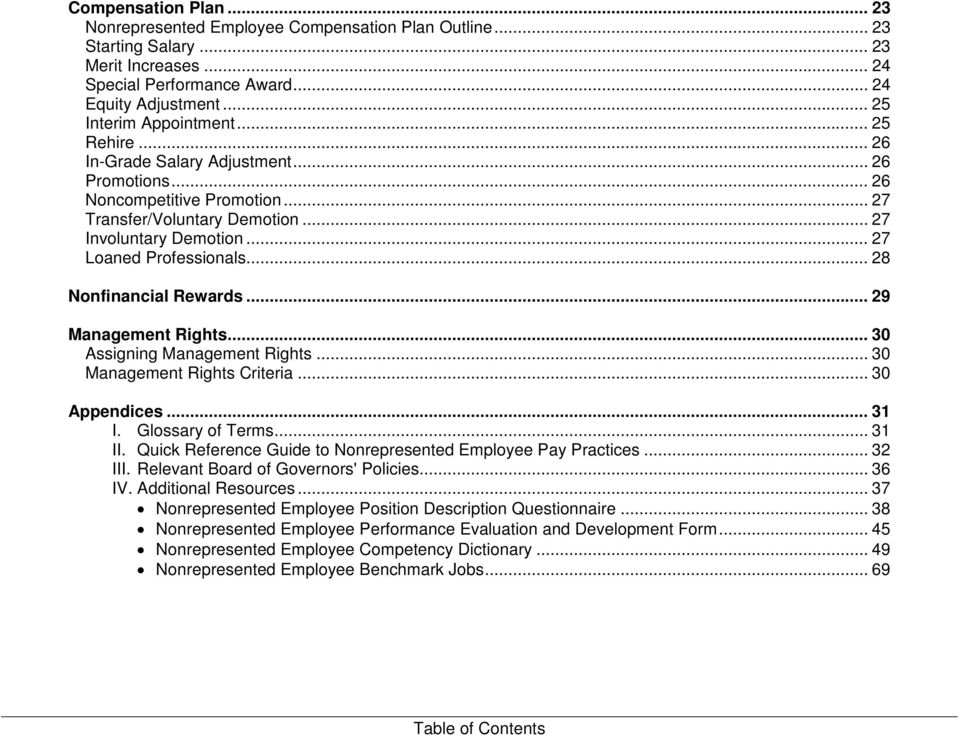
3 Compensation Plan Nonrepresented Employee Compensation Plan Outline Starting Salary Merit Increases Special Performance Award Equity Adjustment Interim Appointment Rehire In-Grade Salary Adjustment Promotions Noncompetitive Promotion Transfer/Voluntary Demotion Involuntary Demotion Loaned Professionals Nonfinancial Rewards Management Rights Assigning Management Rights Management Rights Criteria Appendices I. Glossary of Terms II. Quick Reference Guide to Nonrepresented Employee Pay Practices III. Relevant Board of Governors' Policies IV. Additional Resources Nonrepresented Employee Position Description Questionnaire Nonrepresented Employee Performance Evaluation and Development Form Nonrepresented Employee Competency Dictionary Nonrepresented Employee Benchmark Jobs Table of Contents
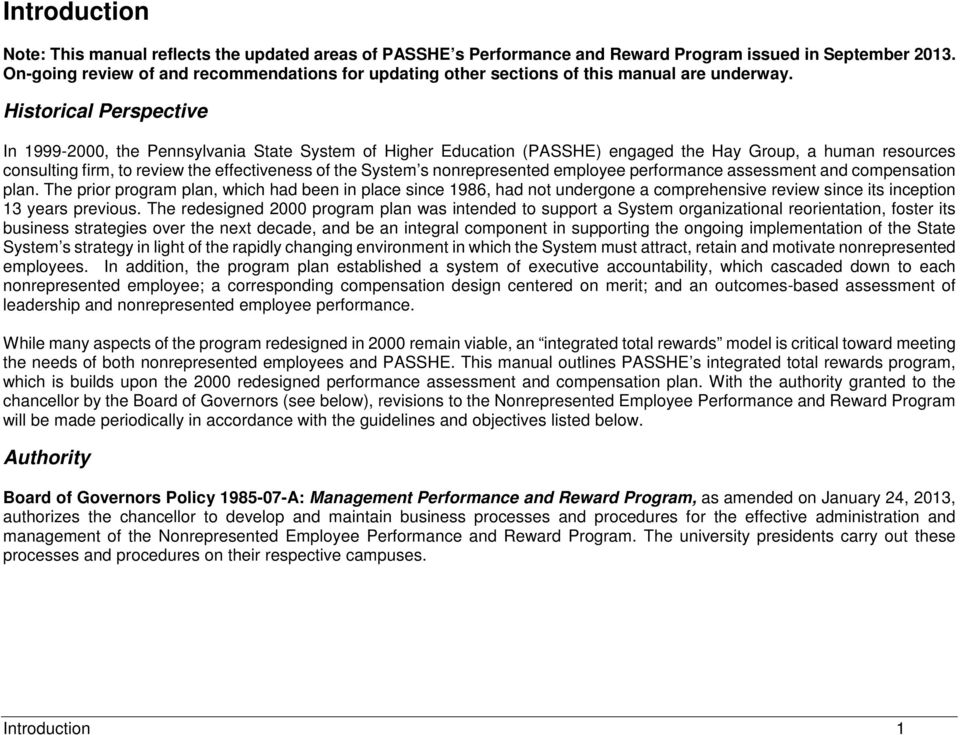
4 Introduction Note: This manual reflects the updated areas of PASSHE s Performance and Reward Program issued in September On-going review of and recommendations for updating other sections of this manual are underway. Historical Perspective In , the Pennsylvania State System of Higher Education (PASSHE) engaged the Hay Group, a human resources consulting firm, to review the effectiveness of the System s nonrepresented employee performance assessment and compensation plan. The prior program plan, which had been in place since 1986, had not undergone a comprehensive review since its inception 13 years previous. The redesigned 2000 program plan was intended to support a System organizational reorientation, foster its business strategies over the next decade, and be an integral component in supporting the ongoing implementation of the State System s strategy in light of the rapidly changing environment in which the System must attract, retain and motivate nonrepresented employees. In addition, the program plan established a system of executive accountability, which cascaded down to each nonrepresented employee; a corresponding compensation design centered on merit; and an outcomes-based assessment of leadership and nonrepresented employee performance. While many aspects of the program redesigned in 2000 remain viable, an integrated total rewards model is critical toward meeting the needs of both nonrepresented employees and PASSHE. This manual outlines PASSHE s integrated total rewards program, which is builds upon the 2000 redesigned performance assessment and compensation plan. With the authority granted to the chancellor by the Board of Governors (see below), revisions to the Nonrepresented Employee Performance and Reward Program will be made periodically in accordance with the guidelines and objectives listed below. Authority Board of Governors Policy A: Management Performance and Reward Program, as amended on January 24, 2013, authorizes the chancellor to develop and maintain business processes and procedures for the effective administration and management of the Nonrepresented Employee Performance and Reward Program. The university presidents carry out these processes and procedures on their respective campuses. Introduction 1
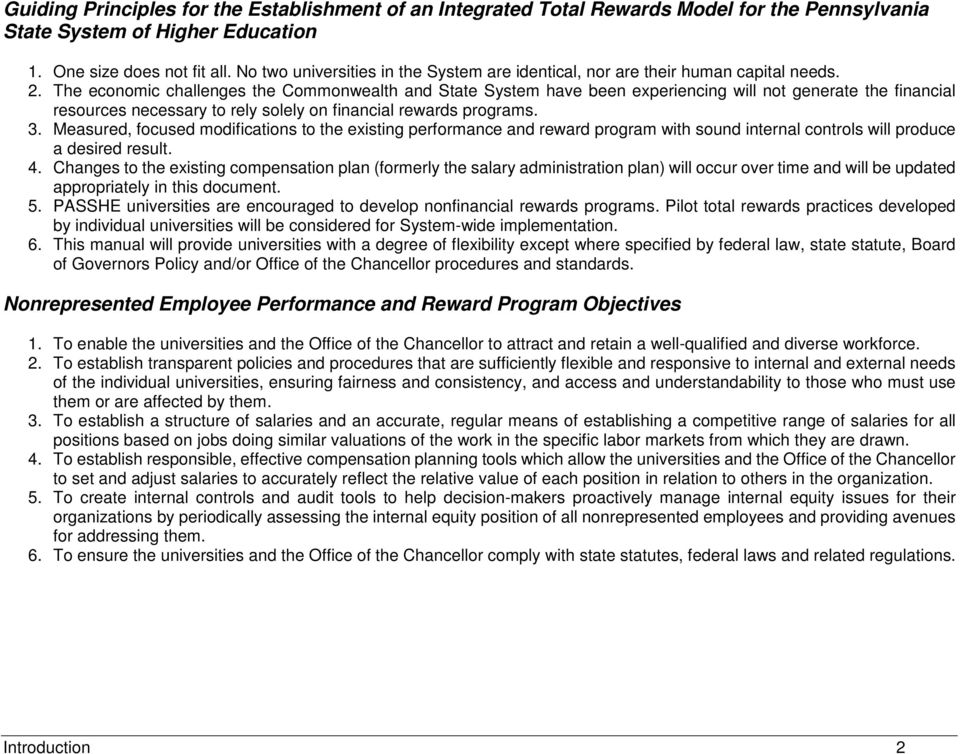
5 Guiding Principles for the Establishment of an Integrated Total Rewards Model for the Pennsylvania State System of Higher Education 1. One size does not fit all. No two universities in the System are identical, nor are their human capital needs. 2. The economic challenges the Commonwealth and State System have been experiencing will not generate the financial resources necessary to rely solely on financial rewards programs. 3. Measured, focused modifications to the existing performance and reward program with sound internal controls will produce a desired result. 4. Changes to the existing compensation plan (formerly the salary administration plan) will occur over time and will be updated appropriately in this document. 5. PASSHE universities are encouraged to develop nonfinancial rewards programs. Pilot total rewards practices developed by individual universities will be considered for System-wide implementation. 6. This manual will provide universities with a degree of flexibility except where specified by federal law, state statute, Board of Governors Policy and/or Office of the Chancellor procedures and standards. Nonrepresented Employee Performance and Reward Program Objectives 1. To enable the universities and the Office of the Chancellor to attract and retain a well-qualified and diverse workforce. 2. To establish transparent policies and procedures that are sufficiently flexible and responsive to internal and external needs of the individual universities, ensuring fairness and consistency, and access and understandability to those who must use them or are affected by them. 3. To establish a structure of salaries and an accurate, regular means of establishing a competitive range of salaries for all positions based on jobs doing similar valuations of the work in the specific labor markets from which they are drawn. 4. To establish responsible, effective compensation planning tools which allow the universities and the Office of the Chancellor to set and adjust salaries to accurately reflect the relative value of each position in relation to others in the organization. 5. To create internal controls and audit tools to help decision-makers proactively manage internal equity issues for their organizations by periodically assessing the internal equity position of all nonrepresented employees and providing avenues for addressing them. 6. To ensure the universities and the Office of the Chancellor comply with state statutes, federal laws and related regulations. Introduction 2
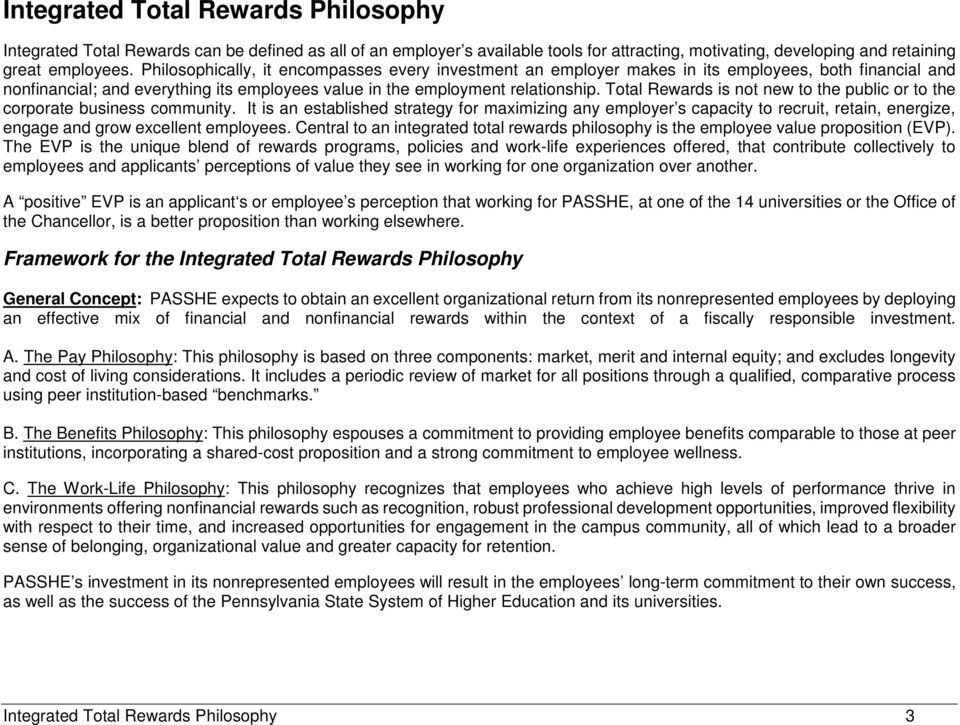
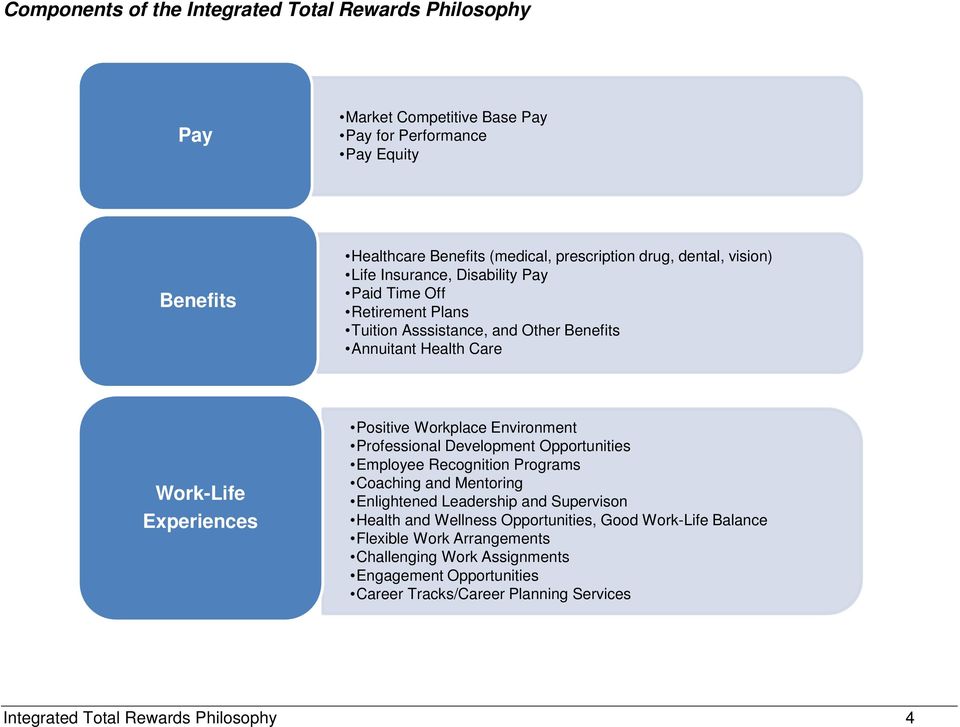
6 Integrated Total Rewards Philosophy Integrated Total Rewards can be defined as all of an employer s available tools for attracting, motivating, developing and retaining great employees. Philosophically, it encompasses every investment an employer makes in its employees, both financial and nonfinancial; and everything its employees value in the employment relationship. Total Rewards is not new to the public or to the corporate business community. It is an established strategy for maximizing any employer s capacity to recruit, retain, energize, engage and grow excellent employees. Central to an integrated total rewards philosophy is the employee value proposition (EVP). The EVP is the unique blend of rewards programs, policies and work-life experiences offered, that contribute collectively to employees and applicants perceptions of value they see in working for one organization over another. A positive EVP is an applicant s or employee s perception that working for PASSHE, at one of the 14 universities or the Office of the Chancellor, is a better proposition than working elsewhere. Framework for the Integrated Total Rewards Philosophy General Concept: PASSHE expects to obtain an excellent organizational return from its nonrepresented employees by deploying an effective mix of financial and nonfinancial rewards within the context of a fiscally responsible investment. A. The Pay Philosophy: This philosophy is based on three components: market, merit and internal equity; and excludes longevity and cost of living considerations. It includes a periodic review of market for all positions through a qualified, comparative process using peer institution-based benchmarks. B. The Benefits Philosophy: This philosophy espouses a commitment to providing employee benefits comparable to those at peer institutions, incorporating a shared-cost proposition and a strong commitment to employee wellness. C. The Work-Life Philosophy: This philosophy recognizes that employees who achieve high levels of performance thrive in environments offering nonfinancial rewards such as recognition, robust professional development opportunities, improved flexibility with respect to their time, and increased opportunities for engagement in the campus community, all of which lead to a broader sense of belonging, organizational value and greater capacity for retention. PASSHE s investment in its nonrepresented employees will result in the employees long-term commitment to their own success, as well as the success of the Pennsylvania State System of Higher Education and its universities. Integrated Total Rewards Philosophy 3
7 Components of the Integrated Total Rewards Philosophy Pay Market Competitive Base Pay Pay for Performance Pay Equity Benefits Healthcare Benefits (medical, prescription drug, dental, vision) Life Insurance, Disability Pay Paid Time Off Retirement Plans Tuition Asssistance, and Other Benefits Annuitant Health Care Work-Life Experiences Positive Workplace Environment Professional Development Opportunities Employee Recognition Programs Coaching and Mentoring Enlightened Leadership and Supervison Health and Wellness Opportunities, Good Work-Life Balance Flexible Work Arrangements Challenging Work Assignments Engagement Opportunities Career Tracks/Career Planning Services Integrated Total Rewards Philosophy 4
8 Classification and Compensation Structure (Note: This section reflects the original program as adopted in Review of and recommendations for updating this section of the manual will be undertaken as a future job evaluation review project.) Design Criteria and Core Program Elements The classification program has the following core elements: Nonrepresented Employee Job Evaluation Guide - A tool to guide job evaluation personnel System-wide in consistently evaluating and classifying jobs. The guide contains the System's customized evaluation approach that includes level definitions for each of the factors. Benchmark Jobs - Thirty-nine campus-based benchmark positions to assist in maintaining parity within and across universities. The benchmark jobs can be found in the Appendices section of this manual. Levels of Contribution - Categories that describe the various levels of contribution that advance the success of the System and each university. Grade Structure - A structure that groups positions of similar scope and complexity into grades, and that reflects the full breadth and range of nonrepresented job content. Salary Structure - Salary ranges for each grade that reflects market-competitive levels of pay. Job Evaluation Overview Compensation design involves balancing internal and external factors. Job evaluation provides a structured approach to determine the relative internal value of work within the System. Balancing the internal value of work with external market demands is the ongoing challenge of the compensation program. This balance is influenced by the System's strategy, performance and reward philosophy, and the fiscal realities faced by the organization. Evaluation Methodology The System's job evaluation methodology, as reflected in the Nonrepresented Employee Job Evaluation Guide, looks at the following three dimensions common to all jobs: Classification and Compensation Structure 5
9 I. Know-How Depth and Breadth of Specialized/Technical Knowledge - how much about how many things the incumbent needs to know to perform at a competent level. Typically gained through education and experience. Organization and Integration Skills - the diversified functions involved in nonrepresented employee situations. Includes the integration of activities and functions across the university and System. Human Resource and Collaboration Skills - person-to-person skills that support effective working relationships. II. Problem Solving Thinking Environment - the environment (internal and external) in which the incumbent of the position faces problems. Thinking/Creative Challenges - the type, complexity, and diversity of problems or opportunities faced by the position. The original self-starting deliberation required for analyzing, evaluating, reasoning, etc., and reaching conclusions. III. Impact and Accountability Impact on the System/University - the measured effect of the job on the success and end results of the System or university, and the position s accountability for delivering that success. Positions are assigned point scores for each dimension, which add up to a total score. The total score translates into a salary grade. Extensive detail on the job evaluation methodology and tool is provided in the Nonrepresented Job Evaluation Guide, which is available through the human resources office. Position Description Also included in the Appendices section of this manual is a suggested Nonrepresented Employee Position Description Questionnaire. This is provided because a thoroughly documented position description is essential to the job evaluation process. At a minimum, all position descriptions need to have general responsibility statements, a detailed listing of the representative duties of the position and a description of both the position the job reports to and any subordinates reporting to the position. Classification and Compensation Structure 6
10 Levels of Contribution To assist in communicating the various levels of nonrepresented positions, a framework was developed to describe broad levels of contribution to the System's success. The resulting levels of contribution are designed as a communication tool to assist nonrepresented employees in understanding where their positions fit within the spectrum of work performed in the System. Levels of Contribution Executive Leadership Strategic Leadership Tactical Leadership/Senior Professional Operational Leadership/Professional Management Support Staff Description Roles that provide mission, vision and strategic direction to the System. Responsible for the long-term growth and success of the System and its universities. Includes positions such as Chancellor, University Presidents, and Vice Chancellors. Roles that manage the leadership of core functions, processes or initiatives that have a major impact on the operations and results of the System or its universities. Develop functional strategies and translate into tactical plans that may be achieved over the next one to two years. Includes positions such as Provosts, Vice Presidents, and Academic Deans. Roles of leadership accountability for projects, processes, functional and/or organizational objectives with broad scope and impact at the university or System level. Highly seasoned professionals providing solutions that have a narrower, more defined impact on the organization. Includes a wide range of positions, such as Controller, Director of Admissions, and Senior Systems Analyst. Roles that bring experienced and professional expertise to support a process, project, or function. They may be individual contributors or have managerial/supervisory accountability for a focused area of activity. Includes a wide range of positions, such as Manager of Campus Services, Systems Analyst, and Printing Manager. Roles that provide specialized support or services to internal or external customers. These roles bring procedural expertise to support the daily operations of the organization. They are typically administrative or technical roles and represent the core management support of the organization. Includes positions such as the Executive Secretary/Staff Assistant. Classification and Compensation Structure 7

11 Grade Structure Job evaluations result in each position being assigned to one of the System's 17 nonrepresented grades using the following table. Levels of Contribution Grade Merit Principles Senior Policy Executive Executive Leadership Strategic Leadership Tactical Leadership/Senior Professional Operational Leadership/Professional Management Support Staff Classification and Compensation Structure 8

12 Position Review Process Maintaining the job evaluation system as jobs change will be critical to the internal equity and overall effectiveness of the program. The campus human resources office should be the first point of contact in the position review process, regardless of whether or not the university uses a job evaluation committee to evaluate positions. New Positions - The nonrepresented employee completes a position description that is submitted to the campus human resources office for review. If the position is graded below 230, only appropriate campus review and approval is required. If the preliminary slotting appears to be pay grade 230 or above, the classification recommendation for the position must be sent to the Office of the Chancellor for review (all positions at or above pay grade 230 are managed at a System-wide level). All evaluations for newly created positions (regardless of pay grade) should be communicated to the Office of the Chancellor in order to maintain a central repository for all nonrepresented classifications in use across the State System. Requests for Reclassification - Significant changes in the scope and complexity of a job may warrant a position review and reclassification. The nonrepresented employee and supervisor should clearly document the changes to the position including the key drivers of the change (reorganization, new services provided, etc.). The request for reclassification should be sent to the vice president for the functional area for review and validation. The position should be submitted to the human resources office and the review should follow a process similar to that for a new position. Appeals - Any nonrepresented employee not in agreement with the salary grade assigned to his/her position should discuss the matter with his/her supervisor. If both the nonrepresented employee and his/her supervisor think the job has not been properly graded, the job description may be re-submitted to the human resources office for reevaluation along with written rationale for why the job should be reviewed. This request for reevaluation should be supported by the concurrence of the senior manager of the function. After the job has been reevaluated, the human resources office will refer any continuing disagreement to the president of the university (to the chancellor for Office of the Chancellor positions). The human resources director or his/her designee will provide the president with a copy of the job description; the written rationale provided by the employee and his/her supervisor and the analysis done by the human resources office, with appropriate documentation. The president or designee, after appropriate review and consultation, will render a final classification decision. This decision is not subject to appeal. If the position is evaluated at pay grade 230 or above, the university president must send the classification appeal for the position to the Office of the Chancellor. After appropriate review and consultation, the Office of the Chancellor will render a classification decision. Unless it can be demonstrated that some pertinent information was not considered in the initial review, the decision is final. Under these narrow circumstances, the chancellor or designee may reconsider the initial decision. Periodic Audit - Periodically, the System and/or universities will review the classification of positions to ensure ongoing equity and consistency within and across campuses. Classification and Compensation Structure 9

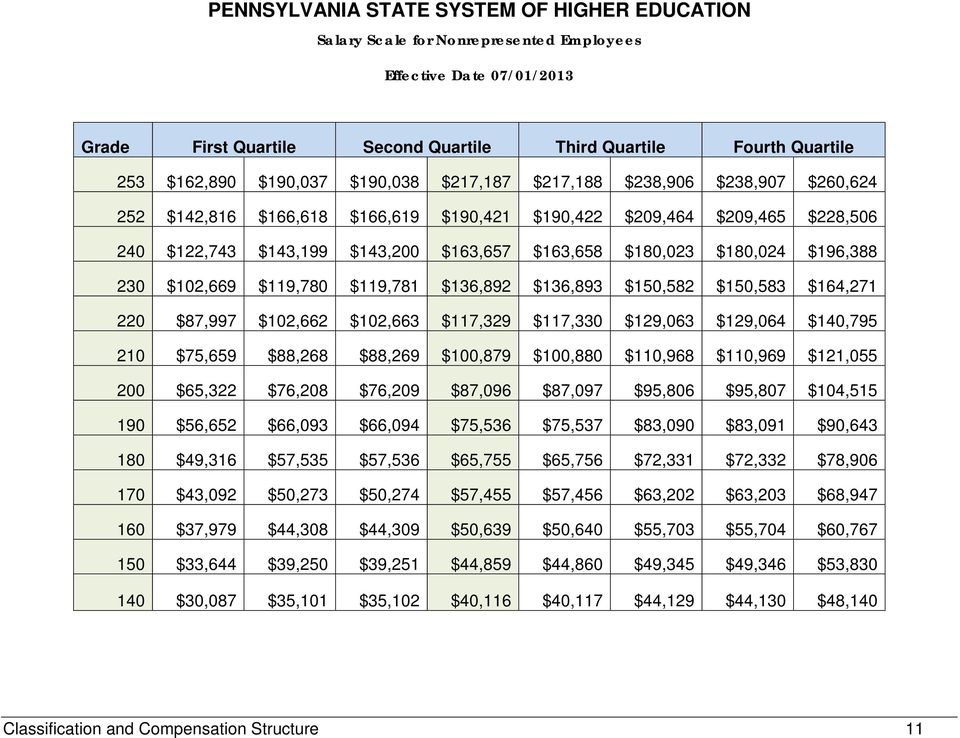
13 Salary Schedule Establishing Salary Ranges - Salary ranges are established for each grade with the intent of providing a fair relationship to salaries being paid by similar organizations for comparable jobs in the marketplace. Based on competitive information from the College and University Professional Association for Human Resources (CUPA-HR) and other reputable sources, and on the strategic goals of the System, competitive salary ranges are developed by the Office of the Chancellor on an annual basis. Range Minimum and Maximum - To allow adequate room for recognition of differences in performance, a 60 percent salary range, from the minimum to the maximum, is established for each grade. This is done by calculating a minimum of 75 percent of the midpoint salary that is established for each grade, and a maximum of 120 percent of midpoint. Range Quartiles - To assist supervisors in assessing the market competitiveness of a nonrepresented employee's pay, the salary ranges are expressed in quartiles. The first quartile is typically where employees working toward job competence are paid. The second and third quartiles represent the core market zone where fully competent employees are typically paid. The fourth quartile represents a clear premium to the market and is typically reserved for employees who have consistently performed at high levels over time. Range Updating - The Office of the Chancellor is responsible for reviewing the salary ranges prior to the end of each fiscal year. The Office of the Chancellor compares regional and national salary information for comparable positions in comparable organizations with the current pay structure. Commonwealth pay practices and schedules also are reviewed. A revised salary range schedule is prepared and issued whenever appropriate and authorized (typically annually) by the chancellor, in order to maintain competitive ranges consistent with the System's compensation philosophy. The following page shows the current salary schedule through the current fiscal year. Salary schedules for subsequent years will normally be published by the Office of the Chancellor annually and will be inserted into this manual. Classification and Compensation Structure 10
14 PENNSYLVANIA STATE SYSTEM OF HIGHER EDUCATION Salary Scale for Nonrepresented Employees Effective Date 07/01/2013 Grade First Quartile Second Quartile Third Quartile Fourth Quartile 253 $162,890 $190,037 $190,038 $217,187 $217,188 $238,906 $238,907 $260, $142,816 $166,618 $166,619 $190,421 $190,422 $209,464 $209,465 $228, $122,743 $143,199 $143,200 $163,657 $163,658 $180,023 $180,024 $196, $102,669 $119,780 $119,781 $136,892 $136,893 $150,582 $150,583 $164, $87,997 $102,662 $102,663 $117,329 $117,330 $129,063 $129,064 $140, $75,659 $88,268 $88,269 $100,879 $100,880 $110,968 $110,969 $121, $65,322 $76,208 $76,209 $87,096 $87,097 $95,806 $95,807 $104, $56,652 $66,093 $66,094 $75,536 $75,537 $83,090 $83,091 $90, $49,316 $57,535 $57,536 $65,755 $65,756 $72,331 $72,332 $78, $43,092 $50,273 $50,274 $57,455 $57,456 $63,202 $63,203 $68, $37,979 $44,308 $44,309 $50,639 $50,640 $55,703 $55,704 $60, $33,644 $39,250 $39,251 $44,859 $44,860 $49,345 $49,346 $53, $30,087 $35,101 $35,102 $40,116 $40,117 $44,129 $44,130 $48,140 Classification and Compensation Structure 11
15 Consideration for Scarce Resources Documentation and Approval Requirements Associated with Starting Salaries Exceeding Market for the Position Level Starting Salaries: While the Compensation Plan Philosophy is grounded on a premise that salaries will be market competitive, there remains the reality that in a broad-banded classification system like the one employed for nonrepresented employees of the State System, market can be relative in certain practical instances. When a university, for instance, is trying to attract an exceptionally qualified professional to fill a critical nonrepresented position where there is a limited supply of applicants with required skills, and in a metropolitan market geographically, market salary can be influenced considerably. PASSHE has established a pay structure and rules within this program manual that permit starting offers to exceed market by 25 percent under certain circumstances illustrated above: 1) exceptional skills of the candidate; 2) the position is critical to the success of the university or the Office of the Chancellor; 3) there is extreme difficulty in recruiting a competent employee because demand is out-stripping supply; or the cost of living proximate to the university or the Office of the Chancellor has caused the value of the existing market salary for the position to be devalued appreciably. High salary history shall not be the sole rationale for paying above market rate salaries. In these circumstances, universities or the Office of the Chancellor must document the need to establish the justification for paying the higher than market salary, and there must be a responsible approval process to ensure fairness and consistency in the application of these rules. The chief human resources officer at the university or the Office of the Chancellor is responsible for certifying the need, based on sound and objective documentation. Documentation may include comparative cost of living studies, authoritative national higher education industry or occupationally specific salary surveys, prior failed searches due to low and weak applicant pools, or verification of qualifications far exceeding requirements and preferences identified in the position description and/or the recruitment advertisement. Such documentation shall remain on file in the successful candidate s personnel file. Periodic reporting requirements may be imposed by the Office of the Chancellor should be deemed necessary or desirable. The president of each university or designee will have the authority to approve above-market salary offers up to the 75 th percentile for the level. Classification and Compensation Structure 12

16 Documentation and Approval of Equity-Based Salary Adjustments Existing Employee Salaries: Similarly, documentation requirements associated with the variety of potential equity adjustments available in the Compensation Plan must be certified by the human resources officer and approval is vested with the president or the designee. It is recommended that the universities and the Office of the Chancellor create periodic reports to identify possible salary inequities. Nonrepresented employees merit pools may be utilized to provide some capacity for equity adjustments. Caution should be taken when drawing down merit pools, to avoid dilution in the true purpose and value of incenting high performance. Approval of Requests to Introduce Creative Pilot Compensation Projects The Office of the Chancellor encourages the universities to think creatively with respect to systemic compensation problems. To that end, the Office of the Chancellor is prepared to consider and approve well-documented proposals for trial pay practices not contained in the current Nonrepresented Employees Performance and Reward Program Manual. Such proposals must be endorsed by the human resources officer and the university president and approved by the chancellor, or his or her designee. Classification and Compensation Structure 13

17 Performance Management (Note: This section reflects the original program as adopted in Review of and recommendations for updating this section of the manual will be undertaken as a future performance management review project.) Design Criteria and Core Program Elements The System s performance and reward philosophy design criteria are: A focus on results and the alignment of all nonrepresented employees with System/university goals. A focus on behaviors that support the System values and culture. A commitment to goal setting and assessment. Recognition and rewards for documented superior performance. The core program elements of the performance management process include: Cascading objectives that align and link nonrepresented employee goals with System/university goals. A "performance equation" focused on results-based and behavioral-based goals. A four-phase approach to ongoing performance management. A redesigned appraisal form (the Nonrepresented Performance Evaluation and Development Form, which is in the Appendices section of this manual). Alignment - Cascading Goals and Objectives In order to drive optimal performance, nonrepresented employee results and behavioral competencies must reflect the mission, vision, and goals of the System/university. The performance management process uses a model of cascading goals and objectives and core competencies to create a line of sight to the intended mission, vision, and goals. Performance Management 14
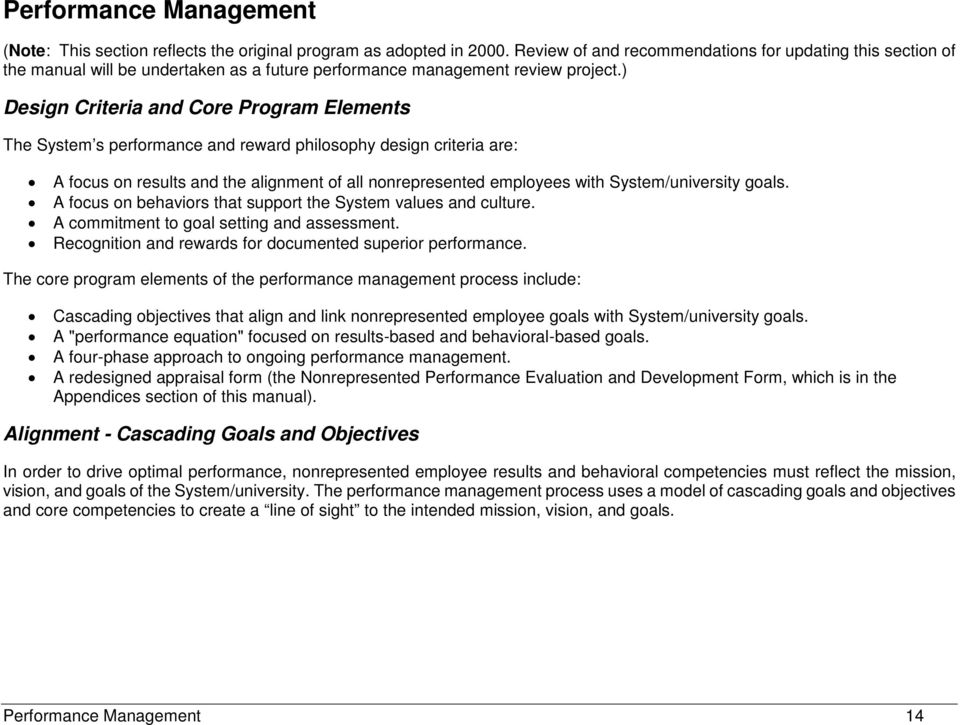
18 PERFORMANCE RESULTS MEASURES State System Health of the University Customers/ Stakeholders Continuous Improvement Other University University Objective Department Results Department Objective Work Unit Results Work Unit Objective Individual Results Individual Objective Goals are set at the System level through strategic planning, accountability, performance funding, and other Board of Governors actions. University goals integrate System goals with other initiatives addressing specific campus needs. There is a process for the integration of university goals in the performance measures for every level of nonrepresented employee. The success of the System s collective performance against key goals and measures is founded on the concept that all nonrepresented employees are working together on key performance measures that are linked to the System/university goals. Performance Management 15
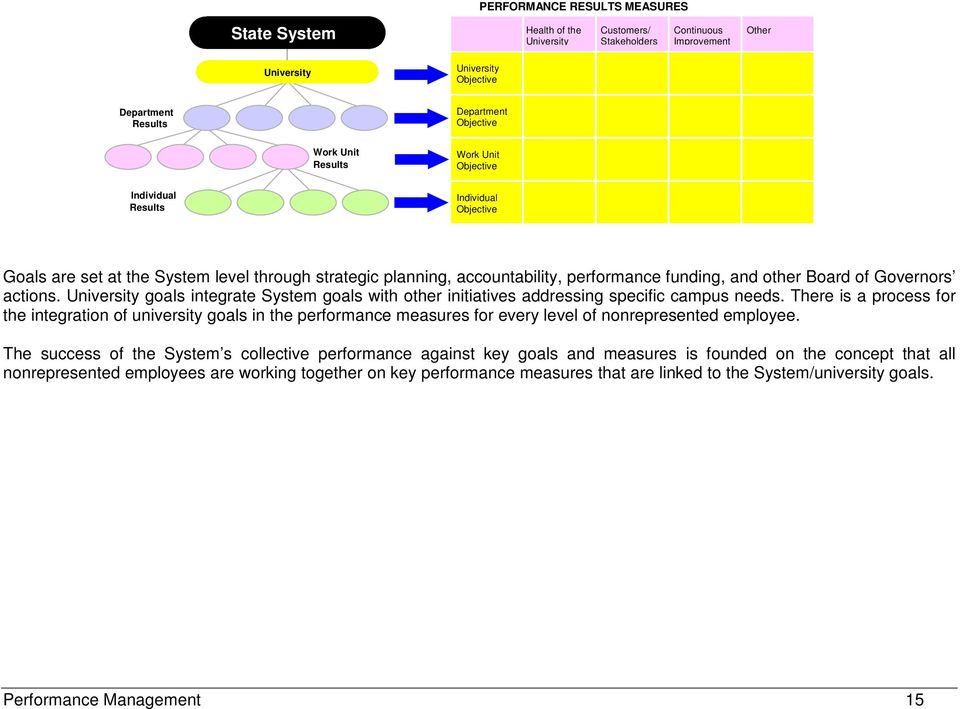
19 Performance Evaluation Components The design of the performance management program is driven by the System's performance equation. True performance outcomes are a combination of "what" work is done (results) and "how" the work is done (behaviors). In essence, the performance equation highlights the importance of both what results are achieved and "how" employees do their jobs as key to overall performance. What Work is Done (Results) How the Work is Done x = Performance (Competencies) Outcomes The performance equation sets the stage for the two core components of the performance management program, results and competencies. The Results Component WHAT RESULTS ( 5-8 objectives) Core Performance Results Job-Specific Performance Results Performance Management 16

20 Core Performance Results Areas Nonrepresented employees should have a goal with defined expected results in each key performance area driven by System/university goals that cascade down from executive leadership. There are three core performance areas linked to the System's strategy. Setting individual/team goals in each of the following core performance areas establishes a link between an individual nonrepresented employee s goals and objectives and System/university goals: Health of the University - Representing financial health. This is one of the three pillars of balanced performance considered for overall success. Measures for goals aligned to financial health include, but are not limited to, revenues, productivity, costs, asset utilization, budgetary flexibility, and financial audits. Customers and Stakeholders - Representing quality and value. This is the second pillar of balanced System success. Measures for goals aligned to quality and value include, but are not limited to, market share, retention, enrollment quality, student diversity, student success, and alumni and stakeholder satisfaction. Continuous Improvement - Representing operational efficiency and improvement, including employee development and student learning. The third pillar includes areas of measure such as the effectiveness of core processes, organizational learning and growth, program review, and accreditations. Job Specific Performance Areas Up to five additional goals are identified, that are driven by division/unit/department objectives and relate more specifically to the unique functions and responsibilities of an individual position. The Competency (Behavior) Component Definition of a Competency A competency is an underlying characteristic of an individual that causes or predicts effective and/or superior performance in a job or situation. Competencies are behavioral measurements of how work is done. They are the affective component of performance measurement, reflecting demonstrated behaviors, and they provide nonrepresented employees and executives with the characteristics, values, and skill sets that predict effective job performance. Performance Management 17

21 HOW COMPETENCIES (5-8 behaviors) Core Competencies Job-Specific Competencies System Core Competencies System competencies were developed based on the desired culture of the State System and its universities, on the anticipated nonrepresented employee competencies that support the System s/universities planned strategic directions, and are founded on Hay research concerning the behavioral drivers and characteristics typical of successful organizations. There are five System core competencies, as listed below along with abbreviated definitions of the competencies. More detailed definitions of these five and 14 additional job-specific competencies are described in the Competency Dictionary in the Appendices section of this manual. Continuous Improvement - Taking a new or unique approach to how work is done and striving to continuously improve processes and quality. Customer Service Orientation - Focusing one s efforts on discovering and meeting the customer s needs. (Customers can include associates, peers, colleagues, students, community members, faculty, etc.) Valuing Diversity - The ability to understand and respect the practices, customs, and norms of other individuals, groups, and cultures. Includes the ability to respect and value different points of view. Teamwork and Collaboration - The intention to work cooperatively with others, to be part of a team, to work together, as opposed to working separately or competitively ( Team is defined as any task or process-oriented group of individuals). Results Orientation - A concern for holding yourself and others accountable for achieving results or for surpassing a standard of excellence. Job-Specific Competencies Performance Management 18
22 Following are additional behaviors that drive effective performance. One or more of these may be selected by the nonrepresented employee and supervisor as appropriate to represent desired behavior relative to a particular job or task. Analytical/conceptual Thinking* Change Leadership** Developing Self and Others* Flexibility/Adaptability Impact and Influence* Initiative* Interpersonal Understanding Organization Awareness Relationship Building Strategic Orientation** System Thinking** Team Leadership* * May be more critical for supervisory roles ** May be more critical for Strategic Leadership level positions Performance Management Process Overview of Performance Management Process Steps The performance management process is an on-going activity consisting of the following four key stages. Planning The planning stage provides for the linkage between System and university strategic goals, the establishment of performance expectations, and the commitment to the plan by the employee, as follows. 1. Executive/strategic leadership reviews System/university goals and works with division/department nonrepresented employees to set goals. 2. Division/department supervisors communicate System/university goals to nonrepresented employees. 3. Individual nonrepresented employees develop drafts of individual goals and expected results using the SMART format: Specific, Measurable, Attainable, Relevant, Time-based goals. 4. Supervisor and nonrepresented employee participate in planning discussion. Agree on goals and expected results. Discuss job-specific competencies applicable to the job or task. Establish expected behavioral levels for core and job-specific competencies. Discuss and agree on developmental goals. Performance Management 19
23 Discuss the meaning of the different performance ratings. Coaching The coaching stage provides for interim assessment of performance progress and reinforcement of expectations, as follows. 1. Supervisor tracks individual/team performance and reinforces/coaches. 2. Nonrepresented employee tracks individual/team results. 3. Nonrepresented employee asks supervisor for feedback. 4. Nonrepresented employee tells supervisor about any success/barriers to success. 5. Nonrepresented employee and supervisor assess the ongoing relevance of goals and make appropriate goal modifications. 6. Supervisor or nonrepresented employee initiates interim review meetings (mid-year at minimum) to discuss performance progress to date. Reviewing The reviewing stage provides for the annual assessment of actual performance compared to expected performance, as follows. 1. Performance for all nonprobationary employees shall be evaluated annually using a standard form. 2. Nonrepresented employee provides information on actual results to supervisor. 3. Supervisor completes actual results column of the nonrepresented employee Performance Appraisal and Development Form, assigning ratings to each goal and an overall rating for the performance results component. The supervisor also provides appropriate comments. A copy of the Nonrepresented Employee Performance Evaluation and Development Form is in the Appendices section of this manual. 4. Supervisor completes the competencies sections of the form and assigns ratings to each of the competencies, and an overall rating to the competency component. The supervisor also provides appropriate comments. 5. Supervisor completes the accomplishments section of the development plan component of the form. 6. Supervisor completes overall performance summary and assigns overall performance rating, including appropriate overall performance rating comments. 7. Supervisor shares draft form with reviewing officer, who provides appropriate input. 8. Nonrepresented employee and supervisor meet to discuss and finalize performance appraisal. 9. Supervisor and nonrepresented employee set meetings for performance and developmental planning for the next cycle. 10. Supervisor and reviewing officer participate in development/succession planning discussion about top performers. Performance Management 20
24 Rewarding This final stage assesses performance levels and links performance to compensation. 1. Throughout the year, supervisor uses noncash recognition to reward/reinforce performance. 2. Supervisor uses pay guidelines to provide input regarding merit increases based on performance results. 3. Leadership recognizes meritorious employee performance with a merit increase. 4. Senior management recognizes nonrepresented employees/teams using Special Performance Awards. These awards are described in more detail in the Compensation Plan section of this manual. Rating System - The performance rating system utilized in completing the nonrepresented employee performance evaluation and development form consists of the following five levels: Significantly and Consistently Exceeds Expectations - The incumbent significantly exceeds planned results expectations and demonstrates all relevant competencies at or above target levels. This rating reflects exceptional performance where performance results for all major goals/objectives are surpassed and all job requirements are exceeded. Achievers in this category markedly improve upon past practices and/or develop new and improved approaches. Exceeds Expectations - The incumbent commonly exceeds what is expected and demonstrates a very high level of performance in all areas of responsibility. Fully Performing/Meets Expectations - The incumbent meets all planned expected results and exceeds some while meeting all job requirements. In addition, he/she demonstrates all relevant competencies at target levels. An incumbent who simply meets all goals and objectives and job requirements, and does not overachieve. Needs Improvement - The incumbent s work performance is inconsistent and frequently does not meet minimum expectations. Below Expectations - The incumbent meets some planned results expectations and does not meet others, or does not meet any planned results. In addition, he/she demonstrates some relevant competencies at target levels and is below target in others, or is below target in all competencies. The position holder may have required considerable and above-normal direction and guidance from his/her supervisor. In the worst-case scenario, the job is not getting done, and performance must improve markedly in the short term or the incumbent should be terminated. Performance Management 21
25 Critical Importance of Fair and Consistent Ratings University supervisors, reviewing officers, human resources offices, and senior management must work to ensure that evaluation ratings are fair, consistent, and that the ratings are a true reflection of a nonrepresented employee s performance in relation to the expected results for the position (as stated in the Nonrepresented Employee Performance Evaluation and Development Form). While there is no specified distribution of nonrepresented employees across the rating levels, supervisors, reviewing officers, and System/university leadership need to be certain that evaluations are not unnecessarily skewed to the top rating, or to a rating reflecting a performance level that is higher than earned during the appraisal period. Since the program is driven to reward nonrepresented employees with higher merit increases based on higher levels of performance, ratings at a level higher than warranted will unduly reward overrated nonrepresented employees and will serve to unfairly dilute the total percent increase available to remaining nonrepresented employees. As a result, significant numbers of nonrepresented employees rated at Significantly and Consistently Exceeds Expectations, could result in merit increases for these nonrepresented employees close to the actual amount of the total merit pool, and in an inability to properly distinguish them from nonrepresented employees performing at Exceeds Expectations. Probationary Periods The probationary period is a trial period of employment prior to the attainment of regular status. Nonrepresented positions normally have a six-month probationary period subsequent to appointment or performance-based demotion. Positions designated as trainee may have a 12-month probationary period at the department s discretion. Probationary periods allow the nonrepresented employee an opportunity to demonstrate his/her ability to perform the duties of the position satisfactorily, and provide the department a period to evaluate the performance of an employee to determine his/her suitability for regular status employment. Probationary periods must be specified in writing at the time of the appointment, or upon demotion, if appropriate. All new nonrepresented employees must receive a probationary performance review within six months of their date of hire. If his/her performance is Exceeds Expectations, the employee should become a regular nonrepresented employee. If his/her performance is Below Expectations, the probationary period may be extended for up to six months or their employment terminated prior to the expiration of the probationary period. The university or Office of the Chancellor human resources office must be involved whenever a probationary employee is performing below expectations in order to provide advice and counsel with regard to the appropriate next steps (i.e., extension of the probationary period, retention, termination, etc.). Performance Management 22
26 Compensation Plan Although not the only component to a total rewards program, compensation is the largest and most expensive. The pay practices delineated below are intended to be flexible and responsive to the needs of the universities and the Office of the Chancellor. Sound investments in nonrepresented employees require wise pay practice choices to be made within the financial means of each university and the Office of the Chancellor. Nonrepresented Employee Compensation Plan Outline Pay Practice Description Pay Guidelines Salary standard for newly appointed fully qualified employees who are not rehires. Starting Salary Normally, market rate for the position s level. Presently, the beginning of the 3 rd quartile of the appropriate level of the Salary Schedule. May pay above market but no more than the 75 th percentile with human resources officer approval, based on exceptional qualifications, critical nature of the duties, low supply/high demand recruitment, or high cost of living index for university geographically. Above market rationale must be documented. Internal equities within the work unit must be taken into consideration when assigning starting salaries to help mitigate salary compression scenarios. Current nonrepresented employees and bargaining unit members who successfully compete for nonrepresented position vacancies should be treated as new appointees for salary determination purposes. Green-circled Employee s starting salary must begin at the range minimum. Under no circumstances shall starting salaries be below the minimum salary for the level, or exceed the maximum salary for level of the position. Universities are not prohibited from paying sub-market starting salaries based on insulation from market conditions, although the practice may exacerbate salary equity and salary compression issues if the practice is not consistent. Compensation Plan 23
27 Pay Practice Description Pay Guidelines A candidate s qualifications that are extraneous to a nonrepresented position vacancy s required and preferred qualifications should not be considered in making a salary valuation determination. Market salary is based on salary studies of similar positions within the national higher education industry, not public or private industry in general, as a rule. Rare exceptions may apply. Merit Increases Special Performance Award Performance-based salary increase in years when the chancellor recommends merit pools for nonrepresented employees, which are then reviewed and considered for approval by the Board of Governors. A graduated increase based on achievement of a satisfactory level of performance or higher. Employees in their probationary period of employment are ineligible for merit or other pay increases. A performance-based award for outstanding job performance on special projects/additional duties, extraordinary achievements, or out-of-the-box contributions to the success of the university or System. Team awards are possible. Universities/Office of the Chancellor must establish and follow locally published guidelines approved by the president/chancellor. Increases must be awarded; and, must be based on guidelines issued by the chancellor (or designee) for the year of the increase. Probationary employees may receive a prorated increase at the time they obtain nonprobationary status. Increases may not exceed the maximum for the level of the position. Portions of the increase in excess of the maximum shall be paid as a lump sum payment not affecting base salary. Merit increases for third- or fourth-quartile employees may be awarded as base pay changes or cash payments. Merit pools may be used, on a limited basis, to bring subminimum salaries up to the current minimum salary for the position s classification level. Merit pools may also be used to address salary equity needs if universities have no other means to fund equity adjustments. Care should be taken to avoid diluting the value and intent of performance pay. When possible, annual, internal salary equity funds should be established to address equity issues. Minimum $100 to maximum of $2,500 or 2 percent of annual base salary, whichever is greater. These awards do not affect permanent base salary. Awards may still be given in years when merit increases are not provided. Not limited to one per year. Compensation Plan 24
28 Pay Practice Description Pay Guidelines Not intended to be a retention award or a general bonus/award. Nominations made by department head, supported by division vice president and approved by the president. A particularly effective tool in rewarding super keepers/high potential employees. Equity Adjustment (old Parity Pay Equity) Interim Appointment (combines categories of temporary assignment and Interim appointment) Rehire (Including A discretionary adjustment intended to manage submarket and salary compression issues, as well as other equity adjustments based on analysis of disparities based on race, gender, ethnicity, age, etc. Prerequisite of employee performing at least satisfactorily. Adjustment may not exceed the level of documented disparity. A temporary appointment outside a nonrepresented employee s regular duties to higher level work. Faculty in interim nonrepresented positions. Appointment of a former nonrepresented employee who had previously resigned or is currently retired. Recommendation of the human resources officers and approval of the president or designee required. Documented analysis must accompany request. Using funds from merit is discouraged, but not prohibited. Adjustments may be made during years when merit increases are not provided. Minimum of the higher grade level or up to 15 percent above current salary. Coverage of some of another higher level manager position s duties while continuing to perform his/her own regular duties and responsibilities, up to 10 percent above current salary. Duration of the assignment should also be considered when assigning the higher pay rate, with longer assignments receiving a higher percentage of increase. Salaries for faculty in interim nonrepresented roles will be determined by first annualizing their 9-month faculty salary. Next, it must be recognized that the eventual salary must fall within the range for the position being filled. If the annualized salary is below the minimum of the range, place their salary at that minimum. If they are above the maximum for the range, place them at the maximum. If their annualized salary falls within the range for the job, place them at that salary. Additionally, up to 15 percent may be added to their initial annualized salary as long as their final salary is still within the range. Former nonrepresented employees who have resigned and less than 90 days has elapsed from date of Compensation Plan 25
29 Pay Practice Description Pay Guidelines Annuitant Rehire) Good standing at time of prior resignation or retirement is necessary. resignation, and the individual wishes to return to his/her former nonrepresented position, he or she may be rehired at the previous rate of compensation at the time of the resignation, although this is not a requirement. If hired into a higher or lower level nonrepresented position, starting salary rules apply. Annuitants may be rehired for a specific period, with the approval of the Office of the Chancellor. Justification required for rehire must relate to specific, unique, critical assignments not able to be handled in another way. Salaries for annuitant rehires should not simply be based on their final employee salary, but should reflect the specific value of the work being performed in the assignment. The human resources officer will determine the salary rate, based upon an objective determination of the value of the work. Typically, annuitant rehire appointments may not be In-Grade Salary Adjustment Significantly increased, nontemporary responsibilities in a nonrepresented position that do not constitute higher classification work. extended. Up to 10 percent increase. In multi-incumbent classifications in a work unit, internal equities should also be taken into account so as not to create unnecessary salary compression in the unit. Promotions A promotion is defined as the movement of an employee from one position and grade to another position that is classified in a higher pay grade. Promotion rules generally apply when a manager is appointed to a vacant, higher level position that he/she applied for and was the successful candidate. New management employees will not normally be considered for promotion until they have completed their initial probationary period. Similarly, managers newly appointed or promoted to higher pay grade positions would normally also be expected to have served a successful probationary period in the new position before being eligible to be considered for further advancement. Salary increases for promotions to positions in a higher grade should reflect the degree of change in the increased responsibilities. Promotional increases for an employee will normally range from 5 percent up to 15 percent, or the minimum of the pay range. Promotions in excess of 15 percent may be granted in exceptional situations. However, in these situations the upper limit for the promotional increase is 20 percent, or the minimum of the pay range. In all instances of promotion, the management employee s salary must be moved to at least the minimum of the salary range into which he/she is being promoted. Compensation Plan 26
30 Pay Practice Description Pay Guidelines Movement from one nonrepresented position level to a higher level nonrepresented position as a byproduct of a reclassification process. Reclassification upward. Noncompetitive Promotion Transfer/ Voluntary Demotion Involuntary Demotion Loaned Professionals (old Loaned Executives) Transfer: Movement from one nonrepresented position to another at the same university, when the two are of the same or lower grade level. Voluntary Demotion: Voluntary movement of a nonrepresented employee from a higher level position to a position of a lower level as part of a nondisciplinary career change. Salaries for successful candidates who work at other PASSHE universities in positions of the same grade should be used to set new hire starting salary standards. Demotion caused by poor work performance, reclassification downward or reorganization-related reassignment. When a nonrepresented employee of a university or the Office of the Chancellor is borrowed to perform services at another PASSHE university, or at the Office of the Chancellor. Written memorandum of understanding is required between gaining and losing organizations. Should not exceed two years percent above current salary level; or minimum salary for the new grade level, whichever is higher percent when promotion is by two or more grade levels. In multi-incumbent classifications in a work unit, internal equities should also be taken into account so as not to create unnecessary salary compression in the unit percent salary adjustment upward for transfers, based on circumstances, not to exceed the maximum for the level percent salary adjustment downward for voluntary demotions. In multi-incumbent classifications in a work unit, internal equities should also be taken into account so as not to create unnecessary salary compression in the unit. Disciplinary demotion: 0-10 percent reduction in salary based on specific disciplinary circumstances. Demotion via downward reclassification or nondisciplinary reassignment retains current salary, even if it exceeds the maximum for the lower pay level. Position is then called red-circled. In addition, shall not be entitled to a pay increase until individual s salary is once again within the correct pay scale range. Compensation should be based on the level of the work the borrowed professional will be doing. If it is the same level work, no increase will be normally warranted. Exceptions may apply. A salary increase may apply when the assignment is less a developmental opportunity and relates to a critical skill set being sought by the borrowing organization. Duration of the assignment may also require travel, temporary housing or other considerations. If applicable, such considerations are subject to relevant policies and regulations. Compensation Plan 27
31 Pay Practice Description Pay Guidelines Compensation Plan 28
32 Nonfinancial Rewards The universities and the Office of the Chancellor are encouraged to develop nonfinancial rewards programs, which align with their individual cultures, their employees needs, and the desired employee behavioral outcomes of recruitment, retention, development and motivation of well qualified nonrepresented employees. When such programs do not interfere with the administration of existing collective bargaining agreements, their applicability can be broader than nonrepresented employees. Examples of these types of programs are illustrated on page 6. The three program dimensions of nonfinancial rewards are programs that encourage individual growth and career development; programs that facilitate a caring, fair, and positive workplace; and programs that actively engage employees as stakeholders in an organization with a compelling future, driven by enlightened supervisors and leaders. All university nonfinancial rewards programs must include, at a minimum, the following: Training and professional development; Employee recognition programs; and, Flexible work schedules where possible. Nonfinancial Rewards 29
33 Management Rights Management employees of the Pennsylvania State System of Higher Education are covered by one of the following Board of Governors Policies: Policy A: Merit Principles Policy A: Terms and Conditions of Employment of Senior Policy Executives Assigning Management Rights Each university will: Determine the rights of management employees at their university using criteria established in Board of Governors policies. Assign the appropriate employment rights to each manager. Ensure letters of appointment specifically state the employment rights of each manager. Management Rights Criteria For appointments, either the management group of Merit Principles or Senior Policy Executives should be assigned. If the position is a classification management position of 190 and below, then the Merit Principles policy applies. If the position is a classification management position of 200 and above, then the Terms and Conditions of Employment of Senior Policy Executives policy applies. The following table outlines management rights criteria. Management Group Definition Rights Merit Principles Managers Senior Policy Executives Applies to managers in positions classified 190 and below Applies to managers in positions classified 200 and above. Employee serves a stated probationary period of not less than six (6) months. Upon successful completion of the probationary period, the employee cannot be removed from his/her position except for cause. Rights and appeals are contained in Board of Governors Policy A: Merit Principles. Employee serves a stated probationary period of not less than six (6) months. All rights are contained in Board of Governors Policy A: Terms and Conditions of Employment of Senior Policy Executives. Management Rights 30
34 Appendices I. Glossary of Terms Annuitant A retiree BOG Board of Governors, PASSHE s governing body Broad-Band A position classification model, which groups like valued positions into common groupings. In PASSHE s System, these broad-bands range from 140 to 250 management levels CUPA The College and University Personnel Association Equity Pay Adjustment Permanent Salary Adjustment based on market, internal, or protected class inequity Green-Circled Employee s starting salary must begin at the minimum of the pay range Hay System A job evaluation system used as a basis for valuing jobs in relation to other jobs using a factoranalysis approach developed by the Hay Group In-Grade Occurring within the parameters of a management level Labor Market Pool of workers found within the geographic scope of a search for a particular position Lump Sum Payment A single cash payment made in lieu of an increase to base salary when a merit pay increase would exceed the maximum for the management level Market Salary Rate A salary level or range accepted as market competitive, based on analytical studies Merit Pay A salary increase based on job performance Merit Pool Total dollars available for merit pay distribution Nonrepresented Employees Employees absent a right to bargaining collectively PASSHE The Pennsylvania State System of Higher Education Red-Circled Employee s current salary exceeds the maximum of the pay range (usually due to a demotion via a downward reclassification or non-disciplinary reassignment) and as a result, the employee is not eligible for a pay increase until the salary is once again within the pay range. Salary Compression The effect of reducing the separation in salaries between existing employees and newly hired employees caused by market rates increasing at a greater rate than internal salary increases. Salary Quartile Salary schedule reflecting the breadth of each salary range in fourths. For instance, a first quartile salary would be one reflecting the lowest one-fourth of salaries reported for that management level. The Fourth Quartile would reflect the highest one-fourth of salaries reported for that management level. Salary Schedule A schedule reflecting the full ranges of salaries for all management levels or broad-bands Submarket Salary A salary which falls below the market salary rate Total Rewards All of the tools available to the employer that may be deployed to attract, motivate, develop and retain employees. They generally include the following elements: pay, benefits, work-life balance, positive workplace and professional growth and career development programs. Glossary of Terms 31
35 II. Quick Reference Guide to Nonrepresented Employee Pay Practices Pay Practice Description Pay Guidelines Starting Salary Merit Increase Special Performance Award Equity Adjustment (old Parity Pay Equity) Salary standard for newly appointed fully qualified employees who are not rehires. Performance-based salary increase in years when merit pools for nonrepresented employees are approved by the Board of Governors. Employees in their probationary period of employment are ineligible for merit or other pay increases. Performance-based award for outstanding job performance on special projects/additional duties, extraordinary achievements, or outof-the-box contributions to the success of the University or System. Team awards possible. Discretionary pay adjustment intended to correct sub-market and salary compression issues, as well as salary inequities based on race, gender, ethnicity, age, etc. Normally, market rate for position s level. Beginning of the 3 rd quartile of the salary scale level. May pay above market but no more than the 75 th percentile with human resources officer approval, based on exceptional qualifications, critical nature of the duties, low supply/high demand recruitment, or high cost of living index for university geographically. Green-circled Employee s starting salary must begin at the range minimum. Universities are not prohibited from paying sub-market starting salaries based upon market insulation. Increases must be awarded; and, must be based on guidelines issued by the chancellor or designee for the year of the increase. Probationary employees may receive a pro-rated increase at the time nonrepresented status is granted. Increases may not exceed maximum for level. Portions of increase in excess of maximum paid as lump sum not affecting base salary. Minimum $100 to maximum of $2,500 or two percent of annual base salary, whichever is greater. Awards do not affect permanent base salary. Recommendation of the human resources officer and approval of the president or designee required. Quick Reference Guide to Nonrepresented Employee Pay Practices 32
36 Pay Practice Description Pay Guidelines Interim Appointment (combines Temporary appointment outside a nonrepresented employee s regular duties to higher level work. categories of temporary assignment and Interim appointment) Faculty in Interim nonrepresented positions. Rehire (including Annuitant Rehire) In-Grade Salary Adjustment Appointment of former nonrepresented employee who had previously resigned or is currently retired. Significantly increased, nontemporary responsibilities in a position which do not constitute higher classification work. Promotions A promotion is defined as the movement of an employee from one position and grade to another position that is classified in a higher pay grade. Promotion rules generally apply when a manager is appointed to a vacant, higher level position that he/she applied for and was the successful candidate. New management employees will not normally be considered for promotion until they have completed their initial probationary period. Similarly, managers newly appointed or promoted to higher pay grade positions would normally also be expected to have served a successful probationary period in the Minimum for the higher grade level or up to 15 percent above current salary. Up to 10 percent above current salary for performing some higher class duties in addition to regularly assigned duties. Salaries for faculty in interim nonrepresented roles will be determined by first annualizing their 9-month faculty salary up to 15 percent. May start at former salary if less than 90 days lapse in employment. If hired into a higher or lower level, starting salary rules apply. Annuitants may be rehired for a specific period, with the approval of the Office of the Chancellor. Special compensation rules apply. Up to 10 percent increase. Salary increases for promotions to positions in a higher grade should reflect the degree of change in the increased responsibilities. Promotional increases for an employee will normally range from 5 percent up to 15 percent, or the minimum of the pay range. Promotions in excess of 15 percent may be granted in exceptional situations. However, in these situations the upper limit for the promotional increase is 20 percent, or the minimum of the pay range. In all instances of promotion, the management employee s salary must be moved to at least the minimum of the salary range into which he/she is being promoted. Quick Reference Guide to Nonrepresented Employee Pay Practices 33
37 Pay Practice Description Pay Guidelines new position before being eligible to be considered for further advancement. Noncompetitive Promotion Movement from one position level to a higher level position as a byproduct of a reclassification process percent above current salary level; or minimum salary for the new grade level, whichever is higher percent when promotion is by two or more levels. Transfer/ Voluntary Demotion Involuntary Demotion Loaned Professionals (old Loaned Executives) Transfer: Movement from one position to another at the same university, when the two are of the same or lower grade level. Voluntary Demotion: Voluntary movement of a nonrepresented employee from a higher level position to a position of a lower level as part of a nondisciplinary career change. Demotion caused by poor work performance, reclassification downward or reorganization-related reassignment. When employees is borrowed from a PASSHE University or the Office of the Chancellor to perform services at another PASSHE University, or at the Office of the Chancellor percent salary adjustment upward for transfers, based on circumstances, not to exceed the maximum for the level percent salary adjustment downward for voluntary demotions percent reduction in salary based on specific disciplinary circumstances. Demotion via downward reclassification or nondisciplinary reassignment retains current salary, even if it exceeds the maximum for the lower pay level. Position is then called red-circled, and shall not be entitled to a pay increase until individual s salary is once again within the correct pay scale range. Compensation based on the level of work the borrowed professional will be doing. Quick Reference Guide to Nonrepresented Employee Pay Practices 34
38 (Note: This reference guide is intended to be a convenient resource for university and Office of the Chancellor nonrepresented employees. By its nature, it is an abbreviation of complex pay practices. The human resources office can provide specific guidance and counseling to assist you in managing your needs. This guide is not intended as a substitute for that dialogue.) Quick Reference Guide to Nonrepresented Employee Pay Practices 35
39 III. Relevant Board of Governors Policies A. Board of Governors Policy A: Merit Principles B. Board of Governors Policy A: Terms and Conditions of Employment of Senior Policy Executives C. Board of Governors Policy A: Management Performance and Reward Program Relevant Board of Governors Policies 36
40 IV. Additional Resources Nonrepresented Employee Position Description Questionnaire Nonrepresented Employee Performance Evaluation and Development Form Nonrepresented Employee Competency Dictionary Nonrepresented Employee Benchmark Jobs Additional Resources 37
41 Nonrepresented Employee Position Description Questionnaire POSITION DESCRIPTION QUESTIONNAIRE Nonrepresented (Management) Positions (Please Type or Print Clearly in Black Ink) This questionnaire was designed to collect important job content information about your position. The questionnaire will aid you in describing your present position in terms of its major responsibilities, duties and requirements. Please use language that is clear and concise so that someone unfamiliar with your position will be able to understand what, how, and why it functions, simply by reading the completed questionnaire. Your Name and Title: Identifying Information Your Institution: Name of Supervisor/ Title: Your Signature: College/Department/Unit: Date: Organizational Structure Complete all the appropriate boxes in the chart below using job titles. Attach department/organization charts as necessary. Other Reporting Relationships: Your Supervisor s Job Title: Additional Resources 38
42 Position Purpose Describe the primary purpose of your job and how it contributes to your Institution s objectives. Please provide a brief statement describing the reason that your position exists. Include the overall end result which the position is expected to produce along with some of the key means by which it achieves that end result. Your means description should not include a detailed, exhaustive listings of facts, but rather a clear, specific list of ways in which the end result is accomplished. Sample Position Purpose Statement for a human resources manager: Plans and directs human resources activities to ensure timely availability of qualified personnel and the implementation of effective human resources policies and practices. Position Dimensions Provide a quantitative description of your position s impact on the Campus or Unit on which your job is primarily focused. Provide quantitative statistics which describe the extent of your position s direct or indirect impact on your Campus. Please include descriptions for each of the dimensions listed below. Add any other dimensions or statistics that you think give a clear sense of your position s impact or contribution to the organization. Dimension Value Comments Operating Budget For $ Which You Are Accountable Payroll Budget For $ Which You Are Accountable Number of Employees Reporting to You Students you serve (FTE s) Faculty Staff Student Workers Major Accountabilities: Describe the major responsibilities of your position. Additional Resources 39
43 List the essential job functions ( major accountabilities ) associated with your position. For each row that you complete, the Accountability/Activities and End Result Expected blocks should be 1-2 sentence statements summarizing the function you are describing and the major end results of the function. Each statement should begin with an action verb which describes your role or purpose in the organization. Sample Major Accountabilities statement for a Director of Student Financial Aid: Accountability/Activities: Create and update financial aid informational programs for prospective students ; End Result Expected: To facilitate recruitment by helping students see how financial obstacles can be overcome. List accountabilities by descending order of importance. The % Time column should total 100%. %Time Accountability/Activities End Result Expected 1. % 2. % 3. % 4. % 5. % 6. % 7. % 8. % Additional Resources 40
44 Decision Making: Describe the types of decisions you make, the types of decisions that you refer to others on your campus or at the System office. Describe the types of decisions made by your position without prior approval. For example: I develop department budget, determine allocation of department funds, present budget proposals, and obtain all necessary approvals. Describe the types of decisions referred to others or decisions dictated by policy. For example: I refer all budget expenditures outside of the approved budget and all decisions which fall outside department policy. Additional Resources 41
45 Working Relationships: Describe the contacts you need to have with others to perform your job. Include both internal contacts (i.e., co-workers) and external contacts (e.g., vendors, other institutions, Professional Societies, etc.) Contact (Use titles, not names) Reason for Contact Frequency of Contact (Daily, Weekly, Monthly, etc.) Major Challenges: Provide 3 or 4 examples of the most challenging problems that your position is required to solve and how you solve them. Typical Challenge Approach/Solution Additional Resources 42
46 Knowledge and Skills: List the experience, education, knowledge, and skills required in order to perform your job. List the knowledge, skills, and experience needed to perform this job in a fully competent manner. Include only the knowledge, skills, experience, etc. that are required for competent performance - do not base your response on your non- job related personal education, training, or experience Knowledge, Skill, Ability Reason Needed Comments: Please add any comments which may be helpful in understanding this position and how it functions. Signature Title Date Additional Resources 43
47 Manager s Comments: Please read the incumbent s responses to this questionnaire and answer the following questions. 1. What do you consider the most important accountability of this job? 2. What do you consider the most important qualifications of an employee in this job? 3. Does this questionnaire describe the job appropriately at the fully effective level? (Circle One) YES NO. If the answer is NO, describe where you would change the emphasis. Manager s Signature Title Date Additional Resources 44
48 Nonrepresented Employee Performance Evaluation and Development Form Instructions for Nonrepresented Employees and Supervisors 1. The manager and supervisor review the performance elements listed on page 2 and other targeted performance expectations that were established for and during the performance period under review. These performance expectations should have included particular behaviors, special assignments, specific goals or results, special training, etc., that would have ensured the expectations were valid for feedback purposes. 2. Each manager shall write a brief one page narrative summarizing his/her accomplishments. This narrative shall be provided to the manager s supervisor before the supervisor prepares his/her draft evaluation. 3. The supervisor drafts Parts I through III of the form. These comments should be based on observed performance in relation to the manager s duties and responsibilities, performance expectations and relevant performance elements. Performance expectations should be aligned to organizational goals as part of planning for the coming review cycle. 4. Only the manager completes Part IV of the form. This is the manager s opportunity to give the supervisor feedback as to what other support he/she feels is needed to foster effectiveness. 5. The supervisor will meet with his/her supervisor (reviewing officer) to discuss the tentative evaluation of the manager before meeting with the manager. 6. The manager and supervisor meet to review Parts I through III of the form. The goal is to have an open and constructive discussion that leads to a clear understanding of the manager s past performance as well as future expectations and development objectives. The manager is encouraged to share his/her response to Part IV of the form during the feedback session. 7. If the need arises, the reviewer (typically the second line supervisor) should function as a mediator upon the request of either the supervisor or the manager. 8. Following the feedback session, the supervisor prepares the final form, provides the performance rating and shares it with the manager. Ratings are: N/A Not Applicable, 5 - Significantly and Consistently Exceeds Expectations, 4 Exceeds Expectations, 3 Fully Performing/Meets Expectations, 2 Needs Improvement, 1 Below Expectations, TNE Too New to Evaluate. If the manager has not shared his/her response to Part IV of the form with the supervisor, it should now be included on the form. 9. The supervisor signs the form, gives it to the manager to sign, then gives the form to the reviewer along with the manager s narrative, whose signature indicates that the process has been followed appropriately. It is not the reviewer s role to make changes or comments relative to the manager s performance. The supervisor ensures that the manager receives a copy, and the original is placed in the manager s personnel file. Rev. 5/12/2011 Additional Resources 45
49 Performance Elements The following performance elements should be considered, where applicable, in assessing employee performance (Part I) and determining future performance expectations and development needs (Parts II and III). Other performance elements may be added as needed. Business Processes, Technology, Customer Service and Results Provides services that consistently meet or exceed the needs and expectations of customers Recognizes that student success is the foundation of individual and organizational success Uses customer satisfaction as a key measure of quality Uses appropriate problem solving methods to improve processes Collects and evaluates relevant information to make decisions Uses good judgment Meets productivity standards, deadlines and work schedules Produces accurate and timely work with minimal supervision Achieves results Informs supervisor or appropriate others of problems identifying issues and alternative solutions Strives for continuous improvement; streamlines work processes and eliminates waste appropriately Communication/Collaboration/Inter personal Skills Adapts communications to diverse audiences Delivers quality presentations Demonstrates verbal/nonverbal consistency Shares appropriate information internally and externally Manages meetings effectively Relates and works well with others Demonstrates trust, sensitivity and mutual respect Provides timely and honest feedback in a constructive and nonthreatening way Maintains confidentiality Accepts constructive criticism Possesses active listening skills Writes and speaks clearly and concisely Policy and Decision Making Takes calculated risks Uses a logical rational approach Makes timely/responsive decisions Takes responsibility for decisions Modifies decisions based on new information when appropriate Involves appropriate others in the decision-making process Demonstrates consistency and fairness Leadership Coaches and mentors, inspires and motivates Delegates responsibility with associated authority Demonstrates self-confidence Leads by example, serves as appropriate role model Promotes a cooperative work environment Sets clear, reasonable expectations and follows through Remains visible and approachable and interacts with others on a regular basis Demonstrates high ethical standards Gains support and buy-in through participation of others Planning and Program/Project Management Maintains a clear focus on internal and external customer needs Plans and budgets for future resource requirements Anticipates problems and develops contingency plans Sets priorities effectively Establishes challenging, attainable goals and objectives Identifies short- and long-range organizational needs Looks to the future with a broad perspective Responds effectively to unforeseen problems Understands customer needs and ensures customer satisfaction Sets and adheres to priorities Resource Management Uses resources efficiently and manages effectively within budget limits Pursues efficiency and economy in the use of resources (i.e. monetary, facilities, people, technology, etc.) Supports PASSHE s green initiative efforts Manages vendor relationships effectively Human Resources and Labor Relations Management Recruits, selects and retains capable, productive employees Achieves affirmative action objectives Promotes employee safety and wellness Demonstrates knowledge of personnel policies, labor agreements and merit principles system rules Promotes inclusion and workforce diversity Recognizes and rewards good performance Assesses and provides for employee development and training Encourages and assists employees to achieve full potential Evaluates employees timely and thoroughly Takes timely, appropriate, corrective/disciplinary action Negotiates effectively Adheres to policy and collective bargaining agreements Interacting with External Environment Works effectively within the political environment Exhibits knowledge and shows cooperation regarding intraand inter-agency programs, activities, and responsibilities Displays sensitivity to public attitudes and concerns Understands and cultivates stakeholder relationships Works collaboratively to achieve improved results Additional Resources 46
50 Management Performance Evaluation and Development Form Purpose of Employee s Name: Evaluation Appraisal: Period: From Annual Probationary Review Job Title: Organizational Unit: Other: Evaluator s Name: Evaluator s Title: Part I: Performance Evaluation Assessment of manager s contribution in helping the organization to achieve its goals and be successful. Describe how well the manager has done in carrying out job responsibilities and performance expectations. Consider performance demonstrated with regard to the applicable Performance Elements from page 2 when conducting this assessment. Rating Scale: N/A Not Applicable, 5 - Significantly and Consistently Exceeds Expectations, 4 Exceeds Expectations, 3 Fully Performing/Meets Expectations, 2 Needs Improvement, 1 Below Expectations, TNE Too New to Evaluate Rate and Provide Comments on the Specific Performance Elements Below: Business Processes, Technology and Results: N/A Communication, Collaboration and Interpersonal Skills: N/A Policy and Decision Making: N/A Leadership: N/A Planning and Program/Project Management: N/A Resource Management: N/A Human Resources and Labor Relations Management: N/A Interacting with External Environment: N/A Other: Other: Overall Performance Rating Based Upon Evaluation of Above Performance Elements : N/A Rating Scale: N/A Not Applicable, 5 - Significantly and Consistently Exceeds Expectations, 4 Exceeds Expectations, 3 Fully Performing/Meets Expectations, 2 Needs Improvement, 1 Below Expectations, TNE Too New to Evaluate Additional Resources 47
51 Part II: Future Performance Expectations Identify any particular performance expectations, job duties, special assignments and/or skills upon which the manager should focus to reinforce his/her success and contribution to the organization. The Performance Elements listed on page 2 may help in identifying future expectations. Part III: Future Training and Development Identify training and development opportunities in which the manager should participate to enhance future performance. Part IV: Organizational Support To be completed by the manager: What suggestions do you have as to how your supervisor, coworkers, and/or management can support you in the present job and with future career goals? Part V: Comments and Signatures This report is based on my best judgment. Evaluator s Signature: Title: Date: This report has been discussed with me. Employee s Signature: Title: Date: Employee s Comments: Reviewer s Signature: Title: Date: Reviewer s Comments: NOTE: After the performance evaluation is completed and signed by all parties, it is the evaluator s responsibility to provide a copy to the manager and to ensure that the original is placed in the employee s personnel file. Additional Resources 48
52 Nonrepresented Employee Competency Dictionary Performance at the State System is based on an equation of results and behaviors. The following dictionary of competencies is based on research conducted by Hay/McBer on behaviors that support effective performance in individual contributor and supervisory/leadership roles. It is intended to provide management employees additional detail on a broad range of behaviors from which they can build performance and development plans. Each competency has a definition and a scale of indicators that represent a range of behaviors. Typically, the behaviors build on each other or are cumulative. It would be difficult for someone to consistently demonstrate a high level behavior without a foundation at the lower levels. The purpose of the indicators is not to reach the highest level on each competency. Given a particular management role, it is expected that a certain "profile" of behaviors would lead to effective performance. That profile would likely be more complex for a Vice President than an entry-level manager. Each of the competencies has a coded scale to indicate the typical level of competency demonstration for various management positions. The bars overlap in some cases. The intent is not to identify a particular target, but to highlight a reasonable range of behavior for various management levels. The table below shows the typical linkage between salary grades and the levels of contribution. Levels of Contribution Strategic Leadership - leadership of core functions, processes or initiatives that have a major impact on the operations and results of the System or its universities. These senior positions develop functional strategies and translate them into tactical plans that may be achieved over the next one to two years. Tactical Leadership/Senior Professional - leadership accountability for projects, processes, functional and/or organizational objectives with broad scope and impact at the university or System level. These are highly seasoned professionals who provide solutions that have a narrower, more defined impact on the organization than strategic leaders. Operational Leadership/Professional - roles that bring entry to journey-level professional expertise to support a process or function. These positions may be individual contributors or have managerial/ supervisory accountability for a focused area of activity. Management Support Staff roles that provide specialized support or services to internal or external customers. These positions bring procedural expertise to support the daily operations of the university or System. They are typically administrative or technical roles and represent the core management support of the organization. Grade Additional Resources 49
53 Analytical Thinking* Analytical Thinking is understanding a situation, issue, problem, etc., by breaking it into smaller pieces, or tracing the implications of a situation in a step-by-step way. Analytical Thinking includes organizing the parts of a problem, situation, etc., in a systematic way; making systematic comparisons of different features or aspects; setting priorities on a rational basis; and identifying time sequences, causal relationships, or if-then relationships. Breaks Down Problems: Breaks problems into simple lists of tasks or activities without assigning values. Makes a list of items with no particular order or set of priorities. Sees Basic Relationships: Identifies the cause-and-effect relationship between two aspects of a situation. Separates situations into two parts: pro and con. Sorts out a list of tasks in order of importance. Sees Multiple Relationships: Makes multiple causal links, such as several potential causes of events, several consequences of actions, or multiple-part chains of events (A leads to B leads to C leads to D). Analyzes relationships among several parts of a problem or situation (e.g., anticipates obstacles and thinks ahead about next steps, in detail, anticipating multiple steps). Makes Complex Plans or Analyses: Identifies multiple elements of a problem and breaks down each of those elements in detail, showing causal relationships between them. Peels back multiple layers of a problem. Uses several analytical techniques to break complex problems into component parts and identify several solutions and weighs the value of each. * May be appropriate for any management role but more critical for supervisory roles Additional Resources 50
54 Change Leadership* Change Leadership is the ability to deliver the message of change in both words and actions and motivate people to change. It is the ability to exhibit a range of behavior from communicating and actively supporting the System s vision and strategy to taking dramatic action to reinforce new ways of thinking. Has Change Mindset: Consistently thinks about whether an approach, process or service is inefficient, outdated or incomplete. Publicly defines a specific area where change is needed, but does not describe what those changes should be. Expresses Vision for Change: Understands that change is a necessary requirement for the System to remain competitive. Defines an explicit vision for change. May simplify, modify, or redefine a previous vision in specific terms. Ensures Change Message is Heard: Takes efforts to deliver the message or vision for change to everyone affected. Creates a sense of urgency around change and motivates employees to join change efforts. Repeats message wherever possible, and posts change messages as banners, plaques, or other physical reminders. Challenges Status Quo and Reinforces Change Vision: Publicly challenges the status quo by comparing it to an ideal or a vision of change and takes a dramatic action (other than giving a speech) to enforce the change effort. Ensures repeated actions are taken to overcome obstacles and resistance to change. Acts as an advocate for employees who take actions consistent with change efforts. Personally exemplifies or embodies the desired change through strong, symbolic actions that are consistent with the change. * May be appropriate for any management role but more critical for Strategic Leadership roles Additional Resources 51
55 Conceptual Thinking Conceptual Thinking is the ability to identify patterns or connections between situations that are not obviously related, and to identify key or underlying issues in complex situations. It includes using creative, conceptual, or inductive reasoning. Applies Basic Rules and Sees Patterns: Applies simple rules, common sense, and past experiences to identify problems and sees patterns, trends, or missing pieces. Notices when a current situation is similar or dissimilar to a past situation, and identifies the similarities and/or differences. Applies Learned Complex Concepts: Uses knowledge of theory or of different past trends or situations to look at current situations. Applies and modifies complex learned concepts or methods appropriately. Clarifies Complex Data or Situations: Makes complex ideas or situations clear, simple, and/or understandable. Assembles ideas, issues, and observations into a clear and useful explanation. Restates existing observations or knowledge in a simpler fashion. Takes intricate data and puts it into lay terms; boils down information. Creates New Concepts: Creates new concepts that are not obvious to others and not learned from previous education or experience to explain situations or resolve problems. Looks at things in a really new way breakthrough thinking. Shifts the paradigm; starts a new line of thought. Additional Resources 52
56 Concern for Order Concern for Order reflects an underlying drive to reduce uncertainty in the surrounding environment. It is expressed in such forms as monitoring and checking work or information, insisting on clarity of roles and functions, etc. Shows General Concern for Order and Clarity: Works for clarity and wants working space, roles, expectations, tasks, and data to be crystal clear and often in writing. Checks Own Work: Double-checks the accuracy of information or work. Monitors Own or Others Work for Order: Monitors quality of others work, checks to see that procedures are followed and keeps clear, detailed records of own or others activities. Monitors Data or Projects: Monitors progress of a project against milestones or deadlines, monitors data and discovers weakness or missing data and seeks out information to keep order. Additional Resources 53
57 Continuous Improvement (System Core Competency) Continuous Improvement is taking a new or unique approach to how work is done and striving to continuously improve processes and quality. Questions Conventional Work Methodology: Recognizes when a situation calls for or could benefit from a different approach or questions/challenges the regular approach or quality of conventional approaches. Is open to change when presented with a new perspective, and is able to pull together ideas, issues and observations. Is prepared to try out different solutions or takes a different approach. Has Innovative Ideas/Thinks to Identify New Solutions: Looks beyond the facts and thinks outside the box or beyond traditional boundaries in order to suggest solutions, services or ways to improve that have not been used in the System before. This includes using and adjusting concepts, methods or ideas that have been used in other organizations in order to think about out of the ordinary solutions. Uses Change as an Opportunity: Creates new concepts or modeling techniques that are not obvious to others. Is original and clever when responding to outside change. Adapts own thinking to meet changes or unexpected external constraints, and does things that are unique, leadingedge and new to the System. Fosters an Environment of Continuous Improvement: Encourages new ideas from others. Generates and maintains a creative and changeoriented environment among or with staff and colleagues which leads to new and effective ideas that help to change the System. Additional Resources 54
58 Customer Service Orientation (System Core Competency) Customer Service Orientation is focusing one s efforts on discovering and meeting the customer s needs. This includes being able to develop trust in all relationships and add to the level of trust in the university or System. Customers include, but are not limited to internal and external associates, peers, colleagues, community members, students, faculty, external agencies or anyone that the person is trying to help. Maintains Clear Communication: Communicates expectations and monitors customer satisfaction. Follows through on others questions, requests, and complaints. Gives helpful information to others; gives friendly, cheerful service. Takes Personal Responsibility for Correcting Problems: Takes personal responsibility for dealing with and/or correcting customer service issues and concerns. Makes self fully available and takes actions beyond normal expectations. Corrects problems promptly and not defensively, even if taking a loss is involved. Addresses Underlying Customer Needs: Looks for information about the real, underlying needs of others, beyond those expressed initially. Matches those needs to available services. Uses a Long-Term Perspective/Acts as a Trusted Advisor: Looks for long-term benefits to the customer and adjusts approach accordingly. Acts as a trusted advisor. Becomes involved in a customer s decisionmaking process. Builds an independent opinion on customer needs, problems, or opportunities and possibilities for implementation and may act on this opinion (e.g., recommends approaches which are new and different from those requested by the client). Additional Resources 55
59 Developing Self and Others* Developing Self and Others is reflected in one s efforts to grow and apply one s expertise/knowledge (and a genuine interest in helping others do so) within and across specialized technical/functional areas. It includes taking initiative to keep up-to-date with key changes in higher education and process/technical trends and acquiring the knowledge and skills that will contribute to making the unit s operation an industry benchmark. Takes Initiative to Build Own Skills: Attends training courses, reads books or professional/technical related materials. Spends time learning from team members and others to acquire knowledge or learn specific skills that have been identified as important or relevant to the operating unit. Takes specific actions to keep skills up-to-date with the most current requirements (including keeping one s professional license or certification up-to-date). Looks Beyond Own Specialty Area: Actively seeks learning opportunities from other specialty areas in the function or unit in order to become a broader resource to the team or unit. Finds appropriate ways to use new ideas, approaches, and knowledge to more effectively address the challenges of the team or of the unit as a whole. Assesses and Coaches Others on Developmental Needs: Objectively assesses an individual s strengths and areas for development. Coaches him/her by giving assessment feedback and general advice about leveraging strengths and overcoming performance gaps. Cites evidence of past performance to justify assessment and gives specific constructive feedback for developmental purposes. Pushes Down Decision-Making: Pushes decision-making to lower levels with a developmental intent in mind. Gives decision-making authority to individuals who are capable and will be responsible for process improvements. Avoids taking charge or taking over unless good judgment indicates that doing so is necessary. Identifies and Makes Stretch Developmental Assignments: Arranges specific assignments or projects to challenge others and stretch their abilities and self-confidence. Assesses and selects employees with appropriate skills and capabilities, then delegates full authority and responsibility. Gives others the autonomy to approach issues in their own way, including the opportunity to make and learn from mistakes. * May be appropriate for any management role but more critical for supervisory roles Additional Resources 56
60 Flexibility/Adaptability Flexibility/Adaptability is the ability to adapt to and work effectively within a variety of situations, and with various individuals or groups. Flexibility/Adaptability entails understanding and appreciating different and opposing perspectives on an issue, adapting one s approach as the requirements of a situation change, and changing or easily accepting changes in one s own organization or job requirements. Accepts Need for Flexibility: Demonstrates willingness to change ideas or perceptions based on new information or contrary evidence. Understands other people s points of view. Applies Rules Flexibly: Alters normal procedures to fit a specific situation to get a job done and/or meet university or System goals. Adapts Tactics: Decides how to do something based on the situation. While maintaining the same overall goal or strategy, changes how to accomplish the goal. Acts to fit the situation or the person. Adapts Own Strategy: Changes the overall plan, goal, or project (i.e., what you are trying to accomplish) to fit the situation. Makes small or temporary organizational changes to meet the need of a specific situation. Additional Resources 57
61 Impact and Influence* Impact and Influence implies an intention to persuade, convince, influence, or impress others (individuals or groups) in order to get them to go along with or to support the speaker s agenda. The key is understanding others, since Impact and Influence is based on the desire to have a specific impact or effect on others where the person has his or her own agenda, a specific type of impression to make, or a course of action that he or she wants the others to adopt. States Intention but Takes No Action: Intends to have a specific effect or impact. Expresses concern with reputation, status, appearance, etc., but does not take any specific actions. Takes an Action(s) to Persuade: Uses direct persuasion in a discussion or presentation. May appeal to reason, data, or others self interest. May use concrete examples, visual aids, demonstrations, etc. Makes no apparent attempt to adapt a presentation to the interest and level of the audience. Calculates Impact of Actions or Words: Adapts a presentation or discussion to appeal to the interest and level of others. Anticipates the effect of an action or other detail on people s image of the speaker. Takes a well-thought-out dramatic or unusual action in order to have a specific impact. Anticipates and prepares for others reactions. Uses Indirect Influence: Uses chains of indirect influence: get A to show B so B will tell C such-and-such. Takes two or more steps to influence, with each step adapted to the specific audience. Uses experts or other third parties to influence. Uses Complex Influence Strategies: Assembles political or other coalitions. Builds behind-the-scenes support for ideas. Uses an indepth understanding of the interactions within a group to move toward a specific agenda (e.g., may give or withhold information among individuals to have specific effects). * May be appropriate for any management role but more critical for supervisory roles Additional Resources 58
62 Initiative* Initiative refers to the identification of a problem, obstacle or opportunity and taking action in light of this identification to address current or future problems or opportunities. Initiative should be seen in the context of proactively doing things and not simply thinking about future actions. The time frame of this scale moves from addressing current situations to acting on future opportunities or problems. Reacts to Short-Term Opportunities or Problems: Recognizes and reacts to present opportunities. Reacts to present problems, including overcoming obstacles. Is Decisive in a Time-Sensitive Situation: Acts quickly and decisively in a crisis or other time-sensitive situation. Acts with a sense of urgency when the norm is to wait, study the situation, and hope the problem will resolve itself. Acts Up to 12 Months Ahead: Anticipates and takes action to create an opportunity or avoid future crisis, looking ahead within a twelve-month time frame. Acts Over a Year Ahead: Anticipates and takes action to create an opportunity or avoid future crisis, looking over a year ahead. * May be appropriate for any management role but more critical for supervisory roles Additional Resources 59
63 Interpersonal Understanding Interpersonal Understanding connotes wanting to understand other people. It is the ability to accurately hear and understand the unspoken or partly expressed thoughts, feelings, and concerns of others. It measures increasing complexity and depth of understanding of others and may include cross-cultural sensitivity. Recognizes Emotion: Recognizes emotion by reading body language, facial expression, and/or tone of voice. Understands Emotion and Verbal Content: Understands both emotion (by reading body language, facial expression, and/or tone of voice) and what the other person says about an issue (the other person s explicit content that goes beyond labeling their emotions). Understands Meanings: Makes inferences that go beyond the explicit content and emotion. Understands current, unexpressed, or poorly expressed thoughts, concerns, or feelings. Identifies a single characteristic or the strengths of the other person (not enough for a balanced assessment and not simply a complaint about a negative characteristic). Understands Underlying Issues: Displays an in-depth understanding of the ongoing reasons for a person s behavior or responses. Understands the longer-term reasons for behavior. Makes an assessment of a person s specific strengths and weaknesses based on a deeper understanding of the individual. Additional Resources 60
64 Organizational Awareness Organizational Awareness refers to the ability to understand and learn the power relationships in one s own organization or in other organizations. This includes the ability to identify the real decision makers; the individuals who can influence them; and to predict how new events or situations will affect individuals and groups within the university or System. Understands Formal Structure: Recognizes and/or uses the formal structure or hierarchy of an organization. Understands chain of command, positional power, rules and regulations, policies and procedures, etc. Understands Informal Structure, Climate and Culture: Recognizes and/or uses the informal structure of an organization. Recognizes key actors, decision-influencers, organizational limitations, etc. Recognizes and/or applies this knowledge when formal structure does not work as well as desired. Understands Organizational Politics: Recognizes and/or uses ongoing power and political relationships within the university or System (alliances, rivalries) with a clear sense of organizational impact. Understands Underlying Issues: Recognizes and/or addresses the reasons for ongoing organizational behavior. Recognizes underlying problems, opportunities, or external political forces affecting the university or System, such as demographic changes, national or historical issues that affect higher education, government legislation, etc. Additional Resources 61
65 Results Orientation (System Core Competency) Results Orientation is a concern for holding yourself and others accountable for achieving results or for surpassing a standard of excellence. It includes the process of setting measurable objectives, implementing change and then checking back to determine the effect of your efforts. The standard may be one s own past performance (striving for improvement); an objective measure (results orientation); outperforming others (competitiveness); challenging goals one has set, or even what anyone has ever done (innovation). Thus a unique accomplishment also indicates Results Orientation. Creates Own Measures of Excellence: Keeps track of and measures outcomes against a standard of excellence not imposed by others. Expresses a desire to do better and may express frustration at waste or inefficiency. May focus on new or more precise ways of meeting goals set by management. Improves Performance: Makes specific changes in the system or in own work methods to improve performance. Examples may include doing something better, faster, at a lower cost, more efficiently; or improving quality, customer satisfaction, morale, without setting any specific goal. Sets and Works to Meet Challenging Goals: Challenging means it is a definite, but not unrealistic or impossible. Refers to specific measures of baseline performance compared with better performance at a later point in time. May include setting out to achieve a unique standard. Makes Cost-Benefit Analyses: Makes decisions, sets priorities, or chooses goals on the basis of calculated inputs and outputs. Analyzes for organizational outcomes. Takes Calculated Entrepreneurial Risks: Commits significant resources and/or time (in the face of uncertainty) to increase benefits to the university or System (i.e., improves performance, reaches a challenging goal, etc.) Additional Resources 62
66 Self-Confidence Self-Confidence refers to a belief in one s own capacity to accomplish a task and select an effective approach to a task or problem. This includes confidence in one s ability as expressed in increasingly challenging circumstances and confidence in one s decisions or opinions. Acts Confidently at the Limits or Slightly Beyond the Limits of Job Role: Works without needing direct supervision, appears confident in person and presents self well. Makes decisions without asking others and even when others disagree. Acts outside formal authority and in uncertain circumstances. States Confidence in Own Ability: Describes self as an expert, someone who makes things happen, a prime mover, or a source. Sees self as more expert than others and explicitly states confidence in own judgment or abilities. Takes On Challenges: Likes challenging assignments, and is excited by a challenge. Looks for and gets new responsibilities. Speaks up when he or she disagrees with management, clients, or others in power, but disagrees politely, stating own view clearly and confidently even in conflict. Chooses Extremely Challenging Situations: Willingly takes on extremely challenging (i.e., very personally risky) tasks. Confronts management or customers in a direct fashion, without adversely affecting relationships. Additional Resources 63
67 Strategic Orientation* Strategic Orientation relates to the integration of knowledge of higher education with an understanding of the university s or System s longterm vision to focus current activities on what is critical to achieving strategic objectives and eliminating non value-adding activities. Aligns Actions With Team s/function s Strategy: Understands own role in achieving team s organizational goals. Aligns day-to-day actions and assets with the team s organizational issues and opportunities. Changes activities to better address larger organizational strategies. Develops Own Strategy and Plans Based On the University s and System s Strategy: Develops and articulates a concise, comprehensive department strategy that incorporates a System/university-wide perspective. Establishes and implements long-term objectives, goals, or projects that support the strategy. Considers the alignment of present assets, processes, and methods with the university s or System s strategy and identifies actions and changes needed to meet the strategy. Initiates redesign of processes or services to better meet the university s or System s long-term goals. Develops Contingency Strategy and Plans Based On University and System Strategies: Proactively prepares, modifies and reviews contingency strategy; anticipates obstacles that could arise. Incorporates innovation. Examines radical strategic options and dramatic alternatives that drive the university s or System s culture and results. Develops and Contributes to the Creation of the University s and System s Strategy: Takes initiative to collaborate with Leadership Team and Board members to shape the strategic direction of the university or System. Pushes oneself and encourages others to think outside the box in setting the future direction of the university or System. * May be appropriate for any management role but more critical for Strategic Leadership roles Additional Resources 64
68 System Thinking* System Thinking is the orientation to think in System-wide terms with regard to the functions or campuses within the System. This includes spotting opportunities to connect with initiatives underway in other areas or proactively sharing information or resources that can be seen to have relevance and impact for others. Thinks and Acts Locally: Thinks primarily about the impact of a project, process, and initiative on one s own team or function rather than the System at large. Responds Across Functions: Willingly provides information and resources to other teams, functions, or universities. Assists them in their efforts, even if there is no immediate benefit to one s own area. Actively promotes cross-functional collaboration and understands the potential impact, uses, and consequences of own work for other functions. Makes Linkages: Proactively offers own resources to others who can use it to add value to the System. Seeks out information or best practices and keeps abreast of others work. Ensures timely information exchange and shared learning (e.g., sharing information about changes that led to dramatic change). Uses interfunction/campus linkages to raise performance to new levels. Identifies Cross-Group Opportunities: Thinks in System-wide, cross-boundary terms before setting out on a project or problemsolving initiative. Adds significant value to projects by bringing diverse, high-impact resources, regardless of function or location, in early so that a more collaborative and integrated approach is taken to problem definition and action planning. Champions System-Wide Thinking: Personally models a System perspective in his/her work and encourages and rewards it in others. Proactively shares information and resources across divisional, group, or university lines to better leverage the capabilities, people and processes. * May be appropriate for any management role but more critical for Strategic Leadership roles Additional Resources 65
69 Team Leadership* Team Leadership is the intention to take a role as leader of a team or other group. It implies a desire to lead others. Team Leadership is generally, but certainly not always, shown from a position of formal authority. The team here should be understood broadly as any group in which the person takes on a leadership role, including the university or System as a whole. Manages Team Well: In meetings, states agendas and objectives; controls time; makes assignments, etc. In a leadership role, lets people affected by a decision know what is happening, even if they are not required to share such information. Makes sure the group has all the necessary information and explains reasons for a decision. Promotes Team Effectiveness: Takes specific actions with the intent of enabling the team to function optimally. Creates the conditions that enable the team to perform at its best (e.g., setting clear direction, providing appropriate structure, getting the right people). Uses complex strategies, such as hiring and firing decisions, team assignments, cross-training, etc., to promote team morale and productivity. Gets others input for purposes of promoting the effectiveness of the group or process. Acts to build team spirit for purposes of promoting the effectiveness of the group or process. Positions Self as the Leader: Establishes norms for group behavior ( rules of engagement ) and imposes sanctions on people who violate these norms. Sets a good example by personally modeling desired behavior. Takes action to ensure that others buy into leader s mission, goals, agenda, climate, tone and policy. Communicates a Compelling Vision: Inspires confidence in the mission and generates excitement, enthusiasm and commitment to the group mission. * May be appropriate for any management role but more critical for supervisory roles Additional Resources 66
70 Teamwork and Collaboration (System Core Competency) Teamwork and Collaboration implies the intention to work cooperatively with others, to be a part of a team, to work together, as opposed to working separately or competitively. Teamwork and Collaboration may only be considered when the subject is a member of a group of people functioning as a team, generally where he or she is not the leader. Team is broadly defined as any task or process-oriented group of individuals. Cooperates: Supports team decisions, is a good team player, does his or her share of the work. Keeps other team members informed and up-todate about what is happening in the group. Shares all relevant or useful information. Expresses Positive Attitudes and Expectations of Team and Team Members: Expresses positive attitudes and expectations of others in terms of their abilities, expected contributions, etc. Speaks of team members in positive terms, either to the team member directly or to a third party. Solicits Inputs and Encourages Others: Genuinely values others input and expertise. Displays willingness to learn from others, including subordinates and peers. Solicits ideas and opinions to help form specific decisions or plans. Publicly credits others who have performed well. Encourages and empowers others, making them feel strong and important. Works to Build Team Commitment: Acts to promote good working relationships regardless of personal likes or dislikes. Builds good morale or cooperation within the team, including creating symbols of group identity or other actions to build cohesiveness. Encourages or facilitates a beneficial resolution to conflict. Additional Resources 67
71 Valuing Diversity* (System Core Competency) Valuing Diversity is the ability to understand and value the practices, customs values and norms of other individuals, groups and cultures. It goes beyond what is required by state and federal equal employment opportunity (EEO) regulations to include the ability to value different points-of-view and recognize the improved outcomes that occur when individuals from different backgrounds or perspectives interact. It includes seeing others differences as a positive part of the System. It also means being able to work well with a wide variety of people representing different backgrounds, cultures and socio-economic levels. Understands and Respects Diversity: Understands and respects practices, customs, values, and norms of other individuals or groups. Behavior and actions show investment in the institution s commitment to diversity. Values Differences: Seeks ways to gain new knowledge and understanding of individuals/groups through learning and participating in university and community activities. Demonstrates appreciation of the unique contributions of other individuals and groups. Monitors and Adjusts Own Behavior: Evaluates personal behavior and beliefs. Adjusts behavior that suggests prejudice and bias. Practices behaviors that show an understanding and respect of differences. Promotes Inclusion: Creates opportunities in the workplace that show an understanding and appreciation of differences. Supports initiatives and programs designed to increase and enhance the inclusion of individuals/groups from diverse backgrounds. Fosters a positive work climate that encourages and supports the inclusion of individuals/groups from diverse backgrounds. Provides Leadership: Recognizes and attempts to reduce prejudices and systemic barriers that may exist within the current environment. Openly and directly addresses others whose behaviors/actions do not show an acceptance and appreciation of diversity. Aligns divisional/unit goals and resources with institutional diversity goals. Monitors progress toward diversity initiatives within the unit. *Valuing diversity is a learned or cultivated behavior that is similarly correlated to all skill levels. Please note, valuing diversity leadership displayed by managers with wider ranges of control and greater levels of accountability expands to reflect the positions responsibility. Additional Resources 68
72 Nonrepresented Employee Benchmark Jobs Category Benchmark Category Benchmark Strategic Leadership Tactical Leadership Associate Provost Director of Library Services Associate Vice President for Student Affairs Director, Computer Center (Administrative and Academic Computing) Dean of Graduate Studies Director of Admissions Director of Human Resources Controller Associate Academic Dean Director of Facilities Management and Planning Director of Social Equity Director of Public Relations and Marketing Director of Budget Director of Student Financial Aid Director of Residence Life Director of Career Services Development Officer Director of Institutional Research and Planning Director of Environmental Health and Safety Director of Purchasing Director of Publications and Advertising Director of Police Senior Systems Analyst Network Manager Director of Grant Development Data Base Administrator Associate Director of Residence Life Operational Leadership Management Support Staff Utility Plant Manager Manager of Building Trade Services Senior Accountant Systems Analyst Printing Manager Manager of Campus Services Senior Executive Associate Accountant Sports Information Director Executive Associate Executive Secretary / Staff Assistant Additional Resources 69
73 Bloomsburg University of Pennsylvania California University of Pennsylvania Cheyney University of Pennsylvania Clarion University of Pennsylvania East Stroudsburg University of Pennsylvania Edinboro University of Pennsylvania Indiana University of Pennsylvania Kutztown University of Pennsylvania Lock Haven University of Pennsylvania Mansfield University of Pennsylvania Millersville University of Pennsylvania Shippensburg University of Pennsylvania Slippery Rock University of Pennsylvania West Chester University of Pennsylvania Pennsylvania State System of Higher Education Office of the Chancellor Dixon University Center 2986 North Second Street Harrisburg, PA
TEXAS SOUTHERN UNIVERSITY MANUAL OF ADMINISTRATIVE POLICIES AND PROCEDURES
 TEXAS SOUTHERN UNIVERSITY MANUAL OF ADMINISTRATIVE POLICIES AND PROCEDURES SECTION: Human Resources Number 02.02.01 AREA: Compensation SUBJECT: Pay Guidelines for Staff Employees I. PURPOSE AND SCOPE This
Staff Wage and Salary Guidelines
 Staff Wage and Salary Guidelines Preface These procedures apply to staff employed by the University of Southern California. In the event of a discrepancy between these procedures and guidelines and a collective
Policies and Procedures Manual
 University of Cincinnati Division of Administration and Finance Policies and Procedures Manual Broadband Program For Project Management Architects Planners Engineers Project Managers Directors Contents
Compensation Plan for Exempt and Non-Exempt Staff
 Compensation Plan for Exempt and Non-Exempt Staff Original Implementation: February 3, 2005 Last Revision: January 28, 2014 Objective: It is the intent of Stephen F. Austin State University to maintain
James Madison University Salary Administration Plan
 James Madison University Salary Administration Plan Date of Current Revision: September 2014 Click the link below to be taken to a specific section. Overview Pay Practices Pay Practice Chart Reassignment
Compensation Manual: Non-Represented Pay Practices
 SEATTLE PUBLIC SCHOOLS Table of Contents 1. Introduction 2. Compensation Philosophy 3. Roles and Responsibilities for Compensation The Classification and Compensation Work Group Executive Director of Talent
MONTANA UNIVERSITY SYSTEM STAFF COMPENSATION PLAN Pay Guidelines
 MONTANA UNIVERSITY SYSTEM STAFF COMPENSATION PLAN Pay Guidelines Effective Date: PENDING FINAL APPROVAL Approved by: PENDING FINAL APPROVAL Commissioner of Higher Education 1.0 General Principles 1.1 Applicability
DMA POLICY: 3-05-01-2013 NAME: PAY PLAN POLICY
 DMA POLICY: 3-05-01-2013 NAME: PAY PLAN POLICY EFFECTIVE DATE: September 1.2013 I. PURPOSE The purpose of this document is to summarize the Department program for implementing compensation under the broadband
OLD DOMINION UNIVERSITY PAY PRACTICES ADMINISTRATION FOR AP FACULTY
 OLD DOMINION UNIVERSITY PAY PRACTICES ADMINISTRATION FOR AP FACULTY INTRODUCTION The purpose of the pay practices for administrative and professional faculty (AP faculty) is to explain the criteria and
July 1, 2015 COMPENSATION SYSTEM GUIDELINES FOR EXEMPT & NON-EXEMPT EMPLOYEES
 July 1, 2015 COMPENSATION SYSTEM GUIDELINES FOR EXEMPT & NON-EXEMPT EMPLOYEES Table of Contents Compensation System Guidelines Introduction...1 1. Compensation Strategy...3 1.1 Objectives of the Compensation
University of Cincinnati. Business/Fiscal Pay Program Policies and Procedures Manual
 University of Cincinnati Business/Fiscal Pay Program Policies and Procedures Manual Contents CONTENTS... 1 OVERVIEW... 2 BUSINESS/FISCAL SKILL LEVEL OVERVIEW... 2 WHAT ARE SKILL LEVELS?... 2 SKILL LEVEL
Administrative Policy and Procedures Manual
 Revision Date: Page: Page 1 of 5 I. Scope This policy applies to Professionals, Professional Faculty and Operational Employees of the College of William and Mary and the Virginia Institute of Marine Science
EFFECTIVE DATE: October 1, 2010 Page 1 of 12
 1093.0 PERFORMANCE EVALUATION 1093.0.1 Authorization: Act 688 of 2009 amends Arkansas Code Annotated 21-5-1101 to provide a performance-based merit increase pay system based on employee performance evaluation.
SECTION 1 - PLAN STRUCTURE
 SECTION 1 - PLAN STRUCTURE 1.1 Introduction The University of Mississippi is committed to compensating its employees on a basis that reflects the labor market. A market-driven compensation structure, such
ATLANTA PUBLIC SCHOOLS COMPENSATION GUIDELINES. Human Resources HR Services
 ATLANTA PUBLIC SCHOOLS COMPENSATION GUIDELINES Human Resources HR Services ATLANTA PUBLIC SCHOOLS COMPENSATION GUIDELINES Human Resources HR Services Compensation Philosophy The purpose of the Atlanta
Overview of Position Classification Process
 Overview of Position Classification Process Mansfield University of Pennsylvania, one of the 14 state-owned universities comprising the Pennsylvania State System of Higher Education, uses prescribed and
Employment & Salary Administration Handbook for Non-Bargaining Unit Employees
 THE SCHOOL BOARD OF BROWARD COUNTY, FLORIDA Employment & Salary Administration Handbook for Non-Bargaining Unit Employees This handbook encompasses guidelines and administrative procedures that govern
B. Probationary Evaluations
 A.R. Number: 5.7 Effective Date: 2/1/2007 Page: 1 of 9 I. PURPOSE A. This policy outlines the Employee Performance Evaluation System (EPES) and the process to be followed for evaluating City of Richmond
ADMINISTRATIVE PROCEDURE Staff Salary Administration
 ADMINISTRATIVE PROCEDURE Staff Related Policy: 1.6.2 (Staff) These procedures have been established to implement UNT Policy 1.6.2, (Staff). These procedures apply to staff positions categorized as regular
Performance Management Review Process Draft for Management Consultation Review
 Draft for Management Consultation Review Policy 505: Performance Management Review Process Policy Category: Professional Development Who Is Covered: All employees whose position is designated to be in
TITLE, POSITION AND SALARY CONTROL FOR PROFESSIONAL AND ADMINISTRATIVE PERSONNEL PS-20
 TITLE, POSITION AND SALARY CONTROL FOR PROFESSIONAL AND ADMINISTRATIVE PERSONNEL PS-20 PURPOSE To describe the pay plan used by the LSU & A&M College campus for its administrative and professional employees
Classification Process Overview
 Classification Process Overview Table of Contents I. Overview of Classification Process... 2 II. What employees or supervisors need to have to submit a request to review a current classification... 2 III.
University of California Regents Policy 7702 Senior Management Group Performance Management Review Process
 Senior Management Group Performance Management Review Process Approved July 17, 2008 Amended September 16, 2010 and March 29, 2012 Responsible Officer: Vice President Human Resources Responsible Office:
DEFINITIONS. Annual Appraisal the performance evaluation conducted once a year that goes in an employee s permanent record.
 DEFINITIONS Annual Appraisal the performance evaluation conducted once a year that goes in an employee s permanent record. Appointing Authority Agency head or designee who is responsible for final review
COLORADO DEPARTMENT PERFORMANCE MANAGEMENT PROGRAM IMPLEMENTATION PLAN STATE OF COLORADO PERFORMANCE MANAGEMENT SYSTEM OF TRANSPORTATION JANUARY 2016
 STATE OF COLORADO PERFORMANCE MANAGEMENT SYSTEM COLORADO DEPARTMENT OF TRANSPORTATION PERFORMANCE MANAGEMENT PROGRAM IMPLEMENTATION PLAN JANUARY 2016 Approved by Department of Personnel and Administration
The Colorado Department of Regulatory Agencies (DORA) Performance Management Program Updated - April, 2009
 The Colorado Department of Regulatory Agencies (DORA) Performance Management Program Updated - April, 2009 Background This document provides details of the Department of Regulatory Agencies Performance
HUMAN RESOURCES. Revised: 04/30/03 Reviewed and Updated 11/11/10. To ensure a means by which employees and their supervisors can:
 HUMAN RESOURCES Revised: 04/30/03 Reviewed and Updated 11/11/10 Policy Statement 3: Performance Management Performance Management Program 1. Purpose To establish a Policy for implementing and managing
CONTENTS. University of California Regents Policy 7706 Reemployment of UC Retired Employees Into Senior Management Group and Staff Positions
 Reemployment of UC Retired Employees Into Senior Management Group and Staff Positions Approved September 18, 2008 Amended February 9, 2009 and September 18, 2013 Responsible Officer: Vice President Human
How To Pay A Vrs
 Organization: Virginia Retirement System Pay for Performance Best Practice Contact: Ken Robertson Virginia Retirement System P.O. Box 2500 Richmond, VA 23218-2500 (804) 344-3101 [email protected]
2014-15 NON-REPRESENTED STAFF SALARY PROGRAM/ CALL FOR PERFORMANCE APPRAISALS JULY 1, 2013-JUNE 30, 2014
 April 21, 2014 2014-15 NON-REPRESENTED STAFF SALARY PROGRAM/ CALL FOR PERFORMANCE APPRAISALS JULY 1, 2013-JUNE 30, 2014 Salary Program The 2014-15 salary program is a 3% salary program for non-represented
Compensation and Salary Administration Guidelines For Administrative and Staff Positions
 Compensation and Salary Administration Guidelines For Administrative and Staff Positions Florida International University is committed to providing a competitive compensation and salary administration
Pima Community College District. Vice Chancellor of Human Resources
 Pima Community College District Vice Chancellor of Human Resources Pima Community College seeks an innovative and strategic leader as Chief Human Resources Officer (CHRO). For more than 40 years, Pima
Executive Performance Management System
 33 U.S. DEPARTMENT OF HEALTH AND HUMAN SERVICES Executive Performance Management System December 2010 Table of Contents 1.0 INTRODUCTION 1 1.1 Purpose... 1 1.2 Policy..2 1.3 Authority 2 1.4 References..
Performance Factors and Campuswide Standards Guidelines. With Behavioral Indicators
 Performance Factors and Campuswide Standards Guidelines With Behavioral Indicators Rev. 05/06/2014 Contents PERFORMANCE FACTOR GUIDELINES... 1 Position Expertise... 1 Approach to Work... 2 Quality of Work...
University of Wisconsin System New Personnel Systems Work Group Recommendations
 Work Group Name: Compensation Date: March 16, 2012 Work Group Lead(s): Karen Massetti-Moran, UW-Milwaukee Work Group Iddi Adam UW Colleges Members: Sasha Showsh UW-Eau Claire Jane Marquardt UW-Extension
Senior Executive Service Performance Management System Department of the Interior
 Senior Executive Service Performance Management System Department of the Interior 1. System Coverage The Department of the Interior (hereafter referred to as the agency) Senior Executive Service (SES)
Policy on Classification & Compensation
 Effective date of issue: April 22, 2014 Page 1 of 12 STATE OF MARYLAND JUDICIARY Policy on Classification & Compensation I. PURPOSE To set forth a uniform policy to promote fair and consistent application
Performance-based Incentive Compensation Plan
 Performance-based Incentive Compensation Plan Durham Convention & Visitors Bureau Shaped by Performance Management Inc. Adopted 1999 Last Updated 1/2008 Plan Objectives This performance-based compensation
Staff Classification and Compensation Manual
 Division of Human Resources, Diversity and Inclusion Human Resources P.O. Box 6806, Fullerton, CA 92834-6806 / Tel 657-278-2425 / Fax 657-278-7188 Human Resources Staff Classification and Compensation
State of Washington. Guide to Developing Strategic Workforce Plans. Updated December 2008
 State of Washington Guide to Developing Strategic Workforce Plans Updated December 2008 Table of Contents Introduction... 3 What Is Workforce Planning?... 3 Workforce Planning Strategy Areas... 4 Strategic
Staffing and Classification Procedures
 Staffing and Classification Procedures Preface These procedures apply to staff employed by the University of Southern California. In the event of a discrepancy between procedures, guidelines and a collective
Guidelines for Departmental Faculty Compensation Plans. University of Massachusetts Medical School & UMass Memorial Healthcare, Inc.
 Guidelines for Departmental Faculty Compensation Plans University of Massachusetts Medical School & UMass Memorial Healthcare, Inc. September 12, 2008 1 I. INTRODUCTION The University of Massachusetts
Colorado Department of Human Services Performance Management Program Implementation Plan
 Colorado Department of Human Services Performance Management Program Implementation Plan Approved by Department of Personnel and Administration on October 2014 I. INTRODUCTION COLORADO DEPARTMENT OF HUMAN
DoDEA Personnel Center HR Competency Definitions
 DoDEA Personnel Center HR Competency Definitions ATTACHMENT 10 Business Management Competencies Business Process Reengineering Applies business process reengineering principles and techniques to reengineer
Policies of the University of North Texas Health Science Center
 Policies of the University of North Texas Health Science Center 05.306 Salary Administration Chapter 05 Human Resources Policy Statement. The University of North Texas Health Science Center strives to
BRIGHAM AND WOMEN S HOSPITAL
 BRIGHAM AND WOMEN S HOSPITAL HUMAN RESOURCES POLICIES AND PROCEDURES SUBJECT: COMPENSATION POLICY #: HR- 201 EFFECTIVE DATE: January 1, 2008 POLICY Brigham and Women s Hospital maintains an employee compensation
Human Capital Management Challenge: Fostering Employee Mentoring, Engagement, and Development in a Limited Budget Environment
 Human Capital Management Challenge: Fostering Employee Mentoring, Engagement, and Development in a Limited Budget Environment By Carolyn M. Taylor Chief Human Capital Officer, Government Accountability
UNITED NATIONS OFFICE FOR PROJECT SERVICES. ORGANIZATIONAL DIRECTIVE No. 39. Talent Management Framework
 (ll) UNOPS UNITED NATIONS OFFICE FOR PROJECT SERVICES Headquarters, Copenhagen 30 December 2011 ORGANIZATIONAL DIRECTIVE No. 39 Talent Management Framework I. In line with UNOPS HR Strategy "Putting people
F. PERFORMANCE APPRAISAL AND DEVELOPMENT SYSTEM
 F. PERFORMANCE APPRAISAL AND DEVELOPMENT SYSTEM GENERAL POLICY It is the policy of Scott County to regularly evaluate the work performance of its employees and provide them with relevant feedback to enable
PERFORMANCE APPRAISAL
 Aligns employee performance plans with organizational goals Focuses employees on achieving results Requires employee performance plans to include clear performance elements (expectations) with measurable
Program Statement DISTRICT OF COLUMBIA DEPARTMENT OF CORRECTIONS. Number: 3210.2B Date: February 3, 2011 Supersedes: 3210.1A (5/30/01) Evaluations
 DISTRICT OF COLUMBIA DEPARTMENT OF CORRECTIONS Program Statement OPI: HRM Number: 3210.2B Date: February 3, 2011 Supersedes: 3210.1A (5/30/01) Subject: Performance Evaluations 1. PURPOSE AND SCOPE. To
The University of California Office of the Chief Investment Officer Annual Incentive Plan (AIP) For Plan Year July 1, 2015 through June 30, 2016
 The University of California Office of the Chief Investment Officer Annual Incentive Plan (AIP) For Plan Year July 1, 2015 through June 30, 2016 Plan Purpose Under the authority granted by The Board of
Senior Executive Service Performance Management System. [Agency Name]
![Senior Executive Service Performance Management System. [Agency Name]](/thumbs/25/5686485.jpg "Senior Executive Service Performance Management System. [Agency Name]") 1. System Coverage Senior Executive Service Performance Management System [Agency Name] The [Agency Name] (hereafter referred to as the agency) Senior Executive Service (SES) performance management system
1. System Coverage Senior Executive Service Performance Management System [Agency Name] The [Agency Name] (hereafter referred to as the agency) Senior Executive Service (SES) performance management system
SUBCHAPTER 920 EXECUTIVE AND SENIOR PROFESSIONAL PAY AND PERFORMANCE SYSTEM TABLE OF CONTENTS
 SUBCHAPTER 920 EXECUTIVE AND SENIOR PROFESSIONAL PAY AND PERFORMANCE SYSTEM 1 SUBCHAPTER 920 TABLE OF CONTENTS SECTION TITLE PAGE 1 PURPOSE 4 2 APPLICABILITY 4 3 DEFINITIONS 5 4 POLICY 10 5 RESPONSIBILITIES
DETERMINATION OF SALARY SCHEDULES
 CHAPTER XII: SALARIES, OVERTIME PAY, AND BENEFITS RULE 12.1 DETERMINATION OF SALARY SCHEDULES Section 12.1.1 Fixing Annual Salary Schedules 12.1.2 Factors in Salary Determination 12.1.3 Salary Studies
Human Capital Update
 Finance & Administration Committee Information Item IV-A July 10, 2014 Human Capital Update Washington Metropolitan Area Transit Authority Board Action/Information Summary Action Information MEAD Number:
PERFORMANCE ASSESSMENT AND COMMUNICATION SYSTEM (PACS)
 PERFORMANCE ASSESSMENT AND COMMUNICATION SYSTEM (PACS) 1. DATE ISSUED CHAPTER S430_1 2. EMPLOYEES COVERED 3. LAW AND REGULATION 4. SSA DELEGATIONS OF AUTHORITY 5. SSA POLICY 5.1. Introduction 5.2. Overview
The University of North Carolina at Chapel Hill Career Banding Compensation Administration Plan
 The University of North Carolina at Chapel Hill Career Banding Compensation Administration Plan What is Career Banding?...2 Overview of the Career Banding Framework...2 Career Banding Pay Philosophy...3
College of Design. Merit Pay Rating System. Merit Rating System
 College of Design Merit Pay Rating System Merit Rating System The College of Design will use the Performance Only model of merit pay. Merit rating system and definition a. Merit pay matrix if defined at
Alexander County Performance Evaluation Policy
 Alexander County Performance Evaluation Policy Adopted: April 2, 2002 Revised August 4, 2003 I. INTRODUCTION The County of Alexander has recognized the relationship of position classification, job performance,
How To Manage Performance
 Department of Defense INSTRUCTION NUMBER 1400.25-V2011 August 14, 2009 Incorporating Change 1, January 15, 2010 USD(P&R) SUBJECT: DoD Civilian Personnel Management System: Defense Civilian Intelligence
Greenville County Compensation Plan
 Greenville County Compensation Plan Purpose and Uses: This plan will assist County Offices and Departments to implement the Compensation Plan of 2002. The purpose of the plan is to utilize funds approved
1 March 2007 NE-TPR 335-1. Military Department of Nebraska NE TPR 335-1 The Adjutant General s Office, Lincoln, Nebraska 68508 1 March 2007
 1 March 2007 NE-TPR 335-1 NE NG Military Department of Nebraska NE TPR 335-1 The Adjutant General s Office, Lincoln, Nebraska 68508 1 March 2007 NEBRASKA NATIONAL GUARD RECRUITMENT AND RETENTION PAY INCENTIVES
HRM. Human Resource Management Rapid Assessment Tool. A Guide for Strengthening HRM Systems. for Health Organizations. 3rd edition
 HRM Human Resource Management Rapid Assessment Tool for Health Organizations A Guide for Strengthening HRM Systems 3rd edition . Human Resource Management Rapid Assessment Tool Copyright 2005, renewed
Yale University Performance Management Guide
 Yale University Performance Management Guide Table of Contents Section Page Philosophy and Intent 3 FOCUS Annual Performance Management Cycle 4 Expectations 5 Starting With the End in Mind 5 Important
Senior Executive Service Performance Management System. U.S. Nuclear Regulatory Commission
 Senior Executive Service Performance Management System U.S. Nuclear Regulatory Commission 1. System Coverage The Nuclear Regulatory Commission (hereafter referred to as the agency) Senior Executive Service
PART I D.C. PERSONNEL REGULATIONS CHAPTER 14 PERFORMANCE MANAGEMENT CONTENTS
 CHAPTER 14 PERFORMANCE MANAGEMENT 14-I-i Section PART I D.C. PERSONNEL REGULATIONS CHAPTER 14 PERFORMANCE MANAGEMENT CONTENTS Page 1400 APPLICABILITY...... 1 1401 EXCLUSIONS... 1 1402 PURPOSE... 2 1403
HIRING GUIDE FOR MANAGERS OF THE STATE OF COLORADO PERSONNEL SYSTEM
 HIRING GUIDE FOR MANAGERS OF THE STATE OF COLORADO PERSONNEL SYSTEM Prepared by the Division of Human Resources in the Department of Personnel & Administration. Revised May 2006. Last reviewed November
Core Leadership Competencies
 Core Leadership Competencies The following guidance further clarifies the distinctions between levels of performance for the 8 core competencies outlined in Element 1 of all DHS SES performance plans.
Department of Human Resources
 Workforce Services Workforce Policy and Planning Department Management/ Human Resource Information Systems Employee Relations Employment Compensation and Workforce Analysis Employee Benefits Organizational
POLICY ON TEACHING ASSOCIATES. This policy is intended to provide a guide to appointment, classification, and evaluation of Teaching Associates.
 POLICY ON TEACHING ASSOCIATES This policy is intended to provide a guide to appointment, classification, and evaluation of Teaching Associates. I. DEFINITIONS AND RESPONSIBILITIES 1. "Teaching Associate"
University of Colorado Health Performance Incentive Compensation Plan Plan Summary Fiscal Year 2014 Staff/Managers/Directors
 University of Colorado Health Performance Incentive Compensation Plan Plan Summary Fiscal Year 2014 Staff/Managers/Directors Plan Purpose The University of Colorado Health provides outstanding patient
HIRING & COMPENSATION. An approach for supervisors
 HIRING & COMPENSATION An approach for supervisors 1 Employment & Recruiting Services (ERS) is available to help you with your recruiting needs More than 3,900 employees help make Caltech a worldwide center
PART 3.7 DEPARTMENT OF HEALTH AND COMMUNITY SERVICES NEWFOUNDLAND AND LABRADOR CENTRE FOR HEALTH INFORMATION
 PART 3.7 DEPARTMENT OF HEALTH AND COMMUNITY SERVICES NEWFOUNDLAND AND LABRADOR CENTRE FOR HEALTH INFORMATION Executive Summary The Newfoundland and Labrador Centre for Health Information (the Centre) is
DEPARTMENT PLAN. The Department of Counseling, Educational, and Developmental Psychology. College of Education and Human Development
 10/23/03 DEPARTMENT PLAN The Department of Counseling, Educational, and Developmental Psychology College of Education and Human Development Eastern Washington University Cheney ω Spokane Washington Formally
Overview of the Executive Core Qualifications: Preparing for the Senior Executive Service (SES)
 Overview of the Executive Core Qualifications: Preparing for the Senior Executive Service (SES) Presenters: Cheryl Abram Senior Executive Resources and Performance Management UNITED STATES OFFICE OF PERSONNEL
HR Strategic Plan 2015-2019
 HR Strategic Plan 2015-2019 Vision Strategy The headline Something happens we have to fix External influence drives action Crisis management Timing: NOW Reaction Transaction Set of steps triggered by an
CHAPTER 9 TECHNICIAN PERFORMANCE APPRAISAL SYSTEM. Section I General. 1-2. Basic Requirements. This chapter requires that Performance Plans:
 CHAPTER 9 TECHNICIAN PERFORMANCE APPRAISAL SYSTEM Section I General 1-1. Purpose. This chapter establishes the Performance Appraisal Program for National Guard Technicians and is consistent with Title
Administration and Finance Human Resources Department General Glossary of Terms
 The following terminology and definitions shall apply to all employee groups except as otherwise defined in a specific collective bargaining agreement. Active (Elected) Enrollment An Active Enrollment
National Transportation Safety Board Strategic Human Capital Plan FY 2011-2016
 National Transportation Safety Board Strategic Human Capital Plan FY 2011-2016 September 30, 2011 Strategic Human Capital Plan National Transportation Safety Board Fiscal Years 2011 through 2016 Prepared
HUMAN RESOURCES POLICY Fauquier County, Virginia. Policy Title: Position Classification Plan Effective Date: 03/18/0211-13-08
 HUMAN RESOURCES POLICY Fauquier County, Virginia Policy Title: Position Classification Plan Effective Date: 03/18/0211-13-08 : 23 Supersedes Policy: 12/1/9903-18-02 I. PURPOSE It is the objective of the
State of Washington Supervisors Guide to Developing Operational Workforce Plans. Updated December 2008
 State of Washington Supervisors Guide to Developing Operational Workforce Plans Updated December 2008 Table of Contents Introduction... 3 What Is Workforce Planning?... 3 Workforce Planning Strategy Areas...
Individual Development Planning (IDP)
 Individual Development Planning (IDP) Prepared for Commerce Employees U.S. Department of Commerce Office of Human Resources Management Table of Contents Introduction / Benefits of Career Planning 1 Your
Employee Performance Management System (EPMS) - FAQs
 GENERAL Employee Performance Management System (EPMS) - FAQs Q. Who is covered under the University s EPMS Policy HR 1.36? A. HR 1.36 describes the policy and procedures for the job performance evaluation
Merit Pay Planning and Implementation Guide
 Document 3 Merit Pay Planning and Implementation Guide In This Guide Introduction Compensation Principles for Non Academic Staff Key Considerations Prepare Design Implement Related Policies Training Additional
Federal Aviation Administration Core Compensation Consulting Services Market Survey
 Federal Aviation Administration Core Compensation Consulting Services Market Survey 1. Purpose The purpose of this market survey is as follows: Inform the public of a potential solicitation for Core Compensation
Employee Compensation Plan Full-time Staff Administrative Procedures Guide
 Employee Compensation Plan Full-time Staff Administrative Procedures Guide 2012-2013 2008 Texas Association of School Boards A. Organization Pay Plan Staff and Administrative Compensation Procedures (Collin
Exempt Pay Band Minimum Maximum
 VII-9.11(A) University of Maryland Policy and Procedures on Salary Administration for Regular Exempt Employees (Effective Date 2/27/2000; Approved by USM Chancellor Donald N. Langenberg on 3/27/2000; technical
ACCREDITATION CRITERIA
 ACCREDITATION CRITERIA Policies, Procedures, and Standards Effective April 9, 2015 ACCREDITING COUNCIL FOR INDEPENDENT COLLEGES AND SCHOOLS 750 First Street, N.E., s Suite 980 s Washington, DC 20002-4223
MS 620 Direct Hire Merit Selection and Promotion
 MS 620 Direct Hire Merit Selection and Promotion Effective Date: January 7, 2013 Responsible Office: Human Resource Management Supersedes: 2/2/11; 07/05/95; MS 620-1/9/84, 11/22/76 MS261-8/4/87 Related
INTERIM EMPLOYEE DEVELOPMENT AND TRAINING POLICY
 INTERIM EMPLOYEE DEVELOPMENT AND TRAINING POLICY Corporate and Strategic Human Capital Initiatives NOAA - Workforce Management Office Issued June 2006 Revised March 2007 1 INTERIM EMPLOYEE DEVELOPMENT